Twin City Star
Friday, November 20, 1914
Minneapolis, Minnesota
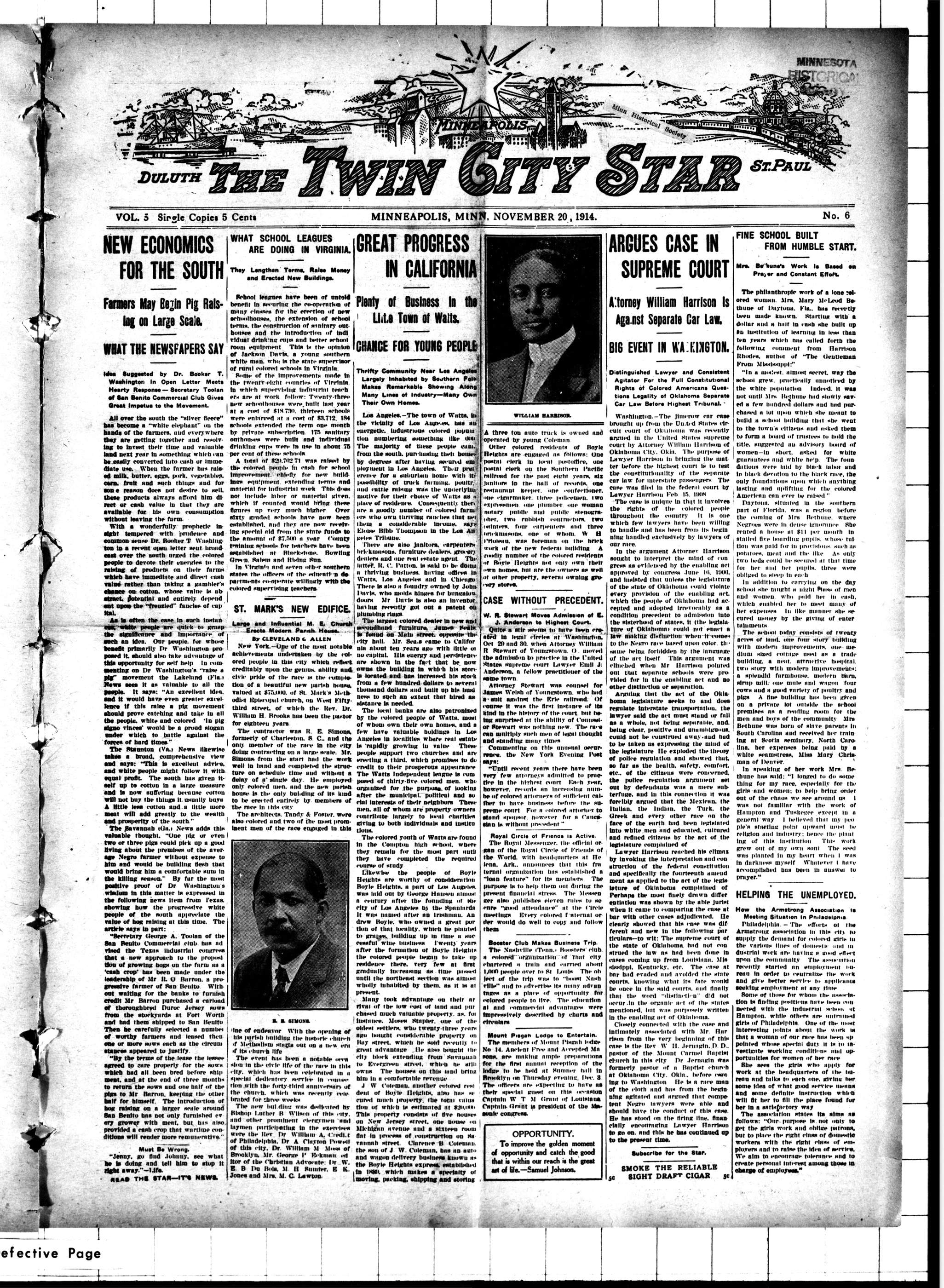
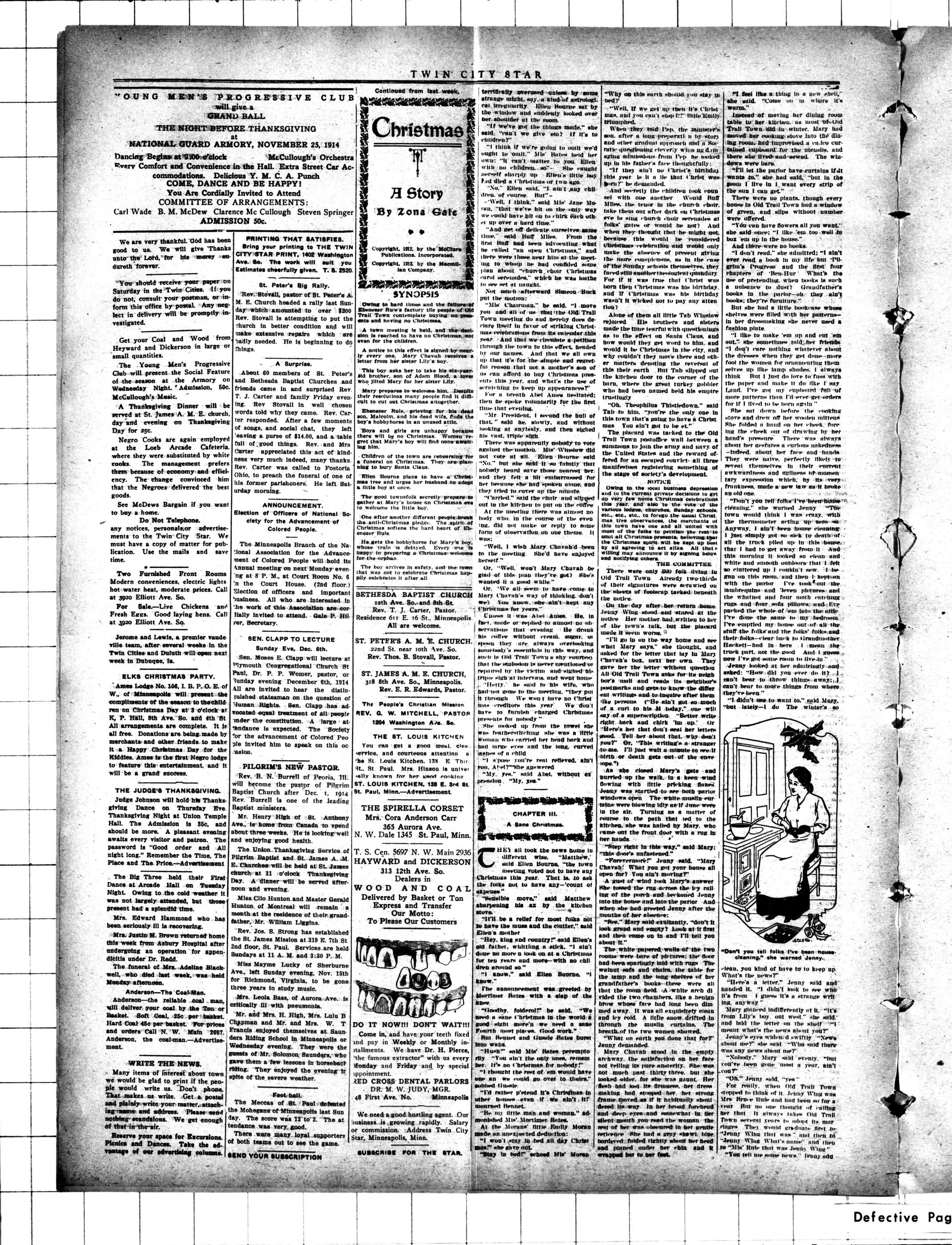
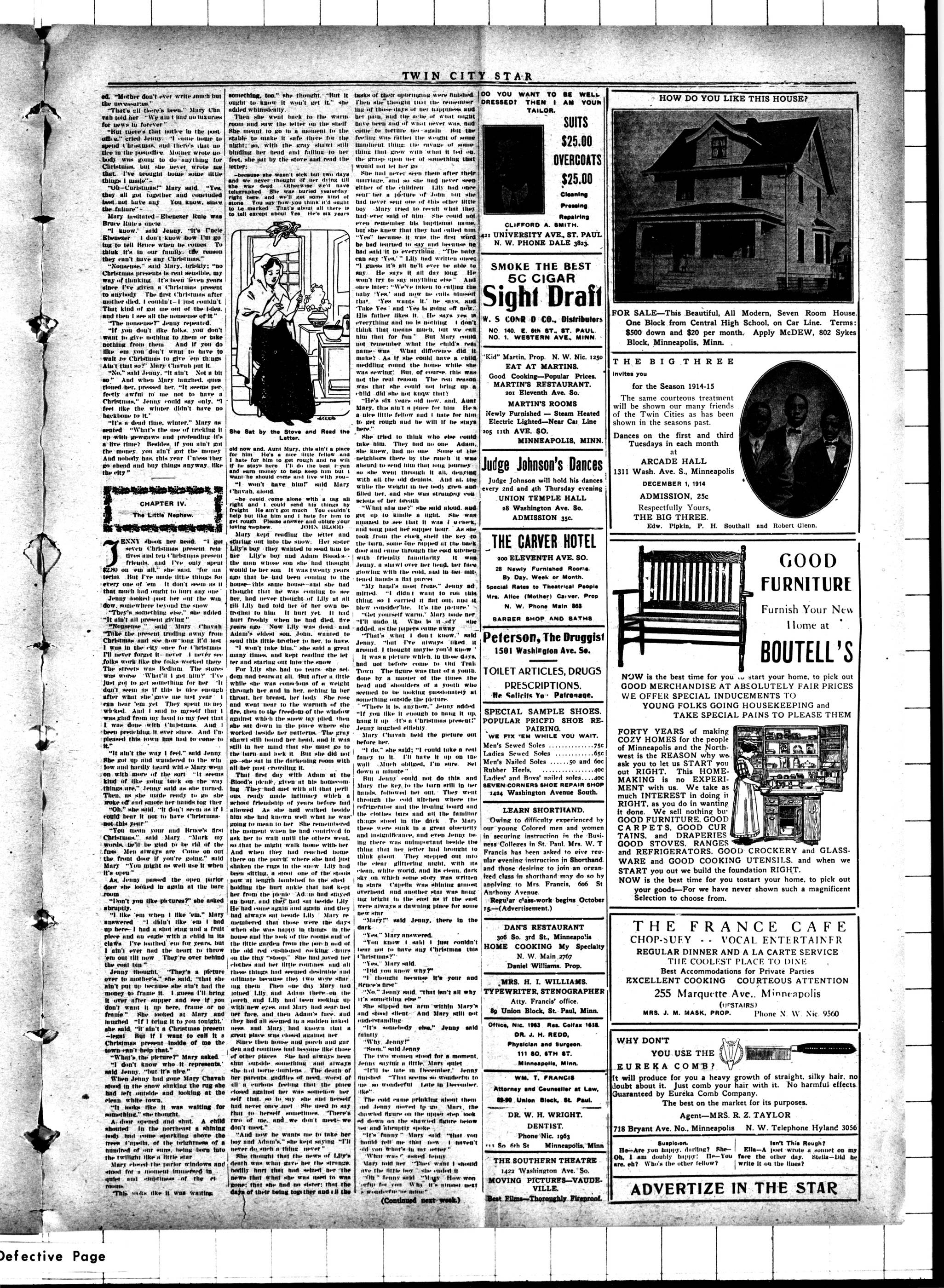
Page text (machine-generated)
MINNESOTA HISTORICAL
MINNESOTA
MINN Historical Society
DULUTH THE TWIN CITY STAR ST.PAUL
effective Page
VOL. 5 Single Copies 5 Cents
Farmers May Begin Pig Raising on Large Scale.
WHAT THE NEWSFAPERS SAY
Idea Suggested by Dr. Booker T. Washington In Open Letter Meets Hearty Response — Secretary Toolan of San Benito Commercial Club Gives Great Impetus to the Movement.
All over the south the "silver fleece" has become a "white elephant" on the hands of the farmers, and everywhere they are getting together and resolving to invest their time and valuable land next year in something which can be easily converted into cash or immediate use. When the farmer has raised milk, butter, eggs, pork, vegetables, corn, fruit and such things and for some reason does not desire to sell, these products always afford him direct or cash value in that they are available for his own consumption without leaving the farm.
With a wonderfully prophetic insight tempered with prudence and common sense Dr. Booker T. Washington in a recent open letter sent broadcast over the south urged the colored people to devote their energies to the raking of products on their farms which have immediate and direct cash value rather than taking a gambler's chance on cotton, whose value is abstract, potential and entirely dependent upon the "fronzied" fancies of capital.
As is often the case in such instances, white people are quick to grasp the significance and importance of such an idea. Our people, for whose benefit primarily Dr. Washington proposed it, should also take advantage of this opportunity for self help. In commenting on Dr. Washington's "raise a pig" movement the Lakeland (Fla. News sees it as valuable to all the people. It says: "An excellent idea, and it would have even greater excellence if this raise a pig movement should prove catching and take in all the people, white and colored 'In pig signo vinces' would be a proud slogan under which to battle against the forces of hard times."
The Staunton (Va.) News likewise takes a broad, comprehensive view and says: "This is excellent advice, and white people might follow it with equal profit. The south has given itself up to cotton in a large measure and is now suffering because cotton will not buy the things it usually buys. A little less cotton and a little more meat will add greatly to the wealth and prosperity of the south."
The Savannah (Ga.) News adds this valuable thought. "One pig or even two or three pigs could pick up a good living about the premises of the average Negro farmer without expense to him and would be building flesh that would bring him a comfortable sum in the killing season." By far the most positive proof of Dr Washington's wisdom in this matter is expressed in the following news item from Texas, showing how the progressive white people of the south appreciate the value of hog raising at this time. The article says in part:
"Secretary George A. Toolan of the San Benito Commercial club has advised the Texas industrial congress that a new approach to the proposition of growing hogs on the farm as a 'cash crop' has been made under the leadership of Mr. R. O Barron, a progressive farmer of San Benito. Without waiting for the banks to furnish credit Mr Barron purchased a cartoon of thoroughbred Durco Jersey sows from the stockyards at Fort Worth and had them shipped to San Benito. Then he carefully selected a number of worthy farmers and leased them one or more sows each as the circumstances appeared to justify.
"By the terms of the lease the lessee agreed to care properly for the sows which had all been bred before shipment, and at the end of three months to return the sows and one half of the pigs to Mr Barron, keeping the other half for himself. The introduction of hog raising on a larger scale around San Benito has not only furnished every grower with meat, but has also provided a cash crop that wartime conditions will render more remunerative."
Must Be Wrong.
"Jenny, go find Johnny, see what he is doing and tell him to stop it right away."—Life.
READ THE STAR—IT'S NEWS.
They Lengthen Terms, Raise Money and Erected New Buildings.
School leagues have been of untold benefit in securing the co-operation of many classes for the erection of new schoolhouses, the extension of school terms, the construction of sanitary outhouses and the introduction of individual drinking cups and better school room equipment. This is the opinion of Jackson Davis, a young southern white man, who is the state supervisor of rural colored schools in Virginia. Some of the improvements made in the twenty-eight counties of Virginia, in which supervising industrial teachers are at work follow: Twenty-three new schoolhouses were built last year at a cost of $18,730. Thirteen schools were enlarged at a cost of $3,712. 184 schools extended the term one month by private subscription. 175 sanitary outhouses were built and individual drinking cups were in use in about 75 per cent of these schools.
A total of $29,702,71 was raised by the colored people in cash for school improvement, chiefly for new buildings equipment extending terms and material for industrial work. This does not include labor or material given, which if counted would bring these figures up very much higher. Over sixty graded schools have now been established, and they are now receiving special aid from the state funds to the amount of $1,500 a year. County training schools for teachers have been established at Blackstone. Bowling Green, Salem and Riding Sun. In Virginia and seven other southern states the officers of the education departments co-operate willingly with the colored supervising teachers.
ST. MARK'S NEW EDIFICE.
Large and Influential M. E. Church
Erects Modern Parish House.
By CLEVELAND G. ALLEN
New York. One of the most notable
achievements undertaken by the colo-
red people in this city which reflect
creditably upon the genius, ability
and civic pride of the race in the com-
pletion of a beautiful new parish house,
valued at $75,000. of St. Mark's Meth-
odist Episcopal church, on West Fifty-
third street, of which the Rev. Dr.
William H. Brooks has been the pastor
for eighteen years.
The contractor was R. E. Simons,
formerly of Charleston, S. C., and the
only member of the race in the city
doing contracting on a large scale. Mr.
Simons from the start and the work
well in hand and completed the struc-
ture on schedule time and without a
delay of a single day. He employed
only colored men, and the new parish
house is the only building of its kind
to be erected entirely by members of
the race in this city.
The architects. Tandy & Foster, were
also colored and two of the most pro-
minent men of the race engaged in this
R. R. SIMONS.
one of endeavor With the opening of this parish building the historic church of Methalism stags out on a new era of its church life
The event has been a notable occasion in the civic life of the race in this city, which has been celebrated in a special dedicatory service in connection with the forty-third anniversary of the church, which was recently celebrated for three weeks
The new building was dedicated by Bishop Luther B Wilson of this city, and other prominent clergymen and laymen participating in the exercises were the Rev. Dr William A. Credit of Philadelphia, Dr A Clayton Powell of this city, Dr. William M Moss of Brooklyn, Mr. George P Eckman, editor of the Christian Advocate: Dr. W. E. B Du Bois, M H Sumter, E K. Jones and Mrs. M. C Lawton.
MINNEAPOLIS, MINN. NOVEMBER 20, 1914.
Thrifty Community Near Los Angeles
Largely Inhabited by Southern Folk
Makes Remarkable Showing Alone
Many Lines of Industry—Many Own
Their Own Homes.
Los Angeles.—The town of Watts, in
the vicinity of Los Angeles, has an
energetic, industrious colored popu-
numbering something like this.
The majority of these people came
from the south, purchasing their home-
by degrees after having secured em-
ployment in Los Angeles. Their pre-
ference for a suburban home with its
possibility of truck farming, poultry
and cattle raising was the underlying
motive for their choice of Watts as a
place of residence. Consequently there
are a goodly number of colored farm-
ers who own thriving ranches that net
them a considerable income, says
Elose Bibb Thompson in the Los Ang-
les Tribune.
There are also janitors, carpenters
brick-masons, furniture dealers, grocery
dealers and one real estate agent. The
latter, R. C. Patton, is said to be do-
ing a thriving business, having offices in
Watts, Los Angeles and in Chicago.
There is also a foundation owned by John
Davis, who molds hinges for bunionat-
doors. Mr Davis is also an inventor,
having recently got out a patent on
plumbing rings.
The largest colored dealer in new and secondhand furniture, James Neale is found on Main street, opposite the city hall. Mr. Seas came to California his about ten years ago with little or no capital. His energy and persistence are shown in the fact that he now owns the building in which his store is located and has increased his stock from a few hundred dollars to several thousand dollars and built up his business to such an extent that bired as distance is needed.
The local banks are also patronized by the colored people of Watts, most of whom own their own homes, and a few have valuable holdings in Los Angeles in localities where real estate is rapidly growing in value. These people support two churches and are erecting a third, which promises to do credit to their prosperous appearance. The Watts independent league is composed of thirty-five colored men, who organized for the purpose of looking after the municipal, political and social interests of their neighbors. These men, all of whom are property owners contribute largely to local charities giving to both individuals and institutions.
The colored youth of Watts are found in the Compton high school, where they remain for the most part until they have completed the required course of study.
Likewise the people of Boyle Heights are worthy of consideration. Boyle Heights, a part of Los Angeles, was laid out by George Hansen almost a century after the founding of the city of Los Angeles by the Spaniards. It was named after an Irishman. Andrew Boyle, who owned a great portion of that locality, which he planted to grape, building up in time a successful wine business. Twenty years after the formation of Boyle Heights the colored people began to take up residence there, very few at first gradually increasing as time passed until the northeast section was almost wholly inhabited by them, as it is at present.
Many took advantage on their arrival of the low cost of land and purchased much valuable property, as, for instance, Moses Stapler, one of the oldest settlers, who twenty-three years ago bought considerable property on Hay street, which he sold recently to great advantage. He also bought the city block extending from Savannah to Evergreen street, which he still owns. The houses on this and bring him in a comfortable revenue
J W Coleman, another colored resident of Boyle Heights, also has secured much property, the total valuation of which is estimated at $20,000. This property consists of five houses on New Jersey street, one house on Michigan avenue and a sixteen room flat in process of construction on Vanahn street. Chureance is Coleman, the son of J W. Coleman, has an auto and wagon delivery business known as the Boyle Heights express, established in 1880, which makes a specialty of moving, packing, shipping and storing
WILLIAM HARRISOR.
A three ton auto truck is owned and operated by young Coleman.
Other colored residents of Boyle Heights are engaged as follows: One postal clerk in local postoffice, one postal clerk in the Southern Pacific railroad for the past eight years, six jailers in the hall of records, one restaurant keeper, one confectioner, one cigarmaker, three policemen, two expressmen one plumber one woman notary public and public stenographer, two publish contractors, two painters, four carpenters and three craftsmen, one of whom, W H Proteau, was foreman on the brick work of the new federal building. A goodly number of the colored residents of Boyle Heights not only own their homes, but are the owners as well of other property, several owning grocery stores.
CASE WITHOUT PRECEDENT.
W. R. Stewart Moves Admission of E. A.
J. Anderson to Highland Court.
3. Anderson to Highstown Court.
Quite a air stirs to have been created in legal circles at Washington, October 29 and 30, when Attorney William R Stewart of Youngstown. O. moved the admission to practice in the United States supreme court Lawyer Emil J. Anderson, a fellow practitioner of the same town.
Attorney Stewart was counsel for James Welsh of Youngstown, who had a unit against the Erle railroad. Of course it was the first instance of its kind in the history of the court, but being surprised at the ability of Counsel or Stewart was nothing new. The race can multiply such men of legal thought and standing many times.
Commenting on this unusual occurrence, the New York Evening Post says:
"Until recent years there have been very few attorneys admitted to practice in the highest court. Each year, however, records an increasing number of colored attorneys of sufficient caliber to have business before the supreme court. For a colored attorney to stand sponsor, however for a Caucasian is without precedent."
Royal Circle of Friends is Active.
The Royal Messenger, the official organ of the Royal Circle of Friends of the World, with headquarters at Helena, Ark. announces that this fraternal organization has established a "loan feature" for its members. The purpose is to help them out during the present financial stress. The Messenger also publishes eleven rules to secure "good attendance" at the Circle meetings. Every colored fraternal order would do well to copy and follow them.
Booster Club Makes Business Trip.
The Nashville (Tenn.) Booster club, a colored organization of that city chartered a train and carried about 1,000 people over to St Louis. The object of the trip was to "boost Nashville" and to advertise its many advantages as a place of opportunity for colored people to live. The education and commercial advantages were impressively described by charts and circula
Mount Pisgah Lodge to Entertain.
The members of Mount Pisgah lodge No 14. Ancient Free and Accepted Masons, are making ample preparations for the first annual reception of the lodge to be held at Summer hall in Brooklyn on Thursday evening, Dec. 3. The officers are expecting to have as their special guest on this occasion Captain W T M Grant of Louisiana Captain Grint is president of the Masonic congress.
OPPORTUNITY.
To improve the golden moment of opportunity and catch the good that is within our reach is the great art of life.—Samuel Johnson.
ARGUES CASE IN SUPREME COURT
BIG EVENT IN WALKINGTON.
Distinguished Lawyer and Consistent Agitator For the Full Constitutional Rights of Colored Americans Questions Legality of Oklahoma Separate Car Law Before Highest Tribunal.
Washington.—The Jimerow car case brought up from the United States circuit court of Oklahoma was recently argued in the United States supreme court by Attorney William Harrison of Oklahoma City, Okla. The purpose of Lawyer Harrison in bringing the matter before the highest court is to test the constitutionality of the separate car law for interstate passengers. The case was filed in the federal court by Lawyer Harrison Feb 15, 1908.
The case is unique in that it involves the rights of the colored people throughout the country. It is one which few lawyers have been willing to handle and has been from its beginning handled exclusively by lawyers of our race.
In the argument Attorney Harrison sought to interpret the mind of congress as evidenced by the enabling act approved by congress June 16, 1900, and insisted that unless the legislature of the state of Oklahoma could violate every provision of the enabling act, which the people of Oklahoma had accepted and adopted irrevocably as a condition precedent to admission into the sisterhood of states, it (the legislature of Oklahoma) could not enact a law making distinction when it comes to the Negro race based upon color, the same being forbidden by the language of the act itself. This argument was clinched when Mr Harrison pointed out that separate schools were provided for in the enabling act and no other distinction or separation.
Arguing that the act of the Oklahoma legislature seeks to and does regulate interstate transportation, the lawyer said the act must stand or fall as a whole, not being separable, and, being clear, positive and unambiguous, could not be construed away, and had to be taken as expressing the mind of the legislature. He exploded the theory of police regulation and showed that, so far as the health, safety, comfort, etc., of the citizens were concerned, the police regulation argument set out by defendants was a mere subterfuge, and in this connection it was forcibly argued that the Mexican, the Italian, the Indian, the Turk, the Greek and every other race on the face of the earth had been legislated into white men and educated, cultured and refined citizens by the act of the legislature complained of.
Lawyer Harrison reached his client by invoking the interpretation and construction of the federal constitution and specifically the fourteenth amendment as applied to the act of the legislature of Oklahoma complained of Perhaps the most finely drawn differ entation was shown by the able jurist when it came to comparing the case at bar with other cases adjudicated. He clearly showed that his case was different and new in the following particulars—to wit: The supreme court of the state of Oklahoma had not con strued the law as had been done in cases coming up from Louisiana, Mississippi, Kentucky, etc. The case at bar had evaded and avoided the state courts, knowing what its fate would be once in the said courts, and finally that the word "distinction" did not occur in the organic act of the states mentioned, but was purposely written in the enabling act of Oklahoma.
Closely connected with the case and intimately associated with Mr. Harrison from the very beginning of this case is the Rev W. H. Jernagin, D. D., pastor of the Mount Carmel Baptist church in this city. Dr Jernagin was formerly pastor of a Baptist church at Oklahoma City, Okla., before coming to Washington. He is a race man of the cloth and has from the beginning agitated and argued that competent Negro lawyers were able and should have the conduct of this case. He has stood on the firing line, financially encouraging Lawyer Harrison to go on, and this he has continued up to the present time.
Subscribe for the Star.
SMOKE THE RELIABLE
SIGHT DRAFT CIGAR
No. 6
Mrs. Bethune's Work Is Based on Prayer and Constant Effort.
The philanthropic work of a lone colored woman, Mrs. Mary McLeod Bethune of Daytona, Fla., has recently been made known. Starting with a dollar and a half in cash she built up an institution of learning in less than ten years which has called forth the following comment from Harrison Rhodes, author of "The Gentleman From Mississippi:"
"In a modest, almost secret, way the school grew, practically unmoved by the white population. Indeed, it was not until Mrs. Bethune had slowly saved a few hundred dollars and had purchased a lot upon which she meant to build a school building that she went to the town's citizens and asked them to form a board of trustees to hold the title, suggested an advisory board of women—in short, asked for white guarantees and white help. The foundations were laid by black labor and in black devotion to the black race, the only foundations upon which anything lasting and uplifting for the colored American can ever be raised."
Daytona, situated in the southern part of Florida, was a region before the coming of Mrs Bethune, where Negroes were in dense ignorance. She rented a house at $11 per month in installed five boarding pupils, whose tuition was paid for in provisions, such as potatoes, meat and the like. As only two beds could be secured at that time for her and her pupils, three were obliged to sleep in each.
In addition to carrying on the day school she taught a night class of men and women, who paid her in cash, which enabled her to meet many of her expenses. In like manner she secured money by the giving of enter tainments.
The school today consists of twenty acres of land, one four story building with modern improvements, one medium sized cottage used as a trade building, a neat, attractive hospital, two story with modern improvements: a splendid farmhouse, modern barn, stirp mill, one mule and wagon four cows and a good variety of poultry and pigs. A fine building has been given on a private lot outside the school premises as a reading room for the men and boys of the community Mrs Bethune was born of slave parents in South Carolina and received her training at Scotia seminary. North Carolina, her expenses being paid by a white seamstress, Miss Mary Christman of Denver.
In speaking of her work Mrs. Behune has said: "I longed to do something for my race, especially for the girls and women; to help bring order out of the chaos we see around us. I was not familiar with the work of Hampton and Tuskegee except in a general way. I believed that my people's starting point upward must be religion and industry; hence the planting of this institution. This work grew out of my own son! The seed was planted in my heart when I was in darkness myself. Whatever I have accomplished has been in answer to prayer."
HELPING THE UNEMPLOYED.
How the Armstrong Association is Meeting Situation in Philadelphia.
Philadelphia. - The efforts of the Armstrong association in this city to supply the demand for colored girls in the various lines of domestic and industrial work are having a good effect upon the community. The association recently started an employment tenure in order to centralize the work and give better service to applicants seeking employment at any time.
Some of those for whom the association is finding positions have been connected with the industrial school, at Hampton, while others are untrained girls of Philadelphia. One of the most interesting points about the work is that a woman of our race has been appointed whose special duty it is to investigate working conditions and opportunities for women of her race.
She sees the girls who apply for work at the headquarters of the bureau and talks to each one, giving her some idea of what good service means and some definite instruction which will fit her to fill the place found for her in a satisfactory way.
The association states its aims as follows: "Our purpose is not only to get the girls work and oblige patrons, but to place the right class of domestic workers with the right class of employees and to cause the idea of service. We aim to encourage tolerance and to create personal interest among those in charge of employees."
Carl Wade B. M. McDew Clarence Mc Cullough Steven Springer ADMISSION 50c.
We are very thankful. God has been good to us. We will give Thanks unto the Lord, for his mercy endureth forever.
You should receive your paper on Saturday in the Twin Cities. If you do not, consult your postman, or inform this office by postal. Any neglect in delivery will be promptly investigated.
Get your Coal and Wood from Heyward and Dickerson in large or small quantities.
PRINTING THAT SATISFIES.
Bring your printing to THE TWIN CITY STAR PRINT, 1402 Washington Ave. So. The work will suit you. Estimates cheerfully given. T. B. 2520.
St. Peter's Big Rally.
Rev. Stovall, pastor of St. Peter's A. M. E. Church headed a rally last Sunday which amounted to over $200 Rev. Stovall is attempting to put the church in better condition and will make extensive repairs which are badly needed. He is beginning to do things.
The Young Men's Progressive Club will present the Social Feature of the season at the Armory on Wednesday Night. Admission, 50c. McCullough's Music.
A Thanksgiving Dinner will be served at St. James A. M. E. church, day and evening on Thanksgiving Day for 25c.
Negro Cooks are again employed at the Loeb Arcade Cafeteria, where they were substituted by white cooks. The management prefers them because of economy and efficiency. The change convinced him that the Negroes delivered the best goods.
See McDews Bargain if you want to buy a home.
any notices, personalis, or advertisements to the Twin City Star. We must have a copy of matter for publication. Use the mails and save time.
Two Furnished Front Rooms Modern conveniences, electric lights hot water heat, moderate prices. Call at 3920 Elliott Ave. So.
For Sale.-Live Chickens and Fresh Eggs. Good laying hens. Call at 3920 Elliott Ave. Sq.
Jerome and Lewis, a premier vaudeville team, after several weeks in the Twin Cities and Duluth will open next week in Dubuque, Ia.
ELKS CHRISTMAS PARTY
Ames Lodge No. 106, I. B. P. O. E. of W., of Minnesota will present the compliments of the season to the children on Christmas Day at 3 o'clock at K, P. Hall, 8th Ave. So. and 4th St. All arrangements are complete. It is all free. Donations are being made by merchants and other friends to make it a Happy Christmas Day for the Kiddies. Ames is the first Negro lodge to feature this entertainment, and it will be a grand success.
THE JUDGE'S THANKSGIVING.
Judge Johnson will hold his Thanksgiving Dance on Thursday Eve Thanksgiving Night at Union Temple Hall. The Admission is $5c, and should be more. A pleasant evening awaits every visitor and patron. The password is "Good order and All night long." Remember the Time, The Place and The Price.—Advertisement
The Big Three held their First Dance at Arcade Hall on Tuesday Night. Owing to the cold weather it was not largely attended, but those present had a splendid time.
Mrs. Edward Hammond who has been seriously ill is recovering.
Mrs. Justin M. Brown returned home this week from Asbury Hospital after undergoing an operation for appenditis under Dr. Redd.
The funeral of Mrs. Adeline Blackwell, who died last week, was held Monday afternoon.
Anderson—The Coal-Man.
Anderson—the reliable coal man, will deliver your coal by the Ton or Basket. Soft Coal, 25c per basket. Hard Coal 45c per basket. For prices and orders Call N. W. Main 2667. Anderson, the coal-man.—Advertisement.
WRITE THE NEWS
Many items of interest about town we would be glad to print if the people would write us. Don't phone. That makes us write. Get a postal and plainly write your matter, attaching name and address. Please send nothing scandalous. We get enough of that in the air. Reserve your space for Excursions. Picnics and Dances. Take the advantage of our advertising columns.
PRINTING THAT SATISFIES.
Bring your printing to THE TWIN
CITY STAR PRINT, 1402 Washington
Ave. So. The work will suit you
Estimates cheerfully given. T. S. 2520.
St. Peter's Big Rally.
Rev. Stovall, pastor of St. Peter's A. M. E. Church headed a rally last Sunday which amounted to over $200 Rev. Stovall is attempting to put the church in better condition and will make extensive repairs which are badly needed. He is beginning to do things.
A Surprise.
About 60 members of St. Peter's and Bethesda Baptist Churches and friends came in and surprised Rev. T. J. Carter and family Friday evening. Rev Stovall in well chosen words told why they came. Rev. Carter responded. After a few moments of songs, and social chat, they left leaving a purse of $14.00, and a table full of good things. Rev. and Mrs Carter appreciated this act of kindness very much indeed, many thanks. Rev. Carter was called to Fostoria Ohio, to preach the funeral of one of his former parishoners. He left Saturday morning.
ANNOUNCEMENT
The Minneapolis Branch of the National Association for the Advancement of Colored People will hold its Annual meeting on next Monday evening at 8 P. M., at Court Room No. 6 in the Court House. (2nd floor.) Selection of officers and important business. All who are interested in the work of this Association are cordially invited to attend. Gale P. Hilver, Secretary.
8EN. CLAPP TO LECTURE
Sunday Eve, Dec. 6th
Sen. Moses E. Clapp will lecture at Plymouth Congregational Church St Paul, Dr. P. P. Woman, pastor, or Sunday evening December 6th, 1914 All are invited to hear the distintruished statesman on the question of Human Rights. Sen. Clapp has advocated equal treatment of all people under the constitution. A large attendance is expected. The Society for the advancement of Colored People invited him to speak on this occasion.
PILGRIM'S NEW PASTOR
Rev. B. N. Burrell of Peoria, Ill. will become the pastor of Pilgrim Baptist Church after Dec. 1, 1914 Rev. Burrell is one of the leading Baptist ministers.
Mr. Henry High of St. Anthony Ave. is home from Canada to spend about three weeks. He is looking well and enjoying good health.
The Union Thanksgiving Service of Pilgrim Baptist and St. James A. M. E. Churches will be held at St. James church at 11 o'clock Thanksgiving Day. A dinner will be served afternoon and evening.
Miss Cloe Hunton and Master Gerald Hunton of Montreal will remain a month at the residence of their grandfather, Mr. William Liggins.
Rev. Jos. S. Strong has established the St. James Mission at 319 E. 7th St. 2nd floor, St. Paul. Services are held Sundays at 11 A. M. and 3:30 P. M.
Miss Mayne Lucky of Sherburne Ave., left Sunday evening, Nov. 15th for Richmond, Virginia, to be gone three years to study music.
Mrs. Leola Bass, of Aurora Ave. is critically ill with pneumonia.
Mr. and Mrs. H. High, Mrs. Lulu B Chpman and Mr. and Mrs. W. T Francis enjoyed themselves at Saunders Riding School in Minneapolis or Wednesday evening. They were the guests of Mr. Solomon Saunders, who gave them a few lessons in horseback riding. They enjoyed the evening in spite of the severe weather.
Foot ball.
The Meccas of St. Paul defeated the Moheguns of Minneapolis last Sunday. The score was 12 to 2. The at tendance was very good.
Continued from last week.
Christmas
A Story
By Zona Gale
terrifically overused
strange might, say,
cat irregularity. El
the window and sa
ber shoulder at the
"If we've got the
said, 'can't we giv
children?"
"I think if we're
ought to omit," Mr
own; "it can't mat
with no children,
personally sharply up
had died a Christmas
"No," Ellen said,
dren, of course. Bu
=Well, I think," a
san, "that we've hit
we could have hit on
at up over a hard th
"And get off delie
time," said Buff
first Buff had been
Copyright, 1912, by the McClure Publications. Incorporated.
Copyright, 1912, by the Macmillan Company.
Owing to hard times and the failure of Ebenezer Rule's factory the people of Old Trail Town contemplate buying no presents and having no Christmas.
A town meeting is held, and the decision is reached to have no Christmas, not even for the children.
A notice to this effect is signed by nearly every one. Mary Chavah receives a letter from her sister Lily's boy.
This boy asks her to take his six-year-old brother, son of Adam Blood, a lover who jilted Mary for her sister Lily.
Mary prepares to welcome him. Despite their resolutions many people find it difficult to cut out Christmas altogether.
Ebenezer Rule, grieving for his dead son, Malcolm, and his dead wife, finds the boy's hobbyhorse in an unused attic.
Boys and girls are unhappy because there will be no Christmas. Women regret that Mary's boy will find none awaiting him.
Children of the town are rehearsing for a funeral on Christmas. They are planning to bury Santa Claus.
Ellen Bourne plans to have a Christmas tree and urges her husband to adopt a little boy at once.
The good townsfolk secretly prepare to gather at Mary's house on Christmas eve to welcome the little boy.
One after another different people break the anti-Christmas pledge. The spirit of Christmas softens the hard heart of Ebenezer Rule.
He gets the hobbyhorse for Mary's boy, whose train is delayed. Every one is happy in preparing a Christmas welcome for the orphan.
The boy arrives in safety, and the town that was not to celebrate Christmas happily celebrates it after all.
BETHESDA BAPIST CHURCH
12th Ave. and 8th St.
12th Ave. So. and 8th St.
Rev. T. J. Carter, Pastor.
Residence 611 E. 16 St., Minneapolis.
All are welcome.
ST. PETER'S A. M. E. CHURCH.
22nd St. near 10th Ave. So.
Rev. Thos. B. Stovall, Pastor.
ST. JAMES A. M. E. CHURCH,
318 8th Ave. So., Minneapolis.
Rev. E. R. Edwards, Pastor.
The People's Christian Mission
REV. G. W. MITCHELL, PASTOR
1204 Washington Ave. So.
THE ST. LOUIS KITCHEN
You can get a good meal, clean service, and courteous attention at the St. Louis Kitchen, 138 E. Thur St. St. Paul. Mrs. Hinson is universally known for her good cooking.
ST. LOUIS KITCHEN, 138 E. 3rd St. St. Paul, Minn.—Advertisement
365 Aurora Ave.
N. W. Dale 1345 St. Paul, Minn.
T. S. Cen. 5697 N. W. Main 2936
HAYWARD and DICKERSON
313 12th Ave. So.
Dealers in
WOOD AND COAL
Delivered by Basket or Ton
Express and Transfer
Our Motto:
To Please Our Customers
DO IT NOW!!! DON'T WAIT!!!
Come in, and have your teeth fixed and pay in Weekly or Monthly installments. We have Dr. H. Pierce, "the famous extractor" with us every Monday and Friday and by special appointment.
We need a good hustling agent. Our business is growing rapidly. Salary or commission. Address Twin City Star, Minneapolis, Minn.
SUBSCRIBE FOR THE STAR.
terrificly overused unless by some strange might, say a kind of astrology, cat irregularity. Ellen Bourne sat by the window and suddenly looked over her shoulder at the room.
"If we've got the things made," she said, "can't we give em? If it's to children?
"I think if we're going to omit we'd ought to omit," Ms. Bates held her own: "it can't matter to you. Ellen with no children, so." She caught herself sharply up. Ellen's little boy had died a Christmas or two ago.
"No," Ellen said. "I can't any children, of course. But"
"Well, I think," said Mrs Jane Moran, "that we've hit on the only way we could have hit on to chirk each other up over a hard time."
"And get off delicate ourselves same time," said Huff Miles. From the first Huff had been advocating what he called "an open Christmas," and there were those near him at the meeting to whom he had confided some plan about "church choir Christmas carol serenades," which he was toothe to see set at mught.
"Not much afterward Slimeon Buck put the motion;
"Miss Chairman," he said. "I move you and all of us that the Old Trail Town meeting do and hereby does declare itself in favor of striking Christmas celebrations from its calendar this year. And that we circulate a petition through the town to this effect, headed by our names. And that we all own up that it's for the simple and regretful reason that not a mother's son of us can afford to buy Christmas presents this year, and what's the use of scratching to keep up appearance?"
For a breath Abel Amies hesitated; then he spoke voluntarily for the first time that evening.
"Mr. President, I second the bull of that," said he, slowly, and without looking at anybody, and then sighed his vast, triple sigh.
There was apparently nobody to vote against the motion. Miss Window did not vote at all. Ellen Bourne said "No." but she said it so faintly that nobody heard save those nearest her, and they felt a bit embarrassed for her because she and spoken alone, and they tried to cover up the minute.
"Arrived," said the chair and slipped out in the kitchen to put on the coffee. At the meeting there was almost no body who, in the course of the evening, did not make or reply to some form of observation on one theme. It was:
"Well, I wish Mary Chavah'd been to the meeting. She'd have enjoyed herself."
Or, "Well, won't Mary Chavah be glad of this plan they've got?" She's wanted it a good while.
Or, "We all seem to have come to Mary Chavah's way of thinking, don't we? You know, she can't keep any Christmas for years."
Unless it was Abel Ames. He, in fact, made or replied to almost no observations that evening. He drank his coffee without cream, sugar, or espion they are always overlooking somebody's essentials in this way, and such is Old Trail Town's shy courtney that the enabler is never mentioned or required by the victim and sighed bristle sight at intervals and went home. "Hey," he said to his wife, who had not gone to the meeting, "they put it through. We won't have no Christian creditors this year. We don't have to furnish charged Christmas presents for nobody."
She looked up from the towel she was featherfitting she was a little woman who carried her head back and had large eyes and the long, curved ashes of a child.
"I誓你 are real relieved, aren't you, Abel?" she answered.
"My, yes," said Abel, without expression. "My, yes."
CHAPTER III.
A Sane Christmas.
HEY all took the news home in different wise. "Matthew,' said Ellen Bourne, "the town meeting voted not to have any Christmas this year. That is, to ask the folks not to have any—count of expense."
"Sensible move," said Matthew sharpening his ax by the kitchen stove.
"It'll be a relief for most folks not to have the muss and the clutter," said Ellen's mother.
"Hey, king and country!" said Ellen's old father, whitthing a stick. "I ain't done no more n look on at a Christmas for ten years and more—with no children around so."
"I know," said Ellen Bourne. "I know."
The announcement was greeted by Mortimer Bates with a slap of the knee.
"Goodbyy, folderol!" he said. "We need a same 'Christmas in the world a good sight more' we need a same Fourth most places. Good work."
But Rennet and Gusse Bates burst into wails.
"Hush!" said Mia Bates peremptorily. "You ain't the only ones, remember, it's no 'Christmas for nobody!'"
"I thought the rest of em would have one an we could go over to theirs," sobbed Gusse.
"I'd rather pretend it's Christmas in other houses even if we ain't it!" mourned Rennet.
"Why on this earth should you stay in bed?
"Well, if we get up then it's Christ us, and you can't stop it!" little Emily triumphed.
When they told Pep, the minister's son, after a long preparat in by story and other gradual approach and a Socratte questioning cleverly whenng dam aging admissions from Pep he looked up in his father's face thoughtfully:
"If they ain't no Christ's birthday this year is it a lie that Christ was born" he demanded.
And secretly the children took counsel with one another. Would Ruff Miles, the tenor in the church choir, take them out after dark on Christmas eve to sing church choir serenades at folks' gates or would he not? And when they thought that he might not, because this would be considered Christmas celebration and would only make the absence of present giving the more conspicuous, as in the case of the Sunday schools themselves, they faced still another theologian quinary. For if it was true that Christ was born then Christmas was his birthday, and if Christmas was his birthday wasn't it wicked not to pay any attention?
Alone of them all little Tab WINDOW rejoiced His brothers and sisters made the time tearful with questionings as to the effect on Santa Claus, and how would they get word to him, and would it be Christmas in the city, and why couldn't they move there and other matters denoting the reversal of this their earth. But Tab slipped out the kitchen door to the corner of the barn, where the great turkey gobbler who had been named held his empire trustingly.
"Oh, theophilus Thistledown," said Tab to him, "you're the only one in this town that's going to have a Christ mas. Youn't got to be et."
The placard was tacked to the Old Trail Town postoffice wall between a summons to join the army and navy of the United States and the reward offered for an escaped convict-all three manifestoes registering something of the stage of society's development.
Owing to the local business depression and to the current private decisions to get up very few home Christmas celebrations this year, and also to the vote of the church, Sunday schools, etc., etc., to forego, we usual Christmas tree observances, the merchants of this town have one and all united with most of the folks to petition the rest to omit all Christmas presents, believing that the Christmas spirit will be kept up best agreeing to act alike. All that willing to agree to act by signing below and notifying others.
THE COMMITTEE
There were only 300 folk living in Old Trail Town. Already two-thirds of their signatures were scrawled on the sheets of foolscap tacked beneath the notice.
On the day after her return home, Jenny Wing stood and stared at the notice. Her mother had written to her of the town's talk, but the placard made it seem worse.
"I'll go in on the way home and see what Mary says," she thought, and asked for the letter that lay in Mary Chavran's box, next her own. They gave her the letter without question. All Old Trull Town asks for its neighbor's mail and reads its neighbor's postmarks and gets to know the different writings and to inquire after them like persons. "He isn't so much of a curl to his M today," one will say of a superscript. "Better write right back and chick 'im up." Or "Here's her that don't seal her letters good. Tell her about that, why don't you?" Or, "This writing's a stranger to me. I just will wait a minute to see it birth or death gets out of the envelope."
As she closed Mary's gate and hurried up the walk, in a keen wind flowing with little pricking fakes, Jenny was started to see both parlor windows open. The white muslin curtains were blowing idly as If Jane were in the air. Turning as a matter of course to the path that led to the kitchen, she was bailed by Mary, who came out the front door with a rug in her hands.
"Step right in this way," said Mary; "this door's unfasted."
"Forevermore!" Jenny said, "Mary Chavah! What you got your house all open for? You ain't moving?"
A gust of wind took Mary's answer. She tossed the rug across the key railing of the porch and beckoned Jenny into the house and into the parlor. And when she had greeted Jenny after the months of her absence:
"Bee." Mary said exultantly, "don't it look grand and empty? Look at it first and then come on in and I'll tell you about it."
The white papered, walls of the two rooms were bare of pictures; the floor had been sparingly laid with rugs. The walnut soft and chains, the table for the lamp and the long shelves of her grandfather's books—these were all that the room held. A white arch divided the two chambers, like a benign brow whose face had long been dimmed away. It was all exquisitely clean and ice cold. A little snow drifted in through the muslin curtains. The breath of the two women showed. "What on earth you done that for?" Jenny demanded.
Mary Chavah stood in the empty archway, the satisfaction on her face not vellifying its pure amateness. She was not much past thirty three, but she looked older, for she was gaunt. Her flesh had lost its drummess, her dress making had stopped her, her strong frame moved as if it habitually shouldeed its way. In her broad forehead and deep eyes and somewhat in her silent mouth you read the woman the rest of her was obscured in her gentle reticence. She had a grey show, blue bordered, folded tightly about her head and pinned under her chin and it wrapped her to her feet.
"I feel like a thing in a new shell," she said. "Come on in where it's warm."
Instead of moving her dining room table to her kitchen, as most of Old Trail Town aid in winter, Mary had moved her cooking stove into the dining room, had improvised a cakec curtained cupboard for the utensils, and there she lived and sewed. The windows were bare.
"I'll let the parlor have curtains if it wants to," she had said, "but in the goo I live in I want every strip of the sun I can get."
There were no plants, though every house in Old Trail Town had a window of green, and slips without number were offered.
"You can have flowers all you want," she said once; "I like 'em too well to box em up in the house."
"I don't read," she admitted; "I ain't ever read a book in my life but 'Pilgrim's Progress' and the first four chapters of 'Ben-Hur.' What's the use of pretending, when books is such a nuisance to dust? Grandfather's books in the parlor-oh they ain't books; they're furniture."
But she had a little bookcase whose shelves were filled with her patterns—in her dressmaking she never used a fashion plate.
"I like to make 'em up and cut 'em out," she sometimes told her friends. "I don't care nothing whatever about the dresses when they get done—more fool the women for ornamenting them selves up like lamp shades. I always think. But I just do love to fuss with the paper and make it do like I say Land. I've got my euphorbia full of more patterns than I'd ever get orders for if I lived to be born again."
She sat down before the cooking store and drew off her wooden mittens. She folded a hand on her cheek, forcing the cheek out of drawing by her hand's pressure. There was always about her gestures a curious nakedness – indeed, about her face and hands. They were naive, perfectly likely to reveal themselves in their current awkwardness and grittiness of momentary expression which; by its very frankness, made a new law as it broke an old one.
"Don't you tell folks I've been house cleaning," she warned Jenny. "The town would think I was crazy, with the thermometer acting up here Anyway, I ain't been house cleaning I just simply got so sick to death of all the truck plumed up in this house that I had to get away from it. And this morning it looked so clean and white and smooth outdoors that I felt so cluttered I couldn't see. I the gun on this room, and then I keptam with the parlor. I've took out the lambrequins and seven pictures and the whathot and four moth catching rugs and four sofa pillows, and I've packed the whole of sum into the attic I've done the same to my bedroom. I've emptied my house out of all the stuff the folks and the folks' folks and their folks—clear back to Grandmother Hackett. in here I mean the truck part, not the good. And I know now I've got some room to live in."
Jenny looked at her adamantly and asked: "How did you ever do it? I can't bear to throw things away; I can't bear to move things from where they've been."
"I didn't use to want to," said Mary, "but lately—I do The winter's so
A. C. K.
"Don't you tell folks I've been house cleaning," she warned Jenny.
clean, you kind of have to to keep up What's the news?
"Here's a letter," Jenny said and handed it. "I didn't look to see who it's from. I guess it's a strange writing, anyway"
Mary glanced indifferently at it. "It's from Lilly's boy out west," she said and held the letter on the shelf. "I meant what's the news about you?
Jenny's eyes widened swiftly "News about me?" she said. "Who said there was any news about me?
"Nobody," Mary said evenly. "but you've been gone most a year, ain't you?"
"Oh" Jenny said, "yes"
For really, when Old Trail Town stopped to think of it, Jenny Wing was Mrs Bruce Rule and had been so for a year. But no one thought of calling her that. It always takes Old Trail Town several years to adopt its marages. They would graduate first to "Jenny Wing that was" and then to "Jenny Wing What's name" and then to "Mis Rule that was Jenny Wing"
"You tell me some news." Jenny add
Defective Pag
Defective Page
ed. "Mother don't ever write much but the necessaries."
"That's all there's been." Mary Chavah told her "We aren't had no luxuries for news in forever"
"But there's that notice in the postoffice." cried Jenny. "I come home to spend Christmas, and there's that no tide in the positive. Mother wrote no body was going to do anything for Christmas, but she never wrote me that. I've brought home some little things I made".
"Oh-Christmas!" Mary said. "Yes, they all got together and conceived best not have any. You know, since the failure".
Mary insisted-Ebenezer Rule was Bruce Rule's uncle.
"I know," said Jenny. "It's Uncle Ebenezer. I don't know how I'm going to tell Bruce when he comes. To think it's in our family, the reason they can't have any Christmas."
"Nonsense," said Mary, briskly; "no Christmas presents is real sensible, my way of thinking. It's been seven years since I've given a Christmas present to anybody. The first Christmas after mother died. I couldn't — I just couldn't. That kind of got me out of the idea, and then I see all the nonsense of it." "The nonsense?" Jenny repented. "If you don't like folks, you don't want to give nothing to them or take nothing from them. And if you do like em you don't want to have to wait to Christmas to give em things. Aln't that so?" Mary Chavab put it. "No," said Jenny. "It ain't Not a bit so." And when Mary laughed, quieshed her, pressed her. "It seems perfectly awful to me not to have a Christmas." Jenny could say only. "I feel like the winter didn't have no backbone to it."
"It's a dead time, winter." Mary ascerted "What's the use of tricking it up with goswgaws and pretending it's a live time? Besides, if you ain't got the money, you ain't got the money. And nobody has, this year. Unless they go ahead and buy things anyway, like the city."
CHAPTER IV.
The Little Nephew.
ENNY shook her head. "I got seven Christmas present relatives and ten Christmas present friends, and I've only spent $280 on all," she said, "for a material. But I've made little things for every one of 'em. It don't seem as it that much had ought to hurt any one." Jenny looked just her out the win dow, somewhere beyond the snow. "They's something else," she added. "It isn't all present giving."
"Nonsense," said Mary Chavah. "Take the present trading away from Christmas and see how long I'd last I was in the city once for Christmas I'll never forget it—never I never see folks work like the folks worked there. The streets was Bedlam. The stores was worse. What'll I get him? I've just got to get something for her it don't seem as if this is like enough after what she gave me last year I can hear 'em just. They spent money wicked. And I said to myself that I was glad from my head to my feet that I was done with 'christmas. And I been preaching it ever since. And I'm pleased this town has had to come to it."
"It aln't the way I feel," said Jenny. She got up and wandered to the window and hardly heard white Mary wem on with more of the sort. "It seems kind of like going back on the way things are," Jenny said as she turned. Then, as she made ready to go, she broke off and smote her hands to her "Oh," she said. "It don't seem as if I could bear it not to have Christmas not this year."
"You mean you and Bruce's first Christmas," said Mary. "Mark my words, we'll be glad to be rid of the fuss. Men always are. Come on out the front door if you're going," said Mary. "You might as well use it when it's open."
As Jenny passed the open parlor door she looked in again at the bare room. "Don't you like pictures?" she asked abruptly.
"I like 'em when I didn't like 'em." Mary answered "I didn't like 'em I had up here—I had a shot stag and a fruit pieve and an engle with a child in its claws. I've battled 'em for years, but I ain't ever had the heart to throw em out till now. They're over behind the coat bin"
Jenny thought, "They's a picture over to mother's," she said, "that she ain't put up because she ain't had the money to frame it. I guess I'll bring it over after supper and see if you don't want it up here, frame or no frame." She looked at Mary and mugged "If I bring it to you tonight," she said. "it ain't a Christmas present—legal. But if I want to call it a Christmas present inside of me the town can't help that."
"What's the picture?" Mary asked. "I don't know who it represents." said Jenny, "but it's nice."
When Jenny had gone Mary Chavah stood in the snow shaking the rug she had left outside and looking at the clean white town. "It looks like it was waiting for something," she thought.
A door opened and shut. A child shouted. In the northeast a shining body had come sparkling above the trees. In the, of the brightness of a hundred of our sins, being born into the twilight like a little star. Mary closed the porch windows and stood for a moment immersed in quiet and emptiness of the ceilings.
something, too," she thought. "But it ought to know it won't get it." she added whimily.
Then she went back to the warm room and saw the letter on the shelf. She meant to go in a moment to the stable to make it safe there for the night; so, with the gray shawl still binding her head and falling to her feet, she sat by the stove and read the letter;
--because she wasn't sick but two days and we never thought of her dying till she was dead. Otherwise we'd have telegrambed. She was buried yesterday and she will get some kind of stone. You say how you think it ought to be marked. That's about all there is to tell except about He. He's six years
ACCA
She Sat by the Stove and Read the Letter.
old now and, Aunt Mary, this ain't a place for him He's a nice little fellow and I hate for him to get rough and he will if he stays here I'll do the best I can want he should come and live with you-" I won't have him" said Mary Chavah, aloud.
--he could come alone with a tug all right and I could send his things by right. He ain't got much You couldn't help but like his ain't a fun to get rough Please answer and oblige your loving nephew. JOHN BLOOD
Mary kept reading the letter and staring out into the snow. Her sister Lilly's boy they wanted to send him to her Lilly's boy and Adam Hoods's the man whose son she had thought would be her son. It was twenty years ago that he had been coming to the house, this same house—and she had thought that he was coming to see her, had never thought of Lilly at all till Lilly had told her of her own betrothal to him. It hurt yet. It had hurt freshly when he had died, five years ago. Now Lilly was dead and Adam's eldest son. John, wanted to send this little brother to her, to have "I won't take him." she said a great many times, and kept reading the letter and staring out into the snow.
For Lily she had no tears she seldom and tended all. But after a little while she was conscious of a weight through her and in her, aching in her throat, her breast, her body. She rose and went near to the warmth of the fire, then to the freedom of the window against which the snow lay plied, then she sat down in the place where she worked beside her patterns. The gray shawl still bound her head, and it was still in her mind that she must go to the barn and lock it. But she did not go—she sat in the darkening room with all her most crowding it.
That first day with Adam at the Blood's plank, given at his homecoming. They had met with all that perilous, ready made intimacy which a school friendship of years before had allowed. As she had walked beside him she had known well what he was going to mean to her. She remembered the moment when he had contributed to ask her to wait until the others went, so that he might walk home with her. And when they had reached home there on the porch where she had just shaken the rugs in the snow Lily had been sitting, a stool one of the stools now at length laminated to the shed, holding the furtkle ankle that had kept her from the picnic. Adam had stayed an hour, and they had sat beside Lily. He had come again and again and they had always sat beside Lily. Mary remembered those were the days when she was happy in things in the house and the look of the rooms and of the little garden from the porch and of the old red cushioned rocking chairs on the tiny "steep." She had loved her clothes and her little routines and all those things had seemed desirable and intimate because they (two were sharing them). Then one day Mary joined Lily, and Adam there on the porch, and Lily had been looking up with new eyes, and Mary had looked up her face, and then Adam's face, and they had all seemed in a sudden nakedness, and Mary, had known that a great place was closed against her.
Since then house and porch and garden and routines had become like those of other places. She had always been shut outside something and always she had borne burdens. The death of her parents, godfides of need, worst of all a curious feeling that the place closed against her was somehow her self that, so to say she and herself had never once met. She used to say that to herself sometimes. "There's two of me, and we don't meet, we don't meet."
"And now he wants me to take her boy and Adam's," she kept saying "I'll never do such a thing never."
"She thought that the news of Lily's death was what gave her the strange bodily hurt that had seized her the news that what she was used to was gone; that she had no sister; that the days of their being together and all the
TWIN CITY STAR
tasks of their upbringing were finished. Then she thought that the remembering of those days of her happiness and her pain, and the ache of what might have been and of what never was, had come to torture her again. But the feeling was rather the weight of some imminent thing: the cravage of something that grew with what it felt on the grasp upon her of something that would not let her go
DO YOU WAIT DRESSED? THE
She had never seen them after their marriage, and so she had never seen either of the children. Lily had once sent her a picture of John, but she had never sent one of this other little boy. Mary tried to recall what they had ever said of him. She could not even remember his baptism name, but she knew that they had called him "Yes" because it was the first word he had learned to say and because he had said it to everything. "The baby can say 'Yes.' Lily had written once; 'I guess it's all he'll ever be able to say. He says it all day long. He won't try to say anything else." And once later: "We've taken to calling the baby 'Yes,' and now he calls himself that. 'Yes wants it.' he says, and 'Take Yes' and 'Yes is going off now.' His father likes it. He says yes in everything and no is nothing. I don't think that means much, but we call him that for fun." But Mary could not remember what the child's real name was. What difference did it make? As if she could have a child meddling round the house while she was sowing. But, of course, this was not the real reason. The real reason was that she could not bring up a child did she not know that?
"He's six years old now, and, Aunt Mary, this isn't a place for him. He's a nice little fellow and I hate for him to get rough and he will if he stays here."
"She tried to think who else could take him. They had no one Adam, she knew, had no one. Some of the neighbors here by the ranch it was absurd to send him that long journey so she went through it all, denying with all the old denials. And all the while the weight in her body grew and filled her, and she was strangely conscious of her breath
"What also me?" she said aloud, and got up to kindle a night. She was amazed to see that it was i o check, and tong past her supper hour. As she took from the clock shelf the key to the burn, some one ripped at the back door and came through the cod kitchen with friendly familiarity. It was Jenny, a shawl over her head, her face glowing with the cold, and in her muted hands a flat purse.
"My hand's most froze." Jenny admitted. "I didn't want to rot this thing, so I carried it fat out, and it blew considerble. It's the picture."
"Get your warm. Mary indie her. I'll do it. Who is it off?" she added, as the papers came away
"That's what I don't know," said Jenny, "but I've always liked it around. I thought maybe you'd know." It was a picture in those days, had not before come to Old Truth Town. The figure was that of a youth, done by a master of the times the head and shoulders of a youth who seemed to be looking passionately at something outside the picture.
"There it is, anyhow." Jenny added, "If you like it enough to hang it up, hang it up. It's a 'christmas present.'" Jenny laughed elfishly.
Mary Chavah held the picture out before her.
"I do," she said; "I could take a real fancy to it. I'll have it up on the wall. Much obliged, I'm sure. Set down a minute."
But Jenny could not do this and Mary the key to the barn still in her hands, followed her out. They went through the cold kitchen where the refrigerator and the ironing board and the clothes bars and all the familiar things stood in the dark. To Mary these were sunk in a great obscurity and insignificance, and even Jenny being there was unimportant beside the thing that her letter had brought to think about. They stepped out into the clear glittering night, with its clean, white world, and its clean, dark sky on which some story was written in stars. Capella was shining almost overhead and another star was hanging bright in the east as if the east were always a dawning place for some new star.
"Mary?" said Jenny, there in the dark.
"Yes." Mary answered.
"You know I said I just couldn't
bear not to have any Christmas this
Christmas?"
"Yes, Mary said.
"Did you know why?"
"I thought because it's your and
Bruece's first."
"No." Jenny said, "that isn't all why
it's something else"
She slipped her arm within Mary's and stood silent. And Mary still not understanding. "It's somebody else," Jenny said finally.
The two women stood for a moment,
Jenny saying a little. Mary quiet
"I'll be late in December," Jenny finished. "That seems so wonderful to me so wonderful. Late in December, like."
The cold came prinkling about them and Jenny moved to go Mary, the showed figure on the upper step took down on the showed figure below her and abruptly spoke.
"It's funny." Mary said. "that you should tell me that now I haven't old you What's in my letter."
"What was?" asked Jenny. Mary told her. "They want I should have the little boy." she ended it.
"Oh!" Jenny said. "How won perfu for you. Why it's almost next a wonderful time."
(Continued next week.)
"Yes." Mary said.
"Why. Jenny!"
"Noon," said Jenny
DO YOU WANT TO BE WELL
DRESSED? THEN I AM YOUR
TAILOR.
SUITS
$25.00
OVERCOATS
$25.00
Cleaning
Pressing
Repairing
CLIFFORD A. SMITH.
421 UNIVERSITY AVE., ST. PAUL
N. W. PHONE DALE 3823.
SMOKE THE BEST 5C CIGAR Sight Draft
W. S CONR D CO., Distributors
NO. 140. E. 6H ST., ST. PAUL.
NO. 1. WESTERN AVE., MINN.
"Kid" Martin, Prop. N. W. Nic. 1250
EAT AT MARTINS.
Good Cooking—Popular Prices.
MARTIN'S RESTAURANT.
201 Eleventh Ave. So.
MARTIN'S ROOMS
Newly Furnished — Steam Heated
Electric Lighted—Near Car Line
205 11th AVE. SO.
Judge Johnson's Dances
Judge Johnson will hold his dances every 2nd and 4th Thursday evening
UNION TEMPLE HALL
28 Washington Ave. So.
ADMISSION 35c.
THE CARVER HOTEL
200 ELEVENTH AVE. SO.
28 Newly Furnished Rooms.
By Day, Week or Month.
Special Rates to Theatrical People
Mrs. Alice (Mother) Carver. Prop
N. W. Phone Main 863
Peterson, The Druggist 1501 Washington Ave. So.
TOILET ARTICLES, DRUGS
PRESCRIPTIONS.
He Sollicits You Patronage.
SPECIAL SAMPLE SHOES.
POPULAR PRICED SHOE REPAIRING.
WE FIX 'EM WHILE YOU WAIT.
Men's Sewed Soles ..... 75c
Ladies Sewed Soles ..... 65c
Men's Nailed Soles ..... 50 and 60c
Rubber Heels. ..... 40c
Ladies' and Bovs' nailed soles ..... 40c
SEVEN-CORNERS SHOE REPAIR SHOP
1424 Washington Avenue South.
LEARN SHORTHAND.
Owing to difficulty experienced by our young Colored men and women in securing instruction in the Business Colleges in St. Paul. Mrs. W. T. Francis has been asked to give regular evening instruction in Shorthand, and those desiring to join an organized class in shorthand may do so by applying to Mrs. Francis, 606 St Anthony Avenue.
Regu'lar class-work begins October 15.—(Advertisement.)
DAN'S RESTAURANT
306 So. 3rd St., Minneapolis
HOME COOKING My Specialty
N. W. Main, 2767
Daniel Williams. Prop.
MRS. H. I. WILLIAMS.
TYPEWRITER, STENOGRAPHER
Atty. Francis' office.
89 Union Block, St. Paul, Minn.
Office, Nic. 1963. Res. Colfax 1638.
DR. J. H. REDD,
Physician and Surgeon.
111 SO. 6TH ST.
Minneapolis, Minn.
WM. T. FRANCIS
Attorney and Counseller at Law,
89-90 Union Block, St. Paul.
DR. W. H. WRIGHT.
DENTIST.
Phone Nic. 1963
111 So. 6th St
Minneapolis, Minn.
THE SOUTHERN THEATRE
1422 Washington Ave. So.
MOVING PICTURES—VAUDE-
VILLE.
Best Films—Thoroughly Fireproof.
MINNEAPOLIS. MINN.
HOW DO YOU LIKE THIS HOUSE?
FOR SALE—This Beautiful, All Modern, Seven Room House. One Block from Central High School, on Car Line. Terms: $500 down and $20 per month. Apply McDEW, 802 Sykes Block, Minneapolis, Minn.
Edw. Pipkin, P. H. Southall and Robert Glenn.
NOW is the best time for you to start your home, to pick out GOOD MERCHANDISE AT ABSOLUTELY FAIR PRICES WE OFFER SPECIAL INDUCEMENTS TO YOUNG FOLKS GOING HOUSEKEEPING and TAKE SPECIAL PAINS TO PLEASE THEM
and REFRIGERATORS. GOOD CROCKERY and GLASSWARE and GOOD COOKING UTENSILS. and when we START you out we build the foundation RIGHT.
OW is the best time for you to start your home, to pick out your goods—For we have never shown such a magnificent Selection to choose from.
THE FRANCE CAFE
CHOP-SUEY -- VOCAL ENTERTAINFR
REGULAR DINNER AND A LA CARTE SERVICE
THE COOLEST PLACE TO DINE
Best Accommodations for Private Parties
EXCELLENT COOKING COURTEOUS ATTENTION
255 Marquette Ave.. Minneapolis
(UPSTAIRS)
MRS. J. M. MASK, PROP.
Phone N. W. Nic. 9560
It will produce for you a heavy growth of straight, silky hair, no doubt about it. Just comb your hair with it. No harmful effects Guaranteed by Eureka Comb Company.
718 Bryant Ave. No., Minneapolis N. W. Telephone Hyland 3056
Suspicion.
He—Are you happy. darling? She—Oh. I am doubly happy! He—You are. eh? Who's the other fellow?
Isn't This Rough?
Ella—A poet wrote a sonnet on my face the other day. Stella—Did he write it on the lines?
ADVERTIZE IN THE STAR
THE BIG THREE
Invites you
for the Season 1914-15
The same courteous treatment will be shown our many friends of the Twin Cities as has been shown in the seasons past.
Dances on the first and third Tuesdays in each month at
ARCADE HALL
1311 Wash. Ave. S., Minneapolis
DECEMBER 1, 1914
ADMISSION, 25c
Respectfully Yours,
THE BIG THREE.
NOW is the best time for you to s
GOOD MERCHANDISE AT ABS
WE OFFER SPECIAL INDUCED
YOUNG FOLKS GOING H
TAKE SPECIAL PA
FORTY YEARS of making COZY HOMES for the people of Minneapolis and the Northwest is the REASON why we ask you to let us START you out RIGHT. This HOME-MAKING is no EXPERIMENT with us. We take as much INTEREST in doing it RIGHT, as you do in wanting it done. We sell nothing but GOOD FURNITURE. GOOD CAR PETS. GOOD CURTAINS, and DRAPERIES GOOD STOVES. RANGES
and REFRIGERATORS. GOOD O
WARE and GOOD COOKING U
START you out we build the founda
NOW is the best time for you to taste
your goods—For we have never
Selection to choose from.
THE FRANK
CHOP-SUEY -- VOCAL
REGULAR DINNER AND A
THE COOLEST PLACE
Best Accommodations for
EXCELLENT COOKING COU
255 Marquette Ave.
(UPSTAIRS)
MRS. J. M. MASK, PROP.
WHY DON'T
YOU USE THE
EUREKA COMB?
It will produce for you a heavy grow-
doubt about it. Just comb your hair
Guaranteed by Eureka Comb Compan-
The best on the market f
Agent—MRS. R. Z.
718 Bryant Ave. No., Minneapolis N
Suapic.on.
T
GOOD FURNITURE
Furnish Your New
Home at
BOUTELL'S
to start your home, to pick out
ABSOLUTELY FAIR PRICES
BUCEMENTS TO
BIG HOUSEKEEPING and
AL PAINS TO PLEASE THEM
A woman in a dress and hat stands behind a large wooden cabinet filled with various kitchen items, including pots, pans, and dishes.
GOD CROCKERY and GLASSING UTENSILS. and when we foundation RIGHT. u tostart your home, to pick out never shown such a magnificent
THE TWIN CITY STAR
Vol, 4 Friday, Nov. 20, 1914. No. 6.
S>
‘Batered tn the Post Office at Min-
neapolis as second class matter.
| MEMBER
NATIONAL NEGRO PRESS
ASSOCIATION
MINNESOTA EDITORIAL ASSN.
PUBLISHED EVERY FRIDAY BY
CHARLES SUMNER ‘SMITH,
1419 Washington Ave. So, Minne
apolis. Minn.
‘Subscription by Mail, Postpalc:
ONE YEAR ......0.0ceeeeee 00 83.00
BIX MONTHS ...0...-0eseeeeeee 1.20
THREE MONTHS ..........--+ 65
CANADIAN SUBSCRIPTIONS ..$2.10
ADVERTISING RATES.
‘Wedding Announcements, Fifty Cents
Card of Thanks ..........Qne Dollar
In Memoriam - - One Dollar
Business Announcements, One Doller
Birth, Bethrothal, Marriage, and Death
Notices ......++s+e0+++++-One Dollar
Complimentary and Obituary Resolu
tions, Two Dollars
One inch, one insertion, Fifty Cents
Liberal discount given on 3, 6, 9,
1 year contracts
Want Ads - Twenty-five Cents
Reading Notices, per line, Five Cents
Adress all mafl to Twin City Star
1419" Washington Ave. So, Minne
apolis, Minn.
1402 WASHINGTON AVE. 80.
‘Bt. Paul Office, 89 Union Bik.
No advertisement inserted without
cash in advance.
‘When writing for the press, =
abbreviate your words. Spell each
‘one out correctly and distinctly. If
you don't ft means that all of your
manuscript will have to be rewritten
if there fs time. Write on one side of
the paper only.
Segregation, No Discrimination.
‘The press dispatch says:
ae ee eee
“A 16-minute interview had been ar-
ranged for the callers and the prest-
dent received them in his office with
only his stenographer present. The
delegation formally complained that
Postmaster General Burleson, Secre-
tary McAdoo and Williams of the
treasury department were enforcing
segregation of white and Negro em-
ployees in their offices. Mr. Wilson
Mstened to the statement and then re-
plied at length, explaining that he had
investigated this matter himself and
had been assured that no discrimina-
tion had been practiced against the
Negroes and that segregation had been
inaugurated to avold friction between
the races, not to injure the Negroe.
He added that he was deeply interest-
ed in the Negro race and admired it
for the progress it had made.”
‘The New York World in its editorial
of.Friday, November 18th, discussing
this matter says:—
“The President thinks that this is
not @ political question, but he 1s
wrong. Anything that fs unjugt, dis
criminating and un-American in Gov:
‘ernment {s certain to be a political
question. Servants of the United
States Government are servants of
the United States Government, regar¢.
less of race or color.”
‘The president investigated and
found no discrimination, he admitted
that segregation had been inaugurated
‘We do not know that it has been
abolished. ‘The president does know
of conditions where discriminations
exist. He is responsible for the acts
of the members of his cabinet, and
discrimination is there to stay during
the Wilson administration, as one of
his Southern “policies.”
TROTTER DID TALK.
And Trotter took issue and talked.
How do you think he talked? Editor
‘Trotter is a Northern Negro, whose
father Lt. James Trotter, served in
the Civil War, and was Recorder of
Deeds under Pres. Cleveland. Mr.
‘Trotter is an honor graduate of Har-
yard College. He is outspoken in de-
fense of equal rights. He has done
much through The Guardian, his pa-
per,.to expose the many wrongs
against his race. He has done many
things that he ought not to have
done, bythe has benefited his people
by his untiring efforts. With his
knowledge culture and nerve, he was
well qualified to protest to Mr. Wil-
son. Let us suspend. judgment, that
{s, let us presume that he did not be-
coine abusive or militant, but be as
it may, the world knows that the Ne-
gros demanded their rights as citizens,
and will give them credit. The battle
ie on, and Trotter fired a shot that
was heard around the world.
Mr, Trotter presented his case well.
He did not go to hear Mr. Wilson
sing any songs of Negro progress but
to protest against a wrong. Mr. Wil-
catic recognized 1 rns waite
‘been yized ‘by his
Alin who expected his chastise
oe ee en es oe te
IN MEMORIAM
Prof. J. M. CODWELL, A. M., Editor Western Star,....Houston, Texas
DIED AUGUST 4, 1914
Col. ALLEN ALLENSWORTH, (Retired) Editor Sentiment Maker,
Allensworth, Ca
DIED SEPTEMBER 27, 1914
Rev. N. H. Plus, O. D., Editor Metonka and Galada Magazine,
Nashville, Tenr
DIED OCTOBER 28, 19014
Mies L. E. BUSHNELL, Editor Hope, ..........++++«.Nashville, Tenn
DIED NOVEMBER 7, 1014
NATIONAL NEGRO PRESS ASSOCIATION
Jos. L. Jones, Chairman Executive Committee,
Melvin J. Chisum, President.
Henry Allen Boyd, Corresponding Secretary,
ment. He does not know Negroes, 1. @
like W. Monroe Trotter, and because
of his ignorance he is naturally pred.
judiced. He has met many, who “crook
the pregnant hinges of the knee, that
thrift may follow fawning,” but we
cannot believe that he has tarrted
long with such newspaper men as
Harry C. Smith, T. Thomas Fortune,
John Mitchell, Jr., Benj. J. Davis, or
Nick Chiles, Phil H. Brown and
many chers. If he had he would
have suffered the same experience
under the same conditions. Truly,
Pres. Wilson has met the New Negro
of the New Century, the Douglass o
today instead of tne Uncle ‘Tom o!
bygone days. i
Editor Trotter of the Boston Guar
dian deserves honor. His protest. to
the president was, according to preds
dispatches, a statement of facts. Why
should he not take issue® with the
president? Why could he not present
the claims of 12 million Negroes
(with few exceptions)? Had he ac
cepted the presidents’ statement, the
incident would have been closed, and
another Negro delegation in disgrace.
But Trotter took issue and did talk
and the president does not enjoy
Trotter's kind of talk from a Negro.
It was too much and that Southern
humor made him forgetful, and he de-
cided to end the interview. He was
not used to recetving protests from
Negroes. What rights had they? He
had accorded them privileges of ac-
cepting those conditions in pay for
political patronage, and broken his
pledge to give equality to all citizens.
Had the Trotter delegation wanted
a fight, they would have invited Prof.
Pr Langford to accompany them.
‘Less Mouth. Youna Necro.
Ban ean Menage LNs Coe | Lae eee aed
The big-mouthed young Negroes in
public places are a nutsance to the
race, They are always in evidence at
a time and place where their conduct
{s of such an embarrassing nature, as
to do the most injury to us as a race
‘They are the cause of the Jim Crow
‘aws, they are largely the cause of our
being segregated in public places. We
must get busy and by some means
reach the big motith Negro. Brother
Minister, talk to him from the pulpit
We must all get busy, he must be
reached.—Ex.
PIGS AND EDUCATION AND
PIGS AND DEBTS.
Tuskegee Institute, Alabama—Our
race is in constant search of means
with which to provide better homes,
schools, colleges, and churches, and
with which to pay debts. This is es-
pecially true during the hard financial
conditions obtaining on account of
the European war. All of this cannot
be done at once, but great progress
can be made by a good strong pull
together, in a simple direct manner;
How?
There are 1,400,000 colored families
who live on farms or in villages, or
small towns. Of this number, at the
present time, 700,000 have no pigs. I
‘want to ask that each family raise
at least one pig this fall. Where one
or more pigs are already owned, I
want to ask that each family raise one
As soon as possible, I want to ask
that this plan be followed by the or-
ganization of a Pig Club in every
community where one does not al-
ready exist. I want to ask that the
matter be taken up at once through
families, schools, churches, and so-
cieties, Farmer's Institutes, Business
Leagues, etc.
‘The average pig is valued at about
$500. If each family adds only one
pig, in a few months at the present
prices for hogs, $10.00 would be added
to the wealth of the owner, and $14,-
000,000 to the wealth of the colored
people. If each family adds two pigs
it would have in a few months $20.00
more wealth, and $28,000,000 would be
added with which to promote the wel-
fare of the race during the money
stringency created by the European
war.
_Let us not put it off, but organize
Pig Clubs everywhere. Give each
boy and girl an opportunity to own
and grow at least one pig.
Tuskegee Institute, Ala., October 3,
1914.
Booker T. Washington.
ae gee ee
Visitor—How dors the land He out
here? Native—It ain't the land; it's
the land ageuts.—Philadelphia Record.
TWIN CITY STAR
NOTES OF RACIAL PROGRESS |PLANNING FOR NI
Business League.
May, Stern & Co,, the largest turnt
ture dealers in St. Louis, Mo., have in
their employ a young colored man
Clinton T. Walker. Mr. Walker start
ed in as an elevator boy and fs now
‘one of thelr best salesmen. Each week
‘Mr. Walker gives a plain, common
sense furnitfre talk through the col
lored papers of that city.
‘The New York News has established
a bureau of prominent colored women
of New York who are interested in
social uplift effort. The object of the
bureau is to raise a fund to provide
Christmas gifts for Harlem’s poor and
unfortunate,
A group of enterprising colored mer
ot Washington, Ark., have organized
an electric lighting and traction com
pany. Already, five miles of trolley
road, it ts reported, have been tala be
tween Washington and Columbia. Mr
J. R. Davis is at the head of the firm
Recently, the Local Business League
jot Waxahachie, Texas, gave a “Free
‘Smoker” to the tax-paying colored
men of their city. A splendid pro
gram had been arranged and some of
the results of this meeting were a dou
pled membership and co-operative ef
fort towards clvic improvement and
business “boosting.” Following tite
exercises refreshments were served
Dr. C. 8. Diggs is the president of the
Waxahachie Local League:
Chatrman Joseph L. Jones of the
Executive Committee of the National
Negro Press Association has issued an
‘announcement of the plans for the
forthcoming Mid-winter session of this
body, Among the things to be dis
cussed are a code service, advertistrig
tewncy, subscription clubs and a Na
‘tional fraternal congress.
The Tulsa (Okla.) Local Negro
Business League, at a recent meeting
appointed a committee to canvass
among the colored people and urge
them to clean up, paint up and beauti
ty their homes and places of business
Thought For The Week—"The
business outlook for the Negro 4s
great. To the wideawake the light
of truth sheds ite rays over the hort
zon of the business world and opens
to htm possibilities never discovered
before, but across this favorable sky
emblazoned in bold stern reading is
this one command—work. What the
‘Negro Business League wants to ac
‘complish {s more customers and pa
trons for the business conducted by
{ts members. * * * Cleanliness is econ:
omy—dirt is wastefulness. Order in.
vites business aiid trade. Disorder re
pulses both.”—C. A. Starke in an Open
Letter to The Kansas City Local Busi
seen: Sieaeee:
Cut out that “Hard times because of
the War” story. It is a bogus alibi
Hustle! Get Busy! and Business will
be better than ever.
A CELEBRATED CHEF,
James B. Oalesby.
Mr. James B. Oglesby, the well
known Chef, has returned from a
three months stay at Heron Lake,
Minn., where he goes every year in
charge of the Winzer Club, one of the
most exclusive hunting clubs of the
Northwest. He is known as the lead.
ing Negro chef and is equal, if not su-
perlor to many of the recognized
white ones. Mr, Oglesby is a master
of the ‘culinary art, due mostly to his
intelligence and cleanliness. He be-
eves that “Negro chets would be in
great demand, if there were mare of
them capable of filling the positions
and while many are qualified, it is
hard to get efficient or willing cooks
i subordinate positions. Therefore
most Negro chefs can only demon-
strate thelr workmanship, when work
Ing single handed, as in a private
yacht, car or camp, where they must
compete with the celebrated master:
from abroad and at home. And they
have made good, but it ts unfortunate
that they have not learned to respect
each other and cooperate. When
there will be spirit of harmony ané
ettlcteney, then the Negro chefs and
coworkers will be employed in th
leading places, because the’ manage
ment of today requires the best pos
stbie service and hires and pays those
who can deliver the goods.
“Why don't you xit down, Wenry?”
“Aw, shucks: look at ther troubh
Bettin’® up axain!”—Roston ‘Transeriit
@neraetic.
PLANNING FOR’ NATIONAL
EXPOSITION IN VIRGINIA.
President Wilson Asked to Speak on
‘Opening Day, July 4, 1915.
‘Washington.—The plans for bolding
a big industrial exponition at Fort Lee,
Va.. for one month, bextuning July 4
1915, to sbow. the progress of the race
@ance 1865 have been fully mapped out.
The exposition Is to be held under the
auspices of the Negro Exposition asao-
ciation, of which the Hon Giles B.
Jackson Is president It ts the wiub of
the soctety to have President Wilson
deilver an address on the opening day
of the expoxition. With thix purpose
in view a-delexation of prominent men
from various states called on President
Wilson at the White House the tirst
week In November and extended the
tnvitation In person.
Speaking for the delegation, Prest-
dent Giles B. Juckson in part sald:
“Mr. President, on behalf of the
Negro Historical and Industria! asno-
ciation, corporation. under . whose
auspices the exposition and celebration
of the Aftieth annivermry of the eman-
cipation and achievement of the Negro
will be held in Richmond in 1915. the
committee now in your presence came
to ark you to accept an invitation to
visit the exposition some time during
Its existence, preferring if poralble to
ave yon vistt ft on the openni day.
tentatively fixed at July 4 Rut in or:
der to bave your presence the day will
be changed to sult your convenience.
“On behalf of the colored people of
the country, as far as this committee
has authority to xpenk, we feel author-
ined to speak for them all.on thin ocea-
sion, they. will esteem ft the grentest
favor that could be bestowed upon a
struggling people to have your pres
ence at the opening of this exposition.
It would indeed xtluninte and encour
age them to know that the chief exec
utive of the nation will come nt the
thme and place where they are trying
to abow the marvelons prozress mnde
by them in the Inst fifty yearn nod to
hear fall from bis I'pe words of encour:
agement to presn forward in the future
development of the race,
“They feel that since your inaugure-
tion you have not had the opportunity
nor oceasion to speak to a rice whose
position in the nation ts so different
from others, and this: will be the op-
portune time for you to say a word of
encouragement to the Negro race.
which constitutes 12 per cent of the
nation over which you so justly and
satisfactorily preside. A large per
cent of this race resides in the south,
where their relations are. different
from those who reside in other ec-
tions of the country, and who are solv-
ipg thelr own problems with the as-
distance of thelr white neighbors who
reside with them In the soutbland
“Should you accept this Invitation
we will show you the product of the
race, which will be astounding. We
will bave upon exhibition evidence of
the thrift and progress” of the race
within Ofty years, of which you and
the nation you represent will be prond
You will bave an opportunity to view
the exbibita of the Negroes of this coun:
try. for which we velleve yuu would
commend them as having done what
Bo other race could bare done similar
ly situated.and withjn that short perl
od of time.”
It was pointed out to the president
that the colored people of Virginia
alone pay taxes on $34,000,000 worth
of property and own sebvol andebureb
property to the valine of $20,000,000.
which is free from taxation. The ac
cumulation in fifty years bax been
‘$54,000,000, or more than $1,000,000 a
year.
At the close of the appeal the pres!
dent made a brief addrexs, in which
he told of his interest In the expoxt
tion and bis desire to be prexent He
explained that he would be in the
west for several months, and the up
certainties of politicr_mnde it impas
sible for him to «ive a detinite answer.
He raid tn part:
“Your invitation is a moat attractive
‘one, but I can make no definite prom
vise eo far ahend. If nothing turns ap
to prevent | certainly shall be there
T hope to be with you on the opening
ay or some other time. for | am sin
¢erely Interested in the object of the
exposition. and It ts my earnest wist
to attend It.”
‘The committee which walted npor
‘the president was composed of colored
men from mans walks of life. but whe
are true representatives of the best of
the race. Among those present were:
Theodore W Jones, Chiengo, former
member of Cook county commission
Ernest Lyon. former min‘ster to Liberia
and now representative of that coun
try to the United Staten; Judson W
Lyons of Georgin, former registrar o
the tremurs: Ree WT Hall. Phila
delphia; Rev. James E Churchman
Orange. N J; Walter A Land, Nor
folk; John W. Lewin, Washington
amen H. Anderton of New York, edi
tor of the Amsterdam News: Rev T
MM. Mitehelt of this ctts and C,H. WH
Hamsou of Kaleigh. NC.
Cherubim Lodge to Give Big Reception
Cherubim lode No 6871 Grand
Onited Orter of Odd Fellows. is mak
ing great prepayations for the ninth
annua) reception to be held at Sum
[ner hall. tn Rrookisn, om Wednesday
‘evening. Dec 9 ‘The varimin odes
‘of the order throughont Greater New
York bave been Invited to take part
th the program of fextivitien There
wil be two exhibition drills, one bs
Patriarchie No 22 of Odd Fetlows and
the other by Eureka compans No. 1.
-aniform rang of Knight of Pythian
Membern ofvottier secret orders. finve
‘also been invited to attend this recup
ten tea body. - €
ROOT & HAGEMAN
403-5-7 NI_OLLET AVLNLE
Women’s Fashionable Apparel at
Popular Prices
COATS, SUITS, DRESSES, - WAISTS, SKIRTS,
MILLINERY, GLOVES, HOSIERY and
UNDERWEAR
Our advice
ZUMALWEISS
THE BETTER BEER
You are sure of apprecia-
tion from anyone to whom
you recommend it.
BENS. JONES (Rear Milwaukee Deve) CLALED GE W. BEAL
Barber Shop and Pool Room
244 THIRD AVENUE SOU1B .
Baths, Shoe Shining and Billiards
LAUNDRY AGENCY—TAILOR SHOP
JACOB REDMAN, FOREMAN,
I
I _§_—_—_—
FLORSHEIM SHOES
represent perfection in fine shoemakin~
Get acquainted with COMFORT and become one of our
SATISF ED CUSTOMERS.
STANLEY SHOE COMPANY
422 NICOLLET AVENUE
BEN. MARIENHOFF {aioe "=
. J TAILOR
Phone N. W. Main 4398 318 HENNEPIN AVE,
. Makes Goed Clothes at Moderate Prices
I a ” ei
fF. PEOPLES; P
CONTRACTOR AND BUILDER
REPAIRING A SPECIALTY
Office Phone -......N. W. Nie. 2188
| BOSTON BLOCK, MINNEAPOLIS
on j PAINTING, PLUMBING, PAPER-HANGING,
r. reopes, PLASTERING, BRICK & CONCRETE WORK
- You don’t need money; if you own your lot.
1 BUILD HOMES ON MONTHLY PAYMENTS.
ITS JUST LIKE PAYING RENT. PLANS FREE.
Good Beer is Strengthening
Bs =: There is strength in
: ih pure heer like :
_ Kchotanee
rn . LAGER
i A Brewed under sanitary cen¢iti¢r
Ree a Purest of ingredients
Pent The beer without a headache
Cal) i
Moceed PURITY BREWING CO.
Sc iy The Leading Bottle Beer Brewery *
Order @ Case Both Phones 66» MINNEAPOLIS, MINN.
dayi oe
LF Magle Shampoo Drier Co,
ee ee
THE DICKERSON CAFE
208 HENNEPIN AVENUE
= _,40HN A. DICKERSON, Prop.
Defective Pag