Twin City Star
Friday, November 27, 1914
Minneapolis, Minnesota
Page text (machine-generated)
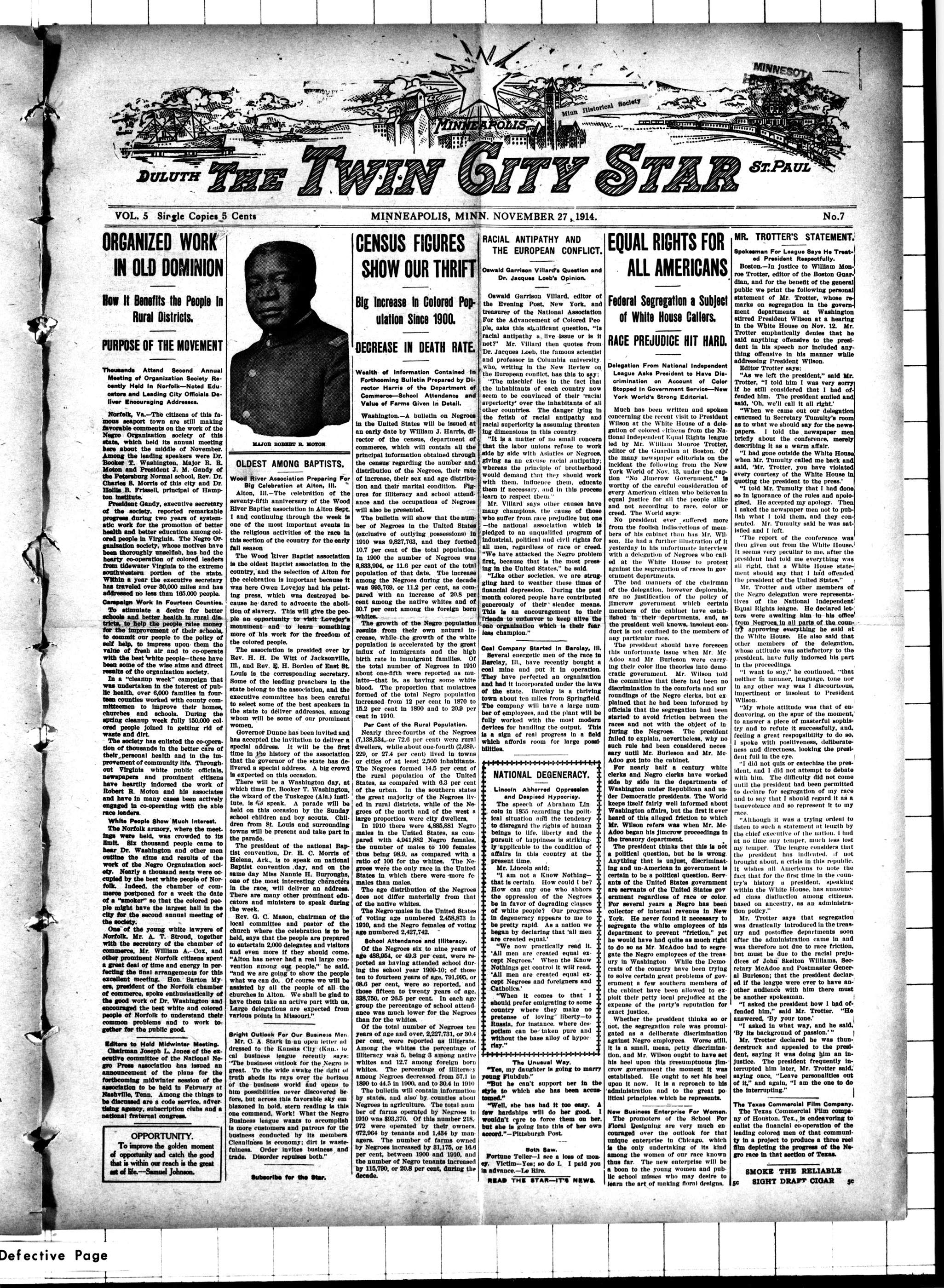
DULUTH THE TWIN CITY STAR ST.PAUL
Defective Page
VOL. 5 Single Copies 5 Cents
Bright Outlook For Our Business Men
Mr. C. A Stark in an open letter adressed to the Kansas City (Kans.) local business league recently says: "The business outlook for the Negro is great. To the wide awake the light of truth sheds its rays over the horizon of the business world and opens to him possibilities never discovered before, but across this favorable sky emblazoned in bold, stern reading is this one command. Work! What the Negro Business league wants to accomplish is more customers and patrons for the business conducted by its members Cleanliness is economy; dirt is wastefulness. Order invites business and trade. Disorder repulses both."
ORGANIZED WORK IN OLD DOMINION
How It Benefits the People In Rural Districts.
PURPOSE OF THE MOVEMENT
Thousands Attend Second Annual Meeting of Organization Society Recently Held In Norfolk—Noted Educators and Leading City Officials Deliver Encouraging Addresses.
Norfolk, Va.—The citizens of this famous seaport town are still making favorable comments on the work of the Negro Organization society of this state, which held its annual meeting here about the middle of November. Among the leading speakers were Dr. Booker T. Washington, Major R. R. Moton and President J. M. Gandy of the Peterburg Normal school, Rev. Dr. Charles S. Morris of this city and Dr. Hollis B. Frissell, principal of Hampton institute.
President Gandy, executive secretary of the society, reported remarkable progress during two years of systematic work for the promotion of better health and better education among colored people in Virginia. The Negro Organization society, whose motives have been thoroughly unselfish, has had the hearty co-operation of colored leaders from tidewater Virginia to the extreme southwestern portion of the state. Within a year the executive secretary has traveled over 80,000 miles and has addressed no less than 185,000 people. Campaign Work In Fourteen Counties. To stimulate a desire for better schools and better health in rural districts, to help the people raise money for the improvement of their schools, to commit our people to the policy of self help, to impress upon them the value of fresh air and to co-operate with the best white people—these have been some of the wise aims and direct results of the organization society.
In a "cleanup week" campaign that was undertaken in the interest of public health, over 6,000 families in fourteen counties worked with county committees to improve their homes, churches and schools. During the spring cleanup week fully 150,000 colored people joined in getting rid of waste and dirt. The society has enlisted the co-operation of thousands in the better care of their personal health and in the improvement of community life. Throughout Virginia white public officials, newspapers and prominent citizens have heartily indorsed the work of Robert R. Moton and his associates and have in many cases been actively engaged in co-operating with the able race leaders. White People Show Much Interest. The Norfolk armory, where the meetings were held, was crowded to its limit. Six thousand people came to hear Dr. Washington and other men outline the aims and results of the work of the Negro Organization society. Nearly a thousand seats were occupied by the best white people of Norfolk. Indeed, the chamber of commerce postponed for a week the date of a "umoker" so that the colored people might have the largest hall in the city for the second annual meeting of the society.
One of the young white lawyers of Norfolk, Mr. A. T. Stroud, together with the secretary of the chamber of commerce, Mr. William A. Cox, and other prominent Norfolk citizens spent a great deal of time and energy in perfecting the final arrangements for this excellent meeting. Hon. Barton Myers, president of the Norfolk chamber of commerce, spoke enthusiastically of the good work of Dr. Washington and encouraged the best white and colored people of Norfolk to understand their common problems and to work together for the public good.
Editors to Hold Midwinter Meeting.
Chairman Joseph L. Jones of the executive committee of the National Negro Press association has issued an announcement of the plans for the forthcoming midwinter session of the association to be held in February at Nashville, Tenn. Among the things to be discussed are a code service, advertising agency, subscription clubs and a national fraternal congress.
OPPORTUNITY.
To improve the golden moment of opportunity and catch the good that is within our reach is the great act of life.—Samuel Johnson.
[Name]
MAJOR ROBERT R. MOTON.
OLDEST AMONG BAPTISTS.
Wood River Association Preparing For
Big Celebration at Alton, Ill.
Alton, Ill.-The celebration of the seventy-fifth anniversary of the Wood River Baptist association in Alton Sept. 1 and continuing through the week is one of the most important events in the religious activities of the race in this section of the country for the early fall season.
The Wood River Baptist association is the oldest Baptist association in the country, and the selection of Alton for the celebration is important because it was here Owen Lovejoy had his printing press, which was destroyed because he dared to advocate the abolition of slavery. This will give the people an opportunity to visit Lovejoy's monument and to learn something more of his work for the freedom of the colored people.
The association is presided over by Rev. H. H. De Witt of Jacksonville, Ill., and Rev. E. H. Borden of East St. Louis is the corresponding secretary. Some of the leading preachers in the state belong to the association, and the executive committee has been careful to select some of the best speakers in the state to deliver addresses, among whom will be some of our prominent women.
Governor Dunne has been invited and has accepted the invitation to deliver a special address. It will be the first time in the history of the association that the governor of the state has delivered a special address. A big crowd is expected on this occasion.
There will be a Washington day, at which time Dr. Booker T. Washington, the wizard of the Tuskegee (Ala.) institute, is to speak. A parade will be held on this occasion by the Sunday school children and boy scouts. Children from St. Louis and surrounding towns will be present and take part in the parade.
The president of the national Baptist convention, Dr. E. C. Morris of Helena, Ark., is to speak on national Baptist convention day, and on the same day Miss Nannle H. Burroughs, one of the most interesting characters in the race, will deliver an address. There are many other prominent educators and ministers to speak during the week.
Rev. G. C. Mason, chairman of the local committee and pastor of the church where the celebration is to be held, says that the people are prepared to entertain 2,000 delegates and visitors and even more if they should come. "Alton has never had a real large convention among our people," he said, "and we are going to show the people what we can do. Of course we will be assisted by all the people of all the churches in Alton. We shall be glad to have them take an active part with us. Large delegations are expected from various points in Missouri."
Subscribe for the Star.
CENSUS FIGURES SHOW OUR THRIFT
DEGREASE IN DEATH RATE.
Wealth of Information Contained In Forthecoming Bulletin Prepared by Director Harris of the Department of Commerce—School Attendance and Value of Farms Given In Detail.
Washington.—A bulletin on Negroes in the United States will be issued at an early date by William J. Harris, director of the census, department of commerce, which will contain all the principal information obtained through the census regarding the number and distribution of the Negroes, their rate of increase, their sex and age distribution and their marital condition. Figures for illiteracy and school attendance and the occupations of Negroes will also be presented.
The bulletin will show that the number of Negroes in the United States (exclusive of outlying possessions) in 1910 was 9,827,763, and they formed 10.7 per cent of the total population. In 1900 the number of Negroes was 8,833,994, or 11.6 per cent of the total population of that date. The increase among the Negroes during the decade was 993,769, or 11.2 per cent, as compared with an increase of 20.8 per cent among the native whites and of 30.7 per cent among the foreign born whites.
The growth of the Negro population results from their own natural increase, while the growth of the white population is accelerated by the great influx of immigrants and the high birth rate in immigrant families. Of the total number of Negroes in 1910 about one-fifth were reported as mulatto—that is, as having some white blood. The proportion that mulattoes formed of the total Negro population increased from 12 per cent in 1870 to 15.2 per cent in 1890 and to 20.9 per cent in 1910.
Nearly three-fourths of the Negroes (7,138,534, or 72.6 per cent) were rural dwellers, while about one-fourth (2,089,229, or 27.4 per cent) lived in towns or cities of at least 2,500 inhabitants. The Negroes formed 14.5 per cent of the rural population of the United States, as compared with 6.3 per cent of the urban. In the southern states the great majority of the Negroes lived in rural districts, while of the Negroes of the north and of the west a large proportion were city dwellers. In 1910 there were 4,888,881 Negro males in the United States, as compared with 4,941,882 Negro females, the number of males to 100 females thus being 98.9, as compared with a ratio of 106 for the whites. The Negroes were the only race in the United States in which there were more females than males.
The age distribution of the Negroes does not differ materially from that of the native whites.
The Negro males in the United States of voting age numbered 2,458,873 in 1910, and the Negro females of voting age numbered 2,427,742.
Of the Negroes six to nine years of age 488,954, or 49.3 per cent, were reported as having attended school during the school year 1909-10; of those ten to fourteen years of age, 791,995, or 68.6 per cent, were so reported, and those fifteen to twenty years of age, 388,750, or 26.5 per cent. In each age group the percentage of school attendance was much lower for the Negroes than for the whites.
Of the total number of Negroes ten years of age and over, 2,227,731, or 30.4 per cent, were reported as illiterate. Among the whites the percentage of illiteracy was 5, being 3 among native whites and 12.7 among foreign born whites. The percentage of illiteracy among Negroes decreased from 57.1 in 1890 to 44.5 in 1900, and to 30.4 in 1910 The bulletin will contain information by states, and also by counties about Negroes in agriculture. The total number of farms operated by Negroes in 1910 was $93,370. Of this number 218,972 were operated by their owners, 672,964 by tenants and 1,434 by managers. The number of farms owned by Negroes increased by 31,175, or 16.6 per cent, between 1900 and 1910, and the number of Negro tenants increased by 115,790, or 20.8 per cent, during the decade.
RACIAL ANTIPATHY AND THE EUROPEAN CONFLICT.
Oswald Garrison Villard's Question and Dr. Jacques Loeb's Opinion.
Oswald Garrison Villard, editor of the Evening Post, New York, and treasurer of the National Association For the Advancement of Colored People, asks this significant question, "Is racial antipathy a live issue or is it not?" Mr. Villard then quotes from Dr. Jacques Loeb, the famous scientist and professor in Columbia university, who, writing in the New Review on the European conflict, has this to say: "The mischief lies in the fact that the inhabitants of each country now seem to be convinced of their 'racial superiority' over the inhabitants of all other countries. The danger lying in the fetish of racial antipathy and racial superiority is assuming threatening dimensions in this country.
"It is a matter of no small concern that the labor unions refuse to work side by side with Asiatics or Negroes, giving as an excuse racial antipathy; whereas the principle of brotherhood would demand that they should work with them, influence them, educate them if necessary, and in this process learn to respect them."
Mr. Villard says other causes have many champions, the cause of those who suffer from race prejudice but one—the national association which is pledged to an unqualified program of industrial, political and civil rights for all men, regardless of race or creed. "We have attacked the Negro problem first, because that is the most pressing in the United States," he said.
"Like other societies, we are struggling hard to weather these times of financial depression. During the past month colored people have contributed generously of their slender means. This is an encouragement to their friends to endeavor to keep alive the one organization which is their fear less champion."
Coal Company Started in Barolay, Ill. Several energetic men of the race in Barolay, Ill., have recently bought a coal mine and put it in operation. They have perfected an organization and had it incorporated under the laws of the state. Barolay is a thriving town about ten miles from Springfield. The company will have a large number of employees, and the plant will be fully worked with the most modern devices for handling the output. This is a sign of real progress in a field which affords room for large possibilities.
NATIONAL DEGENERACY.
Lincoln Abhored Oppression
and Despaired Hypocrisy.
The speech of Abraham Lincoln in 1855 regarding the political situation and the tendency to disregard the rights of human beings to life, liberty and the pursuit of happiness is strikingly applicable to the condition of affairs in this country at the present time.
Mr. Lincoln said:
"I am not a Know Nothing—that is certain. How could I be? How can any one who abhors the oppression of the Negroes be in favor of degrading classes of white people? Our progress in degeneracy appears to me to be pretty rapid. As a nation we began by declaring that 'all men are created equal.'
"We now practically read it. 'All men are created equal except Negroes.' When the Know Nothings get control it will read. 'All men are created equal except Negroes and foreigners and Catholics.'
"When it comes to that I should prefer emigrating to some country where they make no pretense of loving liberty—to Russia, for instance, where despotism can be taken pure and without the base alloy of hypocrisy."
The Unusual Way.
"Yes, my daughter is going to marry young Flubbub."
"But he can't support her in the style to which she has been accustomed."
"Well, she has had it too easy. A few hardships will do her good. I wouldn't care to force them on her, but she is going into this of her own accord."—Pittsburgh Post.
Both Saw.
Fortune Teller—I see a loss of money.
Victim—Yes; so do I. I paid you in advance.—Yes. Rire.
READ THE STAR-IT'S NEWS.
EQUAL RIGHTS FOR ALL AMERICANS
RACE PREJUDICE HIT HARD.
Delegation From National Independent League Asks President to Have Discrimination on Account of Color Stopped In Government Service—New York World's Strong Editorial.
Much has been written and spoken concerning the recent visit to President Wilson at the White House of a delegation of colored citizens from the National Independent Equal Rights league led by Mr. William Monroe Trotter, editor of the Guardian at Boston. Of the many newspaper editorials on the incident the following from the New York World of Nov. 13, under the caption "No Jimcrow Government," is worthy of the careful consideration of every American citizen who believes in equal justice for all the people alike and not according to race, color or creed. The World says:
No president ever suffered more from the foolish indiscretions of members of his cabinet than his Mr. Wilson. He had a further illustration of it yesterday in his unfortunate interview with a delegation of Negroes who called at the White House to protest against the segregation of races in government departments.
The bad manners of the chairman of the delegation, however deplorable, are no justification of the policy of jimcrow government which certain members of the cabinet have established in their departments, and, as the president well knows, insolent conduct is not confined to the members of any particular race.
The president should have foreseen this unfortunate issue when Mr. McAdoo and Mr. Burleson were carrying their color line theories into democratic government. Mr. Wilson told the committee that there had been no discrimination in the comforts and surroundings of the Negro clerks, but explained that he had been informed by officials that the segregation had been started to avoid friction between the races and not with the object of injuring the Negroes. The president failed to explain, nevertheless, why no such rule had been considered necesary until Mr. Burleson and Mr. McAdoo got into the cabinet.
For nearly half a century white clerks and Negro clerks have worked side by side in the departments of Washington under Republican and under Democratic presidents. The World keeps itself fairly well informed about Washington affairs, but the first it ever heard of this alleged friction to which Mr. Wilson refers was when Mr. McAdoo began his jimcrow proceedings in the treasury department.
The president thinks that this is not a political question, but he is wrong. Anything that is unjust, discriminating and un-American in government is certain to be a political question. Servants of the United States government are servants of the United States government regardless of race or color. For several years a Negro has been collector of internal revenue in New York. He never found it necessary to segregate the white employees of his department to prevent "friction," yet he would have had quite as much right to do so as Mr. McAdoo had to segregate the Negro employees of the treasury in Washington. While the Democrats of the country have been trying to solve certain great problems of government a few southern members of the cabinet have been allowed to exploit their petty local prejudice at the expense of the party's reputation for exact justice.
Whether the president thinks so or not, the segregation rule was promulgated as a deliberate discrimination against Negro employees. Worse still, it is a small, mean, petty discrimination, and Mr. Wilson ought to have set his heel upon this presumptuous jim-crow government the moment it was established. He ought to set his heel upon it now. It is a reproach to his administration and to the great political principles which he represents.
New Business Enterprise For Women. The promoters of the School For Floral Designing are very much encouraged over the outlook for that unique enterprise in Chicago, which is the only undertaking of its kind among the women of our race known thus far. The new enterprise will be a boon to the young women and public school misses who may desire to learn the art of making floral designs.
No.7
MR. TROTTER'S STATEMENT.
Spokesman For League Says He Treated President Respectfully.
ed President Respectfully.
Boston.-In Justice to William Monroe Trotter, editor of the Boston Guardian, and for the benefit of the general public we print the following personal statement of Mr. Trotter, whose remarks on segregation in the government departments at Washington stirred President Wilson at a hearing in the White House on Nov. 12. Mr. Trotter emphatically denies that he said anything offensive to the president in his speech nor included anything offensive in his manner while addressing President Wilson.
Editor Trotter says:
"As we left the president," said Mr. Trotter, "I told him I was very sorry if he still considered that I had offended him. The president smiled and said, 'Oh, we'll call it all right.'"
"When we came out our delegation caucused in Secretary Tumulty's room as to what we should say for the newspapers. I told the newspaper men briefly about the conference, merely describing it as a warm affair.
"I had gone outside the White House when Mr. Tumulty called me back and said, 'Mr. Trotter, you have violated every courtesy of the White House in quoting the president to the press.'
"I told Mr. Tumulty that I had done so in ignorance of the rules and apologized. He accepted my apology. Then I asked the newspaper men not to publish what I told them, and they consented. Mr. Tumulty said he was satisfied and I left.
"The report of the conference was then given out from the White House. It seems very peculiar to me, after the president had told me everything was all right, that a White House statement should say that I had offended the president of the United States."
Mr. Trotter and other members of the Negro delegation were representatives of the National Independent Equal Rights league. He declared letters were awaiting him in his office from Negroes in all parts of the country approving everything he said at the White House. He also said that other members of the delegation, whose attitude was satisfactory to the president, have fully indorsed his part in the proceedings.
"I want to say," he continued, "that neither in manner, language, tone nor in any other way was I discourteous, impertinent or insolent to President Wilson.
"My whole attitude was that of endearing, on the spur of the moment, to answer a piece of masterful sophistry and to refute it successfully, and, feeling a great responsibility to do so, I spoke with positiveness, deliberateness and directness, looking the president full in the eye.
"I did not quiz or catechize the president, and I did not attempt to debate with him. The difficulty did not come until the president had been permitted to declare for segregation of my race and to say that I should regard it as a benevolence and so represent it to my race.
"Although it was a trying ordeal to listen to such a statement at length by the chief executive of the nation, I had at no time any temper, much less lost my temper. The league considers that the president has indicated, if not brought about, a crisis in this republic. It wishes all Americans to note the fact that for the first time in the country's history a president, speaking within the White House, has announced class distinction among citizens, based on ancestry, as an administration policy."
Mr. Trotter says that segregation was drastically introduced in the treasury and postoffice departments soon after the administration came in and was therefore not due to race friction, but must be due to the racial prejudices of John Skelton Williams, Secretary McAdoo and Postmaster General Burleson; that the president declared if the league were ever to have another audience with him there must be another spokesman.
"I asked the president how I had offended him," said Mr. Trotter. "He answered, 'By your tone.'
"I asked in what way, and he said, 'By its background of passion.'" Mr. Trotter declared he was thunderstruck and appealed to the president, saying it was doing him an injustice. The president frequently interrupted him later, Mr. Trotter said, saying once, "Leave personalities out of it," and again, "I am the one to do the interrupting."
The Texas Commercial Film Company. The Texas Commercial Film company of Houston, Tex., is endevoring to enlist the financial co-operation of the leading colored men of that community in a project to produce a three reel film depicting the progress of the Negro race in that section of Texas.
SMOKE THE RELIABLE
SC SIGHT DRAFT CIGAR SC
HEALTH WEEK BEGINS WITH TUBERCULOSIS .SUNDAY—NOVEMBER 29.
Every Christmas SEAL you buy
Queers three million bacil-li!
Everybody should know why Tuberculosis is Bad; we suggest for this day—
1. Sermons on Tuberculosis in all churches.
2. Union Services where they can be arranged.
3. Addresses by physicians or tuberculosis specialists where possible.
Collections may go to LOCAL church or community anti-tuberculosis work.
The Forum meets Sunday, Dec. 6th at St. Peter's A. M. E. Church at 3:30 P. M.
A Surprise.
About 50 saints of the People's Christian Assembly and friends surprised Rev. Mitchell and family on Saturday evening. They brought a nice sum of money and a table-full of good things. The evening was spent in devotional services. Rev. and Mrs. Mitchell appreciated this act of kindness and returns many thanks.
MISS SHULL'S BIRTHDAY.
Young People Spend Pleasant Evening.
Mrs. Glover Shull of Clinton Avenue gave a dancing party Friday evening in honor of her daughter, Mae's birthday. There was a large number of the younger set present and they all spent a very pleasant evening. Music was furnished by Mr. Clarence Johnson and Mrs. Shull was assisted by the Mesdames W. C. Jeffrey, Cooper Lewis and Robert Waters. Those present were the Misses Edythella Adams, Helen Brady, Carrie Bass, Jessie Beard, Ruth and Adelaide Carter, Joyce Dorecey, Ruth Hunter, Odette Johnson, Marienne Jeffrey, Lillian Kay, Ruth Kennedy, Cathaleen Prior, Theola Ridley, Lillian and Florence Thomas, Gladys Waters, Helen and Dorothy Waters, Olga Wilson, and Mildred Shull. The Messrs. John Adams, H. Allen, McKinley Brown, Foster Brown, Chaucey Bradley, Leslie Fochs, William Hyde, Chauncey Jameson, Houston Jackman, Eugene Jackson, Chester Kennedy, George Manning, Luverne Monroe, Edward Prior, Elmer Ridley, Everett Roberts, Ernest Starks, Norden Turner, Arthur White, Roy Wefer, Mark Morris and Wendell Gibbs, and Homer Cannon.
Mrs. Chas. Sumner Smith has been very sick, under Dr. Redd's care. She is slowly improving.
Rev. Carter has returned from Fostoria, O., where he was called to preach at the funeral of Mrs. Debora Burton. He preached in Chicago and Fostoria and met many relatives and friends.
Mr. Arthur L. Merchant was struck and thrown from his motor cycle, but not seriously hurt.
The Society for the Advancement of Colored People held its annual meeting on Monday evening. Reports were made by Secy. Hillyer, Rev. Theobald and Dr. Turner. Dr. S. M. Deinard was elected president. The meeting was not well attended and there was not one of the white members present. Miss Sarah Marshall decided not to resign from the executive committee. Mr. L. D. Brower made a lengthy address on "his experiences and the need of the society." The meeting, adjourned sine die.
Hon. W. R. Morris is a teacher in the Sunday School of Plymouth Congregational Church, being the only Negro teacher. Our young men who desire such training should join Mr. Morris' class. We hope he will welcome other Negroes to the services.
NEROLI—THE HAIR GROWER.
Madam H. Y. Carpenter, now connected with Madam Hart at 1308 Washington Ave. So., gives Electric and Vibrating Massage, an aid to Health and Beauty. She guarantees Neroli to grow hair 1 inch per month or money refunded. Expert Hairdresser and Manicurist.—Advertisement.
FOR RENT
One room for Rent.—Steam Heated.
Near Car-line. For men only. See
Mr. A. L. Monteen, 533 Lyndale Ave.
No., or Call Hyland 2007.
Two Furnished Front Rooms.
Modern conveniences, electric lights,
hot water heat, moderate prices. Call
at 3920 Elliott Ave. So.
For Sale.—Live Chickens and
Fresh Eggs. Good laying hens. Call
at 3920 Elliott Ave. So.
Do Not Telephone.
any notices, personal, or advertisements to the Twin City Star. We must have a copy of matter for publication. Use the mails and save time.
FUNERAL OF D. E. BUCKNER.
Veteran of the Spanish-American War
Buried With Full Military Honors.
David E. Buckner died on Nov. 21, at the Soldier's Home at Minnehaha Falls of pneumonia. He was taken there the day he died. He was well known as one of the "Heroes of San Juan Hill" where he received bullet wounds that indirectly caused his death. During and before the war, he served with the 10th U. S. Cavalry—and later enlisted in 25th U. S. inf. His funeral was held on Nov. 23, at 10 A. M., in the chapel at the Soldiers Home. The services were very appreciative. Chaplain Smith preached from Samuel 1 chapter 3 vs. He paid a glowing tribute to the service record of Comrade Buckner, and referred to the gallant work of the Negro soldiers at San Juan Hill—giving them all honor for that victory. The Choir sang "It is well," and "Lead Kindly Light." The honorary pallbearers were Veterans of the G. A. R. Comrades J. N. Rodgers, Geo. Lampman, Matthias, Logelin, Conrad Palm, Matthias Lafas, and Frederick Fredricks. The active pallbearers were members of Chas. E. Bond Camp, U. S. W. v., of which Sgt. Buckner was a member. After the services the remains to Soldiers' Lot in Lakewood Cemetery, where final services were read by Commander Edwards and Adjit Rogers, and a military salute fired. Floral tributes were received from Mr. and Mrs. L. D. Martin, Mrs. Gertrude Carroll and husband, Mrs. D. E. Buckner and Mrs. Maudie Bowen, and Chas. E. Bond Camp. He leaves a widow and several relatives and friends to mourn his loss. He was a Christian soldier, and respected by many. After the war he was employed as messenger at First National Bank and at P. R. R. office, but recently he had lived in Rochester where he was attended by the Mayo Bros. He was a resident of Minneapolis 15 years. During his declining years he enjoyed the companionship of an estimable wife, who administered every comfort in her power. David E. Buckner was born in Holly Springs, Mass., and was 52 years old. His last request was to be given a soldier's burial.
CARD OF THANKS.
I wish to thank the Comrades of Chas. E. Bond Camp U. S. W. V. Commandant Harries, of the Soldiers Home and all friends who assisted during the illness and burial of my husband David E. Buckner, and for the beautiful flowers.
Mrs. David E. Buckner and family.
Mr. and Mrs. Edw. Moody have moved to 1920 Vine Place.
We ask those in arrears to send their indebtdness to us. It takes money to run this paper.
A near-do-well had quite a sum of money, and being asked, "Where he got it" replied that it was the post office pay-day. Later on he was seen in a buffet flat, with a society leader—who was spending her husband's money and the Star should not "criticize" those of the upper crust. We grant no immunity because of social standing.
Fezzan Temple will give their annual Ball on Dec. 28th, at Coliseum Hall. Everybody remembers the Fezzan Ball, the biggest midwinter event given in St. Paul.
Judge Johnson drew the big crowd to Union Temple Hall on Thanksgiving Night. The pleasure maker is very popular and he succeeds in providing the proper joy for his patrons, who always attend his entertainments.
The Ball of the Young Men's Progressive Club was well attended.
PILGRIM'S NEW PASTOR
Rev. B. N. Burrell of Peoria, Ill., will become the pastor of Pilgrim Baptist Church after Dec. 1, 1914. Rev. Burrell is one of the leading Baptist ministers. Rev. Jos. S. Strong has established the St. James Mission at 319 E. 7th St. 2nd floor, St. Paul. Services are held Sundays at 11 A. M. and 3:30 P. M.
Anderson—The Coal-Man.
Anderson—the reliable coal man, will deliver your coal by the Ton or Basket. Soft Coal, 25c per basket. Hard Coal 45c per basket. For prices and orders call N. W. Main 2267. Anderson, the coal-man.-Advertisement.
MONDAY, DEC. 28, 1914.
McCullough's Orchestra.
ADMISSION 50c
TWIN CITY STAR
Continued from last week.
Christmas
A Story
By Zona Gale
CHAPTURE
Comic
MARY hesitated she was pity by what Joan—the first to could recall, that no ever come to her din and a marvel. New births usually came miseration, in suspicion, this confidence in a time reliving her old hope boy stood outside the moment quite sudden significance.
"We can plan together."
Copyright, 1823, by the McClure Publications, Incorporated.
Copyright, 1823, by the Macmillan Company.
Owing to hard times and the failure of Ebenese Rule's factory the people of Old Trail Town contemplate buying no presents and having no Christmas.
A town meeting is held, and the decision is reached to have no Christmas, not even for the children.
A notice to this effect is signed by nearly every one. Mary Chavah receives a letter from her sister Lilly's boy.
This boy asks her to take his six-year-old brother, son of Adam Blood, a lover who jilted Mary for her sister Lilly.
Mary prepares to welcome him. Despite their resolutions many people find it difficult to cut out Christmas altogether.
Ebenese Rule, grieving for his dead son, Malcolm, and his dead wife, finds the boy's hobbieshoy in an unused attic.
Boys and girls are unhappy because there will be no Christmas. Women regret that Mary's boy will find no awaiting him.
Children of the town are rehearsing for a funeral on Christmas. They are planning to bury Santa Claus.
Ellen Bourne plans to have a Christmas tree and urges her husband to adopt a little boy at once.
The good townfolk secretly prepare to gather at Mary's house on Christmas eve to welcome the little boy.
One after another different people break the anti-Christmas pledge. The spirit of Christmas softens the hard heart of Ebenezer Rule.
He gets the hobbyboy for Mary's boy, whose train is delayed. Every one is happy in preparing a Christmas welcome for the orphan.
The boy arrives in safety, and the town that was not to celebrate Christmas happily celebrates it after all.
BETHESDA BAPTIST CHURCH
12th Ave. So. and 8th St.
11 A. M. "The Great Commandment."
S. S. 12:30.
B. Y. P. U. 6:30 P. M.
Residence 611 E. 16 St., Minneapolis.
All are welcome.
ST. PETER'S A. M. E. CHURCH,
22nd St. near 10th Ave. So.
Rev. Thos. B. Stovall, Pastor.
ST. JAMES A. M. E. CHURCH,
318 8th Ave. So., Minneapolis.
Rev. E. R. Edwards, Pastor.
Peoples Christian Assembly.
Rev. G. W. Mitchell, Pastor,
1204 Washington Ave. So.
Come! and Serve the Lord.
THE SPIRELLA CORSET
Mrs. Cora Anderson Carr
365 Aurora Ave.
N. W. Dale 1345 St. Paul, Minn.
T. S. Cen. 5697 N. W. Main 2936
HAYWARD and DICKERSON
313 12th Ave. So.
Dealers in
WOOD AND COAL
Delivered by Basket or Ton
Express and Transfer
Mr. Andrew Jackson and Mrs. A. Smith were, on Nov. 9, united in marriage at the home of Mr. and Mrs. G. W. Turner, 1735 25th Ave., Seattle, Wash. Rev. W. D. Carter officiating. They will make their home at 603 St. Anthony Ave., St. Paul. Mrs. Leola C. Bass, wife of Mr. Harry G. Bass, daughter of Mr. and Mrs. Geo. Moker, after a short illness died at her home, 517 Aurora avenue, Thursday, aged 31 years. Her funeral was held Saturday at 230 o'clock at St. James A. M. E. church. Lyles funeral director, interment at Oakland.
THE ST. LOUIS KITCHEN.
Mrs. Julia Hinson, proprietor of the St. Louis Kitchen, 136 E. Third street, up stairs, has moved her dining room just across the hall from its old location. She is also again serving regular dinners at 25 cents and Sunday dinners at 35 cents.
Reserve your space for Excursions, Picnics and Dances. Take the advantage of our advertising columns.
SEND YOUR SUBSCRIPTION
```markdown
```
CHAPTER V.
Coming.
MARY hesitated for breath. But she was profoundly stirred by what Jenny had told her—the first time, so far as she could recall, that news like this had ever come to her directly, as a secret and a marvel. News of the village births usually came in gossip, in commission, in suspicion. Falling as did this confidence in a time when she was reliving her old hope, when Adam's boy stood outside her threshold, the moment quite suddenly put on its real significance.
"We can plan together," Jenny was saying. "Ann't it wonderful?" "Ain't it?" Mary said then, simply, and kissed Jenny, when Jenny came and kissed her. Then Jenny went away. Mary went on the barn and opened the door and listened. She had brought
A
"We can plan together. Ain't it wonderful?"
no lantern, but the soft stillness within needed no vigilance. The hay smell from the loft and the mangers, the even breath of the cows, the quiet safety of the place, met her. She was wondering at herself, but she was struggling not at all. It was as if concerning the little boy something had decided for her in a soft, fierce rush of feeling not her own. She had committed herself to Jenny almost without will. But Mary felt no exultation, and the weight within her did not lift.
"I really couldnt do anything else but take him, I 'spose," she thought. "I wonder what'll come on me next?"
All the while she was conscious of the raw smell of the clover in the hay of the mangers, as if something of summer were there in the cold.
Mary Chavah sent her letter of blunt directions concerning her sister's headstone and the few belongings which her sister had wished her to have. The last lines of the letter were about the boy.
"Send the little one along. I am not the one, but I don't know what else to tell you to do with him. Let me know when to expect him and put his name in with his things. I can't remember his right name."
When the answer came from John Blood a fortnight later it said that a young fellow of those parts was starting back home shortly to spend Christmas and would take charge of the child as far as the city and there put him on his train for Old Trail Town. She would be notified just what day to expect him, and John knew how glad his mother would have been and his father, too, and he was her grateful nephew. P. S.-He would send some money every month "toward him."
The night after she received this letter Mary lay long awake, facing what it was going to mean to have him there—to have a child there.
She recalled what she had heard other women say about it—stray utterances, made with the burdened look that hid a secret complacency, a kind of pleased freemasonry in a universal lot.
"The children bring so much sand into the house. You'd think it was horses."
"The center table looks loaded and ready to start half the time, but I can't help it, with the children's books and truck."
"Never would have another house built without a coat closet. The children's cloaks and caps and rubbers litter up everything."
"Every one of their knees out and their underclothes outgrown and their waists solled the whole time. And I do try so hard."
Now with all these bewilderments she was to have to do. She wondered if she would know how to dress him. Once she had watched Mis' Winslow dress a child and she remembered what unexpected places Mis' Winslow had buttoned—buttonholes that went up and down in the skirt bands and so on. Armholes might be too small and garters too tight, and how was one ever to know? If it were a little girl now—but a little boy. What would she talk to him about while they ate together?
She lay in the dark and planned—with no pleasure, but merely because she always planned everything, her dress, her baking, what she would say to this one and that. She would put up a stove in the back parlor and give him the room "off." She was glad that the parlor was empty and clean—"no knickknacks for a boy to knock around," she found herself thinking. And a child would like the bedroom
wall paper, with the owl border. When summer came he could have the room over the dining room, with the kitchen roof sloping away from it where he could dry his hazelnuts she had thought of the pasture hazelnuts first thing. There were a good many things a boy would like about the place—the bird house where the martins always built, the hens, the big hollow tree, the pasture ant hill. She would have to find out the things he liked to eat. She would have to help him with his lessons; she could do that for only a little while until he would be too old to need her. Then maybe there would come the time when he would ask her things that she would not know.
She fell asleep wondering how he would look. Already, not from any impatience to have this done, but because that was the way in which she worked, she had his room in order, and her picture of his father was by the mirror, the young face of his father. Something faded had been written below the picture, and this she had painstakingly rubbed away before she set the picture in its place. Next day while she was working on Ms' Jane Moran's bead basque, that was to be cut over and turned, she laid it aside and cut out a jacket pattern and a plaited wast pattern just to see if she could. These she rolled up impatiently and stuffed away in her pattern book case.
"I knew how to do them all the while, and I never knew I knew," she thought with annoyed surprise. "I'spose I'll waste a lot of time pottering over him."
It was so that she spent the weeks until the letter came telling her what day the child would start. On the afternoon of the day the letter came she went downtown to the Abel Ames emporium to buy a wash basin and pitcher for the room she meant the little boy to have. She stood looking at a basin with a row of brown dogs around the rim when over her shoulder Mis' Abby Winslow spoke.
"You ain't buying a Christmas present for anybody, are you?" she asked warningly.
Mary started guiltily and denied it.
"Well, what in time do you want with dogs on the basin?" Mis' Winslow demanded.
Almost against her own wish Mary told her. Mis' Winslow was one of those whose faces are invariably forrunners of the sort of thing they are going to say. With eyebrows, eyes, forehead, head and voice she took the news.
"He is! Forever and ever more. When's he to get here?" "Week after next," Mary said listlessly. "It's an awful responsibility, ain't it—taking a child so?" Mis' Winslow's face abruptly rejected its own anxious lines and let the eyes speak for it. "I always think children is like air," she said; "you never realize how hard they're pressing down on you, but you do know you can't live without them." Mary looked at her, her own face not lighting. "I'd rather go along like I am," she said; "I used to myself the way I am." "Mary Chavah," said Mis' Winslow sharply. "a vegetable sprouts. Can't you? Is these stocking caps made so's they won't ravel?" she inquired capably of Abel Ames. "These are real good value, Mary," she added kindly. "Better surprise the little thing with one of these. A red one."
Mary counted over her money and bought the red stocking cap and the basin with the puppies. Then she went into the street. The sense of oppression, of striving, that had seldom left her since that night in the stable made the day a thing to be borne, to be breasted. The air was thick with snow, and in the whiteness the dreary familiarity of the drug store, the meat market, the postoffice, the Simeon Buck Dry Goods Exchange, smote her with a passion to escape from them all, to breed new familiars, to get free of the thing that she had said she would do.
"And I could," she thought; "I could telegraph to John not to send him. But Jenny—she can't. I don't see how she stands it."
The thought may have been why, instead of going home, she went to see Jenny. A neighbor was in the sitting room with Mrs. Wing. Jenny met Mary at the kitchen door and stood against a background of clothes drying on lines stretched indoors.
"Don't you want to come upstairs?" Jenny said. "There ain't a fire up there, but I can show you the things."
there, but I can show you the things."
She had put them all in the bottom drawer, as women always do, and, as women always do, had laid them so that all the lace and embroidery and pink ribbons possible showed in a futter when the drawer was opened. Jenny took the things out, one at a time, unfolded, discussed, compared, with all the tireless zeal of a robin with a straw in its mouth or of a tree blossoming.
"Smell of them," Jenny bade her.
"Honestly, wouldn't you know by the smell who they are for?" "I dunno but you would." Mary admitted awkwardly and marveled dumbly at the newness Jenny was feeling in that which, after all, was not new!
When these things were all out a little tissue parcel was left lying in the drawer.
"There's one more," Mary said.
Jimmy bushed, hesitated, lit it: "That's nothing," she said; "before I came I made some little things for its Christmas. I thought maybe it would come first, and we'd have the Christmas in my room, and I made some things—just for fun, you know. But it won't be fair to do it now, with the whole town so set against our having any Christmas. Mary, it just seems as though I had to have a Christmas this year!"
"Oh, well," said Mary, "the baby'll be your Christmas. The town can't help that, I guess."
"I know," Jenny dashed back brightly, "you and I have got the best of them, haven't we? We've each got one present coming, any way."
"I s'pose we have." Mary said.
She looked at Jenny's Christmas things—a ribbon rattle, a crocheted cap, a first picture book, a cascade of colored rings—and then in grim humor at Jenny.
"I'll never miss its Christmas," she said drily.
"Don't you think so?" said Jenny soberly. "I dunno. It seems as if it'd be kind o' lonesome to get born around Christmas and not find any going on."
She put the things away and closed the drawer. For no appreciable reason she kept it locked and the key under the bureau cover.
"Do you know yet when yours is coming?" Jenny asked as she rose.
"Week after next," Mary repeated, "two weeks from last night," she confessed, "if he comes straight through."
"I think," he said Jenny, "I think mine will be here—before then."
When they reached the foot of the stair Mary unexpectedly refused to go in the sitting room.
"No." she said, "I must be getting home. I just come out for a minute anyway. I'm—I'm much obliged for what you showed me," she added and hesitated. "I've got his room fixed up real nice. There's owls on the wall paper and puppies on the wash basin," she said. "Come in when you can and see it."
CHAPTER VI.
Old Accounts.
It was almost dusk when Mary reached home. While she was passing the billboard at the con-
ner—a fire of yellow letters, as if color and the alphabet had united to breed a monster—she heard children shouting. A block away and across the street, coming home from Rolleston's hill, where they had been counting, were Bennet and Gussie Bates, little Emily, Tab Winslow and Pep. Nearly every day of snow they passed her house. She always heard them talking, and usually she heard across at the corner the cluck of the penny in the slot machine, which no child seemed able to pass without pulling. Tonight as she heard them coming. Mary fumbled in her purse. Three, four, five pennies she found and ran across the street and dropped them in the slot machine and gained her own door before the children came. She stood at her dark threshold and listened. She had not reckoned in vain. One of the children pushed down on the rod in the child's eternal hope of magic, and when magic came and three, four, five chocolates dropped obediently in their hands Mary listened to what they said. It was not much, and it was not very coherent, but it was wholly intelligible. "Look at!" shrieked Bennet, who had made the marble.
"Did it?" cried Gussie and repeated the operation.
"It-it—it never!" said Tab Winslow at the third.
"Make it again; make it again!" cried little Emily, and they did.
"Gorry!" observed Pep in ecstasy.
When it would give no more they divided with the other children and ran on, their red mittens and mufflers flaming in the snow. Mary stood starring after them for a moment; then she closed her door.
"I wonder what made me do that," she thought.
In her dining room she mended the fire without taking off her hat. It was curious, she reflected. Here was this room looking the way it looked, and away off there was the little fellow who had never seen the room, and in a little while he would be calling this room home and looking for his books and his mittens and knowing it better than any other place in the world. And there was Jenny with that bottom drawerful, and pretty soon somebody that now was not, would be, and would be wearing the drawerful and calling Jenny "mother" and would know her better than any one in the world. Mary could not imagine that little boy of Lily's getting used to her—Mary—and calling her—well, what would he call her? She hadn't thought of that.
"Bother," thought Mary Chavah, "there's going to be forty nuances about it that I spose I haven't even thought of yet."
She stood by the window. She had not lighted the lamp, so the world showed white, not black. Snow makes outdoors look big, she thought. But it was big—what a long journey it was to Idaho. Suppose something happened to the man he was to travel with? John Blood was only a boy; he would probably put the child's name and her address in the little traveler's pocket, and these would be lost. The child was hardly old enough to remember what to do. He would go astray, and none of them would ever know what had become of him and what would become of him? She saw him and his bundle of clothes alone in the station in the city.
She turned from the window and mechanically mended the fire again. She drew down the window shade and went to the coat closet to hang away her wraps. Then abruptly she took up her purse, counted out the money in the firelight and went out the door and down the street in the dusk and into the postoffice, which was also the telegraph office, one which the little town owed to Ehmeuser Rule, and旅ival to the other telegraph office at the station.
Defective
effective Page
"How much does it cost to send a telegram?" she demanded. "Idaho," she answered the man's question, flushing at her omission. While the man, After by name, laboriously looked it up, covering incredible little dirty figures with an incredibly big dirty forefinger, Mary stood staring at the list of names tacked below the dog eared Christmas notice. She remembered that she had not yet signed it herself. She asked for a pencil, causing confusion to the little figures and delay to the big finger, and, while she waited, wrote her name. "A good, sensible move," she thought as she signed. When After gave her the rate, thrusting finger and figures jointly beneath the bars, solicitous of his own accuracy, Mary filed her message. It was to John Blood and it read: "Be sure you tie his tag on him good."
Ebenezer Rule had meant to go to the city before cold weather came. He had there a small and decent steam warmed fat, where he boiled his own eggs and made his own coffee, read his newspapers and kept his counsel, descending nightly to the ground floor cafe to dine on ambiguous dishes at tables of other bank swallows who nested in the same cliff. But as the days went by he found himself staying on in Old Trail Town, with this excuse and that, offered by himself to himself. As, for example, that in the factory there were old account books that he must go through. And having put off this task from day to day and finding at last nothing more to dally with he set out one morning for the ancient building down in that part of the village which was older than the rest and was where his business was conducted when it was conducted.
It had snowed in the night, and Buff Miles, who drove the village snowplow, was also driver of "the bus." So on the morning after a snowfall the streets always lay buried thick until after the 8:10 express came in, and since on the morning following a snowfall the 8:10 express was always late, Old Trail Town lay locked in a kind of circular argument and everybody stayed indoors or stepped high through drifts. The direct way to the factory was virtually unrodden, and Ebenezer made a detour through the business street in search of some semblance of a "track."
The light of a winter morning is not kind, only just. It is just to the sky and discovers it to be dominant; to trees and their leaves are seen to be alive, like leaves; to folk, and no disguise avails. Summer gives complements and accessories to the good things in a human face. Winter affords nothing save disclosure. In the uncompromising cleanness of that wash of winter light Ebenezor Rule was himself, for anybody to see. Looking like countess other men—lean, alert, preoccupied, his tall figure stooped, his smooth, pale face like a photograph too much retouched — the commonplace man took his place in the day almost as one of its externals. With that glorious pioneer trio—mineral, vegetable and animal—and with intellect, that worthy tool, he did his day's work.
A WINTER WALK
His face was one that had never asked itself, say of a winter morning. What else? And the winter light searched him pitlessly to find that question somewhere in him.
Before the Simeon Buck North American Dry Goods Exchange Simeon Buck himself had just finished shoveling his walk and stood wiping his snow shovel with the end of his muffler. When he saw Ebenezer he shook the muffler at him and then over his left shoulder jabbed the air with his thumb.
"Look a-here," he said, his head re-enforcing his gesture toward his show window. "Look what I done this morning. Nice little touch, eh?" In the show window of the exchange dry goods exchange was just the name of it, for the store carried everything—a hedgepodge of canned goods, lace curtains, kitchen utensils, wax figures and cage had been ranged round a center table of golden oak. On the table stood a figure that was as familiar to Old Trail Town as was its fire engine and its sprinkling cart. Like these, appearing intermittently, the figure had seized on the imagination
of the children and grown in association until it belonged to everybody by sheer use and wont. It was a papier maché Santa Claus, three feet high, white bearded, gray gowned, with tall, pointed cap, rather the more sober St. Nicholas of earlier days than the rollicking, red garbed St. Nick of now. Only whereas for years he had graced the window of the exchange, bearing over his shoulder a little bough of green for a Christmas tree, this season he stood treeless and instead bore on his shoulder a United States flag. On a placard below him Simeon had laboriously lettered:
HIGH COST OF LIVING
AND TOO MUCH FUSS
MAKES FOLKS WANT A
SANE CHRISTMAS.
ME TOO.
S. C.
"Ain't that neat?" said Simeon. Ebenezer looked. "What's the flag for?" he inquired dryly.
"Well," said Simeon, "he had to carry something. I thought of a toy gun, but that didn't seem real appropriate. A Japanese umbrella wasn't exactly in season, seems though. A flag was about the only thing I could think of to have him hold. A flag is always kind of tasty, don't you think?"
"Oh, it's harmless," Ebenezer said; "harmless."
"No hustling business," Simeon pursued, "can be contented with just not doing something. It ain't enough not to have no Christmas. You've got to find something that'll express nothing and express it forcible. In business a minus sign," said Simeon, "is as good as a plus if you can keep it whirling round and round."
This Ebenezer mulled and chuckled over as he went on down the street. He wondered what the emporium would do to keep up with the exchange. But in the emporium window there was nothing save the usual mill end display for the winter white goods sale.
Ebenezer opened the store door and put his head in.
"Hey!" he shouted at Abel, back at the desk. "Can't you keep up with fimeon's window!"
Abel came down the aisle between the lengths of white stuff plaited into folds at either side. The fire had just been kindled in the stove, and the air in the store was still frosty. Abel, in his overcoat, was blowing on his fingers.
"What't you put up?" Ebenezer asked, closing the door behind him. "Well, sir," said Abel, "I ain't made up my mind full yet. But I'll be billblowed if I'm going to let Christmas go by without saying something about it in the window." "Night before Christmas'll be too late to advertise anything," said Ebenezer. "If I was in trade," he said, closing his eyes. "I'd fill my window up with useful articles—caps and mittens and stockings and warm underwear and dishes and toothbrushes. And I'd say, 'Might as well afford these on what you saved out of Christmas.' You'd ought to get all the advertising you can out of any situation." Abel shook his head. "I ain't much on such," he said lightly, and then looked intently at Ebenezer. "Jenny's been buying quite a lot here for her Christmas," he said.
Ebenezer, was blank. "Jenny?" he said. "Jenny Wing? I heard she was here. I ain't seen her. Is she bound to keep Christmas anyhow?" "Just white goods it was," said Abel briefly. Ebenezer frowned his lack of understanding. "I shouldn't think her and Bruce had much of anything to buy anything with," he said. "I 'spose you know," he added, "that Bruce, the young beggar, quit working for me in the city after the—the failure? Threw up his job with me and took. God knows, what to do." Abel nodded gravelly. All Old Trail Town knew that and honored Bruce for it. "Headstrong couple," Ebenezer added. "So Jenny's bent on having Christmas, no matter what the town decides, is she?" he added. "It's like her, the minx."
"I don't think it was planned that way," Abel said simply. "She's only buying white goods," he repeated. And, Ebenezer still staring, "Surely you know what Jenny's come home for?" Abel said.
A moment or two later Ebenezer was out on the street again, his face turned toward the factory. He was aware that Abel caught open the door behind him and called after him, "Whenever you get ready to sell me that there star glass, you know"— Ebenezer answered something, but his responses were so often guttural and indistinguishable that his will to reply was regarded as nominal anyway. He also knew that now, just before him, Buff Miles was proceeding with the snowplow, cutting a firm, white way, smooth and sparkling for soft treading, momentarily bordered by a feathery flux that tumbled and heaped and then lay quiet in a glitter of crystals. But his thought went on without these things and without his will.
CHAPTER VII.
A Christmas Carol.
B RUCE'S baby! It would be a Rule too. The third generation, the third generation. And, accustomed as he was to relate 'every experience to himself, measure it, value it by its own value to him, the effect of his reflection was at first single—the third gen-
TWIN CITY STAR
It seemed only yesterday that Bruce had been a boy in a blue necktie to match his eyes and shoes which for some reason he always put on wrong, so that the buttons were on the inside. Bruce's baby: Good heavens! It had been a shock when Bruce graduated from the high school, a shock when he had married, but his baby! It was incredible that he himself should be so old as that.
This meant, then, that If Malcolm had lived Malcolm might have had a child now.
Ebenezer had not meant to think that. It was as if the thought came and spoke to him. He never allowed himself to think of that other life of his, when his wife, Letty, and his son, Malcolm, had been living. Nobody in Old Trail Town ever heard him speak of them or had ever been answered when Ebenezer had been spoken to concerning them. A high white shaft in the cemetery marked the two graves. All about them doors had been closed. But with the thought of this third generation the doors all opened. He looked along ways that he had forgotten.
As he went he was unconscious, as he was always unconscious, of the little street. He saw the market square, not as the heart of the town, but as a place for buying and selling, and the little shops were to him not ways of providing the town with life, but ways of providing their keepers with a livelihood. Beyond these was a familiar setting, arranged that day with white background and heaped roofs and laden boughs, the houses standing side by side like human beings. There they were, like the chorus to the thing he was thinking about. They were all thinking about it too. Every one of them knew what he knew. Yet he never saw the bond, but he thought they were only the places where men lived who had been his factory hands and would be so yet if he had not cut them away. Ben Torrey, shoveling off his front walk with his boy sweeping behind him; August Muir, giving his little girl a ride on the snow shovel; Nettle Hatch, clearing the ice out of her mail box, while her sister—the lame one—watched from her chair by the window interested as in a real event. Ebeneze spoke to them from some outposts of consciousness which his thought did not pass. The little street was not there, as it was never there for him as an entity. It was merely a street. And the little town was not an entity. It was merely where he lived. He went behind Buff Miles and the snowplow—as he always went—as if space had been created for folk to live in one at a time and as if this were his own turn.
When he reached the bend from the Old Trail to the road where the factory was he understood at last that he had been hearing a song sung over a great many times:
One for the way it all begun.
Two for the way it all has run.
What three'll be for I do forget.
But what's to be has not been yet.
So holly and mistletoe.
So holly and mistletoe.
So holly and mistletoe.
Over and over and over, oh.
Buff, who was singing it, looked over his shoulder, and nodded.
"They said you can't have no Christmas on Christmas day," he observed, grinning, "but I can't hear nothing to prevent singing Christmas carols right up to the day that is the day."
Ebenezer halted.
"How old are you?" he abruptly demanded of Buff—whom he had known from Buff's boyhood.
"Thirty-three," said Buff, "dum it."
"You and Bruce about the same age, ain't you?" said Ebenezer.
"Well," said Ebenezer, "well"— and stood looking at him. Malcolm would have been his age, too.
"Going down to the factory, are you?" Buff said. "Wait a bit. I will hike on down ahead of you."
He turned the snowplow down the factory road, as if he were making a triumphal progress, fashioning his snow borders with all the freedom of some sculpturing wind on summer clouds.
One for the way it all begun.
Two for the way it all has run,
he sang to the soft push and thud and clank of his going. He swept a circle in front of the liftib house that was the factory office, as if he had prepared the setting for a great event; and Ebenezer, following in the long, bright path, stepped into the hall of the house.
For thirty years he had been accustomed to enter the little house with his mind ready to receive its interior of desks and shelves and safes and files. Today, quite unexpectedly, as he opened the door the thing that was in his mind was a hall stair with a red carpet and a parlor adjoining with figured stuff at the windows and a coal fire in the stove. And thirty-five years ago it had been that way, when he and his wife and child had lived in the little house where his business was then just starting at a machine set up in the woodshed. As his project had grown and his factory had arisen in the neighboring lots the family had moved farther up in the town. Remembrance had been divorced from this place for decades. Today, without warning, it wafted for him on the threshold.
He had asked his bookkeeper to meet him there, but the man had not yet arrived. So Ebenezer himself kindled the fire in the rusty office stove in the room where the figured-curtains had been. The old account books that he wanted were not here on the shelves nor in the cupboards of the cold adjoining rooms. They dated so far back that they had been filed away upstairs. He had not been upstairs in years, and his first impulse was to send his bookkeeper when he should (Continued next week.)
DO YOU WANT TO BE WELL
DRESSED? THEN I AM YOUR
TAILOR.
SUITS
$25.00
OVERCOATS
$25.00
Cleaning
Pressing
Repairing
CLIFFORD A. SMITH.
421 UNIVERSITY AVE., ST. PAUL
N. W. PHONE DALE 3823.
SMOKE THE BEST 5C CIGAR Sight Draft
W. S CONRAD CO., Distributors
NO. 140. E. 6th ST., ST. PAUL.
NO. 1. WESTERN AVE., MINN.
"Kid" Martin, Prop. N. W. Nic. 1250
EAT AT MARTINS.
Good Cooking—Popular Prices.
MARTIN'S RESTAURANT.
201 Eleventh Ave. So.
MARTIN'S ROOMS
Newly Furnished — Steam Heated
Electric Lighted—Near Car Line
205 11th AVE. SO.
Judge Johnson's Dances
Judge Johnson will hold his dances every 2nd and 4th Thursday evening
UNION TEMPLE HALL
28 Washington Ave. So.
ADMISSION 35c.
THE CARVER HOTEL
200 ELEVENTH AVE. SO.
By Day, Week or Month.
Special Rates to Theatrical People.
Mrs. Allee (Mother) Carver, Prop.
N. W. Phone Main 863
Peterson, The Druggist 1501 Washington Ave. So.
TOILET ARTICLES, DRUGS
PRESCRIPTIONS.
He Solicits You Patronage.
SPECIAL SAMPLE SHOES.
POPULAR PRICED SHOE RE-
PAIRING.
WE FIX 'EM WHILE YOU WAIT.
Men's Sewed Soles ... 75c
Ladies Sewed Soles ... 65c
Men's Nailed Soles ... 50 and 60c
Rubber Heels ... 40c
Ladies' and Boys' nailed soles ... 40c
SEVEN CORNERS SHOE REPAIR SHOP
100 Washington Avenue, South
DO IT NOW!!! DON'T WAIT!!!
Come in, and have your teeth fixed and pay in Weekly or Monthly installments. We have Dr. H. Pierce, "the famous extractor" with us every Monday and Friday and by special appointment.
RED CROSS DENTAL PARLORS
DR. M. W. JUDY, MGR.
248 First Ave. No. Minneapolis
MRS. H. I. WILLIAMS.
TYPEWRITER, STENOGRAPHER
Atty. Francis' office.
89 Union Block, St. Paul, Minn.
Office, Nic. 1963 Res. Celfax 1638.
DR. J. H. REDD,
Physician and Surgeen.
111 60. 6TH ST.
Minneapolis, Minn.
DR. W. H. WRIGHT.
DENTIST.
Phone Nic. 1963
111 So. 6th St Minneapolis, Minn.
THE SOUTHERN THEATRE
1422 Washington Ave. So.
MOVING PICTURES—VAUDE-
VILLE.
306 So. 3rd St., Minneapolis
HOME COOKING My Specialty
N. W. Main 2767
Daniel Williams, Prop.
THE HOME OF THE MAYFIELD MUSEUM
FOR SALE—This Beautiful, All Modern, Seven Room House. One Block from Central High School, on Car Line. Terms: $500 down and $20 per month. Apply McDEW, 802 Sykes Block, Minneapolis, Minn.
GOOD MERCHANDISE AT ABSOLUTELY FAIR PRICES GOOD FURNITURE
STEWART
WE OFFER SPECIAL INDUCEMENTS TO YOUNG FOLKS GOING HOUSEKEEPING and TAKE SPECIAL PAINS TO PLEASE THEM
THE FRANCE CAFE
CHOP-SUEY VOCAL ENTERTAINER
REGULAR DINNER AND A LA CARTE SERVICE
THE COOLEST PLACE TO DINE
Best Accommodations for Private Parties
EXCELLENT COOKING COURTEOUS ATTENTION
255 Marquette Ave.. Minneapolis
(UPSTAIRS)
MR8. J. M. MASK, PROP. Phone N. W. Nic. 9560
It will produce for you a heavy growth of straight, silky hair, no doubt about it. Just comb your hair with it. No harmful effects. Guaranteed by Eureka Comb Company.
718 Bryant Ave. No., Minneapolis N. W. Telephone Hyland 3056
ANDERSON-THE COAL MAN
OFFICE 1006 SOUTH 6TH ST Tel. N. W. Main 2267.
Soft Coal .....25c per Basket Hard Coal .....45c per Basket
Soft Coal .....$4.50 per Ton Hard Coal .....$9.30 per Ton
ORDERS DELIVERED ON SHORT NOTICE.
THE BIG THREE invites you
for the Season 1914-15
The same courteous treatment will be shown our many friends of the Twin Cities as has been shown in the seasons past.
Dances on the first and third Tuesdays in each month at
ARCADE HALL
1311 Wash. Ave. S., Minneapolis
ADMISSION, 25c
Respectfully Yours,
THE BIG THREE.
Edw. Plpkin, P. H. Southall and
GOOD MERCHANDISE AT A
Furnish Your New Home at
BOUTELL'S
FORTY YEARS of making COZY HOMES for the people of Minneapolis and the Northwest is the REASON why we ask you to let us START you out RIGHT. This HOME-MAKING is no EXPERIMENT with us. We take as much INTEREST in doing it RIGHT, as you do in wanting it done. We sell nothing but GOOD FURNITURE, GOOD CARPETS, GOOD CURTAINS, and DRAPERIES, GOOD STOVES, RANGES and REFRIGERATORS, GOOD CROCKERY and GLASSWARE and GOOD COOKING UTENSILS, and when we START you out we build the foundation RIGHT.
WE OFFER SPECIAL IND
YOUNG FOLKS GOING
TAKE SPECIAL
THE FRA
[Picture of three men in formal attire, two wearing bow ties and one wearing a suit with a bow tie. The men are standing side by side, facing the camera.]
MEMBER
NATIONAL NEGRO PRESS
ASSOCIATION
MINNESOTA EDITORIAL ASSN.
PUBLISHED EVERY FRIDAY BY
CHARLES SUMNER SMITH,
1419 Washington Ave. So., Minne
apelle, Minn.
ONE YEAR ..... $2.00
SIX MONTHS ..... 1.20
THREE MONTHS ..... .65
CANADIAN SUBSCRIPTIONS ..$2.50
ADVERTISING RATES.
Wedding Announcements, Fifty Cents
Card of Thanks ..... One Dollar
In Memoriam ..... One Dollar
Business Announcements, One Dollar
Birth, Bethrothal, Marriage, and Death
Notices ..... One Dollar
Complimentary and Obituary Resolutions, Two Dollars
One inch, one insertion, Fifty Cents
Liberal discount given on 3, 6, 9,
1 year contracts
Want Ads Twenty-five Cents
Reading Notices, per line, Five Cents
Adress all mail to Twin City Star
1419 Washington Ave. So., Minne
apolis, Minn.
1402 WASHINGTON AVE. 80.
St. Paul Office, Sg Union Blk.
Ne advertisement inserted without
cash in advance.
When writing for the press, don't
abbreviate your words. Spell each
one out correctly and distinctly. If
you don't it means that all of your
manuscript will have to be rewritten
if there is time. Write on one side of
the paper only.
As we journey through life,
Let's sell SEALS by the way!
JOIN THE LEAGUE AND HELP
THE CAUSE.
The following letter has been received by President Gunner of the National Independent Equal Rights League:
Crawford House, Boston, Mass., November 21, 1914.
Rev. Byron Gunner, President National Independent Equal Rights League, Hillburn, N. Y.
If ever before there was needed any demonstration of the effectiveness of an organization of, for and by Colored people, in their own behalf, this has been shown by the League you have the honor to head, as president. Your organization has awakened the country and forced the issue and has proven that "he who would be free must strike the blow." Surely now that the fighting ability of your League is shown, there will be a disposition on the part of all Colored people to turn their support to it as the means to the end of the achievement of their rights.
I hope that every possible support will be concentrated to the end that the League and Trotter and the Guardian will be backed up for that recent events show you can bring to continued achievement which the pass
Sincerely yours, Joseph C. Manning of Alabama.
Sen. Moses E. Clapp will lecture at Plymouth Congregational Church St. Paul, Dr. P. P. Womer, pastor, on Sunday evening, December 6th, 1914. All are invited to hear the distinguished statesman on the question of Human Rights. Sen. Clapp has advocated equal treatment of all people under the constitution. A large attendance is expected. The, Society for the advancement of Colored People invited him to speak on this occasion.
Less Mouth, Young Negro.
The big-mouthed young Negroes in public places are a nulsance to the race. They are always in evidence at a time and place where their conduct is of such an embarrassing nature, as to do the most injury to us as a race. They are the cause of the Jim Crow laws, they are largely the cause of our being segregated in public places. We must get busy and by some means reach the big mouth Negro. Brother Minister, talk to him from the pulpit. We must all get busy' he must be reached.—Ex.
You should receive your paper on Saturday in the Twin Cities. If you do not, consult your postman, or inform this office by postal. Any neglect in delivery will be promptly investigated.
ADVERTISE IN THE STAR
JEFFERSON'S LAST WORDS
He Explained the influence of the Declaration of Independence.
NINE days before his death Thomas Jefferson was asked to write a sentiment for the forthcoming fifteenth anniversary of the Declaration of Independence, the day of jubilee on which, by a singular coincidence, he was destined to die.
O
He wrote: "The eyes of men are opened and opening to the rights of men. It has become clear that the masses of men are not born with saddles on their backs nor a favored few booted and spurred ready to ride them legitimately by the grace of God."
He wrote: "The eyes of men are opened and opening to the rights of men. It has become clear that the masses of men are not born with saddles on their backs nor a favored few booted and spurred ready to ride them legitimately by the grace of God."
The Value of The Christmas Seal.
The State Superintendent of Education, Mr. C. G. Schultz, has voiced the feeling of Educationalists generally towards the Christmas Seal campaign.
"I recognize the educational value of the Christmas Seal." Said Mr. Schultz. "It follows the very best principle of our modern educational methods by supplying a definite thing to which we can tie the information we impart. Simple as it is, the Christmas Seal is the greatest educational device to spread the knowledge of tuberculosis, its cause and especially its prevention that has yet been thought of. To every school child in our great North Star State the Christmas Seal brings its message, something to understand, someone to help, a great evil to be overthrown. I wish the Minnesota Public Health Association every success in its energetic campaign for the Christmas Seal and all that the Christmas Seal means in abolishing this terrible disease from our schools, our homes and our people. We know the work of this association in direct education and what it has done already in other lines to aid us in teaching public health to our pupils. God speed to it in this bigger field the teaching of the whole population how to escape this, our Great White Plauge."
SEAL DAY SATURDAY— DECEMBER 5.
All forms of Public Health endeavor depends for success upon EDUCATION. The educational work in Public Health in this State is by general consent expected of the Minnesota Public Health Association. This Association is co-operating with other great agencies, the State Board of Health, the Advisory Commission on the State Tuberculosis Sanitarium, the State Educational Department, the State Dairy and Food Department, the State Labor Department, the State Live Stock Sanitary Board, the State University, the State Agricultural College, the State Federation of Women's Club and others.
A great item of its work is Tuberculosis. The Christmas Seals are sold to aid in the Abolition of Tuberculosis and all its allies. Help you local Red Cross Christmas Seal agent to make a great sale this day.
ELKS CHRISTMAS PARTY.
Ames Lodge No. 106, I. B. P. O. E. of W., of Minneapolis will present the compliments of the season to the children on Christmas Day at 3 o'clock at K. P. Hall, 8th Ave. So. and 4th St. All arrangements are complete. It is all free. Donations are being made by merchants and other friends to make it a Happy Christmas Day for the Kiddies. Ames is the first Negro lodge to feature this entertainment, and it will be a grand success.
WRITE THE NEWS.
Many items of interest about town we would be glad to print if the people would write us. Don't phone. That makes us write. Get a postal and plainly write your matter, attaching name and address. Please send nothing scandalous. We get enough of that in the air.
SUBSCRIBE FOR THE STAR.
TWIN CITY STAR
May, Stern & Co., the largest furniture dealers in St. Louis, Mo., have in their employ a young colored man, Clinton T. Walker. Mr. Walker started in as an elevator boy and is now one of their best salesmen. Each week Mr. Walker gives a plain, common-sense furniture talk through the colored papers of that city. The New York News has established a bureau of prominent colored women of New York who are interested in social uplift effort. The object of the bureau is to raise a fund to provide Christmas gifts for Harlem's poor and unfortunate.
A group of enterprising colored men of Washington, Ark., have organized an electric lighting and traction company. Already, five miles of trolley road, it is reported, have been laid between Washington and Columbia. Mr. J. R. Davis is at the head of the firm. Recently, the Local Business League of Waxahachie, Texas, gave a "Free Smoker" to the tax-paying colored men of their city. A splendid program had been arranged and some of the results of this meeting were a doubled membership and co-operative effort towards civic improvement and business "boosting." Following the exercises, refreshments were served. Dr. C. S. Diggs is the president of the Waxahachie Local League.
Chairman Joseph L. Jones of the Executive Committee of the National Negro Press Association has issued an announcement of the plans for the forthcoming Mid-winter session of this body. Among the things to be discussed are a code service, advertising agency, subscription clubs and a National fraternal congress. The Tulsa (Okla.) Local Negro Business League, at a recent meeting, appointed a committee to canvass among the colored people and urge them to clean up, paint up and beautify their homes and places of business.
Thought For The Week.—"The business outlook for the Negro is great. To the wide-awake the light of truth shields its rays over the horizon of the business world and opens to him possibilities never discovered before, but across this favorable sky emblazoned in bold stern reading is this one command—work. What the Negro Business League wants to accomplish is more customers and patrons for the business conducted by its members. *** Cleanliness is economy—dirt is wastefulness. Order invites business and trade. Disorder repulses both."—C. A. Starke in an Open Letter to The Kansas City Local Business League.
Editor Trotter of the Boston Guardian deserves honor. His protest to the president was, according to press dispatches, a statement of facts. Why should he not take issue with the president? Why could he not present the claims of 12 million Negroes (with few exceptions)? Had he accepted the presidents' statement, the incident would have been closed, and another Negro delegation in disgrace. But Trotter took issue and did talk, and the president does not enjoy Trotter's kind of talk from a Negro. It was too much and that Southern humor made him forgetful, and he decided to end the interview. He was not used to receiving protests from Negroes. What rights had they? He had accorded them privileges of accepting those conditions in pay for political patronage, and broken his pledge to give equality to all citizens. Mr. Trotter presented his case well. He did not go to hear Mr. Wilson sing any songs of Negro progress but to protest against a wrong. Mr. Wilson is a schoolmaster, his sovereignty has been recognized by his white students, who expected his chastisement. He does not know Negroes, i.e. like W. Monroe Trotter, and because of his ignorance he is naturally prejudiced. He has met many, who "crook the hinges of the knee, that thrift may follow fawning," but we cannot believe that he has tarried long with such newspaper men as Harry C. Smith, T. Thomas Fortune, John Mitchell, Jr., Benj. J. Davis, or Nick Chiles, Phil. H. Brown and many others. 'If he had he would have suffered the same experience under the same conditions. Truly, Pres. Wilson has met the New Negro of the New Century, the Douglass of today instead of the Uncle Tom of bygone days.
The New York World in its editorial of Friday, November 13th, discussing this matter says:—
"The President thinks that this is not a political question, but he is wrong. Anything that is unjust, discriminating and un-American in Government is certain to be a political question. Servants of the United States Government are, servants of the United States Government, regardless of race or color."
PLANNING FOR NATIONAL EXPOSITION IN VIRGINIA
President Wilson Asked to Speak on Opening Day, July 4, 1915.
Washington.—The plans for holding a big industrial exposition at Fort Lee, Va., for one month, beginning July 4, 1915, to show the progress of the race since 1885 have been fully mapped out. The exposition is to be held under the auspices of the Negro Exposition association, of which the Hon. Giles B. Jackson is president. It is the wish of the society to have President Wilson deliver an address on the opening day of the exposition. With this purpose in view a delegation of prominent men from various states called on President Wilson at the White House the first week in November and extended the invitation in person.
Speaking for the delegation, President Giles B. Jackson in part said:
"Mr. President, on behalf of the Negro Historical and Industrial association, a corporation, under whose auspices the exposition and celebration of the fiftieth anniversary of the emancipation and achievement of the Negro will be held in Richmond in 1915, the committee now in your presence came to ask you to accept an invitation to visit the exposition some time during its existence, preferring if possible to have you visit it on the opening day, tentatively fixed at July 4. But in order to have your presence the day will be changed to suit your convenience.
"On behalf of the colored people of the country, as far as this committee has authority to speak, we feel authorised to speak for them all on this occasion, they will esteem it the greatest favor that could be bestowed upon a struggling people to have your presence at the opening of this exposition. It would indeed stimulate and encourage them to know that the chief executive of the nation will come at the time and place where they are trying to show the marvelous progress made by them in the last fifty years and to hear fall from his lips words of encouragement to press forward in the future development of the race.
"They feel that since your inauguration you have not had the opportunity nor occasion to speak to a race whose position in the nation is so different from others, and this will be the opportunity time for you to say a word of encouragement to the Negro race, which constitutes 12 per cent of the nation over which you so justly and satisfactorily preside. A large per cent of this race resides in the south, where their relations are different from those who reside in other sections of the country, and who are solving their own problems with the assistance of their white neighbors who reside with them in the southland.
"Should you accept this invitation we will show you the product of the race, which will be astounding. We will have upon exhibition evidence of the thrift and progress of the race within fifty years, of which you and the nation you represent will be proud. You will have an opportunity to view the exhibits of the Negroes of this country, for which we believe you would commend them as having done what no other race could have done similarly situated and within that short period of time."
It was pointed out to the president that the colored people of Virginia alone pay taxes on $34,000,000 worth of property and own school and church property to the value of $20,000,000, which is free from taxation. The accumulation in fifty years has been $54,000,000, or more than $1,000,000 a year.
At the close of the appeal the president made a brief address, in which he told of his interest in the exposition and his desire to be present. He explained that he would be in the west for several months, and the uncertainties of politics made it impossible for him to give a definite answer. He said in part:
"Your invitation is a most attractive one, but I can make no definite promise so far ahead. If nothing turns up to prevent I certainly shall be there. I hope to be with you on the opening day or some other time, for I am sincerely interested in the object, of the exposition, and it is my earnest wish to attend it."
The committee which waited upon the president was composed of colored men from many walks of life, but who are true representatives of the best of the race. Among those present were: Theodore W. Jones, Chicago, former member of Cook county commission, Ernest Lyon, former minister to Liberia and now representative of that country to the United States; Judson W. Lyons of Georgia, former registrar of the treasury; Rev W. T Hall, Phila delphia; Rev James E Churchman, Orange, N. J.; Walter H Land, Norfolk; John W. Lewis, Washington; James H. Anderson of New York. editor of the Amsterdam News; Rev T. M. Mitchell of this city and C. H. Williams of Raleigh, N C
Cherubim Lodge to Give Big Reception.
Cherubim lodge No. 1871, Grand United Order of Odd Fellows, is making great preparations for its ninth annual reception to be held at Sumner hall, in Brooklyn, on Wednesday evening, Dec 9. The various lodges of the order throughout Greater New York have been invited to take part in the program of festivities. There will be two exhibition drills, one by Patriciahle No. 22 of Odd Fellows and the other by Eureka company No. 7, uniform rank of Knights of Pythias Members of other secret orders have also been invited to attend this reception in a body.
ROOT & HAGEMAN
403-5-7 NICOLLET AVENUE
Women's Fashionable Apparel at
Popular Prices
COATS, SUITS, DRESSES, WAISTS, SKIRTS,
MILLINERY, GLOVES, HOSIERY and
UNDERWEAR
You are sure of appreciation from anyone to whom you recommend it.
BENJ. JONES (Near Milwaukee Depot) CLARENCE W. BELL
Barber Shop and Pool Room
244 THIRD AVENUE SOUTH
Baths, Shoe Shining and Billiards
LAUNDRY AGENCY—TAILOR SHOP
JACOB REDMAN, FOREMAN,
FLORSHEIM SHOES represent perfection in fine shoemaking Get acquainted with COMFORT and become one of our SATISFIED CUSTOMERS. STANLEY SHOE COMPANY 422 NICOLLET AVENUE
BEN. MARIENHOFF FASHIONABLE TAILOR
Phone N. W. Main 4398 318 HENNEPIN AVE.
Makes Good Clothes at Moderate Prices
THE DICKERSON CAFE
208 HENNEPIN AVENUE
JOHN A. DICKERSON, Prop.
F. Peopies.
You don't
I BUIL
ITS JUST LIKE I
Good B
Cockstein
PUNITY BREWING CO.
PUNITY BREWING CO.
Order a Cate
Today
Heating Box
Brewed under sanitary condition Purest of ingredients The beer without a headache
Defective Page