Twin City Star
Friday, December 4, 1914
Minneapolis, Minnesota
Page text (machine-generated)
MINNEAPOLIS Minn. Historical Society DULUTH THE TWIN CITY STAR ST.PAUL
Defective Page
VOL. 5 Single Copies 5 Cents
homes of Thomas H. Hayes, Robert Church, Joseph Settle and Mr. Saunders being conspicuous because of their beauty and ampleness. Memphis is not behind some other cities I have visited because of a lack of capital being in the possession of men of the race, but rather because the capital possessed is not working in unison.
MEMPHIS OFFERS SPLENDID CHANCES
SHOULD BURY DIFFERENCES
Tennessee City Has Some Strong Race Men, and They Should Pool Their Issues—Beale Street For Mile or More Should Be Lined With Negro Business Houses.
Memphis, Tenn. — The possibilities this city offers to the race for industrial and commercial development are not exceeded by any other city in the country and equaled by but few. Memphis is a commercial feeder for three states—Tennessee, Arkansas and Mississippi. The white captains of industry here having realized this have been pushing their wares into these states, and in return for their output secured capital to further develop and beautify this strategic business gateway. There are 60,000 colored people in this city and employment for all, for, Memphis is a great manufacturing center that utilizes their labor in preference to the foreign speaking immigrants.
Beale street, the principal Negro business street, is lined with Greek restaurants of doubtful sanitation, whose patrons are exclusively Negroes, and Jewish new and second hand stores, whose sales are made almost exclusively to the Negro race, to none of whom they give employment. Memphis numbers among our race some strong, intelligent and well to do men, who if they harmoniously co-operated, would make this city the pace setter for all other communities. I have visited Memphis three times within the past year and regretfully observed the lack of team work on the part of our people.
Men in accord and those in opposition frankly told me without solicitation that factional differences which ought not to exist and lack of cordial co-operation alone prevent the proper development of the possibilities lying all about them. Memphis is more a city of individual efforts than co-operative efforts in so far as the race is concerned. The individual efforts have counted for much, but co-operative efforts would count for more. I repeat that Memphis has some strong race men, earnest race men and men who are actually doing things—men like Thomas H. Hayes, Robert Church, Dr. Terrell, Dr. Bentley, Attorneys Settle and Booth, Messrs. Clausen, Saunders, Scott, Roddy, Ward and others whom I might name.
Were these men and others to come together in an effective business organization, pool their issues and co-operate Memphis would become for the Negroes of Tennessee, Arkansas and Mississippi what it is for the whites of the same states—a commercial center—and not only would it be dotted with retail stores, but wholesale houses and manufacturing establishments, owned and controlled by men of the race, would be inspired into existence. There are two substantial and well conducted Negro banks in Memphis—the Solvent Savings Bank and Trust company, the older of the two financial institutions, and the Fraternal Savings bank. Were these two banks to merge they would, as one big, strong institution, command a larger working capital, draw a vastly larger number of individual depositors and be in a position to make amply secured loans that would develop Negro business enterprises in this city. Not only this, but a bank formed by the merging of the two would give employment to a larger force of members of the race than the two now working as separate institutions. Memphis presents a wonderful field for race operation and co-operation. If some race man not affiliated with any of the factions or some man from the outside with a capacity for organizing and harmonizing would enter the field and by a master stroke-ement erstwhile factions Beale street for a full mile or more would be lined with Negro business houses.
Until very recently the Memphis Negro Business league was inactive. I have noted that in every city that maintained a live, active business league there are to be found co-operative efforts which result in the establishment and maintenance of many business enterprises. A local business organization becomes a clearing house for business ideas and a stimulant to co-operation. The race owns and occupies some beautiful residences in Memphis. The Clausen home, on the aristocratic and beautiful boulevard, the
Robert Church is a wonderfully aggressive man, possessing great means and the energy of youth. Thomas H. Hayes is another very energetic and successful business man who has amassed considerable of this world's goods. Messrs. Clausen and Saunders and several others I might name have made great success as individuals. Memphis is ripe for a business revival among our people. Memphis possesses the men, and her men possess the means.
GEMS FROM MAJOR MOTON'S ADDRESS AT NORFOLK, VA.
Robert R. Moton, president of the Negro Organization society and commandant of cadets at Hampton institute, said:
"Our people are co-operating as never before in helping toward better schools, better health, better homes, better farms. I wish to emphasize the need of better homes for colored people. Many successful Negroes, especially in the country districts, have neglected the most essential element in their development. Many of them have good farms and good horses, but live in miserable shacks. This condition must be changed if we are to get the highest benefits of this civilization.
I want to thank our white friends for the cordial support and backing which they have given this movement. The state board of education, through its efficient superintendent, Mr. R. C. Stearnes, and the state board of health, through Dr. Ennion G. Williams, Dr. Roy K. Flannagan and others, have given their cordial co-operation. Mrs. B. Bunford said last year that she thought the best way for the white people to help the colored people in Virginia was for the white people to believe in colored people. The best way for the colored people to help the white people is for the colored people to believe in the other race. We are believing in each other.
"One of the greatest achievements of the Negro Organization society is the spirit of co-operation which it has stimulated between black man and white man and which we can and must maintain. This we can do by faithful and efficient service wherever that service may be, whether in the kitchen, on the farm, in the shop, in the schoolroom or in the pulpit.
"We can be assured that efficient and faithful service will be rewarded in the fullest measure. To my mind this is the surest way to the solution of the race problem and a wholesome and happy adjustment of the great human problem that faces the black man and the white man here in Virginia, as well as throughout our country and the world."
Sea Roses.
The sea rose is a leathery looking creature which attaches itself to a stone at the bottom of the sea in its bifancy and ultimately attains a size about three inches in length and an inch and a half in breadth. When quiet and feeding under water its top opens and blossoms into thesemblance of a large pink rose, with petals fully an inch long, a really handsome object. As soon as it is disturbed, however, it shuts itself resolutely into its leather pod.
A Dog's Life.
Some men would be perfectly content to lead a dog's life if they could pick the dog.-Albany Journal.
Less Mouth, Young Negro.
Less Mouth, Young Negro.
The big-mouthed young Negroes in public places are a nuisance to the race. They are always in evidence at a time and place where their conduct is of such an embarrassing nature, as to do the most injury to us as a race. They are the cause of the Jim Crow laws, they are largely the cause of our being segregated in public places. We must get busy and by some means reach the big mouth Negro. Brother Minister, talk to him from the pulpit. We must all get busy, he must be reached—Ex.
MINNEAPOLIS, MINN. DECEMBER 4, 1914.
PLAN TO UNITE ALL METHODISTS
Representatives From the Various Branches of the Denomination Discuss Problem of Consolidation, Which Has Long Been Held in Abayonce. Paving Way For Election of Bishops.
Nashville.—The recent conference here of representatives of the colored conferences brought together more than 200 ministers, all interested in the future and advancement of the race in Methodism. The problems concerning colored Methodists were discussed with the utmost candor, and a plan was adopted looking toward ultimate autonomy for the entire membership.
The plan of action includes the adoption of the suggestion by the M. E church south, for the organic union of all branches of Methodism through the organization of one general conference and the formation of three or four quadrennial conferences, both general and quadrennial, one of which would include the colored Methodists.
In each of the jurisdictions the conferences would meet together at stated times for the consideration of general church policies. The declaration of principles eulogizes the work which the Methodist Episcopal church has done for the race, pledges continued interest and support of the great work of the denomination and urges that conditions now warrant the formation of an autonomous church with race bishops.
It was decided to support the amendment adopted by the last M. E. general conference providing for the election of bishops for races, which will be submitted to fall conferences in 1915 and in the spring conferences of 1916 and in lay conferences for ratification. The way would then be paved for the colored contingent doing still greater work for the race.
The Methodist Episcopal church has never elected a full fledged colored bishop, though a few years ago it selected Dr. I. B. Scott as missionary bishop to Liberia. Drs. J. W. E. Bowen, M. C. B. Mason and R. E. Jones have been candidates at previous general conferences, but failed of election. Among those who have been mentioned in connection with the episcopacy should the amendment providing for race bishops prevail is Dr. I. L. Thomas, field agent of the board of home missions and church extension. Dr. Thomas has filled this position for the past ten years and is considered one of the most successful and most polished workers in the church. The results of his labors have been so well appreciated that his higher official associates speak of him as a man whose place would be difficult to fill. He is a native of Maryland and was graduated from Morgan college, Baltimore, in 1881. He also graduated from Howard university with honors.
Dr. Thomas is the author of several books, including "A Colored Man's Reply" to Bishop Foster, "Eight Reasons Why and the M. E. Church" and "Methodism and the Negro." He has served at the Asbury Methodist Episcopal church in Washington and while serving at the Sharp Street Memorial church. Baltimore, was appointed to his present position.
New Pastor's First Sermon
Rev. B. N. Murrell and wife of Peoria, Ill., arrived in the city Wednesday evening. They will be quartered at the home of Mr. and Mrs. James Wilson, 633 W. Central Ave. On Sunday morning Dec. 6th, Rev. Murrell will deliver his first sermon at Pilgrim Baptist Church and a large congregation is expected. Rev. Murrell comes highly recommended and will revive, the religious spirit and large attendance of this church.
Another Claimant to Late Phil. Reid's Estate.
Mr. Wim, Polk, of Detroit, Mich., aged 67 years claims to be a cousin of late Phil. Reid, and that all other claimants are imposters. He filed a motion for leave to intervene in present proceedings, which was argued last Monday before Judge Catlin in chambers. The counsel for the interested parties were present. The motion was taken under advisement.
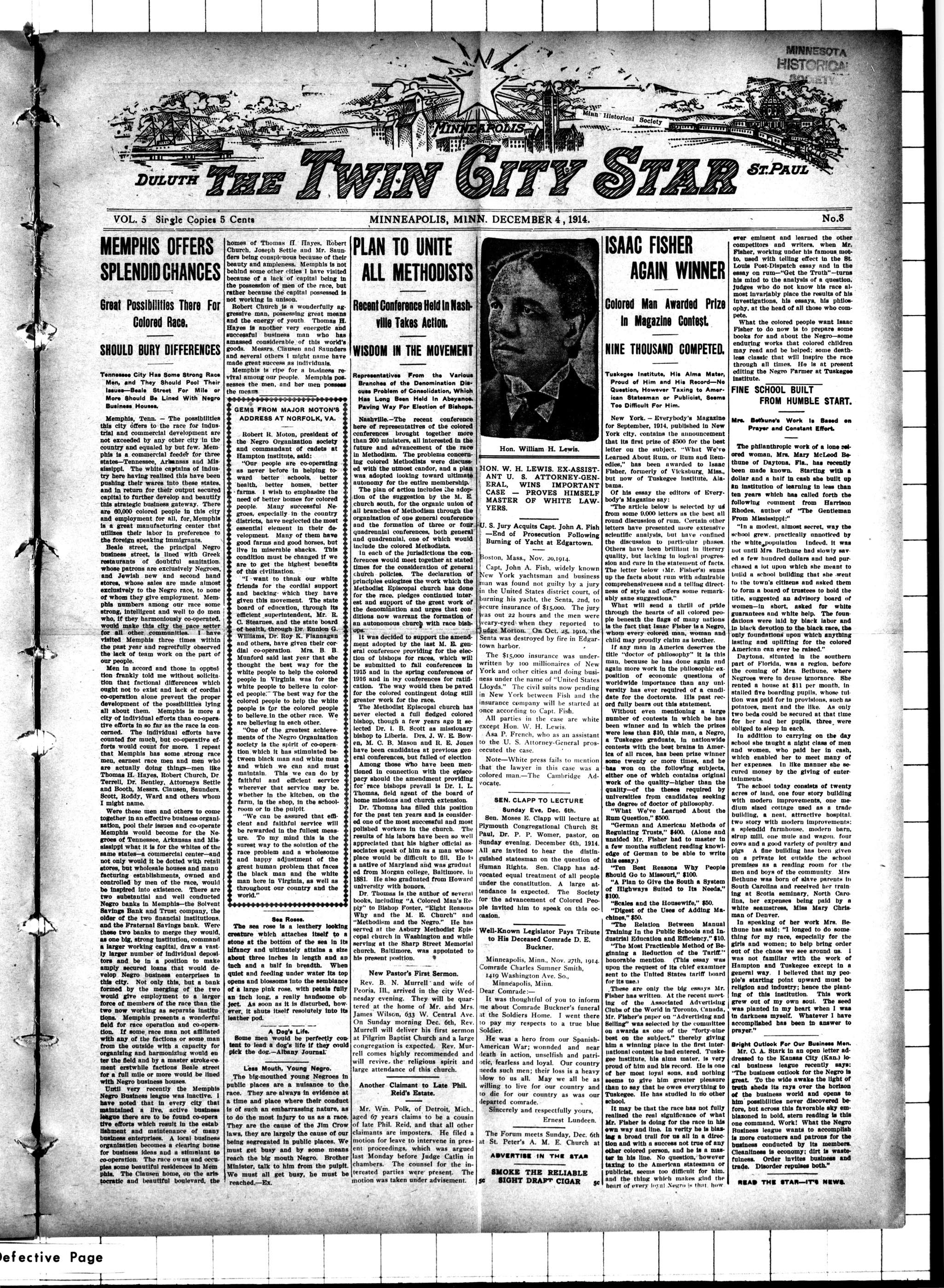
Hon. William H. Lewis.
HON. W. H. LEWIS. EX-ASSISTANT U. S. ATTORNEY-GENERAL, WINS IMPORTANT CASE — PROVES HIMSELF MASTER OF WHITE LAWYERS.
U. S. Jury Acquits Capt. John A. Fish —End of Prosecution Following Burning of Yacht at Edgartown.
Boston, Mass., Nov. 20,1914.
Capt, John A. Fish, widely known New York yachtman and business man was found not guilty by a jury in the United States district court, of burning his yacht, the Senta, 2nd, to secure insurance of $15,000. The jury was out 22 hours and the men were weary-eyed when they reported to Judge Morton. On Oct. 25, 1910, the Senta was destroyed by fire in Edgartown harbor.
The $15,000 insurance was underwritten by 100 millionaires of New York and other cities and doing business under the name of "United States Lloyds." The civil suits now pending in New York between Fish and the insurance company will be started at once according to Capt. Fish.
All parties in the case are white except Hon. W. H. Lewis.
Asa P. French, who as an assistant to the U. S. Attorney-General prosecuted the case.
Note—White press fails to mention that the lawyer in this case was a colored man—The Cambridge Advocate.
SEN. CLAPP TO LECTURE
Sen. Moses E. Clapp will lecture at Plymouth Congregational Church St. Paul, Dr. P. P. Womer, pastor, on Sunday evening. December 6th, 1914. All are invited to hear the distinguished statesman on the question of Human Rights. Sen. Clapp has advocated equal treatment of all people under the constitution. A large attendance is expected. The Society for the advancement of Colored People invited him to speak on this occasion.
Well-Known Legislator Pays Tribute to His Deceased Comrade D. E. Buckner.
Minneapolis, Minn., Nov. 27th, 1914.
Comrade Charles Sumner Smith,
1419 Washington Ave. So.,
Minneapolis, Minn.
Dear Comrade:—
It was thoughtful of you to inform me about Comrade Buckner's funeral at the Soldiers Home. I went there to pay my respects to a true blue Soldier.
He was a hero from our Spanish-American War; wounded and near death in action, unselfish and patriotic, fearless and loyal. Our country needs such men; their loss is a heavy blow to us all. May we all be as willing to live for our country and to die for our country as was our departed comrade.
Sincerely and respectfully yours,
Ernest Lundeen.
The Forum meets Sunday, Dec. 6th at St. Peter's A. M. E. Church at
SMOKE THE RELIABLE
5c SIGHT DRAFT CIGAR
ISAAC FISHER AGAIN WINNER
Tuskegee Institute, His Alma Mater,
Proud of Him and His Record—No
Question, However Taxing to American Statesman or Publicist, Soems
Too Difficult For Him.
New York. — Everybody's Magazine for September, 1914, published in New York city, contains the announcement that its first prize of $500 for the best letter on the subject. "What We've Learned About Rum, or Rum and Remedies," has been awarded to Isaac Fisher, formerly of Vicksburg, Miss., but now of Tuskegee Institute, Alabama.
Of his essay the editors of Everybody's Magazine say:
"The article below is selected by us from some 9,000 letters as the best all round discussion of rum. Certain other letters have presented more extensive scientific analysis, but have confined the discussion to particular phases. Others have been brilliant in literary quality, but lacking in logical progression and care in the statement of facts. The letter below (Mr. Fisher's) sums up the facts about rum with admirable comprehensiveness and a telling directness of style and offers some remarkably sane suggestions."
What will send a thrill of pride through the hearts of all colored people beneath the flags of many nations is the fact that Isaac Fisher is a Negro, whom every colored man, woman and child may proudly claim as brother.
If any man in America deserves the title "doctor of philosophy" it is this man, because he has done again and again more work in the philosophic exposition of economic questions of worldwide importance than any university has ever required of a candidate for the doctorate. His past record fully bears out this statement. Without even mentioning a large number of contests in which he has been winner and in which the prizes were less than $10, this man, a Negro, a Tuskegee graduate, in nationwide contests with the best brains in America of all races, has been prize winner some twenty or more times, and he has won on the following subjects, either one of which contains original work of the quality—higher than the quality—of the theses required by universities from candidates seeking the degree of doctor of philosophy.
"What We've Learned About the Rum Question," $500.
"German and American Methods of Regulating Trusts," $400. (Alone and unaided Mr. Fisher had to master in a few months sufficient reading knowledge of German to be able to write this essay.)
"Ten Best Reasons Why People Should Go to Missouri," $100.
"A Plan to Give the South a System of Highways Suited to Its Needs," $100.
"Scales and the Housewife," $50.
"Digest of the Uses of Adding Machines," $50.
"The Relation Between Manual Training In the Public Schools and Industrial Education and Efficiency," $10.
"The Most Practicable Method of Beginning a Reduction of the Tariff" honorable mention. (This essay was upon the request of its chief examiner sent to the United States tariff board for its use.)
These are only the big essays Mr. Fisher has written. At the recent meeting of the Associated Advertising Clubs of the World in Toronto, Canada, Mr. Fisher's paper on "Advertising and Selling" was selected by the committee on awards as one of the "forty-nine best on the subject," thereby giving him a winning place in the first international contest he had entered. Tuskegee institute, his alma mater, is very proud of him and his record. He is one of her most loyal sons, and nothing seems to give him greater pleasure than to say that he owes everything to Tuskegee. He has studied in no other school.
It may be that the race has not fully realized the real significance of what Mr. Fisher is doing for the race in his own way and line. In verity he is blazing a broad trail for us all in a direction and with a success not true of any other colored person, and he is a master in his line. No question, however taxing to the American statesman or publicist, seems too difficult for him, and the thing which makes glad the heart of every local Negro is that how
ever eminent and learned the other competitors and writers, when Mr. Fisher, working under his famous moto, used with telling effect in the St. Louis Post-Dispatch essay and in the essay on rum—"Get the Truth"—turns his mind to the analysis of a question, judges who do not know his race almost invariably place the results of his investigations, his essays, his philosophy, at the head of all those who compete.
What the colored people want Isaac Fisher to do now is to prepare some books for and about the Negro—some enduring works that colored children may read and be helped; some deathless classic that will inspire the race through all times. He is at present editing the Negro Farmer at Tuskegee institute.
Mrs. Bethune's Work Is Based on Prayer and Constant Effort.
The philanthropic work of a lone selored woman, Mrs. Mary McLeod Bethune of Daytona, Fla., has recently been made known. Starting with a dollar and a half in cash she built up an institution of learning in less than ten years which has called forth the following comment from Harrison Rhodes, author of "The Gentleman From Mississippi:"
"In a modest, almost secret, way the school grew, practically unnoticed by the white population. Indeed, it was not until Mrs. Bethune had slowly saved a few hundred dollars and had purchased a lot upon which she meant to build a school building that she went to the town's citizens and asked them to form a board of trustees to hold the title, suggested an advisory board of women—in short, asked for white guarantees and white help. The foundations were laid by black labor and in black devotion to the black race, the only foundations upon which anything lasting and uplifting for the colored American can ever be raised."
Daytona, situated in the southern part of Florida, was a region, before the coming of Mrs. Bethune, where Negroes were in dense ignorance. She rented a house at $11 per month, installed five boarding pupils, whose tuition was paid for in provisions, such as potatoes, ment and the like. As only two beds could be secured at that time for her and her pupils, three were obliged to sleep in each.
In addition to carrying on the day school she taught a night class of men and women, who paid her in cash, which enabled her to meet many of her expenses. In like manner she secured money by the giving of entertainments.
The school today consists of twenty acres of land, one four story building with modern improvements, one medium sized cottage used as a trade building, a neat, attractive hospital, two story with modern improvements: a splendid farmhouse, modern barn, stirup mill, one mule and wagon, four cows and a good variety of poultry and pigs. A fine building has been given on a private lot outside the school premises as a reading room for the men and boys of the community. Mrs Bethune was born of slave parents in South Carolina and received her training at Scotia seminary. North Carolina, her expenses being paid by a white seamstress, Miss Mary Christman of Denver.
In speaking of her work Mrs. Behune has said; "I longed to do something for my race, especially for the girls and women; to help bring order out of the chaos we see around us. I was not familiar with the work of Hampton and Tuskegee in a general way. I believed that my people's starting point upward must be religion and industry; hence the planting of this institution. This work grew out of my own soul. The seed was planted in my heart when I was in darkness myself. Whatever I have accomplished has been in answer to prayer."
Bright Outlook For Our Business Men. Mr. C. A. Stark in an open letter addressed to the Kansas City (Kan.) local business league recently says: "The business outlook for the Negro is great. To the wide awake the light of truth sheds its rays over the horizon of the business world and opens to him possibilities never discovered before, but across this favorable sky emblazoned in bold, stern reading is this one command. Work! What the Negro Business league wants to accomplish is more customers and patrons for the business conducted by its members. Cleanliness is economy; dirt is wastefulness. Order invites business and trade. Disorder repulses both."
READ THE STAR-ITS NEWS.
WILL GIVE THEIR
SEVENTH ANNUAL BALL
AT NEW COLISEUM HALL,
Formerly Dreamland
EIGHTH and CEDAR STS.,
ST. PAUL,
MONDAY, DEC. 28, 1914.
McCullough's Orchestra.
ADMISSION 50c.
ELKS CHRISTMAS PARTY.
Ames Lodge 106, I. B. P. O. E. of W., of Minneapolis will present the compliments of the season to the children on Christmas Day at 3 o'clock at K. P. Hall, 8th Ave. So. and 4th St. All arrangements are complete. It is all free. Donations are being made by merchants and other friends to make it a Happy Christmas Day for the Kiddies. Ames is the first Negro lodge to feature this entertainment, and it will be a grand success.
Free Street-Car Tickets.
If parents of children, who wish to attend the Elks Christmas Tree, will forward their addresses to Wm. R. Morris, 1020 Metropolitan Life Bldg. they will have street car tickets mailed to them. It is hoped all parents will do this at their earliest time. G. W. Holbert.—(Advertisement.)
Mr. Archer Watkins of Ames Lodge is the father of the Children's Christmas Tree movement. His suggestion met the approval of Grand Exalted Ruler Geo. Holbert, who with Mr. Watkins as Chairman of an efficient committee, is making arrangements for the affair. It is significant, that this movement will be adopted by many of the lodges, and "Archie" will get credit for his broad and noble idea. The Star would like to see Ames Lodge honor him with E. R. and also the Grand Lodge to recommend that all other Lodges should follow this example of Ames No. 106
Will Lav Corner-Stone
The corner stone of the new building of the Odd Fellows and Masons of St. Paul at Kent St. and Aurora Ave., will be laid on Sunday afternoon Dec. 13. Grand Master H. J. Shelton of Duluth will officiate. An address will be delivered at St. James Church by Rev. H. P. Jones after the ceremonies. The Negro fraternities of the Twin Cities will be present.
Mr. F. D. McCracken leaves Friday for Washington to resume his duties with Con. Stevens.
Mr. Chas. Clark Reid and Mrs. Josephine Reid Green are visiting in St. Paul. They claim to be relatives of Phil. E. Reid.
Minneapolis Sunday Forum, St.
Peter's A. M. E. Church, Sunday,
Dec. 6th, 3:30 P. M.
PROGRAM:
Miss Adah Lewis . . . Piano Solo
Mrs. M. W. Withers . . . Reading
Harry Parker . . . Solo
Chas. Dickerson . . . Solo
Paper for discussion by G. P. Hil-
yer: "Is Higher Education for the
Negro Worth While?"
A Suggestion.
Contemplating the discussion at the Forum "Is Higher Education for the Negro worth while?" we suggest that none be allowed to enter the discussion except those who possess "That Higher Education." After years of listening to futile discussions by persons unqualified and other educated labels, many fail to attend because of these arguments and welcome the day when practical talks or lay sermons, on Health, Homes, Finance, Manners, Children etc., will become an important part of the Forum's program; we will then be able to interest the masses instead of the classes.
Anderson—The Coal-Man.
Anderson—the reliable coal man, will deliver your coal by the Ton or Basket. Soft Coal, 25c per basket. Hard Coal 45c per basket. For prices and orders call N. W. Main 2267, Anderson, the coal-man.-Advertise ment.
NEROLI—THE HAIR GROWER
Madam H. Y. Carpenter, now connected with Madam Hart at 1308 Washington Ave. So., gives Electric and Vibrating Massage, an aid to Health and Beauty. She guarantees Neroli to grow hair 1 inch per month or money refunded. Expert Hairdresser and Manicurist.—Advertisement.
Leave your Subscriptions and Printing at TWIN CITY STAR PRINTERS, 1402 Washington Ave. So.
Wanted—Agents to solicit advertising and news. Salary or commission. Good profits. Write the Twin City Star, Minneapolis, Minn.
If you wish to help this publication Send your subscription by Post office order.
---
Presents in forty minutes
"HOW A WOMAN KEEPS A
SECRET"
A Comedy in One Act.
Wednesday Evening, Dec. 16th, 1914
At Bethesda Baptist Church, 1120 8th
St. So. 8:30 P. M.
Dramatic Directoress
The ladies of the Dorcas Society
will serve refreshments, and will have
for sale all kinds of useful and serviceable articles.
Come One! Come All!
SOMETHING NEW
The Excelsior Club, of St. Paul, Minn., will spring something new and novel by giving a Cabaret Dance, on Dec. 25, 1914, Christmas night, at Bowlby's Hall, St. Paul, Minn. No doubt this new feature will be a real treat for the dancing public.
Watch the Twin City Star for further announcements.
Mrs. H. I. Williams of St. Paul, spent the week's end in Minneapolis as the guest of Mrs. B. S. Smith of Oakland Ave.
Mr. Samuel Brassfield spent Thanksgiving in the city and returned to Anoka last Sunday.
Mr. Alexander Mayfield of Wichita, Kan, is visiting his daughter, Mrs. Walter K. Bowie, 3233 43 Ave. So. He came from Montreal via Chicago, where he has been visiting relatives. Mr. Mayfield is a veteran of the Civil War. He served in Co. 1 of the 14th Cal. U. S. Inf. as musician. He was warmly welcomed on his visit to the G. A. R. Headquarters, by his comrades. Mrs. Chas. Sumner Smith has recovered from a recent attack of pleurisy.
Mrs. Z. A. Pope entertained at her residence, 216 West 31st St. on Thanksgiving day. An eight course dinner was served. The guests were Mrs. Ophelia Rice, Mrs. Hardy, Mrs. Miller, Mrs. Davenport, Mrs. Maud Canty, Miss Helen Rice, Miss Biggers, Miss Ophelia Canty, Messrs. Sam'l Brassfield and Veassus Pope.
Serg't Jno. W. Harper, (U. S. A. retired) is serving on the jury of the District Court.
The funeral of Serg't Wm. Cook, an old resident was held at St. Peter's Church on Wednesday afternoon. The Masonic services were held at midnight Tuesday evening.
Mrs. W. A. Houston, 2924 Pleasant Ave., was very agreeably surprised on Tuesday of last week, when Mr. and Mrs. H. Grever and friends tendered her a birthday supper--after which they spent a very enjoyable evening.
Subscribe for the Star.
Dr. Judy's new phone number is Nicollet 4057.
Hon. W. R. Morris has been retained by the five Negro clubs to protect their interests. He receives $300 per year, or $5 per month each.
Mrs. Jane Day, mother of Mrs. Schuyler Phillips, is ill at the residence of her daughter, 2817 Chicago Ave.
Mrs. Noah Moss is very ill.
The M. T. C. Art Club met Thursday afternoon with Mrs. W. S. Doston.
Miss Essie Mason, the stenographer of Peoples, the real-estate dealer was ill two days this week with a cold. She has returned to work.
Bobby Marshall, the famous football player, failed to kick a goal and lose the game in the match between the All Stars and Marines. The game was for the Belgian Relief Fund. Had Bobby been playing under the Belgian customs, they would have cut of his kicker, as they have been cutting of ears, noses, and lips etc of their African subjects on the rubber plantations who failed to bring up their tasks.
The residence of Tom Galbreath,
727 So. Wash. Ave., was raided Tuesday evening. Case was continued till next Wednesday.
J. S. Pollard was given 30 days at workhouse by Judge Smith for assault and battery. He was charged with trying to force his wife to prostitute herself for his support. He claimed to have worked at the South Side Club, which Judge Smith classed as a blind pig. Pollard's case is an example of what should be done with such men. Judge Smith is right and will make it uncomfortable for the pimps, gamblers and vags, if they appear before him.
You should receive your paper on Saturday in the Twin Cities. If you do not, consult your postman, or inform this office by postal. Any neglect in delivery will be promptly investigated.
Continued from last week.
Christmas
A Story
By Zona Gale
appear. But this, a Ebenezer's way, and stairs himself.
Each upper room unconscious in stu-
still as distinct. In p
some ancient activi-
shelf he had put up
burned place on the
tipped over a lamp,
the paper she had
him, the little store
had cleared out for
was old enough and
had to be kept clo-
merable uncaged bird.
When he had gone
of account books in
he sought not to
he remembered the
tiny loft. He let do
sage ceiling the la-
hung there and clim
Copyright, 1912, by the McClure Publications, Incorporated. Copyright, 1912, by the Macmillan Company.
Owing to hard times and the failure of Ebenezer Rule's factory the people of Old Trail Town contemplate buying no presents and having no Christmas.
A town meeting is held, and the decision is reached to have no Christmas, not even for the children.
A notice to this effect is signed by nearly every one. Mary Chavah receives a letter from her sister Lily's boy.
This boy asks her to take his six-year-old brother, son of Adam Blood, a lover who jilted Mary for her sister Lily.
Mary prepares to welcome him. Despite their resolutions many people find it difficult to cut out Christmas altogether.
Ebenezer Rule, grieving for his dead son, Malcolm, and his dead wife, finds the boy's hobbyhorse in an unused attic.
Boys and girls are unhappy because there will be no Christmas. Women regret that Mary's boy will find none awaiting him.
Children of the town are rehearsing for a funeral on Christmas. They are planning to bury Santa Claus.
Ellen Bourne plans to have a Christmas tree and urges her husband to adopt a little boy at once.
The good townfolk secretly prepare to gather at Mary's house on Christmas eve to welcome the little boy.
One after another different people break the anti-Christmas pledge. The spirit of Christmas softens the hard heart of Ebenezer Rule.
He gets the hobbyhorse for Mary's boy, whose train is delayed. Every one is happy in preparing a Christmas welcome for the orphan.
The boy arrives in safety, and the town that was not to celebrate Christmas happily celebrates it after all.
II A. M. Subj.: "Awake." Communion.
Rev. T. J. Carter, Pastor.
Residence 611 E. 16 St., Minneapolis.
Peoples Christian Assembly.
Rev. G. W. Mitchell, Pastor,
1204 Washington Ave. So.
Come! and Serve the Lord.
ST. PETER'S A. M. E. CHURCH.
22nd St. near 10th Ave. So.
Rev. Thos. B. Stovall, Pastor.
ST. JAMES A. M. E. CHURCH,
318 8th Ave. So., Minneapolis.
Rev. E. R. Edwards, Pastor.
Mrs. Julia Hinson, proprietor of the St. Louis Kitchen, 136 E. Third street, up stairs, has moved her dining room just across the hall from its old location. She is also again serving regular dinners at 25 cents and Sunday dinners at 35 cents.
Reserve your space for Excursions, Picnics and Dances. Take the advantage of our advertising columns.
MUSIC TEACHER WANTED
A position is open to a woman who is prepared to instruct classes on the Piano, and in vocal music. Must be first class musician in every way. Active Christian, between age 23 and 32. Address E. W. B. Curry, Pres. Curry School, URBANia, O.
FOR RENT.
One room for Rent.-Steam Heated.
Near Car-line. For men only. See
Mr. A. L. Monteen, 533 Lydale Ave.
No, or Call Hyland 2007.
Do Not Telephone.
any notices, personals,or advertisements to the Twin City Star. We must have a copy of matter for publication. Use the mails and save time.
Mrs. Sylvester O. Phelps reports that the children at the Attucks Home in St. Paul, had a nice Thanksgiving dinner. She collected donations and made it merry for for inmates. We should help the unfortunate children while at this so called institution, but it is a menace to the public, and the best hustling proposition in the Twin Cities for the dishonest management. There is a plan on foot to check up the money given to this Home by business men, and there will be many weighed and found wanting.
---
appear. But this, after all, was not Ebenezer's way, and he went up the stairs himself.
Each upper room was like some one unconscious in stupor or death and still as distinct in personality as if in some ancient activity. There was the shelf he had put up in their room, the burned place on the floor where he had tipped over a lamp, tattered shreds of the paper she had hung to surprise him, the little storeroom which they had cleared out for Malcolm when he was old enough and whose door had to be kept closed because innumerable uncaged birds lived there.
When he had gone through the piles of account books in a closet and those he sought were not found among them he remembered the trunkful up in the tiny loft. He let down from the passage ceiling the ladder he had once hung there and climbed up to the little roof recess.
Light entered through four broken panes of skylight. It fell in a faint rug on the dusty floor. The roof sloped sharply and the trunks and boxes had been pressed back to the rim of the
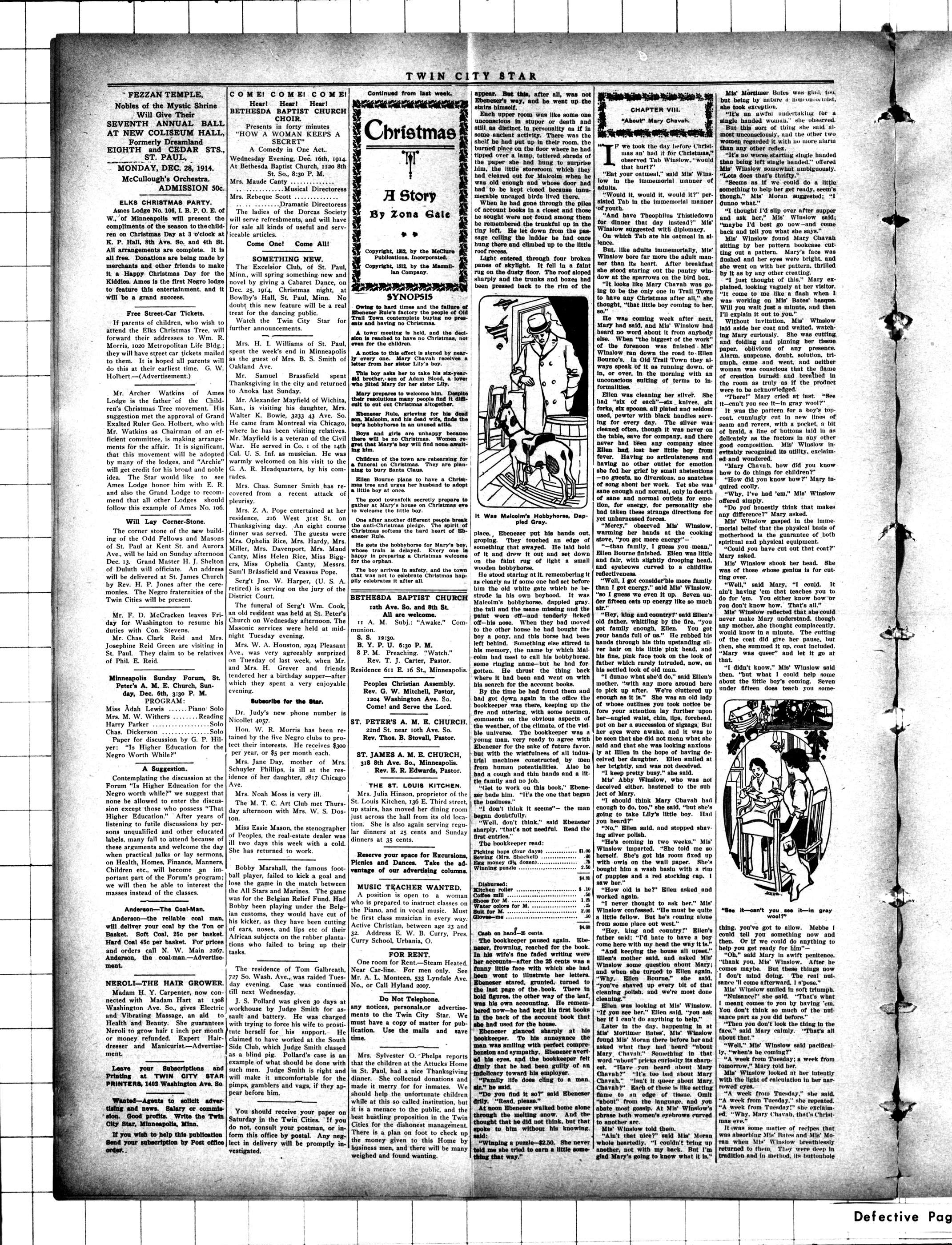
A man in a coat and hat stands in a room with a rocking horse and a barrel.
It Was Malcolm's Hobbyhorse, Dappled Gray.
place. Ebenezer put his hands out, groping. They touched an edge of something that swayed. He laid hold of it and drew it out and set down on the faint rug of light a small wooden hobbyhorse.
He stood staring at it, remembering it as clearly as if some one had set before him the old white gate which he be strode in his own boyhood. It was Malcolm's hobbyhorse, dappled gray, the tail and the mane missing and the paint worn off—and tenderly licked off—his nose. When they had moved to the other house he had bought the boy a pony, and this horse had been left behind. Something else stirred in his memory, the name by which Malcolm had used to call his hobbyhorse, some ringing name—but he had forgotten. He thrust the thing back where it had been and went on with his search for the account books.
By the time he had found them and had got down again in the office the bookkeeper was there, keeping up the fire and uttering, with some acumen, comments on the obvious aspects of the weather, of the climate, of the visible universe. The bookkeeper was a young man, very ready to agree with Ebenezer for the sake of future favor, but with the wistfulness of all industrial machines constructed by men from human potentialities. Also he had a cough and thin hands and a little family and no job.
"Get to work on this book," Ebenezer bade him. "It's the one that began the business."
"I don't think it seems"—the man began doubtfully.
"Well, don't think," said Ebenezer sharply. "that's not needful. Read the first entries."
The bookkeeper paused again. Ebenezer, frowning, reached for the book. In his wife's fine faded writing were her accounts—after the 25 cents was a funny little face with which she had been wont to illustrate her letters. Ebenezer stared, grunted, turned to the last page of the book. There in bold figures, the other way of the leaf, was his own accounting. He remembered now—he had kept his first books in the back of the account book that she had used for the house. Ebenezer glanced sharply at his bookkeeper. To his annoyance the man was smiling with perfect comprehension and sympathy. Ebenezer avered his eyes, and the bookkeeper felt dimly that he had been guilty of an indelicacy toward his employer. "Family life does cling to a man. sir," he said. "Do you find it so?" said Ebenezer drilly. "Reed, please."
At noon Ebenezer walked home alone through the melting snow. And the thought that he did not think, but that spoke to him without his knowing, said:
"Winning a puzzle—$2.50. She never told me she tried to earn a little something that way."
"I if we took the day before Christmas an 'ad' had it for Christmas," observed Tab Winslow, "would that hurt?" "Eat your oatmeal," said Mis' Winslow in the immemorial manner of adults. "Would it, would it, would it?" persisted Tab in the immemorial manner of youth. "And have Theophilus Thistledown for dinner that day instead?" Mis' Winslow suggested with disdain.
But, like adults inmemorally, Mis' Winslow bore far more the adult manner than its heart. After breakfast she stood staring out the pantry window at the sparrows on the bird box. "It looks like Mary Chavah was going to be the only one in Trail Town to have any Christmas after all," she thought, "that little boy coming to her, so."
He was coming week after next, Mary had said, and Mis' Winslow had heard no word about it from anybody else. When "the biggest of the work" of the forenoon was finished - Mis' Winslow ran down the road to Ellen Bourne's. In Old Trail Town they always speak of it as running down, or in, or over, in the morning with an unconscious suiting of terms to informalities.
Ellen was cleaning her silver. She had "six of each"—six knives, six forks, six spoons, all plated and seldom used, pewter with black handles serving for every day. The silver was cleaned often, though it was never on the table, save for company, and there never had been any company since Ellen had lost her little boy from fever. Having no articulateness and having no other outlet for emotion she fed her grief by small abstentions—no guests, no diversions, no snatches of song about her work. Yet she was sane enough and normal, only in dearth of sane and normal outlets for emotion, for energy, for personality she had taken these strange directions for yet unharnessed forces.
"Mercy," observed Mis' Winslow, warming her hands at the cooking stove, "you got more energy"—
"—than family, I guess you mean," Ellen Bourne finished. Ellen was little and fair, with slightly drooping head, and eyebrows curved to a childlike reflectiveness.
"Well, I got consider'ble more family than I got energy," said Mis' Winslow.
"so I guess we even it up. Seven under fifteen eats up energy like so much air."
"Hey, king and country!" said Ellen's old father, whittling by the fire, "you got family enough. Ellen. You got your hands full of us." He rubbed his hands through his thin upstanding silver hair on his little pink head, and his fine, pink face took on the look of father which rarely intruded, now, on his settled look of old man.
"I dunno what she'd do," said Ellen's mother, "with any more around here to pick up after. We're cluttered up enough as it outlines. She was an old lady of whose outlines you took notice before your attention lay further upon her—angled waist, chin, lips, forehead. put on her a succession of sligzags. But her eyes were awake, and it was to be seen that she did not mean what she said and that she was looking anxiously at Ellen in the hope of having deceived her daughter. Ellen smiled at her brightly, and was not deceived.
"I keep pretty busy," she said.
Mis' Abby Winslow, who was not deceived either, hastened to the subject of Mary.
"I should think Mary Chavah had enough to do, too," she said, "but she's going to take Lily's little boy. Had you heard?"
"No." Ellen said, and stopped shaving silver polish.
"He's coming in two weeks," Mis' Winslow imparted. "She told me so herself. She's got his room fixed up with owls on the wall paper. She's bought him a wash basin with a rim of puppies and a red stocking cap. I saw her."
"How old is he?" Ellen asked and worked again.
"I never thought to ask her." Mis' Winslow confessed. "He must be quite a little fellow. But he's coming alone from some place out west."
"Hey, king and country!" Ellen's father said; "I'd hate to have a boy come here with my head the way it is."
Ellen was looking at Mis' Winslow.
"If you see her." Ellen said, "you ask her if I can't do anything to help."
Later in the day, happening in at Mis' Mortimer Bates', Mis' Winslow found Mis' Moran there before her and asked what they had heard "about Mary Chavah." Something in that word "about" pricks curiosity its sharpest. "Have you heard about Mary Chavah?" "It's too bad about Mary Chavah." "It's not it queer about Mary Chavah?" Each of these is like setting flame to an edge of tissue. Omit "about" from the language, and you abate most gossip. At Mis' Winslow's phrase both women's eyebrows curved to another are. Mis' Winslow told them. "Ain't that nice?" said Mis' Moran whole heartedly. "I couldn't bring up another, not with my back. But I'm glad Mary's going to know what it is."
Mis' Mortimer Bates was glad, too, but being by nature a nonconformist, she took exception.
"It's an awful undertaking for a single handed woman." she observed. But this sort of thing she said almost unconsciously, and the other two women regarded it with no more alarm than any other reflex.
"It's no worse starting single handed than being left single handed," offered Mis' Winslow somewhat ambiguously. "Lots does that's thrifty."
"Seems as if we could do a little something to help her get ready, seem's though," Mis' Moran suggested; "I dunno what."
"I thought I'd slip over after supper and ask her," Mis' Winslow said; "maybe I'd best go now—and come back and tell you what she says."
Mis' Winslow found Mary Chavah sitting by her pattern bookcase cutting out a pattern. Mary's face was flushed and her eyes were bright, and she went on with her pattern, thrilled by it as by any other creating.
"I just thought of this," Mary explained, looking vaguely at her visitor. "It come to me like a flash when I was working on Mis' Bates' basque. Will you wait just a minute, and then I'll explain it out to you."
Without invitation, Mis' Winslow laid aside her coat and waited, watching Mary curiously. She was cutting and folding and pinning her tissue paper, oblivious of any presence. Alarm, suspense, doubt, solution, triumph, came and went, and neither woman was conscious that the flame of creation burned and breathed in the room as truly as if the product were to be acknowledged.
"There!" Mary cried at last. "See it—can't you see it—in gray wool?"
It was the pattern for a boy's top coat, cunningly cut in new lines of seam and revers, with a pocket, a bit of braid, a line of buttons laid in as delicately as the factors in any other good composition. Mis' Winslow inevitably recognized its utility, exclaimed and wondered.
"Mary Chavah, how did you know how to do things for children?"
"How did you know how?" Mary inquired coolly.
"Why, I've had 'em," Mis' Winslow offered simply.
"Do you honestly think that makes any difference?" Mary asked.
Mis' Winslow gasped in the immemorial belief that the physical basis of motherhood is the guarantee of both spiritual and physical equipment.
"Could you have cut out that coat?" Mary asked.
Mis' Winslow shook her head. She was of those whose genius is for cutting over.
"Well," said Mary, "I could. It ain't having 'em that teaches you to do for 'em. You either know how or you don't know how. That's all."
Mis' Winslow reflected that she could never make Mary understand, though any mother, she thought complacently, would know in a minute. The cutting of the coat did give her pause, but then, she summed it up, coat included.
"Mary was queer" and let it go at that.
"I didn't know," Mis Winslow said then, "but what I could help some about the little boy's coming. Seven under fifteen does teach you some-
JACKER.
"See it—can't you see it—in gray wool?"
thing, you've got to allow. Mebbe I could tell you something now and then. Or if we could do anything to help you get ready for him"—
"Oh," said Mary in swift penitence.
"thank you, Mis' Winslow. After he comes maybe. But these things now I don't mind doing. The real nulsance I'll come afterward. I 'pose."
Mis' Winslow smiled in soft triumph.
"Nulsance!" she said. "That's what I meant comes to you by having 'em. You don't think so much of the nulsance part as you did before."
"Then you don't look the thing in the face," said Mary calmly. "That's all about that."
"Well," Mis' Winslow said pacifically, "when's he coming?"
"A week from Tuesday; a week from tomorrow," Mary told her.
tomorrow, Mary took her.
"Amy" Winslow looked at her intently with the light of calculation in her narrowed eyes.
"A week from Tuesday," she said.
"A week from Tuesday," she repeated.
"A week from Tuesday," she exclaimed.
"Why, Mary Chavah, that's Christmas eve."
It was some matter of recipes that was absorbing Mis' Bates and Mis' Moran when Mis' Winslow breathlessly returned to them. They were deep in tradition and in method, its buttonhole
Defective Pag
Defective Page
relation. During the weary period when nutrition has been one of the two great problems the tremendous impulse that has nourished the world was alive in the faces of the two women, a kind of creative fire, such as had burned in Mary at the cutting of her pattern. Asparagus escalloped with toast crumbs and butter was for the moment symbol of all humanity's will to keep alive.
"Ladies," said Mis' Winslow, with no other preface, "what do you think? Mary Chavah's little boy is coming from Idaho with a tag on, and when do you s'pose he's going to get here? Christmas eve!""
"Christmas eve," repeated Mis' Bates, whose mind never lightly forsook old ways or embraced a contemps, "what a funny time to travel." "Likely catch the croup and be down sick on Mary's hands the first thing," said Mis' Moran. "It's a pity it ain't the spring of the year."
Mis' Winslow looked at them searchingly to see if her thought too far out-distanced theirs.
"What struck me all of a heap," she said, "is his getting here then. That night. Christmas eve."
The three women looked at one another.
"That's so," Mis' Moran said.
"Him—that child," Mis' Winslow put it, "getting here Christmas eve, used to Christmas all his life, ten to one knowing in his head what he hopes he'll get. And no Christmas. And him with no mother. And her only a month or so dead."
"Well," said Mis' Mortimer Bates, "it's too bad it's happened so. But it has happened so. You have to say that to your life quite often. I notice. I don't know anything to do but to say it now."
Mis' Winslow had not taken off her cloak. She sat on the edge of her chair, with her hands deep in its pockets, her black knit "fascinator" fallen back from her hair. She was looking down at her cloth overshoes, and she went on speaking as if she had hardly heard what Mis' Bates had interposed.
"He'll get in on the express," she said; "Mary said so. She don't have to go to the city to meet him. The man he travels with is going to put him on the train in the city. The little fellow'll get here after dark. After dark on Christmas eve."
"And no time for anybody to warn him that there won't be any Christmas waiting for him." Mis' Moran observed thoughtfully.
"And like enough he'll bring a little something for Mary for a present," Mis' Winslow went on. "How'll she feel then?"
"Ain't it too bad it ain't last year?" Mis' Moran mourned. "Everything comes too late or too soon or not at all or else too much so, 'seems though.'"
Mis' Bates' impulse to nonconformity had not prevented her forehead from being drawn in their common sympathy; but it was a sympathy that saw no practical way out and existed tamely as a high window and not as a wide door.
"Well," she said. "Mary ain't exactly the one to see it so. You'll never get her to feel bad about anybody not having a Christmas. I dunno, if it was any other year, as she'd be planning any different."
"No," said Mis' Winslow thoughtfully. "Mary won't do anything. But we could."
Mis' Bates' forehead took alarm—the alarm of the sympathetic hearer who is challenged to be doer.
"Do?" she repeated. "You can't go back on the paper at this late day. And you can't give him a Christmas and every other of our children not have any just because we're their parents and still living. There ain't a thing to do."
Mis' Winslow's eyes were still on her overshoes. "I don't believe there's never 'not a thing to do.' she said. 'I don't believe it.'
Mis' Bates looked scandalized.
"That's nonsense," she said sharply.
"and it's sacrilegious besides. When God means a thing to happen there's not a thing to do. What about earthquakes and—and cancers?"
"I don't believe he ever means earthquakes and cancers," said Mis' Winslow to her overshoes.
"Prevent 'em, then!" challenged Mis' Bates triumphantly.
MIS' WINSLOW looked up. Her eyes were shining as they had shone sometimes when one of her seven under fifteen had given its first sign of consciousness of more than self.
"I believe we'll do it some day," she said. "I believe there's more to us that we've got any idea of. I believe there's so much to us that one of us that found out about it and told the rest would get hounded out of town. But even now, I bet there's enough to us to do something every time—something every time, no matter what. And I believe there's something we can do about this little orphan boy's Christmas, if we nip our brains on to it in the right place."
"Ob, dear," said Mis' Moran. "sometimes when I think about Christmas I almost wish we almost hadn't done the way we're going to do."
"Jane Moran," she said, "do you think it's right to go head over heels in debt to celebrate the birth of our Lord?"
"No." said Mis' Moran. "I don't But"— "And you know nobody in Old Trull
Town could afford any extravagance this year?"
"Yes," said Mis' Moran, "I do; still"—
"And if part could and part couldn't,
that makes it all the worse, don't it?"
"I know," said Mis' Moran—"I know."
"Well, then," said Mis' Bates triumphantly, "we've done the only way
there is to do. Land knows, I wish
there was another way. But there
ain't."
Mis' Winslow looked up from her
overshoes.
"I don't believe there's never 'no other way.'" she said. "There's always another way."
"Not without money." said Mis' Bates.
"Money," Mis' Winslow said—"money. That's like setting up one day of peace on earth, good will to men, and asking admission to it."
"Mis' Winslow," said Mis' Moran sadly, "what's the use of saying anything? You know as well as I do that Christmas is abused all up and down the land and made a day of expense and extravagance and folks overspending themselves. And we've stopped all that in Old Trail Town. And now you're trying to make us feel bad."
"I ain't," said Mis' Winslow. "We felt bad about it already, and you know it. I'm glad we've stopped all that. But I wish't we had something to put in its place. I wish't we had."
"What in time are them children doing?" said Mis' Moran abruptly.
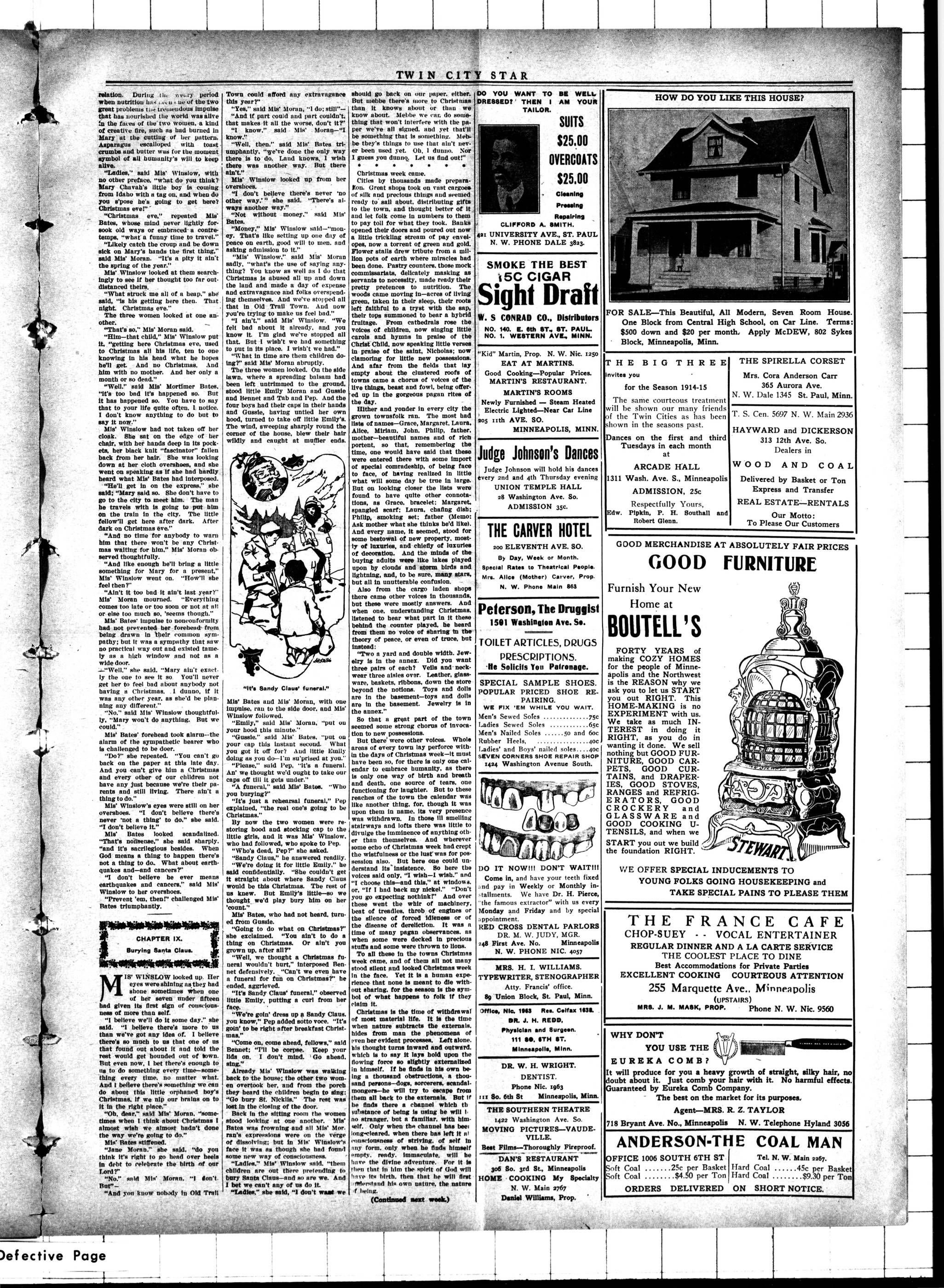
The three women looked. On the side lawn, where a spreading balsam had been left untrimmed to the ground, stood little Emily Moran and Gussie and Bennet and Tab and Pep. And the four boys had their caps in their hands and Gussie, having untied her own hood, turned to take off little Emily's. The wind, sweeping sharply round the corner of the house, blew their hair wildly and caught at muffler ends.
A. H. H.
"It's Sandy Claus' funeral."
Mis' Bates and Mis' Moran, with one impulse, ran to the side door, and Mis' Winslow followed.
"Emily," said Mis' Moran, "put on your hood this minute."
"Gussle," said Mis' Bates, "put on your cap this instant second. What you got it off for? And little Emily doing as you do—I'm suprised at you."
"Please," said Pep, "it's a funeral. An' we thought we'd ought to take our caps off till it gets under."
"A funeral," said Mis' Bates. "Who you burying?"
"It's just a rehearsal funeral," Pep explained, "the real one's going to be Christmas."
By now the two women were restoring hood and stocking cap to the little girls, and it was Mis' Winslow, who had followed, who spoke to Pep.
"Who's dead, Pep?" she asked.
"Sandy Claus," he answered readily. "We're doing it for little Emily," he said confidently. "She couldn't get it straight about where Sandy Claus would be this Christmas. The rest of us knew. But Emily's little—so we thought we'd play bury him on her 'count.'
Mis' Bates, who had not heard, turued from Gussle.
"Going to do what on Christmas?" she exclaimed. "You ain't to do a thing on Christmas. Or ain't you grown up, after all?"
"Well, we thought a Christmas funeral wouldn't hurt," interposed Bennet defensively. "Can't we even have a funeral for fun on Christmas?" he ended, aggrieved.
"It's Sandy Claus' funeral," observed little Emily, putting a curl from her face.
"We're goin' dress up a Sandy Claus, you know." Pep added sotto voice. "It's goin' to be right after breakfast Christmas."
"Come on, come ahead, fellows," said Bennet; "T'll be corpse. Keep your lids on. I don't mind. Go ahead, sing."
Already Mis' Winslow was walking back to the house; the other two women overtook her, and from the porch they heard the children begin to sing: "Go bury St. Nicklas." The rest was lost in the closing of the door.
Back in the sitting room the women stood looking at one another. Mis' Bates was frowning and all Mis' Moran's expressions were on the verge of dissolving; but in Mis' Winslow's face it was as though she had found some new way of consciousness.
"Ladice," Mis' Winslow said, "them children are out there pretending to bury Santa Claus—and so are we. And I bet we can't any of us do it."
"If they sold, it'd not want us."
TWIN CITY STAR
should go back on our paper, either. But mebbe there's more to Christmas than it knows about or than we know about. Mebbe we can do something that won't interfere with the paper we've all signed, and yet that'll be something that is something. Mebbe they're things to use that ain't never been used yet. Oh, I dunno. Nor I guess you dunnq. Let us find out!"
DO YOU WANT DRESSED? 'TIME T
Cities by thousands made preparation. Great shops took on vast cargoes of silk and precious things and seemed ready to sail about, distributing gifts to the town, and thought better of it and let folk come in numbers to them to pay toll for what they took. Banks opened their doors and poured out now a little trickling stream of pay envelopes, now a torrent of green and gold. Flower stalls drew tribute from a million pots of earth where miracles had been done. Pastry counters, those mock commissariats, delicately masking as servants to necessity, made their pretty pretensions to nutrition. The woods came moving in—acres of living green, taken in their sleep, their roots left faithful to a tryst with the sap, their tops summoned to bear a hybrid fruity. From cathedrals rose the voices of children, now singing little carols and hymns in praise of the Christ Child, now speaking little verses in praise of the saint, Nicholas; now clamoring for little new possessions. And afar from the fields that lay empty about the cluster roofs of towns came a chorus of voices of the live things, beast and fowl, being offered up in the gorgeous pagan rites of the day.
Hither and yonder in every city the grown townsfolk ran. The most had lists of names—Grace, Margaret, Laura, Alice, Miriam, John, Philip, father, mother—beautiful names and of rich portent, so that, remembering the time, one would have said that these were entered there with some import of special comradeship, of being face to face, of having realized in little what will some day be true in large. But on looking closer the lists were found to have quite other connotations, as Grace, bracelet: Margaret, spangled scarf: Laura, chafing dish; Philip, smoking set; father (Memo: Ask mother what she thinks he'd like). And every name, it seemed, stood for some bestowal of new property, mostly of luxuries, and chiefly of luxuries of decoration. And the minds of the buying adults were like lakes played upon by clouds and storm birds and lightning, and, to be sure, many stars, but all in unutterable confusion.
Also from the cargo laden shops there came other voices in thousands, but these were mostly answers. And when one, understanding Christmas, listened to hear what part in it these behind the counter played, he heard from them no voice of sharing in the theory of peace, or even of truce, but instead:
"Two a yard and double width. Jewelry is in the annex. Did you want three pairs of each? Veils and neckwear three aisles over. Leather, glassware, baskets, ribbons, down the store beyond the notions. Toys and dolls are in the basement--toys and dolls are in the basement. Jewelry is in the annex."
So that a great part of the town seemed some strong chorus of invocation to new possessions.
But there were other voices. Whole areas of every town lay perforce within the days of Christmas week—it must have been so, for there is only one calendar to embrace humanity, as there is only one way of birth and breath and death, one source of tears, one functioning for laughter. But to these reaches of the town the calendar was like another thing, for, though it was upon them in name, its very presence was withdrawn. In those ill smelling stairways and lofts there was little to divulge the imminence of anything other than themselves. And wherever some echo of Christmas week had crept the wistfulness or the lust was for possession also. But here one could understand its insistence. So here the voices said only, "I wish—I wish," and "I choose this—and this," at windows, or, "If I had back my nickel." "Don't you go expecting nothink!" And over these went the whir of machinery, beat of treasures, throb of engines or the silence of forced idleness or of the disease of dereliction. It was a time of many pagan observances, as when some were decked in precious stuffs and some were thrown to lions.
To all these in the towns Christmas week came, and of them all not many stood silent and looked Christmas week in the face. Yet it is a human experience that none is meant to die without sharing, for the season is the symbol of what happens to folk if they claim it.
Christmas is the time of withdrawal of most material life. It is the time when nature subtracts the externals, hides from man the phenomena of even her evident processes. Left alone his thought turns inward and outward, which is to say it lays hold upon the flowing force so slightly externalized in himself. If he finds in his own being a thousand obstructions, a thousand persons—dogs, sorcerers, scandal-mongers—he will try to escape from them all back to the externals. But if he finds there a channel which the substance of being is using he will no stranger, but a familiar, with him. Only when the channel has been long-cleared, when there has left it all consciousness of striving, of self in any form, only when he finds himself empty, ready, immaculate, will he have the divine adventure. For it is then that in him the spirit of God will have its birth, then that he will first understand his own nature, the nature of being.
(Continued next week.)
DO YOU WANT TO BE WELL
DRESSED? THEN I AM YOUR
TAILOR.
SUITS
$25.00
OVERCOATS
$25.00
Cleaning
Pressing
Repairing
CLIFFORD A. SMITH.
421 UNIVERSITY AVE., ST. PAUL
N. W. PHONE DALE 3823.
SMOKE THE BEST 15C CIGAR Sight Draft
W. S CONRAD CO., Distributors
NO. 140. E. 6th ST., ST. PAUL.
NO. 1. WESTERN AVE., MINN.
"Kid" Martin, Prop. N. W. Nic. 1250
EAT AT MARTINS.
Good Cooking—Popular Prices.
MARTIN'S RESTAURANT.
MARTIN'S ROOMS
Newly Furnished — Steam Heated
Electric Lighted—Near Car Line
205 11th AVE. SO.
MINNEAPOLIS. MINN.
Judge Johnson's Dances
Judge Johnson will hold his dances every 2nd and 4th Thursday evening UNION TEMPLE HALL 28 Washington Ave. So. ADMISSION 35c.
THE CARVER HOTEL
200 ELEVENTH AVE. SO.
By Day, Week or Month.
Special Rates to Theatrical People.
Mrs. Alice (Mother) Carver, Prop.
N. W. Phone Main 863
Peterson, The Druggist 1501 Washington Ave. So.
TOILET ARTICLES, DRUGS
PRESCRIPTIONS.
He Solicits You Patronage.
SPECIAL SAMPLE SHOES.
POPULAR PRICED SHOE REPAIRING.
WE FIX 'EM WHILE YOU WAIT.
Men's Sewed Sofes ..... 75c
Ladies Sewed Sofes ..... 65c
Men's Nailed Sofes ..... 50 and 60c
Rubber Heels, ..... 40c
Ladies' and Boys' nailed sores ..... 40c
SEVEN CORNERS SHOE REPAIR SHOP
1424 Washington Avenue South.
DO IT NOW!!! DON'T WAIT!!!
Come in, and have your teeth fixed and pay in Weekly or Monthly installments. We have Dr. H. Pierce, "the famous extractor" with us every Monday and Friday and by special appointment.
RED CROSS DENTAL PARLORS
DR. M. W. JUDY, MGR.
248 First Ave. No. Minneapolis
N. W. PHONE NIC. 4057
MRS. H. I. WILLIAMS.
TYPEWRITER, STENOGRAPHER
Atty. Francis' office.
89 Union Block, St. Paul, Minn.
Office, Nic. 1983 Res. Celfax 1638.
DR. J. H. REDD,
Physician and Surgeon.
111 SO. 6TH ST.
Minneapolis, Minn.
DR. W. H. WRIGHT.
DENTIST.
Phone Nic. 1963
111 So. 6th St Minneapolis, Minn.
THE SOUTHERN THEATRE
1422 Washington Ave. So.
MOVING PICTURES—VAUDE-
VILLE.
Cleaning Pressing Repairing
THE HOME OF THE MAYBELLE'S
FOR SALE—This Beautiful, All Modern, Seven Room House. One Block from Central High School, on Car Line. Terms: $500 down and $20 per month. Apply McDEW, 802 Sykes Block, Minneapolis, Minn.
GOOD MERCHANDISE AT ABSOLUTELY FAIR PRICES GOOD FURNITURE
STEWART.
WE OFFER SPECIAL INDUCEMENTS TO YOUNG FOLKS GOING HOUSEKEEPING and TAKE SPECIAL PAINS TO PLEASE THEM
THE FRANCE CAFE
CHOP-SUEY -- VOCAL ENTERTAINER
REGULAR DINNER AND A LA CARTE SERVICE
THE COOLEST PLACE TO DINE
Best Accommodations for Private Parties
EXCELLENT COOKING COURTEOUS ATTENTION
255 Marquette Ave.. Minneapolis
(UPSTAIRS)
MRS. J. M. MASK, PROP.
Phone N. W. Nic. 9560
It will produce for you a heavy growth of straight, silky hair, no doubt about it. Just comb your hair with it. No harmful effects. Guaranteed by Eureka Comb Company.
718 Bryant Ave. No., Minneapolis N. W. Telephone Hyland 3056
ANDERSON-THE COAL MAN
OFFICE 1006 SOUTH 6TH ST
Soft Coal .....25c per Basket
Soft Coal .....$4.50 per Ton
Tel. N. W. Main 2267.
Hard Coal .....45c per Basket
Hard Coal .....$9.30 per Ton
ORDERS DELIVERED ON SHORT NOTICE.
Furnish Your New Home at BOUTELL'S
FORTY YEARS of making COZY HOMES for the people of Minneapolis and the Northwest is the REASON why we ask you to let us START you out RIGHT. This HOME-MAKING is no EXPERIMENT with us. We take as much INTEREST in doing it RIGHT, as you do in wanting it done. We sell nothing but GOOD FURNITURE, GOOD CARPETS, GOOD CURTAINS, and DRAPERIES, GOOD STOVES, RANGES and REFRIGERATORS, GOOD CROCKERY and GLASSWARE and GOOD COOKING UTENSILS, and when we
START you out we build the foundation RIGHT.
V
LAND
LAND
THE TWIN CITY STAR
Vol. 4. Friday, Dec. 4, 1914. No. 8.
Entered in the Pest Office at Minneapolis as second class matter.
MEMBER
NATIONAL NEGRO PRESS
ASSOCIATION
MINNESOTA EDITORIAL ASSN.
PUBLISHED EVERY FRIDAY BY
CHARLES SUMNER SMITH,
1419 Washington Ave. So., Minne
apolis, Minn.
Subscription by Mall, Postpaid.
ONE YEAR ..... $2.00
SIX MONTHS ..... 1.20
THREE MONTHS ..... .65
CANADIAN SUBSCRIPTIONS ..$2.50
ADVERTISING RATES.
Wedding Announcements, Fifty Cents
Card of Thanks ..... One Dollar
In Memoriam ..... One Dollar
Business Announcements, One Dollar
Birth, Bethrothal, Marriage, and Death
Notices ..... One Dollar
Complimentary and Obituary Resolutions, Two Dollars
One inch, one insertion, Fifty Cents
Liberal discount given on 3, 6, 9,
1 year contracts
Want Ads ..... Twenty-five Cents
Reading Notices, per line, Five Cents
Adress all mail to Twin City Star
1419 Washington Ave. So., Minne
apolis, Minn.
1402 WASHINGTON AVE. SO.
St. Paul Office, 8g Union Blk.
No advertisement inserted without cash in advance.
When writing for the press, don't abbreviate your words. Spell each one out correctly and distinctly. If you don't it means that all of your manuscript will have to be rewritten if there is time. Write oh one side of the paper only.
As we journey through life,
Let's-sell SEALS by the way!
BY A CONSUMPTIVE.
"I believe that I am a consumptive and will DIE, unless I can take the treatment, which requires REST, OUTDOORS, and much GOOD FOOD.
"YOU BELIEVE that I am infectious; a danger to you and yours, and the community.
"WE BELIEVE, you and I, that if I go on working, I will DIE; and WHILE I AM DYING AT MY WORK, I will form also a starting point for the same DREAD DISEASE AMONGST MY COMRADES, and MY OWN FAMILY.
"I BELIEVE that my disease IS NOT MY FAULT; (I got it from a poor fellow, who was situated then, just as I am now; he kept on working until he died beside me. THAT'S HOW I GOT IT.
"YOU BELIEVE it is NOT YOUR FAULT; of course not—YOU DID NOT GIVE IT to me.
"WE BELIEVE, you and I, that it was THE FAULT OF THE COMMUNITY, who left that previous consumptive to work beside me, while he was dying.
"I KNOW I am not a pauper, or a charity case NOW, but soon I will be BOTH; and then I will be so far gone in my disease that I will die anyway. That is a nice prospect!
"YOU KNOW that If I quit work and "loaf" at home, I'll be more dangerous to MY FOLKS, then I would be to MY COMRADES for I will be with them TWICE AS LONG every day.
"WE KNOW, you and I, that consumption can be cured if taken in time; that it becomes worse, and more infectious as it goes on; that every MONTH, every WEEK, every DAY that I go on without REST, OUTDOOR GOOD FOOD, makes me worse, more dangerous and POORER; I tell you IT COSTS MONEY TO BE SICK.
"I KNOW my people cannot stand the expense if I "loaf" at home; they cannot stand the expense of my taking treatment that would CURE ME They cannot afford to have me die.
"I MUST work, to live; and if I work, I DIE!
"FOR GOD'S SAKE, GENTLE-MEN, what am I to do?"
What did you do? HE'S DEAD NOW; his family is infected from him; some of his comrades at work are infected too; certainly ONE OR MORE persons WILL FOLLOW him down that same sunless path of suffering, poverty and death, BE-CAUSE HE DIED, neglected.
What will YOU do about others, still living? Nothing, as you did about him? NO! This thing must stop: STOP IT NOW!
Every Christmas SEAL you buy Quiers three million bacil-ll
---
The Value of The Christmas Seal. The State Superintendent of Education, Mr. C. G. Schultz, has voiced the feeling of Educationalists generally towards the Christmas Seal campaign.
"I recognize the educational value of the Christmas Seal." Said Mr. Schultz. "It follows the very best principle of our modern educational methods by supplying a definite thing to which we can tie the information we impart. Simple as it is, the Christmas Seal is the greatest educational device to spread the knowledge of tuberculosis, its cause and especially its prevention that has yet been thought of. To every school child in our great North Star State the Christmas Seal brings its message, something to understand, someone to help, a great evil to be overthrown. I wish the Minnesota Public Health Association every success in its energetic campaign for the Shrimpless Seal and all that the Christmas Seal means in abolishing this terrible disease from our schools, our homes and our people. We know the work of this association in direct education and what it has done already in other lines to aid us in teaching public health to our pupils. God speed to it in this bigger field the teaching of the whole population how to escape this, our Great White Plague."
All forms of Public Health endeavor depends for success upon EDUCATION. The educational work in Public Health in this State is by general consent expected of the Minnesota Public Health Association. This Association is co-operating with other great agencies, the State Board of Health, the Advisory Commission on the State Tuberculosis Sanitarium, the State Educational Department, the State Dairy and Food Department, the State Labor Department, the State Live Stock Sanitary Board, the State University, the State Agricultural College, the State Federation of Women's Club and others.
A great item of its work is Tuberculosis. The Christmas Seals are sold to aid in the Abolition of Tuberculosis and all its allies. Help you local Red Cross Christmas Seal agent to make a great sale this day.
Ora C. Hall, A Leading Negro Democrat, Comments on the Wilson Administration.
727 St. Anthony Ave., St. Paul, Minn.
Editor Twin City Star,
My dear sir;-I am under obligations to you for considering my comment on the national administration worthy of note. I shall attempt to be brief.
First of all I do not stand for any person or policy in which I do not see more good than ill for the Negro.
My vote for Democracy was not in hope of securing an early change in the social condition of the Negro, but rather for his economic advantage.
We are enormous producers of raw materials—cotton, and consumers of manufactured articles in which we have little part in the production. I want the Negro to sell his cotton in the highest possible market, and buy his food, clothes, school books and lumber in the lowest possible market. It means a Negro with more money, better clothes, more wholesome food, more broadly educated, with more comfortable homes. Lift our masses from poverty and ignorance and we are out of reach of harm from any president's social policy.
As to apportionments, it is my opinion that the president will keep his promises, if he made any, and in due season nominate several worthy Negroes for high positions. That set of politicians who dare to oppose the confirmation of Negro nominees will suffer more than the Negro, for no party can win in 1916 without a good portion of the Negro vote.
Again thanking you for your consideration, I am For the most for the most of my people.
Orington C. Hall.
Cheif of Police Martinson is very ill. His recovery is doubtful. We hope for his recovery. Chief Martinson has given the Negroes more consideration than they generally receive from that office. He is every inch a man and a gentleman, and has a host of friends who sympathize with him in his affliction.
Why is it that people, who never subscribe to a paper, always want to have their personal news in its columns?
TWIN CITY STAR
GOING BACKWARD?
If Christianity is the highest type of civilization – and who can deny it?—then is it not true that we are retrograding instead of advancing on certain lines? We glory in our system of universal education, in our enormous wealth and in our territorial expansion. But these advantages are not evidences of Christian progress. Two thousand years ago pagan Rome had all these temporal advantages. The wealth of the nations poured into her lap. Her empire extended over three continents. She far excelled us in arts, in oratory, poetry, philosophy and literature and in all the refinements of cultivated society. Her paintings and sculpture, her literary productions, are still our models. And yet while she was in the zenith of her material and intellectual splendor she was in a state of moral and political decay. In fact, she was lapsing into barbarism—Cardinal Gibbons.
NATIONAL DEGENERACY.
Lincoln Abhored Oppression and Denied Hypocrisy
and Despised Hypocrisy.
The speech of Abraham Lincoln in 1855 regarding the political situation and the tendency to disregard the rights of human beings to life, liberty and the pursuit of happiness is strikingly applicable to the condition of affairs in this country at the present time.
Mr. Lincoln said:
"I am not a Know Nothing—that is certain. How could I be? How can any one who abhors the oppression of the Negroes be in favor of degrading classes of white people? Our progress in degeneracy appears to me to be pretty rapid. As a nation we began by declaring that 'all men are created equal.'
"We now practically read it. 'All men are created equal except Negroes.' When the Know Nothings get control it will read, 'All men are created equal except Negroes and foreigners and Catholics.'
"When it comes to that I should prefer emigrating to some country where they make no pretense of loving liberty—to Russia, for instance, where despotism can be taken pure and without the base alloy of hypocrisy."
TASK FOR THE NATIONS.
Ray Stannard Baker's Plea For Human Brotherhood.
Ray Stannard Baker in a recent issue of the American Magazine has the following to say about prejudice of one race against another:
"Why will men not see that there can be no true civilization while any men in the world are left out of it and that no race and no nation can go far forward while other races and nations lag behind?"
"Let the white person again tread the black person under his heel! (Say, which is trodden under heel after all?)
"It is not enough that we give the alien nations our learning, our religion, our science. What signify all these things? Are we hurt by giving them? Are we not, on the contrary, the material gainers? No; we must be prepared to go further than that, else we have not learned the fundamental concept of religion. "It is not the great task of any nation that it shall remain pure or white or learned or that it shall assure to its posterity the possession of land and comfort, though this has been the belief and the doom of every aristocracy from the beginning of time. The great task of every advanced race or nation is to bring more love, more light, into the world.
"A stand for racial aristocracy means war, hatred, barren exclusiveness and finally degeneration and failure; a stand for racial democracy and brotherhood means love in the world, friendliness, sacrifice, new fertility, a wider sweep for faith and final triumph. Individuals may suffer in the process, nations may perish, but civilization, the kingdom of humanity, will grow, will become more beautiful.
"We are willing to do. everything for Chinamen or Hindus or for our own poor, except the one essential thing. Yes, educate them (a little); yes, teach them the religion of resignation; yes, give them shoes and coats, but do not disturb us in our luxury.
"It won't work; it won't work. So long as we refuse to give ourselves we have failed utterly."
ABLE CHURCHMAN AND RACE LEADER
SPENT EARLY LIFE ON FARM
First-African Presbyterian Church In Philadelphia Enjoys Splendid Growth Under the Leadership of its Energetic Pastor—Clear of Debt and Will Enlarge Present Edifice.
By JAMES D. CORROTHERS.
Philadelphia.—The splendid growth and prosperity of the First African Presbyterian church in this city have compelled the congregation to purchase additional ground upon which to enlarge its edifice to meet its expanding activities. The church is located on Seventeenth and Fitzwafer streets. It has purchased the property adjoining and will erect thereon a $10,000 addition to its present edifice, which will increase its seating capacity by at least 350. An addition will also be made to the parsonage and a baptistery, pipe organ, gymnasium and other improvements will also be made to the church.
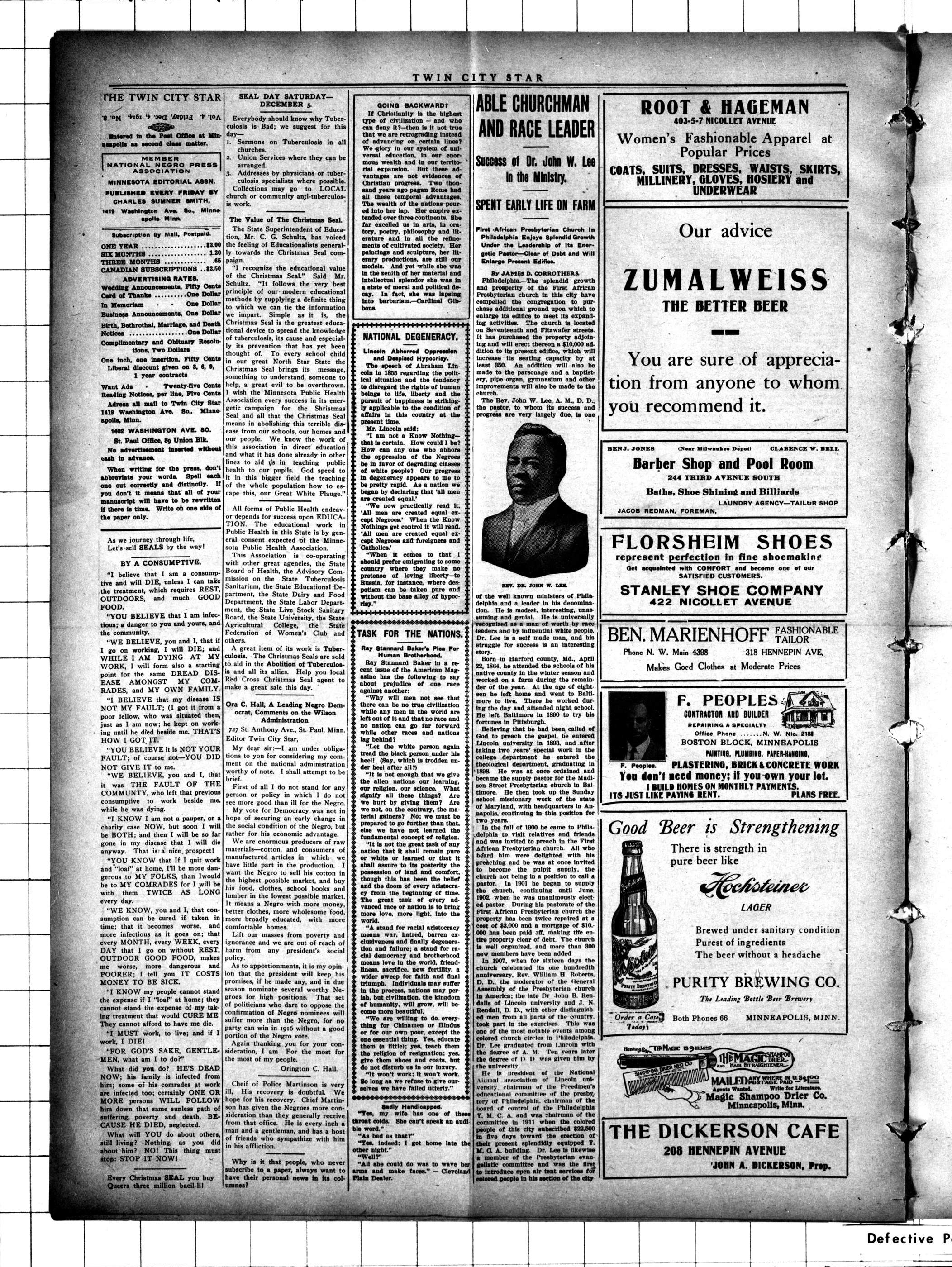
The Rev. John W. Lee, A. M., D. D., the pastor, to whom its success and progress are very largely due, is one
REV. DR. JOHN W. LEE.
of the well known ministers of Philadelphia and a leader in his denomination. He is modest, interesting, unassuming and genial. He is universally recognized as a man of worth by race leaders and by influential white people. Dr. Lee is a self made man, and his struggle for success is an interesting story. Born in Harford county, Md., April 22, 1864, he attended the schools of his native county in the winter season and worked on a farm during the remainder of the year. At the age of eighteen he left home and went to Baltimore to live. There he worked during the day and attended night school. He left Baltimore in 1890 to try his fortunes in Pittsburgh.
Believing that he had been called of God to preach the gospel, he entered Lincoln university in 1803, and after taking two years' special work in the college department he entered the theological department, graduating in 1808. He was at once ordained and became the supply pastor for the Madison Street Presbyterian church in Baltimore. He then took up the Sunday school missionary work of the state of Maryland, with headquarters in Annapolis, continuing in this position for two years.
In the fall of 1900 he came to Philadelphia to visit relatives and friends and was invited to preach in the First African Presbyterian church. All who heard him were delighted with his preaching and he was at once invited to become the pulpit supply, the church not being in a position to call a pastor. In 1901 he began to supply the church, continuing until June. 1902, when he was unanimously elected pastor. During his pastorate of the First African Presbyterian church the property has been twice repaired at a cost of $3,000 and a mortgage of $10,000 has been paid off, making the entire property clear of debt. The church is well organized, and more than 300 new members have been added
In 1907, when for sixteen days the church celebrated its one hundredth anniversary, Rev. William H. Roberts, D. D., the moderator of the General Assembly of the Presbyterian church in America; the late Dr John B. Rendalls of Lincoln university and J. N. Rendall, D. D., with other distinguished men from all parts of the country, took part in the exercises. This was one of the most notable events among colored church circles in Philadelphia. Dr. Lee graduated from Lincoln with the degree of A. M. Ten years later the degree of D D was given him by the university.
He is president of the National Alumni association of Lincoln university, chairman of the Freedmen's educational committee of the presbytery of Philadelphia, chairman of the board of control of the Philadelphia Y. M. C. A. and was chairman of the committee in 1911 when the colored people of this city subscribed $22,500 in five days toward the erection of their present splendidly equipped Y. M. C. A. building. Dr. Lee is likewise a member of the Presbyterian evangelistic committee and was the first to introduce open air tent services for colored people in his section of the city
ROOT & HAGEMAN
403-5-7 NICOLLET AVENUE
Women's Fashionable Apparel at
Popular Prices
COATS, SUITS, DRESSES, WAISTS, SKIRTS,
MILLINERY, GLOVES, HOSIERY and
UNDERWEAR
You are sure of appreciation from anyone to whom you recommend it.
BENJ. JONES (Near Milwaukee Depot) CLARENCE W. BELL
Barber Shop and Pool Room
244 THIRD AVENUE SOUTH
Baths, Shoe Shining and Billiards
LAUNDRY AGENCY—TAILOR SHOP
JACOB REDMAN, FOREMAN,
FLORSHEIM SHOES
represent perfection in fine shoemaking Get acquainted with COMFORT and become one of our SATISFIED CUSTOMERS. STANLEY SHOE COMPANY 422 NICOLLET AVENUE
BEN. MARIENHOFF FASHIONABLE TAILOR
Phone N. W. Main 4398 318 HENNEPIN AVE.
Makes Good Clothes at Moderate Prices
THE DICKERSON CAFE
208 HENNEPIN AVENUE
'JOHN A. DICKERSON, Prop.
F. Peoples.
You don't
Kessler
The Pioneer Lager
PUNITY BREWING CO.
PURITY BREWING CO.
Our advice
SALWEE
THE BETTER BEER
are sure of a
m anyone to
commend it.
(Near Milwaukee Depot)
Shop and Pool
14 THIRD AVENUE SOUTH
Shoe Shining and Bill
LAUNDRY AGEN
FOREMAN,
SHEIM SH
perfection in fine sho
with COMFORT and become
SATISFIED CUSTOMERS.
KEY SHOE CON
NICOLLET AVEN
ARIENHOFF
Main 4398 318 HEN
Good Clothes at Moderate
F. PEOPLES
CONTRACTOR AND BUILDER
REPAIRING A SPECIALTY
Office Phone ...N.
BOSTON BLOCK, MINI
PAINTING, PLUMBING, PA
PLASTERING, BRICK & CO
need money; if you owe
HOMES ON MONTHLY PAYM
YING RENT.
Beer is Streng
There is strength in
pure beer like
Hochsteel
LAGER
ALWEISS
FOR BETTER BEER
sure of appreciation
anyone to whom
mend it.
Mr Milwaukee Depot) CLARENCE W. BELL
Shop and Pool Room
THIRD AVENUE SOUTH
Shoe Shining and Billiards
LAUNDRY AGENCY—TAILOR SHOP
CREMAN,
HEIM SHOES
Section in fine shoemaking
COMFORT and become one of our
MISFIED CUSTOMERS.
SHOE COMPANY
COLLET AVENUE
IENHOFF FASHIONABLE
TAILOR
4398 318 HENNEPIN AVE.
Clothes at Moderate Prices
Office Phone .....N. W. Nio. 2188
BOSTON BLOCK, MINNEAPOLIS
PAINTING, PLUMBING, PAPER-HANGING,
STERING, BRICK & CONCRETE WORK
money; if you own your lot.
MES ON MONTHLY PAYMENTS.
B RENT. PLANS FREE.
is Strengthening
there is strength in
beer like
Hochsteiner
LAGER
Brewed under sanitary condition
Purest of ingredients
The beer without a headache
PURITY BREWING CO.
The Leading Bottle Beer Brewery
Both Phones 66 MINNEAPOLIS, MINN.
THE MAGIC SHAMPOO
DRIER
AND HAIR STRAIGHTENER
RITY BREWING CO.
The Leading Bottle Beer Brewery
Phones 66 MINNEAPOLIS, MINN.
IN LONG
THE MAGIC SHAMPOO
DRYER
AND HAIR STRAIGHTENER
HOLLYWOOD
HOLLYWOOD
N. Nic. 2188
EAPOLIS
R-HANGING,
CONCRETE WORK
in your lot.
ENTS.
PLANS FREE
thening
inet
ING CO. Brewery
Defective