Twin City Star
Tuesday, December 15, 1914
Minneapolis, Minnesota
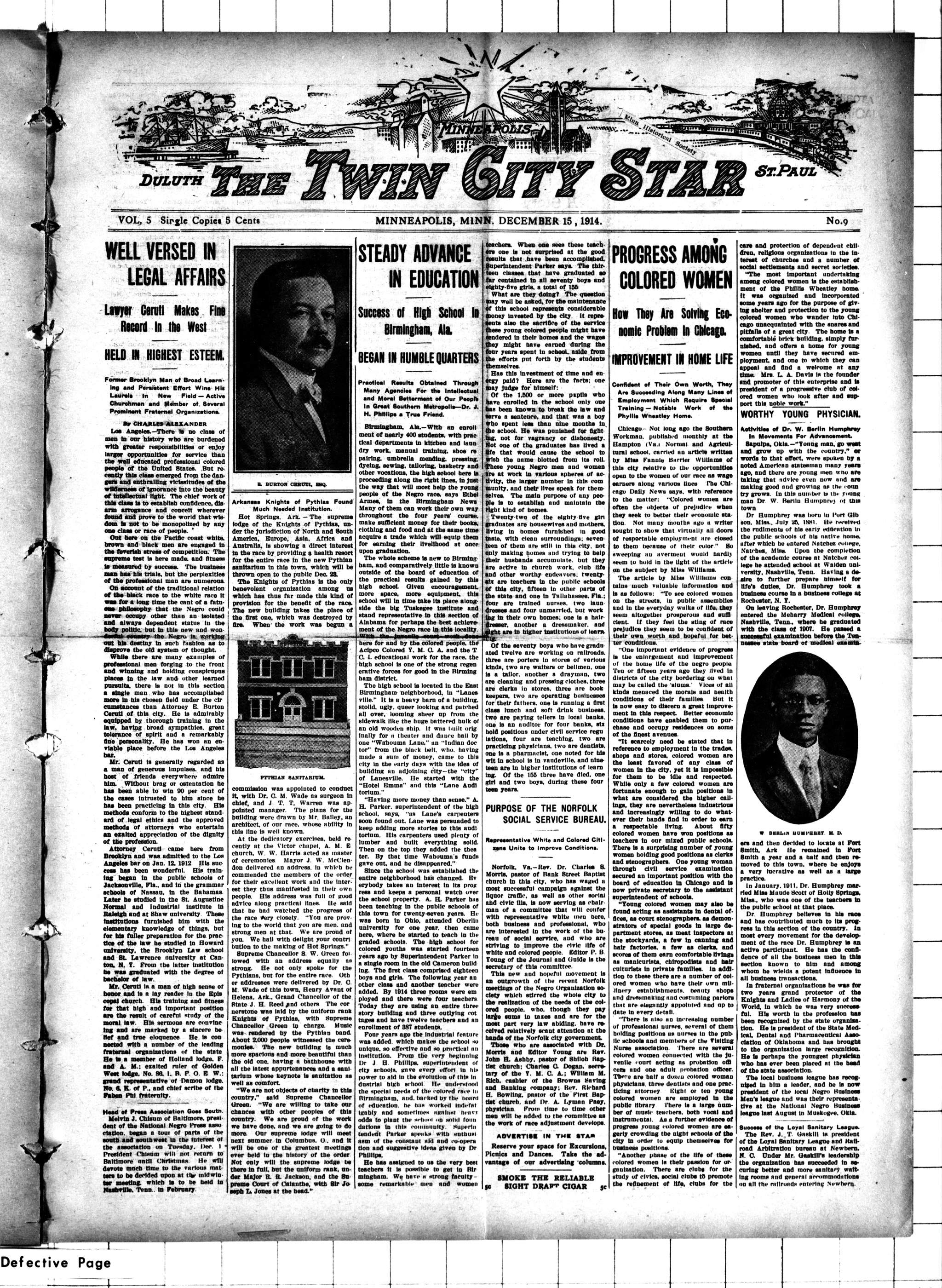
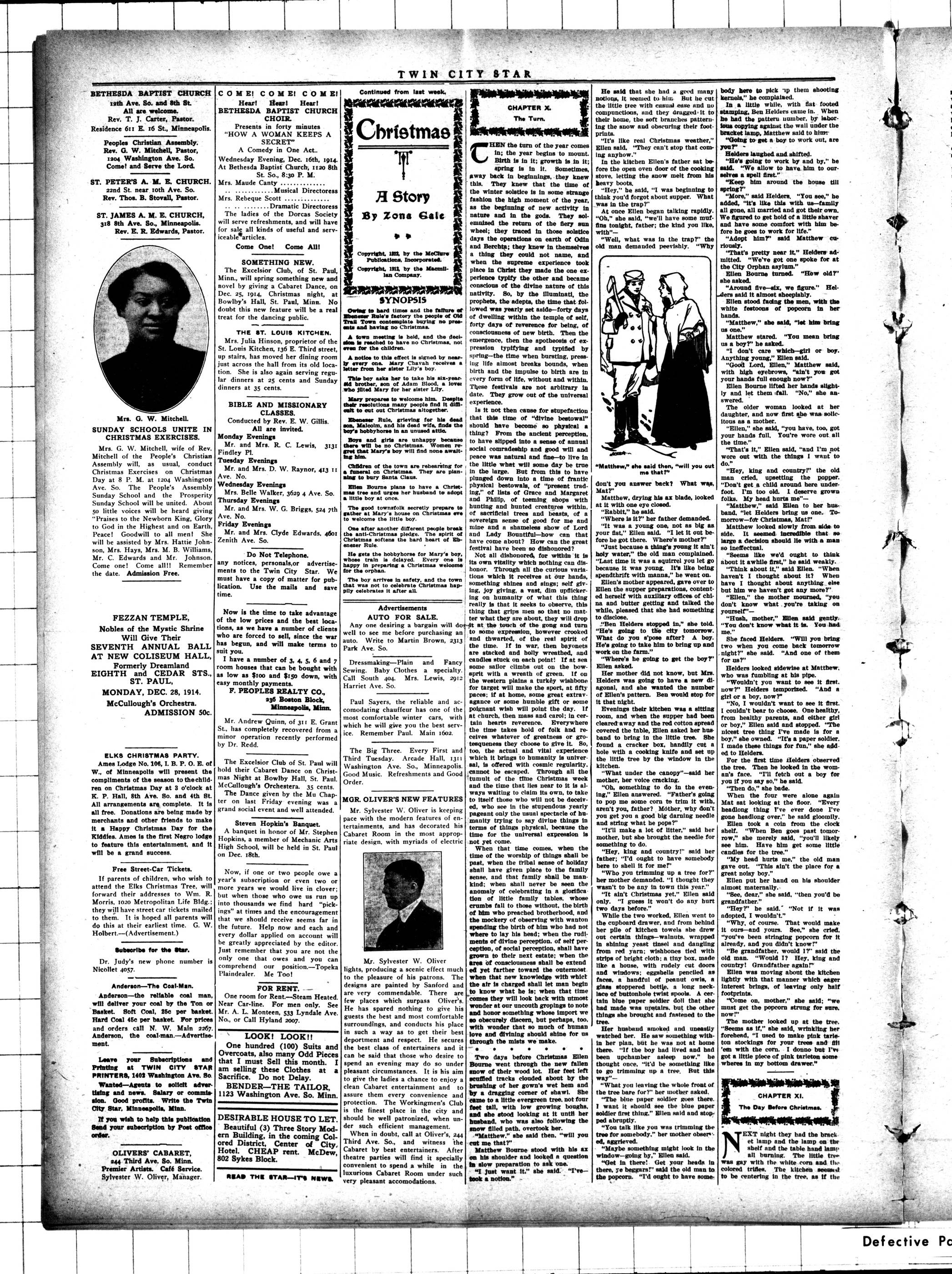
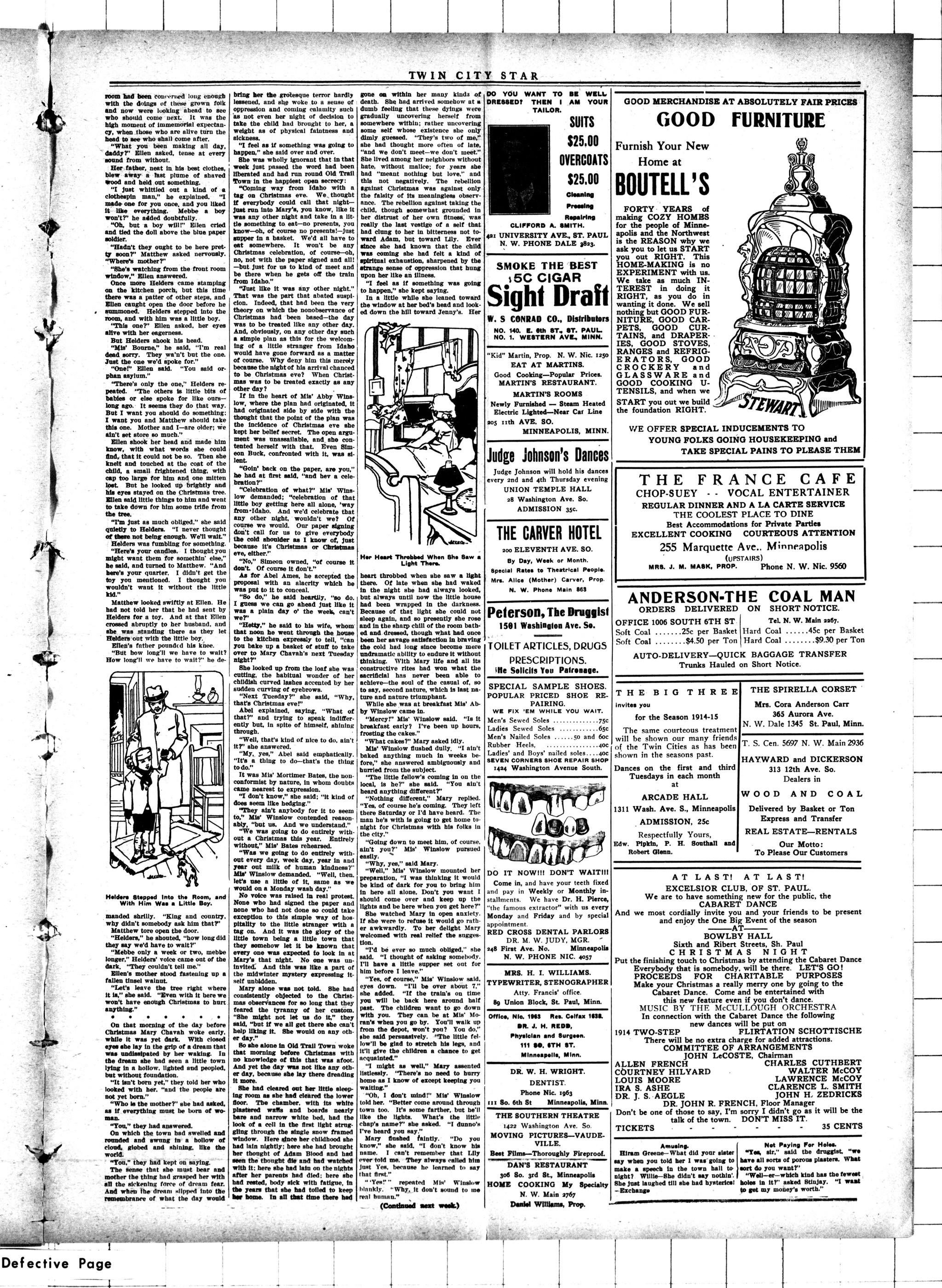
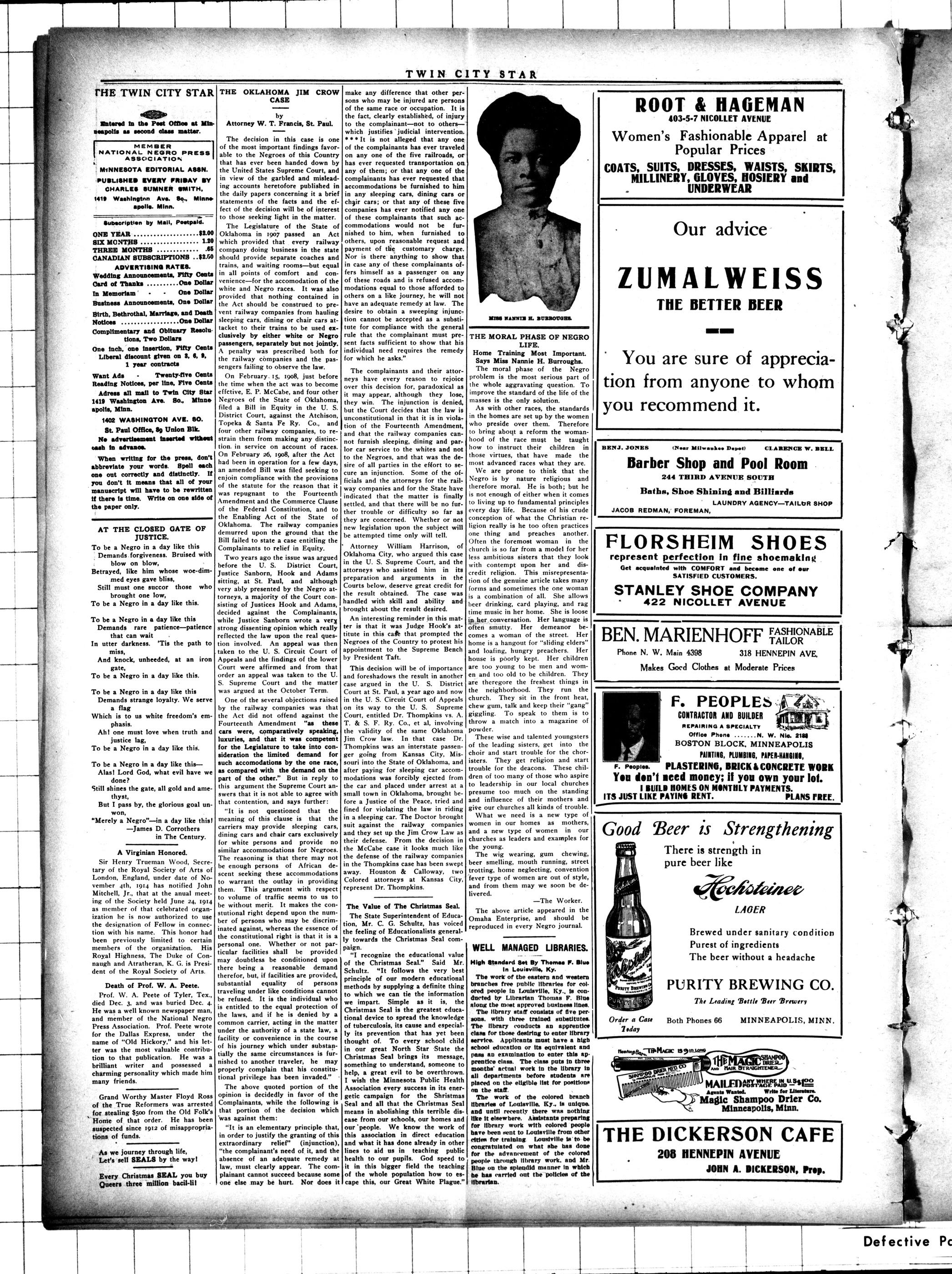
Page text (machine-generated)
MINNEAPOLIS Minn. Historical Society DULUTH THE TWIN CITY STAR ST.PAUL
Defective Page
VOL, 5 Single Copies 5 Cents
commission was appointed to conduct it, with Dr. C. M. Wade as surgeon in chief, and J. T. T. Warren was appointed manager. The plans for the building were drawn by Mr. Bailey, an architect, of our race, whose ability in this line is well known.
At the dedicatory exercises, held recently at the Victor chapel, A. M. E church, W. W. Harris acted as master of ceremonies Mayor J. W. McClendon delivered an address, in which he commended the members of the order for their excellent work and the interest they thus manifested in their own people. His address was full of good advice along practical lines. He said that he had watched the progress of the race very closely. "You are proving to the world that you are men, and strong men at that. We are proud of you. We hall with delight your contribution to the making of Hot Springs."
Supreme Chancellor S. W. Green followed with an address equally as strong. He not only spoke for the Pythlans, but for the entire race. Other addresses were delivered by Dr. C. M. Wade of this town, Henry Avant of Helena, Ark. Grand Chancellor of the State J. H. Reed and others. The cornerstone was laid by the uniform rank Knights of Pythlans, with Supreme Chancellor Green in charge. Music was rendered by the Pythlan band. About 2,000 people witnessed the ceremonies. The new building is much more spacious and more beautiful than the old one, having a bathhouse with all the latest appurtenances and a sanitarium whose keynote is sanitation as well as comfort.
"We are not objects of charity in this country," said Supreme Chancellor Green. "We are willing to take our chances with other peoples of this country. We are proud of the work we have done, and we are going to do more. Our supreme lodge will meet next summer in Columbus, O., and it will be one of the greatest meetings ever held in the history of the order. Not only will the supreme lodge be there in full, but the uniform rank, under Major R. R. Jackson, and the Supreme Court of Calanthe, with Sir Joseph L. Jones at the head."
WELL VERSED IN LEGAL AFFAIRS
Lawyer Cerutl Makes Fine Record In the West
Former Brooklyn Man of Broad Learning and Periastent Effort Wine His Laurels In New Field - Active Churchman and Member of. Several Prominent Fraternal Organizations.
By CHARLES ALEXANDER
Los Angeles.—There is no class of men in our history who are burdened with greater responsibilities or enjoy larger opportunities for service than the well educated professional colored people of the United States. But recently this class emerged from the dangers and enthralling vicissitudes of the wilderness of ignorance into the beauty of intellectual light. The chief work of this class is to establish confidence, disarm arrogance and conceit wherever found and prove to the world that wisdom is not to be monopolized by any one class or race of people.
Out here on the Pacific coast white, brown and black men are engaged in the feverish stress of competition. The supreme test is here made, and fitness is measured by success. The business man has his trials, but the perplexities of the professional man are numerous.
On account of the traditional relation of the black race to the white race it was for a long time the cant of a fatuous philosophy that the Negro could never occupy other than an isolated and always dependent status in the body politic, but in this new and wonderful country the Negro is working out his destiny in such fashion as to disprove the old system of thought.
While there are many examples of professional men forging to the front and winning and holding conspicuous places in the law and other learned pursuits, there is not in this section a single man who has accomplished more in his chosen field under the circumstances than Attorney E. Burton Ceruti of this city. He is admirably equipped by thorough training in the law, having broad sympathies, great tolerance of spirit and a remarkably fine personality. He has won an enviable place before the Los Angeles bar.
Mr. Ceruti is generally regarded as a man of generous impulses, and his host of friends everywhere admire him. Without brag or ostentation he has been able to win 90 per cent of the cases intrusted to him since he has been practicing in this city. His methods conform to the highest standard of legal ethics and the approved methods of attorneys who entertain an exalted appreciation of the dignity of the profession.
Attorney Ceruti came here from Brooklyn and was admitted to the Los Angeles bar on Jan. 12, 1912. His success has been wonderful. His training began in the public schools of Jacksonville, Fla., and in the grammar schools of Nassau, in the Bahamas. Later he studied in the St. Augustine Normal and Industrial institute in Raleigh and at Shaw university. These institutions furnished him with the elementary knowledge of things, but for his fuller preparation for the practice of the law he studied in Howard university, the Brooklyn Law school and St. Lawrence university at Canton, N. Y. From the latter institution he was graduated with the degree of bachelor of law.
Mr. Ceruti is a man of high sense of honor and is a lay reader in the Epis copal church. His training and fitness for that high and important position are the result of careful study of the moral law. His sermons are convincing and are marked by a sincere belief and true eloquence. He is connected with a number of the leading fraternal organizations of the state. He is a member of Holland lodge, F. and A. M.; exalted ruler of Golden West lodge. No. 86. I. B. P. O. E. W. grand representative of Damon lodge. No. G. K. of P., and chief scribe of the Faben Phi fraternity.
Head of Press Association Goes South.
Melvin J. Chisum of Baltimore, president of the National Negro Press association, began a tour of parts of the south and southwest in the interest of the association on Tuesday, Dec. 1 President Chisum will not return to Baltimore until Christmas. He will devote much time to the various matters to be decided upon at the midwinter meeting, which is to be held in Nashville, Tenn. in February.
J. B. H.
Arkansas Knights of Pythias Found Much Needed Institution.
Hot Springs. Ark. - The supreme lodge of the Knights of Pythias, under the jurisdiction of North and South America, Europe, Asia, Africa and Australia, is showing a direct interest in the race by providing a health resort for the entire race in the new Pythian sanitarium in this town, which will be thrown open to the public Dec. 28.
The Knights of Pythias is the only benevolent organization among us which has thus far made this kind of provision for the benefit of the race. The new building takes the place of the first one, which was destroyed by fire. When the work was begun a
PYTHIAN SANITARIUM
STEADY ADVANCE IN EDUCATION
Practical Results Obtained Through Many Agencies For the Intellectual and Moral Betterment of Our People in Great Southern Metropolis—Dr. J. H. Phillips a True Friend.
Birmingham, Ala.—With an enrollment of nearly 400 students, with practical departments in kitchen and laundry work, manual training, shoe repairing, umbrella mending, pressing, dyeing, sewing, tailoring, basketry and other vocations, the high school here is proceeding along the right lines, in just the way that will most help the young people of the Negro race, says Ethel Armes, in the Birmingham News. Many of them can work their own way throughout the four years' course, make sufficient money for their books, clothing and food and at the same time acquire a trade which will equip them for earning their livelihood at once upon graduation.
The whole scheme is new to Birmingham, and comparatively little is known outside of the practical results gained by this high school. Given encouragement, more space, more equipment, this school will in time take its place alongside the big Tuskegee institute and stand representative in this section of Alabama for perhaps the best achievement of the Negro race in this locality.
here for and by the colored people, the Acipcol Colored Y. M. C. A. and the T. C. I. educational work for the race, the high school is one of the strong regenerative forces for good in the Birmingham district.
The high school is located in the East Birmingham neighborhood, in "Lanesville." It is a heavy barn of a building, stolid, ugly, queer looking and patched all over, looming sheer up from the sidewalk like the huge battered bulk of an old wooden ship. It was built originally for a theater and dance hall by one "Wahouma Lane," an "Indian doctor" from the black belt, who having made a sum of money, came to this city in the early days with the idea of building an adjoining city—the "city" of Lanesville. He started with the "Hotel Emma" and this "Lane Audi tortorum."
"Having more money than sense," A. H. Parker, superintendent of the high school, says, "as Lane's carpenters soon found out. Lane was persuaded to keep adding more stories to this audiortium. His carpenters used plenty of lumber and built everything solid. Then on the top they added the theater. By that time Wahouma's funds gave out, and he disappeared."
Since the school was established the entire neighborhood has changed. Everybody takes an interest in its progress and keeps a personal watch over the school property. A. H. Parker has been teaching in the public schools of this town for twenty-seven years. He was born in Ohio, attended Oberlin university for one year, then came here, where he started to teach in the graded schools. The high school for colored youths was started fourteen years ago by Superintendent Parker in a single room in the old Cameron building. The first class comprised eighteen boys and girls. The following year an other class and another teacher were added. By 1914 three rooms were employed and there were four teachers. Today they are using an entire three story building and three outlying cottages and have twelve teachers and an enrollment of 387 students.
Four years ago the industrial feature was added, which makes the school so unique, so effective and so practical an institution. From the very beginning Dr J H. Phillips, superintendent of city schools, gave every effort in his power to aid in the evolution of this industrial high school. He understood the special needs of the colored race in Birmingham, and, backed by the board of education, he has worked indefinitely and sometimes against heavy odds to plant the school on solid foundations in this community. Superintendent Parker speaks with enthusiasm as of the constant aid and cooperation and suggestive ideas given by Dr Phillips.
He has assigned to us the very best teachers it is possible to get in Birmingham. We have a strong faculty—some remarkable men and women
teachers. When one sees these teachers one is not surprised at the good results that have been accomplished. Superintendent Parker says. The thirteen classes that have graduated so far contained in all seventy boys and eighty-five girls, a total of 155. What are they doing? The question may well be asked, for the maintenance of this school represents considerable money invested by the city. It represents also the sacrifice of the service these young colored people might have rendered in their homes and the wages they might have earned during the four years spent in school, aside from the efforts put forth by the students themselves.
Has this investment of time and energy paid? Here are the facts; one may judge for himself:
Of the 1,500 or more pupils who have enrolled in the school only one has been known to break the law and serve a sentence, and that was a boy who spent less than nine months in the school. He was punished for fighting, not for vagrancy or dishonesty. Not one of the graduates has lived a life that would cause the school to wish the name blotted from its roll. These young Negro men and women are at work in various spheres of activity, the larger number in this community, and their lives speak for themselves. The main purpose of any people is to establish and maintain the right kind of homes.
Twenty-two of the eighty five girl graduates are housewives and mothers, living in homes furnished in good taste, with clean surroundings; seventeen of them are still in this city, not only making homes and trying to help their husbands accumulate, but they are active in church work, club life and other worthy endeavors; twenty-six are teachers in the public schools of this city, fifteen in other parts of the state and one in Tallahassee, Fla.; four are trained nurses, two laudresses and four unmarried, but working in their own homes; one is a hairdresser, another a dressmaker, and eight are in higher institutions of learn
Of the seventy boys who have graduated twelve are working on railroads, three are porters in stores of various kinds, two are waiters or bellmen, one is a tailor, another a drayman, two are cleaning and pressing clothes, three are clerks in stores, three are book keepers, two are operating businesses for their fathers, one is running a first class lunch and soft drink business, two are paying tellers in local banks, one is an auditor for four banks, six hold positions under civil service regulations, four are teaching, two are practicing physicians, two are dentists, one is a pharmacist, one noted for his wit in school is in vaudeville, and nineteen are in higher institutions of learning. Of the 155 three have died, one girl and two boys, during these four teen years.
PURPOSE OF THE NORFOLK SOCIAL SERVICE BUREAU
Representative White and Colored Citizens Unite to Improve Conditions.
Norfolk, Va.-Rev. Dr. Charles S. Morris, pastor of Bank Street Baptist church in this city, who has waged a most successful campaign against the liquor traffic, as well as other social and civic lills, is now serving as chairman of a committee that will confer with representative white men here, both business and professional, who are interested in the work of the bureau of social service, and who are striving to improve the civic life of white and colored people. Editor P. B. Young of the Journal and Guide is the secretary of this committee.
This new and hopeful movement is an outgrowth of the recent Norfolk meetings of the Negro Organization society which stirred the whole city to the realization of the needs of the colored people, who, though they pay large sums in taxes and are for the most part very law abiding, have received relatively scant attention at the hands of the Norfolk city government.
Those who are associated with Dr. Morris and Editor Young are Rev. John H. Ashby, pastor of Shilloh Baptist church; Charles C. Dogan, secretary of the Y. M. C. A.; William M. Rich, cashier of the Browns Saving and Banking company; Rev. Richard H. Bowling, pastor of the First Baptist church, and Dr A. Lyman Paey, physician. From time to time other men will be added to the committee as the work of race adjustment develops.
ADVERTISE IN THE STAR
Reserve your space for Excursions, Picnics and Dances. Take the advantage of our advertising columns.
SMOKE THE RELIABLE
SIGHT DRAFT CIGAR
PROGRESS AMONG COLORED WOMEN
IMPROVEMENT IN HOME LIFE
Confident of Their Own Worth, They Are Succeeding Along Many Lines of Employment Which Require Special Training — Notable Work of the Phyllis Wheatley Home.
Chicago—Not long ago the Southern Workman, published monthly at the Hampton (Va.) Normal and Agricultural school, carried an article written by Miss Fannie Barrier Williams of this city relative to the opportunities open to the women of our race as wage earners along various lines. The Chicago Daily News says, with reference to the matter: "Colored women are often the objects of prejudice when they seek to better their economic station. Not many months ago a writer sought to show that virtually all doors of respectable employment are closed to them because of their color." So sweeping an averment would hardly seem to hold in the light of the article on the subject by Miss Williams.
The article by Miss Williams contains much valuable information and is as follows: "To see colored women on the streets, in public assemblies and in the everyday walks of life, they seem altogether prosperous and sufficient. If they feel the sting of race prejudice they seem to be confident of their own worth and hopeful for better conditions.
"One important evidence of progress is the enlargement and improvement of the home life of the negro people. Ten or fifteen years ago they lived in districts of the city bordering on what may be called the slums." Vices of all kinds menaced the morals and health conditions of their families. But it is now easy to discern a great improvement in this respect. Better economic conditions have enabled them to purchase and occupy residences on some of the finest avenues.
"It scarcely need be stated that in reference to employment in the trades, shops and stores, colored women are the least favored of any class of women in the city, yet it is impossible for them to be idle and respected. While only a few colored women are fortunate enough to gain positions in what are considered the higher callings, they are nevertheless industrious and increasingly willing to do whatever their hands find in order to earn a respectable living. About fifty colored women have won positions as teachers in our mixed public schools. There is a surprising number of young women holding good positions as clerks and stenographers. One young woman through civil service examination secured an important position with the board of education in Chicago and is now private secretary to the assistant superintendent of schools.
"Young colored women may also be found acting as assistants in dental offices, as court stenographers, as demonstrators of special goods in large department stores, as meat inspectors at the stockyards, a few in canning and hair factories, a few as clerks, and scores of them earn comfortable living as mancurists, chiropodists and hair culturists in private families. In addition to these there are a number of colored women who have their own military establishments, beauty shops and dressmaking and costuming parlor that are elegantly appointed and up to date in every detail.
"There is also an increasing number of professional nurses, several of them holding positions as nurses in the public schools and members of the Visiting Nurse association. There are several colored women connected with the juvenile court acting as probation officers and one adult probation officer. There are half a dozen colored woman physicians, three dentists and one practicing attorney. Eight or ten young colored women are employed in the public library. There is a large number of music teachers, both vocal and instrumental. As a further evidence of progress young colored women are eagerly crowding the night schools of the city in order to equip themselves for business positions.
"Another phase of the life of these colored women is their passion for organization. There are clubs for the study of civics, social clubs to promote the refinement of life, clubs for the
No.9
care and protection of dependent children, religious organizations in the interest of churches and a number of social settlements and secret societies. "The most important undertaking among colored women is the establishment of the Phillis Wheatley home. It was organized and incorporated some years ago for the purpose of giving shelter and protection to the young colored women who wander into Chicago unacquainted with the snare and pitfalls of a great city. The home is a comfortable brick building, simply furnished, and offers a home for young women until they have secured employment, and one to which they can appeal and find a welcome at any time. Mrs L. A. Davis is the founder and promoter of this enterprise and is president of a progressive club of colored women who look after and support this noble work."
WORTHY YOUNG PHYSICIAN.
Activities of Dr. W. Berlin Humphrey In Movements For Advancement.
Sapulpa, Oklahoma. "Young man, go west and grow up with the country," or words to that effect, were spoken by a noted American statesman many years ago, and there are young men who are taking that advice even now and are making good and growing as the country grows. In this number is the young man Dr. W. Berlin Humphrey of this town
Dr Humphrey was born in Port Gibbon Son, Miss., July 25, 1881. He received the rudiments of his early education in the public schools of his native home, after which he entered Natchez college, Natchez, Miss. Upon the completion of the academic course at Natchez college he attended school at Walden university, Nashville, Tenn. Having a desire to further prepare himself for life's duties, Dr. Humphrey took a business course in a business college at Rochester, N. Y.
On leaving Rochester, Dr. Humphrey entered the Meharry Medical college, Nashville, Tenn., where he graduated with the class of 1907. He passed a successful examination before the Tennessee state board of examiners.
W BERLIN HUMPHREY, M. D.
ers and then decided to locate at Fort
Smith, Ark. He remained in Fort
Smith a year and a half and then re-
moved to this town, where he enjoys
a very lucrative as well as a large
practice.
In January, 1911, Dr. Humphrey mar-
ried Miss Maude Scott of Holly Springs.
Miss., who was one of the teachers in
the public school at that place.
Dr. Humphrey believes in his race and has contributed much to its progress in this section of the country. In most every movement for the development of the race Dr. Humphrey is an active participant. He has the confidence of all the business men in this section known to him and among whom he wields a potent influence in all business transactions.
In fraternal organizations he was for two years grand protector of the Knights and Ladies of Harmony of the World, in which he was very successful. His worth in the profession has been recognized by the state organization. He is president of the State Medical, Dental and Pharmaceutical Association of Oklahoma and has brought to the organization large recognition. He is perhaps the youngest physician who has ever been placed at the head of the state association.
The local business league has recognized in him a leader, and he is now president of the local Negro Business Men's league and was their representative at the National Negro Business league last August in Muskogee, Okla.
Success of the Loyal Sanitary League. The Rev. J., T. Gaskill is president of the Loyal Sanitary League and Railroad Arbitration bureau at Newbern, M. C. Under Mr. Gaskill's leadership the organization has succeeded in securing better and more sanitary waiting rooms and general accommodations on all the railroads entering Newbern.
} of PF Ff ee
- BETHESDA BAPTIST CHURCH
rath Ave. So. and 8th St.
All are welcome.
Rev. T. J. Carter, Pastor.
Residence 611 E. 16 St, Minneapolis.
Peoples Christian Assembly.
Rev. G, W. Mitchell, Pastor,
1204 Washington Ave. So.
Come! and Serve the Lord.
ST. PETER'S A. M. E. CHURCH.
zand St. near roth Ave. So.
Rev. Thos. B. Stovall, Pastor.
ST. JAMES A. M. E. CHURCH,
318 &th Ave. So, Minneapolis.
Rev. E. R. Edwards, Pastor.
Pe
Pier,
lias post
eas ie a *
‘a y
VN
N
‘ if
Mrs. G. W. Mitchell.
SUNDAY SCHOOLS UNITE IN
CHRISTMAS EXERCISES.
Mrs. G. W. Mitchell, wife of Rev.
Mitchell of the People’s Christian
Assembly will, as usual, conduct
Christmas Exercises on Christmas
Day at 8 P. M. at 1204 Washington
Ave. So. The People’s Assembly
Sunday School and the Prosperity
Sunday School will be united. About
50 little voices will be heard giving
“Praises to the Newborn King, Glory
to God in the Highest and on Earth,
Peace! Goodwill to all men! She
will be assisted by Mrs. Hattie John-
son, Mrs. Hays, Mrs. M. B. Williams,
Mr. C. Edwards and Mr. Johnson.
Come one! Come alll! Remember
the date. Admission Free.
FEZZAN TEMPLE,
Nobles of the Mystic Shrine
Will Give Their
SEVENTH ANNUAL BALL
AT NEW COLISEUM HALL,
Formerly Dreamland
EIGHTH and CEDAR STS,
ST. PAUL,
MONDAY, DEC. 28, 1914.
McCullough’s Orchestra.
ADMISSION 50c.
ELKS CHRISTMAS PARTY.
Ames Lodge No. 106, I. B. P. 0. E. of
'W., of Minneapolis will present the
compliments of the season to thechild-
ren on Christmas Day at 3 o'clock at
K. P. Hall, 8th Ave. So. and 4th St.
All arrangements are complete. It is
all free. Donations are being made by
merchants and other friends to make
it = Happy Christmas Day for the
Riddfes. Ames fs the first Negro lodge
to feature this entertainment, and it
wil be a grand success.
Free Street-Car Tickets,
If parents of children, who wish to
attend the Elks Christmas Tree, will
forward their addresses to Wm. R.
Morris, 1020 Metropolitan Life Bldg.;
they will have street car tickets mailed
to them. It is hoped all parents will
do this at their earliest time. G. W.
Holbert.—(Advertisement.)
Subseribe for the Star.
Dr. Judy's new phone number is
Nicollet 4057.
pndesten—The Gealtien,
Anderson—the reliable coal man,
will deliver your coal by the Ton or
Basket. Soft Coal, 25¢ per basket.
Hard Coal 45¢ per basket. For prices
and orders call N. W. Main 2267.
Anderson, the coal-man.—Advertise-
ment.
Leave your Subscriptions and
Printing at TWIN CITY STAR
PRINTERS, 1403 Washington Ave. So.
‘Wanted—Agents to solicit adver.
ising and news. Salary or commis
sion. Good profits. Write the Twin
City Star, Minneapolis, Minn.
If you wish to help this publication
Send your subscription by Post office
onder.
OLIVERS’ CABARET,
244 Third Ave. So. Minn.
Premier Artists. Café Service.
Sylvester W. Oliver, Manager.
COME! COME! COME!
Hear! Hear! Hear!
BETHESDA BAPTIST CHURCH
CHOIR,
Presents in forty minutes
“HOW A WOMAN KEEPS A
SECRET”
A Comedy in One Aet..
Wednesday Evening, Dec. 16th, 1914.
At Bethesda Baptist Church, 1120 8th
St. So., 8:30 P. M.
Mrs, Maude Canty ......ees+e005
to ssseesseess+Musical Directoress
Mrs. Rebeque Scott .....:...60006
se ss ssssseesDramatic Directoress
The ladies of the Dorcas Society
will serve refreshments, and will have
for salg all kinds of useful and serv-
iceable“articles.
Come One! Come All!
SOMETHING NEW.
The Excelsior Club, of St. Paul,
Minn., will spring something new and
novel by giving a Cabaret Dance, on
Dec. 25, 1914, Christmas night, at
Bowlby's Hall, St. Paul, Minn. No
doubt this new feature will be a real
treat for the dancing public.
THE 8ST. LOUIS KITCHEN.
__ Mrs. Julia Hinson, proprietor of the
‘St. Louis Kitchen, 136 E. Third street,
up stairs, has moved her dining room
just across the hall from its old loca-
tion. She is also again serving regu-
lar dinners at 25 cents and Sunday
dinners at 35 cents.
Sa
BIBLE AND MISSIONARY
CLASSES,
Conducted by Rev. E. W. Gillis,
All are invited.
Monday Evenings
Mr. and Mrs. R. C. Lewis, 3131
Findley Pt.
‘Tuesday Evenings
Mr. and Mrs. D. W. Raynor, 413 11
Ave. No.
Wednesday Evenings
Mrs. Belle Walker, 3629 4 Ave. So.
‘Thursday Evenings
Mr. and Mrs. W. G. Briggs, 524 7th
‘Ave. No.
‘Friday Evenings
‘Mr. and Mrs. Clyde Edwards, 4601
Zenith Ave. So.
Do Not Telephone.
any notices, personals,or advertise-
ments to the Twin City Star. We
must have a copy of matter for pub-
lication, Use the mails and save
time.
__Now is the time to take advantage
of the low prices and the best loca-
tions, as we have a number of clients
ew are forced to sell, since the war
has begun, and will make terms to
suit you.
_ Thave a number of 3, 4, 5, 6 and 7
room houses that can be bought with
as low as $100 and $1s0 down, with
easy monthly payments.
F, PEOPLES REALTY CO,
236 Boston Block,
Minneapolis, Minn.
Mr. Andrew Quinn, of grr E. Grant
St., has completely recovered from a
minor operation recently performed
by Dr. Redd.
The Excelsior Club of St. Paul will
hold their Cabaret Dance on Christ-
mas Night at Bowlby Hall, St. Paul.
McCullough’s Orchestera. 35 cents.
The Dance given by the Mu Chap-
ter on last Friday evening was a
grand social event and well attended.
Steven Hopkin’s Banquet.
A banquet in honor of Mr. Stephen
Hopkins, a member of Mechanic Arts
High School, will be held in St. Paul
on Dec. 18th.
Now, if one or two people owe a
year’s subscription or even two or
more years we would live in clover;
but when those who owe us run up
into thousands we find hard “pick-
ings” at tines and the encouragement
that we should receive seems far in
the future. Help now and each and
every dollar applied on account will
be greatly appreciated by the editor.
Just remember that you are not the
only one that owes and you can
comprehend our _position—Topeka
Plaindealer, Me Too!
FOR RENT. -—
One room for Rent.—Steam Heated.
Near Car-line. For men only. See
Mr. A. L, Monteen, 533 Lyndale Ave.
No, or Call Hyland 2007.
—__—______
. LOOK! LOOK!!
One hundred (100) Suits and
Overcoats, also many Odd Pieces
that I must Sell this month. I
am selling these Clothes at a
Sacrifice. Do not Delay.
BENDER—THE TAILOR,
1123 Washington Ave. So. Minn.
DESIRABLE HOUSE TO LET.
Beautiful (3) Three Story Mod-
ern Building, in the coming Col-
ored District, Center of City.
Hotel. CHEAP rent. McDew,
802 Sykes Block.
ae
READ THE STAR—iTS News,
TWIN CITY STAR
$$$
Continued from last week,
een x CHAPTI
’ E The T
S
¥ Christmas & .
x FF HEN the turn
i in; the year
: é C Birth fs in 4
5 i spring ts tr
a away back in begin
5 BE | this. They knew |
Xe | the winter solstice i
© AL Story BBY sation tne tigh mc
[$ | as the beginning of
By Zona Gale {| meture ant in the
emnized the return
“4 wheel; they traced
\ “* JS | cays the operations
¥ fy | and Berehta; they in
By Copyright, 192, by the MeCture a thing they could
Publications, Incorporate. 4&| when the supreme
BY Copyright, 181%, by the Macmil- fassa ts ‘Cece tap
4 pocamueat SS | perience typity the
$s epg} | conscious of the div’
ARARARARARARAMAM | otivity. So. by
SYNOPSIS Pon a a Rg
Owing to bard times and the fatfure of
Boeneser Rule's factory the people of Old
‘Trail Town contemplate buying no pres-
eats and beving no Christmas.
A town meeting is held, and the deci.
stom fe reached to have no Christmas, not
even for the children.
A notice to this effect is signed by near-
ly every one. Mary Chavah receives a
letter from her aister Lily's boy.
‘Thie boy asks her to take his six-year
4 brother, son of Adam Blood, a lover
who jitted Mary for her sister Lily.
‘Mary prepares to welcome him. Despite
thelr resolutions many people find tt difi-
ult to cut out Christmas altogether.
‘Ebenezer Rule, grieving for his dead
son, Malcolm, and his dead wife, finds the
Boy's hobbyhorse in an unused attic.
Boys and girls are unhappy because
there will be no Christmas. Women re-
gret that Mary's boy will find none await-
ing him.
Children of the town are rebearsing for
@ funeral on Christmas. They are plan-
ming to bury Santa Claus.
Ellen Bourne plans to have a Christ-
mas tree and urges her husband te adopt
fa Iittle boy at once.
‘The good townsfolk secretly prepare to
gather at Mary's house on Christmas eve
to welcome the little boy.
‘One after another different peuple break
the anti-Christmas pledge. The spirit of
Christmas softens the bard heart of Eb-
enezer Rule. .
He gets the hobbyhorse for Mary's boy,
whose train is delayed. Every one is
happy in preparing # Christmas welcome
for the orphan.
‘The boy arrives in safety, and the town
that was not to celebrate Christmas hap-
pily celebrates it after all.
Advertisements
AUTO FOR SALE.
Any one desiring a bargain will do
well to see me before purchasing an
auto. Write to Martin Brown, 2313
Park Ave. So.
Dressmaking—Plain and Fancy
Sewing. Baby Clothes a specialty.
Call South 404. Mrs. Lewis, 2912
Harriet Ave. So.
Paul Sayers, the reliable and ac-
comodating chauffeur has one of the
‘most comfortable winter cars, with
which he will give you the best serv-
ice. Remember Paul. Main 1602.
the Big Three. Every First and
Third Tuesday. Arcade Hall, 1311
‘Washington Ave. So. Minneapolis.
Good Music. Refreshments and Good
‘Order.
———
MGR. OLIVER'S NEW FEATURES
Mr. Sylvester W. Oliver is keeping
pace with the modern features of en-
tertainments, and has decorated his
Cabaret Room in the most approp-
riate design, with myriads of electric
os
icc =
eae
kee,
hy
ae
My. sylvester W. Uliver
lights, producing a scenic effect much
‘to the pleasure of his patrons. The
designs are painted by Sanford and
are very commendable. There are
few places which surpass Oliver's.
He has spared nothing to give his
guests the best and most comfortable
surroundings, and conducts his place
‘in such a way as to get their best
deportment and respect. He secures
the best class of entertainers and it
‘can be said that those who desire to
spend an evening may do so under
pleasant circumstances. It is his aim
to give the ladies a chance to enjoy a
clean Cabaret entertainment and to
assure them every convenience and
protection. The Workingmen’s Club
is the finest place in the city and
should be well patronized, when un-
der such efficient management.
When in doubt, call at Oliver's, 244
Third Ave. So, and witness the
Cabaret by best entertainers. After
theatre parties will find it specially
convenient to spend a while in the
luxurious Cabaret Room under such
very pleasant accomodations.
CHAPTER X.
‘The Turn.
Oe eee ae gee ee ene
this. They knew that the time of
the winter solstice is in some strange
fashion the high moment of the year,
as the beginning of new activity in
nature and in the gods. They sol-
emnized the return of the flery sun
wheel; they traced in those solstice
days the operations on earth of Odin
and Berehta; they knew in themselves
a thing they could not name, and
when the supreme experience took
place in Christ they made the one ex-
perience typify the other and became
conscious of the divine nature of this
nativity. So, by the illuminati, the
prophets, the adepts, the time that fol-
lowed was yearly set aside—forty days
of dwelling within the temple of self,
forty days of reverence for being, of
consciousness of new birth. ‘Then the
emergence, then the apotheosis of ex-
pression typifying and typified by
spring—the time when bursting, press-
Ing Ife almost breaks bounds, when
birth and the impulse to birth are in
every form of life, without and within,
‘These festivals are not arbitrary in
date. They grow out of the universal
experience.
Is tt not then cause for stupefaction
that this time of “divine bestowal”
should have become so physical a
thing? From the ancient perception,
to have slipped into a sense of annual
social comradeship and good will and
peace was natural and fine—to live in
the Uttle what will some day be true
in the large. But from this to have
plunged down into a time of frantic
physical bestowals, of “present trad-
ing,” of lists of Grace and Margaret
and Philip, of teeming shops with
hunting and bunted creatures within,
of sacrificial trees and beasts, of a
sovereign sense of good for me and
mine and a shameless show of Lord
and Lady Bountiful—how can that
have come about? How can the great
festival have been so dishonored?
Not all dishonored, for within it is
its own vitality which nothing can dis-
honor. ‘Through all the curious varia-
tions which it receives at dur hands,
something shines and sings; self giv-
ing, Joy giving, a vast, dim upficker-
ing on humanity of what this thing
really is that it seeks to observe, this
thing that grips men so that no mat-
ter what they are about, they will drop
dt at the touch of the gong and turn
to some expression, however crooked
and thwarted, of the real spirit of
the time. If'tn war, then bayonets
are stacked and holly wreathed, and
candles stuck on each point! If at sea
some sailor climbs out on the bow-
sprit with a wreath of green. If on
the western plains a turkéy wishbone
for target will make the sport, at fifty
paces; if at home, some great extrav-
‘Agance or some humble gift or some
poignant wish will point the day. If
at church, then mass and carol; in cer-
tain hearts reverence. Everywhere
the time takes hold of folk and re-
ceives whatever of greatness or gro-
tesqueness they choose to give it. So,
too, the actual and vital experience
which it brings to humanity is untver-
sal, is offered with cosmic regularity.
eannot be escaped. Through all the
‘tumult of the time Christmas week
and the time that lies near to it 1s al-
ways waiting to claim its own, to take
to itself those who will not be decetv-
ed, who see in the stupendous yearly
Pageant only the usual spectacle of bu-
‘manity trying to say divine things in
terms of things physical, because the
time for the universal expression is
not yet come.
When that time comes, when the
time of the worship of things shall be
ast, when the fribal sense of holiday
shall have given place to the family
‘sense, and that family shall be man-
kind; when shall never be seen the
anomaly of celebrating in a glorifica
tion of little family tables, whose
crumbs fall to those without, the birth
of him who preached brotherhood, and
the mockery of observing with wanton
spending the birth of him who had not
‘where to lay his head; when the rudi-
ments of divine perception. of self per-
ception, of soctal perception, shall have
grown to their next estate; when the
area of consciousness shall be extend
ed yet farther toward the outermost.
‘when that new knowledge with whict
the afr is charged shall let man begin
to know what he is; when that time
‘comes they will look back with utmost
‘wonder at our uncouth gropings to note
‘and honor something whose import we
#0 obscurely discern, but perhaps, too,
with wonder that so much of human
love and divining should shine for us
through the mists we make.
“ee 8 © © © © 8
‘Two days before Christmas Hille
Bourne went through the new fallen
snow of thelr wood lot. Her feet left
seuffled tracks clouded about by the
brushing of her gown's wet hem and
‘by a dragging corner of shawl. She
‘came to a little evergreen tree, not four
feet tall, with low growing boughs,
‘and she stood looking at it unti! her
husband, who was also following the
ee ae eee
|
He said that she had « geed many
notions, it seemed to him But he cut
the little tree with cusual ease and no
compunctions, and they dragged: It to
thelr home, the soft branches pattern-
ing the snow and obscuring their foot-
prints.
“It’s like real Christmas weather,”
Ellen said, “They can't stop that com-
Ing anyhow.”
In the kitchen Ellen's father sat be-
fore the open oven door of the cooking
stove, letting the snow melt from his
heavy boots,
“Hey,” be said, “I was beginning to
think you'd forgot about supper. What
was in the trap?”
At once Ellen began talking rapidly.
“Ob,” she sald, “we'll have some mut-
fing tonight, father; the kind you like,
with”—
“Well, what was in the trap?” the
old man demanded peevishly. “Why
7
m : : :
don't you answer back? What was,
Mat?”
‘Matthow, drying his ax blade, looked
at it with one eye closed.
“Rabbit,” he said.
“Where is it?” her father demanded.
“Tt was a young one, not as big as
your fist,” Hilen sald. “I let it out be-
fore he got there. Where’s mother?”
“Just because a thing’s young it ain't
holy water,” the old man complained.
“Last time it was a squirrel you let go
decause it was young. It's like being
spendthrift with manna,” he went on.
Bllen’s mother appeared, gave over to
Bilen the supper preparations, content.
ed herself with auxiliary offices of chi-
na and butter getting and talked the
while, pleased that she had something
to disclose.
{Ben Helders stopped in,” she told.
“He's going to the city tomorrow.
What do you s'pose after? A boy.
He's going to take him to bring up and
work on the farm.”
“Where's he going to get the boy?”
Ellen asked.
Her mother did not know, but Mrs.
Helders was going to have a new dt.
agonal, and she wanted the number
of Ellen’s pattern. Ben would stop for
it that night.
‘Evenings thelr kitchen was a sitting
room, and when the supper had been
cleared-away and the red cotton spread
covered the table, Hllen asked her hus
band to bring in the little tree. She
found a cracker box, handily cut a
hole wtih a cooking knife and set up
the lttle tree by the window in the
kitchen.
“What under the canopy”—said her
mother, her voice cracking.
“Ob, something to do in the even:
ing,” Ellen answered. “Father's going
to pop me some corn to trim it with,
aren't you, father? Mother, why don't
you get you a good big darning needle
and string what he pops?”
“It'll make a lot of litter,” sald her
mother, but she brought the needle for
something to do.
“Hey, king and country!” said her
father; “I'd ought to have somebody
here to shell it for met”
“Who you trimming up a tree for?”
her mother demanded. “I thought they
"wasn't to be any in town this year.”
“It ain't Christmas yet,” Ellen said
j only. “I guess it won’t do any burt
two days before.”
While the two worked, Bilen went to
the cupboard drawer, and from behind
her pile of kitchen towels she drew
out certain things—walnuts, wrapped
in shining yeast tinsel and dangling
from red yarn; wishbones tied with
strips of bright cloth: a tiny box, made
Wke a house, with rudely cut doors
and windows; eggshells penciled as
faces, a handful of peanut owls, 2
glass stoppered bottle, a long neck
lace of buttonhole twist spools. A cer
tain blue paper soldier doll that she
had made was upstairs. but the other
| things she brought and fastened to the
tree.
Her husband smoked and uneastly
watehed her. He saw something with-
in her plan, but he was not at home
there. “If the boy had lived and bad
been upchamber asleep now.” he
thought once, “it'd be something lke
to go trimming up a tree, But this
way”—
“What you leaving the whole front of
the tree bare for?” her mother asked,
“The biue paper soldier gves there
I want it should see the blue paper
soldier first thing,” Hllen said and stop:
Ded abruptly.
“You talk iike you was trimming tbe
tree for somebody.” her mother obser:
ed, aggrieved.
“Maybe something might look in the
window—going by,” Hillen said.
“Get in there! Get your heads In
there, ye beggars!” said the old man to
the popcorn. “I'd ought to have some-
Se ere te ren ee enn ee ao ee
he had the patteru uumber, by labor-
fous copying against the wall under the
bracket lamp, Matthew sald to bin:
“Going to get a boy to work out, are
you?” ~
Helders laughed and shifted.
“He's going to work by and by,” he
said. “We allow to have him to our-
selves a spell first.”
“Keep him around the house till
spring?”
“More,” said Helders, “You see,” be
added, “it's like this with us—tamily
all gone, all married and got thelr own.
We figured to get hold of a little shaver
and have some comfort with him be-
fore he goes to work for life.”
“Adopt him?’ said Matthew ca
riously.
“That's pretty near it,” Helders ad-
mitted. “We've got one spoke for at
the City Orphan asylum.”
Bilen Bourne turned. “How old?”
she asked.
“Around five—six, we figure.” Hel-
rs said it almost sheepishly.
Hllen stood facing the men, with the
white festoons of popcorn in her
bands.
“Matthew,” she said, “let him bring
tus one.”
Matthew stared. “You mean bring
us a boy?” he asked.
“I don't care whicb—girl or boy.
Anything young,” Ellen said.
“Good Lord, Bilen,” Matthew said,
with high eyebrows, “ain't you got
your hands full enough now?"
Ellen Bourne lifted her hands slight-
ly and let them :fall. “No,” she an-
swered.
‘The older woman looked at her
daughter, and now first she was solic-
{tous as a mother.
“Bien,” she said, “you have, too, got
your hands full, You're wore out. all
the time.”
“That's it,” Ellen said, “and I'm not
wore out with the things I want to
do.”
“Hey, king and country!” the old
man cried, upsetting the popper.
“Don’t get @ child around here under-
foot. I'm too old. I deserve grown
folks, My head hurts me"—
“Matthew,” sald Hllen to ber bus:
band, “let Helders bring us one. To-
morrow—for Christmas, Mat!”
Matthew looked slowly from side to
side. It seemed. ineredible that so
large a decision should He with a man
50 ineffectual.
“Seems lke we'd ought to think
about it awhile first,” he said weakly.
“Think about it,” said Ellen. “When
haven't I thought about it? When
have I thought about anything else
but him we haven't got any more?”
“Bllen,” the mother mourned, “you
don't know what .you're taking on
yourself”—
“Hush, mother,” Hilen said gently:
“You don't know what tt is. You had
me.”
She faced Helder. “Will you bring
two when you come back tomorrow
-night?” she said. “And one of them
tor us?”
Helders looked sidewise at Matthew,
who was fumbling at his pipe.
“Wouldn't you want to seo it first.
now?” Helders temporized. “And
girl or a boy, now?”
“No, I wouldn't want to see it first.
I couldn't bear to choose. One healthy,
from healthy parents, and elther girl
or boy,” Bilen sald and stopped. “The
nicest tree thing I've made is for a
boy,” she owned. “It’s a paper soldier.
T made these things for fan,” she add-
ed to elders.
For the first time elders observed
the tree. Then he looked in the wom-
an’s face. “I'll fetch out a boy for
you if you say so,” he said.
“Then do,” she bade.
‘When the four were alone again
Mat sat looking at the floor. “Every
headlong thing T've ever done I've
gone headlong over,” he sald gloomily.
Bllen took a coin from the clock
shelf. “When Ben goes past tomor-
row,” she merely said, “you'll likely
see him. Have him get some little
candles for the tree.”
“My bead hurts me,” the old man
gave out. “This ain't the place for
great nolsy boy.”
Bllen put her hand on his shoulder
almost maternally.
“Bee, dear,” she said, “then you'd be
grandfather.”
“Hey?” he said.” “Not if it was
adopted, I wouldn't.”
“Why, of course. That would make
it ours—and yours. See,” she cried,
“you've been stringing popcorn for it
already, and you didn’t know!”
“Be grandfather, would 1?" said the
old man. “Would 1? Hey, king and
country! Grandfather again!”
Ellen was moving about the kitchen
lightly with that manner which eager
interest brings, of leaving only half
footprints.
“Come on, mother,” she said; “we
must get the popcorn strung for sure,
now!”
‘The mother looked up at the tree.
“Seems as if,” she said, wrinkling her
forehend, “I used to make pink tarle-
ton stockings for your trees and fill
Yem with the corn. I donno but I've
got a little piece of pink tarleton some
wheres in war beitem @rawer™
:
'
CHAPTER XI.
‘The Day Before Christmas.
EXT night they bad the brack
et lamp and the lamp on the
shelf and the table hand lamy
all burning. ‘The little tree
was gay with the white corn and the
colored trifles. The kitchen seeund
to be centering in the tree, as if the
Defective Page
room had been concerned long enough with the doings of these grown folk and now were looking ahead to see who should come next. It was the high moment of immemorial expectancy, when those who are alive turn the head to see who shall come after.
"What you been making all day, daddy?" Ellen asked, tense at every sound from without.
Her father, neat in his best clothes, blew away a hast plume of shaved wood and held out something.
"I just whittled out a kind of a clothespin man," he explained.
"I made one for you once, and you liked it like everything. Mebbe a boy won't?" he added doubtfully.
"Oh, but a boy will!" Ellen cried and tied the doll above the blue paper soldier.
"Hadn't they ought to be here pretty soon?" Matthew asked nervously.
"Where's mother?"
"She's watching from the front room window," Ellen answered.
Once more Helders came stamping on the kitchen porch, but this time there was a patter of other steps, and Ellen caught open the door before he summoned. Helders stepped into the room, and with him was a little boy.
"This one?" Ellen asked, her eyes alive with her eagerness.
But Helders shook his head.
"Mis' Bourne," he said, "I'm real dead sorry. They wasn't but the one. Just the one we'd spoke for."
"One!" Ellen said. "You said orphan asylum."
"There's only the one," Helders repeated.
"The others is little bits of babies or else spoke for like ours—long ago. It seems they do that way. But I want you should do something: I want you and Matthew should take this one. Mother and I—are older; we ain't set store so much."
Ellen shook her head and made him know, with what words she could find, that it could not be so. Then she knelt and touched at the coat of the child, a small frightened thing, with cap too large for him and one mitten lost. But he looked up brightly and his eyes stayed on the Christmas tree. Ellen said little things to him and went to take down for him some trifle from the tree.
"I'm just as much obliged," she said quietly to Holders. "I never thought of these not being enough. We'll wait."
Helders was fumbling for something. "Here's your candies. I thought you might want them for somethin' else," he said, and turned to Matthew. "And here's your quarter. I didn't get the toy you mentioned. I thought you wouldn't want it without the little kid."
Matthew looked swiftly at Ellen. He had not told her that he had sent by Helders for a toy. And at that Ellen crossed abruptly to her husband, and she was standing there as they let Helders out with the little boy. Ellen's father pounded his knee. "But how long'll we have to wait? How long'll we have to wait?" he de-
daxoto...
Helders Stepped Into the Room, and With Him Was a Little Boy.
manded shrilly. "King and country, why didn't somebody ask him that?"
Matthew tore open the door.
"Helders," he shouted, "how long did they say we'd have to wait?"
"Mebbe only a week or two, mebbe longer." Helders' voice came out of the dark. "They couldn't tell me."
Ellen's mother stood fastening up a fallen tinsel walnut.
"Let's leave the tree right where it is," she said. "Even with it here we won't have enough Christmas to hurt anything."
On that morning of the day before Christmas Mary Chavah woke early, while it was yet dark. With closed eyes she lay in the grip of a dream that was undissipated by her waking. In the dream she had seen a little town lying in a hollow, lighted and peopled, but without foundation.
"It isn't born yet," they told her who looked with her. "and the people are not yet born."
"Who is the mother?" she had asked, as if everything must be born of woman.
"You" they had answered.
"You," they had answered.
On which the town had swelled and rounded and swung in a hollow of cloud, globed and shining, like the world.
"You," they had kept on saying.
The sense that she must bear and mother the thing had grasped her with all the sickening force of dream fear. And when the dream slipped into the remembrance of what the day would
bring her the grotesque terror hardly lessened, and she woke to a sense of oppression and coming calamity such as not even her night of decision to take the child had brought to her, a weight as of physical faintness and sickness.
"I feel as if something was going to happen," she said over and over.
She was wholly ignorant that in that week just passed the word had been liberated and had run round Old Trail Town in the happiest open secrecy:
"Coming way from Idaho with a tag on Christmas eve. We thought if everybody could call that night—just run into Mary's, you know, like it was any other night and take in a little something to eat—no presents, you know—oh, of course no presents!—just supper in a basket. We'd all have to eat somewhere. It won't be any Christmas celebration, of course—oh, no, not with the paper signed and all!—but just for us to kind of meet and be there when he gets off the train from Idaho."
"Just like it was any other night." That was the part that abated suspicion. Indeed, that had been the very theory on which the nonobscurrence of Christmas had been based—the day was to be treated like any other day. And, obviously, on any other day such a simple plan as this for the welcoming of a little stranger from Idaho would have gone forward as a matter of course. Why deny him this merely because the night of his arrival chanced to be Christmas eve? When Christmas was to be treated exactly as any other day? If in the heart of Mis' Abby Winslow, where the plan had originated, it had originated side by side with the thought that the point of the plan was the incidence of Christmas eve she kept her belief secret. The open argument was unassailable, and she contented herself with that. Even Simon Buck, confronted with it, was silent.
"Goin' back on the paper, are you," he had at first said, "and hev a celebration?"
"Celebration of what?" Mis' Winslow demanded; "celebration of that little boy getting here all alone, 'way from-Idaho. And we'd celebrate that any other night, wouldn't we? Of course we would. Our paper signing don't call for us to give everybody the cold shoulder as I know of, just because it's Christmas or Christmas eve, either."
"No," Simeon owned, "of course it don't. Of course it don't."
As for Abel Ames, he accepted the proposal with an alacrity which he was put to it to conceal.
"So do," he said heartily, "so do. I guess we can go ahead just like it was a plain day o' the week, can't we?"
"Hetty," he said to his wife, whom that noon he went through the house to the kitchen expressly to tell, "can you bake up a basket of stuff to take over to Mary Chavah's next Tuesday night?" She looked up from the loaf she was cutting, the habitual wonder of her childish curved lashes accented by her sudden curving of eyebrows. "Next Tuesday?" she said, "Why, that's Christmas eve!"
"Well, that's kind of nice to do, ain't it? it?" she answered.
"My, yes," Abel said emphatically.
"It's a thing to do—that's the thing to do."
It was Mis' Mortimer Bates, the nonconformist by nature, in whom doubts came nearest to expression.
"I don't know," she said; "it kind of does seem like hedging."
"They ain't anybody for it to seem to," Mis' Winslow contended reasonably, "but us. And we understand."
"We was going to do entirely without a Christmas this year. Entirely without," Mis' Bates rehearsed.
"Was we going to do entirely without every day, week day, year in and year out milk of human kindness?" Mis' Winslow demanded. "Well, then, let's use a little of it, same as we would on a Monday wash day."
No voice was raised in real protest. None who had signed the paper and none who had not done so could take exception to this simple way of hospitality to the little stranger with a tag on. And it was the glory of the little town being a little town that they somehow let it be known that every one was expected to look in at Mary's that night. No one was uninvited. And this was like a part of the midwinter mystery expressing itself unbidden.
Mary alone was not told. She had consistently objected to the Christmas observances for so long that they feared the tyranny of her custom. "She might not let us do it," they said, "but if we all get there she can't help liking it. She would on any other day."
So she alone in Old Trail Town woke that morning before Christmas with no knowledge of this that was afoot. And yet the day was not like any other day, because she lay there dreading it more.
She had cleared out her little sleeping room as she had cleared the lower floor. The chamber, with its white plastered walls and boards nearly bare and narrow white bed, had the look of a cell in the first light struggling through the single snow framed window. Here since her childhood she had lain nightly; here she had brought her thought of Adam Blood and had seen the thought die and had watched with it; here she had lain on the nights after her parents had died; here she had rested, body sick with fatigue, in the years that she had toiled to keep her home. In all that time there had
TWIN CITY STAR
gone on within her many kinds of death. She had arrived somehow at a dumb feeling that these dyings were gradually uncovering herself from somewhere within; rather uncovering some self whose existence she only dimly guessed. "They's two of me," she had thought more often of late, "and we don't meet—we don't meet." She lived among her neighbors without hate, without malice; for years she had "meant nothing but love," and this not negatively. The rebellion against Christmas was against only the falsity of its meaningless observance. The rebellion against taking the child, though somewhat grounded in her distrust of her own fitness, was really the last vestige of a self that had clung to her in bitterness not toward Adam, but toward Lily. Ever since she had known that the child was coming she had felt a kind of spiritual exhaustion, sharpened by the strange sense of oppression that hung upon her like an illness.
"I feel as if something was going to happen," she kept saying.
In a little while she leaned toward the window at her bed's head and looked down the hill toward Jenny's. Her
WEEKDAY...
Her Heart Throbbed When She Saw a Light There.
heart throbbed when she saw a light there. Of late when she had waked in the night she had always looked, but always until now the little house had been wrapped in the darkness. Because of that light she could not sleep again, and so presently she rose and in the sharp chill of the room bathed and dressed, though what had once been her savage satisfaction in braving the cold had long since become mere undramatic ability to endure it without thinking. With Mary life and all its constructive rites had won what the sacrificial has never been able to achieve—the soul of the casual of, so to say, second nature, which is last nature and nature trumpet.
While she was at breakfast Mis' Abby Winslow came in.
"Mercy!" Mis' Winslow said. "Is it breakfast early? I've been up hours, frosting the cakes."
"What cakes?" Mary asked idly.
What takes? Mary asked lady.
Mis' Winslow flushed dully. "I ain't baked anything much in weeks before," she answered ambiguously and hurried from the subject.
"The little fellow's coming in on the local, is he?" she said. "You ain't heard anything different?"
"Nothing different," Mary replied. "Yes, of course he's coming. They left there Saturday or I'd have heard. The man he's with is going to get home tonight for Christmas with his folks in the city."
"Going down to meet him, of course, ain't you?" Mis' Winslow pursued easily.
"Why, yes," said Mary.
"Well," Mis' Winslow mounted her preparation, "I was thinking it would be kind of dark for you to bring him in here all alone. Don't you want I should come over and keep up the lights and be here when you get here?" She watched Mary in open anxiety. If she were to refuse it would go rather awkwardly. To her delight Mary welcomed with real relief the suggestion. "I'd be ever so much obliged," she said. "I thought of asking somebody. I'll have a little supper set out for him before I leave."
"Yes, of course," Mis' Winslow said, eyes down. "I'll be over about 7." she added. "If the train's on time you will be back here around half past. The children want to go down with you. They can be at Mis' Moran's when you go by. You'll walk up from the depot, won't you? You do," she said persuasively. "The little fellow will be glad to stretch his legs, and it'll give the children a chance to get acquainted."
"I might as well," Mary assented listlessly. "There's no need to hurry home as I know of except keeping you waiting."
"Oh, I don't mind!" Mis' Winslow told her. "Better come around through town too. It's some farther, but he'll like the lights. What's the little chap's name?" she asked. "I dunno's I've heard you say."
Mary fushed faintly. "Do you know," she said. "I don't know his name. I can't remember that Lily ever told me. They always called him just Yes, because he learned to say that first." "Yes!" repeated Mist Winslow blankly. "Why, it don't sound to me real human." (Continued next week.)
DO YOU WANT TO BE WELL
DRESSED? THEN I AM YOUR
TAILOR.
SUITS
$25.00
OVERCOATS
$25.00
Cleaning
Pressing
Repairing
CLIFFORD A. SMITH.
421 UNIVERSITY AVE., ST. PAUL
N. W. PHONE DALE 3823.
SMOKE THE BEST 5C CIGAR Sight Draft
W. S CONRAD CO., Distributors
NO. 140. E. 6th ST., ST. PAUL.
NO. 1. WESTERN AVE., MINN.
"Kid" Martin, Prop. N. W. Nic. 1250
EAT AT MARTINS.
Good Cooking—Popular Prices.
MARTIN'S RESTAURANT.
MARTIN'S ROOMS
Newly Furnished — Steam Heated
Electric Lighted—Near Car Line
205 11th AVE. SO.
MINNEAPOLIS, MINN.
Judge Johnson's Dances
Judge Johnson will hold his dances every 2nd and 4th Thursday evening UNION TEMPLE HALL 28 Washington Ave. So. ADMISSION 35c.
THE CARVER HOTEL
200 ELEVENTH AVE. SO.
By Day, Week or Month.
Special Rates to Theatrical People.
Mrs. Alice (Mother) Carver, Prop.
N. W. Phone Main 863
Peterson, The Druggist
1501 Washington Ave. So.
TOILET ARTICLES, DRUGS
SPECIAL SAMPLE SHOES.
POPULAR PRICED SHOE REPAIRING.
WE FIX 'EM WHILE YOU WAIT.
Men's Sewed Soles ..... 75c
Ladies Sewed Soles ..... 65c
Men's Nailed Soles ..... 50 and 60c
Rubber Heels, ..... 40c
Ladies' and Boys' nailed soles ..... 40c
SEVEN CORNERS SHOE REPAIR SHOP
1424 Washington Avenue South.
DO IT NOW!!! DON'T WAIT!!!
Come in, and have your teeth fixed and pay in Weekly or Monthly installments. We have Dr. H. Pierce, "the famous extractor" with us every Monday and Friday and by special appointment.
RED CROSS DENTAL PARLORS
DR. M. W. JUDY, MGR.
248 First Ave. No. Minneapolis
N. W. PHONE NIC. 4057
MRS. H. I. WILLIAMS.
TYPEWRITER, STENOGRAPHER
Atty. Francis' office.
89 Union Block, St. Paul, Minn.
Office, Nlc. 1963 Res. Celfax 1638.
DR. J. H. REDD,
Physician and Surgeon.
111 SO. 6TH ST.
Minneapolis, Minn.
DR. W. H. WRIGHT.
DENTIST.
Phone Nic. 1963
111 So. 6th St Minneapolis, Minn.
THE SOUTHERN THEATRE
1422 Washington Ave. So.
MOVING PICTURES—VAUDE-VILLE.
Best Films—Thoroughly Fireproof.
DAN'S RESTAURANT
306 So. 3rd St., Minneapolis
HOME COOKING My Specialty
N. W. Main 2767
Daniel Williams, Prop.
WE OFFER SPECIAL INDUCEMENTS TO
YOUNG FOLKS GOING HOUSEKEEPING and
TAKE SPECIAL PAINS TO PLEASE THEM
THE FRANCE CAFE
CHOP-SUEY -- VOCAL ENTERTAINER
REGULAR DINNER AND A LA CARTE SERVICE
THE COOLEST PLACE TO DINE
Best Accommodations for Private Parties
EXCELLENT COOKING COURTEOUS ATTENTION
255 Marquette Ave.. Minneapolis
(UPSTAIRS)
MR8. J. M. MA8K, PROP.
Phone N. W. Nic. 9560
OFFICE 1006 SOUTH 6TH ST
Soft Coal .....25c per Basket
Soft Coal .....$4.50 per Ton
Tel. N. W. Main 2267.
Hard Coal .....45c per Basket
Hard Coal .....$9.30 per Ton
AUTO-DELIVERY—QUICK BAGGAGE TRANSFER
Trunks Hauled on Short Notice.
And we most cordially invite you and your friends to be present and enjoy the One Big Event of the season
Put the finishing touch to Christmas by attending the Cabaret Dance Everybody that is somebody, will be there. LET'S GO! PROCEEDS FOR CHARITABLE PURPOSES Make your Christmas a really merry one by going to the Cabaret Dance. Come and be entertained with
DR. JOHN R. FRENCH, Floor Manager
Don't be one of those to say, I'm sorry I didn't go as it will be the talk of the town. DON'T MISS IT.
TICKETS 35 CENTS
Furnish Your New Home at BOUTELL'S
FORTY YEARS of making COZY HOMES for the people of Minneapolis and the Northwest is the REASON why we ask you to let us START you out RIGHT. This HOME-MAKING is no EXPERIMENT with us. We take as much INTEREST in doing it RIGHT, as you do in wanting it done. We sell nothing but GOOD FURNITURE, GOOD CARPETS, GOOD CURTAINS, and DRAPERIES, GOOD STOVES, RANGES and REFRIGERATORS, GOOD CROCKERY and GLASSWARE and GOOD COOKING UTENSILS, and when we START you out we build the foundation RIGHT.
WE OFFER SPECIAL IND
YOUNG FOLKS GOING
TAKE SPECIAL
THE FRANK
CHOP-SUEY . . VO
REGULAR DINNER AND
THE COOLEST
Best Accommodation
EXCELLENT COOKING
255 Marquette
(UP)
MR8. J. M. MA8K, PROP.
ANDERSON-THE
ORDERS DELIVERED
OFFICE 1006 SOUTH 6TH ST.
Soft Coal .....25c per Basket
Soft Coal .....$4.50 per Tom
AUTO-DELIVERY—QUICK
Trunks Hauled
THE BIG THREE invites you
The same courteous treatment will be shown our many friends of the Twin Cities as has been shown in the seasons past.
Dances on the first and third Tuesdays in each month at
ARCADE HALL
1311 Wash. Ave. S., Minneapolis
ADMISSION, 25c
Respectfully Yours,
Edw. Pipkin, P. H. Southall and Robert Glenn.
AT LAST!
EXCELSIOR CLU
We are to have something
CABARET
And we most cordially invite you
and enjoy the One B
A
BOWLB
Sixth and Ribert
CHRISTM
Put the finishing touch to Christm
Everybody that is somebody
PROCEEDS FOR CH
Make your Christmas a real
Cabaret Dance. Come
this new feature ever
MUSIC BY THE McCU
In connection with the Ca
new dances w
1914 TWO-STEP
There will be no extra ch
COMMITTEE OF
JOHN LeCOS
ALLEN FRENCH
COURTNEY HILYARD
LOUIS MOORE
IRA S. ASHE
DR. J. S. AEGLE
DR. JOHN R. FRE
Don't be one of those to say, I'm
talk of the town.
TICKETS
Amusing.
Hiram Greene—What did your sister
say when you told her I was going to
make a speech in the town hall to-
night? Willie—She didn't say nothin'.
She just laughed till she had hysterics!
-Exchange
---
STEWART
RANCE CAFE
- VOCAL ENTERTAINER
HER AND A LA CARTE SERVICE
BEST PLACE TO DINE
modations for Private Parties
KING COURTEOUS ATTENTION
Quette Ave.. Minneapolis
(UPSTAIRS)
PROP. Phone N. W. Nic. 9560
N-THE COAL MAN
FERED ON SHORT NOTICE.
TH ST.
Basket
Ter Ton
Tel. N. W. Main 2267.
Hard Coal .....45c per Basket
Hard Coal .....$9.30 per Ton
-QUICK BAGGAGE TRANSFER
Hauled on Short Notice.
R E E
5
treatment
friends
has been
THE SPIRELLA CORSET V
Mrs. Cora Anderson Carr
365 Aurora Ave.
N. W. Dale 1345 St. Paul, Minne
T. S. Cen. 5697 N. W. Main 2936
HAYWARD and DICKERSON 313 12th Ave. So. Dealers in
WOOD AND COAL
Delivered by Basket or Ton
Express and Transfer
REAL ESTATE—RENTALS
Our Motto:
To Please Our Customers
ST! AT LAST!
R CLUB, OF ST. PAUL.
something new for the public, the
BARET DANCE
vite you and your friends to be present
One Big Event of the season
AT
DWLBY HALL
Ribert Streets, Sh. Paul
T M A S N I G H T
Christmas by attending the Cabaret Dance
nebody, will be there. LET'S GO!
CHARITABLE PURPOSES
a really merry one by going to the
Come and be entertained with
are even if you don't dance.
McCULLOUGH ORCHESTRA
the Cabaret Dance the following
ances will be put on
FLIRTATION SCHOTTISCHE
extra charge for added attractions.
EOF ARRANGEMENTS
LeCOSTE, Chairman
CHARLES CUTHBERT
WALTER McCOY
LAWRENCE McCOY
CLARENCE L. SMITH
JOHN H. ZEDRICKS
FRENCH, Floor Manager
ay, I'm sorry I didn't go as it will be the
down. DON'T MISS IT.
35 CENTS
Not Paying For Holes.
"Yes, sir," said the druggist, "we
have all sorts of porous plasters. What
sort do you want?"
"Well—er—which kind has the fewest
holes in it?" asked Stinjay. "I want
to get my money's worth."
---
MEMBER
NATIONAL NEGRO PRESS
ASSOCIATION
M1NNESOTA EDITORIAL ASSN.
PUBLISHED EVERY FRIDAY BY
CHARLES SUMNER SMITH,
(419 Washington Ave. Sq., Minne
apolis. Minn.
Subscription by Mail, Postpaid.
ONE YEAR .....$2.00
SIX MONTHS .....1.20
THREE MONTHS .....65
CANADIAN SUBSCRIPTIONS ..$2.50
ADVERTISING RATES.
Wedding Announcements, Fifty Cents
Card of Thanks ..... One Dollar
In Memoriam ..... One Dollar
Business Announcements, One Dollar
Birth, Bethrothal, Marriage, and Death
Notices ..... One Dollar
Complimentary and Obituary Resolutions, Two Dollars
One inch, one insertion, Fifty Cents
Liberal discount given on 3, 6, 9,
1 year contracts
Want Ads ..... Twenty-five Cents
Reading Notices, per line, Five Cents
Adress all mail to Twin City Star
1419 Washington Ave. So., Minneapolis, Minn.
1402 WASHINGTON AVE. SO.
St. Paul Office, Sg Union Blk.
Ne advertisement inserted without cash in advance.
When writing for the press, don't abbreviate your words. Spell each one out correctly and distinctly. If you don't it means that all of your manuscript will have to be rewritten if there is time. Write on one side of the paper only.
AT THE CLOSED GATE OF JUSTICE.
A Virginian Honored.
Sir Henry Trueman Wood, Secretary of the Royal Society of Arts of London, England, under date of November 4th, 1914 has notified John Mitchell, Jr., that at the annual meeting of the Society held June 24, 1914 as member of that celebrated organization he is now authorized to use the designation of Fellow in connection with his name. This honor had been previously limited to certain members of the organization. His Royal Highness, The Duke of Connaught and Atratherather, K. G. is President of the Royal Society of Arts.
Death of Prof. W. A. Peete.
Prof. W. A. Peete of Tyler, Tex., died Dec. 3. and was buried Dec. 4. He was a well known newspaper man, and member of the National Negro Press Association. Prof. Peete wrote for the Dallas Express, under the name of "Old Hickory," and his letter was the most valuable contribution to that publication. He was a brilliant writer and possessed a charming personality which made him many friends.
Grand Worthy Master Floyd Ross of the True Reformers was arrested for stealing $500 from the Old Folk's Home of that order. He has been suspected since 1912 of misappropriations of funds.
As we journey through life,
Let's sell SEALS by the way!
Every Christmas SEAL you buy
Queers three million bacil-lil!
THE OKLAHOMA JIM CROW CASE
The decision in this case is one of the most important findings favorable to the Negroes of this Country that has ever been handed down by the United States Supreme Court, and in view of the garbled and misleading accounts heretofore published in the daily papers concerning it a brief statements of the facts and the effect of the decision will be of interest to those seeking light in the matter.
The Legislature of the State of Oklahoma in 1907 passed an Act which provided that every railway company doing business in the state should provide separate coaches and trains, and waiting rooms—but equal in all points of comfort and convenience—for the accommodation of the white and Negro races. It was also provided that nothing contained in the Act should be construed to prevent railway companies from hauling sleeping cars, dining or chair cars attack to their trains to be used exclusively by either white or Negro passengers, separately but not jointly. A penalty was prescribed both for the railway companies and the passengers failing to observe the law.
On February 15, 1908, just before the time when the act was to become effective, E. P. McCabe, and four other Negroes of the State of Oklahoma, filed a Bill in Equity in the U. S. District Court, against the Atchison, Topeka & Santa Fe Ry. Co., and four other railway companies, to restrain them from making any distinction in service on account of races. On February 26, 1908, after the Act had been in operation for a few days, an amended Bill was filed seeking to enjoin compliance with the provisions of the statute for the reason that it was repugnant to the Fourteenth Amendment and the Commerce Clause of the Federal Constitution, and to the Enabling Act of the State of Oklahoma. The railway companies demurred upon the ground that the Bill failed to state a case entitling the Complaintants to relief in Equity.
Two years ago the issue was argued before the U. S. District Court, Justice Sanborn, Hook and Adams sitting, at St. Paul, and although very ably presented by the Negro attorneys, a majority of the Court consisting of Justices Hook and Adams, decided against the Complainants, while Justice Sanborn wrote a very strong dissenting opinion which really reflected the law upon the real question involved. An appeal was then taken to the U. S. Circuit Court of Appeals and the findings of the lower Court were affirmed and from that order an appeal was taken to the U. S. Supreme Court and the matter was argued at the October Term.
One of the several objections raised by the railway companies was that the Act did not offend against the Fourteenth Amendment "as these cars were, comparatively speaking, luxuries, and that it was competent for the Legislature to take into consideration the limited demand for such accomodations by the one race, as compared with the demand on the part of the other." But in reply to this argument the Supreme Court answers that it is not able to agree with that contention, and says further:
"It is not questioned that the meaning of this clause is that the carriers may provide sleeping cars, dining cars and chair cars exclusively for white persons and provide no similar accommodations for Negroes. The reasoning is that there may not be enough persons of African descent seeking these accommodations to warrant the outlay in providing them. This argument with respect to volume of traffic seems to us to be without merit. It makes the constitutional right depend upon the number of persons who may be discriminated against, whereas the essence of the constitutional right is that it is a personal one. Whether or not particular facilities shall be provided may doubtless be conditioned upon there being a reasonable demand therefor, but, if facilities are provided, substantial equality of persons traveling under like conditions cannot be refused. It is the individual who is entitled to the equal protection of the laws, and if he is denied by a common carrier, acting in the matter under the authority of a state law, a facility or convenience in the course of his journey which under substantially the same circumstances is furnished to another traveler, he may properly complain that his constitutional privilege has been invaded."
The above quoted portion of the opinion is decidedly in favor of the Complainants, while the following is that portion of the decision which was against them:
"It is an elementary principle that, in order to justify the granting of this extraordinary relief" (injunction),
"the complainant's need of it, and the absence of an adequate remedy at law, must clearly appear. The complainant cannot succeed because some one else may be hurt. Nor does it
TWIN CITY STAR
make any difference that other persons who may be injured are persons of the same race or occupation. It is the fact, clearly established, of injury to the complainant—not to others—which justifies judicial intervention. ***It is not alleged that any one of the complainants has ever traveled on any one of the five railroads, or has ever requested transportation on any of them; or that any one of the complainants has ever requested that accommodations be furnished to him in any sleeping cars, dining cars or chair cars; or that any of these five companies has ever notified any one of these complainants that such accommodations would not be furnished to him, when furnished to others, upon reasonable request and payment of the customary charge. Nor is there anything to show that in case any of these complainants offers himself as a passenger on any of these roads and is refused accommodations equal to those afforded to others on a like journey, he will not have an adequate remedy at law. The desire to obtain a sweeping injunction cannot be accepted as a substitute for compliance with the general rule that the complainant must present facts sufficient to show that his individual need requires the remedy for which he asks."
The complainants and their attorneys have every reason to rejoice over this decision for, paradoxical as it may appear, although they lose, they win. The injunction is denied, but the Court decides that the law is unconstitutional in that it is in violation of the Fourteenth Amendment, and that the railway companies cannot furnish sleeping, dining and parlor car service to the whites and not to the Negroes, and that was the desire of all parties in the effort to secure an injunction. Some of the officials and the attorneys for the railway companies and for the State have indicated that the matter is finally settled, and that there will be no further trouble or difficulty so far as they are concerned. Whether or not new legislation upon the subject will be attempted time only will tell.
Attorney William Harrison, of Oklahoma City, who argued this case in the U. S. Supreme Court, and the attorneys who assisted him in its preparation and arguments in the Courts below, deserve great credit for the result obtained. The case was handled with skill and ability and brought about the result desired.
An interesting reminder in this matter is that it was Judge Hook's attitude in this case that prompted the Negroes of the Country to protest his appointment to the Supreme Bench by President Taft.
This decision will be of importance and foreshadows the result in another case argued in the U. S. District Court at St. Paul, a year ago and now in the U. S. Circuit Court of Appeals on its way to the U. S. Supreme Court, entitled Dr. Thompkins vs. A. T. & S. F. Ry. Co., et al, involving the validity of the same Oklahoma Jim Crow law. In that case Dr. Thompkins was an interstate passenger going from Kansas City, Missouri into the State of Oklahoma, and after paying for sleeping car accommodations was forcibly ejected from the car and placed under arrest at a small town in Oklahoma, brought before a Justice of the Peace, tried and fined for violating the law in riding in a sleeping car. The Doctor brought suit against the railway companies and they set up the Jim Crow Law as their defense. From the decision in the McCabe case it looks much like the defense of the railway companies in the Thompkins case has been swept away. Houston & Calloway, two Colored attorneys at Kansas City, represent Dr. Thompkins.
The Value of The Christmas Seal. The State Superintendent of Education, Mr. C. G. Schultz, has voiced the feeling of Educationalists generally towards the Christmas Seal campaign.
"I recognize the educational value of the Christmas Seal." Said Mr. Schultz. "It follows the very best principle of our modern educational methods by supplying a definite thing to which we can tie the information we impart. Simple as it is, the Christmas Seal is the greatest educational device to spread the knowledge of tuberculosis, its cause and especially its prevention that has yet been thought of. To every school child in our great North Star State the Christmas Seal brings its message, something to understand, someone to help, a great evil to be overthrown. I wish the Minnesota Public Health Association every success in its energetic campaign for the Christmas Seal and all that the Christmas Seal means in abolishing this terrible disease from our schools, our homes and our people. We know the work of this association in direct education and what it has done already in other lines to aid us in teaching public health to our pupils. God speed to it in this bigger field the teaching of the whole population how to escape this, our Great White Plague."
A. E.
MISS NANNIE H. BURROUGHS.
THE MORAL PHASE OF NEGRO LIFE.
Home Training Most Important.
Says Miss Nannie H. Burroughs.
The moral phase of the Negro problem is the most serious part of the whole aggravating question. To improve the standard of the life of the masses is the only solution.
As with other races, the standards in the homes are set up by the women who preside over them. Therefore to bring about a reform the womanhood of the race must be taught how to instruct their children in those virtues, that have made the most advanced races what they are. We are prone to think that the Negro is by nature religious and therefore moral. He is both; but he is not enough of either when it comes to living up to fundamental principles every day life. Because of his crude conception of what the Christian religion really is he too often practices one thing and preaches another. Often the foremost woman in the church is so far from a model for her less ambitious sisters that they look with contempt upon her and discredit religion. This misrepresentation of the genuine article takes many forms and sometimes the one woman is a combination of all. She allows beer drinking, card playing, and rag time music in her home. She is loose in her conversation. Her language is often smutty. Her demeanor becomes a woman of the street. Her home is a hangout for "sliding elders" and loafing, hungry preachers. Her house is poorly kept. Her children are too young to be men and women and too old to be children. They are theregore the freshest things in the neighborhood. They run the church. They sit in the front heat, chew gum, talk and keep their "gang" giggling. To speak to them is to throw a match into a magazine of powder.
These wise and talented youngsters of the leading sisters, get into the choir and start trouble for the choristers. They get religion and start trouble for the deacons. These children of too many of those who aspire to leadership in our local churches presume too much on the standing and influence of their mothers and give our churches all kinds of trouble. What we need is a new type of women in our homes as mothers, and a new type of women in our churches as leaders and examples for the young. The wig wearing, gum chewing, beer smelling, mouth running, street trotting, home neglecting, convention fever type of women are out of style, and from them may we soon be delivered.
The above article appeared in the Omaha Enterprise, and should be reproduced in every Negro journal.
WELL MANAGED LIBRARIES.
High Standard Set By Thomas F. Blue
In Louisville, Ky.
The work of the eastern and western branches free public libraries for colored people in Louisville, Ky., is conducted by Librarian Thomas F. Blue along the most approved business lines. The library staff consists of five persons, with three trained substitutes. The library conducts an apprentice class for those desiring to enter library service. Applicants must have a high school education or its equivalent and pass an examination to enter this apprentice class. The class puts in three months' actual work in the library in all departments before students are placed on the eligible list for positions on the staff.
The work of the colored branch libraries of Louisville, Ky., is unique, and until recently there was nothing like it elsewhere. Assistants preparing for library work with colored people have been sent to Louisville from other cities for training. Louisville is to be congratulated on what she has done for the advancement of the colored people through library work, and Mr. Blue on the splendid manner in which he has carried out the policies of the librarian.
ROOT & HAGEMAN
403-5-7 NICOLLET AVENUE
Women's Fashionable Apparel at
Popular Prices
COATS, SUITS, DRESSES, WAISTS, SKIRTS,
MILLINERY, GLOVES, HOSIERY and
UNDERWEAR
Our advice
SALWEISS
THE BETTER BEER
are sure of appreciation anyone to whom recommend it.
(Near Milwaukee Depot) CLARENCE W. BELL
Shop and Pool Room
4 THIRD AVENUE SOUTH
Shoe Shining and Billiards
LAUNDRY AGENCY—TAILOR SHOP
FOREMAN,
SHEIM SHOES
perfection in fine shoemaking
with COMFORT and become one of our SATISFIED CUSTOMERS.
KEY SHOE COMPANY
NICOLLET AVENUE
RIENHOFF FASHIONABLE TAILOR
Main 4398
318 HENNEPIN AVE.
Good Clothes at Moderate Prices
F. PEOPLES
CONTRACTOR AND BUILDER
REPAIRING A SPECIALTY
Office Phone ..... N. W. Nic. 2188
BOSTON BLOCK, MINNEAPOLIS
PAINTING, PLUMBING, PAPER-HANGING,
LASTERING, BRICK & CONCRETE WORK
need money; if you own your lot.
HOMES ON MONTHLY PAYMENTS.
BYING RENT.
PLANS FREE.
Beer is Strengthening
There is strength in
pure beer like
ZUMALWEISS THE BETTER BEER
You are sure of appreciation from anyone to whom you recommend it.
BENJ. JONES (Near Milwaukee Depot) CLARENCE W. BELL
Barber Shop and Pool Room
244 THIRD AVENUE SOUTH
Baths, Shoe Shining and Billiards
LAUNDRY AGENCY—TAILOR SHOP
JACOB REDMAN, FOREMAN,
FLORSHEIM SHOES represent perfection in fine shoemaking Get acquainted with COMFORT and become one of our SATISFIED CUSTOMERS. STANLEY SHOE COMPANY 422 NICOLLET AVENUE
BEN. MARIENHOFF FASHIONABLE TAILOR
Phone N. W. Main 4398 318 HENNEPIN AVE.
Makes Good Clothes at Moderate Prices
Good Beer is Strengthening
PURITY BREWING CO.
The Leading Bottle Beer Brewery
Both Phones 66 MINNEAPOLIS, MINN.
15 IN LONG
THE MAGIC SHAMPOO
BRIER
AND HAIR STRAIGHTENER
PURITY BREWING CO.
DICKERSON CAFE
B HENNEPIN AVENUE
JOHN A. DICKERSON, Prop.
THE DICKERSON CAFE 208 HENNEPIN AVENUE JOHN A. DICKERSON, Prop.
ZUMA
THE BE
You are su
tion from an
you recomm
BENJ. JONES (Near Milwaukee)
Barber Shop
244 THIRD
Baths, Shoe S
JACOB REDMAN, FOREMA
FLORSHE
represent perfection
Get acquainted with COM
SATISFIE
STANLEY SE
422 NICOL
BEN. MARIEN
Phone N. W. Main 4398
Makes Good Clos
F. P.
CONTRAC
REPAIR
Office
BOSTON
P.
F. Peoples.
PLASTER
You don't need mo
I BUILD HOMES O
ITS JUST LIKE PAYING REN
Good Beer i
Cabotteau
PURITY BREWING CO.
PURITY BREWING CO.
Hunting Boat
TIP MAGIC 13 9 10 12 28
SHAVFORD DRIER NET CO
SHAVFORD, MN 55050
THE DICK
208 HEN
Hochsteiner
Brewed under sanitary condition Purest of ingredients The beer without a headache
MAILED ANY WHERE IN U.S.$100
POSTAGE PAID
Agents Wanted. Write for Literature.
Magic Shampoo Drier Co.
Minneapolis, Minn.
Defective Po