Twin City Star
Wednesday, December 30, 1914
Minneapolis, Minnesota
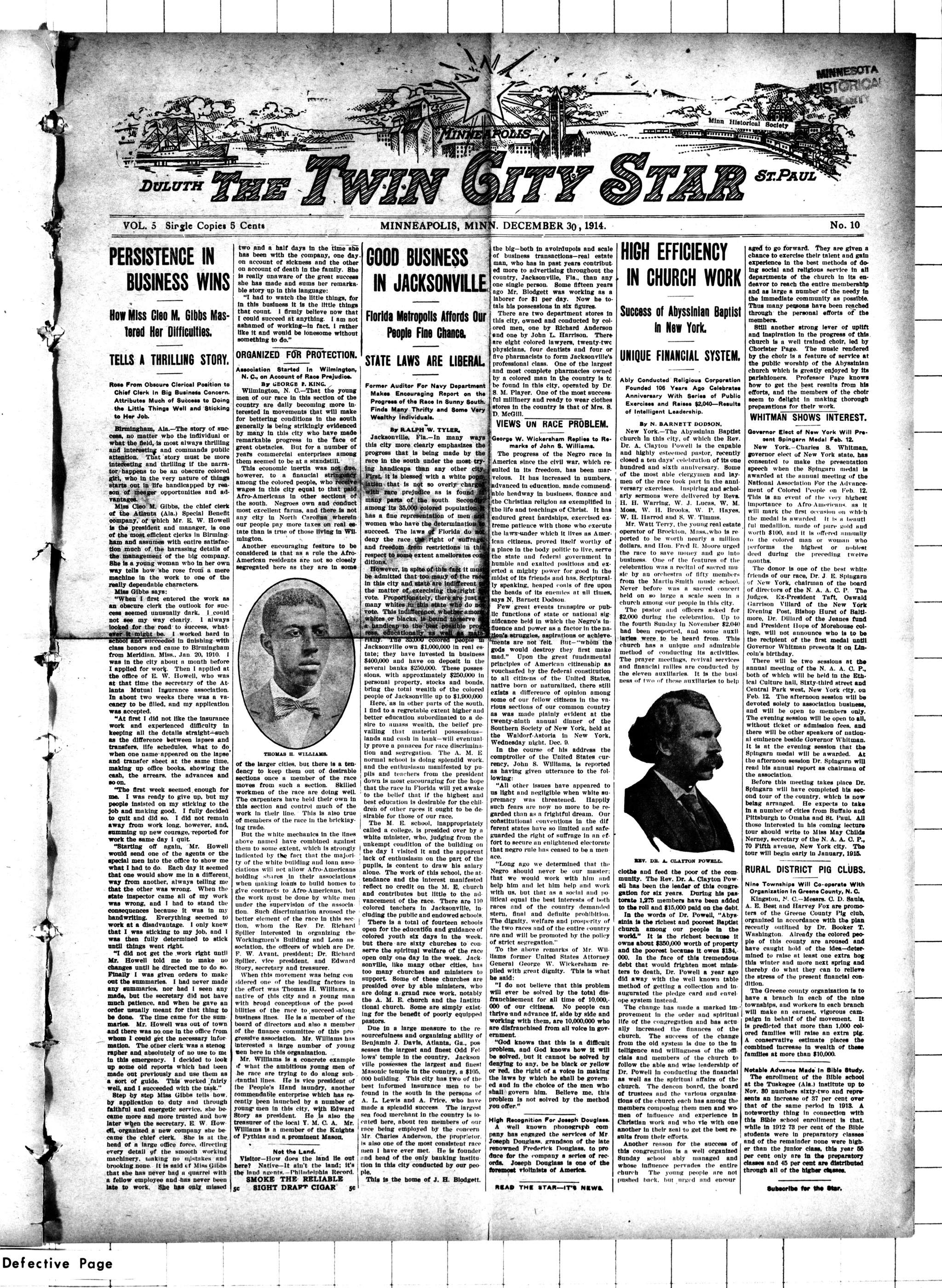
Page text (machine-generated)
DULUTH THE TWIN CITY STAR ST. PAUL
Defective Page
VOL. 5 Single Copies 5 Cents
Wilmington, N. O.-That the young men of our race in this section of the country are daily becoming more interested in movements that will make for bettering conditions in the south generally is being strikingly evidenced by many in this city who have made remarkable progress in the face of great obstacles. But for a number of years commercial enterprises among them seemed to be at a standstill. This economic inertia was not due, however, to a financial stringency among the colored people, who receive wages in this city equal to that paid Afro-Americans in other sections of the south. Negroes own and conduct most excellent farms, and there is not any city in North Carolina wherein our people pay more taxes on real estate than is true of those living in Wilmington.
of the larger cities, but there is a tendency to keep them out of desirable sections once a member of the race moves from such a section. Skilled workmen of the race are doing well. The carpenters have held their own in this section and control much of the work in their line. This is also true of members of the race in the bricklaying trade.
But the white mechanics in the lines above named have combined against them to some extent, which is strongly indicated by the fact that the majority of the white building and loan associations will not allow Afro-Americans holding shares in their associations when making loans to build homes to give contracts to Afro-Americans, but the work must be done by white men under the supervision of the association. Such discrimination aroused the better element of the race in this section, whom the Rev Dr. Richard Spiller interested in organizing the Workingmen's Building and Loan association, the officers of which are Dr. F. W. Avant, president; Dr. Richard Spiller, vice president, and Edward Story, secretary and treasurer.
When this movement was being considered one of the leading factors in the effort was Thomas H. Williams, a native of this city and a young man with broad conceptions of the possibilities of the race to succeed along business lines. He is a member of the board of directors and also a member of the finance committee of this progressive association. Mr. Williams has interested a large number of young men here in this organization.
Mr. Williams is a concrete example of what the ambitious young men of the race are trying to do along substantial lines. He is vice president of the People's Hand laundry, another commendable enterprise which has recently been launched by a number of young men in this city, with Edward Story as president. He is also the treasurer of the local Y. M. C. A. Mr. Williams is a member of the Knights of Pythias and a prominent Mason.
Not the Land.
Visitor—How does the land lie out here? Native—It ain't the land; it is the land agents—Philadelphia Record.
SMOKE THE RELIABLE
5c SIGHT DRAFT CIGAR 5c
PERSISTENCE IN BUSINESS WINS
TELLS A THRILLING STORY.
Rose From Obscure Clerical Position to Chief Clerk in Big Business Concern. Attributes Much of Success to Doing the Little Things Well and Sticking to Her Job.
Birmingham, Ala.—The story of success, no matter who the individual or what the field, is most always thrilling and interesting and commands public attention. That story must be more interesting and thrilling if the narrator happens to be an obscure colored girl, who in the very nature of things starts out in life handicapped by reason of meager opportunities and advantages.
Miss Cleo M. Gibbs, the chief clerk of the Atlanta (Ala.) Special Benefit company, of which Mr. E. W. Howell is the president and manager, is one of the most efficient clerks in Birmingham and assumes with entire satisfaction much of the harassing details of the management of the big company. She is a young woman who in her own way tells how she rose from a mere machine in the work to one of the really dependable characters.
Miss Gibbs says:
"When I first entered the work as an obscure clerk the outlook for success seemed unusually dark. I could not see my way clearly. I always looked for the road to success, whatever it might be. I worked hard in school and succeeded in finishing with class honors and came to Birmingham from Meridian, Miss., Jan 20, 1910. I was in the city about a month before I applied for work. Then I applied at the office of E. W. Howell, who was at that time the secretary of the Atlanta Mutual Insurance association. In about two weeks there was a vacancy to be filled, and my application was accepted.
"At first I did not like the insurance work and experienced difficulty in keeping all the details straight—such as the difference between lapses and transfers, life schedules, what to do when one name appeared on the laps and transfer sheet at the same time, making up office books, showing the cash, the arrears, the advances and so on.
"The first week seemed enough for me. I was ready to give up, but my people insisted on my sticking to the job and making good. I fully decided to quit and did so. I did not remain away from work long, however, and, summing up new courage, reported for work the same day I quit.
"Starting off again, Mr. Howell would send one of the agents or the special men into the office to show me what I had to do. Each day it seemed that one would show me in a different way from another, always telling me that the other was wrong. When the state inspector came all of my work was wrong, and I had to stand the consequences because it was in my handwriting. Everything seemed to work at a disadvantage. I only knew that I was sticking to my job, and I was then fully determined to stick until things went right.
"I did not get the work right until Mr. Howell told me to make no changes until he directed me to do so. Finally I was given orders to make out the summaries. I had never made any summaries, nor had I seen any made, but the secretary did not have much patience, and when he gave an order usually meant for that thing to be done. The time came for the summaries. Mr. Howell was out of town and there was no one in the office from whom I could get the necessary information. The other clerk was a stenog rapher and absolutely of no use to me in this emergency. I decided to look up some old reports which had been made out previously and use them as a sort of guide. This worked fairly well, and I succeeded with the task."
Step by step Miss Gibbs tells how by application to duty and through faithful and energetic service, she became more and more trusted and how later when the secretary, E. W. Howell, organized a new company she became the chief clerk. She is at the head of a large office force, directing every detail of the smooth working machinery, making no mistakes and brooking none. It is said of Miss Gibbs that she has never had a quarrel with a fellow employee and has never been late to work. She has only missed
two and a half days in the time she has been with the company, one day on account of sickness and the other on account of death in the family. She is really unaware of the great success she has made and sums her remarkable story up in this language: "I had to watch the little things, for in this business it is the little things that count. I firmly believe now that I could succeed at anything. I am not ashamed of working—in fact, I rather like it and would be lonesome without something to do."
ORGANIZED FOR PROTECTION.
Association Started In Wilmington,
N. C. on Account of Race Prejudice.
Rw GEORGE B. KING.
Another encouraging feature to be considered is that as a rule the Afro-American residents are not so closely segregated here as they are in some
THOMAS H. WILLIAMS.
Not the Land.
MINNEAPOLIS, MINN. DECEMBER 30, 1914.
GOOD BUSINESS IN JACKSONVILLE
STATE LAWS ARE LIBERAL
Former Auditor For Navy Department Makes Encouraging Report on the Progress of the Race In Sunny South. Finds Many Thrifty and Some Very Wealthy Individuals.
By RALPH W. TYLER.
Jacksonville, Fla.—In many ways this city more clearly emphasizes the progress that is being made by the race in the south under the most trying handicaps than any other city. First, it is blessed with a white population that is not so overly charged with race prejudice as is found in many parts of the south. Secondly, among its 35,000 colored population it has a fine representation of men and women who have the determination to succeed. The laws of Florida do not deny the race the right of suffrage and freedom from restrictions in this respect to some extent ameliorate conditions.
However, in spite of this fact it must be admitted that too many of the race in this city and state are indifferent to the matter of exercising the right vote. Proportionately, there are just many whites in this state who do not vote. This indifference, whether among whites or blacks, is bound to serve a handicap to the best possible progress educationally as well as morally.
rally. The 35,000 colored people in Jacksonville own $1,000,000 in real estate; they have invested in business $400,000 and have deposited in the several banks $250,000. These possessions, with approximately $250,000 in personal property, stocks and bonds, bring the total wealth of the colored people of Jacksonville up to $1,900,000. Here, as in other parts of the south, I find to a regrettable extent higher and better education subordinated to a desire to amass wealth, the belief prevailing that material possessions lands and cash in bank—will eventually prove a panacea for race discrimination and segregation. The A. M. E normal school is doing splendid work, and the enthusiasm manifested by pupils and teachers from the president down is most encouraging for the hope that the race in Florida will yet awake to the belief that if the highest and best education is desirable for the children of other races it ought to be desirable for those of our race.
The M. E. school, inappropriately called a college, is presided over by a white minister, who, judging from the unkempt condition of the building on the day I visited it and the apparent lack of enthusiasm on the part of the pupils, is content to draw his salary alone. The work of this school, the attendance and the interest manifested reflect no credit on the M. E. church and contributes but little to the advancement of the race. There are 110 colored teachers in Jacksonville, including the public and endowed schools. There is a total of fourteen schools open for the education and guidance of colored youth six days in the week. but there are sixty churches to conserve the spiritual welfare of the race open only one day in the week. Jacksonville, like many other cities, has too many churches and ministers to support. Some of these churches are presided over by able ministers, who are doing a grand race work, notably the A. M. E. church and the Institutional church. Some are simply existing for the benefit of poorly equipped pastors.
Due in a large measure to the resourcefulness and organizing ability of Benjamin J. Davis, Atlanta, Ga., possesses the largest and finest Odd Fellows' temple in the country. Jacksonville possesses the largest and finest Masonic temple in the country, a $105,000 building. This city has two of the best informed insurance men to be found in the south in the persons of A. L. Lewis and A. Price, who have made a splendid success. The largest sea food merchant in the country is located here, about ten members of our race being employed by the concern. Mr. Charles Anderson, the proprietor is also one of the most consistent race men I have ever met. He is founder and head of the only banking institution in this city conducted by our people. This is the home of J. H. Blodgett.
the big—both in avoiddups and scale of business transactions—real estate man, who has in past years contributed more to advertising throughout the country, Jacksonville, Fla., than any one single person. Some fifteen years ago Mr. Blodgett was working as a laborer for $1 per day. Now he totals his possessions in six figures. There are two department stores in this city, owned and conducted by colored men, one by Richard Anderson and one by John L. Harrison. There are eight colored lawyers, twenty-two physicians, four dentists and four or five pharmacists to form Jacksonville's professional class. One of the largest and most complete pharmacies owned by a colored man in the country is to be found in this city, operated by Dr. S. M. Player. One of the most successful millinery and ready to wear clothes stores in the country is that of Mrs. S. D. McGill.
VIEWS ON RACE PROBLEM.
George W. Wickersham Replies to Remarks of John B. Williams.
The progress of the Negro race in America since the civil war, which resulted in its freedom, has been marvelous. It has increased in numbers, advanced in education, made commendable headway in business, finance and the Christian religion as exemplified in the life and teachings of Christ. It has endured great hardships, exercised extreme patience with those who execute the laws under which it lives as American citizens, proved itself worthy of a place in the body politic to live, serve the state and federal government in humble and exalted positions and exerted a mighty power for good in the midst of its friends and has, Scriptually speaking, heaped coals of fire upon the heads of its enemies at all times, says N. Barnett Dodson.
Few great events transpire or public functions of state or national significance held in which the Negro's influence and power as a factor in the nation's struggles, aspirations or achievements are not felt. But—"whom the gods would destroy they first make mad." Upon the great fundamental principles of American citizenship as vouchsafed by the federal constitution to all citizens of the United States, native born or naturalized, there still exists a difference of opinion among some of our fellow citizens in the various sections of our common country as was made plainly evident at the twenty-ninth annual dinner of the Southern Society of New York, held at the Waldorf-Astoria in New York, Wednesday night, Dec. 9.
In the course of his address the comptroller of the United States currency, John S. Williams, is reported as having given utterance to the following:
"All other issues have appeared to us light and negligible when white supremacy was threatened. Happily such fears are now no more to be regarded than as a frightful dream. Our constitutional conventions in the different states have so limited and safeguarded the right of suffrage in an effort to secure an enlightened electorate that negro rule has ceased to be a menace.
"Long ago we determined that the Negro should never be our masters that we would work with him and help him and let him help and work with us, but that as a social and political equal the best interests of both races and of the country demanded stern, final and definite prohibition. The dignity, welfare and prosperity of the two races and of the entire country are and will be promoted by the policy of strict segregation."
To the above remarks of Mr. Williams former United States Attorney General George W. Wickersham replied with great dignity. This is what he said:
"I do not believe that this problem will ever be solved by the total disfranchisement for all time of 10,000,000 of our citizens. No people can thrive and advance if, side by side and working with them, are 10,000,000 who are disfranchised from all voice in government.
"God knows that this is a difficult problem, and God knows how it will be solved, but it cannot be solved by denying to any, be he black or yellow or red, the right of a voice in making the laws by which he shall be governed and in the choice of the men who shall govern him. Believe me, this problem is not solved by the method you offer."
High Recognition For Joseph Douglass
A well known phonograph company has engaged the services of Mr Joseph Douglass, grandson of the late renowned Frederick Douglass, to produce for the company a series of records. Joseph Douglass is one of the foremost violinists of America.
READ THE STAR-IT'S NEWS
HIGH EFFICIENCY IN CHURCH WORK
UNIQUE FINANCIAL SYSTEM.
Aby Conducted Religious Corporation
Founded 106 Years Ago Celebrates
Anniversary With Series of Public
Exercises and Raises $2,040—Results
of Intelligent Leadership.
By N. BARNETT DODSON.
New York.—The Abyssinian Baptist church in this city, of which the Rev. Dr. A. Clayton Powell is the capable and highly esteemed pastor, recently closed a ten days' celebration of its one hundred and sixth anniversary. Some of the most able clergymen and laymen of the race took part in the anniversary exercises. Inspiring and scholarly sermons were delivered by Reva. H. H. Warring, W. J. Lucas, W. M. Moss, W. H. Brooks, W. P. Hayes, W. H. Harrod and S. W. Timms. Mr. Watt Terry, the young real estate operator of Brockton, Mass., who is reported to be worth nearly a million dollars, and Hon. Fred R. Moore urged the race to save money and go into business. One of the features of the celebration was a recital of sacred music by an orchestra of fifty members from the Martin Smith music school. Never before was a sacred concert held on so large a scale seen in a church among our people in this city. The pastor and officers asked for $2,000 during the celebration. Up to the fourth Sunday in November $2,040 had been reported, and some auxiliaries were to be heard from. This church has a unique and admirable method of conducting its activities. The prayer meetings, revival services and financial rallies are conducted by the eleven auxiliaries. It is the business of two of these auxiliaries to help
REV. DR. A. CLAYTON POWELL. clothe and feed the poor of the community. The Rev. Dr. A. Clayton Powell has been the leader of this congregation for six years. During his pastorate 1,275 members have been added to the roll and $15,000 paid on the debt
In the words of Dr. Powell, "Abyssinia is the richest and best Baptist church among our people in the world." It is the richest because it owns about $350,000 worth of property and the poorest because it owes $184,000. In the face of this tremendous debt that would frighten most ministers to death, Dr. Powell a year ago did away with the well known table method of getting a collection and inaugurated the pledge card and envelope system instead.
The change has made a marked improvement in the order and spiritual life of the congregation and has actually increased the finances of the church. The success of the change from the old system is due to the intelligence and willingness of the officials and members of the church to follow the able and wise leadership of Dr. Powell in conducting the financial as well as the spiritual affairs of the church. The deacon board, the board of trustees and the various organizations of the church each has among the members composing them men and women of influence and experience in Christian work and who vie with one another in their zeal to get the best results from their efforts.
Another reason for the success of this congregation is a well organized Sunday school ably managed and whose influence pervades the entire church. The young people are not pushed back, but urged and encourage
No.10
aged to go forward. They are given a chance to exercise their talent and gain experience in the best methods of doing social and religious service in all departments of the church in its endeavor to reach the entire membership and as large a number of the needy in the immediate community as possible. Thus many pepes have been reached through the personal efforts of the members.
Still another strong lever of uplift and inspiration in the progress of this church is a well trained choir, led by Chorister Page. The music rendered by the choir is a feature of service at the public worship of the Abyssinian church which is greatly enjoyed by its parishioners. Professor Page knows how to get the best results from his efforts, and the members of the choir seem to delight in making thorough preparations for their work.
WHITMAN SHOWS INTEREST.
Governor Elect of New York Will Present Spingarn Medal Feb. 12.
New York.-Charles S. Whitman, governor elect of New York state, has consented to make the presentation speech when the Spingarn medal is awarded at the annual meeting of the National Association For the Advancement of Colored People on Feb. 12. This is an event of the very highest importance to Afro-Americans, as it will mark the first occasion on which the medal is awarded. It is a beautiful medallion, made of pure gold and worth $100, and it is offered annually to the colored man or woman who performs the highest or noblest deed during the preceding twelve months.
The donor is one of the best white friends of our race, Dr. J. E. Spingarn of New York, chairman of the board of directors of the N. A. A. C. P. The Judges, Ex-President Taft, Oswald Garrison Villard of the New York Evening Post, Bishop Hurst of Baltimore, Dr. Dillard of the Jeanes fund and President Hope of Morehouse college, will not announce who is to be the recipient of the first medal until Governor Whitman presents it on Lincoln's birthday.
There will be two sessions at the annual meeting of the N. A. A. C. P., both of which will be held in the Ethical Culture hall, Sixty-third street and Central Park west, New York city, on Feb. 12. The afternoon session will be devoted solely to association business, and will be open to members only. The evening session will be open to all, without ticket or admission fees, and there will be other speakers of national eminence beside Governor Whitman. It is at the evening session that the Spingarn medal will be awarded. At the afternoon session Dr. Spingarn will read his annual report as chairman of the association.
Before this meeting takes place Dr. Spingarn will have completed his second tour of the country, which is now being arranged. He expects to take in a number of cities from Buffalo and Pittsburgh to Omaha and St. Paul. All those interested in his coming lecture tour should write to Miss May Childs Nerney, secretary of the N. A. A. C. P., 70 Fifth avenue, New York city. The tour will begin early in January, 1915.
RURAL DISTRICT PIG CLUBS
Nine Townships Will Co-operate With Organization in Greene County, N.C. Kingston, N. C.-Messrs. C. D. Saula, A. E. Best and Harvey Fox are promoters of the Greene County Pig club, organized in accordance with the plan recently outlined by Dr. Booker T. Washington. Already the colored people of this county are aroused and have caught hold of the idea—determined to raise at least one extra hog this winter and more next spring and thereby do what they can to relieve the stress of the present financial condition. The Greene county organization is to have a branch in each of the nine townships, and workers in each branch will make an earnest, vigorous campaign in behalf of the movement. It is predicted that more than 1,000 colored families will raise an extra plg. A conservative estimate places the combined increase in wealth of these families at more than $10,000.
Notable Advance Made in Bible Study.
The enrollment of the Bible school at the Tuskegee (Ala.) institute up to Nov. 80 numbers sixty-two and represents an increase of 37 per cent over that of the same period in 1913. A noteworthy thing in connection with this Bible school enrollment is that, while in 1912 73 per cent of the Bible students were in preparatory classes and of the remalnder none were higher than the junior class, this year 55 per cent only are in the preparatory classes and 45 per cent are distributed through all of the higher classes.
Subscribe for the Star.
Peoples Christian Assembly.
Rev. G. W. Mitchell, Pastor,
1204 Washington Ave. So.
Comel and Serve the Lord.
ST. PETER'S A. M. E. CHURCH.
22nd St. near 10th Ave. So.
Rev. Thos. B. Stovall, Pastor.
ST. JAMES A. M. E. CHURCH,
318 8th Ave. So., Minneapolis.
Rev. E. R. Edwards, Pastor.
The Union Christmas Tree Services of People's Christian Assembly and the Prosperity Sunday Schools were conducted Christmas night by Mrs. G. W. Mitchell, with much success. The children received many useful presents and toys.
The Minneapolis Sunday Forum elected officers last meeting. Officers will be installed on Jan. 3, at St. Peter's Church.
Miss Myrtle Claughton left Wednesday evening for Des Moines to spend a two weeks' visit with relatives and friends.
Watch Night Services will be held in all the Churches on Thursday Night.
Services will be held in all the Churches on New Year's Day.
WE WISH A HAPPY NEW YEAR
WE WISH A HAPPY NEW YEAR TO ALL!
The Christmas Tree at Bethesda Baptist Sunday School on Monday evening was a very pleasant affair for both old and young people.
The Elks presented St. James Sunday School with the big tree used at their services. Rev. Edwards made it very enjoyable for the children.
Mrs. J. C. Trevan, 804½ 6th Ave. No. has been very ill during past week, but is improving slowly.
Mrs. D. - E. Buckner sustained severe injuries last week when she fell from a street car on Cedar Ave. She is confined to her bed at Martin's, 205 11th Ave. So. under the attention of Dr. Redd, and is gradually improving. She has retained Atty. Albert H. Hall to recover damages.
Mr. and Mrs. Chas. Duncan and daughter were the guests of Mr. and Mrs. J. J. Duncan, 3920 4th Ave. So. Their visit was as usual, very pleasant.
Mrs. Ophelia Rice of 4th St. So., entertained her family and friends at dinner on Sunday.
Mrs. Sadie Covington, 627 Jewett Pt. and son, Master Calvin Covington, have been released from quarantine. They were suffering from diphtheria, and during illness was attended by Dr. Redd.
Waiters Donate for Charity.
The annual Christmas donation to the poor of Minneapolis, by the Dining Room Employees of the West Hotel, with Mr. Jno. W. Scott, Headwaiter, was more generously contributed to, this year, than last. They assisted a number af families, women and children in Minneapolis.
Some are trying for Ex-Detective Hardin's job. We would rather see a Negro given an inside position on the force or the appointment of a Negro patrolman. No more Jim Crow police department.
Deputy Sheriff John Allison continues in office under Sheriff Langum. Mr. Allison is in every way qualified by long experience, good character and intelligence. He knews every branch of the work of the Sheriff's office.
Miss Sadie Marshall will retain her position as clerk in the Recorder of Deeds office. She is an expert, a creditable representative of her race in this position which was formerly held by Mesdames Mary Taylor, Schuyler Phillips and M. O. Cannon.
Mr. Chas. Yancy also holds a responsible position in the County Auditor's office, and is one of the best informed employees in that department. Mr. Yancy is a Negro of such fair complexion, that his merit and position is not generally contributed to his race. Mr. Yancy is a gentleman and has been for many years a respected citizen of the village of Edina, where he has resided and held several important public offices.
Mr. R. S. Britton of St. Paul visited friends here on Xmas. He arrived too late to attend the Elks'. Entertainment. "Bud" is enjoying good health and was delighted to hear that Ames had made it so pleasant for the children. He is one of the most loyal members of Ames Lodge and a jolly good Elk.
The struggle for today, is not altogether for today; it is for a vast future.—Abraham Lincoln.
Ames Lodge Plays Santa Claus to the Children. A Well Attended Entertainment.
On Christmas afternoon, about 300 children attended the Elk's Christmas Tree at K. P. Hall, given by Ames Lodge of Minneapolis. I. B. P. O. E. of W. No. 106. This novel and original feature was suggested by Mr. Archer Watkins, who was chairman of the Committee of arrangements, assisted by Grand Exalted Ruler, Geo. W. Holbert, Sec'y Wm. R. Morris, and members of Ames. The Tree was a very large one and the hall was appropriately decorated. The exercises opened by Invocation by Rev. T. J. Carter. Singing by the children "My Country, 'Tis of Thee." A Selected Solo was beautifully rendered by Miss Alice Moore. Readings from Dunbar, by Mr. Robt. L. Robinson, of Ames Lodge, proved a hit with the young folks. The special feature was a four round boxing exhibition. Serg't Thomas P. Gleason of the Police Dpt. refereed the bout, which was between two white boys. Mr. Gleason told the boys the value of the knowledge of boxing and congratulated Ames Lodge on their splendid effort. He made an interesting talk on "Good Fellowship," and said that "the hearty cheer and laughing glee of a child is more pleasing than money stored in a bank." He introduced John and Tom. De Muth, two brothers, who made the best demonstration of the manly art ever put on by such youngsters. They appeared in perfect physical trim and fought a scientific battle from start to finish. Every body present was enthused over this entertainment. Billy Black's Serenaders proved a jolly attraction and Emmanuel Tyler's "Black Baby Boy" was enjoyed. Oliver's Cabaret Entertainers, a trio composed of Misses Alice Moore and Edith Gordon vocalists and L. B. Morgan (Banty), pianist, in their latest hits are deserving of every praise. The exercises closed with the donations of boxes of candy, fruit and toys to nearly every person present. Every one of the "kiddies" shook hands with Mr. Watkins and thanked him for the enjoyable entertainment. Mr. John Sellars attended with the children from Attuck's Home, St. Paul. Next year the Elks will try to reach the destitute children in their homes. Success to Ames Lodge. May other fraternal organizations join or follow them.
THE SHRINER'S BALL
The Annual Ball of Fezzan Temple, Nobles of the Mystic Shrine, was held Monday Night at Coliseum Hall. The attendance was not as large as usual. Those present greatly enjoyed the dance to the strains of McCulloughs Orchestra. The grand march was led by Hon. W. R. Morris under the direction of Mr. Alex Ervin. The ladies were splendidly gowned, but there was a noted absence of many matrons, and especially wives of the Nobles. The young people greatly enjoyed the new dances and there were many ladies wearing the latest fashions in evening wear—in contrast to the informal dress of the young men. The Shriner's Ball was not up to expectations. It has reverted to the ordinary class, because many Nobles fail to attend, or bring their wives and some attend in business clothes. Dress suits should be worn and the Shriner's should not depend on their guests giving splendor to their occasion. Let the Shriners give a real Ball next year or give none.
We had a very enjoyable Holiday season, and a successful year. Successful because we are "in business." We felt that we had done our duty and was satisfied and happy that we had made others happy. It seemed that the spirit of the times was "Peace an earth—good will to men"—was everywhere. In spite of many reverses, we will begin our New Year with renewed courage and more faith in humanity, but mostly trusting in that Divine Providence, which has brought us safely thus far and shall lead to better things.
The Sunday Club of Zion Presbyterian Church will meet Sunday at 4 P. M. The Topic for discussion will be "Segregation of Government Employees." J. H. Zedricks, Pres.; A. G. West, Sec'y. All are welcome.
The Cabaret Dance of the Excelsior Club of St. Paul, at Bowlby Hall on Christmas night was well attended. Dr. and Mrs. Washington entertained during the dance intervals with latest song hits.
Send your notes next week before Wednesday evening. If you are alive you have some news. If dead, it's news to some one.
OLIVERS' CABARET,
244 Third Ave. So. Minn.
Premier Artists. Café Service.
Sylvester W. Oliver, Manager.
IT PAYS TO ADVERTISE.
TWIN CITY STAR
Continued from last week.
Christmas
A Story
By Zona Gale
LATER in the day
Bates and
in to see M.
hurried and
sionally one of them
mental calculation.
ber something for t
table," Mis' Bates
Moran under cover
wood in the stove.
related the breaking
lamp the two other
ed to each other a g
dum.
Copyright, 1912, by the McClure Publications, Incorporated.
Copyright, 1912, by the Macmillan Company.
Owing to hard times and the failure of Ebenezer Rule's factory the people of Old Trail Town contemplate buying no presents and having no Christmas.
A town meeting is held, and the decision is reached to have no Christmas, not even for the children.
A notice to this effect is signed by nearly every one. Mary Chavah receives a letter from her sister Lily's boy.
This boy asks her to take his six-year-old brother, son of Adam Blood, a lover who jilted Mary for her sister Lily.
Mary prepares to welcome him. Despite their resolutions many people find it difficult to cut out Christmas altogether.
Ebenezer Rule, grieving for his dead son, Malcolm, and his dead wife, finds the boy's hobbyhorse in an unused attic.
Boys and girls are unhappy because there will be no Christmas. Women regret that Mary's boy will find none awaiting him.
Children of the town are rehearsing for a funeral on Christmas. They are planning to bury Santa Claus.
Ellen Bourne plans to have a Christmas tree and urges her husband to adopt a little boy at once.
The good townfolk secretly prepare to gather at Mary's house on Christmas eve to welcome the little boy.
One after another different people break the anti-Christmas pledge. The spirit of Christmas softens the hard heart of Ebenezer Rule.
He gets the hobbyhorse for Mary's boy, whose train is delayed. Every one is happy in preparing a Christmas welcome for the orphan.
The boy arrives in safety, and the town that was not to celebrate Christmas happily celebrates it after all.
Advertisements
BIG NEW YEAR BALL.
MEET YOUR FRIENDS AT
Union Temple Hall, 28 Washington
Ave. So.
ON NEW YEAR'S MORNING
where Judge Johnson will entertain
his many patrons. Best order—
Music and Refreshments.
A Happy New Year to all is the
wish of
Judge Johnson,
The pleasure-maker.
Neatly Furnished Rooms.
Newly Furnished Front Rooms, Suitable for Gentlemen or Ladies, on the car line, Bath and Heat. Apply to Mrs. M. Jackson, 827 Cedar Ave., Minneapolis. Call Nic. 591.
Dressmaking—Plain and Fancy Sewing. Baby Clothes a specialty. Call South 404. Mrs. Lewis, 2912 Harriet Ave. So.
The Big Three. Every First and Third Tuesday. Arcade Hall, 1311 Washington Ave. So., Minneapolis. Good Music. Refreshments and Good Order.
FORMER PASTOR BRINGS SUIT
A suit entitled Ephriam H. McDonald vs. Pilgrim Baptist Church was brought this month in the District Court at St. Paul, to recover $300.00 penalty for failure to gove three months notice before the termination of a contract of employment.
Rev. McDonald was employed for four years as pastor of Pilgrim Baptist Church and was removed May 15 last.
About the Capital.
Mr. Schuyler Phillips will probably be the Janitor of the House during next session. He has made good during past two terms, and has many friends among the Representatives.
Lawyer Franklin may get his coat room job again and Mr. John Dillingham has a surety on the Senate Janitorship. Dr. O. D. Howard will install his barber chair in the Senate corridor.
Mr. "Billy" Williams, the Governor's messenger, will be re-appointed. He is a valuable man in his position, and will remain, Mr. Geo. L. Hoage, who holds the janitorship of the Governor's office, was appointed as a Democrat, and there is no reason for a change. His party is in power and he is efficient in this position.
We cannot prophesy on the uspidor and broom jobs, as we are not in touch with the applicants.
---
```markdown
```
ATER in the day Mis' Mortimer Bates and Mis' Moran came in to see Mary. Both were hurried and tired, and occasionally one of them lapsed into some mental calculation. "We must remember something for the middle of the table," Mis' Bates observed to Mis' Moran under cover of Mary's putting wood in the stove. And when Mary related the breaking of the bracket lamp the two other women telegraphed to each other a glance of memorandum.
"Don't, it seem funny to you to have Christmas coming on tomorrow and no flurry about it?" Mary asked.
"No flurry!" Mis' Bates burst out. "Oh, well," she amended, "of course this Christmas does feel a little funny to all of us! Don't you think so, Mis' Moran?"
"I donno," said Mary thoughtfully, "but what, when folks stop chasing after Christmas and driving it before them, Christmas may turn around and come to find them."
Mary looked at them, frowning a little. "It seemed like the thing had to happen," she said. "It'll fit itself in." Before dark she took a last look about the child's room. The owl paper, the puppy wash basin, the huge calendar with its picture of a stag, the shelves for whatever things of his own he had, all pleased her anew. She had laid on his table her grandfather's Bible with pictures of Aslatic places. Below his mirror hung his father's photograph, that young face, with the unspeakable wistfulness of youth, looking somewhere outside the picture. It made her think of the passionate expectation in the face of the picture that Jenny had brought.
"Young folks in pictures always look like they was setting store by something that ain't true yet," Mary thought. "It makes you kind of feel you have to pitch in and make whatever it is come true a little."
It was when Mis' Winslow came back toward 7 o'clock that there was news of Jenny. Mary had been twice to her door in the course of the day and had come away feeling in her inquiry strangely outside the moment and alien to its incidence, as if she were somehow less alive than those in Jenny's house.
"Jenny's got a little girl." Mis' Winslow said.
Mary stood staring at her. It seemed impossible. It was like seeing the hands of time move, like becoming momentarily conscious of the swing and rush. of the earth, like perceiving the sweep of the stream of stars in which our system moves. She was startled and abashed that the news so seized upon her. Little that had ever happened to herself seemed so poignant. so warmed its place in sensation. While Mis' Winslow's mind marked time on details of time and pounds, as is the way with us immortals when another joins our ranks. Mary was receiving more consciousness. There are times when this gift is laid on swiftly, as with hands, instead of coming when none knows. Rather than with the child whom she was to meet, her thought was with Jenny as she left Mis' Winslow in the doorway and went down the street.
"Expect you back in about half an hour if the train's on time," Mis' Winslow called.
Mary nodded and turned into the great cathedral aisle that was Old Trail street, now arched and whitened, spectral in the dark, silver with starlight.
The night before Christmas! And in not one home was there any preparation for tomorrow, Mary thought, unless one or two lawless ones had broken bounds and contrived something from a little remembrance for somebody to a suet pudding. It was strange, she owned. No trees being trimmed, no churches lighted for practice and the shops closed as on any other night. Only the postoffice had light—she went in to look in her box. After was there at the telegraph window, and he accosted her.
"Little boy's comin' tonight, is he?" he said, as one of the sponsors for that arrival.
"I'm on my way to the train now."
Mary answered, and noted the Christmas notice with its solled and dog eared list still hanging on the wall. "It was a good move," she insisted to herself as she went out into the empty street again.
"You got a merry Christmas without no odds of the paper or me either." After called after her, but she did not answer save with her "Thank you, Mr. Affer."
"Why do they all pretend to think it's so fine for me?" she wondered. "To cheer me up, I guess," she thought grimly.
Tonight they were all sharing the aloofness from the time, an aloofness which she herself had known for years. All save Jenny. To Jenny's house, in defiance of that dog eared paper in the postoffice, Christmas had come. Not a Christmas of "present trading," not a Christmas of things at all, but Christmas. Unto them a child was born.
"Jenny's the only one in this town that's got a real Christmas," thought Mary on her way to meet her own little guest.
The Simeon Buck North American Dry Goods Exchange was dark, too,
and from its cave of window the gray St. Nicholas looked out, bearing his flag—and he tought an idle, mummy thing of no significance. The Abel Ames General Merchandise Emporium was closed, but Involuntarily Mary stopped before it. In its great plate glass window a single candle burned. She stood for a moment looking. "Why, that's what they do some places to let the Christ child in," Mary thought. "I wonder if Abel knows. How funny—for a store!"
Some one whom she did not know passed her and looked too.
"Kind o' nice," said the other.
"Real nice," Mary returned and went on with a little glow.
At Mis' Moran's house on the other side of the square the children were waiting for her—Bennet and Gussie and Tab and Pep and little Emily They ran before Mary in the road, all save little Emily, who walked, clasping Mary's hand.
"Aren't you staying up late, Emily?" Mary asked her.
"Yes," assented the child contentedly.
"Won't 'you be sleepy?' Mary pursued.
"I was going to stay awake anyhow," she said. "I ain't goin' sleep all night. We said so. We're goin' stay 'wake and see Santa Claus go by.'"
"Go by?" Mary repeated.
"Yes," the child explained. "You don't think that'll hurt, do you?" she asked anxiously. "And then," she pursued, "if we don't see him we'll know he's dead everywhere else too. An' then we're goin' bury him tomorrow morning up to Gussie's house." At the station no one was yet about. Utter peace was there, not the primeval peace that is negation, but a silence that listened.
"While shepherds watched their flocks by night, all seated on the ground," Mary thought and looked along the horizon hill. The time needed an invocation from some one who watched, as many voices through many centuries had made invocation on Christmas eve. For a moment, looking over the lonely white places where no one-watched, as no one—save only Jenny—watched in the town, Mary forgot the children.
The shoving and grating of baggage truck wheels recalled her. Just beyond the bay window she saw little Emily lifted to the truck and the four others follow and the ten heels dangle in air.
"Now!" said Pep. And a chant arose:
"Twas the night before Christmas when all through the house
Not a creature was-stirring, not even a mouse.
mouse.
The otters were hung by the chimney
with coke.
In the hope that St. Nicholas soon would be there."
Upborne by one, now by another, now by all three voices, the verses went on the end. And it was as if not only Tab and Pep-and Bennet and Gussie and little Emily were chanting, but all children who had ever counted the days to Christmas and had found Christmas the one piece of magic that is looked on with kindness by a grownup world. The magic of swimming holes, for example, is largely a forbidden magic; the magic of loud noises, of fast motion, of living things in pockets, of far journeys, of going off alone, of digging caves, of
A. E. E. D.
The Light Shone Out Like a Signal. building fires, of high places, of many closed doors, words, mechanisms, foods, ownerships, manners, costumes, companions and holidays are denied them. But in Christmas their affinity for mystery is recognized, encouraged, gratified, annually provided for. The little group on the baggage truck chanted their watch over a dead body of Christmas, but its magic was there, inviolate. The sing-song verses had almost the dignity of lyric expression, of the essence of familiarity with that which is unknown. As if, because humanity had always recognized that the will to Christmas was greater than it knew, these words had somehow been made to catch and reproduce, for generations, some faint spirit of the midwinter mystery. The 'bus rattled up to the platform and Buff Miles leaped down and blanketed his houses, talking to them as was his wont.
So, holly and mistletoe,
So, holly and mistletoe,
So, holly and mistletoe,
Over and over and over, oh!
he was slimy when the cume round the corner of the station.
"It can't 'Christmas yet' he observed
"It ain't Christmas yet," he observed
defensively to Mary. "It ain't forbid except for Christmas day, is it?" He went and bent over the children on the truck. "Look alive as soon as you can do it." Mary heard him say to them and wondered. She stood looking, up the track. Across the still fields, lying empty and ready for some presence, came fashing the point of flame that streamed from the headlight of the train. The light shone out like a signal fashed back to the star standing above the town.
CHAPTER XIII.
Christmasing.
10N minutes after Mary Chavah had left her house every window was lighted, a fire was kindled in the parlor and neighbors came from the dark and fell to work at the baskets they had brought.
It was marvelous what homely cheer arose. The dining room table, stretched at its fullest length and white covered, was various with the yellow and red of fruit and salads, the golden brown of cake and rolls and the mosaic of dishes. The fire roared in the flat topped stove on whose "wings" covered pans waited, and everywhere was that happy stir and touch and lift, that note of preparation which informs a time as sunshine or music will strike its key.
"My land, the oven—the warming oven! Mary aln't got one. However will we keep the stuff hot?" Mis' Winslow demanded. "What time is it?"
"We'd ought to had my big coffeeepot. We'd ought to set two going. I dumno why I didn't think of it." Mis' Moran grieved.
"Well," said Mis' Mortimer Bates. "when the men get here—if they ever do get here—we'll send one of 'em off somewheres for the truck we forgot. What time is it?"
"Here comes a whole cartload of folks," Mis' Moran announced. "I hope and pray they've got the oysters—they'd ought to be popped in the baking oven a minute. What time did you say it is?"
"It's twenty minutes past 7," Mis' Winslow said, pushing her hair straight back regardless of its part. "and we ain't ready within 'leven hundred miles."
"Well, if they only all get here," Mis' Bates said, ringing golden and white stuffed eggs on Mary's blue platter. "It's their all being here when she gets here that I want. I ain't worried about the supper—much."
"The road's black with folks," Mis' Moran went on. "I'm so deadly afraid I didn't make enough sandwiches. Oh, I dunno why it wasn't given me to make more, I'm sure!"
"Who's seeing to them in the parlor? Who's getting their baskets out here? Where they finding a place for their wraps? Who's lighting the rest of the lamps? What time is it?" demanded Mis' Winslow, cutting her cakes.
"Oh," said Mis' Bates from a cloud of brown butter about the cooking stove, "I dunno whether we've done right. I dunno but we've broke our word to the Christmas paper. I dunno whether we ain't going to get ourselves criticised for this as never folks was criticised before."
Mis' Winslow straightened up from the table and held out a hand with fingers frosting tipped.
"Well," she said, with a great period. "if we have broke our word to the Christmas paper I'd rather stand up here with my word broke this way than with it kept so good it hurt me. Is it half past 7 yet?" "I wish Ellen Bourne was here." Mis Bates observed. "She sent her salad dressing over and lent her silver and her Christmas rose for the table, but come she would not. I wonder if she couldn't come over now if we sent after her last minute?" Simeon Buck, appearing a few minutes later at the kitchen door to set a basket inside, was dispatched for Ellen Bourne, the warming oven and the coffee pot collectively. He took with him Abel Ames, who was waiting for him without. And it chanced that they knocked at the Bournes' door just after Ben Holders had driven away with the little boy, so that the men found the family still in the presence of the little tree.
"Hello!" said Simeon, agast, "Christmas massing away all by yourselves. I'll be bound, like so many thieves! I rec'lect not seeing your names on the paper."
"No, I didn't sign." Ellen said. "I voted against it that night at the town meeting, but I grass nobody heard me."
"Well," said Simeon, "and so here you've got a Christmas of your own going forward, neat as a kitten's foot"—
"Ain't you coming over to Mary Chavah's?" Abel broke in with a kind of gentleness. "All of you?"
Ellen smote her hands together.
Ellen shouted her minds together.
"I meant to go over later," she said,
"and take"— She paused. "I thought
we'd all go over later," she said. "I
forgot about it. Why, yes. I guess we
can go now, can't we? All three of us?"
Abel Ames stood looking at the tree.
He had guessed that she might have
dressed it for no one who would see
it. He looked at Ellen and ventured
what he thought.
"Ellen," he said. "If you ain't going
to do anything more with that tree to-
night, why not take some of the things
off and have Matthew set it on his
shoulder, and bring it over to Mary's
for the boy that's coming."
Ellen hesitated. "Would they like it?" she asked. "Would folks?"
P
Defective Pa
Defective Page
Abel smiled. "I'll take the blame," he said, "and you take the tree." And, seeing Simeon hesitate, "Now let's stop by for Ms. Moran's coffeepot," he added, "Hustle up. The local must be in."
So presently the tree, partly divested of its brightness, was carried through the streets to the other house—in more than the magic which attends the carrying in the open road of a tree, a statue, a cart filled with flowers, for the tree was like some forbidden thing that still would be expressed.
"He might not come till Christmas is 'way past,' Ellen thought, following. "She'll leave it standing a few days. We can go down there and look at it—if he comes."
A little way behind them, Simeon and Abel, with the coffeepot and the warming oven, were hurrying back to Mary's. They went down the deserted street where Abel's candle burned and Simeon's saint mute.
"When I was a little shaver," Abel said, "they used to have me stand in the open doorway Christmas eve, and hold a candle and say a verse. I forget the verse. But I've always liked the candle in doors or windows, like tonight. Look at mine over there now—n'tit it like somebody saying something?"
"Well," said Simeon, not to be outdone, "when we come by my window just now the light hit down on it, and I could of swore I see the saint smile."
"Like enough," said Abel placidly; "like enough. You can't put Christmas out. I see that two weeks ago."
He looked back at his own window.
"If the little kid that come in the store last Christmas eve tries to come in again tonight," he said, "he won't find it all pitch dark, anyway. I'd like to know who he was."
Near the corner that turned down to the Rule factory they saw Ebenezer Rule coming toward them on the Old Trail road. They called to him.
"Hello, Ebenezer!" said Abel. "Ain't you coming in to Mary Chavah's tonight?"
"I think not," Ebenezer answered.
"Come ahead," encouraged Simeon. As they met Abel spoke hesitatingly.
"Ebenezer," he said, "I was just figuring on proposing to Simeon here that we stop in to your house. I was thinking," he broke off, "how would it be for you and him and me, that sort of stand for the merchandise end of this town, to show up at Mary's house tonight. Well, it's the women have done all the work so far, and I was wondering how it would be for three to get there with some little thing for that little kid that's coming to her. We could find something that wouldn't cost much. It hadn't ought to cost much 'count of our set principles. And take it to him." Abel ended doubtfully.
Ebenezer simply laughed his curious succession of gutterals.
"Crazy to Christmas, after all, ain't you?" he said.
But Simeon wheeled and stared at Abel. For defection in their own camp he had never looked.
"I knew you'd miss it—I knew you'd miss it!" Simeon said excitedly, "cut paper and fancy tassels and"—"No such thing," said Abel shortly. "I was thinking of that boy getting here, that's all. And I couldn't see why we shouldn't do our share—which totin' coffeeepots and warming ovens ain't, as I see it."
"Well, but heavens, man," said Simeon. "it's Christmas! You can't go giving anybody anything, can you?"
"I don't mean give it to him for Christmas at all," protested Abel. "I mean give it to him just like you would any other day. We'd likely take him something if it wasn't Christmas, sort of to show our good will, like the women with the supper. Well, why not take him some little thing even if it is Christmas?"
"Oh, well," said Simeon, "that way. If you make it plain it ain't for Christmas. Of course we ain't to blame for what day his train got in on."
"Sure we ain't," said Abel confidently.
Ebenezer was moving away.
"We'll call in for you in half an hour or so." Abel's voice followed him.
"We'll slip out after the boy gets there. There won't be time before—what say, Ebenezer?"
"I think not," said Ebenezer. "You don't need me."
"Well, congratulations anyhow!" Abel called. Ebenezer stopped on the crossing. "What for?" he asked. "Man alive!" said Abel. "Don't you know Bruce has got a little girl?" "No," said Ebenezer. "I—didn't know. I'm obliged to you."
He turned from them, but instead of crossing the street to go to his house he faced down the little dark street to the factory. He had walked past Jenny's once that evening, but without being able to force himself to inquire. He knew that Bruce had come a day or two before, but Bruce had sent him no word. Bruce had never sent any word since the conditions of the failure had been made plain to him when he had resigned his position, refused the salary due him and left Old Trail Town. Clearly Ebenezer could make no inquiry under those circumstances, he told himself. They had cut themselves off from him definitely.
How definitely he was cut off from them was evident as he went down the dark street to the factory. He was strangely quickened from head to foot with the news of the birth of Bruce's child. He went down toward the factory simply because that was the place that he knew best, and he wanted to be near it. He walked in the snow of the midrond, facing the wind, steeped in that sense of keener being which a word may pour in the veins until the body flows with it. The third genera-
tion; the next of kn—that which stirred in him was a satisfaction almost physical that his family was promised its future.
Nelle Hatch and her lame sister were watching at the lighted window as if there were something to see.
"Must be kind of dreary work for them—living," he thought. "I'spose Bruce is pretty pleased—pretty pleased."
At the corner some one spoke to him with a note of pleasure in his voice. It was his bookkeeper, with his wife and two partly grown daughters. Ebenezer thought of his last meeting with his bookkeeper and remembered the man's smile of perfect comprehension and sympathy as if they, too, had something in common.
"Family life does cling to a man," he had said.
That was his wife on his arm and their two daughters. On that salary of his! Was it possible, it occurred to Ebenezer, that she was saving egg money, earning sewing money, winning prizes for puzzles-as Letty had done? Outside the factory, the blue arc light threw a thousand shadows on
ALEXANDER
Himself and Letty and Malcolm In the
Open Doorway.
Himself and Letty and Malcolm In the
Open Doorway.
the great bulk of the building, but left naked in light the little office. He stood looking at it, as he so rarely saw it, from part way across the road. Seen so, it took on another aspect, as if it had emerged from some costuming given it by the years. The office was painted brown and discolored. He saw it white, with lozenge panes unbroken, flowered curtains at the windows, the light of lamp and wood stove shining out. And as sharply as if it had been painted on the air, he saw some unimportant incident in his life there—a four wheeled carriage drawn up at the door with some Christmas guests just arriving and himself and Letty and Malcolm in the open doorway. He could not remember who the guests were or whether he had been glad to see them, and he had no wish in the world to see those guests again. But the simple, casual, homely incident became to him the sign of all that makes up everyday life, the everyday life of folk—of folks—from which he had so long been absent.
His eye went down the dark little street where were the houses of the men who were his factory "hands." Just for a breath he saw them as they were—the chorus to the thing he was thinking about. They were all thinking about it too. Every one of them knew what he knew. Just for a breath he saw the little street as it was—an entity. Then the sight closed, but through him ran again that sense of keener being, so polignant that now, as his veins flowed with it, something deeper within him almost answered.
CHAPTER XIV.
Waiting.
HE wheeled impatiently from where he stood. He wanted to do something. At the end of the street he could see them crossing under the light on their way to Mary Chavah's. Abel and Simeon might stop for him, but how could he go there among the folk whom he had virtually denied their Christmas? What would they have to say to him? Yet what they should say would, after all, matter nothing to him, and perhaps he would hear them say something about Bruce and Jenny. Still, he had nothing to take there, as Abel had suggested. What had he that a boy would want to have? Unless—
He thought for a moment. Then he crossed the street to what had been his house. He went in, seeing again the hallway and stair, red carpeted, and the door opened into the lampit room beyond. He found and lighted an end of candle that he knew and made his way up the stair. There he set the candle down and lowered the ladder that led to the loft.
In the loft a gust of wind from the skylight blew out the flame of his little wick. In the darkness the broken panes above his head looked down on him like a face and that face the sky, thousand eyed. He mounted a box, pushed up the frame and put out his head. The sky lay near. The little town showed heaped roofs and lifting smoke and here and there a light. Sparkling in their midst was the light before the town hall, like an eye guarding something and answering to the light before his factory and to the other light before the station, where the world went by.
TWIN CITY STAR
High over all, climbing the east, came Capella and seemed to be standing above the village.
As he looked the need to express what he felt beset Ebenezer.
"Quite a little town," he thought, "quite a little town."
He closed the glass and groped in the darkness to where the roof, sloping sharply, met the door. There he touched an edge of something that swayed, and he laid hold of and drew out that for which he had come-Malcolm's hobbyhorse.
Downstairs in the hall he set it on the floor, examined it, rocked it with one finger. The horse returned to its ancient office as if it were irrevocably ordained to service. Ebenezer, his head on one side, stood for some time regarding it. Then he slipped something in its worn saddle pocket. Last, he lifted and settled the thing under his arm.
"I dunno, but I might as well walk around by Mary Chavah's house," he thought. "I needn't stay long."
At Mary Chavah's house the two big parliars, the hall, the stairs, the dining room, even the tiny bedroom with the owl wall paper, were filled with folk come to welcome the little boy, and on the parlor table, set so that he should see it when first he entered, blazed Ellen Bourne's little tree. The coffee was hot on the stove, good things were ready on the table, and the air was electric with expectation, with the excitement of being together, with the imminent surprise to Mary and with curiosity about the little stranger from Idaho.
"What'll we all say when he first comes in?" somebody asked.
"Might say 'Merry Christmas,'" two or three suggested.
or three suggested.
"Mercy, no," replied shocked voices;
"not to Mary Chavah especially!"
But, however they should say it, the time was quick with cheer.
At quarter to 8 the gate clicked. The word passed from one to another, and by the time a step sounded on the porch the rooms were still save for the whispers and a voice or two that kept unconsciously on in some remote corner. But instead of the door opening to admit Mary and her little boy a hesitating knock sounded. Those nearest to the door questioned one another with startled looks, and one of them threw the door open. On the threshold stood After, the telegraph operator, who thrust in a very dirty hand and a yellow envelope. "We don't deliver nights," he said, "but I thought she'd ought to have this one. I'm going home to wash up, and then I'll be back," he added and left them staring at one another around the little lighted tree.
Before they could go out to find Mary, as a dozen would have done, she was at the threshold, alone. She seemed to understand without wonder why they were there, and with perfect naturalness she turned to them to share her trouble.
"He hasn't come." she said simply.
Her face was quite white, and, because they usually saw her with a scarf or shawl over her head, she looked almost strange to them, for she wore a hat; also she had on an unfamiliar soft colored wrap that had been her mother's and was kept in tissues. She had dressed carefully to go to meet the child. "I might as well dress up a little," she had thought, "and I guess he'll like colors best."
Almost before she spoke they put in her hands the telegram. They were pressing toward her, dreading, speechless, trying to hear what should be read. She stepped nearer to the light of the candles on the little tree, read and reread in the stillness. When she looked up her face was so illuminated that she was strange to them once more.
"Oh," she said, "it's his train. It was late for the local. They've put him on the express, and it'll drop him at the 'draw.'"
The tense air crumpled into breathings, and a soft clamor filled the rooms as they told one another and came to tell her how glad they were. She pulled herself together and tried to slip into her natural manner.
"It did give me a turn," she confessed. "I thought he'd been—he'd got"—She went into the dining room, still without great wonder that they were all there. But when she saw the women in white aprons and the table arrayed and on it Ellen Bourne's Christmas rose blooming she broke into a little laugh.
"Oh," she said, "you done this a-purpose for him"
"I hope, Mary, you won't mind," Mis' Mortimer Bates said formally, "it being Christmas we. We'd have done just the same on any other day."
"Oh," Mary said, "mind!"
They hardly knew her, she moved among them so flushed and laughing and conformable, praising, admiring, thanking them.
"Honestly, Mary," said Mis' Moran finally, "we'll have you so you can't tell Christmas from any other day—it'll be so nice!"
The express would be due at the "draw" at 8:30-8:33. After told her when he came back "washed up." Mary watched the clock. She had not milked or fed the cows before she went because she had thought that he would like to watch the milking and it would be something for him to do on that first evening. So when she should she took her shawl and slipped out to the shed for the pails and her lantern and went alone to the stable.
Mary opened the door, and her lantern made a golden room of light within the borderless shadow. The hay smell from the loft and the mangers, the even breathing of the cows, the quiet safety of the place, met her. She hung her lantern in its accustomed place and went about her task. Her mind turned back to the time (Continued next week.)
SMOKE THE BEST 5C CIGAR Sight Draft
W. S CONRAD CO., Distributors
NO. 140. E. 6th ST., ST. PAUL.
NO. 1. WESTERN AVE., MINN.
"Kid" Martin, Prop. N. W. Nic. 1250
EAT AT MARTINS.
Newly Furnished — Steam Heated Electric Lighted—Near Car Line 205 11th AVE. SO.
Judge Johnson's Dances
Judge Johnson will hold his dances every 2nd and 4th Thursday evening UNION TEMPLE HALL 28 Washington Ave. So. ADMISSION 35c.
THE CARVER HOTEL
200 ELEVENTH AVE. SO.
By Day, Week or Month.
Special Rates to Theatrical People.
Mrs. Alice (Mother) Carver, Prop.
N. W. Phone Main 863
Peterson, The Druggist
1501 Washington Ave. So.
TOILET ARTICLES, DRUGS
PRESCRIPTIONS.
He Solicits You Pairnage.
SPECIAL SAMPLE SHOES.
POPULAR PRICED SHOE RE-
PAIRING.
WE FIX 'EM WHILE YOU WAIT.
Men's Sewed Soles ..... 75c
Ladies Sewed Soles ..... 65c
Men's Nailed Soles ..... 50 and 60c
Rubber Heels, ..... 40c
Ladies' and Boys' nailed soles ..... 40c
SEVEN CORNERS SHOE REPAIR SHOP
1424 Washington Avenue South.
DO IT NOW!!! DON'T WAIT!!!
Come in, and have your teeth fixed and pay in Weekly or Monthly installments. We have Dr. H. Pierce, "the famous extractor" with us every Monday and Friday and by special appointment.
MRS. H. I. WILLIAMS.
TYPEWRITER, STENOGRAPHER
Atty. Francis' office.
89 Union Block, St. Paul, Minn.
Office, Nic. 1963 Res. Celfax 1638,
DR. J. H. REDD,
Physician and Surgeon.
111 SO. 6TH ST.
Minneapolis, Minn.
DR. W. H. WRIGHT.
DENTIST.
Phone Nic. 1963
111 So. 6th St Minneapolis, Minn.
THE SOUTHERN THEATRE
1422 Washington Ave. So.
MOVING PICTURES—VAUDE-
VILLE.
Best Films—Thoroughly Fireproof.
DAN'S RESTAURANT
306 So. 3rd St., Minneapolis
HOME COOKING My Specialty
N. W. Main 2767
Daniel Williams, Prop.
Paul Sayers, the reliable and accomodating chauffeur has one of the most comfortable winter cars, with which he will give you the best service. Remember Paul. Main 1602.
AUTO FOR SALE.
Any one desiring a bargain will do well to see me before purchasing an auto. Write to Martin Brown, 2313 Park Ave. So.
Buy the Star
Send your personals
Place your advertisements
Pay your subscriptions
Mrs. H. I. Williams
89 Union Block, St. Paul.
MINNEAPOLIS, MINN
VE OFFER SPECIAL INDUCEMENTS TO
YOUNG FOLKS GOING HOUSEKEEPING and
TAKE SPECIAL PAINS TO PLEASE THEM
THE FRANCE CAFE
CHOP-SUEY -- VOCAL ENTERTAINER
REGULAR DINNER AND A LA CARTE SERVICE
THE COOLEST PLACE TO DINE
Best Accommodations for Private Parties
EXCELLENT COOKING COURTEOUS ATTENTION
255 Marquette Ave.. Minneapolis
(UPSTAIRS)
MRS. J. M. MA8K, PROP.
Phone N. W. Nic. 9560
ANDERSON-THE COAL MAN
ORDERS DELIVERED ON SHORT NOTICE.
OFFICE 1006 SOUTH 6TH ST Tel. N. W. Main 2267.
Soft Coal .....25c per Basket Hard Coal .....45c per Basket
Soft Coal .....$4.50 per Ton Hard Coal .....$9.30 per Ton
AUTO-DELIVERY—QUICK BAGGAGE TRANSFER
Trunks Haulled on Short Notice.
FORTY YEARS of making COZY HOMES for the people of Minneapolis and the Northwest is the REASON why we ask you to let us START you out RIGHT. This HOME-MAKING is no EXPERIMENT with us. We take as much INTEREST in doing it RIGHT, as you do in wanting it done. We sell nothing but GOOD FURNITURE, GOOD CARPETS, GOOD CURTAINS, and DRAPERIES, GOOD STOVES, RANGES and REFRIGERATORS, GOOD CROCKERY and GLASSWARE and GOOD COOKING UTENSILS, and when we START you out we build the foundation RIGHT.
WE OFFER SPECIAL INDUSTRIAL
YOUNG FOLKS GOING
TAKE SPECIAL
THE FRANK
CHOP-SUEY -- VOICE
REGULAR DINNER AND
THE COOLEST
Best Accommodation
EXCELLENT COOKING
255 Marquette
(UPST.
MR8. J. M. MASK, PROP.
ANDERSON-THE
ORDERS DELIVERED
OFFICE 1006 SOUTH 6TH ST.
Soft Coal .....25c per Basket
Soft Coal .....$4.50 per Ton
AUTO-DELIVERY—QUICK
Trunks Hauled
THE BIG THREE invites you
The same courteous treatment will be shown our many friends of the Twin Cities as has been shown in the seasons past.
Dances on the first and third Tuesdays in each month at
ARCADE HALL
1311 Wash. Ave. S., Minneapolis
ADMISSION, 25c
Respectfully Yours,
Edw. Pipkin, P. H. Southall and Robert Glenn.
Mr. Sylvester W. Oliver is keeping pace with the modern features of entertainments, and has decorated his Cabaret Room in the most appropriate design, with myriads of electric
lights, producing a scenic effect much to the pleasure of his patrons. The designs are painted by Sanford and are very commendable. There are few places which surpass Oliver's. When in doubt, call at Oliver's, 244 Third Ave. So., and witness the Cabaret by best entertainers. After theatre parties will find it specially convenient to spend a while in the luxurious Cabaret Room under such very pleasant accommodations.
DESIRABLE HOUSE TO LET. Beautiful (3) Three Story Modern Building, in the coming Colored District, Center of City, Hotel. CHEAP rent. McDew, 802 Sykes Block.
---
STEWART
ALL INDUCEMENTS TO
GOING HOUSEKEEPING and
SPECIAL PAINS TO PLEASE THEM
FRANCE CAFE
VOCAL ENTERTAINER
PER AND A LA CARTE SERVICE
OLEST PLACE TO DINE
Modations for Private Parties
KING COURTEOUS ATTENTION
Quette Ave.. Minneapolis
(UPSTAIRS)
PROP. Phone N. W. Nic. 9560
N-THE COAL MAN
PERED ON SHORT NOTICE.
PH ST Tel. N. W. Main 2267.
Basket Hard Coal .....45c per Basket
Per Ton Hard Coal .....$9.30 per Ton
-QUICK BAGGAGE TRANSFER
Hauled on Short Notice.
RE E
15
treatment
friends
is been
third
th
eapolis
full and
THE SPIRELLA CORSET
Mrs. Cora Anderson Carr
365 Aurora Ave.
N. W. Dale 1345 St. Paul, Minn.
T. S. Cen. 5697 N. W. Main 2936
HAYWARD and DICKERSON
313 12th Ave. So.
Dealers in
WOOD AND COAL
Delivered by Basket or Ton
Express and Transfer
REAL ESTATE—RENTALS
Our Motto:
To Please Our Customers
Leave your Subscriptions and
Printing at TWIN CITY STAR
PRINTERS, 1402 Washington Ave. So.
Wanted—Agents to solicit ad-
tising and news. Salary or com-
mission. Good profits. Write the Twin
City Star, Minneapolis, Minn.
If you wish to help this publication.
Send your subscription by Post office
order.
NEWSPAPER LAW.
The Times at Neosho, Mo., says: "Judge James Ellison, of the Kansas City Court of Appeals, handed down the following decision in the case of O. D. Austin, of Bates County Record, vs. Burge, other members concurring, and published in 137 S. W. Report, p. 618: 'The preparation and publication of a newspaper involves much mental and physical labor, as well as an outlay of money. One who accepts the paper by continuously taking it from the postoffice receives a benefit and pleasure arising from such labor and expenditures as fully as if he had appropriated any other product of another's labor, and by such act he must be held liable for subscription price.'"
O LET. My Mod- ing Col- city. McDew. When writing for the press, don't abbreviate your words. Spell each one out correctly and distinctly. If you don't it means that all of your manuscript will have to be rewritten if there is time. Write on one side of the paper only.
Mattered in the Post Office at Minneapolis as second class matter.
MEMBER
NATIONAL NEGRO PRESS
ASSOCIATION
MINNESOTA EDITORIAL ASSN.
PUBLISHED EVERY FRIDAY BY
CHARLES SUMNER SMITH,
1419 Washington Ave. So., Minneapolis, Minn.
Subscription by Mall, Postpaid.
ONE YEAR ..... $2.00
SIX MONTHS ..... 1.20
THREE MONTHS ..... 65
CANADIAN SUBSCRIPTIONS .. $2.50
ADVERTISING RATES.
Wedding Announcements, Fifty Cents
Card of Thanks ..... One Dollar
In Memoriam ..... One Dollar
Business Announcements, One Dollar
Birth, Bethrothal, Marriage, and Death
Notices ..... One Dollar
Complimentary and Obituary Resolutions, Two Dollars
One inch, one insertion, Fifty Cents
Liberal discount given on 3, 6, 9,
1 year contracts
Want Ads ..... Twenty-five Cents
Reading Notices, per line, Five Cents
Adress all mail to Twin City Star
1419 Washington Ave. So., Minneapolis, Minn.
1402 WASHINGTON AVE. SO.
St. Paul Office, 89 Union Blk.
Proposed Legislation to Segregate Government Employees in All Branches of Civil Service.
63rd Congress, 3rd Session.
H. R. 20329.
IN THE HOUSE OF REPRESENTATIVES.
December 23, 1914.
Mr. Vinson introduced the following bill; which was referred to the Committee on Reform in the Civil Service and ordered to be printed.
A. BILL
To effect certain reforms in the civil service by segregating clerks and employees of the white race from those of African blood and descent. Be it enacted by the Senate and House of Representatives of the United States of America in Congress assembled, that heads of all executive departments shall issue all such orders as shall be necessary to secure in all branches of the civil service of the United States to the utmost extent consistent with the public interest, the segregation of civil employees of the white race from those of African blood or descent in the performance of their services.
Sec. 2. That in all executive departments within the District of Columbia clerks or employees shall not be required to occupy the same office or workrooms with clerks or employees of African blood or descent; nor shall any white clerk or employee be placed under the orders, direction, or supervision of any person of African blood or descent.
Sec. 3. That in the Railway Mail Service of the Post Office Department white clerks shall not except in cases of emergency, be ordered to duty in the same mail car with postal clerks of African blood or descent.
We were unable to get the political record of Mr. Vinson, who is a new member of the House. His special selection of such a hallowed time to introduce this bill, proves that there are many men, who have become idolaters of race-hatred, and are so void of the spirit of "Good will to all men," that they openly denounce the fundamental principles of our government. Any such legislation "to affect certain reforms" is a stab in the back to the Negroes' progress and a sad commentary and disgrace to the white man's civilization and so-called supermacy. The rights of Negroes is the great American problem which must be decided, and will be the political issue of the next presidential campaign.
Our young people should be taught to conduct themselves properly on every occasion. Of course "your child" is naturally trained, but some, like Topsy "jest growed." If you have these rough diamonds, it is better to polish them. They will sparkle brighter by culture and refinement and become of greater value.
Many of our exchanges refer to "The Twin City Star, St. Paul, Minn." We beg to state that we are in Minneapolis, the bigger of the Cities, and our genial friend Editor J. Q. Adams is in St. Paul, with "The Appeal" one of the oldest and best Negro newspapers. Both circulate in the Twin Cities but the Star is "Made in Minneapolis."
Mayor Nye Issues Order Regulating Closing Hour, and Restriots White Women Patrons.
A Good Order.
The recent order issued by Mayor Nye that "Clubs" must close at 2 A.M. is being enforced and meets the approval of desirable citizens. Some managers are financially effected but will profit by this regulation. There is no good reason why patrons of clubs should not assemble during the afternoon and evening and enjoy their various forms of amusement, instead of reserving the clubs as a drop-in or hang-out in the early hours. Many of these patrons only seek revelry after the close of houses of prostitution and buffet flats. Some condemn this order because of the "lodging comforts" given the unemployed. Such conditions warrant this order. Persons, who have no visible means of support and especially no homes, are vagrants and should not be allowed in these places for such conveniences. They can receive charity at other places. The man, who makes the club a home, (and there were many) is generally a worthless citizen. He has no responsibility and contributes nothing to the material advancement of the community. While these clubs are run all night, many have no responsibility and hold no job, because they can go to the club. And because of this, the Negroes are fast losing many positions, formerly held by them. This order is a great benefit to the five managers, who have been landlords without pay to these non-producers. A "vag" is no good to any place and because of this regulation many will become working-men, who have been, heretofore menaces to health and social nuisances in general. We make no special reference to any *individual club*. They have their respective patrons and are simply "birds of a feather" propositions, excepting "Shull's" where women are not allowed. There is also an order restricting white women. This is a very good order, and not directed against social equality. Complaints have been made that white women and their white escorts, were patronizing Negro clubs after the cafes had closed, and it is probable that this issue brought about this regulation. There can be no defense made, under the statues, for civil rights, where the place in question is illegal. Clubs are simply a matter of toleration by the authorities, and regulated by them. White women, who seek the lower strata, when in company of Negroes, are a detriment to the Negro's progress. They add to our destructive element and bring about much race hatred and proscription. Any respectable white woman with her Negro husband or escort, can and will go to public amusements, rent or buy homes, and in many ways bring about a closer relation between the races along constructive lines, with less friction, than those, who live in the dark recesses of degradation and associate very often with some of our best classed Negro citizens. There is some excuse for Negro women attending clubs. They cannot enjoy cabarets etc.at public hotels, if they desire that form of amusement; it is better for them to be in public places (without rooms) than in buffet-flats—and they should go early and spend the evening, not go late and spend the morning. We deplore the fact that many of our "Society" and church ladies have too frequently visited these places in the early hours, and this order will end this practice. The Editor of the Star has often been consulted as to "the club proposition" and there may be some legislation passed at this session directed to "clubs." We hold that these regulations should be laws, not merely orders. It is deplorable that such strenuous effort has been made by some managers to secure recognition along business lines. There is nothing to the illegitimate, but temporary profit by taking a chance; so clubmen are warned to save their money and go into real business. The end is near. We hope Mayor Nye will rigidly enforce these orders. He has acted for the best interests of all the citizens, and the Negro will be benefitted, morally, physically, industrially and financially.
The Club-men are organized and have retained Atty. W. R. Morris. This is the first Negro Business League here, and not a very creditable one. Now, let Mr. Morris interest the few legitimate business men, so we can say "Well done."
Des Moines People Organize Real Estate Corporation.
The colored people of Des Moines have organized a real estate corporation to build a business block for colored people. Atty. George H. Woodson who is promoting the movement, is one of the race's foremost lawyers and has the distinction of being the only Negro member of the Iowa State Bar Association.
TWIN CITY STAR
UNIVERSITY OF WEST TENNESSEE
Students From Fourteen States and Three Foreign Countries Are Enrolled at Institution Founded in 1900 by Dr. M. V. Lynk, Whose Scholarly Attainments Are Well Known.
Memphis, Tenn.--Among the educational institutions of the country that are rendering valuable service in the development of the Negro race is the University of West Tennessee, located in this city, which has made a splendid record in the educational work of the race.
This institution was founded by Dr. M. V. Lynk in 1900. The various departments include medicine, dentistry, pharmacy, law, nurse training and engineering. Students in these departments are doing excellent work.
Each year finds the school's elevating influences embracing a larger sphere of usefulness and a larger number of ambitious young men and women. This year's student body numbers persons from fourteen different states in the Union and some from Jamaica, Central America and Africa. There are five commodious buildings on the campus. The Negro Baptist hospital, with capacity for a hundred
PRESIDENT M. V. LYNK.
patients, is situated two blocks north and furnishes clinics for the medical department. The school has a well equipped faculty of twenty-five instructors. Dr. M. V. Lynk, the founder and president of the institution, is a man of rare scholarly attainments and executive ability. He is the author of "The Afro-American School Speaker and Gems of Literature" and "Black Troopers, or Daring Deeds of the Negro Soldiers In the Spanish-American War." Both of these books are in great demand and are widely read, having run through several editions.
In 1892 Dr. Lyuk began the publication of the Medical and Surgical Observer. This was perhaps the first medical journal published by a member of the race in this section of the country. He is one of the founders of the National Medical association, which was organized at Atlanta during the cotton states and international exposition in 1896.
The University of West Tennessee is deservingly fortunate in having at its head such an able man as Dr. Lynk. He is recognized by both educators and physicians as one of the best qualified men in these professions among us. Although young in the management of a school which takes such high rank in the different grades of higher education. Dr. Lynk has thoroughly demonstrated his capacity for mastering the wide scope of interests covered by the institution. Over 200 graduates of this school are scattered in various parts of the state and country and are doing fine work as leaders among our people in business and the professions.
Elka Form New Lodge at McDonald, Pa.
Pride of the West No. 196 is the name of the new lodge of Elks recently organized and set apart at McDonald, Pa., with a membership of forty.
The officers of the lodge were installed by District Deputy Anthony B. Rice of Pittsburgh. They are the following well known men of McDonald and vicinity: J. H. Nelson, E. R.; John A Scott, E. L. K.; A H Lano, E. L. K. R. H. Henderson, E. L. K.; Morris Hill, financial secretary; F. S. Harvey, treasurer; Charles Cooper, tyler; Walter Sturdwant, John Tillman, John Johnson, trustees.
Masons Hold Meeting in Philadelphia.
An interesting meeting of the most worshipful grand lodge. Free and Accepted Masons of Pennsylvania and Jurisdiction, was held in Philadelphia Monday, Dec. 14. It was the ninety-fifth annual communication of the order in the state. At this meeting plans were considered for duly observing the hundredth anniversary of the fraternity in the state, which will occur in 1915. Over 200 members have been added to the order in Pennsylvania during the past year.
THE MORAL PHASE OF NEGRO LIFE.
Home Training Most Important.
Says Miss Nannie H. Burroughs.
The moral phase of the Negro problem is the most serious part of the whole aggravating question. To improve the standard of the life of the masses is the only solution.
As with other races, the standards in the homes are set up by the women who preside over them. Therefore to bring about a reform the womanhood of the race must be taught how to instruct their children in those virtues, that have made the most advanced races what they are.
We are prone to think that the Negro is by nature religious and therefore moral. He is both; but he is not enough of either when it comes to living up to fundamental principles every day life. Because of his crude conception of what the Christian religion really is he too often practices one thing and preaches another. Often the foremost woman in the church is so far from a model for her less ambitious sisters that they look with contempt upon her and discredit religion. This misrepresentation of the genuine article takes many forms and sometimes the one woman is a combination of all. She allows beer drinking, card playing, and rag time music in her home. She is loose in her conversation. Her language is often smutty. Her demeanor becomes a woman of the street. Her home is a hangout for "sliding elders" and loafing, hungry preachers. Her house is poorly kept. Her children are too young to be men and women and too old to be children. They are theregore the freshest things in the neighborhood. They run the church. They sit in the front heat, chew gum, talk and keep their "gang" giggling. To speak to them is to throw a match into a magazine of powder.
These wise and talented youngsters of the-leading sisters, get into the choir and start trouble for the choristers. They get religion and start trouble for the deacons. These children of too many of those who aspire to leadership in our local churches presume too much on the standing and influence of their mothers and give our churches all kinds of trouble. What we need is a new type of women in our homes as mothers, and a new type of women in our churches as leaders and examples for the young. The wig wearing, gum chewing, beer smelling, mouth running, street trotting, home neglecting, convention fever type of women are out of style, and from them may we soon be delivered.
DR. MORRIS IS OPTIMISTIC.
President of National Baptist Convention Says Situation is Satisfactory.
By WILLIAM J. FRANKLIN.
BY WILLIAM J. FRANKLIN.
Helena, Ark.—One of the busiest and most able officials of any religious body in this section of the country is the Rev. Dr. Elias C. Morris of this city His duties as president of the National Baptist convention are large and exacting. Besides the great bulk of work which he has to look after personally, it takes three secretaries to do the clerical work in connection with the various branches of the convention.
In a recent statement regarding the outcome of the recent session of the convention held in Philadelphia Dr. Morris says:
"I was very much gratified at the outcome of the recent session of the national Baptist convention and believe when the sober afterthought of the leaders, even those who appeared to be in opposition to the will of the majority, has had time to fully assert itself that much of the criminations and recriminations now going the rounds will cease.
"I think that the meeting was by far one of the greatest held and a complete vindication of the president from the charge that he had animus against the publishing board for alleged wrongs perpetrated against him. Even the secretary of the board clearly stated that the $2,600 about which so much had been written and spoken went to pay the printers and writers and was not paid as salary to the editor.
"Personally I have no ill will against any man. Dr. Boyd and myself have not fully agreed as to the manner of conducting the co-operative mission work, and the same might be said in bygone years of the foreign mission work, but the difference seems to be this, that Dr. Jordan, the corresponding secretary, is willing to be advised by his brethren and submit to the will of the convention.
"There are matters connected with the affairs of our boards that I do not care to discuss at this time, especially such things that have been transacted since the meeting of the convention. I believe all will be adjusted in due time, and there will be nothing but peace and harmony in the ranks of the national Baptist convention.
"One need not expect everything to move along smoothly in a convention representing 2,580,000. where every man has free speech and many of them are contending for the mastery. I am glad that it is as it is, and we are going to show to the world that the Negro Baptists of this country are united, although we may at times differ."
ROOT & HAGEMAN
403-5-7 NICOLLET AVENUE
Women's Fashionable Apparel at
Popular Prices
COATS, SUITS, DRESSES, WAISTS, SKIRTS,
MILLINERY, GLOVES, HOSIERY and
UNDERWEAR
You are sure of appreciation from anyone to whom you recommend it.
BENJ. JONES (Near Milwaukee Depot) CLARENCE W. BELL
Barber Shop and Pool Room
244 THIRD AVENUE SOUTH
Baths, Shoe Shining and Billiards
LAUNDRY AGENCY—TAILOR SHOP
JACOB REDMAN, FOREMAN,
FLORSHEIM SHOES
represent perfection in fine shoemaking Get acquainted with COMFORT and become one of our SATISFIED CUSTOMERS. STANLEY SHOE COMPANY 422 NICOLLET AVENUE
BEN. MARIENOFF FASHIONABLE TAILOR
Phone N. W. Main 4398 318 HENNEPIN AVE.
Makes Good Clothes at Moderate Prices
Good Beer is Strengthening
Heating Borne
THE MAGIC IS IN LONG
THE MAGIC SHAMPOO DRIER AND HAIR STRAIGHTENER
SHAMPOO DRIER MED CO.
MAILED ANY WHERE IN U.S.$100
POSTAGE PAID
Write for Literature.
Agents Wanted.
Magic Shampoo Drier Co.
Minneapolis, Minn.
THE DICKERSON CAFE
208 HENNEPIN AVENUE
JOHN A. DICKERSON, Prop.
F. Peoples.
You don't
I BUILD
ITS JUST LIKE
Good B
Kohlstein
PURITY BREWING CO.
PURITY BREWING CO.
Order a Case
Today
Heating Bar
Our advice
MALWEE
THE BETTER BEE
are sure of a
from anyone to
commend it.
(Near Milwaukee Depot)
Eer Shop and Pool
2244 THIRD AVENUE SOUTH
Lands, Shoe Shining and Bills
LAUNDRY AGEN
N, FOREMAN,
SHEIM SH
perfection in fine sh
ed with COMFORT and become
SATISFIED CUSTOMERS.
LEY SHOE COM
2 NICOLLET AVEN
ARIENHOFF
Main 4398 318 HEN
Good Clothes at Moderate
F. PEOPLES
CONTRACTOR AND BUILDER
REPAIRING A SPECIALTY
Office Phone ...N, W
BOSTON BLOCK, MINI
PAINTING, PLUMBING, PAP
PLASTERING, BRICK & CO
need money; if you owe
HOMES ON MONTHLY PAYM
PAYING RENT.
Beer is Streng
ALWEISS
FOR BETTER BEER
sure of appreciation
anyone to whom
mend it.
Mr Milwaukee Depot) CLARENCE W. BELL
Shop and Pool Room
THIRD AVENUE SOUTH
Shoe Shining and Billiards
LAUNDRY AGENCY—TAILOR SHOP
REMAN,
HEIM SHOES
section in fine shoemaking
COMFORT and become one of our
MISFIED CUSTOMERS.
SHOE COMPANY
COLLET AVENUE
HENHOFF FASHIONABLE
TAILOR
4398 318 HENNEPIN AVE.
Clothes at Moderate Prices
PEOPLES
CONTRACTOR AND BUILDER
(REPAIRING A SPECIALTY)
Office Phone ... N. W. Nic. 2188
BOSTON BLOCK, MINNEAPOLIS
PAINTING, PLUMBING, PAPER-HANGING,
STERING, BRICK & CONCRETE WORK
money; if you own your lot.
ES ON MONTHLY PAYMENTS.
RENT. PLANS FREE.
is Strengthening
There is strength in pure beer like Hochsteel LAGER
Hochsteiner LAGER Brewed under sanitary condition Purest of ingredients The beer without a headache
PURITY BREW
The Leading Bottle Be
Both Phones 66 MINNE
MAGIC IS 19 IN LONG
THE MAGIC SHAPE
AND HAIR STRAIGHTEN
NEO CO
RITY BREWING CO.
The Leading Bottle Beer Brewery
Phones 66 MINNEAPOLIS, MINN.
IN LONG
THE MAGIC SHAMPOO
BREWER
AND HAIR STRAIGHTENER
PURITY BREWING CO. The Leading Bottle Beer Brewery
Defective Po