Twin City Star
Saturday, January 9, 1915
Minneapolis, Minnesota
Page text (machine-generated)
JAN. 2
FEB. 4, 11, 18, 25
MINNEAPOLIS
MINN' HISTORICAL SOCIETY
DULUTH THE TWIN CITY STAR ST. PAUL
Defective Page
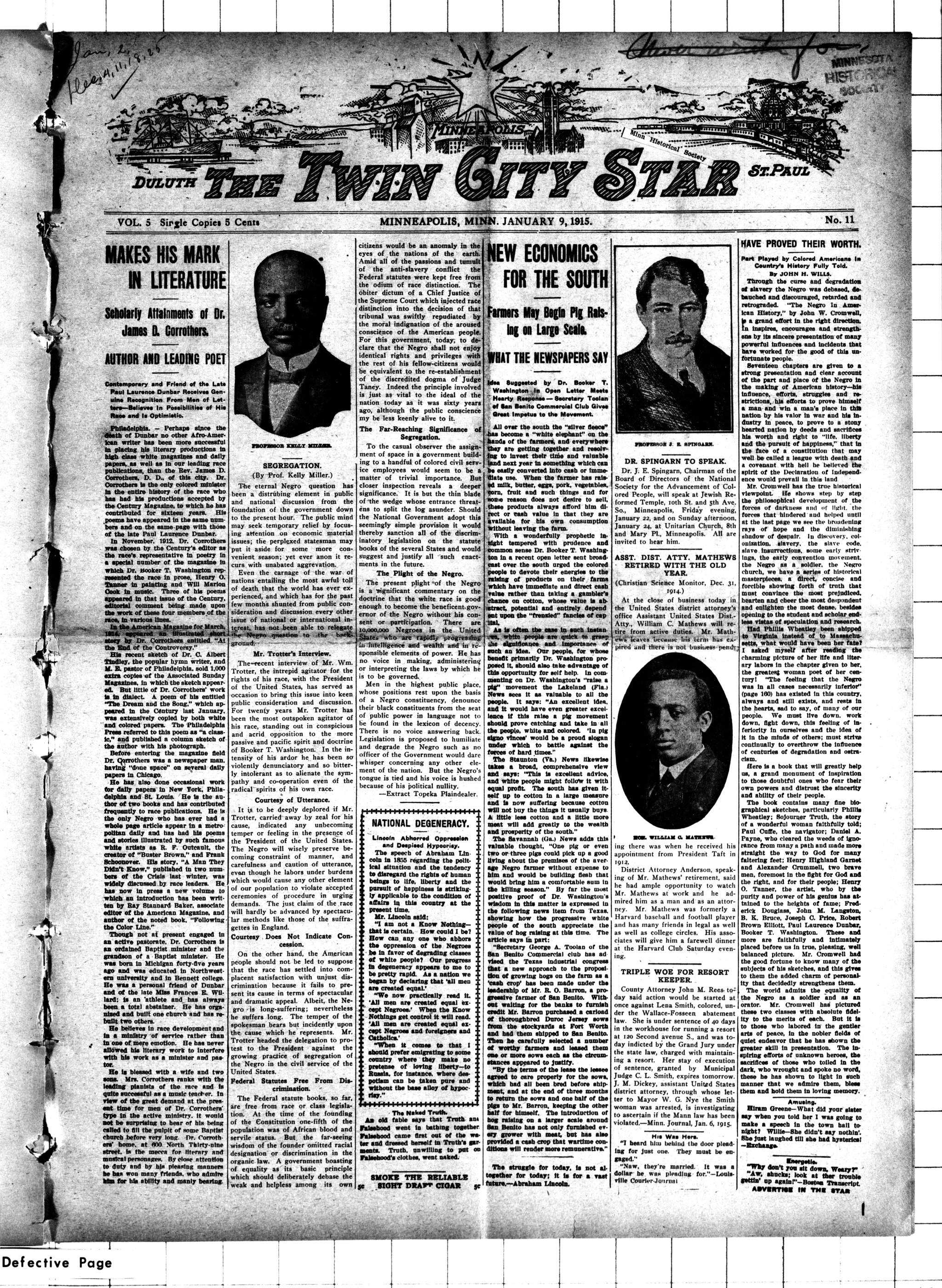
MAKES HIS MARK IN LITERATURE
Contemporary and Friend of the Late Paul Laurence Dunbar Receives Genuine Recognition From Men of Letters—Believes in Possibilities of His Race and is Optimistic.
Philadelphia. — Perhaps since the death of Dunbar no other Afro-American writer has been more successful in placing his literary productions in high class white magazines and daily papers, as well as in our leading race publications, than the Rev. James D. Corrothers, D. D., of this city. Dr. Corrothers is the only colored minister in the entire history of the race who has had his productions accepted by the Century Magazine, to which he has contributed for sixteen years. His poems have appeared in the same numbers and on the same page with those of the late Paul Laurence Dunbar.
In November, 1912, Dr. Corrothers was chosen by the Century's editor as the race's representative in poetry in a special number of the magazine in which Dr. Booker T. Washington represented the race in prose, Henry O. Tanner in painting and Will Marion Cook in music. Three of his poems appeared in that issue of the Century, editorial comment being made upon the work of these four members of the race, in various lines.
In the American Magazine for March, 1914, appeared an illustrated short story by Dr. Corrothers entitled "At the End of the Controversy."
His recent sketch of Dr. C. Albert Tindley, the popular hymn writer, and M. E. pastor of Philadelphia, sold 1,000 extra copies of the Associated Sunday Magazines, in which the sketch appeared. But little of Dr. Corrothers' work is in dialect. A poem of his entitled "The Dream and the Song," which appeared in the Century last January, was extensively copied by both white and colored papers. The Philadelphia Press referred to this poem as "a classic," and published a column sketch of the author with his photograph. Before entering the magazine field Dr. Corrothers was a newspaper man, having "done space" on several daily papers in Chicago.
He has also done occasional work for daily papers in New York, Philadelphia and St. Louis. He is the author of two books and has contributed frequently to race publications. He is the only Negro who has ever had a whole page article appear in a metropolitan daily and has had his poems and stories illustrated by such famous white artists as R. F. Outcault, the creator of "Buster Brown," and Frank Schoonover. His story, "A Man They Didn't Know," published in two numbers of the Crisis last winter, was widely discussed by race leaders. He has now in press a new volume to which an introduction has been written by Ray Stannard Baker, associate editor of the American Magazine, and author of the noted book, "Following the Color Line."
Though not at present engaged in an active pastorate, Dr. Corrothers is an ordained Baptist minister and the grandson of a Baptist minister. He was born in Michigan forty-five years ago and was educated in Northwestern university and in Bennett college. He was a personal friend of Dunbar and of the late Miss Frances E. Willard; is an athlete and has always been a total abstainer. He has organized and built one church and has rebuilt two others.
He believes in race development and in a ministry of service rather than in one of mere emotion. He has never allowed his literary work to interfere with his work as a minister and pastor.
He is blessed with a wife and two sons. Mrs. Corrothers ranks with the leading pianists of the race and is quite successful as a music teacher. In view of the great demand at the present time for men of Dr. Corrothers' type in the active ministry, it would not be surprising to hear of his being called to fill the pulpit of some Baptist church before very long. Dr. Corrothers' home, at 600 North Thirty-nine street, is the mecca for literary and musical personages. By close attention to duty and by his pleasing manners he has won many friends, who admire him for his ability and many bearing.
PROFESSOR KELLY MILLER.
The eternal Negro question has been a distrubing element in public and national discussion from the foundation of the government down to the present hour. The public mind may seek temporary relief by focusing attention on economic material issues; the perplexed statesman may put it aside for some more convenient season; yet ever anon it recurs with unabated aggression. Even the carnage of the war of nations entailing the most awful toll of death that the world has ever experienced, and which has for the past few months shunted from public consideration and discussion every other issue of national or international interest, has not been able to relegate the Negro question to the back ground.
Mr. Trotter's Interview.
The recent interview of Mr. Wm. Trotter, the interpell agitator for the rights of his race, with the President of the United States, has served as occasion to bring this issue into keen public consideration and discussion. For twenty years Mr. Trotter has been the most outspoken agitator of his race, standing out in conspicuous and acrid opposition to the more passive and pacific spirit and doctrine of Booker T. Washington. In the intensity of his ardor he has been so violently denunciatory and so bitterly intolerant as to alienate the sympathy and co-operation even of the radical spirits of his own race.
Courtesy of Utterance.
It is to be deeply deplored if Mr. Trotter, carried away by zeal for his cause, indicated any unbecoming temper or feeling in the presence of the President of the United States. The Negro will wisely preserve becoming constraint of manner, and carefulness and caution of utterance, even though he labors under burdens which would cause any other element of our population to violate accepted ceremonies of procedure in urging demands. The just claim of the race will hardly be advanced by spectacular methods like those of the suffragettes in England.
Courtesy Does Not Indicate Concession.
On the other hand, the American people should not be led to suppose that the race has settled into complacent satisfaction with unjust discrimination because it fails to present its cause in terms of spectacular and dramatic appeal. Albeit, the Negro is long-suffering; nevertheless he suffers long. The temper of the spokesman bears but incidently upon the cause which he represents. Mr. Trotter headed the delegation to protest to the President against the growing practice of segregation of the Negro in the civil service of the United States.
The Federal statute books, so far, are free from race or class legislation. At the time of the founding of the Constitution one-fifth of the population was of African blood and servile status. But the far-seeing wisdom of the founder omitted racial designation or discrimination in the organic law. A government boasting of equality as its basic principle which should deliberately debase the weak and helpless among its own
citizens would be an anomaly in the eyes of the nations of the earth. Amid all of the passions and tumult of the anti-slavery conflict the Federal statutes were kept free from the odium of race distinction. The obiter dictum of a Chief Justice of the Supreme Court which injected race distinction into the decision of that tribunal was swiftly repudiated by the moral indignation of the aroused conscience of the American people. For this government, today, to declare that the Negro shall not enjoy identical rights and privileges with the rest of his fellow-citizens would be equivalent to the re-establishment of the discredited dogma of Judge Taney. Indeed the principle involved is just as vital to the ideal of the nation today as it was sixty years ago, although the public conscience my be less keenly alive to it.
The Far-Reaching Significance of Segregation.
To the casual observer the assignment of space in a government building to a handful of colored civil service employees would seem to be a matter of trivial importance. But closer inspection reveals a deeper significance. It is but the thin blade of the wedge whose entrance threatens to split the log asunder. Should the National Government adopt this seemingly simple provision it would thereby sanction all of the discriminatory legislation on the statute books of the several States and would suggest and justify all such enactments in the future.
The Plight of the Negro.
The present plight of the Negro is a significant commentary on the doctrine that the white race is good enough to become the beneficent governor of the Negro without his consent or participation. There are 10,000,000 Negroes in the United States who are rapidly progressing in intelligence and wealth and in responsible elements of power. He has no voice in making, administering or interpreting the laws by which he is to be governed.
Men in the highest public place, whose positions rest upon the basis of a Negro constituency, denounce their black constituents from the seat of public power in language not to be found in the lexicon of decency. There is no voice answering back. Legislation is proposed to humiliate and degrade the Negro such as an officer of the Government would dare whisper concerning any other element of the nation. But the Negro's tongue is tied and his voice is hushed because of his political nullity.
—Extract Topeka Plaindealer.
NATIONAL DEGENERACY.
Lincoln Abhored Oppression and Despised Hypocrisy. The speech of Abraham Lincoln in 1855 regarding the political situation and the tendency to disregard the rights of human beings to life, liberty and the pursuit of happiness is strikingly applicable to the condition of affairs in this country at the present time.
Mr. Lincoln said:
"I am not a Know Nothing—that is certain. How could I be? How can any one who abhors the oppression of the Negroes be in favor of degrading classes of white people? Our progress in degeneracy appears to me to be pretty rapid. As a nation we began by declaring that 'all men are created equal.'
"We now practically read it. 'All men are created equal except Negroes.' When the Know Nothings get control it will read. 'All men are created equal except Negroes and foreigners and Catholica.'
"When it comes to that I should prefer emigrating to some country where they make no pretense of loving liberty—to Russia, for instance, where despotism can be taken pure and without the base alloy of hypocrisy."
The Naked Truth.
An old fable says that Truth and Falsehood went in bathing together. Falsehood came first out of the water and dressed herself in Truth's garments. Truth, unwilling to put on Falsehood's clothes, went naked.
SMOKE THE RELIABLE
SC SIGHT DRAFT CIGAR
NEW ECONOMICS FOR THE SOUTH
Farmers May Begin Pig Raising on Large Scale.
WHAT THE NEWSPAPERS SAY
Idea Suggested by Dr. Booker T. Washington in Open Letter Meets Hearty Response — Secretary Toolan of San Benito Commercial Club Gives Great Impetus to the Movement.
All over the south the "silver fleece" has become a "white elephant" on the hands of the farmers, and everywhere they are getting together and resolving to invest their time and valuable land next year in something which can be easily converted into cash or immediate use. When the farmer has raised milk, butter, eggs, pork, vegetables, corn, fruit and such things and for some reason does not desire to sell, these products always afford him direct or cash value in that they are available for his own consumption without leaving the farm.
With a wonderfully prophetic insight tempered with prudence and common sense Dr. Booker T. Washington in a recent open letter sent broadcast over the south urged the colored people to devote their energies to the raising of products on their farms which have immediate and direct cash value rather than taking a gambler's chance on cotton, whose value is abstract, potential and entirely depend upon the "frenzled" fancies of capital.
As is often the case in such instances, white people are quick to grasp the significance and importance of such an Idea. Our people, for whose benefit primarily Dr. Washington proposed it, should also take advantage of this opportunity for self help. In commenting on Dr. Washington's "raise a pig" movement the Lakeland (Fla.) News sees it as valuable to all the people. It says: "An excellent idea, and it would have even greater excellence if this raise a pig movement should prove catching and take in all the people, white and colored. 'In pig signo vince's' would be a proud slogan under which to battle against the forces of hard times."
The Staunton (Va.) News likewise takes a broad, comprehensive view and says: "This is excellent advice, and white people might follow it with equal profit. The south has given itself up to cotton in a large measure and is now suffering because cotton will not buy the things it usually buys. A little less cotton and a little more meat will add greatly to the wealth and prosperity of the south." The Savannah (Ga.) News adds this valuable thought, "One pig or even two or three pigs could pick up a good living about the premises of the average Negro farmer without expense to him and would be building flesh that would bring him a comfortable sum in the killing season." By far the most positive proof of Dr. Washington's wisdom in this matter is expressed in the following news item from Texas, showing how the progressive white people of the south appreciate the value of hog raising at this time. The article says in part:
"Secretary George A. Toolan of the San Benito Commercial club has advised the Texas industrial congress that a new approach to the proposition of growing hogs on the farm as a 'cash crop' has been made under the leadership of Mr. R. O. Barron, a progressive farmer of San Benito. Without waiting for the banks to furnish credit Mr. Barron purchased a carload of thoroughbred Duroc Jersey sows from the stockyards at Fort Worth and had them shipped to San Benito. Then he carefully selected a number of worthy farmers and leased them one or more sows each as the circumstances appeared to justify.
"By the terms of the lease the lessee agreed to care properly for the sows, which had all been bred before shipment, and at the end of three months to return the sows and one half of the pigs to Mr. Barron, keeping the other half for himself. The introduction of hog raising on a larger scale around San Benito has not only furnished every grower with meat, but has also provided a cash crop that wartime conditions will render more remunerative."
The struggle for today, is not altogether for today; it is for a vast future—Abraham Lincoln.
PROFESSOR J. R. SPINGARN.
DR. SPINGARN TO SPEAK.
Dr. J. E. Spingarn, Chairman of the Board of Directors of the National Society for the Advancement of Colored People, will speak at Jewish Reformed Temple, 10th St. and 5th Ave. So., Minneapolis, Friday evening, January 22, and on Sunday afternoon, January 24, at Unitarian Church, 8th and Mary Pl., Minneapolis. All are invited to hear him.
ASST. DIST. ATTY. MATHEWS RETIRED WITH THE OLD YEAR
(Christian Science Monitor, Dec. 31, 1914.)
At the close of business today in the United States district attorney's office Assistant United States Dist. Atty., William C. Mathews will retire from active duties. Mr. Mathews leaves because his term has expired and there is not business pend.
ing there was when he received his appointment from President Taft in 1912. District Attorney Anderson, speaking of Mr. Mathews' retirement, said he had ample opportunity to watch Mr. Mathews at work and he admired him as a man and as an attorney. Mr. Mathews was formerly a Harvard baseball and football player and has many friends in legal as well as well as college circles. His associates will give him a farewell dinner at the Harvard Club Saturday evening.
TRIPLE WOE FOR RESORT
KEEPER
County Attorney John M. Rees today said action would be started at once against Lena Smith, colored, under the Wallace-Fosseen abatement law. She is under sentence of 40 days in the workhouse for running a resort at 120 Second avenue S., and was today indicted by the Grand Jury under the state law, charged with maintaining a resort. Her stay of execution of sentence, granted by Municipal Judge C. L. Smith, expires tomorrow. J. M. Dickey, assistant United States district attorney, through whose letter to Mayor W. G. Nye the Smith woman was arrested, is investigating to ascertain if the Mann law has been violated.—Minn. Journal, Jan. 6, 1915.
His Was Hera.
"I heard him behind the door pleading for just one. They must be engaged."
"Naw, they're married. It was a dollar he was pleading for."—Louisville Courier Journal
HAVE PROVED THEIR WORTH.
Part Played by Colored Americans In Country's History Fully Told.
By JOHN H. WILLS
Through the curse and degradation of slavery the Negro was debased, debauched and discouraged, retarded and retrograded. "The Negro In American History," by John W. Cromwell, is a grand effort in the right direction. In inspires, encourages and strengthens by its sincere presentation of many powerful influences and incidents that have worked for the good of this unfortunate people.
Seventeen chapters are given to a strong presentation and clear account of the part and place of the Negro in the making of American history—his influence, efforts, struggles and restrictions, his efforts to prove himself a man and win a man's place in this nation by his valor in war and his industry in peace, to prove to a stony hearted nation by deeds and sacrifices his worth and right to "life, liberty and the pursuit of happiness," that in the face of a constitution that may well be called a league with death and a covenant with hell he believed the spirit of the Declaration of Independence would prevail in this land.
Mr. Cromwell has the true historical viewpoint. He shows step by step the philosophical development of the forces of darkness and of light, the forces that hindered and helped until at the last page we see the broadening rays of hope and the diminishing shadow of despair. In discovery, colonization, slavery, the slave code, slave insurrections, some early strivings, the early convention movement, the Negro as a soldier, the Negro church, we have a series of historical masterpieces, a direct, concise and forcible showing forth of truth that must convince the most prejudiced, hearten and cheer the most despondent and enlighten the most dense, besides opening to the student and scholar endless vistas of speculation and research. Had Phillis Wheatley been shipped to Virginia instead of to Massachusetts, what would have been her fate? I asked myself after reading the charming picture of her life and literary labors in the chapter given to her, the greatest woman poet of her century! "The feeling that the Negro was in all cases necessarily inferior" (page 160) has existed in this country, always and still exists, and rests in the hearts, sad to say, of many of our people. We must live down, work down, fight down, this feeling of inferiority in ourselves and the idea of it in the minds of others; must strives continually to overthrow the influence of centuries of degradation and ostracism.
Here is a book that will greatly help us, a grand monument of inspiration to those doubtful ones who fear their own powers and distrust the sincerity and ability of their people.
The book contains many fine biographical sketches, particularly Phillis Whettley; Sojourner Truth, the story of a wonderful woman faithfully told; Paul Cuffe, the navigator; Daniel A. Payne, who cleared the weeds of ignorance from many a path and made more straight the way to God for many faltering feet; Henry Highland Garnet and Alexander Crummell, two brave men, foremost in the fight for God and the right, and for their people; Henry O. Tanner, the artist, who by the purity and power of his genius has attained to the heights of fame; Frederick Douglass, John M. Langton, B. K. B. Kruse, Joseph C. Price, Robert Brown Elliott, Paul Laurence Dunbar, Booker T. Washington. These and more are faithfully and intimately placed before us in true, pleasing, well balanced picture. Mr. Cromwell had the good fortune to know many of the subjects of his sketches, and this gives to them the added charm of personality that decidedly strengthens them.
The world admits the equality of the Negro as a soldier and as an orator. Mr. Cromwell has pictured these two classes with absolute fidelity to the merits of each. But it is to those who labored in the gentler arts of peace, in the nobler fields of quiet endeavor that he has shown the greater skill in presentation. The inspiring efforts of unknown heroes, the sacrifices of those who toiled in the dark, who wrought and spoke no word, these he has shown to light in such manner that we admire them, bless them and hold them in loving memory.
Amusing.
Hiram Greene—What did your sister say when you told her I was going to make a speech in the town hall tonight? Willie—She didn't say nothin'. She just laughed till she had hysterical—Exchange
"Why don't you sit down, Wearry?"
"Aw, shucks; look at her trouble gettin' up again!" - Boston Transcript
ADVERTISE IN THE STAR
Peoples Christian Assembly.
Rev. G. W. Mitchell, Pastor,
1204 Washington Ave. So.
Come! and Serve the Lord.
ST. PETER'S A. M. E. CHURCH
22nd St. near 10th Ave. So.
Rev. Thos. B. Stovall, Pastor.
ST. JAMES A. M. E. CHURCH,
318 8th Ave. So., Minneapolis.
Rev. E. R. Edwards, Pastor.
Messrs. Raymond W. Cannon, Miles
Cannon, James L. Titus, Carroll S.
Brown and Gale P. Hillyer attended
the Annual Meeting of the Alpha Phi
Alpha Fraternity recently held at
Chicago, representing Mu Chapter of
Minnesota.
Mr. Walter K. Bowie, was agreeably
surprised by a party of friends who
called at his residence, 3233 44th Ave.
So., to celebrate his birthday. Mr.
Bowie is shipping clerk for the
Goodrich Tire Co., and is making a
success in the poultry business. He
has a well stocked yard of prize
Anconas, and will enter some of his
birds in the Poultry Show.
Dr. David I. Hoage of New York
City was held in $3,000 bail in Harlem
Court. Four felonies were lodged
against him, accusing him of selling
drugs to an agent of the Department
of Correction. He was formerly arrested for having performed a criminal operation on a Negro girl in 1910.
Dr. Hoage is a brother of Mr. Geo.
L. Hoage of St. Paul.
Miss Sadie Higgenbothom of Chicago is a guest of her grand parents, Mr. and Mrs. A. Massie, 3317 Riverside Ave.
Mr. Geo. Harding of 1318 Washington Ave. So., died Sunday. Services were held Wednesday from Bethesda Baptist Church. He leaves a widow.
Judge Johnson's Grand New Year's Soiree will be held on Thursday evening at Union Temple Hall, on January 14, 1915.
Paul Sayers, the reliable and accommodating chauffeur has one of the most comfortable winter cars, with which he will give you the best service. Remember Paul. Main 1602.
AUTO FOR SALE.
Any one desiring a bargain will do well to see me before purchasing an auto. Write to Martin Brown, 2313 Park Ave. So.
Buy the Star
Send your personalis
Place your advertisements
Pay your subscriptions
Mrs. H. I. Williams
89 Union Block, St. Paul.
Mr. Schuyler Phillips has secured the appointment as Janitor of the House of Representatives.
Messrs. Wash. Rogers, P. F. Hale, "Jock" Simms, Ernest B. James and Atty. Franklin were applicants for various positions.
Chef Jones of the Arcade Cafeteria is making a great record. This establishment feeds thousands daily, averaging 27 meals per minute.
Marian A. Scott, recently paroled from Stillwater, is held for trial for attempted burglary.
Maurice Nickerson was given a workhouse sentence for cutting Pitt Thompson.
A Hard Time Ball will be given at Union Temple Hall on Monday Night, under the auspices of the Astoria Club, Bruce Black, president.
DESIRABLE HOUSE TO LET. Beautiful (3) Three Story Modern Building, in the coming Colored District, Center of City. Hotel. CHEAP rent. McDew, 802 Sykes Block.
Leave your Subscriptions and Printing at TWIN CITY STAR PRINTER8, 1402 Washington Ave. So.
Wanted—Agents to solicit advertising and news. Salary or commission. Good profits. Write the Twin City Star, Minneapolis, Minn.
If you wish to help this publication Send your subscription by Post office order.
JUDGE JOHNSON'S SPECIAL DANCES.
FUNERAL OF VICTORIA KEMP. The funeral services for Miss Victoria Kemp were held Tusday morning at Gethsemane Church. Many friends all over the city are left to mourn her death. Miss Kemp was seventeen years of age and was a recent graduate from Central High School. She was an exceedingly bright student and graduated from the High School with very high honors. The pall-bearers were Messrs. Charles W. Brown, Rector Hubbard, Miles Cannon, Homer Cannon, Harry Harper, and Veassus Pope. The honorary pall-bearers were the Misses Ednah Shull, Merienne Jeffery, Corinne Parson, Elizabeth Nelson, Adelaide Carter, and Helen Brady. "Abide with Me" and "Nearer my God to Thee" were beautifully rendered by the leading soloists of Gethsemane. The body was laid to rest in Grandview cemetery at Hopkins. The services were conducted by Reverend Foxwell and his assistant.
MINNEAPOLIS SUNDAY FORUM
The Sunday Forum met last Sunday afternoon at St. Peter's Church. Exercises opened with song, "Abide with me." Prayer by W. H. Jenkins. Quotations by members. Minutes by Miss Jonsie Wright. Dr. R. S. Brown installed President R. Skinner for the ensuing term. The following officers were installed by Pres. Skinner: V. Pres., Veasus Pope; Secy. Miss Jonsie Wright; Treas., Mrs. I. S. Bogie; Chaplain, Roscoe Lewis; Journalist, Louis Marshall; Critic, Dr. James L. Titus. Appointive officers and Committees will be named later. On account of the death of Miss Victoria Kemp, a committee, Miss Zelma La Force, V. Pope, A. J. Kelso was appointed to draft appropriate resolutions, which were adopted. Current Events were read by Journalist. Robt. Marshall read a paper on "The Negro's Place and Portrayal in Dramatic Art," which was very interesting. Chas. S. Smith spoke briefly and commended the effort of Mr. Marshall. Miss Ada Jones rendered a piano selection. Benediction by Chaplain. Memorial Services will be held in honor of Miss Kemp. Next meeting at Bethesda Baptist Church, January 17, at 3:30 P. M.
M. and Mrs. M. O. Cannon returned home last week from Northfield, Minn., where they attended the funeral of her father, who died Dec. 29 from pneumonia. He was a Veteran of the G. A. R., and an old citizen of Northfield.
The Mu. So. Lit. Club held their Matinee Dance on New Year's Day at Masonic Hall. It was a splendid affair and well attended by a select crowd of young men and ladies, and was the exclusive event of the Holidays.
Messrs. Geo. W. Lillart and Roscoe Lewis served this week as Petit Jurors in the District Court.
Mrs. Ophelia Rice and Mrs. Maud Canty entertained the M. T. C. Art Club on Thursday afternoon at their residence, 1409 5th St. So. After the program a delicious lunch was served.
Mrs. A. G. Plummer left Wednesday eve. for Galveston, Tex., after a visit to her husband's relatives in this city.
Miss Eliza Wilson entertained at luncheon Mrs. O. Rice, Mrs. Fannie Lee, and Mrs. John Walker, on Dec. 30, at 1412 West 24th St.
Misses Eliza Wilson and Florence Cunningham entertained about twenty friends at a New Year's Eve dancing party at the Skiles residence on 24th St.
Editor W. Monroe Trotter, of Boston, Mass., spoke Friday evening, Jan. 8th, at St. James Church, St. Paul.
A NEGLECTED OPPORTUNITY
Several years ago St. Paul and Minneapolis could boast of a dozen Negro stenographers in each city, both male and female, employed in white business houses and corporations. Marriages, removals and promotions have now reduced the number now employed to about three in each city, and yet the opportunity is just as great for our boys and girls in that line as it ever was, but no one appears to be taking advantage of it by preparing themselves for the work. Some of our business and professional men say that they would like to have but cannot get a Negro stenographer. Apparently there is a great opportunity in the Twin Cities for employment as stenographer in business places among both races. The Star has been informed by many of those who have been employed as stenographers that the question of color never interfered with their employment in any way but that it was merely a matter of efficiency. The young people of the Twin Cities should not overlook an avenue of employment that has been open to them for years and which may be closed to them if they continue to neglect it.
TWIN CITY STAR
Continued from last week.
Christmas
A Story
By Zona Gale
Copyright, 1912, by the McClure Publications, Incorporated.
Copyright, 1912, by the Macmillan Company.
that had elapsed since in at the Old Trail Town had stood there, we about her, hardly bran two Trail Town men, traveling man had had been no one else the child should be station, she had quarrector, begged him again, parleyed with swung his lantern, turned away with the ly unable to form There was no other Old Trail Town that mean disaster — indeed that had somehow o had not pointed the gone. She recalled no fused Buff Miles' invad had suffered him to Then she had set out On that walk home her plans. Obscure ring in her fear, at fi and then gave place.
Ewenbeer to hard times and the failure of Ebeneser Rule's factory the people of Old Trail Town contemplate buying no presents and having no Christmas.
A town meeting is held, and the decision is reached to have no Christmas, not even for the children.
A notice to this effect is signed by nearly every one. Mary Chavah receives a letter from her sister Lily's boy.
This boy asks her to take his six-year-old brother, son of Adam Blood, a lover who filleted Mary for her sister Lily.
Mary prepares to welcome him. Despite their resolutions many people find it difficult to cut out Christmas altogether.
Ebeneser Rule, grieving for his dead son, Malcolm, and his dead wife, finds the boy's hobbyhorse in an unused attic.
Boys and girls are unhappy because there will be no Christmas. Women regret that Mary's boy will find none awaiting him.
Children of the town are rehearsing for a funeral on Christmas. They are planning to bury Santa Claus.
Ellen Bourne plans to have a Christmas tree and urges her husband to adopt a little boy at once.
The good townsfolk secretly prepare to gather at Mary's house on Christmas eve to welcome the little boy.
One after another different people break the anti-Christmas pledge. The spirit of Christmas softens the hard heart of Ebenezer Rule.
He gets the hobbyhorse for Mary's boy, whose train is delayed. Every one is happy in preparing a Christmas welcome for the orphan.
The boy arrives in safety and the town Christmas happily celebrates it after all.
Advertisements
JUDGE JOHNSON'S SPECIAL DANCES,
JANUARY 14, 1915.
JUDGE'S BIRTHDAY PARTY
JANUARY 28, 1915.
MEET YOUR FRIENDS AT
Union Temple Hall, 28 Washington
Ave. So.
where Judge Johnson will entertain
his many patrons. Best order—
Music and Refreshments.
A Happy New Year to all is the
wish of
Judge Johnson,
The pleasure-maker.
OLIVER'S NEW CABARET.
Mr. Sylvester W. Oliver is keeping pace with the modern features of entertainments, and has decorated his Cabaret Room in the most appropriate design, with myriads of electric
Mr. Sylvester W. Oliver lights, producing a scenic effect much to the pleasure of his patrons. The designs are painted by Sanford and are very commendable. There are few places which surpass Oliver's. When in doubt, call at Oliver's, 244 Third Ave. So., and witness the Cabaret by best entertainers. After theatre parties will find it specially convenient to spend a while in the luxurious Cabaret Room under such very pleasant accommodations.
Neatly Furnished Rooms.
Newly Furnished Front Rooms, Suitable for Gentlemen or Ladies, on the car line, Bath and Heat. Apply to Mrs. M. Jackson, 827 Cedar Ave., Minneapolis. Call Nic. 591.
Dressmaking—Plain and Fancy Sewing. Baby Clothes a specialty. Call South 404. Mrs. Lewis, 2912 Harriet Ave. So.
The Big Three. Every First and Third Tuesday. Arcade Hall, 1311 Washington Ave. So., Minneapolis. Good Music. Refreshments and Good Order.
SUBSCRIBE FOR THE STAR
---
that had elapsed since the local came in at the Old Trail Town station. She had stood there, with the children about her, hardly breathing while the two Trail Town men and a solitary traveling man had alighted. There had no been one else. In terror jest the child should be carried past the station, she had questioned the conductor, begged him to go in and look again, parleyed with him until he had swung his lantern. Then she had turned away with the children, utterly unable to formulate anything. There was no other train to stop at Old Trail Town that night. It must mean disaster — indefinable disaster— that had somehow engulfed him and had not pointed the way that he had gone. She recalled now that she had refused Buff Miles' invitation to ride, but had suffered him to take the children. Then she had set out to walk home.
On that walk home she had unlived her plans. Observe speculations, stirring in her fear, at first tormented her and then gave place to the conclusion that John had changed his mind, had seen perhaps that he could not after all let the child go so far, had found some one else to take him, and that the morrow would bring a letter to tell her so. In any case, she was not to have him. The conclusion swept her with the vigor of certainty. But instead of the relief for which she would have looked, that certainty gave her nothing but desolation. Until the moment when the expectation seemed to die she had not divined how it had grown into her days, as subtly as the growth of little cell and little cell. And now the weight upon her, instead of lifting, soaring in the possibility of the return of her old freedom, lay the more heavily, and her sense of oppression became abysmal. "Something is going to happen." she had kept saying. "Something has happened."
So she had got on toward her own door. There the swift relief was like an upbearing into another air, charged with more intimate largess for life. Now Mary sat in the stable in a sense of happy reality that clothed all her feeling—rather, in a sense of super-reality, which she did not know how to accept. So, slowly singing in her as she sat at her task, came that which had waited until she should open the way.
In the stable there was that fusion of shadow and light in which captive spaces reveal all their mystery. Little areas of brightness, of functioning; then dimness, then the deep. Brightness in which surfaces of worn floor, slivered wall, dusty glass, showed values more specific than those of color. Dimness in which gray rafters with wavering edges, rough posts, each with an accessory of shadow; an old harness in grotesque loops, ceased to be background and assumed roles. The background itself, modified by many an unshadowed promontory, was accented in caverns of manger and roof. The place revealed mystery and beauty in the casual business of saying what had to be said.
Mary filled her arms with hay and turned to the manger. The raw smell of the clover smote her, and it was as sweet as spring repromised. She stood for a moment with the hay in her arms, her breath coming swiftly.
Down on the marsh, not half an hour away, he was coming to her, to be with her, as she had grown used to imagining him. She had thought that he was not coming, and he was almost here. She knew now that she was glad of this, no matter what it brought her—glad as she had never known how to be glad of anything before. He was coming! There was a thrill in the words every time that she thought them. Already she was welcoming him in her heart, already he was here, already he was born into her life.
With a soft, fierce rush of feeling not her own, it seemed to her that her point of perception was somehow drawn inward, as if she no longer saw from the old places, as if something in her that was not used to looking looked. In the seat where her will had been was no will. But somewhere in there, beyond all conflict, she felt herself to be. Beyond a thousand mists, voltions, little seekings for comfort, rebellions at toll, the crylings of personality for its physical own, she stood at last, herself within herself. And that which through the slow process of her life and of life and being immeasurably before her had been seeking its expression, building up its own vehicle of incarnation, quite suddenly and simply flowered. It was as if the weight and the striving within her had been the pangs of some birth. She stood, as light of heart as a little child, filled with peace and tender exaltation.
These filled her on the road which she took to meet him—and took alone, for she would have no one go with her ("What's come over Mary?" they asked one another in the kitchen. "She acts like she was somebody else and herself too.") The night lay about her as any other winter night—whit and black—a clean white world, on which men set a pattern of highway and shelter; a clean dark sky, on which a story is written in stars, and between—no mystery, but only growth. Out toward the drawbridge the road was not well broken. She went, stumbling in the ruts and hardly conscious of them. And Mary thought: "Something in me is glad.
"It's as if something in me knew how to be glad more than 1 ever knew how alone.
"For I'm nothing but me here in Old Trail Town, and yet it's as if something had come, secret, on purpose to make me know why to be glad.
"It's something in the world bigger than I know about
than I know about.
"It's in me, and I guess it was in folks before me, and it will be in folks always.
"It isn't just for Ebenezer Rule and the city.
"It's for everybody, here in Old Trail Town as much as anywhere.
"It's for folks that's hungry for it, and it's for folks that ain't.
"It's always been in the world, and it always will be in the world, and some day we'll know what to do."
But this was hardly in her feeling or even in her thought; it lay within her thanksgiving that the child was coming and he only a little way down there across the marsh.
CHAPTER XV.
Merry Christmas.
It seemed quite credible and even fitting that the mighty, rushing, lighted express, which seldom stopped at Old Trail Town, should that night come thundering across the marsh and slow down at the drawbridge for her sake and the little boy's. Several coaches' length from where she stood she saw a lantern shine where they were lifting him down. She ran ankle deep through the thinly crusted snow.
"That's it!" said the conductor. "All the way from Idaho!" And swung his lantern from the step. "Merry Christmas!" he called back.
The little thing clasping Mary's hand suddenly leaped up and down beside her.
"Merry Christmas! Merry Christmas! Merry Christmas!" he shouted with all his might.
Mary Chavah stood silent, and as the train drew away held out her hand, still in silence, for the boy to take.
As the noise of the train lessened he looked up.
"Are you her?" he asked soberly.
Are you here? he asked soberly.
"Yes," she cried joyously, "I'm her!"
Their way led east between high banks of snow. At the end of the road was the village, looking like something lying on the great white plate of the meadows and being offered to one who needed it. At the far end of the road which was Old Trail road hung the blue arc light of the town hall, center to the constellation of the home lights and the shop lights and the street lights. There, in her house, were her neighbors gathered to do no violence to that Christmas paper of theirs, since there was to be no "present trading," no "money spending." Nevertheless they had drawn together by common consent, and it was Christmas eve. She knew it now. There is no arbi-
"Are you her?" he asked soberly.
trary shutting out of that for which Christmas stands. As its spirit was in the village, so its spirit is in the world—denied, indeed, put upon, crowned with mockery, dragged in the dirt, bearing alien burdens, but through it all immaculate, waiting for men to cross the threshold at which it never ceases to beckon to a common heritage. Home of the world, with a thousand towers shining with uncounted lights, lying very near—above the village, at the end of the Old Trail road, upon the earth at the end of a yet unbeaten path where men face the sovereign fact of humanhood.
But all this lay within Mary's dumb thanksgiving that the child was running at her side. And the vision that she saw streamed down from Capella, of the brightness of a hundred of our suns, the star that stood in the east above the village where she lived.
Lanterns glowed through the roadside shrubbery, little kindly lights, like answers, and at a bend in the road voices burst about them, and Buff Miles and the children, Gussie and Bennet and Tab and Pep and little Emily, ran, singing, and closed about Mary and the child and went on with them, slipping into the "church choir Christmas carols," and more that Buff had been fain to teach them. The music filled the quiet night, rose in the children's voices like an invocation to all time.
One for the way it all begun.
But what will be has not been yet.
So holly and mistletoe.
Between songs the children whisper ed together for a minute.
"What's the new little boy's name?" asked Tab.
Nobody knew. That would be something to find out
"Well," Tab said. "tomorrow morning, right after breakfast. I'm going to bring Theophila Thistledown down and lend him to him."
"Ain't we going to bury Sandy Claus right after breakfast?" demanded Gussie.
And all the children, even little Emily, answered:
"No; let's not."
They all went on together and entered Mary's gate. Those within, hearing the singing, had opened the door, and they brought them through that deep arch of warmth and light. Afterward no one could remember whether or not the greeting had been "Merry Christmas," but there could have been no mistaking what everybody meant.
At his gate in the street wall lined with snow bowed lilacs and mulberries Ebenezer Rule waited in the dark for his two friends to come back. He had found Kate Kerr in his kitchen methodically making a jar of Christmas cookies. ("You've got to eat, if it is Christmas," she had defended herself in a whisper.) And to her stupefaction he had dispatched her to Mary Chavah's with her entire Christmas baking in a basket.
"I don't believe they've got near enough for all the folks I see going," he explained it.
While he went within doors he had left the hobbyhorse in the snow close to the wall, and he came back there to wait. The street had emptied. By now every one had gone to Mary Chavah's. Once he caught the gleam of lanterns down the road and heard children's voices singing. For some time he heard the singing, and after it had stopped he fancied that he heard it. Startled, he looked up into the wide night lying serene above the town and not yet become vexed by the town's shadows and interrupted by their lights. It was as if the singing came from up there. But the night kept its way of looking steadily beyond him.
It came to Ebenezer that the night had not always been so unconscious of his presence. The one long ago, for example, when he had slept beneath this wall and dreamed that he had a kingdom; those other nights when he had wandered abroad with his star glass. Then the night used to be something else. It had seemed to meet him, to admit him. Now he knew, and for a long time had known, that when he was abroad in the night he was there, so to say, without his permission. As for men, he could not tell when relation with them had changed, when he had begun to think of them as among the externals, but he knew that now he ran along the surface of them and let them go. He never met them as "others," as belonging to countless equations of which he was one term, and they playing that wonderful, near role of "other." Thus he had got along, as if his own individuation were the only one that had ever occurred and as if all the mass of mankind—and the night and the day—were undifferentiated from some substance all inimical.
Then this vast egoism had beard itself expressed in the mention of Bruce's baby—the third generation. But by the great sorcery wherewith nature has protected herself, this mammoth sense of self, when it extends unto the next generations, becomes a keeper of the race. Ebenezer had been touched, relaxed, disintegrated. Here was an interest outside himself which was yet no external. Vast, level reaches lay about that fact and all long unexplored. But these were people. He saw them peopled.
As in the cheer and stir within the house where that night were gathered his townsfolk, his neighbors, his "hands." He had thought that their way of meeting him, if he chose to go among them, would matter nothing. Abruptly now he saw that it would matter more than he could bear. They were in there at Mary's, the rooms full of little families, getting along as best they could, taking pride in their children, looking ahead, looking ahead—and they would not know that he understood. He could not have defined offhand what it was that he understood. But it had, it seemed, something to do with Letty's account book and Bruce's baby.
Gradually he let himself face what it was that he was wanting to do. And when he faced that he left the hobbyhorse where it was under the wall and went into the street.
He took his place among the externals of the winter night, himself un conscious of them. The night, with all its content, a thing of explicate fellowships, lay waiting patiently for those of its children who knew its face. In the dark and under the snow the very elements of earth and life were obscured, as in some clear wash correcting too strong values. He moved along the village, and now his dominant consciousness was the same consciousness in which that little village lived. But he knew it only as the impulse that urged him on toward Jenny's house. If he went to Jenny's, if he signified so that he wished not to be cut off from her and Bruce and the baby, if he asked Bruce to come back to the business, these meant a lifetime of modification to the boy's ideals for that business and modification to the lives of the "hands" back there in Mary Chavah's house and to something else.
"What else?" he looked himself.
Mechanically he looked up and saw the heavens crowded with bright watchers. In that high field one star, brighter than the others, hung over the little town. He found himself try-
Defective
ective Page
ing to see the stars as they had looked to him years ago, when they and the night had seemed to mean something else. "What else?" he asked himself.
"What else?" he asked himself.
The time did not seem momentous.
It was only very quiet. Nothing new was there, nothing different. It had always been so. The night lay in a sovereign consciousness of being more than just itself. "Do you think that you are all just you and nothing else?" it was seen to be compassionately asking.
"What else?" Ebenezer asked himself.
He did not face this yet. But in that hour which seemed pure essence, with no attenuating sound or touch, he kept on up the hill toward Jenny's house.
Mary Chavah left ajar the door from the child's room to the room where, in the dark, the tree stood. He had wanted the door to be ajar "so the things I think about can go back and forth," he had explained.
In the dining room she wrapped herself in the gray shawl and threw up the two windows. New air swept in, cleansing, replacing, prevailing. Her guests had left her early, as is the way in Old Trail Town. Then she had had her first moments with the child alone. He had done the things that she had not thought of his doing, but had inevitably recognized—had delayed his bed going, had magnified and repeated the offices of his journey, had shown her the contents of his pockets, had repeatedly mentioned by their first names his playmates in Idaho and shown surprise when she asked him who they were. Mary stood now by the window conscious of a wonderful thing—that it seemed as if he had been there always.
In the clean inrush of the air she was aware of a faint fragrance, coming to her once and again. She looked down at her garden, lying wrapped in white and veiled with black like some secret being. Three elements were slowly fashioning it, while the fourth, a soft fire within her, answered them. The fragrance made it seem as if the turn of the year were very near, as if its prophecy, evident once in the October viollets in her garden, were come again. But when she moved she knew that the fragrance came from within the room, from Ellen Bourne's Christmas rose, blossoming on the table. Above her eye fell on the picture that Jenny had brought to her on that day when she had all but emptied the house, as if in readiness. Almost she understood now the passionate expectation of those who in her dream had kept saying "You."
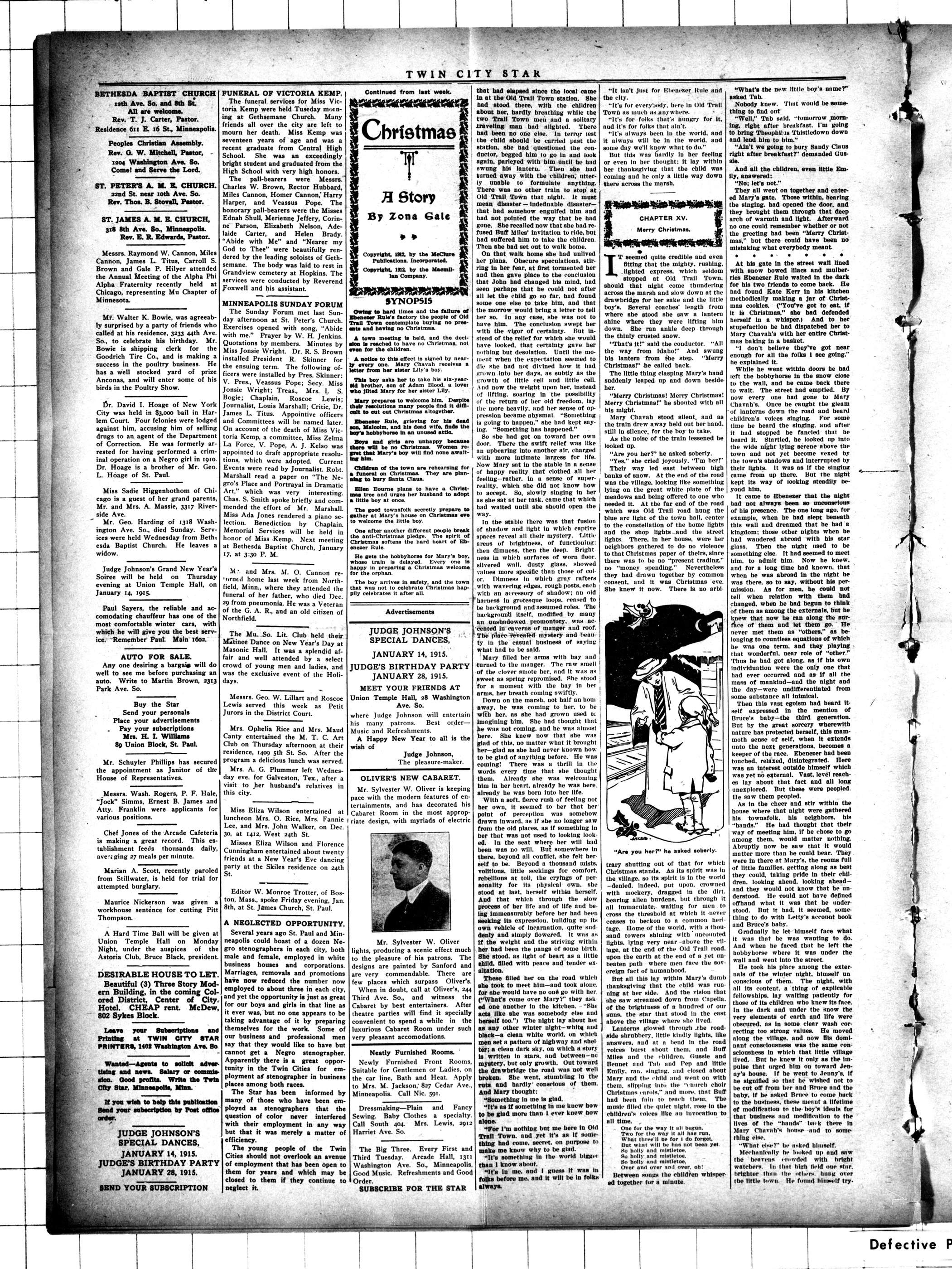
There was a movement in her garden and on the walk footsteps. The three men stepped into the rectangle of lamplight—Abel Ames and Simeon, who had left the party a little before the others and, hurrying back with the gifts that they planned, had met Ebenezer at his gate, getting home from Jenny's house. In Abel's arms was something globed, like a little world; in Simeon's, the tall, gray gowned St. Nicholas taken from the Exchange window, the lettered sign absent, but the little flag still in his hand, and Ebenezer was carrying the hobbyhorse.
"Has the boy gone to bed?" Abel asked without preface.
"Yes," Mary answered. "I'm sorry."
"Never mind," Simeon whispered, "you can give him these in the morning."
Mary, her shawl half hiding her face, stooped to take what the three lifted.
Ackroyd.
The Three Men Stepped Into the Rectangle of Lamplight.
"They ain't presents, you know," Abel assured her positively. "They're just—well, just to let him know."
Mary set the strange assortment on the floor of the dining room—the things that were to be nothing in themselves, only just "to let him know."
"Thank you for him," she said gently. "And thank you for me." she added.
Ebenezer fumbled for a moment at his beaver hat and took it off. Then the other two did so to their firm fixed caps. And with an impulse that came from no one could tell whom, the three spoke—the first time hesitatingly, the next time together and confidently.
"Merry Christmas, merry Christmas!" they said.
Mary Chavah lifted her hand.
"Merry Christmas!" she cried.
THE END.
Collisions in the air are as deadly, it appears, as those on the ocean. Eventually it may become necessary to double track both sea and sky.
Don't forget if trouble comes that you are being given an opportunity to show other people how one should behave when things go wrong.
DALLAS LEADS IN BUSINESS
Friendly Relations Between the White and Colored People and the Latter's Capacity to Organize For Material Advancement Given as Chief Cause For Their Remarkable Success.
By RALPH W. TYLER.
Dallas, Tex.-There are 23,000 colored people in this city, forming one-fourth of the total population. One who spends a little time here among the members of the race soon discovers that these 23,000 of our people also form one-fourth of the city's energy. I found little or no whining among them, Recognizing their present limitations and the odds against them, the race, under capable leadership, is spending no time in deploring, but rather striving to better conditions. Dallas is a beautiful city, the residences suggesting to the visitor that he is in some northern city famed for the architectural beauty of its homes.
The vast amount of commerce, building operations and industrial enterprises here suggests to the visitor that he is in some bustling mart of commerce east of the Mississippi and north of the Ohio. Dallas boasts of one of the strongest local Negro Business leagues in Texas or any other state. The co-operative spirit engendered by a business league, and the activity resultant therefrom invariably make for business progress. The race's business men in this city have $300,000 invested in business enterprises; $600,000 of the city's taxable property belongs in fee simple to the members of the race, and $50,000 in Dallas' banks is deposited to their credit.
Dallas has been enjoying an unprecedented business boom, and the establishment by the federal government of a regional bank served only to increase business and draw attention to this, Texas' metropolis, as a wonderfully progressive city, whose future has practically no limitations. In all the progress being made here the race is largely contributing, and in all the business success being achieved the race is sharing. I met Mr. W. Sidney Pittman here, an architect than whom there is none better, and he told me of his success. Coming from Washington, where his architectural ability was well known, but little employed by his own people, the race here in Dallas recognized and employed him. Here the race places a premium upon ability and efficiency.
Mr. Pittman is enjoying prosperity here that is in contradistinction to what he enjoyed in the north, and in every movement for racial betterment he is an active, helpful factor. Largely through his efforts the Local Business league was given new life. W. E. King, sole editor and proprietor of the Dallas Express, one of the very best race newspapers published in this country, has done more perhaps than any single man to advertise Dallas and to accelerate race advancement.
The race in Dallas recognizes that business, education and religion should go hand in hand, and, while making rapid and wonderful material progress, the educational and religious advancement is not lagging. Twenty-four churches conserve the religious interests of the race, and six public schools, with sixty-eight efficient teachers, conserve the educational interests of the race. I was much pleased with the character of the school buildings for our race. They are substantial, modernly equipped and sanitary. I was advised that the whites are very considerate of the requests made by the race for improved educational facilities.
The amicable relations existing between the two races here is one of the very encouraging signs which points to that unrestricted freedom that is the hope of us all. Texas, one observes, is trying its utmost to dispel the long time held belief that the state stands for race retardance. The appropriations made down here for Negro schools—greater than any southern state—and the helpful assistance given by white men to men of our race in business indicates a condition just the opposite to that which many think.
There are sixty-eight Negro teachers, sixteen physicians, four dentists and five lawyers to make up the race's professional class in Dallas. There are six business corporations, twenty-five excellent grocery stores, two drug stores, one moving picture theater, one hotel, a number of well conducted cafes, real estate agencies, a furniture store, three undertakers, an automobile repair shop and a number of enterprising contractors to represent the race's diversified business activities.
In this city I find that among the men who have made possible the prosperity that the race is now enjoying and who are providing for a splendid future are Dr. B. R. Bluitt. Rev. A. S. Jackson. J. C. Jordan. N. W. Harlee. S. C. Block. D. Romen. F. P. Mayes. Rev. S. E. Watson. Dr. R. T. Hamilton. Jake Ward. W. E. King. Dr. M. C. Cooper. Dr. J. W. Anderson. Rev. C. W. Ablington. S. R. Johnson. D. V. Hooper. W. Sidney Pittman. R. L. Logins, H. Strickland. E. T. Williams and the very active president of the ocal business league.
TWIN CITY STAR
OKLAHOMA PAYS HIGH TRIBUTE
Citizens of Okmulgee Praise Thrift of Afro-Americans.
DR. LAMBERT CHIEF SPEAKER
In Optimistic Address Well Known White_Man Says Race Occupies Unique Place In Country's History. Presaches Doctrine of Character as True Measure of Manhood.
By WILLIAM H. DAVIS.
Okmulgee, Okla.—The high esteem in which Dr. Booker T. Washington is held by the people of both races in Okmulgee and vicinity was never more generously shown than it was on his recent visit to this town. At the meeting held on this occasion Dr. Washington was made welcome in a most timely address delivered by Dr. O. A. Lambert, who in part said:
I come today as a representative of the Anglo-Saxon race to bid your people a godspedex in every undertaking that will lift them to a better, a higher, a nobler, condition of life. Whether we will it or not, you are a part of our national existence, and in the years gone by the hand of fate you have been given the future years can only reveal its fullest meaning. As a people your place in history is unique. Torn from a dark continent of ignorance and superstition by the ruthless hand of greed, enslaved for 400 years by a superior race, redeemed from that bondage by treasures of money and sacrifice of the best blood of a nation and suddenly given all the rights and priviledge that nation, you hold a place in history unparalleled and as a race stand alone.
Believing in the doctrine that character is the true measure of a man, that merit is the determining factor in the scale of life and that true worth may be found under a black skin as well as the white skin, is the same. We nodly on all the good or all the bad, but that the virtues and the vices flourish alike in all the races under the same conditions of life and environment—with these truths uppermost in our hearts today we can speak the message of cheer and hope American race. Fifty years ago 4,000,000 of your people were wearing the galling chains of slavery, without property.
But today you present yourselves with more than 9,000,000 of people, paying taxes on $700,000,000 worth of property, sustaining more than sixty Afro-American banks, having your own schools, churches and colleges, with representatives of your industrial, commercial and intellectual life activity of the nation. In the south alone there are over 30,000 Afro-American schoolteachers, where half a century ago it was a crime to teach a Negro to read and write. There are today more than 1,100 instructors in 169 academies, schools and colleges who are graduates of colleges; more than 40,000 Sunday school teachers; more than 100 in the ministry who are graduates from theological schools. There are 1,200 lawyers, 1,800 doctors and scores of editors of magazines and newspapers who are engaged in lifting the once benighted and superstitious mind of the race into the sunlight of knowledge and truth.
To the question "Is the Negro capable of intellectual attainment?" you have given the affirmation by way of such Afro-American schools, by way of such Tuskegee, schools with such intellectual minds as Bishop Payne, Mitchel, Price and Booker T. Washington.
To those who think that the Negro lacks enterprise and business accumen you can point with pride to J. H. Lewis, the second largest merchant tailor in the state of Alabama, who has owned the Edges States, or to M. O. Atwood of East Sagamore, Mich., one of the largest lumber dealers of the northwest, born an Alabama slave, or to Walter P. Hall, the largest wholesale produce merchant on Market street, Philadelphia. But why take time to specify by name? For they are the most successful and commercial field and have shown great ability and thrift in the management of business enterprise.
To those who thought the Negro lacking in ingenuity and mechanical skill you can tell, then, of McCoy, who invented the lubricator now in use on nearly all railroad engines, or Lewis H. Lattimer, the expert electrician of the New York Electric Light company, who personally invented the electric plants in the great cities of England, or W. A. Hezel, the noted designer and decorator. Some of the finest art glass in our churches today are his designs. To those who think you are devoid of culture and love of the esthetic, point them to W. E. Bannister, whose painting "Under the Oaks" won the medal at the Philadelphia exposition in 1876, or Professor Henry O. Tanner, who recently sold to the Luxemburg gallery his famous painting the Lazarus," the second American artist to sell his work to that institution.
To those who charge that the Negro lacks physical courage and fortitude let the annals of history answer how at Fort Pillow and Cold Harbor in the war to save the Union the black troops stood the battle and the enemy was to manner as to call forth the admiration of the whole country, or, in the Spanish-American war, with the well disciplined and fortified Spanish troops pouring a deadly fire from the hill into the faces of the black troops, with a song on their lips, Country, Tis of Thee, Sweet and Warm of the Charge charging up the hill and saved to the rough riders the victory of San Juan Hill.
world that you have the essential elements, though crude some may be, to become a self supporting, self governing race of people. Give you 400 years of American freedom. American opportunity and achievement and much will be your achievement that if it were possible for Lincoln, your great deliverer, to look down from the portals of heaven he would little suspect you were the descendants from those from whose limbs he unclosed the shackles. Napoleon once said, "I and time can accomplish all things. This is the only time I will be with patience and sober judgment in God's own good time the race problem will be satisfactorily settled, not by violence, not by transportation or segregation, not by social equality or distinction or race mixture, but along the lines of intellectual and industrial attainments by the individual growth of character into true womanhood." This is the proof the white race that you have characterizes integrity, wealth and brains prejudices will pass away like the mists before a noonday sun.
DO YOU WANT TO BE WELL
DRESSED? THEN I AM YOUR
TAILOR.
SUITS
$25.00
OVERCOATS
$25.00
Cleaning
Pressing
Repairing
CLIFFORD A. SMITH.
421 UNIVERSITY AVE., ST. PAUL
N. W. PHONE DALE 3823.
SMOKE THE BEST
5C CIGAR
Sight Draft
W. S CONRAD CO., Distributors
NO. 140. E. 6th ST., ST. PAUL.
NO. 1. WESTERN AVE., MINN.
"Kid" Martin, Prop. N. W. Nic. 1250
EAT AT MARTINS.
Good Cooking—Popular Prices.
MARTIN'S RESTAURANT.
MARTIN'S ROOMS
Newly Furnished — Steam Heated
Electric Lighted—Near Car Line
205 11th AVE. SO.
MINNEAPOLIS, MINN.
Judge Johnson's Dances
Judge Johnson will hold his dances every 2nd and 4th Thursday evening UNION TEMPLE HALL 28 Washington Ave. So. ADMISSION 35c.
THE CARVER HOTEL
200 ELEVENTH AVE. SO.
By Day, Week or Month.
Special Rates to Theatrical People.
Mrs. Alice (Mother) Carver, Prop.
N. W. Phone Main 863
Peterson, The Druggist
1501 Washington Ave. So.
TOILET ARTICLES, DRUGS
PRESCRIPTIONS.
He Solicits You Patronage.
SPECIAL SAMPLE SHOES.
POPULAR PRICED SHOE RE-
PAIRING
WE FIX 'EM WHILE YOU WAIT.
Men's Sewed Soles ..... 75c
Ladies Sewed Soles ..... 65c
Men's Nailed Soles ..... 50 and 60c
Rubber Heels, ..... 40c
Ladies' and Boys' nailed soles ..... 40c
SEVEN CORNERS SHOE REPAIR SHOP
1424 Washington Avenue South.
DO IT NOW!!! DON'T WAIT!!!
Come in, and have your teeth fixed and pay in Weekly or Monthly installments. We have Dr. H. Pierce, "the famous extractor" with us every Monday and Friday and by special appointment.
RED CROSS DENTAL PARLORS
DR. M. W. JUDY, MGR.
248 First Ave. No. Minneapolis
N. W. PHONE NIC. 4057
MRS. H. I. WILLIAMS.
TYPEWRITER, STENOGRAPHER
Atty. Francis' office.
89 Union Block, St. Paul, Minn.
Office, Nic. 1963 Res. Celfax 1638.
DR. J. H. REDD,
Physician and Surgeon.
111 SO. 6TH ST.
Minneapolis, Minn.
DR. W. H. WRIGHT.
DENTIST.
Phone Nic. 1963
111 So. 6th St
Minneapolis, Minn.
THE SOUTHERN THEATRE
1422 Washington Ave. So.
MOVING PICTURES—VAUDE-
VILLE.
Best Films—Thoroughly Fireproof.
DAN'S RESTAURANT
306 So. 3rd St., Minneapolis
HOME COOKING My Specialty
N. W. Main 2767
Daniel Williams, Prop.
THE FRANCE CAFE
CHOP-SUEY -- VOCAL ENTERTAINER
REGULAR DINNER AND A LA CARTE SERVICE
THE COOLEST PLACE TO DINE
Best Accommodations for Private Parties
EXCELLENT COOKING COURTEOUS ATTENTION
255 Marquette Ave.. Minneapolis
(UPSTAIRS)
MR8. J. M. MASK, PROP.
Phone N. W. Nic. 9560
ANDERSON·THE COAL MAN
ORDERS DELIVERED ON SHORT NOTICE.
OFFICE 1006 SOUTH 6TH ST. Tel. N. W. Main 2267.
Soft Coal .....25c per BasketHard Coal .....45c per Basket
Soft Coal .....$4.50 per Ton Hard Coal .....$9.30 per Ton
AUTO-DELIVERY—QUICK BAGGAGE TRANSFER
Trunks Hauled on Short Notice.
The same courteous treatment will be shown our many friends of the Twin Cities as has been shown in the seasons past. Dances on the first and third Tuesdays in each month at
Respectfully Yours,
Edw. Pipkin, P. H. Southall and
Robert Glenn.
CAPABLE BUSINESS MAN.
Interesting Career of M. C. Thomas, a Leader In His Line.
Philadelphia.-Few. if any, Afro-American young men in this community have made such rapid strides or have been more successful in business than Mr. M. C. Thomas. He may be classed as a leader in his line. During his business career Mr. Thomas has made an exceptional success, which is the highest test of character, for the reason it is that element which enters into every honest business transaction.
High standards with Mr. Thomas and a disposition to be fair in business with every one has counted. Few men of any profession in life have done more for human uplift than the real estate man of the type of Mr. Thomas, and none have done more as an individual for the elevation and advancement of the colored people in this city.
Mr. Thomas by his methods has revolutionised business conditions among Afro-Americans in Philadelphia within the past decade because of the good he is accomplishing for a better humanity, for the physical uplift of the city and a higher civic advancement. He is entitled to that encouragement that justly
M. C. THOMAS.
should be a factor in the success of a deserving and enterprising citizen regardless of who he is.
There is no young man who has manifested broader or deeper interest in his endeavor to improve the home conditions of our people in this city than has Mr. Thomas, who has been particularly interested in encouraging his race to purchase homes of their own. It was he who conceived the idea and showed our people of limited means how to own their homes. His own success is a good example to others to go forward. Mr. Thomas has but recently made a number of important purchases aggregating upward of $75,000, which indicates what this most successful and enterprising young man is doing.
Mr. Thomas has thoroughly equipped himself for the business in which he is engaged and has gained the confidence of the public by the great interest which he shows in his patrons. He is founder of the company which bears his name. Judging from his record of the past, his friends predict for him a bright future. He has made a good start in a line of business which requires exactness in detail and a knowledge of values. In these essentials Mr. Thomas is prepared.
Not Paying For Holes.
"Yen, sir," said the druggist, "we have all sorts of porous masters. What sort do you want?
"Well—er—which kind has the fewest holes in it?" asked Stinjay. "I want to get my money's worth."
Suspicion.
He—Are you happy, darling? She—Oh, I am doubly happy! He—You are, eh? Who's the other fellow?
HAYWARD and DICKERSON
313 12th Ave. So.
Dealers in
WOOD AND COAL
Delivered by Basket or Ton
Express and Transfer
LINCOLN SETTLEMENT NOTES
Good Work of Worthy Institution For Children in Brooklyn.
The Lincoln Settlement association in Brooklyn has started evening work. Gymnasium, dressmaking and literary classes have been formed. Students from Pratt institute and the Brooklyn Agricultural institute act as teachers. In the day a nursery is conducted, and mothers who work leave their children in charge of the matrons. A kindergarten, sewing and cooking classes all have large attendance during the day. Although the settlement raised $10,000 during the past year and bought the location, it is now in need of funds to carry on the work, says Mrs. M. Q. Lawton. At a recent house warming large quantities of food and clothing were donated. The committee in charge was composed entirely of the colored women workers.
The annual meeting of the settlement will be held in January, and an appeal for funds will be made. The officers are: Mary W. Ovington, president; Dr. Henry Neuman and Dr. William M. Brundage, vice presidents; W. D. C. Field, treasurer; Francis A. Wilson, secretary. Dr. Verein Morton-Jones is head worker.
Fashion Frills.
Paris is now viewing with interest a fashionable shoe with no toe. Can it be possible that the human foot is to be released from its ancient bondage?—Chicago News. Florists are somewhat concerned about the new fashions because some of the new blouses do not contain enough material to pin a rose on. Youngstown Telegram. Slim women are going out of fashion, says a household page. That will be good news to most women. It's so much easier to build out than to squeeze in.—Cleveland Plain Dealer.
Sporting Notes.
Uncle Sam might do well to fill that yachting cup with lead before Sir Thomas tries to lift it again—Chicago News.
Juvenal declares that nature never says one thing and wisdom another, but nature often says "the ball park" when wisdom says "the job." — Louisville Courier-Journal.
Baseball is barred at the Olympic games because not enough nations play it. What we need is a batter who will swat a ball with a swat heard around the world—Omaha World-Herald.
Health Hints.
The windowless room is a curse to civilization and should not be occupied by either man or beast.
In measles there are cases that never break out, and in whooping cough there are cases that never whoo. However, these cases are just as "catching" as any.
We eat three times a day, but we must breathe eighteen times a minute. And every breath we take should be of good, fresh air, not stale, second-hand or used, castoff air, either.
When writing for the press, don't abbreviate your words. Spell each one out correctly and distinctly. If you don't it means that all of your manuscript will have to be rewritten if there is time. Write on one side of the paper only.
OLIVERS' CABARET,
244 Third Ave. So. Minn.
Premier Artists. Café Service.
Sylvester W. Oliver. Manager.
MEMBER NATIONAL NEGRO PRESS ASSOCIATION
ONE YEAR ..... $2.00
SIX MONTHS ..... 1.20
THREE MONTHS ..... .65
CANADIAN SUBSCRIPTIONS ..... $2.50
ABVERTISING RATES.
Wedding Announcements, Fifty Cents
Card of Thanks ..... One Dollar
In Memoriam ..... One Dollar
Business Announcements, One Dollar
Birth, Bethrothal, Marriage, and Death
Notices ..... One Dollar
Complimentary and Obituary Resolutions, Two Dollars
One inch, one insertion, Fifty Cents
Liberal discount given on 2, 6, 9,
1 year contracts
Want Ads Twenty-five Cents
Reading Notices, per line, Five Cents
Adress all mail to Twin City Star
1419 Washington Ave. So., Minneapolis, Minn.
1402 WASHINGTON AVE. 80.
St. Paul Office, 89 Union Blk.
ANOTHER "JIM CROW" BILL.
Proposed Legislation to Segregate
Government Employees in All
Branches of Civil Service.
63rd Congress, 3rd Session.
H. R. 20329.
IN THE HOUSE OF REPRESENTATIVES.
Mr. Vinson introduced the following bill; which was referred to the Committee on Reform in the Civil Service and ordered to be printed.
A. BILL
To effect certain reforms in the civil service by segregating clerks and employees of the white race from those of African blood and descent.
Be it enacted by the Senate and House of Representatives of the United States of America in Congress assembled, that heads of all executive departments shall issue all such orders as shall be necessary to secure in all branches of the civil service of the United States to the utmost extent consistent with the public interest, the segregation of civil employees of the white race from those of African blood or descent in the performance of their services.
Sec. 2. That in all executive departments within the District of Columbia clerks or employees shall not be required to occupy the same office or workrooms with clerks or employees of African blood or descent; nor shall any white clerk or employee be placed under the orders, direction, or supervision of any person of African blood or descent.
Sec. 3. That in the Railway Mail Service of the Post Office Department white clerks shall not, except in cases of emergency, be ordered to duty in the same mail car with postal clerks of African blood or descent.
The Signs of the Times show that the 4th and 15th Amendments may be repealed under the Democratic Administration. The most drastic legislation against the Negro is being proposed, and CAN be passed.
The West Indian Negro has not given his political support to the Negroes of America. He has proven a desirable citizen, but has boasted of being "a British subject," refusing to become an American citizen. Now he must look to England for redress.
The Immigration Bill just passed does not permit persons of African descent to enter this country. In speaking of the service rendered America by West Indians in building the Panama Canal Dr. Washington declared that to exclude such a race would be unwarranted discrimination.
Our young people should be taught to conduct themselves properly on every occasion. Of course "your child" is naturally trained, but some, like Topsy "jest grown." If you have these rough diamonds, it is better to polish them. They will sparkle brighter by culture and refinement and become of greater value.
Many of our exchanges refer to "The Twin City Star, St. Paul, Minn." We beg to state that we are in Minneapolis, the bigger of the Cities, and our genial friend Editor J. Q. Adams is in St. Paul, with "The Appeal" one of the oldest and best Negro newspapers. Both circulate in the Twin Cities but the Star is "Made in Minneapolis."
THE AMERICAN BLACK ARCADIA
Recent Visitor Gives Boley, Okla., a New Title.
GOVERNED BY CAPABLE MEN
Authentic Account of Advancement Made by the People of Large and Wealthy Municipality In the Far Southwest—Once Trackless Plain Becomes Great Center of Industry.
By RALPH W. TYLER.
There is a popular belief existing, which I, too, shared before my recent visit to Boley, Okla., that Boley is but a mere settlement of incapable imitators, ignorant lawmakers, like some who obtruded themselves into public office in the south during the reconstruction period; that a few log huts and makehift houses and stores, that are stores only in name, constitute Boley; that the municipal government is a farce comedy, and that "modern" is a word as foreign here as phonetics to a Brazilian monkey that quenches his thirst in Colonel Roosevelt's river of Doubt.
The town is well illuminated by electric lights furnished by the city's modern electric light and power plant; the main street, in its entire length, has granolithic sidewalks; the stores are substantially built, well stocked and orderly conducted; the church edifices are very creditable indeed, and the town's bank building and Masonic temple are the equal of any town with three times its population, both being brick, the Masonic temple being a $35,000 structure. Boley is a modern town
The public school building is a perfectly modern, two story, eight room brick of chaste design. In addition to it there is a good denominational school. Nineteen teachers are employed to instruct a registered 890 Negro pupils. Eight churches conserve the religious interests of the town. two Baptist and one each of the following denominations: A. M. E., C. M. E., M. E., Congregational, Catholic and Church of God. The people of Boley subscribe for 2,100 monthly publications, 1,800 weekly publications and 150 daily publications. This number of publications subscribed for by a community of 2,500 souls indicates that Boley is a reading community that means to keep informed regarding what is current in the great outside world. The town maintains seven physicians, two dentists, six lawyers and fifty-one merchants, the latter having over $400,000 invested in their businesses. The town has a federal form of government.
On arriving at this town, and I ought to dignify it with the title of city because of the highly intelligent manner in which its laws and ordinances are administered, the visitor alights at a railroad station whose station master, ticket agent, express agent, telegraph operator and "baggage smasher" are all men collated by the census bureau at Washington as Negroes. One finds here the well conducted hotel is presided over by a member of the race: that the telephone exchange is a Negro institution; that the electric light and power plant is wholly in the hands of Negroes.
There is no race discrimination in Boley. Although the city is an exclusively Negro owned and populated town, when a white man puts in an appearance at Boley, as is frequently the case, on business errands, he is not subjected to the discrimination and revolting segregation to which Negroes are so frequently subjected in white governed communities. In this Negro town a white man is accorded that generous hospitality which must impress him with the Negro's sincere desire to return good for evil. Captivated by the harmony existing here, observing the progress being made, I could not help recalling Oliver Goldsmith's lines:
*Hope, like the gleaming taper's light, Adorns and cheers the way And still, as darker grows the night, Emits a brighter ray. There are many things, and frequent discouraging happenings to incline those of us with less sturdy hearts to the belief that, for the race, "darker grows the night." But when we turn our eyes to Boley, Okla, to Mound Bayon, Miss, and a dozen other exclusively Negro towns "where peace and smiling plenty reign," in which is the proof of Negro co-operation and capacity for self government we are made conscious of the fact that "Hope, like the gleaming taper's light, adorns and cheers the way."
As Plymouth Rock, where the Pilgrim fathers landed, was a wild, bleak uninviting spot, save for the hope it offered for freedom of thought and action, so Boley, only a dozen years ago, was but a virgin forest, a trackless plain, an unpeopled region that offered no welcome save to those who desired to establish upon the south's immutable predjudice the fact that "white or black, a man's a man for all of that;" that the Negro can cooperate and harmonise, and that he has the intelligent capacity for self government. For the Negro race, "in its desire to establish proof of his capacity for self government. Boley is the hope that "adorns and cheers the way." Boley, the "Million Dollar Black City," is magnificent in its proof of race progress and capacity for self government
TWIN CITY STAR
CHURCH MEETS PEOPLE'S NEEDS
Baptists In Jacksonville, Fla. Own Fine Edifice.
Description and Work of the First Institutional Meeting House Erected by Afro-Americans in the South—Qualifications of the Rev. John E. Ford, D. D., as Pastor.
Jacksonville, Fla.—Bethel Institutional Baptist church is the largest and most aggressive church of its kind in the United States operated by the race. Indeed, it is all that is implied in the words "institutional church." It is the first institutional church in the south erected by our people. The first church was built of red pressed brick, trimmed with Georgia marble. The building contained a main auditorium, with a seating capacity of 1,150, and nine classrooms. It cost $26,000. The workmanship was that of colored mechanics and under the direction of colored contractors.
During the big fire in Jacksonville a few years ago the building was destroyed, and for a long time the congregation worshiped in the "shack," and the then pastor, Dr. J. Milton Waldron, was busy looking for a still better location on which to rebuild. It was in 1903 that the Rivers square site was purchased. It contained a whole block and is one of the most desirable blocks in the city. The congregation, under the direction of Pastor Waldron, proceeded at once to erect a new modern and commodious church building.
The present pastor, the Rev. John E. Ford, D. D., is one of the most aggressive Baptist ministers in the country. He spent much time in preparing for his work before entering the active ministry. He was born in Owensboro, Ky., and at an early age his parents moved to Chicago, where he had the
M.
REV. JOHN E. FORD, D. D.
benefit of the Chicago public and high schools, graduating from the latter with high honors.
Dr. Ford took a course in shorthand and afterward entered Beloit college, and from Beloit he took a course at Fisk university, in Nashville, Tenn.
From Fisk university Dr. Ford found his way to the University of Chicago, where he pursued his theological studies. He remained at the Chicago university until he had finished his course and graduated with honors. During his school days in Chicago he was pastor of one of the leading churches in the city—Bethesa Baptist church. In this work he gained considerable experience and was successful in adding many to the church.
From Bethesda he was called to a large congregation in Los Angeles. Cal, where he accomplished great work and made a reputation as an aggressive pastor. He accepted a call to Denver, where he remained several years, putting the church work there on a high standard.
It was while in Los Angeles that he toured the old world, being one of the delegates to the world's Sunday school convention. His travels through Europe and the Holy Land better prepared him for his ministerial work. On his return to America he found that the Rev. J. Milton Waldron had decided to go to Washington. Being anxious that the congregation should have an able man as pastor, Dr. Waldron recommended Dr. Ford. He accepted the call and at once entered upon his duties.
Many have been added to the church during the past three years. Dr. Ford is active in everything that means the advancement of the race. The motto of the church is, "Not Institutional In Name Only. But In Fact." "Our object is to 'save the whole man,' body, mind, soul and spirit," says the pastor. The educational work consists of night school, business college and an auxiliary to Florida Baptist college. There are also a Women's Christian Temperance union. Men's Temperance union. Mothers' union. Health and Improvement association and kindergarten, all of which are under the direction of a company of able men and women.
THE MORAL PHASE OF NEGRO LIFE.
Home Training Most Important.
Says Miss Nannie H. Burroughs.
The moral phase of the Negro problem is the most serious part of the whole aggravating question. To improve the standard of the life of the masses is the only solution.
As with other races, the standards in the homes are set up by the women who preside over them. Therefore to bring about a reform the womanhood of the race must be taught how to instruct their children in those virtues, that have made the most advanced races what they are.
We are prone to think that the Negro is by nature religious and therefore moral. He is both; but he is not enough of either when it comes to living up to fundamental principles every day life. Because of his crude conception of what the Christian religion really is he too often practices one thing and preaches another. Often the foremost woman in the church is so far from a model for her less ambitious sisters that they look with contempt upon her and discredit religion. This misrepresentation of the genuine article takes many forms and sometimes the one woman is a combination of all. She allows beer drinking, card playing, and ragtime music in her home. She is loose in her conversation. Her language is often smutty. Her demeanor becomes a woman of the street. Her home is a hangout for "sliding elders" and loafing, hungry preachers. Her house is poorly kept. Her children are too young to be men and women and too old to be children. They are theregore the freshest things in the neighborhood. They run the church. They sit in the front heat, chew gum, talk and keep their "gang" giggling. To speak to them is to throw a match into a magazine of powder.
These wise and talented youngsters of the leading sisters, get into the choir and start trouble for the choristers. They get religion and start trouble for the deacons. These children of too many of those who aspire to leadership in our local churches presume too much on the standing and influence of their mothers and give our churches all kinds of trouble. What we need is a new type of women in our homes as mothers, and a new type of women in our churches as leaders and examples for the young. The wig wearing, gum chewing, beer smelling, mouth running, street trotting, home neglecting, convention fever type of women are out of style, and from them may we soon be delivered.
TASK FOR THE NATIONS:
Ray Stannard Baker's Plea For Human Brotherhood.
Ray Summard Baker in a recent issue of the American Magazine has the following to say about prejudice of one race against another:
"Why will men not see that there can be no true civilization while any men in the world are left out of it and that no race and no nation can go far forward while other races and nations lag behind?
"Let the white person again tread the black person under his heel (Say, which is trodden under heel after all?)
"It is not enough that we give the alien nations our learning, our religion, our science. What signify all these things? Are we hurt by giving them? Are we not, on the contrary, the material gainers? No; we must be prepared to go further than that, else we have not learned the fundamental concept of religion. "It is not the great task of any nation that it shall remain pure or white or learned or that it shall assure to its posterity the possession of land and comfort, though this has been the belief and the doom of every aristocracy from the beginning of time. The great task of every advanced race or nation is to bring more love, more light, into the world.
"A stand for racial aristocracy means war, hatred, barren exclusiveness and finally degeneration and failure; a stand for racial democracy and brotherhood means love in the world, friendliness, sacrifice, new fertility, a wider sweep for faith and final triumph. Individuals may suffer in the process, nations may perish, but civilization, the kingdom of humanity, will grow, will become more beautiful.
"We are willing to do every-
thing for Chinamen or Hindus
or for our own poor, except the
one essential thing. Yes, educate
them (a little); yes, teach them
the religion of resignation; yes,
give them shoes and coats, but
do not disturb us in our luxury.
"It won't work; it won't work.
So long as we refuse to give our-
selves we have failed utterly."
Not the Land.
Visitor-How does the land lie out
here? Native-It ain't the land; it's
the land agents.-Philadelphia Record.
IT PAYS TO ADVERTISE.
ROOT & HAGEMAN
403-5-7 NICOLLET AVENUE
Women's Fashionable Apparel at
Popular Prices
COATS, SUITS, DRESSES, WAISTS, SKIRTS,
MILLINERY, GLOVES, HOSIERY and
UNDERWEAR
You are sure of appreciation from anyone to whom you recommend it.
Barber Shop and Pool Room
244 THIRD AVENUE SOUTH
Baths, Shoe Shining and Billiards
LAUNDRY AGENCY—TAILOR SHOP
ACOB REDMAN. FOREMAN.
FLORSHEIM SHOES represent perfection in fine shoemaking Get acquainted with COMFORT and become one of our SATISFIED CUSTOMERS. STANLEY SHOE COMPANY 422 NICOLLET AVENUE
BEN. MARIENHOFF FASHIONABLE TAILOR
Phone N. W. Main 4398 318 HENNEPIN AVE.
Makes Good Clothes at Moderate Prices
THE DICKERSON CAFE
208 HENNEPIN AVENUE
JOHN A. DICKERSON, Prop.
F. Peoples.
You don't
I BUIL
ITS JUST LIKE I
Good B
Cocktails
PURE INNOCENT
PURITY BREWING CO.
WEST BROOKLYN, NY
PURITY
Order a Case
Today
Heating Bars
Brewed under sanitary condition Purest of ingredients The beer without a headache
Defective Pag