Twin City Star
Saturday, January 23, 1915
Minneapolis, Minnesota
Page text (machine-generated)
MINNEAPOLIS
DULUTH THE TWIN CITY STAR ST.PAUL
Defective Page
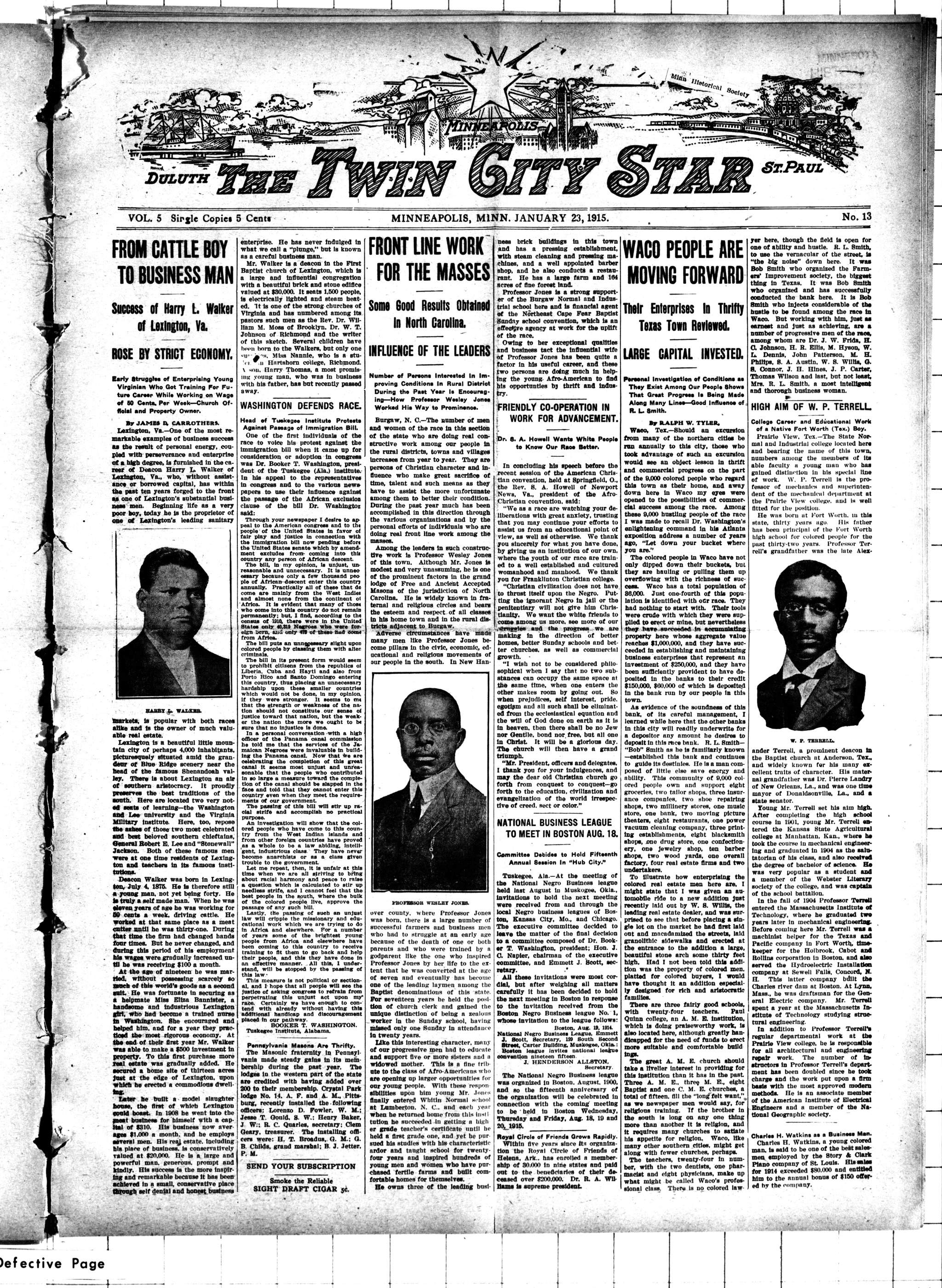
FROM CATTLE BOY TO BUSINESS MAN
ROSE BY STRICT ECONOMY.
Early Struggles of Enterprising Young Virginian Who Got Training For Future Career While Working on Wage of 50 Centa. Per Week—Church Of Official and Property Owner.
By JAMES D. CARROTHERS.
Lexington, Va.—One of the most remarkable examples of business success as the result of personal energy, coupled with perseverance and enterprise of a high degree, is furnished in the career of Deacon Harry L. Walker of Lexington, Va., who, without assistance or borrowed capital, has within the past ten years forged to the front as one of Lexington's substantial business men. Beginning life as a very poor boy, today he is the proprietor of one of Lexington's leading sanitary
markets, is popular with both races alike and is the owner of much valuable real estate. Lexington is a beautiful little mountain city of perhaps 4,000 inhabitants, picturesquely situated amid the grandeur of Blue Ridge scenery near the head of the famous Shenandoah valley. There is about Lexington an air of southern aristocracy. It proudly preserves the best traditions of the south. Here are located two very noted seats of learning—the Washington and Lee university and the Virginia Military Institute. Here, too, repose the ashes of those two most celebrated and best beloved southern chieftains, General Robert E. Lee and "Stonewall" Jackson. Both of these famous men were at one time residents of Lexington and teachers in its famous institutions.
Descon Walker was born in Lexington, July 4, 1875. He is therefore still a young man, not yet being forty. He is truly a self made man. When he was eleven years of age he was working for 50 cents a week, driving cattle. He worked at that same place as a meat cutter until he was thirty-one. During that time the firm had changed hands four times. But he never changed, and during this period of his employment his wages were gradually increased until he was receiving $100 a month.
At the age of nineteen he was married, without possessing scarcely so much of this world's goods as a second suit. He was fortunate in securing as a helpmate Miss Elza Bannister, a handsome and industrious Lexington girl, who had become a trained nurse in Washington. She encouraged and helped him, and for a year they practiced the most rigorous economy. At the end of their first year Mr. Walker was able to make a $500 investment in property. To this first purchase more real estate was gradually added. He secured a home site of thirteen acres just at the edge of Lexington, upon which he erected a commodious dwelling.
Later he built a model slaughter house, the first of which Lexington could boast. In 1908 he went into the meat business for himself with a capital of $310. His business now averages $1,000 a month, and he employs several men. His real estate, including his place of business, is conservatively valued at $20,000. He is a large and powerful man, generous, prompt and kindly. His success is the more inspiring and remarkable because it has been achieved in a small, conservative place through self denial and honest business
enterprise. He has never indulged in what we call a "plunge," but is known as a careful business man.
Mr. Walker is a deacon in the First Baptist church of Lexington, which is a large and influential congregation with a beautiful brick and stone edifice valued at $30,000. It seats 1,500 people, is electrically lighted and steam heated. It is one of the strong churches of Virginia and has numbered among its pastors such men as the Rev. Dr. William M. Moss of Brooklyn, Dr. W. T. Johnson of Richmond and the writer of this sketch. Several children have been born to the Walkers, but only one curries. Miss Nannie, who is a student in Hortschorn college, Richmond. Asson, Harry Thomas, a most promising young man, who was in business with his father, has but recently passed away.
WASHINGTON DEFENDS RACE.
Head of Tuskegee Institute Protests Against Passage of Immigration Bill.
One of the first individuals of the race to voice his protest against the immigration bill when it came up for consideration or adoption in congress was Dr. Booker T. Washington, president of the Tuskegee (Ala.) institute. In his appeal to the representatives in congress and to the various newspapers to use their influence against the passage of the African exclusion clause of the bill Dr. Washington said:
Through your newspaper I desire to appeal to the American congress and to the people of the United States in favor of plans and justice in connection with the immigration bill now pending before the United States senate which by amendment excludes from coming into this country any person of African descent.
The bill, in my opinion, is unjust, unreasonable and unnecessary. It is unnecessary because only a few thousand people of African descent enter this country annually. These are mainly from the West Indies and almost none from the continent of Africa. It is evident that many of those who come into this country do not remain permanently; but, I find, according to the census of 1910, there were in the United States only 40,319. Negroes were foreign born, and only 479 of these had come.
The bill puts an unessayable slight upon colored people by classing them with alien criminals.
The bill in its present form would seem to prohibit citizens from the republics of Liberia, Cuba and Hayti and also from Porto Rico and Santo Domingo entering this country, thus placing an unnecessary hardship upon these smaller countries and making it impossible if they were stronger. It seems to me that the strength or weakness of the nation should not constitute our sense of justice toward that nation, but the weaker the nation the more we ought to be sure that no injustice is done.
In a personal conversation with a high officer of the Panama canal commission he told that the services of the Jamaican Negroes were invaluable in building the Panama canal. Now that we are celebrating the completion of this great canal it seems most unjust and unreasonable that the people who contributed in so large a measure toward the completion of the canal should be slapped in the face and told that they cannot enter this country and that they must meet the requirements of our government.
The passing of this bill will stir up racial strife and accomplish no practical purpose.
An investigation will show that the colored people who have come to this country from the West Indian islands and from other foreign countries have proved themselves to be an agent, industrious class. They have never become anarchists or as a class given trouble to the government.
Let me repeat, then, it is unfair at this time when we are all striving to bring about racial harmony and peace to raise a question which is calculated to stir up needless strife, and I cannot feel that the built of the colored people live, approve the passage of any such bill.
Lastly, the passing of such an unjust law will cripple the missionary and educational work which we are trying to do in Africa and elsewhere. For a number of years people from Africa and elsewhere have been coming to this country to receive training to fit them to go back and help their people, and this they have done in an effective manner. All this, I understand, will be stopped by the passing of this measure is not political or sectional, and I hope that all people will see the justice of asking congress to refrain from perpetrating this unjust act upon my race. Certainly we have enough to contend with already without having this additional handicap and discouragement placed in our country.
BOOKER T. WASHINGTON.
Tuskegee Institute, Alabama.
Pennsylvania Masons Are Thrifty.
The Masonic fraternity in Pennsylvania made steady gains in its membership during the past year. The lodges in the western part of the state are credited with having added over 200 to their membership. Crystal Park lodge No. 14, A. F. and A. M., Pittsburg, recently installed the following officers: Lorenzo D. Fowler, W. M.; Jesse T. Gould, S. W.; Henry Baker, J. W.; R. C. Quarles, secretary; Clem Geary, treasurer. The installing officers were: H. T. Broadus, G. M.; G. B. Childs, grand marshal; B. J. Jetter, P. M.
Smoke the Reliable
SIGHT DRAFT CIGAR 5c.
FRONT LINE WORK FOR THE MASSES
Number of Persons Interested in Improving Conditions In Rural District During the Past Year is Encouraging—How Professor Wesley Jones Worked His Way to Prominence.
Burgaw, N. C.—The number of men and women of the race in this section of the state who are doing real constructive work among our people in the rural districts, towns and villages increases from year to year. They are persons of Christian character and influence who make great sacrifice of time, talent and such means as they have to assist the more unfortunate among them to better their condition. During the past year much has been accomplished in this direction through the various organizations and by the personal efforts of individuals who are doing real front line work among the masses.
Among the leaders in such constructive work is Professor Wesley Jones of this town. Although Mr. Jones is modest and very unassuming, he is one of the prominent factors in the grand lodge of Free and Ancient Accepted Masons of the jurisdiction of North Carolina. He is widely known in fraternal and religious circles and bears the esteem and respect of all classes in his home town and in the rural districts adacent to Burgaw.
Adverse circumstances have made many men like Professor Jones become pillars in the civic, economic, educational and religious movements of our people in the south. In New Han-
PROFESSOR WESLEY JONES.
over county, where Professor Jones was born, there is a large number of successful farmers and business men who had to struggle at an early age because of the death of one or both parents and who were trained by a godparent like the one who inspired Professor Jones by her life to the extent that he was converted at the age of seven and eventually has become one of the leading laymen among the Baptist denominations of this state.
For seventeen years he held the position of church clerk and gained the unique distinction of being a zealous worker in the Sunday school, having missed only one Sunday in attendance in twenty years.
Like this interesting character, many of our progressive men had to educate and support five or more sisters and a widowed mother. This is a fine tribute to the class of Afro-Americans who are opening up larger opportunities for our young people. With these responsibilities upon him young Mr. Jones finally entered Whitin Normal school at Lamberton, N. C., and each year when he returned home from this institution he succeeded in getting a higher grade teacher's certificate until he held a first grade one, and yet he pursued his studies with his characteristic ardor and taught school for twenty-four years and inspired hundreds of young men and women who have purchased fertile farms and built comfortable homes for themselves.
He owns three of the leading busl
ness brick buildings in this town and has a pressing establishment, with steam cleaning and pressing machines, and a well appointed barber shop, and he also conducts a restaurant. He has a large farm and 164 acres of fine forest land. Professor Jones is a strong supporter of the Burgaw Normal and Industrial school here and is financial agent of the Northeast Cape Fear Baptist Sunday school convention, which is an effective agency at work for the uplift of the race. Owing to her exceptional qualities and business tact the influential wife of Professor Jones has been quite a factor in his useful career, and these two persons are doing much in helping the young Afro-American to find his opportunities by thrift and industry.
FRIENDLY CO-OPERATION IN WORK FOR ADVANCEMENT
Dr. S. A. Howell Wants White People to Know Our Race Better.
In concluding his speech before the recent session of the American Christian convention, held at Springfield, O., the Rev. S. A. Howell of Newport News, Va., president of the Afro-Christian convention, said:
"We as a race are watching your deliberations with great anxiety, trusting that you may continue your efforts to assist us from an educational point of view, as well as otherwise. We thank you sincerely for what you have done, by giving us an institution of our own, where the youth of our race are trained to a well established and cultured womanhood and manhood. We thank you for Franklinton Christian college.
"Christian civilization does not have to thrust itself upon the Negro. Putting the ignorant Negro in jail or the penitentiary will not give him Christianity. We want the white friends to come among us more, see more of our struggles and the progress we are making in the direction of better homes, better Sunday schools and better churches, as well as commercial growth.
"I wish not to be considered philosophical when I say that no two substances can occupy the same space at the same time, when one enters the other makes room by going out. So when prejudices, self interest, pride, egotism and all such shall be eliminated from the ecclesiastical equation and the will of God done on earth as it is in heaven, then there shall be no Jew nor Gentile, bond nor free, but all one in Christ. It will be a glorious day. The church will then have a grand triumph.
"Mr. President, officers and delegates, I thank you for your indulgences, and may the dear old Christian church go forth from conquest to conquest—go forth to the education, civilization and evangelization of the world irrespective of creed, sect or color."
NATIONAL BUSINESS LEAGUE TO MEET IN BOSTON AUG. 18.
Committee Debides to Hold Fifteenth Annual Session In "Hub City."
Tuskegee, Ala.-At the meeting of the National Negro Business league held last August in Muskogee, Okla., invitations to hold the next meeting were received from and through the local Negro business leagues of Boston, Kansas City, Mo., and Chicago. The executive committee decided to leave the matter of the final decision to a committee composed of Dr. Booker T. Washington, president; Hon. J. C. Napier, chairman of the executive committee, and Emmett J. Scott, secretary.
All these invitations were most cordial, but after weighing all matters carefully it has been decided to hold the next meeting in Boston in response to the invitation received from the Boston Negro Business league No. 1, whose invitation to the league follows:
Boston, Aug. 19, 1914
National Negro Business League, Emmett J. Scott, Secretary, 199 Second Street, Carter Building, Muskogee, Okla.
Boston league invites national league convention nineteen fifteen.
J. HENDERSON ALLSTON.
Secretary.
The National Negro Business league was organized in Boston, August, 1900, and so the fifteenth anniversary of the organization will be celebrated in connection with the coming meeting to be held in Boston Wednesday, Thursday and Friday, Aug. 18, 19 and 20, 1915.
Royal Circle of Friend Grows Rapidly. Within five years since its organization the Royal Circle of Friends of Helena, Ark. has enrolled a membership of 30,000 in nine states and paid out to the beneficiaries of their deceased over $200,000. Dr. R. A. Williams is supreme president.
WACO PEOPLE ARE MOVING FORWARD
Their Enterprises In Thrifty Texas Town Reviewed.
Personal Investigation of Conditions as They Exist Among Our People Shows That Great Progress is Being Made Along Many Lines—Good Influence of R. L. Smith.
BY RALPH W. TYLER.
Waco, Tex.—Should an excursion from many of the northern cities be run annually to this city, those who took advantage of such an excursion would see an object lesson in thrift and commercial progress on the part of the 9,000 colored people who regard this town as their home, and away down here in Waco my eyes were opened to the possibilities of commercial success among the race. Among these 9,000 hustling people of the race I was made to recall Dr. Washington's enlightening command in his Atlanta exposition address a number of years ago, "Let down your bucket where you are."
The colored people in Waco have not only dipped down their buckets, but they are hauling or pulling them up overdowing with the richness of success. Waco has a total population of 86,000. Just one-fourth of this population is identified with our race. They had nothing to start with. Their tools were crude with which they were supplied to erect or mine, but nevertheless they have succeeded in accumulating property here whose aggregate value reaches $1,000,000, and they have succeeded in establishing and maintaining business enterprises that represent an investment of $250,000, and they have been sufficiently provident to have deposited in the banks to their credit $150,000, $60,000 of which is deposited in the bank run by our people in this town.
As evidence of the soundness of this bank, of its careful management, I learned while here that the other banks in this city will readily underwrite for a depositor any amount he desires to deposit in this race bank. R. L. Smith—"Bob Smith as he is familiarly known—established this bank and continues to guide its destinies. He is a man composed of little else save energy and ability. This community of 9,000 colored people own and support eight groceries, two tailor shops, three insurance companies, two shoe repairing shops, two millinery stores, one music store, one bank, two moving picture theaters, eight restaurants, one power vacuum cleaning company, three printing establishments, eight blacksmith shops, one drug store, one confectionery, one jewelry shop, ten barber shops, two wood yards, one overall factory, four real estate firms and two undertakers.
To illustrate how enterprising the colored real estate men here are, I might state that I was given an automobile ride to a new addition just recently laid out by W. S. Willis, the leading real estate dealer, and was surprised to see that before placing a single lot on the market he had first laid out and macadamized the streets, laid granolithic sidewalks and erected at the entrance to the addition a large, beautiful stone arch some thirty feet high. Had I not been told this addition was the property of colored men, platted for colored buyers, I would have thought it an addition especially designed for rich and aristocratic families.
There are three fairly good schools, with twenty-four teachers. Paul Quinn college, an A. M. E. institution, which is doing praiseworthy work, is also located here, although greatly handicapped for the need of funds to erect more suitable and comfortable buildings.
The great A. M. E. church should take a liveller interest in providing for this institution than it has in the past. Three A. M. E., three M. E., eight Baptist and one C. M. E. churches, a total of fifteen, fill the "long felt want," as we newspaper men would say, for religious training. If the brother in the south is long on any one thing more than another it is religion, and it requires many churches to satiate his appetite for religion. Waco, like many other southern cities, might get along with fewer churches, perhaps.
The teachers, twenty-four in number, with the two dentists, one pharmacist and eight physicians, make up what might be called Waco's professional class. There is no colored law.
yer here, though the field is open for one of ability and hustle. R. L. Smith, to use the vernacular of the street, is "the big noise" down here. It was Bob Smith who organized the Farmers' Improvement society, the biggest thing in Texas. It was Bob Smith who organized and has successfully conducted the bank here. It is Bob Smith who injects considerable of the hustle to be found among the race in Waco. But working with him, just as earnest and just as achieving, are a number of progressive men of the race, among whom are Dr. J. W. Frida, H. C. Johnson, H. R. Ellis, M. Hyson, W. L. Dennis, John Patterson, M. H. Philips, S. A. Austin, W. S. Willis, G. Connor, J. H. Hines, J. P. Carter, Thomas Wilson and last, but not least, Mrs. R. L. Smith, a most intelligent and thorough business woman.
HIGH AIM OF W. P. TERRELL
College Career and Educational Work of a Native Fort Worth (Tx.) Boy.
Prairie View, Tex.-The State Normal and Industrial college located here and bearing the name of this town, numbers among the members of its able faculty a young man who has gained distinction in his special line of work. W. P. Terrell is the professor of mechanics and superintendent of the mechanical department at the Prairie View college, and is well fitted for the position.
He was born at Fort Worth, in this state, thirty years ago. His father has been principal of the Fort Worth high school for colored people for the past thirty-two years. Professor Terrell's grandfather was the late Alex-
W. P. TERRELL.
ander Terrell, a prominent deacon in the Baptist church at Anderson, Tex., and widely known for his many excellent traits of character. His maternal grandfather was Dr. Pierre Landry of New Orleans, La., and was one time mayor of Donaldsonville, La., and a state senator.
Young Mr. Terrell set his aim high. After completing the high school course in 1901, young Mr. Terrell entered the Kansas State Agricultural college at Manhattan, Kan., where he took the course in mechanical engineering and graduated in 1904 as the salutatorian of his class, and also received the degree of bachelor of science. He was very popular as a student and a member of the Webster Literary society of the college, and was captain of the school battalion.
In the fall of 1904 Professor Terrell entered the Massachusetts Institute of Technology, where he graduated two years later in mechanical engineering. Before coming here Mr. Terrell was a machinist helper for the Texas and Pacific company in Fort Worth, timekeeper for the Holbrook, Cabot and Rollins corporation in Boston, and also served the Hydroelectric Installation company at Sewell Falls, Concord, N. H. This latter company billt the Charles river dam at Boston. At Lynn, Mass., he was draftsman for the General Electric company. Mr. Terrell spent a year at the Massachusetts Institute of Technology studying structural engineering.
In addition to Professor Terrell's regular departmental work at the Prairie View college, he is responsible for all architectural and engineering repair work. The number of instructors in Professor Terrell's department has been doubled since he took charge and the work put upon a firm basis with the most approved modern methods. He is an associate member of the American Institute of Electrical Engineers and a member of the National Geographic society.
Charles H. Watkins as a Business Man. Charles H. Watkins, a young colored man, is said to be one of the best salesmen employed by the Story & Clark Piano company of St. Louis. His sales for 1914 exceeded $80,000 and entitled him to the annual bonus of $150 offered by the company.
Peoples Christian Assembly.
Rev. G. W. Mitchell, Pastor,
1204 Washington Ave. So.
Come! and Serve the Lord.
ST. PETER'S A. M. E. CHURCH
22nd St. near 10th Ave. So.
Rev. Thos. B. Stovall, Pastor.
ST. JAMES A. M. E. CHURCH,
318 8th Ave. So., Minneapolis.
Rev. E. R. Edwards, Pastor.
Prof. W. H. Howard, the well known musical instructor of 111 So. 6th St., is the composer of "I Wonder" one of the latest musical selections. The words are by Burt Shinkle. This song is sold at leading music stores and its popularity is assured. Nearly one thousand copies of
on St., is the composer of "I Wonder" one of the latest musical selections. The words are by Burt Shinkle. This song is sold at leading music stores and its popularity is assured. Nearly one thousand copies of this song has been sold since 1915.
Atty Geo. H. Jackson is rapidly recovering from an operation for an abscess on his brain. He was confined several weeks in the City Hospital.
SUFFRAGE CLUB TO MEET
The Initial Suffrage Club will meet at the home of Mrs. Birdie High, 674 St. Anthony Ave., St. Paul, on Friday afternoon, January 29th, at 3:00 P.M. Mrs.W. J. Louge will be the speaker of the afternoon. We would like to have all women interested in suffrage to be present.
Mrs. S. L. 'Maxwell, Sec.
Maurice DeBaptist, who seriously slashed his wife was released Monday 18, on a suspended sentence on condition that he go to Canada to his parents.
Miss Mary Adams was buried Wednesday from Raynor's Chapel.
BOOKS BY NEGRO AUTHORS.
The New Era Topic Club meets every Sunday afternoon, 4 P. M. at Zion Presbyterian Church, Farrington & St. Anthony Sts., St. Paul. Discussion January 24th on "Woman Suffrage." Soloist, Mrs. Minor. J. H. Zedricks Pres.; A. G. West, Sec'y.
Mrs. Addie Brooks is sick in Hospital with pneumonia.
Atty. B. S. Smith appeared in Wahpeton, N. D., to defend Bige Reed, a Negro, who was indicted of murder in the first degree. He was charged with killing a white man.
Editor Smith is serving on the jury of the District Curt.
Officer H. G. Thompson of the Police Dept., left Monday evening for Columbus, O., to attend the funeral of his father, Mr. John Thompson.
HOW WE GET THE NEWS.
Day before yesterday a perfectly nice lady called.us up and with a tremble in her voice reproved for us not mentioning the fact that she had had a friend visiting her last week. We told her that she had not let us know anything about it and that therefore we did not know that she had a visitor. Then she said, "Well, you should have known. I thought you were running a newspaper." Wouldn't that rattle your slats? Some people think that an editor ought to be a cross between Argus and Anna Eva Fay. They seem to think that our five senses are augmented by a sixth that lets us know everything that happens, even if we see, hear, feel, taste or smell it not. Dear lady, editors are only human, or at least, almost human. If you have a friend-visiting you, if you are going away, or have returned from a visit out of town, if Johnnie falls and breaks his arm, if your husband chops his toe instead of a stick of wood, if anything happens that makes you glad, or sad, happy, or mad, call us up. Tell us about it. That's the way to get it in the paper.—(From many exchanges).
Don't "call us up." Write us about it. A post card will break that phone habit and insure correct insertion. Phone flends never think, they gossip.
SUBSCRIBE FOR THE STAR
DEATH OF "CHARLEY" HAMILTON.
Mr. Chas. Hamilton, ex-detective, died at his residence, 1305 Washington Ave. So., on Thursday morning. He had been confined home since Jan. 12th with pneumonia. His death was a surprise to his many friends. Funeral arrangements had not been arranged as we go to press.
CALLED TO CONVENTION.
The mid-winter meeting of the State Federation of Afro-American Women Clubs will convene at Bethesda Baptist Church on Monday, Feb. 8th, at 2 P. M. An interesting program will be rendered both afternoon and evening. All are invited to attend.
The Twin City Charity Club (Mrs. B. C. Coleman, pres., Mrs. Hester Keeys, secy.) met this week with Mrs. Minnie Burrell, 1016 6th Ave. No., and arranged to entertain the delegates and visitors at Mid-winter meeting of the State Federation.
Cook and Stevens, who are popular headliners in vaudville, made good this week at the Unique. They are billed for an extensive tour to the coast and will return to New York in June.
Rev. Stovall will address the Federated Women's Clubs at their Mid-Winter meeting.
Miss Mildred Shull and Mr. Webster Stovall graduated at Central High on Thursday night.
Miss Marie Thompson, the promising daughter of Mr. and Mrs. H. G. Thompson, 3133 Clinton Ave., has been quite ill during past six weeks. Miss Thompson recently graduated from High School.
Mr. W. W. Williams has returned from Grand Rapids, Mich., and will spend an indefinite stay here.
Messrs. Gale P. Hilyer and L. C. Valle, students at the "U" have taken lodgings with Mrs. Kate Smith, 2441 5th Ave. So.
Mr. K. C. Coleman has been appointed janitor of South High School. He took the Civil Service examination for the position, and seems well pleased with his position.
Mr. Alexander Mayfield, father of Mrs. W. K. Bowie, left this week for his home in Newton, Kan. He has had a delightful stay in this city.
The Twin City Stag Club is again open. It was closed by Mayor Nye because of violation of police regulations.
There is current gossip that Jim. Hardin, who was discharged from the police department, was the instigator of the "strike of the inmates" of Lena Smith's place. Since his dismissal he has been down and out, apparently without money or friends. Some of the old blisters who were in the frame-up are pretending various excuses. One of the leaders was the cause of the assault on Geo. Gardner by Ernest Fowler, who is now awaiting trial. There seems to be a desperate attempt to shake Lena down, but she is serving her sentence and will stand pat. Had these women and the man who urged them sought remedy by the courts because they wished to better the moral conditions of the community, they would deserve credit, but they are continuing to ply their trade, and are willing to accept money for their get-a-way. These women will not be allowed to operate and Lena is paying a penalty for violating the law. They knew, the conditions and made money accordingly. Lena Smith maintained a place in a remote and segregated district, which met a humane demand because of local conditions. It is a credit to her to say that she did not employ the young girls, who are the flower of her race or seek any association with the better element. She recognized her position and respected those who lived better lives. She has a chance to lead a better life and be of great service in the higher walks of life, but those avengers are among the unburied dead. There is no protection now for the underwrold, and the way of the transgressor is harder than ever.
Buy the Star
Place your advertisements
Pay your subscriptions
Mrs. H. I. Williams
89 Union Block, St. Paul.
Send your personals
The Big Three. Every First and
Third Tuesday. Arcade Hall, 1311
Washington Ave. So., Minneapolis.
Good Music. Refreshments and Good
Order.
AUTO FOR SALE.
Any one desiring a bargain will do
well to see me before purchasing an
auto. Write to Martin Brown, 2313
Park Ave. So.
DR. SPINGARN TO SPEAK.
Dr. J. E. Spingarn, Chairman of the Board of Directors of the National Society for the Advancement of Colored People, will speak at Jewish Reformed Temple, 10th St. and 5th Ave. So., Minneapolis, Friday evening, January 22, and on Sunday afternoon, January 24, at Unitarian Church, 8th and Mary Pl., Minneapolis. All are invited to hear him.
DESIRABLE HOUSE TO LET.
Beautiful (3) Three Story Modern Building, in the coming Colored District, Center of City. Hotel. CHEAP rent. McDew, 802 Sykes Block.
Leave your Subscriptions and
Printing at TWIN CITY STAR
PRINTERS, 1402 Washington Ave. So.
Wanted—Agents to solicit adverti-
ting and news. Salary or commission.
Good profits. Write the Twin
City Star, Minneapolis, Minn.
If you wish to help this publication
Send your subscription by Post office
order.
JUDGE'S BIRTHDAY PARTY
JANUARY 28, 1915.
where Judge Johnson will entertain his many patrons. Best order—Music and Refreshments.
OLIVER'S NEW CABARET.
Mr. Sylvester W. Oliver is keeping pace with the modern features of entertainments, and has decorated his Cabaret Room in the most appropriate design, with myriads of electric
Mr. Sylvester W. Oliver lights, producing a scenic effect much to the pleasure of his patrons. The designs are painted by Sanford and are very commendable. There are few places which surpass Oliver's. When in doubt, call at Oliver's, 244 Third Ave. So., and witness the Cabaret by best entertainers. After theatre parties will find it specially convenient to spend a while in the luxurious Cabaret Room under such very pleasant accomodations.
Neatly Furnished Rooms.
Newly Furnished Front Rooms,
Suitable for Gentlemen or Ladies,
on the car line, Bath and Heat. Apply
to Mrs. M. Jackson, 827 Cedar Ave.,
Minneapolis. Call Nic. 591.
Dressmaking—Plain and Fancy
Sewing. Baby Clothes a specialty.
Call South 404. Mrs. Lewis, 2912
Harriet Ave. So.
A NEGLECTED OPPORTUNITY
Several years ago St. Paul and Minneapolis could boast of a dozen Negro stenographers in each city, both male and female, employed in white business houses and corporations. Marriages, removals and promotions have now reduced the number now employed to about three in each city, and yet the opportunity is just as great for our boys and girls in that line as it ever was, but no one appears to be taking advantage of it by preparing themselves for the work. Some of our business and professional men say that they would like to have but cannot get a Negro stenographer. Apparently there is a great opportunity in the Twin Cities for employment as stenographer in business places among both races.
The Star has been informed by many of those who have been employed as stenographers that the question of color never interfered with their employment in any way but that it was merely a matter of efficiency.
The young people of the Twin Cities should not overlook an avenue of employment that has been open to them for years and which may be closed to them if they continue to neglect it.
Mrs. H. D. Williams of St. Paul, is the new agent of the Twin City Star. Mrs. William may be found in Atty. Francis' office, where she is employed as stenographer. We request that all persons in St. Paul, having business with the Star, will consult Mrs. Williams as she is authorized to manage the St. Paul agency of the Twin City Star—Editor.
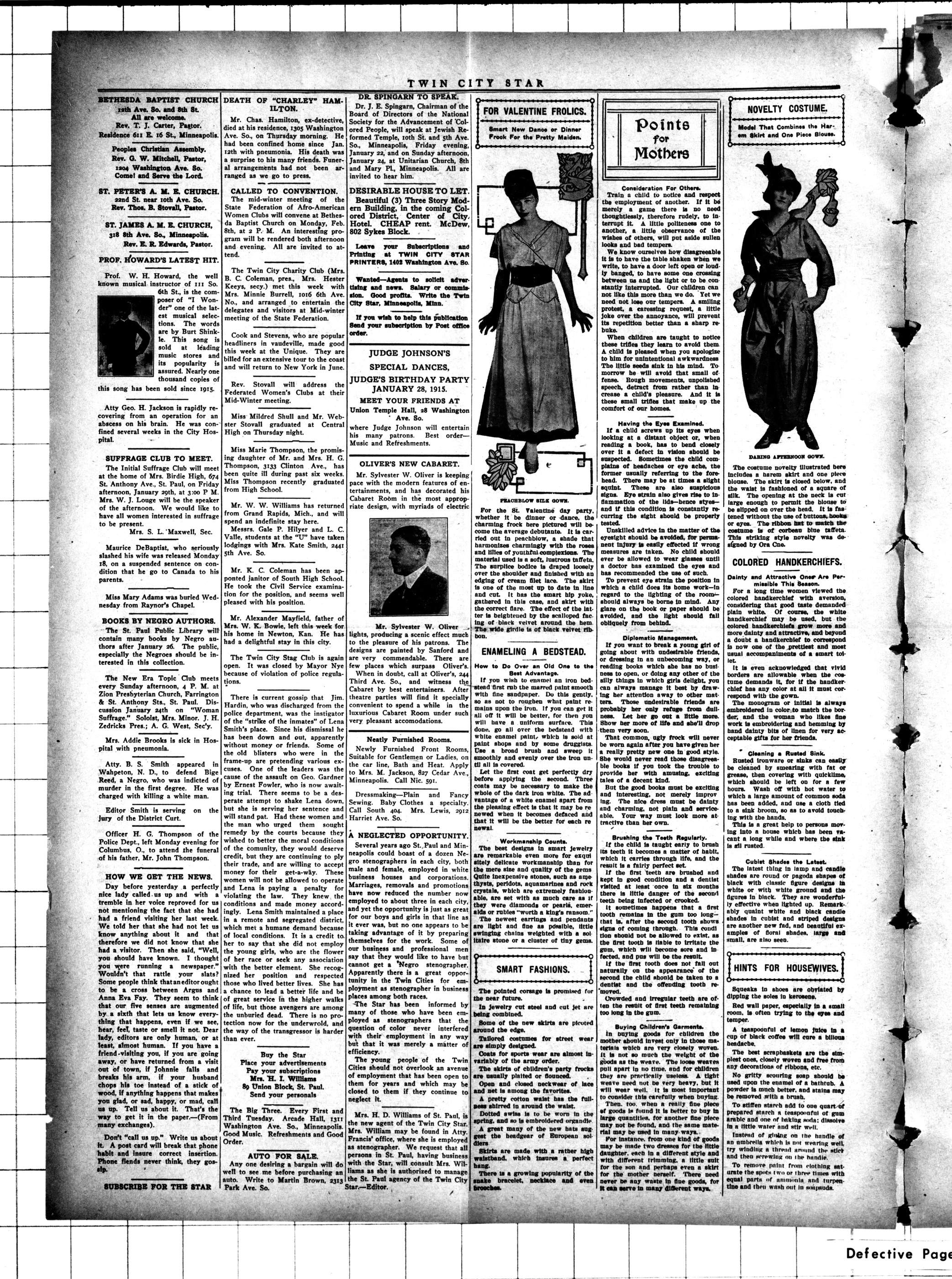
FOR VALENTINE FROLICS.
Smart New Dances or Dinner
Frock For the Pretty Maiden.
PEACHBLOW SILK GOWN.
For the St. Valentine day party, whether it be dinner or dance, the charming frock here pictured will become the average debutante. It is carried out in peachblow, a shade that harmonizes charmingly with the roses and lilies of youthful complexes. The material used is a soft, lustrous taffeta. The surplice bodice is draped loosely over the shoulder and finished with an edging of cream fillet lace. The skirt is one of the most up to date in line and cut. It has the smart hip yoke, gathered in this case, and skirt with the correct flare. The effect of the latter is heightened by the scalloped facing of black velvet around the hem. The wide girdle is of black velvet ribbon.
ENAMELING A BEDSTEAD
How to Do Over an Old One to the Best Advantage.
If you wish to enamel an iron bedstead first rub the marred paint smooth with fine sandpaper. Do this gently, so as not to roughen what paint remains upon the iron. If you can get it all off it will be better, for then you will have a uniform surface. This done, go all over the bedstead with white enamel paint, which is sold at paint shops and by some druggists. Use a broad brush and sweep it smoothly and evenly over the iron until all is covered.
Let the first coat get perfectly dry before applying the second. Three coats may be necessary to make the whole of the dark iron white. The advantage of a white enamel apart from the pleasing effect is that it may be renewed when it becomes defaced and that it will be the better for each renewal.
Workmanship Counts.
The best designs in smart jewelry are remarkable even more for exquisitely delicate workmanship than for the mere size and quality of the gems Quite inexpensive stones, such as amethysts, peridots, aquamarines and rock crystals, which are extremely fashionable, are set with as much care as if they were diamonds or pearls, emeralds or rubles "worth a king's ransom." The newest earrings and pendant are light and fine as possible, little swinging chains weighted with a solitaire stone or a cluster of thy gems.
SMART FASHIONS.
The pointed corsage is promised for the near future.
In jewelry cut steel and cut jet are being combined.
Some of the new skirts are plicated around the edge.
Tailored costumes for street wear are simply designed.
Coats for sports wear are almost invariably of the army order.
The skirts of children's party frocks are usually plaited or founced.
Open and closed neckwear of lace and net is among the favorites.
A pretty cotton waist has the fullness shirred in around the waist.
Dotted Swiss is to be worn in the spring, and so is embroidered organdie.
A great many of the new hats suggest the headgear of European soldiers.
Skirts are made with a rather high waistband, which insures a perfect hang.
There is a growing popularity of the snake bracelet, necklace and even brooches.
Points
for
Mothers
Consideration For Others. Train a child to notice and respect the employment of another. If it be merely a game there is no need thoughtlessly, therefore rudely, to interrupt it. A little politeness one to another, a little observance of the wishes of others, will put aside sullen looks and bad tempers.
We know ourselves how disagreeable it is to have the table shaken when we write, to have a door left open or loudly banged, to have some one crossing between us and the light or to be constantly interrupted. Our children can not like this more than we do. Yet we need not lose our tempers. A smiling protest, a caressing request, a little joke over the annoyance, will prevent its repetition better than a sharp rebuke.
When children are taught to notice these trifles they learn to avoid them. A child is pleased when you apologize to him for unintentional awkwardness The little seeds sink in his mind. Toorrow he will avoid that small offense. Rough movements, unpolished speech, detract from rather than increase a child's pleasure. And it is these small trifles that make up the comfort of our homes.
Having the Eyes Examined.
If a child screws up its eyes when looking at a distant object or, when reading a book, has to bend closely over it a defect in vision should be suspected. Sometimes the child complains of headaches or eye ache, the former usually referring to the forehead. There may be at times a slight squint. These are also suspicious signs. Eye strain also gives rise to inflammation of the lids—hence styes—and if this condition is constantly recurring the sight should be properly tested.
Unskilled advice in the matter of the eyesight should be avoided, for permanent injury is easily effected if wrong measures are taken. No child should ever be allowed to wear glasses until a doctor has examined the eyes and has recommended the use of such.
To prevent eye strain the position in which a child does its home work—in regard to the lighting of the room—should always be borne in mind. Any glare on the book or paper should be avoided, and the light should fall obliquely from behind.
Diplomatic Management.
If you want to break a young girl of going about with undesirable friends, or dressing in an unbecoming way, or reading books which she has no business to open, or doing any other of the silly things in which girls delight, you can always manage it best by drawing her attention away to other matters. Those undesirable friends are probably her only refuge from dullness. Let her go out a little more. Show her more of life and she'll drop them very soon.
That common, ugly frock will never be worn again after you have given her a really pretty new one in good style. She would never read those disagreeable books if you took the trouble to provide her with amusing, exciting tales of a decent kind.
But the good books must be exciting and interesting, not merely improving. The nice dress must be dainty and charming, not plain and serviceable. Your way must look more atractive than her own.
Brushing the Teeth Regularly
If the child is taught early to brush its teeth it becomes a matter of habit, which it carries through life, and the result is a fairly perfect set.
If the first teeth are brushed and kept in good condition and a dentist visited at least once in six months there is little danger of the second teeth being infected or crooked.
It sometimes happens that a first tooth remains in the gum too long—that is, after the second tooth shows signs of coming through. This condition should not be allowed to exist, as the first tooth is liable to irritate the gum, which will become sore and infected, and pus will be the result.
If the first tooth does not fall out naturally on the appearance of the second the child should be taken to a dentist and the offending tooth removed.
Crowded and irregular teeth are often the result of first teeth remaining too long in the gum.
Buying Children's Garments
In buying goods for children the mother should invest only in those materials which are very closely woven. It is not so much the weight of the goods as the weave. The loose weaves pull apart in no time, and for children they are practically useless. A tight weave need not be very heavy, but it will wear well. It is most important to consider this carefully when buying. Then, too, when a really fine piece of goods is found it is better to buy in large quantities, for another fine piece may not be found, and the same material may be used in many ways.
For instance, from one kind of goods may be made two dresses for the little daughter, each in a different style and with different trimming, a little suit for the son and perhaps even a skirt for the mother herself. There need never be any waste in fine goods, for it can serve in many different ways.
Model That Combines the Har-
em Skirt and One Piece Blouses.
THE FASHION OF THE TWENTIETH CENTURY
DARING AFTERNOON GOWN.
The costume novelty illustrated here includes a harem skirt and one piece blouse. The skirt is closed below, and the waist is fashioned of a square of silk. The opening at the neck is cut large enough to permit the blouse to be slipped on over the head. It is fastened without the use of buttons, books or eyes. The ribbon hat to match the costume is of corbeau blue taffeta. This striking style novelty was designed by Ora Cne.
COLORED HANDKERCHIEFS.
Dainty and Attractive One Are Permissible This Season.
For a long time women viewed the colored handkerchief with aversion, considering that good taste demanded plain white. Of course, the white handkerchief may be used, but the colored handkerchiefs grow more and more dainty and attractive, and beyond a doubt a handkerchief to correspond is now one of the prettiest and most usual accompaniments of a smart toilet.
It is even acknowledged that vivid borders are allowable when the costume demands it, for if the handkerchief has any color at all it must correspond with the gown.
The monogram or initial is always embroidered in color to match the border, and the woman who likes fine work is embroidered and hemming by hand dainty bits of linen for very acceptable gifts for her friends.
Cleaning a Rusted Sink.
Rusted ironware or sinks can easily be cleaned by smearing with fat or grease, then covering with quicklime, which should be left on for a few hours. Wash off with hot water to which a large amount of common soda has been added, and use a cloth tied to a sink broom, so as to avoid touching with the hands.
This is a great help to persons moving into a house which has been vacant a long while and where the sink is gil rusted.
Cubist Shades the Latest
The latest thing in lamp and candle
shades are round or pagoda shapes of
black with classic figure designs in
white or with white ground and the
figures in black. They are wonderfully
effective when lighted up. Remarkably
quant white and black candle
shades in cubist and striped designs
are another new fad, and beautiful
examples of floral shades, large and
small, are also seen.
Squeaks in shoes are obviated by dipping the soles in kerosene.
Red wall paper, especially in a small room, is often trying to the eyes and temper.
A teaspoonful of lemon juice in a cup of black coffee will cure a billious headache.
The best scrapbaskets are the simplest ones, closely woven and free from any decorations of ribbons, etc.
No gritty scouring soap should be used upon the enamel of a bathbub. A powder is much better, and stains may be removed with a brush.
To stiffen starch add to one quart of prepared starch a teaspoonful of gum arable and one of baking soda; dissolve in a little water and stir well.
Instead of gluing on the handle of an umbrella which is not wearing well, try winding a thread around the stick and then screwing on the handle.
To remove paint from clothing saturate the spots two or three times with equal parts of ammonia and turpentine and then wash out in soapsuds.
```markdown
```
Defective Page
effective Page
Helen Gardner Thinks Moving Pictures an Aid in Beauty Culture.
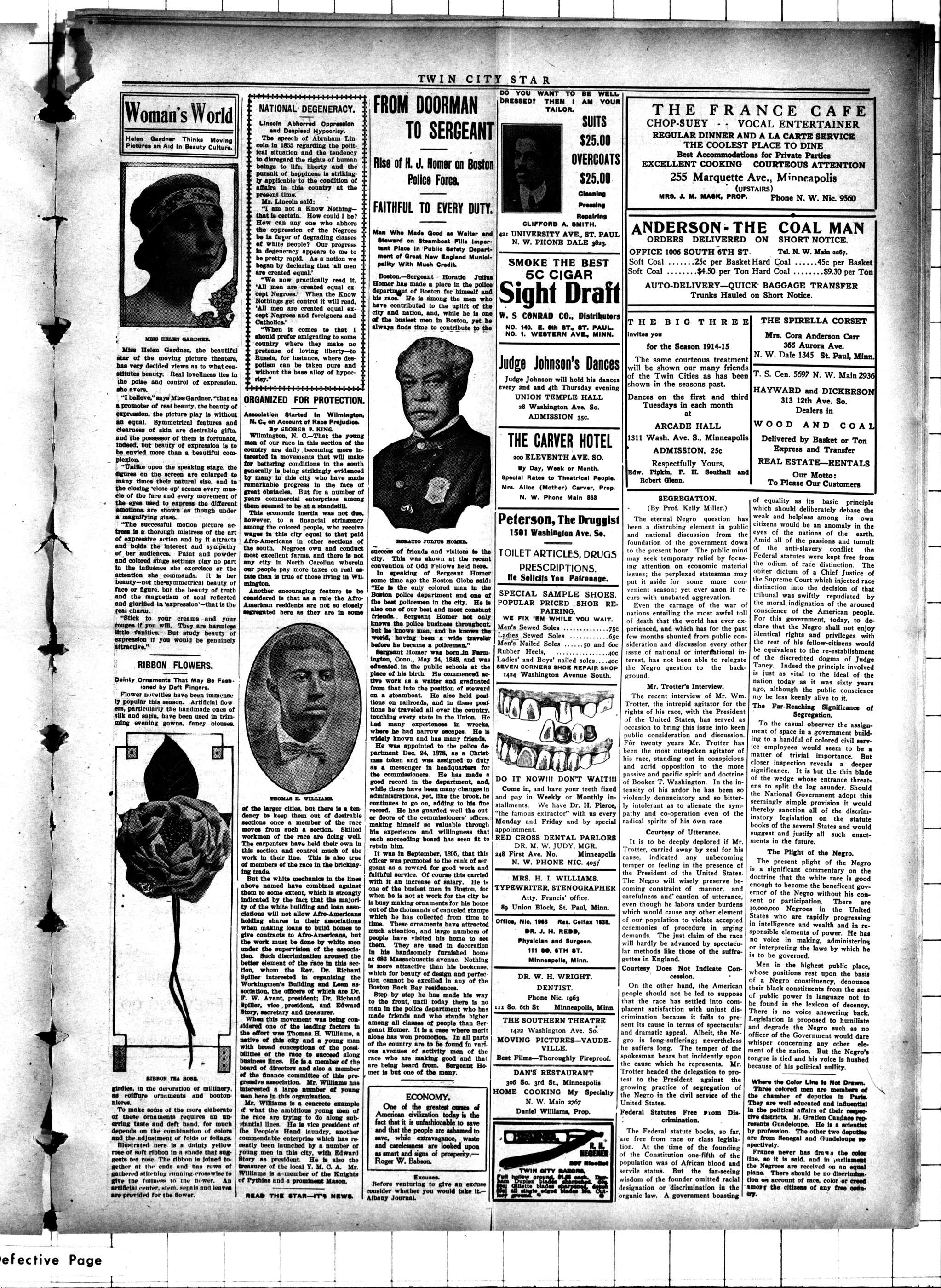
MISS HELEN GARDNER.
Miss Helen Gardner, the beautiful star of the moving picture theaters, has very decided views as to what constitutes beauty. Real loveliness lies in the poise and control of expression, she avers.
"I believe," says Miss Gardner, "that as a promoter of real beauty, the beauty of expression, the picture play is without an equal. Symmetrical features and clearness of skin are desirable gifts, and the possessor of them is fortunate, indeed, but beauty of expression is to be envied more than a beautiful complexion.
"Unlike upon the speaking stage, the figures on the screen are enlarged to many times their natural size, and in the closing 'close up' scenes every muscle of the face and every movement of the eyes used to express the different emotions are shown as though under a magnifying glass.
"The successful motion picture actress is a thorough mistress of the art of expressive action and by it attracts and holds the interest and sympathy of her audiences. Paint and powder and colored stage settings play no part in the influence she exercises or the attention she commands. It is her beauty—not the symmetrical beauty of face or figure, but the beauty of truth and the magnetism of soul reflected and glorified in 'expression'—that is the real charm.
"Stick to your creams and your rouges if you will. They are harmless little vanities. But study beauty of expression if you would be genuinely attractive."
RIBBON FLOWERS.
Dainty Ornaments That May Be Fashioned by Deft Fingers. Flower novelties have been immensely popular this season. Artificial flowers, particularly the handmade ones of silk and satin, have been used in trimming evening gowns, fancy blouses.
...
RIBBON TEA ROSE
girdles, in the decoration of millinery, as coiffure ornaments and boutonnières.
To make some of the more elaborate of these ornaments requires an unerring taste and deft hand, for much depends on the combination of colors and the adjustment of folds or foliage.
Illustrated here is a dainty yellow rose of soft ribbon in a shade that suggests tea rose. The ribbon is joined together at the ends and has rows of gathered stitching running crosswise to give the fullness to the flower. An artificial center, stem, sepals and leaves are provided for the flower.
NATIONAL DEGENERACY.
Lincoln Abbereed Oppression and Despised Hypocrisy.
The speech of Abraham Lincoln in 1855 regarding the political situation and the tendency to disregard the rights of human beings to life, liberty and the pursuit of happiness is strikingly applicable to the condition of affairs in this country at the present time.
Mr. Lincoln said:
"I am not a Know Nothing—that is certain. How could I be? How can any one who abhors the oppression of the Negroes be in favor of degrading classes of white people? Our progress in degeneracy appears to me to be pretty rapid. As a nation we began by declaring that 'all men are created equal.' "We now practically read it, 'All men are created equal except Negroes.' When the Know Nothings get control it will read, 'All men are created equal except Negroes and foreigners and Catholics.' "When it comes to that I should prefer emigrating to some country where they make no pretense of loving liberty—to Russia, for instance, where despotism can be taken pure and without the base alloy of hypocrisy."
ORGANIZED FOR PROTECTION.
Association Started In Wilmington
N. C. on Account of Race Prejudice.
By GEORGE P. KING.
Wilmington, N. O.-That the young men of our race in this section of the country are daily becoming more interested in movements that will make for better conditions in the south generally is being strikingly evidenced by many in this city who have made remarkable progress in the face of great obstacles. But for a number of years commercial enterprises among them seemed to be at a standstill. This economic inertia was not due, however, to a financial stringency among the colored people, who receive wages in this city equal to that paid Afro-Americans in other sections of the south. Negroes own and conduct most excellent farms, and there is not any city in North Carolina wherein our people pay more taxes on real estate than is true of those living in Wilmington.
Another encouraging feature to be considered is that as a rule the Afro-American residents are not so closely segregated here as they are in some
[Picture of a young man in a suit with a bow tie].
THOMAS H. WILLIAMS.
of the larger cities, but there is a tendency to keep them out of desirable sections once a member of the race moves from such a section. Skilled workmen of the race are doing well. The carpenters have held their own in this section and control much of the work in their line. This is also true of members of the race in the bricklaying trade.
But the white mechanics in the lines above named have combined against them to some extent, which is strongly indicated by the fact that the majority of the white building and loan associations will not allow Afro-Americans holding shares in their associations when making loans to build homes to give contracts to Afro-Americans, but the work must be done by white men under the supervision of the association. Such discrimination aroused the better element of the race in this section, whom the Rev. Dr. Richard Spiller interested in organizing the Workingmen's Building and Loan association, the officers of which are Dr. F. W. Avant, president; Dr. Richard Spiller, vice president, and Edward Story, secretary and treasurer.
When this movement was being considered one of the leading factors in the effort was Thomas H. Williams, a native of this city and a young man with broad conceptions of the possibilities of the race to succeed along business lines. He is a member of the board of directors and also a member of the finance committee of this progressive association. Mr. Williams has interested a large number of young men here in this organization. Mr. Williams is a concrete example of what the ambitious young men of the race are trying to do along substantial lines. He is vice president of the People's Hand laundry, another commendable enterprise which has recently been launched by a number of young men in this city, with Edward Story as president. He is also the treasurer of the local Y. M. C. A. Mr. Williams is a member of the Knights of Pythias and a prominent Mason.
READ THE STAR—IT'S NEWS.
TWIN CITY STAR
FROM DOORMAN TO SERGEANT
Man Who Made Good as Walter and Steward on Steamboat Fills Important Place In Public Safety Department of Great New England Municipality With Much Credit.
Boston—Sergeant Horatio Julius Homer has made a place in the police department of Boston for himself and his race. He is among the men who have contributed to the uplift of the city and nation, and, while he is one of the busiest men in Boston, yet he always finds time to contribute to the
POLICE
HORATIO JULIUS HOMER.
success of friends and visitors to the city. This was shown at the recent convention of Odd Fellows held here.
In speaking of Sergeant Homer some time ago the Boston Globe said: "He is the only colored man in the Boston police department and one of the best policemen in the city. He is also one of our best and most constant friends. Sergeant Homer not only knows the police business throughout, but he knows men, and he knows the world, having been a wide traveler before he became a policeman."
Sergeant Homer was born in Farmington, Conn., May 24, 1848, and was educated in the public schools at the place of his birth. He commenced active work as a waiter and graduated from that into the position of steward on a steamboat. He also held positions on railroads, and in these positions he traveled all over the country, touching every state in the Union. He had many experiences in wrecks, where he had narrow escapes. He is widely known and has many friends.
He was appointed to the police department Dec. 24, 1878, as a Christmas token and was assigned to duty as a messenger in headquarters for the commissioners. He has made a good record in the department, and, while there have been many changes in administrations, yet, like the brook, he continues to go on, adding to his fine record. He has guarded well the outer doors of the commissioners' offices, making himself so valuable through his experience and willingness that each succeeding board has seen fit to retain him.
It was in September, 1895, that this officer was promoted to the rank of sergeant as a reward for good work and faithful service. Of course this carried with it an increase of salary. He is one of the busiest men in Boston, for when he is not at work for the city he is busy making ornaments for his home out of the thousands of canceled stamps which he has collected from time to time. These ornaments have attracted much attention, and large numbers of people have visited his home to see them. They are used in decoration in his handsomely furnished home at 686 Massachusetts avenue. Nothing is more attractive than his bookcase, which for beauty of design and perfection cannot be excelled in any of the Boston Back Bay residences.
Step by step he has made his way to the front, until today there is no man in the police department who has made friends and who stands higher among all classes of people than Sergeant Homer. It is a case where merits alone has won promotion. In all parts of the country are to be found in various avenues of activity men of the race who are making good and that are being heard from. Sergeant Homer is but one of the many.
ECONOMY.
One of the greatest curses of American civilization today is the fact that it is unfashionable to save and that the people are ashamed to save, while extravagance, waste and carelessness are looked upon as smart and signs of prosperity.—Roger W. Babson.
Excuses.
Before venturing to give an excuse consider whether you would take it—Albany Journal.
Excuses.
DO YOU WANT TO BE WELL
DRESSED? THEN I AM YOUR
TAILOR.
SUITS
$25.00
OVERCOATS
$25.00
Cleaning
Pressing
Repairing
CLIFFORD A. SMITH.
421 UNIVERSITY AVE., ST. PAUL
N. W. PHONE DALE 3823.
SMOKE THE BEST
5C CIGAR
Sight Draft
W. S CONRAD CO., Distrikutors
NO. 140. E. 6th ST., ST. PAUL.
NO. 1. WESTERN AVE., MINN.
Judge Johnson's Dances
Judge Johnson will hold his dances every 2nd and 4th Thursday evening UNION TEMPLE HALL 28 Washington Ave. So. ADMISSION 35c.
THE CARVER HOTEL
100 ELEVENTH AVENUE, SO.
By Day, Week or Month.
Special Rates to Theatralie People.
Mrs. Alice (Mother) Carver, Prop.
N. W. Phone Main 863
Peterson, The Druggist 1501 Washington Ave. So.
TOILET ARTICLES, DRUGS
PRESCRIPTIONS.
He Solicits You Patronage.
SPECIAL SAMPLE SHOES.
POPULAR PRICED SHOE REPAIRING.
WE FIX 'EM WHILE YOU WAIT.
Men's Sewed Soles .....750
Ladies Sewed Soles .....650
Men's Nailed Soles .....50 and 60c
Rubber Heels, .....40c
Ladies' and Boys' nailed soles. .....40c
SEVEN CORNERS SHOE REPAIR SHOP
1424 Washington Avenue South.
DO IT NOW!!! DON'T WAIT!!!
Come in, and have your teeth fixed and pay in Weekly or Monthly installments. We have Dr. H. Pierce, "the famous extractor" with us every Monday and Friday and by special appointment.
RED GROSS DENTAL BARORS
MRS. H. I. WILLIAMS.
TYPEWRITER, STENOGRAPHER
Atty. Francis' office.
89 Union Block, St. Paul, Minn.
Office, Nic. 1963 Res. Celfax 1638.
DR. J. H. REDD,
Physician and Surgeen.
111 SO. 6TH ST.
Minneapolis, Minn.
DR. W. H. WRIGHT.
DENTIST.
Phone Nic. 1963
111 So. 6th St Minneapolis, Minn.
THE SOUTHERN THEATRE
1422 Washington Ave. So.
MOVING PICTURES—VAUDE-
VILLE.
DAN'S RESTAURANT
306 So. 3rd St., Minneapolis
HOME COOKING My Specialty
N. W. Main 2767
Daniel Williams, Prop.
R. H.
NEGENER
207 Hickory
TWIN CITY RABBITS,
Full hollow ground. 0.15 each. Dump
maintiple blades sharpened. Dig
Gilberta blades sharpened.
for all single edged blades No. Out-
set ground.
---
THE FRANCE CAFE
CHOP-SUEY - - VOCAL ENTERTAINER
REGULAR DINNER AND A LA CARTE SERVICE
THE COOLEST PLACE TO DINE
Best Accommodations for Private Parties
EXCELLENT COOKING COURTEOUS ATTENTION
255 Marquette Ave., Minneapolis
(UPSTAIRS)
MR8. J. M. MASK, PROP.
Phone N. W. Nic. 9560
OFFICE 1006 SOUTH 6TH ST. Tel. N. W. Main 267.
Soft Coal .....25c per Basket Hard Coal .....45c per Basket
Soft Coal .....$4.50 per Ton Hard Coal .....$9.30 per Ton
ANDERSON - THE ORDERS DELIVERED ON
OFFICE 1006 SOUTH 6TH ST.
Soft Coal .....25c per Basket Hard
Soft Coal .....$4.50 per Ton Hard
AUTO-DELIVERY—QUICK B
Trunks Hauled on S
THE BIG THREE
invites you
for the Season 1914-15
The same courteous treatment will be shown our many friends of the Twin Cities as has been shown in the seasons past.
Dances on the first and third Tuesdays in each month at
ARCADE HALL
1311 Wash. Ave. S., Minneapolis
ADMISSION, 25c
Respectfully Yours,
Edw. Pipkin, P. H. Southall and Robert Glenn.
SEGREGATION.
The eternal Negro question has been a distrubing element in public and national discussion from the foundation of the government down to the present hour. The public mind may seek temporary relief by focusing attention on economic material issues; the perplexed statesman may put it aside for some more convenient season; yet ever anon it recurs with unabated aggravation. Even the carnage of the war of nations entailing the most awful toll of death that the world has ever experienced, and which has for the past few months shunted from public consideration and discussion every other issue of national or international interest, has not been able to relegate the Negro question to the background.
Mr. Trotter's Interview.
The recent interview of Mr. Wm Trotter, the intrepid agitator for the rights of his race, with the President of the United States, has served as occasion to bring this issue into keen public consideration and discussion. For twenty years Mr. Trotter has been the most outspoken agitator of his race, standing out in conspicuous and acrid opposition to the more passive and pacific spirit and doctrine of Booker T. Washington. In the intensity of his ardor he has been so violently denunciatory and so bitterly intolerant as to alienate the sympathy and co-operation even of the radical spirits of his own race.
Courtesy of Utterance
It is to be deeply deplored if Mr. Trotter, carried away by zeal for his cause, indicated any unbecoming temper or feeling in the presence of the President of the United States. The Negro will wisely preserve becoming constraint of manner, and carefulness and caution of utterance, even though he labors under burdens which would cause any other element of our population to violate accepted ceremonies of procedure in urging demands. The just claim of the race will hardly be advanced by spectacular methods like those of the suffragettes in England.
Courtesy Does Not Indicate Concession.
On the other hand, the American people should not be led to suppose that the race has settled into complacent satisfaction with unjust discrimination because it fails to present its cause in terms of spectacular and dramatic appeal. Albeit, the Negro is long-suffering; nevertheless he suffers long. The temper of the spokesman bears but incidently upon the cause which he represents. Mr. Trotter headed the delegation to protest to the President against the growing practice of segregation of the Negro in the civil service of the United States.
Federal Statutes Free from Discrimination.
The Federal statute books, so far, are free from race or class legislation. At the time of the founding of the Constitution one-fifth of the population was of African blood and servile status. But the far-seeing wisdom of the founder omitted racial designation or discrimination in the organic law. A government boasting
Mrs. Cora Anderson Carr
365 Aurora Ave.
N. W. Dale 1345 St. Paul, Minn.
T. S. Cen. 5697 N. W. Main 2936
HAYWARD and DICKERSON
313 12th Ave. So.
Dealers in
WOOD AND COAL
of equality as its basic principle which should deliberately debase the weak and helpless among its own citizens would be an anomaly in the eyes of the nations of the earth. Amid all of the passions and tumult of the anti-slavery conflict the Federal statutes were kept free from the odium of race distinction. The obiter dictum of a Chief Justice of the Supreme Court which injected race distinction into the decision of that tribunal was swiftly repudiated by the moral indignation of the aroused conscience of the American people. For this government, today, to declare that the Negro shall not enjoy identical rights and privileges with the rest of his fellow-citizens would be equivalent to the re-establishment of the discredited dogma of Judge Taney. Indeed the principle involved is just as vital to the ideal of the nation today as it was sixty years ago, although the public conscience my be less keenly alive to it.
The Far-Reaching Significance of Segregation.
To the casual observer the assignment of space in a government building to a handful of colored civil service employees would seem to be a matter of trivial importance. But closer inspection reveals a deeper significance. It is but the thin blade of the wedge whose entrance threatens to split the log asunder. Should the National Government adopt this seemingly simple provision it would thereby sanction all of the discriminatory legislation on the statute books of the several States and would suggest and justify all such enactments in the future.
The Plight of the Negro.
The present plight of the Negro is a significant commentary on the doctrine that the white race is good enough to become the beneficent governor of the Negro without his consent or participation. There are 10,000,000 Negroes in the United States who are rapidly progressing in intelligence and wealth and in responsible elements of power. He has no voice in making, administering or interpreting the laws by which he is to be governed.
Men in the highest public place, whose positions rest upon the basis of a Negro constituency, denounce their black constituents from the seat of public power in language not to be found in the lexicon of decency. There is no voice answering back. Legislation is proposed to humiliate and degrade the Negro such as no officer of the Government would dare whisper concerning any other element of the nation. But the Negro's tongue is tied and his voice is hushed because of his political nullity.
Where the Color Line is Not Drawn.
Three colored men are members of the chamber of deputies in Paris. They are well educated and influential in the political affairs of their respective districts. M. Gratien Candace represents Guadeloupe. He is a scientist by profession. The other two deputies are from Senegal and Guadeloupe respectively.
France never has drawn the color line, so it is said, and in parliament the Negroes are received on an equal plane. There should be no discrimination on account of race, color or creed among the citizens of any free country.
Entered in the Post Office at Minneapolis as second class matter.
MEMBER
NATIONAL NEGRO PRESS
ASSOCIATION
MINNESOTA EDITORIAL ASSN.
PUBLISHED EVERY FRIDAY BY
CHARLES SUMNER SMITH,
1419 Washington Ave. So., Minneapolis, Minn.
ONE YEAR ..... $2.00
SIX MONTHS ..... 1.20
THREE MONTHS ..... .65
CANADIAN SUBSCRIPTIONS .. $2.70
ADVERTISING RATES.
Wedding Announcements, Fifty Cents
Card of Thanks ..... One Dollar
In Memoriam ..... One Dollar
Business Announcements, One Dollar
Birth, Bethrothal, Marriage, and Death
Notices ..... One Dollar
Complimentary and Obituary Resolutions; Two Dollars
One inch, one insertion, Fifty Cents
Liberal discount given on 3, 6, 9,
1 year contracts
Want Ads Twenty-five Cents
Reading Notices, per line, Five Cents
Adress all mail to Twin City Star
1419 Washington Ave. So., Minne
apolis, Mihn.
1402 WASHINGTON AVE. SO.
St. Paul Office, Sg Union Blk.
When writing for the press, don't
abbreviate your words. Spell each
one out correctly and distinctly. If
you don't it means that all of your
manuscript will have to be rewritten
if there is time. Write on one side of
the paper only.
The struggle for today, is not al-
together for today; it is for a vast
future.—Abraham Lincoln.
Two recent deaths of girls of the underworld whose burial expenses were defrayed by friends, are examples to many girls who like a life of shame and give their money to worthless pimps and gamblers.
THE MORAL PHASE OF NEGRO LIFE.
Home Training. Most Important.
Says Miss Namie H. Burroughs.
The moral phase of the Negro problem is the most serious part of the whole aggravating question. To improve the standard of the life of the masses is the only solution.
As with other races, the standards in the homes are set up by the women who preside over them. Therefore to bring about a reform the womanhood of the race must be taught how to instruct their children in those virtues, that have made the most advanced races what they are.
We are prone to think that the Negro is by nature religious and therefore moral. He is both; but he is not enough of either when it comes to living up to fundamental principles every day life. Because of his crude conception of what the Christian religion really is he too often practices one thing and preaches another. Often the foremost woman in the church is so far from a model for her less ambitious sisters that they look with contempt upon her and discredit religion. This misrepresentation of the genuine article takes many forms and sometimes the one woman is a combination of all. She allows beer drinking, card playing, and ragtime music in her home. She is loose in her conversation. Her language is often smutty. Her demeanor becomes a woman of the street. Her home is a hangout for "sliding elders" and loafing, hungry preachers. Her house is poorly kept. Her children are too young to be men and women and too old to be children. They are theregore the freshest things in the neighborhood. They run the church. They sit in the front heat, chew gum, talk and keep their "gang" giggling. To speak to them is to throw a match into a magazine of powder.
These wise and talented youngsters of the leading sisters, get into the choir and start trouble for the choristers. They get religion and start trouble for the deacons. These children of too many of those who aspire to leadership in our local churches presume too much on the standing and influence of their mothers and give our churches all kinds of trouble. What we need is a new type of women in our homes as mothers, and a new type of women in our churches as leaders and examples for the young. The wig wearing, gum chewing, beer smelling, mouth running, street trotting, home neglecting, convention fever type of women are out of style, and from them may we soon be delivered.
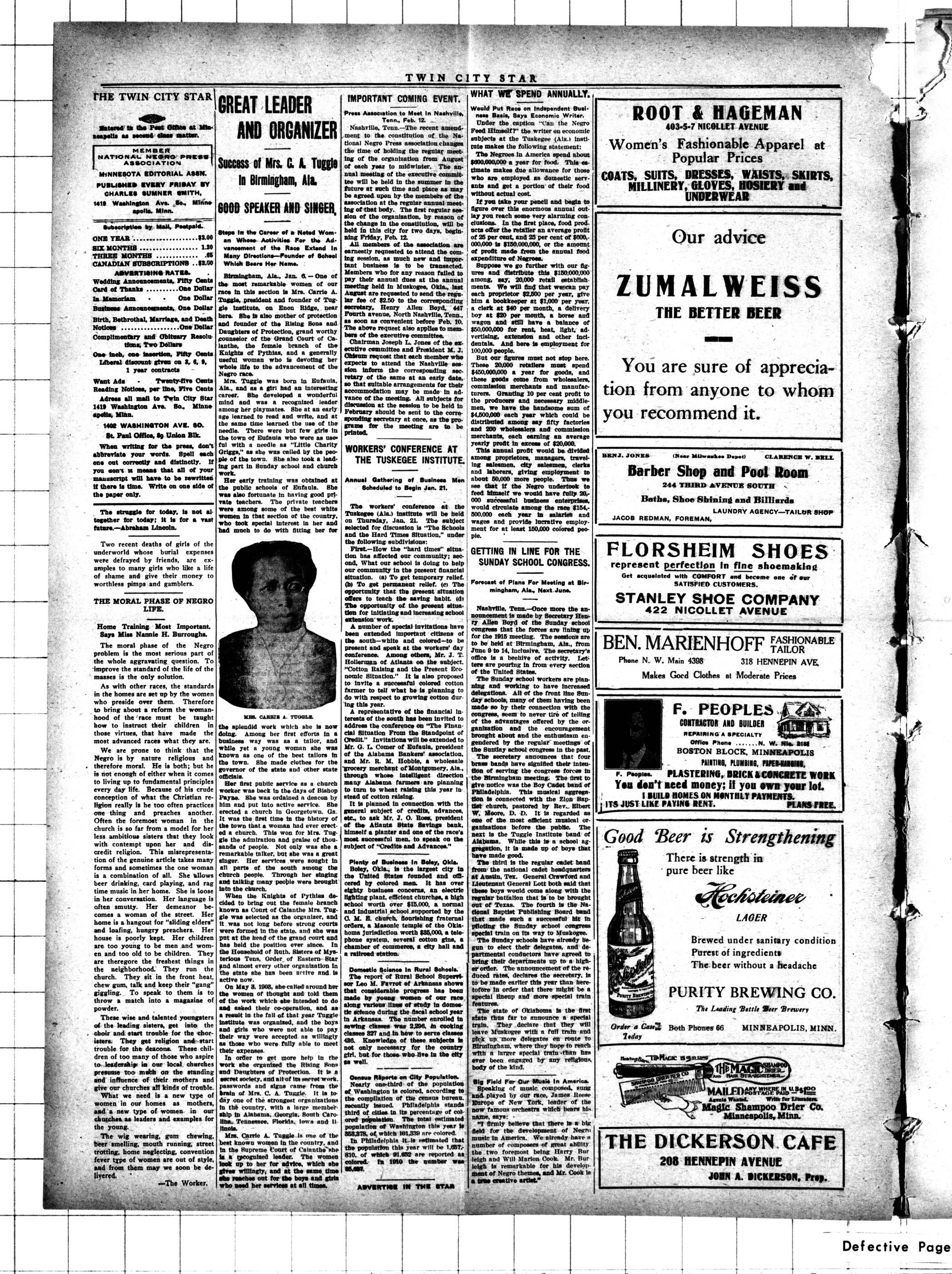
GREAT LEADER AND ORGANIZER
Success of Mrs. C. A. Tuggle In Birmingham, Ala.
GOOD SPEAKER AND SINGER
Steps In the Career of a Noted Woman Whose Activities For the Advancement of the Race Extend In Many Directions—Founder of School Which Bears Her Name.
Birmingham, Ala., Jan. 6. — One of the most remarkable women of our race in this section is Mrs. Carrie A. Tuggle, president and founder of Tuggle institute, on Enon Ridge, near here. She is also mother of protection and founder of the Rising Sons and Daughters of Protection, grand worthy counselor of the Grand Court of Calanthe, the female branch of the Knights of Pythias, and a generally useful woman who is devoting her whole life to the advancement of the Negro race.
Mrs. Tuggle was born in Eufaula, Ala., and as a girl had an interesting career. She developed a wonderful mind and was a recognized leader among her playmates. She at an early age learned to read and write, and at the same time learned the use of the needle. There were but few girls in the town of Eufaula who were as useful with a needle as "Little Charity Griggs," as she was called by the people of the town. She also took a leading part in Sunday school and church work.
Her early training was obtained at the public schools of Eufaula. She was also fortunate in having good private teachers. The private teachers were among some of the best white women in that section of the country, who took special interest in her and had much to do with fitting her for
MRS. CARRIE A. TUGGLE.
the splendid work which she is now doing. Among her first efforts in a business way was as a tailor, and while yet a young woman she was known as one of the best tailors in the town. She made clothes for the governor of the state and other state officials.
Her first public service as a church worker was back in the days of Bishop Payne. She was ordained a deacon by him and put into active service. She erected a church in Georgetown, Ga. It was the first time in the history of the town that a woman had ever erected a church. This won for Mrs. Tuggle the admiration and praise of thousands of people. Not only was she a remarkable talker, but she was a great singer. Her services were sought in all parts of the south among the church people. Through her singing and talking many people were brought into the church.
When the Knights of Pythias decided to bring out the female branch known as Court of Calanthe Mrs. Tuggle was selected as the organizer, and it was not long before strong courts were formed in the state, and she was put at the head of the grand court and has held the position ever since. In the Household of Ruth, Sisters of Mysterious Tens, Order of Eastern Star and almost every other organization in the state she has been active and is active now.
On May 3, 1903, she called around her the women of thought and told them of the work which she intended to do and asked their co-operation, and as a result in the fall of that year Tuggle institute was organized, and the boys and girls who were not able to pay their way were accepted as willingly as those who were fully able to meet their expenses.
In order to get more help in the work she organized the Rising Sons and Daughters of Protection. It is a secret society, and all of its secret work, passwords and signs came from the brain of Mrs. C. A. Tuggle. It is today one of the strongest organizations in the country, with a large membership in Alabama, Georgia, South Carolina, Tennessee, Florida, Iowa and Illinois.
Mrs. Carrie A. Tuggle is one of the best known women in the country, and in the Supreme Court of Calcutta she is a recognised leader. The women look up to her for advice, which she gives willingly, and at the same time she reaches out for the boys and girls who need her services at all times.
TWIN CITY STAR
Press Association to Meet In Nashville, Tenn., Feb. 12.
Nashville, Tenn.—The recent amendment to the constitution of the National Negro Press association changes the time of holding the regular meeting of the organization from August of each year to midwinter. The annual meeting of the executive committee will be held in the summer in the future at such time and place as may be agreed upon by the members of the association at the regular annual meeting of that body. The first regular session of the organization, by reason of the change in the constitution, will be held in this city for two days, beginning Friday, Feb. 12.
All members of the association are earnestly requested to attend the coming session, as much new and important business is to be transacted. Members who for any reason failed to pay their annual dues at the annual meeting held in Muskogee, Okla., last August are requested to send the regular fee of $2.50 to the corresponding secretary, Henry Allen Boyd, 447 Fourth avenue, North Nashville, Tenn., as soon as convenient before Feb. 10. The above request also applies to members of the executive committee.
Chairman Joseph L. Jones of the executive committee and President M. J. Chisum request that each member who expects to attend the Nashville session inform the corresponding secretary of the same at an early date, so that suitable arrangements for their accommodation may be made in advance of the meeting. All subjects for discussion at the session to be held in February should be sent to the corresponding secretary at once, as the programs for the meeting are to be printed.
WORKERS' CONFERENCE AT THE TUSKEGEE INSTITUTE
Annual Gathering of Business Men Scheduled to Begin Jan. 21.
The workers' conference at the Tuskegee (Ala.) institute will be held on Thursday, Jan. 21. The subject selected for discussion is "The Schools and the Hard Times Situation," under the following subdivisions:
First.—How the "hard times" situation has affected our community; second, What our school is doing to help our community in the present financial situation. (a) To get temporary relief. (b) To get permanent relief. (c) The opportunity that the present situation offers to teach the saving habit. (d) The opportunity of the present situation for initiating and increasing school extension work.
A number of special invitations have been extended important citizens of the south-white and colored—to be present and speak at the workers' day conference. Among others, Mr. J. T. Hollerman of Atlanta on the subject, "Cotton Raising and the Present Economic Situation." It is also proposed to invite a successful colored cotton farmer to tell what he is planning to do with respect to growing cotton during this year.
A representative of the financial interests of the south has been invited to address the conference on "The Financial Situation From the Standpoint of Credit." Invitations will be extended to Mr. G. L. Comer of Eufaula, president of the Alabama Bankers' association, and Mr. R. M. Hobble, a wholesale grocery merchant of Montgomery, Ala., through whose intelligent direction many Alabama farmers are planning to turn to wheat raising this year instead of cotton raising.
It is planned in connection with the general subject of credits, advances, etc., to ask Mr. J. O. Ross, president of the Atlanta State Savings bank, himself a planter and one of the race's most successful men, to speak on the subject of "Credits and Advances."
Plenty of Business In Beley, Okla.
Boley, Okla., is the largest city in the United States founded and officered by colored men. It has over eighty business concerns, an electric lighting plant, efficient churches, a high school worth over $15,000, a normal and industrial school supported by the C. M. E. church, nourishing fraternal orders, a Masonic temple of the Oklahoma jurisdiction worth $55,000, a telephone system, several cotton gins, a chamber of commerce, a city hall and a railroad station.
Domestic Science in Rural Schools.
The report of Rural School Supervisor Leo M. Favrot of Arkansas shows that considerable progress has been made by young women of our race along various lines of study in domestic science during the fiscal school year in Arkansas. The number enrolled in sewing classes was 2,296, in cooking classes 327 and in how to serve classes 486. Knowledge of these subjects is not only necessary for the country girl, but for those who live in the city as well.
Census Reports on City Population.
Nearly one-third of the population of Washington is colored, according to the compilation of the census bureau, recently issued. Philadelphia stands third of cities in its percentage of colored population. The total estimated population of Washington this year is 853,378, of which 101,339 are colored.
In Philadelphia it is estimated that the population this year will be 1,057,810, of which 91,652 are reported as colored. In 1910 the number was 85,687.
ADVERTICE IN THE STAR
WHAT WE SPEND ANNUALLY.
Would Put Race on Independent Business Basis, Says Economic Writer. Under the caption "Can the Negro Feed Himself?" the writer on economic subjects at the Tuskegee (Ala.) institute makes the following statement:
The Negroes in America spend about $600,000,000 a year for food. This estimate makes due allowance for those who are employed as domestic servants and get a portion of their food without actual cost.
If you take your pencil and begin to figure over this enormous annual outlay you reach some very alarming conclusions. In the first place, food products offer the retailer an average profit of 25 per cent, and 25 per cent of $000,000,000 is $150,000,000, or the amount of profit made from the annual food expenditure of Negroes.
Suppose we go further with our figures and distribute this $150,000,000 among, say, 20,000 retail establishments. We will find that we can pay each proprietor $2,500 per year, give him a bookkeeper at $1,000 per year, a clerk at $40 per month, a delivery boy at $20 per month, a horse and wagon and still have a balance of $50,000,000 for rent, heat, light, advertising, extension and other incidentals. And here is employment for 100,000 people.
But our figures must not stop here. These 20,000 retailers must spend $450,000,000 a year for goods, and these goods come from wholesalers, commission merchants and manufacturers. Granting 10 per cent profit to the producers and necessary middlemen, we have the handsome sum of $4,500,000 each year which could be distributed among say fifty factories and 200 wholesalers and commission merchants, each earning an average yearly profit in excess of $20,000.
This annual profit would be divided among proprietors, managers, traveling salesmen, city salesmen, clerks and laborers, giving employment to about 50,000 more people. Thus we see that if the Negro undertook to feed himself we would have fully 20,000 successful business enterprises, would circulate among the race $154,500,000 each year in salaries and wages and provide lucrative employment for at least 150,000 colored people.
GETTING IN LINE FOR THE SUNDAY SCHOOL CONGRESS.
Forecast of Plans For Meeting at Birmingham, Ala., Next June.
Nashville, Tenn. Once more the announcement is made by Secretary Henry Allen Boyd of the Sunday school congress that the forces are lining up for the 1915 meeting. The sessions are to be held at Birmingham, Ala., from June 9 to 14, inclusive. The secretary's office is a beehive of activity. Letters are pouring in from every section of the United States.
The Sunday school workers are planning and working to have increased delegations. All of the front Sunday schools, many of them having been made so by their connection with the congress, seem to never tire of telling of the advantages offered by the organization and the encouragement brought about and the enthusiasm engendered by the regular meetings of the Sunday school congress in the past.
The secretary announces that four brass bands have signified their intention of serving the congress forces in the Birmingham meeting. The first to give notice was the Boy Cadet band of Philadelphia. This musical aggregation is connected with the Zion Baptist church, pastored by Rev. Elbert W. Moore, D. D. It is regarded as one of the most efficient musical organizations before the public. The next is the Tuggle Institute band of Alabama. While this is a school aggregation, it is made up of boys that have made good.
The third is the regular cadet band from the national cadet headquarters at Austin, Tex. General Crawford and Leutenant General Lott both said that these boys would come along with the regular battalion that is to be brought out of Texas. The fourth is the National Baptist Publishing Board band that made such a successful hit in piloting the Sunday school congress special train on its way to Muskogee. The Sunday schools have already begun to elect their delegates, and departmental conductors have agreed to bring their departments up to a higher order. The announcement of the reduced rates, declares the secretary, is to be made earlier this year than heretofore in order that there might be a special lineup and more special train features.
The state of Oklahoma is the first state thus far to announce a special train. They declare that they will leave Muskogee with a full train and pick up more delegates en route to Birmingham, where they hope to reach with a larger special train than has ever been engaged by any religious body of the kind.
Big Field For Our Music in America. Speaking of music composed, sung and played by our race, James Reese Europe of New York, leader of the now famous orchestra which bears his name, says:
"I firmly believe that there is a big field for the development of Negro music in America. We already have a number of composers of great ability. the two foremost being Harry Burleigh and Will Marion Cook. Mr. Burleigh is remarkable for his development of Negro themes, and Mr. Cook is a true creative artist."
ROOT & HAGEMAN
403-5-7 NICOLLET AVENUE
Women's Fashionable Apparel at
Popular Prices
COATS, SUITS, DRESSES, WAISTS, SKIRTS,
MILLINERY, GLOVES, HOSIERY and
UNDERWEAR
You are sure of appreciation from anyone to whom you recommend it.
BENJ. JONES
(Near Milwaukee Depot)
CLARENCE W. BELL
Barber Shop and Pool Room
244 THIRD AVENUE SOUTH
Baths, Shoe Shining and Billiards
LAUNDRY AGENCY—TAILOR SHOP
JACOB REDMAN, FOREMAN,
FLORSHEIM SHOES represent perfection in fine shoemaking Get acquainted with COMFORT and become one of our SATISFIED CUSTOMERS. STANLEY SHOE COMPANY 422 NICOLLET AVENUE
BEN. MARIENOFF FASHIONABLE TAILOR Phone N. W. Main 4398 318 HENNEPIN AVE Makes Good Clothes at Moderate Prices
Heating Box
TOP MAGIC IS 9 IN LBS.
SHAMPOO DRIER RED CO.
SHAMPOO DRIER RED CO.
AND HAIR STRAIGHTENER.
MAILED ANY WHERE IN U.S.$100
POSTAGE PAID
Agents Wanted. Write For Literature.
Magic Shampoo Drier Co.
Minneapolis, Minn.
THE DICKERSON CAFE
208 HENNEPIN AVENUE
JOHN A. DICKERSON, Prop.
F. Peoples.
You don't
I BUIL
ITS JUST LIKE I
Kokotone
PUNITY BREWING CO.
Order a Case
Today
Heating Box TBM
Our advice
MALWEE
THE BETTER BED
are sure of a
from anyone to
commend it.
(Near Milwaukee Depot)
Eer Shop and Poob
2244 THIRD AVENUE SOUTH
Bus, Shoe Shining and Bilt
LAUNDRY AGEN
AN, FOREMAN,
RSHEIM S
perfection in fine sh
ted with COMFORT and become
SATISFIED CUSTOMERS.
LEY SHOE CO
2 NICOLLET AVEN
ARIENHOFF
T. Main 4398 318 HE
es Good Clothes at Moderate
F. PEOPLES
CONTRACTOR AND BUILDER
REPAIRING A SPECIALTY
Office Phone .....N.
BOSTON BLOCK, MIN
PAINTING, PLUMBING, P
PLASTERING, BRICK & C
need money; if you ov
LD HOMES ON MONTHLY PAY
PAYING RENT.
Beer is Streng
ALWEISS
BETTER BEER
sure of apprecia-
anyone to whom
mend it.
Milwaukee Depot) CLARENCE W. BELL
Shop and Pool Room
THIRD AVENUE SOUTH
Shoe Shining and Billiards
LAUNDRY AGENCY—TAILOR SHOP
HEIM SHOES
section in fine shoemaking
COMFORT and become one of our
ASSISTED CUSTOMERS.
SHOE COMPANY
COLLET AVENUE
HENHOFF FASHIONABLE TAILOR
4398 318 HENNEPIN AVE,
Clothes at Moderate Prices
PEOPLES
CONTRACTOR AND BUILDER
REPAIRING A SPECIALTY
Office Phone .....N. W. Nle. 2198
BOSTON BLOCK, MINNEAPOLIS
PAINTING, PLUMBING, PAPER-HANGING,
STERING, BRICK & CONCRETE WORK
money; if you own your lot.
IES ON MONTHLY PAYMENTS.
RENT. PLANS FREE.
is Strengthening
There is strength in pure beer like Hochste LAGER
Hochsteiner LAGER Brewed under sanitary condition Purest of ingredients The beer without a headache
PURITY BREW
The Loading Bottle B
Both Phones 66 MINN
MAGIC 15 UNLEASONS
ER MED CO
THE MAGIC
AND HAIR STRAIGHT
RITY BREWING CO.
The Loading Bottle Beer Brewery
Phones 66 MINNEAPOLIS, MINN.
THE MAGIC SHAMPOO
DRYER
HAIR STRAIGHTENER
Defective Page