Twin City Star
Saturday, April 10, 1915
Minneapolis, Minnesota
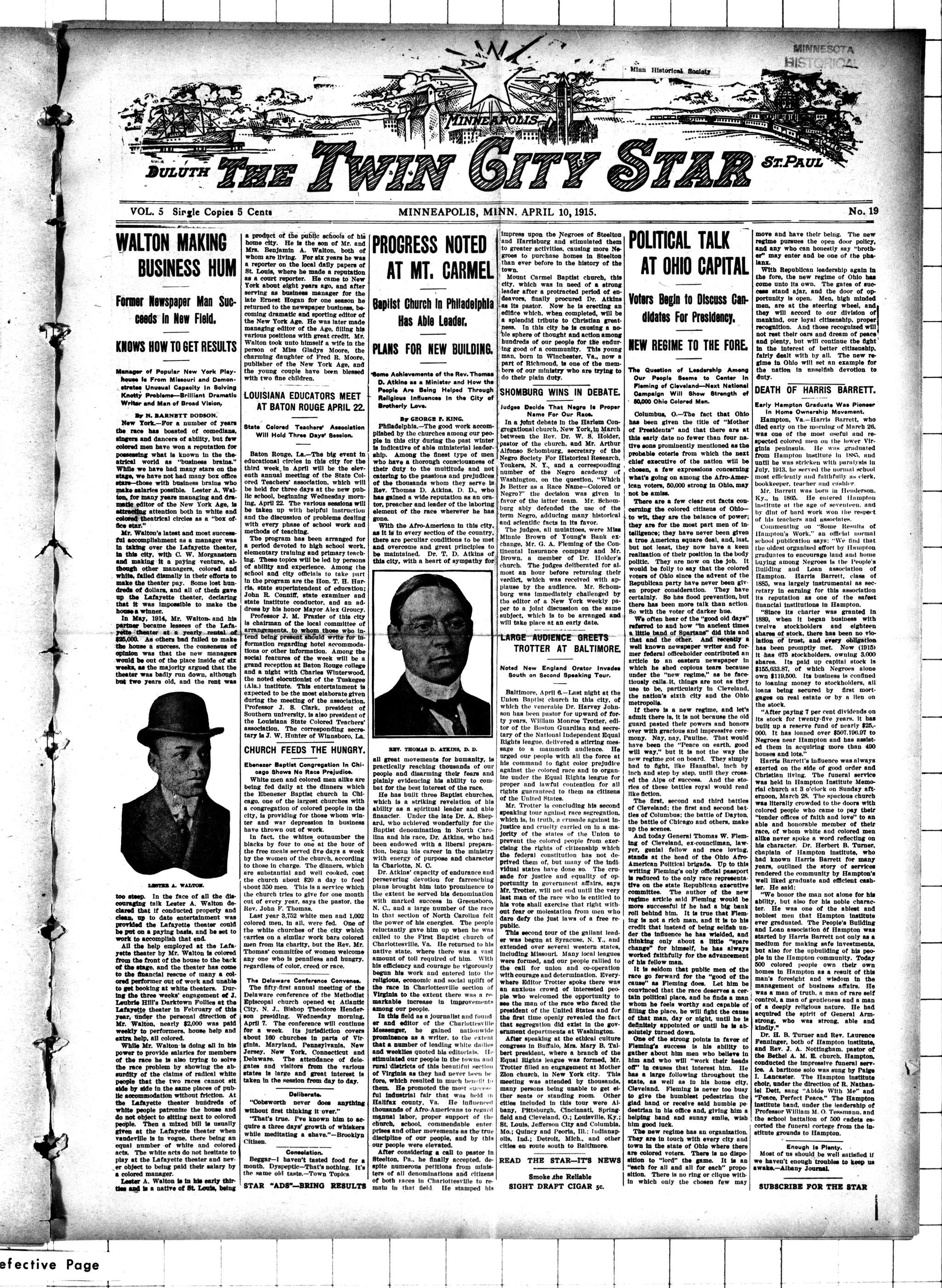
Page text (machine-generated)
MINNEAPOLIS
DULUTH THE TWIN CITY STAR ST.PAUL
effective Page
VOL. 5 Single Copies 5 Cents
WALTON MAKING BUSINESS HUM
Former Newspaper Man Succeeds in New Field.
Manager of Popular New York Playhouse is From Missouri and Demonstrates Unusual Capacity in Solving Knotty Problems—Brilliant Dramatic Writer and Man of Broad Vision.
By N. BARNETT DODSON.
New York.—For a number of years the race has boasted of comedians, singers and dancers of ability, but few colored men have won a reputation for possessing what is known in the theatrical world as "business brains." While we have had many stars on the stage, we have not had many box office stars—those with business brains who make salaries possible. Lester A. Walton, for many years managing and dramatic editor of the New York Age, is attracting attention both in white and colored theatrical circles as a "box office star."
Mr. Walton's latest and most successful accomplishment as a manager was in taking over the Lafayette theater, in this city, with C. W. Morganstern and making it a paying venture, although other managers, colored and white, failed dismally in their efforts to make the theater pay. Some lost hundreds of dollars, and all of them gave up the Lafayette theater, declaring that it was impossible to make the house a winner.
In May, 1914, Mr. Walton and his partner became lessees of the Lafayette theater at a yearly rental of $25,000. As others had failed to make the house a success, the consensus of opinion was that the new managers would be out of the place inside of six weeks, as the majority argued that the theater was badly run down, although but two years old, and the rent was
LESTER A. WALTON.
too steep. In the face of all the discouraging talk Lester A. Walton declared that if conducted properly and clean, up to date entertainment was provided the Lafayette theater could be put on a paying basis, and he set to work to accomplish that end. All the help employed at the Lafayette theater by Mr. Walton is colored from the front of the house to the back of the stage, and the theater has come to the financial rescue of many a colored performer out of work and unable to get booking at white theaters. During the three weeks' engagement of J. Leubrie Hill's Darktown Follies at the Lafayette theater in February of this year, under the personal direction of Mr. Walton, nearly $2,000 was paid weekly to performers, house help and extra help, all colored.
While Mr. Walton is doing all in his power to provide salaries for members of the race he is also trying to solve the race problem by showing the absurdity of the claims of radical white people that the two races cannot sit side by side in the same places of public accommodation without friction. At the Lafayette theater hundreds of white people patronize the house and do not object to sitting next to colored people. Then a mixed bill is usually given at the Lafayette theater when vaudeville is in vogue, there being an equal number of white and colored acts. The white acts do not hesitate to play at the Lafayette theater and never object to being paid their salary by a colored manager. Lester A. Walton is in his early thirties and is a native of St. Louis, being
a product of the public schools of his home city. He is the son of Mr. and Mrs. Benjamin A. Walton, both of whom are living. For six years he was a reporter on the local daily papers of St. Louis, where he made a reputation as a court reporter. He came to New York about eight years ago, and after serving as business manager for the late Ernest Hogan for one season he returned to the newspaper business, becoming dramatic and sporting editor of the New York Age. He was later made managing editor of the Age, filling his various positions with great credit. Mr. Walton took unto himself a wife in the person of Miss Gladys Moore, the charming daughter of Fred R. Moore, publisher of the New York Age, and the young couple have been blessed with two fine children.
LOUISIANA EDUCATORS MEET AT BATON ROUGE APRIL 22.
State Colored Teachers' Association Will Hold Three Days' Session.
Baton Rouge, La.—The big event in educational circles in this city for the third week, in April will be the eleventh annual meeting of the State Colored Teachers' association, which will be held for three days at the new public school, beginning Wednesday morning. April 22. The various sessions will be taken up with helpful instruction and the discussion of problems dealing with every phase of school work and methods of teaching.
The program has been arranged for a period devoted to high school work, elementary training and primary teaching. These topics will be led by persons of ability and experience. Among the school and city officials to take part in the program are the Hon. T. H. Harris, state superintendent of education; John R. Conniff, state examiner and state institute conductor, and an address by his honor Mayor Alex Groucer.
Professor J. M. Frazer of this city is chairman of the local committee of arrangements, to whom those who intend being present should write for information regarding hotel accommodations or other information. Among the social features of the week will be a grand reception at Baton Rouge college and a night with Charles Winterwood, the noted elocutionist of the Tuskegee (Ala.) institute. This entertainment is expected to be the most elaborate given during the meeting of the association. Professor J. S. Clark, president of Southern university, is also president of the Louisiana State Colored Teachers' association. The corresponding secretary is J. W. Hunter of Winnsboro, La.
CHURCH FEEDS THE HUNGRY.
Ebenezer Baptist Congregation in Chicago Shows No Race Prejudice.
White men and colored men alike are being fed daily at the dinners which the Ebenezer Baptist church in Chicago, one of the largest churches with a congregation of colored people in the city, is providing for those whom winter and war depression in business have thrown out of work.
In fact, the whites outnumber the blacks by four to one at the hour of the free meals served five days a week by the women of the church, according to those in charge. The dinners, which are substantial and well cooked, cost the church about $20 a day to feed about 350 men. This is a service which the church tries to give for one month out of every year, says the pastor, the Rev. John F. Thomas.
Last year 3,752 white men and 1,002 colored men, in all, were fed. One of the white churches of the city which carries on a similar work bars colored men from its charity, but the Rev. Mr. Thomas' committee of women welcome any one who is penniless and hungry, regardless of color, creed or race.
The Delaware Conference Convene.
The fifty-first annual meeting of the Delaware conference of the Methodist Episcopal church opened at Atlantic City, N. J., Bishop Theodore Henderson presiding. Wednesday morning, April 7. The conference will continue for a week. Its jurisdiction covers about 160 churches in parts of Virginia, Maryland, Pennsylvania, New Jersey, New York, Connecticut and Delaware. The attendance of delegates and visitors from the various states is large and great interest is taken in the session from day to day.
Deliberate.
"Obsworth never does anything without first thinking it over." "That's true. I've known him to acquire a three days' growth of whiskers while meditating a shave."—Brooklyn Citizen.
Consolation.
Beggar-I haven't tasted food for a month. Dyspeptic-That's nothing. It's the same old taste.-Town Topics.
STAR "ADS"—BRING RESULTS
PROGRESS NOTED AT MT. CARMEL
Some Achievements of the Rev. Thomas D. Atkine as a Minister and How the People Are Being Helped Through Religious Influences in the City of Brotherly Love.
By GEORGE F. KING.
Philadelphia.—The good work accomplished by the churches among our people in this city during the past winter is indicative of able ministerial leadership. Among the finest type of men who have a thorough consciousness of their duty to the multitude and not catering to the passions and prejudices of the thousands whom they serve is Rev. Thomas D. Atkins, D. D., who has gained a wide reputation as an orator, preacher and leader of the laboring element of the race wherever he has gone.
With the Afro-American in this city, as it is in every section of the country, there are peculiar conditions to be met and overcome and great principles to be maintained. Dr. T. D. Atkins of this city, with a heart of sympathy for
REV. THOMAS D. ATKINS, D. D.
all great movements for humanity, is practically reaching thousands of our people and disarming their fears and plainly evidencing his ability to combat for the best interest of the race.
He has built three Baptist churches, which is a striking revelation of his ability as a spiritual leader and able financier. Under the late Dr. A. Shepard, who achieved wonderfully for the Baptist denomination in North Carolina and his race, Dr. Atkins, who had been endowed with a liberal preparation, began his career in the ministry with energy of purpose and character in Charlotte, N. C.
Dr. Atkins' capacity of endurance and persevering devotion for farreaching plans brought him into prominence to the extent he served his denomination with marked success in Greensboro, N. C., and a large number of the race in that section of North Carolina felt the power of his energies. The people reluctantly gave him up when he was called to the First Baptist church of Charlottesville, Va. He returned to his native state, where there was a vast amount of toll required of him. With his efficiency and courage he vigorously begun his work and entered into the religious, economic and social uplift of the race in Charlottesville section of Virginia to the extent there was a remarkable increase in improvements among our people.
In this field as a journalist and founder and editor of the Charlottesville Messenger, he gained nationwide prominence as a writer, to the extent that a number of leading white dailies and weeklies quoted his editorials. He stimulated our people in the towns and rural districts of this beautiful section of Virginia as they had never been before, which resulted in much benefit to them. He promoted the most successful industrial fair that was held in Halifax county, Va. He influenced thousands of Afro-Americans to regard manual labor, proper support of the church, school, commendable enterprises and other movements as the true discipline of our people, and by this our people were elevated.
After considering a call to pastor in Steelton, Pa., he finally accepted, despite numerous petitions from ministers of all denominations and citizens of both races in Charlottesville to remain in that field. He stamped his
impress upon the Negroes of Steillon and Harrisburg and stimulated them to greater activities, causing more Negroes to purchase homes in Steillon than ever before in the history of the town.
Mount Carmel Baptist church, this city, which was in need of a strong leader after a protracted period of endeavors, finally procured Dr. Atkins as its pastor. Now he is erecting an edifice which, when completed, will be a splendid tribute to Christian greatness. In this city he is causing a noble sphere of thought and action among hundreds of our people for the enduring good of a community. This young man, born in Winchester, Va., now a part of Richmond, is one of the members of our ministry who are trying to do their plain duty.
SHOMBURG WINS IN DEBATE.
Judges Decide That Negro is Proper Name For Our Race.
In a joint debate in the Harlem Congregational church, New York, in March between the Rev. Dr. W. S. Holder, pastor of the church, and Mr. Arthur Alfonso Schomburg, secretary of the Negro Society For Historical Research, Yonkers, N. Y., and a corresponding number of the Negro academy of Washington, on the question, "Which Is Better as a Race Name—Colored or Negro?" the decision was given in favor of the latter team. Mr. Schomburg ably defended the use of the term Negro, adducing many historical and scientific facts in its favor.
The judges, all malattos, were Miss Minnie Brown of Young's Bank exchange, Mr. G. A. Fleming of the Continental Insurance company and Mr. Brown, a member of Dr. Holder's church. The judges deliberated for almost an hour before returning their verdict, which was received with applause by the audience. Mr. Schomburg was immediately challenged by the editor of a New York weekly paper to a joint discussion on the same subject, which is to be arranged and will take place at an early date.
LARGE AUDIENCE GREETS
TROTTER AT BALTIMORE.
Noted New England Orator Invades South on Second Speaking Tour.
Baltimore, April 6.—Last night at the Union Baptist church in this city, of which the venerable Dr. Harvey Johnson has been pastor for upward of forty years, William Monroe Trotter, editor of the Boston Guardian and secretary of the National Independent Equal Rights league, delivered a stirring message to a mammoth audience. He urged our people with all the force at his command to fight color prejudice against the colored race and to organize under the Equal Rights league for proper and lawful contention for all rights guaranteed to them as citizens of the United States.
Mr. Trotter is concluding his second speaking tour against race segregation, which is, in truth, a crusade against injustice and cruelty carried on in a majority of the states of the Union to prevent the colored people from exercising the rights of citizenship which the federal constitution has not deprived them of, but many of the individual states have done so. The crusade for justice and equality of opportunity in government affairs, says Mr. Trotter, will not end until the very last man of the race who is entitled to his vote shall exercise that right without fear or molestation from men who dare defy the just laws of a free republic.
This second tour of the gallant leader was begun at Syracuse, N. Y., and extended over several western states, including Missouri. Many local leagues were formed, and our people rallied to the call for union and co-operation with courage and determination. Everywhere Editor Trotter spoke there was an anxious crowd of interested people who welcomed the opportunity to see the man of the race who faced the president of the United States and for the first time openly revealed the fact that segregation did exist in the government departments at Washington.
After speaking at the ethical culture congress in Buffalo, Mrs. Mary B. Talbert president, where a branch of the Equal Rights league was formed, Mr. Trotter filled an engagement at Mother Zion church, in New York city. This meeting was attended by thousands, many persons being unable to get either seats or standing room. Other cities included in this tour were Albany, Pittsburgh, Cincinnati, Springfield and Cleveland, O.; Louisville, Ky.; St. Louis, Jefferson City and Columbia, Mo.; Quincy and Peoria, Ill.; Indianapolis, Ind.; Detroit, Mich., and other cities en route south to Baltimore.
Smoke the Reliable
SIGHT DRAFT CIGAR 5c.
POLITICAL TALK AT OHIO CAPITAL
NEW REGIME TO THE FORE.
The Question of Leadership Among Our People Seems to Center In Fleming of Cleveland—Next National Campaign Will Show Strength of 50,000 Ohio Colored Men.
Columbus, O.-The fact that Ohio has been given the title of "Mother of Presidents" and that there are at this early date no fewer than four native sons prominently mentioned as the probable coterie from which the next chief executive of the nation will be chosen, a few expressions concerning what's going on among the Afro-American voters, 50,000 strong in Ohio, may not be amiss.
There are a few clear cut facts concerning the colored citizens of Ohio—to wit, they are the balance of power; they are for the most part men of intelligence; they have never been given a true American square deal, and, last, but not least, they now have a keen realization of their position in the body politic. They are now on the job. It would be folly to say that the colored voters of Ohio since the advent of the Republican party have never been given proper consideration. They have certainly. So has flood prevention, but there has been more talk than action. So with the voter of darker hue.
We often bear of the "good old days" referred to and how "in ancient times a little band of Spartans" did this and that and the other. And recently a well known newspaper writer and former federal officeholder contributed an article to an eastern newspaper in which he shed copious tears because under the "new regime," as he facetiously calls it, things are not as they use to be, particularly in Cleveland, the nation's sixth city and the Ohio metropolis.
If there is a new regime, and let's admit there is, it is not because the old guard pasted their powers and honors over with gracious and impressive ceremony. Nay, nay, Pauline. That would have been the "Peace on earth, good will way," but it is not the way the new regime got on board. They simply had to fight, like Hannibal, inch by inch and step by step, until they crossed the Alps of success. And the stories of these battles royal would read like fiction.
The first, second and third battles of Cleveland: the first and second battles of Columbus; the battle of Dayton, the battle of Chicago and others, make up the scenes.
And today General Thomas W. Fleming of Cleveland, ex-councilman, lawyer, genial fellow and race loving, stands at the head of the Ohio Afro-American Political brigade. Up to this writing Fleming's only official passport is reduced to the only race representative on the state Republican executive committee. The author of the new regime article said Fleming would be more successful if he had a big bank roll behind him. It is true that Fleming is not a rich man, and it is to his credit that instead of being selfish under the influence he has wielded, and thinking only about a little "spare change" for himself, he has always worked faithfully for the advancement of his fellow man.
It is seldom that public men of the race go forward for the "good of the cause" as Fleming does. Let him be convinced that the race deserves a certain political place, and he finds a man whom he feels worthy and capable of filling the place, he will fight the cause of that man, day or night, until he is definitely appointed or until he is absolutely turned down.
One of the strong points in favor of Fleming's success is his ability to gather about him men who believe in him and who will "work their heads off" in causes that interest him. He has a large following throughout the state, as well as in his home city, Cleveland. Fleming is never too busy to give the humbleest pedestrian the glad hand or receive said humble pedestrian in his office and, giving him a helping hand and sunny smile, wish him good luck.
The new regime has an organization. They are in touch with every city and town in the state of Ohio where there are colored voters. There is no disposition to "lord" the game. It is an "each for all and all for each" proposition. There is no ring or clique within which only the chosen few may
No.19
move and have their being. The new regime pursues the open door policy, and any who can honestly say "brother" may enter and be one of the phalanx. With Republican leadership again in the fore, the new regime of Ohio has come unto its own. The gates of success stand ajar, and the door of opportunity is open. Men, high minded men, are at the steering wheel, and they will accord to our division of mankind, our loyal citizenship, proper recognition. And those recognized will not rest their oars and dream of peace and plenty, but will continue the fight in the interest of better citizenship, fairly dealt with by all. The new regime in Ohio will set an example for the nation in unselfish devotion to duty.
DEATH OF HARRIS BARRETT.
Early Hampton Graduate Was Pioneer
In Home Ownership Movement
IN HOME OWNERSHIP MOVEMENT
Hampton, Va.-Harris Barrett, who died early on the morning of March 26, was one of the most useful and respected colored men on the lower Virginia peninsula. He was graduated from Hampton institute in 1885, and until he was stricken with paralysis in July, 1913, he served the normal school most efficiently and faithfully as clerk, bookkeeper, teacher and cashier.
Mr. Barrett was born in Henderson, Ky., in 1805. He entered Hampton institute at the age of seventeen, and by dint of hard work won the respect of his teachers and associates.
Commenting on "Some Results of Hampton's Work," an official normal school publication says: "We find that the oldest organized effort by Hampton graduates to encourage land and home buying among Negroes is the People's Building and Loan association of Hampton. Harris Barrett, class of 1885, was largely instrumental as secretary in earning for this association its reputation as one of the safest financial institutions in Hampton.
"Since its charter was granted in 1889, when it began business with twelve stockholders and eighteen shares of stock, there has been no violation of trust, and every obligation has been promptly met. Now (1015) it has 675 stockholders, owning 3,000 shares. Its paid up capital stock is $155,633.87, of which Negroes alone own $119,500. Its business is confined to loaning money to stockholders, all loans being secured by first mortgages on real estate or by a lien on the stock.
"After paying 7 per cent dividends on its stock for twenty-five years, it has built up a reserve fund of nearly $25,-000. It has loaned over $507,196.97 to Negroes near Hampton and has assisted them in acquiring more than 400 houses and lots."
Harris Barrett's influence was always exerted on the side of good order and Christian living. The funeral service was held in Hampton Institute Memorial church at 3 o'clock on Sunday afternoon, March 28. The spacious church was literally crowded to the doors with colored people who came to pay their "tender offices of faith and love" to an able and honorable member of their race, of whom white and colored men alike never spoke a word reflecting on his character. Dr. Herbert B. Turner, chaplain of Hampton institute, who had known Harris Barrett for many years, outlined the story of services rendered the community by Hampton's well liked graduate and efficient cashier. He said:
"We honor the man not alone for his ability, but also for his noble character. He was one of the ablest and noblest men that Hampton institute ever graduated. The People's Building and Loan association of Hampton was started by Harris Barrett not only as a medium for making safe investments, but also for the upbuilding of his people in the Hampton community. Today 500 colored people own their own homes in Hampton as a result of this man's foresight and wisdom in the management of business affairs. He was a man of truth, a man of rare self control, a man of gentleness and a man of a deeply religious nature. He had acquired the spirit of General Armstrong, who was strong, able and kindly."
Dr. H. B. Turner and Rev. Laurence Fenninger, both of Hampton institute, and Rev. J. A. Nottingham, pastor of the Bethel A. M. E. church, Hampton, conducted the impressive funeral service. A bartone solo was sung by Palge I. Lancaster. The Hampton institute choir, under the direction of R. Nathaniel Dett, sang "Abilde With Me" and "Peace, Perfect Peace." The Hampton institute band, under the leadership of Professor William M. O. Tessmann, and the school battalion of 500 cadets escorted the funeral cortege from the institute grounds to Hampton.
Enough Is Plenty. Most of us should be well satisfied if we haven't enough troubles to keep us awake.—Albany Journal.
SUBSCRIBE FOR THE STAR
BETHESDA BAPTIST CHURCH
12th Ave. So. and 8th St.
All are welcome.
Rev. T. J. Carter, Pastor.
Rev. T. J. Carter has moved to
2423 4th Ave. So.
People's Christian Assembly.
Rev. G. W. Mitchell, Pastor,
1204 Washington Ave. So.
Come! and Serve the Lord.
ST. PETER'S A. M. E. CHURCH.
22nd St. near 10th Ave. So.
Rev. Thos. B. Stovall, Pastor.
ST. JAMES A. M. E. CHURCH,
318 8th Ave. So., Minneapolis.
Rev. E. R. Edwards, Pastor.
We would appreciate what you owe us, or a part of it, Mr. Delinquent Subscriber.
We get lots of kicks from non-paying subscribers, (those people who take papers) but our paying subscribers appear to be satisfied.
The St. James Mission of St. Paul. Rev. J. S. Strong, pastor has moved to 817 Mississippi St., Cor. Granite St. St. Paul.
The Elks have announced a contest. The most popular lady will get a trip to Chicago, all expenses paid. Several ladies have entered. Votes are a nickel apiece.
The Easter Services at the churches were well attended.
ZION'S TEMPORARY LOCATION The temporary location of Zion Baptist Church is 607 5th St. No. where regular services are held.
REV. GILLES' BIBLE CLASSES.
REV. GILLES BIBLE CLASSES.
Rev. E. W. Gilles conducted Bible and Missionary studies with Mr. and Mrs. James Stansberry Tuesday evening, Bible studies at the St. Peter's Church Thursday evening, and Sunday school lesson studies at the University Place Christian church Sunday morning.
Mr. Solomon Saunders of Saunder's Riding School, arrived home Wednesday from Mexico, Mo., where he purchased several thoroughbred saddle horses. He also visited St. Louis. Mr. Saunders enjoyed his trip and met several prosperous business men. He was a guest of Mr. Thomas Bass, the famous horseman while in Mexico, Mo.
JUDGE JOHNSON'S MAY DANCE
The Easter Ball given by Judge Johnson closed his winter series of dances. His next dance will be held early in May. Watch for the date.
The "On to Chicago Club" of Ames Lodge of Elks will give their third monthly Entertainment on April 26, at Union Temple Hall.
Mr. and Mrs. John G. Yancy of Des Moines, Ia., and their son, Orange Yancy have located permanently in this city. Mr. Yancy will purchase a home here. They are temporary located at 627 No. 5th St., with Mrs. J. L. Gibson.
Kid Goodin won the pool contest last week at Gibson and Yancy's Pool Room. He defeated "Peanuts" of New York.
CARD PARTY.
Queen Esther Temple No. 2, of S. M. T. will give a Card Party at Masonic Hall, 24th St. and 5th Ave. So. Minneapolis on Wednesday evening, April 14, 1915. Admission 15 cents. The public is invited.—Advertisement.
Miss Clara Lucas is employed as office clerk for Mr. J. M. Morria in the Boston Block.
Your legal business is solicited by Atty. Louis Wintroph, 308-9 Northwestern Bank Bldg., Minneapolis. He will give you a square deal. See his adv.
HATS! HATS!! HATS!!!
I am selling out a Select Stock of Latest Style Hats. Every one a Bargain. Each a different Style. A Special Line of Hair Braids and Transmissions.
See Mrs. Johnson's Laundry Adv.
and give her your patronage. Her
prices equal all competitors and her
work is satisfactory.
If you wish to help this publication
Send your subscription by Post office
order.
Leave your Subscriptions, and
Printing, at TWIN CITY STAR
PRINTERS, 1403 Washington Ave. So.
READ THE STAR-IT'S NEWS
---
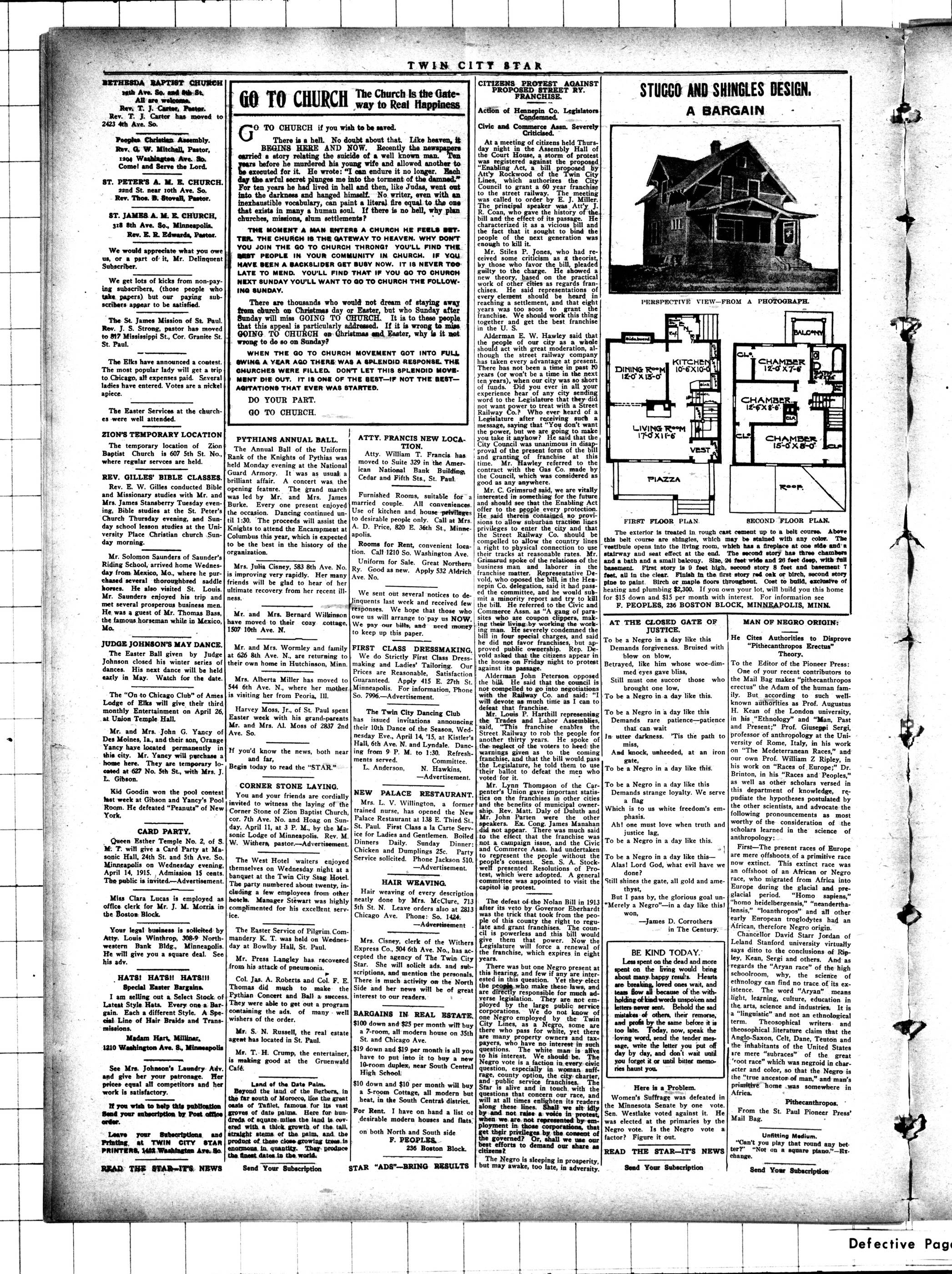
GO TO CHURCH The Church Is the Gateway to Real Happiness
There is a hell. No doubt about that. Like heaven, it BEGINS HERE AND NOW. Recently the newspapers carried a story relating the suicide of a well known man. Ten years before he murdered his young wife and allowed another to be executed for it. He wrote: "I can endure it no longer. Each day the awful secret plunges me into the torment of the damned." For ten years he had lived in hell and then, like Judas, went out into the darkness and hanged himself. No writer, even with an inexhaustible vocabulary, can paint a literal fire equal to the one that exists in many a human soul. If there is no hell, why plan churches, missions, slum settlements?
THE MOMENT A MAN ENTERS A CHURCH HE FEELS BETTER. THE CHURCH IS THE GATEWAY TO HEAVEN. WHY DON'T YOU JOIN THE GO TO CHURCH THRONG? YOU'LL FIND THE BEST PEOPLE IN YOUR COMMUNITY IN CHURCH. IF YOU HAVE BEEN A BACKSLIDER GET BUSY NOW. IT IS NEVER TOO LATE TO MEND. YOU'LL FIND THAT IF YOU GO TO CHURCH NEXT SUNDAY YOU'LL WANT TO GO TO CHURCH THE FOLLOWING SUNDAY.
There are thousands who would not dream of staying away from church on Christmas day or Easter, but who Sunday after Sunday will miss GOING TO CHURCH. It is to these people that this appeal is particularly addressed. If it is wrong to miss GOING TO CHURCH on Christmas and Easter, why is it not wrong to do so on Sunday?
WHEN THE GO TO CHURCH MOVEMENT GOT INTO FULL SWING A YEAR AGO THERE WAS A SPLENDID RESPONSE. THE CHURCHES WERE FILLED. DON'T LET THIS SPLENDID MOVEMENT DIE OUT. IT IS ONE OF THE BEST—IF NOT THE BEST—AGITATIONS THAT EVER WAS STARTED.
PYTHIANS ANNUAL BALL.
The Annual Ball of the Uniform Rank of the Knights of Pythias was held Monday evening at the National Guard Armory. It was as usual a brilliant affair. A concert was the opening feature. The grand march was led by Mr. and Mrs. James Burke. Every one present enjoyed the occasion. Dancing continued until 1:30. The proceeds will assist the Knights to attend the Encampment at Columbus this year, which is expected to be the best in the history of the organization.
Mrs. Julia Cisney, 583 8th Ave. No. is improving very rapidly. Her many friends will be glad to hear of her ultimate recovery from her recent illness.
Mr. and Mrs. Bernard Wilkinson have moved to their cozy cottage, 1507 10th Ave. N.
Mr. and Mrs. Wormley and family at 626 8th Ave. N., are returning to their own home in Hutchinson, Minn.
Mrs. Alberta Miller has moved to 544 6th Ave. N., where her mother is visiting her from Peoria, Ill.
Harvey Moss, Jr., of St. Paul spent Easter week with his grand-parents Mr. and Mrs. Al. Moss of 2837 2nd Ave. So.
If you'd know the news, both near and far,
Begin today to read the "STAR."
CORNER STONE LAYING
You and your friends are cordially invited to witness the laying of the Corner Stone of Zion Baptist Church, cor. 7th Ave. No. and Hoag on Sunday, April 11, at 3 P. M., by the Masonic Lodge of Minneapolis. Rev. M. W. Withers, pastor.—Advertisement.
The West Hotel waiters enjoyed themselves on Wednesday night at a banquet at the Twin City Stag Hotel. The party numbered about twenty, including a few employees from other hotels. Manager Stewart was highly complimented for his excellent service.
The Easter Service of Pilgrim Commandery K. T. was held on Wednesday at Bowlby Hall, St. Paul.
Mr. Press Langley has recovered from his attack of pneumonia.
Col. Jas. A. Roberts and Col. F. E. Thomas did much to make the Pythian Concert and Ball a success. They were able to get out a program containing the ads. of many well wishers of the order.
Mr. S. N. Russell, the real estate agent has located in St. Paul.
Mr. T. H. Crump, the entertainer, is making good at the Gruenwald Café.
Land of the Date Palm
Beyond the land of the Berbers, in the far south of Morocco, lies the great oasis of Taflet, famous for its vast groves of date palms. Here for hundreds of square miles the land is covered with a thick growth of the tall, straight stems of the palm, and the product of these close growing trees is enormous in quantity. They produce the finest dates in the world.
Send Your Subscription
TWIN CITY STAR
The Church is the Gateway to Real Happiness
ash to be saved.
doubt about that. Like heaven, it NOW. Recently the newspapers inside of a well known man. Ten young wife and allowed another to I can endure it no longer. Each into the torment of the damned." all and then, like Judas, went out himself. No writer, even with an印 a literal fire equal to the one al. If there is no hell, why plan events?
ERS A CHURCH HE FEELS BETWEENY TO HEAVEN. WHY DON'T THRONG? YOU'LL FIND THE COMMUNITY IN CHURCH. IF YOU IT BUSY NOW. IT IS NEVER TOO THAT IF YOU GO TO CHURCH TO GO TO CHURCH THE FOLLOW-
could not dream of staying away for Easter, but who Sunday after CHURCH. It is to these people addressed. If it is wrong to miss Christmas and Easter, why is it not
H MOVEMENT GOT INTO FULL AS A SPLENDID RESPONSE. THE NET LET THIS SPLENDID MOVE THE BEST—IF NOT THE BEST—STARTED.
ATTY. FRANCIS NEW LOCATION.
Atty. William T. Francis has moved to Suite 329 in the American National Bank Building, Cedar and Fifth Sts., St. Paul.
Furnished Rooms, suitable for a married couple. All conveniences Use of kitchen and house privileges to desirable people only. Call at Mrs. A. D. Price, 820 E. 36th St., Minneapolis.
Rooms for Rent, convenient location. Call 1210 Rent. Washington Ave. Uniform for Sale. Great Northern Ry. Good as new. Apply 532 Aldrich Ave. No.
We sent out several notices to delinquents last week and received few responses. We hope that those who owe us will arrange to pay us NOW. We pay our bills, and need money to keep up this paper.
FIRST CLASS DRESSMAKING.
We do Strictly First Class Dressmaking and Ladies' Tailoring. Our Prices are Reasonable, Satisfaction Guaranteed. Apply 415 E. 27th St. Minneapolis. For information, Phone So. 7996—Advertisement.
The Twin City Dancing Club
has issued invitations announcing their 10th Dance of the Season, Wednesday Eve., April 14, '15, at Kistler's Hall, 6th Ave. N. and Lyndale. Dancing from 9 P. M. to 1:30. Refreshments served. Committee.
NEW PALACE RESTAURANT.
Mrs. L. V. Willington, a former trained nurse, has opened the New Palace Restaurant at 138 E. Third St.,
St. Paul. First Class a la Carte Service for Ladies and Gentlemen. Boiled Dinners Daily. Sunday Dinner: Chicken and Dumplings 25c. Party Service solicited. Phone Jackson 510.
HAIR WEAVING
Hair weaving of every description neatly done by Mrs. McClure, 713 5th St. N. Leave orders also at 2813 Chicago Ave. Phone: So. 1424.
Mrs. Cisney, clerk of the Withers Express Co., 504 6th Ave. No., has accepted the agency of The Twin City Star. She will solicit ads. and subscriptions, and mention the personals. There is much activity on the North Side and her news will be of great interest to our readers.
BARGAINS IN REAL ESTATE.
$100 down and $25 per month will buy a 7-room, all modern house on 35th St. and Chicago Ave.
$19 down and $19 per month is all you have to put into it to buy a new 10-room duplex, near South Central High School.
$10 down and $10 per month will buy a 5-room Cottage, all modern but heat, in the South Central district.
For Rent. I have on hand a list or desirable modern houses and flats, on both North and South side
F. PEOPLES.
236 Boston Block.
STAR "ADS"—BRING RESULTS
CITIZENS PROTEST AGAINST PROPOSED STREET RY. FRANCHISE.
Civic and Commerce Assn. Severely Criticised.
At a meeting of citizens held Thursday night in the Assembly Hall of the Court House, a storm of protest was registered against the proposed "Enabling Act, a bill proposed by Att'y Rockwood of the Twin City Lines, which authorizes the City Council to grant a 60 year franchise to the street railway. The meeting was called to order by E. J. Miller. The principal speaker was Att'y J. R. Coan, who gave the history of the bill and the effect of its passage. He characterized it as a vicious bill and the fact that it sought to bind the people of the next generation was enough to kill it.
Mr. Stiles P. Jones, who had received some criticism as a theorist, by those who favor the bill, pleaded guilty to the charge. He showed a new theory, based on the practical work of other cities as regards franchises. He said representations of every element should be heard in reaching a settlement, and that eight years was too soon to grant the franchise. We should work this thing together and get the best franchise in the U. S.
Alderman E. W. Hawley said that the people of our city as a whole should act with great moderation, although the street railway company has taken every advantage at present. There has not been a time in past 10 years (or won't be a time in the next ten years), when our city was so short of funds. Did you ever in all your experience hear of any city sending word to the Legislature that they did not want power to treat with a Street Railway Co.? Who ever heard of a Legislature after receiving such a message, saying that "You don't want the power, but we are going to make you take it anyhow? He said that the City Council was unanimous in disapproval of the present form of the bill and granting of franchise at this time. Mr. Hawley referred to the contract with the Gas Co. made by the Council, which was considered as good as any anywhere.
Mr. C. Grimsrud said, we are vitally interested in something for the future and should see that the Enabling Act offer to the people every protection. He said therein contained no provisions to allow suburban traction lines privileges to enter the city and that the Street Railway Co. should be compelled to allow the country lines a right to physical connection to use their tracks at reasonable rates. Mr. Grimsrud spoke of the relations of the business man and laborer in the franchise matter. Representative Devold, who opposed the bill, in the Henepin Co. delegation, said it had passed the committee, and he would submit a minority report and try to kill the bill. He referred to the Civic and Commerce Assn. as "a gang of parasites who are coupon clippers, making their living by working the working man. He severely condemned the bill in four special charges, and said he did not favor franchises, but approved public ownership. Rep. Devold asked that the citizens appear in the house on Friday night to protest against its passage.
Alderman John Peterson opposed the bill. He said that the council is not compelled to go into negotiations with the Railway Co. and said: "I will devote as much time as I can to defeat that franchise.
Mr. Louis P. Harthill representing the Trades and Labor Assemblies, said: 'This franchise enables the Street railway to rob the people for their years. He spoke of the neglect of the voters to head the warnings given as to the coming franchise, and that the bill would pass the Legislature, he told them to use their ballot to defeat the men who voted for it.
Mr. Lynn Thompson of the Carpenter's Union gave important statistics on the franchises in other cities and the benefits of municipal ownership. Rev. Matt. Daly of Duluth and Mr. John Parten were the other speakers. Ex. Cong. James Manahan did not appear. There was much said to the effect that the franchise was not a campaign issue, and the Civic and Commerce Assn. had undertaken to represent the people without the people's consent. Sen. S. A. Stockwell presented Resolutions of Protest, which were adopted. A general committee was appointed to visit the capitol in protest.
The defeat of the Nolan Bill in 1913 after its veto by Governor Eberhardt was the trick that took from the people of this county the right to regulate and grant franchises. The council is powerless and this bill would give them that power. Now the Legislature will force a renewal of the franchise, which expires in eight years.
There was but one Negro present at this hearing, and few if any are interested in this question. Yet they elect the people who make these laws, and are directly responsible for much adverse legislation. They are not employed by the large public service corporations. We do not know of one Negro employed by the Twin City Lines, as a Negro, some are there who pass for white, yet there are many property owners and tax-payers, who have no interest in such questions. The white man is alive to his interest. We should be. The Negro vote is a faction in every civic question, especially in woman suffrage, county option, the city charter, and public service franchises. The Star is alive and in touch with the questions that concern our race, and will at all times enlighten its readers along these lines. Shall we sit idly by and not raise a voice in protest, when we are not represented by employment in those corporations, that get their privileges by the consent of the governed? Or, shall we use our best efforts to demand our share as citizens?
The Negro is sleeping in prosperity, but may awake, too late, in adversity.
THE HOME OF THE MAYFIELD MUSEUM
PERSPECTIVE VIEW-FROM A PHOTOGRAPH.
The exterior is treated in rough cast cement up to a belt course. Above this belt course are shingles, which may be stained with any color. The vestibule opens into the living room, which has a fireplace at one side and a stairway and seat effect at the end. The second story has three chambers and a bath and a small balcony. Size, 24 feet wide and 26 feet deep, with full basement. First story is 9 feet high, second story 8 feet and basement 7 feet, all in the clear. Finish in the first story red oak or birch, second story pine to paint. Birch or maple floors throughout. Cost to build, exclusive of heating and plumbing $2,300. If you own your lot, will build you this home for $15 down and $15 per month with interest. For information see E. PEOPLES. 236 BOSTON BLOCK. MINNEAPOLIS. MINN.
Bideboard
DINING ROOM
12'-0" X 13'-0"
KITCHEN
10'-6" X 10'-0"
LIVING ROOM
17'-0" X 11'-6"
VEST
PIAZZA
FIRST FLOOR PLAN
James D. Corrothers in The Century.
BE KIND TODAY.
Less spent on the dead and more spent on the living would bring about many happy results. Hearts are breaking, loved ones wait, and teams flow all because of the withholding of kind words unspoken and letters never sent. Behold the sad mistakes of others, their remorse, and profit by the same before it is too late. Today, now, speak the loving word, send the tender message, write the letter you put off day by day, and don't wait until you forget it or until bitter memories haunt you.
Here is a Problem
Women's Suffrage was defeated in the Minnesota Senate by one vote. Sen. Westlake voted against it. He was elected at the primaries by the Negro vote. Is the Negro vote a factor? Figure it out.
READ THE STAR—IT'S NEWS
Send Your Subscription
BALCONY
CL.9
CHAMBER
12'-0" X 7'-6"
CL.10
CHAMBER
12'-6" X 8'-6"
CL.2
CHAMBER
15'-0" X 8'-0'
ROOFT.
SECOND FLOOR PLAN.
MAN OF NEGRO ORIGIN:
He Cites Authorities to Disprove "Pithecanthropos Erectus" Theory.
To the Editor of the Pioneer Press: One of your recent contributors to the Mail Bag makes "pithecanthropous erectus" the Adam of the human family. But according to such well-known authorities as Prof. Augustus H. Kean of the London university, in his "Ethnology" and "Man, Past and Present," Prof. Giuseppe Sergi, professor of anthropology at the University of Rome, Italy, in his work on "The Mediterranean Races," and our own Prof. William Z Ripley, in his work on "Races of Europe;" Dr. Brinton, in his "Races and Peoples," as well as other scholars versed in this department of knowledge, repudiate the hypotheses postulated by the other scientists, and advocate the following pronouncements as most worthy of the consideration of the scholars learned in the science of anthropology:
First—The present races of Europe are mere offshoots of a primitive race now extinct. This extinct race was an offshoot of an African or Negro race, who migrated from Africa into Europe during the glacial and preglacial period. "Homo sapiens," "homo heidelbergensis," "neanderthalensis," "loanthropos" and all other early European troglodytes had an African, therefore Negro origin.
Chancellor David Starr Jordan of Leland Stanford university virtually says ditto to the conclusions of Ripley, Kean, Sergi and others. And as regards the "Aryan race" of the high schoolroom, why, the science of ethnology can find no trace of its existence. The word "Aryan" means light, learning, culture, education in the arts, science and industries. It is a "linguistic" and not an ethnological term. Theosophical writers and theosophical literature claim that the Anglo-Saxon, Celt, Dane, Teuton and the inhabitants of the United States are mere "subraces" of the great "root race" which was negro in character and color, so that the Negro is the "true ancestor of man," and man's primitive home was somewhere in Africa.
From the St. Paul Pioneer Press'
Mail Bag.
Unfitting Medium.
"Can't you play that round any better?"
"Not on a square piano."—Exchange.
Send Your Subscription
Defective Page
Defective Page
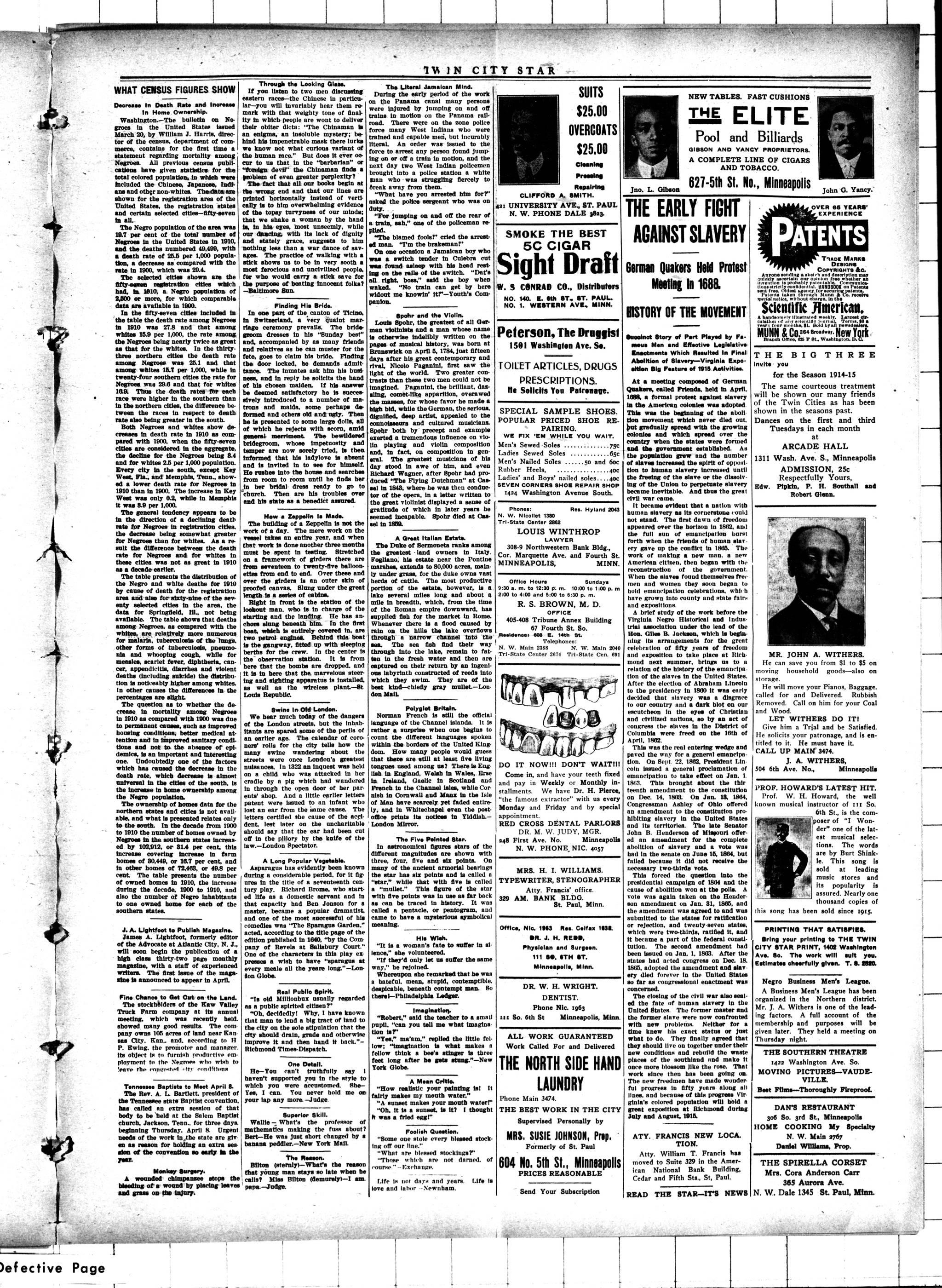
WHAT CENSUS FIGURES SHOW
Decrease in Death Rate and Increase in Home Ownership.
Washington.—The bulletin on Negroes in the United States issued March 20, by William J. Harris, director of the census, department of commerce, contains for the first time a statement regarding mortality among Negroes. All previous census publications have given statistics for the total colored population, in which were included the Chinese, Japanese, Indians and other non-white. The data are shown for the registration area of the United States, the registration states and certain selected cities—fifty-seven in all.
The Negro population of the area was 19.7 per cent of the total number of Negroes in the United States in 1910, and the deaths numbered 49,499, with a death rate of 25.5 per 1,000 population, a decrease as compared with the rate in 1900, which was 29.4.
The selected cities shown are the fifty-seven registration cities which had, in 1910, a Negro population of 2,500 or more, for which comparable data are available in 1900.
In the fifty-seven cities included in the table the death rate among Negroes in 1910 was 27.8 and that among whites 15.9 per 1,000, the rate among the Negroes being nearly twice as great as that for the whites. In the thirty-three northern cities the death rate among Negroes was 25.1 and that among whites 15.7 per 1,000, while in twenty-four southern cities the rate for Negroes was 29.6 and that for whites 16.9. Thus the death rates for each race were higher in the southern than in the northern cities, the difference between the races in respect to death rate also being greater in the south.
Both Negroes and whites show decreases in death rate in 1910 as compared with 1900, when the fifty-seven cities are considered in the aggregate, the decline for the Negroes being 8.4 and for whites 2.5 per 1,000 population. Every city in the south, except Key West, Fl., and Memphis, Tenn., showed a lower death rate for Negroes in 1910 than in 1900. The increase in Key West was only 0.2, while in Memphis it was 8.9 per 1,000.
The general tendency appears to be in the direction of a declining death rate for Negroes in registration cities, the decrease being somewhat greater for Negroes than for whites. As a result the difference between the death rate for Negroes and for whites in these cities was not as great in 1910 as a decade earlier.
The table presents the distribution of the Negro and white deaths for 1910 by cause of death for the registration area and also for sixty-nine of the seventy selected cities in the area, the data for Springfield, Ill., not being available. The table shows that deaths among Negroes, as compared with the whites, are relatively more numerous for malaria, tuberculosis of the lungs, other forms of tuberculosis, pneumonia and whooping cough, while for measles, scarlet fever, diphtheria, cancer, appendicitis, diarrhea and violent deaths (including suicide) the distribution is noticeably higher among whites. In other causes the differences in the percentages are slight.
The question as to whether the decrease in mortality among Negroes in 1910 as compared with 1900 was due to permanent causes, such as improved housing conditions, better medical attention and in improved sanitary conditions and not to the absence of epidemics, is an important and interesting one. Undoubtedly one of the factors which has caused the decrease in the death rate, which decrease is almost universal in the cities of the south, is the increase in home ownership among the Negro population.
The ownership of homes data for the northern states and cities is not available, and what is presented relates only to the south. In the decade from 1900 to 1910 the number of homes owned by Negroes in the southern states increased by 102,912, or 31.4 per cent, this increase covering increase in farm homes of 30,449, or 16.7 per cent, and in other homes of 72,483, or 49.8 per cent. The table presents the number of owned homes in 1910, the increase during the decade, 1900 to 1910, and also the number of Negro inhabitants to one owned home for each of the southern states.
J. A. Lightfoot to Publish Magazine. James A. Lightfoot, formerly editor of the Advocate at Atlantic City, N. J., will soon begin the publication of a high class thirty-two page monthly magazine, with a staff of experienced writers. The first issue of the magazine is announced to appear in April.
Fine Chance to Get Out on the Land.
The stockholders of the Kaw Valley Truck Farm company at its annual meeting, which was recently held, showed many good results. The company owns 105 acres of land near Kansas City, Kan., and, according to H. P. Ewing, the promoter and manager, its object is to furnish productive employment to the Negroes who wish to leave the congested city conditions.
Tennessee Baptists to Meet April 8.
The Rev. A. L. Bartlett, president of the Tennessee state Baptist convention, has called an extra session of that body to be held at the Salem Baptist church, Jackson, Tenn., for three days, beginning Thursday, April 8. Urgent needs of the work in the state are given as reason for holding an extra session of the convention so early in the year.
Monkey Surgery.
A wounded chimpanzee stops the bleeding of a wound by placing leaves and grass on the injury.
Through the Looking Glass.
If you listen to two men discussing eastern races—the Chinese in particular—you will invariably hear them remark with that weighty tone of finality in which people are wont to deliver their obiter dicta: "The Chinaman is an enigma, an insoluble mystery; behind his impenetrable mask there lurks we know not what curious variant of the human race." But does it ever occur to us that in the "barbarian" or "foreign devil" the Chinaman finds a problem of even greater perplexity?
The fact that all our books begin at the wrong end and that our lines are printed horizontally instead of vertically is to him overwhelming evidence of the toopay turyness of our minds; that we shake a woman by the hand is, in his eyes, most unseemly, while our dancing, with its lack of dignity and stately grace, suggests to him nothing less than a war dance of savages. The practice of walking with a stick shows us to be in very sooth a most ferocious and uncivilized people, for who would carry a stick save for the purpose of beating innocent folks?—Baltimore Sun.
Finding Hia Bride
In one part of the canton of Ticino, in Switzerland, a very quaint marriage ceremony prevails. The bridegroom dresses in his "Sunday best" and, accompanied by as many friends and relatives as he can muster for the fete, goes to claim his bride. Finding the door locked, he demands admittance. The inmates ask him his business, and in reply he solicits the hand of his chosen maiden. If his answer be deemed satisfactory he is successively introduced to a number of matrons and maids, some perhaps deformed and others old and ugly. Then he is presented to some large dolls, all of which he rejects with scorn, amid general merriment. The bewildered bridegroom, whose impetuosity and temper are now sorely tried, is then informed that his ladylove is absent and is invited in to see for himself. He rushes into the house and searches from room to room until he finds her in her bridal dress ready to go to church. Then are his troubles over and his state as a benedict assured.
How a Zappelin Is Made.
The building of a Zeppelin is not the work of a day. The mere work on the vessel takes an entire year, and when that work is done another three months must be spent in testing. Stretched on a framework of girders there are from seventeen to twenty-five balloonettes from end to end. Over these and over the girders is an outer skin of proofed canvas. Slung under the great length is a series of cabins.
Right in front is the station of the lookout man, who is in charge of the starting and the landing. He has anchors slung beneath him. In the first boat, which is entirely covered in, are two petrol engines. Behind this boat is the gangway, fitted up with sleeping berths for the crew. In the center is the observation station. It is from here that the bombs are dropped, and it is in here that the marvelous steering and sighting apparatus is installed, as well as the wireless plant—St Louis Republic.
Swine In Old London
We hear much today of the dangers of the London streets, but the inhabitants are spared some of the perils of an earlier age. The calendar of corons' rolls for the city tells how the many swine wandering about the streets were once London's greatest nuisances. In 1322 an inquest was held on a child who was attacked in her cradle by a pig which had wandered in through the open door of her parents' shop. And a little earlier letters patent were issued to an infant who lost an ear from the same cause. The letters certified the cause of the accident, lest later on the uncharitable should say that the ear had been cut off in the pillory by the knife of the law.-London Spectator.
A Long Popular Vegetable.
Asparagus has evidently been known during a considerable period, for it figures in the title of a seventeenth century play. Richard Brome, who started life as a domestic servant and in that capacity had Ben Jonson for a master, became a popular dramatist, and one of the most successful of his comedies was "The Sparagus Garden." acted, according to the title page of the edition published in 1640, "by the Company of Revels at Salisbury Court." One of the characters in this play expresses a wish to have "sparagus at every meal all the yeare long."—London Globe.
Real Public Spirit:
"Is old Millionbux usually regarded as a public spirited citizen?"
"Oh, decidedly! Why, I have known that man to lend a big tract of land to the city on the sole stipulation that the city should drain, grade and otherwise improve it and then hand it back."-Richmond Times-Dispatch.
One Detail.
He-You can't truthfully say I haven't supported you in the style to which you were accustomed. She-Yes, I can. You never hold me on your lap any more.-Judge.
Superior Skill:
Walle - What's the professor of mathematics making the fuss about? Bert - He was just short changed by a banana peddler - New York Mail.
The Reason.
Bilton (sternly)—What's the reason that young man stays so late when he calls? Miss Bilton (demurely)—I am papa.—Judge.
TWIN CITY STAR
The Literal Jamaican Mind.
During the early period of the work on the Panama canal many persons were injured by jumping on and off trains in motion on the Panama railroad. There were on the zone police force many West Indians who were trained and capable men, but incurably literal. An order was issued to the force to arrest any person found jumping on or off a train in motion, and the next day two West Indian policemen brought into a police station a white man who was struggling fiercely to break away from them.
"What have you arrested him for?" asked the police sergeant who was on duty.
"For jumping on and off the rear of a train, sah," one of the policeman replied.
"The blamed fools!" cried the arrested man. "I'm the brakeman!"
On one occasion a Jamaican boy who was a switch tender in Culebra cut was found asleep with his head resting on the rails of the switch. "Daf's all right, boss," said the boy when waked. "No train can get by here widout me known' it!"—Youth's Companion.
Anphr and the Violin.
Louis Spohr, the greatest of all German violinists and a man whose name is otherwise indelibly written on the pages of musical history, was born at Brunswick on April 5, 1784, just fifteen days after his great contemporary and rival, Nicolo Paganiini, first saw the light of the world. Two greater contrasts than these two men could not be imagined. Paganiini, the brilliant, dazzling, comet-like apparition, overawed the masses, for whose favor he made a high bid, while the German, the serious, dignified, deep artist, appealed to the comnoisseurs and cultured musicians. Spohr both by precept and example exerted a tremendous influence on violin playing and violin composition and, in fact, on composition in general. The greatest musicians of his day stood in awe of him, and even Richard Wagner, after Spohr had produced "The Flying Dutchman" at Cassel in 1848, where he was then conductor of the opera, in a letter written to the great violinist displayed a sense of gratitude of which in later years he seemed incapable. Spohr died at Cassel in 1869.
A Great Italian Estate
The Duke of Sermoneta ranks among the greatest land owners in Italy. Fogiliano; his estate near the Pontine marshes, extends to 80,000 acres, mainly under grass, for the duke owns vast herds of cattle. The most productive portion of the estate, however, is a lake several miles long and about a mile in breadth, which, from the time of the Roman empire downward, has supplied fish for the market in Rome. Whenever there is a flood caused by rain on the hills the lake overflows through a narrow channel into the sea. The sea fish find their way through into the lake, remain to fatten in the fresh water and then are captured on their return by an ingenuous labyrinth constructed of reeds into which they swim. They are of the best kind—chiefly gray mullet.—London Mall.
Polyglet Britain
Norman French is still the official language of the Channel islands. It is rather a surprise when one begins to count the different languages spoken within the borders of the United Kingdom. How many people would guess that there are still at least five living tongues used among us? There is English in England, Welsh in Wales, Erse in Ireland, Gaelic in Scotland and French in the Channel isles, while Cornish in Cornwall and Manx in the Isle of Man have scarcely yet faded entirely, and in Whitechapel even the post-office prints its notices in Yiddish.—London Mirror.
The Five Pointed Star
In astronomical figures stars of the different magnitudes are shown with three, four, five and six points. On many of the ancient armorial bearings the star has six points and is called a "star," while that with five is called a "mullet." This figure of the star with five points was in use as far back as can be traced in history. It was called a pentacle, or pentogram, and came to have a mysterious symbolical meaning.
His Wish.
"It is a woman's fate to suffer in silence," she volunteered. "If they'd only let us suffer the same way," he rejoined. Whereupon she remarked that he was a hateful, mean, stupid, contemptible, despicable, beneath contempt man. So there—Philadelphia Lodger.
Imagination.
"Robert," said the teacher to a small pupil, "can you tell me what imagination is?" "Yes," ma'am," replied the little fellow; "imagination is what makes a fellow think a bee's stinger is three feet long after he gets stung."—New York Globe.
A Mean Critic.
"How realistic my painting is! It fairly makes my mouth water." "A sunset makes your mouth water!" "Oh, it is a sunset, is it? I thought it was a fried egg!"
Foolish Question:
"Some one stole every blessed stocking off our line."
Life is not days and years. Life is love and labor - Newham.
SUITS
$25.00
OVERCOATS
$25.00
Cleaning
Pressing
Repairing
CLIFFORD A. SMITH.
421 UNIVERSITY AVE., ST. PAUL
N. W. PHONE DALE 3823.
SMOKE THE BEST
5C CIGAR
W. S CONRAD CO., Distributors
NO. 140. E. 6th ST., ST. PAUL.
NO. 1. WESTERN AVE., MINN.
Peterson, The Druggist
1501 Washington Ave. So.
TOILET ARTICLES, DRUGS
PRESCRIPTIONS.
He Solicits You Patronage.
SPECIAL SAMPLE SHOES.
POPULAR PRICED SHOE REPAIRING.
WE FIX 'EM WHILE YOU WAIT.
Men's Sewed Soles ..... 75c
Ladies Sewed Soles ..... 65c
Men's Nailed Soles ..... 50 and 60c
Rubber Heels, ..... 40c
Ladies' and Boys' nailed soles ..... 40c
SEVEN CORNERS SHOE REPAIR SHOP
1424 Washington Avenue South.
Phones: Res. Hyland 2043
N. W. Nicollet 1380
Tri-State Center 2862
LOUIS WINTHROP
LAWYER
308-9 Northwestern Bank Bldg.
Cor. Marquette Ave. and Fourth St.
MINNEAPOLIS, MINN.
Office Hours Sundays
9:30 a. m. to 12:30 p. m. 10:00 to 1:00 p. m.
2:00 to 4:00 and 5:00 to 6:30 p. m.
R. S. BROWN, M. D.
OFFICE
405-408 Tribune Annex Building
67 Fourth St. So.
Residence: 608 E. 14th St.
Telephones:
N. W. Main 2388 N. W. Main 2040
Tri-State Center 2874 Tri-State Cen. 691
DO IT NOW!!! DON'T WAIT!!!
Come in, and have your teeth fixed and pay in Weekly or Monthly installments. We have Dr. H. Pierce, "the famous extractor" with us every Monday and Friday and by special appointment.
RED CROSS DENTAL PARLORS
DR. M. W. JUDY, MGR.
248 First Ave. No. Minneapolis
N. W. PHONE NIC. 4057
MRS. H. I. WILLIAMS.
TYPEWRITER, STENOGRAPHER
Atty. Francis' office.
329 AM. BANK BLDG.
St. Paul, Minn.
Office, Nic. 1863 Res. Cefax 1838.
DR. J. H. REDD,
Physician and Surgeen.
111 SO. 6TH ST.
Minneapolis, Minn.
DR. W. H. WRIGHT.
DENTIST.
Phone Nic. 1963
111 So. 6th St Minneapolis, Minn.
ALL WORK GUARANTEED
Work Called For and Delivered
Phone Main 3474.
THE BEST WORK IN THE CITY
Supervised Personally by
MRS. SUSIE JOHNSON, Prop.
Formerly of St. Paul
604 No. 5th St., Minneapolis
PRICES REASONABLE
Send Your Subscription
---
LAUNDRY
GIBSON AND YANGY PROPRIETORS.
A COMPLETE LINE OF CIGARS
AND TOBACCO.
627-5th St. No., Minneapolis
THE EARLY FIGHT AGAINST SLAVERY
German Quakers Held Protest Meeting in 1688.
HISTORY OF THE MOVEMENT
Succinct Story of Part Played by Famous Men and Effective Legislative Enactments Which Resulted in Final Abolition of Slavery—Virginia Exposition Big Feature of 1915 Activities.
At a meeting composed of German Quakers, called Friends, held in April, 1688, a formal protest against slavery in the American colonies was adopted. This was the beginning of the abolition movement which never died out, but gradually spread with the growing colonies and which spread over the country when the states were formed and the government established. As the population grew and the number of slaves increased the spirit of opposition to human slavery increased until the freeing of the slave or the dissolving of the Union to perpetuate slavery became inevitable. And thus the great civil war came.
It became evident that a nation with human slavery as its cornerstone could not stand. The first dawn of freedom appeared over the horizon in 1862, and the full sun of emancipation burst forth when the friends of human slavery gave up the conflict in 1865. The work of making a new man, a new American citizen, then began with the reconstruction of the government. When the slaves found themselves free men and women they soon began to hold emancipation celebrations, which have grown into county and state fairs and expositions.
A brief study of the work before the Virginia Negro Historical and Industrial association under the lead of the Hon. Giles B. Jackson, which is beginning its arrangements for the great celebration of fifty years of freedom and exposition to take place at Richmond next summer, brings us to a relation of the history of the emancipation of the slaves in the United States. After the election of Abraham Lincoln to the presidency in 1800 it was early decided that slavery was a disgrace to our country and a dark blot on our escutcheon in the eyes of Christian and civilized nations, so by an act of congress the slaves in the District of Columbia were freed on the 16th of April, 1802.
This was the real entering wedge and paved the way for a general emancipation. On Sept. 22, 1862, President Lincoln issued a general proclamation of emancipation to take effect on Jan. 1, 1863. This brought about the thirteenth amendment to the constitution on Dec. 14, 1803. On Jan. 18, 1864, Congressman Ashley of Ohio offered an amendment to the constitution prohibiting slavery in the United States and its territories. The late Senator John B. Henderson of Missouri offered an amendment for the complete abolition of slavery and a vote was had in the senate on June 15, 1864, but failed because it did not receive the necessary two-thirds vote.
This forced the question into the presidential campaign of 1864 and the cause of abolition won at the polls. A vote was again taken on the Henderson amendment on Jan. 31, 1865, and the amendment was agreed to and was submitted to the states for ratification or rejection, and twenty-seven states, which were two-thirds, ratified it, and it became a part of the federal constitution. The second amendment had been issued on Jan. 1, 1863. After the states had acted congress on Dec. 18, 1865, adopted the amendment and slavery died forever in the United States so far as congressional enactment was concerned.
The closing of the civil war also sainted the fate of human slavery in the United States. The former master and the former slave were now confronted with new problems. Neither for a time knew his exact status or just what to do. They finally agreed that they should live on together under their new conditions and rebuild the waste places of the southland and make it once more blossom like the rose. That work since then has been going on. The new freedmen have made wonderful progress in fifty years along all lines, and because of this progress Virginia's colored population will hold a great exposition at Richmond during July and August, 1915.
ATY. FRANCIS NEW LOCA
TION.
Atty. William T. Francis has moved to Suite 329 in the American National Bank Building, Cedar and Fifth Sts., St. Paul.
READ THE STAR-IT'S NEWS
THE SPIRELLA CORSET
Mrs. Cora Anderson Carr
365 Aurora Ave.
N. W. Dale 1345 St. Paul, Minn.
Ino. L. Gibson
LAST CUSHIONS
LITE
FOR Billiards
BY PROPRIETORS.
ONE OF CIGARS
MACCO.
Minneapolis
John G. Yancy.
OVER 65 YEARS'
EXPERIENCE
PATENTS
TRADE MARKS
COPYRIGHTS & C.
Anyone sending a sketch and description may purchase our own opinionated talent and invention is probably patentable. Communications strict. Independent. HANDOVER. Patents sought. Other agency for securing patents. Patents taken through Munn & Co. receive special notice, without charge, in the Scientific American.
A handsomely illustrated weekly. Largest citation of any scientific term. Terms, $3 a year; four months, $L. Sold by all new dealers.
MUNN & Co. 364 Broadway. New York Branch Office, 625 F St., Washington, D.C.
THE BIG THREE
invite you
for the Season 1914-15
The same courteous treatment will be shown our many friends of the Twin Cities as has been shown in the seasons past.
Dances on the first and third Tuesdays in each month
ARCADE HALL
1311 Wash. Ave. S., Minneapolis
ADMISSION, 25c
Respectfully Yours,
Edw. Pipkin, P. H. Southall and
Robert Glenn.
MR. JOHN A. WITHERS.
He can save you from $1 to $5 on moving household goods—also on storage.
He will move your Pianos, Baggage, called for and Delivered. Rubbish Removed. Call on him for your Coal and Wood.
LET WITHERS DO IT!
Give him a Trial and be Satisfied. He solicits your patronage, and is entitled to it. He must have it.
CALL UP MAIN 3474.
J. A. WITHERS,
504 6th Ave. No., Minneapolis
PROF. HOWARD'S LATEST HIT.
Prof. W. H. Howard, the well known musical instructor of 111 So.
6th St., is the composer of "I Wonder" one of the latest musical selections. The words are by Burt Shinkle. This song is sold at leading music stores and its popularity is assured. Nearly one thousand copies of
on St., is the composer of "I Wonder" one of the laest musical selections. The work are by Burt Shinle. This song is sold at leadi music stores and its popularity assured. Nearly o thousand copies this song has been sold since 1915
PRINTING THAT SATISFIES.
Bring your printing to THE TWIN CITY STAR PRINT, 1402 Washington Ave. So. The work will suit you. Estimates cheerfully given. T. 8. 2200.
A Business Men's League has been organized in the Northern district. Mr. J. A. Witthers is one of the leading factors. A full account of the membership and purposes will be given later. They held a meeting on Thursday night.
THE SOUTHERN THEATRE
1422 Washington Ave. So.
MOVING PICTURES—VAUDE-VILLE.
Best Films—Thoroughly Fireproof.
DAN'S RESTAURANT
306 So. 3rd St., Minneapolis
HOME COOKING My Specialty
N. W. Main 2767
Daniel Williams, Prop.
THE SPIRELLA CORSET
Mrs. Cora Anderson Carr
365 Aurora Ave.
I. W. Dale 1345 St. Paul, Minn
PUBLSHED EVERY FRIDAY BY
CHARLES SUMNER SMITH,
1419 Washington Ave. So.,
Minneapolis, Minnesota.
Entered in the Post Office at Minneapolis as second class matter.
MEMBER
NATIONAL NEGRO PRESS
ASSOCIATION
MINNESOTA EDITORIAL ASSN.
Subscription by Mail, Postpaid.
ONE YEAR ..... $2.00
SIX MONTHS ..... 1.00
THREE MONTHS ..... 6.55
CANADIAN SUBSCRIPTIONS $2.50
ADVERTISING RATES.
One inch, one insertion, Fifty Cents
Liberal discount given on 3, 6, 9,
Months, or 1 year contracts.
Want Ads .....Twenty-five Cents
Reading Notices, per line, Five Cents
Wedding Announcements, Fifty Cents
Card of Thanks .....One Dollars
In Memoriam .....One Dollar
Business Announcements, One Dollar
Death Notices .....Fifty Cents
When writing for the press, don't
abbreviate your words. Spell each
one out correctly and distinctly. If
you don't it means that all of your
manuscript will have to be rewritten
if there is time. Write on one side of
the paper only.
Address all mail to Twin City Star
1419 Washington Ave. So.
Minneapolis, Minnesota.
CURTIS GUILD JR.
The sad news of the death of Hon. Curtis Guild of Massachusetts reached us this week. He was our friend and former comrade-in-camp. He was three times governor of Massachusetts and once considered as a presidential possibility. One of his examples of self-sacrifice, was his refusal to accept the honor as one of the Commissioners of the Spanish War Veterans Monument in Arlington Cemetery, but used his influence to have the man, who had done most to secure the appropriation named in his stead, thus giving honor to whom honor was due. Gov. Guild was a believer in equal rights. At a gathering of military men he remarked, that "There can be no color line in battle. The touch of sleeve and elbow under fire, makes all men brothers." As a fitting tribute to American soldiery he said "The charges of the Minnesota Regiment at Gettysbury and the Negro (Massachusetts) Regiment at Ft. Wagner, in my opinion, were the greatest in military history." Gov Guild was a brilliant scholar, a diplomat, a linguist and among the Negroes he counted many friends.
WHITE MAN, CONVICTED WITH
NEGRO WOMAN, IS PAR-
DONED BY PRES. WILSON.
George Savage, a white real estate dealer, who was convicted jointly with Alice Jackson, a Negro woman, for violation of the Mann Act, was pardoned by Pres. Wilson last week. Savage died soon after arriving at St. Paul. Mrs. Jackson is serving her sentence, although it was proven that Savage was the brains of the business. Mrs. Jackson is nearly deaf and was in poor health when committed to Stillwater. There was every effort made to save Savage from prison. The press failed to mention the woman's connection with the case and sought to whitewash this notorious cadet, Savage. He may have deserved a pardon and if he did, the woman should receive clemency—but it is not expected that a Negro woman would receive much consideration from President Wilson, as shown by his record.
What about the Attucks Home? we are often asked. It is a Home for Negroes, supported by charitable donations and derives some income from its inmates. Its existence is a good reason for denying Negro citizens the privileges and rights of public institutions. It is located in St. Paul, where prejudice is prevalent. The Editor of the Star does not approve of any activity on the part of officials of the home or state to exclude Negroes from public institutions, or does he quarrel with those who prefer such segregation as special charity. It is a St. Paul institution and efforts towards its maintenance should be confined there. If there were need of a home in Minneapolis one should be started here.
Jack Johnson may find that, it is better to have won and lost than never to have won at all.
Nobody is looking for a black hope.
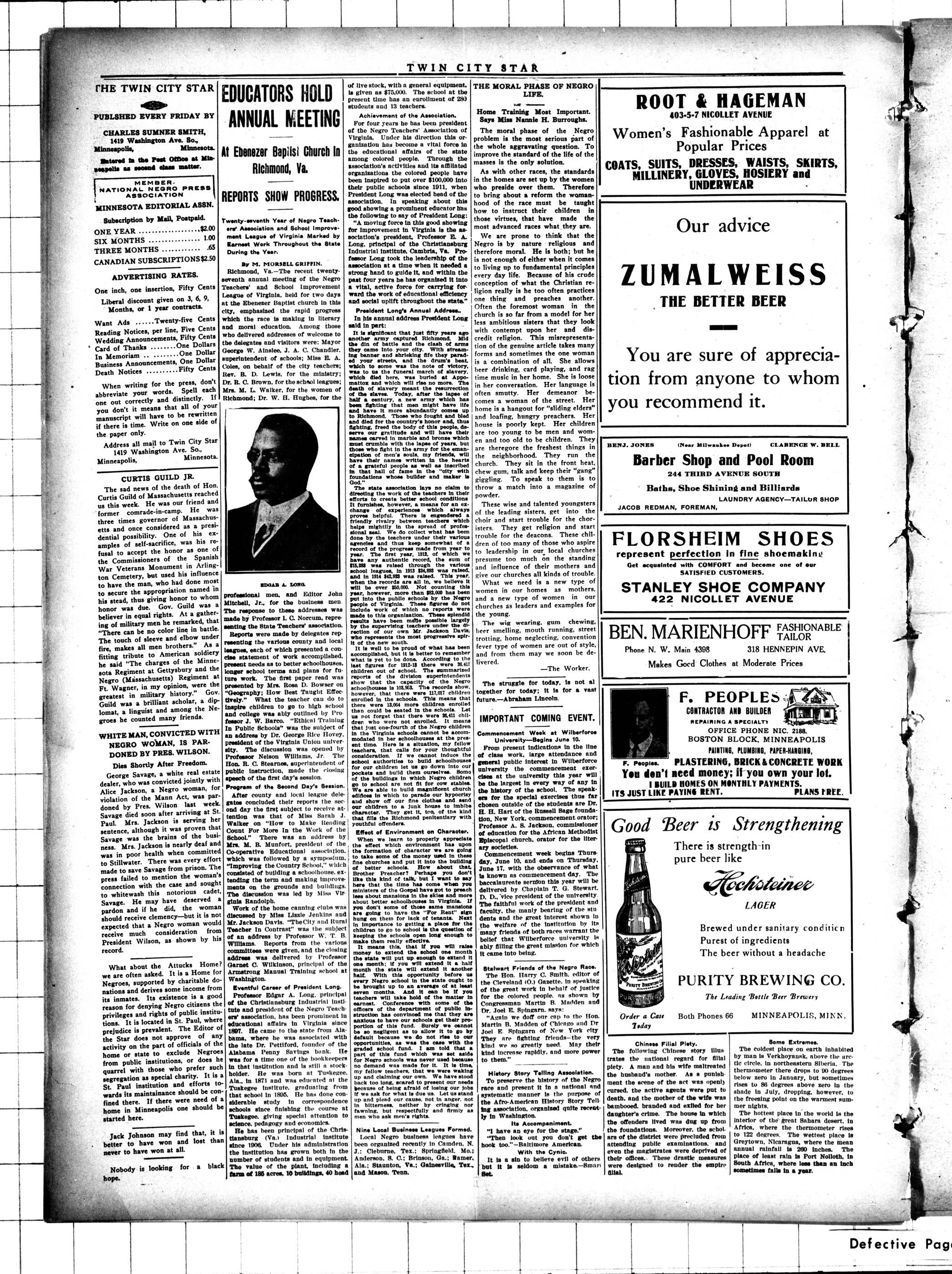
EDUCATORS HOLD ANNUAL MEETING
At Ebenezer Baptist Church In Richmond, Va.
REPORTS SHOW PROGRESS.
Twenty-seventh Year of Negro Teachers' Association and School Improvement League of Virginia Marked by Earnest Work Throughout the State During the Year.
By M. MORSELL GRIPFIN.
Richmond, Va.—The recent twenty-seventh annual meeting of the Negro Teachers' and School Improvement League of Virginia, held for two days at the Ebenezer Baptist church in this city, emphasized the rapid progress which the race is making in literary and moral education. Among those who delivered addresses of welcome to the delegates and visitors were: Mayor George W. Ainslee, J. A. C. Chandler, superintendent of schools; Miss E. A. Coles, on behalf of the city teachers; Rev. B. D. Lewis, for the ministry; Dr. R. C. Brown, for the school leagues; Mrs. M. L. Walker, for the women of Richmond; Dr. W. H. Hughes, for the
A. E.
EDGAB A. LONG.
professional men, and Editor John Mitchell, Jr., for the business men. The response to these addresses was made by Professor I. C. Norcum, representing the State Teachers' association. Reports were made by delegates representing the various county and local leagues, each of which presented a concise statement of work accomplished, present needs as to better schoolhouses, longer school terms and plans for future work. The first paper read was presented by Mrs. Rosa D. Bowser on "Geography; How Best Taught Effectively." What the teacher can do to inspire children to go to high school and college was ably outlined by Professor J. W. Barco. "Ethical Training In Public Schools" was the subject of an address by Dr. George Rice Hovey, president of the Virginia Union university. The discussion was opened by Professor Nelson Williams, Jr. The Hon. R. C. Stearnes, superintendent of public instruction, made the closing speech of the first day's session.
Program of the Second Day's Session.
After county and local league delegates concluded their reports the second day the first subject to receive attention was that of Miss Sarah J. Walker on "How to Make Reading Count For More In the Work of the School." There was an address by Mrs. M. B. Munfort, president of the Co-operative Educational association, which was followed by a symposium, "Improving the Country School," which consisted of building a schoolhouse, extending the term and making improvements on the grounds and buildings. The discussion was led by Miss Virginia Randolph.
Work of the home canning clubs was discussed by Miss Lizzie Jenkins and Mr. Jackson Davis. "The City and Rural Teacher In Contrast" was the subject of an address by Professor W. T. B. Williams. Reports from the various committees were given, and the closing address was delivered by Professor Garnet C. Wilkinson, principal of the Armstrong Manual Training school at Washington.
Eventful Career of President Long-
Professor Edgar A. Long, principal
of the Christiansburg Industrial institute and president of the Negro Teachers' association, has been prominent in educational affairs in Virginia since 1897. He came to the state from Alabama, where he was associated with the late Dr. Pettiford, founder of the Alabama Penny Savings bank. He was for a time one of the bookkeepers in that institution and is still a stockholder. He was born at Tuskegee, Ala., in 1871 and was educated at the Tuskegee institute, graduating from that school in 1805. He has done considerable study in correspondence schools since finishing the course at Tuskegee, giving special attention to science, pedagogy and economics.
He has been principal of the Christiansburg (Va.) Industrial institute since 1906. Under his administration the institution has grown both in the number of students and in equipment. The value of the plant, including a farm of 185 acres, 10 buildings, 40 head
of live stock, with a general equipment, is given as $75,000. The school at the present time has an enrollment of 280 students and 13 teachers.
Achievement of the Association.
For four years he has been president of the Negro Teachers' Association of Virginia. Under his direction this organization has become a vital force in the educational affairs of the state among colored people. Through the association's activities and its affiliated organizations the colored people have been inspired to put over $100,000 into their public schools since 1911, when President Long was elected head of the association. In speaking about this good showing a prominent educator has the following to say of President Long:
THE MORAL PHASE
LIFE
Home Training M
Says Miss Nannie
The moral phase problem is the most the whole aggravation improve the standard masses is the only one.
As with other races in the homes are set who preside over to bring about a rehood of the race how to instruct them.
"A moving force in this good showing for improvement in Virginia is the association's president, Professor E. A. Long, principal of the Christiansburg Industrial Institute, Cambria, Va. Professor Long took the leadership of the association at a time when it needed a strong hand to guide it, and within the past four years he has organized it into a vital, active force for carrying forward the work of educational efficiency and social uplift throughout the state."
President Long's Annual Address...
In his annual address President Long said in part:
It is significant that just fifty years ago another army captured Richmond. Mid the din of battle and the clash of arms they came into your city. With streaming banner and shrieking rifle they paraded through the streets, which to some was the note of victory, was to us the funeral march of slavery, which died here, was buried at Appomattox and which will rise no more. The death of slavery meant the resurrection of the slaves. Today, after the lapse of the war, we are now being fighting that men might have life and have it more abundantly come up to Richmond. Those who fought and bled and died for the country's honor and, thus fighting, freed the body of this people, deserve our gratitude and thank you. We are fighting and brave which must crumble with the lapse of years, but those who fight in the army for the emancipation of men's souls, my friends, will have their names written in the hearts of a grateful people as well as inscribed that hall of fame is the "city with foundations whose builder and maker is God."
The state association lays no claim to directing the work of the teachers in their efforts to create better school conditions. It furnishes, however, a means for an exchange of experiences which always proves helpful. There is engendered a friendship between the teachers and the students mightily in the spread of professional zeal. We do collect what has been done by the teachers under their various agencies and thus keep somewhat of a record of the progress made from year to year. The first year, 1912, of which we have any authentic record, the sum of $15,883 was raised through the various school leagues in 1913 $24,883 was raised in 1923 $42,983 were all in. This year, when the records are all in, we believe it will be over $50,000. Not counting this year, however, more than $30,000 has been put into the public schools by the Negro people of Virginia. These figures do not include work of which no reports were made to this organization. These splendid results have been made possible largely by the supervising teachers of Mr Jackson Davis, who represents the most progressive spirit of the new south.
It is well to be proud of what has been accomplished, but it is better to remember what is yet to be done. According to the last figures for 1912-13 there were 28,411 children out of school. The summarized report shows that the capacity of the Negro schoolhouses is 103,963. The records show, however, that there were 117,017 children enrolled in the schools. This means that there were 13,064 more children enrolled than could be seated in the schools. Let us not forget that the Negro children are not enrolled. It means that just one-fourth of the Negro children in the Virginia schools cannot be accommodated in her schoolhouses at the present time. Here is a situation, my fellow teachers, that calls for your thoughtful consideration. If we cannot induce the children to go to school for our children let us go down into our pockets and build them ourselves. Some of the buildings in which Negro children go to school are not fit for cow stables. We are able to build magnificent church edifices in which to parade our hypocrisy and our arrogance. We are able to children to a junk house to imbibe character. They get it, too, of the kind that fills the Richmond penitentiary with youthful offenders.
Effect of Environment on Character.
When we learn to properly appreciate the effect which environment has upon the formation of character we are going to take some of the money used in these fine churches and put it into the building of better schools. How about that, Brother Preacher? Perhaps you don’t want to talk, I want to say here that the time has come when you ministers of the Gospel have got to preach less about mansions in the skies and more about better schoolhouses in Virginia. If you don’t some of those same mansions are going to have the "For Rent" sign hung on them for lack of tenants. Next in importance getting places the children to school is the question of keeping the schools open long enough to make them really effective.
It means this, that if you will raise money to extend the school one month the state will put up enough to extend it one month; if you will extend it a half month the state will extend it another half. With this opportunity before us every Negro school will be brought up an average of at least seven months. And it can be if you teachers will take hold of the matter in earnest. Conference with some of the officers of the department of public instruction has convinced me that they are anxious to have our schools get their proportion of this fund. Surely we cannot be so negligent as to allow us to go by no effort, nor to not rise to our opportunities, as was the case with the graded school fund. I am told that a part of this fund which was set aside for Negro schools was never used because no demand was made for it. It is time, my fellow teachers, that we were waking up and claiming our own. We have stood back too long, scared to present our needs because of being afraid of losing our jobs up and plead our cause, not in anger, not in bitterness, neither by cringling nor fawning, but respectfully and firmly as men who ask men's rights.
Nine Local Business Leagues Formed.
Local Negro business leagues have been organized recently in Camden. N. J.; Cleburne, Tex.; Springfield, Mo.; Anderson, S. C.; Brinson, Ga.; Hamer, Ala.; Staunton, Va.; Gainesville, Tex., and Mason, Tenn.
THE MORAL PHASE OF NEGRO LIFE.
Home Training Most Important. Says Miss Nannie H. Burroughs.
The moral phase of the Negro problem is the most serious part of the whole aggravating question. To improve the standard of the life of the masses is the only solution.
As with other races, the standards in the homes are set up by the women who preside over them. Therefore to bring about a reform the womanhood of the race must be taught how to instruct their children in those virtues, that have made the most advanced races what they are.
We are prone to think that the Negro is by nature religious and therefore moral. He is both; but he is not enough of either when it comes to living up to fundamental principles every day life. Because of his crude conception of what the Christian religion really is he too often practices one thing and preaches another. Often the foremost woman in the church is so far from a model for her less ambitious sisters that they look with contempt upon her and discredit religion. This misrepresentation of the genuine article takes many forms and sometimes the one woman is a combination of all. She allows beer drinking, card playing, and ragtime music in her home. She is loose in her conversation. Her language is often smutty. Her demeanor becomes a woman of the street. Her home is a hangout for "sliding elders" and loafing, hungry preachers. Her house is poorly kept. Her children are too young to be men and women and too old to be children. They are theregore the freshest things in the neighborhood. They run the church. They sit in the front heat, chew gum, talk and keep their "gang" giggling. To speak to them is to throw a match into a magazine of powder.
These wise and talented youngsters of the leading sisters, get into the choir and start trouble for the choristers. They get religion and start trouble for the deacons. These children of too many of those who aspire to leadership in our local churches presume too much on the standing and influence of their mothers and give our churches all kinds of trouble. What we need is a new type of women in our homes as mothers, and a new type of women in our churches as leaders and examples for the young.
The wig wearing, gum chewing, beer smelling, mouth running, street trotting, home neglecting, convention fever type of women are out of style, and from them may we soon be delivered.
The struggle for today, is not al
together for today; it is for a vast
future.—Abraham Lincoln.
IMPORTANT COMING EVENT.
Commencement Week at Wilberforce
University—Benna June 10.
From present indications in the line of class work, large attendance and general public interest in Wilberforce university the commencement exercises at the university this year will be the largest in every way of any in the history of the school. The speakers for the special exercises thus far chosen outside of the students are Dr. H. H. Hart of the Russell Sage foundation, New York, commencement orator; Professor A. S. Jackson, commissioner of education for the African Methodist Episcopal church, orator for the literary societies.
Commencement week begins Thursday, June 10, and ends on Thursday, June 17, with the observance of what is known as commencement day. The baccalaureate sermon this year will be delivered by Chaplain T. G. Stewart, D. D., vice president of the university. The faithful work of the president and faculty, the manly bearing of the students and the great interest shown in the welfare of the institution by its many friends of both races warrant the belief that Wilberforce university is ably filling the great mission for which it came into being.
Stalwart Friends of the Negro Race.
The Hon. Harry C. Smith, editor of the Cleveland (O.) Gazette, in speaking of the great work in behalf of justice for the colored people, as shown by Congressman Martin B. Madden and Dr. Joel E. Springarn, says:
"Again we do our cap to the Hon. Martin B. Madden of Chicago and Dr Joel E. Spingarn of New York city. They are fighting friends—the very kind we so greatly need. May their kind increase rapidly, and more power to them."
History Story Telling Association. To preserve the history of the Negro race and present it in a national and systematic manner is the purpose of the Afro-American History Story Telling association, organized quite recently in Washington.
It is a sin to believe evil of others but it is seldom a mistake—Smart Set.
—The Worker.
ROOT & HAGEMAN
403-5-7 NICOLLET AVENUE
Women's Fashionable Apparel at
Popular Prices
COATS, SUITS, DRESSES, WAISTS, SKIRTS,
MILLINERY, GLOVES, HOSIERY and
UNDERWEAR
Our advice
ZUMAL
THE BETT
You are sure
tion from any
you recommen
BENJ. JONES (Near Milwaukee)
Barber Shop and
244 THIRD AVENUE
Baths, Shoe Shini
LA
JACOB REDMAN, FOREMAN,
FLORSHEID
represent perfection
Get acquainted with COMFOR
SATISFIED CUP
STANLEY SHOP
422 NICOLLE
BEN. MARIENE
Phone N. W. Main 4398
Makes Good Clothes
SALWEISS
THE BETTER BEER
are sure of appreciation anyone to whom recommend it.
(Near Milwaukee Depot) CLARENCE W. BELL
Shop and Pool Room
24 THIRD AVENUE SOUTH
Shoe Shining and Billiards
LAUNDRY AGENCY—TAILOR SHOP
, FOREMAN,
SHEIM SHOES
Perfection in fine shoemaking
with COMFORT and become one of our SATISFIED CUSTOMERS.
KEY SHOE COMPANY
NICOLLET AVENUE
ARIENHOFF FASHIONABLE TAILOR
Main 4398 318 HENNEPIN AVE.
Good Clothes at Moderate Prices
F. PEOPLES
CONTRACTOR AND BUILDER
REPAIRING A SPECIALTY
OFFICE PHONE NIC. 2188.
BOSTON BLOCK, MINNEAPOLIS
PAINTING, PLUMBING, PAPER-HANGING,
PLASTERING, BRICK & CONCRETE WORK
need money; if you own your lot.
HOMES ON MONTHLY PAYMENTS.
PAYING RENT. PLANS FREE.
Beer is Strengthening
There is strength in pure beer like
ZUMALWEISS THE BETTER BEER
You are sure of appreciation from anyone to whom you recommend it.
BENJ. JONES (Near Milwaukee Depot) CLARENCE W. BELL
Barber Shop and Pool Room
244 THIRD AVENUE SOUTH
Baths, Shoe Shining and Billiards
LAUNDRY AGENCY—TAILOR SHOP
JACOB REDMAN, FOREMAN,
FLORSHEIM SHOES represent perfection in fine shoemaking Get acquainted with COMFORT and become one of our SATISFIED CUSTOMERS. STANLEY SHOE COMPANY 422 NICOLLET AVENUE
BEN. MARIENHOFF FASHIONABLE TAILOR
Phone N. W. Main 4398 318 HENNEPIN AVE.
Makes Good Clothes at Moderate Prices
F. PEOPLES
CONTRACTOR AND BUILDER
REPAIRING A SPECIALTY
OFFICE PHONE NIC. 2188.
BOSTON BLOCK, MINNEAPOLIS
PAINTING, PLUMBING, PAPER-HANGING,
PLASTERING, BRICK & CONCRETE WORK
it need money; if you own your lot.
BUILD HOMES ON MONTHLY PAYMENTS.
PAYING RENT.
PLANS FREE.
F. Peoplea. PLASTERING You don't need money I BUILD HOMES ON M ITS JUST LIKE PAYING RENT. Good Beer is
Hochsteiner
Brewed under sanitary condition
Purest of ingredients
The beer without a headache
Both Phones 66 MINNEAPOLIS, MINN. Some Extremes.
The following Chinese story illustrates the national regard for filial piety. A man and his wife maltreated the husband's mother. As a punishment the scene of the act was openly cursed, the active agents were put to death, and the mother of the wife was bambooed, branded and exiled for her daughter's crime. The house in which the offenders lived was dug up from the foundations. Moreover, the scholars of the district were precluded from attending public examinations, and even the magistrates were deprived of their offices. These drastic measures were designed to render the empire filial.
[ ]
---
PETER H.
Kaboteria
THE MOST FUN BREWING
PURITY BREWING CO.
PURITY BREWING CO.
PURITY BREWING CO.
Order a Case Today
LAGER
The Leading Bottle Beer Brewery
Some Extremes.
The coldest place on earth inhabited by man is Verkhoyansk, above the arctic circle, in northeastern Siberia. The thermometer there drops to 90 degrees below zero in January, but sometimes rises to 86 degrees above zero in the shade in July, dropping, however, to the freezing point on the warmest summer nights.
The hottest place in the world is the interior of the great Sahara desert, in Africa, where the thermometer rises to 122 degrees. The wettest place is Greytown, Nicaragua, where the mean annual rainfall is 260 inches. The place of least rain is Port Nolloth, in South Africa, where less than an inch sometimes falls in a year.
Defective Pag