Twin City Star
Saturday, April 17, 1915
Minneapolis, Minnesota
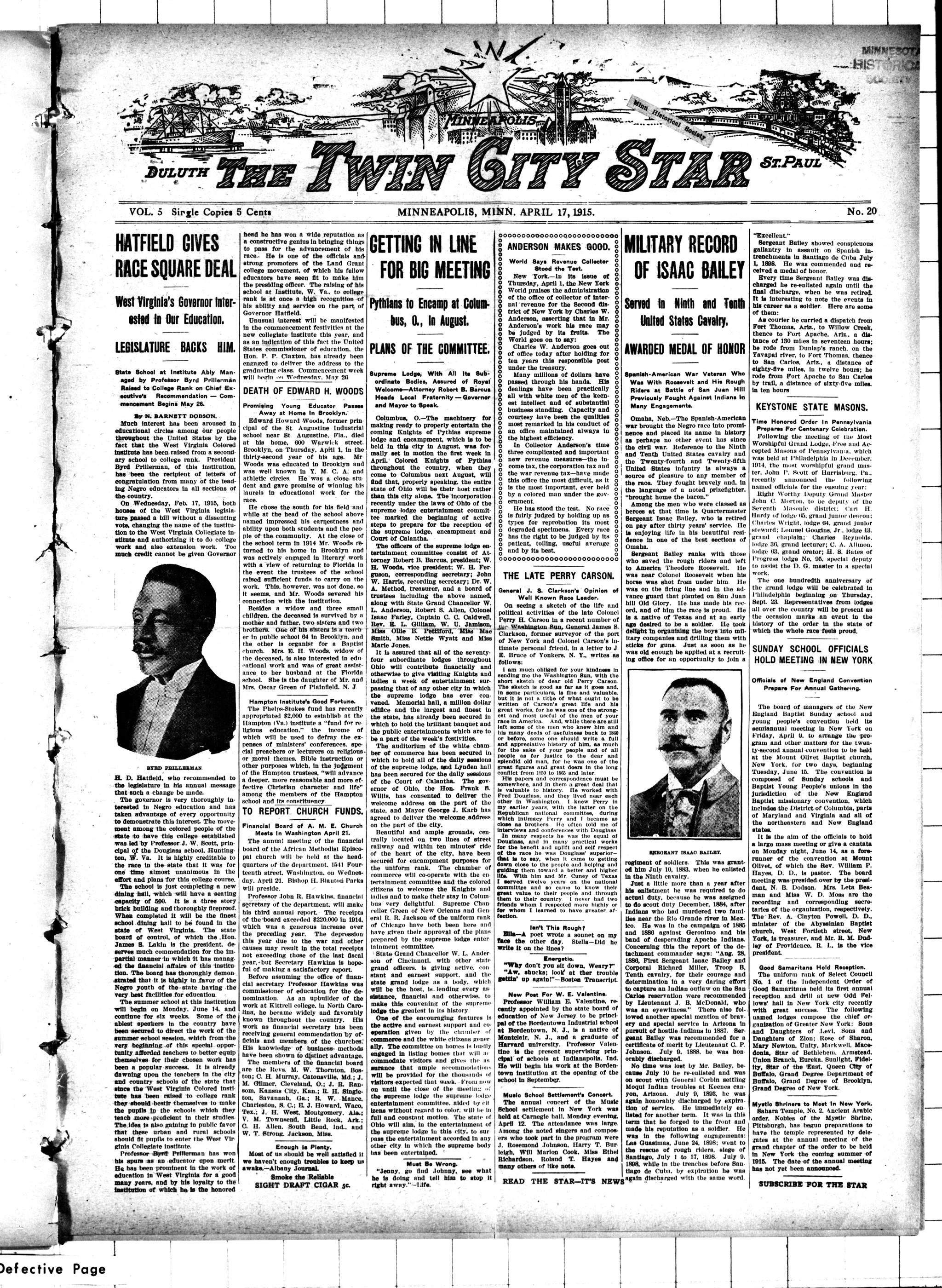
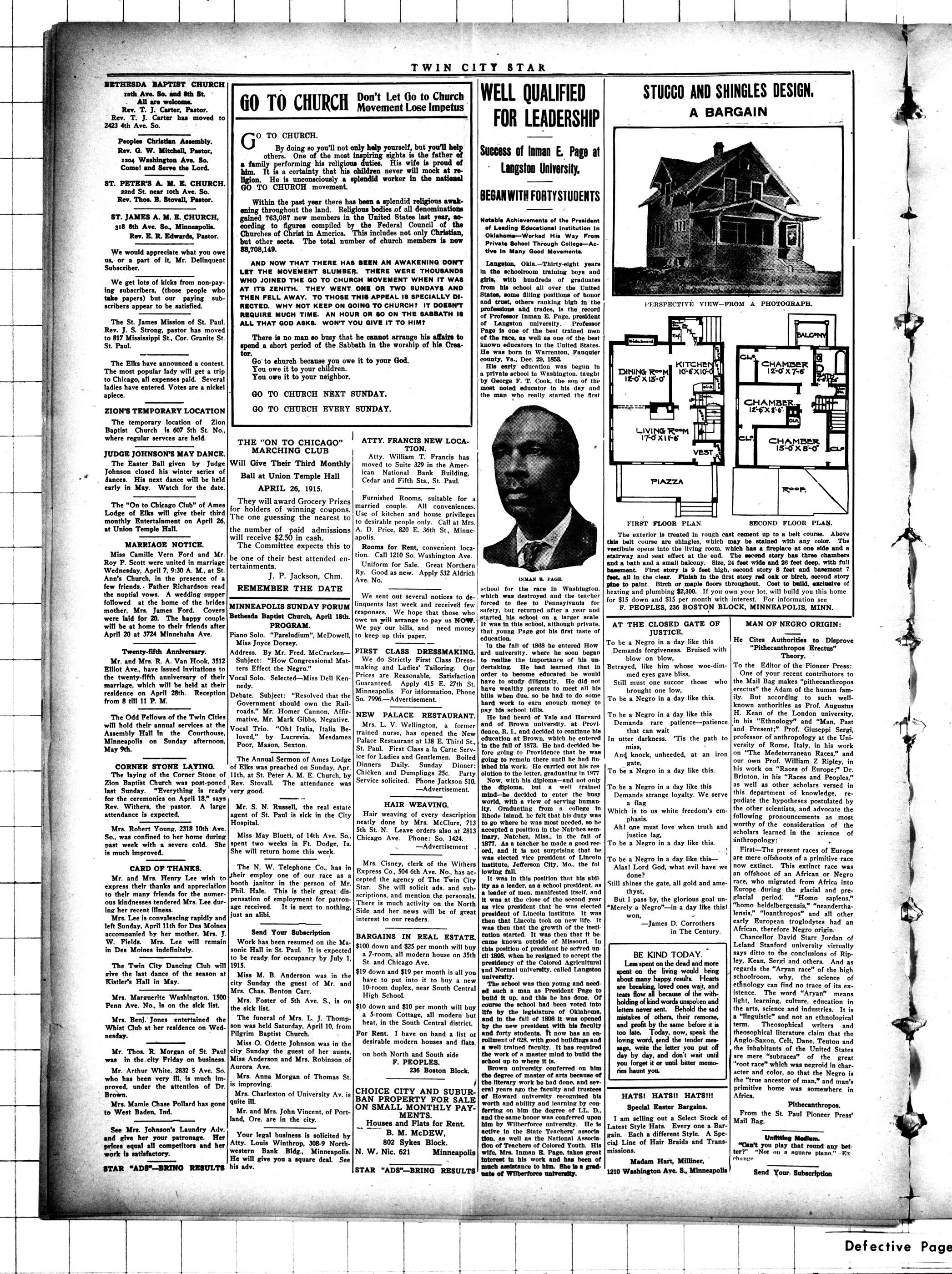
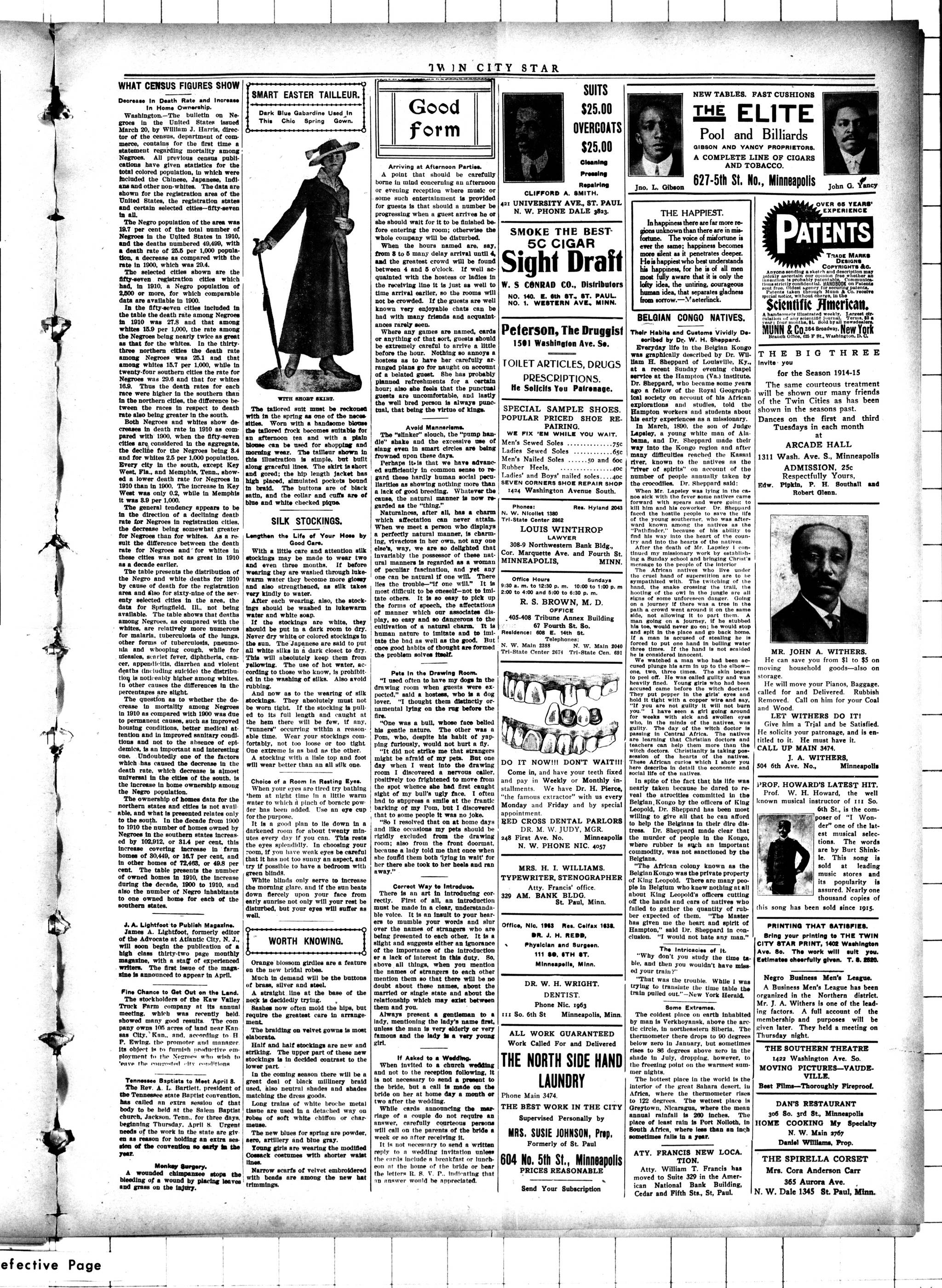
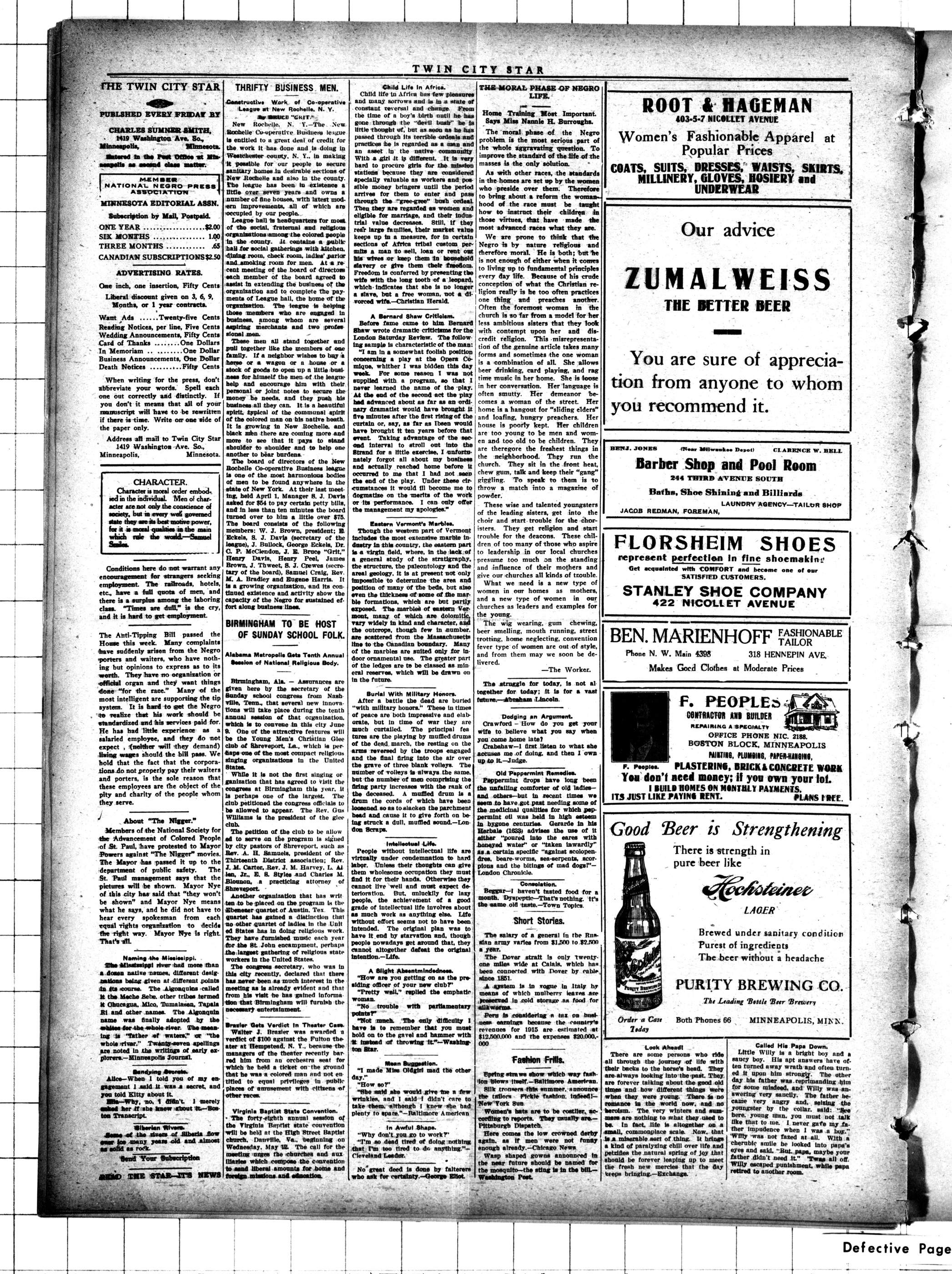
Page text (machine-generated)
DULUTH THE TWIN CITY STAR ST.PAUL
Defective Page
HATFIELD GIVES RACE SQUARE DEAL
West Virginia's Governor Interested in Our Education.
LEGISLATURE BACKS HIM.
State School at Institute Ably Managed by Professor Byrd Prillerman Raised to College Rank on Chief Executive's Recommendation — Commencement Begins May 26.
By N. BARNETT DODSON.
Much interest has been aroused in educational circles among our people throughout the United States by the fact that the West Virginia Colored institute has been raised from a secondary school to college rank. President Byrd Prillerman, of this institution, has been the recipient of letters of congratulation from many of the teaching Negro educators in all sections of the country. On Wednesday, Feb. 17, 1915, both houses of the West Virginia legislature passed a bill without a dissenting vote, changing the name of the institution to the West Virginia Collegiate institute and authorizing it to do college work and also extension work. Too much credit cannot be given Governor
BYRD PRILLERMAN
H. D. Hatfield, who recommended to the legislature in his annual message that such a change be made.
The governor is very thoroughly interested in Negro education and has taken advantage of every opportunity to demonstrate this interest. The movement among the colored people of the state to have this college established was led by Professor J. W. Scott, principal of the Dougiss school, Huntington, W. Va. It is highly creditable to the race in the state that it was for one time almost unanimous in the effort and plans for this college course. The school is just completing a new dining hall, which will have a seating capacity of 500. It is a three story brick building and thoroughly fireproof. When completed it will be the finest school dining hall to be found in the state of West Virginia. The state board of control, of which the Hon. James S. Laklin is the president, deserves much commendation for the impartial manner in which it has managed the financial affairs of this institution. The board has thoroughly demonstrated that it is highly in favor of the Negro youth of the state having the very best facilities for education.
The summer school at this institution will begin on Monday, June 14, and continue for six weeks. Some of the ablest speakers in the country have been secured to direct the work of the summer school session, which from the very beginning of this special opportunity afforded teachers to better equip themselves for their chosen work has been a popular success. It is already dawning upon the teachers in the city and country schools of the state that since the West Virginia Colored institute has been raised to college rank they should bestir themselves to make the pupils in the schools which they teach more proficient in their studies. The idea is also gaining in public favor that these urban and rural schools should fit pupils to enter the West Virginia Collegiate institute.
Professor Bord Prillerman has won his spurs as an educator upon merit. He has been prominent in the work of education in West Virginia for a good many years, and by his loyalty to the institution of which he is the honored
head he has won a wide reputation as a constructive genius in bringing things to pass for the advancement of his race. He is one of the officials and strong promoters of the Land Grant college movement, of which his fellow educators have seen fit to make him the presiding officer. The raising of his school at Institute, W. Va., to college rank is at once a high recognition of his ability and service on the part of Governor Hatfield. Unusual interest will be manifested in the commencement festivities at the new collegiate institute this year, and as an indication of this fact the United States commissioner of education, the Hon. P. P. Claxton, has already been engaged to deliver the address to the graduating class. Commencement week will begin on Wednesday, May 26
DEATH OF EDWARD H. WOODS
Promising Young Educator Passes
Away at Home In Brooklyn
Edward Howard Woods, former principal of the St. Augustine Industrial school near St. Augustine, Fla., died at his home, 600 Warwick street. Brooklyn, on Thursday, April 1, in the thirty-second year of his age. Mr Woods was educated in Brooklyn and was well known in Y. M. C. A. and athletic circles. He was a close student and gave promise of winning his laurels in educational work for the race. He chose the south for his field and while at the head of the school above named impressed his earnestness and ability upon both students and the people of the community. At the close of the school term in 1914 Mr. Woods returned to his home in Brooklyn and was actively engaged in literary work with a view of returning to Florida in the event the trustees of the school raised sufficient funds to carry on the work. This, however, was not done, so it seems, and Mr. Woods severed his connection with the institution.
Besides a widow and three small children, the deceased is survived by a mother and father, two sisters and two brothers. One of his sisters is a researcher in public school 64 in Brooklyn, and the other is organist for a Baptist church. Mrs. E. H. Woods, widow of the deceased, is also interested in educational work and was of great assistance to her husband at the Florida school. She is the daughter of Mr. and Mrs. Oscar Green of Plainfield, N. J.
Hampton Institute's Good Fortune.
The Phelps-Stokes fund has recently appropriated $2,000 to establish at the Hampton (Va.) institute a "fund for religious education," the income of which will be used to defray the expenses of ministers' conferences, special preachers or lecturers on religious or moral themes. Bible instruction or other purposes which, in the judgment of the Hampton trustees, "will advance a deeper, more reasonable and more effective Christian character and life" among the members of the Hampton school and its constituency.
TO REPORT CHURCH FUNDS.
Financial Board of A. M. E. Church Meets In Washington April 21.
The annual meeting of the financial board of the African Methodist Episcopal church will be held at the headquarters of the department. 1541 Fourteenth street. Washington, on Wednesday. April 21. Bishop H. Blanton Parks will preside.
Professor John R. Hawkins, financial secretary of the department, will make his third annual report. The receipts of the board exceeded $220,000 in 1914, which was a generous increase over the preceding year. The depression this year due to the war and other causes may result in the total receipts not exceeding those of the last fiscal year, but Secretary Hawkins is hopeful of making a satisfactory report.
Before assuming the office of financial secretary Professor Hawkins was commissioner of education for the demination. As an upbuilder of the work at Kittrell college, in North Carolina, he became widely and favorably known throughout the country. His work as financial secretary has been receiving general commendation by officials and members of the churches. His knowledge of business-methods have been shown to distinct advantage. The members of the financial board are the Revs. M. W. Thornton, Boston; C. H. Murray, Catonsville, Md.; J. M. Glimer, Cleveland, O.; J. R. Ransom, Kansus City, Kan.; R. H. Slington, Savannah, Ga.; R. W. Mance, Charleston, S. C.; E. J. Howard, Waco, Tex.; J. H. West, Montgomery, Ala.; V. M. Townsend, Little Rock, Ark.; C. H. Allen, South Bend, Ind., and W. T. Strong, Jackson, Miss.
Enough is Plenty. Most of us should be well satisfied if we haven't enough troubles to keep us awake.—Albany Journal.
Smoke the Reliable SIGHT DRAFT CIGAR 5c.
GETTING IN LINE FOR BIG MEETING
Supreme Lodge, With All Its Subordinate Bodies, Assured of Royal Welcome—Attorney Robert B. B. Barcus Heads Local Fraternity—Governor and Mayor to Speak.
Columbus, O.—The machinery for making ready to properly entertain the coming Knights of Pythias supreme lodge and encampment, which is to be held in this city in August, was formally set in motion the first week in April. Colored Knights of Pythias throughout the country, when they come to Columbus next August, will find that, properly speaking, the entire state of Ohio will be their host rather than this city alone. The incorporation recently under the laws of Ohio of the supreme lodge entertainment committee marked the beginning of active steps to prepare for the reception of the supreme lodge, encampment and Court of Calantha.
The officers of the supreme lodge entertainment committee consist of Attorney Robert B. Barcus, president; W. H. Woods, vice president; W. H. Ferguson, corresponding secretary; John W. Harris, recording secretary; Dr. W. A. Method, treasurer, and a board of trustees including the above named, along with State Grand Chancellor W. L. Anderson, Robert S. Allen, Colonel Isaac Farley, Captain C. C. Caldwell, Rev. E. L. Gilliam, W. U. Jamison, Miss Ollie B. Pettiford, Miss Mae Smith, Miss Nettle Wyatt and Miss Marie Jones.
It is assured that all of the seventy-four subordinate lodges throughout Ohio will contribute financially and otherwise to give visiting Knights and ladies a week of entertainment surpassing that of any other city in which the supreme lodge has ever convened. Memorial hall, a million dollar edifice and the largest and finest in the state, has already been secured in which to hold the brilliant banquet and the public entertainments which are to be a part of the week's festivities.
The auditorium of the white chamber of commerce has been secured in which to hold all of the daily sessions of the supreme lodge, and Lynden hall has been secured for the daily sessions of the Court of Calantha. The governor of Ohio, the Hon. Frank B. Willis, has consented to deliver the welcome address on the part of the state, and Mayor George J. Karb has agreed to deliver the welcome address on the part of the city.
Beautiful and ample grounds, centrally located on two lines of street railway and within ten minutes' ride of the heart of the city, have been secured for encampment purposes for the uniform rank. The chamber of commerce will co-operate with the entertainment committee and the colored citizens to welcome the Knights and ladies and to make their stay in Columbus very delightful. Supreme Chancellor Green of New Orleans and General R. R. Jackson of the uniform rank of Chicago have both been here and have given their approval of the plans prepared by the supreme lodge entertainment committee.
State Grand Chancellor W. L. Anderson of Cincinnati, with other state grand officers, is giving active, constant and earnest support, and the state grand lodge as a body, which will be the host, is lending every assistance, financial and otherwise, to make this convening of the supreme lodge the greatest in its history.
One of the encouraging features is the active and earnest support and cooperation given by the chamber of commerce and the white citizens generally. The committee on homes is busily engaged in listing homes that will accommodate visitors and gives the asurance that ample accommodations will be provided for the thousands of visitors expected that week. From now on until the close of the meeting of the supreme lodge the supreme lodge entertainment committee, aided by citizens without regard to color, will be in full and constant motion. The state of Ohio will aim, in the entertainment of the supreme lodge in this city, to surpass the entertainment accorded in any other city in which the supreme body has been entertained.
Must Be Wrong.
"Jenny. go find Johnny, see what he is doing and tell him to stop it right away."—Life.
ANDERSON MAKES GOOD.
World Says Revenue Collector Stood the Test.
New York—in its issue of Thursday, April 1, the New York World praises the administration of the office of collector of internal revenue for the Second district of New York by Charles W. Anderson, asserting that in Mr. Anderson's work his race may be judged by its fruits. The World goes on to say: Charles W. Anderson goes out of office today after holding for ten years this responsible post under the treasury. Many millions of dollars have passed through his hands. His dealings have been practically all with white men of the keenest intellect and of substantial business standing. Capacity and courtesy have been the qualities most remarked in his conduct of an office maintained always in the highest efficiency. In Collector Anderson's time three complicated and important new revenue measures—the income tax, the corporation tax and the war revenue tax—have made this office the most difficult, as it is the most important, ever held by a colored man under the government.
He has stood the test. No race is fairly judged by holding up as types for reprobation its most degraded spectacles. Every race has the right to be judged by its patient, tolling, useful average and by its best.
THE LATE PERRY CARSON.
General J. S. Clarkson's Opinion of Well Known Race Leader.
On seeing a sketch of the life and political activities of the late Colonel Perry H. Carson in a recent number of the Washington Sun, General James S. Clarkson, former surveyor of the port of New York and Colonel Carson's intimate personal friend, in a letter to J. E. Bruce of Yonkers, N. Y., writes as follows:
I am much obliged for your kindness in sending me the Washington Sun, with the short sketch of dear old Perry Carson. The character is fair and resolute, and in some partarians, is fair and resolute, but it is not a title of what ought to be written of Carson's great life and his great works, for he was one of the strongest and most useful of the men of your race in America. And, while there are still left some of the men who knew him and his many deeds of usefulness back to 1860 or before, some one should write a full and appreciative history of him, as much for the sake of your people and of all people in the country to the splendid old man, for he was one of the great figures and great doers in the long conflict from 1850 to 1855 and later.
His papers and correspondence must be somewhere, and in them a great deal that is valuable to history. He worked with Fred Douglas, and they lived near each other in Washington. I knew Perry in his 1920s years, and I was a Republican national committee, during which intimacy Perry and I became as close as brothers. He often told me of interviews and conferences with Douglas. In many respects he was the equal of Douglas, and in many practical works for the benefit and uplift and self respect of the race he was Douglas' superior that he was. I remember helping down close to the people and helping and guiding them toward a better and higher life. With him and Mr. Cuney of Texas I served twelve years on the national committee and so came to know their great value to their people and through them to their country. I never had two whom I respected more highly or for whom I learned to have greater affection.
I can't This Rough?
Ella—A poet wrote a sonnet on my face the other day. Stella—Did he write it on the lines?
Energetic.
"Why don't you sit down, Weary?"
"Aw, shucks; look at their trouble gettin' up again!"—Boston Transcript.
New Post For W. E. Valentine.
Professor William E. Valentine, recently appointed by the state board of education of New Jersey to be principal of the Bordentown Industrial school at Bordentown, N. J., is a native of Montclair, N. J., and a graduate of Harvard university. Professor Valentine is the present supervising principal of schools at Indianapolis, Ind. He will begin his work at the Bordentown institution at the opening of the school in September.
Music School Settlement's Concert.
The annual concert of the Music School settlement in New York was held at Carnegie hall. Monday evening, April 12. The attendance was large. Among the noted singers and composers who took part in the program were J. Rosemond Johnson, Harry T. Burleigh. Will Marlon Cook, Miss Ethel Richardson. Roland T. Hayes and many others of like note.
READ THE STAR-IT'S NEWS
"Excellent."
Sergeant Bailey showed conspicuous gallantry in assault on Spanish intrenchments in Santiago de Cuba July 1, 1898. He was commended and received a medal of honor.
Every time Sergeant Bailey was discharged he re-enlisted again until the final discharge, when he was retired.
It is interesting to note the events in his career as a soldier. Here are some of them:
As courier he carried a dispatch from Fort Thomas, Ariz., to Willow Creek, thence to Fort Apache, Ariz., a distance of 130 miles in seventeen hours; he rode from Dunlap's ranch, on the Yayapal river, to Fort Thomas, thence to San Carlos, Ariz., a distance of eighty-five miles, in twelve hours; he rode from Fort Apache to San Carlos by trail, a distance of sixty-five miles. in ten hours.
KEYSTONE STATE MASONS.
Time Honored Order in Pennsylvania
Prepares For Centenary Celebration.
Following the meeting of the Most
Worshipful Grand Lodge, Free and
Accepted Masons of Pennsylvania, which
was held at Philadelphia in December,
1914, the most worshipful grand mast-
er, John P. Scott of Harrisburg, Pa.
recently announced the following
named officials for the ensuing year:
Right Worthy Deputy Grand Master
John C. Morton, to be deputy of the
Seventh Masonic district; Cari H.
Hardy of lodge 45, grand junior deacon;
Charles Wright, lodge 64, grand junior
steward; Lamelu Googins, Jr., lodge 43,
grand chaplain; Charles Reynolds,
lodge 36, grand lecturer; C. A. Allom,
lodge 63, grand orator; H. S. Bates of
Progress lodge No. 95, special deputy
to assist the D. G. master in a special
work.
The one hundredth anniversary of
the grand lodge will be celebrated in
Philadelphia beginning on Thursday,
Sept. 23. Representatives from lodges
all over the country will be present as
the occasion marks an event in the
history of the order in the state of
which the whole race feels proud.
SUNDAY SCHOOL OFFICIALS
HOLD MEETING IN NEW YORK
Officials of New England Convention Prepare For Annual Gathering.
The board of managers of the New England Baptist Sunday school and young people's convention held its semiannual meeting in New York on Friday, April 9, to arrange the program and other matters for the twenty-second annual convention to be held at the Mount Olivet Baptist church, New York, for two days, beginning Tuesday, June 15. The convention is composed of Sunday schools and Baptist Young People's unions in the jurisdiction of the New England Baptist missionary convention, which includes the District of Columbia, parts of Maryland and Virginia and all of the northeastern and New England states.
It is the aim of the officials to hold a large mass meeting or give a cantata on Monday night, June 14, as a forerunner of the convention at Mount Olivet, of which the Rev. William P. Hayes, D. D., is pastor. The board meeting was presided over by the president, N. B. Dodson. Mrs. Leta Beaman and Miss W. D. Moss are the recording and corresponding secretaries of the organization, respectively. The Rev. A. Clayton Powell, D. D., minister of the Abyssinian Baptist church, West Fortieth street, New York, is treasurer, and Mr. R. M. Dudley of Providence, R. I., is the vice president.
Good Samaritans Held Reception. The uniform rank of Select Council No. 1 of the Independent Order of Good Samaritans held its first annual reception and drill at new Odd Fellows' hall in New York city recently with great success. The following named lodges compose the chief organization of Greater New York: Sons and Daughters of Levi. Sons and Daughters of Zion; Rose of Sharon, Mary Newton, Unity, Markwell, Macedonia, Star of Bethlehem, Armstead. Union Branch, Eureka, Sunlight, Fidelity, Star of the East, Queen City of Buffalo, Grand Degree Department of Buffalo, Grand Degree of Brooklyn, Grand Degree of New York.
Mystic Shriners to Meet in New York
Sahara Temple, No. 2, Ancient Arabic order. Nobles of the Mystic Shrine, Pittsburgh, has begun preparations to have the temple represented by delegates at the annual meeting of the grand chapter of the order to be held in New York the coming summer of 1915. The date of the annual meeting has not yet been announced.
SUBSCRIBE FOR THE STAR
MILITARY RECORD OF ISAAC BAILEY
Spanish-American War Veteran Who Was With Roosevelt and His Rough Riders at Battle of San Juan Hill Previously Fought Against Indians in Many Engagements.
Omaha, Neb.-The Spanish-American war brought the Negro race into prominence and placed its name in history as perhaps no other event has since the civil war. Reference to the Ninth and Tenth United States cavalry and the Twenty-fourth and Twenty-fifth United States infantry is always a source of pleasure to any member of the race. They fought bravely and, in the language of a noted prizefighter, "brought home the bacon."
Among the men who were classed as heroes at that time is Quartermaster Sergeant Isaac Bailey, who is retired on pay after thirty years' service. He is enjoying life in his beautiful residence in one of the best sections of Omaha.
Sergeant Bailey ranks with those who saved the rough riders and left to America Theodore Roosevelt. He was near Colonel Roosevelt when his horse was shot from under him. He was on the firing line and in the advance guard that planted on San Juan hill Old Glory. He has made his record, and of him the race is proud. He is a native of Texas and at an early age desired to be a soldier. He took delight in organizing the boys into military companies and drilling them with sticks for guns. Just as soon as he was old enough he applied at a recruiting office for an opportunity to join a
SERGEANT ISAAC BAILEY.
regiment of soldiers. This was granted him July 10, 1883, when he enlisted in the Ninth cavalry.
Just a little more than a year after his enlistment he was required to do actual duty, because he was assigned to do scout duty December, 1884, after Indians who had murdered two families near the Río Grande river in Mexico. He was in the campaign of 1885 and 1886 against Geronimo and his band of desperating Apache Indians. Concerning this the report of the detachment commander says: "Aug. 28, 1888, First Sergeant Isaac Bailey and Corporal Richard Miller, Troop B, Tenth cavalry, for their courage and determination in a very daring effort to capture an Indian outlaw on the San Carlos reservation were recommended by Leutenant J. B. McDonald, who was an eye witness." There also followed another special mention of bravery and special service in Arizona in pursuit of hostile Indians in 1887. Sergeant Bailey was recommended for a certificate of merit by Leutenant C. P. Johnson. July 9, 1888, he was honorably discharged.
No time was lost by Mr. Bailey, because July 10 he re-eilled and was on scout with General Corbin settling Moqul Indian troubles at Keenes canyon, Arizona. July 9, 1893, he was again honorably discharged by expiration of service. He immediately enlisted for another term. It was in this term that he forged to the front and made his reputation as a soldier. He was in the following engagements: Las Guasimas, June 24, 1898; went to the rescue of rough riders, siege of Santiago, July 1 to 17, 1898. July 9, 1898, while in the trenches before Santiago de Cuba, by expiration he was again discharged with the same word.
No.20
Will Give Their Third Monthly Ball at Union Temple Hall APRIL 26, 1915.
The Committee expects this to be one of their best attended entertainments.
Address. By Mr. Fred. McCracken— Subject: "How Congressional Matters Effect the Negro." Vocal Solo. Selected—Miss Dell Kennedy. Debate. Subject: "Resolved that the Government should own the Railroads." Mr. Homer Cannon, Affirmative, Mr. Mark Gibbs, Negative. Vocal Trio. "Oh! Italia, Italia Beloved," by Lucrevia. Mesdames Poor, Mason, Sexton. FIRST C We do S making and Prices are G Guaranteed Minneapolis So. 7996. NEW PA Mrs. L. trained nu Palace Res St. Paul. I
Miss M. B. Anderson was in the city Sunday the guest of Mr. and Mrs. Chas. Benton Carr.
Mrs. Foster of 5th Ave. S., is on the sick list.
The funeral of Mrs. L. J. Thompson was held Saturday, April 10, from Pilgrim Baptist Church.
Miss O. Odette Johnson was in the city Sunday the guest of her aunts, Miss Anderson and Mrs. Robinson of Aurora Ave.
Mrs. Anna Morgan of Thomas St. is improving.
Mrs. Charleston of University Av. is quite ill.
Mr. and Mrs. John Vincent, of Portland, Ore. are in the city.
---
Rev. T. J. Carter, Pastor.
Rev. T. J. Carter has moved to
2423 4th Ave. So.
Peoples Christian Assembly.
Rev. G. W. Mitchell, Pastor,
1204 Washington Ave. So.
Comel and Serve the Lord.
ST. PETER'S A. M. E. CHURCH.
22nd St. near 10th Ave. So.
Rev. Thos. B. Stovall, Pastor.
ST. JAMES A. M. E. CHURCH,
318 8th Ave. So., Minneapolis.
Rev. E. R. Edwards, Pastor.
We would appreciate what you owe
us, or a part of it, Mr. Delinquent
Subscriber.
We get lots of kicks from non-paying subscribers, (those people who take papers) but our paying subscribers appear to be satisfied.
The St. James Mission of St. Paul. Rev. J. S. Strong, pastor has moved to 817 Mississippi St., Cor. Granite St. St. Paul.
The Elks have announced a contest. The most popular lady will get a trip to Chicago, all expenses paid. Several ladies have entered. Votes are a nickel apiece.
ZION'S TEMPORARY LOCATION
The temporary location of Zion Baptist Church is 607 5th St. No., where regular services are held.
JUDGE JOHNSON'S MAY DANCE
The Easter Ball given by Judge Johnson closed his winter series of dances. His next dance will be held early in May. Watch for the date.
The "On to Chicago Club" of Ames Lodge of Elks will give their third monthly Entertainment on April 26, at Union Temple Hall.
MARRIAGE NOTICE.
Miss Camille Vern Ford and Mr. Roy P. Scott were united in marriage Wednesday, April 7, 9:30 A. M., at St. Ann's Church, in the presence of a few friends.. Father Richardson read the nuptial vows. A wedding supper followed at the home of the brides mother, Mrs. James Ford. Covers were laid for 20. The happy couple will be at home to their friends after April 20 at 3724 Minnehaha Ave.
Twenty-fifth Anniversary.
Mr. and Mrs. R. A. Van Hook, 3512 Elliot Ave., have issued invitations to the twenty-fifth anniversary of their marriage, which will be held at their residence on April 28th. Reception from 8 till 11 P. M.
The Odd Fellows of the Twin Cities will hold their annual services at the Assembly Hall in the Courthouse, Minneapolis on Sunday afternoon, May 9th.
CORNER STONE LAYING.
The laying of the Corner Stone of Zion Baptist Church was post-poned last Sunday. "Everything is ready for the ceremonies on April 18." says Rev. Withers, the pastor. A large attendance is expected.
Mrs. Robert Young. 2318 10th Ave. So., was confined to her home during past week with a severe cold. She is much improved.
CARD OF THANKS.
Mr. and Mrs. Henry Lee wish to express their thanks and appreciation to their many friends for the numerous kindnesses tendered Mrs. Lee during her recent illness.
Mrs. Lee is convalescing rapidly and left Sunday, April 11th for Des Moines accompanied by her mother, Mrs. J. W. Fields. Mrs. Lee will remain in Des Moines indefinitely.
The Twin City Dancing Club will give the last dance of the season at Kistler's Hall in May.
Mrs. Marguerite Washington, 1500 Penn Ave. No., is on the sick list.
Mrs. Benj. Jones entertained the Whist Club at her residence on Wednesday.
Don't Let Go to Church
Movement Lose Impetus
only help yourself, but you'll help
inspiring sights is the father of
its duties. His wife is proud of
children never will mock at re-
plendid worker in the national
has been a splendid religious awak-
gious bodies of all denominations
in the United States last year, so-
voy the Federal Council of the
This includes not only Christian,
number of church members is now
IS BEEN AN AWAKENING DON'T
DR. THERE WERE THOUSANDS
CHurch Movement WHEN IT WAS
ONE OR TWO SUNDAYS AND
THIS APPEAL IS SPECIALLY DI-
DING TO CHURCH? IT DOESN'T
SUR OR SO ON THE SABBATH IS
YOU GIVE IT TO HIM?
he cannot arrange his affairs to
bath in the worship of his Crea-
se it to your God.
SUNDAY.
GO TO CHURCH Don't Let Go to Church Movement Lose Impetus
GO TO CHURCH Don't Let Go to Church Movement Lose Impetus
By doing so you'll not only help yourself, but you'll help others. One of the most inspiring sights is the father of a family performing his religious duties. His wife is proud of him. It is a certainty that his children never will mock at religion. He is unconsciously a splendid worker in the national GO TO CHURCH movement.
Within the past year there has been a splendid religious awakening throughout the land. Religious bodies of all denominations gained 763,087 new members in the United States last year, according to figures compiled by the Federal Council of the Churches of Christ in America. This includes not only Christian, but other sects. The total number of church members is now 38,708,149.
AND NOW THAT THERE HAS BEEN AN AWAKENING DON'T LET THE MOVEMENT SLUMBER. THERE WERE THOUSANDS WHO JOINED THE GO TO CHURCH MOVEMENT WHEN IT WAS AT ITS ZENITH. THEY WENT ONE OR TWO SUNDAYS AND THEN FELL AWAY. TO THOSE THIS APPEAL IS SPECIALLY DIRECTED. WHY NOT KEEP ON GOING TO CHURCH? IT DOESN'T REQUIRE MUCH TIME. AN HOUR OR SO ON THE SABBATH IS ALL THAT GOD ASKS. WON'T YOU GIVE IT TO HIM?
There is no man so busy that he cannot arrange his affairs to spend a short period of the Sabbath in the worship of his Creator.
Go to church because you owe it to your God.
GO TO CHURCH NEXT SUNDAY.
GO TO CHURCH EVERY SUNDAY.
Furnished Rooms, suitable for a married couple. All conveniences. Use of kitchen and house privileges to desirable people only. Call at Mrs. A. D. Price, 820 E. 36th St., Minneapolis.
Rooms for Rent, convenient location. Call 1210 So. Washington Ave. Uniform for Sale. Great Northern Ry. Good as new. Apply 532 Aldrich Ave. No.
We sent out several notices to delinquents last week and received few responses. We hope that those who owe us will arrange to pay us NOW. We pay our bills, and need money to keep up this paper.
FIRST CLASS DRESSMAKING.
We do Strictly First Class Dress-
making and Ladies' Tailoring. Our
Prices are Reasonable, Satisfaction
Guaranteed. Apply 415 E. 27th St.
Minneapolis. For information, Phone
So. 799.—Advertisement.
NEW PALACE RESTAURANT
NEW PALACE RESTAURANT.
Mrs. L. V. Wellington, a former trained nurse, has opened the New Palace Restaurant at 138 E. Third St., St. Paul. First Class a la Carte Service for Ladies and Gentlemen. Boiled Dinners Daily. Sunday Dinners Chicken and Dumplings 25c. Party Service solicited. Phone Jackson 510.
Hair weaving of every description neatly done by Mrs. McClure, 713 5th St. N. Leave orders also at 2813 Chicago Ave. Phone: So. 1424.
Mrs. Cisney, clerk of the Withers Express Co., 504 6th Ave. No., has accepted the agency of The Twin City Star. She will solicit ads. and subscriptions, and mention the personalists. There is much activity on the North Side and her news will be of great interest to our readers.
BARGAINS IN REAL ESTATE
$100 down and $25 per month will buy a 7-room, all modern house on 35th St. and Chicago Ave.
$19 down and $19 per month is all you have to put into it to buy a new 10-room duplex, near South Central High School.
$10 down and $10 per month will buy a 5-room Cottage, all modern but heat, in the South Central district.
For Rent. I have on hand a list or desirable modern houses and flats, on both North and South side
F. PEOPLES.
236 Boston Block.
CHOICE CITY AND SUBURBAN PROPERTY FOR SALE
$ \mathrm{G}^{ \circ} $
You owe it to your neighbor.
THE "ON TO CHICAGO"
MARCHING CLUB
They will award Grocery Prizes for holders of winning coupons. The one guessing the nearest to the number of paid admissions will receive $2.50 in cash.
J. P. Jackson, Chm.
REMEMBER THE DATE
MINNEAPOLIS SUNDAY FORUM
Bethesda Baptist Church, April 18th.
PROGRAM.
Piano Solo. "Pareludium", McDowell Miss Joyce Dorsey.
The Annual Sermon of Ames Lodge of Elks was preached on Sunday, Apr. 11th, at St. Peter A. M. E. Church, by Rev. Stovall. The attendance was very good.
Mr. S. N. Russell, the real estate agent of St. Paul is sick in the City Hospital.
Miss May Bluett, of 14th Ave. So. spent two weeks in Ft. Dodge, Ia. She will return home this week.
The N. W. Telephone Co., has in their employ one of our race as a booth janitor in the person of Mr. Phil. Hale. This is their great dispensation of employment for patronage received. It is next to nothing just an alibi.
Send Your Subscription
Work has been resumed on the Masonic Hall in St. Paul. It is expected to be ready for occupancy by July 1, 1915.
Your legal business is solicited by Atty. Louis Winthrop, 308-9 Northwestern Bank Bldg., Minneapolis. He will give you a square deal. See his adv.
TWIN CITY STAR
ATTY. FRANCIS NEW LOCATION.
Atty. William T. Francis has moved to Suite 329 in the American National Bank Building, Cedar and Fifth Sts., St. Paul.
HAIR WEAVING
WELL QUALIFIED FOR LEADERSHIP
Success of Inman E. Page at Langston University.
BEGANWITH FORTYSTUDENTS
Notable Achievements of the President of Leading Educational Institution In Oklahoma—Worked His Way From Private School Through College—Active In Many Good Movements.
Langston, Okla.—Thirty-eight years in the schoolroom training boys and girls, with hundreds of graduates from his school all over the United States, some filling positions of honor and trust, others ranking high in the professions and trades, is the record of Professor Inman E. Page, president of Langston university. Professor Page is one of the best trained men of the race, as well as one of the best known educators in the United States. He was born in Warrenton, Fauquier county, Va., Dec. 29, 1853.
His early education was begun in a private school in Washington, taught by George F. T. Cook, the son of the most noted educator in his day and the man who really started the first
INMAN E. PAGE.
school for the race in Washington, which was destroyed and the teacher forced to flee to Pennsylvania for safety, but returned after a year and started his school on a larger scale. It was in this school, although private, that young Page got his first taste of education.
In the fall of 1868 he entered Howard university, where he soon began to realize the importance of his undertaking. He had learned that in order to become educated he would have to study diligently. He did not have wealthy parents to meet all his bills when due, so he had to do some hard work to earn enough money to pay his school bills.
He had heard of Yale and Harvard and of Brown university, at Providence, R. I., and decided to continue his education at Brown, which he entered in the fall of 1873. He had decided before going to Providence that he was going to remain there until he had finished his work. He carried out his resolution to the letter, graduating in 1877. Now, with his diploma—and not only the diploma, but a well trained mind—he decided to enter the busy world, with a view of serving humanity. Graduating from a college in Rhode Island, he felt that his duty was to go where he was most needed, so he accepted a position in the Natchez seminary, Natchez, Miss., in the fall of 1877. As a teacher he made a good record, and it is not surprising that he was elected vice president of Lincoln institute, Jefferson City, Mo., the following fall.
It was in this position that his ability as a leader, as a school president, as a leader of men, manifested itself, and it was at the close of the second year as vice president that he was elected president of Lincoln institute. It was then that Lincoln took on new life. It was then that the growth of the institution started. It was then that it became known outside of Missouri. In this position of president he served until 1898, when he resigned to accept the presidency of the Colored Agricultural and Normal university, called Langston university.
The school was then young and needed such a man as President Page to build it up, and this he has done. Of course the school had been voted into life by the legislature of Oklahoma, and in the fall of 1898 it was opened by the new president with his faculty and forty students. It now has an enrollment of 628, with good buildings and a well trained faculty. It has required the work of a master mind to build the school up to where it is.
Brown university conferred on him the degree of master of arts because of the literary work he had done, and several years ago the faculty and trustees of Howard university recognized his worth and ability and learning by conferring on him the degree of LL. D., and the same honor was conferred upon him by Wilberforce university. He is active in the State Teachers' association, as well as the National Association of Teachers of Colored Youth. His wife, Mrs. Inman E. Page, takes great interest in his work and has been of much assistance to him. She is a graduate of Wilberforce university.
THE HOME OF THE MAYFIELD MUSEUM
PERSPECTIVE VIEW-FROM A PHOTOGRAPH.
The exterior is treated in rough cast cement up to a belt course. Above this belt course are shingles, which may be stained with any color. The vestibule opens into the living room, which has a fireplace at one side and a stairway and seat effect at the end. The second story has three chambers and a bath and a small balcony. Size, 24 feet wide and 26 feet deep, with full basement. First story is 9 feet high, second story 8 feet and basement 7 feet, all in the clear. Finish in the first story red oak or birch, second story pine to paint. Birch or maple floors throughout. Cost to build, exclusive of heating and plumbing $2,300. If you own your lot, will build your this home for $15 down and $15 per month with interest. For information see F. PEOPLES. 236 BOSTON BLOCK. MINNEAPOLIS. MINN.
Bidboard
DINING ROOM
12'-0" X 13'-0"
KITCHEN
10'-6" X 10'-6"
Bink
LIVING ROOM
17'-0" X 11'-6"
VEST
PIAZZA
FIRST FLOOR PLAN.
The exterior is treated in rough cais this belt course are shingles, which vestibule opens into the living room, w stairway and seat effect at the end. and a bath and a small balcony. Size, basement. First story is 9 feet high, all in the clear. Finish in the fir pine to paint. Birch or maple floors th heating and plumbing $2,300. If you o for $15 down and $15 per month with F. PEOPLES, 236 BOSTON BL
BE KIND TODAY.
Less spent on the dead and more spent on the living would bring about many happy results. Hearts are breaking, loved ones wait, and tears flow all because of the withholding of kind words unspoken and letters never sent. Behold the sad mistakes of others, their remorse, and profit by the same before it is too late. Today, now, speak the loving word, send the tender message, write the letter you put off day by day, and don't wait until you forget it or until bitter memories haunt you.
HATS! HATS!! HATS!!!
I am selling out a Select Stock of Latest Style Hats. Every one a Bargain. Each a different Style. A Special Line of Hair Braids and Transmissions.
Madam Hart, Milliner,
1210 Washington Ave. S., Minneapolis
BALCONY
CL.9
CHAMBER
12'-0" X 7'-6"
CHAMBER.
12'-6" X 8'-6"
CL.9
CHAMBER
15'-0" X 8'-0"
ROOF.
SECOND FLOOR PLAN.
MAN OF NEGRO ORIGIN:
He Cites Authorities to Disprove "Pithecanthropos Erectus" Theory.
To the Editor of the Pioneer Press: One of your recent contributors to the Mail Bag makes "pithecanthropos erectus" the Adam of the human family. But according to such well-known authorities as Prof. Augustus H. Kean of the London university, in his "Ethnology" and "Man, Past and Present," Prof. Giuseppi Sergi, professor of anthropology at the University of Rome, Italy, in his work on "The Mediterranean Races," and our own Prof. William Z Ripley, in his work on "Races of Europe;" Dr. Brinton, in his "Races and Peoples," as well as other scholars versed in this department of knowledge, repudiate the hypotheses postulated by the other scientists, and advocate the following pronouncements as most worthy of the consideration of the scholars learned in the science of anthropology:
First—The present races of Europe are mere offshoots of a primitive race now extinct. This extinct race was an offshoot of an African or Negro race, who migrated from Africa into Europe during the glacial and preglacial period: "Homo sapiens," "homo heidelbergensis," "neanderthalensis," "loanthropos" and all other early European troglodytes had an African, therefore Negro origin.
Chancellor David Starr Jordan of Leland Stanford university virtually says ditto to the conclusions of Ripley, Kean, Sergi and others. And as regards the "Aryan race" of the high schoolroom, why, the science of ethnology can find no trace of its existence. The word "Aryan" means light, learning, culture, education in the arts, science and industries. It is a "linguistic" and not an ethnological term. Theosophical writers and theosophical literature claim that the Anglo-Saxon, Celt, Dane, Teuton and the inhabitants of the United States are mere "subraces" of the great "root race" which was negroid in character and color, so that the Negro is the "true ancestor of man," and man's primitive home was somewhere in Africa.
From the St. Paul Pioneer Press' Mail Bag.
Unfitting Medium.
"Can't you play that round any better?" "Not on a square piano." Ex-change
Send Your Subscription
Defective Page
efective Page
WHAT CENSUS FIGURES SHOW
Decrease In Death Rate and Increase In Home Ownership.
Washington.—The bulletin on Negroes in the United States issued March 20, by William J. Harris, director of the census, department of commerce, contains for the first time a statement regarding mortality among Negroes. All previous census publications have given statistics for the total colored population, in which were included the Chinese, Japanese, Indians and other non-white. The data are shown for the registration area of the United States, the registration states and certain selected cities—fifty-seven in all.
The Negro population of the area was 19.7 per cent of the total number of Negroes in the United States in 1910, and the deaths numbered 49,499, with a death rate of 25.5 per 1,000 population, a decrease as compared with the rate in 1900, which was 29.4.
The selected cities shown are the fifty-seven registration cities which had, in 1910, a Negro population of 2,500 or more, for which comparable data are available in 1900.
In the fifty-seven cities included in the table the death rate among Negroes in 1910 was 27.8 and that among whites 15.9 per 1,000, the rate among the Negroes being nearly twice as great as that for the whites. In the thirty-three northern cities the death rate among Negroes was 25.1 and that among whites 15.7 per 1,000, while in twenty-four southern cities the rate for Negroes was 29.6 and that for whites 16.9. Thus the death rates for each race were higher in the southern than in the northern cities, the difference between the races in respect to death rate also being greater in the south.
Both Negroes and whites show decreases in death rate in 1910 as compared with 1900, when the fifty-seven cities are considered in the aggregate, the decline for the Negroes being 3.4 and for whites 2.5 per 1,000 population. Every city in the south, except Key West, Fla., and Memphis, Tenn., showed a lower death rate for Negroes in 1910 than in 1900. The increase in Key West was only 0.2, while in Memphis it was 3.9 per 1,000.
The general tendency appears to be in the direction of a declining death rate for Negroes in registration cities, the decrease being somewhat greater for Negroes than for whites. As a result the difference between the death rate for Negroes and for whites in these cities was not as great in 1910 as a decade earlier.
The table presents the distribution of the Negro and white deaths for 1910 by cause of death for the registration area and also for sixty-nine of the seventy selected cities in the area, the data for Springfield, Ill., not being available. The table shows that deaths among Negroes, as compared with the whites, are relatively more numerous for malaria, tuberculosis of the lungs, other forms of tuberculosis, pneumonia and whooping cough, while for measles, scarlet fever, diphtheria, cancer, appendicitis, diarrhea and violent deaths (including suicide) the distribution is noticeably higher among whites. In other causes the differences in the percentages are slight.
The question as to whether the decrease in mortality among Negroes in 1910 as compared with 1900 was due to permanent causes, such as improved housing conditions, better medical attention and in improved sanitary conditions and not to the absence of epidemics, is an important and interesting one. Undoubtedly one of the factors which has caused the decrease in the death rate, which decrease is almost universal in the cities of the south, is the increase in home ownership among the Negro population.
The ownership of homes data for the northern states and cities is not available, and what is presented relates only to the south. In the decade from 1900 to 1910 the number of homes owned by Negroes in the southern states increased by 102,912, or 31.4 per cent, this increase covering increase in farm homes of 30,449, or 16.7 per cent, and in other homes of 72,463, or 49.8 per cent. The table presents the number of owned homes in 1910, the increase during the decade, 1900 to 1910, and also the number of Negro inhabitants to one owned home for each of the southern states.
J. A. Lightfoot to Publish Magazine.
James A. Lightfoot, formerly editor of the Advocate at Atlantic City, N. J., will soon begin the publication of a high class thirty-two page monthly magazine, with a staff of experienced writers. The first issue of the magazine is announced to appear in April.
Fine Chance to Get Out on the Land.
The stockholders of the Kaw Valley Truck Farm company at its annual meeting, which was recently held, showed many good results. The company owns 105 acres of land near Kansas City, Kan., and, according to H. P. Ewing, the promoter and manager its object is to furnish productive employment to the Negroes who wish to 'leave the congested city conditions.
Tennessee Baptists to Meet April 8.
The Rev. A. L. Bartlett, president of the Tennessee state Baptist convention, has called an extra session of that body to be held at the Salem Baptist church, Jackson, Tenn., for three days, beginning Thursday, April 8. Urgent needs of the work in the state are given as reason for holding an extra session of the convention so early in the year.
Monkey Surgery.
A wounded chimpanzee stops the bleeding of a wound by placing leaves and grass on the injury.
SMART EASTER TAILLEUR.
Dark Blue Gabardine Used_In
This Chio Spring Gown.
```markdown
```
WITH SHORT SKIRT.
The tailored suit must be reckoned with in the spring as one of the necessities. Worn with a handsome blouse the tailored frock becomes suitable for an afternoon tea and with a plain blouse can be used for shopping and morning wear. The tailleur shown in this illustration is simple, but built along graceful lines. The skirt is short and gored; the hip length jacket has high placed, simulated pockets bound in braid. The buttons are of black satin, and the collar and cuffs are of blue and white checked pique.
SILK STOCKINGS.
Lengthen the Life of Your Hose by Good Care.
With a little care and attention silk stockings may be made to wear two and even three months. If before wearing they are washed through lukewarm water they become more glossy and also strengthened, as silk takes very kindly to water.
After each wearing, also, the stockings should be washed in lukewarm water and white soap.
If the stockings are white, they should be put in a dark room to dry. Never dry white or colored stockings in the sun. The Japanese are said to put all white silks in a dark closet to dry. This will absolutely keep them from yellowing. The use of hot water, according to those who know, is prohibited in the washing of silks. Also avoid rubbing.
And now as to the wearing of silk stockings. They absolutely must not be worn tight. If the stocking is pulled to its full length and caught at the hem there will be few, if any, "runners" occurring within a reasonable time. Wear your stockings comfortably, not too loose or too tight. One extreme is as bad as the other. A stocking with a lisle top and foot will wear better than an all silk one.
Choice of a Room In Resting Eyes. When your eyes are tired try bathing 'hem at night time in a little warm water to which a pinch of boracic powder has been added. Use an eye cup for the purpose.
It is a good plan to lie down in a darkened room for about twenty minutes every day if you can. This rests the eyes splendidly. In choosing your room, if you have weak eyes be careful that it has not too sunny an aspect, and try if possible to have a bedroom with green blinds. White blinds only serve to increase the morning glare, and if the sun beats down fiercely upon your face from early sunrise not only will your rest be disturbed, but your eyes will suffer as well.
WORTH KNOWING.
Orange blossom girdles are a feature on the new bridal robes.
Much in demand will be the buttons of brass, silver and steel.
A straight line at the base of the neck is decidedly trying.
Sashes now often mold the hips, but require the greatest care in arrangement.
The braiding on velvet gowns is most elaborate.
Half and half stockings are new and striking. The upper part of these new stockings is in decided contrast to the lower part.
In the coming season there will be a great deal of black millinery braid used, also neutral shades and shades matching the dress goods.
Long trains of white broche metal tissue are used in a detached way on robes of soft white chiffon or charmeuse.
The new blues for spring are powder, aero, artillery and blue gray.
Young girls are wearing the modified Cossack costumes with shorter waist lines.
Narrow scarfs of velvet embroidered with beads are among the new hat trimmings.
Good form
Arriving at Afternoon Parties.
A point that should be carefully borne in mind concerning an afternoon or evening reception where music or some such entertainment is provided for guests is that should a number be progressing when a guest arrives he or she should wait for it to be finished before entering the room; otherwise the whole company will be disturbed.
When the hours named are, say, from 8 to 5 many delay arrival until 4, and the greatest crowd will be found between 4 and 5 o'clock. If well acquainted with the hostess or ladies in the receiving line it is just as well to time arrival earlier, so the rooms will not be crowded. If the guests are well known very enjoyable chats can be had with many friends and acquaintances rarely seen.
Where any games are named, cards or anything of that sort, guests should be extremely careful to arrive a little before the hour. Nothing so annoys a hostess as to have her carefully arranged plans go for naught on account of a belated guest. She has probably planned refreshments for a certain hour; also she feels that the punctual guests are uncomfortable, and lastly the well bred person is always punctual, that being the virtue of kings.
Avoid Mannerisms.
The "slinker" slouch, the "pump handle" shake and the excessive use of slang even in smart circles are being frowned upon these days.
Perhaps it is that we have advanced sufficiently in common sense to regard these hardly human social peculiarities as showing nothing more than a lack of good breeding. Whatever the cause, the natural manner is now regarded as the "thing."
Naturalness, after all, has a charm which affectation can never attain. When we meet a person who displays a perfectly natural manner, is charming, vivacious in her own, not any one else's, way, we are so delighted that invariably the possessor of these natural manners is regarded as a woman of peculiar fascination, and yet any one can be natural if one will. There lies the trouble—"if one will." It is most difficult to be oneself—not to imitate others. It is so easy to pick up the forms of speech, the affectations of manner which our associates display, so easy and so dangerous to the cultivation of a natural charm. It is human nature to imitate and to imitate the bad as well as the good. But once good habits of thought are formed the problem solves itself.
Pets In the Drawing Room.
"I used often to have my dogs in the drawing room when guests were expected," said a hostess, who is a dog lover. "I thought them distinctly ornamental lying on the rug before the fire.
"One was a bull, whose face belled his gentle nature. The other was a Pom, who, despite his habit of yapping furiously, would not hurt a fly.
"It did not strike me that strangers might be afraid of my pets. But one day when I went into the drawing room I discovered a nervous caller, positively too frightened to move from the spot where she had first caught sight of my bull's ugly face. I often had to suppress a smile at the frantic barking of my Pom, but I discovered that to some people it was no joke.
"So I resolved that on at home days and like occasions my pets should be rigidly excluded from the drawing room; also from the front doormat, because a lady told me that once when she fouled them both 'lying in wait' for her there she took to her heels and ran away."
Correct Way to Introduce.
There is an art in introducing correctly. First of all, an introduction must be made in a clear, understandable voice. It is an insult to your hearers to mumble your words and slur over the names of strangers who are being presented to each other. It is a slight and suggests either an ignorance of the importance of the introduction or a lack of interest in this duty. So, above all things, when you mention the names of strangers to each other mention them so that there will be no doubt about these names, about the married or single state and about the relationship which may exist between them and you.
Always present a gentleman to a lady, mentioning the lady's name first, unless the man is very elderly or very famous and the lady is a very young girl.
If Asked to a Wedding.
When invited to a church wedding and not to the reception following, it is not necessary to send a present to the bride, but a call is made on the bride on her at home day a month or two after the wedding.
While cards announcing the marriage of a couple do not require an answer, carefully courteous persons will call on the parents of the bride a week or so after receiving it.
It is not necessary to send a written reply to a wedding invitation unless the cards include a breakfast or luncheon at the home of the bride or bear the letters R. S. V. P., indicating that an answer would be appreciated.
SUITS
$25.00
OVERCOATS
$25.00
Cleaning
Pressing
Repairing
CLIFFORD A. SMITH.
421 UNIVERSITY AVE., ST. PAUL
N. W. PHONE DALE 8823.
SMOKE THE BEST
5C CIGAR
Sight Draft
W. S CONRAD CO., Distributors
NO. 140. E. 6th ST., ST. PAUL.
NO. 1. WESTERN AVE., MINN.
Peterson, The Druggist
1501 Washington Ave. So.
TOILET ARTICLES, DRUGS
PRESCRIPTIONS.
He Sollicits You Patronage.
SPECIAL SAMPLE SHOES.
POPULAR PRICED SHOE REPAIRING.
WE FIX 'EM WHILE YOU WAIT.
Men's Sewed Soles ..... 75c
Ladies Sewed Soles ..... 65c
Men's Nailed Soles ..... 50 and 60c
Rubber Heels, ..... 40c
Ladies' and Boys' nailed soles ..... 40c
SEVEN CORNERS SHOE REPAIR SHOP
1424 Washington Avenue, South
Phones: Res. Hyland 2043
N. W. Nicollet 1380
Trl-State Center 2862
308-9 Northwestern Bank Bldg.,
Cor. Marquette Ave. and Fourth St.
MINNEAPOLIS, MINN.
Office Hours Sundays
9:30 a. m. to 12:30 p. m. 10:00 to 1:00 p. m.
2:00 to 4:00 and 5:00 to 6:30 p. m.
R. S. BROWN, M. D.
OFFICE
405-408 Tribune Annex Building
67 Fourth St. So.
Residence: 608 E. 14th St.
Telephones:
N. W. Main 2388 N. W. Main 2040
Tri-State Center 2674 Tri-State Cen. 691
DO IT NOW!!! DON'T WAIT!!!
Come in, and have your teeth fixed and pay in Weekly or Monthly installments. We have Dr. H. Pierce, "the famous extractor" with us every Monday and Friday and by special appointment.
RED CROSS DENTAL PARLORS
DR. M. W. JUDY, MGR.
MRS. H. I. WILLIAMS.
TYPEWRITER, STENOGRAPHER
Atty. Francis' office.
329 AM. BANK BLDG.
St. Paul, Minn.
Office, Nic. 1983 Res. Celfax 1638.
DR. J. H. REDD,
Physician and Surgeon.
111 SO. 6TH ST.
Minneapolis, Minn.
DR. W. H. WRIGHT.
DENTIST.
Phone Nic. 1963
111 So. 6th St Minneapolis, Minn.
ALL WORK GUARANTEED
Work Called For and Delivered
THE NORTH SIDE HAND
LAUNDRY
Phone Main 3474
THE BEST WORK IN THE CITY
Supervised Personally by
MRS. SUSIE JOHNSON, Prop.
Formerly of St. Paul
Send Your Subscription
627-5th St. No., Minneapolis
In happiness there are far more regions unknown than there are in misfortune. The voice of misfortune is ever the same; happiness becomes more silent as it penetrates deeper. He is happiest who best understands his happiness, for he is of all men most fully aware that it is only the lofty idea, the uniring, courageous human idea, that separates gladness from sorrow.—Materlinck.
BELGIAN CONGO NATIVES.
Their Habits and Custome Videly Described by Dr. W. H. Sheppard.
Everyday life in the Belgian Kongo was graphically described by Dr. William H. Sheppard of Louisville, KY., at a recent Sunday evening chapel service at the Hampton (Va.) institute. Dr. Sheppard, who became some years ago a fellow of the Royal Geographical society on account of his African explorations and studies, told the Hampton workers and students about his early experiences as a missionary. In March, 1800, the son of Judge Lapsley, a young white man of Alabama, and Dr. Sheppard made their way into the Kongo region and after many difficulties reached the Kassai river, known to the natives as the "river of spirits" on account of the number of people annually taken by the crocodiles. Dr. Sheppard said:
When Mr. Lapsley was lying in the cannock sick with the fever some natives came forward with spears and were going to kill him and his coworker Dr. Sheppard faced the hostile people to save the life of the man and his coworker, who was ward known among the natives as the "Pathfinder," because of his ability to find his way into the heart of the country and into the hearts of the natives.
After the death of Mr. Lapsley I continued my missionary work by establishing a Sunday school and bringing Christ's message to the African natives who live under the cruel hand of superstition are to be sympathized with. The twitching of the hand, the snake crossing the trail, the hooting of the owl in the jungle are all signs of some unforeseen danger. Going to the church, the man walked a crowd went around it on the same side, not allowing it to part them. A man going on a journey, if he stubbed his toe, would never go on; he would stop and spit in the place and go back home. If a man is accused of stealing he is forced to put one hand in boiling water and the other hand is not scalded he is considered innocent.
We watched a man who had been accused plunge his arm in up to the elbow—one, two, three times. The skin began to peel off. He was called guilty and was heavily ninned. Young girls who had been accused of stealing wrist watches they put pepper in the girls' eyes and hold it tight with a copper wire and say, "If you are not guilty it will not burn you." I have seen a girl going around for weeks with sick and swollen eyes and having a terrible guilty. The day of the witch doctor is passing in Central Africa. The natives are learning that Christian doctors and teachers can help them more than the witch doctors. Christianity is taking possession of the hearts of the natives. The police are trying to find you here describe in detail the economic and social life of the natives.
In spite of the fact that his life was nearly taken because he dared to reveal the atrocities committed in the Belgian, Kongo by the officers of King Leopold, Dr. Sheppard has been most willing to give all that he can afford to help the Belgians in their dire distress. Dr. Sheppard made clear that the murder of people in the Kongo, where rubber is such an important commodity, was not sanctioned by the Belgians.
"The African colony known as the Belgian Kongo was the private property of King Leopold. There are many people in Belgium who knew nothing at all about King Leopold's officers cutting off the hands and ears of natives who failed to gather the quantity of rubber expected of them. "The Master has given me the heart and spirit of Hampton," said Dr. Sheppard in conclusion. "I would not hate any man."
"Why don't you study the time table, and then you wouldn't have missed your train?"
"That was the trouble. While I was trying to translate the time table the train pulled out."—New York Herald.
Some Extremes.
The coldest place on earth inhabited by man is Verkhoyansk, above the arctic circle, in northeastern Siberia. The thermometer there drops to 90 degrees below zero in January, but sometimes rises to 86 degrees above zero in the shade in July, dropping, however, to the freezing point on the warmest summer nights.
The hottest place in the world is the interior of the great Sahara desert, in Africa, where the thermometer rises to 122 degrees. The wettest place is Greytown, Nicaragua, where the mean annual rainfall is 200 inches. The place of least rain is Port Nolloth, in South Africa, where less than an inch sometimes falls in a year.
ATY. FRANCIS NEW LOCA.
TION.
Atty. William T. Francis has moved to Suite 329 in the American National Bank Building, Cedar and Fifth Sts., St. Paul.
Jno. L. Gibson
THE HAPPIEST.
The Intricacies of It
Some Extremes.
M. B. B.
OVER 65 YEARS' EXPERIENCE
PATENTS
TRADE MARKS
DESIGNS
COPYRIGHTS & c.
Anyone sending a sketch and description may
judge the merit of the invention and instruction is probably patentable. Communications strictly confidential. HANDBOOK on Patents
sent free. Highest agency for requesting patents.
Patents taken through Munn & Co. receive
special notice, without charge in the
Scientific American.
A hand-drawn illustrated weekly. Largest circulation of any scientific journal. Ternus, $3 a
year; four months, $1. Bold by all new盐鋁.
MUNN & Co. 364 Broadway - New York
Branch Office, 625 F St., Washington, D.C.
THE BIG THREE
Invite you
The same courteous treatment will be shown our many friends of the Twin Cities as has been shown in the seasons past.
Dances on the first and third Tuesdays in each month at
ARCADE HALL
1311 Wash. Ave. S., Minneapolis
ADMISSION, 25c
Respectfully Yours,
Edw. Pipkin, P. H. Southall and Robert Glenn.
MR. JOHN A. WITHERS.
He can save you from $1 to $5 on
moving household goods—also on
storage
He will move your Pianos, Baggage, called for and Delivered. Rubbish Removed. Call on him for your Coal and Wood.
LET WITHERS DO IT!
Give him a Trial and be Satisfied. He solicits your patronage, and is entitled to it. He must have it.
CALL UP MAIN 3474.
J. A. WITHERS,
504 6th Ave. No., Minneapolis
PROF. HOWARD'S LATEST HIT.
Prof. W. H. Howard, the well known musical instructor of 111 So.
on St., is the composer of "I Wonder" one of the latest musical selections. The words are by Burt Shinkle. This song is sold at leading music stores and its popularity is assured. Nearly one thousand copies of
On Beh. is the composer of "I Wonder" one of the la- test musical selec tions. The words are by Burt Shink- le. This song is sold at leading music stores and its popularity is assured. Nearly one thousand copies of this song has been sold since 1915.
PRINTING THAT SATISFIES.
Bring your printing to THE TWIN CITY STAR PRINT, 1402 Washington Ave. 80. The work will suit you. Estimates cheerfully given. T. S. 82820.
A Business Men's League has been organized in the Northern district. Mr. J. A. Withers is one of the leading factors. A full account of the membership and purposes will be given later. They held a meeting on Thursday night.
THE SOUTHERN THEATRE
1422 Washington Ave. So.
MOVING PICTURES—VAUDE-VILLE.
Best Films—Thoroughly Fireproof.
DAN'S RESTAURANT
306 So. 3rd St., Minneapolis
HOME COOKING My Specialty
N. W. Main 2767
Daniel Williams, Prop.
365 Aurora Ave.
N. W. Dale 1345 St. Paul, Minn.
CHARLES SUMNER SMITH,
1419 Washington Ave. So.,
Minneapolis,
Minnesota.
Entered in the Post Office at
Minneapolis as second class matter.
MEMBER
NATIONAL NEGRO PRESS
ASSOCIATION
Subscription by Mail, Postpaid.
ONE YEAR ..... $2.00
SIX MONTHS ..... 1.00
THREE MONTHS ..... .65
CANADIAN SUBSCRIPTIONS $2.50
ADVERTISING RATES.
One inch, one insertion, Fifty Cents
Liberal discount given on 3, 6, 9
Months, or 1 year contracts.
Want Ads ..... Twenty-five Cents
Reading Notices, per line, Five Cents
Wedding Announcements, Fifty Cents
Card of Thanks ..... One Dollars
In Memoriam ..... One Dollar
Business Announcements, One Dollar
Death Notices ..... Fifty Cents
When writing for the press, don't
abbreviate your words. Spell each
one out correctly and distinctly. If
you don't it means that all of your
manuscript will have to be rewritten
if there is time. Write on one side of
the paper only.
Address all mail to Twin City Star
1419 Washington Ave. So.
Minneapolis, Minnesota.
CHARACTER
Character is moral order embodied in the individual. Men of character are not only the conscience of society, but in every well governed state they are its best motive power, for it is moral qualities in the main which rule the world—Samuel Smiles.
Conditions here do not warrant any encouragement for strangers seeking employment. The railroads, hotels, etc., have a full quota of men, and there is a surplus among the laboring class. "Times are dull," is the cry, and it is hard to get employment.
The Anti-Tipping Bill passed the House this week. Many complaints have suddenly arisen from the Negro porters and waiters, who have nothing but opinions to express as to its worth. They have no organization or official organ and they want things done "for the race." Many of the most intelligent are supporting the tip system. It is hard to get the Negro to realize that his work should be standardized and his services paid for. He has had little experience as a salaried employee, and they do not expect (neither will they demand) living wages should the bill pass. We hold that the fact that the corporations do not properly pay their waiters and porters, is the sole reason that these employees are the object of the pity and charity of the people whom they serve.
About "The Nigger."
Members of the National Society for the Advancement of Colored People of St. Paul, have protested to Mayor Powers against the Nigger' movies. The Mayor has passed it up to the department of public safety. The St. Paul management says that the pictures will be shown. Mayor Nye of this city has said that "they won't be shown" and Mayor Nye means what he says, and he did not have to hear every spokesman from each equal rights organization to decide the right way. Mayor Nye is right. That's all.
Naming the Mississippi.
The Mississippi river had more than a dozen native names, different designations being given at different points in its course. The Algaonquins called it the Moche Sebe, other tribes termed it Chucagua, Mico, Tumalasien, Tapala Ri and other names. The Algaonquin name was finally adopted by the whites for the whole river. The meaning is "Tather of waters," or "the whole river." Twenty-seven spellings are noted in the writings of early explorers.—Minneapolis Journal.
Bandying Secrets.
Alice—When I told you of my engagement I said it was a secret, and you told Kitty about it.
Blee—Why, no, I didn't. I merely asked her if she knew about it.—Boston Transcript.
Siberian Rivers.
Some of the rivers of Siberia flow
over so many years old and almost
as solid as rock.
Send Your Subscription
MEND THE STAR-IT'S NEWS
THRIFTY BUSINESS MEN.
Constructive Work of Co-operative League at New Rochelle, N. Y.
BY BRUCE "GRIT"
New Rochelle, N. Y.-The New Rochelle Co-operative Business league is entitled to a great deal of credit for the work it has done and is doing in Westchester county, N. Y., in making it possible for our people to secure sanitary homes in desirable sections of New Rochelle and also in the county. The league has been in existence a little over seven years and owns a number of fine houses, with latest modern improvements, all of which are occupied by our people.
League hall is headquarters for most of the social, fraternal and religious organizations among the colored people in the county. It contains a public hall for social gatherings with kitchen, dining room, check room, ladies' parlor and smoking room for men. At a recent meeting of the board of directors each member of the board agreed to assist in extending the business of the organization and to complete the payments of League hall, the home of the organization. The league is helping those members who are engaged in business, among whom are several aspiring merchants and two professional men.
These men all stand together and pull together like the members of one family. If a neighbor wishes to buy a horse or a wagon or a house or a stock of goods to open up a little business for himself the men of the league help and encourage him with their personal or joint notes to secure the money he needs, and they push his business all they can. It is a beautiful spirit, typical of the communal spirit of the colored man on his native health. It is growing in New Rochelle, and black men there are coming more and more to see that it pays to stand shoulder to shoulder and to help one another to bear burdens.
The board of directors of the New Bocchele Co-operative Business league is one of the most harmonious bodies of men to be found anywhere in the state of New York. At their last meeting, held April 1, Manager S. J. Davis asked for $64 to pay certain petty bills, and in less than ten minutes the board turned over to him a little over $75. The board consists of the following members: W. J. Brown, president; E. Eckels, S. J. Davis (secretary of the league), B. Bullock, George Eckels, Dr. C. P. McClendon, J. E. Bruce "Grit", Henry Davis, Henry Peel, James Brown, J. Thweet, S. J. Crewes (secretary of the board), Samuel Craig, Rev. M. A. Bradley and Eugene Harris. It is a growing organization, and it continues existence and activity show the capacity of the Negro for sustained effort along business lines.
BIRMINGHAM TO BE HOST OF SUNDAY SCHOOL FOLK.
Alabama Metropolis Gets Tenth Annual Session of National Religious Body.
Birmingham, Ala. — Assurances are given here by the secretary of the Sunday school congress from Nashville, Tenn., that several new innovations will take place during the tenth annual session of that organization, which is to convene in this city June 9. One of the attractive features will be the Young Men's Christian Glee club of Shreveport, La., which is perhaps one of the most compact religious singing organizations in the United States.
While it is not the first singing organization that has agreed to visit the congress at Birmingham this year, it is perhaps one of the largest. The club petitioned the congress officials to be allowed to appear. The Rev. Gus Williams is the president of the glee club.
The petition of the club to be allowed to serve on the program is signed by city pastors of Shreveport, such as Rev. A. H. Samuel, president of the Thirteenth District association; Rev. J. M. Carter, Rev. J. M. Harvey, L. Allen, Jr., E. S. Styles and Charles M. Blounon, a practicing attorney of Shreveport.
Another organization that has written to be placed on the program is the Ebenezer quartet of Austin, Tex. This quartet has gained a distinction that no other quartet of ladies in the United States has in doing religious work. They have furnished music each year for the St. John encampment, perhaps the largest gathering of religious state workers in the United States.
The congress secretary, who was in this city recently, declared that there has never been as much interest in the meeting as is already evident and that from his visit he has gained information that Birmingham will furnish the necessary entertainment.
Brazier Gets Verdict in Theater Case. Walter J. Brazier was awarded a verdict of $100 against the Fulton theater at Hempstead. N. Y., because the managers of the theater recently barred him from an orchestra seat for which he held a ticket on the ground that he was a colored man and not entitled to equal privileges in public places of amusement with citizens of other races.
Virginia Baptist State Convention.
The forty-eighth annual session of the Virginia Baptist state convention will be held at the High Street Baptist church, Danville, Va., beginning on Wednesday, May 12. The call for the meeting urges the churches and aux illarias which compose the convention to send liberal amounts for home and foreign missions and education.
TWIN CITY STAR
Child Life in Africa. Child life in Africa has few pleasures and many sorrows and is in a state of constant reversal and change. From the time of a boy's birth until he has gone through the "devil bush" he is little thought of, but as soon as he has passed through its terrible ordeals and practices he is regarded as a man and an asset in the native community With a girl it is different. It is very hard to procure girls for the mission stations because they are considered specially valuable as workers and possible money brings until the period arrives for them to enter and pass through the "gree-gree" bush ordeal. Then they are regarded as women and eligible for marriage, and their industrial value decreases. Still, if they rear large families, their market value keeps up in a measure, for in certain sections of Africa tribal custom permits a man to sell, loan or rent out his wives or keep them in household slavery or give them their freedom. Freedom is conferred by presenting the wife with the long tooth of a leopard, which indicates that she is no longer a slave, but a free woman, not a divorced wife—Christian Herald.
A Bernard Shaw Criticism.
Before fame came to him Bernard Shaw wrote dramatic criticisms for the London Saturday Review. The following sample is characteristic of the man: "I am in a somewhat foolish position concerning a play at the Opera Comique, whither I was bidden this day week. For some reason I was not supplied with a program, so that I never learned the name of the play. At the end of the second act the play had advanced about as far as an ordinary dramatist would have brought it five minutes after the first rising of the curtain or, say, as far as Ibsen would have brought it ten years before that event. Taking advantage of the second interval to stroll out into the Strand for a little exercise, I unfortunately forgot all about my business and actually reached home before it occurred to me that I had not seen the end of the play. Under these circumstances it would fill become me to dogmatize on the merits of the work or its performance. I can only offer the management my apologies."
Eastern Vermont's Marbles
Eastern Vermont's Marbles.
Though the western part of Vermont includes the most extensive marble industry in this country, the eastern part is a virgin field, where, in the lack of a general study of the stratigraphy, the structure, the paleontology and the areal geology, it is at present not only impossible to determine the area and position of many of the beds, but also even the thickness of some of the marble formations, which are but partly exposed. The marbles of eastern Vermont, many of which are dolomitic, vary widely in kind and character, and the outcrops, though few in number, are scattered from the Massachusetts line to the Canadian boundary. Many of the marbles are suited only for indoor ornamental use. The greater part of the ledges are to be classed as mineral reserves, which will be drawn on in the future.
Burial With Military Honors.
After a battle the dead are buried "with military honors." These in times of peace are both impressive and elaborate, but in time of war they are much curtailed. The principal features are the playing by muffled drums of the dead march, the resting on the arms reversed by the troops engaged and the final dring into the air over the grave of three blank volleys. The number of volleys is always the same, but the number of men comprising the firing party increases with the rank of the deceased. A muffled drum is a drum the cords of which have been loosened so as to slacken the parchment head and cause it to give forth on being struck a dull, muffled sound.—London scraps.
People without intellectual life are virtually under condemnation to hard labor. Unless their thoughts can give them wholesome occupation they must find it for their hands. Otherwise they cannot live well and must expect deterioration. But, unlucky for lazy people, the achievement of a good grade of intellectual life involves about as much work as anything else. Life without effort seems not to have been intended. The original plan was to have it end by starvation and, though people nowadays get around that, they cannot altogether defeat the original intention.-Life.
"Not much. The only difficulty I have is to remember that you must hold on to the gavel and hammer with it instead of throwing it."—Washington Star.
Mean Buggestion.
"I made Miss Oldgirl mad the other day."
"How so?"
"She said she would give me a few wrinkles, and I said I didn't care to take them, although I knew she had plenty to spare."-Baltimore American
"Why don't you go to work?
"I'm so dead tired of doing nothing
that I'm too tired to do anything"—
Cleveland Leader.
Intellectual Life
In Awful Shape
THE MORAL PHASE OF NEGRO LIFE.
The moral phase of the Negro problem is the most serious part of the whole aggravating question. To improve the standard of the life of the masses is the only solution.
As with other races, the standards in the homes are set up by the women who preside over them. Therefore to bring about a reform the womanhood of the race must be taught how to instruct their children in those virtues, that have made the most advanced races what they are.
We are prone to think that the Negro is by nature religious and therefore moral. He is both; but he is not enough of either when it comes to living up to fundamental principles every day life. Because of his crude conception of what the Christian religion really is he too often practices one thing and preaches another. Often the foremost woman in the church is so far from a model for her less ambitious sisters that they look with contempt upon her and discredit religion. This misrepresentation of the genuine article takes many forms and sometimes the one woman is a combination of all. She allows beer drinking, card playing, and ragtime music in her home. She is loose in her conversation. Her language is often smutty. Her demeanor becomes a woman of the street. Her home is a hangout for "sliding elders" and loafing, hungry preachers. Her house is poorly kept. Her children are too young to be men and women and too old to be children. They are theregore the freshest things in the neighborhood. They run the church. They sit in the front heat, chew gum, talk and keep their "gang" giggling. To speak to them is to throw a match into a magazine of powder.
These wise and talented youngsters of the leading sisters, get into the choir and start trouble for the choristers. They get religion and start trouble for the deacons. These children of too many of those who aspire to leadership in our local churches presume too much on the standing and influence of their mothers and give our churches all kinds of trouble. What we need is a new type of women in our homes as mothers, and a new type of women in our churches as leaders and examples for the young. The wig wearing, gum chewing, beer smelling, mouth running, street trotting, home neglecting, convention fever type of women are out of style, and from them may we soon be delivered.
The struggle for today, is not altogether for today; it is for a vast future.—Abraham Lincoln.
Dodging an Argument.
Crawford - How do you get your wife to believe what you say when you come home late?
Crabahaw—I first listen to what she accuses me of doing, and then I own up to it—Judge.
Old Pennermint Remedies
Old Peppermint Remedies.
Peppermint drops have long been the unfailling comforter of old ladies—and others—but in recent times we seem to have got past needing some of the medicinal qualities for which peppermint oil was held in high esteem in bygone centuries. Gerarde in his Herbale (1633) advises the use of it either "poured into the cares with honeyed water" or "taken inwardly" as a certain specific "against scopoldres, beare-worms, sea-serpents, scorpions and the bitings of mad dogs"—London Chronicle.
Consolation.
Beggar—I haven't tasted food for a month. Dyspeptite—That's nothing. it's the same old taste.—Town Topics.
Short Stories.
The salary of a general in the Russian army varies from $1,500 to $2,500 a year.
The Dover strait is only twenty-one miles wide at Calals, which has been connected with Dover by cable since 1851.
A system is in vogue in Italy by means of which mulberry leaves are preserved in cold storage as food for alkworms.
Peru is considering a tax on business earnings because the countrys revenues for 1915 are estimated at $12,500,000 and the expenses $20,000,-000
Fashion Frills.
Spring straws show which way fashion blows itself.—Baltimore American. Silk trousers this summer, announce the tailors. Fickle fashion. indeed!—New York Sun. Women's hats are to be costlier, according to reports. They usually are. Pittsburgh Dispatch. Here comes the low crowned derby again, as if men were not funny enough already.—Chicago News. Wasp shaped gowns announced in the near future should be named for the mosquito—the sting is in the bill.—Washington Post.
—The Worker.
ROOT & HAGEMAN
403-5-7 NICOLLET AVENUE
Women's Fashionable Apparel at
Popular Prices
COATS, SUITS, DRESSES, WAISTS, SKIRTS,
MILLINERY, GLOVES, HOSIERY and
UNDERWEAR
Our advice
ZUMAL
THE BETT
You are sur-
tion from any
you recommen
BENJ. JONES (Near Milwaukee
Barber Shop
244 THIRD AVE
Baths, Shoe Shin
JACOB REDMAN, FOREMAN,
FLORSHEID
represent perfection
Get acquainted with COMFO
SATISFIED C
STANLEY SHOP
422 NICOLL
BEN. MARIEN
Phone N. W. Main 4398
Makes Good Clothes
MALWEISS
THE BETTER BEER
are sure of appreciation anyone to whom recommend it.
(Near Milwaukee Depot) CLARENCE W. BELL
E Shop and Pool Room
244 THIRD AVENUE SOUTH
Lands, Shoe Shining and Billiards
LAUNDRY AGENCY—TAILOR SHOP
AN, FOREMAN,
RSHEIM SHOES
perfection in fine shoemaking
tied with COMFORT and become one of our
SATISFIED CUSTOMERS.
LEY SHOE COMPANY
22 NICOLLET AVENUE
ARIENHOFF FASHIONABLE TAILOR
Main 4398 318 HENNEPIN AVE.
Good Clothes at Moderate Prices
F. PEOPLES
CONTRACTOR AND BUILDER
REPAIRING A SPECIALTY
OFFICE PHONE NIC. 2188.
BOSTON BLOCK, MINNEAPOLIS
PAINTING, PLUMBING, PAPER-HANGING,
PLASTERING, BRICK & CONCRETE WORK
need money; if you own your lot.
OLD HOMES ON MONTHLY PAYMENTS.
PAYING RENT. PLANS FREE.
Beer is Strengthening
ZUMALWEISS THE BETTER BEER
You are sure of appreciation from anyone to whom you recommend it.
BENJ. JONES (Near Milwaukee Depot) CLARENCE W. BELL
Barber Shop and Pool Room
244 THIRD AVENUE SOUTH
Baths, Shoe Shining and Billiards
LAUNDRY AGENCY—TAILOR SHOP
JACOB REDMAN, FOREMAN.
FLORSHEIM SHOES
represent perfection in fine shoemaking
Get acquainted with COMFORT and become one of our
SATISFIED CUSTOMERS.
STANLEY SHOE COMPANY
422 NICOLLET AVENUE
BEN. MARIENHOFF FASHIONABLE TAILOR Phone N. W. Main 4398 318 HENNEPIN AVE. Makes Good Clothes at Moderate Prices
F. Peoplea. PLASTERING You don't need money I BUILD HOMES ON M ITS JUST LIKE PAYING RENT. Good Beer is
Good Beer is Strengthening
There is strength in pure beer like Hochsteiner
Brewed under sanitary condition Purest of ingredients The beer without a headache
PURITY BREWING CO.
The Leading Bottle Beer Brewery Both Phones 66 MINNEAPOLIS, MINN.
There are some persons who ride all through the journey of life with their backs to the horse's head. They are always looking into the past. They are forever talking about the good old times and how different things were when they were young. There is no romance in the world now, and no heroism. The very winters and summers are nothing to what they used to be. In fact, life is altogether on a small, commonplace scale. Now, that is a miserable sort of thing. It brings a kind of paralyzing chill over life and petrifies the natural spring of joy that should be forever leaping up to meet the fresh new mericles that the day keeps bringing.—Exchange
---
D
```markdown
```
Fidelity
FURITY BREWING CO.
ORDER A CASE
TODAY
Look Ahead!
LAGER
Little Willy is a bright boy and a saucy boy. His apt answers have often turned away wrath and often turned it upon him strongly. The other day his father was reprimanding him for some misdeed, and Willy was answering very sanctly. The father became very angry and, seizing the youngster by the collar, said: "See here, young man, you must not talk like that to me. I never gave my father impudence when I was a boy." Willy was not fazed at all. With a cheerful smile he looked into papa's eyes and said, "But, papa, maybe your father didn't need it." Twas all off. Willy escaped punishment, while papa retired to another room.
Defective Page