Twin City Star
Saturday, May 8, 1915
Minneapolis, Minnesota
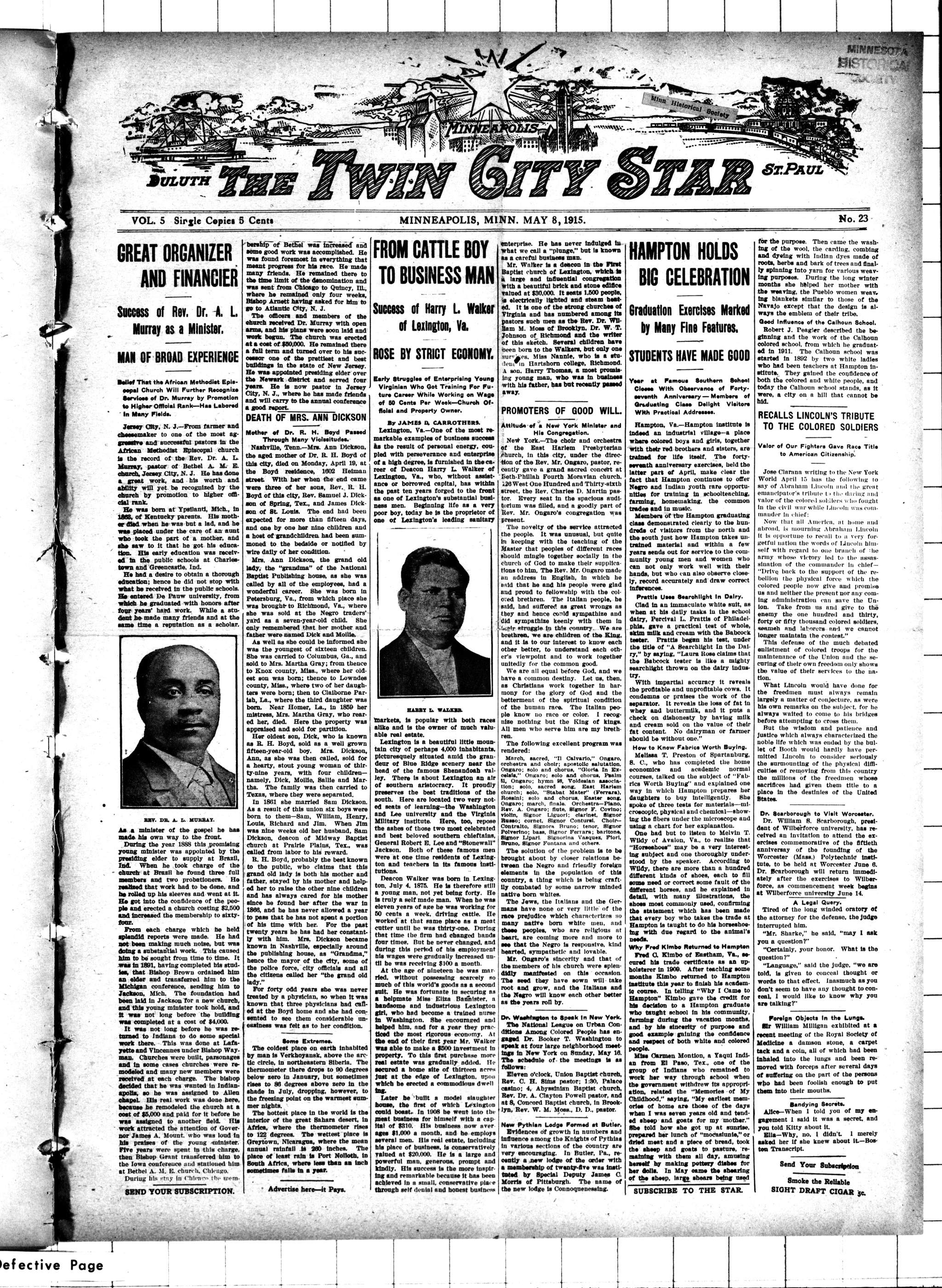
Page text (machine-generated)
MINNEAPOLIS
MINN HISTORICAL SOCIETY
BULUTH THE TWIN CITY STAR ST.PAUL
Defective Page
GREAT ORGANIZER AND FINANCIER
Success of Rev. Dr. A. L. Murray as a Minister.
MAN OF BROAD EXPERIENCE
Belief That the African Methodist Episcopal Church Will Further Recognize Services of Dr. Murray by Promotion to Higher Official Rank—Has Labored in Many Fields.
Jersey City, N. J.—From farmer and cheesemaker to one of the most aggressive and successful pastors in the African Methodist Episcopal church is the record of the Rev. Dr. A. L. Murray, pastor of Bethel A. M. E. church, Jersey City, N. J. He has done a great work, and his worth and ability will yet be recognized by the church by promotion to higher official rank.
He was born at Ypsilanti, Mich., in 1863, of Kentucky parents. His mother died when he was but a lad, and he was placed under the care of an aunt who took the part of a mother, and she saw to it that he got his education. His early education was received in the public schools at Charlestown and Greencastle, Ind.
He had a desire to obtain a thorough education; hence he did not stop with what he received in the public schools. He entered De Pauw university, from which he graduated with honors after four years' hard work. While a student he made many friends and at the same time a reputation as a scholar.
REV. DR. A. L. MURRAY.
As a minister of the gospel he has made his own way to the front.
During the year 1888 this promising young minister was appointed by the presiding elder to supply at Brazil, Ind. When he took charge of the church at Brazil he found three full members and two probationers. He realised that work had to be done, and he rolled up his sleeves and went at it. He got into the confidence of the people and erected a church costing $2,500 and increased the membership to sixty-four.
From each charge which he held splendid reports were made. He had not been making much noise, but was doing a substantial work. This caused him to be sought from time to time. It was in 1891, having completed his studies, that Bishop Brown ordained him an elder and transferred him to the Michigan conference, sending him to Jackson, Mich. The foundation had been laid in Jackson for a new church, and this young minister took hold, and it was not long before the building was completed at a cost of $4,000.
It was not long before he was returned to Indiana to do some special work there. This was done at Lafayette and Vincennes under Bishop Wayman. Churches were built, parsonages and in some cases churches were remodeled and many new members were received at each charge. The bishop decided that he was wanted in Indianapolis, so he was assigned to Allen chapel. His real work was done here, because he remodeled the church at a cost of $5,000 and paid for it before he was assigned to another field. His work attracted the attention of Governor James A. Mount, who was loud in his praises of the young minister. Five years were spent in this charge, then Bishop Grant transferred him to the Iowa conference and stationed him at Bethel A. M. E. church, Chicago. During his stay in Chicago the mem-
SEND YOUR SUBSCRIPTION.
borship of Bethel was increased and some good work was accomplished. He was found foremost in everything that meant progress for his race. He made many friends. He remained there to the time limit of the denomination and was sent from Chicago to Quincy, Ill., where he remained only four weeks, Bishop Arnett having asked for him to go to Atlantic City, N. J.
The officers and members of the church received Dr. Murray with open arms, and his plans were soon laid and work begun. The church was erected at a cost of $80,000. He remained there a full term and turned over to his successor one of the prettiest and best buildings in the state of New Jersey. He was appointed presiding elder over the Newark district and served four years. He is now pastor in Jersey City, N. J., where he has made friends and will carry to the annual conference a good report.
DEATH OF MRS. ANN DICKSON
Mother of Dr. R. H. Boyd Passed Through Many Violations.
Nashville, Tenn.—Mrs. Ann Dickson, the aged mother of Dr. R. H. Boyd of this city, died on Monday, April 19, at the Boyd residence, 1602 Helm street. With her when the end came were three of her sons, Rev. R. H. Boyd of this city, Rev. Samuel J. Dickson of Spring, Tex., and James Dickson of St. Louis. The end had been expected for more than fifteen days, and one by one her nine children and a host of grandchildren had been summoned to the bedside or notified by wire daily of her condition.
Mrs. Ann Dickson, the grand old lady, the "grandma" of the National Baptist Publishing house, as she was called by all of the employees, had a wonderful career. She was born in Petersburg, Va., from which place she was brought to Richmond, Va., where she was sold at the Negro traders' yard as a seven-year-old child. She only remembered that her mother and father were named Dick and Mollie.
As well as she could be informed she was the youngest of sixteen children. She was carried to Columbus, Ga., and sold to Mrs. Martha Gray; from thence to Knox county, Miss., where her oldest son was born; thence to Lowndes county, Miss., where two of her daughters were born; then to Claiborne Parish, La., where the third daughter was born. Near Homer, La., in 1859 her mistress, Mrs. Martha Gray, who reared her, died. Here the property was appraised and sold for partition. Her oldest son, Dick, who is known as R. H. Boyd, sold as a well grown fifteen-year-old boy. Mrs. Dickson, Ann, as she was then called, sold for a hearty, stout young woman of thirty-nine years, with four children—namely, Dick, Mollie, Sallie and Martha. The family was then carried to Texas, where they were separated. In 1861 she married Sam Dickson. As a result of this union six boys were born to them—Sam, William, Henry, Louis, Richard and Jim. When Jim was nine weeks old her husband, Sam Dickson, deacon of Midway Baptist church at Prairie Plains, Tex., was called from labor to his reward.
R. H. Boyd, probably the best known to the public, who claims that this grand old lady is both his mother and father, stayed by his mother and helped her to raise the other nine children and has always cared for his mother since he found her after the war in 1866, and he has never allowed a year to pass that he has not spent a portion of his time with her. For the past twenty years he has had her constantly with him. Mrs. Dickson became known in Nashville, especially around the publishing house, as "Grandma," hence the mayor of the city, some of the police force, city officials and all the citizens called her "the grand old lady." For forty odd years she was never treated by a physician, so when it was known that three physicians had cafed at the Boyd home and she had consented to see them considerable uneasiness was felt as to her condition.
Some Extremes.
The coldest place on earth inhabited by man is Verkhoyansk, above the arctic circle, in northeastern Siberia. The thermometer there drops to 90 degrees below zero in January, but sometimes rises to 86 degrees above zero in the shade in July, dropping, however, to the freezing point on the warmest summer nights. The hottest place in the world is the interior of the great Sahara desert, in Africa, where the thermometer rises to 122 degrees. The wettest place is Greytown, Nicaragua, where the mean annual rainfall is 260 inches. The place of least rain is Port Nolloth, in South Africa, where less than an inch sometimes falls in a year.
Advertise here—it Pays.
MINNEAPOLIS, MINN. MAY 8, 1915.
FROM CATTLE BOY TO BUSINESS MAN
Early Struggles of Enterprising Young Virginian Who Got Training For Future Career While Working on Wage of 50 Cents Per Week-Churoh Official and Property Owner.
By JAMES D. CARROTHERS.
Lexington, Va.—One of the most remarkable examples of business success as the result of personal energy, coupled with perseverance and enterprise of a high degree, is furnished in the career of Deacon Harry L. Walker of Lexington, Va., who, without assistance or borrowed capital, has within the past ten years forged to the front as one of Lexington's substantial business men. Beginning life as a very poor boy, today he is the proprietor of one of Lexington's leading sanitary
markets, is popular with both races alike and is the owner of much valuable real estate.
Lexington is a beautiful little mountain city of perhaps 4,000 inhabitants, picturesquely situated amid the grandeur of Blue Ridge scenery near the head of the famous Shenandoah valley. There is about Lexington an air of southern aristocracy. It proudly preserves the best traditions of the south. Here are located two very noted seats of learning—the Washington and Lee university and the Virginia Military Institute. Here, too, repose the ashes of those two most celebrated and best beloved southern chieftains, General Robert E. Lee and "Stonewall" Jackson. Both of these famous men were at one time residents of Lexington and teachers in its famous institutions.
Deacon Walker was born in Lexington, July 4, 1875. He is therefore still a young man, not yet being forty. He is truly a self-made man. When he was eleven years of age he was working for 50 cents a week, driving cattle. He worked at that same place as a meat cutter until he was thirty-one. During that time the firm had changed hands four times. But he never changed, and during this period of his employment his wages were gradually increased until he was receiving $100 a month.
At the age of nineteen he was married, without possessing scarcely so much of this world's goods as a second suit. He was fortunate in securing as a helpmate Miss Eliza Bannister, a handsome and industrious Lexington girl, who had become a trained nurse in Washington. She encouraged and helped him, and for a year they practiced the most rigorous economy. At the end of their first year Mr. Walker was able to make a $500 investment in property. To this first purchase more real estate was gradually added. He secured a home site of thirteen acres just at the edge of Lexington, upon which he erected a commodious dwelling.
Later he built a model slaughter house, the first of which Lexington could boast. In 1908 he went into the meat business for himself with a capital of $310. His business now averages $1,000 a month, and he employs several men. His real estate, including his place of business, is conservatively valued at $20,000. He is a large and powerful man, generous, prompt and kindly. His success is the more inspiring and remarkable because it has been achieved in a small, conservative place through self denial and honest business
enterprise. He has never indulged in what we call a "plunge," but is known as a careful business man.
Mr. Walker is a deacon in the First Baptist church of Lexington, which is a large and influential congregation with a beautiful brick and stone edifice valued at $30,000. It seats 1,500 people, is electrically lighted and steam heated. It is one of the strong churches of Virginia and has numbered among its pastors such men as the Rev. Dr. William M. Moss of Brooklyn, Dr. W. T. Johnson of Richmond and the writer of this sketch. Several children have been born to the Walkers, but only one surveys. Miss Nannie, who is a student in Hartshorn college, Richmond. A son, Harry Thomas, a most promising young man, who was in business with his father, has but recently passed away.
PROMOTERS OF GOOD WILL
Attitude of a New York Minister and His Congregation.
New York.—The choir and orchestra of the East Harlem Presbyterian church, in this city, under the direction of the Rev. Mr. Ongaro, pastor, recently gave a grand sacred concert at Beth-Phillah Fourth Moravian church, 120 West One Hundred and Thirty-sixth street, the Rev. Charles D. Martin pastor. Every seat in the spacious auditorium was filled, and a goodly part of Rev. Mr. Ongaro's congregation was present.
The novelty of the service attracted the people. It was unusual, but quite in keeping with the teaching of the Master that peoples of different races should mingle together socially in the church of God to make their supplications to him. The Rev. Mr. Ongaro made an address in English, in which he said that he and his people were glad and proud to fellowship with the colored brethren. The Italian people, he said, had suffered as great wrongs as they and hence could sympathize and did sympathize keenly with them in their struggle in this country. We are brethren, we are children of the King, and it is to our interest to know each other better, to understand each other's viewpoint and to work together unitedly for the common good.
We are all equal before God, and we have a common destiny. Let us, then, as Christians work together in harmony for the glory of God and the betterment of the spiritual condition of the human race. The Italian people know no race or color. I recognize nothing but the King of kings. All men who serve him are my brethren.
The following excellent program was rendered:
March, sacred, "Il Calvario," Ongaro, orchestra and choir; apostolic salutation, Ongaro; solo and chorus, "Gloria In Excelsis," Ongaro; solo and chorus, "Pasim Gharang," Ongaro; byrne, Vollesan assaquit; solo, sacred song, "East Harlam church; solo, "Stabat Mater" (Ferrara), Rossini; solo and chorus, Easter song, Ongaro; march, finale. Orchestra—Plano, Rev. A. Ongaro; flute, Signor F. Covino; violin, Signor Liguori; clarinet, Signor Russo; cornet, Signor Contural, Choir; Signor Gharang, Signor Gharang; Polverino; bass, Signor Ferrara; bartons, Signor Lipart, Signorina Vasquez, Florl, Bruno, Signor Fontana and others.
The solution of the problem is to be brought about by closer relations between the Negro and friendly foreign elements in the population of this country, a thing which is being craftily combated by some narrow minded native born whites.
The Jews, the Italians and the Germans have none or very little of the race prejudice which characterizes so many native born white men, and these peoples, who are religious at heart, are coming more and more to see that the Negro is responsive, kind hearted, sympathetic and lovable.
Mr. Ongaro's sincerity and that of the members of his church were splendidly manifested on this occasion.
The seed they have sown will take root and grow, and the Italians and the Negro will know each other better as the years roll by.
Dr. Washington to Speak in New York.
The National League on Urban Conditions Among Colored People has engaged Dr. Booker T. Washington to speak at four large neighborhood meetings in New York on Sunday, May 16.
The schedule of the meetings is as follows:
Eleven o'clock, Union Baptist church, Rev. C. H. Sims pastor; 1:30, Palace casino; 4, Abyssinian Baptist church, Rev. Dr. A. Clayton Powell pastor, and 8, Concord Baptist church, in Brooklyn, Rev. W. M. Moss, D. D., pastor.
New Pythian Lodge Formed at Butler. Evidences of growth in numbers and influence among the Knights of Pythias in various sections of the country are very encouraging. In Butler, Pa., recently a new lodge of the order with a membership of twenty-five was instituted by Special Deputy James C. Morris of Pittsburgh. The name of the new lodge is Connoquenessing.
HAMPTON HOLDS BIG CELEBRATION
Year at Famous Southern School Closee With Observance of Forty-seventh Anniversary—Members of Graduating Class Delight Visitors With Practical Addresses.
Hampton, Va.—Hampton institute is indeed an industrial village—a place where colored boys and girls, together with their red brothers and sisters, are trained for life itself. The forty-seventh anniversary exercises, held the latter part of April, make clear the fact that Hampton continues to offer Negro and Indian youth rare opportunities for training in schoolteaching, farming, homemaking, the common trades and in music.
Members of the Hampton graduating class demonstrated clearly to the hundreds of visitors from the north and the south just how Hampton takes untrained material and within a few years sends out for service to the community young men and women who can not only work well with their hands, but who can also observe closely, record accurately and draw correct inferences.
Prattle Uses Searchlight In Dairy.
Clad in an immaculate white suit, as when at his daily tasks in the school dairy, Percival L. Prattis of Philadelphia, gave a practical test of whole, skim milk and cream with the Babcock tester. Prattis began his test, under the title of "A Searchlight In the Dairy," by saying, "Laura Rose claims that the Babcock tester is like a mighty searchlight thrown on the dairy industry.
With impartial accuracy it reveals the profitable and unprofitable cows. It condemns or praises the work of the separator. It reveals the loss of fat in whey and buttermilk, and it puts a check on dishonesty by having milk and cream sold on the value of their fat content. No dairyman or farmer should be without one."
How to Know Fabrics Worth Buying. Melissa T. Preston of Spartanburg, S. C., who has completed the home economics and academic normal courses, talked on the subject of "Fabrics Worth Buying" and explained one way in which Hampton prepares her daughters to buy intelligently. She spoke of three tests for materials—microscopic, physical and chemical—showing the fibers under the microscope and using a chart for her explanation.
One had but to listen to Melvin T. Wildy of Avalon, Va., to realize that "Horseshoes" may be a very interesting subject and one thoroughly understood by the speaker. According to Wildy, there are more than a hundred different kinds of shoes, each to fill some need or correct some fault of the different horses, and he explained in detail, with many illustrations, the shoes most commonly used, confirming the statement which has been made that every boy who takes the trade at Hampton is taught to do his horseshoeing with due regard to the animal's needs.
Why Fred Kimbo Returned to Hampton Fred C. Kimbo of Eustath, Va., secured his trade certificate as an upholsterer in 1900. After teaching some months Kimbo returned to Hampton institute this year to finish his academic course. In telling "Why I Came to Hampton" Kimbo gave the credit for his decision to a Hampton graduate who taught school in his community, farming during the vacation months, and by his sincerity of purpose and good example gaining the confidence and respect of both white and colored people.
Miss Carmen Montion, a Yaqui Indian from El Paso, Tex., one of the group of Indians who remained to work her way through school when the government withdrew its appropriation, related the "Memories of My Childhood," saying, "My earliest memories of home are those of the days when I was seven years old and tended sheep and goats for my mother." She told how she got up at sunrise, prepared her lunch of "mocastunle," or dried meat and a piece of bread, took the sheep and goats to pasture, remaining with them all day, amusing herself by making pottery dishes for her dolls. In May came the shearing of the sheep, large shears being used
SUBSCRIBE TO THE STAR.
for the purpose. Then came the washing of the wool, the carding, combing and dyeing with Indian dyes made of roots, herbs and bark of trees and finally spinning into yarn for various weaving purposes. During the long winter months she helped her mother with the weaving, the Pueblo women weaving blankets similar to those of the Navajo except that the design is always the emblem of their tribe.
Good Influence of the Calhoun School. Robert J. Peagler described the beginning and the work of the Calhoun colored school, from which he graduated in 1911. The Calhoun school was started in 1892 by two white ladies who had been teachers at Hampton institute. They gained the confidence of both the colored and white people, and today the Calhoun school stands, as it were, a city on a hill that cannot be hid.
RECALLS LINCOLN'S TRIBUTE TO THE COLORED SOLDIERS
Valor of Our Fighters Gave Race Title to American Citizenship.
Jose Clarana writing to the New York World April 15 has the following to say of Abraham Lincoln and the great emancipator's tribute to the daring and valor of the colored soldiers who fought in the civil war while Lincoln was commander in chief:
Now that all America, at home and abroad, is mourning Abraham Lincoln it is opportune to recall to a very forgetful nation the words of Lincoln himself with regard to one branch of the army whose victory led to the assassination of the commander in chief—"Drive back to the support of the rebellion the physical force which the colored people now give and promise us and neither the present nor any coming administration can save the Union. Take from us and give to the enemy the one hundred and thirty, forty or fifty thousand colored soldiers, seameh and laborers and we cannot longer maintain the contest."
This defense of the much debated enlistment of colored troops for the maintenance of the Union and the securing of their own freedom only shows the value of their services to the nation.
What Lincoln would have done for the freedmen must always remain largely a matter of conjecture, as were his own remarks on the subject, for he always waited to come to his bridges before attempting to cross them.
But the wisdom and patience and justice which always characterized the noble life which was ended by the bullet of Booth would hardly have permitted Lincoln to consider seriously the surmounting of the physical difficulties of removing from this country the millions of the freedmen whose sacrifices had given them title to a place in the destinies of the United States.
Dr. Scarborough to Visit Worcester.
Dr. William S. Scarborough, president of Wilberforce university, has received an invitation to attend the exercises commemorative of the fifth anniversary of the founding of the Worcester (Mass.) Polytechnic institute, to be held at Worcester June 6.
Dr. Scarborough will return immediately after the exercises to Wilberforce, as commencement week begins at Wilberforce university June 14.
Legal Query:
Tired of the long winded oratory of the attorney for the defense, the judge interrupted him.
"Mr. Sharke," he said, "may I ask you a question?"
"Certainly, your honor. What is the question?"
"Language," said the judge, "we are told, is given to conceal thought or words to that effect. Inasmuch as you don't seem to have any thought to conceal, I would like to know why you are talking?"
Foreign Objects In the Lungs.
Foreign Objects in the Lungs.
Sir William Milligan exhibited at a recent meeting of the Royal Society of Medicine a damson stone, a carpet tack and a coin, all of which had been inhaled into the lungs and been removed with forceps after several days of suffering on the part of the persons who had been foolish enough to put them into their mouths.
Bandying Secrets.
Banjoing Secrets.
Alice—When I told you of my engagement I said it was a secret, and you told Kitty about it.
Ella—Why, no. I didn't. I merely asked her if she knew about it.—Boston Transcript.
Smoke the Reliable
SIGHT DRAFT CIGAR ke
BETHESDA BAPTIST CHURCH
12th Ave. So. and 8th St.
All are welcome.
Rev. T. J. Carter, Pastor.
Rev. T. J. Carter has moved to
2423 4th Ave. So.
Peoples Christian Assembly.
Rev. G. W. Mitchell, Pastor,
1204 Washington Ave. So.
Come! and Serve the Lord.
ST. PETER'S A. M. E. CHURCH.
22nd St. near 10th Ave. So.
Rev. Thos. B. Stovall, Pastor.
ST. JAMES A. M. E. CHURCH,
318 8th Ave. So., Minneapolis.
Rev. E. R. Edwards, Pastor.
We would appreciate what you owe us, or a part of it, Mr. Delinquent Subscriber.
READ THE STAR-IT'S NEWS
The Elks have announced a contest. The most popular lady will get a trip to Chicago, all expenses paid. Several ladies have entered. Votes are a nickel apiece.
ZION'S TEMPORARY LOCATION
The temporary location of Zion Baptist Church is 607 5th St. No., where regular services are held.
Mr. O. A. Lawrence, the undertaker, is able to get about on crutches. He has suffered during past six weeks from the effects of a sprained ankle.
Wild West Show to Parade on May 10th.
Two Days Exhibition in Minneapolis, May 10th and 11th.
The 101 Ranch Real Wild West Show will exhibit in Minneapolis, two days commencing Monday, May 10th which will give the people of this vicinity an opportunity of seeing the grandest western exhibition ever conceived. From a standpoint of both magnitude and merit this western aggregation is in a class by itself. Three long trains of double length cars are required to convey it through the country, and nearly 1,000 men, women, and horses participate in the performances. On the morning of the day of exhibition, a grand free street parade will be given, which is over a mile in length and full of new and interesting features, including Indians from every tribe not yet extinct. Remember the dates and be sure to attend. One ticket is all that is required to visit every department of the big Show. Following the Minneapolis engagement the show will visit St. Paul, for one day only, Wednesday, May 12th.
Judge Johnson invites you to his Annual May Party on May 10th at Union Temple Hall. Come and Crown the Queen of May.—Advertisement.
COMMENCEMENT ORATOR.
Dr. H. H. Hart to Speak at the Wilberforce University.
President William S. Scarborough of the Wilberforce (O.) university has returned from Jacksonville, Fla., where he spent a few weeks for rest and recuperation, and is pretty well recovered from the effects of the fall which he had the first of the year, in which he sustained two broken ribs. Dr. Scarborough is now busily engaged with arrangements for the commencement and graduation exercises to be held at the university in June. He is in very good health.
While in Florida President Scarborough visited St. Augustine and Daytona. At the latter place is located the great school for women of which Mrs. Mary McLeod Bethune is president. He was the guest in Jacksonville of Mr. A. L. Lewis, one of the most prosperous men of the race in the state.
Extensive plans are being made for the commencement period at Wilberforce university. Dr. H. H. Hart of the Russell Sage foundation, New York city, will be the commencement orator this year at Wilberforce university. Dr. Hart is a brother of Dr. Albert Bushnell Hart of Harvard university and is a graduate of Oberlin college and of Andover Theological seminary. He is a public spirited man, a distinguished scholar and the theologian and is well known throughout the country for his work in connection with the Russell Sage foundation.
Other speakers for the commencement occasion are Dr. John A. Gregg, president of Edward Waters college, Jacksonville, Fla.; Professor A. S. Jackson, commissioner of education of the A. M. E. church, Waco, Tex.; Dr. D. P. Roberts, Indianapolis, Ind., and Chaplain T. G. Steward, D. D.
Dodging an Argument.
Crawford — How do you get your wife to believe what you say when you come home late?
Crabshaw — I first listen to what she accuses me of doing, and then I own up to it. — Judge.
IT PAYS TO ADVERTISE.
GO TO CHURCH The Church Is the Gateway to Real Happiness
GO TO CHURCH The Church Is the Gateway to Real Happiness
There is a hell. No doubt about that. Like heaven, it BEGINS HERE AND NOW. Recently the newspapers carried a story relating the suicide of a well-known man. Ten years before he murdered his young wife and allowed another to be executed for it. He wrote: "I can endure it no longer. Each day the awful secret plunges me into the torment of the damned." For ten years he had lived in hell and then, like Judas, went out into the darkness and hanged himself. No writer, even with an inexhaustible vocabulary, can paint a literal fire equal to the one that exists in many a human soul. If there is no hell, why plan churches, missions, slum settlements?
THE MOMENT A MAN ENTERS A CHURCH HE FEELS BETTER. THE CHURCH IS THE GATEWAY TO HEAVEN. WHY DONT YOU JOIN THE GO TO CHURCH THRONG? YOU'LL FIND THE BEST PEOPLE IN YOUR COMMUNITY IN CHURCH. IF YOU HAVE BEEN A BACKSLIDER GET BUY NOW. IT IS NEVER TOO LATE TO MEND. YOU'LL FIND THAT IF YOU GO TO CHURCH NEXT SUNDAY YOU'LL WANT TO GO TO CHURCH THE FOLLOWING SUNDAY.
There are thousands who would not dream of staying away from church on Christmas day or Easter, but who Sunday after Sunday will miss GOING TO CHURCH. It is to these people that this appeal is particularly addressed. If it is wrong to miss GOING TO CHURCH on Christmas and Easter, why is it not wrong to do so on Sunday?
WHEN THE GO TO CHURCH MOVEMENT GOT INTO FULL SWING A YEAR AGO THERE WAS A SPLENDID RESPONSE. THE CHURCHES WERE FILLED. DON'T LET THIS SPLENDID MOVEMENT DIE OUT. IT IS ONE OF THE BEST—IF NOT THE BEST—AGITATIONS THAT EVER WAS STARTED.
DO YOUR PART.
GO TO CHURCH.
THE KNIGHT'S SUMMER
FESTIVAL
The Uniform Rank of the Knights of Pythians of the Twin Cities will give their "On to Columbus" Dance at the Arcadia Dancing Pavilion, formerly Dreamland, on June 7th. The Committee will make this a grand entertainment.
PEOPLE'S NEW LOCATION
The F. Peoples Realty Company have moved their offices from 236 Botson Block to 325 Fifth Street South, across from the Court House, where they will be pleased to meet old customers and make new friends.
The Odd Fellows of the Twin Cities will hold their Annual Exercises at the Court House on Sunday afternoon, May 9th.
A Tom Thumb Wedding introducing Thos. Donalson, Jr., and Miss Lorene Price, will be one of the features of the concert to be held at Bethesda Church on Monday evening, May 17th, under the auspices of the Dorcas Society, also the "Gathering of the Nations and a 5 piece orchra tra under the direction of Mrs. Maud Canty. Admission 10 cents.—Advertisement.
Mr. Geo. Todd is sick at 1318 Wash. Ave. So., under care of Dr. Brown. He was injured by a street car.
The last meeting of The Forum was well attended.
Mrs. Frank Peoples of Portland Ave., is suffering from a sore throat.
Mr. Schuyler Philips and family have moved to Chicago.
Mr. Arthur White has nearly recovered from his recent illness.
FOR RENT.—5 rooms, modern, without heat, first floor, good location, 1032 Central Ave. S. E., Apply 403 Tribune Annex Bldg.
Glover Shull was indicted by the Grand Jury last week. He was released on his own recognizance and date of trial set for May 10. He is charged with maintaining an unlicensed drinking place and conducting a gambling house.
Mrs. Luther Abbey is the Chairman of The Forum Committee which will present a Drama at an early date.
Ernest Fowler, who seriously cut Geo. Gardner last summer, was sentenced to the State Reformatory last Saturday by Judge Jelly. In passing sentence Judge Jelly told Fowler, that he was lucky not to be held on a more serious charge. He said that his habits and associates were bad and for that reason he would not place him on probation. Fowler was a tough type of the younger element, and his case is a warning to many others.
Mr. F. Peoples has placed three pool tables in rear of his office. He will have a private rest-room for those who desire to spend a while during leisure hours.
FOR RENT.—A nicely furnished room. All modern with telephone. Gentleman preferred. Apply 2100 4th Ave. So. 2nd floor. N. W. So. 671. Mrs. M. Jackson.
TWIN CITY STAR
The Church is the Gateway to Real Happiness
In to be saved.
A doubt about that. Like heaven, it now. Recently the newspapers made of a well-known man. Ten long wife and allowed another to can endure it no longer. Each into the torment of the damned." And then, like Judas, went out himself. No writer, even with an untitled a literal fire equal to the one it. If there is no hell, why plan things?
ERS A CHURCH HE FEELS BETWEEN WAY TO HEAVEN. WHY DON'T THRONG? YOU'LL FIND THE UNITY IN CHURCH. IF YOU BUSY NOW. IT IS NEVER TOO THAT IF YOU GO TO CHURCH YOU GO TO CHURCH THE FOLLOW.
Could not dream of staying away for Easter, but who Sunday after CHURCH. It is to these people addressed. If it is wrong to miss Christmas and Easter, why is it not
MOVEMENT GOT INTO FULL AS A SPLENDID RESPONSE. THE LET THIS SPLENDID MOVE THE BEST—IF NOT THE BEST—STARTED.
ATTY. FRANCIS NEW LOCATION.
Atty. William T. Francis has moved to Suite 329 in the American National Bank Building, Cedar and Fifth Sts., St. Paul.
NEW PALACE RESTAURANT
NEW PALACE RESTAURANT.
Mrs. L. V. Wellington, a former trained nurse, has opened the New Palace Restaurant at 138 E. Third St., St. Paul. First Class a la Carte Service for Ladies and Gentlemen. Boiled Dinners Daily. Sunday Dinner: Chicken and Dumplings 25c. Party Service solicited. Phone Jackson 510.
—Advertisement.
HAIR WEAVING
Hair weaving of every description neatly done by Mrs. McClure, 713 5th St. N. Leave orders also at 2813 Chicago Ave. Phone: So. 1424. —Advertisement
CHOICE CITY AND SUBUR-
BAN PROPERTY FOR SALE
ON SMALL MONTHLY PAY-
MENTS.
Houses and Flats for Rent.
B. M. McDEW,
802 Sykes Block.
N. W. Nic. 621 Minneapolis
GOOD MUSIC AND A GOOD TIME
JUDGE JOHNSON'S
GRAND MAY BALL.
MAY 10, 1915
UNION TEMPLE HALL
28 WASHINGTON AVE. SO.
The Password is "Good Order."
ADMISSION 35c
THE FRANCE CAFE
Regular Dinner will be served daily at The France Cafe, 300 Fifth Ave So. Minneapolis.
SPECIAL SUNDAY DINNER.
Mrs. J. M. Mask, Prop.
FIRST CLASS DRESSMAKING
FIRST CLASS DRESSMAKING.
We do Strictly First Class Dress-
making and Ladies' Tailoring. Our
Prices are Reasonable, Satisfaction
Guaranteed. Apply 415 E. 27th St
Minneapolis. For information, Phone
So. 7996.—Advertisement.
HERE IS A CHANCE.
Price $1,300.00, $100 down and $15
per month will buy a four-room cottage
with full basement and hardwood
finish, practically new, at 3936 Fourth
Ave. So. F. PEOPLES REALTY
COMPANY, 325 Fifth St. S., Phone:
Nic. 2188.
Furnished Rooms, suitable for a
married couple. All conveniences.
Use of kitchen and house privileges
to desirable people only. Call at Mrs.
A. D. Price, 820 E. 36th St., Minneapolis.
For Rent—4-room, neatly furnished
flat on the north side, walking
distance; bath, gas. Reasonable rent to
the right party. For particulars call
Main 3474.
STAR "ADS"—BRING RESULTS
---
HOW IRA ALDRIDGE WON WORLD FAME
Story of His Career on the European Stage.
PLAYED WITH NOTED ACTORS
Wonderful Achievements of a Southern Boy Whose Work as an Interpreter of the Shakeperian Drama Attracted Notice on Two Continents—Lionized by Moscow University Students.
By JOHN E. BRUCE "GRIT."
Ira Aldridge, the great Negro tragédian, left no successor in the profession which he dignified and adorned. That he was a great actor, great in the conception and portrayal of the characters which he assumed, cannot be gainsaid.
Aldridge went to England with Edmund Kean some time in the thirties in a humble capacity, it is said, and while there he cultivated a taste for the stage, which Mr. Kean encouraged in every way.
He was born in Belair, near Baltimore, in 1810 and died at Lodz, in Poland, in 1867. He was nearly six feet in height, well proportioned and of dark complexion and had the manners of a Chesterfield. His great reputation as an interpreter of the Shakespearean drama having reached America, arrangements were in progress for his appearance in New York city and the day fixed for him to sail from England, Aug. 15, 1867. He died April 7 of that year, and so his admirers in America were denied the pleasure of seeing him in the roles in which he captivated his European audiences.
The St. Petersburg correspondent of Le Nord, writing of this distinguished
111
IRA ALDRIDGE.
tragedian under date of Dec. 15, 1859, sald: "The success of the negro actor Ira Aldridge has been wonderful. At his debut people were curious to see an Othello who needed neither crape nor pomade to blacken his face. Many expected tears of laughter rather than tears of emotion when they learned that lago and Desdemona would reply to him in German. (The absence of an English troupe forced him to play with German actors.) Those who counted on this were strongly deceived.
"From his first appearance on the stage the African artist completely captivated his audience by his harmonious and resonant voice and by a style full of simplicity, nature and dignity.
For the first time we had seen a tragic hero talk and walk like common mortals without exaggerated gestures. We forgot that we were in a theater and followed the drama as if it had been a real transaction.
"The scene in the third act when the sentiment of jealousy is roused in the ferocious Moor is the true triumph of Aldridge. At the first word of the wily insinuations you see his eyes kindle, you feel the tears in his voice when he questions lago, then the deep sobs which stifle it, and finally when he is persuaded that his wretchedness is complete a cry of rage, or, rather, a roar like that of a wild beast, starts from his abdomen.
"I still seem to hear that cry. It shilled us with fear and made every spectator shudder. Tears wet his cheeks, his mouth foamed, and his eyes flashed fire. I have never seen an artist identify himself so perfectly with the character which he represents. An actor told me he saw him sob for some moments after his exit from the scene. Everybody, and women, wept Bofleau was right in saying to actors. 'Weep yourselves if you would make others weep.' Rachel in the fourth act of 'Les Horace' is the only artist who ever produced so great an effect."
Mr. Aldridge first appeared at Covent Garden theater. London, as Othello April 10, 1833. In 1848 he played at the Surrey theater, in 1852 he visited Germany, where he played three years, and he was highly spoken of wherever he appeared. The New York Herald correspondent in England at that time had this to say:
"An American Negro named Ira Aldridge has been performing at the Imperial theater in several of Shakespeare's pieces and has met with great applause. His principal character, of course, is Othello, and he portrays the jealous Moor with such truth and envy that even those amateurs who
recollect the great Russian tragedian, Kartugin, acknowledge the superiority of his able successor. In Shylock, too, he shows unusual dramatic powers and, painted and tricked out for the stage, he passes very well by lamplight for the Jew that Shakespeare drew." It is to be regretted that no Negro has as yet risen who is capable of wearing acceptably the mantle laid down with honor by the "Black Roscius." The state of Maryland may with justice lay claim to having produced the greatest Negro statesman and orator, the first Negro astronomer and civil engineer and the greatest and only Negro tragedian worthy the name. What a splendid trinity—Douglass, Banneker and Aldridge, stars of the first magnitude!
When Aldridge died the value of the medals given him by the nobility of Europe in appreciation of his art was estimated at $25,000. He had villas in nine capitals of Europe and was courted by the bluest blood of the old world. So realistic was his portrayal of the character of Othello when he performed in the city of Moscow, in Russia, that the students of the University of Moscow unhitched the horse from his carriage as he was about to enter it at the close of the performance and, lifting him upon their shoulders, placed him in it and drew him in triumph to his hotel. No Negro professional who has since visited Europe has ever been thus honored. Yet he bore his honors with modesty and dignity, the hall marks of real genius and true worth. Aldridge left two talented daughters now living in London. Both are highly musical—one of them a composer, the other a vocalist.
BE KIND TODAY.
Less spent on the dead and more spent on the living would bring about many happy results. Hearts are breaking, loved ones wait, and tears flow all because of the withholding of kind words unspoken and letters never sent. Behold the sad mistakes of others, their remorse, and profit by the same before it is too late. Today, now, speak the loving word, send the tender message, write the letter you put off day by day, and don't wait until you forget it or until bitter memories haunt you.
Look Ahead!
There are some persons who ride all through the journey of life with their backs to the horse's head. They are always looking into the past. They are forever talking about the good old times and how different things were when they were young. There is no romance in the world now, and no heroslam. The very winters and summers are nothing to what they used to be. In fact, life is altogether on a small, commonplace scale. Now, that is a miserable sort of thing. It brings a kind of paralyzing chill over life and petrifies the natural spring of joy that should be forever leaping up to meet the fresh new mericles that the day keeps bringing—Exchange.
HOW LYNCHING ENDANGERS SAFETY OF UNITED STATES
Illegal Taking of Human Life Only Practiced by Univilized Persons.
By BRUCE "GRIT."
Lynching is defined by the lexicographers as that form of lawlessness which defies the regularly constituted authorities and nullifies their powers to act by depriving them of the opportunity to do so whenever and wherever a person has violated a written or unwritten law of those states in which Judge Lynch is supreme.
It does not apply to all crimes, nor is it now operative in all the states of the Union. In a majority of the southern states and in eleven northern states since the war of the rebelion it has assumed dangerous proportions and become a menace rather than a protection to society. Its methods are too drastic and brutal and savior too much of the alleged customs and practices of uncivilized and barbarous peoples to command the favor of those who love justice and right ousness and who necessarily hate all forms of lawlessness, of which this form is the most reprehensible and most dangerous, in that it affects the character and the moral standing of those who tolerate or encourage it.
There never was and there never can be, while there are courts and judges to administer the law, a valid excuse for the lynching of any human being. No nation, no community that excuses, condones or encourages this detestable method of punishing real or imaginary violations of the criminal and moral law can justly lay claim to being civilized. A people are great only when they are willing and ready to yield respect, obedience and homage to the laws by which they have consented to be governed. When irresponsible men in the heat of passion defy these laws and become a law unto themselves, as in some recent lynchings by mobs, the danger to the safety of the republic is not past.
Oldest Business Enterprises Unite. The Union Mutual association, with home office at Atlanta, Ga., has been combined with and absorbed by the Atlanta Mutual Insurance association, of which A. F. Herndon is president and T. K. Gibson secretary. These two companies are among the oldest and largest in the state, and the combined organization represents one of the strongest enterprises conducted by the race.
AT THE CLOSED GATE OF JUSTICE.
But I pass by, the glorious goal un-"Merely a Negro"-in a day like this! won,
-James D. Corrothers in The Century.
MAN OF NEGRO ORIGIN:
He Cites Authorities to Disprove "Pithecanthropos Erectus" Theory.
To the Editor of the Pioneer Press: One of your recent contributors to the Mail Bag makes "pithecanthropos erectus" the Adam of the human family. But according to such well-known authorities as Prof. Augustus H. Kean of the London university, in his "Ethnology" and "Man, Past and Present"; Prof. Giuseppi Sergi, professor of anthropology at the University of Rome, Italy, in his work on "The Mediterranean Races," and our own Prof. William Z Ripley, in his work on "Races of Europe"; Dr. Brinton, in his "Races and Peoples," as well as other scholars versed in this department of knowledge, repudiate the hypotheses postulated by the other scientists, and advocate the following pronouncements as most worthy of the consideration of the scholars learned in the science of anthropology:
First—The present races of Europe are mere offshoots of a primitive race now extinct. This extinct race was an offshoot of an African or Negro race, who migrated from Africa into Europe during the glacial and preglacial period. "Homo sapiens," "homo heidelbergensis," "neanderthalensis," "loanthropos" and all other early European troglodytes had an African, therefore Negro origin.
Chancellor David Starr Jordan of Leland Stanford university virtually says ditto to the conclusions of Ripley, Kean, Sergi and others. And as regards the "Aryan race" of the high schoolroom, why, the science of ethnology can find no trace of its existence. The word "Aryan" means light, learning, culture, education in the arts, science and industries. It is a "linguistic" and not an ethnological term. Theosophical writers and theosophical literature claim that the Anglo-Saxon, Celt, Dane, Teuton and the inhabitants of the United States are mere "subraces" of the great 'root race' which was negroid in character and color, so that the Negro is the "true ancestor of man," and man's primitive home was somewhere in Africa.
From the St. Paul Pioneer Press' Mail Bag.
MANY NEGRO DQLLS BEING
SENT OUT.
Nashville, Tenn.—An announcement was made by the National Negro Doll Company that their rush season, which it usually has during the Christmas, is just now on. This is occasioned, declares the manager of the company, on account of the delay in the importation of material from which these dolls are made. The ship was caught and held as a prize of war and was only recently released, hence, the material did not reach Nashville until Christmas day. But the people, says the manager, were so determined to have the size doll they wanted that they all replied "We will wait to get the big dolls." While hundreds of small dolls were sent out, the manager declares that it was surprising to note that the people wanted the dolls ranging in sizes from SEVENTEEN to THIRTY-SIX inches. The orders are being sent out rapidly. Many of the churches have sent in orders for dolls that they might conduct their bazaars. Dolls will be shipped throughout the year, declares the manager of the Doll Company, as we are ready to fill orders as they come.
---
```markdown
```
Defective Pag
Defective Page
Expert Advice For the Automobile Owner
Queries and Replies Covering Matters of Importance to the Man Who Runs a Car
In washing a car will a mixture of gasoline and water cut the grease? If so, how should it be applied?
No doubt the addition of gasoline to the water in connection with sponging the car will efficiently aid in the cutting of the grease. It would have to be applied either in a spray or sponge, as these are the only two practical methods of mixing it in such a way that it would combine closely enough to form a suitable mixture for cleaning. Kerosene is also frequently used in this manner with success.
I have a car with a two speed rear axle. Whenever I go down hill or over a bump with the clutch out I hear a rattle. What is the cause of this?
The rattle you mention is probably from the idle pinion on the rear axle. In this axle there are two bevel pinions constantly in mesh, and one of these is always running idle, and the particular gear which is delivering the power from the motor depends upon the position of a dog clutch. When the car goes over a rough spot with the clutch out there is a tendency for the drive shaft to revolve at an unequal rate of speed, due to the inequalities of the road, with the result that the idle pinion is alternately thrown backward and forward against the bevel gear, with which it meshes, thus making a rattle. There is always a certain amount of back lash in these gears, and the amount of noise will naturally depend upon the extent of this play. There is nothing serious about this, as the noise occurs only at rare intervals, and then is not the indication of trouble.
Will you kindly tell me how to bend the gasoline and other tube lines in short area without the pipe flattening?
Copper tubing of small diameter can be readily bent into short curves by melting rosin and pouring it into the tube. When this becomes cold it solidifies within the tube, and the tubing can be bent like a piece of solid copper. After the desired bend has been obtained the rosin can be run out by heating the tube with a blow torch. Another method sometimes used is to fill the tube with sand, but the rosin method gives the better results.
Why has a rotary valve engine five or seven cylinders instead of four, six or eight?
The odd number of cylinders gives a more even torque in a rotary cylinder engine. Questions of balance make an even number of cylinders preferable in the conventional type of motor.
Is it possible to start the motor in a car when the self starter fails to work and the crank is missing?
When the starter falls and the hand crank is not available the best method of starting the motor is to jack up one of the rear wheels so that it will turn without touching the ground. Then place the gear shift lever in high, and a few turns of the uplifted wheel will start the motor. Place the gear shift lever in neutral before letting down the jacked up wheel or you will have a runaway on your hands, or at least the motor will stall, and you will have all your work to do over again. Properly done the entire operation takes only a few moments.
What are the common causes for a motor missing fire?
Missing fire may be caused by an overrich or too lean mixture, by poor valve adjustment, inaccurate valve or ignition timing, leaks around the spark plugs, cylinder plugs, manifolds, etc., loose ignition wires, weak magneto magnets, water in fuel, faulty spark plugs or those with poorly adjusted electrodes, carbon deposits in the cylinders and overloading.
When I throttle my car down on high gear it begins to jump and jerk as though the clutch were slipping. The clutch is all right, however. What can be the trouble?
The jumping and jerking action is probably due to the motor missing fire, caused either by poor ignition or faulty carburetion at low engine speeds. Mixtures may be too lean or too rich, there may be leaks in the intake manifold, or the spark plug points may be too far apart or too near together. Look at them first and see that they are spaced a thirty-second of an inch apart. Then see that your vibrators are adjusted. If the trouble is still in evidence your magneto magnets may be weak and require recharging.
What is the advantage or disadvantage of the cantilever spring in regard to the three-quartile elliptic?
The main advantage of the cantilever spring over the three-quarter elliptic is that it will give the same carrying capacity with the proper flexibility with considerably less weight. Another advantage lies in its slow period of vibration and the ability to eliminate rebound to a great extent. The weight of a cantilever is nearly all unsprung weight.
In the disadvantages the principal one is that a stiff frame is necessary and that a roll is given to the body when the car turns a corner.
STAR "ADS"—BRING RESULTS
How can one tell when a magneto needs remagnetizing?
When the magnets will not lift and hold about fifteen pounds they are said to be weak. Missing fire at low speeds is the result of weak magnets. When this occurs the magnets should be recharged.
What are the respective advantages and disadvantages of the T head and L head types of motors?
The T head motor, because its valves are located on opposite sides, allows of the use of large valves, and hence more power is obtainable than in the L head variety, other things, of course, being equal. It is usually more costly to construct than the L head type and has a more symmetrical appearance. The T head, however, is heavier and more complicated than the L head design, the latter using only one cam shaft and having the valves all on one side.
What are the advantages and disadvantages of the valve in the head motor?
The chief advantage claimed for the valve in the head motor is that, for a given size, it has more power than an L head or T head, because of the fact that larger valves may be used and the combustion chamber given a more spherical shape. There are a number of manufacturing advantages, one of which is that the entire combustion chamber may be machined and given a high polish, thus preventing, to a great extent, the accumulation of carbon.
The loss of heat through the cylinder walls of a motor depends to a great extent upon the surface of the walls, and in a properly designed valve in the head motor this wall area is small, compared with that of another type of the same size. This reduction of wall area is obtained because of the absence of valve pockets.
The main disadvantage of the valve in the head motor, especially one using valve cages, is that the valve seats cannot be cooled as effectively as if the seat were a part of the casting. This is true in the cage construction, because the heat, in order to get from the valve seat to the water jacket, must overcome the resistance of the joint between the cage and the cylinder casting. This lack of cooling would not materially affect the inlet valves, as they are kept comparatively cool by the incoming gas, but it would mean more valve grinding in the case of the exhaust valves.
Is it possible to maintain pressure in a rear fuel tank when the tank cap is missing?
In cases of this sort take an old inner tube, cut out a piece about eight or ten inches long, tie one end tightly, so as to be air tight, then insert the tied end into the tank. Next remove the valve connection from the pump, insert the hose in the open end of the tube and pump until the tube completely fills the hole in the tank. Then tie the outer end securely. This contrivance will hold several pounds pressure in the tank and will last for some time.
Is three-eighths of an inch too much play in the wrist pin bushing?
Three-eighths of an inch is entirely too much play for the wrist pin bushing, assuming that up and down play is meant. There should be so little play that it cannot be felt by a movement of the wrist pin.
Can I silverize glass reflectors? If so, what are the ingredients and in what proportions are they used?
An amateur can silverize reflectors, but it is very difficult to make a good job of it. The method by which this work has been carried out is as follows: First fasten to a block of wood the finest possible grade of emery cloth. With this the reflector is smoothed down to a fine finish. It is next necessary to have a melting pot and a thermometer which is capable of measuring more than 212 degrees. Two ounces of lead, two ounces of tin and four ounces of chemically pure bismuth are melted together. Eight ounces of mercury are added at 212 degrees F. and mixed with the melted mixture. This is applied while warm with a smooth camel's hair brush.
Which will give the better results, 60 or 74 test gasoline?
As between 60 and 74 test gasoline, the 60 test fuel has been found to give the best results as far as mileage is concerned. The gasoline which we get nowadays is much heavier than that on the market, say, five or ten years ago.
Can an expert gain any advantage by changing from automatic to hand control in a battery ignition system?
A skilled driver might get better results with a hand control of the spark than could be obtained with the automatic type of ignition control for the reason that grade climbing can be accomplished much easier and the loads of the motor considered. In other words, the driver can shift his spark to suit road and motor conditions and thus get the highest efficiency at all times.
Send Your Subscription
TW IN CITY STAR
TUSKEGEE PROUD OF BRIDGEFORTH
Teacher of Agriculture at Noted School Stands High. WORK BENEFITS THE MASSES
Blessed With Special Training For His Chosen Profession, Head of Important Department of Institution Says He Is Only Humble Worker Holding Up Principal's Hands.
Tuskegee, Ala.—One of the most important departments at Tuskegee institute and of which Dr. Booker T. Washington is proud is the department of agriculture, which, like the other departments, has an expert at the head, a man with experience, training and ability. These qualities are possessed by Professor George R. Bridgeforth, whose early life was spent in Athens, in the northern part of the state and in Limestone county.
He is yet a young man. His first graduation was from Trinity school in 1894, then at Talladega college, where he graduated in 1897, but he felt that he was not yet prepared for his chosen line, so he took a course at the Massachusetts Agricultural college, finishing in 1901.
Having finished his training, the next thing was to work. He accepted a position with the late William H. Council at Normal, Ala., where he remained one year, after which he accepted a position with Dr. Booker T. Washington in the agricultural department. Of course he was not at the head, but one of the instructors and workers. This was thirteen years ago. He con-
M. B.
GEORGE R. BRIDGEFORTH.
vinced Dr. Washington and those around the school that he understood the business.
Merit wins in Tuskegee. So when there was a vacancy at the head of the department Dr. Washington decided that he had the right man there. So six years ago Mr. Bridgeforth was placed at the head and has been conducting the work of the department ever since. Like other heads of departments, he has tried to make improvements and has been indeed successful. In the department now are to be found eighteen instructors, with a complete outfit for teaching from 300 to 500 students both theoretical and practical agriculture. It should be of interest to know that there are 850 students studying agriculture.
This young man has not alone been devoting his time to the students, but he has been of help to the farmers by conducting what is known as farmers' short courses and movable schools for Macon county as well as other counties in the state. He has contributed toward the improvement of the village around Tuskegee, and through his efforts two land companies have been organized—the Southern Small Land company and the Tuskegee Farm and Improvement company. He is president of the former and vice president of the latter.
It is of interest to know that this department does $185,000 worth of business every year. With the new agricultural building and the veterinary hospital, recently donated, there is a new canning factory, a cold storage, barns put in the agricultural campus, a 1,000 acre farm, a truck garden of forty acres, an orchard of 100 acres and live stock consisting of 600 hogs, 125 horses and mules and 150 cattle.
The latest addition to the department is a postgraduate course. The young men from this course are making good and at the same time demanding good salaries. The demands are much larger than the supply.
In speaking of his work Mr. Bridgeforth says: "I am one of the humble workers at Tuskegee institute, holding up the hands of the principal and working with him for the advancement of our people. Dr. Washington is a strong and great help in every particular in trying to develop this department. Our students combine theory and practice in helping the public."
Annual Meeting of Educators July 28-9. The twelfth annual meeting of the National Association of Teachers In Colored Schools will be held in Cincinnati, O., beginning on Wednesday, July 28. The association was organized in 1904 and is doing splendid work.
SUITS
$25.00
OVERCOATS
$25.00
Cleaning
Pressing
Repairing
CLIFFORD A. SMITH.
421 UNIVERSITY AVE., ST. PAUL
N. W. PHONE DALE 3823.
SMOKE THE BEST 5C CIGAR Sight Draft
W. S CONRAD CO., Distributors
NO. 140. E. 6th ST., ST. PAUL.
NO. 1. WESTERN AVE., MINN.
Peterson, The Druggist
1501 Washington Ave. So.
TOILET ARTICLES, DRUGS
PRESCRIPTIONS.
He Solicits You Patronage.
SPECIAL SAMPLE SHOES.
POPULAR PRICED SHOE RE-
PAIRING.
WE FIX 'EM WHILE YOU WAIT.
Men's Sewed Soles ... 75c
Ladies Sewed Soles ... 65c
Men's Nailed Soles ... 50 and 60c
Rubber Heels, ... 40c
Ladies' and Boys' nailed soles ... 40c
SEVEN CORNERS SHOE REPAIR SHOP
1424 Washington Avenue South.
Phones: Res. Hyland 2043
N. W. Nicollet 1380
Trl-State Center 2862
LOUIS WINTHROP
LAWYER
308-9 Northwestern Bank Bldg.,
Cor. Marquette Ave. and Fourth St.
MINNEAPOLIS, MINN.
Office Hours Sundays
9:30 a. m. to 12:30 p. m. 10:00 to 1:00 p. m.
2:00 to 4:00 and 5:00 to 6:30 p. m.
R. S. BROWN, M. D.
OFFICE
405-408 Tribune Annex Building
67 Fourth St. So.
Residence: 608 E. 14th St.
Telephones:
N. W. Main 2388 N. W. Main 2040
Trl-State Center 2674 Trl-State Cen. 691
Judge Johnson's Dances
The Easter Ball given by Judge Johnson closed his winter series of dances. His next dance will be held early in May. Watch for the date.
HATS! HATS!! HATS!!! Special Easter Bargains.
Special Easter Bargains.
I am selling out a Select Stock of
Latest Style Hats. Every one a Bargain.
Each a different Style. A Special Line of Hair Braids and Transmissions.
Madam Hart, Milliner,
1210 Washington Ave. S., Minneapolis
MRS. H. I. WILLIAMS.
TYPEWRITER, STENOGRAPHER
Atty. Francis' office.
329 AM. BANK BLDG.
St. Paul, Minn.
Office, Nic. 1963 Res. Celfax 1638.
DR. J. H. REDD,
Physician and Surgeen.
111 SO. 6TH ST.
Minneapolis, Minn.
DR. W. H. WRIGHT.
DENTIST.
Phone Nic. 1963
111 So. 6th St Minneapolis, Minn.
ALL WORK GUARANTEED
Work Called For and Delivered
Phone Main 3474.
THE BEST WORK IN THE CITY
Supervised Personally by
MRS. SUSIE JOHNSON, Prop.
Formerly of St. Paul
604 No. 5th St., Minneapolis
PRICES REASONABLE
STAR "ADS"—BRING RESULTS
SUITS
$25.00
OVERCOATS
$25.00
Cleaning
Pressing
Repairing
Pool and Billiards
GIBSON AND YANCY PROPRIETORS.
A COMPLETE LINE OF CIGARS
AND TOBACCO.
627-5th St. No., Minneapolis
THE FRANK
CHOP-SUEY -- VO
REGULAR DINNER AND
THE PL
Best Accommodation
EXCELLENT COOKING
300 - 5th Ave.
MRS. J. M. MASK, PROP.
Best Bargain
Furn
BOUT
5th Street South
CHOP-SUEY VOCAL ENTERTAINER
REGULAR DINNER AND A LA CARTE SERVICE
THE PLACE TO DINE
BOUTELL'S
THE SOUTHERN THEATRE
1422 Washington Ave. So.
MOVING PICTURES—VAUDE-
VILLE.
Best Films—Thoroughly Fireproof.
DAN'S RESTAURANT
306 So. 3rd St., Minneapolis
HOME COOKING My Specialty
N. W. Main 2767
Daniel Williams, Prop.
BELGIAN CONGO NATIVES.
Their Habits and Customs Videly De-
briefed by Dr. W. H. Sheppard.
SERVED by Dr. W. H. Sheppard
Everyday life in the Belgian Kongo was graphically described by Dr. William H. Sheppard of Louisville, KY., at a recent Sunday evening chapel service at the Hampton (Va.) institute, Dr. Sheppard, who became some years ago a fellow of the Royal Geographical society on account of his African explorations and studies, told the Hampton workers and students about his early experiences as a missionary.
In March, 1800, the son of Judge Lapsley, a young white man of Alabama, and Dr. Sheppard made their way into the Kongo region and after many difficulties reached the Kassai river, known to the natives as the "river of spirits" on account of the number of people annually taken by the crocodiles. Dr. Sheppard said:
When Mr. Lapsley was lying in the cane sock with the fever some natives came forward with spears and were going to kill him and his coworker. Dr. Sheppard faced the hostile people to save the life and wounded him. He was wounded known among the natives as the "Pathfinder," because of his ability to find his way into the heart of the country and into the hearts of the natives.
After the death of Mr. Lapsley I continued my missionary work by establishing a Sunday school and bringing Christ's message to the natives. The African natives who live under the cruel hand of superstition are to be sympathized with. The twitching of the hand, the snake crossing the trail, the hooting of the owl in the jungle are all signs of some unforeseen danger. Going to the church, the owl on a path a crowd went around it on the same side, not allowing it to part them. A man going on a journey, if he stubbed his toe, would never go on; he would stop and spit in the place and go back home. If a man is accused of stealing he is but one hand in boiling water three times, he is not scalded he is considered innocent.
We watched a man who had been accused plunge his arm in up to the elbow—one, two, three times. The skin began to peel off. He was called guilty and was taken to the court. The accused came before the witch doctors. They put pepper in the girls' eyes and hold it tight with a copper wire and say, "If you are not guilty it will not burn you." I have seen a girl going around for tears with sick and swollen eyes, the face is red and the witch guilty. The day of the witch doctor is passing in Central Africa. The natives are learning that Christian doctors and teachers can help them more than the witch doctors. Christianity is taking possession of the hearts of the natives. The natives describe in detail the economic and social life of the natives.
In spite of the fact that his life was nearly taken because he dared to reveal the atrocities committed in the Belgian Kongo by the officers of King Leopold, Dr. Sheppard has been most willing to give all that he can afford to help the Belgians in their dire distress. Dr. Sheppard made clear that the murder of people in the Kongo, where rubber is such an important commodity, was not sanctioned by the Belgians.
"The African colony known as the Belgian Kongo was the private property of King Leopold. There are many people in Belgium who knew nothing at all about King Leopold's officers cutting off the hands and ears of natives who failed to gather the quantity of rubber expected of them. "The Master has given me the heart and spirit of Hampton," said Dr. Sheppard in conclusion. "I would not hate any man."
READ THE STAR-IT'S NEWS
---
Jno. L. Gibson
PETER H. HARRIS
OVER 65 YEARS'
EXPERIENCE
PATENTS
TRADE MARKS
DESIGNS
COPYRIGHTS & C.
Anyone sending a sketch and description may
quickly ascertain our opinion free whether an
instruction is properly written. HANDBOOK on Patents
sent free. Guest agency for securing patents.
Intents taken through Hamm & Co. receive
special notice, without charge, in the
Scientific American.
A handsomely illustrated weekly. Largest dri-
tions of your application monthly. German
years; four months. $1. Sold by all newadvertisers.
MUNN & Co. 364 Broadway - New York
Branch Office, 625 F St., Washington, D.C.
THE BIG THREE
invite you
The same courteous treatment will be shown our many friends of the Twin Cities as has been shown in the seasons past. Dances on the first and third Tuesdays in each month at ARCADE HALL 1311 Wash. Ave. S., Minneapolis ADMISSION, 25c Respectfully Yours, Edw. Pipkin, P. H. Southall and Robert Glenn.
MR. JOHN A. WITHERS.
He can save you from $1 to $5 on moving household goods—also on storage.
He will move your Pianos, Baggage, called for and Delivered. Rubbish Removed. Call on him for your Coal and Wood.
LET WITHERS DO IT!
Give him a Tral and be Satisfied. He solicits your patronage, and is entitled to it. He must have it.
CALL UP MAIN 3474.
J. A. WITHERS,
504 6th Ave. No., Minneapolis
PROF. HOWARD'S LATEST HIT.
Prof. W. H. Howard, the well known musical instructor of III So.
on Sir, is the composer of "I Wonder" one of the largest musical selections. The words are by Burt Shinkle. This song is sold at leading music stores and its popularity is assured. Nearly one thousand copies of
poser of "I Wonder" one of the la
test musical selections. The words
are by Burt Shinkle. This song is
sold at leading music stores and
its popularity is assured. Nearly one
thousand copies of
this song has been sold since 1915.
THE SPIRELLA CORSET
Mrs. Cora Anderson Carr
365 Aurora Ave.
N. W. Dale 1345 St. Paul, Minn.
PUBLSHED EVERY FRIDAY BY
CHARLES SUMNER SMITH,
1419 Washington Ave. So.
Minneapolis, Minnesota.
Entered in the Post Office at Minneapolis as second class matter.
MEMBER
NATIONAL NEGRO PRESS
ASSOCIATION
Subscription by Mall, Postpaid.
ONE YEAR ..... $2.00
SIX MONTHS ..... 1.00
THREE MONTHS ..... .65
CANADIAN SUBSCRIPTIONS $2.50
ADVERTISING RATES.
One inch, one insertion, Fifty Cents
Liberal discount given on 3, 6, 9,
Months, or 1 year contracts.
Want Ads .....Twenty-five Cents
Reading Notices, per line, Five Cents
Wedding Announcements, Fifty Cents
Card of Thanks .....One Dollars
In Memoriam .....One Dollar
Business Announcements, One Dollar
Death Notices .....Fifty Cents
When writing for the press, don't
abbreviate your words. Spell each
one out correctly and distinctly. If
you don't it means that all of your
manuscript will have to be rewritten
if there is time. Write on one side of
the paper only.
Address all mail to Twin City Star
1419 Washington Ave. So,
Minneapolis, Minnesota.
NATIONAL DEGENERACY.
Lincoln Abborded Oppresslon
and Denied Hypocrisy
and Despair Hypothesis.
The speech of Abraham Lincoln in 1855 regarding the political situation and the tendency to disregard the rights of human beings to life, liberty and the pursuit of happiness is strikingly applicable to the condition of affairs in this country at the present time.
Mr. Lincoln said:
"I am not a Know Nothing—that is certain. How could I be? How can any one who abhors the oppression of the Negroes be in favor of degrading classes of white people? Our progress in degeneracy appears to me to be pretty rapid. As a nation we began by declaring 'all men are created equal.' "We now practically read it. 'All men are created equal except Negroes.' When the Know Nothings get control it will read, 'All men are created equal except Negroes and foreigners and Catholica.' "When it comes to that I should prefer emigrating to some country where they make no pretense of loving liberty—to Russia, for instance, where despotism can be taken pure and without the base alloy of hypocrisy."
---
WHY NOT BE FAIR WITH THE
NEWSPAPER MAN?
No one has an opportunity of learning the characteristics of individuals more than the publisher of a race paper, and no one has more varied and peculiar experiences. There are those who will pay the subscription as regularly and as promptly as it is due without delay or hesitation, just as they would any other debt. This is the desirable and welcome subscriber. There is another class who subscribe as willingly and will pay the subscription at that time, but it is almost impossible to collect it again, for it is almost impossible to find the individuals as they move from place to place so frequently. Then there is the responsible subscriber who feels that he is good for the subscription but never pays unless a personal demand is made upon him for it. This may ease his conscience, but it is almost as difficult to collect his subscription as it is needed most, as it is to collect from the man who is not responsible. Then there is the subscriber who imagines that every one pays his subscriptions except himself and that the publisher is well to do and does not need the money. He keeps the money in his pocket until it is thawed out by first one process and then another. Some subscribers never intend to pay and by first one subterfuge or another avoid payment until the publisher in self-defense must stop the paper and collect the subscription by legal process when this is possible. Really the subscribers to race papers should feel a deeper interest in their success and adopt the habit of paying for them promptly, and in that way may lighten the burdens of the publisher and insure better and more regular publication of the paper.—Kansas City Sun.
READ THE STAR-ITS NEWS
EQUAL JUSTICE FOR ALL.
Governor Willis of Ohio opposed to Color Line Legislation. By RALPH W. TYLER. Columbus, O. — Governor Frank B. Willis, the new governor of Ohio, has proved himself to be one of the best friends the colored people have ever had in the executive chair. The governor insists that the race shall have a square deal, nothing less and nothing more. Two bills were recently introduced in the general assembly of Ohio which were regarded as not only imical, but positively hostile to the race. The first was a sort of omnibus bill regulating and licensing a number of "branches of limited medicine and surgery" and the other to amend the election laws of the state.
The first provided that chiropodists and masseuses, among other practitioners, should pass an examination in chemistry, physiology, hygiene, anatomy, bacteriology, etc., before being licensed to practice and that if there existed a state association or society in such "branch of limited medicine or surgery" that organization should name the examiner. There happened to be a state pedic society, which, according to the bill, would have the right to name the examiner who would examine chiropodists.
It also happened that this society had drawn the color line—refused to admit colored practitioners as members.
When the matter was brought to the governor's attention he insisted that the state of Ohio could not afford to pass any laws discriminatory against any race and intimated that any such law passed could not become a law with his signature.
The result was the bill was so amended as to exempt from examination all who had been practicing for a period of five years previous to the passage of the bill, and also amended to deny to the state pedic society, because it had drawn the color line, the right to name an examiner. By setting his foot down flat against discrimination Governor Willis secured protection and justice for the colored people of Ohio.
The second bill was that to amend the election laws of Ohio. This bill provided that voters on registering must give their color. Prominent colored men complained to the governor that as the bill did not require the voter to state whether he was Jew or gentle, Irish, German or what not it ought not to require American citizens to state their color. The governor agreed and immediately conferred with the author of the bill, with the result that an amendment was offered and adopted striking out the word "color."
Governor Willis has let it be understood that he is the governor for all the people, and that the colored people are one of the units that form the whole people, and that this unit must and shall receive exact justice so long as he is governor.
NATIONAL LEAGUE DROPS SOCIAL SCIENCE CONTEST.
Organization on Urban Conditions Starts New Campaign of Education.
New York.—A social science contest was held last year by the National League on Urban Conditions Among Colored People for the purpose of arousing an interest in social science studies and social service among the students of colleges affiliated with the league. Only a few students at three or four of the institutions manifested an interest in the contest, and the executive board has thought it best not to hold the contest this year.
The board has decided to use such funds as are available for the time being in enabling Dr. George E. Haynes, the director of the league, to visit several of the colleges to present the claims of social service as a life work and to interview teachers and students interested in the social sciences and social service.
In addition to these visits, steps have been taken toward offering scholarships at different colleges which have developed a sufficient number of social science courses. The first of these is open to candidates this year at Nashville, Penn. The candidates chosen will have an opportunity to study at Fisk university with practical experience in social work in the city. If funds can be secured in subsequent years the plan is to offer other scholarships at other centers that are developing suitable courses of training, and in these efforts the league hopes for the hearty co-operation of all the affiliated colleges.
In order to obtain the largest possible number of applicants from whom to choose the "fellows" for New York and the one for Nashville the educational committee of the league has extended the time for receiving applications from April to May 15, 1915. Applications should be mailed at once to Dr. George E. Haynes, care of National League on Urban Conditions Among Negroes, 2808 Staventh avenue, New York. Application blanks will be furnished either by request of your teacher of sociology at your own institution or by writing Dr. Haynes at the above address.
Signs of Progress at Camp Nelson, Ky. An electric power plant and several business enterprises are signs of thrift noted in the little town of Camp Nelson, in Kentucky. The corporation is governed solely by colored people and from present indications bids fair to become an important business center for the farmers and other rural workees.
TWIN CITY STAR
YEAR BOOK SHOWS OUR INDUSTRY
Editor of the Christian Recorder Pays High Tribute to Head of Research Department of the Tuskegee Institute—Trained in Best Schools and Rich in Experience.
Tuskegee, Ala.—If work counts for anything there is a man connected with the Tuskegee (Ala.) institute whose very name is "work," and that individual is Professor Monroe N. Work of the division of record and research, whose valuable information to the public has been helpful and inspiring almost beyond measure.
We are indebted to Mr. Work for the compilation and information concerning the race to be found in the "Negro Year Book." The one issued for 1914-15 takes the foremost place as an encyclopedia concerning the race. This is the third edition of the "Negro Year Book" which Professor Work has edited and published. This young man was born in North Carolina, but received his education in Kansas, graduating from the public schools of Arkansas City, Kan., in 1892. To fit him for a special line of work he took a theological course in the Chicago Theological seminary, graduating in 1898. It was while in this school that he became interested in the study of sociology. Thus it was the same year of his graduation from the seminary that he entered the University of Chicago.
He remained in the school five years, taking the degree of bachelor of philosophy, and in 1903 took the degree of master of arts, with sociology as a major subject and experimental psychology as a minor study. Mr. Work's thesis for his master's degree was the "Negro's Real Estate Holding In Chicago." This attracted widespread attention and brought forth many comments from the press throughout the country. He showed that the first property owned in Chicago was owned by a member of the Negro race.
His first position was with the Georgia State Industrial college as professor in history and education. This position he held for five years. It was in 1906 that Dr. Booker T. Washington invited him to become a member of the faculty at the Tuskegee institute by the establishment of the department of research, which position was accepted. The result of this work and department is embodied in the "Negro Year Book," which is issued annually. The first was brought out in 1912. This valuable book is to be found in almost every public library of any city of importance in the United States and is much sought after by those who wish accurate information concerning the Negro race. It is used in some of the universities, colleges and normal schools as a textbook in order to acquaint the students of such schools on the facts of Negro history.
Professor Work is one of the busiest men at Tuskegee institute, and his book is being read by thousands of people. It is the one needed work for the public. He has not only given to the world the book, but has written many articles for magazines and other publications. The Christian Recorder, edited by Dr. R. R. Wright at Philadelphia, in reviewing the current issue of Mr. Work's book says:
This is the third edition of the "Negro Year Book," so ably edited by Monroe N. Work, whose special preparation for his work was acquired by several years of study in the Chicago Theological seminary and University of Chicago, from both of which institutions he was graduated, having specialized in sociology and history with particular reference to the Negro and having such teachers as Frederick Starr, Albion W. Small and W. I. Thomas. He was instructor in mathematics and sociology in the Georgia State Industrial college, Savannah, Ga., before assuming his present position. He had made extensive researches into African life, also Negro folklore in America and the subject of Negro crime.
The year book continues to improve. This volume gives a review of the Negro in 1913, covering sixty pages and treating the following phases of racial life: Economic, religious, political, the race question and race literature. The chapter on "the civil status of the negro" is invaluable. Other chapters of interest are "negro soldier heroes," "the church," "education," "music," "painters," "sculptors," "poets and actors," "occupations," "inventions," "agriculture," "Negro towns and settlements," "Negro in business," "crime," "health," "population," "national organizations," "social settlements," "fraternal organizations," "publications" and "bibliographies."
This is without doubt the most valuable compendium of knowledge about Negroes. No man can hope to keep up with the times without it. It is indispensable for editor, teacher, lawyer, business man, politician and social worker.
We are told that the Negroes of Virginia own 1,629,626 acres of land, assessed at $14,156,287; of North Carolina, 1,837,637. The Negroes of Georgia pay taxes on $34,690,447. In 1912 they own 1,215,708 acres.
THE MORAL PHASE OF NEGRO LIFE.
Home Training Most Important.
Says Miss Nannie H. Burroughs
The moral phase of the Negro problem is the most serious part of the whole aggravating question. To improve the standard of the life of the masses is the only solution.
As with other races, the standards in the homes are set up by the women who preside over them. Therefore to bring about a reform the womanhood of the race must be taught how to instruct their children in those virtues, that have made the most advanced races what they are.
We are prone to think that the Negro is by mature religious and therefore moral. He is both; but he is not enough of either when it comes to living up to fundamental principles every day life. Because of his crude conception of what the Christian religion really is he too often practices one thing and preaches another. Often the foremost woman in the church is so far from a model for her less ambitious sisters that they look with contempt upon her and discredit religion. This misrepresentation of the genuine article takes many forms and sometimes the one woman is a combination of all. She allows beer drinking, card playing, and ragtime music in her home. She is loose in her conversation. Her language is often smutty. Her demeanor becomes a woman of the street. Her home is a hangout for "sliding elders" and loafing, hungry preachers. Her house is poorly kept. Her children are too young to be men and women and too old to be children. They are theregore the freshest things in the neighborhood. They run the church. They sit in the front heat, chew gum, talk and keep their "gang" giggling. To speak to them is to throw a match into a magazine of powder.
These wise and talented youngsters of the leading sisters, get into the choir and start trouble for the choristers. They get religion and start trouble for the deacons. These children of too many of those who aspire to leadership in our local churches presume too much on the standing and influence of their mothers and give our churches all kinds of trouble. What we need is a new type of women in our homes as mothers, and a new type of women in our churches as leaders and examples for the young. The wig wearing, gum chewing, beer smelling, mouth running, street trotting, home neglecting, convention fever type of women are out of style, and from them may we soon be delivered.
The struggle for today, is not altogether for today; it is for a vast future.—Abraham Lincoln.
IMPORTANT COMING EVENT.
Commencement Week at Wilberforce University-Beginns June 10.
From present indications in the line of class work, large attendance and general public interest in Wilberforce university the commencement exercises at the university this year will be the largest in every way of any in the history of the school. The speakers for the special exercises thus far chosen outside of the students are Dr. H. H. Hart of the Russell Sage foundation, New York, commencement-orator; Professor A. S. Jackson, commissoner of education for the African Methodist Episcopal church, orator for the literary societies.
Commencement week begins Thursday, June 10, and ends on Thursday, June 17, with the observance of what is known as commencement day. The baccalaureate sermon this year will be delivered by Chaplain T. G. Stewart, D. D., vice president of the university. The faithful work of the president and faculty, the many bearing of the students and the great interest shown in the welfare of the institution by its many friends of both races warrant the belief that Widerforce university is able filling the great mission for which it came into being.
Fond Parent—That youngster of mine is beginning already to have the family traits. You know we gave him a stop watch for a birthday present? Friend—Yes. Fond Parent—Well, sir, within half an hour of the time he first got hold of that timepiece he had found a bowl of water and put it in soak. Richmond Times-Dispatch.
"Certainly. What term, then, would you apply to grass widowhood?" "I suppose that would have to be called an improper fraction."—Richmond Times-Dispatch.
At His Best.
Blobbs — The doctor told Guzzerler drinking was the very worst thing he could do. Slobbs — I guess that doctor didn't know Guzzer or he would have realized that drinking is the best thing he does. Philadelphia Record.
The Worker.
ROOT & HAGEMAN
403-5-7 NICOLLET AVENUE
Women's Fashionable Apparel at.
Popular Prices
COATS, SUITS, DRESSES, WAISTS, SKIRTS,
MILLINERY, GLOVES, HOSIERY and
UNDERWEAR
You are sure of appreciation from anyone to whom you recommend it.
BENJ. JONES (Near Milwaukee Depot) CLARENCE W. BELL
Barber Shop and Pool Room
244 THIRD AVENUE SOUTH
Baths, Shoe Shining and Billiards
LAUNDRY AGENCY—TAILOR SHOP
JACOB REDMAN, FOREMAN,
represent perfection in fine shoemaking
Get acquainted with COMFORT and become one of our
SATISFIED CUSTOMERS.
STANLEY SHOE COMPANY
422 NICOLLET AVENUE
BEN. MARIENHOFF FASHIONABLE TAILOR Phone N. W. Main 4398 318 HENNEPIN AVE. Makes Good Clothes at Moderate Prices
There is strength in pure beer like
Hochstu
LAGER
Brewed under sa
Purest of ingredi
The beer without
PURITY BREW
The Leading Bottle
Brewed under sanitary condition
Purest of ingredients
The beer without a headache
Both Phones.66
Chief Justice Doherty used to relate an experience which befall him during a visit to a country house in Ireland. His friend, the host, sent a car to the railway station to bring him to the place. He had not gone far when the horse became restless and finally upset the car into a ditch. The judge asked the driver how long the animal had been in harness.
"Shure. I've told you—half an hour, sur," answered the driver. "An' the masther said if he carried ye safe he'd buy him."—Pittsburgh Chronicle-Telegraph.
PETER
Kelkotown
The Pint of Lager
PUNITY BREWING CO.
PUNITY MARGLE
Order a Case Today
Lochsteiner
LAGER
and under sanitary condition
of ingredients
beer without a headache
Y BREWING CO.
ading Bottle Beer Brewery
6 MINNEAPOLIS, MINN.
Andors island, among the Bahamas, is ninety miles in length and twenty to forty miles in breadth and most of its extensive area has never been explored. It is an unbroken wilderness, inhabited solely by about 3,500 negroes. It has great forests, seldom penetrated by white men, of mahogany, mastic, ebony, logwood and cedar; swamps, creeks and bayous teeming with wild fowl, including the flamingo, which is found here in vast numbers. No real effort has been made to exploit its resources. It is said to be the only one of the Bahamas which has running streams of water and is surrounded by a series of barrier reefs which provide sheltered water ideal for yachting.
Defective Page