Twin City Star
Saturday, January 1, 1916
Minneapolis, Minnesota
Page text (machine-generated)
Defective Page
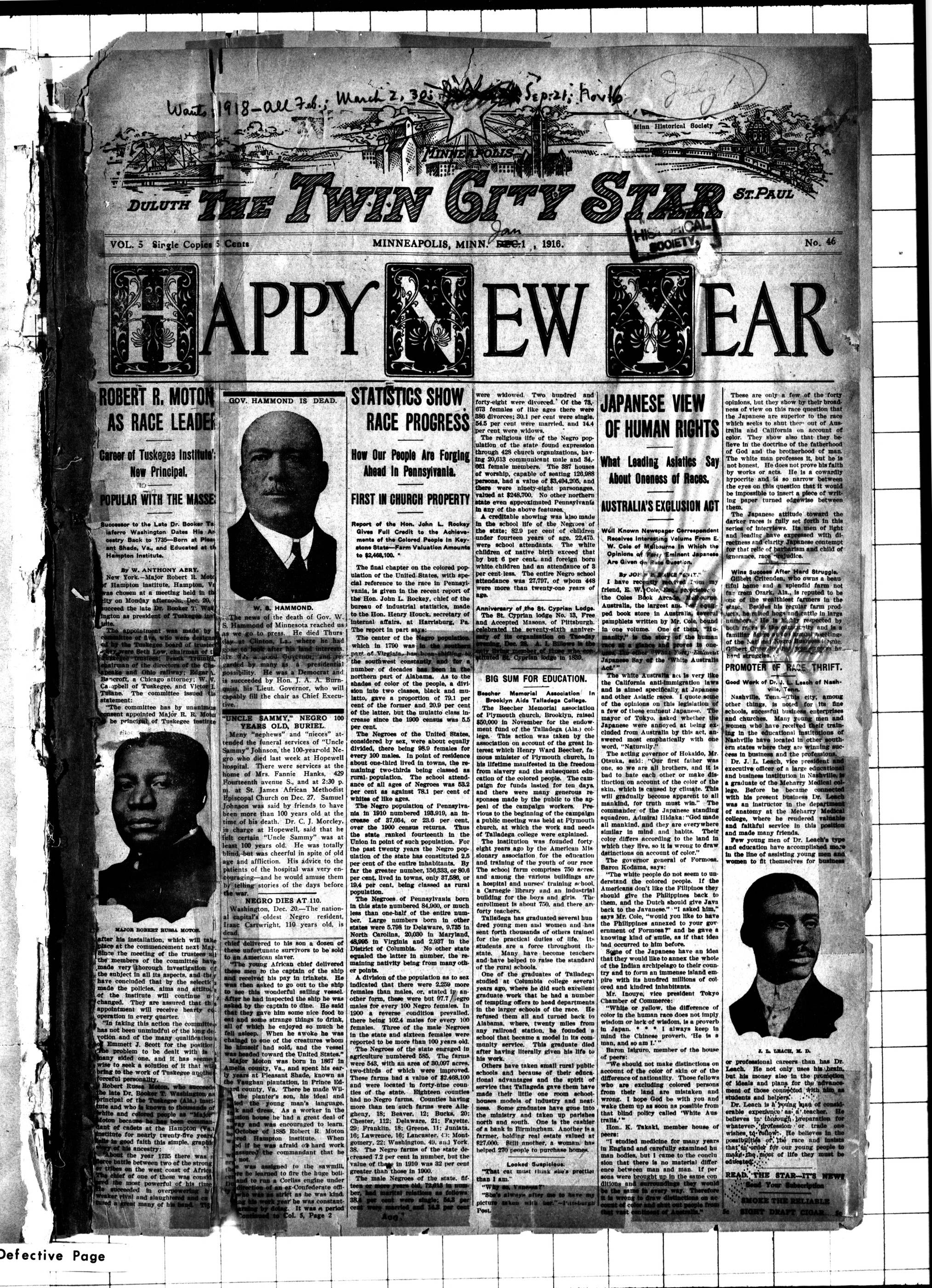
ROBERT R. MOTON
AS RACE LEADER
Career of Tuskegee Institute:
New Principal.
POPULAR WITH THE MASSES
Successor to the Late Dr. Booker T. laferro Washington Dates His Ancestry Back to 1735—Born at Pleasant Shade, Va., and Educated at the Hampton Institute.
By W. ANTHONY ABRY.
New York—Major Robert R. Motto of Hampton Institute, Hampton, Va. was chosen at a meeting held in the city on Monday afternoon, Dec. 20, to succeed the late Dr. Booker T. Wattington as president of Tukeagus institute.
chairman of the directors of the Chaseake and Ohio railway; Edgar A. Bancroft, a Chicago attorney; W. F. Campbell of Tuskegee, and Victor J. Tulane. The committee issued its statement:
"The committee has by unanimous consent appointed Major R. R. Moon to be principal of Tuskegee institute
after his installation, which will take place at the commencement next March. Since the meeting of the trustees all the members of the committee have made very thorough investigation of the subject in all its aspects, and they have concluded that by the selective made the policies, aims and attitude of the institute will continue unchanged. They are assured that this appointment will receive hearty cooperation in every quarter.
"In taking this action the committee has not been unmindful of the long devotion and of the many qualification of Emmett J. Scott for the position. One problem to be dealt with is many sided one, and it has seemed wise to seek a solution of it that will bring to the work of Tuskegee another forceful personality.
Robert Russa Moton, who succeeds the late Dr. Booker T. Washington as principal of the Tuskegee (Ala.) institute and who is known to thousands of white and colored people as "Major Moton because he has been commandant of cadets at the Hampton (Va.) institute for nearly twenty-five years, falls in good faith this simple, graphic story of his ancestry:
About the year 1735 there was a severe battle between two of the strong tribes on the west coast of Africa. The chief of one of these was considered the most powerful of his time, succeeded in overpowering his weaker rival and slaughtered and captured a great many of his hand. TU
ge
GOV. HAMMOND IS DEAD.
The news of the death of Gov. W. S. Hammond of Minnesota reached us as we go to press. He died Thursday at Clinton, La., where he had gone to look after his land interests. He was a good Governor, and regarded by many as a presidential possibility. He was a Democrat and is succeeded by Hon. J. A. A. Burnquist, his Lieut. Governor, who will capably fill the chair as Chief Executive.
Many "nephews" and "nieces" attended the funeral services of "Uncle Sammy" Johnson, the 100-year-old Negro who died last week at Hopewell hospital. There were services at the home of Mrs. Fannie Hanks, 429 Fourteenth avenue S., and at 2:30 p. m. at St. James African Methodist Episcopal Church on Dec. 27. Samuel Johnson was said by friends to have been more than 100 years old at the time of his death. Dr. C. J. Morley, in charge at Hopewell, said that he felt certain "Uncle Sammy" was at least 100 years old. He was totally blind, but was cheerful in spite of old age and affliction. His advice to the patients of the hospital was very encouraging—and he would amuse them by telling stories of the days before the war.
NEGRO DIES AT 110.
Washington, Dec. 20.—The national capital's oldest Negro resident, Isaac Cartwright, 110 years old, is dead.
chief delivered to his son a dozen of these unfortunate survivors to be sold to an American slaver.
"The young African chief delivered these men to the captain of the ship and received his pay in trinkets. He was then asked to go out to the ship to see this wonderful sailing vessel. After he had inspected the ship he was asked by the captain to dine. He said that they gave him some nice food to eat and some strange things to drink, all of which he enjoyed so much he fell asleep. When he awoke he was chained to one of the creatures whom he himself had sold, and the vessel was headed toward the United States."
STATISTICS SHOW RACE PROGRESS How Our People Are Forging Ahead In Pennsylvania. FIRST IN CHURCH PROPERTY
Report of the Hon. John L. Rockey Gives Full Credit to the Achievements of the Colored People in Keystone State—Farm Valuation Amounts to $2,468,100. "
The final chapter on the colored population of the United States, with special reference to the race in Pennsylvania, is given in the recent report of the Hon. John L. Rockey, chief of the bureau of industrial statistics, made to the Hon. Henry Houch, secretary of internal affairs, at Harrisburg, Pa. The report in part says:
The center of the Negro population which in 1790 was in the southern part of Virginia, has been shifting to the southwest constantly and for a number of decades has been in the northern part of Alabama. As to the shades of color of the people, a division into two classes, black and mulatto, gave a proportion of 79.1 per cent of the former and 20.9 per cent of the latter, but the mulatto class increase since the 1900 census was 5.5 per cent.
The Negroes of the United States, considered by sex, were about equally divided, there being 98.9 females for every 100 males. In point of residence about one-third lived in towns, the remaining two-thirds being classed as rural population. The school attendance of all ages of Negroes was 53.2 per cent as against 78.1 per cent of whites of like ages.
The Negro population of Pennsylvania in 1910 numbered 193,919, an increase of 37,064, or 23.6 per cent, over the 1900 census returns. Thus the state ranked fourteenth in the Union in point of such population. For the past twenty years the Negro population of the state has constituted 2.5 per cent of the entire inhabitants. By far the greater number, 156,333, or 80.6 per cent, lived in towns, only 73,596, or 19.4 per cent, being classed as rural population.
The Negroes of Pennsylvania born in this state numbered 84,900, or much less than one-half of the entire number. Large numbers born in other states were 5,798 in Delaware, 9,735 in North Carolina, 20,030 in Maryland, 48,965 in Virginia, and 2,937 in the District of Columbia. No other state equaled the latter in number, the remaining nativity being from many other points.
A division of the population as to sex indicated that there were 2,259 more females than males, or, stated in another form, these were but 97.7, egro males for every 100 Negro females. In 1900 a reverse condition prevailed, there being 102.4 males for every 100 females. Three of the male Negroes in the state and sixteen females were reported to be more than 100 years old. The Negroes of the state engaged in agriculture numbered 585. The farms were 543, with an area of 30,007 acres, two-thirds of which were improved. These farms had a value of $2,468,100 and were located in forty-nine counties of the state. Eighteen counties had no Negro farms. Counties having more than ten such farms were Allegheny, 18; Beaver, 12; Bucks, 20; Chester, 112; Delaware, 21; Fayette, 29; Franklin, 18; Greene, 11; Juniata, 16; Lawrence, 16; Lancaster, 43; Montgomery, 22; Washington, 40, and York, 38. The Negro farms of the state decreased 7.2 per cent in number, but the value of those in 1910 was 32 per cent greater than those in 1900.
The male Negroes of the state, fifteen or more years old, 72,018 in number, had marital relations as follows: 38.5 per cent were single; 54.5 per cent were married; and 14.5 per cent
Acoq.
widowed. Two hundred and forty-eight were divorced. Of the 73. 673 females of like ages there were 386 divorces; 30.1 per cent were single. 54.5 per cent were married, and 14.4 per cent were widows.
The religious life of the Negro population of the state found expression through 423 church organizations, having 20,613 communicant male and 34,661 female members. The 387 houses of worship, capable of seating 126,988 persons, had a value of $3,494,205, and there were ninety-eight parsonages, valued at $248,700. No other northern state even approximated Pennsylvania in any of the above features.
A creditable showing was also made in the school life of the Negroes of the state; 82.9 per cent of children under fourteen years of age, 22,475 were school attendants. The white children of native birth exceed that by but 6 per cent, and foreign born white children had an attendance of 8 per cent less. The entire Negro school attendance was 27,797, of whom 448 were more than twenty-one years of age.
Anniversary of the St. Cyprian Lodge. The St. Cyprian lodge No. 13, Free and Accepted Masons, of Pittsburgh. celebrated the seventy-sixth anniversary of its organization on Tuesday evening, Dec. 28. A. L. Billows is the only Letter number who congratulated St. Cyprian lodge in 1839.
BIG SUM FOR EDUCATION.
Beacher Memorial Association In
Bronx, Acadia, Talladega College
Brooklyn Atkinson Hallage College.
The Beecher Memorial association of Plymouth church, Brooklyn, raised $50,000 in November for the endowment fund of the Talladega (Ala.) college. This action was taken by the association on account of the great interest which Henry Ward Beecher, famous minister of Plymouth church, in his lifetime manifested in the freedom from slavery and the subsequent education of the colored people. The campaign for funds lasted for ten days, and there were many generous responses made by the public to the appeal of the campaign workers. Previous to the beginning of the campaign a public meeting was held at Plymouth church, at which the work and needs of Talladega college were explained.
The institution was founded forty-eight years ago by the American Missionary association for the education and training of the youth of our race. The school farm comprises 750 acres, and among the various buildings are a hospital and nurses' training school, a Carnegie library and an industrial building for the boys and girls. The enrollment is about 750, and there are forty teachers. Talladega has graduated several hundred young men and women and has sent forth thousands of others trained for the practical duties of life. Its students are a force throughout the state. Many have become teachers and have helped to raise the standard of the rural schools.
One of the graduates of Talladega studied at Columbia college several years ago, where he did such excellent graduate work that he had a number of tempting offers to head departments in the larger schools of the race. He refused them all and turned back to Alabama, where, twenty miles from any railroad station, he founded a school that became a model in its community service. This graduate died after having literally given his life to his work.
Others have taken small rural public schools and because of their educational advantages and the spirit of service that Tallageda gave them have made their little one room schoolhouses models of industry and neatness. Some graduates have gone into the ministry and taken up parishes north and south. One is the cashier of a bank in Birmingham. Another is a farmer, holding real estate valued at $27,000. Still another, a woman, has helped 270 people to purchase homes.
Looked Suspicious.
"That cat must think she's prettier than I am."
Well Known Newspaper Correspondent Receives Interesting Volume From E. W. Cole of Melbourne In Which the Opinions of Ferry Eminent Japanese Are Given on Race Question.
By JOHN E. BRANCE "G417."
I have recently received from my friend, E. W. Cole, Eaq, papyrotec o the Coles Book Arcade, Melbourne, Australia, the largest art, the squipped book store in Australia, several pamphlets written by Mr. Cole bound in one volume. One of them, "Humanity," is the story of the human race at a glance and proves its one-sheet, the other "White Noir," Eminent Japanese Say of the "White Australia Act."
The white Australia act is very like the California anti-immigration laws and is aimed specifically at Japanese and other Asiatic races. I quote some of the opinions on this legislation of a few of these eminent Japanese. The mayor of Tokyo, asked whether the Japanese were annoyed at being excluded from Australia by this act, answered most emphatically with one word, "Naturally."
The acting governor of Hokkaido, Mr. Otsuka, said: "Our first father was one, so we are all brothers, and it is bad to hate each other or make distinction on account of the color of the skin, which is caused by climate. This will gradually become apparent to all mankind, for truth must win." The commander of the Japanese standing squadron, Admiral Hidaka: "God made all mankind, and they are everywhere similar in mind and habits. Their color differs according to the land in which they live, so it is wrong to draw distinctions on account of color."
The governor general of Formosa, Baron Kodama, says: "The white people do not seem to understand the colored people. If the Americans don't like the Filipinos they should give the Philippines back to them, and the Dutch should give Java back to the Javanese." "I asked him," says Mr. Cole, "would you like to have the Philippines annexed to your government of Formosa?" and he gave a knowing kind of smile, as if that idea had occurred to him before.
Some of the Japanese have an idea that they would like to annex the whole of the Indian archipelago to their country and to form an immense island empire with its hundred millions of colored and kindred inhabitants.
Mr. Inouye, vice president Tokyo Chamber of Commerce:
"White or yellow, the difference of color in the human race does not imply wisdom or lack of wisdom, is a proverb in Japan. * * * I always keep in mind the Chinese proverb. 'He is a man, and so am I.'"
Baron Isergo, member of the house of peers:
"We should not make distinctions on account of the color of skin or of the difference of nationality. Those fellows who are excluding colored persons from their land are mistaken and wrong. I hope God be with you and wake them up as soon as possible from that blind policy called 'White Australia.'"
Hon. K. Takaki, member house of
beers:
"I studied medicine for many years in England and carefully examined him man bodies, but I came to the conclusion that there is no material difference between man and man. If persons were brought up in the same conditions and surroundings they would be the same in every way. Therefore it is wrong to draw distinctions on account of color and shut out people from
These are only a few of the forty opinions, but they show by their broadness of view on this race question that the Japanese are superior to the race which seeks to shut them out of Australia and California on account of color. They show also that they believe in the doctrine of the fatherhood of God and the brotherhood of man. The white man professes it, but he is not honest. He does not prove his faith by works or acts. He is a cowardly hypocrite and is so narrow between the eyes on this question that it would be impossible to insert a piece of writing paper turned edgewise between them.
The Japanese attitude toward the darker races is fully set forth in this series of interviews. Its men of light and leading have expressed with directness and clarity Japanese contempt for that relic of barbarism and child of ignorance, race prejudice.
Wine Success After Hard Struggle. Gilbert Critenden, who owns a beautiful home and a splendid farm not far from Ozark, Ala., is reputed to be one of the wealthiest farmers in the state. Besides his regular farm products, he raised hogs and cattle in large numbers. He is highly respected by both races in the community and is a familiar figure on the annual meeting of the Kali and Negro Business Society. Gilbert Critenden, the man success by hard struggles.
Good Work of Dr. V. L. Leach of Nashville, Tenn.
Nashville, Tennessee - This city, among other things, is noted for its fine schools, successful business enterprises and churches. Many young men and women who have received their training in the educational institutions of Nashville have located in other southern states where they are winning success in business and the professions.
Dr. J. L. Leach, vice president and executive officer of a large educational and business institution in Nashville, is a graduate of the Meharry Medical college. Before he became connected with his present business Dr. Leach was an instructor in the department of anatomy at the Meharry Medical college, where he rendered valuable and faithful service in this position and made many friends.
Few young men of Dr. Leach's type and education have accomplished more in the line of assisting young men and women to fit themselves for business
J. L. LRACH, M. D. or professional careers than has Dr. Leach. He not only uses his brain, but his money also in the promotion of ideals and plans for the advancement of those connected with him as students and helpers.
Dr. Leach is a young man of considerable experience as a teacher. He believes in thorough preparation for whatever profession or trade one wishes, to follow. He believes in the possibilities of the race and insists that in order for our young people to make the most of life they must be educated.
re | Defective
oe ee
_ ST. PAUL REPRESENTATIVE.
oD. McCracken,
To Court Block, St. Paul.
“ SOCIAL NEWS EDITOR,
Miss Clara Lucas,
+ 506 Boston Block, Minneapolis.
RAILROAD MEN'S NEWS,
Stephen Springer,
Send_your notes to us by Wedens-
day AM.
Send your subscription now.
"Leave your subscription at our of-
fice Third floor, 305 Fifth St. So.
Bring your printing to the Twin
City Star Print, 305 So. Sth St.
Patronize those business houses,
who request your patronage through
your paper.
‘Theré are persons who do things
worth mentioning and never give
newspapers any copy. How can we
get news, if it is not sent to us?
GRAND NEW YEAR'S BALL.
‘The Time—Monday Night.
The Plee—Union Hall, St. Paul.
The Event—Twin City Knights.
eee
ART CLUBS’ NEW OFFICERS.
The M. T. C. Art Club met with
Mrs, Ophelia Rice and Mrs. Maud
Canty and elected officers for the
ensuing year. Pres. Mrs. Ida Sellars,
Vice Pres, Mrs. Mable Peoples, Rec.
Sec'y, Mrs. Katie Smith, Cor. Sec’y,
Mrs. Laura Celestine, Treas, Mrs
Mary Mason, Critic, Mrs. Bell Doston,
Chair. of Sunshine Com., Mrs. Emma
Heli, Editor, Mrs. Maud Canty.
Milwatikeee Depot, Minneapolis.
Mrs, J. H. Lane, of Fairmont, Minn.
formerly Miss Helen Rice, is the
guest of her mother, Mrs. Ophelia
Rice, for three weeks, Mr. Lane is
doing nicely at Fairmont in the tailor-
ing business,
Mr, and Mrs. Henry Lee visited
Des Moines to spend the Holidays
with relatives. Mrs. Lee was. for-
merly Marguerite Fields, and ‘ig «
recognized pianist and vocalist of ex
ceptional ability.
Mrs. W, Floyd McKenzie is visit
ing her father, Dr. P. H, Phillips in
Keokuk, Ia., who is ill
Messrs, J. 1. Gibson and H. B.
Rowe gav@.a big ball on Christmas
Eve ‘and New Years’ Eve at Union
Temple Hall, which was a sources
and they_require pf na
unusually high stan be
ment. hs e
The Christmas ven, Ai
Lodge of Etks was a grand affair.
‘About 250 childrem received presents.
Mr. J. M, Morris ig much improved
after being confined to his bed with
a severe cold.
The Annual Balf of Fezzan Temple,
Nobles of the Mystic Shrine, held in
Union Hall on Dec. 29 was largely
attended.
Mr. Thos, Oliver has returned to
the Soo Line after a successful sea-
son on his farm at Parshall, N. D.
Mr. Lee Wheeler has moved to 1120
No. 6th Ave.
Mr. Al. Harper is very sick at his
residence, 546 6th Ave. No.
Mr. Milby Fisher, the footman at
the Hotel Radisson was confined to
his home several days with rheuma-
tism. .
Mr. Harvey Moss, son of Mr. and
Mrs. Al. Moss is back from Hot
Springs, Ark. much improved in
health.
Mrs. Louisa Staples of Kansas City,
Mo., is spending the winter with her
daughter, Mrs. Addie Harper, 546 6th
Aye. No.
Mr. Geo. Gamble, the machinist, is
getting around on crutches. He is
suffering from a sprained ankle re
ceived while wrestling.
Mrs. Lulu Maxwell has moved to
2818 Elliot Ave.
‘Mrs. Geo. W. Clawson is visiting
her relatives in Baltimore, Md. Geo. is
hustling for the Pullman Porter's
Magazine, and doing nicely.
LOOK! LOOK!! LOOK!!!
GRAND SPELLING CONTEST
And Musical Program
To Be Given At
BETHESDA BAPTIST
CHURCH
Under Management of Official
. » Board,
FRIDAY,NIGHT, JAN 14, 1916
Five Pipes jed to Winners.
Special*Srivitatjoh'to enter the
Contest extentlad té everybody in
the Twin Cities:.. Words to be
taken from the ett tWoussues of
the Twin City tar, Theshppeal
and The Advocatés:-Evetybody
iCome !_A Good Time’ Guarantetd
to All. sete te
_ ADMISSION 15 CENTS.“
© See program later, "s,s,
_ FRESH Home cooxei}
a CHITTERLIN« “es
, Rodgers, 2010 Cedar Ave."
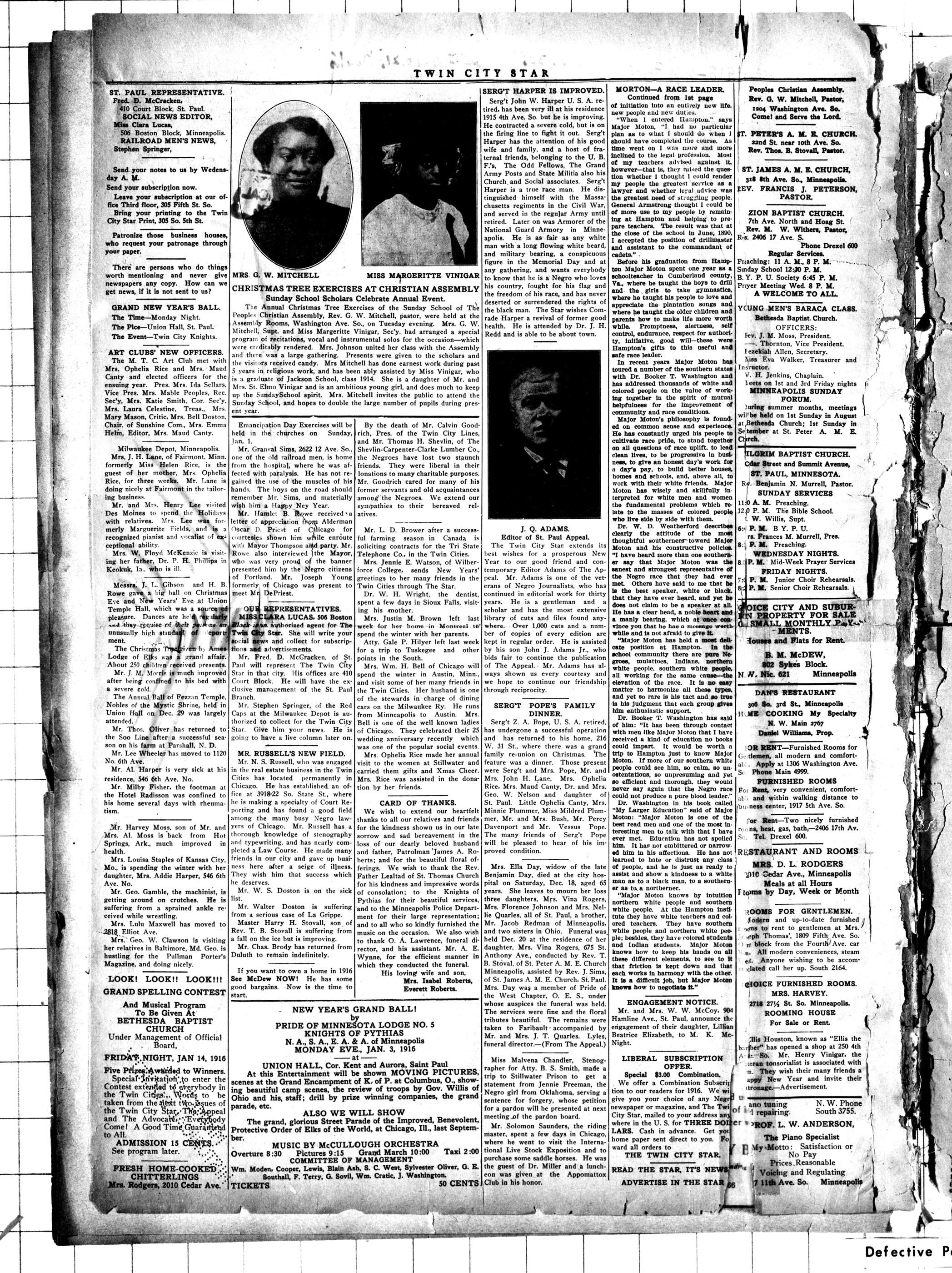
MRS. G. W. MITCHELL MEIGS WAP GERIETE VINIGAR
CHRISTMAS TREE EXERCISES AT CHRISTIAN ASSEMBLY
Sunday School Scholars Celebrate Annual Event.
The Annual Christmas Tree Exercises of the Sunday School of The
Peoples Christian Assembly, Rev. G. W. Mitchell, pastor, were held at the
Assem)ly Rooms, Washington Ave. So., on Tuesday evening. Mrs. G. W.
Mitchell, Supt. and Miss Margeritte Vinigar, Sec'y. had arranged a special
program of recitations, vocal and instrumental solos for the occasion—which
were creditably rendered. Mrs. Johnson united her class with the Assembly
and there was a large gathering. Presents were given to the scholars and
the visitors received candy. Mrs Mitchell has done earnest work during past
5 years in religious work, and has been ably assisted by Miss Vinigar, who
is a graduate of Jackson School, class 1914. She is a daughter of Mr. and
Mrs. St. Elmo Vinigar and is an ambitious young girl, and does much to keep
up the SundaySchool spirit. Mrs. Mitchell invites the public to attend the
Sunday School, and hopes to double the large number of pupils during pres-
ent year.
- NEW YEAR'S GRAND BALL!
PRIDE OF MINNESOTA LODGE NO. 5
KNIGHTS OF PYTHIAS
N.A,,S. A., E. A. & A. of Minneapolis
MONDAY EVE.,, JAN. 3, 1916
—s*t—
UNION HALL, Cor. Kent and Aurora, Saint Paul
At this Entertainment will be shown MOVING PICTURES,
scenes at the Grand Encampment of K. of P. at Columbus, O., show-
ing beautiful camp scenes, the review of troops by Gov. Willis of
Ohio and his, staff; drill by prize winning companies, the grand
parade, etc.
ALSO WE WILL SHOW
‘The grand, glorious Street Parade of the Improved, Benevolent,
protective Order of Elks of the World, at Chicago, Ill., last Septem-
: MUSIC BY McCULLOUGH ORCHESTRA
Overture 8:30 Pictures 9:15 Grand March 10:00 Taxi 2:00
COMMITTEE OF MANAGEMENT
Wm, Moden, Cooper, Lewis, Blain Ash, S. C. West, Sylvester Oliver, G. E.
" Southall, F, Terry, G. Sovil, Wm. Cratic, J. Washington.
TICKETS 50 CENTS
3
Pa
Emancipation Day Exercises will be
held in the churches on Sunday
Jan. 1.
Mr. Granval Sims, 2622 12 Ave. So.
one of the old railroad men, is home
from the hospital, where he was af-
fected with paralysis. He has not re-
gained the use of the muscles of his
hands. The boys on the road should
remember Mr. Sims, and materially
wish him a Happy Ney Year.
Mr. Hamlet B. Rowe received +a
letter of eRe Alderman
Oseat D. Priest of Chicago. for
courtesies shown him while enrdute
with Mayor Thompson athd party. Mr
Rowe also interviewed fhe Mayor,
who was very proud of the banner
presented him by the Negro citizens
of Portland, Mr. Joseph Young
formerly, of Chicago was present to
meet Mr DePriest.
ov REPRESENTATIVES.
fae: LUCAS, 506 Boston
P Han Ruthorized agent for The
Star, She will write your
Social and collect for subscrip-
tions amid advertisements.
Mr. Fred. D. McGracken, of St.
Paul will represent The Twin City
Star in that city. His offices are 410
Court Block. He will have the ex:
clusive management of the St. Paul
Branch.
Mr. Stephen Springer, of the Red
Caps at the Milwaukee Depot is au-
thorized to collect for the Twin City
Star. Give him your news. He is
going to have a five column later on.
MR. RUSSELL’S NEW FIELD.
Mr.N. S, Russell, who was engaged
in the real estate business in the Twin
Cities has located permanently in
Chicago. He has established an of-
fice at 391822 So, State St, where
he is making a specialty of Court Re-
porting and has found a good field
among the many busy Negro law-
yers of Chicago, Mr. Russell has a
thorough knowledge of stenography
and typewriting, and has nearly com-
pleted a Law Course. He made many
friends in our city and gave up busi-
ness here after a seige of illness.
They wish him that success which
he deserves.
Mr. W. S. Doston is on the sick
list.
Mr. Walter Doston is suffering
from a serious case of La Grippe.
Master Harry H. Stovall, son, of
Rev. T. B. Stovall is suffering from
a fall on the ice but is improving.
‘Mr. Chas. Brody has returned from
Duluth to remain indefinitely.
Tf you want to own a home in 1916
See McDew NOW! He has some
good bargains. -Now is the time to
start.
TWIN CITY STAR
cs al
at
Mr. L. D. Brower after a success-
ful farming season in Canada is
soliciting contracts for the Tri State
Telephone Co. in the Twin Cities.
Mrs. Jennie E. Watson, of Wilber-
force College, sends New Years’
greetings to her many friends in the
Twin Cities through The Star.
Dr. W. H. Wright, the dentist,
spent a few days in Sioux Falls, visit:
ing his mother.
Mrs, Justin M. Brown left last
week for her home in Montreal to
spend the winter with her parents.
Atty, Gale P, Hilyer left last week
for a trip to Tuskegee and other
points in the South.
Mrs. Wm. H. Bell of Chicago will
spend the winter in Austin, Minn,
and visit some of her many friends in
the Twin Cities. Her husband is one
of the stewards in charge of dining
cars on the Milwaukee Ry, He runs
from Minneapolis to Austin. Mrs.
Bell is one of the well known ladies
of Chicago, They celebrated their 25
wedding anniversary recently which
was one of the popular social events.
Mrs, Ophelia Rice made her annual
visit to the women at Stillwater and
carried them gifts and Xmas Cheer.
Mrs, Rice was assisted in the dona:
tion: by her: friends:
CARD OF THANKS.
We wish to extend our heartfelt
thanks to all our relatives and friends
for the kindness shown us in our late
sorrow and sad bereavement in the
loss of our dearly beloved husband
and father, Patrolman ‘James A. Ro-
berts; and for the beautiful floral of-
ferings. We wish to thank the Rev.
Father Lealtad of St. Thomas Church
for his kindness and impressive words
of consolation; to the Knights of
Pythias for their beautiful services,
and to the Minneapolis Police Depart-
ment for their large representation;
and to all who so kindly furnished the
music on the occasion. We also wish
to thank O, A. Lawrence, funeral di
rector, and his assistant, Mr. A. E.
Wynne, for the efficient manner in
which they conducted the funeral.
His loving wife and son,
Mrs. Isabel Roberts,
Everett Roberts.
SERG’T HARPER IS IMPROVED.
Serg’t John W. Harper U. S. A. re-
tired, has been very ill at his residence
1915 4th Ave, So. but he is improving.
He contracted a severe cold, but is on
the firing line to fight it out. Serg’t
Harper has the attention of his good
wife and family, and a host of fra-
ternal friends, belonging to the U. B.
F's, The Odd Fellows, The Grand
Army Posts and State Militia also his
Church. and Social associates. Serg’t
Harper is a true race man. He dis-
tinguished himself with the Massa
chusetts regiments in the Civil War,
and served in the regular Army until
retired. Later on was Armorer of the
National Guard Armory in Minne-
apolis. He is as fair as any white
man with a long flowing white beard
and military bearing, a conspicuous
figure in the Memorial Day and at
any gathering, and wants everybody
to know that he is a Negro who love:
his country, fought for his flag an¢
the freedom of his race, and has never
deserted or surrendered the rights o
the black man. The Star wishes Com-
rade Harper a revival of former good
health, He is attended by Dr. J. H
Redd and is able to be about town.
ad
We,
es a
an)
wae
J. Q. ADAMS.
Editor of St. Paul Appeal.
The Twin City Star. extends its
best wishes for a prosperous New
Year to our good friend and con-
temporary Editor Adams of The Ap-
peal. Mr. Adams is one of the vet:
erans of Negro Journalists, who has
continued in editorial work for thirty
years. He is a gentleman and a
scholar and has the most extensive
library of cuts and files found any-
where. Over 1,000 cuts and a num-
ber of copies of every edition are
kept in regular order. He is assisted
by his son John J. Adams Jr., who
bids fair to continue the publication
of The Appeal.. Mr. Adams has al-
ways shown us every courtesy and
we hope to continue our friendship
through reciprocity.
SERG'T POPE’S FAMILY
DINNER.
Serg’t Z. A. Pope, U. S. A. retired,
has undergone a successful operation
and has returned to his home, 216
W. 31 St, where there was a grand
family re-union on Christmas. The
feature was a dinner. Those present
were Serg’t and Mrs. Pope, Mr. and
Mrs. John H. Lane, Mrs. Ophelia
Rice, Mrs. Maud Canty, Dr. and Mrs.
Geo. W. Nelson and daughter of
St. Paul. Little Ophelia Canty, Mrs.
Minnie Plummer, Miss Mildred Plum-
mer, Mr. and Mrs. Bush, Mr. Percy
Davenport and Mr. Vessus Pope.
The many friends of Serg’t Pope
will be pleased to hear of his im-
proved condition:
Mrs. Ella Day, widow of the late
Benjamin Day, died at the city hos-
pital on Saturday, Dec. 18, aged 65
years. She leaves to mourn her loss
three daughters, Mrs. Vina Rogers,
Mrs, Florence Johnson and Mrs. Nel-
fie Quarles, all of St. Paul, a brother,
Mr. Jacob Redman of Minneapolis,
and two sisters in Ohio. Funeral was
held Dec. 20 at the residence of her
daughter, Mrs, Vina Rogers, 675 St.
Anthony Ave., conducted by Rev. T.
B. Stoval, of St. Peter A. M. E. Church
Minneapolis, assisted by Rev. J. Sims,
of St. James A. M. E, Church, St. Paul.
Mrs, Day was a member of Pride of
the West Chapter, O. E. S., under
whose auspices the funeral was held.
The services were fine and the floral
tributes beautiful. The remains were
taken to Faribault- accompanied by
Mr. and Mrs. J. T. Quarles. Lyles,
funeral director —(From The Appeal.)
Miss Malvena Chandler, Stenog-
rapher for Atty. B.S. Smith, made a
trip to Stillwater Prison to get a
statement from Jennie Freeman, the
Negro girl from Oklahoma, serving a
sentence for forgery, whose petition
for a pardon will be presented at next
meeting of the pardon board.
Mr. Solomon Saunders, the riding
master, spent a few days in Chicago,
where he went to visit the Interna-
tional Live Stock Exposition and to
purchase some saddle horses. He was
the guest of Dr. Miller and a lunch-
con was given at the Appomattox
Club in his honor,
MORTON—A RACE LEADER.
‘Continued from ist page
Bs a es eee i eS
of initiation into an entively uew life,
new people und new duties.
“When I entered Hampton.” says
Major Moton, “I bad no particular
plan as to what I should do when 1
ghould have completed the course, As
time went on I was move and more
inclined to the legal profession. Most
of my teachers advised against it,
however—that is, they taised the ques-
tion whether I thought I could render
my people the greatest service us a
lawyer and whether lezal advice was
the greatest need of strugiling people.
General Armstrong thought 1 could be
‘of more use to my people by remain
ing at Hampton and helping to pre-
pare teachers. The result was that at
the close of the school in June, 1890,
I accepted the position of drillmaster
and assistant to the commandant of
cadets.” -
Before his graduation from Hamp-
ton Major Moton spent one year as 8
schoolteacher in Cumberland county,
‘Va., where he taught the boys to drill
and: the girls to take gymnastics,
where he taught his people to love and
appreciate the plantation songs and
where he taught the older children and
parents how to make life more worth
while, Promptness, alertness, self
control, endurance, respect for authori-
ty, initiative, good will—these were
Hampton's gifts to this useful and
safe race leader.
In recent years Major Moton has
toured a number of the southern states
with Dr. Booker ‘T. Washington and
has addressed thousands of white and
colored people on the value of work-
ing together in the spirit of mutual
helpfulness for the Improvement of
community and race conditions.
‘Major Moton's philosophy 1s found-
ed on common sense and experience
He has constantly urged his people to
cultivate race pride, to stand together
on all questions of race uplift. to lead
clean lives, to be progressive In bust-
ness, to give an honest day’s work for
a day's pay, to build better houses,
homes and schools, and, above all, to
work with thelr white friends, Major
Moton has wisely and skilifully in
terpreted for white men and women
the fundamental problems which re-
late to the masses of colored people
who live side by side with them.
Dr. W. D. Weatherford describes
clearly the attitude of the most
thoughtful southerners~toward Major
Moton and his constructive policies.
“I have heard more than one southern
er say that Major Moton was the
sanest and strongest representative of
the Negro race that ‘they had ever
met. Others have sald to me that be
fs the best speaker, white or black,
that they have ever heard, and yet be
does not claim to be a speaker at all
He has a clear head, a noble Reatt and
‘© manly bearing. which at ‘once con-
vince you that he has.a message wertly
while and 1s not afraid to give it.
“Major Moton has held a most dell-
cate position at Hampton. In the
school community there are pure Ne-
goes, mulattoes, Indians, northern
white people. southern white peuple,
all working for the same cause—the
elevation of the race. It is mo easy
matter to harmonize all these types,
and yet so rare is his tact and so true
is his judgment that each group gives
him enthusiastic support.
Dr. Booker T. Washington has said
of him: “It has been through contact
with men like Major Moton that I have
received a kind of education no books
could impart. It would be worth a
trip to Hampton Just to know Major
Moton. If more of our southern white
people could see him, so calm, so un:
ostentatious, so unpresuming and yet
80 efficient and thorough. they would
never say again that the Negro race
could not produce a pure blood leader.”
Dr. Washington in his book called
“My Larger Education” said of Major
Moton: “Major Moton is one of the
best read men and one of the most in-
teresting men to talk with that I have
ever met. Education has not spolled
him. It has not embittered or narrow.
ed him in his affections. He has not
learned to bate or distrust any class
of people, and he Is Just as ready to
assist and show a kindness to a white
man as ton black man, to a southern-
er as ta.a northerner.
“Major Moton knows by intuition
northern white people and southern
white people. At the Hampton inst!
tute they have white teachers and col-
ored teachers. They have southern
white people and northern white peo-
ple; besides, they have colored students
and Indian students. Major Moton
knows how to keep bis hands on all
these different elements, to see to it
that friction 1s kept down and that
each works in harmony with the other.
It fs a difficult Job, but Major Moton
ENGAGEMENT NOTICE.
Mr. and Mrs. W. W. McCoy, 904
Hamline Ave., St. Paul, announce the
erigagement of their daughter, Lillian
Beatrice Elizabeth, to M. K. Me-
Night.
LIBERAL SUBSCRIPTION
OFFER. ,
Special $3.00 Combination.
We offer a Combination Subseri
tion to our readers for 1916. We wil
give you your choice of any Ne
newspaper or magazine, and The Twil,
City Star, mailed to your address
where in the U. S, for THREE DOI
LARS. Cash in advance. Get
home paper sent direct to you. Fo)
ward all orders to
THE TWIN CITY STAR,
READ THE STAR, IT'S NEW
ADVERTISE IN THE STAR,
Peoples Christian Assembly.
Rev. G. W. Mitchell, Pastor,
1204 Washington Ave. So,
Come! and Serve the Lord.
T. PETER'S A. M. E. CHURCH.
zand St. near roth Ave. So.
Rev, Thos. B, Stovall, Pastor,
ST. JAMES A. M, E. CHURCH,
318 Sth Ave. So, Minneapolis,
EV. FRANCIS J. PETERSON,
PASTOR.
Se ee ee Le re ee ane
Rev. M. W. Withers, Pastor,
Ris, 2406 17 Ave. S.
Phone Drexel 600
Regular Services.
Praching: 11 A.M, 8 P. Movs...
Sinday Schoo! 12:30 P. M.
B.Y. P. U. Society 6:45 P. M.
Pryer Meeting Wed. 8 P. M.
A WELCOME TO ALL.
YCUNG MEN’S BARACA CLASS.
Bethesda Baptist. Church.
OFFICERS:
Fey. J. M. Moss, President.
——. Thornton, Vice President,
Fezekiah Allen, Secretary.
Niss Eva Walker, Treasurer and
Insruetor,
V. H. Jenkins, Chaplain. ~
Leets on Ist and 3rd Friday nights
MINNEAPOLIS SUNDAY
FORUM.
during summer months, meetings
willbe held on Ist Sunday in August
at Bethesda Church; Ist Sunday in
Seltember at St. Peter A. M. E.
LGRIM BAPTIST CHURCH.
Car Street and Summit Avenue,
ST. PAUL, MINNESOTA.
Rg. Benjamin N. Murrell, Pastor.
i SUNDAY SERVICES Se
110 A. M. Preaching.
120 P.M. The Bible School.
( W. Willis, Supt.
6- P.M. BY. P.U.
rs, Frances M. Murrell, Pres.
8:| P.M. Preaching.
WEDNESDAY NIGHTS.
8.|P. M. Mid-Week Prayer Services
FRIDAY NIGHTS.
7:4 P.M. Junior Choir Rehearsals.
a P.M. Senior Choir Rehearsals.
@OICE CITY AND SUBUR-
OPERTY FOR SALE
bl MONTHLY Pinte*
| Mousps and Flats for Rent.
B. M. McDEW,
802 Sykes Block.
N.W. Nic. 621 Minneapolis
DAN'S RESTAURANT
306 So. 3rd St, Minneapolis
HME COOKING My Specialty
LN. W. Main 2767
Danie! Williams, Prop. .
:OR RENT—Furnished Rooms for
Getlemen, all modern and comfort-
abi. Apply at 1306 Washington Ave.
S: Phone Main 4999.
FURNISHED ROOMS
For Remt, very convenient, comfort-
abi: and within walking distance to
‘pusmegs eenter, 1917 Sth Ave. So.
Tor Rent—Two nicely furnished
roons, heat, gas, bath,—2406 17th Av.
So. Tel Drexel 600.
RESTAURANT AND ROOMS
MRS. D. L. RODGERS
°p10 Sedar Ave., Minneapolis
Meals at all Hours
Fioms by Day, Week or Month
200MS FOR GENTLEMEN.
fodgra and up-to-date furnished
nang to rent to gentlemen at Mrs.
<seph Thomas’, 1809 Fifth Ave. So.
) ¢ block from the Fourth/ Ave. car
nm All modern conveniences, steam
et. .Anyone wishing to be accom-
dated call her up. South 2164,
IOICE FURNISHED ROOMS.
| MRS. HARVEY.
'gmB 27%, St. So. Minneapolis,
ROOMING HOUSE
For Sale or Rent.
‘lis Houston, known as “Ellis the
bs pee has opened a shop at 250 4th
\vbe@, Mr. Henry Vinigar, the
eram tonsorialist is associated with
m. wish their many friends a
cameo Year and invite their
itromage.—Advertisement.
, ano tuning N. W. Phone
1 repairing. South 3755.
' ¥ROF. L. W. ANDERSON,
‘The Piano Specialist
B MyMotto: Satisfaction or
No Pay 2
ie lj ,, Btices, Reasonable :
g and Regulating
we. So, Minneapolis
i. ae
mo
yi *
mE
we
ee |
SG il
y M
Hi é5
{ \.
\ ee
L se
o te .
| s
ia
mt
| iF
ee
a :
ous -
A
‘
|
th
he
| ee
( Sy
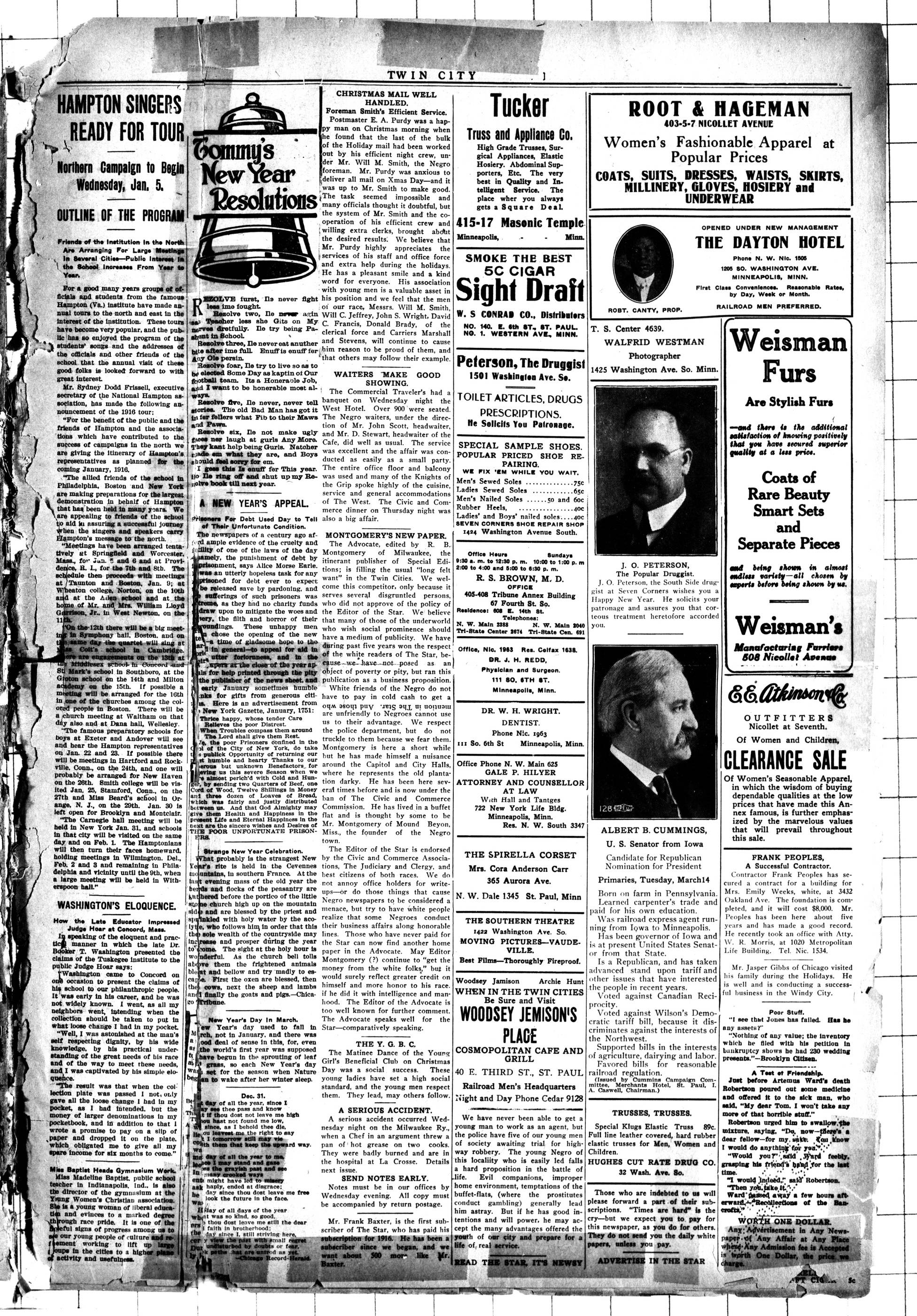
HAMPTON SINGERS READY FOR TOUR
Friends of the Institution in the North Are Arranging For Large Meetings In Several Cities—Public Interest in the School Increases From Year to Year.
For a good many years groups of officials and students from the famous Hampton (Va.) institute have made annual tours to the north and east in the interest of the institution. These tours have become very popular, and the public has so enjoyed the program of the students' songs and the addresses of the officials and other friends of the school that the annual visit of these good folks is looked forward to with great interest.
Mr. Sydney Dodd Frissell, executive secretary of the National Hampton association, has made the following announcement of the 1916 tour:
"For the benefit of the public and the friends of Hampton and the associations which have contributed to the success of campaigns in the north we are giving the itinerary of Hampton's representatives as planned for the coming January, 1916.
"The allied friends of the school in Philadelphia, Boston and New York are making preparations for the largest demonstration in behalf of Hampton that has been held in many years. We are appealing to friends of the school to aid in assuring a successful journey when the singers and speakers carry Hampton's message to the north.
"Meetings have been arranged tentatively at Springfield and Worcester, Mass, for Jan. 5 and 6 and at Providence, R. L., for the 7th and 8th. The schedule then proceeds with meetings at Taunton and Boston, Jan. 9; at Wheaton college, Norton, on the 10th and at the Aien school and at the home of Mr. and Mrs. William Lloyd Garrison, Jr., in West Newton, on the 11th.
"On the 12th there will be a big meeting in Symphony hall, Boston, and on the same day the quartet will sing at Miss Cott's school in Cambridge. There are engagements on the 13th at the Middlesex school in Concord and St Mark's school in Southboro, at the Greton school on the 14th and Milton academy on the 15th. If possible a meeting will be arranged for the 16th in one of the churches among the colored people in Boston. There will be a church meeting at Waltham on that day also and at Dana hall, Wellesley.
"The famous preparatory schools for boys at Exeter and Andover will see and hear the Hampton representatives on Jan. 22 and 23. If possible there will be meetings in Hartford and Rockville. Conn., on the 24th, and one will probably be arranged for New Haven on the 26th. Smith college will be visited Jan. 25, Stamford, Conn., on the 27th and Meard's school in Orange, N. J., on the 29th. Jan. 30 is left open for Brooklyn and Montclair.
"The Carnegie hall meeting will be held in New York Jan. 31, and schools in that city will be visited on the same day and on Feb. 1. The Hamptonians will then turn their faces homeward, holding meetings in Wilmington, Del., Feb. 2 and 3 and remaining in Philadelphia and vicinity until the 9th, when a large meeting will be held in Witherspoon hall."
WASHINGTON'S ELOQUENCE
How the Late Educator Impressed Judge Hoar at Concord, Mass.
In speaking of the eloquent and practical manner in which the late Dr. Booker T. Washington presented the claims of the Tuskegee institute to the public Judge Hoar says:
"Washington came to Concord on one occasion to present the claims of his school to our philanthropic people. It was early in his career, and he was not widely known. I went, as all my neighbors went, intending when the collection should be taken to put in what loose change I had in my pocket.
"Well, I was astonished at the man's self respecting dignity, by his wide knowledge, by his practical understanding of the great needs of his race and of the way to meet these needs, and I was captivated by his simple eloquence.
"The result was that when the collection plate was passed I not, only gave all the loose change I had in my pocket, as I had intended, but the money of larger denominations in my pocketbook, and in addition to that I wrote a promise to pay on a slip of paper and dropped it on the plate, which obligated me to give all my spare income for six months to come."
Miss Baptist Heads Gymnasium Work.
Miss Madeline Baptist, public school teacher in Indianapolis, ind., is also the director of the gymnasium at the Young Women's Christian association. She is a young woman of liberal education and evinces to a marked degree through race pride. It is one of the hopeful signs of progress among us to see our young people of culture and refeemment working to lift up large groups in the cities to a higher plane of activity and usefulness.
Tommy's New Year Resolutions
REZOLVE furst. Its never fight less ime fought.
Resolve two, Ie never again
less Teacher less she Gits on My
nerves dretfully. Ie try being Pa-
sent in School.
Resolve three, Ie never eat anuther
tide after ime full. Enuff is enuff for
Any Ole persin.
Resolve fear, Ie try to live so as to
be elected Some Day as kaptin of Our
football team. Its a Honerable Job,
and I want to be honerable most alway.
Resolve five, Ie never, never tell
stories. The old Bad Man has got it
in fer fellers what Fib to their Maws
and Paws.
Resolve six, Ie not make ugly
faces ner laugh at gurls Any More.
They kant help being Gurls. Natcher
made em what they are, and Boys
should feel sorry for em.
I gess this is enuff for This year.
So Ie ring off and shut up my
Resolve book till next year.
A NEW YEAR'S APPEAL.
Prisoners For Debt Used Day to Tell Of Their Unfortunate Condition.
The newspapers of a century ago afford ample evidence of the cruelty and utility of one of the laws of the day namely, the punishment of debt by prisonment, says Alice Morse Earle, was an utterly hopeless task for any prisoned for debt ever to expect be released save by pardoning, and the sufferings of such prisoners was treame, as they had no charity funds draw upon to mitigate the woes and pery, the filth and horror of their roundings. These unhappy men in chose the opening of the new tar—a time of gladsome hope to the child in general—to appeal for aid in their utter forlornness, and in the papers at the close of the year apals for help printed through the pity the publisher of the news sheet, and early January sometimes humbleanks for gifts from generous citics. Here is an advertisement from New York Gazette, January, 1751: Thrice happy, whose tender Care
When Troubles compass them around
The Lord shall rize, them Rest.
The Lord shall give them Rest. 7e, the poor Prisoners confined in the Gol of the City of New York, do take the publick Opportunity or returning our fugitives and hearty Thanks to our ferrous but unknown Benefactors, for saving us this severe Season when we almost perch'd with Cold and Hunger, by sending two Quarters of Beef, one Cord of Wood, Twelve Shillings in Money and three dozen of Loaves of Bread, which was fairly and justly distributed between us. And that God Almighty may give the poor Prisoners the prosperous Life and Eternal Happiness in the next are the sincere wishes and Desires of THE POOR UNFORTUNATE PRISONERS.
Strange New Year Celebration.
What probably is the strangest New Year's rite is held in the Cevennes mountains, in southern France. At the last evening mass of the old year the bends and flocks of the peasantry are gathered before the portico of the little stone church high up on the mountain side and are blessed by the priest and sprinkled with holy water by the acolyte, who follows him in order that this the sole wealth of the countryside may increase and prosper during the year to come. The sight at the holy hour is wonderful. As the church bell tolls above them the frightened animals bleat at bellow and try madly to escape. First the oxen are blessed, then the cows, next the sheep and lambs and finally the goats and pigs.—Chicago Tribune.
New Year's day used to fall in March, not in January, and there was a good deal of sense in this, for, even as the world's first year was supposed to have begun in the sprouting of leaf and grass, so each New Year's day was set for the season when Nature began to wake after her winter sleep.
Dec. 31.
Beneath day of all the year, since I may see thee pass and know
That if thou dost not leave me high
Thou hast not found me low,
A we since, as I behold thee die,
thee you leaveest me the right to say
I tomorrow still may vie
cook them that keep the upward way.
A we
and day of all the year to ma
lece I may stand and gaze
as the grayish past and see
In many crooked ways
ents might have led to misery
ask haply, ated at disgrace;
he day since thou dost leave me free
look the future in the face.
H day of all days of the year
what was so kind, so good,
ers thou dost leave me still the dear
I faith in brotherhood:
the day since I still striving here,
cry view the past with small regret
Dutk battle that are unstood as yet.
By
TWIN CITY CHRISTMAS MAIL WELL HANDLED.
Foreman Smith's Efficient Service. Postmaster E. A. Purdy was a happy man on Christmas morning when he found that the last of the bulk of the Holiday mail had been worked out by his efficient night crew, under Mr. Will M. Smith, the Negro foreman. Mr. Purdy was anxious to deliver all mail on Xmas Day—and it was up to Mr. Smith to make good. The task seemed impossible and many officials thought it doubtful, but the system of Mr. Smith and the cooperation of his efficient crew and willing extra clerks, brought about the desired results. We believe that Mr. Purdy highly appreciates the services of his staff and office force and extra help during the holidays. He has a pleasant smile and a kind word for everyone. His association with young men is a valuable asset in his position and we feel that the men of our race, Messrs. Will M. Smith, Will C. Jeffrey, John S. Wright, David C. Francis, Donald Brady, of the clerical force and Carriers Marshall and Stevens, will continue to cause him reason to be proud of them, and that others may follow their example.
WAITERS MAKE GOOD
SHOWING
The Commercial Traveler's had a banquet on Wednesday night the West Hotel. Over 900 were seated. The Negro waiters, under the direction of Mr. John Scott, headwaiter, and Mr. D. Stewart, headwaiter of the Cafe, did well as usual. The service was excellent and the affair was conducted as easily as a small party. The entire office floor and balcony was used and many of the Knights of the Grip spoke highly of the cuisine, service and general accommodations of The West. The Civic and Commerce dinner on Thursday night was also a big affair.
MONTGOMERY'S NEW PAPER
MONTGOMERY'S NEW PAPER.
The Advocate, edited by R. B. Montgomery of Milwaukee, the itinerant publisher of Special Editions; is filling the usual "long felt want" in the Twin Cities. We welcome this competitor, only because it serves several disgruntled persons, who did not approve of the policy of the Editor of the Star. We believe that many of those of the underworld who wish social prominence should have a medium of publicity. We have during past five years won the respect of the white readers of The Star, because we have not posed as an object of poverty or pity, but ran this publication as a business proposition.
White friends of the Negro do not have to pay in cold cash to get a oum puy SREA in nonuau are unfriendly to Negroes cannot use us to their advantage. We respect the police department, but do not truckle to them because we fear them. Montgomery is here a short while but he has made himself a nuisance around the Capitol and City Halls, where he represents the old plantation darky. He has been here several times before and is now under the ban of The Civic and Commerce Commission. He has lived in a buffet flat and is thought by some to be Mr. Montgomery of Mound Beyon, Miss, the founder of the Negro town.
The Editor of the Star is endorsed by the Civic and Commerce Associations. The Judiciary and Clergy, and best citizens of both races. We do not annoy office holders for write-ups—or do those things that cause Negro newspapers to be considered a menace, but try to have white people realize that some Negroes conduct their business affairs along honorable lines. Those who have never paid for the Star can now find another home paper in the Advocate. May Editor Montgomery (?) continue to "get the money from the white folks," but it would surely reflect greater credit on himself and more honor to his race. if he did it with intelligence and manhood. The Editor of the Advocate is too well known for further comment. The Advocate speaks well for the Star—comparatively speaking.
THE Y G B C
The Matinee Dance of the Young Girl's Beneficial Club on Christmas Day was a social success. These young ladies have set a high social standard, and the young men respect them. They lead, may others follow.
A SERIOUS ACCIDENT.
A serious accident occurred Wednesday night on the Milwaukee Ry., when a Chef in an argument threw a pan of hot grease on two cooks. They were badly burned and are in the hospital at La Crosse. Details next issue.
SEND NOTES EARLY.
Notes must be in our offices by Wednesday evening. All copy must be accompanied by return postage.
Mr. Frank Baxter, is the first subscriber of The Star, who has paid his subscription for 1916. He has been a subscriber since we began, and we want about 500 more like Mr. Baxter.
415-17 Masonic Temple
Minneapolis, Minn.
SMOKE THE BEST
5C CIGAR
Sight Draft
W. S CONRAD CO., Distributors
NO. 140. E. 6th ST., ST. PAUL.
NO. 1. WESTERN AVE., MINN.
Peterson, The Druggist 1501 Washington Ave. So.
SPECIAL SAMPLE SHOES.
POPULAR PRICED SHOE REPAIRING.
WE FIX 'EM WHILE YOU WAIT.
Men's Sewed Soles ..... 75c
Ladies Sewed Soles ..... 65c
Men's Nailed Soles ..... 50 and 60c
Rubber Heels, ..... 40c
Ladies' and Boys' nailed soles ..... 40c
SEVEN CORNERS SHOE REPAIR SHOP
1424 Washington Avenue South.
Office Heurs Sundays
9:30 a.m. to 12:30 p.m. 10:00 to 1:00 p.m.
2:00 to 4:00 and 5:00 to 6:30 p.m.
R. S. BROWN, M. D.
OFFICE
405-408 Tribune Annex Building
67 Fourth St. So.
Residence: 608 E. 14th St.
Telephones:
N. W. Main 2388 N. W. Main 2040
Tri-State Center 2674 Tri-State Cen. 691
Office, Nic, 1963 Res. Celfax 1638.
DR. J. H. REDD,
Physician and Surgeon.
111 SO. 6TH ST.
Minneapolis, Minn.
DR. W. H. WRIGHT.
DENTIST.
Phone Nic. 1963
111 So. 6th St Minneapolis, Minn.
Office Phone N. W. Main 625
GALE P. HILYER
ATTORNEY AND COUNSELLOR
AT LAW
With Hall and Tantges
722 New York Life Bldg.
Minneapolis, Minn.
Res. N. W. South 3347
N. W. Dale 1345 St. Paul. Minn
Woodsey Jamison Archie Hunt
WHEN IN THE TWIN CITIES
Be Sure and Visit
WOODSEY JEMISON'S
PLACE
COSMOPOLITAN CAFE AND
GRILL
Night and Day Phone Cedar 9128
We have never been able to get a young man to work as an agent, but the police have five of our young men of society awaiting trial for highway robbery. The young Negro of this locality who is easily led falls a hard proposition in the battle of life. Evil companions, improper home environment, temptations of the buffet-flats, (where the prostitutes conduct gambling) generally lead him astray. But if he has good intentions and will power, he may accept the many advantages offered the youth of our city and prepare for a life of real service.
READ THE STAR, IT'S NEWSY
Tucker
Truss and Appliance Co.
High Grade Trusses, Surgical Appliances, Elastic Hosiery. Abdominal Supporters, Etc. The very best in Quality and Intelligent Service. The place wher you always gets a Square Deal.
TOILET ARTICLES, DRUGS PRESCRIPTIONS. He Sollicits You Patronage.
THE SPIRELLA CORSET Mrs. Cora Anderson Carr 365 Aurora Ave.
THE SOUTHERN THEATRE
1422 Washington Ave. So.
MOVING PICTURES—VAUDE-
VILLE.
Best Films—Thoroughly Fireproof.
ROOT & HAGEMAN
403-5-7 NICOLLET AVENUE
Women's Fashionable Apparel at Popular Prices COATS, SUITS, DRESSES, WAISTS, SKIRTS, MILLINERY, GLOVES, HOSIERY and UNDERWEAR
PETER H. HARRIS
T. S. Center 4639.
WALFRID WESTMAN
Photographer
1425 Washington Ave. So. Minn.
PETER H. HARRIS
J. O. PETERSON, The Popular Druggist
J. O. Peterson, the South Side druggist at Seven Corners wishes you a Happy New Year. He solicits your patronage and assures you that corteous treatment heretofore accorded you.
128
U. S. Senator from Iowa
Candidate for Republican
Nomination for President
Primaries, Tuesday, March14
Born on farm in Pennsylvania.
Learned carpenter's trade and
paid for his own education.
Was railroad express agent running from Iowa to Minneapolis.
Has been governor of Iowa and is at present United States Senator from that State.
Is a Republican, and has taken advanced stand upon tariff and other issues that have interested the people in recent years.
Voted against Canadian Reciprocity.
Voted against Wilson's Democratic tariff bill, because it discriminates against the interests of the Northwest. Supported bills in the interests of agriculture, dairying and labor. Favored bills for reasonable railroad regulation.
(Issued by Cummins Campaign Com-
mitee at Hotel, St. Paul, I.
A. Cawell, Chairman.)
TRUSSES. TRUSSES
Special Klugs Elastic Truss 89c. Full line leather covered, hard rubber elastic trusses for Men, Women and Children.
HUGHES CUT RATE DRUG CO.
32 Wash. Ave. So.
Those who are indebted to us will please forward a part of their subscriptions. "Times are hard" is the cry—but we expect you to pay for this newspaper, as you do for others. They do not send you the daily white papers, unless you pay.
OPENED UNDER NEW MANAGEMENT
THE DAYTON HOTEL
Phone N. W. Nic. 1505
1205 SO. WASHINGTON AVE.
MINNEAPOLIS, MINN.
First Class Conveniences. Reasonable Rates,
by Day, Week or Month.
RAILROAD MEN PREFERRED.
Weisman
Furs
Are Stylish Furs
—and there is the additional satisfaction of knowing positively that you have secured superior quality at a less price.
Coats of
Rare Beauty
Smart Sets
and
Separate Pieces
and being shown in almost endless variety—all chosen by experts before being shown by us.
Weisman's
Manufacturing Furriers
508 Nicollet Avenue
E.E. Athinson Co.
OUTFITTERS
Nicollet at Seventh.
CLEARANCE SALE
Of Women's Seasonable Apparel, in which the wisdom of buying dependable qualities at the low prices that have made this Annex famous, is further emphasized by the marvelous values that will prevail throughout this sale.
FRANK PEOPLES.
Contractor Frank Peoples has secured a contract for a building for Mrs. Emily Weeks, white, at 3432 Oakland Ave. The foundation is completed, and it will cost $8,000. Mr. Peoples has been here about five years and has made a good record. He recently took an office with Atty, W. R. Morris, at 1020 Metropolitan Life Building. Tel. Nic. 1534.
Mr. Jasper Gibbs of Chicago visited his family during the Holidays. He is well and is conducting a successful business in the Windy City.
Poor Stuff.
"I see that Jones has failed. Has he any assets?" "Nothing of any value; the inventory which he filed with his petition in bankruptcy shows he had 230 wedding presents."—Brooklyn Citizen.
A Test at Friendship
Just before Artemus Ward's death Robertson poured out some medicine and offered it to the sick man, who said, "My dear Tom. I won't take any more of that horrible stuff."
Robertson urged him to swallow the mixture, saying, "Do now—there's a dear fellow—for my sake. You know I would do anything for you."
"Would you?" said Ward feebly, grasping his friend's hand for the last time.
"I would indeed," said Robertson.
"I would Indeed," said Robertson.
"Then you take it."
Ward passed away a few hours afterward. "Recollections of the Bancroft."
WORTH ONE DOLLAR.
Any Advertisement in Any Newspaper of Any Affair at Any Place where Any Admission fee is Accepted is worth One Dollar, the price we charge.
PUBLSHED EVERY FRIDAY BY CHARLES SUMNER SMITH, 305—So. Fifth Street.
Entered in the Post Office at Minneapolis as second class matter.
MEMBER
NATIONAL NEGRO PRESS
ASSOCIATION
Subscription by Mail, Postpaid.
ONE YEAR ..... $2.00
SIX MONTHS ..... 1.00
THREE MONTHS ..... .65
Hamlet B. Rowe, Asst. Manager.
ADVERTISING RATES.
Liberal discount given on 3, 6, 9,
Months, or 1 year contracta.
Want Ads .....Twenty-five Cents
Reading Notices, per line, Five Cents
Wedding Announcements, Fifty Cents
Card of Thanks .....One Dollars
In Memoriam .....One Dollar
Business Announcements, One Dollar
Death Notices .....Fifty Cents
When writing for the press, don't
abbreviate your words. Spell each
one out correctly and distinctly. If
you don't it means that all of your
manuscript will have to be rewritten
if there is time. Write on one side of
the paper only.
Address all mail to Twin City Star
305 B, 5th St.
New Year Chimes
By MINNA IRVING
Stop thief!
The old year goes
O'er the drifted snows,
And the gray old year hath brought
me grief.
He hath stolen the bud and the dano-
ing leaf,
And the dear little robin that used to
sing
At my window sill in the balmy
spring,
And the rapturous kisses my lover
gave.
He hath hidden him, too, in a narrow
grave,
Deep down from the tight of the
broad, blue sky,
And so through the rush of my tears
I cry:
"Stop thieff"
As the old year goes
O'er the drifted snows,
For the gray old year hath brought
me grief.
All hail!
The new year comes
With the beat of drums
And clangor of bells in the windy
vale.
He bringeth the song of the nightin-
gale.
And, what if his robe is fringed with
snow,
The April buds on his bosom blow.
He sendeth a new love unto me
From an ancient country across the
sea,
Far to the south we will sail
away
Through the purple dusk of a per-
fumed May.
All hail!
The new year comes
With the beat of drums
And music of beels in the wintry vale.
New Movement For Race Segregation.
There has recently been some talk of appointing capable physicians of our race as health officers in the larger cities to administer to the needs of the colored population exclusively. The idea does not meet the general approval of the race, and we believe that few reputable physicians among the colored people would accept an appointment with segregation as its chief object. The fact that the colored race does not want any special recognition of the kind mentioned ought to be well known to public officials at this stage of our progress and citizenship. In all matters of public service, conveyance and comfort the colored people simply want that which is due them in common with all the other races which make up our country's citizenship.
PATROLMAN JAS. A. ROBERTS.
There are many who do not realize the great loss to our race by the death of Officer Roberts of the Police Dept. He bore an enviable record. Sixteen years in continuous service without a reprimand and several arrests of desperate characters to his credit. He was as cheerful as a school boy and carried his honors tightly. Never a word of reproach, always one of advice. He was the instantstay of the Uniform Rank of Knights of Pythias holding the rank of Coloquel, a loving husband and father, and prominent church worker. He has gone to his reward. Let us honor his memory. "His bones are dust, his blood sword rust, his soul is with the Stars, we trust."
Ripon.
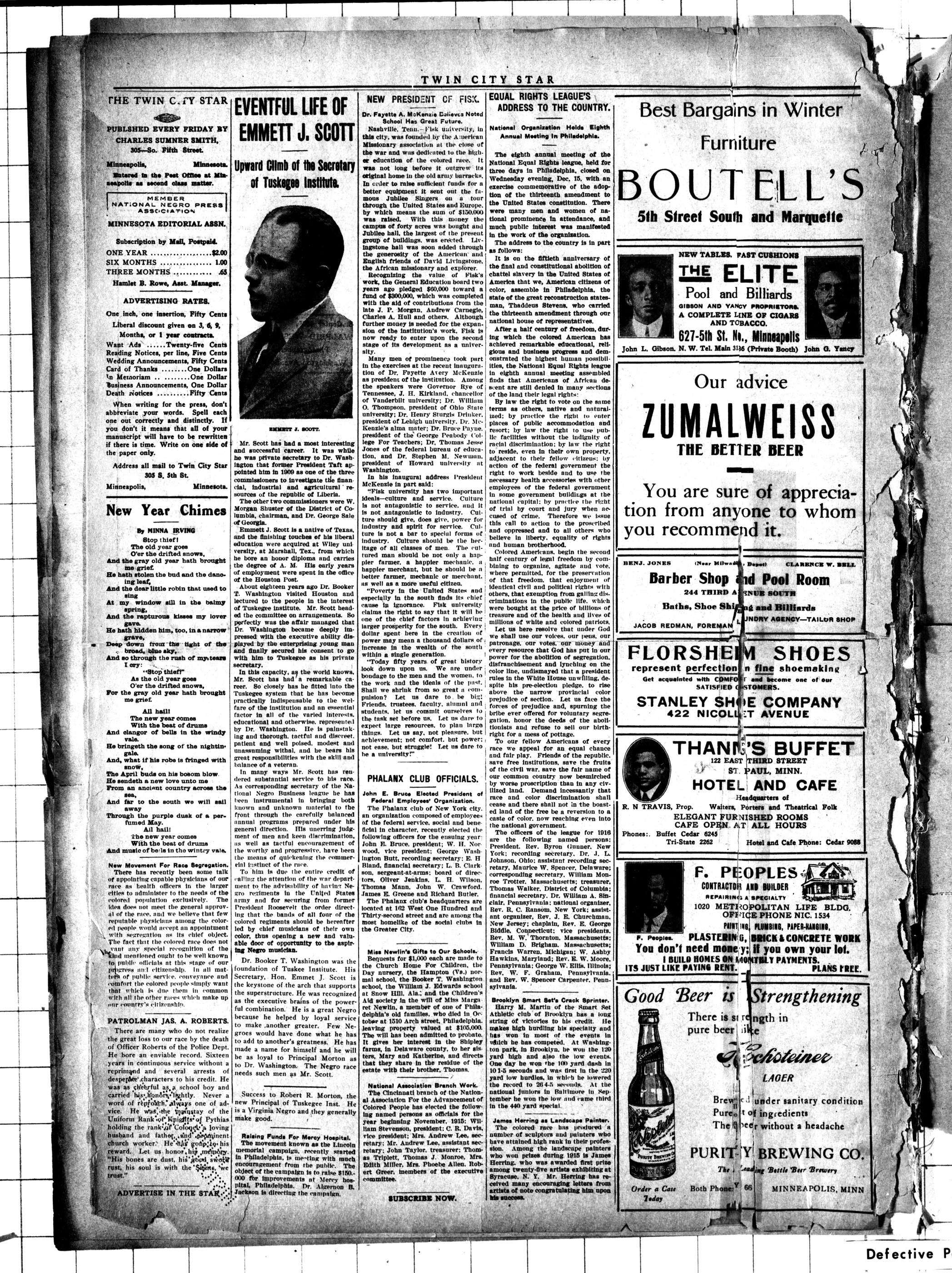
EMMETT J. SCOTT.
Mr. Scott has had a most interesting and successful career. It was while he was private secretary to Dr. Washington that former President Taft appointed him in 1909 as one of the three commissioners to investigate the financial, industrial and agricultural resources of the republic of Liberia.
The other two commissioners were W. Morgan Shuster of the District of Columbia, chairman, and Dr. George Sale of Georgia.
Emmett J. Scott is a native of Texas, and the finishing touches of his liberal education were acquired at Wiley university, at Marshall, Tex., from which he bore an honor diploma and carries the degree of A. M. His early years of employment were spent in the office of the Houston Post.
About eighteen years ago Dr. Booker T. Washington visited Houston and lectured to the people in the interest of Tuskegee institute. Mr. Scott headed the committee on arrangements. So perfectly was the affair managed that Dr. Washington became deeply impressed with the executive ability displayed by the enterprising young man and finally secured his consent to go with him to Tuskegee as his private secretary.
In this capacity, as the world knows, Mr. Scott has had a remarkable career. So closely has he fitted into the Tuskegee system that he has become practically indispensable to the welfare of the institution and an essential factor in all of the varied interests, educational and otherwise, represented by Dr. Washington. He is painstaking and thorough, tactful and discreet, patient and well polished, modest and unassuming withal, and he bears his great responsibilities with the skill and balance of a veteran.
In many ways Mr. Scott has rendered substantial service to his race. As corresponding secretary of the National Negro Business league he has been instrumental in bringing both known and unknown material to the front through the carefully balanced annual programs prepared under his general direction. His unerring judgment of men and keen discrimination, as well as tactful encouragement of the worthy and progressive, have been the means of quickening the commercial instinct of the race.
To him is due the entire credit of calling the attention of the war department to the advisability of having Negro regiments in the United States army and for securing from former President Roosevelt the order directing that the bands of all four of the colored regiments should be hereafter led by chief musicians of their own color, thus opening a new and valuable door of opportunity to the aspiring Negro musician.
Dr. Booker T. Washington was the foundation of Tuskegee Institute. His Secretary, Hon. Emmet J. Scott is the keystone of the arch that supports the superstructure. He was recognized as the executive brains of the powerful combination. He is a great Negro because he helped by loyal service to make another greater. Few Negroes would have done what he has to add to another's greatness. He has made a name for himself and he will be as loyal to Principal Morton as to Dr. Washington. The Negro race needs such men as Mr. Scott.
Success to Robert R. Morton, the new Principal of Tuskegee Inst. He is a Virginia Negro and they generally make good.
Raising Funds For Mercy Hospital. The movement known as the Lincoln memorial campaign, recently started in Philadelphia, is meeting with much encouragement from the public. The object of the campaign is to raise $150,000 for improvements at Mercy hospital, Philadelphia. Dr. Algeron B. Jackson is directing the campaign.
NEW PRESIDENT OF FISK. EQUAL RIGHTS ADDRESS TO
Dr. Fayette A. McKenzie Delieves Noted
School. He's Great Future.
School Has Great Future.
Nashville, Tenn. - Fisk university, in this city, was founded by the American Missionary association at the close of the war and was dedicated to the higher education of the colored race. It was not long before it outgrew its original home in the old army barracks. In order to raise sufficient funds for a better equipment it sent out the famous Jubilee Singers on a tour through the United States and Europe, by which means the sum of $150,000 was raised. With this money the campus of forty acres was bought and Jubilee hall, the largest of the present group of buildings, was erected. Livingstone hall was soon added through the generosity of the American and English friends of David Livingstone, the African missionary and explorer.
Recognizing the value of Fisk's work, the General Education board two years ago pledged $60,000 toward a fund of $300,000, which was completed with the aid of contributions from the late J. P. Morgan, Andrew Carnegie, Charles A. Hull and others. Although further money is needed for the expansion of the institution's work. Fisk is now ready to enter upon the second stage of its development as a university.
Many men of prominence took part in the exercises at the recent inauguration of Dr. Fayette Atery McKenzie as president of the institution. Among the speakers were Governor Rye of Tennessee, J. H. Kirkland, chancellor of Vanderbilt university; Dr. William O. Thompson, president of Ohio State university; Dr. Henry Sturgis Drinker, president of Lehigh university, Dr. McKenzie's alma mater; Dr. Bruce Payne, president of the George Peabody College For Teachers; Dr. Thomas Jesse Jones of the federal bureau of education, and Dr. Stephen M. Newman, president of Howard university at Washington. In his inaugural address President McKenzie in part said:
"Fisk university has two important ideals—culture and service. Culture is not antagonistic to service, and it is not antagonistic to industry. Culture should give, does give, power for industry and spirit for service. Culture is not a bar to special forms of industry. Culture should be the heritage of all classes of men. The cultured man should be not only a happier farmer, a happier mechanic, a happier merchant, but he should be a better farmer, mechanic or merchant, as well as a more useful citizen.
"Poverty in the United States and especially in the south finds its chief cause in ignorance. Fisk university claims the right to say that it will be one of the chief factors in achieving larger prosperity for the south. Every dollar spent here in the creation of power may mean a thousand dollars of increase in the wealth of the south within a single generation.
"Today fifty years of great history look down upon us. We are under bondage to the men and the women, to the work and the ideals of the past. Shall we shrink from so great a compulsion? Let us dare to be big. Friends, trustees, faculty, alumni and students, let us commit ourselves to the task set before us. Let us dare to expect large resources, to plan large things. Let us say, not pleasure, but achievement; not comfort, but power; not ease, but struggle! Let us dare to be a university!"
PHALANX CLUB OFFICIALS.
John E. Bruce Elected President of Federal Employees' Organization.
The Phalanx club of New York city, an organization composed of employees of the federal service, social and beneficial in character, recently elected the following officers for the ensuing year: John E. Bruce, president; W. H. Norwood, vice president; George Washington Butt, recording secretary; E. H Bland, financial secretary; L. B. Clarkson, sergeant-at-arms; board of directors, Oliver Jenkins, L. H. Wilson, Thomas Mann, John W. Crawford, James E. Greene and Richard Butler.
The Phalanx club's headquarters are located at 162 West One Hundred and Thirty-second street and are among the most homelike of the social clubs in the Greater City.
Miss Newlin's Gifts to Our Schools.
Bequests for $1,000 each are made to the Church Home For Children, the Day nursery, the Hampton (Vs.) normal school, the Booker T. Washington school, the William J. Edwards school at Snow Hill, Ala., and the Children's Ald society in the will of Miss Margarit Newlin, a member of one of Philadelphia's old families, who died in October at 1510 Arch street, Philadelphia. leaving property valued at $105,000. The will has been admitted to probate. It gives her interest in the Shipley farms, in Delaware county, to her sisters, Mary and Katherine, and directs that they share in the residue of the estate with their brother, Thomas.
National Association Branch Work.
The Cincinnati branch of the National Association For the Advancement of Colored People has elected the following named persons as officials for the year beginning November, 1915: William Stevenson, president; C. R. Davis, vice president; Mrs. Andrew Lee, secretary; Mr. Andrew Lee, assistant secretary; John Taylor, treasurer; Thomas Triplett, Thomas J. Monroe, Mrs. Edith Miller, Mrs. Phoebe Allen, Robert Greger, members of the executive committee.
SUBSCRIBE NOW.
National Organization Holds Eighth Annual Meeting in Philadelphia.
The eighth annual meeting of the National Equal Rights league, held for three days in Philadelphia, closed on Wednesday evening, Dec. 15, with an exercise commemorative of the adoption of the thirteenth amendment to the United States constitution. There were many men and women of national prominence in attendance, and much public interest was manifested in the work of the organization.
The address to the country is in part as follows:
It is on the fifteenth anniversary of the final and constitutional abolition of chattel slavery in the United States of America that we, American citizens of color, assemble in Philadelphia, the state of the great reconstruction statesman, Thaddeus Stevens, who carried the thirteenth amendment through our national house of representatives.
After a half century of freedom, during which the colored American has achieved remarkable educational, religious and business progress and demonstrated the highest human possibilities, the National Equal Rights league in eighth annual meeting assembled finds that Americans of African descent are still denied in many sections of the land their legal rights:
By law the right to vote on the same terms as others, native and naturalized; by practice the right to enter places of public accommodation and resort; by law the right to use public facilities without the indignity of racial discrimination; by law the right to reside, even in their own property, adjacent to their fellow citizens; by action of the federal government the right to work beside and to use the necessary health accessories with other employees of the federal government in some government buildings at the national capital; by practice the right of trial by court and jury when accused of crime. Therefore we issue this call to action to the proscribed and oppressed and to all others who believe in liberty, equality of rights and human brotherhood.
Colored Americans, begin the second half century of legal freedom by combining to organize, agitate and vote, where permitted, for the preservation of that freedom, that enjoyment of identical civil and political rights with others, that exemption from galling discriminations in the public life, which were bought at the price of billions of treasure and of the health and lives of millions of white and colored patriots.
Let us here resolve that under God we shall use our voices, our pens, our patronage, our votes, our money and every resource that God has put in our power for the abolition of segregation, disfranchisement and lynching on the color line, undismayed that a president rules in the White House unwilling, despite his pre-election pledge, to rise above the narrow provincial color prejudice of section. Let us face the forces of prejudice and, spurring the bride ever offered for voluntary segregation, honor the deeds of the abolitionists and refuse to sell our birthright for a mess of pottage.
To our fellow Americans of every race we appeal for an equal chance and fair play. Friends of the republic, save free institutions, save the fruits of the civil war, save the fair name of our common country now besmirched by worse proscription than in any civilized land. Demand incessantly that race and color discrimination shall cease and there shall not in the boasted land of the free be a reversion to a caste of color, now reaching even into the national government.
The officers of the league for 1916 are the following named persons: President, Rev. Byron Gunner, New York; recording secretary, Dr. J. L. Johnson, Ohio; assistant recording secretary, Maurice W. Spencer, Delaware; corresponding secretary, William Monroe Trotter, Massachusetts; treasurer, Thomas Walker, District of Columbia; financial secretary, Dr. William A. Sinclair, Pennsylvania; national organizer, Rev. R. C. Ransom, New York; assistant organizer, Rev. J. E. Churchman, New Jersey; chaplain, Rev. E. George Biddle, Connecticut; vice presidents, Rev. M. W. Thornton, Massachusetts; William D. Brigham, Massachusetts; Francis Warren, Michigan; W. Ashby Hawkins, Maryland; Rev. E. W. Moore, Pennsylvania; George W. Ellis, Illinois; Rev. W. F. Graham, Pennsylvania; and Rev. W. Spencer Carpenter, Pennsylvania.
Brooklyn Smart Set's Crack Sprinter.
Harry M. Martin of the Smart Set
Athletic club of Brooklyn has a long
string of victories to his credit.
He makes high hurdling his specialty and
has won in most of the events in
which he has competed. At Washington
park, in Brooklyn, he won the 120
yard high and also the low events.
One day he won the 100 yard dash in
101-5 seconds and was first in the 220
yard low hurdles, in which he lowered
the record to 264-5 seconds. At the
national juniors in Baltimore in September
he won the low and came third
in the 440 yard special.
James Herring as Landscape Painter. The colored race has produced a number of sculptors and painters who have attained high rank in their profession. Among the landscape painters who won prizes during 1915 is James Herring, who was awarded first prize among twenty-five artists exhibiting at Syracuse, N. Y. Mr. Herring has received many encouraging letters from artists of note congratulating him upon his success.
NEW TABLES. FAST CUSHIONS
THE ELITE
Pool and Billiards
GIBSON AND YANCY PROPRIETORS.
A COMPLETE LINE OF CIGARS
AND TOBACCO.
627-5th St. No., Minneapolis
John L. Gibson. N. W. Tel. Main 3136 (Private Booth) John G. Yancy
ZUMALWEISS THE BETTER BEER
You are sure of appreciation from anyone to whom you recommend it.
R. N TRAVIS, Pr
EL
CA
Phones.: Buffet C
Tri-S
F. Peoples.
You don't
I BUIL
ITS JUST LIKE
Good
Kohlen
PURITY BREWING CO.
PURITY BREWING CO.
Order a Case Today
Defective