Twin City Star
Saturday, January 29, 1916
Minneapolis, Minnesota
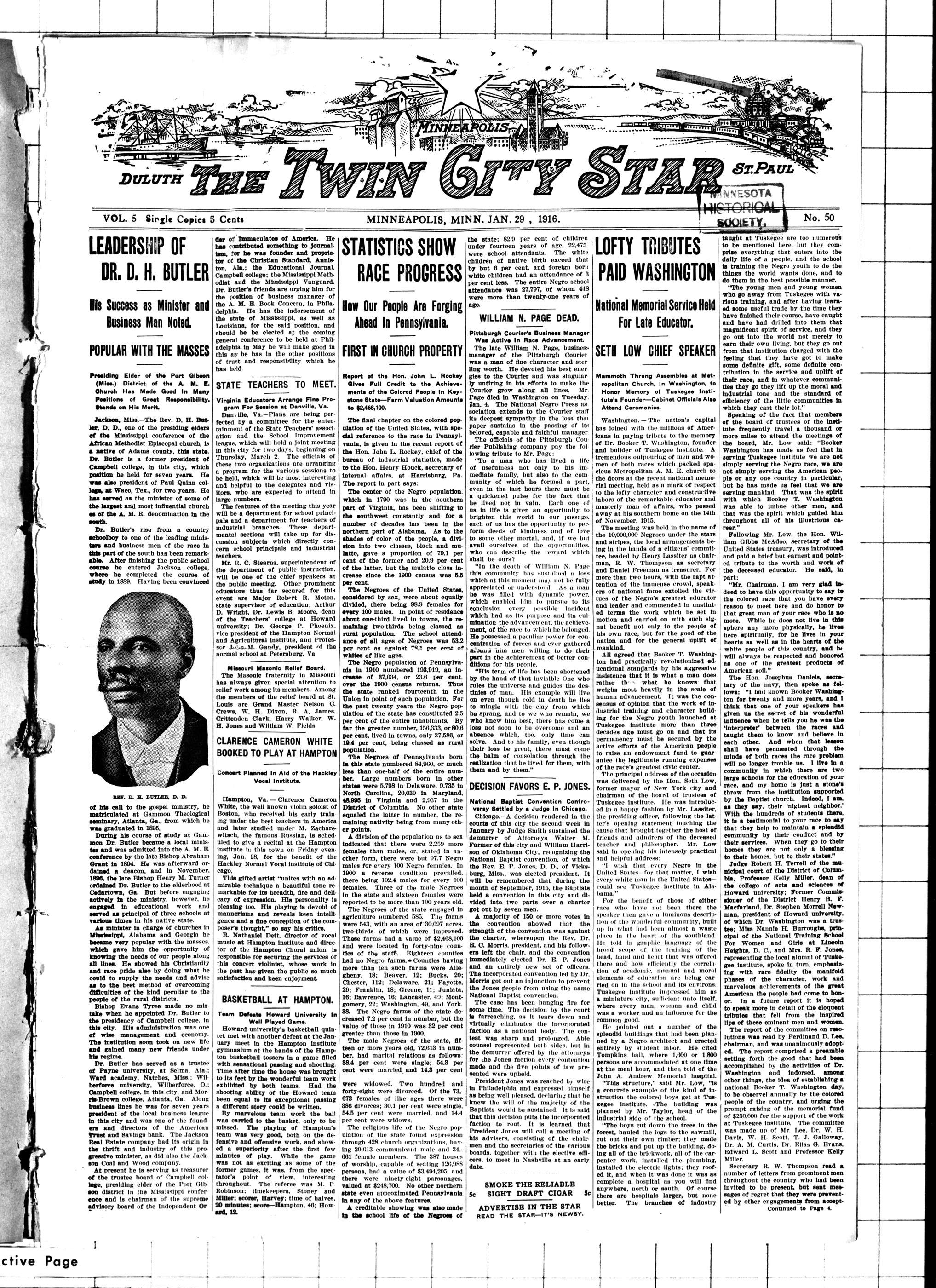
Page text (machine-generated)
MINNEAPOLIS
DULUTH THE TWIN CITY STAR ST.PAUL
MINNESOTA HISTORICAL
active Page
VOL. 5 Single Copies 5 Cents
der of Immaculates of America. He has contributed something to journalism, for he was founder and proprietor of the Christian Standard, Anniston, Ala.; the Educational Journal, Campbell college; the Mississippi Methodist and the Mississippi Vanguard. Dr. Butier's friends are urging him for the position of business manager of the A. M. E. Book Concern, in Philadelphia. He has the indorsement of the state of Mississippi, as well as Louisiana, for the said position, and should he be elected at the coming general conference to be held at Philadelphia in May he will make good in this as he has in the other positions of trust and responsbility which he has held.
LEADERSHIP OF DR. D. H. BUTLER
His Success as Minister and Business Man Noted.
POPULAR WITH THE MASSES
Presiding Elder of the Port Gibbon (Miss.) District of the A. M. E. Church Has Made Good In Many Positions of Great Responsibility, Stands on His Merit.
Jackson, Miss.—The Rev. D. H. Butler, D. D., one of the presiding elders of the Mississippi conference of the African Methodist Episcopal church, is a native of Adams county, this state. Dr. Butler is a former president of Campbell college, in this city, which position he held for seven years. He was also president of Paul Quinn college, at Waco, Tex., for two years. He has served as the minister of some of the largest and most influential churches of the A. M. E. denomination in the south.
Dr. Butler's rise from a country schoolboy to one of the leading ministers and business men of the race in this part of the south has been remarkable. After finishing the public school course he entered Jackson college, where he completed the course of study in 1889. Having been convinced
REV. D. H. BUTLER, D. D.
of his call to the gospel ministry, he matriculated at Gammon Theological seminary, Atlanta, Ga., from which he was graduated in 1806.
During his course of study at Gammon Dr. Butler became a local minister and was admitted into the A. M. E. conference by the late Bishop Abraham Grant in 1894. He was afterward ordained a deacon, and in November, 1896, the late Bishop Henry M. Turner ordained Dr. Butler to the elderhood at Cedartown, Ga. But before engaging actively in the ministry, however, he engaged in educational work and served as principal of three schools at various times in his native state.
As minister in charge of churches in Mississippi, Alabama and Georgia he became very popular with the masses, which gave him the opportunity of knowing the needs of our people along all lines. He showed his Christianity and race pride also by doing what he could to supply the needs and advise as to the best method of overcoming difficulties of the kind peculiar to the people of the rural districts.
Bishop Evans Tyrema made no mistake when he appointed Dr. Butler to the presidency of Campbell college. In this city. His administration was one of wise management and economy. The institution soon took on new life and gained many new friends under his regime.
Dr. Butler has served as a trustee of Payne university, at Selma, Ala. Ward academy, Natchez, Miss.; Willberforce university, Wilberforce, O. Campbell college, in this city, and Morris-Brown college, Atlanta, Ga. Along business lines he was for seven years president of the local business league in this city and was one of the founders and directors of the American Trust and Savings bank. The Jackson Real Estate company had its origin in the thrift and industry of this progressive minister, as did also the Jackson Coal and Wood company. At present he is serving as treasurer of the trustee board of Campbell college, presiding elder of the Port Gibson district in the Mississippi conference and is chairman of the supreme advisory board of the Independent Or
STATE TEACHERS TO MEET.
Virginia Educators Arrange Fine Program For Session at Danville, Va. Danville, Va.—Plans are being perfected by a committee for the entertainment of the State Teachers' association and the School Improvement league, which will hold a joint meeting in this city for two days, beginning on Thursday, March 2. The officials of these two organizations are arranging a program for the various sessions to be held, which will be most interesting and helpful to the delegates and visitors, who are expected to attend in large numbers.
The features of the meeting this year will be a department for school principals and a department for teachers of industrial branches. These departmental sections will take up for discussion subjects which directly concern school principals and industrial teachers.
Mr. R. C. Stearns, superintendent of the department of public instruction, will be one of the chief speakers at the public meeting. Other prominent educators thus far secured for this event are Major Robert R. Moton, state supervisor of education; Arthur D. Wright, Dr. Lewis B. Moore, dean of the Teachers' college at Howard university; Dr. George P. Phoenix, vice president of the Hampton Normal and Agricultural institute, and Professor Lela M. Gandy, president of the normal school at Petersburg, Va.
Missouri Masonic Relief Board. The Masonic fraternity in Missouri has always given special attention to relief work among its members. Among the members of the relief board at St. Louis are Grand Master Nelson C. Crews, W. H. Dixon, R. A. James, Crittenden Clark, Harry Walker, W. H. Jones and William W. Fields
CLARENCE CAMERON WHITE
BOOKED TO PLAY AT HAMPTON
Concert Planned In Aid of the Hackley Vocal Institute.
Hampton, Va. — Clarence Cameron White, the well known violin solist of Boston, who received his early training under the best teachers in America and later studied under M. Zacharewitz, the famous Russian, is scheduled to give a recital at the Hampton institute in this town on Friday evening, Jan. 28, for the benefit of the Hackley Normal Vocal institute of Chicago.
This gifted artist "unites with an admirable technique a beautiful tone remarkable for its breadth, fire and delicacy of expression. His personality is pleasing too. His playing is devoid of mannerisms and reveals keen intelligence and a fine conception of the composer's thought," so say his critics.
R. Nathaniel Dett, director of vocal music at Hampton institute and director of the Hampton Choral union, is responsible for securing the services of this concert violinist, whose work in the past has given the public so much satisfaction and keen enjoyment.
BASKETBALL AT HAMPTON.
Team Defeats Howard University In Well Played Game.
Howard university's basketball quintet meet with another defeat at the January meet in the Hampton institute gymnasium at the hands of the Hampton basketball tossers in a game filled with sensational passing and shooting. Time after time the house was brought to its feet by the wonderful team work exhibited by both teams. Had the shooting ability of the Howard team been equal to its exceptional passing a different story could be written.
By marvelous team work the ball was carried to the basket, only to be missed. The playing of Hampton's team was very good, both on the defensive and offensive work, and showed a superiority after the first few minutes of play. While the game was not as exciting as some of the former games, it was. from the spectator's point of view, interesting throughout. The referee was M. P Robinson; timekeepers, Stoney and Miller; scorer, Harvey; time of halves, 20 minutes; score—Hampton, 46; Howard, 12.
MINNEAPOLIS, MINN. JAN. 29, 1916.
STATISTICS SHOW RACE PROGRESS
Report of the Hon. John L. Rockey Glives Full Credit to the Achievements of the Colored People in Keystone State—Farm Valuation Amounts to $2,468,100.
The final chapter on the colored population of the United States, with special reference to the race in Pennsylvania, is given in the recent report of the Hon. John L. Rockey, chief of the bureau of industrial statistics, made to the Hon. Henry Houck, secretary of internal affairs, at Harrisburg, Pa. The report in part says:
The center of the Negro population, which in 1790 was in the southern part of Virginia, has been shifting to the southwest constantly and for a number of decades has been in the northern part of Alabama. As to the shades of color of the people, a division into two classes, black and mulatto, gave a proportion of 79.1 per cent of the former and 20.9 per cent of the latter, but the mulatto class increase since the 1900 census was 5.5 per cent.
The Negroes of the United States, considered by sex, were about equally divided, there being 98.9 females for every 100 males. In point of residence about one-third lived in towns, the remaining two-thirds being classed as rural population. The school attendance of all ages of Negroes was 53.2 per cent as against 79.1 per cent of whites of like ages.
The Negro population of Pennsylvania in 1910 numbered 193,919, an increase of 37,034, or 23.6 per cent, over the 1900 census returns. Thus the state ranked fourteenth in the Union in point of such population. For the past twenty years the Negro population of the state has constituted 2.5 per cent of the entire inhabitants. By far the greater number, 150,333, or 80.0 per cent, lived in towns, only 37,586, or 19.4 per cent, being classed as rural population.
The Negroes of Pennsylvania born in this state numbered 84,960, or much less than one-half of the entire number. Large numbers born in other states were 5,798 in Delaware, 9,735 in North Carolina, 20,030 in Maryland, 48,995 in Virginia and 2,937 in the District of Columbia. No other state equaled the latter in number, the remaining nativity being from many other points.
A division of the population as to sex indicated that there were 2,259 more females than males, or, stated in another form, there were but 97.7 Negro males for every 100 Negro females. In 1900 a reverse condition prevailed, there being 102.4 males for every 100 females. Three of the male Negroes in the state and sixteen females were reported to be more than 100 years old. The Negroes of the state engaged in agriculture numbered 585. The farms were 543, with an area of 30,097 acres, two-thirds of which were improved. These farms had a value of $2,468,100 and were located in forty-nine counties of the state. Eighteen counties had no Negro farms. Counties having more than ten such farms were Allegheny, 18; Beaver, 12; Bucks, 20; Chester, 112; Delaware, 21; Fayette, 29; Franklin, 18; Greene, 11; Juniata, 16; Dawrence, 16; Lancaster, 49; Montgomery, 22; Washington, 49, and York. 88. The Negro farms of the state decreased 7.2 per cent in number, but the value of those in 1910 was 32 per cent greater than those in 1900. The male Negroes of the state, fifteen or more years old, 72,613 in number, had marital relations as follows: 88.4 per cent were single; 54.3 per cent were married and 14.3 per cent
were widowed. Two hundred and forty-eight were divorced. Of the 73, 673 females of like ages there were 386 divorces; 30.1 per cent were single, 54.5 per cent were married, and 14.4 per cent were widows.
The religious life of the Negro population of the state found expression through 428 church organizations, having 20,613 communicant male and 34, 661 female members. The 387 houses of worship, capable of seating 126,988 persons, had a value of $3,494,205, and there were ninety-eight parsonages, valued at $248,700. No other northern state even approximated Pennsylvania in any of the above features.
A creditable showing was also made in the school life of the Negroes of
the state; 82.9 per cent of children under fourteen years of age, 22,475 were school attendants. The white children of native birth exceed that by but 6 per cent, and foreign born white children had an attendance of 3 per cent less. The entire Negro school attendance was 27,797, of whom 448 were more than twenty-one years of age.
WILLIAM N. PAGE DEAD.
Pittsburgh Courier's Business Manager
Pittsburgh Courier's Business Manager Was Active in Race Advancement.
The late William N. Page, business manager of the Pittsburgh Courier was a man of fine character and sterring worth. He devoted his best energies to the Courier and was singularly untiring in his efforts to make the Courier grow along all lines. Mr. Page dled in Washington on Tuesday, Jan. 4. The National Negro Press as society extends to the Courier staff its deepest sympathy in the loss that paper sustains in the passing of its beloved, capable and faithful manager
The officials of the Pittsburgh Courier Publishing company pay the following tribute to Mr. Page:
"To a man who has lived a life of usefulness not only to his immediate family, but also to the community of which he formed a part, even in the last hours there must be a quickened pulse for the fact that he lived not in vain. Each one of us in life is given an opportunity to brighten this world in our passage, each of us has the opportunity to perform deeds of kindness and of love to some other mortal, and, if we but avail ourselves of the opportunities, who can describe the reward which shall be ours?
"In the death of William N. Page this community has sustained a loss which at this moment may not be fully appreciated or understood. As a man he was filled with dynamic power, which enabled him to pursue to its conclusion every possible incident which had as its purpose and its culmination the advancement, the achievement, of the race to which he belonged. He possessed a peculiar power for concentration of forces and ever gathered around him men willing to do their part in the achievement of better conditions for his people.
"His term of life has been shortened by the hand of that invisible One who rules the universe and guides the destinies of man. His example will live on even though cold in death he lies to mingle with the clay from which he sprang, and to we who remain, we who knew him best, there has come a loss not soon to be overcome and an absence which, too, only time can solve. And to his family, even though their loss be great, there must come the balm of consolation through the realization that he lived for them, with them and by them."
DECISION FAVORS E. P. JONES
National Baptist Convention Contro-
vially Settled by a Judge in Chicago
versay Settled by a Judge in Chicago.
Chicago.-A decision rendered in the courts of this city the second week in January by Judge Smith sustained the demurrer of Attorneys Walter M. Farmer of this city and William Harrison of Oklahoma City, recognizing the National Baptist convention, of which the Rev. E. P. Jones, D. D., of Vicksburg, Miss., was elected president. It will be remembered that during the month of September, 1915, the Baptists held a convention in this city and divided into two parts over a charter got out by seven men.
A majority of 150 or more votes in the convention showed that the strength of the convention was against the charter, whereupon the Rev. Dr. E. C. Morris, president, and his followers left the chair, and the convention immediately elected Dr. E. P. Jones and an entirely new set of officers.
The incorporated convention led by Dr. Morris got out an injunction to prevent the Jones people from using the name National Baptist convention.
The case has been hanging fire for some time. The decision by the court is farreaching, as it tears down and virtually eliminates the incorporated faction as a national body. The contest was sharp and prolonged. Able counsel represented both sides, but in the demurrer offered by the attorneys for the Jones faction every contention made and the five points of law presented were upheld.
President Jones was reached by wires in Philadelphia and expressed himself as being well pleased, declaring that he knew the will of the majority of the Baptists would be sustained. It is said that this decision puts the incorporated faction to rout. It is learned that President Jones will call a meeting of his advisers, consisting of the chairmen and the secretaries of the various boards, together with the elective officers, to meet in Nashville at an early date.
SMOKE THE RELIABLE
5c SIGHT DRAFT CIGAR
DVERTISSE IN THE STAR
READISE THE STAR-ITS NEWS
LOFTY TRIBUTES PAID WASHINGTON
SETH LOW CHIEF SPEAKER
Mammoth Throng Assembles at Metropolitan Church, in Washington, to Honor Memory of Tuskegee Institute's Founder—Cabinet Officials Also Attend Ceremonies.
Washington.—The nation's capital has joined with the millions of Americans in paying tribute to the memory of Dr. Booker T. Washington, founder and builder of Tuskegee institute. A tremendous outpouring of men and women of both races which packed spacious Metropolitan A. M. E. church to the doors at the recent national memorial meeting, held as a mark of respect to the lofty character and constructive labors of the remarkable educator and masterly man of affairs, who passed away at his southern home on the 14th of November, 1915.
The meeting was held in the name of the 10,000,000 Negroes under the stars and stripes, the local arrangements being in the hands of a citizens' committee, headed by Henry Lassler as chairman, R. W. Thompson as secretary and Daniel Freeman as treasurer. For more than two hours, with the rapt attention of the immense crowd, speakers of national fame extolled the virtues of the Negro's greatest educator and leader and commended in unstinted terms the work which he set in motion and carried on with such signal benefit not only to the people of his own race, but for the good of the nation and for the general uplift of mankind.
All agreed that Booker T. Washington had practically revolutionized educational standards by his aggressive insistence that it is what a man does rather than what he knows that welcomes most heavily in the scale of human advancement. It was the consensus of opinion that the work of industrial training and character building for the Negro youth launched at Tuskegee institute more than three decades ago must go on and that its permanency must be secured by the active efforts of the American people to raise an endowment fund to guarantee the legitimate running expenses of the race's greatest civic center.
The principal address of the occasion was delivered by the Hon. Seth Low, former mayor of New York city and chairman of the board of trustees of Tuskegee institute. He was introduced in a happy fashion by Mr. Lassiter, the presiding officer, following the latter's opening statement touching the cause that brought together the host of friends and admirers of the deceased teacher and philosopher. Mr. Low said in opening his intensely practical and helpful address:
"I wish that every Negro in the United States—for that matter, I wish every white man in the United States—could see Tuskegee institute in Alabama."
For the benefit of those of either race who have not been there the speaker then gave a luminous description of the wonderful community, built up in what had been almost a waste place in the heart of the southland. He told in graphic language of the broad scope of the training of the head, hand and heart that was offered there and how efficiently the correlation of academic, manual and moral elements of education are being carried on in the school and its environs. Tuskegee institute impressed him as a miniature city, sufficient unto itself, where every man, woman and child was a worker and an influence for the common good.
He pointed out a number of the splendid buildings that had been planned by a Negro architect and erected entirely by student labor. He cited Tompkins hall, where 1,000 or 1,800 persons are accommodated at one time at the meal hour, and then told of the John A. Andrew Memorial hospital. "This structure," said Mr. Low, "is a concrete example of the kind of instruction the colored boys get at Tuskegee institute. The building was planned by Mr. Taylor, head of the industrial side of the school. "The boys cut down the trees in the forest, hauled the logs to the sawmill, cut out their own timber; they made the bricks and put up the building, doing all of the brickwork, all of the carpenter work, installed the plumbing, installed the electric lights; they roofed it, and when it was done it was as complete a hospital as you will find anywhere, north or south. Of course there are hospitals larger, but none better. The branches of industry
taught at Tuskegee are too numerous to be mentioned here, but they comprise everything that enters into the daily life of a people, and the school is training the Negro youth to do the things the world wants done, and to do them in the best possible manner. "The young men and young women who go away from Tuskegee with various training, and after having learned some useful trade by the time they have finished their course, have caught and have had drilled into them that magnificent spirit of service, and they go out into the world not merely to earn their own living, but they go out from that institution charged with the feeling that they have got to make some definite gift, some definite contribution in the service and uplift of their race, and in whatever communities they go they lift up the moral and industrial tone and the standard of efficiency of the little communities in which they cast their lot."
Speaking of the fact that members of the board of trustees of the institute frequently travel a thousand or more miles to attend the meetings of the board, Mr. Low said: "Booker Washington has made us feel that in serving Tuskegee institute we are not simply serving the Negro race, we are not simply serving the American people or any one country in particular, but he has made us feel that we are serving mankind. That was the spirit with which Booker T. Washington was able to imbue other men, and that was the spirit which guided him throughout all of his illustrious career."
Following Mr. Low, the Hon. William Gibbs McAdoo, secretary of the United States treasury, was introduced and paid a brief but earnest and pointed tribute to the worth and work of the deceased educator. He said, in part:
"Mr. Chairman, I am very glad indeed to have this opportunity to say to the colored race that you have every reason to meet here and do honor to that great man of your race who is no more. While he does not live in this sphere any more physically, he lives here spiritually, for he lives in your hearts as well as in the hearts of the white people of this country, and he will always be respected and honored as one of the greatest products of American soil."
The Hon. Josephus Daniels, secretary of the navy, then spoke as follows: "I had known Booker Washington for twenty and more years, and I think that one of your speakers has given us the secret of his wonderful influence when he tells you he was the 'interpreter' between the races and taught them to know and believe in each other. And when that lesson shall have permeated through the minds of both races the race problem will no longer trouble us. I live in a community in which there are two large schools for the education of your race, and my home is just a stone's throw from the institution supported by the Baptist church. Indeed, I am, as they say, their 'nighest neighbor'. With the hundreds of students there, it is a testimonial to your race to say that they help to maintain a splendid community by their conduct and by their services. When they go to their homes they are not only a blessing to their homes, but to their states."
Judge Robert H. Terrell of the municipal court of the District of Columbia, Professor Kelly Miller, dean of the college of arts and sciences of Howard university; Former Commissioner of the District Henry B. F. Macfarland, Dr. Stephen Morrell Newman, president of Howard university, of which Dr. Washington was a trustee; Miss Nannle H. Burroughs, principal of the National Training School For Women and Girls at Lincoln Heights, D. C., and Mrs. R. F. Jones, representing the local alumni of Tuskegee institute, spoke in turn, emphasizing with rare fidelity the manifold phases of the character, work and marvelous achievements of the great American the people had come to honor. In a future report it is hoped to speak more in detail of the eloquent tributes that fell from the inspired lips of these eminent men and women.
The report of the committee on resolutions was read by Ferdinand D. Lee, chairman, and was unanimously adopted. The report comprised a preamble setting forth the good that had been accomplished by the activities of Dr. Washington and indorsed, among other things, the idea of establishing a national Booker T. Washington day, to be observer annually by the colored people of the country, and urging the prompt raising of the memorial fund of $250,000 for the support of the work at Tuskegee institute. The committee was made up of Mr. Lee, Dr. W. H. Davis, W. H. Scott, T. J. Galloway, Dr. A. M. Curtis, Dr. Ellas G. Evans, Edward L. Scott and Professor Kelly Miller.
Secretary R. W. Thompson read a number of letters from prominent men throughout the country who had been invited to be present, but sent messages of regret that they were prevented by other engagements from accept-
Continued to Page 4.
DULUTH THE TWIN CITY STAR ST.PAUL MINNESOTA HISTORICAL
active Page
VOL. 5 Single Copies 5 Cents
By marvelous team work the ball was carried to the basket, only to be missed. The playing of Hampton's team was very good, both on the defensive and offensive work, and showed a superiority after the first few minutes of play. While the game was not as exciting as some of the former games, it was, from the spectator's point of view, interesting throughout. The referee was M. P. Robinson; timekeepers, Stoney and Miller; scoreer, Harvey; time of halves, 20 minutes; score—Hampton, 46; Howard, 12.
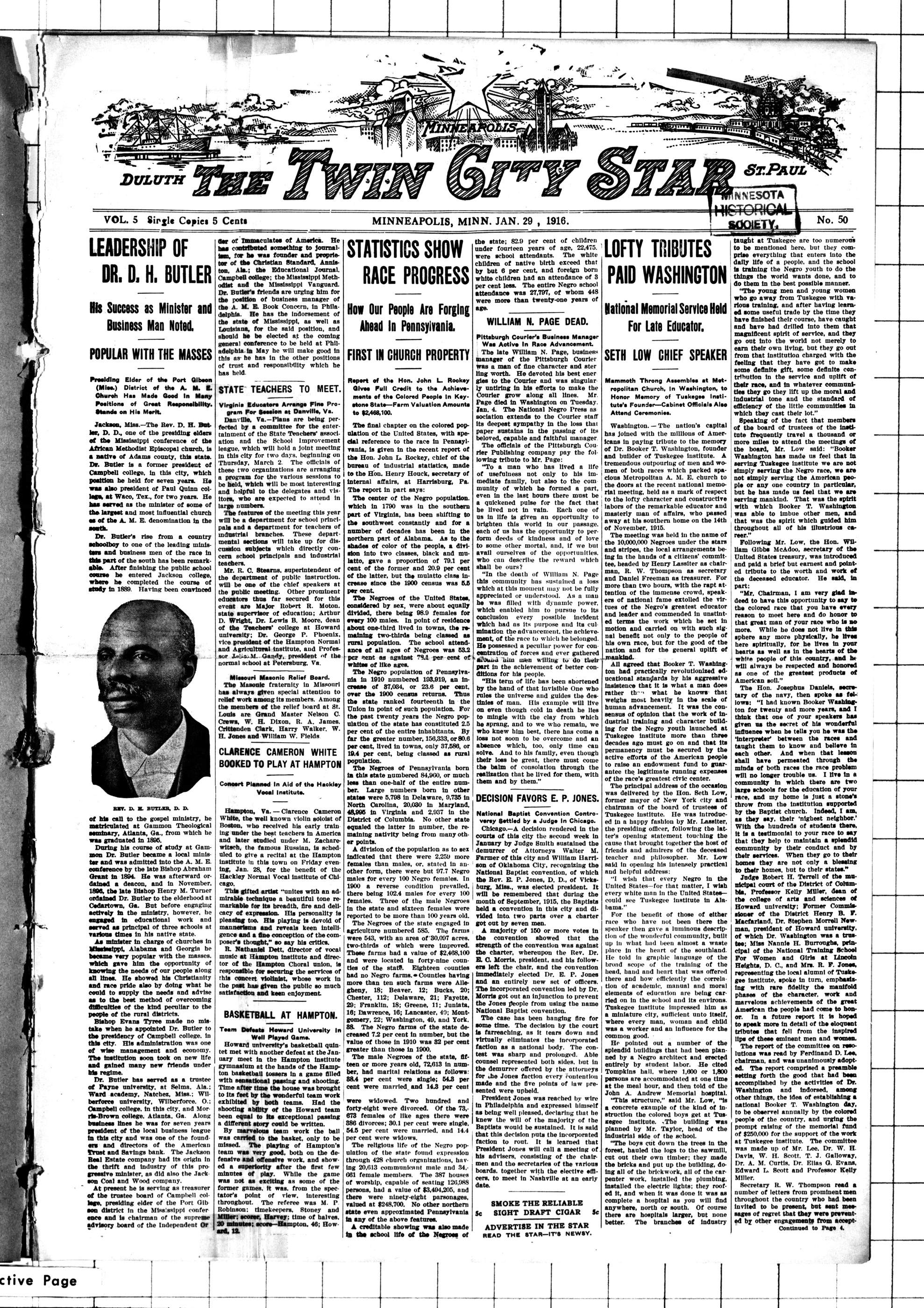
LEADERSHIP OF DR. D. H. BUTLER
Presiding Elder of the Port Gibson (Mise.) District of the A. M. E. Church Has Made Good In Many Positions of Great Responsibility, Stands on His Merit.
Jackson, Miss.—The Rev. D. H. Butler, D. D., one of the presiding elders of the Mississippi conference of the African Methodist Episcopal church, is a native of Adams county, this state.
Dr. Butler is a former president of Campbell college, in this city, which position he held for seven years. He was also president of Paul Quinn college, at Waco, Tex., for two years. He has served as the minister of some of the largest and most influential churches of the A. M. E. denomination in the south.
Dr. Butler's rise from a country schoolboy to one of the leading ministers and business men of the race in this part of the south has been remarkable. After finishing the public school course he entered Jackson college, where he completed the course of study in 1889. Having been convinced
[Image of a black man with a mustache and a suit]
REV. D. H. BUTLER, D. D. of his call to the gospel ministry, he matriculated at Gammon Theological seminary, Atlanta, Ga., from which he was graduated in 1896. During his course of study at Gammon Dr. Butler became a local minister and was admitted into the A. M. E. conference by the late Bishop Abraham Grant in 1894. He was afterward ordained a deacon, and in November, 1896, the late Bishop Henry M. Turner ordained Dr. Butler to the elderhood at Cedartown, Ga. But before engaging actively in the ministry, however, he engaged in educational work and served as principal of three schools at various times in his native state.
As minister in charge of churches in Mississippi, Alabama and Georgia he became very popular with the masses, which gave him the opportunity of knowing the needs of our people along all lines. He showed his Christianity and race pride also by doing what he could to supply the needs and advise as to the best method of overcoming difficulties of the kind peculiar to the people of the rural districts.
Bishop Evans Tyree made no mistake when he appointed Dr. Butler to the presidency of Campbell college, in this city. His administration was one of wise management and economy. The institution soon took on new life and gained many new friends under his regime.
Dr. Butler has served as a trustee of Payne university, at Selma, Ala. Ward academy, Natchez, Miss.; Wilberforce university, Wilberforce. O. Campbell college, in this city, and Morris-Brown college, Atlanta, Ga. Along business lines he was for seven years president of the local business league in this city and was one of the founders and directors of the American Trust and Savings bank. The Jackson Real Estate company had its origin in the thrift and industry of this progressive minister, as did also the Jackson Coal and Wood company. At present he is serving as treasurer of the trustee board of Campbell college, presiding elder of the Port Gibson district in the Mississippi conference and is chairman of the supreme advisory board of the Independent Or
der of Immaculates of America. He has contributed something to journalism, for he was founder and proprietor of the Christian Standard, Anniston, Ala.; the Educational Journal, Campbell college; the Mississippi Methodist and the Mississippi Vanguard. Dr. Butler's friends are urging him for the position of business manager of the A. M. E. Book Concern, in Philadelphia. He has the endorsement of the state of Mississippi, as well as Louisiana, for the said position, and should be he elected at the coming general conference to be held at Philadelphia. In May he will make good in this as he has in the other positions of trust and responsibility which he has held.
STATE TEACHERS TO MEET.
Virginia Educators Arrange Fine Program
For Session at Davallie, Va.
gram For Session at Danville, Va. Danville, Va.-Plans are being perfected by a committee for the entertainment of the State Teachers' association and the School Improvement league, which will hold a joint meeting in this city for two days, beginning on Thursday, March 2. The officials of these two organizations are arranging a program for the various sessions to be held, which will be most interesting and helpful to the delegates and visitors, who are expected to attend in large numbers.
The features of the meeting this year will be a department for school principals and a department for teachers of industrial branches. These departmental sections will take up for discussion subjects which directly concern school principals and industrial teachers.
Mr. R. C. Stearns, superintendent of the department of public instruction, will be one of the chief speakers at the public meeting. Other prominent educators thus far secured for this event are Major Robert R. Moton, state supervisor of education; Arthur D. Wright, Dr. Lewis B. Moore, dean of the Teachers' college at Howard university; Dr. George P. Phoenix, vice president of the Hampton Normal and Agricultural institute, and Professor Lois M. Gandy, president of the normal school at Petersburg, Va.
Missouri Masonic Relief Board. The Masonic fraternity in Missouri has always given special attention to relief work among its members. Among the members of the relief board at St. Louis are Grand Master Nelson C. Crews, W. H. Dixon, R. A. James, Crittenden Clark, Harry Walker, W. H. Jones and William W. Fields
CLARENCE CAMERON WHITE
BOOKED TO PLAY AT HAMPTON
Concert Planned in Aid of the Hackley Vocal Institute.
Hampton, Va. — Clarence Cameron White, the well known violin soloist of Boston, who received his early training under the best teachers in America and later studied under M. Zacharewitsch, the famous Russian, is scheduled to give a recital at the Hampton institute in this town on Friday evening, Jan. 28, for the benefit of the Hackley Normal Vocal institute of Chicago.
This gifted artist "unites with an admirable technique a beautiful tone remarkable for its breadth, fire and delicacy of expression. His personality is pleasing too. His playing is devoid of mannerisms and reveals keen intelligence and a fine conception of the composer's thought," so say his critics.
R. Nathaniel Dett, director of vocal music at Hampton institute and director of the Hampton Choral union, is responsible for securing the services of this concert violinist, whose work in the past has given the public so much satisfaction and keen enjoyment.
BASKETBALL AT HAMPTON.
Team Defeats Howard University in Well Played Game.
Howard university's basketball quintet met with another defeat at the January meet in the Hampton Institute gymnasium at the hands of the Hampton basketball tossers in a game filled with sensational passing and shooting.
Time after time the house was brought to its feet by the wonderful team work exhibited by both teams. Had the shooting ability of the Howard team been equal to its exceptional passing a different story could be written.
MINNEAPOLIS, MINN. JAN. 29, 1916.
STATISTICS SHOW RACE PROGRESS
FIRST IN CHURCH PROPERTY
Report of the Hon. John L. Rookey
Gives Full Credit to the Achievements of the Colored People in Keystone State—Farm Valuation Amounts to $2,468,100.
The final chapter on the colored population of the United States, with special reference to the race in Pennsylvania, is given in the recent report of the Hon. John L. Rookey, chief of the bureau of industrial statistics, made to the Hon. Henry Houck, secretary of internal affairs, at Harrisburg, Pa.
The report in part says:
The center of the Negro population, which in 1700 was in the southern part of Virginia, has been shifting to the southwest constantly and for a number of decades has been in the northern part of Alabama. As to the shades of color of the people, a division into two classes, black and mulatto, gave a proportion of 79.1 per cent of the former and 20.9 per cent of the latter, but the mulatto class increase since the 1900 census was 5.5 per cent.
The Negroes of the United States, considered by sex, were about equally divided, there being 98.9 females for every 100 males. In point of residence about one-third lived in towns, the remaining two-thirds being classed as rural population. The school attendance of all ages of Negroes was 53.2 per cent as against 79.1 per cent of whites of like ages.
The Negro population of Pennsylvania in 1910 numbered 103,919, an increase of 37,034, or 23.6 per cent, over the 1900 census returns. Thus the state ranked fourteenth in the Union in point of such population. For the past twenty years the Negro population of the state has constituted 2.5 per cent of the entire inhabitants. By far the greater number, 156,333, or 80.6 per cent, lived in towns, only 37,586, or 19.4 per cent, being classed as rural population. The Negroes of Pennsylvania born in this state numbered 84,960, or much less than one-half of the entire number. Large numbers born in other states were 5,798 in Delaware, 9,735 in North Carolina, 20,030 in Maryland, 48,995 in Virginia and 2,937 in the District of Columbia. No other state equaled the latter in number, the remaining nativity being from many other points.
A division of the population as to sex indicated that there were 2,259 more females than males, or, stated in another form, there were but 97.7 Negro males for every 100 Negro females. In 1900 a reverse condition prevaled, there being 102.4 males for every 100 females. Three of the male Negroes in the state and sixteen females were reported to be more than 100 years old.
The Negroes of the state engaged in agriculture numbered 585. The farms were 543, with an area of 30,007 acres, two-thirds of which were improved. These farms had a value of $2,468,100 and were located in forty-nine counties of the state. Eighteen counties had no Negro farms. Counties having more than ten such farms were Allegheny, 18; Beaver, 12; Bucks, 20; Chester, 112; Delaware, 21; Fayette, 29; Franklin, 18; Greene, 11; Junlata, 16; Dawrence, 16; Lancaster, 40; Montgomery, 22; Washington, 49, and York. 88. The Negro farms of the state decreased 7.2 per cent in number, but the value of those in 1910 was 32 per cent greater than those in 1900.
The male Negroes of the state, fifteen or more years old, 72,613 in number, had marital relations as follows: 88.4 per cent were single; 54.3 per cent were married and 14.3 per cent
were widowed. Two hundred and forty-eight were divorced. Of the 73,673 females of like ages there were 386 divorces; 30.1 per cent were single, 54.5 per cent were married, and 14.4 per cent were widows.
The religious life of the Negro population of the state found expression through 428 church organizations, having 20,613 communicant male and 34,661 female members. The 387 houses of worship, capable of seating 126,988 persons, had a value of $3,404,205, and there were ninety-eight parsonages, valued at $248,700. No other northern state even approximated Pennsylvania in any of the above features.
A creditable showing was also made in the school life of the Negroes of
the state; 82.9 per cent of children under fourteen years of age, 22,475 were school attendants. The white children of native birth exceed that by but 6 per cent, and foreign born white children had an attendance of 3 per cent less. The entire Negro school attendance was 27,797, of whom 448 were more than twenty-one years of age.
WILLIAM N. PAGE DEAD.
Pittsburgh Courier's Business Manager Was Active In Race Advancement. The late William N. Page, business manager of the Pittsburgh Courier was a man of fine character and sterling worth. He devoted his best energies to the Courier and was singularly untrying in his efforts to make the Courier grow along all lines. Mr. Page died in Washington on Tuesday Jan. 4. The National Negro Press as association extends to the Courier staff its deepest sympathy in the loss that paper sustains in the passing of its beloved, capable and faithful manager. The officials of the Pittsburgh Courier Publishing company pay the following tribute to Mr. Page:
"To a man who has lived a life of usefulness not only to his immediate family, but also to the community of which he formed a part, even in the last hours there must be a quickened pulse for the fact that he lived not in vain. Each one of us in life is given an opportunity to brighten this world in our passage, each of us has the opportunity to perform deeds of kindness and of love to some other mortal, and, if we but avail ourselves of the opportunities, who can describe the reward which shall be ours?
"In the death of William N. Page this community has sustained a loss which at this moment may not be fully appreciated or understood. As a man he was filled with dynamic power, which enabled him to pursue to its conclusion every possible incident which had as its purpose and its culmination the advancement, the achievement, of the race to which he belonged. He possessed a peculiar power for concentration of forces and ever gathered around him men willing to do their part in the achievement of better conditions for his people.
"His term of life has been shortened by the hand of that invisible One who rules the universe and guides the destinies of man. His example will live on even though cold in death he lies to mingle with the clay from which he sprang, and to we who remain, we who knew him best, there has come a loss not soon to be overcome and an absence which, too, only time can solve. And to his family, even though their loss be great, there must come the balm of consolation through the realization that he lived for them, with them and by them."
DECISION FAVORS E. P. JONES.
National Baptist Convention Controversy Settled by a Judge in Chicago
Very Settled by a Judge in Chicago.
Chicago.-A decision rendered in the courts of this city the second week in January by Judge Smith sustained the demurrier of Attorneys Walter M. Farmer of this city and William Harrison of Oklahoma City, recognizing the National Baptist convention, of which the Rev. E. P. Jones, D. D., of Vicksburg, Miss., was elected president. It will be remembered that during the month of September, 1915, the Baptists held a convention in this city and divided into two parts over a charter got out by seven men.
A majority of 150 or more votes in the convention showed that the strength of the convention was against the charter, whereupon the Rev. Dr. E. C. Morris, president, and his followers left the chair, and the convention immediately elected Dr. E. P. Jones and an entirely new set of officers. The incorporated convention led by Dr. Morris got out an injunction to prevent the Jones people from using the name National Baptist convention. The case has been hanging fire for some time. The decision by the court is farreaching, as it tears down and virtually eliminates the incorporated faction as a national body. The contest was sharp and prolonged. Able counsel represented both sides, but in the demurrier offered by the attorneys for the Jones faction every contention made and the five points of law presented were upheld.
President Jones was reached by wires in Philadelphia and expressed himself as being well pleased, declaring that he knew the will of the majority of the Baptists would be sustained. It is said that this decision puts the incorporated faction to rout. It is learned that President Jones will call a meeting of his advisers, consisting of the chairmen and the secretaries of the various boards, together with the elective officers, to meet in Nashville at an early date.
SMOKE THE RELIABLE
SIGHT DRAFT CIGAR
5c
ADVERTISE IN THE STAR
READ THE STAR-IT'S NEWSY.
LOFTY TRIBUTES PAID WASHINGTON
Mammoth Throng Assembles at Metropolitan Church, in Washington, to Honor Memory of Tuskegee Institute's Founder—Cabinet Officials Also Attend Ceremonies.
Washington. — The nation's capital has joined with the millions of Americans in paying tribute to the memory of Dr. Booker T. Washington, founder and builder of Tuskegee Institute. A tremendous outpouring of men and women of both races which packed spacious Metropolitan A. M. E. church to the doors at the recent national memorial meeting, held as a mark of respect to the lofty character and constructive labors of the remarkable educator and masterly man of affairs, who passed away at his southern home on the 14th of November, 1915.
The meeting was held in the name of the 10,000,000 Negroes under the stars and stripes, the local arrangements being in the hands of a citizens' committee, headed by Henry Lassler as chairman, R. W. Thompson as secretary and Daniel Freeman as treasurer. For more than two hours, with the rapt attention of the immense crowd, speakers of national fame extolled the virtues of the Negro's greatest educator and leader and commended in unstinted terms the work which he set in motion and carried on with such signal benefit not only to the people of his own race, but for the good of the nation and for the general uplift of mankind.
All agreed that Booker T. Washington had practically revolutionized educational standards by his aggressive insistence that it is what a man does rather than what he knows that weighs most heavily in the scale of human advancement. It was the consensus of opinion that the work of industrial training and character building for the Negro youth launched at Tuskegee institute more than three decades ago must go on and that its permanency must be secured by the active efforts of the American people to raise an endowment fund to guarantee the legitimate running expenses of the race's greatest civic center.
The principal address of the occasion was delivered by the Hon. Seth Low, former mayor of New York city and chairman of the board of trustees of Tuskegee institute. He was introduced in a happy fashion by Mr. Lassiter, the presiding officer, following the latter's opening statement touching the cause that brought together the host of friends and admirers of the deceased teacher and philosopher. Mr. Low said in opening his intensely practical and helpful address:
"I wish that every Negro in the United States—for that matter, I wish every white man in the United States—could see Tuskegee institute in Alabama."
For the benefit of those of either race who have not been there the speaker then gave a luminous description of the wonderful community, built up in what had been almost a waste place in the heart of the southland. He told in graphic language of the broad scope of the training of the head, hand and heart that was offered there and how efficiently the correlation of academic, manual and moral elements of education are being carried on in the school and its environs. Tuskegee institute impressed him as a miniature city, sufficient unto itself, where every man, woman and child was a worker and an influence for the common good.
He pointed out a number of the splendid buildings that had been planned by a Negro architect and erected entirely by student labor. He cited Tompkins hall, where 1,600 or 1,800 persons are accommodated at one time at the meal hour, and then told of the John A. Andrew Memorial hospital.
"This structure," said Mr. Low, "is a concrete example of the kind of instruction the colored boys get at Tusgee institute. The building was planned by Mr. Taylor, head of the industrial side of the school.
"The boys cut down the trees in the forest, hauled the logs to the sawmill, cut out their own timber; they made the bricks and put up the building, doing all of the brickwork, all of the carpenter work, installed the plumbing, installed the electric lights; they roofed it, and when it was done it was as complete a hospital as you will find anywhere, north or south. Of course there are hospitals larger, but none better. The branches of industry
taught at Tuskegee are too numerous to be mentioned here, but they comprise everything that enters into the daily life of a people, and the school is training the Negro youth to do the things the world wants done, and to do them in the best possible manner. "The young men and young women who go away from Tuskegee with various training, and after having learned some useful trade by the time they have finished their course, have caught and have had drilled into them that magnificent spirit of service, and they go out into the world not merely to earn their own living, but they go out from that institution charged with the feeling that they have got to make some definite gift, some definite contribution in the service and uplift of their race, and in whatever communities they go they lift up the moral and industrial tone and the standard of efficiency of the little communities in which they cast their lot."
Speaking of the fact that members of the board of trustees of the institute frequently travel a thousand or more miles to attend the meetings of the board, Mr. Low said: "Booker Washington has made us feel that in serving Tuskegee institute we are not simply serving the Negro race, we are not simply serving the American people or any one country in particular, but he has made us feel that we are serving mankind. That was the spirit with which Booker T. Washington was able to imbue other men, and that was the spirit which guided him throughout all of his illustrious career."
Following Mr. Low, the Hon. William Gibbs McAdoo, secretary of the United States treasury, was introduced and paid a brief but earnest and pointed tribute to the worth and work of the deceased educator. He said, in part:
"Mr. Chairman, I am very glad indeed to have this opportunity to say to the colored race that you have every reason to meet here and do honor to that great man of your race who is no more. While he does not live in this sphere any more physically, he lives here spiritually, for he lives in your hearts as well as in the hearts of the white people of this country, and he will always be respected and honored as one of the greatest products of American soil."
The Hon. Josephus Daniels, secretary of the navy, then spoke as follows: "I had known Booker Washington for twenty and more years, and I think that one of your speakers has given us the secret of his wonderful influence when he tells you he was the 'interpreter' between the races and taught them to know and believe in each other. And when that lesson shall have permeated through the minds of both races the race problem will no longer trouble us. I live in a community in which there are two large schools for the education of your race, and my home is just a stone's throw from the institution supported by the Baptist church. Indeed, I am, as they say, their 'guest neighbor.' With the hundreds of students there, it is a testimonial to your race to say that they help to maintain a splendid community by their conduct and by their services. When they go to their homes they are not only a blessing to their homes, but to their states."
Judge Robert H. Terrell of the municipal court of the District of Columbia, Professor Kelly Miller, dean of the college of arts and sciences of Howard university; Former Commissioner of the District Henry B. F. Macfarlane, Dr. Stephen Morrell Newman, president of Howard university, of which Dr. Washington was a trustee; Miss Nannle H. Burroughs, principal of the National Training School For Women and Girls at Lincoln Heights, D. C., and Mrs. R. F. Jones, representing the local alumni of Tuskegee institute, spoke in turn, emphasizing with rare fidelity the manifold phases of the character, work and marvelous achievements of the great American the people had come to honor. In a future report it is hoped to speak more in detail of the eloquent tributes that fell from the inspired lips of these eminent men and women.
The report of the committee on resolutions was read by Ferdinand D. Lee, chairman, and was unanimously adopted. The report comprised a preamble setting forth the good that had been accomplished by the activities of Dr. Washington and indorsed, among other things, the idea of establishing a national Booker T. Washington day, to be observed annually by the colored people of the country, and urging the prompt raising of the memorial fund of $250,000 for the support of the work at Tuskegee institute. The committee was made up of Mr. Lee, Dr. W. H. Davis, W. H. Scott, T. J. Galloway, Dr. A. M. Curtis, Dr. Elias G. Evans, Edward L. Scott and Professor Kelly Miller.
Secretary R. W. Thompson read a number of letters from prominent men throughout the country who had been invited to be present, but sent messages of regret that they were prevented by other engagements from accept- Continued to Page 4.
ST. PAUL REPRESENTATIVE.
Fred. D. McCracken.
506 Boston Block, Minneapolis.
RAILROAD MEN'S NEWS,
Stephen Springer,
Milwaukee Depot, Minneapolis.
Send your notes to us by Wednes-
day A. M.
Send your subscription now.
Leave your subscription at our office Third floor, 305 Fifth St. So.
Bring your printing to the Twin City Star Print, 305 So. 5th St.
Patronize those business houses,
who request your patronage through your paper.
There are persons who do things worth mentioning and never give newspapers any copy. How can we get news, if it is not sent to us?
If you want to own a home in 1916 See McDew NOW! He has some good bargains. Now is the time to start.
Those who are indebted to us will please forward a part of their subscriptions. "Times are hard" is the cry—but we expect you to pay for this newspaper, as you do for others. They do not send you the daily white papers, unless you pay.
Death of Mrs. Carr.
Mrs. Jennie Carr, one of the old residents, died Sunday, after a lingering illness. She is the mother of Miss Sallie Carr. Funeral services were held Thursday from Bethesda, which were attended by many of her friends.
Mrs. Samuel McCracken is seriously ill with tuberculosis.
Mr. Wm. Doston underwent an operation last week and is improving at the City Hospital.
Mr. Herbert Parker is very sick with Bright's disease at his residence 309 13th Ave. So. Mr. Parker is employed on the Soo Road and was for many years one of the proprietors of Brown and Parkers barber shop. The Star and his many friends wish his speedy recovery.
Mrs. Sarah Monroe 2716 $7 \frac{1}{2}$ St. S. and Mrs. Southall 1622 S. 8th St. are confined to their homes on account of sickness.
Mrs. M. W. Withers is on the sick list. She has been indisposed since her return from Durham. N. C. where she gave up a teacher's position on account of bad health.
Mr. Chas. Harden, now at San Antonio for his health is getting along nicely, according to reports from Mrs. Harden.
Mr. Walter Dodson is home from the hospital and is improving rapidly.
Mr. Justin M. Brown, 2526—So. 8th St. is sick at his home.
He is much improved under the care of Dr. Redd, who performed an operation on Thursday for an abscess on his side, and relieved him of his terrible pain.
STEWART'S HOTEL.
Mr. Ed. Stewart has arranged for the accommodation of ladies at Stewart's Hotel formerly the Twin City Stag Hotel, 244 3rd Ave So. The special feature will be the dining room service, where ladies will be allowed. Music will be furnished. A popular priced lunch and a regular dinner will be served. Dining room closes promptly at 12.30 A. M. Lunch from 12 to 3 P. M. Dinner from 5 to 8 Dont miss this desirable 35c dinner of five courses, prepared by Chas. Robinson, the well known chef.
FUNERAL OF MRS. GRAY.
Mrs. E. O. Gray mother of Mrs. Mary Gray, long a resident of Minneapolis, passed away at home on Jan. 16th, at the age of 82 years. Services from the Sweedonborg Church on Wednesday afternoon 2 P. M. The funeral was directed by Undertaker Lawrence. Internment at Lakewood.
Mr. Matthew Johnson continues very ill. The Omaha Ry. boys are much interested in his welfare and are doing what can be done for him.
Mr. Wm. Garret, the well known tailor, has returned from Canada, and will open business. Mr. and Mrs. Garret have begun housekeeping at 3721 Oakland Ave.
SEND NOTES EARLY.
Notes must be in our offices by Wednesday morning. All copy must be accompanied by return postage.
A
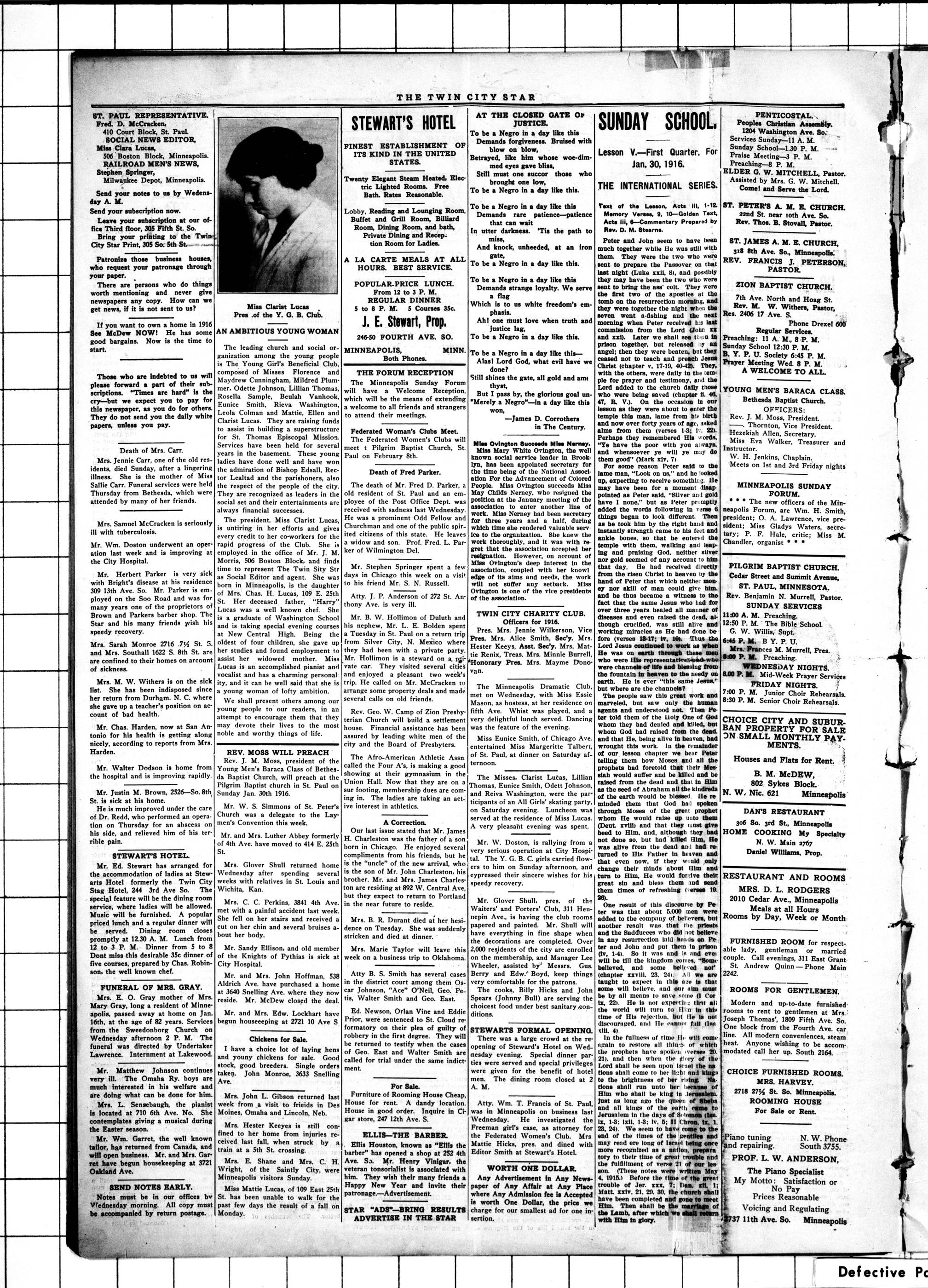
Miss Clarist Lucas Pres.of the Y. G. B. Club.
AN AMBITIOUS YOUNG WOMAN
The leading church and social organization among the young people is The Young Girl's Beneficial Club, composed of Misses Florence and Maydrew Cunningham, Mildred Plummer, Odette Johnson, Lillian Thomas, Rosella Sample, Beulah Vanhook, Eunice Smith, Rieva Washington, Leola Colman and Mattie, Ellen and Clarist Lucas. They are raising funds to assist in building a superstructure for St. Thomas Episcopal Mission. Services have been held for several years in the basement. These young ladies have done well and have won the admiration of Bishop Edsall, Rector Lealtad and the parishoners, also the respect of the people of the city. They are recognized as leaders in the social set and their entertainments are always financial successes.
the president, Miss Clarist Lucas, is untiring in her efforts and gives every credit to her co-workers for the rapid progress of the Club. She is employed in the office of Mr. J. M. Morris, 506 Boston Block, and finds time to represent The Twin Sity Str as Social Editor and agent. She was born in Minneapolis, is the daughter of Mrs. Chas. H. Lucas, 109 E. 25th St. Her deceased father, "Harry" Lucas was a well known chef. She is a graduate of Washington School and is taking special evening courses at New Central High. Being the oldest of four children, she gave up her studies and found employment to assist her widowed mother. Miss Lucas is an accomplished pianist and vocalist and has a charming personality, and it can be well said that she is a young woman of lofty ambition.
We shall present others among our young people to our readers, in an attempt to encourage them that they may devote their lives to the most noble and worthy things of life.
REV. MOSS WILL PREACH
Rev. J. M. Moss, president of the Young Men's Baraca Class of Bethesda Baptist Church, will preach at the Pilgrim Baptist church in St. Paul on Sunday Jan. 30th 1916.
Mr. W. S. Simmons of St. Peter's Church was a delegate to the Laymen's Convention this week.
Mr. and Mrs. Luther Abbey formerly of 4th Ave. have moved to 414 E. 25th St.
Mrs. Glover Shull returned home Wednesday after spending several weeks with relatives in St. Louis and Wichita, Kan.
Mrs. C. C. Perkins, 3841 4th Ave. met with a painful accident last week. She fell on her stairs and received a cut on her chin and several bruises about her body.
Mr. Sandy Ellison, and old member of the Knights of Pythias is sick at City Hospital.
Mr. and Mrs. John Hoffman, 538 Aldrich Ave. have purchased a home at 3640 Snelling Ave. where they now reside. Mr. McDew closed the deal.
Mr. and Mrs. Edw. Lockhart have begun houseeeping at 2721 10 Ave S
Chickens for Sale
I have a choice lot of laying hens and young chickens for sale. Good stock, good breeders. Single orders taken. John Monroe, 3633 Snelling Ave.
Mrs. John L. Gibson returned last week from a visit to frieds in Des Moines, Omaha and Lincoln, Neb.
Mrs. Hester Keeyes is still confined to her home from injuries received last fall, when struck by a train at a 5th St. crossing.
Mrs. E. Shane and Mrs. C. H. Wright, of the Saintly City, were Minneapolis visitors Sunday.
Miss Mattie Lucas, of 109 East 25th St. has been unable to walk for the past few days the result of a fall on Monday.
---
THE TWIN CITY STAR
STEWART'S HOTEL
FINEST ESTABLISHMENT OF
ITS KIND IN THE UNITED
STATES.
Twenty Elegant Steam Heated, Electric Lighted Rooms. Free Bath. Rates Reasonable.
Lobby, Reading and Lounging Room, Buffet and Grill Room, Billiard Room, Dining Room, and bath, Private Dining and Reception Room for Ladies.
A LA CARTE MEALS AT ALL
HOURS. BEST SERVICE.
POPULAR PRICE LUNCH.
From 12 to 3 P. M.
REGULAR DINNER
5 to 8 P. M. 5 Courses 35c.
J. E. Stewart, Prop.
246-50 FOURTH AVE. SO.
MINNEAPOLIS, MINN.
Both Phones.
THE FORUM RECEPTION
The Minneapolis Sunday Forum
will have a Welcome Reception,
which will be the means of extending
a welcome to all friends and strangers
to attend their meetings.
Federated Woman's Clubs Meet.
The Federated Women's Clubs will
meet t Pilgrim Baptist Church, St.
Paul on February 8th.
Death of Fred Parker.
The death of Mr. Fred D. Parker, a old resident of St. Paul and an employee of the Post Office Dept. was received with sadness last Wednesday. He was a prominent Odd Fellow and Churchman and one of the public spirited citizens of this state. He leaves a widow and son. Prof. Fred. L. Parker of Wilmington Del.
Mr. Stephen Springer spent a few days in Chicago this week on a visit to his friend Mr. S. N. Russell.
Atty. J. P. Anderson of 272 St. Anthony Ave. is very ill.
Mr. B. W. Hollimon of Duluth and his nephew, Mr. L. E. Bolden spent a Tuesday in St. Paul on a return trip from Silver City, N. Mexico where they had been with a private party. Mr. Hollimon is a steward on a private car. They visited several cities and enjoyed a pleasant two week's trip. He called on Mr. McCracken to arrange some property deals and made several calls on old friends.
Rev. Geo. W. Camp of Zion Presbyterian Church will build a settlement house. Financial assistance has been assured by leading white men of the city and the Board of Presbyters.
The Afro-American Athletic Assn called the Four A's, is making a good showing at their gymnasium in the Union Hall. Now that they are on a sur footing, membership dues are coming in. The ladies are taking an active interest in athletics.
A Correction.
Our last issue stated that Mr. James H. Charleston was the father of a son born in Chicago. He enjoyed several compliments from his friends, but he is the "uncle" of the new arrival, who is the son of Mr. John Charleston, his brother. Mr. and Mrs. James Charleston are residing at 892 W. Central Ave, but they expect to return to Portland in the near future to reside.
Mrs. B. R. Durant died at her residence on Tuesday. She was suddenly stricken and died at dinner.
Mrs. Marie Taylor will leave this week on a business trip to Oklahoma.
Atty B. S. Smith has several cases in the district court among them Oscar Johnson, "Ace" O'Neil, Geo. Petis, Walter Smith and Geo. East.
Ed. Newson, Orlan Vine and Eddie Prior, were sentenced to St. Cloud reformatory on their plea of guilty of robbery in the first degree. They will be returned to testify when the cases of Geo. East and Walter Smith are called for trial under the same indictment.
For Sale.
Furniture of Rooming House Cheap,
House for rent. A dandy location.
House in good order. Inquire in Cigar store, 247 12th Ave. S.
ELLIS—THE BARBER
Ellis Houston, known as "Ellis the barber" has opened a shop at 252 4th Ave. Sq. Mr. Henry Vinigar, the veteran tonsorialist is associated with him. They wish their many friends a Happy New Year and invite their patronage.—Advertisement.
STAR "ADS"—BRING RESULTS
ADVERTISE IN THE STAR
AT THE CLOSED GATE OR
JUSTICE.
To be a Negro in a day like this—
Alas! Lord God, what evil have we
done?
Still shines the gate, all gold and ame
thyst,
But I pass by, the glorious goal un-
"Merely a Negro"—in a day like this
won,
—James D. Corrothers
in The Century.
Miss Ovington Succeeds Miss Norney.
Miss Mary White Ovington, the well known social service leader in Brooklyn, has been appointed secretary for the time being of the National Association For the Advancement of Colored People. Miss Ovington succeeds Miss May Childs Norney, who resigned the position at the January meeting of the association to enter another line of work. Miss Norney had been secretary for three years and a half, during which time she rendered valuable service to the organization. She knew the work thoroughly, and it was with regret that the association accepted her resignation. However, on account of Miss Ovington's deep interest in the association, coupled with her knowledge of its aims and needs, the work will not suffer any setback. Miss Ovington is one of the vice presidents of the association.
TWIN CITY CHARITY CLUB.
Officers for 1916.
Pres. Mrs. Jennie Wilkerson, Vice Pres. Mrs. Alice Smith, Sec'y. Mrs. Hester Keeys, Asst. Sec'y. Mrs. Mattie Renix, Treas. Mrs. Minnie Burrell, Honorary Pres. Mrs. Mayme Donovan.
The Minneapolis Dramatic Club, met on Wednesday, with Miss Essie Mason, as hostess, at her residence on fifth Ave. Whist was played, and a very delightful lunch served. Dancing was the feature of the evening.
Miss Eunice Smith, of Chicago Ave. entertained Miss Margerite Talbert, of St. Paul, at dinner on Saturday afternoon.
The Misses. Clarist Lucas, Lillian Thomas, Eunice Smith, Odett Johnson, and Reiva Washington, were the participants of an All Girls' skating party, on Saturday evening. Luncheon was served at the residence of Miss Lucas. A very pleasant evening was spent.
Mr. W. Doston, is rallying from a very serious operation at City Hospital. The Y. G. B. C. girls carried flowers to him on Sunday afternoon, and expressed their sincere wishes for his speedy recovery.
Mr. Glover Shull, pres. of the Waiters' and Porters' Club, 311 Hennepin Ave., is having the club rooms papered and painted. Mr. Shull will have everything in fine shape when the decorations are completed. Over 2,000 residents of the city are enrolled on the membership, and Manager Lee Wheeler, assisted by' Messrs. Gus. Berry and Edw.' Boyd, keep things very comfortable for the patrons. The cooks, Billy Hicks and John Spears (Johnny Bull) are serving the choicest food under best sanitary conditions.
STEWARTS FORMAL OPENING.
There was a large crowd at the reopening of Steward's Hotel on Wednesday evening. Special dinner parties were served and special privileges were given for the benefit of hotel men. The dining room closed at 2 A. M.
Atty. Wm. T. Francis of St. Paul, was in Minneapolis on business last Wednesday. He investigated the Freeman girl's case, as attorney for the Federated Women's Club. Mrs Mattie Hicks, pres. and dined with Editor Smith at Stewart's Hotel.
WORTH ONE DOLLAR
Any Advertisement in Any Newspaper of Any Affair at Any Place where Any Admission fee is Accepted is worth One Dollar, the price we charge for our smallest ad for one insertion.
SUNDAY SCHOOL
Lesson V.—First Quarter. For Jan. 30, 1916.
THE INTERNATIONAL SERIES.
Text of the Lesson, Acts iii, 1-12
Memory Verses, 9, 10—Golden Text,
Acts iii, 6—Commentary Prepared by
Rv. D. M. Stearns.
Peter and John seem to have been much together while He was still with them. They were the two who were sent to prepare the Passover on that last night (Luke xxii, 8), and possibly they may have been the two who were sent to bring the ass' colt. They were the first two of the apostles at the tomb on the resurrection morning, and they were together the night when the seven went a-fishing and the next morning when Peter received his last commission from the Lord (John xx and xxl). Later we shall see them in prison together, but released by an angel; then they were beaten, but they ceased not to teach and preach Jesus Christ (chapter v, 17-19, 40-42). They, with the others, were daily in the temple for prayer and testimony, and the Lord added to the church daily those who were being saved (chapter ii, 46, 47, R. V.). On the occasion in our lesson as they were about to enter the temple this man, lame from his birth and now over forty years of age, asked alms from them (verses 1-3; iv, 22). Perhaps they remembered His words, "Ye have the poor with you always, and whensoever ye will ye may do them good" (Mark xyl, 7).
For some reason Peter said to the lame man, "Look on us," and he looked up, expecting to receive something. He may have been for a moment disappointed as Peter said, "Silver and gold have I none," but as Peter promptly added the words following in verse 6 things began to look different. Then as he took him by the right hand and instantly strength came to his feet and ankle bones, so that he entered the temple with them, walking and leaping and praising God, neither silver nor gold seemed of any account to him that day. He had received directly from the risen Christ in heaven by the hand of Peter that which neither money nor skill of man could give him, and he thus became a witness to the fact that the same Jesus who had for over three years healed all manner of diseases and even raised the dead, although crucified, was still alive and working miracles as He had done before (verses 13-17, iv, 10). Thus the Lord Jesus continued to work as when He was on earth through these men who were His representatives and who were channels of life and blessing from the fountain in heaven to the needy on earth. He is ever "this same Jesus," but where are the channels?
The people saw this great work and marveled, but saw only the human agents and understood not. Then Peter told them of the Holy One of God whom they had denied and killed, but whom God had raised from the dead, and that He, being alive in heaven, had wrought this work. In the remainder of our lesson chapter we hear Peter telling them how Moses and all the prophets had foretold that their Messiah would suffer and be killed and be raised from the dead and that in Him as the seed of Abraham all the kindreds of the earth would be blessed. He reminded them that God had spoken through Moses of the great prophet whom He would raise up unto them (Deut. xviii) and that they must give heed to Him, and, although they had not done so, but had killed Him, He was alive from the dead and had returned to His Father in heaven and that even now, if they would only change their minds about Him and turn to Him, He would forgive their great sin and bless them and send them times of refreshing (Gerses 19.20).
One result of this discourse by Peter was that about 5,000 men were added to the company of believers, but another result was that the priests and the Sadducees who did not believe in any resurrection held hands on Peter and John and put them in prison (fv, 1-4). So it was and is and ever will be till the kingdom comes, "Some believed, and some believed not" (chapter xvill. 23, 24). All we are taught to expect in this are is that some will believe, and our aim must be by all means to save some (I Cor. x2, 22). He is not expecting that all the world will turn to Him in this time of His rejection, but He is not discouraged, and He cannot fall (Isa. xiii. 4).
PENTICOSTAL.
Peoples Christian Assembly.
1204 Washington Ave. So.
Services Sunday—11 A. M.
Sunday School—1.30 P. M.
Praise Meeting—3 P. M.
Preaching—8 P. M.
ELDER G. W. MITCHELL, Pastor.
Assisted by Mrs. G. W. Mitchell.
Come! and Serve the Lord.
ST. PETER'S A. M. E. CHURCH.
22nd St. near 10th Ave. So.
Rev. Thos. B. Stovall, Pastor.
ST. JAMES A. M. E. CHURCH,
318 8th Ave. So., Minneapolis.
REV. FRANCIS J. PETERSON,
PASTOR.
ZION BAPTIST CHURCH.
7th Ave. North and Hoag St.
Rev. M. W. Witthers, Pastor,
Res. 2406 17 Ave. S.
Phone Drexel 600
Regular Services.
Preaching: 11 A. M., 8 P. M.
Sunday School 12:30 P. M.
B. Y. P. U. Society 6:45 P. M.
Prayer Meeting Wed. 8 P. M.
A WELCOME TO ALL.
YOUNG MEN'S BARACA CLASS.
Bethesda Baptist Church.
OFFICERS:
Rev. J. M. Moss, President.
—— Thornton, Vice President.
Hezekiah Allen, Secretary.
Miss Eva Walker, Treasurer and
Instructor.
W. H. Jenkins, Chaplain.
Meets on 1st and 3rd Friday nights
MINNEAPOLIS SUNDAY
FORUM
FORUM.
* * * The new officers of the Minneapolis Forum, are Wm. H. Smith, president; O. A. Lawrence, vice president; Miss Gladys Waters, secretary; P. F. Hale, critic; Miss M. Chandler, organist * * *
PILGRIM BAPTIST CHURCH.
Cedar Street and Summit Avenue,
ST. PAUL, MINNESOTA.
Rev. Benjamin N. Murrell, Pastor.
SUNDAY SERVICES
11:00 A. M. Preaching.
12:50 P. M. The Bible School.
G. W. Willis, Supt.
6:45 P. M. B Y. P. U.
Mrs. Frances M. Murrell, Pres.
8:00 P. M. Preaching.
WEDNESDAY NIGHTS.
8:00 P. M. Mid-Week Prayer Services
FRIDAY NIGHTS.
7:00 P. M. Junior Choir Rehearsals.
8:30 P. M. Senior Choir Rehearsals.
CHOICE CITY AND SUBURBAN PROPERTY FOR SALE ON SMALL MONTHLY PAYMENTS.
Houses and Flats for Rent.
B. M. McDEW,
802 Sykes Block.
N. W. Nic. 621 Minneapolis
DAN'S RESTAURANT
306 So. 3rd St., Minneapolis
HOME COOKING My Specialty
N. W. Main 2767
Daniel Williams, Prop.
RESTAURANT AND ROOMS
MRS. D. L. RODGERS
2010 Cedar Ave., Minneapolis
Meals at all Hours
Rooms by Day, Week or Month
FURNISHED ROOM for respectable lady, gentleman or married couple. Call evenings, 311 East Grant
St. Andrew Quinn — Phone Main
2242.
Modern and up-to-date furnished rooms to rent to gentlemen at Mrs. Joseph Thomas', 1809 Fifth Ave. So. One block from the Fourth Ave. car line. All modern conveniences, steam heat. Anyone wishing to be accommodated call her up. South 2164.
CHOICE FURNISHED ROOMS.
MRS. HARVEY.
2718 27½ St. So. Minneapolis.
ROOMING HOUSE
For Sale or Rent.
Piano tuning N. W. Phone and repairing. South 3755.
PROF. L. W. ANDERSON,
The Piano Specialist
My Motto: Satisfaction or No Pay
Prices Reasonable
Voicing and Regulating
737 11th Ave. So. Minneapolis
Defective Po
PUBLSHED EVERY FRIDAY BY
CHARLES SUMNER SMITH,
305—So. Fifth Street.
Minneapolis, Minnesota.
Entered in the Post Office at Minneapolis as second class matter.
MEMBER
NATIONAL NEGRO PRESS
ASSOCIATION
MINNESOTA EDITORIAL ASSN.
Subscription by Mail, Postpaid.
ONE YEAR ..... $2.00
SIX MONTHS ..... 1.00
THREE MONTHS ..... .65
Hamlet R. Rowe, Asst. Manager.
ADVERTISING RATES.
One Inch—1 Insertion—One Dollar.
Liberal discount given on 3, 6, 9,
Months, or 1 year contracts.
Want Ads ..... Twenty-five Cents
Reading Notices, per line, Five Cents
Wedding Announcements, Fifty Cents
Card of Thanks ..... One Dollars
In Memoriam ..... One Dollar
Business Announcements, One Dollar
Death Notices ..... One Dollar
Write all Checks payable to
When writing for the press, don't abbreviate your words. Spell each one out correctly and distinctly. If you don't it means that all of your manuscript will have to be rewritten if there is time. Write on one side of the paper only.
Address all mail to Twin City Star
305 8, 5th St.
THE FORUM "BOOSTERS."
A movement is on foot to "Boost" the Sunday Forum. Get in line! Committees will be named from the Fraternal organizations, Churches and Business Men will be represented. A Get Acquainted and Get Together meeting will be held in February—in honor of Fred. Douglass to Keep alive the Douglass spirit! Everybody will be expected to co-operate to make The Forum the greatest Civic body among the Negroes of this city and state, a constructive force in the community—the cradle of ambition and inspiration, and an organizator worthy of its name.
About Charity Work.
Many are in need, because of sickness, and some of our charity workers are giving relief. Let us not quarrel as to "who does it!" but rather do our share to relieve the needy. We know that some people are dishonest and there will always be such among any people.
Let us recognize the work of the charitable clubs, and pay less attention to these over-night reformers, who have recently transferred their financial activities from thieving in the underworld, to misappropriating the proceeds of suppers, church collections and other revenues intended for charity; who parade among the needy in their purple and fine linen, and thrive for a while on their illgotten gains. These gay deceivers would not dare don the simple garb of the humble mission worker, or Sister of Charity. Mary Magdalene is a worthy example of reform, because she obeyed the injunction, "Go in peace! and sin no more." But we accept spasmodic and unreliable reformers, and place them on a pinnacle of prominence in our churches as emblems of purity (?) when there has been no actual reform. Once recognized they represent themselves as leaders, (and drive away some of the older members) when they should be humble followers until they have stood the proper test.
In spite of this, those who are doing good will reap their reward, and the hustlers will also reap what they have sown.
We are always glad to commend the work of charity by the clubs of the Women's Federation.
Janie Freeman, the girl from Enid, Oklahoma, has not been pardoned from Stillwater Prison, and the Editor of The Star does not approve of any attempt to release her at this time. She is in prison as a confessed thief, who has a bad record, and not as a persecuted Negro girl, as many believe, who have not investigated her case. We stand for law and justice and cannot condone crime committed by ingrates. Her life aside from her deeds does not warrant the efforts wasted in her behalf. Other charges may be brought against her of she is released.
National Organization Holds Eighth Annual Meeting In Philadelphia.
The eighth annual meeting of the National Equal Rights league, held for three days in Philadelphia, closed on Wednesday evening, Dec. 15, with an exercise commemorative of the adoption of the thirteenth amendment to the United States constitution. There were many men and women of national prominence in attendance, and much public interest was manifested in the work of the organization.
The address to the country is in part as follows:
It is on the fifteenth anniversary of the final and constitutional abolition of chattel slavery in the United States of America that we, American citizens of color, assemble in Philadelphia, the state of the great reconstruction statesman, Thaddeus Stevens, who carried the thirteenth amendment through our national house of representatives.
After a half century of freedom, during which the colored American has achieved remarkable educational, religious and business progress and demonstrated the highest human possibilities, the National Equal Rights league in eighth annual meeting assembled finds that Americans of African descent are still denied in many sections of the land their legal rights:
By law the right to vote on the same terms as others, native and naturalized; by practice the right to enter places of public accommodation and resort; by law the right to use public facilities without the indignity of racial discrimination; by law the right to reside, even in their own property, adjacent to their fellow citizens; by action of the federal government the right to work beside and to use the necessary health accessories with other employees of the federal government in some government buildings at the national capital; by practice the right of trial by court and jury when accused of crime. Therefore we issue this call to action to the proscribed and oppressed and to all others who believe in liberty, equality of rights and human brotherhood.
Colored Americans, begin the second half century of legal freedom by combining to organize, agitate and vote, where permitted, for the preservation of that freedom, that enjoyment of identical civil and political rights with others, that exemption from galling discriminations in the public life, which were bought at the price of billions of treasure and of the health and lives of millions of white and colored patriots.
Let us here resolve that under God we shall use our voices, our pens, our patronage, our votes, our money and every resource that God has put in our power for the abolition of segregation, disfranchisement and lynching on the color line, undismayed that a president rules in the White House unwilling, despite his pre-election pledge, to rise above the narrow provincial color prejudice of section. Let us face the forces of prejudice and, spurring the bribe ever offered for voluntary segregation, honor the deeds of the abolitionists and refuse to sell our birthright for a mess of pottage.
To our fellow Americans of every race we appeal for an equal chance and fair play. Friends of the republic, save free institutions, save the fruits of the civil war, save the fair name of our common country now besmirched by worse prescription than in any civilized land. Demand incessantly that race and color discrimination shall cease and there shall not in the boasted land of the free be a reversion to a caste of color, now reaching even into the national government.
The officers of the league for 1916 are the following named persons: President, Rev. Byron Gunner, New York; recording secretary, Dr. J. L. Johnson, Ohio; assistant recording secretary, Maurice W. Spencer, Delaware; corresponding secretary, William Monroe Trotter, Massachusetts; treasurer, Thomas Walker, District of Columbia; financial secretary, Dr. William A. Sinclair, Pennsylvania; national organizer, Rev. R. C. Ransom, New York; assistant organizer, Rev. J. E. Churchman, New Jersey; chaplain, Rev. E. George Biddle, Connecticut; vice presidents, Rev. M. W. Thornton, Massachusetts William D. Brigham, Massachusetts Francis Warren, Michigan, W. Asby Hawkins, Maryland; Rev. E. W. Moore, Pennsylvania; George W. Ellis, Illinois; Rev. W. F. Graham, Pennsylvania, and Rev. W. Spencer Carpenter, Pennsylvania.
"This book, which had a page loose in it, has undergone a sort of legal action."
LIBERAL SUBSCRIPTION
OFFER.
We offer a Combination Subscription to our readers for 1916. We will give you your choice of any Negro NEWSPAPER or MAGAZINE, and THE TWIN CITY STAR, mailed to your address anywhere in the U. S. for THREE DOLLARS. Cash in advance. Get your home paper sent direct to you. Forward all orders to
THE TWIN CITY STAR, .... 305 Fifth St. So.
SUBSCRIBE NOW.
THE TWIN CITY STAR
It is the utter disregard of the law of God and man, and the desire to change things where the Negroes' rights are involved in this country that creates the Negro Race Problem. The solution of the whole problem involving the white man and the black man is simple justice, a recognition of the fact that the rights of the humblest citizen are as worthy of protection as the highest. Apply this method and the problem will be solved.
Josiah Royce, of Harvard one of the leading psychologists of our time, made an elaborate study of this matter of prejudice a few years ago, and pronounced it a pure "illusion"; that it is not an actual but an artificial thing and has no existence except where efforts are made to interfere with the natural order of things and to change God's plans with respect to humanity.
The white boy sets out upon his career with many voices to hail and urge him on. His race is with him, bearing him up in its sympathies and in its achievements as the ocean lifts the ship on its bosom. The Negro boy begins the ascent with his race a drag upon him. The weight of the whole mass he must lift. If he finds some voices to encourage him, there are more voices to sneer and bid him keep his place. All the way up there are those who contest his right to rise; and he knows that if at last he shall succeed in standing upon the higher range of attainment he will be in an atmosphere that is chilly indeed. But if there be dignity in bearing the cross; if it is true that the better rewards of life are designed for those who overcome, then surely great credit is due such Negroes as Booker T. Washington. Fred Douglass and hundreds of other sturdy ones who against unparalleled odds have pushed their way; who have climbed often with bleeding fingers and bruised feet, and who have attested in their victories against severest competitions those lines of Kipling which I have somewhere seen quoted in their behalf: "But there is neither East nor West, Border, nor breed, nor birth.
When two strong men stand face to face,
Though they come from the ends of
the earth."
All that we as Negroes want is a fair chance. We do not ask favors now. We just want the liberty to be ourselves, to be permitted to stand upon our own legs. If we can manage the farm, dig the mines and run the engine; if we can plead the case and treat the sick; if we can mould our thoughts in exquisite beauty and real power in verse or on canvas; if we can be the statesman and the leader of men—let there be no hindrance placed to the exercise of these talents.
We do not ask that social equality which brings me into your home or you into mine, without regard for your feelings or mine, for we realize as does every sensible man that; social equality is an individual right. But we do want industrial equality—the opportunity to work on fair terms and to enjoy to the fullest extent the harvest of our labor; also educational equality—the privilege to learn and to appropriate the truth, which belongs, like the air to all.
The white people of the North, engrossed in their business and every day life have no conception of the persistency displayed by the white people of the South, led by Vardaman, Tillman, John Sharp Williams, Hefflin, Thomas Dixon and others, in persecuting the Negro and curtailing his rights. It was Senator Tillman who said, "we've cheated the niggers, we've threatened them, we've murdered them, and now we are going to disfranchise them". And through the passage, by the various southern states, of the laws known as the Educational Test with the "Understanding" clause, and the "Grandfather" clause, the Negroes of the South have been disfranchised for the past 10 to 20 years. But, thank God, through the recent decision of the United States Supreme Court these laws have been declared unconstitutional and if southern ingenuity and prejudice cannot find another way to rob my people of their franchise they will soon enjoy the right to vote as well as to pay taxes.
We have no race problem in this country with the German, the English, the Irish, the Scotch, the French, the Swede, the Norwegian and many other races of people, and why? It is not because there are not among them paupers, for there are. It is true that among those people in this country there are drunkards, and an idle, indolent worthless class; that they have their criminal class and that they have committed every crime known to the criminal calendar, for their is no crime known to human kind that has not been committed by the white man;—but it is because there is no organized interference with the rights and privileges of those
people; no studied restriction of their liberties; no Vardaman, no Tillman, no Thomas Dixon et al, whose great aim in life is to prevent the enjoyment of their equal rights under the laws of this land. No attempt to alter the natural order of things with which they are concerned. No attempt to interfere with the privileges of their natural course. No attempt to restrict their right of passage or to change their channel for selfish purposes.
But whatever may be in store for this nation in the future; whether prosperity or adversity; whether there be foes within or foes without, whether there shall be peace or war, the Negro always will be a loyal and faithful American citizen, and we sincerely hope the day will soon come when he will be treated as such.
TRIBUTE TO WASHINGTON
Cont. from Page 1.
ing the committee's invitation. Among those regretting their enforced absence were former Presidents of the United States William Howard Taft and Theodore Roosevelt. Andrew Carnegie John Wanamaker. Supreme Court Justices Charles E. Hughes and Oliver Wendell Holmes, Secretary of Agriculture D. F. Houston, Secretary of Labor W. B. Wilson, Senator Boles Penrose and others.
The memorial committee, representing every phase of activity among the colored citizens of the nation's capital and the states of the Union, was made up of the following: Henry Lassiter, chairman; R. W. Thompson, secretary; Daniel Freeman, treasurer; Dr. W. H. Davis, stenographic reporter. On reception—W. J. Singleton, chairman; Dr. S. S. Thompson, A. H. Glenn, M. S. Koonce, Howard A. Thomas, Lleutenant Colonel Arthur Brooks, Arthur C. Newman. On resolutions—F. D. Lee, chairman; Dr. A. M. Curtis, Dr. W. H. Davis and Dr. G. W. Cabaniss.
Progress Noted at New Hope Church.
The New Hope Baptist church, Nashville, Tenn., Rev. J. C. Harding minister, held special exercises on Sunday, Jan. 16, at which the new furniture for the church was dedicated. The pulpit stand, communion table, pews and chairs were made by the National Baptist Church Supply company of the same city. The quality and finish of the various pieces reflect much credit upon the workmen, who are among the most skilled mechanics of our race.
Leading shipping and commercial interests have advocated the creation of a federal marine commission having authority in its special field equal to that which the interstate commerce commission has within its particular sphere. Such a commission would deal finally with all shipping matters and recommend from time to time changes in the nation's navigation laws. Bills providing for such a body are likely to be submitted to the next session of congress.
The pressing necessity of rehabilitating the merchant marine of the United States is already well understood by the mass of business men. The referendum that was taken some months ago by the chamber of commerce of the United States has a good deal of significance as a symptom of public feeling. While the local associations and chambers affiliated with that organization decisively rejected government purchase and construction of ships, they approved an alternative plan of a corporation backed and financed by the national government that should be empowered to encourage by loans and subventions the building and operation of merchant ships. Presumably a measure of this general nature will be urged before congress.
BATTLE HYMN OF THE NEGRO
Davis Writes Thrilling Poem In Memory of Dr. Washington.
The "Battle Hymn of the Negro" was written by William H. Davis of Washington and is dedicated to the memory of the late Dr. Booker T. Washington. Mr. Davis is the official stenographer for the National Negro Business league, in which position he has rendered valuable service.
The "Battle Hymn of the Negro" is to be sung to the tune of Julia Ward Howe's "Battle Hymn of the Republic." The hymn:
Glory, glory, hallelujah!
Glory, glory, hallelujah!
Glory, glory, hallelujah!
"Our Booker Washington."
Office: 317 PLYMOUTH AVE. NO., MINNEAPOLIS, MINN.
Residence: 816 EMERSON AVE. NO., MINNEAPOLIS, MINN.
ZUMALWEISS THE BETTER BEER
You are sure of appreciation from anyone to whom you recommend it.
BENJ. JONES (Near Milwaukee Depot) CLARENCE W. BELL Barber Shop and Pool Room 244 THIRD AVENUE SOUTH Baths, Shoe Shining and Billiards LAUNDRY AGENCY—TAILOR SHOP JACOB REDMAN, FOREMAN,
FLORSHEIM SHOES represent perfection in fine shoemaking Get acquainted with COMFORT and become one of our SATISFIED CUSTOMERS. STANLEY SHOE COMPANY 422 NICOLLET AVENUE
North Side Laundry and Tailoring Co.
D.W.Raynor.
Office: 317 PLY
Residence: 816 E
A. B.
ZUII
T
You s
tion fro
you re
BENJ. JONES
Barber
Bath
JACOB REDMA
FLOR
represent
Get acquaint
STANL
422
F. Peoples.
You don't
I BUILD
ITS JUST LIKE
Good
Kelstein
PUNIT BREWING CO.
PUNIT BREWING CO.
Order a Case
Today
MRS. SADIE JOHN
North Side
HA
Best Work I
A black serge or white pique CASKET, a SHROUD, EMBALMING, HEARSE, 2 CARRIAGES, BURIAL VAULT in Crystal or Layman Cemetery. Outside Box and Lowering Device—with Prompt Service.
LADY ASSISTANT IF DESIRED FREE USE OF CHAPEL
John G. Yancy
Our advice
MALWEISS
THE BETTER BEER
I are sure of appreciation from anyone to whom recommend it.
(Near Milwaukee Depot) CLARENCE W. BELL
Ber Shop and Pool Room
244 THIRD AVENUE SOUTH
Maths, Shoe Shining and Billiards
LAUNDRY AGENCY—TAILOR SHOP
MAN, FOREMAN,
ARSHEIM SHOES
not perfection in fine shoemaking
printed with COMFORT and become one of our
SATISFIED CUSTOMERS.
NILEY SHOE COMPANY
222 NICOLLET AVENUE
precia-
whom
ERENCE W. BELL
Room
wards
TAILOR SHOP
OES
remaking
one of our
PANY
E
FE BLDG.
C. 1534
-HANGING,
CRETE WORK
your lot.
ITS.
PLANS FREE.
thening
CONTRACTOR AND BUILDER
REPAIRING A SPECIALTY
1020 METROPOLITAN LIFE BLDG.
OFFICE PHONE NIC. 1534
PAINTING, PLUMBING, PAPER-HANGING,
PLASTERING, BRICK & CONCRETE WORK
it need money; if you own your lot.
BUILD HOMES ON MONTHLY PAYMENTS.
BE PAYING RENT. PLANS FREE.
Beer is Strengthening
Kochsteiner
Brewed under sanitary condition
Purest of ingredients
The beer without a headache
PURITY BREWING CO.
The Leading Bottle Beer Brewery
Both Phones 66 MINNEAPOLIS, MINN
OHNSON M. GUEST
ide Laundry and Tailoring Co
ING CO.
Brewery
POLIS, MINN
M. GUEST
Moring Co.
NUM
fifth St. No.
and
ed
NEW TABLES. FAST CUSHIONS
THE ELITE
Pool and Billiards
GIBSON AND YANCY PROPRIETORS.
A COMPLETE LINE OF CIGARS
AND TOBACCO.
627-5th St. No., Minneapolis
F. PEOPLES
There is strength in pure beer like
Defective Page
—t | | | J tf ft fe tt
Pf TT itcctive
THE TWIN C.fY STAR
PUBLSHED EVERY FRIDAY BY
CHARLES SUMNER SMITH,
30S—So. Fifth Street.
Minneapolis, Minnesota.
Batered a the Pest Office at Min-
neapolis as second class matter.
MEMBER |
NATIONAL NEGRO PRESS
} ASSOCIATION
MINNESOTA EDITORIAL ASSN.
Subscription by Mail, Postpaid.
ONE YEAR oo..csecsse seers 1182000
SIX MONTHS ......scsceeeeee 100
THREE MONTHS ........005. 65
Hamlet B. Rowe, Asst. Manager.
ADVERTISING RATES.
One Inch—1 Insertion—One Dollar.
Liberal discount given on 3, 6, 9,
Months, or 1 year contracts,
Want Ads ......Twenty-five Cents
Reading Notices, per line, Five Cents
Wedding Announcements, Fifty Cents
Card of Thanks ........One Dollars
Xn Metaoriam .. ........One Dollar
Business Announcements, One Dollar
Death Notices ..........One Dollar
Write all Checks payable to
The Twin City Star.
When writing for the press, don't
abbreviate your words. Spell each
‘one out correctly and distinctly. If
you don't it means that all of your
manuscript will have to be rewritten
if there is time. Write on one side of
the paper only.
Address all mail to Twin City Star
305 8, Sth St.
Minneapolis, Minnesota.
Fo Subscribe Is To Pay.
THE FORUM “BOOSTERS.”
A movement is on foot to “Boost”
the Sunday Forum. Get in line!
Committees will be named from the
Fraternal organizations, Churches and
Business Men will be represented. A
Get Acquainted and Get Together
meeting will be held in February—in
honor of Fred. Douglass to Keep
alive the Douglass spirit! Everybody
will be expected to co-operate to make
‘The Forum the greatest Civic body
among the Negroes of this city and
state, a constructive force in the com-
munity—the cradle of ambition and
inspiration, and an organizaton worthy
of its name.
‘About Charity Work.
Many are in need, because of sick-
ness, and some of our charity workers
are giving relief. Let us not quarrel
as to “who does it!” but rather do our
share to relieve the needy. We know
that some people are dishonest and
there will always be such among any
people.
Let us recognize the work of the
charitable clubs, and pay less. ater
tion to these over-night reformers.
who have recently transfered their
financial activities from thieving in
the underworld, to misappropriatins
the proceeds of suppers, church col
ections and other revenues intended
for charity; who parade among the
needy in their purple and fine linen.
and thrive for a while on their illgot-
ten gains. These gay deceiver
would not dare don the simple
garb of the humble — mission
worker, or Sister of Charity.
Mary Magdalene is a worthy example
of reform, because she obeyed the
injunction, “Go in peace! and sin no
more.” But we accept spasmodic and
unreliable reformers, and place them
on a pinnacle of prominence in out
churches as emblems of purity (7)
when there has been no actual re.
form. Once recognized they represent
themselves as leaders, (and drive away
some of the older members) wher
they should be humble followers until
they have stood the proper test.
In spite of this, those who are doing
good will reap their reward, and the
hustlers will also reap what they have
sown.
We are always glad to commend
the work of charity by the clubs of
the #omen’s Federation.
Janie Freeman, the git! from Enid,
Oiclahoma, has not been pardoned
from Stillwater Prison, and the Editor
of The Star does not approve of any
attempt to release her at this time.
She is in prison as a confessed thief,
who has a bad record, and not as a
persecuted Negro girl, as many be-
lieve, who have not investigated her
case. We stand for law and justice
and cannot condone crime commit.
ted by ingrates. Her life aside from
her deeds does not warrant the efforts
wasted in her behalf, Other charges
may be brought against her of she is
released.
EQUAL RIGHTS LEAGUE'S
ADDRESS TO THE COUNTRY.
National Organization Holds Eighth
Annual Meeting In Philadelphia.
‘The eighth annual meeting of the
National Equal Rights league, held for
three days in Philadelphia, closed on
Wednesday evening, Dec. 15, with an
exercise commemorative of the adop-
tion of the thirteenth amendment to
the United States constitution. ‘There
were many men and women of na-
tional prominence In attendance, and
much public interest was manifested
in the work of the organization,
‘The address to the country is in part
as follows:
It 1s on the Aftieta anniversary of
the final and constitutional abolition of
chattel slavery in the United States of
America that we, American citizens of
color, assemble in Philadelphia, the
state of the great reconstruction states-
man, Thaddeus Stevens, who carried
the thirteenth amendment through our
national house of representatives.
After a half century of freedom, dur.
ing which the colored American has
achieved remarkable educational, rell-
gious and business progress and dem-
onstrated the highest human possibil-
‘Itles, the National Equal Rights league
in eighth annual meeting assembled
‘finds that Americans of African de
‘scent are still denied in many sections
of the land their legal rights:
By law the right to vote on the same
terms as others, native and natural-
ized; by practice the right to enter
places of public accommodation and
resort; by law the right to use pub-
Ue facilities without the indignity of
racial discrimination; by law the right
to reside, even in their own property,
adjacent to thelr fellow citizens; by
action of the federal government the
right to work beside and to use the
necessary health accessories with other
employees of the federal government
im some government buildings at the
national capital; by practice the right
of trial by court and jury when ac
eased of crime. Therefore we issue
this call to action to the proscribed
and oppressed and to all others who
believe In liberty, equality of rights
and human brotherhood.
Colored Americans, begin the second
half century of legal freedom by com-
dining to organize, agitate and vote,
where permitted, for the preservation
of that freedom, that enjoyment of
identical civil and political rights with
others, that exemption from galling dis-
¢riminations in the public life, which
were bought at the price of billions of
treasure and of the health and lives of
millions of white and colored patriots,
Let us here resolve that under God
‘we shall use our voices, our pens, our
patronage, our votes, our money and
every resource that God has put in our
power for the abolition of segregation,
disfranchisement and lynching on the
color line, undismayed that a president
rules in the White House unwilling, de-
spite his pre-election pledge. to rise
above the narrow provincial color
Prejudice of section. Let us face the
forces of prejudice and, spurning the
bribe ever offered for voluntary segre-
‘gation, honor the deeds of the uboll-
tlonists and refuse to sell our birth-
‘right for a mess of pottage.
| ‘To our fellow Americans of every
race we appeal for an equal chance
and fair play. Friends of the republic,
save free institutions, save the fruits
of the civil war, save the fair name of
our common country now besmirched
by worse proscription than in any clv-
Mlized land. Demand incessantly that
race and color discrimination shall
cease and there shall not in the boast-
ed land of the free be a reversion to a
caste of color, now reaching even into
the national government.
The officers of the league for 1916
are the following named persons:
President, Rev. Byron Gunner, New
York; recording secretary, Dr. J. L.
Johnson, Ohio; assistant recording sec-
retary, Maurice W. Spencer, Delaware;
corresponding secretary, Willlam Mon-
roe Trotter, Massachusetts; treasurer,
‘Thomas Walker, District of Columbia;
financial secretary, Dr, Willlam A. Sin-
clair, Pennsylvania; national organizer,
Rev. R, C. Ransom, New York; assist-
ant organizer, Rev. J. E. Churchman,
New Jersey; chaplain, Rev. E. George
Biddle, Connecticut; ‘vice presidents,
Rev. M. W. Thornton, Massachusetts;
William D, Brigham, Massachusetts;
Francis Warren. Michigan; W. Ashby
Hawkins, Maryland; Rev. E. W. Moore,
Pennsylvania; George W. Ellis, Milinols;
Rev. W. F. Graham, Pennsylvania,
and Rev. W. Spencer Carpenter. Penn-
ayivania.
“This book, which had a page loose
‘tm it, bas undergone a sort of legal
action.”
“What was that?"
“It has been bound over to keep the
Piece.”—Baltimore American.
| LIBERAL SUBSCRIPTION
OFFER.
Special $3.00 Combination,
We offer a Combination Subscrip-
tion to our readsrs for 1916, We will
give you your choice of any Negro
NEWSPAPER or MAGAZINE, and
THE TWIN CITY STAR, mailed to
your address anywhere in the U. S.
for THREE DOLLARS. Cash in
advance. Get your home paper sent
direct to you. Forward all orders
to
THE TWIN CITY STAR, ....
305 Fifth St. So.
a ac
THE TWIN CITY STAR
RACE PROBLEM IN AMERICA. | people; no studied restr
By W. T. Francis. liberties; no Vardaman
change things where the Negroes’
rights are involved in this country
that creates the Negro Race Problem.
~ The solution of the whole problem
involving the white man and the
black man is simple justice, a recogni-
tion of the fact that the rights of the
humblest citizen are as worthy of
protection as the highest. Apply this
method and the problem will be
solved.
Josiah Royce, of Harvard one of
the leading psychologists of our time,
made an elaborate study of this matter
of prejudice a few years ago, and
pronounced it a pure “illusion”; that
it is not an actual but an artificial
thing and has no existence except
where efforts are made to interfere
with the natural order of things and
to change God’s plans with respect
to humanity,
The white boy sets out upon his
career with many voices to hail and
urge him on. His race is with him,
bearing him up in its sympathies and
in its achievements as the ocean lifts
the ship on its bosom. The Negro
boy begins the ascent with his race a
drag upon him. The weight of the
whole mass he must lift. If he finds
some voices to encourage him, there
are more voices to sneer and bid him
keep his place. All the way up there
are those who contest his right to
rise; and he knows that if at last he
shall succeed in standing upon the
higher range of attainment he will be
in an atmosphere that is chilly indeed.
But if there be dignity in bearing the
jcross; if it is true that the better
‘rewards of life are designed for those
who overcome, then surely great cred-
it is due such Negroes as Booker T.
Washington, Fred Douglass and hun-
dreds of other sturdy ones whoagainst
unparalled odds have pushed their
way; who have climbed often with
bleeding fingers and bruised feet, and
who have attested in their victories
against severest competitions those
lines of Kipling which I have some-
where seen quoted in their behalf:
“But there is neither East nor West,
Border, nor breed, nor birth.
When two strong men stand face to
face,
Though they come from the ends of
the earth.”
All that we as Negroes want is a
fair chance. We do not ask favors
now. We just want the liberty to he
ourselves, to be permitted to stand
upon our own legs. If we can mans
age the farm, dig the mines and run
the engine; if we can plead the case
and treat the sick; if we can mould
our thoughts in exquisite beauty and
real power in verse or on canvas; if
we can be the statesman and the
leader of men—tet there be no hind-
‘ance placed to the exercise of these
talents.
We do not ask that social equality
which brings me into your home or
you into mine, without regard for
your feelings or mine, for we realize
as does every sensible man that; so-
cial equality is an individual right.
But we do want industrial equality—
the opportunity to work on fair terms
and to enjoy to the fullest extent the
harvest of our labor; also educational
equality—the privilege to learn and
to appropriate the truth, which be-
longs, like the air to all.
The white people of the North, en-
grossed in their business and every
day life have no conception of the per-
sistency displayed by the white
people of the South, led by Vardaman,
Tillman, John Sharp Williams, Hef-
flin, Thomas Dixon and others, in
persecuting the Negro and curtail
ing his rights. It was Senator Till-
man who said, “we've cheated the
niggers, we've threatened them, we've
murdered them, and now we are going
to disfranchise them”. And through
the passage, by the various southern
states, of the laws known as the
Educational Test with the “Under
standing” clause, and the “Grand-
father” clause, the Negroes of the
South have been disfranchised for the
past 10 to 20 years. But, thank God,
through the recent decision of the
United States Supreme Court these
laws have been declared unconstite:
tional and if southern ingenuity and
prejudice cannot find another way to
rob my people of their franchise they
will soon enjoy the right to vote as
well as to pay taxes.
We have no race problem in this
country with the German, the Eng
lish, the Irish, the Scotch, the French.
people; no studied restriction of their
liberties; no Vardaman, no Tillman,
no Thomas Dixon et al, whose great
aim in life is to prevent the enjoyment
of their equal rights under the laws
of this land. No attempt to alter the
natural order of things with which
they are concerned. No attempt to
interfere with the privileges of their
natural course. No attempt to restrict
their right of passage or to change
their channel for selfish purposes.
But whatever may be in store for
this nation in the future; whether
prosperity or adversity; whether there
be foes within or foes without,
whether there shall be peace or war,
the Negro always will be a loyal and
faithful American citizen, and we sin-
cerely hope the day will soon come
when he will be treated as such.
TRIBUTE TO WASHINGTON.
cee ah cree Sar ae ce
ing the committee's invitation. Among
those regretting their enforced absen«
were former Presidents of the United
States Willam Howard Taft and The
odore Roosevelt. Andrew Carnezie
John Wanamaker. Supreme Court Jus
tices Charles E, Hughes and Oliver
Wendell Holmes, Secretary of Agricul
ture D. F. Houston, Secretary of La
bor W. B. Wilson, Senator Boles Pen
rose and others.
The memorial committee, represent
ing every phase of activity among the
colored citizens of the nation’s capital
and the states of the Union, was made
up of the following: Henry Lassiter.
chairman; R. W. Thompson, secretary:
Dante! Freeman, treasurer; Dr. W. H.
Davis, stenographic reporter. On re
ception—W. J. Singleton, chairman:
Dr. 8. 8. Thompson, A. H. Glenn, M. 8.
Koonce, Howard A. Thomas, Lfeuten:
ant Colonel Arthur Brooks, Arthur C.
Newman. On resolutions—F. D. Lee.
chairman; Dr. A. M. Curtis, Dr. W. HL
Davis and Dr. G. W. Cabaniss.
‘The New Hope Baptist church, Nash.
ville, Tenn., Rev. J. C. Harding min
ister, held special exercises on Sunday,
Jan. 16, at which the new furniture
for the church was dedicated. The
pulpit stand, communion table: pews
and chairs were made by the National
Baptist Church Supply company of
the same city. The quality and finis)
of the various pieces reflect much cred.
It upon the workmen, who are among
the most skilled mechanics of our race.
Leading shipping and commercial in-
terests bave advocated the creation of
a federal marine commission having
uthority in its special feld equal to
‘iat which the interstate commerce
conmnission has within its particular
sphere. Such a commission would deal
finally with all shipping matters and
recommend from time to time changes
in the nation’s navigation laws. Bills
providing for such a body are likely
to be submitted to the next session of
congress,
‘The pressing necessity of rehabilitat-
ing the merchant marine of the United
States is already well understood by
the mass of business men. ‘The refer-
-endum that was taken some months
ago by the chamber of commerce of
the United States has a good deal of
significance as a symptom of public
‘feeling. While the local associations
and chambers affiliated with that or-
‘ganization decisively rejected govern-
ment purchase and construction of
ships, they approved an alternative
plan of a corporation backed and
financed by the national government
that should be empowered to encour-
age by loans and subventions the
building and operation of merchant
ships. Presumably a measure of this
general nature will be urged before
congress.
BATTLE HYMN OF THE NEGRO
Davis Writes Thrilling Poom In Mem-
‘cau’ 6k Ck Wastin
The “Battle Hymn of the Negro”
was written by Willlam H. Davis of
Washington and is dedicated to the
memory of the late Dr. Booker T.
Washington. Mr. Davis is the official
stenographer for the National Negro
Business league, in which position he
has rendered valuable service.
The “Battle Hymn of the Negro” is
to be sung to the tune of Julia Ward
Howe's “Battle Hymn of the Repub-
Ue.” ‘The hymn:
‘Our eyes have seen the glory of a Booker
Washington.
‘He has fought a swordless battle for the
cause of right and won.
He has made his race respected, though
hie life on earth is done
‘His truth is marching on!
CHORUS.
Glory, glory, hallelujah!
Glory, glory, hallelujah!
Glory, glory, hallelujah!
“Our Booker Washington.”
‘We have seen him in the watchfires of our
race's bitter woes
Beating down the flames of prejudice and
making friends of foes.
We have heard his forceful pleadings, and
‘our racial progress shows:
‘The work of Washington.
We have have heard his loving gospel urg-
ing “Brotherhood of Men,”
“Mutual helpfulness" his doctrine, preach-
ed by action, tongue and pen.
Whites and blacks should live toether—
not as enemies, but friends,
For God Is marching on.
He has sounded forth the trumpet that
would never call retreat,
Prove yourselves ‘useful Americans and
never fear defeat.
‘Oh, be swift our souls to answer, make
the victory complete
Of Booker Washington.
In the hills of “old Virginia” he was born
in poverty,
With ambition’ In his bosom, even “up
from slavery."
As he died to lift men higher, teach our
children then to see
‘The truths of Washington!
Office Phones: Hyland 664; North 304. Residence Hy. 4999.
oon UNDERTAKER AND EMBALMER
a, DANIEL W. RAYNOR
Ps poy: I CAN FURNISH.... -
po WESMBAL A) A black serge or white pique CASKET, a
a ¢ bi] SHROUD, EMBALMING, HEARSE, 2 CAR-
|e RIAGES, BURIAL VAULT in Crystal or Lay-
I lA man Cemetery. Outside Box and Lowering De-
ei = vice—with Prompt Service, i.
D.W. Raynor.
LADY ASSISTANT IF DESIRED
FREE USE OF CHAPEL
Office: 317 PLYMOUTH AVE. NO., MINNEAPOLIS, MINN.
Residence: 816 EMERSON AVE. NO., MINNEAPOLIS, MINN.
a NEW TABLES. FAST CUSHIONS (ge
pee HE ELITE oe
c 5 — se \
ac We ew
a Pool and Billiards [ica
be owe GIBSON AND YANCY PROPRIETORS, ae |
S| A COMPLETE LINE OF CIGARS ‘|
- u AND TOBACCO. i
- 627-5th St. Ne., Minneapolis Sams
John L, Gibson, N. W. Tel. Main 3136 (Private Booth) John G. Yancy
Our advice
THE BETTER BEER
as
You are sure of apprecia-
tion from anyone to whom
you recommend it.
Barber Shop and Pool Room
244 THIRD AVENUE SOUTH
Baths, Shoe Shining and Billiards
LAUNDRY AGENCY—TAILOR SHOP
JACOB REDMAN, FOREMAN,
represent perfection in fine shoemaking
Get acquainted with COMFORT and become one of our
SATISFIED CUSTOMERS.
STANLEY SHOE COMPANY
422 NICOLLET AVENUE
—————————————————————
Saray 2 ‘
BPW F. PEOPLES J Zap
& i) CONTRACTOR ANB BUILDER
an REPAIRING A SPECIALTY
= 1020 METROPOLITAN LIFE BLDG.
x OFFICE PHONE NIC. 1534
i A PAINTING, PLUMBING, PAPER-HANGING,
"F. Peoples. PLASTERING, BRICK & CONCRETE WORK
You don’t need money; if you own your lot.
I BUILD HOMES ON MONTHLY PAYMENTS.
ITS JUST LIKE PAYING RENT. PLANS FREE,
Good Beer 1s Strengthening
a There is strength in
rl pure beer like
, =
ir LE .
a crhiteiner
a LAGER
Aw
y I Brewed under sanitary condition
pease ‘ Purest of ingredients
bak " {oh The beer without a headache
ale
‘mane? PURITY BREWING CO.
i The Leading Bottle Beer Brewery
Order a Case Both Phones 66 © MINNEAPOLIS, MINN
‘Teday
MRS. SADIE JOHNSON M. GUEST
North Side Laundry and Tailoring Co,
HAND LAUNDRY—PANATORIUM
Best Work Done 604-6 Fifth St. No.
Everything in the Tailoring and
Laundry Work. Your work solicited
Call us up.
“Satisfaction Our Goal”