Twin City Star
Saturday, March 18, 1916
Minneapolis, Minnesota
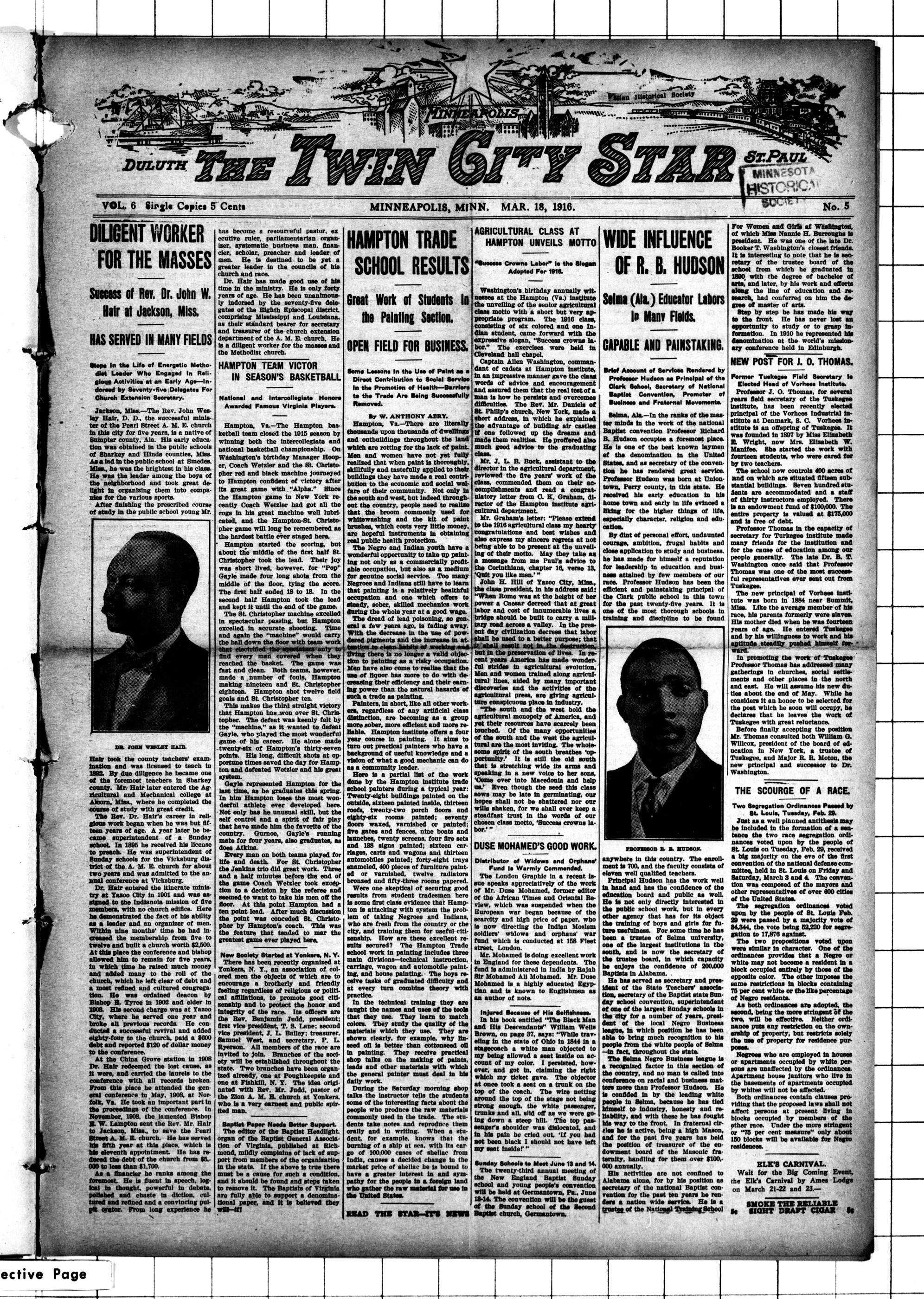
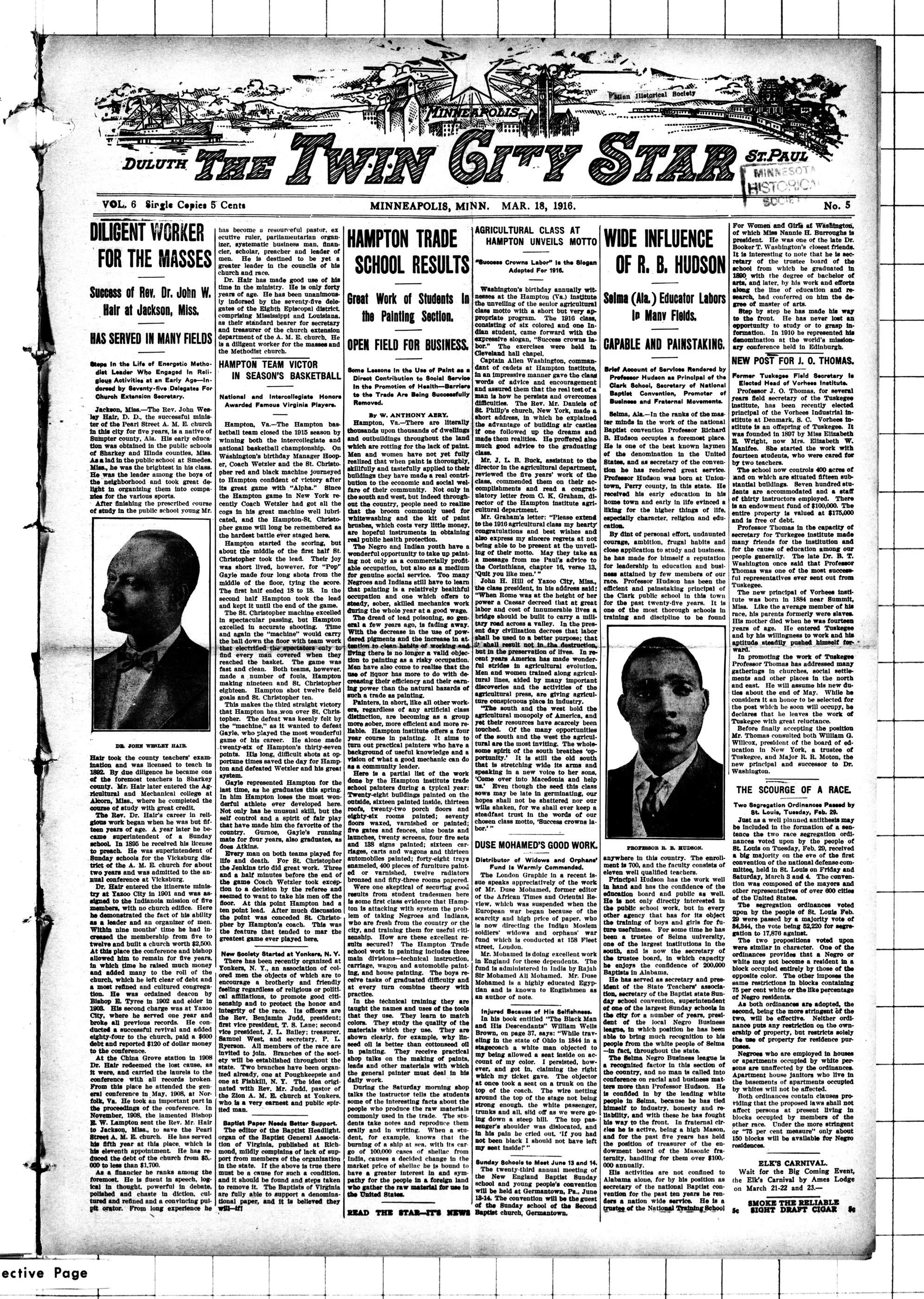
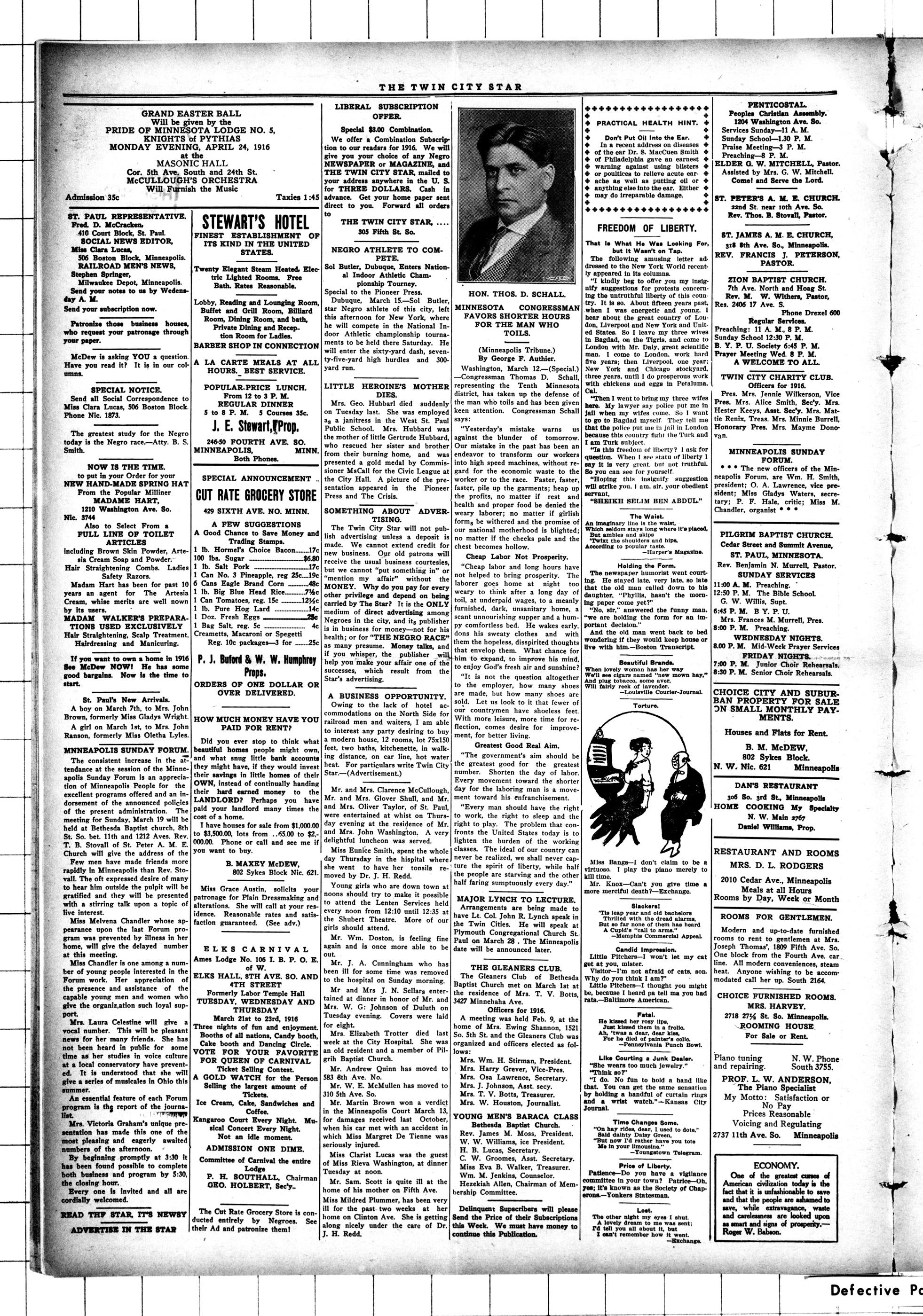
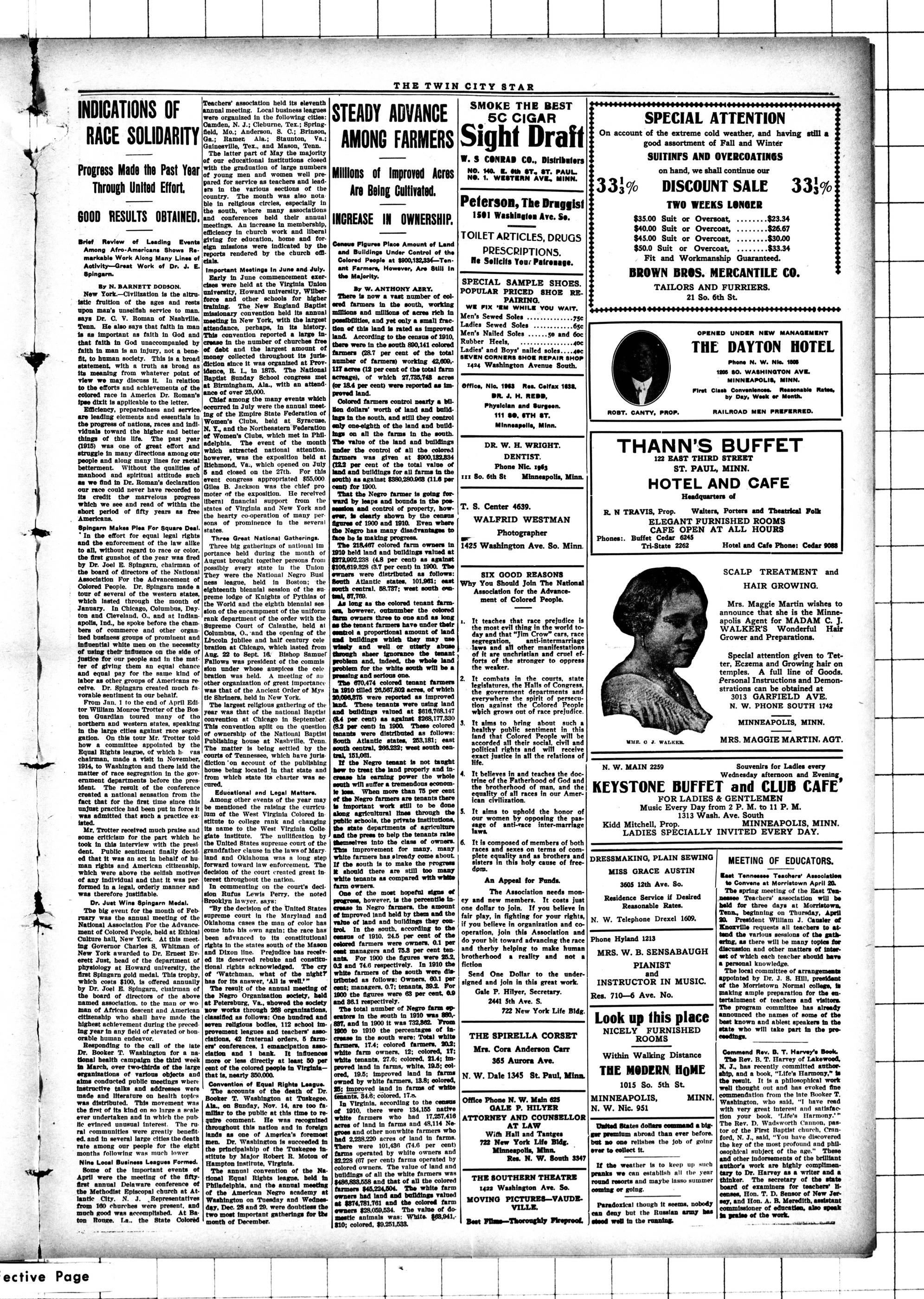
Page text (machine-generated)
ective Page
VOL. 6 Single Copies 5 Cents
DILIGENT WORKER FOR THE MASSES
HAS SERVED IN MANY FIELDS
Step In the Life of Energetic Methodist Leader Who Engaged in Religious Activities at an Early Age—Indorsed by Seventy-five Delegates For Church Extension Secretary.
Jackson, Miss.—The Rev. John Wesley Hair, D. D., the successful minister of the Pearl Street A. M. E. church in this city for five years, is a native of Sumpter county, Ala. His early education was obtained in the public schools of Sharkey and Hinds counties, Miss. As a lad in the public school at Smedes, Miss, he was the brightest in his class.
He was the leader among the boys of the neighborhood and took great delight in organizing them into companies for the various sports.
After finishing the prescribed course of study in the public school young Mr.
M. B.
Hair took the county teachers' examination and was licensed to teach in 1892. By due diligence he became one of the foremost teachers in Sharkey county. Mr. Hair later entered the Agricultural and Mechanical college at Aborn, Miss., where he completed the course of study with great credit. The Rev. Dr. Hair's career in religious work began when he was but fifteen years of age. A year later he became superintendent of a Sunday school. In 1895 he received his license to preach. He was superintendent of Sunday schools for the Vicksburg district of the A. M. E. church for about two years and was admitted to the annual conference at Vicksburg.
Dr. Hair entered the itinerate ministry at Yazoo City in 1901 and was assigned to the Indianapolis mission of five members, with no church edifice. Here he demonstrated the fact of his ability as a leader and an organizer of men. Within nine months' time he had increased the membership from five to twelve and built a church worth $2,500. At this place the conference and bishop allowed him to remain for five years, in which time he raised much money and added many to the roll of the church, which he left clear of debt and a most refined and cultured congregation. He was ordained deacon by Bishop E. Tyree in 1902 and elder in 1903. His second charge was at Yazoo City, where he served one year and broke all previous records. He conducted a successful revival and added eighty-four to the church, paid a $000 debt and reported $120 of dollar money to the conference.
At the China Grove station in 1908 Dr. Hair redeemed the lost cause, as it were, and carried the laurels to the conference with all records broken. From this place he attended the general conference in May, 1908, at Norfolk, Va. He took an important part in the proceedings of the conference. In November, 1908, the lamented Bishop M. W. Lampton sent the Rev. Mr. Hair to Jackson, Miss., to save the Pearl Street A. M. E. church. He has served his fifth year at this place, which is his eleventh appointment. He has reduced the debt of the church from $5,000 to less than $1,700. As a financier he ranks among the foremost. He is fluent in speech, logical in thought, powerful in debate, polished and chaste in diction, cultured and refined and a convincing pulpit orator. From long experience he
has become a resourceful pastor, ex
executive ruler, parliamentarian organizer, systematic business man, financier, scholar, preacher and leader of men. He is destined to be yet a greater leader in the councils of his church and race. Dr. Hair has made good use of his time in the ministry. He is only forty years of age. He has been unantomously indoors by the seventy-five delegates of the Eighth Episcopal district, comprising Mississippi and Louisiana, as their standard bearer for secretary and treasurer of the church extension department of the A. M. E. church. He is a diligent worker for the masses and the Methodist church.
HAMPTON TEAM VICTOR IN SEASON'S BASKETBALL
National and Intercollegiate Honore Awarded Famous Virginia Players.
Hampton, Va.—The Hampton basketball team closed the 1915 season by winning both the intercollegiate and national basketball championship. On Washington's birthday Manager Hooper, Coach Wetzel and the St. Christopher red and black machine journeyed to Hampton confident of victory after its great game with "Alpha." Since the Hampton game in New York recently Coach Wetzel had got all the cogs in his great machine well lubricated, and the Hampton-St. Christopher game will long be remembered as the hardest battle ever staged here.
Hampton started the scoring, but about the middle of the first half St. Christopher took the lead. Their joy was short lived, however, for "Pop" Gayle made four long shots from the middle of the floor, tying the score. The first half ended 18 to 18. In the second half Hampton took the lead and kept it until the end of the game.
The St. Christopher machine excelled in spectacular passing, but Hampton excelled in accurate shooting. Time and again the "machine" would carry the ball down the floor with team work that electrified the spectators only to find every man covered when they reached the basket. The game was fast and clean. Both teams, however, made a number of fouls, Hampton making nineteen and St. Christopher eighteen. Hampton shot twelve field goals and St. Christopher ten.
This makes the third straight victory that Hampton has_won over St. Christopher. The defeat was keenly felt by the "machine," as it wanted to defeat Gayle, who played the most wonderful game of his career. He alone made twenty-six of Hampton's thirty-seven points. His long, difficult shots at opportune times saved the day for Hampton and defeated Wetzler and his great system.
Gayle represented Hampton for the last time, as he graduates this spring. In him Hampton loses the most wonderful athlete ever developed here. Not only has he unusual skill, but the self control and a spirit of fair play that have made him the favorite of the country. Gurnoe, Gayle's running mate for four years, also graduates, as does Atkins.
Every man on both teams played for life and death. For St. Christopher the Jenkins trio did great work. Three and a half minutes before the end of the game Coach Wetzler took exception to a decision by the referee and seemed to want to take his men off the floor. At this point Hampton had a ten point lead. After much discussion the point was conceded St. Christopher by Hampton's coach. This was the feature that tended to mar the greatest game ever played here.
New Society Started at Yenkers, N. Y. There has been recently organized at Yenkers, N. Y., an association of colored men the objects of which are to encourage a brotherly and friendly feeling regardless of religious or political affiliations, to promote good citizenship and to protect the honor and integrity of the race. Its officers are the Rev. Benjamin Judd, president; first vice president, T. S. Lane; second vice president, J. L. Bailey; treasurer, Samuel West, and secretary, P. L. Ryerson. All members of the race are invited to join. Branches of the society will be established throughout the state. Two branches have been organized already, one at Poughkeepsie and one at Fishkill, N. Y. The idea originated with Rev. Mr. Judd, pastor of the Zion A. M. E. church at Yenkers, who is a very earnest and public spirited man.
Baptist Paper Needs Better Support. The editor of the Baptist Headlight, organ of the Baptist General Association of Virginia, published at Richmond, mildly complains of lack of support from members of the organization in the state. If the above is true there must be a cause for such a condition, and it should be found and steps taken to remove it. The Baptists of Virginia are fully able to support a denominational paper, and it is believed they will-ff!
HAMPTON TRADE SCHOOL RESULTS
Some Lessons In the Use of Paint as a Direct Contribution to Social Service In the Promotion of Health—Barriers to the Trade Are Being Successfully Removed.
By W. ANTHONY ABRY.
Hampton, Va.—There are literally thousands upon thousands of dwellings and outbuildings throughout the land which are rotting for the lack of paint. Men and women have not yet fully realized that when paint is thoroughly, skillfully and tastefully applied to their buildings they have made a real contribution to the economic and social welfare of their community. Not only in the south and west, but indeed throughout the country, people need to realize that the broom commonly used for whitewashing and the kit of paint brushes, which costs very little money, are hopeful instruments in obtaining real public health protection.
The Negro and Indian youth have a wonderful opportunity to take up painting not only as a commercially profitable occupation, but also as a medium for genuine social service. Too many Negroes and Indians still have to learn that painting is a relatively healthful occupation and one which offers to steady, sober, skilled mechanics work during the whole year at a good wage.
The dread of lead poisoning, so general a few years ago, is fading away. With the decrease in the use of powdered pigments and the increase in attention to clean habits of working and living there is no longer a valid objection to painting as a risky occupation. Men have also come to realise that the use of liquor has more to do with decreasing their efficiency and their earning power than the natural hazards of such a trade as painting.
Painters, in short, like all other workers, regardless of any artificial class distinction, are becoming as a group more sober, more efficient and more reliable. Hampton institute offers a four year course in painting. It aims to turn out practical painters who have a background of useful knowledge and a vision of what a good mechanic can do as a community leader.
Here is a partial list of the work done by the Hampton institute trade school painters during a typical year: Twenty-eight buildings painted on the outside, sixteen painted inside, thirteen roofs, twenty-two porch floors and eighty-six rooms painted; seventy floors waxed, varnished or painted; five gates and fences, nine boats and launches, twenty screens, four fire sets and 138 signs painted; sixteen carriages, carts and wagons and thirteen automobiles painted; forty-eight trays enameled, 400 pieces of furniture painted or varnished, twelve radiators bronzed and fifty-three rooms papered.
Were one skeptical of securing good results from student tradesmen here is some first class evidence that Hampton is attacking with system the problem of taking Negroes and Indians, who are fresh from the country or the city, and training them for useful citizenship. How are these excellent results secured? The Hampton Trade school work in painting includes three main divisions—technical instruction, carriage, wagon and automobile painting, and house painting. The boys receive tasks of graduated difficulty and at every turn combine theory with practice.
In the technical training they are taught the names and uses of the tools that they use. They learn to match colors. They study the quality of the materials which they use. They are shown clearly, for example, why linseed oil is better than cottonseed oil in painting. They receive practical shop talks on the making of paints, leads and other materials with which the general painter must deal in his daily work.
During the Saturday morning shop talks the instructor tells the students some of the interesting facts about the people who produce the raw materials commonly used in the trade. The students take notes and reproduce them orally and in writing. When a student, for example, knows that the burning of a ship at sea, with its cargo of 100,000 cases of shellac from India, causes a decided change in the market price of shellac he is bound to have a greater interest in and sympathy for the people in a foreign land who gather the raw material for use in the United States.
READ THE STAR-ITS NEWS
AGRICULTURAL CLASS AT HAMPTON UNVEILS MOTTO
"Success Crowns Labor" is the Slegan Adopted For 1916.
Washington's birthday annually witnesses at the Hampton (Va.) institute the unveiling of the senior agricultural class motto with a short but very appropriate program. The 1916 class, consisting of six colored and one Indian student, came forward with the expressive slogan, "Success crowns labor." The exercises were held in Cleveland hall chapel.
Captain Allen Washington, commandant of cadets at Hampton institute, in an impressive manner gave the class words of advice and encouragement and assured them that the real test of a man is how he persists and overcomes difficulties. The Rev. Mr. Daniels of St. Philip's church, New York, made a short address, in which he explained the advantage of building air castles if one followed up the dreams and made them realities. He proffered also much good advice to the graduating class.
Mr. J. L. B. Buck, assistant to the director in the agricultural department, reviewed the five years' work of the class, commended them on their accomplishments and read a congratulatory letter from O. K. Graham, director of the Hampton institute agricultural department.
Mr. Graham's letter: "Please extend to the 1916 agricultural class my hearty congratulations and best wishes and also express my sincere regrets at not being able to be present at the unveiling of their motto. May they take as a message from me Paul's advice to the Corinthians, chapter 16, verse 13, 'Quit you like men.'"
John H. Hill of Yazoo City, Miss., the class president, in his address said: "When Rome was at the height of her power a Caesar decreed that at great labor and cost of innumerable lives a bridge should be built to carry a military road across a valley. In the present day civilization decrees that labor shall be used to a better purpose; that it shall result not in the destruction, but in the preservation of lives. In recent years America has made wonderful strides in agricultural evolution, Men and women trained along agricultural lines, aided by many important discoveries and the activities of the agricultural press, are giving agriculture conspicuous place in industry.
"The south and the west hold the agricultural monopoly of America, and yet their resources have scarcely been touched. Of the many opportunities of the south and the west the agricultural are the most inviting. The wholesome spirit of the south breathes 'opportunity.' It is still the old south that is stretching wide its arms and speaking in a new voice to her sons, 'Come over into Macedonia and help us.' Even though the seed this class sows may be late in germinating, our hopes shall not be shattered nor our wills shaken, for we shall ever keep a steadfast trust in the words of our chosen class motto, 'Success crowns labor.'"
DUSE MOHAMED'S GOOD WORK
Distributor of Widows and Orphan's Fund is Warmly Commended.
The London Graphic in a recent issue speaks appreciatively of the work of Mr. Duse Mohamed, former editor of the African Times and Oriental Review, which was suspended when the European war began because of the scarcity and high price of paper, who is now directing the Indian Moslem soldiers' widows and orphan's war fund which is conducted at 158 Fleet street, London.
Mr. Mohamed is doing excellent work in England for these dependents. The fund is administered in India by Rajah Sir Mohamed All Mohamed. Mr. Duse Mohamed is a highly educated Egyptian and is known to Englishmen as an author of note.
Injured Because of His Selfishness.
In his book entitled "The Black Man and His Descendants" William Wells Brown, on page 37, says: "While traveling in the state of Ohio in 1844 in a stagecoach a white man objected to my being allowed a seat inside on account of my color. I persisted, however, and got in, claiming the right which my ticket gave. The objector at once took a seat on a trunk on the top of the coach. The wire netting around the top of the stage not being strong enough, the white passenger, trunks and all, slid off as we were going down a steep hill. The top passenger's shoulder was dislocated, and in his pain he cried out, "If you had not been black I should not have left my seat inside!""
Sunday Schools to Meet June 13 and 14.
The twenty-third annual meeting of the New England Baptist Sunday school and young people's convention will be held at Germantown, Pa. June 18-14. The convention will be the guest of the Sunday school of the Second Baptist church, Germantown.
WIDE INFLUENCE OF R. B. HUDSON
GAPABLE AND PAINSTAKING.
Brief Account of Services Rendered by Professor Hudson as Principal of the Clark School, Secretary of National Baptist Convention, Promoter of Business and Fraternal Movements.
Selma, Ala.—In the ranks of the master minds in the work of the national Baptist convention Professor Richard B. Hudson occupies a foremost place. He is one of the best known laymen of the denomination in the United States, and as secretary of the convention he has rendered great service. Professor Hudson was born at Uniontown, Perry county, in this state. He received his early education in his home town and early in life evinced a liking for the higher things of life, especially character, religion and education.
By dint of personal effort, undaunted courage, ambition, frugal habits and close application to study and business. he has made for himself a reputation for leadership in education and business attained by few members of our race. Professor Hudson has been the efficient and painstaking principal of the Clark public school in this town for the past twenty-five years. It is one of the most thorough schools in training and discipline to be found
PROFESSOR R. B. HUDSON. anywhere in this country. The enrollment is 700, and the faculty consists of eleven well qualified teachers.
Principal Hudson has the work well in hand and has the confidence of the education board and public as well. He is not only directly interested in the public school work, but in every other agency that has for its object the training of boys and girls for future usefulness. For some time he has been a trustee of Selma university, one of the largest institutions in the south, and is now the secretary of the trustee board, in which capacity he enjoys the confidence of 200,000 Baptists in Alabama.
He has served as secretary and president of the State Teachers' association, secretary of the Baptist state Sunday school convention, superintendent of one of the largest Sunday schools in the city for a number of years, president of the local Negro Business league, in which position he has been able to bring much recognition to his people from the white people of Selma—in fact, throughout the state.
The Selma Negro Business league is a recognized factor in this section of the country, and no man is called into conference on racial and business matters more than Professor Hudson. He is confided in by the leading white people in Selma, because he has tied himself to industry, honesty and reliability, and with these he has fought his way to the front. In fraternal circles he is active, being a high Mason, and for the past five years has held the position of treasurer of the endowment board of the Masonic fraternity, handling for them over $100,000 annually. His activities are not confined to Alabama alone, for by his position as secretary of the national Baptist convention for the past ten years he renders a nation wide service. He is a trustee of the National Training School
For Women and Girls of Washington, of which Miss Nannie H. Burroughs is president. He was one of the late Dr. Booker T. Washington's closest friends. It is interesting to note that he is secretary of the trustee board of the school from which he graduated in 1890 with the degree of bachelor of arts, and later, by his work and efforts along the line of education and research, had conferred on him the degree of master of arts.
Step by step he has made his way to the front. He has never lost an opportunity to study or to grasp information. In 1910 he represented his denomination at the world's missionary conference held in Edinburgh.
NEW POST FOR J. O. THOMAS.
Former Tuskegee Field Secretary is
Filmed Most of Vachere Institute
Professor J. O. Thomas, for several years field secretary of the Tuskegee institute, has been recently elected principal of the Vorhees Industrial institute at Denmark, S. C. Vorhees institute is an offspring of Tuskegee. It was founded in 1897 by Miss Elizabeth R. Wright, now Mrs. Elizabeth W. Manifee. She started the work with fourteen students, who were cared for by two teachers. The school now controls 400 acres of land on which are situated fifteen substantial buildings. Seven hundred students are accommodated and a staff of thirty instructors employed. There is an endowment fund of $100,000. The entire property is valued at $175,000 and is free of debt.
Professor Thomas in the capacity of secretary for Tuskegee institute made many friends for the institution and for the cause of education among our people generally. The late Dr. B. T. Washington once said that Professor Thomas was one of the most successful representatives ever sent out from Tuskegee.
The new principal of Vorhees institute was born in 1884 near Summit, Miss. Like the average member of his race, his parents formerly were slaves. His mother died when he was fourteen years of age. He entered Tuskegee and by his willingness to work and his aptitude steadily pushed himself forward.
In promoting the work of Tuskegee Professor Thomas has addressed many gatherings in churches, social settlements and other places in the north and east. He will assume his new duties about the end of May. While he considers it an honor to be selected for the post which he soon will occupy, he declares that he leaves the work of Tuskegee with great reluctance. Before finally accepting the position Mr. Thomas consulted both William G. Willcox, president of the board of education in New York, a trustee of Tuskegee, and Major R. R. Moton, the new principal and successor to Dr. Washington.
THE SCOURGE OF A RACE.
Two Segregation Ordinances Passed by
St. Louis, Tuesday. Feb. 29.
Just as a well planned antithesis may be included in the formation of a sentence the two race segregation ordinances voted upon by the people of St. Louis on Tuesday, Feb. 29, received a big majority on the eve of the first convention of the national defense committee, held in St. Louis on Friday and Saturday, March 3 and 4. The convention was composed of the mayors and other representatives of over 600 cities of the United States.
The segregation ordinances voted upon by the people of St. Louis Feb. 29 were passed by a majority vote of 24,344, the vote being $2,220 for segregation to 17,876 against.
The two propositions voted upon were similar in character. One of the ordinances provides that a Negro or white may not become a resident in a block occupied entirely by those of the opposite color. The other imposes the same restrictions in blocks containing 75 per cent white or the like percentage of Negro residents.
As both ordinances are adopted, the second, being the more stringent of the two, will be effective. Neither ordinance puts any restriction on the ownership of property, but restricts solely the use of property for residence purposes.
Negroes who are employed in houses or apartments occupied by white persons are unaffected by the ordinances.
Apartment house janitors who live in the basements of apartments occupied by whites will not be affected.
Both ordinances contain clauses providing that the proposed laws shall not affect persons at present living in blocks occupied by members of the other race. Under the more stringent or "75 per cent measure" only about 150 blocks will be available for Negro residences.
ELK'S CARNIVAL.
Wait for the Big Coming Event, the Elk's Carnival by Ames Lodge on March 21-22 and 23.—
SMOKE THE RELIABLE
SIGHT DRAFT CIGAR $
DULUTH THE TWIN CITY STAR ST.PAUL
MINNEAPOLIS
Mian Historical Society
ective Page
VOL. 6 Single Copies 5 Cents
DILIGENT WORKER FOR THE MASSES
HAS SERVED IN MANY FIELDS
Stepa In the Life of Energetic Methodist Leader Who Engaged In Religious Activities at an Early Age-Indorsed by Seventy-five Delegates For Church Extension Secretary.
Jackson, Miss.—The Rev. John Wesley Hair, D. D., the successful minister of the Pearl Street A. M. E. church in this city for five years, is a native of Sumpter county, Ala. His early education was obtained in the public schools of Sharkey and Hinds counties, Miss. As a lad in the public school at Smedes, Miss, he was the brightest in his class. He was the leader among the boys of the neighborhood and took great delight in organizing them into companies for the various sports.
After finishing the prescribed course of study in the public school young Mr.
M. B.
DR. JOHN WESLEY HAIR.
Hair took the county teachers' examination and was licensed to teach in 1892. By due diligence he became one of the foremost teachers in Sharkey county. Mr. Hair later entered the Agricultural and Mechanical college at Alcorn, Miss., where he completed the course of study with great credit.
The Rev. Dr. Hair's career in religious work began when he was but fifteen years of age. A year later he became superintendent of a Sunday school. In 1895 he received his license to preach. He was superintendent of Sunday schools for the Vicksburg district of the A. M. E. church for about two years and was admitted to the annual conference at Vicksburg.
Dr. Hair entered the itinerate ministry at Yazoo City in 1901 and was assigned to the Indiana mission of five members, with no church edifice. Here he demonstrated the fact of his ability as a leader and an organizer of men. Within nine months' time he had increased the membership from five to twelve and built a church worth $2,500. At this place the conference and bishop allowed him to remain for five years, in which time he raised much money and added many to the roll of the church, which he left clear of debt and a most refined and cultured congregation. He was ordained deacon by Bishop E. Tyree in 1902 and elder in 1903. His second charge was at Yazoo City, where he served one year and broke all previous records. He conducted a successful revival and added eighty-four to the church, paid a $000 debt and reported $120 of dollar money to the conference.
At the China Grove station in 1908 Dr. Hair redeemed the lost cause, as it wore, and carried the laurels to the conference with all records broken. From this place he attended the general conference in May, 1908, at Norfolk, Va. He took an important part in the proceedings of the conference. In November, 1908, the lamented Bishop H. W. Lampton sent the Rev. Mr. Hair to Jackson, Miss., to save the Pearl Street A. M. E. church. He has served his fifth year at this place, which is his eleventh appointment. He has reduced the debt of the church from $5,000 to less than $1,700. As a financier he ranks among the foremost. He is fluent in speech, logical in thought, powerful in debate, polished and chaste in diction, cultured and refined and a convincing pulpit orator. From long experience he
has become a resourceful pastor, executive ruler, parliamentarian organizer, systematic business man, financier, scholar, preacher and leader of men. He is destined to be yet a greater leader in the councils of his church and race. Dr. Hair has made good use of his time in the ministry. He is only forty years of age. He has been unanimously indorsed by the seventy-five delegates of the Eighth Episcopal district, comprising Mississippi and Louisiana, as their standard bearer for secretary and treasurer of the church extension department of the A. M. E. church. He is a diligent worker for the masses and the Methodist church.
National and Intercollegiate Honors Awarded Famous Virginia Players.
Hampton, Va.—The Hampton basketball team closed the 1915 season by winning both the intercollegiate and national basketball championship. On Washington's birthday Manager Hooper, Coach Wetzler and the St. Christopher red and black machine journeyed to Hampton confident of victory after its great game with "Alpha." Since the Hampton game in New York recently Coach Wetzler had got all the cogs in his great machine well lubricated, and the Hampton-St. Christopher game will long be remembered as the hardest battle ever staged here.
Hampton started the scoring, but about the middle of the first half St. Christopher took the lead. Their joy was short lived, however, for "Pop" Gayle made four long shots from the middle of the floor, tying the score. The first half ended 18 to 18. In the second half Hampton took the lead and kept it until the end of the game. The St. Christopher machine excelled in spectacular passing, but Hampton excelled in accurate shooting. Time and again the "machine" would carry the ball down the floor with team work that electrified the spectators only to find every man covered when they reached the basket. The game was fast and clean. Both teams, however, made a number of fouls, Hampton making nineteen and St. Christopher eleighteen. Hampton shot twelve field goals and St. Christopher ten.
This makes the third straight victory that Hampton has won over St. Christopher. The defeat was keenly felt by the "machine," as it wanted to defeat Gayle, who played the most wonderful game of his career. He alone made twenty-six of Hampton's thirty-seven points. His long, difficult shots at opportune times saved the day for Hampton and defeated Wetzler and his great system.
Gayle represented Hampton for the last time, as he graduates this spring. In him Hampton loses the most wonderful athlete ever developed here. Not only has he unusual skill, but the self control and a spirit of fair play that have made him the favorite of the country. Gurnoe, Gayle's running mate for four years, also graduates, as does Atkins.
Every man on both teams played for life and death. For St. Christopher the Jenkins trio did great work. Three and a half minutes before the end of the game Coach Wetzler took exception to a decision by the referee and seemed to want to take his men off the floor. At this point Hampton had a ten point lead. After much discussion the point was conceded St. Christopher by Hampton's coach. This was the feature that tended to mar the greatest game ever played here.
New Society Started at Yonkers, N. Y.
There has been recently organized at Yonkers, N. Y., an association of colored men the objects of which are to encourage a brotherly and friendly feeling regardless of religious or political affiliations, to promote good citizenship and to protect the honor and integrity of the race. Its officers are the Rev. Benjamin Judd, president; first vice president, T. S. Lane; second vice president, J. L. Bailey; treasurer, Samuel West, and secretary, P. L. Ryerson. All members of the race are invited to join. Branches of the society will be established throughout the state. Two branches have been organized already, one at Poughkeepsie and one at Fishkill, N. Y. The idea originated with Rev. Mr. Judd, pastor of the Zion A. M. E. church at Yonkers, who is a very earnest and public spirited man.
Baptist Paper Needs Better Support. The editor of the Baptist Headlight, organ of the Baptist General Association of Virginia, published at Richmond, mildly complains of lack of support from members of the organization in the state. If the above is true there must be a cause for such a condition, and it should be found and steps taken to remove it. The Baptists of Virginia are fully able to support a denominational paper, and it is believed they will-if!
MINNEAPOLIS, MINN. MAR. 18, 1916.
HAMPTON TRADE SCHOOL RESULTS
Some Lessons In the Use of Paint as a Direct Contribution to Social Service In the Promotion of Health—Barriers to the Trade Are Being Successfully Removed.
By W. ANTHONY AERY.
Hampton, Va.—There are literally thousands upon thousands of dwellings and outbuildings throughout the land which are rotting for the lack of paint. Men and women have not yet fully realized that when paint is thoroughly, skillfully and tastefully applied to their buildings they have made a real contribution to the economic and social welfare of their community. Not only in the south and west, but indeed throughout the country, people need to realize that the broom commonly used for whitewashing and the kit of paint brushes, which costs very little money, are hopeful instruments in obtaining real public health protection.
The Negro and Indian youth have a wonderful opportunity to take up painting not only as a commercially profitable occupation, but also as a medium for genuine social service. Too many Negroes and Indians still have to learn that painting is a relatively healthful occupation and one which offers to steady, sober, skilled mechanics work during the whole year at a good wage. The dread of lead poisoning, so general a few years ago, is fading away. With the decrease in the use of powdered pigments and the increase in attention to clean habits of working and living there is no longer a valid objection to painting as a risky occupation. Men have also come to realize that the use of liquor has more to do with decreasing their efficiency and their earning power than the natural hazards of such a trade as painting.
Painters, in short, like all other workers, regardless of any artificial class distinction, are becoming as a group more sober, more efficient and more reliable. Hampton institute offers a four year course in painting. It aims to turn out practical painters who have a background of useful knowledge and a vision of what a good mechanic can do as a community leader.
Here is a partial list of the work done by the Hampton institute trade school painters during a typical year: Twenty-eight buildings painted on the outside, sixteen painted inside, thirteen roofs, twenty-two porch floors and eighty-six rooms painted; seventy floors waxed, varnished or painted; five gates and fences, nine boats and launches, twenty screens, four fire sets and 128 signs painted; sixteen carriages, carts and wagons and thirteen automobiles painted; forty-eight trays enameled, 400 pieces of furniture painted or varnished, twelve radiators bronzed and fifty-three rooms paneled.
Were one skeptical of securing good results from student tradesmen here is some first class evidence that Hampton is attacking with system the problem of taking Negroes and Indians, who are fresh from the country or the city, and training them for useful citizenship. How are these excellent results secured? The Hampton Trade school work in painting includes three main divisions—technical instruction, carriage, wagon and automobile painting, and house painting. The boys receive tasks of graduated difficulty and at every turn combine theory with practice.
In the technical training they are taught the names and uses of the tools that they use. They learn to match colors. They study the quality of the materials which they use. They are shown clearly, for example, why linseed oil is better than cottonseed oil in painting. They receive practical shop talks on the making of paints, leads and other materials with which the general painter must deal in his daily work.
During the Saturday morning shop talks the instructor tells the students some of the interesting facts about the people who produce the raw materials commonly used in the trade. The students take notes and reproduce them orally and in writing. When a student, for example, knows that the burning of a ship at sea, with its cargo of 100,000 cases of shellac from India, causes a decided change in the market price of shellac he is bound to have a greater interest in and sympathy for the people in a foreign land who gather the raw material for use in the United States.
READ THE STAR-ITS NEWS
AGRICULTURAL CLASS AT
HAMPTON UNVEILS MOTTO
"Success Crowns Labor" is the Slogan Adopted For 1916.
Washington's birthday annually witnesses at the Hampton (Va.) institute the unveiling of the senior agricultural class motto with a short but very appropriate program. The 1916 class, consisting of six colored and one Indian student, came forward with the expressive slogan, "Success crowns labor." The exercises were held in Cleveland hall chapel.
Captain Allen Washington, commandant of cadets at Hampton institute, in an impressive manner gave the class words of advice and encouragement and assured them that the real test of a man is how he persists and overcomes difficulties. The Rev. Mr. Daniels of St. Philp's church, New York, made a short address, in which he explained the advantage of building air castles if one followed up the dreams and made them realities. He proffered also much good advice to the graduating class.
Mr. J. L. B. Buck, assistant to the director in the agricultural department, reviewed the five years' work of the class, commended them on their accomplishments and read a congratulatory letter from C. K. Graham, director of the Hampton institute agricultural department.
Mr. Graham's letter: "Please extend to the 1916 agricultural class my hearty congratulations and best wishes and also express my sincere regrets at not being able to be present at the unveiling of their motto. May they take as a message from me Paul's advice to the Corinthians, chapter 16, verse 13, 'Quit you like men.'"
John H. Hill of Yazoo City, Miss., the class president, in his address said: "When Rome was at the height of her power a Caesar decreed that at great labor and cost of innumerable lives a bridge should be built to carry a military road across a valley. In the present day civilization decrees that labor shall be used to a better purpose; that it shall result not in the destruction, but in the preservation of lives. In recent years America has made wonderful strides in agricultural evolution. Men and women trained along agricultural lines, aided by many important discoveries and the activities of the agricultural press, are giving agriculture conspicuous place in industry.
"The south and the west hold the agricultural monopoly of America, and yet their resources have scarcely been touched. Of the many opportunities of the south and the west the agricultural are the most inviting. The wholesome spirit of the south breathes 'opportunity.' It is still the old south that is stretching wide its arms and speaking in a new voice to her sons, 'Come over into Macedonia and help us.' Even though the seed this class soys may be late in germinating, our hopes shall not be shattered nor our wills shaken, for we shall ever keep a steadfast trust in the words of our chosen class motto, 'Success crowns labor.'
DUSE MOHAMED'S GOOD WORK.
Distributor of Widows and Orphane'
Fund is Warmly Commended.
The London Graphic in a recent issue
speaks appreciatively of the work of
Mr. Duse Mohamed, former editor
of the African Times and Oriental
Review, which was suspended when the
European war began because of the
scarcity and high price of paper, who
is now directing the Indian Moslem
soldiers' widows and orphans' war
fund which is conducted at 158 Fleet
street, London.
Mr. Mohamed is doing excellent work
in England for these dependents. The
fund is administered in India by Rajah
Sir Mohamed All Mohamed. Mr. Duse
Mohamed is a highly educated Egyptian
and is known to Englishmen as
an author of note.
Injured Because of His Selfishness.
In his book entitled "The Black Man and His Descendants" William Wells Brown, on page 37, says: "While traveling in the state of Ohio in 1844 in a stagecoach a white man objected to my being allowed a seat inside on account of my color. I persisted, however, and got in, claiming the right which my ticket gave. The object at once took a seat on a trunk on the top of the coach. The wire netting around the top of the stage not being strong enough, the white passenger, trunks and all, slid off as we were going down a steep hill. The top passenger's shoulder was dislocated, and in his pain he cried out. "If you had not been black I should not have left my seat inside!"
Sunday Schools to Meet June 13 and 14.
The twenty-third annual meeting of the New England Baptist Sunday school and young people's convention will be held at Germantown, Pn. June 13-14. The convention will be the guest of the Sunday school of the Second Baptist church, Germantown.
WIDE INFLUENCE OF R. B. HUDSON
CAPABLE AND PAINSTAKING.
Brief Account of Services Rendered by Professor Hudson as Principal of the Clark School, Secretary of National Baptist Convention, Promoter of Business and Fraternal Movements.
Selma, Ala.—In the ranks of the master minds in the work of the national Baptist convention Professor Richard B. Hudson occupies a foremost place. He is one of the best known laymen of the denomination in the United States, and as secretary of the convention he has rendered great service. Professor Hudson was born at Uniontown, Perry county, in this state. He received his early education in his home town and early in life evinced a liking for the higher things of life, especially character, religion and education.
By dint of personal effort, undaunted courage, ambition, frugal habits and close application to study and business, he has made for himself a reputation for leadership in education and business attained by few members of our race. Professor Hudson has been the efficient and painstaking principal of the Clark public school in this town for the past twenty-five years. It is one of the most thorough schools in training and discipline to be found
M.
PROFESSOR R. B. HUDSON.
anywhere in this country. The enrollment is 700, and the faculty consists of eleven well qualified teachers.
Principal Hudson has the work well in hand and has the confidence of the education board and public as well. He is not only directly interested in the public school work, but in every other agency that has for its object the training of boys and girls for future usefulness. For some time he has been a trustee of Selma university, one of the largest institutions in the south, and is now the secretary of the trustee board, in which capacity he enjoys the confidence of 200,000 Baptists in Alabama.
He has served as secretary and president of the State Teachers' association, secretary of the Baptist state Sunday school convention, superintendent of one of the largest Sunday schools in the city for a number of years, president of the local Negro Business league, in which position he has been able to bring much recognition to his people from the white people of Selma—in fact, throughout the state.
The Selma Negro Business league is a recognized factor in this section of the country, and no man is called into conference on racial and business matters more than Professor Hudson. He is confided in by the leading white people in Selma, because he has tied himself to industry, honesty and reliability, and with these he has fought his way to the front. In fraternal circles he is active, being a high Mason, and for the past five years has held the position of treasurer of the endowment board of the Masonic fraternity, handling for them over $100,000 annually. His activities are not confined to Alabama alone, for by his position as secretary of the national Baptist convention for the past ten years he renders a nation wide service. He is a trustee of the National Training School
For Women and Girls at Washington, of which Miss Nannie H. Burroughs is president. He was one of the late Dr. Booker T. Washington's closest friends. It is interesting to note that he is secretary of the trustee board of the school from which he graduated in 1890 with the degree of bachelor of arts, and later, by his work and efforts along the line of education and research, had conferred on him the degree of master of arts.
Step by step he has made his way to the front. He has never lost an opportunity to study or to grasp information. In 1910 he represented his denomination at the world's missionary conference held in Edinburgh.
NEW POST FOR J. O. THOMAS.
Former Tuskegee Field Secretary is
Elected Head of Vorhess Institute.
Professor J. O. Thomas, for several years field secretary of the Tuskegee institute, has been recently elected principal of the Vorhees Industrial institute at Denmark, S. C. Vorhees institute is an offspring of Tuskegee. It was founded in 1897 by Miss Elizabeth R. Wright, now Mrs. Elizabeth W. Manifee. She started the work with fourteen students, who were cared for by two teachers. The school now controls 400 acres of and on which are situated fifteen substantial buildings. Seven hundred students are accommodated and a staff of thirty instructors employed. There is an endowment fund of $100,000. The entire property is valued at $175,000 and is free of debt.
Professor Thomas in the capacity of secretary for Turkegee institute made many friends for the institution and for the cause of education among our people generally. The late Dr. B. T. Washington once said that Professor Thomas was one of the most successful representatives ever sent out from Turkegee.
The new principal of Vorhee institute was born in 1884 near Summit, Miss. Like the average member of his race, his parents formerly were slaves. His mother died when he was fourteen years of age. He entered Turkegee and by his willingness to work and his aptitude steadily pushed himself forward.
In promoting the work of Tuskegee Professor Thomas has addressed many gatherings in churches, social settlements and other places in the north and east. He will assume his new duties about the end of May. While he considers it an honor to be selected for the post which he soon will occupy, he declares that he leaves the work of Tuskegee with great reluctance. Before finally accepting the position Mr. Thomas consulted both William G. Willcox, president of the board of education in New York, a trustee of Tuskegee, and Major R. R. Moton, the new principal and successor to Dr. Washington.
THE SCOURGE OF A RACE.
Two Segregation Ordinances Passed by
8t. Louis. Tuesday, Feb. 29.
Just as a well planned antithesis may be included in the formation of a sentence the two race segregation ordinances voted upon by the people of St. Louis on Tuesday, Feb. 29, received a big majority on the eve of the first convention of the national defense committee, held in St. Louis on Friday and Saturday, March 3 and 4. The convention was composed of the mayors and other representatives of over 600 cities of the United States.
The segregation ordinances voted upon by the people of St. Louis Feb. 29 were passed by a majority vote of 24,344, the vote being $2,220 for segregation to 17,876 against.
The two propositions voted upon were similar in character. One of the ordinances provides that a Negro or white may not become a resident in a block occupied entirely by those of the opposite color. The other imposes the same restrictions in blocks containing 75 per cent white or the like percentage of Negro residents. As both ordinances are adopted, the second, being the more stringent of the two, will be effective. Neither ordinance puts any restriction on the ownership of property, but restricts solely the use of property for residence purposes. Negroes who are employed in houses or apartments occupied by white persons are unaffected by the ordinances. Apartment house janitors who live in the basements of apartments occupied by whites will not be affected.
Both ordinances contain clauses providing that the proposed laws shall not affect persons at present living in blocks occupied by members of the other race. Under the more stringent or "75 per cent measure" only about 150 blocks will be available for Negro residences.
Wait for the Big Coming Event, the Elk's Carnival by Ames Lodge on March 21-22 and 23.—
SMOKE THE RELIABLE
Sc SIGHT DRAFT CIGAR $c
GRAND EASTER BALL
Will be given by the
PRIDE OF MINNESOTA LODGE NO. 5,
KNIGHTS of PYTHIAS
MONDAY EVENING, APRIL 24, 1916
at the
MASONIC HALL
Cor. 5th Ave. South and 24th St.
McCULLOUGH'S ORCHESTRA
Will Furnish the Music
ST. PAUL REPRESENTATIVE.
Fred. D. McCracken,
410 Court Block, St. Paul.
SOCIAL NEWS EDITOR,
Miss Clara Lucas,
506 Boston Block, Minneapolis.
RAILROAD MEN'S NEWS,
Stephen Springer,
Milwaukee Depot, Minneapolis.
Send your notes to us by Wednes-
day A. M.
Send your subscription now.
Patronize those business houses,
who request your patronage through
your paper.
McDew is asking YOU a question.
Have you read it? It is in our col-
umns.
SPECIAL NOTICE.
Send all Social Correspondence to Miss Clara Lucas, 506 Boston Block.
Phone Nic. 1873.
The greatest study for the Negro today is the Negro race.—Atty. B. S. Smith.
NOW IS THE TIME.
to put in your Order for your
NEW HAND-MADE SPRING HAT
From the Popular Milliner
MADAME HART,
1210 Washington Ave. So.
Nic. 3744
Also to Select From a
FULL LINE OF TOILET
ARTICLES
including Brown Skin Powder, Artesia Cream Soap and Powder.
Hair Straightening Combs. Ladies
Safety Razors.
Madam Hart has been for past 10
years an agent for The Artesia
Cream, whise merits are well nown
by its users.
MADAM WALKER'S PREPARATIONS USED EXCLUSIVELY
Hair Straightening, Scalp Treatment,
Hairdressing and Manicuring.
If you want to own a home in 1916
See McDew NOW! He has some
good bargains. Now is the time to
start.
St. Paul's New Arrivals.
A boy on March 7th, to Mrs. John
Brown, formerly Miss Gladys Wright.
A girl on March 1st, to Mrs. John
Ranson, formerly Miss Oletha Lyles.
MNNEAPOLIS SUNDAY FORUM.
The consistent increase in the attendance at the session of the Minneapolis Sunday Forum is an appreciation of Minneapolis People for the excellent programs offered and an indorsement of the announced policies of the present administration. The meeting for Sunday, March 19 will be held at Bethesda Baptist church, 8th St. So. bet. 11th and 1212 Aves. Rev. T. B. Stovall of St. Peter A. M. E. Church will give the address of the Few men have made friends more rapidly in Minneapolis than Rev. Stovall. The oft expressed desire of many to hear him outside the pulpit will be gratified and they will be presented with a stirring talk upon a topic of live interest.
Miss Melvena Chandler whose appearance upon the last Forum program was prevented by illness in her home, will give the delayed number at this meeting.
Miss Chandler is one among a number of young people interested in the Forum work. Her appreciation of the presence and assistance of the capable young men and women who give the organization such loyal support.
Mrs. Laura Celestine will give a vocal number. This will be pleasant news for her many friends. She has not been heard in public for some time as her studies in voice culture at a local conservatory have prevented. It is understood that she will give a series of musicales in Ohio this summer.
An essential feature of each Forum program is the report of the journalist.
Mrs. Victoria Graham's unique presentation has made this one of the most pleasing and eagerly awaited numbers of the afternoon.
By beginning promptly at 3:30 it has been found possible to complete both business and program by 5:30, the closing hour.
Every one is invited and all are cordially welcomed.
READ THE STAR, ITS NEWSY
ADVERTISE IN THE STAR
Taxies 1:45
STEWART'S HOTEL
FINEST ESTABLISHMENT OF ITS KIND IN THE UNITED STATES.
Twenty Elegant Steam Heated, Electric Lighted Rooms. Free Bath. Rates Reasonable.
Lobby, Reading and Lounging Room, Buffet and Grill Room, Billiard Room, Dining Room, and bath, Private Dining and Reception Room for Ladies.
BARBER SHOP IN CONNECTION
A LA CARTE MEALS AT ALL HOURS. BEST SERVICE.
POPULAR-PRICE LUNCH.
From 12 to 3 P. M.
REGULAR DINNER
5 to 8 P. M. 5 Courses 35c.
J. E. Stewart, Prop.
246-50 FOURTH AVE. SO.
MINNEAPOLIS, MINN.
Both Phones.
CUT RATE GROCERY STORE
429 SIXTH AVE. NO. MINN.
A FEW SUGGESTIONS
A Good Chance to Save Money and
A Good Chance to Save Money and
Trading Stamps.
1 lb. Hormel's Choice Bacon.....17c
100 lbs. Sugar.....$6.80
1 lb. Salt Pork.....17c
1 Can No. 3 Pineapple, reg 25c.....19c
6 Cans Eagle Brand Corn.....48c
1 lb. Big Blue Head Rice.....7½c
1 Can Tomatoes, reg. 15c.....12½c
1 lb. Pure Hog Lard.....14c
1 Doz. Fresh Eggs.....25c
1 Bag Salt, reg. 5c.....4c
Creametts, Macaroni or Spegetti
Reg. 10 packages—3 for.....25c
P. J. Buford & W. W. Humphrey Props.
ORDERS OF ONE DOLLAR OR
OVER DELIVERED.
HOW MUCH MONEY HAVE YOU
PAID FOR RENT?
Did you ever stop to think what beautiful homes people might own, and what snug little bank accounts they might have, if they would invest their savings in little homes of their OWN, instead of continually handing their hard earned money to the LANDLORD? Perhaps you have paid your landlord many times the cost of a home.
I have houses for sale from $1,000.00 to $3,500.00, lots from .65.00 to $2,-000.00. Phone or call and see me if you want to buy.
B. MAXEY McDEW,
802 Sykes Block Nic. 621.
Miss Grace Austin, solicits your patronage for Plain Dressmaking and alterations. She will call at your residence. Reasonable rates and satisfaction guaranteed. (See adv.)
ELK S CARNIVAL
Ames Lodge No. 106 I. B. P. O. E.
of W.
ELKS HALL, 8TH AVE. SO. AND
4TH STREET
Formerly Labor Temple Hall
TUESDAY, WEDNESDAY AND
THURSDAY
March 21st to 23rd, 1916
Three nights of fun and enjoyment.
Booths of all nations, Candy booth,
Cake booth and Dancing Circle.
VOTE FOR YOUR FAVORITE
FOR QUEEN OF CARNIVAL
Ticket Selling Contest.
A GOLD WATCH for the Person
Selling the largest amount of
Tickets.
Ice Cream, Cake, Sandwiches and
Coffee.
Kangaroo Court Every Night. Musical Concert Every Night.
Not an idle moment.
ADMISSION ONE DIME.
Committee of Carnival the entire
Lodge
P. H. SOUTHALL, Chairman
GEO. HOLBERT, Sec'y..
The Cut Rate Grocery Store is conducted entirely by Negroes. See their Ad and patronize them!
THE TWIN CITY STAR
LIBERAL SUBSCRIPTION
OFFER.
Special $3.00 Combination.
We offer a Combination Subscription to our readrs for 1916. We will give you your choice of any Negro NEWSPAPER or MAGAZINE, and THE TWIN CITY STAR, mailed to your address anywhere in the U. S. for THREE DOLLARS. Cash in advance. Get your home paper sent direct to you. Forward all orders
THE TWIN CITY STAR, .....
305 Fifth St. So.
NEGRO ATHLETE TO COMPETE.
Sol Butler, Dubuque, Enters Nation
al. Indoor, Athletic, Churn.
Dubuque, March 15.—Sol Butler, star Negro athlete of this city, left this afternoon for New York, where he will compete in the National Indoor Athletic championship tournaments to be held there Saturday. He will enter the sixty-yard dash, seventy-five-yard high hurdles and 300-yard run.
LITTLE HEROINE'S MOTHER
DIES.
Mrs. Geo. Hubbarl died suddenly on Tuesday last. She was employed as a janitress in the West St. Paul Public School. Mrs. Hubbard was the mother of little Gertrude Hubbard, who rescued her sister and brother from their burning home, and was presented a gold medal by Commissioner MsCall for the Civic League at the City Hall. A picture of the presentation appeared in the Pioneer Press and The Crisis.
SOMETHING ABOUT ADVERTISING.
The Twin City Star will not publish advertising unless a deposit is made. We cannot extend credit for new business. Our old patrons will receive the usual business courtesies, but we cannot "put something in" or "mention my affair" without the MONEY. Why do you pay for every other privilege and depend on being carried by The Star? It is the ONLY medium of direct advertising among Negroes in the city, and it $s$ publisher is in business for money—not for his health; or for "THE NEGRO RACE" as many presume. Money talks, and if you whisper, the publisher will help you make your affair one of the successes, which result from the Star's advertising.
A BUSINESS OPPORTUNITY.
Owing to the lack of hotel accommodations on the North Side for railroad men and waiters, I am able to interest any party desiring to buy a modern house, 12 rooms, lot 75x150 feet, two baths, kitchenette, in walking distance, on car line, hot water heat. For particulars write Twin City Star.—(Advertisement.)
Mr. and Mrs. Clarence McCullough, Mr. and Mrs. Glover Shull, and Mr. and Mrs. Oliver Taylor, of St. Paul, were entertained at whist on Thursday evening at the residence of Mr. and Mrs. John Washington. A very delightful luncheon was served.
Miss Eunice Smith, spent the whole day Thursday in the hospital where she went to have her tonsils removed by Dr. J. H. Redd.
Young girls who are down town at noons should try to make it possible to attend the Lenten Services held every noon from 12:10 until 12:35 at the Shubert Theatre. More of our girls should attend.
Mr. Wm. Doston, is feeling fine again and is once more able to be out.
Mr. J. A. Cunningham who has been ill for some time was removed to the hospital on Sunday morning.
Mr and Mrs J. N. Sellars entertained at dinner in honor of Mr. and Mrs. W. G: Johnson of Duluth on Tuesday evening. Covers were laid for eight.
Mrs. Elizabeth Trotter died last week at the City Hospital. She was an old resident and a member of Pilgrim Baptist Church.
Mr. Andrew Quinn has moved to 583 8th Ave. No.
Mr. W. E. Mullen has moved to 310 5th Ave. So.
Mr. Martin Brown won a verdict in the Minneapolis Court March 13, for damages received last October, when his car met with an accident in which Miss Margret De Tienne was seriously injured.
Miss Clarist Lucas was the guest of Miss Rieva Washington, at dinner Tuesday at noon.
Mr. Sam. Scott is quite ill at the home of his mother on Fifth Ave.
Miss Mildred Plummer, has been very ill for the past two weeks at her home on Clinton Ave. She is getting along nicely under the care of Dr. J. H. Redd.
E. H. H.
HON. THOS. D. SCHALL
MINNESOTA CONGRESSMAN
FAVORS SHORTER HOURS
FOR THE MAN WHO
TOILS.
(Minneapolis Tribune.)
By George F. Authier.
Washington, March 12.—(Special)
—Congressman Thomas D. Schall,
representing the Tenth Minnesota
district, has taken up the defense of
the man who toils and has been given
keen attention. Congressman Schall
says:
"Yesterday's mistake warns us
against the blunder of tomorrow.
Our mistake in the past has been an
endeavor to transform our workers
into high speed machines, without
regard for the economic waste to the
worker or to the race. Faster, faster,
faster, pile up the garments; heap up
the profits, no matter if rest and
health and proper food be denied the
weary laborer; no matter if gishlir
form<sub>8</sub> be withered and the promise of
our national motherhood is blighted;
no matter if the cheeks pale and the
chest becomes hollow.
Cheap Labor Not Prosperity.
"Cheap labor and long hours have not helped to bring prosperity. The laborer goes home at night too weary to think after a long day of toil, at underpaid wages, to a meanly furnished, dark, unsanitary home, a scant unnourishing supper and a humpy comfortless bed. He wakes early, dons his sweaty clothes and with them the hopeless, disspirited thoughts that envelop them. What chance for him to expand, to improve his mind, to enjoy God's fresh air and sunshine?
"It is not the question altogether to the employer, how many shoes are made, but how many shoes are sold. Let us look to it that fewer of our countrymen have sheoless feet. With more leisure, more time for reflection, comes desire for improvement, for better living.
Greatest Good Real Aim.
"The government's aim should be the greatest good for the greatest number. Shorten the day of labor. Every movement toward the shorter day for the laboring man is a movement toward his enfranchisement.
"Every man should have the right to work, the right to sleep and the right to play. The problem that confronts the United States today is to lighten the burden of the working classes. The ideal of our country can never be realized, we shall never capture the spirit of liberty, while half the people are starving and the other half faring sumptuously every day."
MAJOR LYNCH TO LECTURE.
Arrangements are being made to have Lt. Col. John R. Lynch speak in the Twin Cities. He will speak at Plymouth Congregational Church St. Paul on March 28. The Minneapolis date will be announced later.
THE GLEANERS CLUB
The Gleaners Club of Bethesda Baptist Church met on March 1st at the residence of Mrs. T. V. Botts, 3427 Minnehaha Ave.
Officers for 1916.
A meeting was held Feb. 9, at the home of Mrs. Ewing Shannon, 1521 So. 5th St. and the Gleaners Club was organized and officers elected as follows:
Mrs. Wm. H. Stirman, President.
Mrs. Harry Grever, Vice-Pres.
Mrs. Osa Lawrence, Secretary.
Mrs. J. Johnson, Asst. secy.
Mrs. T. V. Botts, Treasurer.
Mrs. W. Houston, Journalist.
YOUNG MEN'S BARACA CLASS
Bethesda Baptist Church.
Rev. James M. Moss, President.
W. W. Williams, ice President.
H. B. Lucas, Secretary.
C. W. Groomes, Asst. Secretary.
Miss Eva B. Walker, Treasurer.
Wm. M. Jenkins, Counselor.
Hezekiah Allen, Chairman of Membership Committee.
Delinquent SupSCRIBERS will please
Send the Price of their Subscriptions
this Week. We must have money to
continue this Publication.
Don't Put Oil Into the Ear.
In a recent address on diseases of the ear Dr. S. MacCuen Smith of Philadelphia gave an earnest warning against using blisters or poutliches to relieve acute earache as well as putting oil or anything else into the ear. Either may do irreparable damage.
FREEDOM OF LIBERTY.
That Is What He Was Looking For, but it Wasn't on Tap.
The following amusing letter addressed to the New York World recently appeared in its columns.
"I kindly beg to offer you my insignify suggestions for protests concerning the untruthful liberty of this country. It is so. About fifteen years past, when I was energetic and young, I hear about the great country of London, Liverpool and New York and United States. So I leave my three wives in Bagdad, on the Tigris, and come to London with Mr. Daly, great scientific man. I come to London, work hard five years; then Liverpool, one year; New York and Chicago stockyard, three years, until I do prosperous work with chickens and eggs in Petaluma, Cal.
"Then I went to bring my three wifes here. My lawyer say police put me in jail when my wifes come. So I want to go to Bagdad myself. They tell me that the police put me in jail in London because this country fight the Turk and I am Turk subject.
"Is this freedom of liberty? I ask for question. When I see statue of liberty I say it is very great, but not truthful. So you can see for yourself.
"Hoping this insignify suggestion will strike you. I am, sir, your obedient servant.
"SHEIKH SELIM BEN ABDUL"
The Waist.
An imaginary line is the waist,
Which seldom stays long where it's placed.
But ambles and skips
'Twit the shoulders and hips.
According to popular taste.
Magazine
Holding the Form.
Holding the Form.
The newspaper humorist went courting. He stayed late, very late, so late that the old man called down to his daughter, "Phyllis, hasn't the morning paper come yet?"
"No, sir," answered the funny man, "we are holding the form for an important decision."
And the old man went back to bed wondering if they would keep house or live with him.—Boston Transcript.
Beautiful Brands.
When lovely woman has her way
We'll see cigars named "new mown hay," And plug tobacco, some aver.
Will fairly agree, the lavender.
Louisville Courter-Journal.
Torture.
Miss Bangs—I don't claim to be a virtuoso. I play the piano merely to kill time.
Mr. Knox—Can't you give time a more merciful death?—Exchange.
Slackeral
"Tis leap year and old bachelors
Thrilled with the dread alarms,
But so far none of them has heard
A Cupid's "call to arms."
—Memphis Commercial Appeal.
Candid Impression.
Little Pitchers—I won't let my cat get at you, mister.
Visitor—I'm not afraid of cats, son.
Why do you think I am?
Little Pitchers—I thought you might be, because I heard pa tell you you had rats.—Baltimore American.
Fatal.
He kissed her rosy lips,
Just kissed them in a frolle.
Ah, 'twas a dear, dear kiss.
For he died of painter's colic.
—Pennsylvania Punch Bowl.
Like Courting a Junk Dealer.
"She wears too much jewelry."
"Think so?"
"I do. No fun to hold a hand like that. You can get the same sensation by holding a handful of curtain rings and a wrist watch."—Kansas City Journal.
Time Changes Some.
"On hay rides, dear, I used to dote,"
"Said dainty Daisy Green,"
"But now I'd rather have you toote
Me in your limousine."
—Youngstown Telegram.
Price of Liberty.
Patience—Do you have a vigilance committee in your town? Patrice—Oh, yes; it's known as the Society of Chapers.—Yonkers Statesman.
Lost.
The other night my eyes I shut.
A lovely dream to me was sent;
Fd tell you all about it, but
I can't remember how it went.
Exchange.
PENTICOSTAL
People's Christian Assembly.
1204 Washington Ave. So.
Services Sunday—11 A. M.
Sunday School—1.30 P. M.
Praise Meeting—3 P. M.
Preaching—8 P. M.
ELDER G. W. MITCHELL, Pastor.
Assisted by Mrs. G. W. Mitchell.
Come! and Serve the Lord.
ST. PETER'S A. M. E. CHURCH.
22nd St. near 10th Ave. So.
Rev. Thos. B. Stovall, Pastor.
ST. JAMES A. M. E. CHURCH,
318 8th Ave. So., Minneapolis.
REV. FRANCIS J. PETERSON,
PASTOR.
ZION BAPTIST CHURCH.
7th Ave. North and Hoag St.
Rev. M. W. Withers, Pastor,
Res. 2406 17 Ave. S.
Phone Drexel 600
Regular Services.
Preaching: 11 A. M., 8 P. M.
Sunday School 12:30 P. M.
B. Y. P. U. Society 6:45 P. M.
Prayer Meeting Wed. 8 P. M.
A WELCOME TO ALL.
Pres. Mrs. Jennie Wilkerson, Vice Pres. Mrs. Alice Smith, Sec'y. Mrs. Hester Keeys, Asst. Sec'y. Mrs. Mattie Renix, Treas. Mrs. Minnie Burrell, Honorary Pres. Mrs. Mayme Donovan.
MINNEAPOLIS SUNDAY FORUM.
* * * The new officers of the Minneapolis Forum, are Wm. H. Smith, president; O. A. Lawrence, vice president; Miss Gladys Waters, secretary; P. F. Hale, critic; Miss M. Chandler, organist * * *
PILGRIM BAPTIST CHURCH.
Cedar Street and Summit Avenue,
ST. PAUL, MINNESOTA.
Rev. Benjamin N. Murrell, Pastor.
SUNDAY SERVICES
11:00 A. M. Preaching.
12:50 P. M. The Bible School.
G. W. Willis, Supt.
6:45 P. M. B Y. P. U.
Mrs. Frances M. Murrell, Pres.
8:00 P. M. Preaching.
WEDNESDAY NIGHTS.
8:00 P. M. Mid-Week Prayer Services
FRIDAY NIGHTS.
7:00 P. M. Junior Choir Rehearsals.
8:30 P. M. Senior Choir Rehearsals.
CHOICE CITY AND SUBURBAN PROPERTY FOR SALE ON SMALL MONTHLY PAYMENTS.
Houses and Flats for Rent.
B. M. McDEW,
802 Sykes Block.
N. W. Nic. 621 Minneapolis
DAN'S RESTAURANT
306 So. 3rd St., Minneapolis
HOME COOKING My Specialty
N. W. Main 2767
Daniel Williams, Prop.
RESTAURANT AND ROOMS
MRS. D. L. RODGERS
2010 Cedar Ave., Minneapolis
Meals at all Hours
Rooms by Day, Week or Month
ROOMS FOR GENTLEMEN.
Modern and up-to-date furnished rooms to rent to gentlemen at Mrs. Joseph Thomas', 1809 Fifth Ave. So. One block from the Fourth Ave. car line. All modern conveniences, steam heat. Anyone wishing to be accommodated call her up. South 2164.
CHOICE FURNISHED ROOMS.
MRS. HARVEY.
2718 27½ St. So. Minneapolis.
ROOMING HOUSE
For Sale or Rent.
Piano tuning N. W. Phone and repairing. South 3755.
PROF. L. W. ANDERSON,
The Piano Specialist
My Motto: Satisfaction or No Pay
Prices Reasonable
Voicing and Regulating
2737 11th Ave. So. Minneapolis
One of the greatest curses of American civilization today is the fact that it is unfashionable to save and that the people are ashamed to save, while extravagance, waste and carelessness are looked upon as smart and signs of prosperity.— Roger W. Babson.
Defective
ective Page
INDICATIONS OF
RACE SOLIDARITY
Progress Hate the Past Year
Through United Effort.
6000 RESULTS OBTAINED,
Among Afro-Americans Shows Re-
markable Work Along Many Lines of
Activity—Great Work of Dr. J. E.
Spingarn.
By N. BARNETT DODSON.
New York.—Civilization is the altru-
istic fruition of the ages and rests
upon man’s unselfish service to man,
says Dr. 0. V. Roman of Nashville,
Tenn. He also says that faith in man
fs as tmportant as faith in God and
that faith in God unaccompanted by
faith in man is an injury, not a bene
fit, to human soclety. This is a broad
statement, with a truth as broad as
its meaning from whatever point of
view we may discuss it. In relation
to the efforts and achievements of the
colored race in America Dr. Roman's
Spee dixit 1s applicable to the letter.
Efficiency, preparedness and service
are leading elements and essentials In
the progress of nations, races and indi.
viduals toward the higher and better
things of this life. The past year
(1915) was one of great effort and
struggle in many directions among our
people and along many lines for racial
betterment. Without the qualities of
manhood and spiritual attitude such
as we find in Dr. Roman's declaration
our race could never have recorded to
ite credit the marvelous progress
‘which we see and read of within the
short period of fifty years as free
‘Americans,
Spingarn Makes Plea For Square Deal
“In the effort for equal legal rights
and the enforcement of the law alike
to all, without regard to race or color,
the first gunshot of the year was fred
by Dr. Joel E. Spingarn, chairman of
the board of directors of the National
Association For the Advancement of
Colored People. Dr. Spingarn made a
tour of several of the western states,
which lasted through the month of
January. In Chicago, Columbus, Day.
ton and Cleveland, O., and at Indian.
apolis, Ind., he spoke before the cham.
bers of commerce and other organ:
ized business groups of prominent and
influential white men on the necessity
of using thelr influence on the side of
Justice for our people and in the mat
ter of giving them an equal chance
and equal pay for the same kind of
labor as other groups of Americans re
ceive. Dr. Spingarn created much fa:
vorable sentiment in our behalf.
From Jan. 1 to the end of April Edi
tor William Monroe Trotter of the Bos
ton Guardian toured many of the
northern and western states, speaking
fm the large cities against race segre-
gation. On this tour Mr. Trotter told
how a committee appointed by the
Equal Rights league, of which h: vas
chairman, made a visit in November,
1914, to Washington and there laid the
matter of race segregation in the gov-
ernment departments before the pres
fdent. The result of the conference
created a national sensation trom the
fact that for the first time since this
unjust practice had been put in force it
‘was admitted that such a practice ex.
sted.
Mr, Trotter received much praise and
some criticism for the part which he
took in this interview with the prest
dent. Public sentiment finally decid.
ed that it was an act in behalf of hu.
man rights and American citizenship
which were above the selfish motives
of any individual and that it was per-
formed in a legal, orderly manner and
was therefore justifiable.
Dr. Just Wins Spingarn Medal.
The big event for the month of Feb
ruary was the annual meeting of the
National Association For the Advance
ment of Colored People, held at Ethical
Culture hall, New York. At this meet.
ing Governor Charles 8, Whitman of
New York awarded to Dr. Ernest Ev.
erett Just, head of the department of
physiology at Howard university, the
first Spingarn gold medal. This trophy,
which costs $100, is offered annually
by Dr. Joel B. Spingarn, cuiatrman of
the board of directors of the above
named association. to the man or wo
man of African descent and American
eftizenship who shall have made the
highest achievement during the preced
ing year in any fleld of elevated or hon.
orable human endeavor.
Responding to the call of the late
Dr. Booker T. Washington for a na:
tonal health campaign the third week
fn March, over two-thirds of the large
organizations of various objects an¢
aims conducted public meetings where
instructive talks and addresses were
made and literature on health toptes
‘was distributed. This movement was
the first of its kind on so large a scale
ever undertaken and in which the pub-
Me evinced unusual tnterest. The ru-
ral communities were greatly benefit:
ed. and in several large cities the death
rate among our people for the elght
months following was much lower
Nine Local Business Leagues Formed.
Some of the important events of
April were the meeting of the fifty-
first annual Delaware conference of
the Methodist Episcopal church at At
lantic City. N. J. Representatives
from 100 churches were present, and
‘much good was accomplished. At Ba-
Were Crgenee B She owe oe
lCamden, N. J.; Cleburne, Tex.; Spring-
field, Mo.; Anderson, 8. C.; Brinson,
lGa; Ramer, Ala; Staunton, Va.;
|Gainesville, Tex., and Mason, Tenn.
The latter part of May the majority
lot our educational institutions closed
with the graduation of large numbers
lof young men and women well pre-
lpared for service as teachers and lead-
ers in the various sections of the
lcountry. The month was also nota.
ble in religious circles, especially in
the south, where many association:
land conferences held thelr annual
lmeetings. An increase in membership,
lefficiency in church work and liberal
giving for education, home and for-
eign missions were indicated by the
reports rendered by the church of
ietais.
Important Meetings In June and July.
Barly in June commencement exer-
lcises were held at the Virginia Union
university, Howard university, Wilber
force and other schools for higher
training. The New England Baptist
missionary convention held its annua!
meeting in New York, with the larges
‘attendance, perhaps, in its history.
‘This convention reported a large in
lcrease in the number of churches free
of debt and the largest amount o!
money collected throughout its juris
‘diction since it was organized at Prov:
idence, R. L., in 1875. The National
|Baptist Sunday School congress met
lat Birmingham, Ala., with an attend
lance of over 25,000.
| Chief among the many events which
loceurred in July were the annual meet
ing of the Empire State Federation of
Women’s Clubs, held at Syracuse,
IN, ¥,, and the Northeastern Federation
lot Women's Clubs, which met in Phil
jadelphia, The event of the month
which attracted national attention,
however, was the exposition held at
Richmond, Va., which opened on July
5 and closed on the 27th. For this
levent congress appropriated $55,000
Giles B. Jackson was the chief pro
moter of the exposition. He received
Ubera! financial support from the
states of Virginia and New York and
the hearty co-operation of many per-
sons of prominence in the several
states.
Three Great National Gatherings.
Three big gatherings of national tm
portance held during the month of
August brought together persons from
possibly every state in the Union
‘They were the National Negro Busi
ness league, held in Boston; the
leighteenth biennial session of the su:
preme lodge of Knights of Pythias of
the World and the eighth biennial ses-
‘sion of the encampment of the uniform
rank department of the order with the
Supreme Court of Calanthe, held at
Columbus, 0.,-and the opening of the
Lincoln jubilee and half century cele
bration at Chicago, which lasted from
Aug. 22 to Sept. 16 Bishop Samuel!
Fallows was president of the commis
sion under whose auspices the cele
bration was held. A meeting of av
other organization of great importance
was that of the Ancient Order of Mys
tle Shriners, held in New York.
‘The largest religious gathering of the
year was that of the national Baptist
convention at Chicago in September.
This convention split on the question
of ownership of the National Baptist
Publishing house at Nashville, Tenn.
The matter is being settled by the
courts of Tennessee, which have juris.
diction ‘on account of the publishing
house being located In that state and
from which state its charter was se-
cured,
Educational and Legal Matters.
Among other events of the year may
be mentioned the raising the curricu
tam of the West Virginia Colored in
stitute to college rank and changing
its name to the West Virginia Colle
giate institute. The nullification by
the United States supreme court of the
grandfather clause in the laws of Mary.
land and Oklahoma was a long step
forward toward law enforcement. The
{decision of the court created great in-
terest throughout the nation.
In commenting on the court's deci-
sion Rufus Lewis Perry. the noted
Brooklyn lawyer, says:
“By the decision of the United States
supreme court in the Maryland and
Oklahoma cases the man of color has
come inte his own again; the race has
been advanced to its constitutional
rights in the states south of the Masor
and Dixon line. Prejudice has recetv
ed its deserved rebuke and constitu:
tonal. rights acknowledged. The cry
of ‘Watchman, what of the night?
has for its answer, ‘All is well.’”
‘The result of the annual meeting of
the Negro Organization society, held
at Petersburg, Va., showed the society
now works through 268 organizations
classified as follows: One hundred and
seven religious bodies, 112 school im
provement leagues and teachers’ asso
clations, 42 fraternal orders, 5 farm
ers’ conferences, 1 emancipation asso
ciation and 1 bank. It influence
more or less directly at least 50 pe
cont of the colored people in Virginia-
that ts, nearly 860,000.
‘@anventiag of Gaset Gtidiia insane,
STEADY ADVANCE ow BC CIG
AMONG FARMERS Sight I
bales. 0 bv ei sk tt
Aro Being Cultivated, . |———————
THUNEAGE IN UNRENONIT,
Coneue Figures Place Amount of Land
‘and Buildings Under Control of the
Colored People at $900,182,394—Ten-
ant Farmers, However, Are Still in
the Majority.
| By W. ANTHONY AERY,
‘There ‘s now a vast number of col-
ered farmers in the south, working
millions and millions of acres rich in
possibilities, and yet only a small frac-
tion of this land is rated as improved
land. According to the census of 1910,
there were in the south 890,141 colored
farmers (287 per cent of the total
umber of farmers) working 42,600,-
‘127 acres (12 per cent of the total farm
acreage), of which 27,735,748 acres
(or 184 per cent) were reported as im-
proved land.
Colored farmers control nearly a bil-
on dollars’ worth of land and baild-
ings in the south, and still they control
ealy one-eighth of the land and build-
tags on all the farms in the south.
‘The value of the land and buildings
under the control of all the colored
farmers was given at $900,182,834
(122 per cent of the total value of
and and buildings for all farms in the
south) as against $380,280,968 (11.6 per
cent) for 1900.
‘That the Negro farmer is going for
ward by leaps and bounds in the pos-
seasion and control of property, how-
ever, ts clearly shown by the census
figures of 1900 and 1910. Even where
the Negro has many disadvantages to
face ho is making progress.
‘The 218467 colored farm owners in
1910 held land and bulldings valued at
$272,002,238 (4.8 per cent) as against
$106,619,328 (3.7 per cent) in 1900. The
ewners were distributed as follows:
South Atlantic states, 101,061; east
south central, 58.737; west south ow-
taal, 81,769.
‘As long as the colored tenant farm-
ea, however, outnumber the colored
farm owners three to one and as long
es the tenant farmers have under their
esuhol a proportional amount of land
‘end bolldings which they may use
wieety and well or atterly abuse
through sheer ignorance the tenant
problem and, indeed, the whole land
problem for the white south will be «
pressing and serious one.
‘The 670,474 colored tenant farmers
‘ta 1910 tilled 26,567,802 acres, of which
20,006,875 were reported as improved
land. ‘These tenants were using land
and batldings valued at $016,768,147
(@4 per cent) as against $268,177,830
G2 per cont) in 1000. These colored
tenants were distributed as follows:
South Atlantic states, 253,181; east
south central, 268,232; west south cen-
tral, 151,061.
If the Negro tenant is not taught
how to treat the land properly and in-
crease his earning power the whole
south will suffer a tremendous econom-
fe oes, When more than 75 per cent
of the Negro farmers are tenants there
fs tmportant work still to be done
along agricultural tines through the
public schools, the private institutions,
the state departments of agriculture
‘and the press to help the tenants raise
themselves into the class of owners.
‘This improvement for many, many
white farmers has siready come about.
If the south is to make the progress
% should there are still too many
white tenants as compared with white
farm owners.
‘One of the most hopeful signs eof
progress, however, is the percentile tn-
erease in Negro farmers, the amount
of tmproved land held by them and the
value of land and buildings they con-
trol, In the south, according to the
census of 1910, 245 per cent of the
colored farmers were owners, 0.1 per
cent managers and 75.8 per cent ten-
anta, For 1900 the figures were 25.2,
02 and 74.6 respectively. In 1910 the
white farmers of the south were dis
tributed as follows: Owners, 00.1 per
cont; managers, 0.7; tenants, 89.2. For
1800 the figures were 63 per cent, 0.9
and 86.1 respectively.
‘The total number of Negro farm op
exators in the south in 1910 was 880,
887, and in 1000 it was 732,862. Brom
1000 to 1910 the percentages of in
crease in the south were: Total white
farmers, 17.4; colored farmers, 202;
white farm owners, 12; colored, 17:
white tenants, 27.0; colored, 21.4; tm
proved land in farms, white, 19.5; col-
ored, 19.5; improved land in farms
owned by white farmers, 13.8; colored
2%5; improved land in farms of white
fenants, 84.6; colored, 17.5.
In Virginia, according to the census
of 1910, there were 134,155 native
white farmers who had 17,257,41¢
acres of land in farms and 48,114 Ne
goes and other nonwhite farmers whe
had 2,238,220 acres of land in farms
There were 101,434 (74.6 per cent
farms vperated by white owners anc
82,228 (67 per cent) farms operated b3
colored owners. The value of land anc
buildings of all the white farmers wa:
€426.823.558 and that of all the colored
SMOKE THE BEST
Sight Draf
W. S CONRAD CO., Distributers
NO. 140. &. th OT. ST. PAUL.
NO. 1. WEOTERN AVE, MINN.
——$
Peterson, The Druggist
1501 Washington Ave. Se.
TOILET ARTICLES, DRUGS
PRESCRIPTIONS.
He Solicits Your Patronage.
SE enieceaiteaeE
SPECIAL SAMPLE SHOES.
POPULAR PRICED SHOE RE-
PAIRING.
WE FIX "EM WHILE You Wart,
Men's Sewed Soles ........0..44-756
Ladies Sewed Soles ............65¢
Men's Nailed Soles ......50 and 60c
Rubber Heels, .........0.06 4-400
Ladies’ and Boys’ nailed soles....4ec
SEVEN CORNERS SHOE REPAIR SHOP
1424 Washington Avenue South.
Office, Nic, 1963 Res. Colfax 1638,
OR. J. H. REDD,
Physician and Surgeon.
111 80, 6TH 8T.
Minneapolis, Minn.
DR. W. H. WRIGHT.
DENTIST.
Phone Nic. 1963
11 Bo. 6th St Minneapolis, Minn.
T. S. Center 4639.
WALFRID WESTMAN
- Photographer
1425 Washington Ave. So. Minn.
ment of Colored People.
1. It teaches that race prejntice is
the most evil thing in the world to-
day and that “Jim Crow” cars, race
segregation, _anti-intermarriage
Jaws and ail other manifestations
of it are unchristian and cruel ef-
forts of the stronger to oppress
the weaker.
2. It combats in the courts, state
legislatures, the Halls of Congress,
the government departments and
everywhere the spirit of persecu-
tion against the Colored People
which grows out of race prejudice.
3. It aims to bring about such a
healthy public sentiment in this
fand that Colored People will be
accorded all their social, civil and
political rights and will receive
exact justice in all the relations of
life.
4. It believes in and teaches the doc-
trine of the Fatherhood of God and
the brotherhood of man, and the
ad of all races in our Amer-
ican civilization.
$. It aims to uphold the honor of
our women by opposing the pas-
sage of enticace” Inter-marrlage
laws,
6. Itis componed of members of both
races and sexes on terms of com-
plete e: fealty and as brothers and
sisters 1: this holy cause of free-
dom.
An Appeal for Funds.
The Association needs mon-
ey and new members. It costs just
one dollar to join. If you believe in
fair play, in fighting for your rights,
if you believe in organization and co-
operation, join this Association and
do your bit toward advancing the race
and therby helping to make humar
brotherhood a reality and not s
fiction
Send One Dollar to the under-
signed and join in this great work.
Gale P. Hilyer, Secretary.
2441 Sth Ave. S.
722 New York Life Bldg
THE SPIRELLA CORSET
Mrs. Cora Anderson Carr
365 Aurora Ave.
N. W. Dale 1345 St. Paul, Minn
Office Phone N. W. Main 625
GALE P. HILYER
ATTORNEY AND COUNSELLOR
AT LAW
With Hall and Tantges
722 New York Life Bldg.
Minneapolis, Minn,
Res. N. W. South 3347
—_—_
THE SOUTHERN THEATRE
1422 Washington Ave. So.
MOVING PICTURES—VAUDE-
VILLE.
Best Filme—Thoroughly Fireproof,
SPECIAL ATTENTION -
; On account of the extreme cold weather, and having still a
good assortment of Fall and Winter
SUITINFS AND OVERCOATINGS
on hand, we shall continue our
333% DISCOUNTSALE 333%
TWO WEEKS LONGER
$35.00 Suit or Oversoat, ........$23.34
: $40.00 Suit or Overcoat, ........$26.67
$45.00 Suit or Overcoat, ........$30.00
: $50.0 Suit or Overcoat, ........$33.34
: Fit and Workmanship Guaranteed.
BROWN BROS. MERCANTILE CO.
; TAILORS AND FURRIERS.
21 So. 6th St.
OPENED UNDER NEW MANAGEMENT |
THE DAYTON HOTEL
den teal
1205 80. WASHINGTON AVE.
MINNEAPOLIS, MINN.
First Class Conveniences. Reasonable Rates,
by Day, Week er Month.
ROBT. CANTY, PROP. RAILROAD MEN PREFERRED.
_ Se NE __- Anna,
Se ey
5
THANN’S BUFFET
122 EAST THIRD STREET
ST. PAUL, MINN.
| HOTEL AND CAFE
Headquarters of
R. N TRAVIS, Prop. Waiters, Porters and Theatrical Folk
ELEGANT FURNISHED ROOMS
CAFE OPEN AT ALL HOURS
Phones:. Buffet Cedar 6245
Tri-State 2262 - Hotel and Cafe Phone: Cedar 9068
SCALP TREATMENT and
HAIR GROWING.
ta Mrs. Maggie Martin wishes to
ow announce that she is the Minne-
ie a apolis Agent for MADAM C. J.
— . WALKER'S Wonderful Hair
ee Grower and Preparations.
: Special attention given to Tet-
of % ter, Eczema and Growing hair on
pe - temples. A full line of Goods.
Cy Personal Instructions and Demon-
eS 2 § strations can be obtained at
Boe i 3013 GARFIELD AVE.
ce) aie N. W. PHONE SOUTH 1742
RB EEC OmO —
iY > Ye MINNEAPOLIS, MINN.
won 08 Wankcn, MRS. MAGGIE MARTIN, AGT.
N. W. MAIN 2259 Souvenirs for Ladies every
Wednesday afternoon and Evening,
KEYSTONE BUFFET and CLUB CAFE
FOR LADIES & GENTLEMEN
Music Every Day from 2 P. M. to 11 P. M.
1313 Wash. Ave. South
Kidd Mitchell, Prop. MINNEAPOLIS, MINN.
LADIES SPECIALLY INVITED EVERY DAY.
—
DRESSMAKING, PLAIN SEWING} MEETING OF EDUCATORS.
MISB GRACE AUSTIN Mast Tennessee Teachers’ Association
3605 12th Ave. So. to Convene at Morristown April 20.
The spring meeting of the Kast Ten-
Residence Service if Desired messee Teachers’ association will be
Reasonable Rates. held for three days at Morristowa,
Tenn, beginnl ‘Thursday, Apeil
N. W. Telephone Drexel 1609. 20 President William J. Causler of
pee requests all teachers to at-
er the vart lone of the gath-
Phone Hyland 1213 fering, aa there will be many topics for
Gtecussion and other matters of inter-
MRS. W. B. SENSABAUGH | Qt'cr which each teacher should have
PIANIST & personal knowledge.
‘and ‘The Joos\ commitise of arrangements
appointed by Dr. J. 8. Hill, president
INSTRUCTOR IN MUSIC. | $70lnted by Dr. J. 8. Hil, president
0-6 making ample preparation for the en-
Res. 710—6 Ave. No. ‘Statement Of tenchece ‘enh cities:
Look up this place
NICELY FURNISHED
ROOMS
Within Walking Distance
THE MODERN, HoME
1015 So. Sth St.
MINNEAPOLIS, MINN.
N. W. Nic. 951
es
‘Duited States dollars command a big-
ger premium abroad than ever before.
but mo one relishes the job of going
ever to collect it.
If the weather is to keep up such
pranks we can establish all the year
round resorts and maybe lasso summer
coming or going.
Paradoxical though it seems, nobody
ean deny but the Russian army bas
breath ‘well in the running.
MEETING OF EDUCATORS.
East Tennessee Teachers’ Association
to Convene at Morristown April 20,
The spring meeting of the Kast Ten-
Ressee Teachers’ association will be
held for three days at Morristown,
Tenn, beginning on Thursday, Apeil
2, President William J. Causler of
Knorville requests all teachers to at-
tend the various sessions of the gath-
exing, as there will be many toples for
Giscussion and other matters of inter-
est of which each teacher should have
& personal knowledge.
The local committee of arrangements
appointed by Dr. J. 8. Hill, president
of the Morristown Normal college, ts
making ample preparation for the en-
tertainment of teachers and visitors.
The program committee has already
announced the names of some of the
best known and ablest speakers in the
state who will take part in the pro-
ceedings.
Commend Rev. B. T. Harvey's Book.
‘The Rev. B. T. Harvey of Lakewood,
N, J., has recently committed author.
shtp, and a book, “Life's Harmony,” ts
the result. It ts a philosophical work
well thought out and has evoked fine
commendation from the late Booker T.
‘Washington, who said, “I have read
with very great Interest and satisfac.
tion your book, ‘Life's Harmony.'™
‘The Rev. D, Wadsworth Cannon, pas-
tor of the First Baptist church, Cran-
ford, N. J., sald, “You have discovered
the key of the most profound and phil-
osophical subject of the age." These
‘and other indorsements of the brilliant
author's work are highly complimen-
tary to Dr. Harvey as a writer and a
thinker. ‘The secretary of the state
board of examiners for teachers’ Ii-
eenses, Hon. T. D. Sensor of New Jer-
sey, and Hon. A. B, Meredith, assistant
‘commissioner of education, also speak
fa praise of the work.
PUBLSHED EVERY FRIDAY BY
CHARLES SUMNER SMITH,
305—So. Fifth Street.
Minneapolis, Minnesota.
Entered in the Post Office at Minneapolis as second class matter.
MEMBER
NATIONAL NEGRO PRESS
ASSOCIATION
MINNESOTA EDITORIAL ASSN.
Subscription by Mail, Postpaid.
ONE YEAR ..... $2.00
SIX MONTHS ..... 1.00
THREE MONTHS ..... .65
ADVERTISING RATES.
Months, or 1 year contracta.
Want Ads ..... Twenty-five Cents
Reading Notices, per line, Five Cents
Wedding Announcements, Fifty Cents
Card of Thanks ..... One Dollars
In Meznoriam ..... One Dollar
Business Announcements, One Dollar
Death Notices ..... One Dollar
Write all Checks payable to
The Twin City Star.
When writing for the press, don't
abbreviate your words. Spell each
one out correctly and distinctly. If
you don't it means that all of your
manuscript will have to be rewritten
if there is time. Write on one side of
the paper only.
Address all mail to Twin City Star
305 S. 5th St.
Minneapolis. Minnesota.
Minneapolis,
This is the substance of the St. Louis ordinance requiring segregation of whites and blacks:
Requires that blocks that are not entirely "or part white and black" shall remain so and no person of the other race shall move in. Also, where both races reside and one race has more than 75 per cent majority, the block shall be designated according to that majority and the other races are prohibited from moving into the block. This ordinance cannot be repealed by the alderman until after a year and then only by a two-thirds majority of the board. In effect, St. Louis is trying out the plan for a year.
The Negroes of St. Louis are up in arms and furiously contesting the ordinance.
The St. Louis ordinance does not segregate the blacks any more than it does the whites. It imposes no territorial restrictions upon them. They may reside in any portion of the city where they are at present located in numbers and the inference is that such localities are those in which they have elected and would elect to recide. Quite likely the ordinance will prove to their advantage in the long run.
Only in cities where the Negro population is equal, or almost equal to the white population can the problem of social segregation be comprehended. It is a big question. Dallas has a segregation fight on and others are looming up in Baltimore and Louisville. Both races should welcome a solution of the problem which does not unduly humilitate either.
SEGREGATION IN ST. LOUIS
(The New York News.)
Northward the star of race hatred slowly wends its way. St. Louis now places a premium upon the progress of colored people by Jim Crowing them in their homes. Russia is relenting and releasing and repenting its segregation of the Jews. America is exulting and tightening in its chains of colorphobia. The city of St. Louis will now systematically neglect the sanitation and the progress of its black home districts. Their schools will be overlooked Their policing will be sporadic and cowering. St. Louis thinks it is a wise economy she is "putting over" at the expense of her progressive home purchasing colored citizens. But contagious disease and death follow faulty sewerage and sanitation. Contagious disease and death draw no color line. An illiterate, untrained generation follows poor schooling, just as ignorance curses a nation. Vice and crime awake when policemen and justice sleep. Trouble will follow in the wake of Jim Crowed black St. Louis. In the days to come St. Louis even as Warsaw may repent her race baiting. Yet the colored men of St. Louis will be less than men if they tolerate this new Jim Crow order. We urge them to take the matter to the highest court of the land. You will find not only all your race, but legions of white friends coming to your
rescue. Stand, ye firm-like men and Americans. Fight segregation by any and all means necessary to the bitter end.
P.
1821 by American Press Association
COL. THEODORE ROOSEVELT
1821 by American Press Association
COL. THEODORE ROOSEVELT
THE NEXT REPUBLICAN PRESIDENT.
The choice of the Star for president is Theodore Roosevelt. We believe him to be the choice of the rank and file of true Republicans.
"What the Negro must do is to contend for his rights in the best spirit without losing his head and he will find the genuine white people the world over respecting them. First, let him respect himself and others will respect him."—(Charleston, S. C. Messenger.)
A writer in Leslie's Weekly furnishes food for thought in discussing the amenities of traveling, as follows: "With the knowledge of traveling conditions abroad at home, and after having seen America pretty thoroughly, I must acknowledge that the dining car service, the sleepers and facilities generally on our trains and steamers are ahead of those of any other country. But it is true that the employees of our railroads are not as polite as they are abroad, excepting perhaps the porters, who do not regard their service as beneath them and are therefore willing to do their best to make every passenger comfortable. Of course they receive tips, but conductors would not accept them. One never found a conductor on a foreign train who was above accepting a gratuity. On the other hand, too frequently the traveler is apt to be discourteous when hurried or worried and often complains with little cause and is inappreciative of many small attentions. A pleasant 'Thank you,' and a genial smile can be as readily appreciated by the railroad or steamship attendant as by the traveler himself."
The late Henry James was American born, but lived abroad the great part of his threescore and odd years. He wrote of America, as a rule, and his "Daisy Miller" led to a popularization here of his name, which otherwise must have stood for peculiarity in literature. James' Daisy Miller was not a genuine type, but was at least a human creation. The tale appeared soon after the Centennial exhibition in Philadelphia, where on a large scale American manners and ideals were pitted against those of Europeans visiting the show and incidentally the country. It furnished wholesome food for reflection, and no doubt many of the newly and extravagantly rich American girls modified their deportment in the face of that cutting satire upon presumption. But the satire reacted, because the girl was so lovable in herself that the onus fell upon the parents responsible for her unsophistication and helplessness.
The war with pneumonia, the great decimator which is on from December to May, also calls for preparedness. Preparedness against pneumonia lies not so much in doing things as in not doing things. The don'ts in the case are many and can be summed up briefly in the commandment--don't overdo one's normal powers in anything whatever. Do not in the danger months eat too much, drink too much, work too hard nor play too hard nor work nor live nor sleep in vitiated air. It is said that tramps are seldom victims of pneumonia, for the reason that they continually breathe in the open.
The federal bank reserve act has been in operation about one year, and it is conceded that during this period the reserve resources of the United States have not had a fair test. This means that the law creating the new system has not had adequate trial. The federal reserve board, however, declares that "the year's experience has confirmed the board in its profound conviction that the act has been one of the most beneficial pieces of legislation ever adopted." The principle is sound, and it has worked to practical advantage.
READ THE STAR ITS NEWSY
THE TWIN CITY STAR
The Washington Housekeepers' alliance has taken up "waste not, want not" proposition with a view to an anti-waste campaign. This is timely as an adjunct of preparedness, but should not be made to hinge upon any war scare preparedness issue. It is good preparation for every fate which can come to a nation and a people. Preachments on waste usually start with the kitchen and a rehash of the chestnut that the average American family wastes enough food to keep the average European family well fed. Of course it does, but the lamentable waste isn't confined to food supplies. The busy housekeeper can well argue to the provider. Why skimp at the table just to have money to burn on useless luxuries? Many expensive habits are indulged without reference to their appropriateness for the family involved. Probably the waste on dress in these times is more needless and impoverishing than that in the kitchen. Garments and ornaments are made for show and often for only a day's service. Relatively cheap as to first cost, they are actually tremendously dear.
"War worry" is said to be epidemic among the women of England. Joaquín Miller wrote a very strong poem depicting wife and mother as heroes of the "bravest battle." For the man at the front there is curiosity, excitement and ambition to keep the mind engaged and off from self and horror. Not so for the woman waiting, who starts at every strange sound. To her the very word "war" spells inconceivable disaster, sorrow and want. In bringing on wars due to passion women have a fair proportion of responsibility, but when it comes to paying the price they bear an unfair proportion of the burden.
The bureau of foreign and domestic commerce in Washington has stated recently that more than 2,000,000 persons are working at industries which are directly dependent upon the use of artificial coloring. The value of their product is between $3,000,000,000 and $4,000,000,000 annually. The head of that bureau is authority for the statement that the loss now being borne by American users of dyed stuffs and dyed wares reaches a total of $1,000,000 a day, and conditions are growing worse instead of better.
Every output of definite information from the interior of Mexico leaves much to be desired. In fact, the situation there is shrouded in mystery, and if the people rule on this Mexican proposition as it affects the United States they are doing it blindly. This absence of definite news from a neighboring country leads to the conclusion that American journalism has lost its old time dash and enterprise. Formerly the great dailies vied with one another on self appointed missions of exploration and investigation.
Authorities on baseball are saying that there will be no material cuts in salaries of stars of the major leagues during this season. In the first place, many players are under contract which have a year to run at high prices. It is admitted that salaries will eventually drop to about old time figures and that admission prices may drop to conform to these new conditions. No cut in admission is expected, however, until salaries are brought to a lower level.
Speaking of a national defense commission, it is well to remember that we have in congress one of the very best defense commissions that could be created. It possesses ample and unquestionable power to do everything in the premises and, moreover, is a representative body.
The barrel skirt is to contain sixteen yards of cloth and be tight at the waist and ankles. Hence it requires little imagination to picture its wearer like a dirigible stood on end—that is, a pose possible except when the wind blows a gale.
The department of commerce estimates the shipment of munitions to Europe at $2,000,000 worth a day now. Some of the large companies had a heavier home trade in 1915 than in foreign orders.
Military training of young men is never a waste of time, and that is more than can be said of some other training which might be named for some young men.
On second and sober thought about every normal person is confident that war between the United States and any European power will be averted somehow.
A joke which every one knows is a joke when he sees or hears it is the dietist's advice against eating meat three times a day.
Although no bills have been introduced, there's afoot a quiet campaign of preparedness for the political conventions.
Whatever happens to the spring weather. we'll be able to read "fair and warmer" almost daily in the newspapers.
Comfort and Elegance Without Extravagance
This Magnificent Hotel Located In the Heart of the Most Beautiful Seashore Resort in the World,
is replete with every modern improvement, superlative in construction, appointments, service and refined patronage. Orchestra daily, garage, bath-houses, tennis, etc., on premises. Special attention given to ladies and children. Send for booklet.
E. W. Dale, Owner.
BATTLE HYMN OF THE NEGRO
Davie Writes Thrilling Poem In Memory of Dr. Washington.
The "Battle Hymn of the Negro" was written by William H. Davis of Washington and is dedicated to the memory of the late Dr. Booker T. Washington. Mr. Davis is the official stenographer for the National Negro Business league, in which position he has rendered valuable service.
The "Battle Hymn of the Negro" to be sung to the tune of Julia Ward Howe's "Battle Hymn of the Republi-*a." The hymn:
Our eyes have seen the glory of a Booker Washington.
He has fought a swordless battle for the cause of right and won.
He has made his race respected, though his life is earthly home.
His truth is marching out.
CHORUS
Glory, glory, halleujah!
Glory, glory, halleujah!
Glory, glory, halleujah!
"Our Broker Washington."
Our Booker Washington.
We have seen him in the watchfuls of our race's bitter woes.
Bearing down the flames of prejudice and making friends of foes.
We have heard his forceful pleadings, and our radial progress shows
The work of Washington.
We have heard his loving gospel urging "Brotherhood of Men," "Mutual helpfulness" his doctrine, preached by action, tongue and pen.
Whites and blacks should live together—both but friends.
For God is marching on.
He has sounded forth the trumpet that would never call retreat.
Prove yourselves useful Americans and never fear defeat.
Oh, beware to answer, make the victory complete
Of Booker Washington.
In the hills of "old Virginia" he was born in poverty.
Witt ambition in his bosom, even "up from poverty."
As he died to lift men higher, teach our children then to see
The truths of Washington!
Discussing government ownership recently, Senator Weeks of Massachusetts pointed out that it would cost the United States $15,000,000,000 to take over its railroads and that if the government owned the railways there would be a loss in the taxes it now obtains amounting to about $140,000,000 a year. These are striking figures
A layman would have supposed himself presumptuous in advising the New York subway engineers that an underground highway needs adequate drains as well as a surface highway, but it seems that the warning would have been pat.
The recent sale of fifteen yearlings sired by the best racing stock of the old world to a single buyer for $50,000 is taken by turfmen as an indication that good judges are willing to invest in choice horsefesh.
One large shipbuilding company on the Atlantic coast is constructing fifteen ships for American owners and none for the European belligerents. That's a neutrality spirit which counts on "America first."
When the wars and rumors of wars are over, the torpedo and the aero bomb at rest, and the state department on a vacation, will the monotony of life pall or otherwise?
The year 1915 broke the record for
the production of gold; also for the
burning up of what gold*stands for in
the civilized world.
The reported boom in yacht construction,
unequaled in number for at least
two decades, cannot be attributed
directly to the war.
What this country really wants is
more of the real U boat question—that
is, under our own flag in our own
waters.
A MAN'S WORK
To get good is animal, to do good is human, to be good is divine. The true use of a man's possessions is to help his work, and the best end of all his work is to show us what he is. The noblest workers of our world bequeath us nothing so great as the image of themselves—James Martineau.
Office Phones: Hyland 664; North 304. Residence Hyland 4999 UNDERTAKER AND EMBALMER
A black serge or white pique CASKET, a SHROUD, EMBALMING, HEARSE, 2 CARRIAGES, BURIAL VAULT in Crystal or Layman Cemetery. Outside Box and Lowering Device—with Prompt Service.
$85.00 FUNERAL COMPLETE
FREE USE OF CHAPEL
LADY ASS
Office: 317 PLYMOUTH AV
Residence: 816 EMERSON AV
LADY ASSISTANT IS DESIRED
Office: 317 PLYMOUTH AVE. NO., MINNEAPOLIS, MINN.
Residence: 816 EMERSON AVE. NO., MINNEAPOLIS, MINN.
GIBSON AND YANGY PROPRIETORS.
A COMPLETE LINE OF CIGARS
AND TOBACCO.
Our
ZUMAL
THE BET
You are sur-
tion from any
you recomme
Our advice
UMALWEISS
THE BETTER BEER
u are sure of appreciation from anyone to whom recommend it.
F. PEOPLES
CONTRACTOR AND BUILDER
REPAIRING A SPECIALTY
1020 METROPOLITAN LIFE BLDG.
OFFICE PHONE NIC. 1534
PAINTING, PLUMBING, PAPER-HANGING,
PLASTERING, BRICK & CONCRETE WORK
n’t need money; if you own your lot.
BUILD HOMES ON MONTHLY PAYMENTS.
MAKE PAYING RENT.
PLANS FREE.
Beer is Strengthening
ZUMALWEISS THE BETTER BEER
You are sure of appreciation from anyone to whom you recommend it.
F. Peoplea. PLASTERING You don't need money I BUILD HOMES ON ITS JUST LIKE PAYING RENT. Good Beer is
Good Beer is Strengthening
There is strength in pure beer like
Brewed under sanitary condition Purest of ingredients The beer without a headache
Both Phones 66 MINNEAPOLIS, MINN
JOHNSON M. GUEST
Side Laundry and Tailoring Co.
North Side Laundry and Tailoring Co.
HAND LAUNDRY—PANATORIUM
Work Done 604-6 Fifth St. No.
Everything in the Tailoring and
Laundry Work. Your work solicited
Call us up.
Done 604-6 Fifth St. No.
Everything in the Tailoring and
Laundry Work. Your work solicited
Call us up.
"Satisfaction Our Goal"
African Missionaries Are In Need.
The Rev. A. R. Robinson, D. D., chairman of the foreign missions board of the national Baptist convention, with other members of the board, is doing effective work in informing the churches of the denomination of the needs of the missionaries on the foreign field. Miss S. M. Taylor and Miss E. L. Davis are in charge of the mission school at Fortsville, West Africa. They, like others on the field, are in need of food, clothing and money with which to keep the work of Christian training among the natives from going down. Dr. Robinson appeals to all who can to send something for the work to the board at 701 South Nineteenth street, Philadelphia, on or before March 15.
---
D
D.W.Raynor.
A. B.
PETER H.
Kohstein
PURITY BREWING CO.
BINGGALLE
PURITY BREWING CO.
Order a Case Today
MRS. SADIE JOHNSON
Best Work Done
John G. Yancy
Hochsteiner
'AGER
The Leading Bottle Beer Brewery
phones 66 MINNEAPOLIS, MINN
M. GUEST
ADVERTISE IN THE STAR
Household of Ruth Doing a Good.Work.
Household of Ruth No. 489, Grand
United Order of Odd Fellows, Pittsburgh, began a series of public meetings in the interest of the order on Tuesday evening, March 7. This department of the order in Pittsburgh is very active and well managed.
Slatter Resumes Newspaper Work.
Members of the National Negro Press association are especially gratified to hear that Horace D. Slatter has regained his health sufficiently enough to resume work again. Mr. Slatter is editor of the Voice of the People at Birmingham, Ala.
Defective