Twin City Star
Saturday, October 21, 1916
Minneapolis, Minnesota
Page text (machine-generated)
DULUTH THE TWIN CITY STAR ST.PAUL
MINNEAPOLIS
MINNESOTA HISTORICAL SOCIETY
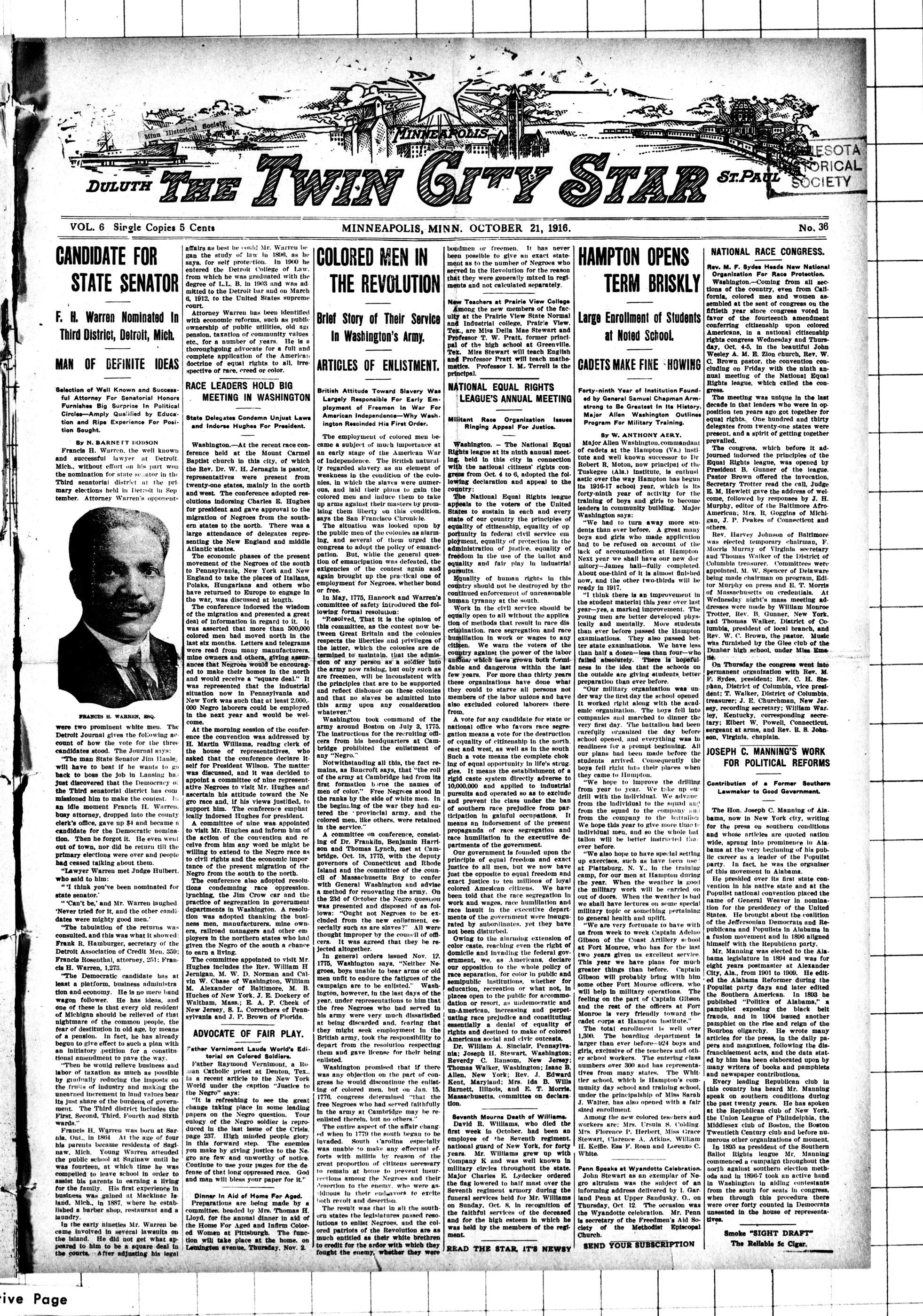
F. H. Warren Nominated In Third District, Detroit, Mich.
MAN OF DEFINITE IDEAS
Selection of Well Known and Successful Attorney For Senatorial Honors Furnishes Big Surprise In Political Circles—Amply Qualified by Education and Ripe Experience For Position Sought.
By N. BARNEET DODSON
Francis H. Warren, the well known and successful lawyer at Detroit, Mich., without effort on his part won the nomination for state senator in the Third senatorial district at the primary elections held in Detroit in September. Attorney Warren's opponents
were two prominent white men. The Detroit Journal gives the following account of how the vote for the three candidates stood. The Journal says: "The man State Senator Jim Haule, will have to beat if he wants to go back to boss the job in Lansing has just discovered that the Democracy of the Third senatorial district has commissioned him to make the contest. He an idle moment Francis H. Warren, busy attorney, dropped into the county clerk's office, gave up $4 and became a candidate for the Democratic nomination. Then he forgot it. He even went out of town, nor did he return till the primary elections were over and people had ceased talking about them." "Lawyer Warren met Judge Hulbert, who said to him: "I think you've been nominated for state senator." "Can't be," and Mr. Warren laughed. 'Never tried for it, and the other candidates were mighty good men.' "The tabulation of the returns was consulted, and this was what it showed: Frank R. Hamburger, secretary of the Detroit Association of Credit Men, 359; Francis Rosenthal, attorney, 251; Francis H. Warren, 1,273.
"The Democratic candidate has at least a platform, business administration and economy. He is no mere band wagon follower. He has ideas, and one of these is that every old resident of Michigan should be relieved of that nightmare of the common people, the fear of destitution in old age, by means of a pension. In fact, he has already begun to give effect to such a plan with an initiatory petition for a constitutional amendment to pave the way.
"Then he would relieve business and labor of taxation as much as possible by gradually reducing the imposts on the fruits of industry and making the unearned increment in land values bear its just share of the burdens of government. The Third district includes the First, Second, Third, Fourth and Sixth wards."
Francis H. Warren was born at Sarnia, Ont., in 1864. At the age of four his parents became residents of Saginaw, Mich. Young Warren attended the public school at Saginaw until he was fourteen, at which time he was compelled to leave school in order to assist his parents in earning a living for the family. His first experience in business was gained at Mackinac Island, Mich., in 1887, where he established a barber shop, restaurant and a laundry.
In the early nineties Mr. Warren became involved in several lawsuits on the island. He did not get what appeared to him to be a square deal in the courts. After adjusting his legal
ive Page
VOL. 6 Single Copies 5 Cents
affairs as best he could Mr. Warren he began the study of law in 1806, as he says, for self protection. In 1900 he entered the Detroit College of Law, from which he was graduated with the degree of L.L. B. in 1903 and was admitted to the Detroit bar and on March 6, 1912, to the United States supreme court.
CANDIDATE FOR STATE SENATOR
By N. BARNEET BODSON
FRANCIS H. WARREN, ESQ.
Attorney Warren has been identified with economic reforms, such as public ownership of public utilities, old age pension, taxation of community values etc., for a number of years. He is a thoroughgoing advocate for a full and complete application of the American doctrine of equal rights to all, irrespective of race, creed or color.
RACE LEADERS HOLD BIG MEETING IN WASHINGTON
State Delegates Condemn Unjust Laws and Indorse Hughes For President.
Washington.—At the recent race conference held at the Mount Carmel Baptist church in this city, of which the Rev. Dr. W. H. Jernagin is pastor, representatives were present from twenty-one states, mainly in the north and west. The conference adopted resolutions indorsing Charles E. Hughes for president and gave approval to the migration of Negroes from the southern states to the north. There was a large attendance of delegates representing the New England and middle Atlantic states.
The economic phases of the present movement of the Negroes of the south to Pennsylvania, New York and New England to take the places of Italians, Polaks, Hungarians and others who have returned to Europe to engage in the war, was discussed at length.
The conference indorsed the wisdom of the migration and presented a great deal of information in regard to it. It was asserted that more than 500,000 colored men had moved north in the last six months. Letters and telegrams were read from many manufacturers, mine owners and others, giving assurances that Negroes would be encouraged to make their homes in the north and would receive a "square deal." It was represented that the industrial situation now in Pennsylvania and New York was such that at least 2,000,000 Negro laborers could be employed in the next year and would be welcome.
At the morning session of the conference the convention was addressed by H. Martin Williams, reading clerk of the house of representatives, who asked that the conference declare itself for President Wilson. The matter was discussed, and it was decided to appoint a committee of nine representative Negroes to visit Mr. Hughes and ascertain his attitude toward the Negro race and, if his views justified, to support him. The conference emphatically indorsed Hughes for president.
A committee of nine was appointed to visit Mr. Hughes and inform him of the action of the convention and receive from him any word he might be willing to extend to the Negro race as to civil rights and the economic importance of the present migration of the Negro from the south to the north.
The conference also adopted resolutions condemning race oppression, lynching, the Jim Crow car and the practice of segregation in government departments in Washington. A resolution was adopted thanking the business men, manufacturers, mine owners, railroad managers and other employers in the northern states who had given the Negro of the south a chance to earn a living. The committee appointed to visit Mr. Hughes includes the Rev. William H Jernigan, M. W. D. Norman and Calvin W. Chase of Washington, William M. Alexander of Baltimore, M. B. Hughes of New York, J. E. Dockery of Waltham, Mass.; E. A. P. Cheek of New Jersey, S. L. Corrothers of Pennsylvania and J. P. Brown of Florida.
ADVOCATE OF FAIR PLAY.
Father Vernimont Laude World's Editorial on Colored Soldiers.
Father Raymond Vernimont, a Roman Catholic priest at Denton, Tex., in a recent article to the New York World under the caption "Justice to the Negro" says:
"It is refreshing to see the great change taking place in some leading papers on the Negro question. Your eulogy of the Negro soldier is reproduced in the last issue of the Crisis, page 237. High minded people glory in this forward step. The enemies you make by giving justice to the Negro are few and unworthy of notice. Continue to use your pages for the defense of that long oppressed race. God and man will bless your paper for it."
Dinner In Aid of Home For Aged. Preparations are being made by a committee, headed by Mrs. Thomas H. Lloyd, for the annual dinner in aid of the Home For Aged and Infirm Colored Women at Pittsburgh. The function will take place at the home on Lemmington avenue, Thursday, Nov. 2.
MINNEAPOLIS, MINN. OCTOBER 21, 1916.
COLORED MEN IN THE REVOLUTION
ARTICLES OF ENLISTMENT.
British Attitude Toward Slavery Was Largely Responsible For Early Employment of Freemen In War For American Independence—Why Washington Rescinded His First Order.
The employment of colored men became a subject of much importance at an early stage of the American War of Independence. The British naturally regarded slavery as an element of weakness in the condition of the colonies, in which the slaves were numerous, and laid their plans to gain the colored men and induce them to take up arms against their masters by promising them liberty on this condition, says the San Francisco Chronicle.
The situation was looked upon by the public men of the colonies as alarming, and several of them urged the congress to adopt the policy of emancipation. But, while the general question of emancipation was defeated, the exigencies of the contest again and again brought up the practical one of employment for Negroes, whether bond or free.
In May, 1775, Hancock and Warren's committee of safety introduced the following formal resolution:
"Presolved, That it is the opinion of this committee, as the contest now between Great Britain and the colonies respects the liberties and privileges of the latter, which the colonies are determined to maintain, that the admission of any person as a soldier into the army now raising, but only such as are freemen, will be inconsistent with the principles that are to be supported and reflect dishonor on these colonies and that no slaves be admitted into this army upon any consideration whatever."
Washington took command of the army around Boston on July 3, 1775. The instructions for the recruiting officers from his headquarters at Cambridge prohibited the enlistment of any "Negro."
Notwithstanding all this, the fact remains, as Bancroft says, that "the roll of the army at Cambridge had from its first formation borne the names of men of color." Free Negroes stood in the ranks by the side of white men. In the beginning of the war they had entered the provincial army, and the colored men, like others, were retained in the service."
A committee on conference, consisting of Dr. Franklin, Benjamin Harrison and Thomas Lynch, met at Cambridge, Oct. 18, 1775, with the deputy governors of Connecticut and Rhode Island and the committee of the council of Massachusetts Bay to confer with General Washington and advise a method for renovating the army. On the 23d of October the Negro question was presented and disposed of as follows: "Ought not Negroes to be excluded from the new enlistment, especially such as are slaves?" All were thought improper by the council of officers. It was agreed that they be rejected altogether. In general orders issued Nov. 12, 1775, Washington says, "Neither Negroes, boys unable to bear arms or old men unfit to endure the fatigues of the campaign are to be enlisted." Washington, however, in the last days of the year, under representations to him that the free Negroes who had served in his army were very much dissatisfied at being discarded and, fearing that they might seek employment in the British army, took the responsibility to depart from the resolution respecting them and gave license for their being enlisted.
Washington promised that if there was any objection on the part of congress he would discontinue the enlisting of colored men, but on Jan. 15, 1776, congress determined "that the free Negroes who had served faithfully in the army at Cambridge may be reenlisted therein, but no others."
The entire aspect of the affair changed when in 1779 the south began to be invaded. South Carolina especially was unable to make any effectual efforts with militia by reason of the great proportion of citizens necessary to remain at home to prevent insurrections among the Negroes and their desertion to the enemy, who were as碴ous in their endeavors to exile both revolt and desertion.
The result was that in all the southern states the legislatures passed resolutions to enlist Negroes, and the colored patriots of the Revolution are as much entitled as their white brethren to credit for the ardor with which they fought the enemy, whether they were
bondmen or freemen. It has never been possible to give an exact statement as to the number of Negroes who served in the Revolution for the reason that they were generally mixed in regiments and not calculated separately.
New Teachers at Prairie View College Among the new members of the faculty at the Prairie View State Normal and Industrial college, Prairie View. Tex. are Miss Della Mae Stewart and Professor T. W. Pratt, former principal of the high school at Greenville. Tex. Miss Stewart will teach English and Professor Pratt will teach mathematics. Professor I. M. Terrell is the principal.
Militant Race Organization Issues Ringing Appeal For Justice.
Washington. - The National Equal Rights league at its ninth annual meeting, held in this city in connection with the national citizens' rights congress from Oct. 4 to 6, adopted the following declaration and appeal to the country:
The National Equal Rights league appeals to the voters of the United States to sustain in each and every state of our country the principles of equality of citizenship, equality of opportunity in federal civil service employment, equality of protection in the administration of justice, equality of freedom in the use of the ballot and equality and fair play in industrial pursuits.
Equality of human rights in this country should not be destroyed by the continued enforcement of unreasonable human tyranny at the south.
Work in the civil service should be equally open to all without the application of methods that result in race discrimination, race segregation and race humiliation in work or wages to any citizen. We warn the voters of the country against the power of the labor unions, which have grown both formidable and dangerous in the last few years. For more than thirty years these organizations have done what they could to starve all persons not members of the labor unions and have also excluded colored laborers therefrom.
A vote for any candidate for state or national office who favors race segregation means a vote for the destruction of equality of citizenship in the north, east and west, as well as in the south. Such a vote means the complete choking of equal opportunity in life's struggles. It means the establishment of a rigid caste system directly adverse to 10,000,000 and applied to industrial pursuits and operated so as to exclude and prevent the class under the ban of southern race prejudice from participation in gainful occupations. It means an indorsement of the present propaganda of race segregation and race humiliation in the executive departments of the government.
Our government is founded upon the principle of equal freedom and exact justice to all men, but we now have just the opposite to equal freedom and exact justice to ten millions of loyal colored American citizens. We have been told that the race segregation in work and wages, race humiliation and race insult in the executive departments of the government were inaugurated by subordinates, yet they have not been disturbed.
Owing to the alarming extension of color caste, reaching even the right of domicile and invading the federal government, we, as Americans, declare our opposition to the whole policy of race separation, for color in public and semipublic institutions, whether for education, recreation or what not, in places open to the public for accommodation or resort, as undemocratic and un-American, increasing and perpetuating race prejudice and constituting essentially a denial of equality of rights and destined to make of colored Americans social and civic outcasts.
Dr. William A. Sinclair, Pennsylvania; Joseph H. Stewart, Washington; Reverdy C. Ransom, New Jersey; Thomas Walker, Washington; Isaac B. Allen, New York; Rev. J. Edward Kent, Maryland; Mrs. Ida B. Wills Barnett, Illinois, and E. T. Morris, Massachusetts, committee on declaration.
Seventh Mourns Death of Williams.
David R. Williams, who died the first week in October, had been an employee of the Seventh regiment. national guard of New York, for forty years. Mr. Williams grew up with Company K and was well known in military circles throughout the state.
Major Charles E. Lydecker ordered the flag lowered to half mast over the Seventh regiment armory during the funeral services held for Mr. Williams on Sunday, Oct. 8. in recognition of the faithful services of the deceased and for the high esteem in which he was held by the members of the regiment.
READ THE STAR, IT'S NEWSY
HAMPTON OPENS TERM BRISKLY
Large Enrollment of Students at Noted School.
Forty-ninth Year of Institution Founded by General Samuel Chapman Armstrong to Be Greatest In Its History Major Allen Washington Outline Program For Military Training.
By W. ANTHONY AERY.
Major Allen Washington, commandant of cadets at the Hampton (Va.) institute and well known successor to Dr Robert R. Moton, now principal of the Tuskegee (Ala.) institute, is enthusiastic over the way Hampton has begun its 1916-17 school year, which is its forty-ninth year of activity for the training of boys and girls to become leaders in community building. Major Washington says:
"We had to turn away more students than ever before. A great many boys and girls who made application had to be refused on account of the lack of accommodation at Hampton. Next year we shall have our new dormitory—James hall—fully completed. About one-third of it is almost finished now, and the other two-thirds will be ready in 1917.
"I think there is an improvement in the student maternal this year over last year—yes, a marked improvement. The young men are better developed physically and mentally. More students than ever before passed the Hampton examinations. They also passed better state examinations. We have less than half a dozen—less than four—who failed absolutely. There is hopefulness in the idea that the schools on the outside are giving students, better preparation than ever before.
"Our military organization was under way the first day the school opened. It worked right along with the academic organization. The boys fell into companies and marched to dinner the very first day. The battalion had been carefully organized the day before school opened, and everything was in readiness for a prompt beginning. All our plans had been made before the students arrived. Consequently the boys fell right into their places when they came to Hampton.
"We hope to improve the drilling from year to year. We take up our drill with the individual. We advance from the individual to the squad and from the squad to the company and from the company to the battalion. We hope this year to give more time to individual men, and so the whole battalion will be better instructed than ever before.
"We also hope to have special setting up exercises, such as have been used at Plattsburg, N. Y., in the training camp, for our men at Hampton during the year. When the weather is good the military work will be carried on out of doors. When the weather is bad we shall have lectures on some special military topic or something pertaining to general health and upift.
"We are very fortunate to have with us from week to week Captain Adelino Gibbon of the Coast Artillery school at Fort Monroe, who has for the last two years given us excellent service. This year we have plans for much greater things than before. Captain Gibbon will probably bring with him some other Fort Monroe officers, who will help in military operations. The feeling on the part of Captain Gibbon, and the rest of the officers at Fort Monroe is very friendly toward the cadet corps at Hampton institute." The total enrollment is well over 1,300. The boarding department is larger than ever before—924 boys and girls, exclusive of the teachers and other school workers. The entering class numbers over 300 and has representatives from many states. The Whittier school, which is Hampton's community day school and training school, under the principalship of Miss Sarah J. Waiter, has also opened with a fair sized enrollment. Among the new colored teachers and workers are: Mrs. Ursula S. Colding. Mrs. Florence P. Herbert, Miss Grace Stewart, Clarence A. Atkins, William H. Kefie, Esa F. Roan and Lorenzo C. White.
Penn Speaks at Wyandotte Celebration.
John Stewart as an exemplar of Negro altruism was the subject of an informing address delivered by 1. Garland Penn at Upper Sandusky, O., on Thursday, Oct. 12. The occasion was the Wyandotte celebration. Mr. Penn is secretary of the Freedmen's Aid Society of the Methodist Episcopal Church.
SEND YOUR SUBSCRIPTION
No.36
NATIONAL RACE CONGRESS.
Rev. M. F. Sydes Heads New National Organization For Race Protection.
Washington.—Coming from all sections of the country, even from California, colored men and women assembled at the seat of congress on the fiftieth year since congress voted in favor of the fourteenth amendment conferring citizenship upon colored Americans, in a national citizenship rights congress Wednesday and Thursday, Oct. 4-5, in the beautiful John Wesley A. M. E. Zion church, Rev. W. C. Brown pastor, the convention concluding on Friday with the ninth annual meeting of the National Equal Rights league, which called the congress.
The meeting was unique in the last decade in that leaders who were in opposition ten years ago got together for equal rights. One hundred and thirty delegates from twenty-one states were present, and a spirit of getting together prevailed.
The congress, which before it adjourned indorsed the principles of the Equal Rights league, was opened by President B. Gunner of the league. Pastor Brown offered the invocation, Secretary Trotter read the call, Judge E. M. Hewlett gave the address of welcome, followed by responses by J. H. Murphy, editor of the Baltimore Afro-American; Mrs. R. Goggins of Michigan, J. P. Peakes of Connecticut and others.
Rev, Harvey Johnson of Baltimore was elected temporary chairman, F. Morris Murray of Virginia secretary and Thomas Walker of the District of Columbia treasurer. Committees were appointed. M. W. Spencer of Delaware being made chairman on program, Editor Murphy on press and E. T. Morris of Massachusetts on credentials. At Wednesday night's mass meeting addresses were made by William Monroe Trotter, Rev. B. Gunner, New York, and Thomas Walker, District of Columbia, president of local branch, and Rev. W. C. Brown, the pastor. Music was furnished by the Glee club of the Dunbar high school, under Miss Emile.
On Thursday the congress went into permanent organization with Rev. M. F. Sydes, president; Rev. C. H. Stephan, District of Columbia, vice president; T. Walker, District of Columbia, treasurer; J. E. Churchman, New Jersey, recording secretary; William Warley, Kentucky, corresponding secretary; Elbert W. Powell, Connecticut, sergeant at arms, and Rev. R. S. Johnson, Virginia, chaplain.
JOSEPH C. MANNING'S WORK FOR POLITICAL REFORMS
Contribution of a Former Southern Lawmaker to Good Government.
The Hon. Joseph C. Manning of Alabama, now in New York city, writing for the press on southern conditions and whose articles are quoted nation wide, sprang into prominence in Alabama at the very beginning of his public career as a leader of the Populist party. In fact, he was the organizer of this movement in Alabama.
He presided over its first state convention in his native state and at the Populist national convention placed the name of General Weaver in nomination for the presidency of the United States. He brought about the coalition of the Jeffersonian Democrats and Republicans and Populists in Alabama in a fusion movement and in 1896 aligned himself with the Republican party.
Mr. Manning was elected to the Alabama legislature in 1894 and was for eight years postmaster at Alexander City, Ala., from 1901 to 1900. He edited the Alabama Reformer during the Populist party days and later edited the Southern American. In 1893 he published "Politics of Alabama," a pamphlet exposing the black belt frauds, and in 1904 issued another pamphlet on the rise and reign of the Bourbon oligarchy. He wrote many articles for the press, in the daily papers and magazines, following the disfranchisement acts, and the data stated by him has been elaborated upon by many writers of books and pamphlets and newspaper contributions.
Every leading Republican club in this country has heard Mr. Manning speak on southern conditions during the past twenty years. He has spoken at the Republican club of New York, the Union League of Philadelphia, the Middlesex club of Boston, the Boston Twentieth Century club and before numerous other organizations of moment. In 1895 as president of the Southern Ballot Rights league Mr. Manning commenced a campaign throughout the north against southern election methods and in 1896-7 took an active hand in Washington in aiding contestants from the south for seats in congress, when through this procedure there were over forty counted in Democrats unseated in the house of representatives.
Smoke "SIGHT DRAFT"
The Reliable 5c Cigar.
SOCIAL NEWS EDITOR,
Miss Clara Lucas,
506 Boston Block, Minneapolis
Minneapolis, Minn.
NIC. 1873.
RAILROAD MEN'S NEWS,
Stephen Springer,
Milwaukee Depot, Minneapolis.
Send your notes to us by Wednesd
day A. M.
Send 25 cents in postage stamps for
your For Rent Ads.
If you want notices inserted, spend
a cent or two and send your copy
—clearly and intelligently written.
Owing to the increased cost of pub
lication, we will NOT accept any
ads, unless paid in advance. Agents
will please act accordingly.
Do not waste your time making promises to our agents. Send your money by Express or Post Office Order or in cash or postage stamps.
Mr Henry Prior has Opened the BROADWAY CAFE
558 Broadway,
St. Paul, Minn.
COME AND SING WITH YOUR NEIGHBORS.
The Civic Music League of Minneapolis invites every man, woman and child over sixteen years of age to meet at the High School in his district for the purpose of singing the good old home songs.
The date for all four districts is Monday, October 23rd, at 8:00 o'clock. The best of musical talent in the city will preside. There will be no fee or collection.
At each High School will be a chairman, director, accompanist, soloist and speaker of note. The plan is mainly, to give everyone who cares to, a chance to sing.
Community spirit fosters not only a musical spirit, but the spirit of neighborliness which is rather lacking in modern life, but which is well worth preserving.
SUBSCRIBE FOR THE STAR
Delinquent Subscribers will please Send the Price of their Subscriptions this Week. We must have money to continue this Publication.
Mr. Joseph Payton passed through Minneapolis enoute to California.
Mrs. Minie Plummer has moved from Clinton Ave., to 3432 Oakland Ave.
Rev. Payton of Ft. Madison, Iowa, was a Twin City visitor last week. During his stay he was the guest of his son and daughter-in-law, Mr. and Mrs. Chas. Payton, 351 Arundel Ave., St. Paul.
Rev. D. J. Flynn of No. Carolina, is a delegate to the American Missionary Association and is the houseguest of Atty. W. R. Morris.
Prof. W. H. Holloway of Talledega College is also a delegate, is a guest of Dr. R. S. Brown.
Mr. F. J. Work is here with the Junior Quartette of Fisk Jubile Seingers.
The Anchor Hilyard Lodge of Masons meets at the Knox Bldg., in the hall used by the Elks and Pythians.
Mr. James J. Duncan, 3920 4th Ave. So., is home from the hospital. After a lingering illness, he was operated upon by Dr. Newkirk and is improving rapidly.
Intentional Duplicate Exposure
Mr. Clinton Borders has moved to 2123 24th Ave. So.
Mrs. Maggie Martin, has been very ill for several days at her residence, 3013 Garfield Ave., She is improving slowly.
Mr. Ephraim Bludsoe is able to be out after a serious illness.
The Silver Leaf Club of Zion Baptist Church thanks the many friends for the kindness. shown Anna. Lee-Reed, during her illness and death. Mrs. P. A. Aylor, Pres., Mrs. E. Mitchell, Secy.
Mr. Henry T. Burleigh, the famous barytone, appeared in recital before the Thursday Musical; a white society of Minneapolis, and at Pilgrim Baptist Church, St. Paul.
ELK'S TO CELEBRATE.
Ames Lodge of Elks. No. 106, I. B. O. P. O. E. of W. will celebrate their tenth anniversary on November 1st, with appropriate exercises. The feature will be a banquet. A review of the history of the Lodge will be given, also interesting talks by several members. "Ames" is nationally recognized as one of the most progressive lodges of the order. Arrangements are being made to give a public reception and ball in honor of their tenth anniversary.
HALLOWEEN BALL
ARCADIA HALL
(FORMERLY DREAMLAND, 5TH ST. SO., OPPOSITE
COURT HOUSE.)
UNDER THE AUSPICES OF THE
Pride of Minnesota Lodge
NO.5
DIAMONDS AND JEWELRY
Special Sale of Unredeemed Diamonds and Jewelry—1/2 of
Nicollet Avenue Prices.
KREGER COLLATERAL LOAN OFFICE
20 So. Washington Ave. Minneapolis.
THE TWIN CITY ENTERTAINERS
Invite you to attend their
SPECIAL CABARET AND BALL
GRAND SEMI-MONTHLY BALL
UNION TEMPLE HALL, 28 WASHINGTON AVE. SO.
MONDAY EVENING, OCTOBER 23, 1916.
ADMISSION 35c.
Dances will be held every two weeks during the rest of the season
DOORS OPEN 7:30
AUTOMOBILES. $2.00
We are often criticised because we do not "get the money" with this publication. Few Negroes realize the responsibility that rests upon the Negro editor. Some would-be editors endorse their race's worst enemies for "the money"—and they are credited as being smart newspaper men. The Negro editor, who commands the respect of the public and serves the best interests of his race and his community; is the man who will not sacrifice the rights or privileges of his race on the altar of self-aggrandizement. He will have hard struggles, but will be encouraged by each achievement for right. The fellow, who sells his birthright, generally gets his price. He flourishes for a time only, and often becomes a public menace or social outcast. The Star asks no sympathy or charity, and will never adopt the "get the money" policy. We will tell the truth about conditions, and will never endorse or support any political candidate, who has not given the Negro a square deal. We will give credit to any individual, regardless of political affiliation on social standing, who is a true friend of deserving Negroes.
You are invited to the Harvest Ball given by the Minneapolis Usher's at Lane's Hall on Nicollet Ave. Nov. 14, 1916. Good music. Latest dances introduced. Myrtle Hughes, Pres., Margaret Bludsoe, V. Pres., Hazel Vader, Secy.
BENEFIT SOCIAL AND SUPPER. A Social and Supper, for the benefit of Naomi Temple, S. M. T., will be given at the home of Mrs. O. D. Phelps, 119 Western Ave., Minneapolis, on Tuesday evening, Oct. 31. Admission Free. Supper 25 cents.
ST. JAMES A. M. E CHURCH.
Rev. I. W. Bess, the new pastor of St. James, invites the public to his services at 5th Ave. No. and Girard Ave., in their new church. He thanks the people for the hearty welcome given him and will preach morning and evening next Sunday, Oct. 22. He will preach at St. James in St. Paul on Sunday afternoon.
A NORTHSIDE ORGANIZATION
A meeting of the "Colored Voters of the 3rd and 4th Wards was held at 709 5th St. No., on Tuesday evening, at which a permanent organization was perfected for civic and political advancement. John A. Withears was elected president, and J. C. Trevan, Secy. Over 100 voters were enrolled and a special effort will be made to register the full vote of the wards.
Mr. Ed. Stewart of Stewart's Hotel, expects to have some high class talent from Chicago at his Sunday evening Concert.
PYTHIAN NOTES
A renewed activity is noticeable among the K. P. lodges of the city. Pride of Minn. Lodge has recently reinstated four members and initiated three (3), and have a number of applications waiting. Pride of the West Uniform Rank under Capt. W. C. Jeffrey, meets the 2nd and 4th Thursday in each month. The men are turning out well, and are all very enthusiastic over the showing they are making.
THE TWIN CITY STAR
CONCERT
AND
BWEEN
HALL
AT
A HALL
D, 5TH ST., SO., OPPOSITE
HOUSE.)
SPICES OF THE
nesota Lodge
D. 5
of Pythias
(A. A. AND A.)
GRAND MARCH 10:00
ADMISSION 50 CENTS
A. S.
THOMAS D. SCHALL,
Candidate for Re-Election to Congress on his Record and his Merit.
"HONEST AND ABLE.".... Cyrus Nortrup, Pres. Emeritus, Univ. of Minn.
Has rendered great service to the Republican party, both on the stump and in the halls of Congress. He is one of the strong men in Congress. The nation and the Republican party must not lose the valuable service of this rare, able, brilliant and gifted man.—C. B. Slemp, Chairman National Republican Congressional Committee.
I believe in Tom Schall with all my heart.—Theodore Roosevelt.
He is a oracking good speaker.—Champ Clark, Speaker.
Able and very eloquent speaker. Always listened to with great interest in the House.—James R. Mann, Republican Floor Leader.
TOM SCHALL has made good. He enjoys the esteem and confidence of the entire membership, regardless of party. He is one of the most eloquent and attractive speakers in the House.—Claude Kitchin, Democratic Floor Leader.
"A Big Man Among the Nation's Big Men."—Dr. Richard Burton, U. of M.
PAID ADVERTISEMENTS
I wish to inform my friends that I have sold my interest in the Cut Rate Grocery and Meat Market, 429 6th Ave. No., and will open a First Class Meat Market at 629 5th Ave. No. Minneapolis, on Saturday, Oct. 21, 1916. I respectfully solicit the patronage of the public.
St. James Mother Church, will hold their services at 407 5th Ave. South, Sunday evening, Oct. 15th, 1916, and will continue on until they build their new church. Everybody is cordially invited to attend these services. The first service will be held at 7:45. Signed by the Trustees of the Church: I. Newton, R. DeLeo, Dani. Williams.
Don't Forget—Those Twin City Entertainers are going to give their Feature Ball on Monday eve. Oct. 23.
AND JEWELRY
Diamonds and Jewelry—½ of
venue Prices.
RAL LOAN OFFICE
Ave. Minneapolis.
ENTERTAINERS
to attend their
RE T AND BALL
MONTHLY BALL
8 WASHINGTON AVE. SO.
OCTOBER 23, 1916.
ION 35c.
weeks during the rest of the session.
When you need your next Suit or Overcoat. We solicit your order. I offer an unusual showing of Fine Woolens and a high type of Tailoring Service at a Reasonable Price. I "Know How." I will be pleased to build your clothes.
CLARENCE W. BELL,
244 3rd Ave. So., Minneapolis, Minn.
SCALP TREATMENT and
HAIR GROWING.
Mrs. Maggie Martin wishes to announce that she is the Minneapolis Agent for MADAM C. J. WALKER'S Wonderful Hair Grower and Preparations.
Special attention given to Tetter, Eczema and Growing hair on temples. A full line of Goods. Personal Instructions and Demonstrations can be obtained at 3013 GARFIELD AVE.
MINNEAPOLIS, MINN.
MRS. MAGGIE MARTIN, AGT
N. W. PHONE SOUTH 1242
T. S. CENTER 2626
N. W. MAIN 1551
The Gateway Market
Meats and Provisions
We Deliver
210 HENNEPIN AVE.
MINNEAPOLIS.
YOUR TRADE IS SOLICITED
1425 Washington Ave. So. Minn.
Res. Colfax 3596 Hyland 4610
MADAM LIZZIE VAN HOOK
DRESSMAKING, LADIES TAILORING.
1006 6th Ave. No.
Minneapolis, Minn.
N. W. Phone Main 4975.
THE REX CAFE
252 FOURTH AVE. SO.
(Down Stairs)
Regular Dinner 11:30 to 2:30 P. M.
A la Carte Service 7 A. M. to 10
P. M.
MILES ETHRIDGE, Prop.
Look up this place
NICELY FURNISHED
ROOMS
Within Walking Distance
THE MODERN HOME
1015 So. 5th St.
MINNEAPOLIS, MINN.
N. W. Nic. 951
WORKING-MEN'S
SOCIAL CLUB
FOR MEN ONLY
244 3RD AVE. S.
MINNEAPOLIS
SYLVESTER W. OLIVER,
MANAGER.
CREOLE HAIR SWITCHES
and TRANSFORMATIONS
MADE TO ORDER.
Prices Reasonable.
CALL HY. 5528
MRS. LAURA JONES.
DANCING ACADEMY
We teach you to Dance all modern and standard dances by a method of superior teachings, from the very foundation in the shortest time imaginable. Ten class lessons, ladies $2.00, gentlemen $3.00, Tuesday and Friday evenings. Private lessons by appointment a specialty.
Robert K. Cisney,
572 8th Ave. No.
Hy. 4323.
THE NORTH SIDE DRUGGIST.
Call on J. A. Baker, 1320 6th Ave.
No., for your Drugs, Tollet Articles, etc. Prescriptions carefully compounded. His phone is Hyland 432. Deliveries on request.—Advertisement.
The Waiters' and Porters' Club
GLOVER SHULL, PRES.
311 HENNEPIN AVE. MINNEAPOLIS
EDDIE BOYD, BECY LEE WHEELER, MARAGER
A man is running.
STEWART'S HOTEL
FINEST ESTABLISHMENT OF
ITS KIND IN THE UNITED
STATES.
Twenty Elegant Steam Heated, Electric Lighted Rooms. Free Bath. Rates Reasonable.
Lobby, Reading and Lounging Room, Buffet and Grill Room, Billiard Room, Dining Room, and bath, Private Dining and Reception Room for Ladies.
BARBER SHOP IN CONNECTION
A LA CARTE MEALS AT ALL HOURS. BEST SERVICE.
POPULAR-PRICE LUNCH.
From 12 to 3 P. M.
REGULAR DINNER
5 to 8 P. M. 5 Courses 35c.
J. E. Stewart, Prop.
246-50 FOURTH AVE. SO.
MINNEAPOLIS. MINN.
Both Phones
PENTICOSTAL.
Peoples Christian Assembly.
1204 Washington Ave. So.
Services Sunday—11 A. M.
Sunday School—1.30 P. M.
Praise Meeting—3 P. M.
Praesching—8 P. M.
ELDER G. W. MITCHELL, Pastor
Assisted by Mrs. G. W. Mitchell.
Comel and Serve the Lord.
BETHESDA BAPTIST CHURCH
1120 Eight St. So., Minneapolis.
Service, Sunday 11 A. M. and 8 P. M.
Sunday School 12:30 P. M.
B. Y. P. U. Society 6:45 P. M.
Prayermeeting Thursday 8 P. M.
Rev. D. E. Beasley, Shepherd,
905 Marion St., St. Paul.
Phone: Jackson 2079.
ZION BAPTIST CHURCH.
7th Aye. North and Hoag St.
Rev. M. W. Withers, Pastor,
Res. 2406 17 Ave. S.
Phone Drexel 600
Regular Services.
Preaching: 11 A. M., 8 P. M.
Sunday School 12:30 P. M.
B. Y. P. U. Society 6:45 P. M.
Prayer Meeting Wed. 8 P. M.
A WELCOME TO ALL.
ST. PETER'S A. M. E. CHURCH,
22nd St. Near 10th Ave. So.
THOS. B. STOVALL, Pastor.
Parsonage 2205 Elliot Ave.
N. W. Phone So. 762.
Sunday Services, 11:00 A. M.
Preaching 12:30 P. M. Church Class
1:15 P. M. Sunday School 6:45 P.
M. Allen C. E. League 8:00 P. M.
Preaching. Prayermeeting every
Thursday evening, 8 o'clock.
SPECIAL AUTO DELIVERY.
The Cut Rate Grocery Co., have an
auto-delivery. They give quick service
and you can call them to do any
light hauling and expressing—Advertisement.
APARTMENT BARGAIN
FOR SALE—Four Flat Apartment Brick building at Sixth Avenue and Aldrich North. Owner about to leave town. Reasonable terms. Inquire 615 Aldrich Avenue North.
COMFORTABLE ROOMS.
One room for single person, gentleman preferred. Large room, conveniently arranged for light housekeeping, within walking distance, on car line. Mrs. O. D. Phelps, 119 Western Ave. Phone Hy. 5444.
FOR RENT. — Nicely furnished room, suitable for married couple or gentleman. Modern conveniences, 1012 6th Avenue North, upstairs.
FOR RENT—Large Front room, Steam heat, all modern conveniences. Suitable for married couple or gentleman. One block from Lake St. or Chicago Ave. car line. N. W. Phone So. 1420.
Seven room house, 3029 Grand Ave.
Modern except heat. Rent reasonable.
Phone: T. S. 691 and N. W.
Main 2040, or call at 405 Tribune Annex.
FURNISHED ROOMS.
FOR RENT: For married couple
Nicely furnished room, all modern
near car line, walking distance from
town, with private family, 538 Aldrich
Ave. N. Hyland 3796.
SEND YOUR SUBSCRIPTION
SMOKE THE BEST 5C CIGAR
W. S CONRAD CO., Distributors
NO. 140. E. 6th ST., ST. PAUL.
NO. 1. WESTERN AVE., MINN.
O. 106,
W.
g.
AMES LODGE NO. 106,
I. B. P. O. E. W.
Meets in the Knox Bldg.
4th St. and 8th Ave. So.
the 2nd and 4th Tues-
days of each month, at
8:30 P. M..
All Elks in good
All Elks in good standing are cordially welcomed.
Geo. M. Bryant, E. R.
818 Met. L. Bldg.
Wm. R. Morris, Sec'y.
CHOICE CITY AND SUBURBAN PROPERTY FOR SALE ON SMALL MONTHLY PAYMENTS.
Houses and Flats for Rent.
B. M. McDEW,
802 Sykes Block.
N. W. Nic. 621 Minneapolis
For Rent.
W.
ock.
Minneapolis
OSCAR GILBERT PRICE.
Real Estate, Insurance and Loans.
Choice Property for Sale or Rent.
2814 10th Ave. So.
N. W. South 5250 Minneapolis
N. W. Phone Nic. 1873
J. M. MORRIS
Real Estate Broker
Loans Collections
506 BOSTON BLOCK
MINNEAPOLIS, MINN.
Office Phone N. W. Main 625
GALE P. HILYER
ATTORNEY AND COUNSELLOR
AT LAW
With Hall and Tantges
722 New York Life Bldg.
Minneapolis, Minn.
Res. N. W. South 3347
N. W. Phone South 4539
R. AUGUSTINE SKINNER
ATTORNEY AND COUNSEL-
LOR-AT-LAW,
2817 Chicago Ave.
MINNEAPOLIS, MINN.
e South 4539
SKINNER
COUNSEL-
W,
Ave.
MINN.
Peterson, The Druggist
1501 Washington Ave. So.
TOILET ARTICLES, DRUGS
PRESCRIPTIONS.
Ifie Solicits You Patronage.
SPECIAL SAMPLE SHOES.
POPULAR PRICED SHOE REPAIRING.
WE FIX 'EM WHILE YOU WAIT.
Men's Sewed Soles ..... 75c
Ladies Sewed Soles ..... 65c
Men's Nailed Soles ..... 50 and 60c
Rubber Heels, ..... 40c
Ladies' and Boys' nailed soles ..... 40c
SEVEN CORNERS SHOE REPAIR SHOP
1424 Washington Avenue South.
DR. W. H. WRIGHT.
DENTIST.
Phone Nic. 1963
111 So. 6th St Minneapolis, Minn.
Phone Hy. 3605.
DR. ELLIS BURTON
715 Sixth Ave. No.
Minneapolis, Minn.
DENTIST.
Graduate Northwestern Dental
School of Chicago.
THE SPIRELLA CORSET
Mrs. Cora Anderson Carr
365 Aurora Ave.
N. W. Dale 1345 St. Paul, Minn.
---
Twin City Stag Club
AUTO SERVICE
CARS AT ALL HOURS
ROBERT V. SINGER, Prop.
Res. Phone South 5650
Stand at Milwaukee Depot
FURNISHED ROOMS.
Comfortable Furnished Rooms, for
Light Housekeeping Clean and With-
in Business District. Call Mrs. Harri-
ria, 707 So. Third St. Minneapolis
De
4th St. and 8th Ave. So. the 2nd and 4th Tuesdays of each month, at 8:30 P.M.
Main 2869
Office: Main 2831
Center 3674
Defective
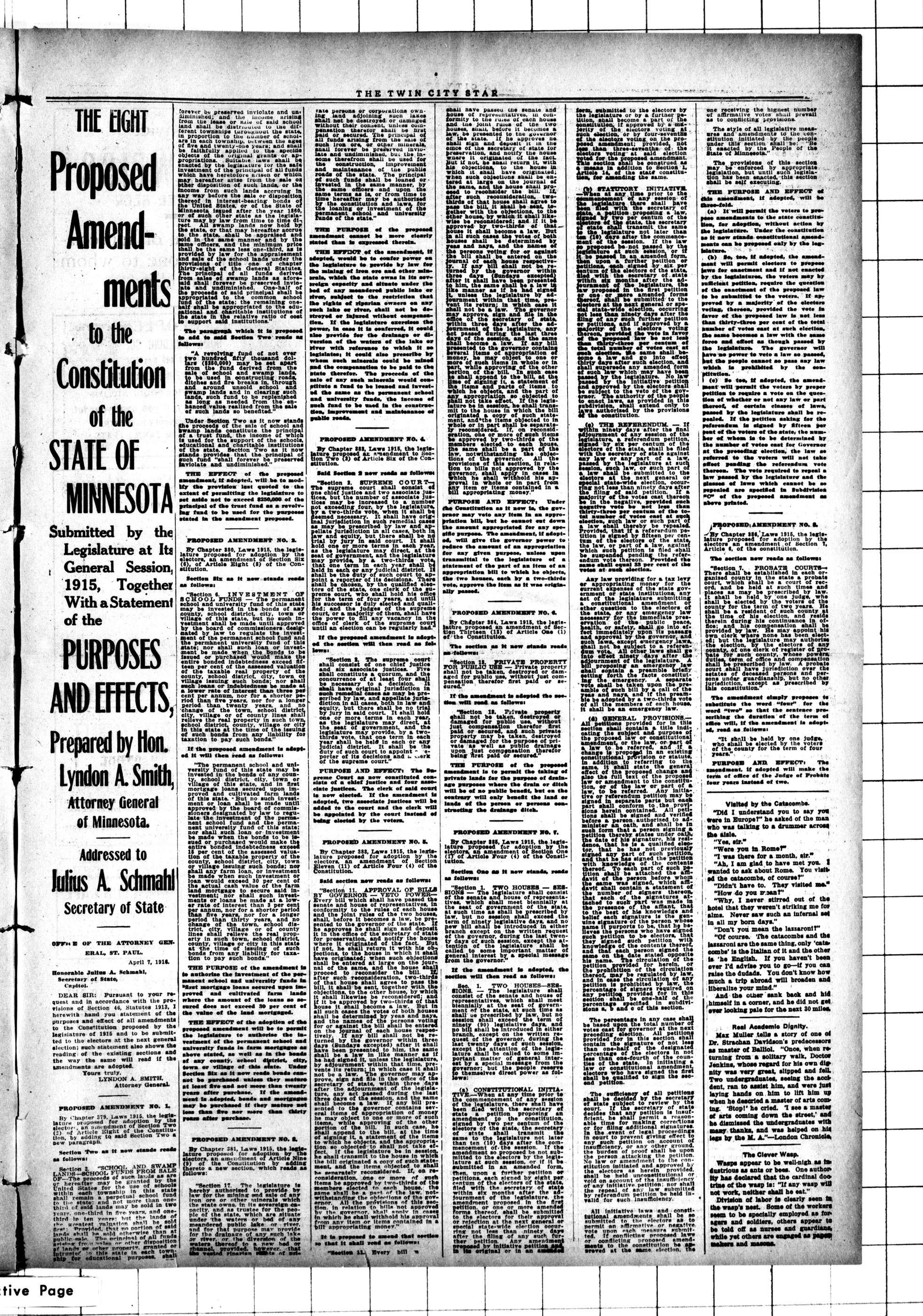
Submitted by the Legislature at Its General Session 1915, Together With a Statement of the
PURPOSES AND EFFECTS,
Prepared by Hon.
Lyndon A. Smith,
Attorney General
of Minnesota.
Addressed to Julius A. Schmahl Secretary of State
OFFICE OF THE ATTORNEY GEN-
ERAL, ST. PAUL.
April 7, 1916.
Honorable Julius A. Schmahl,
Secretary of State,
Capitol.
DEAR SIR: Pursuant to your request and in accordance with the provisions of Section 46, Statutes 1913, I herewith hand you statement of the purposes and effect of all amendments to the Constitution proposed by the legislature of 1915 and to be submitted to the electors at the next general election; such statement also shows the reading of the existing sections and the way the same will read if the amendments are adopted.
PROPOSED AMENDMENT NO. 1.
By Chapter 329, Laws 1915, the legislature proposed for adoption by the electors, an amendment of Section 27, the Eighth of the Constitution, by adding to said Section Two a new paragraph.
Section Two as it now stands reads as follows:
Section 2. SCHOOL AND SWAMP OP. The proceeds of such lands as are or hereafter may be granted by United States for schools in this state shall remain a perpetual school fund to the state; and not more than one-third in five years, one-third in five years, and one-third in ten years; but the lands of the greatest valuation shall be sold first. Provided, that no funds be sold in public sale. The principal of all funds adding to sales or other dispensed or instructed to this state in each township for educational purposes, shall
PRO
tive Page
April 7, 1916.
hurs truly.
LYNDON A. SMITH.
Attorney General.
THE EFFECT of the proposed amendment, if adopted, will be to modify the provision last quoted to the extent of permitting the legislature to set aside not to exceed $250,000 of the principal of the trust fund as a revolving fund to be used for the purposes stated in the amendment proposed.
PROPOSED AMENDMENT NO. 2.
By Chapter 880, Laws 1915, the legislature proposed for adoption by the state an amendment of Secon Shr (6), of Article Eight (8) of the Constitution.
Section Sx as it now stands reads as follows:
"Section 6. INVESTMENT OF SCHOOL FUNDS — The permanent school and university fund of this state may be invested the bonds of any county district, county village of this state, but no such investment shall be made until approved by the board of commissioners designation of the permanent school fund and the permanent university fund of this state; nor shall such loan or investment be issued or purchased would make the entire bonded indebtedness exceed fifteen per cent of the assessed valuation county, school district, city, town or village issuing such bonds; nor shall such loans or indebtedness be made at a certain per annum, nor for a shorter period than five years, nor for a longer period than twenty years, and no such loan or investment shall be issued of such bonds from any liability for taxation to pay such bonds."
If the proposed amendment is adopted it will then read as follows:
THE PURPOSE of the amendment is to authorise the investment of the permanent school and university funds in first mortgage loans secured upon improved and cultivated farm lands where the amount of the loans so secured does not exceed 30 per cent of the value of the land mortgaged.
THE EFFECT of the adoption of the proposed amendment will be to permit the lease to authorise the investment of the permanent school and university funds in farm mortgages as above stated, as well as in the bonds of any county, school district, city, town or village of this state. Under Section Six as it now reads bonds cannot be purchased unless they mature at least five and not more than twenty years after purchase. If the amendment is adopted, bonds and mortgages may be purchased if they mature not less than five nor more than thirty years after purchase.
PROPOSED AMENDMENT NO. 8.
By Chapter 381, Laws 1915, the legislature proposed for adoption by the state the requirement (8) of the Constitution by adding thereto a new section, which reads as follows:
"Section 17. The legislature is hereby authorized to provide by law for the mining and sale of any inland water, or the state owns, in its sovereign capacity, and as trustee for the people of the state, which are situated under the waters, on bed of any meandered public lake, or river, and for that purpose may provide for the waters, on bed of any river, or the diversion of the waters thereof to a new bed or channel provided, however, that the waters
THE TWIN CITY STATE
rate persons or corporations owning land and adjoining such makes without their consent, unless compensation thereor shall be first paid or secured. The principal of all funds shall be of such iron ore, or other minerals, shall forever be preserved inviolently, some therefrom shall be used for the construction, improvement and maintenance of the public roads of the state. The principal of all funds shall be invested in the same manner, by the same officers and upon the time hereafter may be authorized by the constitution and laws, for the loaning or investment of the together with the other house, by y
THE PURPOSE of the proposed
imendment cannot be clearly
understood.
THE EFFECT of the amendment, if adopted, would be to confer power on the legislature to provide by law for the mining of iron ore and other minerals, which the state owns in its sovereign capacity and situate under the bed of any meandered public lake or river, subject to the restriction that the rights of riparian owners on any such lake or river, shall not be destroyed or injured without compensation. If the legislature exercises the power, in case it is conferred, it could also provide for the drainage or diversion of the waters of the lake or river with reference to which it so legislates; it could also prescribe by whom such minerals could be mined in the district to be the state therefor. The proceeds of the sale of any such minerals would constitute a fund to be loaned and invested the same as the permanent school and university funds, the income of such fund to be used in the construction, improvement and maintenance of public roads.
PROPOSED AMENDMENT NO. 4
By Chapter 823, Law 1915, the legislature proposed an amendment to Section Two (2) of Article Six of the Constitution.
Said Section 2 now reads as follows:
"Section 2. SUPREME COURT"
The supreme court shall consist of one chief justice and two associate justices, but the number of associate justices may not exceed four, by the legislature, by a two-thirds vote, when it shall be deemed necessary. It shall have origi- nate powers, but there shall be no power as may be prescribed by law and appellate jurisdiction in all cases, both in law and equity, but there shall be no power to hold one or more terms in each year, as the legislature may direct, at the seat of government, and the legislature shall hold one term in each year shall be held in each or any judicial district. It shall be the duty of such court to ap- pose the judge, and the judge shall be chosen, by the qualified electors of the state, one clerk of the supreme court, who shall hold his office as the successor is duly elected and qualifi- ed; and the judges of the supreme court, or a majority of them, shall have the office of clerk of the supreme court until an election can be regularly had."
If the proposed amendment is adopted the section will then read as follows:
PROPOSED AMENDMENT NO. 4.
By Chapter 383, Laws 1915, the legislature proposed for adoption by the electors, an amendment of Section 10 of Article Four (4) of the Constitution.
Said section now reads as follows:
It is proposed to amend that section so that it shall read as follows:
PURPOSE AND EFFECT: Under the Constitution as it now in, the governor may vote any item in an appropriation bill, but he cannot cut down the amount appropriated for any specific purpose. The amendment, if adopted, will give the governor power to reduce the amount of an appropriation for any given purpose, unless upon transmittal to the legislature of a certain amount of the appropriation bill to which he objects, the two houses, each by a two-thirds vote, approve the item as it was originally passed.
PROPOSED AMENDMENT NO. 4
By Chapter 384, Law 1915, the legislature proposed an amendment of Section Thirteen (13) of Article One (1) of the Constitution.
The section as it now stands reads as follows:
"Section 13. PRIVATE PROPERTY FOR PUBLIC USE — Private property shall not be taken, destroyed or damaged for public use, without just compensation therefor first paid or secured."
If the amendment is adopted the section will read as follows:
"Section 13. Private property shall not be taken, destroyed or damaged for public use, without just compensation therefor first paid or secured, and such private property may be taken, destroyed or damaged for the purpose of private use as public drainage union just compensation therefor being first paid or secured."
THE PURPOSE of the proposed amendment is to permit the taking of private lands for the purpose of drainage purposes where the drain or ditch will be of no public benefit, but on the contrary will only benefit the land or lands of the person or persons constructing the drainage ditch.
PROPOSED AMENDMENT NO. 7.
By Chapter 285, Laws 1915, the legislature proposed for adoption by the Senate an amendment to Section 10 (T of Article Four (4) of the Constitution.
Section One as it now stands, reads as follows:
"Section 1. TWO HOUSES — SESSIONS — The legislature shall consist of the senate and house of representatives, which shall meet biennially at such time as shall be prescribed by law, but no session shall exceed the time at such time as shall be prescribed by law, and no new bill shall be introduced in either branch except on the written request of the governor, during the last two biennials, for a tentation of the legislature shall be called to some important matter of general interest, a special message to the governor.
If the amendment is adopted, the section will then read as follows:
Sec. 1. TWO HOUSES-SESSIONS. — The legislature shall consist of the senate and house of representatives, which shall meet regularly, the state government of the state, at such time as shall be prescribed by law, but no session shall exceed the term of a governor, and only the state of government no bill shall be introduced in either branch, except on the written request of the governor, during the session, except the attention of the legislature shall be called to some important matter of general interest by a special message from the governor, to themselves direct power as follows:
(a) CONSTITUTIONAL INITIATIVE—When at any time prior to the commencement of any session the amendment of the constitution, two previous electors of the state, the secretary of state shall transmit the same to the legislature not later than the commencement of the session. If the amendment so proposed be not submitted to the electors by the legislature submitted in an amended form, then, upon a further petition or petitions, each signed by eight per centum of the electors of the state, submitted within six months after the adjournment of the legislature, the amendment proposed in the first form submitted to the electors within six months after shall be submitted to the electors for their approval or rejection at the next general or ring not less than ninety days after the filing of any such further petition. Any amendment to its original or in an amended
form, submitted to the electors by the legislature or by a further petition, shall become a part of the constitution, if approved by the member of the house of such election, or by four-seventh of the electors voting on the proposed amendment; provided, not less than four-seventh of the electors voting at said election voted for the proposed amendment. This section shall be construed as the "constitution of the state constitution" for amending the same.
(b) STATUTORY INITIATIVE. At any time prior to the commencement of any session of the legislature, any person who has been filled with the secretary of state, a petition proposing a law, signed by two per centum of the state shall transmit the same to the legislature not later than ten (10) days after the commencement of the proposed law, and so proposed be not passed by the legislature at such session, or if it be passed in an amended form, such petition, each signed by six per centum of the electors of the state, within six months after the adjournment of the legislature, the law proposed in the first petition, and so proposed shall be submitted to the electors at the next general or special state-wide election, occurring thereof, shall be submitted to the electors of any such further petition or petitions, and if approved by a majority of the electors voting for the proposed law be not less than thirty-three per centum of the total number of votes cast at the election, and some a law and go into effect thirty days after such election, and shall supersee any amended form passed by the legislature. No law passed by the initiative petition and approved by the legislature shall extend to the vote of the governor. The authority of the people to enact laws, as provided in this constitution, by the legislature authorized by the provisions of the constitution.
(9) THE REFERENDUM. — If within ninety days after the final adjournment of any session of the legislature, a referendum petition, a tax petition, or a part of electors of the state, shall be filed with the secretary of state against any law or any part of a law, or against any session, such law, or such part of a law shall be submitted to the electors at the next general or special session not less than ninety days after the filing of said petition. If a majority of the votes cast thereon for a negative vote be not less than thirty-three per centum of the total number of votes cast at such a law shall thereby be repealed. Provided, that if a referendum petition is signed by fifteen per centum of the votes cast thereon, provided the law, or part of a law, against which such petition is filed shall be suspended pending the referendum vote thereon. Provided the law at such election.
Any law providing for a tax levy or appropriating money for the enforcement or state institutions, any act of the legislature submitting a constitutional amendment to the action to order of the state, or any emergency law necessary for the immediate preservation of health, or safety, shall go into effect immediately upon its passage such laws, except emergency laws, shall not be subject to a referendum vote. All other laws shall go into effect immediately upon their adoption of the legislature. A bill proposing an emergency law setting forth the facts constituting the emergency. A separate bill proposing an amendment of such bill by a call of the yeas and nays, and if the preamble be adopted by a two-thirds vote it shall be an emergency law.
The percentage in any case shall be based upon the total number of votes cast for government. All petitions provided for in this section shall contain the signature of not less than one-fourth of the aggregate percentage of the electors in not less than one-fourth of the counties of the state. All petitions for the aggregate amendment, electors who have signed the first shall be qualified to sign the second petition.
The sufficiency of all petitions shall be decided by the secretary of state subject to review by the state decides that any petition is insufficient, he shall permit a reasonable time for the petition to be state decides in additional signatures. in the event of legal proceedings in court to prevent giving effect to the insufficiency, or any other ground, the burden of proof shall be upon the person attaching the petition to the constitution initiated and approved by the electors as herein provided, hold on account of the insufficiency of any initiative petition: nor shall the repeal of any law be held invalid for such insufficiency.
All initiative laws and constitutional amendments shall be to permit an affirmative or negative vote in conflicting proposed laws or conflicting proposed amendments or conflicting proposed amendments at the general election, the
one receiving the highest number of affirmative votes shall prevail as to conflicting provisions.
The style of all legislative measures and amendments to the constitution of the people under this section shall be: "Be it enacted by the People of the State of Minnesota."
The provisions of this section may be enforced by appropriate legislation but may not be by legislation has been enacted, this section shall be self executing.
THE PURPOSE AND EFFECT of this amendment, if adopted, will be three-fold.
(a) It will permit the voters to propose amendments to the state constitution, for adoption, without action by the legislature. Under the constitution as it now stands constitutional amendments can be proposed only by the legislature.
(b) So, too, if adopted, the amendment will permit electors to propose laws for enactment and if not enacted by the legislatures, the voters may by sufficient petition, require the question of the enactment of the proposed law to be submitted to the voters. If approved by a majority of the electors voting, thereon, provided the vote in favor of the proposed law is not less than thirty-three per cent of the total number of votes cast at such election, the same becomes a law with the same force because and though passed the legislation. The voters will have no power to veto a law so passed, but the people cannot so pass any law which is prohibited by the constitution.
(c) So too, if adopted, the amendment will permit the voters by proper petition to require a vote on the question of whether or not any law or part thereof, of certain classes of laws, passed by the legislature shall be repealed. If the petition asking for the referendum is signed by fifteen per cent of the voters of the state, the number of whom is to be determined by the number of votes cast for Governor at the preceding election, the law as referred to the voters will not take effect pending the referendum vote thereon. The vote required to repeal a law passed by the legislature and the glasses of laws which cannot be so repealed are specified in Subdivision "C" of the proposed amendment as above printed.
PROPOSED; AMENDMENT NO. 8.
By Chapter 286. Laws 1915, the legislature proposed for adoption by the electors an amendment of Section 7, Article 6, of the constitution.
The section now reads as follows:
"Section 7. PROBATE COURTS—There shall be established in each organized county in the state a probate court, and be held at such times and places as may be prescribed by law. shall be held by one judge, who shall be by the term of county for the term of two years. He shall be a resident of such county at his residence, and remain during his continued service office; and his compensation office; and his compensation provided by law. He may appoint his own attorney, but the legislature may authorize the election, by the electors of any county, of one clerk of register of probate courts, term of office and compensation shall be prescribed by law. A probate court shall have jurisdiction over the county under guardianship but no other jurisdiction, except as prescribed by this constitution.
The amendment simply proposes to substitute the word "four" for the word "two" so that the sentence prescribing the duration of the term of office will, if the amendment is adopted, read as follows:
"It shall be held by one judge, who shall be elected by the voters of the county for the term of four years."
PURPOSE AND EFFECT: The amendment, if adopted will make the term of office of the Judge of Probate four years instead of two.
Visited by the Catacombs.
"Did I understand you to say you were in Europe?" he asked of the man who was talking to a drummer across the aisle.
"Yes, sir."
"Were you in Rome?"
"I was jibber for a month, sir."
"I was there for a hotel, sir."
"Ah, I am glad to have met you. I wanted to ask about Rome. You visited the catacombs, of course!"
"Didn't have to. They visited me."
"How do you r.san?"
"Why, I never stirred out of the hotel that they weren't striking me for alms. Never saw such an internal set in all my born days."
"Don't you mean the lazaroni!" Of course. The catacombs and the lazaroni are the same thing, only 'catacombs' is the Italian of it and the other is 'he English. If you haven't been ever I'd advise you to go—if you can raise the dudads. You don't know how much a trip abroad will broaden and liberalize your mind." And the other sank back and hid himself in a corner, and he did not get ever looking pale for the next 30 miles.
Real Academic Dignity.
Max Muller tells a story of one of Dr. Strachan Davidson's predecessors as master of Balliol. "Once, when returning from a solitary walk, Doctor Jenkins, whose regard for his own dignity was very great, slipped and fell. Two undergraduates, seeing the accident, ran to assist him, and were just laying hands on him to lift him up when he described a master of arts coming. 'Stop!' he cried. 'I see a master of arts coming down the street,' and he dismissed the undergraduates with many thanks, and was helped on his legs by the M. A."—London Chronicle
The Clever Wasp.
Wasp appears to be well-nigh as inustious as ants or bees. One authority has declared that the cardinal doctrine of the wasp is: "If any wasp will not work, neither shall he eat." Division of labor is clearly seen in the wasp's nest. Some of the workers seem to be specially employed as foragers and soldiers, others appear to be told off as nurses and guardians, while yet others are engaged as paper makers and masons.
Submitted by the Legislature at Its General Session, 1915, Together With a Statement of the
AN
Pre
Ly
PURPOSES AND EFFECTS,
Prepared by Hon.
Lyndon A. Smith,
Attorney General
of Minnesota.
Addressed to Julius A. Schmahl Secretary of State
OFFICE OF THE ATTORNEY GEN-
ERAL, ST. PAUL.
April 7, 1916.
Honorable Julius A. Schmahl,
Secretary of State,
Capitol.
DEAR SIR: Pursuant to your re-
quest and in accordance with the pro-
visions of Section 46, Statutes 1913, I
herewith hand you statement of the
purposes and effect of all amendments
to the Constitution proposed by the
legislature of 1916 and to be submi-
tited to the electors at the next general
election; such statement also shows the
reading of the existing sections and
the way the same will read if the
amendments are adopted.
PRO
age
tive Page
LYNDON A. SMITH.
Attorney General
The paragraph which it is proposed to add to add Section Two reads as follows:
"A revolving fund of not over two million fifty thousand dollars ($260,000) may be set apart from the fund derived from the sale of school and swamp lands, to the extent of ditches and fire breaks in, through and around unsold school and swamp lands and in clearing such lands as long as needed from the enhanced value realized from the sale of such lands so benefited."
Under Section Two as it now stands the proceeds of the sale of school and swamp lands constitute the principal fund used for the support of the schools, educational and charitable institutions of the state. Section Two as it now stands provides that the principal of the school "shall forever be preserved violate and undiminished."
THE EFFECT of the proposed amendment, if adopted, will be to modify the provision last quoted to the extent of permitting the legislature to set aside not to exceed $250,000 of the principal of the trust fund as a revolving fund to be used for the purposes stated in the amendment proposed.
PROPOSED AMENDMENT NO. 2.
By Chapter 880, Laws 1915, the legislature proposed for adoption by the amendment of Section 6 (8), of Article Eight (8) of the Constitution.
Section Six as it now stands reads as follows:
"Section 6. INVESTMENT OF SCHOOL FUNDS — The permanent school and university fund of this state may be invested in bonds of the school district, city, town or village of this state, but no such investment shall be made until approved by the board of commissioners designation of the permanent school fund and the permanent university fund of this state; nor shall such loan or investment be issued or purchased would make the entire bonded indebtedness exceed fifteen per cent of the assessed valuation county, school district, city, town or village issuing such bonds; nor shall such loans or indebtedness be made at a per annum, nor for a shorter period than five years, nor for a longer period than twenty years, and no such bonds may be issued in city, village or of county lines shall relieve the real property in such town, school district, county, village or city of such bonds from any liability for taxation to pay such bonds."
If the proposed amendment is adopted it will then read as follows:
THE PURPOSE of the amendment is to authorise the investment of the permanent school and university funds in first mortgage loans secured upon improved and cultivated farm lands where the amount of the loans so secured does not exceed 30 per cent of the value of the land mortgaged.
THE EFFECT of the adoption of the proposed amendment will be to permit the legislature to authorise the investment of the permanent school and university funds in farm mortgages as above stated, as well as in the bonds of any county, school district, city, town or village of this state. Under Section Six as it now reads bonds cannot be purchased unless they mature at least five and not more than twenty years after purchase. If the amendment is adopted, bonds and mortgages may be purchased if they mature not less than five nor more than thirty years after purchase.
PROPOSED AMENDMENT NO. 8.
By Chapter 381, Laws 1915, the legislature proposed for adoption by the governor, the section (5) of the Constitution by adding thereto a new section, which reads as follows:
"Section 17. The legislature is hereby authorised to provide by law for the mining and sale of any mineral owned by the state owns, in its sovereign capacity, and as trustee for the people of the state, which are situated under the state, in the meandered public lake, or river, and for that purpose may provide for mining or the diversion of the waters thereof to a new bed or channel, provided, however, that
THE TWIN CITY STATE
vate persons or corporations owning land and adjoining such makes without their consent, unless compensation therefor shall be first of such funds or the capital of all funds arising from the state of such iron ore, or other minerals, shall forever be preserved inviolently, and some therefrom shall be used for the construction, improvement and maintenance of the public roads of the city, the capital of such funds shall be loaned, invested in the same manner, by the same officers and upon the same persons, and the time hereafter may be authorised by the constitution and laws for the permanent school and university funds of the state."
shall have passives properly to the and the joint houses, shall be housed in the state. shall sign and coerce preservation, where it originates. But if not he as kindly as the public roads of the city, the capital of such funds shall be loaned, invested in the same manner, by the same officers and upon the same persons, and the time hereafter may be authorised by the constitution and laws for the permanent school and university funds of the state."
THE PURPOSE of the proposed
imposed cannot be clearly
identified.
THE EFFECT of the amendment, if adopted, would be to confer power on the legislature to provide by law for the mining of iron ore and other minerals, which the state owns in its neverleign capacity and situate under the bed of any meandered public lake or river, subject to the restriction that the rights of riparian owners on any such lake or river, shall not be destroyed or injured without compensation. If the legislature exercises the power, in case it is conferred, it could also provide for the drainage or diversion of the waters of the lake or river with reference to which it so legislates; it could also prescribe by such mineral co-operative and the compassions be paid to the state therefor. The proceeds of the sale of any such minerals would constitute a fund to be leased and invested the same as the permanent school and university funds, the income of such fund to be used in the construction, improvement and maintenance of public roads.
PROPOSED AMENDMENT NO. 4
By Chapter 823, Law 1915, the legislature proposed an amendment to Section Two (2) of Article Six of the Constitution.
Said Section 2 now reads as follows:
"Section 2. SUPREME COURT"
The supreme court shall consist of one chief justice and two associate justices may be increased to a number not exceeding four, by the legislature, by a two-thirds vote, when shall have the right to appoint a justice with original jurisdiction in such remedial cases as may be prescribed by law and appointee to the court of law and equity, but there shall be no trial by jury in said court. It shall hold one or more terms in each year, the other in each year, the seat of government, and the legislature may provide, by a two-thirds vote, held in each or any judicial district. It shall be the duty of such court to appoint a reporter of its decisions, by the chief electors of the state, one clerk of the supreme court, who shall hold his office his successor is duly elected and qualified; and the judges of the supreme court, or a majority of them, shall hold his successor in anyancy in the office of clerk of the supreme court until an election can be regularly had.
If the proposed amendment is adopted the section will then read as follows:
"Section 2. The supreme court shall consist of one chief justice and six associate justices. Five shall be the concurrence of at least four shall be necessary to a decision. It shall have original jurisdiction in cases described by law, and appellate jurisdiction in all cases, both in law and equity, but there shall be no trial by jury. The court will hold one or more terms in each year, as the legislature may direct, at the seat of government, and the legislature may hold three votes, that one term in each year shall be held in each or any judicial district. It shall be the duty of the court to appoint a reporter of its decisions and a clerk of the supreme court."
PURPOSE AND EFFECT: The Supreme Court as now constituted consists of a chief justice and four associate justices. The clerk of said court is now elected. If the amendment is adopted, two associate justices will be added to the court and the clerk will be appointed by the court instead of being elected by the voters.
PROPOSED AMENDMENT NO. 4.
By Chapter 383, Laws 1915, the legislature proposed for adoption by the electors, an amendment of Section 111(1) of Article Four (4) of the Constitution.
Said section now reads as follows:
It is proposed to amend that section so that it shall read as follows:
"Section 11. Every bill w
PURPOSE AND EFFECT: Under the Constitution as it now in the governor may vote any item in an appropriation bill, but he cannot cut down the amount appropriated for any specific purpose. The amendment, if adopted, will give the governor power to reduce the amount of an appropriation for any given purpose, unless upon transmittal to the legislature of a vote of the governor for an appropriation bill to which he objects, the two houses, each by a two-thirds vote, approve the item as it was originally passed.
PROPOSED AMENDMENT NO. 6.
By Chapter 384, Law 1915, the legislature proposed an amendment of Section Thirteen (13) of Article One (1) of the Constitution.
The section as it now stands reads as follows:
"Section 13. PRIVATE PROPERTY FOR PUBLIC USE — Private property shall not be taken, destroyed or damaged for public use, without just compensation therefor first paid or secured."
If the amendment is adopted the section will read as follows:
"Section 13. Private property shall not be taken, destroyed or damaged for public use, without first paid or secured, and such private property may be taken, destroyed or damaged for the purpose of private use, upon just compensation therefor being first paid or secured."
THE PURPOSE of the proposed amendment is to permit the taking of private lands for the purpose of drainage purposes where the drain or ditch will be of no public benefit, but on the contrary will only benefit the land or lands of the person or persons constructing the drainage ditch.
PROPOSED AMENDMENT NO. 1.
By Chapter 285, Laws 1915, the legislature proposed for adoption by the elector, an amendment of Section One of Article Four (4) of the Constitution.
Section One as it now stands, reads as follows:
"Section 1. TWO HOUSES — SESSIONS — The legislature shall consist of the senate and house of representatives, which shall meet biennially at at such time the government shall be prescribed by law, but no session shall exceed the term of ninety legislative days, and no new bill shall be introduced in either of the senate or the house of the governor, during the last twenty days of such session, except the attention of the legislature shall be collected and important matter of general interest by a special message from the governor.
If the amendment is adopted, the section will then read as follows:
Sec. 1. TWO HOUSES-SESSIONS. — The legislature shall consist of the senate and house of the legislature, biennially at the seat of government of the state, at such time as shall oe prescribed by law, but no session shall exceed the govern. (90 legislative days of such govern, no bill shall be introduced in either branch, except on the written request of the governor, during the session, except the attention of the legislature shall be called to some important matter of general interest, the governor, but the people reserve to themselves direct power as follows:
(a) CONSTITUTIONAL INITIATIVE. When at any time prior to the commencement of any session the amendment to the constitution, two or more electors of the state, the secretary of state a petition proposing an amendment to the constitution, two or more electors of the state, the secretary of state shall transmit the same to the legislature not later than the commencement of the session. If the amendment so proposed be not submitted to the electors by the legislature submitted in an amended form, then, upon a further petition or petitions, each signed by eight per centum of the electors of the state, the secretary of state within six months after the adjournment of the legislature, the amendment proposed in such form or amended forms thereof, shall be submitted to the electors for their approval or rejection or any other state-wide election occurring not less than ninety days after the filing of any such further petition. Any amendment proposed in the original or in an amended
form, submitted to the electors by the legislature or by a further petition, shall become a part of the constitution if approved by the sitting of such election, or by four-seventieth of the electors voting on the proposed amendment; provided, not less than five-third of the electors voting at said election voted for the proposed amendment. This section shall be construed as in the constitution in Article 10 of the staff constitution, for amending the same.
(b) STATUTORY INITIATIVE. — When at any time prior to the commencement of any session of the legislature, a petition proposing a law, signed by two per centum of the state shall transmit the same to the legislature not later than ten (10) days after the commencement of the session, further petition or petitions, each signed by six per centum of the electors of the state, within six months after the adjournment of the legislature, the law proposed in the first petition or petition, shall be submitted to the electors at the next general or special state-wide election, occurring during any such further petition or petitions, and if approved by a majority of the electors voting for some a law and go into effect thirty days after such election, and shall supersee all amendments from the proposed law be passed by the legislature. No law passed by the initiative petition be subject to the veto of the governor. The authority of the people to enact laws, as provided in this constitution, laws authorized by the provisions of the constitution.
(6) THE REFERENDUM. — If within ninety days after the final adjournment of any session of the referendum, a petition signed by six per centum of the electors of the state, shall be filed with the secretary of state against the petition, passed by the legislature at such session, such law, or such part of a law shall be submitted to the secretary of state, whose special state-wide election, occurring not less than ninety days after the filing of said petition. If a majority of the votes cast have passed, the negative proposed negative vote be not less than thirty-three per centum of the total number of votes cast at such session, a law shall thereby be repealed. Provided, that if a referendum petition is signed by fifteen per centum of the law, or part of a law, against which such petition is filed shall be suspended pending the referendum, shall equal 80 per cent of the votes at such election.
Any law providing for a tax levy or appropriating money for the enforcement or state institutions, any act of the legislature submitting a constitutive amendment to the directors of the state, or any emergency law necessary for the immediate preservation, health, or safety, shall go into effect immediately upon its passage such laws, except emergency laws, shall not be subject to a referendum vote, other than votes after the adjournment of the legislature. A bill proposing an emergency law constituting the emergency. A separate bill proposing the amble of such bill by a call of the years and nays, and if the preamble be adopted by the members of each house, it shall be an emergency law.
The percentage in any case shall be based upon the total number of votes cast for the nominated election. All petitions provided for in this section shall contain the signature of the officer of the designated percentage of the electors in not less than one-fourth of the counties of the state subject to the constitutional amendment, electors who have signed the first shall be qualified to sign the second petition.
The sufficiency of all petitions shall be decided by the secretary of state subject to the constitution, the secretary of state decides that any petition is insufficient, he shall permit a reasonable amount for filing additional signatures. In the event of legal proceedings in court to prevent贪污 or on account of insufficiency, or any other ground, the burden of proof shall be upon the electors as herein set forth. No law or amendment to the constitution initiated and approved by the electors as herein set forth. No law or amendment to the constitution or on account of the insufficiency of any initiative petition; nor shall the response to the recount petition be held invalid for such insufficiency.
All initiative laws and constitutional amendments electors as to permit an affirmative or negative vote. If conflicting proposed laws or conflicting proposed amendments are approved at the same election, the
one receiving the highest number of affirmative votes shall prevail as to conflicting provisions.
The style of all legislative measures and amendments to the constitution shall be made public under this section shall be: "Be it enacted by the People of the State of Minnesota."
The provisions of this section may be enforced by appropriate legislation, but the legislation has been enacted, this section shall be self executing.
THE PURPOSE AND EFFECT of this amendment, if adopted, will be three-fold.
(a) It will permit the voters to prepare amendments to the state constitution, for adoption, without action by the legislature. Under the constitution as it now stands constitutional amendments can be proposed only by the legislature.
(b) So, too, if adopted, the amendment will permit electors to propose laws for enactment and if not enacted by the legislatures, the voters may by sufficient petition, require the question of the enactment of the proposed law to be submitted to the voters. If approved by a majority of the electors voting, thereon, provided the vote in favor of the proposed law is not less than thirty-three per cent of the total number of votes cast at such election, the name becomes a law with the same number of votes cast at those elections by the legislature. The governor will have no power to veto a law so passed, but the people cannot no pass any law which is prohibited by the constitution.
(c) So too, if adopted, the amendment will permit the voters by proper petition to require a vote on the question of whether or not any law or part thereof, of certain classes of laws, passed by the legislature shall be repealed. If the petition asking for the referendum is signed by fifteen per cent of the voters of the state, the number of whom is to be determined by the number of votes cast for Governor at the preceding election, the law as referred to the voters will not take effect pending the referendum vote thereon. The vote required to repeal a law passed by the legislature and the glasses of laws which cannot be so repealed are specified in Subdivision "C" of the proposed amendment as above mentioned.
PROPOSED; AMENDMENT NO. &
By Chapter 388 Laws 1915, the legislature need for adoption by the electors an amendment of Section 7, Article 6, of the constitution.
The section now reads as follows:
"Section 7. PROBATE COURTS"
There shall be established in each organized county the state probate court, which shall be the court of record; and be held at such times and places as may be prescribed by law. Shall be held by the vote of the county for the term of two years. He shall be a resident of such county at the time of his residence in the county during his continuance in office; and his compensation shall be provided by law. He may appoint his deputy, and may authorize but the legislature may authorize the election, by the electors of any county, of one clerk of register of probate duties, term of office and compensation shall be prescribed by law. A probate court shall have jurisdiction over the county under guardianship, but no other jurisdiction, except as prescribed by this constitution.
The amendment simply proposes to substitute the word "four" for the word "two" so that the sentence prescribing the duration of the term of office will, if the amendment is adopted, read as follows:
"It shall be held by one judge, who shall be elected by the voters of the county for the term of four years."
PURPOSE AND EFFECT: The amendment, if adopted will make the term of office of the Judge of Probate four years instead of two.
"Did I understand you to say you were in Europe?" he asked of the man who was talking to a drummer across the aisle. "Yes, six."
"Were you in Rome?"
"I was there for a month, sir."
"Ah, I am glad to have met you. I wanted to ask about Rome. You visited the catacombs, of course."
"Didn't have to. They visited me."
"How do you r.san?"
"Why, I never stirred out of the hotel that they weren't striking me for alms. Never saw such an infernal set in all my born days."
"Don't you mean the lazzaroni?"
"Of course. The catacombs and the lazzaroni are the same thing, only 'catacombs' is the Italian of it and the other is 'he English. If you haven't been ever I'd advise you to go—if you can raise the dudas. You don't know how much a trip abroad will broaden and liberalize your mind."
And the other sank back and hid himself in a corner, and he did not get ever looking pale for the next 30 miles.
Real Academic Dignity.
Max Muller tells a story of one of Dr. Strachan Davidson's predecessors as master of Balliol. "Once, when returning from a solitary walk, Doctor Jenkins, whose regard for his own dignity was very great, slipped and fell. Two undergraduates, seeing the accident, ran to assist him, and were just laying hands on him to lift him up when he described a master of arts coming. 'Stop!' he cried. 'I see a master of arts coming down the street,' and he dismissed the undergraduates with many thanks, and was helped on his legs by the M. A."—London Chronicle
The Clever Wasp.
Wasp appear to be well-nigh as in dustious as ants or bees. One authority has declared that the cardinal doctrine of the wasp is: "If any wasp will not work, neither shall he eat." Division of labor is clearly seen in the wasp's nest. Some of the workers seem to be specially employed as foragers and soldiers, others appear to be told off as nurses and guardians, while yet others are engaged as pagek makers and masons.
THE TWIN C. Y STAR
PUBLSHED EVERY FRIDAY BY
CHARLES SUMNER SMITH,
305—So. Fifth Street.
Minneapolis, Minnesota
Entered in the Post Office at Minneapolis as second class matter.
MEMBER
NATIONAL NEGRO PRESS
ASSOCIATION
MINNESOTA EDITORIAL ASSN.
To Subscribe Is To Pay.
Subscription by Mail, Postpaid.
ONE YEAR ..... $2.00
SIX MONTHS ..... 1.60
THREE MONTHS ..... .65
Hamlet B. Rowe, Local Agent.
ADVERTISING RATES.
One Inch—1 Insertion—One Dollar.
Liberal discount given on 3, 6, 9
Months, or 1 year contracts.
Want Ads .....Twenty-five Cents
Reading Notices, per line, Five Cents
Wedding Announcements, Fifty Cents
Card of Thanks .....One Dollar,
In Memoriam .....One Dollar
Business Announcements, One Dollar
Death Notices .....One Dollar
Write all Checks payable to
We do not run free ads, or over-run
the time contracted for by our advertisers. We respect their right to
advertise at intervals, and rather have
them do so, than to run continuously
an "adv." and an increasing account.
The Twin City Star.
Address all mail to Twin City Star
201 5, 6th St
The Star Phone is Hyland 5586.
SUBSCRIBE FOR THE STAR
The Twin City Star stands for equal rights for all American citizens Social equality is not the issue between the races, it is the white mans alibi.
REGISTER OCT. 28.
The registration of the Negro vote is very important. The right of suffrage should be exercised and a full vote will make the Negro a political factor.
THE MAN FOR MAYOR
Otto Langum, sheriff of Hennepin Co., is a candidate for Mayor. He is opposed by Thomas Van Lear, an honorable man, the representative of the Socialist party and Labor Unions. Mr. Langum has showed his fairness to the Negro citizens during his long term of office as sheriff. He has never permitted any discrimination against them in the discharge of his duties, and has been especially impartial to those who were unfortunately confined in his custody. There is no segregation of Negroes in the County Jail, in spite of the general pressure brought to bear, and the customs elsewhere. Mr. John M. Allison, one of the deputy sheriffs, is a member of our race. He is efficient, popular and is next to the oldest in service in the sheriffs' office. Mr. Langum makes no personal promises, but seeks the Negro vote on his record as a citizen and public official. He believes and proves that the Negro is entitled to public office, and, if elected, we may rest assured that Negroes will enjoy the same treatment under his administration as other citizens.
Miss Nannie H. Burroughs asked her audience in Minneapolis to "Send Mr. Schall back to Congress." She spoke in highest praise of the entire Minnesota delegation. Sen. Clapp and Cong. Geo. R. Smith will soon retire. We need unprejudiced men to protect the Negroes in the District of Columbia. "Jim Crow" legislation and decreased school appropriations has been proposed, and beaten by the present members of the Minnesota delegation. Cong. Van Dyke, of St. Paul, a democrat, voted consistently with the Republicans for equal rights. A vote for any member of congress from Minnesota for re-election is a vote for the advancement of the race everywhere.
MUST PAY SUBSCRIPTION.
Just as Valid as Grocery Bill in Any
State in the Union.
Recently the publisher of the Huron State Spirit sued a subscriber who refused to pay for the paper, and secured a judgment for the back subscription amounting to $8. Costs were added and the subscriber had to pay these too. It was a test case. There are no federal post office rulings which exempt a man from the payment of any amount of back subscription to a newspaper. A subscription debt is as valid as a grocery bill and is collectable under the state law—Brookings Register.
CONGRESSMAN CARL C. VAN DYKE
Two years ago the voters of Raleigh the qualifications of a new man for our colored voters, almost to a man was. At the close of that act the curtain Thanks to subsequent events, we will act the curtain rings up on another other. We refer to Congressman C. However much we abhor the perit must be borne in mind that it reed righteous principles, to stand up in it Without prompting, that caliber and by our real friend, Congressman Carr Here are some brilliant spots in A bill was introduced in Congress officers of Washington, D. C., might that colored officers should arrest no laws. Congressman Van Dyke register fairness of the measure. It was done Efforts were made to reduce the and the public schools of Washington stepped into the arena, attacking the For many years before becoming employee of the Postal Department, we that branch of our Government. Up bill to correct some of those evils. On the advancement in assignments and sity and merit" did not sound well to where colored men and white men was asked to understand that the colored men precedence over white. the balance Congressman Van Dyke equal justice. The bill was defeated Among the good deeds of the Consistance upon the appointment of Man man has ever administered the affairs Ask the employee. Merit is the rule more. If we have proper appreciation for place, we will vote for and work for Ladies who read this article will for a tried friend, the kind we need. Orrington C. Hall, 670 Grand A
Two years ago the voters of Ramsey County were asked to consider the qualifications of a new man for congressional honors. The response of colored voters, almost to a man was "We'll not trade old friends for new." At the close of that act the curtain was wrung down on our old friend. Thanks to subsequent events, we were not left friendless, for in the next act the curtain rings up on another destined to be as unfaltering as the other. We refer to Congressman Carl C. Van Dyke.
However much we abhor the person who arrays his talents against us, it must be borne in mind that it requires courage, founded on deepseated righteous principles, to stand up in Congress in defense of colored people. Without prompting, that caliber and character of courage has been exhibited by our real friend, Congressman Carl C. Van Dyke.
Here are some brilliant spots in an untarnished record:
A bill was introduced in Congress providing that white juvenile court officers of Washington, D. C., might arrest any offender of the law, but that colored officers should arrest none but colored offenders of the same laws. Congressman Van Dyke registered strenuous objections to the unfairness of the measure. It was defeated.
Efforts were made to reduce the appropriations for Howard University and the public schools of Washington. Again Congressman Van Dyke stepped into the arena, attacking the injustice of the propositions.
For many years before becoming Congressman, Mr. Van Dyke was an employee of the Postal Department, where he studied and larned the ills of that branch of our Government. Upon entering Congress he introduced a bill to correct some of those evils. One of the features of the measure was the advancement in assignments and salary by seniority and merit. "Seniority and merit" did not sound well to the southern Democratic senators where colored men and white men worked together. The Congressman was asked to understand that the provisions of the bill would not give colored men precedence over white. Even though his pet measure hung in the balance Congressman Van Dyke would not understand anything but equal justice. The bill was defeated.
Among the good deeds of the Congressman for us locally is his insistence upon the appointment of Mr. Otto N. Raths as postmaster. No man has ever administered the affair of that office with such blind fairness. Ask the employee. Merit is the rule there. No honest man can ask for more.
If we have proper appreciation for the value of a real friend in a high place, we will vote for and work for Congressman Carl C. Van Dyke.
Ladies who read this article will please use their efforts to get votes for a tried friend, the kind we need.
Orrington C. Hall, 670 Grand Ave., St. Paul, Minn.
RED RIVER COUNTY FAIR.
Progress of Texas Farmers Featured
at Sixth Annual Outdoor Meet.
at sixth Annual Outdoor Meet.
Clarksville, Tex.-For the three days beginning Oct. 19 the Red River county colored fair drew the largest crowds ever attending a similar enterprise in Texas. With cotton in this section of the state selling at from 15 to 27 cents per pound, prosperity is in evidence on all hands. The crowds from the adjacent counties exceed all expectations, and the exhibits covered a wide range of farm products.
One hundred and fifty-six prizes, arranged to cover all manner of field and home products, as well as cooking and sewing, brought out exhibits that would have done credit to a national exhibition. In awarding prizes even the school children are not forgotten, and prizes are given for collections of fossils, wild flowers, etc.
The fair just closed is the sixth annual fair, and its constant growth is testimony to the loyal work of Professor J. W. Jamison, its president since organization. President Jamison is grand treasurer of the Texas jurisdiction of the United Brothers of Friendship and has been engaged in educational work for a quarter of a century.
The Red River county colored fair is the direct outcome of a corn show that was formerly held under the direction of Professor Jamison. A prize of $5 was awarded at the corn show for the best dozen ears of corn displayed. The show grew to such interesting proportions that it was finally decided to organize a fair association. The officers of the fair association this year are: J. W. Jamison, president; Dr. H. C. Wallace, vice president; Professor L. M. Becton, secretary; D. A. Fisher, assistant; G. W. Martin, treasurer, and Professor R. Coleman Pierce, publicity director.
One of the features of the fair this year was the brilliant fireworks display prepared especially for the occasion. The races featured some of the best live stock in this section of the state, all owned by the colored people.
RELIGIOUS RACE QUESTION.
Color Line Engages Attention of Protestant Episcopal Church Conference.
The question of electing a bishop of their own race, now being agitated by the members of the Episcopal church among colored people, will soon be decided by the general conference of the Protestant Episcopal church. There are said to be 198 churches, with a membership of 19,908 and 250 ministers, on that denomination among our people.
The consensus of opinion seems to be that if these churches cannot get fair and equal treatment under the present system of government in the Episcopal church it is better that a sufficient number of bishops be elected from their membership to serve their churches.
Strength of an Elephant.
It is said that a full grown elephant a strong enough to carry three tons on its back.
Comrade Ernest Lundeen, candidate for Congress to succeed Conga Smith, is a Minnesota soldier, who always saluted a Negro soldier during the Spanish-American war. He stood for our race during his term in the legislature and is a fighter against class legislation. He is one of the most progressive young men of this country.
---
Ramsey County were asked to consider our congressional honors. The response owed us as "We'll not trade old friends for new." Brian was wring down on our old friends, were not left friendless, for in the next other destined to be as unfaltering as the Carl C. Van Dyke.
Person who arrays his talents against us requires courage, founded on deepseated a Congress in defense of colored people, and character of courage has been exhibited Carl C. Van Dyke.
is in an untarnished record:
Press providing that white juvenile court right arrest any offender of the law, but none but colored offenders of the same registered strenuous objections to the undefeated.
The appropriations for Howard University Boston. Again Congressman Van Dyke the injustice of the propositions.
Congressman, Mr. Van Dyke was an, where he studied and larned the ills of Upon entering Congress he introduced a. One of the features of the measure was salary by seniority and merit. "Senior- to the southern Democratic senators worked together. The Congressman provisions of the bill would not give. Even though his pet measure hung in Dyke would not understand anything but used.
Congressman for us locally is his in- Mr. Otto N. Raths as postmaster. No word of that office with such blind fairness. Rule there. No honest man can ask for
for the value of a real friend in a higher Congressman Carl C. Van Dyke.
will please use their efforts to get votes.
Ave., St. Paul, Minn.
M. B.
Hon. James H. Quinn of Faribault Minn., is a candidate for Associate Justice of the Supreme Court. He i. well qualified for the position.
ATTY. W. T. FRANCIS.
Mr. W. T. Francis of St. Paul, is a candidate for the Legislature, and is preparing an extensive campaign. He has the united support of the members of his race.
SOME HOPEFUL SIGNS
It is encouraging to notice that so many Negro laborers are employed on contract work. They are working on buildings, laying asphalt and digging sewers. They are holding responsible positions as janitors and porters, chauffeurs and teamsters Many avenues of employment are open, and it is a certainty that Negroes can and yill do other work than "wait on table" or "run on the railroad." The women are also making opportunities for themselves. They are willing workers and are classed as preferred help. A great portion of these menial laborers are wearing "the ragged jacket" but they are buying homes and rearing children, earning an honest living and contributing to posterity. They are the moulders of the future and the makers of the race.
READ THE STAR, IT'S NEWSY
THE TWIN CITY STAR
THE PARTY LABEL.
It is hardly necessary to state that the Negro vote will go to Mr. Hughes, because Negroes have been consistent Republicans. They cannot support Mr. Wilson, because of his "Segregation of Negro employees" and his catering to Southern sentiment, which is anti-Negro. But there are many good men in the Democratic party who are our friends. Some are in office and their record on Negro questions stands on par with their Republican colleagues. It is more a matter of sectionalism than partisanism. The Northern Democrat is often preferred to the Southern Republican. Notwithstanding that we want to increase our Republican strength in both branches of Congress; we should not follow the label and vote for a candidate, who is tagged as a Republican and repudiate a present office holder, the a Democrat, who is on record as being for equal rights for all Americans. Dr. Cyrus Northrop, a supporter of Pres Taft, said that "if Mr. Wilson proves to be a good president, he would support him for re-election." Dr. Northup is for Mr. Hughes. We, as Negro voters, must put the character and record of the candidate above any party label.
AT THE CLOSED GATE ON JUSTICE.
Alas! Lord God, what evil have we done?
But I pass by, the glorious goal unkissed,
"Merely a Negro"—in a day like this won,
—James D. Corrothers in The Century.
CONTENTMENT.
One contented with what he has done stands but small chance of becoming famous for what he will do. He has lain down to die. The grass is already growing over him.—Bovee.
Raising Funds to Run Down Lynchers
The National Association For the Advancement of Colored People held two big meetings on Thursday. Aug. one in New York city and the other in Brooklyn. The meetings were hell in the interest of the anti-lynching fund of $10,000 which the association has undertaken to raise for the purpose of bringing to trial the leaders of the lynching mob responsible for the recent murder horror at Waco, Tex.
Toast of Colored American Congress.
The historical and astronomical toast used at the national congress of colored Americans held in Washington Oct. 4-5 is, "The stars in their course side with a race fighting for its rights."
—Trotter.
J & H Wet
J & H WET WASH LAUNDRY J
3753.5
J & H Wet Wash Laundry 3753,55,57 CEDAR AVE.
J&H WET WASH LAUNDRY 5753 57 CEDAR AVE J&H WET WASH LAUNDRY
We maintain that we can wash cheaper and better than the housewife.
We make this claim, because we have one of the largest, most modern and sanitary Wet Wash Laundries in the United States.
OUR PRICE IS 25 POUNDS OF FAMILY WASHING FOR 65 CENTS. CLOTHES WEIGHED
WHE: DRY.
Our Auto-trucks and wagons deliver Everywhere.
CALL: SNELLING 1500 DREXEL 1260
ZUMALWEISS THE BETTER BEER
You are sure of appreciation from anyone to whom you recommend it.
You don't need money; if you own your lot. I BUILD HOMES ON MONTHLY PAYMENTS. COTTAGES AND FOUR FAMILY FLATS ITS JUST LIKE PAYING RENT. PLANS FREE
Good Beer is Strengthening
IN MINNEAPOLIS,
AT 429 SIXTH AVENUE NORTH
IN CONNECTION WITH
THE CUT RATE GROCERY STORE
P. J. Buford, W. W. Humphrey, F. L. Jemison
Not the biggest but the best. Our prices as low as the rest.
We deliver to all parts of the city.
Call N. W. Main 2515 or Res. Nic. 2421 and the Cut-Rate
People will give you prompt service day or night.
KEYSTONE BUFFET and CLUB CAFE
1313 Wash. Ave. South
FOR LADIES & GENTLEMEN
Music Every Day from 2 P. M. to 11 P. M.
Kidd Mitchell, Prop. MINNEAPOLIS, MINN.
LADIES SPECIALLY INVITED EVERY DAY.
A.
F. Peoples.
You don't r
I BUILT
COTTA
ITS JUST LIKE P
Good B
Kickpotte
PURITY BREWING CO.
WINERY
PURITY BREWING CO.
Order a Case
Today
STOP!
The Only
AT 4
THE CUT
P. J. Buford,
Not the bigger
We deliver to all p
Call N. W. M
People will give y
N. W. MAIN 2259
KEYSTONE
Fo
Music
Kidd Mitchell, P
LADIES S
F. PEOPLES
HOME BUILDING CO.
CONTRACTORS AND BUILDERS
818 METROPOLITAN LIFE BLDG.
OFFICE PHONE NIC. 1534
need money; if you own your lot.
OLD HOMES ON MONTHLY PAYMENTS.
AGES AND FOUR FAMILY FLATS
PAYING RENT. PLANS FREE
Beer is Strengthening
There is strength in pure beer like
Hochsteiner
LAGER
Brewed under sanitary condition
Purest of ingredients
The beer without a headache
The Leading Bottle Beer Brewery
Both Phones 66 MINNEAPOLIS, MINN.
LOOK!
My Colored MEAT MARKET
IN MINNEAPOLIS,
429 SIXTH AVENUE NORTH
IN CONNECTION WITH
T RATE GROCERY STORE
W. W. Humphrey, F. L. Jemison
best but the best. Our prices as low as the rest.
parts of the city.
Main 2515 or Res. Nic. 2421 and the Cut-Rate
you prompt service day or night.
Both Phones 66 MINNEAPOLIS, MINN
Souvenirs for Ladies every Wednesday afternoon and Evening
BUFFET and CLUB CAFETY
1313 Wash. Ave. South
FOR LADIES & GENTLEMEN
Every Day from 2 P. M. to 11 P. M.
Prop. MINNEAPOLIS, MINN.
SPECIALLY INVITED EVERY DAY.
Defective