Twin City Star
Saturday, October 28, 1916
Minneapolis, Minnesota
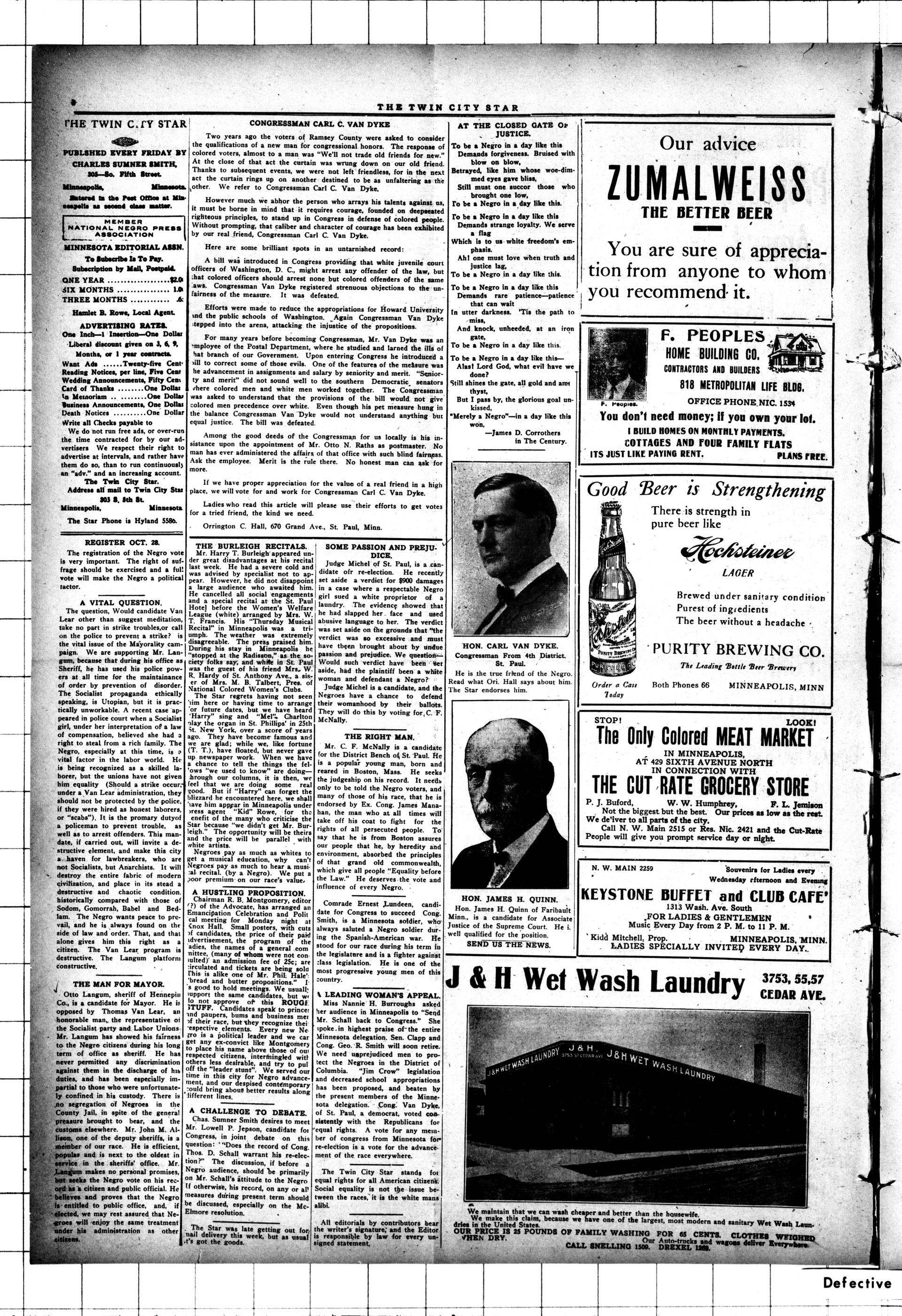
Page text (machine-generated)
DULUTH THE TWIN CITY STAR ST.PAUL
P. B.
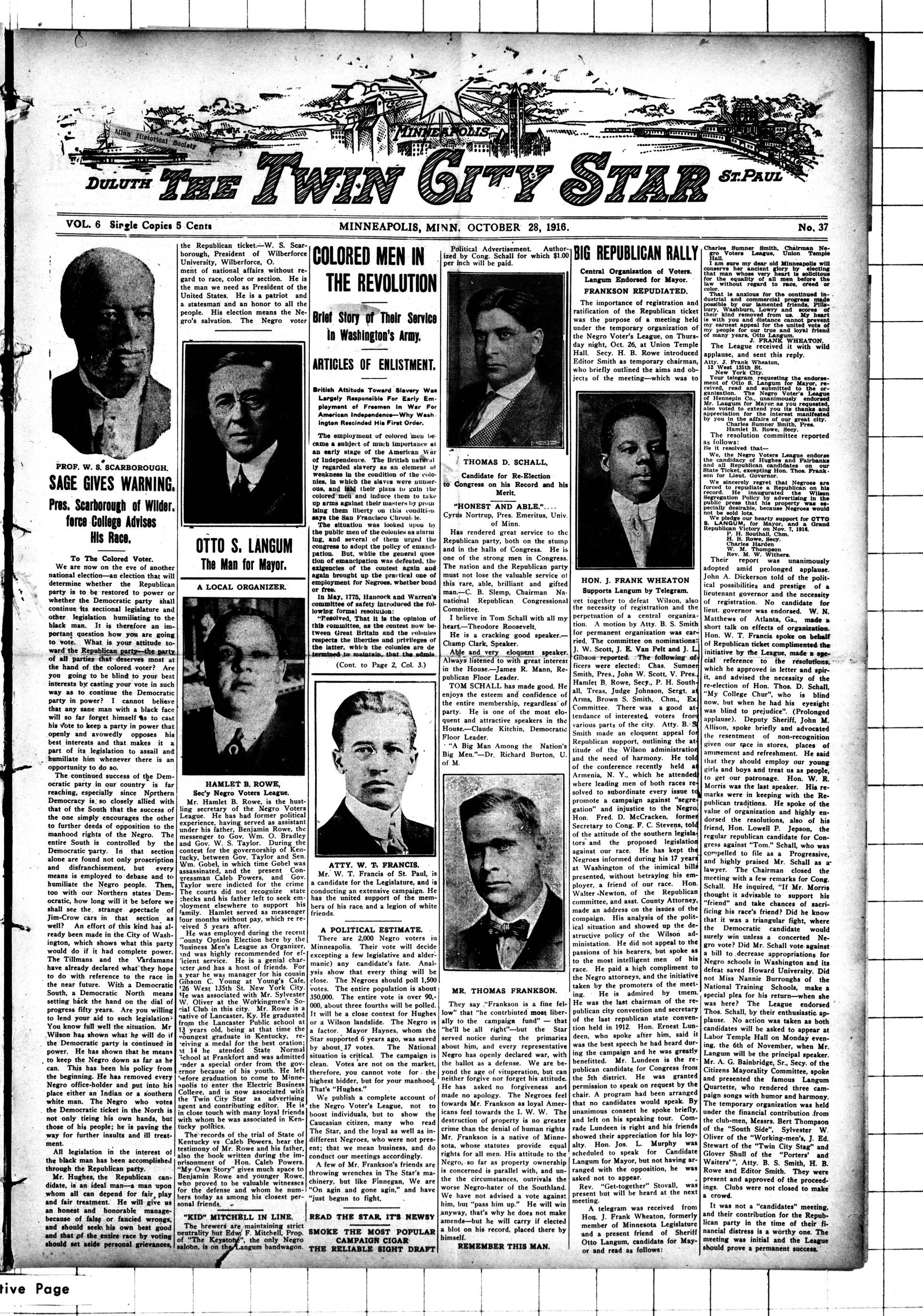
PROF. W. S. SCARBOROUGH. SAGE GIVES WARNING. Pres. Scarborough of Wilder. force College Advises His Race.
We are now on the eve of another national election—an election that will determine whether the Republican party is to be restored to power or whether the Democratic party shall continue its sectional legislature and other legislation humiliating to the black man. It is therefore an important question how you are going to vote. What is your attitude toward the Republican party—the party of all parties that deserves most at the hand of the colored voter? Are you going to be blind to your best interests by casting your vote in such way as to continue the Democratic party in power? I cannot believe that any sane man with a black face will so far forget himself as to cast his vote to keep a party in power that openly and avowedly opposes his best interests and that makes it a part of its legislation to assail and humiliate him whenever there is an opportunity to do so.
The continued success of the Democratic party in our country is far reaching, especially since Northern Democracy is so closely allied with that of the South that the success of the one simply encourages the other to further deeds of opposition to the manhood rights of the Negro. The entire South is controlled by the Democratic party. In that section alone are found not only proscription and disfranchisement, but every means is employed to debase and to humiliate the Negro people. Then, too with our Northern states Democratic, how long will it be before we shall see the, strange spectacle of Jim-Crow cars in that section as well? An effort of this kind has already been made in the City of Washington, which shows what this party would do if it had complete power. The Tillmans and the Vardamans have already declared what they hope to do with reference to the race in the near future. With a Democratic South, a Democratic North means setting back the hand on the dial of progress fifty years. Are you willing to lend your aid to such legislation? You know full well the situation. Mr Wilson has shown what he will do if the Democratic party is continued in power. He has shown that he means to keep the Negro down as far as he can. This has been his policy from the beginning. He has removed every Negro office-holder and put into his place either an Indian or a southern white man. The Negro who votes the Democratic ticket in the North is not only tieing his own hands, but those of his people; he is paving the way for further insults and ill treatment.
All legislation in the interest of the black man has been accomplished through the Republican party.
Mr. Hughes, the Republican candidate, is an ideal man—a man upon whom all can depend for fair, play and fair treatment. He will give us an honest and honorable manage-because of false or fancied wrongs, and should seek his own best good and that of the entire race by voting should set aside personal grievances,
tive Page
VOL. 6 Single Copies 5 Cents
Mr. Hamlet B. Rowe, is the hustling secretary of the Negro Voters League. He has had former political experience, having served as assistant under his father, Benjamin Rowe, the messenger to Gov. Wm. O. Bradley and Gov. W. S. Taylor. During the contest for the governorship of Kentucky, between Gov. Taylor and Sen. Wm. Gobel, in which time Gobel was assassinated, and the present Congressman Caleb Powers, and Gov. Taylor were indicted for the crime. The courts did not recognize state checks and his father left to seek employment elsewhere to support his family. Hamlet served as messenger four months without pay, which re received 5 years after.
He was employed during the recent County Option Election here by the Business Men's League as Organizer, and was highly recommended for efficient service. He is a genial character and has a host of friends. For a year he was manager for his cousin Gibson C. Young at Young's Cafe, 126 West 135th St. New York City. He was associated with Mr. Sylvester W. Oliver at the Workingmen's Social Club in this city. Mr. Rowe is a native of Lancaster, Ky. He graduated from the Lancaster Public school at 13 years old, being at that time the youngest graduate in Kentucky, receiving a medal for the best oration; at 14 he attended State Normal School at Frankfort and was admitted under a special order from the governor because of his youth. He left before graduation to come to Minneapolis to enter the Electric Business College, and is now associated with the Twin City Star as advertising agent and contributing editor. He is in close touch with many loyal friends with whom he was associated in Kentucky politics.
The records of the trial of State of Kentucky vs Caleb Powers, bear the testimony of Mr. Rowe and his father, also the book written during the imprisonment of Hon. Caleb Powers. "My Own Story" gives much space to Benjamin Rowe and younger Rowe, who proved to be valuable witnesses for the defense and whom he numbers today as among his closest personal friends.
MICHAEL IN LINE
The brewer is maintaining a neutrality handle Ed. F. Troop, of "The Keystones" the only Negro saloon, is on the Langum bandwagon.
To The Colored Voter.
the Republican ticket.—W. S. Scarborough, President of Wilberforce University, Wilberforce, O. ment of national affairs without regard to race, color or section. He is the man we need as President of the United States. He is a patriot and a statesman and an honor to all the people. His election means the Negro's salvation. The Negro voter
M. H. H.
OTTOM S. LANGUM The Man for Mayor.
PETER H.
COLORED MEN IN THE REVOLUTION
ARTICLES OF ENLISTMENT.
British Attitude Toward Slavery Was Largely Responsible For Early Employment of Freemen in War For American Independence—Why Washington Rescinded His First Order.
The employment of colored men became a subject of much importance at an early stage of the American War of Independence. The British naturally regarded slavery as an element of weakness in the condition of the colonies, in which the slaves were numerous, and laid their plans to gain the colored men and induce them to take up arms against their masters by promising them liberty on this condition says the San Francisco Chronicle.
The situation was looked upon by the public men of the colonies as alarming, and several of them urged the congress to adopt the policy of emancipation. But, while the general question of emancipation was defeated, the exigencies of the contest again and again brought up the practical one of employment for Negroes, whether bond or free.
In May, 1775, Hancock and Warren's committee of safety introduced the following formal resolution:
"Pesolved, That it is the opinion of this committee, as the contest now between Great Britain and the colonies respects the liberties and privileges of the latter, which the colonies are de determined to maintain that the admis
(Cont. to Page 2, Col. 3.)
ATTY. W. T. FRANCIS.
Mr. W. T. Francis of St. Paul, is a candidate for the Legislature, and is conducting an extensive campaign. He has the united support of the members of his race and a legion of white friends.
A POLITICAL ESTIMATE.
There are 2,000 Negro voters in Minneapolis. Their vote will decide excepting a few legislative and aldermanic) any candidate's fate. Analysis show that every thing will be close. The Negroes should poll 1,500 votes. The entire population is about 350,000. The entire vote is over 90,000, about three fourths will be polled. It will be a close contest for Hughes or a Wilson landslide. The Negro is a factor. Mayor Haynes, whom the Star supported 6 years ago, was saved by about 17 votes. The National situation is critical. The campaign is clean. Votes are not on the market, therefore, you cannot vote for the highest bidder, but for your manhood. That's "Hughes."
We publish a complete account of the Negro Voter's League, not to boost individuals, but to show the Caucasian citizen, many who read The Star, and the loyal as well as indifferent Negroes, who were not present; that we mean business, and do conduct our meetings accordingly.
A few of Mr. Frankson's friends are throwing wrenches in The Star's machinery, but like Finnegan. We are "On agin and gone agin," and have "just begun to fight."
READ THE STAR, IT'S NEWSY
SMOKE THE MOST POPULAR
CAMPAIGN CIGAR
THE RELIABLE SIGHT DRAFT
Political Advertisement. Authorized by Cong. Schall for which $1.00 per inch will be paid.
Candidate for Re-Election to Congress on his Record and his Merit.
"HONEST AND ABLE.".... Cyrus Nortrup, Pres. Emeritus, Univ. of Minn.
Has rendered great service to the Republican party, both on the stump and in the halls of Congress. He is one of the strong men in Congress. The nation and the Republican party must not lose the valuable service of this rare, able, brilliant and gifted man.—C. B. Slemp, Chairman National Republican Congressional Committee.
I believe in Tom Schall with all my heart.—Theodore Roosevelt.
He is a cracking good speaker.—Champ Clark, Speaker.
Able and very eloquent speaker. Always listened to with great interest in the House.—James R. Mann, Republican Floor Leader.
TOM SCHALL has made good. He enjoys the esteem and confidence of the entire membership, regardless of party. He is one of the most eloquent and attractive speakers in the House.—Claude Kitchin, Democratic Floor Leader.
"A Big Man Among the Nation's Big Men."—Dr. Richard Burton, U of M.
MR. THOMAS FRANKSON.
They say "Frankson is a fine fellow" that "he contribriuted most liberally to the campaign fund" — that "he'll be all right"—but the Star served notice during the primaries about him, and every representative Negro has openly declared war, with the ballot as a defense. We are beyond the age of vituperation, but can neither forgive nor forget his attitude. He has asked no forgiveness and made no apology. The Negroes feel towards Mr. Frankson as loyal Americans feel towards the I. W. W. The destruction of property is no greater crime than the denial of human rights Mr. Frankson is a native of Minnesota, whose statutes provide equal rights for all men. His attitude to the Negro, so far as property ownership is concerned is parallel with, and unthe the circumstances, outrivals the worse Negro-hater of the Southland. We have not advised a vote against him, but "pass him up." He will win anyway, that's why he does not make amends—but he will carry if elected a blot on his record, placed there by himself.
REMEMBER THIS MAN.
Central Organization of Voters.
Langum Endorsed for Mayor.
FRANKSON REPUDIATED.
The importance of registration and ratification of the Republican ticket was the purpose of a meeting held under the temporary organization of the Negro Voter's League, on Thursday night, Oct. 26, at Union Temple Hall. Secy. H. B. Rowe introduced Editor Smith as temporary chairman, who briefly outlined the aims and objects of the meeting—which was to
get together to defeat Wilson, also the necessity of registration and the perpetuation of a central organization. A motion by Atty. B. S. Smith for permanent organization was carried. The committee on nominations: J. W. Scott, J. E. Van Pelt and J. L. Gibson reported. The following officers were elected: Chas. Sumner Smith, Pres., John W. Scott, V. Pres., Hamlet B. Rowe, Secy., P. H. Southall, Treas, Judge Johnson, Sergt. at Arms, Brown S. Smith, Chm., Ex Committee. There was a good attendance of interested voters from various parts of the city. Atty. B. S. Smith made an eloquent appeal for Republican support, outlining the attitude of the Wilson administration and the need of harmony. He told of the conference recently held at Armenia, N. Y., which he attended where leading men of both races resolved to subordinate every issue to promote a campaign against "segregation" and injustice to the Negro Hon. Fred. D. McCracken, former Secretary to Cong. F. C. Stevens, told of the attitude of the southern legislators and the proposed legislation against our race. He has kept the Negroes informed during his 17 years at Washington of the inimical bills presented, without betraying his employer, a friend of our race. Hon. Walter Newton, of the Republican committee, and asst. County Attorney, made an address on the issues of the compaign. His analysis of the political situation and showed up the destructive policy of the Wilson administration. He did not appeal to the passions of his hearers, but spoke as to the most intelligent men of his race. He paid a high compliment to the Negro attorneys, and the initiative taken by the promoters of the meeting. He is admired by tmem. He was the last chairman of the republican city convention and secretary of the last republican state convention held in 1912. Hon. Ernest Lundeen, who spoke after him, said it was the best speech he had heard during the campaign and he was greatly benefitted. Mr. Lundeen is the republican candidate for Congress from the 5th district. He was granted permission to speak on request by the chair. A program had been arranged that no candidates would speak. By unanimous consent he spoke briefly, and left on his speaking tour. Comrade Lundeen is right and his friends showed their appreciation for his loyalty. Hon. Jos. L. Murphy was scheduled to speak for Candidate Langum for Mayor, but not having arranged with the opposition, he was asked not to appear.
Rev. "Get-together" Stovall, was present but will be heard at the next meeting.
A telegram was received from Hon. J. Frank Wheaton, formerly member of Minnesota Legislature and a present friend of Sheriff Otto Langum, candidate for Mayor and read as follows:
Charles Sumner Smith, Chairman Negro Voters League, Union Temple Hall.
I am sure my dear old Minneapolis will consider it an ornament, and scores of that man whose very heart is solicitous for the equality of all men before the law without regard to race, creed or color.
That is anxious for the continued industrial and commercial progress made possible by our lamented friends, Pillarsbury, Washburn, Lowry and scores of that man whose very heart is solicitous for you and distance cannot prevent my earnest appeal for the united vote of my people for our true and loyal friend of many years Otto Laugum.
J. FRANK WHEATON.
The League received it with wild applause, and sent this reply.
Atty. J. Frank Wheaton,
12 West 18th St.
New York City.
Your telegram requesting the endorsement of Otto S. Langum for Mayor, requested and submitted to the organization. That Langum is the League of Hennepin Co., unanimously endorsed Mr. Langum for Mayor as you requested, also voted to extend you its thanks and appreciation for our interest manifested by you in the affairs of our great city.
Charles Sumner Smith, Pres.
Hamlet B. Rowe, Seey.
The resolution committee reported as follows:
Be it resolved that—
We, the Negro Voters League endorse
the candidacy of Hughes and Fairbanks
and candidates on our
State Ticket, excepting Jon. Thes. Frank-
son for Lieut. Governor.
We sincerely regret that Negroes are
forced to repudiate a Republican on his
state ticket. We regret that Negroes woul-
noth be deterred from Negroes Policy by advertising in the public press that his property was espe-
cially desirable, because Negroes would
would not be deterred from Negroes
We pledge our hearty support for CTOT
S. LANGUM, for Mayor, and a Grand
Republican Victory on Nov. 7, 1916.
I. R. Koehler, for Mayor.
H. B. Rowe, Seyc.
Charles Harden
W. M. Thompson
Rev. M. W. Moore
Their report was unanimously adopted amid prolonged applause. John A. Dickerson told of the political possibilities and prestige of a lieutenant governor and the necessity of registration. No candidate for lieut. governor was endorsed. W. N. Matthews of Atlanta, Ga., made a short talk on effects of organization. Hon. W. T. Francis spoke on behalf of Republican ticket complimented the initiative by the League, made a special reference to the resolutions, which he approved in letter and spirit, and advised the necessity of the re-election of Hon. Thos. D. Schall, "My College Chur", who is blind now, but when he had his eyesight was blind to prejudice". (Prolonged applause). Deputy Sheriff, John M. Allison, spoke briefly and advocated the resentment of non-recognition given our race in stores, places of amusement and refreshment. He said that they should employ our young girls and boys and treat us as people, to get our patronage. Hon. W. R. Morris was the last speaker. His remarks were in keeping with the Republican traditions. He spoke of the value of organization and highly endorsed the resolutions, also of his friend, Hon. Lowell P. Jepson, the regular republican candidate for Congress against "Tom." Schall, who was compelled to file as a Progressive, and highly praised Mr. Schall as a lawyer. The Chairman closed the meeting with a few remarks for Cong. Schall. He inquired, "If Mr. Morris thought it advisable to support his "friend" and take chances of sacrificing his race's friend? Did he know that it was a triangular fight, where the Democratic candidate would surely win unless a concerted Negro vote? Did Mr. Schall vote against a bill to decrease appropriations for Negro schools in Washington and its defeat saved Howard University. Did not Miss Nannie Burroughs of the National Training Schools, make a special plea for his return—when she was here? The League endorsed Thos. Schall, by their enthusiastic applause. No action was taken as both candidates will be asked to appear at Labor Temple Hall on Monday evening, the 6th of November, when Mr. Langum will be the principal speaker. Mr. A. G. Bainbridge, Sr., Secy. of the Citizens Mayorality Committee, spoke and presented the famous Langum Quartette, who rendered three campaign songs with humor and harmony. The temporary organization was held under the financial contribution from the club-men, Messrs. Bert Thompson of the "South Side", Sylvester W. Oliver of the "Working-men's, J. Ed. Stewart of the "Twin City Stag" and Glover Shull of the "Porters' and Waiters'", Atty. B. S. Smith, H. B. Rowe and Editor Smith. They were present and approved of the proceedings. Clubs were not closed to make a crowd.
It was not a "candidates" meeting, and their contribution for the Republican party in the time of their financial distress is a worthy one. The meeting was initial and the League should prove a permanent success.
SOCIAL NEWS EDITOR
Misa Clara Lucas
Boston Block, Minneapolis.
Minneapolis,
NIC. 1873.
RAILROAD MEN'S NEWS.
Send your notes to us by Wednesday A. M.
Send 25 cents in postage stamps for your For Rent Ads.
If you want notices inserted, spend a cent or two and send your copy clearly and intelligently written.
Owing to the increased cost of publication, we will NOT accept any ads, unless paid in advance. Agents will please act accordingly.
Do not waste your time making promises to our agents. Send your money by Express or Post Office Order or in cash or postage stamps.
Mrs. Minie Plummer has moved from Clinton Ave., to 3432 Oakland Ave.
Mrs. Grace Johnson is in Chicago, residing at 4721 Evanston Ave. What is the big affair on Oct. 30? Read the Star and refresh your memory. The K. P's have a beautiful program, a copy we acknowledge. It is neat and contains much advertising—and the Negro printers can do as well.
NEGRO PORTER BRUTALLY
ASSAULTED
Lewis Albertson, employed as porter and assistant bartender at Perkins saloon, 3rd Ave. So, and 3rd St., was nearly murdered in the saloon last week. He is recovering from a fracture of the skull in the City Hospital, but his condition is critical. Mr. Albertson was a confidential employee of Mr. Perkins, and slept in the cafe. Jealousy is thought to be the cause of the attack. He was beaten to unconsciousness with an iron ice shaver and on regaining consciousness, turned on the lights which drew the police. It is supposed that the assailant secluded himself before the saloon was closed. Messrs. Clarence W. Bell, Chas. Sexton and Mr. Perkins have circulated a contribution list for the support of those dependent on him. His position is filled by a Negro. Mr. Perkins' attitude in contrast to other plans, where Negro patronage is solicited, humiliation and assaults are frequently abetted by the management, Negroes given no such employment. And such places are liberally patronized by them.
Mr. Jay Travis of Tacoma, Wash. left Monday night on his return home after a pleasant Eastern trip. He reports prosperity among our people in the West.
Mr. Will Hyatt, formerly of St Louis, who lived in the Twin Cities is conducting a tailoring establishment in Tacoma.
Mr. James J. Duncan, 3920 4th Ave. So., is home from the hospital. After a lingering illness, he was operated upon by Dr. Newkirk and is improving rapidly. Mr. Clinton Borders has moved to 2123 24th Ave. So. Mrs. Maggie Martin, has been very ill for several days at her residence 3013 Garfield Ave. She is improving slowly.
DEATH OF IRA S. ROBERTS.
The shocking news of the death of Ira S. Roberts, known as "the Count."
He was butler for Pres. Clifford, of the Cream of Wheat Co. He was a pleasing personality and always held positions of trust. He was found dead sitting in a chair. He has no relations, and had been a sufferer of rheumatism for years, but appeared entirely healthy under Christian Science practitioners. He was a member of the Christian Science Church. The burial services were held Tuesday.
Mr. Thomas Carroll recently built a $500 barn on his farm at Parshall, N. D. He has harvested a splendid crop. Mr. and Mrs. Simmie Harris, his parents and Mrs. Carroll are in charge.
Mrs. B. S. Smith of Oakland Ave. is home from the Hospital, under a nurse's care. She is slightly improved.
Mr. Fred. D. McCracken, the real estate dealer, is able to resume his work after a serious illness of stomach trouble.
Mr. Frank Baxter was on the sick list this week.
The Lady Ushers, about 50, who are employed in the various theatres, will give a Harvest Ball at Lane's Hall, 8th and Nicollet Ave., on November 13th.
NORTH SIDE POLITICAL MEETING.
A meeting of the Colored Voters of the 3rd and 4th Wards will be held at 709 5th St. No., on Sunday.-J. C. Trevan, Secy.
HEAR THE ELECTION RETURNS!
Union Temple Hall, Nov. 7th, With
The Twin City Entertainers.
PYTHIAN NOTES.
A renewed activity is noticeable among the K. P. lodges of the city. Pride of Minn. Lodge has recently reinstated four members and initiated three (3), and have a number of applications waiting. Pride of the West Uniform Rank under Capt. W. C. Jeffrey, meets the 2nd and 4th Thursday in each month. The men are turning out well, and are all very enthusiastic over the showing they are making.
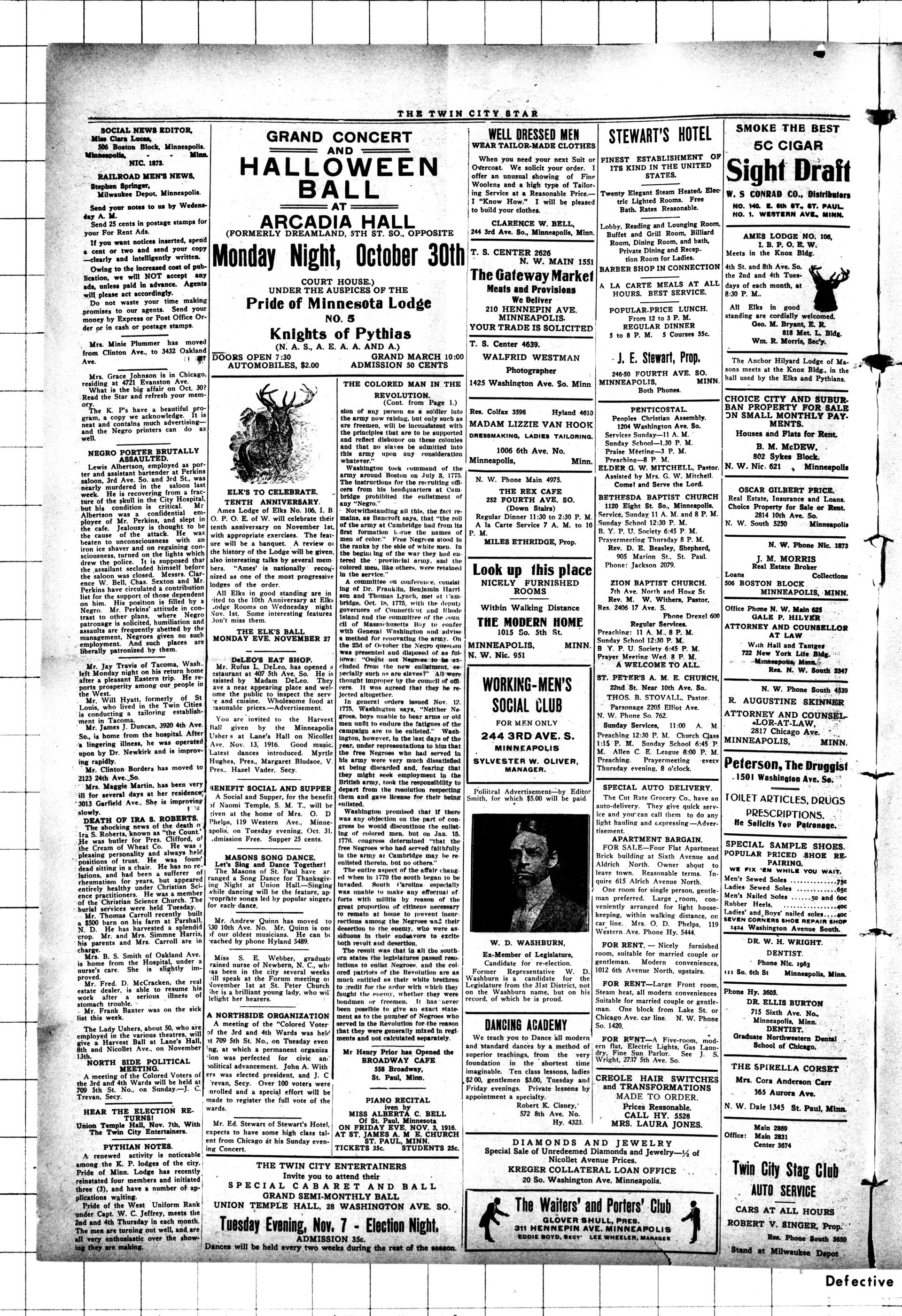
GRAND CONCERT AND HALLOWEEN BALL AT
ARCADIA HALL (FORMERLY DREAMLAND, 5TH ST. SO., OPPOSITE Monday Night, October 30th
COURT HOUSE.)
UNDER THE AUSPICES OF THE
Pride of Minnesota Lodge
NO. 5
DOORS OPEN 7:30
AUTOMOBILES, $2.00
ELK'S TO CELEBRATE.
Ames Lodge of Elks No. 106, I. B. O. P. O. E. of W. will celebrate their tenth anniversary on November 1st, with appropriate exercises. The feature will be a banquet. A review on the history of the Lodge will be given, also interesting talks by several members. "Ames" is nationally recognized as one of the most progressive lodges of the order. All Elks in good standing are invited to the 10th Anniversary at Elks Lodge Rooms on Wednesday night Nov. 1st. Some interesting features Don't miss them.
THE ELK'S BALL
MONDAY EVE. NOVEMBER 27
DELEO'S EAT SHOP.
Mr. Rufus L. DeLeo, has opened a restaurant at 407 5th Ave. So. He is assisted by Madam DeLeo. They have a neat appearing place and welcome the public to inspect the service and cuisine. Wholesome food at reasonable prices—Advertisement.
You are invited to the Harvest Hall given by the Minneapolis Usher's at Lane's Hall on Nicollet Ave. Nov. 13, 1916. Good music. Latest dances introduced. Myrtle Hughes, Pres., Margaret Bludsoe, V. Pres., Hazel Vader, Secy.
BENEFIT SOCIAL AND SUPPER
A Social and Supper, for the benefit of Naomi Temple, S. M. T., will be given at the home of Mrs. O. D Phelps, 119 Western Ave., Minneapolis, on Tuesday evening, Oct. 31. Admission Free. Supper 25 cents.
MASONS SONG DANCE.
Let's Sing and Dance Together!
The Masons of St. Paul have arranged a Song Dance for Thanksgiving Night at Union Hall—Singing while dancing will be the feature, appropriate songs led by popular singers for each dance.
Mr. Andrew Quinn has moved to 530 10th Ave. No. Mr. Quinn is one of our oldest musicians. He can be reached by phone Hyland 5489.
Miss S. E. Webber, graduate trained nurse of Newbern, N. C., who has been in the city several weeks will speak at the Forum meeting or November 1st at St. Peter Church she is a brilliant young lady, who will lighten her hearers.
A NORTHSIDE ORGANIZATION
A meeting of the "Colored Voters of the 3rd and 4th Wards was held at 709 5th St. No., on Tuesday evening, at which a permanent organization was perfected for civic and political advancement. John A. Withers was elected president, and J. C. Crevan, Secy. Over 100 voters were enrolled and a special effort will be made to register the full vote of the awards.
Mr. Ed. Stewart of Stewart's Hotel, expects to have some high class talent from Chicago at his Sunday evening Concert.
THE TWIN CITY STAR
CONCERT
AND
BOWEEN
HALL
AT
MIA HALL
BAND, 5TH ST. SO., OPPOSITE
t, October 30th
(HOUSE.)
USPICES OF THE
Minnesota Lodge
No. 5
of Pythias
A. A. AND A.)
GRAND MARCH 10:00
ADMISSION 50 CENTS
THE COLORED MAN IN THE
sion of any person as a soldier into the army now raising, but only such as are freemen, will be inconsistent with the principles that are to be supported and reflect dishonor on these colonies and that no slaves be admitted into this army upon any consideration whatever."
Washington took command of the army around Boston on July 3, 1775. The instructions for the recruiting officers from his headquarters at Cambridge prohibited the enlistment of any "Negro."
Notwithstanding all this, the fact remains, as Bancroft says, that "the roll of the army at Cambridge had from its first formation borne the names of men of color." Free Negroes stood in the ranks by the side of white men. In the beginning of the war they had entered the provincial army, and the colored men, like others, were retained in the service."
A committee on conference, consisting of Dr. Franklin, Benjamin Harrison and Thomas Lynch, met at Cambridge, Oct. 18, 1775, with the deputy governors of Connecticut and Rhode Island and the committee of the council of Massachusetts Bay to confer with General Washington and advise a method for renovating the army. On the 23d of October the Negro question was presented and disposed of as follows: "Ought not Negroes to be excluded from the new enlistment, especially such as are slaves?" All were thought improper by the council of officers. It was agreed that they be rejected altogether.
In general orders issued Nov. 12, 1775. Washington says, "Neither Negroes, boys unable to bear arms or old men unfit to endure the fatigues of the campaign are to be enlisted." Washington, however, in the last days of the year, under representations to him that the free Negroes who had served in his army were very much dissatisfied at being discarded and, fearing that they might seek employment in the British army, took the responsibility to depart from the resolution respecting them and gave license for their being enlisted.
Washington promised that if there was any objection on the part of congress he would discontinue the enlisting of colored men, but on Jan. 15, 1776, congress determined "that the free Negroes who had served faithfully in the army at Cambridge may be enlisted therein, but no others."
The entire aspect of the affair changed when in 1779 the south began to be invaded. South 'carolina' especially was unable to make any effectual efforts with militia by reason of the great proportion of citizens necessary to remain at home to prevent insurrections among the Negroes and their desertion to the enemy, who were assiduous in their endeavors to excite both revolt and desertion.
The result was that in all the southern states the legislatures passed resolutions to enlist Negroes, and the colored patriots of the Revolution are as much entitled as their white brethren to credit for the ardor with which they fought the enemy, whether they were bondmen or freemen. It has never been possible to give an exact statement as to the number of Negroes who served in the Revolution for the reason that they were generally mixed in regiments and not calculated separately.
Mr Henry Prior has Opened the
BROADWAY CAFE
558 Broadway,
St. Paul, Minn.
Iven by
MISS ALBERTY C. BELL
Of St. Paul, Minnesota
ON FRIDAY EVE, NOV. 3, 1916.
AT ST. JAMES A. M. E. CHURCH
ST. PAUL, MINN.
TICKETS 35c. STUDENTS 25c.
ENTERTAINERS
attend their
RE T AND BALL
MONTHLY BALL
B WASHINGTON AVE. SO.
7 - Election Night.
ON 35c.
weeks during the rest of the season.
PIANO RECITAL
WELL DRESSED MEN
WEAR TAILOR-MADE CLOTHES
When you need your next Suit or Overcoat. We solicit your order. I offer an unusual showing of Fine Woolens and a high type of Tailoring Service at a Reasonable Price.—I "Know How." I will be pleased to build your clothes.
CLARENCE W. BELL,
244 3rd Ave. So., Minneapolis, Minn.
T. S. CENTER 2626
N. W. MAIN 1551
The Gateway Market
Meats and Provisions
We Deliver
210 HENNEPIN AVE.
MINNEAPOLIS.
YOUR TRADE IS SOLICITED
T. S. Center 4639.
WALFRID WESTMAN
Photographer
1425 Washington Ave. So. Minn.
Res. Colfax 3596 Hyland 4610
MADAM LIZZIE VAN HOOK
DRESSMAKING, LADIES TAILORING.
1006 6th Ave. No.
Minneapolis, Minn.
N. W. Phone Main 4975.
THE REX CAFE
252 FOURTH AVE. SO.
(Down Stairs)
Regular Dinner 11:30 to 2:30 P. M.
A la Carte Service 7 A. M. to 10
P. M.
MILES ETHRIDGE, Prop.
Look up this place
NICELY FURNISHED
ROOMS
WORKING-MEN'S SOCIAL CLUB
SYLVESTER W. OLIVER,
MANAGER.
Political Advertisement—by Editor
Smith, for which $5.00 will be paid.
W. D. WASHBURN.
Ex-Member of Legislature,
Candidate for re-election.
Former Representative W. D.
Washburn is a candidate for the
Legislature from the 31st District, not
on the Washburn name, but on his
record, of which he is proud.
DANCING ACADEMY
We teach you to Dance all modern and standard dances by a method of superior teachings, from the very foundation in the shortest time imaginable. Ten class lessons, ladies $2.00, gentlemen $3.00, Tuesday and Friday evenings. Private lessons by appointment a specialty.
Robert K. Cisney,
572 8th Ave. No.
Hy. 4323.
FOR RENT—A Five-room, ern flat, Electric Lights, Gas Dry, Fine Sun Parlor. See J Wright, 2737 5th Ave. So.
CREOLE HAIR SWITCH and TRANSFORMATION MADE TO ORDER.
Prices Reasonable.
CALL HY. 5528
MRS. LAURA JONES.
DIAMONDS AND JEWELRY
Special Sale of Unredeemed Diamonds and Jewelry—1/2 of Nicollet Avenue Prices.
KREGER COLLATERAL LOAN OFFICE
20 So. Washington Ave. Minneapolis.
The Waiters' and Porters' Club
MINNEAPOLIS, N.W.Nic.951
A
STEWART'S HOTEL
FINEST ESTABLISHMENT OF
ITS KIND IN THE UNITED
STATES.
Twenty Elegant Steam Heated, Elec-
tric Lighted Rooms. Free
Bath. Rates Reasonable.
Lobby, Reading and Lounging Room,
Buffet and Grill Room, Billiard
Room, Dining Room, and bath,
Private Dining and Recep-
tion Room for Ladies.
BARBER SHOP IN CONNECTION
A LA CARTE MEALS AT ALL
HOURS. BEST SERVICE.
POPULAR-PRICE LUNCH.
From 12 to 3 P. M.
REGULAR DINNER
5 to 8 P. M. 5 Courses 35c.
J. E. Stewart, Prop.
246-50 FOURTH AVE. SO.
MINNEAPOLIS.
Both Phones.
PENTICOSTAL.
Peoples Christian Assembly.
1204 Washington Ave. So.
Services Sunday—11 A. M.
Sunday School—1.30 P. M.
Praise Meeting—3 P. M.
Preaching—8 P. M.
ELDER G. W. MITCHELL, Pastor.
Assisted by Mrs. G. W. Mitchell.
Comel and Serve the Lord.
BETHESDA BAPTIST CHURCH
1120 Eight St. So., Minneapolis.
Service, Sunday 11 A. M. and 8 P. M.
Sunday School 12:30 P. M.
Y. P. Y. U. Society 6:45 P. M.
Prayermeeting Thursday 8 P. M.
Rev. D. E. Beasley, Shepherd,
905 Marion St., St. Paul.
Phone: Jackson 2079.
ZION BAPTIST CHURCH.
7th Ave. North and Hoag St
Rev. M. W. Withers, Pastor,
Res. 2406 17 Ave. S.
Phone Drexel 600
Regular Services.
Preaching: 11 A. M. 8 P. M.
Sunday School 12:30 P. M.
B Y. P. U. Society 6:45 P. M.
Prayer Meeting Wed. 8 P. M.
A WELCOME TO ALL.
ST. PETER'S A. M. E. CHURCH,
22nd St. Near 10th Ave. So.
THOS. B. STOVALL, Pastor.
Parsonage 2205 Elliot Ave.
N. W. Phone So. 762.
Sunday Services, 11:00 A. M.
Preaching 12:30 P. M. Church Class
1:15 P. M. Sunday School 6:45 P.
M. Allen C. E. League 8:00 P. M.
Preaching. Prayermeeting every
Thursday evening. 8 o'clock.
SPECIAL AUTO DELIVERY.
SPECIAL AUTO DELIVERY.
The Cut Rate Grocery Co., have an auto-delivery. They give quick service and you can call them to do any light hauling and expressing—Advertisement.
APARTMENT BARGAIN.
FOR SALE—Four Flat Apartment Brick building at Sixth Avenue and Aldrich North. Owner about to leave town. Reasonable terms. Inquire 615 Alrich Avenue North.
One room for single person, gentleman preferred. Large room, conveniently arranged for light housekeeping, within walking distance, on car line. Mrs. O. D. Phelps, 119 Western Ave. Phone Hy. 5444.
FOR RENT. — Nicely furnished room, suitable for married couple or gentleman. Modern conveniences, 1012 6th Avenue North, upstairs.
FOR RENT—Large Front room, Steam heat, all modern conveniences Suitable for married couple or gentleman. One block from Lake St. or Chicago Ave. car line. N. W. Phone So. 1420.
FOR RENT—A Five-room, modern flat, Electric Lights, Gas Laundry, Fine Sun Parlor. See J. S. Wright, 2737 5th Ave. So.
CREOLE HAIR SWITCHES and TRANSFORMATIONS MADE TO ORDER.
Prices Reasonable.
CALL HY. 5528
MRS. LAURA JONES.
ND JEWELRY Diamonds and Jewelry-1/2 of venue Prices. RAL LOAN OFFICE Ave. Minneapolis.
BULL, PRES.
E. MINNEAPOLIS
EE WHEELER, MANAGER
1
SMOKE THE BEST 5C CIGAR
W. S CONRAD CO., Distributors
NO. 140. E. 6th ST., ST. PAUL.
NO. 1. WESTERN AVE., MINN.
AMES LODGE NO. 105,
I. B. P. O. E. W.
Meets in the Knox Bldg.
4th St. and 8th Ave. So.
the 2nd and 4th Tues-
days of each month, at
8:30 P. M..
All Elks in good
All Elks in good standing are cordially welcomed.
Geo. M. Bryant, E. R.
818 Met. L. Bldg.
Wm. R. Morris, Sec'y.
The Anchor Hilyard Lodge of Masons meets at the Knox Bldg., in the hall used by the Elks and Pythians.
CHOICE CITY AND SUBURBAN PROPERTY FOR SALE ON SMALL MONTHLY PAYMENTS.
Houses and Flats for Rent.
B. M. McDEW,
802 Sykes Block.
N. W. Nic. 621 Minneapolis
For Rent.
W.
ock.
Minneapolis
OSCAR GILBERT PRICE.
Real Estate, Insurance and Loans.
Choice Property for Sale or Rent.
2814 10th Ave. So.
N. W. South 5250 Minneapolis
J. M. MORRIS
Real Estate Broker
Loans Collections
506 BOSTON BLOCK
MINNEAPOLIS, MINN.
Office Phone N. W. Main 625
GALE P. HILYER
With Hall and Tantges
722 New York Life Bldg.
Minneapolis, Mn.
Res. N. W. South 3347
N. W. Phone South 4539
R. AUGUSTINE SKINNER
ATTORNEY AND COUNSEL-
LOR-AT-LAW,
2817 Chicago Ave.
MINNEAPOLIS, MINN.
Peterson, The Druggist
1501 Washington Ave. So.
TOILET ARTICLES, DRUGS
PRESCRIPTIONS.
He Solicits You Patronage.
SPECIAL SAMPLE SHOES.
POPULAR PRICED SHOE RE-
PAIRING.
WE FIX 'EM WHILE YOU WAIT.
Men's Sewed Soles ..... 75c
Ladies' Sewed Soles ..... 65c
Men's Nailed Soles ..... 50 and 60c
Rubber Heels, ..... 40c
Ladies' and Boys' nailed soles ..... 40c
SEVEN CORNERS SHOE REPAIR SHOP
1424 Washington Avenue South.
DR. W. H. WRIGHT.
DENTIST.
Phone Nic. 1963
111 So. 6th St
Minneapolis, Minn.
Phone Hy. 3605.
DR. ELLIS BURTON
715 Sixth Ave. No.,
Minneapolis, Minn.
DENTIST.
Graduate Northwestern Dental
School of Chicago.
THE SPIRELLA CORSET
Mrs. Cora Anderson Carr
365 Aurora Ave.
N. W. Dale 1345 St. Paul, Minn.
g Club
CE
Twin City Stag Club
AUTO SERVICE
CARS AT ALL HOURS
ROBERT V. SINGER, Prop.
Res. Phone South 5650
Stand at Milwaukee Depot
Defective
4th St. and 8th Ave. So.
the 2nd and 4th Tues-
days of each month, at
8:30 P. M..
Main 2869
Office: Main 2831
Center 3674
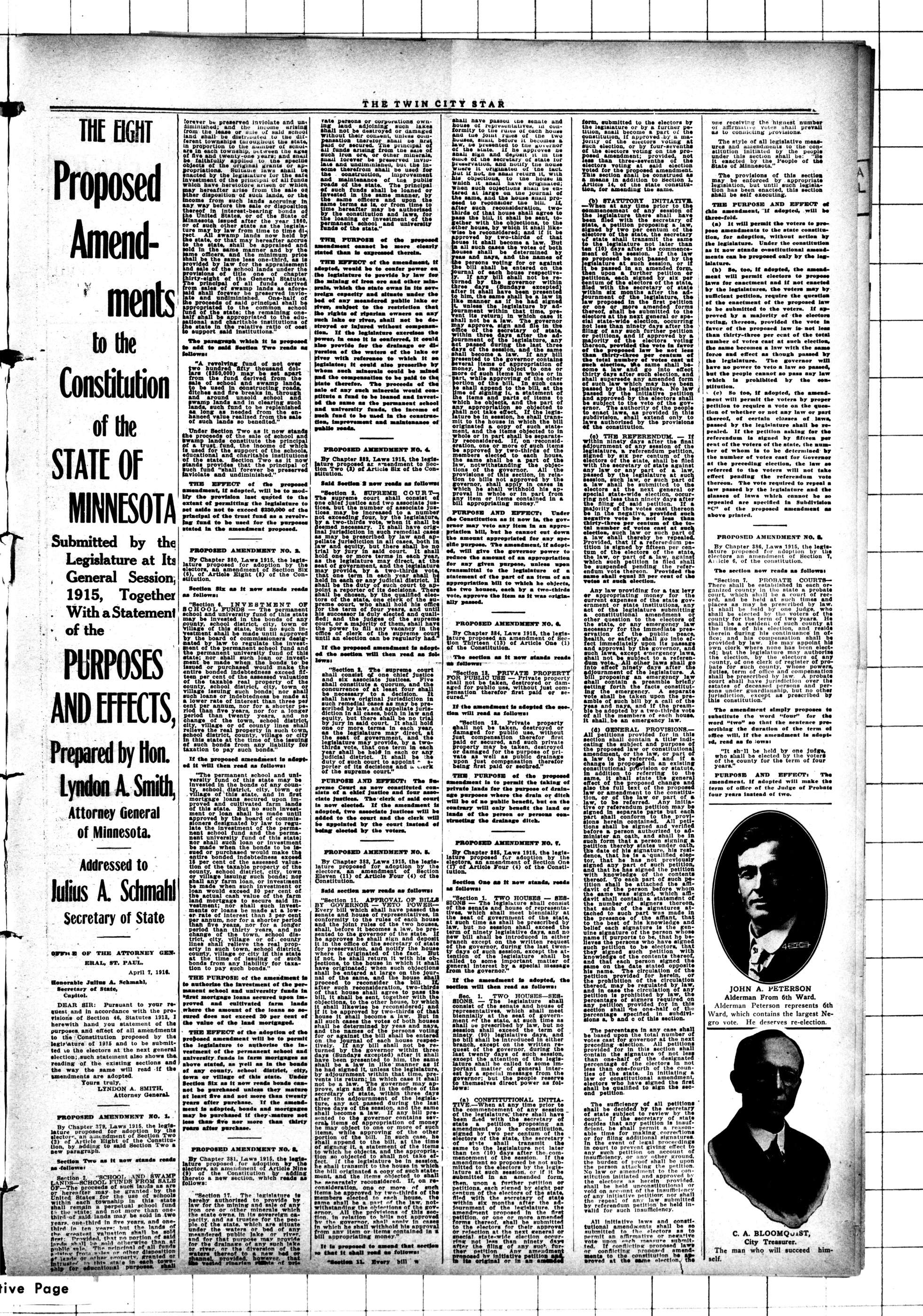
THE EIGHT Proposed Amendments to the Constitution of the STATE OF MINNESOTA
Submitted by the Legislature at Its General Session 1915, Together With a Statement of the
PURPOSES AND EFFECTS,
Prepared by Hon.
Lyndon A. Smith,
Attorney General
of Minnesota.
Addressed to Julius A. Schmahl Secretary of State
OFFICE OF THE ATTORNEY GEN-
ERAL, ST. PAUL.
April 7, 1916.
Honorable Julius A. Schmahl,
Secretary of State,
Capitol.
DEAR SIR: Pursuant to your request and in accordance with the provisions of Section 46, Statutes 1913, I herewith hand you statement of the purposes and effect of all amendments to the Constitution proposed by the legislature of 1975 and to be submitted to the electors at the next general election; such statement also shows the reading of the existing sections and the way the same will read - if the amendments are adopted.
PROPOSED AMENDMENT NO. 1.
By Chapter 379, Laws 1915, the legislature proposed for adoption by the electorate, an amendment of Section 10 of the Rights to the Constitution, by adding to said Section Two a new paragraph.
Section Two as it now stands reads as follows:
Section 2. **SCHOOL** AND SWAMP OF SCHOOL DADS FROM SALE OF. The proceeds of such lands as are hereafter may be granted by the United States for the use of the lands, one-third of which this state shall remain a perpetual school fund to the state; and not more than one-third of said lands may be held for one year, one-third of years, and one-third of years; but the lands of the greatest valuation shall be sold lands shall be sold from sales to other disposition of lands or other property, granting them to educational purposes, shall
tive Page
LYDON A. SMITH,
Attorney General
for ever be preserved inviolate and undiminished; and the income arising from the lease or state of said school land shall be distributed to the different parties to the sale of the property in proportion to the number of school-in-each township, between the ages of five and twenty-one years; and small and large property to the original grants or appropriations. Suitable laws shall be enacted by the legislature for the safe and effective protection of the funds which have heretofore arisen or which may hereafter arise from the sale or other disposition of such lands, or the way for such funds or other positions of the property before the sale or other direction thereof in interest-bearing bonds of the United States, or of the State of Minnesota issued after the year 1880, which such other bonds are held true by law from time to time, direct. All swamp lands now held by the state, or that may hereafter accrue the costs of the sale or other disposition of the same manner and by the same officers, and the minimum price shall be the same less one-third, as is provided by the school law; and the sale of the school lands under the provisions of title one of chapter thirty-eight of the General Statutes, and the same property all of which from sales of swamp lands as are said shall forever be preserved inviolate and undiminished. One-half of the property shall be sold by the same party, and the appropriate approved of the common school fund of the state; the remaining one-half shall be appropriated to the adult-age of the state and the state in the relative ratio of cost to support said institutions.
The paragraph which it is proposed to add to said Section Two reads as follows:
"A revolving fund of not over two hundred thousand dollars ($250,000) may be set apart from the fund derived from the sale of school and swamp lands, to be used for the readiness, ditches and fire breaks in, through and around unsold school and swamp lands and in clearing such land as long as needed from the enhanced value realized from the sale of such lands so benefited."
Under Section Two as it now stands the proceeds of the sale of school and swamp lands constitute the principal fund used for the support of the schools, educational and charitable institutions of the state. Section Two as it now stands the proceeds of the principal of such fund "shall forever be preserved inviolate and undiminished."
THE EFFECT of the proposed amendment, if adopted, will be to modify the provision last quoted to the extent of permitting the legislature to set aside not to exceed $250,000 of the principal of the trust fund as a revolving fund to be used for the purposes stated in the amendment proposed.
PROPOSED AMENDMENT NO. 2.
By Chapter 380, Laws 1915, the legislature proposed for adoption by the state an amendment of Section Six (6), of Article Eight (6) of the Constitution.
Section Six as it now stands reads as follows:
Section 6. INVESTMENT OF SCHOOL FUNDS — The permanent school and university fund of this state may be invested in the bonds of any county, school district, city, town of village of this state, but no such investment shall be made until approved by the board of commissioners designated by law to regulate the investment of the percent of the school fund and the permanent university fund of this state; nor shall such loan or investment be made when the bonds to be issued or purchased would make the entire bonded indebtedness exceed fifteen per cent of the assessed valuation of the taxable real property of the county, school district, city, town of village of this state. It is not possible to be made such loans or indebtedness, nor shall a lower rate of interest than three percent per annum, nor for a shorter period than five years, nor for a longer period than twenty years, and no change of the town, school district, city, village of the county lines shall rise in the real property in such town, school district, city, town of village of this state. The time of the issuing of such bonds from any liability for taxation to pay such bonds.
If the proposed amendment is adopted it will then read as follows:
The permanent school and university fund of this state may be invested in the bonds of any countrals of school district city and town village of this state, and in first mortgage loans secured upon improved and cultivated farm lands of this state. But no such investment is to be made for the sale of the approved by the board of commissioners designated by law to regulate the investment of the permanent school and university fund of this state; nor shall such loan or investment be made when the bonds to be issued to purchase the property make entire bonded indebtedness exceed 15 per cent of the assessed valuation of the taxable property of the country school district city, the town of Willam, which has had an annual farm loan, or investment to be made when such investment or loan would exceed 30 per cent of the taxable property to be sold in the first land mortgage to secure said investments; nor shall such investment or loans be made at a lower rate of interest than per cent of the annual income of a state a short period than five years, nor for a longer period than thirty years, and no change of the town school district's capital or county counties shall relieve the real property in such town, school district, county, village or city in this state. If such bonds from any liability for tax
THE PURPOSE of the amendment is to authorize the investment of the permanent school and university funds in first mortgage loans secured upon improved and cultivated farm lands where the amount of the loans so secured does not exceed 30 per cent of the value of the land mortgaged.
THE EFFECT of the adoption of the proposed amendment will be to permit the legislature to authorize the investment of the permanent school and university funds in farm mortgages as above stated, as well as in the bonds of any county, school district, city, town or village of this state. Under Section Six as it now reads bonds cannot be purchased unless they mature at least five and not more than twenty years after purchase. If the amendment is adopted, bonds and mortgages may be purchased if they-mature not less than five nor more than thirty years after purchase.
PROPOSED AMENDMENT NO. 8.
By Chapter 381, Laws 1915, the legislature proposed, for adoption by the House of Representatives (4) the Constitution by adding thereto a new section, which reads as follows:
"Section 17. The legislature is hereby authorized to provide by law for the mining and sale of any inland water, and as trustee for the people under the state owns, in its sovereign capacity, and as trustee for the people under the waters or bed of any meandered public lake or river, and for that purpose may make for the district man-made lake or river, or the diversion of the waters thereof to a new bed or channel, the vested rhinarian rights of bri
THE TWIN CITY STAR
rate persons or corporations owning land adjoining such lakes shall not be destroyed or damaged without their consent, unless commonest the heritor, shall be held to be secured. The principal of all funds arising from the sale of such iron ore, or other minerals, shall forever be preserved invio and undiminued, but the income the other shall be from the construction, improvement and maintenance of the public roads of the state. The principal of such funds shall be loaned or invested in the same manner, by the same terms, on the same report in the same terms as, or from time to time hereafter may be authorized by the constitution and laws, for the loaning or investment of the permanent school, and university funds of the state.
THE PURPOSE of the proposed
statement cannot be more clearly
stated than the following.
THE EFFECT of the amendment, if adopted, would be to confer power on the legislature to provide by law for the mining of iron ore and other minerals, which the state owns in its sovereign capacity and situate under the bed of any meandered public lake or river, subject to the restriction that the rights of riparian owners on any such lake or river, shall not be destroyed or injured without compensation. If the legislature exercises the power, in case it is conferred, it could also provide for the drainage or diversion of the waters of the lake or river with reference to which it is legislated; it could also prescribe by such minerals could be mined and the composition to be provided state therefor. The proceeds of the sale of any such minerals would constitute a fund to be leased and invented the same as the permanent school and university funds, the income of such fund to be used in the construction, improvement and maintenance of public roads.
PROPOSED AMENDMENT NO. 4.
By Chapter 823, Law 1915, the legislature proposed an amendment to Section Two (2) of Article Six of the Constitution.
Said Section 2 now reads as follows:
"Section 1. SUPREME COURT—The supreme court shall consist of one civil Justice and two associate justices, but the number of the social justices may be increased to a number not exceeding four, by the legislature, by a two-thirds vote, when it shall be deemed necessary. It shall have original jurisdiction in such remedial cases as may be prescribed by law and appropriate jurisdiction in all cases both in law and guilty, but the other shall trial in all process, and the first hold one or more terms in each year, as the legislature may direct, at the seat of government, and the legislature may provide, by a two-thirds vote, that one term in each year shall be held in each or any judicial district. If the court be the duty of such a court to point a reporter of its decisions. There shall be chosen, by the qualified electors of the state, one clerk of the supreme court, who shall hold his office for the term of four years, and until his successor is duly elected and qualified; and the judges of the supreme court or the majority of them, shall be the power to all any vacancy in the office of clerk of the supreme court until an election can be regularly had."
If the proposed amendment is adopted, the section will then read as follows:
"Section 2. The supreme court shall consist of one chief justice and six associate justices. Five shall be appointed by the concurrence of at least four shall be necessary to a decision. It shall have original jurisdiction in all cases, and appellate jurisdiction in all cases, both in law and equity, but there shall be no trial by jury, and the appellate jurisdiction in one or more terms in each year, as the legislature may direct, at the seat of government, and the seat of the thirds vote, that one term in each year shall be held in each or any judicial district. It shall be the department appoint aporter of its decisions and a clerk of the supreme court."
PURPOSE AND EFFECT: The Supreme Court as now constituted consists of a chief justice and four associate justices. The clerk of said court is now elected. If the amendment is adopted, two associate justices will be added to the court and the clerk will be appointed by the court instead of being elected by the voters.
PROPOSED AMENDMENT NO. 4.
By Chapter 383, Laws 1915, the legislature proposed for adoption by the federal amendment of Section Eleven (11) of Article Four (4) of the Constitution.
Said section now reads as follows:
(Section 11.10). APPROVAL OF BILLE BY GODMAN, INC. (NOW TO BE RECEIVED BY BILL OF SEASONS) will which shall have passed the senate and house of representatives, in conformity to the rules of each house, which shall be the only of the house, house, shall, before it becomes a law, be presented to the governor of the state. If he approves he shall sign and deposit in the�. The모닝 of the senators for the preservation of and notify the house where it originated in the fact. But if not, he shall return it with his obligations to house the house of the governor; when such objections shall be entered at large on the journal of the state, and the house shall proceed to the모닝 of the senators, and the house will not be such reconsideration, two-thirds of that house shall agree to pass the bill, it shall be sent, together with the objertions of the governor, to the subject of the law, to the approval of the governor; and if it is shall be wise be reconsidered; and if the house is to be approved by two-thirds of that house it shall become a law. But in case the咨函 you are not to be determined by yes and no, and the names of the persons voting for or against the bill shall be entered in the journal of the governor. If it is not to be determined by the governor within three days (Sundays excepted) after it shall be seen and is not to be held to be a law in like manner as if he had signed it, unless the legislature, by adjournment within that time, pre-protest, and the return of the모닝 of the governor may approve, sign and file in the office of the secretary of state, within three days of the return of the government, the legislatures, any act passed during the last three days of the session, and the same shall become a law. If any bill pre-protest is made to the모닝 of the governor, the general status of the items of appropriation of money he may object to one or more of such items, while approving of the other process, the law of such use, such use, shall be in the form of the signing it, a statement of the items to which he objects, and the appropriation of the items to which he is the subject, shall be in effect. If the legislature be in session, he shall transmit to the house in which the bill originates a copy of such statement, and the item of the subject is to be held to be a law. If the statement is considered, if on reconsideration one or more of such items are approved by two-thirds of the members elected to each house, the same shall be in effect. If the members are not in the process of creating, including the projections of the governor, all the provisions of this section in relation to bills not approved by the governor, the policy of which is which will be approved by which shall withhold his approval from any item or items contained in a bill appropriating money.
It is proposed to amend that section so that it shall read as follows:
"Section 11. Every bill w
PURPOSE AND EFFECT: Under the Constitution as it now in, the governor may veto any item in an appropriation bill, but he cannot cut down the amount appropriated for any specific purpose. The amendment, if adopted, will give the governor power to reduce the amount of an appropriation for any given purpose, unless upon request by the legislature a statement of the part of an appropriation bill to which he objects, the two houses, each by a two-thirds vote, approve the item as it was originally passed.
PROPOSED AMENDMENT NO. 4.
By Chapter 384, Law 1915, the legislature proposed an amendment of Section Thirteen (13) of Article One (1) of the Constitution.
The section as it now stands reads as follows:
"Section 13. PRIVATE PROPERTY FOR PUBLIC USE — Private property shall not be taken, destroyed or damaged for public use, without just compensation therefor first paid or secured."
If the amendment is adopted the section will read as follows:
"Section 13. Private property shall not be taken, destroyed or damaged for public use, without just compensation therefor first paid or secured, and such private property may be taken, destroyed or damaged for the purpose of private drainage upon just compensation therefor being first paid or secured."
THE PURPOSE of the proposed amendment is to permit the taking of private lands for the purpose of drainage purposes where the drain or ditch will be of no public benefit, but on the contrary will only benefit the land or lands of the person or persons constructing the drainage ditch.
PROPOSED AMENDMENT NO. 4.
By Chapter 285, Laws 1915, the legislature proposed for adoption by the electors, an amendment of Section One (17 of Article Four (4) of the Constitution.
Section One as it now stands, reads as follows:
"Section 1. TWO HOUSES — SESSIONS — The legislature shall consist of the senate and house of representatives, which shall meet biennially at the seat of government or the state, time and shall be prescribed by law, but no session shall exceed the term of ninety legislative days, and no new bill shall be introduced in either of the senate or the state, of the governor, during the last twenty days of such session, except the attention of the legislature shall be the most important matter of general interest by a special message from the governor."
If the amendment is adopted, the section will then read as follows:
Sec. 1. TWO HOUSES-SESSIONS. — The legislature shall consist of the senate and house of the legislature, both biennially at the seat of government of the state, at such time as shall be prescribed by law, but no session shall exceed the term of the legislature (90 days) of such session, no bill shall be introduced in either branch, except on the written request of the governor, during the session, except the attention of the legislature shall be called to some important matter of general interest, the governor; but the people reserve to themselves direct power as follows:
(a) CONSTITUTIONAL INITIATIVE—When at any time prior to the commencement of any session the constitution, two legislative bodies, or electors of the state, the secretary of state a petition proposing an amendment to the constitution, two legislative bodies, or electors of the state, the secretary of state shall transmit the same to the legislature not later amended in the session. If the amendment so proposed be not submitted to the electors by the legislature submitted in an amended form, then, upon a further petition or petitions, each signed by eight per petition or one, shall be filed with the secretary of state within six months after the adjournment of the legislature. the petition or one or more amended forms thereof, shall be submitted to the electors for their approval in a special state-wide election occurring not less than ninety days after the filing of any such further proposed by initiative petition and in its original or in an amended
form, submitted to the electors by the legislature or by a further petition, shall become a part of the constitution, if approved by a man such as the elector, or by four-sevenths of the electors voting on the proposed amendment; provided, not less than five electors voting at said election voted for the proposed amendment. This section shall be construed as a means in the state Section 1, Article 10 of the state constitution, for amending the same.
(c) THE REFERENDUM. — If within ninety days after the final adjournment of any session of the council, a petition signed by six per centum of the electors of the state, shall be filed with the secretary of state against the council, and passed by the legislature at such session, such law, or such part of a law shall be submitted to the secretary of state next general or special state-wide executive carrying not less than ninety days after the filing of such petition. If a majority of the votes cast thereon for a negative vote be not less than thirty-three per centum of the total number of votes cast at such session, a law shall thereby be repealed. Provided, that if a referendum petition is signed by fifteen per centum of the votes cast, the law, or part of a law, against which such petition is filed shall be suspended pending the referendum, or signed by the same shall equal 53 per cent of the votes at such election.
Any law providing for a tax levy or appropriating money for the construction of a government or state institutions, any act of the legislature submitting a constitutional amendment or other amendment to the state, or any emergency law necessary for the immediate preservation of health, or safety, shall go into effect immediately upon its passage and approval by the governor, and shall not be subject to a referendum vote. All other laws shall go into effect immediately upon the adjournment of the legislature. A bill proposing an emergency law constituting forth the facts constituting the emergency. A separate vote shall be taken upon the prescriptions years and nays, and if the preamble be adopted by a two-thirds vote it shall be an emergency law.
The percentage in any case shall be based upon the total number of petitions preceding election. All petitions provided for in this section shall contain the signature of the designated percentage of the electors in not less than one-fourth of the counties of the state subject to the constitutional amendment, electors who have signed the first shall be qualified to sign the second petition.
The sufficiency of all petitions shall be decided by the secretary of state subject to the secretary of state decides that any petition is insufficient, he shall permit a reason or for filing additional signatures. In the event of legal proceedings in court to prevent giving effect to the insufficient, or any other ground, the burden of proof shall be upon the law or amendment to the constitution initiated and approved by the electors as herein provided, the repayment of the insufficient, or void on account of the insufficient of any initiative petition, nor shall the repayment of the insufficient petition be held invalid for such insufficient.
All initiative laws and constitutional amendments shall be so submitted to the electors as to permit an affirmative or negative vote upon each measure submitted to the constitution or conflicting proposed amendments to the constitution be approved at the same election, the
one receiving the highest number of affirmative votes shall prevail as to connecting provisions.
The style of all legislative measures and amendments to the constitution initiated by the people under this statute shall be: "If it enacted by the People of the State of Minnesota."
The provisions of this section may be enforced by appropriate legislation, but until such legislation has been enacted, this section shall be self executing.
THE PURPOSE AND EFFECT of this amendment, if adopted, will be three-fold.
(a) it will permit the voters to propose amendments to the state constitution, for adoption, without action by the legislature. Under the constitution as it now stands constitutional amendments can be proposed only by the legislature.
(b) So, too, if adopted, the amendment will permit electors to propose laws for enactment and if not enacted by the legislatures, the voters may by sufficient petition, require the question of the enactment of the proposed law to be submitted to the voters. If approved by a majority of the electors voting, thereon, provided the vote in favor of the proposed law is not less than thirty-three per cent of the total number of votes cast at such election, the same becomes a law with the same force effect and though passed by the legislature, the governor will have no power to veto a law so passed, but the people cannot so pass any law which is prohibited by the constitution.
(c) So too, if adopted, the amendment will permit the voters by proper petition to require a vote on the question of whether or not any law or part thereof, of certain classes of laws, passed by the legislature shall be repealed. If the petition asking for the referendum is signed by fifteen percent of the voters of the state, the number of whom is to be determined by the number of votes cast for Governor at the preceding election, the law as referred to the voters will not take effect pending the referendum vote thereon. The vote required to repeal a law passed by the legislature and the classes of laws which cannot be so repealed are specified in Subdivision "C" of the proposed amendment as above printed.
PROPOSED AMENDMENT NO. 8.
By Chapter 386, Laws 1915, the legislature proposed for adoption by the electors an amendment of Section 7, Article 6, of the constitution.
The section now reads as follows
"Section 7. PROBATE COURTS—There shall be established in each organized county in the state a probate court and be held at such times and places as may be prescribed by law. It shall be held by one judge, who is appointed by the county for the term of two years. He shall be a resident of such county at the time of his election, and reside there for such time, and the election, by the electors of any county, of one clerk of register of probate for such county, whose domicile and compensation shall be prescribed by law. A probate court shall have jurisdiction over the states under jurisdiction of any person under jurisdiction except as prescribed by this constitution.
The amendment simply proposes to substitute the word "four" for the word "two" so that the sentence prescribing the duration of the term of office will, if the amendment is adopted, read as so low:
"It shall be held by one judge, who shall be elected by the voters of the county for the term of four years."
PURPOSE AND EFFECT: The amendment, if adopted will make the term of office of the Judge of Probate four years instead of two.
4
C. A. BLOOMQUAST,
City Treasurer.
The man who will succeed him-
Submitted by the Legislature at Its General Session 1915, Together With a Statement of the
PURPOSES AND EFFECTS,
Prepared by Hon.
Lyndon A. Smith,
Attorney General
of Minnesota.
Addressed to
Julius A. Schmahl
Secretary of State
OFFICE OF THE ATTORNEY GEN-
ERAL, ST. PAUL.
April 7, 1916.
Honorable Julius A. Schmahl,
Secretary of State,
Capitol.
DEAR SIR: Pursuant to your request and in accordance with the provisions of Section 46, Statutes 1913, I herewith hand you statement of the purpose and effect of all amendments to the Constitution proposed by the legislature of 1915 and to be submitted to the electors at the next general election; such statement also shows the reading of the existing sections and the way the same will read - if the amendments are adopted.
Yours truly,
LYNDON A. SMITH
Attorney General.
PROPOSED AMENDMENT NO. 1.
By Chapter 379, Laws 1915, the legislature passed a law by the elector; an amendment of Section Two (2) of Article Eight of the Constitution, by adding to said Section Two a new paragraph.
Section Two as it now stands reads as follows:
Section 2. "SCHOOL AND SWAMP
LANDS—SCHOOL FUNDS FROM SALE
OF—The proceeds of such lands are an
investment in the schools of
United States for the use of schools
within each township in this state.
shall remain a perp. of the land,
and not more than one-third of said lands may be sold in two
years, one-third in five years, and one-
third in ten years; but the lands of
first. Provided, that no portion of said
lands shall be sold otherwise than at
public sale. The principal
other disposition of lands or other property granted or
invested in this state in each township.
tive Page
forever be preserved inviolate and undiminished; and the income arising from the lease or sale of said school in the township, distributed to the different township districts, in proportion to the number of scholars in each township, between the ages of twenty, one years; and shall be faithfully distributed to the objects of the original grants or appropriations. Suitable laws shall be enacted by legislature for the investment of the funds which have herstoriote arisen or which may hereafter arise from the sale or other disposition of such lands, or the lands accruing in any way before the sale of such lands thereof in interest-bearing bonds of the United States, or of the State of Minnesota issued after the year 1860, or of the State of New York, or of the state may by law from time to time direct. All swamp lands now held by the state, or that may hereafter accrue the same less one-third, as is sold in the same manner and by the same officers, and the minimum price shall be the same less one-third, as is sold in the same manner and by the same officers, and the minimum price shall forever be preserved inviolate and undiminished. One-half of the school lands from sales of swamp lands as aforesaid shall forever be preserved inviolate and undiminished. One-half of the school lands appropriated to the common school fund of the state; the remaining one-half shall be appropriated to the education of the state in the relative ratio of cost to support said institutions."
The paragraph which it is proposed to add to said Section Two reads as follows:
“A revolving fund of not over two hundred fifty thousand dollars ($250,000) may be set apart from the fund derived from the sale of school and swamp lands, to be used in constructing roads, ditches and fire breaks in, through and around unsold school and swamp lands and in clearing such lands and funds, the replenished as long as needed from the enhanced value realized from the sale of such lands so benefited.”
Under Section Two as it now stands the proceeds of the sale of school and swamp lands constitute the principal of a trust fund, the income of which is used for the support of the schools, educational and charitable institutions of the state. Section Two as it now stands provides that the principal of such fund "shall forever be preserved inviolate and undiminished."
THE EFFECT of the proposed amendment, if adopted, will be to modify the provision last quoted to the extent of permitting the legislature to set aside not to exceed $230,000 of the principal of the trust fund as a revolving fund to be used for the purposes stated in the amendment proposed.
PROPOSED AMENDMENT NO. 2.
By Chapter 880, Law 1915, the legislature proposed for adoption by the Amendment of Section 6 (6), of Article Eight (6) of the Constitution.
Section Six as it now stands reads as follows:
Section 6. INVESTMENT OF SCHOOL FUNDS The permanent school and university fund of this state may be invested in the bonds of any county, school district, city, town or village of any other local government shall be made until approved by the board of commissioners designated by law to regulate the investment of the permanent school fund and the permanent school fund of the state; nor shall such loan or investment be made when the bonds to be issued or purchased would make the firm's money and debtness exceed fitness per cent of the assessment value of the taxable real property of the county, school district, city, town or village of any such bonds; nor shall such bonds or indebtedness be made at a lower rate of interest in the short term of the cent per annum, nor for a shorter period than five years, nor for a longer period than twenty years, and no change of the town, school district or city, village of the county, line that shall relieve the real property in such town, school district, county, village or city in this state at the time of the issuing of such bonds from any liability for taxation to pay such bonds.
If the proposed amendment is adopted it will then read as follows:
"The permanent school and university fund of this state may be invested in the bonds of any county, village of this state, and in first mortgage loans secured upon impoundment of this state. But to such investment or loan shall be made until approved by the board of commissioners of this state. The investment of the permanent school fund and the permanent village shall such loan or investment be made when the bonds to be issued or purchased would make the total amount 15 per cent of the assessed valuation of the taxable property of the county, school district, city, town shall any farm loan, or investment be made when such investment or the actual cash value of the farm land mortgage to secure said investment; nor shall such investment be made when such investment or the actual cash value of the farm land mortgage to secure interest of interest than 5 per cent per annum, nor for a shorter period than thirty years, an amount of the town, school district, city, village or of, county, village or of, county, village in such town, school district, county, village or city in this state, such bonds from any liability for taxation to pay such bonds."
THE PURPOSE of the amendment is to authorize the investment of the permanent school and university funds in "dirt mortgage loans secured upon improved and cultivated farm lands where the amount of the loans so secured does not exceed 30 per cent of the value of the land mortgaged.
THE EFFECT of the adoption of the proposed amendment will be to permit the legislature to authorize the investment of the permanent school and university funds in farm mortgages as above stated, as well as in the bonds of any county, school district, town or village of this state. Under Section Six as it now reads bonds cannot be purchased unless they mature at least five and not more than twenty years after purchase. If the amendment is adopted, bonds and mortgages may be purchased if they mature not more than twenty years after purchase. More than thirty years after purchase.
By Chapter 381, Laws 1915, the legislature proposed for adoption by the electors, an amendment of Article Nine (9) of the Constitution by adding thereto a new section, which reads as follows:
"Section 17. The legislature is hereby authorized to provide by law for the mining and sale of any iron ore or other minerals which the state shall procure for the purpose of pacity, and as trustee for the people of the state, which are situate under the waters or bed of any mineral deposit, and for that purpose may provide for the drainage of any such lake or river, or the diversion of the waters thereof to a new bed or the washed striper points of piles."
THE TWIN CITY STAR
rate persons or corporations owning land, adjoining such lakes shall be being proposed damaged without their consent, unless compensation interior shall be first paid or secured. The principal of all funds arising from the sale of such iron ore or other minerals, small forever be preserved inviates and undiminished, but the increase therefrom shall be in effect and the construction of the public roads of the state. The principal of such funds shall be lioned or invested in the same officers and upon the same terms as is, or from time to time and the condition and laws for the loaning or investment of the permanent school and university funds of the state.
THE PURFOSH of the proposed amendment cannot be more clearly stated than is expressed therein.
shall have passed house of representative of the public and the joint and the joint of house, small, and small, no presented of the same sign and ounce of the second year servation, and the first year not, as his objections, which it is which, when such objected at large, and the same, and the same terms as is, or from time to time, after such reco
THE EFFECT of the amendment, if adopted, would be to confer power on the legislature to provide by law for the mining of iron ore and other minerals, which the state owns in its sovereign capacity and situate under the bed of any meandered public lake or river, subject to the restriction that the rights of riparian owners on any such lake or river, shall not be destroyed or injured without compensation. If the legislature exercises the power, in case it is conferred, it could also provide for the drainage or diversion of the waters of the lake or river with reference to which it legislates it could also prescribe by law some measures to be taken and the compensation to be paid to the state thereafter. The proceeds of the sale of any such minerals would constitute a fund to be leased and invested the same as the permanent school and university funds, the income of such fund to be used in the construction, improvement and maintenance of public roads.
PROPOSED AMENDMENT NO. 4
By Chapter $83, Laws 1915, the legislature proposed an amendment to Sec. 20. Two (4) of Article Six of the Constitution.
Said Section 2 now reads as follows
"Section 2. SUPREME COURT"
The supreme court shall consist of one chief justice and two associate justices may be increased to a number not exceeding four, by the legislature, by a two-thirds vote, when it shall be necessary for the final jurisdiction in such remedial cases as may be prescribed by law and appended to the law and equity, but there shall be no trial by jury in said court. It shall hold one or more terms in each year, the other in each year, the seat of government, and the legislature may provide, by a two-thirds vote, held in each or any judicial district. It shall be the duty of such court to appoint a reporter of its decisions. There shall be a judge by the appointed officers of the state, one clerk of the supreme court, who shall hold his office his successor is duly elected and qualified; and the judges of the supreme court are appointed them the power to duly appoint in the office of clerk of the supreme court until an election can be regularly had."
If the proposed amendment is adopted the section will then read an folle laws;
Section 2. The supreme court shall consist of one chief justice and six associate justices. Five shall constitute a quorum, and the�urance of all leads our shall be necessary to a decision. It shall have original jurisdiction in such remedial cases as may be prescribed by law, and appellate jurisdiction in all cases, both in law and quation, but the shall no trial by jury in said court. It shall hold one or more terms in each year, as the legislature may direct, at the seat of government, and the legislation of the world by a two-thirds vote, that one term in each year shall be held in each or any judicial district. It shall be the duty of such court to appoint a position of its decisions, and a clerk of the supreme court.
PURPOSE AND EFFECT: The Supreme Court as now constituted consists of a chief justice and four associate justices. The clerk of said court is now elected. If the amendment is adopted, two associate justices will be added to the court and the clerk will be appointed by the court instead of being elected by the voters.
By Chapter 383, Lawns 1915, the legislature proposed for adoption by the electors, an amendment of Section Eleven (11) of Article Four (4) of the Constitution.
Said section now reads as follows:
Section 11 APPROVAL OF BILLS BY GOVERNOR, VETO POWER—Every bill which shall have passed the senate and house of representatives, informational and informational of the House and the Joint rules of the two house, shall, before it becomes a law, be presented to the governor of the state. If the bill is made to be proposed in the office of the secretary of state for preservation, and notify the house where it originated of the fact. But the bill is not the first of this election to the house in which it shall have originated; when such objections shall be entered at large on the journey of the House, the same order is proposed to consider the bill. If after such reconsideration, two-thirds of that house be shall agree to pass the election to the other house, by which it shall likewise be reconsidered; and if it be approved by two-thirds of that house, the second is the same as all such cases the votes of both houses shall be determined by years and may, and the names of the persons voting on the subject are shall be entered on the journal of each house respectively if any bill shall not be returned by the governor within three days and the date of the vote, and the same shall be a law in like manner as if he had signed it, unless the legislature, the same, and the same, have been presented to him, the same shall be a law in like manner as if he had signed it, unless the legislature, the same, and the same, have been presented to him, the same items of the governor may approve, sign and file in the office of the governor, and the date of the election, after the adjournment of the legislature, any act passed during the last three days of the session, and the same is to be made to the governor, and the same is to be made to the governor, and the same items of the governor contain several parts of the application of the proportion of the proportion of the part of the bill. In such case, he shall append to the bill at the time of signing it, a statement of the items which are the same as the application of the subject, as objected to shall not take effect. If the legislature be in session, he shall transmit to the house in which it is to be made to the governor, and the items objected to shall be separately considered. If, on a reconsideration, one or more of such items be approved by two-thirds of the members elected, and the same, not shall be part of the law, notwithstanding the objections of the governor. All the provisions of this section in the governor to the subject are as follows: The席名 shall only case in which he shall withhold his approval from any item or items contained in a bill appropriating money.
It is proposed to amend that section so that it shall read as follows:
"Section 11. Every bill w
PURPOSE AND EFFECT: Under the Constitution as it now in, the governor may vote any item in an appropriation bill, but he cannot cut down the amount appropriated for any specific purpose. The amendment, if adopted, will give the governor power to reduce the amount of an appropriation bill to the amount open transmittal to the legislature or statement of the part of an item of an appropriation bill to which he objects, the two houses, each by a two-thirds vote, approve the item as it was originally passed.
PROPOSED AMENDMENT NO. 6.
By Chapter 384, Laws 1915, the legislature proposed an amendment of Section Thirteen (13) of Article One (1) of the Constitution.
The section as it now stands reads as follows:
"Section 13. PRIVATE PROPERTY FOR PUBLIC USE — Private property shall not be taken, destroyed or damaged for public use, without just compensation therefor first paid or secured"
If the amendment is adopted the section will read as follows:
"Section 13. Private property shall not be taken, destroyed or damaged for public use, without just compensation therefor first paid or secured, and such private property may be taken, destroyed or damaged for the purpose of private use, without just compensation therefor being first paid or secured."
THE PURPOSE of the proposed amendment is to permit the taking of private lands for the purpose of drainage purposes where the drain or ditch will be of no public benefit, but on the contrary will only benefit the land or lands of the person or persons constructing the drainage ditch.
PROPOSED AMENDMENT NO. 7.
By Chapter 285, Laws 1915, the legislature proposed for adoption by the electorate an amendment of Section One Article Four (4) of the Constitution.
Section One as it now stands, reads as follows:
"Section 1. TWO HOUSES — SESSIONS — The legislature shall consist of the senate and house of representatives, which shall meet biennially at at such time as shall be prescribed by law, but no session shall exceed the term of ninety legislative days, and no branch be represented other than branch except on the written request of the governor, during the last twenty days of such session, except the at least one of the branches called to some important matter of general interest by a special message from the governor."
If the amendment is adopted, the session will then read as follows:
Sec. 1. TWO HOUSES-SESSIONS. — The legislature shall consist of the senate and house of deputies, and shall be biennially at the seat of government of the state, at such time as shall be prescribed by law, but no session shall exceed the term of the legislature (90 legislative days of such term), no bill shall be introduced in either branch, except on the written request of the governor, during the session except the attention of the legislature shall be called to some important matter of general interest, the governor; but the people reserve to themselves direct power as follows:
(a) CONSTITUTIONAL INITIATIVE — When at any time prior to the commencement of any session the constitution, two deputy legislatures, been fled with the secretary of state a petition proposing an amendment, to the constitution, to the constitution, two deputy legislatures, electors of the state, the secretary of state shall transmit the same to the legislature not later amended, to the legislature not later amended of the session. If the amendment so proposed be not submitted to the electors by the legislature, the amendment of the session submitted in an amended form, then, upon a further petition or petitions, each signed by eight per centum of the electors of the state, within six months after the adjournment of the legislature, the amendment proposed in the law forms thereof, shall be submitted to the electors for their approval or rejection at the next general or ringing not less than ninety days after the filing of any such further petition. Any amendment to the original or in an amended
form, submitted to the electors by the legislature or by a further petition, shall become a part of the majority if appointee of the electors voting at such election, or by four-sevenths of the electors voting on the proposed amendment; provided not to be opposed, however, by electors voting at said election voted for the proposed amendment. This section shall be construed as the "constitution of Article 14, of the state constitution, for amending the same.
(b) STATUTORY INITIATIVE
—When at any time prior to the commencement of any session of the legislature, a petition proposing a law, signed by two per centum of the state, be filed with the secretary of state, a petition proposing the same to the legislature not later than ten (10) days after the commencement of the session, be proposed further by the petition, each signed by six per centum of the electors of the state, within six months after the adjournment of the legislature, the law proposed in the first petition of the legislature, shall be submitted to the electors at the next general or special state-wide election, occurring within six months after the filing of any such further petition or petitions, and if approved by a majority of the electors voting for the proposed law be not less than thirty-three per centum of the votes of the electors, such electors shall become a law and go into effect thirty days after such election, and of such law which may then be passed by the legislature. No law passed by the initiative petition be subject to the veto of the governor. The authority of the people to enact laws, as provided in this constitution, laws authorised by the provisions of the constitution.
(G) THE REFERENDUM. If within ninety days after the final adjournment of any session of the legislature, a referendum petition, signed by six per cent of the electors of the state, shall be filed with the secretary of state against any law or any part of a law, provided by the legislature at such a session, such law is submitted to the electors at the next general or special state-wide election, occurring not less than ninety days after the filing of said petition. If a majority of the votes cast thereon be in the negative, provided such negative vote be not less than thirty-three per cent of the total number of votes cast at such election, such law or such part of a law shall thereby be repealed. Provided, that if a referendum petition is signed by fifteen per cent of the electors of the state, the law, such part of a law against which such petition is filed will be suspended pending the referendum vote thereon. Provided the same shall equal 53 per cent of the votes at such election.
Any law providing for a tax law or appropriating money for the enforcement or state institutions, any act of the legislature submitting another question to the members of the state, or any emergency law necessary for the immediate preservation of health, or safety, shall go into effect immediately upon its passage such laws, except emergency laws, shall not be subject to a referendum into effect ninety days after the adjournment of the legislature. A bill proposing an emergency law shall be set forth in the setting forth the facts constituting the emergency. A separate amble of such bill by a call of the yeas and nays, and if the preamble of all the members of each house, it shall be an emergency law.
The percentage in any case shall be based upon the total number of petitions presented by the designated preceding election. All petitions provided for in this section shall contain the signature of not less than one-fourth of the counties of the designated percentage of the electors in not less than one-fourth of the counties of the designated constitutional amendment, electors who have signed the first shall be qualified to sign the second petition. The sufficiency of all petitions shall be decided by the secretary of the county court. If the secretary of state decides that any petition is insufficient, he shall permit a reasonable petition or for filing additional signatures. In the event of legal proceedings in court to such petition on account of insufficiency, or any other ground, the burden of proof shall be upon the petitioner. No law or amendment to the constitution initiated and approved by the electors hereafter shall be valid or unconstitutional or void on account of the insufficiency of any initiative petition, nor shall any petition be rederendum petition be held invalid for such insufficiency.
All initiative laws and constitutional amendments shall be so submitted to the electors as to permit an affirmative or negative vote upon each measure submitted, conflicting proposals, or amendments to the constitution be approved at the same election, the
one receiving the highest number of affirmative votes shall prevail as to connecting provisions.
The style of all legislative measures and amendments to the constitution initiated by the people under the Constitution shall be: "Be it enacted by the People of the State of Minnesota."
The provisions of this section may be enforced by appropriate legislation, but until such legislation has been enacted, this section shall be self executing.
THE PURPOSE AND EFFECT of this amendment, "If adopted, will be three-fold.
(a) It will permit the voters to propose amendments to the state constitution, for adoption, without action by the legislature. Under the constitution as it now stands constitutional amendments can be proposed only by the legislature.
(b) So, too, if adopted, the amendment will permit electors to propose laws for enactment and if not enacted by the legislatures, the voters may by sufficient petition, require the question of the enactment of the proposed law to be submitted to the voters. If approved by a majority of the electors voting, thereon, provided the vote in favor of the proposed law is not less than thirty-three per cent of the total number of votes cast at such election, the same becomes a law with the same power as those already allowed through the legislature. The governor will have no power to veto a law as passed, but the people cannot so pass any law which is prohibited by the constitution.
(c) So too, if adopted, the amendment will permit the voters by proper petition to require a vote on the question of whether or not any law or part thereof, of certain classes of laws passed by the legislature shall be repealed. If the petition asking for the referendum is signed by fifteen per cent of the voters of the state, the number of whom is to be determined by the number of votes cast for Governor at the preceding election, the law as referred to the voters will not take effect pending the referendum vote thereon. The vote required to repeal a law passed by the legislature and the classes of laws which cannot be so repealed are specified in Subdivision "C" of the proposed amendment as above printed.
PROPOSED AMENDMENT NO. &
By Chapter 386, Laws 1915, the legislature proposed for adoption by the electors an amendment of Section 7, Article 6, of the constitution.
The section now reads as follows:
"Section 7, PROBATE COURTS—There shall be established in each county as may be prescribed by law, a court, which shall be a court of record, and be held at such times and places as may be prescribed by law, a county shall be elected by the voters of the county for the term of two years. He shall be elected by the voters of the time of his election, and reside therein during his continuance in office; and his compensation shall be paid to him. The owner of the own clerk where none has been elected; but the legislature may authorize the county, of one clerk of register of probate for such county, whose powers, duties, term of office and compensation shall have jurisdiction over the estates of deceased persons and perjurious guardianship, but no other jurisdiction as prescribed by this constitution.
The amendment simply proposes to substitute the word "four" for the word "two" so that the sentence prescribing the duration of the term of office will, if the amendment is adopted, read as so. lows:
"It shall be held by one judge, who shall be elected by the voters of the county for the term of four years."
PURPOSE AND EFFECT: The amendment, if adopted will make the term of office of the Judge of Probate four years instead of two.
4
C. A. BLOOMQUAST,
City Treasurer.
The man who will succeed him-
tot} fo} ff tt
*
et
THE TWIN C.ry STAR
:
A =
| PUBLSHED EVERY FRIDAY B}
_ | CHARLES SUMNER 8MITH,
me 905—Bo. Fifth Street.
Minneapolis, ‘Minnesota
‘Batered tm the Pest Office at Min
“meapelis as secend class matter.
5 MEMBER
NATIONAL NEGRO PRESS
[ ASSOCIATION
MINNESOTA EDITORIAL ASSN.
‘To Bubscribe Is To Pay.
Bubecription by Mail, Postpaid.
SIX MONTHS ........0.000005 LO
THREE MONTHS ............ &
Hamlet B. Rowe, Local Agent.
ADVERTISING RATES.
‘One Inch—1 Insertion—One Dollar
“Liberal discount given on 3, 6, 9,
Months, or | year contracts.
Want Ads ...... Twenty-five Cent’
Reading Notices, per line, Five Cent
Wedding Announcements, Fifty Cem
Card of Thanks ........One Dollar
ta Memoriam .. ........Ome Dolla
‘Business Announcements, One Dolla:
Death Notices ..........One Dollar
Write all Checks payable to
We do not run free ads, or over-run
the time contracted for by our ad-
vertisers We respect their right to
advertise at intervals, and rather have
them do so, than to run continuously
an “adv.” and an increasing account.
The Twin City Star.
Address all mail to Twin City Star
905 8, Sth St.
Minneapolis, Minnesota
‘The Star Phone is Hyland 5580.
REGISTER OCT. 28.
The registration of the Negro vote
is very important. The right of suf-
frage should be exercised and a ful!
vote will make the Negro a political
taetor.
A VITAL QUESTION.
The question, Would candidate Van
Lear other than suggest meditation,
take no part in strike troubles,or call
on the police to prevent a strike? is
the vital issue of the Mayorality cam-
paign. We are supporting Mr. Lan-
gum, because that during his office as
Sheriff, he has used his police pow-
érs at all time for the maintainance
of order by prevention of disorder.
The Socialist propaganda ethically
speaking, is Utopian, but it is prac-
tically unworkable. A recent case ‘ap-
peared in police court when a Socialist
girl, under her interpretation of a law
of compensation, believed she had a
right to steal from a rich family. The
Negro, especially at this time, is
vital factor in the labor world. He
is being recognized as a skilled la-
borer, but the unions have not given
him equality (Should a strike occur:
under a Van Lear administration, they
should not be protected by the police,
if they were hired as honest laborers,
or “scabs”), It is the promary dutyof
& policeman to prevent trouble, as
well as to arrest offenders. This man-
date, if carried out, will invite a de-
structive element, and make this city
@-haven for lawbreakers, who are
not Socialists, but Anarchists, It will
destroy the entire fabric of modern
civitization, and place in its stead a
destructive and chaotic condition,
historically compared with those of
Sodom, Gomorrah, Babel and Bed-
Jam. The Negro wants peace to pre-
vail, and he is always found on the
side of law and order. That, and that
alone gives him this right as a
citizen. The Van Lear program is
destructive. The Langum platform
constructive, .
| _ THE MAN FOR MAYOR.
/ Otto Langum, sheriff of Hennepis
Co, is a candidate for Mayor. He is
opposed by Thomas Van Lear, ar
honorable man, the representative o'
the Socialist party and Labor Unions
‘Mr. Langum has showed his fairness
to the Negro citizens during his long
term of office as sheriff. He has
never permitted any discrimination
against them in the discharge of hi
duties, and has been especially im.
Partial to those who were unfortunate-
Ty confined in his custody. There is
fo segregation of Negroes in the
County Jail, in spite of the general
vreaue brought to bear, and the
elsewhere. Mr. John M. Al-
, one of the deputy sheriffs, is a
of our race. He is efficient,
ular and is next to the oldest in
in the sheriffs’ office. Mr.
makes no personal promises,
the Negro vote on his rec-
*a citizen and public official. He
and proves that the Negro
“entitled to public office, and, if
ected, we may rest assured that Ne-
9e8 will ‘erijoy the same treatment
‘his’ administration as ies
partis 7 Sw}
CONGRESSMAN CARL C. VAN DYKE
*wo years ago the voters of Ramsey County were asked to consider
the qualifications of a new man for congressional honors. The response of
colored voters, almost to a man was “We'll not trade old friends for new.”
At the close of that act the curtain was wrung down on our old friend.
Thanks to subsequent events, we were nat left’ friendless, for in the next
act the curtain rings up on another destined to be as unfaltering as the
other. We refer to Congressman Carl C. Van Dyke.
___However much we abhor the person who arrays his talents against us,
it must be borne in mind that it requires courage, founded on deepseated
righteous principles, to stand up in Congress in defense of colored people.
Without prompting, that caliber and character of courage has been exhibited
by our real friend, Congressman Carl C, Van Dyke.
Here are some brilliant spots in an untarnished record:
A bill was introduced in Congress providing that white juvenile court
officers of Washington, D. C., might arrest any offender of the law, but
that colored officers should arrest none but colored offenders of the same
‘aws. Congressman Van Dyke registered strenuous objections to the’ un-
fairness of the measure. It was defeated.
Efforts were made to reduce the appropriations for Howard University
ind the public schools of Washington. Again Congressman Van Dyke
itepped into the arena, attacking the injustice of the propositions.
For many years before becoming Congressman, Mr. Van Dyke was an
rmployee of the Postal Department, where he studied and larned the ills of
hat branch of our Government. Upon entering Congress he introduced a
»ill to correct some of those evils. One of the features of the me&sure was
he advancement in assignments and salary by seniority and merit. “Senior-
ty and merit” did not sound well to the southern Democratic senators
vhere colored men and white men worked together. The Congressman
was asked to understand that the provisions of the bill would not give
colored men precedence over white. Even though his pet measure hung in
the balance Congressman Van Dyke would not understand anything but
equal justice. The bill was defeated.
Among the good deeds of the Congressman for us locally is his in-
sistance upon the appointment of Mr. Otto N. Raths as postmaster. No
man has ever administered the affairs of that office with such blind fairness.
Ask the employee. Merit is the rule there. No honest man can ask for
more.
If we have proper appreciation for the value of a real friend in a high
place, we will vote for and work for Congressman Carl C. Van Dyke.
Ladies who read this article will please use their efforts to get votes
for a tried friend, the kind we need.
Orrington C. Hall, 670 Grand Ave, St. Paul, Minn,
THE BURLEIGH RECITALS.
Mr. Marry 1. Burleigh appeared un-
der great disadvantages at his recital
last week. He had a severe cold and
was advised by specialist not to ap-
pear. However, he did not disappoint
a large audience who awaited him.
He cancelled all social engagements
and a special recital at the St. Paul
Hote] before the Women's Welfare
League (white) arranged by Mrs. W.
T. Francis. His “Thursday Musical
Recital” in Minneapolis was a tri-
umph. The weather was extremely
disagreeable. The press praised him.
During his stay in Minneapolis he
“stopped at the Radisson,” as. the so-
ciety folks say, and white in St. Paul
was the guest of his friend Mrs. W.
R. Hardy of St. Anthony Ave., a sis-
er of Mrs. M. B. Talbert, Pres. of
National Colored Women’s Clubs.
The Star regrets having not seen
tim here or having time to arrange
‘or future dates, but we have heard
‘Harry” sing and_ “Mel’. Charlton
olay the organ in St. Phillips’ in 25th
3t. New York, over a score of years
ago. They have become famous and
we are glad; while we, like fortune
(T. T.), have floated, but never gave
up newspaper work.’ When we have
a chance to tell the things the fel-
‘ows “we used to know” are doing—
hrough our columns, it is then, we
feel that we are doing some real
good. But if “Harry” can forget the
blizzard he encountered here, we shall
vave him appear in Minneapolis under
ress agent “Kid” Rowe, for the
enefit of the many who criticise the
Star because “we didn't get Mr. Bur-
igh.” The opportunity will be theirs
ind the price will be parallel with
white artista, .
Negroes pay as much as whites to!
get_a musical education, why can't
Negroes pay as much to hear a musi:
al recital (by & Negro). We put a
.00r premium: on our race’s value,
A HUSTLING PROPOSITION.
Chairman R. B, Montgomery, editor
(2) of the Advocate, has arranged an
Emancipation Celebration and Polit
cal meeting for Monday night a
Snox Hall, Small posters, with cuts
of candidates, the price of their paid
rdvertisement, the ‘program of the
adies, the names of a general com
nittee, (many of whom were not con
sulted)’ an admission fee of 25c; are
sirculated and tickets are being ‘sola
This is alike one of Mr. Phil. Hale’
‘bread and butter propositions.” I
‘s good to hold meetings. We usual:
upport the same candidates, but we
lo not approve of this ROUGE
3TUFF. Candidates speak to prince:
and paupers, bums and business met
of their race, but they recognize thei
‘espective elements. Every new Ne.
wo is a political leader and we car
get any ex-convict like Montgomery
to place his name above those of ou)
respected citizens, intermingled witt
others less desirable, and try to pul
off the “leader stunt”. We served our
time in this city for Negro advance-
ment, and our despised contemporary
could bring abous better results along
fifferent lines,
A CHALLENGE TO DEBATE
has. Sumner Smith desires to meet.
Mr. Lowell P. Jepson, candidate for
Congress, in joint debate on this
Question: * “Does the record of Cong.
Thos. D. Schall warrant his re-elec-
tion?” The discussion, if before a
Negro audience, should be primarily
on Mr. Schall’s attitude to the Negro
Uf otherwise, his record, on any or al!
measures during present term should
be discussed, especially on the Me-
Elmore resolution. .
ereernirenhaines
. The Star late fe
‘nail delivery” this ‘week, bat as waco
MY SANE SOR oar
ais he area
| j
| |
| i
|
| |
SOME PASSION AND PREJU- '
DICE.
Judge Michel of St. Paul, is a can-
didate ofr re-election. He recently
set aside a verdict for $900 damages
in a case where a respectable Negro
girl sued a white proprietor of a
laundry. The evidence showed that
he had slapped her. face and used
abusive language to her. The verdict
was set aside on the grounds that “the
verdict was so excessive and must
have theen brought about by undue
passion and prejudice, We question
Would such verdict have been ° tet
aside, had the plaintiff been a white
woman and defendant a Negro?
Judge Michel is a candidate, and the
Negroes have a chance to defend
their womanhood by their ballots.
They will do this by voting for,C. F.
MeNally.
THE RIGHT MAN.
Mr. C. F. McNally is a candidate
for the District Bench of St. Paul. He
is a popular young man, born and
reared in Boston, Mass. He seeks
the judgeship on his record. It needs
only to be told the Negro voters, and
many of those of his race, that he is
endorsed by Ex. Cong. James Mana-
han, the man who at all times will
take off his coat to fight for the
rights of all persecuted people. To
say that he is from Boston assures
our people that he, by heredity and
environment, absorbed the principles
of that grand old commonwealth,
which give all people “Equality before
the Law.” He deserves the vote and
influence of every Negro.
Comrade Ernest Lundeen, candi-
date for Congress to succeed Cong.
Smith, is a Minnesota soldier, who
always saluted a Negro soldier dur-
ing the Spanish-American war. He
stood for our race during his term in
the legislatare and is a fighter against
slass legislation. He is one of the
most progressive young men of this
country.
4 LEADING WOMAN'S APPEAL.
Miss Nannie H. Burroughs asked
her audience in Minneapolis to “Send
Mr. Schall back to Congress.” She
spoke.in highest praise of-the entire
Minnesota delegation. Sen. Clapp and
Cong. Geo. 'R. Smith will soon retire.
We need usprejudiced men to pro-
tect the Negroes in the District of
Columbia. “Jim Crow” legislation
and decreased school appropriations
|has been proposed, and beaten by
‘the present members of the Minne-
-sota delegation. - Cong: Van Dyke,
of St. Paul, a democrat, voted com
sistently with the Republicans for
equal rights. A vote for any mem-
ber of congress from Minnesota for
re-election is a vote for the advance-
ment of the race everywhere. %
The Twin City Star stands for
‘equal rights for all American citizerié;
Social equality is not the issue be-
tween the races, it is the white mans
alibi. 4
All editorials by contributors bear
the writer's signature; and the Editor,
is a. Feeponeiite ‘by law for every un-|
si statement, § .§§.§. #f
THE TWIN CITY STAR
{ot | | | tf
AT THE CLOSED GATE Or
JUSTICE.
WS ee eats,
‘To be a Negro in a day like this
Demands forgiveness. Bruised with
blow on blow,
Betrayed, like him whose woe-dim-
med eyes gave bliss,
Still must one succor those who
brought one low,
To be a Negro in a day like this.
‘To be a Negro in a day like this
Demands strange loyalty. We serve
a flag
Which is to us: white freedom's em-
phasis.
Ah! one must love when truth and
justice lag,
To be a Negro in a day like this.
To be a Negro in a day like this
Demands rare _patience—patience
that can wait
In utter darkness. ‘Tis the path to
miss,
And. knock, unheeded, at an iron
wate,
To be a Negro in a day like this
To be a Negro in a day like this—
Alast Lord God, what evil have we
done?
Still shines the gate, all gold and amt
thyst,
But I pass by, the glorious goal un-
kissed,
“Merely a Negro”—in a day like this
won,
—James D. Corrothers
in The Century.
Nek a Aa ae
a |
Wg 4
Le :
i a
a :
2 x
i .
Oy
S4 a
ce s CE
Be 8
Mle PT
HON. CARL VAN DYKE.
Congressman From 4th District.
St. Paul.
He is the true friend of the Negro.
Read what Ori, Hall says about him.
The Star endorses him.
eo A ie
ick yd
eae aes
Saale
i
ae
:
(ala
‘ i
‘ y
> 4
ad
Pi i
HON. JAMES H. QUINN. —
Hon. James H. Quinn of Faribault
Minn, is a candidate for Associate
Justice of the Supreme Court. He i.
well qualified for the position.
SEND US THE NEWs.
& H Wet Wash Laundry 23,52
. eu eu TS | ie :
S bg _ |
Wipenaineain that, we can wash cheaper and better than the hausewife, :
‘We make this claim, because we have one of the largest, most modern and sanitary Wet Wash Laun:
dries in the United States. )
ouR ce 25 POUNDS OF FAMILY WASHING: JOR 65 CENTS. CLOTHES WEIGHED |
Bae Dee: CALL SNELLING 1500," DREXEL tame, "AM deliver Everywhere:
Our advice :
THE BETTER BEER
7
You are sure of apprecia-
tion from anyone to whom
you recommend it.
“9m F. PEOPLES psx
= Poe eae
jeer «OME BUILOING CO. rau
[Etec] § © CONTRACTORS AND BUILDERS © xpnentete
Be Fd a 818 METROPOLITAN LIFE BLOG,
om. Te OFFICE PHONE NIC. 1534
You don’t need money; if you own your lot.
| BUILD HOMES ON MONTHLY PAYMENTS,
COTTAGES AND FOUR FAMILY FLATS
"ITS JUST LIKE PAYING RENT, PLANS FREE.
ome Mien OR ee) ge ag eee
Good Beer is Strengthening
ey There.is strength in
al pure beer like
als
a Ke hon
itl.
( I h . LAGER
i A : Brewed under sanitary condition
Rew 2 | Purest of ingredients
Ree fOMe The beer without a headache -
Vane.
‘asec? ‘PURITY BREWING CO.
wT E. The Leading Bottle Beer Brewery
OFlin dicai; eb pwned ed MINNEAPOLIS, MINN
Today
STOP! . E M LOOK!
7 IN MINNEAPOLIS,
AT 429 SIXTH AVENUE NORTH
IN CONNECTION WITH 0
P, J. Buford, W. W. Humphrey, F. L. Jemison
Not the biggest but the best. Our prices as low as the rest.
We de'iver to all parts of the city,
Call N. W. Main 2515 or Res. Nic. 2421 and the Cut-Rate
People will give you prompt service day or night.
N. W. MAIN 2259 ‘Souvenirs for Ladies every
¢ Wednesday rfternoon and Evening
’
KEYSTONE BUFFET and CLUB CAFE
1313 Wash. Ave. South
;FOR LADIES & GENTLEMEN §
Music Every Day from 2 P. M. to 11 P. M.
‘Kidd Mitchell, Prop. : MINNEAPOLIS, MINN.
LADIES SPECIALLY INVITED EVERY DAY.
Defective