Twin City Star
Saturday, January 20, 1917
Minneapolis, Minnesota
Page text (machine-generated)
DULUTH THE TWIN CITY STAR ST.PAUL MINNESOTA HISTORICAL SOCIETY
tive Page
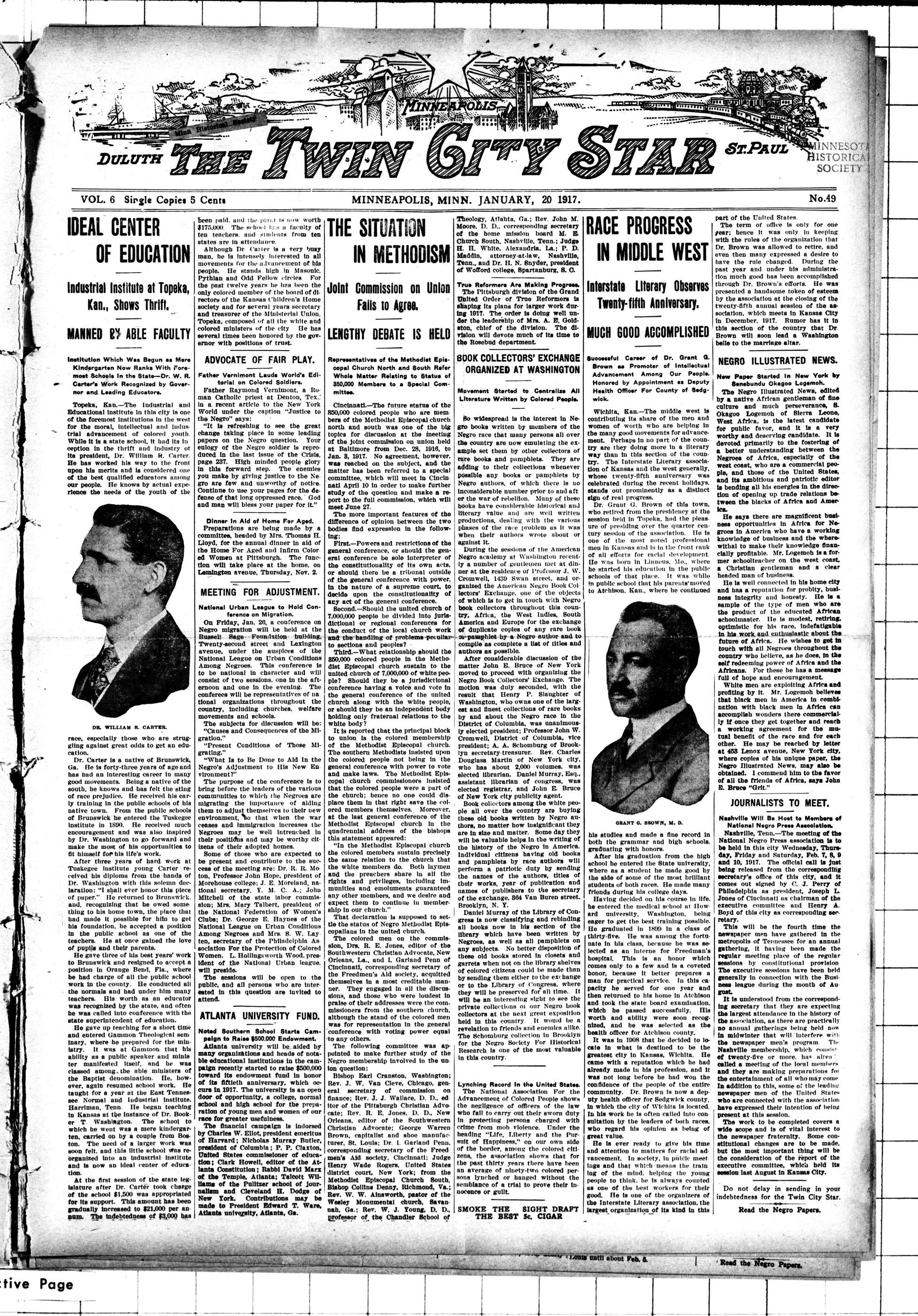
IDEAL CENTER
OF EDUCATION
Industrial Institute at Topeka,
Kan., Shows Thrift.
e
MANNED BY ABLE FACULTY
Institution Which Was Begun as Mere Kindergarten Now Ranks With Foremost Schools In the State—Dr. W. R. Carter's Work Recognized by Governor and Leading Educators.
Topeka, Kan.—The Industrial and Educational institute in this city is one of the foremost institutions in the west for the moral, intellectual and industrial advancement of colored youth. While it is a state school, it had its inception in the thrift and industry of its president, Dr. William R. Carter. He has worked his way to the front upon his merits and is considered one of the best qualified educators among our people. He knows by actual experience the needs of the youth of the
DR. WILLIAM R. CARTER. race, especially those who are struggling against great odds to get an education.
Dr. Carter is a native of Brunswick, Ga. He is forty-three years of age and has had an interesting career in many good movements. Being a native of the south, he knows and has felt the sting of race prejudice. He received his early training in the public schools of his native town. From the public schools of Brunswick he entered the Tuskegee institute in 1890. He received much encouragement and was also inspired by Dr. Washington to go forward and make the most of his opportunities to fit himself for his life's work.
After three years of hard work at Tuskegee institute young Carter received his diploma from the hands of Dr. Washington with this solemn declaration: "I shall ever honor this piece of paper." He returned to Brunswick, and, recognizing that he owed something to his home town, the place that had made it possible for him to get his foundation, he accepted a position in the public school as one of the teachers. He at once gained the love of pupils and their parents.
He gave three of his best years' work to Brunswick and resigned to accept a position in Orange Bend, Fla., where he had charge of all the public school work in the county. He conducted all the normals and had under him many teachers. His worth as an educator was recognized by the state, and often he was called into conference with the state superintendent of education.
He gave up teaching for a short time and entered Gammon Theological seminary, where he prepared for the ministry. It was at Gammon that his ability as a public speaker and minister manifested itself, and he was classed among, the able ministers of the Baptist denomination. He, however, again resumed school work. He taught for a year at the East Tennessee Normal and Industrial Institute, Harriman, Tenn. He began teaching in Kansas at the instance of Dr. Booker T. Washington. The school to which he went was a mere kindergarten, carried on by a couple from Boston. The need of a larger work was soon felt, and this little school was reorganized into an industrial institute and is now an ideal center of education.
At the first session of the state legislature after Dr. Carter took charge of the school $1,500 was appropriated for its support. This amount has been gradually increased to $21,000 per annum. The indebtedness of $3,000 has
been paid, and the plant is now worth $175,000. The school has a faculty of ten teachers, and students from ten states are in attendance.
Although Dr. Carter is a very busy man, he is intensely interested in all movements for the advancement of his people. He stands high in Masonic, Pythian and Odd Fellow circles. For the past twelve years he has been the only colored member of the board of directors of the Kansas Children's Home society and for several years secretary and treasurer of the Ministerial Union, Topeka, composed of all the white and colored ministers of the city. He has several times been honored by the governor with positions of trust.
ADVOCATE OF FAIR PLAY.
Father Vernimont Lauds World's Editorial on Colored Soldiers.
Raymond Vermilton, a Roman Catholic priest at Denton, Tex. in a recent article to the New York World under the caption "Justice to the Negro" says:
"It is refreshing to see the great change taking place in some leading papers on the Negro question. Your eulogy of the Negro soldier is reproduced in the last issue of the Crisis, page 237. High minded people glory in this forward step. The enemies you make by giving justice to the Negro are few and unworthy of notice. Continue to use your pages for the defense of that long oppressed race. God and man will bless your paper for it."
Dinner in Aid of Home For Aged. Preparations are being made by a committee, headed by Mrs. Thomas H. Lloyd, for the annual dinner in aid of the Home For Aged and Infirm Colored Women at Pittsburgh. The function will take place at the home, on Lemington avenue, Thursday, Nov. 2.
MEETING FOR ADJUSTMENT.
National Urban League to Hold Conference on Migration.
On Friday, Jan. 26, a conference on Negro migration will be held at the Russell Sage Foundation building, Twenty-second street and Lexington avenue, under the auspices of the National League on Urban Conditions Among Negroes. This conference is to be national in character and will consist of two sessions, one in the afternoon and one in the evening. The conferences will be representatives of national organizations throughout the country, including churches, welfare movements and schools.
The subjects for discussion will be: "Causes and Consequences of the Migration."
"Present Conditions of Those Migrating."
"What Is to Be Done to Aid In the Negro's Adjustment to His New Environment?"
The purpose of the conference is to bring before the leaders of the various communities to which the Negroes are migrating the importance of aiding them to adjust themselves to their new environment, so that when the war ceases and immigration increases the Negroes may be well intreached in their positions and may be worthy citizens of their adopted homes.
Some of those who are expected to be present and contribute to the success of the meeting are: Dr. R. R. Moton, Professor John Hope, president of Morehouse college; J. E. Moreland, national secretary; Y. M. C. A.; John Mitchell of the state labor commission; Mrs. Mary Talbert, president of the National Federation of Women's Clubs; Dr. George E. Haynes of the National League on Urban Conditions Among Negroes and Mrs. S. W. Layten, secretary of the Philadelphia Association For the Protection of Colored Women. L. Hollingsworth Wood, president of the National Urban league, will preside.
The sessions will be open to the public, and all persons who are interested in this question are invited to attend.
ATLANTA UNIVERSITY FUND.
Noted Southern School Starts Campaign to Raise $500,000 Endowment. Atlanta university will be aided by many organizations and heads of notable educational institutions in the campaign recently started to raise $500,000 toward its endowment fund in honor of its fiftieth anniversary, which occurs in 1917. The university is an open door of opportunity, a college, normal school and high school for the preparation of young men and women of our race for greater usefulness. The financial campaign is indorsed by Charles W. Eliot, president emeritus of Harvard; Nicholas Murray Butler, president of Columbia; P. P. Claxton, United States commissioner of education; Clark Howell, editor of the Atlanta Constitution; Rabbi David Marx of the Temple, Atlanta; Talcott Williams of the Pulitzer school of journalism and Cleveland H. Dodge of New York. Contributions may be made to President Edward T. Ware, Atlanta university, Atlanta, Ga.
THE SITUATION IN METHODISM
LENGTHY DEBATE IS HELD
Representatives of the Methodist Episcopal Church North and South Refer Whole Matter Relating to Status of 350,000 Members to a Special Committee.
Cincinnati.—The future status of the 850,000 colored people who are members of the Methodist Episcopal church north and south was one of the big topics for discussion at the meeting of the joint commission on union held at Baltimore from Dec. 28, 1916, to Jan. 3, 1917. No agreement, however, was reached on the subject, and the matter has been referred to a special committee, which will meet in Cincinnati April 10 in order to make further study of the question and make a report to the full commission, which will meet June 27.
The more important features of the difference of opinion between the two bodies find expression in the following:
First—Powers and restrictions of the general conference, or should the general conference be sole interpreter of the constitutionality of its own acts, or should there be a tribunal outside of the general conference with power, in the nature of a supreme court, to decide upon the constitutionality of any act of the general conference.
Second.—Should the united church of 7,000,000 people be divided into jurisdictional or regional conferences for the conduct of the local church work and the handling of problems peculiar to sections and peoples?
Third.—What relationship should the 350,000 colored people in the Methodist Episcopal church sustain to the united church of 7,000,000 of white people? Should they be a jurisdictional conference having a voice and vote in the general conference of the united church along with the white people, or should they be an independent body holding only fraternal relations to the white body?
It is reported that the principal block to union is the colored membership of the Methodist Episcopal church. The southern Methodists insisted upon the colored people not being in the general conference with power to vote and make laws. The Methodist Episcopal church commissioners insisted that the colored people were a part of the church; hence no one could displace them in that right save the colored members themselves. Moreover, at the last general conference of the Methodist Episcopal church in the quadrennial address of the bishops this statement appeared:
"In the Methodist Episcopal church the colored members sustain precisely the same relation to the church that the white members do. Both laymen and the preachers share in all the rights and privileges, including immunities and emoluments guaranteed any other members, and we desire and expect them to continue in membership in our church."
That declaration is supposed to settle the status of Negro Methodist Episcopalians in the united church.
The colored men on the commission, Drs. R. E. Jones, editor of the Southwestern Christian Advocate, New Orleans, La., and L. Garland Penn of Cincinnati, corresponding secretary of the Freedmen's Aid society, acquitted themselves in a most creditable manner. They engaged in all the discussions, and those who were loudest in praise of their addresses were the commissioners from the southern church, although the stand of the colored men was for representation in the general conference with voting power equal to any others.
The following committee was appointed to make further study of the Negro membership involved in the union question:
Bishop Earl Cranston, Washington;
Rev. J. W. Van Cleve, Chicago, general secretary of commission on finance; Rev. J. J. Wallace, D. D., editor of the Pittsburgh Christian Advocate; Rev. R. E. Jones, D. D., New Orleans, editor of the Southwestern Christian Advocate; George Warren Brown, capitalist and shoe manufacturer, St. Louis; Dr. I. Garland Penn, corresponding secretary of the Freedmen's Ald society, Cincinnati; Judge Henry Wade Rogers, United States district court, New York; from the Methodist Episcopal Church South, Bishop Collins Denny, Richmond, Va.; Rev. W. W. Ainsworth, pastor of the Wesley Monumental church, Savannah, Ga.; Rev. W. W. Young, D. D., professor of the Chandler School of
Theology, Atlanta, Ga.; Rev John M. Moore, D. D., corresponding secretary of the home mission board M. E. Church South, Nashville, Tenn.; Judge H. H. White, Alexandra, La.; P. D. Maddin, attorney-at-law, Nashville, Tenn., and Dr. H. N. Snyder, president of Wofford college, Spartanburg, S. C.
True Reformers Are Making Progress.
The Pittsburgh division of the Grand United Order of True Reformers is shaping its plans for larger work during 1917. The order is doing well under the leadership of Mrs. A. E. Goldston, chief of the division. The division will devote much of its time to the Rosebud department.
BOOK COLLECTORS' EXCHANGE ORGANIZED AT WASHINGTON
Movement Started to Centralize All Literature Written by Colored People.
So widespread is the interest in Negro books written by members of the Negro race that many persons all over the country are now emulating the example set them by other collectors of rare books and pamphlets. They are adding to their collections whenever possible any books or pamphlets by Negro authors, of which there is no inconsiderable number prior to and after the war of rebellion. Many of these books have considerable historical and literary value and are well written productions, dealing with the various phases of the race problem as it was when their authors wrote about or against it.
During the sessions of the American Negro academy at Washington recently a number of gentlemen met at dinner at the residence of Professor J. W. Cromwell, 1439 Swan street, and organized the American Negro Book Collectors' Exchange, one of the objects of which is to get in touch with Negro book collectors throughout this country, Africa, the West Indies, South America and Europe for the exchange of duplicate copies of any rare book or pamphlet by a Negro author and to compile as complete a list of titles and authors as possible.
After considerable discussion of the matter John E. Bruce of New York moved to proceed with organizing the Negro Book Collectors' Exchange. The motion was duly seconded, with the result that Henry P. Slaughter of Washington, who owns one of the largest and finest collections of rare books by and about the Negro race in the District of Columbia, was unanimously elected president; Professor John W. Cromwell, District of Columbia, vice president; A. A. Schomburg of Brooklyn secretary-treasurer. Rev. Charles Douglass Martin of New York city, who has about 2,000 volumes, was elected librarian. Daniel Murray, Esq., assistant librarian of congress, was elected registrar, and John E. Bruce of New York city publicity agent.
Book collectors among the white people all over the country are buying these old books written by Negro authors, no matter how insignificantly they are in size and matter. Some day they will be valuable helps in the writing of the history of the Negro in America. Individual citizens having old books and pamphlets by race authors will perform a patriotic duty by sending the names of the authors, titles of their works, year of publication and names of publishers to the secretary of the exchange, 364 Van Buren street. Brooklyn, N. Y.
Daniel Murray of the Library of Congress is now classifying and rebinding all books now in his section of the library which have been written by Negroes, as well as all pamphlets on any subjects. No better disposition of these old books stored in closets and garrets when not on the library shelves of colored citizens could be made than by sending them either to the exchange or to the Library of Congress, where they will be preserved for all time. It will be an interesting sight to see the private collections or our Negro book collectors at the next great exposition held in this country. It would be a revelation to friends and enemies alike. The Schomburg collection in Brooklyn for the Negro Society For Historical Research is one of the most valuable in this country.
Lynching Record In the United States
The National Association For the Advancement of Colored People shows the negligence of officers of the law who fail to carry out their sworn duty in protecting persons charged with crime from mob violence. Under the heading "Life, Liberty and the Purse of Happiness," on our own side of the border, among the colored citizens, the association shows that for the past thirty years there have been an average of ninety-two colored persons lynched or hanged without the semblance of a trial to prove their innocence or guilt.
SMOKE THE SIGHT DRAFT
THE BEST 5c. CIGAR
RACE PROGRESS IN MIDDLE WEST
Successful Career of Dr. Grant G. Brown as Promoter of Intellectual Advancement Among Our People. Honored by Appointment as Deputy Health Officer for County of Bedgwick.
Wichita, Kan.-The middle west is contributing its share of the men and women of worth who are helping in the many good movements for advancement. Perhaps in no part of the country are they doing more in a literary way than in this section of the country. The Interstate Literary association of Kansas and the west generally, whose twenty-fifth anniversary was celebrated during the recent holidays, stands out prominently as a distinct sign of real progress.
Dr. Grant G. Brown of this town, who retired from the presidency at the session held in Topeka, had the pleasure of presiding over the quarter century session of the association. He is one of the most noted professional men in Kansas and is in the front rank of all efforts for racial development. He was born in Linneus, Mo., where he started his education in the public schools of that place. It was while in public school that his parents moved to Atchison, Kan., where he continued
GRANT G. BROWN, M. D.
his studies and made a fine record in both the grammar and high schools, graduating with honors.
After his graduation from the high school he entered the State university, where as a student he made good by the side of some of the most brilliant students of both races. He made many friends during his college days. Having decided on his course in life, he entered the medical school at Howard university. Washington, being eager to get the best training possible, He graduated in 1890 in a class of thirty-five. He was among the fortunate in his class, because he was selected as an interne for Freedman's hospital. This is an honor which comes only to a few and is a coveted honor, because it better prepares a man for practical service. In this capacity he served for one year and then returned to his home in Atchison and took the state board examination, which he passed successfully. His worth and ability were soon recognized, and he was selected as the health officer for Atchison county.
It was in 1908 that he decided to locate in what is destined to be the greatest city in Kansas, Wichita. He came with a reputation which he had already made in his profession, and it was not long before he had won the confidence of the people of the entire community. Dr. Brown is now a deputy health officer for Sedgwick county, in which the city of Wichita is located. In his work he is often called into consultation by the leaders of both races, who regard his opinion as being of great value. He is ever ready to give his time and attention to matters for racial advancement. In society, in public meetings and that which means the training of the mind, helping the young people to think, he is always counted as one of the best workers for their good. He is one of the organizers of the Interstate Literary association, the largest organization of its kind in this
No.49
part of the United States.
The term of office is only for one year; hence it was only in keeping with the rules of the organization that Dr. Brown was allowed to retire, and even then many expressed a desire to have the rule changed. During the past year and under his administration much good has been accomplished through Dr. Brown's efforts. He was presented a handsome token of esteem by the association at the closing of the twenty-fifth annual session of the association, which meets in Kansas City in December, 1917. Rumor has it in this section of the country that Dr. Brown will soon lead a Washington belle to the marriage altar.
NEGRO ILLUSTRATED NEWS.
New Paper Started In New York by
Sebabundu Okagao Logamoh
Senebundu Okagoo Logemon.
The Negro Illustrated News, edited by a native African gentleman of fine culture and much perseverance, S. Okagoo Logemon of Sierra Leone, West Africa, is the latest candidate for public favor, and it is a very worthy and deserving candidate. It is devoted primarily to the fostering of a better understanding between the Negroes of Africa, especially of the west coast, who are a commercial people, and those of the United States, and its ambitious and patriotic editor is bending all his energies in the direction of opening up trade relations between the blacks of Africa and America.
He says there are magnificent business opportunities in Africa for Negroes in America who have a working knowledge of business and the wherewithal to make their knowledge financially profitable. Mr. Logemon is a former schoolteacher on the west coast, a Christian gentleman and a clear headed man of business.
He is well connected in his home city and has a reputation for probity, business integrity and honesty. He is a sample of the type of men who are the product of the educated African schoolmaster. He is modest, retiring, optimistic for his race, indefatigable in his work and enthusiastic about the future of Africa. He wishes to get in touch with all Negroes throughout the country who believe, as he does, in the self redeeming power of Africa and the Africans. For these he has a message full of hope and encouragement. White men are exploiting Africa and profiting by it. Mr. Logemoh believes that black men in America in combination with black men in Africa can accomplish wonders there commercially if once they get together and reach a working agreement for the mutual benefit of the race and for each other. He may be reached by letter at 458 Lenox avenue, New York city, where copies of his unique paper, the Negro Illustrated News, may also be obtained. I commend him to the favor of all the friends of Africa, says John E. Bruce "Grit."
JOURNALISTS TO MEET.
Nashville Will Be Host to Members of National Negro Press Association.
Nashville, Teen.—The meeting of the National Negro Press association is to be held in this city Wednesday, Thursday, Friday and Saturday, Feb. 7, 8, 9 and 10, 1917. The official call is just being released from the corresponding secretary's office of this city, and it comes out signed by C. J. Perry of Philadelphia as president, Joseph L. Jones of Cincinnati as chairman of the executive committee and Henry A. Boyd of this city as corresponding secretary.
This will be the fourth time the newspaper men have gathered in the metropolis of Tennessee for an annual gathering, it having been made the regular meeting place of the regular sessions by constitutional provision The executive sessions have been held generally in connection with the Business league during the month of August.
It is understood from the corresponding secretary that they are expecting the largest attendance in the history of the association, as there are practically no annual gatherings being held now in midwinter that will interfere with the newspaper men's program. The Nashville membership, which consist of twenty-five or more, has already called a meeting of the local members and they are making preparations for the entertainment of all who may come. In addition to this, some of the leading newspaper men of the United States who are connected with the association have expressed their intention of being present at this session.
The work to be completed covers a wide scope and is of vital interest to the newspaper fraternity. Some constitutional changes are to be made, but the most important thing will be the consideration of the report of the executive committee, which held its session last August in Kansas City.
Do not delay in sending in your indebtedness for the Twin City Star.
Read the Negro Papers.
KEYSTONE BUFFET
1313 Wash
FOR LADIES
Music Every Day fr
Kidd Mitchell, Prop.
LADIES SPECIALLY
PENTICOSTAL.
Peoples Christian Assembly.
1204 Washington Ave. So.
Services Sunday—11 A. M.
Sunday School—1.30 P. M.
Praise Meeting—3 P. M.
Preaching—8 P. M.
ELDER G. W. MITCHELL, Pastor.
Assisted by Mrs. G. W. Mitchell.
Comel and Serve the Lord.
ST. JAMES A. M. E. CHURCH,
407 5th Ave. So.
Morning Service 10:45.
Class Meeting 12 M.
Sunday School 1 P. M.
Evening Service 7:45.
Wednesday evening, Prayermeeting
8 o'clock.
I. WILBER BESS, PASTOR.
BETHESDA BAPTIST CHURCH
1120 Eight St. So., Minneapolis.
Service, Sunday 11 A. M. and 8 P. M.
Sunday School 12:30 P. M.
B. Y. P. U. Society 6:45 P. M.
Prayermeeting Thursday 8 P. M.
D. E. P. Bassel, Shepherd
ZION BAPTIST CHURCH.
7th Ave. North and Hoag St.
Rev. M. W. Withers, Pastor,
Res. 2406 17 Ave. S.
Phone Drexel 600
Regular Services.
Preaching: 11 A. M., 8 P. M.
Sunday School 12:30 P. M.
B Y. P. U. Society 6:45 P. M.
Prayer Meeting Wed. 8 P. M.
A WELCOME TO ALL.
ST. PETER'S A. M. E. CHURCH,
22nd St. Near 10th Ave. So.
THOS. B. STOVALL, Pastor.
Parsonage 2205 Elliot Ave.
N. W. Phone So. 762.
Sunday Services, 11:00 A. M.
Preaching 12:30 P. M. Church Class
1:15 P. M. Sunday School 6:45 P.
M. Allen C. E. League 8:00 P. M.
Preaching. Prayermeeting every
Miss Clara Lucas will receive your advertisements and news Call on her at 506 Boston Block. She is a competent stenographer and will write your letters or handle any business correspondence. All matters confidential.
tive Page
Your Baggage Direct from Maker
NORTHWESTERN TRUNK CO.
Retail Store
248 Nicollet Ave.
HOME COOKING- -CLEAN SERVICE REASONABLE RATES FOR TABLE BOARD.
500 Fourth Avenue So.
N. W. PHONE MAIN 3487, MINNEAPOLIS, MINN.
REGULAR DINNER 25 CENTS
W. S. SIMMONS, Prop.
SUNDAY SERVICE BEGINS AT 11 A. M.
TURKEY DINNER 50c.—CHICKEN DINNER 35c.
THANN'S BUFFET
1313 Wash. Ave. South
FOR LADIES & GENTLEMEN
Music Every Day from 2 P.,M. to 11 P. M.
Kidd Mitchell, Prop. MINNEAPOLIS, MINN
LADIES SPECIALLY INVITED EVERY DAY.
N. W. MAIN 2259
905 Marion St., St. Paul
Phone: Jackson 2079.
PUBLIC STENOGRAPHER.
UFFET
CAFE
STREET
ANN.
of
Statical Folk R. N. TRAVIS, Prop.
UNISHED ROOMS
AT ALL HOURS
Hotel and Cafe Phone: Cedar 9088
Souvenirs for Ladies every
Wednesday afternoon and Evening
I and CLUB CAFE'
A. Ave. South
& GENTLEMEN
from 2 P., M. to 11 P. M.
MINNEAPOLIS, MINN.
INVITED EVERY DAY.
Tel. N. W. Main 2634.
MURRAY'S ORCHESTRA
Music Furnished for
DANCES, WEDDINGS AND
PARTIES
2721 10TH AVE. SO., MINNE-
APOLIS.
If You're in
SIOUX FALLS, S. D.
You'll find Comfort at
WYATTS' ROOMING HOUSE
(Exclusively for Colored People.)
229 West 6th St.
Barber Shop—Cigars
C. J. (Kid.) Wyatt, Prop.
OUR UNDER PRICED
NOW OFFERS MARVELOUS VALUES IN DEPENDABLE, SEASONABLE APPAREL, TO REDUCE STOCKS QUICKLY. COATS, FURS, DRESSES, SUITS, WAISTS, HOUSE-DRESSES AND MILLINERY. At Low Prices that the Economical can not Afford to
E.E. Athinson Co.
LIBERAL SUBSCRIPTION
OFFER.
Special $3.00 Combination.
We offer a Combination Subscription to our readers for 1917. We will give you your choice of any Negro NEWSPAPER or MAGAZINE, and THE TWIN CITY STAR, mailed to your address anywhere in the U. S. for THREE DOLLARS. Cash in advance. Get your home paper sent direct to you. Forward all orders to
THE TWIN CITY STAR, ... Room 302.
305 So. 5th St., Minneapolis.
Send 25 cents in postage stamps for your For Rent Ads.
---
THE TWIN CITY STAR
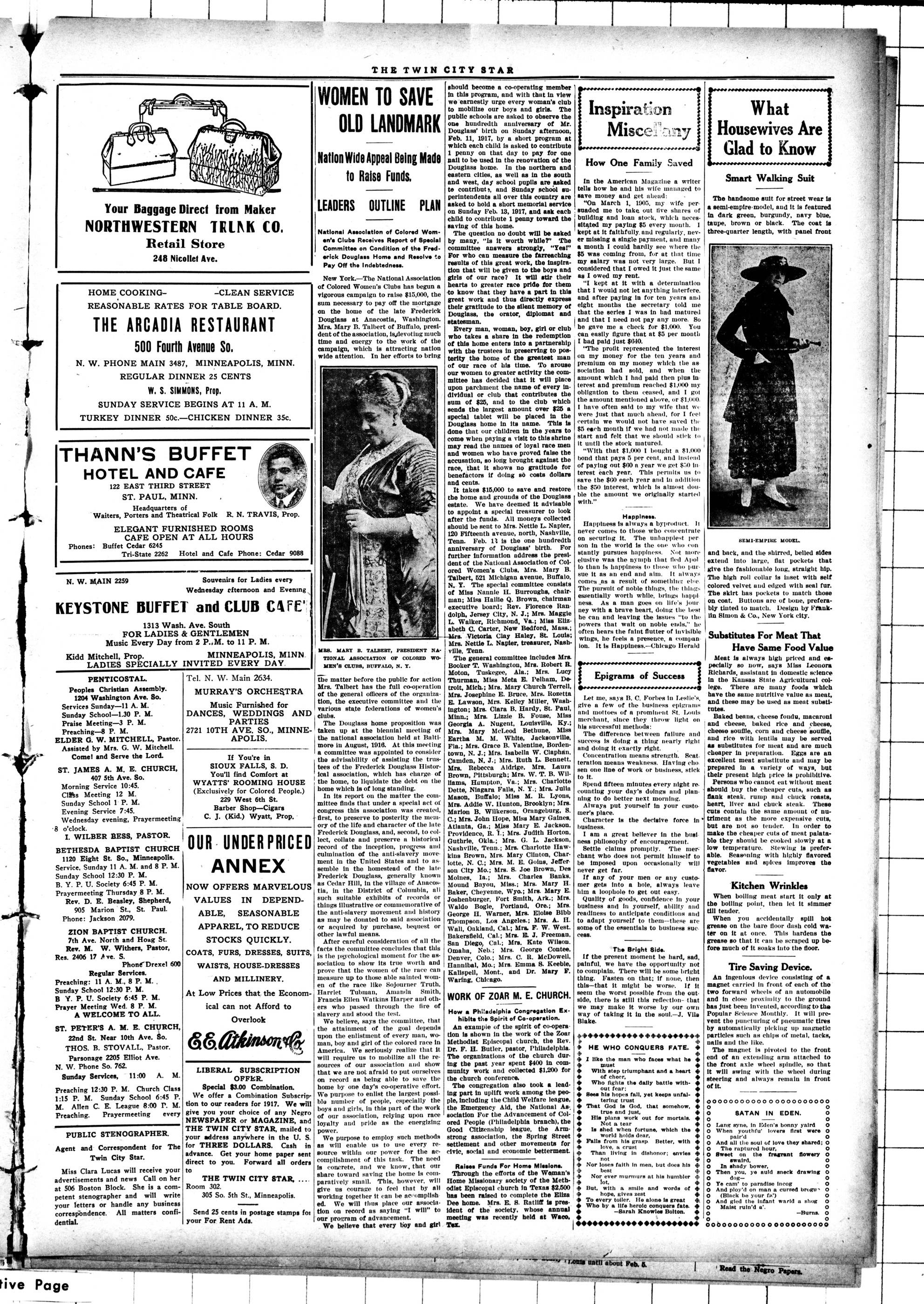
WOMEN TO SAVE OLD LANDMARK
Nation Wide Appeal Being Made to Raise Funds.
National Association of Colored Women's Clubs Receives Report of Special Committee on Condition of the Frederick Douglass Home and Resolve to Pay Off the Indebtedness. New York.-The National Association of Colored Women's Clubs has begun a vigorous campaign to raise $15,000, the sum necessary to pay off the mortgage on the home of the late Frederick Douglass at Anacostia, Washington. Mrs. Mary B. Talbert of Buffalo, president of the association, is devoting much time and energy to the work of the campaign, which is attracting nation wide attention. In her efforts to bring
THE WOMAN WHO WAS THE LADY OF THE WORLD
MRS. MARY B. TALBERT, PRESIDENT NATIONAL ASSOCIATION OF COLORED WOMEN'S CLUBS, BUFFALO, N. Y.
the matter before the public for action Mrs. Talbert has the full co-operation of the general officers of the organization, the executive committee and the various state federations of women's clubs.
The Douglass home proposition was taken up at the biennial meeting of the national association held at Baltimore in August, 1916. At this meeting a committee was appointed to consider the advisability of assisting the trustees of the Frederick Douglass Historical association, which has charge of the home, to liquidate the debt on the home which is of long standing.
In its report on the matter the committee finds that under a special act of congress this association was created, first, to preserve to posterity the memory of the life and character of the late Frederick Douglass, and, second, to collect, collate and preserve a historical record of the inception, progress and culmination of the anti-slavery movement in the United States and to assemble in the homestead of the late Frederick Douglass, generally known as Cedar Hill, in the village of Anacostia, in the District of Columbia, all such suitable exhibits of records or things illustrative or commemorative of the anti-slavery movement and history as may be donated to said association or acquired by purchase, bequest or other lawful means.
After careful consideration of all the facts the committee concludes that this is the psychological moment for the association to show its true worth and prove that the women of the race can measure up to those able sainted women of the race like Sojourner Truth, Harriet Tubman, Amanda Smith, Francis Ellen Watkins Harper and others who passed through the fire of slavery and stood the test.
We believe, says the committee, that the attainment of the goal depends upon the enlistment of every man, woman, boy and girl of the colored race in America. We seriously realize that it will require us to mobilize all the resources of our association and show that we are not afraid to put ourselves on record as being able to save the home by one day's co-operative effort. We purpose to enlist the largest possible number of people, especially the boys and girls, in this part of the work of our association, relying upon race loyalty and pride as the energizing power.
We purpose to employ such methods as will enable us to use every resource within our power for the accomplishment of this task. The need is concrete, and we know, that our share toward saving the home is comparatively small. This, however, will give us courage to feel that by all working together it can be accomplished. We will thus place our association on record as saying "I will" to our program of advancement. We believe that every boy and girl
should become a co-operating member in this program, and with that in view we earnestly urge every woman's club to mobilize our boys and girls. The public schools are asked to observe the one hundredth anniversary of Mr. Douglass' birth on Sunday afternoon, Feb. 11, 1917, by a short program at which each child is asked to contribute 1 penny on that day to pay for one nail to be used in the renovation of the Douglass home. In the northern and eastern cities, as well as in the south and west, day school pupils are asked to contribute, and Sunday school superintendents all over this country are asked to hold a short memorial service on Sunday Feb. 13, 1917, and ask each child to contribute 1 penny toward the saving of this home.
The question no doubt will be asked by many, "Is it worth while?" The committee answers strongly, "Yes!" For who can measure the farreaching results of this great work, the inspiration that will be given to the boys and girls of our race? It will stir their hearts to greater race pride for them to know that they have a part in this great work and thus directly express their gratitude to the silent memory of Douglass, the orator, diplomat and statesman.
Every man, woman, boy, girl or club who takes a share in the redemption of this home enters into a partnership with the trustees in preserving to posterity the home of the greatest man of our race of his time. To arouse our women to greater activity the committee has decided that it will place upon parchment the name of every individual or club that contributes the sum of $25, and to the club which sends the largest amount over $25 a special tablet will be placed in the Douglass home in its name. This is done that our children in the years to come when paying a visit to this shrine may read the names of loyal race men and women who have proved false the accusation, so long brought against the race, that it shows no gratitude for benefactors if doing so costs dollars and cents.
It takes $15,000 to save and restore the home and grounds of the Douglass estate. We have deemed it advisable to appoint a special treasurer to look after the funds. All money collected should be sent to Mrs. Nettle L. Napier, 120 Fifteenth avenue, north, Nashville, Tenn. Feb. 13 is the one hundredth anniversary of Douglass' birth. For further information address the president of the National Association of Colored Women's Clubs, Mrs. Mary B. Talbert, 521 Michigan avenue, Buffalo, N. Y. The special committee consists of Miss Nannle H. Burroughs, chairman; Miss Hallel Q. Brown, chairman executive board; Rev. Florence Randolph, Jersey City, N. J.; Mrs. Maggie L. Walker, Richmond, Va.; Miss Elizabeth C. Carter, New Bedford, Mass. Mrs. Victoria Clay Haley, St. Louis; Mrs. Nettle L. Napier, treasurer, Nashville, Tenn.
The general committee includes Mrs. Booker T. Washington, Mrs. Robert R. Moton, Tuskegee, Ala.; Mrs. Lucy Thurman, Miss Meta E. Pelham, Detroit, Mich.; Mrs. Mary Church Terrell, Mrs. Josephine E. Bruce, Mrs. Rozetta E. Lawson, Mrs. Kelley Miller, Washington, Mrs. Clara B. Hardy, St. Paul, Minn.; Mrs. Lizzie B. Bouse, Miss Georgia A. Nugent, Louisville, Ky.; Mrs. Mary McLeod Bethune, Miss Eartha M. M. White, Jacksonville, Fla.; Mrs. Grace B. Valentine, Bordentown, N. J.; Mrs. Isabella W. Claphan, Camden, N. J.; Mrs. Ruth L. Bennett, Mrs. Rebecca Aldrige, Mrs. Laura Brown, Pittsburgh; Mrs. W. T. B. Willams, Hampton, Va.; Mrs. Charlotte Dette, Niagara Falls, N. Y.; Mrs. Julia Mason, Buffalo; Miss M. R. Lyons, Mrs. Addie W. Hunton, Brooklyn; Mrs. Marlon B. Wilkerson, Orangeburg, S. C.; Mrs. John Hope, Miss Mary Galnes, Atlanta, Ga.; Miss Mary E. Jackson, Providence, R. I.; Mrs. Judith Horton, Guthrie, Okla.; Mrs. G. L. Jackson, Nashville, Tenn.; Mrs. Charlotte Hawkins Brown, Mrs. Mary Clinton, Charlotte, N. C.; Mrs. M. E. Golus, Jefferson City Mo.; Mrs. S. Joe Brown, Des Molines, Ia.; Mrs. Charles Banks, Mound Bayou, Miss.; Mrs. Mary H. Baker, Cheyenne, Wyo.; Mrs. Mary E. Joshenburger, Fort Smith, Ark.; Mrs. Waldo Bogle, Portland, Ore.; Mrs. George H. Warner, Mrs. Eloise Bibb Thompson, Los Angeles.; Mrs. A. H. Wall, Oakland, Cal.; Mrs. F. W. West, Bakersfield, Cal.; Mrs. E. J. Freeman, San Diego, Cal.; Mrs. Kate Wilson, Omaha, Neb.; Mrs. George Contee, Denver, Colo.; Mrs. C. R. McDowell, Hannibal, Mo.; Mrs. Emma S. Keeleb, Kallspell, Mont., and Dr. Mary F. Waring, Chicago.
WORK OF ZOAR M. E. CHURCH
How a Philadelphia Congregation Exhibits the Spirit of Co-operation
An example of the spirit of co-operation is shown in the work of the Zoar Methodist Episcopal church, the Rev. Dr. F. H. Butler, pastor, Philadelphia.
The organizations of the church during the past year spent $400 in community work and collected $1,200 for the church conference.
The congregation also took a leading part in uplift work among the people, including the Child Welfare league, the Emergency Aid, the National Association For the Advancement of Colored People (Philadelphia branch), the Good Citizenship league, the Armstrong association, the Spring Street settlement and other movements for civic, social and economic betterment.
Raises Funds For Home Injuries.
Through the efforts of the Woman's Home Missionary society of the Methodist Episcopal church in Texas $2,500 has been raised to complete the Elliza Dee home. Mrs. E. S. Ratliff is president of the society, whose annual meeting was recently held at Waco, Tex.
Inspiration Miscellany
How One Family Saved
In the American Magazine a writer tells how he and his wife managed to save money and get ahead:
"On March 1, 1905, my wife persuaded me to take out five shares of building and loan stock, which necessitated my paying $5 every month. I kept at it faithfully and regularly, never missing a single payment, and many a month I could hardly see where the $5 was coming from, for at that time my salary was not very large. But I considered that I owed it just the same as I owed my rent.
"I kept at it with a determination that I would not let anything interfere, and after paying in for ten years and eight months the secretary told me that the series I was in had matured and that I need not pay any more. So he gave me a check for $1,000. You can easily figure that at $5 per month I had paid just $640.
"The profit represented the interest on my money for the ten years and premium on my money which the association had sold, and when the amount which I had paid then plus interest and premium reached $1,000 my obligation to them ceased, and I got the amount mentioned above, or $1,000. I have often said to my wife that we were just that much ahead, for I feel certain we would not have saved the $5 each month if we had not made the start and felt that we should stick to it until the stock matured.
"With that $1,000 I bought a $1,000 bond that pays 5 per cent, and instead of paying out $0 a year we get $50 interest each year. This permits us to save the $00 each year and in addition the $50 interest, which is almost double the amount we originally started with."
Happiness.
Happiness is always a byproduct. It never comes to those who concentrate on securing it. The unhappiest person in the world is the one who constantly pursues happiness. Not more elusive was the nymph that died Apolio than is happiness to those who pursue it as an end and alm. It always comes as a result of something else. The pursuit of noble things, the things essentially worth while, brings happiness. As a man goes on life's journey with a brave heart, doing the best he can and leaving the issues "to the powers that wait on noble ends," he often hears the faint flutter of invisible wings, he feels a presence, a companion. It is Happiness. -Chicago Herald
Let me, says B. C. Forbes in Leslie's, give a few of the business epigrams and mottoes of a prominent St. Louis merchant, since they throw light on his successful methods:
The difference between failure and success is doing a thing nearly right and doing it exactly right.
Concentration means strength. Scatteration means weakness. Having chosen one line of work or business, stick to it.
Spend fifteen minutes every night recounting your day's doings and planning to do better next morning.
Always put yourself in your customer's place.
Character is the decisive force in business.
I am a great believer in the business philosophy of encouragement.
Settle claims promptly. The merchant who does not permit himself to be imposed upon occasionally will never get far.
If any of your men or any customer gets into a hole, always leave him a loophole to get out easy.
Quality of goods, confidence in your business and in yourself, ability and readiness to anticipate conditions and to adapt yourself to them—these are some of the essentials to business success.
The Bright Side
If the present moment be hard, sad, painful, we have the opportunity not to complain. There will be some bright thing. Fasten on that; if none, then this—that it might be worse. If it seem the worst possible from the outside, there is still this reflection—that we may make it worse by our own way of taking it in the soul—J. Vila Blake.
HE WHO CONQUERS FATE.
I like the man who faces what he must
With step triumphant and a heart of cheer,
Who fights the daily battle without fear;
Sees his hopes fall, yet keeps unfaltering trust
That God is God, that somehow, true and just,
His plans work out for mortals.
Not a tear
Is shaken when fortune, which the world holds dear.
Falls from his grasp Better, with love, a crust
Than living in dishonor; envies not
Nor loses faith in men, but does his best
Nor ever murmurs at his humbler lot.
But, with a smile and words of love, goes zest
To every toller. He alone is great
Who by a life heroic conquers fate.
—Sarah Knowles Bolton.
What Housewives Are Glad to Know
Smart Walking Suit
The handsome suit for street wear is a semi-empire model, and it is featured in dark green, burgundy, navy blue, taupe, brown or black. The coat is three-quarter length, with panel front
THE FASHION WEEKLY
SEMI-EMPIRE MODEL.
and back, and the shirred, belled sides extend into large, flat pockets that give the fashionable long, straight hip. The high roll collar is inset with self colored velvet and edged with seal fur. The skirt has pockets to match those on coat. Buttons are of bone, preferably tinted to match. Design by Franklin Simon & Co., New York city.
Meat is always high priced and especially so now, says Miss Leonora Richards, assistant in domestic science in the Kansas State Agricultural college. There are many foods which have the same nutritive value as meat, and these may be used as meat substitutes.
Baked beans, cheese fondu, macaroni and cheese, baked rice and cheese, cheese souffle, corn and cheese souffle, and rice with lentils may be served as substitutes for meat and are much cheaper in preparation. Eggs are an excellent meat substitute and may be prepared in a variety of ways, but their present high price is prohibitive.
Persons who cannot eat without meat should buy the cheaper cuts, such as flank steak, rump and chuck roasts, heart, liver and chuck steak. These cuts contain the same amount of nutriment as the more expensive cuts, but are not so tender. In order to make the cheaper cuts of meat palatable they should be cooked slowly at a low temperature. Stewing is preferable. Seasoning with highly flavored vegetables and spices improves the flavor.
Kitchen Wrinkles
When boiling meat start it only at the boiling point, then let it simmer till tender.
When you accidentally spill hot grease on the bare floor dash cold water on it at once. This hardens the grease so that it can be scraped up before much of it soaks into the floor.
Tire Saving Device.
An ingenious device consisting of a magnet carried in front of each of the two forward wheels of an automobile and in close proximity to the ground has just been invented, according to the Popular Science Monthly. It will prevent the puncturing of pneumatic tires by automatically picking up magnetic particles such as chips of metal, tacks, nails and the like.
The magnet is pivoted to the front end of an extending arm attached to the front axle wheel spindle, so that it will swing with the wheel during steering and always remain in front of it.
THE TWIN C.A.Y STAR
PUBLSHED EVERY FRIDAY BY
CHARLES SUMNER SMITH,
305—So. Fifth Street.
Minneapolis, Minnesota
Entered in the Post Office at Minneapolis as second class matter.
MEMBER
NATIONAL NEGRO PRESS
ASSOCIATION
MINNESOTA EDITORIAL ASSN.
To Subscribe Is To Pay.
Subscription by Mail, Postpaid.
ONE YEAR ..... $2.00
SIX MONTHS ..... 1.00
THREE MONTHS ..... .65
ADVERTISING RATES.
One Inch—1 Insertion—One Dollar.
Liberal discount given on 3, 6, 9,
Months, or 1 year contracts.
Want Ads .....Twenty-five Cents
Reading Notices, per line, Five Cents
Wedding Announcements, Fifty Cents
Card of Thanks .....One Dollar,
In Memoriam .....One Dollar
Business Announcements, One Dollar
Death Notices .....One Dollar
We do not run free ads, or over-run
the time contracted for by our ad-
vertisers We respect their right to
advertise at intervals, and rather have
them do so, than to run continuously
an "adv." and an increasing account.
Write all Checks payable to
The Twin City Star.
Address all mail to Twin City Star
303 S. 5th St.
Minneapolis. Minnesota.
The Star Phone is Hyland 5586.
CAUSE OF UNREST AMONG COLORED LABORERS SOUTH
Movement Northward Due to Low Wages and Other Handicaps.
Wilson Jefferson, in concluding in the Evening Post of New York an exhaustive discussion of the effect of the European war upon the colored American, says: To get a glimpse of the possibilities wrapped up in Negro labor one has only to investigate the more progressive of the manufacturing cities of the south. Birmingham, Ala., depends almost wholly upon the Negro for its unskilled and semiskilled labor. Nashville, Atlanta, Memphis and Jacksonville do likewise. But in all of these towns, save in some instances in Birmingham, wages are too low, housing conditions are poor and the advantages for recreation and pleasure exceedingly limited.
It will be from these localities that Negroes will emigrate to the middle west and east and to localities where wages are good and where there are opportunities for pleasure and self improvement. No class of labor remains satisfied indefinitely under oppressive conditions. The Negro laborer is no exception to the rule. He has tried the south. He is willing to try the east and middle west. All he has awaited is a genuine call, based upon a real and lasting need.
This movement eastward and westward of unskilled Negro labor will both directly and indirectly help the professional Negro. The younger element of Negro workers, those of ambition and of some training in the schools, will be constantly emerging from the unskilled to the semiskilled and skilled classes, with a consequent increase in their payrolls and a betterment in their methods of living.
This will give the Negro professional man a hold in many not strictly Negro communities and will give him what a few of his colleagues now possess in the larger centers—a clientele that will be of all colors and of all races. It will allow those of marked natural ability to rise higher in their profession than they would if limited in their practice to only one race and class.
A decidedly better treatment of the Negro, both in the north and in the south, will grow out of this scattering of the race. The old condition grew out of the fact that the demand for his labor has been limited and the supply unlimited. Other influences, some sinister and some not so sinister, have worked against him. In the south it has been that old and seemingly ineradical prejudice which would give to him only those things which the white man did not want.
Not infrequently the ostracism that came to the Negro in the east and middle west came by virtue of the fact that in religion, in race and sometimes in politics he has been an outsider. It is not unnatural in the small community for the priest to intercede with the employer for his flock and for those of his persuasion. Neither is it out of the ordinary for the politician to desire to control jobs out of the narrow range of political appointments. Closer ties still are those of race and language and nationality. The Negro heretofore, with merely sentiment on his side, has not been able to overcome these barriers. But, if all signs fail not, the conflict now raging will so lessen the effectiveness of these agencies that the black man will not find it difficult to win a place and hold it in our larger industrial and economic scheme of things.
SOCIETY OF VIRGINIANS.
Prosperous Brooklyn Corporation Installs Officers For Ensuing Year.
Brooklyn.-The Society of the Sons of Virginia, a large and influential membership organization, chartered under the membership corporation laws of New York, closed its fiscal year clear of debt. The reports of the financial secretary, Peter H. Fisher, Sr., and Treasurer Graham H. Carter showed an increase in both membership and in finance. The amount in benefits paid to members who were ill during the year 1916 increased more than 50 per cent. The same was true of the donations made to various charitable objects.
The annual meeting for the installation of officers was held on Thursday evening, Jan. 4, at which a large number of members from the Ladies' auxiliary and other invited guests were present. The society is now making an effort to increase its membership to
5
N. BARNETT DODSON.
200. The reports showed that seventeen new members were added to the roll in 1916 and that about thirty more would complete the number desired before steps are taken to increase the benefits to members.
The newly elected officers were installed by the Rev. William M. Moss, pastor of the Concord Baptist Church of Christ. They are the following named persons: N. Barnett Dodson, president, elected for the third consecutive year; Eleazer T. Jackson, vice president; Alfred R. Nash, recording secretary; Peter H. Fisher, Sr., financial secretary; Graham H. Carter, treasurer; George Keeling, corresponding secretary; James S. Watkins, sergeant-at-arms, and Giles L. Royster, chaplain.
The new members of the board of directors are Jeremiah Keeling, Charles J. D. Kemp and James F. Flippin. The caterer for the occasion was Isaiah S. Walker, a member of the society. Dr. Clarence H. Richardson is the examining physician.
CAPABLE YOUNG LEADER.
Henry Allen Boyd, Chairman of Y. M. C. A., Nashville, Tenn.
The selection of Henry Allen Boyd as chairman of the committee of management of the Young Men's Christian association, Nashville, Tenn., was a wise one. Mr. Boyd is a young business man of fine qualifications and rich experience, says N. Barnett Dodson. He is an organizer and financier who knows how to manage. Moreover, he has the confidence of the public, and in any matter relating to the improvement of conditions among our people he will receive the hearty cooperation of members of both races in Nashville.
Mr. Boyd's work as a promoter of the Sunday School Congress is well known throughout the country. His success as a business man is equally well known. The Young Men's Christian association workers have but to give the chairman their co-operation and success will reward their efforts. The opportunities afforded members of the association for self help are many, and each should seek to advance himself in his particular line in preparing for future usefulness. When the building recently purchased by the association is put in order for practical use the membership of the branch will increase rapidly. Nashville has hundreds of boys and young men who are anxious to better their condition, and the establishment of the association at this time comes as a great promise to them.
Sunday School Lesson Commentary.
The national Baptist publishing board has presented a complete Sunday school lesson commentary, containing the international lesson series, for the study of ministers, superintendents, teachers and Bible students in the Sunday school. The book is prepared under the direction of Rev. R. H. Boyd, D. D., LL. D., secretary of the national Baptist publishing board, and is edited by Rev. W. S. Ellington, A. B., D. D., the editorial secretary.
The book is printed and bound at the National Baptist Publishing House, Nashville, Tenn. The expositions of the lessons for 1917 are treated in a scholarly manner.
Hill Heads League's Chicago Branch. T. Arnold Hill is making good as manager of the Chicago branch of the National League on Urban Conditions. He has had quite a large experience in social work, having been trained at the headquarters of the league in New York. Chicago is a big field, and Mr. Hill will no doubt find many perplexing problems with which to deal.
THE TWIN CITY STAR
STYLUS CLUB'S RECEPTION.
College Organization Entertains Prominent Leaders at Woodstock
Ment Leaders at Washington.
The Stylus, a student organization founded by Professors Montgomery Gregory and A. Leroy Locke in 1916 recently tendered a book to John E. Bruce "Grit," president, and Senor Arturo Alfonso Schomburg, secretary of the Negro Society For Historical Research of New York, both of whom are honorary members of the Stylus in Miner hall of Howard university.
The reception was attended by noted educators and professional men and women. The purpose of the Stylus is to encourage original literary expression among the students of the college of liberal arts of Howard university, with an especial view to the stimulation and development of productive authorship in the race and for the furtherance of this purpose the bringing together of persons able and willing to co-operate for this end. The guests of honor and the following named gentlemen were present:
Dean Kelly Miller of Howard university, Dean William Pickens of Morgan college, Baltimore; Professor W. A. Joiner of Wilberforce university, Dr. Edward L. Parkes, treasurer of Howard university; Professor Herman Moens of the Netherlands, Professor John W. Cromwell, secretary of the American Negro academy; John R. Clifford, editor of the Pioneer Press, Martinsburg, W. Va.; J. R. Murray of Alexandria, Va.; Robert A. Pelham of the United States census bureau, Rev Dr. Bragg of Baltimore, R. W. Logan of Williams college, E. L. Davidson of Harvard university, Dr. and Mrs. W. V. Tunnell of Howard university, Dr E. Albert Cooke, Mrs. Emma Brown and F. Holland.
When the last of the invited guests had arrived and the introductions were over the company formed in line and, led by Professor Montgomery Gregory, marched from the spacious reception room to the chapel of Miner hall, where all were seated, when Professor Gregory stated that the reception was given by the Stylus in honor of visiting members of the American Negro academy and to honor two of its honorary members, Messrs. John E. Bruce "Grit" and Senor A. A. Schomburg, also members of the American Negro academy, to whom the Stylus feels greatly indebted for many courtesies.
Its members are proud to have on its honorary roll of membership such useful and valuable men as Messrs Bruce and Schomburg. Professor Gregory then called on Mr. Schomburg to make a few informal remarks which he did. Mr. Bruce followed. Both expressed themselves as being keenly appreciative of the honor paid them by the Stylus and of the work to which the club is devoting itself and pledged themselves to co-operate with it in any way they could. Rapid fire addresses were given by Professor William Pickens. Rev. Mr. Bragg, J. R. Clifford, F. H. M. Murray, Professor J. W. Cromwell, Professor Herman Moens, Professor W. A. Joiner, Professor G. W. Cook, Dean Kelly Miller and members of the Stylus club.
DR. E. P. ROBERTS' NEW POST.
Appointed to New York Education Board by Mayor Mitchel. The National Urban league has succeeded in getting Dr. E. P. Roberts appointed by Mayor Mitchel as a member of the board of education of the city of New York. This is the first time in the history of the Greater City that a colored man has received this distinction, although three in the past have been thus honored by the city of Brooklyn prior to 1899.
The league has appointed Miss Patricia Ferguson of Chicago, a graduate of the University of Michigan, to one of the league's "broken fellowships," which will give Miss Ferguson an opportunity to do practical work with the league in preparation for social work as a life's career. Miss Ferguson comes well recommended as to scholarship and general standing at the university. She was a member of the women's varsity basketball, track and baseball teams. She studied music for four years at the Ann Arbor Conservatory of Music.
The league will hold a national conference on negro migration Friday, Jan. 28 at the Russell Sage foundation building, East Twenty-second street and Lexington avenue. Representatives of national and local welfare organizations and large employers of negro labor in the north are expected to be present. The purpose is to settle definitely on a national policy and on methods to be used in aiding Negroes to adjust themselves to city life in their new environment. Persons interested should correspond with E. K. Jonce, executive secretary, 2008 Seventh avenue, New York city.
The efforts of the league in co-operation with the Burke foundation and the committee on prevention of heart disease to provide clinical facilities for Negroes afflicted with heart disease have been rewarded by the announcement that the Bellevue board of trustees has decided to open within a month a cardiac class at the Harlem hospital.
The league has employed a boys' club worker who will give his whole time to conducting boys' clubs in Harlem welfare centers. Clubs are to be located at the Music School settlement and probably at the Alpha Physical club and one or two of the churches. The boys will be trained in athletics, club management, including principles of self government and rules of order, and will in the summer be taken to the league's boys' camp.
SIX GOOD REASONS
Why You Should Join The National Association for the Advancement of Colored People.
1. It teaches that race prejudice is the most evil thing in the world today and that "Jim Crow" cars, race accorded all their social, civil and political rights and will receive exact justice in all the relations of segregation, anti-intermarriage laws and all other manifestations of it are unchristian and cruel efforts of the stronger to oppress the weaker.
2. It combats in the courts, state legislatures, the Halls of Congress, the government departments and everywhere the spirit of persecution against the Colored People which grows out of race prejudice.
3 It aims to bring about such a healthy public sentiment in this land that Colored People will be accorded all their social, civil and political rights and will receive exact justice in all the relations of life.
4. It believes in and teaches the doctrine of the Fatherhood of God and the brotherhood of man, and the equality of all races in our American civilization.
5. It aims to uphold the honor of our women by opposing the passage of anti-race inter-marriage laws.
6. It is composed of members of both races and sexes on terms of complete equality and as brothers and sisters in this holy cause of freedom.
The Association needs money and new members. It costs just one dollar to join. If you believe in fair play, in fighting for your rights, if you believe in organization and co do your bit toward advancing the race and therby helping to make human brotherhood a reality and not a fiction
Send One Dollar to the undersigned and join in this great work.
Sec'y R. A. Skinner, 2817 Chicago Ave., Minneapolis.
SCALP TREATMENT and HAIR GROWING
MRS. Maggie Martin wishes to announce that she is the Minneapolis Agent for MADAM C. J. WALKER'S Wonderful Hair Grower and Preparations. Special attention given to Tetter, Eczema and Growing hair on Personal Instructions and Demontemples. A full line of Goods. strations can be obtained at
MRS. MAGGIE MARTIN. AGT' N. W. PHONE SOUTH. 1742
J & H Wet
We maintain that we can wash
We make this claim, because
dries in the United States.
OUR PRICE IS 25 POUNDS OF
WHEAT DRY.
J & H Wet Wash Laundry 3753 55,57 CEDAR AVE.
J&H WET WASH LAUNDRY
3753 ST CEDAR AVE
J&H WET WASH LAUNDRY
We maintain that we can wash cheaper and better than the housewife.
We make this claim, because we have one of the largest, most modern and sanitary Wet Wash Laun-
dries in the United States.
OUR PRICE IS 25 POUNDS OF FAMILY WASHING FOR 65 CENTS. CLOTHES WEIGHED
WHEN DRY.
Our Auto-trucks and wagons deliver Everywhere.
CALL SNELLING 1509. DREXEL 1269.
Atlanta University Half Century Old.
Atlanta university has started a financial campaign to raise funds for endowment purposes, to be reported at the semicentennial celebration of the founding of the institution, which will be held in 1917. The first gift from a member of our race was $250 from a person who has children and grandchildren who are graduates of this not-
ed institution at Atlanta, Ga., which has an enrollment of 540 students.
Spirella
CORSETS
(NOT SOLD IN STORES)
Dr. Elbert New State College Trustees
The colored people of Wilmington
Del, are much gratified over the recent recognition accorded Dr. Samuel G. Elbert by his appointment to the trustee board of State college by Governor Miller. Although State college is composed of colored students, Dr. Elbert is the first man of the race to hold the position of trustee. He is well and favorably known throughout the state and was one of the late Dr. Booker T. Washington's warmest friends. The institution is located near Dover.
SEND US THE NEWS.
SEND YOUR SUBSCRIPTION
---
STOP! LOOK! The Only Colored MEAT MARKET
IN MINNEAPOLIS,
AT 429 SIXTH AVENUE NORTH
IN CONNECTION WITH
THE CUT RATE GROCERY STORE
P. J. Buford, W. W. Humphrey, F. L. Jemison
Not the biggest but the best. Our prices as low as the rest.
We deliver to all parts of the city.
Call N. W. Main 2515 or Res. Nic. 2421 and the Cut-Rate
People will give you prompt service day or night.
The Waiters' and Porters' Club
GLOVER SHULL, PRES.
311 HENNEPIN AVE. MINNEAPOLIS
EDDIE BOYD, SECY' LEE WHEELER, MANAGER
F. PEOPLES
HOME BUILDING CO.
CONTRACTORS AND BUILDERS
818 METROPOLITAN LIFE BLDG.
OFFICE PHONE NIC. 1534
don't need money; if you own your lot.
I BUILD HOMES ON MONTHLY PAYMENTS.
COTTAGES AND FOUR FAMILY FLATS
LIKE PAYING RENT. PLANS FREE
Beer is Strengthening
PURITY BREWING CO.
The Leading Bottle Beer Brewery
Both Phones 66 MINNEAPOLIS, MINN.
WET WASH LAUNDRY
better than the housewife.
of the largest, most modern and sanitary Wet Wash Laun-
WASHING FOR 65 CENTS. CLOTHES WEIGHED
Our Auto-trucks and wagons deliver Everywhere.
NG 1509. DREXEL 1269.
pirella
CORSETS
(NOT SOLD IN STORES)
De
311
EDD
F. People.
You don't
I BUIL
COTT
ITS JUST LIKE
Good T
Kabotee
PURITY BREWING CO.
PURITY BREWING CO.
Order a Case Today
There is strength in pure beer like
Hochsteiner
LAGER
Brewed under sanitary condition
Purest of ingredients
The beer without a headache
PURITY BREWING CO.
The Leading Bottle Beer Brewery
Both Phones 66 MINNEAPOLIS, MINN
will give you lithe, uncorseted grace and constant comfort, yet mould your figure to the present fashion. They are fitted to your measure in your own home by a trained corsetiere—the Spirella way. A telephone call or post-card will bring an expert to your home to explain the Spirella service and boning in detail. Spirella Corset Shop CORA E. ANDERSON 360 Aurora Ave. St. Paul, W'nn
Handshake
Defective Pag