Twin City Star
Saturday, April 7, 1917
Minneapolis, Minnesota
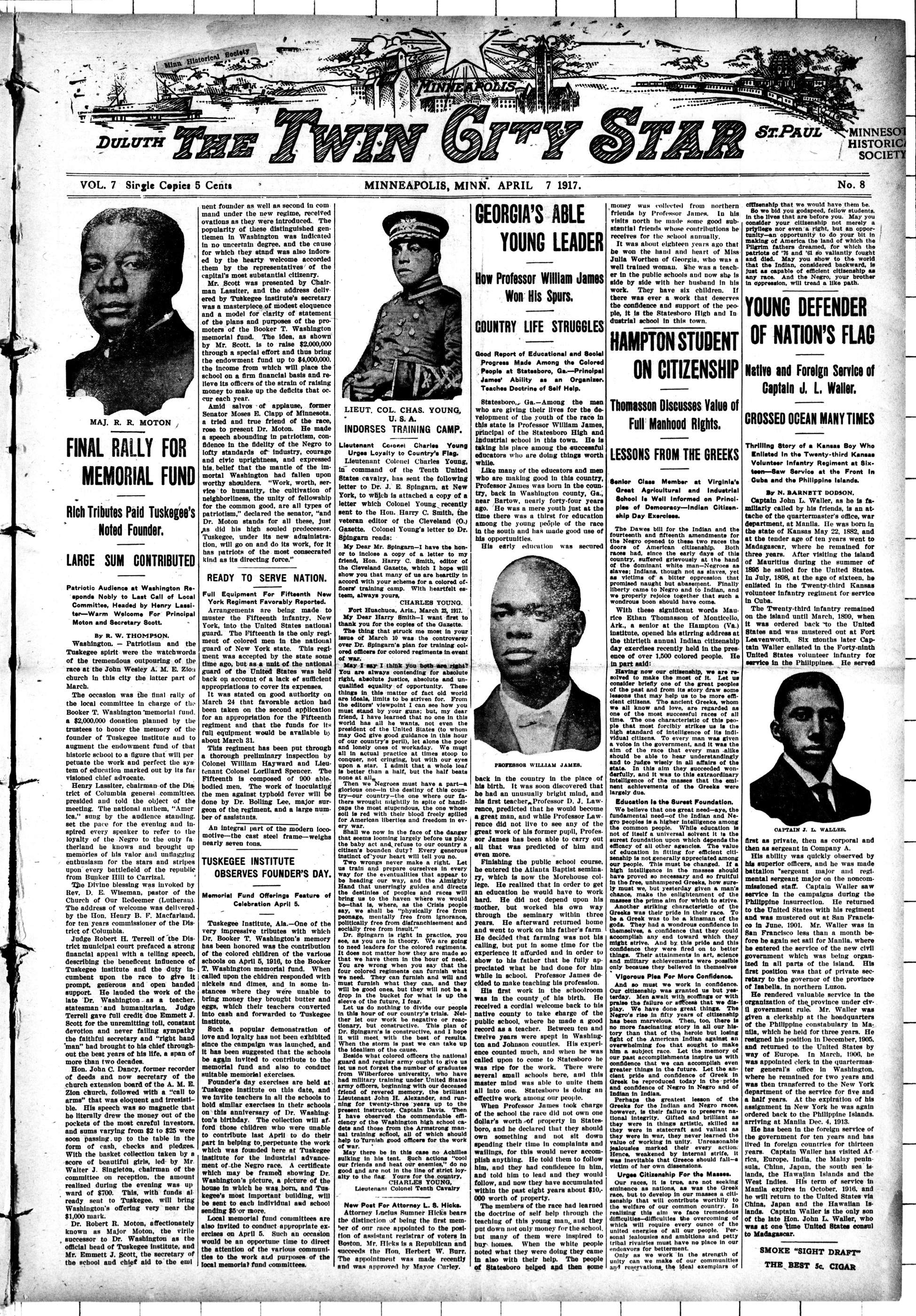
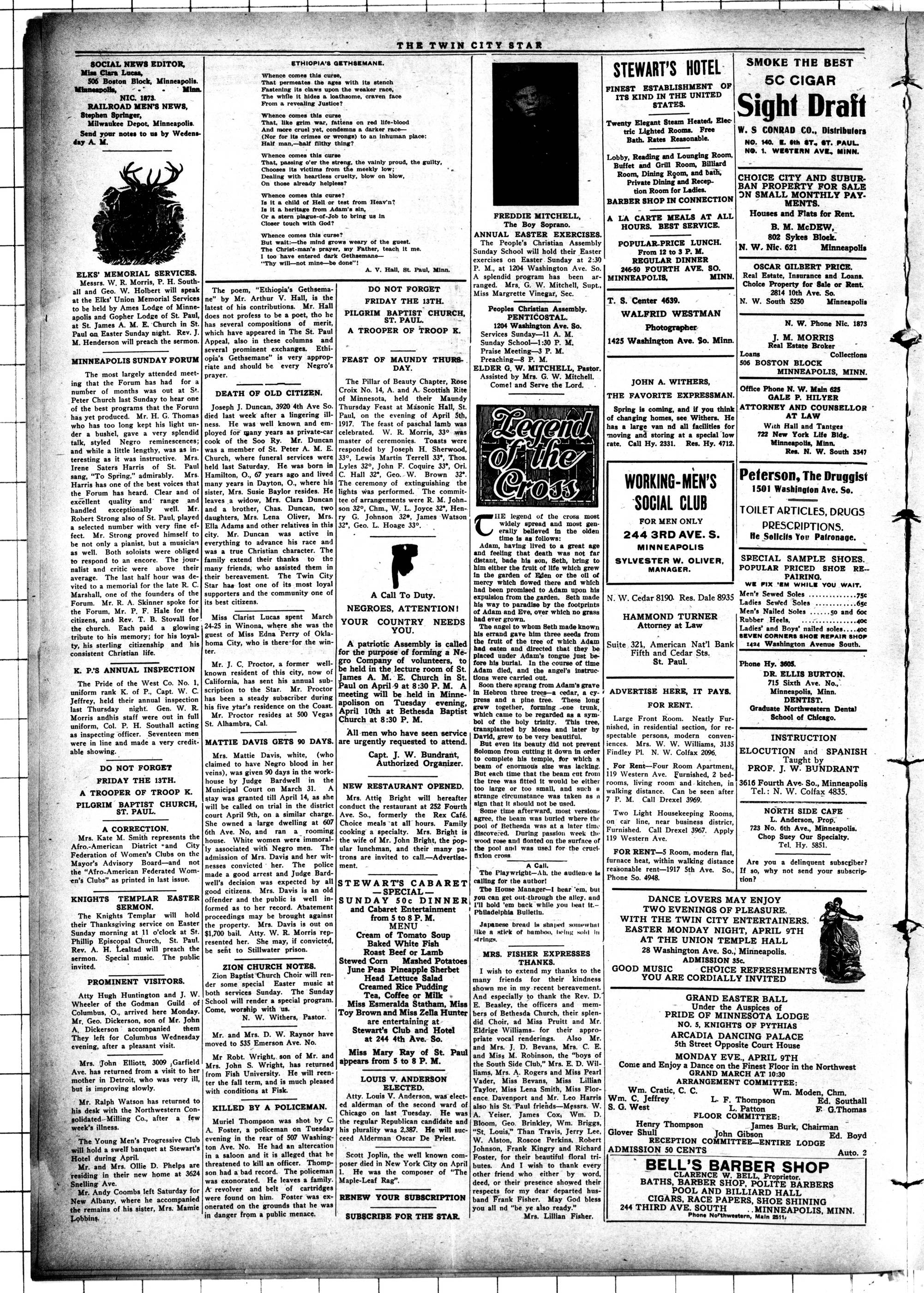
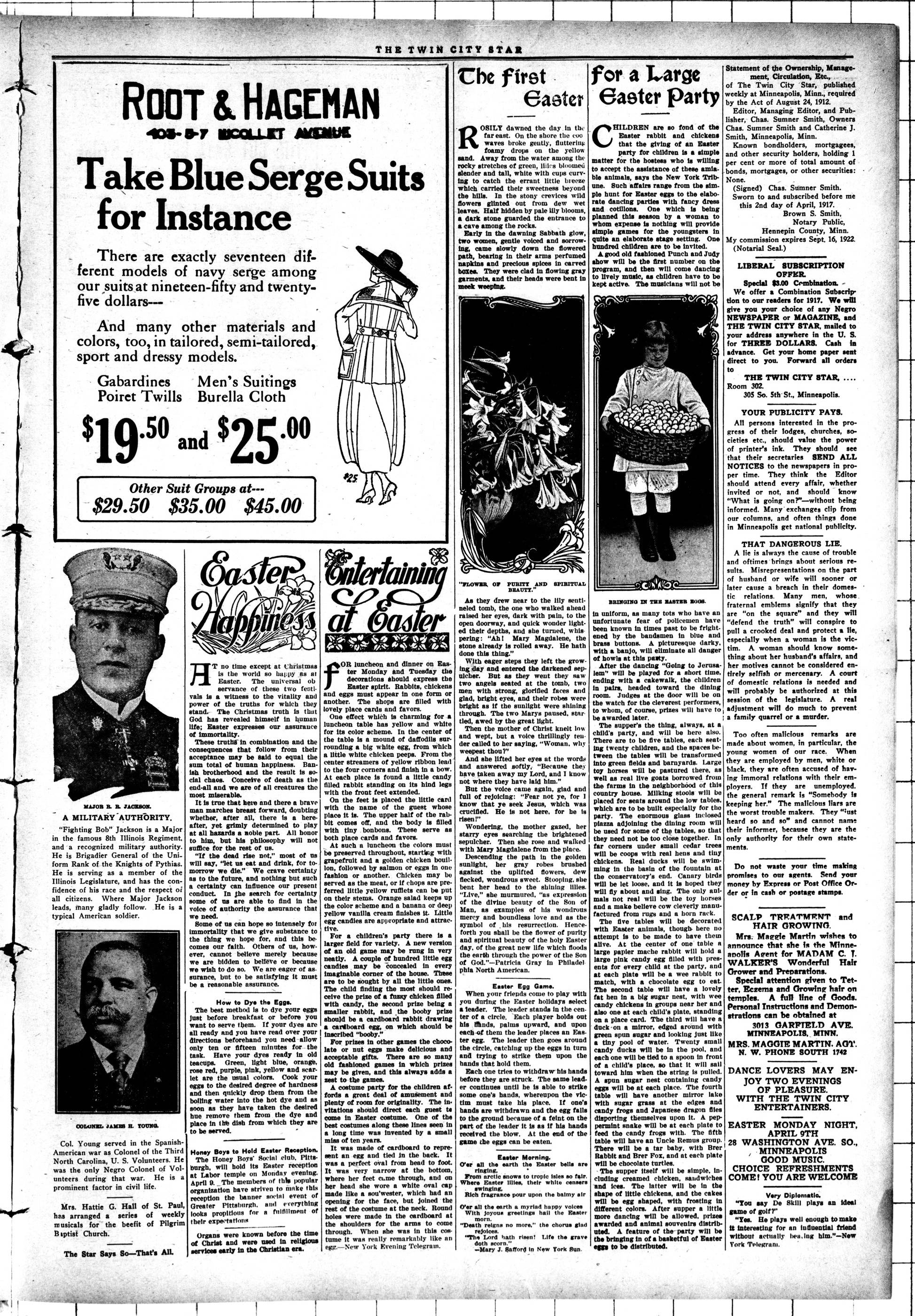
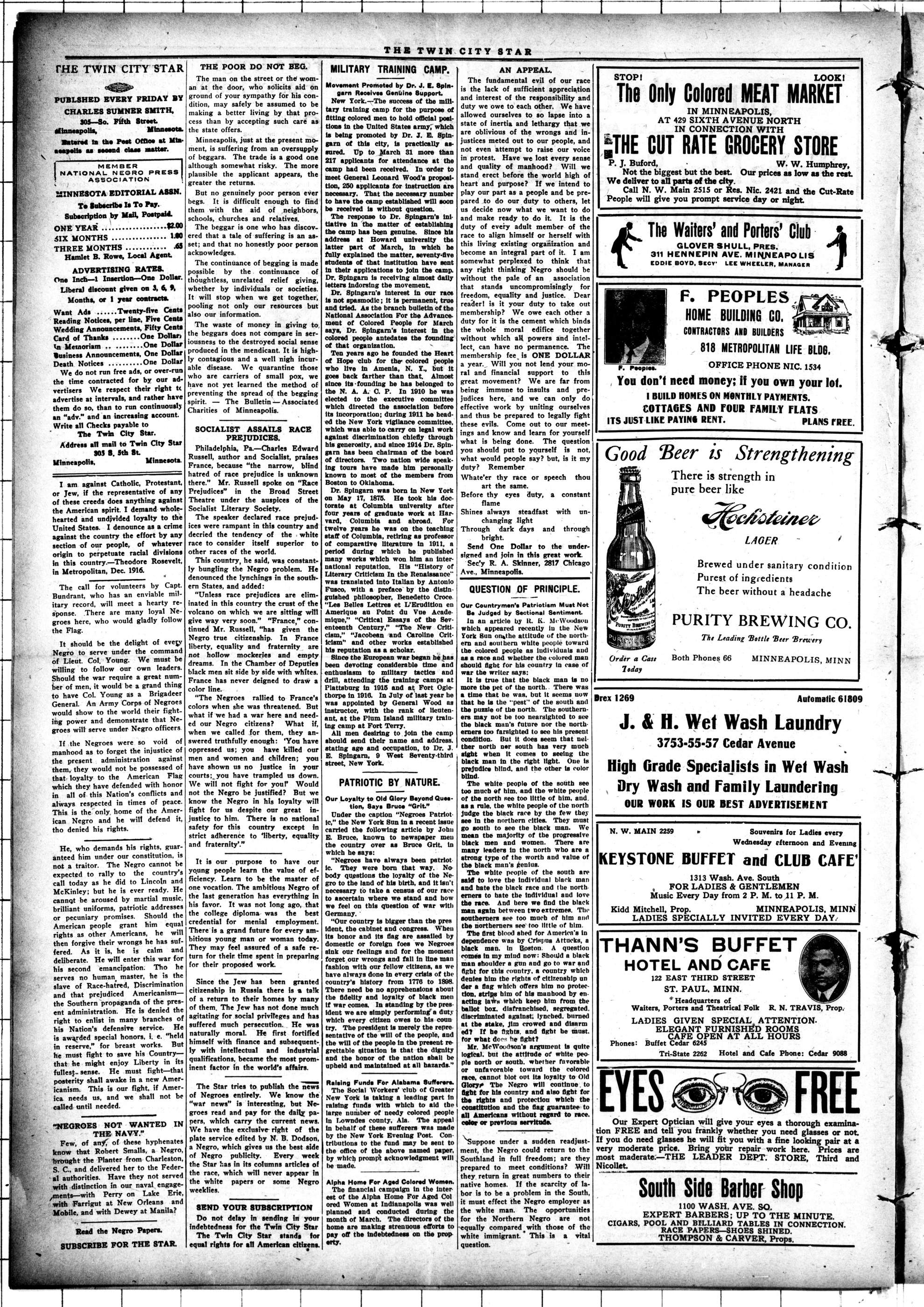
Page text (machine-generated)
DULUTH THE TWIN CITY STAR ST.PAUL MINNESOTA HISTORICAL SOCIETY
MAJ. R. R. MOTON
FINAL RALLY FOR MEMORIAL FUND
Rich Tributes Paid Tuskegee's Noted Founder.
LARGE SUM CONTRIBUTED
Patriotic Audience at Washington Responds Nobly to Last Call of Local Committee, Headed by Henry Lassiter—Warm Welcome For Principal Moton and Secretary Scott.
By R. W. THOMPSON.
Washington. — Patriotism and the Tuskegee spirit were the watchwords of the tremendous outpouring of the race at the John Wesley A. M. E. Zion church in this city the latter part of March.
The occasion was the final rally of the local committee in charge of the Booker T. Washington memorial fund, a $2,000,000 donation planned by the trustees to honor the memory of the founder of Tuskegee institute and to augment the endowment fund of that historic school to a figure that will perpetuate the work and perfect the system of education marked out by its far visioned chief advocate.
Henry Lassiter, chairman of the District of Columbia general committee, presided and told the object of the meeting. The national anthem, "America," sung by the audience standing, set the pace for the evening and inspired every speaker to refer to the loyalty of the Negro to the only fatherland he knows and brought up memories of his valor and unflagging enthusiasm for the stars and stripes upon every battlefield of the republic from Bunker Hill to Carrizal.
The Divine blessing was invoked by Rev. D. E. Wiseman, pastor of the Church of Our Redeemer (Lutheran). The address of welcome was delivered by the Hon. Henry B. F. Macfarland, for ten years commissioner of the District of Columbia.
Judge Robert H. Terrell of the District municipal court prefaced a strong financial appeal with a telling speech, describing the beneficent influence of Tuskegee institute and the duty incumbent upon the race to give it prompt, generous and open handed support. He lauded the work of the late Dr. Washington as a teacher, statesman and humanitarian. Judge Terrell gave full credit due Emmett J. Scott for the unremitting toll, constant devotion and never failing sympathy the faithful secretary and "right hand man" had brought to his chief throughout the best years of his life, a span of more than two decades.
Hon. John C. Dancy, former recorder of deeds and now secretary of the church extension board of the A. M. E. Zion church, followed with a "call to arms" that was eloquent and irresistible. His speech was so magnetic that he literally drew the money out of the pockets of the most careful investors, and sums varying from $2 to $25 were soon passing up to the table in the form of cash, checks and pledges. With the basket collection taken by a score of beautiful girls, led by Mr. Walter J. Singleton, chairman of the committee on reception, the amount realized during the evening was upward of $700. This, with funds already sent to Tuskegee, will bring Washington's offering very near the $1,000 mark.
Dr. Robert R. Moton, affectionately known as Major Moton, the virile successor to Dr. Washington as the official head of Tuskegee institute, and Mr. Emmett J. Scott, the secretary of the school and chief aid to the eml
nent founder as well as second in command under the new regime, received ovations as they were introduced. The popularity of these distinguished gentlemen in Washington was indicated in no uncertain degree, and the cause for which they stand was also indorsed by the hearty welcome accorded them by the representatives of the capital's most substantial citizenry. Mr. Scott was presented by Chairman Lassiter, and the address delivered by Tuskegee institute's secretary was a masterpiece of modest eloquence and a model for clarity of statement of the plans and purposes of the promoters of the Booker T. Washington memorial fund. The idea, as shown by Mr. Scott, is to raise $2,000,000 through a special effort and thus bring the endowment fund up to $4,000,000, the income from which will place the school on a firm financial basis and relieve its officers of the strain of raising money to make up the deficits that occur each year.
Amid salvos of applause, former Senator Moses E. Clapp of Minnesota, a tried and true friend of the race, rose to present Dr. Moton. He made a speech abounding in patroltism, confidence in the fidelity of the Negro to lofty standards of industry, courage and civic uprightness, and expressed his belief that the mantle of the immortal Washington had fallen upon worthy shoulders. "Work, worth, service to humanity, the cultivation of neighborliness, the unity of fellowship for the common good, are all types of patriotism," declared the senator, "and Dr. Moton stands for all these, just as did his high souled predecessor. Tuskegee, under its new administration, will go on and do its work, for it has patriots of the most consecrated kind as its directing force."
READY TO SERVE NATION.
Full Equipment For Fifteenth New York Regiment Favorably Reported.
Arrangements are being made to muster the Fifteenth infantry, New York, into the United States national guard. The Fifteenth is the only regiment of colored men in the national guard of New York state. This regiment was accepted by the state some time ago, but as a unit of the national guard of the United States was held back on account of a lack of sufficient appropriations to cover its expenses.
It was stated on good authority on March 24 that favorable action had been taken on the second application for an appropriation for the Fifteenth regiment and that the funds for its full equipment would be available by about March 31.
This regiment has been put through a thorough preliminary inspection by Colonel William Hayward and Lieutenant Colonel Lorillard Spencer. The Fifteenth is composed of 900 able-bodied men. The work of inculating the men against typhoid fever will be done by Dr. Bolling Lee, major surgeon of the regiment, and a large number of assistants.
An integral part of the modern locomotive—the cast steel frame—weighs nearly seven tons.
Memorial Fund Offerings Feature of Celebration April 5.
Tuskegee Institute, Ala.—One of the very impressive tributes with which Dr. Booker T. Washington's memory has been honored was the contribution of the colored children of the various schools on April 5, 1916, to the Booker T. Washington memorial fund. When called upon the children responded with nickels and dimes, and in some instances where they were unable to bring money they brought butter and eggs, which their teachers converted into cash and forwarded to Tuskegee institute.
Such a popular demonstration of love and loyalty has not been exhibited since the campaign was launched, and it has been suggested that the schools be again invited to contribute to the memorial fund and also to conduct suitable memorial exercises.
Founder's day exercises are held at Tuskegee institute on this date, and we invite teachers in all the schools to hold similar exercises in their schools on this anniversary of Dr. Washington's birthday. The collection will afford those children who were unable to contribute last April to do their part in helping to perpetuate the work which was founded here at Tuskegee institute for the industrial advancement of the Negro race. A certificate which may be framed showing Dr. Washington's picture, a picture of the house in which he was born, and Tuskegee's most important building, will be sent to each individual and school sending $5 or more. Local memorial fund committees are also invited to conduct appropriate exercises on April 5. Such an occasion would be an opportune time to direct the attention of the various communities to the work and purposes of the local memorial fund committees.
MINNEAPOLIS, MINN. APRIL 7 1917.
GEORGIA'S ABLE
YOUNG LEARN
How Professor William J.
Won His Spurs.
COUNTRY LIFE STRUGG
Good Report of Educational and
Progress Made Among the G
People at Statesboro, Ga.—Pr
James' Ability as an Org
Teaches Doctrine of Self Help.
Lieutenant Colonel Charles Young
Urges Loyalty to Country's Flag.
Lieutenant Colonel Charles Young,
in command of the Tenth United
States cavalry, has sent the following
letter to Dr. J. E. Spingarn, at New
York, to which is attached a copy of a
letter which Colonel Young recently
sent to the Hon. Harry C. Smith, the
veteran editor of the Cleveland (O.)
Gazette. Colonel Young's letter to Dr.
Spingarn reads:
My Dear Mr. Spingarn—I have the honor
to inclose a copy of a letter to my
friend, Hon. Harry C. Smith, editor of
the Cleveland Gazette, which I hope will
show you that many of us are heartily in
accord with your scheme for a colored
officers' training camp. With heartfelt esteem, always youre,
CHARLES YOUNG.
Fort Huachuca, Ariz, March 23, 1917.
My Dear Harry Smith—I want first to
thank you for the copies of the Gazette.
The thing that struck me most in your
issue of March 10 was the controversy
over Dr. Spingarn's plan for training colored officers for colored regiments in event of war.
May I say I think you both are right! You are always contending for absolute right, absolute justice, absolute and unqualified equality of opportunity. These things in this matter of fact old world are ideals, limits to be striven for. From the editors' viewpoint I can see how you must stand by your guns; but, my dear friend, I have learned that no one in this world has all he wants, not even the president of the United States (to whom may God give good guidance in this hour of our country's peril), let alone the poor and lonely ones of workaday. We must all in actual practice at times stoop to conquer, not cringing, but with our eyes upon a star. I admit that a whole leaf is better than a half, but the half beats none at all.
Then we Negroes must have a part-a-girl one—in the destiny of this country—our country—the one where our fathers wrought mightily in spite of handicaps the most stupendous, the one whose soil is red with their blood freely spilled for American liberties and freedom in every war.
Shall we now in the face of the danger that seems looming largely before us play the baby act and refuse to our country a citizen's bounded duty? Every generous instinct of your heart will tell you no.
Two wrongs never make a right. Let us train and prepare ourselves in every way for the eventualities that appear to be heading our way, and the Almighty Hand that unerringly guides and directs us. We must be willing and will bring us to the haven where we would be—that is, where, as the Crisis people say, we shall be "physically free from peonage, mentally free from ignorance, politically free from disfranchisement and socially free from insult."
Dr. Spingarn is right in practice, you see, as you are in theory. We are going to need leaders for the colored regiments. It does not matter how they are made so that we have them in the hour of need. You are wrong when you say that the four colored regiments can furnish what we need. They can furnish and will and will be good ones, but they will not be a drop in the bucket for what is up the sleeve of the future, I fear.
Let us do nothing to divide our people in this hour of our country's trials. Nelther let our work be negative or reactionary, but constructive. This plan of Dr. Spingarn's is constructive, and I hope it will meet with the best of results. When the storm is past we can take up the idealism of the cause.
Beside what colored officers the national guard and regular army ought to give us use for them, the number of troops from Wilberforce, the university, who had military training under United States army officers, beginning with the deceased friend of revered memory, the brilliant Leutenant John H. Alexander, and running for twenty-three years up to the present instructor, Captain Davis. Then I have observed the commendable efficiency of the Washington high school cadets and those from the Armstrong manual training school, all of which should help to furnish good officers for the work of war.
There be in this case no Achilles sulking in his tent. Such actions "cool our friends and heat our enemies," do no good and are not in the line of strict loyalty to the flag. Yours for the country, CHARLES YOUNG, Lieutenant Colonel Tenth Cavalry.
New Post For Attorney L. S. Hicke.
GEORGIA'S ABLE YOUNG LEADER
COUNTRY LIFE STRUGGLES
Good Report of Educational and Social Progress Made Among the Colored People at Statesboro, Ga.—Principal James' Ability as an Organizer, Teaches Doctrine of Self Help.
Statesboro, Ga.—Among the men who are giving their lives for the development of the youth of the race in this state is Professor William James, principal of the Statesboro High and Industrial school in this town. He is taking his place among the successful educators who are doing things worth while.
Like many of the educators and men who are making good in this country, Professor James was born in the country, back in Washington county, Ga., near Bartow, nearly forty-four years ago. He was a mere youth just at the time there was a thirst for education among the young people of the race in the south and has made good use of his opportunities.
His early education was secured
PROFESSOR WILLIAM JAMES.
back in the country in the place of his birth. It was soon discovered that he had an unusually bright mind, and his first teacher Professor D. J. Lawrence, predicted that he would become a great man, and while Professor Lawrence did not live to see any of the great work of his former pupil, Professor James has been able to carry out all that was predicted of him and even more.
Finishing the public school course, he entered the Atlanta Baptist seminary, which is now the Morehouse college. He realized that in order to get an education he would have to work hard. He did not depend upon his mother, but worked his own way through the seminary within three years. He afterward returned home and went to work on his father's farm. He decided that farming was not his calling, but put in some time for the experience it afforded and in order to show to his father that he fully appreciated what he had done for him while in school. Professor James decided to make teaching his profession.
His first work in the schoolroom was in the county of his birth. He received a cordial welcome back to his native county to take charge of the public school, where he made a good record as a teacher. Between ten and twelve years were spent in Washington and Johnson counties. His experience counted much, and when he was called upon to come to Statesboro he was ripe for the work. There were several small schools here, and this master mind was able to unite them all into one. Statesboro is doing an effective work among our people.
When Professor James took charge of the school the race did not own one dollar's worth of property in Statesboro, and he declared that they should own something and not sit down spending their time in complaints and wallings, for this would never accomplish anything. He told them to follow him, and they had confidence in him, and told him to lead and they would follow, and now they have accumulated within the past eight years about $10,000 worth of property.
The members of the race had learned the doctrine of self help through the teaching of this young man, and they put down not only money for the school, but many of them were inspired to buy homes. When the white people noted what they were doing they came in also with their help. The people of Statesboro helped and then some
money was collected from northern friends by Professor James. In his visits north he made some good substantial friends whose contributions he receives for the school annually. It was about eighteen years ago that he won the hand and heart of Miss Julia Worthen of Georgia, who was a well trained woman. She was a teacher in the public schools and now she is side by side with her husband in his work. They have six children. If there was ever a work that deserves the confidence and support of the people, it is the Statesboro High and Industrial school in this town.
LESSONS FROM THE GREEKS
Senior Class Member at Virginia's Great Agricultural and Industrial School is Well Informed on Principles of Democracy—Indian Citizenship Day Exercises.
The Dawes bill for the Indian and the fourteenth and fifteenth amendments for the Negro opened to these two races the doors of American citizenship. Both races had, since the early days of this country, suffered grievously at the hand of the dominant white man—Negroes as slaves; Indians, though not as slaves, yet as citizens a bitter oppressor that promised naught but abasement. Finally liberty came to Negro and to Indian, and we properly rejoice together that such a wondrous boon should have come.
With these significant words Maurice Ethan Thomasson of Monticello, Ark., a senior at the Hampton (Va.) institute, opened his stirring address at the thirtieth annual Indian citizenship day exercises recently held in the presence of over 1,500 colored people. He in part said:
Having now our citizenship, we are resolved to make the most of it. Let us consider briefly one of the great peoples of the past and from its story draw some lessons that may help us to be more efficient citizens. The ancient Greeks, whom we all know and love, are regarded as one of the most successful races of all time. The one characteristic of this people that most forcibly strikes us is the high standard of intelligence of its individual citizens. To every man was given a voice in the government, and it was the voice of that every man will live should be able to hear understandingly and to judge wisely in all affairs of the state. In this aim they succeeded wonderfully, and it was to this extraordinary intelligence of the masses that the eminent achievement of the Greeks were largely due.
Education Is the Surest Foundation.
Education is the Surest Foundation.
We believe that one great need—aye, the fundamental need—of the Indian and Negro peoples is a higher intelligence among the common people. While education is not of itself a universal solvent it is the surest foundation upon which depends the efficacy of all other agencies. The value of education in fitting for efficient citizenship is not generally appreciated among our people. This must be changed. If a high intellect is needed, the moustached fruitful is not necessarily necessary in the free, unhampered Greeks, how surely must we, but yesterday given a man's chance, make the enlightenment of the masses the prime aim for which to strive.
Another striking characteristic of the Greeks was their pride in their race. To be a Greek was to be a kinsman of the gods. They had a wondrous confidence in themselves, a confidence that they could accomplish any end toward which they wanted to go. Their confidence they were fired on to better things. Their attainments in art, science and military achievements were possible only because they believed in themselves
Vigorous Plea For More Confidence.
Vigorous Prairie for more Confidence.
And so must we work in confidence.
Our citizenship was granted us but yesterday. Men await with scoffings or with praise the failure or success that we display. We have done great things. The men's idea of citizenship has been marvelous. Then, too, there is no more fascinating story in all our history than that of the heroic but losing fight of the American Indian against an overwhelming foe that sought to make him a subject race. Let the memory of our past accomplishments inspire us with confidence that we can accomplish even greater things in the future. Let the ancient pride and confidence of Greek in Greek be reproduced today in the pride and confidence of Negro in Negro and of Indian in Indian.
Perhaps the greatest lesson of the Greeks for the Indian and Negro races, however, is their failure to preserve national integrity. Gifted and brilliant as they were in ninth-century civilization as stonecraft and valiant as they were in war, they never learned the value of working in unity. Unreasonable jealousies marked their every action. Hence, weakened by internal strife, it was inevitable that Greece should fall—a victim of her own dissensions.
Urges Citizenship For the Masses.
Our races, it is true, are not seeking eninence as nations, as was the Greek race, but to develop in our masses a citizenship that will contribute worthily to the welfare of our common country. In realizing this aim we face tremendous difficulties—difficulties the overcoming of which will require every ounce of the united energies of all our people. Personal jealousies and ambitions and petty tribal rivalries must have no place in our communities. Only as we work in the strength of unity can we make of our communities and reservations the ideal exemplars of
No. 8
citizenship that we would have them be.
So we bid you godspeed, fellow students,
in the lives that are before you. May you
consider your citizenship not merely a
prillegere nor even a right, but an opportunity—an opportunity to do your bit in
making of America the land of which the
Pilgrim fathers dreamed, for which the
patriots of '78 and '81 so valiantly fought
and saved. And as we have said, that
the Indian, considered backward, is
just as capable of efficient citizenship as
any race. And the Negro, your brother
in oppression, will tread a like path.
YOUNG DEFENDER OF NATION'S FLAG
CROSSED OCEAN MANY TIMES
Thrilling Story of a Kansas Boy Who Enlisted In the Twenty-third Kansas Volunteer Infantry Regiment at Sixteen-Saw Service at the Front In Cuba and the Philippine Islands.
By N. BARNETT DODSON.
Captain John L. Waller, as he is familiarly called by his friends, is an attacke of the quartermaster's office, war department, at Manila. He was born in the state of Kansas May 22, 1882, and at the tender age of ten years went to Madagascar, where he remained for three years. After visiting the island of Mauritius during the summer of 1895 he sailed for the United States. In July, 1898, at the age of sixteen, he enlisted in the Twenty-third Kansas volunteer infantry regiment for service in Cuba.
The Twenty-third infantry remained on the island until March, 1890, when it was ordered back to the United States and was mustered out at Fort Leavenworth. Six months later Captain Waller enlisted in the Fort-ninth United States volunteer infantry for service in the Philippines. He served
```markdown
```
CAPTAIN J. L. WALLER.
first as private, then as corporal and then as sergeant in Company A.
His ability was quickly observed by his superior officers, and he was made battalion "sergeant major and regimental sergeant major on the noncommissioned staff. Captain Waller saw service in the campaigns during the Philippine insurrection. He returned to the United States with his regiment and was mustered out at San Francisco in June, 1901. Mr. Waller was in San Francisco less than a month before he again set sail for Manila, where he entered the service of the new civil government which was being organized in all parts of the island. His first position was that of private secretary to the governor of the province of Isabella, in northern Luzon.
He rendered valuable service in the organization of the province under civil government rule. Mr. Waller was given a clerkship at the headquarters of the Philippine constabulary in Manila, which he held for three years. He resigned his position in December, 1905, and returned to the United States by way of Europe. In March, 1906, he was appointed clerk in the quartermaster general's office in Washington, where he remained for two years and was then transferred to the New York department of the service for five and a half years. At the expiration of his assignment in New York he was again ordered back to the Philippine Islands, arriving at Manila Dec. 4, 1913.
He has been in the foreign service of the government for ten years and has lived in foreign countries for thirteen years. Captain Waller has visited Africa, Europe, India, the Malay peninsula, China, Japan, the south sea islands, the Hawaiian Islands and the West Indies. His term of service in Manila expires in October, 1916, and he will return to the United States via China, Japan and the Hawaiian Islands. Captain Waller is the only son of the late Hon. John L. Waller, who was at one time United States consul to Madagascar.
SMOKE "SIGHT DRAFT"
THE BEST 5c. CIGAR
SOCIAL NEWS EDITOR,
Miss Clara Lucas,
506 Boston Block, Minneapolis.
Minneapolis,
Minn
NIC. 1873.
RAILROAD MEN'S NEWS,
Stephen Springer,
Milwaukee Depot, Minneapolis.
Send your notes to us by Wednesd
day A. M.
THE DEER
ELKS' MEMORIAL SERVICES.
Messrs. W. R. Morris, P. H. Southall and Geo. W. Holbert will speak at the Elks' Union Memorial Services to be held by Ames Lodge of Minneapolis and Gopher Lodge of St. Paul, at St. James A. M. E. Church in St. Paul on Easter Sunday night. Rev. J. M. Henderson will preach the sermon.
MINNEAPOLIS SUNDAY FORUM
The most largely attended meeting that the Forum has had for a number of months was out at St. Peter Church last Sunday to hear one of the best programs that the Forum has yet produced. Mr. H. G. Thomas who has too long kept his light under a bushel, gave a very splendid talk, styled Negro reminescences; and while a little lengthy, was as interesting as it was instructive. Mrs. Irene Saters Harris of St. Paul sang, "To Spring," admirably. Mrs. Harris has one of the best voices that the Forum has heard. Clear and of excellent quality and range and handled exceptionally well. Mr. Robert Strong also of St. Paul, played a selected number with very fine effect. Mr. Strong proved himself to be not only a pianist, but a musician as well. Both soloists were obliged to respond to an encore. The journalist and critic were above their average. The last half hour was devoted to a memorial for the late R. C. Marshall, one of the founders of the Forum. Mr. R. A. Skinner spoke for the Forum, Mr. P. F. Hale for the citizens, and Rev. T. B. Stovall for the church. Each paid a glowing tribute to his memory; for his loyalty, his sterling citizenship and his consistent Christian life.
K. P.'S ANNUAL INSPECTION
The Pride of the West Co. No. 1, uniform rank K. of P., Capt. W. C. Jeffrey, held their annual inspection last Thursday night. Gen. W. R. Morris and his staff were out in full uniform, Col. P. H. Southall acting as inspecting officer. Seventeen men were in line and made a very creditable showing.
A CORRECTION.
Mrs. Kate M. Smith represents the Afro-American District *and City Federation of Women's Clubs on the Mayor's Advisory Board—and not the "Afro-American Federated Women's Clubs" as printed in last issue.
KNIGHTS TEMPLAR EASTER SERMON.
The Knights Templar will hold their Thanksgiving service on Easter Sunday morning at 11 o'clock at St. Phillip Episcopal Church, St. Paul, Rev. A. H. Lealtad will preach the sermon. Special music. The public invited.
PROMINENT VISITORS.
Atty Hugh Huntington and J. W. Wheeler of the Godman Guild of Columbus, O., arrived here Monday. Mr. Geo. Dickerson, son of Mr. John A. Dickerson accompanied them They left for Columbus Wednesday evening, after a pleasant visit.
Mrs. John Elliott, 3009 Garfield Ave. has returned from a visit to her mother in Detroit, who was very ill, but is improving slowly.
Mr. Ralph Watson has returned to his desk with the Northwestern Consolidated-Milling Co., after a few week's illness.
The Young Men's Progressive Club will hold a swell banquet at Stewart's Hotel during April.
Mr. and Mrs. Ollie D. Phelps are residing in their new home at 3624 Snelling Ave.
Mr. Andy Coombs left Saturday for New Albany, where he accompanied the remains of his sister, Mrs. Mamie Lobbins
ETHIOPIA'S GETHSEMANE
Whence comes this curse,
That permeates the ages with its stench
Fastening its claws upon the weaker race,
The whife it hides a loathsome, craven face
From a revealing Justice?
Whence comes this curse
That, like grim war, fattens on red life-bloc
And more cruel yet, condemns a darker race.
(Nor for its crimes or wrongs) to an inhumal
Half man,-half filthy thing?
Whence comes this curse
That, passing o'er the streng, the vainly prou
Chooses its victims from the meekly low;
Dealing with heartless cruelty, blow on blow
On those already helpless?
Whence comes this curse
That, like grim war, fattens on red life-blood
And more cruel yet, condemns a darker race—
(Nor for its crimes or wrongs) to an inhuman place:
Half man,—half filthy thing?
Whence comes this curse
That, passing o'er the streng, the vainly proud, the guilty,
Chooses its victims from the weekly low;
Dealing with heartless cruelty, blow on blow,
On those already helpless?
Whence comes this curse?
Is it a child of Hell or test from Heav'n?
Is it a heritage from Adam's sin,
Or a stern plague-of-Job to bring us in
Closer touch with God?
Whence comes this curse?
But wait:—the mind grows weary of the guest.
The Christ-man's prayer, my Father, teach it me.
I too have entered dark Gethsemane—
"Thy will—not mine—be done"!
The poem, "Ethiopia's Gethsemane" by Mr. Arthur V. Hall, is the latest of his contributions. Mr. Hall does not profess to be a poet, the he has several compositions of merit, which have appeared in The St. Paul Appeal, also in these columns and several prominent exchanges. Ethiopia's Gethsemane" is very appropriate and should be every Negro's prayer.
DEATH OF OLD CITIZEN.
Joseph J. Duncan, 3920 4th Ave So. died last week after a lingering illness. He was well known and employed for many years as private-car cook of the Soo Ry. Mr. Duncan was a member of St. Peter A. M. E. Church, where funeral services were held last Saturday. He was born in Hamilton, O., 67 years ago and lived many years in Dayton, O., where his sister, Mrs. Susie Baylor resides. He leaves a widow, Mrs. Clara Duncan and a brother, Chas. Duncan, two daughters, Mrs. Lena Oliver, Mrs. Ella Adams and other relatives in this city. Mr. Duncan was active in everything to advance his race and was a true Christian character. The family extend their thanks to the many friends, who assisted them in their bereavement. The Twin City Star has lost one of its most loyal supporters and the community one of its best citizens.
Miss Clarist Lucas spent March 24-25 in Winona, where she was the guest of Miss Edna Perry of Oklahoma City, who is there for the winter.
Mr. J. C. Proctor, a former well-known resident of this city, now of California, has sent his annual subscription to the Star. Mr. Proctor has been a steady subscriber during his five ytar's residence on the Coast.
Mr. Proctor resides at 500 Vegas St. Alhambra, Cal.
MATTIE DAVIS GETS 90 DAYS.
Mrs. Mattie Davis, white, (who claimed to have Negro blood in her veins), was given 90 days in the workhouse by Judge Bardwell in the Municipal Court on March 31. A stay was granted till April 14, as she will be called on trial in the district court April 9th, on a similar charge. She owned a large dwelling at 607 6th Ave. No, and ran a rooming house. White women were immorally associated with Negro men. The admission of Mrs. Davis and her witnesses convicted her. The police made a good arrest and Judge Bardwell's decision was expected by all good citizens. Mrs. Davis is an old offender and the public is well informed as to her record. Abatement proceedings may be brought against the property. Mrs. Davis is out on $1,700 bail. Atty. W. R. Morris represented her. She may, if convicted, be sent to Stillwater prison.
ZION CHURCH NOTES.
Zion Baptist Church Choir will render some special Easter music at both services Sunday. The Sunday School will render a special program. Come, worship with us. N. W. Withers, Pastor.
Mr. and Mrs. D. W. Raynor have moved to 535 Emerson Ave. No.
Mr Robt. Wright, son of Mr. and Mrs. John S. Wright, has returned from Fish University. He will reenter the fall term, and is much pleased with conditions at Fisk.
KILLED BY A POLICEMAN.
Muriel Thompson was shot by C. A. Foster, a policeman on Tuesday evening in the rear of 507 Washington Ave. No. He had an altercation in a saloon and it is alleged that he threatened to kill an officer. Thompson had a bad record. The policeman was exonorated. He leaves a family. A revolver and belt of cartridges were found on him. Foster was exonerated on the grounds that he was in danger from a public menace.
use
attens on red life-blood
edemns a darker race—
wrongs) to an inhuman place:
thing?
use
streng, the vainly proud, the guilty,
in the meekly low;
cruelty, blow on blow,
ness?
A. V. Hall, St. Paul, Minn.
DO NOT FORGET
FRIDAY THE 13TH.
PILGRIM BAPTIST CHURCH,
ST. PAUL.
A TROOPER OF TROOP K.
FEAST OF MAUNDY THURS-
DAY.
The Pillar of Beauty Chapter, Rose Croix No. 14, A. and A. Scottish Rite of Minnesota, held their Maundy Thursday Feast at Masonic Hall, St. Paul, on the evening of April 5th, 1917. The feast of paschal lamb was celebrated. W. R. Morris, $33^{\circ}$ was master of ceremonies. Toasts were responded by Joseph H. Sherwood, $33^{\circ}$, Lewis Martin Terrell $33^{\circ}$, Thos. Lyles $32^{\circ}$, John F. Coquire $33^{\circ}$, Ori. C. Hall $32^{\circ}$, Geo. W. Brown $32^{\circ}$. The ceremony of extinguishing the lights was performed. The committee of arrangements were R. M. Johnson $32^{\circ}$, Chm., W. L. Joyce $32^{\circ}$, Henry G. Johnson $32^{*}$, James Watson $32^{\circ}$, Geo. L. Hoage $33^{\circ}$.
A Call To Duty.
NEGROES, ATTENTION!
YOUR COUNTRY NEEDS
YOU.
A patriotic Assembly is called for the purpose of forming a Negro Company of volunteers, to be held in the lecture room of St. James A. M. E. Church in St. Paul on April 9 at 8:30 P. M. A meeting will be held in Minneapolis on Tuesday evening, April 10th at Bethesda Baptist Church at 8:30 P. M.
All men who have seen service are urgently requested to attend.
Capt. J. W. Bundrant,
Authorized Organizer.
NEW RESTAURANT OPENED.
Mrs. Attie Bright will hereafter conduct the restaurant at 252 Fourth Ave. So., formerly the Rex Café Choice meals at all hours. Family cooking a specialty. Mrs. Bright is the wife of Mr. John Bright, the popular lunchman, and their many patrons are invited to call.—Advertisement.
STEWART'S CABARET
SPECIAL
SUNDAY 50c DINNER
and Cabaret Entertainment
from 5 to 8 P. M.
MENU
Cream of Tomato Soup
Baked White Fish
Roast Beef or Lamb
Stewed Corn Mashed Potatoes
June Peas Pineapple Sherbet
Head Lettuce Salad
Creamed Rice Pudding
Tea, Coffee or Milk
Miss Esmeralda Statham, Miss
Toy Brown and Miss Zella Hunter
are entertaining at
Stewart's Club and Hotel
at 244 4th Ave. So.
Miss Mary Ray of St. Paul appears from 5 to 8 P. M.
LOUIS V. ANDERSON ELECTED.
Atty. Louis V. Anderson, was elected alderman of the second ward of Chicago on last Tuesday. He was the regular Republican candidate and his plurality was 2,387. He will succeed Alderman Oscar De Priest.
Scott Joplin, the well known composer died in New York City on April 1. He was the composer of "The Maple-Leaf Rag".
RENEW YOUR SUBSCRIPTION
SUBSCRIBE FOR THE STAR.
THE TWIN CITY STAR
ANNUAL EASTER EXERCISES.
The People's Christian Assembly
Sunday School will hold their Easter
exercises on Easter. Sunday at 2:30
P. M., at 1204 Washington Ave. So.
A splendid program has been
arranged. Mrs. G. W. Mitchell, Supt.,
Miss Margrete Vinegar, Sec.
Peoples Christian Assembly.
PENTICOSTAL.
ELDER G. W. MITCHELL, Pastor
Assisted by Mrs. G. W. Mitchell.
Come! and Serve the Lord.
Legend of the Cross
THE legend of the cross most widely spread and most generally believed in the olden time is as follows:
Adam, having lived to a great age and feeling that death was not far distant, bade his son, Seth, bring to him either the fruit of life which grew in the garden of Eden or the oil of mercy which flowed there and which had been promised to Adam upon his expulsion from the garden. Seth made his way to paradise by the footprints of Adam and Eve, over which no grass had ever grown.
The angel to whom Seth made known his errand gave him three seeds from the fruit of the tree of which Adam had eaten and directed that they be placed under Adam's tongue just before his burial. In the course of time Adam died, and the angel's instructions were carried out.
Soon there sprang from Adam's grave in Hebron three trees—a cedar, a cypress and a pine tree. These long grew together, forming one trunk, which came to be regarded as a symbol of the holy trinity. This tree, transplanted by Moses and later by David, grew to be very beautiful.
But even its beauty did not prevent Solomon from cutting it down in order to complete his temple, for which a beam of enormous size was lacking. But each time that the beam cut from the tree was fitted it would be either too large or too small, and such a strange circumstance was taken as a sign that it should not be used.
Some time afterward, most versions agree, the beam was buried where the pool of Bethesda was at a later time discovered. During passion week the wood rose and floated on the surface of the pool and was used for the crucifixion cross.
The Playwright-Ah, the audience is calling for the author!
The House Manager-I hear 'em, but you can get out through the alley, and I'll hold 'em back while you beat it.-Philadelphia Bulletin.
Japanese bread is shaped somewhat like a stick of bamboo, being sold in strings.
MRS. FISHER EXPRESSES THANKS.
I wish to extend my thanks to the many friends for their kindness shown me in my recent bereavement. And especially to thank the Rev. D. E. Beasley, the officers and members of Bethesda Church, their splendid Choir, ad Miss Pruitt and Mr. Eldrige Williams- for their appropriate vocal renderings. Also Mr. and Mrs. J. D. Bevans, Mrs. C. E. and Miss M. Robinson, the "boys of the South Side Club," Mrs. E. D. Williams, Mrs. A. Rogers and Miss Pearl Vader, Miss Bevans, Miss Lillian Taylor, Miss Lena Smith, Miss Florence Davenport and Mr. Leo Harris also his St. Paul friends—Messrs. W. A. Yeiser, James Cox, Wm. D. Bloom, Geo. Brinkley, Wm. Briggs, "St. Louis," Than Travis, Jerry Lee, W. Alston, Roscoe Perkins, Robert Johnson, Frank Kingry and Richard Foster, for their beautiful floral tributes. And I wish to thank every other friend who either by word, deed, or their presence showed their respects for my dear departed husband Frank Fisher. May God bless you all nd "be ye also ready."
A Call.
FINEST ESTABLISHMENT OF
ITS KIND IN THE UNITED
STATES.
Twenty Elegant Steam Heated, Electric Lighted Rooms. Free Bath. Rates Reasonable.
Lobby, Reading and Lounging Room,
Buffet and Grill Room, Billiard
Room, Dining Room, and bath,
Private Dining and Reception Room for Ladies.
BARBER SHOP IN CONNECTION
A LA CARTE MEALS AT ALL
HOURS. BEST SERVICE.
POPULAR-PRICE LUNCH.
From 12 to 3 P. M.
REGULAR DINNER
246-50 FOURTH AVE. SO.
MINNEAPOLIS,
MINN.
T. S. Center 4639.
WALFRID WESTMAN
Photographer
1425 Washington Ave. So. Minn.
JOHN A. WITHERS,
Spring is coming, and if you think of changing homes, see Withers. He has a large van and all facilities for moving and storing at a special low rate. Call Hy. 2331. Res. Hy. 4712.
WORKING-MEN'S
SOCIAL CLUB
FOR MEN ONLY
244 3RD AVE. S.
MINNEAPOLIS
SYLVESTER W. OLIVER,
MANAGER.
N. W. Cedar 8190. Res. Dale 8935
HAMMOND TURNER
Attorney at Law
Suite 321, American Nat'l Bank Fifth and Cedar Sts. St. Paul.
ADVERTISE HERE, IT PAYS.
Large Front Room. Neatly Furnished, in residential section, for respectable persons, modern conveniences. Mrs. W. W. Williams, 3135 Findley Pl. N. W. Colfax 2096.
For Rent—Four Room Apartment, 119 Western Ave. Furnished, 2 bedrooms, living room and kitchen, in walking distance. Can be seen after 7 P. M. Call Drexel 3969.
Two Light Housekeeping Rooms, on car line, near business district, Furnished. Call Drexel 3967. Apply 119 Western Ave.
FOR RENT—5 Room, modern flat, furnace heat, within walking distance reasonable rent—1917 5th Ave. So., Phone So. 4948.
DANCE LOVERS ME
TWO EVENINGS OF
WITH THE TWIN CITY N
EASTER MONDAY NIGHT
AT THE UNION TEMP
28 Washington Ave. So.
ADMISSION $
GOOD MUSIC CHOICE
YOU ARE CORDIALLY
GRAND EA
DANCE LOVERS MAY ENJOY
TWO EVENINGS OF PLEASURE.
WITH THE TWIN CITY ENTERTAINERS.
EASTER MONDAY NIGHT, APRIL 9TH
AT THE UNION TEMPLE HALL
28 Washington Ave. So., Minneapolis.
ADMISSION 35c.
GOOD MUSIC CHOICE REFRESHMENTS
YOU ARE CORDIALLY INVITED
Under the Auspices of
PRIDE OF MINNESOTA LODGE
NO. 5, KNIGHTS OF PYTHIAS
ARCADIA DANCING PALACE
5th Street Opposite Court House
MONDAY EVEN
Come and Enjoy a Dance on the
GRAND MAJOR
ARRANGEMENT
Wm. Cratic, C. C.
Wm. C. Jeffrey L. F.
S. G. West L.
FLOOR CO.
Henry Thompson
Glover Shull John
RECEPTION COMMIT
ADMISSION 50 CENTS
BELL'S BAR
CLARENCE W.
BATHS, BARBER SHOP
POOL AND BRE
MONDAY EVE., APRIL 9TH
Come and Enjoy a Dance on the Finest Floor in the Northwest
GRAND MARCH AT 10:30
ARRANGEMENT COMMITTEE:
Wm. Critic, C. C. Wm. Moden, Chm.
Wm. C. Jeffrey L. F. Thompson Ed. Southall
S. G. West L. Patton F. G.Thomas
BELL'S BARBER SHOP
CLARENCE W. BELL, Proprietor.
BATHS, BARBER SHOP, POLITE BARBERS
POOL AND BILLIARD HALL
CIGARS, RACE PAPERS, SHOE SHINING
244 THIRD AVE. SOUTH .. MINNEAPOLIS, MINN.
Phone Northwestern, Male 92114.
SMOKE THE BEST
5C CIGAR
Sight Draft
W. S CONRAD CO., Distributors
NO. 140. E. 6th ST., ST. PAUL.
NO. 1. WESTERN AVE., MINN.
CHOICE CITY AND SUBURBAN PROPERTY FOR SALE ON SMALL MONTHLY PAYMENTS.
Houses and Flats for Rent.
B. M. McDEW,
802 Sykes Block.
N. W. Nic. 621 Minneapolis
OSCAR GILBERT PRICE.
Real Estate, Insurance and Loans.
Choice Property for Sale or Rent.
2814 10th Ave. So.
N. W. South 5250 Minneapolis
J. M. MORRIS
Real Estate Broker
Loans Collections
506 BOSTON BLOCK
MINNEAPOLIS, MINN.
Office Phone N. W. Main 625
GALE P. HILYER
ATTORNEY AND COUNSELLOR
AT LAW
With Hall and Tantges
722 New York Life Bldg.
Minneapolis, Minn.
Res. N. W. South 3347
Peterson, The Druggist 1501 Washington Ave. So.
TOILET ARTICLES, DRUGS
PRESCRIPTIONS.
He Solicits You Patronage.
SPECIAL SAMPLE SHOES.
POPULAR PRICED SHOE REPAIRING.
WE FIX 'EM WHILE YOU WAIT.
Men's Sewed Soles .....75c
Ladies Sewed Soles .....65c
Men's Nailed Soles .....50 and 60c
Rubber Heels, .....40c
Ladies' and Boys' nailed soles. .....40c
SEVEN CORNERS SHOE REPAIR SHOP
1424 Washington Avenue South.
Phone Hy. 3605.
DR. ELLIS BURTON.
715 Sixth Ave. No.,
Minneapolis, Minn.
DENTIST.
Graduate Northwestern Dental
School of Chicago.
INSTRUCTION
ELOCUTION and SPANISH
Taught by
PROF. J. W. BUNDRANT
3616 Fourth Ave. So., Minneapolis
Tel.: N. W. Colfax 4835.
NORTH SIDE CAFE
L. Anderson, Prop.
723 No. 6th Ave., Minneapolis.
Chop Suey Our Specialty.
Tel. Hy. 5851.
Are you a delinquent subscgiber?
If so, why not send your subscription?
E., APRIL 9TH
The Finest Floor in the Northwest
ARCH AT 10:30
T COMMITTEE:
Wm. Moden, Chm.
Thompson Ed. Southall
Patton F. G.Thomas
COMMITTEE:
James Burk, Chairman
Gibson Ed. Boyd
TEE—ENTIRE LODGE
Auto. 2
RBER SHOP
BELL, Proprietor.
OP, POLITE BARBERS
BLIARD HALL
THE DANCE
ROOT & HAGEMAN
405-5-7 MICOLLET AVENUE
Take Blue Serge Suits for Instance
There are exactly seventeen different models of navy serge among our suits at nineteen-fifty and twenty-five dollars---
And many other materials and colors, too, in tailored, semi-tailored, sport and dressy models.
Gabardines Men's Suitings
Poiret Twills Burella Cloth
$19.50 and $25.00
Other Suit Groups at---
$29.50 $35.00 $45.00
干
MAJOR B. B. JACKSON.
A MILITARY AUTHORITY.
"Fighting Bob" Jackson is a Major in the famous 8th Illinois Regiment, and a recognized military authority. He is Brigadier General of the Uniform Rank of the Knights of Pythias. He is serving as a member of the Illinois Legislature, and has the confidence of his race and the respect of all citizens. Where Major Jackson leads, many gladly follow. He is a typical American soldier.
T. H.
COLONEL JAMES H. YOUNG.
Col. Young served in the Spanish-American war as Colonel of the Third North Carolina, U. S. Volunteers. He was the only Negro Colonel of Volunteers during that war. He is a prominent factor in civil life.
Mrs. Hattie G. Hall of St. Paul, has arranged a series of weekly musicals for the beefit of Pilgrim Baptist Church.
The Star Says So—That's All.
Easter Happiness
HT no time except at Christmas is the world so happy as at Easter. The universal observance of these two festivals is a witness to the vitality and power of the truths for which they stand. The Christmas truth is that God has revealed himself in human life; Easter expresses our assurance of immortality. These truths in combination and the consequences that follow from their acceptance may be said to equal the sum total of human happiness. Banish brotherhood and the result is social chaos. Conceive of death as the end-all and we are of all creatures the most miserable.
It is true that here and there a brave man marches breast forward, doubting whether, after all, there is a here-after, yet grimly determined to play at all hazards a noble part. All honor to him, but his philosophy will not suffice for the rest of us.
"If the dead rise not," most of us will say, "let us eat and drink, for tomorrow we die." We crave certainty as to the future, and nothing but such a certainty can influence our present conduct. In the search for certainty some of us are able to find in the voice of authority the assurance that we need.
Some of us can hope so intensely for immortality that we give substance to the thing we hope for, and this becomes our faith. Others of us, however, cannot believe merely because we are bidden to believe or because we wish to do so. We are eager of assurance, but to be satisfying it must be a reasonable assurance.
How to Dye the Eggs.
The best method is to dye your eggs just before breakfast or before you want to serve them. If your dyes are all ready and you have read over your directions beforehand you need allow only ten or fifteen minutes for the task. Have your dyes ready in old teacups. Green, light blue, orange, rose red, purple, pink, yellow and scarlet are the usual colors. Cook your eggs to the desired degree of hardness and then quickly drop them from the boiling water into the hot dye and as soon as they have taken the desired hue remove them from the dye and place in the dish from which they are to be served.
Honey Boys to Hold Easter Reception.
The Honey Boys' Social club, Pittsburgh, will hold its Easter reception at Labor temple on Monday evening. April 9. The members of this popular organization have striven to make this reception the banner social event of Greater Pittsburgh, and everything looks propitious for a fulfillment of their expectations.
Organs were known before the time of Christ and were used in religious services early in the Christian era.
THE TWIN CITY STAR
MAN
e Suits
$25
Entertaining at Easter FOR luncheon and dinner on Easter Monday and Tuesday the decorations should express the Easter spirit. Rabbits, chickens and eggs must appear in one form or another. The shops are filled with lovely place cards and favors.
One effect which is charming for a luncheon table has yellow and white for its color scheme. In the center of the table is a mound of daffodils surrounding a big white egg, from which a little white chicken peeps. From the center streamers of yellow ribbon lead to the four corners and finish in a bow. At each place is found a little candy filled rabbit standing on its hind legs with the front feet extended. On the feet is placed the little card with the name of the guest whose place it is. The upper half of the rabbit comes off, and the body is filled with tiny bonbons. These serve as both place cards and favors.
At such a luncheon the colors must be preserved throughout, starting with grapefruit and a golden chicken bouillon, followed by salmon or eggs in one fashion or another. Chicken may be served as the meat, or if chops are preferred little yellow rufflets can be put on their stems. Orange salad keeps up the color scheme and a banana or deep yellow vanilla cream finishes it. Little egg candies are appropriate and attractive.
For a children's party there is a larger field for variety. A new version of an old game may be rung in very neatly. A couple of hundred little egg candies may be concealed in every imaginable corner of the house. These are to be sought by all the little ones. The child finding the most should receive the prize of a fuzzy chicken filled with candy, the second prize being a smaller rabbit, and the booby prize should be a cardboard rabbit drawing a cardboard egg, on which should be inscribed "booby." For prizes in other games the chocolate or nut eggs make delicious and acceptable gifts. There are so many old fashioned games in which prizes may be given, and this always adds a zest to the games.
A costume party for the children affords a great deal of amusement and plenty of room for originality. The invitations should direct each guest to come in Easter costume. One of the best costumes along these lines seen in a long time was invented by a small miss of ten years.
It was made of cardboard to represent an egg and tied in the back. It was a perfect oval from head to foot. It was very narrow at the bottom, where her feet came through, and on her head she wore a white oval cap made like a suwester, which had an opening for the face, but joined the rest of the costume at the neck. Round holes were made in the cardboard at the shoulders for the arms to come through. When she was in this costume it was really remarkably like an egg—New York Evening Telegram.
---
The first Easter
The first Easter
ROSILY dawned the day in the far east. On the shore the coo waves broke gently, fluttering foamy drops on the yellow sand. Away from the water among the rocky stretches of green, lilies bloomed slender and tall, white with cups curving to catch the errant little breeze which carried their sweetness beyond the hills. In the stony crevices wild flowers glinted out from dew wet leaves. Half hidden by pale illy blooms, a dark stone guarded the entrance to a cave among the rocks.
Early in the dawning Sabbath glow, two women, gentle voiced and sorrowing, came slowly down the flowered path, bearing in their arms perfumed napkins and precious spices in carved boxes. They were clad in flowing gray garments, and their heads were bent in meek weeping.
```markdown
```
"FLOWER OF PURITY AND SPIRITUAL BEAUTY."
As they drew near to the lily sentinel tomb, the one who walked ahead raised her eyes, dark with pain, to the open doorway, and quick wonder lighted their depths, and she turned, whispering: "Ah! Mary Magdalene, the stone already is rolled away. He hath done this thing."
With eager steps they left the growing day and entered the darkened sepulcher. But as they went they saw two angels seated at the tomb, two men with strong, glorified faces and glad, bright eyes, and their robes were bright as if the sunlight were shining through. The two Marys paused, sturtled, awed by the great light.
Then the mother of Christ knelt low and wept, but a voice thrillingly tender called to her saying, "Woman, why weepest thou?"
And she lifted her eyes at the words and answered softly, "Because they have taken away my Lord, and I know not where they have laid him."
But the voice came again, glad and full of rejoicing: "Fear not ye, for I know that ye seek Jesus, which was crucified. He is not here, for he is risen!"
Wondering, the mother gazed, her starry eyes searching the brightened sepulcher. Then she rose and walked with Mary Magdalene from the place.
Descending the path in the golden sunlight, her gray robes brushed against the uplifted flowers, dew flecked, wondrous sweet. Stooping, she bent her head to the shining illies. "Live," she murmured, "as expression of the divine beauty of the Son of Man, as examples of his wondrous mercy and boundless love and as the symbol of his resurrection. Henceforth you shall be the flower of purity and spiritual beauty of the holy Easter day, of the great new life which floods the earth through the power of the Son of God."—Patricia Gray in Philadelphia North American.
Easter Egg Game.
When your friends come to play with you during the Easter holidays select a leader. The leader stands in the center of a circle. Each player holds out his hands, palms upward, and upon each of them the leader places an Easter egg. The leader then goes around the circle, catching up the eggs in turn and trying to strike them upon the hands that hold them.
Each one tries to withdraw his hands before they are struck. The same leader continues until he is able to strike some one's hands, whereupon the victim must take his place. If one's hands are withdrawn and the egg fails to the ground because of a feint on the part of the leader it is as if his hands received the blow. At the end of the game the eggs can be eaten.
Easter morning.
O'er all the earth the Easter bells are ringing.
From arctic snows to tropic isles so fair.
Where Easter illies, their white censers swinging.
Rich fragrance pour upon the balmy air
O'er all the earth a myriad happy voices
With joyous greetings hall the Easter morn.
"Dear angels no more," the chorus glad rejoices.
"The Lord hath risen! Life the grave doth scorn."
—Mary J. Safford in New York Sun.
Easter Morning.
For a Large Easter Party
For a Large Easter Party
CHILDREN are so fond of the Easter rabbit and chickens that the giving of an Easter party for children is a simple matter for the hostess who is willing to accept the assistance of these amiable animals, says the New York Tribune. Such affairs range from the simple hunt for Easter eggs to the elaborate dancing parties with fancy dress and cotillons. One which is being planned this season by a woman to whom expense is nothing will provide simple games for the youngsters in quite an elaborate stage setting. One hundred children are to be invited. A good old fashioned Punch and Judy show will be the first number on the program, and then will come dancing to lively music, as children have to be kept active. The musicians will not be
Eggs
BRINGING IN THE EASTER EGGS.
in uniform, as many tots who have an unfortunate fear of policemen have been known in times past to be frightened by the bandsmen in blue and brass buttons. A picturesque darky, with a banjo, will eliminate all danger of howls at this pasty.
After the dancing "Going to Jerusalem" will be played for a short time, ending with a cakewalk, the children in pairs, headed toward the dining room. Judges at the door will be on the watch for the cleverest performers, to whom, of course, prizes will have to be awarded later.
The supper's the thing, always, at a child's party, and will be here also. There are to be five tables, each seating twenty children, and the spaces between the tables will be transformed into green fields and barnyards. Large toy horses will be pastured there, as well as real live goats borrowed from the farms in the neighborhood of this country house. Milking stools will be placed for seats around the low tables, which are to be built especially for the party. The enormous glass inclosed plaza adjoining the dining room will be used for some of the tables, so that they need not be too close together. In far corners under small cedar trees will be coops with real hens and tiny chickens. Real ducks will be swimming in the basin of the fountain at the conservatory's end. Canary birds will be let loose, and it is hoped they will fly about and sing. The only animals not real will be the toy horses and a make believe cow cleverly manufactured from rugs and a horn rack.
The five tables will be decorated with Easter animals, though here no attempt is to be made to have them alive. At the center of one table a large paper mache rabbit will hold a large pink candy egg filled with presents for every child at the party, and at each plate will be a wee rabbit to match, with a chocolate egg to eat. The second table will have a lovely fat hen in a big sugar nest, with wee candy chickens in groups near her and also one at each child's plate, standing on a place card. The third will have a duck-on a mirror, edged around with green spun sugar and looking just like a tiny pool of water. Twenty small candy ducks will be in the pool, and each one will be tied to a spoon in front of a child's place, so that it will sail toward him when the string is pulled. A spun sugar nest containing candy eggs will be at each place. The fourth table will have another mirror lake with sugar grass at the edges and candy frogs and Japanese dragon flies disporting themselves upon it. A peppermint snake will be at each plate to feed the candy frogs with. The fifth table will have an Uncle Remus group. There will be a tar baby, with Brier Rabbit and Brer Fox, and at each plate will be chocolate turtles.
The supper itself will be simple, including creamed chicken, sandwiches and ice. The latter will be in the shape of little chickens, and the cakes will be egg shaped, with frosting in different colors. After supper a little more dancing will be allowed, prizes awarded and animal souvenirs distributed. A feature of the party will be the bringing in of a basketful of Easter eggs to be distributed.
Statement of the Ownership, Management, Circulation, Etc., of The Twin City Star, published weekly at Minneapolis, Minn., required by the Act of August 24, 1912. Editor, Managing Editor, and Publisher, Chas. Sumner Smith, Owners Chas. Sumner Smith and Catherine J. Smith, Minneapolis, Minn. Known bondholders, mortgagees, and other security holders, holding 1 per cent or more of total amount of bonds, mortgages, or other securities: None.
Hennepin County, Minn.
My commission expires Sept. 16, 1922.
(Notarial Seal.)
LIBERAL SUBSCRIPTION
OPFFER.
Special $3.00 Combination.
We offer a Combination Subscription to our readers for 1917. We will give you your choice of any Negro NEWSPAPER or MAGAZINE, and THE TWIN CITY STAR, mailed to your address anywhere in the U. S. for THREE DOLLARS. Cash in advance. Get your home paper sent direct to you. Forward all orders to
THE TWIN CITY STAR, .... Room 302.
305 So. 5th St., Minneapolis.
YOUR PUBLICITY PAYS.
All persons interested in the progress of their lodges, churches, societies etc., should value the power of printer's ink. They should see that their secretaries SEND ALL NOTICES to the newspapers in proper time. They think the Editor should attend every affair, whether invited or not, and should know "What is going on?"—without being informed. Many exchanges clip from our columns, and often things done in Minneapolis get national publicity.
THAT DANGEROUS LIE.
A lie is always the cause of trouble and oftimes brings about serious results. Misrepresentations on the part of husband or wife will sooner or later cause a breach in their domestic relations. Many men, whose fraternal emblems signify that they are "on the square" and they will "defend the truth" will conspire to pull a crooked deal and protect a lie, especially when a woman is the victim. A woman should know something about her husband's affairs, and her motives cannot be considered entirely selfish or mercenary. A court of domestic relations is needed and will probably be authorized at this session of the legislature. A real adjustment will do much to prevent a family quarrel or a murder.
Too often malicious remarks are made about women, in particular, the young women of our race. When they are employed by men, white or black, they are often accused of having immoral relations with their employers. If they are unemployed, the general remark is "Somebody is keeping her." The malicious liars are the worst trouble makers. They "just heard so and so" and cannot name their informer, because they are the only authority for their own statements.
Do not waste your time making promises to our agents. Send your money by Express or Post Office Order or in cash or postage stamps.
SCALP TREATMENT and HAIR GROWING
Mrs. Maggie Martin wishes to announce that she is the Minneapolis Agent for MADAM C. J. WALKER'S Wonderful Hair Grower and Preparations. Special attention given to Tetter, Eczema and Growing hair on temples. A full line of Goods. Personal Instructions and Demonstrations can be obtained at
MRS. MAGGIE MARTIN. AGY.
N. W. PHONE SOUTH 1742
DANCE LOVERS MAY EN-
JOY TWO EVENINGS
OF PLEASURE.
WITH THE TWIN CITY
ENTERTAINERS.
EASTER MONDAY NIGHT,
APRIL 9TH
28 WASHINGTON AVE. SO.,
MINNEAPOLIS
GOOD MUSIC.
CHOICE REFRESHMENTS
COME! YOU ARE WELCOME
Very Diplomatic.
Very Diplomatic.
"You say De Skill plays an ideal game of golf?"
"Yes. He plays well enough to make it interesting for an influential friend without actually bea.ing him."—New York Telegram.
THE TWIN CITY STAR
PUBLSHED EVERY FRIDAY BY
CHARLES SUMNER SMITH,
305—So. Fifth Street.
Minneapolis, Minnesota.
MARINE SERVICE
Entered in the Post Office at Min
aspenells as second class matter.
MEMBER
NATIONAL NEGRO PRESS
ASSOCIATION
Subscription by Mail, Postpaid.
ONE YEAR ..... $2.00
SIX MONTHS ..... 1.80
THREE MONTHS ..... .65
Hamlet B. Rowe, Local Agent.
ADVERTISING RATES.
One Inch—1 Insertion—One Dollar.
Liberal discount given on 3, 6, 9,
Months, or 1 year contracts.
Want Ads ..... Twenty-five Cents
Reading Notices, per line, Five Cents
Wedding Announcements, Fifty Cents
Card of Thanks ..... One Dollar
In Memoriam ..... One Dollar
Business Announcements, One Dollar
Death Notices ..... One Dollar
We do not run free ads, or over-run the time contracted for by our advertisers We respect their right to advertise at intervals, and rather have them do so, than to run continuously an "adv." and an increasing account. Write all Checks payable to The Twin City Star. Address all mail to Twin City Star 303 8, 5th St. Minneapolis, Minnesota.
I am against Catholic, Protestant, or Jew, if the representative of any of these creeds does anything against the American spirit. I demand whole-hearted and undivided loyalty to the United States. I denounce a crime against the country the effort by any section of our people, of whatever origin to perpetuate racial divisions in this country.—Theodore Rosevelt, in Metropolitan, Dec. 1916.
The call for volunteers by Capt. Bundrant, who has an enviable military record, will meet a hearty response. There are many loyal Negroes here, who would gladly follow the Flag.
It should be the delight of every Negro to serve under the command of Lieut. Col. Young. We must be willing to follow our own leaders. Should the war require a great number of men, it would be a grand thing to have Col. Young as a Brigade General. An Army Corps of Negroes would show to the world their fighting power and demonstrate that Negroes will serve under Negro officers.
If the Negroes were so void of manhood as to forget the injustice of the present administration against them, they would not be possessed of that loyalty to the American Flag which they have defended with honor in all of this Nation's conflicts and always respected in times of peace. This is the only home of the American Negro and he will defend it, the denied his rights.
He, who demands his rights, guaranteed him under our constitution, is not a traitor. The Negro cannot be expected to rally to the country's call today as he did to Lincoln and McKinley; but he is ever ready. He cannot be aroused by martial music, brilliant uniforms, patriotic addresses or pecuniary promises. Should the American people grant him equal rights as other Americans, he will then forgive their wrongs he has suffered. As it is, he is calm and deliberate. He will enter this war for his second emancipation. Tho he serves no human master, he is the slave of Race-hatred, Discrimination and that prejudiced Americanism—the Southern propaganda of the present administration. He is denied the right to enlist in many branches of his Nation's defensive service. He is awarded special honors, i. e. "held in reserve," for breast works. But he must fight to save his Country—that he might enjoy Liberty in its fullest sense. He must fight—that posterity shall awake in a new Americanism. This is our fight, if America needs us, and we shall not be called until needed.
"NEGROES NOT WANTED IN THE NAVY."
Few, of any, of these hyphenates know that Robert Smalls, a Negro, brought the Planter from Charleston, S. C., and delivered her to the Federal authorities. Have they not served with distinction in our naval engagements—with Perry on Lake Erie, with Farrigut at New Orleans and Mobile, and with Dewey at Manila?
Read the Negro Papers.
SUBSCRIBE FOR THE STAR.
THE POOR DO NOT BEG.
The man on the street or the woman at the door, who solicits aid on ground of your sympathy for his condition, may safely be assumed to be making a better living by that process than by accepting such care as the state offers.
Minneapolis, just at the present moment, is suffering from an oversupply of beggars. The trade is a good one although somewhat risky. The more plausible the applicant appears, the greater the returns.
But no genuinely poor person ever begs. It is difficult enough to find them with the aid of neighbors, schools, churches and relatives.
The beggar is one who has discovered that a tale of suffering is an asset; and that no honestly poor person acknowledges.
The continuance of begging is made possible by the continuance of thoughtless, unrelated relief giving, whether by individuals or societies. It will stop when we get together, pooling not only our resources but also our information.
The waste of money in giving to the beggars does not compare in seriousness to the destroyed social sense produced in the mendicant. It is highly contagious and a well nigh incurable disease. We quarantine those who are carriers of small pox, we have not yet learned the method of preventing the spread of the begging spirit. — The Bulletin—Associated Charities of Minneapolis.
SOCIALIST ASSAILS RACE
PREJUDICES.
Philadelphia, Pa—Charles Edward Russell, author and Socialist, praises France, because "the narrow, blind hatred of race prejudice is unknown there." Mr. Russell spoke on "Race Prejudices" in the Broad Street Theatre under the auspices of the Socialist Literary Society. The speaker declared race prejudices were rampant in this country and decried the tendency of the white race to consider itself superior to other races of the world. This country, he said, was constantly bungling the Negro problem. He denounced the lynchings in the southern States, and added:
"Unless race prejudices are eliminated in this country the crust of the volcano on which we are sitting will give way very soon." "France," continued Mr. Russell, "has given the Negro true citizenship. In France liberty, equality and fraternity are not hollow mockeries and empty dreams. In the Chamber of Deputies black men sit side by side with whites. France has never deigned to draw a color line.
"The Negroes rallied to France's colors when she was threatened. But what if we had a war here and needed our Negro citizens? What if, when we called for them, they answered truthfully enough: 'You have oppressed us; you have killed our men and women and children; you have shown us no justice in your courts; you have trampled us down. We will not fight for you!' Would not the Negro be justified? But we know the Negro in his loyalty will fight for us despite our great injustice to him. There is no national safety for this country except in strict adherence to 'liberty, equality and fraternity.'"
It is our purpose to have our young people learn the value of efficiency. Learn to be the master of one vocation. The ambitious Negro of the last generation has everything in his favor. It was not long ago, that the college diploma was the best credential for menial employment. There is a grand future for every ambitious young man or woman today. They may feel assured of a safe return for their time spent in preparing for their proposed work.
Since the Jew has been granted citizenship in Russia there is a talk of a return to their homes by many of them. The Jew has not done much agitating for social privileges and has suffered much persecution. He was naturally moral. He first fortified himself with finance and subsequently with intellectual and industrial qualifications, became the most prominent factor in the world's affairs.
The Star tries to publish the news of Negroes entirely. We know the "war news" is interesting, but Negroes read and pay for the daily papers, which carry the current news. We have the exclusive right of the plate service edited by N. B. Dodson, a Negro, which gives us the best side of Negro publicity. Every week the Star has in its columns articles of the race, which will never appear in the white papers or some Negro weeklies.
SEND YOUR SUBSCRIPTION
Do not delay in sending in your indebtedness for the Twin City Star
The Twin City Star stands for equal rights for all American citizens.
THE TWIN CITY STATE
MILITARY TRAINING CAMP.
Movement Promoted by Dr. J. E. Spin-
garn Receives Giving Support
AN APP
The fundamental
is the lack of suffic
garr receives genuine support.
New York. The success of the military training camp for the purpose of fitting colored men to hold official positions in the United States army, which is being promoted by Dr. J. E. Spingarn of this city, is practically assured. Up to March 31 more than 217 applicants for attendance at the camp had been received. In order to meet General Leonard Wood's proposition, 250 applicants for instruction are necessary. That the necessary number to have the camp established will soon be received is without question.
The response to Dr. Spingarn's initiative in the matter of establishing the camp has been genuine. Since his address at Howard university the latter part of March, in which he fully explained the matter, seventy-five students of that institution have sent in their applications to join the camp. Dr. Spingarn is receiving almost daily letters indorsing the movement. Dr. Spingarn's interest in our race is not spasmodic; it is permanent, true and tried. As the branch bulletin of the National Association For the Advancement of Colored People for March says, Dr. Spingarn's interest in the colored people antedates the founding of that organization.
Ten years ago he founded the Heart of Hope club for the colored people who live in Amenia, N. Y., but it goes back farther than that. Almost since its founding he has belonged to the N. A. A. C. P. In 1910 he was elected to the executive committee which directed the association before its incorporation; during 1911 he headed the New York vigilance committee, which was able to carry on legal work against discrimination chiefly through his generosity, and since 1914 Dr. Spingarn has been chairman of the board of directors. Two nation wide speaking tours have made him personally known to most of the members from Boston to Oklahoma.
Dr. Spingarn was born in New York on May 17, 1875. He took his doctorate at Columbia university after four years of graduate work at Harvard, Columbia and abroad. For twelve years he was on the teaching staff of Columbia, retiring as professor of comparative literature in 1911, a period during which he published many works which won him an international reputation. His "History of Literary Criticism In the Renaissance" was translated into Italian by Antonio Fusco, with a preface by the distinguished philosopher, Benedetto Croce. "Les Belles Lettres et L'Erudition in Amerique au Point du Vue Academique," "Critical Essays of the Seventeenth Century," "The New Criticism," "Jacobean and Caroline Criticism" and other works established his reputation as a scholar.
Since the European war began he has been devoting considerable time and enthusiasm to military tactics and drill, attending the training camps at Plattsburg in 1915 and at Fort Oglethorpe in 1916. In July of last year he was appointed by General Wood as instructor, with the rank of lieutenant, at the Plum Island military training camp at Fort Terry. All men desiring to join the camp should send their name and address, stating age and occupation, to Dr. J. E. Spingarn, 9 West Seventy-third street, New York.
PATRIOTIC BY NATURE
Our Loyalty to Old Glory Beyond Question, Says Bruce "Grit."
Under the caption "Negroes Patriotic," the New York Sun in a recent issue carried the following article by John E. Bruce, known to newspaper men the country over as Bruce Grit, in which he says:
"Negroes have always been patriotic. They were born that way. Nobody questions the loyalty of the Negro to the land of his birth, and it isn't necessary to take a census of our race to ascertain where we stand and how we feel on this question of war with Germany.
"Our country is bigger than the president, the cabinet and congress. When its honor and its flag are assailed by domestic or foreign foes we Negroes sink our feelings and for the moment forget our wrongs and fall in line man fashion with our fellow citizens, as we have always done in every crisis of the country's history from 1776 to 1898. There need be no apprehensions about the fidelity and loyalty of black men if war comes. In standing by the president we are simply performing a duty which every citizen owes to his country. The president is merely the representative of the will of the people, and the will of the people in the present regrettable situation is that the dignity and the honor of the nation shall be upheld and maintained at all hazards."
Raising Funds For Alabama Sufferers.
The Social Workers' club of Greater New York is taking a leading part in raising funds with which to aid the large number of needy colored people in Lowndes county, Ala. The appeal in behalf of these sufferers was made by the New York Evening Post. Contributions to the fund may be sent to the office of the above named paper, by which prompt acknowledgment will be made.
Alpha Home For Aged Colored Women.
The financial campaign in the interest of the Alpha Home For Aged Colored Women at Indianapolis was well planned and conducted during the month of March. The directors of the home are making strenuous efforts to pay off the indebtedness on the property.
The fundamental evil of our race is the lack of sufficient appreciation and interest of the responsibility and duty we owe to each other. We have allowed ourselves to so lapse into a state of inertia and lethargy that we are oblivious of the wrongs and injustices meted out to our people, and not even attempt to raise our voice in protest. Have we lost every sense and quality of manhood? Will we stand erect before the world high of heart and purpose? If we intend to play our part as a people and be prepared to do our duty to others, let us decide now what we want to do and make ready to do it. It is the duty of every adult member of the race to align himself or herself with this living existence organization and become an integral part of it. I am somewhat perplexed to think that any right thinking Negro should be without the pale of an association that stands uncompromisingly for freedom, equality and justice. Dear reader! is it your duty to take out membership? We owe each other a duty for it is the cement which binds the whole moral edifice together without which all powers and intellect, can have no permanence. The membership fee is ONE DOLLAR a year. Will you not lend your moral and financial support to this great movement? We are far from being immune to insults and prejudices here, and we can only do effective work by uniting ourselves and thus be prepared to legally fight these evils. Come out to our meetings and know and learn for yourself what is being done. The question you should put to yourself is not, what would people say? but, is it my duty? Remember
Whate'er thy race or speech thou art the same.
art the same.
Before thy eyes duty, a constant flame
Shines always steadfast with unchanging light
Through dark days and through bright.
Send One Dollar to the undersigned and join in this great work.
Sec'y R. A. Skinner, 2817 Chicago Ave., Minneapolis.
QUESTION OF PRINCIPLE.
Our Countrymen's Patriotism Must Not Be Judged by Sectional Sentiment.
In an article by R. K. McWoodson which appeared recently in the New York Sun on the attitude of the northern and southern white people toward the colored people as individuals and as a race and whether the colored man should fight for his country in case of war the writer says:
It is true that the black man is no more the pet of the north. There was a time that he was, but it seems now that he is the "pest" of the south and the puzzle of the north. The southerners may not be too nearsighted to see the black man's future nor the northerners too farsighted to see his present condition. But it does seem that neither north nor south has very much sight when it comes to seeing the black man in the right light. One is prejudice blind, and the other is color blind.
The white people of the south see too much of him, and the white people of the north see too little of him, and, as a rule, the white people of the north judge the black race by the few they see in the northern cities. They must go south to see the black man. We mean the majority of the progressive black men and women. There are many leaders in the north who are a strong type of the worth and value of the black man's genius.
The white people of the south are said to love the individual black man and hate the black race and the northerners to hate the individual and love the race. And here we find the black man again between two extremes. The southerners see too much of him and the northerners see too little of him.
The first blood shed for America's in dependence was by Crispus Attucks, a black man. in Boston. A question comes in my mind now: Should a black man shoulder a gun and go to war and fight for this country, a country which denies him the rights of citizenship under a flag which offers him no protection, strips him of his manhood by enacting laws which keep him from the ballot box, disfranchised, segregated, discriminated against, lynched, burned at the stake, jim crowed and disarmed? If he fights, and fight he must, for what does he fight?
Mr. McWoodson's argument is quite logical, but the attitude or white people north or south, whether favorable or unfavorable toward the colored race, cannot blot out its loyalty to Old Glory. The Negro will continue, to fight for his country and also fight for the rights and protection which the constitution and the flag guarantee to all Americans without regard to race, color or previous servitude.
Suppose under a sudden readjustment, the Negro could return to the Southland in full freedom; are they prepared to meet conditions? Will they return in great numbers to their native homes. If the scarcity of labor is to be a problem in the South, it must effect the Negro employer as the white man. The opportunities for the Northern Negro are not equally compared with those of the white immigrant. This is a vital question.
CUT RATE GROCERY STORE
Ford, W. W. Humphrey,
the biggest but the best. Our prices as low as the rest.
over to all parts of the city.
N. W. Main 2515 or Res. Nic. 2421 and the Cut-Rate
will give you prompt service day or night.
The Waiters' and Porters' Club
GLOVER SHULL, PRES.
311 HENNEPIN AVE. MINNEAPO LIS
EDDIE BOYD, SECV. LEE WHEELER, MANAGER
F. PEOPLES
HOME BUILDING CO.
CONTRACTORS AND BUILDERS
818 METROPOLITAN LIFE BLDG.
OFFICE PHONE NIC. 1534
don't need money; if you own your lot.
I BUILD HOMES ON MONTHLY PAYMENTS.
COTTAGES AND FOUR FAMILY FLATS
NOT LIKE PAYING RENT. PLANS FREE.
d Beer is Strengthening
There is strength in
pure beer like
You don't need money; if you own your lot. I BUILD HOMES ON MONTHLY PAYMENTS. COTTAGES AND FOUR FAMILY FLATS ITS JUST-LIKE PAYING RENT. PLANS FREE
PURITY BREWING CO.
The Leading Bottle Beer Brewery
Both Phones 66 MINNEAPOLIS, MINN
Automatic 61809
& H. Wet Wash Laundry
3753-55-57 Cedar Avenue
Grade Specialists in Wet Wash
Wash and Family Laundering
WORK IS OUR BEST ADVERTISEMENT
High Grade Specialists in Wet Wash Dry Wash and Family Laundering OUR WORK IS OUR BEST ADVERTISEMENT
STONE BUFFET and CLUB CAFE'
1313 Wash. Ave. South
FOR LADIES & GENTLEMEN
Music Every Day from 2 P. M. to 11 P. M.
Mitchell, Prop. MINNEAPOLIS, MINN
LADIES SPECIALLY INVITED EVERY DAY.
ANN'S BUFFET
HOTEL AND CAFE
122 EAST THIRD STREET
ST. PAUL, MINN.
Headquarters of
Waiters, Porters and Theatrical Folk R. N. TRAVIS, Prop.
LADIES GIVEN SPECIAL ATTENTION.
ELEGANT FURNISHED ROOMS
CAFE OPEN AT ALL HOURS
Buffet Cedar 6245
Tri-State 2262 Hotel and Cafe Phone: Cedar 9088
ES FREE
Expert Optician will give your eyes a thorough examina-
E and tell you frankly whether you need glasses or not.
need glasses he will fit you with a fine looking pair at a
rate price. Bring your repair work here. Prices are
rate.—THE LEADER DEPT. STORE, Third and
EYES FREE Our Expert Optician will give your eyes a thorough examination FREE and tell you frankly whether you need glasses or not. If you do need glasses he will fit you with a fine looking pair at a very moderate price. Bring your repair work here. Prices are most maderate.—THE LEADER DEPT. STORE, Third and Nicollet.
South Side Barber Shop
1100 WASH. AVE. SO. EXPERT BARBERS; UP TO THE MINUTE. POOL AND BILLIARD TABLES IN CONNECTION. RACE PAPERS—SHOES SHINED. THOMPSON & CARVER, Props.
1100 WASH. AVE. SO.
EXPERT BARBERS; UP TO THE MINUTE.
CIGARS, POOL AND BILLIARD TABLES IN CONNECTION.
RACE PAPERS—SHOES SHINED.
THOMPSON & CARVER. Props.
A
F. Peoples.
You don't
I BUILD
COTTAGE
ITS JUST LIKE
Good
Cedar Hill
Fabrique
PURITY BREWING CO.
PURITY BREWING CO.
Drex 1269
J. & H.
37
High Grade
Dry Wax
OUR WORK
N. W. MAIN 222
KEYSTONE
Muss
Kidd Mitchell,
LADIES
THANNING
HOTEL
122 N.
S
Waiters, P.
LADIES
EL
Phones: Buffet
Tr
EYES
Our Expert O
tion FREE and te
If you do need gl
very moderate pr
most maderate.—T
Nicollet.
EXPE
CIGARS, POOL
R
TR
IN MINNEAPOLIS,
AT 429 SIXTH AVENUE NORTH
IN CONNECTION WITH
HOMESTEAD
Hochsteiner LAGER Brewed under sanitary condition Purest of ingredients The beer without a headache
PURITY BREWING CO.
The Leading Bottle Beer Brewery
Both Phones 66 MINNEAPOLIS, MINN
Automatic 61809
Souvenirs for Ladies every Wednesday afternoon and Evening
PETER B.