Twin City Star
Saturday, August 4, 1917
Minneapolis, Minnesota
Page text (machine-generated)
MINNEAPOLIS
THE TWIN CITY STAR
MINNESOTA HISTORICAL
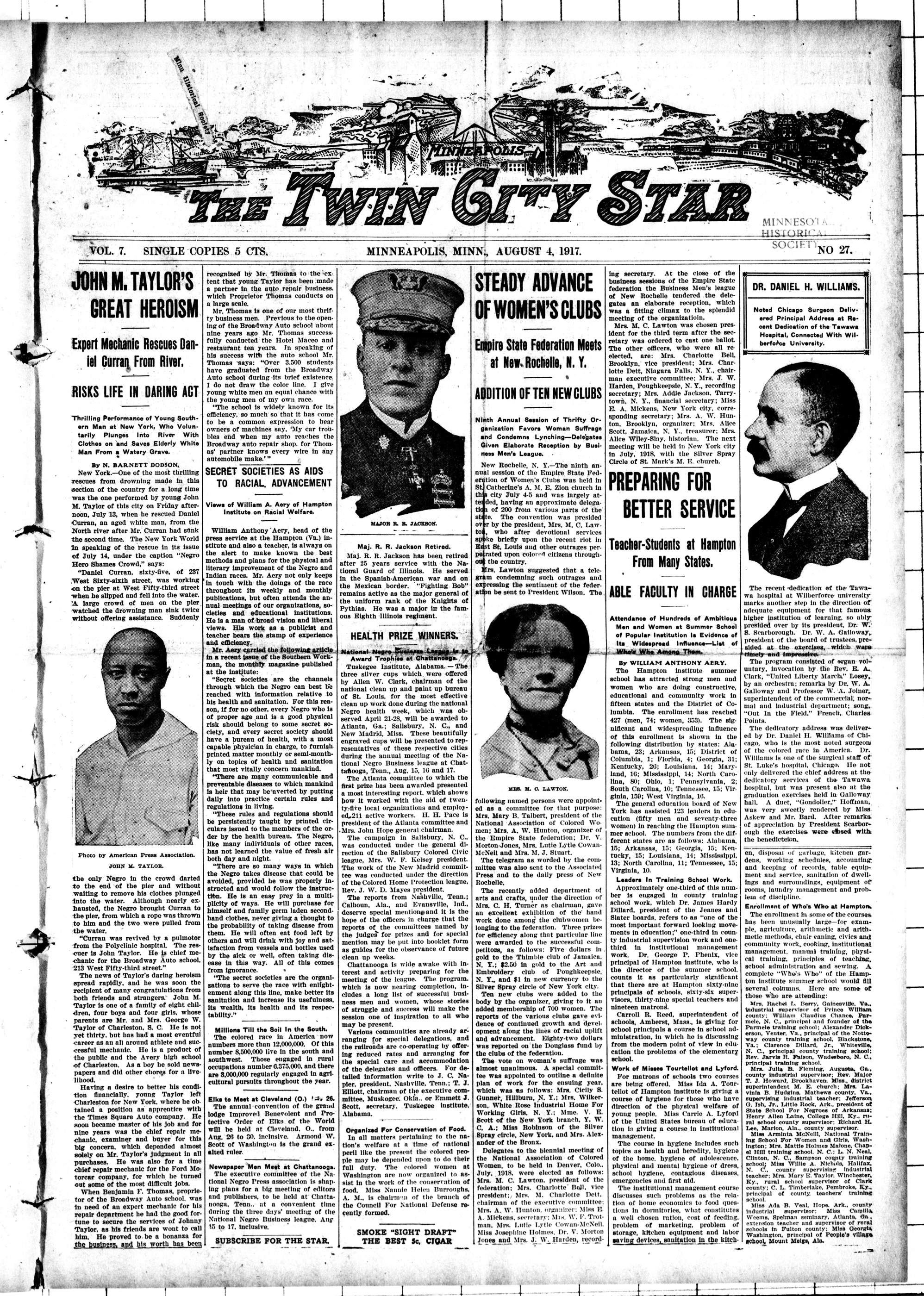
JOHN M. TAYLOR'S GREAT HEROISM
RISKS LIFE IN DARING ACT
Thrilling Performance of Young Southern Man at New York, Who Voluntarily Plunges Into River With Clothes on and Saves Elderly White Man From a Watery Grave.
By N. BARNETT DODSON.
New York.—One of the most thrilling rescues from drowning made in this section of the country for a long time was the one performed by young John M. Taylor of this city on Friday afternoon, July 13, when he rescued Daniel Curran, an aged white man, from the North river after Mr. Curran had sunk the second time. The New York World in speaking of the rescue in its issue of July 14, under the caption "Negro Hero Shames Crowd," says: "Daniel Curran, sixty-five, of 237 West Sixty-sixth street, was working on the pier at West Fifty-third street when he slipped and fell into the water. 'A large crowd of men on the pier watched the drowning man slik twice without offering assistance. Suddenly
Photo by American Press Association.
JOHN M. TAYLOR.
the only Negro in the pier darted to the end of the pier and without waiting to remove his clothes plunged into the water. Although nearly exhausted, the Negro brought Curran to the pier, from which a rope was thrown to him and the two were pulled from the water.
"Curran was revived by a pulmotor from the Polyclinic hospital. The rescuer is John Taylor. He is chief mechanic for the Broadway Auto school, 213 West Fifty-third street."
The news of Taylor's daring heroism spread rapidly, and he was soon the recipient of many congratulations from both friends and strangers. John M. Taylor is one of a family of eight children, four boys and four girls, whose parents are Mr. and Mrs. George W. Taylor of Charleston, S. C. He is not yet thirty, but has had a most eventful career as an all around athlete and successful mechanic. He is a product of the public and the Avery high school of Charleston. As a boy he sold newspapers and did other chores for a livelihood.
Having a desire to better his condition financially, young Taylor left Charleston for New York, where he obtained a position as apprentice with the Times Square Auto company. He soon became master of his job and for nine years was the chief repair mechanic, examiner and buyer for this big concern, which depended almost solely on Mr. Taylor's judgment in all purchases. He was also for a time chief repair mechanic for the Ford Motorcar company, for which he turned out some of the most difficult jobs.
When Benjamin F. Thomas, proprietor of the Broadway Auto school, was in need of an expert mechanic for his repair department he had the good fortune to secure the services of Johnny Taylor, as his friends are wont to call him. He proved to be a bonanza for the business, and his worth has been
recognized by Mr. Thomas to the extent that young Taylor has been made a partner in the auto repair business. which Proprietor Thomas conducts on a large scale.
Mr. Thomas is one of our most thrifty business men. Previous to the opening of the Broadway Auto school about nine years ago Mr. Thomas successfully conducted the Hotel Maceo and restaurant ten years. In speaking of his success with the auto school Mr. Thomas says: "Over 3,500 students have graduated from the Broadway Auto school during its brief existence. I do not draw the color line. I give young white men an equal chance with the young men of my own race.
"The school is widely known for its efficiency, so much so that it has come to be a common expression to hear owners of machines say, 'My car troubles end when my auto reaches the Broadway auto repair shop, for Thomas' partner knows every wire in any automobile make.'"
SECRET SOCIETIES AS AIDS TO RACIAL. ADVANCEMENT
Views of William A. Aery of Hampton Institute on Racial Welfare.
William Anthony Aery, head of the press service at the Hampton (Va.) institute and also a teacher, is always on the alert to make known the best methods and plans for the physical and literary improvement of the Negro and Indian races. Mr. Aery not only keeps in touch with the doings of the race throughout its weekly and monthly publications, but often attends the annual meetings of our organizations, societies and educational institutions. He is a man of broad vision and liberal views. His work as a publicist and teacher bears the stamp of experience and efficiency.
Mr. Aery carried the following article in a recent issue of the Southern Workman, the monthly magazine published at the institute:
"Secret societies are the channels through which the Negro can best be reached with information relative to his health and sanitation. For this reason, if for no other, every Negro who is of proper age and is a good physical risk should belong to some secret society, and every secret society should have a bureau of health, with a most capable physician in charge, to furnish printed matter monthly or semi-monthly on topics of health and sanitation that most vitally concern mankind.
"There are many communicable and preventable diseases to which mankind is heir that may be averted by putting daily into practice certain rules and regulations in living.
"These rules and regulations should be persistently taught by printed circulars issued to the members of the order by the health bureau. The Negro, like many individuals of other races, has not learned the value of fresh air both day and night.
"There are so many ways in which the Negro takes disease that could be avoided, provided he was properly instructed and would follow the instruction. He is an easy prey in a multiplicity of ways. He will purchase for himself and family gern laden second-hand clothes, never giving a thought to the probability of taking disease from them. He will often eat food left by others and will drink with joy and satisfaction from vessels and bottles used by the sick or well, often taking disease in this way. All of this comes from ignorance.
"The secret societies are the organizations to serve the race with enlightenment along this line, make better its sanitation and increase its usefulness, its wealth, its health and its respectability."
Millions Till the Soil In the South.
The colored race in America now numbers more than 12,000,000. Of this number 8,500,000 live in the south and southwest. Those engaged in rural occupations number 6,375,000, and there are 3,000,000 regularly engaged in agricultural pursuits throughout the year.
Elks to Meet at Cleveland (O.) 26.
The annual convention of the grand lodge Improved Benevolent and Protective Order of Elks of the World will be held at Cleveland. O., from Aug. 26 to 30, inclusive. Armond W. Scott of Washington is the grand exalted ruler.
Newspaper Men Meet at Chattanooga.
The executive committee of the National Negro Press association is shaping plans for a big meeting of editors and publishers, to be held at Chattanooga. Tenn., at a convenient time during the three days' meeting of the National Negro Business league, Aug. 15 to 17, inclusive.
SUBSCRIBE FOR THE STAR.
MINNEAPOLIS, MINN., AUGUST 4, 1917.
MAJOR R. R. JACKSON.
Maj. R. R. Jackson has been retired after 25 years service with the National Guard of Illinois. He served in the Spanish-American war and on the Mexican border. "Fighting Bob" remains active as the major general of the uniform rank of the Knights of Pythias. He was a major in the famous Eighth Illinois regiment.
HEALTH PRIZE WINNERS.
National Negro Business League in 50
Award Trophies at Chattanooga
Tuskegee Institute, Alabama. — The three silver cups which were offered by Allen W. Clark, chairman of the national clean up and paint up bureau of St. Louis, for the most effective clean up work done during the national Negro health week, which was observed April 21-28, will be awarded to Atlanta, Ga.; Salisbury, N. C., and New Madrid, Miss. These beautifully engraved cups will be presented to representatives of these respective cities during the annual meeting of the National Negro Business league at Chattanooga, Tenn., Aug. 15, 16 and 17.
The Atlanta committee to which the first prize has been awarded presented a most interesting report, which shows how it worked with the aid of twenty-five local organizations and employed 211 active workers. H. H. Pace is president of the Atlanta committee and Mrs. John Hope general chairman.
The campaign in Salisbury, N. C., was conducted under the general direction of the Salisbury Colored Civic league, Mrs. W. W. F. Kelsey president.
The work of the New Madrid committee was conducted under the direction of the Colored Home Protection league, Rev. J. W. D. Mayes president.
The reports from Nashville, Tenn.; Calhoun, Ala., and Evansville, Ind., deserve special mention and it is the hope of the officers in charge that the reports of the committees named by the judges for prizes and for special mention may be put into booklet form as guides for the observance of future clean up weeks.
Chattanooga is wide awake with interest and activity preparing for the meeting of the league. The program, which is now nearing completion, includes a long list of successful business men and women, whose stories of struggle and success will make the session one of inspiration to all who may be present.
Various communities are already arranging for special delegations, and the railroads are co-operating by offering reduced rates and arranging for the special care and accommodation of the delegates and officers. For detailed information write to J. C, Napier, president, Nashville, Tenn.; T. J. Ellott, chairman of the executive committee, Muskogee. Okla., or Emmett J. Scott, secretary. Tuskegee institute, Alabama.
Organized For Conservation of Food.
In all matters pertaining to the nation's welfare at a time of national peril like the present the colored people may be depended upon to do their full duty. The colored women at Washington are now organized to assist in the work of the conservation of food. Miss Nannie Helen Burroughs, A. M., is chairman of the branch of the Council For National Defense recently formed.
SMOKE "SIGHT DRAFT"
THE BEST 5c. CJGAR
STEADY ADVANCE OF WOMEN'S CLUBS
ADDITION OF TEN NEW CLUBS
Ninth Annual Session of Thrifty Organization Favors Woman Suffrage and Condemns Lynching-Delegates Given Elaborate Reception by Business Men's League.
New Rochelle, N. Y.-The ninth annual session of the Empire State Federation of Women's Clubs was held in St. Catherine's A. M. E. Zion church in this city July 4-5 and was largely attended, having an approximate delegation of 200 from various parts of the state. The convention was presided over by the president, Mrs. M. C. Lawton, who after devotional services spoke briefly upon the recent riot in East St. Louis and other outrages permeated upon colored citizens throughout the country.
Mrs. Lawton suggested that a telegram condemning such outrages and expressing the sentiment of the federation be sent to President Wilson. The
MRS. M. C. LAWTON.
following named persons were appointed as a committee for that purpose: Mrs. Mary B. Talbert, president of the National Association of Colored Women; Mrs. A. W. Hunton, organizer of the Empire State federation; Dr. V. Morton-Jones, Mrs. Lutie Lytle Cowan-McNeil and Mrs. M. J. Stuart.
The telegram as worded by the committee was also sent to the Associated Press and to the daily press of New Rochelle.
The recently added department of arts and crafts, under the direction of Mrs. C. H. Turner as chairman, gave an excellent exhibition of the hand work done among the clubwomen belonging to the federation. Three prizes for efficiency along that particular line were awarded to the successful competitions, as follows: Five dollars in gold to the Thimble club of Jamaica, N. Y.; $2.50 in gold to the Art and Embroidery club of Poughkeepsie, N. Y., and $1 in new currency to the Silver Spray circle of New York city.
Ten new clubs were added to the body by the organizer, giving to it an added membership of 700 women. The reports of the various clubs gave evidence of continued growth and development along the lines of racial uplift and advancement. Eighty-two dollars was reported on the Douglass fund by the clubs of the federation.
The vote on woman's suffrage was almost unanimous. A special committee was appointed to outline a definite plan of work for the ensuing year, which was as follows: Mrs. Clelly S. Gunner, Hillburn, N. Y.; Mrs. Wilkerson, White Rose Industrial Home For Working Girls, N. Y.; Mme. V. E. Scott of the New York branch, Y. W. C. A.; Miss Robinson of the Silver Spray circle, New York, and Mrs. Alexander of the Bronx.
Delegates to the biennial meeting of the National Association of Colored Women, to be held in Denver, Colo., July, 1918, were elected as follows: Mrs. M. C. Lawton, president of the federation; Mrs. Charlotte' Ball, vice president; Mrs. M. Charlotte Dett, chairman of the executive committee: Mrs. A. W. Hunton, organizer; Miss E. A. Mickens, secretary; Mrs. W. F. Trotman, Mrs. Little Lytte Cowan-McNeil, Miss Josephine Holmes, Dr. V. Morton Jones and Mrs. J. W. Harden, record-
ing secretary. At the close of the business sessions of the Empire State federation the Business Men's league of New Rochelle tendered the delegates an elaborate reception, which was a fitting climax to the splendid meeting of the organization.
Mrs. M. C. Lawton was chosen president for the third term after the secretary was ordered to cast one ballot. The other officers, who were all relected, are: Mrs. Charlotte Bell, Brooklyn, vice president; Mrs. Charlotte Dett, Niagara Falls. N. Y., chairman executive committee; Mrs. J. W. Harden, Poughkeepsie, N. Y., recording secretary; Mrs. Addle Jackson, Tarrytown, N. Y., financial secretary; Miss E. A. Mickens, New York city, corresponding secretary; Mrs. A. W. Hunton, Brooklyn, organizer; Mrs. Alice Scott, Jamaica, N. Y., treasurer; Mrs. Alice Wiley-Slay, historian. The next meeting will be held in New York city in July, 1918, with the Silver Spray Circle of St. Mark's M. E. church.
PREPARING FOR BETTER SERVICE
Attendance of Hundreds of Ambitious Men and Women at Summer School of Popular Institution is Evidence of Its Widespread Influence—List of Who's Who Among Them.
BY WILLIAM ANTHONY AERY.
The Hampton institute summer school has attracted strong men and women who are doing constructive, educational and community work in fifteen states and the District of Columbia. The enrollment has reached 427 (men, 74; women, 353). The significant and widespread influence of this enrollment is shown in the following distribution by states: Alabama, 23; Arkansas, 15; District of Columbia, 1; Florida, 4; Georgia, 31; Kentucky, 26; Louisiana, 14; Maryland, 16; Mississippi, 14; North Carolina, 80; Ohio, 1; Pennsylvania, 2; South Carolina, 10; Tennessee, 15; Virginia, 159; West Virginia, 16.
The general education board of New York has assisted 123 leaders in education (fifty men and seventy-three women) in reaching the Hampton summer school. The numbers from the different states are as follows: Alabama, 15; Arkansas, 15; Georgia, 15; Kentucky, 15; Louisiana, 14; Mississippi, 13; North Carolina, 11; Tennessee, 15; Virginia, 10.
Leaders In Training School Work.
Approximately one-third of this number is engaged in county training school work, which Dr. James Hardy Dillard, president of the Jeanes and Slater boards, refers to as "one of the most important forward looking movements in education;" one-third in county industrial supervision work and one-third in institutional management work. Dr. George P. Phenix, vice principal of Hampton institute, who is the director of the summer school, counts it as particularly significant that there are at Hampton sixty-nine principals of schools, sixty-six supervisors, thirty-nine special teachers and nineteen matrons.
Carroll R. Reed, superintendent of schools, Amherst, Mass., is giving for school principals a course in school administration, in which he is discussing from the modern point of view in education the problems of the elementary school.
Work of Misses Tourtellot and Lyford.
For matrons of schools two courses are being offered, Miss Ida A. Tourtellot of Hampton institute is giving a course of hygiene for those who have direction of the physical welfare of young people. Miss Carrie A. Lyford of the United States bureau of education is giving a course in institutional management.
The course in hygiene includes such topics as health and heredity, hygiene of the home, hygiene of adolescence, physical and mental hygiene of dress, school hygiene, contagious diseases, emergencies and first aid.
The institutional management course discusses such problems as the relation of home economics to food questions in dormitories, what constitutes a well chosen ration, cost of feeding, problem of marketing, problem of storage, kitchen equipment and labor saving devices, sanitation in the kitch-
DR. DANIEL H. WILLIAMS.
Noted Chicago Surgeon Delivered Principal Address at Recent Dedication of the Tawawa Hospital, Connected With Wilberforce University.
The recent dedication of the Tawawa hospital at Wilberforce university marks another step in the direction of adequate equipment for that famous higher institution of learning, so ably presided over by its president, Dr. W. S. Scarborough. Dr. W. A. Galloway, president of the board of trustees, presided at the exercises, which were timely and impressive.
The program consisted of organ voluntary, invocation by the Rev. E. A. Clark, "United Liberty March," Losey, by an orchestra; remarks by Dr. W. A. Galloway and Professor W. A. Joiner, superintendent of the commercial, normal and industrial department; song, "Out In the Field," French, Charles Points.
The dedicatory address was delivered by Dr. Daniel H. Williams of Chicago, who is the most noted surgeon of the colored race in America. Dr. Williams is one of the surgical staff of St. Luke's hospital, Chicago. He not only delivered the chief address at the dedicatory services of the Tawawa hospital, but was present also at the graduation exercises held in Galloway hall. A duet, "Gondoller," Hoffman, was very sweetly rendered by Miss Askew and Mr. Bard. After remarks of appreciation by President Scarborough the exercises were closed with the benediction.
en, disposal of garbage, kitchen gardens, working schedules, accounting and keeping of records, table equipment and service, sanitation of dwellings and surroundings, equipment of rooms, laundry management and problem of discipline.
Enrollment of Who's Who at Hampton
The enrollment in some of the courses has been unusually large—for example, agriculture, arithmetic and arithmetic methods, chair eaning, civics and community work, cooking, institutional management, manual training, physical training, principles of teaching, school administration and sewing. A complete "Who's Who" of the Hampton institute summer school would fill several columns. Here are some of those who are attending:
Mrs. Rachel L. Berry, Gainesville, Va., industrial supervisor of Prince William county; William Claudius Chance, Parmele, N. C., principal and founder of the Parmele training school; Alexander Dickerson, Venter, n. e., principal of the Alexander of the Bolston Va.; Clarence Dillard, Jr., Whiteville, N. C., principal county training school; Rev. Jarvis R. Falson, Wadesboro, N. C., principal training school.
Mrs. Julia B. Fleming, Augusta, Ga., county industrial supervisor; Rev. Major T. J. Howard, Brookhaven, Miss., district superintendent M. E. church; Mrs. Lavinia B. Hudgins, Mathews county, Va., supervising industrial teacher; Jefferson G. Ish, Jr., Little Rock, Ark, president of State School For Negroes of Arkansas; Henry Allen Laine, College of Ky., rutgers university; Richard H. Lee, Marion, Ala., county supervisor. Miss Arminta McNell, National Training School For Women and Girls, Washington; Mrs. Mattie Holmes Malone, Chapel Hill training school, N. C.; L. N. Neal, Clinton, N. C., Sampson county training school; Miss Willie A. Nichols, Halifax, N. C., county supervising industrial teacher; Mrs. Mary E. Taylor, Winchester, Ky., rural school supervisor of Clark county; C. L. Timberlake, Pembroke, KY, principal of county teachers' training school. Ada B. Veal, Hope Ark, county industrial supervisor; Miss Camilla Weems, Spalman seminary, Atlanta, Ga., extension teacher and supervisor of rural schools in Fulton county; Miss Georgia Washington, principal of People's village school, Mount Alma, Ala.
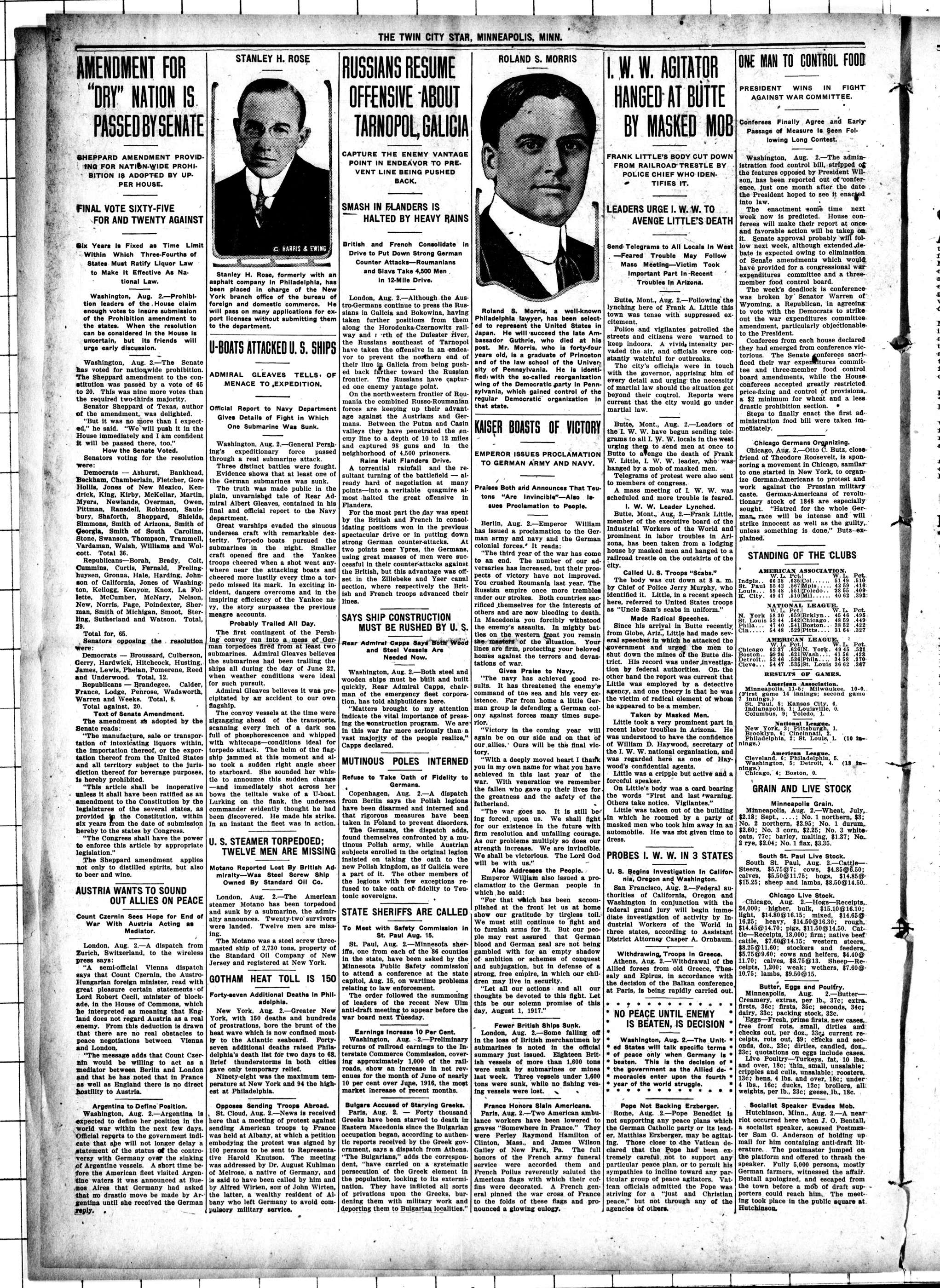
AMENDMENT FOR "DRY" NATION IS PASSED BY SENATE
SHEPPARD AMENDMENT PROVID
ING FOR NATION-WIDE PROHIB
ITION IS ADOPTED BY UP-
PER HOUSE.
FINAL VOTE SIXTY-FIVE FOR AND TWENTY AGAINST
Six Years Is Fixed as Time Limit Within Which Three-Fourths of States Must Ratify Liquor Law to Make It Effective As National Law.
Washington, Aug. 2.—Prohibition leaders of the House claim enough votes to insure submission of the Prohibition amendment to the states. When the resolution can be considered in the House is uncertain, but its friends will urge early discussion.
Washington, Aug. 2.—The Senate has voted for nationwide prohibition. The Sheppard amendment to the constitution was passed by a vote of 65 to 20. This was nine more votes than the required two-thirds majority. Senator Sheppard of Texas, author of the amendment, was delighted.
"But it was no more than I expected," he said. "We will push it in the House immediately and I am confident it will be passed there, too." How the Senate Voted. Senators voting for the resolution were: Democrats — Ashurst, Bankhead, Beckham, Chamberlain, Fletcher, Gore Hollis, Jones of New Mexico, Kendrick, King, Kirby, McKellar, Martin, Myers, Newlands, Overman, Owen, Pittman, Ransdell, Robinson, Saulsbury, Shaforth, Sheppard, Shields, Simmons, Smith of Arizona, Smith of Georgia, Smith of South Carolina, Stone, Swanson, Thompson, Trammell, Vardaman, Walsh, Williams and Wolcott. Total 36.
Republicans—Borah, Brady, Colt,
Cummins, Curtis, Fernald, Freeling
huysen, Gronna, Hale, Harding, Johnson
of California, Jones of Washington,
Kellogg, Kenyon, Knox, La Follette,
McCumber, McNary, Nelson,
New, Norris, Page, Polindexter, Sherman,
Smith of Michigan, Smoot, Sterling,
Sutherland and Watson. Total,
29.
Total for, 65.
Senators opposing the resolution
were:
Democrats — Broussard, Culberson,
Gerry, Hardwick, Hitchcock, Husting,
James, Lewis, Phelan, Pomerene, Reed
and Underwood. Total, 12.
Republicans — Brandegee, Calder,
France, Lodge, Penrose, Wadsworth,
Warren and Weeks. Total, 8.
Total against, 20.
Text of Senate Amendment.
The amendment as adopted by the
Senate reads:
"The manufacture, sale or transportation of intoxicating liquors within, the importation thereof, or the exportation thereof from the United States and all territory subject to the jurisdiction thereof for beverage purposes, is hereby prohibited.
"This article shall be inoperative unless it shall have been ratified as an amendment to the Constitution by the legislatures of the several states, as provided in the Constitution, within six years from the date of submission hereby to the states by Congress.
"The Congress shall have the power to enforce this article by appropriate legislation."
The Sheppard amendment applies not only to distilled spirits, but also to beer and wine.
AUSTRIA WANTS TO SOUND
OUT ALLIES ON PEACE
Count Czernin Sees Hope for End of War With Austria Acting as Mediator.
London. Aug. 2.—A dispatch from Zurich, Switzerland, to the wireless press says:
"A semi-official Vienna dispatch says that Count Czernin, the Austro-Hungarian foreign minister, read with great pleasure certain statements of Lord Robert Cecil, minister of blockade, in the House of Commons, which he interpreted as meaning that England does not regard Austria as a real enemy. From this deduction is drawn that there are no real obstacles to peace negotiations between Vienna and London.
"The message adds that Count Czernin would be willing to act as a mediator between Berlin and London and that he has noted that in France as well as England there is no direct hostility to Austria.
Argentina to Define Position.
Washington, Aug. 2.—Argentina is expected to define her position in the world war within the next few days. Official reports to the government indicate that she will not longer delay a statement of the status of the controversy with Germany over the sinking of Argentine vessels. A short time before the American fleet visited Argentine waters it was announced at Buenos Aires that Germany had asked that no drastic move be made by Argentina until she received the German reply.
STANLEY H. ROSE
C HARRIS & EWING
Stanley H. Rose, formerly with an asphalt company in Philadelphia, has been placed in charge of the New York branch office of the bureau of foreign and domestic commerce. He will pass on many applications for export licenses without submitting them to the department.
U-BOATS ATTACKED U. S. SHIPS
U-BOATS ATTACKED U. S. SHIPS
ADMIRAL GLEAVES TELLS+ OF
MENACE TO_EXPEDITION
Official Report to Navy Department Gives Details of Fight in Which One Submarine Was Sunk.
Washington, Aug. 2.—General Pershing's expeditionary force passed through a real submarine attack.
Three distinct battles were fought. Evidence shows that at least one of the German submarines was sunk.
The truth was made public in the plain, unvarnished tale of Rear Admiral Albert Gleaves, contained in his final and official report to the Navy department.
Great warships evaded the sinuous undersea craft with remarkable dexterity. Torpedo boats pursued the submarines in the night. Smaller craft opened fire and the Yankee troops cheered when a shot went anywhere near the attacking boats and cheered more lustfully every time a torpedo missed its mark. In exciting incident, dangers overcome and in the inspiring efficiency of the Yankee navy, the story surpasses the previous meagre accounts.
Probably Trailed All Day.
The first contingent of the Pershing convoy ran into a mess of German torpedoes fired from at least two submarines. Admiral Gleaves believes the submarines had been trailing the ships all during the day of June 22, when weather conditions were ideal for such pursuit. Admiral Gleaves believes it was precipitated by an accident to our own flairship.
The convoy vessels at the time were zigzagging ahead of the transports, scanning every inch of a dark sea full of phosphorescence and whipped with whitecaps—conditions ideal for torpedo attack. The helm of the flagship jammed at this moment and also took a sudden right angle sheer to starboard. She sounded her whistle to announce this sudden change—and immediately shot across her bows the telltale wake of a U-boat. Lurking on the flank, the undersea commander evidently thought he had been discovered. He made his strike. In an instant the fleet was in action.
U. S. STEAMER TORPEDOED; TWELVE MEN ARE MISSING
Motano Reported Lost By British Admiralty—Was Steel Screw Ship Owned By Standard Oil Co.
London, Aug. 2.—The American steamer Motano has been torpeded and sunk by a submarine, the admiralty announces. Twenty-two survivors were landed. Twelve men are missing.
The Motano was a steel screw threemasted ship of 2,730 tons, property of the Standard Oil Company of New Jersey and registered at New York.
GOTHAM HEAT TOLL IS 150
Forty-seven Additional Deaths in Philadelphia.
New York, Aug. 2.—Greater New York, with 150 deaths and hundreds of prostrations, bore the brunt of the heat wave which is now confined mostly to the Atlantic seaboard. Forty-seven additional deaths raised Philadelphia's death list for two days to 68. Brief thunderstorms in both cities gave only temporary relief.
Ninety-eight was the maximum temperature at New York and 94 the highest at Philadelphia.
Opposes Sending Troops Abroad.
St. Cloud, Aug. 2.—News is received here that a meeting of protest against sending American troops to France was held at Albany, at which a petition embodying the protest was signed by 100 persons to be sent to Representative Harold Knutson. The meeting was addressed by Dr. August Kuhman of Melrose, a native of Germany, and is said to have been called by him and by Alfred Wirten, son of John Wirten, the latter, a wealthy resident of Albany who left Germany to avoid compulsory military service.
THE TWIN CITY STAR. MINNEAPOLIS. MINN.
RUSSIANS RESUME OFFENSIVE ABOUT TARNOPOL, GALIGIA
CAPTURE THE ENEMY VANTAGE POINT IN ENDEAVOR TO PREVENT LINE BEING PUSHED BACK.
SMASH IN FLANDERS IS HALTED BY HEAVY RAINS
British and French Consolidate in Drive to Put Down Strong German Counter Attacks—Roumanians and Slavs Take 4,500 Men in 12-Mile Drive.
London, Aug. 2.—Although the Austro-Germans continue to press the Russians in Galicia and Bokowina, having taken further positions from them along the Horodenka-Czernowitz railway and north of the Dnfester river, the Russians southeast of Tarnopol have taken the offensive in an endeavor to prevent the northern end of their line in Galicia from being pushed back farther toward the Russian frontier. The Russians have captured one enemy vantage point.
On the northwestern frontier of Roumania the combined Russo-Roumanian forces are keeping up their advantage against the Austrians and Germans. Between the Putra and Casin valleys they have penetrated the enemy line to a depth of 10 to 12 miles and captured 98 guns and in the neighborhood of 4,500 prisoners.
Rains Hait Flanders Drive.
A torrential rainfall and the resultant turning of the battlefield — already hard of negotiation at many points—into a veritable quagmire almost halted the great offensive in Flanders.
For the most part the day was spent by the British and French in consolidating positions won in the previous spectacular drive or in putting down strong German counter-attacks. At two points near Ypres, the Germans, using great masses of men were successful in their counter-attacks against the British, but this advantage was offset in the Zillebeke and Yser cam section, where respectively the British and French troops advanced their lines.
SAYS SHIP CONSTRUCTION
MUST BE RUSHED BY U. S.
Rear Admiral Capps Says Both Wood and Steel Vessels Are Needed Now.
Washington, Aug. 2.—Both steel and wooden ships must be built and built quickly. Rear Admiral Capps, chairman of the emergency fleet corporation, has told shipbuilders here.
"Matters brought to my attention indicate the vital importance of pressing the construction program. We are in this war far more seriously than a vast majority of the people realize," Capps declared.
MUTINOUS POLES INTERNED
Refuse to Take Oath of Fidelity to Germans.
Copenhagen, Aug. 2.—A dispatch from Berlin says the Polish legions have been disarmed and interned and that rigorous measures have been taken in Poland to prevent disorders.
The Germans, the dispatch adds, found themselves confronted by a mutinous Polish army, while Austrian subjects enrolled in the original legion insisted on taking the oath to the new Polish kingdom, as if Galicia were a part of it. The other members of the legions with few exceptions refused to take oath of fidelity to Teutonic sovereigns.
STATE SHERIFFS ARE CALLED
To Meet with Safety Commission in St. Paul Aug. 15.
St. Paul, Aug. 2—Minnesota sheriffs, one from each of the 86 counties in the state, have been asked by the Minnesota Public Safety commission to attend a conference at the state capitol, Aug. 15, on wartime problems relating to law enforcement.
The order followed the summoning of leaders of the recent New Ulm anti-draft meeting to appear before the war board next Tuesday.
Earnings Increase 10 Per Cent
Washington, Aug. 2.—Preliminary returns of railroad earnings to the Interstate Commerce Commission, covering approximately 1,000 of the railroads, show an increase in net revenues for the month of June of nearly 10 per cent over June, 1916, the most market increase of recent months.
Bulgars Accused of Starving Greeks.
Bulgars Accused of Starving Greeks.
Paris, Aug. 2. — Forty thousand Greeks have been starved to death in Eastern Macedonia since the Bulgarian occupation began, according to authentic reports received by the Greek government, says a dispatch from Athens.
"The Bulgarians," adds the correspondent, "have carried on a systematic persecution of the Greek element in the population, looking to its extermination. They have inflicted all sorts of privations upon the Greeks, burdening them with military work and deporting them to Bulgarian localities."
—
Roland S. Morris, a well-known Philadelphia lawyer, has been selected to represent the United States in Japan. He will succeed the late Ambassador Guthrie, who died at his post. Mr. Morris, who is forty-four years old, is a graduate of Princeton and of the law school of the University of Pennsylvania. He is identified with the so-called reorganization wing of the Democratic party in Pennsylvania, which gained control of the regular Democratic organization in that state.
KAISER BOASTS OF VICTORY
KAISER BOASTS OF VICTORY
EMPEROR ISSUES PROCLAMATION
TO GERMAN ARMY AND NAVY.
Praises Both and Announces That Teutons "Are Invincible"—Also Issues Proclamation to People.
Berlin, Aug. 2.—Emperor William has issued a proclamation to the German army and navy and the German colonial forces.* It reads:
"The third year of the war has come to an end. The number of our adversaries has increased, but their prospects of victory have not improved. You crushed Roumania last year. The Russian empire once more trembles under our strokes. Both countries sacrificed themselves for the interests of others and are now bleeding to death. In Macedonia you forcibly withstood the enemy's assaults. In mighty battles on the western front you remain the masters of the situation. Your lines are firm, protecting your beloved homes against the terrors and devastations of war.
Gives Praise to Navy.
"The navy has achieved good results. It has threatened the enemy's command of the sea and his very existence. Far from home a little German group is defending a German colony against forces many times superior.
"Victory in the coming year will again be on our side and on that of our allies." Ours will be the final victory.
"With a deeply moved heart I thank you in my own name for what you have achieved in this last year of the war. With veneration we remember the fallen who gave up their lives for the greatness and the safety of the fatherland.
"The war goes no. It is still being forced upon us. We shall fight for our existence in the future with firm resolution and unfailling courage. As our problems multiply so does our strength increase. We are invincible. We shall be victorious. The Lord God will be with us."
Also Addresses the People. Emperor William also issued a proclamation to the German people in which he said:
"For that which has been accomplished at the front let us at home show our gratitude by tireless toll. We must still continue to fight and to furnish arms for it. But our people may rest assured that German blood and German zeal are not being gambled with for an empty shadow of ambition or schemes of conquest and subjugation, but in defense of a strong, free empire, in which our children may live in security.
"Let all our actions and all our thoughts be devoted to this fight. Let this be our solemn promise of this day, August 1, 1917."
Fewer British Ships Sunk
London, Aug. 2.—Some falling off in the loss of British merchantmen by submarines is noted in the official summary just issued. Eighteen British vessels of more than 1,600 tons were sunk by submarines or mines last week. Three vessels under 1,600 tons were sunk, while no fishing vesing vessels were lost.
France Honors Slain Americans.
Paris, Aug. 2.—Two American ambulance workers have been lowered to graves "Somewhere in France." They were Perley Raymond Hamilton of Clinton, Mass., and James Wilson Galley of New Park, Pa. The full honors of the French army funeral service were accorded them and French Polus reverently saluted the American flags with which their coffins were decorated. A French general pinned the war cross of France to the folds of these flags and pronounced a glowing eulogy.
I. W. W. AGITATOR HANGED AT BUTTE BY MASKED MOB
FRANK LITTLE'S BODY CUT DOWN FROM RAILROAD TRESTLE BY POLICE CHIEF WHO IDENTIFIES IT.
LEADERS URGE I. W. W. TO AVENGE LITTLE'S DEATH
Send Telegrams to All Locals in West
—Feared Trouble May Follow
Mass Meeting—Victim Took
Important Part In Recent
Troubles in Arizona.
Butte, Mont., Aug. 2.—Following the lynching here of Frank A. Little this town was tense with suppressed excitement.
Police and vigilantes patrolled the streets and citizens were warned to keep indoors. A vivid intensity pervaded the air, and officials were constantly watchful for outbreaks.
The city's officials were in touch with the governor, apprising him of every detail and urging the necessity of martial law should the situation get beyond their control. Reports were current that the city would go under martial law.
Butte, Mont., Aug. 2.—Leaders of the I. W. W. have begun sending telegrams to all I. W. W. locals in the west urging them to send men at once to Butte to avenge the death of Frank W. Little, I. W. W. leader, who was hanged by a mob of masked men.
Telegrams of protest were also sent to members of congress.
A mass meeting of I. W. W. was scheduled and more trouble is feared. I. W. W. Leader Lynched. Butte, Mont., Aug. 2.—Frank Little, member of the executive board of the Industrial Workers of the World and prominent in labor troubles in Arizona, has been taken from a lodging house by masked men and hanged to a railroad trestle on the outskirts of the city.
Called U. S. Troops "Scabs."
The body was cut down at 8 a.m. by Chief of Police Jerry Murphy, who identified it. Little, in a recent speech here, referred to United States troops as "Uclem Sam's scabs in uniform."
Made Radical Speeches
Since his arrival in Butte recently, from Globe, Ariz, Little had made several speeches in which he attacked the government and urged the men to shut down the mines of the Butte district. His record was under investigation by federal authorities. On the other hand the report was current that Little was employed by a detective agency, and one theory is that he was the victim of radical element of whom he appeared to be a member.
Taken by Masked Men.
Little took a very prominent part in recent labor troubles in Arizona. He was understood to have the confidence of William D. Haywood, secretary of the I. W. W. national organization, and was regarded here as one of Haywood's confidential agents.
Little was a cripple but active and a forceful speaker.
On Little's body was a card bearing the words "First and last warning. Others take notice. Vigilantes."
Little was taken out of the building in which he roomed by a party of masked men who took him away in an automobile. He was not given time to dress.
PROBES I. W. W. IN 3 STATES
U. S. Begins Investigation In California, Oregon and Washington.
San Francisco, Aug. 2.—Federal authorities of California, Oregon and Washington in conjunction with the federal grand jury will begin immediate investigation of activity by Industrial Workers of the World in three states, according to Assistant District Attorney Casper A. Ornbaum.
Withdrawing, Troops in Greece.
Athens, Aug. 2.—Withdrawal of the Allied forces from old Greece, Thessaly and Epirus, in accordance with the decision of the Balkan conference at Paris, is being rapidly carried out.
* NO PEACE UNTIL ENEMY
* IS BEATEN, IS DECISION
Washington, Aug. 2.—The United States will talk specific terms of peace only when Germany is beaten. This is the decision of the government as the Allied democracies enter upon the fourth year of the world struggle.
Pope Not Backing Erzberger. Rome, Aug. 2.—Pope Benedict is not supporting any peace plans which the German Catholic party or its leader, Matthias Erzberger, may be agitating. Those close to the Vatican declared that the Pope had been extremely careful not to support any particular peace plan, or to permit his sympathies to incline toward any particular group of peace agitators. Vatican officials admitted the Pope was striving for a "just and Christian peace," but not through any of the agencies of others.
PRESIDENT WINS IN FIGHT AGAINST WAR COMMITTEE.
Conferees Finally Agree and Early Passage of Measure Is Seen Following Long Contest.
Washington, Aug. 2.—The administration food control bill, stripped of the features opposed by President Wilson, has been reported out of conference, just one month after the date the President hoped to see it enacted into law.
The enactment some time next week now is predicted. House conferences will make their report at once and favorable action will be taken on it. Senate approval probably will follow next week, although extended debate is expected owing to elimination of Senate amendments which would have provided for a congressional war expenditures committee and a threemember food control board.
The week's deadlock is conference was broken by Senator Warren of Wyoming, a Republican, in agreeing to vote with the Democrats to strike out the war expenditures committee amendment, particularly objectionable to the President.
Conferees from each house declared they had emerged from conference victorious. The Senate conferees sacrificed their war expenditures committee and three-member food control board amendments, while the House conferees accepted greatly restricted price-fixing and control of provisions, a $2 minimum for wheat and a less drastic prohibition section. Steps to finally enact the first administration food bill were taken immediately.
Chicago Germans of Chicago
Chicago, Aug. 2.—Otto C. Butz, close friend of theodore Roosevelt, is sponsoring a movement in Chicago, similar to one started in New York, to organize German-Americans to protest and work against the Prussian military caste. German-Americans of revolutionary stock of 1848 are especially sought. "Hatred for the whole German race will be intense and will strike innocent as well as the guilty, unless something is done," Butz-explained.
STANDING OF THE CLUBS
AMERICAN ASSOCIATION.
W. L. Pct.
Indpls. 66 38 635 | Col. 51 49 610
St. auil 59 48 369 | Mac. 35 41 416
Louis. 49 48 551 | Toledo. 38 55 409
K. City. 49 47 610 | Mil. 40 62 392
NATIONAL LEAGUE.
W. L. Pct.
N. York 58 34 659 | Brklyn. 45 46 495
St. Louis 52 44 542 | Chicago. 48 49 449
Phila. 47 40 541 | Boston. 38 52 422
Cin. 54 48 542 | Pitts. 31 64 327
AMERICAN LEAGUE.
W. L. Pct.
Chicago 92 39 621 | N. York. 41 56 428
Boston 93 36 621 | Wash. 41 56 428
Detroit. 52 46 542 | Phila. 34 58 370
Cleve. 54 47 535 | St. Louis 36 62 367
RESULTS OF GAMES.
American Association.
Minneapolis, 11-5; Milwaukee, 10-0.
(First game 14 innings; second game
7 innings)
St. Paul, 8; Kansas City, 6.
Indianapolis, 1; Louisville, 0.
Columbus, 9; Toledo, 1.
National League.
New York, 3; Pittsburgh, 1.
Brooklyn, 6; Cincinnati, 2.
Philadelphia, 2; St. Louis, 1. (10 innings.)
American League.
Cleveland, 6; Philadelphia, 5.
Washington, 5; Detroit, 4. (18 in-
nings).
Chicago, 4; Boston, 0.
GRAIN AND LIVE STOCK
Minneapolis, Aug. 2—Wheat, July,
$2.18; Sept. , , , No. 1 northern, $3;
No. 2 northern, $2.95; No. 1 durum,
$2.60; No. 3 corn, $2.25; No. 3 white
oats, 77c; barley, malting, $1.37; No.
2 rye, $2.04; No. 1 flax, $3.35.
South St. Paul Live Stock
South St. Paul, Aug. 2—Cattle—Steers, $5.75@7; cows, $4.85@6.50; calves, $5.50@11.75; hogs, $14.85@15.25; sheep and lambs, $8.50@14.50.
Chicago Live Stock.
Chicago, Aug. 2—Hogs—Receipts,
24,000; higher, bulk, $15.10@16.10;
light, $14.80@16.15; mixed, $14.65@
16.25; heavy, $14.65@16.30; rough,
$14.45@14.70; pigs, $11.50@14.50. Cattle—Receipts, 18,000; firm; native beef cattle, $7.60@14.15; western steers, $8.25@11.60; stockers and feeders, $5.75@9.60; cows and heifers, $4.40@11.70; calves, $7.55@13. Sheep—Receipts, 1,200; weak, wethers, $7.60@10.75; lambs, $9.50@15.
Butter, Eggs and Poultry
Minneapolis, Aug. 2—Butter—Creamery, extras, per lb, 17c; extra firsts, 36c; firsts, 35c; seconds, 34c; dairy, 33c; packing stock, 32c.
Eggs—Fresh, prime firsts, new cases, free from rots, small, dirties and checks out, per doz, 33c; current receipts, rots out, $; $ checks and seconds, doz, 23c; dirties, candled, doz, 23c; quotations on eggs include cases.
Love Poultry—Turkies, fat, 10 lbs, and over, 18c; thin, small, unsalable; cripples and culls, unsalable; roosters, 13c; hens, 4 lbs, and over, 18c; under 4 lbs, 16c; ducks, 12c; broilers, all weights, per lb, 12c; geese, lb, 18c.
Socialist Speaker Evades Mob.
Hutchinson, Minn., Aug. 2.—A nearriot occurred here when J. O. Bentall, a socialist speaker, acused Postmaster Sam G. Anderson of holding up mail for him containing anti-draft literature. The postmaster jumped on the platform and offered to thrash the speaker. Fully 5,000 persons, mostly German farmers, witnessed the affair. Bentall apologized, and escaped from the town before a mob of draft supporters could reach him. The meeting took place in the public square at Hutchinson.
IN THE CITIES
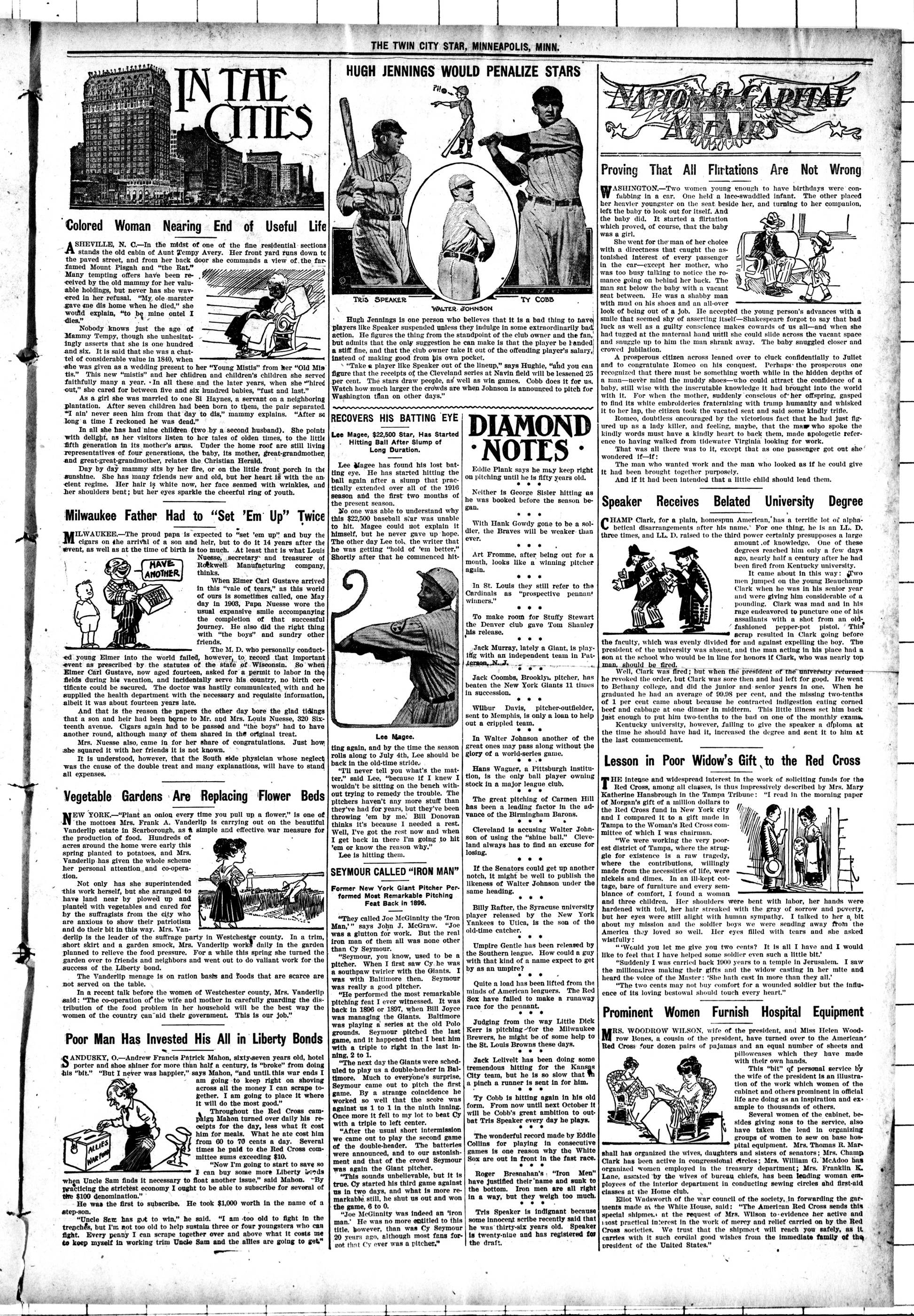
Colored Woman Nearing End of Useful Life
ASHEVILLE, N. C.-In the midst of one of the fine residential sections stands the old cabin of Aunt Tempy Avery. Her front yard runs down to the paved street, and from her back door she commands a view of the far
she was given as a wedding present to her "Young Mistis" from her "Old Mistis." This new "mistis" and her children and children's children she served faithfully many a year. In all these and the later years, when she "hired out," she cared for between five and six hundred babies, "fust and last."
As a girl she was married to one Si Haynes, a servant on a neighboring plantation. After seven children had been born to them, the pair separated. "I ain' never seen him from that day to dis," mammy explains. "After so long a time I reckoned he was dead."
In all she has had nine children (two by a second husband). She points with delight, as her visitors listen to her tales of olden times, to the little fifth generation in its mother's arms. Under the home roof are still living representatives of four generations, the baby, its mother, great-grandmother, and great-great-grandmother, relates the Christian Herald.
Day by day mammy sits by her fire, or on the little front porch in the sunshine. She has many friends new and old, but her heart is with the ancient regime. Her hair is white now, her face seamed with wrinkles, and her shoulders bent; but her eyes sparkle the cheerful ring of youth.
Milwaukee Father Had to "Set 'Em Up" Twice
MILWAUKEE—The proud papa is expected to "set 'em up" and buy the cigars on the arrival of a son and heir, but to do it 14 years after the event, as well as at the time of birth is too much. At least that is what Louis
ed young Elmer into the world failed, however, to record that important event as prescribed by the statutes of the state of Wisconsin. So when Elmer Carl Gustave, now aged fourteen, asked for a permit to labor in the fields during his vacation, and incidentally serve his country, no birth certificate could be secured. The doctor was hastily communicated with and he supplied the health department with the necessary and requisite information, albeit it was about fourteen years late.
And that is the reason the papers the other day bore the glad tidings that a son and heir had borne to Mr. and Mrs. Louis Nuesse, 320 Sixteenth avenue. Cigars again had to be passed and "the boys" to have another round, although many of them shared in the original treat.
Mrs. Nuesse also, came in for her share of congratulations. Just how she squared it with her friends it is not known.
It is understood, however, that the South side physician whose neglect was the cause of the double treat and many explanations, will have to stand all expenses.
Vegetable Gardens Are Replacing Flower Beds
NEW YORK.—"Plant an onion every time you pull up a flower" is one of the mottoes Mrs. Frank A. Vanderlip is carrying out on the beautiful Vanderlip estate in Scarborough, as simple and effective war measure for
derlip is the leader of the suffrage party in Westchester county. In a trim, short skirt and a garden smock, Mrs. Vanderlip works daily in the garden planned to relieve the food pressure. For a while this spring she turned the garden over to friends and neighbors and went out to do valiant work for the success of the Liberty bond.
The Vanderlip menage is on ration basis and foods that are scarce are not served on the table.
In a recent talk before the women of Westchester county, Mrs. Vanderlip said: "The co-operation of the wife and mother in carefully guarding the distribution of the food problem in her household will be the best way the women of the country can aid their government. This is our job."
Poor Man Has Invested His All in Liberty Bonds
SANDUSKY, O.—Andrew Francis Patrick Mahon, sixty-seven years old, hotel porter and shoe shiner for more than half a century, is "broke" from doing his "bit." "But I never was happier," says Mahon, "and until this war ends I
when Uncle Sam finds it necessary to float another issue," said Mahon. "By practicing the strictest economy I ought to be able to subscribe for several of the $100 denomination."
He was the first to subscribe. He took $1,000 worth in the name of a step-son.
"Uncle Sam has got to win," he said. "I am too old to fight in the trenches, but I'm not too old to help sustain three or four youngsters who can fight. Every penny I can scrape together over and above what it costs me to keep myself in working trim Uncle Sam and the allies are going to get."
famed Mount Pisgah and "the Rat." Many tempting offers have been received by the old mamma for her valuable holdings, but never has she wavered in her refusal. "My ole marster gave me dis home when he died," she would explain, "to be mine ontel I dies." Nobody knows just the age of Mammy Tempy, though she unhesitatingly asserts that she is one hundred and six. It is said that she was a chatel of considerable value in 1840, when
she was given as a wedding present to
tis." This new "mistis" and her child
faithfully many a year. In all these
out," she cared for between five and
as a girl she was married to one
plantation. After seven children had
"I ain' never seen him from that day
long a time I reckoned he was dead.
In all she has had nine children (
with delight, as her visitors listen to
fifth generation in its mother's arms.
representatives of four generations, th
and great-great-grandmother, relates
Day by day mammy sits by her f
sunshine. She has many friends new
client regime. Her hair is white now
her shoulders bent; but her eyes spark
Milwaukee Father Had
MILWAUKEE—The proud papa is a
cigars on she arrival of a son and
event, as well as at the time of birth is
HAVE
AMOTHER
ed young Elmer into the world failed event as prescribed by the statutes of Elmer Carl Gustave, now aged fourteen fields during his vacation, and inciden tificate could be secured. The doctor supplied the health department with the albeit it was about fourteen years late. And that is the reason the paper that a son and heir had been borne to teenth avenue. Cigars again had to be another round, although many of them. Mrs. Nuesse also, came in for her she squared it with her friends it is no. It is understood, however, that tha was the cause of the double treat and all expenses.
Vegetable Gardens Are
NEW YORK.—"Plant an onion every the mottoes Mrs. Frank A. Vande Vendelin estate in Sørtherough,
Vanderlip estate in Scarborough, as the production of food. Hundreds of acres around the home were early this spring planted to potatoes, and Mrs. Vanderlip has given the whole scheme her personal attention and co-operation. Not only has she superintended this work herself, but she arranged to have land near by plowed up and planted with vegetables and cared for by the suffragists from the city who are anxious to show their patriotism and do their bit in this way. Mrs. Van-
derlip is the leader of the suffrage par- short skirt and a garden smock, Mrs. planned to relieve the food pressure. I garden over to friends and neighbors an success of the Liberty bond.
The Vanderlip menage is on ration not served on the table.
In a recent talk before the women said: "The co-operation of the wife and tribution of the food problem in her women of the country can aid their go
Poor Man Has Invested
SANDUSKY, O.—Andrew Francis Patr torer and shoe shiner for more than his "bit." "But I never was happler," s
ALLIES
WAR FUND
when Uncle Sam finds it necessary to do practicing the strictest economy I ought the $100 denomination."
He was the first to subscribe. He step-son.
"Uncle Sam has got to win," he trepches, but I'm not too old to help sufight. Every penny I can scrape together to keep myself in working trim Uncle
A
her "Young Mistis" from her "Old Mistle
children and children's children she served
and the later years, when she "hired
six hundred babies, "fust and last."
Si Haynes, a servant on a neighboring
been born to them, the pair separated,
y to dis," mammy explains. "After so
l."
(two by a second husband). She points
her tales of olden times, to the little
Under the home roof are still living
the baby, its mother, great-grandmother,
the Christian Herald.
fire, or on the little front porch in the
and old, but her heart is with the an-
y, her face seamed with wrinkles, and
kle the cheerful ring of youth.
to "Set 'Em Up" Twice
expected to "set 'em up" and buy the
did heir, but to do it 14 years after the
too much. At least that is what Louis
Nuesse, secretary and treasurer of Rockwell Manufacturing company, thinks.
When Elmer Carl Gustave arrived in this "vale of tears," as this world of ours is sometimes called, one May day in 1903, Papa Nuesse wore the usual expansive smile accompanying the completion of that successful journey. He also did the right thing with "the boys" and sundry other friends.
The M. D. who personally conducted, however, to record that important of the state of Wisconsin. So when men, asked for a permit to labor in the totally serve his country, no birth cer was hastily communicated with and he the necessary and requisite information, e. e. the other day bore the glad tidings to Mr. and Mrs. Louis Nuesse, 320 Six-ste passed and "the boys" had to have been shared in the original treat. Her share of congratulations. Just how not known. The South side physician whose neglect many explanations, will have to stand
Replacing Flower Beds
A time you pull up a flower," is one of peril is carrying out on the beautiful simple and effective war measure for
K
Party in Westchester county. In a trim, Vanderlip works daily in the garden. For a while this spring she turned the and went out to do valiant work for the on basis and foods that are scarce are of Westchester county, Mrs. Vanderlip and mother in carefully guarding the dis- household will be the best way the government. This is our job."
His All in Liberty Bonds
Brick Mahon, sixty-seven years old, hotel in half a century, is "broke" from doing says Mahon, "and until this war ends I am going to keep right on shoving across all the money I can scrape together. I am going to place it where it will do the most good."
Throughout the Red Cross campaign Mahon turned over daily his receipts for the day, less what it cost him for meals. What he ate cost him from 60 to 70 cents a day. Several times he paid to the Red Cross committee sums exceeding $10.
"Now I'm going to start to save so I can buy some more Liberty foods
float another issue," said Mahon. "By it to be able to subscribe for several of me took $1,000 worth in the name of a said. "I am too old to fight in the sustain three or four youngsters who can either over and above what it costs me Sam and the allies are going to get."
THE TWIN CITY STAR, MINNEAPOLIS, MINN.
HUGH JENNINGS WOULD PENALIZE STARS
TRI. SPEAKER BY CORB
WALTER JOHNSON
Hugh Jennings is one person who believes that it is a bad thing to have players like Speaker suspended unless they indulge in some extraordinarily bad action. He figures the thing from the standpoint of the club owner and the fan, but admits that the only suggestion he can make is that the player be banded a stiff fine, and that the club owner take it out of the offending player's salary, instead of making good from his own pocket.
"Take a player like Speaker out of the lineup," says Hughie, "and you can figure that the receipts of the Cleveland series at Navin field will be lessened 25 per cent. The stars draw people, as well as win games. Cobb does it for us. Watch how much larger the crowds are when Johnson is announced to pitch for Washington than on other days."
RECOVERS HIS BATTING EYE
Lee Magee, $22,500 Star, Has Started Hitting Ball After Slump of Long Duration.
Lee Magee has found his lost batting eye. He has started hitting the ball again after a slump that practically extended over all of the 1916 season and the first two months of the present season.
No one was able to understand why this $22,500 baseball star was unable to hit. Magee could not explain it himself, but he never gave up hope. The other day Lee tol, the writer that he was getting "hold of 'em better." Shortly after that he commenced hit-
I
ting again, and by the time the season rolls along to July 4th, Lee should be back in the old-time stride. "Till never tell you what's the matter," said Lee, "because if I knew I wouldn't be sitting on the bench without trying to remedy the trouble. The pitchers haven't any more stuff than they've had for years, but they've been throwing 'em by me. Bill Donovan thinks it's because I needed a rest. Well, I've got the rest now and when I get back in there I'm going to hit 'em or know the reason why."
SEYMOUR CALLED "IRON MAN"
Former New York Giant Pitcher Per formed Most Remarkable Pitching Feat Back in 1896.
"They called Joe McGinnity the Iron Man," says John J. McGraw. "Joe was a glutton for work. But the real iron man of them all was none other than Cy Seymour.
"Seymour, you know, used to be a pitcher. When I first saw Cy he was a southpaw twirler with the Giants. I was with Baltimore then. Seymour was really a good pitcher.
"He performed the most remarkable pitching feat I ever witnessed. It was back in 1896 or 1897, when Bill Joyce was managing the Giants. Baltimore was playing a series at the old Polo grounds. Seymour pitched the last game, and it happened that I beat him with a triple to right in the last inning. 2 to 1.
"The next day the Giants were scheduled to play us a double-header in Baltimore. Much to everyone's surprise, Seymour came out to pitch the first game. By a strange coincidence he worked so well that the score was against us 1 to 1 in the ninth inning. Once more it fell to my lot to beat Cy with a triple to left center.
"After the usual short intermission we came out to play the second game of the double-header. The batteries were announced, and to our astonishment and that of the crowd Seymour was again the Giant pitcher.
"This sounds unbelievable, but it is true. Cy started his third game against us in two days, and what is more remarkable still, he shut us out and won the game, 6 to 0.
"Joe McGinnity was indeed an 'iron man.' He was no more entitled to this title, however, than was Cy Seymour 20 years ago, although most fans forgot that Cy ever was a pitcher."
Lee Magee.
DIAMOND NOTES
Eddie Plank says he may keep right on pitching until he is fifty years old.
* * * *
Neither is George Sisler hitting as he was booked before the season began.
* * * *
With Hank Gowdy gone to be a soldier, the Braves will be weaker than ever.
* * * *
Art Fromme, after being out for a month, looks like a winning pitcher again.
* * * *
In St. Louis they still refer to the Cardinals as "prospective pennant winners."
* * * *
To make room for Stuffy Stewart the Denver club gave Tom Shanley his release.
Jack Murray, lately a Giant, is playing with an independent team in Patterson, N. J.
* * * *
Jack Coombs, Brooklyn, pitcher, has beaten the New York Giants 11 times in succession.
* * * *
Wilbur Davis, pitcher-outfielder, sent to Memphis, is only a loan to help out a crippled team.
* * * *
In Walter Johnson another of the great ones may pass along without the glory of a world-series game.
* * * *
Hans Wagner, a Pittsburgh institution, is the only ball player owning stock in a major league club.
* * * *
The great pitching of Carmen Hill has been a leading factor in the advance of the Birmingham Barons.
Cleveland is accusing Walter Johnson of using the "shine ball." Cleveland always has to find an excuse for losing.
If the Senators could get up another notch, it might be well to publish the likeness of Walter Johnson under the same heading.
Billy Rafter, the Syracuse university player released by the New York Yankees to Utica, is the son of the old-time catcher.
Umpire Gentle has been released by the Southern league. How could a guy with that kind of a name expect to get by as an umpire?
Quite a load has been lifted from the minds of American leaguers. The Red Sox have failed to make a runaway race for the pennant.
Judging from the way Little Dick Kerr is pitching for the Milwaukee Brewers, he might be of some help to the St. Louis Browns these days.
Jack Lelivelt has been doing some tremendous hitting for the Kansas City team, but he is so slow that a pinch a runner is sent in for him.
Ty Cobb is hitting again in his old form. From now until next October it will be Cobb's great ambition to outbat Tris Speaker every day he plays.
The wonderful record made by Eddie Collins for playing in consecutive games is one reason why the White Sox are out in front in the fast race.
Roger Bresnahan's "Tron Men" have justified their name and sunk to the bottom. Iron men are all right in a way, but they weigh too much.
Tris Speaker is indignant because some innocent scribe recently said that he was thirty-six years old. Speaker is twenty-nine and has registered for the draft.
* * *
* * * .
---
* * *
* * *
---
NATIONAL CAPITAL AWARDS
Proving That All Flirtations Are Not Wrong
WASHINGTON.—Two women young enough to have birthdays were confubbling in a car. One held a lace-swaddled infant. The other placed her heavier youngster on the seat beside her, and turning to her companion,
look of being out of a job. He accepted the young person's advances with a smile that seemed shy of asserting itself—Shakespeare forgot to say that bad luck as well as a guilty conscience makes cowards of us all—and when she had tugged at the maternal hand until she could slide across the vacant space and snuggle up to him the man shrank away. The baby snuggled closer and crowded jubilation.
A prosperous citizen across leaned over to cluck confidentially to Juliet and to congratulate Romeo on his conquest. Perhaps the prosperous one recognized that there must be something worth while in the hidden depths of a man—never mind the muddy shoes—who could attract the confidence of a baby, still wise with the inscrutable knowledge it had brought into the world with it. For when the mother, suddenly conscious of her offspring, gasped to find its white embroideries fraternizing with trump humanity and whisked it to her lap, the citizen took the vacated seat and said some kindly trifle.
Romeo, doubtless encouraged by the victorious fact that he had just figured up as a lady killer, and feeling, maybe, that the man who spoke the kindly words must have a kindly heart to back them, made apologetic reference to having walked from tidewater Virginia looking for work.
That was all there was to it, except that as one passenger got out she wondered if—if:
The man who wanted work and the man who looked as if he could give it had been brought together purposely.
And if it had been intended that a little child should lead them.
Speaker Receives Belated University Degree
Speaker Receives Belated University Degree
CHAMP Clark, for a plain, homespun American,' has a terrific lot of alphabetical disarrangements after his name.' For one thing, he is an LL. D. three times, and LL. D. raised to the third power certainly presupposes a large
the faculty, which was evenly divided for and against expelling the boy. The president of the university was absent, and the man acting in his place had a son at the school who would be in line for honors if Clark, who was nearly top man, should be fired.
Well, Clark was fired; but when the president of the university returned he revoked the order, but Clark was sore then and had left for good. He went to Bethany college, and did the junior and senior years in one. When he graduated he had an average of 99.98 per cent, and the missing two-tenths of 1 per cent came about because he contracted indigestion eating corned beef and cabbage at one dinner in midterm. This little illness set him back just enough to put him two-tenths to the bad on one of the monthly exams.
Kentucky university, however, failing to give the speaker a diploma at the time he should have had it, increased the degree and sent it to him at the last commencement.
Lesson in Poor Widow's Gift to the Red Cross
THE intense and widespread interest in the work of soliciting funds for the Red Cross, among all classes, is thus impressively described by Mrs. Mary Katherine Hansbrough in the Tampa Tribune: "I read in the morning paper
and three children. Her shoulders were bent with labor, her hands were hardened with toll, her hair streaked with the gray of sorrow and poverty, but her eyes were still alight with human sympathy. I talked to her a bit about my mission and the soldier boys we were sending away from the America they loved so well. Her eyes filled with tears and she asked wistfully:
"Would you let me give you two cents? It is all I have and I would like to feel that I have helped some soldier even such a little bit."
"Suddenly I was carried back 1000 years to a temple in Jerusalem. I saw the millionaires making their gifts and the widow casting in her mite and heard the voice of the Master: 'She hath cast in more than they all.'"
"The two cents may not buy comfort for a wounded soldier but the influence of its loving bestowal should touch every heart."
Prominent Women Furnish Hospital Equipment
MRS. WOODROW WILSON, wife of the president, and Miss Helen Woodrow Jones, a cousin of the president, have turned over to the American Red Cross four dozen pairs of pajamas and an equal number of sheets and
shall has organized the wives, daughters and sisters of senators; Mrs. Champ Clark has been active in congressional circles; Mrs. William G. McAdoo has organized women employed in the treasury department; Mrs. Franklin K. Lane, assisted by the wives of bureau chiefs, has been leading woman employees of the interior department in conducting sewing circles and first-aid classes at the Home club.
Elliot Wadsworth of the war council of the society, in forwarding the garments made at the White House, said: "The American Red Cross sends this special shipment, at the request of Mrs. Wilson to-evidence her active and most practical interest in the work of mercy and relief carried on by the Red Cross societies. We trust that the shipment will reach you safely, as it carries with it such cordial good wishes from the immediate family of the president of the United States."
She went for the man of her choice with a directness that caught the astonished interest of every passenger in the car—except her mother, who was too busy talking to notice the romance going on behind her back. The man sat below the baby with a vacant seat between. He was a shabby man with mud on his shoes and an all-over
look of being out of a job. He accepts smile that seemed shy of asserting its luck as well as a guilty conscience man had tugged at the maternal hand until and snuggle up to him the man shrank crowded jubilation.
A prosperous citizen across leased and to congratulate Romeo on his recognition that there must be something a man—never mind the muddy shoes—baby, still wise with the inscrutable kid with it. For when the mother, sudden to find its white embroideries fraternity it to her lap, the citizen took the vacant Romeo, doubtless encouraged by tured up as a lady killer, and feelings kindly words must have a kindly heart ence to having walked from tidewater. That was all there was to it, exo wondered if—if:
The man who wanted work and that it had been brought together purpose
And if it had been intended that a
Speaker Receives Bells
CHAMP Clark, for a plain, homespun betical disarrangements after his three times, and LL. D. raised to the th
ED
ED
the faculty, which was evenly divided
president of the university was absen-
son at the school who would be in line
man, should be fired.
Well, Clark was fired; but when t
he revoked the order, but Clark was so
to Bethany college, and did the juni-
graduated he had an average of 99.9
of 1 per cent came about because he
beef and cabbage at one dinner in mi
just enough to put him two-tenths to
Kentucky university, however, fa-
the time he should have had it, incre
the last commencement.
Lesson in Poor Widow's
THE intense and widespread interest
Red Cross, among all classes, is the
Katherine Hansbrough in the Tampa T
of Morgan's gift of a million dollars to the Red Cross fund in New York city and I compared it to a gift made in Tampa to the Woman's Red Cross committee of which I was chairman.
"We were working the very poorest district of Tampa, where the struggle for existence is a raw tragedy, where the contributions, willingly made from the necessities of life, were nickels and dimes. In an ill-kept cottage, bare of furniture and every semblance of comfort, I found a woman
and three children. Her shoulders were hardened with toll, her hair streaked but her eyes were still alight with his about my mission and the soldier伯伯 America they loved so well. Her wistfully:
"Would you let me give you two like to feel that I have helped some so
"Suddenly I was carried back 1000 the millionaires making their gifts and heard the voice of the Master: 'She has
"The two cents may not buy comfort of its loving bestowal should tour
Prominent Women Furn
MRS. WOODROW WILSON, wife of row stones, a cousin of the preside Red Cross four dozen pairs of pajamas
J.
shall has organized the wives, daughter Clark has been active in congressional organized women employed in the tr Lane, assisted by the wives of bureaue of the interior department in classes at the home club. Elliot Wadsworth of the war councents made at the White House, said special shipmen, at the request of Most practical interest in the work of Cross societies. We trust that the carries with it such cordial good wis president of the United States."
A man and a child are sitting on a bench. The man is wearing a hat and a suit, while the child is wearing a hat and a dress. They are facing each other, and the man is holding the child's hand.
ed the young person's advances with a self-Shakespeare forgot to say that bad makes cowards of us all—and when she she could slide across the vacant space away. The baby snuggled closer and did over to cluck confidentially to Juliet conquest. Perhaps the prosperous one long worth while in the hidden depths of who could attract the confidence of a knowledge it had brought into the world only conscious of her offspring, gasped along with trump humanity and whisked sed seat and said some kindly trifle. the victorious fact that he had just fig- maybe, that the man who spoke the text to back them, made apologetic refer- Virginia looking for work.cept that as one passenger got out she the man who looked as if he could give ly. a little child should lead them.
Related University Degree
An American, has a terrific lot of alphaname. For one thing, he is an LL. D.ird power certainly presupposes a large
amount of knowledge. One of these degrees reached him only a few days ago, nearly half a century after he had been fired from Kentucky university. It came about in this way: two men jumped on the young Beauchamp Clark when he was in his senior year and were giving him considerable of a pounding. Clark was mad and in his rage endeavored to puncture one of his assailants with a shot from an old-fashioned pepper-pot pistol. "This scrape resulted in Clark going before
for and against expelling the boy. The
and the man acting in his place had a
for honors if Clark, who was nearly top
the president of the university returned
are then and had left for good. He went
or and senior years in one. When he
is per cent, and the missing two-tenths
the contracted indigestion eating corned
dterm. This little illness set him back
the bad on one of the monthly exams.
tling to give the speaker a diploma at
ased the degree and sent it to him at
s Gift to the Red Cross
In the work of soliciting funds for the
us impressively described by Mrs. Mary
Tribune: "I read in the morning paper
A man and a woman stand in front of a staircase. The man is holding a hat and a book. The woman is holding a child.
were bent with labor, her hands were with the gray of sorrow and poverty, human sympathy. I talked to her a bit boys we were sending away from the eyes filled with tears and she asked no cents? It is all I have and I would holder even such a little bit.' years to a temple in Jerusalem. I saw and the widow casting in her mite and with cast in more than they all.' sort for a wounded soldier but the influach every heart."
Finnish Hospital Equipment
"the president, and Miss Helen Woodent, have turned over to the American as and an equal number of sheets and pillowcases which they have made with their own hands."
This "bit" of personal service by the wife of the president is an illustration of the work which women of the cabinet and others prominent in official life are doing as an inspiration and example to thousands of others.
Several women of the cabinet, besides giving sons to the service, also have taken the lead in organizing groups of women to sew on base hospital equipment. Mrs. Thomas R. Mar-
mrs and sisters of senators; Mrs. Champ
al circles; Mrs. William G. McAdoo has
treasury department; Mrs. Franklin K.
au chiefs, has been leading woman em-
conducting sewing circles and first-aid
all of the society, in forwarding the gar-
c: "The American Red Cross sends this
mrs. Wilson to-evidence her active and
mercy and relief carried on by the Red
shipment will reach you safely, as it
lies from the immediate family of the
PUBLSHED EVERY FRIDAY BY
CHARLES SUMNER SMITH,
Minneapolis, Minnesota.
Entered in the Post Office at Minneapolis as second class matter.
MEMBER
NATIONAL NEGRO PRESS
ASSOCIATION
MEMBER
MINNEAPOLIS ENGLISH
ASSOCIATION
ORGANIZED
1867
Subscription by Mail, Postpaid.
ONE YEAR .....$2.00
SIX MONTHS .....$125
THREE MONTHS ......65
Hamlet B; Rowe, Local Agent.
ADVERTISING RATES.
One Inch—1 Insertion—One Dollar.
Liberal discount given on 3, 6, 9,
Months, or 1 year contracts.
We do not run free ads, or over-run
the time contracted for by our ad-
vertisers We respect their right to
advertise at intervals, and rather have
them do so, than to run continuously
an "adv." and an increasing account.
Write all Checks payable to
MINNEAPOLIS 6TH - MINNESOTA
Call at 1317 6th Ave. N. on Wednesday to insure matter for publication.
The Twin City Star stands for equal rights for all American citizens.
The Star tries to publish the news of Negroes entirely. We know the "war news" is interesting, but Negroes read and pay for the daily papers, which carry the current news. We have the exclusive right of the plate service edited by N. B. Dodson, a Negro, which gives us the best side of Negro publicity. Every week the Star has in its columns articles of the race, which will never appear in the white papers or some Negro weeklies.
Our. Friend at Court
Every Negro owes a lasting debt of gratitude to Hon. Theodore Roosevelt, who placed the American people on record for the responsibility of the horrible outrages on defenseless Negroes at East St. Louis, Ill., during the recent riot and the well-meant people of the civilized world honor him for his noble speech and manly stand. Not only does Mr. Roosevelt preach the "square deal," he practices it, and by so doing he has done much to destroy the spirit of lynching and mob violence. Mr. Roosevelt has called on the Wilson administration to act on this occasion. The President of our great democracy (?) has not deemed the affair even worthy of comment. Mr. Roosevelt is America's greatest statesman and we are proud to have such a friend at court.
THE BEER TRAFFIC
It has come to our notice that beer is delivered in large quantities to Negroes on the North Side for Commercial purposes. Although it was claimed that the brewers would co-operate with the Public Safety Commission, it appears that some of them are still "delivering the goods" under a system.
TOO MANY CALLS
Aside from the recognized organizations that have been active for the race, there are many "calls" for conventions and congresses. The Star does not believe some to be worth the paper on which they are written. The Negro press is able to classify these various programs. It should keep in mind the veteran organizations and fraternities which need the support of these tangent promoters. Join the old guard and make the most of what we have. There is no use of a bunch of personal prominence promoters (who are fortunate to have railroad fare) calling a meeting simply to draw resolutions and get publicity. The religious, educational, political, professional and industrial organizations are pretty well known and are able to give all the publicity needed. They can be depended on to do their duty.
Let us look out for the things that concern our race in our local communities. We can do more than by long distance "calling" on a congregation of strangers at a great sacrifice of time and money. Oftimes those who seek a national reputation cannot claim to being the right kind of a local character.
Boston, Mass., July 28—Mayer Curley yesterday appointed 25 members of the general committee, which will have charge of the reception to the Belgian Envoys. It will also include 25 men appointed by Gov. McCall. Among the number were W. Monroe Trotter, editor of the Boston Guardian, and Hon. Wm. H. Lewis, ex-Asst. U. S. Attorney General, both Negroes.
SUBSCRIBE FOR THE STAR.
THE NAVY NEEDS MEN
Red-blooded, but not black-skinned.
The following is the copy sent to Northwest papers by Lieut. Commander, Jas. D. Willson, U. S. Navy.
Mr. American Citizen:
Do you realize that the United States Navy is still short many thousands of men to properly man the ships now building to be ready for active war service the latter part of this year?
The Navy needs real men — red blooded Americans who are willing to do their bit for good old U. S. A., as did the men and boys of 1776 and 1861. Are you going to sit tight and "Let George do it" and in the future be ashamed to answer your children and grandchildren when they say, "Daddy, what did you do during the great War?", or are you going to be in a position to say "Daddy was a Navy Volunteer, fought for this country of ours and helped to make the blessings of Liberty secure for ours and our posterity, and also helped save some of the starving mothers and children of Europe." Now is the time for you to step forward and volunteer for the Navy—always found ready when needed by your Uncle Sam. Men of the type of Farragut, Dewey, Lawrence, Perry and Nathan Hale are wanted. There are plenty of them in this city who will "make history" when they finally volunteer. The Northwest has never been found wanting when the Nation needed men. Volunteer now, write or telegraph Navy Recruiting Station, Minneapolis. Branch stations at St. Paul, St. Cloud, Duluth and Brainerd, Minn., and Fargo, Grand Forks, Minot and Bismarck, N. D.
THE NEGROS ANSWER
I realize your position for which you are entirely responsible. I have offered my services, but according to your orders "Negroes are not wanted" as white men. My fathers fought with Perry on Lake Erie, with Farragut at New Orleans and in Mobile Bay. I served with Dewey at Manilla and with Sampson at Santiago, and have never been "found wanting", other than a chance to fight for you. A thousand of my brothers are waiting, until you cast aside your prejudice, and you will be compelled to do so. The Negro Americans are sitting tight and do not care, who does it. Should you need them (and you certainly will) they are ready. Discrimination has denied them the ability to serve you, as they would like to; but your persecution has not overcome their patriotism. They are here, there, and everywhere, in the land of their birth, the U. S. A.
Had the Negroes stood for Roosevelt in Chicago in 1912 there would not have been a Wilson administration.
We have some among our advertisers and subscribers who are a credit to our race for their business-like methods. They pay promptly in advance and expect nothing unreasonable in return. Others want to know "Why we can't 'trust' them?" or send a bill, and then a collector, and finally censor a Negro editor because he can't run his paper "like the white man." Few persons realize that it pays to pay as you go. The Star is not an installment plan proposition. It is a real newspaper run under many difficulties mostly due to the foolish notions and ignorant whims of those whom it serves and protects and from whom it should get its support and their consideration.
Pity the poor children of many families. It is hard for many a hard working parent to support a family. Under the high cost of living these innocent sufferers are denied the necessities of life. We have a Belgium within our borders.
Do not waste your time making promises to our agents. Send your money by Express or Post Office Order or in cash or postage stamps.
The J. & H. Laundry is owned and operated by the Gibbs Boys, sons of Mrs. Ione E. Gibbs. We mention this because many on the north side patronize other firms. This is the most modern wet wash laundry in the Northwest.
GRONNA AND LA FOLLETTE JOIN IN PACIFIST MOVE
Formally Align Themselves With People's Council in Constructing Nation-wide Peace Campaign.
New York, Aug 2.—Senators La Follette of Wisconsin and Gronna of North Dakota have formally aligned themselves with the pacifist movement, according to telegrams from them given out here by the Peoples' Council, which is conducting a nation-wide propaganda.
Senator La Follette was quoted as having wired the council "not to be intimidated by the threats of war traders," but to begin at once to work for the election of members of Congress who would stand for the "repeal of obnoxious laws."
Senator Gronna, the council announced, had wired that the "Constitution has not been repealed nor suspended."
Fewer British Ships Sunk.
London, Aug. 3.—Some falling off in the loss of British merchantmen by submarines is noted in the official summary just issued. Eighteen British vessels of more than 1,600 tons were sunk by submarines or mines last week. Three vessels under 1,600 tons were sunk, while no fishing vesing vessels were lost.
THE TWIN CITY STAR, MINNEAPOLIS, MINN.
WALTER E. HAWKINS.
Woll Known Writer of Verse, the Author of "Chords and Discords," "The Child of the Night," "The Black Soldiers," "Love's Unchangeableness," "Too Much Religion," "Toast to the Ethiopian Maid," Etc.
A. B.
Considerable interest has been awakened recently in the literary works of Walter Everette Hawkins by the reading public, educational institutions and libraries. As a writer of verse Mr. Hawkins is thoughtful and inspiring. His poems bear the stamp of efficiency and show the easy grasp the author has of the English language. He is modest and withal a man of action in the world of letters who is to be reckoned with in his chosen line. Walter Everette Hawkins is a native of Warrenton, N. C., and is just approaching his thirty-fourth birthday. After finishing his studies in the public school at Warrenton he entered Kittrell college, Kittrell, N. C., from which he was graduated in 1901. Among Mr. Hawkins' best known works are "Chords and Discords," published by Murray Bros. at Washington; "The Child of the Night," "The Black Soldiers," "Love's Unchangeableness" and "Too Much Religion."
While on a visit to New York in the early part of June Mr. Hawkins was the guest of Mr. and Mrs. John Edward Bruce of Madison avenue. The poet is now a resident of Washington, in which city he is making many friends. His poem "Toast to the Ethiopian Maid" follows: I mingle my goblet with oil of the vine And drink to the health of a maid most benign:
No less do I drink to her beauty and youth
Than to her meek innocence, virtue and
truth,
And meely arrayed in the modest brocade
I drink to thy health, Ethiopian maid.
Mid noontide and moontide, whatever thy
themes,
Thy vision creeps in the enchantments of
ghems;
The pipings of skylark and thrills of the
wren
Are mixed in the midst of the melody
when
Thy laughter rings out in the vine scented
glade,
As I drink to thy health, Ethiopian maid.
I dance at the feast of the gay daffodils,
I drink from the fount of life's full flow-
ing rills
The attar of roses, the nectar of wine,
But I turn from them all for the love that
The essence of life in thy beauty displayed,
In thy radiance of soul, Ethiopian maid.
When sun of the tropics turns westward
and dies
eyes;
I mingle my goblet with oil of the palm
When pieces hang over and summer
smiles warm,
And there mid the magic of forest and
shade
I drink thy sweet health, Ethiopian maid.
BETHEL'S ABLE MINISTER.
Baltimore Church Makes New Financial Record Under Dr. Brooks.
Baltimore—What was the biggest rally ever held in a colored church in Baltimore came to an end on Sunday, July 29, when about $5,000 was reported in the effort at Bethel A. M. E. church. The rally was planned by the Rev. Dr. W. Sampson Brooks, who has been pastor of the church since last April. As Dr. Brooks raised over $7,500 in one effort while pastor of St. Paul A. M. E. church, St. Louis, the rally here created general interest.
This interest was heightened by the fact that Bethel church has a debt approximating $75,000. Since Dr. Brooks has been here the attendance and collections at the church have increased threefold. For the purposes of the rally the workers were divided into three groups called annual conferences, each of which was presided over by a "bishop."
The first two reports by conferences and bishops follow: Thousand dollar conference, Bishop John Williams, $657.75; Earthquake, Bishop Theodore White, $441.13; Turncoat, Bishop A. N. Peck, $388.71; Paupers', Bishop Edward F. Barnett, $542.20; Nightingale, Bishop Daniel W. Lee, $268; Shipwreck, Bishop Jacob Heath, $420; Rough Riders, Bishop William B. Namen, $370.35; Matter of Fact, Bishop Robert Sorrell, $882.08; Little Kid, Bishop George Palmer, $575; Ethiopian, Bishop Thaddeus Copeland, $258.60.
One hundred twenty-one dollars and sixty cents was received from the "general officers". $75.46 in the public rally collection, $200.05 from the commencement of "Wilberforceful" university.
---
EXPERT OPINION ON EDUCATION
Standards Offered by Dr. Jones of Federal Bureau.
FACTORS IN RACE BUILDING
Extraordinary Facts Relative to Grade and Curricula of Our Schools Revealed In Government Specialist's Report—Of Higher Institutions Only Three Warrant University Rank.
The section of Dr. Thomas Jesse Jones' report dealing with higher institutions of learning for our people shows that Dr. Jones by no means feels that agricultural and industrial education are the only forms of training required for a people numbering more than 10,000,000. He does feel, however, that there are a number of institutions which are impairing their value by trying to maintain collegiate departments at the expense of their secondary training when the great bulk of their students are of only secondary grade. He urges emphatically that such institutions either give up their college courses entirely and devote themselves to the development of their secondary work or merge their college department with those of other institutions in the same position, so that a faculty and equipment really adequate to fill collegiate standards may be created. Howard university, Fisk university and Meharry Medical college are, he says, the only three institutions which warrant classification as universities.
"The presentation of the educational and economic value of agricultural and industrial training should not be interpreted to be in any sense antagonistic to other phases of education." It is evident that the sound development of 10,000,000 people requires every type of education. The colored people must have well trained physicians to combat insanitary conditions. They need religious teachers who can direct the emotions of the race for the moral uplift of the group and for the improvement of the community. They require teachers who have a thorough knowledge of the historical progress of races and an appreciation of the sufferings and disappointments through which the nations have struggled to their present position in world affairs. The leadership of the Negroes is devolving more and more upon the capable men and women of the race. If college education is necessary to the wise guidance of any group surely the Negroes should have the benefit of that education.
"A number of schools offering college courses have rendered a most valuable service. This is especially true of the institutions founded and supervised by the cultured men and women who went south to teach in schools for colored people. Though the curricula of these institutions may have frequently seemed to overemphasize the printed page in comparison with the application of knowledge to practical affairs, the daily conduct of teachers trained in the best traditions of American life gave to the colored people a more precious heritage than any type of curriculum could have given.
"Unfortunately most of the schools with college courses are seriously handicapped not only by lack of funds, but also by the small number of pupils prepared to study college subjects. The facts on college and professional education show that only three institutions have a student body, a teaching force and equipment and an income sufficient to warrant the characterization of 'college.' Nearly half of the college students and practically all the professional students of college grade are in these three institutions. Fifteen other institutions are offering college courses which represent a wide variation of standards. Not more than 10 per cent of the pupils in these schools are in college classes.
"The extravagant and high sounding names of a large number of colored schools have led to a misconception of the grade and type of work done by them. Frequently they represent only the hopes of the founders. In other cases the names have been selected to satisfy the ambitions of the colored people or to attract the support of the white people. Some schools in their eagerness to offer college courses not only hamper their general work, but also bring ridicule on efforts to maintain college classes. Other institutions, impressed by the great plants of the large industrial institutions, spend so much energy and money in acquiring machinery and elaborate organizations as seriously to impair their educational efforts.
"The general poverty of colored schools, the conflicting claims of various types of education and the public ignorance of the real situation all point to the importance of a statement of the educational needs of colored people."
American Woodmen to Meet at Denver. One of the big events for Denver the early part of August will be the meeting of the fourth quadrennial of the supreme camp of the Order of American Woodmen. The session begins on Monday, Aug. 13. B. J. Knox is the supervising deputy of the order, St. Louis.
MASTHAILER
Food or defeat—that is the problem that confronts America. We must have abundant food to win this war. The Minnesota State Fair Food Training Camp, Sept. 3 to 8, through its machinery exhibits, will point out the way to obtain greater crop yields from the same land. Do your bit to showing your interest in this work: Attend the Minnesota State Fair.
J. A. Withers, Prop.
Office Phones—Main 2869; Auto-
Twenty Elegant Steam-Heat
A la Carte Meals at
STEWART
J. Ed. Stewart, Prop.
246-250 FOURTH AVE.
Private Dining and Reception
ance Beverages. Men's Buffet
Connection.
South Side
1100 WASH
EXPERT BARBER
CIGARS, POOL AND BILLING
RACE PAPERS
THOMPSON
Es—Main 2869; Auto 36774. Dining Room—M
Elegant Steam-Heated and Electric Lighted Rooms
A la Carte Meals at All Hours—Popular Prices.
EWART'S HOTEL
Stewart, Prop. Chas. Brody,
250 FOURTH AVE. S., MINNEAPOLIS, MIN
Dining and Reception Room for Ladies. Special
ages. Men's Buffet and. Grill; Billiards; Barber
South Side Barber Shop
1100 WASH, AVE. SO.
EXPERT BARBERS; UP TO THE MINUTE
COOL AND BILLIARD TABLES IN CONNECT
RACE PAPERS—SHOES SHINED.
THOMPSON & CARVER, Props.
Office Phones—Main 2869; Auto 36774. Dining Room—Main 2831.
Twenty Elegant Steam-Heated and Electric Lighted Rooms.
A la Carte Meals at All Hours—Popular Prices.
246-250 FOURTH AVE. S., MINNEAPOLIS, MINN. Private Dining and Reception Room for Ladies. Special Temperance Beverages. Men's Buffet and. Grill; Billiards; Barber Shop in Connection.
1100 WASH. AVE. SO.
EXPERT BARBERS; UP TO THE MINUTE.
CIGARS, POOL AND BILLIARD TABLES IN CONNECTION.
RACE PAPERS—SHOES SHINED.
THOMPSON & CARVER, Props.
The Waiters' and Porters' Club
GLOVER SHULL, PRES.
311 HENNEPIN AVE. MINNEAPOLIS
EDDIE BOYD, SECY' LEE WHEELER, MANAGER
Spirella
CORSETS
(NOT SOLD IN STORES)
pirella
CORSETS
(NOT SOLD IN STORES)
will give you lithe, uncorseted grace and constant comfort, yet mould your figure to the present fashion. They are fitted to your measure in your own home by a trained corsetiere—the Spirella way. A telephone call or post-card will bring an expert to your home to explain the Spirella service and boning in detail.
Subscribe
Spirella Corset St.
CORA E. CARR
365 Aurora Ave.
St. Paul, Minn.
Subscribe for The Star
Defective Page
Should Betrothals Be Advertised?
By LAURA JEAN LIBBEY.
to step forward and make trouble for him, baffling at one fell swoop his excellent resolve to turn over a new leaf, to settle down and marry. So there you are. When it comes to it, a man who has the desire to marry after finding the right girl will not need the law to force him to carry out his love vows. As for the fickle fellow, whose admiration flickers out, isn't it best for the girl to be rid of him without the world knowing all about it? It would be the height of foolishness for the maiden to resort to the law and bind herself for all time to such a human bubble. It seems that such a law would be productive of as much harm as good. Delinquent lovers should not be spurred on. Lost interest in a man's heart is seldom or never regained. Where there's no interest, how can there be love? Betrothals are sacred and should concern only the two whose happiness is at stake. It is said that youth is ever confiding. We can almost forgive its disinclination to follow the counsel of age. It rejects suspicion. Young men entering betrothals generally mean what they say.
MINOR LEAGUE PILOT HAS NO EASY JOB, SAYS DONLIN
Must Be Able to Play Every Role From That of President to Third Assistant Groundkeeper.
A managerial berth in the minor leagues is no sinecure. Take Mike Donlin's word for it.
Mike contends that in order to be a first-class minor league pilot one must have the patience of Job, the hypnotic powers of Herb Flint, and the mental and physical ability to play every role from president of the club to third assistant groundkeeper.
As Donlin has tried his hand at managing a minor league club, he ought to know something about it. He was appointed manager of the Memphis club of the Southern association last winter, and he announced at the time that he had high hopes of making good. But last winter Mike didn't know anything about the managerial game in the bushes.
He served as manager of Mempils until about May 15, when he was handed his release. He says that his troubles began when the club lost something like fifteen games by one run. Then the umpires commenced to make of its existence in man and part in the body of the mosquito. By the bite of the mosquito, the malarial fever organism is transmitted to man. No practical methods, have been devised to destroy adult mosquitoes—all successful methods so far have been to check their number by either doing away with hiding places or by destroying the young mosquitoes.
Milk Is a Cheap Tissue Builder, Say Food Experts.
A quart of milk is equal in food value to eight eggs, a pound of steak, or half a pound of cheese. This is the statement of the committee on utilization and economy, Kansas council of defense. Milk, it is pointed out, is a cheap tissue builder, because the protein that it contains is of a kind particularly valuable for building tissue. Ordinarily milk is the cheapest and most valuable source of lime and phosphorous. Milk is deficient in iron, but the iron that it contains is particularly well utilized by the body.
Sydney—Good! But can you have your trousseau made in time?
Readers perhaps are not aware that of the first million soldiers we send to France 100,000, or one-tenth, will be soldiers of mercy, attached to the hospital and sanitary wing of the army. Conscription does not close the doors of war service to boys of eighteen, nineteen and twenty years of age. Boys of that higher courage which is able to go under fire without the moral support of a gun can find opportunity to endure danger for the sake of the country in this service, best approached through the Red Cross, writes Robert F. Wilson, in St. Nicholas.
Eligible volunteers within and outside of the conscription age are accepted by the army for the sanitary service. In many cities and towns the Red Cross is conducting special training for such volunteers—in the ambulance training companies and in the sanitary training detachments. Volunteers from the latter detachments face the most dangerous service, for they are the litter men, who pick up the wounded on the field of battle and bear them to the first aid stations and evacuation hospitals, where they are taken by the ambulance for transportation to base hospitals.
I strove against the stream, and all in pain
Let the great river take me to the main!
No more dear love, for at a touch I
yield;
Ask me no more.
We have all heard of censoring
beaux, but here's another trial that ex-
may soon face—
that of having
their betrothal
registered. A
statesman, an
xious to win fame,
has actually set
forth the idea
which he hopes to
establish as a
law. It would
checkmate the
backsliding beast,
who has begun to
weary of his
sweetheart; nip
off those bug-a-
boo breach of
promise cases,
where the swain
A
avers he didn't and the maid he did.
It would be a benefit to the timid bachelor who, like a moth, hovers about the fascinating widow, trying to make up his mind whether it is wisest and best to woo and wed or take unto himself that old timely advice: "Beware of widows." The enterprising widow in such a case would have to await his decision, no matter how impatient she might be to grasp time and the man by the forelock.
Of course, advertising a betrothal has its advantages. Then, again, there's another side of the question which bears weight against it. If a modest girl has become betrothed to a sickle lover and he deserted her, how distressed she would feel to explain how it came about to her gloating five hundred friends. Again, many such girls may actually become betrothed half a dozen times before they decide they have come across the right man. There are any amount of kin people who would "have the laugh on them" for catching so many beaux, yet not getting one of them to the altar.
There are timid men as well as timid women. Many a man would not propose marriage if he was under the necessity of having his intention to wed made public. He may not care to have his associates find this out. If he has old loves in the background, what an opportunity for them
Facts and Figures.
Brazil has $277,806,600 worth of paper money in circulation.
Amsterdam last year sent $8,634,974 worth of tobacco to the United States.
Amsterdam yards have ship construction contracts aggregating $10,000,000.
Bank of the Netherlands holds $235,974,000 in gold, five times the amount held before the war.
United States corporations in the last fiscal year paid $170,037,040 in income taxes. Individuals paid $160,528,588.
Ireland in 1916 sent out 7,366 emigrants, of whom 1,786 were males.
Mosquito Can Be Destroyed Only By Eliminating Its Hiding Places, Says Expert
Mosquito Can Be Destroyed Only By Eliminating Its Hiding Places, Says Expert
That the people of every community should unite against a common enemy—the mosquito—is the opinion of George A. Dean, Professor of entomology in the Kansas State Agricultural college. By doing away with breeding places, such as tin cans, broken crockery, and various receptacles that hold water, by the drainage of bodies of water likely to contain immature mosquitoes, by application of oil to bodies of water that cannot be drained, or the introduction of fish in pools that cannot either be drained or oiled, millions of mosquitoes may be destroyed, according to Professor Dean.
Water is necessary for the life of the mosquito. The eggs which are laid on the surface of the water by the adult mosquito, hatch in from 24 hours to several days, depending on the temperature. The larvae issue from the lower end of the egg and wriggle about in the water. The larvae of the house mosquito rest with the tip of the abdomen at the surface of the water and the head hanging downward. The larvae of the malaria fever mosquito lie parallel with the surface of the water to obtain alr. In from one week to ten days they change to another form—the pupae—which have two respiratory tubes on the thorax. These pupae float in the water and transform to the adult in from five to six days. The adult winters in the dormant condition.
The germ causing malaria fever has been carefully and repeatedly traced through its life history and it has with cortalty been found to pass a part
A Proposal
THE TWIN.CITY STAR. MINNEAPOLIS. MINN.
EPIGRHYMES:
"IDEALS never get you nothin'," so my neighbors say; "Ideals won't grow you a crop ner stack your summer's hay!" They laugh at me because I got a sneakin' sort o' plan to make the farm-work fun fer even Bill, my hired man; they say I'm foolish 'cause I got a garden for the wife, and 'cause I think that flowers mean as much as cash, in life. But I gets lots o' consolation readin' Titeomb's words; his thoughts ARE sometimes sorta like THE soarin' o' the birds that pluck this WORLD'S spring freshness from the farms of me an' you an' seem to fly up Thar where them ideal things come true. We all are slaves to MASTERS—to ambitions, low or high; George Washington—he had 'em; an' I like to feel that I can take them same ideals with my musket, into War—perhaps, some day, all men will see that Place where them birds soar!
Robert Russell.
life miserable for Mike, who is a hard loser, and finally he was blamed for everything that went wrong.
But Mike's case is only one incident. Dozens of minor league managers have experienced the same troubles that befell Donlin, and dozens of future managers in the minors will experience them.
The minor league manager has a hundred and one burdens on his shoulders. He generally has to deal with a
U
Mike Donlin.
group of stockholders, and he has to please them individually and collectively. He must turn out a winner or stand for a continual panning from stockholders and fans. He must go out and scout for his own players, for the minors do not hire ivory hunters to assist the manager. He must do at least 60 per cent of the thinking for his ball club on the field, and if the club loses a hard game through bonehead work the manager gets the blame, whether he is at fault or not.
Just as soon as a minor league manager gets a good club together along comes some big league club and he sees his winning combination broken up through sales or the draft. He must go out and dig up players to fill the shoes of those who are taken away, and if he fails to find talent as good as he has lost they say he is slipping.
When Might Made Right.
A clergyman while passing through one of the by-streets of Edinburgh came upon a rough-looking and gigantic coal man, who was "persuading" his horse to move along more expeditiously. The horse had taken a stubborn fit, and the coal man was very excited, and coursing his sentiments in language which was simply appalling, says London Tit-Bits.
The clergyman was a little man, but rash, for he rebuked the coal man in a manner that left absolutely nothing to be desired.
"I cannot understand," he said, in winding up his exposition, "what you mean by using such harrowing expressions."
This rebuke was lost upon the coal man.
"My wee man," he replied, at the same time patting the clergyman on the shoulder with a very dirty hand, "neither could I understand it—when I was your size." Needless to say, there was no rejolnder, and the clergyman passed on.
Just for Fun.
"The Gadder girls have decided to take up settlement work."
"That's good. It's encouraging to see society buds with a serious turn of thought."
"Um, yes. But they seem to think it's going to be a lark."
TAN SOAP
© MARRIS & EWING
What is believed to be the first community store in the United States of the type which is common in England, has been established in Washington, D. C. It is owned by the two or three hundred families which patronize it. Goods are sold at as near cost as possible and the pfoffits are paid to each member of the organization in proportion to the amount of goods he has purchased. The picture shows the interior of the store. Edward Evans, a native of England and manager of the store, is in the center. He was a Congregational minister in Washington for four years before establishing the community store.
An Ounce of Prevention
By DR. SAMUEL G. DIXON Commissioner of Health of Pennsylvania.
Before the causes of disease were known or the practical application of nature's ways of producing immunity to disease, we had to suffer an attack of sickness and then trust to drugs and nursing for cure.
This was a difficult task and the death rate was sometimes enormous, both in times of peace as well as of war.
Then the day of prevention came. Gradually the laws of nature unfolded until today we know methods of preventing diseases and antidoting the poisons generated by germs in the body.
It was even as late as the Spanish-American war that we lost more soldiers from preventable diseases than we did from bullets. This was a disgraceful thing, as saskatiars could have prevented the high death rate. From what we can learn through the newspapers and other sources, France today is short of disinfectants in her trenches. We do not see any great public excitement over this condition, or any concerted action of our good citizens to give their mites to purchase and transport disinfectants for the French trenches so as to prevent disease. Therapeutics or drug treatment seems to continue to have a hold on the lay mind, and possibly, to some extent, on the medical mind.
Both the people at home in everyday life and the soldiers in our army are much to blame for the sickness that exists. The medical profession's advice is not taken when these persons are well, but the moment they get good and sick they call: "Oh, doctor, do relieve me from this awful pain," or "Oh, doctor, save my life!" Perhaps this call comes too late. A few words of prevention from the doctor to the patient, and those few words obeyed, might have prevented the sickness and saved suffering and sorrow. Do not let us lose sight, individually or collectively, of preventing diseases both at home and in our military camps, let them be where they may.
The Mark of Honor.
He marches down the street
With a proud and martial eye,
And the people turn about
To watch him pass them by;
And his head is held erect,
In his spirit of bravery,
For a badge upon his arm,
He wears the khaki band.
He steps out free and firm
With a swinging to his tread,
And an eagerness to serve,
From the courage in him bred
By the men who went before,
And now he's treading in their steps
For he wears the khaki band.
He's the soldier of the flag,
Ready for its sake to go
Where the call of duty sounds,
Fit to meet and fight the foe;
We are proud and as forth he comes
From the homes all o'er the land,
With high courage in his heart,
On his arm the khaki band.
-Baltimore American
POULTRY POINTERS
Remember, milk is meat when it comes to feeding chicks or hens. The best eggs for hatching come
The best eggs for hatching come from flocks that have free range. Watch for head lice on the ducks. If found rub top of head with a small piece of lard free from salt. It is a good plan to force egg production, but nature may be materially aided by good feed selection. The production of ducks especially should be emphasized at this time, because of the rapidity with which they grow. A laying hen is nervous; if she is frightened or even startled much, there is apt to be a miscarriage of eggs.
"Keep Cheerful and Mind Your Own Business," Is the Message of John Burroughs
John Burroughs, famous American naturalist and writer, and leading disciple of the simple life, is eighty years old. He has lived with nature since boyhood, and knows the birds, the squirrels and the butterflies, the woods, the fields and the mountain streams. He was the friend of Lincoln, of Emerson, of Holmes, of Whittier and of Walt Whitman. His recollections of these great friends are sufficient companions for John Burroughs in his woodland cabin. "I am very happy in my work, and I hope to write a book each year for many more years," he says. He is a $ \textcircled{a} $ his best, despite his age, and leads an active life in the open. His message to the world is: "Keep cheerful and mind your own business."
Mr. Burroughs taught school in his youth, became a bank examiner, and had a promising career before him in financial affairs, when he discarded ambition for wealth to lead the simple life. His first book was his "Notes on Walt Whitman," published in 1867. During the past half-century he has written constantly, and has contributed much to the nature library. He married Ursula North in 1857, and in the winter time he now makes his home with his daughter and grandchildren at West Park, N. Y.
Wise and Otherwise.
A good memory test is to remember the poor.
He is a wise farmer who never harrows the feelings of his wife.
Marrying one's ideal husband or wife is to take a mean advantage.
A grass widow is a woman who succeeded in getting unmarried.
You may have noticed that the road to success is shy of rapid transit facilities.
Foresight consists in knowing where to borrow an umbrella when it begins to rain.
For this reason, the poultryman should carry on the work in the henhouse quietly and evenly.
To destroy mites and keep the flock free of their depredations, insecticide sprays and a sanitary building are necessary.
Ducks of most of the meat breeds, properly fed and managed, frequently weigh from five to six pounds at ten weeks of age.
If it is worth keeping poultry at all, it is worth making a good job of it, and nothing except a good job will make a profit.
After the grass gets tough chicks can catch more bugs and worms and will grow better on loose soil. The cornfield furnishes ideal conditions.
Be careful that the chicks, poults, ducklings and goslings do not have any food and cannot get anything to eat on the range which is moldy or musty, for such stuff causes canker and digestive troubles.
The Leghorns today are a much better breed than they were years ago. The tendency has been to breed larger birds and still retain all their characteristics as producers of a large number of eggs. With larger bodies also has come the production of larger eggs, which is an added merit to the breed.
Germ of Red Cross Idea.
the germ of the Red Cross idea seems to date back into the sixteenth century, when a gay young Neapolitan soldier saw the error of his ways, became a priest, and devoting himself to relieving the plague-stricken, organized the "Fathers of the Good Death," whose members were pledged to the same service and who wore on their breasts a red cross in memory of the sufferings of Christ. This was Camillus de Lellis, who fell a victim to the disease he combated, and who, canonized by Benedict XIV, in 1746, became St. Camillus in the Catholic calendar of saints.
Mother's Cook Book.
The loyal heart is never alone,
There are ever comrades real,
Who will make the cause you love their
own,
And stand by you true as steel.
Seasonable Dishes.
Bananas are fruit that should be ripe or well cooked before serving. Baked bananas may be given to the little people. Peel a half dozen bananas and place them in a baking dish with sugar, water, lemon juice and a little butter. Baste them often while baking and serve the sauce with the fruit.
Corn Meal Muffins.
Beat two eggs until light, add three-fourths of a cupful of sugar—or honey may be used—a fourth of a cupful of softened shortening, one cupful of sour milk, a half teaspoonful of soda, two cupfuls of flour and a cupful of corn meal with a teaspoonful of baking powder and a half teaspoonful of salt sifted with the flour. Bake in hot buttered muffin pans 25 minutes.
Peach Ice Cream.
Take a quart of thin cream, add a cupful of sugar, a teaspoonful of lemon juice, a fourth of a teaspoonful of salt, and two cupfuls of very ripe peaches put through a sieve. Mix and freeze.
Chicken Ple.
A very good pie may be made from an old fowl. Cook it first as for fricassee, lay the pieces with pieces of pork in a buttered pudding dish, add slice of onion for flavor, season with salt and pepper, add a cupful of milk and cover with a good crust. Just before serving add a cupful of cream which will make any chicken pie delicious. Boil the bone of a fowl, add two or three tablespoonfuls of gelatine to the broth with a cupful of finely minced chicken well seasoned and mold. This may be served with salad dressing on lettuce.
Iced Chocolate.
Make a sirup of six tablespoonfuls of grated chocolate and two cupfuls of water, simmer until dissolved, then add four cupfuls of sugar and cook seven minutes. Strain and add two teaspoonfuls of vanilla extract, a pinch of cinnamon if the vanilla is not liked. Put into a bottle and set in the ice chest. Use two tablespoonfuls in a half cupful of ice cold milk, topped with three tablespoonfuls of whipped cream on each glass.
Nellie Maxwell
The Monitor Comes Back.
British monitors are playing an important part in the Italian advance toward Triest. The monitors have again proved themselves in this war. They appear to be the only type of craft that can carry big guns into shallow water and bombard coast fortifications successfully. Submarines cannot follow them into these shallows, and they have so little freeboard that they present a difficult mark for the enemy to hit.
Monitors took up the set work at the Dardanelles after the battleships had been lost or had been driven by submarines to seek protected ports. Monitors shell the Belgian coast when attacks are made on the German bases there. Now they are shelling the Austrian coast ahead of the Italians. And so far there has been no report of a single monitor lost.
SOME SMILES
In a Crowded House.
First Man—Can we stay here all night?
Second Man (helpfully) — We won't take up much room. I walk in my sleep.
First Man—Can we stay here all night?
Second Man (helpfully) — We won't take up much room. I walk in my sleep.
Wife (awakened by noise)—Who is there?
Burglar (sweetly)—It's—hic—jus' the, dear.
Wife—Oh, what a relief!
Mrs. Blink—They say large feet are in favor now.
Mr. Link—Then I'm sorry for you.
Mrs. Blink, for you'll be hopelessly out of style.
"John, you seem to gain flesh every day; the grocery business m u s t agree with you. What did you welch last?"
BAR
"Well, Henry, I really don't know, but it strikes me it was a pound of butter."
"And you saw 'Romeo and Juliet'
last night?"
"Yes."
"How was the balcony scene?"
"Grand! Romeo made love to the
girl in a hammock."
PRINCIPAL EVENTS IN THIRD YEAR OF THE WAR
Aug. 1, 1916.—Merchantman U-boat Deutschland leaves Baltimore homeward bound on first trip. Somme battle continues. Russians in heavy battle after crossing Stokhod river.
August 2.—Russians within ten miles of Kovel.
August 4.—French take Thiaumont,
near Verdun.
August 5.—British overwhelm Turks
at Romani, near Suez canal.
August 6.—Russians cross rivers
Sereth and Graberka and take six
villages from Austrians.
August 8.—Italians take Gorizia
bridgehead and capture 10,000
prisoners. Russian General Letchitzky
takes two towns and many villages.
August 9.—Gorizia falls to Italians
in great offensive. Austrians near
Stanislan withdraw on wide front.
August 10.—Russians take Stanislau,
August 11.—Allies seize Dolran in
Balkan drive.
August 14.—Russians capture Tustobaby.
August 15.—Russians take Jablonitzn, near Carpathian pass.
August 16.—Allies take three miles of trenches near the Somme. Announced Russians have taken 358,000 prisoners since June 4, 1916, when drive began.
August 18.—Russians advance three miles into Hungary.
August 20.—British advance on 11-mile front at Thiepval, near Somme river. Allies attack on 150-mile front in Balkans. Two British light cruisers and one or two German U-boats sunk in North Sea battle.
August 24.—Russians recapture Mush, Armenia.
August 27.—Roumania declares war on Teutons and invades Transylvania. Italy formally declares war on Germany.
August 29.—Kaiser makes Von Hindenburg chief of staff of all German armies in place of Von Falkenhayn.
August 31.—Roumanians cross Danube and occupy Rustchuk, Bulgaria. Austrians fall back in Transylvania.
September 2.—Roumanians, far in Transylvania, take Hermannstadt. Zeppelins raid London and one is brought down in flames.
September 3.—Allies take three villages on Somme. Roumanians capture Orsova, Austria. Germans and Bulgars invade the Dobrudra.
September 4.—French take five more villages on Somme; allies' prisoners in two days, 6,000.
September 6.—Teutons take Danube city of Turtukal and 20,000 Roumnians.
September 8.—Roumanians and Russians drive foe back a little in Dobrudja.
September 10.—Teutons take Roumanian fortress of Silistria.
September 11.—British drive across Struma river in Balkans.
September 12.—Allies capture three-mile line on Somme. Roumanians overwhelmed in Dobruja.
September 15.—British take German Somme positions on six-mile front. Use "tanks" for first time in warfare.
September 19.—Serbs fight their way back onto their own soil.
September 21.—Russians and Roumanians announce they have thrown back the invaders in Dobruja.
September 22.—Announced allies took 55,800 prisoners in Somme battle between July 1 and September 18.
September 23.—Roumanians in Dobruja driven back in disorder. Zeppelins invade England; one burned, another captured.
September 25.—Allies advance along 15-mile front on Somme. Venizelos leaves Athens to lead revolt against King Constantine.
September 26.—Allies take Combles and Thiepval in Somme battle.
September 30.—Von Falkenhayn routs Roumanians at Hermannstadt, Transylvania.
October 1.—A Roumanian army crossed the Danube.
October 2.—Another Zeppelin shot down near London.
October 4.—Mackensen drives Roumanian invaders of Bulgaria back toward Danube.
October 5.—Roumanians flee across the Danube. Serbs cross Cerna river in drive on Monastir.
October 7.—German submarine U-53 visits Newport, R. I., on mysterious mission. Sinks five ships off Narransgansett Light night of October 7-8.
October 8—Roumanians driven back to Transylvania frontier.
October 10.—Roumanians in rout flee through mountain passes.
October 11.—Greece turns over her fleet to France on allies' demand. Italians, resuming Carso drive, take 5,000 prisoners.
October 22.—Roumanians in Dobrudja retreat hastily.
October 23.—Teutons occupy Constanza, principal Roumanian seaport. Germans throw Russians back across Narayuvka river.
October 24.—French take 3,500 prisoners at Verdun.
October 25.—Roumanian city of Cernavoda falls. Defenders blow up great bridge across Danube.
October 26.—Light craft clash in English channel. Six British drift-net boats, a transport and a destroyer and one German destroyer sunk.
November 1.—Deutschland reaches New London, Conn., on second trans-Atlantic trip with cargo worth $10,000,000. U-53 arrives in a German port.
November 2.—Germans evacuate Fort Vaux, at Verdun. Italians take 4,731 in new offensive.
November 3.—Italians take 3,495 more prisoners.
November 5.—Central powers proclaim kingdom of Poland. Italians announce, have taken 40,365 Austrians since fall of Gorizia.
November 9.—Teutons driven back twelve miles in Dobrudja.
November 15.—England announces food controller will be appointed.
November 17.—News received of wholesale deportations of Belgians for forced labor in Germany.
November 19.—Allies take Monastir, Macedonia.
November 21.—Emperor Francis Joseph of Austria dies and Charles Francis becomes ruler. Teutons take Cralova in drive on western Roumania.
November 23.—Russian dreadnaught Imperatrita Maria sunk by internal explosion; 200 killed.
November 24.—Teutons capture Turnu-Severin and Orsova from Roumanians.
November 25.—Teutons cross Alt river and sweep rapidly through Roumania.
November 26.—Venizelos party declares war on Germany and Bulgaria. Teutons invading Roumania from north and south form junction.
November 27.—Teutons take Alex-
andria, Roumania. Zeppelins raid
England; two downed by gunfire.
November 29.—Beatty replaces Jellie-
coe in command of British fleet.
December 2.—French and Greeks
clash in Athens streets. Teutons win
great battle for Bucharest.
December 8. — Twenty-seven thousand Roumanians surrender.
December 10. —Deutschland arrives home.
December 12.—Germany announces she is ready for peace parleys.
December 14.—Russia officially rebuffs German peace offer.
December 15.—French under Nivelle take 9,000 prisoners on seven-mile front at Verdun. Nivelle then leaves to become commander in chief of all France's home armies. Buzcu and all Wallachia lost to Roumanians.
December 18.—Russian troops take over whole Roumanian front.
December 19.—Lloyd George tells commons Germans must make restitution and reparation to get peace.
December 20.—Wilson sends notes to both sides in war asking their alms.
December 24.—Switzerland officially indorses Wilson's plea for statement of war alms.
December 25.—Teutons take 9,000 Russians in Roumania.
December 26.—Germany replies to Wilson, suggesting peace conference, but not stating own war aims or terms of peace.
December 30.—Allies in reply to German peace proposal call offer empty and insincere and refuse conference.
December 31.—King Constantine of Greece thanks President Wilson for his note to the belligerents.
January 4, 1917.—British transport Icernla sunk by U-boat in Mediterranean; 150 lost.
January 5.—House of representatives rules committee begins investigation of Wall street "leak" of Wilson peace note news.
January 6.—Russians retreat across Sereth river in Roumania.
January 8.—Russians launch offensive near Riga.
January 11.—Allies in reply to Wilson note outline aims, but refuse to parley with an unbeaten Germany.
January 17.—Learn German raider Moewe has sunk 21 ships and seized three others in South Atlantic. Enterte in supplementary note to Wilson, amplifies war aims.
January 19.—British steamer Yarrowdale, Moewe's prize, reaches a German port with 469 prisoners.
January 22.—Wilson makes his "peace without victory" address in senate, demanding United States enter world league at close of war.
January 24.—After initial successes, Russians are forced back near Riga.
January 25.—Mine sinks British auxiliary cruiser Laurentic off Irish coast.
January 31.—Germany declares ruthless submarine war, revoking all pledges to the United States.
February 3.—United States severs diplomatic relations with Germany. President Wilson in address to senate outlines crisis. United States seizes intermed German warships.
February 4.—Wilson asks neutrals to break with Germany, United States reserve fleet ordered in service.
February 5.—Announced American seaman was killed when German submarine shelled lifeboat of British steamer Eavestone.
February 6.—Learned Germany is holding United States Ambassador Gerard.
February 7.—British liner California, one American aboard, sunk, unwarned, off Ireland; 41 lives lost. Spain calls new U-boat decree unlawful.
February 8.—Germany tries to get Ambassador Gerard to sign a paper reaffirming Prussian treaties with the United States, but he refuses.
February 10.—Gerard finally allowed to leave Berlin.
February 12.—Announced officially
THE TWIN CITY STAR, MINNEAPOLIS, MINN.
Germany has asked parley with United States through Swiss minister at Washington and been snubbed. Germany masses five army corps to overawe Holland. February 13.—British hem in Turks at Kut-el-Amara, Mesopotamia.
8. Guatemala breaks off relations Germany. April 29.—Petain chosen French armies in place of Joffre asks United States France without delay. May 2.—Announce first Lil
February 15.—Germany releases American Yarrowdale prisoners.
February 17.—Learn German embassy gave orders for crippling of German merchantmen here before publication of ruthless warfare note.
February 20.—Austria backs Germany in ruthless warfare. Food riots in New York, probably stirred up by German agents.
February 22.—Germany torpedoes seven Dutch ships leaving Falmouth in violation of her pledge.
February 25.—Germans make "strategic" retirement on Ancre front. Laconia, British ship, sunk unwarned off Ireland; two American women killed.
February 26.—President asks congress for authority to arm American merchantcraft. British capture Kutel-Alara.
February 28.—Germany's plot to ally Mexico and Japan with her against the United States and her promise of three American states to Mexico revealed.
March 1.—President Wilson confirms story of German attempt to incite Mexico and Japan. Tokyo denounces plot. House passes bill to arm ships, 403 to 13.
March 3.—Russians take Hamadan, Persia, from Turks.
March 4—President Wilson denounces "willful men" in senate who fillbustered against armed ship bill, killing it by ending of administration term. British take over 25-mile Somme front from French. President takes oath of office for second term.
March 6—President's advisers tell him he has power to arm ships without action of congress.
March 7—Berlin admits sending intercepted Zimmermann note to Mexico.
March 9—President calls extra congress session for April 16.
March 12.—German U-boat shells and sinks United States merchant ship Algonquin without warning. March 14.—China breaks diplomatic relations with Germany.
March 15.—Czar abdicates.
March 16.—Grand Duke Michael of Russia renounces throne, bringing Romanoff dynasty to an end. Duma in control.
March 17.—Germans begin big retreat on west front. Announced vote of Russian people will decide form of government.
March 18.—News received of sinking of American ships City of Memphis, Illinois and Vigilancia by U-boats; 22 men missing.
March 21.—Wilson calls on congress to meet April 2 instead of April 16. Twenty lost when United States tanker Healdton, bound for Holland, is sunk by U-boat in North sea.
March 25.—President orders partial mobilization of National Guard to protect property from German plotters. Navy ordered to get ready.
March 27.—Fifteen thousand more National Guardsmen called out.
April 3.—Wilson asks declaration of state of war by congress. Germans drive Russians across Stokhod river, taking a large number of prisoners.
April 4.—Senate passes war resolution, 82 to 6.
April 5.—House passes war resolution 373 to 50.
April 6.—President signs congress resolution and proclaims state of war. Government takes over German liners.
April 7.—Cuba declares war on Germany.
April 9.—Austria-Hungary breaks diplomatic relations with United States. British storm Vimy Ridge, taking 6,000 prisoners on first day of battle. Wilson joins fight to raise new armies by universal service principle. April 10.—British prisoners at Vimy reach 11,000. Brazil breaks diplomatic relations with Germany, British advance 50 miles beyond Bagdad. April 11.—Herbert C. Hoover, accepts offer to direct food supplies of United States. April 13.—British cut into Hindenburg line. President defines war zone off coast. April 14.—House passes seven billion war loan bill. April 15.—Wilson calls on nation to support him in war.
April 16.—French in 25-mile offensive toward the "Ladies Board" and in Champagne take 10,000 prisoners first day.
April 17.—Big war credit passes senate. German wounded die when U-boats sink British hospital ships Donegal and Lanfrano without warning.
April 18.—French prisoners in new offensive total 17,000.
April 19.—Flight is started for prohibition during war. American freighter Mongolia sinks a U-boat—the first American victory of the war.
April 20.—In confused night battle of destroyers in English Channel British and German vessels lock, and crews fight with cutlasses.
April 21.—Balfour commission from Great Britain reaches United States.
April 24.—French commission arrives in United States.
April 25.—U-boats sink 64 British vessels in week, it is announced, causing alarm in Britain. Wilson tells Balfour United States will not make a separate peace. United States makes first foreign war loan—$200,000,000 to Great Britain.
April 28.—House votes conscription army bill, 397 to 24, and senate, 81 to
8. Guatemala breaks off relations with Germany.
April 29.—Petain chosen to lead French armies in place of Nivelle. Joffre asks United States army in France without delay.
May 2.—Announce first Liberty Loan bond issue will be $2,000,000,000. Secretary of State Lansing warns U-boat sinkings are serious.
May 2.—Russians abandon Mush, Armenia, to the Turks.
May 3.—News received of mistreatment of Jews by Palestine by Turks.
May 6.—French in second battle of the Aisne take 6,100 prisoners.
May 7.—Orders given to raise 11,000 engineers here for work in France.
May 10.—Critical situation in Russia and civil war is feared.
May 14.—Great Britain turns over to United States 1,024,500 tons of shipping building for her here.
May 15.—New Italian offensive begins.
May 16.—Announced squadron of American destroyers is assisting the British; U-boat losses sink to 26 in week.
May 18.—President proclaims conscription law, calling on 10,000,000 men, aged twenty-one to thirty-one years, to register June 5. Italians announce 6,432 prisoners.
May 25.—Italy launches renewed Corso offensive, taking 9,000 prisoners first day. German airplanes kill 76 persons in Dover and Folkestone.
May 26.—Germany announces she will sink hospital ships without warning unless they obey certain strict rules about the courses they take. Announced Italy has captured 22,414 Austrians since May 14.
June 3.—General Chang Hsun named dictator by royalists of China.
June 5.—United States registers for the army draft without disorder. General Brusiloff made head of Russian armies.
June 7.—British blow up Messines ridge; explosion heard in London; 5,000 prisoners taken on first day of offensive.
June 8.—General Pershing, commander of American expedition, arrives in England. Secretary of War Baker plans for 100,000 American airplanes. One hundred American aviators arrive in France.
June 9.—Wilson tells Russia what United States is fighting for. Japan offended by United States note urging China to maintain order.
June 11.—Lord Northcliffe, famous publisher, arrives to co-ordinate British missions in United States.
June 12.—King Constantine of Greece abdicates in favor of his second son, Alexander, at command of the allies.
June 13.—In greatest air raid so far on London, 153 are killed and 430 injured. Pershing reaches Paris. Ellhu Root and American mission in Petrograd.
June 15.—Liberty loan oversubscribed. Great Britain frees all the Irish rebels.
June 17.—Doctor Ivers, who wrote Germany's official reply to the Belgian atrocity charges, is sentenced to nine months' imprisonment in Berlin for extorting $30,000 from the mother of a soldier by threats; evidence shows he is a chronic drunkard and morphine fiend. Duma demands immediate offensive by Russian troops.
June 19.—United States Admiral Sims put in command of allied fleet off Ireland.
June 22.—Announced Liberty loan subscriptions total $3,035,226,850.
June 25.—American Red Cross campaign closes, with subscriptions over the hundred million dollars sought.
June 26.—Official Mesopotamian report scores British civil and military leaders. Canadians within one mile of Lens, great French coal center.
June 28.—Brazil joins in war by annulling her decree of neutrality between the entente nations and Germany.
June 29.—Greece breaks diplomatic relations with the central powers.
June 30.—Russians begin big offensive in Galicia. War Minister Kerensky leads attack. Halg gains mile on four-mile front before Lens.
July 1.—Washington announces United States is ready to equip army of 2,000,000.
July 2.—Russian prisoners counted in her offensive number 10,273. Chinese empire re-established.
July 3.—Government tells of two submarine attacks on transports bearing Fershing's men; one U-boat sunk. Russia announces 6,000 more prisoners. Germans make vain five-mile offensive at Verdun.
July 4.—Eleven killed in German air raid on Harwich.
July 5.—Republicans and monarchists battle 35 miles from Peking.
July 6.—Leaders of German spy system in United States arrested.
July 7.—Twenty-two German Gotha airplanes, mounting four guns each, raid London, killing 43 and injuring 197.
July 8.—Wilson orders embargo on food, fuel and many other things to prevent supplies reaching Germany. British foreign office states German crops this summer will not be above 40 per cent of normal. United States shipping board states expects to build 5,000,000 to 6,000,000 tons in 18 months, instead of the 2,500,000 to 3,000,000 originally aimed at.
July 9.—British dreadnaught Vanguard blown up; all but two aboard killed.
July 10—Germans in sudden drive along seacoast beat British back to Yser river and capture 1,250 men. Crisis over electoral reforms and war alms in Germany. Russians take Halicz, Gallica.
July 11.—Russians seize town of Kalusz.
July 12.—Widespread labor disorders in West caused by Industrial Workers of the World; German agents suspected. Chang Hsun, leader of Chinese monarchists, flies to Dutch legation in Peking.
July 13.—British bring down 30 German airplanes on west front in biggest air battle so far.
July 14.—Chancellor Bethmann-Hollweg resigned and Dr. G. E. Michaels succeeded him. Germans took French posts south of Courcy. House passed $640,000,000 aviation bill.
July 15.—French took important hills positions from Germans south of Reims.
July 16.—Russians took Lodziany from Austrians, but evacuated Kalusz.
July 17. — French took German trenches near Melancourt. Three members of Russian cabinet resigned; riots in Petrograd suppressed. Shake-up in British cabinet.
July 18.—Increased activity on Roumanian front. Russians took part of Novica.
July 19.—Great German attack between Craonne and Hurtebise partly successful. Chancellor Michaelis declared for submarine warfare. Russians driven back in Villna region. Teutons make advances in Galicia.
July 20.—Draft for American National army held. Premier Lvoff of Russia succeeded by Kerensky. Germany called 2,000,000 of her youngest men to the colors.
July 21.—Senate passed food control and aviation bills. Russians in disorderly retreat, burning villages.
July 22.—German aviators raided England, killing 11 in coast towns, but were driven away from London. Slam declared state of war with Germany and Austria-Hungary.
July 23.—Kerensky given absolute powers as dictator of Russia. Germans lost heavily in attacks along the Chemin des Dames.
July 24.—Goethals, Denman and White out of shipping board; Rear Admiral Capps, E. N. Hurley and Bainbridge Colby succeeded them. McAdoo asked congress for $5,000,000,000 more for war. Russians evacuated Stanislau, their whole line perilled. French defeated Germans on Craoomie front.
July 25—Division of tratrous Russian troops blown to pieces by own artillery as part of General Korniloff's measures to restore order. Lenine, Russian pacifist agitator, captured after greatest man hunt Russia ever knew.
100 MOST IMPORTANT EVENTS IN GREAT WAR
100 MOST IMPORTANT EVENTS IN GREAT WAR
June 28, 1914.—Archduke Ferdinand, heir presumptive to Austria's throne, and wife assassinated at Seraljavo Bosnia, by Slav student, Princip, giving the pretext for war.
July 23.—Austria delivers famous ultimatum to Serbia, charging assassination plot was hatched on Serb soil.
July 28.—Serbia having agreed to all Austria demands save one, Austria declares war.
August 1.—Germany declares war on Russia.
August 3.—Germany declares war on France and invades Belgium.
August 4.-Great Britain declares a state of war by act of Germany.
August 21-24—Battle of Mons-Charlerol; Germans victorious.
August 23.—Japan at war with Germany.
August 27. —Germans burn Louvain,
Belgium.
August 29. —Russians crushed in
battle near Tannenburg, Prussia.
September 12.—Battle of the Aisne begins.
October 9.—Germans capture Antwerp.
October 21-31.—First battle of Ypres.
October 30.—Russia declares war on Turkey.
November 1.—Germans sink Admiral Cradlock's British fleet off Chill.
November 10-12.—Second battle at Ypres.
December 1.—German General De Wet captured, ending South African revolt.
December 8. British sink German fleet off Falkland islands.
January 24, 1915. Naval battle in North sea; German cruiser Bluecher sunk.
February 8. Russians suffer second great defeat in East Prussia.
February 17. Germans begin submarine blockade, despite American protest.
March 22. Russians take Przemysl, Gallicia after long siege.
April 22. Gas first used in war by Germans at Ypres.
April 25. Allies land at Dardanelles.
May 4. Beginning of great German offensive against Russia.
May 7. Lusitania sunk unwarned by U-boat; 1,000 die, of whom more than 100 are Americans.
June 2.—Teutons retake Przemysl.
August 5.—Germans capture Warsaw.
September 1.—Germany promises
United States to sink no more liners
without warning.
September 8.—Czar succeeds Grand
Duke Nicholas in command of Russian
armies.
Blnsk—high tide in invasion of Russia.
September 24-25.—Allies in drive in France capture 25,000.
October 5.—Allies land at Saloniki.
October 9.—Germans occupy Belgrade.
December 9.—Germany announces Serbia is entirely conquered.
December 19.—Allies evacuate Gallipoll.
February 24, 1916—Russians capture Erzerum, Turkey.
February 23.—Germans open Verdun offensive.
April 18.—Russians take Trebizond,
Turkey.
May 30.—Battle of Jutland; 14 British and 18 German warships sunk.
June 5.—Lord Kitchener drowned when cruiser Hampshire is torpedoed north of Scotland.
June 20.—Arabs rebel from Turkey, capture Mecca; new kingdom established.
June 27.—British and French in great drive in west.
July 9.—Submarine • merchantman
Deutschland reaches Baltimore.
July 27.—Russians retake Brody,
northern Gallicla.
August 9.—Italians take Gorizla.
July 10.—Russians take Stanislau,
Gallicla.
August 28.—Roumania enters war on
side of the entente, and invades Trans-
sylvania.
September 6.—Germany begins great
squeeze on Roumania.
December 5.—Tetatons take Bucharest.
December 11.—Germany openly proffers peace to her enemies.
December 21.—President Wilson asks both sides to define their war alms.
January 17, 1017.—News received German cruiser Moewe has taken 24 ships in South Atlantic.
January 22.—Wilson asking "peace without victory," demands United States enter world league at close of war.
January 31.—Germany declares ruthless submarine warfare on all ships, whatever nationality, in the war zones.
February 3.—United States severs diplomatic relations with Germany.
February 26.—President asks congress for authority to arm all American vessels.
February 26.—British capture Kutel-Amara.
February 28.—Zimmermann notes suggesting alliance of Mexico and Japan with Germany against United States made public.
March 11.—British capture Bagdad.
March 11.—Russian revolution starts.
March 15.—Czar abdicates.
March 17.—Germans begin big "strategic retirement" on west front.
April 3.—Wilson asks congress to declare a state of war with Germany.
April 6.—President signs congress resolution proclaiming war.
April 7.—Cuba declares war on Germany.
April 9.—Austria-Hungary breaks diplomatic relations with United States.
April 9.—British storm Vimy Ridge.
April 10.—Brazil breaks diplomatic relations with Germany.
April 16.—French in great offensive near Alsne river.
April 19.—American freighter Mongolia sinks a submarine, this being the first American victory of the war.
April 28.—Both houses of congress pass selective draft army bill.
May 15.—Big Italian offensive in Carso begins.
June 3.—Chinese royalists name Chang Hsun dictator; Germans assist plot.
June 5.—Americans register for army draft without disorder.
June 7.—British blow up Messines ridge; explosion heard in London.
June 8.—General Pershing reaches England.
June 12.—King Constantine of Greece abdicates; nation prepares to join allies.
June 15.—United States Liberty Loan closes, with billion oversubscription.
June 27.—Announce arrival of first American army in France.
June 28.—Brazil joins in war.
June 30.—Russians begin big offensive in Gallicia led by War Minister Kerensky in person.
July 2.—Chinese empire declared reestablished; republicans prepare to resist.
July 7.—Twenty-two German airplanes of immense new type kill 43, injure 197, in London.
July 12.—Chinese empire falls; Chang Hsun flees to Dutch legation in Peking.
July 13.—In biggest air battle so far British claim downing of 30 German planes on west front.
July 14.—Von Bethmann-Hollweg, German imperial chancellor, resigns and the kaiser appoints Dr. Georg Michaels in his place.
July 19.—Russians in Galicia mutiny and are routed by Germans.
July 20.—Draft for American National army held.
July 20.—Premier Lvoff of Russia resigns and Kerensky succeeds him.
July 21.—United States senate passes food control and $640,000,000 aviation bills.
---
yt
ms CN a wat gee ™ rs VL AGED pM Gl) cds MM EME Car, Oe RT y aA ore Se oe" tytn Ww ® 2
t LOCAL NEWS
£ SUBSCRIBERS
Are invited to send Social Notes to
. Social News Editor and Agent, Miss
‘Olga, York, 506 Boston Block. Tel.
‘Nic. 1873.
IMPORTANT NOTICE
During the summer the Twin City
Star forms will be closed on Wednes-
day night. Persons wishing to see
the Editor may call at 1317 6th Ave.
N, on. Wednesdays from 9 A. M. to
12, and 3 to 6 P. M. Tel. N. W.
Hyland 1205.
Unless notes are written plainly
and properly arranged they will not
be inserted. Many people send in
notes regardless of names, initials or
composition. Arrangement by the
publisher will be charged for. Free
notices must be correctly written.
‘THE STAR'S PHONE, HY. 1205.
Is on Sale at
BELL'S BARBER SHOP,
244 3rd Ave. So.
McDEW'S BARBER SHOP,
3 North Srd St.
CUT RATE GROCERY,
429 North 6th Ave.
* SIMMONS’ RESTAURANT,
500 4th Ave. So.
World's News Stand
Wash and 2nd ave so
FOOD CONSERVATION WORKERS.
Mrs. Pansy E. Chavis and Mrs. Mary
B, Pope assisted in the Food Conserva-
tion Campaign which was held in this
city this week.
SUNDAY FORUM MEETING.
‘The Minneapolis Sunday Forum will
hold its regular session Sunday after-
noon, August 5th, at 3:30 P. M. Ser-
vices at St. Peter A. M. E. Church.
‘The following interesting program will
be given:
Rev. I, W. Bess, speaker of the day.
Instrumental selection, Madam Mad-
eline Alexander Clay, of St. Paul.
Election and installation of officers.
Report on the summer outing.
Reports from the Journalist and
critic. .
The general public is cordially in-
vited to attend,
‘WM. M. SMITH,
Chairman Public Affairs.
THE TWIN CITY STAR will be sent
to any out of towm address. Send
your subscription in postage stamps.
Read your home paper while visiting
in other cities. It's like a letter from
home.
Jordan M. Morris and Chas. H. Rob-
inson will attend the Imperial Council
of Ancient Nobles of the Mystic Shrine
which meets in Detroit, Mich., on Aug.
6th. Mr. Morris is the deputy poten-
tate of the Imperial Council, and Mr.
Robinson is the deputy of the Valley of
Minnesota. Mr. Morris will visit sev-
eral eastern cities before returning.
Hon. Andrew F. Hilyer, of Washing-
ton, D. C., is planning to visit his son,
Atty. Gale, P. Hilyer and wife, at 2820
Dupont avenue south. Mr. Hilyer is
one of the oldest employees of the gov-
‘ernment and holds a responsible posi-
tion in the treasury department. He is
the first Negro graduate of the law de-
partment of the University of Minnesota
and has among his friends many lead-
ing residents of this state. Mr. Hilyer
has been untiring in his efforts for the
advancement of his race and for this
he hag a national reputation.
Mr. Chas. Duncan, brother of the
ate Joseph J. Duncan, has located per-
manently with his family in the city.
He formerly resided at Thiet River
Falls, Wis. and was a chef in the
Soo raflway private car service. He
has secured the position here held by
his brother with the Soo Line. Mr.
Duncan is a native of Dayton, O., and
now resides at 2815 Chicago Ave.
Miss Edna Shull, of Clinton avenue,
entertained in honor of Miss Berma-
dine. Baker, Detroit, at a delightful
luncheon last week. Other guests
were Miss Lottie Blackburn, Winni-
peg; Mrs. Ernest Stark, Misses Olga
‘Wilson, Dorothy McBride, Nellie Cloak,
Kathryn Tandy, St. Paul.
Mr. James O. Smith, formerly of
Pittsburg, Pa., now of Salt Lake City,
Utah, spent a few days in the city en
route east. Mr. Smith will visit Chi-
cago, Pittsburg and Atlantic City and
other cities, and will attend the Elks’
convention at Cleveland. He is much
interested in the Negroes’ part in this
war. During his stay ho was a guest
‘at Stewart's hotel.
Mr. and Mrs. Harry Johnson, who
have located at Basin, Wyo., are trav-
‘eling eastward. They were formerly
in vaudeville and will visit their pa-
rents in Danville, Ill.,, and Bloomfield,
N.J >
Editor Smith was selected as one of
the examiners of the applicants for
policewoman by Secretary Wheeler, of
‘the Civil Service Commission.
‘THE STAR is the CHEAPEST and
BEST NEGRO PAPER in the
NORTHWEST. It needs 500 more
Subscribers to keep it going. Help
to get us A BIGGER CIRCULATION,
SUBSCRIBE FOR THE STAR.
SUCCESSFUL WISCONSIN
FARMERS.
Mrs. John Cheatham and Miss Nettle
Loving have returned from a pleasant
stay in Vernon Co., Wis., where they
were the guests of Mr.eWm. Bass and
family. They are enthusiastic in
praise of our people who are making
wonderful progress in farming. Mr.
Bass owns an extensive farm, well
stocked for grain and ‘dairy farming,
modern dwellings, water supply ser-
vice, gas plant, furnace heat in barns,
thoroughly equipped with every im-
provement for sanitary and sclentific
farming. Elroy, Wis., is the nearest
city. There are others who ®pecialize
in dairy farming, having from 10 to
15 cows, each bringing in about $10
per month from the sale of milk for
cheese manufacture: They have autos
and comfortable homes. Mr. Bass
owns a large touring car and these
ladies had an opportunity to see what
our people in that section are doing.
We are proud of the progressive farm-
ers of the valley of Vernon Co., Wis.
OUR NEW ADDRESS.
Send all mail for THE TWIN CITY
STAR to 1317 6TH AVE. NO., MIN-
NEAPOLIS,
HELD FOR GRAND JURY.
John Clark, who was accused of
stabbing a soldier near the Milwaukee
depot here, was held for the grand
Jury. Clark resides at 254 West Sev-
enth street, St. Paul. He claims he
was assaulted because he would not
procure whiskey for several soldiers.
‘Ten ladies took the civil service ex-
amination for policewoman on Tues-
day.
Mr, J. E. Johnson, 526 St. Anthomy
avenue, St. Paul, left Thursday for
Ohio to join Mrs, Johnson, who has
been visiting several weeks in Michi-
gan and Canadian cities.
| Miss Isabel Ford has gome to Win-
nipeg to visit during her vacation.
A COMING EVENT
| The N. A. A. C, P. is working hard
to present a beautiful and humorous
play entitled “Pro Tem” to be fol-
lowed by a dance: Watch for the
date. You must not miss this as it
will be the grand social event of the
midsummer season.
‘The Odd Fellows plenic was a suc-
Sea
The Brown-Skin picnic on Wednes-
day at Bass Lake was a big event.
Everybody enjoyed a pleasant day
and Minneapolis turned out in good
numbers. Thanm Travis managed the
affair. That's all.
Mr. Clay Shearer has enjoyed a
pleasant vacation, mostly spent fish-
ing. He is the popular footman at
the Leamington, and one of our re-
spected citizens.
Mrs. Stovall, wife of Rev. Stovall, ts
visiting her mother im Chicago. She
attended the missionary convention at
Evanston, Ill, and reports a grand
meeting. .
Mrs. W. 0. Glenn, of Detroit,” Mich.,
is visiting her mother, Mrs. Chandler.
Mrs. Glenn was formerly Miss Melvina
Chandler and Is remembered as one of
the accomplished young ladies, having
received many honors in her musical
arid commercial studies.
| Mrs. Belle Bonner has returned to
Grimes, Ia, She spent a pleasant two
‘weeks’ stay with her neice, Mrs. Mar-
‘cellus DeVaughn, and her nephew, Mr.
‘Andy Claughton.
Mrs. R. D. Ware, formerly of Leth-
bridge, Can., is the owner of an auto.
Sergt. J. W. Harper, U. 8. A., re-
tired, will visit his birthplace, Zenia,
0., as soon as his wife, who is ill, is
able to travel.
Mrs. Mary Gratz, of Chicago, is vis-
iting her sister, Mrs. Chas. Duncan,
2815 Chicago avenue.
Sees
Manager L. Jones, of the Minneapo-
Hs ball team, which played the St.
Paul team at the Union picnic, is seek-
ing a return match with St. Paul. He
is getting his players in better shape.
The Minneapolis boys lost in the last
half of the tenth inning, score 7 to 6,
and played better ball*throughout the
game. Calrt, of Minneapolis, pitched
good ball against Kay, a professional,
but St. Paul had no advantage. The
next meeting of these rivals will be
very interesting.
Mr. Chas. Harden is employed as
shipping clerk for White & McNaught,
Jewelers.
Mr. Claude Burnaugh has purchased
‘3 farm at Garden Home, Minn., where
he expects to reside soon.
Mr. Wm. Taylor died Saturday at
the City hospital. His funeral was
held Thursday from Lawrence's.
Gopher Lodge of Elke will give a
carnival about the middle of August.
Mr. W. A. Yeiser of St. Paul will
leave Monday night for St. Louis.
“Link” expects to meet some of the
Antlers at Cleveland, Ohio.
‘Mr. Samuel Washington, one of the
old railroad nien, is in St. Paul. He
spent a while in Rochester, Minn. Sam
is in good health and is now employed
on the Canadian Railway.
WE NEED YOUR SUBSCRIPTION.
CLASSIFIED ADVERTISEMENTS
ADVERTISE HERE, IT PAYS.
FOR SALE—St. Paul barber shop.
Excqllent equipment, fine location, do-
ing a prosperous business. For par-
ticulars see Smith, Twin City Star.
FURNISHED ROOMS FOR LIGHT
HOUSEKEEPING.
Light housekeeping rooms, _con-
venient; also furnished rooms for sin-
gle man, or for two gentlemen. Call
Drexel 3967.
FIVE MODERN ROOMS—Respect-
able persons only; good location; rea-
sonable rent; duplex. Leviton, the
tallor, 1317 North Sixth avenue.
FIVEROOM FLAT—Elegant sun-
parlor, hardwood floors, bath; good
location; entirely modern. See J. S.
Wright, 2737 Eleventh avenue south.
SPECIAL FOR GENTLEMEN.
Large front room for rent for one
man or two gentlemen; parlor floor,
desirable location, modern, steam
heated, near 3 car lines. Mrs. Joseph
Thomas, 2801 Portland Ave. N. W.
South 2164.
TWO LARGE ROOMS, neatly fur-
nished, modern conveniences, in res-
identiql section. Mrs. W. W. Williams,
2900 Eleventh avenue south. Drexel
4728.
AGENTS WANTED.
Men and women to write weekly in
surance. Salary and commission.
Call Nic. 6902 or Hy. 4276. Ask for
A. C. Guye, Supt.
EVERY DAY is BARGAIN DAY
at the ROOT & HAGEMAN
STORE, 407 Nicollet Ave.
STEWART’S TEMPERANCE
SERVICE.
The ladies are especially invited to
visit Stewart's Hotel, where they may
enjoy their meals and “temperance”
drinks. Under the regulations of the
Public Safety Commission no liquors
are served ladies at any time and
men are served between the hours
of 8a. m. and 10 P. M. excepting
Sundays. Ladies admitted every day.
Special music—Advertisement.
WHY WORRY? TAKE LIFE
: EASY!
‘You may enjoy comfort and make
it pleasant for the whole family and
your friends at little expense, if you
invest in a Porch-Couch or Rocker,
or Lawn Swing or Hammock. They
are on sale at BOUTELL’S. Reason-
able Prices and Terms.—Advertise-
ment. .
RENEW YOUR SUBSCRIPTION.
The publisher of The Twin City
Star urgently requests that subs¢rib-
ers send in their dues, or ask for a
collector to call. The cost of pub-
lishing a newspaper, is increasing,
and it is important that subscriptions
and ads be paid for NOW
A YOUNG NEWS AGENT.
Master Wm. Helm, Jr., of 3115 Col-
timbus Ave., is our new agent. He is
soliciting subscribers for the Twin
City Star, The Crisis and The Chicago
Defender. During his vacation “he
will give his time to work for these
papers. Any assistance given him
will be an enconragement to an am-
bitious young man and a financial aid
to Negro enterprises.
NORTHWESTERN MINING DE-
VELOPMENT CO. IS SELL-
ING SHARES
The Northwestern Mining Devel-
opement Company has been organ-
ized at Duluth, Minn. Its officers are,
Wm. Dawson, president, Wm. R.
Hutchins Vice Pres. Geo. B. Kelley
Sec’y. and Treasurer. They have is-
sued a prospectus, giving a complete
discription of conditions, which will
be sent on application to the Sec’y.
at 501-11 Columbia Bldg. Duluth,
Minn.
16,000 Shares for Sale.
The company proposes to offer the
first block of 16,000 shares fully paid
and non-assessable, at twenty-five
cents per share, and feels confident
that any one purchasing this stock will
be amply rewarded for his investment.
As soon as this block of stock is sold,
there will be no more stock offered’ at
this figure.
Peoples Christian Assembly.
ELDER G, W. MITCHELL, Pastor.
. Assisted by Mrs. G. W. Mitchell.
, ome! and Serve the Lord,
1204 Washington Ave. So.
Services Sunday—ll A. M.
Sunday School—1:30 P. M.,
Praise Meeting—3 P. M.
Preaching—8 P. M.
NO PEACE UNTIL ENEMY
IS BEATEN, IS DECISION
Washington, Aug. 2.—The Unit-
ed States will talk specific terms
of peace only when Germany is
beaten. This is the decision of
the government as the Allied de-
mocracies enter upon the fourth
year of the world struggie.
ORT ate ere leew a. aw
NEGRO ACQUITTED BY
JURY OF WHITE MEN
Jacksonville, Fla., Aug. 1.—Edward
Thompson, a Negro, on trial here for
the shooting and killing of Edmund J.
Murch, retired capitalist and politician
of Bangor, Me., on March 20, in this
city, was found not guilty by a jury of
white men today. Thompson rested
his defense entirely on the unwritten
law, holding that he shot Murch in the
defense of his home. Murch was
found with Thompson's wife in the lat-
ter’s home and shot. Thompson tried
to shoot his wife, who succeeded in
cluding him.
COL. EVANS FOUND
DEAD IN BATHROOM
Pueblo, Col., July 24.—Colonel El-
wood L. Evans, inspector-in-chief of
the Colorado National Guard, and for
mer commander of the Tenth Regi:
ment of Cavalry, colored, of the United
States army, was found dead in’a bath-
room of a hotel here today. Death
was ascribed to heart disease or apo-
plexy. Colonel Evans was with Gen-
eral Pershing’s expedition in Mexico.
He had been in the army 33 years.
ii Ni alata
Samuel L. Ransom, who enlisted as
a private in the Eighth Illinois, has
been promoted to a corgoral.
Negro Student Commissioned.
Henry Atwood, a student at the Uni-
versity of Minnesota, has been com-
missioned a second leutenant. Mr.
Atwood is a native of New York city
and a member of ome of its oldest
families.
Mrs Chapman Regaining Health.
Mrs. Lula Chapman, who was, very
ill a while ago, is rapidly regaining
her health. She is one of the sum-
mer guests at the Bumble Bee cottage
on Chisago Lake, with Mrs. W. T.
Frances, Mrs. Geo. W. Wills and other
relatives and friends.
It is unfortunate that we are unable
to secure assistants as agents, etc. We
find many who want their name “con-
nected with the paper,” who are not
worth a nickel a week toward its pub-
lication.
DOUGHTERS OF ISIS CONVENE IN
DETROIT IN AUGUST. -
The annual meeting of the Grand
Court of the Daughters of Isis will be
held in Detroit, Mich., beginning Aug.
6th. Fezzanesse Court of St. Paul will
be represented by Mrs. Wm. Martin,
Mrs. Clarence Roper, Mrs. Lawson A.
Melker and Mrs. Jose H. Sherwood
will attend. Mrs. Sherwood is treas-
urer of the Grand Court. ‘The Daugh-
ters of Isis is the female branch of the
Shriners.
Mrs. Melker is a Part Grand Com-
mandress of the Grand Court amd Mrs.
Ropes is Past Commandress of Fez-
ganese Court.
CHRISTIAN ASSEMBLY TENT
MEETING.
Rev. G. W. Mitchell, pastor of the
People’s Christian Assembly, is con-
ducting services in their large tent
near 13th amd Washington avenue
south. All are invited to come and
hear the true gospel under comfort-
able conditions.
‘THE CADETS ARE DRILLING.
The K. P. Cadets are being drilled
every Saturday afternoon by Capt. W.
C. Jeffrey at Knox Hall, 8th ave. s.
and 4th st. The boys are very en-
thusiastic and a large number have
jdined. Uniforms will be ready soon
‘and a public appearance will be made.
ALLIES CONSOLIDATING
* NEWLY WON POSITIONS
Wide Stretch of Territory and Many
Prisoners Held—Torrential Rains
Hamper Moves.
London, Aug. 1.— With a wide
stretch of territory and more than
3,500 prisoners in their hands as the
result of the first day's fighting in their
new offensive, the British and French
troops in Flanders spent the night
consolidating their gains and repuls-
ing German counterattacks.
‘The new line which along the great-
er part of its stretch is from two miles
to two and one-half miles in advance
of the old, and includes 10 captured
towns, has been firmly held along the
entire front. The consolidation proc-
ess is being carried out under the tor-
rential rain which is hampering ,fur
ther operations.
DRAFT EVASION TO BE PROBED
Alleged Plot Involving Use of Heart
Stimulant.
New York, Aug. 2.—Evidence that
young men were plotting to evade
conscription by the use of a heart
stimulant which would cause their re-
jection by medical examiners, was
laid before Francis G. Gaffey, United
States district attorney, by Roscoe EB.
Conkling, deputy. attorney general, re-
presenting the New York adjutant gen-
eral. -An immediate investigation was
ordered.
PROBES 'I. W. W. IN 3 STATES
U, 8. Begins Investigation In Califor.
nia, Oregon and Washington.
San Francisco, Aug. 2.—Federal au-
thorities of California, Oregon and
Washington in conjunction with the
federal grand jury will begin imme-
diate investigation of activity by In-
biustrial Workers of the World in
three states, according to Assistant
Dittiot Aifortiey Casper A. Orktaura,
PROMINENT CLUB WOMEN TO
PUT ST. LOUIS OUTRAGES
SQUARELY BEFORE THE
AMERICAN PEOPLE.
Call Issued by Womcn of the District
of Columbia—a day of Prayer
Set—Miss Burroughs Leads
the Movement.
Special to the Star.
Washington, D. C., July 6—Grieved
and heart-sick over the East St. Louis
outrages, in which men, women and
children were shot down like rats and
their houses burned while United
States soldiers and policemen, sworn
to protect life and pgoperty, grinned
when asked why they did not stop
President Lincoln Heights Training
School for Girls at Washington,
D.C.
the slaughter, the womeh of this
city have requested Mrs. Mary B. Tal-
bert, president of the National Asso-
cfation of Colored Women, to come
to Washington at once and to call the
president of every other state federa-
tion to do the same. *
These women are called to take
proper steps to put the question of
lynching squarely before the Amer-
ican people.
‘The organization has a membership
of over 50,000 of the most cultured
women of the race. Preparatory to
the coming of the leaders outside of
Washington, the women here are g0-
ing ahead, quietly but determinedly, to
set in motion a wave of sentiment that
will become nation-wide. The first
step has been taken. It is made in
the following Call to Prayer:
TO YOUR KNEES
AND
DON’T STOP PRAYING UNTIL
THE VOICE OF NEGRO WOMEN IS
HEARD AND THEIR PETITION FOR
THE SUPPRESSION OF MOB VIO-
LENCE {s accepted by the American
people and lynchings and slaughter
of human beings be made a crime in-
stead of a thing to be “grinned” at
by soldiers under oath to defend the
honor of the country and in time of
uprisings to do their duty bravely.
‘THE WRONGS CAN AND MUST
BE RIGHTED.
‘The nearest way to the conscience
of the American people is by way of
the Throne of God.
WE ARE GOING THAT WAY, and
then we are going to put our APPEAL
for justice and protection under the
law squarely up to the American peo-
ple.
‘We regret that this issue has been
thrust before us when we are with
‘the nations at war, BUT there will he
no “WORLD DEMOCRACY” until the
burning of innocent women and
babies, aged men and {nnocent citl-
‘zens of color is taken from the list of
“Sports” of Civilized Americans.
‘WE PROPOSE to fight for our coun-
try to help against foes at home and
abroad, to conserve {ts food and fuel
supplies, AND WE BELIEVE that
‘this fight for “Democracy” must begin
at Jerusalem (at home).
THEREFORE, the women of this
city will assemble for Prayer in the
Metropolitan Baptist Church Wednes-
day, July 11th, at 6 a, m. The meet-
ing will last just one hour. Every
woman and girl is urged to attend.
‘Those who cannot come are asked to
spend a part of the hour in family
and secret prayer.
Don’t stop praying. God has prom-
ised and He is true;
Don't stop praying,—He'll answer you.
LET EVERYBODY PRAY. | Let
every preacher “Lift up thy (his) voice
like a trumpet, and show my people
their transgression and the house of
Jacob their sins.”
Among the most active leaders, we
note the following women:
Miss Nannie H. Burroughs, Miss
Emma B. Hall, Miss Ida C. Plummer,
‘Miss Marie A. D. Madre, Mrs. Mary
E. Thompson, Mrs. Rosetta Lawson,
Mrs. Lelia A. Pendleton, Mrs. Alma J.
Scott, Mrs. Rebecca J. Gray, Mrs.
Hannah McCarey, Mrs. G. Pelham
bad De: Witoeer.
AUSTRIA WANTS TO SOUND
OUT ALLIES ON PEACE
Count Czernin Sees Hope for End of
War With Austria Acting as
Mediator.
London, Aug. 3—A dispatch from
Zurich, Switzerland, to the wireless
press says:
“A semi-official Vienna dispatch
says that Count Czernin, the Austro-
Hungarian foreign minister, read with
great pleasure certain statements of
Lord Robert Cecil, minister of block-
ade, in the House of Commons, which
he interpreted as meaning that Eng-
land does not regard Austria as a ‘real
enemy. From this deduction is drawn
that there are no real obstacles to
peace negotiations between Vienna
and London,
“The message adds that Count Czer-
nin would be willing to act as a
mediator between Berlin and London
and that he has noted that in France
as well as England there is no direct
hostility to Austria.
STATE SHERIFFS ARE CALLED
To Meet with Safety Commission in
St. Paul Aug. 18,
St. Paul, Aug. 2.—Minnesota sher-
iffs, one from each of the 86 counties
in the state, have been asked by the
Minnesota Public Safety commission
to attend a conference at the state
capitol, Aug. 15, on wartime problems
relating to law enforcement.
‘The order followed the summoning
of leaders of the recent New Ulm
anti-draft meeting to appear before the
war board next Tuesday. +
a
aie ba
(rie a
Poe ek Siege
MADAME M. HART,
The Reliable Milliner,
BARGAINS IN MILLINERY.
MADAM HART, 1215 Washington
Ave. So., is having her ANNUAL
SPRING SALE of HATS of the
LATEST DESIGNS. No two Pat-
tern Hats alike. A choice stock to
select from.
ATTENTION! LADIES.
MANICURING AND FACIAL MASSAGE
ELecTRIC HAIR TREATMENTS
GIVEN
HAIR STRAIGHTENING MY
SPECIALTY.
MADAM HART'S PREPARATIONS.
ARTESIA CREAM, Handled past, ten
Reads. Bleaches the skin and renews Ita
natural color.
ELECTRIC HAIR GROWER 50s.
‘Overton's High-Brown Powder.
"Testimoniats.
Mra. Bssle Taylor, 623 Mississippl St,
St Paul and Mrs. Nancy Wade, 1408
Firth Ave. So., Mnneapolis and ‘others
have ‘sent testimonials recommending
Madam” Hart's’ Preparations and Hates
work.
MADAM M. HART,
1215 WASHINGTON AVE. S
MINNEAPOLIS, MINN.
N. W. Cedar 8190. Res. Dale 8935
HAMMOND TURNER
Attorney at Law ‘
Suite 321, American Nat'l Bank
Fifth and Cedar Sts.
St. Paul.
WORKING-MEN’S |
SOCIAL CLUB f
FOR MEN ONLY
244 3RD AVE. S.
MINNEAPOLIS
OLIVER & JONES
MANAGERS. |
Pkone Hy. 3605.
Dr. Ellis Burton
DENTIST
Graduate Northwestern Dental
Schoo! of Chicago.
715 Sixth Ave. No.,
Minneapolis, Minn.
SMOKE THE BEST
5C CIGAR
Sight Drait
W. S CONRAD CO., Distributors
NO. 140. E. 6th ST, ST. PAUL.
NO. 1. WESTERN (AVE, MINN.
CHOICE CITY AND SUBUR-
BAN PROPERTY FOR SALE
IN SMALL MONTHLY PAY-
MENTS.
Houses and Flats for Rent.
B. M. McDew
802 Sykes Block.
N. W. Nic. 621 Minneapolis
ee
OSCAR GILBERT PRICE,
Real Estate, Insurance and Loans,
Choice Property for Sale or Rent.
2814 10th Ave. So,
N. W. South 5250 Minneapolis
ee
N. W. Phone Nic. 1873
! |. M. MORRIS
ri Earns Broker
Loans Collections
506 BOSTON BLOCK
MINNEAPOLIS, MINN.
Peterson, The Druggist
1501 Weshington Ave. So.
TOILET ARTICLES, DRUGS:
PRESCRIPTIONS.
He Solicits You. Patronage.