Twin City Star
Saturday, August 11, 1917
Minneapolis, Minnesota
Page text (machine-generated)
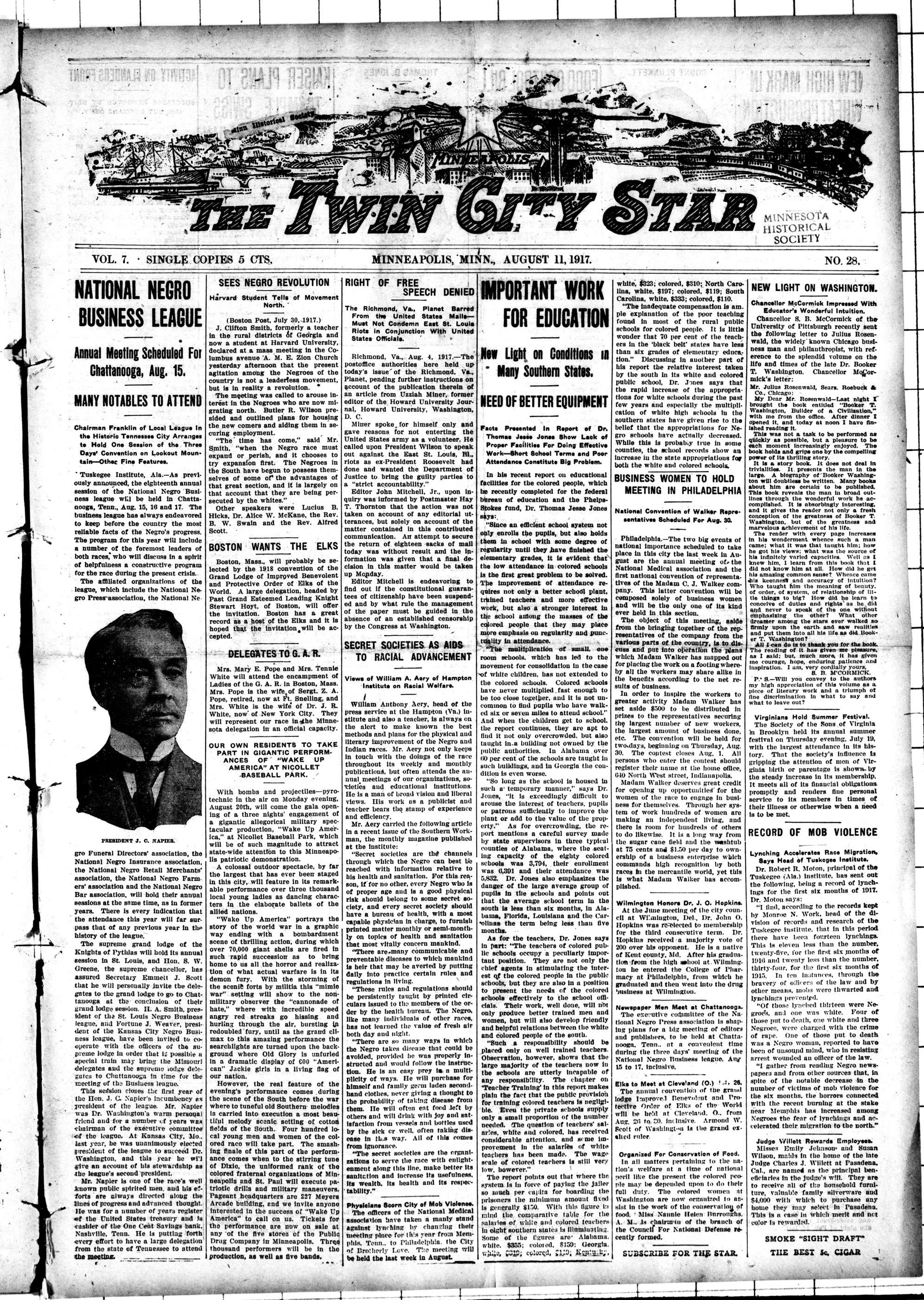
MINNESOTA
THE TWIN CITY STAR
MINNESOTA HISTORICAL SOCIETY
NATIONAL NEGRO BUSINESS LEAGUE
Chairman Franklin of Local League in the Historic Tennessee City Arranges to Hold One Session of the Three Days' Convention on Lookout Mountain—Other Fine Features.
Tuskegee Institute, Ala.—As previously announced, the eighteenth annual session of the National Negro Business league will be held in Chattanooga, Tenn., Aug. 15, 16 and 17. The business league has always endeavored to keep before the country the most reliable facts of the Negro's progress. The program for this year will include a number of the foremost leaders of both races, who will discuss in a spirit of helpfulness a constructive program for the race during the present crisis.
The affiliated organizations of the league, which include the National Negro Press association, the National Ne
PRESIDENT J. C. NAPIER.
gro Funeral Directors' association, the National Negro Insurance association, the National Negro Retail Merchants' association, the National Negro Farmers' association and the National Negro Bar association, will hold their annual sessions at the same time, as in former years. There is every indication that the attendance this year will far surpass that of any previous year in the history of the league.
The supreme grand lodge of the Knights of Pythias will hold its annual session in St. Louis, and Hon. S. W. Greene, the supreme chancellor, has assured Secretary Emmett J. Scott that he will personally invite the delegates to the grand lodge to go to Chattanooga at the conclusion of their grand lodge session. H. A. Smith, president of the St. Louis Negro Business league, and Fortune J. Weaver, president of the Kansas City Negro Business league, have been invited to cooperate with the officers of the supreme lodge in order that it possible a special train may bring the Missouri delegates and the supreme lodge delegates to Chattanooga in time for the meeting of the Business league.
This session closes the first year of the Hon. J. C. Napier's incumbency as president of the league. Mr. Napier was Dr. Washington's warm personal friend and for a number of years was chairman of the executive committee of the league. At Kansas City, Mo. last year, he was unanimously elected president of the league to succeed Dr. Washington, and this year he will give an account of his stewardship as the league's second president.
Mr. Napier is one of the race's well known public spirited men, and his efforts are always directed along the lines of progress and advanced thought. He was for a number of years register of the United States treasury and is cashier of the One Cent Savings bank, Nashville, Tenn. He is putting forth every effort to have a large delegation from the state of Tennessee to attend the meeting.
SEES NEGRO REVOLUTION
Harvard Student Tells of Movement North.
(Boston Post, July 20, 1917.)
J. Cliffn Smith, formerly a teacher in the rural districts of Georgia and now a student at Harvard University, declared at a mass meeting in the Columbus avenue 'A. M. E. Zion Church yesterday afternoon that the present agitation among the Negroes of the country is not a leaderless movement, but is in reality a revolution. *
The meeting was called to arouse interest in the Negroes who are now migrating north. Butler R. Wilson presided and outlined plans for housing the new comers and aiding them in securing employment.
"The time has come," said Mr. Smith, "when the Negro race must expand or perish, and it chooses to try expansion first. The Negroes in the South have begun to possess themselves of some of the advantages of that great section, and if it is largely on that account that they are being persecuted by the whites."
Other speakers were Lucius B. Hicks, Dr. Alice W. McKane, the Rev. B. W. Swain and the Rev. Alfred Scott.
BOSTON WANTS THE ELKS
Boston, Mass., will probably be selected by the 1918 convention of the Grand Lodge of Improved Benevolent and Protective Order of Elks of the World. A large delegation, headed by Past Grand Esteemed Leading Knight Stewart Hoyt, of Boston, will offer the invitation. Boston has a great record as a host of the Elks and it is hoped that the invitation will be accepted.
DELEGATES TO G. A. R.
Mrs. Mary E. Pope and Mrs. Tennile White will attend the encampment of Ladies of the G. A. R. in Boston, Mass. Mrs. Pope is the wife of Sergt. Z. A. Pope, retired, now at Ft. Snelling, and Mrs. White is the wife of Dr. J. R. White, now of New York City. They will represent our race in the Minnesota delegation in an official capacity.
OUR OWN RESIDENTS TO TAKE PART IN GIGANTIC PERFORMANCES OF "WAKE UP AMERICA" AT NICOLLET BASEBALL PARK.
With bombs and projectiles—pyrotechnic in the air on Monday evening, August 20th, will come the gala opening of a three nights' engagement of a gigantic allegorical military spectacular production, "Wake Up America," at Nicollet Baseball Park, which will be of such magnitude to attract state-wide attention to this Minneapolis patriotic demonstration. A colossal outdoor spectacle, by far the largest that has ever been staged in this city, will feature in its remarkable performance over three thousand local young ladies as dancing characters in the elaborate ballets of the allied nations.
"Wake Up America" portrays the story of the world war in a graphic way ending with a bombardment scene of thrilling action, during which over 70,000 giant shells are fired in such rapid succession as to bring home to us all the horror and realization of what actual warfare is in its demon fury. With the storming of the scenic forts by militia this "mimie war" setting will show to the non-military observer the "cannonade of hate," where with incredible speed angry red streaks go hissing and hurling through the air, bursting in redoubled fury, until as the grand climax to this amazing performance the searchlights are turned upon the background where Old Glory is unfurled in a dramatic display of 600 "American" Jackie girls in a living flag of our nation.
However, the real feature of the evening's performance comes during the scene of the South before the war where to tuneful old Southern melodies is carried into execution a most beautiful melody scenic setting of cotton fields of the South. Four hundred local young men and women of the colored race will take part. The smashing finale of this part of the performance comes when to the stirring tune of Dixie, the uniformed rank of the colored fraternal organizations of Minneapolis and St. Paul will execute patriotic drills and military maneuvers. Pageant headquarters are 227 Meyers Arcade building, and we invite anyone interested in the success of "Wake Up America" to call on us. Tickets for the performance are now on sale at any of the five stores of the Public Drug Company in Minneapolis. Threed thousand performers will be in the production, as well as five bands.
RIGHT OF FREE
SPEECH DENIED
The Richmond, Va., Planet Barred From the United States Mails—Must Not Condemn East St. Louis Riots in Conjunction With United States Officials.
Richmond, Va., Aug. 4, 1917.—The postoffice authorities here held up today's issue of the Richmond, Va., Planet, pending further instructions on account of the publication therein of an article from Uzziah Miner, former editor of the Howard University Journal, Howard University, Washington, D. C.
Miner spoke, for himself only and gave reasons for not entering the United States army as a volunteer. He called upon President Wilson to speak out against the East St. Louis, HI., riots as ex-President Roosevelt had done and wanted the Department of Justice to bring the guilty parties to a "strict accountability."
Editor John Mitchell, Jr., upon inquiry was informed by Postmaster Hay T. Thornton that the action was not taken on account of any editorial utterances, but solely on account of the matter contained in this contributed communication. Air attempt to secure the return of eighteen sacks of mail today was without result and the information was given that a final decision in this matter would be taken up Monday.
Editor Mitchell is endeavoring to find out if the constitutional guarantees of citizenship have been suspended and by what rule the management of the paper must be guided in the absence of an established censorship by the Congress at Washington.
SECRET SOCIETIES AS AIDS TO RACIAL ADVANCEMENT
Views of William A. Aery of Hampton Institute on Racial Welfare.
William Anthony Aery, head of the press service at the Hampton (Vn.) institute and also a teacher, is always on the alert to make known the best methods and plans for the physical and literary improvement of the Negro and Indian races. Mr. Aery not only keeps in touch with the doings of the race throughout its weekly and monthly publications, but often attends the annual meetings of our organizations, societies and educational institutions. He is a man of broad vision and liberal views. His work as a publicist and teacher bears the stamp of experience and efficiency.
Mr. Aery carried the following article in a recent issue of the Southern Workman, the monthly magazine published at the institute:
"Secret societies are the channels through which the Negro can best be reached with information relative to his health and sanitation. For this reason, if for no other, every Negro who is of proper age and is a good physical risk should belong to some secret society, and every secret society should have a bureau of health, with a most capable physician in charge, to furnish printed matter monthly or semi-monthly on topics of health and sanitation that most vitally concern mankind.
"There are many communicable and preventable diseases to which mankind is heir that may be averted by putting daily into practice certain rules and regulations in living.
"These rules and regulations should be persistently taught by printed circulars issued to the members of the order by the health bureau. The Negro, like many individuals of other races, has not learned the value of fresh air both day and night.
"There are so many ways in which the Negro takes disease that could be avoided, provided he was properly instructed and would follow the instruction. He is an easy prey in a multiply of ways. He will purchase for himself and family germ laden second-hand clothes, never giving a thought to the probability of taking disease from them. He will often eat food left by others and will drink with joy and satisfaction from vessels and bottles used by the sick or well, often taking disease in this way. All of this comes from ignorance.
"The secret societies are the organizations to serve the race with enlightenment along this line, make better its sanitation and increase its usefulness, its wealth, its health and its respectability."
Physicians Scorn City of Mob Violence. The officers of the National Medical association have taken a manly stand against lynching by changing their meeting place for this year from Memphis, Tenn., to Philadelphia, the City of Brotherly Love. The meeting will be held the last week in August.
Facts Presented In Report of Dr. Thomas Jesse Jones Show Lack of Proper Facilities For Doing Effective Work—Short School Terms and Poor Attendance Constitute Big Problem.
In his recent report on educational facilities for the colored people, which he recently completed for the federal bureau of education and the Phelps-Stokes fund, Dr. Thomas Jesse Jones says:
"Since an efficient school system not only enrolls the pupils, but also holds them in school with some degree of regularity until they have finished the elementary grades, it is evident that the low attendance in colored schools is the first great problem to be solved. The improvement of attendance requires not only a better school plant, trained teachers and more effective work, but also a stronger interest in the school among the masses of the colored people that they may place more emphasis on regularity and punctuality in attendance.
"The multiplication of small, one room schools, which has led to the movement for consolidation in the case of white children, has not extended to the colored schools. Colored schools have never multiplied fast enough to be too close together, and it is not uncommon to find pupils who have walked six or seven miles to attend school." And when the children get to school, the report continues, they are apt to find it not only overcrowded, but also taught in a building not owned by the public authorities. In Alabama over 60 per cent of the schools are taught in such buildings, and in Georgia the condition is even worse.
"So long as the school is housed in such a temporary manner," says Dr. Jones, "it is exceedingly difficult to arouse the interest of teachers, pupils or patrons sufficiently to improve the plant or add to the value of the property." As for overcrowding, the report mentions a careful survey made by state supervisors in three typical counties of Alabama, where the seating capacity of the eighty colored schools was 3,794, their enrollment was 6,391 and their attendance was 5,832. Dr. Jones also emphasizes the danger of the large average group of pupils in the schools and points out that the average school term in the south is less than six months, in Alabama, Florida, Louisiana and the Carolinas the term being less than five months.
As for the teachers, Dr. Jones says in part: "The teachers of colored public schools occupy a peculiarly important position. They are not only the chief agents in stimulating the interest of the colored people in the public schools, but they are also in a position to present the needs of the colored schools effectively to the school officials. Their work, well done, will not only produce better trained men and women, but will also develop friendly and helpful relations between the white and colored people of the south.
"Such a responsibility should be placed only on well trained teachers. Observation, however, shows that the large majority of the teachers now in the schools are utterly incapable of any responsibility. The chapter on 'Teacher Training' in this report makes plain the fact that the public provision for training colored teachers is negligible. Even the private schools supply only a small proportion of the number needed. The question of teachers' salaries, white and colored, has received considerable attention, and some improvement in the salaries of white teachers has been made. The wage scale of colored teachers is still very low, however."
The report points out that where the system is in force of paying the jailer so much per capita for boarding the prisoners the minimum amount fixed is generally $150. With this figure in mind the comparative table for the salaries of white and colored teachers in eight southern states is illuminating. Some of the figures are Alabama white. $355; colored. $150; Georgia white. $219; colored. $119; Kentucky.
white, $223; colored, $210; North Carolina, white, $197; colored, $119; South Carolina, white, $333; colored, $110.
"The inadequate compensation is ample explanation of the poor teaching found in most of the rural public schools for colored people. It is little wonder that 70 per cent of the teachers in the 'black belt' states have less than six grades of elementary education." Discussing in another part of his report the relative interest taken by the south in its white and colored public school, Dr. Jones says that the rapid increase of the appropriations for white schools during the past few years and especially the multiplication of white high schools in the southern states have given rise to the belief that the appropriations for Negro schools have actually decreased. While this is probably true in some counties, the school records show an increase in the state appropriations for both the white and colored schools.
BUSINESS WOMEN TO HOLD MEETING IN PHILADELPHIA
National Convention of Walker Representatives Scheduled For Aug. 30.
Philadelphia.—The two big events of national importance scheduled to take place in this city the last week in August are the annual meeting of the National Medical association and the first national convention of representatives of the Madam C. J. Walker company. This latter convention will be composed solely of business women and will be the only one of its kind ever held in this section.
The object of this meeting, aside from the bringing together of the representatives of the company from the various parts of the country, is to discuss and put into operation the plans which Madam Walker has mapped out for placing the work on a footing whereby all the workers may share alike in the benefits according to the net results of business.
In order to inspire the workers to greater activity Madam Walker has set aside $500 to be distributed in prizes to the representatives securing the largest number of new workers, the largest amount of business done, etc. The convention will be held for two days, beginning on Thursday, Aug. 30. The contest closes Aug. 1. All persons who enter the contest should register their name at the home office, 640 North West street Indianapolis.
Madam Walker deserves great credit for opening up opportunities for the women of the race to engage in business for themselves. Through her system of work hundreds of women are making an independent living, and there is room for hundreds of others to do likewise. It is a long way from the sugar cane field and the washtub at 75 cents and $1.50 per day to ownership of a business enterprise which commands high recognition by both races in the mercantile world, yet this is what Madam Walker has accomplished.
Wilmington Honors Dr. J. O. Hopkins. At the June meeting of the city council at Wilmington, Del., Dr. John O. Hopkins was re-elected to membership for the third consecutive term. Dr. Hopkins received a majority vote of 200 over his opponent. He is a native of Kent county, Md. After his graduation from the high school at Wilmington he entered the College of Pharmacy at Philadelphia, from which he graduated and then went into the drug business at Wilmington.
Newspaper Men Meet at Chattanooga
The executive committee of the National Negro Press association is shaping plans for a big meeting of editors and publishers, to be held at Chattanooga, Tenn., at a convenient time during the three days' meeting of the National Negro Business league, Aug. 15 to 17, inclusive.
Elks to Meet at Cleveland (O.) 14, 26.
The annual convention of the grand lodge Improved Benevolent and Protective Order of Elks of the World will be held at Cleveland, O., from Aug. 26 to 20. Inclusive. Armand W. Scott of Washington is the grand exalted ruler.
Organized For Conservation of Food.
In all matters pertaining to the nation's welfare at a time of national peril like the present the colored people may be depended upon to do their full duty. The colored women at Washington are now organized to assist in the work of the conservation of food. Miss Nannie Helen Burroughs, A. M., is chairman of the branch of the Council For National Defense recently formed.
SUBSCRIBE FOR THE STAR.
NO.28.
NEW LIGHT ON WASHINGTON.
Chancellor McCormick Impressed With Educator's Wonderful Intuition.
Chancellor S. B. McCormick of the University of Pittsburgh recently sent the following letter to Julius Rosenwald, the widely known Chicago business man and philanthropist, with reference to the splendid volume on the life and times of the late Dr. Booker T. Washington. Chancellor McCormick's letter: Mr. Julius Rosenwald, Sears. Roebuck & Co. Chicago.
My Dear Mr. Rosenwald-Last night I brought the book entitled "Booker T. Washington, Builder of a Civilization," with me from the office. After dinner I opened it, and today at noon I have finished reading it.
This was not a task to be performed as quickly as possible, but a pleasure to be each moment increasingly enjoyed. The book holds and grips one by the compelling power of its story. It is a story book. It does not deal in trivialities. It presents the man in the large. A biography of Booker Washington will doubtless be written. Many books about him are certain to be published.
This book reveals the man in broad outlines through the wonderful work he accomplished. It is absorbingly interesting, and the reader will not be disappointed in the exception of the greatness of Booker T. Washington, but of the greatness and marvelous achievement of his life.
The reader with every page increases in his wonderment whence such a man came; what it was that taught him; how he got his views; what was the source of his infinitely varied capacities. Well as I knew him, I learn from this book that I was born with a great sense of what he got his amazing common sense? Whence came his keenness and accuracy of intuition? Who taught him the meaning of beauty, of order, of system, of relationship of little things to big? How did he learn to conceive of duties and rights as he did and never to speak of the one without emphasizing the other? What other came to mind, and the ever more difficult upon the earth and saw realities and put them into all his life as did Booker T. Washington?
All I can do is to thank you for the book. The reading of it has given me pleasure, as I said; but, much more, it has given me courage, hope, enduring patience and inspiration. I am, very cordially yours.
S. B. MCHORMICK.
P.'S—Will you convey to the authors my high appreciation of this volume as a piece of literary work and a triumph of fine discrimination in what to say and what to leave out?
Virginians Hold Summer Festival.
The Society of the Sons of Virginia in Brooklyn held its annual summer festival on Thursday evening, July 19, with the largest attendance in its history. That the society's influence is gripping the attention of men of Virginia birth or parentage is shown by the steady increase in its membership. It meets all of its financial obligations promptly and renders fine personal service to its members in times of their illness or otherwise when a need is to be met.
RECORD OF MOB VIOLENCE
Lynching Accelerates Race Migration, Says Head of Tuskegee Institute.
Dr. Robert R. Moton, principal of the Tuskegee (Ala.) institute, has sent out the following, being a record of lynchings for the first six months of 1917.
Dr. Moton says:
"I find, according to the records kept by Monroe N. Work, head of the division of records and research of the Tuskegee institute, that in this period there have been fourteen lynchings. This is eleven less than the number, twenty-five, for the first six months of 1916 and twenty less than the number, thirty-four, for the first six months of 1915. In ten instances, through the bravery of officers of the law and by other means, mobs were thwarted and lynchings prevented.
"Of those lynchied thirteen were Negroes, and one was white. Four of those put to death, one white and three Negroes, were charged, with the crime of rape. One of those put to death was a Negro woman, reported to have been of unsound mind, who in resisting arrest wounded an officer of the law."
"I gather from reading Negro newspapers and from other sources that, in spite of the notable decrease in the number of victims of mob violence for the six months, the horrors connected with the recent burning at the stake near Memphis has increased among Negroes the fear of lynchings and accelerated their migration to the north."
Judge Willett Rewards Employees. Misses Emily Johnson and Susan Wilson, maids in the home of the late Judge Charles J. Willett at Pasadena, Cal., are named as the principal beneficiaries in the judge's will. They are to receive all of the household furniture, valuable family silverware and $4,000 with which to purchase any home they may select in Pasadena. This is a case in which merit and not color is rewarded.
SMOKE "SIGHT DRAFT"
THE BEST 5c. CIGAR
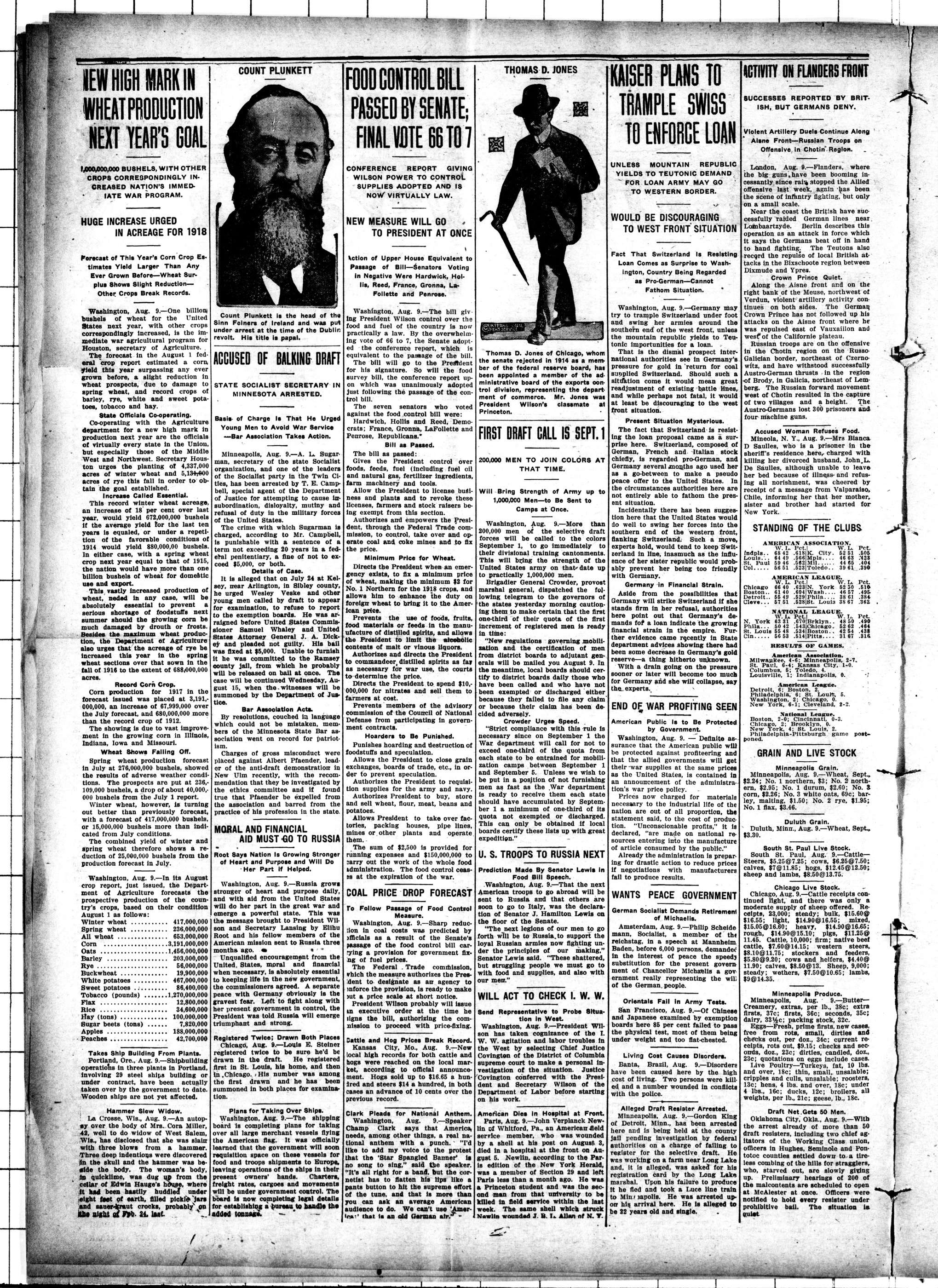
NEW HIGH MARK IN WHEAT PRODUCTION NEXT YEAR'S GOAL
1,000,000,000 BUSHELHS, WITH OTHER CROPS CORRESPONDINGLY INCREASED NATION'S IMMEDIATE WAR PROGRAM.
HUGE INCREASE URGED
IN ACREAGE FOR 1918
Forecast of This Year's Corn Crop Estimates Yield Larger Than Any Ever Grown Before—Wheat Surplus Shows Slight Reduction—Other Crops Break Records.
Washington, Aug. 9.—One billion bushels of wheat for the United States next year, with other crops correspondingly increased, is the immediate war agricultural program for Houston, secretary of Agriculture.
The forecast in the August 1 federal crop report estimated a corn yield this year surpassing any ever grown before, a slight reduction in wheat prospects, due to damage to spring wheat, and record crops of barley, rye, white and sweet potatoes, tobacco and hay.
State Officials Co-operating.
Co-operating with the Agriculture department for a new high mark in production next year are the officials of virtually every state in the Union, but especially those of the Middle West and Northwest. Secretary Houston urges the planting of 4,337,000 acres of winter wheat and 5,134,000 acres of rye this fall in order to obtain the goal established.
Increase Called Essential.
Increase Called Essential.
This record winter wheat acreage, an increase of 18 per cent over last year, would yield 672,000,000 bushels if the average yield for the last ten years is equaled, or under a repetition of the favorable conditions of 1914 would yield 880,000,000 bushels. In either case, with a spring wheat crop next year equal to that of 1915, the nation would have more than one billion bushels of wheat for domestic use and export.
This vastly increased production of wheat, nested in any case, will be absolutely essential to prevent a serious shortage of foodstuffs next summer should the growing corn be much damaged by drought or frosts. Besides the maximum wheat production, the Department of Agriculture also urges that the acreage of rye be increased this year in the spring wheat sections over that sown in the fall of 1916 to the extent of 688,000,000 acres.
Record Corn Crop.
Corn production for 1917 in the forecast issued was placed at 3,191,000,000, an increase of 67,999,000 over the July forecast, and 680,000,000 more than the record crop of 1912. The showing is due to vast improvement in the growing corn in Illinois, Indiana, Iowa and Missouri.
Wheat Shows Falling Off.
Spring wheat production forecast in July at 276,000,000 bushels, showed the results of adverse weather conditions. The prospects are put at 236, 109,000 bushels, a drop of about 40,000, 000 bushels from the July 1 report. Winter wheat, however, is turning out better than previously forecast, with a forecast of 417,000,000 bushels, or 159,000,000 bushels more than indicated from July conditions. The combined yield of winter and spring wheat therefore shows a reduction of 25,000,000 bushels from the production forecast in July.
Washington, Aug. 9.—In its August crop report, just issued, the Department of Agriculture forecasts the prospective production of the country's crops, based on their condition August 1 as follows:
Winter wheat ..... 417,000,000
Spring wheat ..... 236,000,000
All wheat ..... 653,000,000
Corn ..... 3,191,000,000
Oats ..... 1,456,000,000
Barley ..... 203,000,000
Rye ..... 56,000,000
Buckwheat ..... 19,900,000
White potatoes ..... 467,000,000
Sweet potatoes ..... 86,400,000
Tobacco (pounds) ..... 1,270,000,000
Flax ..... 12,800,000
Rice ..... 34,600,000
Hay (tons) ..... 100,000,000
Sugar beets (tons) ..... 7,820,000
Apples ..... 188,000,000
Peaches ..... 42,700,000
Takes Ship Building From Plants.
Portland, Ore., Aug. 9.—Shipbuilding operations in three plants in Portland, involving 29 steel ships building or under contract, have been actually taken over by the government to date.
Wooden ships are not yet affected.
Hammer Slew Widow.
La Crossse, Wis., Aug. 9.—An autopsy over the body of Mrs. Cora Miller, 42, well to do widow of West Salem, Wis., has disclosed that she was slain with three blows from a hammer. Three deep indentions were discovered in the skull and the hammer was beside the body. The woman's body, in quicklime, was dug up from the cellar of Edwin Hauge's house, where it had been hastily huddled under eight feet of earth, filled pickle jars and sauer-kaust crocks, probably on the night of Feb. 24, last.
—
Count Plunkett is the head of the Sinn Feiners of Ireland and was put under arrest at the time of the Dublin revolt. His title is papal.
ACCUSED OF BALKING DRAFT
STATE SOCIALIST SECRETARY IN MINNESOTA ARRESTED.
Basis of Charge Is That He Urged Young Men to Avoid War Service --Bar Association Takes Action.
Minneapolis, Aug. 9.—A. L. Sugarman, secretary of the state Socialist organization, and one of the leaders of the Socialist party in the Twin Cities, has been arrested by T. E. Campbell, special agent of the Department of Justice for attempting to cause subordination, disloyalty, mutiny and refusal of duty in the military forces of the United States.
The crime with which Sugarman is charged, according to Mr. Campbell, is punishable with a sentence of a term not exceeding 20 years in a federal penitentiary, a fine of not to exceed $5,000, or both.
Details of Case.
It is alleged that on July 24 at Kelsey, near Arlington, in Silley县, he urged Wesley Veske and other young men called by draft to appear for examination, to refuse to report to the exemption boards. He was arraigned before United States Commissioner Samuel Whaley and United States Attorney General J. A. Dickey and pleaded not guilty. His bail was fixed at $5,000. Unable to furnish it he was committed to the Ramsey county jail, from which he probably will be released on bail at once. The case will be continued Wednesday. August 15, when the witnesses will be summoned by the Department of Justice.
Bar Association Acts.
By resolutions, couched in language which could not be mistaken, members of the Minnesota State Bar association went on record for patriotism. Charges of gross misconduct were placed against Albert Pfaender, leader of the anti-draft demonstration in New Ulm recently, with the recommendation that they be investigated by the ethics committee and if found true that Pfaender be expelled from the association and barred from the practice of his profession in the state.
MORAL AND FINANCIAL
Root Says Nation Is Growing Stronger of Heart and Purpose and Will Do Her Part If Helped.
Washington, Aug. 9.—Russia grows stronger of heart and purpose daily, and with aid from the United States will do her part in the great war and emerge a powerful state. This was the message brought to President Wilson and Secretary Lansing by Elihu Root and his fellow members of the American mission sent to Russia three months ago.
Unqualified encouragement from the United, States, moral and financial when necessary, is absolutely essential to keeping life in the new government, the commissioners agreed. A separate peace with Germany obviously is the gravest fear. Left to fight along with her present government in control, the President was told Russia will emerge triumphant and strong.
Registered Twice; Drawn Both Places
Chicago, Aug. 9.—Louis E. Steiner
registered twice to be sure he'd be
drawn in the draft. He registered
first in St. Louis, his home, and then
in Chicago. His number was among
the first drawn and he has been
summoned in both places for examination.
Plans for Taking Over Ships.
Washington, Aug. 9.—The shipping board is completing plans for taking over all large merchant vessels flying the American flag. It was officially learned that the government will soon requisition space on these vessels for food and troops shipments to Europe, leaving operations of the ships in their present owners' hands. Charters, freight rates, cargoes and movements will be under government control. The board is now completing legal details for establishing a bureau to handle the added tonnage.
FOOD CONTROL BILL PASSED BY SENATE FINAL VOTE 66 TO 7
CONFERENCE REPORT GIVING WILSON POWER TO CONTROL SUPPLIES ADOPTED AND IS NOW VIRTUALLY LAW.
NEW MEASURE WILL GO TO PRESIDENT AT ONCE
Action of Upper House Equivalent to Passage of Bill—Senators Voting In Negative Were Hardwick, Hollis, Reed, France, Gronna, La-Follette and Penrose.
Washington, Aug. 9.—The bill giving President Wilson control over the food and fuel of the country is now practically a law. By the overwhelming vote of 66 to 7, the Senate adopted the conference report, which is equivalent to the passage of the bill. The bill will go to the President for his signature. So will the food survey bill, the conference report upon which was unanimously adopted just following the passage of the control bill. The seven senators who voted against the food control bill were:
Bill as Passed.
The bill as passed:
Gives the President control over foods, feeds, fuel (including fuel oil and natural gas, fertilizer ingredients, farm machinery and tools.
Allow the President to license business and plants and to revoke these licenses, farmers and stock raisers being exempt from this section.
Authorizes and empowers the President, through the Federal Trade commission, to control, take over and operate coal and coke mines and to fix the price.
Minimum Price for Wheat.
Directs the President when an emergency exists, to fix a minimum price of wheat, making the minimum $2 for No. 1 Northern for the 1918 crops, and allows him to enhance the duty on foreign wheat to bring it to the American price.
Prevents the use of foods, fruits, food materials or feeds in the manufacture of distilled spirits, and allows the President to limit the alcoholic contents of malt or vinous liquors.
Authorizes and directs the President to commander distilled spirits as far as necessary for war use, the courts to determine the price.
Directs the President to spend $10,000,000 for nitrates and sell them to farmers at cost.
Prevents members of the advisory commission of the Council of National Defense from participating in government contracts.
Hoarders to Be Punished.
Punishes hoarding and destruction of foodstuffs and speculation.
Allows the President to close grain exchanges, boards of trade, etc., in order to prevent speculation.
Authorizes the President to requisition supplies for the army and navy.
Authorizes President to buy, store and sell wheat, flour, meat, beans and potatoes.
Allows President to take over factories, packing houses, pipe lines, mines or other plants and operate them.
The sum of $2,500 is provided for running expenses and $150,000,000 to carry out the work of the whole food administration. The food control ceases at the expiration of the war.
COAL PRICE DROP FORECAST
To Follow Passage of Food Control Measure.
Washington, Aug. 9.—Sharp reduction in coal costs was predicted by officials as a result of the Senate's passage of the food control bill carrying a provision for government fixing of fuel prices.
The Federal Trade commission, which the measure authorizes the President to designate as an agency to enforce the provision, is ready to make out a price scale at short notice.
President Wilson probably will issue an executive order at the time he signs the bill, authorizing the commission to proceed with price-fixing.
Cattle and Hog Prices Break Record.
Kansas City, Mo., Aug. 9.—New local high records for both cattle and hogs were reached on the local market, according to official announcement. Hogs sold up to $16.65 a hundred and steers $14 a hundred, in both cases an advance of 10 cents over the previous record.
Clark Pleads for National Anthem.
Washington, Aug. 9.—Speaker Champ Clark says that America needs, among other things, a real national anthem with a punch. "I'd like to add my voice to the protest that the 'Star Spangled Banner' is no song to sing," said the speaker. "It's all right for a band, but the cornetist has to flatten his lips like a pants button to hit the supreme effort of the tune, and that is more than you can ask an average American audience to do. We can't use 'America': that is an old German air."
NATIONAL JOURNAL
NEW SERVICE
Thomas D. Jones of Chicago, whom the senate rejected in 1914 as a member of the federal reserve board, has been appointed a member of the administrative board of the exports control division, representing the department of commerce. Mr. Jones was President Wilson's classmate at Princeton.
200,000 MEN TO JOIN COLORS AT THAT TIME.
Will Bring Strength of Army up to 1,000,000 Men—to Be Sent to Camps at Once.
Washington, Aug. 9.—More than 200,000 men of the selective draft forces will be called to the colors September 1, to go immediately to their divisional training cantonments. This will bring the strength of the United States army on that date up to practically 1,000,000 men.
Brigadier General Crowder, provost marshal general, dispatched the following telegram to the governors of the states yesterday morning cautioning them to make certain that the first one-third of their quota of the first increment of registered men is ready in time:
"New regulations governing mobilization and the certification of men from district boards to adjutant generals will be mailed you August 9. In the meantime, local boards should certify to district boards daily those who have been called and who have not been exempted or discharged either because they failed to file any claim or because their claim has been decided adversely.
Crowder Urgea Speed.
"Strict compliance with this rule is necessary since on September 1 the War department will call for not to exceed one-third of the quota from each state to be entrained for mobilization camps between September 1 and September 5. Unless we wish to be put in a position of not furnishing men as fast as the War department is ready to receive them each state should have accumulated by September 1 a minimum of one-third of its quota not exempted or discharged. This can only be obtained if local boards certify these lists up with great expedition."
U. S. TROOPS TO RUSSIA NEXT
Prediction Made By Senator Lewis in Food Bill Speech.
Washington, Aug. 9.—That the next American troops to go abroad will be sent to Russia and that others are soon to go to Italy, was the declaration of Senator J. Hamilton Lewis on the floor of the Senate.
"The next legions of our men to go forth will be to Russia, to support the loyal Russian armies now fighting under the principles of our making," Senator Lewis said. "These shattered, but struggling people we must go to with food and supplies, and also with our men."
WILL ACT TO CHECK I. W. W.
Send Representative to Probe Situation in West.
Washington, Aug. 9—President Wilson has taken cognizance of the L. W. W. agitation and labor troubles in the West by selecting Chief Justice Covington of the District of Columbia supreme court to make a personal investigation of the situation. Justice Covington conferred with the President and Secretary Wilson of the Department of Labor before starting on his work.
American Dies in Hospital at Front.
Paris, Aug. 9.—John Verplanck Newlin of Whitford, Pa., an American field service member, who was wounded by a shell at his post on August 3, died in a hospital at the front on August 5. Newlin, according to the Paris edition of the New York Herald, was a member of Section 29 and left Paris less than a month ago. He was a Princeton student and was the second man from that university to be killed in field service within the last week. The same shell which struck Newlin wounded J. B. I. Allan of N. F.
KAISER PLANS TO TRAMPLE SWISS TO ENFORCE LOAN
UNLESS MOUNTAIN REPUBLIC
YIELDS TO TEUTONIC DEMAND
FOR LOAN ARMY MAY GO
TO WESTERN BORDER.
Fact That Switzerland Is Resisting Loan Comes as Surprise to Washington, Country Being Regarded as Pro-German—Cannot Fathom Situation.
Washington, Aug. 9.—Germany may try to trample Switzerland under foot and swing her armies around the southern end of the west front, unless the mountain republic yields to Teutonic importitions for a loan.
That is the dismal prospect international authorities see in Germany's pressure for gold in return for coal supplied Switzerland. Should such a situation come it would mean great readjustment of existing battle lines, and while perhaps not fatal, it would at least be discouraging to the west front situation.
Present Situation Mysterious.
The fact that Switzerland is resisting the loan proposal came as a surprise here. Switzerland, composed of German, French and Italian stock chiefly, is regarded pro-German, and Germany several months ago used her as a go-between to make a pseudo peace offer to the United States. In the circumstances authorities here are not entirely able to fathom the present situation. Incidentally there has been suggestion here that the United States would do well to swing her forces into the southern end of the western front, flanking Switzerland. Such a move, experts hold, would tend to keep Switzerland in line, inasmuch as the influence of her sister republic would probably prevent her being too friendly with Germany.
Germany in Financial Strain.
Aside from the possibilities that Germany will strike Switzerland if she stands firm in her refusal, authorities here point out that Germany's demands for a loan indicate the growing financial strain in the empire. Further evidence came recently in State department advice showing there had been some decrease in Germany's gold reserve—a thing hitherto unknown. With a drain going on the pressure sooner or later will become too much for Germany and she will collapse, say the experts.
END OF WAR PROFITING SEEN
American Public Is to Be Protected by Government.
Washington, Aug. 9. — Definite assurance that the American public will be protected against profiteering and that the allied governments will get their war supplies at the same prices as the United States, is contained in an announcement of the administration's war price policy.
Prices now charged for materials necessary to the industrial life of the nation are out of all proportion, the statement said, to the cost of production. "Unconscionable profits," it is declared, "are made on national resources entering into the manufacture of article consumed by the public."
Already the administration is preparing for drastic action to reduce prices if negotiations with manufacturers fall to produce results.
WANTS PEACE GOVERNMENT
German Socialist Demands Retirement of Michaelis.
Amsterdam, Aug. 9.—Philip Scheidemann, Socialist, a member of the reichstag, in a speech at Mannheim, Baden, before 6,000 persons, demanded in the interest of peace the speedy substitution for the present government of Chancellor Michaelis a government really representing the will of the German people.
Orientalis Fail in Army Tests
San Francisco, Aug. 9.—Of Chinese and Japanese examined by exemption boards here 85 per cent failed to pass the physical test, most of them being under weight and too flat-chested.
Living Cost Causes Disorders
Banta, Brazil, Aug. 9.—Disorders have been caused here by the high cost of living. Two persons were killed and a number wounded in conflicts with the police.
Alleged Draft Register Arrested.
Minneapolis, Aug. 9.—Gordon King of Detroit, Minn., has been arrested here and is being held at the county fall pending investigation by federal authorities on a charge of failing to register for the selective draft. He was working on a farm near Long Lake and, it is alleged, was asked for his registration card by the Long Lake marshal. Upon his failure to produce it he fled and took a Luce line train to Minneapolis. He was arrested upon his arrival here. He is alleged to be 22 years old and single.
ACTIVITY ON FLANDERS FRONT
SUCCESSSES REPORTED BY BRIT-
ISH, BUT GERMANS DENY.
Violent Artillery Duels Continue Along Alane Front—Russian Troops on Offensive in Chotin' Region.
London, Aug. 9.—Flanders, where the big guns, have been booming incessantly since raid stopped the Allied offensive last week, again has been the scene of infantry fighting, but only on a small scale.
Near the coast the British have successfully raided German lines near Lombaartzyde. Berlin describes this operation as an attack in force which it says the Germans beat off in hand to hand fighting. The Teutons also record the repulse of local British attacks in the Bixschoote region between Dixmude and Ypres.
Crown Prince Quiet.
Along the Aisne front and on the right bank of the Meuse, northwest of Verdun, violent artillery activity continues on both sides. The German Crown Prince has not followed up his attacks on the Aisne front where he was repulsed east of Vauxailon and west of the Californie plateau.
Russian troops are on the offensive in the Chotin region on the Russo-Galician border, northeast of Czernowitz, and have withstood successfully Austro-German thrusts in the region of Brody, in Galicia, northeast of Lemberg. The Russian forward movement west of Chotin resulted in the capture of two villages and a height. The Austro-Germans lost 300 prisoners and four machine guns.
Mineola, N. Y., Aug. 9.—Mrs Bianca D Saulles, who is a prisoner in the sheriff's residence here, charged with killing her divorced husband, John_L De Saulles, although unable to leave her bed because of illness and refusing all norishment, was cheered by receipt of a message from Valparaiso, Chile, informing her that her mother, sister and brother had started for New York.
STANDING OF THE CLUBS
AMERICAN ASSOCIATION.
W. L. Pct.
Indpls. 60 62 581K City. 53 56 506
Louls. 64 49 566 Mpls. 46 63 423
St. Paul 59 46 562 Mill. 44 65 404
Col. 56 51 523 Toledo. 39 61 390
AMERICAN LEAGUE.
W. L. Pct.
Chicago 66 40 623N York 52 50 510
Boston 60 40 604 Wash. 46 57 495
Detroit 65 49 549 Phila. 38 61 384
Cleve. 57 51 528St. Louis 38 67 362
NATIONAL LEAGUE.
W. L. Pct.
N York 63 40 670 Brlynk. 48 50 490
Phila. 50 42 543 Chicago. 52 62 494
St. Louis 55 48 534 Boston. 42 54 438
Cin. 56 53 514 Pitts. 31 67 316
RESULTS OF GAMES.
American Association.
Milwaukee, N. W.apolis, 2-7.
St. Paul, 64; Kannapolis, City, 1-0.
Columbus, 5; Toledo, 4.
Louisville, 1; Indianapolis, 0.
League.
Detroit, 6; Boston, 2.
Philadelphia, 6; St. Louis, 5.
Washington, 2; Chicago, 0.
New York, 6-1; Cleveland, 2-2.
National League.
Boston, 0; Indianapolis, 0-3.
Chicago, 2; Brooklyn, 0.
New York, 4; St. Louis, 2.
Philadelphia-Pittsburgh game post-
ooped.
GRAIN AND LIVE STOCK
Minneapolis, Aug. 9—Wheat, Sept.,
$2.24; No. 1 northern. $3; No. 2 northern.
$2.95; No. 1 durum. $2.60; No. 3
corn. $2.26; No. 3 white cats. 69c; barley,
malting. $1.50; No. 2 rye. $1.95;
No. 1 flax. $3.46.
Duluth Grain.
Duluth, Minn., Aug. 9.—Wheat, Sept.,
$3.30.
South St. Paul Live Stock.
South St. St. Paul, Aug. 9. —Cattle-
Steers, $5.25@7.25; cows, $6.25@7.50;
calves, $7@11.85; hogs, $12.45@12.50;
sheep and lambs, $8.50@13.75.
Chicago Live Stock.
Chicago, Aug. 9.—Cattle receipts continued light, and there was only a moderate supply of sheep offered. Receipts, 23,000; steady; bulk, $15.60@$16.55; light, $14.90@$16.55; mixed, $15.05@$16.60; heavy, $14.90@$16.65; rough, $14.90@$15.10; pigs, $11.25@$11.45. Cattle, 10,000; firm; native beef cattle, $7.60@$14.15; western steers, $8.10@$17.75; stockers and feeders, $5.80@$9.20; cows and heifers, $4.40@$11.90; calves, $8.50@$13. Sheep, 9,000; steady; wethers, $7.50@10.65; lambs, $9@14.35.
Minneapolis Produce.
Minneapolis, Aug. 9.—Butter-
Creamery, extras, per lb., 18c; extra
firsts, 37c; firsts, 36c; seconds, 35c;
dairy, 33%c; packing stock, 32c.
Eggs—Fresh, prime firsts, new cases,
free from rots, small, dirties and
checks out, per doz, 34c; current
receipts, rots out, $9.15; checks and
seconds, doz, 23c; dirties, candied, doz,
23c; quotations on eggs include cases.
Live Poultry—Turkeys, fat, 10 lbs
and over, 18c; thin, small, unsalable;
cripples and culls, unsalable; roosters,
13c; hens, 4 lbs. and over, 18c; under
4 lbs., 16c; ducks, 12c; broilers, all
weights, per lb., 21c; geese, lb., 18c.
Draft Net. Gets 50 Men.
Oklahoma City, Okla., Aug. 9.—With the arrest already of more than 50 draft resisters, including two chief agitators of the Working Class union, officers in Hughes, Seminole and Pontotoc counties settled down to a tireless combing of the hills for stragglers, who, starved out, are slowly giving up. Preliminary hearings of 200 of the malcontents are scheduled to open at McAlester at once. Officers were notified to hold every resister under prohibitive bail. The situation is quiet
HAPPENINGS
in the
BIG CITIES
NEW YORK.—Those who took the state military census in this city have added considerably to their knowledge of the human units which make up the industrial fabric of a great city. The answers given to the question in
regard to occupation elicited some curious information. One negro who presented himself for registration on the lower West side answered that he was "the man who brushes off the gents after they have had their shoes shined." Cross-examination revealed that this was the only gainful occupation which he had ever pursued in the whole course of his twenty-four years. He brought his whisk broom with him.
STATE MUTARY CENSUS BOARD
Another applicant for a registration card at the same location also
brought proof of his occupation in the shape of a portfolio of pictures. He was an artistic photographer, he said, and after submitting the portfolio as proof of his assertion he endeavored to sell some of his works to the staff of registrars until he was ejected.
Four Greeks who came in together reported in answer to another question that they were the joint owners of one horse. The census blanks were very searching in their inquiries regarding the ownership of horses, mules, automobiles and such things, but apparently no thought had been given to the possibility of joint ownership of these accessories. The problem thus presented to the registrars was solved by reporting each son of Hellas as the owner of one-fourth of a horse.
Still another odd occupation was reported by an applicant who gave his occupation as "handy man about the house."
"Mary the Cooper" Prominent Figure in Boston
BOSTON.—Do you know Mary? Mary who? Mary the cooper—Mary of Faneull Hall Market district. Ask any man down in the wholesale quarter of the city who Mary is and he will tell you all about the old, bright-eyed Italian woman, whose eyes the joys of honest labor have kept sparkling, whose cheeks outdoor work has kept rosy, and whose healthy constitution a cheery disposition has done much to promote.
LO
MARY
Mary earns her living—and a prosperous one at that, too—by scouring the market district for empty and broken barrels. With her husband's aid she repairs them, in their little back-room garret down in the North end. She has every dealer, broker and
lumper for her friend. Any man will tell you that there is not a more honest woman in the district and that every penny she earns she comes by honestly. Never has she been known to steal or try to "do" a person.
You might well be surprised any day to see a barrel, supposedly suspended in mildair, gliding down the street. Upon closer examination you would see that the barrel is supported upon the head of a woman—Mary—on her daily rounds.
Dodging in and out among the enormous trucks, peeping now into this store, now into another, for a stray barrel, as she makes her way along the street, she is greeted on every side by a friendly: "Howd'y do, Mary? Got good business today? That's good, Mary!"
No man can put a storehouse to rights as quickly and make it as free from debris as can Mary. And to the question often put to her: "Mary, why do you work so hard?" she replies with a little shrug of her shoulders, as a smile spreads over her wrinkled face and a twinkle comes into her brown eyes: "No work, no can eat."
Mary, however, does not go unrewarded for her work. No market man ever forgets her, and every empty or broken barrel is put aside with a word: "Keep it for the 'cooper woman.'"
Intelligent Bulldog Is Pride of San Antonio
Intelligent Bulldog Is Pride of San Antonio
SAN ANTONIO--Mack, the fourteen-year-old registered English bulldog owned by H. C. Flint of 816 West Evergreen street, first acquired city-wide fame several months ago when he prevented a burglar from robbing his master's home. He has long been a neighborhood celebrity, however, his many less spectacular performances gaining him friends among people of all ranks of life, except burglars.
A STRANGE MAN
CALLED WHILE YOU
WAS OUT
Aside from being an efficient watchdog, as was demonstrated when he seized the burglar, who was escaping through the window with a bag full of silverware and cut glass, he has many other accomplishments. He herds chickens as a collie does sheep, he brings in wood in the evening, and
brings in the newspaper and the mail. When all the members of the family are too far away to hear the telephone he calls them to it as soon as it rings, and on one occasion he saved the house from burning when he called his mistress into the room where the rug had caught on fire from the grate. Moreover, in spite of his age, Mack is an expert mouser.
His intelligence is far above that of the ordinary bulldog, and his understanding of speech is said to be so nearly perfect that when people do not want him to understand what they are talking about they resort to spelling, as one would do with a child. Before getting into bed he carefully turns down the cover.
Mack's favorite dissipation is riding in the automobile, and the fact that he has been in wrecks does not seem to have made the pastime lose any of its charm. Perhaps some of his many unusual qualities can be traced to the fact that he was born on Christmas day.
Mother Had Kept Demented Children Hidden
PITTSBURGH—Mystery growing out of strange noises, like the bark of a dog, coming from the residence of John Sinziski, at 5408 Carnegie avenue, Lawrenceville, and the queer actions of Mrs. Sinziski, who died in St. Margaret's Memorial hospital after an illness of two months, was cleared when neighbors entered the house to view the woman's body and found two children, apparently demented, crawling about the floor.
The two children, both boys, were attired in girls' clothes. John, aged fourteen, the oldest boy, crawled along the floor on his hands and knees, according to the police, and barked like a dog. The other, Joseph, aged nine,
The two children, both boys, were attired in girls' clothes. John, aged fourteen, the oldest boy, crawled along the floor on his hands and knees, according to the police, and barked like a dog. The other, Joseph, aged nip, was pounding his head against the
floor. Policewoman Ethel Cronlin was notified and the oldest boy was taken to central police station by the detectives and placed in the matron's department. The younger boy was turned over to the Humane society.
According to the police, neighbors asserted that they had never seen the two children during the five years the family lived there and thought that Steve Sinziski, aged ten, another son, was the only child the couple had. Steve was permitted to play outside. Policewoman Cronlin says Mrs. Sinziski never permitted any outsiders to enter the house. The police believe that the woman feared juvenile authorities might take the children from her if their condition was brought to light. Because of the woman's actions, neighbor say that the home was known as "The House of Mystery."
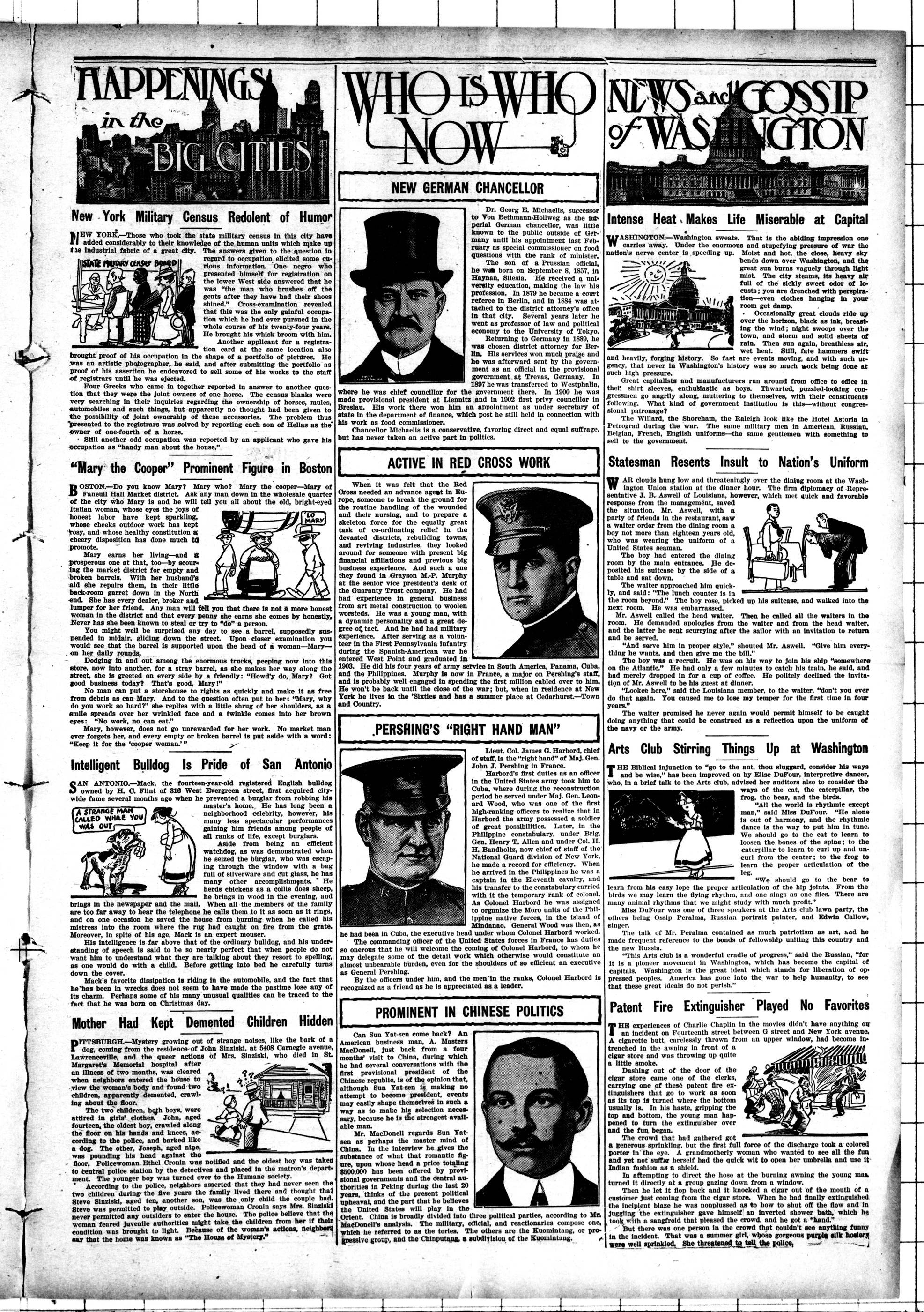
WHO IS WHO NOW
NEW GERMAN CHANCELLOR
Dr. Georg E. Michaelis, successor to Von Ethmann-Hollweg as the imperial German chancellor, was little known to the public outside of Germany until his appointment last February as special commissioner on food questions with the rank of minister.
TOMMY H. HENRY
INCORPORATED BY GOVERNOR
The son of a Prussian official, he was born on September 8, 1857, in Haynan, Silesia. He received a university education, making the law his profession. In 1879 he became a court referee in Berlin, and in 1884 was attached to the district attorney's office in that city. Several years later he went as professor of law and political economy to the University of Tokyo.
Returning to Germany in 1889, he was chosen district attorney for Berlin. His services won much praise and he was afterward sent by the government as an official in the provisional government at Trevas, Germany. In 1897 he was transferred to Westphalia, where he was chief councillor for the government there. In 1900 he was made provisional president at Liennitz and in 1902 first privy councillor in Breslau. His work there won him an appointment as under secretary of state in the department of finance, which post he still held in connection with his work as food commissioner.
Chancellor Michaels is a conservative, favoring direct and equal suffrage, but has never taken an active part in politics.
ACTIVE IN RED CROSS WORK
ACTIVE IN RED CROSS WORK
U.S. MARINE CORPS
When it was felt that the Red Cross needed an advance agent in Europe, someone to break the ground for the routine handling of the wounded and their nursing, and to prepare a skeleton force for the equally great task of co-ordinating relief in the devastated districts, rebuilding towns, and reviving industries, they looked around for someone with present big financial affiliations and previous big business experience. And such a one they found in Grayson M-P. Murphy at the senior vice president's desk of the Guaranty Trust company. He had had experience in general business from art metal construction to woolen worsteds. He was a young man, with a dynamic personality and a great degree of tact. And he had had military experience. After serving as a volunteer in the First Pennsylvania Infantry during the Spanish-American war he entered West Point and graduated in
1903. He did his four years of army service in South America, Panama, Cuba, and the Philippines. Murphy is now in France, a major on Pershing's staff, and is probably well engaged in spending the first million cabled over to him. He won't be back until the close of the war; but, when in residence at New York he lives in the 'Sixties and has a summer place at Cedarhurst—Town and Country.
.PERSHING'S "RIGHT HAND MAN"
Lieut. Col. James G. Harbord, chief of staff, is the "right hand" of Maj. Gen. John J. Pershing in France.
PETER H.
Harbord's first duties as an officer in the United States army took him to Cuba, where during the reconstruction period he served under Maj. Gen. Leonard Wood, who was one of the first high-ranking officers to realize that in Harbord the army possessed a soldier of great possibilities. Later, in the Philippine constabulary, under Brig. Gen. Henry T. Allen and under Col. H. H. Bandholtz, now chief of staff of the National Guard division of New York, he made a record for efficiency. When he arrived in the Philippines he was a captain in the Eleventh cavalry, and his transfer to the constabulary carried with it the temporary rank of colonel. As Colonel Harbord he was assigned to organize the Moro units of the Philippine native forces, in the island of Mindanao. General Wood was then, as he had been in Cuba, the executive head under whom Colonel Harbord worked.
The commanding officer of the United States forces in France has duties so onerous that he will welcome the coming of Colonel Harbord, to whom he may delegate some of the detail work which otherwise would constitute an almost unbearable burden, even for the shoulders of so efficient an executive as General Pershing. By the officers under him, and the men in the ranks, Colonel Harbord is recognized as a friend as he is appreciated as a leader.
PROMINENT IN CHINESE POLITICS
PETER H.
Can Sun Yat-sen come back? An American business man, A. Masters MacDonell, just back from a four months' visit to China, during which he had several conversations with the first provisional president of the Chinese republic, is of the opinion that, although Sun Yat-sen is making no attempt to become president, events may easily shape themselves in such a way as to make his selection necessary, because he is the strongest available man.
Mr. MacDonell regards Sun Yat-sen as perhaps the master mind of China. In the interview he gives the substance of what that romantic figure, upon whose head a price totaling $500,000) has been offered by provisional governments and the central authorities in Peking during the last 20 years, thinks of the present political upheaval, and the part that he believes the United States will play in the
Orient. China is broadly divided into three political parties, according to Mr. MacDonell's analysis. The military, official, and reactionaries compose one, which he referred to as the tories. The others are the Kuomintang, or progressive group, and the Chinupintang, a subdivision of the Kuomintang.
NEWS and GOSSIP OF WASHINGTON
Intense Heat, Makes Life Miserable at Capital
WASHINGTON.—Washington sweats. carries away. Under the enormo nation's nerve center is speeding up.
That is the abiding impression one us and stupefy pressure of war the Molst and hot, the close, heavy sky bends down over Washington, and the great sun burns vaguely through light mist. The city steams, its heavy air full of the sickly sweet odor of locusts; you are drenched with perspiration—even clothes hanging in your room get damp.
SUNSHINE
Occasionally great clouds ride up over the horizon, black as ink, breasting the wind; night swoops over the town, and storm and solid sheets of rain. Then sun again, breathless air, wet heat. Still, fate hammers swift and heavily, forging history. So fast are events moving, and with such urgency, that never in Washington's history was so much work being done at such high pressure.
Great capitalists and manufacturers run around from office to office in their shirt sleeves, enthusiastic as boys. Thwarted, puzzled-looking congressmen go angrily along, muttering to themselves, with their constituents following. What kind of government institution is this—without congressional patronage?
The Willard, the Shoreham, the Raleigh look like the Hotel Astoria in Petrograd during the war. The same military men in American, Russian, Belgian, French, English uniforms—the same gentlemen with something to sell to the government.
Statesman Resents Insult to Nation's Uniform
Statesman Resents Insult to Nation's Uniform
WAR clouds hung low and threateningly over the dining room at the Washington Union station at the dinner hour. The firm diplomacy of Representative J. B. Aswell of Louisiana, however, which met quick and favorable response from the management, saved the situation. Mr. Aswell, with a party of friends in the restaurant, saw a waiter order from the dining room a boy not more than eighteen years old, who was wearing the uniform of a United States seaman.
A man in a suit is standing in front of a desk, holding a briefcase. A man in a suit is leaning forward, bending his knees as if to give a high-five.
The boy had entered the dining room by the main entrance. He deposited his suitcase by the side of a table and sat down.
the room beyond." The boy rose, picked up his suitcase, and walked into the next room. He was embarrassed.
Mr. Aswell called the head waiter. Then he called all the waiters in the room. He demanded apologies from the waiter and from the head waiter, and the latter he sent scurrying after the sailor with an invitation to return and be served.
"And serve him in proper style," shouted Mr. Aswell. "Give him everything he wants, and then give me the bill."
The boy was a recruit. He was on his way to join his ship "somewhere on the Atlantic." He had only a few minutes to catch his train, he said, and had merely dropped in for a cup of coffee. He politely declined the invitation of Mr. Aswell to be his guest at dinner.
"Lookee here," said the Louisiana member, to the waiter, "don't you ever do that again. You caused me to lose my temper for the first time in four years."
The waiter promised he never again would permit himself to be caught doing anything that could be construed as a reflection upon the uniform of the navy or the army.
Arts Club Stirring Things Up at Washington
THE Biblical injunction to "go to the ant, thou sluggard, consider his ways and be wise," has been improved on by Elise DuFour, interpretive dancer, who, in a brief talk to the Arts club, advised her auditors also to consider the ways of the cat, the caterpillar, the frog, the bear, and the birds.
"All the world is rhythmic except man," said Miss DuFour. "He alone is out of harmony, and the rhythmic dance is the way to put him in tune. We should go to the cat to learn to loosen the bones of the spine; to the caterpillar to learn to curl up and uncurl from the center; to the frog to learn the proper articulation of the leg.
"All the world is rhythmic except man," said Miss DuFour. "He alone is out of harmony, and the rhythmic dance is the way to put him in tune. We should go to the cat to learn to loosen the bones of the spine; to the caterpillar to learn to curl up and uncurl from the center; to the frog to learn the proper articulation of the leg.
"We should go to the bear to learn from his easy lope the proper articulation of the hip joints. From the birds we may learn the flying rhythm, and one sings as one flies. There are many animal rhythms that we might study with much profit."
Miss DuFour was one of three speakers at the Arts club lawn party, the others being Ossip Peralma, Russian portrait painter, and Edwin Callow, singer.
The talk of Mr. Peralma contained as much patriotism as art, and he made frequent reference to the bonds of fellowship uniting this country and the new Russia.
"This Arts club is a wonderful cradle of progress," said the Russian, "for it is a pioneer movement in Washington, which has become the capital of capitals. Washington is the great ideal which stands for liberation of oppressed peoples. America has gone into the war to help humanity, to see that these great ideals do not perish."
Patent Fire Extinguisher Played No Favorites
THE experiences of Charlie Chaplin in the movies didn't have anything on an incident on Fourteenth street between G street and New York avenue. A cigarette butt, carelessly thrown from an upper window, had become intrenched in the awning in front of a cigar store and was throwing up quite a little smoke.
Dashing out of the door of the cigar store came one of the clerks, carrying one of these patent fire extinguishers that go to work as soon as its top is turned where the bottom usually is. In his haste, gripping the top and bottom, the young man happened to turn the extinguisher over and the fun began.
Dashing out of the door of the cigar store came one of the clerks, carrying one of these patent fire extinguisher that go to work as soon as its top is turned where the bottom usually is. In his haste, gripping the top and bottom, the young man happened to turn the extinguisher over and the fun began.
The crowd that had gathered got a generous sprinkling, but the first full force of the discharge took a colored porter in the eye. A grandmotherly woman who wanted to see all the fun and yet not suffer herself had the quick wit to open her umbrella and use it Indian fashion as a shield.
In attempting to direct the hose at the burning awning the young man turned it directly at a group gazing down from a window.
Then he let it flop back and it knocked a cigar out of the mouth of a customer just coming from the cigar store. When he had finally extinguished the incipient blaze he was nonplussed as to how to shut off the flow and in juggling the extinguisher gave himself an inverted shower bath, which he took with a sangfroid that pleased the crowd, and he got a "hand."
But there was one person in the crowd that couldn't see anything funny in the incident. That was a summer girl, whose gorgeous purple silk hosiery were well sprinkled. She threatened to tell the police.
THE TWIN CITY STAR
PUBLISHED EVERY FRIDAY BY
CHARLES SUMNER SMITH,
Minneapolis, Minnesota.
Entered in the Post Office at Minneapolis as second class matter.
MEMBER
NATIONAL NEGRO PRESS
ASSOCIATION
MEMBER
MINNEAPOLIS ENERGY
ASSOCIATION
ORGANIZED
1867
Subscription by Mall, Postpaid.
ONE YEAR ..... $2.00
SIX MONTHS ..... $125
THREE MONTHS ..... .65
Hamlet B. Rowe, Local Agent.
ADVERTISING RATES.
One Inch—1 Insertion—One Dollar.
Liberal discount given on 3, 6, 9,
Months, or 1 year: contracta.
We do not run free ads, or over-run
the time contracted for by our advertisers. We respect their right to
advertise at intervals, and rather have
them do so, than to run continuously
an "adv." and an increasing account.
Write all Checks payable to
Call at 1317 6th Ave. N. on Wednesday to insure matter for publication.
The Twin City Star stands for equal rights for all American citizens.
The Star tries to publish the news of Negroes entirely. We know the "war news" is interesting, but Negroes read and pay for the daily papers, which carry the current news. We have the exclusive right of the plate service edited by N. B. Dodson, a Negro, which gives us the best-side of Negro publicity. Every week the Star has in its columns articles of the race, which will never appear in the white papers or some Negro weeklies.
Prof. W. E. B. DuBois was selected as the spokesman for the delegation to protest to President Wilson against lynchings and lawlessness. When Editor Trotter appeared before the president, against the segregation of Negroes in governmental service, the president did not like his "tone." What excuse could he give for not receiving a delegation headed by one of America's most cultured Negroes, Dr. DuBois?
It has come to our notice that beer is delivered in large quantities to Negroes on the North Side for commercial purposes. Although it was claimed that the brewers would co-operate with the Public Safety Commission, it appears that some of them are still "delivering the goods" under a system.
THE BEER TRAFFIC.
The Minneapolis Tribune rendered a great service to all fair-minded citizens in its editorial of Aug. 8, "The President Should Answer." The white press all over the country is calling for federal action and the President may yet find time to break his cruel silence for the safety of our nation and the welfare of humanity.
NEGRO LABOR IN DEMAND
There is a great demand for laborers now and Negroes are being employed where before they were "not wanted." As a rule, they are making good and their efficiency will overcome much of the general prejudice against them. The Negro has been denied the privilege of employment mostly because of the ignorance of many employers. Since the Negro laborer has better opportunities, he will be a better citizen. The so-called race-problem will soon be solved because there is no Negro problem; it is the white man's; and its only solution is an intelligent consideration for the Negro as a man and an acknowledgement of his right to earn his living on equal footing with other citizens.
44 YEARS IN POSTAL SERVICE
In Baltimore we say all the lettercarriers except a few are white. "In Petersburg, Va., all the lettercarriers except one are colored," said J. M. B. Holmes in the office last Monday. "I was appointed to a position there under the administration of President Grant, and this week I celebrate the 44th anniversary of my entry into the mail carrying business. I believe I am the second oldest carrier in the country. Generals Grant and Lee, I knew well, and I also shook hands with President Lincoln.
"Three weeks ago I was transferred back to the route that I traveled when I was first appointed. The children and the grandchildren of the folks I served then greatly embarassed me by asking me if I didn't remember them. Of course I didn't recognize the grown folks, who were bables when I used to deliver mail to their houses."
Mr. Holmes is hale and hearty despite the 44 years of toting Uncle Sam's malls.—Afro American Ledger.
THE NAVY NEEDS MEN
The following is the copy sent to Northwest papers by Lieut. Commander, Jas. D. Willson, U. S. Navy.
Mr. American Citizen;
Do you realize that the United States Navy is still short many thousands of men to properly man the ships now building to be ready for active war service the latter part of this year?
The Navy needs real men — red blooded Americans who are willing to do their bit for good old U. S. A., as did the men and boys of 1776 and 1861. Are you going to sit tight and "Let George do it" and in the future be ashamed to answer your children and grandchildren, when they say, "Daddy, what did you do during the great War?", or are you going to be in a position to say "Daddy was a Navy Volunteer, fought for this country of ours and helped to make the blessings of Liberty secure for ourselves and our posterity, and also helped save some of the starving mothers and children of Europe." Now is the time for you to step forward and volunteer for the Navy—always found ready when needed by your Uncle Sam. Men of the type of Farragut, Dewey, Lawrence, Perry and Nathan Hale are wanted. There are plenty of them in this city who will "make history" when they finally volunteer. The Northwest has never been found wanting when the Nation needed men. Volunteer now, write or telegraph Navy Recruiting Station, Minneapolis. Branch stations at St. Paul, St. Cloud, Duluth and Brainerd, Minn., and Fargo, Grand Forks, Minot and Bismarck. N. D.
THE NEGRO'S ANSWER.
Dear Uncle Sam
Dear Uncle Sam.
I realize your position for which you are entirely responsible. I have offered my services, but according to your orders "Negroes are not wanted" as white men. My fathers fought with Perry on Lake Erie, with Farragut at New Orleans and in Mobile Bay. I served with Dewey at Manilla and with Sampson at Santiago, and have never been "found wanting," other than a chance to fight for you. A thousand of my brothers are waiting, until you cast aside your prejudice, and you will be compelled to do so. The Negro Americans are sitting tight and do not care, who does it. Should you need them (and you certainly will) they are ready. Discrimination has denied them the ability to serve you, as they would like to; but your persecution has not overcome their patriotism. They are here, there, and everywhere, in the land of their birth, the U. S. A.
Our Friend at Court.
Every Negro owes a lasting debt of gratitude to Hon. Theodore Roosevelt, who placed the American people on record for the responsibility of the horrible outrages on defenseless Negroes at East St. Louis, Ill., during the recent riot and the well-meaning people of the civilized world honor him for his noble speech and manly stand. Not only does Mr. Roosevelt preach the "square deal," he practices it, and by so doing he has done much to destroy the spirit of lynching and mob violence. Mr. Roosevelt has called on the Wilson administration to act on this occasion. The President of our great democracy (?) has not deemed the affair even worthy of comment. Mr. Roosevelt is America's greatest statesman and we are proud to have such a friend at court.
We have some among our advertisers and subscribers who are a credit to our race for their business-like methods. They pay promptly in advance and expect nothing unreasonable in return. Others want to know "Why we can't 'trust' them?" or send a bill, and then a collector, and finally censor a Negro editor because he can't run his paper "like the white man." Few persons realize that it pays to pay as you go. The Star is not an installment plan proposition. It is a real newspaper run under many difficulties mostly due to the foolish notions and ignorant whims of those whom it serves and protects and from whom it should get its support and their consideration.
Pity the poor children of many families. It is hard for many a hard working parent to support a family. Under the high cost of living these innocent sufferers are denied the necessities of life. We have a Belgium within our borders.
Do not waste your time making promises to our agents. Send your money by Express or Post Office Order or in cash or postage stamps.
The J. & H. Laundry is owned and operated by the Gibbs Boys, sons of Mrs. Ione E. Gibbs. We mention this because many on the north side patronize other firms. This is the most modern wet wash laundry in the Northwest.
Henry Atwood, a student at the University of Minnesota, has been commissioned a second lieutenant. Mr. Atwood is a native of New York city and a member of one of its oldest families.
Ransom Is Promoted.
Samuel L. Ransom, who enlisted as a private in the Eighth Illinois, has been promoted to a corporal.
OUR NEW ADDRESS
Send all mail for THE TWIN CITY STAR to 1317 6TH AVE. NO., MINNEAPOLIS.
THE TWIN CITY STAR, MINNEAPOLIS, MINN.
WAR AND SOCIAL PROBLEMS.
More Efficiency and Loyalty Urged by
National Conference Members.
National Conference Members.
The great war and its social problems overshadowed every other topic on the Pittsburgh program of the National Conference of Social Work. To 4,300 men and women who had come together from many states to exchange ideas and receive fresh inspiration for their social service, work there was brought home the thought of the necessity of doing their present, work more skillfully, more economically and more wisely.
To cripple, through lack of men and money, the social work which has been palmstakingly developed through long years of struggle, thinking people realize is truly shortsighted.
The committee on resolutions, Hastings H. Hart, Thomas B. Mayman and Robert W. Kelso, departing from the usual policy of the conference, made the following recommendations, which were heartily adopted:
"The National Conference of Social Work places on record, in behalf of the great majority of its 4,300 members, their intense loyalty and their purpose to support the president and the government of the United States in the prosecution of this war in the interest of liberty and democracy.
"The obligation to make every necessary sacrifice rests with double weight upon the organizations for social welfare. We therefore commend the patriotism of those social organizations which are lending their most efficient workers for the national service in the government departments, the national Red Cross, the movement for conserving health and morals in the army and navy by wholesome recreation and by eliminating temptations to intemperance and vice.
"On the other hand, we would emphasize the insistence of the president of the United States as to the necessity for conserving those agencies which operate to maintain public morals, public health and the producing forces of the community. We therefore urge the importance of maintaining the full force and efficiency of the agencies for social work and of securing for all of the new and pressing demands created by the war, especially those agencies which make for the preservation and improvement of public health and family life, the protection of motherhood and the preservation of children from the destructive and demoralizing influences of war.
"We urge the maintenance throughout the war of all our standards for the protection of industrial employees, especially women and children: The lending of social workers for the national service should not include so large a number as to cripple the effectiveness of these vital agencies, which are among the most essential bulwarks for the national defense."
Miss Cromwell Receives High Honors. Miss Mary E. Cromwell, second daughter of Professor John W. Cromwell of Washington, author of "The Negro In American History," has just received the degree of master of arts in sociology and psychology from the University of Pennsylvania, the first colored woman to win this honor from this school of learning.
NEW HISTORY AND MANUAL
FOR NOTED SECRET ORDER
Knights of Pythias Enriched by Work Covering Its Various Branches.
A history and manual of the Colored Knights of Pythias, printed by the National Baptist publishing board of Nashville, Tenn., and sold by the Central Regalia company of Cincinnati is just off the press. The book contains 1,019 pages, giving a complete history of the supreme lodge, all grand lodges, the U. R. K. of P., the supreme court and all grand courts of Calanthe and biographies of many Pythians and Calantheans of note.
Among the interesting things found in the book are the following: The origin of each department of the order, with the story of the handicaps and hindrances from without and within which annoyed the pioneers in this work; complete statistics showing the growth of the order in each state; a textbook of forms used in dedicatory services, installation services, memorial services, funeral services, drama of Damon and Pythias, suggestions for orations, sermons and essays, pictures of the various halls and buildings owned by the order, photographs and biographies of many eminent Pythians, Calantheans and uniform rank officers in the several states.
END OF WAR PROFITING SEEN
American Public Is to Be Protected by Government.
Washington, Aug. 9. — Definite assurance that the American public will be protected against profiteering and that the allied governments will get their war supplies at the same prices as the United States, is contained in an announcement of the administration's war price policy.
Prices now charged for materials necessary to the industrial life of the nation are out of all proportion, the statement said, to the cost of production. "Unconscionable profits," it is declared, "are made on national resources entering into the manufacture of article consumed by the public."
Already the administration is preparing for drastic action to reduce prices if negotiations with manufacturers fail to produce results.
Read the Negro Papers.
SEND YOUR SUBSCRIPTION
Good Beer is Strengthening
There is strength in
pure beer like
Hochsteiner
LAGER
Brewed under sanitary condition
Purest of ingredients
The beer without a headache
PURITY BREWING CO.
The Leading Bottle Beer Brewery
Order a Case
Today
Both Phones 66
MINNEAPOLIS, MINN
N. W. MAIN 2259 Souvenirs for Ladies every Wednesday afternoon and Evening KEYSTONE BUFFET and CLUB CAFE' 1313 Wash. Ave. South FOR LADIES & GENTLEMEN Music Every Day from 2 P. M. to 11 P. M. Kidd Mitchell, Prop. MINNEAPOLIS, MINN. LADIES SPECIALLY INVITED EVERY DAY.
N. W. MAIN 2869 Auto. 36 774 STAG HOTEL TAXI SERVICE, 246 Fourth Avenue South CARS AT ALL HOURS. SPECIAL RATES TO THEATRE AND DANCE PARTIES. ROBERT SINGER, Prop.
CHALMERS LIVERY SERVICE
WRIGHT AND SHEPARD, PROP.
TOURING AND LIMOUSINES
DAY AND NIGHT
OFFICE AND GARAGE: 244 2ND AVE. SO. MINNEAPOLIS, MINN.
THE WORLD'S FIRST WOMEN'S FIGHTING FOR EQUALITY
has a special stock of Fall Hats of the Latest Designs. No two pattern hats alike. Hats made to order. Prices reasonable. Workmanship guaranteed. Phone Nic. 3744.
ATTENTION! LADIES.
MANICURING AND FACIAL MASSAGE
ELECTRIC HAIR TREATMENTS
GIVEN
HAIR STRAIGHTENING MY SPECIALTY.
MADAM HART'S PREPARATIONS.
ARTESIA CREAM. Handled past ten years. Removes Liver spots and black-heads. Bleaches the skin and renews its natural color.
ELECTRIC HAIR GROWER 50c.
Overton's High-Brown Powder.
Testimonials.
Mrs. Essie Taylor, 633 Mississippi St.
St. Paul and Mrs. Nancy Wade, 603 Fifth Ave. So Minneapolis and others have sent testimonials recommending Madam Hart's Preparations and Hair-work.
MADAM M. HART,
305 13th Ave. S., Minneapolis,
THANN'S BUFFET
N. W. Cedar 8190. Res. Dale 8935
HAMMOND TURNER
Attorney at Law
Suite 321, American Nat'l Bank
Fifth and Cedar Sts.
St. Paul.
WORKING-MEN'S
SOCIAL CLUB
Drex 1269
FOR MEN ONLY
244 3RD AVE. S.
MINNEAPOLIS
OLIVER & JONES
MANAGERS.
Phone Hy. 3605.
Dr. Ellis Burton
DENTIST
Graduate Northwestern Dental
School of Chicago.
715 Sixth Ave. No.,
Minneapolis, Minn.
SMOKE THE BEST
5C CIGAR
Sight Draft
W. S CONRAD CO., Distributors
NO. 140. E. 6th ST., ST. PAUL.
NO. 1. WESTERN AVE., MINN.
CHOICE CITY AND SUBURBAN PROPERTY FOR SALE
ON SMALL MONTHLY PAYMENTS.
802 Sykes Block.
N. W. Nic. 621 Minneapolis
OSCAR GILBERT PRICE.
Real Estate, Insurance and Loans.
Choice Property for Sale or Rent.
2814 10th Ave. So.
N. W. South 5250 Minneapolis
N. W. Phone Nic. 1873
J. M. MORRIS
Real Estate Broker
Loans Collections
506 BOSTON BLOCK
MINNEAPOLIS, MINN.
Peterson, The Druggist 1501 Washington Ave. So.
FOILET ARTICLES, DRUGS
PRESCRIPTIONS.
He Solicits Your Patronage.
ADVERTISE IN THE STAR
T. TRAVIS, Prop.
ACTION.
MS
ERS
Phone: Cedar 9088
Automatic 61809
A laundry
the
Wet Wash
handering
INSEMENT
Auto. 36 774
Avenue South
ANCE PARTIES.
High Grade Specialists in Wet Wash Dry Wash and Family Laundering OUR WORK IS OUR BEST ADVERTISEMENT
N. W. Main 5244
RVICE
P.
CES
NEAPOLIS, MINN.
```markdown
```
M. B. H.
JOSEPH DÄHL, Prop.
TON
r
TO ORDER.
MEN'S SUITS AND OVERCOATS MADE TO ORDER.
Dry Cleaning and Fancy Dyeing of Ladies' and Gent's Garments.
Phone N. W. Hyland 2875 1317 No. 6th Ave., Minneapolis.
How Our Secret Service Started
in the
relab-
is a
ark as
kee"
both
their
ago
All nations engaged in the great war now have elaborate spy systems:It is a phase of military work as old as history:“Yankee” and "Rebel" scouts of both sexes were noted for their daring fifty odd years ago
advance. There was. great need of spies.
However, some historians attribute McCielan's failure to win the decisive results that were open to him at Antietam to the mistaken reports of the great preponderance of numbers in Lee's army that were received from the secret service organization. McCielan seemed inclined to use the agency too much to learn the strength of the enemy and too little to learn its weaknesses.
Operation of Women Spies.
Miss Van Liew, a resident of Richmond, Va., rendered invaluable service to the Union cause, and Mrs. Greenhow was equally valuable to the Confederacy as a spy in Washington. Mrs. Greenhow had been a leader in Washington society before the war. "She was a Southerner by birth, but a resident of the capital from girlhood; a widow, beautiful, accomplished, wealthy, and noted for her wif and her forceful personality." Her wide acquaintance among important men was used to good advantage to further the Southern cause. Though suspected by the Federal authorities, she contrived many ingenious ways to escape their vigilance. Jefferson Davis said to her: "But for you there would have been no battle of Bull Run." That defeat of the North was supposed to have been largely due to her getting a copy of the order to General McDowell and sending it to Beauregard. She was drowned at the mouth of Cape Fear river, North Carolina, in her attempt to land from the blockade runner Condor, after some secret mission to England in behalf of the Confederacy. Weighted by her heavy black silk dress and a bag of gold sovereigns, she was an easy victim of the waves.
We have the word of the adjutant general's office of the war department that women spies were never shot during the Civil war.
Secret Stations and Ciphers.
The Army and Navy Journal says that the greater part of the information that was received at Washington from Richmond was collected and transmitted by Miss Van Liew, through a chain of five secret stations established by her for forwarding her cipher dispatches. "She was a woman of forty, of delicate figure, brilliant, accomplished, resolute—a woman of great personality and infinite charm." She held in Richmond a special position corresponding to that of Mrs. Greenhow in Washington. Jenny Lind sang in her parlor and Poe there read aloud his "Raven." This house was the rendezvous of the Federal secret agents, and, there, in her "secret room," were concealed escaped union prisoners. Miss Van Liew even had the audacity to get a negro girl devoted to her interests introduced as a waitress into the home of Jefferson Davis. Though her Northern sympathies were well known and she was constantly suspected, no evidence against her sufficient to cause her arrest was ever obtained.
Mrs. Surratt was condemned and hanged for participation in the Lincoln assassination plot. Her home had been a regular meeting place for consiprators, and her son among them, and Payne, who attempted to kill Seward, was on his way to the Surratt rendezvous when arrested.
Belle Boyd was the siren spy of the South. The daughter of a Virginia merchant, "blue eyed, sharp featured, quick "tempered and very free," she easily attracted the young officers and learned how to get information and get it across the border without detection. She rode a spirited horse and carried a revolver in her belt. Not satisfied with her individual efforts, she organized a corps of spies of her own style.
Virginia women lighted many a signal lamp by the garret windows, and of calico, but the greater number were entirely naked to the waist. The faces and bodies of the men were, almost without an exception, fantastically painted, the predominant color being deep red, with occasionally a few stripes of dull clay white around the eyes and mouth. The squawns, of which there were about twenty, were dressed very much like the men, and at a little distance could hardly be distinguished from them. Among them was an old, superannuated crone, who, soon after her arrival, had been
Defective Page
HE use of spies in war is as old as war itself. The modern German elaboration of esplonage, in time of peace as well as war, among neutrals as well as enemies, is rather a reversion to type than a step in progress, says a writer in the Philadelphia
Record. Joshun and Solomon employed spies. The Hebrew peregrinations to reach the promised land required information concerning regions and peoples to be invaded. One Caleb was the chief boy of a corps that was sent to learn of the fertility had the military strength of the land of Canaan. After 40 days of espionage they reported that it was a land of milk and honey and fruit, but that the cities were fortified and the people were strong, some of them being giants.
The Greeks rather prided themselves on the cleavness of their spies. The Romans, if we are to take their own word for it, were incapable of stooping to the baseness of common spying or studied treachery of any sort.
When Abraham Lincoln, president-elect, in his address on Washington's birthday, 1861, at Independence hall, in reply to the mayor of Philadelphia, hinted in a single clause that he might not live to be inaugurated, he had been informed, through John Allen Pinkerton, of the plot to take his life at Baltimore. He left on an earlier train, and did not stop at that city. The United States at that time had no secret service organization. But a system for obtaining military information in the Southern states was established early in the war by General McChallan, and from this developed the federal secret service, which was throughout the war in charge of the original Pinkerton under the name of Maj. E. J. Allen.
America's Secret Service.
Pinkerton, gaining some reputation by running down a gang of counterfeiters, had been appointed deputy sheriff of Cook county, Illinois, with offices in Chicago. He won more fame by getting the thieves and nearly all the loot of a $700,000 theft from the safes of the Adams Express company. In 1852 he established the Pinkerton National Detective agency. And perhaps it is only just to say that Pinkerton saved Lincoln for the presidency and thereby saved the Union.
Important figures in the secret service work of the Civil war were newspaper reporters, scouts and women. The newspaper men did not have the semiofficial and perfunctory status that they have in this war. They had to assume the disguises and pretenses of real spies to get material they were supposed to get, and then send it unimpired and also uncensored. They were frequently arrested and imprisoned and took many of the same risks that the military spies did. This was especially true of the early part of the war, and the seceding period preceding, when they followed the movements leading to the war and mingled with legislators at the Southern capitals. Scouts, who are ordinarily in uniform and treated as regular prisoners of war when captured, did much service under such commanders as Mosby and Young quite after the manner of spies, and they were hanged when caught. The most notable female spies were not professional secret service agents, but were residing in one section and holding their sympathies with the other, and acted primarily through strong patriotic motives.
Besides the spy activities at home, the Confederate states had an important secret service work in Europe. English sympathy was enlisted on their side, arrangements were made for building cruisers at Bordeaux, English frontworkers were sent to the South. When the army of the Potomac, after long delay and preparafion, began its advance in October, 1861, McClellan's orders had been given in entire ignorance of the topography of the environs of Edward's Ferry (all the maps being inexact), and of the force of the enemy in front of Leesburg. In spite of the efforts of Pinkerton, at that time the secret service organization was entirely inefficient. Fighting units thought to be within supporting distance of each other were crushed without the knowledge of the intended supporters. The South had the advantage of familiarity with their own country. There were no airplanes to guide the
PRIMITIVE DECORATIONS
Townsend, an early Western traveler, tells that one day he met about a hundred Indians of the Sac tribe. "They were dressed and decorated in the true primitive style, their heads shaved closely, and painted with alternate stripes of fiery red and deep black, leaving only the long scalping tuft, in which was interwoven a quantity of elk hair and eagles' feathers. Each man was furnished with a good blanket, and some had an underdress
THE TWIN CITY STAR, MINNEAPOLIS, MINN.
honest-looking corages and innocent-bustied busties carried many a military secret.
Scout Spies of the North.
"Archie" Rowland was one of the most daring and successful scout spies of the Northern side. He and his pals formed the nucleus of Sheridan's secret service organization in the valley of the Shenandoah. This organization, recruited up to 40, under command of H. H. Young, became the most noted and efficient of the Federal army.
Rowland tells how he volunteered for this service. "My company had been on ordinary scout duty for some time. But when we were drawn up in line and the captain asked for volunteers for 'extra dangerous duty,' I looked at Ike Harris and Ike looked at me, and then we both stepped forward. We were both boys and wanted to know what was the 'extra dangerous duty,' and when we found out we hadn't the face to back down. They took us to headquarters and gave us two rebel uniforms—and we wished we had not come."
These men were expected to deceive pickets by the uniform and capture them so that the main body could be surprised; or ride up to a Southern citizen, man or woman, ask for information and depend upon the deception to get all the person knew. One of their great dangers was that of meeting death at the hands of their own men. Often discovered and hard pressed by the enemy, they would flee in their gray uniforms for safety to their own lines, only to be met by a murderous volley from their own mistaken pickets. . . .
Ten of Young's command of 40 were lost, none by the natural death of a soldier and none in the colors for which he died. Two were hanged by their own halter straps.
But they had privileges beyond any others in the army. They were free from all camp drudgery, guard and picket duty, and from camp discipline. They lived together in the headquarters, ate the best the land afforded. Each had four picked horses. They were paid according to the value of their information, and the secret service chest was prodigal with their expense accounts. They were the aristocracy of the army.
On the reverse of a certain little bronze star are these words: "The Congress—to Archibald H. Rowland, Jr.—for Valor."
John Beall, privateersman, with Burley and Maxwell, were on the Potomane and Chesapeake what Mosby was on land. Beall cut the submarine telegraph cable under the Chesapeake and destroyed lamps and machinery of lighthouses. Meeting Burley by surprise in Toronto, Canada, they turned into a private room and shut the door. Then Beall slowly said: "Burley, I want you—for my lieutenant. It is my old plan at last. I am to capture the Michigan, free the Johnson island prisoners, burn Sandusky, Cleveland and Buffalo." The services of Harry Young were so esteemed that when Sheridan said, "I want him." General Edwards remonstrated, "I would rather you would take my right arm." One of his soldiers said, "We think God A'mighty of him."
And there were Bowle, "William, C. S. A.;" Landegon, the Phillipus-father and son—and Timothy Webster, spy.
It was Timothy Webster who insinuated himself into the confidence of the would-be assassins in Baltimore and frustrated the plot against Lincoln's life. Allan Pinkerton gives him the supreme credit: "He, among all the force who went with me, deserves the credit of saving the life of Lincoln, ever more than I do."
presented with a broken umbrella. The only use that she made of it was to wrench the plated ends from the whalebones, string them on a piece of wire, take her knife from her belt, with which she deliberately cut a slit of an inch in length along the upper rim of her ear, and insert them in it."—Youth's Companion.
The Babylonian bricks were more commonly burned in kilns than those used at Nineveh, which were sun-dried, like those of the Egyptians.
INTERNATIONAL
SUNDAY SCHOOL
(By REV. P. B. FITZWATER, D. D. Teacher of English Bible in the Moody Bible Institute of Chicago). (Copyright, 1917, Western Newspaper Union.)
LESSON FOR AUGUST 12
LESSON TEXT-II Chronicles 3:41-13.
GOLDEN TEXT-Remember now thy Creator in the days of thy youth.-Eccles.
12:1.
The reign of Josiah is in striking and pleasing contrast with that of many of his predecessors, especially that of his father, Amon, and grandfather, Manasseh.
1. Time of Beginning (v. 1). He ascended the throne when only eight years of age. At this tender age he evidently had a sense of the import of the service of God's house. This sense must have been strong to enable him to withstand the corrupt influences of his surroundings. The prevailing idolatry influenced this boy, but influenced him in the opposite way in which boys are usually influenced. It aroused his hatred for it. This serves to demonstrate the fact that circumstances do not necessarily determine the direction a life may go. Each individual has the ability to determine the course of his life; and moreover, his responsibility so to do. It is a most perilous thing to be thrust into such a prominent position while so young. However, sometimes such responsibility has a sobering effect, calling forth one's latent powers. That his aspiration for God and the right was genuine is proven by the fact that he persisted therein for thirty-one years.
II. The Character of His Reign (v. 2). "He did that which was right in the sight of the Lord, and walked in the ways of David his father, and declined neither to the right hand nor to the left." He not only maintained outward order and decorum as to the worship of God, but doubtless at heart desired to please God.
III. Josiah's Reformation in the Kingdom (vv. 3-7). He first set out to root out idolatry from the land. This was a prodigious task, requiring great courage and skill. He did this with a strong hand. Without pity he swept out from the land these abominations. In the execution of this task he—
1. Broke down the altars of Baalam (v. 4). This form of idolatry was first brought into the land by Jezebel when she married Ahab. The images seem to have been such as would appeal to the sensual nature of men; therefore it was but natural that the grossest licentious practices should be associated with this worship.
2. He broke in pieces the groves, carved images, and molten images (v. 4). He even made dust of them and strewed it upon the graves of those who had been offering unto them.
3. He burned the bones of the priests on their altars (v. 5). He not only showed no pity for them, but he manifested a decided fierceness in the execution of his task.
4. He extended this destruction to certain districts in the northern kingdom. It was not until all this was done that he returned to Jerusalem (vv. 6, 7). His reformation thus began at home, but was extended to the widest extent of his kingdom.
IV. Josiah Repaired the Temple (vv. 8-13). Having rid the land of its idolatry, he set himself to the repairing of the temple which had been so long neglected. This neglect, coupled with gross abuses at times, made it to be sadly in need of attention.
1. His deputies (v. 8). This work he intrusted to a committee of three—Shaphan, the royal secretary (II Kings 22:3); Masselain, mayor of Jerusalem; and Joah, the recorder, the historian of the nation. In the matter of ridding the city and country of idolatry Josiah took the lead in person, but now the work had gone far enough forward that he could work by deputy. He chose his deputies from among "laymen" instead of the priests.
2. Method of procedure (vv. 9-13).
(a) Collection of money (v. 9).
It would seem that for some time collection of money for temple repairs had been going on. Perhaps it was begun in connection with the destruction of idolatry some six years before. The agents in this work were the Levites. They collected it from all over the kingdom, even giving the remnant of Israel an opportunity for fellowship in this matter. This shows us that religious interests of the people should be sustained by all the people adhering thereto.
(b) Money placed into the treasury (v. 9). Hilkiah, the high priest, was the treasurer. From this treasury the overseers drew the money and paid it to the workmen who repaired the temple.
"Christus" Goes to War
Copenhagen. — Anton Lang, the Christus of Oberammergau's "Passion Play," finally has been called to the colors, according to a dispatch to the Berlin Tageblatt from Augsburg, Bavaria. Herr Iang hitherto has seen no service, although it has been reported repeatedly that he has been killed in the war.
It is unofficially stated that 16,051,600 pounds of raw salmon were shipped from British Columbia to Pacific ports in the United States last year.
W A
$1.00 PRIVATE BOX
SEATS RESERVED
Better Reserve Seats Now at Any of 5 S
Reserve Seats Now at Any of 5 Stores of the Public Drug Co.
M.
1224 N. 6TH AVE., MINNEAPOLIS WITHERS' SPECIAL SERVICE
J. A. Withers, Prop.
Office Phones—Main 2869; Auto 36774.
Twenty Elegant Steam-Heated and
A la Carte Meals at All Hour
STEWART'S
J. Ed. Stewart, Prop.
246-250 FOURTH AVE. S., N
Private Dining and Reception Room
ance Beverages. Men's Buffet and Grill
Connection.
Bones—Main 2869; Auto 36774. Dining Room—Main 2831.
Tenancy Elegant Steam-Heated and Electric Lighted Rooms.
A la Carte Meals at All Hours—Popular Prices.
TEWART'S HOTEL
Stewart, Prop. Chas. Brody, Mgr.
446-250 FOURTH AVE. S., MINNEAPOLIS, MINN.
Private Dining and Reception Room for Ladies. Special Temper-
erages. Men's Buffet and Grill; Billiards; Barber Shop in
n.
246-250 FOURTH AVE. S., MINNEAPOLIS, MINN. Private Dining and Reception Room for Ladies. Special Temperance Beverages. Men's Buffet and Grill; Billiards; Barber Shop in Connection.
South Side Barber Shop
1100 WASH. AVENUE EXPERT BARBERS; UP CIGARS, POOL AND BILLIARD TRADE PAPERS—SHOE THOMPSON & CARV
1100 WASH. AVE. SO.
EXPERT BARBERS; UP TO THE MINUTE.
, POOL AND BILLIARD TABLES IN CONNECTION.
RACE PAPERS—SHOES SHINED.
THOMPSON & CARVER, Props.
The Waiters' and Porters' Club
1100 WASH. AVE. SO.
EXPERT BARBERS; UP TO THE MINUTE.
CIGARS, POOL AND BILLIARD TABLES IN CONNECTION.
RACE PAPERS—SHOES SHINED.
THOMPSON & CARVER, Props.
GLOVER SHULL, PRES.
311 HENNEPIN AVE. MINNEAPOLIS
EDDIE BOYD, BECY' LEE WHEELER, MANAGER
Spirella
CORSETS
(NOT SOLD IN STORES)
Spirella
CORSETS
(NOT SOLD IN STORES)
will give you lithe, uncorseted grace and constant comfort, yet mould your. figure to the present fashion. They are fitted to your measure in your own home by a trained corsetiere—the Spirella way. A telephone call or post-card will bring an expert to your home to explain the Spirella service and boning in detail.
Subscribe for
Spirella Corset Shop
CORA E. CARR
368 Aurora Ave.
St. Paul, Minn.
Subscribe for The Star
Subscribe for The Star
WAKE UP AMERICA
Minnesota's Greatest Patriotic Pageaut
NICOLLET BALL PARK
3 Nights Commencing
Monday Night
August 20
50c GOOD SEAT
GRAND STAND
"Unto the Least
of These"
By Alice E. Ives
(Copyright, by W. G. Chapman.)
Gusie Felstrom worked all day in the box factory. It was monotonous, wearisome work, and very small pay. She saw on the avenue, when she went home, other girls, no prettier than she wearing becoming, beautiful clothes. When she went in to buy a pair of cheap cotton gloves she saw women buying long kid ones, and a kind of rebellion surged up in her heart at the existing state of things. But there was the worn-out, overworked mother, and four children, all younger than herself. The father's small, intermittent earnings barely kept a roof over their heads.
Had Gussie not been a girl who thought, she might have drifted along, perhaps in the footsteps of her mother, or worse, have become a girl of the streets on the downward road to despair and death. She determined to fit herself for something better, so she went to night school, and then learned typewriting.
She began working in an office at $5 a week. This was not much better than the box factory wages, and she required better clothes, in order to make a decent appearance, so from a monetary point of view her condition was not much improved. But she felt she had taken a step upward, and the family regarded her advancement in life with considerable pride. As the girl grew older and wanted more, and her wages did not correspondingly increase. After she had been a typist for two years she was earning only $8 a week.
She was now nineteen, and her association with other girls in offices had shown her homes cleaner, brighter, and altogether more livable than her own. She determined to have something better for herself. Two of the younger children were now working, and she resolved to seek a room away from the home roof. Both father and mother endeavored to show her how ungrateful, unfeeling, and utterly inhuman such a course would be to them; but in spite of upbraidings and entreaties Gussie found a room, and installed, herself therein. As there had been an unpleasant scene
aux/arcs
She Got Her Breakfast Over the Gas in Her Room.
at the parting, she cut loose entrioly from the family, not even letting them know where she had gone. Her room, though small, was neat and comfortable, and in a good part of the city. She got her breakfast over the gas in her room, and her other meals at a cheap restaurant.
At home, when she came from the office, she was expected to wash dishes and help with the housework. Now after office hours she was free to sew, keep her clothes in order, read, rest, or go where she pleased. If there were hours when she missed the companionship of mother and the children, they were more than balanced by the joy of her new freedom. She had more opportunities for going out with her friends, and making new acquaintances. On one of these occasions she met a man who told her he was about to open an office, and he offered her a position as typist with a much better salary than she was getting.
Frank Austin, the man in question, was a good talker, well mannered, well dressed, about thirty-five years of age, and tq all appearances a gentleman. Gussie accepted his offer, and found her new quarters pleasant and attractive. On the glass door in gilt letters were the words: "Pyro Mining and Investment Company, Frank B. Austin, President." Gussie was kept busy addressing hundreds of letters and circulars all over the country. Besides this she wrote a great many letters at Austin's dictation. She was working harder than she had been, but she reasoned she was getting better pay. It seemed very wonderful to her to be writing about millions, and enormous returns for money invested, and one day she ventured to say she wished she might own a few of those shares, whereupon
Austin told her, if she worked well, and kept quiet about the business, not discussing office affairs with outsiders, he would make her a Christmas present of some shares.
Gussie was not so innocent and dull. After a while she began to have suspicions about the business, so one day as it drew near the holidays, she ventured to suggest that she would rather have her Christmas present in money than a larger amount in shares.
"So," said Austin, "you doubt their value?" Gussie didn't know what to say, but he read her mind, and jumped to the conclusion it was better to have her friendship than her enmity.
"Very well," he said. "You shall have the money instead, if you wish. I like your work, and I don't think you talk about the business, so I'm going to make you a proposition. If you'll help me still further in ways I shall suggest, I will make you my confidential secretary with a percentage of profits. But it must be 'confidential', you understand. The moment you speak a word outside that ends it."
Gussie promised faithfully, and kept her promise. Money began to come in to her in such amounts that she started a bank account. Then one day Austin did not appear at the office. When she telephoned his hotel, she was told he had left town the night before, and they could not say where he had gone. Worried and anxious people began to call at the office and ask for Mr. Austin. Gussie answered their questions with suavity and tact. The next day officers of the law closed the office and took charge of Gussie as a witness, while newspapers had astounding revelations regarding the enormous swindling operations of Mr. Frank B. Austin.
In the jail where Gussie was confined Mrs. Travers often came to help any hapless woman prisoner she could. She pitted Gussie, whom she believed to be innocent, and asked her about her people. At first the girl evaded her, but finally told how she had not seen them for a long time. Mrs. Travers, whose religion had made her very patient and loving with all humanity, came often to see Gussie, and her talks with the girl had the effect of making her see many things in a new light. One day greatly to her surprise, Mrs. Travers brought her mother. Gussie stood still in her astonishment, but the mother, with streaming eyes, cried out: "Gussie!" and took the girl in her arms. Gussie's head, like a very tired child's, went down on the comforting motherly breast; and Mrs. Travers, knowing that if ever a girl needed a mother, it was just then, left them together.
Everyone believed the little typist innocent, and the time of her release was only a few days off. Mrs. Travers had secured her another position, and it was all planned that a neat little flat was to be rented for Gussie, her mother and the two children. The father had died almost a year age, and the brother next to Gussie was working in another city.
It was the day before Gussie's release, nothing had been proved against her, and the good little woman, Mrs. Travers, had come to tell her how she had everything ready. The girl stood up to meet her with a new, strange light in her eyes. Her face was pale, but resolute.
"I am not going tomorrow," she said. "I must tell you. There is only one way. You have shown me the way. I knew that business was crooked. I must tell them so. There are a few hundred dollars in the bank, he said was my percentage. I want to give that up. I shall go to prison instead of home to mother. But it is right, isn't it?" "Yes," said the little woman. "It is right." And she took the girl in her arms and kissed her. Then she went out and had a conference with high and mighty powers in the law, and the girl's confession and her poor little money she returned, together with Mrs. Travers' plea freed Gussle. But out of the prison came another girl than she who went in. The light of a new, high ideal shone in her face. Mother and the little home were a haven of rest, and life took on a greater meaning.
Great English Estates
A few illustrations of the size of some English estates are as follows: The Duke of Northumberland owned a few years since 191,481 acres; the Duke of Devonshire, 132,908; the Duke of Bedford, 87,515. Those who know nothing of the 'facts exclaim, "Why don't the English people break up these big estates and give the people a chance to get land?" If this were done and tinkers, tailors and candlestick makers got to farming and treating their lands just as they liked down would go its fertility, and away forever would go the well-ordered, fertile estates that now make England famous. The English landlords as a rule take a real interest and pride in their tenants and spend money freely in providing pedigreed horses, horned cattle and sheep for the improvement of their flocks, studs and herds.—Philadelphia Ledger.
Famous Old Freiburg.
In the vicinity of the city was fought the famous battle of Freiburg, on the 3d, 5th and 10th of August, 1644, in which the French, under the great Conde, Engheln and the almost equally distinguished General Turenne, were defeated by General Mercy, who was compelled in the end to retire, however, resulting in the French conquest of the Rhine valley from Basel to Coblentz.
In one of the public squares of Freiburg stands a monument to the memory of Berthold Schwarz, who, according to tradition, invented gunpowder in the city in 1259.
RANGE-FINDING DRILL AT PORT M. PETERSON
Members of the officers' training camp at Fort McPherson, Ga., candidates for commissions in the field artillery, practicing with range finders.
Members of the officers' training camp at Fort McPherson, Ga., candidates for commissions in the field artillery, practicing with range finders.
OUR WORK IN WAR SETS NEW RECORD
ALL CRITICISM IS SILENCED
Service Paper Points Out That No "Political General" Has Appeared to Hinder Operations—Praise for Defense Council.
New York.—That the achievements of the army and navy of the United States in the first three months of the war "have worked forward with a smoothness and an absence of scandal that have no parallel in our history of warfare," is the editorial statement made by the Army and Navy Journal in a review of the part this country is playing in the great struggle.
"In material accomplishments we have set up," the Journal says, "a record before the world of which we may well be proud. The great outstanding facts of these three months of war is that our military and naval operations have been conducted solely by army and navy officers, with never a 'political general' showing his head above the horizon. Between the people and the work of the navy there has been drawn, of military necessity, a screen of secrecy more effective than anything we have ever known before, and which redounds to the highest credit of the press of the country. When that screen has been lifted now and again we have seen our fleets of destroyers operating in British and French waters; we have learned of another fleet being in the South Atlantic on patrol duty; we have learned of hundreds of merchantmen, armed and manned by navy guns and gunners, fighting U-boats and losing their lives in that arduous duty; and finally, we have learned of the navy's superb achievements in convoying to France the greatest body of troops we ever sent to foreign soil in one expedition, without the loss of a man.
Great Growth of the Navy.
"Our navy's personnel has almost doubled in that time, so that now we have over 129,000 men in the navy, while in the Marine corps we have 29,861, as against the 13,266 on April 6, the day the state of war was declared. The auxiliary patrol fleet manned by the Fleet Naval reserve is gradually assuming the form of a really effective body of young men who are learning navy traditions more rapidly than would have been thought possible six months ago. In addition to its herculean task of training the great influx of recruits to the regular service, the officers of the navy have taken on their shoulders the added burden of training thousands of young men to be officers and crews of the great fleet of merchantmen that the government is building as a part of the allies' strategic plan to conquer the U-boats.
"Even greater than this has been the army's achievement owing to the signal change that has come to the nation's policy regarding a large army since the entry of the United States into the war. For on the army has devolved the task of increasing the regulars up to the war strength set by the national defense act and putting that army on a war footing, while it has also had to face and carry through the many problems presented by training the National Guard for duty overseas, preparing the plans for the first selective draft registration and seeing they were carried out, the plans for the working of the draft itself and for housing, provisioning and equipping the 500,000 men that are to be in cantonments some time after the first of September.
Coincident with this the army has had to perform the hitherto unheard-of task of conducting sixteen training schools for the making of officers and of three camps for the training of officers of the medical relief corps. Under-officered as every corps is in the service they have had not only to struggle along with the routine of the service but also to handle the problems of this enormous expansion of the regulars, the National Guard and the national army that is in the making. And with all this, the army has sent to France General Pershing and his staff, General Silbert and his expeditionary force; has taken over com-
pletely the conduct of six of the British base hospitals; has sent army surgeons up to the firing line; has landed its-first unit of woodmen in England fully equipped with sawmills and other tools, and has at least one unit of aviators on British soil. And now at home has the routine of army life been allowed to drop below its accustomed efficiency, although the army has had to handle the additional tasks since May 1 of creating two new departments and providing them with headquarters staffs.
Praise for Defense Council.
"Criticism and fault-finding have entered, like rumor 'painted with a thousand tongues,' but they have pretty well disappeared since, in common decency, these elements have had to acknowledge the army and navy officers have carried out their allotted tasks efficiently and well. Europe has rung with praise of the men abroad, and our enemy, by the tone of his abusive language, is awakening to the fact that we are a foe to be reckoned with in the field instead of being merely a race of dollar-hunters. On the civil side of what has been done in these three months there is another admirable tale of high achievement. Through the council of national defense and its advisory commission the matter of the purchase of supplies (fruitful source of scandals in the past) has been worked out in a manner hitherto unknown in the history of the wars of the United States. Through these bodies the railroads have been brought into a relation with the government more close and practical than most of us would ever have thought possible. War has brought about economies in railroad operation that were frankly declared impossible a year ago. Manufacturing plants have also been brought into really effective cooperation with the government, and it would appear that the problem of supplying a great air armada is also to be brought about through this agency."
TO TEACH FOLK DANCES
INTERNATIONAL
MAGAZINE
Signe Patterson, the favorite dancer of the king of Sweden, who is here to teach the folk dances of her native land to the children of former subjects of Sweden, is appealing to the women of this country who were former subjects of Sweden to supply their countrymen now serving in Uncle Sam's army with tobacco and pipes.
Old Clock Still Runs
Sharon, S. C.—J. D. Gwin of this town has a "grandfather" clock. He is able to trace its age back 127 years, and is of the opinion that it is much older. The works were brought over from England and the frame of black walnut, inlaid with maple, was made in this country by a cabinetmaker named Samuel Gill. The clock has never ceased to keep accurate time, not a penny has been spent on it for repairs of any sort, and its present condition is excellent.
GIRL MARSHAL ARRESTS MAN CALLED SLACKER
Huntington, W. Va.—Miss Gladys Cornwell, dainty and pretty, who, besides being secretary to United States Marshal William Osborne, is the only woman deputy marshal in West Virginia, has begun a campaign against slackers. Miss Cornwell says she has a profound contempt for slackers.
She asked permission to go out to the country club and arrest an employee, who, it was alleged, had failed to register.
She told her prisoner to submit quietly and he did.
Barn in Which Kiplinger Was Standing Was Struck by Lightning.
Charlotte, Mich—The fine new large barn on the C. B. Lamb farm west of this town in Carmel township, which is occupied by Grant Kiplinger, was struck by lightning and the siding was torn off from top to bottom on both gables, the barn being about 50 feet in height.
Mr. Kiplinger was standing in the barn at the time, and the stable doors, within two feet of him, were silvered and he was stunned, but not hurt by the shock. The fact that he was wearing rubber boots probably saved him from instant death.
The barn fortunately did not catch fire. It is 40 by 80 feet in size, cost $3,000, and is being built to replace the large barn destroyed by fire last autumn.
$1,500 FOR FORGOTTEN BIT
Savings Bank Account Accumulates Unclaimed in Brooklyn Bank for Sixty Years.
New York.—A savings bank account of $1,500, which had been accumulating unclaimed in a Brooklyn bank for 60 years, has just found its owner in Yonkers, City Treasurer Albert Van Houten said today. It goes to Mrs. F. A. Gastineau of Hancock avenue, Lincoln Park, that city.
Mr. Gastineau, who died two years ago, deposited a small sum of money in the Brooklyn Savings bank in 1857. He must have forgotten it, for he never mentioned it to his wife.
For 40 years interest on the deposit compounded, and it brought the total up to $1,500. Delivery of the money was brought about through a new law compelling banks to search for owners of unclaimed deposits.
SQUIRRELS HOARD POTATOES
Rodents in Oregon Stoig Them First and Then Hid Them in Their Holes.
Hood River, Ore.—Luhr Jensen will increase his plantings of potatoes by three pecks.
Recently Mr. Jensen scattered polsoned wheat around the burrows and runways of a colony of troublesome digger squirrels near his barn. The polson was apparently fatal, for all of the squirrels disappeared. Recently Mr. Jensen out of curiosity decided to investigate the underground tunnels of the rodents.
As his excavations progressed he unearthed seven dead diggers and three pecks of fine seed potatoes that the squirrels had stolen from the rancher's granary and had hoarded in the storage retreats of their underground home.
WAX STREET AND DANCE ON IT
Citizens of Huron, S. D., Make Outdoor Ploor for Great Military Ball.
Huron, S. D.—A thorough rubbing and waxing is not the usual treatment given as asphalt paving, and the city engineer has not recommended that the treatment will add to the longevity of the paving, but it adds to the dancing qualities, according to more than 500 persons, who danced with the footsore troopers of Troop G, local cavalry company. The troop was put through a five-mile hike just before being released to attend the benefit for the company, which netted more than $500.
LOW ALTITUDES FOR CHERRY
Trees Do Not Thrive Well Where Summers Are Particularly Long and Dry—Where Grown.
(By H. P. GOULD.)
Cherry trees do not thrive well as a rule where the summers are particularly long and hot. For this reason more than any other they are grown but little in the South, and to the limited extent they are planted In that part of the country the best success is attained at the higher altitudes.
In their endurance of low temperatures the widely grown sour-cherry varieties approach the apple varieties
```markdown
```
which are grown commonly in the northern commercial apple-producing districts. The most important commercial sour-cherry orchards are located in the Hudson River valley, in western New York, western Michigan, northern Ohio, the Arkansas river valley, in Colorado, Door county, Wisconsin, parts of Iowa, and to a lesser extent in other states. Large quantities of cherries in the aggregate are produced in states and sections not specifically mentioned, but as a rule the orchards are small and do not represent important community interests.
The leading varieties of sweet cherries are less hardy than the best-known sour sorts. Their endurance of cold corresponds more nearly to that of the peach. It may be doubted whether sweet cherries as a group endure long, hot summers any better than the sour sorts, possibly not as well.
KILL OFF APPLE APHIS PEST
Carbon Bisulphide May Be Applied to Roots by Injection or in Water Poured Around.
Experiments in the use of poisonous gases against the woolly apple aphis indicate that carbon bisulphide may with good results be applied to the roots by injection or in water poured around the roots. Experiments in the control of the woolly aphis on the roots of nursery apple stock by the use of poisonous gases indicate that while the use of carbon bisulphide is impracticable under nursery conditions, para-dichlorobenzene offers promise against this pest.
WHERE FARMERS MUST SPRAY
According to Law Spraying Is Compulsory on Pacific Coast—Ban Placed on Insects.
Compulsory spraying is applied on the Pacific coast. No matter whether a man "believes" in spraying, or whether he is too lazy to spray, or whether he lives in some distant state and cannot be on the job, his trees must be sprayed. The law requires it. And the law goes still further in some sections and makes it hot for the man who attempts to market codling moths or San Jose scale in the gulse of apples.
MARKET FIRST-CLASS FRUIT
Charges Are Just as Much on Box of Inferior Apples as on That of Superior Quality.
Marketing fruit depends upon successful growing, grading, plucking and packing. No man lives nowadays who can successfully market a half-colored, poorly packed, wormy box of apples. A great many times growers are appointed in sales for any one of these reasons. The freight, packing and refrigeration charges are just as much on an inferior box of apples as on a first-class pack
Middle West in Great Food Drive
by Robert H. Moulton
CORN EARLY IN JULY
Farmers of our vast central section not only are giving their sons but are raising bumper crops to help win the war against autocracy
PRIZE EARS FROM IOWA
VENTS of a revolutionary character have taken place on the middle Western farms since America's entry into the war. When President Wilson issued his call to the American farmer to do his duty in war times by feeding the world, or that portion of it engaged in the war for democracy, he launched the biggest drive for increased food production in the history of the world. In fact, no
VENTS of a revolutionary character have taken place on the middle Western farms since America's entry into the war. When President Wilson issued his call to the American farmer to do his duty in war times by feeding the world, or that portion of it engaged in the war for democracy, he launched the biggest drive for increased food production in the history of the world. In fact, no step toward preparedness in connection with the participation of the United States in the war has proceeded more rapidly than the mobilization of the farm resources of the middle West, which just now is preparing itself for the task of feeding not only the United States, but a large part of the world.
Despite the fact that the call to the fields came too late to affect the winter wheat crop, the middle Western farmer has made tremendous advances in increasing the acreage of his other food crops, such as corn, oats, rye and other farm products. Present indications are that the wheat crop will not be large enough to much more than meet the needs of America, let alone the exportation of large quantities of this product which must be made to the allies, but famine is still a distant specter. For the first time in its history the world is going to learn a valuable lesson in domestic economy, and that is the adaptation of other farm products for food purposes. One of the first results will be a world-wide campaign to dethrone King Wheat and enthrone King Corn, whose monarchy heretofore has scarcely extended beyond the boundaries of the United States.
The bumper corn crop which the middle West will raise this summer, barring such unforeseen calamities as drought and floods, will stave off hunger for a large portion of the world. Present indications are that the corn acreage in the 12 great corn states of the country will be increased from 20 to 30 per cent, or even more in some localities, due to the fact that thousands of acres of winter wheat lands were made useless for that purpose by the severe cold weather, which killed the wheat. An increase of 20 per cent in the acreage planted in corn will add approximately 500,000,000 bushels of corn to the nation's crop. A large portion of this increased yield will go to European allies of the United States and to neutral nations. It is probable that Uncle Sam will have to send some of his experts in domestic science abroad to instruct the European in the value and methods of preparing corn as a food product.
The nation's corn crop has averaged 3,000,000 bushels in the last few years, a no inconsiderable mark in itself, but reports collected by agricultural experts from the middle West indicate that the 1917 crop will approximate 3,500,000 bushels. The banner corn states of the Union are prepared to do their share in the drive for increased food production. Conservative estimates of what some of the leading states in the cornbelt region will do this year are: Illinois, 400,000,000 bushels; Iowa, 325,000,000 to 350,000,000 bushels; Nebraska, 250,000,000 bushels; Missouri, 225,000,000 bushels; Indiana, 200,000,000 bushels, and Texas, 200,000,000 bushels. Such middle Western states as Minnesota, South Dakota, North Dakota, Wisconsin and Michigan will have greatly increased acreages of corn this season, due to several reasons. In the Western group of states which lie in the heart of the wheat belt thousands of acres of winter wheat were killed during the winter. Despite the fact that the spring wheat acreage planted this year is unusually larger, there still remained many thousands of acres of land which could be used for no other purpose than for corn or oats, two of the leaders in the great trio of farm crops.
The harvest this summer is likely to see a record-breaking crop of oats, approximating 2,000,000,000 bushels. Tremendous increases will also be made in the rye, kafr corn sorghum and forage crops, all of which are important factors in supplying the tables of the world with important food products. It is this latter activity in planting greatly increased acreages of the minor crops that is expected to bring on a small revolution in farming circles. Instead of depending upon one, two or three of the big trio of crops, the farmer is devoting his energy to the growing of other crops which supplement the food products gained from wheat, corn and oats. Thus, in the case of a failure of any of the important crops, America will have plenty of substitutes to fall back upon.
Already food chemists and experts in almost all of the middle Western states are busily engaged in finding new flour substitutes. Discoveries made in a number of laboratories indicate that America's bread will be baked with the aid of more varieties of flour than ever before. Kafr corn and feterita have been found to make acceptable flours, and the use of cottonseed meal in the preparation of breadstuffs will soon gain widespread popularity. Chemists are engaged on other still hunts for new food substitutes, and by the end of the year America will be eating scores of new foods and combinations of foodstuffs which have been wasted heretofore or fed to live stock.
Emergency food commissions established in all of the states are conducting an aggressive cam-
The Eskimo Tells the World Why He Asks to be Left Alone
palign to enlist the support of all farmers in the work of growing greatly increased crops. "Keep every acre working this summer." is a campaign slogan which is heard in all of the great farming states. The result will be that in the fall the farmers will harvest peanut, bean, buckwheat, potato and other "catch crops," a departure in the history of agriculture. According to present indications, the potato crop will be nearly 200,000 bushels larger than ever before, while prodigious quantities of peanuts and beans will be available for food products in the fall and during 1918.
The mobilization of the farms for war service has been conducted along many lines of service. Close co-ordination between all branches of the industry has given tremendous impetus to the campaign to increase the nation's food supply.
Travelers who pass through the middle West this year will see scenes along railroad property comparable to those in Europe, where the farmers have been cultivating such idle ground for years. In some states, notably Iowa and Kansas, well-defined steps have been taken to encourage the planting of certain useful crops along the roadside. Iowa has more than 200,000 acres of unused land along its public highways which could be drafted for this purpose, while Kansas has more than 150,000 acres, according to a recent survey. It is safe to say that virtually every acre of
The Eskimo Tells to Why He A
"Why are you trying to educate the Eskimos? Why don't you let them alone? They were happy and were able to exist before you began to change their mode of life."
These are the questions that are asked and answered in The Eskimo, a monthly magazine published at Nome, Alaska, in the interests of Eskimos of the northwest district of Alaska. Walter C. Shields, superintendent of the work of the bureau of education, department of the interior, in northwestern Alaska, who writes the leading article in this new magazine of the North, says:
"The people who ask these questions, if they are really sincere enough to warrant any consideration, can be divided into two classes. First, those who display their scientific knowledge by quoting the law of 'the survival of the fittest,' with the assumption that the Eskimo is not fit to survive. The second class claim a peculiar insight into the frame of mind of the ancient Eskimo, who, they assert, was an especially contented individual, and furthermore they insist that the Eskimo of today is not contented.
"Why are you trying to educate the Eskimos? Why don't you let them alone? They were happy and were able to exist before you began to change their mode of life."
These are the questions that are asked and answered in The Eskimo, a monthly magazine published at Nome, Alaska, in the interests of Eskimos of the northwest district of Alaska. Walter C. Shields, superintendent of the work of the bureau of education, department of the interior, in northwestern Alaska, who writes the leading article in this new magazine of the North, says:
"The people who ask these questions, if they are really sincere enough to warrant any consideration, can be divided into two classes. First, those who display their scientific knowledge by quoting the law of 'the survival of the fittest,' with the assumption that the Eskimo is not fit to survive. The second class claim a peculiar insight into the frame of mind of the ancient Eskimo, who, they assert, was an especially contented individual, and furthermore they insist that the Eskimo of today is not contented.
Eskimo Fit and Able.
"This set of critics insists on taking the position, defensible in this day and generation, that education is a bad thing for a people. The claim of our service is that the Eskimo by reason of his inherent qualities and because of his geographical post-
"This set of critics insists on taking the position, indefensible in this day and generation, that education is a bad thing for a people. The claim of our service is that the Eskimo by reason of his inherent qualities and because of his geographical position is fit and able to survive, and we claim that by our system of education for him we are making him not only more fit to survive, but that he will be a vital factor in the development of northern Alaska.
"The Eskimo is not dependent. On the contrary, he is, even in the present condition, a real and vital factor in the wealth of the country. He has never received a ration from the government; he can support himself, not always according to our standards, it is true, but it is better for him to eat strictly native food than for him to learn to expect the government to support him. The wall so often heard from ignorant but presumably charitable people, 'Why don't you give the poor people some food?' if heeded would make paupers of a self-supporting and noble race. We are proud of the fact that we have not fed the Eskimo. We are proud of him as a man because he feeds himself.
"One reason why primitive races have so often been pushed to the wall by the white race has been that the white race has coveted and needed the land. As far as we can see, for years to come the white man will not make any attempt to push the Eskimo off his part of the map. While there will undoubtedly be developments in mining, yet for a long time to come the Eskimo will have plenty of room in northern Alaska. Therefore, even if this northern part of Alaska, through some unexpected development, should become desirable for a large population, we believe that, with what development the Eskimo has already received and the additional development that even five years more of undisturbed possession of his northern fastnesses will give him, he will be well fitted to meet advanced economic conditions.
"The keynote of our school system for the Eskimo is its direct relation to the village life. Thus the school republic becomes the village council, the school garden soon becomes the village garden, the cooking class becomes the bread-baking class for the village, the clean-up of the school grounds becomes the village clean-up, the bench work for the boys' class becomes the boat and sled building center for the village. And, most striking of all, the schoolboy who is sent to the reindeer herd as an apprentice in four years becomes the trained
land which can be handled conveniently during the summer months has been placed under cultivation in Iowa and the surrounding states. The labor shortage is so serious that thousands of farmers have been greatly handicapped in putting out increased acreage because of the fear that they would be unable to harvest the crops unalided. It is estimated that the middle West will require an army of 500,000 farm laborers this summer if the food crop is to be saved in its entirety. Farm laborers can command almost any price for their services, but despite alluring offers they are hard to get. Canada is paying as high as $75 a month for laborers, and in some cases is promising them free homesteads. In the Northern states farm hands can command wages ranging from $45 to $60 a month and board. A few years ago the farm hand who could get $25 or $30 for his services was considered a genius.
The patriotic service the farmers are doing this year and which they will be called upon to do next year on a much larger scale will add millions, if not billions, of dollars to the wealth of the country. Mobilization of the farm resources has been one of the most stupendous undertakings ever attempted by the government; but it has succeeded admirably well for 1017, despite the late start. By 1018 every available resource of the middle West will be thrown into the production of vastly increased yields of all farm crops.
herder, the supporter of his family and a future leader of his people.
"We Want No Praise."
"We of the Alaska service are helping to bear the white man's burden; we do not claim to be ministering to a dying race; we want no praise as helpers of the weak or as ministers to the downtrodden who are dying in filth and degradation. We do not allow anyone to class us in these categories. That class of work is entirely humanitarian and is properly the duty of the missionary organizations. But as representatives of the government we claim the right of our service to exist because we are developing the resources of northern Alaska just as much as any man with a pick and pan. We are adding to the wealth of the nation just as much and as surely as any prospector or trailmaker. We are making a country productive as much as any reclamation project that was ever managed by the government."
The teachers and others who have established The Eskimo have been formerly congratulated by United States commissioner of education for their enterprise in inaugurating the magazine. Doctor Claxton believes that it will be of direct help to the service of the bureau of education in Alaska.
REMINISCENCE OF POE.
The painter, William Sartain, contributed some recollection of Edgar Allan Poe to the Art World: "His biographer, Griswold, has slandered him as intemperate. My father said this was not true, and he was most temperate in drinking. It is a considerable confirmation of this that Poe was a model of punctuality in his reviewing and other work for the magazines during all the ensuing 15 years of his life, which comprises his literary career. In 1837 he moved to New York and after a year to Philadelphia, where he wrote some of his finest stories. For much of his literary career he was half starving. His labor over his writings is shown, no doubt with some exaggeration, however, in his article 'The Philosophy of Composition,' written shortly after the publication of 'The Raven.' In this essay he enumerates some of his articles of faith, such as: Beauty is the legitimate province of the poem; it is a pure and intense elevation of the soul, not of the intellect nor the heart.
"But except for these intermittent indulgences, his addiction to stimulants must have been grossly exaggerated by his biographer Griswold, whom my father has said he had personally seen on quite bad terms with Poe. My father's acquaintance with him was the more close in the latter years of his life and, as his statements were most positive, these derogatory stories must be taken with a grain of salt. The account I have given of Poe's death after having been robbed of his clothes seems to me to be so reasonable—and, moreover, based on my father's contemporary information—that I cannot accept the story of his having been lured into the hands of an electioneering gang and drugged, so as to be utilized for depositing ballots in numerous polling places."
The painter, William Sartain, contributed some recollection of Edgar Allan Poe to the Art World
"His biographer, Griswold, has slandered him as intemperate. My father said this was not true, and he was most temperate in drinking. It is a considerable confirmation of this that Poe was a model of punctuality in his reviewing and other work for the magazines during all the ensuing 15 years of his life, which comprises his literary career. In 1837 he moved to New York and after a year to Philadelphia, where he wrote some of his finest stories. For much of his literary career he was half starving. His labor over his writings is shown, no doubt with some exaggeration, however, in his article 'The Philosophy of Composition,' written shortly after the publication of 'The Raven.' In this essay he enumerates some of his articles of faith, such as: Beauty is the legitimate province of the poem; it is a pure and intense elevation of the soul, not of the intellect nor the heart.
"But except for these intermittent indulgence, his addiction to stimulants must have grossly exaggerated by his biographer Griswold, whom my father has said he had personally seen on quite bad terms with Poe. My father's acquaintance with him was the more close in the latter years of his life and, as his statements were most positive, these derogatory stories must be taken with a grain of salt. The account I have given of Poe's death after having been robbed of his clothes seems to me to be so reasonable—and, moreover, based on my father's contemporary information—that I cannot accept the story of his having been lured into the hands of an electioneering gang and drugged, so as to be utilized for depositing ballots in numerous polling places."
MISUNDERSTANDING.
"What did the kaiser mean by his promise to his brother-in-law when he knew he couldn't keep it?"
"He wrote and sent him a letter, didn't he?"
"Yes,"
"Well, that is what he meant by his mails"
*Fst.*
Maimed Soldier Goes Home and Learns to Do Things.
Designs and Manufactures Apparatus Which Enable Him Almost to Ignore His Mutilation.
One French farm is being cultivated by a former soldier who lost both hands in the war. Jean Baptiste Ledrans is the man who has overcome this handicap. When war was declared Ledrans was a young handy mechanic, accustomed to repairing plows and reapers. At the call to arms he rejoined his battery as a cavalry sergeant. He distinguished himself by manning a bomb mortar and advancing with the infantry to the attack of a strong redoubt. This exploit earned him the rank of underlieutenant.
After fighting safely through many battles, Ledrans was wounded near Arras and upon his recovery was transferred to the infantry, says a correspondent of the Chicago News. In his new position the young underofficer, because of his mechanical ability, was assigned to the grenade section, where he soon became proficient. Finally he became an instructor.
It was while instructing some young soldiers, about to leave for the front, that Ledrans received his terrible wounds. A new recruit produced an experimental grenade from his pocket and gave it to Ledrans. The instructor began his lesson, releasing the fuse lighter which, unfortunately, was connected with a loaded grenade, and not one as used in practice. The grenade exploded, killing six men and wounding several others. Ledrans was wounded in five places; a rib broken, right eye put out, one eardrum pierced and his two hands carried away.
This was in 1916. In spite of his injuries, Ledrans' fiancee remained faithful, and two months later received a letter written by her future husband. In January, 1917, they were married and Ledrans is now cultivating his father-in-law's farm.
Putting his ingenuity to practical use, the former soldier has been able to design and builf apparatus which enable him almost to ignore his mutilation. He can hitch up and drive a horse, driving by sitting on the loop of the lines and guiding with his arranged forearms. He can load and unload the wagon, care for the horse and manage a team as well. The whip passes through a ring in the right arm equipment.
By means of a special harness Ledrans can work in the fields as well as anyone. A steel plate strapped on the body, and supplemented with leathers for the arms, support the interchangeable tools which are needed to perform various operations of farm work. On the left arm is carried a ring through which the handle of the rake or shovel slides like through the hand. The right arm is equipped with a socket and set screws in which the tools can be placed and fixed. There is a complete assortment of farm tools and special hooks.
The farm work done, the brave ex-soldier takes off his "working arms," and his wife adjusts a pair of elastic gloves which accommodate the smaller articles of daily use. With these gloves Ledrans can write, shave, eat and dress himself. He drinks by taking the cup between the two elastic gloves. Combing his hair, brushing his teeth and adjusting his collar become simple operations to this injured man, who has solved, for himself, one of the great problems of the war.
Novel Recruiting Signs.
In a recruiting station in lower Broadway in New York is a device to show passersby how they look in uniform. It is a figure in khaki, stuffed with excelsor and set up to stand at "attention." Between the collar and cap is placed an oval shaving mirror, the size and general shape of your face. By peering into it you will see yourself clad in good, honest khaki. Except for a wholesome tan and a more determined expression, that is the way you would look in uniform. On the figure is hung this placard: "Our hat's in the ring. Come in and put one on." Another poster urges the necessity of enlisting. It reads: "Come across, or Germany will." Still another contains this blithe call to arms: "What Burns said in 1782 is good for 1917; Oh, why the deuce should I repine, and be an ill forboder? Am twenty-three and 5 feet 9—I'll go and be a sodger."
Japan's Shipbuilding.
Nowhere, perhaps, is the effect of the war upon Japan more patent than in her great naval yards at Yokosuka; nowhere does the strength and magnitude of her ambitions find more cogent demonstration. The possessors of an island empire, the statesmen of Japan have not been slow to recognize the value of a strong navy and a powerful and numerous mercantile marine. Under a system of shipbuilding and shiprunning bounties, her merchant shipping has made huge strides; and the advocates of state aid, in return under certain circumstances for state control, may point confidently to the successful transportation of troops in time of war in justification of their policy.
To Be Kent Mum.
"That was' a homely woman I saw you with last night."
"Don't tell my wife."
"She didn't know about it, eh?"
"Oh. yes; she was the woman."
JOYS OF HONEYMOON DAYS
As a Couple Grows Old, the Memory Helps to Brighten the Journey the Rest of the Way.
Honeymoons have been the fashion so long their origin seems enshrouded in the mists of antiquity.
Just who ever started the first honeymoon is not known, but its inception was without doubt a happy one.
June being the accepted month for weddings, naturally it is the time when most honeymoons are taken.
It is the grand climax of the weddings. The bride has been looking forward to it for months, maybe for years.
After the ceremony (under which the poor little bride has almost broken down through the nervous strain and the bridegroom has felt about as lively and important as the only male in the audience of a national sufragette meeting); after the congratulatory expressions from friends and relatives; after the wedding supper; after the rice and old shoes have been thrown—comes the wedding trip.
On the train comes the pretense of fooling conductor, passengers and porter; that they are really not a newly married couple must be assumed.
That stunt has been pulled by everybody who ever got married and yet nobody ever got away with it.
Anybody can spot a bride and bridegroom anywhere and any time.
They show it as plainly as if they wore a tag upon which in large letters was printed the words. "We Are Newly Married—Have a Heart."
Honeymoons are the happiest times of the married state. Can't you look back across the years and see yourself when you had the heavy role in that little drama of your life? Can't you see again the sweet little star who played opposite you, so timidly, so trustingly, as she kept one eye on her suitcase and the other on your pocket-book?
Ah, Time, you are a heartless old thief. You steal away our years of dew-kissed happiness; you rub out the rose bloom of youth and you rub in the wrinkles, but you can't reach the human heart, you old crook—thank God you can't touch that, or you would age that too.
The heart may remain young forever, for we are only as old as we feel. All you can do is whiten the hair and rumple the skin, bend the back and make slow the step, but when a couple love each other, their hearts often turn back to the honeymoon days and it helps brighten the journey the rest of the way. Here's to the honeymoon—may it never wane—Florida Times-Union.
High Finance.
Here is an incident that a man tells as having occurred in a Kansas town. He was in a ticket office and watched the proceedings. A man came to the window and asked for a ticket to Kansas City, inquiring the price.
"Two twenty-five," said the agent. The man dug into a well worn pocketbook and fished out a bank note for $2. It was all the money he had.
"How soon does this train go?" he inquired.
"In 15 minutes," replied the agent.
"In 15 minutes," replied the agent.
The man hurried away. Soon he was back with three silver dollars, with which he bought a ticket.
"Pardon my curiosity," said the ticket seller, "but how did you get the money? It isn't a loan, for I see you have disposed of the $2 bill."
"That's all right," said the man. "No, I didn't borrow it. I went to a pawn shop and soaked the bill for $1.50. Then as I started back here I met an old acquaintance to whom I sold the pawn ticket for $1.50. I then had $3, and he had the pawn ticket for which the $2 bill stands as security."
"Wall Street" in the Films.
Wall street is the most popular instrument we have for ruining heroes quickly or elevating them to sudden wealth.
In many films the "street" is introduced in some way or another either to increase the fortunes of the lucky hero or to encompass the ruin of the village bank cashier. The habitue of the street is always represented as wearing a luxurious fur-lined coat and silk hat. For some fancied insult or family quarrel, one broker will determine on the ruin of another. Brokers are always deadly enemies of each other in the picture, and when engaged in "running" some enemy are always shown in their shirt sleeves with a half dozen telephones at hand; men are running in and out of the office with handfuls of stock certificates embellished with large seals; and, last, but not least, the ticker inorably grinds out yards and yards of ruin.—Wall Street Journal.
Why Our Eyes Sparkle.
If you should watch very closely the eyes of a merry person when you see them sparkle, you would probably notice that the eyelids move up and down more often under such conditions than ordinarily and if you know what moving the eyelids up and down in front of the pupil of the eye does you will have your answer, says the Book of Wonders.
Every time the eyelid comes down it releases a little tear, which spreads over the eyeball and washes it clean and bright. It does this every time the eyelid comes down. Now, there is something about being merry which has the effect of making the eyelids dance up and down, and thus every time the lid comes down the ball of the eye is washed clean and bright and gives it the appearance of sparkling, as we say—Brooklyn Eagle.
ia if We am : . : 3 ie. eee
See FHE: TNE CIF STAR; MINNERP : Par ete
“SUBSCRIBERS
‘Are Invited to send ‘Social Notes to
‘Social News Editor and Agent, Miss
Glee ork, "566 Boston ‘Block. Tel
Nera
° IMPORTANT NOTICE
During the summer the Twin City
forms will be closed on Wednies-
Iday night. Persons wishing to see
the Editor may call at 1317 6th Ave.
N. on Wednesdays from 9 A. M. to
12, and 3 to 6 P.M. Tel. N. W.
‘Hyland 1205.
Vuntess notes are written plainly
and properly arranged they will not
‘be inserted. Many people send in
notes regardless of names, initials or
composition. Arrangement by the
publisher will be charged for. Free
Rotices must be correctly written.
Ta eee ae eee eee ae
THE TWIN CITY STAR
Is on Sale at
BELL’S BARBER SHOP,
244 3rd Avo. So.
McDEW’S BARBER SHOP,
3 North 3rd St.
CUT RATE GROCERY,
429 North 6th Ave.
SIMMONS’ RESTAURANT,
800 4th Ave. So.
World's News Stand
‘Wash and 2nd ave so
MRS. GLENN ENTERTAINED,
_, Miss Lady Walker entertained at
@nner on Saturday, Aug. 4, at the
home of her mother, 3625 Fourth ‘ave-
nue south, in honor of Mrs. William
‘A. Glenn of Detroit, Mich., formerly
Miss Malvina Chandler of this city,
who was here on a visit to see her
mother and-friends. Covers were laid
for six and the table was very taste-
fully decorated with pink and white
roses and a beautiful centerpiece of
sweet peas.
Justice was done to a well prepared
and appetizing five-course dinner. Miss
Lady Walker froved a very entertain:
ing hostess. The other guests were
the Misses Allie Glenn, Jessie Glenn,
Cora Marshall and Mrs. P. J. Buford.
‘The presentation of favors brought
the very enjoyable evening to a close.
Mr. and Mrs. W. J. Grimes have
Moved to 2111 Fifth avenue south.
Atty. R. A. Skinner will speak on
“The Negro and the Church” in the
auditorium of the Pro-Cathedral Par-
ish School on August 28. Miss Eva
B, Walker, Miss Marlenne Jeffrey and
Mr, Leon Abbey will appear on the
program,
Mr. J. Hazel Donaldson has moved
to 132 Sterling street, Boston, Mass.,
to reside permanently. Mr. Donald.
son was formerly a resident of that
city, During his stay in the Twin
Citles he gained a national reputation
as a writer of verse. He has a host
of friends who wish him good health
and success in this new location.
Mrs. Ferol Reeves has gone to Du-
luth to visit her mother, Mrs. John-
ton. fa
Mrs. Pansy E. Chavis and Mrs. Vic-
toria Johnson of Humboldt avenue, left
‘Thursday for Chicago for a brief stay.
Mr. W. C. Jeffrey of the postoffice
department, who has been very ill at
his residence, 3529 Fourth avenue
south, is improving slowly.
Mrs, G. D, Wright of St. Louis, Mo,,
-and her daughter, frma, have come to
reside permanently with her sister,
Mrs. W. Floyd McKenzie, 903 Fourth
“street north.
Mr. J. W. Blair and’ family have
moved to 3326 Twenty-sixth avenue
‘south,
Mr. B. A, Mitchell, chef at The Mer-
chants, has been sick’ two wecks. He
4s convalescing at his home, 2020 Fifth
avenue south,
Mrs. J. H, Taylor of Kansas City
ig visiting her sister, Mrs. H. 8, Tay-
lor, 1724 Charles street, St. Paul.
Mrs. Columbus Smeddler of Duluth
is the guest of Mrs. Alonzo D. Price,
820 Hast Thirty-sixth street.
Auy. J. Louls Ervin of St. Paul is
41 at his residence on W. Central ave-
nue.
Mrs, Grace Colden, formerly Miss
Gould, is convalescing at Asbury hos-
pital.
| Mrs. A. J. Upshaw of Chicago is
visiting her brother, Mr. C. W. Hen
erson, at the residence of Mrs. Jack
Johnson, 2604 Fourth avenue south.
“, Mrs. Albert A. Ford has gone for a
“month's visit to Chicago, Benton Har-
bor and St. Louls.
*"4uittle Tom" Donaldson accom.
ae Miss Isabel Ford on her visit
“to Winnipeg. They are the guests of
Mrs. Helen Pitts.
"Miss “Lottle Stewart of Calgary,
‘spent & few hotirs betweor trains
‘friends en route to Chicago tc
a micnth.
a
| Wanted—Sudscribers to Pay.
MEET YOUR OLD FRIENDS AND
MAKE NEW.ONES AT
THE FORUM'S PICNIC
‘AT GLENWOOD PARK,
(KEEGAN’S LAKE)
THURSDAY, AUGUST 14TH
COME EARLY AND STAY LATE
ADMISSION FREE, _ OUTDOOR
PROGRAM, FISHING, BATHING
BALL GAME BETWEEN MINNE-
APOLIS AND ST. PAUL
The general public is. cordially in-
vited to attend.
SUNDAY FORUM MEETING.
‘The Minneapolis Sunday Forum met
last Sunday. Addresses were delivered
by Hon. Andrew F. Hilyer of Wash-
ington, D. C., and Rey. I. W. Boss of
St. James A. M. E. Church. The fol-
lowing officers were elected: W. C.
Jeffrey, president; Homer Cannon
vice president; Miss Odette Johnson,
secretary; Miss Mildred Plummer, as-
sistant secretary; Miss Sclina New-
man, treasurer; Miss Eva B. Walker,
journalist; Miss Viola Jackson, organ-
ist, and Webster Stovall, critic.
DEATH OF JOHN H. HAYES
News of the death of John H. Hayes
of St. Paul, which occurred in St. Paul
om Aug. 7, was a surprise to many.
He was a prominent Knight of Pyth-
fas and member of the loige which
bears his name. u
FORUM’S ANNUAL OUTING
The public is invited to spend the
day at Glenwood Park on Tuesday, Av-
gust 14, An outdoor program, boating,
bathing, fishing, etc. Bring your re-
freshments. Take Sixth avenue north
or Western avsnue cars. Admission
free. Ball game between Minneapolis
and St. Paul.
Atty. R. A. Skinner appeared for the
heirs at the hearing of the will of
the late J. B. Trotter in St. Paul Pro-
bate Corrt on Aug. 6.
Madam Hart, the hairdresser and
milliner, has moved to 305 Thirteenth
avenue south, where she will be
pleased to meet her patrons.
Mr, Wm. M. Rhodes, mechanician
of thé Des Moines Police Department,
spent a week here, He left Monday
night for a visit in Chicagd.
Mr. A. C. Guye, the insurance agent,
reports a steady increase of business.
He is a progressive young man and
has had a wide experience im the in-
surance field.
Mrs. Clara Davis of Detroit, Mich.,
teturned home this week after a pleas-
ant visit with her sister, Mrs. John
B, Elliott, 3009 Garfield avenue:
Mr. Stephen Springer is on his va-
cation. He will go as far as New
York City.
“Bud” Green is making good with
his autd livery at the Milwaukee de-
pot. .
‘Mr. Samuel Beasley, chief red cap
at the Milwaukee station, expects to
attend the K, P. encampment at St.
Louis.
Dr. Joseph Sizer, Clarence W. Bell,
“Bill” Bailey, Editor Smith and Glover
Shull spent Thursday at Summit park,
‘on Long Lake. They enjoyed a pleas-
ant day's fishing and a delightful auto
ride. A camp luncheon was prepared
and fresh fish served. Mr. Shull was
the host. Mr. Irving, of the boat.
house, made it very pleasant for the
party.
WE NEED YOUR SUBSCRIPTION.
ze | ae
: oe GY Cae
BO i
_.
; cxail is Tl r }
apes TADS RAIS
i eee
ray BL a Pe aera
pa Cea aN ey
Rr ee
| i WOMEN TO MOBILIZE.
The Minnesota State Fair Food Training Cat
will be a sho:: course in Food Efficiency for
dant food is necessary if we are to win this \
Food Tyainiug Camp and learn how you may 1
“in conserving our food suoplis, ‘
ST ited x cate ese scttelt %
The Minnesota State Fair Food Training Camp, Sept. 3 to 8,
will be a sho:: course in Food Efficiency for women., Abun-
dant food is necessary if we are to win this war. Attend the
Food Tyainig Camp and learn how you! may best'do your pait
‘in conserving our food Dee, .
PROMINENT CLUB-WOMEN TO
PUT ST. LOUIS OUTRAGES
SQUARELY BEFORE JHE
AMERICAN PEOPLE.
Call Issued by Women of the District
of Columbia—a day of Prayer
Set—Miss Burroughs Leads
» the Movement.
Social to the Star.
Washington, D. C., July 6—Grieved
and heart-sick over the Fast St. Louis
outrages, in which men, women and
children were shot down like rats and
their houses burned while United
States soldiers and policemen{ sworn
to protect life and property, grinned
when asked why they did, not stop
President Lincoln Heights Training
School for Girls at Washington,
* D. c.
the slaughter, the women of this
city have requested Mrs. Mary B. Tal-
bert, president of the National Asso-
elation of Colored Women, to come
to Washington at once and to call the
president of every other state federa-
tion to’ do the same.
‘Those women are called to take
proper steps to put the question of
lynching squarely before the Amer-
iean people.
The organization has a membership
of over 50,000 of the most cultured
women of the race. Preparatory to
the coming of the leaders outside of
Washington, the women here are go-
ing ahead, quietly but determinedly, to
set in motion a wave of sentiment that
will become nation-wide. The first
step has been taken. It is made in
the following Call to Prayer:
TO YOUR KNEES
AND
DON'T STOP PRAYING UNTIL
THE VOICE OF NEGRO WOMEN IS
HEARD AND THEIR PETITION FOR
THE SUPPRESSION OF MOB VIO-
LENCE is accepted by the American
people and lynchings and slaughter
of human beings be made a crime in-
stead of a thing to be “grinned” at
by soldiers under oath to defend the
honor of the country and in time of
uprisings to do their duty bravely.
‘THE WRONGS CAN AND. MUST
BE RIGHTED.
‘The nearest way to the conscience
ot the American people is by way of
the Throne of God.
WE ARE GOING THAT WAY, and
then we are going to put our APPEAL
for Justice and protection under the
law squarely up to the American peo-
ple.
We regret that this issue has been
thrust before us when we are with
the nations at war, BUT there will he
no “WORLD DEMOCRACY” until the
burning of innocent women and
babies, aged men and innocent cit!-
zens of color is taken from the list of
“Sports” of Civilized Americans.
WE PROPOSE to fight for our coun-
try to help against foes at home and
abroad, to conserve its food and fuel
supplies, AND WE BELIEVE that
this fight for “Democracy” must begin
at Jerusalem (at home).
. THEREFORE, the women of this
city will assemble for Prayer in the
Metropolitan Baptist Church Wednes-
day, July 11th, at 6a. m. ‘The meet-
ing will Inst just one hour. Every’
woman and girl is urged to attend.
Those who cannot come are asked to
spend a part of the hour in fatty
and secret prayer.
Don't stop praying. God has prom-
ised and He ts true;
Don't stop praying,—He'll answer you.
LET EVERYBODY PRAY. Let
every preacher “Lift up thy (his) voice
like a trumpet, and show my people
their transgression and the house of
Jacob their sins.”
Among the most active leaders, we
note the following women:
Miss Nannie H. Burroughs, Miss
Emma B. Hall, Miss Ida C. Plummer,
Miss Marle A. D. Madre, Mrs. Mary
KE, Thompson, Mrs. Rosetta Lawson,
Mrs. Lelia A. Pendleton, Mrs. Alma J.
Scott, Mrs. Rebecca J. Gray, Mrs.
Hannah McCarey, Mrs. G. Pelham
and Dr. Whipper.
CLASSIFIED ADVERTISEM ENTS
ADVERTISE HERE, IT PAYS.
FOR SALE—8t. Paul barber shop.
Excellent equipment, fine location, do
ing a ‘prosperous business. For par.
ticulars see Smith, Twin City Star.
FURNISHED ROOMS FOR’ LIGHT
HOUSEKEEPING.
Light housekeeping rooms, com
venient; also furnished rooms for sin-
gle man, or for two gentlemen. Call
Drexel 3967.
FIVE MODERN ROOMS—Respect-
able persons only good location; rea-
sonable rent; duplex. Levitan, . the
tailor, 1817 North Sixt avenue.
FIVEROOM FLAT—Elegant sun-
parlor, hardwood figors, bath; good
location; entirely modern. See J. 8.
‘Wright, 2737 Eleventh avenue south.
SPECIAL: FOR GENTLEMEN.
Large front room for rent for one
man or two gentlemen; parlor floor,
desirable / location, modern, steam
heated, near 3 car lines. Mrs. Joseph
‘Thomas, 2801 Portland Ave. N. W.
South 2164,
UPPER FLAT for rent; four rooms
and bath,-all modern; desirable loca-
tiom, near car line. 2111 Fifth Ave.
8. Call Foster, Colfax 7005.
ONE LARGE ROOM neatly tur-
nished, modern conveniences, in res-
identia) section. Mrs. W. W. Williams,
2900 Eleventh avenue south, Drexel
4728,
AGENTS WANTED.
Men and women to write weekly in
surance. Salary and commission,
‘Call Nic. 6902 or Hy. 4276, Ask for
A. C, Guye, Supt.
EVERY DAY is BARGAIN DAY
at the ROOT & HAGEMAN
STORE, 407 Nicollet Ave.
STEWART’S TEMPERANCE
SERVICE,
The ladies dre especially invited to
visit Stewart's Hotel, where they may
enjoy their’meals and “temperance”
drinks. Under the regulations of the
Public Safety Commission no liquors
are served ladies at any time and
men are served between the hours
of 8 a. m. and 10 P. M. excepting
Sundays. Ladies admitted every day.
Special music—Advertisement.
‘WHY WORRY? TAKE LIFE
EASY!
You may enjoy comfort and make
it pleasant for the ‘whole family and
your friends at little expense, if you
invest in a Porch-Couch or Rocker,
or Lawn Swing or Hammock, They
are on sale at BOUTELL’S, Reason-
able Prices and Terms.—Advertise-
ment.
RENEW YOUR SUBSCRIPTION,
The publisher. of The Twin City
Star urgently requests that subscrib-
ers send in their dyes, or ask for a
collector to call. The cost of pub-
lishing a newspaper is increasing,
and it is important that subscriptions
"cand ads be paid for NOW
A YOUNG NEWS AGENT. “
Master Wm, Helm, Jr., of 3115 Col-
umbus Ave., is our new agent. He is
soliciting subscribers for the Twin
City Star, The Crisis and The Chicago
Defender. During his vacation he
will give his time to work for these
papers. Any assistance given him
will be an enconragement to an am-
bitious young man and a financial aid
to Negro enterprises *
Peoples Christian Assembly.
ELDER G, W. MITCHELL, Pastor,
Assisted by Mrs. G. W. Mitchell.
Come! and Serve the Lord.
1204 Washington Ave. So.
Services Sunday—I1 A. M.
Sunday School—1:30 P. M.
Praise Meeting—3 P.M.
Preaching—8 P. M.
CHRISTIAN ASSEMBLY TENT
MEETING.
Rev. G. W. Mitchell, pastor of the
People’s Christian Assembly, is con-
ducting services in thelr large tent
near 13th and Washington avenue
south. All are invited to come and
hear the true gospel under comfort.
able conditions. 7
THE CADETS ARE DRILLING.
The K. P. Cadets are being drilled
every Saturday afternoon by Capt. W.
C. Jeffrey at Knox Hall, 8th ave.-s.
and 4th st. The boys are very en-
thusiastic and a large number have
joined. Uniforms will be ready soon
and a public appearance will be made.
‘THE TWIN CITY STAR will be sent
to any out of towm address. Send
your subscription in postage stamps.
Head your home paper while visiting
in other cities. It's like a letter from
home.
A COMING EVENT
The N. A. A. C, P. is working hard
to present a beautiful and humorous
play entitled “Pro Tem” to be fol-
lowed by a dance, Watch for the
date. You must cot miss this as it
Will be the grand social event of the
midsummer season, :
ADVERTISE IN THE STAR
F. PEOPLES. ies
HOME BUILDING CO, Se = >
CONTRACTORS AND BUILDERS
818 METROPOLITAN LIFE BLRG,
OFFICE PHONE NIC. 1534
You don’t need money; if you own your lof.
I BUILD HOMES ON MONTHLY PAYMENTS.
COTTAGES AND FOUR FAMILY FLATS
ITS JUST LIKE PAYING RENT. PLANS FREE,
Ee eee ee en ee
' BELL’S BARBER-SHOP.
‘ CLARENCE W. BELL, Proprietor.
BATHS, BARBER SHOP, POLITE BARBERS
POOL AND BILLIARD HALL
CIGARS, RACE PAPERS, SHOE SHINING
244 THIRD AVE. SOUTH .. MINNEAPOLIS, MINN.
Phone Northweetern, Main 25
“3S HATS CLEANED
4 AND RE-BLOCKED J
o= ap » Into Up-to-Date Styles __{
~° % J. A. HUSSEY
16 North Seventh St., Minneapolis
N. W. Main 3717 (Second Floor)
| | j y) \ PANAMA HATS A SPECIALTY
Mile First-Class Work Guaranteed
————
—_=_{£_{_$_—_—_—_—_—_$_$_$_$_$_—{—_————————————_=_——_—_—_—_
TEL CEDAR 3549 “s -> QUICK SERVICE
. OPEN ALL NIGHT
A. R. RAGLAND, PROP.
First Class a la Carte Meals from 6:30 A. M. to 12:00 P. M.
At Reasonable Rates
Regular Dinner, 11:30 A. M. to 2:30 P. M., 25 Cents
FINE FURNISHED ROOMS.
136 E. Third St. Sf. PAUL, MINN.
Mi
Real
oat 5 7
(Pierre b
=i |
Q J i bal
LJ
Style 700
We have just received from the
Ivers & Pond factory a beautiful
Style 700. piano. It is shown in
the cut above and is their newest,
smpllest and least expensive up-
right.
fis’ makers, who selected it es-
pecially for us, tell us it is the fin-
est example yet put out, of this
charming new, style 700 which so
quickly earned abiding popularity
by its intrinsic merit.
Style 700 is built particularly for
homes of discrimination, and while
small in size and price, its eve
detail is of the game supreme high
grade characterizing. Ivers &
onds. It has the beautiful tone
qualities, exquisite touch and un-
excelled durability of this make.
If you love good music, we cor-
dially invite you to call’ and see
this charming instrument, whether
you wish to purchase or not. A
catalogue describing Style 700 and
other models in high grade Ivers|
& Pond upright, grand and player
pianos mailed upon request.
SOLE AGENTS
Mere
THE COMPLETE MUSIC STORE
4143-80. OTH ST. MINNEAPOLIS
ViCTROLAS, RECORDS, SHEET
Music, PIANOS RENTED, TUNED
Nb Werainen.
T. 8. Center 4639.“
WALFRID WESTMAN
Photographer -
1425 Washington Ave. So. Minn.
AUTOS FOR HIRE
Service At All Hours,
When you want a good Touring
Car for.Picnits, Fishing Parties, ets,
also Moving or Expressing—Call
ANDERSON, Main 2267. Prices
Reasonable. —Advertisement.
Are you a delinquent subscriber?
If so, why not send your subscrip-
tion?
at onl
g- \y es
) ‘4 pd
RS, :
Give the Telephone |
. Number Distinctly
It fs important in making
a telephone call to speak the
umber distinctly,
Several numbers sound
much alike over the tele
phone unless spoken clearly.
For example, 0 sounds much
like 4, and 2 like 8, and 5
like 9,
In calling a telephone num-
ber speak slowly aad dis-
tinctly, with the Ups half an
finch from the mouthpleee,
Bay “Right” when the
operator repeats the number
correctly.
If the operator ‘misunder-
stands, say “No” and give
the number again.
GEES
la hy)
YOUR PUBLICITY PAYS.
All persons interested in the pro:
gress of their lodges, churches, so-
cieties etc., should valie the power
of printer's ink. They should see
that their secretaries. SEND ALL
NOTICES to the newspapers in pro-
per time. They think the Editor
should attend every affair, whether
invited or not, and should know
“What is going on?”—without being
informed. Many exchanges ‘clip from
our columns, and often things done
in Minneapolis get national publicity,
AGENTS WANTED—NOWt
Reliable and intelligent agents. al-
Ways wanted to solicit business for
THE TWIN CITY STAR; also corre-
spondents in ..principal.. cities, A
chance to carn good living. Write
The Twin City Star, Minneapolis,
Defectiv