Twin City Star
Saturday, August 18, 1917
Minneapolis, Minnesota
Page text (machine-generated)
MINNEAPOLIS
THE TWIN CITY STAR
MINNESOTA HISTORICAL
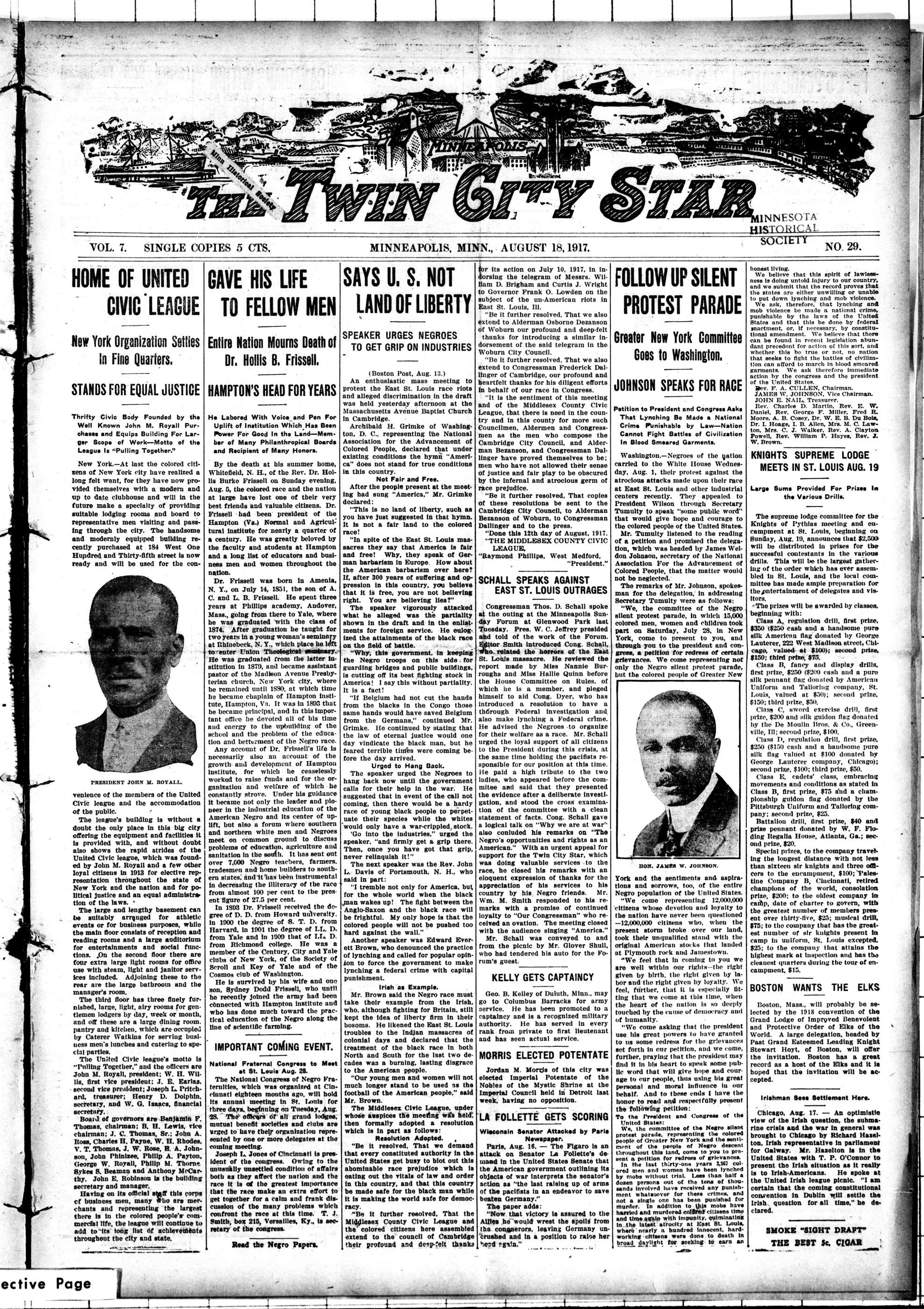
HOME OF UNITED CIVIC LEAGUE
New York Organization Settles In Fine Quarters.
STANDS FOR EQUAL JUSTICE
Thrifty Civic Body Founded by the Well Known John M. Royall Purchases and Equipes Building For Larger Scope of Work—Motto of the League Is "Pulling Together."
New York.—At last the colored citizens of New York city have realized a long felt want, for they have now provided themselves with a modern and up to date clubhouse and will in the future make a specialty of providing suitable lodging rooms and board to representative men visiting and passing through the city. The handsome and modernly equipped building recently purchased at 184 West One Hundred and Thirty-fifth street is now ready and will be used for the con-
A. B.
venience of the members of the United Civic league and the accommodation of the public.
The league's building is without a doubt the only place in this big city offering the equipment and facilities it is provided with, and without doubt also shows the rapid strides of the United Civic league, which was founded by John M. Royall and a few other loyal citizens in 1913 for elective representation throughout the state of New York and the nation and for political justice and an equal administration of the laws.
The large and lengthy basement can be suitably arranged for athletic events or for business purposes, while the main floor consists of reception and reading rooms and a large auditorium for entertainments and social functions. On the second floor there are four large light rooms for office use with steam, light and janitor services included. Adjoining these to the rear are the large bathroom and the manager's room.
The third floor has three finely furnished, large, light, airy rooms for gentlemen lodgers by day, week or month, and off these are a large dining room, pantry and kitchen, which are occupied by Caterer Watkins for serving business men's lunches and catering to special parties.
The United Civic league's motto is "Pulling Together," and the officers are John M. Royall, president; W. H. Willis, first vice president; J. E. Earlas, second vice president; Joseph L. Pritchard, treasurer; Henry D. Dolphin, secretary, and W. G. Isaacs, financial secretary.
Board of governors are Benjamin F. Thomas, chairman; B. H. Lewis, vice chairman; J. C. Thomas, Sr.; John A. Ross, Charles H. Payne, W. H. Rhodes, V. T. Thomas, J. W. Rose, E. A. Johnson, John Phinizee, Philip A. Payton, George W. Royall, Philip M. Thorne Sykes S. Beaman and Anthony McCarthy. John E. Robinson is the building secretary and manager.
Having on its official staff this corps of business men, many who are merchants and representing the largest there is in the colored people's commercial life, the league will continue to add to its long list of achievements throughout the city and state.
ective Page
VOL. 7. SINGLE COPIES 5 CTS.
PRESIDENT JOHN M. ROYALL.
---
GAVE HIS LIFE TO FELLOW MEN
Entire Nation Mourns Death of Dr. Hollis B. Frissell.
HAMPTON'S HEAD FOR YEARS
He Labored With Voice and Pen For Uplift of Institution Which Has Been Power For Good In the Land—Member of Many Philanthropical Boards and Recipient of Many Honors.
By the death at his summer home, Whitefield, N. H., of the Rev. Dr. Hollis Burke Frissell on Sunday evening, Aug. 5, the colored race and the nation at large have lost one of their very best friends and valuable citizens. Dr. Frissell had been president of the Hampton (Va.) Normal and Agricultural institute for nearly a quarter of a century. He was greatly beloved by the faculty and students at Hampton and a long list of educators and business men and women throughout the nation.
Dr. Frissell was born in Amenla, N. Y., on July 14, 1851, the son of A. C. and L. B. Frissell. He spent three years at Phillips academy, Andover, Mass., going from there to Yale, where he was graduated with the class of 1874. After graduation he taught for two years in a young woman's seminary at Rhinebeck, N.Y., which place he left to enter Union Theological seminary. He was graduated from the latter institution in 1879, and became assistant pastor of the Madison Avenue Presbyterian church, New York city, where he remained until 1880, at which time he became chaplain of Hampton institute, Hampton, Va. It was in 1893 that he became principal, and in this important office he devoted all of his time and energy to the upbuilding of the school and the problem of the education and betterment of the Negro race.
Any account of Dr. Frissell's life is necessarily also an account of the growth and development of Hampton institute, for which he ceaselessly worked to raise funds and for the organization and welfare of which he constantly strove. Under his guidance it became not only the leader and pioneer in the industrial education of the American Negro and its center of uplift, but also a forum where southern and northern white men and Negroes meet on common ground to discuss problems of education, agriculture and sanitation in the south. It has sent out over 7,000 Negro teachers, farmers, tradesmen and home builders to southern states, and it has been instrumental in decreasing the illiteracy of the race from almost 100 per cent to the present figure of 27.5 per cent.
In 1893 Dr. Frissell received the degree of D. D. from Howard university, in 1900 the degree of S. T. D. from Harvard, in 1901 the degree of LL. D. from Yale and in 1909 that of LL. D. from Richmond college. He was a member of the Century, City and Yale clubs of New York, of the Society of Scroll and Key of Yale and of the Cosmos club of Washington.
He is survived by his wife and one son, Sydney Dodd Frissell, who until he recently joined the army had been connected with Hampton institute and who has done much toward the practical education of the Negro along the line of scientific farming.
IMPORTANT COMING EVENT.
National Fraternal Congress to Meet at St. Louis Aug. 28.
The National Congress of Negro Fraternities, which was organized at Cincinnati eighteen months ago, will hold its annual meeting in St. Louis for three days, beginning on Tuesday, Aug. 28. The officers of all grand lodges, mutual benefit societies and clubs are urged to have the help organization represented by one or more delegates at the coming meeting.
Joseph L. Jones of Cincinnati is president of the congress. Owing to the unusually unsettled condition of affairs both as they affect the nation and the race it is of the greatest importance that the race make an extra effort to get together for a calm and frank discussion of the many problems which confront the race at this time. T. J. Smith, box 215, Versalles, Ky., is secretary of the congress.
Read the Negro Papers.
MINNEAPOLIS. MINN.. AUGUST 18, 1917.
SAYS U. S. NOT LAND OF LIBERTY
SPEAKER URGES NEGROES TO GET GRIP ON INDUSTRIES
(Boston Post, Aug. 13.)
An enthusiastic mass meeting to protest the East St. Louis race riots and alleged discrimination in the draft was held yesterday afternoon at the Massachusetts Avenue Baptist Church in Cambridge.
Archibald H. Grimke of Washington, D. C., representing the National Association for the Advancement of Colored People, declared that under existing conditions the hymn "America" does not stand for true conditions in this country.
Not Fair and Free.
After the people present at the meeting had sung "America," Mr. Grimke declared:
"This is no land of liberty, such as you have just suggested in that hymn. It is not a fair land to the colored race!
"In spite of the East St. Louis massacres they say that America is fair and free! Why, they speak of German barbarism in Europe. How about the American barbarism over here? If, after 300 years of suffering and oppression in this country, you believe that it is free, you are not believing right. You are believing lies?"
The speaker vigorously attacked what he alleged was the partiality shown in the draft and in the enlistments for foreign service. He eulogized the attainments of the black race on the field of battle.
"Why, this government, in keeping the Negro troops on this side for guarding bridges and public buildings, is cutting off its best fighting stock in America! I say this without partiality. It is a fact! " If Belgium had not cut the hands from the blacks in the Congo those same hands would have saved Belgium from the Germans," continued Mr. Grimke. He continued by stating that the law of eternal justice would one day vindicate the black man, but he feared terrible times were coming before the day arrived. Urged to Hang Back.
The speaker urged the Negroes to hang back now until the government calls for their help in the war. He suggested that in event of the call not coming, then there would be a hardy race of young black people to perpetuate their species while the whites would only have a war-crippled, stock. "Go into the industries," urged the speaker, "and firmly get a grip there. Then, once you have got that grip, never relinquish it!" The next speaker was the Rev. John L. Davis of Portsmouth, N. H., who said in part:
"I tremble not only for America, but for the whole world when the black man wakes up! The fight between the Anglo-Saxon and the black race will be frightful. My only hope is that the colored people will not be pushed too hard against the wall."
Another speaker was Edward Everett Brown, who denounced the practice of lynching and called for popular opinion to force the government to make lynching a federal crime with capital punishment.
Irish as Example.
Mr. Brown said the Negro race must take their example from the Irish, who, although fighting for Britain, still kept the idea of liberty firm in their bosoms. He likened the East St. Louis troubles to the Indian massacres of colonial days and declared that the treatment of the black race in both North and South for the last two decades was a burning, lasting disgrace to the American people.
"Our young men and women will not much longer stand to be used as the football of the American people," said Mr. Brown.
The Middlesex Civic League, under whose auspices the meeting was held, then formally adopted a resolution which is in part as follows:
Resolution Adopted.
"Be it resolved, That we demand that every constituted authority in the United States get busy to blot out this abominable race prejudice which is eating out the vitals of law and order in this country, and that this country be made safe for the black man while it is making the world safe for democracy.
"Be it further resolved, That the Middlesex County Civic League and the colored citizens here assembled extend to the council of Cambridge their profound and deep-felt thanks
for its action on July 10, 1917, in indorsing the telegram of Messrs. William D. Brigham and Curtis J. Wright to Governor Frank O. Lowden on the subject of the un-American riots in East St. Louis, Ill.
"Be it further resolved, That we also extend to Alderman Osborne Dezanson of Woburn our profound and deep-felt thanks for introducing a similar indorsement of the said telegram in the Woburn City Council.
"Be it further resolved, That we also extend to Congressman Frederick Dallinger of Cambridge, our profound and heartfelt thanks for his diligent efforts in behalf of our race in Congress.
"It is the sentiment of this meeting and of the Middlesex County Civic League, that there is need in the country and in this county for more such Councilmen, Alderman and Congressmen as the men who compose the Cambridge City Council, and Alderman Bezanson, and Congressman Dallinger have proved themselves to be; men who have not allowed their sense of justice and fair play to be obscured by the infernal and atrocious germ of race prejudice.
"Be it further resolved, That copies of these resolutions be sent to the Cambridge City Council, to Alderman Bezanson of Woburn, to Congressman Dallinger and to the press.
"Done this 12th day of August, 1917.
"THE MIDDLESEX COUNTY CIVIC LEAGUE
LEAGUE,
"Raymond Phillips, West Medford,
"President."
SCHALL SPEAKS AGAINST EAST ST. LOUIS OUTRAGES
Congressman Thos. D. Schall spoke at the outing at the Minneapolis Sunday Forum at Glenwood Park last Tuesday. Pres. W. C. Jeffrey presided and told of the work of the Forum. Editor Smith introduced Cong. Schall, who related the horrors of the East St. Louis massacre. He reviewed the report made by Miss Nannie Burroughs and Miss Hallel Quinn before the House Committee on Rules, of which he is a member, and pledged himself to aid Cong. Dyer, who has introduced a resolution to have a thorough Federal investigation and also make lynching a Federal crime. He advised the Negroes to organize for their welfare as a race. Mr. Schall urged the loyal support of all citizens to the President during this crisis, at the same time holding the pacifists responsible for our position at this time. He paid a high tribute to the two ladies, who appeared before the committee and said that they presented the evidence after a deliberate investigation, and stood the cross examination of the committee with a clean statement of facts. Cong. Schall gave a logical talk on "Why we are at war" also concluded his remarks on "The Negro's opportunities and rights as an American." With an urgent appeal for support for the Twin City Star, which was doing valuable services to the race, he closed his remarks with an eloquent expression of thanks for the appreciation of his services to his country by his Negro friends. Mr. Wm. M. Smith responded to his remarks with a promise of continued loyalty to "Our Congressman" who received an ovation. The meeting closed with the audience singing "America."
Mr. Schall was conveyed to and from the picnic by Mr. Glover Shull, who had tendered his auto for the Forum's guest.
KELLY GETS CAPTAINCY
Geo. B. Kelley of Duluth, Milnn., may go to Columbus Barracks for army service. He has been promoted to a captaincy and is a recognized military authority. He has served in every rank from private to first leutenant and has seen actual service.
MORRIS ELECTED POTENTATE
Jordan M. Morris of this city was elected Imperial Potentate of the Nobles of the Mystic Shrine at the Imperial Council held in Detroit last week, having no opposition.
LA FOLLETTE GETS SCORING
Wisconsin Senator Attacked by Paris Newspaper.
Paris, Aug. 16. — The Figaro is an attack on Senator La Follette's demand in the United States Senate that the American government outlining its objects of war interprets the senator's action as "the last raising up of arms of the pacifists in an endeavor to save beaten Germany."
The paper adds:
"Now that victory is assured to the Allies he would wrest the spoils from the conquerors, leaving Germany uncrushed and in a position to raise her head again."
honest living.
We believe that this spirit of lawlessness is doing untold injury to our country, and we submit that the record proves that the states are either unwilling or unable to put down lynching and mob violence. We ask, therefore, that lynching and mob violence be made a national crime, and the States and that this be done by federal enactment, or, if necessary, by constitutional amendment. We believe that there can be found in recent legislation abundant precedent for action of this sort, and whether this be true or not, no nation that seeks to fight the battles of civilization can afford to march in blood smeared action by the congress and the president of the United States. Rev. F. A. CULLEN, Chairman. JAMES W. JOHNSON, Vice Chairman. JOHN E. NAIL, Treasurer. Rev. Charles D. Martin, Rev. E. W. Daniel, Rev. George F. Miller, Fred R. Doore, B. Cosey B. Allen, Mrs. M. C. Lolls, Mrs. C. J. Walker, Rev. A. Clayton Powell, Rev. William P. Hayes, Rev. J. W. Brown.
KNIGHTS SUPREME LODGE MEETS IN ST. LOUIS AUG. 19
Large Sums Provided For Prizes In the Various Drills.
The supreme lodge committee for the Knights of Pythias meeting and encampment at St. Louis, beginning on Sunday, Aug. 19, announces that $2,500 will be distributed in prizes for the successful contestants in the various drills. This will be the largest gathering of the order which has ever assembled in St. Louis, and the local committee has made ample preparation for the entertainment of delegates and visitors.
The prizes will be awarded by classes, beginning with:
Class A, regulation drill, first prize, $350 ($250 cash and a handsome pure silk American flag donated by George Lauterer, 222 West Madison street, Chicago, valued at $100); second prize, $150; third prize, $75.
Class B, fancy and display drills, first prize, $250 ($200 cash and a pure silk pennant flag donated by American Uniform and Tailoring company, St. Louis, valued at $20); second prize, $150; third prize, $50.
Class C, sword exercise drill, first prize, $200 and silk guidon flag donated by the De Moulin Bros. & Co., Greenville, Ill; second prize, $100.
Class D, regulation drill, first prize, $250 ($150 cash and a handsome pure silk flag valued at $100 donated by George Lauterer company, Chicago); second prize, $100; third prize, $50.
Class E, cadets' class, embracing movements and conditions as stated in Class B, first prize, $75 and a championship guildon flag donated by the Pittsburgh Uniform and Tailoring company; second prize, $25.
Battallion drill, first prize, $40 and prize pennant donated by W. F. Flooding Regalia House, Atlanta, Ga.; second prize, $20.
Special prizes, to the company traveling the longest distance with not less than sixteen sir knights and three officers to the encampment, $100; Palestine Company B, Cinchnatti, retired champions of the world, consolation prize, $200; to the oldest company in camp, date of charter to govern, with the greatest number of members present over thirty-five, $25; muscal drill, $75; to the company that has the greatest number of sir knights present in camp in uniform, St. Louis excepted, $25; to the company that attains the highest mark at inspection and has the cleanest quarters during the tour of encampment, $15.
BOSTON WANTS THE ELKS
Boston, Mass., will probably be selected by the 1918 convention of the Grand Lodge of Improved Benevolent and Protective Order of Elks of the World. A large delegation, headed by Past Grand Esteemed Leading Knight Stewart Hoyt, of Boston, will offer the invitation. Boston has a great record as a host of the Elks and it is hoped that the invitation will be accepted.
Chicago, Aug. 17. — An optimistic view of the Irish question, the submarine crisis and the war in general was brought to Chicago by Richard Hazelton, Irish representative in parliament for Galway. Mr. Hazelton is in the United States with T. P. O'Connor to present the Irish situation as it really is to Irish-Americans. He spoke at the United Irish league picnic. "I am certain that the coming constitutional convention in Dublin will settle the Irish question for all time," he declared.
FOLLOW UP SILENT PROTEST PARADE Greater New York Committee Goes to Washington.
JOHNSON SPEAKS FOR RACE
Petition to President and Congress Asks That Lynching Be Made a National Crime Punishable by Law—Nation Cannot Fight Battles of Civilization In Blood Smeared Garments.
Washington.—Negroes of the nation carried to the White House Wednesday, Aug. 1, their protest against the atrocious attacks made upon their race at East St. Louis and other industrial centers recently. They appealed to President Wilson through Secretary Tumulty to speak "some public word" that would give hope and courage to the colored people of the United States.
Mr. Tumulty listened to the reading of a petition and promised the delegation, which was headed by James Weldon Johnson, secretary of the National Association For the Advancement of Colored People, that the matter would not be neglected.
The remarks of Mr. Johnson, spokesman for the delegation, in addressing Secretary Tumulty were as follows:
"We, the committee of the Negro silent protest parade, in which 15,000 colored men, women and children took part on Saturday, July 28, in New York, come to present to you, and through you to the president and congress, a petition for redress of certain grievances. We come representing not only the Negro silent protest parade, but the colored people of Greater New
HON. JAMES W. JOHNSON.
York and the sentiments and aspirations and sorrows, too, of the entire Negro population of the United States. "We come representing 12,000,000 citizens whose devotion and loyalty to the nation have never been questioned—12,000,000 citizens who, when the present storm broke over our land, took their unqualified stand with the original American stocks that landed at Plymouth rock and Jamestown.
"We feel that in coming to you we are well within our rights—the right given by birth, the right given by labor and the right given by loyalty. We feel, further, that it is especially fitting that we come at this time, when the heart of the nation is so deeply touched by the cause of democracy and of humanity.
"We come asking that the president use his great powers to have granted to us some redress for the grievances set forth in our petition, and we come, further, praying that the president may find it in his heart to speak some public word that will give hope and courage to our people, thus using his great personal and moral influence in our behalf. And to these ends I have the honor to read and respectfully present the following petition:
To the President and Congress of the United States:
We, the committee of the Negro silent protest parade, representing the colored people of Greater New York and the sentiment of the people of Negro descent throughout this land, come to you to present a petition for redress of grievances. We have a large number of colored men and women have been lynched by mobs without trial. Less than half a dozen persons out of the tens of thousands involved have received any punishment whatsoever for these crimes, and not a single one has been punished for murder. In addition, many of the colored citizens time and time again with impunity, culminating in the latest atrocity at East St. Louis, where nearly a hundred innocent, hard-working citizens were done to death in broad daylight for seeking to earn an
NO.29.
一
Irishman Sees Settlement Here.
SMOKE "SIGHT DRAFT"
THE BEST Sc. CIGAR
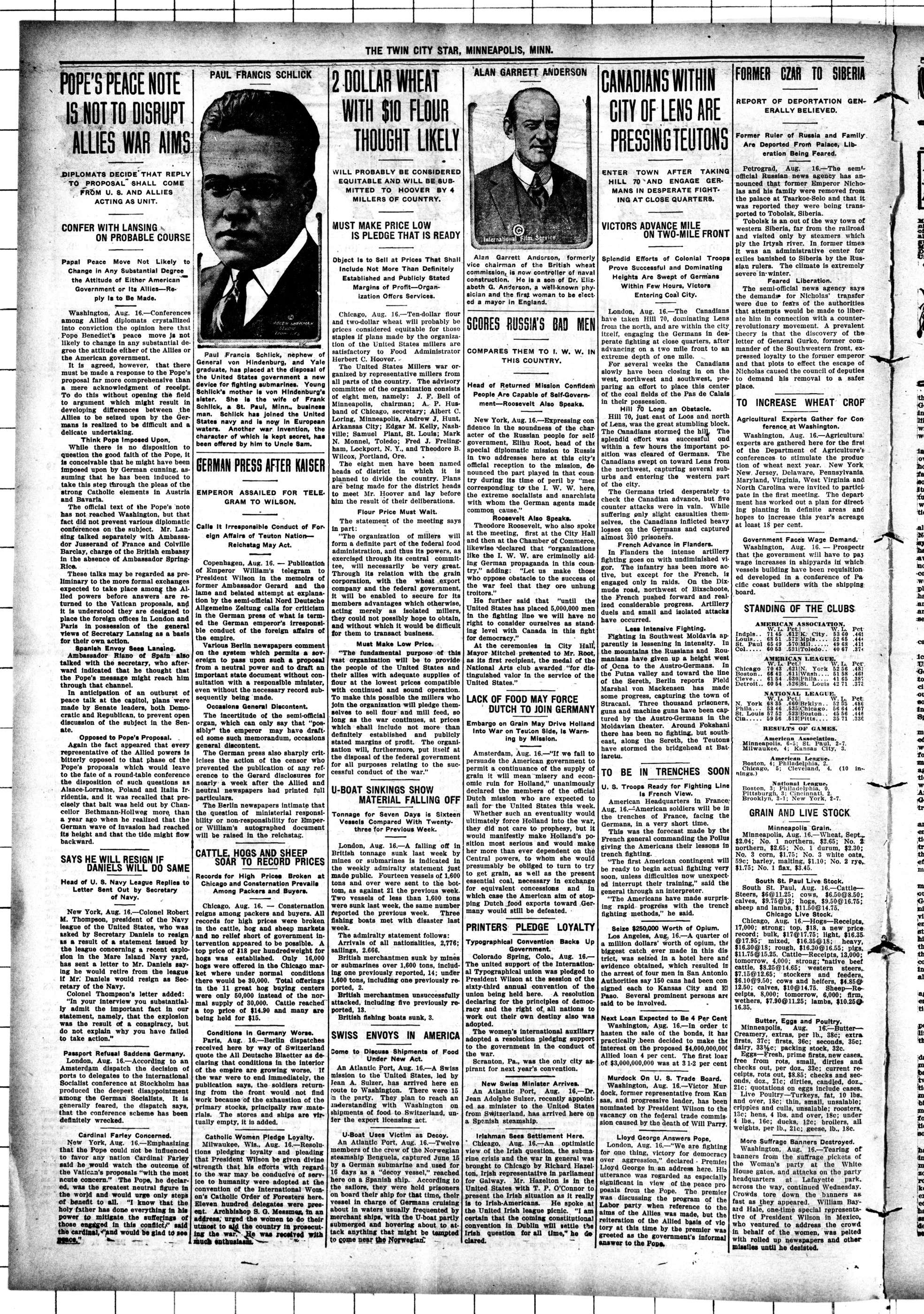
POPE'S PEACE NOTE IS NOT TO DISRUPT ALLIES WAR AIMS
DIPLOMATS DECIDE THAT REPLY TO PROPOSAL SHALL COME FROM U. S. AND ALLIES ACTING AS UNIT.
CONFER WITH LANSING ON PROBABLE COURSE
Papal Peace Move Not Likely to Change in Any Substantial Degree the Attitude of Either American Government or Its Allies—Reply Is to Be Made.
Washington, Aug. 16.—Conferences among Allied diplomats crystallized into conviction the opinion here that Pope Benedict's peace move is not likely to change in any substantial degree the attitude either of the Allies or the American government.
It is agreed, however, that there must be made a response to the Pope's proposal far more comprehensive than a mere acknowledgment of receipt. To do this without opening the field to argument which might result in developing differences between the Allies to be seized upon by the Germans is realized to be difficult and a delicate undertaking.
Think Pope Imposed Upon.
While there is no disposition to question the good faith of the Pope, it is conceivable that he might have been imposed upon by German cunning, assuming that he has been induced to take this step through the pleas of the strong Catholic elements in Austria and Bavaria.
The official text of the Pope's note has not reached Washington, but that fact did not prevent various diplomatic conferences on the subject. Mr. Lansing talked separately with Ambassador Jusserand of France and Colville Barclay, charge of the British embassy in the absence of Ambassador Spring-Rice.
These talks may be regarded as preliminary to the more formal exchanges expected to take place among the Allied powers before answers are returned to the Vatican proposals, and it is understood they are designed to place the foreign offices in London and Paris in possession of the general views of Secretary Lansing as a basis for their own action.
Spanish Envoy Sees Lansing.
Ambassador Riano of Spain also talked with the secretary, who afterward indicated that he thought that the Pope's message might reach him through that channel.
In anticipation of an outburst of peace talk at the capitol, plans were made by Senate leaders, both Democratic and Republican, to prevent open discussion of the subject in the Senate.
Opposed to Pope's Proposal.
Again the fact appeared that every representative of the Allied powers is bitterly opposed to that phase of the Pope's proposals which would leave to the fate of a round-table conference the disposition of such questions as Alsace-Lorraine, Poland and Italia Irridentia, and it was recalled that precisely that bait was held out by Chancellor Bethmann-Hollweg more than a year ago when he realized that the German wave of invasion had reached its height and that the tide might flow backward.
SAYS HE WILL RESIGN IF
DANIELS WILL DO S
Head of U. S. Navy League Replies to Letter Sent Out by Secretary of Navy.
New York, Aug. 16.—Colonel Robert M. Thompson, president of the Navy league of the United States, who was asked by Secretary Daniels to resign as a result of a statement issued by the league concerning a recent explosion in the Mare Island Navy yard, has sent a letter to Mr. Daniels saying he would retire from the league if Mr. Daniels would resign as Secretary of the Navy.
Colonel Thompson's letter added: "In your interview you substantially admit the important fact in our statement, namely, that the explosion was the result of a conspiracy, but do not explain why you have failed to take action."
Passport Refusal Saddens Germany.
London, Aug. 16.—According to an Amsterdam dispatch the decision of ports to delegates to the international Socialist conference at Stockholm has produced the deepest disappointment among the German Socialists. It is generally feared, the dispatch says, that the conference scheme has been definitely wrecked.
Cardinal Farley Concerned.
New York, Aug. 16. "Emphasizing that the Pope could not be influenced to favor any nation Cardinal Farley said he would watch the outcome of the Vatican's proposals "with the most acute concern." The Pope, he declared, was the greatest neutral figure in the world and would urge only steps of benefit to all. "I know that the holy father has done everything in his power to mitigate the sufferings of those engaged in this conflict," said the cardinal, "and would be glad to see peace."
ROCEN SCHMANN
STUDIO
Kim 1920
Paul Francis Schick, nephew of General von Hindenburg, and Yale graduate, has placed at the disposal of the United States government a new device for fighting submarines. Young Schick's mother is von Hindenburg's sister. She is the wife of Frank Schick, a St. Paul, Minn., business man. Schick has joined the United States navy and is now in European waters. Another war invention, the character of which is kept secret, has been offered by him to Uncle Sam.
GERMAN PRESS AFTER KAISER
GERMAN PRESS AFTER KAISER
EMPEROR ASSAILED FOR TELE-
GRAM TO WILSON.
Calls It Irresponsible Conduct of Foreign Affairs of Teuton Nation—Reichstag May Act.
Copenhagen, Aug. 16. — Publication of Emperor William's telegram to President Wilson in the memoirs of former Ambassador Gerard and the lame and belated attempt at explanation by the semi-official Nord Deutsche Allgemeine Zeitung calls for criticism in the German press of what is termed the German emperor's irresponsible conduct of the foreign affairs of the empire.
Various Berlin newspapers comment on the system which permits a sovereign to pass upon such a proposal from a neutral power and to draft an important state document without consultation with a responsible minister, even without the necessary record subsequently being made.
Occasions General Discontent.
The incertitude of the semi-official organ, which can only say that "possibly" the emperor may have drafted some such memorandum, occasions general discontent. The German press also sharply criticises the action of the censor who prevented the publication of any reference to the Gerard disclosures for nearly a week after the Allied and neutral newspapers had printed full particulars. The Berlin newspapers intimate that the question of ministerial responsibility or non-responsibility for Emperor William's autographed document will be raised in the rechstag.
CATTLE, HOGS AND SHEEP
SOAR TO RECORD PRICES
Records for High Prices Broken at Chicago and Consternation Prevaile Among Packers and Buyers.
Chicago, Aug. 16. — Consternation reigns among packers and buyers. All records for high prices were broken in the cattle, hog and sheep markets and no relief short of government intervention appeared to be possible. A top price of $18 per hundredweight for hogs was established. Only 16,000 hogs were offered in the Chicago market where under normal conditions there would be 30,000. Total offerings in the 11 great hog buying centers were only 50,000 instead of the normal supply of 30,000. Cattle reached a top price of $14.90 and many are being held for $15.
Conditions in Germany Worse
Paris, Aug. 16.—Borlin dispatches received here by way of Switzerland quote the All Deutsche Blaetter as declaring that conditions in the interior of the empire are growing worse. If the war were to end immediately, the publication says, the soldiers returning from the front would not find work because of the exhaustion of the primary stocks, principally raw materials. The stores and ships are virtually empty, it is added.
Catholic Women Pledge Loyalty.
Milwaukee, Wis. Aug. 16—Resolutions pledging loyalty and pleading that President Wilson be given divine strength that his efforts with regard to the war may be conducive of service to humanity were adopted at the convention of the International Women's Catholic Order of Foresters here.
Eleven hundred delegates were present. Archbishop S. G. Messmer, in an address; urged the women to do their utmost to aid the country in prosecuting the war. He was received with much enthusiasm.
THE TWIN CITY STAR, MINNEAPOLIS, MINN.
2 DOLLAR WHEAT WITH $10 FLOUR THOUGHT LIKELY
WILL PROBABLY BE CONSIDERED
EQUITABLE AND WILL BE SUB-
MITTED TO HOOVER BY 4
MILLERS OF COUNTRY.
MUST MAKE PRICE LOW
IS PLEDGE THAT IS READY
Object Is to Sell at Prices That Shall Include Not More Than Definitely Established and Publicly Stated Margins of Profit—Organization Offers Services.
Chicago, Aug. 16.—Ten-dollar flour and two-dollar wheat will probably be prices considered equitable for those staples if plans made by the organization of the United States millers are satisfactory to Food Administrator Herbert C. Hoover.
The United States Millers war organized by representative millers from all parts of the country. The advisory committee of the organization consists of eight men, namely: J. F. Bell of Minneapolis, chairman; A. P. Husband of Chicago, secretary; Albert C. Loring, Minneapolis, Andrew J. Hunt, Arkansas City; Edgar M. Kelly, Nashville; Samuel Plant, St. Louis; Mark N. Monnel, Toledo; Fred J. Frelingham, Lockport, N. Y., and Theodore B. Wilcox, Portland, Ore.
The eight men have been named heads of district in which it is planned to divide the country. Plans are being made for the district heads to meet Mr. Hoover and lay before him the result of their deliberations.
Flour Price Must Wait.
The statement of the meeting says in part:
"The organization of millers will form a definite part of the federal food administration, and thus its powers, as exercised through its central committee, will necessarily be very great. Through its relation with the grain corporation, with the wheat export company and the federal government, it will be enabled to secure for its members advantages which otherwise, acting merely as isolated millers, they could not possibly hope to obtain, and without it it would be difficult for them to transact business.
Must Make Low Price.
"The fundamental purpose of this vast organization will be to provide the people of the United States and their allies with adequate supplies of flour at the lowest prices compatible with continued and sound operation. To make this possible the millers who join the organization will pledge themselves to sell flour and mill feed, so long as the war continues, at prices which shall include not more than definitely established and publicly stated margins of profit. The organization will, furthermore, put itself at the disposal of the federal government for all purposes relating to the successful conduct of the war."
U-BOAT SINKINGS SHOW MATERIAL FALLING OFF
Tonnage for Seven Days is Sixteen Vessels Compared With Twenty-three for Previous Week.
London, Aug. 16.—A falling off in British tonnage sunk last week by mines or submarines is indicated in the weekly admiralty statement just made public. Fourteen vessels of 1,600 tons and over were sent to the bottom, as against 21 the previous week. Two vessels of less than 1,600 tons were sunk last week, the same number reported the previous week. Three fishing boats met with disaster last week.
The admiralty statement follows:
Arrivals of all nationalities, 2,776; sailings, 2.666.
British merchantmen sunk by mines or submarines over 1,600 tons, including one previously reported, 14; under 1,600 tons, including one previously reported, 2.
British merchantmen unsuccessfully attacked, including five previously reported, 13.
British fishing boats sunk, 3.
SWISS ENVOYS IN AMERICA
Come to Discuss Shipments of Food Under New Act.
An Atlantic Port, Aug. 16.—A Swiss mission to the United States, led by Jean A. Sulzer, has arrived here en route to Washington. There were 15 in the party. They plan to reach an understanding with Washington on shipments of food to Switzerland, under the export licensing act.
An Atlantic Port, Aug. 16.—Twelve members of the crew of the Norwegian steamship Benguela, captured June 15 by a German submarine and used for 16 days as a "decoy vessel," reached here on a Spanish ship. According to the sailors, they were held prisoners on board their ship for that time, their vessel in charge of Germans cruising about in waters usually frequented by merchant ships, with the U-boat partly submerged and hovering to attack anything that might be tempted to come near the Norwegian.
International Film Service
Alan Garrett Anderson, formerly vice chairman of the British wheat commission, is now controller of naval construction. He is a son of Dr. Elizabeth G. Anderson, a well-known physician and the first woman to be elected a mayor in England.
SCORES RUSSIA'S BAD MEN
COMPARES THEM TO I. W. W. IN
THIS COUNTRY.
Head of Returned Mission Confiden
People Are Capable of Self-Govern-
ment—Rosevelt Also Speaks.
New York, Aug. 16.—Expressing confidence in the soundness of the character of the Russian people for self-government, Eilhu Root, head of the special diplomatic mission to Russia in two addresses here at this city's official reception to the mission, denounced the part played in that country during its time of peril by "mer corresponding to the I. W. W. here the extreme socialists and anarchists with whom the German agents made common cause."
Roosevelt Also Speaks.
Theodore Roosevelt, who also spoke at the meeting, first at the City Hall and then at the Chamber of Commerce, likewise declared that "organizations like the I. W. W. are criminally aiding German propaganda in this country," adding: "Let us make those who oppose obstacle to the success of the war feel that they are unhung trotters."
He further said that "until the United States has placed 5,000,000 men in the fighting line we will have no right to consider ourselves as standing level with Canada in this fight for democracy."
At the ceremonies in City Hall, Mayor Mitchel presented to Mr. Root, as its first recipient, the medal of the National Arts club awarded "for distinguished valor in the service of the United States."
LACK OF FOOD MAY FORCE
DUTCH TO JOIN GERMANY
Embargo on Grain May Drive Holland Into War on Teuton Side, Is Warning by Mission.
Amsterdam, Aug. 16.—"If we fail to persuade the American government to permit a continuance of the supply of grain it will mean misery and economic ruin for Holland," unanimously declared the members of the official Dutch mission who are expected to sail for the United States this week.
Whether such an eventuality would ultimately force Holland into the war, they did not care to prophesy, but it would manifestly make Holland's position most serious and would make her more than ever dependent on the Central powers, to whom she would presumably be obliged to turn to try to get grain, as well as the present essential coal, necessary in exchange for equivalent concessions and in which case the American aim of stopping Dutch food exports toward Germany would still be defeated.
PRINTERS PLEDGE LOYALTY
Typographical Convention Backs Up Government.
Colorado Spring, Colo., Aug. 16.—The united support of the International Typographical union was pledged to President Wilson at the session of the sixty-third annual convention of the union being held here. A resolution declaring for the principles of democracy and the right of all nations to work out their own destiny also was adopted.
The women's international auxiliary adopted a resolution pledging support to the government in the conduct of the war.
Scranton, Pa., was the only city aspirant for next year's convention.
New Swiss Minister Arrives.
An Atlantic Port, Aug. 16.—Dr. Jean Adolphe Sulzer, recently appointed as minister to the United States from Switzerland, has arrived here on a Spanish steamship.
Irishman Sees Settlement Here.
Chicago, Aug. 16.—An optimistic view of the Irish question, the submarine crisis and the war in general was brought to Chicago by Richard Hazelton, Irish representative in parliament for Galway. Mr. Hazelton is in the United States with T. P. O'Connor to present the Irish situation as it really is to Irish-Americans. He spoke at the United Irish league picnic. "I am certain that the coming constitutional convention in Dublin will settle the Irish question for all time," he declared.
CANADIANS WITHIN CITY OF LENS ARE PRESSING TEUTONS
ENTER TOWN AFTER TAKING HILL 70 AND ENGAGE GERMANS IN DESPERATE FIGHTING AT CLOSE QUARTERS.
Splendid Efforts of Colonial Troops Prove Successful and Dominating Heights Are Swept of Germans Within Few Hours, Victors Entering Coal City.
London, Aug. 16.—The Canadians have taken Hill 70, dominating Lens from the north, and are within the city itself, engaging the Germans in desperate fighting at close quarters, after advancing on a two mile front to an extreme depth of one mile.
For several weeks the Canadians slowly have been closing in on the west, northwest and southwest, preparing an effort to place this center of the coal fields of the Pas de Calais in their possession.
Hill 70 Long an Obstacle.
Hill 70, just east of Loos and north of Lens, was the great stumbling block.
The Canadians stormed the hill. The splendid effort was successful and within a few hours the important position was cleared of Germans. The Canadians swept on toward Lens from the northwest, capturing several suburbs and entering the western part of the city.
The Germans tried desperately to check the Canadian advance, but five counter attacks were in vain. While suffering only slight casualties themselves, the Canadians inflicted heavy losses on the Germans and captured almost 300 prisoners.
French Advance in Flanders.
French Advance in Flanders.
In Flanders the intense artillery fighting goes on with undiminished vigor. The infantry has been more active, but except for the French, is engaged only in raids. On the Dixmude road, northwest of Bixschoote, the French pushed forward and realized considerable progress. Artillery duels and small and isolated attacks have occurred.
Less Intensive Fighting.
Fighting in Southwest Moldavia apparently is lessening in intensity. In the mountains the Russians and Roumanians have given up a height west of Ocna to the Austro-Germans. In the Putna valley and toward the line of the Sereth, Berlin reports Fleid Marshal von Mackensen has made some progress, capturing the town of Stracani. Three thousand prisoners, guns and machine guns have been captured by the Austro-Germans in the Moldavian theater. Around Fokshani there has been no fighting, but southeast, along the Sereth, the Teutons have stormed the bridgehead at Batiraetu.
TO BE IN TRENCHES SOON
U. S. Troops Ready for Fighting Line is French View.
American Headquarters in France;
Aug. 16. American soldiers will be in the trenches of France, facing the Germans, in a very short time.
This was the forecast made by the French general commanding the Pollus giving the Americans their lessons in trench fighting.
"The first American contingent will be ready to begin actual fighting very soon, unless difficulties now unexpected interrupt their training," said the general through an interpreter.
"The Americans have made surprising rapid progress with the trench fighting methods," he said.
Los Angeles, Aug. 16.—A quarter of a million dollars' worth of opium, the biggest catch ever made in this district, was seized in a hotel here and evidence obtained, which resulted in the arrest of four men in San Antonio Authorities say 150 cans had been consigned each to Kansas City and El Paso. Several prominent persons are said to be involved.
Next Loan Expected to Be 4 Per Cent
Washington, Aug. 16.—In order to hasten the sale of the bonds, it has practically been decided to make the interest on the proposed $4,000,000,000 Allied loan 4 per cent. The first loan of $3,000,000,000 was at 3.12 per cent
Murdock On U. S. Trade Board. Washington, Aug. 16.—Victor Murdock, former representative from Kansas, and progressive leader, has been nominated by President Wilson to the vacancy on the federal trade commission caused by the death of Will Parry.
Lloyd George Answers Pone
London, Aug. 16.—"We are fighting for one thing, victory for democracy over aggression," declared Premier Lloyd George in an address here. His utterance was regarded as especially significant in view of the peace proposals from the Pope. The premier was discussing the program of the Labor party when reference to the aims of the Allies was made, but the reiteration of the Allied basis of victory at this time by the premier was greeted as the government's informal answer to the Pope.
FORMER CZAR TO SIBERIA
REPORT OF DEPORTATION GENERALLY BELIEVED.
Former Ruler of Russia and Family Are Deported From Palace, Liberation Being Feared.
Petrograd, Aug. 16.—The semi-official Russian news agency has announced that former Emperor Nicholas and his family were removed from the palace at Tsarkoe-Selo and that it was reported they were being transported to Tobolisk, Siberia.
Tobolsk is an out of the way town of western Siberia, far from the railroad and visited only by steamers which ply the Irtysh river. In former times it was an administrative center for exiles banished to Siberia by the Russian rulers. The climate is extremely severe in winter.
Peared Liberation.
The semi-official news agency says the demands for Nicholas' transfer were due to fears of the authorities that attempts would be made to liberate him in connection with a counter-revolutionary movement. A prevalent theory is that the discovery of the letter of General Gurko, former commander of the Southwestern front, expressed loyalty to the former emperor and that plots to effect the escape of Nicholas caused the council of deputies to demand his removal to a safer place.
TO INCREASE WHEAT CROP
Agricultural Experts Gather for Conference at Washington.
Washington, Aug. 16.—Agricultural experts are gathered here for the first of the Department of Agriculture's conferences to stimulate the production of wheat next year. New York New Jersey, Delaware, Pennsylvania Maryland, Virginia, West Virginia and North Carolina were invited to partick pate in the first meeting. The department has worked out a plan for directing planting in definite areas and hopes to increase this year's acreage at least 18 per cent.
Government Faces Wage Demand.
Washington, Aug. 16.— Prospect that the government will have to pay wage increases in shipyards in which vessels building have been requisitioned developed in a conference of Pacific coast builders with the shipping board.
STANDING OF THE CLUBS
AMERICAN ASSOCIATION.
W. L. Pet.
W. L. Pet.
Indlps. 71 45 .612 K. City 53 60 .461
Louis. 71 45 .612 K. City 52 65 .461
St. Paul 65 99 .570 Ml. City 49 41 .411
Col. 65 99 .551 Toledo. 40 67 .374
AMERICAN LEAGUE.
W. L. Pet.
W. L. Pet.
Chicago 70 43 .621 N. York 52 56 .461
Boston. 66 42 .611 Wash. 51 58 .461
Cleve. 61 54 .613 Phila. 51 65 .387
Detroit. 60 54 .526 St. Louis 42 71 .372
NATIONAL LEAGUE.
W. L. Pet.
W. L. Pet.
N. York 68 35 .629 Brklyn. 53 55 .466
Phila. 53 46 .525 Chicago. 56 64 .467
St. Louis 57 52 .523 Boston. 45 56 .446
Cin. 59 56 .513 Pitts. 35 71 .330
RESULTS OF GAMES.
American Association.
Minneapolis, 6-5; St. Paul, 2-7.
Milwaukee, 4; Kansas City, 3.
American League.
Boston, 4; Philadelphia, 2.
Chicago, 5; Cleveland, 4. (10 in-
nings.)
National League.
Boston, 3; Philadelphia, 9.
Pittsburgh, 3; Cincinnati, 2.
Brooklyn, 3-1; New York, 2-7.
GRAIN AND LIVE STOCK
Minneapolis, Aug. 16.—Wheat, Sept.,
$2.04; No. 1 northern, $2.65; No. 2
northern, $2.65; No. 1 durand, $2.30;
No. 3 corn, $1.75; No. 3 white oats,
59c; barley, malting, $1.10; No. 2 rye,
$1.75; No. 1 flax, $3.45.
South St. Paul Live Stock.
South St. Paul, Aug. 16.—Cattle—
Steers, $6@11.25; cows, $6.50@8.50;
calves, $9.50@13; hogs, $9.50@16.75;
sheep and lambs, $11.50@14.75.
Chicago Live Stock.
Chicago, Aug. 16.—Hogs—Receipts,
17,000; strong; top, $18, a new price
record; bulk, $17@17.75; light, $16.35
@17.95; mixed, $16.35@18; heavy,
$16.30@18; rough, $16.30@16.55; plugs,
$11.75@15.25; Cattle—Receipts, 13,000;
tomorrow, 4,000; strong; native beef
cattle, $2.5@14.65; western steers,
$7.15@12.65; stockers and feeders,
$6.10@9.50; cows and heifers, $4.85@
12.50; calves, $10@14.75; Sheep—Receipts,
8,000; tomorrow, 6,000; firm,
wethers, $7.90@11.25; lambs, $10.25@
16.35.
Butter, Eggs and Poultry.
Minneapolis, Aug. 16—Butter-
Creamery, extras, per lb, 18c; extra
firsts, 37c; firsts, 36c; seconds, 35c;
dairy, 33l%; packing stock, 32c.
Eggs—Fresh, prime firsts, new cases,
free from rots, small, dirties and
checks out, per doz, 33c; current
receipts, rots out, $8.8; checks and
seconds, 20d, 21c; dirties, candled, doz,
21c; quotations on eggs include cases.
Live Poultry—Turkies, fat, 10 lbs
and over, 18c; thin, small, unsalable;
cripples and culls, unsalable; roosters,
13c; hens, 4 lbs, and over, 18c; under
4 lbs, 16c; ducks, 2c; broilers, all
weights, per lb, 21c; geese, lb, 18c.
More Suffrage Banners Destroyed
More Suffrage Banners Destroyed.
Washington, Aug. 16.—Tearing of banners from the suffrage pickets of the Woman's party at the White House gates, and attacks on the party headquarters at Lafayette park, across the way, continued Wednesday. Crowds tore down the banners as fast as they appeared. William Bayard Hale, one-time special representative of President Wilson in Mexico, who ventured to address the crowd in behalf of the women, was pelted with rolled up newspapers and other missiles until he desisted.
JAY WE FIGAT GERMANY
AIA
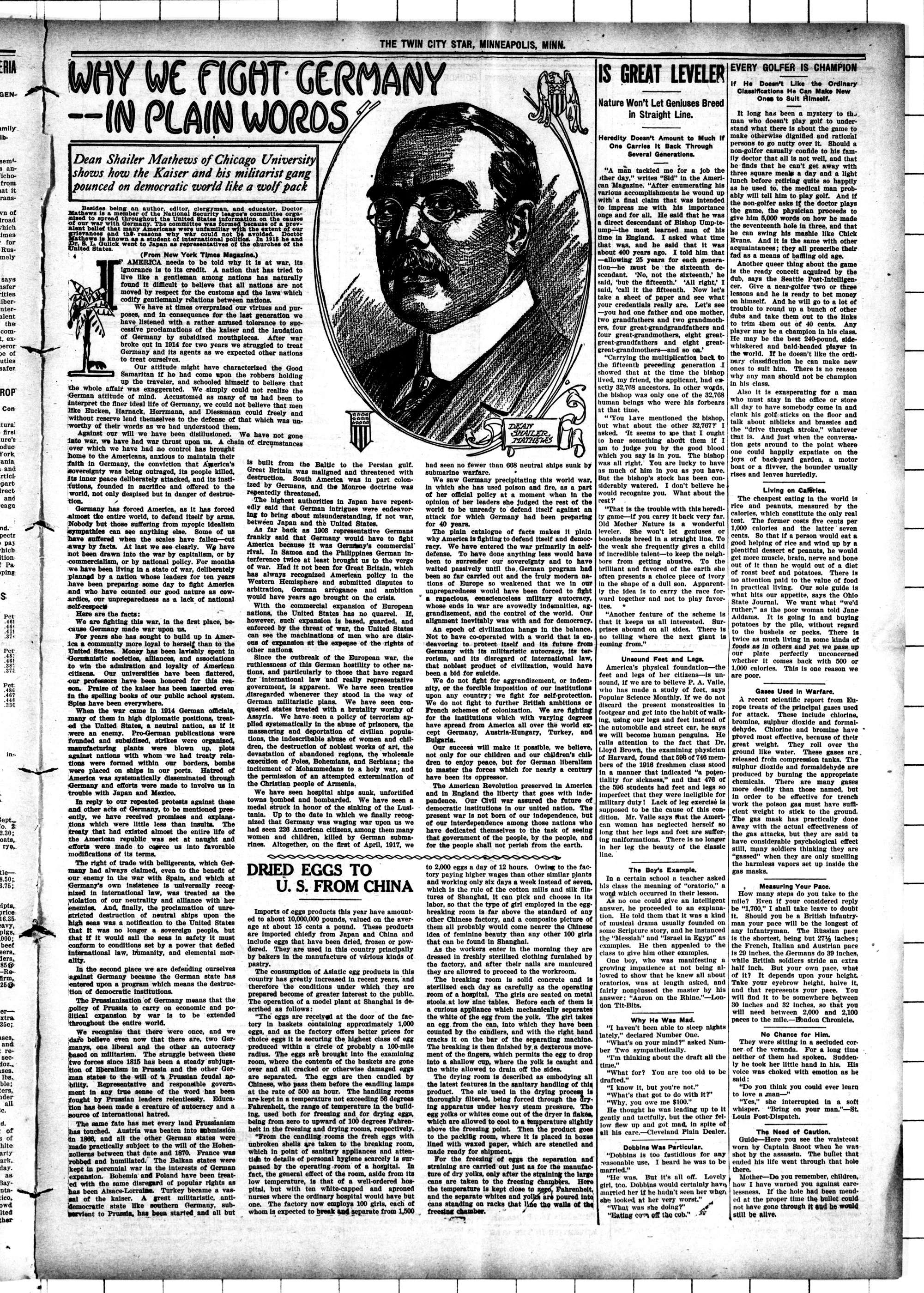
Dean Shailer Mathews of Chicago University
shows how the Kaiser and his militarist gang
unced on democratic world like a wolf pack
Besides being an author, editor, cle in, and educator, Doctor
Besar Baa ges Sahat Sete eeastaeamie au,
Slont bellet that many Atioricass were Unfamiliar wits the gxtent, ‘of our
rein known ep'n student of international poutios ‘fn 1016 he end
Eipebrcste se he
‘4 (From New York Times Magazine.)
AMERICA needs to be told why it is at war, its
ignorance is to its credit. A nation that has tried to
live ike a gentleman among nations has naturally
f found it difficult to believe that all nations are not
moved by respect for the customs and the laws which
codify gentlemanly relations between nations.
|, We have at times overpraised our virtues and pur-
poses, and in consequence for the last generation we
7, have listened with a rather anrused tolerance to suc-
4 cessive proclamations of the kaiser and the laudation
of Germany by subsidized mouthpieces. After war
broke out in 1914 for two years we struggled to treat
Germany and its agents as we expected other nations
‘to treat ourselves.
Our attitude might have characterized the Good
Samaritan if he had come upon the robbers holding
- Samaritan if he had come upon the robbers holding
Ameiva needs tO 0G told Why it 1s Bt war, its
ignorance 1s to its credit. A nation that has tried to
live lke a gentleman among nations has naturally
! found it difficult to believe that all nations are not
moved by respect for the customs and the laws: which
codify gentlemanly relations between nations.
| ‘We have at times overpraised our virtues and pur-
poses, and in consequence for the last generation we
G have listened with a rather anused tolerance to suc-
4 cessive proclamations of the kaiser and the laudation
of Germany by subsidized mouthpteces. After war
broke out in 1914 for two years we struggled to treat
Germany and its agents as we expected other nations
to treat ourselves.
Our attitude might have characterized the Good
Samaritan if he had come upon the robbers holding
: up the traveler, and schooled himself to believe that
(the whole affair was exaggerated. We simply could not realize the
‘German attitude of mind. Accustomed as many of us had been to
interpret the finer ideal life of Germany, we could not believe that men
tke Kucken, Harnack, Herrmann, and Diessmann could freely and
‘without reserve lend themselves to the defense of that which was un-
worthy of thelr words as we had understood them,
Against our will we have been disillusioned. We have not gone
dato war, we bave had war thrust upon us. A chain of circumstances
ROP
Con
tura!
first
ure’t
odue
york,
ania
and
rticl:
part
rect,
ané
eage
nd.
pects
pas
hich
tion:
Pa
ping
Sew See ae Se. a Ts ee aren am. Sony
{over which we have had no control bas brought
home to the Americans, anxious to maintain thelr
jfaith in Germany, the conviction that America’s
feovereignty was being outraged, its people killed,
ite inner peace deliberately attacked, and its inst!-
{futtons, founded in sacrifice and offered to the
‘world, not only despised but in danger of destruc-
‘tion, ,
Germany has forced America, as it has forced
almost the entire world, to defend itself by arms.
Nobody but those suffering from myopic idealism
jeympathies can see anything else. Some of us
Ihave euffered when the scales have fallen—cut
away by facts. At last we see clearly. We have
inot been drawn into the war by capitalism, or by
-commercialism, or by national policy. For months
‘we have been living in a state of war, deliberately
planned by a nation whose leaders for ten years
have been preparing some day to fight America
and who have counted our good nature as cow-
ardice, our unpreparedness asa lack of national
sself-respects e
Here are the facts: :
We are fighting this war, in the first place, be-
cause Germany made war-upon us,
For years she has sought to build up in Amer-
ca a community more loyal to herself than to the
‘United States. Money has been lavishly spent in
“Germmuistic societies, alliances, and associations
to win the admfration and loyalty of American
citizens. Our universities have been flattered,
our professors have been honored for this rea-
son. Praise of the kaiser has been inserted even
4m the spelling books of our public school system.
‘Sples have been everywhere.
‘When the war came in 1914 German offictals,
many of them in high diplomatic positions, treat-
ed the United States, a neutral nation, as if it
were an enemy. Pro-German publications were
founded and subsidized, strikes were organized,
manufacturing plants were blown up, plots
against nations with whom ‘we had treaty rela-
tions were formed within our borders, bombs
were placed on ships in our ports. Hatred of
‘America was systematically disseminated through
‘Germany and efforts were made to involve us In
‘rouble with Japan and Mexico.
In reply to our repeated protests against these
and other acts of Germany, to be mentioned pres-
ently, we have recelved promises and explana-
tons which were little less than insult, The
itreaty that had existed almost the entire life of
the American republic was set at naught and
efforts were made to copree us into favorable
modifications of its terms.
‘The right of trade with belligerents, which Get.
many had always claimed, even to the benefit of
our enemy in the war with Spain, and which at
Germany’s own insistence is universally recog-
nized in international law, was treated as the
iolation of our neutrality and alliance with her
enemies, And, finally, the proclamation of unre-
stricted destruction of neutral ships upon the
hhigh seas was a notification to the United States
that ft was no longer a sovereign people, but
that if it would sail the seas in safety it must
conform to conditions set by a power that defied
international law, tiumanity, and elemental mor-
allty.
In the second place we are defending ourselves
against Germany because the German state has
entered upon a program which means the destruc-
‘tion of democratic institutions,
‘The Prusstanization of Germany means that the
polley of Prussia to carry on economic and po-
[tical expansion by war is to be extended
‘throughout the entire world.
‘We recognize that there were once, and we
dare believe even now that there are, two Ger-
jmanys, one Uberal and the other an autocracy
‘based on militarism. The struggle between these
‘two forces since 1815 has been @ steady subjuga-
tion of Uperalism in Prussia and the other Ger-
iman states to the will of Prussian feudal no-
‘bility, Representative and responsible govern.
ment in any true sense of the word has been
fought by Prussian leaders relentlessly. Educa-
ton has been made a creature of autocracy and a
ource of international hatred. é
‘The eame fate has met every land Prussianism
{has touched. Austria was beaten into submission
fin 1908, and all the other German states were
‘made practically subject to the will of the Hohen-
‘zollerns between that date and 1870, France was
‘robbed and humiliated. The Balkan states were
{kept in perennial war in the interests of German
expansion. Bohemia’ and Poland have been treat-
led with the same disregard of popular rights as
has been Alsace-Lorraine. Turkey became a vas-
of the kaiser. A great militaristic, anti-
Geioocratic. state Uke southern Germany, sub-
\yerviont to Prussia, bas been started and all but
ig built from the Baltle to the Persian gulf.
Great Britain was maligned and threatened with
destruction. South America was in part colon-
tized by Germans, and the Monroe doctrine was
repeatedly threatened,
‘The highest authorities in Japan have repeat-
edly said that German intrigues were endeavor-
ing to bring about misunderstanding, if not war,
between Japan and the United States.
As far back as 1908 representative Germans
frankly sald that Germany would have to fight
America because it was Gernfmy's commercial
rival, In Samoa and the Philippines German in-
terference twice at least brought us to the verge
of war. Had tt not been for Great Britain, which
has always recognized American policy in the
‘Western Hemisphere and submitted disputes to
arbitration, German arrogance and ambition
would have years ago brought on the crisis.
With the commercial expansion of European
nations, the United States has no quarrel. If,
however, such expansion 1s based, guarded, and
enforced by the threat of war, the United States
can see the machinations of men who are disir-
ous of expansion at the expense of the rights of
other nations,
Since the outbreak of the European war, the
ruthlessness of this German hostility to other na-
tions, and particularly to those that have regard
for “international law ‘and really representative
government, is apparent. We have seen treaties
disregarded whenever they stood in the way of
German militaristic plans. We have seen con-
quered states treated with a brutality worthy of
Assyria. We have-seen a policy of terrorism ap-
plied systematically in the abuse of prisoners, the
massacring and deportation of civilian popula-
tions, the indescribable abuse of women and chil-
dren, the destruction of noblest works of art, the
devastation of abandoned regions, the wholesale
execution of Poles, Bohemfans, and Serbians; the
incitement of Mohammedans to a holy war, and
the permission of an attempted extermination of
the Christian people of Armenia,
We have seen hospital ships sunk, unfortified
towns bombed and bombarded. We have seen a
medal struck in honor of the sinking of the Lust-
tanla. Up to the date in which we finally recog-
nized that Germany was waging war upon us we
had seen 226 American citizens, among them many
women and children, killed by German subma-
vines. Altogether, on the first of April, 1917, we
DRIED EGGS TO
U. S. FROM CHINA
Imports of eggs products this year have amount-
ed to about 10,000,000 pounds, valued on the aver-
age at about 15 cents a pound. These products
‘are imported chtefly from Japan and China and
include eggs that have been dried, frozen or pow-
dered, They are used in this country principally
by bakers in the manufacture of vérious kinds of
pastry.
‘The consumption of Asiatic egg products in this
country has greatly increased in recent years, ‘and
therefore the conditions under which they are
prepared become of greater interest to the public,
‘The operation of a model plant at Shanghai ts de-
seribed as follows:
“The eggs are recely@l at the door of the fac-
tory in baskets containing approximately 1,000
eggs, and as the factory offers better prices for
choice eggs It 1s securing the highest class of egg
produced within a circle of probably a 100-mile
radius. The eggs art brought into the examining
room, where the contents of the baskets are gone
over and all cracked or otherwise damaged eggs
are separated. ‘The eggs are then candled by
‘Chinese, who pass them before the eandling lamps
at the rate of 500 an hour. The handling rooms
are kept in a temperature not exceeding 56 degrees
Fahrenheit, the range of temperature in the bulld-
ing, used both for freezing and for drying eggs,
belng from zero to upward of 100 degrees Fahren-
helt in the freezing and drying rooms, respectively.
“Brom the candling rooms the fresh eggs with
unbroken shells gre taken to the breaking room,
which In point of sanitary appliances and atten-
tidh to details of personal hyglene scarcely is sur-
passed by the operating ropm of a hospital. In
fact, the general effect of the room, aside from its
low temperature, is that of a well-ordered hos-
pital, but with ten whitecapped and aproned
nurses where the ordinary hospital would have but
one, The factory now employs 100 girls, each of
whom Is expected to break and separate from 1,500
er—
xtra
35}.
8e8,.
and
Te
sec-
107...
ses.
Ibs.
ble;
ers,
der
alk
e.
d.
of
s of
ite
arty
ark.
day.
as
Bay-
nta-
co,
pwd
Ited
her
THE TWIN CITY STAR, MINNEAPOLIS, MINK.
IS GREAT LEVELER
CIA T ee
‘ y ee )
[_ ee. ae
] cary en Sea ia '
on Nor Sam (e |
eee Soe Ne
AN ee ey
f MRR eco ay ea Br it |
oo —— fe |
Ae Oy Geass)
Tae fas),
ee (Le ae
Cm ane 7 //-
Nae ip i. Br Ae Araiet f
Besa eg i hes oN ee —
NEE, “ Fes
LEP BS AA i
) S262 fir
Nature Won’t Let Geniuses Breed
in Straight Line.
Heredity Doesn't Amount to Much If
One Carries It Back Through
Several Generations.
“A man tackled me for a job the
sther day,” writes “Sid” in the Ameri-
can Magazine. “After enumerating his
various accomplishments he wound up
with’ a final claim that was intended
to impress me with his importance
onge and for all. He said that he was
8 direct descendant of Bishop Ump-te-
ump—the most learned man of his
time in England, I asked what time
that was, and he said that it was
about 400 years ago. I told him that
—allowing 25 years for each genera-
tion—he must be the sixteenth de-
scendant. ‘No, not the sixteenth,’ he
said, ‘but the fifteenth.’ ‘All right,’ I
said, ‘call it the fifteenth. Now let’s
take a sheet of paper and see what
your credentials really ate, Let's see
—you had one father and one mother,
two grandfathers and two grandmoth-
ers, four great-grandgrandfathers and
four great-grandmothers, eight great-
great-grandfathers and eight great-
great-grandmothers—and 60 oa.’
“Carrying the multiplication back to
the fifteenth preceding generation I
showed that at the time the bishop
llved, my friend, the applicant, had ex
actly 82,768 ancestors. In other wagds,
the bishop was only one of the 32,768
human beings who were his forbears
at that time.
“‘You Lave mentioned the bishop,
but what about the other 82,7677 I
asked, ‘It seems to we that I ought
to hear something abovt them if I
am to judge you by the good blood
which you say is in you. The bishop
was all right. You are lucky to have
as much of him in you as you have.
But the bishop's stock has been con-
siderably watered. I don’t believe he
would recognize you. What about the
rest?”
“That 1s the trouble with this heredt-
ty game—if you carry it back very far.
Old Mother Nature is a wonderful
leveler. She won't let geniuses or
boneheads breed in a straight line. To
the weak she frequently gives a child
of incredible talent—to keep the neigh-
bors from getting abusive. To the
brilliant and favored of the earth she
often presents a choice plece of ivory
In the shape of a dull son, Apparent-
ly the idea is to carry the race for-
ward together and not to play favor-
Ite, ©
“Another feature of the scheme is
that it keeps us all interested. Sur-
prises abound on all sides. There is
no telling where the next giant
coming from.”
had seen no fewer than 668 neutral ships sunk by
submarine warfare. .
We saw Germany precipitating this world war,
in which she has used polson and fire, as a part
of her officlal policy at a moment when tn the
opinion of her leaders she judged the rest of the
world to be unready to defend itself against an
attack for which Germany had been preparing
for 40 years,
‘The plain catalogue of facts makes !{ plain
why America Is fighting to defend itself and democ-
racy. We have entered the war primarily in self-
defense, To have done anything less would have
been to surrender our soverefgnty and to have
waited passively until the.German program had
been so far carried out and the truly modern na-
tions of Europe so weakened that we in our
unpreparedness would have been forced to fight
® rapacious, eonsclenceless military autocracy,
whose ends in war are avowedly indemnities, ag-
grandizement, and the control of the world. Our
alignment inevitably was with and for democracy.
An epoch of clvilization hangs in the balance.
Not to have co-operated with a world that 1s en-
deavoring to. protect itself and its future from
Germany with its militaristic autocracy, its ter-
rorism, and {ts disregard of international law,
that noblest product of civilization, would have
been a bid for suicide.
‘We do not fight for aggrandizement, or indem-
nity, or the foreible tmposition of our institutions
upon any country; we fight for self-protection.
We do not fight to further British ambitions or
French schemes of colonization. We are fighting
for the institutions which with varying degrees
have spread from America all over the world ex-
cept Germany, Austria-Hungary, Turkey, and
Bulgaria.
Our success will make It possible, we belleve,
not only for our children and our children’s chib
dren to enjoy peace, but for German liberalism
to master the forces which for nearly a century
have been its oppressor.
‘The American Revolution preserved in America
and in England the liberty that goes with inde-
pendence. Our Civil war assured the future of
democratic institutions in our united nation, The
present war {s not born of our independence, but
of our interdependence among those nations who
have dedicated themselves to the task of seeing
that government of the people, by the people, and
for the people shall not perish from the earth.
Unsound Feet and Legs.
America’s physical foundation—the
feet and legs of her citizens—is un-
sound, if we are to believe P. A. Vaile,
who has made a study of feet, says
Popular Sclence Monthly, If we do not
discard the present monstrosities in
footgear and get into the habit of walk
ing, using our legs and feet instead of
the automobile and street car, he says
we will become human penguins. He
calls attention to the fact that Dr
Lloyd Brown, the examining physician
of Harvard, found that 598 of 746 mem:
bers of the 1916 freshmen class stood
in a manner that indicated “a poten:
tiality for sickness,” and that 476 of
the 506 students had feet and legs 80
imperfect that they were ineligible for
military duty! Lack of leg exercisé is
supposed to be the cause of this con-
dition, Mr. Vaile says that the Amert-
can woman has neglected herself so
long that her legs and feet are suffer-
ing malformations. There is no longer
in her leg the beauty of the classic
line.
to 2,000 eggs a day of 12 hours. Owing to the fac-
tory paying higher wages than other similar pJants
and working only six days a week instead of seven,
which 1s the rule of the cotton mills and silk fila-
tures of Shanghal, it can pick and choose in its
labor, so that the type of girl employed in the egg-
breaking room 1s far above the standard of any
-other Chinese factory, and a composite picture of
them all probably would come nearer the Chinese
idea of feminine beauty than any other 100 girls
that can be found in Shanghai.
‘As the workers enter in the morning they are
dressed in freshly sterilized clothing furnished by
the factory, and after thelr nails are mantcured
they are allowed to proceed to the workroom.
‘The breaking room {s solld concrete and Is
sterilized each day as carefully as the operating
room of a hospital. The girls are seated on metal
stools.at low zine tables. Before each of them is
a curious appliance which mechanically separates
the white of the egg from the yolk. The girl takes
an egg.from the can, into which they have been
counted by the candlers, and with the right hand
cracks it on the bar of the separating machine.
‘The breaking 1s then finished by.a dexterous move-
ment of the fingers, which permits the egg to drop
into a shallow cup, where the yolk is caught and
the white allowed to drain off the sides.
‘The drying room ts described as embodying all
the latest features in the sanitary handling of this
product. The air used in the drying pi is
Thoroughly filtered, being forced through the Sry.
ing apparatus under heavy steam pressure, The
‘egg yolks or whites come out of the dryer in flakes,
‘which are allowed to cool to a temperature slightly
above the freezing point. Then ‘the product goes
to the packlSig room, where {t {s placed in boxes
Mned with waxed paper, which are stenciled and
made ready for shipment.
For the freeaing of eggs the separation and
straining are carried out just as for the manufac-
ture of dry yolks, only after the stral the large
cans are taken to the freezing Here
the temperature is kept close to Fahrenheit,
and the separate whites and yolj:é aré poured inta
cans standing on racks that lide the walls of the
freesing chamber. ‘ref
‘The Boy’s Example.
In a certain school a teacher asked
his class the meaning of “oratorio,” a
word which occurred in thelr lesson.
As no one could give an intelligent
answer, he proceeded to an explana-
tion, He told them that it was a kind
of musical drama usually founded on
some Scripture story, and he instanced
the “Messiah” and “Israel in Egypt” as
examples. He then appealed to the
class to give him other examples.
One boy, who was manifesting a
growing impatience at not being al-
lowed to show that he knew all about
oratorios, was at length asked, and
fairly nonplussed the master by his
answer: “Aaron on the Rhine."—Lon-
don Tit-Bits,
Why He Was Mad.
“I haven't been able to sleep nights
lately,” declared Number One.
“What's on your mind?” asked Num-
ber ‘Two sympathetically.
“I'm thinking about the draft all the
time.”
“What for? You are too old to be
drafted.” .
“1 know it, but you're not.”
“What's that got to do with it?”
“Why, you owe me $100.”
He thought he was leading up to It
gently and tactfully, but the other fel-
low flew up and got mad, in spite of
‘all his care.—Cleveland Plain Dealer.
Dobbins Was Particular.
“Dobbins Is too fastidious for any
seasonable use, I beard he was to be
married.”
“He was, But it's all off. Lovely
girl, too, Dobbins would certainly have
married her if he hadn't seen her whey,
‘abe looked at her very worst.”
“What was she doing?” ¢
“Rating com off the cob.”
EVERY GOLFER IS. CHAMPION.
If He Doesn't Like the Ordinary
Classifications He Can Make New
Ones to Suit Rimself.
It long has been a mystery to thy
man who doesn’t play golf to under-
stand what there is about the game to
make otherwise dignified. and rational
Persons to go nutty over it. Should a
non-golfer casually confide to his fam-
ily doctor that all 1s not well, and that
he finds that he can't get away with
three square mealg a day and a light
lunch before retiring quite so happily
as he used to, the medical man prob-
ably will tell him to play golf. And if
the non-golfer asks {f the doctor plays
the game, the physician proceeds to
give him 5,000 words on how he made
the seventeenth hole in three, and that
he can swing bis mashie lke Chick
Evans. And it is the same with other
‘acquaintances; they all prescribe thelr
tad as a means of baflling old age.
Another queer thing about the game
fs the ready concelt aqquired by the
dub, says the Seattle Post-Intelligen-
cer. Give a near-golfer two or three
lessons and he {s ready to bet money
‘on himself, And he will go to a lot of
trouble to round up a bunch of other
dubs and take them out to the links
to trim them out of 40 cents. Any
player may be a champion in his class.
He may be the best 240-pound, elde-
whiskered and bald-headed player in
the world. If he doesn’t like the ordi-
nary classification he can make new
ones to sult him, There ts no reason
why any man should not be champion
in his class,
Also it 1s exasperating for a man
who must stay in the office or store
all day to have somebody come in and
clank his golf-sticks on the floor and
talk about niblicks and brassies and
the “drive through stroke,” whatever
‘tint 1s, And just when the conversa-
tion gets around to the point where
one could happily expatiate on the
Joys of back-yard garden, a motor
boat or a filvver, the bounder usually
rises and leaves hurriedly.
Living on Galeries.
‘The cheapest eating in the world Is
rice and peanuts, measured by the
calories, which constitute the only real
test. The former costs five cents per
1,000 calories and the latter ‘seven
cents. So that if a person would eat a
good helping of rice and wind up by a
plentiful dessert ef peanuts, he would
get more muscle, brain, nerve and bone
out of it than he would out of a diet
of roast beef and potatoes. There is
no attention patd to the value of food
in practical living. Our sole guide is
what hits our appetite, says the Ohio
State Journal. We want what “we'd
ruther,” as the poor woman told Jane
Addams. It is going in and buying
Potatoes by the pile, without regard
to the bushels or pecks. There is
twice as much living in some kinds of
foods as in others and yet we pass up
our plate perfectly unconcerned
whether it comes back with 500 or
1,000 calories. This is one reason we
are poor.
Gases Used in Warfare.
A recent scientific report from Hu-
rope treats of the principal gases used
for attack. These include chlorine,
bromine, sulphur dioxide and formal-
dehyde. Chlorine and bromine have
Ptoved most effective, because of their
great weight. They roll over the
ground like water. ‘These gases are
released from compression tanks. The
sulphur dioxide and formaldehyde are
produced by burning the appropriate
chemicals. There are many gasea
more deadly than those named, but
in order to be effective for trench
work the polson gas must have suff-
clent welght to stiek to the ground,
‘The gas mask has practically done
Away with the actual effectiveness of
the gas attacks, but they are sald ta
have considerable psychological effect
still, many soldiers thinking they are
“gassed” when they are only smelling
the harmless vapors set up inside the
gas masks.
ia aaa oa
How many steps do you take to the
mile?_Even {f your considered reply
be “1,760,” I shall take leave to doubt
tt. Should you be a British infantry-
man your pace will be the longest ot
any infantryman. The Russian pace
1s the shortest, being but 27% imches;
the French, Itallan and Austrian pace
1s 29 inches, the Germans do 89 inches,
while British soldiers stride an extra
half inch. But your own pace, what
of it? It depends upon your height.
‘Take your eyebrow helght, halve It,
and that represents your pace. You
will find tt to be somewhere between
80 inches and 32 Inches, so that you
will need between 2,000 and 2,100
paces to the mile.—Hondon Chronicle,
No Chance for Him.
‘They were sitting in a secluded cor-
ner of the veranda, For a long time
neither of them had spoken. Sudden-
ly he took her little hand in his, His
voice was choked with emotion as he
sald:
“Do you think you could ever learn
to love a man—”
“Yes,” she interrupted in a soft
whisper, “Bring on your man.”—St,
Louis Post-Dispatch,
‘The Need of Caution.
Guide—Here you see the waistcoat
worn by Captain Snoot when he was
shot by the assassin. ‘The bullet that
ended his life went through that hole
there,
Mother—Do you remember, children,
how I have warned you against care-
lessness, If the hole had been mend-
ed at the proper time the bullet could
not have gone through it gud he would
‘still be alive.
Entered in the Post Office at Minneapolis as second class matter.
MEMBER
NATIONAL NEGRO PRESS
ASSOCIATION
MEMBER
MH
ORGANIZED
1867
Subscription by Mail, Postpaid.
ONE YEAR ..... $2.00
SIX MONTHS ..... $125
THREE MONTHS ..... .65
Hamlet B. Rowe, Local Agent.
ADVERTISING RATES.
One Inch—1 Insertion—One Dollar.
Liberal discount given on 3, 6, 9,
Months, or 1 year contracts.
We do not run free ads, or over-run
the time contracted for by our ad-
vertisers. We respect their right to
advertise at intervals, and rather have
them do so, than to run continuously
an "adv." and an increasing account.
Write all Checks payable to
MINNEAPOLIS - MINNESOTA
Call at 1317 6th Ave. N. on Wednesday to insure matter for publication.
The Star tries to publish the news of Negroes entirely. We know the "war news" is interesting, but Negroes read and pay for the daily papers, which carry the current news. We have the exclusive right of the plate service edited by N. B. Dodson, a Negro, which gives us the best side of Negro publicity. Every week the Star has in its columns articles of the race, which will never appear in the white papers or some Negro weeklies.
WAR AND SOCIAL PROBLEMS.
More Efficiency and Loyalty Urged by National Conference Members.
The great war and its social problems overshadowed every other topic on the Pittsburgh program of the National Conference of Social Work. To 4,300 men and women who had come together from many states to exchange ideas and receive fresh inspiration for their social service work there was brought home the thought of the necessity of doing their present work more skillfully, more economically and more wisely.
To cripple, through lack of men and money, the social work which has been painstakingly developed through long years of struggle, thinking people realize is truly shortsighted.
The committee on resolutions, Hastings H. Hart, Thomas B. Mayman and Robert W. Kelso, departing from the usual policy of the conference; made the following recommendations, which were heartily adopted:
"The National Conference of Social Work places on record, in behalf of the great majority of its 4,300 members, their intense loyalty and their purpose to support the president and the government of the United States in the prosecution of this war in the interest of liberty and democracy.
"The obligation to make every necessary sacrifice rests with double weight upon the organizations for social welfare. We therefore commend the patriotism of those social organizations which are lending their most efficient workers for the national service in the government departments, the national lled Cross, the movement for conserving health and morals in the army and navy by wholesome recreation and by eliminating temptations to intemperance and vice.
"On the other hand, we would emphasize the insistence of the president of the United States as to the necessity for conserving those agencies which operate to maintain public morals, public health and the producing forces of the community. We therefore urge the importance of maintaining the full force and efficiency of the agencies for social work and of securing for all of them adequate support in view of the new and pressing demands created by the war, especially those agencies which make for the preservation and improvement of public health and family life, the protection of motherhood and the preservation of children from the destructive and demoralizing influences of war.
"We urge the maintenance throughout the war of all our standards for the protection of industrial employees, especially women and children. The lending of social workers for the national service should not include so large a number as to cripple the effectiveness of those vital agencies, which are among the most essential balwarks for the national defense."
Miss Cromwell Receives High Honors.
Miss Mary E. Cromwell, second daughter of Professor John W. Cromwell of Washington, author of "The Negro In American History," has just received the degree of master of arts in sociology and psychology from the University of Pennsylvania, the first colored woman to win this honor from this school of learning.
THE NAVY NEEDS MEN
Red-blooded, but not black-skinned.
The following is the copy sent to Northwest papers by Lieut. Commander, Jas. D. Willson, U. S. Navy.
Mr. American Citizen
Do you realize that the United States Navy is still short many thousands of men to properly man the ships now building to be ready for active war service the latter part of this year?
The Navy needs real men — red blooded Americans who are willing to do their bit for good old U. S. A., as did the men and boys of 1776 and 1861. Are you going to sit tight and "Let George do it" and in the future be ashamed to answer your children, and grandchildren when they say, "Daddy, what did you do during the great War?", or are you going to be in a position to say "Daddy was Navy Volunteer, fought for this country of ours and helped to make the blessings of Liberty secure for ourselves and our posterity, and also helped save some of the starving mothers and children of Europe." Now is the time for you to step forward and volunteer for the Navy—always found ready when needed by your Uncle Sam. Men of the type of Farragut, Dewey, Lawrence, Perry and Nathan Hale are wanted. There are plenty of them in this city who will "make history" when they finally volunteer. The Northwest has never been found wanting when the Nation needed men. Volunteer now, write or telegraph Navy Recruiting Station, Minneapolis. Branch stations at St. Paul, St. Cloud, Duluth and Brainerd, Minn., and Fargo, Grand Forks, Minot and Bismarck. N. D.
THE NEGRO'S ANSWER.
Dear Uncle Sam—
I realize your position for which you are entirely responsible. I have offered my services, but according to your orders "Negroes are not wanted" as white men. My fathers fought with Perry on Lake Erie, with Farragut at New Orleans and in Mobile Bay. I served with Dewey at Manila and with Sampson at Santiago, and have never been "found wanting" other than a chance to fight for you.
A thousand of my brothers are waiting, until you cast aside your prejudice, and you will be compelled to do so. The Negro Americans are sitting tight and do not care, who does it. Should you need them (and you certainly will) they are ready. Discrimination has denied them the ability to serve you, as they would like to; but your persecution has not overcome their patriotism. They are here, there, and everywhere, in the land of their birth, the U. S. A.
An American Negro,
a native citizen.
THE PLANET RELEASED
The edition of Aug. 4, of The Richmond, (Va.) Planet, which was held up by the P. O. officials, has been delivered. Editor John Mitchell, Jr., has spoken his opinion of those who were responsible and he did not use any meaningless words.
Our Friend at Court.
Every Negro owes a lasting debt of gratitude to Hon. Theodore Roosevelt, who placed the American people on record for the responsibility of the horrible outrages on defenseless-Negroes at East St. Louis, Ill., during the recent riot and the well-meaning people of the civilized world honor him for his noble speech and manly stand. Not only does Mr. Roosevelt preach the "square deal," he practices it, and by so doing he has done much to destroy the spirit of lynching and mot violence. Mr. Roosevelt has called on the Wilson administration to act on this occasion. The President of our great democracy (?) has not deemed the affair even worthy of comment. Mr. Roosevelt is America's greatest statesman and we are proud to have such a friend at court.
We have some among our advertisers and subscribers who are a credit to our race for their business-like methods. They pay promptly in advance and expect nothing unreasonable in return. Others want to know "Why we can't 'trust' them?" or send a bill, and then a collector, and finally censor a Negro editor because he can't run his paper "like the white man." Few persons realize that it pays to pay as you go. The Star is not an installment plan proposition. It is a real newspaper run under many difficulties mostly due to the foolish notions and ignorant whims of those whom it serves and protects and from whom it should get its support and their consideration.
There is a great demand for laborers now and Negroes are being employed where before they were "not wanted." As a rule, they are making good and their efficiency will overcome much of the general prejudice against them. The Negro has been denied the privilege of employment mostly because of the ignorance of many employers. Since the Negro laborer has better opportunities, he will be a better citizen. The so-called race-problem will soon be solved because there is no Negro problem; it is the white man's; and its only solution is an intelligent consideration for the Negro as a man and an acknowledgement of his right to earn his living on equal footing with other citizens.
THE STAR is the CHEAPEST and BEST NEGRO PAPER in the NORTHWEST. It needs 500 more Subscribers to keep it going. Help to get us A BIGGER CIRCULATION.
The J. & H. Laundry is owned and operated by the Gibbs Boys, sons of Mrs. Ione E. Gibbs. We mention this because many on the north side patronize other firms. This is the most modern wet wash laundry in the Northwest.
THE TWIN CITY STAR, MINNEAPOLIS, MINN.
HORROR OF DESERT WEEK
Dust, Heat and Flies Affect Plagues From Which Suffer in Mesopotamia
Hardships and discomfort British campaigns in Palestine Mesopotamia are the themes letters written by soldiers send der the commands of General Archibald Murray, in Palestine Major General Maude, in Mesopotamia.
"If you want to see a man ought to see a camel convoy shellfire," writes one man vlcinity of Gaza, in southern tine. "The natives who camels run away at the first then the white men try to all the profanity they can those camels to hurry out on under the cover of a hill. All good lives are being lost tryin-
MADAME M. HART,
The Reliable Milliner.
has a special stock of Fall Hats of the Latest Designs. No two pattern hats alike. Hats made to order. Prices reasonable. Workmanship guaranteed. Phone Nic. 3744.
ATTENTION! LADIES,
MANICURING AND FACIAL MASSAGE
ELECTRIC HAIR, TREATMENTS
ARTESIA CREAM. Handled past ten years. Removes Liver, spots and black-heads. Bleaches the skin and renews its natural color.
ELECTRIC HAIR GROWER 500c.
Overton's High-Brown Powder.
Testimonial.
Mrs. Essie Taylor, 633 Mississippi St.
St. Paul and Mrs. Nancy, Wade, 1402 Fifth Ave. So., Mnneapolis and others have sent testimonials recommending Madam Hart's Preparations and Hairwork.
MADAM M. HART.
305 13th Ave. S., Minneapolis,
N. W. Cedar 8190. Res. Dale 8935
Suite 321, American Nat'l Bank Fifth and Cedar Sts.
St. Paul.
WORKING-MEN'S SOCIAL CLUB
244 3RD AVE. S.
MINNEAPOLIS
OLIVER & JONES
MANAGERS.
Phone Hy. 3603.
Graduate Northwestern Dental
School of Chicago.
715 Sixth Ave. No.,
Minneapolis, Minn.
SMOKE THE BEST
5C CIGAR
Sight Draft
W. S CONRAD CO., Distributors
NO. 140. E. 6th ST., ST. PAUL.
NO. 1. WESTERN AVE., MINN.
CHOICE CITY AND SUBUR-
BAN PROPERTY FOR SALE
ON SMALL MONTHLY PAY-
MENTS.
B. M. McDew
802 Sykes Block.
N. W. Nic. 621 Minneapolis
OSCAR GILBERT PRICE.
Real Estate, Insurance and Loana.
Choice Property for Sale or Rent.
2814 10th Ave. So.
N. W. South 5250 Minneapolis
N. W. Phone Njc. 1873
J. M. MORRIS
Real Estate Broker
Loans Collections
506 BOSTON BLOCK
MINNEAPOLIS, MINN.
Peterson, The Druggist 1501 Weshington Ave. So.
FOILET ARTICLES, DRUGS
PRESCRIPTIONS.
He Sollicits Your Patronage.
ADVERTISE IN THE STAR
Dust, Heat and Flies Are Worst Plagues From Which Soldiers Fuffer in Mesopotamia.
Hardships and discomforts of the British campaigns in Palestine and Mesopotamia are the themes of many letters written by soldiers serving under the commands of General Sir Archibald Murray, in Palestine, or Major General Maude, in Mesopotamia.
"If you want to see a muddle, you ought to see a camel convoy under shellfire," writes one man from the vicinity of Gaza, in southern Palestine.
"The natives who lead the camels run away at the first shot, and then the white men try to induce, by all the profanity they can muster, those camels to hurry out of range or under the cover of a hill. All the time good lives are being lost trying to save the convoy, which perhaps has the water supply for thousands of men on the firing line."
Dust, heat and files are the worst three plagues of Mesopotamia from the soldiers' standpoint, writes one of the privates who suffered from them.
"To you," he adds, "the files would be quite inconceivable. They settle in great clusters on everything. Some of them can sting and bite severely. With the coming of nightfall the ordinary files disappear and the mosquitoes and sandflies take their places. The sandfly is an insidious plague. You have to wear a very fine suffocating mesh on your face, and at night you must spray thin acid over your face to get any peace. The temperature goes up from 110 to 142 degrees in the shade. The morning's work being done, you lie in your tent with the flap up. You almost gasp for breath. Anxiously you await the going down of the sun. You wear a toupee or a wet towel on your head. One very rarely wears much clothing, and you lead the simple life. The heat takes all pride from you. You're just bathed in dust and sweat.
"You can get sunstroke through the small of your back. The hot wind, bad as it is, is better than the complete stillness, although it bounces off the earth, flinging sand and dust all over you. You eat sand and breath it; you lie down in it; it's in your mouth, eyes, ears and clothes. These things leave Mesopotamia burnt into your memory forever."
Cowbells Save Cherries
W. A. Bull of Igo, Cal., saved his big cherry crop with cowbells operated by a water wheel.
Bull has an orchard up South Fork creek. His cherries ripened, but as fast as they matured birds picked them off. Bull rigged up some ordinary scarecrows. They did well enough for a day or so, or until the wise birds detected the fraud.
As a last resort Bull tried several cowbells in the treetops, and to the tinklers attached strings, which he jerked from his front porch. The cowbells' jangling scared the birds away all right and bid salir to save the cherry crop, but Bull got tired of jerking the strings all day long.
Now he has a water wheel that runs his wife's churn. So Bull attached the strings to the churn dasher. As the water wheel went its rounds the churn dasher bobbed up and down and the cowbells kept up their jangling in the treetops all day long.
The birds were scared away effectually and Bull saved his cherry crop.
Chinese Printer's Job.
Chinese characters do not express sounds although the pitch of the voice is significant. Their letters are ideographs, or writing of ideas or things. Hence the Chinese have no alphabet, strictly speaking. For this reason, says Popular Science Monthly, the Chinese must employ an astounding number of characters. It takes about 10,000 characters to print a book in the Chinese language; yet sometimes an entire thought or a whole sentence is represented by one character! The word "black" is one character, and so is "mother," "dead," "yes," "yellow," and a great many other words. With such a conglomeration, is it any wonder that the American printer wonders how it is possible to print anything in Chinese?
Chicken Not an Animal.
A chicken raiser cannot be compelled to keep his chickens in an inclusion, but he is answerable for damages if the injured party brings suit. Although the supreme court gave an exhaustive opinion on one occasion, declaring a goose to be an animal and so under the protection of laws prohibiting cruelty to animals, it has never held a chicken to be an animal, and so the chicken is not amenable to laws governing the taking up of animals if they trespass on a neighbor's property. The laws, as they are now, are vague as far as damages from trespassing chickens are concerned.
His Trouble.
Mrs. Bacon—To make men's collars wear longer, I see an inventor has patented one with an extra buttonhole so that it can be fused to a shirt without strain.
Mr. Bacon—extra buttonholes won't help my predicament, dear. The strain with me comes when I'm trying to find a shirt with buttons on it.—Yonkers Statesman.
Diffident Opinion.
"Do you believe in the theory of reincarnation?" "Yes," replied the cautious man. "I have great respect for it as a theory. But, as in the case of a great many theories, I have my doubts whether it is practical."
You don't need money; if you own your lot. I BUILD HOMES ON MONTHLY PAYMENTS. COTTAGES AND FOUR FAMILY FLATS ITS JUST LIKE PAYING RENT. PLANS FREE.
BELL'S BARBER SHOP
CLARENCE W. BELL, Proprietor.
BATHS, BARBER SHOP, POLITE BARBERS
POOL AND BILLIARD HALL
CIGARS, RACE PAPERS, SHOE SHINING
244 THIRD AVE. SOUTH ..MINNEAPOLIS, MINN.
Phone Northwestern, Main 2511.
16 North Seventh St., Minneapolis
N. W. Main 3717 (Second Floor)
PANAMA HATS A SPECIALTY
First-Class Work Guaranteed
MODEL CAFE
A. R. RAGLAND, PROP.
First Class a la Carte Meals from 6:30 A
At Reasonable Rates
Regular Dinner, 11:30 A. M. to 2:30
FINE FURNISHED ROOM
136 E. Third St.
First Class a la Carte Meals from 6:30 A. M. to 12:00 P. M.
At Reasonable Rates
Regular Dinner, 11:30 A. M. to 2:30 P. M., 25 Cents
FINE FURNISHED ROOMS.
136 E. Third St.
ST. PAUL, MINN.
Style 700
Ivers & Pond
PIANO
We have just received from the Ivers & Pond factory a beautiful Style 700 piano. It is shown in the cut above and is their newest, smallest and least expensive upright.
Its makers, who selected it especially for us, tell us it is the finest example yet put out, of this charming new style 700 which so quickly earned abiding popularity by its intrinsic merit.
Style 700 is built particularly for homes of discrimination, and while small in size and price, its every detail is of the same supreme high grade characterizing all Ivers & Ponds. It has the beautiful tone qualities, exquisite touch and unexcelled durability of this make. If you love good music, we cordially invite you to call and see this charming instrument, whether you wish to purchase or not. A catalogue describing Style 700 and other models in high grade Ivers & Pond upright, grand and player pianos malled upon request.
SOLE AGENTS
Metropolitan Music Co.
Edward R. Dyer, Pros. & Mgr.
THE COMPLETE MUSIC STORE
41-43 COPLESTHALL, BROADWAY
VICTROLAS, RECORDS, SHEET
MUSIC, PIANOS RENTED, TUNED
AND REPAIRED.
T. S. Center 4639.
WALFRID WESTMAN
Photographer
1425 Washington Ave. So. Minn.
AUTOS FOR HIRE
Service At All Hours.
When you want a good Touring Car for Picnics, Fishing Parties, etc., also Moving or Expressing,—Call ANDERSON, Main 2267. Prices Reasonable.—Advertisement.
Are you a delinquent subscriber? If so, why not send your subscription?
```markdown
```
TEL. CEDAR 3549
HATS CLEANED
AND RE-BLOCKED
Into Up-to-Date Styles
A. HUSSEY
North Seventh St., Minneapolis
. Main 3717 (Second Floor)
LMA HATS A SPECIALTY
Fast-Class Work Guaranteed
from 6:30 A. M. to 12:00 P. M.
unable Rates
M. to 2:30 P. M., 25 Cents
ISHED ROOMS.
ST. PAUL, MINN.
Give the Telephone Number Distinctly
It is important in making a telephone call to speak the number distinctly.
Several numbers sound much alike over the telephone unless spoken clearly. For example, 0 sounds much like 4, and 2 like 3, and 5 like 9.
In calling a telephone number speak slowly and distinctly, with the lips half an inch from the mouthpiece.
Say "Right" when the operator repeats the number correctly.
If the operator misunderstands, say "No" and give the number again.
MASSACHUSETTS MASSACHUSETTS COUNTY
YOUR PUBLICITY PAYS.
All persons interested in the progress of their lodges, churches, societies etc., should value" the power of printer's ink. They should see that their secretaries SEND ALL NOTICES to the newspapers in proper time. They think the Editor should attend every affair, whether invited or not, and should know "What is going on?"—without being informed. Many exchanges clip from our columns, and often things done in Minneapolis get national publicity.
AGENTS WANTED—NOW!
Reliable and intelligent agents always wanted to solicit business for THE TWIN CITY STAR; also correspondents in principal cities. A chance to earn a good living. Write The Twin City Star, Minneapolis.
QUICK SERVICE
Defective
WORKING AMONG VICTIMS OF MOB
National Association Pushes Case Against Lynchers.
MANY VOLUNTEER SERVICES
Representatives of Legal and Publicity Departments of Militant Organization Make Personal Investigation of the East St. Louis Horror—Knights of Pythias Contribute $100.
When the first troubles in East St. Louis became public late in May the National Association For the Advancement of Colored People recognized that this was something of the utmost importance. East St. Louis is one of the great centers whither the migration of at least a quarter of a million Negroes has set. It was therefore of great importance to understand any troubles that might arise and to ward them off if possible. The statement of the association on the East St. Louis riot says:
"Before, however, our representative could get to East St. Louis the terrible riot of July 2 had taken place. A hundred or more Negroes were killed, scores of homes and property destroyed and 6,000 refugees crossed the bridge into St. Louis. The St. Louis branch of the N. A. A. C. P. immediately began relief work. Our members, prominent in professions and in business, for nearly ten days gave almost their entire time to the succor of the victims. A mass meeting was called and a special finance committee appointed. Contributions came from as far as Kansas City and Chicago, and some $400 or $500 was immediately collected. The association also worked in conjunction with the white Red Cross.
"Imediate steps were taken to prepare legal cases against the city and county. The legal committee of the association held open doors, and hundreds of declarations of losses were received by Attorney Phillips. Dr. W. P. Curtis and others gave much time to the wounds of the victims. From the national office Dr. Du Bols was sent to make a thorough study of the situation and Miss Martha Gruening to inquire into the attitude of the employers and labor unions.
"Dr. Du Bois organized a force of twenty-five volunteers workers and five paid workers. Chancellor Lloyd of the Knights of Pythias kindly donated the parishers of the Pythian hall, and Dr. Curtis donated an office on Market street. Clerks were installed and the stories of nearly 200 victims carefully taken down. Detailed statistics covering 1,500 of the refugees were also compiled. Visits were made to the various sections of East St. Louis and to the colored settlements near by.
"Several meetings of the executive committee of the branch were held and one mass meeting of citizens which overflowed the beautiful Presbyterian church on Pine street. Every effort was made to co-operate with churches and other organizations, with notable success. We also got in touch with leading white citizens like ex-Secretary Nagel and C. M. Hubbard and Miss Pullium of the Red Cross.
"The Chicago branch contributed $200 to the relief funds and also, under Judge Brown, is preparing to give legal aid to the prosecution of the county and city. It will be remembered that Illinois has two statutes which bear upon this riot-first an "act to indemnify the owners of property for damages caused by mobs and riots," passed in 1887, and the other an "act to suppress mob violence," approved in 1905. The association, through its national office, the Chicago and St. Louis branches, proposes to leave no stone unturned to bring to justice the guilty perpetrators of the East St. Louis outrage.
"The St. Louis branch is still active, the investigations of the national office are proceeding, and the Washington branch is pushing the resolutions for investigation introduced by Congressmen Dyer and Dallinger and Senator Sherman. All members and friends of the race are urged to write to their congressmen demanding passage of these resolutions, which are H. J. Res. 118, H. J. Res. 124 and S. Con. Res. 10.
Physicians Scorn City of Mob Violence.
Physicians Scorn City or Mob Violence. The officers of the National Medical association have taken a manly stand against lynching by changing their meeting place for this year from Memphis, Tenn., to Philadelphia, the City of Brotherly Love. The meeting will be held the last week in August.
Elks to Meet at Cleveland (O.)! 26. The annual convention of the grand lodge Improved Benevolent and Protective Order of Elks of the World will be held at Cleveland. O., from Aug. 26 to 30. Inclusive. Armond W. Scott of Washington is the grand exalted ruler.
active Page
If you suffer from headaches or your eyes tire or blur the reading
—let me examine them, expert advice and examination free. I duplicate any broken lenses made by me or any body else.
PAEGEL
OPTOMETRIST-OPTICIAN
45 S. 4TH ST., MINNEAPOLIS.
BUSINESS WOMEN TO HOLD MEETING IN PHILADELPHIA
National Convention of Walker Representatives Scheduled For Aug. 30.
Philadelphia.—The two big events of national importance scheduled to take place in this city the last week in August are the annual meeting of the National Medical association and the first national convention of representatives of the Madam C. J. Walker company. This latter convention will be composed solely of business women and will be the only one of its kind ever held in this section.
The object of this meeting, aside from the bringing together of the representatives of the company from the various parts of the country, is to discuss and put into operation the plans which Madam Walker has mapped out for placing the work on a footing whereby all the workers may share alike in the benefits according to the net results of business.
In order to inspire the workers to greater activity Madam Walker has set aside $500 to be distributed in prizes to the representatives securing the largest number of new workers, the largest amount of business done, etc. The convention will be held for two days, beginning on Thursday, Aug. 30. The contest closes Aug. 1. All persons who enter the contest should register their name at the home office, 640 North West street. Indianapolis.
Madam Walker deserves great credit for opening up opportunities for the women of the race to engage in business for themselves. Through her system of work hundreds of women are making an independent living, and there is room for hundreds of others to do likewise. It is a long way from the sugar cane field and the washtub at 75 cents and $1.50 per day to ownership of a business enterprise which commands high recognition by both races in the mercantile world, yet this is what Madam Walker has accomplished.
DR. SHEPARD GETS RESULTS.
Letter of North Carolina Governor
Evokes Strong News Editorial.
The Greensboro (N. C.) Dally News recently carried the following editorial on Governor Bickett's letter to Dr. James E. Shepard in answer to the latter's plea against the lynching of colored people, with especial reference to the Memphis and East St. Louis horrors.
Governor Bickett's letter to Dr. James E. Shepard, president of the National Training school at Durham, expresses well the North Carolina attitude toward the Negro man.
President Shepard asked seventeen governors to issue appeals to the people of their states protesting against the lynching of a helpless race. The Negro educator desires to see a country in which his own people "may live and hope." The intimation that living and hoping become increasingly difficult in the light of "lynchings north and south" gives the governor his opportunity to invite the Negro back home.
Various assignments of causes behind the negro exodus to the north have been given, but Dr. Shepard has struck upon one that bears the appearance of epigrammatic force—"the right to live and hope." Better wages naturally have contributed to a condition that has greatly disturbed the south. Surface indications of lesser racial feeling must have moved many to seek the north. The right to live and hope politically has done a deal to encourage the move northward.
Nevertheless the northern and western press is not so sure that the treatment of the black man has justified so radical an expedient. The Chicago Tribune in a series of stinging editorials the last several days has stumbled upon a fundamental truth. The south will lynch a Negro, the Tribune says, but the south never lynches "the nigger." The south will break out occasionally into a hideous orgy of torture and mutilation against one man, but never against his whole family or his community. It is not a very flattering picture of the vaunted liberality of the north and west that the Tribune draws.
Whatever advantages the colored man may feel other sections offer him, it is undeniably true that the south gives him his highest right to live if by that is meant the provision of the physical means of creating a livelihood. And without such right it is foolish to talk of hope. In Durham the great democracy of work finds its highest expression. There is a wealthy colored man, ex-slave, named Fitzgerald. Nobody pretends that anybody makes a brick equal to Fitzgerald's, and Fitzgerald has grown rich because he is an artist in his business. And nobody ever drew the color line on one of Fitzgerald's bricks.
Problem For Democratic Adjustment
William Allen White says if the black man loafs in the south he starves and if he leaves the south for the north or west and engages in a thrifty, self supporting industry he is mobbed and killed by white men. Self preservation is the first law of nature. On with the dance!
Loyalty of Colored Race Not Doubted.
If the German government has no better judgment of the character of the American Negro than to believe that he will play the part of Benedict Arnold, the traitor, it is certainly going to wreck fast, says V. P. Thomas in the New Orleans Times-Picayune.
There is no element of the American population that will more earnestly join the regular military and naval forces, of this government in giving the Germans a sound thrashing on land or sea than the American Negro.
THE TWIN CITY STAR, MINNEAPOLIS, MINN.
PROTEST PARADE DEMANDS RIGHTS
Army With Banners Asks For Justice to Race.
NEW YORK IS IMPRESSED
Spectators Read With Interest Claims of Marchers as Expressed by 15,000 Men, Women and Children—Khaki Clad Soldiers and White Haired Veterans In Line.
With the beating of muffled drums as their only accompaniment, approximately 15,000 Negroes—men, women and children—marched on Fifth avenue. New York, from Fifty-seventh street to Madison square in what was announced as a silent protest parade. Flags of the allied nations were carried by the marchers, and many printed placards were borne.
The women and children were given the place of honor in the formation and were clad in light colored dresses. Several automobiles, with prominent Negro clergymen and officers of Negro organizations, were next in line.
The Children's Banners.
A delegation of boy scouts carried placards in the section devoted to the children. Some of these bore the legends: "So Treat Us That We May Love Our Country," "Give Us a Chance to Live," "Suffer Little Children to Come Unto Me" and "Thou Shalt Not Kill."
Almost half of the marchers were women, and many of these carried banners expressing such sentiments as "Our Music Is the Only American Music," "Pray For the Lady Macbeths of East St. Louis" and "The Great Contradiction—Love of God and Hatred of Man."
The men marchers, like the other participants in the parade; looked neither to the right nor left. Many of them were clad in the khaki of the American military service, and here and there might be seen a white haired veteran of antebellum days keeping step with the young men of his race. The banners displayed in this section were more emphatic in their sentiments, prominent among them being: "Cain, Where Is Thy Brother?" "We Were First In France; Ask Pershing." "The First Blood for American Independence Was Shed by a Negro—Crispus Attucks," "Race Prejudice Is the Offspring of Ignorance and the Mother of Lynching." "Put the Spirit of Christianity Into the Making and the Execution of Laws." "We Are Maligned as Lazy and Murdered When We Work," "Ten Thousand of Us Fought. In the Spanish-American War" and "Repelled by the Uniones, We Are Called Scabs."
The circular calling on the Negroes of New York to join the parade of protest read:
"We march because by the grace of God and the force of truth the dangerous, hampering walls of prejudice and inhuman injustices must fall.
"We march because we want to make impossible a repetition of Waco, Memphis and East St. Louis by arousing the conscience of the country and to bring the murderers of our brothers, sisters and innocent children to justice.
"We march because we deem it a crime to be silent in the face of such barbaric acts.
Evile Protested Against.
"We march because we are thoroughly opposed to jimcrow cars, etc., segregation, discrimination, disfranchisement, lynching and the host of evils that are forced on us. It is time that the spirit of Christ should be manifested in the making and execution of laws.
"We march because we want our children to live in a better land and enjoy fairer conditions than have fallen to our lot.
"We march in memory of our butchered dead, the massacre of honest toilers who were removing the reproach of laziness and thriftlessness hurled at the entire race. They died to prove our worthiness to live. We live in spite of death shadowing us and ours. We prosper in the face of the most unwarranted and illegal oppression.
"We march because the growing consciousness and solidarity of race, coupled with sorrow and discrimination, have made us one, a union that may never be dissolved in spite of shallow brained agitators, scheming pundits and political tricksters who secure a fleeting popularity and uncertain financial support by promoting the disunion of a people who ought to consider themselves as one."
Some of the Banners Displayed.
Although a banner criticising President Wilson displeased the police, they raised no objection to these:
"Make America Safe For Democracy," "India Is Abolishing Caste; America Is Adopting It," and "Memphis and Waco, Centers of American Culture."
One banner carried near the head of the procession read, "Your Hands Are Full of Blood."
Those in the parade represented every Negro organization and church in the city. They marched, however, not as organizations, but as a people of one race, united by ties of blood and color and working for a common cause. The grand marshal was Captain W. H. Jackson. Directly behind him marched the executive committee, composed of the Rev. H. C. Bishop, the Rev. F. A. Oullen, James W. Johnson, the Rev. Charles D. Martin, Fitz W Mottley and John E. Nail.
SUBSCRIBE FOR THE STAR
PROMINENT CLUB WOMEN TO PUT ST. LOUIS OUTRAGES SQUARELY BEFORE THE AMERICAN PEOPLE.
Call Issued by Women of the District of Columbia—a day of Prayer Sct—Miss-Burroughs Leads the Movement. Special to the Star.
Washington, D. C., July 6.—Grieved and heart-sick over the East St. Louis outrages, in which women and children were shot down like rats and their houses burned while United States soldiers and policemen, sworn to protect life and property, grinned when asked why they did not stop President Lincoln Heights Training
the slaughter, the women of this city have requested Mrs. Mary B. Talbert, president of the National Association of Colored Women, to come to Washington at once and to call the president of every other state federation to do the same. These women are called to take proper steps to put the question of lynching squarely before the American people. The organization has a membership of over 50,000 of the most cultured women of the race. Preparatory to the coming of the leaders outside of Washington, the women here are going ahead, quietly but determinedly, to set in motion a wave of sentiment that will become nation-wide. The first step has been taken. It is made in the following Call to Prayer:
TO YOUR KNEES AND
DON'T STOP PRAYING UNTIL THE VOICE OF NEGRG WOMEN IS HEARD AND THEIR PETITION FOR THE SUPPRESSION OF MOB VIOLENCE is accepted by the American people and lynchings and slaughter of human beings be made a crime instead of a thing to be "grinned" at by soldiers under oath to defend the honor of the country and in time of uprisings to do their duty bravely.
THE WRONGS CAN AND MUST BE RIGHTED.
The nearest way to the conscience of the American people is by way of the Throne of God.
WE ARE GOING THAT WAY, and then we are going to put our APPEAL for justice and protection under the law squarely up to the American people.
We regret that this issue has been thrust before us when we are with the nations at war, BUT there will be no "WORLD DEMOCRACY" until the burning of innocent women and babies, aged men and innocent citizens of color is taken from the list of "Sports" of Civilized Americans.
WE PROPOSE to fight for our country to help against foes at home and abroad, to conserve its food and fuel supplies, AND WE BELIEVE that this fight for "Democracy" must begin at Jerusalem (at home).
THEREFORE, the women of this city will assemble for Prayer in the Metropolitan Baptist Church Wednesday, July 11th, at 6 a. m. The meeting will last just one hour. Every woman and girl is urged to attend. Those who cannot come are asked to spend a part of the hour in family and secret prayer. Don't stop praying. God has prom
Don't stop praying. God has promised and He is true;
ised and He is true;
Don't stop praying,—He'll answer you.
LET EVERYBODY PRAY. Let
every preacher "Lift up thy (his) voice
like a trumpet, and show my people
their transgression and the house' of
Jacob their sins."
Among the most active leaders, we
note the following women:
Miss Nannie H. Burroughs, Miss
Emma B. Hall, Miss Ida C. Plummer,
Miss Mariane A. D. Madre, Mrs. Mary
E. Thompson, Mrs. Rosetta Lawson,
Mrs. Lella A. Pendleton, Mrs. Alma J.
Scott, Mrs. Rebecca J. Gray, Mrs.
Hannah McCarey, Mrs. G. Pelham
and Dr. Whipper.
A COMING EVENT
The N. A. A. C. P. is working hard to present a beautiful and humorous play entitled "Pro Tem" to be followed by a dance. Watch for the date. You must not miss this as it will be the grand social event of the midsummer season.
Rev. Robinson's Son Commissioned.
Douglass Robinson of Monticello, Ark., son of Rev. J. G. Robinson, the evangelist, has received his appointment as first lieutenant in the United States army. Rev. Robinson conducted a revival in the Twin Cities during May. Since leaving here, he held meeting at Richmond and Lancaster, Ky., Chattanooga, Tenn., and is now doing good work in Louisville, Ky. His address there is 614 South Fifteenth street.
Mr. A. C. Guye, the insurance agent, reports a steady increase of business. He is a progressive young man and has had a wide experience in the insurance field.
Do not waste your time making promises to our agents. Send your money by Express or Post Office Order or in cash or postage stamps.
Pity the poor children of many families. It is hard for many a hard working parent to support a family. Under the high cost of living these innocent sufferers are denied the necessities of life. We have a Belgium within our borders.
The Twin City Star stands for equal rights for all American citizens
W A
$1.00 PRIVATE BOX SEATS RESERVED
Better Reserve Seats Now at Any of 5 $
00 PRIVATE BOX GOOD SEAT SEATS RESERVED GRAND STAND Reserve Seats Now at Any of 5 Stores of the Public Drug Co.
M.
1224 N. 6TH AVE., MINNEAPOLIS
WITHERS' SPECIAL SERVICE
HOUSEHOLD GOODS MOVED OR
STORED.
J. A. Withers, Prop.
Office Phones—Main 2869; Auto 36774.
Twenty Elegant Steam-Heated and
A la Carte Meals at All Hou
STEWART'S
Bones—Main 2869; Auto 36774. Dining Room—Main 2831.enty Elegant Steam-Heated and Electric Lighted Rooms. A la Carte Meals at All Hours—Popular Prices. TEWART'S HOTEL
Office Phones—Main 2869; Auto 36774. Dining Room—Main 2831.
Twenty Elegant Steam-Heated and Electric Lighted Rooms.
A la Carte Meals at All Hours—Popular Prices.
J. Ed. Stewart, Prop.
246-250 FOURTH AVE. S.,
Private Dining and Reception Room
ance Beverages. Men's Buffet and Gr
Connection.
46-250 FOURTH AVE. S., MINNEAPOLIS, MINN. Late Dining and Reception Room for Ladies. Special Temper- erages. Men's Buffet and Grill; Billiards; Barber Shop in-
246-250 FOURTH AVE. S., MINNEAPOLIS, MINN. Private Dining and Reception Room for Ladies. Special Temperance Beverages. Men's Buffet and Grill; Billiards; Barber Shop in Connection.
South Side Barber Shop
South Side Barber Shop
1100 WASH. AVENUE
EXPERT BARBERS; UF
CIGARS, POOL AND BILLIARD TRA
RACE PAPERS—SHOP
THOMPSON & CARE
1100 WASH. AVE. SO.
EXPERT BARBERS; UP TO THE MINUTE.
, POOL AND BILLIARD TABLES IN CONNECTION.
RACE PAPERS—SHOES SHINED.
THOMPSON & CARVER, Props.
The Waiters' and Porfers' Club
1100 WASH. AVE. SO.
EXPERT BARBERS; UP TO THE MINUTE.
CIGARS, POOL AND BILLIARD TABLES IN CONNECTION.
RACE PAPERS—SHOES SHINED.
THOMPSON & CARVER, Props.
GLOVER SHULL, PRES.
311 HENNEPIN AVE. MINNEAPOLIS
EDDIE BOYD, SECY' LEE WHEELER, MANAGER
Spirella
CORSETS
(NOT SOLD IN STORES)
Spirella CORSETS (NOT SOLD IN STORIES)
will give you lithe, uncorseted grace and constant comfort, yet mould your figure to the present fashion. They are fitted to your measure in your own home by a trained corsetiere—the Spirella way. A telephone call or post-card will bring an expert to your home to explain the Spirella service and boning in detail.
Subscribe for
Spirella Corset Shop
CORA E. CARR
368 Aurora Ave.
St. Paul; Minn.
Subscribe for The Star
Subscribe for The Star
Minnesota's Greatest Patriotic Pageaut
NICOLLET BALL PARK
3 Nights Commencing Monday Night August 20
Office Phone, Hyland 2331
Residence—Hyland 4712.
611 Girard Ave. No.
BAGGAGE TRANSFERED AND FUEL DELIVERED TO ALL PARTS OF THE CITY ON SHORT NOTICE.
Chas. Brody, Mgr.
STUDENT OFFICERS AT FORT SNELLING GET COMMISSIONS
St. Paul, August 14.—Following is the list, announced by the war department, of Minnesota men who have served in the training camp at Fort Snelling and who have received commissions in the several branches of the military service. Those with the (n) have been designated for duty with the national guard. The others will go into the officers' reserve corps, and will be assigned to active duty with the troops in a short time:
MINNESOTA.
Infantry—Captains.
Roy G. Speak, Two Harbors
Water K. Walter, E. Perle, Stillwater
(n) William E. Perle, Stillwater
Henry A. House, Duluth
Robert H. House, Duluth
Robert H. Speak, Red Lake Falls
John N. Johnson, Fort Snelling
George P. Gurley, Pipestone
Robert H. Speak, Stillwater
Charles W. Blanding, Detroit
Russell B. Rathburn, Detroit
Emmett L. Flynn, Duluth
Emmett L. Flynn, Duluth
Edward C. Congdon, Duluth
(n) John N. Loye, Red Wing
Ward Lucas, Winona
George R. Kingham, Firabuit
Infantry—First Lieutenants.
Max Buckman, Maple Lake
Fercy J. Jonas, Strawwater
Wilbur H. Strawwater, Pine City
(n) Michael B. Hurley, Pine City
Edway G. Ince, Excelior
H. W. Ince, Excelior
James A. Robson, Pipestone
Angus G. Grant, Duluth
Carl J. Zobel, Floodwood
E. Zobel, Floodwood
Gordon H. Murray, Eveleth
Philp F. Comstock, Mankato
Ralph S. Nelson, Eveleth
Gordon H. Murray, Eveleth
John W. Sands, Alvarado
Infantry—Second Leutenants.
John S. Pettibone, White Bear
Harry T. Tambell, Rocquet
T. Schomburg, Rocquet
Royal N. Brown, Hanley Falls
Ralph C. Wilson, Underwood
Harry A. Hoye, Rose, St. Paul
William A. Eyre, St. Paul
Harry F. Acton, Madison
Arthur La Vine, Stillwater
Robert M. Taylor, St. Cloud
John M. Quinn, St. Cloud
Alfred O. Arsenelle, Duluth
(n) Paul B. Albert, Farbault
Ben F. Brennan, Farbault
Kenneth C. Healy, Makoto
Emmett F. Wright, Crookston
Edward A. Murphy, Two Harbors
Harold J. Meyer, Twin Valley
Alfred J. Ouellette, Duluth
Alfred Torrison, Fisher
Harold K. Simon, Marshall
(n) Peter A. Meyer, Charles
Harold J. Meyer, Twin Valley
Leo E. Meyer, Fairmont
Edgar Campbell, Rochester
William A. Meyer, Twin Valley
Elmer O. Peterson, Red Wing
John D. Reeves, Glenwood
Elmer J. Jones, Luverne
Elmer B. Herren, Warran
Warran S. Jamar, Duluth
Spencer M. Stearns, Hutchinson
Earl V. Cliff, Ortonville
(n) Harris M. Hutchengs, Duluth
Lafayette French, Jr, Austin
Victor H. Gles, East Grand Forks
City
Ralph V. Conrad, Northfield
Halbert E. Norton, Winona
Claude E. Craig, Austin
Jim L. McMoorhead
Ferris C. Jackson, Nashwauk
Clinton H. Baldwin, Redwood Falls
Eric H. Baldwin, Redwood Falls
Garden C. Welshons, Stillwater
John W. Schroder, Perham
Mosea Latendresse, Red Lake Falls
Eric H. Latendresse, Red Lake Falls
Dick Pugh, Hutchinson
Charles E. Wise, Mankato
Clarence L. Dodds, Mankato
James H. Wuth
John L. Townley, Jr, Vergus Falls
Philip B. Lockwood, Morris
John B. McClintock, Owatonna
H. K. Owatonna
Thomas C. Kasper, Farbault
Arthur J. Johnson, Snelling
Spencer J. Jearles, Carlton
Twain W. Twain
Theodore N. Ofstedahl, Red Wing
Edwin H. Schacht, Red Wing
John A. Buxton, Owatonna
John N. Northfield
Fred A. Harsh, Carlton
Paul M. Paulson, North Mankato
William H. James, Breckenridge
H. James, Breckenridge
Louis D. Rhodes, Spring Valley
Claire F. Schumacher, St. Peter
Lawrence Jacques, Duluth
William C. Mullet
Michel C. Norske, Duluth
Leonard E. Wilson, Lake Park
Emil E. Nosberg, Crookston
William C. Mullet
Paul J. Peterson, Moorhead
James H. Dolan, Milray
Claude A. Borland, Spring Valley
(n) Peter A. Mullet, Columbus
Donald J. Belfus, Stillwater.
Cavaliar—Second Leutenant.
Harry C. Anderson, Fort Snelling
William C. Anderson, Fort Snelling
Lucius S. Miller, Crookston
George J. McKeon, Montgomery
Garry T. Kearney, Fort Snelling
Richard S. Bannfield, Austin
Ell R. Lund, Windom
Leo S. Gilbert, Clouquet
William P. Walsh
Allen J. Robertson, Rochester
Elmer Corders, New Ulm
George Monoghan, Duluth
(n) William H. Beebe, St. Cloud
George W. Beebe, St. Cloud
Donald Stewart, St. Cloud
Field Artillery—First Leutenant.
Carl H. Gewalt, Breckenridge
John H. Gewalt, Breckenridge
Carroll E. Lewis, Long Prairie
Lawrence W. Rusness, Moorhead
Nels G. Sandelin, Bingham Lake
Field Artillery—Second Lieutenant.
Mangridge S. Cobb, Detroit
St. John's School, Blue Water
Clarence Wihnert, Blue Earth
Earl A. Ballinger, Spring Valley
John H. Halimberg, Beardside
Neville H. Benton, Kenyon
John H. Kneebone, Kinney
Edmund H. Stressguth, Arlington
Harold Hitchcock, Hopkins
Roy E. Casey, Chisholm
W. Therese Morris, Morris
Thomas L. Wann, Jr. White Bear
Charles W. Gillen, Stillwater
George H. Stillman, Duluth
Joseph H. Stillman, Duluth
George L. Beach, Wayzata
Roy G. Olson, Duluth
Ellott C. Dick, Dephaven
Leonard E. Ellison, Anoka
Owen B. Worley, Duluth
John L. Sutton, Duluth
Quartermaster Corps—Second
Lieutenant.
Edward F. Spink, Duluth
George V. Valley
Robert E. Porter, Fairmont
Edwin S. Dobbin, Fairbault
Roy R. Hall, Pengilly
Harry A. Whitaker, Duluth
Harry H. Rochester
George C. Martin, Duluth
Harry S. Cheney, Navarre
Insane Prisoner Fights Sheriff.
Dickinson, N. D., Aug. 13.—Mike Chumak, held there for trial in connection with the death of James Caldwell and his wife, who gained national motorlery when the famous "J. C. R." brought action in court to prove that he was a long-lost son, became violently insane in jail and attacked Sheriff Hartung when he entered the room. When rescued, the clothing had been stripped from Hartung's body and three deputies were required to subdue the man.
Frank E. Harley, Pine City
Thomas Water, Duluth
Always Ship, Duluth
Reginald A. Kilty, Stillwater
A. B. Rosenkrams, Duluth
Gregory Hutchins, Almon N. Hutchins, Ellsworth
Charles R. Hancock, Duluth
Jacob Wettleson, Alexandra
Friedrich, Alexandra
William H. Carr, Firabult
Frank W. Falk, Duluth
Frank E. Harley, Andrew L. Felde, Barnesville
George F. Blanchette, Anoka
Albert E. Hamilton, Duluth
Dennis L. Silver, J. R. Du Freane, Duluth
Wilbur A. Miller, Long Prairie
Nobel R. Miller, Request
Hirroid R. Miller, Duluth
Ordnance, Assigned to National Army
INFANTRY,
CAPTAIN.
Harry G. Marti
FIRST LIEUTENANT
William E. Wels, Breckenridge
William F. French, Duluth
Statistical Section, headquarters Staff,
Fleet Lieutenant.
Hartie E. Zabel, Deer Creek
Assigned to Regular Army From Reserve,
Infantry—Second Lieutenant.
Raymom H. Valley, duffa
Gurman Orsing, White Bear
Harry S. Robertson, Stillwater
James A. Van Sant, Duluth
Walter D. Luplow, Cottonwood
George K. Bawdow, Spring Valley
Ruben S. Stillwater
Elmer L. Mott, Pine Island
Henry G. Young, Willmar
Wallace W. Millard, Breckenridge
Joyce J. Johnson, Bostone
Johnson, New York
Infantry CAPTAIN.
Cavalry—Second Lieutenant.
Kenneth M. Harris, Duluth
Field Artillery—Second Lieutenant.
James F. Bissonon, International Falls
Fernand Bland Bison, Lansing
Mark M. Serum, Jackson
LeRoy Bowen, Mankato
FROM MINNESOTA NATIONAL
GUARD.
Infantry—Captain.
J. G. Nye, 1st Inf.
M. Walker, 1st Inf.
John F. Gross, 3rd Inf.
Lee W. Johnson, 3rd Inf.
Sig. Q. Givens.
Ivar Hendrickson, 1st Inf.
Signor J. Seewers
**Infanty—First Lieutenants.**
Theodor S. Sien, 2nd Inf.
Edward G. Ankenny
Harry A. Harcourt, 1st
George G. Chapman, 1st
Fred E. Farnsworth, 1st
Samuel M. Miller, 3rd
Macken J. Vilma, 1st
Charles T. John
Oliver Steels, 1st
Robert E. Murray, 1st
**Infanty—Second Lieutenants.**
Rick H. Anderson, 2nd
Philip R. Moore, 3rd
Hirred H. Norris, 1st
Herman S. McCrea, 3rd
Christian Kewan, 2nd
Joseph S. Simmott, 3rd
Louis S. Fisher, 1st
Walter S. Dodge, 1st
Peter Paulay, 1st
Frank J. Farnsworth, 1st
Dan W. Brown, 3rd
William H. Riddell, 1st
Harold D. Dinnore, 3rd
Joseph L. Lightings, 2nd
Leslie E. Bowman, 3rd
Joseph A. Schmidt, 1st
Walter Bertelson, 1st
Eric K. Koege, 1st
Merie A. Heath, 1st
Oscar J. Nelson, 1st
Lawrence Helgesen
Austin W. Furstett
Charles F. Kelley, 3rd
Alfred T伯尔斯, 1st
Robert A. Livingston, 1st
Brietta W. Furstett
Albert Westfall, 1st
Walter J. Sleeper, 3rd
Walter F. Berring, 2nd
Euppe L. Furstett, 1st
Althur W. Hauck
**Quartermaster Corps—Second Lieutenant**
mnts.
Henry W. Chase, 1st
Clarence J. Blake, 1st
James J. Devitt, 1st
Gustav F. Lawrence, 1st
Ordnance, 1st
National Army—
Second Lieutenants.
Carroll D. Redeker
MINNEAPOLIS.
Infantry-Captains.
W. G. Grierson Oscar M. Solem
C. L. Gilman C. F. Waler
Sherma G. Guld C. F. Legg
O. G. F. Hally (n) H. R. Church
H. S. Hullivan C. V. Schmitt
Neil M. Cronlin (n) H. R. Roe
Oren E. Steward (n) G. H. Gallon
Neil J. Kallogg A. C. Tycheson
D. L. Darson A. C. Hunt
Walter L. Akers I. D. Fisher
H. C. Dickinson (n) E. S. Thurston
R. W. Hotchkiss
Infantry-II Lestenants.
R. H. Horsley Robert E. Sherman
Owen E. Horne A. R. Gaylord
H. D. Krafft L. W. Foster
C. F. Broberg Gerald F. Barry
Conrae E. Elk E. W. Gouldhall
John M. Gleason
Russell D. McCool Frank L. Hyatt
(n) Joseph Lees M. M. Latta
Infantry—Second Lieutenants.
J. E. Dougherty C. H. Dewhurst
George S. Hunt Edward A. Paul
(n) John Pirte C. P. Haycock
C. E. Mahoney N. F. Coburn
J. K. Robertson E. B. Ceceney
George S. Hunt (n) Robert A. Hall
H. E. Hovde (n) K. A. Kelth
E. J. Price J. C. Gonella
L. R. Rossiter L. M. Montgomery
W. B. Westbrown E. B. Ellen
N. J. G. Davidson W. T. Burns
I. N. B. McGladsey E. B. Sherwood
E. G. Kelsey D. B. Simmons
G. A. Shuman A. M. Anderson
Robert L. Jenkins Jimmy
M. Benton Hugo Swan
T. J. Kennedy Delos W. Lovelace
(n) Harry Robbins (n) J. R. Buffington
A. C. Mitchell Poster
William Bourdon
C. W. Painter J. V. Pollack
D. M. Williams M. E. Gutterson
Fred H. Ford C. S. McKissick
John F. Bayles n) D. McGregor
W. D. Cairns n) Isaac H. Lund
J. W. Carpenter Jr.
Cavalry—Captains.
Frank W. Armolio M. R. Page
Chas. M. McGill M. R. Wyman
Cavalry—First Lieutenants.
Alva M. Drake Kenneth B. Riley
Philip Pomeroy Elmer Conway
Donald L. Pomeroy
Second Lieutenants.
Henry J. Gertl Ralph Crossman
Carlton S. Boyce David S. Owen
L. B. Singley, Jr. Jas. Bailentine
Theodore W. Black (n) M. W. Sowle
Holt S. Brown (n) E. M. Stewart
Field Artillery—Captains.
F. C. Lyman F. C. Lyman
C. A. Lyman Terrence Flake
John S. Nichols Donald K. Hudson
A. M. Hartwell Clarke W. Ewe
J. A. Jr. Robert G. Paine
Thos. C. Harrison
Field Artillery—First Lieutenants.
Robert W. McLean Lorin Solon
Arthur H. Cochran Clifford T. Hield
Arnold D. Wyman
Central Control of World's Tonnage.
Washington, Aug. 12.—Central control of the world's tonnage with sharp reductions in ocean freight rates were discussed at a conference between the shipping board and Thomas Royden of the British mission. The British propose, it is understood, that the American government enter the Inter-Allied chartering conference, and that neutral tonnage be forced in by operation of a joint Allied bunkering arrangement and by exercise of the Allies' control over their exports.
THE TWIN CITY STAR, MINNEAPOLIS, MINN.
Field Artillery—Second Lieutenant
William L. Hixon
Donald S. Leslie
Howard R. Selover
T. J. Deane
Gordon E. Merrill
C. L. Truesdale
David O'Bannon
W. Hardine
Frank J. Fearce
L. M. Hall
Edward J. Mitchell
Roy L. Sanford
S. N. Milltale
Robert A. Schmitt
Edward S. Gould
(n) Ben C. Keator
P. R. D. Sands
A. G. Balmbridge J. B. Lewis
n) D. H. McFarland Edw. H. Keating
n) Eldyn Keller
P. R. D. Sands
Harold F. Dean
FOOD CORPORATION
TO CONTROL FOOD
SUPPLY IS FOR
Edward S. Decker
Delbert R. Gard
Ronald J. Taffield
A. F. Sullivan
Gustaf R. Nelson
H. L. Montgomery
Nel C. Head
A. G. Balmbridge J. B. Lewis
D. H. McFarland Edw. H. Keating
Yale D. Hills
HOOVER IS CHAIRMAN
FEDERAL BODY WITH
QUARTERMER Corps—Second Lieutenant
W. A. Jordan
W. C. Bryant
F. W. B. Coleman
H. B. Pennon
H. B. Reynolds
Wilson McGill
A. M. Skiles
H. A. Watson
W. H. Hale
L. W. Wyatt
D. E. Bridgman
C. S. Zonne
J. B. Peterson
W. L. Coker
W. L. Foo
J. D. Sullivan
J. C. Wyman
H. L. Horn
W. E. Grove
J. A. Holgate
Archibald Wagner
T. C. Roberts
T. C. Milne
J. W. Swell
J. W. Avery
P. H. Toblin
J. B. Davis
R. N. Gallagher
L. W. Lynch
F. B. Lees
R. J. McCanna
Kingsley Murphy
C. E. Tleman
O. H. Coffus
O. A. Olson
R. L. Badger
H. R. Vanstrom
C. B. Mills, Jr.
First Lieutenant.
H. S. Morton. F. W. Helm.
Second Lieutenant. W. Charles W. Tholen.
Section. Headquarters
Staff, National Army.
First Lieutenant. Second Lieutenant
G. Morton. Second Lieutenant
Assigns to Regular Army, Reserve.
Second Lieutenants.
R. M. McFaul. D. M. Fimmerman
D. H. Dustin Hidden
Hennling Linden. L. J. Farrell
Elbridge Colby. M. G. Hubbard
Second Lieutenant.
C. A. Shannon
Field Artillery, Second Lieutenants.
D. H. Brown. F. M. Friar
A. D. Hayes. C. M. Denny, Jr.
H. G. Davis
ST. PAUL.
Infantry—Capital.
Linton B. Blunt
J. M. H. Nichols
John F. Hardy
Rupert V. Hauser
Marion Y. Fonville
W. H. Simons
H. W. Simons
Phineas J. Miller
Infantry—First Lieutenant.
Gordon R. Konantz
E. W. Simons
W. C. Farley
H. A. Mcanless
Infantry—Second Lieutenant.
Wilfred E. Rumble
H. H. Simons
Samuel Lawler
Chester A. Carlston
Raymond F. Swain
(n) C. O. Cooley
J. McKernan
K. F. Murphy
James Dudley
Charles P. Lynch
Gilbert T. Marris
M. D. McKernan
Harry Arnowitz
Morgan Keaton
Harry F. McGrath
Charles E. Wekler
Claire E. Wekler
Cavalier—Second Lieutenant.
Arthur B. Pierce
F. C. Fitzgerald
Field Artillery—Major.
Charles E. Ames
Field Artillery—Captain.
H. R. Freeman Holyoke Davis
Hannah Harper Werner Kennedy
W. H. Kennedy Howard Quinn
J. C. McKibben Stanley Hawks
Kendall Winship
Field Artillery—First Lieutenant.
Werrell Clarkson J. E. Fitzgerald
Hannah Harper Jr. Charles Burn
Stuart W. M. Lawson Lawsley
Cyrus P. Brown Phepls Ingersoll
N. F. Clausen Eugene J. Lilley
John L. Dellinger
Field Artillery—Second Lieutenant.
F. R. Foster Shephard
J. C. Gatcheart W. J. Pygges
Lue E. Flero, Jr. W. H. Wicklinson
Ira B. Baer E. W. Kutchinson
Welden Womack (n) J. P. Upham
Ex. W. Flero (n) R. A. Burnock
Ray V. Hassett (n) A. B.urnock
Everett Griggs Julian S. Loeb
Carl L. Swensen R. E. Wood
James E. Holman H. C. Harper
H. R. Flero D. J. Harper
W. L. Lewis A. G. Driscoll
F. L. Clark
ants.
W. G. Otis
G. H. Greaves
F. S. Morrill
E. Burnham
A. A. Lindsay
Lisle Tucker
W. T. Middlebrook
R. F. Rock
A. F. Fraser
A. W. Defiel
R. J. Friedman
H. H. Wise
M. R. Beabe
M. L. Pryor
C. P. Lowen
J. E. Upson
J. E. Upson
P. E. Kidder
Paul Heck
Seagate
R. S. Grant
A. S. Kellier
R. J. Friedman
G. C. Hellerman
G. M. Tronsure
H. H. Wise
Ordnance, Assigned to National Army
Captain—Moncrieff M. Cochran.
First Lieutenant—John S. People,
James Forrestal.
Second Lieutenant—Paul H. Lambert.
Statistical Section, Headquarters Staff,
Administration.
Second Lieutenant.
M. F. Kinkean. J. A. St. Louis
N. M. Coursoleur
Assigned to the Regular Army from
Infantry Reserve.
Second Lieutenant.
F. D. Dahnger. C. F. Fialer, Jr.
C. E. Cranean. M. J. Mulcahy.
R. E. Larson. R. B. Treistad
R. H. Milne. C. M. Reese
G. C. Nellson.
Field Artillery.
Second Lieutenant.
J. E. Hartigan. J. E. Stryker, Jr.
C. A. Linton. R. H尔德利
P. R. Scott
OFFERS PEACE RESOLUTION
La Follette Wants U. S. to Definitely Define Objects.
Washington, Aug. 13.—A peace resolution has been introduced in the Senate by Senator La Follette providing that the United States define definitely the objects for which it shall continue to wage war and that the Allies also make a public restatement of the peace terms which they will demand.
The resolution seeks to put congress on record as opposing support by the United States for annexation or indemnities for other nations and proposes the amassing of a common fund by all the belligerents for restoration of battle-devastated territory.
Regular Army at War Strength.
Washington, Aug. 13.—The regular army is raised to its full strength of 300,000.
Recruiting will continue without any let-up, as the war department expects to keep up a steady flow of volunteers into the reserve.
Rocky Mount, National Park, Col., Aug. 14.—Tanned almost to the shade of pine bark, and badly bitten by mosquitoes, Miss Agnes Lowe, the 20-year-old Ann Arbor, Mich., college girl who lived for a week without clothing, weapons or provisions in the heart of the mountain wilderness here, has returned to civilization. She had been out in the woods a few more than her allotted seven days. She was in perfect health and weighed half a pound more than when she left civilization,
FOOD CORPORATION TO CONTROL GRAIN SUPPLY IS FORMED
HOOVER IS CHAIRMAN OF NEW
FEDERAL BODY WITH $50,000,
$00 CAPITAL—PLANS PRAC-
TICALLY PERFECTED.
BARNES OF DULUTH AND LADD OF FARGO NAMED
Minneotan is President of Company Which Will Conduct Government Wheat Purchases and Sales—Price Fixing Board One of Three Committees.
Washington, Aug. 16:—Creation of a food administration grain corporation with $50,000,000 capital to conduct government wheat purchases and sales has been officially announced.
To carry on the gigantic work the President appointed three committees—the wheat purchasing division, the price fixing board and the United States millers' committee.
Along Shipping Board Lines.
The grain corporation will be organized along the lines of the shipping board's emergency fleet corporation. It will be managed by the grain division of the food administration which will have the same officers as the corporation. All the stock will be held and owned by the United States government.
Machinery Practically Perfected.
The great machinery for wheat control is now practically perfected. The following executive officers have been named:
Herbert Hoover, chairman.
Julius Barnes, Duluth, president.
Gates W. McGarrah, New York, treasurer.
F. G. Crowell, Kansas City, vice president.
Edward Chambers, Chicago, transportation director.
Curtis H. Lindley, San Francisco, counsel. J. W. Shorthill, York, Neb., secretary.
Price Fixers Named.
The personnel of the wheat price fixing commission was announced as follows:
Henry A. Garfield, president of Williams college, chairman.
William H. Doak, Roanoke, Va., vice president of the Brotherhood of Railroad Trainmen.
Eugene E. Funk, Bloomington, Ill., president of the National Corn association.
Edward F. Laud, Fargo, N. D., president of the North Dakota Agricultural college.
R. Goodwyn Rhett, Charleston, S. C., president of the Chamber of Commerce of the United States.
J. W. Shorthill, York, Neb., secretary of the National Council of Farmers' Co-operative Associations.
James W. Sullivan, Brooklyn, N. Y., of the American Federation of Labor.
L. J. Tabor, Barnesville, Ohio, master of the Ohio State Grange.
Frank W. Taussig, chairman of the tariff commission.
Theodore N. Vail, president of the American Telephone & Telegraph company.
Henry J. Waters, president of Kansas State Agricultural college.
Grain Men Picked.
Twelve men were named by the food administration to represent the grain division at the various terminals.
They are:
Edward M. Flesh, at St. Louis.
Ed M. Houser, Portland, Ore.
C. B. Fox, New Orleans.
H. Irwin, Philadelphia.
P. M. Ginder, Duluth.
Frank L. Carey, Minneapolis.
George S. Jackson, Baltimore.
H. B. Jackson, Chicago.
Charles Kennedy, Buffalo.
R. A. Lewis, San Francisco.
D. F. Piazzek, Kansas City.
Charles T. Neal, Omaha.
Millers Selected.
Milling interests named a committee to co-operate with the food administration in negotiating voluntary registration of the milling industry. The committee comprises the following: James F. Bell, Minneapolis, chairman. A. P. Husband, Chicago, secretary. Albert C. Loring, Minneapolis, representing the Northwest. Andrew J. Hunt, Arkansas City, Kan., representing the Southwest.
Mark M. Mennel, Toledo, representing the Ohio valley.
Theodore B. Wilcox, Portland, Ore., representing the Pacific coast.
Samuel Plant, St. Louis, representing St. Louis and Illinois.
Bernard A. Eckhart, Chicago, representing Chicago and Milwaukee.
May Seize French Wine Output
May seize French wine output.
Paris, Aug. 16.—Confiscation of the wine crop is contemplated by Maurice Violette, minister of subsistence, as the result of complaints from growers and dealers that speculation by a few who buy up in advance is solely responsible for prevailing high prices.
Deputy Thierry-Cazes addressed an urgent request to Villette asking him to increase to 500 grams instead of 300 the daily amount of food to be allotted the population. With the additional 200 gram allotments this will make a total of 900.
INTO DEATH TRAP
Engineer Faced Unknown Dangers on Great German Liner.
Explored, Single-Handed, Black Recesses of Interned Ship Which Was Selzed by United States.
Think of a great deserted ship, 545 feet long, 70 feet wide and over 50 feet deep, as black and forbidding as a Siberian copper mine, with not a ray of light from the uppermost deckhouse to the caverns of the lowest holds, in the damp and silmy bilges, or in the rooms filled with engines, pumps, dynamos, pipes and valves without number.
Think of exploring it, single-handed, with the warning fresh in your ears that it is full of pitfalls, bombs and death-traps; that every door you touch will set off an explosive which will blow you into eternity; that every ladder you step on will send you sprawling down a bottomless chasm, and that, if you value your life, you must not touch a thing—wood, metal or cloth—without first investigating it.
How would you like to explore such a ship with only a flashlight to guide you through the abysmal blackness, and with no means of communicating with friends on the top deck once you start on your perilous journey? This was the task assigned to a certain engineer in New York shortly after the government seized the interned German ships in this country, says the Popular Science Monthly. It was a task fraught with the greatest danger, requiring an extraordinary degree of caution and patience, and calling for a rare display of courage. But so fearless was this young engineer and so successful was he in his undertaking that 36 hours after the ship in question reached the navy yard, the main boilers were generating steam.
Among the many interesting things revealed by the intrepid investigator were the location of missing parts of the main engines, carefully hidden away in the coal bunkers; the discovery of bolts and nuts which led to a minute examination of the cylinders and steam-chests, where it was disclosed that parts had been removed and other parts carefully substituted to conceal the omission; the location, in other places, of studs and bolts partly sawed through, with the saw slot filled up; the finding of steel fitted into steamports, so that any attempt to turn over the engine would have ruined it; the discovery of obstructions in pipes, smokestacks and ventilators—lumps of coal and bars of iron placed on top of the closed damper-valve in a ventilator, requiring only a pull on the damper-chain to precipitate the entire load down on the head of the person foolish enough to pull it, and other traps too numerous to mention here.
How a Diamond Cuts Glass.
It has been ascertained by a series of experiments that a diamond does not cut the glass file-fashion, but forces the particles apart, so that a continuous crack is formed along the line of the intended cut. The crack once begun, very small force is necessary to carry it through the glass, and thus the piece is easily broken off. The superficial crack or cut need not be deep; a depth, according to fine measurements, of a 200th part of one inch is quite sufficient to accomplish the purpose, so that the application of much force in using the diamond only wears out the gem without doing the work any better. Numerous stones, such as quartz and other minerals, when ground into proper form, will cut glass like a diamond, but are not so valuable for that purpose, lacking the requisite hardness and soon losing the sharp edge necessary to make the operation a success.
Poet Gray's Birthplace
If a tablet is placed on Gray's "birthplace," in Cornhill, it should bear record also that there is no actual surviving birthplace of the poet, says the London Chronicle. The fire which, on March 25, 1748, destroyed the house that Grey had inherited from his father was reckoned the biggest London confagration since 1666, seeing that in it 200 houses were burned down. In a very practical way one finds the poet summing up his loss in a letter to Wharton: "The house I lost was insured for £500, and with the deduction of 3 per cent they paid me £485. The rebuilding will cost £590 and the other expenses will mount that sum to £650."
Gotham.
Gothamites was a term applied to residents of New York by Washington Irving in his book, "Salmagundi." The original Gotham was a part of Nottinghamshire, England. Its inhabitants early became a byword as simpletons and madmen. According to one tradition, King John proposed making a progress through the town with the intention of purchasing a castle, but the people, averse to maintaining royalty, turned him away by engaging in 'diotic pursuits.
Interested Magnanimity.
"The Joneses are very forgiving. When their son wrote them he had eloped with the cook, they wrote him to bring his bride home at once." "But you don't understand how hard it is to keep a cook in this place."
Explained.
"Jiggs, the author, is a great drinker, isn't he?" "Well, he's responsible for one of the six best cellars in the United States."
ALBANIANS ARE ODD PEOPLE
Some of Them Are Highly Civilized, But as a Body They Will Have Nothing of Progress.
As a matter of fact, Albania is a network of mountain tribes under hereditary chieftains, each of whom is independent of the rest and of all the world, and they do not want any other form of institutions. Any general government they regard as a limitation of their immemorial freedom. They are natural fighters, and esteem no privilege higher than the privilege of warfare among themselves, tribe against tribe. They are of several faiths and churches—Moslem, Catholic, Orthodox Greek, Moslems with Christian customs and Christians with Moslem customs, and in some tribes, in the same family, the boys are brought up as Moslems and the girls as Christians. With these people religion is a mere incident. The main thing is to be let alone. Only in this disposition and in their language are they united.
Yet these picturesque and free-spirited barbarians are the oldest, purest and probably the handsomest representatives of our race. In lineage they are the Aryan aristocracy of Europe. Ardent tribesmen, most dignified shepherds, devoted mountainers, they neverless wander over the earth; and many of them are engaged today in blacking boots in Boston, New York and Chicago. Individually capable of civilization and education, well endowed with brains, their native preference for the wild nationless life of their mountain home suggests a doubt whether they have not after all the right idea of life—whether the rest of us, in modifying the purity of the blood which these rude Skipetars have maintained so nobile, have not degenerated instead of risen, says the Boston Transcript. Why else, a curious mind might ask, should the Albanians placed in the most beautiful nook of Europe, facing the Adriatic sea, poised between Rome and Constantinople and Athens, have remained illiterate barbarians through all the centuries, never Hellenized, never Latinized, while at the same time they preserved some of the noblest characteristics and virtues of the race? Isolated they have been, and very much civilized some of their members have become. But of progress they will have nothing.
Consolation.
When one is filled with ills and groans, when one has cares and aching bones, when every scene presents to view but woes and bills far overdue, in short when all the world's a place of frettfulness and sorry case, then what a solace one can find if he will only call to mind the words that someone used to say, "This too will only pass away!" They seem to have the proper ring, a heap of comfort they can bring and when the day is drab and drear they somehow seem to please the ear; when in a wretched circumstance they may not make you sing and dance, they may not fill you full of glee and make you joyful as can be, they may not seldom fall to please. So when you have no shirts to wear or when you're losing all your hair or when you're filled with aches and moans or when you can't collect from Jones, when you are weak with toothache's ills and when you cannot meet your bills, when all the weary world's askew and you, in short, are really blue, here is the little piece to say: "This too will soon pass away."—Illinois State Register.
A Frequent Result.
"Ah, Mr. Howkins," said Brown to a wealthy merchant, "I believe a poor boy named Wilks took your assistance twenty years ago and you were very kind to him! You gave him food and sound advice, a suit of clothes and a half dollar, and dispatched him on his way rejoicing. He told you at the time that you never would regret your kindness. Am I right? "Yes, you are," replied Mr. Howkins. "He said," Brown went on, "that if he prospered he would see that you never had occasion to regret your kindness to a poor struggling lad." "Gracious!" exclaimed Mr. Howkins. "It sounds like a fairy tale! Why, you must have seen him!" "I have," said Brown, "and he sent a message to you." "What is it?" Mr. Howkins asked expectantly. "He told me to tell you that he would like another half dollar," replied Brown.
Another Extremist
The business politicians were discussing the uplift.
"How does Jones stand politically?" asked one.
"Oh!" exclaimed the other. "He's impossible!"
"How is he impossible?"
"Why, the man's a howling radical; he's practically anarchist."
"I heard that he advocated the public ownership of public utilities, but I didn't understand that—"
"Public ownership? He's daft about it. Why, the man even believes in the public ownership of legislatures!"—Baltimore Sun.
Wonderful!
"Smith is a remarkable man," said Brown.
"What is so remarkable about him?" asked Jones.
"Why, he can sing the whole of the 'Star-Spangled Banner' from memory," replied Brown.—Cincinnati Enquirer.
Prospects Good.
Creditor—I shall call upon you every week until this bill is paid?
Hardleigh—Then there seems to be every probability of our acquaintance ripening into friendship—Puck.
IMPORTANT NOTICE
During the summer the Twin City Star forms will be closed on Wednesday night. Persons wishing to see the Editor may call at 1317 6th Ave. N. on Wednesdays from 9 A. M. to 12, and 3 to 6 P. M. Tel. N. W. Hyland 1205.
Unless notes are written plainly and properly arranged they will not be inserted. Many people send in notes regardless of names, initials or composition. Arrangement by the publisher will be charged for. Free notices must be correctly written.
THE STAR'S PHONE, HY. 1205.
THE TWIN CITY STAR
Is on Sale at
BELL'S BARBER SHOP,
244 3rd Ave. So.
McDEW'S BARBER SHOP,
3 North 3rd St.
CUT RATE GROCERY,
429 North 6th Ave.
SIMMONS' RESTAURANT,
500 4th Ave. So.
World's News Stand
Wash and 2nd ave so
MRS. GLENN ENTERTAINED.
Mrs. Tillie Brigham died this week
after a lingering illness of dropsy.
Mr. Sylvester W. Oliver has been
confined home this week with throat
trouble. He is improving rapidly.
Mr. Geo. Gardner has been in St. Barnabas hospital. He is much improved after an operation for intestinal trouble and will be home this week.
Mr. G. H. Jones, 703 Girard avenue north has been very ill with heart disease.
Mr. Ensle A. Mitchell is slowly recovering from his recent illness.
Mr. C. D. Howard, after a long illness with rheumatism, has returned to his run on the Northwestern to Eau Claire.
Mr. Robert Showell will leave shortly for an eastern trip to Buffalo and New York, visiting relatives at Chester, Pa., returning via Cleveland during Elks' week. He is an old resident of New York city where he has many friends. Mr. Showell is one of the oldest employees of the Omaha Railway and is a property owner in this city.
Mr. David R. Francis, clerk in our postoffice, is spending his vacation with his parents at Ouindaro, Kan.
Mr. John W. Baldwin of the Soo Railway has gone to St. Louis, Mo., Atlanta, Ga., Montgomery, Ala., and other southern cities. He will return shortly to look out for his crops on his farm in Dakota, which he has owned several years and is now a valuable investment.
Messrs. John Bright and Edw. Pipkin expect to attend the K. of P. encampment.
Mr. and Mrs. James Burkes, 2720 Second avenue south, will leave Saturday night for St. Louis, returning via Chicago to visit her relatives.
Mr. M. O. Cannon is at St. Barnabas hospital to undergo an operation for appendicitis.
Mr. Jose H. Sherwood, now at the Fort Des Moines Training Camp for Negroes, is suffering with eye trouble. Mrs. Sherwood is visiting in Des Moines.
Mr. and Mrs. Robt. J. Sayles of 1008 South Sixth street, are the proud parents of a baby girl, born last week at St. Barnabas hospital. Mother and babe are well and "Bob" celebrated the arrival when not at the Nicollet, where he has been employed for many years.
Mesdames J. H. Boldin and A. W. Cross, and Miss Marguerite Nelson of Chicago are guests of Mrs. Wm. Helm, 3115 Columbus avenue. Mr. Boldin is on the road between this city and Des Molnes, Ia. A reception was held Thursday afternoon for Miss Nelson, which was attended by a number of young people, who were delighted to meet such a pleasant visitor.
Mrs. Briscoe Lewis and daughter have gone to Atwater, Minn., to visit her parents.
Mr. and Mrs. Lloyd R. Walker spent the week end at Carl Wade's cottage, "The Cedars," Lake Minnetonka. They made a good catch of bass. Mrs. Walker proved a skillful angler.
Carl Wade's beadle hound, "Dandy," won the blue ribbon at the High Croft Dog Show at Lake Minnetonka.
Phil Reid's old place in St. Paul is closed. Thann Travis may locate there. He is a successful manager and the location is ideal for Thann's Buffet.
THE USHER GIRLS
1311 WASHINGTON AVE. SO.
MONDAY EVENING, AUGUST 20
Madam Hart, the hairdresser and milliner, has moved to 305 Thirteenth avenue south, where she will be pleased to meet her patrons.
HELLO BILL!
STEAMER RED WING AND BARGE MANITOU
A FLOATING PALACE CABARET ORCHESTRA MUSIC
ROUND TRIP - - - - - 50 CENTS
Boat leaves the foot of Jackson Street at 8:30 P. M.
COMMITTEE: GOPHER CLUB
HERE WE ARE AGAIN
The BIG MID-S
Given
SPEEDWA
To Be
NEW ARCADIA HALL, 1
MONDAY EVE.,
Music by CLARENCE J
Miss Myrtle Hughes, Pres.
Admission 25c Refreshmen
BIG MID-SUMMER
Given by the
SPEEDWAY GIRL
To Be Held At
RCADIA HALL, 1311 Washington Ave.
DAY EVE., AUG. 20,
at by CLARENCE JOHNSON ORCHES
tle Hughes, Pres. Miss Nettie Scott
25c Refreshments will be served by
NEW ARCADIA HALL, 1311 Washington Ave. South
MONDAY EVE., AUG. 20, 1917
Music by CLARENCE JOHNSON ORCHESTRA
Miss Myrtle Hughes, Pres. Miss Nettie Scott, Sec'y.
Admission 25c Refreshments will be served by Mrs. Adams
FIRST DRIEZE
WAR SERVICE FOR CHILDREN. The children as well as the grown-ups must do their country. The Minnesota State Fair Food Camp, Sept. 3 to 8, will devote an entire department latex interest in children's work and to pointing which the children may best serve their country.
in as well as the grown-ups must do a duty. The Minnesota State Fair Food 3 to 8, will devote an entire department best in children's work and to pointing children may best serve their country.
The children as well as the grown-ups must do their bit for their country. The Minnesota State Fair Food Training Camp, Sept. 3 to 8, will devote an entire department to stimulating interest in children's work and to pointing out ways in which the children may best serve their country.
THE DICKERSON SHOWS
ARRIVE
The John A. Dickerson Combined Shows opened in St. Paul this week at Wabasha St. and College Ave., under the auspices of the Bolo Club, a military organization of the Spanish War Veterans. There are many concessions and special carnival features including Capt. Webb, the famous high diver, the Hawaiian entertainers, formerly with the Bird of Paradise Co., a high class cabaret, a frontier show of the days of '49, Eddie Strassburg's circus side show. The aggregation includes about 100 people with properties worth over $10,000. John A. Dickerson knows the show business and he is recognized as one of America's Carnival kings. He is surrounded by good talent, efficient assistants and loyal supporters, such as W. K. Turner, general agent; Art Turner, manager of concessions; Manager John Taylor, formerly of Wonderland Theater, this city; Henry Prince, comedian and property man; Hamlet B. Rowe, secretary-treasurer, and others. E. Cash Terrell has the pillow store, a leading attraction. The attendance was fair, but the Dickerson's Shows have every inducement by way of clean amusements and decent attractions to entertain the crowds during the season which really begins September 1. Mr. Dickerson proved that ability removes many color prejudices and his deportment, diplomacy and discipline has won him an enviable place in the world of showdom.
ST. PAUL ELKS EXCURSION
The St. Paul Gopher Club of members of Gopher Lodge will give an excursion on Monday night, Aug. 20. A jolly time will be had by all who attend.
---
SUMMER BALL
by the
WAY GIRLS
Held At
1311 Washington Ave. South
AUG. 20, 1917
OHNSON ORCHESTRA
Miss Nettie Scott, Sec'y.
s will be served by Mrs. Adams
own-ups must do their bit for
State Fair Food Training
an entire department to stimu-
rk and to pointing out ways in
serve their country.
POLICEWOMAN RAIDS;
TAKES TEN PRISONERS
Mrs. Donovan Says She Bought
Liquor After Being Admitted
to Place.
Seven men and three women, arrested Sunday night by Mrs. W. R. Donovan, colored policewoman, pleaded not guilty in municipal court on Monday. Cassie Williams was charged with keeping the place. Mrs. Donovan said she was admitted to the place and purchased liquor. Mrs. Williams was fined $50.00, the persons found in the place were fined $5.00 each, except a white woman, who was charged $10.00. Mrs. Williams lived at 518 Fifth street south, where the raid was made.
FRATERNITIES ON PARADE
Ames Lodge of Elks, led by P. E. R. Geo. W. Bryant and St. Anthony Lodge of Odd Fellows, under command of N. G. Jere Banham participated in the Loyalty Parade on Thursday night. There was a small number of each lodge, but they were in full regalia and made a good showing, receiving hearty applause along the entire line of march.
HAIR SHOP TO OPEN
Mesdames Alonzo D. Price and Columbus Smeddler will open a hair shop at an early date. Watch for the announcement.
Atty. R. A. Skinner will speak on "The Negro and the Church" in the auditorium of the Pro-Cathedral Parish School on August 28. Miss Eva B. Walker, Miss Marienne Jeffrey and Mr. Leon Abbey will appear on the program.
FOR SALE—St. Paul barber shop.
Excellent equipment, fine location, doing a prosperous business. For particulars see Smith, Twin City Star.
FURNISHED FRONT ROOM, half block from car line; every convenience. 2020 5th Ave. So. Phone South 117.
FURNISHED ROOMS FOR LIGHT HOUSEKEEPING.
Light housekeeping rooms, convenient; also furnished rooms for single man, or for two gentlemen. Call Drexel 3967.
FIVE MODERN ROOMS—Respectable persons only; good location; reasonable rent; duplex. Leviton, the tailor, 1317 North Sixth avenue.
FIVE-ROOM FLAT—Elegant sunparlor, hardwood floors, bath; good location; entirely modern. See J. S. Wright, 2737 Eleventh avenue south.
Large front room for rent for one man or two gentlemen; parlor floor; desirable location, modern, steam heated, near 3 car lines. Mrs. Joseph Thomas, 2801 Portland Ave. N. W. South 2164.
UPPER FLAT for rent; four rooms and bath, all modern; desirable location, near car line. 2111 Fifth Ave. S. Call Foster, Colfax 7005.
ONE LARGE ROOM neatly furnished, modern conveniences, in residential section. Mrs. W. W. Williams, 2900 Eleventh avenue south. Drexel 4728.
AGENTS WANTED.
Men and women to write weekly in insurance. Salary and commission Call Nc. 6902 or Hy. 4276. Ask for A. C. Guye, Supt.
EVERY DAY is BARGAIN DAY at the ROOT & HAGEMAN STORE, 407 Nicollet Ave.
STEWART'S TEMPERANCE SERVICE.
The ladies are especially invited to visit Stewart's Hotel, where they may enjoy their meals and "temperance" drinks. Under the regulations of the Public Safety Commission no liquors are served ladies at any time and men are served between the hours of 8 a. m. and 10 P. M. excepting Sundays. Ladies admitted every day. Special music.—Advertisement.
WHY WORRY? TAKE LIFE
EASY!
You may enjoy comfort and make it pleasant for the whole family and your friends at little expense, if you invest in a Porch-Couch or Rocker, or Lawn Swing or Hammock. They are on sale at BOUTELL'S. Reasonable Prices and Terms.—Advertisement.
RENEW YOUR SUBSCRIPTION.
The publisher of The Twin City Star urgently requests that subscribers send in their dues, or ask for a collector to call. The cost of publishing a newspaper is increasing; and it is important that subscriptions and ads be paid for NOW
A YOUNG NEWS AGENT.
Master Wm. Helm, Jr., of 3115 Columbus Ave., is our new agent. He is soliciting subscribers for the Twin City Star, The Crisis and The Chicago Defender. During his vacation he will give his time to work for these papers. Any assistance given him will be an encouragement to an ambitious man and a financial aid to Negro enterprises.
Peoples Christian Assembly.
ELDER G, W. MITCHELL, Pastor,
Assisted by Mrs. G. W. Mitchell.
Comel and Serve the Lord.
1204 Washington Ave. So.
Services Sunday—11 A. M.
Sunday School—1:30 P. M.
Praise Meeting—3 P. M.
Preaching—8 P. M.
CHRISTIAN ASSEMBLY TENT MEETING.
Rev. G. W. Mitchell, pastor of the People's Christian Assembly, is conducting services in their large tent near 13th and Washington avenue south. All are invited to come and hear the true gospel under comfortable conditions.
THE CADETS ARE DRILLING.
The K. P. Cadets are being drilled every Saturday afternoon by Capt. W. C. Jeffrey at Knox Hall, 8th ave. s. and 4th st. The boys are very enthusiastic and a large number have joined. Uniforms will be ready soon and a public appearance will be made.
THE TWIN CITY STAR will be sent to any out of town address. Send your subscription in postage stamps. Read your home paper while visiting in other cities. It's like a letter from home.
Mrs. G. D. Wright of St. Louis, Mo. and her daughter, Irma, have come to reside permanently with her sister, Mrs. W. Floyd McKenzie, 903 Fourth street north.
Wanted—Subscribers to Pay.
THANN'S BUFFET
High Grade Specialists in Wet Wash Dry Wash and Family Laundering OUR WORK IS OUR BEST ADVERTISEMENT
N. W. MAIN 2869 Auto. 36774 STAG HOTEL TAXI SERVICE, 246 Fourth Avenue South CARS AT ALL HOURS. SPECIAL RATES TO THEATRE AND DANCE PARTIES. ROBERT SINGER, Prop.
CHALMERS LIVERY SERVICE
WRIGHT AND SHEPARD, PROP.
TOURING AND LIMOUSINES
DAY AND NIGHT
OFFICE AND GARAGE: 244 2ND AVE. SO. MINNEAPOLIS, MINN
POPULAR PRICED SHOE REPAIRING. SPECIAL SAMPLE SHOES
HARRY LEVITON
MEN'S SUITS AND OVERCOATS MADE TO ORDER.
Dry Cleaning and Fancy Dyeing of Ladies' and Gent's Garments.
Phone N. W. Hyland 2875 1317 No. 6th Ave., Minneapolis.
Good
Kebstein
PUNITY BREWING CO.
PUNITY BREWING CO.
Order a Case
Today
N. W. MAIN 2259
KEYSTONE
F
Music
Kidd Mitchell, P
LADIES S
THANN
HOTEL
122 E
ST
CABARE
From 2:30
LADIES C
ELE
Phones: Buffet C
Tri
Drex 1269
J. & H
375
High Grade
Dry Wash
OUR WORK
N. W. MAIN
STAG HOTEL
SPECIAL RATES
Automatic 32 413
There is strength in pure beer like
Hochsteiner
LAGER
Brewed under sanitary condition
Purest of ingredients
The beer without a headache
The Leading Bottle Beer Brewery
Both Phones 66 MINNEAPOLIS, MINN
69 Souvenirs for Ladies every
Wednesday afternoon and Evening
THE BUFFET and CLUB CAFE'
1313 Wash. Ave. South
FOR LADIES & GENTLEMEN
Every Day from 2 P. M. to 11 P. M.
Prop. MINNEAPOLIS, MINN.
SPECIALLY INVITED EVERY DAY.
N'S BUFFET
BIL AND CAFE
EAST THIRD STREET
ST. PAUL, MINN.
BET ENTERTAINING
10 P. M. till 12 Midnight. R. N. TRAVIS, Prop.
GIVEN SPECIAL ATTENTION.
EGANT FURNISHED ROOMS
CAFE OPEN AT ALL HOURS
Cedar 6245
Tri-State 2262 Hotel and Cafe Phone: Cedar 9088
1789
Automatic 61809
H. Wet Wash Laundry
753-55-57 Cedar Avenue
Trade Specialists in Wet Wash
Wash and Family Laundering
IS OUR BEST ADVERTISEMENT
N 2869 Auto. 36 774
TAXI SERVICE, 246 Fourth Avenue South
CARS AT ALL HOURS.
RES TO THEATRE AND DANCE PARTIES.
ROBERT SINGER, Prop.
N. W. Main 5244
MERS LIVERY SERVICE
WRIGHT AND SHEPARD, PROP.
COURING AND LIMOUSINES
DAY AND NIGHT
GARAGE: 244 2ND AVE. SO. MINNEAPOLIS, MINN.
1830
RY LEVITON
Practical Tailor
ITS AND OVERCOATS MADE TO ORDER.
and Fancy Dyeing of Ladies' and Gent's Garments.
and 2875
1317 No. 6th Ave., Minneapolis.