Twin City Star
Saturday, August 25, 1917
Minneapolis, Minnesota
Page text (machine-generated)
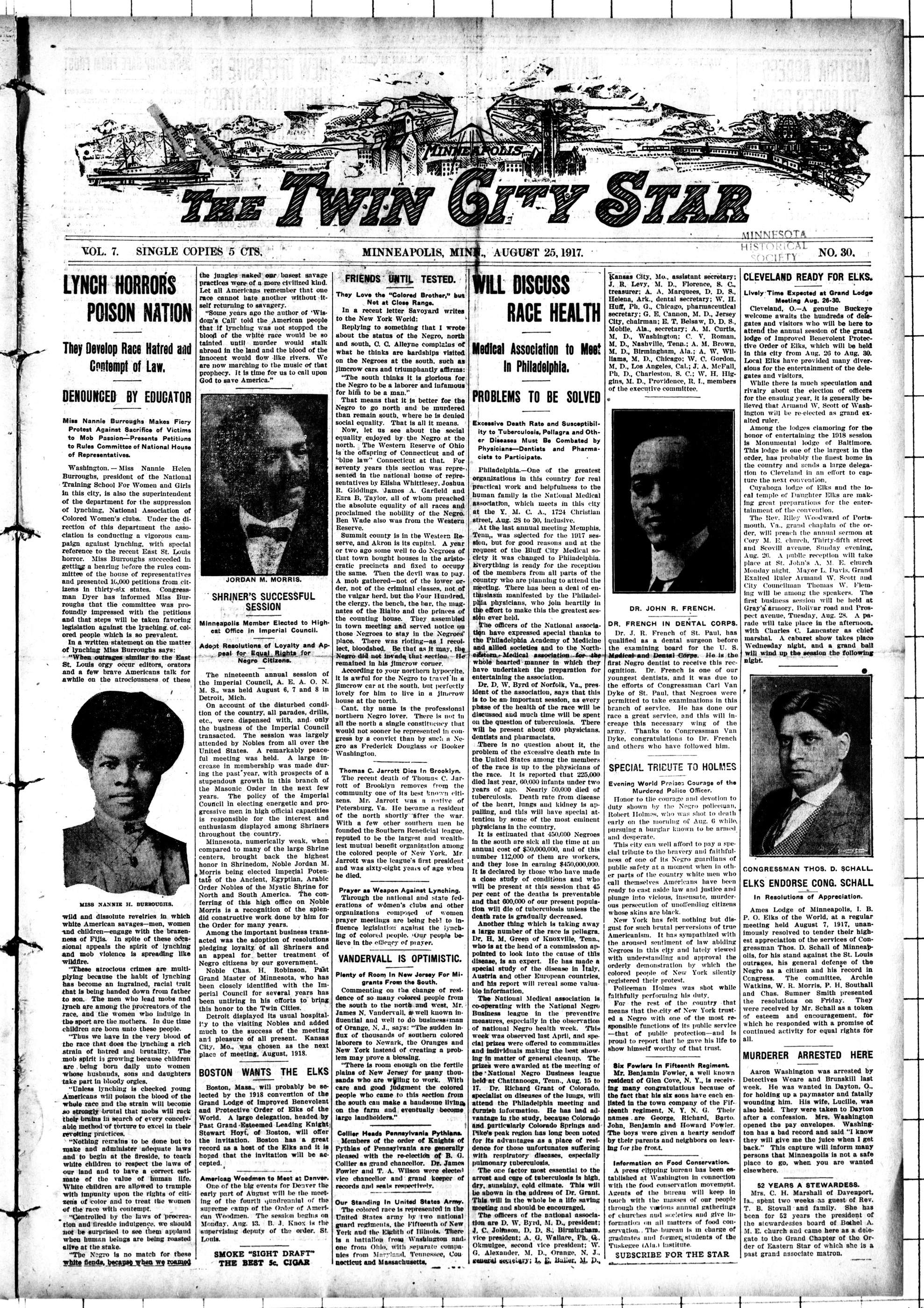
MINNEAPOLIS
THE TWIN CITY STAR
VOL. 7. SINGLE COPIES 5 CTS.
MINNEAPOLIS, MINN. AUGUST 25, 1917.
MINNESOTA HISTORICAL SOCIETY
NO. 30.
LYNCH HORRORS POISON NATION They Develop Race Hatred and Contempt of Law.
DENOUNCED BY EDUCATOR
Miss Nannie Burroughs Makes Fiery Protest Against Sacrifice of Victims to Mob Passion—Presents Petitions to Rules Committee of National House of Representatives.
Washington. — Miss Nannie Helen Burroughs, president of the National Training School For Women and Girls in this city, is also the superintendent of the department for the suppression of lynching, National Association of Colored Women's clubs. Under the direction of this department the association is conducting a vigorous campaign against lynching, with special reference to the recent East St. Louis horror. Miss Burroughs succeeded in getting a hearing before the rules committee of the house of representatives and presented 16,000 petitions from citizens in thirty-six states. Congressman Dyer has informed Miss Burroughs that the committee was profoundly impressed with the petitions and that steps will be taken favoring legislation against the lynching of colored people which is so prevalent.
In a written statement on the matter of lynching Miss Burroughs says:
"When outrages similar to the East St. Louis orgy occur editors, orators and a few brave Americans talk for awhile on the atrocities of these
MISS NANNIE H. BURBOUGHS.
wild and dissolute revelries in which white American savages—men, women and children—engage with the brazenness of Fijis. In spite of these occasional appeals the spirit of lynching and mob violence is spreading like wildfire.
"These atrocious crimes are multiplying because the habit of lynching has become an ingrained, racial trait that is being handed down from father to son. The men who lead mobs and lynch are among the procreators of the race, and the women who indulge in the sport are the mothers. In due time children are born unto these people.
"Thus we have in the very blood of the race that does the lynching a rich strain of hatred and brutality. The mob spirit is growing because children are being born daily unto women whose husbands, sons and daughters take part in bloody orgies.
"Unless lynching is checked young Americans will poison the blood of the whole race and the strain will become so strongly brutal that mobs will rack their brains in search of every conceivable method of torture to excel in their revolting practices.
"Nothing remains to be done but to make and administer adequate laws and to begin at the fireside, to teach white children to respect the laws of our land and to have a correct estimate of the value of human life. White children are allowed to trample with impunity upon the rights of citizens of color and to treat the women of the race with contempt.
"Controlled by the laws of precreation and fireside indulgence, we should not be surprised to see them applaud when human beings are being roasted alive at the stake.
"The Negro is no match for these white fiends, because when we roamed
the jungles naked our baset savage practices were of a more civilized kind. Let all Americans remember that one race cannot hate another without itself returning to savagery.
"Some years ago the author of 'Wisdom's Call' told the American people that if lynching was not stopped the blood of the white race would be so tainted until murder would stalk abroad in the land and the blood of the innocent would flow like rivers. We are now marching to the music of that prophecy. It is time for us to call upon God to save America."
THE MAYOR OF BROOKLYN
JORDAN M. MORRIS.
SHRINER'S SUCCESSFUL
SESSION
Minneapolis Member Elected to Highest Office in Imperial Council.
Adopt Resolutions of Loyalty and Appeal for Equal Rights for Negro Citizens.
The nineteenth annual session of the Imperial Council, A. E. A. O. N. M. S., was held August 6, 7 and 8 in Detroit, Mich.
On account of the disturbed condition of the country, all parades, drills, etc., were dispensed with, and only the business of the Imperial Council transacted. The session was largely attended by Nobles from all over the United States. A remarkably peaceful meeting was held. A large increase in membership was made during the past year, with prospects of a stupendous growth in this branch of the Masonic Order in the next few years. The policy of the Imperial Council in electing energetic and progressive men in high official capacities is responsible for the interest and enthusiasm displayed among Shriners throughout the country.
Minnesota, numerically weak, when compared to many of the large Shrine centers, brought back the highest honor in Shrinedom, Noble Jordan M. Morris being elected Imperial Potentate of the Ancient, Egyptian, Arabic Order Nobles of the Mystic Shrine for North and South America. The conferring of this high office on Noble Morris is a recognition of the splendid constructive work done by him for the Order for many years. Among the important business transacted was the adoption of resolutions pledging loyalty of all Shriners and an appeal for better treatment of Negro citizens by our government. Noble Chas. H. Robinson, Past Grand Master of Minnesota, who has been closely identified with the Imperial Council for several years has been untiring in his efforts to bring this honor to the Twin Cities. Detroit displayed its usual hospitality to the visiting Nobles and added much to the success of the meeting and pleasure of all present. Kansas City, Mo., was chosen as the next place of meeting, August, 1918.
BOSTON WANTS THE ELKS
Boston, Mass., will probably be selected by the 1918 convention of the Grand Lodge of Improved Benevolent and Protective Order of Elks of the World. A large delegation, headed by Past Grand-Esteemed Leading Knight Stewart Hoyt, of Boston, will offer the invitation. Boston has a great record as a host of the Elks and it is hoped that the invitation will be accepted.
American Woodmen to Meet at Denver. One of the big events for Denver the early part of August will be the meeting of the fourth quadrennial of the supreme camp of the Order of American Woodmen. The session begins on Monday, Aug. 13. B. J. Knox is the supervising deputy of the order, St. Louis.
SMOKE "SIGHT DRAFT"
THE BEST 5c. CIGAR
FRIENDS UNTIL TESTED.
They Love the "Colored Brother," but Not at Close Range.
In a recent letter Savoyard writes to the New York World:
Replying to something that I wrote about the status of the Negro, north and south, C. C. Alleyne compilus of what he thinks are hardships visited on the Negroes at the south, such as jimcrow cars and triumphantly affirms:
"The south thinks it is glorious for the Negro to be a laborer and infamous for him to be a man."
That means that it is better for the Negro to go north and be murdered than remain south, where he is denied social equality. That is all it means.
Now, let us see about the social equality enjoyed by the Negro at the north. The Western Reserve of Ohio is the offspring of Connecticut and of "blue law" Connecticut at that.
For seventy years this section was represented in the national house of representatives by Elisha Whittlesey, Joshua R. Giddings, James A. Garfield and Ezra B. Taylor, all of whom preached the absolute equality of all races and proclaimed the nobility of the Negro. Ben Wade also was from the Western Reserve.
Summit county is in the Western Reserve, and Akron is its capital. A year or two ago some well to do Negroes of that town bought houses in the aristocratic precincts and fixed to occupy the same. Then the devil was to pay. A mob gathered—not of the lower order, not of the criminal classes, not of the vulgar herd, but the Four Hundred, the clergy, the bench, the bar, the magnates of the Ralto and the princes of the counting house. They assembled in town meeting and served notice on those Negroes to stay in the Negroes' place. There was rioting—as I recollected, bloodshed. Be that as it may, the Negro did not invade that section—He remained in his Jimcrow corner.
According to your northern hypocrite, it is awful for the Negro to travel in a Jimcrow car at the south, but perfectly lovely for him to live in a Jimcrow house at the north.
Cant, thy name is the professional northern Negro lover. There is not in all the north a single constituency that would not sooner be represented in congress by a convict than by such a Negro as Frederick Douglass or Booker Washington.
Thomas C. Jarrott Dies In Brooklyn.
The recent death of Thomas C. Jarrott of Brooklyn removes from the community one of its best known citizens. Mr. Jarrott was a native of Petersburg, Va. He became a resident of the north shortly after the war. With a few other southern men he founded the Southern Beneficial league, reputed to be the largest and wealthiest mutual benefit organization among the colored people of New York. Mr. Jarrott was the league's first president and was sixty-eight years of age when he died.
Prayer as Weapon Against Lynching.
Through the national and state federations of women's clubs and other organizations composed of women prayer meetings are being held to influence legislation against the lynching of colored people. Our people believe in the efficacy of prayer.
VANDERVALL IS OPTIMISTIC.
Plenty of Room In New Jersey For Migrants From the South.
Commenting on the change of residence of so many colored people from the south to the north and west, Mr. James N. Vandervaill, a well known influential and well to do business man of Orange, N. J., says: "The sudden influx of thousands of southern colored laborers to Newark, the Oranges and New York instead of creating a problem may prove a blessing.
"There is room enough on the fertile plains of New Jersey for many thousands who are willing to work. With care and good judgment the colored people who came to this section from the south can make a handsome living on the farm and eventually become large landholders."
Collier Heads Pennsylvania Pythians. Members of the order of Knights of Pythias of Pennsylvania are generally pleased with the re-election of B. G. Collier as grand chancellor. Dr. James Fowler and T. A. Wilson were elected vice chancellor and grand keeper of records and seals respectively.
Our Standing In United States Army. The colored race is represented in the United States army by two national guard regiments, the Fifteenth of New York and the Eighth of Illinois. There is a battalion from Washington and one from Ohio, with separate companies from Maryland, Tennessee, Connecticut and Massachusetts.
WILL DISCUSS RACE HEALTH
Excessive Death Rate and Susceptibility to Tuberculosis, Pollagra and Other Diseases Must Be Combated by Physicians—Dentists and Pharmacists to Participate.
Philadelphia.—One of the greatest organizations in this country for real practical work and helpfulness to the human family is the National Medical association, which meets in this city at the Y. M. C. A., 1724 Christian street, Aug. 28 to 30, inclusive.
At the last annual meeting Memphis, Tenn., was selected for the 1917 session, but for good reasons and at the request of the Bluff City Medical society it was changed to Philadelphia. Everything is ready for the reception of the members from all parts of the country who are planning to attend the meeting. There has been a deal of enthusiasm manifested by the Philadelphia physicians, who join heartily in the effort to make this the greatest session ever held.
The officers of the National association have expressed special thanks to the Philadelphia Academy of Medicine and allied societies and to the Northeastern Medical association for the whole hearted manner in which they have undertaken the preparation for entertaining the association.
Dr. D. W. Byrd of Norfolk, Va., president of the association, says that this is to be an important session, as every phase of the health of the race will be discussed and much time will be spent on the question of tuberculosis. There will be present about 600 physicians, dentists and pharmacists. There is no question about it, the problem of the excessive death rate in the United States among the members of the race is up to the physicians of the race. It is reported that 225,000 died last year, 60,000 infants under two years of age. Nearly 50,000 died of tuberculosis. Death rate from disease of the heart, lungs and kidney is appalling, and this will have special attention by some of the most eminent physicians in the country. It is estimated that 450,000 Negroes in the south are sick all the time at an annual cost of $50,000,000, and of this number 112,000 of them are workers, and they lose in earning $450,000,000. It is declared by those who have made a close study of conditions and who will be present at this session that 45 per cent of the deaths is preventable and that 600,000 of our present population will die of tuberculosis unless the death rate is gradually decreased.
Another thing which is taking away a large number of the race is pelagia. Dr. H. M. Green of Knoxville, Tenn., who is at the head of a commission appointed to look into the cause of this disease, is an expert. He has made a special study of the disease in Italy, Austria and other European countries, and his report will reveal some valuable information.
The National Medical association is co-operating with the National Negro Business league in the preventive measures, especially in the observation of national Negro health week. This week was observed last April, and special prizes were offered to communities and individuals making the best showing in matter of general cleanup. The prizes were awarded at the meeting of the National Negro Business league held at Chattanooga, Tenn., Aug. 15 to 17. Dr. Richard Grant of Colorado, specialist on diseases of the lungs, will attend the Philadelphia meeting and furnish information. He has had advantage in the study, because Colorado and particularly Colorado Springs and Pike's peak region has long been noted for its advantages as a place of residence for those unfortunate suffering with respiratory diseases, especially pulmonary tuberculosis.
The one factor most essential to the arrost and cure of tuberculosis is high, dry, sunshiny, cold climate. This will be shown in the address of Dr. Grant. This will in the whole be a life saving meeting and should be encouraged.
The officers of the national association are D. W. Byrd, M. D., president; J. C. Johnson, D. D. S. Birmingham, vice president; A. G. Wallace, Ph. G. Okmulgee, second vice president; W. G. Alexander, M. D., Orange, N. J., general secretary; L. E. Bailer, M. D.
Kansas City, Mo., assistant secretary; J. R. Levy, M. D., Florence, S. C., treasurer; A. M. Marquees, D. D. S., Helena, Ark., dental secretary; W. H. Huff, Ph. G., Chicago, pharmaceutical secretary; G. E. Cannon, M. D., Jersey City, chairman; E. T. Belsaw, D. D. S., Mobile, Ala., secretary; M. D. Curtis, M. D., Washington; C. V. Roman, M. D., Nashville, Tenn.; A. M. Brown, M. D., Birmingham, Ala.; A. W. Williams, M. D., Chicago; W. C. Gordon, M. D., Los Angeles, Cal.; J. A. McFall, Ph. D., Charleston, S. C.; W. H. Higgins, M. D., Providence, R. I., members of the executive committee.
DR. JOHN R. FRENCH.
DR. FRENCH IN DENTAL CORPS.
DR. FRENCH IN DENTAL CORPS
Dr. J. R. French of St. Paul, has qualified as a dental surgeon before the examining board for the U. S. Medical and Dental Corps. He is the first Negro dentist to receive this recognition. Dr. French is one of our youngest dentists, and it was due to the efforts of Congressman Carl Van Dyke of St. Paul, that Negroes were permitted to take examinations in this branch of service. He has done our race a great service, and this will increase this necessary wing of the army. Thanks to Congressman Van Dyke, congratulations to Dr. French and others who have followed him.
SPECIAL TRICUTE TO HOLMES
Evening World Prepares Courage of the Murdered Police Officer.
Honor to the courage and devotion to duty shown by the Negro policeman, Robert Holmes, who was shot to death early on the morning of Aug. 6 while pursuing a burglar known to be armed and desperate.
This city can well afford to pay a special tribute to the bravery and faithfulness of one of its Negro guardians of public safety at a moment when in other parts of the country white men who call themselves Americans have been ready to cast aside law and justice and plunge into vicious, insensitive, murderous persecution of unoffending citizens whose skins are black.
New York has felt nothing but disgust for such brutal perversions of true Americanism. It has sympathized with the aroused sentiment of law abiding Negroes in this city and lately viewed with understanding and approval the orderly demonstration by which the colored people of New York silently registered their protest.
Policeman Holmes was shot while faithfully performing his duty.
For the rest of the country that means that the city of New York trusted a Negro with one of the most responsible functions of its public service—that of public protection—and is proud to report that he gave his life to show himself worthy of that trust.
Six Fowlers In Fifteenth Regiment.
Six Fowlers in Fifteenth Regiment.
Mr. Benjamin Fowler, a well known resident of Glen Cove, N. Y., is receiving many congratulations because of the fact that his six sons have each enlisted in the town company of the Fifteenth regiment, N. Y. N. G. Their names are George, Richard, Barto, John, Benjamin and Howard Fowler. The boys were given a hearty sendoff by their parents and neighbors on leaving for the front.
Information on Food Conservation.
A press clipping bureau has been established at Washington in connection with the food conservation movement. Agents of the bureau will keep in touch with the masses of our people through the various annual gatherings of churches and societies and give information on all matters of food conservation. The bureau is in charge of graduates and former students of the Tuskegee (Ala.) institute.
SUBSCRIBE FOR THE STAR
CLEVELAND READY FOR ELKS.
Lively-Time Expected at Grand Lodge Meeting Aug. 26-30.
Cleveland, O.-A. genuine Buckeye welcome awaits the hundreds of delegates and visitors who will be here to attend the annual session of the grand lodge of Improved Benevolent Protective Order of Elks, which will be held in this city from Aug. 26 to Aug. 30. Local Elks have provided many diversions for the entertainment of the delegates and visitors.
While there is much speculation and rivalry about the election of officers for the ensuing year, it is generally believed that Armand W. Scott of Washington will be re-elected as grand exalted ruler.
Among the lodges clamoring for the honor of entertaining the 1918 session is Monumental lodge of Baltimore. This lodge is one of the largest in the order, has probably the finest home in the country and sends a large delegation to Cleveland in an effort to capture the next convention.
Cuyahoga lodge of Elks and the local temple of Daughter Elks are making great preparations for the entertainment of the convention.
The Rev. Riley Woodward of Portsmouth, Va., grand chaplain of the order, will preach the annual sermon at Cory M. E. church. Thirty-fifth street and Scovill avenue, Sunday evening, Aug. 26. A public reception will take place at St. John's A. M. E. church Monday night. Mayor L. Davis, Grand Exalted Ruler Armand W. Scott and City Councilman Thomas W. Fleming will be among the speakers. The first business session will be held at Gray's armory, Bolivar road and Prospect avenue, Tuesday, Aug. 28. A parade will take place in the afternoon, with Charles C. Lancaster as chief marshal. A cabaret show takes place Wednesday night, and a grand ball will wind up the session the following night.
B. H. H.
In Resolutions of Appreciation.
Ames Lodge of Minneapolis, I. B. P. O. Elks of the World, at a regular meeting held August 7, 1917, unanimously resolved to tender their highest appreciation of the services of Congressman Thos. D. Schall of Minneapolis, for his stand against the St. Louis outrages, his general defense of the Negro as a citizen and his record in Congress. The committee, Archie Watkins, W. R. Morris, P. H. Southall and Chas. Sumner Smith presented the resolutions on Friday. They were received by Mr. Schall as a token of esteem and encouragement, for which he responded with a promise of continued activity for equal rights for all.
MURDERER ARRESTED HERE
Aaron Washington was arrested by Detectives Weare and Brunskill last week. He was wanted in Dayton, O., for holding up a paymaster and fatally wounding him. His wife, Lucille, was also held. They were taken to Dayton after a confession. Mrs. Washington opened the pay envelopes. Washington has a bad record and said "I know they will give me the juice when I get back." This capture will inform many persons that Minneapolis is not a safe place to go, when you are wanted elsewhere.
52 YEARS A STEWARDESS.
Mrs. C. H. Marshall of Davenport, Ia., spent two weeks as guest of Rev. T. B. Stovall and family. She has been for 52 years the president of the stewardesses board of Bosthel A. M. E. church and came here as a delegate to the Grand Chapter of the Order of Eastern Star of which she is a past grand associate matron.
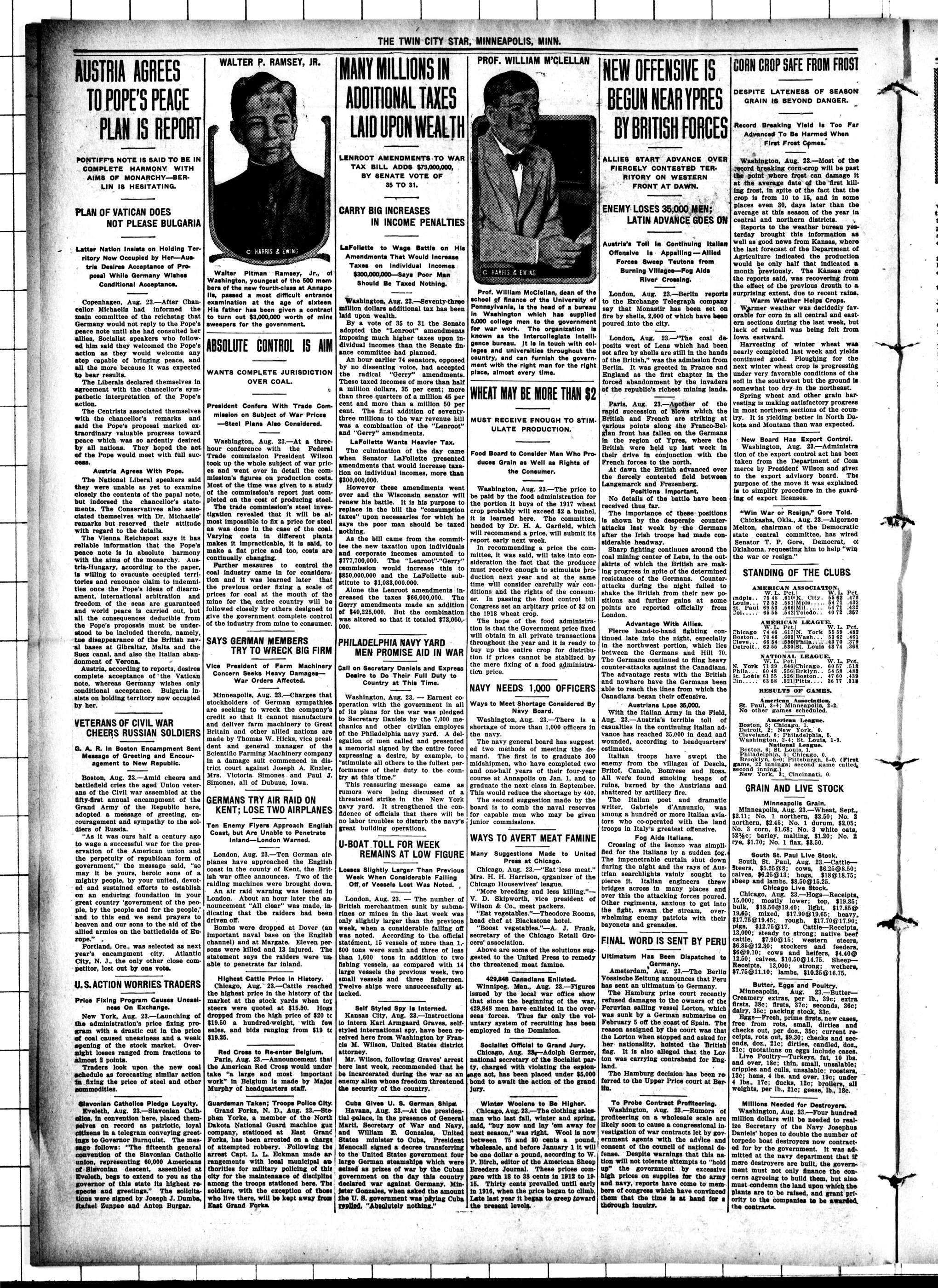
AUSTRIA AGREES TO POPE'S PEACE PLAN IS REPORT
PONTIFFS NOTE IS SAID TO BE IN COMPLETE HARMONY WITH AIMS OF MONARCHY—BERLIN IS HESITATING.
PLAN OF VATICAN DOES
NOT PLEASE BULGARIA
Latter Nation Insists on Holding Territory Now Occupied by Her—Austria Desires Acceptance of Proposal While Germany Wishes Conditional Acceptance.
Copenhagen, Aug. 23.—After Chancellor Michaelis had informed the main committee of the reckstag that Germany would not reply to the Pope's peace note until she had consulted her allies, Socialist speakers who followed him said they welcomed the Pope's action as they would welcome any step capable of bringing peace, and all the more because it was expected to bear results.
The Liberals declared themselves in agreement with the chancellor's sympathetic interpretation of the Pope's action.
The Centrists associated themselves with the chancellor's remarks and said the Pope's proposal marked extraordinary valuable progress toward peace which was so ardently desired by all nations. They hoped the act of the Pope would meet with full success.
Austria Agrees With Pope.
The National Liberal speakers said they were unable as yet to examine closely the contents of the papal note, but indorsed the chancellor's statements. The Conservatives also associated themselves with Dr. Michaell's remarks but reserved their attitude with regard to the details.
The Vienna Reichspost says it has reliable information that the Pope's peace note is in absolute harmony with the aims of the monarchy. Austria-Hungary, according to the paper, is willing to evacuate occupied territories and renounce claim to indemnities once the Pope's ideas of disarmament, international arbitration and freedom of the seas are guaranteed and world peace is carried out, but all the consequences deducible from the Pope's proposals must be understood to be included therein, namely, the disappearance of the British naval bases at Glbraital, Malta and the Suez canal, and also the Italian abandonment of Verona. Austria, according to reports, desires complete acceptance of the Vatican note, whereas Germany wishes only conditional acceptance. Bulgaria insists on holding territory now occupied by her.
VETERANS OF CIVIL WAR CHEERS RUSSIAN SOLDIERS
G. A. R. In Boston Encampment Sent Message of Greeting and Encouragement to New Republic.
Boston, Aug. 23.—Amid cheers and battlefield cries the aged Union veterans of the Civil war assembled at the fifty-first annual encampment of the Grand Army of the Republic here, adopted a message of greeting, encouragement and sympathy to the soldiers of Russia.
"As it was ours half a century ago to wage a successful war for the preservation of the American union and the perpetuity of republican form of government," the message said, "so may it be yours, heroic sons of a mighty people, by your united, devoted and sustained efforts to establish on an enduring foundation in your great country 'government of the people, by the people and for the people,' and to this end we send prayers to heaven and our sons to the aid of the allied armies on the battlefields of Europe."
Portland, Ore., was selected as next year's encampment city. Atlantic City, N. J., the only other close competitor, lost out by one vote.
U.S.ACTION WORRIES TRADERS
Price Fixing Program Causes Uneasiness On Exchange.
New York, Aug. 23.—Launching of the administration's price fixing program with a drastic cut in the price of coal caused uneasiness and a weak opening of the stock market. Overnight losses ranged from fractions to almost 2 points. Traders look upon the new coal schedule as forecasting similar action in fixing the price of steel and other commodities.
Slavonian Catholics Pledge Loyalty, Eveleth, Aug. 23—Slavonian Catholics, in convention here, placed themselves on record as patriotic, loyal citizens in a telegram conveying greetings to Governor Burnquist. The message follows: "The fifteenth general convention of the Slavonian Catholic union, representing 60,000 Americans of Slavonian descent, assembled at Eveleth, begs to extend to you as the governor of this state its highest respects and greetings." The solicitations were signed by Joseph J. Dumba, Rafael Zunpae and Anton Burgar.
WALTER P. RAMSEY, JR.
C. HARRIS & EWING
Walter Pitman Ramsey, Jr., of Washington, youngest of the 500 members of the new fourth-class at Annapolis, passed a most difficult entrance examination at the age of sixteen. His father has been given a contract to turn out $3,000,000 worth of mine sweepers for the government.
ABSOLUTE CONTROL IS AIM
WANTS COMPLETE JURISDICTION
OVER COAL.
President Confers With Trade Commission on Subject of War Prices —Steel Plans Also Considered.
Washington, Aug. 23.—At a three-hour conference with the Federal Trade commission President Wilson took up the whole subject of war prices and went over in detail the commission's figures on production costs. Most of the time was given to a study of the commission's report just completed on the cost of producing steel. The trade commission's steel investigation revealed that it will be almost impossible to fix a price for steel as was done in the case of the coal. Varying costs in different plants makes it impracticable, it is said, to make a flat price and too, costs are continually changing.
Further measures to control the coal industry came in for consideration and it was learned later that the previous order fixing a scale of prices for coal at the mouth of the mine for the entire country will be followed closely by others designed to give the government complete control of the industry from mine to consumer.
SAYS GERMAN MEMBERS
TRY TO WRECK BIG FIRM
Vice President of Farm Machinery Concern Seeks Heavy Damages—War Orders Affected.
Minneapolis, Aug. 23.—Charges that stockholders of German sympathies are seeking to wreck the company's credit so that it cannot manufacture and deliver farm machinery to Great Britain and other allied nations are made by Thomas W. Hicks, vice president and general manager of the Scientific Farming Machinery company in a damage suit commenced in district court against Joseph A. Enzler, Mrs. Victoria Simones and Paul J. Simones, all of Dubuue, Iowa.
GERMANS TRY AIR RAID ON KENT; LOSE TWO AIRPLANES
Ten Enemy Flyers Approach English Coast, but Are Unable to Penetrate Inland—London Warned.
London, Aug. 23.—Ten German airplanes have approached the English coast in the county of Kent, the British war office announces. Two of the raiding machines were brought down. An air raid warning was issued in London. About an hour later the announcement "All clear" was made, indicating that the raiders had been driven off.
Bombs were dropped at Dover (an important naval base on the English channel) and at Margate. Eleven persons were killed and 13 injured. The statement says the raiders were unable to penetrate far inland.
Chicago, Aug. 23.—Cattle reached the highest price in the history of the market at the stock yards when top steers were quoted at $15.50. Hogs dropped from the high price to $20 to $19.50 a hundred-weight, with few sales, and bids ranging from $19 to $19.25.
Red Cross to Re-enter Belgium.
Paris, Aug. 23.—Announcement that the American Red Cross would undertake "a large and most important work" in Belgium is made by Major Murphy of headquarters staff.
Guardsman Taken; Troops Police City, Grand Forks, N. D., Aug. 23.—Stephen Yorke, a member of the North Dakota National Guard machine gun company, stationed at East Grand Forks, has been arrested on a charge of attempted robbery. Following the arrest Capt. L. L. Eckman made arrangements with local municipal authorities for military policing of this city for the maintenance of disciplining among the troops stationed here. The soldiers, with the exception of those who live there, will be kept away from East Grand Forks.
THE TWIN CITY STAR, MINNEAPOLIS, MINN.
ADDITIONAL TAXES LAID UPON WEALTH
LENROOT AMENDMENTS TO WAR
TAX BILL ADDS $73,000,000,
BY SENATE VOTE OF
35 TO 31.
CARRY BIG INCREASES
IN INCOME PENALTIES
LaFollette to Wage Battle on His Amendments That Would Increase Taxes on Individual Incomes $300,000,000—Says Poor Man Should Be Taxed Nothing.
Washington, Aug. 23.—Seventy-three million dollars additional tax has been laid upon wealth.
By a vote of 35 to 31 the Senate adopted the "Lenroot" amendments imposing much higher taxes upon individual incomes than the Senate finance committee had planned.
An hour earlier 74 senators, opposed by no dissenting voice, had accepted the radical "Gerry" amendments. These taxed incomes of more than half a million dollars, 35 per cent; more than three quarters of a million 45 per cent and more than a million 50 per cent. The final addition of seventy-three millions to the war revenue bill was a combination of the "Lenroot" and "Gerry" amendments.
LaFollette Wants Heavier Tax.
The culmination of the day came when Senator LaFollette presented amendments that would increase taxation on individual incomes, more than $300,000,000.
However these amendments went over and the Wisconsin senator will renew his battle. It is his purpose to replace in the bill the "consumption taxes" upon necessaries for which he says the poor man should be taxed nothing.
As the bill came from the committee the new taxation upon individuals and corporate incomes amounted to $777,700,000. The "Lenroot"-"Gerry" commission would increase this to $850,000,000 and the LaFollette substitute to $1,083,000,000.
Alone the Lenroot amendments increased the taxes $68,000,000. The Gerry amendments made an addition of $40,225,000. But the combination was altered so that it totaled $73,000,000.
PHILADELPHIA NAVY YARD MEN PROMISE AID IN WAR
Call on Secretary Daniels and Express Desire to Do Their Full Duty to Country at This Time.
Washington, Aug. 23. — Earnest cooperation with the government in all of its plans for the war was pledged to Secretary Daniels by the 7,000 mechanics and other civilian employees of the Philadelphia navy yard. A delegation of men called and presented a memorial signed by the entire force expressing a desire, by example, to "stimulate all others to the fullest performance of their duty to the country at this time."
This reassuring message came as rumors were being discussed of a threatened strike in the New York navy yard. It strengthened the confidence of officials that there will be no labor troubles to disturb the navy's great building operations.
U-BOAT TOLL FOR WEEK
REMAINS AT LOW FIGURE
Losses Slightly Larger Than Previous Week When Considerable Falling Off, of Vessels Lost Was Noted. London, Aug. 23. — The number of British merchantmen sunk by submarines or mines in the last week was only slightly larger than the previous week, when a considerable falling off was noted. According to the official statement, 15 vessels of more than 1,600 tons were sunk and three of less than 1,600 tons in addition to two fishing vessels, as compared with 14 large vessels the previous week, two small vessels and three fishermen. Twelve ships were unsuccessfully attacked.
Self Styled Spy Is Interned.
Kansas City, Aug. 23.—Instructions to intern Karl Armgaard Graves, self-styled international spy, have been received here from Washington by Francis M. Wilson, United States district attorney. Mr. Wilson, following Graves' arrest here last week, recommended that he be incarcerated during the war as an enemy alien whose freedom threatened the security of the country.
Cuba Gives U. S. German Shipi
Havana, Aug. 23—At the presi-
dential palace, in the presence of General
Marl, Secretary of War and Navy,
and William E. Gonzales, United
States minister to Cuba, President
Menocall signed a decree transferring
to the United States government four
large German steamships which were
seized as prizes of war by the Cuban
government on the day this country
declared war against Germany. Minister
Gonzales, when asked the amount
the U. S. government was paying Cuba
replied, "Absolutely nothing."
C HARRIS & EWING
Prof. William McClellan, dean of the school of finance of the University of Pennsylvania, is the head of a bureau in Washington which has supplied 5,000 college men to the government for war work. The organization is known as the Intercollegiate Intelligence bureau. It is in touch with colleges and universities throughout the country, and can furnish the government with the right man for the right place, almost every time.
WHEAT MAY BE MORE THAN $2
WHEAT MAY BE MORE THAN $2
MUST RECEIVE ENOUGH TO STIMULATE PRODUCTION.
Food Board to Consider Man Who Produces Grain as Well as Rights of the Consumer.
Washington, Aug. 23.—The price to be paid by the food administration for the portion it buys of the 1917 wheat crop probably will exceed $2 a bushel, it is learned here. The committee, headed by Dr. H. A. Garfield, which will recommend a price, will submit its report early next week.
In recommending a price the committee, it was said, will take into consideration the fact that the producer must receive enough to stimulate production next year and at the same time will consider carefully war conditions and the rights of the consumer. In passing the food control bill Congress set an arbitrary price of $2 on the 1918 wheat crop.
The hope of the food administration is that the Government price fixed will obtain in all private transactions throughout the year and it is ready to buy up the entire crop for distribution if prices cannot be stabilized by the mere fixing of a food administration price.
NAVY NEEDS 1,000 OFFICERS
Ways to Meet Shortage Considered By Navy Board.
Washington, Aug. 23.—There is a shortage of more than 1,000 officers in the navy.
The navy general board has suggested ed two methods of meeting the demand. The first is to graduate 300 midshipmen, who have completed two and one-half years of their four-year course at Annapolis on Jan. 1, and to graduate the next class in September. This would reduce the shortage by 400.
The second suggestion made by the board is to comb the naval reserves for capable men who may be given junior commissions.
WAYS TO AVERT MEAT FAMINE
Many Suggestions Made to United Press at Chicago.
Chicago, Aug. 23.—"Eat less meat." Mrs. H. H. Harrison, organizer of the Chicago Housewives' league.
"More breeding and less killing."—V. D. Skipworth, vice president of Wilson & Co., meat packers.
"Eat vegetables."—Theodore Rooms, head chef at Blackstone hotel.
"Boost vegetables."—A. J. Frank, secretary of the Chicago Retail Grocers' association.
Above are some of the solutions suggested to the United Press to remedy the threatened meat famine.
429.848 Canadians Enlisted.
Winnipeg, Man., Aug. 23.—Figures issued by the local war office show that since the beginning of the war, 429,848 men have enlisted in the overseas forces. Thus far only the voluntary system of recruiting has been employed in the Dominion.
Socialist Official to Grand Jury.
Chicago, Aug. 28.—Adolph Germer, national secretary of the Socialist party, charged with violating the espionage act, has been placed under $5,000 bond to await the action of the grand jury.
Winter Woolens to Be Higher.
Chicago, Aug. 23.—The clothing salesman who last fall, winter and spring, said, "buy now and lay 'em away for next season," was right. Wool is now between 75 and 80 cents a pound, wholesale, and before January 1 it will be one dollar a pound, according to W. P. Birch, editor of the American Sheep Breeders Journal. These prices compare with 18 to 38 cents in 1912 to 1915. Thirty cents prevailed until early in 1916, when the price began to climb. Late last year it began to creep toward the present levels.
NEW OFFENSIVE IS BEGUN NEAR YPRES BY BRITISH FORCES
ALLIES START ADVANCE OVER FIERCELY CONTESTED TER- RITORY ON WESTERN FRONT AT DAWN.
ENEMY LOSES 35,000 MEN;
LATIN ADVANCE GOES ON
Austria's Toll in Continuing Italian Offensive is Appalling—Ailled Forces Sweep Teutons from Burning Villages—Fog Aids River Crossing.
London, Aug. 23.—Berlin reports to the Exchange Telegraph company say that Monastir has been set on fire by shells, 2,000 of which have been poured into the city.
London, Aug. 23.—"The coal deposits west of Lens which had been set afire by shells are still in the hands of the British," was the admission from Berlin. It was greeted in France and England as the first chapter in the forced abandonment by the invaders of the republic's richest mining lands.
Paris, Aug. 23.—Another of the rapid succession of blows which the British and French are striking at various points along the Franco-Belgian front has fallen on the Germans in the region of Ypres, where the British were held up last week in their drive in conjunction with the French forces to the north.
At dawn the British advanced over the fiercely contested field between Langemarck and Frezenberg.
Positions important.
No details of the battle have been received thus far.
The importance of these positions is shown by the desperate counterattacks last week by the Germans after the Irish troops had made considerable headway.
Sharp fighting continues around the coal mining center of Lehs, in the outskirts of which the British are making progress in spite of the determined resistance of the Germans. Counterattacks during the night failed to shake the British from their new positions and further gains at some points are reported officially from London.
Advantage With Allies.
Fierce hand-to-hand fighting continued late into the night, especially in the northwest portion, which lies between the Germans and Hill 70. The Germans continued to fling heavy counter-attacks against the Canadians. The advantage rests with the British and nowhere have the Germans been able to reach the lines from which the Canadians began their offensive.
Austrians Lose 35,000.
With the Italian Army in the Field, Aug. 23.—Austria's terrible toll of casualties in the continuing Italian advance has reached 35,000 in dead and wounded, according to headquarters' estimates.
Italian troops have swept the enemy from the villages of Descla, Britof, Canale, Bomresse and Rosa. All were found smoking heaps of ruins, burned by the Austrians and shattered by artillery fire.
The Italian poet and dramatic writer, Gabriele d'Annunzio, was among a hundred or more Italian aviators who co-operated with the land troops in Italy's greatest offensive.
Fog Aids Italians.
Crossing of the Isonzo was simplified for the Italians by a sudden fog. The impenetrable curtain shut down during the night and the rays of Austrian searchlights vainly sought to pierce it. Italian engineers threw bridges across in many places and over this the attacking forces poured. Other regiments, anxious to get into the fight, swam the stream, overwhelming enemy patrols with their bayonets and grenades.
FINAL WORD IS SENT BY PERU
Ultimatum Has Been Dispatched to Germany.
Amsterdam, Aug. 23.—The Berlin Vossische Zeitung announces that Peru has sent an ultimatum to Germany.
The Hamburg prize court recently refused damages to the owners of the Peruvian sailing vessel Lorton, which was sunk by a German submarine on February 5 off the coast of Spain. The reason assigned by the court was that the Lorton when stopped and asked for her nationality, hoisted the British flag. It is also alleged that the Lorton was carrying contraband for England.
The Hamburg decision has been referred to the Upper Price court at Berlin.
To Probe Contract Profiteering
Washington, Aug. 23.—Rumors of
profiteering on a wholesale scale are
likely soon to cause a congressional
investigation of war contracts let by
government agents with the advice and
consent of the council of national
defense. Despite warnings that this nation
will not tolerate attempts to "hold
up" the government by excessive
high prices on supplies for the army
and navy, reports have come to
members of congress which have convinced
them that the time is at hand for a
thorough inquiry.
DESPIE LATENESS OF SEAGON
GRAIN IS BEYOND DANGER.
Record Breaking Yield Is Too Far Advanced To Be Harmed When First Frost Cpmes.
Washington, Aug. 23.—Most of the record breaking corn crop will be past the point where frost can damage it at the average date of the first killing frost, in spite of the fact that the crop is from 10 to 15, and in some places even 30, days later than the average at this season of the year in central and northern districts.
Reports to the weather bureau yesterday brought this information as well as good news from Kansas, where the last forecast of the Department of Agriculture indicated the production would be only half that indicated a month previously. The Kansas crop the reports said, was recovering from the effect of the previous drought to a surprising extent, due to recent rains.
Warmer weather was decidedly favorable for corn in all central and eastern sections during the last week, but lack of rainfall was being felt from Iowa eastward.
Harvesting of winter wheat was nearly completed last week and yields continued good. Ploughing for the next winter wheat crop is progressing under very favorable conditions of the soil in the southwest but the ground is somewhat too dry in the northeast.
Spring wheat and other grain harvesting is making satisfactory progress in most northern sections of the country. It is yielding better in North Dakota and Montana than was expected.
New Board Has Export Control.
Washington, Aug. 23.—Administration of the export control act has been taken from the Department of Commerce by President Wilson and giver to the export advisory board. The purpose of the move it was explained is to simplify procedure in the guarding of export licenses.
"Win War or Resign," Gore Told.
Chickasha, Okla., Aug. 23.—Algnern Melton, chairman of the Democratic state, central committee, has wired Senator T. P. Gore, Democrat, of Dklahoma, requesting him to help "win the war or resign."
STANDING OF THE CLUBS
AMERICAN ASSOCIATION.
W. L. Pct. W. L. Pct.
mdpls. 75 48 610 K. City 55 62 470
St. Paul 69 53 566 Mil. 54 71 432
Col. 65 55 542 Toledo. 40 72 357
AMERICAN LEAGUE.
W. L. Pct. W. L. Pct.
Chicago 74 64 617 N. York 55 59 482
Boston 70 46 603 Wash. 53 62 461
Cleve. 66 54 603 Phila. 53 62 471
Detroit. 62 55 550 St. Louis 43 74 368
NATIONAL LEAGUE.
W. L. Pct. W. L. Pct.
N. York 71 38 546 Chicago 60 57 513
St. Louis 61 55 526 Boston 47 60 439
St. Louis 61 55 526 Boston 47 60 439
C. 65 58 519 Pitts. 36 77 318
RESULTS OF GAMES.
American Association.
St. Paul, 3-4; Minneapolis, 2-2.
No other games scheduled.
American League.
Boston, 5; Chicago, 1.
Dort, York, 0; Cleveland, 6; Philadelphia, 5.
Washington, 2-4; St. Louis, 1-9.
National League.
Boston, 5; St. Louis, 1.
Philadelphia, 5; Chicago, 0.
Brooklyn, 6-0; Pittsburgh, 5-0. (First
game, 22 innings; second game called
second innings.)
New York, 5; Cincinnati, 0.
GRAIN AND LIVE STOCK
Minneapolis Grain.
Minneapolis, Aug. 23.—Wheat, Sept. $2.11; No. 1 northern, $2.50; No. 2 northern, $2.45; No. 1 durum, $2.05; No. 3 corn, $1.68; No. 3 white oats, $2.12; barley, malting, $1.20; No. 2 rye, $1.70; No. 1 flax, $3.50.
South St. Paul Live Stock.
South St. Paul, Aug. 23.—Cattle—Steers, $5.25@8; cows, $6.25@8.50; calves, $6.25@13; hogs, $18@18.75; sheep and lambs, $8.50@15.25.
Chicago Live Stock.
Chicago, Aug. 23.—Hogs—Recelpts, 15.000; mostly lower; top, $19.85; bulk, $18.50@19.40; light, $17.85@19.65; mixed, $17.90@19.65; heavy, $17.75@19.45; rough, $17.70@17.90; plugs, $12.75@17. Cattle—Recelpts, 13.000; steady to strong; native beef cattle, $7.90@15; western steers, $6.85@12.30; stockers and feeders, $6@1.10; cows and heifers, $4.40@12.50; calves, $10.50@14.75. Sheep—Recelpts, 13.000; strong; wethers, $7.75@11.10; lambs, $10.25@16.75.
Butter, Eggs and Poultry
Minneapolis, Aug. 23. Butter- Creamery extras, per lb., 19c; extra firsts, 38c; firsts, 37c; seconds, 36c; dairy, 34c; packing stock, 33c.
Eggs—Fresh, prime firsts, new cases, free from rots, small, dirties and checks out, per 30c; desc, current receipts, rots out, $9.30; checks and seconds, doz., 21c; dirties, candied, doz., 21c; quotations on eggs include cases.
Live Poultry—Turkeys, fat, 10 lbs and over, 18c; thin, small, unsalable; cripples and culls, unsalable; roosters, 13c; hens, 4 lbs. and over, 19c; under 4 lbs, 17c; ducks, 12c; broilers, all weights, per lb., 21c; geese, lb., 18c.
Millions Needed for De
Washington, Aug. 23.—Four hundred million dollars will be needed to realize Secretary of the Navy Josephus Daniels' hopes to double the number of torpedo boat destroyers now contracted for by the government. It was admitted at the navy department that if more destroyers are built, the government must not only finance the concerns agreeing to build them, but also condemn the land upon which the plants are to be raised, and grant priority to the companies to be awarded the contracts.
The
Slacker
By Alice E. Ives
(Copyright, by W. G. Chapman.)
Jack Davies insisted on setting the wedding date a whole month ahead of time. Polly stood out stoutly against the change in time, said she couldn't possibly have all her dresses made and set up no end of objections to the change of date.
"But," persisted Jack, "Tve got to go away on business, and it's liable to happen just at that time and send all our plans galley west, anyway."
"I didn't suppose business even interfered with weddings," pouted Polly.
"Well, it ought not to," temporized Jack, "but sometimes it does. I'm afraid this will."
"I don't believe it's business. You're afraid I'll run off with Avery Dean before the ceremony."
There was such a provocative twinkle in Polly's eye that Jack caught her in his arms and kissed her into silence. Polly had expected him to be a bit jealous, and was disappointed.
"You're mighty sure of me, aren't you?" And she smoothed back her hair with another provocative glance.
"Well, I hope so," rejoined Jack. "If I couldn't rely on your promise, if I didn't think you meant what you said, I never want to see you again."
Polly looked up, a trifle frightened at his serious tone.
at his serious tone.
"I was only joking," she said. "But
Walters
Writing Affectionate Letters to Her Boy in the Trenches.
you know we really haven't known each other so very long. It was only about two weeks, wasn't it, after we first met that we were engaged? It has been pretty rapid, hasn't it?
"Well, laughed Jack, 'what is the use of losing time?"
Polly's sister, Dora, didn't like the changed date any better than the bride-elect. It damaged her plans, and when Avery Dean called the next evening she confided in him.
"I've just been reading in the paper today about those slackers who get married to avoid going in the army. Aren't they the cowards?" she said.
"They certainly are," agreed Mr. Avery Dean.
"Goodness! Do you suppose that's why Jack is hurrying up the wedding?" asked Dora.
Dean looked surprised, then rather paled.
"I would rather you hadn't asked me. I don't want to give any opinion," he answered.
"Which means you know!" cried Dora. "Oh! isn't that despicable? I thought it was an awfully rapid courtship, and could hardly believe my ears when she told me they were engaged. So that was the reason? Well, she's going to be put wise. My sister is not going to be made an excuse for a slacker if I can help it."
"I did think I had the least little chance myself before Davies appeared on the scene," mused Dean, "but it seems I've got to give it up."
"You keep up your hopes. All is not lost," comforted Dora. "The invitations are not out yet."
Polly, who was away when Dean called, came in to hear the miserable news from her sister. At first she stoutly denied that such a thing could be possible, then Dora's tearful remonstrances, the attitude of Jack and the unexplained "business" which was to take him away, all lent color to the dreadful suspicion. That evening Dean called, was very kindly received by Polly, and naturally he lost no time in pleading his own suit.
The form for the wedding invitations, which was to have gone to the engraver that evening, was not sent. It was a coldly determined young woman that informed the prospective bridegroom that she absolutely refused to have the date of the wedding changed.
"But," protected Jack, "the fellows,
my best man, and the ushers all understand that it's in two weeks. They've made their plans, too. And there's Jennie Brice and Grace Cleary, both are going to the mountains the next day."
"I can't help where they're going nor what they think," was the firm reply. "I've made up my mind."
"If you hadn't wanted a church wedding with all the trimmings, we could have just walked in to the minister and had it over in no time, without everybody gossiping and being upset over the change."
"I think this is of more importance to me than 'everybody!'" snapped Polly.
Naturally these little scenes did not promote a feeling of harmony, and Dean began to find his office of comforter more and more in demand. As for Davies, he could but notice that he was becoming unpopular with the young people. They seemed to avoid him. He wondered if it was the delayed wedding. Did they think he was the cause of the changed time? Once or twice he endeavored to explain, but his words seemed to be taken either coldly or incredulously. He did not know that it had been circulated that he was a slacker.
Meanwhile Dean lost no time in pressing his suit. Polly, on the point of yielding, had several times refused to see Davies. One evening the telephone rang. Dora answered it.
"It's Jack!" she called to Polly.
"Tell him I'm out," answered Polly. Then a very determined voice came over the wire.
"Your sister must see me now, or never," he said.
Dora repeated this to Polly.
"Good heavens!" she whispered.
"What do you suppose is the matter?"
"Tell him I'll be back in about half an hour."
Jack appeared before the time, in evident haste.
"I've come to say good-bye," he announced.
"Good-bye!" she echoed faintly.
"Yes, I must leave tonight."
"I suppose it's that business," she faltered.
"Yes, I suppose I may as well tell you now that it is. It doesn't matter now. I may never see you again. I don't think you'll care very much if I don't. It has been a pretty hard blow to me to—to think I made such a mistake about you. All I can say is that I loved you with all my heart. Well, good-bye."
"But you haven't told me—"
"No, you see before I asked you to marry me, I joined the army—"
"Joined the army!" she gasped. Then the whole miserable slacker suspicion was blurted out.
"I was assigned to some secret service, and it was best not to talk," he said. "But now I am off to France tonight. I hope to be in the trenches in two weeks."
It was a very repentent girl that sobbed out her plea for forgiveness, and about the most hurried wedding on record, with no bridesmaids nor "trimmings."
And now Polly spends most of her time knitting or writing tenderly affective letters to her boy in the trenches.
NOT AWAKE TO THE CRISIS
Patriots, Who Incidentally Are Running for Legislature, Are Very Badly Discouraged.
"Our citizens don't act as if they fully realized the crisis confronting them. Some of the time they actually seem to be asleep to the fact that we are at war," grumbled the landlord of the Petunia tavern to the Kansas City Star. "Of course quite a number of the lads have enlisted, and registration went off without a bobble. The good old mothers in Israel are knitting socks and wristlets like mad. The girls are getting ready to be nurses and giggling a good deal about it. Two grim young doctors will go to help kill Germans, and a pin-feathery dentist who has volunteered is clacking his instruments mighty ominously. We didn't have to be dinged at any more than other communities to get us to buy Liberty bonds and contribute to the Red Cross. And Theodore Pappakrylacopcopilus, the Greek, who has only taken out his first papers, got in a hurry and set a Red Cross day of his own, and gave the entire receipts of his candy store for that day to the cause.
"But when one of the town busy-bodies calls a grass mass meeting and demands that we come and expose our patriotism to the world, comparatively few of us attend. Those who do listen calmly to the band, and then when Hon. Bray Louder, Hon. Howland Rave and other blatherskites arise and shout about the gur-rand old ful-lag and incidentally consent to run for the legislature if earnestly solicited by their many friends, we either go to sleep on them or gaze fishy-eyed for a while and then muzzle off home. I understand that the Huns are pretty badly discouraged about us."
Indian Prophet Killed.
Hood River, Orc., grieves the loss of "Indian George," aboriginal patriarch and last survivor of the Indian men born in the mid-Columbia before the coming of the white men, who met death when struck by a train.
George Shinidik Chinadere was the full name of the departed relic of the earlier days, but he was commonly known as "Indian George." Because of his accurate predictions of the heavy snowstorms of the winter of 1916-17, the old man had won repute throughout the northwest as a weather prophet.
THE TWIN CITY STAR, MINNEAPOLIS, MINN.
A369 X
POURCE OTTE
STEEL LITTER CARRIER TRACK
LITTER ALLEY
STEEL LITTER CARRIER TRACK
LITTER ALLEY
TED BOOM
BULL PEN
CALL PEN
HOTEL COM STALLS
STEEL NUMBER
FIELDING ALLEY
HOTEL COM STALLS
FIELDING ALLEY
MIXING BOOM
COM PEN
HOTEL COM STALLS
STEEL LITTER CARRIER TRACK
LITTER ALLEY
HOTEL COM STALLS
HOTEL COM STALLS
MIXING BOOM
COM PEN
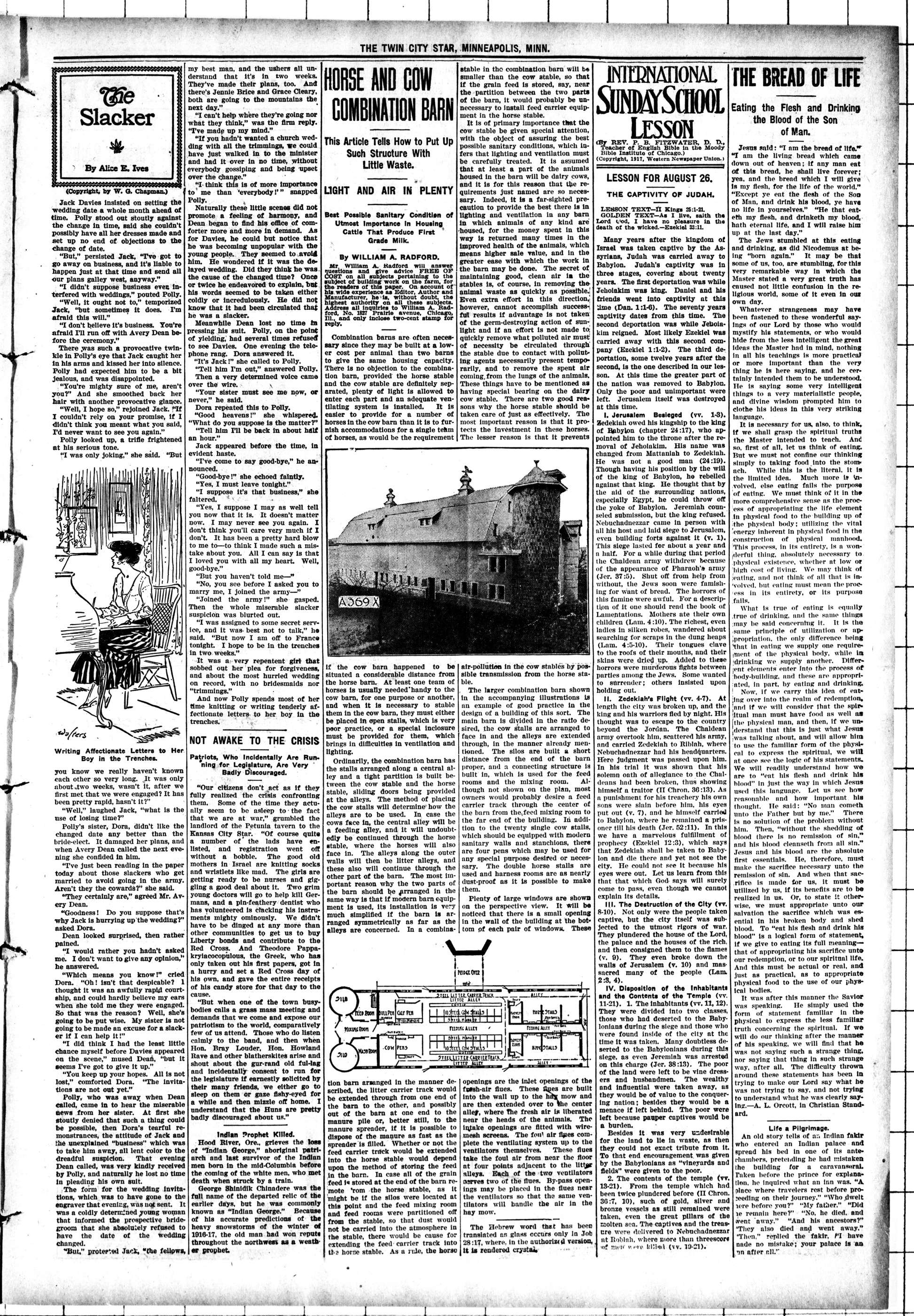
HORSE AND COW COMBINATION BARN
This Article Tells How to Put Up Such Structure With Little Waste. LIGHT AND AIR IN PLENTY
Best Possible Sanitary Condition of Uttmost Importance In Housing Cattle That Produce First Grade Milk.
By WILLIAM A. RADFORD.
Mr. William A. Radford will answer questions and give advice FREE OF COST on all subjects pertaining to the subject of building work on the farm, for the readers of this paper. On account of his experience as Editor, Author and Manufacturer, he is, without doubt, the highest authority on all these subjects. Address all inquiries to William A. Radford, No. 1827 Prairie avenue, Chicago, Ill., and only inclose two-cent stamp for reply.
Combination barns are often necessary since they may be built at a lower cost per animal than two barns to give the same housing capacity. There is no objection to the combination barn, provided the horse stable and the cow stable are definitely separated, plenty of light is allowed to enter each part and an adequate ventilating system is installed. It is easier to provide for a number of horses in the cow barn than it is to furnish accommodations for a single team of horses, as would be the requirement
A369 X
if the cow barn happened to be situated a considerable distance from the horse barn. At least one team of horses is usually needed handy to the cow barn, for one purpose or another, and when it is necessary to stable them in the cow barn, they must either be placed in open stalls, which is very poor practice, or a special inclosure must be provided for them, which brings in difficulties in ventilation and lighting.
Ordinarily, the combination barn has the stalls arranged along a central alley and a tight partition is built between the cow stable and the horse stable, sliding doors being provided at the alleys. The method of placing the cow stalls will determine how the alleys are to be used. In case the cows face in, the central alley will be a feeding alley, and it will undoubtedly be continued through the horse stable, where the horses will also face in. The alleys along the outer walls will then be litter alleys, and these also will continue through the other part of the barn. The most important reason why the two parts of the barn should be arranged in the same way is that if modern barn equipment is used, its installation is very much simplified if the barn is arranged symmetrically as far as the alleys are concerned. In a combina-
GILL
FIELD BOON
BULLPEN
GOLF PEN
MIXING BOON
MICRON BOON
.COW
PENS
tion barn arranged in the manner described, the litter carrier track would be extended through from one end of the barn to the other, and possibly out of the barn at one end to the manure pile or, better still, to the manure spreader, if it is possible to dispose of the manure as fast as the spreader is filled. Whether or not the feed carrier truck would be extended into the horse stable would depend upon the method of storing the feed in the barn. In case all of the grain feed is stored at the end of the barn remote 'from the horse stable, as it might be if the silos were located at this point and the feed mixing room and feed rooms were partitioned off from the stable, so that dust would not be carried into the atmosphere in the stable, there would be cause for extending the feed-carrier track into its horse stable. As a rule, the horse
.
stable in the combination barn will be smaller than the cow stable, so that if the grain feed is stored, say, near the partition between the two parts of the barn, it would probably be unnecessary to install feed carrier equipment in the horse stable.
It is of primary importance that the cow stable be given special attention, with the object of assuring the best possible sanitary conditions, which infers that lighting and ventilation must be carefully treated. It is assumed that at least a part of the animals housed in the barn will be dairy cows, and it is for this reason that the requirements just named are so necessary. Indeed, it is a far-sighted precaution to provide the best there is in lighting and ventilation in any barn in which animals of any kind are housed, for the money spent in this way is returned many times in the improved health of the animals, which means higher sale value, and in the greater ease with which the work in the barn may be done. The secret of maintaining good, clean air in the stables is, of course, in removing the animal waste as quickly as possible. Even extra effort in this direction, however, cannot accomplish successful results if advantage is not taken of the germ-destroying action of sunlight and if an effort is not made to quickly remove what polluted air must of necessity be circulated through the stable due to contact with polluting agents necessarily present temporarily, and to remove the spent air coming, from the lungs of the animals. These things have to be mentioned as having special bearing on the dairy cow stable. There are two good reasons why the horse stable should be taken care of just as effectively. The most important reason is that it protects the investment in these horses. The lesser reason is that it prevents
THE STATE HOUSE
air-pollution in the cow stables by possible transmission from the horse stable.
The larger combination barn shown in the accompanying illustrations is an example of good practice in the design of a building of this sort. The main barn is divided in the ratio desired, the cow stalls are arranged to face in and the alleys are extended through, in the manner already mentioned. The silos are built a short distance from the end of the barn proper, and a connecting structure is built in, which is used for the feed rooms and the mixing room. Although not shown on the plan, most owners would probably desire a feed carrier track through the center of the barn from the feed mixing room to the far end of the building. In addition to the twenty single cow stalls, which should be equipped with modern sanitary walls and stanchions, there are four pens which may be used for any special purpose desired or necessary. The double horse stalls are used and harness rooms are as nearly dust-proof as it is possible to make them.
Plenty of large windows are shown on the perspective view. It will be noticed that there is a small opening in the wall of the building at the bottom of each pair of windows. These
openings are the inlet openings of the fresh-air flues. These flues are built into the wall up to the hay mow and are then extended over to the center alley, where the fresh air is liberated near the heads of the animals. The intake openings are fitted with wiresmesh screens. The foul air flues complete the ventilating system up to the ventilators themselves. These flues take the foul air from near the floor at four points adjacent to the litter alleys. Each of the two ventilators serves two of the flues. By-pass openings may be placed in the flues near the ventilators so that the same ventilators will handle the air in the hay mow.
The Hebrew word that has been translated as glass occurs only in Job 28:17, where, in the authorized version, it is rendered crystal.
---
INTERNATIONAL SUNDAY SCHOOL
BY REV. P. B. FITZWATER. D. D. Teacher of English Bible in the Moody Bible Institute of Chicago. (Copyright, 1917, Western Newspaper Union.)
LESSON FOR AUGUST 26.
THE CAPTIVITY OF JUDAH.
LENSON TEXT-II Kings 25:1:1.
GOLDEN TEXT-As I live, saith the Lord God, I have no pleasure in the death of the wicked.-Ezekiel 33:11.
Many years after the kingdom of Israel was taken captive by the Assyrians, Judah was carried away to Babylon. Judah's captivity was in three stages, covering about twenty years. The first deportation was while Jeholakim was king. Daniel and his friends went into captivity at this time (Dan. 1:1-6). The seventy years captivity dates from this time. The second deportation was while Jeholakim reigned. Most likely Ezekiel was carried away with this second company (Ezekiel 1:1-2). The third deportation, some twelve years after the second, is the one described in our lesson. At this time the greater part of the nation was removed to Babylon. Only the poor and unimportant were left. Jerusalem itself was destroyed at this time.
I. Jerusalem Besieged (vv. 1-3). Zedekiah owed his kingship to the king of Babylon (chapter 24:17), who appointed him to the throne after the removal of Holoaklam. His name was changed from Mattanlah to Zedekiah. He was not a good man (24:19). Though having his position by the will of the king of Babylon, he rebelled against that king. He thought that by the aid of the surrounding antions, especially Egypt, he could throw off the yoke of Babylon. Jeremiah counseled submission, but the king refused. Nebuchadnezzar came in person with all his host and laid siege to Jerusalem, even building forts against it (v. 1). This siege lasted for about a year and a half. For a while during that period the Chaldean army withdrew because of the appearance of Pharaoh's army (Jer. 37:5). Shut off from help from without, the Jews soon were famishing for want of bread. The horrors of this famine were awful. For a description of it one should read the book of Lamentations. Mothers ate their own children (Lam. 4:10). The richest, even ladies in silken robes, wandered about searching for scraps in the dung heaps (Lam. 4:5-10). Their tongues clave to the roofs of their mouths, and their skins were dried up. Added to these horrors were murderous fights between parties among the Jews. Some wanted to surrender; others insisted upon holding out.
II. Zedekiah's Flight (vv. 4-7). At length the city was broken up, and the king and his warriors fled by night. His thought was to escape to the country beyond the Jordan. The Chaldean army overtook him, scattered his army, and carried Zedekiah to Riblah, where Nebuchadnezzar had his headquarters. Here judgment was passed upon him. In his trial it was shown that his solemn oath of allegiance to the Chaldeans had been broken, thus showing himself a traitor (II Chron. 36:13). As a punishment for his treachery his own sons were stain before him, his eyes put out (v. 7), and he himself carried to Babylon, where he remained a prisoner till his death (Jer. 52:11). In this we have a marvelous fulfillment of prophecy (Ezekiel 12:3), which says that Zedekiah shall be taken to Babylon and die there and yet not see the city. He could not see it because his eyes were out. Let us learn from this that which God says will surely come to pass, even though we cannot explain its details.
III. The Destruction of the City (vv. 8-10). Not only were the people taken captive, but the city itself was subjected to the utmost rigors of war. They plundered the house of the Lord, the palace and the houses of the rich, and then consigned them to the flames (v. 9). They even broke down the walls of Jerusalem (v. 10) and massacred many of the people (Lam. 2:3, 4).
IV. Disposition of the Inhabitants and the Contents of the Temple (vv. 11-21). 1. The Inhabitants (vv. 11, 12). They were divided into two classes, those who had deserted to the Babylonians during the siege and those who were found inside of the city at the time it was taken. Many doubtless deserted to the Babylonians during this siege, as even Jeremiah was arrested on this charge (Jer. 38:13). The poor of the land were left to be vine dressers and husbandmen. The wealthy and influential were taken away, as they would be of value to the conquering nation; besides they would be a menace if left behind. The poor were left because pauper captives would be a burden.
Besides it was very undesirable for the land to lie in waste, as then they could not exact tribute from it. To that end encouragement was given by the Babylonians as "vineyards and fields" were given to the poor.
2. The contents of the temple (vv. 13-21). From the temple which had been twice plundered before (II Chron. 36:7, 10), such of gold, silver and bronze vessels as still remained were taken, even the great pillars of the molten sea. The captives and the treasure were delivered to Nebuchadnezzar at Roblah, where more than threescords of man were killed (vv. 19-21).
THE BREAD OF LIFE
Jesus said: "I am the bread of life." "I am the living bread which came down out of heaven; if any man eat of this bread, he shall live forever; yea, and the bread which I will give is my flesh, for the life of the world." "Except ye eat the flesh of the Son of Man, and drink his blood, ye have no life in yourselves." "He that eateth my flesh, and drinketh my blood, hath eternal life, and I will raise him up at the last day." The Jews stumbled at this eating and drinking, as did Nicodemus at being "born again." It may be that some of us, too, are stumbling, for this very remarkable way in which the Master stated a very great truth has caused not little confusion in the religious world, some of it even in our own day.
Whatever strangeness may have been fastened to these wonderful sayings of our Lord by those who would mystify his statements, or who would hide from the less intelligent the great ideas the Master had in mind, nothing in all his teachings is more practical or more important than the very thing he is here saying, and he certainly intended them to be understood. He is saying some very intelligent things to a very materialistic people, and divine wisdom prompted him to clothe his ideas in this very striking language.
It is necessary for us, also, to think, if we shall grasp the spiritual truths the Master intended to teach. And so, first of all, let us think of eating. But we must not confine our thinking simply to taking food into the stomach. While this is the literal, it is the limited idea. Much more is involved, else eating falls the purpose of eating. We must think of it in the more comprehensive sense as the process of appropriating the life element in physical food to the building up of the physical body; utilizing the vital energy inherent in physical food in the construction of physical manhood. This process, in its entirety, is a wonderful thing, absolutely necessary to physical existence, whether at low or high cost of living. We may think of eating, and not think of all that is involved, but eating must mean the process in its entirety, or its purpose falls.
What is true of eating is equally true of drinking, and the same things may be said concerning it. It is the same principle of utilization or appropriation, the only difference being that in eating we supply one requirement of the physical body, while in drinking we supply another. Different elements enter into the process of body-building, and these are appropriated, in part, by eating and drinking.
Now, if we carry this idea of eating over into the realm of redemption, and if we will consider that the spiritual man must have food as well as the physical man, and then, if we understand that this is just what Jesus was talking about, and will allow him to use the familiar form of the physical to express the spiritual, we will at once see the logic of his statements. We will readily understand how we are to "eat his flesh and drink his blood" in just the way in which Jesus used this language. Let us see how reasonable and how important his thought. He said: "No man cometh unto the Father but by me." There is no solution of the problem without him. Then, "without the shedding of blood there is no remission of sin," and his blood cleanses from all sin." Jesus and his blood are the absolute first essentials. He, therefore, must make the sacrifice necessary unto the remission of sin. And when that sacrifice is made for us, it must be utilized by us, if its benefits are to be realized in us. Or, to state it otherwise, we must appropriate unto our salvation the sacrifice which was essential in his broken body and shed blood. To "eat his flesh and drink his blood" is a logical form of statement, that of appropriating his sacrifice unto our redemption, or to our spiritual life. And this must be actual or real, and just as practical, as to appropriate physical food to the use of our physical bodies.
It was after this manner the Savior was speaking. He simply used the form of statement familiar in the physical to express the less familiar truth concerning the spiritual. If we will do our thinking after the manner of his speaking, we will find that he was not saying such a strange thing, nor saying that thing in such strange way, after all. The difficulty thrown around these statements has been in trying to make our Lord say what he was not trying to say, and not trying to understand what he was clearly saying.—A. L. Orcott, in Christian Standard.
Life a Pilgrimage
An old story tells of an Indian fakir who entered an Indian palace and spread his bed in one of its ante-chambers, pretending he had mistaken the building for a caravanseral. Taken before the prince for explanation, he inquired what an inn was. "A place where travelers rest before proceeding on their journey." "Who dwelt were before you?" "My father." "Did he remain here?" "No, he died, and went away." "And his ancestors?" "They also died and went away." "Then," replied the fakir, "I have made no mistake; your palace is an an after all."
PUBLSHED EVERY FRIDAY BY
CHARLES SUMNER SMITH,
Minneapolis, Minnesota.
Entered in the Post Office at Minneapolis as second class matter.
MEMBER
NATIONAL NEGRO PRESS
ASSOCIATION
MEMBER
MINNEAPOLIS ENGLISH
ASSOCIATION
ORGANIZED
1867
Subscription by Mail, Postpaid.
ONE YEAR .....$2.00
SIX MONTHS .....$125
THREE MONTHS ......65
Hamlet B. Rowe, Local Agent.
ADVERTISING RATES.
One Inch—1 Insertion—One Dollar.
Liberal discount given on 3, 6, 9,
Months, or 1 year contracts.
We do not run free ads, or over-run
the time contracted for by our ad-
vertisers We respect their right to
advertise at intervals, and rather have
them do so, than to run continuously
an "adv." and an increasing account.
Write all Checks payable to
THE TWIN CITY STAR
Call at 1317 6th Ave. N. on Wednesday to insure matter for publication.
PRAISE FOR THE STAR
We note with pleasure the rapid advance of the Twin City Star, published at Minneapolis, Minn., by our office at Minneapolis, Minn. The Star has been enlarged from four to eight pages, and its columns are replete with live and interesting matter. The Star is also more robust, and is an inveterate foe to fakirs and charlatans, who trade upon the gullibility of white people and thrive upon the persecution of blacks, while printing the crest of the local news of the twin cities, Minneapolis and St. Paul, is a steady subscriber to the Wilson syndicate page of the American Press. The Colored Associated Press—in itself an indication of the wisdom and race pride of Editor Smith. The Twin City Star published for continued prosperity.—R. W. Thompson, in the Indianapolis Freeman.
It is a pleasure to have such comment from our National Correspondent, and though our good friend "Dick" is a booster by nature; The Star is entitled to a little praise. If he has been too liberal, we shall pass some of it on to some other poor and struggling Negro news-philanthropist, who will find that such cheering words are the brightest gems in the crown of consolation; the only jewels worn by many who sacrifice themselves for the advancement of others. Many thanks, Mr. Thompson.
WHERE IS OUR NEGRO PATRIOT-ISM?
Editor of the Star:
Permit me the space in your valuable paper, which always stands ready to champion the best interest of the Negro race, to say a word relative to the lack of patriotism which seems to envelope our race, particularly in this city. Why is it that in these days of patriotic meetings, parades and demonstrations, that the Negro is most noticeable by his absence and silence? In the great parade on August 16th, in which thousands took part, our representation was less than two score; and this in face of the fact that the recent registration showed nearly 1,000 of our race registrants, indicating a population of above 7,000 people. Are we to stand idly by in a country that we have slaved, worked, fought and bled for, and minimize our deeds because we refuse to exercise a squatter's claim to the rights and privileges that go with them? The fact that we are to take part in the great conflict is nothing to the point; so is every other citizen of this great country whom the selective draft has laid its hand on, and yet in the other race in all directions we see the spirit of enthusiasm being aroused.
Where are our leading men of the city? Why are they not out marching shoulder to shoulder with those of lesser prominence? Among the other race we see bank presidents, judges, heads of large commercial establishments, lawyers and doctors in the line of march? Where are those of ours, as we have? What more does a great majority of the dominant race want, than to have the Negro inactive or indifferent, when it comes to claiming our part in all things that stand for American citizenship? Certain it is, that if we do not make ourselves heard, no one else is going to champion our cause for us. It is time we got together, formed some kind of an organization and do our own shouting as well as the country's fighting. Let's prepare for the next. Yours for the patriotism of the race.
W. C. JEFFREY
The foregoing is a true statement of facts, and it is deplorable that conditions warrant such publication. Let us get together, even if we draft a few of our leading slackers, the others will follow the crowd in the grand march of Negro progress.
HON. THEODORE ROOSEVELT.
Ex-President Roosevelt is expected to speak in the Twin Cities next week. It is certain that he will receive an ovation from his many admirers, especially the Negroes, whose cause he recently championed.
SEND YOUR SUBSCRIPTION
CONG. LUNDEEN ASKS PRESIDENT WILSON TO RELIEVE COAL SITUATION.
August 17, 1917.
The Honorable Woodrow Wilson,
President of the United States,
Washington, D. C.
Mr. President: Minnesota and the Northwest are now 4,198,109 tons short of soft coal at Duluth and the head of the lakes as compared with 1916. Hard coal shortage is 16,514 tons. I am enclosing a detailed statement prepared by the Railroad and Warehouse Commission of our state.
The people of Minnesota are not so much concerned with the coal supply of foreign nations as they are about their own supply. The nation's coal production is ample for the nation's domestic needs. If we are to hew down our forests to keep our furnaces burning and keep warmth in our firesides, we want to know that in advance so that we may at least prepare.
We feel sure that you as the Chief Executive of our Nation will take immediate action in our behalf under the powers already granted you by Congress.
Yours respectfully,
(Signed) ERNEST LUNDEEN.
Hon. Wm. R. Morris was one of the speakers at the loyalty parade meetings on Aug. 16. He is a member of the Hennepin County Safety Association and made a logical and eloquent speech, urging the patriotic co-operation of all citizens and pledging the Negro's loyalty. Among the other speakers were Congressman Thos. D. Schall, Gov. Burnquist, Hon. F. B. Snyder, Ex-Mayor H. P. Keller of St. Paul and ex-Gov. Van Sant.
There is a great demand for laborers now and Negroes are being employed where before they were "not wanted." As a rule, they are making good and their efficiency will overcome much of the general prejudice against them. The Negro has been denied the privilege of employment mostly because of the ignorance of many employers. Since the Negro laborer has better opportunities, he will be a better citizen. The so-called race-problem will soon be solved because there is no Negro problem; it is the white man's; and its only solution is an intelligent consideration for the Negro as a man and an acknowledgement of his right to earn his living on equal footing with other citizens.
The death of Mr. W. S. Conrad removes one of the oldest merchants in the cigar trade and a pioneer citizen of the highest type. He was a supporter of the Twin City Star and the Appeal, and advertised the Sight Draft cigar, which is now a favorite smoke among our people.
THE STAR is the CHEAPEST and BEST NEGRO PAPER in the NORTHWEST. It needs 500 more Subscribers to keep it going. Help to get us A BIGGER CIRCULATION.
The Star tries to publish the news of Negroes entirely. We know the "war news" is interesting, but Negroes read and pay for the daily papers, which carry the current news. We have the exclusive right of the plate service edited by N. B. Dodson, a Negro, which gives us the best side of Negro publicity. Every week the Star has in its columns articles of the race, which will never appear in the white papers or some Negro weeklies.
The J. & H. Laundry is owned and operated by the Gibbs Boys, sons of Mrs. Ione E. Gibbs. We mention this because many on the north side patronize other firms. This is the most modern wet wash laundry in the Northwest.
SAM SAVOR
UNION
BIG RECREATION PROGRAM.
President Wilson has said that he favors the of athletics and sport events during the progress that these things tend to make strong and health program of sporting events at the Minnesota Sept. 3 to 8, will this year be more varied and attractive than ever. Do not fail to attend the s between horses and also the dazzling automobile
President Wilson has said that he favors the continuance of athletics and sport events during the progress of the war; that these things tend to make strong and healthy men. The program of sporting events at the Minnesota State Fair, Sept. 3 to 8, will this year be more varied and much more attractive than ever. Do not fail to attend the speed contest between horses and also the dazzling automobile races.
The following is the copy sent to Northwest papers by Lieut. Commander, Jas. D. Willson, U. S. Navy! Mr. American Citizen: Do you realize that the United States Navy is still shoot many thousands of men to properly man the ships now building to be ready for active war service the latter part of this year?
The Navy needs real men — red blooded Americans who are willing to do their bit for good old U. S. A., as did the men and boys of 1776 and 1861. Are you going to sit tight and "Let George do it" and in the future be ashamed to answer your children and grandchildren when they say, "Daddy, what did you do during the great War?", or are you going to be in a position to say "Daddy was a Navy Volunteer, fought for this country of ours and helped to make the blessings of Liberty secure for ourselves and our posterity, and also helped save some of the starving mothers and children of Europe." Now is the time for you to step forward and volunteer for the Navy—always found ready when needed by your Uncle Sam. Men of the type of Farragut, Dewey, Lawrence, Perry and Nathan Hale are wanted. There are plenty of them in this city who will "make history" when they finally volunteer. The Northwest has never been found wanting: when the Nation needed men. Volunteer now, write or telegraph Navy Recruiting Station, Minneapolis. Branch stations at St. Paul, St. Cloud, Duluth and Brainerd, Minn., and Fargo, Grand Forks, Minot and Bismarck, N. D.
I realize your position for which you are entirely responsible. I have offered my services, but according to your orders "Negroes are not wanted" as white men. My fathers fought with Perry on Lake Erie, with Farragut at New Orleans and in Mobile Bay. I served with Dewey at Manila and with Sampson at Santiago, and have never been "found wanting", other than a chance to fight for you. A thousand of my brothers are waiting, until you cast aside your prejudice, and you will be compelled to do so. The Negro Americans are sitting tight and do not care, who does it. Should you need them (and you certainly will) they are ready. Discrimination has denied them the ability, to serve you, as they would like to; but your persecution has not overcome their patriotism. They are here, there, and everywhere, in the land of their birth, the U. S. A.
CHAUFFEUR SHOT IN MONTREAL.
Ernest Austin was killed in front of 60 Urbain street, Montreal, on August 13th. He was a chauffeur and known as "Little Erny." He had a wide acquaintance and was from Texas. Austin was known by many persons in the Twin Cities where he was a visitor. His assailant is supposed to be an Italian, and has not been captured. Several persons witnessed the shooting, which took place during an argument.
Our Friend at Court.
Every Negro owes a lasting debt of gratitude to Hon. Theodore Roosevelt, who placed the American people on record for the responsibility of the horrible outrages on defenseless Negroes at East St. Louis, Ill, during the recent riot and the well-meaning people of the civilized world honor him for his noble speech and manly stand. Not only does Mr. Roosevelt preach the "square deal," he practices it, and by so doing he has done much to destroy the spirit of lynching and mob violence. Mr. Roosevelt has called on the Wilson administration to act on this occasion. The President of our great democracy (?) has not deemed the affair even worthy of comment. Mr. Roosevelt is America's greatest statesman and we are proud to have such a friend at court.
9 6161
that he favors the continuance during the progress of the war; is strong and healthy men. The at the Minnesota State Fair, he more varied and much more tail to attend the speed contests. aazzling automobile races.
THE TWIN CITY STAR. MINNEAPOLIS. MINN.
An American Negro. A native citizen.
PROMINENT CLUB WOMEN TO PUT ST. LOUIS OUTRAGES SQUARELY BEFORE THE AMERICAN PEOPLE.
Cail issued by Women of the District of Columbia—a day of Prayer
Set—Miss Burroughs Leads the Movement.
Special to the Star.
Washington, D. C., July 6.—Grieved and heart-sick over the East St. Louis outrages, in which men, women and children were shot down like rats and their houses burned while United States soldiers and policemen, sworn to protect life and property, grinned when asked why they did not stop President Lincoln Heights Training School for Girls at Washington,
D. C.
the slaughter, the women of this city have requested Mrs. Mary B. Talbert, president of the National Association of Colored Women, to come to Washington at once and to call the president of every other state federation to do the same.
These women are called to take proper steps to put the question of lynching squarely before the American people.
The organization has a membership of over 50,000 of the most cultured women of the race. Preparatory to the coming of the leaders outside of Washington, the women here are going ahead, quietly but determinedly, to set in motion a wave of sentiment that will become nation-wide. The first step has been taken. It is made in the following Call to Prayer:
TO YOUR KNEES AND
DON'T STOP PRAYING UNTIL THE VOICE OF NEGRO WOMEN IS HEARD AND THEIR PETITION FOR THE SUPPRESSION OF MOB VIOLENCE is accepted by the American people and lynchings and slaughter of human beings be made a crime instead of a thing to be "grinned" at by soldiers under oath to defend the honor of the country and in time of uprisings to do their duty bravely.
THE WRONGS CAN AND MUST BE RIGHTED.
The nearest way to the conscience of the American people is by way of the Throne of God.
WE ARE GOING THAT WAY, and then we are going to put our APPEAL for justice and protection under the law squarely up to the American people.
We regret that this issue has been thrust before us when we are with the nations at war. BUT there will be no "WORLD DEMOCRACY" until the burning of innocent women and babies, aged men and innocent citizens of color is taken from the list of "Sports" of Civilized Americans.
WE PROPOSE to fight for our country to help against foes at home and aroad, to conserve its food and fuel supplies, AND WE BELIEVE that this fight for "Democracy" must begin at Jerusalem (at home).
THEREFORE, the women of this city will assemble for Prayer in the Metropolitan Baptist Church Wednesday, July 11th, at 6 a.m. The meeting will last just one hour. Every woman and girl is urged to attend. Those who cannot come are asked to spend a part of the hour in family and secret prayer.
Don't stop praying. God has promised and He is true;
Don't stop praying,—He'll answer you.
LET EVERYBODY PRAY. Let every preacher "Lift up thy (his) voice like a trumpet, and show my people their transgression and the house of Jacob their sins."
Among the most active leaders, we note the following women:
Miss Nannie H. Burroughs, Miss Emma B. Hall, Miss Ida C. Plummer, Miss Marie A. D. Madre, Mrs. Mary E. Thompson, Mrs. Rosetta Lawson, Mrs. Lelia A. Pendleton, Mrs. Alma J. Scott, Mrs. Rebecca J. Gray, Mrs. Hannah McCarey, Mrs. G. Pelham and Dr. Whipper.
A COMING EVENT
The N. A. A. C. P. is working hard to present a beautiful and humorous play entitled "Pro Tem" to be followed by a dance. Watch for the date. You must not miss this as it will be the grand social event of the midsummer season.
Do not waste your time making promises to our agents. Send your money by Express or Post Office Order or in cash or postage stamps.
Pity the poor children of many families. It is hard for many a hard working parent to support a family. Under the high cost of living these innocent sufferers are denied the necessities of life. We have a Belgium within our borders.
The Twin City Star stands for equal rights for all American citizens. 15 ARE TAKEN UNDER SPY ACT Germans at Tripp, S. D., Face Draft Charges.
Sloux Falls, S. D., Aug. 23.—Fifteen Germans have been arrested at Tripp, Hutchinson county, South Dakota, by federal officers charged with violation of the espionage act, according to advises received here. The men were taken to Yankton, S. D., and arraigned before U. S. Commissioner E. T. White. Officials refused to divulge the exact nature of the complaint against the men. However, it is understood that they signed a petition to the county treasurer protesting against the draft.
ANNOUNCEMENT
STEAMER HIAWATHA AND BARGE Dancing until 2 A. M. Music by the Invincible Brown Skin Orchestra TICKETS, 50 CENTS Boat will leave Jackson Street Wharf at 8 P. M. Sharp. ST. LOUIS, Manager
S. W. H.
J. A. Withers, Prop.
Office Phones—Main 2869; Auto 36
Twenty Elegant Steam-Heater
A la Carte Meals at All
STEWART
J. Ed. Stewart, Prop.
246-250 FOURTH AVE.
Private Dining and Reception
ance Beverages. Men's Buffet and
Connection.
Main 2869; Auto 36774. Dining Room—Main 2831.
Elegant Steam-Heated and Electric Lighted Rooms.
la Carte Meals at All Hours—Popular Prices.
EWART'S HOTEL
Stewart, Prop. Chas. Brody, Mgr.
250 FOURTH AVE. S., MINNEAPOLIS, MINN.
Dining and Reception Room for Ladies. Special Temper-
ges. Men's Buffet and Grill; Billiards; Barber Shop in
Office Phones—Main 2869; Auto 36774. Dining Room—Main 2831.
Twenty Elegant Steam-Heated and Electric Lighted Rooms.
A la Carte Meals at All Hours—Popular Prices.
246-250 FOURTH AVE. S., MINNEAPOLIS, MINN. Private Dining and Reception Room for Ladies. Special Temperance Beverages. Men's Buffet and Grill; Billiards; Barber Shop in Connection.
COLUMBIA
South Side B
1100 WASH
EXPERT BARBERS
CIGARS, POOL AND BILLIARDS
RACE PAPERS
THOMPSON &
The Waiters' a
South Side Barber Shop
1100 WASH. AVE. SO.
EXPERT BARBERS; UP TO THE MINUTE.
COOL AND BILLIARD TABLES IN CONNECTION.
RACE PAPERS—SHOES SHINED.
THOMPSON & CARVER, Props.
The Waiters' and Porters' Club
1100 WASH. AVE. SO.
EXPERT BARBERS; UP TO THE MINUTE.
CIGARS, POOL AND BILLIARD TABLES IN CONNECTION.
RACE PAPERS—SHOES SHINED.
THOMPSON & CARVER, Props.
GLOVER SHULL, PRES.
311 HENNEPIN AVE. MINNEAPOLIS
EDDIE BOYD, SECY' LEE WHEELER, MANAGER
Spirella
CORSETS
(NOT SOLD IN STORES)
pirella
CORSETS
(NOT SOLD IN STORES)
will give you lithe, uncorseted grace and constant comfort, yet mould your figure to the present fashion. They are fitted to your measure in your own home by a trained corsetiere—the Spirella way. A telephone call or post-card will bring an expert to your home to explain the Spirella service and boning in detail. Spirella Corset Shop CORA E. CARE
---
385 Aurora Ave.
St. Paul, Minn.
Office Phone, Hyland 2331
Residence-Hyland 4712.
611 Girard Ave. No.
Withers' Transfer
and Fuel Co.
1224 N. 6TH AVE., MINNEAPOLIS
WITHERS' SPECIAL SERVICE
HOUSEHOLD GOODS MOVED OR
STORED.
BAGGAGE TRANSFERED AND
FUEL DELIVERED TO ALL
PARTS OF THE CITY
ON SHORT NOTICE.
W. S CONRAD CO., Distributors
NO. 140. E. 6th ST., ST. PAUL.
NO. 1. WESTERN AVE., MINN.
TOMMY
MADAME M. HART.
The Reliable Milliner.
has a special stock of Fall Hats of the Latest Designs. No two pattern hats alike. Hats made to order. Prices reasonable. Workmanship guaranteed. Phone Nic. 3744.
MANICURING AND FACIAL MASSAGE
ELECTRIC HAIR TREATMENTS
GIVEN
HAIR STRAIGHTENING MY
SPECIALTY.
MADAM HART'S PREPARATIONS.
ARTESIA CREAM. Handled past
ten years. Removes Liver spots and
blackheads. Bleaches the skin and renews its
natural color.
ELECTRIC HAIR GROWER 500.
Overton's High-Brown Powder.
Testimonials.
Mrs. Essie Taylor, 638 Mississippi St.
St. Paul and Minneapolis, 1403
Fifth Ave. So., Minneapolis and others
have sent testimonials recommending
Madam Hart's Preparations and Hair-
work.
MADAM M. HART,
305 13th Ave. S., Minneapolis,
N. W. Cedar 8190. Res. Dale 8935
HAMMOND TURNER
Attorney at Law
Suite 321, American Nat'l Bank
Fifth and Cedar Sts.
St. Paul.
WORKING-MEN'S SOCIAL CLUB
FOR MEN ONLY
244 3RD AVE. S.
MINNEAPOLIS
OLIVER & JONES
MANAGERS.
Phone Hy. 3605.
Dr. Ellis Burton DENTIST Graduate Northwestern Dental School of Chicago.
P
715 Sixth Ave. No.,
Minneapolis, Minn.
If you suffer from headaches or
your eyes tire or blur the reading
—let me examine them, expert ad-
vice and examination free. I dupli-
cate any broken lenses made by me
or any body else.
PAEGEL
OPTOMETRIST-OPTICIAN
45 S. 4TH ST., MINNEAPOLIS.
CHOICE CITY AND SUBURBAN PROPERTY FOR SALE ON SMALL MONTHLY PAYMENTS. Houses and Flats for Rent.
B. M. McDew
802 Sykes Block.
N. W. Nic. 621 Minneapolis
OSCAR GILBERT PRICE.
Real Estate, Insurance and Loans.
Choice Property for Sale or Rent.
2814 10th Ave. So.
N. W. South 5250 Minneapolis
N. W. Phone Nic. 1873
J. M. MORRIS
Real Estate Broker
Loaps Collections
506 BOSTON BLOCK
MINNEAPOLIS, MINN.
Peterson, The Druggist
1501 Washington Ave. So.
TOILET ARTICLES, DRUGS
PRESCRIPTIONS.
Be Solicits Your Patronage.
LOCAL NEWS
IMPORTANT NOTICE
During the summer the Twin City Star forms will be closed on Wednesday night. Persons wishing to see the Editor may call at 1317 6th Ave. N. on Wednesdays from 9 A. M. to 12, and 3 to 6 P. M. Tel. N. W. Hyland 1205.
Unless notes are written plainly and properly arranged they will not be inserted. Many people send in notes regardless of names, initials or composition. Arrangement by the publisher will be charged for. Free notices must be correctly written.
THE STAR'S PHONE, HY. 1208.
THE TWIN CITY STAR Is on Sale at
BELL'S BARBER SHOP,
244 3rd Ave. So.
McDEW'S BARBER SHOP,
3 North 3rd St.
CUT RATE GROCERY,
429 North 6th Ave.
SIMMONS' RESTAURANT,
500 4th Ave. So.
World's News Stand
Wash and 2nd ave 80
Mr. Geo. Gardner has been in St.
Barnabas hospital. He is much
improved after an operation
ATTY. SKINNER TO SPEAK
Atty. R. A. Skinner will speak on
"The Negro and the Church" in the
auditorium of the Pro-Cathedral Parish
School on August 28. Miss Eva
B. Walker, Miss Marienne Jeffrey
and Mr. Leon Abbey will appear on the
orogram.
GAS CO. EMPLOYEES PICNIC.
The annual picnic of the employees of the Minneapolis Gas Light company was held last week. Over 1,000 attended. There was no discrimination to the employees of our race. Mr. and Mrs. Grant Ramey, Mr. and Mrs. John H. McConico and family and Mrs. Samuel Miller, Mr. William Brown and family, Mr. William B. Allen and Miss Mina Fields of Calgary, Can., Mr. Earl H. Comley and May Maydrew Cunningham, Mr. Hezekiah C. Allen and Miss Virgle Thompson. The affair was the annual holiday of the company, the business being closed, and/ in every particular the Negro employees are on equal terms with others.
Mrs. Kitty Robinson of Seattle, Wash., who has been visiting relatives in her former home, Chicago, will spend a week with Mr. and Mrs. J. C. Trevan, 519 Humboldt avenue, on her return home.
Mrs. Thos. West, 3721 Aldrich avenue south, was surprised last Saturday night by about twenty friends on her birthday. She received many costly presents. Mrs. Jones, her daughter-in-law, was responsible for the pleasant occasion. Mrs. West was visiting in St. and and was greeted on her return home with a delicious spread.
Mrs. Nellie Holmes left Thursday night for Kansas City, Mo., to visit her mother, Mrs. Belle Davis.
Mrs. M. Moseley Withers, 2406 Seventeenth avenue south, was hostess of old college friends, Prof. Hamilton, principal of Mounds, Ill., city high school, and wife, Mrs. Hamilton, dramatic reader, and president Illinois Federation of Colored Women's Clubs. They were pleasantly entertained by Mrs. Withers and a few friends during their short stay of last Sunday and Monday. Prof. and Mrs. Hamilton were delegates to the Eastern Star, which convened in St. Paul last week.
Mrs. W. W. Williams of 2900 Eleventh avenue south, left Aug. 20th to visit her parents and relatives in Dilley, Taylor and Sparta, Wis. She will return in two weeks.
Miss Frances Mask has returned from a pleasant visit to Chicago, St. Louis and Hot Springs.
Mrs. A. A. Ford will arrive home this week from the K. P. encampment, and a visit to other cities.
Mrs. John L. Gibson left Tuesday for a visit with relatives in Des Moines, Ia., and Moberly, Mo.
Mr. "Pitt" Thompson, now conducting a restaurant in Superior, visited the city to secure help. He returned with the Shull auto party.
The boat excursion by the Gopher Elks Club was a success.
Mr. A. C. Guye, the insurance agent, reports a steady increase of business. He is a progressive young man and has had a wide experience in the insurance field.
We received several requests for information, "Why is the Eastern Star news not in the paper?" Read "Your publicity pays" our standing notice. Many of the Stars owe The Star for the Stars in which they have read about themselves. There is a reason! That's it.
TAKE NOTICE
The Star will shine while the editor is away. Send personalts to "News Editor," Twin City Star. Atty. R. A. Skinner and Mr. J. C. Trevan will be in charge
THE TWIN CITY STAR, MINNEAPOLIS, MINN.
ELKS LEAVE FOR CLEVELAND
The delegation of Ames Lodge of Minneapolis, I. B. P. O. E. of W., left this week for the annual convention of the grand lodge in Cleveland, Ohio. Mr. Glover Shull motored to Duluth and will go via the Great Lakes, accompanied by Messrs. James Branch and Everett Jackson. Hon. W. R. Morris, Geo. W. Bryant and Fred G. Thomas will leave Saturday evening. Dr. Joseph Sizer on Sunday and P. H. Southall and Chas. Summer Smith will leave Friday evening via the Milwaukee railway, all joining the Great Lakes lodge delegation out of Chicago on Sunday night. Joseph Levy has gone to visit in Chicago before leaving with the Antlers. Exalted Ruler Geo. W. Stewart will go from Gopher lodge of St. Paul. Mr. Shull will return home with an auto party. Ames lodge will serve notice for the convention in Minneapolis in 1919, and it will, as usual, be one of the recognized factors in the convention.
FRANKLIN ATTEMPTS SUICIDE
Wm. H. H. Franklin, who formerly practiced law in this city, shot himself in the head last week in Winnipeg. He will recover but has lost sight of both eyes. He was known as an agitator against Negro clubs, and though a lawyer of recognized ability, he was extremely unpopular. Franklin was associated with Attorney W. R. Morris for several years. He gave up practice and worked in the foundry at Duluth, where he received a severe wound on his head by a swinging crane. After coming home to recuperate, he returned. While at the station with his wife, his actions and words showed insanity. His wife refused to go to Canada where he was employed as a porter and he attempted his life while in a fit of despondency. He is in the hospital at Winnipeg.
WOMAN FOUND WANDERING
Miss Pearl Tolliver was found Wednesday night near Washington avenue bridge cbout 12:30 in a demented condition. Mrs. W. R. Donovan, the police woman, investigated her case and found that she has an uncle, Albert Hall in Des Moines. She says that Miss Tolliver was a model of cleanliness and has resided with respectable people since here. She is held in the county jail for examination.
THANN'S BUFFET MOVED
Occupies Phil Reid's Old Place.
Mr. Thann Travis has moved to 30 East Fourth street, St. Paul. He is located at the old place, which was kept many years by the deceased, Phil Reid. Mr. Travis will thoroughly renovate and equip his new location, which is larger and more desirable for his patrons. His genial disposition and business like management will insure to the public every accommodation.—Advertisement.
The Dickerson Big Shows, John A. Dickerson, owner, have made two successful weeks in St. Paul. There is nothing but compliments for the carnival and its management. Hamlet B. Rowe, the secretary and treasurer, has had a busy week. Dickerson goes to Faribault, Minn., next week.
The "Wake Up America" pageant did not materialize. The manager decamped and the show was off. We got our advertising money in advance.
Miss Lena Smith of Eleventh avenue south has gone south on a visit.
Mr. John Pierce was presented with a nine-pound baby last week. Mrs. Pierce is convalescing.
AN UNACCEPTED CHALLENGE.
As we grow older, we gain wisdom and pass the age of vituperation and pedantry, and in our better judgment, we view things, which formerly aroused our fighting feelings, from a different angle, and act accordingly. Hence, the Editor cannot accept the challenge, issued by a prominent church woman, to prove that she had never sold a bottle of beer or kept a disorderly house, etc. There will be no battle fought in the columns of our local contemporary and The Star, at this time. We invite legal procedure and await a summons and complaint. We withhold the name of this leading lady as her press agents have added fuel to flames by her publicity. We take pride in our honor to the ladies, but we are not too proud to fight them when necessary.
We have some among our advertisers and subscribers who are a credit to our race for their business-like methods. They pay promptly in advance and expect nothing unreasonable in return. Others want to know "Why we can't 'trust' them?" or send a bill, and then a collector, and finally censor a Negro editor because he can't run his paper "like the white man." Few persons realize that it pays to pay as you go. The Star is not an installment plan proposition. It is a real newspaper run under many difficulties mostly due to the foolish notions and ignorant whims of those whom it serves and protects and from whom it' should get its support and their consideration.
HAIR SHOP TO OPEN
Mesdames Alonzo D. Price and Columbus Smeddler will open a hair shop at an early date. Watch for the announcement.
Wanted—Subscribers_to_Pay
FOR SALE-St. Paul barber shop.
Excellent equipment, fine location, doing a prosperous business. For particulars see Smith, Twin City Star.
FURNISHED FRONT ROOM, half block from car line; every convenience. 2020 5th Ave. So. Phone South 117.
FURNISHED ROOMS FOR LIGHT HOUSEKEEPING.
Light housekeeping, rooms, convenient; also furnished rooms for single man, or for two gentlemen. Call Drexel 3967.
FIVE-ROOM FLAT—Elegant sunparlor, hardwood floors, bath; good location; entirely modern. See J. S. Wright, 2787 Eleventh avenue south.
SPECIAL FOR GENTLEMEN.
Large front room for rent for one man or two gentlemen; parlor floor, desirable location, modern, steam heated, near 3 car lines. Mrs. Joseph Thomas, 2801 Portland Ave. N. W. South 2164.
UPPER FLAT for rent; four rooms and bath, all modern; desirable location, near car line. 2111 Fifth Ave. S. Call Foster, Colfax 7005.
ONE LARGE ROOM neatly furnished, modern conveniences, in residential section. Mrs. W. W. Williams, 2900 Eleventh avenue south. Drexel 4728.
EVERY DAY is BARGAIN DAY at the ROOT & HAGEMAN STORE, 407 Nicollet Ave.
STEWART'S TEMPERANCE
SERVICE.
The ladies are, especially invited to visit Stewart's Hotel, where they may enjoy their meals and "temperance" drinks. Under the regulations of the Public Safety Commission no liquors are served ladies at any time and men are served between the hours of 8 a. m. and 10 P. M. excepting Sundays. Ladies admitted every day. Special music—Advertisement.
WHY WORRY? TAKE LIFE
EASY!
You may enjoy comfort and make it pleasant for the whole family and your friends at little expense, if you invest in a Porch-Couch or Rocker, or Lawn Swing or Hammock. They are on sale at BOUTELL'S. Reasonable Prices and Terms.—Advertisement.
RENEW YOUR SUBSCRIPTION.
The publisher of The Twin City Star urgently requests that subscribers send in their dues, or ask for a collector to call. The cost of publishing a newspaper is increasing, and it is important that subscriptions and ads be paid for NOW
A YOUNG NEWS AGENT.
Master Wm. Helm, Jr., of 3115 Columbus Ave., is our new agent. He is soliciting subscribers for the Twin City Star, The Crisis and The Chicago Defender. During his vacation he will give his time to work for these papers. Any assistance given him will be an encouragement to an ambitious young man and a financial aid to Negro enterprises.
Peoples Christian Assembly.
ELDER G. W. MITCHELL, Pastor,
Assisted by Mrs. G. W. Mitchell.
Comel and Serve the Lord.
1204 Washington Ave. So.
Services Sunday—11 A. M.
Sunday School—1:30 P. M.
Praise Meeting—3 P. M.
Preaching—8 P. M.
CHRISTIAN ASSEMBLY TENT MEETING.
Rev. G. W. Mitchell, pastor of the People's Christian Assembly, is conducting services in their large tent near 13th and Washington avenue south. All are invited to come and hear the true gospel under comfortable conditions.
The edition of Aug. 4, of The Richmond, (Va.) Planet, which was held up by the P. O. officials, has been delivered. Editor John Mitchell, Jr., has spoken his opinion of those who were responsible and he did not use any meaningless words.
THE TWIN CITY STAR will be sent to any out of town address. Send your subscription in postage stamps. Read your home paper while visiting in other cities. It's like a letter from home.
Madam Hart, the hairdresser and milliner, has moved to 305 Thirteenth avenue south, where she will be pleased to meet her patrons.
Self Styled Spy Is Interned.
Kansas City, Aug. 23.—Instructions to intern Karl Armgaard Graves, self-styled international spy, have been received here from Washington by Francis M. Wilson, United States district attorney.
Mr. Wilson, following Graves' arrest here last week, recommended that he be incarcerated during the war as an enemy alien whose freedom threatened the security of the country.
BELL'S BARBER SHOP
CLARENCE W. BELL, Proprietor.
BATHS, BARBER SHOP, POLITE BARBERS
POOL AND BILLIARD HALL
CIGARS, RACE PAPERS, SHOE SHINING
244 THIRD AVE. SOUTH ..MINNEAPOLIS, MINN.
Phone Northwestern, Main 2811.
J. A. HUSSEY
16 North Seventh St., Minneapolis
N. W. Main 3717 (Second Floor)
PANAMA HATS A SPECIALTY
First-Class Work Guaranteed
MODEL CAFE
A. R. RAGLA
First Class a la Carte Meals for
At Reason
Regular Dinner, 11:30 A. I
FINE FURNISH
136 E. Third St.
First Class a la Carte Meals from 6:30 A.M. to 12:00 P.M. At Reasonable Rates
Don't Judge the Telephone Company by One Act of an Unthinking Employee
Our employees have all been taught to be courteous, obliging and careful, but we know that occasionally some of them make mistakes.
If one of our employees does not treat you as you think he or she should, do you criticise the Company?
Why don't you give us the same consideration you expect in your business when one of your employees makes a mistake?
Don't judge this Company by one act of a thoughtless employee.
If you believe we have erred in any way in denling with you, please call it to our attention that we may correct the mistake.
YOUR PUBLICITY PAYS.
All persons interested in the progress of their lodges, churches, societies etc., should value the power of printer's ink. They should see that their secretaries SEND ALL NOTICES to the newspapers in proper time. They think the Editor should attend every affair, whether invited or not, and should know "What is going on"—without being informed. Many exchanges clip from our columns, and often things done in Minneapolis get national publicity.
AGENTS WANTED—NOW!
Reliable and intelligent agents always wanted to solicit business for THE TWIN CITY STAR; also correspondents in principal cities. A chance to earn a good living. Write The Twin City Star, Minneapolis.
```markdown
```
TEL. CEDAR 3549
CABIN
PILITAN LIFE BLOG.
ONE NIC. 1534
key; if you own your lot.
MONTHLY PAYMENTS.
FOUR FAMILY FLATS
PLANS FREE.
BARBER SHOP
7. BELL, Proprietor.
HOP, POLITE BARBERS
BILLIARD HALL
PERS, SHOE SHINING
MINNEAPOLIS, MINN.
western, Main 2511.
HATS CLEANED AND RE-BLOCKED Into Up-to-Date Styles
A. HUSSEY
North Seventh St., Minneapolis
. Main 3717 (Second Floor)
AMA HATS A SPECIALTY
St-Class Work Guaranteed
LAND, PROP.
from 6:30 A. M. to 12:00 P. M.
manable Rates
M. to 2:30 P. M., 25 Cents
ASHED ROOMS.
ST. PAUL, MINN.*
Style 700
Ivers & Pond
PIANO
We have just received, from the Ivers & Pond factory a beautiful Style 700 piano. It is shown in the cut above and is their newest, smallest and least expensive upright.
its makers, who selected it especially for us, tell us it is the finest example yet, put out, of this charming new style 700 which so quickly earned abiding popularity by its intrinsic merit. Style 700 is built particularly for homes of discrimination, and while small in size and price, its every detail is of the same supreme high grade characterizing all Ivers & Pqnds. It has the beautiful tone qualities, exquisite touch and unexcelled durability of this make. If you love good music, we cordially invite you to call and see this charming instrument, whether you wish to purchase or not. A catalogue describing Style 700 and other models in high grade Ivers & Pond upright, grand and player pianos mailed upon request.
Metropolitan Music Co.
Eward R. Dyer, Proz. & Kgn.
THE COMPLETE MUSIC STORE
41-42 SO. 6TH ST., MINNEAPOLIS
VICTROLAH RECORDS, SHEET
MUSIC, NOW RENTED, TUNED
AND REPAIRED.
T. S. Center 4639.
WALFRID WESTMAN
Photographer
1425 Washington Ave. So. Minn.
AUTOS FOR HIRE
Service At All Hours.
When you want a good Touring Car for Picnics, Fishing Parties, etc. also Moving or Expressing;—Call ANDERSON, Main 2267. Prices Reasonable—Advertisement.
Are you a delinquent subscriber?
If so, why not send your subscription?
QUICK SERVICE
The Protector of Finance Tales of Resilius Marvel, Guardian of Bank Treasure By WELDON J. COBB
AWAITED the opening of a door in Resillus Marvel's private office with a good deal of interest. Upon that action hinged something important, and I knew it. Here was a place where small things counted—a strange room, a strange man its master; only the unusual happened here. Besides that, beyond the door of this, the headquarters office of the United Bankers' Protective association, there were strange sounds. They were impelling and then deterrent; a shrill cackle, more eerie than human, as of some hunted animal in mortal terror—a voice calling distressfully into the bleak stormy night, like that of a victim from the outer world being resisting dragged over the threshold of a new and uncertain one.
To the inner circle of financial men given to good comradeship in exclusive club circles, the mention of the name of Resillus Marvel would bring a tender glow to heart and brain. It would suggest a quaint tale told so evenly and enthralling that the memory of the tranquil, musical tones would be like the echo of golden beads dropped into a crystal dish. In one mood steeped in the ichors of Thalia, of Callope, of Euterpe, of Erato, in the next following some sloping fancy down a fairy trail of thought sweet and refreshing as a field of daisies, one of the Marvel reminiscent hours would mean a transformation of lazy rising rings of rich Havana smoke into filmy lace pictures formed of cobwebs and starshine. His sayings were chaste as a Tiffany gem, his mind a palace, making men forget for the nonce that he held the destinies of the great banks as an egg shell in the palm of a giant, bulling them with this necromancy of tone and professional expertness into the security of a Vision house.
I had not spoken since I entered the rooms, for I saw that Resilius Marvel was in one of his dark moods. So well did I know him that I at once discerned that he was struggling with some great case where the dead blank wall of "No Clue" faced him grimly. He stood at the window looking out at the rain-blurred lights of a glowing thoroughfare, just now reminful of some woeful Badgad. Out of that world of shadows a lone bird beat its wings against the window. Into its secret recesses Marvel seemed boring his way through obscure labyrinth, seeking that which he must find. Fitting framing the picture was a wall covered with duplicates of famous forged checks, portraits of the great counterfitters, cabinet sections containing odd trophies of his career. Here was a stamped brick from Assyria four thousand years old—"the Book of the Dead"—one line of the hieroglyphics of which had solved an international mystery. Next was a rude seal from the Beloki Congo, wrested from the possession of a native chief who had flooded the country with "phoney" government script until Resilius Marvel had found him. Next was an ivory fan from Turkestan with a sanguinary streak that was the blood of a princess, a fragment from a dynamized American steel pillar of Hindia that could have told a racy tale of a smooth contractor. And a bulging scrap book, clasped and locked like a bank code ledger, containing his private personal notes on the new generation of bank criminals, modern in education as in an appreciation of the value at the graver's tool, the "drag," the raised check manipulator, the automobiles as assets to crime against obsolete police methods.
Always there was an air of complete stillness in this inner room. At the disturbing sound without Resillius Marvel turned—distracted, and therefore annoyed. His eye fell upon Loti, his servitor, who, velvet-shod, noiselessly opened the door and closed it after him. The man had a face like one of those you see on old Roman medals, an acquaintance with the moods and ways of his master that enabled him to question intelligently and to respond through a look, a hand movement, a mere expression of the lips. Loti was of three generations who had given their entire lives to the production of four famous statues—one at the cemetery of Genoa, three at the beautiful Pere le Chaise at Paris. He was a theorist as to the sense of smell, bolding that he could analyze a man by scenting his favorite dish. At him now in sharp silent challenge Marvel looked.
I know not what telepathic system bridged the chasm of inquiry and response, but at once Marvel straightened up magically as if touched by a sharp mental prod. Then he glanced at me, and I further knew that he had made some new and important discovery in the Paget case.
When I had first entered this room I felt sure that Marvel was preoccupied, and that, too, over the case I have mentioned. In fact I had come there on that business, being a bank man and myself interested in its outcome. To Marvel the banks were something more than clients—they were as children who went topping down the line like filled cards, once started in panic. It was for this reason, when the Clearing House after two recent bank failures feared a general run on deposits, that Marvel had
exerted all his abilities to smother a scandal in the case of the Guardian Trust & Savings bank, of which young Tyler Paget was president.
That official was the son of one of the oldest financiers in the city. Fatherly influence had given the junior a fine start, in fact business had been so active that double the original capital was soon invested. It was trusting a great deal of responsibility to a very young and inexperienced man, but Paget, Jr., was of excellent personal character and habits, and energetic and ambitious. However, the minute a new bank is started there is an immediate invasion on the part of crooks, cheemers, "pikers" and delinquents who have been flagged at the older institutions. Young Paget pretty shrewdly evaded most of the pitfalls, but one day "King" Gundorf walked into the bank.
It was not as Gundorf that he did this, but as Bogart Rutledge. He announced that he was about to buy out the old and established Acme Metals company, a concern so well known to Paget that he was at once interested. Gundorf stated that he was paying $400,000 for the business, half cash, now held in escrow, as a receipt showed. He wished the bank to loan him $200,000, for which he, as the new president of the Acme, would put up the entire $600,000 stocks of that company. The bank had no right to make a loan in one volume so largely in excess of proportional capital restrictions, but Gundorf claimed it would be for only ten days and offered a handsome bonus, and the deal was made.
In five days the explosion came. To his dismay Paget learned that the pretended Rutledge, in giving the collateral note for $200,000, had no authority to sign, at that time, as president of the Acme. This fact relieved the corporation of all liability and the bank held a worthless piece of paper and a non-valid stock transfer receipt. The next discovery was that Gundorf had disappeared with the $200,000 received from the bank, and that the $200,000 in escrow comprised counterfeit notes. When the escrow funds were examined this was made manifest, and at this point Resilius Marvel was called in.
He recognized the culprit from his earmarks at once. Gundorf had been sentenced to a long term of imprisonment in Brazil a year back. He was supposed to be out of the way, for a spell at least. But about six months since there had appeared on the market a fifty-dollar counterfeit note, which, to Marvel's experienced eyes, was the product of Gundorf's skill. Before any of them had been recognized as dangerous by the banks, Marvel had detected the flaws in the issue. There were two material variations from the good notes. As soon as he sent out this possibility of world-wide identification, all fifty-dollar notes were of course scanned closely.
To run down the counterfeits was Marvel's first purpose; to help out the Guardian Trust and Savings an added motive. The Acme people had lost nothing, as they simply invalidated the stock contract. Paget, however, was out $200,000. His father was now trying to raise this amount so the bank could continue, or, if necessary, go out of business honorably. The banks within the Clearing House were trying to smother publicity, for fear of a general run. Paget had been given thirty days by the bank examiners to clear the situation. He had technically violated the banking laws, and but for the pending strained financial situation his bank would have been closed and himself prosecuted. The Guardian Trust and Savings cleared through our bank, Paget was a personal friend, I held fifty shares of the stock—that is how I was interested. For two weeks Marvel had been on the track of Gundorf. He had his own ideas as to how far catching him would relieve conditions.
"You are interested," he said, as I arose to leave the room, fearing I might be in the way. "Stay where you are. I have had a man watching the house where Gundorf lived until he put over this last deal of his."
"But vacant, I understand you to say?"
"Vacant, true, but the rent paid up for six months, and telephone, gas and electricity ordered kept ready for use and paid for ahead. I fancy my man has learned something at last, and I also imagine he is bringing somebody with him."
As the door opened on noiseless hinges Loti ushered into the room two men. The one who held the other a prisoner was a powerful, unkempt fellow, who resembled a tramp who might have been sleeping in a dog kennel over night. I later found out that this was literally true—but for a week, instead of a day.
His companion, cringing, terror faced, wildly distraught, was a lithe, wiry man, brown as a berry, with small, beady eyes. His garb was half foreign, his actions those of a manial. He was in a frantic excess of *terror*, and trembled as Marvel fixed those grave, boring eyes upon him.
"I made the catch on suspicion," spoke his captor. "He was ringing at the door bell of the plaque we know, when I showed up. He's an innocent,
THE TWIN CITY STAR, MINNEAPOLIS, MINN.
A
HE WAS IN A FRANTIC EXCESS OF TERROR AND TREMBLING AS MARVEL FIXED THOSE GRAVE, BORING EYES UPON HIM
and doesn't understand a word of English. Held out this card and this picture," and the speaker gave both to Marvel, who glanced at them and then passed them to me. The card bore the address of the house under surveillance. The photograph was a duplicate of one he had shown me more than once—"King" Gundorf.
Marvel nodded to his assistant, who departed like a man thoroughly trained in his profession. The foreigner stood now nervously pressing his unsteady hands together, the cold sweat gathering on his face. Once he held out his hand piteously for the return of the articles taken from him. Marvel never removed his eyes from him. I saw that he was studying him critically. He spoke a word to Loti I did not hear. As for himself, he went over to a bookcase. Loti went through the clothing of the man with remarkable rapidity. All he came across, as I saw, was a purse containing a small sum of money. Marvel hastily consulted half a dozen books, and turned and consulted the man.
"Comprenez vous mol?" he asked. But he need not have spoken for all the words conveyed to his strange guest.
"Wer bist du?"
The foreigner looked puzzled. Then he jabbed out a hideous jargon in some obscure tongue.
"Qulen es usted?"
No, the man spoke neither French, German nor Spanish. In some oriental patois Marvel made a new try, followed by one in a South African dialect.
It was of no avail. Whoever the man, whatever his purpose in visiting the Gundorf house, he could not be intelligently approached on the subject. I saw Marvel grappling with this new, baffling problem in a mighty mental threo. Then he gave Lotti an unspoken instruction and the latter left the room. Marvel backed to his desk. I saw him place his hands behind him, seize a broad topped bottle, remove the stopper, insert one finger in it and come again to the stranger. If as carelessly he touched him on
HE WAS IN A FRANTIC EXC
LING AS MARVEL FIXED TH
UPON HIM
the back with that finger, drew him about, opened the door and waved him from the room. The man sped away at the injunction as though his feet were winged. Marvel pointed to my hat and overcoat. He briskly arrayed himself for the street. When we reached it no one was in sight. As we turned the corner I saw Loti on one side of the thoroughfare. On the other, racing along as though relieved from a vivid spell of restraint, was a man in the center of whose back glowed a dull splotch of phosphorus, an infallible guide at a distance, and explaining the manipulation of the bottle from the desk.
Twice we lost sight of Loti, whose duty it was to keep sight of the foreigner. On these occasions my companion was not at all perturbed. But his roving eyes were all the more watchful. I followed their direction more than once to observe some white marks on pavement or building, made, I knew afterwards, by a chalk crayon inserted in the end of the cane which Loti carried.
I do not think Loti spoke a half dozen words to his master as we finally came up with him, but these, the expression of his face, and some quick signs, seemed to convey to Marvel a world of intelligence. Loti stepped behind, Marvel moved me aside with a pressure of his palm and pushed open the street door of one of those small upper story hotels with which the city abounds.
The inference was that Loti had traced his man to this place. I soon knew this for a certainty. I was not at all sure that some sound signal, remote and vague, was not conveyed to my companion—that, or something telepathic or mystic. At all events, from an attitude of prim, soldier-like patience, Loti suddenly started like a maxikin unhinged. With a movement extremely courteous and apologetic, as if deprecating that he must be in advance, he proceeded up the stairs, and I followed him.
Not for an instant that he falter or deviate from a straight course. The hallway was lighted by lamps, but his eyes were cast down. Then, at the second landing I noticed a tiny green thread of raw silk close to the protecting baseboards alongside the stair trends, and guessed who had unreelled it. At the end of the third Lott, with unerring precision, arrived at a door, the transom of which showed light beyond. Almost but not quite noiselessly, his long, shapely fingers groped across a panel. Again he must have caught some sound signal in response, entirely unnoticed by myself. He turned the knob of the door and we entered the room.
Once more the foreligner was in evidence. He sat, or rather lay crouched back in a ragged arm chair, akin to the rest of the poor furniture of that poor room. The old terror lurked in the depths of his shrinking eyes, and he was hushed and inert as a person subdued by some deadening influence of power he dared not resist. Marvel had lifted a satchel to the rickety table in the center of the room. There was in the apartment apparently no other personal possession of the foreligner.
To my crude mind, crude at least as compared with the professional workings of the mental machinery of a great man and his equally remarkable assistant, it was the most natural thing in the world that Marvel, having cornered a mysterious quarry, should seize upon that satchel. Given a man who could not converse save in an obscure and unknown tongue, an investigation of his personal belongings might reveal everything—anything. Therefore the only sensation I experienced as Marvel pressed the catch that held the satchel locked was curiosity. But as the beading flaps opened out, to my amazement, Loti, with slight warning cry, betokening the most vild alarm, was at the side of his master in a swift slide. He snatched at the satchel, snapped it shut again, and maintaining a tense grasp of the lock he stood pallid, his nostrils dilated, gazing with fixed and
ESS OF TERROR AND TREMB-
POSE GRAVE, BORING EYES
resolute challenge into the face of Marvel.
"It is—pestilence," he said simply, and slightly drew the satchel towards him. His fine mobile face expressed protection, defense. I noted a tremor spreading all over his sensitive frame, and he waved his hand. It made somewhat the same gesture that a person would make in dissipating an annoying cloud of thick smoke.
Marvel returned the daring glance of his ally. Then those quick thoughts of his seemed to make a brisk run. He shrugged his shoulders as if there was a potentiality to the suggestions of Loti he could not dispute. He took out his card case. I was near enough to him to read the name he scribbed in pencil—"Dr. Peter Horn."
I knew that he had sent for the most famous analyst in the city and I wondered what was coming next. Marvel was not the man to tell, at the present juncture. He sat down on the bed, facing the foreigner. He leaned his chin on his two hands, these resting on his knees, and fixed his eyes upon the cowering wretch as if he was looking through him and beyond him.
It must have been fully an hour before Loti showed up. He was followed by the doctor, whom I had seen before—a big, burly, heavily whiskered man, breathing deeply, looking everywhere—a restless monument of power and force.
There was a small room with glass doors connecting with the one we were in. It seemed to have been used as a dressing room before the hotel had sunk to second class, and, being small, went gratis with the larger apartment. The doctor barely nodded to Ma.vel, who did not speak so much as a word. He was wont to impress his friends into service in a professional case. The doctor knew his ways as I know them. Loti must have explained what was expected of him. He proceeded to business at once.
Dr. Horn had brought up from his
automobile a large case. He set this on the floor, and his first movement was to proceed to the glass doors, thrust them open, survey the space afforded, and then point to the table. "Move it," he said tersely, and Loti carried it into the adjoining apartment. There was gas there, and the doctor lit a jet. Then he carried his case into the room, closed the doors, and drew from the case a glass head with air tubes at the top. He sprinkled some deodorizing acid about the room from a bottle, put on a pair of gloves, took out a microscope and proceeded to his strange task.
The foreigner paid no attention to all this. Marvel did not seem particularly interested. We four were left in the outer room, but could discern the doctor's activities through the connecting door. I noticed Loti glide to the side of his master; I caught the words:
"The man is from a banana raising country."
"Your sixth sense tells you that, does it?" responded Marvel lightly. "Then it must be South America." How true that instinctive sense of odor, of which Loti made a theory, was correct, the examination of the satchel by the doctor would soon tell. The illustrious savant rapidly pulled forth its contents. It held nothing but a few worn garments. Selecting a skull cap from the litter, upon this the doctor focussed his microscope. There were flashes of finely mirrored plates and instruments, the application of acids, a mixture of the scrapings of the wool from the cap, massed in a little lake of chemicals. Then the doctor closed the satchel, poured a new bottle of some disinfecting agent over it, and replacing his analytical gear in its case, came out into the larger room.
"Peru," he said simply to Marvel. "Southern part. The germs are the a bacilli, peculiar to that country alone. And to the falling sickness particularly prevalent there. You will yet come before the great societies, Lotl," he added admiringly. "You diagnosed it right—a banana country, and the pestilential taint. The man should talk Spanish," he supplemented, with a keen glance over the foreigner.
"But he doesn't," responded Marvel tarsely. "I know what to do now. Thanks, doctor."
He glanced at Lotl and motioned me to follow him and Dr. Dror. At the street Marvel dismissed the latter with a nod, proceeded along briskly, hailed the first taxi we met, gave a brief direction, and we were whirled away to a street in the foreign quarter.
The taxi halted in front of a row of old buildings. Their occupants were incongruous. One little store bore a window full of more varieties of sausages than I expected to exist in the entire world. There was a store given over to Hungarian wines, a Japanese restaurant and two curio shops. These were reminders of world's fair years, of stranded importations, and Marvel seemed to know them like a book. It was hot five minutes before he reappeared from one of the curio stores. A swarthy man in a fez was with him. We were again whirling along to our terminus, the hotel.
It was all so swift, so silent, so impressive—Marvel's resistless rush of ideas and events, carrying me along irresistibly—that it reminded me of the changing scenes of a motion picture film. The curio man was ushered into the room where we had left Loti and the other. He viewed the foreigner with a measuring glance, and spoke half a dozen words in a tongue-twisting dialect.
In an instant the foreigner was transformed. Eyes, frame and soul seemed to awake. He uttered a joyful cry and fung himself on his knees, clasping those of the curio man, jabbering away twint sobs of delight and tears of relief.
Marvel softly rolled a cigarette with those deft hands of his, which with equal facility could slip a ring upon the dainty finger of a debutante or snap a pair of handcuffs around the brawny wrists of a burglar. I knew he divined the end of circumstance and the beginning of coherency. There was a rapid colloquy between the foreigners. Then there was a whispered conversation carried on by Marvel and the curio man in a corner of the room. The latter returned to the prisoner. Some animated discussion ensued. And then the foreigner did a quite remarkable thing.
He removed his shoes, and for the first, time I noticed how broad and how thick were the soles. Their owner looked appealingly at the curio man, who nodded reassuringly, as though promising protection. The former took a shell-like article from his pocket, stripped back the edge of each sole, tore them lengthwise, and from those hiding places produced two oblong articles cased and encased in cushions of the softest wool.
I watched Marvel as he received these, placed them in his pocket, and made a motion to Loti, who in turn touched my arm ceremoniously with the simple words:
"We will go."
"To sum up," Resillus Marvel advised me when I visited his office the next evening, "the two packages were these," and he produced from his desk two steel plates and proofs of the same.
"The $50 plates," I remarked naturally.
"Not at all," was the dissent—"duplicates of the old plates, with the flaws I pointed out rectified. The old issue served their purpose. These people are shrewd. Cashlers will be on the lookout for the old flaws only. The new notes would pass without suspicion, at least for a time. I know the man who has been making these
plates, but I did not know that he was working, secluded in Petu, until last night. That native was sent with these plates, concealed as you have seen. He was instructed in detail what he was to do. There has been a hitch somewhere, at least a change in the plans of the people at this end of the line, of Gundorf and his associates. That he or they will be looking out for the Peruvian, however, is so certain that I shall install myself in the house where we found the native. You may help me out, and I will tell you how." Marvel proceeded to do so. For two nights in succession I carried food supplies to my patient and invinible friend, and messages from him and to Loti. The third night, as I approached the house by the rear, as I always did, I noticed a strange thing and halted, looking up sharply.
A man was leaping the space between the two houses. I knew that he saw me and was startled, for I watched him peer down at me. I could only construe that this person was entering the vacant house surreptitiously by the roof and scuttle route. At just that moment a clear sound proceeded from the house I was about to enter—the sharp, quick jangle of a telephone bell.
The man aloft must have been suspicious of my appearance. Perhaps he caught the sound of footsteps in the house, those of its solitary occupant. At any time, I heard a sharp snap, a severed wire whipped down between the houses, nearly striking my face, and the man leaped back over the space and disappeared.
Perhaps two full minutes passed away, and I was about to enter the house, when the rear door flew open and Marvel was upon me.
"No delay!" he spoke quickly, and seized the food valise I carried and flung it on the step. Then he started on a run, reached the next street, and halted a taxicab, and gave the quick words:
"Central telephone office."
"What?" I interrogated simply.
"A crash of thunder."
I did not understand, but I hoped to, soon. He left me, his first point of destination reached. I watched him rush into the telephone building, then out of it, with the sharp mandate: "Signal service bureau," to the chauffeur—"Bad system in there," to myself.
"You are ready for a fifty mile run, double fares?" he inquired of the chauffeur as he came out from the weather brueau.
"I'm ready," was the willing response.
"My wait at the vacant house," said Marvel, as he fled down a country road, "was rewarded by a telephone call. I was at the receiver promptly, 'L that you Franklin?' was challenged, and then—'It's King—and I knew I was talking with Gundort. There was an interruption, and the current went."
"Yes, the wires on the roof were cut—" I began.
"No, a crash of thunder at the far end of the line."
I pointed to the blue sky, with all the stars a-sparkle. Marvel laughed.
"There was no trace at the exchange of the call," he explained.
"Suburban, that was all. At the weather bureau a passing storm cloud reported at one station only—at Bloxton. We are going there."
We reached Bloxton in an hour and a half. Marvel located the telephone exchange. He came out bright and brisk.
"Message sent from the office here direct by one Colonel Worthington," he said to me, after giving a direction to the chauffeur. "Newcomer. Blind, Passing cloud, clud of thunder—only one—struck the wires. My man."
I was standing just behind Marvel when he entered the library of a secluded house at the edge of the town. A bewildered man with big, obscuring goggles, was seated in an armchair. Marvel approached him, looked keenly at him, reached over and—removed a false ear. This was the identifying trademark of "King" Gundorf, half an ear bitten off by a swindler confere in the years past.
I know not in detail how the case was adjusted, but Gundorf gave up nearly all of the $200,000. I think the bargain was that he should leave the country. At all events, the Guardian Trust & Savings did not go out of business, and is still within the clearing house.
A week later, while in the office of the United Bankers' Protective association, Marvel led me with a look to his desk. He opened a drawer and took out the photograph of a lovely woman. Her name, "Orthello," was written on the card. He next unrolled the plans of a wonderful mansion. With a pencil he drew a line through its first story. Then I knew that his exertions in the Paget case had paid for that much of his future home, and that he was that much nearer to the fruition of his dream of a home—and Orthello.
Ridiculing the Puritana
It is the fashion of late to speak condescendingly of the Puritans, as of a people of narrow views and of men of sour temperament; but no descendant of theirs, and no later immigrant who now dwells in the commonwealth they founded, and enjoys the blessings which it bestows upon us, will fall to glory in being able to trace back to such forerunners, writes William Roscoe Thayer in the American Magazine. The story of the conditions which faced the passengers of the 'Mayflower' when they landed at Plymouth can never be too often repeated. To have as founders of our state men and women who 'had the fear of God in their hearts, but feared the face of no man,' ranks as the initial glory of Massachusetts.
HOOVER TELLS OF FOOD SITUATION
Administrator Issues Message on Conservation.
IS GREAT PROBLEM OF WAR
America's Production and Needs of the Allied Nations Set Forth-What We Must Do to Keep Wolf From the Door.
Washington, Aug. 20.—Herbert C. Hoover, United States food administrator, today issued to the American public his statement covering the food situation as it now exists and the necessity of conserving the food resources of the nation to provide for the future during the continuance of the war. The statement follows:
Food is always more or less of a problem in every phase of its production, handling and consumption. It is a problem with every farmer, every transporter and seller, every householder. It is a problem with every town, state and nation. And now, very conspicuously, it is a problem with three great groups of nations, namely, the allies, the central empires and the neutrals; in a word it is a great international problem.
The food problem today of our own nation, therefore has as its most conspicuous phase an international character. A sufficient and regular supply of food for the maintenance of the great field armies of our fighting allies and of their no less great armies of working men and working women in the war industries, and finally for the maintenance of the women and children in the home, is an absolute necessity, second to no other, for the successful prosecution of the war for liberty. In the providing of this food for the great allied food pool, the United States plays a predominant part.
With the present diversion of tens of millions of men from the farms into the fighting and industrial armies, resulting in a marked lessening of food production, and the present necessity of increasing the daily ration of other millions of men turned from sedentary occupations into those of strenuous physical labor, resulting in a marked increase of consumption, this deficiency between the food needs and the food production of the allies becomes greater than ever, with the consequence of a large increase in the food quantities imperatively needed from the United States if the allied armies are to be able to "carry on."
World's Larder Examined.
This is a general statement of a condition which only needs to be elaborated in detail to show just what we have to do. The time has come when this detailed statement can be made. Our harvest and the harvests of Europe can now be forecast. We can also survey our combined stocks of food animals; in other words, the size of that part of the world's larder on which we and the allies can draw for the next twelve months can now be estimated. This estimate shows at once that it contains too little for our own and our allies use unless we all administer the supply with the greatest care and wisdom. The allied peoples are energetically undertaking this administration. It lies now with us to do our part. If we fail, the people of the allies cannot be maintained at war. Their soldiers cannot fight without food. A certain definitely determinable part of that food must come from us. Let us then examine carefully the world's larder as it appears today, or so much of it as is at our disposal.
I propose to review the situation first, as regards the cereals, second, as regards food animals and their products, third, as regards sugar, fourth, as regards vegetables, fifth, as regards fish and sea foods, and, finally, as regards our duty in the matter.
Cereals
The 1917 harvest is now so far advanced that we may compare it with previous production, and with the demands which are going to be made on it.
Table No. 1 is given to show the normal peace sources of the annual supplies of France. Italy, the United Kingdom and Belgium, being an average of the three-year pre-war period. It will be seen from this table that the normal imports of wheat are 381,000,000 bushels and of other cereals 345,000,000 bushels. The estimate of the 1917 harvest in the allied countries based upon crop reports from these countries, is as follows:
Probable Av. nor. Deficiency
Com-
modity. duction. duction. due to war.
Wheat ... 389,770,000 590,675,000 196,905,000
Corn ... 94,464,000 121,109,000 26,615,000
Dats ... 337,235,000 570,890,000 233,655,000
Barley ... 93,585,000 125,201,000 31,616,000
Rye ... 41,732,000 78,573,000 36,841,000
Total ..860,786,000 1,486,448,000 525,622,000
In order to provide normal consumption it would therefore be necessary to import in the next 12 months a total of 577,000,000 bushels of wheat and 674,000,000 bushels of other cereals.
The prospective position of our own and the Canadian harvest is given in table No. 2.
Our crops, especially our corn crop, cannot yet be considered as certain, but if all mature safely, North America will have an apparent surplus of wheat of 208,000,000 bushels and of other cereals of about 950,000,000 bushels.
Demand on Our Crops.
The allies are isolated from those markets, other than Canada and the
United States, on which they were accustomed to rely before the war. The Russian supply cannot be got out. Bulgarian and Roumanian supplies are in the hands of the central empires. The voyage from Australia and India is three times as long and therefore requires three times as many tons of shipping as is required from North Atlantic ports. It is also twice as dangerous because of the longer exposure to submarine attack. There has been a large failure in the South American countries and the new harvest from that quarter will not be available in Europe until next spring. As already said, all the allied countries are and have been for some time rigorously administering and economizing their food. In Belgium, the relief commission has been compelled to reduce the consumption of cereals by nearly 50 per cent; this brings the food supply so low that the population are incapable of labor.
From the above tables it will be seen that on normal bases of consumption the total allied wheat import requirements are 577,000,000 bushels against a North American surplus of 208,000,000 bushels—and from our United States supplies we must reserve a certain amount for neutrals from which we receive vital supplies and also an amount to protect our stocks better next year than this last. There is therefore on normal consumption a deficit of over 400,000,000 bushels. In the other cereals used in Europe mostly for animal feed, the import necessities of the allies on normal consumption basis are about 674,000,000 against a North American surplus of 950,000,000. But again a reserve for neutrals and increased "carry over" will absorb all the margin. In any event it means we must multiply our exports of these cereals 20 times. However, upon the basis of our present crop prospects we should be able to supply their requirements in cereals other than wheat.
Wheat Situation Difficult.
The situation in wheat is one of great difficulty and concern, and must be met by an elimination of waste and reduction of consumption on the part of the allied peoples and ourselves, in one word, by an effective administration of the available supply.
The allies are unable to use other cereals alone for bread. They can use them only as added to wheat flour to make the war bread now in universal use in European countries. Except in Italy, whose people normally consume much corn, our allies have few corn mills and cornmeal is not a durable commodity and therefore cannot be shipped in great quantities.
Moreover, for generations they have bought bread from the bakeries; they have no equipment nor do they know how to bake in the household. Every American knows that it is infeasible to distribute corn bread from bakeries, and it is therefore necessary for us to furnish our allies with sufficient wheat to enable them to have a wheat basis for the loaf. However, they can use and must use other cereals for mixture in their war bread, and by this substitution and by savings on their part a great deal can be accomplished. On the other hand, a deficit of 400,000,000 bushels can be at least partially overcome if we can increase our exports from 88,000,000 to 220,000,000 or nearly triple. This can be accomplished if we will substitute one pound of other cereals for one pound of wheat flour weekly per person; that is, if we reduce our consumption of wheat flour from five pounds per week to four pounds per week per person. It will be no privation to us and will reduce the privation of our allies.
Food Animals.
Owing to the ascending standard of living, the world was already strained to supply enough animal products to meet the demand before the war began. The war has injected into an already difficult situation a number of vicious conditions which are jeopardizing the ultimate animal products supply of the world. The production of fodder in Europe has been diminished by the diversion of productive labor to war, and its import has been curtailed by shortage in shipping and by the isolation of markets by belligerent lines. From these causes not only are the actual numbers of animals decreasing in Europe, but the average weight and the annual output of dairy products per animal, are decreasing. A careful estimate of the world's food animal position shows the follow-
A careful estimate of the world's food animal position shows the following position:
Increase or decrease Decrease in other countries United western including Total net States allies enemies decrease Cattle 7,080,000 14,000,000 26,750,000 29,000,000 Sheep 3,000,000 17,500,000 34,000,000 54,500,000 Hogs 6,275,000 7,100,000 31,600,000 24,245,000
The problem facing the American people is not only one of supplying the immediate demand of the allies, but one which is more far-reaching in its future significance. As the war goes on there will be a constant lessening of the capital stock of food animals of the world. Among our western allies the demand outruns further every
THE TWIN CITY STAR, MINNEAPOLIS, MINN.
day the decreasing production, as shipping becomes further shortened by continued submarine destruction, less tonnage can be devoted to fodder, and further reduction of the herds must ensue. These destructive forces have given rise to reactions in many directions. The world's supply of meat and dairy products, of animal fats and industrial fats, wool and hides, are all involved not only now, but for far into the future.
Meata.
The immediate problem is to furnish increased meat supplies to the allies to maintain them during the war. An important factor contributing to the present situation lies in the disturbance to the world's trade by destruction of shipping resulting in throwing a larger burden on North America, the nearest market. Shipments from the Australasian, South American and from the continental countries into the allied countries have been interfered with. Their contributions must be replaced by increased shipments from North America.
The growth of American meat exports since the war began, most of which have been supplied by allied nations, is revealed by the following figures:
Three-year pre-war average, 493,848,000 pounds.
Year ending June 30, 1916, 1,339,193,000 pounds.
The impact of European demand upon our animal products will be maintained for a long period of years after peace. We can contemplate a high range of prices, for meat and for animal products for many years to come. We must undertake to meet the demand not only during the war, so as to enable our allies to continue to fight, but we must be prepared to meet the demand after the war. Our herd cannot be increased in a single night or in a single year. Our producers will not only be working in their own ultimate interest in laying the foundation of larger herds and flocks, but will serve our national interest and the interest of humanity, for years to come, if the best strains of young animals are preserved. The increase in herds can only be accomplished if we save more of our roughage and raise more fodder grains. It is worth noting that after the war Europe with lessened herds will, pending their recuperation, require less fodder and will therefore produce more bread grains and import less of them, so that we can after the war safely reduce our bread grain production to increase our fodder. But we must lay our foundation in the meantime to increase our herds.
There is only one immediate solution to the short supply of meat for export pending the increase in our herds and flocks which will take years. During the course of the war, we can, just as with the cereals, reduce the consumption and eliminate the waste particularly among those classes which can best afford it. In the meantime, in order to protect all of our people, we must carefully control our meat exports in order that the people shall not be denied this prime necessity of life.
Dairy Products.
The world's dairy supplies are decreasing rapidly for two important reasons. First, the dairy cattle of Europe are diminishing, for Europe is being driven to eat its cattle for meat; second, the diversion of labor to war has decreased the fodder supplies and the shortage of shipping has limited the amount of imported fodder and therefore the cattle which can be supported and the productivity of the individual cow have been reduced. Even our own dairy supplies are not keeping pace with our growth of population, for our per capita milk supply has fallen from 90 to 75 gallons annually in the past 15 years. Yet today we must ship increasing amounts of dairy products to our allies.
The dairy supplies of the allies in normal times came to a considerable degree from western Scandinavia, Holland and Switzerland, but under German pressure these supplies are now partly diverted to Germany. The men under arms and the wounded must be supplied with condensed milk in large quantities. The net result of these conditions, despite rigorous reduction of consumption among the adults of the civil population in Europe, is that our allies are still short of large quantities and again the burden of the replacement of this shortage must fall on North America. The growing exports of dairy products from the United States to the allies are shown in the following table:
Three year average. Year ending June 20, 1913.
Butter ... 4,467,000 lbs. 12,487,000 lbs.
Cheese ... 3,780,000 lbs. 44,394,000 lbs.
Cond. milk ... 17,792,000 lbs. 159,577,000 lbs.
The high price of fodder and meat in the United States during the past few months induced by the pressing European demand has set up dangerous currents in this country, especially in those regions dependent upon butter and the sale of milk to municipalities having made it more profitable to sell the cattle for meat than to keep them and produce dairy products. Therefore; the dairy cattle are decreasing
in some sections. The only sections in which dairy products have had a rise in price in appropriate proportion to the increase in most of feeds are those producing condensed milk and cheese. Our home milk and butter supplies are therefore looked at in a broad way, decreasing while our population is increasing. This deficiency of dairy butter is shown by the increased sales of margarine, which show an increase of several million pounds per month over similar periods in 1915. Dairy butter, however, has qualities which render it totally necessary for children. Milk has no substitute and is not only intrinsically one of our cheapest animal foods, but is absolutely fundamental to the rearing of the children.
The dairy situation resolves itself into several phases. First, it is to be hoped that the forthcoming abundant harvest together with a proper restriction upon exports of feeding stuffs will result in lower prices of feed and diminish the impetus to sell the cattle for meat. Second, the industry needs encouragement so as to increase the dairy herd and thus our dairy supplies, for the sake first of our own people and second of the allies. The people must realize the vital dependence of the well-being of their children, and thus of the nation, upon the encouragement and upbuilding of the industry. Third, we must save the wastes in milk and butter during the war if we are to provide milk supplies to all. We waste large quantities of our milk value from our lack of national demand for products of skimmed and sour milk.
Pork Products.
The hog is the most efficient of machines for the production of animal-fat. The hog not only makes more fat from a given amount of feed, but also the products made are specially capable of preservation and most economical for commercial handling.
The swine of Europe are rapidly decreasing and the consumption demand induced by the war is much increased, this particularly because bacon, ham and lard are so adaptable for military supplies. Moreover, our allies are isolated from many markets and a large amount from northern neutrals is being diverted to Germany.
While our hogs have increased in number by 3,000,000 animals, the average weight at slaughter is falling and our production is probably only about maintained. The increasing demand upon us since the war began is shown by the following figures of comparative exports;
Three-year, pre-war period, 1,055,
614,000 pounds.
Year ending June 30, 1916, 1,512,
376,000 pounds.
Wool and Leather.
Our national supply of both wool
and leather are less than our needs,
and we are importing them more and
more largely, as shown by the following
figures:
Importations of wool and manufactures of wool (value) for the three-year pre-war period, 862,457,965; for the fiscal year ending June 30, 1916,
$158,078,271.
Importations (value) of hides, leather,
and manufactures of leather average
of the three-year pre-war period,
$133,171,398; for the year ending June
30, 1916, $177,880,902.
At the present time the world's demand for these times has increased far above the peace level owing to the extra consumption in supplying the armies. This demand is now again increased by the mobilization of a large American army. In the face of this, not only is the European herd decreasing, but also American sheep have decreased about 3,000,000 since the war began. After the war is over, the various countries of the world from which we formerly drew our wool are likely to retain it for their own use until their flocks again become normal.
Sugar.
The sugar supply on which our allies in Europe normally draw has been tremendously reduced, so that they must have recourse to other sources. In consequence of the shipping situation the area from which they must draw is also curtailed and, as a result, they are driven into those markets from which our own supply normally arises. Furthermore, their own production has been greatly diminished. Before the war, Europe supplied in a large measure its own needs, through the production of beet sugar, as will appear from the following table showing the average yearly production and consumption for the five years before the war (1909-1913), in some of the chief countries of Europe:
Prod'n. Consump. Surp. (short tons) (short tons) (or deflency (-)
Germany ... 2,525,889 1,299,585 11,228,314
Austria ... 1,651,839 679,294 972,636
Russia ... 1,659,947 1,822,285 337,602
United Kingdom ... 2,056,000 -2,056,000
France ... 752,542 704,830 47,712
Italy ... 211,600 190,000 21,050
Belgium ... 279,918 120,358 159,600
Holland ... 246,146 131,538 114,608
As appears from the table, France, Italy, Russia and Belgium were self-supporting, while the United Kingdom drew its entire sugar supply from exterior sources. The supply of the United Kingdom came to the amount of about 70 per cent from countries from which it is now cut off by the war. Ten per cent came from the East Indies and 20 per cent from the United States and the West Indies.
The prospective 1918 crop in France has diminished to 207,000 tons and that, of Itlyn to 75,000 tons, and they are therefore short 590,000 tons. The displacement of United Kingdom supplies amounts to 1,435,000 tons; and therefore, in total, these three allied countries must import about 2,700,000 tons in order to maintain their normal consumption. Of this, 2,000,000 tons must come from new sources. The disturbance of shipping reduces the tonage available and drives the demand to a large degree upon the
interest markets, the United States and the West Indies. This field has since the war increased its production by 1,000,000 tons per annum. How far this demand will interfere with the American supply of 4,000,000 tons is difficult to forecast, first, because some increased supplies may be obtained by the allies from the East Indies, and, second, because the allies have reduced their consumption to some extent. In any event, if all the enemies of Germany are to be supplied, there must be economy in consumption everywhere. The normal American consumption is about 90 pounds per person per annum and is just double the French consumption.
Vegetables.
We have this year a most abundant crop of vegetables for our use as a result of a patriotic endeavor almost universal throughout the country. Our potato harvest alone promises an increase from 285,000,000 bushels last year to over 400,000,000 bushels this year. The other vegetables are likewise enormously increased through the planting and extension of millions of gardens. The sweet potato crop promises to be from 10 to 20 per cent above what it was last year, and the commercial crop of sweet corn for canning purposes is estimated to be from 20 to 30 per cent above that of last year. The commercial crop of tomatoes for canning purposes will probably be somewhere between 10 and 20 per cent above what it was last year. There is an increase in the acreage of late onions of about 54 per cent over the area harvested in 1910.
Fish and Sea Foods.
The waters of our coasts and lakes are enormously rich in food fish and shell fish. Our streams, too, contribute a great quantity of fish. Many varieties are now not used for human food, but are thrown away or used for fertilizer. Habit has confined our use of fish to a few varieties, and inadequate methods of commercial handling have limited our use of these largely to only certain days in the week. With better marketing facilities, with better understanding of how to use the most varieties, with proper preservation by smoking and salting and by establishing plants for frozen fish, we can increase greatly our supply and thus relieve largely the pressure due to the inadequate supply of meat. We only have to harvest our own fish supply. It feeds itself. Every fish eaten is that much gained in solving the present problem of living. The products of the land are conserved by eating those of the sea.
Our Duty.
I have endeavored to show in previous articles that the world is short of food; that Europe is confronted with the grim specter of starvation unless from our abundance and our waste we keep the wolf from the door. Not only must we have a proper use of our food supply in order that we may furnish our allies with the sinews with which they may fight our battles, but it is an act of humanity towards fellow men, women and children.
By the diversion of millions of men from production to war, by the occupation of land by armies, by the isolation of markets, by belligerent lines, and by the destruction of shipping by submarines, not only has the home production of our allies fallen by over 500,000,000 bushels of grain, but they are thrown upon us for a much larger proportion of their normal imports formerly obtained from other markets.
They have reduced consumption at every point, but men in the trenches, men in the shops, and the millions of women placed at physical labor require more food than during peace times, and the incidence of their saving and any shortage which they may suffer, falls first upon women and children. If this privation becomes too great, their peoples cannot be maintained constant in the war, and we will be left alone to fight the battle of democracy with Germany.
The problem of food conservation is one of many complexions. We cannot, and we do not wish, with our free institutions and our large resources of food, to imitate Europe in its policed rationing, but we must voluntarily and intelligently assume the responsibility before us as one in which everyone has a direct and inescapable interest. We must increase our export of foods to the allies, and in the circumstances of our shipping situation, these exports must be of the most concentrated foods. These are wheat, flour, beef, pork and dairy products. We have other foods in great abundance which we can use instead of these commodities, and we can prevent wastes in a thousand directions. We must guard the drainage of exports from the United States, that we retain a proper supply for our own country, and we must adopt such measures as will ameliorate, so far as may be, the price conditions of our less fortunate. We might so drain the supplies from the country to Europe as by the high prices that would follow to force our people to shorten their consumption. This operation of "normal economic forces" would starve that element of the community to whom we owe the most protection. We must try to impose the burden equally upon all.
Action Must Be Voluntary.
There is no royal road to food conservation. We can only accomplish this by the voluntary action of our whole people, each element in proportion to its means. It is a matter of equality of burden; a matter of minute saving and substitution at every point in the 20,000,000 kitchens, on the 20,000,000 dinner tables and in the 2,000,000 manufacturing, wholesale and retail establishments of the country. The task is thus in its essence the daily individual service of all the people. Every group can substitute and even
the great majority of thirsty people can save a little—and the more luxurious elements of the population can by reduction to simple living save much. The final result of substituting other products and saving one pound of wheat flour, two ounces of fats, seven ounces of sugar and seven ounces of ment weekly, by each person, will, when we have multiplied this by one hundred million, have increased our exports to the amounts absolutely required by our allies. This means no more than that we should eat plenty, but eat wisely and without waste.
Food conservation has other aspects of utmost importance. Wars must be paid for by savings. We must save in the consumption in commodities and the consumption of unproductive labor in order that we may divert our manhood to the army and to the shops. If by the reduction in consumption of labor and the commodities that it produces and the diversion of this saving to that labor and those commodities demanded by the war, we shall be able to fight to eternity. We can mortgage our future savings for a little while, but a piling up of mortgages is but a short step toward bankruptcy. Every atom that we save is available for subscription to Liberty bonds.
The whole of Europe has been engaged ever since the war began in the elimination of waste, the simplification of life, and the increase of its industrial capacity. When the war is over the consuming power of the world will be reduced by the loss of prosperity and man power, and we shall enter a period of competition without parallel in ferocity. After the war, we must maintain our foreign markets if our working people are to be employed. We shall be in no position to compete if we continue to live on the same basis of waste and extravagance on which we have lived hitherto. Simple, temperate living is a moral issue of the first order at any time, and any other basis of conduct during the war becomes a wrong against the interest of the country and the interest of democracy.
The impact of the food shortage of Europe has knocked at every door of the United States during the past three years. The prices of foodstuffs have nearly doubled, and the reverberations of Europe's increasing shortage would have thundered twice as loudly during the coming year even had we not entered the war, and it can now only be mitigated if we can exert a strong control and this in many directions.
We are today in an era of high prices. We must maintain prices at such a level as will stimulate production, for we are faced by a starving world and the value of a commodity to the hungry is greater than its price.
As a result of the world shortage of supplies, our consumers have suffered from speculation and extortion. While wages for some kinds of labor have increased with the rise in food prices, in others, it has been difficult to maintain our high standard of nutrition.
By the elimination of waste in all classes, by the reduction in the consumption of foodstuffs by the more fortunate, we shall increase our supplies not only for export but for home, and by increased supplies we can help in the amelioration of prices.
For Better Distribution.
Beyond this the duty has been laid upon the food administration to co-operate with the patriotic men in trades and commerce, that we may eliminate the evils which have grown into our system of distribution, that the burden may fall equitably upon all by restoration, so far as may be, of the normal course of trade. It is the purpose of the food administration to use its utmost power and the utmost ability that patriotism can assemble to ameliorate this situation to such a degree as may be possible.
The food administration is assembling the best expert advice in the country on home economics, on food utilization, on trade practices and trade wastes, and on the conduct of public eating places, and we shall outline from time to time detailed suggestions, which if honestly carried out by such individuals in the country, we believe will effect the result which we must attain. We are asking every home, every public eating place and many trades, to sign a pledge card to accept these directions, so far as their circumstances permit, and we are organizing various instrumentalities to ameliorate speculation. We are asking the men of the country who are not actually engaged in the handling of food to sign similar pledges that they shall see to it, so far as they are able, that these directions are followed. We are asking all who wish us well and who undertake our service to become actual members of the food administration, just as much volunteers in national service as we ourselves are, so that thus the food administration may not be composed of a small body of men in Washington and a small representation in each state, but may become a body of 50,000,000 people, devoted absolutely to the services of democracy. We hope to see the insignia of membership in every patriotic window in the country.
Autocracy finds its strength in its ability to impose organization by force from the top. The essence of democracy consists in the application of the initiative in its own people. If individualism cannot be so organized as to defend itself, then democracy is a faith which cannot stand. We are seeking to impose no organization from the top. We are asking the American people to organize from the bottom up, and this is the essence of democracy itself.
The call of patriotism, of humanity and of duty rings clear and insistent. We must heed it if we are to defend our ideals, maintain our form of government, and safeguard our future welfare.
SAYS U. S. NOT LAND OF LIBERTY
SPEAKER URGES NEGROES TO GET GRIP ON INDUSTRIES
(Boston Post, Aug. 13.)
An enthusiastic mass meeting to protest the East St. Louis race riots and alleged discrimination in the draft was held yesterday afternoon at the Massachusetts Avenue Baptist Church in Cambridge. Archibald H. Grimke of Washington, D. C., representing the National Association for the Advancement of Colored People, declared that under existing conditions the hymn "America" does not stand for true conditions in this country.
Not Fair and Free.
After the people present at the meeting had sung "America," Mr. Grimke declared:
"This is no land of liberty, such as you have just suggested in that hymn. It is not a fair land to the colored race!
"In spite of the East St. Louis massacres they say that America is fair and free! Why, they speak of German barbarism in Europe. How about the American barbarism over here? If, after 300 years of suffering and oppression in this country, you believe that it is free, you are not believing right. You are believing lies?"
The speaker vigorously attacked what he alleged was the partiality shown in the draft and in the enlistments for foreign service. He eulogized the attainments of the black race on the field of battle.
"Why, this government, in keeping the Negro troops on this side for guarding bridges and public buildings, is cutting off its best fighting stock in America! I say this without partiality. It is a fact!
"If Belgium had not cut the hands from the blacks in the Congo those same hands would have saved Belgium from the Germans," continued Mr. Grimke. He continued by stating that the law of eternal justice would one day vindicate the black man, but he feared terrible times were coming before the day arrived.
Urged to Hang Back.
The speaker urged the Negroes to hang back now until the government calls for their help in the war. He suggested that in event of the call not coming, then there would be a hardy race of young black people to perpetuate their species while the whites would only have a war-crippled stock. "Go into the industries," urged the speaker, "and firmly get a grip there. Then, once you have got that grip, never-relinquish it!" The next speaker was the Rev. John L. Davis of Portsmouth, N. H., who said in part: "I tremble not only for America, but for the whole world when the black man wakes up! The fight between the Anglo-Saxon and the black race will be frightful. My only hope is that the colored people will not be pushed too hard against the wall."
Another speaker was Edward Everett Brown, who denounced the practice of lynching and called for popular opinion to force the government to make lynching a federal crime with capital punishment.
Irish as Example.
Mr. Brown said the Negro race must take their example from the Irish, who, although fighting for Britain, still kept the idea of liberty firm in their bosoms. He likened the East St. Louis troubles to the Indian massacres of colonial days and declared that the treatment of the black race in both North and South for the last two decades was a burning, lasting disgrace to the American people.
"Our young men and women will not much longer stand to be used as the football of the American people," said Mr. Brown.
The Middlesex Civic League, under whose auspices the meeting was held, then formally adopted a resolution which is in part as follows:
Resolution Adopted.
"Be it resolved, That we demand that every constituted authority in the United States get busy to blot out this abominable race prejudice which is eating out the vitals of law and order in this country, and that this country be made safe for the black man while it is making the world safe for democracy.
"Be it further resolved, That the Middlesex County Civic League and the colored citizens here assembled extend to the council of Cambridge their profound and deep-felt thanks for its action on July 10, 1917, in indorsing the telegram of Messrs. William D. Brigham and Curtis J. Wright to Governor Frank O. Lowden on the subject of the un-American riots in East St. Louis, Ill.
"Be it further resolved. That we also extend to Alderman Osborne Dezanson of Woburn our profound and deep-felt thanks for introducing a similar indorsement of the said telegram in the Woburn City Council.
"Be it further resolved. That we also extend to Congressman Frederick Dallinger of Cambridge, our profound and heartfelt thanks for his diligent efforts in behalf of our race in Congress.
"It is the sentiment of this meeting and of the Middlesex County Civic League, that there is need in the country and in this county for more such Councilmen, Alderman and Congressmen as the man who compose the Cambridge City Council, and Alderman Bezanson, and Congressman Dallinger have proved themselves to be that who have not allowed their sens."
of justice and fair play to be obscured by the infernal and atrocious germ of race prejudice.
"Be it further resolved. That copies of these resolutions be sent to the Cambridge City Council, to Alderman Bezanson of Woburn, to Congressman Dallinger and to the press.
"Done this 12th day of August, 1917.
"THE MIDDLESEX COUNTY CIVIC LEAGUE
"Raymond Pbillips, West Medford,
"President."
BENEFACTOR OF HER RACE.
How Madam C. J. Walker Is Opening Business Opportunities For Women.
Madam C. J. Walker, the well known business woman of Indianapolis, Ind., and New York, has returned to her palatial home in the latter city after a six months' tour of the south, southwest and middle west. With all the success which has come to her in business she is the same modest, energetic race loving Madam Walker.
The hundreds of women who have gained a business footing by following the lines mapped out by this broad minded woman will testify to her sterling worth and Christian character at the Walker representatives' convention, to be held in Philadelphia Aug. 30-31.
As a southern woman Madam Walker understands a great deal about the so called race problem. She will express her views on the race exodus from the south at the convention in Philadelphia above mentioned.
KELLY GETS CAPTAINCY
Geo. B. Kelley of Duluth, Minn., may go to Columbus Barracks for army service. He has been promoted to a capitancy and is a recognized military authority. He has served in every rank from private to first lieutenant and has seen actual service.
VETERANS OF CIVIL WAR CHEERS RUSSIAN SOLDIERS
G. A. R. In Boston Encampment Sent Message of Greeting and Encouragement to New Republic.
Boston, Aug. 24.—Amid cheers and battlefield cries the aged Union veterans of the Civil war assembled at the fifty-first annual encampment of the Grand Army of the Republic here, adopted a message of greeting, encouragement and sympathy to the soldiers of Russia.
"As it was ours half a century ago to wage a successful war for the preservation of the American union and the perpetuity of republican form of government," the message said, "so may it be yours, heroic sons of a mighty people, by your united, devoted and sustained efforts to establish on an enduring foundation in your great country 'government of the people, by the people and for the people, and to this end we send prayers to heaven and our sons to the aid of the allied armies on the battlefields of Europe."
Portland, Ore., was selected as next year's encampment city. Atlantic City, N. J., the only other close competitor, lost out by one vote.
U-BOAT TOLL FOR WEEK
REMAINS AT LOW FIGURE
Losses Slightly Larger Than Previous Week When Considerable Falling Off of Vessels Lost Was Noted.
London, Aug. 24.—The number of British merchantmen sunk by submarines or mines in the last week was only slightly larger than the previous week, when a considerable falling off was noted. According to the official statement, 15 vessels of more than 1,600 tons were sunk and three of less than 1,600 tons in addition to two fishing vessels, as compared with 14 large vessels the previous week, two small vessels and three fishermen. Twelve ships were unsuccessfully attacked.
NAVY NEEDS 1,000 OFFICERS
Ways to Meet Shortage Considered By Navy Board.
Washington, Aug. 23.—There is a shortage of more than 1,000 officers in the navy.
The navy general board has suggested two methods of meeting the demand. The first is to graduate 300 midshipmen, who have completed two and one-half years of their four-year course at Annapolis on Jan. 1, and to graduate the next class in September. This would reduce the shortage by 400.
The second suggestion made by the board is to comb the naval reserves for capable men who may be given junior commissions.
IOWA FARMERS SPORT 2 CARS
Buy 'Em For Kids As One Result of Prosperity Wave.
Des Molnes, Aug. 24. — Iowa farmers are sporting two cars this year—big ones for themselves and little ones for the "kids" or the hired men.
Dollar corn, $2.50 wheat and $20 hogs are responsible.
Money was never more plentiful. Prospects were never better for getting more of it. Over 400,000,000 bushels of corn will be harvested this year. At the current price of $1.08 this is making the farmers rich.
Highest Cattle Price in History.
Chicago, Aug. 24. — Cattle reached the highest price in the history of the market at the stock yards when top steers were quoted at $15.50. Hogs dropped from the high price of $20 to $19.50 a hundred-weight, with few sales, and bids ranging from $19 to $19.25.
THE TWIN CITY STAR. MINNEAPOLIS. MINN.
PROTEST PARADE DEMANDS RIGHTS
Army With Banners Asks For Justice to Race.
NEW YORK IS IMPRESSED
Spectators Read With Interest Claims of Marchers as Expressed by 15,000 Men, Women and Children—Khaki Clad Soldiers and White Haired Veterans In Line.
With the beating of muffled dreams as their only accompaniment, approximately 15,000 Negroes—men, women and children—marched on Fifth avenue. New York, from Fifty-seventh street to Madison square in what was announced as a silent protest parade. Flags of the allied nations were carried by the marchers, and many printed placards were borne.
The women and children were given the place of honor in the formation and were clad in light colored dresses. Several automobiles, with prominent Negro clergymen and officers of Negro organizations, were next in line.
The Children's Banners.
A delegation of boy scouts carried placards in the section devoted to the children. Some of these bore the legends: "So Treat Us That We May Love Our Country," "Give Us a Chance to Live," "Suffer Little Children to Come Unto Me" and "Thou Shalt Not Kill."
Almost half of the marchers were women, and many of these carried banners expressing such sentiments as "Our Music Is the Only American Muscle," "Pray For the Lady Macbeths of East St. Louis" and "The Great Contradiction—Love of God and Hatred of Man."
The men marchers, like the other participants in the parade, looked neither to the right nor left. Many of them were clad in the khaki of the American military service, and here and there might be seen a white haired veteran of antebellum days keeping step with the young men of his race. The banners displayed in this section were more emphatic in their sentiments, prominent among them being: "Calm, Where Is Thy Brother?" "We Were First In France; Ask Pershing." "The First Blood For American Independence Was Shed by a Negro-Crispus Attucks," "Race Prejudice Is the Offspring of Ignorance and the Mother of Lynching." "Put the Spirit of Christianity Into the Making and the Execution of Laws," "We Are Maligned as Lazy and Murdered When We Work." "Ten Thousand of Us Fought In the Spanish-American War" and "Repelled by the Unions. We Are Called Scabs."
The circular calling on the Negroes of New York to join the parade of protest read:
"We march because by the grace of God and the force of truth the dangerous, hampering walls of prejudice and inhuman injustices must fall.
"We march because we want to make impossible a repetition of Waco, Memphis and East St. Louis by arousing the conscience of the country and to bring the murderers of our brothers, sisters and innocent children to justice.
"We march because we deem it a crime to be silent in the face of such burbicaric acts.
Evils Protested Against:
"We march because we are thoroughly opposed to jimcrow cars, etc., segregation, discrimination, disfranchement, lynching and the host of evils that are forced on us. It is time that the spirit of Christ should be manifested in the making and execution of laws.
"We march because we want our children to live in a better land and enjoy fairer conditions than have fallen to our lot.
"We march in memory of our butchered dead, the massacre of honest tollers who were removing the reproach of laziness and thriftlessness buried at the entire race. They died to prove our worthiness to live. We live in spite of death shadowing us and ours. We prosper in the face of the most unwarranted and illegal oppression.
"We march because the growing consciousness and solidarity of race, coupled with sorrow and discrimination, have made us one, a union that may never be dissolved in spite of shallow brained agitators, scheming pundits and political tricksters who secure a fleeting popularity and uncertain financial support by promoting the disunion of a people who ought to consider themselves as one."
Some of the Banners Displaced.
Although a banner criticising President Wilson displeased the police, they raised no objection to these:
"Make America Safe For Democracy"
"India Is Abolishing Caste; America Is Adopting It." and "Memphis and Waco, Centers of American Culture."
One banner carried near the head of the procession read, "Your Hands Are Full of Blood."
Those in the parade represented every Negro organization and church in the city. They marched, however, not as organizations, but as a people of one race, united by ties of blood and color and working for a common cause. The grand marshal was Captain W. H. Jackson. Directly behind him marched the executive committee, composed of the Rev. H. C. Bishop, the Rev. F. A. Cullen, James W. Johnson, the Rev. Charles D. Martin, Fitz W. Mortley and John E. Nall.
SUBSCIBE FOR THE STAR.
BUSINESS WOMEN TO HOLD MEETING IN PHILADELPHIA
National Convention of Walker Representatives Scheduled For Aug. 30.
Philadelphia.—The two big events of national importance scheduled to take place in this city the last week in August are the annual meeting of the National Medical association and the first national convention of representatives of the Madam C. J. Walker company. This latter convention will be composed solely of business women and will be the only one of its kind ever held in this section.
The object of this meeting, aside from the bringing together of the representatives of the company from the various parts of the country, is to discuss and put into operation the plans which Madam Walker has mapped out for placing the work on a footing whereby all the workers may share alike in the benefits according to the net results of business.
In order to inspire the workers to greater activity Madam Walker has set aside $500 to be distributed in prizes to the representatives securing the largest number of new workers, the largest amount of business done, etc. The convention will be held for two days, beginning on Thursday, Aug. 30. The contest closes Aug. 1. All persons who enter the contest should register their name at the home office, 640 North West street. Indianapolis.
Madam Walker deserves great credit for opening up opportunities for the women of the race to engage in business for themselves. Through her system of work hundreds of women are making an independent living, and there is room for hundreds of others to do likewise. It is a long way from the sugar cane field and the washutb at 75 cents and $1.50 per day to ownership of a business enterprise which commands high recognition by both races in the mercantile world, yet this is what Madam Walker has accomplished.
DR. SHEPARD GETS RESULTS.
Letter of North Carolina Governor
Evokea Strong News Editorial.
The Greensboro (N. C.) Daily News recently carried the following editorial on Governor Bickett's letter to Dr. James E. Shepard in answer to the latter's plea against the lynching of colored people, with especial reference to the Memphis and East St. Louis horrors.
Governor Bickett's letter to Dr. James E. Shepard, president of the National Training school at Durham, expresses well the North Carolina attitude toward the Negro man.
President Shepard asked seventeen governors to issue appeals to the people of their states protesting against the lynching of a helpless race. The Negro educator desires to see a country in which his own people "may live and hope." The intimation that living and hoping become increasingly difficult in the light of "lynchings north and south" gives the governor his opportunity to invite the Negro back home.
Various assignments of causes behind the negro exodus to the north have been given, but Dr. Shepard has struck upon one that bears the appearance of epigrammatic force—"the right to live and hope." Better wages naturally have contributed to a condition that has greatly disturbed the south. Surface indications of lesser racial feeling must have moved many to seek the north. The right to live and hope politically has done a deal to encourage the move northward.
Nevertheless the northern and western press is not so sure that the treatment of the black man has justified so radical an expedient. The Chicago Tribune in a series of stinging editorials the last several days has stumbled upon a fundamental truth. The south will lynch a Negro, the Tribune says, but the south never lynches "the nigger." The south will break out occasionally into a hideous orgy of torture and mutilation against one man, but never against his whole family or his community. It is not a very flattering picture of the vaunted liberality of the north and west that the Tribune draws.
Whatever advantages the colored man may feel other sections offer him, it is undeniably true that the south gives him his highest right to live if by that is meant the provision of the physical means of creating a livelihood. And without such right it is foolish to talk of hope. In Durham the great democracy of work finds its highest expression. There is a wealthy colored man, ex-slave, named Fitzgerald. Nobody pretends that anybody makes a brick equal to Fitzgerald's, and Fitzgerald has grown rich because he is an artist in his business. And nobody ever drew the color line on one of Fitzgerald's bricks.
Problem For Democratic Adjustment. William Allen White says if the black man loafs in the southi he starves and if he leaves the south for the north or west and engages in a thrifty, self supporting industry he is mobbed and killed by white men. Self preservation is the first law of nature. On with the dance!
Loyalty of Colored Race Not Doubted. If the German government has no better judgment of the character of the American Negro than to believe that he will play the part of Benedict Arnold, the traitor, it is certainly going to wreck fast, says V. P. Thomas in the New Orleans Times-Picayune. There is no cement of the American population that will more earnestly join the regular military and naval forces of this government in giving the Germans a sound thrashing on land or sea than the American Negro.
Feudalism Is Making Last Stand Against Democracy in Great War
many that has linked itself with the Turk—that has, too, adopted the method of Mahomet. "The state has no conscience," "The state can do no wrong." With the spirit of the fanatic she believes this gospel and that it is her duty to spread it by force. With poison gas that makes living a hell, with submarines that sneak through the seas to ally murder noncombatants, with dirigibles that bombard men and women while they sleep, with a perfected system of terrorization that the modern world first heard of when German troops entered China—German feudalism is making war upon mankind. Let this old spirit of evil have its way and no man will live in America without paying toll to it, in manhood and in money. This spirit might demand Canada from a defeated, navyless England, and then our dream of peace on the north would be at an end. We would live, as France has lived for forty years—in haunting terror.
America speaks for the world in fighting Germany. Mark on a map those countries which are Germany's allies, and you will mark but four, running from the Baltic through Austria and Bulgaria to Turkey. All the other nations, the whole globe around, are in arms against her or are unable to move. There is deep meaning in this. We fight with the world for an honest world, in which nations keep their word, for a world in which nations do not live by swagger or by threat, for a world in which men think of the ways in which they can conquer the common cruelties of nature instead of inventing more horrible cruelties to inflict upon the spirit and body of man, for a world in which the ambition of the philosophy of a few shall not make miserable all mankind, for a world in which the man is held more precious than the machine, the system or the state.
Schools Without Kindergarten are Like Buildings Without Foundations
By Bessie Locke, Chief of Kindergarten Division, U. S. Bureau of Education
The magnificent work of our public-school system merits and receives the admiration of the world. But, notwithstanding the splendid progress that has been made, there is one important respect in which it may be improved.
Did you ever know an architect who would undertake to erect a beautiful and substantial building and omit to provide a suitable foundation? Did you ever hear of an intelligent farmer who would neglect his animals when young and expect perfection in their later life? Have we given the same thoughtful attention to the foundation of our educational structure that the architect gives to the foundation of his building? Have we realized fully that a well-rounded development depends in large measure upon early influences and the habits acquired in the formative period of life?
Our leading educators for more than a generation have been earnest advocates of the kindergarten; our first commissioner of education—Henry Barnard—saw the system demonstrated in London in 1854 and became enthusiastic over its achievements. Upon his return to this country he wrote and talked extensively on the subject. Commissioner Harris also did much to promote the idea during his long administration, and Commissioner Claxton, who personally supported a kindergarten for colored children in Asheville years ago, believes that kindergartens should be a part of the public-school system in every city, town and village in the country. It is now generally understood that the function of the kindergarten is to nurture and develop the child's inherent powers; that in the kindergarten the foundation of all subsequent education is laid; and yet, notwithstanding all that has been said and written, what are the facts today?
There are four million children in our country between four and six years of age for whom kindergartens have not yet been provided. These four million children are each losing two years of possible schooling, making eight million years lost at this most impressionable and imitative age, when habits for life are being formed. This lost time can never be regained.
Many communities believe they cannot yet afford kindergartens, and they build high schools and introduce manual training and other special branches for the older children, while the little ones are losing these two years of systematic training.
But the question is not, Can we afford to have kindergartens? but Can we afford not to have them?
War Workers to be Recruited from Ranks of Women Not Now in Industry
By Mrs. Raymond Robins
Only 46 out of every hundred women in this country are in industry. The rest are in a class which is just above industry. They are a supported class, supported by fathers or mothers. They do nothing at all in industry and they do not enter professions.
Eighty-five out of every hundred women are in industry in England, Scotland, France and Germany. The do-nothing class of women in these countries has always been smaller than in the United States. The bonbon-eating, novel-reading, lie-abed-till-11 a. m. type, which comes into full bloom at the dance clubs, on the golf links and the boulevard, is to be the type recruited by the national council of woman's defense.
We want this class more than the class already in industry to fill the breach left open by the call for men for the army and navy. It is not our purpose to take away women already working from the work to which they are essential. But the great idle class in America is remarkable. We have a vast reserve-unused energy. I am certain that they will volunteer.
C. A. H.
By Franklin K. Lane, Secretary of the interior
We are fighting Germany because in this war feudalism is making its last stand against oncoming democracy. We see it now. This is a war against an old spirit, an ancient, outworn spirit. It is a war against feudalism—the right of the castle on the hill to rule the village below. It is a war for democracy—the right of all to be their own masters. Let Germany be feudal if she will. But she must not spread her system over a world that has outgrown it.
Feudalism plus science, thirteenth century plus twentieth—this is the religion of the mistaken Ger-