Twin City Star
Saturday, September 1, 1917
Minneapolis, Minnesota

Page text (machine-generated)
MINNEAPOLIS
THE TWIN CITY STAR
MINNESOTA
HISTORICAL
HE LIVES IN SOULS HE INFLUENCED
Frissell Gone, but His Work Testifies For Him.
TRIBUTES TO HIS MEMORY
Dr. Moton and Others, Tell at Hampton's Services How Late Head of Institute Strove to Serve Others—His Was Truly a Career of Accomplishment and Victory.
By WILLIAM ANTHONY AERY.
Hampton, Va.—Hollis Burke Frissell, beloved principal of Hampton institute for nearly twenty-five years, and Samuel Chapman Armstrong, his soldierly predecessor, now rest side by side, as once they loyally worked by day and by night to give all men, regardless of class or race, a new conception of education, "education for life."
The funeral service, simple and impressive, which was held Wednesday, Aug. 8, in the Hampton Institute Memorial church and in the small school cemetery, in memory of the life and work of Dr. Frissell, brought together on the lower peninsula of Virginia hundreds upon hundreds of thoughtful white and colored people, who paid tribute to one of America's leading statesmen-educators.
Dr. Moton's Tribute.
Dr. Robert R. Moton, Hampton's former commandant, present principal of Tuskegee institute, delivered a forceful address on Dr. Frissell's service to the nation. Dr. Moton said: "This life which has gone out from us so recently is today manifesting itself in the acts and thoughts of other lives, of black men and red men and men of the white race also. I have never known and you have never known a more patient, a more simple, a more earnest, a more unselfish, a more Christlike character than Dr. Frissell. He was able, as no man I have ever known, to hide himself absolutely behind the great cause for which he worked. He thought nothing about himself, but he thought always of how he could serve.
"The keynote of Dr. Frissell's life was the note of service to one's race, one's country, one's God. It was not narrowed down to one or two races, but it included the human race—mankind wherever there was a chance to serve. Dr. Frissell's memory will always be revered by the millions of Negroes whom he helped and by millions of white people, north and south, through whom he served and by thousands of Indians for whom he worked.
Life of Victory.
"We should thank God for the great victory which is Dr. Frissell's and which is ours—the victory over prejudice, over selfishness, over littleness, the victory of patience, of simplicity, of life and of service. May those who are privileged to work for Hampton always be controlled, whether as trustees, teachers, students, graduates or friends, by this spirit of unselfish service to our fellow men."
Dr. Thomas Jesse Jones, specialist in the education of racial groups in the United States bureau of education, Washington, D. C., formerly associate chaplain at Hampton institute, read the prayer which Dr. Frissell himself offered less than two years ago at the funeral service of Dr. Booker T. Washington.
"Thanks be to God, who giveth us the victory"—with these words Dr. Frissell opened the service held in memory of Hampton's most distinguished graduate. These words were repeated again and again as an expression of Dr. Frissell's victorious life.
Favorite Hymns
The Hampton school sang with rare feeling two Negro religious folk songs—"Swing Low, Sweet Charlot," and "My Lord, What a Morning,"—which were dear to the heart of Hampton's principal.
The Rev. Laurence Fenninger read appropriate selections from the Scriptures, and the Rev. Dr. Herbert B. Turner offered the closing prayer at the church service. Scores of floral pieces covered the casket—mute witnesses of the affection of white and colored people. The flowers were carried from the church to the cemetery by Hampton graduates.
The funeral procession was headed by the well trained Hampton institute band. Then followed the Hampton cafe, the girl students, the funeral car,
the flower bearers, officers of Battery D, Virginia field artillery and hundreds of Dr. Frissell's friends from far and near. The service at the grave included the commitment of the body by the Rev. Herbert B. Turner, prayer by the Rev. Laurence Fenninger and the singing of "My Faith Looks Up to Thee." "Taps" was sounded by Hampton's bandmaster, and again the battalion moved to the quickened step of martial music.
WOMEN POSTPONE MEETING.
Northwestern Federation Shows Patriotic Spirit - Considers Home First
Chicago—Mrs. Joanna Snowden Porter of this city, who is the president of the Northwestern Federation of Colored Women's Clubs, has issued an open letter to all member clubs of the federation and to the press.
Mrs. Porter says: "When we organized we did so to foster and encourage our women's organizations in club work along sane, intelligent and progressive measures. Following this line of action, we have felt it wise and expedient that we should be in accord with the national feeling which is prevalent and with the idea of the National Council of Defense, which is discouraging the holding of sectional meetings.
"In harmony with these feelings we have postponed the meeting of the Northwestern Federation of Colored Women's Clubs, to meet the week before the National Association of Colored Women in 1918 at the same place, Cheyenne, Wyo., where we were to be entertained this year by the Women's Searchlight club of Cheyenne.
"Again, our women are needed at their homes constantly as possible just now in view of the fact that our husbands, sons, sweethearts and fathers are about to be mustered into the federal service, as it appears now, just a few days before the date of our postponed meeting, which was to occur July 31 and the first three days of August. The money which we would have spent on such a trip must be conservatively spent, in view of the fact that living expenses have taken an upward flight.
"It seems that we are doing the most effective club work at this time by establishing a precedent by conserving home interests primarily and sending out from that source such messages of cheer and good will and by example showing that our work is that of protecting home first and letting everything noble, uplifting and farreaching evolve from it.
"Will you therefore use your organs of publicity just at this time in publishing this? I am in the midst of a campaign, of which I am chairman, the object of which is to raise $1,000 in the next few weeks for extension work in the Phillis Wheatley home, the object of which is set forth in the circular letter sent out by the federation to the various clubs."
PLEA FOR EQUAL JUSTICE.
Maxwell Says Race Is Willing to Stand on Its Merit.
William H. Maxwell of Newark, N. J., in a letter to the New York Globe makes a strong plea for fair treatment of the colored people of the United States by the federal government. Mr. Maxwell says:
"The American people under the leadership of President Wilson have acquiesced in the idea that 'the world must be made safe for democracy.' From that idea I am sure no God serving man or woman will dissent.
"But may I say to the American people through your newspaper that the world must also be made safe for the Negro? The Negroes in America are sorely distressed. There are millions of bleeding hearts under the jackets of millions of humiliated and depressed Negroes, and this, too, because of the unfair treatment dealt out to them at the hand of the world's greatest democracy.
"The Negro craves his chance. He fairly longs for opportunity to serve according to his hand and not according to his face. He wants to be reckoned with as a man. If he is really hit the mat he wants to hit it only after having had a fair chance in the struggle. He wants justice. He wants life. He wants liberty and his right to pursue happiness. Without life and liberty no man can pursue happiness."
"May I urge upon the good white people of America to give the Negro what he merits? Let this great nation firmly adhere to all things' which are right and maintain abounding faith in the power of the unseen hand. Since all America hopes to get at least the crust of the bread of democracy for the world, please bear in mind that the Negroes of America are a part of the world and would like very much to have a little piece of the crust."
EXPERT OPINION ON EDUCATION
FACTORS IN RAGE BUILDING
Extraordinary Facts Relative to Grade and Curricula of Our Schools Revealed In Government Specialist's Report—Of Higher Institutions Only Three Warrant University Rank.
The section of Dr. Thomas Jesse Jones' report dealing with higher institutions of learning for our people shows that Dr. Jones by no means feels that agricultural and industrial education are the only forms of training required for a people numbering more than 10,000,000. He does feel, however, that there are a number of institutions which are impairing their value by trying to maintain collegiate departments at the expense of their secondary training when the great bulk of their students are of only secondary grade. He urges emphatically that such institutions either give up their college courses entirely and devote themselves to the development of their secondary work or merge their college department with those of other institutions in the same position, so that a faculty and equipment really adequate to fill collegiate standards may be created. Howard university, Fisk university and Meharry Medical college are, he says, the only three institutions which warrant classification as universities.
"The presentation of the educational and economic value of agricultural and industrial training should not be interpreted to be in any sense antagonistic to other phases of education. It is evident that the sound development of 10,000,000 people requires every type of education. The colored people must have well trained physicians to combat insanitary conditions. They need religious teachers who can direct the emotions of the race for the moral uplift of the group and for the improvement of the community. They require teachers who have a thorough knowledge of the historical progress of races and an appreciation of the sufferings and disappointments through which the nations have struggled to their present position in world affairs. The leadership of the Negroes is devolving more and more upon the capable men and women of the race. If college education is necessary to the wise guidance of any group surely the Negroes should have the benefit of that education.
"A number of schools offering college courses have rendered a most valuable service. This is especially true of the institutions founded and supervised by the cultured men and women who went south to teach in schools for colored people. Though the curricula of these institutions may have frequently seemed to overemphasize the printed page in comparison with the application of knowledge to practical affairs, the daily conduct of teachers trained in the best traditions of American life gave to the colored people a more precious heritage than any type of curriculum could have given.
"Unfortunately most of the schools with college courses are seriously handicapped not only by lack of funds, but also by the small number of pupils prepared to study college subjects. The facts on college and professional education show that only three institutions have a student body, a teaching force and equipment and an income sufficient to warrant the characterization of 'college.' Nearly half of the college students and practically all the professional students of college grade are in these three institutions. Fifteen other institutions are offering college courses which represent a wide variation of standards. Not more than 10 per cent of the pupils in these schools are in college classes.
"The extravagant and high sounding names of a large number of colored schools have led to a misconception of the grade and type of work done by them. Frequently they represent only the hopes of the founders. In other cases the names have been selected to satisfy the ambitions of the colored people or to attract the support of the white people. Some schools in their eagerness to offer col
lege courses not only hamper their general work, but also bring ridicule on efforts to maintain college classes. Other institutions, impressed by the great plants of the large industrial institutions, spend so much energy and money in acquiring machinery and elaborate organizations as seriously to impair their educational efforts.
"The general poverty of colored schools, the conflicting claims of various types of education and the public ignorance of the real situation all point to the importance of a statement of the educational needs of colored people."
PROMOTER OF GOOD WILL.
Governor Bickett of North Carolina Urges Respond For the Law
Dr. James E. Shepard, president of the National Training school, Durham, N.C., recently sent a telegraphic dispatch to the governors of seventeen states' and to nineteen daily papers asking them to use their influence against the lynching of colored people and also to express an opinion on the subject for publication. Among the replies received was the following from Governor Bickett, who says:
"I concur without reservation in the sentiments expressed in your telegram. For a mob to kill a man is the essence of brutality and cowardice. The white people are under a peculiar obligation to refrain from mob violence of any sort against the Negro people of the land. Up to this time there has been no mob violence in the state of North Carolina during the present administration, and I am earnestly endeavoring to promote good feeling between the races and sincerely trust that our people under all circumstances will refrain from taking the law into their own hands.
"It is my opinion that the people of North Carolina, white and black, are law abiding and humane. We have been exceptionally free from the riots and disorder that have prevailed in some sections of the country, and I earnestly hope that the people of this state will not only sustain but improve the reputation for decency, peace and respect for law that they now enjoy.
"The riots in East St. Louis are simply cumulative evidence that, after all, the south is the best place for the black man. In the south the Negro is recognized as a legitimate factor, and there has never been any disposition to interfere with his industrial activities. The south understands the Negro and is ever ready to give him intelligent aid and sympathy.
"I see in today's papers that Samuel Gompers, president of the American Federation of Labor, charges that Negroes have been induced in large numbers to leave the south and go to sunry cities in the north and west in order to 'break the back of labor.' It seems to me that it is an opportune time for the leaders of the Negro race to impress upon their people the truth that the best friends of the Negro are right here in the south and that in many cases those who make systematic efforts to induce the Negro to leave the south know that trouble and danger await him."
Texas Colored Men Are Eager to Fight. While members of the colored race are being constantly shot down by mobs of white men in different sections of the country, the remarkable fact of eight stalwart colored men walking 124 miles to enlist in the army is recorded. The men referred to walked from Longview to Dallas. Tex., and upon their arrival they were told that all the regiments for colored men were filleted and that no more colored men are being taken. Thus we have another fine exhibition of the colored man's loyalty to his native country at a most trying period of racial life under the Stars and Stripes.
Loyalty of Colored Race Not
Not Expected to Amplify Offer.
Paris, Aug. 30.—A dispatch to the Intransigent from Rome says: "Vatican circles say that Pope Benedict does not intend to issue a second or explanatory note to clear up his peace proposals as it had been reported he would do, but will wait until he has heard from the belligerents before offering any interpretation of his original communication."
COVERS RACE EVERYWHERE.
Program of Lott Carey Convention
Filled With Important Matters
Richmond, Va.—The twenty-first annual session of the Lott Carey Baptist foreign mission convention will be held at Ebenezer Baptist church, this city, from Aug. 29 to Sept. 2, inclusive. Baptist ministers and laymen from a number of states are expected to be in attendance. The Rev. Dr. W. H. Stokes will be the entertaining pastor. Besides considering the work being done in Liberia, the newly established educational and missionary work in Haiti will also come up for discussion.
The annual address of the president, Dr. C. S. Brown of Winton, N. C., is expected to be a feature of the session. The report of the work in Haiti will be made by Dr. Brown and Dr. A. M. Moore of Raleigh, N. C., who have visited that field. The woman's auxiliary, a most helpful agency of the convention, will also hold its annual meeting at the same time.
The report of the faithful corresponding secretary, the Rev. Dr. W. M.
REV. DR. W. M. ALEXANDER.
Alexander of Baltimore, will embrace all of the convention's financial and other work during the past year. In view of the entrance of the United States into the world war, the great migration of the Negro from the south and the race riots in the north, the report of the committee on state of the country is expected to be an interesting document.
The present officers of the convention are: Dr. C. S. Brown, president; the Revs. W. J. Howard, O. S. Simms, R. T. Reid, E. D. Samuels, C. H. Johnson, W. M. Moss and J. A. Whitted, vice presidents; Dr. A. W. Pegues, Raleigh, N. C., financial secretary; the Rev. Dr. W. M. Alexander, corresponding secretary; the Rev. J. H. Hughes, treasurer; the Rev. G. E. Reid, Charlton, Va. statistician; the Rev. A. Graham, Phobus, Va., auditor; W. L. Johnson, chairman of the executive board, and Nelson Williams, Richmond, Va., secretary. Mrs. J. H. Randolph of Washington is head of the woman's auxiliary, and Mrs. Anna McGuinn of Baltimore is the corresponding secretary.
GERMAN OPPRESSION IS CITED
Farm Machinery and Money Taken from Poland.
Washington, Aug. 31.—German oppression in Poland is cited in a statement issued here by a Polish bureau.
"Only recently," the statement recites, "the Germans requisitioned 40,000 horses from Poland, taking many from the fields where the peasants were trying to till the lands, so men and women were obliged to draw the plows. In addition, they seized and sent to Germany many of the agricultural machines. A million dollars worth of merchandise also was taken from Poland.
"In Warsaw under German control the annual budget was increased from $16,000,000 to $22,500,000. In addition the income from the municipally owned traction lines was soiled."
POLAND· COUNCIL RESIGNS
Akandons Hope for Government Under German Protectorate.
Copenhagen, Aug. 31.—The Berlin Lokal Anzeiger reports that the entire Polish council of state has resigned. The great underlying cause responsible for the council's decision to abandon its attempt to organize a government under the proposed German protectorate is the change in the Polish attitude resulting from the Russian revolution, according to the newspaper.
SUBSCRIBE FOR THE STAR
NO 31.
RACE DOCTORS DEFENDED.
Dr. Belsaw of Mobile, Ala., Champions Cause of Medical Men.
Mobile, Ala.—Perhaps one of the ablest defenses ever put forward by any member of an organization for the betterment of the race to which he belongs was that which was offered recently by Dr. E. T. Beisaw, a dentist, of this city with regard to the National Medical association. Dr. Belsaw in a conversation said:
The statement was made to me a few days ago, as it is frequently made by thoughtless people of all races, that the Negro doctors and dentists never pursue their studies any longer after they graduate and as a result they are not the equals of the white men in the same professions. I took the speaker to task and swamped him with the following argument: In the first place, every progressive Negro surgeon, physician, dentist or pharmacist subscribes for one or more scientific journals of his specific branch of the profession, and in this way he keeps abbrect of all new thought and all advanced theories. In the second place, a liberal proportion of the Negro professional men do postgraduate study in the leading medical and dental institutions and hospitals both in America and in Europe. And in the third place the Negro doctors have their local medical associations, they have their state medical associations, they have their tristate medical associations, and, towering above all of these, they have their National Medical association, which is composed of the leading surgeons, the most progressive physicians, the most advanced dentists and the most scientific pharmacists in the country. Attendance upon a session of the National Medical association is equivalent to a postgraduate course of study in many institutions. The class of papers that are read at these meetings and the facts brought out in the discussions are sufficient to prepare a man to cope with any situation met with in the practice of his profession. In fact, he becomes the equal of any medical man anywhere. And the surgical operations, both general and oral, that are performed at the National Medical association meetings are of the highest type, requiring rare skill and experience, and are demonstrated by Negro surgeons who have the preparation and experience and technique second to no class of surgeons in America.
HELP FOR THE CHILDREN.
Mothers, Babies and Older Girls Being Sent to Summer Camps.
The eleventh annual report, just issued, of the Negro fresh air committee, 131 East Sixty-sixth street. New York, tells of the struggle during the poliomyelitis epidemic last summer to keep Negro children in good physical condition and to get as many as possible of them away from the city.
There were no day excursions last summer, and thirty-seven small boys who had been examined and were ready to go were stopped because of the infantile paralysis, but eleven girls from six to twelve years of age went to Déposit, N. Y., for four weeks, their board and fare being paid by the Tribune fresh air fund.
Twenty-two persons of sixteen years and over spent two weeks each at St. David's home, White Plains, N. Y.; one adult spent one week in the country, financed by the Association For Improving the Condition of the Poor; two others spent two weeks, their expenses being paid by Mariners' temple, and ten others were given a week by the Association For the Blind.
Two hundred visits were made through the summer by Miss Henrietta B. French, visitor. At the end of the summer $200 not needed for board money was put into the slowly growing house fund.
This summer mothers and babies are at Elmsford, and a camp is in preparation for the older girls at Pallisade park during August. The Tribune fresh air fund and the Verona camp for boys will care for their usual groups. If the committee can obtain $3,000 by next year there is a prospect that it can get a house of its own. It already has one in prospect; $300 will cover administrative expenses for this summer. All other gifts will go into the house fund.
Morgenthau Sces Lons Fighting.
Morgenthau Sees Lons Fighting.
With the British Army in France and Flanders, Aug. 31.—Henry Morgenthau, the former ambassador to Turkey, has just completed a trip to the British front, during which he was able to see some of the operations along the actual fighting city. He observed the stricken city of Lens.
SMOKE "SIGHT DRAFT"
THE BEST 5c. CIGAR
PROMPT ACTION IN ANSWERING POPE SURPRISES ALLIES
UNPREPARED FOR SUCH QUICK MOVE BY PRESIDENT IN REJECTION OF POPE'S PEACE PROPOSALS.
THOUGHT WILSON'S PLAN
WILL IMPRESS RUSSIA
No Rejoiner From Vatican Is Expected in Immediate Future—Other Allied Countries to Send Replies to Pontiff, Endorsing Words of President Wilson.
Washington, Aug. 30.—Discussion of President Wilson's rejection of the Pope's peace proposals in diplomatic circles revealed that even some of the Allied governments were unprepared for the prompt fashion in which the President disposed of a matter of such tremendous importance. There had been no doubt at any time as to the general nature of the reply and the understanding is that the United States was generally looked to as the nation to speak first, but some of the allied foreign officers, accustomed to long deliberated moves in diplomacy, regarded the exchanges that had been going on between Washington and their own capitals as barely completed. They had rather expected further discussion of the time for dispatching replies.
Had Good Reason.
It was recalled, however, by the allied representatives in Washington that President Wilson must have had some good and sufficient reason for acting so quickly. Speculation ascribes the motive to a desire to impress favorably the great Russian convention at Moscow while that body still is in a plastic and receptive state. It also was suggested that the President might have wished to anticipate by his remarkable state paper obstructive action by the pacific elements in and out of Congress in the United States.
No Papal Rejoiner Expected.
No rejoiner from the vatican is expected here in the immediate future. Comment from the press of Eurpoe, including Germany and Austria, is awaited with interest. Bitter attacks upon the American note by the German press and possibly condemnatory speeches by German officials are fully expected when the President's reply is finally allowed to leak through the censors to the German public. But for the present, at least, no further attempts at peace negotiations on the old basis, involving a continuance in power of the present autocratic German regime, is anticipated.
Revolt May Develop.
While the Germans may make war with added desperation because of the sweeping indictment of their method, it is confidently believed here that the spirit of revolt will develop steadily and rapidly among the people in Germany, bringing nearer the day when they will assert themselves to the point where President Wilson may feel safe in listening to the peace overtures in the conviction that they are from German people themselves and not from the overlords and military despots.
WANT MEN TO FOOL GERMANS
Chance to Enlist in Corps to "Fake"
Scenery for War Front.
Washington, Aug. 30.—For the first American "camouflage" unit, the chief of engineers has issued a call for enlistment of "ingenious young men who are looking for special entertainment in the way of fooling Germans."
It is planned to organize a company of camoufleurs largely from among iron and sheet metal workers, sign and scene painters, carpenters, cabinet makers, stage carpenters, property men, plaster moulders and photographers.
These men will devote their wits to devising artificial means of deceiving enemy observers, particularly aviators, says a War department announcement. The literal meaning of camouflage, a French music hall term, is "faking."
London, Aug. 30.—An increase in the number of British vessels sunk last week by mines or submarines is shown by the weekly admiralty state. ment. Eighteen vessels of more than 1,600 tons were sent to the bottom as compared with 15 the previous week, and five vessels of less than 1,600 tons as against three the previous week. No fishing vessels were sunk.
Fights to Keep Boys at Work.
Greensboro, N. C., Aug. 30.—Hearing on injunction proceedings bringing into question the constitutionality of th new federal child labor law, which becomes effective September 1, began here before Feredal Judge Boyd. Roland H. Degenhart and his sons have applied to Judge Boyd for an injunction to restrain the Fidelity Manufacturing company from discharging the two boys from their jobs in the company's cotton mill at Charlotte. The father contends that he has right to their wages until they are 21.
C. HARRIS & TWINE
Lou D. Sweet, a Colorado farmer, president of the Potato Association of America, is in charge of that section of the food administration's work which deals with potatoes.
PEOPLE'S COUNCIL TO FARGO
ACCEPT GOVERNOR'S INVITATION TO MEET IN NORTH DAKOTA.
People of State's Chief City, However,
Do Not Want Meeting and Rumblings of Protest Are Heard.
Minneapolis, Aug. 30.—The People's council has shaken the dust of Minnesota from its feet.
Louis Lochner, executive secretary,
and H. E. Williams, publicity director, packed up headquarters and boarded a train for Fargo, North Dakota. They had in their pockets an invitation from Governor Frazier, promising them a welcome and plenty of protection in his state.
From the capital of North Dakota there came, however, ominous words. A dispatch from Bismarck set it down as the sentiment of North Dakotans that they didn't have the welcome sign out for the People's council there in spite of the governor's invitation.
Want to Prevent Meeting.
A special meeting of the city commissioners of Fargo will be called by Mayor Alex Stern to direct what action, if any, will be taken to prevent holding the people's council meeting there.
"As far as I am concerned," said Mayor Stern, "they needn't come here, for the people of Fargo showed me last night they were not in favor of the meeting."
Gan't Get Auditorium.
The Fargo auditorium has been refused to the convention.
Mr. Lochner announced before leaving that the change in plans would necessitate a postponement of the convention one day. Instead of opening in Fargo September 1, the date set for the Minneapolis meeting, the opening date, he said, would be September 2.
SLAV UNIT PANIC STRICKEN
Division Abandons Position and Flees In Disorder.
Petrograd, Aug. 30.—A Russian division has abandoned its positions in the region of Kokshani on the Rumanian front and fled in disorder, the war office announces. The statement says the enemy continued to advance on the southern Rumanian front reaching the line Trechy-Deus-Varnitza-Fitionhti-Chyolianitchi. In the night Russian positions in the region of Varnitza were penetrated.
NATION APPLAUDS WILSON
Telegrams Approving Course Pour Into White House, Washington, Aug. 30.—Telegrams from all parts of the country are pouring into the White House approving President Wilson's reply to Pope Benedict's peace proposal. Upon motion of Senator Brady, who characterized it as a last farewell to the autocracy of the world, President Wilson's reply to the Vatican was ordered printed in the Congressional Record.
AIRPLANE TIMBER BURNING
Forest Fires In Northwest Heid Due to Incendiarism.
Washington, Aug. 30.—With forest fires, reported due to incendiarism, threatening valuable timber in the Pacific Northwest, intended to furnish airplane stock for the fighting forces of the United States and its allies, the forest service has suspended some of its operations to concentrate all available forces in fighting the flames.
Former Canada Governor Dead.
London, Aug. 30.—Lord Grey, formerly governor general of Canada, is dead here. He had been ill for months. Lord Grey was born November 28, 1851, and is of no relation to Viscount Grey, former secretary of state for foreign affairs.
Catholics Elect President
Kansas City, Aug. 30.—Thomas P. Flynn of Chicago has been elected president here of the American Federation of Catholic Societies. He succeeds John Wahlen of New York.
THE TWIN, CITY STAR, MINNEAPOLIS, MINN.
SEIZURE IS URGED OF WAR PROFITS TO SAVE WAR MEASURE
SENATE FINANCE COMMITTEE
FAVORS TAKING OVER OF
BILLION DOLLARS IN
WAR PROFITS.
STRENGTH OF RADICALS CHIEF CAUSE OF MOVE
Friends of War Revenue Bill Consider
This Radical Step Necessary to
Save Their Measure From Being
Slashed to Bits—War Babies to Suffer.
Washington, Aug. 31.—The senate finance committee has urged the seizure of more than a billion dollars worth of war profits. With startling suddenness the committee revised its plan and decided to take, not $150,000,000, but almost $500,000,000 in addition to a like sum in the bill.
Friends of the war revenue bill considered this radical step necessary in order to save their measure from being slashed to bits by the "radicals."
Chairman Simmons of the committee introduced amendments calculated to raise the total of the bill to about two and a half billion dollars. Existing taxes produce $26,000,000 from excessive war profits. The bill takes in addition $562,000,000. But the revision will increase this $562,000,000 to $1,060,000,000. This will make a total of $1,286,000,000 from war profits and an increase in that feature of the bill of $498,000,000.
New Maximum of 60 Per Cent.
A new maximum of 60 per cent on profits above 300 per cent was substituted for a maximum of 50 per cent on profits above 250 per cent as set out in the bill. The attack on war profits is by no means over. The fact that these profits are estimated at between two and four billion dollars has attracted the attention of senators. After the committee amendments were put in yesterday, Senator Bankhead of Alabama directed a new drive at war profits. He offered a scheme taxing the war bables up to 75 per cent. His colleague, Senator Underwood, will speak for this plan. A move to close debate upon the bill was predicted when Senator Simmons announced he would make such a motion. In support of this announcement, he offered a petition laterly signed by about sixty senators favoring cloture rule.
PUBLIC BREAD MARKETS
TO MAKE APPEARANCE
To Bo Established in Principal Cities of Minnesota Inside Thirty Days. Loaves to Be Sold at Cost.
Minneapolis, Aug. 30.—Public bread markets are to be established in the larger cities of Minnesota within the next 30 days by the State Public Safety commission, according to a statement made by Dr. E. Dana Durand, acting as agent for the commission in the investigation of food prices, when he appeared before the committee on ordinances and legislation of the City council. He asked, on behalf of the Public Safety commission, that the council take no further action on the standard size bread loaf ordinance that is now under injunction awaiting the decision of the court as to its validity and constitutionality.
Each city is to have at least one market within the next month where the people can purchase bread at a price lower than it is possible for the retail merchant to make, and the market will be run strictly on the "cash and carry" plan, with no deliveries. If the first market in each city proves to be a success, more markets will be established.
TRADERS PESSIMISTIC
OVER SENATE ATTITUDE
New York Stock Market Opens Irregular—Shows Little Recovery from Bear Raid.
New York, Aug. 30.—Pessimism over the trend in the senate toward increased taxation of war profits caused the stock market to open irregular Wednesday with little recovery from Tuesday's bear raid.
U. S. Steel was off $ \frac{1}{2} $ and $ \frac{1}{2} $ at 118 $ \frac{1}{2} $ and 118 $ \frac{1}{2} $ . Bethlehem B was up $ \frac{1}{4} $ . Baldwin Locomotive advanced $ \frac{1}{4} $ and Mexican Petroleum 1.
Coppers were weak, Anaconda opening off $ \frac{1}{4} $ and Utah $ \frac{1}{4} $ . United Cigar Stores was off $ \frac{1}{4} $ and Industrial Alcohol $ \frac{1}{4} $ .
Montana Lands at $4 Per Acre.
Billings, Mont., Aug. 30.—A number of farms, some of them slightly cultivated, are to be offered at prices ranging from $2 upwards, at a government land sale of tracts in the former Crow Indian reservation, to be held here Sept. 4. About 40,000 acres is to be offered and some of it is among the best agricultural land in the state. Mineral rights will be reserved to the United States, but all surface rights will go to the purchaser. All lands will be disposed of by public auction and no bids by mail are to be accepted.
PROF. VERNON KELLOGG
C HARRIS & EWING
Prof. Vernon Kellogg of Stanford university, Cal., is one of the leading volunteers assisting Herbert Hoover in the food administration. Professor Kellogg was an executive in the commission for relief in Belgium from May, 1915, until Mr. Hoover came to this country. Since that time he has been helping Mr. Hoover here. He is the author of several books on biology and many scientific papers.
WILSON CHEER SUFFRAGISTS
WILSON CHEER SUFFRAGISTS
SENDS NEW YORK ORGANIZATION
MESSAGE.
President Declares Himself in Hope
of Suffrage Success at Polls
This Year.
Saratoga Springs, N. Y., Aug. 30.—
Nearly a million women in New York
state have signed enrollment blanks
signifying their desire to vote, accord-
ing to figures submitted to the state
conference of the Woman Suffrage
party here.
A message from President Wilson
in which he expressed his hope for
a suffrage victory in New York state
this year was received with applause.
The President's letter read as follows:
"I learn with sincere pleasure of your impression of a growing sentiment in the state of New York in favor of woman suffrage and I shall look forward with the greatest interest to the results of the state conference which you are planning to hold in Saratoga. May I not express the hope that that conference will lead to a very widespread interest in your campaign and that your efforts will be crowned with the most substantial and satisfactory success?
"I hope that the voters of the state of New York will rally to the support of woman suffrage by a handsome majority. It would be splendid vindication of the principle of the cause in which we all believe."
DECIDE ON PRICE FOR STEEL
Cost-Plus-Profit Basis is Plan to Be Used.
Washington, Aug. 30.—Steel prices will be fixed by the War Industries board on a cost-plus-profit basis, it is learned. President Wilson has been given the figures prepared by the Federal Trade commission and has turned them over to the war board for use in fixing contract prices.
While the war boards does not have final legal jurisdiction in fixing prices for the government, it was learned that the President had communicated to the Secretaries of War and Navy his wish that whatever figure the board may agree upon shall be binding upon those executives.
SHIPBUILDERS MAY STRIKE
Question of Walkout of Thousands On Pacific Coast Up.
San Francisco, Aug. 30. Whether there is to be a general strike of thousands of shipbuilders employed at Pacific coast ports is to be determined apparently by the international unions, with which the coast locals are affiliated.
More than 10,000 men at Seattle have voted in favor of a strike for increased wages and better working conditions. At Portland 3,000 have voted to leave the question in the hands of union headquarters, and in San Francisco 25,000 have considered strike action in executive session, no announcement being made of the outcome of their deliberations.
FINLAND RIOTING REPORTED
Serious Disturbance Occurs At Bjorneborg—Several Dead. London, Aug. 30.—Serious rioting at Bjorneborg, Finland, is reported in a private telegram from Haparanda to Copenhagen forwarded by the Central News to London. It is said fighting between Finns and soldiers of the Russian garrison lasted for several hours and that several persons were killed or wounded.
Thieyea Rob Naval Students
Chicago. Aug. 30.—Federal agents are investigating a suspicion of their own that a band of thieves has taken advantage of the fact that many of the students at the Navy training school at Great Lakes, Ill., receive money from home. Many of the budding sailors have complained of money missing from their letters and several arrests have been made. One of the prisoners, F. J. Thompson of Oswego, N. Y., was held to the grand jury on such a charge. He was dishonorably discharged from the school upon his arrest.
ITALIAN ADVANCE DELAYED; BIG GUNS LEFT FAR IN REAR
PAUSE IN GREAT OFFENSIVE FORCED BY INABILITY OF HEAVY ARTILLERY TO KEEP PACE.
MIGHTY WEAPONS NEEDED TO BLAST OUT AUSTRIANS
Enemy Reported Preparing for Stand In Rocky Heights—Violent Cannonade In Progress on Verdun Front — Halg Attacks Near Langemarck.
Copenhagen, Aug. 30.—According to the Cologne Gazette's correspondent on the Isonzo front, Monte San Gabriele has been partly taken by the Italians. The Austrians, adds the correspondent, are deserting this strong point.
Rome, Aug. 30.—The Austrians are making a last desperate stand on the eastern edge of Biansizza plateau, where one of the bloodiest battles of the war has been raging for three days.
Rome, Aug. 30.—The Italian troops, pushing forward on the Bainssizza plateau, have reached a powerful defensive line and are now attacking it, the war office announces. On the heights beyond Gorizia the Italians made gains.
Violent Fight In West.
Paris, Aug. 30.—Violent artillery fighting is in progress on the Verdun front between Avocourt and Hill 304 and on the Alsine front, the war office announces. North of Caurieries wood, in the Verdun sector, German reconnoitering forces were repulsed.
Latin Wait for Artillery.
London, Aug. 30.—Even Italy's great offensive has paused momentarily, making the "breathing space" in the series of simultaneous French, British and Italian drives complete.
The Italian forces have advanced so rapidly that heavy artillery has been unable to keep pace with the infantry.
Center or Isonzo Fight.
/ The Bainsizza plateau now is virtually the center of the Isonzo fighting. Austrian forces were reported to be preparing for a stand there with heavy reinforcements at hand to repel further advance of General Cadorna's troops.
In this contingency the Italian war command must move up its artillery over the rocky heights of the Monte Santo chain to prepare for further blasting out of the enemy.
Fighting is still continuing on a heavy scale south of Bainsizza as the Italian troops drive on toward Trieste.
Reports from West Front.
On the British front there was fighting at half a dozen spots, but apparently no concerted resumption of General Haig's offensive.
"Southeast of Langemarck we cleared a strong point in front of our new line" was the only major fighting reported by Field Marshal Haig from the British front. He also detailed successful raids carried out northeast of Gouzeaucourt and southwest of Halluch.
Paris dispatches indicated the same was true on the French front, an artillery duel being the main fighting activity reported.
Of the German drive on Riga no fresh word has been received.
GERMANY IS CONCEDED
DIPLOMATIC VICTORY
Neutrality of Argentina Considered Easily Bought by Teutons—May Embarrass Brazil.
Washington, Aug. 30.—Any hope felt here that Argentina would support the Allied nations in their war against Germany virtually has been abandoned, as a result of the German government's success in satisfying the demands of the Buenos Aires foreign office in connection with the sinking of the little Argentina sailing craft Toro.
The whole controversy has impressed some officials here as hollow, and its effect will be to insure the neutrality of the South American country whose importance is exceeded by none, unless it be Brazil.
Argentina's position may prove an embarrassment to Brazil, her neighbor on the north. Brazil is at war, although no declaration of the fact has been made. Her fleet is patrolling the South Atlantic in co-operation with the American fleet and her mercantile ships are being protected in their trans-Atlantic voyages in the same way as are American ships.
Austrian Willing to Fight for U. S. Chicago, Aug. 30.—That he had no part in choosing his relatives, but that the country in which he lives is his own picking and therefore worth fighting for, is the reason given by a young Austrian, now a member of one of the Illinois regiments, for joining the army. In a letter to friends here he says two of his brothers are now in the Austrian army. "Should I meet them on the field of battle I would consider it unfortunate," he wrote. "But I did not choose my brothers, and did select the country live in."
UNABLE TO AGREE ON GOVERNMENT PRICE FIXING PLAN.
One Faction Wants to Fight Scale of Prices Made, While Another Is Willing to Accept Situation.
Washington, Aug. 30.—Directors of the National Coal association, meeting here to discuss government control of their industry were unable to agree as to whether they will accept without protest the scale of prices fixed for their product by President Wilson.
Two distinct factions, it was learned, have developed in the association—one willing to accept the situation and the other anxious to fight the government in the courts. The operators who are ready to sell at the prices named are among the larger producers and those who are showing opposition are representing owners of small mines, whose cost of production is high.
Recognize Government Power. The operators counselling acceptance of the government-fixed prices argue that they are helpless before the provision in the food control bill giving the President power to take over and operate the mines if producers fail to comply with the price regulations. The others, however, point to the provision of the bill requiring the government to name just prices and declare the scale fixed will drive many producers out of business. When the meeting adjourned it was announced that the operators would probably have a definite announcement to make today.
Gold and silver to the value of $141,543,300 were produced during the calendar year 1916 in the United States and Alaska. Figures of the Bureau of the Mint and the Geological Survey, show a gold production of $4,497,057 fine ounces, valued at $92,590,300, and a silver output of 74,414,802 ounces of a value of $48,953,000.
Red Cross Buys 48,000 Cans Milk.
Washington, Aug. 30. — Announcement is made that 48,000 cans of condensed milk have been bought by the Red Cross for immediate shipment to Saloniki, for use in Serbian military hospitals.
STANDING OF THE CLUBS
AMERICAN ASSOCIATION.
W. L. Pet.
Indpls. 60 49 164 K. City. 57 68 456
St. Paul 74 54 578 Mil. 57 68 456
Louis... 74 57 578 Mpls. 56 76 456
Col... 68 57 544 Toledo. 45 82 354
AMERICAN LEAGUE.
W. L. Pet.
Chicago 81 46 638 N. York 58 63 471
Boston 73 47 609 Pash. 54 65 475
Cleve... 68 57 649 Nash. 45 75 375
Detroit. 66 57 537 St. Louis 46 79 319
NATIONAL LEAGUE.
W. L. Pet.
N. York 74 51 650 Chicago 62 62 500
Phila. 65 50 545 Brklyn. 66 60 492
St. Louis 64 58 525 Boston 49 64 434
Cin... 66 62 516 Pitts. 38 81 319
RESULTS OF GAMES.
American Association.
St. Paul. 7-7; Minneapolis. 4-4.
Kansas City. 6-2; Milwaukee. 1-1.
American League.
Chicago. 6-11; St. Louis. 0-1.
Detroit. 15; Cleveland. 1.
Minneapolis Grain.
Minneapolis, Aug. 30. -Wheat, Sept.,
$2.15½%; No. 1 northern, $2.35%; No. 2
northern, $2.30%; No. 1 durum, $2.10%;
No. 3 corn, $1.90; No. 3 white oats,
$5½¢; barley, malting, 99c; No. 2 rye,
$1.74; No. 1 flax, $3.42.
South St. Paul Live Stock.
South St. Paul, Aug. 30. -Cattle-
Steers, $5.25@9; cows, $6.25@8.50;
calves, $10@14.50; hogs, $16@16.85;
sheep and lambs, $12.50@15.85.
Chicago Live Stock.
Chicago, Aug. 30. -Hogs-Recelpts,
9,000; strong; top, $18.35; bulk, $16.85
@18.10; light, $16.20@18.25; mixed,
$16.20@18.35; heavy, $16.15@18.25;
mixed, $16.15@18.40; plgs, $11.75@
15.75. Cattle-Recelpts, 22.500;
strong and steady to 15c lower; native
beef cattle, $8.20@16.25; western
steers, $7@13.50; stockers and feeders,
$6@9.25; cows and heifers, $4.65
@13.15; calves, $12@16.25. Sheep-
Recelpts, 15,000; strong; wethers,
$7.90@11.25; lambs, $11@17.
Minneapolis, Aug. 30—Butter—Creamy extras, per lb., 41c; extra firsts, 40c; firsts, 39c; seconds, 38c; dairy, 39c; packing stock, 35c.
Eggs—Fresh, prime firsts, new cases, free from rots, small dirties and checks out, per doz, 37c; current receipts, rots out, $10.05; checks and seconds, doz., 25c; dirties, candled, doz., 25c; quotations on eggs include cases.
Live Poultry—Turkeys, fat, 10 lbs. and over, 18c; thin, small, unsalable; cripples and culls, unsalable; roosters, 13c; hens, 4 lbs. and over, 19c; under 4 lbs., 17c; ducks, 12c; broilers, all weights, per lb., 21c; geese, lb., 18c.
Stockholm, Aug. 30.—Swedish industrial and business circles are stirred over an export tax of 25 kroner a ton which Germany has put on all coal for shipment to Sweden. The tax is effective at once, no matter when the order for the coal was given. In some circles it is urged that Sweden retaliate by putting a tax on Swedish products, especially iron ore, but nothing has yet been decided. Export licenses for wood pulp for England, France and Italy have been extended greatly in the last two weeks.
National League.
New York, 6; Pittsburgh, 5.
Brooklyn, 2; Chicago, 1.
St. Louis, 5; Philadelphia, 3.
GRAIN AND LIVE STOCK
Chicago Live Stock
German Tax Stira Sweden.
Defectiv
(Copyright, 1911, by W. G. Chapman).
Nada Holmes was not exactly a popular girl. It troubled her a little because she was young and fond of companionship as the normal human being of twenty is liable to be. It also troubled her aunt, Mrs. Anna Walker, who had invited Nada to spend the summer with her at her country home on the Hudson. The residents of the small town were mostly commuters whose business took them to New York; but there was also a large number whose interests were entirely in the town of Hillcrest. Mrs. Walker was a widow with just enough to live comfortably on her income in the little town, and being alone had conceived the idea of getting acquainted with her sister's child whom she had only seen at rare intervals since she was ten years old.
The well-intentioned ordinary woman of middle age is not always equipped with a mental probe delicate and finely tempered enough to touch the soul structure of the human being living day after day by their side under the same roof, so it was that Aunt Anna understood her mcee about as clearly as an infant would comprehend Sanskrit. She could not see that an extremely sensitive temperament always kept the girl from making the first advances or even following up such advances with any persistence lest her overtures might not be welcome. Yet Nada was a decidedly pleasant, cheerful person to have about the house, and withall a confirmed optimist.
Mrs. Dan Herrick came in one day and unburdened her mind to Aunt Anna concerning her niece. Mrs. Herrick's son, Austin, was one of the most eligible young men in the place. He had called a few times on Nada, and Aunt Anna had hoped it might lead to something more serious, but it had been some time now since he had been there, and her expectations had ended in disappointment. So when Mrs. Herrick began to speak of Nada, her aunt at once became interested.
"I think everything of Miss Holmes," enthused Mrs. Herrick. "She's a perfect dear, and I can't understand why she isn't more of a favorite with the young people. Confidently I rather hoped that Austin might take a fancy to her, and once when I spoke of her to him what do you think he said?" "I don't know. I'm sure," answered Mrs. Walker, trying not to show that she was consumed with curiosity.
"Well, you see mother," he said, "fellows don't seem to care for a 'goody, goody girl.' I don't mean that Nada Holmes is instpld, or uninteresting, but they somehow feel she is 'superior.' Most of us like a girl that's a bit devilish, 'Austin Herrick.' I said, trying to make him feel a little ashamed. 'Well, I must say things have come to a fine pass when a young man says right out that he likes a girl to be devilish.' That may be real cute beforehand, but it won't go so well after you're married. I declare things have changed considerably since I was a girl."
"Oh, no, they haven't," he laughed. "Men felt just the same, but they didn't dare say it to their mothers!"
"Well, well!" exclaimed Mrs. Walker in equal surprise. "What is the world coming to? Why, Nada always struck me as being full of fun and spirits. She says the quantest things, sometimes she keeps me laughing by the hour." "Yes, that was another thing Austin spoke of. He mentioned her saying things that got the fellows all bailed up. They couldn't tell whether she was horribly sarcastic, and meant to give them a slam, or said it in an innocent unintentional way." "I should think they could get devilishness out of that without looking any farther," replied Mrs. Walker with some acidity. "He says it isn't the kind they like. She makes them a bit afraid of her."
"Oh, that's it." mused the aunt. "Well, I don't always quite understand her myself, but I know how well she means, and I don't mind. Whatever they may think, I don't believe it troubles Nada much. She's perfectly happy with her books and writing—" "Writing?" broke in Mrs. Herrick questioningly. "There, I didn't mean to let the cat out of the bag. Don't say anything about it. She's trying to do a little for magazines." "I knew she was clever," responded the other considerably impressed. "Yes," said the aunt. "I'd like to keep her with me as long as she lives, but she has a great idea of being independent. If ever she does get married she'll make some man a good wife."
When Mrs. Walker mentioned to Nada the Mrs. Herrick had been there, and that Austin had not been very well, she noticed the concerned way is which the girl asked if he had been really ill.
"Well, would it worry you much if he had?" was the dry query.
The quick way in which her niece turned away with an enigmatical reply set Aunt Anna to further thinking. Here was a sate of things. If Nada really cared for this young jackenapes, who wasn't of her, she must set about to cure the infatuation if possible. So she began to repeat some of his remarks concerning girls in gen-
fective Page
eral, including the especially object-able one about the "devilish quality" Nada laughed, but she went on thinking about it.
The whole town was agog over the approaching charity benefit. They had not asked Nada to take part in the plays, the burlesque minstrels, or any of the numbers on the program; but she had helped to make costumes and stage properties with untiring unselfishness and good humor. A late addition to the program was a arousing curiosity, and attracting great attention. It was a dancer who had consented to appear, but who would be masked, and wished her identity to remain unknown.
The masked dancer was the sensation of the evening. The exquisite grace, lightness and beauty of figure, and in a change to a Spanish fandango, the saucy turns of head and neck were fascinating. Then last of all came a rather daring figure that brought out vociferous recalls.
Austin Herrick, carried off his feet by the coquettish dancer, rushed around back of the scenes to be introduced. But the stage manager was obdurate. She would not meet anyone. Young Herrick was not to be balked. He sacrificed the remainder of the entertainment, and determined to watch at the stage door for her exit. A taxi drew up at the entrance, and a dainty figure came out hastily. She was enveloped in a wrap, and her face was covered with a veil, but he could not be mistaken in the little gold slippers. He jumped into his own car and followed. What was his amazement when the taxi stopped at Mrs. Walker's door. She stopped to pay the driver, and in an instant he was at her side. He meant to stake everything on one throw.
"Miss Holmes!" he cried. "Walt!"
Surprised, and not knowing what had happened, she answered: "What is it?"
"Oh, it is you!" he exclaimed.
"Why have you followed me?" she asked.
"Because I was determined to know you!"
"Well," she answered with provoking coolness, "I don't think you ever will—in spite of your persistence. You thought because I was a dancer you need not treat me with ordinary respect."
"No! No!" he protested. "I didn't mean that. I tried to be introduced
A
"Oh, It Is You!"
in the most conventional way. But the stage manager refused."
"He was right. After your exciting chase it's rather sad that you should be so disappointed."
"How do you know I am disappointed?"
"Oh, yes you are!" she laughed. "It's the best joke I've heard in a year!"
And she laughed again.
"Of course I know now you're Miss Holmes, and I seem to have made a fool of myself. But I don't care. I'm rather glad that I have, and I'm glad to be 'disappointed.'"
She took off the mask, and looked searchingly at him. The wig she wore still somewhat disguised her, but there was no mistaking her eyes.
"There is one thing," she said, "I must demand of you as a man of honor—that is, that you will never reveal to anyone that I was the dancer. I made a success of that, that's all I care."
"Success!" he cried. "That isn't the word! You took them by storm! Where did you learn to dance like that?"
"I danced in cafes in New York. Oh!" she cried in intense disgust, "I got to loathe the whole thing. The surroundings, the people, everthing! I love dancing! but if it must be in such places—then I will never dance again. Aunt Anna knows nothing of this. You must promise that you will tell no one what I have said, or that it was I who danced."
"I promise." His voice was low and tell of feeling. Then he added: "But I didn't promise not to know you. Will you let me try?"
The appeal seemed so genuine she could not easily refuse.
Some months afterward Mrs. Herrick said to her son: "Tm glad you came back to your senses, and can do without the 'devilishness.' After you and Nada are married I think you'll tell me so."
Austin lied gracefully, and agreed with her.
The principle of the X-ray was first applied in 1805.
THE TWIN CITY STAR, MINNEAPOLIS, MINN.
KAYANAGHE
MORIARTY
JEAN DUBU
THREE TIGERS WHO EARNED THEIR SALARIES.
When the ball players begin to talk about the enormous profits made by the magnates and demand a larger cut of these profits than they may happen to be getting at the moment, they overlook one very important item.
This is the enormous amount that must be charged to depression each season. There probably is no other business in which this item is proportionately so large, unless perhaps it is the munitions-making game, in which an explosion is likely to blow the plant right off the map at any moment.
Of this number only 12 men: Detroit muster rolls. Count and Jimmy, the squad now half of those 28 men that it spring of 1915.
List of Missing
Here is the list of those gone: Dubuc, Baker, Petter, Jacobson, Cavet, Boehson, Reynolds, Karr, Oldhity, Kavanagh and Fuller. Cber only three really earn salaries as Tigers. Dubuc several seasons of good
It is, of course, among the players that the depreciation takes place. On the buildings and grounds the rate is just about normal, but the athletes have to be renewed often and hardly one comes into possession of a big league club without considerable expense being involved in his acquisition.
Just to cite an example of how fast a ball club's personnel charges, take the roster of the Tigers at the beginning of the 1915 season. There is a picture hanging in President Navin's office that was taken opening day, two years ago. Twenty-eight men are in the group.
Manager Jennings and Coach Jimmy Burke may be listed as noncombatants, which leaves only 26 active players.
RECORD TO DERRILL PRATT
Played in 360 Contests Before Compelled to Drop Out on Account of Sprained Wrist.
Derrill Pratt, the second baseman of the Browns, is the real holder of major league records for continuous service. A check of games by a St. Louis statistician shows that when he was compelled to drop out on April 30 because of a sprained wrist, he missed his first game after playing 360 contests. Pratt began his long stand with the Browns on September 2, 1914, when he resumed play after a layoff due to an injury to his side. From that date to the close of the season he was in 30 games. In
A
Derrill Pratt.
1915 and in 1916 he played 158 games each year, then played the first 14 games of this season before compelled to drop out again. He missed two games in 1912 and two in 1913. In 1911 he played every scheduled game with the Montgomery team of the Southern league. George Burns and other claimants for continuous service will please take a back seat and their press agents lay off the bunk.
JIMMY M'ALEER KEEPS BUSY
Former President of Boston Red Sox Is One of Big Men of Town of Youngstown, O.
Jimmy McAleer, former president of the Boston Red Sox, who retired to his home in Youngstown, O., when he was forced out of Boston, is one of the big men. He is a member of the conscription board of his county and is devoting most of his time to helping Uncle Saw get ready for war.
Of this number only 12 remain on the Detroit muster rolls. Counting Hughey and Jimmy, the squad now boasts only half of those 28 men that it had in the spring of 1915.
List of Missing.
Here is the list of those who have gone: Dubuc, Baker, Peters, Ledbetter, Jacobson, Cavet, Boehler, Smithson, Reynolds, Karr, Oldham, Mortiarity, Kavanagh and Fuller. Of this number only three really earned their full salaries as Tigers. Dubuc rendered several seasons of good service and Mortiarity was a valued member of the club from 1099 to 1915. Kavanagh put in two seasons in which he did good work and part of another in which he did nothing worth while.
Baker was carried for some time and caught a few good games, but when the club comes to balance up with him it will be found that he received enormous pay—according to the piece scale—for everything he ever did. Peters, Ledbetter, Jacobson, Smithson and Karr were practically of no value to the Tigers, although each cost money to buy, to say nothing of expenses incurred on a training trip.
Jacobson was carried a whole season so that Jennings could always have a reliable man on the bench when he wanted somebody to go up and strike out.
BASEBALL STORIES
Watte Hoyt continues to pitch good ball for Montreal.
We'll say this for Ty Cobb, he shows no signs of abdicating his batting crown.
Norman, the former White Sox pitcher, has been turned over to Des Moines by Wichita.
On a really hot day it is better to associate with an electric fan than with a baseball fan.
Outfielder Dan Costello, former Pirate and International leaguer, has joined Kansas City.
Although it is not generally known, the Reds had Fred Schupp of the Giants, but let him go.
Middleton, the pitcher released by the Giants to Louisville, was considered the best minor league hurler last fall.
* * *
Joe Myers, the Notre Dame collegian, did not last long with Columbus. He proved a weak hitter, and was released after a week's trial.
Ralph Miller of the Waterloo Central association club, who has been snared by the Chicago Cubs, is said to be "another Zimmerman."
The New York Yankees grabbed one player from the disbanding Northwestern league. He is Elmer Leifer, pitcher-outfielder of the Butte team.
Pitcher Peter Moore, the Ohio collegian sent by the St. Louis Browns to Omaha, managed to pitch in part of one game and was then chased.
It is said to upset Walter Johnson when he strikes a batsman with a pitched ball. Probably, however, the batsman feels just as bad about it.
Wheeler Fuller, who pitched for Lawrence a few years ago in the New England league, has been signed by Manager Flynn of the Lawrence team.
It has been many a day since an umbrella was panned so hard along the line as has been Lord Byron this season. Looks as if the National League arbitrator has been chucked in among the goats.
The record time for a game in the National league this season was made by Phillies and Reds on July 16 when the contest was reeled off in an hour and 11 minutes. Regan and Alexander were at their best and there was no use waiting them out.
GAMBLING HITS GAME
Handbooks Are More Numerous Than at Race Track.
Baseball Writer Says Worst Blow In Years Has Fallen-Betting Rollo Up to Immense Total-Up-
"It would seem that baseball has sufficient troubles with the war and other influences working against it; but the worst blow in years has fallen," says Hugh Fullerton. "That danger is the gamblers.
"There is doubt in my mind," Fullerton says, "if there ever was a time in Chicago's history when the handbooking on racing was as extensive as the booking on baseball games today. Much more money was bet on races, but this betting rolls up to an immense total, so great, in fact, that one man I know, who operates on a moderate scale, told me he handles nearly $7,000 a week.
"Until last season the gamblers in Chicago were content to work downtown in saloons, cigar stores and poolrooms. Last year they invaded the ball parks, especially the Cub park, and this year there is a well-defined betting section, where the gamblers congregate and draw betters.
"In Boston this evil has existed ever since the sport started. It has been a recognized industry. The gamblers are known, and the fact that they have powerful political backing also is known—which may account for the fact that the loud promises to wipe them out never have been executed.
"So strong is the Boston gambling combine that one friend of mine, an outsider, who attempted to operate there, was ordered out of town by political powers, not because he was a gambler, but because the rival gamblers insisted upon it. He is operating in another city now, and is doing a tremendous business.
"In Pittsburgh there has been another hotbed of gamblers, which is in the grandstands, and which goes on almost unmolested. In Cleveland gambling became rampant last year. In Detroit the profession found one of the best fields because of the disorganized condition of the entire city, especially the police force. The gamblers have not worked so openly in the stands, but they are accumulating their crowds in two sections at present.
"Such conditions are certain to result in uprisings such as took place in Boston. They are even more certain to result eventually in the corruption of players.
"Queerly, the powers that rule baseball have thought the best remedy for this gambling evil is whitewash—on which it thrives. Baseball and gambling cannot prosper side by side, whether in partnership or not—and when gambling, backed by politics comes in, good night."
FRANK CHANCE HAS RETIRED
Veteran Leader Recently Gave Up Management of Los Angeles Team -To Raise Chickens.
One after another the veterans of the game who have made the fans sill with joy thousands of times are retiring from the game. Old age or a breakdown gets them. Frank Chance, who
```markdown
```
Frank Chance. recently hnd to give up the management of the Los Angeles team, will twiddle his thumbs for a long time before he gets used to being out of the game for good. It looks as though he'd have to join the colony of chicken farmers.
FIRST BASEMEN IN MINORS
Charley Mullen, Doc Johnston, Fred Mollwitz and Dutch Schmidt Out of Major League.
Rather odd, isn't it, with several major league teams in such desperate need of first basemen, that good ones like Charley Mullen, Doe Johnston and Fred Mollwitz should be in the minors, and that Dutch Schmidt should be in a butcher shop just because his salary demands cannot be met.
INTERNATIONAL
SUNDAY SCHOOL
LESSON
(By REV. P. B. FITZWATER. D. D.
Teacher of English Bible in the Moody
Bible Institute of Chicago.)
(Copyright, 1917, Western Newspaper Union.)
LESSON FOR SEPTEMBER 2
THE SHEPHERD OF CAPTIVE ISRAEL.
LESSON TEXT—Ezekiel 34.
GOLDEN TEXT—The Lord is my shepherd, I shall not want—Psa. 23:1.
With the complete subversion of the kingdom of Judah, the national consciousness was largely crushed and the people were without heart for the common affairs of life. Ezekiel, though born in Jerusalem, prophesied in Babylon near the River Kebar. The object of his prophesying was to encourage the captives by placing before them God's promise of their return to their own land. His name signifies, "God will strengthen," which is very appropriate to the mission which in the providence of God he was called upon to fill.
1. Israel's Faithless Shepherds Denounced. (vv. 1-10). These false shepherds included the kings, princes, judges and priests. Ezekiel points out that the captivity was because of sin, but he shows that the greatest guilt obtains with reference to these leaders. They were placed in the position to care for and protect the sheep. The following indictments are brought against them:
1. They fed themselves instead of the flock (v. 2). They were essentially selfish. They ministered to themselves instead of the sheep. Too many today are filling public offices for the sake of private gain. Sometimes even ministers are found who are more concerned about themselves, their pleasures and profits, than they are about the souls of the people who support them.
2. They were cruel (v. 3). They were not only mere hirelings, guilty of looking after themselves, but they actually behaved like robbers, preying upon the flocks. All are guilty of this same sin who use their influence and power to the disadvantage of others. In the theocratic kingdom such behavior was peculiarly obnoxious, as the rulers and ministers were representatives of Jehovah himself. The minister and public officer today is acting in his capacity for God, not for himself, therefore he should make the cause of heaven his chief concern.
3. They neglected the diseased, wounded, wayward, and lost (vv. 4-6). As a result of their selfish cruelty the sheep were without food; therefore exposed to disease; had no bond of unity, were exposed to the ravages of wild beasts. God's flocks are in many places thus suffering and dying because they have not been fed. God's judgments are against such (vv. 7-10).
11. The Faithful Shepherd. (vv. 11-10). The Shepherd here is none other than Jesus Christ. The wonderful blessings here described will be realized by Israel in millennial times. This blessed condition will be ushered in by the second coming of Christ. How sincerely all should pray, "Thy kingdom come." When the true Shepherd comes:
1. He will seek his lost sheep (v. 11). Though he have gone astray through wilfulness on their part, and neglect on the part of faithless shepherds, Jesus will seek them out and save them. To save the lost was his peculiar mission (Luke 19:10).
2. He will rescue them from the power of their enemies (v. 12). God's sheep have real enemies and they have fallen into the enemies' hands, but the Faithful Shepherd is able to deliver them. "No one is able to pluck them out of his hands" (John 10:28, 29).
3. He will bring them back to their own land (v. 13). Poor, scattered Israel shall one day (may it be soon!) be brought back to their own land. This is the one unmistakable sign by which we may know the beginning of the end of this dispensation. Be assured that it is not wars, nor pestilences that mark the sign of the close of this age, but the movements of Israel.
4. He will feed them (vv. 14, 15). "I will feed my flock, and I will cause them to lie down, saith the Lord God. I will seek that which was lost, and bring again that which was driven away, and will bind up that which was broken, and will strengthen that which was sick; but I will destroy the fat and the strong; I will feed them with judgment."
5. He will seek that which was lost (v. 16). That which has been driven away he will seek and bring it back again.
6. He will heal them from weakness and suffering (v. 16). All the wounds which Israel has received these many centuries shall be healed.
III. The Golden Age (vv. 23-27).
The v.sion of the world as it now is, is most disheartening. It is midnight darkness. In this blackness we wonder why God does not interpose. We wonder how he can be silent. While midnight is upon us we are hopeful, for we see the bow of God's promise of better things flung across the sky. This present order shall disappear before the new. In that new order:
1. Jesus Christ, David's Son, shall be king (vv. 23, 24). This new era of blessedness can only come into realization when God's Sou shall establish his kingdom upon the earth.
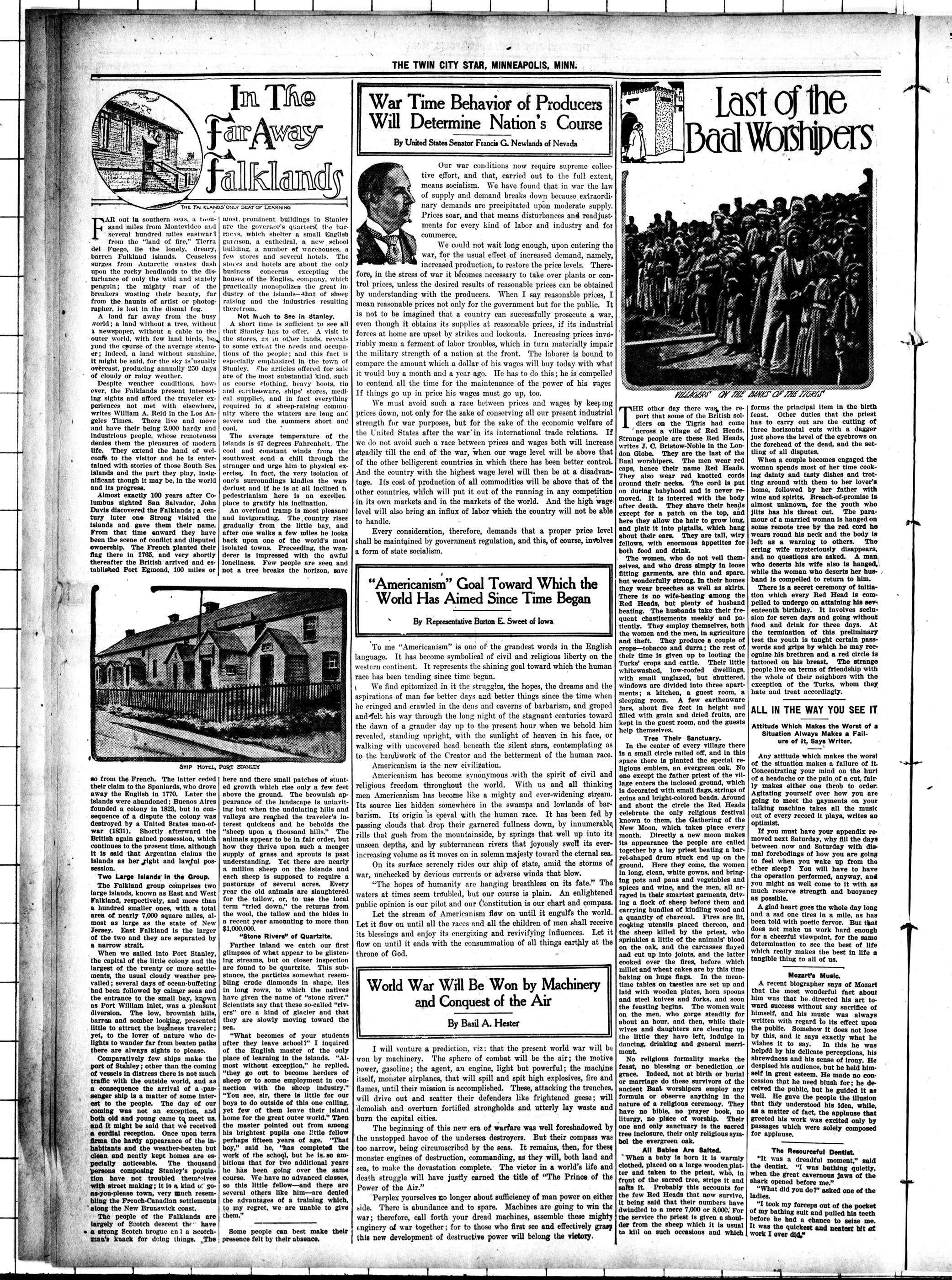
In The Far Away Falklands
THE FALKLANDS' ONLY SEAT OF LEARNING
FAR out in southern seas, a thousand miles from Montevideo and several hundred miles eastward most prominent buildings in Stanley are the governor's quarters, the barracks, which shelter a small English
from the "land of fire," Tierra del Fuego, lie the lonely, dreary, barren Falkland islands. Cenaseless surges from Antarctic wastes dash upon the rocky headlands to the disturbance of only the wild and stately penguin; the mighty rear of the breakers wasting their beauty, far from the haunts of artist or photographer, is lost in the dismal fog. A land far away from the busy world; a land without a tree, without a newspaper, without a cable to the outer world, with few land birds, beyond the course of the average steamer; indeed, a land without sunshine, it might be said, for the sky is "usually overcast, producing annually 250 days of cloudy or rainy weather.
Despite weather conditions, however, the Falklands present interesting sights and afford the traveler experiences not met with elsewhere, writes William A. Reld in the Los Angeles Times. There live and move and have their being 2,000 hardy and industrious people, whose remoteness denies them the pleasures of modern life. They extend the hand of welcome to the visitor and he is entertained with stories of those South Sea islands and the part they play, insignificant though it may be, in the world and its progress.
Almost exactly 100 years after Columbus sighted San Salvador, John Davis discovered the Falklands; a century later one Strong visited the islands and gave them their name. From that time onward they have been the scene of conflict and disputed ownership. The French planted their flag there in 1705, and very shortly thereafter the British arrived and established Port Egmond, 100 miles or
I
THE HOME OF THE HUNTINGFORD HUNTINGFORD HUNTINGFORD
SHIP HOTEL, PORT STANLEY
so from the French. The latter ceded their claim to the Spaniards, who drove away the English in 1770. Later the islands were abandoned; Buenos Alres founded a colony in 1823, but in consequence of a dispute the colony was destroyed by a United States man-of-war (1831). Shortly afterward the British again gained possession, which continues to the present time, although it is said that Argentina claims the islands as her right and lawful possession.
Two Large Islands In the Group.
The Falkland group comprises two large islands, known as East and West Falkland, respectively, and more than a hundred smaller ones, with a total area of nearly 7,000 square miles, almost as large as the state of New Jersey. East Falkland is the larger of the two and they are separated by a narrow strait.
When we sailed into Port Stanley, the capital of the little colony and the largest of the twenty or more settlements, the usual cloudy weather prevailed; several days of ocean-buffeting had been followed by calmer seas and the entrance to the small bay, known as Port William inlet, was a pleasant diversion. The low, brownish hills, barren and somber looking, presented little to attract the business traveler; yet, to the lover of nature who delights to wander far from beaten paths there are always sights to please.
Comparatively few ships make the port of Stahley; other than the coming of vessels in distress there is not much traffic with the outside world, and as a consequence the arrival of a passenger ship is a matter of some interest to the people. The day of our coming was not an exception, and both old and young came to meet us, and it might be said that we received a cordial reception. Once upon terra firma the hardy appearance of the inhabitants and the weather-beaten but clean and neatly kept homes are especially noticeable. The thousand persons composing Stanley's population have not troubled themselves with street making; it is a kind of goas-you-please town, very much resembling the French-Canadian settlements along the New Brunswick coast.
The people of the Falklands are largely of Scotch descent that have a strong Scotch brouge and a Scotchman's knack for doing things. The
most, prominent buildings in Stanley are the governor's quarters, the barrens, which shelter a small English garrison, a cathedral, a new school building, a number of warehouses, a few stores and several hotels. The stores and hotels are about the only business concerns excepting the houses of the English company, which practically monopolizes the great industry of the islands—that of sheep raising and the industries resulting therefrom.
Not Much to See in Stanley.
A short time is sufficient to see all that Stanley has to offer. A visit to the stores, as in other lands, reveals to some extate the needs and occupations of the people; and this fact is especially emphasized in the town of Stanley. The articles offered for sale are of the most substantial kind, such as course clothing, heavy boots, tin and earthenware, ships' stores, medical supplies, and in fact everything required in a sheep-raising community where the winters are long and severe and the summers short and cool.
The average temperature of the islands is 47 degrees Fahrenheit. The cool and constant winds from the southwest send a chill through the stranger and urge him to physical exercise. In fact, the very isolation of one's surroundings kindles the wanderlust and if he is at all inclined to pedestrianism here is an excellent place to gratify his inclination.
An overland tramp is most pleasant and invigorating. The country rises gradually from the little bay, and after one walks a few miles he looks back upon one of the world's most isolated towns. Proceeding, the wanderer is impressed with the awful loneliness. Few people are seen and not a tree breaks the horizon, save
THE SCHOOL
here and there small patches of stunted growth which rise only a few feet above the ground. The brownish appearance of the landscape is uninviting but when the undulating hills and valleys are reached the traveler's interest quickens and he beholds the "sheep upon a thousand hills." The animals appear to be in fair order, but how they thrive upon such a meager supply of grass and sprouts is past understanding. Yet there are nearly a million sheep on the islands and each sheep is supposed to require a pasturage of several acres. Every year the old animals are slaughtered for the tallow, or, to use the local term "tried down," the returns from the wool, the tallow and the hides in a recent year amounting to more than $1,000,000.
"Stone Rivers" of Quartzite.
Farther inland we catch our first glimpses of what appear to be glistening streams, but on closer inspection are found to be quartzite. This substance, the particles somewhat resembling crude diamonds in shape, lies in long rows, to which the natives have given the name of "stone river." Scientists say that these so-called "rivers" are a kind of glacier and that they are slowly moving toward the sea.
"What becomes of your students after they leave school?" I inquired of the English master of the only place of learning in the islands. "Almost without exception," he replied, "they go out to become herders of sheep or to some employment in connection with the sheep industry." "You see, sir, there is little for our boys to do outside of this one calling, yet few of them leave their island home for the great outer world." Then the master pointed out from among his brightest pupils one little fellow perhaps fifteen years of age. "That boy," said he, "has completed the work of the school, but he is so ambitious that for two additional years he has been going over the same course. We have no advanced classes, so this little fellow—and there are several others like him—are denied the advantages of a training which, to my regret, we are unable to give them."
Some people can best make their presence felt by their absence.
THE TWIN CITY STAR, MINNEAPOLIS, MINN.
War Time Behavior of Producers Will Determine Nation's Course
By United States Senator Francis G. Newlands of Nevada
fore, in the stress of war it becomes necessary to take over plants or control prices, unless the desired results of reasonable prices can be obtained by understanding with the producers. When I say reasonable prices, I mean reasonable prices not only for the government but for the public. It is not to be imagined that a country can successfully prosecute a war, even though it obtains its supplies at reasonable prices, if its industrial forces at home are upset by strikes and lockouts. Increasing prices invariably mean a ferment of labor troubles, which in turn materially impair the military strength of a nation at the front. The laborer is bound to compare the amount which a dollar of his wages will buy today with what it would buy a month and a year ago. He has to do this; he is compelled to contend all the time for the maintenance of the power of his wages. If things go up in price his wages must go up, too.
We must avoid such a race between prices and wages by keeping prices down, not only for the sake of conserving all our present industrial strength for war purposes, but for the sake of the economic welfare of the United States after the war in its international trade relations. If we do not avoid such a race between prices and wages both will increase steadily till the end of the war, when our wage level will be above that of the other belligerent countries in which there has been better control. And the country with the highest wage level will then be at a disadvantage. Its cost of production of all commodities will be above that of the other countries, which will put it out of the running in any competition in its own markets and in the markets of the world. And the high wage level will also bring an influx of labor which the country will not be able to handle.
Every consideration, therefore, demands that a proper price level shall be maintained by government regulation, and this, of course, involves a form of state socialism.
"Americanism" Goal Toward Which the World Has Aimed Since Time Began
To me "Americanism" is one of the grandest words in the English language. It has become symbolical of civil and religious liberty on the western continent. It represents the shining goal toward which the human race has been tending since time began.
We find epitomized in it the struggles, the hopes, the dreams and the aspirations of man for better days and better things since the time when he cringed and crawled in the dens and caverns of barbarism, and groped and felt his way through the long night of the stagnant centuries toward the dawn of a grander day up to the present hour when we behold him revealed, standing upright, with the sunlight of heaven in his face, or walking with uncovered head beneath the silent stars, contemplating as to the handiwork of the Creator and the betterment of the human race.
Americanism has become synonymous with the spirit of civil and religious freedom throughout the world. With us and all thinking men Americanism has become like a mighty and ever-widening stream. Its source lies hidden somewhere in the swamps and lowlands of barbarism. Its origin is coeval with the human race. It has been fed by passing clouds that drop their garnered fullness down, by innumerable rills that gush from the mountainside, by springs that well up into its unseen depths, and by subterranean rivers that joyously swell its ever-increasing volume as it moves on in solemn majesty toward the eternal sea. On its surface serenely rides our ship of state, amid the storms of war, unchecked by devious currents or adverse winds that blow.
"The hopes of humanity are hanging breathless on its fate." The waters at times seem troubled, but our course is plain. An enlightened public opinion is our pilot and our Constitution is our chart and compass.
Let the stream of Americanism flow on until it engulfs the world. Let it flow on until all the races and all the children of men shall receive its blessings and enjoy its energizing and revivifying influences. Let it flow on until it ends with the consummation of all things earthly at the throne of God.
World War Will Be Won by Machinery and Conquest of the Air
I will venture a prediction, viz: that the present world war will be won by machinery. The sphere of combat will be the air; the motive power, gasoline; the agent, an engine, light but powerful; the machine itself, monster airplanes, that will spill and spit high explosives, fire and flames, until their mission is accomplished. These, attacking the trenches, will drive out and scatter their defenders like frightened geese; will demolish and overturn fortified strongholds and utterly lay waste and burn the capital cities.
The beginning of this new era of warfare was well foreshadowed by the unstopped havoc of the undersea destroyers. But their compass was too narrow, being circumscribed by the seas. It remains, then, for these monster engines of destruction, commanding, as they will, both land and sea, to make the devastation complete. The victor in a world's life and death struggle will have justly earned the title of "The Prince of the Power of the Air."
Perplex yourselves no longer about sufficiency of man power on either side. There is abundance and to spare. Machines are going to win the war; therefore, call forth your dread machines, assemble these mighty enginery of war together; for to those who first see and effectively grasp this new development of destructive power will belong the victory.
A. B.
Our war conditions now require supreme collective effort, and that, carried out to the full extent, means socialism. We have found that in war the law of supply and demand breaks down because extraordinary demands are precipitated upon moderate supply. Prices soar, and that means disturbances and readjustments for every kind of labor and industry and for commerce. We could not wait long enough, upon entering the war, for the usual effect of increased demand, namely, increased production, to restore the price levels. There-
By Representative Burton E. Sweet of Iowa
"Americanism" is one of the grandest words that become symbolical of civil and religiousitat. It represents the shining goal toward a founding since time began. customized in it the struggles, the hopes, the man for better days and better things since crawled in the dens and caverns of barbary through the long night of the stagnant grander day up to the present hour when rising upright, with the sunlight of heaven uncovered head beneath the silent stars, back of the Creator and the betterment of man is the new civilization. man has become synonymous with the spirit throughout the world. With us aism has become like a mighty and ever-hidden somewhere in the swamps and origin is coeval with the human race. It that drop their garnered fullness down, from the mountainside, by springs that and by subterranean rivers that joyously one as it moves on in solemn majesty toward face serenely rides our ship of state, and by devious currents or adverse winds the of humanity are hanging breathless or seem troubled, but our course is plain. as our pilot and our Constitution is our chaism of Americanism flow on until it en until all the races and all the children of and enjoy its energizing and revivifying in ends with the consummation of all things.
War Will Be Won by Me and Conquest of the Air
By Basil A. Hester
future a prediction, viz: that the present will very. The sphere of combat will be the; the agent, an engine, light but powers airplanes, that will spill and spit high ex-ir mission is accomplished. These attack
Last of the Baal Worshipers
VILLAGERS ON THE BANKS OF THE TIGERS
A
VILLAGERS ON THE
THE other day there was the report that some of the British soldiers on the Tigris had come
across a village of Red Heads. Strange people are these Red Heads, writes J. C. Bristow-Noble in the London Globe. They are the last of the Baal worshipers. The men wear red caps, hence their name Red Heads. They also wear red knotted cords around their necks. The cord is put on during babyhood and is never removed. It is interwed with the body after death. They shave their heads except for a patch on the top, and here they allow the hair to grow long, and plait it into pigtails, which hang about their ears. They are tall, wiry fellows, with enormous appetites for both food and drink.
The women, who do not vell themselves, and who dress simply in loose fitting garments, are thin and spare, but wonderfully strong. In their homes they wear breeches as well as skirts. There is no wife-beating among the Red Heads, but plenty of husband beating. The husbands take their frequent chastisements meekly and patiently. They employ themselves, both the women and the men, in agriculture and theft. They produce a couple of crops—tobacco and durra; the rest of their time is given up to looting the Turks' crops and cattle. Their little whitewashed, low-roofed dwellings, with small unglazed, but shuttered, windows are divided into three apartments; a kitchen, a guest room, a sleeping room. A few earthenware jars, about five feet in height and filled with grain and dried fruits, are kept in the guest room, and the guests help themselves.
Tree Their Sanctuary.
In the center of every village there is a small circle ralled off, and in this space there is planted the special religious emblem, an evergreen oak. No one except the father priest of the village enters the inclosed ground, which is decorated with small flags, strings of coins and bright-colored beads. Around and about the circle the Red Heads celebrate the only religious festival known to them, the Gathering of the New Moon, which takes place every month. Directly a new moon makes its appearance the people are called together by a lay priest beating a barrel-shaped drum stuck end up on the ground. Here they come, the women in long, clean, white gowns, and bringing pots and pans and vegetables and ponds and wine, and the men, all arrayed in their smartest garments, driving a flock of sheep before them and carrying bundles of kindling wood and a quantity of charcoal. Fires are lilt, cooking utensils placed there, and the sheep killed by the priest, who sprinkles a little of the animals' blood on the oak, and the carcasses flayed and cut up into joints, and the latter cooked over the fires, before which millet and wheat cakes are by this time baking on huge flags. In the meantime tables on tnestles are set up and laid with wooden plates, horn spoons and steel knives and forks, and soon the feasting begins. The women wait on the men, who gorge steadily for about an hour, and then, while their wives and daughters are clearing up the little they have left, indulge in dancing, drinking and general merriment.
No religious formality marks the feast, no blessing or benediction or grace. Indeed, not at birth or burial or marriage do these survivors of the ancient Baal worshipers employ any formula or observe anything in the nature of a religious ceremony. They have no bible, no prayer book, no liturgy, no place of worship. Their one and only sanctuary is the sacred tree enclosure, their only religious symbol the evergreen oak.
All Babies Are Salted.
When a baby is born it is warmly clothed, placed on a large wooden platter and taken to the priest, who, in front of the sacred tree, strips it and salts it. Probably this accounts for the few Red Heads that now survive, it being said that their numbers have dwindled to a mere 7,000 or 8,000. For the service the priest is given a shoulder from the sheep which it is usual to kill on such occasions and which
forms the principal item in the birth feast. Other duties that the priest has to carry out are the cutting of three horizontal cuts with a dagger just above the level of the eyebrows on the forehead of the dead, and the settling of all disputes.
When a couple becomes engaged the woman spends most of her time cooking dainty and tasty dishes and trotting around with them to her lover's home, followed by her father with wine and spirits. Breach-promise is almost unknown, for the youth who jilts has his throat cut. The paramour of a married woman is hanged on some remote tree by the red cord he wears round his neck and the body is left as a warning to others. The erring wife mysteriously disappears, and no questions are asked. A man who deserts his wife also is hanged, while the woman who deserts her husband is compelled to return to him.
There is a secret ceremony of initiation which every Red Head is compelled to undergo on attaining his seventeenth birthday. It involves seclusion for seven days and going without food and drink for three days. At the termination of this preliminary test the youth is taught certain passwords and grils by which he may recognize his brethren and a red circle is tattooed on his breast. The strange people live on terms of friendship with the whole of their neighbors with the exception of the Turks, whom they hate and treat accordingly.
ALL IN THE WAY YOU SEE IT
Attitude Which Makes the Worst of a Situation Always Makes a Failure of it, Says Writer.
Any attitude which makes the worst of the situation makes a failure of it. Concentrating your mind on the hurt of a headache or the pain of a cut, fairly makes either one throb to order. Agitating yourself over how you are going to meet the payments on your talking machine takes all the music out of every record it plays, writes an optimist.
If you must have your appendix removed next Saturday, why fill the days between now and Saturday with dismal forebodings of how you are going to feel when you wake up from the ether sleep? You will have to have the operation performed, anyway, and you might as well come to it with as much reserve strength and buoyancy as possible.
A glad heart goes the whole day long and a sad one tires in a mille, as has been told with poetic fervor. But that does not make us work hard enough for a cheerful viewpoint, for the same determination to see the best of life which really makes the best in life a tangible thing to all of us.
Mozart'a Music.
A recent biographer says of Mozart that the most wonderful fact about him was that he directed his art toward success without any sacrifice of himself, and his music was always written with regard to its effect upon the public. Somehow it does not lose by this, and it says exactly what he wishes it to say. In this he was helped by his delicate perceptions, his shrewdness and his sense of irony. He desplied his audience, but he held himself in great esteem. He made no concession that he need blush for; he deceived the public, but he guided it as well. He gave the people the illusion that they understood his idea, while, as a matter of fact, the applause that greeted his work was excited only by passages which were solely composed for applause.
The Resourceful Dentist.
"It was a dreadful moment," said the dentist. "I was bathing quietly, when the great cavernous jaws of the shark opened before me." "What did you do?" asked one of the ladies. "I took my forceps out of the pocket of my bathing suit and pulled his teeth before he had a chance to seize me. It was the quickest and neatest bit of work I ever did."
The WORKERS
WE laid the wheel of the ship that sails the waters of peace or war,
We built her, strong for the strongest gales, and big for the load she bore!
We made the ship and we made her great with the things that we put inside—
We made the ship and we made the freight, the seas of the world to ride!
If a ship of war, then we made her guns, if a ship of trade, her wares!
She's built of the bone of the working ones, and the blood of her flag is theirs!
Sailor or soldier or citizen she will carry across the main—
She's made of the muscle of working men, and born of the worker's brain!
THE load of her deck, the grain of her hold, whatever her cargo be,
Food or clothing or goods or gold, whatever she takes to sea,
The sower's arm or the toiler's tail made ready the thing to go—
The shop's machine or the farmer's soil or the forge's lusty blow!
THE birds of the sea must nest on land, on the land the birds are born,
They must take their stores from the toiler's hand, they must take their wheat and corn;
For they who sail are a mighty race, and serving a mighty need—
But he who stands in the Worker's place is serving the world indeed!
DOUGLAS MALLOCH
Trade Union Success In Effort to Shorten the Hours of Labor
By SAMUEL GOMPERS. President American Federation of Labor.
LABOR Day brings to the workers of America the right to cheer and confidence in the trade union movement. There have been tests and crises that have proved its fundamental principles; there have been opportunities that have tested its practical efficiency. Through them all the trade union movement has made sure progress and gained in confident vision for the future.
Every national and international, every local union affiliated to the American Federation of Labor has made definite progress in securing for its members greater advantages in those things which are fundamental of betterment in all relations of life.
There has been great progress in securing the eight-hour day or the shorter workday. The meaning of the victories can be interpreted only in the light of full understanding of the meaning of the eight-hour day. The shorter workday is something more than an economic demand. It is a demand for opportunity for rest, recuperation and development; things which make life more than mechanical drudgery.
The workers whose whole periods are short are essentially different from those who are so worn by toll that they have neither energy nor mind for other things in life. They become more energetic, more resourceful workers with keener mentality and greater
CLINEDINST
producing power. It inevitably follows that the short-hour workers are the best paid workers. With every reduction in hours there is always a corresponding increase in wages. Wherever demands for the shorter workday and higher wages have been presented and urged by organized workers during the last year they have met with success.
Shortening the period of work lengthens the period of development, and for all of the other activities that belong to the normal individual. Increases in wages give the workers the means for taking advantage of the increased opportunities of the shorter workday. The workers of short hours and better wages become very different citizens from those who are so exhausted by the daily grind that they have neither the time nor the energy for thought or aspiration. These gains mean better homes, better food, better clothing; time and opportunity for the cultivation of the best and the highest that is possible to man.
C
United States Has Well Been Designated Nation of Workers
United States Has Well Been Designated Nation of Workers
MEN of labor came to America in the Mayflower. A printer and a carpenter signed the Declaration of Independence, George Washington was a surveyor at one time in his life. Lincoln worked as a day laborer. Andrew Johnson was a tailor. William Howard Taft, after leaving college, was a newspaper reporter at $6 a week. The United States is a nation of workers. Labor day, consequently, is not for any class but for Americans in mass. Frank A. Vanderlip, president of the National City bank, is by trade a machinist. His father was an Illinois farmer—"a specialist in cows" the son explained. On the death of the father the family moved into town.
"I found employment," Mr. Vanderlip said, "in a shop where wood working machinery was manufactured. I was sixteen and my wages were 75 cents a day. By and by I got a lathe of my own. I would be a foreman some day, I was told, and earn $21 a week. I thought I could do better. So I learned stenography and later took up the study of bonds."
William H. Canniff, president of the New York, Chicago & St. Louis railroad, was a telegraph operator in Michigan when he was seventeen. The attorney general in President Taft's cabinet, George W. Wickersham, also was a telegraph operator, as was Theodore N. Vall, head of the Bell telephone interests.
A section hand in 1869, shoveling and tamping on the tracks, William C. Brown, then sixteen years old, fought his way upward until he became president of the New York Central lines.
"My daily wages at the time?" he repeated. "Figure them out for yourself. My envelope contained $27.50 at the end of the month when the pay car came down the line." His successor, Albert H. Smith, was a railroad laborer as a young man.
Judge Robert S. Levett, president of the Union Pacific, dug stumps and cut brush on the right of way on a little line in Texas and drove a team of mules when the grading began. Benjamin F. Yoakum operated a scraper in the Southwest on a road in its building, and became a brakeman when the road was put into operation.
Every day is labor's day. Every man worth while is a laborer.
Universal labor is the lever of democracy.
THE TWIN CITY STAR, MINNEAPOLIS, MINN.
Organized Labor in Fight to Put End to Industrial Wastage
By FRANK L. MORRISON,
Secretary American Federation of
Labor.
IT IS impossible to record fundamental gains during the past year because of organized labor's agitation or to individualize probable gains during the year to come. The best we can do is to observe tendencies. Prominent among these is the workers' seizure of the cry for "preparedness" to emphasize a danger in industry more deadly than battlefields.
Government statistics show that 30,000 men are annually killed and 700,000 are annually injured for a period of four weeks or over.
It has been stated that every year there are over 3,000,000 cases of industrial illness, caused mainly by long hours, low wages, dust, bad air, fumes, smoke, poisonings and poor ventilation, and that through typhoid fever and malaria alone $900,000,000 is annually lost to this nation. Enough to equip the largest army and navy in the world, and then have a balance sufficient to pay the tuition of every boy now in college.
A system of national preparedness that does not include recognition of this frightful and preventable wastage is the preparedness urged by big business.
Another element among employers who talk of the scarcity of labor does so to entice a sufficient number of idle workers to their factory gates as a menace to those employed and who
C HARRIS & EWING
liable to demand better conditions. These employers oppose restriction of immigration because restriction will defeat their policy of having two or more men for every job. Another tendency is the growing opposition to labor injunctions, which class labor power as property. The congress of the United States has voiced this opposition in amendments to the antitrust laws. Judicial interpretations of the term "property" in the fourteenth amendment to the federal constitution are losing their force. What was originally intended to end slavery has been used to thwart the enactment of social legislation, but courts have failed to check the swelling tide of democracy. The trade union movement is conscious of the part it has played in the tendencies above referred to and this consciousness will be an inspiration to greater effort during the coming year.
TO AID FAMILIES OF U. S. FIGHTERS
Red Cross Undertakes to Care for the Dependents of Soldiers and Sailors.
PREPARE FOR A LARGE TASK
Not Work of, Charity, but Most Sacred Duty to See That They Lack for No Comfort," Says Director Lies.
By CHARLES LEE BRYSON.
Chicago.—Many an American soldier and sailor will fight with infinitely stronger spirit in this war for the knowledge that the American Red Cross is standing firm between those he leaves at home, and the grim specer of want. For the announcement has gone forth from Washington that the families of fighting men are to be under the protection of the great humanitarian arm of the government.
The whole world knows of the work the Red Cross has done in caring for the sick and wounded in war, relieving the distress of the victims of fire and dood, earthquake, famine and tornado in civil disaster, and organizing base hospitals for the army and navy. But few realize that while all this was being done, preparation was under way to look after the loved ones whom the fighting men will leave at home.
When the United States troops were at the Mexican border the Red Cross found it necessary to make provision for the families of many Guardsmen who had left dependents at home. This made plain what must be done in case an army of a million men should be called abroad, and with characteristic Red Cross forehandedness a plan was at once formulated. So far as possible, the war department will choose men who have no dependents; but in spite of everything many a married man, man a son whose mother depends on him, and many others to whom relatives look for support, will go to the front. It is these who are left behind that will be watched over by the Red Cross.
Department of Family Relief.
To safeguard those who may need our care, the Red Cross has established, under the director general of civilian relief, a new department called that of family relief. It has called to the head of this department Eugene T. Lies, for many years general superintendent of the United Charities of Chicago, a man of wide experience and ripe judgment.
Mr. Lies was one of those who attended a conference of national and division officers of the Red Cross, called at Chicago by John J. O'Connor, director of the central division, and at this conference Mr. Lies outlined his policy. Later, at the National Conference of Charities at Pittsburgh, Mr. Lies enlarged upon this subject. He made it very plain that it is a labor of love, and in no sense of charity, that the Red Cross has undertaken.
"We must remember," said Mr. Lies,
· HEADS BELGIAN RELIEF
M.
Jonkheer Charles Ruys de Beerenbrock, a noted Dutchman, has been appointed as head of the Belgian relief commission, succeeding Herbert Hoover, American's food chief.
The Jonkheer is a Roman Catholic deputy for a Limburg constituency and a son of the queen's commission for that province. He is an expert social worker and has given much assistance to Belgian refugees.
Hoover built a complete organization for the Belgian relief work and it is running so smoothly that the Jonkheer will have little trouble in continuing the great machinery for the distribution of food and clothing for the needy in Belgium.
"that there is not the faintest shadow of 'charity' in its usual meaning, attached to this work we are undertaking. If there is want among the families of our soldiers and sailors, it is not because they have been idle or wasteful, or improvident, or that they have been in anyway to blame. Rather it is because they have done the finest and the noblest thing possible, and have given to their country those to whom they have looked for support and protection.
"We go to them, not as doing them a charity, but as expressing our gattitude to them for what they have done—as a duty we owe to those whom they have given to fight our battles. Looking at it in this light, we can see how little we can afford to permit any one of these to suffer because of the noble thing they have done."
Task a Big One.
The officers of the Red Cross have shown a large grasp of the situation. They realize the task that will be theirs. This is shown in a part of Mr. Lies' Pittsburgh talk, in which he said that very soon there will be 300,000 National Guardsmen in the field, and that "by January 1 next it is altogether possible that there will be under arms about 2,500,000 men in all branches of the service.
"We must prepare for a large task, to be executed through the civilian relief committee of the various Red Cross chapters. These committees should have carefully chosen members, some, at least, of whom have experience in social work."
It is not merely as a feeding and clothing agency that the Red Cross proposes to act toward these dependents, as Mr. Lies points out, but as a sort of "next friend" in all troubles such as wages, insurance, difficulties with landlords, illness, accident and the moral welfare of children.
"We would show ourselves unfit to enjoy the blessings of democracy," says Mr. Lies, "if, while sending our soldiers to the front to fight the enemy, we permitted their families at home to fight want, disease, and moral dangers alone." It would look like willful punishment for the sacrifices made by them.
"Only by getting close to them through friendly visitation, sympathetic inquiry, neighborliness and intelligent interpretation of home conditions, can untoward factors be discovered. The Red Cross is in the field to do just this kind of service in addition to supplementary relief work, and it wants to do it as thoroughly as possible."
It is in this spirit, then, that the Red Cross is approaching the task of protecting the dependents left behind by the fighting men. Backed by the American people, there is no room for doubt as to how it will perform this task.
CALL BRITISH TARS "LIMEYS"
American Bluejackets in European Waters Have Nickname for Everything They See.
London.—American bluejackets on duty in European waters have a nickname of their own for England's sailors and soldiers. They call them "limeys;" the individual being known as a "lime." The American sailor men apply the designation to all English fighters just as the British refer to their soldiers as "Tommies."
The sailor from the United States has his nickname for nearly everything he sees. Bluejackets who had served in the near and far East first started calling British sailors and soldiers "lime juiceers," because of their fondness for fruit juice and charged water.
Now the designation has been shortened down and everything British is "limey." British soldiers' and sailors' clubs are known as "limey clubs," and British-brewed lager beer is commonly spoken of as "limey beer."
HAS NINE GRANDSONS IN BRITISH ARMY
Denver, Colo.-The Victoria Cross might be the reward of Mrs. S. Harris, aged seventy, were her contributions to the allied cause brought to the attention of King George. Mrs. Harris has nine grandsons now fighting in the British armies, and an only son is about to enlist in Uncle Sam's army of liberty.
All nine grandsons are brothers, children of Mrs. Harris' daughter, who is now dead. The boys were living in Saskatchewan, in western Canada, when the Dominion government first called for volunteers. Seven of them enlisted in the famous Princess Pat regiment and, despite the heavy casualties in that crack organization, they are all alive. Two others entered the British navy. The boys are Thomas, George, William, James, J. B., Justus, Larry, W. B. and Dennis Pollard, and range in age from nineteen to thirty-three years.
Mrs. Harris' husband was a Confederate soldier.
Bryan, O.-Deer Snow, living near Stryker, lost his watch while plowing three years ago. He found that identical watch dragging along behind his riding cultivator several days ago. It was not tickling, but it wilt as soon as some slight repairs are made.
THE HISTORY OF THE ISRAELIAN CIVIL WAR
Joseph Getzelowitz, dumb from birth, suddenly recovered his power of speech in Bellevue hospital, New York, while recovering from a fall. Several boys had been tormenting Getzelowitz in Henry street, near the home of his sister, where he lived. In chasing the boys, he stumbled and fell. A policeman picked him up and had him sent to Bellevue. There the physicians examined the young Russian and found that his vocal chords had all the appearances of being normal and in their opinion simply lacked the will to talk. While reading a prayer book he suddenly began speaking Yiddish with ease and perfect pronunciation. He now speaks a few words of English.
GUIDES FOR IT'S SOLDIERS
Great Britain Carefully Provides for the Men Home on Leave From the Front.
London.—Soldiers on leave from the front in the early days of the war had the greatest difficulty in finding their way about London and across it to main line centers leading to their provincial homes, but this has all been altered, and what was once chaos at Victoria station now works like any part of the military machine.
This has been made possible by the help of the volunteers of the National Guard and by members of the Woman's Reserve Ambulance company, who take charge of the men on arrival, change their French money into English, grant them loans and personally conduct them to the various stations they may require to travel from. The same thing is done when leave is up. The soldier, used to discipline, likes being handed on from one to another rather than being left in a strange place to his own devices.
IN KAISER'S ROOM, TAR SAYS. NO KICK COMING
Lorain, O.-William Kelsner, who joined the navy four months ago, has written his parents that he is well treated. He is evidently on one of the interned German ships seized by the United States.
"The walls are covered with silk and inlaid with silver. The room to which I was assigned was reserved for the kaiser when the ship was German," says his letter.
Will Turn Talents From Modeling in Clay to Remaking Faces of the Wounded.
Cleveland, O.—Max Kalish, Cleveland sculptor, is going to do his bit and it's a strange bit, too. Kalish is turning his talents from creating faces in clay to remaking those of human beings. Kalish is one of a small army of American sculptors who are going to the battle front to help battle-scarred veterans. They propose to remake the mangled features of the soldiers injured in battle.
They call these fellows plastic sculptors. They replace the missing parts of the face with copper or paper mache and then graft skin over it. Little is known of the science in America and the sculptors are going to France shortly to learn the fine points of the art.
ACCLAIMED BRITAIN'S HERO
London Schoolteacher, Wounded in Battle in France, Attains High Fame.
London.—A London schoolmaster named Wiman, who enlisted and lost an arm and a leg in France, returned to teaching after his recovery and became the idol of his students.
The discipline among members of his class was perfect, the boys enforcing it among themselves. Finally, after the authorities discovered him to be a better teacher than ever, the school arranged for an exhibition hearing of one of his history lessons. At this exhibition Wiman asked:
"Now, boys, who is the greatest outstanding British military hero of all time?"
The boys instantly stood, cheered thrice and shouted in chorus "Mr. Wiman."
Too many of us live little Negative lives, doing the things that merely "fall" to us or pass our way. We do too little reaching out and digging down. We think of "I Must," for instance, as a Positive that only Heroes and Gods ought to associate with. But—
Unless your life is permeated by Positives—by some personal Responsibility of Effort, your Character, at the end, will stand weak indeed.
"I Must," said Lord Nelson, at Trafalgar; "I Must," said Washington at Valley Forge; "I Must," said Lincoln, at Gettysburg; "I Must," said Mark Twain, with Bankruptcy clutching at his heart; "I Must," says every great man and woman, sensing Duty, Opportunity, Crisis, and the Larger Success. "I Must," is God's Vest Pocket Formula to you who breathe His free Air, and work in His Workshops.
Daily every one of us faces tasks that we didn't expect and that we would rather not do. It is the order of Circumstance. But just the minute that "I Must" comes along, our Program clears up and our Work proceeds plainly and according to plan. That man is most satisfied with life who is most satisfied with doing what he feels is his BEST. "I Must!" All right—proceed.
PETER B. BURKE
Brain Workers Need Food High in Energy Material, Says Expert on Dietetics
A man engaged in mental work is generally supposed to need a diet having about the same energy value as that of a man doing very light mechanical work, because the consumption of energy in mental work is not great. But the Medical Record calls attention to the opinion expressed by Dr. W. M. Bayliss, professor of general physiology, University college, London, in a book on the physiology of food.
Doctor Bayliss points out that while the oxygen actually consumed by the nerve centers in their work may not be great it has to be supplied at high pressure. This is proved by the fact that even a momentary stoppage of the blood supply causes immediate unconsciousness, although the oxygen in the brain has not been exhausted. From this it seems possible that although the actual quantity of food needed may not be great "yet this food may require to be presented at high pressure, and that to attain the high pressure it may be necessary to take a diet of an energy equivalent to that of a moderate muscular work."
Doctor Bayliss holds that from the food standpoint no benefit is derived from alcohol. Also that there is no special virtue in butcher's meat and that vegetable foods, if properly chosen, can supply all that is necessary for a complete diet, but at the same time he considers a diet of pure-
SOME SMILES
Rose—What a pity, dear, you are engaged so young. You will never have the fun of refusing a man.
Bud—No, but I've had the fun of accepting one.
A Lesson in Economy.
Judd—I've just paid $250 for this diamond ring for my wife.
A
Budd—It's a beauty, but isn't it rather—er—extravagant? Judd—Not a bit. Think what it will save in gloves.
The Difference.
"How was it when those two young fellows started out together to get work, one was employed so much sooner than the other?" "I guess it was because the latter waited to accept a position, while the former went out and looked for a job."
"I say, Arnold, I want to apologize for the nasty temper I displayed last night. Your wife and sister must have thought I was crazy."
"Oh, no, they didn't. I fixed that all right."
"Mighty good of you, old man, Thanks."
"Yes, I told them you were drunk."
—Illustrated Sunday Magazine.
Very Particular.
Butcher—I can recommend the ham. ma'am. It's well cured.
A B C D E F G H I J K L M N O P Q R S T U V W X Y Z
Mrs. Green—
Oh, don't give me
one that had anything
the matter with it even if it
is cured now. Let
me have a per-
fectly healthy
one.
The Sequel.
Troublesome Gentleman (to solicitor, after long rigmarole)—That, Mr. Jones, is the Genesis of the whole matter.
Solicitor (opening the door)—And this, my dear sir, is the Exodus.—The Tatler.
Appropriate Need.
"Naturally, a flying scheme would be all the better for an angel."
ly vegetable origin unsafe, because not enough is known yet about the properties of the several vegetables stuffs. The proteins of vegetables are not so easily digested as are those of meats, but in compensation more of the food can be taken, and the digestive organs need bulk.
90,000,000 Rabbits Needed For Felt Hats Made in the United States Every Year
Did you know that the felt hat you are wearing represents the fur of three or four rabbits?
It's a fact, declares the San Francisco Examiner.
And it's also true that there are about 30,000,000 felt hats made in the United States every year.
Figure it out for yourself. At the minimum of three rabbits per hat, that number of hats means 90,000,000 rabbits a year.
Of that number less than two per cent are killed in the United States, according to a paper read before the Society of Chemical Industry in New York by C. D. Parks. Most of the other 98 per cent come from Australia, where the rabbit, introduced long ago as a pet, has become a national pest.
Among Colleagues.
"Do you regard our friend as a statesman?"
"No," replied Senator Sorghum.
"He's the sort of a man that gets credit for being a statesman when he's only a public expert."
A Hospitable "Cracker."
A young lawyer down in Florida was running for a certain office and, with the idea of getting their vote, undertook to cultivate the acquaintance of all the "crackers" (country people) for miles around.
Stopping his horse one evening in front of a little shanty, he inquired of the old man lounging against the door if he might spend the night at his home. "Sure, partner," said the old man, "stop and light." The lawyer "lighted" and followed him into his abode, which consisted of one room, with a bearskin stretched out in one corner, the trophy of a hunt and also the only bed of the hunter. A pumpkin served him for a pillow. In answer to the lawyer's wondering look as to where he was going to sleep, the "cracker" pointed to the bearskin, saying with great magnanimity: "Stranger, I tell ye what we'll do—ye take the punkin and the barskin, and I'll rough it!"—Everybody's.
Frenchmarl Will Not Retire
When he has laid by a "pile," which the Englishman or American would consider ample to justify him in taking a house in the suburbs, "climbing" in society and retiring from business, the Frenchman still clings to business. Although his everyday expenses are very probably less, he has as a rule far heavier drains on his purse. Each of his daughters will claim a handsome dowry if she is to be married well, and these dowries must be paid without impoyerishing the business. This system of interwoven family and business arrangements naturally is associated with the closeness of the ties of French families. A man and wife would as soon think of deserting each other as, of deserting their "inlaws."
Statistical Notes.
United States has 450 auto factories.
Japan last year paid $54,835,000 for fertilizers.
Chile has 6,014 miles of government-owned railways.
Youngstown, O., is to have a $250,000 art museum.
Philadelphia is to have a new $50,000 hospital for children.
Denmark in 1916 sent Germany 28,500 tons of pork and lard.
Riska Compared.
Risks Compared.
"So you think an automobile is safer than a horse?"
"In some respects," replied Broncho Bob; "it isn't customary as yet to hang a man for stealing an automobile."
THE TWIN CITY STAR. MINNEAPOLIS. MINN.
Rice Thrown Away at One Wedding Equal to Soldier's Food Ration for Whole Day
The custom of throwing rice at weddings is a wasteful one, in the opinion of C. E. Vail of the Colorado Agri-cultural college.
"It is unnecessary, to say the least," he declares, "and if one stops to consider the probable amount thus wasted in the entire United States each year, one is the more impressed with the absurdity of the custon." At the present time, when the whole country is aroused to the need of food production and food conservation, the throwing of rice at weddings is a matter for the attention of those who are trying to solve the food problem. Rice has a fuel value of 1,630 large calories per pound, as compared with 1,306 calories from white bread, 1,655 from cornmeal and 325 from potatoes. The United States soldier's food ration is about 4,200 calories per day. In throwing away three pounds of rice there are wasted 4,800 food calories. The lesson should be quite obvious."
Dramatic Surprises.
Strange meetings occur often enough in war hospitals. Several medical officers have found their brothers among their patients. A certain territorial battalion had two medical officers in peace time, of whom the senior went abroad with the unit. In course of time the colonel fell sick, and was brought down to a base hospital, where he passed directly into the charge of his junior medical officer without any prearrangement whatever. A patient who had served for several months in France was lying in a double-bedded room. Suddenly, and rather to his annoyance, a stable companion was given to him in the middle of the night, who proved in the morning to be his brother, recently arrived from Gallipoli.
No Sanctified Constitutions.
"Some men," wrote Jefferson in his old age, "look at constitutions with sanctimonious reverence, and deem them like the ark of the covenant—too sacred to be touched. They ascribe to the men of the preceding age a wisdom more than human, and suppose what they did to be beyond amendment. I knew that age well; I belonged to it and labored with it. It deserved well of its country. It was very like the present, but without the experience of the present. . . . I am certainly not an advocate of frequent and untried changes in laws and constitutions. . . . But I know also that laws and constitutions must go hand in hand with the progress of the human mind."—New Republic.
POULTRY POINTERS
In preparing fowls for shipment by parcel post, the chief object is to keep the skin from being torn or rubbed. Dry picking is recommended.
The floor of the duckhouse must be kept dry and should be well littered with clean, dry straw.
Strange as it may seem, while ducks will thrive if they have access to a stream of water or pond, they must have dry quarters at night.
Growing chicks will grow best when they can roost where there is clean perches and only a roof over their heads.
Sulphate of iron is a blood tonic, as well as an effectual remedy against the small round worms frequently discovered in the intestines of the birds.
Any of the larger breeds of ducks will yield quite a great deal in the way of feathers in a year's time. Feathers should not be plucked during the cold weather. Ducks are conveniently kept in flocks of about thirty. A house 15 by 10 feet is large enough for this number. When fowls become lume first in one leg and then in both, it is caused by some liver trouble. Sometimes the birds at the same time become very light. There is no cure. Prevent by not feeding pepper or spices, not too heavy of corn. Cleaning out the houses several times a week, will not only give a purer air, but it will greatly help in killing disease germs. Access to swimming water is not at all necessary in order to successfully raise Pekin ducks.
Where there is a nervous, quick jerking of the legs, making the fowl step high while walking, it is an affection similar to stringhalt in horses. While this cannot be cured it does no particular harm. It is a nerve trouble.
An excellent substitute for meat foods is cottage cheese. You may feed it to fowls of any age and will find it very nutritious. Give about three feeds each week of the cheese.
Japan's Physique Falling.
Interpellating the Japanese government about the health of the nation, Baron Kenkwan Takagl, a well-known medico-scientist, speaking in the house of peers, declared that there was a gradual enfeeblement in the physique of the young men which was discouraging. He asked whether the government was considering any measures for the improvement of the health conditions of the empire? In reply, Premier Count Terauchi said the government was not satisfied with the present national hygiene and would adopt all possible measures to bring about an improvement.
GAME
FISHING
by
DIXIE
CARDOLL
Author of LAKE and
SIREAM GAME FISHING
STEWART N.
MIDD CO.
FLY-CASTING FOR BASS.
My Dear Buck:
Going after the husky bass with the light fly rod is sure the right system of fishing, if you have a desire to cultivate the tingling nerves and the thumping pulse. Nothing in the game will give you more thrills than to have a two or three pound bass take the feathers and then try to shake 'em loose—that is, of course, if you are handling the working end of the rod. And if this old bass is a stream-raised youngster, he will give you more fight than any other fish, weight for weight.
Wading a stream and whipping the water in a semicircle as you go along is far more enjoyable than lake flycasting, and at the same time a stream that can be waded makes about the best kind of bass water for the use of the fly. The shallow pools above and below riffles or rapids is a likely spot for the hungry bass as well as the eddies along the sides of rapids. Cast into the swirl of water as it passes around a bowlder and off the edge of the windfalls, logs and brush heaps, all of which locations are generally the loafing place of a fine old bass.
In lake fishing with the fly the bright, sunny day is not for you. The bass rise to the fly particularly on a day when the surface is broken by a slight breeze, and the best time for casting is in the early morning and late in the evening. From sunset to dark is the best time when the day has been bright—in fact, most any day. On the lake cast your fly inshore on the bars and shallows or ledges and off the edges of lily pads, rushes and weed beds, as well as alongside the half-submerged logs and windfalls along shore. The fly should be allowed to sink considerably and a slightly jerky crawl given to it when working in the line. This is done to fool the bass into believing the object of the flymaker's art is a struggling insect, trying to get out of the wet.
Better to Fish Downstream
On the stream it is preferable to fish downstream, as the bass lie with the head upstream and with the current carrying your fly on its natural course, the bass have more chance to see it and thus become a possible candidate for the creel. Then again, it is far easier to wade downstream than it is going up.
For dark days and early evening use light-colored files, and for the bright days the darker files. Smaller files of a subdued color tied on a No. 6 or 7 hook is right for low, clear water on a bright day, while for after-sunset and moonlight casting the gray, white and brown files tied on a larger hook, a No. 2 or 4 size, are more likely to attract the fish than the smaller ones. For rough and turbid water the brightly colored feathers are best. In selecting your files don't overlook the black, brown, gray and hackles; you will often find that the old reliable hackles will bring a rise after you have tried every other combination in your fly book.
Nearly every fellow who whips the light fly rod has his own particular selection of files, and by these he swears like a pagan; however, for the beginner, besides the hackles the following selection will give a fairly varied assortment that will pass muster until he creels the first fish and the fly used at that time will no doubt be given the place of honor in his pet list. I have found these files creel fillers: Queen of the Waters, Lord Baltimore, Montreal, Grizzly King, Coachman, Professor, Red Ibis, Seth Green, White Miller, King of the Water, Ferguson, McGinty, Emerson Hough, Silver Doctor and Parmanchee Belle.
One of the essentials in bassing with the fly is to keep out of sight of the fish as much as possible. The bass is every bit as scary as the trout, although once he sees you he will not dart away and disappear like the trout, but he will dash off a little distance and stop, facing you. However, don't waste time trying to make him take your fly, because he has a case of "nerves" and you can cast it right over his nose and he merely gives it a disinterested glance. On the small bass streams keep entirely out of sight and on the wider waters make a long cast, the finer the water the more caution and the longer the cast. On casting from the shore it is well to be screened by bushes or any natural formation. Wading is the best method, however, as the nearer you are to the water the less chance the fish have of seeing you, and even at that you should be as quiet as possible and make it a point to avoid quick or sudden moves.
Cast your files as lightly as possible and avoid letting them land with a splash by slightly-raising the tip of the rod right before they touch the water and let the current help you by allowing the files to run with it.
DIXIE
1313 Wash. Ave. South
FOR LADIES & GENTLEMEN
Music Every Day from 2 P. M. to 11 P. M.
Kidd Mitchell, Prop. MINNEAPOLIS, MINN.
LADIES SPECIALLY INVITED EVERY DAY.
High Grade Specialists in Wet Wash Dry Wash and Family Laundering OUR WORK IS OUR BEST ADVERTISEMENT
CHALMERS LIVERY SERVICE
WRIGHT AND SHEPARD, PROP.
TOURING AND LIMOUSINES
DAY AND NIGHT
HARRY LEVITON
MEN'S SUITS AND OVERCOATS MADE TO ORDER. Dry Cleaning and Fancy Dyeing of Ladies' and Gent's Garments. Phone N. W. Hyland 2875 1317 No. 6th Ave., Minneapolis.
Kelkstein
PURITY BREWING CO.
PURITY BREWING CO.
Order a Case
Today
N. W. MAIN 2259
KEYSTONE
F
Music
Kidd Mitchell, P
LADIES S
THANN
HOTEL
122 E
ST
CABARET
From 2:30
LADIES C
ELEC
Phones: Buffet C
Tr
Drex 1269
J. & H
37
High Grad
There is strength in pure beer like
Hochsteiner
LAGER
Brewed under sanitary condition
Purest of ingredients
The beer without a headache
The Leading Bottle Beer Brewery
Both Phones 66 MINNEAPOLIS, MINN.
59 Souvenirs for Ladies every
Wednesday afternoon and Evening.
BE BUFFET and CLUB CAFE
1313 Wash. Ave. South
FOR LADIES & GENTLEMEN
Every Day from 2 P. M. to 11 P. M.
Prop. MINNEAPOLIS, MINN.
SPECIALLY INVITED EVERY DAY.
N'S BUFFET
BEL AND CAFE
EAST THIRD STREET
ST. PAUL, MINN.
RET ENTERTAINING
300 P. M. till 12 Midnight. R. N. TRAVIS, Prop.
GIVEN SPECIAL ATTENTION.
ELEGANT FURNISHED ROOMS
CAFE OPEN AT ALL HOURS
Cedar 6245
Tri-State 2262 Hotel and Cafe Phone: Cedar 9088
Both Phones 66 MINNEAPOLIS, MINN
H. Wet Wash Laundry
753-55-57 Cedar Avenue
Trade Specialists in Wet Wash
Wash and Family Laundering
WORK IS OUR BEST ADVERTISEMENT
N 2869 Auto. 36 774
L TAXI SERVICE, 246 Fourth Avenue South
CARS AT ALL HOURS.
RES TO THEATRE AND DANCE PARTIES
ROBERT SINGER, Prop.
N. W. Main 52
MERS LIVERY SERVICE
WRIGHT AND SHEPARD, PROP.
COURING AND LIMOUSINES
DAY AND NIGHT
RAGE: 244 2ND AVE. SO. MINNEAPOLIS, MINN
BRY LEVITON
Practical Tailor
ARTS AND OVERCOATS MADE TO ORDER.
and Fancy Dyeing of Ladies' and Gent's Garments.
and 2875
1317 No. 6th Ave., Minneapolis
POLIS, MINN.
For Ladies every
Saturday and Evening
CUB CAFE'
N
P. M.
POLIS, MINN.
ERY DAY.
TRAVIS, Prop.
TION.
IS
ERS
phone: Cedar 9088
Automatic 61809
uundry
Wet Wash
undering
SEMENT
Auto. 36 774
Avenue South
NCE PARTIES.
N. W. Main 5244
RVICE
S
NEAPOLIS, MINN.
[Picture of a man]
SEPH DAHL, Prop.
TON
or
NO ORDER.
Agent's Garments.
Ave., Minneapolis.