Twin City Star
Saturday, September 29, 1917
Minneapolis, Minnesota
Page text (machine-generated)
THE TWIN CITY STAR.
TO COMMANDEER AMERICAN CRAFT
ALL MERCHANT SHIPS EXCEED IN 2,500 TONS TO BE REQUISITIONED BY U. G.
TO TAKE EFFECT OCTOBER 15
Liners Are Included in Plans to Supply Transports for Troops and Supplies to European
Washington, Sept. 28.—Every American merchant vessel of more than 2,500 tons dead weight capacity available for ocean service will be requisitioned October 15, the Shipping board has announced in a statement giving the charter rates at which the vessels will be taken over. American ships available for ocean traffic total slightly more than 2,000,000 tons, but some already have been taken over for the army and navy. In most instances, the ships, it was said, will be turned back to their owners for operation on government account, subject at all times to any disposition the shipping board may direct.
458 Ships Are Available.
Within less than six months virtually every one of the 458 American vessels now available for ocean service, including regular liners, will be either in the service of supplying American troops and warships abroad or in trades considered vital to the conduct of the war. The intention of the government is to replace ships drawn from regular trade routes and from the coastwise service with neutral tonnage for which negotiations now are pending with neutral governments. Foreign ships will be admitted into the coastwise service by suspension of the coastwise shipping laws. A bill to make this suspension possible is before Congress.
Cut in Rates.
The rates announced will cut sharply the present charter and ocean freight rates. It is the intention it is understood to apply them later to any foreign ships chartered in the United States.
For freight vessels the rates a ton a month figured on time charter on a basis of dead weight tonnage are as follows:
More than 10,000 tons, $5.75; 8,000 to 10,000 tons, $6; 6,001 to 8,000 tons, $6.25; 4,001 to 6,000 tons, $6.50; 3,001 to 4,000 tons, $6.75; 2,500 to 3,000 tons, $7.
DAKOTA CONGRESSMEN
DENOUNCED BY HEFLIN
Named Among Those Who He Alleges Had Connection With Pro-German Activities.
Washington, Sept. 28.—Representative Thomas Heflin of Alapama has broken the Bernstorf $50,000 slush fund scandal wide open in the House of Representatives. He has named five legislators and demanded information of what connection they had, if any, with pro-German activities.
With his startling accusations he immediately removed all doubt that there will be a congressional investigation. Nothing can prevent it now, whether the administration wishes or not.
Goaded to expose the men he accused, he named these:
Senator La Follette of Wisconsin, Representative Fred A. Britten of Chicago, Representative William E. Mason of Chicago, Representative Patrick D. Norton of North Dakota, Representative John M. Baer of North Dakota.
Of the men named four were in Washington. Senator La Follette declined to answer questions concerning the Heflin charges. Messrs. Norton, Britten and Baer issued warm retorts. Mr. Mason was in Chicago.
EUROPEAN WOMEN TO
CROWD MEN INTO U. S.
Exodus of Males to America Will Result Because Women Have Taken Their Jobs.
New Orleans, Sept. 28.—Women in men's jobs in Europe after the war will drive many men to America to seek fortunes, George M. Rommel of the United States bureau of animal industry declared at the meeting of the cutover land association. He said this would rapidly make immigration into this country as heavy as before the war. Europe after the war, he predicted, would want unprecedented quantities of American meat and breeding stock. To supply this demand, he urged that millions of acres of former timber land in Mississippi, Louisiana, Arkansas, and Texas be used for animal industry.
MAYOR MITCHEL.
Copyright
Paderwood &
Underwood
Mayor Mitchel apparently has lost his lead in the recount of ballots cast in Republican mayoralty primary in New York City. His opponent, William Bennett, was leading by 314 votes late Thursday.
LABOR AGREEMENT FORECAST
GARFIELD'S ADVISEP PREDICTS
WAGE COMPROMISE;
Says "There will be no Coal Strike"— Deadlock and Fuel Shortage
Washington, Sept. 28.—Speedy adjustment of the soft coal miners' wage demands became assured when Rembrandt Peale., operators' adviser to Fuel Administrator Garfield, said: "There will be, no coal strike." A compromise wage increase which will be passed on to the consumer by Garfield, increasing the operators' prices at the mines, is expected to be the outcome of the joint conference here.
Labor Outlook Improved.
With the return of the Norfolk navy yard strikers and a temporary agreement reached in the San Francisco shipbuilders' strike, the national labor situation outlook improved. The government's shipyard wage adjustment board is at work on a settlement for the Portland and Seattle shipping troubles, while the President's Pacific Coast labor investigators met to plan an exhaustive probe into the situation on the coast and in the Rocky mountain sections.
Shutdown Not to Be Allowed.
A subcommittee of 16 operators and miners met here to take up the United Mine Workers' demands for from 20 to 70 per cent advance in wages. A deadlock entailing the shut-down of the bituminous mines in the midst of the war and a coal shortage is not thought of by either side. President Wilson will prevent it arbitrarily if necessary.
DETAILS ANNOUNCED OF
SECOND LIBERTY LOAN
Three Billion Dollars Worth of Bonds to Be Supplied to Public October 1.
Washington, Sept. 28.—Secretary McAdoo has announced the details of the second Liberty loan, which will be offered to the public October 1. The chief features are:
Amount $3,000,000,000 or more, the excess not to exceed one-half of the amount of oversubscription.
Term of bonds—Maturity 25 years; redeemage at the option of the Secretary of the Treasury in ten years.
Denominations of bonds—$50 and multiples of $50.
Interest rate—Four per cent, payable semi-annually on November 15 and May 15.
Terms of payment—Two per cent upon application, 18 per cent November 15, 40 per cent December 14 and 40 per cent January 15, 1918.
Cheap Food Campaign.
Washington, Sept. 28.—A nationwide campaign to increase the demand for cheap, palatable and nourishing foods without at the same time causing a general price advance will soon be undertaken by the department of agriculture and the food administration. A patriotic appeal to producers, middlemen and retailers's hoped to bring about a movement to maintain reasonable price levels.
Chilean Cabinet Resigns.
Santiago, Chile, Sept. 28.—The Chilean cabinet has resigned.
MINNEAPOLIS, MINN., SEPTEMBER 29, 1917.
BREAKS RECORD FOR RAISING MONEY
U. S. BEATS WORLD IN FURNISH ING FINANCES FOR WAR IN SHORT TIME.
Washington, Sept. 28.—Congress is nearing the greatest money raising feat in the history of world's parliaments. No nation, within an equal time, ever appropriated such sum—$20,000,000,000 for any purpose.
Means for raising nineteen and a half billions of dollars have been provided under revenue and bond bills. Only the conference report on the $2,500,000,000 revenue bill awaits final disposition.
Out of the giant appropriations may be traced the new courses modern warfare has taken. Nearly $7,000,000,000 has been set aside for the army, of which about a third is devoted to artillery and ammunition alone. Shipbuilding has demanded more than a billion. Aircraft production is given a start with $694,000,000 and more to come.
Loans Made to Allies.
An even $7,000,000,000 is provided for loan to the Allies. The navy has needed to date only $1,606,000,000.
There is pending a soldiers' and sailors' insurance bill which appropriates $176,250,000 to take care of the wounded and dependents.
More than eight and a half millions have been set aside for the selective draft. Herbert Hoover is given $162,500,000 to control the food situation, while Secretary of Agriculture Houston has $11,346,400 to hold a nationwide survey and learn what the food supply really is.
But even with the great sums raised, all expenditures of the government up to June 30, 1918, will leave more than a billion-dollar deficit if more funds are not raised. Senator Lodge argues the deficit will reach $3,000,000,000. To meet this will be left to the December session.
COLONEL HOUSE ORDERED
TO PREPARE PEACE DATA
Would Be Presented at Peace Conference Held at Close of the War.
New York, Sept. 28.—Col. E. M. House, who has represented President Wilson unofficially on several missions, has admitted that he had been requested by the President to aid in collecting data to be presented at the peace conference at the close of the war. "The announcement carries no immediate significance," said Colonel House. "For more than two years all of the European belligerents have been gathering such data. No conferences with representatives of other governments are planned."
RETURN SLAV LAND, FREE POLAND, POPE SUGGESTS
"Restoration of Riga and All Other Russian Territory" Provided in Vatican Appeal.
Rome, Sept. 28.—Restoration of Riga and "all other Russian territory" now held by the Germans was "explicitly and implicitly" suggested in the pope's appeal, according to a Vatican announcement.
The announcement was taken to mean that Germany must relinquish its plans for a kingdom of Poland, with German regency, to meet the pope's conditions of peace.
FIELD MARSHAL HAIG.
LUCIANO
CORONARDO
BORN IN
MADRID
Sir Douglas Halg's troops are engaged in another series of drives. In northern France which have already resulted in occupation of much valuable territory.
RUSSIA FACING NEW PERIL
DISPUTE OF FACTIONS MIGHT BRING ON CIVIL WAR.
United States to Support Kerensky Democracy to End, Is Washington Belief.
Washington, Sept. 28.—Whatever the result of the democratic conference in Petrograd, scheduled to open its sitting here, and upon which Premier Kerensky is depending for a national sanction for his government, it is believed here the United States will support the Kerensky democracy as opposed to all counter revolutionary movements.
The Russian government, through semiofficial advises, has permitted to become known that civil war may result from the contest now going on between the maximalists, or bolshevik, followers of the international socialists Lenine, and the provisional government. Should radicals control the conference, it has been authoritatively stated here, Premier Kerensky and his supporters will resist, believing they represent true Russia.
Kerensky Upheld.
Kerensky is upheld by democratic elements of the bourgeoisie, represented by such men as Nekrasov and Terentschenko, the latter being foreign minister, and by minimalist socialists, such as Tsoretelli and Avkentiev. Kerensky himself belongs to this category of socialists, being a member of the labor party.
In diplomatic circles fear is expressed that should the maximalists obtain control of Russia, they would immediately create great embarrassment for Entente Powers, as they desire an immediate general peace and are opposed to annexations and indemnities. It is considered by diplomats civil war in Russia would be preferable to a bolshevik government.
RHEIMS CATHEDRAL IS FACING COMPLETE RUIN
Noted Structure Seema Doomed Under the Heavy Bombardment by the Germans.
American Field Headquarters in France, Sept. 28. The recent heavy bombardment of Rhelms by the Germans, sending hundreds of shells into the city daily, played terrible havoc with the tottering cathedral, opening two new gaping holes in the roof and shattering priceless images as well as the irreparable stained glass windows.
The persistent shelling disproved at last the belief entertained by the French peasants in the Rhelms district that Rhelms was under divine protection and that the cathedral could not be wholly destroyed.
The famous equestrian statue of Joan d'Arc in front of the west facade was struck twelve times recently.
Women to Aid Second Loan Issue.
Washington, Sept. 28.—Women from 12 federal reserve districts, representing Women's Liberty Loan committees, met here to discuss a program of advancing the forthcoming second Liberty Bond issue. The conference of which Mrs. W. G. McAdoo, wife of the secretary of the treasury, is chairman, will last two days.
MINNESOTA
HISTORICAL
SOCIETY
GERMANS ARE HARD PRESSED BY ALLIES
SUFFER HEAVY LOSSES IN VAIN
ASSAULTS ON POSITIONS
LOST TO BRITISH.
GREATEST VICTORY OF YEAR
Flanders Gains Appear Most Complete of Any Achieved in 1917 Operations—Australians Making Trouble for Kaiser's Forces.
London, Sept. 28.—The latest report from Field Marshal Halg referred only briefly to the operations in Flanders. On Wednesday seven powerful hostile counterattacks, it says, were repulsed with heavy losses, and 1,614 Germans were taken prisoners.
London, Sept. 28.—Pressing the Germans hard after repulsing numerous counterattacks, the British are in entire possession of the ground they have won on a six-mile front from Tower Hamlets to St. Julien, making the victory in Flanders appear the most complete of any they have gained in this year's operations.
Hard Battling Required.
It had taken hard battling, nevertheless, to make the gains from half a mile to two-thirds of a mile which they accomplished.
The Germans returned repeatedly to the attack, assaulting the new British line with large forces. They were successfully met at all points, however, the British war office reports, and the fighting died down, leaving Field Marshal Halg's forces in possession of their gains.
The German losses throughout have been extremely heavy. New fighting developed south of the eastern extremity of Polygon wood, the Australians there giving the hard-pressed Germans no rest. On the British right heavy fighting also continued on the elevations northwest of Zonnebeke.
WEST POINT CADETS FACE
TRIAL BY COURT-MARTIAL
Upper Classmen at United States Military Academy Accused of Hazing in Worst Form.
New York, Sept. 28.—Hazing in its worst form has again broken out at West Point. Upper classmen have forced newly appointed cadets to strip to the waist, stand on tiptoe with chins and heads back, and hold that position until they fainted. Twelve cadets are under charges for hazing and will be brought to trial quickly.
The first to face the officers who will decide his fate has been marched into the dimly lighted subterranean chamber where courtmartials are held.
When his trial is completed those of the other six accused in the case will be held.
GOVERNMENT CRITICS
WIN SWEDISH ELECTION
Gain Fourteen Seats in Second Chamber by Returns of Popular Contest.
Stockholm, Sept. 28.—Election returns show that the composition of the new second chamber will be as follows:
Socialists who are supporters of M. Branting, 86; Socialists of the Left, 12; Liberals, 62; Conservatives, 58; New Peasant parties, 12.
The supporters of M. Branting, who in the campaign strongly criticized the foreign policy of the government, gained 14 seats. The Liberals gained 5 and the Conservatives lost 28.
STREET CAR KILLS FOUR
U. S. SOLDIERS IN CHICAGO
Runa Down Infantry Men Who, It is Believed, Were Blinded by the Headlight at Highland Park.
Chicago, Sept. 28.—Four soldiers of the Forty-fifth United States infantry, stationed at Fort Sheridan, are dead as the result of being struck by an interurban car at Highland Park.
They started to cross the track in front of the car and are believed to have been blinded by the headlight.
DYNAMITE EXPLOSION
WRECKS POWER PLANT
* Traverse City, Mich., Sept. 28.
* The spillway at the dam of the
* Boardman River Light & Power
* company's plant near here, has
* been dynamited. The loss was
* estimated at $50,000. It is believed
* that enemies of the government
* are responsible.
NO. 35.
BULGARIA IS READY TO QUIT
HAS ATTAINED SOLE ENDS AS-
SERTS ENVOY TO U. 8.
Minister Panareto Says Dobrudja, Macedonia and Serbia Objectives Are Captured.
Washington, Sept. 28.—Bulgaria is not interested in Kaiser Wilhelm's dream of a Mittel Europa empire.
In an interview, Stephen Panareto, Bulgarian minister to the United States, said his country had attained the sole ends for which it entered the war and is ready to quit, providing she can keep the territory "which by language, nationality and historic right belongs to her."
Bulgaria, he said, would have preferred to have fought with the Allies, but Germany made a more acceptable business proposition.
"Bulgaria entered with one object, to regain Dobrudja, Macedonia and parts of Serbia which were unjustly taken from her during the Balkan war and in the treaty of 1878," said Panareto frankly. "She had no particular love for the Central Powers—in fact, a few years before, had been at war with Turkey. As the price of entering she asked restoration of former territory, which by President Wilson's statement of 'national boundaries,' rightfully belongs to her.
"Bulgaria preferred to join the Allies, but they offered restoration providing Serbia would consent to take in exchange other territory—presumably wrested from Austria Hungary or Turkey. Our prime minister even told the Allies that within 24 hours of the acceptance of Bulgaria's terms our army would be marched on to Constantinople.
"Germany's offer was unqualified. Dobrudja and Macedonia were to be restored. We joined the Central Powers—not because we had to but because we deliberately chose to."
New York Honors Visitors.
New York, Sept. 28.—The flag of Japan took its place here alongside those of America's and other Allies in the war in the already flag bedecked streets in honor of the visit to New York of the imperial Japanese commission.
THE WEATHER
Minnesota.—Showers today, cooler in west portion; tomorrow partly cloudy, fresh shifting winds.
STANDING OF THE CLUBS
AMERICAN LEAGUE.
W. L. Pet.
Chicago. 81 W. L. Pet.
Boston. 87 58 600 N. York. 67 80 478
Cleveland. 86 64 573 St. Louis. 65 98 457
Detroit. 78 73 516 Phila. 52 95 354
NATIONAL LEAGUE.
W. L. Pet.
N. York. 94 53 640 Chicago. 74 78 487
Phila. 84 61 579 Boston. 67 78 462
St. Louis. 81 68 544 Brooklyn 65 78 452
Cincinnati' 76 75 503 Pitts. 50 100 333
RESULT OF GAMES.
American League.
Philadelphia. 6; St. Louis. 5.
Chicago. 6; Washington. 1.
National League.
Pittsburgh. 10; Brooklyn. 2.
Chicago. 6; Washington. 1.
GRAIN AND LIVE STOCK.
Minneapolis, Sept. 28.—Oats, September, 56½c; December, 57½c; No 3 corn, $1.98; No. 3 white oats, 59½c; barley, malting, $1.20; No. 2 rye, $1.90; No. 1 max, $3.51½.
Duluth Flax.
Duluth, Sept. 28.—Flax, September, $3.53; December, $3.42½.
South St. Paul Live Stock.
South St. Paul, Sept. 28. —Cattle-
Steers, $7.25@7.50; cows, $6.50@7.
calves, $7@14.50; hogs, $10.50@18.65;
sheep and lambs, $7.50@16.25.
Chicago Live Stock.
Chicago, Sept. 28.—Hogs—Receipts,
7,000; strong; bulk, $18.80@19.35;
light, $18.20@19.40; mixed, $18.20@
19.50; heavy, $18.20@19.40; rough
$18.20@18.40; pigs, $14.25@18.10.
Cattle—Receipts, 9,000; weak; nai-
ve beef cattle, $7.25@17.75; westers
steers, $18.20@15.30; stockers and feed
ers, $6.25@11.25; cows and heifers
$5.10@12.50; calves, $10@16.
Sheep — Receipts, 17,000; weak;
weters, $8.90@12.50; lambs, $12.75@
17.75.
Butter, Eggs and Poultry.
Minneapolis, Sept. 28. — Butter—
Creamery, extra, per lb, 42%; c%rs
firsts, 41%; c%rs, 40%; c%rs, seconda
39%; c%raly, 37%; packing stock, 35%
Eggs—Fresh, prime firsts, new
cases, free from rots, small, dirties
and checks out, per dozen, 38%; c%ur
recruiteds, rots out, $10.65; checks
and seconds, dozen, 29c; dirties, c
dilled, dozen, 29c; quotations on eggs
include cases.
Live Poultry—Turkeys, fat, 10 lbs
and over, 18c; thin, small, unsalable;
cripples and culls, unsalable; roosters,
14c; hens, 4 lbs and over, 21c; ducks,
young, 14c; hens, 2 to 3 lbs, 18c; hens,
under 3 lbs, 16c; springs, 19c; geese,
lb, 8c.
SILAGE IS INDISPENSABLE FOR CATTLE
CHAMPION PAIR OF KANSAS BRED SHORTHORN STEERS.
Silage is just as indispensable to successful beef-cattle raising as it is to successful dairy. In fact, during these times of high-priced feedstuffs it is highly essential. As with sheep and horses, silage alone is too wide a ration. Cattle receiving silage exclusively will not do well. Cottonseed meal, linseed oil meal, clover alfalfa or pea hay should be fed with it. Fattening steers will eat 20 to 25 pounds per head daily. Wintering yearlings will do likewise. Calves may be fed all the silage they will clean up twice a day. Grain and legume hay should, in all cases, be fed in addition. Bulls also thrive on silage. From 10 to 15 pounds per head daily plus hay and some grain are sufficient to keep them in good condition. Pregnant beef cows will eat 30 to 40 pounds of silage per head daily plus some hay.
PROTECT YOUNG PIGS FROM CHOLERA GERM
When Vitality Has Been Permitted to Run Down Animals Are Susceptible to Disease.
Protect young swine from cholera by so arranging the breeding pens and hog houses that good drainage, sunlight, and fresh air will be insured, is the advice of Dr. C. W. Hobbs, field veterinarian and superintendent of the serum laboratory at the Kansas State Agricultural college.
"The young pigs are susceptible to pneumonia and other diseases," said Doctor Hobbs. "If allowed to nest in a draft, they may contract disease. Their vitality will at any rate be lowered, making them more susceptible to cholera. Overfeeding either the mother or the young pigs, especially with fat producing food, will also render the pigs more susceptible to disease.
"Do not allow communication between your hog lot and the lots belonging to neighbors, as cholera germs may be carried easily on person's shoes. Wagons that have been used to carry infected or dead hogs will infect corn and other feed and in this way may be brought to one's farm. Frequent cleaning and burning of litter in the hog pens will prevent any latent infection.
"Hog pens, feeding troughs, and buildings should be protected by regular use of a three per cent solution of cresol compound U. S. P. Hogs should be sprayed weekly with a four and one-half per cent solution of cresol U. S. P.
"Do not put new stock—either hogs or cattle—with hogs already on the farm. Newly purchased hogs should be put into separate inclosures well separated from the herd already on the farm and kept under observation for three weeks. This is necessary, as stock cars, unloading chutes, and pens are likely to be infected with hog cholera organisms.
"Burn up all carcasses of dead cattle, horses, hogs, sheep, or dogs on the day they die. Do not allow chickens or hogs to have access to a dead carcass.
"Ponds should be drained and thoroughly covered with lime. Where this cannot be done they should be fenced hogtight. Infected ponds and wallows become a source of infection on the farm for years and little or nothing can be done until they are drained. When wallows exist near the drinking troughs they should be plowed up and filled in after they have been drained and covered with air-slaked lime. The use of the sanitary hog wallow eliminates this source of infection."
KILLING OF HEIFER CALVES DISAPPROVED
KILLING OF HEIFER CALVES DISAPPROVED
Country Is Paying Price of Foolish Practice and Should Profit by Lesson.
(By GEORGE H. GLOVER, Colorado Agricultural College, Fort Collins.) "Men are but children of a larger growth" and cows were but calves three years ago. Again comparing human and real cattle we are reminded of the effect of war upon the standards of the human race, physically, numerically and otherwise, anent the war on heifer calves and the inevitable beef and milk shortage.
Recent legislation making it unlawful to slaughter female cattle has caused us to sit up and take notice. If it is bad economy to slaughter calves, and thus endanger the food supply in time of war, the question arises whether or no the same eco-
nomic principle does not obtain in time of peace. Argentina has long since made it a felony to slaughter heifer calves. If we kill all the calves it is only a question of time before we will have no cows. Is it not a "penny, wise and pound foolish" policy to kill the future cow in order to get the dirty dollar in our hand right on the spot? The farmer gets the dollar or two for the calf, and 16 cents a gallon for his milk in 30 days and this knocks him off his economic perch. Keeping the calf until it becomes a cow means an investment with slow returns, but with mighty satisfactory returns considering the present prices of good milk cows.
So now, behold the inevitable drought and famine from cutting off the stream at its source. Yes, the fact cannot be denied that we have killed so many calves that both our milk supply and our meat supply is on the blink and a good milk cow is almost worth her weight in gold.
Here is the proposition: In the long run, is a cow's milk too valuable to feed to a cow's calf?
GRAZING ABILITY OF HOGS NOT REALIZED
Men Who Understand Importance of Ample Growth and Tender Foliage Make Profits.
(By C. W. HICKMAN, Animal Husbandry Department, University of Idaho)
dry Department, University of Idaho.) Perhaps the high price of grain will awake farmers to the full appreciation of the grazing ability of hogs. There never was so great an incentive to save grain and use green forage. It is generally understood now that profitable hog-feeding in summer involves the use of pasture of some kind, but there is more difference in hog pastures than many people suppose. However a few men realize the importance of ample growth and tender palatable forage in a hog pasture, and they profit by the knowledge. Very often the only hog-tight field on a grain farm is the small grass pasture near the barn that serves for all kinds of stock. Horses and sheep keep the grass too short for cattle or hogs. Instances have probably come to notice when hogs on such a pasture last year did not return market price for the grain they ate. Other farmers nearby whose hogs ran in alfalfa, clover and rape figured that they got much more than market price for the grain fed, and in some instances twice as much. This means that their hogs in good pasture probably made twice as much pork from each hundred pounds of grain as was made by the hogs on short grass.
The hog will eat an abundance of green forage if given a chance. The important thing to bear in mind is that the better the forage the more the hog will eat of it, and then the more grain there is left for other purposes. Good succulent pasture crops like alfalfa, clover or rape often make 400 to 800 pounds of pork per acre besides what can be accounted for through the grain fed.
EXCELLENT CROPS FOR HOGS
Legumes Are Rich In Protein and Swine Thrive on Plants—Grazing Cowpeas and Beans.
The legumes are excellent crops for hogs. Being rich in protein hogs relish legume plants and will thrive on them.
The practice of grazing soy beans and cowpeas is a good one provided a supplementary grain feed is given. Often this is not the case. It must be remembered that soy bean and cowpea plants are very rich and if fed alone would be rather expensive, considering the value of the protein.
THE TWIN CITY STAR. MINNEAPOLIS. MINN.
FROM ALL OVER
There is an opening in Yunnan City, China, for the introduction of soap.
One hundred pounds of beef shrink to 67 pounds after ordinary roasting.
Mushrooms contain a considerable proportion of nitrogen, but so do crab shells.
In Germany wireless waves have been utilized to light and extinguish gas lamps.
Lack of foreign competition has created a large market for American shoes in Chile.
A dealer in Mexico is seeking a market in this country for salted calf and other skins.
Alabama is the fifth state to enfranchise women since 1917 began, making 18 suffrage states.
The trade in dried shark meat and fins at Aden, Arabia, has decreased since the beginning of the war.
There will be a market for agricultural implements in Siam when the irrigation and development of arid districts is completed.
The famous Gobelin tapestries, still made in a factory owned by the French government, are woven from the reverse side, a workman watching the design through the web as it is reflected in a morror.
STATISTICAL NOTES
Lake Huron has 300 islands.
Uruguay has 27,000,000 sheep.
Ulm cathedral spire is 530 feet high.
Guayaquil, Ecuador, has 14,809 public school children.
Pennsylvania railway now employs 2,360 women and girls.
American vacant lot crops this year are valued at $350,000,000.
Boston business man recently willed $1,000,000 to 400 employees.
Pennsylvania state treasury in six months has received $2,913,-837 from auto license fees.
New York, owing to price advances, must pay $7,300,000 a year more for milk supply.
THOROUGHBRED CODE
I believe in work. For discontent and labor are not often companions.
I believe in a cheerful countenance. For a sour face is the sign of a grouch.
I believe in keeping up my courage. For troubles flee before a brave front.
I believe in loyalty. For if I am not true to others I cannot be true to myself.
I believe in holding up my chin. For self-respect commands respect from others.
I believe in simple living. For simplicity means health and health means happiness.
I believe in thrift. For to store up a little, regularly, is to store up character as well.
I believe in bracing up my brother. For an encouraging word may save the day for him.
I believe in living up to the best that is in me. For to lower the standard is to give up the fight.
I believe in leisure and in play. For neither mental nor physical development is possible without them.
JUST THOUGHTS
A fast life usually ends in a slow death.
Whatever has became of the muck-rakers?
A man's character is an open book in a card game.
Bachelors eye with suspicion women who are agreeable to them.
Beacon-light of progress grows brighter as it shines through Lens.
Some women exercise the right of free speech only to their detriment.
Rarely does a soldier win a medal on his first engagement, but a little snipe of a girl will pull a diamond ring as trophy of her first engagement.
"THE WORLD DO MOVE"
Meats show less shrinkage when cooked by electricity than when cooked by coal.
Hygiene is being taught to the less civilized natives of the Philippines with motion pictures.
A fixative for the blue color of many textiles consists of an ounce of sugar of lead to a pail of water.
Steele—A healthy old fellow, who is not a fool, is the happiest creature living.
Demophillus—With the wicked, as with a bad dog, silence is more formidable than noise.
South—No man ever offended his conscience, but first or last it was revenged upon him for it.
Shakespeare—I feel within me a peace above all earthly dignities, a still and quiet conscience.
Marcus Aurellus—Look well into myself; there is a source which will always spring up if thou wilt always search there.
Zimmermann—In all the sailies of badnage, a polite fool shines; but in gravity he is as awkward as an elephant disporting.
Channing — God be thanked for books. They are the volces of the distant and the dead, and make us heirs to the spiritual life of past ages. Books are true levelers.
Shaftesbury—True courage is cool and calm. The bravest of men have the least of brutal bullying insolence; and in the very time of danger are found the most serene and free.
Lavater—He who comes from the kitchen, smells of its smoke; he who adheres to a sect has something of its cant; the college air pursues the student, and dry inhumanity him who herds with literary pedants.
CONDENSED PHILOSOPHY
Good flannels and good soldiers do not shrink.
New styles are old ones that people have forgotten.
Shiftless people are never the ones who worry about it.
Too late for the evil of today is the remedy of tomorrow.
Every man with a firm will makes the world over to suit himself.
Most of our mistakes would never be noticed if we did not call attention to them.
A gentleman is a human being combining a woman's gentleness and a man's courage.
Don't refuse to accept crumbs of comfort because they are not whole bakeries of bliss.
The rich man who has nothing to do and the poor man who can get nothing to do are to be pitted.
When a man goes fishing he may not catch a long string, but he is sure to come home with a long yarn.
When a woman plans to do anything out of the ordinary she always wonders what the neighbors will say.
Don't wait for great opportunities. A long continuous walk will get you over more ground than a short run.
USES FOR NEWSPAPERS
Place newspapers in front of the stove when frying.
Wrap jars of preserves in newspapers and the color of the fruit will not fade.
Wrap your furs, winter clothes, etc., in newspapers and the moths will not trouble them.
Stuff your porch cushions with finely shredded newspapers. They are clean and economical.
To wash lamp chimneys, windows, etc., use first a large wad of wet paper, then polish with dry.
Newspapers under the little ones' plates will prevent staining the table-cloth and save laundry bills.
Strips of newspapers pasted at the top of kitchen screen doors will help brush away the files when the doors are opened.
Use a double thickness of newspapers across your chest when the weather is particularly cold and windy and save doctors' bills.
When pressing clothes, instead of bothering with a damp cloth, use two thicknesses of newspaper and quite a hot iron. A great time saver.
TRADE BRIEFS OF INTEREST
Brazil will establish labor exchanges.
Laundry machinery is needed at Drumright, Okla.
Cells and roofing for a jail are in demand at Princeton, W. Va.
There is a market for bathrooms supplies and fixtures at West Point, Va.
Prices on supplies for a plant making coiled hoops are wanted at Greenville, Miss.
Addresses of manufacturers of clay working machinery are wanted by a firm at Spartanburg, S. C.
TURKEY HEN IS BEST MOTHER FOR POULTS
BRONZE TURKEYS HAVE GIVEN BEST RESULTS.
For poults the turkey hen is the best mother that can be found. She knows their needs and can talk to them in a language that they soon learn to understand. At the approach of any danger she gives a low, warning note that sends them scurrying in every direction for a weed or patch of grass where they can lie flat on the ground safely hidden from view. While on free range, she keeps her brood together by talking continuously in a contented, purring tone so that the poults always know where she is. When her poults become widely separated, or if some become lost, and she hears their "peep, peep," she calls them with the characteristic yelp heard so frequently during the laying season. Now and while, the poults are but a few days old, she catches a grasshopper and calls the poults to come and get it. They soon learn to find their own feed, however, and range out ahead of the mother hen in search of whatever they can find.
Young turkeys usually remain with
BRONZE TURKEYS HAVE
WHOLE GRAIN FEED
WHOLE GRAIN FEED
Difficult to Predict for More Than Few Days What Combination Is Best.
AVOID ALL DAMAGED WHEAT
Corn Most Important for Poultry and Cannot Be Left Out of Ration—Oats Perhaps Most Economical Grain Feed.
With grain prices soaring higher and higher it is rather difficult to predict for more than a few days ahead what combination of grains is the most economical, according to the Connecticut Agricultural college. In fact there is no economical ration as all grains and mil feeds are universally high. If we are to meet the world-wide demand for increased food supply any whole grain suitable for milling into food products for man should not be used for poultry.
The better grades of good wheat are of course out of the question; damaged wheat and wheat screenings can be used in a limited way. Damaged wheat that is badly burnt or screenings that are mostly weed seed should be avoided.
Corn Most Important.
Corn is probably the most important poultry feed and cannot well be left out of the grain ration even at prevailing prices. When an unusually large proportion of corn is used the high carbohydrate content of the corn may be offset by increasing the beef scrap. Fortunately beef scrap has not kept pace with other poultry feeds. Skim milk may also be used to offset an increase in the amount of corn fed.
Oats is perhaps the most economical grain at present prices and should constitute a good part of the ration. When difficulty is experienced in getting poultry to eat oats, this may be overcome by scalding or soaking until the kernels swell. Scalded oats may be fed to four or five-weeks-old chicks or growing stock as well as laying hens with good results.
Other Grain Feeds.
Kaffir corn and buckwheat are quoted higher than corn and cannot be fed economically. Barley is quoted very reasonably, but it is often difficult to obtain. Barley may constitute a small part of the ration.
Cracked corn and oats, equal parts by weight, are the most economical grains to use at the present time under average conditions.
NEGLECT IS POOR ECONOMY
During Warm Weather Fowls Require Less Care if Given Free Range—Have Open Coops.
It is poor economy to neglect either fowls or chicks during warm weather, though they will require less care at that time if they can have free range and open-front coops and houses, so as to live as near as possible under condition like those of nature.
the mother hen until about October or November, when the males ordinarily separate from the females and range by themselves. When two turkey hens with broods of about the same age are turned out on free range together they will remain in one flock, and as this makes it easier to hunt them up and care for them it is advisable to turn out two or three hens with their broods together when they are given free range. It is not a good plan to have more than this number of young poults in one flock, however, as they may all try to crowd under one or two hens to be hovered. Bronze turkeys have given the best results. They will grow the largest in the shortest time. They mature early and are more hardy and domestic in their habits than other breeds. Young turkey hens lay more eggs and generally hatch more of them than older hens, but the gobbler should be two years old and of entirely different blood. To have thrifty young poults, the tom should be changed every year, always using a purebred.
E GIVEN BEST RESULTS.
DOUBLE RUNS ARE REQUIRED
Necessary to Keep Poultry Yards Sweet and Sanitary, Says Expert of Kansas College.
It is necessary to have double runs to keep the poultry yards sweet and sanitary, according to N. L. Harris, superintendent of the Kansas State Agricultural college poultry farm.
"One of the yards should be plowed in the early spring and seeded to oats," says Mr. Harris. "These oats will furnish good succulent pasture until the first of July. In this period the other lot should be plowed and Kafir, cane, or Sudan grass sown thickly. This will furnish the necessary green pasture from the time the oats are ripe until fall when the other lot may be replowed and sown to wheat to furnish winter and early spring pasture."
Some form of shade is quite necessary to the best growth and health of poultry, Mr. Harris believes. If trees are not available ornamental castor beans planted around the fences are quite satisfactory. It is necessary to protect these from the birds until they are a foot or so high, after which they will rapidly grow out of reach of the poultry.
Sunflowers are not satisfactory for planting in the poultry lot as they will not furnish the proper amount of shade. The poultry are fond of sunflowers when the plants are young, and will quickly devour them.
HINTS ON POULTRY DRESSING
Fowls for Market Should Not Be Killed While Crops Are Full—Cater to Demands of Customers.
Kill no fowls for market when their crops are full.
Learn whether the market you ship to wants heads cut off or left on; also whether it wants intestines removed or not.
After the fowl is well bled out, whether from severed head or cut artery in mouth or neck, dip it in hot water, put and in till wet thoroughly, then plunge into cold water quickly; hang it up and all feathers can be stripped off quickly.
After picking "plump" the fowl by letting it lay in cold water for an hour; it will add to the attractiveness of the fowl when in market.
If the head is cut off tie skin of neck over neck bone. Have feet clean and fold legs as when fowl is sitting, making it into a nice, symmetrical package.
LOSS OF CHICKEN FEATHERS
Trouble Around Head and Neck Is Sometimes Caused by Lice—Hens Pick at Each Other.
The loss of feathers around the head and neck is sometimes caused by head lice. There is also a fungous disease called favus which will cause the loss of feathers around the head.
The most prominent symptom of the disease is the whitish encrustations which cause the feathers to become brittle and break off. Sometimes when hens are idle they will start picking at each other and draw blood; this often starts the habit of feather picking.
PUBLSHED EVERY FRIDAY BY
CHARLES SUMNER SMITH,
Minneapolis, Minnesota.
Entered in the Post Office at Minneapolis as second class matter.
MEMBER
NATIONAL NEGRO PRESS
ASSOCIATION
ONE YEAR .....$2.00
SIX MONTHS $125
ADVERTISING RATES.
One Inch—1 Insertion—One Dollar.
Liberal discount given on 3, 6, 9,
Months, or 1 year contracts.
We do not run free ads, or over-run
the time contracted for by our ad-
vertisers. We respect their right to
advertise at intervals, and rather have
them do so, than to run continuously
an "adv." and an increasing account.
Write all Checks payable to
Call at 1517 6th Ave. N. on Wednesday to insure matter for publication.
WAR AND SOCIAL PROBLEMS.
More Efficiency and Loyalty Urged by National Conference Members.
The great war and its social problems overshadowed every other topic on the Pittsburgh program of the National Conference of Social Work. To 4,300 men and women who had come together from many states to exchange ideas and receive fresh inspiration for their social service work there was brought home the thought of the necessity of doing their present work more skillfully, more economically and more wisely.
To cripple, through lack of men and money, the social work which has been painstakingly developed through long years of struggle, thinking people realize is truly shortsighted.
The committee on resolutions, Hastings H. Hart, Thomas B. Mayman and Robert W. Kelso, departing from the usual policy of the conference, made the following recommendations, which were heartily adopted:
"The National Conference of Social Work places on record, in behalf of the great majority of its 4,300 members, their intense loyalty and their purpose to support the president and the government of the United States in the prosecution of this war in the interest of liberty and democracy.
"The obligation to make every necessary sacrifice rests with double weight upon the organizations for social welfare. We therefore commend the patriotism of those social organizations which are lending their most efficient workers for the national service in the government departments, the national Red Cross, the movement for conserving health and morals in the army and navy by wholesome recreation and by eliminating temptations to intemperance and vice.
"On the other hand, we would emphasize the insistence of the president of the United States as to the necessity for conserving those agencies which operate to maintain public morals, public health and the producing forces of the community. We therefore urge the importance of maintaining the full force and efficiency of the agencies for social work and of securing for all of them adequate support in view of the new and pressing demands created by the war, especially those agencies which make for the preservation and improvement of public health and family life, the protection of motherhood and the preservation of children from the destructive and demoralizing influences of war.
"We urge the maintenance throughout the war of all our standards for the protection of industrial employees, especially women and children. The lending of social workers for the national service should not include so large a number as to crippie the effectiveness of these vital agencies, which are among the most essential bulwarks for the national defense."
Miss Cromwell Receives High Honors.
Miss Mary E. Cromwell, second daughter of Professor John W. Cromwell of Washington, author of "The Negro In American History," has just received the degree of master of arts in sociology and psychology from the University of Pennsylvania, the first colored woman to win this honor from this school of learning.
We have some among our advertisers and subscribers who are a credit to our race for their business-like methods. They pay promptly in advance and expect nothing unreasonable in return. Others want to know "Why we can't 'trust' them?" or send a bill, and then a collector, and finally censor a Negro editor because he can't run his paper "like the white man." Few persons realize that it pays to pay as you go. The Star is not an installment plan proposition. It is a real newspaper run under many difficulties mostly due to the foolish notions and ignorant whims of those whom it serves and protects and from whom it should get its support and their consideration.
The Twin City Star stands for equal rights for all American citizens.
COL THEODORE ROOSEVELT
T. H.
ROOSEVELT'S ROUSING RECEPTION.
Col. Theodore Roosevelt arrived in the Twin Cities Friday and was given a great reception. He spoke in both cities and reviewed the troops at Ft. Snelling.
Our Friend at Court.
Every Negro owes a lasting debt of gratitude to Hon. Theodore Roosevelt, who placed the American people on record for the responsibility of the horrible outrages on defenseless Negroes at East St. Louis, Ill., during the recent riot and the well-meaning people of the civilized world honor him for his noble speech and manly stand. Not only does Mr. Roosevelt preach the "square deal," he practices it, and by so doing he has done much to destroy the spirit of lynching and mob violence. Mr. Roosevelt has called on the Wilson administration to act on this occasion. The President of our great democracy (?) has not deemed the affair even worthy of comment. Mr. Roosevelt is America's greatest statesman and we are proud to have such a friend at court.
N. A. A. C. P. MEETING
The regular meeting of the Minneapolis branch of the National Association for the Advancement of Colored People was held Sept. 23 at Zion Baptist church. Secretary R. Augustus Skinner read the correspondence from National headquarters. Mr. Luth Yager, a prominent white citizen, spoke and was tendered a vote of thanks for his encouraging remarks and assistance. New members were enrolled. Chas. Sumner Smith, presided.
RECEPTION FOR MEN DRAFTED
Eiks Honor Negro sammies.
Ames Lodge of Elks will officially bid an appropriate farewell to the Negroes of the Twin Cities who are drafted for the National Army. All persons who are drafted, subject to immediate call, will send their names to W. R. Morris, 818 Met. Life Bldg., or The Twin City Star.
PRICE & SMEDDLER'S OPENING
The opening to the public of Mesdames Price and Smeddler's Hair Shop on Sept. 22 was well attended. In response to invitations many were present who promised their patronage after a view of the modern methods and sanitary system of their system. See their adv.
REV. CARTER TO PREACH.
Rev. W. D. Carter of Seattle, Wash., will preach Sunday Sept. 29, at the morning service at Bethesda Baptist church and in the evening at Zion Baptist church. Rev. Carter was formerly pastor of Pilgrim Baptist church in St. Paul, and is one of the most respected members of the clergy, and a favorite of the Twin Cities. Mrs. Carter accompanies him on his visit.
THE METHODIST CONFERENCE
The annual meeting of the African Methodist Episcopal Conference was held last week at St. James A., M. E. church, St. Paul. Bishop Levi Coppin presided. Splendid reports were heard and the meeting was in every way a success.
STRAND USHERS SOCIAL
SUCCESS.
The Lady Ushers of the Strand Theatre gave the opening event of the dancing season at Lane's hall on Monday night. It was in every way a credit to the management and an enjoyable evening to a large attendance.
REV. WITHERS RESIGNS.
Rev. M. W. Withers has resigned as pastor of Zion Baptist church and will seek a new field.
Mr. Bert Ellis will take the course in Embalming at the University of Minnesota this term.
The Star tries to publish the news of Negroes entirely. We know the "war news" is interesting, but Negroes read and pay for the daily papers, which carry the current news.
Do not waste your time making promises to our agents. Send your money by Express or Post Office Order or in cash or postage stamps.
LOCAL NEWS
IMPORTANT NOTICE
Unless notes are written plainly and properly arranged they will not be inserted. Many people send in notes regardless of names, initials or composition. Arrangement by the publisher will be charged for. Free notices must be correctly written.
Miss Cora Davis is an agent for the Twin City Star.
Miss Reva Washington is visiting in Chicago and Duluth.
Mrs. Ruby Garrett has returned from Canada and is looking well.
Atty. R. A. Skinner spent Wednesday in Menominee, Wis., on legal business.
Mr. Geo. W. Holbert has returned from Roundup, Mont., where he spent the summer.
Mr. Robert Lee Diggs, familiarly called "Jock" has returned from eastern cities to spend the winter.
Mr. Roy Smith will leave next week to visit relatives in Springfield, Ill., before going into the National Army.
Mr. Harry Skinker is here from Springfield, Ill. He is the chief witness in a suit caused by an automobile accident.
Mrs. John Washington, 1500 Penn ave. N., has purchased a Buick, and Mrs. Edw. F. Mitchell, 1313 Washington ave. S., has a Kissel car.
Mrs. Mildred Jackson was buried from St. Peter A. M. E. Church on Wednesday. She was cared for by the church for 18 months. Her native home was London, Ont.
Mr. and Mrs. C. D. Chavis have moved to 3848 Fourth ave. S. Mrs. Chavis is doing valuable service as a social worker. She has had years of experience in Chicago.
Mr. and Mrs. R. A. Van Hook, 3612 Elliott ave., served breakfast Sunday in honor of Mr. and Mrs. Charles Colby and Mr. and Mrs. Geo Day of Duluth. Covers were laid for twelve.
Mrs. Mary Pope and Mrs Teenie White, who attended the Ladies of the G. A. R. Encampment as delegates from Minnesota will return this week, after a lengthy visit to eastern cities.
Mr. Hamlet B. Rowe spent Sunday and Monday here, and left to join John A. Dickerson's Big Shows at Beaver Dam, Wis. Mr. Rowe is the secretary-manager of the Dickerson shows, which have had a successful season.
Mrs. Marguerite Washington entertained at dinner on Wednesday evening Miss Mabel Campbell, Messrs. Chas, E. Butler and Joseph Levy. Miss Campbell is visiting her aunt, Mrs. Maggie Martin, 3013 Garfield ave. She returned Friday to her home in Chicago.
There is a great demand for laborers now and Negroes are being employed where before they were "not wanted." As a rule, they are making good and their efficiency will overcome much of the general prejudice against them. The Negro has been denied the privilege of employment mostly because of the ignorance of many employers. Since the Negro laborer has better opportunities, he will be a better citizen. The so-called race-problem will soon be solved because there is no Negro problem; it is the white man's; and its only solution is an intelligent consideration for the Negro as a man and an acknowledgement of his right to earn his living on equal footing with other citizens.
PANTAGES THEATRE OWNERS SUED
The owners of the Pantages Theatre in this city were defenders in a suit brought by Miss L. O. Smith, who was prohibited from occupying a seat, for which she held a ticket, on December last. Dr. W. E. Burton, Oscar Price and L. C. Valle, also plaintiffs were witnesses. The hearing is before Judge C. S. Jelly in the District Court. Attorneys R. A. Skinner, W. R. Morris and B. S. Smith represent the plaintiffs, who have brought separate actions against the theatre owners. There is no discrimination against Negro patrons of the theatre now, as they are permitted to sit anywhere since suits were begun, however, the legal action was continued.
FORUM THANKS CONG. SCHALL
At the last meeting of the Minneapolis Sunday Forum the following resolution was unanimously passed: Be it resolved, that the Minneapolis Sunday Forum extend to Congressman Thos. D. Schall a vote of thanks for his patriotic address and pledge of service to our race at the Forum's oiting at Glenwood park, August 9. And, be it further resolved, that a copy of these resolutions be sent to Congressman Schall, one to The Twin City Star for publication, and one recorded in the minutes of the Forum. Signed, W. C. Jeffrey, President; W. M. Smith, Chairman Public Affairs Committee; Miss Odette Johnson, Secretary.
A DELIGHTFUL AUTO TRIP
Minneapolis Party Visite Many Cities After a Visit to Cleveland.
The trip from Cleveland, Ohio, by the Minnesota Auto delegation which attended the Elka' convention was very pleasant. Mr. Glover Shull, owner of the car, was accompanied by Messrs. James Branch, Joseph B. Levy (of Chicago), Everett Jackson and Chas. Sumner Smith. Many cities were visited, among them Oberlin, Toledo, Defiance, Ft. Wayne, Marion, Alexandria, Anderson, Indianapolis, Lebanon, Lafayette, Chicago, Rockford Dubuque, Galena, Waverly, Owatonna, Austin and Faribault. The entire trip was without serious accident. Messrs. Shull and Jackson drove to Chicago where Mr. Jackson was forced to come home on account of serious illness, and Mr. Levy's leave of absence had expired.
Through courtesy of Mr. Joe Jordon, who owns a modern garage in Chicago, Mr. Shull secured the services of Donnie Reed, who drove to this city. Donnie is a fine driver and a nice young fellow. He has returned home deleighted with the trip. On account of heavy roads the route home by Des Moines was abandoned. A visit to the Negro Training Camp was planned. The progress made by Negroes in the small cities was remarkable, and the hospitality shown by persons of both races during the trip was a revelation. The Oldsmobile Eight, which made the trip, stood every test.
There are thousands of Negroes who own good autos, and touring is a healthy and instructive form of travel, which will have a great moral effect on many white people who have misrepresented the Negro. Space will not allow mention of the many friends and strangers who made the trip so pleasant, but we are proud of having shown ourselves at our best. We were advertising Minneapolis as a suitable city for desirable Negroes, and having the good fortune to have the best of everything, the conduct of the party was most noticeable and brought favorable comments from everywhere. A banner "Back to Minneapolis from Cleveland, and pennants, and the Porters and Walters' Club." "The Twin City Star," "Minneapolis" and "Minnesota," and of various cities en route were a part of the publicity program. When convenient we spent the night at Negro residences or hotels, and at times enjoyed the full privileges in white places. Nothing unpleasant occurred from race friction during the trip, and road courtesies were exchanged very often. All are better in spirit and health after such a splendid vacation.
MRS. GLOVER'S DINNER PARTY
In Honor of Mrs. W. M. Hyde—Many Visitors Present.
Mrs. J. B. Glover was the hostess at one of the most enjoyable dinners during the month at her beautiful residence, 3428 Oakland ave. Mrs. Wm. M. Hyde was the guest of honor. Covers were laid for 31. Four courses were served. The table was decorated with sweet peas. Mesdames Geo. Barnett, Helen Jackson and W. Gordon assisted in receiving. Others present were Mrs. R. St. Clair, of Little Rock, Ark.; Mrs. A. P. Perry, of Evanston, Ill.; Mrs. Sandy Trice and Mrs. J. D. Smith, of Chicago; Mrs. Blair, of St. Paul; Miss M. Blasco, of New York; Mesdames M. Parkinson, G. D. Smith, M. Neal, Minnie Neal, R. L. Buttner, W. J. Grimes, Chas. Duncan, Clarence W. Bell, Chas. Sexton, Zack Johnson, R. Chambers, Rev, and Mrs. T. B. Stovall; Misses Henrietta Neal, Mabel Sexton, Cecil Banner, Frances Smith, Frances Mask, L. O. Smith; Masters Wm Neal and David Smith. After the dinner, a musical was the feature which presented exceptional vocal and instrumental talent. Mrs. Glover was highly complimented for her splendid effort.
SUIT FOR DAMAGES DISMISSED
Chas. E. Butler, chauffeur for Pence Auto Co. was a co-deendant in a suit for damages brought by Cutler D. Robinson, who alleged that Butler had injured his little daughter, while driving an auto on Riverside ave., about a year ago. Mr and Mrs. Walter Henderson were among the witnesses for the plaintiff and Miss Lillian Henderson, Bob Singer, Dell Ware and Harry Skinker for the defendant. Judge Molyneaux dismissed the case after it was not shown that Butler was the driver of the auto, which struck the child, who has not recovered the use of one arm. Butler is the oldest chauffeur for the Pence Co., and has the reputation of being the most reliable driver in the Twin Cities.
A SURPRISE WEDDING.
Bailey-Higgins.
Several friends who were invited to the residence of Mr. and Mrs. James Burkes on the evening of Sept. 19, were agreeably surprised when informed they were wedding guests. The affair was the marriage of Miss Josie Higgins to Mr. W. B. Bailey. Rev. T. B. Stovall officiated. Mrs. Burkes and Mr. Glover Shull were witnesses. A delicious supper was served and the happy couple are at home to friends at 3845 Fourth ave. S. "Bill" has a beautiful home and they have the best wishes of a host of friends.
PIERCE-REID MARRIAGE
Miss Hallie Reed and Mr. Wm. Pierce were married on Sunday evening, Sept. 23, at the residence of the bride's mother, Mrs. Edw. L. Boyd, on Chicago ave. Rev. Stovall performed the ceremony.
Rooms for Light Housekeeping.
Three rooms, second floor, good location. Call at 2531 Stevens ave.
FOR RENT—1706 East Nineteenth Street. Toilet, water and gas. Three and four rooms. $10.00 per month. McDew Realty Co., Sykes Block, Nic. 621.
EVERY DAY is BARGAIN DAY at the ROOT & HAGEMAN STORE, 407 Nicollet Ave.
STEWART'S TEMPERANCE SERVICE.
The ladies are especially invited to visit Stewart's Hotel, where they may enjoy their meals and "temperance" drinks. Under the regulations of the Public Safety Commission no liquors are served ladies at any time and men are served between the hours of 8 a. m. and 10 P. M. excepting Sundays. Ladies admitted every day. Special music.—Advertisement.
WHY WORRY? TAKE LIFE
EASY!
You may enjoy comfort and make it pleasant for the whole family and your friends at little expense, if you invest in a Porch-Couch or Rocker, or Lawn Swing or Hammock. They are on sale at BOUTELL'S. Reasonable Prices and Terms.—Advertisement.
RENEW YOUR SUBSCRIPTION
The publisher of The Twin City Star urgently requests that subscribers send in their dues, or ask for a collector to call. The cost of publishing a newspaper is increasing, and it is important that subscriptions and ads be paid for NOW
Peoples Christian Assembly.
ELDER G. W. MITCHELL, Pastor.
Assisted by Mrs. G. W. Mitchell.
Come! and Serve the Lord.
1204 Washington Ave. So.
Services Sunday—11 A. M.
Sunday School—1:30 P. M.
Praise Meeting→3 P. M.
Preaching—8 P. M.
THE TWIN CITY STAR will be sent to any out of town address. Send your subscription in postage stamps.
Read your home paper while visiting in other cities. It's like a letter from home.
Madam Hart, the hairdresser and milliner, has moved to 305 Thirteenth avenue south, where she will be pleased to meet her patrons.
THE STAR is the CHEAPEST and BEST NEGRO PAPER in the NORTHWEST. It needs 500 more Subscribers to keep it going. Help to get us A BIGGER CIRCULATION.
The J. & H. Laundry is owned and operated by the Gibbs Boys, sons of Mrs. Ione E. Gibbs. We mention this because many on the north side patronize other firms. This is the most modern wet wash laundry in the Northwest.
BUSINESS MEN'S LUNCH
Short orders. Buffet service.
Regular noonday lunch, 25c.
GEO. W. ADAMS,
246 3rd Ave. So.
COME IN! and Try Our
30-cent Suppers. Meat, Potatoes,
Hot Biscuits and Butter,
Tea or Coffee.
From 5 P. M. to 7:30 P. M.
ARCADIA CAFE
500 4th St. So., Minneapolis W. S. Simmons, Prop.
THANN'S BUFFET MOVED
Occupies Phil Reid's Old Place.
Mr. Thann Travis has moved to 30 East Fourth street, St. Paul. He is located at the old place, which was kept many years by the deceased, Phil Reid. Mr. Travis will thoroughly renovate and equip his new location, which is larger and more desirable for his patrons. His genial disposition and business like management will insure to the public every accommodation.—Advertisement.
Free Bananas Cause Riot.
Boston, Mass., Sept. 28.—A real Santa Claus climbed out of the hold of a ship here and distributed 15,000 bunches of bananas to as many Boston people who swarmed about the wharf in such a wild scramble that it was necessary to call out police to preserve order. News that a cargo of bananas too ripe to be taken by jobbers, was being given free to all comers by the United Fruit company, attracted a crowd of such proportions that traffic was completely blocked and many persons were knocked down.
FIXED PROGRAM FOR EDUCATION
FIVE TYPES OF INSTRUCTION
Improvement of Rural Conditions Depends Upon the Proper Cultivation of the Soil, Says Dr. Thomas Jesse Jones—Value of Gardening as an Elementary School Activity Emphasized. The report of Dr. Thomas Jesse Jones of the bureau of education at Washington on the progress and facilities for the education of the colored people is the most complete work on the subject which has ever been given to the public. For the past three years Dr. Jones has been travelling, gathering information and studying the subject of education for the race. Discussing race needs as they apply to rural life. Dr. Jones says:
"Next to the need of a genuine appreciation of the importance of rural education in the development of the colored people and of the south is the demand for a clearly defined program of courses adapted to the age and attitude of the pupils and to the income and general plan of the institution and its teachers. Hitherto the prevailing conception of agricultural education seems to have required elaborate courses in theory, a large farm and extensive equipment both in machinery and in stock. The majority of the schools, realizing that they had neither the inclination nor the financial means to undertake such a plan, followed their own desires and devoted their energy to literary courses.
"The few schools that were sufficiently interested to try to teach agriculture plunged in at an elaborate rate, and almost all of them failed to realize their purposes. It is not to be understood that this failure means that no good resulted from their efforts. On the contrary, very important gains were made in overcoming the deep dislike for the soil which generations of slavery had developed. Through the elaborate equipment and the complexities of agricultural theory the Negro youth and his parents began to believe that some education might be obtained in agricultural schools.
"It would therefore be quite unjust to claim that no good resulted from the elaborate method. The real criticism is that a large number of schools were led to believe the teaching of agriculture to be beyond their financial means and equipment and that the schools attempting agriculture did so at considerably larger cost than was necessary. The improvement of rural conditions and the proper cultivation of the soil require at least five types of instruction adapted to the varying needs of the five groups whose interest is to be awakened. They are: "First.-Science and practice of gardening for all pupils in rural and urban schools. "Second.-Science and practice in gardening, with instruction in civics, economics and teacher training for all secondary pupils and persons preparing to be ministers and teachers.
"Third.—Two year courses in agriculture to prepare farmers for the cultivation of the usual thirty or forty acre farm.
"Fourth.—Four year courses for those desiring to be agricultural teachers, farm demonstrators or managers of large farms.
"Fifth.—Rural extension activities for the entire community. The needs of the pupils and the limited school equipment of a majority of the colored school admit of only one or at most two of these courses.
"No phase of agricultural instruction has been so much neglected as gardening. The propaganda for country life and agriculture in America seems to have overlooked the garden and to have left it to the whims of the suburban soil enthusiast. No phase of soil culture has such a variety of important possibilities as gardening. These possibilities include the economic returns of the home garden, both in town and country, and especially its use to supplement the salary of the rural teacher and minister. They include the educational value of the garden as an elementary school activity, as an illustration of intensive agriculture, as a laboratory for agricultural schools and as the recruiting field in which pupils may be introduced to the wonders of soil culture and thus won for service in rural life. Furthermore, gardening has unique value in the cultivation of character, both in the individual and in the family. This social value is attained by the union of the family in the planting and cultivation, by exchange and co-operation with the neighbors similarly engaged and by the development of marketing skill and habits of saving small earnings.
"In view of the large proportion of colored people in rural districts and on farms it is evident that every secondary school and every private and higher institution should make it possible forills to appreciate the economic and social significance of gardening and soil cultivation, to know the relation of soil to soul, to know that farming is not mere drudgery, but the source of culture as well as of prosperity. Such is the importance of rural life that the teachers of other subjects should use every opportunity which their subjects offer to arouse interest in the improvement of rural conditions."
SUBSCRIBE FOR THE STAR
Money deposited in our Savings department from now until October Tenth Will Earn
4%
Interest from October 1st, Compounded Quarterly.
Save for the Second "Liberty Eoan"
Hennepin County Savings Bank
Oldest Savings Bank
in Minnesota
Marquette Ave.& Fourth St Minneapolis, Minnesota.
N. W. Cedar 8190. Res. Dale 8935
HAMMOND TURNER
Attorney at Law
Suite 321, American Nat'l Bank
Fifth and Cedar Sts.
St. Paul.
WORKING-MEN'S SOCIAL CLUB FOR MEN ONLY 244 3RD AVE. S. MINNEAPOLIS OLIVER & JONES MANAGERS.
Phone Hy. 3605.
JOFFRE GETS VALUED PRESENT
Dr. Ellis Burton
DENTIST
Graduate Northwestern Dental
School of Chicago.
715 Sixth Ave. No.,
Minneapolis, Minn.
If you suffer from headaches or
your eyes tire or blur the reading
—Let me examine them, expert
advice and examination FREE.
I duplicate any broken lenses
made by me or anybody else.
OPTOMETRIST-OPTICIAN
45 S. 6th St., Minneapolis
CHOICE CITY AND SUBURBAN PROPERTY FOR SALE ON SMALL MONTHLY PAYMENTS.
Houses and Flats for Rent.
802 Sykes Block.
N. W. Nic. 621 Minneapolis
OSCAR GILBERT PRICE.
Real Estate, Insurance and Loans.
Choice Property for Sale or Rent.
2814 10th Ave. So.
N. W. South 5250 Minneapolis
J. M. MORRIS
Real Estate Broker
Loans Collections
506 BOSTON BLOCK
MINNEAPOLIS, MINN.
Peterson, The Druggist
1501 Washington Ave. So.
TOILET ARTICLES, DRUGS
PRESCRIPTIONS.
Be Solicits Your Patronage.
SEND YOUR SUBSCRIPTION REMEMBER THIS.
THE TWIN CITY STAR, MINNEAPOLIS, MINN.
$\textcircled{1}$
$\textcircled{2}$
$\textcircled{3}$
$\textcircled{4}$
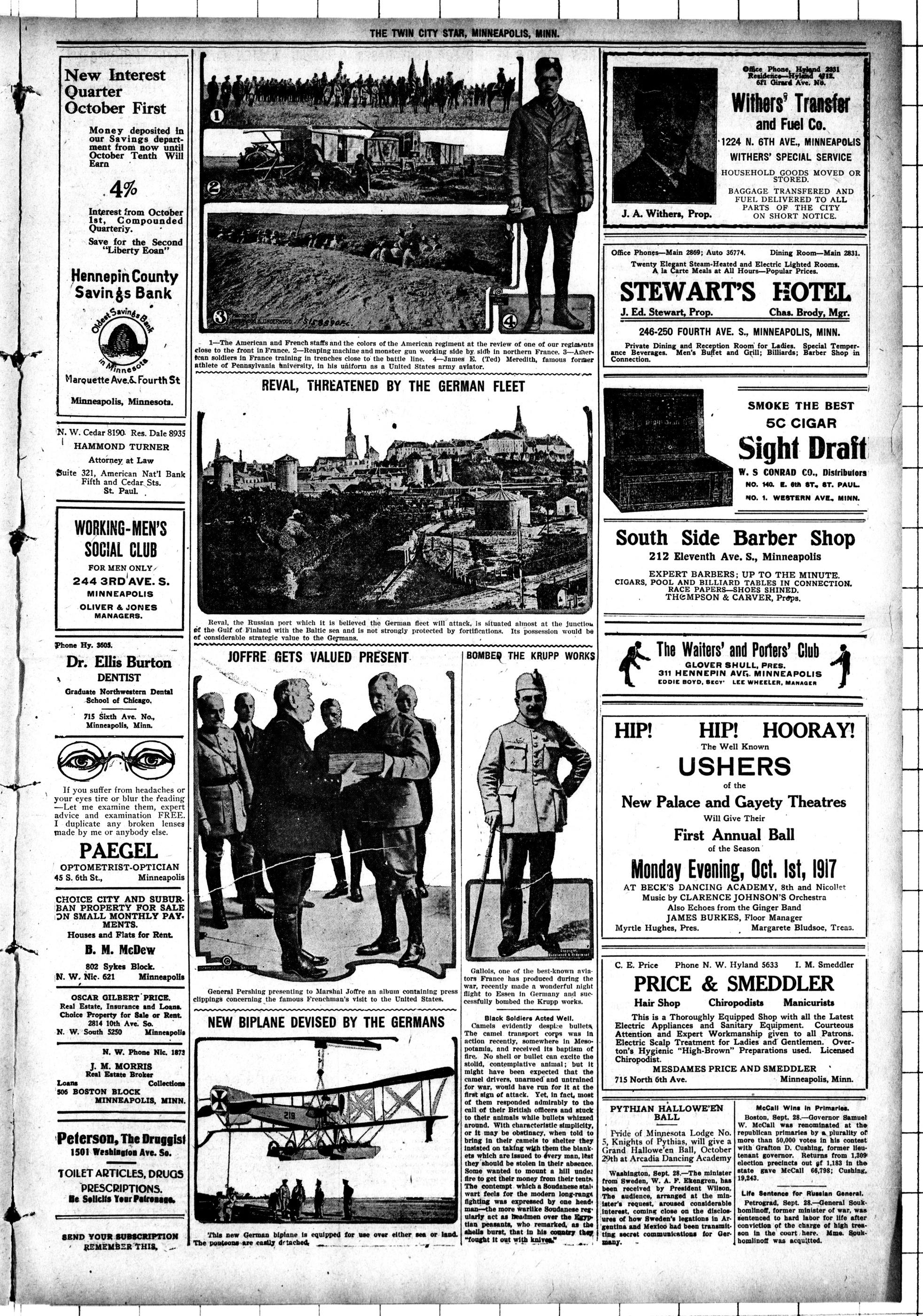
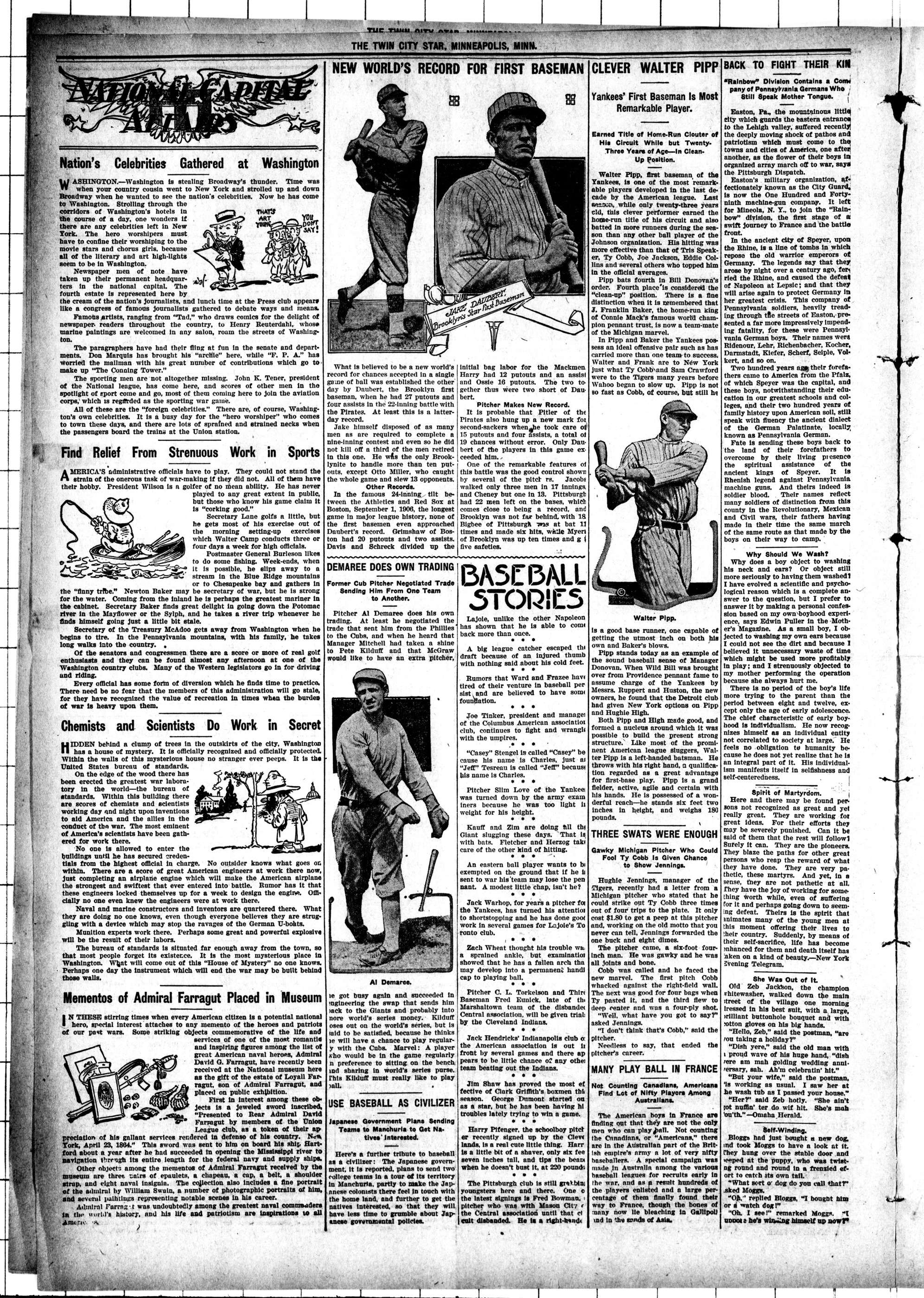
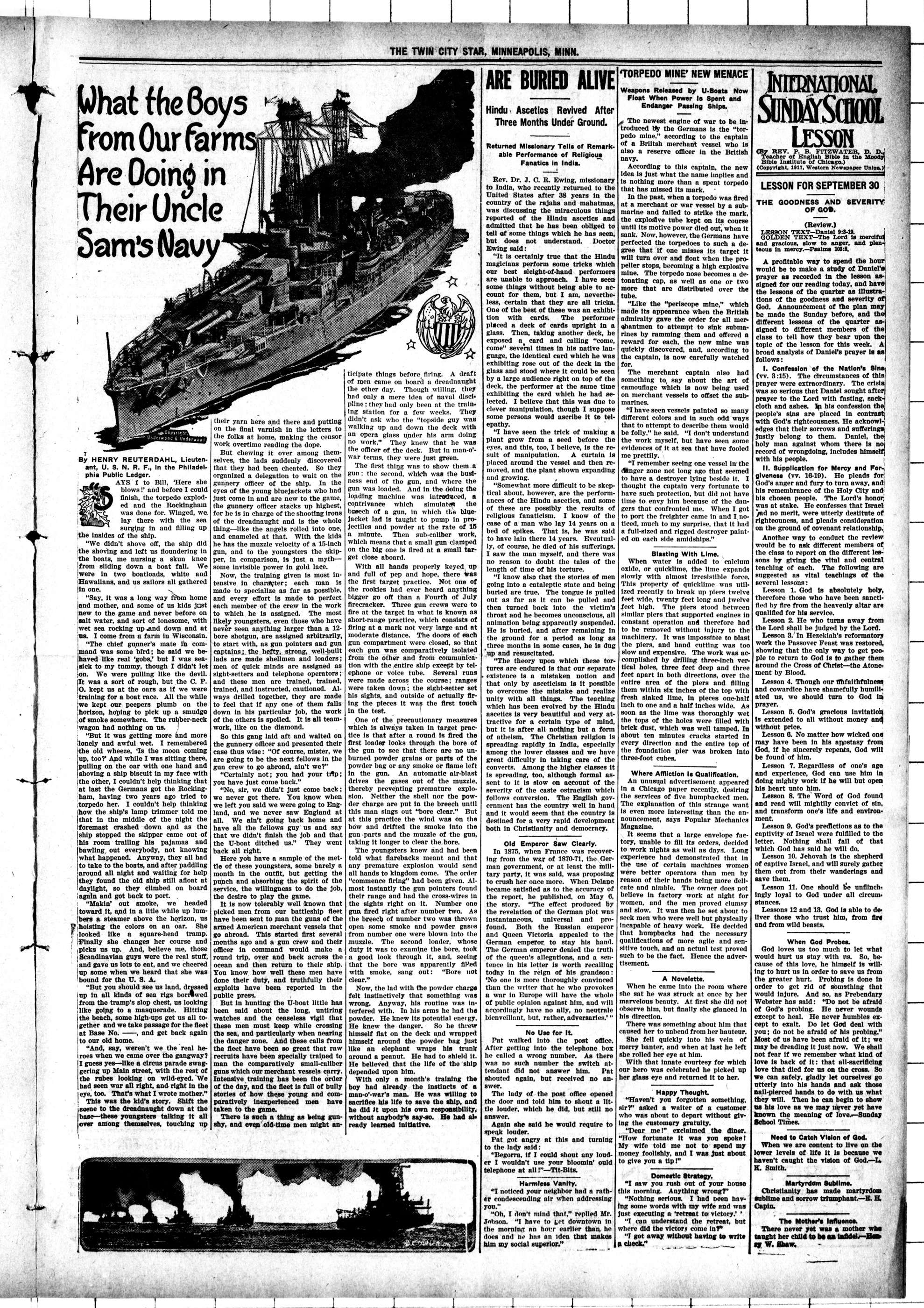
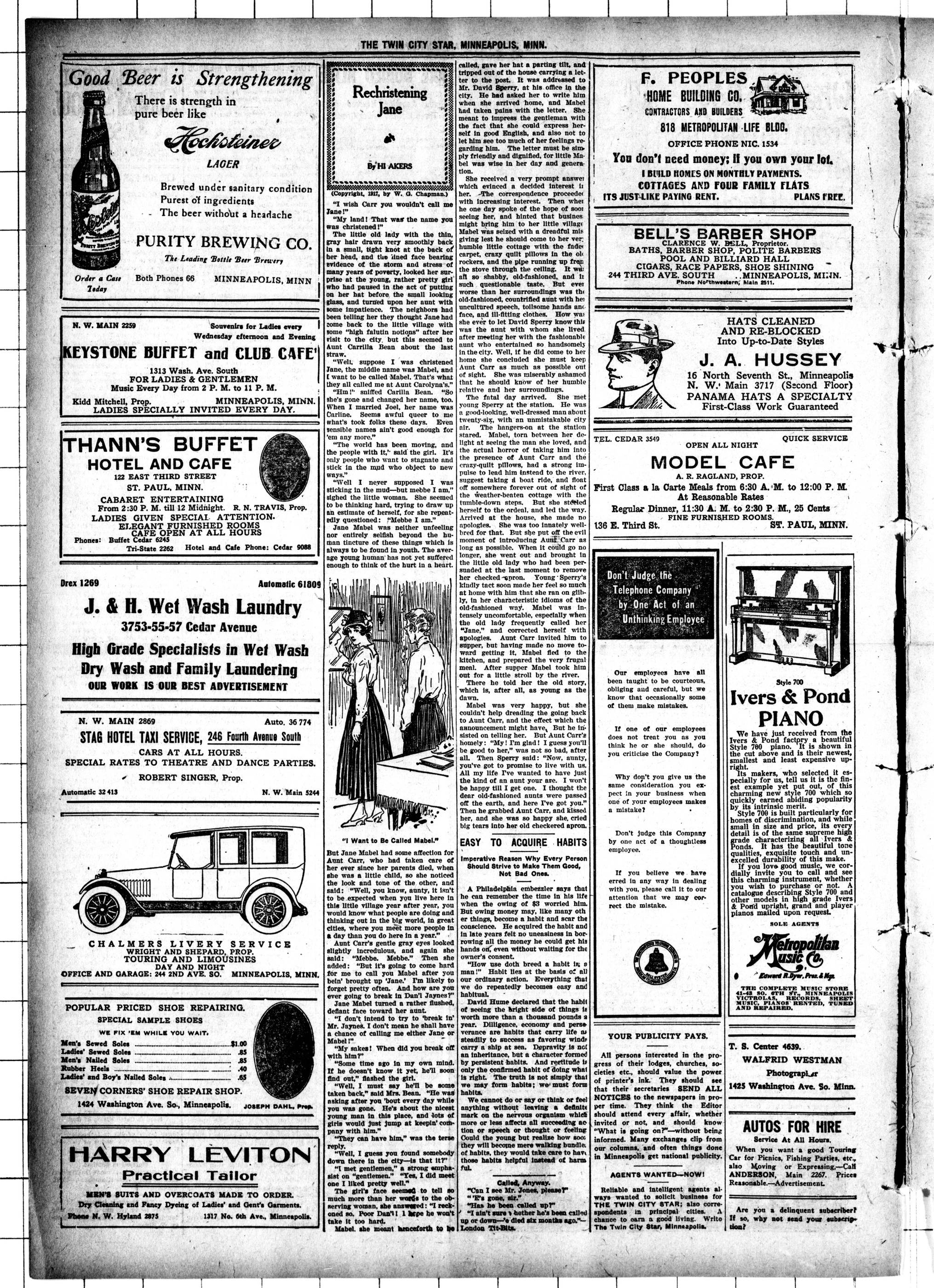
1—The American and French staffs and the colors of the American regiment at the review of one of our regiments close to the front in France. 2—Reaping machine and monster gun working side by side in northern France. 3—American soldiers in France training in trenches close to the battle line. 4—James E. (Ted) Meredith, famous former athlete of Pennsylvania university, in his uniform as a United States army aviator.
REVAL, THREATENED BY THE GERMAN FLEET
...
Reval, the Russian port which it is believed the German fleet will attack, is situated almost at the junction of the Gulf of Finland with the Baltic sea and is not strongly protected by fortifications. Its possession would be of considerable strategic value to the Germans.
JOFFRE GETS VALUED PRESENT BOMBED THE KRUPP WORKS
Copyright
Dodsworth & Sanderson
INTERNATIONAL FILM SERVICE
Gallois, one of the best-known aviators France has produced during the war, recently made a wonderful night flight to Essen in Germany and successfully bombed the Krupp works.
General Pershing presenting to Marshal Joffre an album containing press clippings concerning the famous Frenchman's visit to the United States.
Black Soldiers Acted Well.
NEW BIPLANE DEVISED BY THE GERMANS
Camels evidently despise bullets. The camel transport corps was in action recently, somewhere in Mesopotamia, and received its baptism of fire. No shell or bullet can excite the stolid, contemplative animal; but it might have been expected that the camel drivers, unarmed and untrained for war, would have run for it at the first sign of attack. Yet, in fact, most of them responded admirably to the call of their British officers and stuck to their animals while bullets whizzed around. With characteristic simplicity, or it may be obstinacy, when told to bring in their camels to shelter they insisted on taking with them the blankets which are issued to every man, less they should be stolen in their absence. Some wanted to mount a hill under fire to get their money from their tents. The contempt which a Soudanese stalwart feels for the modern long-range fighting was expressed by one headman—the more warlike Soudanese regularly act as headmen over the Egyptian peasants, who remarked, as the shells burst, that in his country they "fought it out with knives."
218
M.
J. A. Withers, Prop.
Office Phones—Main 2869; Auto 36
Twenty Elegant Steam-Heater
A la Carte Meals at All
STEWART
J. Ed. Stewart, Prop.
246-250 FOURTH AVE.
Private Dining and Reception
ance Beverages. Men's Buffet and
Connection.
—Main 2869; Auto 36774. Dining Room—
By Elegant Steam-Heated and Electric Lighted Ro-
m A la Carte Meals at All Hours—Popular Prices.
EWART'S HOTEL
Stewart, Prop. Chas. Brody
-250 FOURTH AVE. S., MINNEAPOLIS, M.
Dining and Reception Room for Ladies. Special
ges. Men's Buffet and Grill; Billiards; Barbe
Twenty Elegant Steam-Heated and Electric Lighted Rooms. A la Carte Meals at All Hours—Popular Prices.
246-250 FOURTH AVE. S., MINNEAPOLIS, MINN. Private Dining and Reception Room for Ladies. Special Temperance Beverages. Men's Buffet and Grill; Billiards; Barber Shop in Connection.
Bright Craft
South Side
212 Eleventh Ave
EXPERT BARBERS
CIGARS, POOL AND BILLIARDS
RACE PAPERS
THOMPSON &
Th Side Barber S.
112 Eleventh Ave. S., Minneapolis.
EXPERT BARBERS; UP TO THE MINU
POOL AND BILLIARD TABLES IN CONNE
RACE PAPERS—SHOES SHINED.
THOMPSON & CARVER, Prøps.
South Side Barber Shop
212 Eleventh Ave. S., Minneapolis
EXPERT BARBERS; UP TO THE MINUTE.
CIGARS, POOL AND BILLIARD TABLES IN CONNECTION.
RACE PAPERS—SHOES SHINED.
THC MPSON & CARVER, Preps.
The Waiters' and Porters' Club GLOVER SHULL, PRES. 311 HENNEPIN AVG. MINNEAPOLIS EDDIE BOYD, BECY LEE WHEELER, MANAGER
HIP! HIP!
The Week
USH!
of
New Palace and
Will Gill
First An
of the
Monday Evening
AT BECK'S DANCING A
Music by CLARENCE
Also Echoes from
JAMES BURKE
Myrtle Hughes, Pres.
C. E. Price Phone N. W. H.
PRICE & S
Hair Shop Chiropodist
This is a Thoroughly Equ
Electric Appliances and San
Attention and Expert Work
Electric Scalp Treatment for
ton's Hygienic "High-Brown"
Chiropodist.
MESDAMES PRICE
715 North 6th Ave.
HIP! HOOR!
The Well Known
USHERS
of the
Palace and Gayety Theatre
Will Give Their
First Annual Ball
of the Season
Sunday Evening, Oct. 1st, 1919
BICK'S DANCING ACADEMY, 8th and Ninth
Music by CLARENCE JOHNSON'S Orchestra
Also Echoes from the Ginger Band
JAMES BURKES, Floor Manager
Hughes, Pres. Margarete Bludsoe
Phone N. W. Hyland 5633 I. M. S.
PRICE & SMEDDLER
Shop Chiropodists Manicurists
is a Thoroughly Equipped Shop with all the Appliances and Sanitary Equipment. Co-
dent and Expert Workmanship given to all scalp Treatment for Ladies and Gentlemen.
Bienic "High-Brown" Preparations used. Not
MESDAMES PRICE AND SMEDDLER
6th Ave. Minneapolis
AT BECK'S DANCING ACADEMY, 8th and Nicollet Music by CLARENCE JOHNSON'S Orchestra Also Echoes from the Ginger Band JAMES BURKES, Floor Manager Myrtle Hughes, Pres. Margarete Bludsoe, Treaa.
Hair Shop Chiropodists Manicurists This is a Thoroughly Equipped Shop with all the Latest Electric Appliances and Sanitary Equipment. Courteous Attention and Expert Workmanship given to all Patrons. Electric Scalp Treatment for Ladies and Gentlemen. Overton's Hygienic "High-Brown" Preparations used. Licensed Chiropodist. MESDAMES PRICE AND SMEDDLER 715 North 6th Ave. Minneapolis, Minn.
PYTHIAN HALLOWE'EN
BALL
Pride of Minnesota Lodge No. 5, Knights of Pythias, will give a Grand Hallowe'en Ball, October 29th at Arcadia Dancing Academy
Washington, Sept. 28.—The minister from Sweden, W. A. F. Ekengren, has been received by President Wilson. The audience, arranged at the minister's request, aroused considerable interest, coming close on the disclosures of how Sweden's legations in Argentina and Mexico had been transmitting secret communications for Germany.
---
A
Office Phone, Hyland 2261
Residence—Hyland 491K.
611 Girard Ave. No.
Withers' Transfer
and Fuel Co.
1224 N. 6TH AVE., MINNEAPOLIS
WITHERS' SPECIAL SERVICE
HOUSEHOLD GOODS MOVED OR
STORED.
BAGGAGE TRANSFERED AND
FUEL DELIVERED TO ALL
PARTS OF THE CITY
ON SHORT NOTICE.
to 36774. Dining Room—Main 2831.
Heated and Electric Lighted Rooms.
At All Hours—Popular Prices.
R T'S HOTEL
Chas. Brody, Mgr.
AVE. S., MINNEAPOLIS, MINN.
ation Room' for Ladies. Special Temper-
t and Grill; Billiards; Barber Shop in
SMOKE THE BEST
5C CIGAR
Sight Draft
W. S CONRAD CO., Distributors
NO. 140. E. 6th ST., ST. PAUL.
NO. 1. WESTERN AVE., MINN.
The Barber Shop
Ave. S., Minneapolis
BERS; UP TO THE MINUTE.
BIRD TABLES IN CONNECTION.
BERS—SHOES SHINED.
M & CARVER, Prøps.
HIP! HOORAY!
Well Known
HERS
of the
and Gayety Theatres
I Give Their
Annual Ball
the Season
Spring, Oct. 1st, 1917
G ACADEMY, 8th and Nicollet
CE JOHNSON'S Orchestra
from the Ginger Band
BKES, Floor Manager
Margarete Bludsoe, Treas.
W. Hyland 5633 I. M. Smeddler
SMEDDLER
Hiropodists Manicurists
Equipped Shop with all the Latest
Sanitary Equipment. Courteous
orkmanship given to all Patrons.
for Ladies and Gentlemen. Over-
wn" Preparations used. Licensed
RICE AND SMEDDLER
Minneapolis, Minn.
McCall Wins In Primaries.
Boston, Sept. 28.—Governor Samuel W. McCall was renominated at the republican primaries by a plurality of more than 50,000 votes in his contest with Grafton D. Cushing, former lieutenant governor. Returns from 1,309 election precincts out of 1,183 in the state gave McCall 66,798; Cushing, 19,243.
Life Sentence for Russian General.
Petrograd, Sept. 28.—General Soukhomlinoff, former minister of war, was sentenced to hard labor for life after conviction of the charge of high treason in the court here. Mme. Soukhomlinoff was acquitted.
---
A
NATIONAL CAPITAL ACTIVES
Nation's Celebrities Gathered at Washington
WASHINGTON—Washington is stealing Broadway's thunder. Time was when your country cousin went to New York and strolled up and down Broadway when he wanted to see the nation's celebrities. Now he has come to Washington. Strolling through the
the cream of the nation's journalists, and lunch time at the Press club appears like a congress of famous journalists gathered to debate ways and means.
Famous artists, ranging from "Tad," who draws comics for the delight of newspaper readers throughout the country, to Henry Reuterdahl, whose marine paintings are welcomed in any salon, roam the streets of Washington.
The paragraphers have had their filing at fun in the senate and departments. Don Marquis has brought his "arcelle" here, while "F. P. A." has worried the mailman with his great number of contributions which go to make up "The Conning Tower."
The sporting men are not altogether missing. John K. Tener, president of the National league, has come here, and scores of other men in the spotlight of sport come and go, most of them coming here to join the aviation corps, which is regarded as the sporting war game.
All of these are the "foreign celebrities." There are, of course, Washington's own celebrities. It is a busy day for the "hero worshiper" who comes to town these days, and there are lots of sprained and strained necks when the passengers board the trains at the Union station.
Find Relief From Strenuous Work in Sports
AMERICA'S administrative officials have to play. They could not stand the strain of the onerous task of war-making if they did not. All of them have their hobby. President Wilson is a golfer of no mean ability. He has never
the "funny tribe." Newton Baker may be secretary of war, but he is strong for the water. Coming from the inland he is perhaps the greatest mariner in the cabinet. Secretary Baker finds great delight in going down the Potomac river in the Mayflower or the Sylph, and he takes a river trip whenever he finds himself going just a little bit stale.
Secretary of the Treasury McAdoo gets away from Washington when he begins to tire. In the Pennsylvania mountains, with his family, he takes long walks into the country.
Of the senators and congressmen there are a score or more of real golf enthusiasts and they can be found almost any afternoon at one of the Washington country clubs. Many of the Western legislators go in for driving and riding.
Every official has some form of diversion which he finds time to practice. There need be no fear that the members of this administration will go stale, for they have recognized the value of recreation in times when the burdens of war is heavy upon them.
Chemists and Scientists Do Work in Secret
HIDDEN behind a clump of trees in the outskirts of the city, Washington has a house of mystery. It is officially recognized and officially protected. Within the walls of this mysterious house no stranger ever peeps. It is the Written, stated, bureau of standards.
tials from the highest official in charge. No outsider knows what goes on within. There are a score of great American engineers at work there now, just completing an airplane engine which will make the American airplane the strongest and swiftest that ever entered into battle. Rumor has it that these engineers locked themselves up for a week to design the engine. Officially no one even knew the engineers were at work there.
Naval and marine constructors and inventors are quartered there. What they are doing no one knows, even though everyone believes they are struggling with a device which may stop the ravages of the German U-boats.
Munition experts work there. Perhaps some great and powerful explosive will be the result of their labors.
The bureau of standards is situated far enough away from the town, so that most people forget its existence. It is the most mysterious place in Washington. What will come out of this "House of Mystery" no one knows. Perhaps one day the instrument which will end the war may be built behind those walls.
Mementos of Admiral Farragut Placed in Museum
N THESE stirring times when every American citizen is a potential national hero, special interest attaches to any memento of the heroes and patriots of our past wars. Some striking objects commemorative of the life and
preciation of his gallant services rendered in defense of his country. New York, April 23, 1864." This sword was sent to him on board his ship, Hartford about a year after he had succeeded in opening the Mississippi river to navigation through its entire length for the federal navy and supply ships. Other objects among the mementos of Admiral Farragut received by the museum are three pairs of epaulets, a chapeau, a cap, a belt, a shoulder strap, and eight naval insignia. The collection also includes a fine portrait of the admiral by William Swain, a number of photographic portraits of him, and several paintings representing notable scenes in his career.
Admiral Farragut was undoubtedly among the greatest naval commanders in the world's history, and his life and patriotism are inspirations to all Americans.
to Washington. Strolling through the corridors of Washington's hotels in the course of a day, one wonders if there are any celebrities left in New York. The hero worshipers must have to confine their worshiping to the movie stars and chorus girls, because all of the literary and art high-lights seem to be in Washington. Newspaper men of note have taken up their permanent headquarters in the national capital. The fourth estate is represented here by
the cream of the nation's journalists, and like a congress of famous journalists.
Famous artists, ranging from "Tad newspaper readers throughout the marine paintings are welcomed in any ton.
The paragraphers have had their ments. Don Marquis has brought his worried the mailman with his great make up "The Conning Tower."
The sporting men are not allotgen of the National league, has come he spotlight of sport come and go, most of corps, which is regarded as the sportin.
All of these are the "foreign celebr ton's own celebrities. It is a busy day to town these days, and there are lots the passengers board the trains at the
Find Relief From Street
AMERICA'S administrative officials h strain of the onerous task of war-mar their hobby. President Wilson is a go
FISHING
the "finny tribe." Newton Baker may for the water. Coming from the inland the cabinet. Secretary Baker finds gre river in the Mayflower or the Syph, a finds himself going just a little bit st. Secretary of the Treasury McAdoo begins to tread. In the Pennsylvania long walks into the country. Of the senators and congressmen enthusiasts and they can be found Washington country clubs. Many of the and riding. Every official has some form of dive There need be no fear that the member for they have recognized the value of of war is heavy upon them.
Chemists and Scientists
HIDDEN behind a clump of trees in has a house of mystery. It is office Within the walls of this mysterious h United States bureau of standards.
On the edge of the wood there has been erected the greatest war laboratory in the world—the bureau of standards. Within this building there are scores of chemists and scientists working day and night upon inventions to aid America and the allies in the conduct of the war. The most eminent of America's scientists have been gathered for work there.
No one is allowed to enter the buildings until he has secured creden-
tials from the highest official in chan
within. There are a score of great A
just completing an airplane engine w
the strongest and swiftest that ever e
these engineers locked themselves up
cially no one even knew the engineers
Naval and marine constructors an
they are doing no one knows, even th
gling with a device which may stop th
Munition experts work there. Perl
will be the result of their labors.
The bureau of standards is situate
that most people forget its existence
Washington. What will come out of o
Perhaps one day the instrument which
those walls.
Mementos of Admiral Fa
IN THESE stirring times when every
hero, special interest attaches to a
of our past wars. Some striking ob
TREASURES
preciation of his gallant services ren-
York, April 23, 1864." This sword was
ford about a year after he had succeed
navigation through its entire length i
Other objects among the memento
museum are three cairs of epaulets,
strap, and eight naval insignia. The
of the admiral by William Swain, a nu-
and several paintings representing not
Admiral Farringt was undoubtedly
in the world's history, and his life
America.
THAT'S ART YOUNG
YOU DON'T SAY!
and lunch time at the Press club appears gathered to debate ways and means," who draws comics for the delight of country, to Henry Reuterdahl, whose salon, roam the streets of Washing-fling at fun in the senate and depart- "arctic" here, while "F. P. A." has number of contributions which go to her missing. John K. Tener, president here, and scores of other men in the them coming here to join the aviation war game. "itties." There are, of course, Washing-ly for the "hero worshper" who comes of sprained and strained necks when Union station.
Nuous Work in Sports
have to play. They could not stand the taking if they did not. All of them have lifer of no mean ability. He has never
played to any great extent in public, but those who know his game claim it is "corking good." Secretary Lane golfs a little, but he gets most of his exercise out of the morning setting-up exercises which Walter Camp conducts three or four days a week for high officials. Postmaster General Burleson likes to do some fishing. Week-ends, when it is possible, he slips away to a stream in the Blue Ridge mountains or to Chesapeake bay and gathers in
be secretary of war, but he is strong
he is perhaps the greatest mariner in
eat delight in going down the Potomac
and he takes a river trip whenever he
eats. He gets away from Washington when he
mountains, with his family, he takes
there are a score or more of real golf
almost any afternoon at one of the
the Western legislators go in for driving
version which he finds time to practice,
ers of this administration will go stale,
recreation in times when the burden
Is Do Work in Secret
in the outskirts of the city, Washington
finally recognized and officially protected,
house no stranger ever peeps. It is the
A man in a hat is holding a branch of a tree. In the background, there is a building with a large dome.
age. No outsider knows what goes on American engineers at work there now, which will make the American airplane entered into battle. Rumor has it that for a week to design the engine, Off-road inventors are quartered there. What though everyone believes they are strugge ravages of the German U-boats, maps some great and powerful explosive far enough away from the town, so. It is the most mysterious place in this "House of Mystery" no one knows. a will end the war may be built behind
Harragut Placed in Museum
American citizen is a potential national enemy memento of the heroes and patriots projects commemorative of the life and
services of one of the most romantic and inspiring figures among the list of great American naval heroes, Admiral David G. Farragut, have recently been received at the National museum here as the gift of the estate of Loyall Farragut, son of Admiral Farragut, and placed on public exhibition.
First in interest among these objects is a jewelled sword inscribed, "Presented to Rear Admiral David Farragut by members of the Union League club, as a token of their ap
ordered in defense of his country. Now he sent to him on board his ship, Harted in opening the Mississippi river to for the federal navy and supply ships. Nos of Admiral Farragut received by the a chapeau, a cap, a belt, a shoulder collection also includes a fine portrait number of photographic portraits of him, table scenes in his career. By among the greatest naval commaders and patriotism are inspirations to all
THE TWIN CITY STAR, MINNEAPOLIS, MINN.
NEW WORLD'S RECORD FOR FIRST BASEMAN
JAKE DAUDERT.
Brooklyn's Star First Baseman
What is believed to be a new world's record for chances accepted in a single game of ball was established the other day by Duubert, the Brooklyn first baseman, when he had 27 putouts and four assists in the 22-inning battle with the Pirates. At least this is a latter-day record. Jake himself disposed of as many men as are required to complete a nine-inning contest and even so he did not kill off a third of the men retired in this one. He was the only Brooklynite to handle more than ten putouts, except Otto Miller, who caught the whole game and slew 13 opponents.
In the famous 24-inning tilt between the Athletics and Red Sox at Boston, September 1, 1906, the longest game in major league history, none of the first basemen even approached Daubert's record. Grimshaw of Boston had 20 putouts and two assists, Davies and Schreck divided up the
DEMAREE DOES OWN TRADING
Former Cub Pitcher Negotiated Trade Sending Him From One Team to Another.
Pitcher Al Demaree does his own trading. At least he negotiated the trade that sent him from the Phillies to the Cubs, and when he heard that Manager Mitchell had taken a shine to Pete Kilduff and that McGraw would like to have an extra pitcher,
BENCHMAN
Al Demaree.
he got busy again and succeeded in engineering the swap that sends him back to the Glants and probably into more world's series money. Kilduffoses out on the world's series, but is said to be satisfied, because he thinks he will have a chance to play regularly with the Cubs. Marvel: A player who would be in the game regularly in preference to sitting on the bench and sharing in world's series purse. This Kilduff must really like to play ball.
USE BASEBALL AS CIVILIZER
Japanese Government Plans Sending Teams to Manchuria to Get Natives' Interested.
Here's a further tribute to baseball as a civilizer: The Japanese government, it is reported, plans to send two college teams in a tour of its territory in Manchuria, partly to make the Japanese colonists there feel in touch with the home land, and further to get the natives interested, so that they will have less time to grumble about Japanese governmental policies.
initial bag labor for the Mackenm
Harry had 12 putouts and an assist
and Ossie 16 putouts. The two to
together thus were two short of Daubert.
Pitcher Makes New Record.
It is probable that Pitler of the
Pirates also hung up a new mark for
second-sackers when he took care of
15 putouts and four assists, a total of
19 chances without error. Only Daubert of the players in this game exceeded him.
One of the remarkable features of this battle was the good control shown by several of the pitch vs. Jacobs walked only three men in 17 innings, and Cheney but one in 13. Pittsburgh had 22 men left on the bases, which comes close to being a record, and Brooklyn was not far behind, with 18 Bigbee of Pittsburgh was at bat 11 times and made six hits, while Myert of Brooklyn was up ten times and g five safeties.
BASEBALL STORIES
Lajole, unlike the other Napoleon,
has shown that he is able to come
back more than once.
* * * *
A big league catcher escaped the
draft because of an injured thumb
with nothing said about his cold feet.
* * * *
Rumors that Ward and Frazee have
tired of their venture in baseball
persist and are believed to have some
foundation.
* * * *
Joe Tinker, president and manager
of the Columbus American association
club, continues to fight and wrangle
with the umpires.
* * * *
"Casey" Stengel is called "Casey" be
because his name is Charles, just as
"Jeff" Tesreau is called "Jeff" because
his name is Charles.
Pitcher Slim Love of the Yankees was turned down by the army examiners because he was too light in weight for his height.
* * * *
Kauff and Zim are doing all the Giant slugging these days. That is with bats. Fletcher and Herzog take care of the other kind of hitting.
* * * *
An eastern ball player wants to be exempted on the ground that if he is sent to war his team may lose the penant. A modest little chap, isn't he?
* * * *
Jack Warhop, for years a pitcher for the Yankees, has turned his attention to shortstopping and he has done good work in several games for Lajole's Toronto club.
***
Zach Wheat thought his trouble was a sprained ankle, but examination showed that he has a fallen arch that may develop into a permanent handle cap to playing ball.
* * *
Pitcher C. L. Torkelson and Third Baseman Fred Eunick, late of the Marshaltown team of the disbanded Central association, will be given trials by the Cleveland Indians.
* * *
Jack Hendricks' Indianapolis club of the American association is out in front by several games and there apears to be little chance of any other team beating out the Indians.
---
Jim Shaw has proved the most effective of Clark Griffith's boxmen this season. George Dumont started out as a star, but he has been having his troubles lately trying to win a game.
Harry Pifenger, the schoolboy pitch or recently signed up by the Cleve lands, is a real cute little thing. Harry is a little bit of a shaver, only six feet seven inches tall, and tips the beams when he doesn't bust it, at 220 pounds.
The Pittsburgh club is still grabbing youngsters here and there. One of the latest signings is Fred Bowman, pitcher who was with Mason City of the Central association until that circuit disbanded. He is a right-handed.
CLEVER WALTER PIPP
Yankees' First Baseman Is Most Remarkable Player.
Earned Title of Home-Run Clouter of His Circuit While but Twenty-Three Years of Age-In Clean-Up Position.
Walter Pipp, first baseman, of the Yankees, is one of the most remarkable players developed in the last decade by the American league. Last season, while only twenty-three years old, this clever performer earned the home-run title of his circuit and also batted in more runners during the season than any other ball player of the Johnson organization. His hitting was more effective than that of Tris Speaker, Ty Cobb, Joe Jackson, Eddie Collins and several others who topped him in the official averages.
Pipp bats fourth in Bill Donovan's order. Fourth place is considered the "clean-up" position. There is a fine distinction when it is remembered that J. Franklin Baker, the home-run king of Connie Mack's famous world champion pennant trust, is now a team-mate of the Michigan marvel. In Pipp and Baker the Yankees possess an ideal offensive pair such as has carried more than one team to success. Walter and Frank are to New York just what Ty Cobb and Sam Crawford were to the Tigers many years before Wahoo began to slow up. Pipp is not so fast as Cobb, of course, but still he
International
Jim Searle
Walter Pipp. is a good base runner, one capable of getting the utmost inch on both his own and Baker's blows. Pipp stands today as an example of the sound baseball sense of Manager Donovan. When Wild Bill was brought over from Providence pennant fame to assume charge of the Yankees by Messrs. Ruppert and Huston, the new owners, he found that the Detroit club had given New York options on Pipp and Hughle High.
Both Pipp and High made good, and formed a nucleus around which it was possible to build the present strong structure. Like most of the prominent American league sluggers, Walter Pipp is a left-handed batsman. He throws with his right hand, a qualification regarded as a great advantage for first-base play. Pipp is a grand fielder, active, agile and certain with his hands. He is possessed of a wonderful reach—he stands six feet two inches in height, and weighs 180 pounds.
THREE SWATS WERE ENOUGH
Gawky Michigan Pitcher Who Could Fool Ty Cobb Is Given Chance to Show Jennings.
Hughle Jennings, manager of the Tigers, recently had a letter from a Michigan pitcher who stated that he could strike out Ty Cobb three times out of four trips to the plate. It only cost $1.80 to get a peep at this pitcher and, working on the old motto that you never can tell, Jennings forwarded the one buck and eight dimes.
The pitcher came, a six-foot four-inch man. He was gawky and he was all joints and bone.
Cobb was called and he faced the new marvel. The first pitch Cobb whacked against the right-field wall. The next was good for four bags when Ty pasted it, and the third flew to deep center and was a four-ply shot.
"Well, what have you got to say?" acted Jennings.
"I don't think that's Cobb," said the pitcher. Needless to say, that ended the pitcher's career.
MANY PLAY BALL IN FRANCE
Not Counting Canadians, Americans Find Lot of Nifty Playora Among Australians.
The American boys in France are finding out that they are not the only men who can play ball. Not counting the Cunadians, or "Americans," there are in the Austrian part of the British empire's army a lot of very nifty baseballers. A special campaign was made in Australia among the various baseball leagues for recruits early in the war, and as a result hundreds of the players enlisted and a large percentage of them finally found their way to France, though the bones of many now lie bleaching in Gallipoll and in the gonds of Asia.
"Rainbow" Division Contains a Company of Pennsylvania Germans Who Still Speak Mother Tongue.
Easton, Pa., the mountainous little city which guards the eastern entrance to the Lehigh valley, suffered recently the deeply moving shock of pathos and patriotism which must come to the towns and cities of America, one after another, as the flower of their boys in organized array march off to war, says the Pittsburgh Dispatch.
Easton's military organization, affectionately known as the City Guard, is now the One Hundred and Forty-ninth machine-gun company. It left for Mineola, N. Y., to join the "Rainbow" division, the first stage of a swift journey to France and the battle front.
In the ancient city of Speyer, upon the Rhine, is a line of tombs in which repose the old warrior emperors of Germany. The legends say that they arose by night over a century ago, fared the Rhine, and caused the defeat of Napoleon at Lepsic; and that they will arise again to protect Germany in her greatest crisis. This company of Pennsylvania soldiers, heavily treading through the streets of Easton, presented a far more impressively impending fatality, for these were Pennsylvania German boys. Their names were Ridenour, Lehr, Richenbacher, Kocher, Darmstadt, Klefer, Scherf, Seiple, Volkert, and so on.
Two hundred years ago their forefathers came to America from the Pfalz, of which Speyer was the capital, and these boys, notwithstanding their education in our greatest schools and colleges, and their two hundred years of family history upon American soil, still speak with fluency the ancient dialect of the German Palatinate, locally known as Pennsylvania German. Fate is sending these boys back to the land of their forefathers to overcome by their living presence the spiritual assistance of the ancient kings of Speyer. It is Rhenish legend against Pennsylvania machine guns. And their indeed is soldier blood. Their names reflect many soldiers of distinction from this county in the Revolutionary, Mexican and Civil wars, their fathers having made in their time the same march of the same route as that made by the boys on their way to camp.
Why Should We Wash?
Why does a boy object to washing his neck and ears? Or object still more seriously to having them washed? I have evolved a scientific and psychological reason which is a complete answer to the question, but I prefer to answer it by making a personal confession based on my own boyhood experience, says Edwin Puller in the Mother's Magazine. As a small boy, I objected to washing my own ears because I could not see the dirt and because I believed it unnecessary waste of time which might be used more profitably in play; and I strenuously objected to my mother performing the operation because she always hurt me.
There is no period of the boy's life more trying to the parent than the period between eight and twelve, except only the age of early adolescence. The chief characteristic of early boyhood is individualism. He now recognizes himself as an individual entity not correlated to society at large. He feels no obligation to humanity because he does not yet realize that he is an integral part of it. His individualism manifests itself in selfishness and self-centeredness.
Spirit of Martyrdom
Here and there may be found persons not recognized as great and yet really great. They are working for great ideas. For their efforts they may be severely punished. Can it be said of them that the rest will follow? Surely it can. They are the ploneers. They blaze the paths for other great persons who reap the reward of what they have done. They are very pathetic, these martyrs. And yet, in a sense, they are not pathetic at all. They have the Joy of working for something worth while, even of suffering for it and perhaps going down to seeming defeat. Theirs is the spirit that animates many of the young men at this moment offering their lives to their country. Suddenly, by means of their self-sacrifice, life has become enhanced for them and death itself has taken on a kind of beauty.—New York Evening Telegram.
She Was Out of It.
Old Zeb Jackson, the champion whitewasher, walked down the main street of the village one morning dressed in his best suit, with a large, brilliant buttonhole bouquet and with cotton gloves on his big hands.
"Hello, Zeb," said the postman, "are you taking a holiday?"
"Dish yere," said the old man with a proud wave of his huge hand, "dish ere am mah gold wedding anniversary, sah. Ah'm celebratin' hit."
"But your wife," said the postman, "is working as usual. I saw her at the wash tub as I passed your house."
"Her?" said Zeb hotly. "She ain't not nuffin' to der wif hit. She's mah 'noth-" "Omaha Herald.
Self-Winding
Bloggs had just bought a new dog, and took Moggs to have a look at it. They hung over the stable door and kept at the puppy, who was twisting round and round in a frenzied effort to catch its own tail.
"What sort o' dog do you call that?" sked Moggs.
"Oh," replied Bloggs, "I bought him or a watch dog!"
"Oh. I see!" remarked Moggs. "I uncover he'i winning himself up now!"
What the Boys From Our Farms Are Doing in Their Uncle Sam's Navy
ticipate things before firing. A draft of men came on board a dreadnaught the other day. Though willing, they had only a mere idea of naval discipline; they had only been at the training station for a few weeks. They didn't ask who the "topside guy was
B. C. M.
By HENRY REUTERDAHL, Lieutenant, U. S. N. R. F., in the Philadelphia Public Ledger.
AYS I to Bill, 'Here she blows!' and before I could finish, the torpedo exploded and the Rockingham was done for. Winged, we lay there with the sea surging in and filling up the insides of the ship.
AYS I to Bill, "Here she blows!" and before I could finish, the torpedo exploded and the Rockingham was done for. Winged, we lay there with the sea surging in and filling up the insides of the ship.
"We didn't shove off, the ship did the shoving and left us floundering in the boats, me nursing a skun knee from sliding down a boat fall. We were in two boatloads, white and Hawaiians, and us sailors all gathered in one.
"Say, it was a long way from home and mother, and some of us kids just new to the game and never before on salt water, and sort of lonesome, with wet sea rocking up and down and at us. I come from a farm in Wisconsin. 'The chief gunner's mate in command was some brd; he said we behaved like real 'gobs', but I was seasick to my tummy, though I didn't let on. We were pulling like the devil. It was a sort of rough, but the C. P. O. kept us at the oars as if we were training for a boat race. All the while we kept our peepers plumb on the horizon, hoping to pick up a smudge of smoke somewhere. The rubber-neck wagon had nothing on us.
"But it was getting more and more lonely and awful wet. I remembered the old wheeze, 'Is the moon coming, up, too?' And while I was sitting there, pulling on the ear with one hand and shoving a ship biscuit in my face with the other, I couldn't help thinking that at last the Germans got the Rockingham, having two years ago tried to torpedo her. I couldn't help thinking how the ship's lamp trimmer told me that in the middle of the night the foremast crashed down and as the ship stopped the skipped came out of his room trailing his pajamas and bawling out everybody, not knowing what happened. Anyway, they all had to take to the boats, and after paddling around all night and waiting for help they found the old ship still afloat at daylight, so they climbed on board again and got back to port.
"Makin' out smoke, we headed toward it, and in a little while up lumbers a steamer above the horizon, us hoisting the colors on an oar. She looked like a square-head tramp. Finally she changes her course and picks us up. And, believe me, those Scandinavian guys were the real stuff, and gave us lots to eat, and we cheered up some when we heard that she was bound for the U. S. A.
"But you should see us land, dressed up in all kinds of sea rigs borrowed from the tramp's slop chest, us looking like going to a masquerade. Hitting the beach, some high-ups get us all together and we take passage for the fleet at Base No. —, and get back again to our old home.
"And, say, weren't we the real heroes when we came over the gangway? I guess yes—like a circus parade swaggering up Main street, with the rest of the rubes looking on wild-eyed. We had seen war all right, and right in the eye, too. That's what I wrote mother." This was the kid's story. Shift the scene to the dreadnaught down at the base—these youngsters talking it all over among themselves, touching up
their yarn here and there and putting on the final varnish in the letters to the folks at home, making the censor work overtime reading the dope.
But chewing it over among themselves, the lads suddenly discovered that they had been cheated. So they organized a delegation to wait on the gunnery officer of the ship. In the eyes of the young bluejackets who had just come in and are new to the game, the gunnery officer stacks up highest, for he is in charge of the shooting irons of the dreadnaught and is the whole thing—like the angels rolled into one, and enameled at that. With the kids he has the muzzle velocity of a 15-inch gun, and to the youngsters the skipper, in comparison, is just a myth—some invisible power in gold lace.
Now, the training given is most intensive in character; each man is made to specialize as far as possible, and every effort is made to perfect each member of the crew in the work to which he is assigned. The most likely youngsters, even those who have never seen anything larger than a 12-bore shotgun, are assigned arbitrarily, to start with, as gun pointers and gun captains; the hefty, strong, well-built lads are made shellmen and loaders; men of quick minds are assigned as sight-setters and telephone operators; and these men are trained, trained, trained, and instructed, cautioned. Always drilled together, they are made to feel that if any one of them falls down in his particular job, the work of the others is spoiled. It is all teamwork, like on the diamond.
So this gang laid aft and waited on the gunnery officer and presented their case thus wise: "Of course, mister, we are going to be the next fellows in the gun crew to go abroad, aln't we?" "Certainly not; you had your trip; you have just come back."
"No, sir, we didn't just come back; we never got there. You know when we left you said we were going to England, and we never saw England at all. We ain't going back home and have all the fellows guy us and say that we didn't finish the job and that the U-boat ditched us." They went back all right.
Here you have a sample of the mettle of these youngsters, some barely a month in the outfit, but getting the punch and absorbing the spirit of the service, the willingness to do the job, the desire to play the game.
It is now tolerably well known that picked men from our battleship fleet have been sent to man the guns of the armed American merchant vessels that go abroad. This started first several months ago and a gun crew and their officer in command would make a round trip, over and back across the ocean and then return to their ship. You know how well these men have done their duty, and truthfully their exploits have been reported in the public press.
But in hunting the U-boat little has been said about the long, untiring watches and the ceaseless vigil that these men must keep while crossing the sea, and particularly when nearing the danger zone. And these calls from the fleet have been so great that raw recruits have been specially trained to man the comparatively small-caliber guns which our merchant vessels carry. Intensive training has been the order of the day, and the fleet is full of bully stories of how these young and comparatively inexperienced men have taken to the game. There is such a thing as being gunshy, and even old-time men might an-
THE TWIN CITY STAR, MINNEAPOLIS, MINN.
tickpate things before firing. A draft of men came on board a dreadnaught the other day. Though willing, they had only a mere idea of naval discipline; they had only been at the training station for a few weeks. They didn't ask who the "topside guy was walking up and down the deck with an opera glass under his arm doing no work." They knew that he was the officer of the deck. But in man-o-war terms, they were just green.
The first thing was to show them a gun; the second, which was the business end of the gun, and where the gun was loaded. And in the doing the loading machine was introduced, a contrivance which simulates the breech of a gun, in which the blue-jacket lad is taught to pump in projectiles and powder at the rate of 15 a minute. Then sub-caliber work, which means that a small gun clamped on the big one is fired at a small target close aboard.
With all hands properly keyed up and full of pep and hope, there was the first target practice. Not one of the rookies had ever heard anything bigger go off than a Fourth of July firecracker. Three gun crews were to fire at the target in what is known as short-range practice, which consists of firing at a mark not very large and at moderate distance. The doors of each gun compartment were closed, so that each gun was comparatively isolated from the other and from communication with the entire ship except by telephone or voice tube. Several runs were made across the course; ranges were taken down; the sight-setter set his sights, and outside of actually firing the pieces it was the first touch in the test.
One of the precautionary measures which is always taken in target practice is that after a round is fired the first loader looks through the bore of the gun to see that there are no unburned powder grains or parts of the powder bag or any smoke or flame left in the gun. An automatic air-blast drives the gases out of the muzzle, thereby preventing premature explosion. Nether the shell nor the powder charge are put in the breech until this man sings out "bore clear." But at this practice the wind was on the bow and drifted the smoke into the gun parts and the muzzle of the gun, taking it longer to clear the bore.
The youngsters knew and had been told what flarebacks meant and that any premature explosion would send all hands to klingdom come. The order "commence firing" had been given. Almost instantly the gun pointers found their range and had the cross-wires in the sights right on it. Number one gun fired right after number two. As the breech of number two was thrown open some smoke and powder gases from number one were blown into the muzzle. The second loader, whose duty it was to examine the bore, took a good look through it, and, seeing that the bore was apparently fipped with smoke, sang out: "Bore not clear."
Now, the lad with the powder charge felt instinctively that something was wrong. Anyway, his routine was interfered with. In his arms he had the powder. He knew its potential energy. He knew the danger. So he threw himself flat on the deck and wrapped himself around the powder bag just like an elephant wraps his trunk around a peanut. He had to shield it. He believed that the life of the ship depended upon him. With only a month's training the boy had already the instincts of a man-o-war's man. He was willing to sacrifice his life to save the ship, and he did it upon his own responsibility, without anybody's say-so. He had already learned initiative.
Hindu Ascetics Revived After Three Months Under Ground.
Returned Missionary Tells of Remarkable Performance of Religious Fanatics in India.
Rev. Dr. J. C. R. Ewing, missionary to India, who recently returned to the United States after 38 years in the country of the rajahs and mahatmas, was discussing the miraculous things reported of the Hindu ascetics and admitted that he has been obliged to tell of some things which he has seen, but does not understand. Doctor Ewing said:
"It is certainly true that the Hindu magicians perform some tricks which our best sleight-of-hand performers are unable to approach. I have seen some things without being able to account for them, but I am, nevertheless, certain that they are all tricks. One of the best of these was an exhibition with cards. The performer placed a deck of cards upright in a glass. Then, taking another deck, he exposed a card and calling "come, come" several times in his native language, the identical card which he was exhibiting rose out of the deck in the glass and stood where it could be seen by a large audience right on top of the deck, the performer at the same time exhibiting the card which he had selected. I believe that this was due to clever manipulation, though I suppose some persons would ascribe it to telepathy.
"I have seen the trick of making a plant grow from a seed before the eyes, and this, too, I believe, is the result of manipulation. A curtain is placed around the vessel and then removed, and the plant shown expanding and growing.
"Somewhat more difficult to be skeptical about, however, are the performances of the Hindu ascetics, and some of these are possibly the results of religious fanaticism. I know of the case of a man who lay 14 years on a bed of spikes. That is, he was said to have lain there 14 years. Eventually, of course, he died of his sufferings. I saw the man myself, and there was no reason to doubt the tales of the length of time of his torture.
"I know also that the stories of men going into a catalytic state and being buried are true. The tongue is pulled out as far as it can be pulled and then turned back into the victim's throat and he becomes unconscious, all animation being apparently suspended. He is buried, and after remaining in the ground for a period as long as three months in some cases, he is dug up and resuscitated.
"The theory upon which these tortures are endured is that our separate existence is a mistaken notion and that only by asceticism is it possible to overcome the mistake and realize unity with all things. The teaching which has been evolved by the Hindu ascetics is very beautiful and very attractive for a certain type of mind, but it is after all nothing but a form of atheism. The Christian religion is spreading rapidly in India, especially among the lower classes and we have great difficulty in taking care of the converts. Among the higher classes it is spreading, too, although formal assent to it is slow on account of the severity of the caste ostracism which follows conversion. The English government has the country well in hand and it would seem that the country is destined for a very rapid development both in Christianity and democracy.
Old Emperor Saw Clearly.
In 1875, when France was recovering from the war of 1870-71, the German government, or at least the military party, it was said, was proposing to crush her once more. When Delane became satisfied as to the accuracy of the report, he published, on May 6, the story. "The effect produced by the revelation of the German plot was instantaneous, universal and profound. Both the Russian emperor and Queen Victoria appealed to the German emperor, to stay his hand. The German emperor denied the truth of the queen's allegations, and a sentence in his letter is worth recalling today in the reign of his grandson: 'No one is more thoroughly convinced than the writer that he who provokes a war in Europe will have the whole of public opinion against him, and will accordingly have no ally, no neutralize bienveillant, but, rather, adversaries.'"
No Use for It.
Pat walked into the post office. After getting into the telephone box he called a wrong number. As there was no such number the switch attendant did not answer him. Pat shouted again, but received no answer.
The lady of the post office opened the door and told him to shout a little louder, which he did, but still no answer.
Again she said he would require to speak louder.
Pat got angry at this and turning to the lady said: "Begorra, if I could shout any louder I wouldn't use your bloomin' ould telephone at all!" -Tit-Bits.
Harmless Vanity.
"I noticed your neighbor had a rather condescending air when addressing you."
"Oh, I don't mind that," replied Mr. Jobson. "I have to get downtown in the morning an hour earlier than he does and he has an idea that makes him my social superior."
'TORPEDO MINE' NEW MENACE
Weapons Released by U-Boats Now Float When Power Is Spent and Endanger Passing Ships.
The newest engine of war to be introduced by the Germans is the "torpedo mine," according to the captain of a British merchant vessel who is also a reserve officer in the British navy.
According to this captain, the new idea is just what the name implies and is nothing more than a spent torpedo that has missed its mark.
In the past, when a torpedo was fired at a merchant or war vessel by a submarine and failed to strike the mark, the explosive tube kept on its course until its motive power died out, when it sank. Now, however, the Germans have perfected the torpedoes to such a degree that if one misses its target it will turn over and float when the propeller stops, becoming a high explosive mine. The torpedo nose becomes a detonating cap, as well as one or two more that are distributed over the tube.
"Like the 'periscope mine,' which made its appearance when the British admiralty gave the order for all merchantmen to attempt to sink submarines by ramming them and offered a reward for each, the new mine was quickly discovered, and, according to the captain, is now carefully watched for.
The merchant captain also had something to say about the art of camouflage which is now being used on merchant vessels to offset the submarines.
"I have seen vessels painted so many different colors and in such odd ways that to attempt to describe them would be folly," he said. "I don't understand the work myself, but have seen some evidences of it at sea that have fooled me prettily.
"I remember seeing one vessel in the danger zone not long ago that seemed to have a destroyer lying beside it. I thought the captain very fortunate to have such protection, but did not have time to envy him because of the dangers that confronted me. When I got to port the freighter came in and I noticed, much to my surprise, that it had a full-sized and rigged destroyer painted on each side amidships."
Blasting With Lime.
When water is added to calcium oxide, or quicklime, the lime expands slowly with almost irresistible force. This property of quicklime was utilized recently to break up pliers twelve feet wide, twenty feet long and twelve feet high. The pliers stood between similar pliers that supported engines in constant operation and therefore had to be removed without injury to the machinery. It was impossible to blast the pliers, and hand cutting was too slow and expensive. The work was accomplished by drilling three-inch vertical holes, three feet deep and three feet apart in both directions, over the entire area of the pliers and filling them within six inches of the top with fresh slaked lime, in pieces one-half inch to one and a half inches wide. As soon as the lime was thoroughly wet the tops of the holes were filled with brick dust, which was well tamped. In about ten minutes cracks started in every direction and the entire top of the foundation pier was broken into three-foot cubes.
Where Affliction Is Qualification
An unusual advertisement appeared in a Chicago paper recently, desiring the services of five humpback men. The explanation of this strange want is even more interesting than the announcement, says Popular Mechanics Magazine.
It seems that a large envelope factory, unable to fill its orders, decided to work nights as well as days. Long experience had demonstrated that in the use of certain machines women were better operators than men by reason of their hands being more delicate and nimble. The owner does not believe in factory work at night for women, and the men proved clumsy and slow. It was then he set about to seek men who were well but physically incapable of heavy work. He decided that humpbacks had the necessary qualifications of more agile and sensitive touch, and an actual test proved such to be the fact. Hence the advertisement.
A Novelette.
When he came into the room where she sat he was struck at once by her marvelous beauty. At first she did not observe him, but finally she glanced in his direction.
There was something about him that caused her to unbend from her hauteur.
She fell quickly into his vein of merry banter, and when at last he left she rolled her eye at him.
With that innate courtesy for which her hero was celebrated he picked up her glass eye and returned it to her.
Happy Thought
"Haven't you forgotten something, sir?" asked a waiter of a customer who was about to depart without giving the customary gratuity.
"Dear me!" exclaimed the diner.
"How fortunate it was you spoke! My wife told me not to spend my money foolishly, and I was just about to give you a tip!"
Domestic Strategy.
"I saw you rush out of your house this morning. Anything wrong?"
I saw you run out of your house this morning. Anything wrong?"
"Nothing serious. I had been having some words with my wife and was just executing a 'retreat to victory.'"
"I can understand the retreat, but where did the victors come in?"
"I got away without having to write a cluck."
(By REV. P. B. FITZWATER, D. D. Teacher of English in the Moody Bible Institute of Chicago.)
(Copyright, 1817, Western Newspaper Union.)
LESSON FOR SEPTEMBER 30
THE GOODNESS AND SEVERITY OF GOD.
(Review.)
LESSON TEXT—Daniel 9:1-19.
GOLDEN TEXT—The Lord is merciful and gracious, slow to anger, and plenteous in mercy.—Psalms 108:8.
A profitable way to spend the hour would be to make a study of Daniel's prayer as recorded in the lesson assigned for our reading today, and have the lessons of the quarter as illustrations of the goodness and severity of God. Announcement of the plan may be made the Sunday before, and the different lessons of the quarter assigned to different members of the class to tell how they bear upon the topic of the lesson for this week. A broad analysis of Daniel's prayer is as follows:
I. Confession of the Nation's Sins (vv. 3:15). The circumstances of this prayer were extraordinary. The crisis was so serious that Daniel sought after prayer to the Lord with fasting, sack-cloth and ashes. In his confession the people's sins are placed in contrast with God's righteousness. He acknowledges that their sorrows and sufferings justly belong to them. Daniel, the holy man against whom there is no record of wrongdoing, includes himself with his people.
II. Supplication for Mercy and Forgiveness (vv. 16:19). He pleads for God's anger and fury to turn away, and his remembrance of the Holy City and his chosen people. The Lord's honor was at stake. He confesses that Israel and no merit, were utterly destitute of righteousness, and pleads consideration on the ground of covenant relationship.
Another way to conduct the review would be to ask different members of the class to report on the different lessons by giving the vital and central teaching of each. The following are suggested as vital teachings of the several lessons:
Lesson 1. God is absolutely holy, therefore those who have been sanctified by fire from the heavenly altar are qualified for his service.
Lesson 2. He who turns away from the Lord shall be judged by the Lord.
Lesson 3. In Hezekiah's reformatory work the Passover Feast was restored, showing that the only way to get people to return to God is to gather them around the Cross of Christ—the Atonement by Blood.
Lesson 4. Though our unfaithfulness and cowardice have shamefully humiliated us, we should turn to God in prayer.
Lesson 5. God's gracious invitation is extended to all without money and without price.
Lesson 6. No matter how wicked one may have been in his apostasy from God, if he sincerely repents, God will be found of him.
Lesson 7. Regardless of one's age and experience, God can use him in doing mighty work if he will but open his heart unto him.
Lesson 8. The Word of God found and read will mightly convict of sin, and transform one's life and environment.
Lesson 9. God's predictions as to the captivity of Israel were fulfilled to the letter. Nothing shall fall of that which God has said he will do.
Lesson 10. Jehovah is the shepherd of captive Israel, and will surely gather them out from their wanderings and save them.
Lesson 11. One should be unflinchingly loyal to God under all circumstances.
Lessons 12 and 13. God is able to deliver those who trust him, from fire and from wild beasts.
When God Probes
God loves us too much to let what would hurt us stay with us. So, because of this love, he himself is willing to hurt us in order to save us from the greater hurt. Probing is done in order to get rid of something that would injure. And so, as Prebendary Webster has said: "Do not be afraid of God's probing. He never wounds except to heal. He never humbles except to exalt. Do let God deal with you; do not be afraid of his probing." Most of us have been afraid of it; we may be dreading it just now. We shall not fear if we remember what kind of love is back of it: that all-sacrificing love that died for us on the cross. So we can safely, gladly let ourselves go utterly into his hands and ask those nail-pierced hands to do with us what they will. Then he can begin to show us his love as we may never yet have known the meaning of love.—Sunday School Times.
Need to Catch Vision of God.
When we are content to live on the lower levels of life it is because we haven't caught the vision of God.—L. K. Smith.
Martyrdom Sublime.
Christianity has made martyrdom sublime and sorrow triumphant.—E. H. Capin.
The Mother's Influence.
There never yet was a mother who taught her child to be an infidel.—Henry W. Shaw.
THANN'S BUFFET
High Grade Specialists in Wet Wash Dry Wash and Family Laundering OUR WORK IS OUR BEST ADVERTISEMENT
N. W. MAIN 2869 Auto. 36774 STAG HOTEL TAXI SERVICE, 246 Fourth Avenue South CARS AT ALL HOURS. SPECIAL RATES TO THEATRE AND DANCE PARTIES. ROBERT SINGER, Prop.
CHALMERS LIVERY SERVICE
WRIGHT AND SHEPARD, PROP.
TOURING AND LIMOUSINES
DAY AND NIGHT
OFFICE AND GARAGE: 244 2ND AVE. SO. MINNEAPOLIS, MINN.
MEN'S SUITS AND OVERCOATS MADE TO ORDER.
Dry Cleaning and Fancy Dyeing of Ladies' and Gent's Garments.
Phone N. W. Hyland 2875 1317 No. 6th Ave., Minneapolis.
Good
Bacotein
PURETY BREWING CO.
WEST BROOK, NY
N. W. MAIN
KEYSTONE
Mud
Kidd Mitchel
LADIE
THANK YOU
HOTEL
120
CABA
From
LADIE
I
Phones: Buff
Drex 1269
J. &
High Gr
Dry W
OUR W
N. W. MA
STAG HOT
SPECIAL RA
Automatic 32 413
Kochsteiner
Brewed under sanitary condition Purest of ingredients The beer without a headache
The Leading Bottle Beer Brewery
Phones 66 MINNEAPOLIS, MINN
Souvenirs for Ladies every Wednesday afternoon and Evening
UFFET and CLUB CAFE
13 Wash. Ave. South
ADIES & GENTLEMEN
Day from 2 P. M. to 11 P. M.
MINNEAPOLIS, MINN.
NALLY INVITED EVERY DAY.
S BUFFET
AND CAFE
THIRD STREET
SUL, MINN.
INTERTAINING
R. till 12 Midnight. R. N. TRAVIS, Prop.
N SPECIAL ATTENTION.
AT FURNISHED ROOMS
OPEN AT ALL HOURS
5245
2262 Hotel and Cafe Phone: Cedar 9088
Automatic 61809
Wet Wash Laundry
25-57 Cedar Avenue
Specialists in Wet Wash
and Family Laundering
OUR BEST ADVERTISEMENT
Auto. 36 774
SERVICE, 246 Fourth Avenue South
S AT ALL HOURS.
THEATRE AND DANCE PARTIES.
ERT SINGER, Prop.
N. W. Main 5244
S LIVERY SERVICE
T AND SHEPARD, PROP.
NG AND LIMOUSINES
DAY AND NIGHT
444 2ND AVE. SO. MINNEAPOLIS, MINN.
```markdown
```
LEVITON
ctical Tailor
OVERCOATS MADE TO ORDER.
Dyeing of Ladies' and Gent's Garments.
1317 No. 6th Ave., Minneapolis.
Rechristening Jane
By HI AKERS
called, gave her hat a part, tripped out of the house cater to the post. It was a Mr. David Sperry, at his city. He had asked her to when she arrived home, had taken pains with the meant to impress the geni the fact that she could e self in good English, and let him see too much of her garding him. The letter m ply friendly and dignified, f bel was wise in her day tion.
She received a very pro
"I wish Carr you wouldn't call me Jane!"
"My land! That was the name you was christened!"
The little old lady with the thin, gray hair drawn very smoothly back in a small, tight knot at the back of her head, and the ined face bearing evidence of the storm and stress of many years of poverty, looked her surprise at the young, rather pretty girl who had paused in the act of putting on her hat before the small looking glass, and turned upon her aunt with some impatience. The neighbors had been telling her they thought Jane had come back to the little village with some "high falutin notions" after her visit to the city, but this seemed to Aunt Carrilla Bean about the last straw.
"Well, suppose I was christened Jane, the middle name was Mabel, and I want to be called Mabel. That's what they all called me at Aunt Carolyna's." "Hm!" sniffed Carilla Bean. "So she's gone and changed her name, too. When I married Joel, her name was Carline. Seems awful queer to me what's took folks these days. Even sensible names ain't good enough for 'em any more." "The world has been moving, and the people with it," said the girl. It's only people who want to stagnate and stick in the mud who object to new ways." "Well I never supposed I was sticking in the mud—but mebbe I am," sighed the little woman. She seemed to be thinking hard, trying to draw up an estimate of herself, for she repeatedly questioned: "Mebbe I am."
Jane Mabel was neither unfeeling nor entirely selfish beyond the human tincture of these things which is always to be found in youth. The average young human has not yet suffered enough to think of the hurt in a heart.
A woman in a hat and skirt stands in front of a mirror, looking at herself. A man in a shirt and skirt stands behind her, looking at the mirror.
"I Want to Be Called Mabel."
But Jane Mabel had some affection for Aunt Carr, who had taken care of her ever since her parents died, when she was a little child, so she noticed the look and tone of the other, and said: "Well, you know, aunty, it isn't to be expected when you live here in this little village year after year, you would know what people are doing and thinking out in the big world, in great cities, where you meet more people in a day than you do here in a year."
Aunt Carr's gentle gray eyes looked slightly incredulous, and again she said: "Mebbe. Mebbe." Then she added: "But it's going to come hard for me to call you Mabel after you bein' brought up 'Jane.' I'm likely to forget pretty often. And how are you ever going to break in Dan' Jaynes?"
"I don't intend to try to 'break in' Mr. Jaynes. I don't mean he shall have a chance of calling me either Jane or Mabel!"
"My sakes! When did you break off with him?"
"Some time ago in my own mind. If he doesn't know it yet, he'll soon find out," fanned the girl.
"Well, I must say he'll be some taken back," said Mrs. Bean. "He was asking after you 'bout every day while you was gone. He's about the nicest young man in this place, and lots of girls would just jump at keepin' company with him."
"They can have him," was the terse reply.
"Well, I guess you found somebody down there in the city—is that it?"
"I met gentlemen," a strong emphasis on "gentlemen." "Yes, I did meet one I liked pretty well."
The girl's face seemed to tell so much more than her words to the observing woman, she answered: "I reckoned so. Poor Don't I hope he won't take it too hard.
Mabel. she meant henceforth to be
called, gave her hat a parting tilt, and tripped out of the house carrying a letter to the post. It was addressed to Mr. David Sperry, at his office in the city. He had asked her to write him when she arrived home, and Mabel had taken pains with the letter. She meant to impress the gentleman with the fact that she could express herself in good English, and also not to let him see too much of her feelings regarding him. The letter must be simply friendly and dignified, for little Mabel was wise in her day and generation.
She received a very prompt answer which evinced a decided interest in her. The correspondence proceeded with increasing interest. Then when he one day spoke of the hope of soo seeing her, and hinted that business might bring him to her little village Mabel was seized with a dreadful misgiving lest he should to her very humble little cottage with the fader carpet, crazy quilt pillows in the old rockers, and the pipe running up from the stove through the ceiling. It was all so shabby, old-fashioned, and it such questionable taste. But ever worse than her surroundings was the old-fashioned, countrified aunt with her uncultured speech, tollsome hands and face, and ill-fitting clothes. How was she ever to let David Sperry know this was the aunt with whom she lived, after meeting her with the fashionable aunt who entertained so handsomely in the city. Well, if he did come to her home she concluded she must keep Aunt Carr as much as possible out of sight. She was miserably ashamed that he should know of her humble relative and her surroundings.
The fatal day arrived. She met young Sperry at the station. He was a good-looking, well-dressed man about twenty-six, with an unmistakable city air. The hangers-on at the station stared. Mabel, torn between her delight at seeing the man she loved, and the actual horror of taking him into the presence of Aunt Carr and the crazy-quilt pillows, had a strong impulse to lead him instead to the river, suggest taking a boat ride, and float off somewhere forever out of sight of the weather-beaten cottage with the tumble-down steps. But she steered herself to the ordeal, and led the way. Arrived at the house, she made no apologies. She was too innately well-bred for that. But she put off the evil moment of introducing Aunt Carr as long as possible. When it could go no longer, she went out and brought in the little old lady who had been persuaded at the last moment to remove her checked apron. Young 'Sperry's kindly tact soon made her feel so much at home with him that she ran on gibly, in her characteristic idioms of the old-fashioned way. Mabel was intensely uncomfortable, especially when the old lady frequently called her "Jane," and corrected herself with apologies. Aunt Carr invited him to supper, but having made no move toward getting it, Mabel fled to the kitchen, and prepared the very frugal meal. After supper Mabel took him out for a little stroll by the river.
There he told her the old story, which is, after all, as young as the dawn.
Mabel was very happy, but she couldn't help dreading the going back to Aunt Carr, and the effect which the announcement might have. But he insisted on telling her. But Aunt Carr's homely: "My! I'm glad! I guess you'll be good to her," was not so bad, after all. Then Sperry said: "Now, aunty, you've got to promise to live with us. All my life I've wanted to have just the kind of an aunt your are. I won't be happy till I get one. I thought the dear old-fashioned aunts were passed off the earth, and here I've got you." Then he grabbed Aunt Carr, and kissed her, and she was so happy she, cried big tears into her old checkered apron.
EASY TO ACQUIRE HABITS
Imperative Reason Why Every Person Should Strive to Make Them Good, Not Bad Ones.
A Philadelphia embezzler says that he can remember the time in his life when the owing of $3 worried him. But owing money may, like many other things, become a habit and scar the conscience. He acquired the habit and in late years felt no uneasiness in borrowing all the money he could get his hands on, even without waiting for the owner's consent.
"How use doth breed a habit in a man!" Habit lies at the basis of all our ordinary action. Everything that we do repeatedly becomes easy and habitual.
David Hume declared that the habit of seeing the bright side of things is worth more than a thousand pounds a year. Dilligence, economy and perseverance are habits that carry life as steadily to success as favoring winds carry a ship at sea. Deprivation is not an inheritance, but a character formed by persistent habits. And reticitude is only the confirmed habit of doing what is right. The truth is not simply that we may form habits; we must form habits.
We cannot do or say or think or feel anything without leaving a definite mark on the nervous organism which more or less affects all succeeding action or speech or thought or feeling. Could the young but realize how soon they will become more walking bundle of habits, they would take care to have those habits helpful instead of harmful.
"Has he been called up?
"I aln't sure \ hether he's been called up or down—"e died six months ago."—London Tit-Bits.
You don't need money; if you own your lot.
I BUILD HOMES ON MONTHLY PAYMENTS.
COTTAGES AND FOUR FAMILY FLATS
ITS JUST-LIKE PAYING RENT. PLANS FREE
BELL'S BARBER SHOP
CLARENCE W. BELL, Proprietor.
BATHS, BARBER SHOP, POLITE BARBERS
POOL AND BILLIARD HALL
CIGARS, RACE PAPERS, SHOE SHINING
244 THIRD AVE. SOUTH ..MINNEAPOLIS, MINN.
Phone Northwestern, Main 2511.
J. A. HUSSEY
16 North Seventh St., Minneapolis
N. W. Main 3717 (Second Floor)
PANAMA HATS A SPECIALTY
First-Class Work Guaranteed
MODEL CAFE
A. R. RAGLAND, PROP.
First Class a la Carte Meals from 6:30 A. M. to 12:00 P. M.
At Reasonable Rates
Regular Dinner, 11:30 A. M. to 2:30 P. M., 25 Cents
FINE FURNISHED ROOMS.
136 E. Third St.
ST. PAUL, MINN.
A
TEL. CEDAR 3549 OPEN AL
MODEL
A. R. RAGLA
First Class a la Carte Meals fr
At Reasons
Regular Dinner, 11:30 A.
FINE FURNISH
136 E. Third St.
Don't Judge the Telephone Company by One Act of an Unthinking Employee
Our employees have all been taught to be courteous, obliging and careful, but we know that occasionally some of them make mistakes.
If one of our employees does not treat you as you think he or she should, do you criticise the Company?
Why don't you give us the same consideration you expect in your business when one of your employees makes a mistake?
Don't judge this Company by one act of a thoughtless employee.
If you believe we have erred in any way in dealing with you, please call it to our attention that we may correct the mistake.
YOUR PUBLICITY PAYS.
All persons interested in the progress of their lodges, churches, societies etc., should value the power of printer's ink. They should see that their secretaries SEND ALL NOTICES to the newspapers in proper time. They think the Editor should attend every affair, whether invited or not, and should know "What is going on?"—without being informed. Many exchanges clip from our columns, and often things done in Minneapolis get national publicity.
AGENTS WANTED—NOW!
Reliable and intelligent agents always wanted to solicit business for THE TWIN CITY STAR; also correspondents in principal cities. A chance to earn a good living. Write The Twin City Star, Minneapolis.
HATS CLEANED AND RE-BLOCKED Into Up-to-Date Styles
A. HUSSEY
North Seventh St., Minneapolis
Main 3717 (Second Floor)
IMA HATS A SPECIALTY
Inst-Class Work Guaranteed
QUICK SERVICE
LL CAFE
LAND, PROP.
from 6:30 A. M. to 12:00 P. M.
enable Rates
M. to 2:30 P. M., 25 Cents
SHED ROOMS.
ST. PAUL, MINN.
Style 700
Ivers & Pond
PIANO
We have just received from the Ivers & Pond factory a beautiful Style 700 piano. It is shown in the cut above and is their newest, smallest and least expensive upright.
Its makers, who selected it especially for us, tell us it is the finest example yet put out, of this charming new style 700 which so quickly earned abiding popularity by its intrinsic merit.
Style 700 is built particularly for homes of discrimination, and while small in size and price, its every detail is of the same supreme high grade characterizing all Ivers & Ponds. It has the beautiful tone qualities, exquisite touch and unexcelled durability of this make. If you love good music, we cordially invite you to call and see this charming instrument, whether you wish to purchase or not. A catalogue describing Style 700 and other models in high grade Ivers & Pond upright, grand and player pianos mailed upon request.
SOLE AGENTS
Metropolitan Music Co.
Edward R. Dyer, Pres. & Mgr.
THE COMPLETE MUSIC STORE
41-43 SO. 6TH 'ST', MINNEAPOLIS
MUSIC, FIANOS' RENTED, TUNED
AND REPAIRED.
T. S. Center 4639.
WALFRID WESTMAN
Photographer
1425 Washington Ave. So. Minn.
AUTOS FOR HIRE
When you want a good Touring Car for Picnics, Fishing Parties, etc., also Moving or Expressing.—Call ANDERSON, Main 2267. Prices Reasonable.—Advertisement.
Are you a delinquent subscriber?
If so, why not send your subscription?