Twin City Star
Saturday, October 13, 1917
Minneapolis, Minnesota
Page text (machine-generated)
VOL. 7.
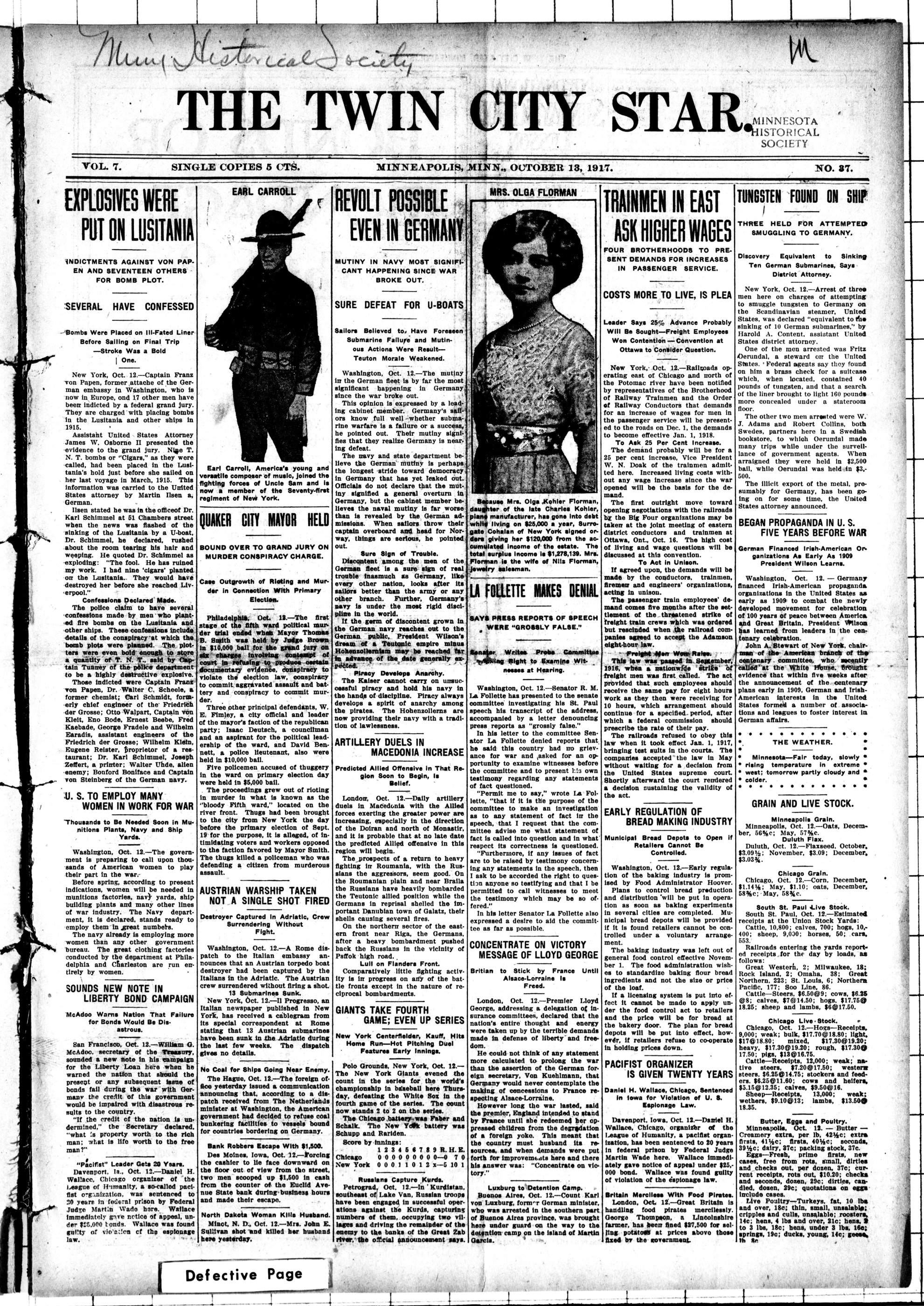
EXPLOSIVES WERE PUT ON LUSITANIA
INDICTMENTS AGAINST VON PAP EN AND SEVENTEEN OTHERS FOR BOMB PLOT.
Bombs Were Placed on Ill-Fated Liner Before Sailing on Final Trip —Stroke Was a Bold One.
New York, Oct. 12.—Captain Franz von Papen, former attache of the German embassy in Washington, who is now in Europe, and 17 other men have been indicted by a federal grand jury. They are charged with placing bombs in the Lusitania and other ships in 1915.
Assistaht United States Attorney James W. Osborne II presented the evidence to the grand jury. Nine T. N. T. bombs or "Cigars," as they were called, had been placed in the Lusitania's hold just before she sailed on her last voyage in March, 1915. This information was carried to the United States attorney by Martin Ilsen a, German.
Ilsen stated he was in the office of Dr. Karl Schimmel at 51 Chambers street when the news was flashed of the sinking of the Lusitania by a U-boat. Dr. Schimmel, he declared, rushed about the room tearing his hair and weeping. He quoted Dr. Schimmel as exploding: "The fool. He has ruined my work. I had nine 'cigars' planted on the Lusitania. They would have destroyed her before she reached Liverpool."
Confessions Declared Made.
The police claim to have several confessions made by men who planted fire bombs on the Lusitania and other ships. These confessions include details of the conspiracy at which the bomb plots were planned. The plotters were even bold enough to store a quantity of T. N. T., said by Captain Tunney of the police department to be a highly destructive explosive. Those indicted were Captain Franz von Papen, Dr. Walter C. Scheele, a former chemist; Carl Schmidt, former chief engineer of the Friedrich der Grosse; Otto Walpart, Captain von Kleit, Eno Bode, Ernest Beebe, Fred Kaeabe, George Fradele and Wilhelm Earadis, assistant engineers of the Friedrich der Grosse; Wilhelm Klein, Eugene Reister, proprietor of a restaurant; Dr. Karl Schimmel, Joseph Zeffert, a printer; Walter Uhde, alien enemy; Bonford Boniface and Captain von Steinberg of the German navy.
U. S. TO EMPLOY MANY WOMEN IN WORK FOR WAR
Thousands to Be Needed Soon in Munitions Plants, Navy and Ship Yards.
Washington, Oct. 12.—The government is preparing to call upon thousands of American women to play their part in the war.
Before spring, according to present indications, women will be needed in munitions factories, navy yards, ship building plants and many other lines of war industry. The Navy department, it is declared, stands ready to employ them in great numbers.
The navy already is employing more women than any other government bureau. The great clothing factories conducted by the department at Philadelphia and Charleston are run entirely by women.
SOUNDS NEW NOTE IN
LIBERTY BOND CAMPAIGN
McAdoo Warns Nation That Failure for Bonds Would Be Disastrous.
San Francisco, Oct. 12.—William G. McAdoo, secretary of the Treasury, sounded a new note in his campaign for the Liberty Loan here when he warned the nation that should the present or any subsequent issue of bonds fall during the war with Germany the credit of this government would be impaired with disastrous results to the country.
"If the credit of the nation is undermined," the Secretary declared, "what is property worth to the rich man; what is life worth to the free man?"
"Pacifist" Leader Gets 20 Years.
Davenport, Ia., Oct. 12.—Daniel H. Wallace, Chicago organizer of the League of Humanity, a so-called pacifist organization, was sentenced to 20 years in federal prison by Federal Judge Martin Wade here. Wallace immediately gave notice of appeal, under $25,000 bonds. Wallace was found guilty of violation of the espionage law.
THE TWIN CITY STAR.
EARL CARROLL
Earl Carroll, America's young and versatile composer of music, joined the fighting forces of Uncle Sam and is now a member of the Seventy-first regiment of New York.
BOUND OVER TO GRAND JURY ON
MURDER CONSPIRACY CHARGE.
Case Outgrowth of Rioting and Murder in Connection With Primary Election.
Philadelphia, Oct. 12.—The first stage of the fifth ward political murder trial ended when Mayor Thomas B. Smith was held by Judge Brown in $10,000 ball for the grand jury on six charges involving contempt of court in refusing to produce certain documentary evidence, conspiracy to violate the election law, conspiracy to commit aggravated assault and battery and conspiracy to commit murder.
Three other principal defendants, W. E. Fimley, a city official and leader of the mayor's faction of the republican party; Isaac Deutsch, a councilman and an aspirant for the political leadership of the ward, and David Bennett, a police lieutenant, also were held in $10,000 ball.
Five policemen accused of thuggery in the ward on primary election day were held in $5,000 ball.
The proceedings grew out of rioting in murder in what is known as the "bloody Fifth ward," located on the river front. Thugs had been brought to the city from New York the day before the primary election of Sept. 19 for the purpose, it is alleged, of intimidating voters and workers opposed to the faction favored by Mayor Smith. The thugs killed a policeman who was defending a citizen from murderous assault.
AUSTRIAN WARSHIP TAKEN NOT A SINGLE SHOT FIRED
Destroyer Captured in Adriatic, Crew Surrendering Without Fight.
Washington, Oct. 12.—A Rome dispatch to the Italian embassy announces that an Austrian torpedo boat destroyer had been captured by the Italians in the Adriatic. The Austrian crew surrendered without firing a shot.
13 Submarines Sunk.
New York, Oct. 12.—Il Progresso, an Italian newspaper published in New York, has received a cablegram from its special correspondent at Rome stating that 13 Austrian submarines have been sunk in the Adriatic during the last few weeks. The dispatch gives no details.
No Coal for Ships Going Near Enemy.
The Hague, Oct. 12.—The foreign office yesterday issued a communication announcing that, according to a dispatch received from The Netherlands minister at Washington, the American government had decided to refuse coal bunkering facilities to vessels bound for countries bordering on Germany.
Bank Robbers Escape With $1,500.
Des Moines, Iowa, Oct. 12.—Forcing the cashier to lie face downward on the floor out of view from the street, two men scooped up $1,500 in cash from the counter of the Euclid Avenue State bank during business hours and made their escape.
North Dakota Woman Killis Husband.
Minot, N. D., Oct. 12.—Mrs. John E. Sullivan shot and killed her husband here yesterday.
Defective Page
MINNEAPOLIS, MINN., OCTOBER 13, 1917.
REVOLT POSSIBLE EVEN IN GERMANY
MUTINY IN NAVY MOST SIGNIFICANT HAPPENING SINCE WAR BROKE OUT.
SURE DEFEAT FOR U-BOATS
Sailors Believed to, Have Foreseen Submarine Failure and Mutinous Actions Were Result—Teuton Morale Weakened.
Washington, Oct. 12.—The mutiny in the German fleet is by far the most significant happening in Germany since the war broke out.
This opinion is expressed by a leading cabinet member. Germany's sailors know full well whether submarine warfare is a failure or a success, he pointed out. Their mutiny signifies that they realize Germany is nearing defeat.
The navy and state department believe the German mutiny is perhaps the longest stride toward democracy in Germany that has yet leaked out. Officials do not declare that the mutiny signified a general overturn in Germany, but the cabinet member believes the naval mutiny is far worse than is revealed by the German admissions. When sailors throw their captain overboard and head for Norway, things are serious, he pointed out.
Discontent among the men of the German fleet is a sure sign of real trouble inasmuch as Germany, like every other nation, looks after its sailors better than the army or any other branch. Further, Germany's navy is under the most rigid discipline in the world.
If the germ of discontent grown in the German navy reaches out to the German public, President Wilson's dream of a Teutonic empire minus Hohenzollernism may be reached far in advance of the date generally expected.
Piracy Develops Anarchy.
The Kaiser cannot carry on unsuccessful piracy and hold his navy in the hands of discipline. Piracy always develops a spirit of anarchy among the pirates. The Hohenzollerns are now providing their navy with a tradition of lawlessness.
ARTILLERY DUELS IN MACEDONIA INCREASE
Predicted Allied Offensive in That Region Soon to Begin, Is Belief.
London, Oct. 12.—Daily artillery duels in Macedonia with the Allied forces exerting the greater power are increasing, especially in the direction of the Doiran and north of Monastir, and it is probable that at no late date the predicted Allied offensive in this region will begin.
The prospect of a return to heavy fighting in Roumania, with the Russians the aggressors, seem good. On the Roumanian plain and near Braila the Russians have heavily bombarded the Teutonic allied position while the Germans in reprisal shelled the important Danubian town of Galatz, their shells causing several fires.
On the northern sector of the eastern front near Riga, the Germans, after a heavy bombardment pushed back the Russians in the vicinity of Psffok high road.
Lull on Flanders Front.
Comparatively little fighting activity is in progress on any of the battle fronts except in the nature of recprocal bombardments.
GIANTS TAKE FOURTH
GAME; EVEN UP SERIES
New York Centerfelder, Kauff, Hits
Home Run—Hot Pitching Duel
Features Early Innings.
Polo Grounds, New York, Oct. 12.—
The New York Giants evened the
count in the series for the world’s
championship in baseball here Thursday,
defeating the White Sox in the
fourth game of the series. The count
now stands 2 to 2 on the series.
The Chicago battery was Faber and
Schalk. The New York battery was
Schupp and Rariden.
Score by innings:
1 2 3 4 5 6 7 8 9 R. H. E.
Chicago 0 0 0 0 0 0 0 0 - 0 7 0
New York 0 0 0 1 1 0 1 2 x - 5 10 1
Russians Capture Kurds.
Petrograd, Oct. 12.—In Kurdistan,
southeast of Lake Van, Russian troops
have been engaged in successful opera-
tions against the Kurds, capturing
numbers of them, occupying two
villages and driving the remainder of
the enemy to the banks of the Great Zab
river, the official announcement says.
M.
Because Mrs. Olga Kohler Florman,
daughter of the late Charles Kohler,
plane manufacturer, has gone into debt
while living on $25,000 a year, Surrogate
Cohalan of New York signed orders
giving her $120,000 from the accumulated income of the estate. The total surplus income is $1,278,139. Mrs.
Florman is the wife of Nils Florman,
jewelry salesman.
SAYS PRESS REPORTS OF SPEECH
WERE "GROSSLY FALSE."
Senator Writes Probe Committee
training Right to Examine Witnesses at Hearing.
Washington, Oct. 12.—Senator R. M.
La Follette has presented to the senate committee investigating his St. Paul speech his transcript of the address, accompanied by a letter denouncing press reports as "grossly false."
In his letter to the committee Senator La Follette denied reports that he said this country had no grievance for war and asked for an opportunity to examine witnesses before the committee and to present his own testimony regarding any statements of fact questioned.
"Permit me to say," wrote La Follette, "that if it is the purpose of the committee to make an investigation as to any statement of fact in the speech, that I request that the committee advise me what statement of fact is called into question and in what respect its correctness is questioned.
"Furthermore, if any issues of fact are to be raised by testimony concerning any statements in the speech, then I ask to be accorded the right to question anyone so testifying and that I be permitted to call witnesses to meet the testimony which may be so offered."
In his letter Senator La Follette also expressed a desire to aid the committee as far as possible.
CONCENTRATE ON VICTORY
MESSAGE OF LLOYD GEORGE
Britian to Stick by France Until Alsace-Lorraine is Freed.
London, Oct. 12.—Premier Lloyd George, addressing a delegation of insurance committees, declared that the nation's entire thought and energy were taken up by the terrible demands made in defense of liberty and freedom.
He could not think of any statement more calculated to prolong the war than the assertion of the German foreign secretary, Von Kuehlmann, that Germany would never contemplate the making of concessions to France respecting Alsace-Lorraine.
However long the war lasted, said the premier, England intended to stand by France until she redeemed her oppressed children from the degradation of a foreign yoke. This meant that the country must husband its resources, and when demands were put forth for improvements here and there his answer was: "Concentrate on victory."
Luxburg to Detention Camp.
Buenos Aires, Oct. 12.—Count Karl von Luxburg, former German minister, who was arrested in the southern part of Buenos Aires province, was brought here under guard on the way to the detention camp on the island of Martin Garcia.
TRAINMEN IN EAST ASK HIGHER WAGES
FOUR BROTHERHOODS TO PRESENT DEMANDS FOR INCREASES IN PASSENGER SERVICE.
COSTS MORE TO LIVE, IS PLEA
Leader Says 25% Advance Probably Will Be Sought—Freight Employees Won Contention—Convention at Ottawa to Consider Question.
New York, Oct. 12.—Railroads operating east of Chicago and north of the Potomac river have been notified by representatives of the Brotherhood of Railway Trainmen and the Order of Railway Conductors that demands for an increase of wages for men in the passenger service will be presented to the roads on Dec. 1, the demands to become effective Jan. 1, 1918.
To Ask 25 Per Cent Increase.
The demand probably will be for a 25 per cent increase, Vice President W. N. Doak of the trainmen admitted here. Increased living costs without any wage increase since the war opened will be the basis for the demand.
The first outright move toward opening negotiations with the railroads by the Big Four organizations may be taken at the joint meeting of eastern district conductors and trainmen at Ottawa, Ont., Oct. 16. The high cost of living and wage questions will be discussed at this convention.
To Act in Unison.
If agreed upon, the demands will be made by the conductors, trainmen, firemen and engineers' organizations, acting in unison.
The passenger train employees' demand comes five months after the settlement of the threatened strike of freight train crews which was ordered but rescinded when the railroad companies agreed to accept the Adamson eight-hour law.
Freight Men Won Raise.
This law was passed in September, 1916, when a nationwide strike of freight men was first called. The act provided that such employees should receive the same pay for eight hours work as they then were receiving for 10 hours, which arrangement should continue for a specified period, after which a federal commission should prescribe the rate of their pay.
The railroads refused to obey this law when it took effect Jan. 1, 1917, bringing test suits in the courts. The companies accepted the law in May without waiting for a decision from the United States supreme court. Shortly afterward the court rendered a decision sustaining the validity of the act.
EARLY REGULATION OF BREAD MAKING INDUSTRY
Municipal Bread Depots to Open if Retailers Cannot Be Controlled.
Washington, Oct. 12.—Early regulation of the baking industry is promised by Food Administrator Hoover. Plans to control bread preduction and distribution will be put in operation as soon as baking experiments in several cities are completed. Municipal bread depots will be provided if it is found retailers cannot be controlled under a voluntary arrangement.
The baking industry was left out of general food control effective November 1. The food administration wishes to standardize baking flour bread ingredients and not the size or price of the loaf.
If a licensing system is put into effect it cannot be made to apply under the food control act to retailers and the price will be for bread at the bakery door. The plan for bread depots will be put into effect, however, if retailers refuse to co-operate in holding prices down.
Daniel H. Wallace, Chicago, Sentenced in Iowa for Violation of U. S. Espionage Law.
Davenport, Iowa, Oct. 12.—Daniel H. Wallace, Chicago, organizer of the League of Humanity, a pacifist organization, has been sentenced to 20 years in federal prison by Federal Judge Martin Wade here. Wallace immediately gave notice of appeal under $25,000 bond. Wallace was found guilty of violation of the espionage law.
Britain Merciless With Food Pirates.
London, Oct. 12.—Great Britain is handling food pirates mercilessly. George Thompson, a Lincolnshire farmer, has been fined $27,500 for selling potatoes at prices above those fixed by the government.
NO. 87.
TUNGSTEN FOUND ON SHIP
THREE HELD FOR ATTEMPTED
SMUGGLING TO GERMANY.
Discovery Equivalent to Sinking Ten German Submarines, Says District Attorney.
New York, Oct. 12.—Arrest of three men here on charges of attempting to smuggle tungsten to Germany on the Scandinavian steamer, United States, was declared "equivalent to the sinking of 10 German submarines," by Harold A. Content, assistant United States district attorney.
One of the men arrested was Fritz Oerundal, a steward or the United States. Federal agents say they found on him a brass check for a suitcase which, when located, contained 40 pounds of tungsten, and that a search of the liner brought to light 160 pounds more concealed under a stateroom floor.
The other two men arrested were W. J. Adams and Robert Collins, both Swedes, partners here in a Swedish bookstore, to which Oerundal made many trips while under the surveillance of government agents. When arraigned they were held in $2,500 ball, while Oerundal was held in $3,500.
The illicit export of the metal, presumably for Germany, has been going on for some time, the United States attorney announced.
BEGAN PROPAGANDA IN U. S.
FIVE YEARS BEFORE WAR
German Financed Irish-American Organizations As Early As 1909 President Wilson Learns.
Washington, Oct. 12. — Germany financed Irish-American propaganda organizations in the United States as early as 1909 to combat the newly developed movement for celebration of 100 years of peace between America and Great Britain, President Wilson has learned from leaders in the centenary celebration.
John A. Stewart of New York, chairman of the American branch of the centenary committee, who recently called at the White House, brought evidence that within five weeks after the announcement of the centenary plans early in 1909, German and Irish-American interests in the United States formed a number of associations and leagues to foster interest in German affairs.
* Minnesota—Fair today, slowly
* rising temperature in extreme
* west; tomorrow partly cloudy and
* colder.
GRAIN AND LIVE STOCK.
Minneapolis Grain
Minneapolis Grain.
Minneapolis, Oct. 12—Oats, December,
56% c; May, 57% c.
Duluth Flax.
Duluth, Oct. 12—Flaxseed, October,
$3.09%; November, $3.09; December,
$3.03%.
Chicago Grain.
Chicago, Oct. 12—Corn, December,
$1.14%; May, $1.10; oats, December,
58% c; May, 58% c.
South St. Paul Live Stock.
South St. Paul, Oct. 12—Estimated
receipts at the Union Stock Yards:
receipts at the Union Stock Yards.
Cattle, 10,800; calves, 700; hogs, 10-
400; sheep, 9,000; horses, 50; cars,
553.
Railroads entering the yards reported
receipts for the day by loads, as follows:
Great Westerh, 2; Milwaukee, 18;
Rock Island, 2; Omaha, 38; Great
Northern, 223; St. Louis, 6; Northern
Pacific, 177; Soo Line, 8.
Cattle--Steers, $6.50@9; cows, $6.25
@8; calves, $7.14@10; hogs, $17.75@
18.25; sheep and lambs, $6.17.50.
Chicago Live Stock.
Chicago, Oct. 12.—Hogs—Recelpts, 9,000; weak, bulk, $17.70@18.80; light, $17@18.80; mixed, $17.30@19.20; heavy, $17.30@19.20; rough, $17.30@17.50; pigs, $13@16.75.
Cattle—Recelpts, 12,000; weak; native steers, $7.20@17.50; western steers, $6.25@17.45; stockers and feeders, $6.25@11.60; cows and heifers, $5.15@12.35; calves, $9.50@16.
Sheep—Recelpts, 13,000; weak; wethers, $9.10@13; lambs, $13.50@18.35.
Butter, Eggs and Poultry.
Minneapolis, Oct. 12. — Butter — Creamery extra, per lb, $42.6%; c extra firsts, 41%c; firsts, 40%c; seconds, 39%c; dairy, 27%; packing stock, 37c.
Eggs—Fresh, prime firsts, new cases, free from rots, small, dirties and checks out, per dozen, 37c; current receipts, rots out, $10.20; checks and seconds, dozen, 29c; dirties, candled, dozen, 29c; quotations on eggs include cases.
Live Poultry—Turkneys, fat, 10 lbs and over, 18c; thin, small, unsalable; cripples and culls, unsalable; roosters, 14c; hens, 4 lbs and over, 21c; hens, 2 to 3 lbs, 18c; hens, under 3 lbs, 16c; springs, 19c; ducks, young, 14c; geese, 18c
Twelve Noon
By Isabel Frost
(Copyright, 1817, by the McClure Newspaper Syndicate.)
It has never seemed quite so hard as that Saturday morning. For over a year Tess had worked in the big paper box factory on MacDougal street, carrying tall piles of boxes back and forth as they were finished oy the older "hands," and ready for the packers.
She was fifteen when she started in, and the $4 a week had seemed so much to the little family tucked away in three rooms on Sullivan street. With her mother and Danny helping, too, it wasn't hard to get along 'all, and when the weather was good they all went over into Washington square at night to rest and dream awhile.
But up in the factory the other girls had never admitted her into that inner circle of friendly intimacy that always exists where there are fellow workers. Perhaps it was because she wasn't pretty. The first week she had gone there Carl, the shipping clerk, had sized her up jocularly and remarked that she'd be some frost at the Winter Garden with that face hung on her."
Tess had heard and hated him with all her heart, even while the hot tears filled her eyes, and she bit her lip to keep back the swift retort. She had taken a good look at herself in the little crooked mirror over the wash basin where the girls put on their hats, and it was perfectly true. She wasn't a bit pretty. She didn't know how to do her hair attractively and in style, and she had freckles, and her mouth was too large. There was no one to tell
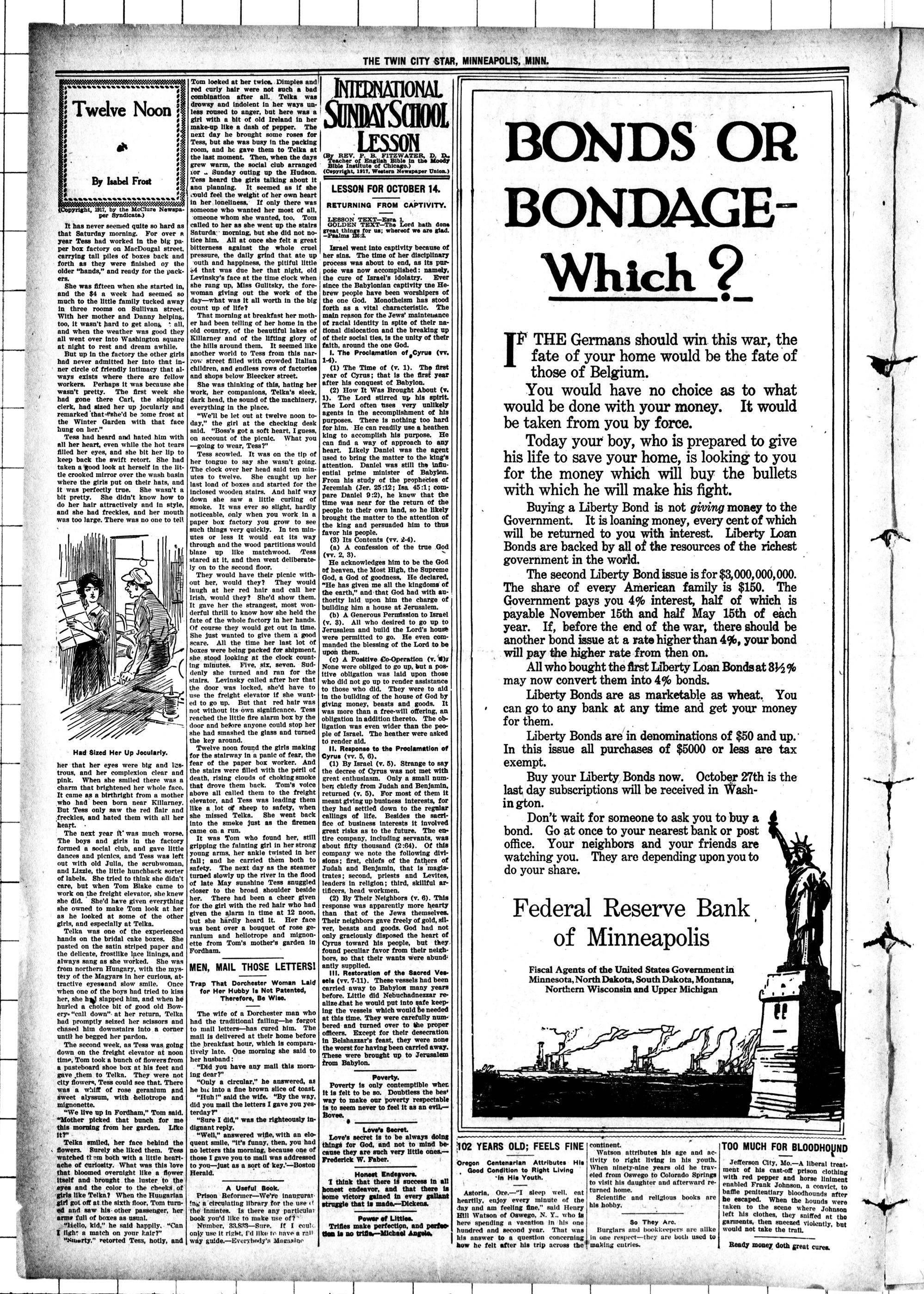
A woman holding boxes is talking to a man sewing on a table.
Had Sized Her Up Jocularly.
her that her eyes were big and lustrous, and her complexion clear and pink. When she smiled there was a charm that brightened her whole face. It came as a birthright from a mother who had been born near Killarney. But Tess only saw the red hair and freckles, and hated them with all her heart.
The next year it' was much worse. The boys and girls in the factory formed a social club, and gave little dances and picnics, and Tess was left out with old Julia, the scrubwoman, and Lizzle, the little hunchback sorter of labels. She tried to think she didn't care, but when Tom Blake came to work on the freight elevator, she knew she did. She'd have given everything she owned to make Tom look at her as he looked at some of the other girls, and especially at Telka.
Telka was one of the experienced hands on the bridal cake boxes. She pasted on the satin striped paper and the delicate, frostlike lace linings, and always sang as she worked. She was from northern Hungary, with the mystery of the Magyars in her curious, attractive eyes and slow smile. Once when one of the boys had tried to kiss her, she had slapped him, and when he hurled a choice bit of good old Bowery "call down" at her return, Telka had promptly seized her scissors and chased him downstairs into a corner until he begged her pardon.
The second week, as Tess was going down on the freight elevator at noon time, Tom took a bunch of flowers from a pasteboard shoe box at his feet and gave them to Telka. They were not city flowers, Tess could see that. There was a whiff of rose geranium and sweet alyssum, with hellotrope and mignonette.
"We live up in Fordham," Tom said. "Mother picked that bunch for me this morning from her garden. Like it?" Telka smiled, her face behind the flowers. Surely she liked them. Tess watched them both with a little heartache of curiosity. What was this love that bloomed overnight like a flower itself and brought the luster to the eyes and the color to the cheeks of girls like Telka? When the Hungarian girl got off at the sixth floor, Tom turned and saw his other passenger, her arms full of boxes as usual. "Hello, kid," he said happily. "Can I fight a match on your hair?"
"Nimarty." retorted Tess, hotly, and
Tom looked at her twice. Dimples and red curly hair were not such a bad combination after all. Telka was drowsy and indolent in her ways unless roused to anger, but here was a girl with a bit of old Ireland in her make-up like a dash of pepper. The next day he brought some roses for Tess, but she was busy in the packing room, and he gave them to Telka at the last moment. Then, when the days grew warm, the social club arranged for. Sunday outing up the Hudson. Tess heard the girls talking about it and planning. It seemed as if she could feel the weight of her own heart in her loneliness. If only there was someone who wanted her most of all, someone whom she wanted, too. Tom called to her as she went up the stairs Saturday: morning, but she did not notice him. All at once she felt a great bitterness against the whole cruel pressure, the daily grind that ate up outh and happiness, the pitiful little $4 that was due her that night, old Levinsky's face at the time clock when she rang up, Miss Gullitsky, the forewoman giving out the work of the day—what was it all worth in the big count up of life?
That morning at breakfast her mother had been telling of her home in the old country, of the beautiful lakes of Killarney and of the lifting glory of the hills around them. It seemed like another world to Tess from this narrow street filled with crowded Italian children, and endless rows of factories and shops below Bleecker street.
She was thinking of this, hating her work, her companions, Telka's sleek, dark head, the sound of the machinery, everything in the place.
"We'll be let out at twelve noon today," the girl at the checking desk said. "Boss's got a soft heart, I guess, on account of the picnic. What you—going to wear, Tess?"
Tess scowled. It was on the tip of her tongue to say she wasn't going. The clock over her head said ten minutes to twelve. She caught up her last load of boxes and started for the inclosed wooden stairs. And half way down she saw a little curling of smoke. It was ever so slight, hardly noticeable, only when you work in a paper box factory you grow to see such things very quickly. In ten minutes or less it would eat its way through and the wood partitions would blaze up like matchwood. Tess stared at it, and then went deliberately on to the second floor.
They would have their picnic without her, would they? They would laugh at her red hair and call her Irish, would they? She'd show them. It gave her the strangest, most wonderful thrill to know how she held the fate of the whole factory in her hands. Of course they would get out in time. She just wanted to give them a good scare. All the time her last lot of boxes were being packed for shipment, she stood looking at the clock counting minutes. Five, six, seven. Suddenly she turned and ran for the stairs. Levinsky called after her that the door was locked, she'd have to use the freight elevator if she wanted to go up. But that red hair was not without its own significance. Tess reached the little fire alarm box by the door and before anyone could stop her she had smashed the glass and turned the key around.
Twelve noon found the girls making for the stairway in a panic of fear, the fear of the paper box worker. And the stairs were filled with the peril of death, rising clouds of choking smoke that drove them back. Tom's voice above all called them to the freight elevator, and Tess was leading them like a lot of sheep to safety, when she missed Telka. She went back into the smoke just as the firemen came on a run.
It was Tom who found her, still gripping the falting girl in her strong young arms, her ankle twisted in her fall; and he carried them both to safety. The next day as the steamer turned slowly up the river in the flood of late May sunshine Tess snuggled closer to the broad shoulder beside her. There had been a cheer given for the girl with the red hair who had given the alarm in time at 12 noon, but she hardly heard it. Her face was bent over a bouquet of rose geranium and hellotrope and mignonette from Tom's mother's garden in Fordham.
MEN. MAIL THOSE LETTERSI
Trap That Dorchester Woman Laid for Her Hubby Is Not Patented, Therefore, Be Wise.
The wife of a Dorchester man who had the traditional falling—he forgot to mail letters—has cured him. The mail is delivered at their home before the breakfast hour, which is comparatively late. One morning she said to her husband:
"Did you have any mail this morning dear?"
"Only a circular," he answered, as he but into a fine brown slice of toast.
"Huh!" said the wife. "By the way, did you mail the letters I gave you yesterday?"
"Sure I did," was the righteously indignant reply.
"Well," answered wife, with an eloquent smile, "it's funny, then, you had no letters this morning, because one of those I gave you to mail was addressed to you—just as a sort of key."—Boston Herald.
A Useful Book.
Prison Reformer—We're inaugurating a circulating library for the use of the inmates. Is there any particular book you'd like to make use of? Number, 33.833—Sure. If I could only use it right, I'd like to have a railway guide.—Everybody's Magazine
THE TWIN CITY STAR. MINNEAPOLIS. MINN.
INTERNATIONAL
SUNDAY SCHOOL
LESSON
(By REV. P. B. FITZWATER, D. D. Teacher of English Bible in the Moody Bible Institute of Chicago). (Copyright, 1917, Western Newpaper Union.)
LESSON FOR OCTOBER 14.
RETURNING FROM CAPTIVITY.
LESSON TEXT-Ezra 1.
GOLDEN TEXT-The Lord hath done great things for us; whereof we are glad.
-Psalmus 12:3.
Israel went into captivity because of her sins. The time of her disciplinary process was about to end, as its purpose was now accomplished: namely, the cure of Israel's idolatry. Ever since the Babylonian captivity the Hebrew people have been worshipers of the one God. Monotheism has stood forth as a vital characteristic. The main reason for the Jews' maintenance of racial identity in spite of their national dislocation and the breaking up of their social ties, is the unity of their faith, around the one God.
I. The Proclamation of Cyrus (vv. 1-4).
(1) The Time of (v. 1). The first year of Cyrus; that is the first year after his conquest of Babylon.
(2) How It Was Brought About (v. 1). The Lord stirred up his spirit. The Lord often uses very unlikely agents in the accomplishment of his purposes. There is nothing too hard for him. He can readily use a heathen king to accomplish his purpose. He can find a way of approach to any heart. Likely Daniel was the agent used to bring the matter to the king's attention. Daniel was still the influential prime minister of Babylon. From his study of the prophecies of Jeremiah (Jer. 25:12; Isa 45:1; compare Daniel 9:2), he knew that the time was near for the return of the people to their own land, so he likely brought the matter to the attention of the king and persuaded him to thus favor his people.
(3) Its Contents (vv. 2-4).
(a) A confession of the true God
(yy, 2, 3).
He acknowledges him to be the God of heaven, the Most High, the Supreme God, a God of goodness. He declared, "He has given me all the kingdoms of the earth," and that God had with authority laid upon him the charge of building him a house at Jerusalem. (b) A Generous Permission to Israel (v. 3). All who desired to go up to Jerusalem and build the Lord's house were permitted to go. He even commanded the blessing of the Lord to be upon them.
(c) A Positive Co-Operation (v. 8)
None were obliged to go up, but a positive obligation was laid upon those who did not go up to render assistance to those who did. They were to aid in the building of the house of God by giving money, beasts and goods. It was more than a free-will offering, an obligation in addition thereto. The obligation was even wider than the people of Israel. The heather were asked to render aid.
II. Response to the Proclamation of Cyrus (v. 5, 6).
(1) By Israel (v. 5). Strange to say the decree of Cyrus was not met with great enthusiasm. Only a small number, chiefly from Judah and Benjamin, returned (v. 5). For most of them it meant giving up business interests, for they had settled down to the regular callings of life. Besides the sacrifice of business interests it involved great risks as to the future. The entire company, including servants, was about fifty thousand (2:64). Of this company we note the following divisions; first, chiefs of the fathers of Judah and Benjamin, that is magistrates; second, priests and Levites, leaders in religion; third, skillful artificers, head workmen.
(2) By Their Neighbors (v. 6). This response was apparently more hearty than that of the Jews themselves. Their neighbors gave freely of gold, silver, beasts and goods. God had not only graciously disposed the heart of Cyrus toward his people, but they found peculiar favor from their neighbors, so that their wants were abundantly supplied.
III. Restoration of the Sacred Vessels (vv. 7-11). These vessels had been carried away to Babylon many years before. Little did Nebuchadnezzar realize that he would put into safe keeping the vessels which would be needed at this time. They were carefully numbered and turned over to the proper officers. Except for their desecration in Belshazzar's feast, they were none the worst for having been carried away. These were brought up to Jerusalem from Babylon.
Poverty.
Poverty is only contemptible when it is felt to be so. Doubtless the best way to make our poverty respectable is to seem never to feel it as an evil—Bovee.
Love's Secret.
Love's secret is to be always doing things for God, and not to mind because they are such very little ones.—Frederick W. Faber.
Honest Endeavors
I think that there is success in all honest endeavor, and that there is some victory gained in every gallant struggle that is made.—Dickens.
Power of Littles.
Trifles make perfection, and perfection is no trifle.—Michael Angelo.
BONDS OR BONDAGE Which ?
IF THE Germans should win this war, the fate of your home would be the fate of those of Belgium. You would have no choice as to what would be done with your money. It would be taken from you by force. Today your boy, who is prepared to give his life to save your home, is looking to you for the money which will buy the bullets with which he will make his fight.
Buying a Liberty Bond is not giving money to the Government. It is loaning money, every cent of which will be returned to you with interest. Liberty Loan Bonds are backed by all of the resources of the richest government in the world. The second Liberty Bond issue is for $3,000,000,000. The share of every American family is $150. The Government pays you 4% interest, half of which is payable November 15th and half May 15th of each year. If, before the end of the war, there should be another bond issue at a rate higher than 4%, your bond will pay the higher rate from then on.
All who bought the first Liberty Loan Bonds at 31/2% may now convert them into 4% bonds.
Liberty Bonds are as marketable as wheat. You can go to any bank at any time and get your money for them.
Liberty Bonds are in denominations of $50 and up. In this issue all purchases of $5000 or less are tax exempt.
Buy your Liberty Bonds now. October 27th is the last day subscriptions will be received in Washington.
Don't wait for someone to ask you to buy a bond. Go at once to your nearest bank or post office. Your neighbors and your friends are watching you. They are depending upon you to do your share.
Federal Reserve Bank of Minneapolis
Fiscal Agents of the United States Government in Minnesota, North Dakota, South Dakota, Montana, Northern Wisconsin and Upper Michigan
102 YEARS OLD; FEELS FINE
Oregon Centenarian Attributes His Good Condition to Right Living in His Youth.
Astoria, Ore.—"I sleep well, eat heartily, enjoy every minute of the day and am feeling fine," said Henry Hill Watson of Oswego, N. Y., who is here spending a vacation in his one hundred and second year. That was his answer to a question concerning how he felt after his trip across the
Watson attributes his age and activity to right living in his youth. When ninety-nine years old he traveled from Oswego to Colorado Springs to visit his daughter and afterward returned home. Scientific and religious books are his hobby.
So They Are.
Burglaries and bookkeepers are alike in one respect—they are both used to making entries.
TOO MUCH FOR BLOODHOUND
Jefferson City, Mo.—A liberal treatment of his cast-off prison clothing with red pepper and horse liniment enabled Frank Johnson, a convict, to baffle penitentiary bloodhounds after he escaped. When the hounds were taken to the scene where Johnson left his clothes, they sniffed at the garments, then sneezed violently, but would not take the trail.
Ready money doth great curea.
Camp Libraries to Supply Soldiers With Best Reading Matter
Nothing is being left undone for the comfort and mental recreation of the men who are preparing to serve their country in the various training camps and cantonments throughout the country. The Y. M. C. A. was early in the field and besides its many activities, providing for the moral and spiritual welfare of the men, it did all it could to provide proper reading matter for them. But the need of libraries furnished in a more adequate and scientific way was so largely felt that the United States government requested the American Library association to undertake the work.
and circulation of one book. One dollar, it has been figured, will furnish a book, keep it in circulation until it is worn out, replace it when it is retired for physical disability, and all the time pay a share of the expense of properly housing and caring for these libraries in the various camps.
It is not to be imagined that the suspendous task of furnishing the soldiers with books; equipping, establishing and maintaining libraries, both stationary and traveling, is undertaken with, primarily, an educational idea. The books are needed not only to provide recreation for the soldiers when
At once, it was decided to raise a million-dollar war fund; not much for the purchase of books as for the erection of suitable library buildings at every cantonment; for the transportation of books and for the purpose of securing the service of skilled librarians. The first step in the formation of the organization in charge of the million-dollar war fund was the appointment by Secretary of War Newton D. Baker of ten nationally known men and women to constitute a library war council.
United, and co-operating with the war service committee are most of the prominent authors of the United States; practically all of the publishers, who have proved willing volunteers; and practically all of the leading members of the library profession. All these are working in conjunction with the library war council, the commission on training camp activities and the war department itself.
One of the heaviest items of expense at the beginning of the work is the erection of 32 camp-library buildings at the various cantonments throughout the country. Each building will be 40 by 120 feet in size, one-story high, and will have accommodations for 8,000 or 10,000 books, newspapers and magazines, and living quarters for the staff. It is hoped and expected that each of these libraries will be in charge of a trained librarian. In each camp it is planned to have a library headquarters with books and periodicals for reading-room use, together with a system of distributing agencies; affording to the soldiers, a kind of first-class city public library service.
A careful survey of the entire field determined that $1 is the amount necessary for the purchase, maintenance
Woman Who Gives New Life To Old Clothes Is Aiding In Conservation Movement.
In these times when there is a shortage not only of food materials, but also of textile stuffs, the woman who can clothe herself and her family at a minimum expense is "doing her bit" just as much as the woman whose garbage can fills slowly or the man who makes two potatoes grow where none grew before, declares Beryl Dixon, of the Colorado State Agricultural college.
Many articles of clothing that in ordinary times would be discarded without a second thought may, with a little care, be freshened up and made to serve another period of usefulness.
Woolen goods may be satisfactorily cleansed by washing in warm water with soap solution or soap bark. Soap bark is prepared for use by letting five cents' worth stand in two quarts of water for an hour and then straining it into lukewarm water in which the material is to be washed. Water of the same temperature should be used for both washing and rinsing. Press woolens when almost dry, on the wrong side, with a warm iron.
Most grease spots may be removed with naphtha soap and warm water. Chemical or dry cleaning will remove grease spots by dissolving the fat. The cleaning liquid may be ether, chloroform, carbon tetrachloride, gasoline, naphtha or benzine. The last three should be used in the open air if possible. They must be used away from a fire or a flame of any kind.
On silks or satins, rub the grease spot with a thin paste made of benzine and carbonate of magnesia. The benzine evaporates and the magnesia will absorb the grease and can be brushed off. Very often dry French chalk or powdered magnesia alone will absorb the grease, several applications sometimes being necessary. A warm iron and blotting paper will remove some grease spots.
Every Bird and Beast Makes A Noise That's All Its Own.
If a complete list could be made of the distinctive names by which the noises produced by birds and beasts are called, it would be found that there are few duplicates. We may judge this even by the most common, says an exchange. The horse neighs, the sheep bleats, the cow lows, the pig grunts and squeals, the turkey gobbles, the hen cackles, the cock crows, the goose hisses, the duck quacks, the cat mews, the dog barks, the wolf howls, the lion roars, the bull bellows, the sparrow chirps, the pigeon coos, the frog croaks, the rook caws, the monkey chatters, the elephant trumpets, the camel grunts, the stag calls, the rabbit screams—only when wounded, the donkey brays, the bee hums, the fly buzzes, the grasshopper chirrups, the swallow twitters, the chick peeps, the hound bays and the owl hoots.
Perhaps the best word for the sound a cricket makes is used by Tennyson.
and circulation of one book. One dollar, it has been figured, will furnish a book, keep it in circulation until it is worn out, replace it when it is retired for physical disability, and all the time pay a share of the expense of properly housing and caring for these libraries in the various camps.
It is not to be imagined that the stupendous task of furnishing the soldiers with books; equipping, establishing and maintaining libraries, both stationary and traveling, is undertaken with, primarily, an educational idea. The books are needed not only to provide recreation for the soldiers when they are off duty, but to help counteract evil influences in the vicinities of the camps and cantonments. Books to read will help to make the camps so wholesome and attractive that the forces that tend to take men away from their duty will lose, at least part, of their charm.
There is no desire on the part of the American Library association nor the library war council to thrust educational books at the heads of men already tired from training and from fighting and who would desire recreation rather than the acquisition of knowledge. The aim has been and will be to provide in abundance volumes of short stories and novels of the more popular sort; and these when they are purchased, from the present fund, will be selected with all the acumen that comes to men whose lives have been spent in library service. A tentative list has already been prepared, and that it is tremendously democratic may be gleaned from the fact that it starts out with W. J. Abbot's "Battlefields and Camp Fires" and includes novels by George D. Balzac, John Kendrick Bangs, James M. Barrie, Rex Beach, Hillaire Belloc, William Black, Booth Tarkington, Meredith Nicholson, Robert W. Chambers, Hall Caine, Winston Churchill, G. K. Chesterton, Wilkie Collins, Irvin Cobb, Marion Crawford, Richard Harding Davis, Charles Dickens, W. M. Thackeray, Conan Doyle, Lord Dunsany, Jeffrey Farnol, Edna Ferber, Montague Glass and—but one could go on and make a list of practically all the popular American and foreign authors and that list would probably prove a pretty accurate catalogue of the books that are to be furnished the American soldier, wherever he may be, by the library war council.
"Not a cricket chrrd," he writes in "In Memoriam," although the word would fit the grasshopper better perhaps. Tennyson prided himself on his exact word for the noles made by bird and beast. Thus he speaks of the "moan of doves," the robin's "pipe," the woodpecker's "laugh," the curlew's "whistle," the jay's "scritch," the parrot's "scream," the peacock's "squall," the ocean-fowl's "shriek," and the eagle's "yelp."
Experience never makes fools of wise men.
Faultfinding is unlike charity, yet it usually begins at home.
Vanity makes a lot of remunerative work for the beauty doctors.
You never really know your friends until they become your enemies.
It is awfully hard to get rich according to the methods prescribed in books.
Some men don't mind getting it in the neck if their neighbors get it just as hard.
Good sense is better than good looks, but so few people are afflicted with either K.
You may have noticed that one girl no sooner breaks a man's heart than another comes along and bandages it up.
---
One Might While Away Idle Hours Reading One of These.
Which is the longest poem in the world? One generally regards "Paradise Lost" as pretty lengthy, and Thomson's "Seasons" and Cowper's "Task." But these are short compared with Spenser's "Faerie Queene," which is easily the longest poem in existence, even as it stands, and had he attained his object and reached the twenty-fourth book, no other poem would have been "in it."
It is only a quarter of the original plan, yet it is as long as the Illad, the Odyssey, and the Aeneid put together, twice as long as Dante's "Divina Commedia," and three times as long as "Paradise Lost" and "Paradise Regained" in one.
The longest novel in the world belongs to Japan. Its author is Klong Te Bakin. It was commenced in 1852, and published volume by volume as it came out over a period of fifty years. There are 106 volumes, 106,000 pages, 3,180,000 lines, and about 38,000,000 words. A complete copy weighs 130 pounds.
Chinese Docile Starvers.
No, other race is as asdocle as the Chinese in times of famine, according to the National Geographic Magazine. Their resignation in the face of calamity is amazing. For instance, in the food shortage of 1900-7 a starving army of 300,000 peasants camped beneath the
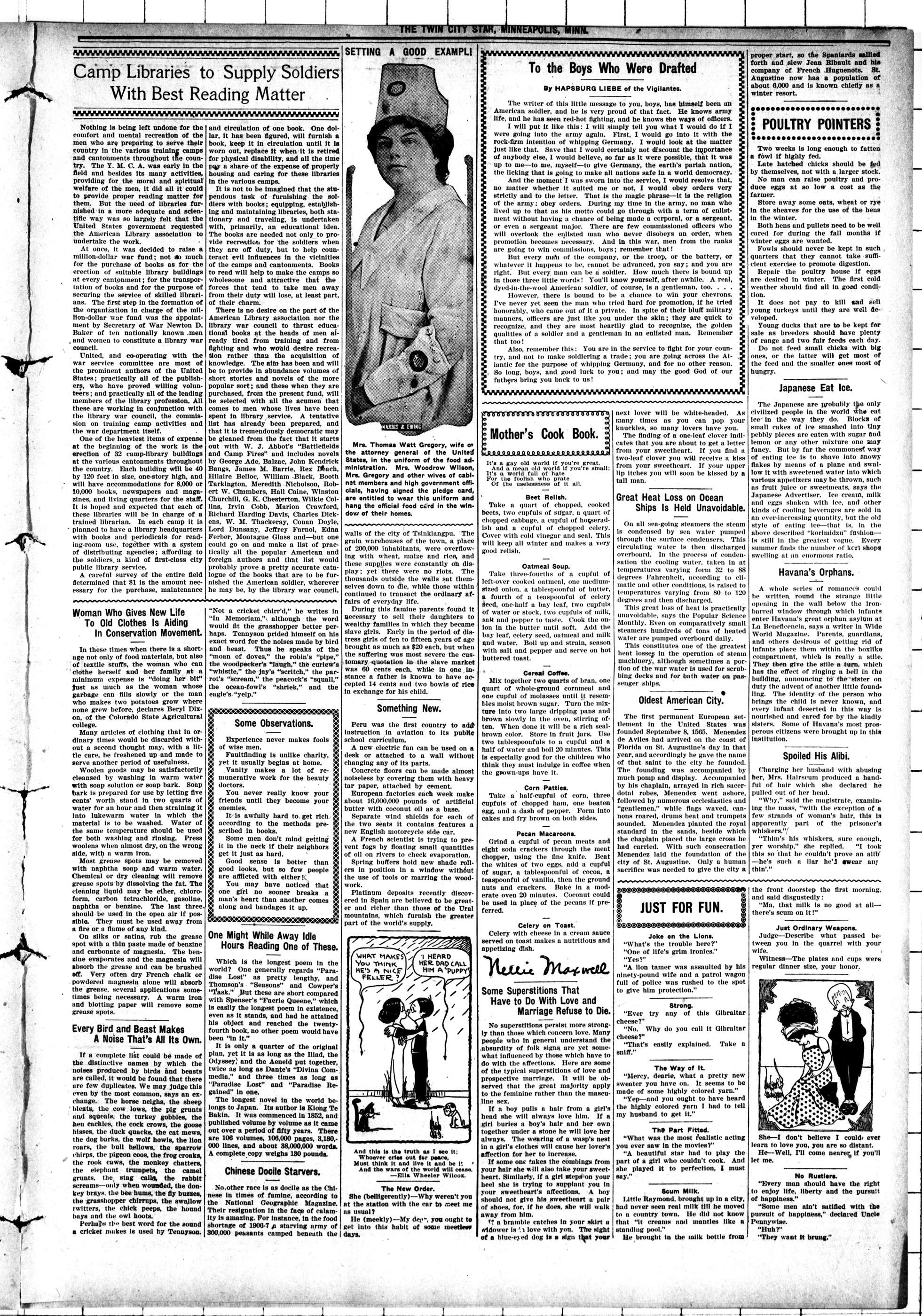
SETTING A GOOD EXAMPLI
HARRIS & EWING
Mrs. Thomas Watt Gregory, wife or the attorney general of the United States, in the uniform of the food administration. Mrs. Woodrow Wilson, Mrs. Gregory and other wives of cablinst members and high government officials, having signed the pledge card, are entitled to wear this uniform and hang the official food card in the window of their homes.
walls of the city of Tsinkiangpu. The grain warehouses of the town, a place of 200,000 inhabitants, were overflowing with wheat, maize and rice, and these supplies were constantly on display; yet there were no riots. The thousands outside the walls sat themselves down to die, while those within continued to transact the ordinary affairs of everyday life.
During this famine parents found it necessary to sell their daughters to wealthy families in which they became slave girls. Early in the period of distress girls of ten to fifteen years of age brought as much as $20 each, but when the suffering was most severe the customary quotation in the slave market was 60 cents each, while in one instance a father is known to have accepted 14 cents and two bowls of rice in exchange for his child.
Something New.
Peru was the first country to add instruction in aviation to its public school curriculum.
A new electric fan can be used on a desk or attached to a wall without changing any of its parts.
Concrete floors can be made almost noiseless by covering them with heavy tar paper, attached by cement.
European factories each week make about 16,000,000 pounds of artificial butter with coconut oil as a base.
Separate wind shields for each of the two seats it contains features a new English motorcycle side car.
A French scientist is trying to prevent fogs by floating small quantities of oil on rivers to check evaporation.
Spring buffers hold new shade rollers in position in a window without the use of tools or marring the wood-work.
Platinum deposits recently discovered in Spain are believed to be greater and richer than those of the Ural mountains, which furnish the greater part of the world's supply.
WHAT MAKES YOU THINK HE'S A NICE FELLER?
I HEARD HER DAD CALL HIM A 'PUPPY'
And this is the truth as I see it:
Whoever cries out for peace,
Must think that he will cease it!
And the wars of the world will cease,
—Ella Wheeler Wilcox.
The New Order
She (belligerently)—Why weren't you at the station with the car to meet me as usual?
He (meekly)—My dept., you ought to get into this habit of some meetless days.
To the Boys Who Were Drafted
By HAPSBURG LIEBE of the Vigilantes.
The writer of this little message, American soldier, and he is very proud, life, and he has seen red-hot fighting. I will put it like this: I will sit here going into the army again. Rock-firm intention of whipping German just like that. Save that I would come of anybody else, I would believe, so up to me—to me, myself—to give the licking that is going to make all. And the moment I was sworn in no matter whether it suited me or strictly and to the letter. That is one of the army: obey orders. During lived up to that as his motto could without having a chance of be or even a sergeant major. There will overlook the enlisted man who promotion becomes necessary. And are going to win commissions, boys. But every man of the company whatever it happens to be, cannot right. But every man can be a soldier in those three little words! You'll dyed-in-the-wool American soldier. However, there is bound to be I've never yet seen the man who honorably, who came out of it a prince-manners, officers are just like you recognize, and they are most heart qualities of a soldier and a gentleman that too! Also, remember this: You are try, and not to make soldiering a lactic for the purpose of whipping. So long, boys, and good luck to your fathers bring you back to us!
The writer of this little message to you, boys, has himself been an American soldier, and he is very proud of that fact. He knows army life, and he has seen red-hot fighting, and he knows the ways of officers.
I will put it like this: I will simply tell you what I would do if I were going into the army again. First, I would go into it with the rock-firm intention of whipping Germany. I would look at the matter just like that. Save that I would certainly not discount the importance of anybody else, I would believe, so far as it were possible, that it was up to me—to me, myself—to give Germany, the earth's pariah nation, the licking that is going to make all nations safe in a world democracy.
And the moment I was sworn into the service, I would resolve that, no matter whether it suited me or not, I would obey orders very strictly and to the letter. That is the magic phrase—it is the religion of the army: obey orders. During my time in the army, no man who lived up to that as his motto could go through with a term of enlistment without having a chance of being made a corporal, or a sergeant, or even a sergeant major. There are few commissioned officers who will overlook the enlisted man who never disobeys an order, when promotion becomes necessary. And in this war, men from the ranks are going to win commissions, boys: remember that!
But every man of the company, or the troop, or the battery, or whatever it happens to be, cannot be advanced, you say; and you are right. But every man can be a soldier. How much there is bound up in those three little words! You'll know yourself, after awhile. A real, dyed-in-the-wool American soldier, of course, is a gentleman, too. . .
However, there is bound to be a chance to win your chevrons. I've never yet seen the man who tried hard for promotion, if he tried honorably, who came out of it a private. In spite of their bluff military manners, officers are just like you under the skin; they are quick to recognize, and they are most heartily glad to recognize, the golden qualities of a soldier and a gentleman in an enlisted man. Remember that too!
Also, remember this: You are in the service to fight for your country, and not to make soldiering a trade; you are going across the Atlantic for the purpose of whipping Germany, and for no other reason. So long, boys, and good luck to you; and may the good God of our fathers bring you back to us!
Mother's Cook Book.
It's a gay old world if you're great.
And a mean old world if you're small;
It's a world full of hate.
For the foolish who hate
Of the uselessness of it all.
Beet Relish.
Take a quart of chopped, cooked beets, two cupfuls of sugar, a quart of chopped cabbage, a cupful of hogseradish and a cupful of chopped celery.
Cover with cold vinegar and seal. This will keep all winter and makes a very good relish.
Oatmeal Soup.
Take three-fourths of a cupful of left-over cooked oatmeal, one medium-sized onion, a tablespoonful of butter, a fourth of a teaspoonful of celery seed, one-half a bay leaf, two cupfuls of water or stock, two cupfuls of milk, salt and pepper to taste. Cook the onion in the butter until soft. Add the bay leaf, celery seed, oatmeal and milk and water. Boll up and strain, season with salt and pepper and serve on hot buttered toast.
Mix together two quarts of bran, one quart of whole-ground cornmeal and one cupful of molasses until it resembles moist brown sugar. Turn the mixture into two large dripping pans and brown slowly in the oven, stirring often. When done it will be a rich sealbrown color. Store in fruit jars. Use two tablespoonfuls to a cupful and a half of water and boil 20 minutes. This is especially good for the children who think they must indulge in coffee when the grown-ups have it.
Take a half-cupful of corn, three cupfuls of chopped ham, one beaten egg, and a dash of pepper. Form into cakes and fry brown on both sides.
Pecan Macaroons
Grind a cupful of pecan meats and eight soda crackers through the meat chopper, using the fine knife. Beat the whites of two eggs, add a cupful of sugar, a tablespoonful of cocoa, a teaspoonful of vanilla, then the ground nuts and crackers. Bake in a moderate oven 20 minutes. Coconut could be used in place of the pecans if preferred.
Celery on Toast.
Celery with cheese in a cream sauce served on toast makes a nutritious and appetizing dish.
Nessie Maxwell
Some Superstitions That Have to Do With Love and Marriage Refuse to Die.
No superstitions persist more strongly than those which concern love. Many people who in general understand the absurdity of folk signs are yet somewhat influenced by those which have to do with the affections. Here are some of the typical superstitions of love and prospective marriage. It will be observed that the great majority apply to the feminine rather than the masculine sex.
If a boy pulls a hair from a girl's head she will always love him. If a girl buries a boy's hair and her own together under a stone he will love her always. The wearing of a wasp's nest in a girl's clothes will cause her lover's affection for her to increase.
If some one takes the combits from your hair she will also take your sweetheart. Similarly, if a girl steps on your heel she is trying to supplant you in your sweetheart's affections. A boy should not give his sweetheart a pair of shoes, for, if he does, she will walk away from him.
If a bramble catches in your skirt a widower is 'l' love with you. The sight of a blue-eyed dog is a sign that your
Beet Relish.
Cereal Coffee.
Corn Patties
be to you, boys, has himself been an proud of that fact. He knows army, and he knows the ways of officers. Simply tell you what I would do if I First, I would go into it with the German. I would look at the matter certainly not discount the importance far as it were possible, that it was German, the earth's pariah nation, nations safe in a world democracy, into the service, I would resolve that, or not, I would obey orders very the magic phrase—it is the religion army time in the army, no man who I go through with a term of enlisting made a corporal, or a sergeant, are few commissioned officers who never disobeys an order, when in this war, men from the ranks; remember that!
Ivy, or the troop, or the battery, or be advanced, you say; and you are older. How much there is bound up know yourself, after awhile. A real, of course, is a gentleman, too. Be a chance to win your chevrons.ried hard for promotion, if he tried rate. In spite of their bluff military under the skin; they are quick to utter glad to recognize, the golden man in an enlisted man. Remember
in the service to fight for your countrade; you are going across the At-Germany, and for no other reason. You; and may the good God of our
next lover will be white-headed. As many times as you can pop your knuckles, so many lovers have you. The finding of a one-leaf clover indicates that you are about to get a letter from your sweetheart. If you find a two-leaf clover you will receive a kiss from your sweetheart. If your upper lip itches you will soon be kissed by a tall man.
Great Heat Loss on Ocean Ships Is Held Unavoidable.
On all sea-going steamers the steam is condensed by sea water pumped through the surface condensers. This circulating water is then discharged overboard. In the process of condensation the cooling water, taken in at temperatures varying form 32 to 88 degrees Fahrenheit, according to climatic and other conditions, is raised to temperatures varying from 80 to 120 degrees and then discharged.
This great loss of heat is practically unavoidable, says the Popular Science Monthly. Even on comparatively small steamers hundreds of tons of heated water are pumped overboard daily.
This constitutes one of the greatest heat losses in the operation of steam machinery, although sometimes a portion of the war water is used for scrubbing decks and for bath water on passenger ships.
Oldest American City.
The first permanent European settlement in the United States was founded September 8, 1565. Menendez de Avilies had arrived on the coast of Florida on St. Augustine's day in that year, and accordingly he gave the name of that saint to the city he founded. The founding was accompanied by much pomp and display. Accompanied by his chaplain, arrayed in rich sacerdotal robes, Menendez went ashore, followed by numerous ecclesiastics and "gentlemen," while flags waved, cannons roared, drums beat and trumpets sounded. Menendez planted the royal standard in the sands, beside which the chaplain placed the large cross he had carried. With such consecration Menendez laid the foundation of the city of St. Augustine. Only a human sacrifice was needed to give the city a
JUST FOR FUN.
Joke on the Lions.
"What's the trouble here?"
"One of life's grim ironies."
"Yes?"
"A lion tamer was assaulted by his ninety-pound wife and a patrol wagon full of police was rushed to the spot to give him protection."
"Ever try any of this Gibraltar cheese?"
"No. Why do you call it Gibraltar cheese?"
"That's easily explained. Take a sniff."
The Way of It.
"Mercy, dearle, what a pretty new sweater you have on. It seems to be made of some highly colored yarn." "Yep—and you ought to have heard the highly colored yarn I had to tell my husband to get it."
The Part Fitted.
"What was the most realistic acting you ever saw in the movies?"
"A beautiful star had to play the part of a girl who couldn't cook. And she played it to perfection, I must say."
Scum Milk.
Little Raymond, brought up in a city, had never seen real milk till he moved to a country town. He did not know that "it creams and mantles like a standing pool."
He brought in the milk bottle from
Scum Milk
proper start, so the Spaniards salled forth and slew Jean Ribault and his company of French Huguenots. St. Augustine now has a population of about 6,000 and is known chiefly as a winter resort.
Two weeks is long enough to fatten a fowl if highly fed.
Late hatched chicks should be fed by themselves, not with a larger stock.
No man can raise poultry and produce eggs at so low a cost as the farmer.
Store away some oats, wheat or rye in the sheaves for the use of the hens in the winter.
Both hens and pullets need to be well cared for during the fall months if winter eggs are wanted.
Fowls should never be kept in such quarters that they cannot take sufficient exercise to promote digestion.
Repair the poultry house if eggs are desired in winter. The first cold weather should find all in good condition.
It does not pay to kill and sell young turkeys until they are well developed.
Young ducks that are to be kept for sale as breeders should have plenty of range and two fair feeds each day. Do not feed small chicks with big ones, or the latter will get most of the feed and the smaller ones most of hungry.
Japanese Eat Ice.
The Japanese are probably the only civilized people in the world who eat ice in the way they do. Blocks of small cakes of ice smashed into that pebble pieces are eaten with sugar and lemon or any other mixture one may fancy. But by far the commonest way of eating ice is to shave into snowy flakes by means of a plane and swallow it with sweetened water into which various appetizers may be thrown, such as fruit juice or sweetmeats, says the Japanese Advertiser. Ice cream, milk and eggs shaken with ice, and other kinds of cooling beverages are sold in an ever-increasing quantity, but the old style of eating ice—that is, in the above described "korlimidzu" fashion—is still in the greatest vogue. Every summer finds the number of keri shops swelling at an enormous ratio.
Havana's Orphans.
A whole series of romances could be written round the strange little opening in the wall below the iron-barred window through which infants enter Havana's great orphan asylum at La Beneficencia, says a writer in Wide World Magazine. Parents, guardians, and others desirous of getting rid of infants place them within the boxlike compartment, which is really a stile. They then give the stile a turn, which has the effect of ringing a bell in the building, announcing to the sister on duty the advent of another little foundling. The identity of the person who brings the child is never known, and every infant deserted in this way is nourished and cared for by the kindly sisters. Some of Havana's most prosperous citizens were brought up in this institution.
Spoiled His Alibi.
Charging her husband with abusing her, Mrs. Hairscum produced a handful of hair which she declared he pulled out of her head.
"Why," said the magistrate, examining the mass, "with the exception of a few strands of woman's hair, this is apparently part of the prisoner's whiskers."/
"Thim's his whiskers, sure enough, yer worship," she replied. "I took this so that he couldn't prove an alib'—he's such a liar he'l swear any thin'."
the front doorstep the first morning, and said disgustedly:
"Ma, that milk is no good at all—there's scum on it!"
Judge—Describe what passed between you in the quarrel with your wife.
Witness—The plates and cups were regular dinner size, your honor.
She—I don't believe I could, ever learn to love you, you are so distant. He—Well, I'll come nearer if you'll let me.
No Rustlers.
"Every man should have the right to enjoy life, liberty and the pursuit of happiness."
"Some men ain't satisfied with the pursuit of happiness," declared Uncle Pennywise.
"Huh?"
"They want it brung."
PUBLSHED EVERY FRIDAY BY
CHARLES SUMNER SMITH,
Minneapolis, Minnesota.
Entered in the Post Office at Minneapolis as second class matter.
MEMBER
NATIONAL NEGRO PRESS
ASSOCIATION
Subscription by Mall, Postpaid.
ONE YEAR .....$2.00
SIX MONTHS .....$125
THREE MONTHS ......65
Hamlet B. Rowe, Local Agent.
ADVERTISING RATES.
One Inch—1 Insertion—One Dollar.
Liberal discount given on 3, 6, 9,
Months, or 1 year contracts.
We do not run free ads, or over-run
the time contracted for by our ad-
vertisers We respect their right to
advertise at intervals, and-rather have
them do so, than to run continuously
an "adv." and an increasing account.
Write all Checks payable to
THE TWIN CITY STAR
1317 North Sixth Ave.
MINNEAPOLIS - MINNESOTA
Call at 1317 6th Ave. N. on Wednes-
day to insure matter for publication.
There is a great demand for laborers now and Negroes are being employed where before they were "not wanted." As a rule, they are making good and their efficiency will overcome much of the general prejudice against them. The Negro has been denied the privilege of employment mostly because of the ignorance of many employers. Since the Negro laborer has better opportunities, he will be a better citizen. The so-called race problem will soon be solved because there is no Negro problem; it is the white man's; and its only solution is an intelligent consideration for the Negro as a man and an acknowledgement of his right to earn his living on equal footing with other citizens.
Owing to an increase in cost, we have raised our prices on all composition. Reading notices will be 10c per line under one inch and 50c per inch thereafter.
We are verging to the point where treason will be treated as treason and its infernal neck broken with but little ceremony.
The soap-box orators in large cities are to be suppressed and the soap boxes restored to a better and more healthful use.
A cooking expert says "honey has been used as a cosmetic," no doubt, as in former days, by small boys who were in a hurry.
"Go for them, boys," is said to be the German Crown Prince's favorite expression. He has never learned to say: "Come on, boys."
Gold is said to be becoming cheaper, but that does not affect the spirits of the man whose sorrowful soul yearns for breakfast bacon.
A man with 12 fingers and a dozen toes has been accepted for the army. His regret is that he has no more to give to his country.
General relief is given by the agricultural department's farm bulletin No. 487, which says that freezing doesn't injure, parsnips.
The parlor-car malds, taking the places left vacant by drafted porters, will expect quarters from those who do not do things by halves.
Every patriotic old bachelor knows that under more favorable circumstances he would have had seven sons and not a slacker in the bunch.
The pretty girl with not much of a bathing suit on has given place, on the magazine covers, to the pretty girl in a major general's uniform.
Lots of the men who raised war gardens are now preparing to continue doing their duty by raising calluses carrying guns in the reserve militia.
The difference between the Holland and Peruvian attitudes on the U-boat sinking of merchant ships seems to be about 7,000 miles, as the crow flies.
Ordinarily using a soap box for kin-
THE WAY WE DO THINGS
We walk into our meals.
We run into debt.
We rush into print.
We step into practice.
We fly into passion.
We jump into fight.
We dive into a book.
We wade into an adversary.
We sink into slumber.
We leap into notoriety.
We break into society.
We stumble into acquaintance.
We glide into intimacy.
We precipitate ourselves into wedlock.—Life.
TOLD IN FIGURES
Japan has 11 shipbuilding yards.
Japan employs 4,000 women on railways.
Britain has 5,000,000 working women.
Holland produces 10,000,000 pounds of soap yearly.
Yucatan laborers receive $5 a day in hemp fields.
Railroad Telegraphers' union of America has 50,000 members.
WISE AND OTHERWISE
Anyhow, that cosmetic blush has staying powers.
It is hazardous to play with the viper that has once attempted to sting you.
We all hope that the girl on the magazine cover does not feel as she looks.
The prosperous man says there is no such thing as luck; the down-and-outer is sure of it.
Speaking of nuisances, the man with a perpetual "pro bono publico" howl can worry us a lot.
When we see a fool of a man waiting on his second wife like a slave, we wonder what kind of a time wife No. 1 had.
If young girls would seek and heed the advice of married women, the wedding bells would jingle only at rare intervals.
The hand that rocked the cradle used to rule the world, but today it seems to be the hand that steers the gasoline buggy.
There is no shortage of labor, but the shortage of fellows who are inclined to work for a living shows an alarming increase yearly.
STATISTICAL NOTES
Denmark contains 1,300,000 milk cows.
Eggs last year brought $14,000,000 to Denmark.
In 1916 Denmark produced $65,000,-000 worth of butter.
Michigan last year produced 14,918,-278 barrels of salt.
Kentucky has 13,000 teachers for 537,207 public school pupils.
Denmark's industries and railroads yearly consume 3,000,000 tons of coal.
United States in 1916 consumed 45,720,860 barrels of salt of 280 pounds each.
MUCH IN LITTLE
At Toledo, Ore., herring packing is a new industry.
The cattle tick alone is said to cause more than $300,000,000 loss each year.
Robert Bruce was born in Farnberry castle, on the coast of Ayrshire, Scotland.
A dealer in Mexico is seeking a market in this country for salted calf and other skins.
The first lead pencil, or graphite pencil, was made in England in the reign of Queen Elizabeth.
Investigators in Bavaria have found that the more bread school children eat the better the condition of their teeth.
The United States, the greatest business organization in the world, permits 55 different systems of bookkeeping in Washington.
Although there is a larger habitable area in South America than in North America, there are only half as many people in the southern continent.
---
THE TWIN CITY STAR, MINNEAPOLIS, MINN.
John Bright, Caterer Eldridge Williams, Floor Manager
GIBSON & ROWE, Promoters ADMISSION 350
LOCAL NEWS
Mr. Clarence W. Bell spent a few days hunting last week.
Mr. Columbus B. Smeddler has returned here to remain indefinitely.
J. P. Bowmah and Thos. B. Warren were made members of Ames Lodge of Elks on Thursday afternoon.
Remember, that the Twin City Entertainers will give their Harvest Balls on Oct. 15 and Oct. 29 at Union Temple Hall.
Mrs. Kathryn Duncan Chambers, 2806 Elliot avenue, has returned from Chicago after a pleasant visit with her aunt.
Dr. I. Garland Penn was the guest of Mr. and Mrs. Edw. L. Boyd, 2528 Chicago avenue, at breakfast on last Sunday morning.
Mr. Chas Bellinger of San Antonio, Texas, was a visitor last week. He was the guest of Mr. Chas Hardin of Sixth avenue north.
Mrs. William T. Johnson of Chicago spent several days last month with Mrs. Jose H. Sherwood, 971 St. Anthony avenue, St. Paul.
Billy DeBlack has returned home from his annual tour of the country fairs with his entertainers—the Southland Quartette of the Hudson Mfg. Co.
Mr. Benj. Hicks has nearly recovered from a serious attack of lagripe and has returned to his employment as chef at the Porters' and Waiters' Club.
Mrs. Francis Duncan, 2806 Elliot avenue, entertained informally at dinner Thursday for Miss Sarah Woods of Milwaukee, Wls., who is the guest of Mrs. Neal of Fifth avenue south.
Mr. J. P. Bowman, chef of the Hotel Saulpaugh, Mankato, Minn., spent two days here this week. He was initiated as a member of Ames Lodge, I. B. P. O. Elks of the World. Mr. Bowman was formerly of Chicago.
Near Riot at Football Game.
Near Riot at Football Game.
Mr. Frank Peoples' the contractor,
defended one of the men of his race
who attended the football game at St.
Louis Park last Sunday. The crowd
chased the Negro referee (who had
called the white referee an abusive
name) into Mr. Peoples' auto. They
would have done violence to him, but
Mr. Peoples drew his gun and stopped
the mob. He was arrested and fined
for disorderly conduct in the justice's
court last Tuesday. The Negro who
caused the trouble is probably runn-
ing yet.
THE SHULLS' WESTERN VISIT
THE SHUELS WESTERN VISIT.
Mrs. Glover Shull and two daughters, the Misses Mildred and Edna, will leave next week for an extended tour of the Northwest and a stay in California. They will visit Seattle and Portland and go via boat to San Francisco, returning via Salt Lake City and Denver. Mrs. Shull's mother will visit her daughter in Wichita during their absence. The Misses Shull are among the talented young ladies of the Twin Cities and favorites among their social friends.
IMPORTANT NOTICE
Unless notes are written plainly and properly arranged they will not be inserted. Many people send in notes regardless of names, initials or composition. Arrangement by the publisher will be charged for. Free notices must be correctly written.
AGENTS WANTED—NOW!
Reliable and intelligent agents always wanted to solicit business for THE TWIN CITY STAR; also correspondents in principal cities. A chance to earn a good living. Write The Twin City Star, Minneapolis.
We have some among our advertisers and subscribers who are a credit to our race for their business-like methods. They pay promptly in advance and expect nothing unreasonable in return. Others want to know "Why we can't 'trust' them?" or send a bill, and then a collector, and finally censor a Negro editor because he can't run his paper "like the white man." Few persons realize that it pays to pay as you go. The Star is not an installment plan proposition. It is a real newspaper run under many difficulties mostly due to the foolish notions and ignorant whims of those whom it serves and protects and from whom it should get its support and their consideration.
Do not waste your time making promises to our agents. Send your money by Express or Post Office Order or in cash or postage stamps.
---
EDITOR SUES PASTOR.
Editor R. B. Montgomery, of the Weekly Advocate of this city, brought suit against Rev. D. E. Beasley of Bethesda Baptist Church to recover $6.00, which he claimed was due him for advertising the revival given by the Twin City Ministerial Alliance last spring. Rev. Beasley proved that Editor Montgomery was not authorized to advertise the revival and that the financial reports published in the St. Paul Appeal and the Twin City Star were ordered and paid for. Mr. Montgomery has threatened to state "where the money went." Rev. J. G. Robinson of Monticello, Ark., and Rev. Chas. S. Morris of Norfolk, Va., conducted a month's religious campaign in the Twin Cities and the entire reports, as published by Rev. T. B. Stovall and Atty. W. T. Francis, treasurer, show a clear account of the collections and disbursements.
Mr. Montgomery had also brought suit for a hairdresser's ad which will be paid for. While it is within the province of a publisher to advertise his "dead heads," it has not been done by the other Negro, newspapers in the Twin Cities. The Star does not seek to interfere with the management of the Advocate, but its editor and a Mr. Phil Hale have not regarded the ethics of journalism. Although it was rumored that they would put the Star out of business, they have failed to establish a reputable newspaper and have barely managed to keep out of jail.
The Advocate has had several fights in its editorial family. While Mr. Montgomery is without question a money-getter of a questionable class and Mr. Hale, whose recent dismissal from the staff again proves his success as a failure in all public undertakings, they have deliberately fooled the public with their newspaper game. Those who owe for newspapers or for advertising in them should be made to pay and no one could condemn Mr. Montgomery for placing a just claim in the courts for settlement. As it is, neither the Advocate nor the Twin City Star can boast of the support of their Negro readers, because most Negroes do not appreciate a paper of their own race.
RECEPTION FOR MEN DRAFTED
Ames Lodge of Elks will officially bid an appropriate farewell to the Negroes of the Twin Cities who are drafted for the National Army. Among the draftees are: Roy Smith, John Allen, George Brady, Raymond Cannon, Maurice V. Daniels, Harry Hale, F. Mack, P. J. Buford, Ulysses Grant and Horace F. Daniels. RECEPTION WEDNESDAY, OCT. 17. A reception will be held at the Elks Lodge Rooms, Eighth avenue and Fourth street south. All Elks in good standing are invited. The program will be special for this occasion. Speaking, cabaret and refreshments. All drafted men who are subject to immediate call are welcome.
THANN'S BUFFET MOVED
Occupies Phil Reid's Old Place.
Mr. Thann Travis has moved to 30 East Fourth street, St. Paul. He is located at the old place, which was kept many years by the deceased, Phil Reid. Mr. Travis will thoroughly renovate and equip his new location, which is larger and more desirable for his patrons. His genial disposition and business like management will insure to the public every accommodation.—Advertisement.
WAIT FOR OUR RE-OPENING!
ROOT & HAGEMAN, 407 Nicollet, whose stock was damaged by fire on October 10th, will soon open with a choice new stock of goods.
Wait and see this selection, before you buy your Fall Suit or Coat, also the bargains from our Adjustment Sale are worth waiting for.—Advertisement.
PYTHIAN HALLOWE'EN
BALL
Pride of Minnesota Lodge No. 5, Knights of Pythias, will give a Grand Hallowe'en Ball, October 29th at Arcadia Dancing Academy
Are you a delinquent subscriber?
If so, why not send your subscription?
CLASSIFIED ADVERTISEMENTS
TWO NEATLY FURNISHED ROOMS, one-half block from car line. Mrs. E. A. Mitchell, 2020 5th Ave. So. Phone South 117.
SIX-ROOM MODERN FLAT, downstairs, central location, near car line. Apply J. S. Wright, 2737 11th Ave. So.
Rooms for Light Housekeeping.
Three rooms,-second floor, good location. Call at 2531 Stevens ave.
FOR RENT—1706 East Nineteenth Street. Toilet, water and gas. Three and four rooms. $10.00 per month. McDew Realty Co., Sykes Block, Nic. 621.
ONE LARGE ROOM neatly furnished, modern conveniences, in residential section. Mrs. W. W. Williams, 2900 Eleventh avenue South. Drexel 4728.
EVERY DAY is BARGAIN DAY at the ROOT & HAGEMAN STORE, 407 Nicollet Ave.
STEWART'S TEMPERANCE SERVICE.
The ladies are especially invited to visit Stewart's Hotel, where they may enjoy their meals and "temperance" drinks. Under the regulations of the Public Safety Commission no liquors are served ladies at any time and men are served between the hours of 8 a. m. and 10 P. M. excepting Sundays. Ladies admitted every day. Special music.—Advertisement.
RENEW YOUR SUBSCRIPTION.
The publisher of The Twin City Star urgently requests that subscribers send in their dues, or ask for a collector to call. The cost of publishing a newspaper is increasing, and it is important that subscriptions and ads be paid for NOW
Peoples Christian Assembly.
ELDER G. W. MITCHELL, Pastor,
Assisted by Mrs. G. W. Mitchell.
Come! and Serve the Lord.
1204 Washington Ave. So.
Services Sunday—11 A. M.
Sunday School—1:30 P. M.
Praise Meeting—3 P. M.
Preaching—8 P. M.
THE TWIN CITY STAR will be sent to any out of town address. Send your subscription in postage stamps. Read your home paper while visiting in other cities. It's like a letter from home.
Madam Hart, the hairdresser and milliner, has moved to 305 Thirteenth avenue south, where she will be pleased to meet her patrons.
THE STAR is the CHEAPEST and BEST NEGRO PAPER in the NORTHWEST. It needs 500 more Subscribers to keep it going. Help to get us A BIGGER CIRCULATION.
The J. & H. Laundry is owned and operated by the Gibbs Boys, sons of Mrs. Ione E. Gibbs. We mention this because many on the north side patronize other firms. This is the most modern/wet wash laundry in the Northwest.
COME IN! and Try Our 30-cent Suppers. Meat, Potatoes, Hot Biscuits and Butter, Tea or Coffee.
From 5 P. M. to 7:30 P. M.
ARCADIA CAFE
500 4th St. So., Minneapolis W. S. Simmons, Prop.
T. S. Center 4639.
WALFRID WESTMAN
Photographer
1425 Washington Ave. So. Minn.
AUTOS FOR HIRE
When you want a good Touring Car for Picnics, Fishing Parties, etc. also Moving or Expressing,-Call ANDERSON, Main 2267. Prices Reasonable.-Advertisement.
YOUR PUBLICITY PAYS.
All persons interested in the progress of their lodges, churches, societies etc., should value the power of printer's ink. They should see that their secretaries SEND ALL NOTICES to the newspapers in proper time. They think the Editor should attend every affair, whether invited or not, and should know "What is going on?"—without being informed. Many exchanges clip from our columns, and often things done in Minneapolis get national publicity.
The Twin City Star stands for equal rights for all American citizens.
---
2014
MADAME M. HART,
The Reliable Milliner.
has a special stock of Fall Hats of the Latest Designs. No two pattern hats alike. Hats made to order. Prices reasonable. Workmanship guaranteed. Phone Nic. 3744.
ATTENTION! LADIES.
MANICURING AND PACIAL MASSAGE
ELECTRIC HAIR TREATMENTS
NEW
HAIR STRAIGHTENING MY
SPECIALTY.
MADAM HART'S PREPARATIONS.
ARTESIA CREAM. Handled past ten
years. Removes Liver spots and block-
heads. Bleaches the skin and renews it
hairline. ELECTRIC HAIR GROWER 50,
Overton's High-Brown Powder,
Testimonial.
Mrs. Essie Taylor, 633 Mississippi St.
St. Paul and Mrs. Nancy Wade, 1402
Fifth Ave So., Manitouis, both
have testimonial recommending
Madam Hart's Preparations and Hair-
work.
MADAM M. HART.
305 13th Ave. S., Minneapolis,
N. W. Cedar 8190. Res. Dale 8935
HAMMOND TURNER
Attorney at Law
Suite 321, American Nat'l Bank
Fifth and Cedar Sts.
St. Paul.
WORKING-MEN'S
SOCIAL CLUB
FOR MEN ONLY
244 3RD AVE. S.
MINNEAPOLIS
OLIVER & JONES
MANAGERS.
Phone Hy. 3605.
Dr. Ellis Burton
DENTIST
Graduate Northwestern Dental
School of Chicago.
715 Sixth Ave. No.,
Minneapolis, Minn.
If you suffer from headaches or
your eyes tire or blur the reading
—Let me examine them, expert
advice and examination FREE.
I duplicate any broken lenses
made by me or anybody else.
PAEGEL
OPTOMETRIST-OPTICIAN
45 S. 6th St., Minneapolis
CHOICE CITY AND SUBUR-
BAN PROPERTY FOR SALE
ON SMALL MONTHLY PAY-
MENTS.
Houses and Flats for Rent
B. M. McDew
802 Sykes Block.
N. W. Nic. 621 Minneapolis
OSCAR GILBERT PRICE.
Real Estate, Insurance and Loans.
Choice Property for Sale or Rent.
2814 10th Ave. So.
N. W. South 5250 Minneapolis
N. W. Phone Nic. 1873
J. M. MORRIS
Real Estate Broker
Loans Collections
506 BOSTON BLOCK
MINNEAPOLIS, MINN.
Peterson, The Druggist
1501 Washington Ave. So.
TOILET ARTICLES, DRUGS
PRESCRIPTIONS.
He Sollicits Your Patronage.
General Plan For Teachers And Pupils Outlined.
FIVE TYPES OF INSTRUCTION
Improvement of Rural Conditions Depends Upon the Proper Cultivation of the Soil, Says Dr. Thomas Jesse Jones—Value of Gardening as an Elementary School Activity Emphasized. The report of Dr. Thomas Jesse Jones of the bureau of education at Washington on the progress and facilities for the education of the colored people is the most complete work on the subject which has ever been given to the public. For the past three years Dr. Jones has been traveling, gathering information and studying the subject of education for the race. Discussing race needs as they apply to rural life, Dr. Jones says:
"Next to the need of a genuine appreciation of the importance of rural education in the development of the colored people and of the south is the demand for a clearly defined program of courses adapted to the age and attitude of the pupils and to the income and general plan of the institution and its teachers. Hitherto the prevailing conception of agricultural education seems to have required elaborate courses in theory, a large farm and extensive equipment both in machinery and in stock. The majority of the schools, realizing that they had neither the inclination nor the financial means to undertake such a plan, followed their own desires and devoted their energy to literary courses.
"The few schools that were sufficiently interested to try to teach agriculture plunged in at an elaborate rate, and almost all of them failed to realize their purposes. It is not to be understood that this failure means that no good resulted from their efforts. On the contrary, very important gains were made in overcoming the deep dislike' for the soil which generations of slavery had developed. Through the elaborate equipment and the complexities of agricultural theory the Negro youth and his parents began to believe that some education might be obtained in agricultural schools.
"It would therefore be quite unjust to claim that no good resulted from the elaborate method. The real criticism is that a large number of schools were led to believe the teaching of agriculture to be beyond their financial means and equipment and that the schools attempting agriculture did so at considerably larger cost than was necessary. The improvement of rural conditions and the proper cultivation of the soil require at least five types of instruction adapted to the varying needs of the five groups whose interest is to be awakened. They are: "First.-Science and practice of gardening for all pupils in rural and urban schools. "Second.-Science and practice in gardening, with instruction in civics, economics and teacher training for all secondary pupils and persons preparing to be ministers and teachers.
"Third.-Two year courses in agriculture to prepare farmers for the cultivation of the usual thirty or forty acre farm.
"Fourth.-Four year courses for those desiring to be agricultural teachers, farm demonstrators or managers of large farms.
"Fifth.-Rural extension activities for the entire community. The needs of the pupils and the limited school equipment of a majority of the colored school admit of only one or at most two of these courses.
"No phase of agricultural instruction has been so much neglected as gardening. The propaganda for country life and agriculture in America seems to have overlooked the garden and to have left it to the whims of the suburban soil enthusiast. No phase of soil culture has such a variety of important possibilities as gardening. These possibilities include the economic returns of the home garden, both in town and country, and especially its use to supplement the salary of the rural teacher and minister. They include the educational value of the garden an elementary school activity, as an illustration of intensive agriculture, as a laboratory for agricultural schools and as the recruiting field in which pupils may be introduced to the wonders of soil culture and thus won for service in rural life. Furthermore, gardening has unique value in the cultivation of character, both in the individual and in the family. This social value is attained by the union of the family in the planting and cultivation, by exchange and co-operation with the neighbors similarly engaged and by the development of marketing skill and habits of saving small earnings.
"In view of the large proportion of colored people in rural districts and on farms it is evident that every secondary school and every private and higher institution should make it possible for pupils to appreciate the economic and social significance of gardening and soil cultivation, to know the relation of soil to soul, to know that farming is not mere drudgery, but the source of culture as well as of prosperity. Such is the importance of rural life that the teachers of other subjects should use every opportunity which their subjects offer to arouse interest in the improvement of rural conditions."
ADVERTISE HERE. IT PAYS.
BURDENS WE BEAR
How Each and All Carry the Three Chief Burdens of Life.
In the Christian life the forms of warfare may vary but the fight is one. Burdened people in apostolic days were carrying just the same loads our burdened people are carrying through our streets today. The burden may have been done up differently, it may have had an unfamiliar cover, but if we stripped it of its wrappings we should find a modern commonplace. If a hundred Romans of the olden days and a hundred Britons or Americans of our own day could meet, together like pilgrims at some friendly hostel along life's way, and if they could just unwrap their burdens and display them, they would look at one another in surprise, for their sense of nationality would be swallowed up in the profound consciousness of a vital kinship.
And I will begin with the burden of sin. Sin is revolt against the holy sovereignty of God; it is enlistment and allegiance on the side of the enemy of God. Sin is essentially a charge of flags; it is a deliberate desertion from the flag of the holy God to the black flag of mammon and darkness. I need not elaborate this. I would only repeat that at the root of all sins we shall find the common sin of rebellion. Now, the revolt against the holy flag of God marks the entrance into bondage. I know that the bondage may be concealed, just as we may intertwine flowers and greenery through the links of a chain until it looks more like a garland than a fetter. But let any man try to escape from the broad road and he will find that the gay wreathes, disclose themselves as mighty chains. On the broad way the present is a tyranny and the past a debt. Such is the burden of sin. Well, how can we help to bear one another's burdens? First of all perhaps we had better say that we cannot do it. No man can touch the burden of his brother's guilt. We cannot get back into his yesterday and make the crooked straight. We cannot go back and sweeten the fountain of an evil from which guilt derives its bitterness. We can do nothing for souls who are burdened with the guilt of sin except to bring them to the Savior, to the fountain that is open for sin and uncleanness. But that is a glorious sharing of the awful load. We can share it by counsel. We can share it by gentle guidance. We can share it by mighty intercession.
Let us now look at another burden which was found everywhere in the ancient world, and is equally common place in our own time. I will call it the burden of temperament. And this is what I mean: Even when a man has found the cross of Christ, and sin has been forgiven, and the great act of renewal has taken place, he has still to work out his own salvation. When the seed of the regenerate life has been imparted it has still to be nurtured and matured, and it has to be matured amid the special constitutions and conditions of the individual life. That is to say, conversion does not annihilate differences of temperament, and thereby make us all alike, reducing our warfare to one certain form of strife. Every regenerate man has to fight the good fight of faith.
Now can we help a brother to carry the burden of his own temperament? Most assuredly we can. Take the man who is like a powder magazine, explosive, inflammatory, full of dry and touchy material, always ready to go off. What can we do with that man's burden? Well, we can very easily increase it or we can relieve and lighten it. We can help him into liberty, or we can help to sink him into servitude. We can throw lighted matches about his magazine, or we can spray cooling influences about his life. And the real meaning of helping one another is to consider one another from the standpoint of chivalry and love, and to determine that by our conduct and demeanor we will help to fashion the knight in our brother and give him strength in the realms of grace with holiness.
There is one more burden which I will name, and which can be found everywhere—the burden of incompleteness. And what I mean is this: No man is an integer. No man is more than a fraction. The New Testament teaches that no man is the whole body; he is only a limb. Humanity is the body, and the individual is only a member. One man is an eye, another is a foot. And so I speak of the burden of incompleteness. God has made us dependent upon one another, and every man is designed incomplete. It is therefore the love design of our God that we surrender ourselves to one another in order that we may bear one another's burdens, and by our own individual fullness complete the gap in another man's needs. To live a selfish and exclusive life is to rob humanity of its due, and to dwarf and sterilize ourselves—J. H. Jowett, in the Christian World.
Plant Virtues to Overcome Evil.
You will find it harder to uproot faults than to choke them by gaining virtues. In every person who comes near you look for what is good and strong; honor that; rejoice in it; and, as you can, try to imitate it; and your faults will drop off, like dead leaves, when their times come.—Ruskin.
The Only Safe Place.
Put your faith where it will be safe; and the only place where a faith ever can be safe is in the shrine of an action—Phillips Brooks.
THE TWIN CITY STAR, MINNEAPOLIS, MINN.
WAS IN HUNDRED SERIOUS MISHAPS
New York Daredevil Is Now Retired Member of the Police Force.
RECORD DEATH DODGER
During Last Sixteen Months of Service He Was in Five Hospitals—Won Fame as Bicycle Rider.
New York.—Charles M. Murphy, retired member of the New York police force, figured in five accidents during the last 16 months he was on duty, any one of which would have been sufficient to kill an ordinary man. He rounded out his active career as a patrolman while on his way to the office to turn in his badge by falling and fracturing his knee cap. Now he is a bif curious to know just why all these misfortunes have befallen him and why he is alive to recount his experiences.
Murphy is little known as a policeman. In the days of his youth, 20 or more years ago, he was the speediest bicycle rider in the world.
First Mishap at Three Years.
When Murphy was three years of age a fire broke out in the Murphy home in Brooklyn. In a panicky rush to call for assistance, his mother dropped Charles in the flames. He was scorched, no more. At ten he was rendered unconscious while coasting. When Murphy was eleven the family horse was killed in a runaway and the family scattered about the street. Charles suffered only scratches. At fourteen he crashed into an iron post while running from the "cops" and was rendered unconscious. When he was eighteen Murphy was driving a spirted horse that ran away at the sound of a fire alarm. He was dragged 50 yards and was shaken up.
During that same year an engineer was stunned by a stone thrown by a boy. Murphy raced the engine, mounted the cabin and shut off the throttle. When twenty he came near drowning while leaving his ship in the Brazilian harbor of Bahia. His twenty-
A man is pulling a horse in a harness. The horse is running on a road with trees and buildings in the background.
The Family Horse Ran Away. fifth year opened with a mishap on January 1 when he and a motorman were picked from a street car wreck and Murphy was believed crippled for life.
Racer and New York Policeman.
When twenty-seven, Murphy was rendered unconscious while racing at Manhattan Beach. Next morning the doctor found him wrinkling out on the track. In 1899, when he was twenty-nine years of age, he won the cognomen "Mile-a-Minute" Murphy. In 1901 he was appointed a member of the New York police force. The next year Murphy and his brother built a tandem bicycle driven by a steam engine and hoped to speed three miles a minute. The engine broke loose, fell on Charles, and came near killing him. In 1903 he started a fight with 19 gangsters and would have been killed but for the arrival of reserves. In 1905, while chasing a thief, he jumped down a 20-foot embankment, suffering a sprained ankle.
In 1906 he formed the bottom link in a 20-foot human chain which rescued a man who had fallen in a well and was neck deep in quicksand. In 1913 he arrested 12 foreigners at a clip and stopped a runaway by choking a bridleless horse into submission. Things were dull for Murphy until September 19, 1915, when he was appointed motorcycle policeman. He was run over by an automobile that year. Later a towing line became entangled with his wheel and he was dragged 50 feet. The following spring a fork on his wheel broke and he suffered internal injuries. In September, 1916, he was thrown 30 feet on Manhattan bridge, and finally on January 27, 1917, when he was slated for retirement, he fell and fractured his knee cap. Murphy, however, still retains the characteristics of his youth, and avers he is good for many stunts.
RODE HORSE, PAID FOR IT WITH LIFE
Denver, Colo.—"Well, I rode her!" were the dying words of Mrs. Ed. Wright, champion woman rough rider of the world, when she was picked up at Union park here, after being thrown by a wild horse during a field day celebration for the benefit of Colorado National Guardsmen, encamped here. Mrs. Wright died before she reached
Mrs. Wright died before she reached a hospital.
Too proud to admit before a crowded grandstand that she dared not ride the bucking broncho, the woman mounted Gentle Annie amid great cheering by the cowboys who had taunted her
dalfen
Succeeded in Subduing Her Mount. when she first declined to ride the animal. Mrs. Wright succeeded in subdoing her mount from its furious bucking, but Gentle Annie started on a wild gallop toward a corral. Before the cowboys, who immediately started in pursuit, could catch the fleeing horse, the animal plunged through a wire fence, stumbled and slid along the ground with Mrs. Wright still in the saddle. A part of the saddle caught in the fence and the broncho raised its heels in the air, and then fell to the ground again. As it rose it stepped on the woman's face, crushing her skull.
FAT MAN—BAD; FAT
CONDUCTOR—WORSE
Atlanta, Ga.-Fat conductors are taboo with the local street car company as the result of suits filed by Mr. and Mrs. W. L. Shields against the company because a conductor was too fat. The suits allege that the conductor on a car on which Mrs. Shields rode home was so big that she could not get by him, and in trying to squeeze through she fell to the street and was seriously injured.
HAD UNIQUE LOVE SYSTEM
Poet, Author and Soldier of Cleveland Won Many Women by Correspondence.
Cleveland.—John Francis Beckwith, poet, author and soldier, was arrested recently because of his successful method of making love by mail. He was accused of winning the hearts of women and then procuring money from them.
Beckwith had a complete system of love correspondence, beginning with a friendly letter referring lightly to love. One by one the letters increased in the intensity of their love expressions. In masterful English Beckwith finished up the mail campaign with such fervor that "they all fell for it."
When arrested, Beckwith had the names of 75 women in towns and cities throughout the country. He kept a ledger telling how far the correspondence had advanced in each case. The replies from some women made it evident that the time was ripe for procuring the "loan." Beckwith served as an English officers through the Boer war. He is a college graduate, holding two degrees. He was born in Norway, his father having been a former chief justice of the Norwegian Supreme court. "I hate women," said Beckwith, when arrested.
Fingera Betray Him.
Eldora, Ia.—Joff Freed, wanted on a forgery charge, who worked in the Excelor restaurant here last winter, was caught by a private detective and identified through finger prints on a soup plate in the restaurant. The proprietor explains the durability of the finger prints by saying that the plates were used only for oyster soup, not served in summer.
Snake in Dinner Pail Causes Suit.
Philadelphia.—Mrs. Matt Lindergot has brought suit for $500 damages against Theron Plimby who placed a green snake in Lindergot's dinner pail while the two were working together.
Mrs. Lindergot was startled when she opened the bucket and the snake crawled out.
J. A. Withers, Prop.
Office Phones—Main 2869; Auto 36
Twenty Elegant Steam-Heater
A la Carte Meals at All
STEWART
J. Ed. Stewart, Prop.
246-250 FOURTH AVE.
Private Dining and Reception
ance Beverages. Men's Buffet and
Connection.
—Main 2869; Auto 36774. Dining Room—
Elegant Steam-Heated and Electric Lighted Ro-
la Carte Meals at All Hours—Popular Prices.
EWART'S HOTEL
Stewart, Prop. Chas. Brody
250 FOURTH AVE. S., MINNEAPOLIS, M.
Dining and Reception Room for Ladies. Specia-
ges. Men's Buffet and Grill; Billiards; Barbe
Office Phones—Main 2869; Auto 36774. Dining Room—Main 2831.
Twenty Elegant Steam-Heated and Electric Lighted Rooms.
A la Carte Meals at All Hours—Popular Prices.
246-250 FOURTH AVE. S., MINNEAPOLIS, MINN. Private Dining and Reception Room for Ladies. Special Temperance Beverages. Men's Buffet and Grill; Billiards; Barber Shop in Connection.
SUNSHINE
South Side
212 Eleventh Ave
EXPERT BARBERS
CIGARS, POOL AND BILLIAR
RACE PAPERS
THOMPSON &
North Side Barber S.
12 Eleventh Ave. S., Minneapolis.
EXPERT BARBERS; UP TO THE MINU
COOL AND BILLIARD TABLES IN CONNE
RACE PAPERS—SHOES SHINED.
THOMPSON & CARVER, Props.
212 Eleventh Ave. S., Minneapolis
EXPERT BARBERS; UP TO THE MINUTE.
CIGARS, POOL AND BILLIARD TABLES IN CONNECTION.
RACE PAPERS—SHOES SHINED.
THOMPSON & CARVER, Props.
The Waiters' and Porters' Club
GLOVER SHULL, PRES.
311 HENNEPIN AVE. MINNEAPOLIS
EDDIE BOYD, SECY LEE WHEELER, MANAGER
C. E. Price Office 'Phone, Hyland 5633.
Residence 'Phone, Colfax 4198. I. M.
PRICE & SMEDDLE
Hair Shop Chiropodists Manicur
Office 'Phone, Hyland 5633.
Residence 'Phone, Colfax 4198. I. M. S
RICE & SMEDDLE
Shop Chiropodists Manicur
C. E. Price Office 'Phone, Hyland 5633. Residence 'Phone, Colafx 4198. I. M. Smeddler
PRICE & SMEDDLER
Hair Shop Chiropodists Manicurists This is a Thoroughly Equipped Shop with all the Latest Electric Appliances and Sanitary Equipment. Courteous Attention and Expert Workmanship given to all Patrons. Electric Scalp Treatment for Ladies and Gentlemen. Overton's Hygienic "High-Brown" Preparations used. Licensed Chiropodist. RESIDENTIAL CALLS BY APPOINTMENT. 715 North 6th Ave. Minneapolis, Minn.
BELL'S BARBER SHOP
CLARENCE W. BELL, Proprietor.
BATHS, BARBER SHOP, POLITE BARBERS
POOL AND BILLIARD HALL
CIGARS, RACE PAPERS, SHOE SHINING
244 THIRD AVE. SOUTH . MINNEAPOLIS, MINN.
Phone Northwestern, Main 2811.
Telephone rates are lower in small towns than in large places because it costs less per telephone to furnish service in the smaller communities.
In big towns the switchboards are more complex and expensive, the distance of subscribers from the central office is greater, the construction more costly and the rents and wages higher.
A
Office Phone, Hyland 2331
Residence—Hyland 4712.
611 Girard Ave. No.
Withers' Transfer
and Fuel Co.
1224 N. 6TH AVE., MINNEAPOLIS
WITHERS' SPECIAL SERVICE
HOUSEHOLD GOODS MOVED OR
STORED.
BAGGAGE TRANSFERED AND
FUEL DELIVERED TO ALL
PARTS OF THE CITY
ON SHORT NOTICE.
36774. Dining Room—Main 2831.
Released and Electric Lighted Rooms.
At All Hours—Popular Prices.
T'S HOTEL
Chas. Brody, Mgr.
AVE. S., MINNEAPOLIS, MINN.
Room for Ladies. Special Temper-
t and Grill; Billiards; Barber Shop in
SMOKE THE BEST
5C CIGAR
Sight Draft
W. S CONRAD CO., Distributors
NO. 140. E. 6th ST., ST. PAUL.
NO. 1. WESTERN AVE., MINN.
Barber Shop
Ave. S., Minneapolis
BARERS; UP TO THE MINUTE.
BARRIARD TABLES IN CONNECTION.
BARS—SHOES SHINED.
N & CARVER, Props.
Phone, Hyland 5633.
Phone, Colfax 4198. I. M. Smeddler
SMEDDLER
chiropodists Manicurists
THE UNIVERSITY OF CALIFORNIA
BAYSIDE
UNIVERSITY OF CALIFORNIA
BAYSIDE
A
EL CAMINO
REAL
Old Pala Mission.
THE pilgrims to Canterbury walk upon a way polished by the feet of history and rich
in an atmosphere of majestic antiquity. Association with Roman, Briton, Pict, Scot, Dane, Celt and Norman has clothed it with personality, glorifying what would otherwise be mere geographical locality, and the spirits of humans of all later times are drawn to it as the dividing point between paganism and Christianity to the English-speaking world.
But if we of today were to walk upon the historic highway in the far West, called El Camino Real, we could not dream ourselves back into the day when the brown-robed Franciscans went forth and back upon it, treading the tender grass of winter or raising the golden dust-clouds of summer, because that way is hard-paved today, and the pilgrim's dream would be sadly broken by the dodging of the automobiles which have claimed the way as a personal possession, writes Neeta Marquis in the Los Angeles Times.
But to the automobilist who has a mind for the past as well as an eye for the present, there is a wealth of charm to be found on the road marked by the mile-post bells, particularly in traveling from Los Angeles to San Diego, at the road's very beginning.
It was cool and deliciously foggy when we left Los Angeles, soon after eight o'clock, and one of the first surprises, when we reached the real country, was to find the air sweet with the fragrance of orange blossoms and roses. I had fancied the orange trees not yet in flower, and the roses very largely gone for a while, but acres of both were there to confound me. Dahlias almost as big as cabbages nodded their gorgeous crimson and magenta heads from country dooryards, and in a bowlerlike river bed we saw a company of tourists out of their machines gathering green castor beans, perhaps under the impression that they were horse chestnuts.
In the open stretches, the blue distance of fog were artistically set off by golden hedges of wild mustard and sunflowers. At intervals all along the road the rose racks set up by an enterprising public spirit were often full of bloom, mostly with the warm-scented "Ragged Robbing," of velvety crimson. We even met a country girl driving, who, having the prettiest of pink faces and being dressed in pink, looked like a Duchesse rose herself.
To San Juan Capistrano.
We crossed the great San Joaquin ranch through miles of small, golden bean stalks, which shaded into distances of amber against the blue-velled hills. It looked as if it had taken as many Mexicans as are enlisted with Villa to rake those stacks into such geometrically spaced order.
In the hill country beyond, the rich brown of tarweed, whose sweet pungency filled the air with healing, wholesome balm, covered all the landscape, and exquisitely subtle colors were brought out under the cloud-mottled sky. Ever and again the black-green of eucalyptus clumps made picture-like effects against the tawny fields. Faith, this was a long road, and less varied, when the padres trod it in the olden time!
It was down a canyon dotted with great sycamores that we finally came upon the artist-hunted ruins of Mission San Juan Capitrano.
This spot is crassly modern compared with really ancient things, yet it has its own atmosphere of relative antiquity. I never have gazed on the pyramids or the Sphinx. St. Peter's at Rome, Notre Dame and St. Martin's at Canterbury are, so far, only names and pictures to me. Even Plymouth Rock is very remote in personal association as well as distance. But my latent reverence for the fingermarks of time and the monuments to human ideals came up at sight of these singularly quiet and beautiful, remains of a period rich in romance and devout dreams on this golden western slope.
Beauties of the Ruins.
Pomegranate trees and dusty red geraniums grew in front of the ruined walls rising against the pale blue of a noonday sky. Where the whitewash was gone, the ruins were a rich golden
To San Juan Capistrano.
brown in tone. The front of the building was disappointing at first glimpse. The yard was bare and bleak looking, the monument raised to Junipero Serra, and a luxuriant green pepper tree being the only outstanding reliefs. But it was when we wandered unguided through the long arcades on the inner court, penetrating into musty rooms within the three-foot walls and swinging the massive wooden doors to behind us, treading upon the worn old flagging curved to the feet of priest and neophyte of long ago, that the real atmosphere of the place comes over us.
I tried to forget the half-dozen automobiles standing outside on the road, and the groups of tourist-folk, who, curious-eyed, were making perfunctory pilgrimage there at that same hour, and instead of taking a cursory glance and motoring on again, I asked permission for our small party to eat our lunch in the long shady arcade overlooking the inner court, where the kindly green of ivy was clinging to the bared bricks of the arches.
It was not hard to rebuild in memory those broken arches encircling the patio, even across there where a small laundry was dangling in pathetic incongruity, and imagine the place rich with green growing things—luscious figs and grapes and oranges, and other transplantings from Catalonia, Castile and Old Mexico. Then, upon just such a quiet, peaceful noonday as this, Padre Anselmo and Padre Miguel might have been sitting on this selfsame old bench, looking across the luxuriant greenness to where the brown arches merged into the summer brown of that selfsame hill beyond, against the same soft blue sky. The hill and the sky remain unchanged now, but the arches are crumbling and the padres are dust.
We bade farewell to San Juan Capistrano and took the curving road again. A great brown hill sloped down to meet an unbelievable blue ocean, and from here on the sea was scarcely once out of sight. "Truly," I said, drinking deep of that beauty of color and contour, "this is a picture country, if there ever was one!" Those stretches along the water, down close to the sand where the ice plant grew, were a delight. After long miles mfrked off by the picturesque bells, we passed San Onofre canyon and San Onofre creek opening into the sea, the canyon widening to hold as magnificent a grove of sycamores as there is in southern California.
We climbed the scarred and picturesque heights where the Torrey pines crouch in the wind like giant bodies with craven spirits. From this commanding vantage point we looked across the valley away from the sea, where colors of vegetation and colors of soil mingled in singularly rich variety.
And at last we saw the city of our destination shining ahead in the afternoon light, a white city, like Cadiz, overlooking the sea.
In the eleventh chapter of St. Luke, verse 42 it states: "Woe unto you, Pharisees! for ye tithe mint and rue, and all manner of herbs." Mint is mentioned no other place in the Bible. In this day and age, or at least in this country, both mint and rue have run wild until in some places they are a menace to better plants. Both seek only damp soils yet both are quite resistant to drought as the root system still lives long after tops are destroyed and will put forth again and again. It is evident that in old times these plants were of great economic importance in both culinary and medicinal departments. Today, while mint is widely used, largely in manufacture of perfumes, the use of rue has practically ceased.
Bill—Do you remember my brother?
Gill—Oh, yes, very well.
"Remember how quiet he used to be
at school?"
"Yes, indeed."
"Well, look at him now."
"What's the matter with him now?"
"He's a bass drummer."
Mint and Rue.
No Longer Quiet
HORNSBY IS SINGULAR
Gives His Opinions on Pitching and Baseball in General
New York Reporter Interviews Cardinal Player and Leaves With Impression That He Is Most Extraordinary Young Man.
A scribbling sharp in New York sought to interview Roger Hornsby of the Cardinals on his opinions concerning hitting, pitching and baseball playing in general.
"How do you figure a pitcher?" was one of the questions asked the Cardinal swatsmith.
"Figure him? Not much to figure," said Hornsby. "All any pitcher's got is a fast one or a slow one or a curve or maybe a spitter. If he don't get it over you walk. If he does, bust it on the nose."
This was not enlightening, so the scribe tried a new tack.
"Were you nervous when you first faced a big league pitcher?" was the question.
"Naw, why should I be nervous? The other birds was hittin' him."
That was enough along that line, so the scribe ventured: "What position do you like best? That is, what do you think you play best?
"Don't see any difference," said Hornsby. "If they hit a ball where you can get it, then you got to get it"
C.
Roger Hornsby.
and hustle it to some base. Or if you're playing first, you got to get the throws they give you if you can. If you don't you're no good."
"How do you account for your success in the big league?" was the next thing fired at Hornsby.
"Count for it? Say, how do the rest of 'em 'count for it? They just do the best they can, don't they? Well, that's what I do."
The newspaper reporter retired with the opinion that Hornsby is a most extraordinary young man.
POPULAR SPORTS IN MEXICO
Many Amateur Baseball and Soccer Football Teams in Mexico City—Play at All Times.
That amateur sport is flourishing in the Mexican capital is shown by the fact that there are 102 organized amateur baseball nines in Mexico City and its suburbs and 50 soccer football teams.
The season for all varieties of sport in Mexico lasts 12 months a year, as the climate permits play at all times. Even during the rainy season the mornings are almost always clear and sunshiny, and the nature of the soil and the high dry atmosphere make delay on account of wet grounds almost unknown.
No regular league series are played by the baseball clubs, but short series between three or more selected teams are arranged for month to month. The games usually are played on Sunday morning or on feast days and holidays, and, as a general thing, no admission is charged. Many of the larger athletic clubs and colleges and professional schools have three or four teams each, the first teams drafting players from the lesser teams as they are developed.
HANK PUT ONE OVER ON MIKE
End Man Needed on New York Bench and Donlin is Ordered to Slt There for Afternoon.
The other afternoon Mike Donlin was in a reminiscent mood at the Polo grounds. He told of one afternoon that Hank O'Day was having one of those off days and he felt it incubent upon himself to chide Hennery. "What yer trying to do; make a minstrel show of this game?" said Miguel. "Nope," said Hennery, "but they need an end man on that New York bench and that is where you can hang out for the rest of the afternoon." That day Hank was one up.
INTERNATIONAL
NEWS SERVICE
BROOKLYN'S CLEVER SOUTHPAW PITCHER.
The next thing Rube Marquard, maker of records, will shoot for is the 24-inning record of Jack Coombs, who in 1906 won the longest major league game ever played.
Rube, however, could retire from baseball tomorrow with more records than any baseball pitcher ever achieved. In 1912 Rube tied Tim Keeefe's old record by winning 19 straight, and in 1914 he pitched the longest National league game ever fought up to that time, defeating Pittsburgh in a 21-inning contest. Recently Marquard got into the twenty-second inning of the game played between Brooklyn and Pittsburgh on Ebberts Field in time to get credit for winning the longest tilt in the 42 years the National league has been in existence.
should be the winning time.
Fortunately Marquard forced to extend himself referred to, as Rube has times after making his record Marquard's winning streak in 1912 he just dubbed at the end of the season, be little use to the Giant team himself in the world's seri winning two of the three by New York from the 1912.
Pittsburgh Beaten 7 After Marquard establishes National league long dist in 1914, by beating Pittsbuy 17, he did not win another year. He lost ten straight
Painful The game of 1922 It is a strange coincidence that Pittsburg should twice be the team used to establish a new National league record and that Marquard
UNEARTH ANOTHER IRON MAN | H. WAGNER WAS NOT WORRIED
Mike Casper of Cleveland Sand Lots, Pitches and Wins Three Games in One Afternoon.
Iron men have been scarce since Joe McGlennity and Louis Durham faded from the glare of the spotlight, but in a few more years the Cleveland sand lots may produce one who'll outshine either of the two former stars. He's Mike Casper, now fourteen, who pitched and won three games in one afternoon for the Train street team, participants in the city playgrounds championship. Mike trimmed the Lincoln 24 to 1, the Fairviews 6 to 5 and the Broadways, his third game of the day, 4 to 0. Then the next day Mike came right back and pitched his team to a 4 to 5 ten-inning victory over the Puttnams, in the final struggle for the flag. That is pitching baseball!
CHIEF BENDER BIG SURPRISE
Former Athletic Star Causes Comment by Return to Old-Time Skill With Pat Moran.
One of the great surprises in baseball recently is Chief Charles Bender's return to winning form.
The Indian was supposed to be all in as a twirler when Pat Moran signed him for the Phillies, but the baseball wisdom of the wily Pat was once more displayed to good advantage. Pat
Q
believed that the chief will be able to roll up a number of victories for his team.
Admit Scott to Camp.
Jim Scott, White Sox pitcher, joined the officers' reserve training camp outside of San Francisco.
should be the winning pitcher each time.
Fortunately Marquard was not forced to extend himself in the game referred to, as Rube has had tough times after making his records. After Marquard's winning streak was broken in 1912 he just dubbed around until the end of the season, being of very little use to the Giant team. He found himself in the world's series that fall, winning two of the three games won by New York from the Red Sox in 1912.
Pittsburgh Beaten Twice.
After Marquard established a new National league long distance record in 1914, by beating Pittsburgh on July 17, he did not win another game that year. He lost ten straight. He then started the 1915 season in a blaze of glory by pitching a no-hit game over Brooklyn, only to go to pieces after that. In midseason he was released to Toronto.
Why Should He Fret About Occupant of Bull Pen When Game Was Just About to Begin?
"During Honus Wagner's brief engagement as a manager he had one or two funny experiences," says Christy Mathewson.
"We played the Pirates the first day Hans was on the job, and he moved out to the first-base coaching lines.
P
Honus Wagner.
Some one sent the bat boy out from the bench to ask Wagner who he wanted down in the bull pan to warm up.
"Oh, I don't care," answered Hans. 'Send anyone you like.'
"The game was just beginning. Why should he worry about the tenant of the bull pen?"
KEEP UP FOOTBALL INTEREST
Biggest Intersectional Gridiron Contest of Season Slated for Ann Arbor, November 10.
Cornell and Michigan will do their bit this fall to keep up the interest in football. The annual game between these two schools was scheduled as usual last winter, but owing to unrest in football circles as a result of this country's entry into the war it was thought doubtful for a time that the game could be played.
As a result of Secretary of War Baker's boost for football and college athletics in general, the Cornell-Michigan game, scheduled for Ann Arbor on November 10, will be staged, and it will be the biggest intersectional attraction of the season.
Cornell took a stand for football while Harvard and Yale announced plans for abandoning their schedules and the re-entry of Michigan into the western conference stimulated interest at the Ann Arbor school and had much to do with the decision of the athletics board to go through with football play on as large a scale as possible.
ON THE
FUNNY SIDE
FRENZIED FINANCE.
Young DeSmart—Say, do you want to make $10,000 in a few minutes?
Old Gotrox—Sure!
Young DeSmart—I understand you intend to give your only daughter $100,000 as a marriage portion.
Old Gotrox—Yes, that's a fact. But what has that got to do with the $10,000?
Young DeSmart—Well, I'm willing to marry her for $90,000. See?
Old Method Revived.
"What you suppose will be the next reform to ship on the educational crusade."
"I wouldn't be surprised if it were a spanker boom."
Anything but That.
Mrs. Fussbody—If I don't get a letter from you every day I'll feel so lonely I'll come right back home.
Hubby—Never fear; I'll write twice a day.
"Worse than that. He's down to the point where nobody will lend him money any more."
NOTHING NEW.
"The practice of medicine has certainly changed. When I was young, the doctors used to bleed their patients."
"Huh! I don't see that they've changed much in that respect."
The Invariable Assertion.
Every man who tries to wake
A disposition scrappy
Declares he does it all to make
His fellow mortals happy.
Its Advantage
"How can you keep up the pretense that your crabbing is a profitable industry?"
"Well, any way you look at it it is a net gain."
Its Class.
"The minister says his parrot is so well trained that it joins in the family, prayers."
"Well, that's the first time I ever heard a parrot was a bird of pray."
Natural History
Freddie—It's always in damp places where mushrooms grow, isn't it, papa? Papa—Yes, my boy. Freddie—Is that the reason they look like umbrella's, papa.
Described.
"Luck is what the anti-preparedness people think we should depend on to keep us out of trouble."
A Problem.
"Economy is the watchword of the hour. Everything must be used. Nothing must go to the waste heap." "But what are we going to do with our kings?"
"I got started at the game by switching my winter flannels on and off."
The Right Place.
"Do you know I have specks before my eyes."
"Well, where else would you want to wear 'em?"
In Doubt.
"I understand she's taken up knitting?"
"Yes."
"What is she making?"
"That we can't tell. You see, even she can't make it out just yet whether it's going to be a sweater or a pair of socks."
There'd Be None Left.
Author—I have put a good deal of my own life into this story.
Editor—I wish you had put all of it into it.
---
Ree rn ETT Warn eee
are Ren eee PEt (gre RM Ae ee) Gee eee ee RE oe OS eae
; 7 THE ™
YY Utilizing [forests to Doulile
aa >
se Wen en :
Ph iaTheir Valine 6 Rober’ toute.
me es oe) 4 waa ee
A LO _) Wisner e
el oe 1 ae er ode |
ee a Ace /me(E oe Ut Femi pm: |
Lees: ag if pa aca “Spe : Ps Se
correo ceaine’ "|i, i fos ree at ee! aml
Forest Products Labora- Px Je : L Sa is & ef ‘e t |
tory hopes to bring hot _ LL>| SSS eel) ll
AID the Chicago pork packer: “We
make our money. by saving everything
but the squeal.” .
Says Frank J. Hallauer: “The wood
Industries are going to go the pork
packers one better; they are going to
save everything, in¢luding the bark.”
And it is to teach the wood industry
how to do this that Mr. Hallauer has
“wi
Went
Ea
of a little-known branch of government, the forest
praducts laboratory, situated at Madison, Wis.,
Mr. Hallauer and his associates hope to teach this
country how to save two billions of dollars an-
nually.
He {s confident that it can be done; that ts, that
the annual cut of wood, now valued at two bil-
Hons, can be made into articles of use which at
present prices would bring double that amount.
It is a man-size Job, but the confident engineer
points proudly to/unbellevably vast économies al-
ready effected in the wood trades through the
work of the forest products laboratory's chemists.
‘They are in such terms that it would be hard to
tabulate the exact savings, but there is little
doubt that they run over $100,000,000 a year.
Few persons outside the wood trades know of
the laboratory, the first of its kind ever to be es-
tablished, but whfch has been imitated in a num-
ber of countries since tt began operatiow. Its
annual appropriation is small for the work it
does ; something less than $200,000.
The laboratory 1s now looked upon to save the
paper situation of the country, and it cheerfully
tackles the job. Only recently annpuncement was
made in Washington that the laboratory had dis-
covered that good grades of paper can be made
from a number of far Western woods and that
Wisconsin paper mills were already ordering
trainloads of wood chips from the West for paper
pulp. ‘The cost of freight to Wisconsin is more
than pffset by the cheapness of the chips, and the
paper thus made is expected to prove a consider-
able factor in relieving the paper famine,
A visitor who leaves Mr. Hallauer can scarce-
ly believe that there is anything which cannot be
made from wood.
“How about the cabled story that the Germans
have discovered a food they can make from wood
which they are feeding to Russian prisoners?”
was the first question asked.
“Almost surely not true,” he sald. “The hu-
man stomach cannot stand it. It is possible to
conveft sawdust into cattle food, and that was
probably the foundation for the story.”
But Germany from her forests is obtaining such
great results that if, as an English writer recently
suggested impractically, England were to destroy
Germany's forests, the war would surely end
very soon, Artificial gotton is one of the things
which are being supplied from wood. Paper shirts
are also being used, but then Japan is supplying
these to the Russlan soldiers.
Germany has beer driven to extreme use of her
forests by necessity, but no country with the ex-
ception of Germany has made such a systematic
effort at developing forest products as the United
States.
Charcoal for the manufacture of black gun-
powders is being obtained from dogwood, willow
and alder. Great quantities of aleohol and ether
are made from Imported molasses, but if we were
cut off from this raw material we could depend
upon the forests. Alcohol could also be made from
grain, but in war times grain would be required
for food. It 1s estimated that during the present
year 40,000,000 gallons of denatured alcohol will
he used at home, while huge quantities are being
exported.
The use of wood for gunstocks is generally fa-
millar, Our supply of seasoned black walnut, the
most suitable wood for the purpose, has been en-
tirely exhausted by the heavy demands of Europe.
Heretofore the practice has been to let gunstock
material air season for months before it would
be worked up. Time became so important that
artificial seasoning was resorted to, but improper
methods destroyed too much of the material.
‘The forest products laboratory has now per-
fected dry kilns which overcofhe the trouble, and
as a further afd Is perfecting methods of using
other woods, notably birch, for gun stock. ‘Then
there 1s the near relative of the gun stock, the
wooden leg, making heavy demands for willow.
Millions of feet of lumber and heavy timbers are
required in war times for structural purposes,
ch as the erection of docks, bridges, trenches
aha temporary shelters.
Disinfectants are now a necessity. They can
be made from wood. Pure wood alcohol is the
only substance that can be converted into for-
maldebyde, universally used for disinfection
against such contagious diseases as smallpox,
scarlet fever, diptheria and tuberculosis. It is
also used to prevent crop diseases by disinfecting
the seeds.
But the importance of forest products for war
supplier 'n no way compares with thelr import
Ance fer Industries. The largest of thesesare the
Iueher, pulp, and paper, noval stores and dis-
t'otion Indastries, They employ more than
pe canis i 7
THE TWIN.CITY STAR, MINNEAPOLIS, MINN.
| Saas 2.
mh be ie
fa tr
es |
Wish ee 1
rc hy Fe
Oa eee ‘ ‘Je
iM! a ees ‘ Aa.
| Ce ee
: Nees =e
eee aaa rie
warn a \
San Wa
- ew.
Oe 2 a ‘ete
ce | Vain As ‘( 9
es Foes 7 “Ara
oe eae noe ;
duntinae nen cs
1,000,000 wage earners, Their products are val-
ued at $2,000,000,000 annually.
The most promising and novel developments in
the line of by-products from wood are in the na-
ture of chemical utilization. It might be sald that
the chemists of the forést products laboratory
have put the prod to forest products. The lumber
industry draws’ upon the forests for many times
as much material as do all the other industries,
and only about one-third of the tree cut for lum-
der is actually put on the market In that shape.
Right here 1s more than enough waste, although
not often In the right form or readily available, to
supply raw material for all the other industries.
‘The problem now becomes one of adopting means
of utilization to sult the conditions, Years ago
wood ashes were leached for home soap-making,
to furnish potash. The practice disappeared. It
1s now being revived as a source of potash to off-
set the shortage of fertilizer due to the war.
In the Red River valley of Texas the Indians
used to use Osage orange for dyeing, but that
wood never gained commercial recognition as a
dyewood. Within the last year, however, we have
succeeded in getting It into the market as a sub-
stitute for fustic, which we import from Jamatca
and Tehuantepec, and more than $1,000,000 worth
of these dyes is now being made by American
manufacturers. ‘
The forest products Inboratory has Just com-
pleted an analysts of the olls which can be ob-
tained from the needles or leaves of all the conif-
erous trees of the country. From a number of
species the ofls obtained have very attractive
odors; other oils can be used in greases and shoe
blackings. In Europe the finer needle olls are
used as perfumes in soaps; others are used for
Inhalations for lung diseases.
It has been working on the production of alco-
hol from wood for five years. It has succeeded in
One of the most interesting examples of how
specialized spy work 1s is shown by the way Ger-
many has her secret service organized in the con-
quered portions of Belgium and northern France.
German officers have found by experlence that
the men and women who are left do little talking
outside of selected groups where they know every-
one can be trusted. But, often, the invaders
learned, these cltizens forgot themselves when
they are talking before thelr children. So.Ger-
many sent experienced schoolteachers, men apd
women who understood child psychology and who
could speak French, to the occupied cities and
towns to open French schools. When it 1s posst-
ple the teachers win the good will of the children,
‘and through the tnnocent boys and’ girls learn
what the parents are thinking and talking about.
—Carl W. Ackerman: in the Saturday Evening
Post.
“Whut's dem summer clothes you all is wearin'?”
inquired Mr. Erastus Pinkley. ‘
“Dat's Palum Beach sult.”
“Pallum beach! Mebbe ‘tls. But it looks mo’
lke Coney Island to me.”
Cholly—Er, I say, Miss Ethel, I—er—hem—
Ethel—Oh, do you. Then I'll set you to work
hemming sheets for the soldiers.—Boston Even-
fing Transcript.
“George knows human nature all right.”
“Why?” °
“Yesterday he said to me: ‘Has your wife
planned your vacation yet."
} fo
AMTRPROVEOSTETHOD OF COLLECTING
SPY ON FRENCH CHILDREN.
Summer Discussion.
Making the Useless Useful.
Barcastic.
WOOD DRSTILLATION LABORATORY a
lowering the cost of production and raised the
yield to such n point that the Introduction of this
alcohol as a motor fuel seems likely, particularly
with gasoline going up as it has been. As Mark
‘Twain said, “What chance has prohibition wheo
a man can take a ripsaw and get drunk on a fence
rail or drink the legs off the kitchen table?”
Western larch has an unusually high percent-
age of galactnn, which it is believed can be con-
verted into a fermentable sugar for use In making
grain alcohol, This same gulactan in oxidation
yields large quantities of muric acid, and muri¢c
acid cun take the place of tartaric acid in the
manufacture of baking powder. A number of lum-
bermen recently visited the laboratory and ane of
the chemists made baking powder from wood, and
his wife made biscult with it. Another advance is
the preparation of a fine, sweet sirup from galac-
tose, a sugar derived from galactan, So if the
people of Montana, the home of the Western larch,
get hard pressed they can make thelr flapjacks
with larch baking powder, bake them over a
stove heated with larch alcohol and sweeten them
with larch strup.
Converting cellulose obtained from wood Into a
gelatinous material known as a viscose opens up
another field for research and adds a new line of
products running all the way from sausage cas-
ings to tapestry. Five million dollars worth of
silk socks sold last year got their silk from wood,
as did many silk necktles and fancy braids. Prob-
ably it won't be long before the whims of the silk-
worm will have little control over silk market con-
ditions.
Kraft paper !s made from sulphate pulp, and
the method of making {t came to this country
from Sweden ten years ago. Kraft is much
stronger than other papers. It s brown, like what
we usually think of as wrapping paper. Large
quantit/zs of It are used for that purpose and It
1s particularly suitable for large envelopes. Kraft
1s used for book covers, for imitation leather and
for cardboard sultcases. An attempt 1s being
made to produce a paper twine that will replace
the binder twines now made from Imported
fibers, ‘This question has become more active be-
cause of the recent shortage of these other fibers
‘on account of the conditions south of us. A suc-
cessful paper substitute would provide for the
utilization of a large amount of wood waste and
at the same time bulld up a home industry inde-
pendent of forelgn raw materials.
The problems put up to the laboratory to solve
are many and complex. One man in the frog bust.
ness was suffering heavy losses from the death of
his tadpoles. He asked the laboratory to find out
if there was anything in the wood which when
washed out poisoned the tadpoles.
‘The. gevernment chemists undertook to study
the matter. They could not locate the trouble, so
it was put up to the section of timber tests. After
a few experiments it wasfound that the resonant
croaking of the large frogs produced vibrations in
the boards of the tanks. ‘The vibrations were
transmitted through the water to the ganglia of
the tadpoles (they have no brains), causing a dis-
ease somewhat akin to infantile paralysis.
‘The remedy was simple. The man was advised
to separate his tadpoles from his large frogs, thus
confining the vibrations to the older generations.
‘This was done and the mortality among the tvd-
poles decreased wonderfully.
AIRPLANE COMPASSES.
Ww Of the thousands of inventions relating +
r- war which have been filed in the patent offi
- the United States and the countries of the et
e. ‘allies in the last three years nmny have bee
it compasses for airplanes. The points almed a
g ticularly have been the elimination of error:
y- result from tilting and banking. ‘The probler
‘8 _ complex and have been studied for years, ¢
n troubles worried users of compasses long |
r- airplanes came into, the world.
d ‘The military value of a perfect compuss
0 airplane would be great. Wit such an inv
d flights on cloudy night would be compara
- safe and aviators could reach predetermine
2, _Jectives without much regard to land bearing
n present, when he cannot see land or anything
tthe airman practically has to feel his way
large extent.
Of the thousands of inventions relating to the
war which have been filed in the patent offices of
the United States and the countries of the entente
allies in the last three years nmny have been for
compasses for airplanes. ‘The points almed at par.
ticularly have been the ellmination of errors that
result from tilting and banking. ‘The problems are
complex and have been studied for years, ag the
troubles worried users of compasses long bifore
airplanes came into, the world. s
‘The military value of a perfect compuss fer an
airplane would be great. Wit such au invention
flights on cloudy night would be comparalively
safe and aviators could reach predetermine! ob-
Jectives without much regard to land bearings. At
present, when he cannot see land or anything else,
the airman practically has to feel his way to a
large extent.
His Wife’s Little Shot.
“I'm glad you're over the draft age.”
“Why.”
“Think how humiliated I should be to have ta
admit that I was dependent on your stingy salgcy
every week for my living."—Detrolt Free Press.
Sure Way.
“What is a good way to get rid of angle worms
in a garden?”
k “The best way I know {s to plan a fishing trip.
> ‘There won’t be a worm there when you go ta look
for them.”
» New Reading,
“The old proverb says uneusy les the head that
‘wears a crown,”
le “Yes, because it can’t find a good way to cover
the Hes up.”
> re) iad ane fp
“The old proverb says uneusy lies the head thal
wears a crown,”
“Yes, because it can't find a good way to covey
the Mes up.”
Sone 4 : ——_——"!
one with regular features could
New Parisian Coiffures Modeled | sme pire bi atat es
After Famous Greek Statues. | pretty giris with small and uncertatm
noses would do better to copy the sec
Fen ond style which shows a narrow bam
Artificial Waves Out of Favor and|deau of multicolored beads drawm
Hairdressers Are Trying to Give round hair dressed in Julia James
Natural Effects. fashion. }
Ss In this latter headdress the hair ts
wo of the newest headdresses for | Cut in a fringe across the forehead and
girls are shown in the accompanying | 1008e curls over the ears. Artificial
Sketch. ‘The profile head shows the| Waves have completely gone out gf
¢lassic outline which is 80 much in fa- | £@vor and all our best hairdressers are
vor with the Parisians, ‘The unwaved | Tying to give natural effects, evem
hair is softly drawn back from the | When making use of the waving tongs,
face and twisted intoa coitat the back | Kiss curls over the ears are still im
vay a
| Geen
f < CO eX -
|
. A
New Colffures for Girls.
of the head, after the manner of 80
many of the famous Greek statues,
writes Idalla de Villiers, a Paris cor
respondent.
‘Then a long length of gold galon
edged with black 1s passed round the
forchead, then round the chignon, with
a bow tled underneath the latter. Any-
rere
USE MUCH WOOL EMBROIDERY
Paris Designers Place Unusual De-
signs on Almost Every Kind of Ma-
‘terial, Even Chiffon.
Since the simple silhouette is an es-
tablished fact, an opportunity has been
given women to spend thelr time and
energy upon the charming details of
‘heir costumes. In America we have
been so busily engaged changing the
cut of skirts and the width of sleeves
that we had no spare moments to spend
apon the little hand touches, the ex-
pert finishings, and the hemstitched
edges, These seemingly insignificant
aiceties are really important, says
a writer In the New York Times, In
Paris they realized that ages ago and
took advantage of the fact, sending us
zach season creations to excite envy
decause of thelr infinite attention to
the little things that put their stamp
of perfection upon the finished gown.
‘Wool embroldery, the Parisian edict
‘s, shall be an tmportant factor in the
ximming of winter frocks, ‘They are
irawing woolen threads through it on
ilk and satin, on serge and velvet, apd
—yes—even on chiffon. And the pat-
terns? They are no longer effects of a
yroup of roses or a chain of daisles
stamped laboriously upon the matertal
ind then worked over in tiny, close
lying stitches. The artist takes @
‘arge-eyed needle and a strand of
oright-colored wool and works out a de-
sign directly upon ‘the gown, directly
apon the spot where it will ‘ive until
the whole creation has become passe.
Filipino Embroidery Attractive.
‘As it becomes more and more dff™-
sult to obtain large supplies of French
mbroldery there 1s greater and great
wr chance of pushitig embroidery from
the Philippmes, This embroidery 1s
really very attractive. It is something
‘ke Japanese embroidery, but is. su-
perior, in the opinion of those who
xnow both types well. More and more
of {t 1s found in the good shops and,
therefore, It 18 an increasingly large
feature in fashionable trousseaus and
layettes, ‘There have been suggestions
that we might gather further inspira-
tion from these Pacific islands in the
way of models for wofnen's blouses,
Pockets to Go.
As to materials for the fall gowns
the manufacturers claim that, Just as
designers for men have promised to
reduce the amount of material used
by the elimination of the large pock-
ets, so designers for women will make
the wool sults narrower and plainer
for the same reason,
‘The pocket will undoubtedly go
along with the other unnecessary ap-
pendages. ‘The manufacturers are
making the. cotton back with wool
filling for the same age.
Straight Fastened Coats.
Revers are abandoned by the tall
ors and dressmakers, Where one coat
will have them, sixteen others will be
fastened in a straight line from the
chin to the lower edge. All the col-
lars are high, but soft and enveloy ing
the neck and chin in the manner that
was considered correct In the elght-
eenth century.
‘one with regular features could adopt
this headdress with much benefit, but
pretty girls with small and uncertain
noses would do better to copy the sec
ond style which shows a narrow bam-
deau of multicolored beads drawm
round hair dressed in Julia James
fashion. ‘
In this latter headdress the hair ts
cut in a fringe across the forehead and;
loose curls over the ears, Artifictal
Seavas Mave completely coe. out. 4
favor and all our best hairdressers are
trying to give natural effects, evem
when making use of the waving tongs,
Kiss curls over the ears are still in
favor and straight fringes are worn by,
every second smart one one meets,
BIG DESIGNS, IN CRETONNES
Tendency 18 Toward Large Figures,
Especially for Window Curtains
: ‘and Chair Cushions. ’
‘There is, perhaps, no very distinctive
thing about the new cretonnes and
chintzes and printed linens—and, per
haps, that is just what gives them thelr
characteristic charm. For among them
can be found one to sult every sort of
taste.
Perhaps the tendency is toward big
designs—aithough there are charming
small designs if you want them. But
the big designs are more effective, it is
safe to say, for window curtains and
cushions in chairs—and nowadays
yards and yards of eretonne are used
for these purposes. Moreover, the bags
that are made now are so huge that
even large designs show well on them,
‘The bird has come to stay in cre-
tonne, and he appears in more gor-
geous plumage than ever this year. He
is most often a parrot, perhaps be-
cause the parrot has such gaudy plum-
age by nature that unexaggerated it
makes colorful cretonne. Sometimes
he is some other sort of tropical bird,
of gayly colored plumage. Occasionally
he fs an almost colorless bird of some
sort—and in dull rose and gray-black
he {s quite as effective as the brilliant
parrot.
‘Then, Uttle figures, chiefly of Chi
nese and Japanese sort, appear on some
of the new cretonnes, These are very
attractive In some places, und are quite
unattractive in others. In many of
the smartest new bugs they are used to
distinct advantage. And sometimes
they may be employed in hangings
with very good effect.
PRODUCES SLIM LINES.
ai
ed
Jan
{A r
1G,
a
>...
Dis
ey
epee: aaa
er ns WRB ie
The large woman with good cause
‘has always considered surplus weight
a detriment to her figure. Lately she
has begun to change her opinion and
‘think of excess avoirdupois in the light
of an asset Instead of a liability, for
the new system of designing provides
her with gowns that give the figure of
generous proportions slim lines.
“Thi evening gown, designed accord-
Ing to that new scientific method, pro-
duces the much-desired effect of slen-
der lines. It is a pretty model trimmed
with beading and cut to convert all
excess avoirdupols to an ald in form
Ing good lines.
Pocket Shaped Bags.
Silk bags are much In vogue, and
‘one of the prettiest is q long pocket
bag with a brofti band of the same
material continuing from the bag to
form the part which 1s slung over the
‘arm. ‘This bag {s in the shape of the
old ring purse, but it Is very big and
it is often made in some material te
mateh thegress with which It 1s worm,
- Btraich?™ Ines
In skirts for general or sport wear,
‘the straight lines are usually employed,
says the Dry Goods Economist. Platts
are noted in some models, sometimes
the éntire skirt is plaited, sometimes
plaits are used in cluster effect. Many
novel ways of introducing plats have
beon brought out.
Gingham Collars.
Gingham collar and cuff sets that
proved go attractive early in the sum
‘mer on light frocks ure now worn om
‘frocks of serge. They add a smart
touch to these very serviceable cow
tumes,
IMMENSE LOT OF WORK DONE BY CONGRESS
Session Remarkable, of Course, for Its Action on War Measures.
Members, as a General Thing, Were Harmonious—Administration Successful in Most Legislation It Wanted Adopted.
Washington.—The most remarkable session in the parliamentary history of the world," was the way Democratic and Republican leaders characterized the first war session of the Sixty-fifth congress, which came to a close at three o'clock in the afternoon of October 6, exactly six months after the declaration of war against Germany.
The record of legislation enacted and money appropriated has no parallel anywhere in the annals of all time.
Beginning with the declaration of war against Germany in April, congress has passed bill after bill of the most revolutionary character, including such measures as the draft bill and the food control bill. Appropriations and contract authorizations for the present fiscal year, totalling $21,390,000,000, including $7,000,000,000 in loans to the allies, were voted without a single dissenting voice, a record equalled nowhere, not even in the kaiser-dominated German reichstag.
How Money is Expended.
The following table shows how the money is to be spent:
Army ..... $8,911,000,000
Navy ..... 1,875,000,000
Merchant shipping fleet ..... 1,889,000,000
Loans to the allies ..... 7,000,000,000
Defense fund for—
Funded aid ..... 100,000,000
Food and fuel control ..... 172,000,000
Soldiers' and sailors' insurance ..... 176,000,000
Interest on bonds and certi-
cates ..... 200,000,000
Civil establishment of govern-
ment ..... 958,000,000
All other expenses ..... 102,000,000
As a part of the scheme of meeting
these enormous expenditures congress
passed the $2,535,000,000 war revenue
bill, the largest taxation bill in Amer-
ican history, levying directly or
indirectly upon every man, women
and child in the United States. Something
more than a billion dollars of this
amount will be taken from war profits.
All incomes more than $1,000 for
single men and more than $2,000 for
married men are made subject to taxation.
Where New Taxes Fall.
Here are some things upon which the average citizen will pay taxes under the new war tax bill:
Approximately 2 per cent increase on incomes of $5,000 or less.
Letter postage, except local letters, increased to 8 cents and postcards to 2 cents, beginning November 3.
One cent for each 10 cents paid for admissions to amusements.
Five-cent shows and 10-cent outdoor amusement parks exempted.
Ten per cent on all club dues of $12
n year or more.
One cent for each 25 cents paid for parcel post.
One cent on each 25 cents express package charge.
Three per cent of all freight charges.
Eight per cent of passenger fares by rail or water, except trips of less than 30 miles.
Ten per cent of charges for seats, berth and staterooms on parlor cars or vessels.
Five cents on each telegraph, telephone or radio message costing 15 cents or more.
Three per cent on jewelry.
Eight cents on each $100 of life insurance. The tax on whisky is increased from $1.10 a gallon to $3.20. The tax on beer is increased from $1 a barrel to $2.75.
Increased tax on cigars, cigarettes and manufactured tobacco and snuff.
Little Discussion During Session
Despite pacifist activities, the session was marked with comparatively little dissension, the fighting centering about questions mainly affecting policy. The most stubborn contests were staged over the revenue bill, the draft bill and the food control bill. In every case, except censorship of the newspapers and speech, the administration has received everything it askest of congress for the conduct of the war.
Congress was in session 188 days. During that time more than 10,000 army, navy and marine corps nominations sent to the senate were confirmed, among them the advancement of Major General Pershing, commander in chief of the armies in France, and Major General Bliss, chief of staff, to the rank of full general held only four times previously in American his
Governments of Great Britain and Germany by Agreement Will Seek to Ameliorate Conditions.
Washington.—Details of an agreement between the British and German governments concerning combatant and civilian prisoners of war, which it kept by the Teuton officials delegated to carry it out will greatly ameliorate the condition of the wretched captives held in Germany, are made public in a
tory. The only important appointment held up was that of Col. Carl Reichmann, to be a brigadier general. Action was blocked until the December session because it was charged he uttered pro-German sentiments. An unprecedented feature of the session was the reception of the special missions sent to the United States by the allied governments, and the special representatives of Great Britain, France, Belgium, Italy, Russia and Japan addressed both houses. Invitations of the British and French governments to have the United States send a congressional mission across the Atlantic to see war conditions and co-operate with the interparliamentary congress were rejected.
Important Measures Passed.
Following is a list of the most important measures passed by congress; Resolution declaring a state of war exists between the imperial German government and the government and the people of the United States and making provision to prosecute the same.
On April 2 the resolution for war against Germany was introduced in the house and on April 6, or four days after the assembling of congress, the president attached his signature to the measure. No delay was involved in the passage of this resolution, perhaps the most important ever offered either in this or any other congress.
General deficiency appropriation act, appropriating $163,841,400.52, of which $100,000,000 was for the national security and defense and for each and every purpose connected with the war.
Act authorizing an issue of bonds to meet expenditures for the national security and defense and for the purpose of assisting in the prosecution of the war and to extend credit to foreign governments and for other purposes. This act appropriated $3,007,063,945,46 for establishing credits in the United States for foreign governments by purchase of bonds of our allies and expenses incident to preparation and issue of bonds and certificates; authorizes the issue of bonds amounting to $5,063,945,460, of which $3,000,000,000 is for meeting the loans authorized to foreign governments, $2,000,000,000 to meet domestic expenditures, and $63,945,460 to redeem the three per cent loan and also authorizes $2,000,000,000 of one year certificates of an indebtedness temporarily to provide revenue.
Huge Military Expansion.
Act authorizing one additional midshipman for each senator, representative and delegate in congress.
Act appropriating $273,046,332.50 for the support of the army for the fiscal year 1918.
Act authorizing the president to increase temporarily the military establishment of the United States. This act authorized a selective draft of 1,00,000,000 men and contains other important legislative features pertaining to the army.
Resolution authorizing the president to take over for the United States any vessel owned in whole or in part by any corporation, citizen or subject of any nation with which the United States may be at war.
Act to increase temporarily the commissioned and warrant and enlisted strength of the navy and Marine corps from 87,000 to 150,000 men, in the first instance, and from 17,400 to 30,000, in the second.
Act appropriating $1,344,896.18 for the support of the military academy for the fiscal year 1918 and for other purposes.
Largest Single Grant in History.
Act to amend an act entitled "An Act to Regulate Commerce," as amended, in respect of car service, and for other purposes.
Act amending the war risk insurance act and appropriating $45,150,000 to insure vessels and their cargoes and expenses connected therewith.
Act appropriating $147,363,928.77 for the sundry civil expenses of the government for the fiscal year 1918.
Act authorizing the issue to states and territories and the District of Columbia of rifles and other property for the equipment of organization of home guards.
Act appropriating $3,281,094,541.60 for the military and naval establishments on account of the war expenses. Up to time this was the largest appropriation act known to this or any other country. Among other things it appropriated $405,000,000 for an emergency shipping fund with which to begin construction of the greatest merchant fleet the world has ever known.
Act to punish acts of interference with foreign relations, the neutrality and the foreign commerce of the United States, to punish espionage and better enforce the criminal laws of the United States.
Act authorizing condemnation proceedings of lands for military purposes.
Act appropriating $640,000,000 to increase temporarily the signal corps of the army and to purchase, manufacture, maintain, repair and operate airships.
Act authorizing the United States to take possession of a site for use for white paper issued by Great Britain. The paper is of interest to Americans, inasmuch as it almost certainly will form the basis of a similar agreement between the United States and Germany. The conference at which the agreement was reached was held at The Hague.
An arrangement was made whereby the Netherlands government undertook to care for 16,000 British and German combatant or civilian prisoners of war, the respective governments of these nationals to refund all costs of interm-
THE TWIN CITY STAR, MINNEAPOLIS, MINN.
Here are the most important measures passed by congress at the special war session:
Declaration of war against Germany on April 6.
War bond issues aggregating $15,538,000,000.
War appropriations and contract authorizations totalling $14,390,000,000.
War loans aggregating $7,000,000,000 to the allies.
The selective draft bill, making 10,000,000 men liable to military service.
The espionage bill, including the embargo provision.
The $2,235,000,000 war revenue bill.
The food control bill.
The trading with the enemy act.
The soldiers' and sailors' insurance bill.
permanent aviation stations of the army and navy for school purposes.
Acts, enlarging the membership of the interstate commerce commission and amending the act to regulate commerce by authorizing priority shipments by any common carrier, ect. Act appropriating $11,346,000 to provide further for the national security and defence by stimulating agriculture and facilitating the distribution of agricultural products. Act appropriating $162,500,000 to provide further for the national security and defence by encouraging the production, conserving the supply and controlling the distribution of food products and fuel.
Act to authorize an additional issue of bonds to meet expenditures for the national security and defense and, for the purpose of authorizing in the prosecution of the war, to extend additional credit to foreign governments, and for other purposes. This act makes an additional appropriation of $4,021,377,800.92 to extend credit in the United States for foreign governments by purchase of bonds of our allies and expenses incident to preparation of an issue of bonds and certificates; authorizes an additional issue of $4,000,000,000 of bonds to meet loans to foreign governments; authorizes an additional issue of one year certificates of indebtedness amounting to $2,000,000 and an issue of five year war saving certificates amounting to $2,000,000.
New Mark Again Set.
Act appropriating $5,358,666,016.98 to supply deficiencies in appropriations for the fiscal year 1918 and prior years on account of war expenses and for other purposes, and authorizes contract obligations to be met by future congresses amounting to $2,401,458,393.50. This is the largest appropriation act passed by this or any other country. This act makes further appropriations of $635,000,000 for the emergency shipping fund and raises the limit of cost to carry out the purposes of the shipping act to $1,734,000,000.
Act to define, regulate and punish trading with the enemy and for other purposes, and appropriates $450,000 to enforce the provisions thereof.
Act to provide revenue to defray war expenses. This measure provides approximately $2,500,000,000 of revenue with which to pay the expenses of the government.
Act to provide a military and naval family allowance, compensation and insurance fund for the benefit of soldiers and sailors and their families, and makes an appropriation thereof for $176,250,000.
50,000 BELGIAN HOUSES GONE
Germans' Record of Destruction is Shown by New Gray Book Issued by Government.
Havre, Oct. 8.—The Belgium government has issued a gray book to refute allegations against Belgium civilians contained in the German white book of May, 1915, in which it was said Belgian civilians savagely attacked German troops in the early days of the war and that the measures adopted by the Germans were necessary in the interest of preservation of the German army. According to the gray book, between 40,000 and 50,000 houses were destroyed by the Germans.
JACKIE KILLS FRIEND; IS HELD
Queenstown Magistrate Says Fatal Blow Constitutes Manslaughter—To Get Bail.
London, Oct. 8.—Machinists Mate Perente of an American naval vessel will be liberated on ball on a charge of manslaughter in connection with the death of a dock yard laborer named Plummer, who died from the effect of a blow on the jaw inflicted by the sailor on September 8. He was held by a Queenstown magistrate. Perente pleaded not guilty and added: "I did not mean to injure my friend."
ment and to furnish materials necessary for the construction and upkeep of the camps, for medical attention, and for the victualing and clothing of the intermed.
Among the provisions of the agreement is one whereby the British government will permit the German medical personnel originally belonging to the German garrison at Tsing-tao, China, and now in the United States, to return to Germany by sea if they are permitted by the American government to do so.
Hoover's Men Will Make Big Drive Throughout Nation for Sale of New Bonds.
Great Program Is Outlined for Food-
Pledge Week Campaign, October
21 to 28—Those Who Fight
Must Be Fed.
Washington.—Ten million food con-
servation pledges! Twenty-two million
homes visited! A national campaign
projected so large in its scope that the
work to be accomplished is as great
as though a census of the country were
to be taken in a week!
Such is the program outlined for
the food pledge week campaign, Octo-
ber 21 to 28.
What is it all about?
Why so much fuss?
What are the motives back of such
a tremendous drive?
In every state thousands of people
are asking these questions while thou-
sands of others are preparing them-
selves to furnish a complete answer
to the query.
The reasons why the food pledge campaign has been projected upon such broad lines are simple enough; plain enough.
So "simple and so plain that they have been stated in the compass of a card—a card that it is proposed to hang in every home of the land—a card that is the "war creed of the kitchen," because, so closely are the people in this country linked to the world war, that one of the phases of the struggle must be fought out in the American kitchen.
If soldiers are to fight they must be fed. For the past three years, one by one, our allies across the sea have been taking the men from the firm and from the factory and sending them to the firing line. Each man sent to the firing line meant one less who could be relied upon to help produce the food that "will win the war."
There are stores of wheat in Australia. There is food in South America, but ships are scarce. Time is a vital factor. The voyage to Australia and to South America takes too long. If the needs of those who fight for us across the sea are to be met, the food that sustains the fighters must come from this country.
If the laborer is worthy of his hire, surely the fighter is worthy of his food. That is a principle universally accepted by the American public. However, it is not every product that can be sent across the sea. Corn will not serve the need; our allies have never used it as a food; they have no mills to grind it; turn it into meal in this country and it would spoil before it could reach an European port. There are just four classes of products, the experts say, that we must send to our allies if our duty to them is to be discharged; they need meat, wheat, sugar and dairy products. We can conserve our wheat by increasing our consumption of other grains. We can conserve our meat by making a greater demand upon the resources of the fish market.
If the United States were an autocratic country there would be no popular appeal for the conservation of food. There would be an autocratic food control. The mailed fist would rule in the kitchen. Imperial food decrees would be enforced at the point of the bayonet. But ours is not an autocratic country. Food control is in the hands of the people themselves, and it is to the people that the food administration has appealed in the food pledge card campaign.
Herbert Hoover has termed this appeal an "unprecedented adventure in democracy"—an adventure that will determine whether or not a democratic form of government is, after all, fitted to engage in a death grapple with an autocracy.
The food pledge work campaign resolves itself into an effort to secure as a result of voluntary agreement pledges insuring the general support for a well defined program of food conservation. The food pledge week campaign represents an effort to induce as many of the American homes as possible to unite in a common policy. Our wheat reserves can be conserved if everybody helps.
The American people are asked to join together in a common conservation policy. As evidence that they are supporting this policy they are asked to hang a card denoting membership in the United States food administration in their window. In order that the conservation policy may be understood, the reasons for it made plain, and the manner of observing it rendered certain, Instruction cards—"The War Creed of the Kitchen"—are to be bung in the home.
And that is what the national food pledge week campaign is all about.
To Make a Cheap Filter.
In order to make a cheap filter, take a large flower pot and stop the hole in the bottom of it by placing a piece of sponge in it. Cover with a few inches of powdered charcoal, fill with water, and let it stand over a pail or tub supported by two or three sticks laid across. The water filtering through the charcoal will be freed from all impurities and will be fit for family use. The charcoal should be changed every three months and the sponge several times a year.
TRICKS THAT KILL
Germans Use Barbarous Schemes to Harm Enemy.
Baits Left in Evacuated Positions Prove Disastrous to Tommy, Wha Would Investigate.
"The game of balting the other fellow which the German soldiers really taught the allied troops is still in vogue on the western front at the present time," said a wounded Canadian officer who was telling some friends about the tricks which men play on one another in trench warfare.
"Don't fool with the enemies' evacuated positions, especially the dugouts, until you have experimented with wine bottles, jewelry, pictures and other trinkets at a respectable distance," is the first order given to advance parties. When the Germans drew back to the Hindenburg line in France they plundered and carried off all kinds of loot. Now the finest place for a crowd of Tommies or pollus to capture is one of the dugouts recently inhabited by German officers.
"Perhaps Tommy spots a pile of jewelry on an innocent appearing table. Well, let Tommy rush to grab it and in a second the place is blown to atoms and all hands have gone 'blighty' for having grabbed the bait. This game of connecting fuses with gold chains, wine bottles and portraits has been costing bombing squads a large toll in losses. The coveted goods are so fixed by the Germans that when Tommy and the gang have pounced upon them they touch off the detonator of an infernal machine."
The Cnnadlin told how 12 men who had entered a dugout in the German trenches formerly occupied by some officers had their eyes on several oil paintings. The non-commissioned officer who was with them, having witnessed the annihilation of men who had been caught by the bait in other cases, ordered the men out of the place and then fired a shot at one of the paintings. In response to the shot there followed an explosion which demolished the dugout.
The allied troops are daily being taught to keep their hands off all likely souvenirs when they occupy new positions. Even the business of searching wounded prisoners is being conducted in a gingerly manner by Tommy. The game of tricking the other fellow has been a very serious matter on the western front, according to this officer, chiefly because the German soldier does not hesitate at the most utrocious and barbarous of schemes to work harm to the enemy. On certain occasions German soldiers have feigned to be wounded and while men swept past them have been guilty of sniping.
The Elffel Tower
The Eiffel tower is just twenty-eight years old, having been erected for the Paris exposition of 1889. Although it was denounced as ugly, for the same reason as a skeleton, because it is unusual, its rigid lines are really graceful. It has outlived its popularity as a pleasure resort, although it offers a wonderful panorama of Paris, but it serves a far more important international service as perhaps the most important wireless station in Europe, for it is in direct communication with Canada, 2,500 miles off. Its mass of 8,000 tons of iron is 894 feet high, or, if its lightning protection be added, just over 1,000 feet, which is five times the height of the monument on Fish Street hill. In England William Holland's enterprise in imitation of it, the Blackpool tower, still flourishes, but Sir Edward Watkins' scheme, the Wembytower, had the fate of the Tower of Babel, and the uncompleted fragment, which was for years a landmark on the G. C. R., has long been swept away.-London Globe.
Plans: Historical Park
Pennsylvania plans a park to commemorate the site at Taylorsville where Washington and his Continentals embarked on their trip across the Delaware to capture the Hessians at Trenton, writes a correspondent, and Governor Brumbaugh recently signed a bill appropriating $25,000 for the purchase of the land at the place of embarkation. The Pennsylvania Historical society and the Daughters of the Revolution of Pennsylvania four years ago each pledged a sum equal to that the state might give for such a park, and the payment of these pledges will give a fund of $75,000 for the establishment of the park. Actual construction, however, will not begin until after the war.
The place on the other side of the river where the Continentalts landed was utilized several years ago by the state of New Jersey for a park similar to the one planned by Pennsylvania.
Judge Goes Solomon One Better.
Judge Goes Solemn One Better.
In Asheville, N. C., a judge decided that a hostier charged with drunkenness was not to blame, because he had been sold horse liniment by a druggist, who knew what he really wanted it for, so he fined the druggist—but, on second thought, he also held the hostier for cruelty to animals in depriving horses of medicine.
Uncle Hy Explains
"Why," asked the summer boarder, "are they so often referred to as 'smiling fields of corn?' " "Because," replied Uncle Hyperbole Medders, "the fool questions some city folks ask when they see cornfields make 'em smile, from ear to ear.'"—The Lamb.
Actor Finally Discovers Mysterious Cable, Long Ignored, Refused by Others, Belonged to Him.
"Who is Leo Robinson?" asked Robinson of the clerk of a Tenderloin club in one of the large cities, whose membership is for the most part made up of actors. "That cable has been here so long it is getting my goat." It was one of those cable envelopes which permit the name and address to be read through the thin paper.
"Haven't you opened it yet?" asked the clerk in return. "I forwarded it to J. C. Robinson in San Francisco and he returned it saying it did not belong to him. Next I forwarded it to H. D. Robinson, in New Orleans. He said it did not belong to him. I did not think of asking you to open it because you have seen it almost every day and I got the idea that it did not belong to you. I put it back again thinking that it was for some other Robinson who might be introduced and have the mail privilege."
Robinson carefully opened the flap of the envelope with a pencil because it had been pasted up by the last Robinson. As he read the message his brows knitted, his fingers trembled, he ran his hand through his hair.
"Damphool!" he ejaculated, and glared at the cable dispatch. Whether he meant the remark for himself or for the sender he did not specify.
"That cable is for me," he remarked, the ejaculation have cooled him off somewhat. "That cable offered me a $500 job for a month's work. Here it has been kicking around for three months and I hadn't the slightest idea it was for me. But why should it be addressed to Leo Robinson?" The clerk took the cable dispatch. "It isn't addressed to Leo," he said. "That is 'ico,' which means the cable message is written in the language of the originating country." "Give me a postage stamp and I'll write an explanation, but I know it will never be believed," but it was ten minutes before Robinson got his thoughts into shape to put on paper.
Bather Crude Pun.
Persons who laugh at the unspeakable efforts of the ordinary vaudeville wheeze escator missed a bit of detectable comedy in connection with a rather faint subway explosion above Thirty-eighth street, in Broadway, says a Gotham exchange. The usual precautions had been taken and excited workmen were stationed north and south of the anticipated crash when a woman with a baby carriage came along hurrying south. The flagman told her that there was to be an explosion, but she nearly knocked him over as she bumped him with the carriage and hurried by. She had hardly passed when a foreman stuck his head out of one of the street fissures and saw her. "Hey," he called to the workmen who had permitted her to pass. "What's the matter wid you? Didn't I tell you not to allow anyone to pass? What's your name, anyway?" "Me name is Cannon," answered the flag-bearer. "Well, y fired," bawled the boss, with true war-time decision.
Her Valid Defense
One has heard a good deal about the Russian woman warriors. Sensational stories about them have appeared from time to time in the European press. Altogether, there is a flavor of romance about the Russian amazon which is lacking entirely in the totally unlooked-for defense put up by an English working woman. A suit had been brought against her for having failed to pay the money due for the hire of her sewing machine. Asked what she had got to say for herself, she replied: "Nothing; I am unable to pay, as I was wounded a short time ago, fighting against the Austrians." It quite disconcerted the court! Her papers were examined by the judge, and found to be in order. Needless to say, the charge against her was withdrawn.—Christian Science Monitor.
Head Hunters Volunteer
Japanese newspapers strongly urge the United States to send the Igorrotes to France to fight against the Germans side by side the American troops, says the New York Herald. They state that several of the wild tribes in the Philippines already have offered their services to Governor Harrison. The Far East is especially urgent in this matter. It says:
"Men of all colors and nationalities are fighting side by side in the great war and the latest volunteers are natives of a tropical territory that can supply 100,000 fighting men to the United States if need be. In the Philippines are some of the most warlike tribes in the world, and based on information received directly at Manila they are keen to offer themselves."
"I'll be perfectly frank with you, sir. I've had technical training in one of the best-equipped prisons in the country."
"I'm willing to give you a chance, but you mustn't boast in public'of the advantages you have enjoyed. There are still a few old-fashioned people in this world who are prejudiced against a prison education." — Birmingham Age-Herald.
"You'll have to cut out those late suppers, under the economy regulations"
"On the contrary, when I want an extra heavy meal, I'll have to get up and cook it in the middle of the night when nobody will see me."