Twin City Star
Saturday, October 20, 1917
Minneapolis, Minnesota
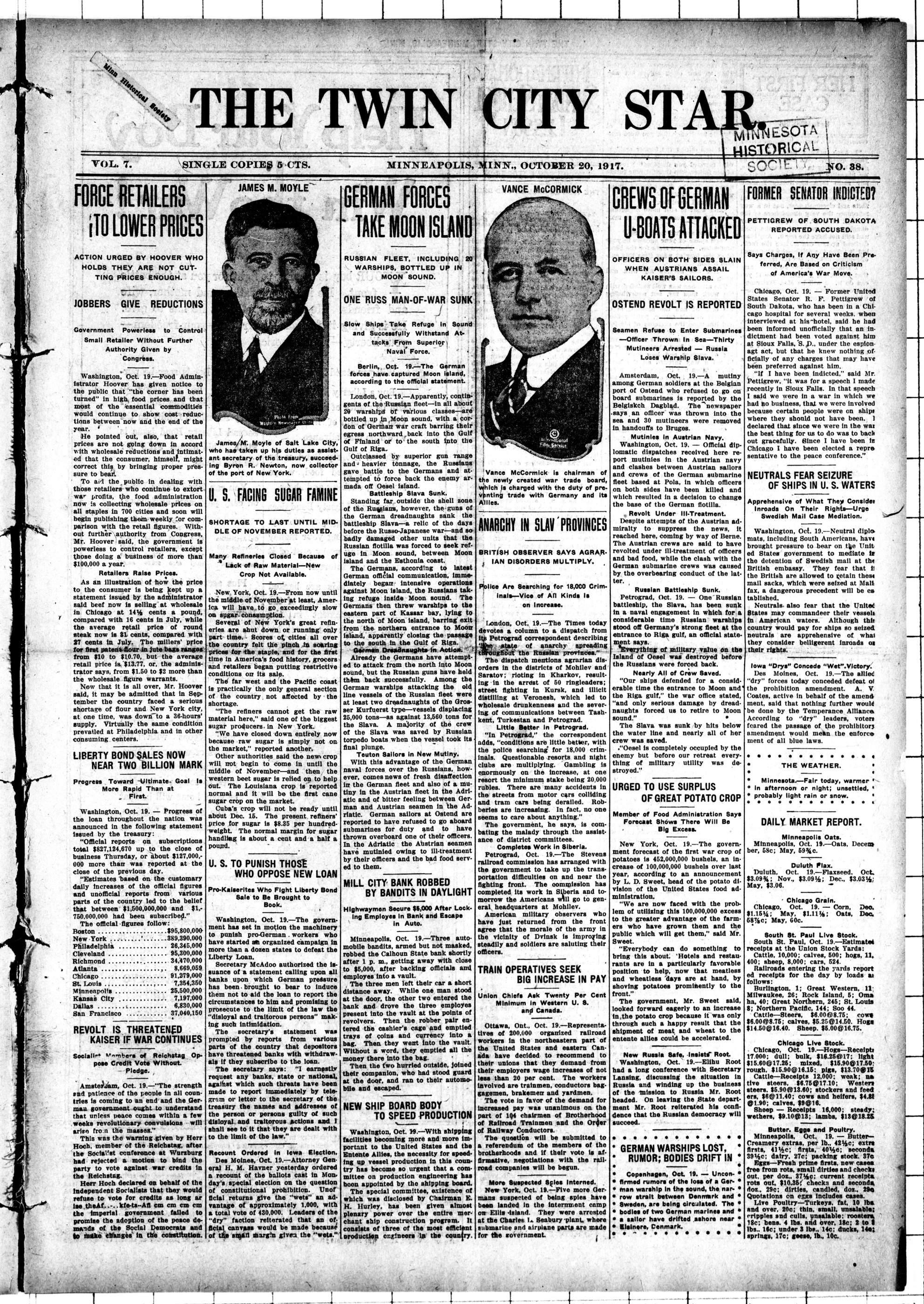
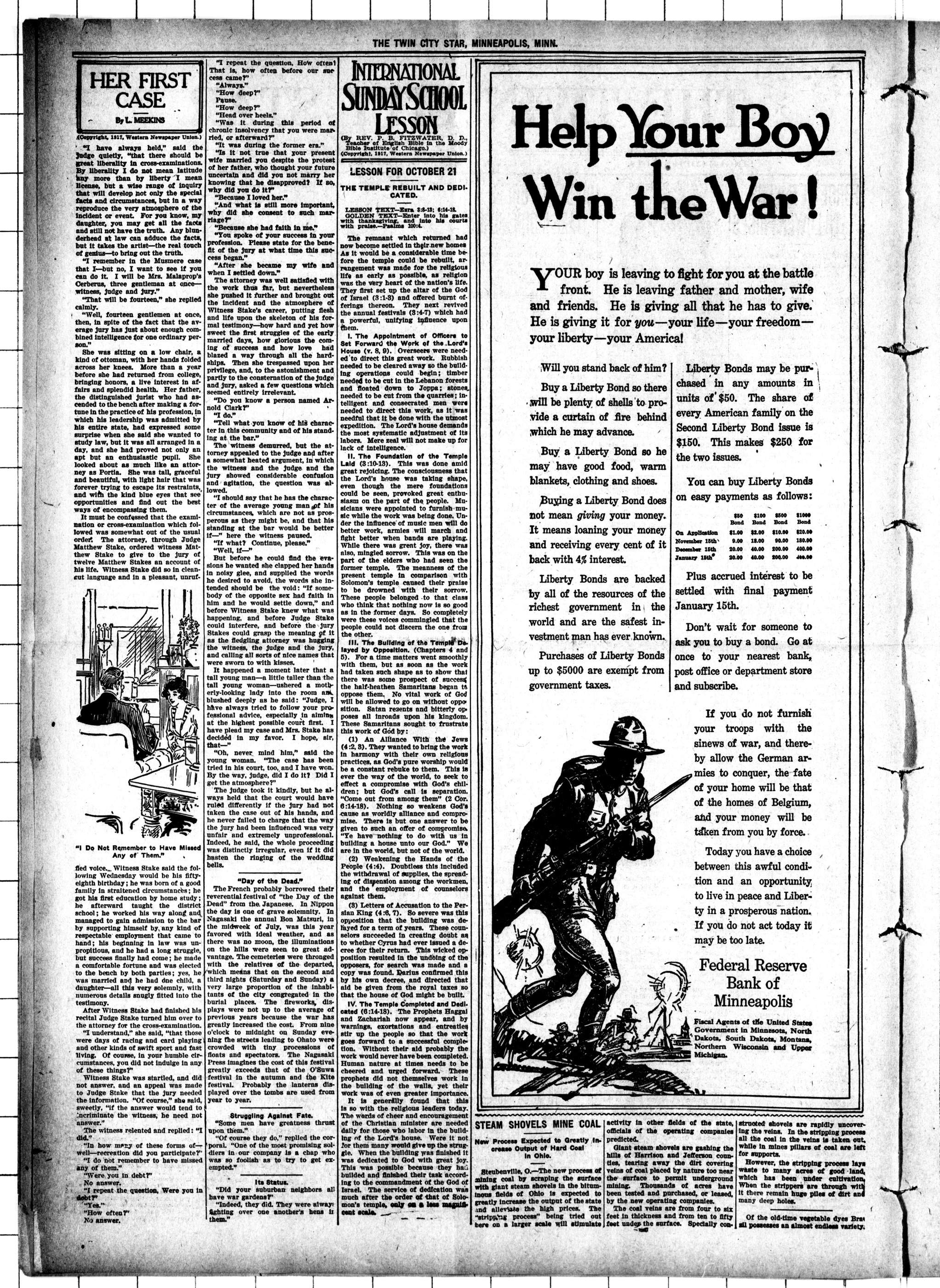
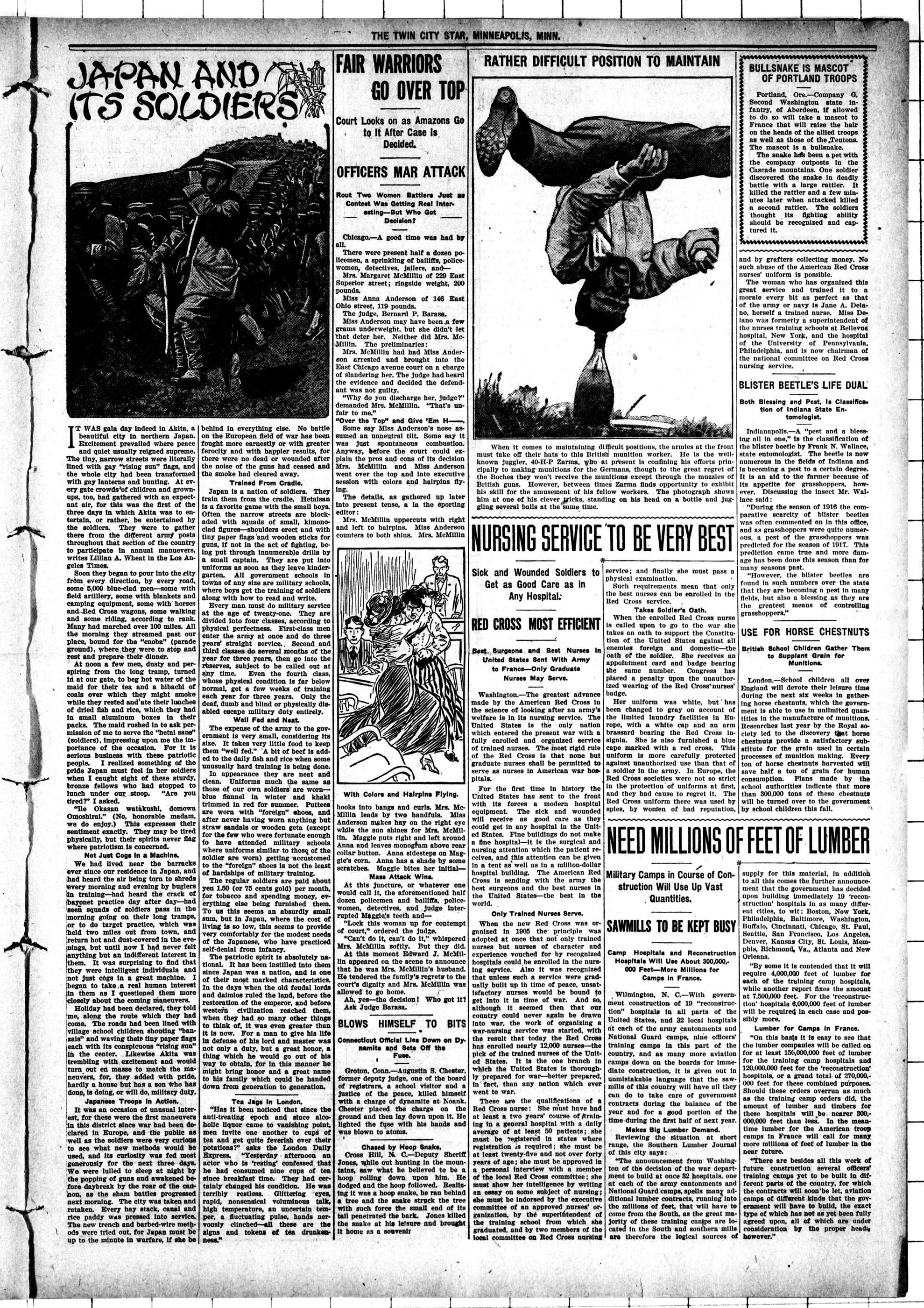
Page text (machine-generated)
FORCE RETAILERS TO LOWER PRICES
ACTION URGED BY HOOVER WHO HOLDS THEY ARE NOT CUTTING PRICES ENOUGH.
Washington, Oct. 19.—Food Administrator Hoover has given notice to the public that "the corner has been turned" in high food prices and that most of the essential commodities would continue to show cost reductions between now and the end of the year.
He pointed out, also, that retail prices are not going down in accord with wholesale reductions and intimated that the consumer, himself, might correct this by bringing proper pressure to bear.
To aid the public in dealing with those retailers who continue to extort war profits, the food administration now is collecting wholesale prices on all staples in 700 cities and soon will begin publishing them weekly for comparison with the retail figures. Without further authority from Congress, Mr. Hoover said, the government is powerless to control retailers, except those doing a business of more than $100,000 a year.
Retailers Raise Prices.
As an illustration of how the price to the consumer is being kept up a statement issued by the administrator said beef now is selling at wholesale in Chicago at 14½ cents a pound, compared with 16 cents in July, while the average retail price of round steak now is $1 cents, compared with 27 cents in July. The millers' price for first patent flour in jute bags ranges from $10 to $10.70, but the average retail price is $13.77, or, the administrator says, from $1.50 to $2 more than the wholesale figure warrants.
Now that it is all over, Mr. Hoover said, it may be admitted that in September the country faced a serious shortage of flour and New York city, at one time, was down to a 36-hour's supply. Virtually the same condition prevailed at Philadelphia and in other consuming centers.
LIBERTY BOND SALES NOW
NEAR TWO BILLION MARK
Progress Toward Ultimate. Goal Is More Rapid Than at
Washington, Oct. 19. — Progress of the loan throughout the nation was announced in the following statement issued by the treasury:
"Official reports on subscriptions total $827,124,670 up to the close of business Thursday, or about $127,000,000 more than was reported at the close of the previous day.
"Estimates based on the customary daily increases of the official figures and unofficial reports from various parts of the country led to the belief that between $1,500,000,000 and $1,750,000,000 had been subscribed."
The official figures follow:
Boston ... $95,800,000
New York ... 389,390,000
Philadelphia ... 26,345,000
Cleveland ... 95,300,000
Richmond ... 34,470,000
Atlanta ... 8,669,059
Chicago ... 91,279,000
St. Louis ... 7,354,350
Minneapolis ... 25,500,000
Kansas City ... 7,197,000
Dallas ... 6,830,000
San Francisco ... 27,040,150
REVOLT IS THREATENED
KAISER IF WAR CONTINUES
Socialist Members of Reichstag Oppose Credit Vote Without. Pledge.
Amsterdam, Oct. 19.—"The strength and patience of the people in all countries is coming to an end and the German government ought to understand that unless peace comes within a few weeks revolutionary convulsions will arise from the masses."
This was the warning given by Herr Hoch, member of the Reichstag, after the Socialist conference at Wurzburg had rejected a motion to bind the party to vote against war credits in the Reichstag.
Herr Hoch declared on behalf of the independent Socialists that they would refuse to vote for credits as long as the Af. kiefts-All cm cm cm cm the imperial government failed to promise the adoption of the peace demands of the Social Democrats and to make changes in the constitution.
THE TWIN CITY STAR
Phoca From
Western Newspaper Unit
James/M. Moyle of Salt Lake City, who has taken up his duties as assistant secretary of the treasury, succeeding Byron R. Newton, now collector of the port of New York.
U. S. FACING SUGAR FAMINE
SHORTAGE TO LAST UNTIL MID
DLE OF NOVEMBER REPORTED.
Many Refineries Closed Because of Lack of Raw Material—New Crop Not Available.
New York, Oct. 19.—From now until the middle of November at least, America will have to go exceedingly slow on sugar consumption.
Several of New York's great refineries are shut down or running only part time. Scores of cities all over the country felt the pinch in scoring prices for the staple, and for the first time in America's food history, grocers and retailers began putting restrictive conditions on its sale.
The far west and the Pacific coast is practically the only general section of the country, not affected by the shortage.
"The refiners cannot get the raw material here," said one of the biggest sugar producers in New York.
"We have closed down entirely now because raw sugar is simply not on the market," reported another.
Other authorities said the new crop will not begin to come in until the middle of November—and then the western beet sugar is relied on to help out. The Louisiana crop is reported normal and it will be the first cane sugar crop on the market.
Cuba's crop will not be ready until about Dec. 15. The present refiners' price for sugar is $8.35 per hundred-weight. The normal margin for sugar handling is about a cent and a half a pound.
U. S. TO PUNISH THOSE WHO OPPOSE NEW LOAN
Pro-Kaiserites Who Fight Liberty Bond Sale to Be Brought to Book.
Washington, Oct. 19.—The government has set in motion the machinery to punish pro-German workers who have started an organized campaign in more than a dozen states to defeat the Liberty Loan.
Secretary McAdoo authorized the issuance of a statement calling upon all banks upon which German pressure has been brought to bear to induce them not to aid the loan to report the circumstances to him and promising to prosecute to the limit of the law the "disloyal and traitorous persons" making such intimidation.
The secretary's statement was prompted by reports from various parts of the country that depositors have threatened banks with withdrawals if they subscribe to the loan.
The secretary says: "I earnestly request any banks, state or national, against which such threats have been made to report immediately by telegram or letter to the secretary of the treasury the names and addresses of the person or persons guilty of such disloyal and traitorous actions and I shall see to it that they are dealt with to the limit of the law."
Recount Ordered in Iowa Election.
Des Molnes, Oct. 19.—Attorney General H. M. Havner yesterday ordered a recount of the ballots cast in Monday's special election on the question of constitutional prohibition. Unofficial returns give the "wets" an advantage of approximately 1,000, with a total vote of 430,000. Leaders of the "dry" faction reiterated that an official canvass would be made because of the small margin given the "wets."
MINNEAPOLIS, MINN., OCTOBER 20, 1917.
GERMAN FORCES TAKE MOON ISLAND
RUSSIAN FLEET, INCLUDING
WARSHIPS, BOTTLED UP IN
MOON SOUND.
Slow Ships Take Refuge in Sound and Successfully Withstand Attacks From Superior Naval Force.
Berlin, Oct. 19.—The German forces have captured Moon island, according to the official statement.
London, Oct. 19.—Apparently, contingents of the Russian fleet—in all about 20 warships of various classes—are bottled up in Moon sound, with a cordon of German war craft barring their egress northward back into the Gulf of Finland or to the south into the Gulf of Riga.
Outclassed by superior gun range and heavier tonnage, the Russians gave battle to the Germans and attempted to force back the enemy armada off Oesel island.
Battleship Slava Sunk.
Standing far outside the shell zone of the Russians, however, the guns of the German dreadnaughts sank the battleship Slava—a relic of the days before the Russo-Japanese war—and so badly damaged other units that the Russian flotilla was forced to seek refuge in Moon sound, between Moon island and the Euthonia coast.
The Germans, according to latest German official communication, immediately began intensive operations against Moon island, the Russians taking refuge inside Moon sound. The Germans then threw warships to the eastern part of Kassar bay, lying to the north of Moon island, barring exit from the northern entrance to Moon island, apparently closing the passage to the south in the Gulf of Riga.
German Dreadnaughts in Action.
Already the Germans have attempted to attack from the north into Moon sound, but the Russian guns have held them back successfully. Among the German warships attacking the old line vessels of the Russian fleet were at least two dreadnaughts of the Grosser Kurfuerst type—vessels displacing 25,000 tons—as against 13,560 tons for the Slava. A majority of the crew of the Slava was saved by Russian torpedo boats when the vessel took its final plunge.
Teuton Sailors in New Mutiny.
With this advantage of the German naval forces over the Russians, however, comes news of fresh disaffection in the German fleet and also of a mutiny in the Austrian fleet in the Adriatic and of bitter feeling between German and Austrian seamen in the Adriatic. German sailors at Ostend are reported to have refused to go aboard submarines for duty and to have thrown overboard one of their officers.
In the Adriatic the Austrian seamen have mutinied owing to ill-treatment by their officers and the bad food served to them.
MILL CITY BANK ROBBED BY BANDITS IN DAYLIGHT
Highwaymen Secure $5,000 After Locking Employees in Bank and Escape in Auto.
Minneapolis, Oct. 19.—Three automobile bandits, armed but not masked, robbed the Calhoun State bank shortly after 1 p. m., getting away with close to $5,000, after backing officials and employees into a vault.
The three men left their car a short distance away. While one man stood at the door, the other two entered the bank and drove the three employees present into the vault at the points of revolvers. Then the robber pair entered the cashier's cage and emptied trays of coins and currency into a bag. Then they went into the vault. Without a word, they emptied all the money there into the bag.
Then the two hurried outside, joined their companion, who had stood guard at the door, and ran to their automobile and escaped.
NEW SHIP BOARD BODY TO SPEED PRODUCTION
Washington, Oct. 19.—With shipping facilities becoming more and more important to the United States and the Entente Allies, the necessity for speeding up vessel production in this country has become so urgent that a committee on production engineering has been appointed by the shipping board. The special committee, existence of which was disclosed by Chairman E. H. Hurley, has been given almost plenary power over the entire merchant ship construction program. It consists of three of the most efficient production engineers in the country.
VANCE McCORMICK
International
Film Service
Vance McCormick is chairman of the newly created war trade board, which is charged with the duty of preventing trade with Germany and its Allies.
ANARCHY IN SLAV 'PROVINCES
BRITISH OBSERVER SAYS AGRARIAN DISORDERS MULTIPLY.
Police Are Searching for 18,000 Criminals—Vice of All Kinds is on increase.
London, Oct. 19.—The Times today devotes a column to a dispatch from its Petrograd correspondent describing the state of anarchy spreading throughout the Russian provinces."
The dispatch mentions agrarian disorders in the districts of Mohilev and Saratov; rioting in Kharkov, resulting in the arrest of 50 ringleaders; street fighting in Kursk, and illicit distilling at Veronesk, which led to wholesale drunkenness and the severing of communications between Tashkent, Turkestan and Petrograd.
Little Better in Petrograd.
"In Petrograd," the correspondent adds, "conditions are little better, with the police searching for 18,000 criminals. Questionable resorts and night clubs are multiplying. Gambling is enormously on the increase, at one resort the minimum stake being 20,000 rubles. There are many accidents in the streets from motor cars colliding and tram cars being derailed. Robberies are increasing. In fact, no one seems to care about anything."
The government, he says, is combating the malady through the assistance of district committees.
Completes Work in Siberia.
Petrograd, Oct. 19.—The Stevens railroad commission has arranged with the government to take up the transportation difficulties on and near the fighting front. The commission has completed its work in Siberia and toorrow the Americans will go to general headquarters at Mohlov.
American military observers who have just returned from the front agree that the morale of the army in the vicinity of Dvinsk is improving steadily and soldiers are saluting their officers.
TRAIN OPERATIVES SEEK
BIG INCREASE IN PAY
Union Chiefs Ask Twenty Per Cent Minimum in Western U. S. and Canada.
Ottawa, Ont., Oct. 19.—Representatives of 200,000 organized railroad workers in the northeastern part of the United States and eastern Canada have decided to recommend to their unions that they demand from their employers wage increases of not less than 20 per cent. The workers involved are trainmen, conductors baggagemen, brakemen and yardmen.
The vote in favor of the demand for increased pay was unanimous on the part of 104 chairmen of Brotherhood of Railroad Trainmen and the Order of Railway Conductors.
The question will be submitted to a referendum of the members of the brotherhoods and if their vote is affirmative, negotiations with the railroad companies will be begun.
More Suspected Spies Interned.
New York, Oct. 19.—Five more Germans suspected of being spies have been landed in the interment camp on Ellis island. They were arrested at the Charles I. Seabury plant, where submarine and airplane parts are made for the government.
CREWS OF GERMAN U-BOATS ATTACKED
CREWS OF GERMAN U-BOATS ATTACKED
OFFICERS ON BOTH SIDES SLAIN
WHEN AUSTRIANS ASSAIL
KAISER'S SAILORS.
OSTEND REVOLT IS REPORTED
Seamen Refuse to Enter Submarines
—Officer Thrown In Sea—Thirty
Mutineers Arrested — Russia
Loses Warship Slava.
Amsterdam, Oct. 19.—A mutiny among German soldiers at the Belgian port of Ostend who refused to go on board submarines is reported by the Belgiskch Dagblad. The newspaper says an officer was thrown into the sea and 30 mutineers were removed in handcuffs to Bruges.
Mutinies in Austrian Navy.
Washington, Oct. 19.—Official diplomatic dispatches received here report mutinies in the Austrian navy and clashes between Austrian sailors and crews of the German submarine fleet based at Pola, in which officers on both sides have been killed and which resulted in a decision to change the base of the German flotilla.
Revolt Under III-Treatment.
Despite attempts of the Austrian admiralty to suppress the news, it reached here, coming by way of Berne. The Austrian crews are said to have revolted under ill-treatment of officers and bad food, while the clash with the German submarine crews was caused by the overbearing conduct of the latter.
Russian Battleship Sunk.
Petrograd, Oct. 19. — One Russian battleship, the Slava, has been sunk in a naval engagement in which for a considerable time Russian warships stood off Germany's strong fleet at the entrance to Riga gulf, an official statement says.
Everything of military value on the Island of Ossel was destroyed before the Russians were forced back.
Nearly All of Crew Saved.
"Our ships defended for a considerable time the entrance to Moon and the Riga gulf," the war office stated, "and only serious damage by dreadnaughts forced us to retire to Moon sound."
The Slava was sunk by hits below the water line and nearly all of her crew was saved.
"Ossel is completely occupied by the enemy but before our retreat everything of military utility was destroyed."
URGED TO USE SURPLUS OF GREAT POTATO CROP
Member of Food Administration Says Forecast Shows There Will Be Big Excess.
New York, Oct. 19.—The government forecast of the first war crop of potatoes is 452,000,000 bushels, an increase of 100,000,000 bushels over last year, according to an announcement by L. D. Sweet, head of the potato division of the United States food administration.
"We are now faced with the problem of utilizing this 100,000,000 excess to the greater advantage of the farmers who have grown them and the public which will get them," said Mr. Sweet.
"Everybody can do something to bring this about." Hotels and restaurants are in a particularly favorable position to help, now that meatless and wheatless days are at hand, by shoving potatoes prominently to the front."
The government, Mr. Sweet said, looked forward eagerly to an increase in the potato crop because it was only through such a happy result that the shipment of meat and wheat to the entails could be accelerated.
New Russia Safe. Inalists Root.
Washington, Oct. 19.—Elihu Root had a long conference with Secretary Lansing, discussing the situation in Russia and winding up the business of the mission to Russia Mr. Root headed. On leaving the State department Mr. Root reiterated his confidence that the Russian democracy will succeed.
GERMAN WARSHIPS LOST,
RUMOR; BODIES DRIFT IN
Copenhagen, Oct. 19. — Unconfirmed rumors of the loss of a German warship in the sound, the narrow strait between Denmark and Sweden, are being circulated. The bodies of two German marines and a sailor have drifted ashore near Elsinore, Denmark.
FORMER SENATOR INDICTED?
PETTIGREW OF SOUTH DAKOTA
REPORTED ACCUSED.
Says Charges, If Any Have Been Preferred, Are Based on Criticism of America's War Move.
Chicago, Oct. 19. — Former United States Senator R. F. Pettigrew of South Dakota, who has been in a Chicago hospital for several weeks, when interviewed at his hotel, said he had been informed unofficially that an indictment had been voted against him at Stoux Falls, S. D., under the esplonogact act, but that he knew nothing officially of any charges that may have been preferred against him.
"If I have been indicted," said Mr. Pettigrew, "it was for a speech I made recently in Sloux Falls. In that speech I said we were in a war in which we had no business, that we were involved because certain people were on ships where they should not have been. I declared that since we were in the war the best thing for us to do was to back out gracefully. Since I have been in Chicago I have been elected a representative to the peace conference."
NEUTRALS FEAR SEIZURE OF SHIPS IN U. S. WATERS
Apprehensive of What They Consider Inroads On Their Rights—Urge Swedish Mail Case Mediation.
Washington, Oct. 19.—Neutral diplomats, including South Americans, have brought pressure to bear on the United States government to mediate in the detention of Swedish mail at the British embassy. They fear that if the British are allowed to retain these mail sacks, which were seized at Malt fax, a dangerous precedent will be established.
Neutrals also fear that the United States may commandeer their vessels in American waters. Although this country would pay for ships so seized neutrals are apprehensive of what they consider belligerent inroads on their rights.
Iowa "Drys" Concede "Wet", Victory.
Des Moines, Oct. 19.—The allied "dry" forces today conceded defeat of the prohibition amendment. A. V. Coates, active in behalf of the amendment, said that nothing further would be done by the Temperance Alliance. According to "dry" leaders, voters feared the passage of the prohibitory amendment would mean the enforcement of all blue laws.
THE WEATHER.
* Minnesota.—Fair today, warmer
* in afternoon or night; unsettled,
* probably light rain or snow.
DAILY MARKET REPORT.
Minneapolis Oats.
Minneapolis, Oct. 19.—Oats, December, 58c; May, 59%c.
Duluth Flax.
Duluth, Oct. 19.—Flaxseed, Oct. $3.09%; Nov., $3.09½; Dec., $3.03½; May, $3.06.
Chicago Grain.
Chicago, Oct. 19. — Corn, Dec. $1.15½; May, $1.11½; Oats, Dec. 58%c; May, 60c.
South St. Paul Live Stock.
South St. Paul, Oct. 19.—Estimated receipts at the Union Stock Yards:
Cattle, 10,000; calves, 500; hogs, 11,400; sheep, 8,000; cars, 524.
Railroads entering the yards report receipts for the day by loads as follows:
Burlington, 1; Great Western, 11; Milwaukee, 26; Rock Island, 5; Omaha, 40; Great Northern, 245; St. Louis, 8; Northern Pacific, 144; Soo 44.
Cattle—Steers, $6.00@8.75; cows $6.00@8.75; calves $5.25@14.50. Hogs $14.50@14.50. Sheep. $5.00@16.75.
Chicago Live Stock.
Chicago, Oct. 19—Hogs—Receipts
17.000; dull; bulk, $16.25@17; light
$15.60@17.25; mixed, $15.90@17.50;
rough, $15.90@16.15; pigs, $13.70@15
Cattle—Receipts 12.100; weak; na-
tive steers, $6.75@17.10; Western
steers, $5.90@17.00; stockers and feed
ers, $6.14@10; cows and heifers, $4.88
@1.90; calves, $9@16.
Sheep — Receipts 16,000; steady; wethers, $9.10@13; lambs, $13@18.25
Butter, Eggs and Poultry.
Minneapolis, Oct. 19. — Butter—Creamy extras, per lb. 42½%; extra firsts, 41½%; firsts, 40½%; seconda 39½%; dairy, 27%; packing stock. 37c Eggs—Fresh prime firsts, new cases free from rots, small dirties and checks out, per doz. 37½%; current receipts rots out, 10.35; checks and seconda doz. 29c; dirties, candied, doz. 29c; Quotations on eggs includes cases.
Live Poultry—Turkeys, fat, 10 lbs and over, 20c; thin, small, unsalable; cripples and culls, unsalable; roostera 18c; bens. 4 lbs. and over, 18c; 2 to 8 lbs. 16c; under 3 lbs. 14c; ducks, 14c; springs. 17c; geese, lb. 10c.
"I have always held," the judge quietly, "that there should be great liberality in cross-examinations. By liberality I do not mean latitude any more than by liberty I mean license, but a wise range of inquiry that will develop not only the special facts and circumstances, but in a way reproduce the very atmosphere of the incident or event. For you know, my daughter, you may get all the facts and still not have the truth. Any blunderhead at law can adduce the facts, but it takes the artist—the real touch of genius—to bring out the truth.
"I remember in the Musmere case that I—but no, I want to see if you can do it. I will be Mrs. Malaprop's Cerberus, three gentleman at once—witness, judge and jury."
"That will be fourteen," she replied calmly.
"Well, fourteen gentlemen at once, then, in spite of the fact that the average jury has just about enough combined intelligence for one ordinary person."
She was sitting on a low chair, a kind of ottoman, with her hands folded across her knees. More than a year before she had returned from college, bringing honors, a live interest in affairs and splendid health. Her father, the distinguished jurist who had ascended to the bench after making a fortune in the practice of his profession, in which his leadership was admitted by his entire state, had expressed some surprise when she said she wanted to study law, but it was all arranged in a day, and she had proved not only an apt but an enthusiastic pupil. She looked about as much like an attorney as Portia. She was tall, graceful and beautiful, with light hair that was forever trying to escape its restraints, and with the kind blue eyes that see opportunities and find out the best ways of encompassing them.
It must be confessed that the examination or cross-examination which followed was somewhat out of the usual order. The attorney, through Judge Matthew Stake, ordered witness Matthew Stake to give to the jury of twelve Matthew Stakes an account of his life. Witness Stake did so in clean-cut language and in a pleasant, unruf-
A man and a woman are sitting in a living room, engaged in a conversation. The man is facing the woman, who is seated across from him. They are both holding a coffee cup. The room is decorated with a large window, a fireplace, and a bookshelf filled with books and decorative items.
"I Do Not Remember to Have Missed Any of Them."
fled voice. Witness Stake said the following Wednesday would be his fifty-eighth birthday; he was born of a good family in straitened circumstances; he got his first education by home study; he afterward taught the district school; he worked his way along and managed to gain admission to the bar by supporting himself by, any kind of respectable employment that came to hand; his beginning in law was unpropitious, and he had a long struggle, but success finally had come; he made a comfortable fortune and was elected to the bench by both parties; yes, he was married and he had one child, a daughter—all this very solemnly, with numerous details snugly fitted into the testimony.
After Witness Stake had finished his recital Judge Stake turned him over to the attorney for the cross-examination.
"I understand," she said, "that those were days of racing and card playing and other kinds of swift sport and fast living. Of course, in your humble circumstances, you did not indulge in any of these things?"
Witness Stake was startled, and did not answer, and an appeal was made to Judge Stake that the jury needed the information. "Of course," she said, sweetly, "if the answer would tend to incriminate the witness, he need not answer."
The witness relented and replied: "I did."
"In how many of these forms of—well—recreation did you participate?"
"I do not remember to have missed any of them."
"Were you in debt?"
"I repeat the question, Were you in
dobt?"
"Yes."
"How often?"
No answer.
"I repeat the question, How often? That is, how often before our success came?"
"Was it during this period of chronic insolvency that you were married, or afterward?"
"It was during the former era."
"Is it not true that your present wife married you despite the protest of her father, who thought your future uncertain and did you not marry her knowing that he disapproved? If so, why did you do it?"
"Because I loved her."
"And what is still more important, why did she consent to such marriage?"
"Because she had faith in me."
"You spoke of your success in your profession. Please state for the benefit of the jury at what time this success began."
"After she became my wife and when I settled down."
The attorney was well satisfied with the work thus far, but nevertheless she pushed it further and brought out the incident and the atmosphere of Witness Stake's career, putting flesh and life upon the skeleton of his formal testimony—how hard and yet how sweet the first struggles of the early married days, how glorious the coming of success and how love had blazed a way through all the hardships. Then she trespassed upon her privilege, and, to the astonishment and partly to the consternation of the judge and jury, asked a few questions which seemed entirely irrelevant.
"Do you know a person named Arnold Clark?"
"I do."
"Tell what you know of his character in this community and of his standing at the bar."
The witness demurred, but the attorney appealed to the judge and after a somewhat heated argument, in which the witness and the judge and the jury showed considerable confusion and agitation, the question was allowed.
"I should say that he has the character of the average young man of his circumstances, which are not as prosperous as they might be, and that his standing at the bar would be better if—" here the witness paused.
But before he could find the evasions he wanted she clapped her hands in noisy glee, and supplied the words he desired to avoid, the words she intended should be the void: "If somebody of the opposite sex had faith in him and he would settle down," and before Witness Stake knew what was happening, and before Judge Stake could interfere, and before the jury Stakes could grasp the meaning of it as the fledgling attorney was hugging the witness, the judge and the jury, and calling all sorts of nice names that were sworn to with kisses.
It happened a moment later that a tall young man—a little taller than the tall young woman—ushered a motherly-looking lady into the room and blushed deeply as he said: "Judge, I have always tried to follow your professional advice, especially in alms at the highest possible court first. I have plead my case and Mrs. Stake has decided in my favor. I hope, sir, that—" "Oh, never mind him," said the young woman. "The case has been tried in his court, too, and I have won. By the way, judge, did I do it? Did I get the atmosphere?"
The judge took it kindly, but he always held that the court would have ruled differently if the jury had not taken the case out of his hands, and he never failed to charge that the way the jury had been influenced was very unfair and extremely unprofessional. Indeed, he said, the whole proceeding was distinctly irregular, even if it did hasten the ringing of the wedding bells.
"Day of the Dead."
The French probably borrowed their reverential festival of "the Day of the Dead" from the Japanese. In Nippon the day is one of grave solemnity. In Nagasaki the annual Bon Matsuri, in the midweek of July, was this year favored with ideal weather, and as there was no moon, the illuminations on the hills were seen to great advantage. The cemeteries were thronged with the relatives of the departed, which means that on the second and third nights (Saturday and Sunday) a very large proportion of the inhabitants of the city congregated in the burial places. The fireworks, displays were not up to the average of previous years because the war has greatly increased the cost. From nine o'clock to midnight on Sunday evening the streets leading to Ohato were crowded with tiny processions of floats and spectators. The Nagasaki Press imagines the cost of this festival greatly exceeds that of the O'Suwa festival in the autumn and the Kite festival. Probably the lanterns displayed over the tombs are used from year to year.
"Some men have greatness thrust upon them."
"Of course they do," replied the corporal. "One of the most promising soldiers in our company is a chap who was so foolish as to try to get exempted."
Its Status.
"Did your suburban neighbors all have war gardens?"
"Indeed, they did. They were always fighting over one another's hens in them."
THE TWIN CITY STAR, MINNEAPOLIS, MINN.
INTERNATIONAL SUNDAY SCHOOL
(By REV. P. B. FITZWATER, D. D.
Teacher of English Bible in the Moody
Bible Institute of Chicago).
(Copyright, 1917, Western Newspaper Union.)
LESSON FOR OCTOBER 21
THE TEMPLE REBUILT AND DEDICATED.
LESSON TEXT—Extra 3:8-13; 6:14-18.
GOLDEN TEXT—Enter into his gates with thanksgiving, and into his courts with praise.—Psalms 100:4.
The remnant which returned had now become settled in their new homes. As it would be a considerable time before the temple could be rebuilt, arrangement was made for the religious life as early as possible, as religion was the very heart of the nation's life. They first set up the altar of the God of Israel (3:1-3) and offered burnt offerings thereon. They next revived the annual festivals (3:4-7) which had a powerful, unifying influence upon them.
I. The Appointment of Officers to Set Forward the Work of the Lord's House (v. 8, 9). Overseers were needed to direct this great work. Rubbish needed to be cleared away so the building operations could begin; timber needed to be cut in the Lebanon forests and floated down to Joppa; stones needed to be cut from the quarries; intelligent and consecrated men were needed to direct this work, as it was needful that it be done with the utmost expedition. The Lord's house demands the most systematic adjustment of its labors. Mere zeal will not make up for lack of intelligence.
II. The Foundation of the Temple Laid (3:10-13). This was done amid great rejoicing. The consciousness that the Lord's house was taking shape, even though the mere foundations could be seen, provoked great enthusiasm on the part of the people. Musicians were appointed to furnish music while the work was being done. Under the influence of music men will do better work, armies will march and fight better when bands are playing. While there was great joy, there was also, mingled sorrow. This was on the part of the elders who had seen the former temple. The meanness of the present temple in comparison with Solomon's temple caused their praise to be drowned with their sorrow. These people belonged to that class who think that nothing now is so good as in the former days. So completely were these voices commingled that the people could not discern the one from the other.
III. The Building of the Temple Delayed by Opposition. (Chapters 4 and 5). For a time matters went smoothly with them, but as soon as the work had taken such shape as to show that there was some prospect of success the half-heathen Samaritans began to oppose them. No vital work of God will be allowed to go on without opposition. Satan resents and bitterly opposes all inroads upon his kingdom. These Samaritans sought to frustrate this work of God by:
(1) An Alliance With the Jews (4:2, 8). They wanted to bring the work in harmony with their own religious practices, as God's pure worship would be a constant rebuke to them. This is ever the way of the world, to seek to effect a compromise with God's children; but God's call is separation. "Come out from among them" (2 Cor. 6:14-18). Nothing so weakens God's cause as worldly alliance and compromise. There is but one answer to be given to such an offer of compromise. "Ye have nothing to do with us in building a house unto our God." We are in the world, but not of the world. (2) Weaking the Hands of the People (4:4). Doubtless this included the withdrawal of supplies, the spreading of dissension among the workmen, and the employment of counselors against them.
(3) Letters of Accusation to the Persian King (4:6, 7). So severe was this opposition that the building was delayed for a term of years. These counselors succeeded in creating doubt as to whether Cyrus had ever issued a decree for their return. This wicked opposition resulted in the unding of the opposers, for search was made and a copy was found. Darius confirmed this by his own decree, and directed that ald be given from the royal taxes so that the house of God might be built.
IV. The Temple Completed and Dedicated (6:14-18). The Prophets Haggal and Zachariah now appear, and by warnings, exortations and entreaties stir up the people so that the work goes forward to a successful completion. Without their old probably the work would never have been completed. Human nature at times needs to be cheered and urged forward. These prophets did not themselves work in the building of the walls, yet their work was of even greater importance.
It is generally found that this is so with the religious leaders today. The wards of cheer and encouragement of the Christian minister are needed daily for those who labor in the building of the Lord's house. Were it not for them many would give up the struggle. When the building was finished it was dedicated to God with great joy. This was possible because they had built and finished their task according to the commandment of the God of Israel. The service of dedication was much after the order of that of Solomon's temple, only on a less magnificent scale.
Help Your Boy Win the War!
YOUR boy is leaving to fight for you at the battle front. He is leaving father and mother, wife and friends. He is giving all that he has to give. He is giving it for you—your life—your freedom your liberty—your America!
Will you stand back of him?
Buy a Liberty Bond so there will be plenty of shells to provide a curtain of fire behind which he may advance.
Buy a Liberty Bond so he may have good food, warm blankets, clothing and shoes.
Buying a Liberty Bond does not mean giving your money. It means loaning your money and receiving every cent of it back with 4% interest. Liberty Bonds are backed by all of the resources of the richest government in the world and are the safest investment man has ever known.
Purchases of Liberty Bonds up to $5000 are exempt from government taxes.
STEAM SHOVELS MINE COAL
THE SOLDIER
Y
s
k
r
o
c
a
t
k
t
t
t
I
R
New Process Expected to Greatly Increase Output of Hard Coal in Ohio.
Steubenville, O.—The new process of mining coal by scraping the surface with giant steam shovels in the bituminous fields of Ohio is expected to greatly increase the output of the state and alleviate the high prices. The "stripping process" being tried out here on a larger scale will stimulate
---
activity in other fields of the state, officials of the operating companies predicted. Giant steam shovels are gashing the hills of Harrison and Jefferson counties, tearing away the dirt covering veins of coal placed by nature too near the surface to permit underground mining. Thousands of acres have been tested and purchased, or leased, by the new operating companies. The coal veins are from four to six feet in thickness and from ten to fifty feet under the surface. Specially con-
Liberty Bonds may be purchased in any amounts in units of $50. The share of every American family on the Second Liberty Bond issue is $150. This makes $250 for the two issues.
You can buy Liberty Bonds on easy payments as follows:
$50 $100 $500 $1000
Bond Bond Bond Bond
On Application $1.00 $2.00 $10.00 $20.00
November 15th 9.00 18.00 90.00 180.00
December 15th 20.00 40.00 200.00 400.00
January 15th 20.00 40.00 200.00 400.00
Plus accrued interest to be
settled with final payment
January 15th.
Don't wait for someone to
ask you to buy a bond. Go at
once to your nearest bank,
post office or department store
and subscribe.
If you do not furnish your troops with the sinews of war, and thereby allow the German armies to conquer, the fate of your home will be that of the homes of Belgium, and your money will be taken from you by force.
Today you have a choice between this awful condition and an opportunity to live in peace and Liberty in a prosperous nation. If you do not act today it may be too late.
Federal Reserve Bank of Minneapolis
Fiscal Agents of the United States Government in Minnesota, North Dakota, South Dakota, Montana, Northern Wisconsin and Upper Michigan.
of the state, companies gashing the person com-structed shovels are rapidly uncovering the veins. In the stripping process all the coal in the veins is taken out, while in mines pillars of coal are left for supports.
However, the stripping process lays waste to many acres of good land, which has been under cultivation. When the strippers are through with it there remain huge piles of dirt and many deep holes.
Of the old-time vegetable dyes Braasil possesses an almost endless variety.
JAPAN AND ITS SOLDIERS
IT WAS gala day indeed in Akita, a beautiful city in northern Japan. Excitement prevailed where peace and quiet usually reigned supreme. The tiny, narrow streets were literally lined with gay "rising sun" flags, and the whole city had been transformed with gay lanterns and bunting. At every gate crowds' of children and grown-ups, too, had gathered with an expectant air, for this was the first of the three days in which Akita was to entertain, or rather, be entertained by the soldiers. They were to gather there from the different army posts throughout that section of the country to participate in annual maneuvers, writes Lillian A. Wheat in the Los Angeles Times.
Soon they began to pour into the city from every direction, by every road, some 5,000 blue-clad men—some with field artillery, some with blankets and camping equipment, some with horses and Red Cross wagons, some walking and some riding, according to rank. Many had marched over 100 miles. All the morning they streamed past our place, bound for the "enoba" (parade ground), where they were to stop and rest and prepare their dinner.
At noon a few men, dusty and perspiring from the long tramp, turned in at our gate, to beg hot water of the maid for their tea and a hibachi of coals over which they might smoke while they rested and ate their lunches of dried fish and rice, which they had in small aluminum boxes in their packs. The maid rushed in to ask permission of me to serve the "metal sane" (soldiers), impressing upon me the importance of the occasion. For it is serious business with these patriotic people. I realized something of the pride Japan must feel in her soldiers when I caught sight of these sturdy, bronze fellows who had stopped to lunch under our stoop. "Are you tired?" I asked.
"Ie Okasan watakushi, domowa Omoshiraf." (No, honorable madam, we do enjoy.) This expresses their sentiment exactly. They may be tired physically, but their spirits never flag where patriotism is concerned.
Not Just Cogs In a Machine.
Not Just Cogs in a Machine.
We had lived near the barracks ever since our residence in Japan, and had heard the air being torn to shreds every morning and evening by buglers in training—had heard the crack of bayonet practice day after day—had seen squads of soldiers pass in the morning going on their long tramps, or to do target practice, which was held two miles out from town, and return hot and dust-covered in the evenings, but until now I had never felt anything but an indifferent interest in them. It was surprising to find that they were intelligent individuals and not just cogs in a great machine. I began to take a real human interest in them as I questioned them more closely about the coming maneuvers. Holiday had been declared, they told me, along the route which they had come. The roads had been lined with village school children shouting "banzals" and waving their tiny paper flags each with its conspicuous "rising sun" in the center. Likewise Akita was trembling with excitement and would turn out en masse to match the maneuvers, for, they added with pride, hardly a house but has a son who has done, is doing, or will do, military duty.
Japanese Troops in Action.
It was an occasion of unusual interest, for these were the first maneuvers in this district since war had been declared in Europe, and the public as well as the soldiers were very curious to see what new methods would be used, and its curiosity was fed most generously for the next three days. We were lulled to sleep at night by the popping of guns and awakened before daybreak by the roar of the cannon, as the sham battles progressed next morning. The city was taken and retaken. Every hay stack, canal and rice paddy was pressed into service. The new trench and barbed-wire methods were tried out, for Japan must be up to the minute in warfare, if she be
behind in everything else. No battle on the European field of war has been fought more earnestly or with greater ferocity and with happier results, for there were no dead or wounded after the noise of the guns had ceased and the smoke had cleared away.
Trained From Cradle.
Japan is a nation of soldiers. They train them from the cradle. Hetaisan is a favorite game with the small boys. Often the narrow streets are blockaded with squads of small, kimono-clad figures—shoulders erect and with tiny paper flags and wooden sticks for guns, if not in the act of fighting, being put through innumerable drills by a small captain. They are put into uniforms as soon as they leave kindergarten. All government schools in towns of any size are military schools, where boys get the training of soldiers along with how to read and write.
Every man must do military service at the age of twenty-one. They are divided into four classes, according to physical perfectness. First-class men enter the army at once and do three years' straight service. Second and third classes do several months of the year for three years, then go into the reserves, subject to be called out at any time. Even the fourth class, whose physical condition is far below normal, get a few weeks of training each year for three years. Only the deaf, dumb and blind or physically disabled escape military duty entirely.
Well Fed and Neat.
The expense of the army to the government is very small, considering its size. It takes very little food to keep them "well fed." A bit of beef is added to the daily fish and rice when some unusually hard training is being done.
In appearance they are neat and clean. Uniforms much the same as those of our own soldiers' are worn—blue flannel in winter and khakil trimmed in red for summer. Puttees are worn with "foreign" shoes, and after never having worn anything but straw sandals or wooden geta (except for the few who were fortunate enough to have attended military schools where uniforms similar to those of the soldier are worn) getting accustomed to the "foreign" shoes is not the least of hardships of military training.
The regular soldiers are paid about yen 1.50 (or 75 cents gold) per month, for tobacco and spending money, everything else being furnished them. To us this seems an absurdly small sum, but in Japan, where the cost of living is so low, this seems to provide very comfortably for the modest needs of the Japanese, who have practiced self-denial from infancy.
The patriotic spirit is absolutely national. It has been instilled into them since Japan was a nation, and is one of their most marked characteristics. In the days when the old feudal lords and dalmios ruled the land, before the restoration of the emperor, and before western civilization reached them, when they had so many other things to think of, it was even greater than it is now. For a man to give his life in defense of his lord and master was not only a duty, but a great honor, a thing which he would go out of his way to obtain, for in this manner he might bring honor and a great name to his family which could be handed down from generation to generation.
Tea Jags In London.
"Has it been noticed that since the anti-treating epoch and since alcoholic liquor came to vanishing point, men invite one another to cups of tea and get quite feverish over their potitions?" asks the London Daily Express. "Yesterday afternoon an actor who is 'resting' confessed that he had consumed nine cups of tea since breakfast time. They had certainly changed his condition. He was terribly restless. Glittering eyes, rapid, nonsensical voluminous talk, high temperature, an uncertain temper, a fluctuating pulse, hands nervously clinched—all these are the signs and tokens of tea drunkenness."
THE TWIN CITY STAR, MINNEAPOLIS, MINN.
Court Looks on as Amazons Go to It After Case Is Decided.
OFFICERS MAR ATTACK
Rout Two Women Battlers Just as Contest Was Getting Real Interesting—But Who Got Decision?
Chicago.—A good time was had by all.
There were present half a dozen policemen, a sprinkling of balliffs, police-women, detectives, jailers, and—Mrs. Margaret McMillin of 229 East Superior street; ringside weight, 200 pounds.
Miss Anna Anderson of 146 East Ohio street, 119 pounds.
The judge, Bernard P. Barasa.
Miss Anderson may have been a few grams underweight, but she didn't let that deter her. Neither did Mrs. McMillin. The preliminaries:
Mrs. McMillin had had Miss Anderson arrested and brought into the East Chicago avenue court on a charge of slandering her. The judge had heard the evidence and decided the defendant was not guilty.
"Why do you discharge her, judge?" demanded Mrs. McMillin. "That's unfair to me."
"Over the Top" and Give 'Em H——
Some say Miss Anderson's nose assumed an uneutral tilt. Some say it was just spontaneous combustion. Anyway, before the court could explain the pros and cons of its decision Mrs. McMillin and Miss Anderson went over the top and into executive session with colors and hairpins flying.
The details, as gathered up later into present tense, a la the sporting editor:
Mrs. McMillin uppercalls with right and left to hairpins. Miss Anderson counters to both shins. Mrs. McMillin
JUSTICE
With Colors and Hairpine Flying.
hooks into bangs and curls. Mrs. McMillin leads by two handfuls. Miss Anderson makes hay on the right eye while the sun shines for Mrs. McMillin. Maggie puts right and left around Anna and leaves monogram above rear collar button. Anna sidestepes on Maggie's corn. Anna has a shade by some scratches. Maggie bites her initial—
Mass Attack Wins.
At this juncture, or whatever one would call it, the aforementioned half dozen policemen and balliffs, policewomen, detectives, and judge interrupted Maggie's teeth and—
"Lock this woman up for contempt of court," ordered the judge.
"Can't do it, can't do it," whispered Mrs. McMillin softly. But they did.
At this moment Edward J. McMillin appeared on the scene to announce that he was Mrs. McMillin's husband. He tendered the family's regrets to the court's dignity and Mrs. McMillin was allowed to go home.
Ah, yes—the decision! Who got it?
Ask Judge Barasa.
Groton, Conn.—Augustin S. Chester, former deputy judge, one of the board of registrars, a school visitor and a justice of the peace, killed himself with a charge of dynamite at Noank. Chester placed the charge on the ground and then lay down upon it. He lighted the fuse with his hands and was blown to atoms.
Chased by Hoop Snake.
Cross Hill, N. C.—Deputy Sheriff Jones, while out hunting in the mountains, saw what he believed to be a hoop rolling down upon him. He dodged and the hoop followed. Realizing it was a hoop snake, he ran behind a tree and the snake struck the tree with such force the small end of its tall penetrated the bark. Jones killed the snake at his leisure and brought it home as a souvenir.
A
When it comes to maintaining difficult positions, the armies at the front must take off their hats to this British munition worker. He is the well-known juggler, 40-H-P Zarma, who at present is confining his efforts principally to making munitions for the Germans, though to the great regret of the Boches they won't receive the munitions except through the muzzles of British guns. However, between times Zarma finds opportunity to exhibit his skill for the amusement of his fellow workers. The photograph shows him at one of his clever tricks, standing on his head on a bottle and juggling several balls at the same time.
NURSING SERVICE TO BE VERY BEST
Sick and Wounded Soldiers to Get as Good Care as in Any Hospital:
CROSS MOST EFFICIENT
Best Surgeons and Best Nurses in United States Sent With Army to France—Only Graduate Nurses May Serve.
Washington.—The greatest advance made by the American Red Cross in the science of looking after an army's welfare is in its nursing service. The United States is the only nation which entered the present war with a fully enrolled and organized service of trained nurses. The most rigid rule of the Red Cross is that none but graduate nurses shall be permitted to serve as nurses in American war hospitals.
For the first time in history the United States has sent to the front with its forces a modern hospital equipment. The sick and wounded will receive as good care as they could get in any hospital in the United States. Fine buildings do not make a fine hospital—it is the surgical and nursing attention which the patient receives, and this attention can be given in a tent as well as in a million-dollar hospital building. The American Red Cross is sending with the army the best surgeons and the best nurses in the United States—the best in the world.
Only Trained Nurses Serve.
When the new Red Cross was organized in 1905 the principle was adopted at once that not only trained nurses but nurses of character and experience vouched for by recognized hospitals could be enrolled in the nursing service. Also it was recognized that unless such a service were gradually built up in time of peace, unsatisfactory nurses would be bound to get into it in time of war. And so, although it seemed then that our country could never again be drawn into war, the work of organizing a war-nursing service was started, with the result that today the Red Cross has enrolled nearly 12,000 nurses—the pick of the trained nurses of the United States. It is the one branch in which the United States is thoroughly prepared for war—better prepared, in fact, than any nation which ever went to war.
These are the qualifications of a Red Cross nurse: She must have had at least a two years' course of training in a general hospital with a daily average of at least 50 patients; she must be registered in states where registration is required; she must be at least twenty-five and not over forty years of age; she must be approved in a personal interview with a member of the local Red Cross committee; she must show her intelligence by writing an essay on some subject of nursing; she must be indorsed by the executive committee of an approved nurses' organization, by the superintendent of the training school from which she graduated, and by two members of the local committee on Red Cross nursing
NEED MILLIONS OF FEET OF LUMBER
service; and finally she must pass a physical examination.
Such requirements mean that only the best nurses can be enrolled in the Red Cross service.
Takes Soldier's Oath.
When the enrolled Red Cross nurse is called upon to go to the war she takes an oath to support the Constitution of the United States against all enemies foreign and domestic—the oath of the soldier. She receives an appointment card and badge bearing the same number. Congress has placed a penalty upon the unauthorized wearing of the Red Cross nurses' badge.
Her uniform was white, but has been changed to gray on account of the limited laundry facilities in Europe, with a white cap and an arm brassard bearing the Red Cross insignia. She is also furnished a blue cape marked with a red cross. This uniform is more carefully protected against unauthorized use than that of a soldier in the army. In Europe, the Red Cross societies were not so strict in the protection of uniforms at first, and they had cause to regret it. The Red Cross uniform there was used by spies, by women of bad reputation,
Military Camps in Course of Construction Will Use Up Vast Quantities.
SAWMILLS TO BE KEPT BUSY
Camp Hospitals and Reconstruction Hospitals Will Use About 300,000,000 Feet—More Millions for Camps in France.
Wilmington, N. C.—With government construction of 19 "reconstruction" hospitals in all parts of the United States, and 32 local hospitals at each of the army cantonnments and National Guard camps, nine officers' training camps in this part of the country, and as many more aviation camps down on the boards for immediate construction, it is given out in unmistakable language that the sawmills of this country will have all they can do to take care of government contracts during the balance of the year and for a good portion of the time during the first half of next year.
Reviewing the situation at short range, the Southern Lumber Journal of this city says:
"The announcement from Washington of the decision of the war department to build at once 32 hospitals, one at each of the army cantonments and National Guard camps, spells many additional lumber contracts, running into the millions of feet, that will have to come from the South, as the great majority of these training camps are located in the South and southern mills are therefore the logical sources of
BULLSNAKE IS MASCOT OF PORTLAND TROOPS
Portland, Ore.—Company G, Second Washington state infantry, of Aberdeen, if allowed to do so will take a mascot to France that will raise the hair on the heads of the allied troops as well as those of the Teutons. The mascot is a bullsnake.
The snake has been a pet with the company outposts in the Cascade mountains. One soldier discovered the snake in deadly battle with a large rattler. It killed the rattler and a few minutes later when attacked killed a second rattler. The soldiers thought its fighting ability should be recognized and captured it.
and by grafters collecting money. No such abuse of the American Red Cross nurses' uniform is possible. The woman who has organized this great service and trained it to a morale every bit as perfect as that of the army or navy is Jane A. Delano, herself a trained nurse. Miss Delano was formerly a superintendent of the nurses training schools at Bellevue hospital, New York, and the hospital of the University of Pennsylvania, Philadelphia, and is now chairman of the national committee on Red Cross nursing service.
BLISTER BEETLE'S LIFE DUAL
Both Blessing and Pest, Is Classification of Indiana State Entomologist.
Indianapolls.—A "pest and a blessing all in one," is the classification of the blister beetle by Frank N. Wallace, state entomologist. The beetle is now numerous in the fields of Indiana and is becoming a pest to a certain degree. It is an aid to the farmer because of its appetite for grasshoppers, however. Discussing the insect Mr. Wallace said:
"During the season of 1916 the comparative scarcity of blister beetles was often commented on in this office, and as grasshoppers were quite numerous, a pest of the grasshoppers was predicted for the season of 1917. This prediction came true and more damage has been done this season than for many seasons past.
"However, the blister beetles are found in such numbers over the state that they are becoming a pest in many fields, but also a blessing as they are the greatest means of controlling grasshoppers."
USE FOR HORSE CHESTNUTS
British School Children Gather Them to Supplant Grain for Munitions.
London.—School children all over England will devote their leisure time during the next six weeks in gathering horse chestnuts, which the government is able to use in unlimited quantities in the manufacture of munitions. Researches last year by the Royal society led to the discovery that horse chestnuts provide a satisfactory substitute for the grain used in certain processes of munition making. Every ton of horse chestnuts harvested will save half a ton of grain for human consumption. Plans made by the school authorities indicate that more than 300,000 tons of these chestnuts will be turned over to the government by school children this fall.
supply for this material, in addition to all this comes the further announcement that the government has decided upon building immediately 19 'reconstruction' hospitals in as many different cities, to wit: Boston, New York, Philadelphia, Baltimore, Washington, Buffalo, Cincinnati, Chicago, St. Paul, Seattle, San Francisco, Los Angeles, Denver, Kansas City, St. Louis, Memphis, Richmond, Va., Atlanta and New Orleans.
"By some it is contended that it will require 4,000,000 feet of lumber for each of the training camp hospitals, while another report fixes the amount at 7,500,000 feet. For the 'reconstruction' hospitals 6,000,000 feet of lumber will be required in each case and possibly more.
Lumber for Camps in France.
"On this basis it is easy to see that the lumber companies will be called on for at least 156,000,000 feet of lumber for the training camp hospitals and 120,000,000 feet for the 'reconstruction' hospitals, or a grand total of 270,000-000 feet for these combined purposes. Should these orders overrun as much as the training camp orders did, the amount of lumber and timbers for these hospitals will be nearer 300,000,000 feet than less. In the meantime lumber for the American troop camps in France will call for many more millions of feet of lumber in the near future.
"There are besides all this work of future construction several officers' training camps yet to be built in different parts of the country, for which the contracts will soon be let, aviation camps of different kinds that the government will have to build, the exact type of which has not as yet been fully agreed upon, all of which are under consideration by the proper head, however."
PUBLISHED EVERY FRIDAY BY
CHARLES SUMNER SMITH,
Minneapolis, Minnesota.
Entered in the Post Office at Minneapolis as second class matter.
MEMBER
NATIONAL NEGRO PRESS
ASSOCIATION
Subscription by Mail, Postpaid.
ONE YEAR ..... $2.00
SIX MONTHS ..... $125
THREE MONTHS ..... .65
Hamlet B. Rowe, Local Agent.
ADVERTISING RATES.
One Inch—1 Insertion—One Dollar.
Liberal discount given on 3, 6, 9,
Montha, or 1 year contracts.
We do not run free ads, or over-run the time contracted for by our advertisers. We respect their right to advertise at intervals, and rather have them do so, than to run continuously an "adv." and an increasing account. Write all Checks payable to
Call at 1317 6th Ave. N. on Wednesday to insure matter for publication.
Owing to an increase in cost, we have raised our prices on all composition. Reading notices will be 10c per line under one inch and 50c per inch thereafter.
Statement of the Ownership, Management, Circulation, Etc.
of THE TWIN CITY STAR, published weekly at Minneapolis, Minn., required by the Act of August 24, 1912.
Editor, Managing Editor, and Publisher; Chas. Sumner Smith, Owners Chas. Sumner Smith and Catherine J. Smith, Minneapolis, Minn.
Known bondholders, mortgages, and other security holders, holding 1 per cent or more of total amount of bonds, mortgages, or other securities: None.
(Signed) Chas. Sumner Smith.
Sworn to and subscribed before me this 6th day of October, 1917.
Hennepin County, Minn.
My commission expires Sept. 16,
1922.
(Notarial Seal).
Negro Selectives Warmly Welcome at Atlanta.
Atlanta, Georgia.-Some parts of the South may be opposed to the Negro Soldier, but Atlanta, located in the heart of the South, gave as warm and as cordial a welcome to the Negro draft men as it did to its white draft men when they began to arrive last week. The Atlanta Constitution calls attention on its first page to the arrangements made for the reception of the colored men, and to the camp activities for their enjoyment which are being organized. The Constitution says that these camp activities for colored men will vary in no way from those organized for the white selectmen. Every effort will be made to minimize friction and misunderstanding.
The proposed $100,000 monument to colored soldiers and sailors, as asked for in the Dyer bill, pending in the House of Representatives, will not be considered at this session of Congress, owing to pressure of war matters.
So says R. W. Thompson, the Washington (D. C.) correspondent. And when it is considered, we propose to have our representatives from Minnesota see that our Commissioner is a representative of the Negroes of this state and not one chosen by a self-appointed lobby.
There is a great demand for laborers now and Negroes are being employed where before they were "not wanted." As a rule, they are making good and their efficiency will overcome much of the general prejudice against them. The Negro has been denied the privilege of employment mostly because of the ignorance of many employers. Since the Negro laborer has better opportunities, he will be a better citizen. The so-called race problem will soon be solved because there is no Negro problem; it is the white man's; and its only solution is an intelligent consideration for the Negro as a man and an acknowledgement of his right to earn his living on equal footing with other citizens.
Alonzo C. Leath
One of the most interesting fellows to meet is the well known Alonzo C. Leath, originally from Montgomery, Ala., and better known under his nom de plume of "Klondyke." He was once the sporting editor of the Chicago Conservator, and is today an authority on many things about our race, which are especially interesting and instructive, especially when related in his own inimitable style. Klondyke was spending a few days around the Twin Cities last week and added to his vast store of knowledge many things of interest, which he reserved for future use. His comment on the capabilities of the Negro men and women, during this struggle and in the next score of years, are prophecies produced by study and thought. He claims to have the bravery of a Napoleon, the love of a Romeo, the manners of a Chesterfold, and we may add the mind of an Emerson.
A remarkable photograph of the trail of a meteor in flight recently was made by an English soldier in India.
In a Chicago maternity hospital prints are made of the babies' feet with ink to make their identification certain.
Pennsylvania's mining laws require a mule to be given 700 cubic feet of air a minute and a miner 200 cubic feet.
A lighthouse on an island in the British channel has been equipped with a telephone so that shipping men can land and converse with persons on the mainland.
Experts have estimated that the tin deposits of Austria, which have been but little developed, can be made to supply about three-fourths of that country's needs.
Instruments invented by a German to register the electricity produced by the heart and its distribution enable physicians accurately to diagnose diseases of that organ.
FLASHLIGHTS
He that never helped another has never done anything in this world worth while.
The best way to get along is never to try to sell 50 cents worth of work for more than 50 cents.
War is like housecleaning; once you've begun, you've got to go through with it.
Ambition that is afraid of failure never gets anywhere.
Being a grouch doesn't pay; even the rich grouches would be better off if they cultivated cheerful dispositions.
A lazy man's idea of happiness isn't nothing to do; it is seeing something to do and not having to do it.
DO YOU KNOW—
That when cooked by electricity meats shrink less than when cooked by coal?
That about $500,000,000 a year is being spent on education in the United States?
That to record the work done by stenographers a typewriter meter has been invented?
That Norway has established a national domestic science school for girls at Stavanger?
That the most of Japan's pearl divers are women, who begin to learn the trade at the age of thirteen or fourteen?
That in the United States there are found 111 distinct species qf snakes, of which only 17 are dangerous to man?
HIT AND MISS
A woman's idea of a perfect husband is one who talks back just enough to make an argument interesting.
A friend in need is the one that comes along in an automobile just as you are about to step onto a street car.
It's a mighty mean father who doesn't want to do as much or more for his children than his father did for him.
The fellow who wants to be the victor bad enough to cheat never gets to be anything more than a cheat no matter how often he wins.
The trouble with most of us is that we seem to think that somebody else ought to do the mean and dirty tasks that we don't like to do ourselves.
Life is a good deal like a railroad journey. The people who ride in the day coaches get off at exactly the same station as those who ride in the Pullmans.
SOME OBSERVATIONS
The hardest crop to raise—money.
The fellow who is always thinking of himself gets mighty little thought from others.
The difference between pride and self-respect is that the latter does not consider it necessary to strut.
A man can convince his wife of anything except that a dress she wore last year looks as good as new now.
Imagination would work just as well on cheerful subjects as it does on gloomy ones, if we'd only give it a chance.
Two dollars isn't much money, but many a man is perfectly satisfied with that amount if he has only won it all in an all-night poker game.
---
THE TWIN CITY STAR, MINNEAPOLIS, MINN.
FIXED PROGRAM FOR EDUCATION
FIVE TYPES OF INSTRUCTION
Improvement of Rural Conditions Depends Upon the Proper Cultivation of the Soil, Says Dr. Thomas Jesse Jones—Value of Gardening as an Elementary School Activity Emphasized.
The report of Dr. Thomas Jesse Jones of the bureau of education at Washington on the progress and facilities, for the education of the colored people is the most complete work on the subject which has ever been given to the public. For the past three years Dr. Jones has been traveling, gathering information and studying the subject of education for the race. Discussing race needs as they apply to rural life, Dr. Jones says:
"Next to the need of a genuine appreciation of the importance of rural education in the development of the colored people and of the south is the demand for a clearly defined program of courses adapted to the age and attitude of the pupils and to the income and general plan of the institution and its teachers. Hitherto the prevailing conception of agricultural education seems have required elaborate courses in theory, a large farm and extensive equipment both in machinery and in stock. The majority of the schools, realizing that they had neither the inclination nor the financial means to undertake such a plan, followed their own desires and devoted their energy to literary courses.
"The few schools that were sufficiently interested to try to teach agriculture plunged in at an elaborate rate, and almost all of them failed to realize their purposes. It is not to be understood that this failure means that no good resulted from their efforts. On the contrary, very important gains were made in overcoming the deep dislike for the soil which generations of slavery had developed. Through the elaborate equipment and the complexities of agricultural theory the Negro youth and his parents began to believe that some education might be obtained in agricultural schools.
"It would therefore be quite unjust to claim that no good resulted from the elaborate method. The real criticism is that a large number of schools were led to believe the teaching of agriculture to be beyond their financial means and equipment and that the schools attempting agriculture did so at considerably larger cost than was necessary. The improvement of rural conditions and the proper cultivation of the soil require at least five types of instruction adapted to the varying needs of the five groups whose interest is to be awakened. They are: "First.-Science and practice of gardening for all pupils in rural and urban schools. "Second.-Science and practice in gardening, with instruction in civics, economics and teacher training for all secondary pupils and persons preparing to be ministers and teachers.
"Third.-Two year courses in agriculture to prepare farmers for the cultivation of the usual thirty or forty acre farm.
"Fourth.-Four year courses for those desiring to be agricultural teachers, farm demonstrators or managers of large farms.
"Fifth.-Rural extension activities for the entire community. The needs of the pupils and the limited school equipment of a majority of the colored school admit of only one or at most two of these courses.
"No phase of agricultural instruction has been so much neglected as gardening. The propaganda for country life and agriculture in America seems to have overlooked the garden and to have left it to the whims of the suburban soil enthusiast. No phase of soil culture has such a variety of important possibilities as gardening. These possibilities include the economic returns of the home garden, both in town and country, and especially its use to supplement the salary of the rural teacher and minister. They include the educational value of the garden as an elementary school activity, as an illustration of intensive agriculture, as a laboratory for agricultural schools and as the recruiting field in which pupils may be introduced to the wonders of soil culture and thus won for service in rural life. Furthermore, gardening has unique value in the cultivation of character, both in the individual and in the family. This social value is attained by the union of the family in the planting and cultivation, by exchange and co-operation with the neighbors similarly engaged and by the development of marketing skill and habits of saving small earnings.
"In view of the large proportion of colored people in rural districts and on farms it is evident that every secondary school and every private and higher institution should make it possible for pupils to appreciate the economic and social significance of gardening and soil cultivation, to know the relation of soil to soul, to know that farming is not mere drudgery, but the source of culture as well as of prosperity. Such is the importance of rural life that the teachers of other subjects should use every opportunity which their subjects offer to arouse interest in the improvement of rural conditions."
SEND YOUR SUBSCRIPTION
```markdown
```
MADAME M. HART.
The-Reliable Milliner.
has a special stock of
Fall Hats of the Latest Designs.
No two pattern hats alike. Hats
made to order. Prices reasonable.
Workmanship guaranteed. Phone
Nic. 3744.
ATTENTION! LADIES.
MANICURING AND FACIAL MASSAGE
ELECTRIC HAIR TREATMENTS
GIVEN
ARTESIA CREAM. Handled past ten years. Removes Live apples and black heads. Bleaches the skin and renews its natural color.
ELECTRIC HAIR GROWER 50s. Overton's High-Brown Powder. Testimonials.
Mrs. Essie Taylor, 638 Mississippi St. St. Paul and Mrs. Nancy Wade, 1462 Fifth Ave. So., Minneapolis and others. Cornstalk, cornstalk, recommending Madam Hart's Preparations and Hairwork.
N. W. Cedar 8190. Res. Dale 8935
Attorney at Law
Suite 321, American Nat'l Bank
Fifth and Cedar Sts.
St. Paul.
WORKING-MEN'S
SOCIAL CLUB
FOR MEN ONLY
244 3RD AVE. S.
MINNEAPOLIS
OLIVER & JONES
MANAGERS.
Phone Hy. 3605.
Graduate Northwestern Dental School of Chicago.
715 Sixth Ave. No.,
Minneapolis, Minn.
If you suffer from headaches or your eyes tire or blur the reading
—Let me examine them, expert advice and examination FREE.
I duplicate any broken lenses made by me or anybody else.
PAEGEL
OPTOMETRIST-OPTICIAN 45 S. 6th St., Minneapolis
CHOICE CITY AND SUBURBAN PROPERTY FOR SALE ON SMALL MONTHLY PAYMENTS.
Houses and Flats for Rent.
B. M. McDew
802 Sykes Block.
N. W. Nic. 621 Minneapolis
OSCAR GILBERT PRICE.
Real Estate, Insurance and Loans.
Choice Property for Sale or Rent.
2814 10th Ave. So.
N. W. South 5250 Minneapolis
N. W. Phone Nic. 1873
J. M. MORRIS
Real Estate Broker
Loans Collection
506 BOSTON BLOCK
MINNEAPOLIS, MINN.
Peterson, The Druggist
1501 Washington Ave. So.
TOILET ARTICLES, DRUGS
PRESCRIPTIONS.
Be Solicits Your Patrohage.
½ Price On Unclaimed Tailored
Winter Suits and Overcoats
$30.00 Suits or Overcoats $15.00
$35.00 Suits or Overcoats $17.50
BROWN BROS. MERCANTILE CO.
Tailors and Furriers.
21 South Sixth Street, Minneapolis.
United States Civil-Service Examinations
STENOGRAPHERS AND
TYPEWRITERS
WANTED.
Men and Women.
The United States Government is in urgent need of thousands of typewriter operators and stenographers and typewriters. All who pass examinations for the departments and offices at Washington, D. C., are assured of certification for appointment. It is the manifest duty of citizens with this special knowledge to use it at this time where it will be of most value to the Government. Women especially are urged to undertake this office work. Those who have not the required training are encouraged to undergo instruction at once.
Examinations for the Department Service, for both men and women, are held every Tuesday, in 450 of the principal cities of the United States, and applications may be filed with the Commission at Washington, D. C., at any time.
The entrance salary ranges from $1,000 to $1,200 a year. Advancement of capable employees to higher salaries is reasonably rapid.
Applicants must have reached their eighteenth birthday on the date of the examination.
For full information in regard to the scope and character of the examination and for application blanks address the U. S. Civil Service Commission, Washington, D. C., or the Secretary of the U. S. Civil Service Board of Examiners at Boston, Mass.; New York; Philadelphia, Pa.; Atlanta, Ga.; Cincinnati, Ohio; Chicago, Ill.; St. Paul, Minn.; St. Louis, Mo.; New Orleans, La.; Seattle, Wash.; San Francisco, Cal.; Honolulu, Hawaii; or San Juan, Porto Rico.
JOHN A. McILHENNEY,
President, U. S. Civil Service Commission, Washington, D. C.
IMPORTANT NOTICE
Unless notes are written plainly and properly arranged they will not be inserted. Many people send in notes regardless of names, initials or composition. Arrangement by the publisher will be charged for. Free notices must be correctly written.
AGENTS WANTED—NOW!
Reliable and intelligent agents always wanted to solicit business for THE TWIN CITY STAR; also correspondents in principal cities. A chance to earn a good living. Write The Twin City Star, Minneapolis.
We have some among our advertisers and subscribers who are a credit to our race for their business-like methods. They pay promptly in advance and expect nothing unreasonable in return. Others want to know "Why we can't 'trust' them?" or send a bill, and then a collector, and finally censor a Negro editor because he can't run his paper "like the white man." Few persons realize that it pays to pay as you go. The Star is not an installment plan proposition. It is a real newspaper run under many difficulties mostly due to the foolish notions and ignorant whims of those whom it serves and protects and from whom it should get its support and their consideration.
THANN'S BUFFET MOVED
Occupies Phil Reid's Old Place.
Mr. Thann Travis has moved to 30 East Fourth street, St. Paul. He is located at the old place, which was kept many years by the deceased, Phil Reid. Mr. Travis will thoroughly renovate and equip his new location, which is larger and more desirable for his patrons. His genial disposition and business like management will insure to the public every accommodation.—Advertisement.
Madam Hart, the hairdresser and milliner, has moved to 305 Thirteenth avenue south, where she will be pleased to meet her patrons.
First Train Over Quebec Bridge.
Quebec, Oct. 19—The first train has crossed the recently completed Quebec bridge. It was a special containing guests of the builders.
Lima, Peru, Oct. 19.—The Peruvian and Chilean governments are reported to have arranged for the simultaneous re-establishment of legations at Lima and Santiago.
½ Price
Winter Suits
$30.00 Suits or 0
$35.00 Suits or 0
BROWN BROS.
CLASSIFIED ADVERTISEMENTS
UPPER FLAT for rent; four rooms and bath, all modern; desirable location, near car line. 2111 Fifth Ave. S. Call Foster, Colfax 7005.
TWO NEATLY FURNISHED ROOMS, one-half block from car line. Mrs. E. A. Mitchell, 2020 5th Ave. So. Phone South 117.
SIX-ROOM MODERN FLAT, downstairs, central location, near car line. Apply J. S. Wright, 2737 11th Ave. So.
Rooms for Light Housekeeping.
Three rooms, second floor, good location. Call at 2531 Stevens ave.
FOR RENT—1706 East Nineteenth Street. Toilet, water and gas. Three and four rooms. $10.00 per month. McDew Realty Co., Sykes Block, Nic. 621.
ONE LARGE ROOM neatly furnished, modern conveniences, in residential section. Mrs. W. W. Williams, 2900 Eleventh avenue South. Drexel 4728.
EVERY DAY is BARGAIN DAY at the ROOT & HAGEMAN STORE, 407 Nicollet Ave.
STEWART'S TEMPERANCE SERVICE.
The ladies are especially invited to visit Stewart's Hotel, where they may enjoy their meals and "temperance" drinks. Under the regulations of the Public Safety Commission no liquors are served ladies at any time and men are served between the hours of 8 a. m. and 10 P. M. excepting Sundays. Ladies admitted every day. Special music.—Advertisement.
RENEW YOUR SUBSCRIPTION.
The publisher of The Twin City Star urgently requests that subscribers send in their dues, or ask for a collector to call. The cost of publishing a newspaper is increasing, and it is important that subscriptions and ads be paid for NOW
Peoples Christian Assembly.
ELDER G. W. MITCHELL, Pastor.
Assisted by Mrs. G. W. Mitchell.
Comel and Serve the Lord.
1204 Washington Ave. So.
Services Sunday—11 A. M.
Sunday School—1:30 P. M.
Praise Meeting—3 P. M.
Preaching—8 P. M.
THE TWIN CITY STAR will be sent to any out of town address. Send your subscription in postage stamps. Read your home paper while visiting in other cities. It's like a letter from home.
The J. & H. Laundry is owned and operated by the Gibbs Boys, sons of Mrs. Ione E. Gibbs. We mention this because many on the north side patronize other firms. This is the most modern wet wash laundry in the Northwest.
COME IN! and Try Our 30-cent Suppers. Meat, Potatoes, Hot Biscuits and Butter, Tea or Coffee.
From 5 P. M. to 7:30 P. M.
500 4th St. So., Minneapolis W. S. Simmons, Prop.
T. S. Center 4639.
1425 Washington Ave. So. Minn
AUTOS FOR HIRE
Service At All Hours.
When you want a good Touring
Car for Picnics, Fishing Parties, etc,
also Moving or Expressing.—Call
ANDERSON, Main 2267. Prices
Reasonable.—Advertisement.
On Unclaimed
Tailored
and Overcoats
overcoats $15.00
overcoats $17.50
THE TWIN CITY ENTERTAINERS
John Bright, Caterer Eldridge Williams, Floor Manager
GIBSON & ROWE. Promoters ADMISSION 35c
LOCAL NEWS
The Minneapolis Sunday Forum will hold its second monthly meeting, Sunday, October 21st at Bethesda Baptist Church, at 3:30 p. m.
Miss Eva B. Walker, our versatile dramatic reader, will read her essay, which won the Inter-City contest last year between Minneapolis and St. Paul. It will be open for discussion.
Miss Cecil Banner will render a piano selection.
Mr. Jere Lee of St. Paul is seriously ill.
Mrs. O. D. Phelps is soliciting a supply of potatoes for the Attucks Home.
Mr. Virgil Harrison is now residing in Buffalo, N. Y., and sends his regards to his old friends.
Remember, that the Twin City Entertainers will give their Harvest Balls on Oct. 15 and Oct. 29 at Union Temple Hall.
Mr. and Mrs. J. A. Williams of Winnipeg are visiting her mother, Mrs. Lizzie Hall, 708 Gerard Ave. No., for two weeks.
Mr. W R. Jones, 2900 Portland Ave., received the sad news of the death of his father, Mr. Reuben Jones, at Grandy, Va., last week.
Mrs. Mayme Miller of Chicago passed through enroute from Rossland, B. C., and visited Mrs. Gus Pope, 890 Rice St.
Mr. Garfield H. Jones, employed by the Pullman company running to Los Angeles, was buried Monday. He was very popular and few knew of his illness.
Messrs. John W. Dickerson and Hamlet B. Rowe are home for the winter. They have had a successful summer with Dickerson's Big Shows and Carnival.
Mr. and Mrs. Sim Harris, who have been living at Parshall, N. D., on the farm of their son, Mr. Thomas Carroll, have come to spend the winter at 2816 13th Ave. So.
Mr. and Mrs. W. R. Donovan moved into their new-built residence at 215 Bedford St. SE, this week. It is located in Prospect Park, in the Midway residential district.
Mrs. Glover Shull and her daughters, Misses Mildred and Edna, left Monday morning for their Western trip over the Northern Pacific. They occupied the drawing room to Seattle.
The fellow who does not take the Star or ADVERTISE in it, because its "editor does not come around," is often stealing from himself and inviting a business failure. The editor is like the rest of the folks—won't come around because the guy who runs the place is a grouch.
Mr. Al Moss of the Rogers Hotel saw the first two games of the World's Series at Chicago. Al is an ardent fan and enjoyed his trip. Mr. Alex Ervin, the ex-professional ball player, was also a witness of those games. He is remembered as one of the premier shortstops and he expects to make a Negro ball club a paying proposition in the Twin Cities in the near future.
Mr. John A. Withers is one of our business men who deserves the support of his race. He has made good and has a reputation for his liberality and honesty. Suppose you order one of your tons of coal from Withers, and when you speak of our business men, you can say you have helped him. This should be done for all those of our race, who deserve our support. Do not wait until a man makes good on his white patronage and then take all credit for his success.
ROOT AND HAGEMAN
403-7 Nicollet Ave.
GRAND OPENING SALE
Saturday Morning, October 20.
U. S. ARMY OFFICER TO SPEAK.
Lieut. A. L. Hatchett, who won his commission at the Ft. Des Moines Training Camp, will speak at Pilgrim a bpist Church, St. Paul on Sunday night, Oct. 21. Lieut. Hatchett is a native of San Antonio, Tex. Don't fall to hear him.
Do not waste your time making promises to our agents. Send your money by Express or Post Office Order or in cash or postage stamps.
Are you a delinquent subscriber?
If so, why not send your subscription?
---
STUDENTS HONOR MISS JEFFREY
Central High Seniors Elect Her Press
ident of the Musical Club
Miss Marienne Jeffrey, our talented and popular pianist, was unexpectedly but deservedly honored by the members of the senior class of the Central High School of this city this week. She was elected president of their Musical club, a new organization principally for the study of advanced piano music. It begins with a membership of 80 members. Miss Jeffrey has been for several terms pianist of the High School orchestra and has proven herself a musician of extraordinary ability.
The Johnsons Visit Home.
The Johnsons, Charley and Duke, of theatrical fame, are natives of Minneapolis. They visited here this season with different acts. Both are premier artists and draw good crowds. They have several relatives and friends here and are always accorded a hearty welcome.
Mr. Henderson's Dinner Party.
Mr. Henderson's Dinner Party.
Mrs. A. T. Upshaw visited her brother, Mr. Chas. W. Henderson in this citp this summer and her stay was made so very pleasant by many of their friends that he reciprocated with a dinner for them at the residence of Mr. and Mrs. Zack Johnson, 2604 Fourth Ave. So., on October 10th, which was attended by Mr. and Mrs. (Geo. W. Bryant, Bobby Marshall, Zack Johnson, Louis Marshall, J. A. Lee, Luther Abbey, Rufus Dennis, Lawrence L. Ferguson). Mesdames Herman Simpson, V. B. Smith, Mollie Britton, Miss Alice Marshall and Mr. J. A. Tooley. The dinner was served in six courses, the table being prettily decorated with pink. Whist was played during the evening. The guests expressed themselves as highly appreciative of Mr. Henderson's reciprocity. They spent a pleasant evening and "Chick" was voted an ideal host.
Watch! for the Public Testimonial Dance to the Boys who are going to War.
Arrangements are being made for a Grand Public Reception and Dance for the Men Drafted. Everybody should give them a Hearty Farewell.
Watch the Daily Papers.
Fred Carver's New Home.
Mr. Fred S. Carver has purchased the former home of Mr. W. R. Donovan, 2018 James Ave. No. It is a beautiful bungalow, entirely modern, and is now occupied by Mr. and Mrs. Fred S. Carver, his mother, Mrs. Alice Carver, and family.
The Young Ladies of
BETHESDA BAPTIST
CHURCH
will present Scenes from
EVERYWOMAN
the great morality drama,
Friday, October 26, 8.15 P. M.
Special Orchestra Music.
Refreshments served.
Admission 25c.
PYTHIAN HALLOWE'EN
Pride of Minnesota Lodge No. 5, Knights of Pythias, will give a Grand Hallowe'en Ball, October 29th at Arcadia Dancing Academy
Mr. Showell III at - Home.
Mr. Robert Showell has been confined to his residence, 2614 South Thirty-first Ave., over a week. He has been sick since his return from his Eastern trip in August. "Bob" is the veteran of the Omaha railway parlor car employees and his many friends wish his speedy recovery. He is one of our model citizens and on his Eastern visit met all of his relatives and former employer, whom he had not seen in many years. He is suffering from a general breakdown and with a good rest and the care of his loving wife and daughters, he will soon be himself again. He is not confined to his bed and will be glad to see his old friends, several of whom have visited him.
Don't fail to hear Mr. Byron Holder as "Nobody" in Scenes from "Everywoman."
ADVERTISE IN THE STAR
THE TWIN CITY STAR, MINNEAPOLIS, MINN.
FAREWELL RECEPTION TO DRAFTED MEN BY LOCAL ELKS
The men drafted for war service were given a farewell reception on Wednesday night by the members of Ames Lodge, No. 106, Improved Beneficent and Patriotic Order of Elks of the World, at their hall. It was one of the most inspiring occasions ever witnessed here. The early part of the evening was spent in whist playing. The program began with opening remarks by Exalted Ruler P. H. Southall, who called the meeting to order and introduced Chas, Sumner Smith, the chairman who presided. The patriotic spirit of the occasion was expressed in the singing of "The Star Spangled Banner." The men saluted "Old Glory," which was hanging in the center of the hall. Among the speakers were Horace F. Daniels, who represented the drafters. He promised to do his best to make good for his country and race. He represents a class of young men who are willing to do their share. Mr. Daniels' remarks did much to cause his hearers to realize the solemnity of their departure.
Sergeant Major Robert L. Robinson, a veteran of the Spanish-American war, told them of the duty of a soldier and during the evening gave selected readings from "Dunbar," whose "Cullud Sojers" was most appropriate and roundly applauded. The cabaret features were very entertaining. Mr. and Mrs. Bob Moore deserve great credit for their numbers, especially her song, "So Long! My Dear Old Lady, Don't You Cry," and "Rolling Stones." She was joined in chorus by the audience. They did much to make the evening a remarkable one.
Kid Checkers, a real dancer, did some clever work and amused the crowd. He knew his stuff. Ralph Nash accompanied him on the piano.
Billy DeBlack's Serenaders furnished the orchestra music. F. Mack sang a patriotic song and Earl D. Stewart, our well known singer, favored with "The Rosary." The principal addresses were made by Geo. W. Holbert, Rev. T. B. Stovall and Wm. R. Morris. Short talks by Alex Ervin, Geo. W. Bryant, Glover Shull and Judge Johnson. Every speaker pledged his support to the men who are going, and the movement to organize a home guard, proposed by the chairman, brought a hearty response from the speakers and many singers to a muser roll. A splendid lunch was sorped by Brother Fred G. Thomas, who spared no pains to make it a record for Ames Lodge.
SCHOOL TEACHER DISMISSED.
Miss Grace Lealtad, a teacher in the Sixth grade of the Hill school, St. Paul, has been dismissed by the Superintendent, because of a petition circulated and signed by parents, who objected to having a Negro woman teach their children.
"Everywoman" should see those Scenes Friday evening, Oct. 26th, at Bethesda Baptist Church. Every man should see for himself, for "Nobody" will tell him.
MRS. PIERCE TENDERED RECEPTION.
Mrs. Howard, Gilbert and Mrs. Edw.
L. Boyd entered Mrs. Hallie Pierce at the home of her mother. 2528 (hicago Ave. Tuesday evening, Oct. 16, 1917. A very delightful evening was spent by all and Mrs Pierce was the recipient of many beautiful presents. Among those present were: Rev. and Mrs. T. B. Stovall, Mr. and Mrs. Fately, Miss Esther Stovall, Mrs. Neal, Mrs. Kinslow, Mrs. Parkinson, Mrs. J. Eddings, Mrs. Mitchell and son, Mrs. Wm. Helm and William Helm, Mrs. C. L. Mason, Mrs. E. Mason, Mrs. J. Wright, Mrs. R. Mann, Mrs. C. Lucas, Mrs. Swindale, Mrs. Briggs, Mrs. H. Grever, Mrs. Munroe, Mrs. F. Pierce, Mr. Thompson, Miss Viola Showell, Miss Eunice Smith and the Ridley Sisters of St. Paul.
Mrs. Halle Pierce and son Edwin, leave Saturday for Omaha to join her husband, Mr. William Pierce. They leave there for Los Angeles, Calif., where they will make their home.
FUNERAL NOTICE
Charles Cooper died in the City Hospital, St. Paul, on Oct 15th. He was a member of Gopher Lodge, 105, I. B. P. O. Elks of the World. Funeral services 2:30 P. M. Monday, October 22nd, at Lyle's Undertaking Parlors. All Elks asked to attend. Advt.
YOUR PUBLICITY PAYS.
All persons interested in the progress of their lodges, churches, societies etc., should value the power of printer's ink. They should see that their secretaries SEND ALL NOTICES to the newspapers in proper time. They think the Editor should attend every affair, whether invited or not, and should know "What is going on?"—without being informed. Many exchanges clip from our columns, and often things done in Minneapolis get national publicity.
The Twin City Star stands for equal rights for all American citizens.
THE STAR is the CHEAPEST and BEST NEGRO PAPER in the NORTHWEST. It needs 500 more Subscribers to keep it going. Help to get us A BIGGER CIRCULATION.
Ready for Business
Re-opening Sale Saturday Morning October 20th
STOVE or RANGE
has the same meaning to you that "STERLING" has on your Silverware If you want to be sure to have absolutely the BEST Stove or Range you can buy you MUST buy a "STEWART."
The Grand Old "STEWART"
Stoves, Ranges, Gas Ranges and Combination Gas and Coal Ranges are absolutely in a class by themselves. They have stood the TEST and have "MADE GOOD" right here in this City—in this Rigorous Northwestern Climate.
STEWART COMBINATION RANGE!
Be sure to see this Wonderful Combination Range and learn all about its scientific construction. If you know it as we know it, and as hundreds of users right here in the City know it, we know you will have no other.
Stewart Heaters
$38.50
AND UPWARDS
MAIL ORDERS
FILLED
PROMPTLY
We offer special a good Combination Range (not a Stewart), guaranteed a good baker and fuel saver; burns, coal, wood or gas perfectly; extra large oven, enamel finish. Regular Price and good value at $68.00. Special
Stewart Heaters $38.50
Here's an especially good value in a Hard Coal Self-feeder Base Burner. It is a "STEWART" and has all the "STEWART" features. Good comfortable large size. Special
$38.50
$1 PER WEEK PAYMENTS
TELL H
Marquette at Fifth
MAIL
ORDERS
FILLED
PROMPTLY
NEWS and GOSSIP OF WASHINGTON
WASHINGTON—"Papa, the man down there said they were in committee of the whole, but that isn't all of them, is it?" "No, son. There are only forty-nine present, and there are 435 members." "Then why do they call it committee of the whole house?"
In a short time the house of representatives has passed on at least three tremendously important pieces of legislation:
The five-billion-dollar urgent deficiencies appropriation.
The $176,000,000 war risk insurance bill.
The $11,538,000,000 bond and certificate measure.
At no time during discussion of the last-named bill were there more than 75 members on the floor of the house. Rarely during the insurance discussion did more than 60 show themselves.
Washington, accustomed to anything in the way of congressional behavior, or misbehavior, has hardly raised an eyebrow at this queer, not to say naive, way of handling important national business. But the casual visitors with nothing better to do than to visit the house have frequently remarked on the situation.
A faithful handful of representatives have been fairly regular in attendance, but by far the great majority have not shown themselves at the capitol in weeks. "Illness in the family" and "necessary business" must be responsible, as alleged, for absences, because it is an off-year for elections.
Notable Gift to United States National Museum
Notable Gift to United States National Museum
THE United States National museum at Washington has recently received and put on exhibition a notable collection of swords, uniforms and miscellaneous relics of Maj. Gen. George B. McClellan. These mementos
Pro rege sapee, pro patria semper." Two swords in the collection were carried by McClellan in the Civil war, a dress sword and a service sword.
The other swords in the collection commemorate his Mexican war service, one dress sword having been presented to him "by a number of gentlemen as a testimonial of their high admiration for his gallantry during the war with Mexico. First, at the siege of Vera Cruz; second, the battle of Cerro Gordo; third, battle of Contreras; fourth, battle of Churubusco; fifth, Chapultepec; sixth, capture of the City of Mexico."
Another of the swords carried in the Mexican war is a service saber with a small piece of the hilt broken away. The donor of the collection writes: "A piece of the hilt of this sword was carried away by a bullet which slightly wounded General McClellan in the hand."
Among the other relics of this great American general are several uniforms, spun, field glasses, revolvers, powder flasks, and a number of more personal relics.
Many Clerks Needed to Handle President's Mail
PRESIDENT WILSON'S mail bag is the largest in the world. Thousands of letters arrive daily, and every one of any importance must have the individual attention of America's first citizen. Of course, the president is
proper departments and placed on file until the matter can be taken up for consideration. Hundreds of the missives are purely formal, or contain impossible requests. These are immediately answered by the staff and signed by one of the president's assistant secretaries.
Such communications as the president ought to see are clearly briefed—that is, a slip is planned at the top of each letter, and on this is a typewritten synopsis of its contents, telling who the writer is and what he has to present. Frequently the president is sufficiently interested by the brief to cause him to read the whole letter. Sometimes the communication is referred to a cabinet officer, in which case the slip is retained at the White House and filed.
Washington Watches Daring Military Aviators
DARING Italian military aviators, in two battle planes of lightning speed, and a giant bombing plane carrying ten passengers, gave official Washington a marvelous example of what the American aviation corps must do to
living here two of the airplanes thrilled thousands of spectators with feats of the air, which filled the highest officers of the signal corps of the army with undisguised admiration.
The exhibition ended with the flight of the great Caproni machine over the city, carrying a party of persons, and the "bombing" of the White House by one of the smaller machines with bouquets of flowers, dropped from a great height.
Officers of the army and navy who witnessed the landing of the three machines and the wonderful aerial feats which they later indulged in, did not hesitate to say that the United States has yet a long way to go before it can equal the aviation corps of Europe.
Many members of the house and senate were present, and they were visibly impressed with the efficiency of the Italian machines and the skill of their pilots.
Right here papa, not being a parliamentarian, was stumped and had to admit it to the boy. Others in the house of representatives gallery wondered with the boy, who unconsciously had displayed a bit of delicious irony at the expense of the nation's lawmakers. No house session in the last month has seen more than one-fourth of the total membership" present, and "committee of the whole" is rather more of a joke than anything else.
In a short time the house of repre-
tendently important pieces of legislation
The five-billion-dollar urgent deficits
The $176,000,000 war risk insurance
The $11,538,000,000 bond and cert
At no time during discussion of the
75 members on the floor of the house.
did more than 60 show themselves.
Washington, accustomed to anything
or misbehavior, has hardly raised an e-
way of handling important national b
nothing better to do than to visit the h
situation.
A faithful handful of representa-
tance, but by far the great major
capitol in weeks. "Illness in the fam-
responsible, as alleged, for absences, b
Notable Gift to United
THE United States National museum
and put on exhibition a notable
miscellaneous relics of Maj. Gen. Ge
Pro rege saepe, pro patria semper." ried by McChellan in the Civil war, a d The other swords in the collection one dress sword having been presented a testimonial of their high admiration Mexico. First, at the siege of Vera Cu third, battle of Contreras; fourth, but sixth, capture of the City of Mexico." Another of the swords carried in with a small piece of the hilt broken writes: "A piece of the hilt of this which slightly wounded General McCleer Among the other relics of this gr forms, spurs, field glasses, revolvers, personal relics.
Many Clerks Needed to
PRESIDENT WILSON'S mall bag is of letters arrive daily, and every individual attention of America's first
not able to read all his correspondence himself. This difficulty is overcome by a carefully developed system by which the contents of the White House mail bag of any importance are laid before Mr. Wilson each day.
The work of selection falls upon a corps of confidential clerks, who open the letters and give them a first reading. Then they are carefully sorted. Many of them are simply recommendations for office. These, after courteous acknowledgment, are referred to the proper departments and placed on file consideration. Hundreds of the miss possible requests. These are immedia by one of the president's assistant sec.
Such communications as the preset that is, a slip is planned at the top of a synopsis of its contents, telling who the Frequently the president is sufficiently read the whole letter. Sometimes the officer, in which case the slip is retained.
Washington Watches I
DARING Italian military aviators, in and a giant bombing plane carrytington a marvelous example of what
riving here two of the airplanes thrill of the air, which filled the highest office undisguised admiration.
The exhibition ended with the fill the city, carrying a party of persons, by one of the smaller machines with height.
Officers of the army and navy w machines and the wonderful aerial feestate to say that the United States equal the aviation corps of Europe.
Many members of the house and tibly impressed with the efficiency of their pilots.
MEMBERS
OF
CONGRESS
PRESENT
ABOUT 49
I 'SPOSE MOST
OF 'EM ARE
HOME FIXIN'
THEIR
FENCES
resentatives has passed on at least three
ation:
benefices appropriation.
the bill.
certificate measure.
the last-named bill were there more than
Rarely during the insurance discussion
ing in the way of congressional behavior,
eyebrow at this queer, not to say naive,
business. But the casual visitors with
house have frequently remarked on the
atives have been fairly regular in at-
ty have not shown themselves at the
ily" and "necessary business" must be
because it is an off-year for elections.
States National Museum
at Washington has recently received
collection of swords, uniforms and
orge B. McClellan. These mementos
were a gift to the museum from George
B. McClellan of Princeton university.
The swords, of which there are nine, are perhaps the most interesting feature of the collection. The most striking of these is a gold-mounted sword set with pearls presented to McCllan by a number of citizens of Boston in 1863, in recognition of his services during the Civil war. The scabbard is inscribed, "To Major General George B. McCllan, from many citizens of Boston, Feb. 5, 1863. Two swords in the collection were carrress sword and a service sword, commemorate his Mexican war service, to him "by a number of gentlemen as for his gallantry during the war withuz; second, the battle of Cerro Gordo; tittle of Churubusco; fifth, Chapultepec; in the Mexican war is a service saber in away. The donor of the collection sword was carried away by a bullet blan in the hand." Great American general are several unipowder flasks, and a number of more
Handle President's Mail
the largest in the world. Thousands one of any importance must have the t citizen. Of course, the president is
until the matter can be taken up for lives are purely formal, or contain imitely answered by the staff and signed secretaries. Student ought to see are clearly briefed—each letter, and on this is a typewritten writer is and what he has to present. Interested by the brief to cause him to communication is referred to a cabineted at the White House and filed.
Daring Military Aviators
In two battle planes of lightning speed, ing ten passengers, gave official Wash- the American aviation corps must do to
strike Germany through the air. All three airplanes flew without accident from Langley field, near Newport News, Va., to Washington in less than two hours. The distance was approximately 120 miles, and the average height maintained was 7,000 feet.
In the great Caproni bombing machine, which has a wing spread of 85 feet and 525 horse-power engines, there were several government officials, who enjoyed the trip immensely, suffering no inconvenience whatever. After arilled thousands of spectators with feathers of the signal corps of the army with light of the great Caproni machine over and the "bombing" of the White House bouquets of flowers, dropped from a great who witnessed the landing of the three tits which they later indulged in, did not has yet a long way to go before it can senate were present, and they were visit the Italian machines and the skiff of
Crepe de chine has proven as durable and as dainty as fine batiste, nain-sook, or the finest muslins, for making lingerie. All undergarments are to be had in silk or cotton, in exquisite weaves of both. Choice between them is to be settled according to individual taste for they are equally well made and beautifully trimmed with hand-embroidery and lace.
Just now the graceful empire styles are having a special vogue for negligees, nightgowns and chemise. In the last garment the envelope pattern is at least as popular as the older plain new numbers introduced into their home-grown vaudeville.
Of course, they must have their apple-eating contest, and their looking into a mirror in a dark room and the always amusing "shadow show." The last requires only a sheet stretched up in a doorway between two rooms. One of them is darkened, for the spectators, and the other furnished with a single very bright light which throws the actors' silhouettes on the sheet. Some one may read a story or legend, to be illustrated by the actors that pass across the sheet, and close to it.
J
A
EMPIRE STYLES IN LINGERIE.
chemise and is likely to gain the lead as it is never inconvenient to walk in. Sometimes the plain garment will gather up about the knees and have to be straightened out. For this same reason bloomers are preferred to short underskirts, and silk makes the best petticoats for walking.
A lovely night dress of crepe chine is shown in the picture above with an envelope chemise to match. It is laid in flat, box plaits across the front and back, fastened down on the underside to a line below the bust. Slashes in the material, buttonhole stitched about their edges, allow a narrow satin ribbon sash to be run through. It is tied loosely with long loops and ends at the side. The gown may be made without the slashes for those who would dispense with the ribbon girdle.
There is a narrow lace edging above a small beading about the neck, carrying baby ribbon. Tabs of val lace insertion are set in the silk all about the top of the gown and sleeves. The sleeves are merely short puffs, but in many models they are longer, reaching to the elbows and loose at the bottom. The chemise has no sleeves but is supported by satin ribbon like that used as a girdle, over the shoulders.
Undergarments for women have reached the limit of fineness and dain-
```markdown
```
GAMES FOR HALLOWEEN.
tiness of materials. There is little difference in price between the cotton and the silk ones and even in the most expensive things, as in the case of blouses, fine cottons vie with silk, equally sure of favor with the most exacting people.
the complexion of the promised band is totally different with each Halloween.
Julie Bottomly
The next thing on the year's program for the younger generation is the celebration of Halloween. We might as well provide entertainment for the youngsters at home, otherwise they will go out and provide it for themselves in ways that may not suit the neighbors. But they will take delighted interest in the time-honored Halloween frivolities varied by any
new numbers introduced into their home-grown vaudeville.
Of course, they must have their apple-eating contest, and their looking into a mirror in a dark room and the always amusing "shadow show." The last requires only a sheet stretched up in a doorway between two rooms. One of them is darkened, for the spectators, and the other furnished with a single very bright light-which throws the actors' silhouettes on the sheet. Some one may read a story or legend, to be illustrated by the actors that pass across the sheet, and close to it
T
as their cue comes. Funny stories please everybody.
Processions of spooks, carrying small lanterns, and calling at neighbors' houses on their rounds, make the youngsters have the time of their lives. They become ghosts, black cats, witches or animated pumpkins, simply by making masks of crepe paper. One of these masks is shown in the picture.
A "Halloween pie," for a table centerpiece, is shown at the right of the picture. It is made of paper over a round pasteboard box. When the "pie" is ready to serve, the box is filled with all sorts of nonsensical toys, each attached to a strip of yellow baby ribbon. The ribbons are brought through an opening in the center of the pie at the top, and each ribbon is extended' to one plate at the table. One by one the guests draw forth their portion, wrapped in a piece of paper, and when all are drawn, they are unwrapped.
The children always enjoy the old-fashioned "fish pond," where each one may cast a line once into a curtained off corner and bring forth some kind of prize. Flappers date on "post offices" where each receives a letter containing her fortune and everybody likes a mysterious fortune teller who reveals the future each year, even if
T
the complexion of the promised husband is totally different with each new Halloween.
Julia Bottramly
About Waistcoats.
Fancy vests are quite the smartest accessories to dress that fashion has introduced this season. They lend a distinctive touch to the new suit and no wardrobe is complete without them. They are made of satin, faille, moire, Sammy cloth, brocades, broadcloth and new
About. Waistcoats.
HAS NEW RELIGION
HAS NEW RELIGION
Japanese Millionaire Becomes a Christian Convert.
Creates a Sensation by Seeking Baptism at the Hands of Koji, a Reformed Conflict.
The Morimura Gumi, one of the largest and oldest Japanese export houses of porcelain and curios, is especially well known in the United States. Its head, Baron Enizayemon Morimura, has for many years been a propagandist of temperance and undenominational Christianity. Like Mr. Dwight L. Moody in America, he and several assistants have traveled about Japan, preaching to the people. He is one of the earnest supporters of the joint church movement in Japan.
A sensation was created recently, says a New York correspondent, when the baron sought baptism at the hands of Yoshitaro Koji, a reformed convict—a perfect prototype of the late Jerry McAuley of New York, founder of the Oliver street and Cremorne missions. Mr. Koji is an interesting personality. He was raised among criminals, and served 23 years in prison, where he earnestly studied Christianity and became converted. When liberated several years ago, he at once set out as a religious teacher, going among all classes of society—never obtruding his personal views, but chiefly exhorting to morality, self-sacrifice and humility. He did not preach the doctrine of any particular denomination, but based his creed upon Christ's "Sermon on the Mount" and the "Lord's Prayer." He never has been recognized by the Christian missionaries in Japan, although many of them have shown him respect. He hasn't any church of his own, but visits people to whom he is introduced, gains their friendship, and teaches them the broadest features of Christianity. He makes no distinction between Catholic and Protestant. He has much respect for true believers and practitioners of the Mohammedan faith, especially extolling their temperate habits. He visited Korea and Manchuria and walked thousands of miles among the villages far off the beaten tracks and railways.
Baron Morimura has for several years shown peculiar interest in the personality of this humble Christian, and recently asked Exhorter Koji to baptize him. Other members of the Morimura family are Protestant church members. The baron has organized a society to improve the moral standard of the younger Japanese generation, giving $100,000 to start the movement and putting at its head Viscount Dr. Inajiro Tajiri, a famous scholar. He is opposed to all charities under government or municipal direction.
French Aristocrats In War.
Although France is a republic, the French aristocracy has been as eager in its war service as the British aristocracy. The difference is that, while the British aristocrat is almost always a commissoned officer, the majority of the French counts and barons are serving in the ranks. Two thousand one hundred and seventy-six nobles have already written their names on the roll of honor. Among them are Prince Louis Murat, a descendant of Napolean's marshal; the Duc de Rohan, who before his death had won both the Croix de Guebre and the Legion of Honor, and the Comte de Turrene, a descendant of the famous marshal of France. The Comtesse O'Gorman lost her life while working as a Red Cross nurse; after having been decorated with the Croix de Guebre—Dundee Advertiser.
How a Machine Gun Is Fired.
How a machine gun is fired through a revolving propeller is told in a recent issue of Aeronautics, in an article describing the more important features of two German Fokkers brought down behind the lines in France. On these monoplanes, according to the description, the machine gun is fired through the propeller by means of a small lever actuating a Bowden wire. Provision is further made to throw the machinegun mechanism momentarily out of gear as each whirling propeller blade comes into line with the muzzle. This is done very simply by means of a double cam fixed on the engine shaft and acting on a system of levers. The French Morane, after which the Fokker type has been modeled, also fires its machine gun through the tractor screw.
Women Run Street Cars.
On some of the street railways in Great Britain over half of the motormen are motorwomen. There is some difference of opinion, however, as to the value of women at this post, though all are agreed that they make good conductors. On some of the difficult runs women have had to be replaced by men in the driver's seat, because the woman has a tendency to "lose her nerve" in an emergency.
Only War Bread.
Mistress (greatly scandalized)—Is it possible, Hannah, you are making bread without having washed your hands?
New Servant—Lor, whats' the difference, aum? It's war bread!
The appropriate Costume.
"Is it an elaborate costume the women in that Russian Battalion of Death wear?" "I don't know, but I suppose they
WHICH WAY ARE YOU FACING?
Can You Distinguish Between the Grand or Commonplace, the Noble or Contemptible?
At a popular seaside resort two rows of seats stood back to back. One of these faced the ocean. A silver moon threw a luminous path across the water, and touched with strange radiance the breakers as they broke in foam on the sand. A red signal light in the distance blinked its warning. Overhead the stars looked down silently. Seated there one forgot the noisy jostle of the busy world, and felt life's beauty and majesty.
The adjacent seats faced in the opposite direction. The occupants looked on a merry-go-round and a screen on which moving pictures were being thrown. This bench was crowded. The young people who sat there saw many colored electric lights, in place of the moon and the stars, and listened to the bolsterous music of a steam piano, rather than to the thundering melody of the waves. They laughed over the fantastic pictures on the screen, unmindful of the sublime scene over their shoulders.
These young people, so close that their garments touched, carried very different impressions away from their evening. They had been together, but they had been facing different ways. Some had seen the petty and belittling, others had looked on the majestic and uplifting and beautiful; and the life of neither could be quite the same after that evening.
The seaside episode has its counterpart in everyday life. We can see the grand or the commonplace, the noble or the contemptible, the uplifting or the degrading. Which way are we facing?—Girl's Companion.
Increasing the Vocabulary.
When you read a book and come to a new word, do you pass it by or turn to the dictionary to learn its meaning? An extensive vocabulary is one of the best indications of education and culture, and careful reading is one of the most effective ways of adding new words. The use of the dictionary, should not be regarded as a task, but as a pleasure to be resorted to upon every convenient occasion. Some people make a daily study of the words. The ordinary individual of fair education, we are told, controls from 6,000 to 8,000 words. A modern encyclopedia says that this estimate is too high, even in America. An English farm hand, it says, has a vocabulary limited to 300 words. A distinguished American educator believes that a well-educated citizen of this country can control from 30,000 to 35,000. The best English writers do not employ an extended vocabulary, preferring to appeal, as nearly as possible, to all classes of readers.—Columbus Dispatch.
Dr. Morrison's Feat.
Boasting an acquaintance with China extending over nearly a quarter of a century, Dr. G. E. Morrison, whose famous library has been purchased by Baron Isawaki for £35,000, first went to the Celestial empire possessed of a strong antipathy to the Chinese. He came in time, however, to have for them a feeling of lively sympathy and gratitude. Always a great pedestrian, he walked, when little more than a boy, from Melbourne to Adelaide. Doctor Morrison was with the late Sir Claude Macdonald, the then British minister, in the British headquarters at Peking during the whole of the siege by the Boxer rebels; and he has probably created another record in having ridden 3,750 miles in 175 days—Exchange.
Try This on Your Parrot
As the automobile party passed one corner they saw a soldier on guard, a big white dog beside him, and then a beautiful American flag. Of course this combination attracted the attention of every one in the car. The flag was silk, the dog majestic and the soldier proud of his trust.
"Oh, look at that dog on guard," exclaimed the woman.
The little boy snickered audibly. All were impressed with the solemnness of the scene, and this outbreak seemed to the father uncalled for.
"What do you mean, laughing, Johnny?" he demanded.
"Oh," cried little Johnny, "mamma said 'look at that dog-gone guard!'"—Indianapolis News.
Unexplored Quebec
It is estimated that in the north of the province of Quebec there are still 259,000 square miles of unexplored country, making, with the 642,000 square miles in western Canada, a total of 901,000 square miles. In other words, 28 per cent of Canada is still unexplored. In the basin of the River Mackenzie there are believed to be great petroleum wells. Natives state that they have seen lakes at the Yukon, from 60 to 70 miles long, that have not been seen by white men. The Mackenzie mountains no one, not even the Indians, knows anything of.
What Concerned Father:
The minister was shocked to see the young lad with a fishing outfit on Sunday. "My dear lad, what will your father say about your fishing on the Sabbath?" "Well, last time he said: 'Where the thunder's your fish?' replied the youngster.
Long and Short of It
Long and short of it.
"I wonder why it takes pay day so long to come around."
"It only seems long when you're short, and the shorter you are the
i p AO TA eee ee Press 7 , bee ee RA HAT RTT es RE eee ee
Ee | Pen ene ene pemmmemcr ee eR aa ES eat a EMR nee ne ea em
Oe ee yy co ate Ne Ng eRe CARE a _y APOLIS. Bee ER ay FOTE SO ne Sea e
Re Naat |. OSES ET SE EWINCIEY STAR, MINNEAPOLIS, MINN; IE EE ci
Noe SOLIS © CYURCH IN BOSTON TRANSCRIPT)
Nowadays, when everyone is
adjured to save every spare
dollar for the rainy day, it is
interesting to know how rich
_ and poor of ancient times con-
- ducted their banks and banking
and building strong boxes
| in which to keep them safe-
! “ly. Designing persons are
Hg always trying to secure what
ioes not rightfully belong to them and
jere never has been a relaxation from
¢ efforts to keep valuables from the
ich of such unscrupulous persons.
= result of the thousands of years
such efforts is the modern safe de-
bosit vaults,
} she Mitory of suai’ fips vb nothin
ion of the gold and jewels he
d accumulated is romantic and fas-
ting, from the time when he used
to bury them to the present day. A
focal trust company has issued an at-
tractively ilustrated account of these
‘efforts, which was gotten up for it and
fopyrighted by a Boston printing com-
pany. By thelr courtesy the following
hhas been prepared:
| ‘That burying treasure was once the
ary method of concealment is in-
leated by such references as appear
the'thirteenth chapter of St. Mat-
ew: “The kingdom of heaven is like
into treasure hid in a field; the which
‘hen a man hath found, he hideth, and
for Joy thereof goeth and selleth all
t he hath, and buyeth that field.”
ria and other eastern countries are
1d to be full of treasure buried before
ittles and neverdugup. Noonecan
ate the world’s buried treasure.
‘As soon as America was discovered
was overrun with Spanish adven-
rs attracted by stories of the
yurted treasure of the South Amer
lean Indians. The aborigines of Co-
humbia, the Chibchas, buflt mounds in
emory of their dead and filled them
ith sacrificial stores of gold and
jewels. The invaders secured immense
ty from these mounds, and it is
id that one chief gave up treasure
orth $18,000, another $20,000 worth
in gold strips and stilt another $65,000
jworth of emeralds and gold. But it
Was the booty from the sacred lake of
iGuatavita that the Spaniards most
fesired. At the great religious fes-
tivals on this lake it is sald that offer-
$ngs of gold, silver and gems were
wn into the water to appease the
it reputed to dwell at the bot-
[although various efforts were made
y Spaniards to drain the Inke and
ire the gold and gems it was not
fintil seventeen years ago that an Eng-
ish company secured leased rights
Colombia and succeeded in drain-
off the water. It has been estimat-
that there are on the bottom of
e lake 120,000,000 pounds of gold,
wever correct that may be. Many
nd dollars’ worth already have
recovered.
Odd Hiding Places.
| stories are told of other treasures
hidden and never recovered, including
the $15,000,000 national treasure of
’eru, then ft is pointed out that gradu-
ly ‘man became aware that better
rotection must be afforded. The
Jans concealed much in the soft
walls and floors of thelr houses, prob-
bly to outwit the tax gatherers, who’
falled not infrequently. The Egyptians |
had wooden chests for clothing and_
Yamily treasures, but they used them
little for keeping gold and jewels.
1 In Egypt the church and state were
identical, nnd the crown jewels and
jblic revenue, as well as the sacrif-
al offerings, were kept in the well-
malt frewure houses, within the teu
jes, the only buildings in the coun-
erected with durable materials.
‘The earliest public treasury of which
{there 1s public récord belonged to
‘Rameses Il, who is reputed to have
Fegned about 1200 B. 0. It was a
large stone affair and vaulted. The
freasure was kept in clay vases.with
overs in the form of human heads.
‘Among the temples with secret crypts
‘was the one of granite, at Eafu.
|" Keys recently found in the ruins at
‘Thebes with straight shanks five
inches long and a bar at right angles
frith three teeth prove that the Egyp-
Hans were familiar with certain prin-
¢tples of lock-making until lately sup-
posed to be modern ideas; It 1s evident
fhat they, used tumblers’ to hold the
bolt fast until moved by the key. Keys
were first designed only to move the
bolt and were not removable. The first
mention of a key to be taken from a
Jock occurs in Judges, 8:23-25; used to
fasten the summer parlor of Eglon,
king of Moab.
{ Treasuries of Greek temples still
stand. ‘The oldest and tne one best
preserved is at the oracle of Delphi,
Biss, (= ees ee ae Le eee
WORSE THAN AUSTRIAN, FOE
Italian Soldiers Fighting In the Alps
Find the Snow and Sun Thelr
# Worst Enemies.
‘The Italians holding down trenches
jn the Alps have two enemles to deal
‘with, the Austrians and the snow. Of
ithe two the Ttallans prefer to encoun-
ter the Austrians. As It 1s, they have
‘to face both and get along as best they
can, says Porular Sclence Month-
ly! In ordér to do this they supply
I WA CO TF
. ee
5 I
”) ti ee ip
whe Eg eG
pt haat a, P ae ‘
an EI Hee = 4 fe S
Bi --_ - aa ns ce
ee (ae
ee ---, - — r ' e eee
go e Wl _ 2
f yee We ; a
eZ he | or
OLE ae ye
‘5 ZS abel =—— Fa
ae “ — A 5 Se
At. eee >=
Pig SS
ees —
‘hag
= Oey
BE aA See
+ cian Crak Fiasco?
b=ieynscatmge terre Re ie 8° REE TE aA Ita
brought to the shrine. ‘The state treas-
ury of Athens was in the Opisthodo-
mos, a chamber in the back part of the
Parthenon, separated from the rest of
the temple by heavy bronze doors.
Once in four years inventories were
taken of the contents of the treasure
house. In 481 B. O. Pericles sald that
there were 6000 tons of coined money
on the Acropolis.
Savings in “Thrift” Boxes.
Arrangements for guarding the
treasure in the sanctuary of Apollo
at Delos were absurdly inadequate in
the earliest days. ‘The Greek word for
thief, tolkorukos, means one who digs
through the wall, suggests that pre-
meditated burglary was not uncommon.
Chests were the depositaries for valu-
ables among the Greeks. Often they
were very elaborate. The Romans evi-
dently made considerable progress to-
wards security, their locks being more
efficient than any known to the Greeks,
‘The Roman strong boxes excavated
at Pompeli show that they were often
of wood, iron pound, and fastened
to-a block of granite by rods. In
Rome, as in Egypt and in Greece, the
public funds were placed in temples
for safe keeping. The state treasury
of Rome, the Aeararium, was in the
temple ‘of Saturn. From Roman days
to the predent century the poor kept
thelr savings in small “thrift” boxes—
receptacles of pottery holding from a
pint to a quart with only one opening,
a small slot. Savings could. not be
removed without breaking the recep-
tacle. ‘These pottery receptacles often
took on odd shapes, pigs, cats, fish,
ete. Modifications of the Roman strong
box were used as treasure chests in
all the countries of Europe during the
middle ages and down into the last
century. Puzzle locks were one of the
developments of early days. :
‘When banking started in Florence in
the thirteenth century and large sums
of money began to be accumulated by
the money lenders safegtarding of val-
uables became more imperative. Neces-
sity began invention and gradually,
through the centuries, progress has
been made toward sifelocking de-
vices and veritable strongholds in
which to keep gold, silver and all
valuables. Yet at the beginning of
the nineteenth century strong boxes
were not much more secure than
those of several centuries before,
though they looked more formidablé
with spikes and tron bands. No seri-
ous attempt had been made to secure
fireproofing, but the increase in paper
money, bonds and stocks and other evi-
denees of indebtedness written on pa-
per made progress in fireproofing es-
sential. ‘The first attempt to secure
real fireproof safes took place in
France, where they were made with
double walls, the space between being
filled with non-conducting materials.
‘The First Safe Deposit Vaults.
Successful burglaries and great con-
flagrations gave impetus to making
safes stronger and brought about the
first safe deposit vaults. It was a
battle royal between burglars and safe
and vault makers for years, but now
the Intter seem to have completely
overcome the burglars. °
‘The highest skill’of the safe maker
ts now devoted to making strong
rooms or safe deposit vaults for banks,
says the pamphlet. The early vaults
were merely rooms of ‘brick or ma-
sonry fitted with a safe door of large
dimensions, The next step was to
line these rooms with metal, Such
mR ARARAR ARR AR AARP
themselves with gunpowder and rifles
for the Austrians and black grease and
glasses for the sun.
‘A recent photograph’ shows four
members of an Italian scouting party
about to partake of their midday meal.
‘Their faces and hands are besmeared
with black grease to protect them
them against the burning rays of the
sun, which are doubly strong when re-
flected from the snow. “They prefer
to use vaseline, but that {s too expen-
sive. “The snow not only burns the
faces of troops, but it injures thelr
vaults were possessed by many banks,
The first public safe deposit vaults
in the United States were bullt in 1865
for Col. Francis H. Jenks and were
located at 140-2 Broadway, New York,
‘The lowest rental charged for these
vaults was $20 a year, Two years
Inter (Col. Henry Lee buflt the Union
safe deposit vaults, the first of their
Kind in Boston, at 40 State street.
In 1871 there were six safe deposit
compantes in the country.
At first only a small part of the pub-
Me appreciated its need for the pro-
tection offered by these fireproof
vaults, But the great Boston fire of
1872 proved an impressive object les
son. Guarded by troops, the Union
safe deposit vaults were a center of
excitement. Frantic _ box-holders,
‘alarmed by the annihilation of prop-
erty on every side, had to be forelbly
‘restrained from taking possession of
thelr valuables. Aftet the fire was
over it was found that properly con-
structed vaults preserved thelr con-
tents unharmed, while safes of the
very best make could offer no effectual
resistance to the fire. This conclusion
has been confirmed by every great fire,
notably the fires of Baltimore and San
Francisco.
‘The structural strength of safe de-
posit vaults has been gradually in-
creased to a point exceeding all pos-
sible demands upon ft. A vault made
of solid plates of manganese several
inches thick and nine feet square, so
hard that It cannot be machined once
It 1s cast, 1s encased in a conerete wall
two feet thick. The vault rests upon
‘a foundation especially prepared for it
and is usually 60 constructed as to be
entirely separate from the walls, floor
and celling of the building in which
it stands, so that tt may be patrolled
on all sides by watchmen who are on
uty day and night. ‘The structure
of steel has thick double doors with
complicated locks of which only one
person knows the secret, or the secret
may be divided between two or more
persons, no on& having the entire com:
bination, ‘The inner door 1s provided
with a lock set on different combina.
tion from the outer and known only to
another person or set of persons, and
this will work only upon the running
down of a clockwork mechanism at a
certain prearranged time. Thus at least
two responsible persons are required
to open the vault, and they cannot do
{t between time of closing and that set
for opening. .
‘The time lock obviates the posst-
bility of @ person being compelled by
burglars to open the vault, and {ts con-
struetion also prevents the insertion of
an_ explosive.
During business hours these heavy
double doors stand open, and an inner
door or gate of light grilled construc:
tion is used. The inside walls of the
vault are lined with steel compart-
ments of variqus sizes. To gain access
to one of the boxes kept in these
compartments two keys are needed.
The custodian has a key which must
be turned in the lock before tHe key
of the tenant will open it. The key
to each compartment {s different, and
no tenant can open any box but hie
own, nor even that without the assist
ance of the person in charge. No ten.
ant can enter the vaults or gain access
to his own rented compartment witk-
out belng accompanted by the custo.
dian. In addition to these safeguarda,
efficient burglar alarms are provided
which give immediate notice of any
tampering with the vault.
eyes, #0 that sun giasecs have to be
eyes, so that sun glasses have to be
worn. Needless “to say, the black
grease and the sun glasses make the
Italians excellent targets against a
background of white snow.
‘However, the Alpine Italian troops
dq not always use grease and sun
glasses, When there {s hot fighting
to be done in the Alps, they don snow-
white suits and even paint their rifles
white, In guch a uniform they are
practically invisible.
Never joke a man about his salary.
MR. TROUBLE me
O€M4 Man Trouble come a-limpin’ down de
He talk about de sunshine an’ he talk
beet oo ras.
De sunshine it is certain to (perduce an
awful drouth;
An’ de rain will bring a freshet if de wind
is from de south,
old omy Trouble saw de flow'rs a-bloom-
in’ gay.
He said, “Dey’s nuffin’ only weeds dat
mat Ur coesed nasil
Your hopes is muchly like ‘em as so hand-
somely dey smile,
An’ fade away like friendships in a very
little while.”
Old May Trouble spoils de sunshine an’
dg show'r.
And everything dat blossoms is a weed
cae
O14 Man Trouble, you kin travel on yoh
mr
r eS eee, Usten to a thing you has
S
‘—Washington Evening Star.
J,
E Mother’s Cook Book. i
Economical Dishes.
Peanut butter is a highly nourishing
food and may be used in various ways
in the preparation of the meal.
Peanut Loaf.
To one-half cupful of finely chopped
peanuts add a cupful of boiled rice,
‘and one cupful of fine bread crumbs.
Mix thoroughly, add a tablespoonful
of softened peanut butter, one egg,
‘well beaten, and a fourth of a teaspoon-
ful of sage. Form into a loaf and bake
half an hour. Serve with tartar sauce.
Rye Mush Meal.
| Mix a half cupful of rye meal, one-
half cupful of cold water and a half
teaspoonful of salt, add to one and a
fourth cupfuls of boiling water and
cook one hour in a double boiler. Serve
with maple sirup,
S Tomato Mince Meat.
Take a peck of green tomatoes, slice
them and let stand in salt for 24
hours, drain and add 24 apples, five
pounds of brown sugar, three pounds
of raisins, two pounds of currants, a
tablespoonful of cinnamon, a teaspoon-
ful of cloves, one grated nutmeg and
a pint of good vinegar, cook one and a
half hours, then put into glass cans
and seal, -/
Bread Crumb Griddle Cakes.
‘Take a pint of thick sour milk, a
half teaspoonful of salt, a teaspoon-
ful of soda, one egg, one cupful of
‘whole wheat flour and enough white
flour to make a batter with one cupful
of break crumbs. Beat well and cook
ona hot griddle.
Oatmeal Bread.
Pour two cupfuls of scalded milk on
one.end a half cupfuls of uncooked
oatmeal; add two tablespoonfuls of
shortening, a teaspoonful of salt, and
two tablespoonfuls of molasses, When
cool add one-third of a yeast cake soft-
ened and mixed with a half cupful of
lukewarm water, three cupfuls of
whole wheat flour and two cupfuls of
white flour; mix with a knife to a
dough, adding as much flour as is
needed. Wash the bowl and butter it,
then put back the bread to rise in a
warm place. When double its bulk,
cut Into two loaves, shape and bake
one hour after it has risen to double
ifs bulk again.
About Persons.
N: BH. Hollister, ninety-two,
paints houses in Terryville, Ky.
C. L Bailey of Bangor, Me.,
works as a traveling man
though ninety-five.
‘William Barnes, a Pennsyl-
vania hermit, starved to death
while ill recently. -
J. G. Moore has completed 50
years in the service of a Wash-
ington bank.
8. N. Murphy has returned to
his home and family in Carrol-
ton, Ga., after 40 years of tramp
life,
J. G. Harbon, chief of staff of
General Pershing, is a Kansas
and West Point man. He en-
listed in the army as a private.
Dr. Gordon Edwards of Berk-
eley, Cal., has discovered how
to administer quinine by spray:
ing on raw wounds so it will
act as a pain killer.
VIAN AAAAeeeennnnnnnnnnnnennen
_ Method in His Madness.
‘When Alexander Dumas, the French
novelist, was a young man he was
grievously insulted by a man whom
he had regarded as his friend. Every
one expected hith to punish the of-
fender severely, but instead he began
looking out for him with more consid-
eration and apparent friendliness than
he had ever shown before. At length,
three years later, when the erstwhile
friend was to be married, the novelist
was asked to serve as best man and
did go, When the ceremony was over
and the guests were leaving, some one
remarked to Dumas: “I have often
wondered at your kindness to this
man, Surely yours is a remarkably
forgiving nature, for, although he in-
sulted you grossly, you have assidu-
ously lvoked out for his happiness
ever since and even assisted him in
getting married.” “Quite right,” an-
swered Dumas. “I fitter myself that
I haye given the ‘fellow the most
furious und lynx-eyed mother-tn-law
+a be fonne ty France.”
“Modern ‘Joan of Arc of Italy ‘
By G. Kay Spencer
It was dusk in the Carnic Alps.
‘The deep green hues of the mountain
forests were blending in the gloaming,
‘and a restful gloom was settling down,
‘in the mountains. Insects hummed
and droned among the blue grass of
the pastures. Devious pathways cut
an uncertain course through the volup-
tuous color of the vegetation.
Along one of these overgrown guld-
ing ways a regiment of the Italian
Bersaglier! was making a tortuous
ascent, The crests of the plumes In
thelr helmets were rustled by mel-
low‘breaths from the Adriatic, and the
gravel was crunching under rough-
‘shod soldier feet. Otherwise no sound
came from this redoubtable column.
‘For these men were moving forward
to attack an enemy position which
‘thelr alr forces had failed to locate
‘all through a humid day of death,
| ‘The Austrian battery had swept
with withering waves of steel the
backs of these hoary Italian mountain
crests, Thirteen thousand of Italla's
first line troops had vainly endeavored
to pass the enemy emplacements. The
blood of Italy's sons dried on every
leaf and gravel path, and her wounded
lay where the Red Cross could never
Teach—at the feet of these eternal
piles, mangled masses of human flesh.
The Bersaglleri, Italy's strange,
swift-loping infantry, was going into
‘the action; expert, accurate marks-
men, every man,
‘The advanced patrols and several
on the flanks had engaged enemy pa-
trols several times and had only suc-
ceeded in adding to the perplerities
of the situation,
Suddenly there was a challenge, an
oath in Itallan, and presently a cor-
poral was seen making his way to the
main body. With him was a woman—
a young girl, self possessed and smil-
ing. She inquires her way to the com-
This Is an Age of Young Men
But They Are Still Young
If on Sunny Side of Seventy
A generation ago it was customary
to talk of those who had reached forty
as of mature age. A man of those
Years Is ow considered young, and
at sixty seventy can have a bril-
Nant future still ahead.
‘That our forefathers had no such
conception of relative youthfulness ean
easily be shown, says Thomas F. Za-
gon in Leslie's Weekly. ‘The Constitu-
tion ‘provided that no one should be
eligible for election to the senate at
an earlier age than thirty-five, the
reasons advanced being that stch a
restriction was necessary in order to
keep the senate made up of grave and
reverend selgniors—elder statesmen,
who would not be blown about with
every veering wind of political doc-
trine. Today there is not a senator
who Is just barely beyond the age
IUmit, and the great majority do not
come into senatorial honors short of
fifty and fifty-five.
Alexander Hamilton was a sedate
secretary of the treasury at thirty-two.
‘The younger Pitt became prime minis-
ter, first lord of the treasury, and
chancellor of the exchequer of Eng-
land at twenty-four. Washington
spoke of retirement from active life
to well-earned rest and lelsure for
his remaining years when) still but
forty-six. |
In recent times we have had no
presidents young in years by the for-
mer standards, unless Roosevelt be
classed as an éxception in connection
with his first term of service. Even
the popular novelists have sensed the
change, now making thelr successful
business men of forty or thereabouts
attractive to the heart of the female
reader. This is admittedly an age of
young men, as has been claimed, but
they are still young anywhere on the
sunny side of seventy, and many of the
most efficient have passed the three
score mark.
Something like a gigantic ice cream
freezer has been bullt at the Utah Ag-
ricultural college, large enough to sur-
round fruit trees, to experiment
with frost effects under actual or-
chard conditions.
Because insects collect at the upper
end of screen doors an inventor has
brought out one in two sections per-
mitting children to enter through the
lower section without admitting in-
sects to a house.
So that automobile tourists can
carry additional baggage an English-
man hes invented a trailer to be at-
tached to the rear corners of a car
and be supported by a single wheel.
Violet light is being used by French
sclentists to test precious stones, es-
pecially rubies, as it distinguishes the
more valuable Burmese gems from
Siamese ones. of less worth.
For sending messages from alr-
planes or ‘balloons to the ground a
Frenchman has invented a missile to
contain paper, which, on striking the
ground, ignites a colored fire to sig-
nal its whereabouts.
‘A simple but accurate method for
measuring the surface of a human
being has been invented by a French
sclentist.
‘To help women select gowns stereop-
ticon apparatus has been invented
which projects pictures of garments
upon a mirror that also reflects a
prospective wearer's bead as she
stands behind @ screen.
“THE WORLD DO MOVE”
manding officer. She carries an auto-
matic at her hip and she knows the
Austrian position, She is a native of
the parts and has won the confidence
of Austrfan officers,
‘The engine of blue steel flashes
dully from her hip to her hand and
points upward and onward. she
cheers—a wild Italian mountain cry
—and the troops respond. The officer
had not the chance for orders—if he
would have given them. Before he
realized the situation the Bersagllert
were in motion; following the young
woman, who marched rapidly and
firmly with her automatie in the fore,
Breedy for a target.
‘They soon encounter their own ad-
vanced patrols and, joining, they make
precarious way over piles of age-
| worn rock,
Direct to the task she leads them.
She fights with them; her pistol splt-
ting its doses of death into enemy
breasts; her cheers, ringing shrilly
above the maelstrom of swirling foes,
‘and steel firing steel on its errand
‘into enemy vitals.
"The encounter was violent and de-
‘clsive, The Austrians were routed—
to be technically correct—were anni-
‘hilated, The Italians occupied the
position and signalled headquarters
the location of adjacent enemy out-
posts, The result was the eventual
occupation by the Italian armfes of the
entire Austrian system on,that sector.
In Rome, a few days later, a “medal
to military valor” was struck and pre-
sented to a coy young girl, who in-
sisted that she had done nothing re-
markable in thus serving her country.
Italian poets and novelists are per-
petuating her name and explolt. She
is the Idol of King Victor's soldiers.
Her real name is Maria Abriant, but
the men in the Bersaglierl know her
‘as Jeanne d’Arc d'Italia.
JUST FOR FUN.
eal |
“So Peg’s en-
gaged to be mar
ried again?”
“Yes, again.”
“But she didn’t
marry’ the last
one.”
“No. “There
doesn't seem to be
any last one.”
What Did She Mean?
Minnle—So sorry to hear of your:
motor accident?
Lionel—Oh, thanks ; {t's nothing. xs
pect to live through many more,
‘Minnle—Oh, but I hope notl * — {
— it
Worse Than Broke.
“He's in a bad way.”
“Broke, eh?”
“Worse than that. He's down to’
the point where nobody will lend h'm
money any more.”
Loan Ie a Gift. j
Short—I say,
old man, can you
lend me $107
Longley — Im-
possible. I've
tried to lend you
money several
times, but you al-
ways seem to look
upon it as a gift. Hy
#4
Killed the Spies.
Knicker—Why did you kill my chick-
ens?
Becker—They were spies trying to
find out what I had planted—New
York Sun.
Unethical. p
“Why did they manage to get Bul-
tt out of that automobile club?”
“Because every time he was arrest-
ed for speeding he admitted he was
going just as fast as the cop charged.”
Out of Wate..
Mrs. Longwed—I always congratu-
Jate myself on having a model husband.
Mrs. Justwed—But; you've had him
good many years, My husband’s @
this year’s model.
Not an Economist.
“Are you practicing food economy?”
“I tried it out, but it didn’t work.
My husband simply refused to eat the
cold boiled egg that was Jeft over from
the day before.”
Raindrops Make Lightning.
| An English scientist declares that
the splitting of raindrops in falling
‘through the ascending air currents,
which are characteristic of thunder-
storms, 1s the source of lightning. The
small drops with negative charges go
‘up with the wind while large ones with
positive charges.stay below. Thus dur-
{ng a thunderstorm there is usually
region of positive electricity between
the positive earth and the negative up-
per portion. When the charge has
become sufficient a series of direct curs
rent discharges usually takes place
along approximately the same line and
these reduce what we see as a light-
ning flash,
```markdown
```
J. A. Withers, Prop.
Office Phones—Main 2869; Auto 36
Twenty Elegant Steam-Heater
A la Carte Meals at All
STEWART
J. Ed. Stewart, Prop.
246-250 FOURTH AVENUE
Private Dining and Reception
ance Beverages. Men's Buffet and
Connection.
—Main 2869; Auto 36774. Dining Room—
Elegant Steam-Heated and Electric Lighted Ro-
mant in La Carte Meals at All Hours—Popular Prices.
EWART'S HOTEL
Stewart, Prop. Chas. Brody.
-250 FOURTH AVE. S., MINNEAPOLIS, MN.
Dining and Reception Room for Ladies. Special
ages. Men's Buffet and Grill; Billiards; Barber
Office Phones—Main 2869; Auto 36774. Dining Room—Main 2831.
Twenty Elegant Steam-Heated and Electric Lighted Rooms.
A la Carte Meals at All Hours—Popular Prices.
J. Ed. Stewart, Prop. Chas. Brody, Mgr.
Private Dining and Reception Room for Ladies. Special Temperance Beverages. Men's Buffet and Grill; Billiards; Barber Shop in Connection.
```markdown
```
South Side
212 Eleventh Ave
EXPERT BARBERS
CIGARS, POOL AND BILLIAR
RACE PAPERS
THOMPSON &
The Waiters' a
12 Eleventh Ave. S., Minneapolis
EXPERT BARBERS; UP TO THE MINU
COOL AND BILLIARD TABLES IN CONNE
RACE PAPERS—SHOES SHINED.
THOMPSON & CARVER, Props.
The Waiters' and Porters' Club
South Side Barber Shop
212 Eleventh Ave. S., Minneapolis EXPERT BARBERS; UP TO THE MINUTE. CIGARS, POOL AND BILLIARD TABLES IN CONNECTION. RACE PAPERS—SHOES SHINED. THOMPSON & CARVER, Props.
GLOVER SHULL, PRES.
311 HENNEPIN AVE. MINNEAPOLIS
EDDIE BOYD, SECY LEE WHEELER, MANAGER
C. E. Price Office 'Phone, Hyland 5633.
Residence 'Phone, Colfax 4198. I. M. S
PRICE & SMEDDLE
Hair Shop Chiropodists Manicurist
Office 'Phone, Hyland 5833.
Residence 'Phone, Colfax 4198. I. M. S
RICE & SMEDDLE
Shop Chiropodists Manicurists
PRICE & SMEDDLER
This is a Thoroughly Equipped Shop with all the Latest Electric Appliances and Sanitary Equipment. Courteous Attention and Expert Workmanship given to all Patrons. Electric Scalp Treatment for Ladies and Gentlemen. Overton's Hygienic "High-Brown" Preparations used. Licensed Chiropodist.
RESIDENTIAL CALLS BY APPOINTMENT.
715 North 6th Ave. Minneapolis, Minn
BELL'S BARBER SHOP
CLARENCE W. BELL, Proprietor.
BATHS, BARBER SHOP, POLITE BARBERS
POOL AND BILLIARD HALL
CIGARS, RACE PAPERS, SHOE SHINING
244 THIRD AVE. SOUTH ..MINNEAPOLIS, MINN.
Phone Northwestern, Main 2511.
Telephone rates are lower in small towns than in large places because it costs less per telephone to furnish service in the smaller communities.
In big towns the switchboards are more complex and expensive, the distance of subscribers from the central office is greater, the construction more costly and the rents and wages higher.
1224 N. 6TH AVE., MINNEAPOLIS
WITHERS' SPECIAL SERVICE
HOUSEHOLD GOODS MOVED OR
STORED.
BAGGAGE TRANSFERED AND
RUEL DELIVERED TO ALL
PARTS OF THE CITY
ON SHORT NOTICE.
36774. Dining Room—Main 2831.
Released and Electric Lighted Rooms.
All Hours—Popular Prices.
T'S HOTEL
Chas. Brody, Mgr.
AVE. S., MINNEAPOLIS, MINN.
Room for Ladies. Special Temper-
t and Grill; Billiards; Barber Shop in
SMOKE THE BEST
5C CIGAR
Sight Draft
W. S CONRAD CO., Distributors
NO. 140. E. 6th ST., ST. PAUL.
NO. 1. WESTERN AVE., MINN.
Barber Shop
Ave. S., Minneapolis
ERS; UP TO THE MINUTE.
MIARD TABLES IN CONNECTION.
RS—SHOES SHINED.
& CARVER, Props.
SMEDDLER
Hiropodists Manicurists
Equipped Shop with all the Latest Sanitary Equipment. Courteous workmanship given to all Patrons. for Ladies and Gentlemen. Overworn" Preparations used. Licensed
BARBER SHOP
W. BELL, Proprietor.
SHOP, POLITE BARBERS
D BILLIARD HALL
PAPERS, SHOE SHINING
TH ...MINNEAPOLIS, MINN.
Northwestern, Main 2511.
States Lower
in Smaller Towns
Lower in small towns than in large less per telephone to furnish services.
Switchboards are more complex and of subscribers from the central construction more costly and the rents
THE BELL OF LIBERTY
UNITED STATES OF AMERICA
THE TWIN CITY STAR, MINNEAPOLIS, MINN.
NEW FOE TRADE ACT PUT INTO EFFECT
LAW GIVES GOVERNMENT A880
LUTE CONTROL OVER ALL
DEALINGS WITH ENEMY.
Measure Is Designed to Build Eco- economic Wall About Germany.
Washington, Oct. 16.—Regulations for the trading with the enemy act have been issued by President Wilson. They constitute the most far reaching control of every phase of intercourse between the United States and the world.
They give legal force to every move of the United States in casting about Germany an economic barrier which will compel her into submission.
Not only the new regulations for cutting off trade between the United States and Germany, but they do the following:
Cut off trade with Germany's allies.
Cut off trade with those who do trade with either Germany or her allies.
Provide custodians for all enemy property in the United States.
Require special licenses for trade or intercourse with any enemy or ally of an enemy within the United States. Authorize the Secretary of the Treasury to investigate and supervise all foreign exchange and prevent its working to the advantage of the enemy. Empower the Secretary of the Treasury to stop the taking from or into the United States of any communication other than by mail, telegraph, cable or wireless. Creates Censorship Board. Officially creates a censorship board consisting of representatives of the Secretaries of War and the Navy, Postmaster General, War Trade board and committee on public information to censor mail, cable, radio and other means of communication.
Authorize the Federal Trade commission to keep secret all patents that may be developed for the interest of the United States and to provide for working in the United States under patents held by enemies or allies of the enemy.
Vest in the Postmaster General the authority to censor foreign language publications.
Charge the Secretary of State with control over the entry and egress from the United States of enemies or allies of the enemy.
Authorize the Secretary of Commerce to hear appeals of refusals of customs officers to grant clearance papers to vessels.
Charge the Attorney General with the enforcement of the criminal sections of the trading with the enemy act.
Empower the President to regulate imports as well as exports.
Of Importance to Every Citizen. The new regulations will be of importance to all American States. In an official statement accompanying the regulations this is said of the definitions: it is the important that every citizen of the United States should promptly familiarize himself with these definitions for his own protection and the government in its efforts to wage the war to a successful conclusion."
The Definitions.
These are the definitions:
As a citizen of the United States, should promptly familiarize himself with these definitions for his own protection and the government in its efforts to wage the war to a successful conclusion.
The German empire or the territory of the German empire or the territory of any of its allies, or the territory of any of its allies, or the territory of forces is expressly made an "enemy" or an "ally of the enemy." Thus those American citizens who have remained these territories are nevertheless the subjects for the purpose of these regulations.
Any person, no matter where residing or of what nationality, who is doing something that makes him or made an enemy or any ally of the enemies. This, of course, applies with special force to neutrals, and it is this definition that will give great force to the embargo.
Not only is it made unlawful to trade
with her, but it is unlawful to trade with
her.
"Any person who there is reasonable cause to believe is acting for, or on account of, or for the benefit of an enme-
tered person, or for the benefit of an enme-
tered person and wherever they may be. It is pointed out in the President's order that in dealing with subjects of Germany, the person must be remembered that their nationality does not prevent ordinary commercial intercourse with them. The test of their enmity in this law is whether or not they are trading with or for the benefit of the father-
er, or pointed out that they may be intermed under other provisions of law. Trading," is defined minutely as, (i) satisfy, compromise, or give security; (ii) satisfaction of any debt or obligation. (b)—To draw, accept, pay, present for acceptance or payment, or indorse a negotiable instrument or chose in action.
(c)—To enter into or carry on, complete or perform any contract, agreement, obligation.
(d)—To borrow, loan or extend credit, trade in, deal with, exchange.
New York, Oct. 16.—The American steamship Lewis Luckenbach has been sunk by a German submarine off the coast of France, according to a cable received here by the firm of George Luckenbach, incorporated, owners, cable stated that nine men of the crew of 56 are missing. The other 47 men escaped in the boats, presumably having reached Havre, the port to which the ship was bound. The Lewis Luckenbach was of 3,904 tons.
transmit, transfer, assign or otherwise
or receive, any form of
property.
(o)—To have any form of business or commercial communication or intercourse. Creates War Trade Board. To enforce and administer all of these provisions the President creates for good and sufficient reasons may sense the trading prohibited generally. It thus will have absolute control of practically every phase of world trade. Holly Gorman her agents enter or may try to enter.
One of the far-reaching effects of this power will be to enable the Unitary American agency to come from South America and other neutral corporations and induce neutral trade to cease doing business with German agents if the United States does so to do business with the United States.
Same As Experts Board.
The trade board is the same in personnel as the exports administrative business board. The Secretary of the Treasury is chairman, and represents the Secretary of State. The Secretary of the Treasury has not appointed Mr. D. Along, E. Taylor represents the Department of Agriculture; Thomas D. Jones represents the Secretary of Commerce; Beaver White the food administration and Frank White the shipping board. How Does It Work?
This board also will have the power to permit enemy companies to do business with them, and to permit persons and firms who are enemies of enemy nature to change their names.
The Secretary of the Treasury, however, will have charge of the licensors, any insurance companies, as heretofore. The Secretary of the Treasury is also charged with the control of foreign commerce in money, securities and other financial affairs and require statements under oath and the production of books by all persons engaging in such traffic. Spy Hunters. The power given the Secretary of the Treasury to control communications, except those by mail and wire, the Treasury secret service will from now on have a dominant part in the spy hunts.
The language in which this power is conveyed is McAdoo's department control over (=—).
"The taking out or bringing in to the United States any letter writing or communication except in the regular course of the mail and of sending, taking or transmitting or attempting to send, take or transmit communication intended for or to be communication intended for or to an enemy or ally of an enemy. The Censorship board on the other hand is over communications, passing of information from time to time specified by the President. This Board for the first time mails and to search departing ships for such communications.
It is not necessary for German subjects and subjects of German's allies to apply for licenses to do business in the United States. This provision applies only to firms and the agents of persons who are in Germany or her allied countries.
"LIBERTY OXYGEN"A SUCCESS
Airmen Can Do Terrific Execution From Great Height.
Washington, Oct. 16.—Aircraft flying the Stars and Stripes may bombard Berlin from a height of six miles through the latest invention of American scientific genius. At this height German defending planes and guns would be useless.
This unheard of height can easily be attained by the "Liberty motor," according to all experts. The only difficulty has been that in such a rarified atmosphere the aviators themselves could do nothing; the terrific demands on their lungs are too great to permit other action. Airplanes have attained heights of 25,000 feet but the difficulty of breathing all but made the aviators powerless.
Now American science steps in with the twin of the Liberty motor. "Liberty oxygen" is its name and it is a respiratory device which automatically supplies to the flier the oxygen which is lacking in the natural air at high altitudes.
BLAST ROCKS PHILDELPHIA
Powder Plant Explodes at Gibbstown, N. J.—Two Lose Lives.
Philadelphia, Oct. 16.—An explosion in the ntro starch dry house at Dupont Powder Works at Gibbstown, N. J., resulted in the death of two workmen. A third man is missing and another seriously injured. The destroyed building was a small structure, isolated from the rest of the plant, and the force consisted of the four men mentioned. There was no other damage. The company say there is nothing suspicious about the explosion. Because of its terrific force alarming reports were circulated. Almost everybody in Philadelphia, 20 miles distant, felt it, and skyscrapers were rocked.
DARES COSSACKS TO KILL HIM
Kerensky Plays Fearlessly With Death at Moscow Conference.
Stockholm (By Mall)—Premier Kerensky played fearlessly with death at the Moscow democratic conference and won by his sheer, unflinching nerve.
He stood on a platform, unarmed facing three drunken Cossack officers, red with anger and twice fung the taunt "cowards" in their faces, while the vast audience, breathless, fearfully waited for their revolver shots to stretch Russia's man of the hour bleeding on the platform.
That they did not fire meant he had passed the supreme test of courage and nerve.
Must Pay Wages in Cash.
Washington, Oct. 16.—A Louisiana statute to compel corporations to pay their employer's wages in cash, has been held valid by the supreme court:
Petrograd, Oct. 16. — The Russkia Volia says that a strange rumor is being circulated that the Russian government intends to sell the peninsula of Kamtchatka, on the northeastern coast of Siberia, to Americans. The report said that Americans were offering several billions of rubles for the territory. The project is prompted by the financial difficulties of the treasury and the desire of the government not to increase the national debt.
IN 2259 Souvenirs for Ladies every
Wednesday afternoon and Evening
ONE BUFFET and CLUB CAFE
1313 Wash. Ave. South
FOR LADIES & GENTLEMEN
Music Every Day from 2 P. M. to 11 P. M.
Mcchell, Prop. MINNEAPOLIS, MINNESOTA DIES SPECIALLY INVITED EVERY DAY.
& H. Wet Wash Laundry
3753-55-57 Cedar Avenue
Grade Specialists in Wet Wash
Wash and Family Laundering
WORK IS OUR BEST ADVERTISEMENT
ALMERS LIVERY SERVICE
WRIGHT AND SHEPARD, PROP.
TOURING AND LIMOUSINES
DAY AND NIGHT
D GARAGE: 244 2ND AVE, SO. MINNEAPOLIS, MINNESOTA
Kidd Mitchell, Prop. MINNEAPOLIS, MINN.
LADIES SPECIALLY INVITED EVERY DAY.
High Grade Specialists in Wet Wash Dry Wash and Family Laundering OUR WORK IS OUR BEST ADVERTISEMENT
CHALMERS LIVERY SERVICE
WRIGHT AND SHEPARD, PROP.
TOURING AND LIMOUSINES
DAY AND NIGHT
OFFICE AND GARAGE: 244 2ND AVE. SO. MINNEAPOLIS, MINN.
Men's Sewed Soles $1.00
Ladies' Sewed Soles .85
Men's Nailed Soles .85
Rubber Heels .40
Ladies' and Boy's Nailed Soles .65
SEVEN CORNERS' SHOE REPAIR SHOP.
Washington Ave. So., Minneapolis. JOSEPH DAHL, Prop.
RRY LEVITON
Practical Tailor
SUITS AND OVERCOATS MADE TO ORDER.
Binding and Fancy Dyeing of Ladies' and Gent's Garments.
V. Hyland 2875 1317 No. 6th Ave., Minneapolis.
MEN'S SUITS AND OVERCOATS MADE TO ORDER.
Dry Cleaning and Fancy Dyeing of Ladies' and Gent's Garments.
Phone N. W. Hyland 2875 1317 No. 6th Ave., Minneapolis.
J. A. HUSSEY
16 North Seventh St., Minneapolis
N. W. Main 3717 (Second Floor
PANAMA HATS A SPECIALT
First-Class Work Guaranteed
Let Us Be Your Waiter
Order a Gate Today
N. W. MAIN 2259
Kidd Mitchell, Property
LADIES SPECIAL
rex 1269
J. & H. W.
3753-
High Grade S
Dry Wash
OUR WORK IS
CHALMER
WRIGHT
TOURS
OFFICE AND GARAGE
POPULAR PRICED
SPECIAL SAN
WE FIX 'EM W
Men's Sewed Soles .....
Ladies' Sewed Soles .....
Men's Nailed Soles .....
Rubber Heels .....
Ladies' and Boy's Nailed
SEVEN CORNERS' S
1424 Washington A
HARR
Pra
MEN'S SUITS A
Dry Cleaning and Fax
Phone N. W. Hyland 2
A
and careful attention
Brewed under sanitary condition Purest of ingredients The beer without a headache
The Leading Bottle Beer Brewery
phones 66 MINNEAPOLIS, MINN
Souvenirs for Ladies every
Wednesday afternoon and Evening
FFET and CLUB CAFE'
APOLIS, MINN.
EVERY DAY.
Automatic 61809
laundry
e
Wet Wash
lending
ASEMENT
SERVICE
S.
MINNAPOLIS, MINN.
M. H. H.
JOSEPH DAHL, Prop.
TON
r
TO ORDER.
Cent's Garments.
Ave., Minneapolis.
HATS CLEANED AND RE-BLOCKED Into Up-to-Date Styles
A. HUSSEY
North Seventh St., Minneapolis
. Main 3717 (Second Floor)
AMA HATS A SPECIALTY
St-Class Work Guaranteed
Be Your Waiter
J. A. HUSSEY
16 North Seventh St., Minneapolis
N. W. Main 3717 (Second Floor)
PANAMA HATS A SPECIALTY
First-Class Work Guaranteed
Let Us Be Your Waiter
We never tire of helping others when they ask for good job printing. We can tickle the most exacting typographic appetite. People who have partaken of our excellent service come back for a second serving. Our prices are the most reasonable, too, and you can always depend on us giving your orders the most prompts. Call at this office to look for us.