Twin City Star
Saturday, November 24, 1917
Minneapolis, Minnesota
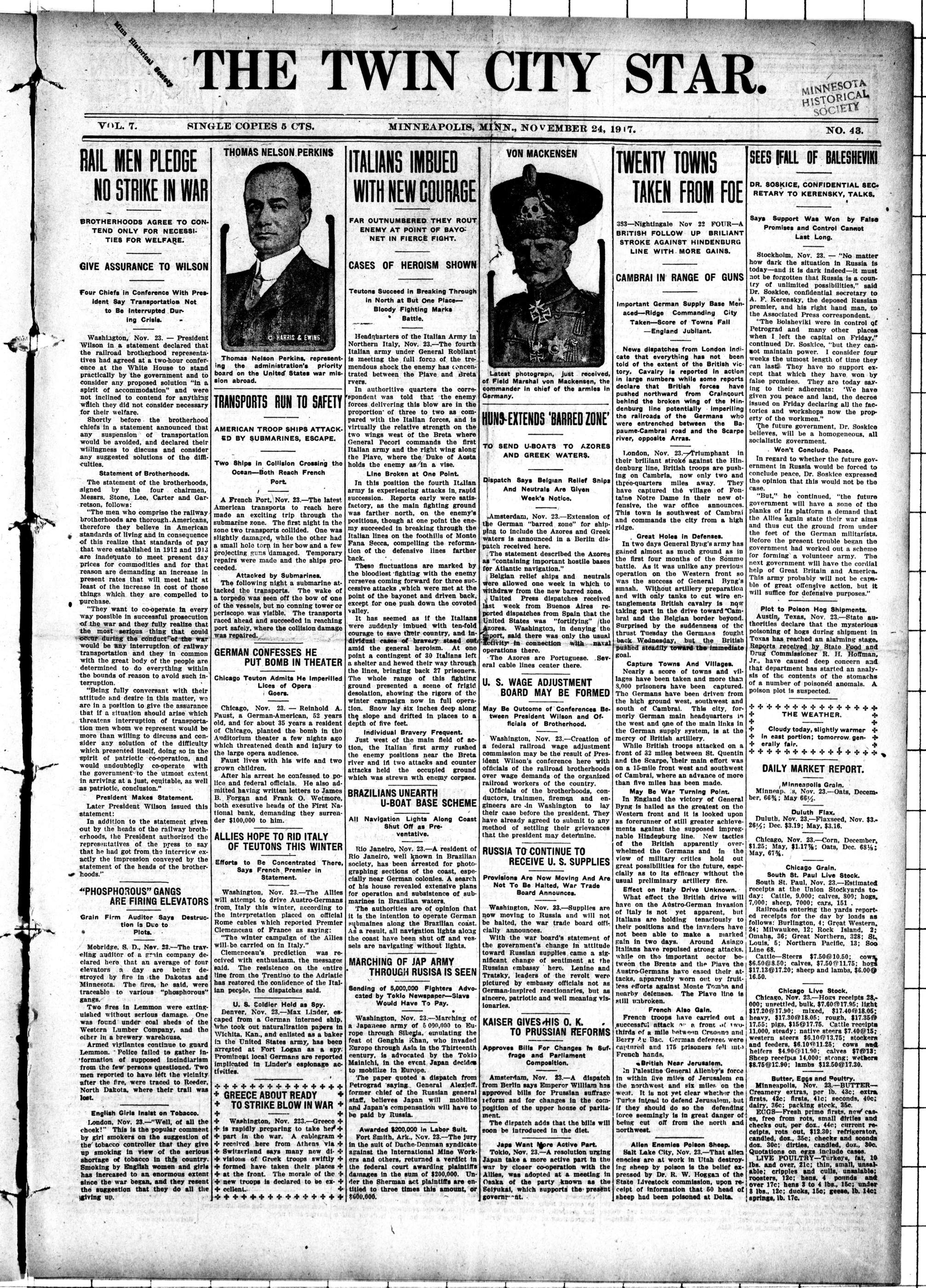
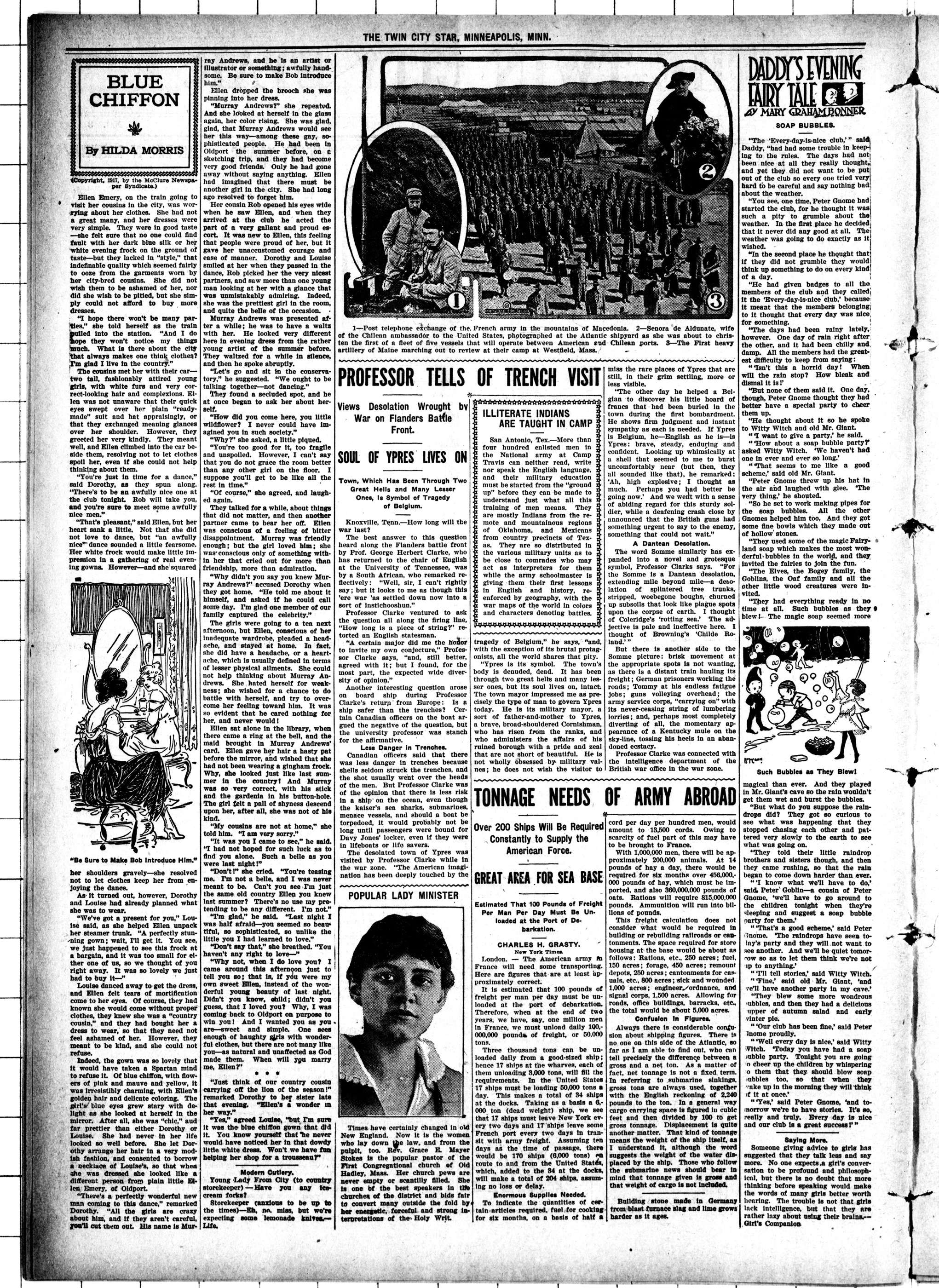
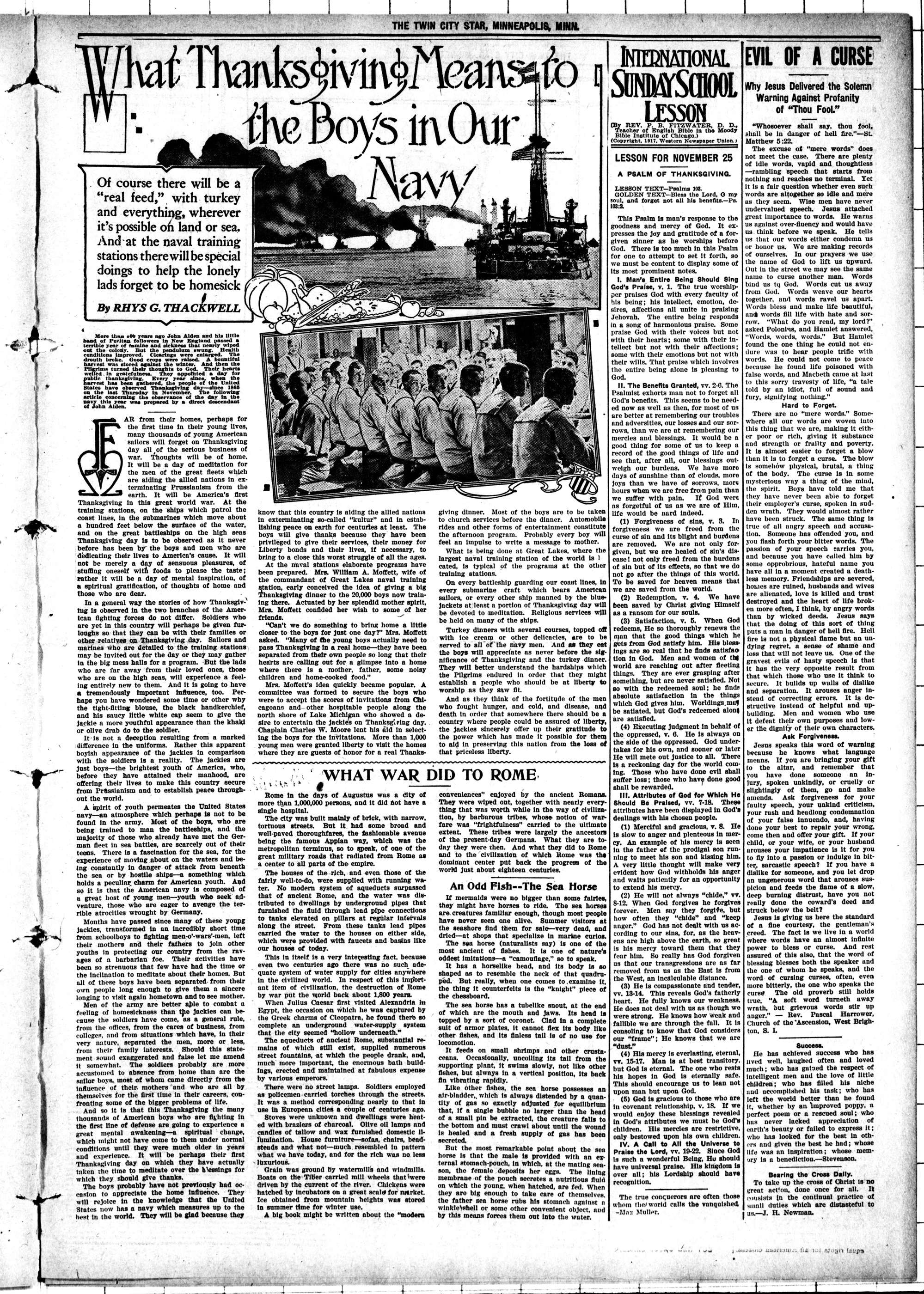
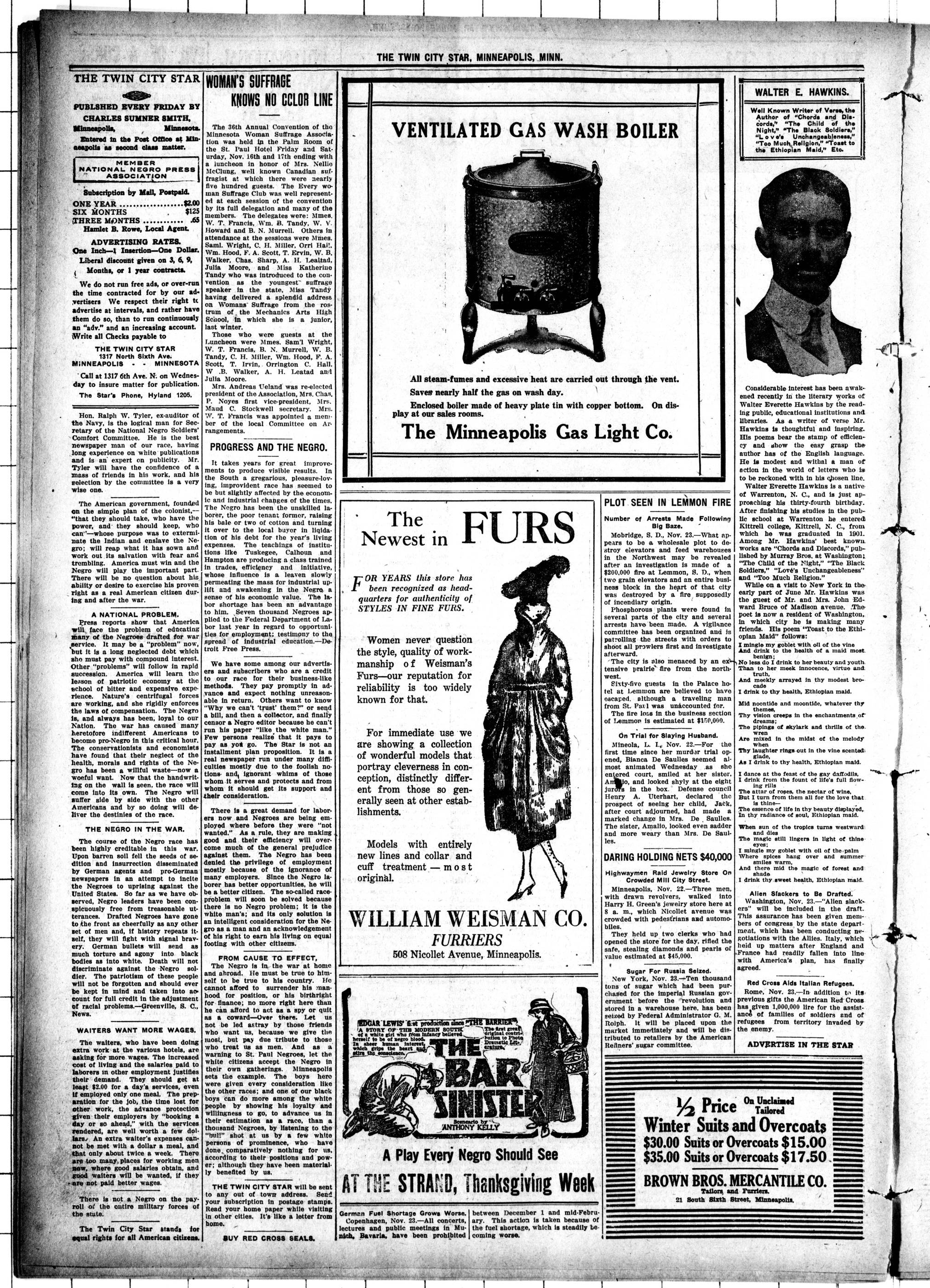
Page text (machine-generated)
BROTHERHOODS AGREE TO CONTEND ONLY FOR NECESSITIES FOR WELFARE.
GIVE ASSURANCE TO WILSON
Four Chiefs in Conference With President Say Transportation Not to Be Interrupted Dur
Washington, Nov. 23. — President Wilson in a statement declared that the railroad brotherhood representatives had agreed at a two-hour conference at the White House to stand practically by the government and to consider any proposed solution "in a spirit of accommodation" and were not inclined to contend for anything which they did not consider necessary for their welfare.
Shortly before the brotherhood chiefs in a statement announced that any suspension of transportation would be avoided, and declared their willingness to discuss and consider any suggested solutions of the difficulties.
Statement of Brotherhoods.
The statement of the brotherhoods, signed by the four chairmen, Messrs. Stone, Lee, Carter and Garretson, follows:
"The men who comprise the railway brotherhoods are thorough Americans, therefore they believe in American standards of living and in consequence of this realize that standards of pay that were established in 1912 and 1913 are inadequate to meet present day prices for commodities and for that reason are demanding an increase in present rates that will meet half at least of the increase in cost of those things which they are compelled to purchase.
"They want to co-operate in every way possible in successful prosecution of the war and they fully realize that the most serious thing that could occur during the conduct of the war would be any interruption of railway transportation and they in common with the great body of the people are determined to do everything within the bounds of reason to avoid such interruption.
"Being fully conversant with their attitude and desire in this matter, we are in a position to give the assurance that if a situation should arise which threatens interruption of transportation men whom we represent would be more than willing to discuss and consider any solution of the difficulty which presented itself, doing so in the spirit of patriotic co-operation, and would undoubtedly co-operate with the government to the utmost extent in arriving at a just, equitable, as well as patriotic, conclusion."
President Makes Statement.
Later President Wilson issued this statement:
In addition to the statement given out by the heads of the railway brotherhoods, the President authorized the representatives of the press to say that he had got from the interview exactly the impression conveyed by the statement of the heads of the brotherhoods."
"PHOSPHOROUS" GANGS ARE FIRING ELEVATORS
Grain Firm Auditor Says Destruction is Due to Plots.
Mobridge, S. D., Nov. 23.—The traveling auditor of a grain company declared here that an average of four elevators a day are being destroyed by fire in the Dakotas and Minnesota. The fires, he said, were traceable to various "phosphorous" gangs.
Two fires in Lemmon were extinguished without serious damage. One was found under coal sheds of the Western Lumber Company, and the other in a brewery warehouse.
Armed vigilantes continue to guard Lemmon. Police failed to gather information of supposed incindiarism from the few persons questioned. Two men reported to have left the vicinity after the fire, were traced to Reeder, North Dakota, where their trail was lost.
English Girls Insist on Tobacco.
London, Nov. 23—"Well, of all the cheek!" This is the popular comment by girl smokers on the suggestion of the tobacco controller that they give up smoking in view of the serious shortage of tobacco in this country.
Smoking by English women and girls has increased to an enormous extent since the war began, and they resent the suggestion that they do all the giving up.
THE TWIN CITY STAR.
SINGLE COPIES 5 CTS.
THOMAS NELSON PERKINS
Thomas Nelson Perkins, representing the administration's priority board on the United States war mission abroad.
TRANSPORTS RUN TO SAFETY
AMERICAN TROOP SHIPS ATTACK
ED BY SUBMARINES, ESCAPE.
Two Ships in Collision Crossing the Ocean—Both Reach French
A French Port, Nov. 23.—The latest American transports to reach here made an exciting trip through the submarine zone. The first night in the zone two transports collided. One was slightly damaged, while the other had a small hole torn in her bow and a few projecting guns damaged. Temporary repairs were made and the ships proceeded.
Attacked by Submarines.
The following night a submarine attacked the transports. The wake of a torpedo was seen off the bow of one of the vessels, but no conning tower or periscope was visible. The transports raced ahead and succeeded in reaching port safely, where the collision damage was repaired.
GERMAN CONFESSES HE
PUT BOMB IN THEATER
Chicago Teuton Admits He Imperilled Lices of Opera Goers.
Chicago, Nov. 23. — Reinhold A. Faust, a German-American, 52 years old, and for about 35 years a resident of Chicago, planted the bomb in the Auditorium theater a few nights ago which threatened death and injury to the large opera audience.
Faust lives with his wife and two grown children.
After his arrest he confessed to police and federal officials. He also admitted having written letters to James B. Forgan and Frank O. Wetmore, both executive heads of the First National bank, demanding they surrender $100,000 to him.
ALLIES HOPE TO RID ITALY OF TEUTONS THIS WINTER
Efforts to Be Concentrated There, Says French Premier in Statement.
Washington, Nov. 23.—The Allies will attempt to drive Austro-Germans from Italy this winter, according to the interpretation placed on official Rome cables which reported Premier Clemenceau of France as saying:
"The winter campaign of the Allies will be carried on in Italy." Clemenceau's prediction was received with enthusiasm, the messages said. The resistance on the entire line from the Trentino to the Adriatic has restored the confidence of the Italian people, the dispatches said.
U. S. Soldier Held as Spy.
Denver, Nov. 23—Max Linder, escaped from a German interned ship, who took out naturalization papers in Wichita, Kan., and enlisted as a baker in the United States army, has been arrested at Fort Logan as a spy. Prominent local Germans are reported implicated in Linder's espionage activities.
* GREECE ABOUT READY
* TO STRIKE BLOW IN WAR
* Washington, Nov. 233.—Greece *
* is rapidly preparing to take her *
* part in the war. A cablegram *
* received here from Athens via *
* Switzerland says many new div *
*isions of Greek troops swiftly *
* formed have taken their places *
* at the front. The morale of the *
* new troops is declared to be ex- *
* cellent. *
MINNEAPOLIS, MINN., NOVEMBER 24, 1917.
ITALIANS IMBUED WITH NEW COURAGE
FAR OUTNUMBERED THEY ROUT ENEMY AT POINT OF BAYO-NET IN FIERCE FIGHT.
CASES OF HEROISM SHOWN
Teutons Succeed in Breaking Through in North at But One Place—Bloody Fighting Marks Battle.
Headquarters of the Italian Army in Northern Italy, Nov. 23.—The fourth Italian army under General Robilant is meeting the full force of the tremendous shock the enemy has concentrated between the Plave and Breta rivers.
In authoritative quarters the correspondent was told that the enemy forces delivering this blow are in the proportion of three to two as compared with the Italian forces, and is virtually the relative strength on the two wings west of the Breta where General Pecoril commands the first Italian army and the right wing along the Plave, where the Duke of Aosta holds the enemy as in a vise.
Line Broken at One Point.
In this position the Italian army is experiencing attacks in rapid succession. Reports early were satisfactory, as the main fighting ground was farther north, on the enemy's positions, though at one point the enemy succeeded in breaking through the Italian lines on the foothills of Monte Fana Secca, compelling the reformation of the defensive lines farther back.
These fluctuations are marked by the bloodiest fighting with the enemy rerseves coming forward for three successive attacks, which were met at the point of the bayonet and driven back, except for one push down the covoted valley.
It has seemed as if the Italians were suddenly imbued with ten-fold courage to save their country, and individual cases of bravery stand out amid the general heroism. At one point a contingent of 30 Italians left a shelter and hewed their way through the lines, bringing back 27 prisoners. The whole range of this fighting ground presented a scene of frigid desolation, showing the rigors of the winter campaign now in full operation. Snow lay six inches deep along the slope and drifted in places to a depth of five feet.
Just west of the main field of action, the Italian first army rushed the enemy positions near the Breta river and in two attacks and counter attacks held the occupied ground which was strewn with enemy corpses.
BRAZILIANS UNEARTH
U-BOAT BASE SCHEME
All Navigation Lights Along Coast Shut Off as Preventative.
Rio Janeiro, Nov. 23.—A resident of Rio Janeiro, well known in Brazilian society, has been arrested for photographing sections of the coast, especially near German colonies. A search of his house revealed extensive plans for operation and subsistence of submarines in Brazilian waters.
The authorities are of opinion that it is the intention to operate German submarines along the Brazilian coast. As a result, all navigation lights along the coast have been shut off and vessels are navigating without lights.
MARCHING OF JAP ARMY
THROUGH RUSISA IS SEEN
Sending of 5,000,000 Fighters Advocated by Teklo Newspaper—Slavs Would Have To Pay.
Washington, Nov. 23.—Marching of a Japanese army of 5,000,000 to Europe through Siligria, emulating the feat of Genghis Khan, who invaded Europe through Asia in the Thirteenth century, is advocated by the Teklo Mainichi, in the event Japan decides to mobilize in Europe.
The paper quoted a dispatch from Petrograd saying, General Alexieff, former chief of the Russian general staff, believes Japan will mobilize and Japan's compensation will have to be paid by Russia.
Awarded $200,000 in Labor Suit.
Fort Smith, Ark., Nov. 23.—The jury in the suit of Dache-Denman syndicate against the International Mine Workers and others, returned a verdict in the federal court awarding plaintiffs damages in the sum of $200,000. Under the Sherman act plaintiffs are entitled to three times this amount, or $600,000.
VON MACKENSEN
Latest photograph, just received, of Field Marshal von Mackensen, the commander in chief of the armies in Germany.
HUNS-EXTENDS 'BARRED ZONE'
TO SEND U-BOATS TO AZORES
AND GREEK WATERS.
Dispatch Says Belgian Relief Snips And Neutrals Are Giyen Week's Notice.
Amsterdam, Nov. 23.—Extension of the German "barred zone" for shipping to include the Azores and Greek waters is announced in a Berlin dispatch received here.
The statement described the Azores as "containing important hostile bases for Atlantic navigation."
Belgian relief ships and neutrals were allowed one week in which to withdraw from the new barred zone.
United Press dispatches received last week from Buenos Aires reported dispatches from Spain that the United States was "fortifying" (the Azores. Washington), in denying the report, said there was only the usual activity in connection with naval operations there.
The Azores are Portuguese. Several cable lines center there.
U. S. WAGE ADJUSTMENT BOARD MAY BE FORMED
May Be Outcome of Conferences Between President Wilson and Officials of Brotherhood.
Washington, Nov. 23.—Creation of a federal railroad wage adjustment commission may be the result of President Wilson's conference here with officials of the railroad brotherhoods over wage demands of the organized railroad workers of the country.
Officials of the brotherhoods, conductors, trainmen, firemen and engineers are in Washington to lay their case before the president. They have already agreed to submit to any method of settling their grievances that the president may determine.
RUSSIA TO CONTINUE TO
RECEIVE U. S. SUPPLIES
Provisions Are Now Moving And Are Not To Be Halted, War Trade Board Announces.
Washington, Nov. 23.—Supplies are now moving to Russia and will not be halted, the war trade board officially announces.
With the war board's statement of the government's change in attitude toward Russian supplies came a significant change of sentiment at the Russian embassy' here. Lenine and Tratsky, leaders of the revolt were pictured by embassy officials not as German-inspired reactionaries, but as sincere, patriotic and well meaning visionaries.
KAISER GIVES HIS O. K.
TO PRUSSIAN REFORMS
Approves Bills For Changes In Suffrage and Parliament Composition.
Amsterdam, Nov. 23.—A dispatch from Berlin says Emperor William has approved bills for Prussian suffrage reform and for changes in the composition of the upper house of parliament.
The dispatch adds that the bills will soon be introduced in the diet.
Japs Want More Active Part.
Tokio, Nov. 23.—A resolution urging Japan take a more active part in the war by closer co-operation with the Allies, was adopted at a meeting in Osaka of the party known as the Seiyukai, which supports the present government.
TWENTY TOWNS TAKEN FROM FOE
TWENTY TOWNS TAKEN FROM FOE
333—Nightingale Nov 22 FOUR—A BRITISH FOLLOW UP BRILIANT STROKE AGAINST HINDENBURG LINE WITH MORE GAINS.
CAMBRAI IN RANGE OF GUNS
Important German Supply Base Menaced—Ridge Commanding City Taken—Score of Towns Fall —England Jubilant.
News dispatches from London indicate that everything has not been told of the extent of the British victory. Cavalry is reported in action in large numbers while some reports declare that British forces have pushed northward from Cranlounc behind the broken wing of the Hindenburg line potentially imperiling the railroads of the Germans who were entrenched between the Bapaume-Cambral road and the Scarpe river, opposite Arras.
London, Nov. 23.—Triumphant in their brilliant stroke against the Hindenburg line, British troops are pushing on Cambria, now only two and three-quarters miles away. They have captured the village of Fontaine Notre Dame in their new offensive, the war office announces. This town is southwest of Cambrai and commands the city from a high ridge.
Great Holes in Defenses.
Great Holes in Derehes.
In two days General Byng's army has gained almost as much ground as in the first four months of the Somme battle. As it was unlike any previous operation on the Western front so was the success of General Byng's smash. Without artillery preparation and with only tanks to cut wire entanglements British cavalry is now taking part in the drive toward Cambral and the Belgian border beyond. Surprised by the suddenness of the thrust Tuesday the Germans fought back Wednesday, but, the British pushed steadily toward the immediate goal.
Capture Towns And Villages.
Nearly a score of towns and villages have been taken and more than 8,000 prisoners have been captured. The Germans have been driven from the high ground west, southwest and south of Cambral. This city, formerly German main headquarters in the west and one of the main links in the German supply system, is at the mercy of British artillery.
While British troops attacked on a front of 32 miles between St. Quentin and the Scarpe, their main effort was on a 15-mile front west and southwest of Cambral, where an advance of more than five miles has been made.
May Be War Turning Point.
May Be War Turning Point.
In England the victory of General Byng is hailed as the greatest on the Western front and it is looked upon as forerunner of still greater achievements against the supposed impregnable Hindeburg line. New tactics of the British apparently overwhelmed the Germans and In the view of military critics hold out great possibilities for the future, especially as to its efficacy without the usual preliminary artillery fire.
Effect on Italy Drive Unknown.
What effect the British drive will have on the Austro-German invasion of Italy is not yet apparent, but Italians are holding tenaciously to their positions and the invaders have not been able to make a marked gain in two days. Around Asiago Italians have repulsed strong attacks, while on the important sector between the Brenta and the Plave the Austro-Germans have eased their attacks, apparently worn out by fruitless efforts against Monte Tomba and nearby defenses. The Plave line is still unbroken.
French Also Gain.
French troops have carried out a successful attack on a front of two thirds of a mile between Granonne and Berry Auc Bac. German defenses were captured and 175 prisoners fell into French hands.
British Near Jerusalem.
In Palestine General Allenby's force in within five miles of Jerusalem on the northwest and six miles on the west. It is not yet clear whether the Turks intend to defend Jerusalem, but if they should do so the defending force seemingly is in great danger of being cut off from the north and northwest.
Allen Enemies Poison Sheep.
Salt Lake City, Nov. 23.—That alien enecles are at work in Utah destroying sheep by poison is the belief expressed by Dr. R. W. Hoggan of the State Livestock commission, upon receipt of information that 50 head of sheep had been poisoned at Delta.
MINNESOTA HISTORICAL SOCIETY
SEES [FALL OF BALESHEVIK]
DR. SOSKICE, CONFIDENTIAL SECRETARY TO KERENSKY, TALKS.
Says Support Was Won by False Promises and Control Cannot Last Long.
Stockholm, Nov. 23. — "No matter how dark the situation in Russia is today—and it is dark indeed—it must not be forgotten that Russia is a country of unlimited possibilities," said Dr. Soskice, confidential secretary to A. F. Kerensky, the deposed Russian premier, and his right hand man, to the Associated Press correspondent.
"The Bolshevik were in control of Petrograd and many other places when I left the capital on Friday," continued Dr. Soskice, "but they cannot maintain power. I consider four weeks the utmost length of time they can last. They have no support except that which they have won by false promises. They are today saying to their adherents: 'We have given you peace and land, the decree issued on Friday declaring all the factories and workshops now the property of the workmen."
The future government, Dr. Soskice believes, will be a homogeneous, all socialistic government.
Won't Conclude Peace.
In regard to whether the future government in Russia would be forced to conclude peace, Dr. Soskice expressed the opinion that this would not be the case.
"But," he continued, "the future government will have a some of the planks of its platform a demand that the Allies again state their war aims and thus cut the ground from under the feet of the German militarists. Before the present trouble began the government had worked out a scheme for forming a volunteer army. The next government will have the cordial help of Great Britain and America. This army probably will not be capable of great offensive action, but it will suffice for defensive purposes."
Plot to Poison Hog Shipments.
Austin, Texas, Nov. 23.—State authorities declare that the mysterious poisoning of hogs during shipment in Texas has reached an alarming stage. Reports received by State Food and Drug Commissioner R. H. Hoffman, Jr., have caused deep concern and that department has started an analysis of the contents of the stomachs of a number of poisoned anomals. A poison plot is suspected.
THE WEATHER.
Cloudy today, slightly warmer in east portion; tomorrow generaly fair.
DAILY MARKET REPORT.
Minneapolis Grain.
Minneapolis, Nov. 23—Oats, December, 66%; May 66%.
Duluth Flax.
Duluth, Nov. 23—Flaxseed, Nov. $3.26%; Dec. $3.19; May, $3.16.
Chicago, Nov. 23—Corn, December, $1.25; May, $1.17%; Oats, Dec. 68%; May, 67%.
Chicago Grain.
South St. Paul Live Stock.
South St. Paul, Nov. 23.—Estimated receipts at the Union Stockyards today: Cattle, 9,000; calves, 800; hogs, 7,000; sheep, 7000; cars, 151.
Railroads entering the yards reported receipts for the day by loads as follows: Burlington, 4; Great Western, 24; Milwaukee, 12; Rock Island, 2; Omaha, 36; Great Northern, 328; St. Louis, 5; Northern Pacific, 13; Soo Line 68.
Cattle—Steers $7.50@10.50; cows $6.50@8.50; calves, $7.50@11.75; hogs $17.13@17.20; sheep and lambs, $6.00@16.50.
Chicago Live Stock
Chicago, Nov. 23.—Hogs receipts 28,
000; unsettled, bulk $7.60@17.95; light
$17.20@17.90; mixed, $17.40@18.05;
heavy, $17.30@18.05; rough, $17.35@
17.55; pigs, $15@17.75. Cattle receipts
11,000; steady; native steers $7.40@15;
western steers $6.10@17.75; stockers
and feeders, $6.10@11.25; cows and
heifers $4.90@11.90; calves $7@13;
Sheep receipts 14,000; strong, wethers
$8.75@12.90; lambs $12.50@17.30.
Butter, Eggs and Poultry.
Minneapolis, Nov. 23—BUTTER—Creamery extras, per lb. 43c; extra firsts, 42c; firsts, 41c; seconds, 40c; dairy, 34c; packing stock, 35c.
EGGS—Fresh prime firsts, new cases, free from rots, small dirties and checks out, per doz, 44c; current receipts, rots out, $12.30; refrigerator, candled, doz, 35c; checks and seconds doz, 30c; dirties, candled, doz, 30c.
Quotations on eggs include cases.
LIVE POULTRY—Turkeys, fat, 10 lbs. and over, 21c; thin, small, unsalable; cripples and culls, unsalable; roosters, 12c; hens, 4 pounds and over 17c; hens 3 to 4 lbs, 15c; under 3 lbs, 12c; ducks, 15c; geese, 14c; springs, 17c.
BLUE
CHIFFON
By HILDA MORRIS
(Copyright, 1917, by the McClure Newspaper Syndicate.)
Ellen Emery, on the train going to visit her cousins in the city, was worrying about her clothes. She had not a great many, and her dresses were very simple. They were in good taste—she felt sure that no one could find fault with her dark blue silk or her white evening frock on the ground of taste—but they lacked in "style," that indefinable quality which seemed fairly to ooze from the garments worn by her city-bred cousins. She did not wish them to be ashamed of her, nor did she wish to be pitted, but she simply could not afford to buy more dresses.
"I hope there won't be many parties," she told herself as the train pulled into the station. "And I do hope they won't notice my things much. What is there about the city that always makes one think clothes? I'm glad I live in the country."
The cousins met her with their car—two tall, fashionably attired young girls, with white furs and very correct-looking hair and complexions. Ellen was not unaware that their quick eyes swept over her plain "ready-made" suit and hat appraisingly, or that they exchanged meaning glances over her shoulder. However, they greeted her very kindly. They meant well, and Ellen climbed into the car beside them, resolving not to let clothes spoll her, even if she could not help thinking about them.
"You're just in time for a dance," said Dorothy, as they spun along. "There's to be an awfully nice one at the club tonight. Rob will take you, and you're sure to meet some awfully nice men."
"That's pleasant," said Ellen, but her heart sank a little. Not that she did not love to dance, but "an awfully nice" dance sounded a little fearsome. Her white frock would make little impression in a gathering of real evening gowns. However—and she squared
A
"Be Sure to Make Bob Introduce Him," her shoulders gravely—she resolved not to let clothes keep her from enjoying the dance. As it turned out, however, Dorothy and Louise had already planned what she was to wear. "We've got a present for you," Louise said, as she helped Ellen unpack her steamer trunk. "A perfectly stunning gown; wait, I'll get it. You see, we just happened to see this frock at a bargain, and it was too small for elder one of us, so we thought of you right away. It was so lovely we just had to buy it—"
Louise danced away to get the dress, and Ellen felt tears of mortification come to her eyes. Of course, they had known she would come without proper clothes, they knew she was a "country cousin," and they had bought her a dress to wear, so that they need not feel ashamed of her. However, they meant to be kind, and she could not refuse.
Indeed, the gown was so lovely that it would have taken a Spartan mind to refuse it. Of blue chiffon, with flowers of pink and mauve and yellow, it was irresistibly charming, with Ellen's golden hair and delicate coloring. The girl's blue eyes grew stary with delight as she looked at herself in the mirror. After all, she was "chic," and far prettier than either Dorothy or Louise. She had never in her life looked so well before. She let Dorothy arrange her hair in a very modish fashion, and consented to borrow a necklace of Louise's, so that when she was dressed she looked like a different person from plain little Ellen Emery, of Oldport.
"There's a perfectly wonderful new man coming to this dance," remarked Dorothy. "All the girls are crazy about him, and if they aren't careful, you'll cut them out. His name is Mur-
ray Andrews, and he is an artist or illustrator or something; awfully handsome. Be sure to make Bob introduce him."
Ellen dropped the brooch she was pinning into her dress.
"Murray Andrews?" she repeated. And she looked at herself in the glass again, her color rising. She was glad, glad, that Murray Andrews would see her this way—among these gay, sophisticated people. He had been in Oldport the summer before, on a sketching trip, and they had become very good friends. Only he had gone away without saying anything. Ellen had imagined that there must be another girl in the city. She had long ago resolved to forget him.
Her cousin Rob opened his eyes wide when he saw Ellen, and when they arrived at the club he acted the part of a very gallant and proud escort. It was new to Ellen, this feeling that people were proud of her, but it gave her unaccustomed courage and ease of manner. Dorothy and Louise smiled at her when they passed in the dance, Rob picked her the very nicest partners, and saw more than one young man looking at her with a glance that was unmistakably admiring. Indeed, she was the prettiest girl in the room, and quite the belle of the occasion. Murray Andrews was presented after a while; he was to have a waltz with her. He looked very different here in evening dress from the rather young artist of the summer before. They waltzed for a while in silence, and then he spoke abruptly.
"Let's go and sit in the conservatory," he suggested. "We ought to be talking together—not dancing." They found a secluded spot, and he at once began to ask her about herself.
"How did you come here, you little wildflower? I never could have imagined you in such society."
"Why?" she asked, a little ploug.
"You're too good for it, too fragile and unspoiled. However, I can't say that you do not grace the room better than any other girl on the floor. I suppose you'll get to be like all the rest in time."
"Of course," she agreed, and laughed again.
They talked for a while, about things that did not matter, and then another partner came to bear her off. Ellen was conscious of a feeling of bitter disappointment. Murray was friendly enough; but the girl loved him; she was conscious only of something within her that cried out for more than friendship, more than admiration.
"Why didn't you say you knew Murray Andrews?" accused Dorothy when they got home. "He told me about it himself, and asked if he could call some day. I'm glad one member of our family captured the celebrity."
The girls were going to a tea next afternoon, but Ellen, conscious of her inadequate wardrobe, pleaded a headache, and stayed at home. In fact, she did have a headache, or a heartache, which is usually defined in terms of lesser physical ailments. She could not help thinking about Murray Andrews. She hated herself for weakness; she wished for a chance to do battle with herself, and try to overcome her feeling toward him. It was so evident that he cared nothing for her, and never would!
Ellen sat alone in the library, when there came a ring at the bell, and the maid brought in Murray Andrews' card. Ellen gave her hair a hasty pat before the mirror, and wished that she had not been wearing a gingham frock. Why, she looked just like last summer in the country! And Murray was so very correct, with his stick and the gardenia in his button-hole. The girl felt a pall of shyness descend upon her, after all, she was not of his kind.
"My cousins are not at home," she told him. "I am very sorry."
"It was you I came to see," he said. "I had not hoped for such luck as to find you alone. Such a belle as you were last night!"
"Don't!" she cried. "You're teasing me. I'm not a belle, and I was never meant to be. Can't you see I'm just the same old country Ellen you knew last summer? There no use my pretending to be any different. I'm not." "I'm glad," he said. "Last night I was half afraid—you seemed so beautiful, so sophisticated, so unlike the little you I had learned to love." "Don't say that," she breathed. "You haven't any right to love—"
"Why not, when I do love you? I came around this afternoon just to tell you so; that is, if you were my own sweet Ellen, instead of the wonderful young beauty of last night. Didn't you know, child; didn't you guess, that I loved you? Why, I was coming back to Oldport on purpose to win you! And I wanted you as you are—sweet and simple. One sees enough of haughty girls with wonderful clothes, but there are not many like you—as natural and unaffected as God made them. When will you marry me, Ellen?"
"Just think of our country cousin carrying off the lion of the season!" remarked Dorothy to her sister late that evening. "Ellen's a wonder in her way."
"Yes," agreed Louise, "but I'm sure it was the blue chiffon gown that did it. You know yourself that he never would have noticed her in that dowdy little white dress. Won't we have fun helping her shop for a trousseau?"
Modern Cutlery.
Young Lady From City (to country storekeeper) — Have you any icecream forks?
Storekeeper (anxious to be up to the times)—Eh, no, miss, but we're expecting some lemonade knives—Life.
THE TWIN CITY STAR, MINNEAPOLIS, MINN.
$\textcircled{1}$
$\textcircled{2}$
$\textcircled{3}$
1—Post telephone exchange of the, French army in the mountains of Macedonia. 2—Senora de Aldunate, wife of the Chilean ambassador to the United States, photographed at the Atlantic shipyard as she was about to christen the first of a fleet of five vessels that will operate between American and Chilean ports. 3—The First heavy artillery of Maine marching out to review at their camp at Westfield, Mass.
PROFESSOR TELLS OF TRENCH VISIT
Town, Which Has Been Through Two Great Hells and Many Lesser Ones, Is Symbol of Tragedy of Belgium.
Knoxville, Tenn.—How long will the war last?
The best answer to this question heard along the Flanders battle front by Prof. George Herbert Clarke, who has returned to the chair of English at the University of Tennessee, was by a South African, who remarked reflectively: "Well, sir, I can't rightly say; but it looks to me as though this 'ere war' as settled down now into a sort of instichooshun."
Professor Clarke ventured to ask the question all along the firing line, "How long is a piece of string?" retorted an English statesman.
"A certain major did me the honor to invite my own conjecture," Professor Clarke says, "and, still better, agreed with it; but I found, for the most part, the expected wide diversity of opinion."
Another interesting question arose on board ship during Professor Clarke's return from Europe: Is a ship safer than the trenches? Certain Canadian officers on the boat argued the negative of the question, but the university professor was stanch for the affirmative.
Canadian officers said that there was less danger in trenches because shells seldom struck the trenches, and the shot usually went over the heads of the men. But Professor Clarke was of the opinion that there is less risk in a ship on the ocean, even though the kaiser's sea sharks, submarines, menace vessels, and should a boat be torpeded, it would probably not be long until passengers were bound for Davy Jones' locker, even if they were in lifeboats or life savers.
The desolated town of Ypres was visited by Professor Clarke while in the war zone. "The American imagination has been deeply touched by the
A.
Times have certainly changed in old New England. Now it is the women who lay down the law, and from the pulpit, too. Rev. Grace E. Mayer Stokes is the popular pastor of the First Congregational church of Old Hadley, Mass. Her church pews are never empty or scantily filled. She is one of the best speakers in the churches of the district and bids fair to convert many outside the fold by her energetic, forceful, and strong interpretations of the Holy Writ.
TONNAGE NEEDS OF ARMY ABROAD
ILLITERATE INDIANS
ARE TAUGHT IN CAMP
San Antonio, Tex.—More than four hundred enlisted men in the National army at Camp Travis can neither read, write nor speak the English language, and their military education must be started from the "ground up" before they can be made to understand just what all this training of men means. They are mostly Indians from the remote and mountainous regions of Oklahoma, and Mexicans from country precincts of Texas. They are so distributed in the various military units as to be close to comrades who may act as interpreters for them while the army schoolmaster is giving them their first lessons in English and history, re-enforced by geography, with the war maps of the world in colors and characters denoting battles.
tragedy of Belgium," he says, "and, with the exception of its brutal protagonists, all the world shares that pity. "Ypres is its symbol. The town's body is denuded, dead. It has been through two great hells and many lesser ones, but its soul lives on, intact. The town mayor impressed me as precisely the type of man to govern Ypres today. He is its military mayor, a sort of father-and-mother to Ypres, a brave, broad-shouldered Cornishman, who has risen from the ranks, and who administers the affairs of his ruined borough with a pride and zeal that are not short of beautiful. He is not wholly obsessed by military values; he does not wish the visitor to
TONNAGE NEEDS
Over 200 Ships Will Be Required
Constantly to Supply the
American Force.
GREAT AREA FOR SEA BASE
Estimated That 100 Pounds of Freight Per Man Per Day Must Be Unloaded at the Port of De-
London. — The American army in France will need some transporting. Here are figures that are at least approximately correct.
It is estimated that 100 pounds of freight per man per day must be unloaded at the port of debarkation. Therefore, when at the end of two years, we have, say, one million men in France, we must unload daily 100,000,000 pounds of freight, or 50,000 tons.
Three thousand tons can be unloaded daily from a good-sized ship; hence 17 ships at the wharves, each of them unloading 3,000 tons, will fill the requirements. In the United States 17 ships must be loading 50,000 tons a day. This makes a total of 34 ships at the docks. Taking as a basis a 6,000 ton (dead weight) ship, we see that 17 ships must leave New York every two days and 17 ships leave some French port every two days in transit with army freight. Assuming ten days as the time of passage, there would be 170 ships (6,000 tons) on route to and from the United States, which, added to the 34 at the docks, will make a total of 204 ships, assuming no loss or delay.
Enormous Supplies Needed.
To indicate the quantities of certain articles required, fuel for cooking for six months, on a basis of half a
---
miss the rare places of Ypres that are still, in their grim settling, more or less visible.
"The other day he helped a Belgian to discover his little hoard of francs that had been buried in the town during the first bombardment. He shows firm judgment and instant sympathy as each is needed. If Ypres is Belgium, he—English as he is—is Ypres: brave, steady, enduring and confident. Looking up whimsically at a shell that seemed to me to burst uncomfortably near (but then, they all sounded like that), he remarked: 'Ah, high explosive; I thought as much. Perhaps you had better be going now.' And we went with a sense of abiding regard for this sturdy soldier, while a deafening crash close by announced that the British guns had something urgent to say to the enemy, something that could not wait."
A Dantean Desolation.
The word Somme similarly has expanded into a novel and grotesque symbol, Professor Clarks says. "For the Somme is a Dantean desolation, extending mile beyond mile—a desolation of splintered tree trunks, stripped, woebegone boughs, churned up subsols that look like plague spots upon the corpse of earth. I thought of Coleridge's 'rotting sea.' The adjective is pale and ineffective here. I thought of Browning's 'Childe Roland.'"
But there is another side to the Somme picture: brisk movement at the appropriate spots is not wanting, as there is a distant train hauling its freight; German prisoners working the roads; Tommy at his endless fatigue jobs; guns volleying overhead; the army service corps, "carrying on" with its never-ceasing string of lumbering lorries; and, perhaps most completely diverting of all, the momentary appearance of a Kentucky mule on the sky-line, tossing his heels in an abandoned ecstacy. Professor Clarke was connected with the intelligence department of the British war office in the war zone.
cord per day per hundred men, would amount to 13,500 cords. Owing to scarcity of fuel part of this may have to be brought to France. With 1,000,000 men, there will be approximately 200,000 animals. At 14 pounds of hay a day, there would be required for six months over 456,000,000 pounds of hay, which must be imported, and also 360,000,000 pounds of oats. Rations will require 815,000,000 pounds. Ammunition will run into billions of pounds.
This freight calculation does not consider what would be required in building or rebuilding railroads or canonments. The space required for store housing at the base would be about as follows: Rations, etc., 250 acres; fuel, 150 acres; forage, 450 acres; remount depots, 250 acres; canonments for casuals, etc., 800 acres; slick and wounded, 1,000 acres; engineer/ordnance, and signal corps, 1,500 acres. Allowing for roads, office buildings, barracks, etc., the total would be about 5,000 acres.
Confusion In Figures.
Always there is considerable confusion about shipping figures. There is no one on this side of the Atlantic, so far as I am able to find out, who can tell precisely the difference between a gross and a net ton. As a matter of fact, net tonnage is not a fixed term. In referring to submarine sinkings, gross tons are always used, together with the English reckoning of 2,240 pounds to the ton. In a general way cargo carrying space is figured in cubic feet and then divided by 100 to get gross tonnage. Displacement is quite another matter. That kind of tonnage means the weight of the ship itself, as I understand it, although the word suggests the weight of the water displaced by the ship. Those who follow the submarine news should bear in mind that tonnage given is gross and that weight of cargo is not included.
Building stone made in Germany from blast furnace slag and lime grows harder as it ages.
DADDY'S EVENING FAIRY TALE BY MARY GRAHAM BONNER
SOAP BUBBLES.
"The 'Every-day-is-nice club,'" said Daddy, "had had some trouble in keeping to the rules. The days had not been nice at all they really thought, and yet they did not want to be put out of the club so every one tried very hard to be careful and say nothing bad about the weather.
"You see, one time, Peter Gnome had started the club, for he thought it was such a pity to grumble about the weather. In the first place he decided that it never did any good at all. The weather was going to do exactly as it wished.
"In the second place he thought that if they did not grumble they would think up something to do on every kind of a day.
"He had given badges to all the members of the club and they called it the 'Every-day-is-nice club,' because it meant that the members belonging to it thought that every day was nice for something.
"The days had been rainy lately, however. One day of rain right after the other, and it had been chilly and damp. All the members had the greatest difficulty to keep from saying:
"Isn't this a horrid day! When will the rain stop? How bleak and dismal it is!"
"But none of them said it. One day, though, Peter Gnome thought they had better have a special party to cheer them up.
"He thought about it so he spoke to Witty Witch and old Mr. Glant.
"I want to give a party,' he said.
"How about a soap bubble party?' asked Witty Witch. 'We haven't had one in ever and ever so long.'
"That seems to me like a good scheme,' said old Mr. Glant.
"Peter Gnome threw up his hat in the air and laughed with glee. 'The very thing,' he shouted.
"So he set to work making pipes for the soap bubbles. All the other Gnomes helped him too. And they got some fine bowls which they made out of hollow stones.
"They used some of the magic Fairyland soap which makes the most wonderful bubbles in the world, and they invited the fairies to join the fun.
"The Elves, the Bogey family, the Goblins, the Oaf family and all the other little wood creatures were invited.
"They had everything ready in no time at all. Such bubbles as they blew! The magic soap seemed more
Such Bubbles as They Blew! magical than ever. And they played in Mr. Giant's cave so the rain wouldn't get them wet and burst the bubbles.
"But what do you suppose the raindrops did? They got so curious to see what was happening that they stopped chasing each other and patterned very slowly to the earth to see what was going on.
"They told their little raindrop brothers and sisters though, and then they came rushing, so that the rain began to come down harder than ever.
"I know what we'll have to do," said Peter Goblin—a cousin of Peter Gnome, 'we'll have to go around to the children tonight when they're sleeping and suggest a soap bubble party for them.'
"That's a good scheme," said Peter Gnome. The raindrops have seen today's party and they will not want to see another. And we'll be quiet tomorrow so as to let them think we're not up to anything."
"I'll tell stories," said Witty Witch.
"Fine," said old Mr. Giant, 'and we'll have another party in my cave.'
"They blew some more wondrous bubbles, and then they had a delicious upper of autumn salad and early winter plie.
"Our club has been fine," said Peter Gnome proudly.
"Well every day is nice," said Witty Witch. "Today you have had a soap bubble party. Tonight you are going to cheer up the children by whispering to them that they should blow soap bubbles too, so that when they wake up in the morning they will think of it at once."
"Yes," said Peter Gnome, "and tomorrow we're to have stories. It's so, really and truly. Every day is nice and our club is a great success!"
Saving More.
Someone giving advice to girls has suggested that they talk less and say more. No one expects a girl's conversation to be profound and philosophical, but there is no doubt that more thinking before speaking would make the words of many girls better worth hearing. The trouble is not that girls lack intelligence, but that they are rather lazy about using their brains. Girl's Companion
What Thanksgiving Means to the Boys in Our
Of course there will be a "real feed," with turkey and everything, wherever it's possible on land or sea. And at the naval training stations there will be special doings to help the lonely lads forget to be homesick By RHYS G. THACKWELL
More than 500 years ago John Alden and his little band of Puritan followers in New England passed a terrific year of fame and skiliness that nearly elapsed the full span of his life. Health conditions improved. Clearing were enlarged. The drouth broke. Good crops were raised. A bountiful harvest was realized. A bountiful Pilgrims turned their thoughts to God. Their hearts welled in gratefulness. They appointed a day for public Thanksgiving. Every year since, when the United States have observed Thanksgiving day—since 1865 on the last Thursday in November. The following article concerning the observance of the day in the many years was prepared by a direct descendant of John Alden.
AR from their homes, perhaps for the first time in their young lives, many thousands of young American sailors will forget on Thanksgiving day all of the serious business of war. Thoughts will be of home. It will be a day of meditation for the men of the great fleets which are aiding the allied nations in exterminating Prussianism from the earth. It will be America's first
AR from their homes, perhaps for the first time in their young lives many thousands of young American sailors will forget on Thanksgiving day all of the serious business of war. Thoughts will be of home. It will be a day of meditation for the men of the great fleets which are aiding the allied nations in exterminating Prussianism from the earth. It will be America's first Thanksgiving in this great world war. At the training stations, on the ships which patrol the coast lines, in the submarines which move about a hundred feet below the surface of the water, and on the great battleships on the high seas Thanksgiving day is to be observed as it never before has been by the boys and men who are dedicating their lives to America's cause. It will not be merely a day of sensuous pleasures, of stuffing oneself with foods to please the taste; rather it will be a day of mental inspiration, of a spiritual gratification, of thoughts of home and those who are dear.
In a general way the stories of how Thanksgiving is observed in the two branches of the American fighting forces do not differ. Soldiers who are yet in this country will perhaps be given furloughs so that they can be with their families or other relatives on Thanksgiving day. Sailors and marines who are detailed to the training stations may be invited out for the day or they may gather in the big mess halls for a program. But the lads who are far away from their loved ones, those who are on the high seas, will experience a feeling entirely new to them. And it is going to have a tremendously important influence, too. Perhaps you have wondered some time or other why the tight-fitting blouse, the black handkerchief, and his saucy little white cap seem to give the jackie a more youthful appearance than the khaki or olive drab do to the soldier.
It is not a deception resulting from a marked difference in the uniforms. Rather this apparent boyish appearance of the jackies in comparison with the soldiers is a reality. The jackies are just boys—the brightest youth of America, who, before they have attained their manhood, are offering their lives to make this country secure from Prussianism and to establish peace throughout the world.
A spirit of youth permeates the United States navy—an atmosphere which perhaps is not to be found in the army. Most of the boys, who are being trained to man the battleships, and the majority of those who already have met the German fleet in sea battles, are scarcely out of their teens. There is a fascination for the sea, for the experience of moving about on the waters and being constantly in danger of attack from beneath the sea or by hostile ships—a something which holds a peculiar charm for American youth. And so it is that the American navy is composed of a great host of young men—youth who seek adventure, those who are eager to avenge the terrible atrocities wrought by Germany.
Months have passed since many of these young jackies, transformed in an incredibly short time from schoolboys to fighting men-o-wars-men, left their mothers and their fathers to join other youths in protecting our country from the ravages of a barbarian foe. Their activities have been so strenuous that few have had the time or the inclination to meditate about their homes. But all of these boys have been separated from their own people long enough to give them a sincere longing to visit again hometown and to see mother.
Men of the army are better able to combat a feeling of homesickness than the jackies can because the soldiers have come, as a general rule, from the offices, from the cares of business, from colleges, and from situations which have, in their very nature, separated the men, more or less, from their family interests. Should this statement sound exaggerated and false let me amend it somewhat. The soldiers probably are more accustomed to absence from home than are the sailor boys, most of whom came directly from the influence of their mothers and who are all by themselves for the first time in their careers, confronting some of the bigger problems of life. And so it is that this Thanksgiving the many thousands of American boys who are fighting in the first line of defense are going to experience a great mental awakening—a spiritual change, which might not have come to them under normal conditions until they were much older in years and experience. It will be perhaps their first Thanksgiving day on which they have actually taken the time to meditate over the blessings for which they should give thanks.
The boys probably have not previously had occasion to appreciate the home influence. They will rejoice in the knowledge that the United States now has a navy which measures up to the best in the world. They will be glad because they
THE TWIN CITY STAR, MINNEAPOLIS, MINN.
Means to
in Our
Navy
Navy
THE SCHOOL
---
know that this country is aiding the allied nations in exterminating so-called "kultur" and in establishing peace on earth for centuries at least. The boys will give thanks because they have been privileged to give their services, their money for Liberty bonds and their lives, if necessary, to bring to a close this worst struggle of all the ages. At the naval stations elaborate programs have been prepared. Mrs. William A. Moffett, wife of the commandant of Great Lakes naval training station, early conceived the idea of giving a big Thanksgiving dinner to the 20,000 boys now training there. Actuated by her splendid mother spirit, Mrs. Moffett confided her wish to some of her friends.
"Can't we do something to bring home a little closer to the boys for just one day?" Mrs. Moffett asked. "Many of the young boys actually need to pass Thanksgiving in a real home—they have been separated from their own people so long that their hearts are calling out for a glimpse into a home where there is a mother, father, some noisy children and home-cooked food."
Mrs. Moffett's idea quickly became popular. A committee was formed to secure the boys who were to accept the scores of invitations from Chicagoans and other hospitable people along the north shore of Lake Michigan who showed a desire to entertain the jackies on Thanksgiving day. Chaplain Charles W. Moore lent his aid in selecting the boys for the invitations. More than 1,000 young men were granted liberty to visit the homes where they are guests of honor for a real Thanks-
Rome in the days of Augustus was a city of more than 1,000,000 persons, and it did not have a single hospital.
The city was built mainly of brick, with narrow, tortuous streets. But it had some broad and well-paved thoroughfares, the fashionable avenue being the famous Appian way, which was the metropolitan terminus, so to speak, of one of the great military roads that radiated from Rome as a center to all parts of the empire.
The houses of the rich, and even those of the fairly well-to-do, were supplied with running water. No modern system of aqueducts surpassed that of ancient Rome, and the water was distributed to dwellings by underground pipes that furnished the fluid through lead pipe connections to tanks elevated on pillars at regular intervals along the street. From these tanks lead pipes carried the water to the houses on either side, which were provided with faucets and basins like our houses of today.
This in itself is a very interesting fact, because even two centuries ago there was no such adequate system of water supply for cities anywhere in the civilized world. In respect of this important item of civilization, the destruction of Rome by war put the world back about 1,800 years. When Julius Caesar first visited Alexandria in Egypt, the occasion on which he was captured by the Greek charms of Cleopatra, he found there so complete an underground water-supply system that the city seemed "hollow underneath."
The aqueducts of ancient Rome, substantial remains of which still exist, supplied numerous street fountains, at which the people drank, and, much more important, the enormous bath buildings, erected and maintained at fabulous expense by various emperors.
There were no street lamps. Soldiers employed as policemen carried torches through the streets. It was a method corresponding nearly to that in use in European cities a couple of centuries ago.
Stoves were unknown and dwellings were heated with braziers of charcoal. Olive oil lamps and candles of tallow and wax furnished domestic illumination. House furniture—sofas, chairs, beadsteads and what not—much resembled in pattern what we have today, and for the rich was no less luxurious.
Grain was ground by watermills and windmills. Boats on the Tiber carried mill wheels that were driven by the current of the river. Chickens were hatched by incubators on a great scale for market. Ice obtained from mountain heights was stored in summer time for winter use.
A big book might be written about the "modern
giving dinner. Most of the boys are to be taken to church services before the dinner. Automobile rides and other forms of entertainment constitute the afternoon program. Probably every boy will feel an impulse to write a message to mother. What is being done at Great Lakes, where the largest naval training station of the world is located, is typical of the programs at the other training stations. On every battleship guarding our coast lines, in every submarine craft which bears American sailors, or every other ship manned by the blue-jackets at least a portion of Thanksgiving day will be devoted to meditation. Religious services will be held on many of the ships.
Turkey dinners with several courses, topped off with ice cream or other delicacies, are to be served to all of the navy men. And as they eat the boys will appreciate as never before the significance of Thanksgiving and the turkey dinner. They will better understand the hardships which the Pilgrims endured in order that they might establish a people who should be at liberty to worship as they saw fit.
And as they think of the fortitude of the men who fought hunger, and cold, and disease, and death in order that somewhere there should be a country where people could be assured of liberty, the jackles sincerely offer up their gratitude to the power which has made it possible for them to aid in preserving this nation from the loss of that priceless liberty.
conveniences" enjoyed by the ancient Romans. They were wiped out, together with nearly everything that was wqorth while in the way of civilization, by barbarous tribes, whose notion of warfare was "frightfulness" carried to the ultimate extent. These tribes were largely the ancestors of the present-day Germans. What they are today they were then. And what they did to Rome and to the civilization of which Rome was the dominant center put back the progress of the world just about eighteen centuries.
An Odd Fish--The Sea Horse
If mermalids were no bigger than some fairies, they might have horses to ride. The sea horses are creatures familiar enough, though most people have never seen one alive. Summer visitors at the seashore find them for sale—very dead, and dried—at shops that specialize in marine curios. The sea horse (naturalists say) is one of the most ancient of fishes. It is one of nature's oddest imitations—a "camouflage," so to speak. It has a horselike head, and its body is so shaped as to resemble the neck of that quadruped. But really, when one comes to examine it, the thing it counterfeits is the "knight" piece of the chessboard.
The sea horse has a tubelike snout, at the end of which are the mouth and jaws. Its head is topped by a sort of coronet. Clad in a complete suit of armor plates, it cannot flex its body like other fishes, and its finless tail is of no use for locomotion.
It feeds on small shrimps and other crustaceans. Occasionally, uncolling its tail from the supporting plant, it swims slowly, not like other fishes, but always in a vertical position, its back fin vibrating rapidly.
Like other fishes, the sea horse possesses an air-bladder, which is always distended by a quantity of gas so exactly adjusted for equilibrium that, if a single bubble no larger than the head of a small pin be extracted, the creature falls to the bottom and must crawl about until the wound is healed and a fresh supply of gas has been secreted.
But the most remarkable point about the sea horse is that the male is provided with an external stomach-pouch, in which, at the mating season, the female deposits her eggs. The lining membrane of the pouch secretes a nutritious fluid on which the young, when hatched, are fed. When they are big enough to take care of themselves, the father sea horse rubs his stomach against a winkleshell or some other convenient object, and by this means forces them out into the water.
1.
(By REV. P. B. FITZWATER. D. D. Teacher of English Bible in the Moody Bible Institute of Chicago.) (Copyright, 1917, Western newspaper Union.)
LESSON FOR NOVEMBER 25
A PSALM OF THANKSGIVING.
LESSON TEXT—Psalms 103.
GOLDEN TEXT—Bless the Lord, O my soul, and forget not all his benefits.—Ps. 103:2.
This Psalm is man's response to the goodness and mercy of God. It expresses the joy and gratitude of a forgiven sinner as he worships before God. There is too much in this Psalm for one to attempt to set it forth, so we must be content to display some of its most prominent notes.
I. Man's Entire Being Should Sing God's Praise, v. 1. The true worshipper praises God with every faculty of his being; his intellect, emotion, desires, affections all unite in praising Jehovah. The entire being responds in a song of harmonious praise. Some praise God with their voices but not with their hearts; some with their intellect but not with their affections; some with their emotions but not with their wills. That praise which involves the entire being alone is pleasing to God.
II. The Benefits Granted, vv. 2-6. The Psalmist exhorts man not to forget all God's benefits. This seems to be needed now as well as then, for most of us are better at remembering our troubles and adversities, our losses and our sorrows, than we are at remembering our merches and blessings. It would be a good thing for some of us to keep a record of the good things of life and see that, after all, our blessings outweigh our burdens. We have more days of sunshine than of clouds, more joys than we have of sorrows, more hours when we are free from pain than we suffer with pain. If God were as forgetful of us as we are of Him, life would be nrnd indeed.
(1) Forgiveness of sins, v. 3. In forgiveness we are freed from the curse of sin and its blight and burdens are removed. We are not only forgiven, but we are healed of sin's disease! not only freed from the burdens of sin but of its effects, so that we do not go after the things of this world. To be saved for heaven means that we are saved from the world.
(2) Redemption, v. 4. We have been saved by Christ giving Himself as a ransom for our souls.
(3) Satisfaction, v. 5. When God redeems, He so thoroughly renews the man that the good things which he gets from God satisfy him. His blessings are so real that he finds satisfaction in God. Men and women of the world are reaching out after fleeting things. They are ever grasping after something, but are never satisfied. Not so with the redeemed soul; he finds absolute satisfaction in the things which God gives him. Worldings may be satiated, but God's redeemed along are satisfied.
(4) Executing judgment in behalf of the oppressed, v. 6. He is always on the side of the oppressed. God undertakes for his own, and sooner or later He will mete out justice to all. There is a reckoning day for the world coming. Those who have done evil shall suffer loss; those who have done good shall be rewarded.
III. Attributes of God for Which He Should Be Praised, vv. 7-18. These attributes have been displayed in God's dealings with his chosen people.
(1) Merciful and gracious, v. 8. He is slow to anger and plenteous in mercy. An example of his mercy is seen in the father of the prodigal son running to meet his son and kissing him. A very little thought will make very evident how God withholds his anger and waits patiently for an opportunity to extend his mercy.
(2) He will not always "childe" vv. 8-12. When God forgives he forgives forever. Men say they forgive, but how often they "childe" and "keep anger." God has not dealt with us according to our sins, for, as the heavens are high above the earth, so great is his mercy toward them that they fear him. So really has God forgiven us that our transgressions are as far removed from us as the East is from the West, an incalculable distance.
(3) He is compassionate and tender, vv. 13-14. This reveals God's fatherly heart. He fully knows our weakness. He does not deal with us as though we were strong. He knows how weak and fallible we are through the fall. It is consoling to know that God considers our "frame"; He knows that we are "dust"
(4) His mercy is everlasting, eternal, vv. 15-17. Man is at best transitory, but God is eternal. The one who rests his hopes in God is eternally safe. This should encourage us to lean not upon man but upon God.
(5) God is gracious to those who are in covenant relationship, v. 18. If we would enjoy these blessings revealed in God's attributes we must be God's children. His mercies are restrictive, only bestowed upon his own children. IV. A Call to All the Universe to Praise the Lord, vv. 19-22. Since God is such a wonderful Being, He should have universal praise. His kingdom is over all; his Lordship should have recognition.
The true conquerors are often those whom the world calls the vanquished. -Max Muller.
Why Jesus Delivered the Solemn Warning Against Profanity of "Thou Fool."
"Whosoever shall say, thou fool, shall be in danger of hell fire."—St. Matthew 5:22.
The excuse of "mere words" does not meet the case. There are plenty of idle words, vapid and thoughtless—rambling speech that starts from nothing and reaches no terminal. Yet it is a fair question whether even such words are altogether so idle and mere as they seem. Wise men have never undervalued speech. Jesus attached great importance to words. He warns us against over-fluency and would have us think before we speak. He tells us that our words either condemn us or honor us. We are making records of ourselves. In our prayers we use the name of God to lift us upward. Out in the street we may see the same name to curse another man. Words bind us to God. Words cut us away from God. Words weave our hearts together, and words ravel us apart. Words bless and make life beautiful, and words fill life with hate and sorrow. "What do you read, my lord?" asked Polonius, and Hamlet answered, "Words, words, words." But Hamlet found the one thing he could not endure to hear people trifle with words. He could not come to peace because he found life poisoned with false words, and Macbeth came at last to this sorry travesty of life, "a tale told by an idiot, full of sound and fury, signifying nothing."
Hard to Forget.
There are no "mere words." Somewhere all our words are woven into this thing that we are, making it either poor or rich, giving it substance and strength or frailty and poverty. It is almost easier to forget a blow that it is to forget a curse. The blow is somehow physical, brutal, a thing of the body. The curse is in some mysterious way a thing of the mind, the spirit. Boys have told me that they have never been able to forget their employer's curse, spoken in sudden wrath. They would almost rather have been struck. The same thing is true of all angry speech and accusation. Someone has offended you, and you flash forth your bitter words. The passion of your speech carries you, and because you have called him by some obprobious, hateful name you have all in a moment created a deathless memory. Friendships are severed, hones are ruined, husbands and wives are alienated, love is killed and trust destroyed and the heart of life broken more often, I think, by angry words than by wicked deeds. Jesus says that the doing of this sort of thing puts a man in danger of hell fire. Hell fire is not a physical flame but an undying regret, a sense of shame and loss that will not leave us. One of the gravest evils of hasty speech is that it has the very opposite result from that which those who use it think to secure. It builds up walls of dislike and separation. It arouses anger instead of correcting errors. It is destructive instead of helpful and upbuilding. Men and women who use it defeat their own purposes and lower the dignity of their own characters.
Ask Forgiveness.
Jesus speaks this word of warning because he knows what language means. If you are bringing your gift to the altar, and remember that you have done someone an injury, spoken unkindly, or cruelly or sightlyly of them, go and make amends. Ask forgiveness for your faulty speech, your unkind criticism, your rash and headlong condemnation of your false innuendo, and, having done your best to repair your wrong, come then and offer your gift. If your child, or your wife, or your husband arouses your impatience is it for you to fly into a passion or indulge in bitter, sarcastic speech? If you have a dislike for someone, and you let drop an ungenerous word that arouses suspicion and feeds the flame of a slow, deep burning distrust, have you not really done the coward's deed and struck below the belt?
Jesus is giving us here the standard of a fine courtesy, the gentleman's creed. The fact is we live in a world where words have an almost infinite power to bless or curse. And rest assured of this also, that the word of blessing blesses both the speaker and the one of whom he speaks, and the word of cursing curses, often, even more bitterly, the one who speaks the curse. The old proverb still holds true, "A soft word turneth away wrath, but grievous words stir up anger." — Rev. Pascal Harrower, Church of the "Ascension, West Brighton, S. L.
Success.
He has achieved success who has lived well, laughed often and loved much; who has galued the respect of intelligent men and the love of little children; who has filled his niche and accomplished his task; who has left the world better than he found it, whether by an improved poppy, a perfect poem or a rescued soul; who has never lacked appreciation of earth's beauty or failed to express it; who has looked for the best in others and given the best he had; whose life was an inspiration; whose memory is a benediction.—Stevenson.
Bearing the Cross Daily.
Bearing the Cross Daily.
To take up the cross of Christ is no great action, done once for all. It consists in the continual practice of small duties which are distasteful to us. J. H. Newman.
PUBLSHED EVERY FRIDAY BY
CHARLES SUMNER SMITH,
Minneapolis, Minnesota.
Entered in the Post Office at Minneapolis as second class matter.
MEMBER
NATIONAL NEGRO PRESS
ASSOCIATION
ONE YEAR .....$2.00
SIX MONTHS .....$125
THREE MONTHS ......65
Hamlet B. Rowe, Local Agent.
ADVERTISING RATES.
One Inch—1 Insertion—One Dollar.
Liberal discount given on 3, 6, 9,
Months, or 1 year contracts.
We do not run free ads, or over-run
the time contracted for by our advertisers. We respect their right to
advertise at intervals, and rather have
them do so, than to run continuously
an "adv." and an increasing account.
Write all Checks payable to
Call at 1317 6th Ave. N. on Wednesday to insure matter for publication. The Star's Phone, Hyland 1205.
Hon. Ralph W. Tyler, ex-auditor of the Navy, is the logical man for Secretary of the National Negro Soldiers' Comfort Committee. He is the best newspaper man of our race, having long experience on white publications and is an expert on publicity. Mr. Tyler will have the confidence of a mass of friends in his work, and his selection by the committee is a very wise one.
The American government, founded on the simple plan of the colonist,—"that they should take, who have the power, and they should keep, who can'—whose purpose was to extimitate the Indian and enslave the Negro; will reap what it has sown and work out its salvation with fear and trembling. America must win and the Negro will play the important part. There will be no question about his ability or desire to exercise his proven right as a real American citizen during and after the war.
A NATIONAL PROBLEM.
Press reports show that America will face the problem of educating many of the Negroes drafted for war service. It may be a "problem" now, but it is a long neglected debt which she must pay with compound interest. Other "problems" will follow in rapid succession. America will learn the lesson of patriotic economy at the school of bitter and expensive experience. Nature's centrifugal forces are working, and she rigidly enforces the laws of compensation. The Negro is, and always has been, loyal to our Nation. The war has caused many heretofore indifferent Americans to become pro-Negro in this critical hour. The conservationists and economists have found that their neglect of the health, morals and rights of the Negro has been a willful waste—now a woeful want. Now that the awewriting on the wall is seen, the race will come into its own. The Negro will suffer side by side with the other Americans and by so doing will deliver the destinies of the race.
THE NEGRO IN THE WAR.
The course of the Negro race has been highly creditable in this war. Upon barren soil fell the seeds of sedition and insurrection disseminated by German agents and pro-German newspapers in an attempt to incite the Negroes to uprising against the United States. So far as we have observed, Negro leaders have been conspicuously free from treasonable utterances. Drafted Negroes have gone to the front as cheerfully as any other set of men and, if history repeats itself, they will fight with signal bravery. German bullets will send as much torture and agony into black bodies as into white. Death will not discriminate against the Negro soldier. The patroltism of these people will not be forgotten and should ever be kept in mind and taken into account for full credit in the adjustment of racial problems.—Greenville, S. C., News.
WAITERS WANT MORE WAGES.
The waiters, who have been doing extra work at the various hotels, are asking for more wages. The increased cost of living and the salaries paid to laborers in other employment justifies their demand. They should get at least $2.00 for a day's services, even if employed only one meal. The preparation for the job, the time lost for other work, the advance protection given their employers by "booking a day or so ahead," with the services rendered, are well worth a few dollars. An extra waiter's expenses cannot be met with a dollar a meal, and that only about twice a week. There are too many places for working men new, where good salaries obtain, and good waiters will be wanted, if they are not paid better wages.
There is not a Negro on the payroll of the entire military forces of the state.
The Twin City Star stands for equal rights for all American citizens.
The 36th Annual Convention of the Minnesota Woman Suffrage Association was held in the Palm Room of the St. Paul Hotel Friday and Saturday, Nov. 16th and 17th ending with a luncheon in honor of Mrs. Nellie McClung, well known Canadian suffragist at which there were nearly five hundred guests. The Every woman Suffrage Club was well represented at each session of the convention by its full delegation and many of the members. The delegates were: Mimes. W. T. Francis, Wm. B. Tandy, W. V. Howard and B. N. Murrell. Others in attendance at the sessions were Mimes. Saml. Wright, C. H. Miller, Orri Hall. Wm. Hood, F. A. Scott, T. Ervin, W. B. Walker, Chas. Sharp, A. H. Lealtad, Julia Moore, and Miss Katherine Tandy who was introduced to the convention as the youngest suffrage speaker in the state, Miss Tandy having delivered a splendid address on Womans Suffrage from the rostrum of the Mechanics Arts High School, in which she is a junior, last winter.
Those who were guests at the Luncheon were Mmes. Sam'l Wright, W. T. Francis, B. N. Murrell, W. B. Tandy, C. H. Miller, Wm. Wood, F. A. Scott, T. Irvin, Orrington C. Hall, W. B. Walker, A. H. Leatad and Julia Moore.
Mrs. Andreas Ueland was re-elected president of the Association, Mrs. Chas P. Noyes first vice-president, Mrs. Maud C. Stockwell secretary. Mrs. W. T. Francis was appointed a member of the local Committee on Arrangements.
PROGRESS AND THE NEGRO.
It takes years for great improvements to produce visible results. In the South a gregarious, pleasure-loving, improvident race has seemed to be but slightly affected by the economic and industrial changes of the times. The Negro has been the unskilled laborer, the poor tenant former, raising his bale or two of cotton and turning it over to the local buyer in liquidation of his debt for the year's living expenses. The teachings of institutions like Tuskegee, Calhoun and Hampton are producing a class trained in trades, efficiency and initiative, whose influence is a leaven slowly permeating the mass for industrial uplift and awakening in the Negro a sense of his economic value. The labor shortage has been an advantage to him. Seven thousand Negroes applied to the Federal Department of Labor last year in regard to opportunities for employment; testimony to the spread of industrial education.-Detroit Free Press.
We have some among our advertisers and subscribers who are a credit to our race for their business-like methods. They pay promptly in advance and expect nothing unreasonable in return. Others want to know "Why we can't 'trust' them?" or send a bill, and then a collector, and finally censor a Negro editor because he can't run his paper "like the white man." Few persons realize that it pays to pay as you go. The Star is not an installment plan proposition. It is a real newspaper run under many difficulties mostly due to the foolish notions and ignorant whims of those whom it serves and protects and from whom it should get its support and their consideration.
There is a great demand for laborers now and Negroes are being employed where before they were "not wanted." As a rule, they are making good and their efficiency will overcome much of the general prejudice against them. The Negro has been denied the privilege of employment mostly because of the ignorance of many employers. Since the Negro laborer has better opportunities, he will be a better citizen. The so-called race-problem will soon be solved because there is no Negro problem; it is the white man's; and its only solution is an intelligent consideration for the Negro as a man and an acknowledgement of his right to earn his living on equal footing with other citizens.
FROM CAUSE TO EFFECT.
The Negro is in the war at home and abroad. He must be true to himself to be true to his country. He cannot afford to surrender his manhood for position, or his birthright for finance; no more right here than he can afford to act as a spy or quit as a coward—Over there. Let us not be led astray by those friends who want us, because we give the most, but pay due tribute to those who treat us as men. And as a warning to St. Paul Negroes, let the white citizens accept the Negro in their own gatherings. Minneapolis sets the example. The boys here were given every consideration like the other races; and one of our black boys can do more among the white people by showing his loyalty and willingness to go, to advance us in their estimation as a race, than a thousand Negroes, by listening to the "bull" shot at us by a few white persons of prominence, who have done comparatively nothing for us, according to their positions and power; although they have been materially benefited by us.
THE TWIN CITY STAR will be sent to any out of town address. Send your subscription in postage stamps. Read your home paper while visiting in other cities. It's like a letter from home.
BUY RED CROSS SEALS.
THE TWIN CITY STAR, MINNEAPOLIS, MINN.
The Minneapolis Gas Light Co.
The Newest in FURS
WILLIAM WEISMAN CO. FURRIERS 508 Nicollet Avenue, Minneapolis.
EDGAR LEWIS' first production since 'THE BARRIER'
A STORY OF THE MODERN SOUTH
of a white girl who from infancy believed
herself to be of negro blood.
In sheer human interest,
which grips the heart and
stir the conscience.
THE
BAR
SINISTER
Sceneio by
ANTHONY KELLY
FOR YEARS this store has been recognized as headquarters for authenticity of STYLES IN FINE FURS.
Women never question the style, quality of workmanship of Weisman's Furs—our reputation for reliability is too widely known for that.
For immediate use we are showing a collection of wonderful models that portray cleverness in conception, distinctly different from those so generally seen at other establishments.
Models with entirely new lines and collar and cuff treatment - most original.
WILLIAM WE
FURRE
508 Nicollet Avenue
EDGAR LEWIS' 6.1st production since THE
A STORY OF THE MODERN SOUTHER
of a white girl who from infancy believed
herself to be alive, died.
In sheer human interest,
which grips the heart and
stir the conscience.
THE
BA
SIN
Sceneart
ANTHONY
A Play Every Neg
AT THE STRAND,
German Fuel Shortage Grows Worse. Copenhagen, Nov. 23.—All concerts, lectures and public meetings in Munich, Bavaria, have been prohibited
SUPPLIER
mes and excessive heat are carried out
half the gas on wash day.
der made of heavy plate tin with copper
rooms.
Minneapolis Gas L
FURS
1
WEISMAN CO.
BRIERS
venue, Minneapolis.
THE BARRIER
The first great original contribution to Photo Dramatic Life creation
THE BAR
MINISTER
memoir by
TONY KELLY
Negro Should See
Thanksgiving Week
between December 1 and mid-February. This action is taken because of the fuel shortage, which is steadily becoming worse.
PLOT SEEN IN LEMMON FIRE
Number of Arrests Made Following Big Baze.
Mobridge, S. D., Nov. 23.—What appears to be a wholesale plot to destroy elevators and feed warehouses in the Northwest may be revealed after an investigation is made of a $200,000 fire at Lemmon, S. D., when two grain elevators and an entire business block in the heart of that city was destroyed by a fire supposedly of incendiary origin.
Phosphorous plants were found in several parts of the city and several arrests have been made. A vigilance committee has been organized and is patrolling the streets with orders to shoot all prowlers first and investigate afterward.
The city is also menaced by an extensive prairie fire from the northwest.
Sixty-five guests in the Palace hotel at Lemmon are believed to have escaped, although a traveling man from St. Paul was unaccounted for. The fire loss in the business section of Lemmon is estimated at $150,000.
On Trial for Slaying Husband.
Mineola, L. I. Nov. 22—For the first time since her murder trial opened, Bianca De Saulles seemed almost animated Wednesday as she entered court, smiled at her sister, Amalio, and looked shyly at the eight jurors in the box. Defense council Henry A. Uterhart, declared the prospect of seeing her child, Jack, after court adjourned, had made a marked change in Mrs. De Saulles. The sister, Amalio, looked even sadder and more weary than Mrs. De Saulles.
DARING HOLDING NETS $40,000
Highwaymen Raid Jewelry Store On Crowded Mill City Street. Minneapolis, Nov. 22.—Three men, with drawn revolvers, walked into Harry H. Green's jewelry store here at 8 a.m., which Nicollet avenue was crowded with pedestrians and automobiles. They held up two clerks who had opened the store for the day, riffed the safe, stealing diamonds and pearls of value estimated at $45,000.
Sugar For Russia Seized.
New York, Nov. 23.—Ten thousand tons of sugar which had been purchased for the imperial Russian government before the revolution and stored in a warehouse here, has been seized by Federal Administrator G. M. Rolph. It will be placed upon the market immediately and will be distributed to retailers by the American Rehners' sugar committee.
WALTER E. HAWKINS.
Well Known Writer of Verse, the Author of "Chords and Discords," "The Child of the Night," "The Black Soldiers," "Love's Unchangeableness," "Too Much, Religion," "Toast to the Ethiopian Maid," Eto.
P.
Considerable interest has been awakened recently in the literary works of Walter Everette Hawkins by the reading public, educational institutions and libraries. As a writer of verse Mr. Hawkins is thoughtful and inspiring. His poems bear the stamp of efficiency and show the easy grasp the author has of the English language. He is modest and withal a man of action in the world of letters who is to be reckoned with in his chosen line.
Walter Everette Hawkins is a native of Warrenton, N. C., and is just approaching his thirty-fourth birthday. After finishing his studies in the public school at Warrenton he entered Kittrell college, Kittrell, N. C., from which he was graduated in 1901. Among Mr. Hawkins' best known works are "Chords and Discords," published by Murray Bros. at Washington; "The Child of the Night," "The Black Soldiers," "Love's Unchangeableness" and "Too Much Religion."
While on a visit to New York in the early part of June Mr. Hawkins was the guest of Mr. and Mrs. John Edward Bruce of Madison avenue. The poet is now a resident of Washington, in which city he is making many friends. His poem "Toast to the Ethiopian Maid" follows:
I mingle my goblet with oil of the vine
And drink to the health of a maid most benign:
No less do I drink to her beauty and youth
Than the meek innocence, virtue and
truth
And meekly arrayed in thy modest brocade
I drink to thy health, Ethiopian maid.
Mid noontide and moontide, whatever thy themes,
Thy vision creeps in the enchantments of dreams:
The pipings of skylark and thrills of the wren
Are mixed in the midst of the melody when
Thy laughter rings out in the vine scented glade.
As I drink to thy health, Ethiopian maid.
I dance at the feast of the gay daffodil.
I drink from the feast of life's full flowing rills
The attar of roses, the nectar of wine,
But I turn from them all for the love that
is thine—
The essence of life in thy beauty displayed,
In thy radiance of soul, Ethiopian maid.
When sun of the tropics turns westward
and dies
The magic still lingers in light of thine eyes:
I mingle my goblet with oil of the palm
Where the sun shines over and summer
miles warm.
And there mid the magic of forest and shade
I drink thy sweet health, Ethiopian maid.
Alien Slackers to Be Drafted.
Washington, Nov. 23.—"Alien slackers" will be included in the draft.
This assurance has been given members of congress by the state department, which has been conducting negotiations with the Allies. Italy, which heid up matters after England and France had readily fallen into line with America's plan, has finally agreed.
Red Cross Aids Italian Refugees
Rome, Nov. 23.—In addition to its previous gifts the American Red Cross has given 1,000,000 lire for the assistance of families of soldiers and of refugees from territory invaded by the enemy.
ADVERTISE IN THE STAR
LOCAL NEWS
IMPORTANT NOTICE
Unless notes are written plainly and properly arranged they will not be inserted. Many people send in notes regardless of names, initials or composition. Arrangement by the publisher will be charged for. Free notices must be correctly written.
RED CROSS WORKERS ACTIVE.
There are four Red Cross chapters among our people—"The Ida Wells-Barnett," "The Nannie C. Burroughs," "The Jennie C. Watson" and "The Maria C. Powell" chapters. They are doing nicely from all reports, towards making necessary supplies. The Minneapolis Sunday Forum is raising a fund to provide Christmas boxes for the Minnesota boys at Camp Dodge. Now that the several factions have organized, much will be accomplished. The work of the Red Cross is America's greatest contribution to humanity. It might have been better had our women organized in one great body, yet is good that they are doing their bit. Self-Sacrifice and Service should be their motto, and Success and Honor will be their record.
THE FORUM PRESIDENCY.
President W. C. Jeffrey has served the Minneapolis Sunday Forum two consecutive terms as its presiding officer. His record warrants his re-election. Many have a right to seek the presidency, but few can equal the present incumbent. Mr. Jeffrey does not seek a third term and has not decided to be a candidate. However, he will continue to serve The Forum as loyal as ever, if not as an official. The Star hopes for the election of a president who will carry, out the work of The Forum along the plans laid down by its former presidents. They have built it upon a sure foundation and body it is a civic factor and a credit to our people.
"Drunk With Power".
Is C. L. Morrill's subject at the People's Church New Garden Theater Sunday 10:30 A. M. Burma views, travel movies, organ.
Fidelity Court of Calanthe No. 345, gave a musical and literary entertainment at Knox Hall on Nov. 19th. The committee were Beatrice Neal, LaBelle Jackson, Amelia Chambers, Sarah Carey and Minerva Barrett. There was a good program and dancing. Refreshments were servtd.
Owing to an increase in cost, we have raised our prices on all composition. Reading notices will be 10c per line under one inch and 50c per inch thereafter.
The South Side Barber Shop is now located at 212 11th Ave. So.
Mr. J. H. Haygood has opened the People's Cafe at 11th Ave. and Washington So.
The fellow who does not take the Star or ADVERTISE in it, because its "editor does not come around," is often stealing from himself and inviting a business failure. The editor is like the rest of the folks—won't come around because the guy who runs the place is a grouch.
THE WAY TO MAKE MONEY.
If you wish to add to your income, you can do so by accepting an agency for The Twin City Star. Good commission to competent agents. Use your spare time in soliciting ads and subscriptions. Only honest and intelligent agents wanted. Call Hyland 1205.
A CARLOAD OF REINDEER.
A carload of Alaska Reindeer will be sold exclusively by the Minnesota Meat Market at their three stores.
Place Your Order Now.
—Advertisement.
Madam Hart, the hairdresser and milliner, has moved to 305 Thirteenth avenue south, where she will be pleased to meet her patrons.
NOT OUR REPRESENTATIVE.
Philip F. Hale does not in any way, represent The Twin City Star. He is connected with The Advocate. We do not mislead those who inquire about both papers. Several complaints have reached us about "subscribing for the Star from Phil Hale." Those who desire The Advocate can secure it from Mr. Hale. He has no authority to solicit for us and those who wish The Star or The Advocate should get their choice, without any misrepresentation. The Star stands the tests.
THE STAR is the CHEAPEST and BEST NEGRO PAPER in the NORTHWEST. It needs 500 more Subscribers to keep it going. Help to get us A BIGGER CIRCULATION.
Are you a delinquent subscriber?
If so, why not send your subscription?
Mr. and Mrs. Thomas Carroll are residing at 3102 Blaisdell Ave.
Alien Enemies Poison Sheep.
Salt Lake City, Nov. 23.—That alien species are at work in Utah destroying sheep by poison is the belief expressed by Dr. R. W. Hoggan of the State Livestock commission, upon receipt of information that 50 head of sheep had been poisoned at Delta.
PROMINENT CITIZEN TO SPEAK AT THE FORUM
Capt. L. F. Blyler of the Civic and Commerce association of this city will address The Forum on Dec. 2nd at St. Peter A. M. E. Church. Mr. Blyler is a friend of our race, who has commanded Negro troops and has taken active interest in our people during his extensive commercial career. He has recently returned from Camp Dodge and was present when the Minnesota, boys of our race arrived. He will give an instructive talk, full of advice and interesting history. Mr. Blyler is a son of a Civil War veteran, who was active in the work of the "Underground Railroad." Come and hear his message from Camp Dodge.
Mrs. Meade to Speak.
Mrs. Meade, Head Resident of the Pillsbury House, also will appear before The Forum on Dec. 2nd.
N. A: A. C. P. MEETING.
Election of Officers.
The annual meeting of the N. A. A. C. P. branch of Minneapolis will be held at St. Peter A. M. E. Church on Sunday, November 25, at 3 P. M. E. election of officers for the ensuing year, election of a delegates to the Midwinter Conference of The National Association at New York, a yearly report of the local secretary and other important business will be on the program. Every member of the Branch and friends should be present at this meeting and assist in making it interstering.
Brown S. Smith. President.
NEW LOCAL AGENT
Mrs. Julia K. Cisney will contribute local news for the Twin City Star. She is also authorized to solicit ads and subscriptions. Mrs. Cisney is one of the leaders in social and charitable work and her connection with The Star will be a great benefit to its readers.
A PIANO RECITAL
A Plano Recital will be given by F. Theodore Taylor of Coleridge Taylor Conservatory, Chicago, at Bethesda Baptist Church, TUESDAY EVENING, NOV. 27, under the direction of Mendames Mae B. Mason and H. Kennedy, assisted by Twin City talent. Tickets, 35 cents.—Advertisement.
Union Thanksgiving Services will be held at St. Peter A. M. E. Church.
Mr. and Mrs. W. J. Grimes have moved to 3537 4th Ave. Sa.
SPECIAL THANKSGIVING DINNER.
Price Fifty Cents.
Onions. Celery. Chow-chow.
Chicken Gumbo—Fillet de Sole.
Roast Young Turkey, Oyster Dressing.
Candied Sweet Potatoes.
Lima Beans. Corn, Macaroni Italian.
Lettuce Salad, French Dressing.
Special Entertainment.
NORTH SIDE CAFE AND CHOP
SUEY HOUSE.
ELKS' CHRISTMAS PARTY
Ames Lodge of Elks are preparing for their Christmas Tree and Entertainment for the children, which is their special charity feature much looked for by the young people. The names of children unable to be present on account of illness should be sent to W. R. Morris, Secretary, 818 Met. Life Bldg.
Sunday, Nov. 25, will be Stewardesses' Day at St. Peter A. M. E. Church.
A NORTH SIDE ENTERTAINMENT.
The North Side Cafe, 723 6th Ave.
No. offers. to its patrons on Thursday and Sunday evenings the services of Miss Blanche Williams of Austin, Tex., and Mr. Dan W. Raynor, who will play and sing your favorite selections. Souvenirs for all ladies on Thursday nights. For reservations call Hyland 5851. Advertisement.
Otto Alphonso Hall and Hobart Green Fulbright have not reported to the local board of the fourth ward. They are liable to punishment and any information is wanted as to their whereabouts.
RED CROSS SEAL CAMPAIGN.
The date for beginning the Red Cross Seal Campaign has been advanced from November 15th to November 5th.
Dr. I. J. Murphy of the Minnesota Public Health association, state manager, announces the following messages just received:
"The American Red Cross waives the restriction in the contract that no agent put seals on sales before November 5th.
"We understand that man to reach the goldiers in France before Christmas must be mailed not later than November 15th and preferably at an earlier date. The advantage of allowing an early sale of Red Cross Seals by local campaign managers for packages going to our soldiers is obvious. Accordingly the American Red Cross waives the restriction in the contract which made November 15th the opening day, providing Red Cross Seals be not placed on sale before November 5th.
SUBSCRIBE NOW.
Do not waste your time making promises to our agents. Send your money by Express or Post Office Order or in cash or postage stamps
THE TWIN CITY STAR, MINNEAPOLIS, MINN.
DULUTH NEWS
DULUTH NEWS
By Miss Odessa McCullough,
50 Columbia Bldg.
Young People at St. Marks.
Young People at St. Marks.
A program was rendered by the members and friends of the St. Marks A. M. E. Church Sunday evening, November 11, in honor of the Young People's day, which is observed by that congregation the second Sunday in every month. Those topics which demanded and held attention were: Remarks by the pastor; singing by the choir; paper, "Loyalty," Mr. R. B. Newsome; paper, entitled "The Value of Social 'Intercourse,' Professor Metz; vocal solo, "Just for Today," Miss Odessa L. McCullough.
A Union Thanksgiving.
Union Thanksgiving Services will be held at the St. Marks A. M. E. Church under the leadership of Rev. Carpenter of the Methodist Church at Gary. Special music rendered by the choir. At the evening services a program will be rendered by the children, a special feature of which is a sketch entitled "The House That Jack Built." The public is cordially invited to attend these services.
Memorial to Dr. Washington.
Memorial to Dr. Washington. Sunday, November 18, was observed by the St. Marks A. M. E. Church in memorium of the late Booker T. Washington. Mr. Mercer L. Lewis was the principal speaker of the evening. Mr. Lewis is a graduate of the Harvard Law School and a member of the Sigma Chapter of the Alphi Phi Alpha Fraternity of Harvard University. He is at present in the law offices of Attorney R. C. McCullough, 510-11 Columbia Bidg., and is considering Duluth is view of a future location for the practice of law. An exceedingly creditable paper was rendered by him entitled, "Booker T. Washington as a Leader of His Race." Others on the program were: Mrs. R. J. Simmons, who read a brief sketch of the "Life of Mr. Washington;" Mrs. R. C. McCullough, who delivered a paper on "Mr. Washington as an Educator." Songs were sung by the members of the Evening Choir. Mrs. Covington of Atlanta, Georgia, read a paper which was prepared for last Sunday evening entitled "Find Yourself." Too much praise cannot be given the participants of this program for their work.
Mrs. Charles Colby of 825½ East 2nd Avenue returned from Cleveland, Ohio, where she was called at the death of her aunt. She was accompanied by her cousin, Mrs. Howell Taylor, formerly Miss Reba Doctor. Mr. Taylor is one of the enlisted men of the Ohio Regiment stationed in Montgomery, Alabama.
Mrs. Alberta Johnson was delightfully surprised by the members and friends of the Interstate Club Tuesday evening, November 13, at an informal gathering. Appetizing refreshments were served, after which the guests left, declaring having spent a most enjoyable time.
Miss Rosa Bush of 310 East First Street entertained Friday evening from 8:30 to 10:30 at an informal stag in honor of her cousin, visiting here from Houston, Texas. The guests of the evening departed declaring her a most deserving hostess.
One More Effort Club.
Tuesday, Nov. 20, under the auspices of the One More Effort Club a chicken pie dinner was served from 4:00 to 10:30 o'clock P. M. Beginning at 8 o'clock in the evening a program was rendered, the principal feature of which was "The Bachelor's Reverie," in which the following persons featured: Bass solo, Mr. W. C. Richardson: Elizabeth Merry, the little school girl; Ernestine Williams, the grammar school graduate; Lucilla Williams, the debutante; soprano solo, Mrs. Adams; Elnora Rodney, the college graduate; Cassie Hazel, the tennis girl; Anna Colby, the riding girl; Odessa McCulough, the society girl; Zela Glenn, the bride Mr. Young took the part of the bachelor. This vision was followed by a soul inspiring tenor solo by the pastor, Rev. Holt.
Mr. John B. Allen and family of Knoxville, Iowa, arrived at Duluth last week and within three days after his arrival the Zenith Co-operative Association sold him an attractive home in Gary. Mr. Allen is employed by the Minnesota Steel Mills.
An Agreeable Surprise.
Mr. Mercer L. Lewis was delightfully surprised Monday evening November 19, at the home of Attorney R. C. McCullough, 411 East Fourth Street, by a number of friends in honor of his (?) birthday. The evening was indulged in games and dancing, after which refreshments were served. Those invited were: Misses Mary Bird, Elnora Rodney, Anna Colby, Zela Glenn, Mrs. Howell Taylor, formerly Miss Reba Doctor; Messrs. Eugene Waters, Will Horton, Metz, Wallace Rodney, Young, Fowler and Lewis; Miss Odessa McCullough of Denver, hostess.
Miss Odessa McCullough is the only authorized agent for The Twin City Star in Duluth.-Ed.
AGENTS WANTED—NOW!
Reliable and intelligent agents always wanted to solicit business for THE TWIN CITY STAR; also correspondents in principal cities. A chance to earn a good living. Write The Twin City Star, Minneapolis.
EVERY DAY is BARGAIN DAY
at the ROOT and HAGEMAN
STORE. 407 Nicelet Ave.
CLASSIFIED ADVERTISEMENTS
HOUSE FOR RENT.
HOUSE FOR RENT.
Eight rooms, modern except heat;
garden, chicken-house, lawn, block
from car line. Inquire 3709 18th Ave.
So. Call Drexel 3664.
FOR RENT—Six-room house, 2818
Cilicago Ave., modern except heat;
also one small bedroom for woman.
Apply 2812 Elliott Ave. L. W. Smith.
FOR RENT—Duplex, all modern except heat and bath. Good location,
near car line. Down stairs, $13.00;
upstairs, $12.00. Call O. G. Price,
South 4521.
SEE McDEW! for real estate.
INSURANCE AGENTS WANTED.
Three (3) honest, reliable and energetic colored men wanted to write insurance. Hustlers can make $4 to $6 a day, plus commission. Nothing to carry. Call for appointment, Hyland 6381, 5 to 7 every evening.
TWO FAMILY HOUSE FOR RENT.
Five rooms each side, in good order, modern except heat, reasonable rent, good cellars, 801-803 Bassett Pl. Apply to Leviton, the Tailor, 1317 6th Ave. No. Hyland 2875.
FURNISHED ROOMS.
Neatly. furnished front room, modern conveniences, reasonable rent. 2111 5th Ave. So. Call So. 5260. Collier.
Male Roomer Wanted.
Comfortable Furnished Room, all modern conveniences, on car line, gentleman preferred, Wright, 3105 Chicago Ave. So. 2874.
Furnished Rooms for Gentlemen.
Two good rooms, within walking distance, on car line, modern. 1915 4th Ave. So. Phone N. W. South 2451.
ONE LARGE ROOM neatly furnished, modern conveniences, in residential section. Mrs. W. W. Williams, 2900 Eleventh avenue South. Drexel 4728.
Furnished Room.—Conveniently located. Reasonable rent. Modern. Mrs. Hall, 708 Girard Ave. No. Hy. 4956.
LOWER FLAT for rent; 5 rooms and bath, all modern; desirable location, near car line. 2111 Fifth Ave. S. Call Colfax 3306.
SIX-ROOM MODERN FLAT, downstairs, central location, near car line. Apply J. S. Wright, 2737 11th Ave. So.
Rooms for Light Housekeeping.
Three rooms, second floor, good location. Call at 2531 Stevens ave.
FOR RENT—1706 East Nineteenth Street. Toilet, water and gas. Three and four rooms. $10.00 per month. McDew Realty Co., Sykes Block, Nlc. 621.
FOR RENT — Eight-room house; modern except heat; walking distance from town. Apply to A. Marshall, 715 E. 18th St. South 1848.
BUY RED CROSS SEALS.
Peoples Christian Assembly.
ELDER G. W. MITCHELL, Pastor.
Assisted by Mrs. G. W. Mitchell.
Comel and Serve the Lord.
1204 Washington Ave. So.
Services Sunday—11 A. M.
Sunday School—1:30 P. M.
Praise Meeting—3 P. M.
Preaching—8 P. M.
United States Civil-Service Examinations
STENOGRAPHERS AND
TYPEWRITERS
WANTED.
Men and Women.
The United States Government is in urgent need of thousands of typewriter operators and stenographers and typewriters. All who pass examinations for the departments and offices at Washington, D. C., are assured of certification for appointment. It is the manifest duty of citizens with this special knowledge to use it at this time where it will be of most value to the Government. Women especially are urged to undertake this office work. Those who have not the required training are encouraged to undergo instruction at once. Examinations for the Department Service, for both men and women, are held every Tuesday, in 450 of the principal cities of the United States, and applications may be filed with the Commission at Washington, D. C., at any time.
The entrance salary ranges from $1,000 to $1,200 a year. Advancement of capable employees to higher salaries is reasonably rapid. Applicants must have reached their eighteenth birthday on the date of the examination.
For full information in regard to the scope and character of the examination and for application blanks address the U. S. Civil Service Commission, Washington, D. C., or the Secretary of the U. S. Civil Service Board of Examiners at Boston, Mass.; New York; Philadelphia, Pa.; Atlanta, Ga.; Cincinnati, Ohio; Chicago, Ill.; St. Paul, Minn.; St. Louis, Mo.; New Orleans, La.; Seattle, Wash.; San Francisco, Cal.; Honolulu, Hawaii; or San Juan, Porto Rico.
JOHN A. McILHENNEY, President, U. S. Civil Service Commission, Washington, D. C.
J. Ed. Stewart, Prop.
246-250 FOURTH AVE.
Private Dining and Reception
ance Beverages. Men's Buffet and
Connection.
-250 FOURTH AVE. S., MINNEAPOLIS, M
Dining and Reception Room for Ladies. Spec
ages. Men's Buffet and Grill; Billiards; Barbe
246-250 FOURTH AVE. S., MINNEAPOLIS, MINN. Private Dining and Reception Room for Ladies. Special Temperance Beverages. Men's Buffet and Grill; Billiards; Barber Shop in Connection.
M.
J. A. Withers, Prop.
BELL'S BAR
CLARENCE W.
BATHS, BARBER SHOP
POOL AND BAR
CIGARS, RACE PARK
244 THIRD AVE. SOUTH
Phone Northw
BELL'S BARBER SHOP
CLARENCE W. BELL, Proprietor.
THS, BARBER SHOP, POLITE BARBER,
POOL AND BILLIARD HALL
NIGARS, RACE PAPERS, SHOE SHINING
RD AVE. SOUTH ..MINNEAPOLIS
Phone Northwestern, Main 2811.
BELL'S BARBER SHOP
CLARENCE W. BELL, Proprietor.
BATHS, BARBER SHOP, POLITE BARBERS
POOL AND BILLIARD HALL
CIGARS, RACE PAPERS, SHOE SHINING
244 THIRD AVE. SOUTH .. MINNEAPOLIS, MINN.
Phone Northwestern, Mainn 2811.
SUNSHINE CRAFT
South Side
212 Eleventh Ave
EXPERT BARBERS
CIGARS, POOL AND BILLIAR
RACE PAPERS
THOMPSON &
The Waiters' a
North Side Barber S
12 Eleventh Ave. S., Minneapolis
EXPERT BARBERS; UP TO THE MINU
COOL AND BILLIARD TABLES IN CONNE
RACE PAPERS—SHOES SHINED.
THOMPSON & CARVER, Props.
The Waiters' and Porters' Club
South Side Barber Shop
212 Eleventh Ave. S., Minneapolis
EXPERT BARBERS; UP TO THE MINUTE.
CIGARS, POOL AND BILLIARD TABLES IN CONNECTION.
RACE PAPERS—SHOES SHINED.
THOMPSON & CARVER, Props.
GLOVER SHULL, PRES.
311 HENNEPIN AVE. MINNEAPOLIS
EDDIE BOYD, SECY. LEE WHEELER, MANAGER
F. PEOPLES
HOME BUILDING CO.
CONTRACTORS AND BUILDERS
818 METROPOLITAN LIFE BLDG.
818 METROPOLITAN LIFE BLDG.
OFFICE PHONE NIC. 1534
don't need money; if you own you
BUILD HOMES ON MONTHLY PAYMENTS.
MOTTAGES AND FOUR FAMILY FLATS
LIKE PAYING RENT. PLA
You don't need money; if you own your lot.
I BUILD HOMES ON MONTHLY PAYMENTS.
COTTAGES AND FOUR FAMILY FLATS
ITS JUST LIKE PAYING RENT. PLANS FREE.
There are more than 113,000 men and women in this and other states who own Bell Telephone stock.
Bell Telephone stock is considered a conservative investment because it pays a reasonable return and is not "watered."
A man in a suit
Office Phone, Hyland 2331
Residence—Hyland 4712.
611 Girard Ave. No.
Withers' Transfer
and Fuel Co.
1224 N. 6TH AVE., MINNEAPOLIS
WITHERS' SPECIAL SERVICE
HOUSEHOLD GOODS MOVED OR
STORED.
BAGGAGE TRANSFERED AND
FUEL DELIVERED TO ALL
PARTS OF THE CITY
ON SHORT NOTICE.
BARBER SHOP
W. BELL, Proprietor.
SHOP, POLITE BARBERS
O BILLIARD HALL
PAPERS, SHOE SHINING
H . MINNEAPOLIS, MINN.
Northwestern, Main 2511.
SMOKE THE BEST
5C CIGAR
Sight Draft
W. S CONRAD CO., Distributors
NO. 140. E. 6th ST., ST. PAUL.
NO. 1. WESTERN AVE., MINN.
Barber Shop
Ave. S., Minneapolis
ERS; UP TO THE MINUTE.
HARD TABLES IN CONNECTION.
S—SHOES SHINED.
& CARVER, Props.
PLLES
ING CO.
BUILDERS
POLITAN LIFE BLDG.
PHONE NIC. 1534
money; if you own your lot.
ON MONTHLY PAYMENTS.
O FOUR FAMILY FLATS
NT. PLANS FREE.
```markdown
```
COLON
THE PICTURESQUE
THE STREET
EVERYONE has heard of Colon, the Atlantic terminal of the Panama canal, and of Cristobal, the American colony located in the Canal Zone; but how many of you know that they are twin towns located on the Island of Manzanillo and named for Columbus? In the Spanish language Christopher is "Cristobal" and Columbus would be "Colon"—so Cristobal Colon really is "Christopher Columbus."
Approaching Colon harbor you notice two long lines projecting out into Limon bay; these are the east and west breakwaters, built of massive cement blocks and piles driven down many feet into the water. They protect the harbor from the heavy storms and "northers" that sweep along the coast, writes Alice Sims Macqueen in the Los Angeles Times.
cents you "dip" any 10 p. m. and it is 3 day as Fo the pool in other two
Just our pictures 1865 by co railroad a short ti a barracc since bee ship, the Indian no borers on are reser and visit A walk beach is
Passing between the breakwaters the New Washington hotel on Colon beach, owned and built by the United States government, first attracts your attention, then your boat comes to a stop and a government health officer comes aboard to inspect the passengers before they land. After this examination you slowly pull up to an enormous concrete pier, one of five, and you are in Cristobal, Canal Zone, where Uncle Sam's workers on the Atlantic side of the canal chiefly reside. There are around 2,000 Americans living in Cristobal and a number of families residing in Colon, which city has a population of approximately 20,000. Before you land, however, the massive steel girders of the new Cristobal coaling plant attract your attention. This is where ships are supplied with coal before continuing their journey through the canal or northward.
On the dock the customs officer inspects your baggage. This ordeal being over you try to decide which of the dilapidated looking coaches with their underfed, weary horses will be most apt to carry you safely to the hotel. There being no choice you take the first. Jingle, jangle! loudly peals a bell. No, it is not the fire department, but your driver warning the crowd that he is coming, while your poor old steed does his best at a run.
Along Roosevelt Avenue.
Out past the new Terminal building of the Panama Railroad company you drive into a street lined with wonderful coconut palm trees. This is "Palm" or "Rosevelt" avenue, and before the big docks and office buildings were erected in Cristobal it was the choice residence-section of the town, commanding an uninterrupted view out over the changeable waters of the Caribbean sea, north toward homeland. The big deserted-looking building at your left is the offices of the Hamburg-American Steamship line, little used since the European war; next is the United Fruit company's building, while
last of all is the American fire station,
with its big white horses peering out
of their stalls as you pass. All this
looks quite homelike, save the palms,
but wait until you cross the railroad
track into Colon, where you see the
big commissary that furnishes Americans with everything from shoes to Christmas turkey and then it is just Colon, smelly, quaint, native Colon,
with her hundred different races and
numberless types, her sweltering streets and alluring Hindoo and Chinese shops.
You turn a corner and a line of state-royal palms gives you a dignified meeting. This is Slifer park, where the native Panamanians and others either several times a week to listen to the band and gossip. For no Spanish city is complete without a "Parque central" and a band, no matter how nor how small both the city and the band may be. At the end of the park is the Washington hotel. It is of Spanish architecture, with wide veran- looking out to sea. There is a garden on all sides, where palms, lov- ed hibiscus and roses grow in abundance. A sea wall runs along the front of the hotel grounds and a love- ness walk cannot be found. This wall brings you to the outdoor swimming connected with the hotel. It is with ocean water and here for five
cents you are privileged to take a "dip" any time between 6 a. m. and 10 p. m. The water is always warm, and it is just as pleasant on Christmas day as Fourth of July. At one side of the pool is Battery Morgan and at the other two concrete bath houses.
On Colon Beach.
Just outside of the hotel grounds is picturesque Christ church, erected in 1865 by contributions from the Panama railroad and missionary societies. For a short time the Colombians used it as a barracks and arsenal, but it has since been used as a place of worship, the members being mainly West Indian negroes—British subjects, laborers on the canal work. A few seats are reserved for white Episcopalians and visitors.
A walk along the ocean on Colon beach is the next point of interest. Here you see big gray houses, facing seaward and flanked by rows of tall coconut trees. In these houses employees of the Panama canal reside. In most cases there are four families to a house, which is built somewhat on the style of an apartment house. At the end of the street stands the recently completed government hospital, where Americans are cared for at a minimum charge if they are government employees. Pass this building and you come face to face with a sign telling you to "keep out" of the quarantine reservation. Down back of the hospital the three tall radio or wireless stations loom skyward.
Now let us take a coach and drive up Bolvar street. This street runs parallel with Front street, with a romantically named alley (Bottle alley) running between. In the early days Front street was filled with saloons (there are many even now) and all the bottles were dumped out back of the buildings. Front street was then the first and last street in Colon, because the land had not yet been filled in for building and it was just a swamp. The strange looking people are Jamaicans, Martiniquos, Barbandians and almost every other kind of folks, including Panamanians. Most of the children do not wear clothing until they are five or six years old. It all depends on the mother's ambition.
Where the Officials Hold Forth.
The large building to your left is the "administration" building of the Panamanian government, where the governor of Colon, the alcalde and other officials hold forth. In the basement you will find the post office, but do not make the mistake of addressing a letter to any of the American families living in Colon to this office, as they all receive their mail in Cristobal. A mammoth fire swept much of this section of the city a little more than a year ago, and the new concrete shops along the way mark this place. The ramshackle frame buildings are tenement houses, and the occupants pay from $7 to $12 per month for a single room. The overhanging balconies look as though they would tumble on the heads of the passer-by, but they have been clinging there for some time and we will hope for the best.
Back of Bolivar street is Broadway, the widest street in the city, as its name would indicate. Here you find more tenement houses and on the side streets catch glimpses of the cottages of the better class of Panamanians and a few Americans who are in private business in Colon and therefore not entitled to government quarters. On Broadway also are two theaters, usually used for moving pictures, but provided with stages large enough to accommodate a small company of players. Further up toward the end of the street is the government corral, where horses and mules used in the work at Cristobal are kept.
At the end of Broadway you come to Mt. Hope road, which leads out past the "substation," which furnishes electric current for government work and homes, to the cemetery at Mt. Hope. Now I had not the slightest intention of bringing you out to the cemetery and leaving you there, but it is a pretty spot, so full of flowers and wonderful tropical trees and plants, that one forgets it is a burying ground.
On Colon Beach.
THE TWIN CITY STAR, MINNEAPOLIS, MINN.
The KITCHEN
CABINET
A mind without convictions is like a road that begins everywhere and leads nowhere.
ECONOMICAL DISHES.
A ball or two of well-seasoned hamburger steak is sufficient to season a dish of macaroni or rice, making a most substantial dish. Break up a cupful of macaroni in inch pieces and cover with boiling water well salted, to cook until tender. Put a
or rice, making a most substantial dish. Break up a cupful of macaroni in inch pieces and cover with boiling water well salted, to cook until tender. Put a layer of the cooked macaroni in a casserole or granite baking dish, add bits of the cooked hamburger, a little onion juice and celery salt, a little broth or butter and water, repeat until the macaroni is used. Place in the oven and bake for a half hour. Green peppers and tomatoes may be used for seasoning, if so desired.
Where chestnuts are plentiful they may make-most dalty, nutritious, and at the same time, attractive dishes. Chestnuts contain carbohydrates which need cooking to make them more easily digested. Score the shell and drop them into a hot frying pan to blanch, when blanched remove the shell and thin brown skin and the nut is ready for various uses. Cooked until tender, mashed and seasoned with fat which it facks, salted and peppered, it may be served as a vegetable with steak.
Chestnut Cakes.—Shell and blanch some good chestnuts, then cook in boiling salted water until tender. Rub them through a sieve and to every half cupful add the yolk of an egg, salt, white pepper, celery salt, and onion juice and Worcestershire sauce, to season highly. Make into neat cakes, brush with beaten egg, roll in fine crumbs, and try in smoking hot fat. Serve as meat.
Mock Mashed Potatoes.—Cook a pound of chestnuts for a quarter of an hour, peel and skin them, and cook in a quart of milk until very soft. Add two tablespoonfuls of butter, one teaspoonful of sugar, and a teaspoonful of salt. Rub through a sieve and serve the same as mashed potatoes. This makes a nice vegetable to serve with chicken, and it has the additional advantage that it can be eaten by those to whom potatoes are denied.
Deviled Chestnuts.—Blanch the nuts, then put them with a little olive oil into a hot frying pan, and salt and cayenne pepper and serve either hot or cold.
Chestnuts cooked until tender, then mashed and seasoned with a well-seasoned stock in which the nuts were cooked, makes a most acceptable vegetable dish.
Have you noticed that the women who have system in their work almost invariably appear to have the least to do?
FOR THE INVALID'S TRAY.
For the whimsical palate of an invalid a dainty is more acceptable.
whatever it may be, if served in some unusual form. For the busy housewife who has but one pair of hands to perform all duties, time is a most valuable asset, and she has little for frills. However a few minutes spent in garnishing and arranging a dish will make all the
served in some unusual form. For the busy housewife who has but one pair of hands to perform all duties, time is a most valuable asset, and she has little for drills. However a few minutes spent in garnishing and arranging a dish will make all the difference between receiving and eating it with anticipation, or refusing it altogether. So many fetching things may be done with ordinary things in the home, for example, a whole set of dishes may be made from a few lemons. Out the lemon that has a good projection for a spout into a cream pitcher, cut a ring of rind for the handle, scoop out the pulp and volla! a pitcher, not for cream, but for various jellies.
Cut a lemon the other way across, put on two little handles and have a sugar bowl, the half of a lemon a little smaller with one handle will be a cup. Pigs, using toothpicks for legs, may be made, eyes of black pins, delighting the heart of a child. With dates and figs, turtles, with peanuts various figures, even a whole man may be made by using toothpicks and cork. Fruit Cream.—Beat the white of an egg, two tablespoonfuls of sugar, and half a glass of grape jelly until it is stiff enough to stan. Serve in sherbet cups with a bit of whipped cream on top.
Rice Cream.—Blend a tablespoonful of rice flour with cold milk, add it to a pint of scalding milk, a pinch of salt and three tablespoonfuls of sugar, cook until well done. Pour out into a pretty dish and serve with cream and more sugar if desired. An egg dropped into a ramekin with a tablespoonful of cream, set in the oven in water and baked just long enough to set the egg, is delicious when seasoned with a dash of salt and paprika.
In all homes there are some choice bits of china, glass and silver, which will be used to advantage on the invalid's tray. Colored foods, like jellies and gelatin desserts look well in glass.
For the child a little thing to divert the mind while eating will often lead to his eating a good meal, without realizing that he is being forced to do it.
Nellie Maxwell
INTERESTING ITEMS FROM THE CITIES
Why Girl Candy Workers Swore Off Sweet Stuff
Why Girl Candy Workers Swore Off Sweet Stuff
NEW YORK-While Miss Theresa Cohen of 233 Minerva place, the Bronx, was tasting the cup of popularity in the candy factory in West Thirty-fourth street, where she works, the ten other girls in that place were tasting another drink, in sight, the
nut brittle or the chocolate fudge or the marshmallow creams which she had been stirring. Since she wasn't sure which, she began tasting the pieces of candy into which the three brands had been molded.
Surreptitiously at first, but later—when Miss Cohen announced a reward—boldly the ten others began nibbling and quashing away at everything on the big marble-topped tables. Between sniffles and tears, Miss Cohen announced that it was her engagement ring—and, of course, that led to more sympathy and more search and more nibbling. Through it all she was the center of interest—even to have lost a diamond ring makes a girl popular in the Bronx. And then, just when it seemed that the whole candy supply was to be demolished, the porter came in to ask who had left a ring on the window sill in the washroom and Miss Cohen remembered that she had taken off her ring to wash her hands after working up that mean old peanut brittle.
That's all there is to it—except that not a single girl offered to walk home with Miss Cohen that night—which, considering where she lives, may not be so strange after all.
Baby Plagiarizes Scene From. "Immortal Will"
Baby Plagiarizes Scene From. "Immortal Will"
DETROIT.—A charming debutante is the daughter of Mr. and Mrs. George Cole, 698 Artillery avenue. Although it's a harsh charge to place against one so youthful, Miss Cole is a rank plagiarist. Merely to create an impress-
dents do say it was quite a hit. But even if it was not her own creation, Miss Cole's tour in her mother's laundry basket procured her a deal of public interest. Her mother placed a basket of soiled clothes on the porch for the laundry man. In some way Miss Cole got in the basket. How she got there seems to be a mystery, but it is believed she became hidden in the clothes and was put in the basket with them.
Anyway the laundry man failed to see her and took her right away with him to the laundry, and her mother was frantic with worry, fearing she had been abducted, and policemen were called to search for her, and oh—lots of excitement resulted.
Her hiding place was revealed just as she was about to be dumped into a boiling vat at the laundry.
On her return home Monday afternoon, Miss Cole refused to discuss the incident. She is three months old.
Jewish Refugees Reach America in Terrible Plight
Jewish Refugees Reach America in Terrible Plight
AN ATLANTIC PORT.—With minds and bodies almost wrecked by starvation and other European war horrors, 89 Jewish war refugees from Palestine arrived here on a French liner. No brush or word picture could repro
to death. They were four months going from Jerusalem to Berne. Many died from starvation and exposure while on the way. The few who made the trip successfully arrived starving, emaciated and half nude.
Temporary relief awaited them at Berne, where clothing also was provided. En route, they were attacked by a band of young Turkish soldiers who stripped them of everything of value, especially clothing and food.
Many of them have relatives in America by whom they will be cared for. Others will be taken care of by Jewish charity. At Berne, an additional 1,000 refugees are waiting to be brought over.
Their first act on arriving on American soil was to offer prayer for their safe arrival; their first request was for food. The request was granted immediately by the New York members of the committee.
To say that two million people are starving; that in the Lebanon alone more than 150,000 have perished of starvation and disease; that in Palestine the population of Jerusalem has fallen by over one-third since the war's beginning, from the same causes, means perhaps very little to the horror-jaded mind. But to have seen the naked children lying out in the cold and rain of the garbage-strewn streets of Beirut, crying out for a crust of bread, till even the Turkish officials could not bear it any longer and appealed to the American ambassador to send help; to have seen the thousands of deported Armenians, mostly women and children, literally rotting to death on the banks of the Euphrates, these were sights never to be forgotten by those that hebel them.
Wandering Ostrich Cleans Up City Back Yard
SALT LAKE CITY.—John Stobbe of 3574 East Third street has an ostrich on his hands. Mr. Stobbe allows that it is some bird. At first it was generally supposed that it had wandered away from Liberty park, with a panel of
pieces of broken dishes, knives, marbles, patchwork, tins and other bright morsels that appealed to his sense of things edible. Now the bird has settled down to watching for the falling of the apples and pears, unmindful of the decreasing supply on the trees. S. R. Lambourne, superintendent of the city parks, said last night that the bird undoubtedly belongs at the Wandemere resort. Insistence of many persons who telephoned to him that they had served the city by finding one of its ostriches led Mr. Lambourne to investigate when the bird had strayed. He notified the officials of the resort, but at last reports the ostrich was still holding down the outfield and infield in the Stobbe apple orchard.
everything else in sight that looked big enough to contain a diamond ring. Later, Miss Cohen tasted the dregs of the same cup while the ten foolish virgins wrestled with the making of resolutions never, never to taste any horrid old candy for the rest of their lives, so help 'em.
It all began when, in the midst of the forenoon, Miss Cohen suddenly gave a Bronx shriek and announced hysterically that she had dropped her diamond engagement ring in the pea-
nut brittle or the chocolate fudge or the been stirring. Since she wasn't sure candy into which the three brands had Surreptitiously at first, but later—boldly the ten others began nibbling a big marble-topped tables. Between snip that it was her engagement ring—and, and more search and more nibbling, interest—even to have lost a diamond And then, just when it seemed that molished, the porter came in to ask wha the washroom and Miss Cohen remember wash her hands after working up that That's all there is to it—except that with Miss Cohen that night—which, co so strange after all.
Baby Plagiarizes Scenes
DETROIT.—A charming debutante is Cole, 698 Artillery avenue. Although one so youthful, Miss Cole is a rank p
```markdown
```
dents do say it was quite a hit. But ev Cole's tour in her mother's laundry is interest. Her mother placed a basket laundry man. In some way Miss Cole seems to be a mystery, but it is belfie and was put in the basket with them. Anyway the laundry man failed to him to the laundry, and her mother w been abducted, and policemen were ca excitement resulted. Her hiding place was revealed just a boiling vat at the laundry. On her return home Monday after incident. She is three months old.
Jewish Refugees Reach A AN ATLANTIC PORT—With minds tion and other European war horn
estine arrived here on a French inter-
duce the story of their escape from
Palestine, subsequent to attacks by
Turks, rescue by representatives of
the joint distribution committee of
American funds for Jewish war relief,
their safe arrival at Berne, Switzerland
and the hazardous trip across the
Atlantic.
With trembling bodies and eyes
filled with tears of gratitude, they told
their stories. They told of Jerusalem,
a city once holding 65,000 Jews. But
25,000 are left—the others have starved
to death. They were four months going from starvation and exposure while on successfully arrived starving, emaciated. Temporary relief awaited them aided. En route, they were attacked by stripped them of everything of value. Many of them have relatives in A. Others will be taken care of by Jew 1,000 refugees are waiting to be brought. Their first act on arriving on Amsafe arrival; their first request was to mediate by the New York members. To say that two million people are more than 150,000 have perished of stu the population of Jerusalem has fall beginning, from the same causes, mean mind. But to have seen the naked ch the garbage-strewn streets of Beirut, or the Turkish officials could not bear it a ambassador to send help; to have seen mostly women and children, literally Euphrates, these were sights never to
Wandering Ostrich Clear
SALT LAKE CITY.—John Stobbe off on his hands. Mr. Stobbe allows the erally supposed that it had wandered a
I
pieces of broken dishes, knives, many morsels that appealed to his sense of down to watching for the falling of decreasing supply on the trees. S. R. parks, said last night that the bird resort. Insistence of many persons served the city by finding one of its gate when the bird had strayed. He last reports the ostrich was still hold Stobbe apple orchard.
NICH! IVE BEATEN ENOUGH
CANDY TO
KILL A DOG
-AH! THIRD
AINT FOUND
YET—
he marshmallow creams which she had which, she began tasting the pieces of been molded. When Miss Cohen announced a reward—and quashing away at everything on the affles and tears, Miss Cohen announced of course, that led to more sympathy. Through it all she was the center of ring makes a girl popular in the Bronx. The whole candy supply was to be deo-ho had left a ring on the window sill inered that she had taken off her ring to mean old peanut brittle. It not a single girl offered to walk home considering where she lives, may not be
From "Immortal Will"
the daughter of Mr. and Mrs. George ght it's a harsh charge to place against lagiarist. Merely to create an impres-
sion with the young set, she went visiting Monday in a laundry basket. Miss Cole should be chided for dabbling in sensationalism that way. She should remember that a certain writing gentleman, Mr. Shakespeare, anticipated her by a couple of centuries. Mr. Shakespeare originated the laundry-basket idea in a show many years ago, called the "Merry Wives of Windsor." He had Mr. Fulstaff, a character in this show, do the laundry-basket stunt, and the old resi-
en if it was not her own creation, Miss basket procured her a deal of public of soiled clothes on the porch for the got in the basket. How she got there loved she became hidden in the clothes see her and took her right away with as frantic with worry, fearing she had lled to search for her, and oh—lots of it as she was about to be dumped into moon, Miss Cole refused to discuss the America in Terrible Plight and bodies almost wrecked by starvators, 89 Jewish war refugees from Pal-No brush or word picture could repro-
REFUGEES
LAND IN
STARVATION
AND FRAUGE
KILLS MANY
IN PALESTINE
TURNS ATTACK
HA HA
long from Jerusalem to Berne. Many died
tied to the way. The few who made the trip
and half nude.
At Berne, where clothing also was pro-
y a band of young Turkish soldiers who
especially clothing and food.
America by whom they will be cared for.
British charity. At Berne, an additional
at over.
American soil was to offer prayer for their
food. The request was granted im-
of the committee.
Are starving; that in the Lebanon alone
carvation and disease; that in Palestine
den by over one-third since the war's
perhaps very little to the horror-jaded
children lying out in the cold and rain of
errying out for a crust of bread, till even
any longer and appealed to the American
in the thousands of deported Armenians,
rotting to death on the banks of the
be forgotten by those that heheld them.
Ans Up City Back Yard
3574 East Third street has an ostrich
that it is some bird. At first it was gen-
away from Liberty park, with a panel of
wire fence in its craw. The only difficulty about this explanation was that the keeper found neither ostrich nor section of fence missing from his compound.
In the meantime, the puzzle that his presence in the neighborhood provoked did not disturb the ostrich. He approached the back yard of the Stobbe residence under squatter's right. The yard was strewn with pears and apples from fruit trees. These he cleared up forthwith, along with such
tables, patchwork, tins and other bright things edible. Now the bird has settled the apples and pears, unmindful of the Lambourne, superintendent of the city undoubtedly belongs at the Wandemere who telephoned to him that they had ostriches led Mr. Lambourne to investi-notified the officials of the resort, but ating down the outfield and infield in the
DADDY'S EVENING
FAIRY TALE
BY MARY GRAHAM BONNER
COAL BIN.
"The pieces of coal," said Daddy, were nudging each other in the coal bin.
"Soon will come our time of the year," they said. "People are beginning to light their furnaces these cold days. And when it gets really and truly cold—won't they think a lot of us?
"One piece of coal was talking. I think it is splendid that there is such a season as autumn, and better still, winter. For if not we would never have any fun at all."
"Ah, yes," said another piece of coal. "What fun we do have sparkling and crackling in the stoves, the furnaces and the grates. We get so warm playing and dancing and chasing each other."
"Hide-and-go-seek is my favorite game,' said another piece. 'And we fool the people with that game. They think we are going out and that we haven't been properly lighted. But
They Think We Are Going Out.
we're simply waiting or smoldering as they say—yes, we're hiding from each other. That's a glorious game." "It is, indeed," they all agreed.
"Well, what do you think of us?" called the pieces of coal from another bin.
"We think you're nice coal friends, and we like you" said the ones of the first bin.
"Ah, but we're better than that."
"The pieces of the first bin nudged each other a little more and said:
"You're pretty fond of yourselves to say you're better than we said you were."
"And,' answered the pieces in the second bin, 'you're pretty fond of yourselves, or you wouldn't say that the finest thing in the world is to be friends of yours. But we will not pay any attention to such a remark. There are greater things for us to talk about."
"What are they, pray tell?" said the first pieces, who were named the Furnace Coal Family.
"The greater things we have to talk about are ourselves."
'Well, now, did we ever hear of anything to equal that?' said the Furnace Coal Family.
'Give us time and we'll explain,' said the others. 'We are called the Stove Coal Family. And we are not only appreciated in the winter. We are well liked in the summer. We are used for the kitchen stove—and all of our family can be used for different kitchen stoves. We make a specialty of stoves—and so we are used in the summer.'
'Must the kitchens be kept hot in the summer? We should think they would be kept cool just as other rooms and people and children and animals try to keep cool.'
'Still we must ask for time. If we did not work in the summer we would be very mean. For when we burn in the stove they can cook all sorts of things, and people must eat, von know.'
"We suppose they must,' said the Furnace Coal Family.
"And no matter what the weather, we work. They make pies and cakes; they cook meats and vegetables, and we help them. So we are useful all the year.'
"Do they take a rest in the winter?' asked the Furnace Coal Family.
"No,' said the Stove Coal Family; 'they never do.'
"Then you do work hard,' they said, admiringly.
"To be sure,' said the Stove Coal Family.
"And to think of never resting!' the others said.
"People never want to rest from eating," said the Stove Coal Family, 'and that is the reason why we must work, too. But of course we don't mind it. We love the heat. And it makes no difference to us if it is hot outside, for we are just as hot in the winter as the summer. We just naturally like the heat.' "So do we,' said the Furnace Coal Family. 'And to think you're busy all the time when we only work part of the year. Still it does seem nice to think that soon will come the time of the year when the people will be wondering if the furnace is turned on for all it is worth. Then we know how much we mean to grown-ups and children.' "Yes,' said the Stove Coal Family, 'we're both useful, for we keep them warm and we help give them food.' So they called themselves the Useful Coal Families from that day on."
Prefers the Bobbles.
Mattle when she saw her soldier ther for the first time in khaki looked at him critically. "Oh, papa," she said, "I wish you had joined the police and got a star."
The Empty House
Penrod Encounters All Kinds of Hair-Raising Experiences By BOOTH TARKINGTON
ONE July afternoon, when the world outdoors was empty of everything except hot sunshine, Penrod Schofield, in the sawdust box of his father's stable, was as silently busy as a diligent young worm in the heart of a nut.
Favoring this comparison, the sawdust box was naturally almost as dark as the inside of a nut is believed to be; but Penrod worked by the light of a lantern, which raised the temperature of the box to a degree that would have frightened a stoker, but subtracted nothing from the fever of composition. Penrod was writing.
He was writing CHAPITER TENTH of his secret novel, HAROLD RAMOREZ THE ROAD-AGENT or WILD LIFE AMONG THE ROCKY MTS.
cavren was all black ribble Well said the worst looking place and I bet there is here and then some from back in there the ottomattic bulb and he said Oh so me right in my waving biting me where it "Soon the old man meet his Maker wonder what I be back in the cavren kind of something and he was afraid mans gohst and he looked like some him—" "Musther Penrod
"Soon it was Mr. Wilson's turn to be scared and he started begging to be let off and said it it was not his fault and how he had never done anything. Oh no, sneered Harold, you did not do anything to this poor old man. Oh no but I guess the time has come now when you will have to be exposed so just look here a minute I have the papers to prove you committed the foregy your own self 16 long years ago that this poor old man got put in the penitent-try for and been 16 long years in a dirty cell with nothing but bread and water and a little rice
"Yes sald our hero and I have papers that prove he murdered your children and little baby daughter also
"I didnt either and you better look but how you talk said Mr. Wilson and pulered his soul before his Maker No sr cried he it was some irishman that murdered the old man's children and little baby daughter also
"Soon they tempted to put some bankfups on Mr. Wilson but he pulled out his ottomatick and reched over Harolds soldier where they were struggling and began shooting away at the old man but Harold uped and caught hold of his hand with his hand and took the ottomatick away and held him until the old man could get the bankfups on him.
"There sneered the old man when he was all tied up tight I guess you are in a nice fix now just like the way I used to be for 16 long years. Ha Ha Ho do you like it and went on tanting him with his hepeless condition Yes sneered the old man I think you are one of the worst people I ever knew in my whole life and I am going to tell that you were the real foger that put everything off on me and then he got so mad he began stepping on Mr. Wilson where he was lying on the floor
"Soon Mr./Wilson started crying at this and our hero and the old man tainted him some more for a wile then went on out with a smile. Mr. Wilson quit crying because it did not hurt any more where the old man had kept stepping on him and soon managed to shake off his bonds with his teeth You Harold Ramorez sneered he now I will hunt you down like dog and he hunted around until he found his whistle on the floor some where and soon sumoned his detectives again and began revlin them you are nice ones you are sneered he leaving me here alone with those two men it was Harold Ramorez and he has turned the old man lose and we will have to hurry up or we will probably not catch them I wonder where they have gone
"I bet I know said the detectives he has gone to his lair on the steepest clift in the Rocky Mts and takin the old man with him we can easily catch up with them because it is dark outside and probably it is going to rain too so after talking some more they soon went on out and started after our hero and the old man
"Soon a storm came up and Mr. Wilson and the detectives got close on the trail of the fugitives in the storm because they could see them by the light of the flashes of lightning first would come a flash of lightning and then would come some thunder.
"CHAPTER EVELENTH
"This kept up for a long wile for it was a terrible night and the lighting would scared anybody it kept lighting and thundering all the time and the old man could not run fast and Mr. Wilson and the detectives would shoot at them by the light of the lighting and the lighting would strike rocks that would fall off the cliffs and almost hit them and the wind blowing trees down too and it got freezing cold and the old man got hit with one of the rocks and broke his leg so our hero had to carry him on his back and more rocks began falling because an earthquake had started now besides the lighting and thunder and our hero could not find his way among the cliffs and then it started raining too
"Bing bing went the ottomatick bullets bing bing bing bing bing bing bing bing Oh cried the old man I am wounded again and probly I will die unless we can find some place to get under Bing Bing Bing bing Bing bing Mr. Wilson and the detectives kept on bing bing bing bing bing bing bing bing Oh cried the old man because Mr. Wilson and the detectives got close up and the ottomatick bullets hit the old man every time
"Everything kept getting worse but soon Harold saw a terrible looking cavern and went inside of it and put the old man down from carring him The
cavren was all black and it smelled terrible Well said the old man this is the worst looking place I have ever been and I bet there is something terrible in here and then some animal jumped out from back in there and bit him where the ottomatick bullets had wounded him and he said Oh some animal is bitting me right in my wonds. Oh now it is bitting me where my leg got broken
"Soon the old man died and went to meet his Maker Well said Harold I wonder what I better do. So he went back in the cavren and there was some kind of something green back in there and he was afraid probly it was the old mans gohst and he saw something that looked like some eyes looking right at him—"
"Musther Penrod!"
This was a hail from the house. Della, the cook, emerged from the kitchen door and stood upon the back-porch in the sunset light. She addressed the silent stable.
"Musther Penrod! Y' rout there simwheres, why can't y'answer me? Yer father an' mother's away fer dinner an' so's Miss Marg'rut an' I'm not goln' to wait ahl night, so if ye want anything't te ye better'cmin an' eat it. 'Ts the last I'l cahl ye!"
However, she came to the door five times during the gradual dusk to shout "Musther Penrod" and various warnings; but the stable remained stolidly unresponsive. Finally she delivered a real ultimatum, and when it proved ineffectual, retired permanently.
Certainly her voice had reached the physical ear of Penrod, but it conveyed no meaning; his mind had not heard it. Penrod's self was in a horrible cavern in the Rocky mountains with Harold Ramorez.
Like many another good soul moved to attempt the transmutation of vision into manuscript, this author was not aware how frall and treacherous are the processes of the alchemy. The fact that words are fixed symbols of things concerned Penrod little; he thought that the words he set upon the paper meant all the things he heard and felt and saw, in his mind's eye, as he wrote—things which so stirred and thrilled him that his hand had begun to tremble as it sped, faster and faster, across the pages.
He shook with horror of the awful refuge discovered by Harold Ramorez; he saw a green vapor shimmering in its sinister hollows; he heard the shrieking of the canon wind across the cavern's mouth, saw it lifting and tossing the white hair and beard of a dreadful figure which lay there, naked, torn and drenched. He fled toward the green vapor in the depths, only to turn back, shuddering with ghastly suspicions, while out of the darkness hundreds of eyes—eyes without bodies, eyes without faces—looked at him and began to come closer, and closer, and closer.
When such a situation is thus conceived and developed in such an author, it seldom proceeds toward convulscence; but rather the symptoms become more and more malignant indefinitely, relief being obtained only after the author has had a night's sleep. So it was but natural that Harold Ramorez's suspicions concerning the green vapor turned out to be well founded. The vapor proved, indeed, to the ghost of the unfortunate Old Man who had suffered so greatly after arriving at the cavern, and on the journey thereto, and also, owing to the machinations of Mr. Wilson, for sixteen long, previous years.
And, with the typical inconsistency of all ghosts, this one had undergone a complete change of character since passing. Forgetting every former tie and all gratitude, it seemed wholly imical to its former benefactor, and assuming the position of terror-in-chief of a place upon which, in life, it had pronounced an unfavorable opinion and for which it had shown no attachment whatever, it now appeared to have no affairs to call it elsewhere, nor any purpose in existence save to unsettle the reason of one who had shown it nothing but kindness. For, in truth, Harold Ramorez' feared he might go mad—and Penrod's mouth opened and his eyes bulged fearlessly as he wrote.
And that very instant the flame of his depleted lantern died absolutely. Harold Ramorez himself was not left in more complete eclipse. Instinct brought Penrod to his feet at a bound; and, as he looked out over the side of the sawdust box toward the open door, his state of mind was one that needed the immediate reassurance of sunshine. And bright, warm, July afternoon sunshine was what Penrod fully expected to see.
Instead, he looked into Egyptian night.
Therefore it is not surprising that when Penrod emerged from the stable, a very few seconds later, breathing somewhat disconcertedly, he bore in both hands, ready for all emergencies, an overweight but certainly formidable weapon, which had come to his hand as he slid down from the sawdust box.
There was no moon; there were no
stars; there was no light in heaven;
there was no light in a neighbor's
house. The air was thick and black;
THE TWIN CITY STAR, MINNEAPOLIS, MINN.
1
Penrod's Mouth Opened and His Eyes Bulged Fearsomely as He Wrote.
shrubberies in the yard took curious, changing shapes, and Penrod kept a wary eye upon them as he threaded his way to the kitchen door. It opened to his hand, revealing nothing save by reminiscent odor; but there was a dim light in the dining room. Thither he proceeded, his unnerved condition being at once improved by the sight of vlands and vegetables, for there was a plate upon the table at his accustomed place, and food plenteous, though grown cold. A conjunction of suggestions, occurring as he ate, recalled something like an echo of Della's voice; gradually he became susceptible to an impression that his father and mother and sister had not dined at home. Then abruptly it struck him that he might be alone in the house.
"All alpine in an empty house!" As the words formed in Penrod's mind, it was as if a husky voice had uttered them somewhere overhead. He was grievously startled.
"An empty house!"
At the upper end of the table was a part of a cold ham, beside which lay a large, horn-handled carving-knife; and Penrod, after swallowing dryly once or twice, lunged suddenly at this implement, grasped it, and stood upon the defensive. He remained in a tense attitude, listening; and there was no sound either within the house or without; nothing could have been more ominous. Finally, carving knife in hand, he went back to the kitchen, where he had left the ax, and returned to the dining room doubly armed.
Again he stood to listen.
Suddenly Penrod whirled straight about, with ax and carving knife both lifted to strike at something behind him.
Nothing was there except the sideboard, so he 'bout-faced suspiciously again. Then, laying the ax upon the table, but keeping the knife in his right hand, he stepped upon a chair and extended his left hand to the gas fixture, meaning to turn the jet on full. But he pressed the key in the
Penrod's Mouth Opened and His Eye
wrong direction, and for the second time within that half-hour Penrod's light went out. To a person in his condition it was a disaster, and, uttering an exclamation of horrorr, he stumbled and fell from the chair with a light crash.
He was up again in an instant, cutting the air in all directions with the carving knife; then he groped for the ax, found it, and stood still once more, on the defensive, listening intently; expecting the worst and panting, with an effect, upon that stillness, almost uproarious.
He moved about, and cautiously felt his way round the table and debauched to the mantelpiece, where matches were sometimes to be found in a small porcelain slipper, madly believed to be decorative.
A chill struck to his spine at a veritable sound behind him. This one was a faint creak, the result of some capillary action in the wooden floor, but so far as Penrod's nerves were concerned it might have been a shot. Wheeling, he struck a frantic blow with the ax, which, completing a fine curve, miraculously failed to amputate the welder's left foot at the ankle, but, as an incident, permanently relieved all members of the house hold from troubling to put any more matches in the porcelain slipper.
Thereupon Penrod decided to go outdoors. The decision itself was a simple matter; action upon it was deferred because of extreme hesitation to move at all. But after a gruesome period of inertia he began to tipete backward in the direction of the door, keeping his eyes, ax and carving knife warily toward where the villainous creak had sounded. Thus retrogressing, he presently found himself in the side hall, which separated all the front part of the roomy, old-fashioned house from the dining room and kitchen. The doors leading to the forward rooms were closed, and the thought of opening them filled him with horror; in his mind's eye he saw them, gaunt, huge, full of black shapes of furniture, lurking places that might conceal anything!
An empty house in the night-time has few attractions for a boy. Inclosed darkness sickens his soul and likewise has a discouraging physical effect; climaxing in the pit of his stomach—which is the seat of courage.
This fabled point, in the case of Penrod, was becoming more and more sensitive every moment. He suffered from an unpleasant conviction that he was surrounded by vital dangers which became the deadlier for each slightest movement that he made. These dangers were, all the more deadlier because they were undefined; the inscrutable darkness held Secrets—and, putting out his hand to feel the wall near the kitchen door, he encountered one of them. His fingers very, very briefly closed upon something that felt like a head of wet, cold hair. It sank from his touch, and there was a thick-sounding tud upon the floor.
"Oof!" moaned Penrod, the question of going out through the kitchen thus definitely settled, and when he became again conscious of his whereabouts he was on the second floor at the top of the back stairs.
Mops had driven greater than Penrod.
He was sorely shaken, but not disposed to linger in the vicinity of stairs that led toward a kitchen inhabited by surprises of this kind. He fled into his father's bed chamber, bruising himself variously in the passage thereto, and, abandoning his weapons for the moment, slid his hand along the wall until it came to a forbidden object that hung there.
It was an Enfield rifle, a muzzle-loading relic, last put to use by Penrod's grandfather on a day in the year 1863, and it was truly unloaded. Penrod got it down, pointed the muzzle waveringly in the general direction of the door by which he had entered, and whispered feebly and tremulously:
"Now let's see whu-what you were goin' to do so mum-much!"
He maintained this attitude until the weight of the extended rifle became insupportable; then he grounded arms and leaned against a bureau, breathing even more vehemently than before. His elbow touched a bottle; he seized upon it and smelled the contents—spirits of camphor. Suggestion was immediately roused by the memory of an
is Bulged Fearsomely as He Wrote.
unpleasant experience in the past. He recorked the bottle, placed it under his arm, and muttered: "You betcha! Guess they won't like this so much! Sprinkle it in their ole eyes!" It now became his purpose to make his way cautiously to the front stairway, descend to the front hall, and thence, by the front door, reach the outer air. So, with slow and noiseless motions, he put himself once more in possession of his ax and carving knife, thrust the latter in the breast of his jacket, and, though encumbered to the point of difficulty by the ax, the gun and the camphor bottle, returned to the upper hall and began an advance in force. He went forward a dozen steps with some confidence, then halted abruptly.
What stopped him was something altogether inside himself. In the darkness a green vapor appeared (though not at the other end of the hall, where he thought it did) and there emerged from it the shocking figure of an old man lying in the rain at the mouth of a wind-swept cavern. The vision of the sawdust box—spiteful, like all other visions—chose this particular moment to recur to the author of "Harold Ramorez."
He was standing by the portal of his own bedroom. Gasping, he hopped across the threshold, kicked the door shut, and maintained possession of his armory, though, perhaps, not of his faculties, huddled himself upon the bed and buried his face in the pillow.
It is not altogether discreditable to a boy in the dark that he sometimes imitates an ostrich. But it is unfortunate, because, when one is already in the dark, very little relief can be obtained by closing the eyes.
Penrod, burrowing into his pillow, could see the old man rather more plainly than if he had allowed his eyes to remain open. He saw him through the pillow and through the wall; it seemed that the old man was lying on the hall rug just outside the closed door, and that before long he would get up and come into the bedroom and bend over the bed and—But the imagination balked in ultimate horror.
Without lifting or turning his face Penrod managed to squirm inside the
---
IMMENSE RED CROSS DEPOTS | GIRL RUNS "SHINE PARLOR"
IMMENSE RED CROSS DEPOTS | GIRL RUNS "SHINE PARLOR"
bedclothes and to cover himself completely, as far as the top of his head, for the old man was but one of the monsters that threatened.
Burglaries!
Burglaries were creeping through the halls upstairs and downstairs; the air of the whole house became murmurous with the whispers and rustlings.
Penrod, still not moving his head, pulled the ax and the camphor bottle beneath the sheet; slid the gun off the coverlet, and pushed it as far under the bed as he could. Burglaries might be more merciful if they believed him but a little lonely sleeping child intending no resistance.
He gulped lamentably, and a polignant bitterness began to form no inconsiderable part of his condition.
What kind of parents were they (he asked himself) who could go blithely off and leave a little lonely child to be found by burglaries—and other things—in a great, horrible, hollow, empty house? Probably his father and mother were somewhere with a whole crowd of people, in brightly lighted rooms; no doubt at this very moment they were both talking and laughing.
Laughing!
His indignation extended to cover the cases of his nineteen-year-old sister Margaret, and of Della, the cook, and Katie, the housemaid. Most likely all three of these marble hearts were also somewhere, talking and laughing!
Big, strong, old grown people—every one of them—well, maybe they would be sorry to-morrow! Besides, he would get even with them—if he lived.
He was making up his mind in what manner a general revenge should be accomplished upon the household when the handle of his door clicked faintly, and yet distinctly; was softly turned, and the door opened a little way.
Penrod's heart did not stop, but his breath did. He lay motionless.
The door was closed again, gently. Then heart and breath both bounded. There was no doubt about it; something had certainly opened his door—and had looked at him; He had felt it.
It was too much for closed eyes! Penrose lifted himself on his elbow and stared whirlingly about him until his gaze became fixed in utter horror upon the threshold of the door. A thread of light glimmered wanly along that threshold.
Shaking to the verge of spasms, Penrod gathered his weapons again.
Then the light disappeared, and there was darkness—and silence, and silence, and silence!
And whatever the color of the gleam beneath the door, the thread that remained upon the fixed retina of Penrod's eye, after the actual light had gone, was green.
Now, indeed, out of the darkness over the frenzied boy did Chimera peer and monster hover! The green thread broke and twisted into shapes, bodilless, faceless eyes came closer and closer and closer, while animals breathed hot upon his cheek.
The silence grew tenser with noises just about to burst forth; the darkness became charged with unthinkable visions just ready to make themselves visible; raw heads and bloody bones, blenching phantasm and ravening vampire, bugbear, bugaboo, mummy and nightmare, ghastly thing that had ever got into Penrod's head was issued forth and now hung over him.
And outside the door were the burglars. There were burglars rampaging all through the house by this time, in
Sixteen Large Warehouses Established In France to Serve Needs of American Troops and Hospitals.
To serve the American troops and the hundreds of war hospitals behind the French firing line and to reach the thousands of French refugees the Red Cross commission to France has established a system of 16 large warehouses throughout France.
Six of the new warehouses have been located in Paris, which serves as the center of the distribution system. Ten other warehouses are located outside the capital. Approximately 15,000 tons of materials are now being distributed monthly from these warehouses by the Red Cross commission.
Every kind of medical supplies, drugs and surgical instruments is carried in stock for the use of hospital staffs. Foodstuffs, clothing, building materials, plowing implements and tools are also being imported in large quantities for the assistance of French refugees.
American college men, many of whom formerly served as drivers in the American ambulance, are directing the work, while the force of workmen is recruited from veteran French soldiers and Belgian men no longer fit for military duty.
Exercise.
"Don't you think every man should devote some time to physical culture?" "Not in my particular field of activity," replied Senator Sorghum. "If all legislators went in for physical culture as well as intellectual development some of these debates might end in a personal encounter that really hurt somebody."
Bad Marksman.
all the empty rooms and vacant halls and passages. Burglars had opened the door and looked at him.
Stop! Had they only looked at him? Had one of them come in the room when the door opened? Was he there now?
Or was it the old man?
That finished Penrod.
With a shattering yell of terror he sprang from the bed, clutching all his armory somehow and anyhow; got the door open, plunged blindly through the hall and down the front stairs to the landing, where he tripped over the stock of his gun and fell all the rest of the way, bellowing outrageously and accompanied by the rife, the camphor bottle and the carving knife and the ax.
It sounded like the Eiffel tower falling downstairs.
He came to a pause in a sitting posture at the foot of the newel. The hall was brightly lighted. So were the rooms opening from it, and out of these rooms issued sounds of sudden confusion and disturbance. His mother rushed to him through the nearest door.
"Penrod! What on earth—"
Then through the open front door came Margaret and four young men who had been spending the evening with her on the front porch.
Then, following Penrod's mother, came three of Penrod's aunts, one uncle, and eleven other alarmed ladies and gentlemen, most of them holding cards in their hands.
Then through the door of another room came Penrod's father, three of Penrod's uncles, one aunt and the eleven remaining members of the Thursday Evening Bridge club, the hospitable superintendence of which organization had occupied most of Mrs. Schofield's time that evening after her return, with her husband and daughter, from dining with an elderly relative.
Over the banister above leaned Della (In extreme negligee), and Della likewise demanded to know, What on earth! Then, by means of the back hall and the back stairs, Katie and an alleged cousin, who had been sitting quietly on the back porch, Joined Della. Katie also wanted to know, What on earth!
"What is the matter, Penrod?" his mother walled.
Penrod coughed, gulped, and answered feebly:
"Just—playing!"
"But what made you get up?" his mother cried.
"Get up—where?"
"Out of bed! I slipped away and looked in your room awhile ago and you were sound asleep. What did you get up and dress for and—
"I was just pretending!"
"Pretending what?"
"Just pretending."
He answered absently and in a pre-occupied tone, his mind having somewhat centered upon the number of human beings in the circle about him. As his mother remarked afterward, there were more people in the house that evening than she had entertained for years. Including the family and Margaret's callers there were 33, she said.
At that she forgot to count Penrod and Della and Katie, and Katie's cousin.
Alonghere there were 37.
"Mom-muh?" Penrod began as he rose from the floor.
"You put those things away!" commanded his father.
"Mom-muh?"
"And then you go straight to bed!" his father concluded sternly.
"Mom-muh, aren't you going to have ice cream?"
Declares That She Has Lots of Customers, Likes the Work, and Makes Good Money.
As the man with the dust-covered shoes climbed into a chair in a shoeshining "parlor" in Ft. Wayne avenue, relates the Indianapolis News, a neat, trim-looking colored girl came briskly out of a back room.
"Good morning." replied the prospective customer. "Where's the shoe shiner?"
"That's me. I'm the shiner."
"Is that so? Well, you are the first girl I ever saw shining shoes. Like the business?"
"Indeed, I do. It pays me well and we are all looking for the money these days."
"How did you happen to get into this kind of work?"
"Well, it was like this. My cousin, who owns this place, runs a transfer wagon. He is away so much he had to have somebody stay here and answer the telephone and look after the business. He tried boys for a while, but they are all gone to war or talking about it and it was hard to keep them, so he gave me the job. This used to be a shining parlor and so many men came in asking for shines that I decided to get into the business myself. It didn't take me long to get onto it, and now I have lots of customers."
War Economy.
Sandy and Pat were discussing the economies of their respective landlades. "Indade," said Pat, "the other day I saw that wumman O'Grady countin' the peas to put in the broth." "Och," replied Sandy, "where I am the landlady melts the margarine an' paints it on yer bread w'l a brush!"
Very Much So.
"That singer's voice has great carrying power, hasn't it?"
"It ought to have." he supports his own and his wife's family, too, on it."
[NiW.caram xanuesi||Good Beer is Strengthening | RECIPES HELP 10 | BEN MARIENHOFF |
5 es ‘ ead Pea q & =H . There is strength in CONSERVE WHEAT For 28 Years at 318 Hennepin Avenue.
ee. ere ae | 7 pure beer like *
pet mere A slabs Tailor_to Men’
a % St Paul. g Ds , PRACTICAL DIRECTIONS RENDER —QqQqEEESSSSeSeSeEex»e»yg—~, ‘
a ———— a ‘ ' : BREAD MAKING. CROM. OAR IMPORTED AND DOMESTIC WOOLENS
eS aR , MEN'S 7 A ne ” LAER LEY FLOUR SIMPLE. AT POPULAR PRICES
W KIN < ‘ ik ai : Your Patronage Desired,
. : me y Brewed under sanitary conditi LABORATORY MAKES TESTS
. SOCIAL CLUB a2, Purest of ingredieuts. — eee,
Br FOR MEN ONLY a4 5 toe The beer without a headache re Whe ts ook ce [N.w. MAIN 2259 ~=~*”*Couwealsa for Ladies @vmry
By 7sonowve = 1) Bee) ae Mabie becremtgeae
ies, 4 PURITY BREWING Co. ne KEYSTONE BUFFET and CLUB CAFE‘
OMMANAGERG. ce y The Leading Bottle Beer Brewery for, ius paiblo at aioe tan | 7 1312 Wash. Ave. South
| Phone Hy. 3605.
Dr. Ellis Burton
DENTIST
Graduate Northwestern Dental
School of Chicago.
715 Sixth Ave. No.,
Minneapolis, Minn.
iene
If you suffer from headaches o
your eyes tire or blur the reading
—Let me examine them, expert
advice and examination FREE.
I duplicate any broken lenses
made by me or anybody else.
, OPTOMETRIST-OPTICIAN,
‘45 S. 6th St, Minneapol’s
CHOICE CITY AND SUBUR.
BAN PROPERTY FOR SALE
‘N SMALL MONTHLY PAY-
MENTS.
Houses and Flats for Rent.
_ B. M. McDew
802 Sykes Block.
N. W. Nic. 621 Minneapolis
Laat cS,
N. W. Phone Nic. 1873
iM, MORRIS
Estase Broker
Loans Collections
506 BOSTON BLOCK
' MINNEAPOLIS, MINN.
—_—___
as
T. S. Center 4639. .
WALFRID WESTMAN
Photograplur
1425 Washington Ave. So. Minn,
—_—
Peterson, The Druggist
1501 Weshington Ave. So.
TOILET ARTICLES, DRUGS
PRESCRIPTIONS.
He Solicits You. Patronage.
, THE SUNDAY FORUM MEETINGS
‘The regular meetings of the Minne-
apolis Sunday Forum are held bi-
monthly as follows:
First Sunday Each Month.
St. Peter‘A. M. E. Church, 22d St.
between Sth and 10th Aves.
Third Sunday Each Month.
Bethesda Baptist Church 1122 sth
St. So.
‘The public always invited.
Exercises begin at 3:30 p. m.
——_____
OSCAR GILBERT PRICE
Real Estate
5 Insurance and Loans
Choice Property for Sale or Rent
401. W. Lake St.
Tel South 4521 Minneapolis
ay
THANN’S BUFFET MOVED
—_— 1
Occupies Phil Reid’s Old Place.
Mr. Thann Travis has moved to $0
Bast Fourth street, St. Paul. He is
Jocated at the old place, which was
kept many years by the deceased, Phil
Reid, Mr. Travis will thoroughly
fenovate and equip his new location,
which {s larger and more desirable
for his patrons. His genial dispost-
tion and business like ~managemen\
‘will insure to the public every accom»
modation.—Advertisement,
RENEW YOUR SUBSCRIPTION.
‘The publisher of The Twin City
Star urgently requests that subscrib-
ers send in their dues, or ask for a
collector to call. The cost of pub-
lishing a “newspaper is increasing,
‘nd it is important that subscriptions
and ads be paid for NOW
' 7 vO
Good Beer is Strengthening
Gh 4. There is strength in
ie pure beer like
a [
a al ' :
i) - LAGER
se Ps
eu 1] ‘i Brewed under sanitary condition
i piss 5 a Purest of ingredients :
ag fete The beer without a headache
iol :
Mt PURITY BREWING CO.
ce ay The Leading Bottle Beer Brewery
OiiE 6 cat’ Boin Phonse' 6a MINNEAPOLIS, MINN
Today
WORLD’S LIGHTWEJGHT CHAMPION TO
TEACH SOLDIERS ART OF SELF-DEFENSE
pee [I]\,
a vy
spaces ns me
ee er “
peer —
| __ Benny Leonard, world’s lightweight champion, ts in Uncle Sam's service.
He will teach the soldier boys the art of self-defense in one of the tralning
camps. Benny has already received his appointment as a boxing director, but
he has not yet received his assignment. The photograph is the first showing
bim in his uniform,
‘The boxing directors are being selected with great care, only the best
men are being appointed to train the soldiers.
OTTO OTTO OT
JONES RECALLED FROM YALE | {88s
——— # SHORT SPORTS x
Ell Mentor Will Return to Pacific |i as 3
Coast and Supervise Construc- 3 The latest picture of Jess Wil- #
tion of Ships, # lard shows him grinning broad- 8
ca ly. Which shows It doesn’t cost 3
It was announced at Yale that T. A.|!2 gnytning to erin bent &
D, Jones, who has been conching the |# Of alt the words in prose and i
Yale freshmen eleven, had been re- | poem : &
called to government work and would |% ay, gc aaaet ore “Te pried a fh
pee AS
¥ - 2
Py or
c . b ay og
Cs
| 24
: 3 oe
a , rt
Be ene
ce Se S
i arf
kh eS
i ae
3 Ranson
3 STO) TE RUTONAL
at once quit coaching. The freshmen
eleven is the university's only gridirow
team this year. Coach Jones will re-
turn to the Pacific coast, where he
will be @ supervisor of shipbuilding
for the federal shipping board. Dr.
Arthur B. Rides, who has been coach-
ing the freshmen line, will take Jones’
place,
Soule Patriotic Horseman,
Edmond G, Soule, California horse-
man,ts one of the most patriotic of
those racing their stables at Laurel.
He has:subscribed $10,0000 to the Lib-
erty loan,
% A
al .
Seals is eS i a eR
BENNY LEONARD, IN HIS SOLDIER’S UNIFORM.
Tad Jones.
SHORT SPORTS
‘The latest picture of Jess Wil-
lard shows him grinning broad-
ly. Which shows it doesn’t cost
anything to grin.
Of all the words in prose and
poem ®
The saddest are “He pulled a
bone.”
Submarine Dempsey met Gun-
boat Smith the other night on
the coast. It was an American
submarine, and the Gunboat
was stink.
Philadelphia 1s happy again.
‘The ‘chess season {8 open. Philly
has a right to be happy, anyway,
the Athletics having closed their
‘senson.
NIPS WORLD WEIGHT MARK
Makes Unprecedented Distance of 43
Feet 1% Inchee—Wasn’t Try. *
ing for Record.
Matt McGrath, the giant welght
thrower of the New York Athletic
club, went to Travers Island the other
day and hurled a 56-pound weight to a
new world’s record.
‘With an unlimited follow he threw
it the unprecedented distance of 48
feet 1% inches, adding nearly 8 feet
of the old figures of 40 feet 2 inches,
made by: John Flannagan 13 years
ago,
McGrath did not make the trip in
quest of record, prize or fame. His
sole desire was to help make the
games a success, ‘They were the last
of a series the Mercury Foot organtza-
tion has held for the benefit of the
athletes who have Joined Uncle Sam's
service, and the big Irishman wanted
to do his “bit” by swelling the en-
tries, z
BAR-WABASH COLLEGE CRACK
Bacon, Who Played Under Name of
Williams in Three-! League, te
Finally Found Out.
Bacon, star Wabash college baseball
and football player, who played last
season in the Three-1 league under the
name of Williams, has been found otf
at his college and barred from college
athletics on the ground that he is a
Professional. They do say that lest
season wasn't his first professional ¢x-
perlence, but the college authorities
were asleep:
RECIPES HELP 10
CONSERVE WHEAT
BEN MARIENHOFF
For 28 Years at 318 Hennepin Avenue.
Tailor to Men’
IMPORTED AND DOMESTIC WOOLENS
AT POPULAR PRICES
Your Patronage Desired,
PRACTICAL DIRECTIONS RENDER
BREAD MAKING FROM BAR-
LEY FLOUR SIMPLE.
LABORATORY MAKES TESTS
Division of Minnesota College of Agri
culture Works to Save Supplies
for .Use of Soldiers Abroad
and America’s Allies
TT IR hy TET Fe ree - ie) oe) ee ee a, nD Cre ah te a ees |
N. W. MAIN 2259 Souvenirs for Ladies every
Wednesday cfternoon and seat
KEYSTONE BUFFET and CLUB CAFE’
: 1313 Wash. Ave. South
: FOR LADIES & GENTLEMEN
Music Every Day from 2 P. M. to 11 P, M.
Kidd Mitchell, Prop. MINNEAPOLIS, MINN.|
LADIES SPECIALLY INVITED EVERY DAY. '
St. Paul.—A conservatio& laborator
for the people of Minesota has bee
established by the home economic
division of the Miriesota College c
Agriculture. In the laboratories ¢
this division are being tested out rc
‘eips to permit the saving of wheat
‘meats, fats and sugar, for the uso
‘the soldiers at the frant and fc
‘Amirica’s allies. The latest contr!
‘butions from the laboratory is a lis
‘recipes for the use of barley flow
‘all of which have been tested an
‘not found wanting. The lst incldue:
‘recipes for bread, biscuit, cake, anc
doughnuts, which are as follows:
| Barley Yeast Bread.
3 cups Hquid (milk and water)
1% tablespoons sugar
-_ 1% tablespoons fat
1 tablespoon salt
1 cup. yeast, compressed or dried,
softened in some of the liquid
"3% cups barley flour
| 7 cups wheat flour.
| Directions for making barley yeast
bread using compressed yeas:.., Soft
en the yeast in some of the’ fluid.
Combine the ingredients as for wheat
bread. Mix into a dough. Knead and
let rise to double its original bulk.
Knead again and put into pans. When
again double in bulk bake about 45
minutes.
Directions for making Barley Yeast
bread using dried yeast. Make a
sponge’over night with 1 cake of dried
yeast, the quid, and part of the flour.
In the morning mix into a dough with
the remainder of the flour and knead.
Let rise to rouble its original bulk.
Knead again and put into pans. When
again double in bulk bake about 45
minutes
aking Powder Biscuit
3 cer Sarley or 1% cups white
flour an? 11% cups barley flour
1 cup Nonid
4% teaspoons fat
6 teaspoons baking powder
I teaspoon salt |
Cake.
1% cups sugar
% cup fat
3 eggs
1 cup milk ‘i
4 teaspoons baking powder
% teaspoon salt _
% cup berley flour
1 23 cups white flour. °
Note—If pastry flour is used, use
1 cup barley flour and 2 cups pastry
flour. *
In dark cakes, molasses, spice, or
chocolate, as high a proportion as one
half barley flour may be used.
. Doughnuts,
1 éup sugar
2 tablespoons fat
2 exes
1 cup milk
1% teaspoons salt
1 teaspoon cinnamon
4 teaspoons baking powder
113 cups barley flour
223 cups white flour
dex 1269 " Automatic 61809
J. & H. Wet Wash Laundry
3753-55-57 Cedar Avenue,
High Grade Specialists in Wet Wash
Dry Wash and Family Laundering
OUR WORK IS OUR BEST ADVERTISEMENT
|
“POPULAR PRICED SHOE REPAIRING, 45%
SPECIAL SAMPLE SHOES fe Fer
We FIX ‘EM WHILE YoU WAIT. [Riese
Men's Sewed $0108 cyewnerwnwenenencnennnnnn $100 /hStse casa
Ladies’ Sewed Sol€8 ceecnccnnncnenncnnnncnnnnnennenee 85 ae ena
Men’s Nailed Sole evccnnnecencenneccnneevnnneene 8S \HERR Rees |
Rubber Heels ccccccecnnncnnnennnennnnennmnnnnnne 40 \ihe se ]
Ladies’ and Boy's Nailed S01€§ eeeorvwnnmenenne 65 UG fe y
SEVEN CORNERS’ SHOE REPAIR SHOP. ue ~
1424 Washington Ave. So., Minneapolis, sosepH DAHL, Prop.
Practical Tailor
MEN’S SUITS AND OVERCOATS MADE TO ORDER.
| Dry Cleaning and Fancy Dyeing of Ladies’ and Gent’s Garments.
Phone N. W. Hyland 2875 1317 No. 6th Ave. Minneapolis.
ey HATS CLEANED
eA , AND RE-BLOCKED.
Sk Into Up-to-Date Styles
oe
=e) J. A. HUSSEY
16 North Seventh St., Minneapolis
N. W. Main 3717 (Second Floor)
TA: ) PANAMA HATS A SPECIALTY
i Wiliite First-Class Work Guaranteed
U. S. TO AID IN SLAYER HUNT
McAdoo Wants Murderer of Virginia
Trio Apprehended.
St. Paul, Nov. 20.—Characteriding
the recent ax murder at Virginia, in
which three victims were believed
slain for buying Liberty bonds, as a
peculiarly infamous and wanton
crime, Secretary of the Treasury Will-
fam G. McAdoo in a personal telegram
to Governor Burnquist, urges every
possible ‘effort to apprehend the mur-
derers and pledges unrestricted co-
operation of the United States Treas-
ury department to that end.
Secretary McAdoo's telegram to the
governor read: ;
“I earnestly hope that every posst-
Vie effort will be made to apprehend
the people who murdered Mr. and
Mrs. Paul Alar and Peter Trepich,
whom. the morning papers report as
having been killed because they pur-
chased Liberty bonds.
“It 4s a peculiarly infamous and
wanton erime,’and I desire to assure
you of the fullest possible co-operation
of this department in every measure
you may take.”
CHINESE AND AMERICAN COOKING
723 Sixth Avenue No. Minneapolis
Quick, clean service. Chop Suey delivered by messenger. A
neat, cozy dining room for Ladies and Gentlemen.
Regular Dinner, from 3 to 8 P. M,, 35c. \
Sunday Dinner, from 12 M. to 8 P. M., 50c.
+ Ladies Souvenir Night.
Every Thursday night every lally will receive a beautiful
souvenir. |
“COUNT” ANDERSON, Prop. Phone Hyland 5851
YOU HAVE TRIED THE REST.
NOW! WHY NOT TRY THE BEST?
THE PEOPLE'S CAFE
z Open At All Hours.
1100 Washington Ave. So., Minneapolis.
J. H. HAYGOOD, PROP,
Auto Plants Offered to U. 8.
Washington, Nov. 20.—An offer to
the government of 300 plants for the
production of parts and accessories
for airplanes, submarine chasers and
trucks was made by the Motor and
Accessory Manufacturers’ association.
The’ associstion pledged support to the
automobile {iadustries committee of
the War Industries board.
Would Give Veterans Farme_
MINNESOTA MEAT CO.
Wholesale and Retail
Makers of Home Made Sausages
of All Kinds
40 So. Third St. ae tinea ave! 409 Nicollet Avenue
_ Washington, Nov. 20.—Senator Haré
Ing of Ohio believes that the govern.
ment, as @ war measure, should pro
vide @ farm for every soldier return.
ing from the great war, who will con-
sent to accept one. In the meantime.
he suggests the experiment of plac-
{ng on farms provided by the gov:
ernment, the dependents of soldier:
and aiding them td cultivate the land
“Not everybody, possibly 25 per cen
of the 2,000,000 men at the end of th.
war,” Senator, Harding said, “woul
Want ‘o go un a farm.”