Twin City Star
Saturday, December 1, 1917
Minneapolis, Minnesota

Page text (machine-generated)
GERMANS ACCEPT RUSS PROPOSALS
CHANCELLOR HERTLING SAYS HIS NATION IS READY TO BEGIN PEACE NEGOTIATIONS.
STATEMENT IS DENOUNCED
Imperial Premier, Confident Teutonic Allies Will Win War, Discusses Problems Before the Reichstag.
Berlin, Nov. 30.—Count George F. von Hertling, the imperial German chancellor, told the Reichstag that he was ready to enter into peace negotiations as soon as the Russian government sends representatives having full powers to Berlin.
Count von Hertling referred to the fact that the Russian government had sent from Tsarskoe Solo a wire signed by Trotzky and Lenine and addressed to the governments and the peoples of the belligerent countries, proposing that negotiations for a truce and a general peace be opened at an early date.
Doubtful of Slav Rebels.
"I do not hesitate to declare that in the proposals of the Russian government, so far as it is at present known, are debatable principles on which the opening of negotiations may be based and that I am ready to enter into such as soon as the Russian government sends representatives having full powers for this purpose," he said. "I hope and wish that these efforts will soon take definite shape and bring us peace."
Respecting Poland, Lithuania and Courland, Count von Hertling said: "We respect the right of self-determination of their people. We expect they will give themselves a constitutional form of government corresponding to their conditions."
Discusses Current Problems.
The chancellor delivered a long speech in which he dwelt upon all the current problems of the internal and external situations. After some personal observations on the war the chancellor referred to the home politics of the empire, alluding to the introduction of the Prussian franchise proposal and the government's new measures, which extend social and political legislation in Germany, and in regard to the maintenance of a censorship, professed himself, in contradiction to the stand of the Entente Powers, in favor of a liberal conception of the right of free opinion.
"I have taken over from my highly honored predecessors in office a precious heritage, namely, to cherish our friendship with Austria-Hungary, Turkey and Bulgaria.
Praises Teutonic Allies.
"Our alliance with these three states were concluded on different dates, but their aim is common—the realization of national ideals, the safe guarding of our territorial possessions and the warding off of enemy attacks."
"The pre-eminent nature of this alm has steeled our resolution in the long and bloody struggle and will sustain us until the end is in sight.
Offers to Act as Mediator.
London, Nov. 30.—A Copenhagen dispatch to the Exchange Telegraph company says that the Swedish legislation at Petrograd has agreed, at Leon Trotsky's request, to act as mediator between Russia and Germany and has already sent to the Berlin foreign office a notice proffering a truce and peace negotiations.
FIRST OF U. S. AIRMEN
REACH FRENCH FRONT
Substantial Vanguard of American Aviators Are Ready for Operations.
With the American Army in France, Nov. 30.—A substantial vanguard of the great army of American aviators who eventually will operate in France has arrived near the front.
For weeks some of them had been training actively for battle front service, co-operating with the maneuvers of the American troops rehearsing and practicing attacks. Army flying fields have been established in certain sections and for days American soldiers in many parts of France have been watching American aviators circling above their heads.
Mikado Thanks Wilson.
Tokio, Nov. 30.—The emperor has received the report of Viscount Ishif, head of the Japanese mission to the United States, which recently returned to Tokio. The emperor sent a message to President Wilson, thanking the President for the splendid reception accorded the mission, assuring the future happiness of the two nations, which would be forever greatly remembered in Japan.
THE TWIN CITY STAR.
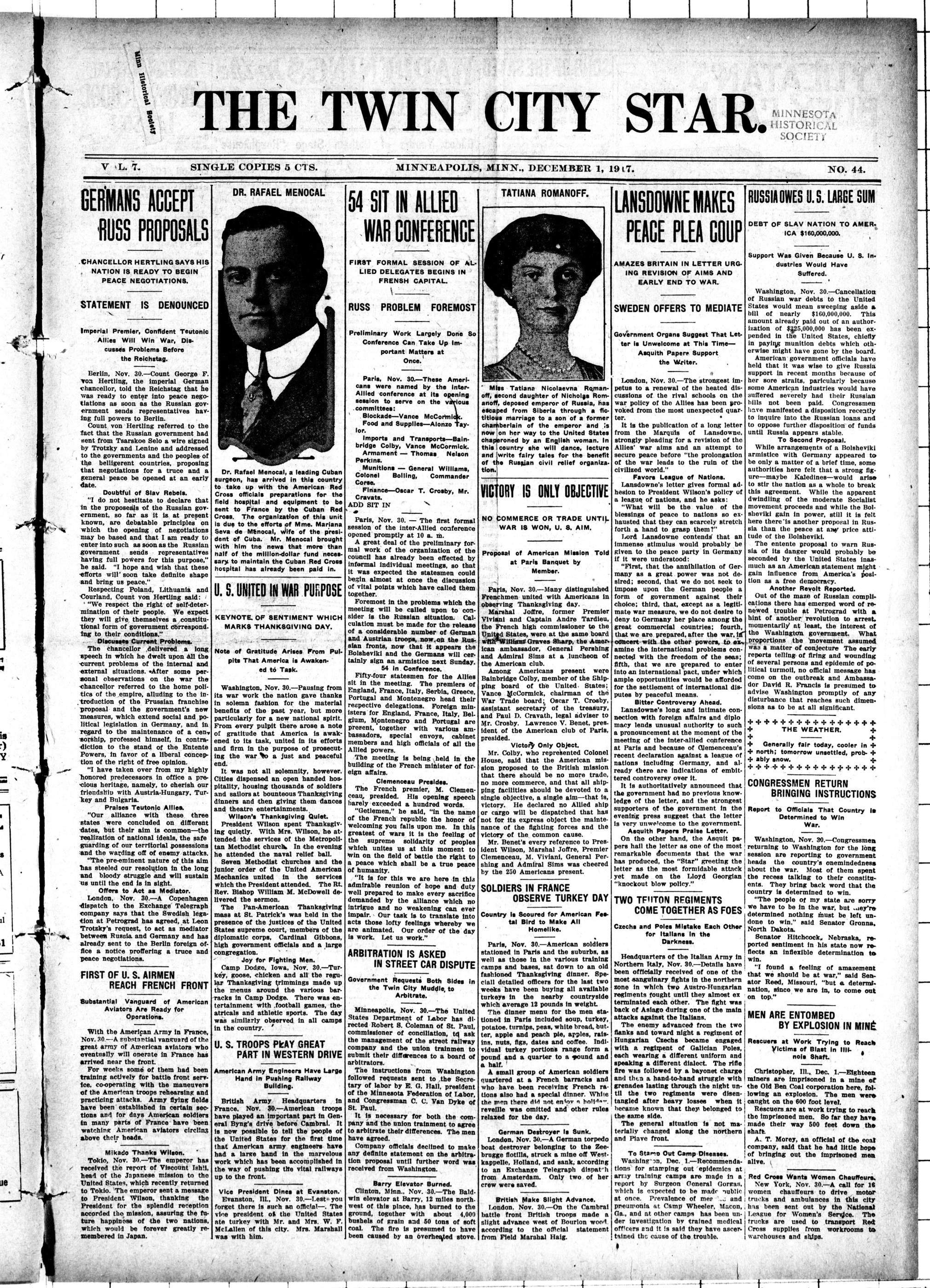
DR. RAPAEL MENOCAL
Dr. Rafael Menocal, a leading Cuban surgeon, has arrived in this country to take up with the American Red Cross officials preparations for the field hospital and equipment to be sent to France by the Cuban Red Cross. The organization of this unit is due to the efforts of Mme. Mariana Seva de Menocal, wife of the president of Cuba. Mr. Menocal brought with him the news that more than half of the million-dollar fund necessary to maintain the Cuban Red Cross hospital has already been paid in.
U. S. UNITED IN WAR PURPOSE
KEYNOTE. OF SENTIMENT WHICH
MARKS THANKSGIVING DAY.
Note of Gratitude Arises From Pulpits That America is Awakened to Task.
Washington, Nov. 30.—Pausing from its war work the nation gave thanks in solemn fashion for the material benefits of the past year, but more particularly for a new national spirit. From every pulpit there arose a note of gratitude that America is awakened to its task, united in its efforts and firm in the purpose of prosecuting the war so a just and peaceful end.
It was not all solemnity, however. Cities dispensed an open handed hospitality, housing thousands of soldiers and sailors at bountie Thanksgiving dinners and then giving them dances and theatre entertainments.
Wilson's Thanksgiving Quiet.
President Wilson spent Thanksgiving quietly. With Mrs. Wilson, he attended the services of the Metropolitan Methodist church. In the evening he attended the naval relief ball.
Seven Methodist churches and the junior order of the United American Mechanics united in the services which the President attended. The Rt. Rev. Bishop William M. McDowell delivered the sermon.
The Pan-American Thanksgiving mass at St. Patrick's was held in the presence of the justices of the United States supreme court, members of the diplomatic corps, Cardinal Gibbons, high government officials and a large congregation.
Joy for Fighting Men.
Camp Dodge, Iowa, Nov. 30.—Turkey, goose, chicken and all the regular Thanksgiving trimmings made up the menus around the various barracks in Camp Dodge. There was entertainment with football games, theatricals and athletic sports. The day was similarly observed in all camps in the country.
U. S. TROOPS PLAY GREAT
PART IN WESTERN DRIVE
American Army Engineers Have Large Hand in Pushing Railway Building.
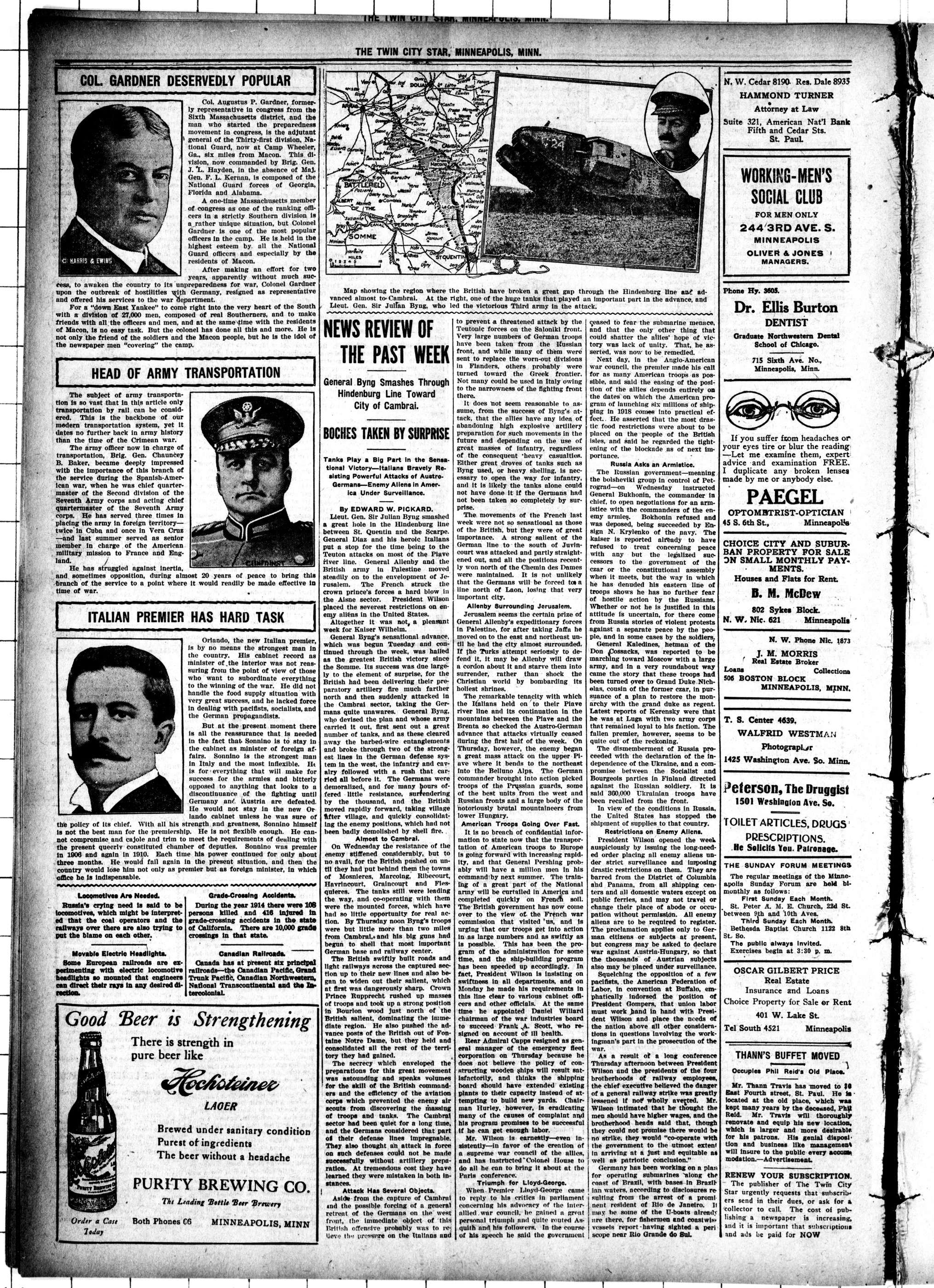
British Army Headquarters in France. Nov. 30.—American troops have played an important part in General Byng's drive before Cambrai. It is now possible to tell the people of the United States for the first time that American army engineers have had a large hand in the marvelous work which has been accomplished in the way of pushing the vital railways up to the front.
Vice President Dines at Evanston. Evanston, Ill., Nov. 30.—Lest you forget there is such an official—. The vice president of the United States ate turkey with Mr. and Mrs. W. F. McLallen of this city. Mrs. Marshall was with him.
MINNEAPOLIS, MINN., DECEMBER 1, 1917.
54 SIT IN ALLIED WAR CONFERENCE
FIRST FORMAL SESSION OF ALLIED DELEGATES BEGINS IN FRENSH CAPITAL.
RUSS PROBLEM FOREMOST
Preliminary Work Largely Done So Conference Can Take Up Important Matters at
Paris, Nov. 30.—These Americans were named by the Inter-Allied conference at its opening session to serve on the various committees:
Imports and Transports—Bainbridge Colby, Vance McCormick. Armament — Thomas Nelson Perkins. Munitions — General Williams, Colonel Bolling, Commander Cores. Finance—Oscar T. Crosby, Mr. Cravats.
Paris, Nov. 30. — The first formal session of the inter-Allied conference opened promptly at 10 a. m.
A great deal of the preliminary formal work of the organization of the council has already been effected by informal individual meetings, so that it was expected the statesmen could begin almost at once the discussion of vital points which have called them together.
Foremost in the problems which the meeting will be called upon to consider is the Russian situation. Calculation must be made for the release of a considerable number of German and Austrian troops, now on the Russian fronts, now that it appears the Bolshevik and the Germans will certainly sign an armistice next Sunday.
54 in Conference.
Fifty-four statesmen for the Allies sit in the meeting. The premiers of England, France, Italy, Serbia, Greece, Portugal and Montenegro head their respective delegations. Foreign ministers for England, France, Italy, Belgium, Montenegro and Portugal are present, together with various ambassadors, special envoys, cabinet members and high officials of all the Allied powers.
The meeting is being held in the building of the French minister of foreign affairs.
Clemenceau Presides.
The French premier, M. Clemenceau, presided. His opening speech barely exceeded a hundred words.
"Getlemen," he said, "in the name of the French republic the honor of welcoming you falls upon me. In this greatest of wars it is the feeling of the supreme solidarity of peoples which unites us at this moment to win on the field of battle the right to a peace which shall be a true peace of humanity.
"It is for this we are here in this admirable reunion of hope and duty well prepared to make every sacrifice demanded by the alliance which no intrigue and no weakening can ever impair. Our task is to translate into acts those lofty feelings whereby we are animated. Our order of the day is work. Let us work."
ARBITRATION IS ASKED IN STREET CAR DISPUTE
Government Requests Both Sides in the Twin City Muddle, to Arbitrate.
Minneapolis, Nov. 30.—The United States Department of Labor has directed Robert S. Coleman of St. Paul, commissioner of conciliation, tq ask the management of the street railway company and the union trainmen to submit their differences to a board of arbitrators.
The instructions from Washington followed requests sent to the Secretary of labor by E. G. Hall, president of the Minnesota Federation of Labor, and Congressman C. C. Van Dyke of St. Paul.
It is necessary for both the company and the union trainment to agree to arbitrate their differences. The men have agreed.
Company officials declined to make any definite statement on the arbitration proposal until further word was received from Washington.
Barry Elevator Burned.
Clinton, Minn., Nov. 30.—The Baldwin elevator at Barry, 12 miles northwest of this place, has burned to the ground, together with about 4,000 bushels of grain and 50 tons of soft coal. The fire is presumed to have been caused by an overheated stove.
TATIANA ROMANOFF.
Miss Tatiana Nicolaevna Rqmanoff, second daughter of Nicholga Romanoff, deposed emperor of Russia, has escaped from Siberia through a fictitious marriage to a son of a former chamberlain of the emperor and is now on her way to the United States chaperoned by an English woman. In this country she will dance, lecture and write fairy tales for the benefit of the Russian civil relief organization.
VICTORY IS ONLY OBJECTIVE
NO COMMERCE OR TRADE UNTI
WAR IS WON, W. S. AIM.
Paris, Nov. 30.—Many distinguished Frenchmen united with Americans in observing Thanksgiving day.
Marshal Joffre, former Premier Viviani and Captain Andre Tardieu, the French high commissioner to the United States, were at the same board with William Graves Sharp, the American ambassador, General Pershing and Admiral Sims at a luncheon of the American club.
Among Americans present were Bainbridge Colby, member of the Shipping board of the United States; Vance McCormick, chairman of the War Trade board; Oscar T. Crosby, assistant secretary of the treasury, and Paul D. Cravath, legal adviser to Mr. Crosby. Lawrence V. Benet, president of the American club of Paris, presided.
Victory Only Object.
Mr. Colby, who represented Colonel House, said that the American mission proposed to the British mission that there should be no more trade, no more commerce, and that all shipping facilities should be devoted to a single objective, a single alm—that is, victory. He declared no Allied ship or cargo will be dispatched that has not for its express object the maintenance of the fighting forces and the victory of the common cause.
Mr. Benet's every reference to President Wilson, Marshal Joffre, Premier Clemenceau, M. Viviani, General Pershing and Admiral Sims was cheered by the 250 Americans present.
SOLDIERS IN FRANCE
OBSERVE TURKEY DAY
Country is Scoured for American Feetal Bird to Make All Homelike.
Paris, Nov. 30.—American soldiers stationed in Paris and the suburbs, as well as those in the various training camps and bases, sat down to an old fashioned Thanksgiving dinner. Special detailed officers for the last two weeks have been buying all available turkeys in the nearby countryside which average 12 pounds in weight.
The dinner menu for the men stationed in Paris included soup, turkey, potatoe, turnips, peas, white bread, butter, apple and peach pie, apples, raisins, nuts, figs, dates and coffee. Individual turkey portions range form a pound and a quarter to a pound and a half.
A small group of American soldiers quartered at a French barracks and who have been receiving French raisons also had a special dinner. While the men there did not enjoy a holiday revelle was omitted and other rules relaxed for the day.
London, Nov. 30.—A German torpedo boat destroyer belonging to the Zee-bruge flotilla, struck a mine off West-kappelle, Holland, and sank, according to an Exchange Telegraph dispatch from Amsterdam. Only two of her crew were saved.
British Make Slight Advance.
London, Nov. 30.—On the Cambraf battle front British troops made a slight advance west of Bourlon wood, according to the official statement from Field Marshal Haig.
LANSDOWNE MAKES PEACE PLEA COUP
LANSDOWNE MAKES PEACE PLEA COUP
AMAZES BRITAIN IN LETTER URG ING REVISION OF AIMS AND EARLY END TO WAR.
SWEDEN OFFERS TO MEDIATE
Government Organs Suggest That Letter is Unwelcome at This Time— Asquith Paper's Support
London, Nov. 30.—The strongest impetus to a renewal of the heated discussions of the rival schools on the war policy of the Allies has been provoked from the most unexpected quarter.
It is the publication of a long letter from the Marquis of Lansdowne, strongly pleading for a revision of the Allies' war aims and an attempt to secure peace before "the prolongation of the war leads to the ruin of the civilized world."
Favors League of Nations.
Lansdowne's letter gives formal adhesion to President Wilson's policy of a league of nations, and he asks:
"What will be the value of the blessings of peace to nations so exhausted that they can scarcely stretch forth a hand to grasp them?"
Lord Lansdowne contends that an immense stimulus would probably be given to the peace party in Germany if it were understood:
"First, that the annihilation of Germany as a great power was not desired; second, that we do not seek to impose upon the German people a form of government against their choice; third, that, except as a legitimate war measure, we do not desire to deny to Germany her place among the great commercial countries; fourth, that we are prepared, after the war, in concert with the other powers, to examine the international problems connected with the freedom of the seas; fifth, that we are prepared to enter into an international pact, under which ample opportunities would be afforded for the settlement of international disputes by peaceful means.
Bitter Controversy Ahead.
Lansdowne's long and intimate connection with foreign affairs and diplomacy lends unusual authority to such a pronouncement at the moment of the meeting of the inter-allied conference at Paris and because of Clemenceau's recent declaration against a league of nations including Germany, and already there are indications of embittered controversy over it.
It is authoritatively announced that the government had no previous knowledge of the letter, and the strongest supporters of the government in the evening press suggest that the letter is very unwelcome to the government.
Arguish Bacon Praise Letters
On the other hand, the Asouit papers hall the letter as one of the most remarkable documents that the war has produced, the "Star" greeting the letter as the most formidable attack yet made on the Lloyd Georgian "knockout blow policy."
TWO TEUTON REGIMENTS
COME TOGETHER AS FOES
Czechs and Poles Mistake Each Other for Italians in the Darkness.
Headquarters of the Italian Army in Northern Italy, Nov. 30.—Details have been officially received of one of the most sanguinary fights in the northern zone in which two Austro-Hungarian regiments fought until they almost exterminated each other. The fight was back of Aslago during one of the main attacks against the Italians.
The enemy advanced from the two flanks and toward night a regiment of Hungarian Czechs became engaged with a regiment of Galician Poles, each wearing a different uniform and speaking a different dialect. The rifle fire was followed by a bayonet charge and then a hand-to-hand struggle with grenades lasting through the night until the two regiments were disentangled after heavy losses when it became known that they belonged to the same side.
The general situation is not materially changed along the northern and Plave front.
To Stamp Out Camp Diseases
Washington, Dec. 1.—Recommendations for stamping out epidemics at army training camps are made in a report by Surgeon General Gorgas, which is expected to be made public at once. Prevalence of measles and pneumonia at Camp Wheeler, Macon, Ga., and at other camps has been under investigation by trained medical officers and it is said they have ascertained the cause of the trouble.
MINNESOTA
HISTORICAL
SOCIETY
NO. 44.
RUSSIAOWES U. S. LARGE SUM
DEBT OF SLAV NATION TO AMERICA $160,000,000.
Support Was Given Because U. S. Industries Would Have
Washington, Nov. 30.—Cancellation of Russian war debts to the United States would mean sweeping aside a bill of nearly $160,000,000. This amount already paid out of an authorization of $225,000,000 has been expended in the United States, chiefly in paying munion debts which otherwise might have gone by the board. American government officials have held that it was wise to give Russia support in recent months because of her sore straits, particularly because some American industries would have suffered severely had their Russian bills not been paid. Congressmen have manifested a disposition recently to inquire into the Russian loans and to oppose further disposition of funds until Russia appears stable.
To Second Proposal.
While arrangements of a Bolshevik armistice with Germany appeared to be only a matter of a brief time, some authorities here felt that a strong figure—maybe Kaledines—would arise to stir the nation as a whole to break this agreement. While the apparent dwindling of the moderate Socialist movement proceeds and while the Bolshevik gain in power, still it is felt here there is another proposal in Russia than the peace at any price attitude of the Bolshevik.
The entente proposal to warn Russia of its danger would probably be seconded by the United States inasmuch as an American statement might gain influence from America's position as a free democracy.
Another Revolt Reported.
Out of the maze of Russian complications there has emerged word of renewed trouble at Petrograd with a hint of another revolution to arrest, momentarily at least, the interest of the Washington government. What proportions the movement assumed was a matter of conjecture. The early reports telling of firing and wounding of several persons and epidemic of political turmoil, no official message has come on the outbreak and Ambassador David R. Francis is presumed to advise Washington promptly of any disturbance that reaches such dimensions as to be at all significant.
THE WEATHER.
Generally fair today, cooler in north; tomorrow unsettled, probably snow.
CONGRESSMEN RETURN BRINGING INSTRUCTIONS
Report to Officials That Country is Determined to Win
War.
Washington, Nov. 30.—Congressmen returning to Washington for the long session are reporting to government heads the country's onemindedness about the war. Most of them spent the recess talking to their constituents. They bring back word that the country is determined to win.
"The people of my state are sorry we have to be in the war, but they're determined nothing must be left undone to win," said Senator Gronna, North Dakota.
Senator Hitchcock, Nebraska, reported sentiment in his state now reflects an inflexible determination to win.
"I found a feeling of amazement that we should be at war," said Senator Reed, Missouri, "but a determination, since we are in, to come out on top."
MEN ARE ENTOMBED BY EXPLOSION IN MINE
Rescuers at Work Trying to Reach Victims of Blast in Illinois Shaft.
Christopher, Ill., Dec. 1.—Eighteen miners are imprisoned in a mine of the Old Ben Coal corporation here, following an explosion. The men were caught on the 600 foot level.
Rescuers are at work trying to reach the imprisoned men. So far they have made their way 500 feet down the shaft.
A. T. Morey, an official of the coal company, said that he had little hope of bringing out the imprisoned men alive.
Red Cross Wants Women Chauffeurs. New York, Nov. 30.—A call for 16 women chauffeurs to drive motor trucks and ambulances in this city has been sent out by the National League for Women's Seryce. The trucks are used to transport Red Cross supplies from workrooms to warehouses and ships.
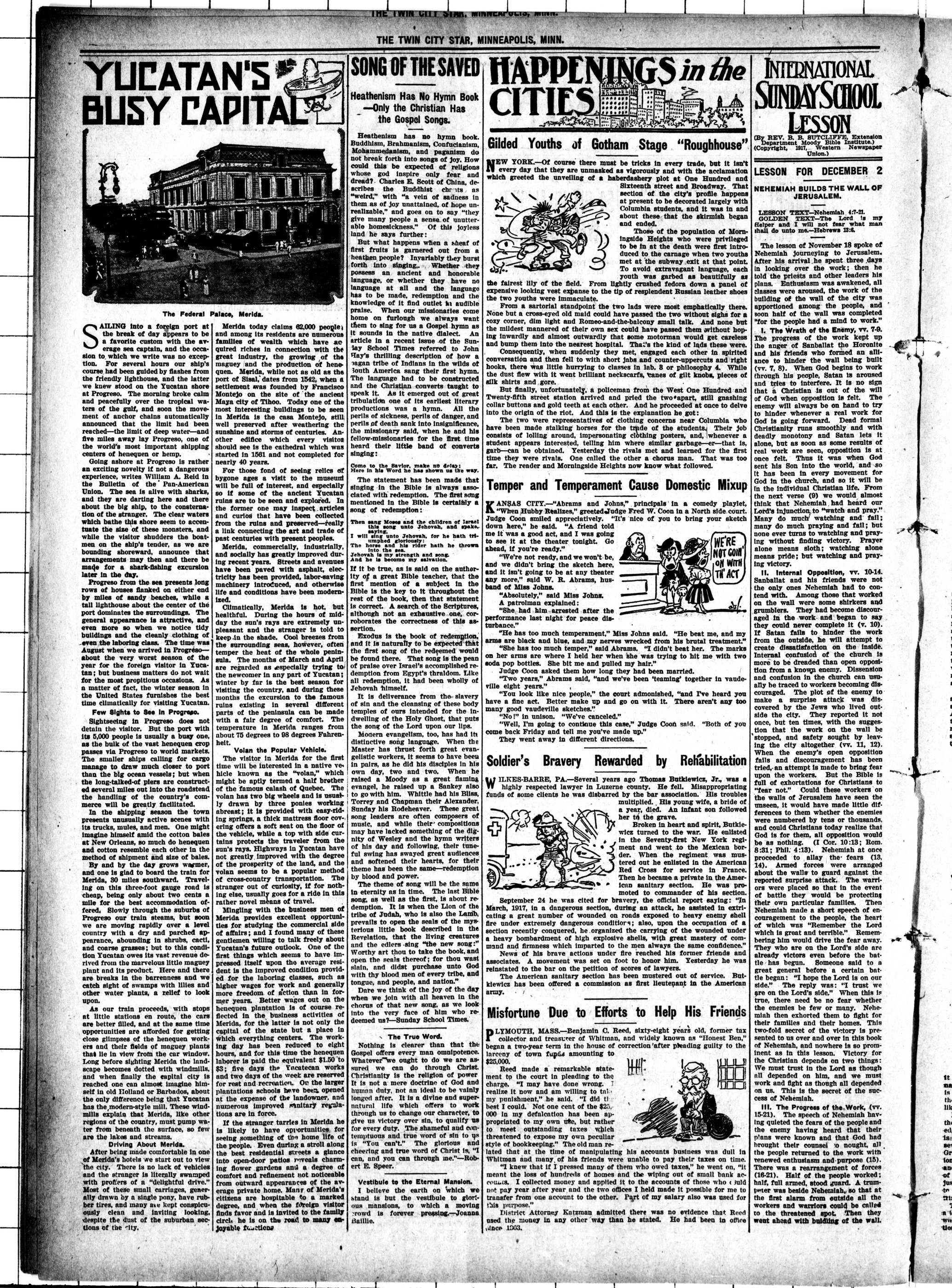
YUCATAN'S BUSY CAPITAL
The Federal Palace, Merida.
SAILING into a foreign port at the break of day appears to be a favorite custom with the average sea captain, and the occasion to which we write was no exception. For several hours our ship's course had been guided by flashes from the friendly lighthouse, and the latter we knew stood on the Yucatan shore at Progreso. The morning broke calm and peacefully over the tropical waters of the gulf, and soon the movement of anchor chains automatically announced that the limit had been reached—the limit of deep water—and five miles away lay Progreso, one of the world's most important shipping centers of henequen or hemp.
Going ashore at Progreso is rather an exciting novelty if not a dangerous experience, writes William A. Reid in the Bulletin of the Pan-American Union. The sea is alive with sharks, and they are darting here and there about the big ship, to the consternation of the stranger. The clear waters which bathe this shore seem to accentuate the size of these monsters, and while the visitor shudders the boatmen on the ship's tender, as we are bounding shoreward, announce that arrangements may then and there be made for a shark-fishing excursion later in the day.
Progreso from the sea presents long rows of houses fanked on either end by miles of sandy beaches, while a tall lighthouse about the center of the port dominates the surroundings. The general appearance is attractive, and even more so when we notice tidy buildings and the cleanly clothing of even the laboring class. The time was August when we arrived in Progreso—about the very worst season of the year for the foreign visitor in Yucatan; but business matters do not wait for the most propitious occasions. As a matter of fact, the winter season in the United States furnishes the best time climatically for visiting Yucatan.
Few Sights to See In Progreso.
Sightseeing in Progreso does not detain the vistor. But the port with its 5,000 people is usually a busy one, as the bulk of the vast nehenque crop passes via Progreso to world markets. The smaller ships calling for cargo manage to draw much closer to port than the big ocean vessels; but when the long-talked-of pliers are constructed several miles out into the roadstead the handling of the country's commerce will be greatly facilitated. In the shipping season the town presents unusually active scenes with its trucks, mules, and men. One might imagine himself amid the cotton bales at New Orleans, so much do nehenque and cotton resemble each other in the method of shipment and size of bales.
By and by the day grows wagner, and one is glad to board the train for Merida, 80 miles southward. Traveling on this three-foot gauge road is cheap, being only about two cents a mile for the best accommodation offered. Slowly through the suburbs of Progreso our train steams, but soon we are moving rapidly over a level country with a dry and parched appearance, abounding in shrubs, cacti, and coarse grasses; but to this condition Yucatan owes its vast revenue derived from the marvelous little maguey plant and its product. Here and there are breaks in the barrenness and we catch sight of swamps with illies and other water plants, a relief to look upon.
As our train proceeds, with stops at little stations en route, the cars are better filled, and at the same time opportunities are afforded for getting close glimpses of the henequen workers and their fields of maguey plants that lie in view from the car window. Long before sighting Merida the landscape becomes dotted with windmills, and when finally the capital city is reached one can almost imagine himself in old Holland or Barbados, about the only difference being that Yucatan has the modern-style mill. These windmills explain that Merida, like other regions of the country, must pump water from beneath the surface, so few are the lakes and streams.
Driving About Merida.
DRIVING About merida.
After being made comfortable in one of Merida's hotels we start out to view the city. There is no lack of vehicles and the stranger is literally swamped with proffers of a "delightful drive." Most of these small carriages, generally drawn by a single pony, have rubber tires, and many are kept conspicuously clean and inviting looking, despite the dust of the suburban sections of the city.
Merida today claims 62,000 people; and among its residents are numerous families of wealth which have acquired riches in connection with the great industry, the growing of the maguey and the production of henequen. Merida, while not as old as the port of Sisal, dates from 1542, when a settlement was founded by Francisco Montejo on the site of the ancient Maya city of Tihoo. Today one of the most interesting buildings to be seen in Merida is the casa Montejo, still preserved after weathering the sunshine and storms of centuries. Another edifice which every visitor should see is the cathedral which was started in 1561 and not completed for nearly 40 years.
For those fond of seeing relics of bygone ages a visit to the museum will be full of interest, and especially so if some of the ancient Yucatan ruins are to be seen and explored. In the former one may inspect articles and curios that have been collected from the ruins and preserved—really a link connecting the art and trade of past centuries with present peoples.
Merida, commercially, industrially, and socially has greatly improved during recent years. Streets and avenues have been paved with asphalt, electricity has been provided, labor-saving machinery introduced, and otherwise life and conditions have been modernized.
Climatically, Merida is hot, but healthful. During the hours of midday the sun's rays are extremely unpleasant and the stranger is told to keep in the shade. Cool breezes from the surrounding seas, however, often temper the heat of the whole peninsula. The months of March and April are regarded as especially trying to the newcomer in any part of Yucatan; winter by far is the best season for visiting the country, and during these months the excursion to the famous ruins existing in several different parts of the peninsula can be made with a fair degree of comfort. The temperature in Merida ranges from about 75 degrees to 98 degrees Fahrenheit.
Volan the Popular Vehicle.
The visitor in Merida for the first time will be interested in a native vehicle known as the "volan," which might be aptly termed a half brother of the famous calash of Quebec. The volan has two big wheels and is usually drawn by three ponies working abreast; it is provided with easy-riding springs, a thick mattress floor covering offers a soft seat on the floor of the vehicle, while a top with side curtains protects the traveler from the sun's rays. Highways in Yucatan have not greatly improved with the degree of the prosperity of the land, and the volan seems to be a popular method of cross-country transportation. The stranger out of curiosity, if for nothing else, usually goes for a ride in this rather novel means of travel.
Mingling with the business men of Merida provides excellent opportunities for studying the commercial side of affairs; and I found many of these gentlemen willing to talk freely about Yucatan's future outlook. One of the first things which seems to have impressed itself upon the average resident is the improved condition provided for the laboring classes, such as higher wages for work and generally more freedom of action than in former years. Better wages out on the henequen plantation is of course reflected in the business activities of Merida, for the latter is not only the capital of the state but a place in which everything centers. The working day has been reduced to eight hours, and for this time the henequen laborer is paid the equivalent $1.50 to $3; five days the Yucatecan works and two days of the week are reserved for rest and recreation. On the larger plantations schools have been opened at the expense of the landowner, and numerous improved sanitary regulations are in force.
If the stranger turries in Merida he is likely to have opportunities for seeing something of the home life of the people. Even during a stroll along the best residential streets a glance into open-door patios reveals charming flower gardens and a degree of comfort and refinement not noticeable from outward appearances of the average private home. Many of Merida's citizens are hospitable to a marked degree, and when the foreign visitor finds favor and is invited to the family circle, he is on the road to many enjoyable functions
THE TWIN CITY STAR. MINNEAPOLIS. MINN.
SONG OF THE SAVED
Heathenism Has No Hymn Book Only the Christian Has the Gospel Songs.
Heathenism has no hymn book. Buddhism, Brahmanism, Confucianism, Mohammedanism, and paganism do not break forth into songs of joy. How could this be expected of religions whose god inspire only fear and dread? Charles E. Scott of China, describes the Buddhist christs as "weird," with "a vein of sadness in them as of joy unattained, of hope unrealizable," and goes on to say "they give many people a sense of unutterable homesickness." Of this joyless land he says further:
But what happens when a sheaf of first fruits is garnered out from a heathen people? Invariably they burst forth into singing. Whether they possess an ancient and honorable language, or whether they have no language at all and the language has to be made, redemption and the knowledge of it find outlet in audible praise. When our missionaries come home on furlough we always want them to sing for us a Gospel hymn as it sounds in the native dialect. An article in a recent issue of the Sunday School Times referred to John Hay's thrilling description of how aagan tribe of Indians in the wilds of South America sang their first hymn. The language had to be constructed and the Christian converts taught to speak it. As it emerged out of great tribulation one of its earliest literary productions was a hymn. All the perils of sickness, perils of danger, and perils of death sank into insignificance, the missionary said, when he and his fellow-missionaries for the first time heard their little band of converts singing:
Come to the Savior, make no delay: Here in his Word he has shown us the way.
The statement has been made that singing in the Bible is always associated with redemption. The first song mentioned in the Bible is certifically a song of redemption:
Then sang Moses and the children of Israel this song unto Jehovah, and spake,
Jehovah is my strength and song. And he is become my salvation.
If it be true, as is said on the authority of a great Bible teacher, that the first mention of a subject in the Bible is the key to it throughout the rest of the book, then that statement is correct. A search of the Scriptures, although not an exhaustive one, corroborates the correctness of this assertion.
Exodus is the book of redemption, and it is naturally to be expected that the first song of the redeemed would be found there. That song is the pean of praise over Israel's accomplished redemption from Egypt's thraldom. Like all redemption, it had been wholly of Jehovah himself.
It is deliverance from the slavery of sin and the cleansing of these body temples of ours intended for the indwelling of the Holy Ghost, that puts the song of the Lord upon our lips.
Modern evangelism, too, has had its distinctive song language. When the Master has thrust forth great evangelistic workers, it seems to have been in pairs, as he did his disciples in his own day, two and two. When he raised a Moody as a great faming evangel, he raised up a Sankey also to go with him. Whittle had his Bliss, Torrey and Chapman their Alexander, Sunday his Rodeheaver. These great song leaders are often composers of music, and while their compositions may have lacked something of the dignity of Wesley and the hymn writers of his day and following, their tuneful swing has swayed great audiences and softened their hearts, for their theme has been the same—redemption by blood and power.
The theme of song will be the same in eternity as in time. The last Bible song, as well as the first, is about redemption. It is when the Lion of the tribe of Judah, who is also the Lamb, prevails to open the seals of the mysterious little book described in the Revelation, that the living creatures and the edlers-sing "the new song." Worthy art thou to take the book, and open the seals thereof; for thou wast slain, and didst purchase unto God with thy blood men of every tribe, and tongue, and people, and nation."
Dare we think of the joy of the day when we join with all heaven in the chorus of that new song, as we look into the very face of him who redeemed us!—Sunday School Times.
The True Word.
Nothing is clearer than that the Gospel offers every man omnipotence. Whatever we ought to do we are assured we can do through Christ. Christianity is the religion of power. It is not a mere doctrine of God and human duty, not an ideal to be vainly longed after. It is a divine and supernatural life which offers to work through us to change our character, to give us victory over sin, to qualify us for every duty. The shameful and contemptuous and true word of sin to us is "You can't." The glorious and cheering and true word of Christ is, "I can, and you can through me."—Robert E. Speer.
Vestibule to the Eternal Mansion. I believe the earth on which we stand is but the vestibule to glorious mansions, to which a moving crowd is forever pressing—Joanna Baillie.
HAPPENINGS in the CITIES
NEW YORK.—Of course there must be tricks in every trade, but it isn't every day that they are unmasked as vigorously and with the acclamation which greeted the unveiling of a haberdashery plot at One Hundred and
the fairest illy of the field. From lightly crushed fedora down a panel of expensive looking vest expanse to the tip of resplendent Russian leather shoes the two youths were immaculate.
From a sartorial standpoint the two lads were most emphatically there. None but a cross-eyed old maid could have passed the two without sighs for a cozy corner, dim light and Romeo-and-the-balcony small talk. And none but the mildest mannered of their own sex could have passed them without hoping inwardly and almost outwardly that some motorman would get careless and bump them into the nearest hospital. That's the kind of lads these were.
Consequently, when suddenly they met, engaged each other in spirited conversation and then fell to with short jabs and counter-uppercuts and right hooks, there was little hurrying to classes in lab. 8 or philosophy 4. While the dust flew with it went brilliant neckscarfs, vanes of gift knobs, pieces of alk shirts and gore.
But finally, unfortunately, a policeman from the West One Hundred and Twenty-fifth street station arrived and pried the two*apart, still gnashing collar buttons and gold teeth at each other. And he proceeded at once to delve into the origin of the riot. And this is the explanation he got:
The two were representatives of clothing concerns near Columbia who have been made stalking horses for the trade of the students. Their job consists of lolling around, impersonating clothing posters, and, whenever a student appears interested, telling him where similar garbage—er—that is, garb—can be obtained. Yesterday the rivals met and learned for the first time they were rivals. One called the other a chorus man. That was too far. The reader and Morningside Heights now know what followed.
Temper and Temperament Cause Domestic Mixup
KANSAS CITY—"Abrams and Johns," principals in a comedy playlet, "When Hubby Realizes," greeted Judge Fred W. Coon in a north side court. Judge Coon smiled appreciatively, "It's nice of you to bring your sketch down here," he said, "A friend, told
"He has too much temperament," Miss Johns said. "He beat me, and my arms are black and blue, and my nerves wrecked from his brutal treatment."
"She has too much temper," said Abrams. "I didn't beat her. The marks on her arms are where I held her when she was trying to hit me with two soda pop bottles. She bit me and pulled my hair."
Judge Coon asked them how long they had been married.
"Two years," Abrams said, "and we've been 'teaming' together in vaudeville eight years."
"You look like nice people," the court admonished, "and I've heard you have a fine act. Better make up and go on with it. There aren't any too many good vaudeville sketches."
"No!" in unison. "We've canceled."
"Well, I'm going to continue this case," Judge Coon said. "Both of you come back Friday and tell me you've made up."
Soldier's Bravery Rewarded by Rehabilitation
Soldier's Bravery Rewarded by Rehabilitation
WILKES-BARRE, PA.—Several years ago Thomas Butkiewicz, Jr., was a highly respected lawyer in Luzerne county. He fell. Misappropriating funds of some clients he was disbarred by the bar association. His troubles
September 24 he was cited for bravery, the official report saying: "In March, 1917, in a dangerous section, during an attack, he assisted in extricating a great number of wounded on roads exposed to heavy enemy shell fire under extremely dangerous conditions; also, upon the occupation of a section recently conquered, he organized the carrying of the wounded under a heavy bombardment of high explosive shells, with great mastery of command and firmness which imparted to the men always the same confidence." News of his brave actions under fire reached his former friends and associates. A movement was set on foot to honor him. Yesterday he was reinstated to the bar on the petition of scores of lawyers.
The American sanitary section has been mustered out of service. Butkiewicz has been offered a commission as first lieutenant in the American army.
Misfortune Due to Efforts to Help His Friends
Misfortune Due to Efforts to Help His Friends
PLYMOUTH, MASS.—Benjamin C. Reed, sixty-eight years old, former tax collector and treasurer of Whitman, and widely known as "Honest Ben," began a two-year term in the house of correction after pleading guilty to the larceny of town fupds amounting to $25,000.
lated that at the time of manipulating his accounts business was dull in Whitman and many of his friends were unable to pay their taxes on time.
"I knew that if I pressed many of them who owed taxes," he went on, "it meant the loss of hundreds of homes and the wiping out of small bank accounts. I collected money and applied it to the accounts of those who could not pay year after year and the two offices I held made it possible for me to transfer from one account to the other. Part of my salary also was used for this purpose."
District Attorney Kutzman admitted there was no evidence that Reed used the money in any other way than he stated. He had been in office since 1903.
3
the fairest illy of the field. From lightly to expensive looking vest expanse to the tip of the two youths were immaculate.
From a sartorial standpoint the two ladies None but a cross-eyed old maid have have cozy corner, dim light and Romeo-and-the-bear the mildest mannered of their own sex could inwardly and almost outwardly that son and bump them into the nearest hospital. Then Consequently, when suddenly they met, conversation and then fell to with short jabs, hooks, there was little hurrying to classes in the dust flew with it went brilliant neckscarl shirts and gore.
But finally, unfortunately, a policeman for Twenty-fifth street station arrived and priced collar buttons and gold teeth at each other. A into the origin of the riot. And this is the ee The two were representatives of clothes have been made stalking horses for the tru consists of lolling around, impersonating cl student appears interested, telling him whe garb—can be obtained. Yesterday the rivaltime they were rivals. One called the other far. The reader and Morningside Heights no
Temper and Temperament C
KANSAS CITY.—"Abrams and Johns," p. "When Hubby Realizes," greeted Judge Fr Judge Coon smiled appreciatively. "It's no
down here," he said. "A friend told me it was a good act, and I was going to see it at the theater tonight. Go ahead, if you're ready."
"We're not ready, and we won't be, and we didn't bring the sketch here, and it isn't going to be at any theater any more," said W. R. Abrams, husband of Miss Johns.
"Absolutely," said Miss Johns.
A patrolman explained:
"She had him arrested after the performance last night for peace disturbance."
"He has too much temperament," Miss Jo arms are black and blue, and my nerves were "She has too much temper," said Abrams on her arms are where I held her when she soda pop bottles. She bit me and pulled my Judge Coon asked them how long they h "Two years," Abrams said, "and we've b ville eight years."
"You look like nice people," the court a have a fine act. Better make up and go on many good vaudeville sketches."
"No!" in unison. "We've canceled."
They went away in different directions.
Soldier's Bravery Rewarded
WILKES-BARRE, PA.—Several years ago, highly respected lawyer in Luzerne county funds of some clients he was disbarred by the multit a year her t wicz in the ment der. tered Red Then ican
September 24 he was cited for bravery March, 1917, in a dangerous section, during citing a great number of wounded on road fire under extremely dangerous conditions; section recently conquered, he organized the a heavy bombardment of high explosive shemand and firmness which imparted to the m
News of his brave actions under fire associates. A movement was set on foot to reinstated to the bar on the petition of score The American sanitary section has been klewicz has been offered a commission as army.
Misfortune Due to Efforts
PLYMOUTH, MASS.—Benjamin C. Reed, a collector and treasurer of Whitman, and began a two-year term in the house of correclarceny of town funds amounting to $25,000.
Reed made a remarkable statement to the court in pleading to the charge. "I may have done wrong. I realize it now and am willing to take my punishment," he said. "I did the best I could. Not one cent of the $25,000 in my defalcation has been appropriated to my own use, but rather to meet outstanding taxes which threatened to expose my own peculiar style of bookkeeping." The old man re-
lated that at the time of manipulating his Whitman and many of his friends were un-
"I knew that if I pressed many of them meant the loss of hundreds of homes and the counts. I collected money and applied it to not pay year after year and the two offices a transfer from one account to the other. Pay this purpose."
District Attorney Katzman admitted that used the money in any other way than he since 1903.
Sixteenth street and Broadway. That section of the city's profile happens at present to be decorated largely with Columbia students, and it was in and about these that the skirmish began and ended. Those of the population of Morningside Heights who were privileged to be in at the death were first introduced to the carnage when two youths met at the subway exit at that point. To avoid extravagant language, each youth was garbed as beautifully as
nightly crushed fedora down a panel of hip of resplendent Russian leather shoes
two lads were most emphatically there, the pass of resplendent Russian leather shoes
could have passed them without hopat some motorman would get careless al. That's the kind of lads these were, met, engaged each other in spirited jets and counter-uppercuts and right asses in lab. 8 or philosophy 4. While backscarfs, vanes of gilt knobs, pieces of man from the West One Hundred and pried the two apart, still gnashing her. And he proceeded at once to delve the explanation he got:
clothing concerns near Columbia who the trade of the students. Their job being clothing posters, and, whenever an where similar garbage—er that is, the rivals met and learned for the first other a chorus man. That was too rights now know what followed.
Great Cause Domestic Mixup
"ins," principals in a comedy playlet, Judge Fred W. Coon in a North side court. It's nice of you to bring your sketch
WE'RE NOT GON' ON WITH TH' ACT
Miss Johns said. "He beat me, and my sons wrecked from his brutal treatment." Brams. "I didn't beat her. The marks en she was trying to hit me with two and my hair." They had been married. "I've been 'teaming' together in vaude-court admonished, "and I've heard you go on with it. There aren't any too-" case," Judge Coon said. "Both of you made up." Tions.
Arded by Rehabilitation
as ago Thomas Butkiewicz, Jr., was a one county. He fell. Misappropriating by the bar association. His troubles multiplied. His young wife, a bride of a year, died. An infant son followed her to the grave.
Broken in heart and spirit, Butkiewicz turned to the war. He enlisted in the Seventy-first New York regiment and went to the Mexican border. When the regiment was mustered out he enlisted in the American Red Cross for service in France. Then he became a private in the American sanitary section. He was promoted to commander of his section.
gravey, the official report saying: "In
during an attack, he assisted in extri-
nation roads exposed to heavy enemy shell
victors; also, upon the occupation of a
bed the carrying of the wounded under
live shells, with great mastery of com-
the men always the same confidence."
Fire reached his former friends and
foot to honor him. Yesterday he was
of scores of lawyers.
Has been mustered out of service. But
as first lieutenant in the American
Arts to Help His Friends
Reed, sixty-eight years old, former tax
in, and widely known as "Honest Ben,
correction after pleading guilty to the
ing his accounts business was dull in are unable to pay their taxes on time. them who owed taxes," he went on, "it and the wiping out of small bank ac it to the accounts of those who culd offices I held made it possible for me to . Part of my salary also was used for ted there was no evidence that Reed an he stated. He had been in office
INTERNATIONAL
SUNDAY SCHOOL
LESSON
(By REV. B. B. SUTCLIFFE, Extension Department Moody Bible Institute.)
(Copyright, 1917. Western Newspaper Union.)
LESSON FOR DECEMBER 2
NHEMIAH BUILDS THE WALL OF
JERUSALEM.
LESSON TEXT-Nehemiah 4:7-21.
GOLDEN TEXT-The Lord is my
Helper and I will not fear what man
shall do unto me.-Hebrews 13:6.
The lesson of November 18 spoke of Nehemiah journeying to Jerusalem. After his arrival he spent three days in looking over the work; then he told the priests and other leaders his plans. Enthusiasm was awakened, all classes were aroused, the work of the building of the wall of the city was apportioned among the people, and soon half of the wall was completed "for the people had a mind to work." 1. The Wrath of the Enemy, vv. 7-9. The progress of the work kept up the anger of Sanballat the Horonite and his friends who formed an alliance to hinder the wall being built (vv. 7, 8). When God begins to work through his people, Satan is aroused and tries to interfere. It is no sign that a Christian is out of the will of God when opposition is felt. The enemy will always be on hand to try to hinder whenever a real work for God is going forward. Dead formal Christianity runs smoothly and with deadly monotony and Satan lets it alone, but as soon as some results of real work are seen, opposition is at once felt. Thus it was when God sent his Son into the world, and so it has been in every movement for God in the church, and so it will be in the individual Christian life. From the next verse (9) we would almost think that Nehemiah had heard our Lord's inunction to "watch and pray." Many do much watching and fall; many do much praying and fall; but none ever turns to watching and praying without finding victory. Prayer alone means sloth; watching alone means pride; but watching and praying victory.
11. Internal Opposition, vv. 10-14. Sanballat and his friends were not the only ones Nehemiah had to contend with. Among those that worked on the wall were some shirkers and grumblers. They had become discouraged in the work and began to say they could never complete it (v. 10). If Satan falls to hinder the work from the outside, he will attempt to create dissatisfaction on the inside. Internal confusion of the church is more to be dreaded than open opposition from a known enemy. Dissension and confusion in the church can usually be traced to workers becoming discouraged. The plot of the enemy to make a surprise attack was discovered by the Jews who lived outside the city. They reported it not once, but ten times, with the suggestion that the work on the wall be stopped, and safety sought by leaving the city altogether (vv. 11, 12). When the enemy's open opposition falls and discourage has been tried, an attempt is made to bring fear upon the workers. But the Bible is full of exhortations for Christians to "fear not." Could these workers on the walls of Jerusalem have seen the unseen, it would have made little differences to them whether the enemies were numbered by tens or thousands, and could Christians today realize that God is for them, all opposition would be as nothing. (I Cor. 10:13; Rom. 8:31; Phil. 4:13). Nehemiah at once proceeded to allay the fears (13, 14). Armed forces were arranged about the walls to guard against the reported surprise attack. The warriors were placed so that in the event of battle they would be protecting their own particular families. Then Nehemiah made a short speech of encouragement to the people, the heart of which was "Remember the Lord which is great and terrible." Remembering him would drive the fear away. They who are on the Lord's side are already victors even before the battle has begun. Someone said to a great general before a certain battle began: "I hope the Lord is on our side." The reply was: "I trust we are on the Lord's side." When this is true, there need be no fear whether the enemies be few or many. Nehemiah then exhorted them to fight for their families and their homes. This two-fold secret of the victory is presented to us over and over in this book of Nehemiah, and nowhere is so prominent as in this lesson. Victory for the Christian depends on two things: We must trust in the Lord as though all depended on him, and we must work and fight as though all depended on us. This is the secret of the success of Nehemiah.
III. The Progress of the Work, (vv. 15-21). The speech of Nehemiah having quieted the fears of the people and the enemy having heard that their plans were known and that God had brought their counsel to nought, all the people returned to the work with renewed enthusiasm and purpose (15). There was a rearrangement of forces (16-21). Half of the people worked; half, full armed, stood guard. A trumpeter was beside Nehemiah, so that at the first alarm from outside all the workers and warriors could be called to the threatened spot. Then they went ahead with building of the wall.
Fads And Fancies
Of
Fashion
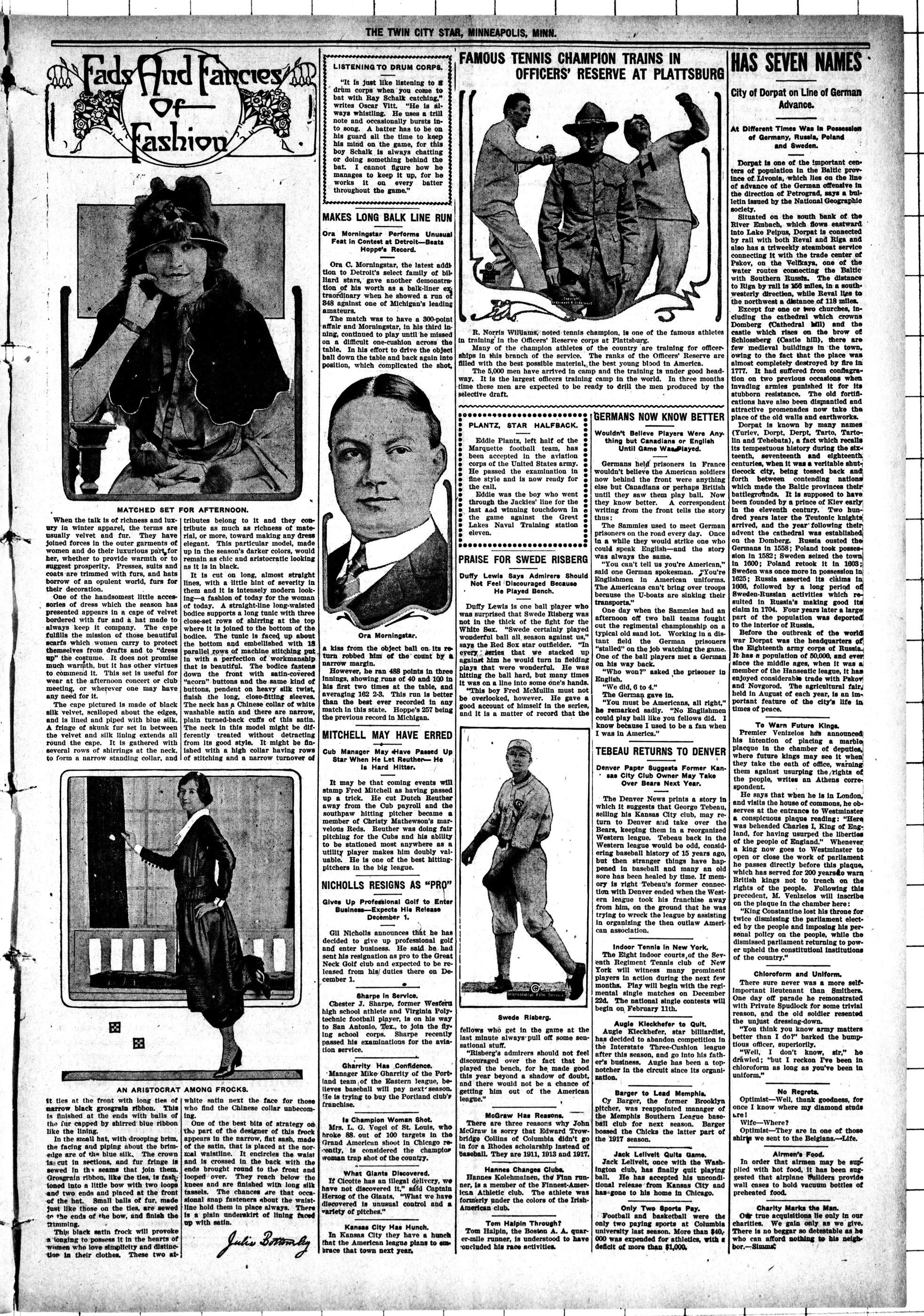
MATCHED SET FOR AFTERNOON.
When the talk is of richness and luxury in winter apparel, the terms are usually velvet and fur. They have joined forces in the outer garments of women and do their luxurious part for her, whether to provide warmth or to suggest prosperity. Presses, suits and coats are trimmed with furs, and hats borrow of an opulent world, furs for their decoration.
One of the handsomest little accessories of dress which the season has presented appears in a cape of velvet bordered with fur and a hat made to always keep it company. The cape fulfills the mission of those beautiful scarfs which women carry to protect themselves from drafts and to "dress up" the costume. It does not promise much warmth, but it has other virtues to commend it. This set is useful for wear at the afternoon concert or club meeting, or wherever one may have any need for it.
The cape pictured is made of black silk velvet, scalloped about the edges, and is lined and piped with blue silk. A fringe of skunk fur set in between the velvet and silk lining extends all round the cape. It is gathered with several rows of shirrings at the neck, to form a narrow standing collar, and
```markdown
```
THE FASHION WEEK
AN ARISTOCRAT AMONG FROCKS.
it ties at the front with long ties of narrow black grosgrain ribbon. This is finished at the ends with balls of the fur capped by shirred blue ribbon like the lining.
In the small hat, with drooping brim, the facing and piping about the brim-edge are of the blue silk. The crown is cut in sections, and fur fringe is sewed in the seams that join them. Grosgrain ribbon, like the ties, is fashioned into a little bow with two loops and two ends and placed at the front of the hat. Small balls of fur, made just like those on the ties, are sewed to the ends of the bow, and finish the trimming.
This black satin frock will provoke a longing to possess it in the hearts of women who love simplicity and distinction in their clothes. These two at-
---
tributes belong to it and they contribute as much as richness of material, or more, toward making any dress elegant. This particular model, made up in the season's darker colors, would remain as chic and aristocratic looking as it is in black.
It is cut on long, almost straight lines, with a little hint of severity in them and it is intensely modern looking—a fashion of today for the woman of today. A straight-line long-walsted bodice supports a long tunic with three close-set rows of shirring at the top where it is joined to the bottom of the bodice. The tunic is faced up about the bottom and embellished with 18 parallel rows of machine stitching put in with a perfection of workmanship that is beautiful. The bodice fastens down the front with satin-covered "acorn" buttons and the same kind of buttons, pendent on heavy silk twist, finish the long, close-fitting sleeves. The neck has a Chinese collar of white washable satin and there are narrow, plain turned-back cuffs of this satin. The neck in this model might be differently treated without detracting from its good style. It might be finished with a high collar having rows of stitching and a narrow turnover of
I
white satin next the face for those who find the Chinese collar unbecoming.
One of the best bits of strategy on the part of the designer of this frock appears in the narrow, flat sash, made of the satin, that is placed at the normal waistline. It encircles the waist and is crossed in the back with the ends brought round to the front and looped over. They reach below the knees and are finished with long silk tassels. The chances are that occasional snap fasteners about the waistline hold them in place always. There is a plain underskirt of lining faced up with satin.
Julia Bottomly
---
THE TWIN CITY STAR, MINNEAPOLIS, MINN.
LISTENING TO DRUM CORPS.
"It is just like listening to a drum corps when you come to bat with Ray Schalk catching," writes Oscar Vitt. "He is always whistling. He uses a trill note and occasionally bursts into song. A batter has to be on his guard all the time to keep his mind on the game, for this boy Schalk is always chatting or doing something behind the bat. I cannot figure how he manages to keep it up, for he works it on every batter throughout the game."
MAKES LONG BALK LINE RUN
Ora Morningstar Performs Unusual Feat in Contest at Detroit—Beats Hoppe's Record.
Ora C. Morningstar, the latest addition to Detroit's select family of billiard stars, gave another demonstration of his worth as a balk-liner extraordinary when he showed a run of 348 against one of Michigan's leading amateurs.
The match was to have a 300-point affair and Morningstar, in his third inning, continued to play until he missed on a difficult one-cushion across the table. In his effort to drive the object ball down the table and back again into position, which complicated the shot,
[Image of a man in a suit with a tie and a headband.]
Ora Morningstar.
a kiss from the object ball on its return robbed him of the count by a narrow margin.
However, he ran 488 points in three innings, showing runs of 40 and 100 in his first two times at the table, and averaging 162 2-3. This run is better than the best ever recorded in any match in this state. Hoppe's 257 being the previous record in Michigan.
MITCHELL MAY HAVE ERRED
Cub Manager May Have Passed Up Star When He Let Reuther—He Is Hard Hitter.
It may be that coming events will stamp Fred Mitchell as having passed up a trick. He cut Dutch Reuther away from the Cub payroll and the southpaw hitting pitcher became a member of Christy Mathewson's marvelous Reds. Reuther was doing fair pitching for the Cubs and his ability to be stationed most anywhere as a utility player makes him doubly valuable. He is one of the best hitting-pitchers in the big league.
NICHOLLS RESIGNS AS "PRO"
Gives Up Professional Golf to Enter Business—Expects His Release December 1.
Gil Nicholls announces that he has decided to give up professional golf and enter business. He said he had sent his resignation as pro to the Great Neck Golf club and expected to be released from his/ duties there on December 1.
Sharpe in Service.
Chester J. Sharpe, former Western high school athlete and Virginia Polytechnic football player, is on his way to San Antonio, Tex., to join the flying school corps. Sharpe recently passed his examinations for the aviation service.
Gharrity Has Confidence.
Manager Mike Gharrity of the Portland team of the Eastern league, believes baseball will pay next season. He is trying to buy the Portland club's franchise.
Is Champion Woman Shot.
Mrs. L. G. Vogel of St. Louis, who broke 88. out of 100 targets in the Grand American shoot in Chicago recently, is considered the champion woman trap shot of the country.
What Giants Discovered.
If Cicotte has an illegal delivery, we have not discovered it." said Captain Herzog of the Glants. "What we have discovered is unusual control and a variety of pitches."
Kansas City Has Hunch.
In Kansas City they have a hunch that the American league plans to embrace that town next year.
Copyright
Underwood & Underwood
R. Norris Williams, noted tennis champion, is one of the famous athletes in training in the Officers' Reserve corps at Plattsburg.
Many of the champion athletes of the country are training for officerships in this branch of the service. The ranks of the Officers' Reserve are filled with the best possible material, the best young blood in America.
The 5,000 men have arrived in camp and the training is under good headway. It is the largest officers training camp in the world. In three months time these men are expected to be ready to drill the men produced by the selective draft.
PLANTZ, STAR HALFBACK.
Eddie Plantz, left half of the Marquette football team, has been accepted in the aviation corps of the United States army. He passed the examination in fine style and is now ready for the call. Eddie was the boy who went through the Jackies' line for the last and winning touchdown in the game against the Great Lakes Naval Training station eleven.
PRAISE FOR SWEDE RISBERG
Duffy Lewis Says Admirers Should Not Feel Discouraged Because He Played Bench.
Duffy Lewis is one ball player who was surprised that Swede Risberg was not in the thick of the fight for the White Sex. "Swede certainly played wonderful ball all, season against us," says the Red Sox star outfielder. "In every series that we stacked up against him he would turn in fielding plays that were wonderful. He was hitting the ball hard, but many times it was on a line into some one's hands. "This boy Fred McMullin must not be overlooked, however. He gave a good account of himself in the series, and it is a matter of record that the
Interational Film Service
Swede Risberg.
fellows who get in the game at the last minute always pull off some sensational stuff.
"Risberg's admirers should not feel discouraged over the fact that he played the bench, for he made good this year beyond a shadow of doubt, and there would not be a chance of getting him out of the American league."
McGraw Has Reasons
There are three reasons why John McGraw is sorry that Edward Trowbridge Collins of Columbia didn't go in for a Rhodes scholarship instead of baseball. They are 1911, 1913 and 1917.
Hannes Changes Clubs
Hannes Kolehmainen, the Finn runner, is a member of the Finnest-American Athletic club. The athlete was formerly under the colors of the Irish-American club.
Tom Halpin Through?
Tom Halpin, the Boston A. A. quarter-mile runner, is understood to have concluded his race activities.
Wouldn't Believe Players Were Anything but Canadians or English Until Game Was Played.
Germans held prisoners in France wouldn't believe the American soldiers now behind the front were anything else but Canadians or perhaps British until they saw them play ball. Now they know better. A correspondent writing from the front tells the story thus:
The Sammies used to meet German prisoners on the road every day. Once in a while they would strike one who could speak English—and the story was always the same.
"You can't tell us you're American," said one German spokesman. "You're Englishmen in American uniforms. The Americans can't bring over troops because the U-boats are sinking their transports."
One day when the Sammies had an afternoon off two ball teams fought out the regimental championship on a typical old sand lot. Working in a distant field the German prisoners "stalled" on the job watching the game. One of the ball players met a German on his way back. "Who won?" asked the prisoner in English.
"We did, 6 to 4."
The German gave in.
"You must be Americans, all right," he remarked sadly. "No Englishmen could play ball like you fellows did. I know because I used to be a fan when I was in America."
TEBEAU RETURNS TO DENVER
Denver Paper Suggests Former Kana
sas City Club Owner May Take
Over Bears Next Year.
The Denver News prints a story in which it suggests that George Teebau, selling his Kansas City club, may return to Denver and take over the Bears, keeping them in a reorganized Western league. Teebau back in the Western league would be odd, considering baseball history of 15 years ago, but then stranger things have happened in baseball and many an old sore has been healed by time. If memory is right Teebau's former connection with Denver ended when the Western league took his franchise away from him, on the ground that he was trying to wreck the league by assisting in organizing the then outlaw American association.
Indoor Tennis in New York
The Eight indoor courts, of the Seventh Regiment Tennis club of New York will witness many prominent players in action during the next few months. Play will begin with the regimental single matches on December 22d. The national single contests will begin on February 11th.
Augale Kleckhefer to Quilt
Augie Kleckhefer, star billiardist, has decided to abandon competition in the Interstate Three-Cushion league after this season, and go into his father's business. Augie has been a topnotcher in the circuit since its organization.
Barger to Lead Memphis.
Cy Barger, the former Brooklyn pitcher, was reappointed manager of the Memphis Southern League baseball club for next season. Barger bossed the Chicks the latter part of the 1917 season.
Jack Lelivelt Quita Game
Jack Lellivelt, once with the Washington club, has finally quit playing ball. He has accepted his unconditional release from Kansas City and has gone to his home in Chicago.
Only Two Sports Pay
Football and basketball were the only two paying sports at Columbia university last season. More than $40,000 was expended for athletics, with a deficit of more than $1,000.
City of Dorpat on Line of German Advance.
At Different Times Was in Possession of Germany, Russia, Poland and Sweden.
Dorpat is one of the important centers of population in the Baltic province of Livonia, which lies on the line of advance of the German offensive in the direction of Petrograd, says a bulletin issued by the National Geographic society.
Situated on the south bank of the River Embach, which flows eastward into Lake Pelpus, Dorpat is connected by rail with both Reval and Riga and also has a triviewed steamboat service connecting it with the trade center of Pskov, on the Vellkaya, one of the water routes connecting the Baltic with Southern Russia. The distance to Riga by rail is 166 miles, in a southwesterly direction, while Reval lies to the northwest a distance of 118 miles.
Except for one or two churches, including the cathedral which crowns Domberg (Cathedral hill) and the castle which rises on the brow of Schlossberg (Castle hill), there are few medieval buildings in the town, owing to the fact that the place was almost completely destroyed by fire in 1777. It had suffered from confaguration on two previous occasions when invading armies punished it for its stubborn resistance. The old fortifications have also been dismantled and attractive promenades now take the place of the old walls and earthworks.
Dorpat is known by many names (Yurlev, Dorpt, Derpt, Tarto, Tartolin and Tehebata), a fact which recalls its tempestuous history during the sixteenth, seventeenth and eighteenth centuries, when it was a veritable shuttlecock city, being tossed back and forth between contending nations which made the Baltic provinces their battlegrounds. It is supposed to have been founded by a prince of Kiev early in the eleventh century. Two hundred years later the Teutonic knights arrived, and the year following their advent the cathedral was established on the Domberg. Russia ousted the Germans in 1558; Poland took possession in 1582; Sweden seized the town in 1600; Poland retook it in 1603; Sweden was once more in possession in 1625; Russia asserted its claims in 1606, followed by a long period of Sweden-Russian activities which resulted in Russia's making good its claim in 1704. Four years later a large part of the population was deported to the interior of Russia.
Before the outbreak of the world war Dorpat was the headquarters of the Eighteenth army corps of Russia. It has a population of 50,000, and ever since the middle ages, when it was a member of the Hanseatic league, it has enjoyed considerable trade with Paskov and Novgorod. The agricultural fair, held in August of each year, is an important feature of the city's life in times of peace.
To Warn Future Kings
Premier Venzelos has announced his intention of placing a marble plaque in the chamber of deputies, where future kings may see it when they take the eath of office, warning them against usurping the rights of the people, writes an Athens correspondent.
He says that when he is in London, and visits the house of commons, he observes at the entrance to Westminster a conspicuous plaque reading: "Here was beheaded Charles I, King of England, for having usurped the liberties of the people of England." Whenever a king now goes to Westminster to open or close the work of parliament he passes directly before this plaque, which has served for 200 years to warn British kings not to trench on the rights of the people. Following this precedent, M. Venzelos will inscribe on the plaque in the chamber here:
"King Constantine lost his throne for twice dismissing the parliament elected by the people and imposing his personal policy on the people, while the dismissed parliament returning to power upheld the constitutional institutions of the country."
Chloroform and Uniform
There sure never was a more self-important lieutenant than Smithers. One day off parade he remonstrated with Private Spudlock for some trivial reason, and the old soldier resented the unjust dressing-down.
"You think you know army matters better than I do?" barked the bumptious officer, superiorly.
"Well, I don't know, sir," he drawled; "but I reckon I've been in chloroform as long as you've been in uniform."
No Regrets
Optimist—Well, thank goodness, for once I know where my diamond studs are!
Wife—Where?
Optimist—They are in one of those shirts we sent to the Belgians.—Life.
Airmen's Food.
In order that airmen may be supplied with hot food, it has been suggested that airplane builders provide wall cases to hold vacuum bottles of preheated food.
Charity Marks the Man.
Our true acquisitions lie only in our charities. We gain only as we give. There is no beggar so detestable as he who can afford nothing to his neighbor.—Simma
Entered in the Post Office at Minneapolis as second class matter.
MEMBER
NATIONAL NEGRO PRESS
ASSOCIATION
Subscription by Mail, Postpaid.
ONE YEAR ..... $2.00
SIX MONTHS ..... $125
THREE MONTHS ..... .65
Hamlet B. Rowe, Local Agent.
ADVERTISING RATES.
One Inch—1 Insertion—One Dollar.
Liberal discount given on 3, 6, 9,
Months, or 1 year contract.
We do not run free ads, or over-run
the time contracted for by our ad-
vertisers We respect their right to
advertise at intervals, and rather have
them do so, than to run continuously
an "adv." and an increasing account.
Write all Checks payable to
THE TWIN CITY STAR
1317 North Sixth Ave.
MINNEAPOLIS - MINNESOTA
Call at 1317 6th Ave. N. on Wednesday
to insure matter for publication.
The Star's Phone, Hyland 1205.
A NATIONAL PROBLEM.
Press reports show that America will face the problem of educating many of the Negroes drafted for war service. It may be a "problem" now, but it is a long neglected debt which she must pay with compound interest. Other "problems" will follow in rapid succession. America will learn the lesson of patriotic economy at the school of bitter and expensive experience. Nature's centrifugal forces are working, and she rigidly enforces the laws of compensation. The Negro is, and always has been, loyal to our Nation. The war has caused many heretofore indifferent Americans to become pro-Negro in this critical hour. The conservationists and economists have found that their neglect of the health, morals and rights of the Negro has been a willful waste—now a woeful want. Now that the handwriting on the wall is seen, the race will come into its own. The Negro will suffer side by side with the other Americans and by so doing will deliver the destinies of the race.
There is a great demand for laborers now and Negroes are being employed where before they were "not wanted." As a rule, they are making good and their efficiency will overcome much of the general prejudice against them. The Negro has been denied the privilege of employment mostly because of the ignorance of many employers. Since the Negro laborer has better opportunities, he will be a better citizen. The so-called race-problem will soon be solved because there is no Negro problem; it is the white man's; and its only solution is an intelligent consideration for the Negro as a man and an acknowledgement of his right to earn his living on equal footing with other citizens.
THE NEGRO IN THE WAR.
The course of the Negro race has been highly creditable in this war. Upon barren soil fell the seeds of sedition and insurrection disseminated by German agents and pro-German newspapers in an attempt to incite the Negroes to uprising against the United States. So far as we have observed, Negro leaders have been conspicuously free from treasonable utterances. Drafted Negroes have gone to the front as cheerfully as any other set of men and, if history repeats itself, they will fight with signal bravery. German bullets will send as much torture and agony into black bodies as into white. Death will not discriminate against the Negro soldier. The patriotism of these people will not be forgotten and should ever be kept in mind and taken into account for full credit in the adjustment of racial problems.—Greenville, S. C., News.
PROGRESS AND THE NEGRO.
It takes years for great improvements to produce visible results. In the South a gregarious, pleasure-loving, improvident race has seemed to be but slightly affected by the economic and industrial changes of the times. The Negro has been the unskilled laborer, the poor tenant former, raising his bale or two of cotton and turning it over to the local buyer in liquidation of his debt for the year's living expenses. The teachings of institutions like Tuskegee, Calhoun and Hampton are producing a class trained in trades, efficiency and initiative, whose influence is a leaven slowly permeating the mass for industrial uplift and awakening in the Negro a sense of his economic value. The labor shortage has been an advantage to him. Seven thousand Negroes applied to the Federal Department of Labor last year in regard to opportunities for employment; testimony to the spread of industrial education.—Detroit Free Press.
The Twin City Star stands for equal rights for all American citizens.
ADVERTISE IN THE STAR
BUY RED CROSS SEALS.
The Ida B. Wells-Burnett club of Red Cross workers is entirely cosmopolitan in its membership. They solicit the support of all classes. The president, Mrs. Fannie Pierce, is a well known social and charity worker and one of our worthy women. Mrs. Mary E. Pope, its secretary, has seen actual service in the United States army and was in the Santiago campaign. Her husband, Sergeant Jack A. Pope, retired, has an enviable army record. They are working for service, not society. While they represent the old residents of this city, they extend a welcome to all women to "do their bit." Those who belong to the lowest class will find work with the Red Cross and should they choose this work they will find their services appreciated more highly, because they have "chosen the better part, which cannot be taken from them."
Y. G. B. C.'s MAKE $50.00.
The Young Girls' Beneficial club cleared $50 at their entertainment. The expenses were $45, as follows: Hall, $25; music, $7.50; advertising, $8; checkroom, $1; floor manager, $1.50; punch, $2. The proceeds are for the benefit of the soldiers. The officers of the club are: Misses Clarist Lucas, president; Mildred Plummer, vice president; Eunice Smith, treasurer; Lucia Cunningham, secretary; Ellen and Mattie Lucas, Maydrew and Florence Cunningham. These young ladies have done excellent work for charity. Miss Plummer is acting president in the absence of Miss Lucas. Mesdames Mary E. Pope and Charles H. Lucas chaperoned the girls. The conduct of their entertainments is an example for all to follow.
RED CROSS WORKERS ACTIVE.
RED CROSS WORKERS ACTIVE.
There are four Red Cross chapters among our people—"The Ida Wells-Barnett," "The Nannie C. Burroughs," "The Jennie C. Watson" and "The Maria C. Powell" chapters. They are doing nicely from all reports, towards making necessary supplies. The Minneapolis Sunday Forum is raising a fund to provide Christmas boxes for the Minnesota boys at Camp Dodge. Now that the several factions have organized, much will be accomplished. The work of the Red Cross is America's greatest contribution to humanity. It might have been better had our women organized in one great body, yet is good that they are doing their bit. Self-Sacrifice and Service should be their motto, and Success and Honor will be their record.
RED CROSS SEAL CAMPAIGN.
The date for beginning the Red Cross Seal Campaign has been advanced from November 15th to November 5th.
Dr. I. J. Murphy of the Minnesota Public Health association, state manager, announces the following messages just received:
"The American Red Cross waives the restriction in the contract that no agent put 'seals on sales before November 5th."
"We understand that man to reach the soldiers in France before Christmas must be mailed not later than November 15th and preferably at an earlier date. The advantage of allowing an early sale of Red Cross Seals by local campaign managers for packages going to our soldiers is obvious. Accordingly the American Red Cross waives the restriction in the contract which made November 15th the opening day, providing Red Cross Seals be not placed on sale before November 5th.
THE FORUM PRESIDENCY.
The Star hopes for the election of a president who will carry out the work of The Forum along the plans laid down by its former presidents. They have built it upon a sure foundation and today it is a civic factor and a credit to our people.
WAITERS WANT MORE WAGES.
The waiters, who have been doing extra work at the various hotels, are asking for more wages. The increased cost of living and the salaries paid to laborers in other employment justifies their demand. They should get at least $2.00 for a day's services, even if employed only one meal. The preparation for the job, the time lost for other work, the advance protection given their employers by "booking a day or so ahead," with the services rendered, are well worth a few dollars. An extra waiter's expenses cannot be met with a dollar a meal, and that only about twice a week. There are too many places for working men now, where good salaries obtain, and good waiters will be wanted, if they are not paid better wages.
We have some among our advertisers and subscribers who are a credit to our race for their business-like methods. They pay promptly in advance and expect nothing unreasonable in return. Others want to know "Why we can't 'trust' them?" or send a bill, and then a collector, and finally censor a Negro editor because he can't run his paper "like the white man." Few persons realize that it pays to pay as you go. The Star is not an installment plan proposition. It is a real newspaper run under many difficulties mostly due to the foolish notions and ignorant whims of those whom it serves and protects and from whom it should get its support and their consideration.
THE TWIN CITY STAR will be sent to any out of town address. Send your subscription in postage stamps. Read your home paper while visiting in other cities. It's like a letter from home.
THE TWIN CITY STAR, MINNEAPOLIS, MINN.
Opportunity waits for no man, there fore if you have an appointment with it don't fall to be Johnny on the spot —Chicago News.
ODD FACTS
Persia has no distilleries, breweries or drinking places, and the only intoxicating beverage made use of is home-made wine.
Queensland is particularly rich in edible sporting fish.
Most of the asbestos used by the world is supplied by Canada.
A new industry of California is that of making use of the picnic deposits of the southern part of that state.
The Filipino sometimes affects cigars 18 inches in length.
ACTIVITIES OF WOMEN
Norway has nearly 1,500,000 woman voters.
Dressmakers in Italy receive 60 cents a day.
London has a Grand Lodge of Women Free Masons.
Over 20,000 women in Baltimore are doing Red Cross work.
The women of Poland do the work that is usually done by men in other countries.
Twelve girl students of Vassar college have raised enough potatoes on the college gardens to feed 1,100 people. They raised over 4,440 bushels.
Miss Sarah V. Farling, who is connected with the Washington-police department, is considered to be a most valuable sleuth and a dead shot with a revolver.
The legislature of Guanajuato has granted woman suffrage with the restriction that voters must be able to read and write and also must be self-supporting.
A government bill enfranchising women introduced in the Canadian parliament and the passage of which is a foregone conclusion will add at least 450,000 voters to the/Canadian electorate.
THINGS WORTH KNOWING
A new humidifier, consisting of a small electric fan to be hung on the wall and blow its air over a shallow dish filled with water, is intended to keep the air in rooms moist.
According to a geological survey estimate the United States uses about 165,000 ounces of fine platinum annually, of which only about 65,000 ounces are refined in this country, the rest being imported.
To warn employees of machine shops of the movement of traveling cranes an Ohio man has invented an automatic signal system, different colored lights showing in which direction they are moving.
To enable a man to smooth a new concrete sidewalk while standing erect a long-handled trowel has been patented, the handle being so mounted that the face of the trowel will not cut into the concrete.
While a steel tube is stronger and more rigid than a bar of the same metal of equal weight, a French scientist has demonstrated that a tube is more flexible than a bar of the same exterior dimensions.
The wheels of one new farm tractor are equipped with radiating legs, which enter and grip the soil, while another has no wheels and literally walks over the ground on skids at the end of four legs.
```markdown
```
Two complete sets of controlling devices feature a new automobile designed for instruction purposes.
Handed like an ordinary broom, with no other power, a new device combines the principles of the carpet sweeper and vacuum cleaner.
For disinfecting or perfuming the air in rooms an attachments for electric fans has been invented in which liquids descend from a tank into a flag that is waved by the fans' breezes.
On the theory that a person can work better if alternately seated and standing at his task, an inventor has designed a typewriter table that can be used equally well in either position.
French cotton mill men have established a laboratory to determine the percentage of moisture or any abnormal dryness in cotton, that which is too dry being regarded as defective.
Japanese have built the world's tallest chimney, a re-enforced concrete structure 570 feet high, which stands upon a hill that is 430 feet higher than the copper smelter which it serves.
To test textiles an Englishman has invented a machine to pass fabrics under a microscope while at the same time they are subjected to powerful electric lights above and below their surfaces.—Houston Post.
IN-SHOOTS
If you have no religion it is better to embrace a cult of some brand.
The wife-beater when away from home is as harmless as a guinea pig.
Socks and sweaters all seem to look alike when girls knit them for the boys at the front.
When Father Time puts his mark on our faces the other fellow always discovers it first.
The safety razor often uncovers a lot of sin.
Real patriotism will make a fellow forget that taxation is a burden.
The heart of the country editor is not always in the compliments that he pays prominent local citizens.
When the world actually gets on to the curves of the creek he has a difficult time in the effort to reform.—Chicago Examiner.
FROM NEAR AND FAR
China plans currency reform.
Australia has 78,600,334 sheep.
Canton, China, is increasing-exports.
Japan will develop home steel industry.
La Plata, Argentina, has 12 daily newspapers.
Aden, Arabia, exports senna leaves to the United States.
New South Wales has 16 confectionery factories with 706 employees.
TOLD IN FIGURES
Tokyo has 3,361,484 people.
Japan claims 57,442,177 population.
Michigan had 273 creameries in 1909.
Wisconsin has 1,720 cheese factories.
Cuba's sugar crop for 1917 is 6,000,000 tons.
United States contains 3,520 cheese factories.
There are 5,463 creameries in the United States.
Ohio this year produced 42,810,387 bushels of wheat.
There are 21,262,000 dairy cows in the United States.
American 1909 dairy products were valued at $473,769,412.
Australian savings bank deposits aggregate $442,566,772.
In 1900 the number of American married women in gainful occupations was only 769,000, while in 1910 it was 1,890,000.
POPULAR SCIENCE
Meerschaum mining is an important industry of Asia Minor.
In Queensland about 4,000 aboriginals are being educated under government contract.
Vessels sailing at the rate of 12 knots an hour are immune from attacks by submarines, because the latter travel only eight or nine knots an hour.
Patriotic music that thrills you through and through!
Your blood fairly tingles with patriotism when you hear the soul-stirring anthems and the famous battle-songs of the Nation on the
Victrola
In these stirring times the music of the hour is patriotic music. The Victrola brings you all of it—the time-honored national airs, the great military marches, and the latest patriotic song hits as well! Come in and let us demonstrate.
Victrola, $15 to $400. Easy terms.
You can also buy a Stewart Phonograph of us for only $7.75. It plays all records.
METROPOLITAN MUSIC CO.,
The Complete Music Store,
41-43 South 6th St., Minneapolis.
Victrola XIV,
$150
is shown here
Office Phones—Main 2869; Auto 36774. Dining Room—Main 2831.
Twenty Elegant Steam-Heated and Electric Lighted Rooms.
A la Carte Meals at All Hours—Popular Prices.
246-250 FOURTH AVE. S., MINNEAPOLIS, MINN. Private Dining and Reception Room for Ladies. Special Temperance Beverages. Men's Buffet and Grill; Billiards; Barber Shop in Connection.
J. A. Withers, Prop.
BELL'S BAR
CLARENCE W.
BATHS, BARBER SHOP
POOL AND BAR
CIGARS, RACE PARK
244 THIRD AVE. SOUTH
Phone Northw
BELL'S BARBER SHOP
CLARENCE W. BELL, Proprietor.
THS, BARBER SHOP, POLITE BARBER
POOL AND BILLIARD HALL
NIGARS, RACE PAPERS, SHOE SHINING
RD AVE. SOUTH .. MINNEAPOLIS
Phone Northwestern, Main 2511.
BELL'S BARBER SHOP
CLARENCE W. BELL, Proprietor.
BATHS, BARBER SHOP, POLITE BARBERS
POOL AND BILLIARD HALL
CIGARS, RACE PAPERS, SHOE SHINING
244 THIRD AVE. SOUTH ..MINNEAPOLIS, MINN.
Phone Northwestern, Main 2511.
LAND OF THE
WEST
South Side
212 Eleventh Ave
EXPERT BARBERS
CIGARS, POOL AND BILLIAR
RACE PAPERS
THOMPSON &
North Side Barber S
112 Eleventh Ave. S., Minneapolis
EXPERT BARBERS; UP TO THE MINU
COOL AND BILEIARD TABLES IN CONNE
RACE PAPERS—SHOES SHINED.
THOMPSON & CARVER, Props.
The Waiters' and Porters' Club
South Side Barber Shop
212 Eleventh Ave. S., Minneapolis EXPERT BARBERS; UP TO THE MINUTE. CIGARS, POOL AND BILIEIARD TABLES IN CONNECTION. RACE PAPERS—SHOES SHINED. THOMPSON & CARVER, Props.
GLOVER SHULL, PRES.
311 HENNEPIN AVE. MINNEAPOLIS
EDDIE BOYD, SECY LEE WHEELER, MANAGER
---
A
1224 N. 6TH AVE., MINNEAPOLIS
WITHERS' SPECIAL SERVICE
HOUSEHOLD GOODS MOVED OR
STORED.
BAGGAGE TRANSFERED AND
FUEL DELIVERED TO ALL
PARTS OF THE CITY
ON SHORT NOTICE.
BARBER SHOP
W. BELL, Proprietor.
SHOP, POLITE BARBERS
BILLIARD HALL
PAPERS, SHOE SHINING
H . MINNEAPOLIS, MINN.
Northwestern, Main 2511.
SMOKE THE BEST
5C CIGAR
Sight Draft
W. S CORRAD CO., Distributors
NO. 140. E. 6th ST., ST. PAUL.
NO. 1. WESTERN AVE., MINN.
Barber Shop
Ave. S., Minneapolis
ERS; UP TO THE MINUTE.
HIARD TABLES IN CONNECTION.
RS—SHOES SHINED.
& CARVER, Props.
---
IMPORTANT NOTICE
Unless notes are written plainly and properly arranged they will not be inserted. Many people send in notes regardless of names, initials or composition. Arrangement by the publisher will be charged for. Free notices must be correctly written.
NEW LOGAL AGENT.
Mrs. Julia K. Cisney will contribute local news for the Twin City Star. She is also authorized to solicit ads and subscriptions. Mrs. Cisney is one of the leaders in social and charitable work and her connection with Th. Star will be a great benefit to its readers.
"CLUB LIFE"
Is G. L. Morrill's subject at the People's Church New Garden Theatre, Sunday at 10:30 A.M. Italy views, travel, movies, organ.
ELKS' CHRISTMAS PARTY
Ames Lodge of Elks are preparing for their Christmas Tree and Entertainment for the children, which is their special charity feature much looked for by the young people. The names of children unable to be present on account of illness should be sent to W. R. Morris, Secretary, 818 Met. Life Bldg.
Mr. and Mrs. Jason Clayburn will leave Saturday for Chicago, Mrs. Clayburn will remain a while with her mother, Mrs. J. Anderson, 4225 Langley avenue. He will go to Daytona, Fla., where he goes every winter in the employ of Mr. Pence of the Pence Auto company as their private chauffeur. His wife will join him later to spend the winter.
Webster and Thomas B. Stovall, Jr., have gone to Newport News, Va., where they have been assigned to the stevedore regiment as stenographer and clerk.
Stephen Springer will build a five-flat family building at 1310 East Twenty-second street this winter. The building permit has been issued. It will cost about $10,700.
Mr. Robert K. Clsney is confined to his bed at his residence, 572 Eighth avenue north.
Mrs Hester Keeys has moved to 627 Sixth avenue north, where she has secured a comfortable cottage of twelve rooms.
Miss Sadie Marshall and Mr. Ely Paul were married last week. They went to Chicago on a short visit.
PUBLIC INSTALLATION AND BALL.
The members of Ames lodge of Elks are preparing a large public installation of the newly elected officers for 1918, to be followed by a reception and dance. Geo. W. Holbert is chairman of the general committee and arrangements are being made to make this another big success for Ames. Dates will be announced later.
Another Postoffice Clerk.
Mr. John R. White, Jr., has been appointed as clerk in the Minneapolis postoffice and is making a good record. Success to John and thanks to Postmaster Purdy. The members of our race in the postal department are a credit to the service. They have a record of which they are justly proud, and so are we.
PYTHIANS ANNUAL SERMON
The annual sermon to the Nat. Turner, John H. Hayes and Pride of Minnesota lodges—Fidelity Court of Calanthe and Pride of the West Co. Uniform Rank of the Knights of Pythias will be preached at St. Peter A. M. E. Church on Sunday evening, December 2nd, at 8 P. M.
A CARLOAD OF REINDEER.
A carload of Alaska Reindeer will be sold exclusively by the Minnesota Meat Market at their three stores. 40 South Third St.
Place Your Order Now.
—Advertisement
Minister Curtis Buried.
Hon. James L. Curtis, United States Minister to Liberia, who died there Oct. 24, was buried from Bethel A. M. E. church in Chicago on Monday. He was formerly a lawyer in this city, where he had many friends. His widow and several relatives survive him.
Mr. Everett Jackson has returned from Superior, Wis. He has been sick, but is much improved.
DEATH OF MRS GI.ENN.
Mrs. Dora Glenn died suddenly on November 29 at 2 A. M. of heart failure at her residence, 1709 E. 19th St. She was the mother of Messrs. "Bobby" and John Glenn. Several children survive her.
Thanksgiving services and dinners were held at several churches on Thanksgiving day.
The recital by Prof. Theodore Taylor at Bethesda Church was poorly attended on account of improper advertisement. The rumor of Dr. Valdo Turner's divorce case is the latest sensation in high social circles. There is much talk of an unmasking of some of the "society" of St. Paul, if the case is carried to the limit. Read "The Devil in Mexico," by Rev. G. L. Morrill.
EVERY DAY is BARGAIN DAY at the ROOT & HAGEMAN STORE, 407 Nicollet Ave.
P. B. B.
HON. W. T. FRANCIS,
Prominent St. Paul Attorney. Minnesota Representative on the National Committee for the Relief of Colored Soldiers.
PROMINENT CITIZEN TO SPEAK AT THE FORUM
Capt. L. F. Blyler of the Civic and Commerce association of this city will address The Forum on Dec. 2nd at St. Peter A. M. E. Church. Mr. Blyler is a friend of our race, who has commanded Negro troops and has taken active interest in our people during his extensive commercial career. He has recently returned from Camp Dodge and was present when the Minnesota boys of our race arrived. He will give an instructive talk, full of advice and interesting history. Mr. Blyler is a son of a Civil War veteran, who was active in the work of the "Underground Railroad." Come and hear his message from Camp Dodge.
The musical numbers will be:
Vocal solo—Mrs. Blanche Mason.
Piano solo—Miss Mae Williams.
Miss Belle Meade, Head Resident of the Pillsbury House will speak on Settlement Work.
The public is requested to be present at 3:30 P. M. to hear this special program.
Red Cross Report:
President Jeffrey requests the Red Cross committee to make their remittances to Dr. R. S. Brown in time for the report of the chairman at this meeting.
Don't be a slacker! Remember that The Forum has to pay its bills and you can help with your silver contribution.
BIG BENEFIT FOR SOLDIERS AT ST. PAUL AUDITORIUM.
A monster benefit for the Negro soldiers from Minnesota will be held at the St. Paul Auditorium on January 8th. Addresses will be delivered by Hon. Daniel W. Lawler, Hon. Julius A. Schmahl, Mayor Ervin, Larry Hcdgmil and others. A dance will follow. C. E. Jones, chairman, Attorney W. F. Francis, master of ceremonies. Admission 50c.—Advertisement.
SPINSTERS' CONVENTION AND BALL.
Queen Esther Temple, No. 2, S. M. T. will hold a Spinsters' Convention on December 14 at Lane's Hall, Nicolet Ave. and 8th St. Good music. Excellent program. Admission 25c.— Advertisement.
Quick and Convenient.
Hyland 2331. Hyland 4712.
Tied. Uses Teeth to Get Aid—Removing the telephone receiver from its hook with her teeth, Mrs. S. J. Mason, 1045 Cross street, St. Paul, bound, gagged and robbed in her home on Tuesday, notified the police.
THE STAR is the CHEAPEST and BEST NEGRO PAPER in the NORTHWEST. It needs 500 more Subscribers to keep it going. Help to get us A BIGGER CIRCULATION.
Are you a delinquent subscriber?
If so, why not send your subscription?
A NORTH SIDE ENTERTAINMENT.
The North Side Cafe, 723 6th Ave.
No. offers to its patrons on Thursday and Sunday evenings the services of Miss Blanche Williams of Austin, Tex., and Mr. Dan W. Raynor, who will play and sing your favorite selections. Souvenirs for all ladies on Thursday nights. For reservations call Hyland 5851. Advertisement.
Owing to an increase in cost, we have raised our prices on all composition. Reading notices will be 10c per line under one inch and 50c per inch thereafter.
The South Side Barber Shop is now located at 212 11th Ave. So.
Mr. J. H. Haygood has opened the People's Cafe at 11th Ave. and Washington So.
Hadam Hart, the hairdresser and milliner, has moved to 305 Thirteenth avenue south. where she will be pleased to meet her patrons.
THE TWIN CITY STAR, MINNEAPOLIS, MINN.
DULUTH NEWS
DULUTH NEWS
By Mise Odessa McCullough,
510 Columbia Bldg., Duluth, Minna
Through the efforts of Mr. G. O. Smith, the head waiter of the Spalding hotel, the following young men, James Bolden, William Lyons, Pete Staples and Mercer L. Lewis were placed in charge of the officers' mess on the new government ocean-going freighter, "Miski," built at Duluth. The boat sailed Friday night, Nov. 23, for New York by way of Montreal, expecting to reach its destination about Jan. 3.
The young men signed a 30-day seaman's contract with an option to continue in the service or be returned to Duluth from New York. Wages are: Chef-cook, $125; second cook, $70; waiter and porter, $60 per month.
The many friends of Mrs. Porter of 1029 East Third street will be sorry to hear of her illness during the past week.
Mr. W. M. Redman, second waiter at the St. Louis hotel has been on the sick list for some time, but is now able to return to his work.
Mr. William Cheney returned recently from Chester, Pa., where he was visiting his brother, who died shortly after his return to Duluth. The younger Mr. Cheney was a member of the senior class at Lincoln university.
Mr. William Gibson of the Spalding hotel returned Monday, Nov. 26, from a short visit to his home in La Crosse, Wis.
Mr. Mason of the South Shore sleeping cars, conductor, left Duluth for a Thanksgiving stay in St. Paul.
A Thanksgiving dance was given Thursday evening, Dec. 29, by the Messrs. Young and Maupins. The proceeds are to be used for the benefit of our boys at Camp Dodge, Des Moines, Iowa. The crowd enjoyed the best of music and a better floor for gliding. The Civic and Art club gave a dance and, whist party at the Axa hall, Wednesday evening, Nov. 21. Good music was rendered by Mr. Otes. Mr. Charles A. Bradley, formerly of Minneapolis, now employed by the Minnesota Steel Mills, purchased of the Zenith Co-Operative association a neat five-room cottage this week 1504 One Hundred and Third avenue west. His mother, sister and brother are living happily in their new home. Mrs. M. T. Coles of 432 East Tenth street was a recent subscriber to the Twin City Star.
Mrs. Joseph Lewis has been quite ill, but is now able to be up and about her household duties.
Miss Odessa McCullough is the only authorized agent for The Twin City Star in Duluth.-Ed.
COAL, WOOD AND CHARCOAL
You can get 100 lbs. of Hard or Soft Coal, Bundle Wood or Charcoal. Delivered. Call Withers. Your coal man. Hyland 2331, or Hyland 4712.
NOT OUR REPRESENTATIVE.
A.
PHILIP F. HALE,
Philip F. Hale does not in any way, represent The Twin City, Star. He is connected with The Advocate. We do not mislead those who inquire about both papers. Several complaints have reached us about "subscribing for the Star from Phil Hale." Those who desire The Advocate can secure it from Mr. Hale. He has no authority to solicit for us and those who wish The Star or The Advocate should get their choice, without any misrepresentation. The Star stands the tests.
THE WAY TO MAKE MONEY.
If you wish to add to your income, you can do so by accepting an agency for The Twin City Star. Good commission to competent agents. Use your spare time in soliciting ads and subscriptions. Only honest and intelligent agents wanted. Call Hyland 1205.
AGENTS WANTED—NOW!
Reliable and intelligent agents always wanted to solicit business for THE TWIN CITY STAR; also correspondents in principal cities. A chance to earn a good living. Write The Twin City Star, Minneapolis.
Do not waste your time making promises to our agents. Send your money by Express or Post Office Order or in cash or postage stamps.
SUBSCRIBE NOW.
HOUSE FOR RENT.
Eight rooms, modern except heat;
garden, chicken-house, lawn, block
from car line. Inquire 3709 18th Ave.
So. Call Drexel 3664.
FOR RENT—Six-room house, 2818
Chicago Ave., modern except heat;
also one small bedroom for woman.
Apply 2812 Elliott Ave. L. W. Smith.
FOR RENT—Duplex, all modern except
heat and bath. Good location,
near car line. Down stairs, $13.00;
upstairs, $12.00. Call O. G. Price,
South 4521.
SEE McDEW! for real estate.
INSURANCE AGENTS WANTED.
Three (3) honest, reliable and energetic colored men wanted to write insurance. Hustlers can make $4 to $6 a day, plus commission. Nothing to carry. Call for appointment, Hyland 6381, 5 to 7 every evening.
TWO FAMILY HOUSE FOR RENT.
Five rooms each side, in good order, modern except heat, reasonable rent, good cellars, 801-803 Bassett Pl. Apply to Leviton, the Tailor, 1317 6th Ave. No. Hyland 2875.
FURNISHED ROOMS.
Neatly furnished front room, modern conveniences, reasonable rent. 2111 5th Ave. So. Call So. 5260. Collier
Male Roomer Wanted.
Male Roomer Wanted.
Comfortable Furnished Room, all modern conveniences, on car line, gentleman preferred, Wright, 3105 Chicago Ave., So. 2874.
Furnished Rooms for Gentlemen.
Two good rooms, within walking distance, on car line, modern. 1915 4th Ave. So. Phone N. W. South 2451.
ONE LARGE ROOM neatly furnished, modern conveniences, in residential section. Mrs. W. W. Williams, 2900 Eleventh avenue South. Drexel 4728.
Furnished Room.—Conveniently located. Reasonable rent. Modern, Mrs. Hall, 708 Girard Ave. No. Hy. 4956.
LOWER FLAT for rent; 5 rooms and bath, all modern; desirable location. near car line. 2111 Fifth Ave. S. Call Colfax 3306.
SIX-ROOM MODERN FLAT, downstairs, central location, near car line. Apply J. S. Wright, 2737 11th Ave. So.
Rooms for Light Housekeeping. Three rooms, second floor, good location. Call at 2531 Stevens ave.
FOR RENT—1706 East Nineteenth Street. Toilet, water and gas. Three and four rooms. $10.00 per month. McDew Realty Co., Sykes Block, Nic. 621.
FOR RENT — Eight-room house; modern except heat; walking distance from town. Apply to A. Marshall, 715 E. 18th St. BUY 1848.
BUY RED CROSS SEALS.
Peoples Christian Assembly.
ELDER G. W. MITCHELL, Pastor.
Assisted by Mrs. G. W. Mitchell.
Comel and Serve the Lord.
1204 Washington Ave. So.
Services Sunday—11 A. M.
Sunday School—1:30 P. M.
Praise Meeting—3 P. M.
Preaching—8 P. M.
United States Civil-Service Examinations
STENOGRAPHERS AND TYPEWRITERS WANTED. Men and Women.
The United States Government is in urgent need of thousands of typewriter operators and stenographers and typewriters. All who pass examinations for the departments and offices at Washington, D. C., are assured of certification for appointment. It is the manifest duty of citizens with this special knowledge to use it at this time where it will be of most value to the Government. Women especially are urged to undertake this office work. Those who have not the required training are encouraged to undergo instruction at once. Examinations for the Department Service, for both men and women, are held every Tuesday, in 450 of the principal cities of the United States, and applications may be filed with the Commission at Washington, D. C., at any time.
The entrance salary ranges from $1,000 to $1,200 a year. Advancement of capable employees to higher salaries is reasonably rapid. Applicants must have reached their eighteenth birthday on the date of the examination.
For full information in regard to the scope and character of the examination and for application blanks address the U. S. Civil Service Commission, Washington, D. C., or the Secretary of the U. S. Civil Service Board of Examiners at Boston, Mass.; New York; Philadelphia, Pa.; Atlanta, Ga.; Cincinnati, Ohio; Chicago, Ill.; St. Paul, Minn.; St. Louis, Mo.; New Orleans, La.; Seattle, Wash.; San Francisco, Cal.; Honolulu, Hawaii; or San Juan, Porto Rico.
JOHN A. McILHENNEY, President, U. S. Civil Service Commission, Washington, D. C.
IMPORTED AND DOMESTIC WOOLENS AT POPULAR PRICES Your Patronage Desired.
KEYSTONE BUFFET &
1313 Wash. Ave.
FOR LADIES & GEN
Music Every Day from 2
Kidd Mitchell, Prop.
LADIES SPECIALLY INV
rex 1269
J. & H. Wet Wash
3753-55-57 Cedar
High Grade Specialist
Dry Wash and Fami
OUR WORK IS OUR BEST
POPULAR PRICED SHOE REPAIR
SPECIAL SAMPLE SHOES.
WE FIX 'EM WHILE YOU WAIT.
Men's Sewed Soles
Ladies' Sewed Soles
Men's Nailed Soles
Rubber Heels
Ladies' and Boy's Nailed Soles
SEVEN CORNERS' SHOE REPAIR
1424 Washington Ave. So., Minneapolis
HARRY LEE
Practical
MEN'S SUITS AND OVERCOAT
Dry. Cleaning and Fancy Dyeing of L
Phone N. W. Hyland 2875
STONE BUFFET and CLUBS
1313 Wash. Ave. South
FOR LADIES & GENTLEMEN
Music Every Day from 2 P. M. to 11 P. M.
Mitchell, Prop.
MINNEAPOLIS
ADIES SPECIALLY INVITED EVERY
Auto
& H. Wet Wash Laun-
3753-55-57 Cedar Avenue
Grade Specialists in Wet
Wash and Family Laundry
WORK IS OUR BEST ADVERTISEMENT
R PRICED SHOE REPAIRING.
SPECIAL SAMPLE SHOES!
E FIX 'EM WHILE YOU WAIT.
Soles ..... $1.00
Soles ..... .85
Soles ..... .85
Soles ..... .40
Boy's Nailed Soles ..... .65
ORNERS' SHOE REPAIR SHOP.
Washington Ave. So., Minneapolis.
JOSEPH
HARRY LEVITO
Practical Tailor
SUITS SUITS AND OVERCOATS MADE TO O
nning and Fancy Dyeing of Ladies' and Gent's C
W. Hyland 2875
1317 No. 6th Ave.,
BUFFET and CLUB CAFE
1313 Wash. Ave. South
LADIES & GENTLEMEN
Day from 2 P. M. to 11 P. M.
MINNEAPOLIS, MINN.
SICILLY INVITED EVERY DAY.
1313 Wash. Ave. South FOR LADIES & GENTLEMEN Music Every Day from 2 P. M. to 11 P. M. Kidd Mitchell, Prop. MINNEAPOLIS, MINN. LADIES SPECIALLY INVITED EVERY DAY.
Wet Wash Laundry
55-57 Cedar Avenue
Specialists in Wet Wash
and Family Laundering
S OUR BEST ADVERTISEMENT
High Grade Specialists in Wet Wash Dry Wash and Family Laundering OUR WORK IS OUR BEST ADVERTISEMENT
Y LEVITON
术ical Tailor
AND OVERCOATS MADE TO ORDER.
ency Dyeing of Ladies' and Gent's Garments.
75 1317 No. 6th Ave., Minneapolis.
MEN'S SUITS AND OVERCOATS MADE TO ORDER.
Dry.Cleaning and Fancy Dyeing of Ladies' and Gent's Garments.
Phone N. W. Hyland 2875 1317 No. 6th Ave. Minneapolis.
P
16 North Seventh St., Minneapolis N. W. Main 3717 (Second Floor) PANAMA HATS A SPECIALTY First-Class Work Guaranteed
THE NORTH S
CHINESE AND AMERIC
723 Sixth Avenue No.
Quick, clean service. Chop Suey d
neat, cozy dining room for La
Regular Dinner, from 3 to 8 P. I
Sunday Dinner, from
Ladies Souvenir
Every Thursday night every lace
souvenir.
"COUNT" ANDERSON, Prop.
THE NORTH SIDE CAFE
CHINESE AND AMERICAN COOKING
North Avenue No. MI
clean service. Chop Suey delivered by mess
at, cozy dining room for Ladies and Gentlemen
Dinner, from 3 to 8 P. M., 35c.
Sunday Dinner, from 12 M. to 8 P. M.
Ladies Souvenir Night.
Thursday night every lady will receive
" ANDERSON, Prop. Phone Hyl
RTH SIDE CAFE AND AMERICAN COOKING
Chop Suey delivered by messenger. A living room for Ladies and Gentlemen. From 3 to 8 P. M., 35c. Day Dinner, from 12 M. to 8 P. M., 50c. Ladies Souvenir Night. Night every lady will receive a beautiful RSON, Prop. Phone Hyland 5851
Quick, clean service. Chop Suey delivered by messenger. A neat, cozy dining room for Ladies and Gentlemen. Regular Dinner, from 3 to 8 P. M., 35c. Sunday Dinner, from 12 M. to 8 P. M., 50c. Ladies Souvenir Night. Every Thursday night every lady will receive a beautiful souvenir. "COUNT" ANDERSON, Prop. Phone Hyland 5851
YOU HAVE TRIED THE REST.
NOW! WHY NOT TRY THE BEST?
Open At All Hours.
1100 Washington Ave. So., Minneapolis.
J. H. HAYGOOD, PROP.
MINNESOTA MEAT C
Wholesale and Retail
Makers of Home Made Sausage
of All Kinds
40 So. Third St. 1409 Nicolle
725 HENNEPIN AVE.
MINNESOTA MEAT CO
Wholesale and Retail
Makers of Home Made Sausage
of All Kinds
Third St. 1409 Nicolle
725 HENNEPIN AVE.
SOTA MEAT CO.
Wholesale and Retail
Of Home Made Sausages
of All Kinds
1409 Nicollet Avenue
725 HENNEPIN AVE.
MINNESOTA MEAT CO.
Wholesale and Retail
Makers of Home Made Sausages
of All Kinds
40 So. Third St. 1409 Nicollet Avenue
725 HENNEPIN AVE.
N. W. MAIN 2259
Souvenirs for Ladies every Wednesday afternoon and Evening
HATS CLEANED AND RE-BLOCKED Into Up-to-Date Styles
Automatic 61809
P. H.
Minneapolis
A Woman's
Wit
By Victor Redcliffe
Levi Duryea was the most important man in Rossville. At least so he fancied when they made him sheriff. It was a quiet community and the district was sparsely settled. His duties were by no means onerous. He felt himself equal to any occasion, however. He was engaged to Mattie Burrows, and one evening after his usual call Mattle said to her sister:
"Vesta, I want to tell you that Levi is working on a great case."
"Indeed?" remarked Vesta quite casually. She had just graduated, and her main thoughts were of preparation and training as a schoolteacher, and not at all interested in love affairs or gossip.
"Yes; it seems that at the other end of the county, at Woodville, lives a Mr. Mark Ridley, with his sister. They are quite well-to-do people, but a former partner of this Mr. Ridley is going to bring a suit about some unsettled business matters. Mr. Ridley is arranging for a trip around the world and does not wish to be delayed, and is keeping out of the way so they will not obtain legal service upon him. The lawyers who have the case in hand have been unable to find him. They have offered Levi a thousand dollars if he succeeds in doing so."
"That would be quite a help towards furnishing a new home when you get married, Mattie," suggested the practical-minded Vesta.
"That is just what Levi says," replied Mattle animatedly. "I do hope Levi locates this elusive Mr. Ridley. He thinks he can, and is making great plans to do so."
But ambitious Levi learned a week later that Mr. Mark Ridley continued to be elusive. Vesta was interested enough in the matter to put aside her books, one evening, when Levi and the family were gathered together in the sitting room and their visitor was detailing his experience in looking for his thousand-dollar prize.
"This Ridley is simply aggravating," Levi denounced, "and is leading us a regular fole chase. He's bound he'll get away without being served with the legal papers. He doesn't go near
Walter
"It Wasn't He."
his old friends or sisters' home, and we know that he doesn't intend to leave on his foreign trip for some days yet. He's smart enough to keep out of the county, though, I'll wager. Thought we had him day before yesterday."
"How was that, Levl?" inquired Mattie.
"Well, I had a man watching his sister's home at Woodyville. Closed automobile drove up, and it was his own car. Chauffeur got out to open door and my man ready to pounce on Ridley. It wasn't he, but a gray-bearded old man so feeble that he had to be helped into the house. I give up. It's costing me money to hire fellows to help me, and it doesn't look as if I'm going to earn that big fee."
A quick gleam of intelligence lighted Vesta's eye. She doubted not that the visitor described was the much-wanted Ridley, disguised. She did not tell Levi so, however, but soon she joined the gossiping family circle more freely. "Levi," she spoke finally, what have you got to do when you do find this Mr. Ridley?"
"Serve him with a summons to appear in court."
"Just a legal document?"
"That's all, and whoever serves it makes amiddavit that it was delivered."
"What would you pay to have it served?"
"Td divice the thousand dollars, even and square."
"Five hundred dollars," reflected Vesta—"that would put brother Don through college. Can you appoint someone legally to act for you?" strangely misstated Vesta.
"Sure thing, swear him in as a deputy."
"Suppose it's a woman?"
"Just the same."
"Will you swear me in?"
Will you wear me in the
"Why? What for?" inquired Levi, with a tremendous start.
"To serve the papers."
All present stared wonderingly at Vesta, but no disparaging comments were made. All well knew that Vesta had great force of character, was persevering and dauntless and not likely to make a laughing stock of herself, or fail in anything she undertook.
In fact, Vesta had a definite plan of procedure outlined in her active mind already, but she did not impart its details to the others. When she got to her room alone she picked up the county-seat weekly, arrived that day. Vesta smiled to herself as she sought out an item informing the public that Miss Letitia Ridley, Woodville, would pay well for the services of a companion or housekeeper.
Miss Lettita Ridley was the sister of the gentleman whom Levi wished so ardently to find. It seemed that the splinter lady would greatly miss her brother after he had gone on his tour, and felt the need of companionship during his absence. She felt herself fortunate, indeed, when a bright, intelligent young woman calling herself Miss Marsh presented herself and qualified for the position.
"I hope you will never have to leave me, Miss Marsh," declared the splinter, a week later. "You seem to fit in here like a real member of the family."
Miss Marsh was, indeed, a jewel of a housekeeper. As a companion she was perfectly entertaining. She could cook, sew, knew all kinds of fancy work, which domestic utility was a fad with her patroness. She was thoroughly educated and in touch with all the newest events of the day right up to the minute.
One evening Miss Marsh noticed that the spinster drew all the shades closely and seemed restive and expectant. Finally there came a peculiar knock at the rear door and she arose and hurried to open it, to be kissed and embraced by an august-looking old gentleman, who, however, the moment he was well within the house cast aside false wig and beard and stood revealed as a handsome young man of about twenty-five. Miss Marsh, peering from an adjoining room, witnessed the arrival and metamorphosis.
"And, oh, Mark! I've found such an agreeable and helpful young lady companion. Miss Marsh!" she called, and the model in question answered the summons. Mark Ridley regarded the new member of the household with a critical and approving eye. Beauty, grace and character appealed instantly to his idents of attractiveness. He bowed low and interestedly.
"Allow me to present you with this summons, Mr. Ridley," and "Miss Marsh" extended a folded document to the amazed young man. "I am sorry to have played a double part," continued Vesta, and her voice broke and she flushed scarlet, "but the paper had to be served."
"Oh, I am shocked! disappointed!" gasped Miss Ridley, and sank collapsing into a chair. To her amazement her brother, after a moment of stupefaction, burst into a hearty laugh.
"So that's the way, is it?" he chuckled. "Miss Marsh, I award you not only cleverness, but admiration, and thank the law for sending so fair a deputy on my dark and sinuous trail." "Oh, brother! then you will have to forego your trip and stay at home to fight that horrid lawsuit." "Tell you. Letitia," spoke Mark Ridley briskly. "I had just about decided to do that. My old partner has exhibited such unreasonable venom in trying to bother me that I am going to fight his injustice to a finish. Why, my dear young lady—" But Vesta did not hear him. Her head had dropped into her hands and she was sobbing bitterly. "Oh! why did I do it?" she cried. "I was so happy here! Now I will have to go, and I must appear to you as a heartless, conniving schemer."
"You poor dear!" soothed the tender-hearted spinster, and folded the weeping girl in her sisterly arms, and consoled her. Her brother looked as if he would have liked to assist her.
Vesta got the five hundred dollars and Don went to college, and Mr. Ridley remained to win the suit against his partner in which he defeated him, as the-latter deserved. He got into the habit of calling regularly at the Burrows home. Result:
Mark Ridley did not go abroad, and Vesta Burrows did not have to teach school.
Motorcycle for Hunting
The feat of the horseback rider of cowboy days who could kill game or an enemy while riding full tilt is equaled, if not surpassed, by a naturalist and taxidermist who shoots some of his quarry while riding at high speed on his motorcycle, according to the Popular Mechanics Magazine. He has devised a clamp to hold his loaded shotgun above the gasoline tank of his cycle, while a sling attached to the weapon passes over his shoulder. His method is to ride swiftly along the road nad, when he sees a desirable bird perched near the highway, he seizes his gun and fires upon it without slackening speed. This, of course, involves skill in riding without touching the handlebars. By this spectacular method the naturalist is able to fell birds which would take flight if approached by stealth.
Not So Smart.
Showman—This armless man can pick up a needle with his toes. Visitor—That's nothing. I've often picked up carpet tacks with my heels
THE TWIN CITY STAR, MINNEAPOLIS, MINN.
BOAR IS MOST IMPORTANT INDIVIDUAL IN HERD.
One of the First Considerations in Selecting Original Herd.
CONFORMATION OF GOOD SOW
CONFORMATION OF GOOD SOW
Many Judges of Swine Regard Good Roomy Females as Being Especially High in Fecundity—Male Is Half the Herd.
(Prepared by the United States Department of Agriculture.)
In feeding hogs for the market, as also with any other class of meat animals, larger returns are obtained when the stock is as nearly uniform as possible, and as it is very profitable for each farmer to breed his own feeders, particular attention should be given to the selection of the original breeding stock. Uniformity is of primary importance, for to have a uniform crop of pigs there must be uniformity in the breeding herd, and to obtain this must be one of the first considerations in selecting the original herd.
The Sows.
The females of the herd may be obtained by purchasing bred sows or gilts safely in pig to a boar of recognized worth. As it is often difficult to obtain a sow which has shown herself to be a good breeder by the previous litters she has produced, it is advisable for economy's sake to purchase bred glits. These should be about twelve months old, being bred after the age of eight months, and if possible all should be in pig to the same boar. Here is the first opportunity to practice selection for uniformity; whether pure-bred or not, the sows should be similar in color, marking, type and conformation. The type of the sows selected should be the one which the market demands. While there is some variation between the different breeds, it is largely a matter of characteristics, as a good individual, no matter what breed it represents, if properly fed and managed will make economical gains.
Conformation.
In conformation a brood sow should show first of all femininity. This is well marked in the hog if a close observation is made, and is characterized by quality and refinement in all parts of the body. The bristles are finer and less erect than those of the boar, giving the sow a smoother appearance. The forehead is smoother, the neck much thinner, and a little longer in proportion to the rest of the body. The shoulders are not as heavy, although
BOAR IS MOST IMPORTA
they must not be narrow, for such a condition is an indication of lack of constitution. By no means accept any breeding animal that is narrow-chested, for it is a sure indication of lack of vitality and consequently of breeding ability. Ample capacity in the middle should be provided by well-sprung ribs, and long, deep sides. Many judges of hogs regard good roomy sows as being especially high in fecundity, and this characteristic is certainly no detriment to their conformation, provided it is combined with quality.
A sow should show the type demanded in a market animal, namely, a strong, wide, deeply fleshed back; smoothly covered shoulders; plump, well-rounded hams; and a trim, neat underline. A wide, well-developed pelvic cavity will insure easy parturition, and the udder should be evenly and well developed and have at least 12 teats. Her legs should be strong and well placed, have good clean bone, and strong, straight pasterns. It is not of as great importance to have perfect feet and legs in a sow as in a male, but she should show no weakness at this point. A sow should have scale and size, combined with quality. Strong, clean, hard bone, trim joints, neat ears, fine, glossy bristles, and freedom from folds and wrinkles in the skin, are all indications of quality. A large, raw-boned sow, having plenty of capacity and size, but lacking in femininity and quality, is one of the poorest investments a breeder can make, for her pigs will be slow to develop, hard to fatten, and lacking both in numbers and in uniformity.
Selection.
If possible, the first purchase of sows should be made from one herd, for in this manner it is easier to get uniformity. Uniformity goes deeper than the mere visible type or conformation; it is determined by past ancestry and is controlled by the characteristics contained in the germplasm. The germplasm is continuous, extending from individual to individual, and any member of the chain shows in its visible conformation only a few of the pos
sible combinations. In other words, a sow may not produce offspring similar in type to herself, unless her ancestors were of the same type. By selecting the sows from one herd, it is not only possible to choose animals similar in visible type, but they are apt to be similar in dormant characteristics as well. In buying such animals the farmer is not purchasing separate individuals to form so many breeding units, but rather kindred individuals, all parts of a single established line or type which will blend together to form a single breeding unit.
At best, it is impossible to choose sows that will produce true to type, for as yet no line of breeding is absolutely pure, but by selecting the sows in this manner, the chances for uniformity are immeasurably increased. Some mistakes are bound to be made, and their correction will be difficult, but by keeping records of the breeding stock and their produce, it will be possible to dispose of undesirable individuals as their poor reproductive ability becomes known. One ideal must always be uppermost in the breeder's mind, and the stock must constantly approach nearer to that one ideal in order to make any real progress. It is relatively easy to produce hogs, but to produce uniform hogs, hogs that will build up and advance the breed, requires time and constant effort.
The Boar.
The farmer who lives in a community where it is possible to obtain the services of a good boar, and who has only a few sows, will not find it profitable to keep a male simply for use in his own herd. However, if he has six or more sows, or if it is impossible to get the use of his neighbor's boar when necessary, it will be well to purchase one of his own. It is often desirable to delay the purchase of the boar until some time after the original female stock has been selected. If the glits were bred at the time of their purchase, the service of a boar will not be needed until several months later, when it is necessary to breed for the second lot of pigs. This is not only a saving of money at the time of starting the herd, when expenses are apt to be very heavy, but it also gives the breeder time to study the original sows along with their offspring and select a boar that will correct their faults.
There is a hackneyed but nevertheless true expression that the "male is half the herd." He really does represent 50 per cent of the breeding stock, and therefore is the most important individual in the whole herd, but granting that he forms half, the sows most certainly constitute the other half, even though their influence is divided into several parts. Certainly both halves are equally important and neither can well be neglected at the expense of the other.
It is well to select a boar at least
ANT INDIVIDUAL IN HERD.
eight months old, for the selection of a weanling pig that will mature into the kind of breeding animal demanded in any particular case is a very difficult and precarious undertaking. In selecting the male, aim to correct any faults which may be present in the conformation of the sows. These faults may be discovered in the several months between the first purchase of the bred gilts and the time when it is necessary to breed again for the second litter. It is seen here why uniformity is of such importance in the herd, for the common fault of the sows may be corrected in the offspring by the use of a boar particularly strong in that characteristic; but if the sows are not uniform—if, for example, one has high quality with lack of scale, while another has the opposite characters—it will be impossible to select one boar that can correct the faults of both.
The boar must show masculinity first of all. This is characterized by a strong head, a thick well-crested neck, well-developed shoulders, stiff bristles, and a little coarser hair than is found in a sow of the same weight and age. His visible reproductive organs should be well developed. By no means select a boar having only one testicle, or one having two small, ill-defined ones. Constitution should be strongly in evidence, for this indicates the vitality necessary to get strong, healthy pigs. The market type indicated for the sows should be found in the boar, namely, a long, strong, well-arched back, thickly covered with flesh—not fat; a well-rounded, plump ham; a deep, smooth side; and a trim underline. He must have quality, but with it strength of bone and scale. A small, over-refined boar is often lacking in masculinity. Strength of bone is shown in the development of the feet and legs, and the manner in which the animal carries himself upon his toes. As the hand pasternes are very prone to become weak with age and may interfere seriously with serviceability, select a young boar, one that stands well up on his toes. This characteristic is found only in one having excellent strength and quality of bone.
---
WASHINGTON GOSSIP
John Barleycorn Is Driven From the Capital
WASHINGTON.—Washington has climbed on the front seat of the water wagon. The nation's capital takes rank as the largest dry city in the country. John Barleycorn is not giving up the battle without a final struggle.
made without attracting more than casual attention. For the past few months those who do not intend to abstain entirely from liquor have been stocking up their cellars. Retail sales have been three or four times as large as normally.
Some of the hotels have closed up their bars and are using the additional space for cafes.
The saloonkeepers know that they are going out of business permanently, as there never will be a chance for the residents of the district to vote them back. Only a repeal of the law by congress will turn the trick. With senators and representatives guided by sentiment in their home states and indifferent to what the voteless inhabitants of the district may think there does not seem a chance of such action.
The barrooms will not be vacant long. Because of the overcrowded condition due to the war the buildings will be snapped up quickly. In many instances restaurants and drug stores will be opened.
Most of the saloonkeepers and bartenders are quitting the business for good. Positions are so numerous in war industries and other lines of employment that no one is likely to be idle long.
Historic Armory in Hands of Wrecking Crew
Historic Armory in Hands of Wrecking Crew
NATIONAL Rifles' armory, one of the historic landmarks in the District of Columbia, is to be replaced by a ten-story, office building, to cost $250,000. Plans for the building are being completed, and the old structure is soon to
In 1859. At the outbreak of the Civil war, however, the organization was divided, as half of the members joined the Confederate forces and the other half fought on the Union side. Many of its members fought in the Spanish-American war, and now some of its former members are officers in the present war.
The organization was for many years the champion drill company of the District, being at that time Company B of the Second battalion of the National Guard of the District of Columbia. It was also one of the best companies in the United States, and traveled to various cities to participate in competitive drills, where it won many honors.
The company was reorganized in 1880, and two years later erected the armory. The basement of the structure was used by the company, while the upper floor was used for bails and many social functions. Among the notable functions held there were the Bachelors' cotillions, Army and Navy club dances and charity balls.
The company disbanded in 1905, and formed the National Rifles' Veteran association, which still holds banquets.
Headquarters for Men in Country's Service
AT THE Sign of the Red Triangle is a new clubhouse established in Washington. This is exclusively for men in uniform, of either the army, navy or marine corps, and through this club any enlisted man coming to Washington
Y. M. C. A. for men in the service of the country. It has already been used for demonstrations at several training camps. This service club will be under the personal supervision of William Knowles Couper of the Central Y. M. C. A., and is one of a chain of 13 similar buildings for the comfort and convenience of the "soldiers in our midst." It will serve all the purposes of a well-conducted information bureau for the man in uniform.
Several local churches already have become interested in the idea, and in keeping therewith are co-operating with the Y. M. C. A. in looking after the comforts of the enlisted men. It is expected that other church organizations and philanthropic associations will take the matter up with a view of rendering all the assistance they can to help the movement.
A list of rooms in private homes is being arranged, and when the men get here Saturday nights, especially when the city is crowded and they have no means of obtaining suitable accommodations, they will learn to seek this place as their headquarters upon which to rely for the best of treatment.
Why One Woman Knitter Lost Her Popularity
WASHINGTON women are patriots. If anyone doubts this, let him—surely him—look into a certain department store at the big knitting class being conducted there daily. All the women are knitting for soldiers or sailors. They learn to knit sweaters, and caps.
"Your sweater must be for a rather small sailor," remarked one woman, gazing at the garment growing under the hands of the knitting recruit, who sat earnestly juggling needles. "It's for little Billy," smiled the young woman.
"Little Billy!" What a romantic name for a brave sailor, all the women agreed.
I HAVE NOTHING TO SAY
made without attracting more than cast
those who do not intend to abstain enti
their cellars. Retail sales have been the
Some of the hotels have closed up
space for cafes.
The saloonkeepers know that they
as there never will be a chance for the
back. Only a repeal of the law by con-
and representatives guided by sentiments
to what the voteless inhabitants of the
a chance of such action.
The barrooms will not be vacant I
dition due to the war the buildings
instances restaurants and drug stores.
Most of the saloonkeepers and ba-
good. Positions are so numerous in wav
ment that no one is likely to be idle
Historic Armory in Ha
NATIONAL Rifles' armory, one of the
Columbia, is to be replaced by a to
Plans for the building are being comp
be torn down. The armory was built by the National Rifles in 1882 at a cost of $35,000, the members of the organization paying $1.50 a square foot for the land. It was sold in May, 1909, to a Chicago man for $79,000, who paid $10 a square foot for the property. The building contains 1,674 square feet and is 67.50 feet front with a depth of 113 feet.
The National Rifles, which was for many years the crack military organization of the District, was organized
in 1859. At the outbreak of the Civil
divided, as half of the members joined
half fought on the Union side. Many
American war, and now some of its for-
war.
The organization was for many ye
District, being at that time Company B
Guard of the District of Columbia. It
the United States, and traveled to vari
drills, where it won many honors.
The company was reorganized in
army. The basement of the structu
upper floor was used for balls and man
functions held there were the Bache
dances and charity balls.
The company disbanded in 1905, a
association, which still holds banquets
Headquarters for Men
AT THE Sign of the Red Triangle is
ington. This is exclusively for men
marine corps, and through this club a
wheels!
Y. M. C. A. for men in the service of for demonstrations at several training the personal supervision of William K. C. A., and is one of a chain of 13 sim venience of the "soldiers in our midst well-conducted information bureau for
Several local churches already have keeping therewith are co-operating with comforts of the enlisted men. It is ex and philanthropic associations will taking all the assistance they can to help
A list of rooms in private homes get here Saturday nights, especially w no means of obtaining suitable accom place as their headquarters upon which
Why One Woman Knitt
WASHINGTON women are patriots. him—look into a certain department conducted there daily. All the women
They learn to knit sweaters, and caps and all sorts of useful things which soldiers and sailors are supposed to chortle with glee to receive.
A recruit was added to the class the other day. She was young, she was pretty, she was everything that a woman should be. And she was learning to knit rapidly. After several lessons the other patriotic women began to take an interest in what she was knitting.
"Your sweater must be for a rather small sailor," remarked one who under the hands of the knitting recruit "It's for little Billy," smiled the yoy "Little Billy!" What a romantic agreed. "But—er—my dear," said an older The young knitter smiled. "Two for his front legs and two for Front legs! Hind legs! The woman wud helplessly in air. "Who is Billy?" they clamored. "Billy is my bulldog." And now she knits at home.
A case is pending in court testing the constitutionality of the art. But no one considers the possibility of court intervention a betting proposition. The drinking population bemoans the fact that no opportunity was given for an expression of the desires of the residents, but that prohibition was forced upon them by the votes of citizens of far-distant states. However, the people have had a year to adjust themselves to the idea of a saloonless town and the change was
unual attention. For the past few months
direly from liquor have been stocking up
three or four times as large as normally,
their bars and are using the additional
are going out of business permanently,
the residents of the district to vote them
gress will turn the trick. With senators
int in their home states and indifferent
district may think there does not seem
long. Because of the overcrowded con-
will be snapped up quickly. In many
will be opened.
artenders are quitting the business for
ar industries and other lines of employ-
long.
Bands of Wrecking Crew
the historic landmarks in the District of
en-story, office building, to cost $250,000,
deleted, and the old structure is soon to
THEY OUGHTA
KEEP IT PER
GERMAN PRISONERS
TO BE
TORN DOWNS
all war, however, the organization was
and the Confederate forces and the other
of its members fought in the Spanish-
mer members are officers in the present
years the champion drill company of the
of the Second battalion of the National
was also one of the best companies in
dous cities to participate in competitive
1880, and two years later erected the
fire was used by the company, while the
my social functions. Among the notable
colors' cotillions, Army and Navy club
and formed the National Rifles' Veteran
s.
in Country's Service
a new clubhouse established in Wash-
in uniform, of either the army, navy or
any enlisted man coming to Washington
will be directed to where he can get a good room and menis. He will be provided with books, magazines and writing materials at "the club." He will find games there and music.
This Red Triangle club has built its own house—that is, it has just been set up here on the vacant plot at Ninth street and Pennsylvania avenue, having been brought here "knocked down" from Long Island, N. Y.
This is a building 20 feet by 64, set up by the war work council of the
the country. It has already been used
camps. This service club will be under
Knowles Couper of the Central Y. M.
tilar buildings for the comfort and con-
" It will serve all the purposes of
the man in uniform.
we become interested in the idea, and in
with the Y. M. C. A. in looking after the
expected that other church organizations
we the matter up with a view of render-
the movement.
is being arranged, and when the men
when the city is crowded and they have
modations, they will learn to seek this
a to rely for the best of treatment.
After Lost Her Popularity
If anyone doubts this, let him—surely
store at the big knitting class bein
an are knitting for soldiers or sailors.
LITTLE BILLY
BILLY SUFFERS FROM THE COLD SO MUCH
woman, gazing at the garment growing
uit, who sat earnestly juggling needles.
young woman.
name for a brave sailor, all the women
woman, "you have four arms started."
for his hind legs——"
men all stopped their knitting. Needles
Food Which Will Provide the Most Protein at Smallest Cost
(From the United States Department of Agriculture.)
Because protein is so important to the health of the body, it is not considered desirable in diets consisting of the ordinary combinations of food materials to cut down the quantity in the daily food below $3\frac{1}{2}$ ounces per adult man- and proportionate amounts for women and children.
How then can the housekeeper reduce the cost of food and still provide enough of this necessary but expensive material? The best way is to learn how much protein is provided by different kinds of food and then choose the kinds which will furnish what the family needs for the lowest cost and with the least waste. This task will be easier if the housewife will group in her mind the foods which are rich in protein and then consider ways of substituting less expensive for more expensive ones.
The lists given below include some of the more common foods in which protein is abundant and show in a general way the amounts and proportion of protein in the different kinds as they are purchased; that is, including refuse, such as bones and gristle, egg shells, etc.
Approximate amounts of protein in common food materials:
Fresh meats:
Beef contains from 2 to 3 ounces of protein per pound.
Veal contains from 2 to 3 ounces of protein per pound.
Buttermilk contains about 1 ounce of protein per quart.
Wise and Otherwise.
When the boss is away the clerks get gay.
Too many touches will harden the easy mark.
Better an impediment in the speech than in the brain.
This world remembers the man who dies game—for a day.
It's advice when you give it and a lecture when you receive it.
A man doesn't have to wear good clothes if he can afford them.
Too much cannot be said in favor of the person who hasn't much to say.
A woman's idea of economy is to buy a 5-cent loaf of bread instead of a dollar sack of flour.
Window Boxes, Which May Be Started at Small Cost, Make Home More Cheerful
Window boxes made up of flowering plants, give an added touch of brightness and pleasure to the home life and may be started at a small outlay, according to M. F. Ahearn, professor of landscape gardening in the Kansas State Agricultural college.
"Both indoor and outdoor boxes may be used to good advantage," said Professor Ahearn, "and the most satisfactory outdoor window box may be had by using evergreens such as red cedar, arbor vitae, and white and blue spruce.
"These plants should be from 6 to 18 inches in height and may be arranged effectively by keeping the taller ones in the center and back, and the smaller ones in the foreground. Such a box, after being well started, will require little attention and need not be protected from wintry weather.
"For the indoor window boxes, Boston fern, German ivy, varlegated periwinkle, red geraniums, hasturtiums, snapdragon, and vinca alba may be used with good effect. All the flowers should be removed from the plants as soon as they begin to fade. In order to obtain the best results the box plants should be given an application of fertilizer once or twice a month. An east or south exposure will be found best for most window plants."
Optimistic Thought
Quiet minds are generally the most happy.
MOTHER'S COOK BOOK
---
Condensed milk contains about 1 ounce of protein per 12-ounce can.
Whole-milk cheese contains about 4 ounces of protein per pound.
Cottage cheese contains about 3 ounces of protein per pound.
Dried legumes:
Beans contain 8 ounces of protein per pound.
Cornmeal contains 1 1/4 ounces of protein per pound.
Oatmeal contains 2 2-3 ounces of protein per pound.
Bread contains $1\frac{1}{2}$ ounces of protein per pound.
In considering the amount of protein supplied by certain foods, one must make a distinction between the cooked and the uncooked state. Dried legumes and cereals, for example, usually take up considerable water during cooking, and thus become more bulky and dilute. A pound of baked beans supplies the body with about one-third as much protein as a pound of raw beans. Oatmeal takes up so much water in cooking that a pound of boiled oatmeal has only about one-eighth the food value of a pound of raw. A pound of raw beans or oatmeal would have practically the same total food value after cooking as before, but their weight would be greater. In the same way, a cupful of raw beans or oatmeal would make several cupfuls when cooked.
When eggs are beaten, as in making omelets and meringues, air is forced into them and they become more bulky. In this way a given number of eggs can often be made to serve more persons than if they are prepared without beating; but each person gets less eggs. If meat is made into stew, it goes further, because the water adds to the bulk of the dish; but the finished dish has much lower protein and fuel value than the original meat. When meat is cooked without water, as in roasting, broiling or frying, there is not much change in its composition.
A housekeeper in choosing foods at market rightly compares them in their raw state; but when she is considering them as they are actually served at meals, she must remember these differences in cooking. They should also be considered in choosing dishes at restaurants. Changes in cooking cereals are discussed in another bulletin of this series.
FOR THE POULTRY GROWER
Cockerels for Breeders.
The specialty of an Eastern backyard poultrykeeper is cockerels for breeding, which he sells for $2.50 each and up. His flock is small, seldom numbering more than 75 hens, and his houses represent a small investment. By occupation a brickyard owner and manager, he started keeping Rhode Island Reds several years ago, utilizing some idle land back of his residence. He had good success in egg production, and being interested in the fancy side, also, bought stock from winners at the shows.
In breeding each spring, he uses eggs from selected hens mated with good show cockerels. Beginning in late winter, all the available broody hens are given eggs. Sometimes as many as 25 are sitting at once.
All the eggs he cannot handle with
From too much love of living,
From hope and fear set free,
We think with brief thanksgiving
Whatever gods may be
That no life lives forever;
That no earth lives forever;
That even the weaker river
Winds somewhere safe to sea.
—Swellburne
Reguefort Celery Sticks
Wash and dry short stalks of celery, Mix a half pound of Roquefort cheese with a tablespoonful of olive oil, six drops of Worcestershire sauce, a fourth of a teaspoonful of paprika, and a tablespoonful of butter. When smooth, fill the stalks and serve with hot toasted crackers with coffee, for dessert.
Oatmeal Macaroons
Cream one tablespoonful of fat with half a cupful of sugar, add a beaten egg and a cupful and a half of rolled oats, mixed with a teaspoonful each of salt and baking powder.
Cornmeal Fish Balls
Mix a cupful of shredded fish with two cupfuls of cornmeal mush, add a beaten egg and a teaspoonful of baking powder, mix well and fry in deep fat. When using salt fish it will need to be freshened.
hens himself, he "lets out," as far as possible, to farmer friends. They pay him no cash for these, but the understanding is that in the fall he shall visit the farm and take his pick of the hatch, one cockerel or pullet for every egg setting furnished.
He sells as many as 100 cockerels in a season. Most of them are sold through newspaper and farm periodical advertising. He ships on a satisfaction guaranteed or money back basis. The shipping cases are boxes 2 feet by 2 feet by 1 foot, and are bought at a store for 15 cents apiece. One of these cases, which are light but strong, will carry two cockerels.
GREAT BRIT
Rules Less Drastic many's, But L Than Our
EXPLAINED BY LOE
Chief Alm is to Safegest of Consumers F
Big, good-looking cockerels are the kind sent away. This man has a good laying strain, but he does not claim the cockerels have extraordinary records back of them. Cockerels which do not come up to his standard he sells as rosters.
AN EXPERT ON POTATOES
C. HARRE & COINS
Lou D. Sweet.
Farmer in the Crystal river irrigated district on the western slope of the Rocky mountains near Glanwood Springs, Colo., who is now potato expert of the United States food administration. Mr. Sweet is president of the Potato Association of America and the Colorado State Potato Growers' association.
Credit for Telescope Given to Dutch Spectacle Maker
The first telescope has been attributed to various scientists and inventors of the early part of the seventeenth century, including Galileo, Jansen, Jacob Adrianz and Zacarias Tausz; but documentary evidence points to a Dutch spectacle maker, Hans Lippershey, as the man who discovered the term of the idea.
In the archives of Holland is a petition, presented October 2, 1608, in which Lippershey asks for what would now be called a patent for an instrument for seeing at a distance. The senators were given a demonstration of the contrivance in the turrets of the prince's palace, and the committee was so much impressed that they gave an order for three telescopes. The price pald was 900 florins, or about $370 each. A few months later the senators refused to give Lippershey the monopoly he desired on the ground that "it appears that many other persons have a knowledge of this new invention." The lenses of these first telescopes were made of rock crystal.
War Surgeons Work Wonders.
Maj. J. E. Goldthwaite, a surgeon of the United States army, has been touring the war hospitals in Europe. In a London hospital, out of a batch of 1,350 wounded soldiers who had been crushed and fearfully malmed by shells, he said 1,000 were so skilfully patched up they were able to return to duty.—Capper's Weekly.
Take one three-pound, tender chicken, six small onions, one clove of garlic, half a pound of any good shortening, two teaspoonfuls of curry powder, a teaspoonful of salt, a cupful of cream or rich milk, either sweet or sour, and half a cupful of shredded coconut. Chop the onions and garlic very fine and mix with them the curry powder and salt. Fry the chicken in the hot fat and when half done add the curried onions; let all cook until the meat is tender. Add the cream and the coconut and cook slowly. Serve with boiled rice.
Economical Dishes.
Griddle cakes for breakfast may be prepared by using a cupful of bits of bread soaked over night in sour milk. Add enough white flour to thicken to a griddle cake batter, soda and salt in the amount of half a teaspoonful to a cupful of sour milk. A little cornmeal may be added to give variety and when nicely browned on a hot griddle the-cakes are most appetizing.
GREAT BRITAIN FIXES PRICES OF FOOD
MARATHON RUNNER DISPATCH BEARER
Rules Less Drastic Than Germany's, But Less Lax Than Ours.
EXPLAINED BYLORD RHONDDA
Chief Aim is to Safeguard the Interest of Consumers First of All—Imposes Little Compulsory Rationing.
Washington.—Three general policies in food saving are now being maintained by three great nations, the United States, Great Britain and Germany.
The German idea is strict rationing of the consumer, and recently the United States food administration issued figures showing the present German ration, which is meager as to variety and far below average dietetic requirements.
The American idea in food saving is to secure voluntary co-operation, as far as possible, from both the public and the producer and handlers of food articles.
The British idea lies between the two. As little compulsory rationing as possible is imposed upon the general public. But there is a farreaching and rigid supervision of all food articles by regulating the manufacturers and merchants, by the establishment of maximum prices, and after December 30 rationing cards are to be issued for sugar.
What Lord Rhondda Says.
A statement just issued by Lord Rhondda, the British food controller, describing the British system of food control gives a succinct and a clear picture for comparison of the food-caving measures which are now being followed in the United States.
Lord Rhondda says:
"My aim is to safeguard the interests of the consumer, to do away with profiteering altogether, and to prevent excessive profits of any kind. The framework of our machinery is formed on the civil service. They are the administrators, but in all cases we secure the best available business men to advise them, as well as a number of expert committees dealing with almost every food commodity. The policy is to limit profits at every step from the producer to the consumer, and at the same time to regulate supply.
"A costings department under the direction of chartered accountants has been set up, through which the profits made by any manufacturer or retailer of food can be ascertained. The country has been divided into separate areas, in each of which a leading firm of accountants has been appointed by this department to do the necessary work. Reasonable profit based on prewar rates is added to the present cost, the price limits agreed on that basis, after consultation with the representatives of the trades concerned.
Sixteen Food Diyalons.
"Decentralization is obtained by dividing Great Britain into 16 food divisions, consisting of so many counties. Each division is under the superintendence of a commissioner appointed by the food controller. In each of these divisions the borough, urban or rural district councils, or other local authorities, appoint local food committees, with limited powers and certain discretion, to carry out such regulations as regards price and distribution as may be issued from headquarters.
"Local tradesmen are registered with their local committees, and if any tradesman does not carry out regulations and orders he may be struck off
Henri St. Yves, Famous Sprinter Now Carries Messages for French Army.
HAS MANY NARROW ESCAPES
Spotted by Germans While Carrying Orders, He Remains in Water-Filled Shell-Hole for Five
Paris—Henri Saint Yves, the former marathon runner and now a dispatch bearer in the French army, has returned to Paris for a special 24-hour furlough, granted him because of a particularly perilous mission which he carried out in the course of his duties in the trenches in front of Saint Quentin.
While trying to carry orders from the advanced French trench line to a French machine gun crew which had established itself in a shell hole in the middle of "No Man's Land" half-way between the opposing lines, Saint Yves was "spotted" by two German machine-gun crews, also holding shell holes.
They opened, a cross-fire on the former long-distance runner and he stepped into the nearest shell hole, which was almost full of rain water. Saint Yves remained in the water, with just his head above the surface to enable him to breathe, for five hours, or until after darkness. Then he crept out and made his way to the French machine-gun position, deceived the orders to the lieutenant.
the register and prevented from further trading. The various orders fixing or amending the maximum prices of meat, milk, potatoes, bread, etc., are communicated to the local committees, and the trades and public are informed through the daily and trades press. A staff of inspectors is kept at headquarters, and a number of sentences have been imposed by magistrates throughout the country for contravention of the regulations. The general penalty is a fine not exceeding $100, or a term of six months' imprisonment, with or without hard labor, or both. This punishment may be inflicted for every several offense. I purpose to make the penalties more severe.
"While the prices of practically all essential foods are now under control, no compulsory rationing is imposed on the general public, although all public eating places are rationed as to the amount of meat, flour, bread and sugar which may be used in every week on the basis of an average for each meal. After December 30 only half a pound of sugar per capita will be permitted. This will be obtainable through a system of each consuming householder or consumer registering with a specified retailer, and securing from the local food committee a card entitling his household or himself to the ration. The retailer will keep a record of his deliveries to insure his not supplying any one customer in one week with more than the proper allowance. Arrangements for the issue of these cards are in progress, and they will form the groundwork should it become necessary later on to ration other foodstuffs.
Restrictions in Manufacturing.
"There are many restrictions in manufacturing. Flour made from wheat must be straight-run flour, milled to 81 per cent extraction, and it is compulsory to mix in 20 per cent of flour from other cereals and pulse, and permissible to mix in up to 50 per cent, while no bread may be sold unless 12 hours old. Following on restrictions of 50 per cent and 40 per cent, manufacturers are now restricted to the use of only 25 per cent of the amount of sugar they used in 1915. Speaking generally, the use of foodstuffs for industrial purposes and for the feeding of animals has been either restricted or prohibited. Waste of bread is a criminal offense.
"Appeals for economy in consumption have been made, and a new campaign is being organized to this end. The maximum price of the quartern loaf has been reduced to ninepence for cash over the counter. It was found possible to do this by subsidizing flour. I find it necessary to control practically all essential commodities. The danger that in reducing prices we may restrict supplies and increase consumption is obvious, but I think it can be largely overcome.
"It has been suggested that our recent fixing of meat prices will lead to excessive slaughtering. If it does, we are in a position to control the transport of meat, and we are taking steps to license the slaughter house. A condition of the license will be that more than a certain number of cattle are slaughtered per week. We also propose to control the sales through the auctions, and we can limit the quantity there. In the course of a month or two we hope to be able to determine approximately what quantity of meat ought to go to each industrial area and to limit the quantity if necessary. Maximum wholesale meat prices for the whole kingdom have been fixed independently of the cost of transport, but we hope to meet the danger that producing areas, because of this, might get more than their fair share of supplies by fixing a flat railway rate.
In charge and made his way to the trenches again.
Sent to the Hospital.
Saint Yves had to go to a hospital for ten days, however, as the shell hole water in which he had been immersed so long was "gassy," having assimilated the poisonous properties of the gas shells from both sides which had been rained down in "No Man's Land." Several hours after Saint Yves emerged from the shell hole the poisonous water got in its effect.
Saint Yves was wounded in the leg last May, but has entirely recovered from that and asserts he will be able to run as well as ever if the war ever ends and he gets back into civilian life.
The marathon runner has applied for a transfer to the aviation, and his superior officers have indorsed his request. He expects to be called to an aviation school to begin his training at any time. Saint Yves will try to be brevetted as a fighting pilot for flying in single-seated machines.
"I hear that poor old Tom Longboat has been killed with the Canadians up near Lens," said Saint Yves. "Well, Tom was a wonderful runner, but no man ever lived that can run as fast as the Boche bullets.
"Our sector at the front—opposite Saint Quentin, where the Germans retreated to the Hindenburg line—is supposed to be quiet all the time, but we had a little light up there a few weeks ago that was pretty lively. I was assigned as dispatch-bearer, carrying messages from the colonel up to the line, because the German bombardment had plowed up all the ground behind our first and second line of trenches and torn up the tele-
graph and telephone wires, and their artillery had also wrecked a lot of our wireless.
Had Narrow Escapes.
"I had several close shaves in crossing out in the open, with the German sniper potting at me from 1,000 meters away. A couple of big shells dropped pretty near me, too, but then you get used to shells, whereas machine guns and rifles always annoy you.
"Pretty soon I hope to be in the aviation service and after I get brevetted as a pilot and have some experience of flying at the front, I'm going to apply to be sent to America as an instructor for United States army aviators."
The wife and family of Saint Yves are now at Dieppe. Contrary to general belief, Saint Yves was never a waiter in a Paris cafe. Born in Rouen, he lived and worked there as a bicycle repair man prior to going to the United States eight years ago as a long-distance runner.
LIKE MOTHER USED TO MAKE
COMMITTEE ON
PUBLIC INFORMATION
Satisfying the large appetites of our boys in France is a tremendous undertaking and hundreds of men are detailed to this duty alone. Sammy is without doubt the best fed of anyone in France. White brand, a luxury unknown to the French for a long time, is served to him daily. Thousands of loaves are baked and thousands of sacks of flour are consumed in supplying his daily needs. All the flour transported from the United States as well as most of the other foodstuffs he uses. Enlisted men detailed to the field bakeries which accompany the army look after Sammy's wants as far as the staff of life is concerned. The picture shows a big hunk of the kind mother used to make, and a hungry soldier.
SURGERY CAN CURE CROOKS
Michigan Judge Declares Half the Criminals in the U. S. Might Be Saved.
Chicago.—"Fifty per cent of the criminals in this country under thirty years of age can be restored to good citizenship under proper surgical attention."
Judge George W. Bridgeman of Benton Harbor, Mich., made that statement at the dinner of the American Association of Orfificial Surgeons in the Hotel La Salle here.
"Seventy-five per cent of the criminals brought into the courts of this country are between the ages of fifteen and twenty-four years and 80 per cent of them suffer from physical disability," said Judge Bridgeman. "In most of these cases this disability is responsible for mental disability, manifested in crime, and it is capable of correction."
U. S. FORCES WILL BE ARMIES OF SPECIALISTS
Camp Taylor, Louisville, Ky.
—General Pershing's injunction to make the American army an army of specialists is being carried out among the 30,000 Kentucky, Indiana and southern Illinois men in the National army in this camp.
A board of examiners quizzes each drafted man as to his business in civil life. It is the aim of the officers to assign every man to the post for which he is most fitted.
Chauffeurs have been assigned to the motor truck division, telegraphers to the signal corps, clerks and business men to the quartermaster's corps and athletes to bomb-throwing platoons. A board of nine psychologists is investigating mental fitness of all men.
---
TO CURE DEMENTIA PRAECOX
Form of Insanity Hitherto Regarded as Incurable Conquered by Physician.
Huntington, W. Va.—Two patients formerly afflicted by dementia praecox, a form of insanity hitherto regarded as incurable, have been discharged from the Huntington State hospital as cured. Experiments devised by Dr. L. V. Guthle, the superintender having proven successful.
The cures were effected by the use of an intravenous infusion of normal salt solution. Other cases similarly treated are showing improvement. The treatment is based on an analysis of the blood of afflicted persons showing a deficiency of sodium chloride.
COL. GARDNER DESERVEDLY POPULAR
cess, to awaken the country to its unpreparedness for war, Colonel Gardner upon the outbreak of hostilities with Germany, resigned as representative and offered his services to the war department.
For a "down East Yankee" to come right into the very heart of the South with a division of 27,000 men, composed of real Southerners, and to make friends with all the officers and men, and at the same time with the residents of Macon, is no easy task. But the colonel has done all this and more. He is not only the friend of the soldiers and the Macon people, but he is the idol of the newspaper men "covering" the camp.
HEAD OF ARMY TRANSPORTATION
He has struggled against inertia, and sometimes opposition, during almost 20 years of peace to bring this branch of the service to a point where it would readily be made effective in time of war.
ITALIAN PREMIER HAS HARD TASK
the policy of its chief. With all his strength and greatness, Sonnino himself is not the best man for the premiership. He is not flexible enough. He cannot compromise and cajole and trim to meet the requirements of dealing with the present queerly constituted chamber of deputies. Sonnino was premier in 1906 and again in 1910. Each time his power continued for only about three months. He would fall again in the present situation, and then the country would lose him not only as premier but as foreign minister, in which office he is indispensable.
Good Beer is Strengthening
There is strength in pure beer like
Hochsteiner
LAGER
Brewed under sanitary condition
Purest of ingredients
The beer without a headache
PURITY BREWING CO.
The Leading Bottle Beer Brewery
Order a Case Today
Both Phones C6 MINNEAPOLIS, MINN
C HARRIS & EWING
cess, to awaken the country to its un upon the outbreak of hostilities with and offered his services to the war de For a "down East Yankee" to come with a division of 27,000 men, compo friends with all the officers and men, a of Macon, is no easy task. But the col not only the friend of the soldiers and the newspaper men "covering" the car HEAD OF ARMY The subject of army transportation is so vast that in this article only transportation by rail can be considered. This is the backbone of our modern transportation system, yet it dates no further back in army history than the time of the Crimean war.
The army officer now in charge of transportation, Brig. Gen. Chaucey B. Baker, became deeply impressed with the importance of this branch of the service during the Spanish-American war, when he was chief quartermaster of the Second division of the Seventh Army corps and acting chief quartermaster of the Seventh Army corps. He has served three times in placing the army in foreign territory—twice in Cuba and once in Vera Cruz—and last summer served as senior member in charge of the American military mission to France and England.
He has struggled against inertia, and sometimes opposition, during aln branch of the service to a point where time of war. ITALIAN PREMIER
A. B.
the policy of its chief. With all his s
is not the best man for the premiership
not compromise and cajole and trim to
the present queerly constituted champ
in 1906 and again in 1910. Each tic
three months. He would fall again
country would lose him not only as pr
office he is indispensable.
Locomotives Are Needed.
Russia's crying need is said to be
locomotives, which might be interpr
ed that the coal operators and the
railways over there are also trying to
put the blame on each other.
Some European railroads are experimenting with electric locomotive headlights so mounted that engineers can direct their rays in any desired direction.
Good Beer is
There is st
pure beer
Col. Augustus P. Gardner, formerly representative in congress from the Sixth Massachusetts district, and the man who started the preparedness movement in congress, is the adjutant general of the Thirty-first division, National Guard, now at Camp Wheeler, Ga., six miles from Macon. This division, now commanded by Brig. Gen. J. L. Hayden, in the absence of Maj. Gen. F. L. Kernan, is composed of the National Guard forces of Georgia, Florida and Alabama.
A one-time Massachusetts member of congress as one of the ranking officers in a strictly Southern division is a rather unique situation, but Colonel Gardner is one of the most popular officers in the camp. He is held in the highest esteem by all the National Guard officers and especially by the residents of Macon.
After making an effort for two years, apparently without much suc-
preparedness for war, Colonel Gardner in Germany, resigned as representative department.
He right into the very heart of the South used of real Southerners, and to make and at the same time with the residents onel has done all this and more. He is the Macon people, but he is the idol of mp.
TRANSPORTATION
civilian
most 20 years of peace to bring this
e it would readily be made effective in
HAS HARD TASK
Orlando, the new Italian premier,
is by no means the strongest man in
the country. His cabinet record as
minister of, the interior was not reas-
suring from the point of view of those
who want to subordinate everything
to the winning of the war. He did not
handle the food supply situation with
very great success, and he lacked force
in dealing with pacifists, socialists, and
the German propagandists.
But at the present moment there is all the reassurance that is needed in the fact that Sonnino is to stay in the cabinet as minister of foreign affairs. Sonnino is the strongest man in Italy and the most inflexible. He is for everything that will make for success for the armies and bitterly opposed to anything that looks to a discontinuance of the fighting until Germany and Austria are defeated. He would not stay in the new Orlando cabinet unless he was sure of strength and greatness, Sonnino himself up. He is not flexible enough. He can meet the requirements of dealing with per of deputies. Sonnino was premier he his power continued for only about in the present situation, and then the emer but as foreign minister, in which
Grade-Crossing Accidents.
During the year 1914 there were 106 persons killed and 416 injured in grade-crossing accidents in the state of California. There are 10,000 grade crossings in that state.
Canada has at present six principal railroads—the Canadian Pacific, Grand Trunk Pacific, Canadian Northwestern, National Transcontinental and the Intercolonial.
Strengthening
strength in
like
Lochsteiner
LAGER
THE TWIN CITY STAR, MINNEAPOLIS, MINN.
BATि LEFIELD
MORIS
MORIS
MORIS
MILES
10
11
12
13
14
15
16
17
18
19
20
21
22
23
24
25
26
27
28
29
30
31
32
33
34
35
36
37
38
39
40
41
42
43
44
45
46
47
48
49
50
51
52
53
54
55
56
57
58
59
60
61
62
63
64
65
66
67
68
69
70
71
72
73
74
75
76
77
78
79
80
81
82
83
84
85
86
87
88
89
90
91
92
93
94
95
96
97
98
99
100
101
102
103
104
105
106
107
108
109
110
111
112
113
114
115
116
117
118
119
120
121
122
123
124
125
126
127
128
129
130
131
132
133
134
135
136
137
138
139
140
141
142
143
144
145
146
147
148
149
150
151
152
153
154
155
156
157
158
159
160
161
162
163
164
165
166
167
168
169
170
171
172
173
174
175
176
177
178
179
180
181
182
183
184
185
186
187
188
189
190
191
192
193
194
195
196
197
198
199
200
201
202
203
204
205
206
207
208
209
210
211
212
213
214
215
216
217
218
219
220
221
222
223
224
225
226
227
Map showing the region where the British have broken a great gap through the Hindenburg line and advanced almost to Cambral. At the right, one of the huge tanks that played an important part in the advance, and Lieut. Gen. Sir Julian Byng, who led the victorious Third army in the attack.
NEWS REVIEW OF THE PAST WEEK
BOCHES TAKEN BY SURPRISE
Tanks Play a Big Part in the Sensational Victory-Italians Bravely Resisting Powerful Attacks of Austro-Germans—Enemy Aliens in Amer-
BY EDWARD W. PICKARD.
Lleut. Sir Julian Byng smashed a great hole in the Hindenburg line between St. Quentin and the Scarpe. General Diaz and his heroic Itallans put a stop for the time being to the Teuton attacks on most of the Plave river line. General Allenby and the British army in Palestine moved steadily on to the envelopment of Jerusalem. The French struck the crown prince's forces a hard blow in the Alsine sector. President Wilson placed the severest restrictions on enemy alliens in the United States. Altogether it was not, a pleasant week for Kalser Wilhelm.
General Byng's sensational advance, which was begun Tuesday and continued through the week, was hailed as the greatest British victory since the Somme. Its success was due largely to the element of surprise, for the British had been delivering their preparatory artillery fire much farther north and then suddenly attacked in the Cambrai sector, taking the Germans quite unawares. General Byng, who devised the plan and whose army carried it out, first sent out a great number of tanks, and as these cleared away the barbed-wire entanglements and broke through two of the strongest lines in the German defense system in the west, the infantry and cavalry followed with a rush that carried all before it. The Germans were demoralized, and for many hours offered little resistance, surrendering by the thousand, and the British moved rapidly forward, taking village after village, and quickly consolidating the enemy positions, which had not been badly demolished by shell fire.
Almost to Cambral.
On Wednesday the resistance of the enemy stiffened considerably, but to no avail, for the British pushed on until they had put behind them the towns of Moslieres, Marcoing, Ribecourt, Havrincourt, Graincourt and Flesqueres. The tanks still were leading the way, and co-operating with them were the mounted forces, which have had so little opportunity for real action. By Thursday noon Byng's troops were but little more than two miles from Cambral, and his big guns had begun to shell that most important German base and railway center.
The British swiftly built roads and light railways across the captured section up to their new lines and also began to widen out their salient, which at first was dangerously sharp. Crown Prince Rupprecht rushed up masses of troops and took up a strong position in Bourton wood just north of the British salient, dominating the immediate region. He also pushed the advance posts of the British out of Fontaine Notre Dame, but they held and consolidated all the rest of the territory they had gained.
The secrecy which enveloped the preparations for this great movement was astounding and speaks volumes for the skill of the British commanders and the efficiency of the aviation corps which prevented the enemy air scouts from discovering the massing of troops and tanks. The Cambral sector had been quiet for a long time, and the Germans considered that part of their defense lines impregnable. They also thought an attack in force on such defenses could not be made successfully without artillery preparation. At tremendous cost they have learned they were mistaken in both instances.
Attack Has Several Objects.
Aside from the capture of Cambral and the possible forcing of a general retreat of the Germans on the west front, the immediate object of this British offensive probably was to relieve the pressure on the Italian and
to prevent a threatened attack by the Teutonic forces on the Saloniki front. Very large numbers of German troops have been taken from the Russian front, and while many of them were sent to replace the worn-out divisions in Flanders, others probably were turned toward the Greek frontier. Not many could be used in Italy owing to the narrowness of the fighting front there.
It does not seem reasonable to assume, from the success of Byng's attack, that the allies have any iden of abandoning high explosive artillery preparation for such movements in the future and depending on the use of great masses of infantry, regardless of the consequent heavy casualties. Either great droves of tanks such as Byng used, or heavy shelling, is necessary to open the way for infantry, and it is likely the tanks alone could not have done it if the Germans had not been taken so completely by surprise.
The movements of the French last week were not so sensational as those of the British, but they were of great importance. A strong salient of the German line to the south of Juvin-court was attacked and partly straightened out, and all the positions recently won north of the Chemin des Dames were maintained. It is not unlikely that the Germans will be forced to a line north of Laon, losing that very important city.
Allenby Surrounding Jerusalem.
Jerusalem seems the certain prize of General Allenby's expeditionary forces in Palestine, for after taking Jaffa he moved on to the east and northeast until he had the city almost surrounded. If the Turks attempt seriously to defend it, it may be Allenby will draw a cordon about it and starve them into surrender, rather than shock the Christian world by bombarding its holiest shrines.
The remarkable tenacity with which the Italians held on to their Plave river line and its continuation in the mountains between the Plave and the Brenta so checked the Austro-German advance that attacks virtually ceased during the first half of the week. On Thursday, however, the enemy began a great mass attack on the upper Plave where it bends to the northeast into the Belluno Alps. The German commander brought into action picked troops of the Prussian guards, some of the best units from the west and Russian fronts and a large body of the notoriously brutal mountaineers from lower Hungary.
American Troops Going Over Fast. It is no breach of confidential information to state now that the transportation of American troops to Europe is going forward with increasing rapidity, and that General Pershing probably will have a million men in his command by next summer. The training of a great part of the National army will be curtailed in America and completed quickly on French soil. The British government has now come over to the view of the French war commission that visited 'us, and is urging that our troops get into action in as large numbers and as swiftly as is possible. This has been the program of the administration for some time, and the ship-building program has been speeded up accordingly. In fact, President Wilson is insisting on swiftness in all departments, and on Monday he made his requirements in this line clear to various cabinet officers and other officials. At the same time he appointed Daniel Willard chairman of the war industries board to succeed Frank A. Scott, who resigned on account of ill health.
Rear Admiral Capps resigned as general manager of the emergency fleet corporation on Thursday because he does not believe the policy of constructing wooden ships will result satisfactorily, and thinks the shipping board should have extended existing plants to their capacity instead of attempting to build new yards. Chairman Hurley, however, is eradicating many of the causes of complaint and his program promises to be successful if he can get enough labor.
Mr. Wilson is earnestly—even insistently—in favor of the creation of a supreme war council of the allies, and has instructed "Colonel House to do all he can to bring it about at the Paris conference.
Triumph for Lloyd-George.
When. Premier Lloyd-George came to reply to his critics in parliament concerning his advocacy of the interallied, war council, he gained a great personal triumph and quite routed Asquith and his followers. In the course of his speech he said the government
ceased to fear the submarine menace, and that the only other thing that could shatter the allies' hope of victory was lack of unity. That, he asserted, was now to be remedied. Next day, in the Anglo-American war council, the premier made his call for as many American troops as possible, and said the easing of the position of the allies depends entirely on the dates on which the American program of launching six millions of shipping in 1918 comes into practical effect. He asserted that the most drastic food restrictions were about to be placed on the people of the British isles, and said he regarded the tightening of the blockade as of next importance.
The Russian government—meaning the bolshevskii group in control of Petrograd on Wednesday instructed General Bukhonin, the commander in chief, to open negotiations for an armistice with the commanders of the enemy armies. Bokhonin refused and was deposed, being succeeded by Ensign N. Krylenko of the navy. The kaiser is reported already to have refused to treat concerning peace with any but the legalized successors to the government of the czar or the constitutional assembly when it meets, but the way in which he has denuded his eastern line of troops shows he has no further fear of hostile action by the Russians. Whether or not he is justified in this attitude is uncertain, for there come from Russia stories of violent protests against a separate peace by the people, and in some cases by the soldiers.
General Kaledines, hemat of the Don Cossacks, was reported to be marching toward Moscow with a large army, and in a very roundabout way came the story that these troops had been turned over to Grand Duke Nicholas, cousin of the former czar, in pursuance of a plan to restore the monarchy with the grand duke as regent. Latest reports of Kerensky were that he was at Luga with two army corps that remained loyal to his faction. The fallen premier, however, seems to be quite out of the reckoning.
The dismemberment of Russia proceeded with the declaration of the independence of the Ukraine, and a compromise between the Socialist and Bourgeols parties in Finland directed against the Russian soldiery. It is said 300,000 Ukrainian troops have been recalled from the front.
In view of the conditions in Russia, the United States has stopped the shipment of supplies to that country. Restrictions on Enemy Allens. President Wilson opened the week auspiciously by issuing the long-needed order placing all enemy allens under strict surveillance and imposing drastic restrictions on them. They are barred from the District of Columbia and Panama, from all shipping centers and all domestic waters except on public ferries, and may not travel or change their place of abode or occupation without permission. All enemy allens are to be required to register. The proclamation applies only to German citizens or subjects at present, but congress may be asked to declare war against Austria-Hungary, so that the thousands of Austrian subjects also may be placed under surveillance.
Squelching the opposition of a few pacifists, the American Federation of Labor, in convention at Buffalo, emphatically indorsed the position of President Gompers, that union labor must work hand in hand with President Wilson and place the needs of the nation above all other considerations in questions involving the workingman's part in the prosecution of the war.
As a result of a long conference Thursday afternoon between President Wilson and the presidents of the four brotherhoods of railway employees, the chief executive believed the danger of a general railway strike was greatly lessened if not wholly averted. Mr. Wilson intimated that he thought the men should have higher wages, and the brotherhood heads said that, though they could not promise there would be no strike, they would "co-operate with the government to the utmost extent in arriving at a just and equitable as well as patriotic conclusion."
Germany has been working on a plan for operating submarines along the coast of Brazil, with bases in Brazilian waters, according to disclosures resulting from the arrest of a prominent resident of Rio de Janeiro. It may be some of the U-boats already are there, for fishermen and coastwise vessels report having sighted a periscope near Rio Grande do Sul.
N. W. Cedar 8190. Res. Dale 8935
HAMMOND TURNER
Attorney at Law
Suite 321, American Nat'l Bank
Fifth and Cedar Sts.
St. Paul.
WORKING-MEN'S SOCIAL CLUB FOR MEN ONLY 244'3RD AVE. S. MINNEAPOLIS OLIVER & JONES MANAGERS.
Phone Hy. 3605.
Dr. Ellis Burton
DENTIST
Graduate Northwestern Dental
School of Chicago.
715 Sixth Ave. No.,
Minneapolis, Minn.
If you suffer from headaches or your eyes tire or blur the reading—Let me examine them, expert advice and examination FREE. I duplicate any broken lenses made by me or anybody else.
PAEGEL
OPTOMETRIST-OPTICIAN
45 S. 6th St., Minneapolis
CHOICE CITY AND SUBURBAN PROPERTY FOR SALE ON SMALL MONTHLY PAYMENTS.
Houses and Flats for Rent
802 Sykes Block.
N. W. Nic. 621 Minneapolis
N. W. Phone Nic. 1873
J. M. MORRIS
Real Estate Broker
Loans Collections
506 BOSTON BLOCK
MINNEAPOLIS, MINN.
T. S. Center 4639,
WALFRID WESTMAN
Photographer
1425 Washington Ave. So. Minn.
Peterson, The Druggist
1501 Washington Ave. So.
TOILET ARTICLES, DRUGS
PRESCRIPTIONS.
He Sollicits You. Patronage.
THE SUNDAY FORUM MEETINGS
The regular meetings of the Minneapolis Sunday Forum are held bi-monthly as follows:
First Sunday Each Month.
St. Peter A. M. E. Church, 22d St.
between 9th and 10th Avea.
Third Sunday Each Month.
Bethesda Baptist Church 1122 8th
St. So.
The public always invited.
Exercises begin at 3:30 p. m.
OSCAR GILBERT PRICE
Real Estate
Insurance and Loans
Choice Property for Sale or Rent
401 W. Lake St.
Tel South 4521 Minneapolis
THANN'S BUFFET MOVED
Occupies Phil Reid's Old Place.
Mr. Thann Travis has moved to 20 East Fourth street, St. Paul. He is located at the old place, which was kept many years by the deceased, Phil Reid. Mr. Travis will thoroughly renovate and equip his new location, which is larger and more desirable for his patrons. His genial disposition and business like management will insure to the public every account modation.—Advertisement.
RENEW YOUR SUBSCRIPTION.
The publisher of The Twin City Star urgently requests that subscribers send in their dues, or ask for a collector to call. The cost of publishing a newspaper is increasing, and it is important that subscriptions and ads be paid for NOW
---