Twin City Star
Saturday, December 8, 1917
Minneapolis, Minnesota
Page text (machine-generated)
VOL. 7.
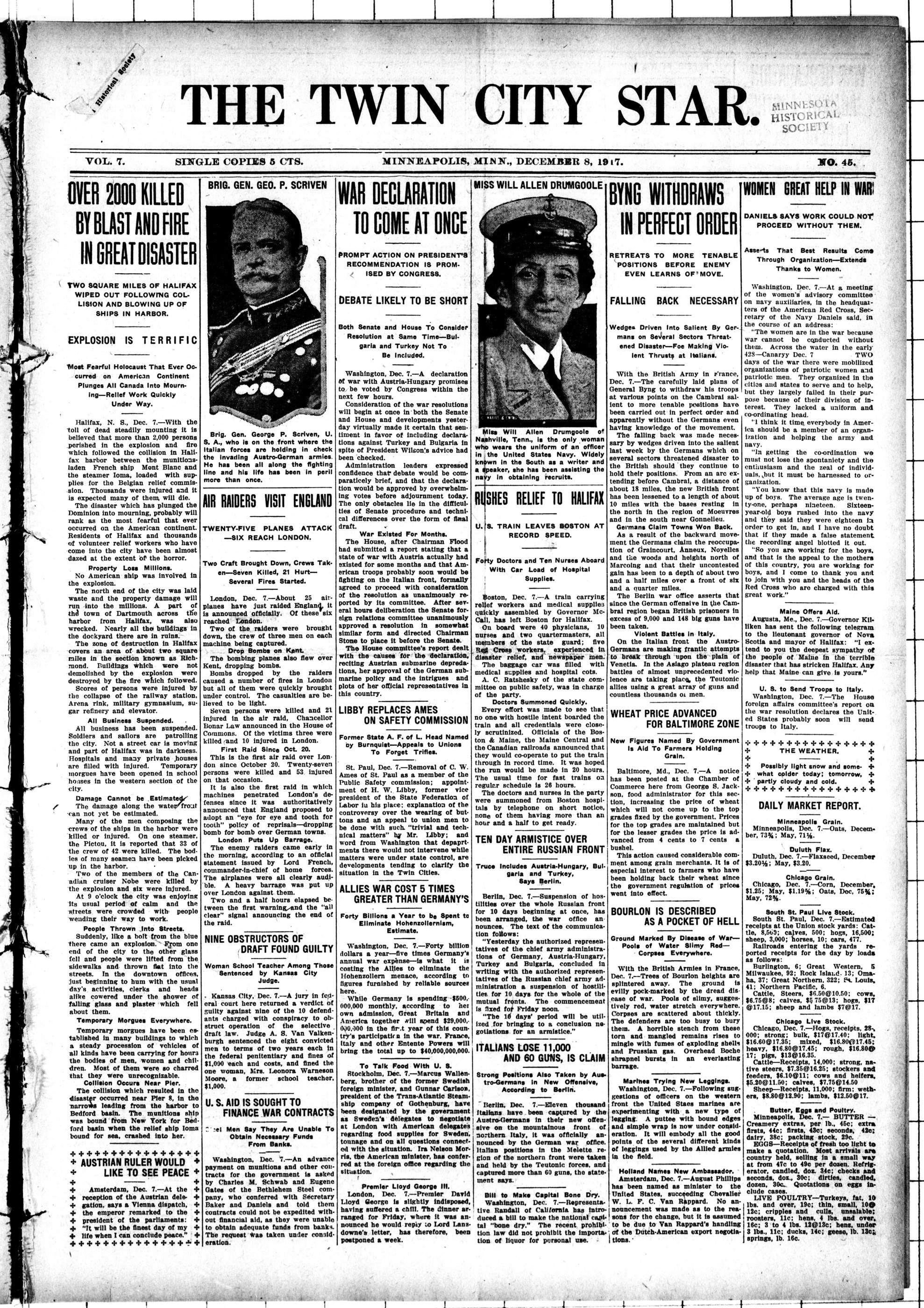
OVER 2000 KILLED BY BLAST AND FIRE IN GREAT DISASTER
TWO SQUARE MILES OF HALIFAX WIPED OUT FOLLOWING COLLISION AND BLOWING UP OF SHIPS IN HARBOR.
EXPLOSION IS TERRIFIC
Most Fearful Holocaust That Ever Occurred on American Continent Plunges All Canada Into Mourning—Rellef Work Quickly Under Way.
Halifax, N. S., Dec. 7.—With the toll of dead steadily mounting it is believed that more than 2,000 persons perished in the explosion and fire which followed the collision in Halifax harbor between the munitions-laden French ship Mont Blanc and the steamer Ioma, loaded with supplies for the Belgian relief commission. Thousands were injured and it is expected many of them, will die.
The disaster which has plunged the Dominion into mourning, probably will rank as the most fearful that ever occurred on the American continent. Residents of Halifax and thousands of volunteer relief workers who have come into the city have been almost dazed at the extent of the horror.
Property Loss Millions.
No American ship was involved in the explosion.
The north end of the city was laid waste and the property damage will run into the millions. A part of the town of Dartmouth across the harbor from Halifax, was also wrecked. Nearly all the buildings in the dockyard there are in ruins.
The zone of destruction in Halifax covers an area of about two square rallies in the section known as Richmond. Buildings which were not demolished by the explosion were destroyed by the fire which followed. Scores of persons were injured by the collapse of the railway station. Arena rink, military gymnasium, sugar refinery and elevator.
All Business Suspended.
All business has been suspended. Soldiers and sailors are patrolling the city. Not a street car is moving and part of Halifax was in darkness. Hospitals and many private houses are filled with injured. Temporary morgues have been opened in school houses in the western section of the city.
Damage Cannot be Estimated
The damage along the water front can not yet be estimated.
Many of the men composing the crews of the ships in the harbor were killed or injured. On one steamer, the Pictou, it is reported that 33 of the crew of 42 were killed. The bodies of many seamen have been picked up in the harbor.
Two of the members of the Canadian cruiser Nobe were killed by the explosion and six were injured.
At 9 o'clock the city was enjoying its usual period of calm and the streets were crowded with people wending their way to work.
Suddenly, like a bolt from the blue there came an explosion. From one end of the city to the other glass fell and people were lifted from the sidewalks and thrown flat into the streets. In the downtown offices, just beginning to hum with the usual day's activities, clerks and heads alike cowered under the shower of falling glass and plaster which fell about them.
Temporary Morgues Everywhere.
Temporary morgues have been established in many buildings to which a steady procession of vehicles of all kinds have been carrying for hours the bodies of men, women and children. Most of them were so charred that they were unrecognizable.
Collision Occurs Near Pier.
The collision which resulted in the disaster occurred near Pier 8, in the marrows leading from the harbor to Bedford basin. The munitions ship was bound from New York for Bedford basin when the relief ship loma bound for sea, crashed into her.
Amsterdam, Dec. 7.—At the reception of the Austrian delegation, says a Vienna dispatch, the emperor remarked to the president of the parliaments: "It will be the finest day of my life when I can conclude peace."
THE TWIN CITY STAR.
BRIG. GEN. GEO. P. SCRIVEN
[Name]
Brig. Gen. George P. Scriven, U. S. A., who is on the front where the Italian forces are holding in check the invading Austro-German armies. He has been all along the fighting line and his life has been in peril more than once.
AIR RAIDERS VISIT ENGLAND
TWENTY-FIVE PLANES ATTACK
—SIX REACH LONDON.
Two Craft Brought Down, Crews Taken—Seven Killed, 21 Hurt—Several Fires Started.
London, Dec. 7.—About 25 airplanes have just raided England, it is announced officially. Of these six reached London.
Two of the raiders were brought down, the crew of three men on each machine being captured.
Dron Bombs on Kent.
Drop Bombs on Kent
The bombing planes also flew over Kent, dropping bombs.
Bombs dropped by the raiders caused a number of fires in London but all of them were quickly brought under control. The casualties are believed to be light.
Seven persons were killed and 21 injured in the air raid, Chancellor Bonar Law announced in the House of Commons. Of the victims three were killed and 10 injured in London.
First Raid Since Oct. 20.
This is the first air raid over London since October 20. Twenty-seven persons were killed and 53 injured on that occasion.
It is also the first raid in which machines penetrated London's defenses since it was authoritatively announced that England proposed to adopt an "eye for eye and tooth for tooth" policy of reprisals—dropping bomb for bomb over German towns.
London Puts Up Barrage.
The enemy raiders came early in the morning, according to an official statement issued by Lord French, commander-in-chief of home forces. The airplanes were all clearly audible. A heavy barrage was put up over London against them.
Two and a half hours elapsed between the first warning and the "all clear" signal announcing the end of the raid.
NINE OBSTRUCTORS OF DRAFT FOUND GUILTY
Woman School Teacher Among Those Sentenced by Kansas City Judge.
Kansas City, Dec. 7.—A jury in federal court here returned a verdict of guilty against nine of the 10 defendants charged with conspiracy to obstruct operation of the selective draft law. Judge A. S. Van Valkenburgh sentenced the eight convicted men to terms of two years each in the federal penitentiary and fines of $1,000 each and costs, and fined the one woman, Mrs. Leonora Warneson Moore, a former school teacher, $1,000.
U. S. AID IS SOUGHT TO FINANCE WAR CONTRACTS
Steel Men Say They Are Unable To Obtain Necessary Funds From Banks.
Washington, Dec. 7.—An advance payment on munitions and other contracts for the government is asked by Charles M. Schwab and Eugene Gates of the Bethlehem Steel company, who conferred with Secretary Baker and Daniels and told them contracts could not be expedited without financial aid, as they were unable to obtain adequate funds from banks. The request was taken under consideration.
MINNEAPOLIS, MINN., DECEMBER 8, 1917.
WAR DECLARATION TO COME AT ONCE
PROMPT ACTION ON PRESIDENT'S RECOMMENDATION IS PROMISED BY CONGRESS.
DEBATE LIKELY TO BE SHORT
Both Senate and House To Consider Resolution at Same Time—Bulgaria and Turkey Not To Be Included.
Washington, Dec. 7.—A declaration of war with Austria-Hungary promises to be voted by Congress within the next few hours.
Consideration of the war resolutions will begin at once in both the Senate and House and developments yesterday virtually made it certain that sentiment in favor of including declarations against Turkey and Bulgaria in spite of President Wilson's advice had been checked.
Administration leaders expressed confidence that debate would be comparatively brief, and that the declaration would be approved by overwhelming votes before adjournment today. The only obstacles lie in the difficulties of Senate procedure and technical differences over the form of final draft.
The House, after Chairman Flood had submitted a report stating that a state of war with Austria actually had existed for some months and that American troops probably soon would be fighting on the Italian front, formally agreed to proceed with consideration of the resolution as unanimously reported by its committee. After several hours deliberation the Senate foreign relations committee unanimously approved a resolution in somewhat similar form and directed Chairman Stone to place it before the Senate. The House committee's report dealt with the causes for the declaration, reciting Austrian submarine depredations, her approval of the German submarine policy and the intrigues and plots of her official representatives in this country.
LIBBY REPLACES AMES
ON SAFETY COMMISSION
Former State A. F. of L. Head Named by Burnquist—Appeals to Unions To Forget Trifles.
St. Paul, Dec. 7.—Removal of C. W. Ames of St. Paul as a member of the Public Safety commission; appointment of H. W. Libby, former vice president of the State Federation of Labor in his place; explanation of the controversy over the wearing of buttons and an appeal to union men to be done with such "trivial and technical matters" by Mr. Libby; and word from Washington that departments there would not intervene while matters were under state control, are developments tending to clarify the situation in the Twin Cities.
ALLIES WAR COST 5 TIMES GREATER THAN GERMANY'S
Forty Billions a Year to be Spent to Eliminate Hohenzollernism, Estimate.
Washington, Dec. 7.—Forty billion dollars a year—five times Germany's annual war expense—is what it is costing the Allies to eliminate the Hohenzollern menace, according to figures furnished by reliable sources here.
While Germany is spending $500,000,000 monthly, according to her own admission, Great Britain and America together will spend $29,000,000,000 in the first year of this country's participation in the war. France, Italy and other Entente Powers will bring the total up to $40,000,000,000.
To Talk Food With U. S.
Stockholm, Dec. 7.—Marcus Wallenberg, brother of the former Swedish foreign minister, and Gunnar Carlson, president of the Trans-Atlantic Steamship company of Gothenburg, have been designated by the government as Sweden's delegates to negotiate at London with American delegates regarding food supplies for Sweden, tonnage and on all questions connected with the situation. Ira Nelson Morris, the American minister, has conferred at the foreign office regarding the situation.
Premier Lloyd George III.
London, Dec. 7.—Premier David Lloyd George is slightly indisposed, having suffered a chill. The dinner arranged for Friday, where it was announced he would reply to Lord Lansdowne's letter, has therefore, been postponed a week.
MISS WILL ALLEN DRUMGOOLE
MARIE & TWIN
Miss Will Allen Drumgoole of Nashville, Tenn., is the only woman who wears the uniform of an officer in the United States Navy. Widely known in the South as a writer and a speaker, she has been assisting the navy in obtaining recruits.
U. S. TRAIN LEAVES BOSTON AT RECORD SPEED.
Forty Doctors and Ten Nurses Aboard With Car Load of Hospital Supplies.
Boston, Dec. 7.—A train carrying relief workers and medical supplies quickly assembled by Governor McCall, has left Boston for Halifax.
On board were 40 physicians, 10 nurses and two quartermasters, all members of the state guard; five Red Cross workers, experienced in disaster relief, and newspaper men.
The baggage car was filled with medical supplies and hospital cots.
A. C. Ratshesky of the state committee on public safety, was in charge of the party.
Doctors Summoned Quickly.
Every effort was made to see that no one with hostile intent boarded the train and all credentials were closely scrutinized. Officials of the Boston & Maine, the Maine Central and the Canadian railroads announced that they would co-operate to put the train through in record time. It was hoped the run would be made in 20 hours. The usual time for fast trains on regular schedule is 26 hours.
The doctors and nurses in the party were summoned from Boston hospitals by telephone on short notice, none of them having more than an hour and a half to get ready.
TEN DAY ARMISTICE OVER
ENTIRE RUSSIAN FRONT
Truce Includes Austria-Hungary, Bulgaria and Turkey, Says Berlin.
Berlin, Dec. 7.—Suspension of hostilities over the whole Russian front for 10 days beginning at once, has been arranged, the war office announces. The text of the communication follows:
"Yesterday the authorized representatives of the chief army administrations of Germany, Austria-Hungary, Turkey and Bulgaria, concluded in writing with the authorized representatives of the Russian chief army administration a suspension of hostilities for 10 days for the whole of the mutual fronts. The commencement is fixed for Friday noon.
"The 16 days' period will be utilized for bringing to a conclusion negotiations for an armistice."
ITALIANS LOSE 11,000 AND 60 GUNS, IS CLAIM
Strong Positions Also Taken by Austro-Germans in New Offensive, According to Berlin.
Berlin, Dec. 7.—Eleven thousand Italians have been captured by the Austro-Germans in their new offensive on the mountainous front of northern Italy, it was officially announced by the German war office. Italian positions in the Melette region of the northern front were taken and held by the Teutonic forces, and captured more than 60 guns, the statement says.
Bill to Make Capital Bone Dry.
Washington, Dec. 7.—Representative Randall of California has introduced a bill to make the national capital "bone dry." The recent prohibition law did not prohibit the importation of liquor for personal use.
BYNG WITHDRAWS IN PERFECT ORDER
RETREATS TO MORE TENABLE
POSITIONS BEFORE ENEMY
EVEN LEARNS OF* MOVE.
Wedges Driven Into Salient By Germans on Several Sectors Threatened Disaster—Foe Making Violent Thrusts at Italians.
With the British Army in France, Dec. 7.—The carefully laid plans of General Byng to withdraw his troops at various points on the Cambral salient to more tenable positions have been carried out in perfect order and apparently without the Germans even having knowledge of the movement.
The falling back was made necessary by wedges driven into the salient last week by the Germans which on several sectors threatened disaster to the British should they continue to hold their positions. From an arc extending before Cambral, a distance of about 18 miles, the new British front has been lessened to a length of about 10 miles with the bases resting in the north in the region of Moeuvres and in the south near Gonnelleu.
Germans Claim Towns Won Back.
As a result of the backward movement the Germans claim the reoccupation of Graincourt, Anneux, Noyelles and the woods and heights north of Marcoleng and that their uncontested gain has been to a depth of about two and a half miles over a front of six and a quarter miles.
The Berlin war office asserts that since the German offensive in the Cambrai region began British prisoners in excess of 9,000 and 148 big guns have been taken.
Violent Battles in Italy.
On the Italian front the Austro-Germans are making grantic attempts to break through upon the plain of Venetia. In the Asiago plateau region battles of almost unprecedented violence are taking place the Teutonic allies using a great array of guns and countless thousands of men.
WHEAT PRICE ADVANCED
FOR BALTIMORE ZONE
New Figures Named By Government Is Aid To Farmers Holding Grain.
Baltimore, Md., Dec. 7.—A notice has been posted at the Chamber of Commerce here from George S. Jackson, food administrator for this section, increasing the price of wheat which will not come up to the top grades fixed by the government. Prices for the top grades are maintained but for the lesser grades the price is advanced from 4 cents to 7 cents a bushel.
This action caused considerable comment among grain merchants. It is of especial interest to farmers who have been holding back their wheat since the government regulation of prices went into effect.
BOURLON IS DESCRIBED
AS A POCKET OF HELL
Ground Marked By Disease of War—Pools of Water Silimy Red—Corpses Everywhere.
With the British Armies in France, Dec. 7.—Trees of Bourlon heights are splintered away. The ground is evily pock-marked by the dread disease of war. Pools of silimy, suggestively red, water stretch everywhere. Corpses are scattered about thickly. The defenders are too busy to bury them. A horrible stench from these torn and mangled remains rises to mingle with fumes of exploding shells and Prussian gas. Overhead Boche shrapnel bursts in an everlasting barrage.
Marines Trying New Leggings.
Washington, Dec. 7.—Following suggestions of officers on the western front the United Staes marines are experimenting with a new type of legging. A puttee with bound edges and simple wrap is now under consideration. It will embody all the good points of the several different kinds of leggings used by the Allied armies in the field.
Holland Names New Ambassador.
Amsterdam, Dec. 7.—August Phillips has been named as minister to the United States, succeeding Chevallier W. L. F. C. Van Rappard. No announcement was made as to the reasons for the change, but it is assumed to be due to Van Rappard's handling of the Dutch-American export negotiations.
MINNESOTA
HISTORICAL
SOCIETY
NO. 45.
WOMEN GREAT HELP IN WARI
DANIELS SAYS WORK COULD NOT
PROCEED WITHOUT THEM.
Asserts That Best Results Come Through Organization—Extends Thanks to Women.
Washington, Dec. 7.—At a meeting of the women's advisory committee on navy auxiliaries, in the headquarters of the American Red Cross, Secretary of the Navy Daniels said, in the course of an address:
"The women are in the war because war cannot be conducted without them. Across the water in the early 428—Canaryy Dec. 7. TWO days of the war there were mobilized organizations of patriotic women and patriotic men. They organized in the cities and states to serve and to help, but they largely failed in their purpose because of their division of interest. They lacked a uniform and co-ordinating head.
"I think it time everybody in America should be a member of an organization and helping the army and navy.
"In getting the co-ordination we must not lose the spontaniety and the enthusiasm and the zeal of individuals, but it must be harnessed to organization.
"You know that this navy is made up of boys. The average age is twenty-one, perhaps nineteen. Sixteen-year-old boys rushed into the navy and they said they were eighteen in order to get in, and I have no doubt that if they made a false statement the recording angel blotted it out.
"So you are working for the boys, and that is the appeal to the mothers of this country, you are working for boys, and I come to thank you and to join with you and the heads of the Red Cross who are charged with this great work."
Maine Offers Aid.
Augusta, Me., Dec. 7.—Governor Killiken has sent the following telegram to the lieutenant governor of Nova Scotia and mayor of Halifax: "I extend to you the deepest sympathy of the people of Maine in the terrible disaster that has stricken Halifax. Any help that Maine can give is yours."
Washington, Dec. 7.—The House foreign affairs committee's report on the war resolution declares the United States probably soon will send troops to Italy.
THE WEATHER.
Possibly light snow and some-
what colder today; tomorrow,
partly cloudy and cold.
DAILY MARKET REPORT.
Minneapolis Grain.
Minneapolis, Dec. 7.—Oats, December,
73%; May, 71%.
Duluth Flax.
Duluth, Dec. 7.—Flaxseed, December
$3.20½%; May, $3.20.
Chicago Grain.
Chicago, Dec. 7.—Corn, December,
$1.25%; May, $1.19%; Oats, Dec, 75%;
May, 72%.
South St. Paul Live Stock.
South St. Paul, Dec. 7.—Estimated receipts at the Union stock yards; Cattle, 8,500; calves, 500; hogs, 16,500; sheep, 3,000; horses, 10; cars, 477.
Railroads entering the yards reported receipts for the day by loads as follows:
Burlington, 6; Great Western, 5
Milwaukee, 92; Rock Island, 13; Omaha, 37; Great Northern, 322; St. Louis, 41; Northern Pacific, 6.
Cattle, Steers, $6.50@10.50; cows,
$6.75@8; calves, $5.75@13; hogs, $17@17.15; sheep and lambs $7@17.
Chicago Live Stock.
Chicago, Dec. 7. — Hogs, receipts, 25-
000; strong; bulk, $17 at 17.40; light,
$16.60@17.35; mixed, $16.80@17.45;
heavy, $16.80@17.45; rough, $16.80@
17; pigs, $13@16.35.
Cattle—recipients, 14,000; strong, native
steers, $7.35@16.25; stockers and
feeders, $6.10@11; cows and heifers,
$5.20@11.50; calves, $7.75@14.50
Sheep—Recipients, 11,000; firm; wethers,
$8.80@12.90; lambs, $12.50@17.
Butter, Eggs and Poultry.
Minneapolis, Dec. 7.—BUTTER—Creamery extras, per lb., 45c; extra firsts, 44c; firsts, 43c; seconds, 42c; dairy, 38c; packing stock, 29c.
EGGS—Receipts of fresh too light to make a quotation. Most arrivals are country held, selling in a small way at from 47c to 49c per cup. Refrigerator, candled, doz, 34c; checks and seconds, doz., 30c; dirties, candled, dozen, 30c. Quotations on eggs include cases.
LIVE POULTRY—Turkeys, fat, 10 lbs. and over, 19c; thin, small, 10@ 12c; cripples and culls, unsalable; roosters, 11c; hens, 4 lbs. and over, 16c; 3 to 4 lbs. 12@13c; hens, under 3 lbs., 11c; ducks, 14c; geese, lb. 13c; springs, lb. 16c.
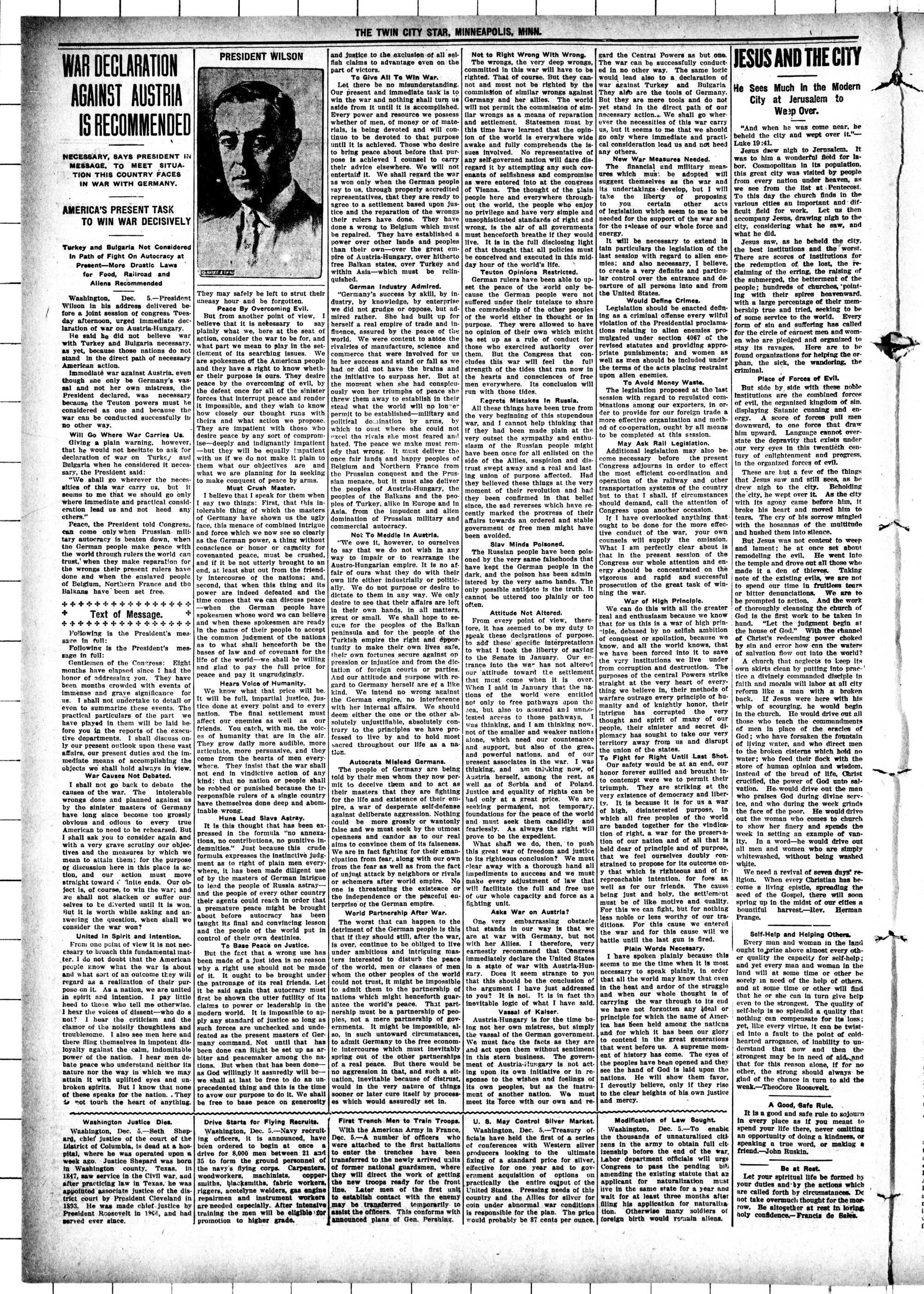
WAR DECLARATION AGAINST AUSTRIA IS RECOMMENDED
NECESSARY, SAYS PRESIDENT IN MESSAGE. TO MEET SITUATION THIS COUNTRY FACES IN WAR WITH GERMANY.
AMERICA'S PRESENT TASK TO WIN WAR DECISIVELY
Turkey and Bulgaria Not Considered
In Path of Fight On Autocracy at
Present—More Drastic Laws
for Food, Railroad and
Aliens Recommended
Washington, Dec. 5.—President
Wilson in his address delivered before a joint session of congress Tuesday afternoon, urged immediate declaration of war on Austria-Hungary.
He said he did not believe war with Turkey and Bulgaria necessary, as yet, because those nations do not stand in the direct path of necessary American action.
Immediate war against Austria, even though she only be Germany's vassal and not her own mistress, the President declared, was necessary because the Teuton powers must be considered as one and because the war can be conducted successfully in no other way.
Will Go Where War Carries Us.
Giving a plain warning, however, that he would not hesitate to ask for declaration of war on Turkey and Bulgaria when he considered it necessary, the President said:
"We shall go wherever the necessities of this war carry us, but it seems to me that we should go only where immediate and practical consideration lead us and not heed any others."
Peace, the President told Congress,
can come only when Prussian military autocracy is beaten down, when the German people make peace with
the world through rulers the world can
trust, when they make reparation for
the wrongs their present rulers have
done and when the enslaved people of Belgium, Northern France and the Balkans have been set free.
Text of Message.
Following is the President's message in full:
Following is the President's message in full:
Gentlemen of the Congress: Eight months have elapsed since I had the honor of addressing you. They have been months crowded with events of immense and grave significance for us. I shall not undertake to detail or even to summarize these events. The practical particulars of the part we have played in them will be laid before you in the reports of the executive departments. I shall discuss only our present outlook upon these vast affairs, our present duties and the immediate means of accomplishing the objects we shall hold always in view.
War Causes Not Debated.
I shall not go back to debate the causes of the war. The intolerable wrongs done and planned against us by the sinister masters of Germany have long since become too grossly obvious and odious to every true American to need to be rehearsed. But I shall ask you to consider again and with a very grave scrutiny our objectives and the measures by which we mean to attain them; for the purpose of discussion here in this place is action, and our action must move straight toward 'nite ends. Our object is, of course, to win the war; and we shall not slacken or suffer ourselves to be diverted until it is won. But it is worth while asking and answering the question, when shall we consider the war won?
United In Spirit and Intention.
From one point of view it is not necessary to broach this fundamental matter. I do not doubt that the American people know what the war is about and what sort of an outcome they will regard as a realization of their purpose on it. As a nation, we are united in spirit and intention. I pay little heed to those who tell me otherwise. I hear the voices of dissent—who do s not? I hear the criticism and the clamor of the noisily thoughtless and troublesome. I also see men here and there fling themselves in impotent disloyalty against the calm, indomitable power of the nation. I hear men debate peace who understand neither its nature nor the way in which we may attain it with uplifted eyes and unbroken spirits. But I know that none of these speaks for the nation. They do not touch the heart of anything.
Washington Justice Dies.
Washington, Dec. 5.—Seth Shepard, chief justice of the court of the District of Columbia, is dead at a hospital, where he was operated upon a week ago. Justice Shepard was born in Washington county, Texas, in 1847, saw service in the Civil war, and after practicing law in Texas, he was appointed associate justice of the district court by President Cleveland in 1893. He was made chief justice by President Roseveelt in 1905, and had served ever since.
BROOKLYN
They may safely be left to strut their uneasy hour and be forgotten.
Peace By Overcoming Evil.
But from another point of view, I believe that it is necessary to say plainly what we, here at the seat of action, consider the war to be for, and what part we mean to play in the settlement of its searching issues. We are spokesmen of the American people and they have a right to know whether their purpose is ours. They desire peace by the overcoming of evil, by the defeat once for all of the sinister forces that interrupt peace and render it impossible, and they wish to know how closely our thought runs with theirs and what action we propose. They are impatient with those who desire peace by any sort of compromise—deeply and indigently impatient—but they will be equally impatient with us if we do not make it plain to them what our objectives are and what we are planning for in seeking to make conquest of peace by arms.
Must Crush Master.
I believe that I speak for them when I say two things: First, that this tolerable thing of which the masters of Germany have shown us the ugly face, this menace of combined intrigue and force which we now see so clearly as the German power, a thing without conscience or honor or capacity for covenanted peace, must be crushed, and if it be not utterly brought to an end, at least shut out from the friendly intercourse of the nations; and, second, that when this thing and its power are indeed defeated and the time comes that we can discuss peace—when the German people have spokesmen whose word we can believe and when these spokesmen are ready in the name of their people to accept the common judgment of the nations as to what shall henceforth be the bases of law and of covenant for the life of the world—we shall be willing and glad to pay the full price for peace and pay it ungrudgingly.
Hears Voice of Humanity.
We know what that price will be. It will be full, impartial justice, justice done at every point and to every nation. The final settlement must affect our enemies as well as our friends. You catch, with me, the voices of humanity that are in the air. They grow daily more audible, more articulate, more persuasive, and they come from the hearts of men everywhere. They insist that the war shall not end in vindictive action of any kind; that no nation or people shall be robbed or punished because the irresponsible rulers of a single country have themselves done deep and abominable wrong.
Huns Lead Slava Astray.
Huns Lead Slavs Astray.
It is this thought that has been expressed in the formula "no annexations, no contributions, no punitive indemnities." Just because this crude formula expresses the instinctive judgment as to right of plain men everywhere, it has been made diligent use of by the masters of German intrigue to lead the people of Russia astray—and the people of every other country their agents could reach in order that a premature peace might be brought about before autocracy has been taught its final and convincing lesson and the people of the world put in control of their own destinies.
To Base Peace on Justice.
But the fact that a wrong use has been made of a just idea is no reason why a right use should not be made of it. It ought to be brought under the patronage of its real friends. Let it be said again that autocracy must first be shown the utter futility of its claims to power or leadership in the modern world. It is impossible to apply any standard of justice so long as such forces are unchecked and undeafed as the present masters of Germany command. Not until that has been done can Right be set up as arbiter and peacemaker among the nations. But when that has been done—as God willingly it assuredly will be—we shall at last be free to do an unprecedented thing and this is the time to avow our purpose to do it. We shall be free to base peace on generosity
Drive Starts for Flying Recruits.
Washington, Dec. 5.—Navy recruiting officers, it is announced, have been ordered to begin at once a drive for 8,000 men between 21 and 35 to form the ground personnel of the navy's flying corps. Carpenters, woodworkers, machinists, coppersmiths, blacksmiths, fabric workers, riggers, acetelyne welders, gas engine repairmen and instrument workers are needed especially. After intensive training the men will be eligible for promotion to higher grade.
and justice to the exclusion of all selfish claims to advantage even on the part of victors. Not to Right Wrong The wrongs, the ver committed in this war
To Give All To Win War.
Let there be no misunderstanding. Our present and immediate task is to win the war and nothing shall turn us aside from it until it is accomplished. Every power and resource we possess whether of men, of money or of materials, is being devoted and will continue to be devoted to that purpose until it is achieved. Those who desire to bring peace about before that purpose is achieved I counsel to carry their advice elsewhere. We will not entertain it. We shall regard the war as won only when the German people say to us, through properly accredited representatives, that they are ready to agree to a settlement based upon justice and the reparation of the wrongs their rulers have done. They have done a wrong to Belgium which must be repaired. They have established a power over other lands and peoples than their own—over the great empire of Austria-Hungary, over hitherto free Balkan states, over Turkey and within Asia—which must be relinquished.
German Industry Admired.
German Industry Admired.
"Germany's success by skill, by industry, by knowledge, by enterprise we did not grudge or oppose, but admired rather. She had built up for herself a real empire of trade and influence, assured by the peace of the world. We were content to abide the rivalries of manufacture, science and commerce that were involved for us in her success and stand or fall as we had or did not have the brains and the initiative to surpass her. But at the moment when she had conspicuously won her triumphs of peace she threw them away to establish in their stead what the world will no longer permit to be established—military and political domination by arms, by which to oust where she could not excel the rivals she most feared and hated. The peace we make must remedy that wrong. It must deliver the once fair lands and happy peoples of Belgium and Northern France from the Prussian conquest and the Prussian menace, but it must also deliver the peoples of Austria-Hungary, the peoples of the Balkans and the peoples of Turkey, allike in Europe and in Asia, from the impudent and alien domination of Prussian military and commercial autocracy.
Nox To Meddle In Austria.
"We owe it, however, to ourselves to say that we do not wish in any way to impair or to rearrange the Austro-Hungarian empire. It is no affair of ours what they do with their own life either industrially or politically. We do not purpose or desire to dictate to them in any way. We only desire to see that their affairs are left in their own hands, in all matters, great or small. We shall hope to secure for the peoples of the Balkan peninsula and for the people of the Turkish empire the right and opportunity to make their own lives safe, their own fortunes secure against opression or injustice and from the dictation of foreign courts or parties. And our attitude and purpose with regard to Germany herself are of a like kind. We intend no wrong against the German empire, no interference with her internal affairs. We should deem either the one or the other absolutely unjustifiable, absolutely contrary to the principles we have professed to live by and to hold most sacred throughout our life as a nation.
Autocrate Mislead Germans.
The people of Germany are being told by their men whom they now permit to deceive them and to act as their masters that they are fighting for the life and existence of their empire, a war of desperate self-defense against deliberate aggression. Nothing could be more grossly or wantonly false and we must seek by the utmost openness and candor as to our real aims to convince them of its falseness. We are in fact fighting for their emancipation from fear, along with our own from the fear as well as from the fact of unjust attack by neighbors or rivals or schemers after world empire. No one is threatening the existace or the independence or the peaceful enterprise of the German empire.
World Partnership After War.
The worst that can happen to the detriment of the German people is this that if they should still, after the war, is over, continue to be obliged to live under ambitious and intriguing masters interested to disturb the peace of the world, men or classes of men whom the other peoples of the world could not trust, it might be impossible to admit them to the partnership of nations which might henceforth guarantee the world's peace. That partnership must be a partnership of peoples, not a mere partnership of governments. It might be impossible, also, in such untoward circumstances, to admit Germany to the free economic intercourse which must inevitably spring out of the other partnerships of a real peace. But there would be no aggression in that, and such a situation, inevitable because of distrust, would in the very nature of things sooner or later cure itself by processes which would assuredly set in.
First Trench Men to Train Troops. With the American Army in France, Dec. 5.—A number of officers who were attached to the first battalions to enter the trenches have been transferred to the newly arrived units of former national guardsmen, where they will direct the work of getting the new troops ready for the front line. Later men of the first unit to establish contact with the enemy may be transferred temporarily to assist the officers. This conforms with announced plans of Gen. Pershing.
Not to Right Wrong With Wrong. The wrongs, the very deep wrongs, committed in this war will have to be righted. That of course. But they cannot and must not be righted by the commission of similar wrongs against Germany and her allies. The world will not permit the commission of similar wrongs as a means of reparation and settlement. Statesmen must by this time have learned that the opinion of the world is everywhere wide awake and fully comprehends the issues involved. No representative of any self-governed nation will dare disregard it by attempting any such covenants of selfishness and compromise as were entered into at the congress of Vienna. The thought of the plain people here and everywhere throughout the world, the people who enjoy no privilege and have very simple and unsophisticated standards of right and wrong, is the air of all governments must henceforth breathe if they would live. It is in the full disclosing light of that thought that all policies must be conceived and executed in this midday hour of the world's life.
Teuton Opinions Restricted.
Teuton Opinions Restricted.
German rulers have been able to upset the peace of the world only because the German people were not suffered under their tutelage to share the comradeship of the other peoples of the world either in thought or in purpose. They were allowed to have no opinion of their own which might be set up as a rule of conduct for those who exercised authority over them. But the Congress that concludes this war will feel the full strength of the tides that run now in the hearts and consciences of free men everywhere. Its conclusion will run with those tides.
Egrets Mistakes In Russia.
Fegrets Mistakes In Russia. All these things have been true from the very beginning of this stupendous war, and I cannot help thinking that if they had been made plain at the very outset the sympathy and enthusiasm of the Russian people might have been once for all enlisted on the side of the Allies, suspicion and distrust swept away and a real and lasting union of purpose affected. Had they believed these things at the very moment of their revolution and had they been confirmed in that belief since, the sad reverses which have recently marked the progress of their affairs towards an ordered and stable government of free men might have been avoided.
Slay Minds Poisoned.
The Russian people have been poisoned by the very same falsehoods that have kept the German people in the dark, and the poison has been administered by the very same hands. The only possible antidote is the truth. It cannot be uttered too plainly or too often.
Attitude Not Altered.
From every point of view, therefore, it has seemed to be my duty to speak these declarations of purpose. to add these specific interpretations to what I took the liberty of saying to the Senate in January. Our entrance into the war has not altered our attitude toward the settlement that must come when it is over. When I said in January that the nations of the world were entitled not only to free pathways upon the sea, but also to assured and unmolested access to those pathways, I was thinking, and I am thinking now, not of the smaller and weaker nations alone, which need our countenance and support, but also of the great and powerful nations, and of our present associates in the war. I was thinking, and am thinking now, of Austria herself, among the rest, as well as of Serbia and of Poland. Justice and equality of rights can be had only at a great price. We are seeking permanent, not temporary, foundations for the peace of the world and must seek them candidly and fearlessly. As always the right will prove to be the expedient.
What shall we do, then, to push this great war of freedom and justice to its righteous conclusion? We must clear away with a thorough hand all impediments to success and we must make every adjustment of law that will facilitate the full and free use of our whole capacity and force as a fighting unit.
Asks War on Austria?
One very embarrassing obstacle that stands in our way is that we are at war with Germany, but not with her Allies. I therefore, very earnestly recommend that Congress immediately declare the United States in a state of war with Austria-Hungary. Does it seem strange to you that this should be the conclusion of the argument I have just addressed to you? It is not. It is in fact the inevitable logic of what I have said.
Vassal of Kaiser.
Austria-Hungary is for the time being not her own mistress, but simply the vassal of the German government. We must face the facts as they are and act upon them without sentiment in this stern business. The government of Austria-Hungary is not acting upon its own initiative or in response to the wishes and feelings of its own peoples, but as the instrument of another nation. We must meet its force with our own and re-
---
U. S. May Control Silver Market. Washington, Dec. 5.—Treasury officials have held the first of a series of conferences with Western silver producers looking to the ultimate fixing of a standard price for silver, effective for one year and to government acquisition of options on practically the entire output of the United States. Pressing needs of this country and the Allies for silver for coin under abnormal war conditions is responsible for the plan. The price would probably be 87 cents per ounce.
gard the Central Powers as but one. The war can be successfully conducted in no other way. The same logic would lead also to a declaration of war against Turkey and Bulgaria. They also are the tools of Germany. But they are mere tools and do not yet stand in the direct path of our necessary action. We shall go wherever the necessities of this war carry us, but it seems to me that we should go only where immediate and practical consideration lead us and not heed any others.
New War Measures Needed.
The financial and military measures which mus: be adopted will suggest themselves as the war and its undertakings develop, but I will take the liberty of proposing to you certain other acts of legislation which seem to me to be needed for the support of the war and for the release of our whole force and energy. It will be necessary to extend in tain particulars the legislation of the last session with regard to allen enemies; and also necessary, I believe, to create a very definite and particular control over the entrance and departure of all persons into and from the United States.
Legislation should be enacted defining as a criminal offense every wilful violation of the Presidential proclamations relating to alien enemies promulgated under section 4067 of the revised statutes and providing appropriate punishments; and women as well as men should be included under the terms of the acts placing restraint upon alien enemies.
To Avoid Money Waste.
The legislation proposed at the last session with regard to regulated combinations among our exporters, in order to provide for our foreign trade a more effective organization and method of co-operation, ought by all means to be completed at this session.
May Ask Rail Legislation.
Additional legislation may also become necessary before the present Congress adjourns in order to effect the most efficient co-ordination and operation of the railway and other transportation systems of the country but to that I shall, if circumstances should demand, call the attention of Congress upon another occasion. If I have overlooked anything that ought to be done for the more effective conduct of the war, your own counsels will supply the omission. What I am perfectly clear about is that in the present session of the Congress our whole attention and energy should be concentrated on the vigorous and rapid and successful prosecution of the great task of winning the war.
War of High Principle.
We can do this with all the greater zeal and enthusiasm because we know that for us this is a war of high principle, debased by no selfish ambition of conquest or spoilage, because we know, and all the world knows, that we have been forced into it to save the very institutions we live under from corruption and destruction. The purposes of the central Powers strike straight at the very heart of everything we believe in, their methods of warfare outrage every principle of humanity and of knightly honor, their intrigue has corrupted the very thought and spirit of many of our people, their sinister and secret diplomacy has sought to take our very territory away from us and disrupt the union of the states.
To Fight Until Last Shot.
Our safety would be at an end, our honor forever suillied and brought into contempt were we to permit their triumph. They are striking at the very existence of democracy and liberty. It is because it is for us a war of high, disinterested purpose, in which all free peoples of the world are banded together for the vindication of right, a war for the preservation of our nation and of all that is held dear of principle and of purpose, that we feel ourselves doubly constrained to propose for its outcome only that which is righteous and of irreproachable intention, for foes as well as for our friends. The cause being just and holy, the settlement must be of like motive and quality. For this we can fight, but for nothing less noble or less worthy of our traditions. For this cause we entered the war and for this cause will we battle until the last gun is fired.
Plain Words Necessary.
I have spoken plainly because this seems to me the time when it is most necessary to speak plainly, in order that all the world may know that even in the heat and ardor of the struggle and when our whole thought is of carrying the war through to its end we have not forgotten any ideal or principle for which the name of America has been held among the nations and for which it has been our glory to contend in the great generations that went before us. A supreme moment of history has come. The eyes of the peoples have been opened and they see the hand of God is laid upon the nations. He will show them favor, I devoutly believe, only if they rise to the clear heights of his own justice and mercy.
Modification of Law Sought.
Washington, Dec. 5.—To enable the thousands of unnaturalized citizens in the army to obtain full citizenship before the end of the war, Labor department officials will urge Congress to pass the pending bill amending the existing statute that an applicant for naturalization must live in the same state for a year and wait for at least three months after filing his application for naturalization. Otherwise many soldiers of foreign birth would remain allens.
"And when he was come near, he beheld the city and wept over it."—Luke 19:41.
Jesus drew nigh to Jerusalem. It was to him a wonderful field for labor. Cosmopolitan in its population, this great city was visited by people from every nation under heaven, as we see from the list at Pentecost. To this day the church finds in the various cities an important and difficult field for work. Let us then accompany Jesus, drawing nigh to the city, considering what he saw, and what he did.
Jesus saw, as he beheld the city, the best institutions and the worst. There are scores of institutions for the redemption of the lost, the reclaiming of the erring, the raising of the submerged, the betterment of the people; hundreds of churches, pointing with their spires heavenward, with a large percentage of their membership true and tried, seeking to be of some service to the world. Every form of sin and suffering has called for the circle of earnest men and women who are pledged and organized to stay its ravages. Here are to be found organizations for helping the orphan, the sick, the wandering, the criminal.
Place of Forces of Evil
But side by side with these noble institutions are the combined forces of evil, the organized kingdom of sin, displaying Satanic cunning and energy. A score of forces pull men downward, to one force that draw him upward. Language cannot overstate the depravity that exists under our very eyes in this twentieth century of enlightenment and progress, in the organized forces of evil.
These are but a few of the things that Jesus saw and still sees, as he drew night to the city. Beholding the city, he wept over it. As the city with its agony came before him, it broke his heart and moved him to tears. The cry of his sorrow mingled with the hosannas of the multitude and hushed them into silence.
But Jesus was not content to weep and lament; he at once set about remodeling the evil. He went into the temple and drove out all those who made it a den of thieves. Taking note of the existing evils, we are not to spend our time in fruitless tears or bitter denunciations. We are to be prompted to action. And the work of thoroughly cleansing the church of God is the first work to be taken in hand. "Let the judgment begin at the house of God." With the channel of Christ's redeeming power choked by sin and error how can the waters of salvation flow out into the world?
A church that neglects to keep its own skirts clean by putting into practice a divinely commanded discipline in faith and morals will labor at all city reform like a man with a broken back. If Jesus were here with his whip of scourging, he would begin in the church. He would drive out all those who teach the commandments of men in place of the oracles of God; who have forsaken the fountain of living water, and who direct men to the broken cisterns which hold no water; who feed their flock with the store of human opinion and wisdom, instead of the bread of life, Christ crucified, the power of God unto salvation. He would drive out the man who praises God during divine service, and who during the week grinds the face of the poor. He would drive out the woman who comes to church to show her finery and spends the week in setting an example of vanity. In a word—he would drive out all men and women who are simply whitewashed, without being washed white.
We need a revival of seven days' religion. When every Christian has become a living epistle, spreading the seed of the Gospel, there will soon spring up in the midst of our cities a bountiful harvest.—Irev. Herman Prange.
Self-Help and Helping Others.
Every man and woman in the land ought to prize above almost every other quality the capacity for self-help; and yet every man and woman in the land will at some time or other be sorely in need of the help of others, and at some time or other will find that he or she can in turn give help even to the strongest. The quality of self-help is so splendid a quality that nothing can compensate for its loss; yet, like every virtue, it can be twisted into a fault to the point of cold-hearted arrogance, of inability to understand that now and then the strongest may be in need of aid, and that for this reason alone, if for no other, the strong should always be glad of the chance in turn to aid the weak.—Thecorec Roosvelt
A Good. Safe Rule.
It is a good and safe rule to sojourn in every place as if you meant to spend your life there, never omitting an opportunity of doing a kindness, or speaking a true word, or making a friend.—John Ruskin.
Be at Rest.
Let your spiritual life be formed by your duties and by the actions which are called forth by circumstances. Do not take overmuch thought for the morrow. Be altogether at rest in loving holy confidence—Francis de Sales.
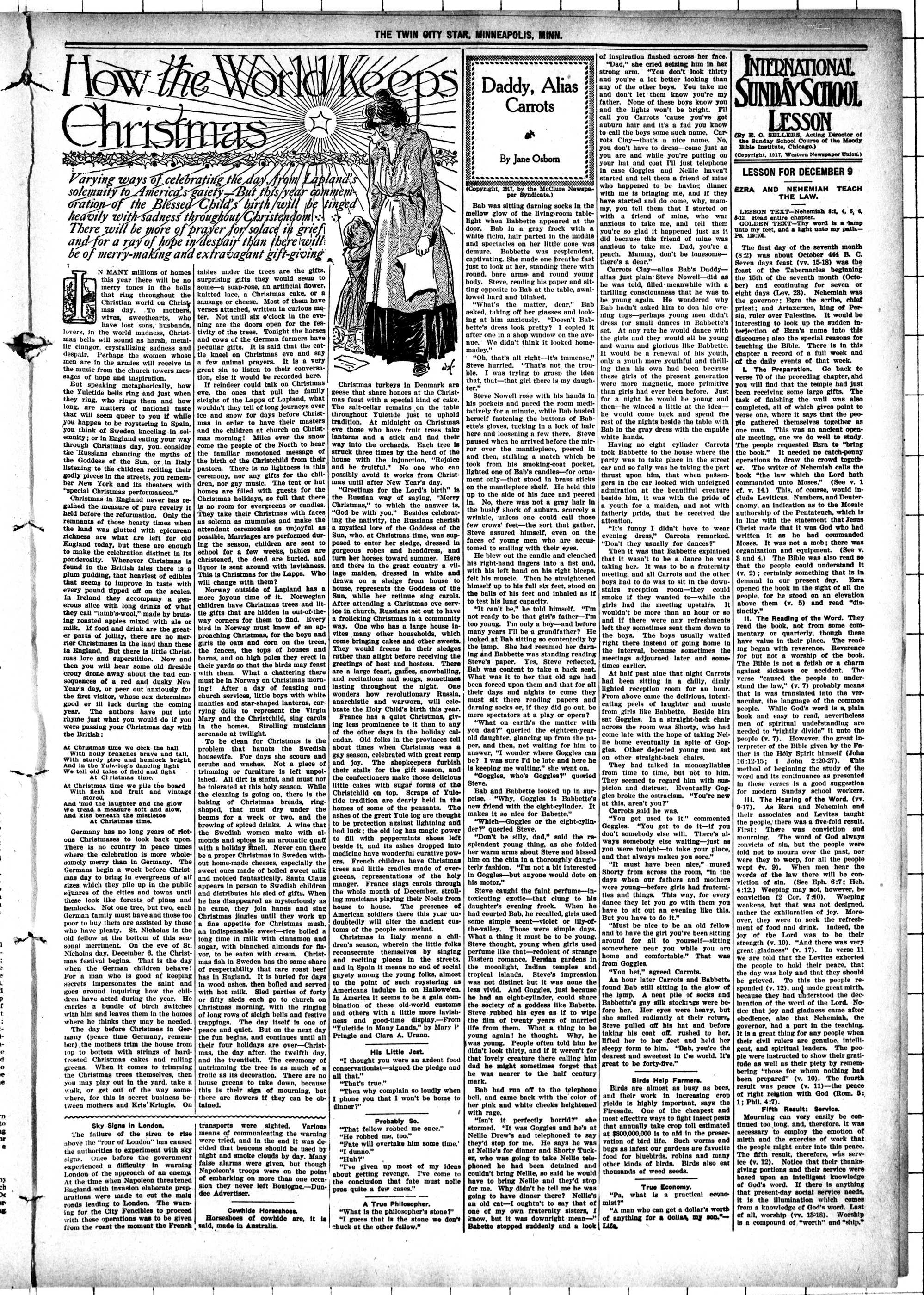
N MANY millions of homes this year there will be no merry tones in the bells that ring throughout the Christian world on Christmas day. To mothers, wives, sweethearts, who have lost sons, husbands,
N MANY millions of homes this year there will be no merry tones in the bells that ring throughout the Christian world on Christmas day. To mothers, wives, sweethearts, who have lost sons, husbands, lovers, in the world madness, Christmas bells will sound as harsh, metallic clangor, crystallizing sadness and despair. Perhaps the women whose men are in the armies will receive in the music from the church towers messages of hope and inspiration.
But speaking metaphorically, how the Yuletide bells ring and just when they ring, who rings them and how long, are matters of national taste that will seem queer to you if while you happen to be roystering in Spain, you think of Sweden kneeling in solemnity; or in England eating your way through Christmas day, you consider the Russians chanting the myths of the Goddess of the Sun, or in Italy listening to the children reciting their godly pieces in the streets, you remember New York and its theaters with "special Christmas performances."
Christmas in England never has regained the measure of pure revelry it held before the reformation. Only the remnants of those hearty times when the land was glutted with epicurean richness are what are left for old England today, but these are enough to make the celebration distinct in its ponderosity. Wherever Christmas is found in the British isles there is a plum pudding, that heaviest of edibles that seems to improve in taste with every pound tipped off on the scales. In Ireland they accompany a generous slice with long drinks of what they call "lamb's-wool," made by brushing roasted apples mixed with ale or milk. If food and drink are the greater parts of jollity, there are no merrier Christmases in the land than these in England. But there is little Christmas lore and superstition. Now and then you will hear some old fireside crony drone away about the bad consequences of a red and dusky New Year's day, or peer out anxiously for the first visitor, whose sex determines good or ill luck during the coming year. The authors have put into rhyme just what you would do if you were passing your Christmas day with the British:
At Christmas time we deck the hall
With holly braches brave and tall,
With sturdy pipe and hemlock bright.
And in the Yule-log's dancing light
We tell old tales of field and light
At Christmas time.
At Christmas time we pile the board
With flesh and fruit and vintage
stored.
And 'mid the laughter and the glow.
We tread a measure soft and slow.
And kite men miss the joe.
At Christmas time.
Germany has no long years of riotous Christmases to look back upon. There is no country in peace times where the celebration is more wholesomely merry than in Germany. The Germans begin a week before Christmas day to bring in evergreens of all sizes which they pile up in the public squares of the cities and towns until these look like forests of pines and hemlocks. Not one tree, but two, each German family must have and those too poor to buy them are assisted by those who have plenty. St. Nicholas is the old fellow at the bottom of this seasonal merriment. On the eve of St. Nicholas day, December 6, the Christmas festival begins. That is the day when the German children behave! For a man who is good at keeping secrets impersonates the saint and goes around inquiring how the children have acted during the year. He carries a bundle of birch switches with him and leaves them in the homes where he thinks they may be needed.
The day before Christmas in Germany (peace time Germany, remember) the mothers trim the house from top to bottom with strings of hard-frosted Christmas cakes and railing greens. When it comes to trimming the Christmas trees themselves, then you may play out in the yard, take a walk, or get out of the way somewhere, for this is secret business between mothers and Kris's Kringle. On
Sky Signs in London.
The failure of the siren to rise above the "roar of London" has caused the authorities to experiment with sky signs. Once before the government experienced a difficulty in warning London of the approach of an enemy. At the time when Napoleon threatened England with invasion elaborate preparations were made to cut the mals roads leading to London. The warning for the City Fencibles to proceed with these operations was to be given from the coast the moment the French
tables under the trees are the gifts, surprising gifts they would seem to some—a soap-rose, an artificial flower, knitted lace, a Christmas cake, or a sausage or cheese. Most of them have verses attached, written in curious meter. Not until six o'clock in the evening are the doors open for the festivity of the trees. Tonight the horses and cows of the German farmers have peculiar gifts. It is said that the cattle kneel on Christmas eve and say a few animal prayers. It is a very great sin to listen to their conversation, else it would be recorded here.
If reindeer could talk on Christmas eve, the ones that pull the family sleighs of the Lapps of Lapland, what wouldn't they tell of long journeys over ice and snow for days before Christmas in order to have their masters and the children at church on Christmas morning! Miles over the snow come the people of the North to hear the familiar monotoned message of the birth of the Christchild from their pastors. There is no lightness in this ceremony, nor any gifts for the children, nor gay music. The tent or hut homes are filled with guests for the Christmas holidays, so full that there is no room for evergreens or candles. They take their Christmas with faces as solemn as mummies and make the attendant ceremonies as unjoyful as possible. Marriages are performed during the season, children are sent to school for a few weeks, babies are christened, the dead are buried, and liquor is sent around with lavishness. This is Christmas for the Lapps. Who will change with them?
Norway outside of Lapland has a more joyous time of it. Norwegian children have Christmas trees and little gifts that are hidden in out-of-the-way corners for them to find. Every bird in Norway must know of an approaching Christmas, for the boys and girls te oats and corn on the trees, the fences, the tops of houses and barns, and on high poles they erect in their yards so that the birds may feast with them. What a chattering there must be in Norway on Christmas morning! After a day of feasting and church services, little boys with white manties and star-shaped lanterns, carrying dolls to represent the Virgin Mary and the Christchild, sing carols in the homes. Strolling musicians serenade at twilight.
To be clean for Christmas is the problem that haunts the Swedish housewife. For days she scours and scrubs and washes. Not a piece of trimming or furniture is left unpolished. All dirt is sinful, and must not be tolerated at this holy season. While the cleaning is going on, there is the baking of Christmas breads, ring-shaped, that must dry under the beams for a week or two, and the brewing of spiced drinks. A wine that the Swedish women make with almonds and spices is an aromatic quaff with a holiday smell. Never can there be a proper Christmas in Sweden without home-made cheeses, especially the sweet ones made of boiled sweet milk and molded fantastically. Santa Claus appears in person to Swedish children and distributes his sled of gifts. When he has disappeared as mysteriously as he came, they join hands and sing Christmas jingles until they work up a fine appetite for Christmas mush, an indispensable sweet—rice boiled a long time in milk with cinnamon and sugar, with blanched almonds for flavor, to be eaten with cream. Christmas fish in Sweden has the same share of respectability that rare roast beef has in England. It is buried for days in wood ashes, then boiled and served with hot milk. Sled parties of forty or fifty sleds each go to church on Christmas morning, with the ringing of long rows of sleigh bells and festive trappings. The day itself is one of peace and quiet. But on the next day the fun begins, and continues until all their four holidays are over—Christmas, the day after, the twelfth day, and the twentieth. The ceremony of untrimming the tree is as much of a frolic as its decoration. There are no house greens to take down, because this is their sign of mourning, but there are flowers if they can be obtained.
transports were sighted. Various means of communicating the warning were tried, and in the end it was decided that beacons should be used by night and smoke clouds by day. Many false alarms were given, but though Napoleon's troops were on the point of embarking on more than one occasion they never left Boulogne.-Dundee Advertiser.
Cowhide Horseshoes
Horseshoes of cowhide are, it is said, made in Australia.
THE TWIN CITY STAR, MINNEAPOLIS, MINN.
Christmas turkeys in Denmark are geese that share honors at the Christmas feast with a special kind of cake. The salt-cellar remains on the table throughout Yuletide just to uphold tradition. At midnight on Christmas eve those who have fruit trees take lanterns and a stick and find their way into the orchards. Each tree is struck three times by the head of the house with the injunction, "Rejoice and be fruitful." No one who can possibly avoid it works from Christmas until after New Year's day.
"Greetings for the Lord's birth" is the Russian way of saying, "Merry Christmas," to which the answer is, "God be with you." Besides celebrating the nativity, the Russians cherish a mystical lore of the Goddess of the Sun, who, at Christmas time, was supposed to enter her sledge, dressed in gorgeous robes and headdress, and turn her horses toward summer. Here and there in the great country a village maiden, dressed in white and drawn on a sledge from house to house, represents the Goddess of the Sun, while her retinue sing carols. After attending a Christmas eve service in church, Russians set out to have a frolicking Christmas in a community way. One who has a large house invites many other households, which come bringing cakes and other sweets. They would freeze in their sledges rather than alight before receiving the greetings of host and hostess. There are a large feast, games, snowballing, and recitations and songs, sometimes lasting throughout the night. One wonders how revolutionary Russia, anarchistic and warworn, will celebrate the Holy Child's birth this year.
France has a quiet Christmas, giving less prominence to it than to any of the other days in the holiday calendar. Old folks in the provinces tell about times when Christmas was a gay season, celebrated with great romp and joy. The shopkeepers furbish their stalls for the gift season, and the confectioners make those delicious little cakes with sugar forms of the Christchild on top. Scraps of Yule-tide tradition are dearly held in the homes of some of the peasants. The ashes of the great Yule log are thought to be protection against lightning and bad luck; the old log has magic power to fill with peppermints shoes left beside it, and its ashes dropped into medicine have wonderful curative powers. French children have Christmas trees and little cradles made of evergreens, representations of the holy manger. France sings carols through the whole month of December, strolling musicians playing their Noels from house to house. The presence of American soldiers there this year undoubtedly will alter the ancient customs of the people somewhat.
Christmas in Italy means a children's season, wherein the little folks reconsecrate themselves by singing and reciting pieces in the streets, and in Spain it means no end of social gayety among the young folks, almost to the point of such roystering as Americans indulge in on Hallowe'en. In America it seems to be a gala combination of these old-world customs and others with a little more lavishness and good-time display.—From "Yuletide in Many Lands," by Mary P Pringle and Clara A. Urrann.
His Little Jest.
"I thought you were an ardent food conservationist—signed the pledge and all that."
"That's true."
"Then why complain so loudly when I phone you that I won't be home to dinner?"
"Fate will overtake him some time."
"I dunno."
"Huh?"
"I've given up most of my ideas about getting revenge. I've come to the conclusion that fate must nolle pros quite a few cases."
A True Philosopher
"What is the philosopher's stone?"
"I guess that is the stone we don't chuck at the other fellow."
Daddy, Alias
Carrots
By Jane Osborn
(Copyright, 1917, by the McClure Newspaper Syndicate.)
Bab was sitting darning socks in the mellow glow of the living-room table-light when Babbette appeared at the door. Bab in a gray frock with a white fichu, hair parted in the middle and spectacles on her little nose was demure. Babbette was resplendent, captivating. She made one breathe fast just to look at her, standing there with round, bare arms and round young body. Steve, reading his paper and sitting opposite to Bab at the table, swallowed hard and blinked.
"What's the matter, dear." Bab asked, taking off her glasses and looking at him anxiously. "Doesn't Babbette's dress look pretty? I copled it after one in a shop window on the avenue. We didn't think it looked home-made."
"Oh, that's all right—it's immense," Steve hurried. "That's not the trouble. I was trying to grasp the idea that, that—that girl there is my daughter."
Steve Nowell rose with his hands in his pockets and paced the room meditatively for a minute, while Bab busled herself fastening the buttons of Babette's gloves, tucking in a lock of hair here and loosening a few there. Steve paused when he arrived before the mirror over the mantlepiece, peered in and then, striking a match which he took from his smoking-coat pocket, lighted one of Bab's candles—for ornament only—that stood in brass sticks on the mantlepiece shelf. He held this up to the side of his face and peered in. No, there was not a gray hair in the bushsh shock of unburn, scarcely a wrinkle, unless one could call those few crow's feet—the sort that gather, Steve assured himself, even on the faces of young men who are accustomed to smiling with their eyes.
He blew out the candle and clenched his right-hand fingers into a fist and, with his left hand on his right biceps, felt his muscle. Then he straightened himself up to his full six feet, stood on the balls of his feet and inhaled as if to test his lung capacity.
"It can't be," he told himself. "I'm not ready to be that girl's father—I'm too young. I'm only a boy—and before many years I'll be a grandfather? He looked at Bab sitting so contentedly by the lamp. She had resumed her darning and Babbette was standing reading Steve's paper. Yes, Steve reflected, Bab was content to take a back seat. What was it to her that old age had been forced upon them and that for all their days and nights to come they must sit there reading papers and darning socks or, if they did go out, be mere spectators at a play or opera?
"What on earth's the matter with you dad?" queried the eighteen-year-old daughter, glancing up from the paper, and then, not waiting for him to answer, "I wonder where Goggles can be? I was sure I'd be late and here he is keeping me waiting," she went on.
"Goggles, who's Goggles?" queried Steve.
Bab and Babette looked up in surprise. "Why, Goggles is Babette's new friend with the eight-cylinder. It makes it so nice for Babette."
"Which—Goggles or the eight-cylinder?" queried Steve.
"Don't be silly, dad," said the resplendent young thing, as she folded her warm arms about Steve and kissed him on the chin in a thoroughly daughterly fashion. "I'm not a bit interested in Goggles—but anyone would dote on his motor."
Steve caught the faint perfume—intoxicating exotic—that clung to his daughter's evening frock. When he had courted Bab, he recalled, girls used some simple scent—violet or lily-of-the-valley. Those were simple days. What a thing it must be to be young. Steve thought, young when girls used perfume like that—redolent of strange Eastern romance, Persian gardens in the moonlight, Indian temples and tropical islands. Steve's impression was not distinct but it was none the less vivid. And Goggles, just because he had an eight-cylinder, could share the society of a goddess like Babette. Steve rubbed his eyes as if to wipe the film of twenty years of married life from them. What a thing to be young again! he thought. Why, he was young. People often told him he didn't look thirty, and if it weren't for that lovely creature there calling him dad he might sometimes forget that he was nearer to the half century mark.
Bab had run off to the telephone bell, and came back with the color of her pink and white cheeks heightened with rage.
"Isn't it perfectly horrid?" she stormed. "It was Goggles and he's at Nellie Drew's and telephoned to say they'd stop for me. He says he was at Nellie's for dinner and Shorty Tucker, who was going to take Nellie telephoned he had been detained and couldn't bring Nellie, so said he would have to bring Nellie and they'd stop for me. Why didn't he tell me he was going to have dinner there? Nellie's an old cat—I oughtn't to say that of one of my own fraternity sisters, I know, but it was downright mean—" Babette stopped suddenly and a look
of inspiration fashed across her face. "Dad," she cried seizing him in her strong arm. "You don't look thirty and you're a lot better looking than any of the other boys. You take me and don't let them know you're my father. None of these boys know you and the lights won't be bright. I'll call you Carrots 'cause you've got auburn hair and it's a fad you know to call the boys some such name. Carrots Clay—that's a nice name. No, you don't have to dress—come just as you are and while you're putting on your hat and coat I'll just telephone in case Goggles and Nellie haven't started and tell them a friend of mine who happened to be having dinner with me is bringing me, and if they have started and do come, why, mammy, you tell them that I started on with a friend of mine, who was anxious to take me, and tell them you're so glad it happened just as it did because this friend of mine was anxious to take me. Dad, you're a peach. Mammy, don't be lonesome—there's a dear."
Carrots Clay—alias Bab's Daddy—alias just plain Steve Nowell—did as he was told, filled 'meanwhile with a thrilling consciousness that he was to be young again. He wondered why Bab hadn't asked him to do his evening togs—perhaps young men didn't dress for small dances in Babbette's set. At any rate he would dance with the girls and they would all be young and warm and glorious like Babette. It would be a renewal of his youth, only a youth more youthful and thrilling than his own had been because these girls of the present generation were more magnetic, more primitive than girls had ever been before. Just for a night he would be young and then—he winced a little at the idea—he would come back and spend the rest of the nights beside the table with Bab in the gray dress with the capable white hands.
Having no eight cylinder Carrots took Babbette to the house where the party was to take place in the street car and so fully was he taking the part thrust upon him, that when passengers in the car looked with unfeigned admiration at the beautiful creature beside him, it was with the pride of a youth for a malden, and not with fatherly pride, that he received the attention.
"It's funny I didn't have to wear evening dress," Carrots remarked. "Don't they usually for dances?"
Then it was that Babbette explained that it wasn't to be a dance he was taking her. It was to be a fraternity meeting, and all Carrots and the other boys had to do was to sit in the downstairs reception room—they could smoke if they wanted to—while the girls had the meeting upstairs. It wouldn't be more than an hour or so and if there were any refreshments left they sometimes sent them down to the boys. The boys usually waited right there instead of going home in the interval, because sometimes the meetings adjourned later and sometimes earlier.
At half past nine that night Carrots had been sitting in a chilly, dimly lighted reception room for an hour. From above came the delirious, intoxicating peels of laughter and music from girls like Babette. Beside him sat Goggles. In a straight-back chair across the room was Shorty, who had come late with the hope of taking Nellie home eventually in spite of Goggles. Other dejected young men sat on other straight-back chairs.
They had talked in monosyllables from time to time, but not to him. They seemed to regard him with suspicion and distrust. Eventually Goggles broke the ostracism. "You're new at this, aren't you?"
Carrots said he was.
"You get used to it." commented Goggles. "You got to do it—if you don't somebody else will. There's always somebody else waiting—just as you were tonight—to take your place, and that always makes you sore." "It must have been nice," mused Shorty from across the room, "in the days when our fathers and mothers were young—before girls had fraternities and things. This way, for every dance they let you go with them you have to sit out an evening like this. But you have to do it." "Must be nice to be an old fellow and to have the girl you've been sitting around for all to yourself—sitting somewhere near you while you are home and comfortable." That was from Goggles.
"You bet." agreed Carrots.
An hour later Carrots and Babbette found Bab still sitting in the glow of the lamp. A neat pile of socks and Babbette's gay silk stockings were before her. Her eyes were heavy, but she smiled radiantly at their return. Steve pulled off his hat and before taking his coat off, rushed to her, lifted her to her feet and held her sleepy form to him. "Bab, you're the dearest and sweetest in the world. It's great to be forty-five."
Birdda Help Farmers
Birds are almost as busy as bees, and their work in increasing crop yields is highly important, says the Firesade. One of the cheapest and most effective ways to fight insect pests that annually take crop toll estimated at $500,000,000 is to aid in the preservation of bird life. Such worms and bugs as infest our gardens are favorite food for bluebirds, robins and many other kinds of birds. Birds also eat thousands of weed seeds.
True Economy.
"Pn, what is a practical economist?"
"A man who can get a dollar's worth of anything for a dollar, my son."—Life
INTERNATIONAL
SUNDAY SCHOOL
LESSON
(BY E. O. SELLERS, Acting Director of the Sunday School School Course of the Moody Bible Institute, Chicago.)
(Copyright, 1917, Western Newspaper Union.)
LESSON FOR DECEMBER 9
EZRA AND NEHEMIAH TEACH
THE LAW.
LESSON TEXT-Nehemiah 8:1, 4, 6, 4,
4:12. Read entire chapter.
The first day of the seventh month (8:2) was about October 444 B. C. Seven days feast (vv. 15-18) was the feast of the Tabernacles beginning the 15th of the seventh month (October) and continuing for seven or eight days (Lev. 23). Nehemiah was the governor; Egra the scribe, chief priest; and Artaxerxes, king of Persia, ruler over Palestine. It would be interesting to look up the sudden interjection of Era's name into this discourse; also the special reasons for teaching the Bible. There is in this chapter a record of a full week and of the daily events of that week.
I. The Preparation. Go back to verse 70 of the preceding chapter, and you will find that the temple had just been receiving some large gifts. The task of finishing the wall was also completed, all of which gives point to verse one, where it says that the people gathered themselves together as one man. This was an ancient openair meeting, one we do well to study. The people requested Ezra to "bring the book." It needed no catch-penny operations to draw the crowd together. The writer of Nehemiah calls the book "the law which the Lord hath commanded unto Moses." (See v. 1 cf. v. 14.) This, of course, would include Leviticus, Numbers, and Deuteronomy, an indication as to the Mosaic authorship of the Pentateuch, which is in line with the statement that Jesus Christ made that it was God who had written it as he had commanded Moses. It was not a mob; there was organization and equipment. (See v. 8 and 4.) The Bible was also read so that the people could understand it (v. 2); certainly something that is in demand in our present day. Ezra opened the book in the sight of all the people, for he stood on an elevation above them (v. 5) and read "distinctly."
II. The Reading of the Word. They read the book, not from some commentary or quarterly, though these have value in their place. The reading began with reverence. Reverence for but not a worship of the book. The Bible is not a fetish or a charm against sickness or accident. The verse "caused the people to understand the law," (v. 7) probably means that is was translated into the vernacular, the language of the common people. While God's word is a plain book and easy to read, nevertheless men of spiritual understanding are needed to "rightly divide" it unto the people (v. 7). However, the great interpreter of the Bible given by the Father is the Holy Spirit himself (John 16:12-15; I John 2:20-27). This method of beginning the study of the word and its continuance as presented in these verses is a good suggestion for modern Sunday school workers.
III. The Hearing of the Word. (vv. 9-17). As Ezra and Nehemiah and their associates and Levites taught the people, there was a five-fold result. First: There was conviction and mourning. The word of God always convicts of sin, but the people were told not to mourn over the past, nor were they to weep, for all the people wept (v. 9). When men hear the words of the law there will be conviction of sin. (See Eph. 6:7; Heb. 4:12). Weeping may not, however, be conviction (2 Cor. 7:10). Weeping weakens, but that was not designed, rather the exhilaration of joy. Moreover, they were to seek the refreshment of food and drink. Indeed, the joy of the Lord was to be their strength (v. 10). "And there was very great, gladness" (v. 17). In verse 11 we are told that the Levites exhorted the people to hold their peace, that the day was holy and that they should be grieved. To this the people responded (v. 12), and made great mirth, because they had understood the declaration of the word of the Lord. Notice that joy and gladness came after obedience, also that Nehemiah, the governor, had a part in the teaching. It is a great thing for any people when their civil rulers are genuine, intelligent, and spiritual leaders. The people were instructed to show their gratitude as well as their plebty by remembering "those for whom nothing had been prepared" (v. 10). The fourth result was peace (v. 11)—the peace of right relation with God (Rom. 5:1; Phil. 4:7).
Fifth Result: Service.
Mourning can very easily be continued too long, and, therefore, it was necessary to employ the emotion of mirth and the exercise of work that the people might enter into this peace. The fifth result, therefore, was service (v. 12). Notice that their thanksgiving portions and their service were based upon an intelligent knowledge of God's word. If there is anything that present-day social service needs, it is the illumination which comes from a knowledge of God's word. Last of all, worship (vv. 13:18). Worship is a compound of "worth" and "ship."
PUBLSHED EVERY FRIDAY BY
CHARLES SUMNER SMITH,
Minneapolis, Minnesota
Entered in the Post Office at Minneapolis as second class matter.
MEMBER
NATIONAL NEGRO PRESS
ASSOCIATION
ONE YEAR ..... $2.00
SIX MONTHS ..... $125
THREE MONTHS ..... 65
ADVERTISING RATES.
One Inch—1 Insertion—One Dollar.
Liberal discount given on 3, 6, 9
Months, or 1 year contracts.
We do not run free ads, or over-run
the time contracted for by our ad-
vertisers We respect their right to
advertise at intervals, and rather have
them do so, than to run continuously
an "adv." and an increasing account.
Write all Checks payable to
Call at 1317 6th Ave. N. on Wednesday to insure matter for publication. The Star's Phone, Hyland 1205.
MANY VACANT HOUSES.
There are many vacant, houses on the North Side and the landlords are glad to get good tenants to protect their properties. Many vacancies are caused by men going to war. Several respectable families have given up housekeeping. The dependable lodger is not easily found. High cost of living in a buffet-flat at the present price of "web goods" has caused several evacuations. Those Shylocks who could get double rent a year ago, can't get tenants now. They raised the price whenever they could rent houses to those who ran the amalgamated buffet flats; and by so doing they have made their property undesirable and must wait for a rehabilitation of that section. They will find that moderate rent from honest and respectable tenants is a better and more lasting revenue than excessive incomes from a lawless element, who are here today and gone tomorrow.
A NATIONAL PROBLEM.
Press reports show that America will face the problem of educating many of the Negroes drafted for war service. It may be a "problem" now, but it is a long neglected debt which she must pay with compound interest. Other "problems" will follow in rapid succession America will learn the lesson of patriotic economy at the school of bitter and expensive experience. Nature's centrifugal forces are working, and she rigidly enforces the laws of compensation. The Negro is, and always has been, loyal to our Nation. The war has caused many heretofore indifferent Americans to become pro-Negro in this critical hour. The conservationists and economists have found that their neglect of the health, morals and rights of the Negro has been a willful waste—now a woeful want. Now that the handwriting on the wall is seen, the race will come into its own. The Negro will suffer side by side with the other Americans and by so doing will deliver the destinies of the race.
RED CROSS SEAL CAMPAIGN.
The date for beginning the Red Cross Seal Campaign has been advanced from November 15th to November 5th.
Dr. L. J. Murphy of the Minnesota Public Health association, state manager, announces the following messages just received:
"The American Red Cross waives the restriction in the contract that no agent put seals on sales before November 5th.
"We understand that man to reach the soldiers in France before Christmas must be mailed not later than November 15th and preferably at an earlier date. The advantage of allowing an early sale of Red Cross Seals by local campaign managers for packages going to the soldiers is obvious. Accordingly the American Red Cross waives the restriction in the contract which made November 15th the opening day, providing Red Cross Seals be not placed on sale before November 5th.
There are four Red Cross chapters among our people—"The Ida Wells-Barnett," "The Nannie C. Burroughs," "The Jennie C. Watson" and "The Maria C. Powell" chapters. They are doing nicely from all reports, towards making necessary supplies. The Minneapolis Sunday Forum is raising a fund to provide Christmas boxes for the Minnesota boys at Camp Dodge. Now that the several factions have organized, much will be accomplished. The work of the Red Cross is America's greatest contribution to humanity. It might have been better had our women organized in one great body, yet is good that they are doing their bit. Self-Sacrifice and Service should be their motto, and Success and Honor will be their record.
THE TWIN CITY STAR will be sent to any out of town address. Send your subscription in postage stamps. Read your home paper while visiting in other cities. It's like a letter from home.
FROM NEAR AND FAR
Housewives in Bell City, La., have adopted overalls for housework.
Canada's independent labor party will place candidates in the field.
Yucatan (Mexico) school teachers have formed a co-operative society.
Canada has opened a government creamery at Henriburg, Sask., Canada.
Woman school teachers in Ireland receive the same pay as men for the same kind of work.
The Chilean congress is considering the development of the iron industry in that country, which has some of the richest mines in the world.
++++++++++++++++++++++++++++++++++++++++++++++++++++++++++++
CURIOUS CONDENSATIONS
Seventy-four members of the faculty and instructional staff of the University of Wisconsin are absent in various kinds of war service.
Guadeloupe expects an abundant harvest of cocoa. Trees and pods are in excellent condition. The entire output of the colony goes to France.
It is said that the United States exported by parcel post in 1915-16, 1,352,639 parcels, weighing 6,299,023 pounds; in 1914-15, 936,365 parcels with a total weight of 3,347,899.
An Australian says he has discovered a new rapid tanning process with which sole leather can be tanned in seven days, calfskins in six hours and other skins proportionately quickly.
Artificial gas is supplanting coal as a fuel in Philadelphia. It is also pointed out as an incentive to its use that while the price of coal has soared that of gas is either unchanged or lower.
The Lake Hemet dam in the San Jacinto mountains is said to impound 4,000,000,000 gallons of water and to effect the irrigation of 10,000 acres in the Hemet and San Jacinto valleys. It cost about $2,000,000.
The ordinary housefly can lift a match between two of its feet and carry it. A human being, to perform a similar feat, would have to lift a beam eight and a quarter yards in length and 16 inches thick.
WISE AND OTHERWISE
An old bachelor says the best pet dogs come in glass.
Don't worry. You will always look good to your friends.
If a man has a good memory he knows when to forget.
Men who do the most work don't always do the best work.
A woman seldom attempts to hide her jealousy under a bushel.
People who say what they think have to do a lot of explaining.
Don't count your chickens until they are old enough to bluff the cat.
Why is it that thieves display more discretion than honest men?
It is everlastingly too late to pick the winner after the race is over.
One can't blame a man for kicking when he has to foot another's bills.
Any man who sits around and waits for an easy job is a grafter at heart.
Tombstones remind us that the average man isn't as white as he is sculptured.
If your boss isn't satisfactory, just mention the fact to him, and perhaps he will permit you to resign.
ABOUT PERSONS
John Taylor of Crystal Springs, Miss., has 15 sons in the United States army.
General Vorkhovsky, late Russian war minister, 12 years ago was a chamber page to the czar.
Joseph P. Guffy, Democratic state chairman of Pennsylvania, has been appointed petroleum administrator, covering the purchase of all oil for the United States during the war.
Governor Whitman of New York was challenged by a sentry on a dark night and explained that he was governor. The sentry replied: "I'm governor, too. Put up your hands!" A corporal explained the situation. The governor said to the sentry: "You are a good soldier," and passed on.
FLASHLIGHTS
The fellow who only half tries usually makes a complete failure.
It takes all sorts of people to make up a world, but it took the kaiser to break up a world.
THE TWIN CITY STAR. MINNEAPOLIS. MINN.
"AS SHE IS SPOKE"
Some queer sentences turned out by the pupils of the Methodist Girl's school at Kuala Lumpur, Malaysia.
When the form of a verb is changed it is called congregation.
The prime meridian is called the eternal date line.
Gibraltar is the keynote in the Mediterranean.
The finest wheat that ever cropped grows in Russia.
The masculine of spinster is bore.
He had nothing on except a sword and he was unarmed.
A wife is the upset (opposite) of the husband.
The place was taken by storm and thunder.
Benjamin Franklin looked very funny with his clothes behind and a loaf of bread in his mouth.
Glibraltar is known as the keynote of England.
St. Helena is a place where Napoleon had been diminished.
The barbarian states are Morocco, Algiers, Tripoli and Turnips.
Queen Victoria reigned 60 years. She was the longest sovereign that ever ruled in England.
A frog is a bug with four legs. It stands up in front and sits down behind.—World Outlook.
SOME POSTSCRIPTS
Japanese government experts are raising tobacco in Korea from American seed.
A wheel chair has been patented that can be folded compactly for storage when idle.
Official figures show that the sewers of American cities are long enough to girdle the earth.
English scientists are experimenting with the production of artificial rubber from coke oven gasas.
Caddies are unnecessary for golf players who use a new holder for clubs that is mounted on wheels.
Two Seattle men have patented a machine that slices an entire loaf of bread as a tradle is pressed.
India is now raising cotton on 18, 263,000 acres of land, an increase of about 7 per cent from last year.
An irrigation project nearing completion in the Hawaiian islands will pierce five mountain ranges and deliver 50,000,000 gallons of water daily to plantations.
Forks that carry spring scales to weigh their contents have been invented in sizes ranging from a dining table utensil to one large enough to handle hay or grain.—Houston Post.
STATISTICAL NOTES
Ohio cow supply has dwindled
40 per cent in a few months.
United States grew 13,554,150
bushels of onions and 691,920
tons of cabbage in 1917.
A 31 per cent drop in building
operations was reported in New
York city, due to strikes and in-
ability to obtain steel.
As a result of increases of
wages steel rollers in the mills
at Youngstown, O., are now earn-
ing as much as $800 a month or
at the rate of $10,000 a year.
THINGS YOU SHOULD KNOW
Orange juice is a preventive of scurvy among children who use pasteurized milk.
Tomatoes filled with minced pineapple, celery and chopped nuts mixed with mayonnaise are delicious.
Pack glass and china in hay that is slightly damp. This will prevent the articles from slipping about.
Apples, cored and filled with chopped dates or figs, then baked, make an excellent breakfast dish.
Parsley and sweet herbs should be gathered on a sunshiny day when full grown if they are to be dried.
If white potatoes are inclined to turn black when being boiled, add a few drops of vinegar to the water they are boiled in.
FACTS AND FIGURES
United States in 1916 quarried granite valued at $17,418,582.
United States national banks have $16,000,000,000 in deposits.
Pennsylvania railroad has sent 2,540 employees to war.
CARTER AT THE FRONT
Sensational New York Golfer Doing His Bit in France.
Driver of Red Cross Ambulance Tells of Great War Game for Which He Has Forsaken Links Under Fire Many Times.
Phil Carter, the sensational young New York golfer, is doing his bit with the American Red Cross in France, where he drives an ambulance close to the firing lines, day after day.
In a recent letter to friends on this side of the pond Carter told something of the great war game for which he has forsaken the links. He has been under fire many times, and the night drives he has been forced to make, along rough and treacherous roads, without lights, have convinced him that war is a terribly serious game.
"We have often been within two or three miles of the front," wrote Carter, "and it is impossible to describe the sensation that comes over one when he comes within range of the big guns.
"The roar of the heavy artillery is something terrific, and on one occasion we hadn't been in camp more than fifteen minutes when the Germans commenced shelling the whole countryside. You can hear the report when the big guns are fired and then the whistle of the shell as it comes screaming overhead. Then follows a thunderous report, and a lot of earth, a house or whatever the shell hits is thrown high into the air. If you can hear the shell whistle you are all right, but if you can't you have to watch your step, for it is very likely to watch close by.
"The night raids of the German airplane impressed me as the most treacherous and dangerous thing I have en-
Western Newspaper Union
Phil Carter.
countered, and there is nothing one can do but crawl into a dug-out and wait till the raid comes to an end." Carter also wrote that the ambulance drivers get furloughs at intervals, which permit them to rest up as they see fit. He takes his recreation on the golf links in Paris, and in this way is keeping on his game.
"FROSTY" DARCY MAY FIGHT
Younger Brother of Australian Champion Wants to Come to United States to Gain Fame.
"Frosty" Darcy, younger brother or unfortunate Les Darcy, may walk or perchance ride up the main street one of these fine days. Mickey King gives the information that he has received a letter from Australia to the effect that "Frosty" wants to come to America and try and win the fame for the name of Darcy.
"Frosty", like Les, is a middleweight of fair ability. He is only eighteen years of age and inasmuch as he has two other brothers fighting for the allies and as he is under military age, the way will be paved for him to leave Sydney and come over.
$1,000,000 for U. S.
As Baseball War Tax
The United States will collect close to $1,000,000 as a baseball war tax next season if patronage is as nearly normal in 1918 as it was this year in the major leagues. The government will get a ten per cent revenue on tickets, in addition to the income tax. The public will have to stand the tariff.
JOE EVANS IS IN THE ARMY
Cleveland Third Sacker, Who Had Previously Asked for Exemption, Reports for Duty.
Joe Evans, third baseman with the Cleveland Americans, is in the army, and President James C. Dunn is on the lookout for a player to fill his shoes. Evans is at Camp Pike, Little Rock, Ark. When the Cleveland third-sacker left here after the close of the season he intended to resume his medical course at the University of Mississippi. When he reached home, however, he changed his mind and reported for duty. Evans had previously applied for exemption. He hopes to be assigned to hospital duty.
Your blood fairly tingles with patriotism when you hear the soul-stirring anthems and the famous battle-songs of the Nation on the Victrola
Victrola
In these stirring times the music of the hour is patriotic music. The Victrola brings you all of it—the time-honored national airs, the great military marches, and the latest patriotic song hits as well! Come in and let us demonstrate. Victrola, $15 to $400. Easy terms.
You can also buy a Stewart Phonograph of us for only $7.75. It plays all records.
METROPOLITAN MUSIC CO
The Complete
41-43 South 6th
Office Phones—Main 2869; Auto 36
Twenty Elegant Steam-Heater
A la Carte Meals at All
STEWART
METROPOLITAN MUSIC CO.,
The Complete Music Store,
41-43 South 6th St., Minneapolis.
Victrola XIV,
$150
is shown here
Phones—Main 2869; Auto 36774.
Dining Room—
twenty Elegant Steam-Heated and Electric Lighted Ro-
A la Carte Meals at All Hours—Popular Prices.
TEWART'S HOT
Office Phones—Main 2869; Auto 36774. Dining Room—Main 2831.
Twenty Elegant Steam-Heated and Electric Lighted Rooms.
A la Carte Meals at All Hours—Popular Prices.
J. Ed. Stewart, Prop.
246-250 FOURTH AVE.
Private Dining and Reception
ance Beverages. Men's Buffet and
Connection.
246-250 FOURTH AVE. S., MINNEAPOLIS, MN
Private Dining and Reception Room for Ladies. Specia
beverages. Men's Buffet and Grill; Billiards; Barbe
ation.
Private Dining and Reception Room for Ladies. Special Temperance Beverages. Men's Buffet and Grill; Billiards; Barber Shop in Connection.
J. A. Withers, Prop.
BELL'S BAR
CEARENCE W.
BATHS, BARBER SHOP
POOL AND BAR
CIGARS, RACE PARK
244 THIRD AVE. SOUTH
Phone Northw
BELL'S BARBER SHOP
CHEARENCE W. BELL, Proprietor.
BATHS, BARBER SHOP, POLITE BARBER.
POOL AND BILLIARD HALL
CIGARS, RACE PAPERS, SHOE SHINING
THIRD AVE. SOUTH MINNEAPOLIS,
Phone Northwestern, Main 2511.
BELL'S BARBER SHOP
CLEARENCE W. BELL, Proprietor.
BATHS, BARBER SHOP, POLITE BARBERS
POOL AND BILLIARD HALL
CIGARS, RACE PAPERS, SHOE SHINING
244 THIRD AVE. SOUTH ..MINNEAPOLIS, MINN.
Phone Northwestern, Main 2511.
SOME DIRECTOR
South Side
212 Eleventh Ave
EXPERT BARBERS
CIGARS, POOL AND BILLIAR
RACE PAPERS
THOMPSON &
South Side Barber S.
212 Eleventh Ave. S., Minneapolis
EXPERT BARBERS; UP TO THE MINU
RS, POOL AND BILLIARD TABLES IN CONNE
RACE PAPERS—SHOES SHINED.
THOMPSON & CARVER, Props.
South Side Barber Shop
EXPERT BARBERS; UP TO THE MINUTE. CIGARS, POOL AND BILLIARD TABLES IN CONNECTION. RACE PAPERS—SHOES SHINED. THOMPSON & CARVER, Props.
The Waiters' and Porters' Club
GLOVER SHULL, PRES.
311 HENNEPIN AVE. MINNEAPOLIS
EDDIE BOYD, SECY' LEE WHEELER, MANAGER
---
rola
ete Music Store,
6th St., Minneapolis.
Victrola XIV,
$150
is shown here
36774. Dining Room—Main 2831.
eated and Electric Lighted Rooms.
All Hours—Popular Prices.
T'S HOTEL
Chas. Brody, Mgr.
VE. S., MINNEAPOLIS, MINN.
On Room for Ladies. Special Temper-
and Grill; Billiards; Barber Shop in
Office Phone, Hyland 2331
Residence—Hyland 4712.
611 Girard Ave. No.
Withers' Transfer
and Fuel Co.
1224 N. 6TH AVE., MINNEAPOLIS WITHERS' SPECIAL SERVICE HOUSEHOLD GOODS MOVED OR STORED. BAGGAGE TRANSFERED AND FUEL DELIVERED TO ALL PARTS OF THE CITY ON SHORT NOTICE.
BARBER SHOP
W. BELL, Proprietor.
SHOP, POLITE BARBERS
O BILLIARD HALL
PAPERS, SHOE SHINING
H ...MINNEAPOLIS, MINN.
Northwestern, Main 2511.
SMOKE THE BEST
5C CIGAR
W. S. CORRAD CO., Distributors
NO. 140. E. 6th ST., ST. PAUL.
NO. 1. WESTERN AVE., MINN.
Barber Shop
Ave. S., Minneapolis
ERS; UP TO THE MINUTE.
HIARD TABLES IN CONNECTION.
RS—SHOES SHINED.
& CARVER, Props.
---
VENTILATED GAS WASH BOILER
The Minneapolis Gas Light Co.
LOCAL NEWS
IMPORTANT NOTICE
Unless notes are written plainly and properly arranged they will not be inserted. Many people send in notes regardless of names, initials or composition. Arrangement by the publisher will be charged for. Free notices must be correctly written.
"STRIKES."
Is G. L. Morrill's subject at the People's Church, New Garden Theatre Sunday, 10:30 a.m. CEYLON views, travel movies, organ.
MADAM ROBINSON'S SUCCESS,
MADAM CHOSEN PROFESSION
Madam H. Robinson, 225 W. 39th St., has charge of a special work at St. Barnabas Hospital and has proved her ability as a Chiropractor and Masseuse. She is recommended highly. Mrs. G. H. Grenire, of Moose Lake, Sask., who has taken her treatments, says: "They are wonderful." Madam Robinson is the only one west of Chicago using the Thenena Electric Medium. She deserves much credit for her consistent efforts to compete with the leading chiropractors and is making a record for herself and race among the wealthy residents, who have never before employed colored women.
CARD OF THANKS.
We wish to extend our most sincere thanks to all relatives, friends and neighbors for their kindness and sympathy shown during the sorrow caused by the death of our beloved mother, Mrs. Dora Glenn, also for the beautiful floral offerings. Signed, The Family.
ELKS' CHRISTMAS PARTY.
Ames Lodge of Elks are preparing for their Christmas Tree and Entertainment for the children, which is their special charity feature much looked for by the young people. The names of children unable to be present on account of illness should be sent to W. R. Morris, Secretary, 818 Met. Life Bldg.
PUBLIC INSTALLATION AND BALL
The members of Ames lodge of Elks are preparing a large public installation of the newly elected officers for 1918, to be followed by a reception and dance. Geo. W. Holbert is chairman of the general committee and arrangements are being made to make this another big success for Ames. Dates will be announced later.
BIG BENEFIT FOR SOLDIERS AT ST. PAUL AUDITORIUM.
A monster benefit for the Negro soldiers from Minnesota will be held at the St. Paul Auditorium on January 8th. Addresses will be delivered by Hon. Daniel W. Lawler, Hon. Julius A. Schmahl, Mayor Ervin, Larry Hodgson and others. A dance will follow. C. E. Jones, chairman, Attorney W. F. Francis, master of ceremonies. Admission 50c.—Advertisement.
It is reported that The Strand Usher Girls paid $50 for Lane's Hall to give their ball. A "shimmy" dance where a big brute may rub his belly against a young girl's breast, is the social feature at many dances and naturally The Strand Girls pay for that privilege even if it is twice fifty. They carry the crowd.
BUY RED CROSS SEALS.
SUPPLIER
mes and excessive heat are carried out
half the gas on wash day.
er made of heavy plate tin with copper
rooms.
Minneapolis Gas L
SPINSTERS' CONVENTION AND
BALL.
Queen Esther Temple, No. 2, S. M. T. will hold a Spinsters' Convention on December 14 at Lane's Hall, Nicolelet Ave. and 8th Street. Good music. Excellent program. Admission 25c.— Advertisement.
ELKS TO ELECT OFFICERS.
Ames Lodge of Elks will elect officers for the ensuing year on Tuesday evening, December 11th.
Fezzan Temple of the Mystic Shrine is preparing for their annual ball.
Mr. Richard Newton is slowly recovering from the effects of a sprain of both ankles caused by being struck by an automobile last month. Atty-B. S. Smith is looking after his legal interests in the case.
Police Officer Chas. Kelso contracted pneumonia on a trip to the hospital to have the casts taken from his leg which was broken several weeks ago. He is improving slowly.
Mr. Barney Johnson, the railroad chef, has gone to Camp Lewis, Ore., where he is employed. His mother, Mrs. Victoria Johnson, accompanied him to Seattle, where they will reside. Both will be greatly missed in this city and have the best wishes of many friends.
Mr. Ben Berry left Tuesday night for his former home in Paris, Mo., to visit his sister. He will return in about ten days.
Mrs. "Bud" Green, 258 Bryant Ave., returned Saturday from Oakland, Minn., where she attended the funeral of her mother.
Mr. Charles Crowley, of Webster, Ia., spent a week here visiting his son, Mr. Earl Crowley.
Mr. Norman Bradshaw has returned from a lengthy visit to Chicago.
Master John Rose, of Chicago, is spending a few months with his aunt, Mrs. S. B. Smith, of Oakland Ave. Johnny is a great little boy, very intelligent and exceptionally handsome and well-bred.
Mrs. R. S. Sinclair left Monday for Little Rock to visit relatives.
The last issue of the monthly bulletin of St. Peters A. M. E. church was breezy with news and contained the names of several delinquent subscribers of this paper, representing several hundred dollars.
Don't send in your ads and say "send me the bill". Send the bill with the ad or personal. If you haven't a dollar, wait until you get one.
A joint Pythian Memorial service was held on Sunday night at St. Peter's A. M. E. church. Eulogies were delivered by Sir Knights P. H. Southall, F. G. Thomas and Wm. R. Morris. The street car trouble has affected the travel of many of our people who are employed in the Twin Cities. Travel to and from work was a hard proposition when cars were stopped at midnight.
Wanted—Subscribers to Pay.
COAL IN SMALL QUANTITIES.
WITHER'S SMALL-ORDER SERVICE.
Quick and Convenient.
Hyland 2331. Hyland 4712.
---
THE TWIN CITY STAR, MINNEAPOLIS, MINN.
DULUTH NEWS
By Miss Odessa McCullough,
510 Columbia Bldg., Duluth, Minn.
Mr. R. Reeves arrived Wednesday
afternoon, Nov. 28, from a four months
visit to the Twin Cities. Mrs. Reeves
formerly Miss Ferol Palmer of this
city, is now teaching in the New Training
School of Newport, Va.
Mrs. George Thomas of East First
St., returned Sunday evening from
an extended trip to her mother, Mrs.
Laura Thompson, in Altkin, Minn.
Get the habit! Have the Twin City
Star with the Duluth column of news
sent to the boys in camp. Mr. Earl
Smith enjoys the paper each week because
of the thoughtfulness of his
father, Mr. Ben Smith, who subscribed
for six months to this paper.
Mr. Joe Lewis of West Superior St., favored the agent of this paper this week, by subscribing for six months delivery of papers.
The dance given Thanksgiving evening by Messrs. Young and Maupin was the biggest and best of the season. The greatest feature of the evening was the Tag Dance in which everyone participated. Many of the old schottisches were resurrected among which was the "1914." A few of the young people enjoyed an old-fashioned "Square Dance." The best of punch was served by the men, ice cream, cake and sandwiches were served by the ladies of the "One More Effort Club." The large crowd left feeling quite sure that our boys would enjoy their treats for which the proceeds went to provide.
Mr. Harold Stokes; employee of the Federal Building, was granted a decree, of absolute divorce from Anna Mae Stokes, formerly of this city, Saturday, December 1st. Attorney R. C. McCullough represented the plaintiff.
Miss Odessa McCullough is the only authorized agent for The Twin City Star in Duluth—Ed.
NOT OUR REPRESENTATIVE.
M.
PHILIP F. HALE,
Philip F. Hale does not in any way, represent The Twin City Star. He is connected with The Advocate. We do not mislead those who inquire about both papers. Several complaints have reached us about "subscribing for the Star from Phil Hale." Those who desire The Advocate can secure it from Mr. Hale. He has no authority to solicit for us and those who wish The Star or The Advocate should get their choice, without any misrepresentation. The Star stands the tests.
SEE McDEW! for real estate.
MODERN FLAT, 5 rooms, stove or furnace heat, all conveniences. Mrs.
Fately, 1917 5th Ave. So. Call South
4948.
COAL, WOOD AND CHARCOAL
You can get 100 lbs. of Hard or Soft Coal, Bundle Wood or Charcoal. Delivered. Call Withers. Your coal man. Hyland 2331, or Hyland 4712.
EVERY DAY is BARGAIN DAY at the ROOT & HAGEMAN STORE, 407 Nicollet Ave.
A CARLOAD OF REINDEER.
A carload of Alaska Reindeer will be sold exclusively by the Minnesota Meat Market at their three stores,
40 South Third St.
725 Hennepin Ave.
1409 Nicollet Ave.
Place Your Order Now.
—Advertisement.
THE WAY TO MAKE MONEY.
If you wish to add to your income, you can do so by accepting an agency for The Twin City Star. Good commission to competent agents. Use your spare time in soliciting ads and subscriptions. Only honest and intelligent agents wanted. Call Hyland 1205.
AGENTS WANTED—NOW!
Reliable and intelligent agents always wanted to solicit business for THE TWIN CITY STAR; also correspondents in principal cities. A chance to earn a good living. Write The Twin City Star, Minneapolis.
Do not waste your time making promises to our agents. Send your money by Express or Post Office Order or in cash or postage stamps.
United States Civil-Service Examinations
STENOGRAPHERS AND TYPEWRITERS WANTED.
Men and Women.
The United States Government is in urgent need of thousands of typewriter operators and stenographers and typewriters. All who pass examinations for the departments and offices at Washington, D. C., are assured of certification for appointment. It is the manifest duty of citizens with this special knowledge to use it at this time where it will be of most value to the Government. Women especially are urged to undertake this office work. Those who have not the required training are encouraged to undergo instruction at once. Examinations for the Department Service, for both men and women, are held every Tuesday, in 150 of the principal cities of the United States, and applications may be filed with the Commission at Washington, D. C., at any time.
The entrance salary ranges from $1,000 to $1,200 a year. Advancement of capable employees to higher salaries is reasonably rapid. Applicants must have reached their eighteenth birthday on the date of the examination.
For full information in regard to the scope and character of the examination and for application blanks address the U. S. S. Civil Service Commission, Washington, D. C., or the Secretary of the U. S. Civil Service Board of Examiners at Boston, Mass.; New York; Philadelphia, Pa.; Atlanta, Ga.; Cincinnati, Ohio; Chicago, Ill.; St. Paul, Minn.; St. Louis, Mo.; New Orleans, La.; Seattle, Wash.; San Francisco, Cal.; Honolulu, Hawaii; or San Juan, Porto Rico.
JOHN A. M.CILHENNEY, President, U. S. Civil Service Commission, Washington, D. C.
Peoples Christian Assembly.
ELDER G. W. MITCHELL, Pastor,
Assisted by Mrs. G. W. Mitchell.
Comel and Serve the Lord.
1204 Washington Ave. So.
Services Sunday—11 A. M.
Sunday School—1:30 P. M.
Praise Meeting—3 P. M.
Preaching—8 P. M.
THE STAR is the CHEAPEST and
BEST NEGRO PAPER in the
NORTHWEST. It needs 500 more
Subscribers to keep it going. Help
to get us A BIGGER CIRCULATION.
Are you a delinquent subscriber?
If so, why not send your subscription?
Madam Hart, the hairdresser and milliner, has moved to 305 Thirteenth avenue south, where she will be pleased to meet her patrons.
Owing to an increase in cost, we have raised our prices on all composition. Reading notices will be 10c per line under one inch and 50c per inch thereafter.
The South Side Barber Shop is now located at 212 11th Ave. So.
BUY RED CROSS SEALS.
IMPORTED AND DOMESTIC WOOLENS AT POPULAR PRICES Your Patronage Desired.
1313 Wash. Ave. South
FOR LADIES & GENTLEMEN
Music Every Day from 2 P. M. to 11 P. M.
Kidd Mitchell, Prop.
LADIES SPECIALLY INVEST
Drex 1269
J. & H. Wet Wash
3753-55-57 Cedar
High Grade Specialist
Dry Wash and Family
OUR WORK IS OUR BEST
POPULAR PRICED SHOE REPAIR
SPECIAL SAMPLE SHOES
WE FIX 'EM WHILE YOU WAIT.
Men's Sewed Soles
Ladies' Sewed Soles
Men's Nailed Soles
Rubber Heels
Ladies' and Boy's Nailed Soles
SEVEN CORNERS' SHOE REPAIR
1424 Washington Ave. So., Minneapolis
HARRY LEE
Practical
MEN'S SUITS AND OVERCOAT
Dry Cleaning and Fancy Dyeing of La
Phone N. W. Hyland 2875
Mitchell, Prop.
MINNEAPOLIS
BADIES SPECIALLY INVITED EVERY DAY
& H. Wet Wash Launcher
3753-55-57 Cedar Avenue
Grade Specialists in Wet Wash and Family Launderer
WORK IS OUR BEST ADVERTISEMENT
R PRICED SHOE REPAIRING.
SPECIAL SAMPLE SHOES
E FIX 'EM WHILE YOU WAIT.
I Soles ..... $1.00
d Soles ..... .85
I Soles ..... .85
s ..... .40
Boy's Nailed Soles ..... .65
ORNERS' SHOE REPAIR SHOP:
Washington Ave. So., Minneapolis.
JOSEPH D.
HARRY LEVITO
Practical Tailor
SUITS AND OVERCOATS MADE TO ORGANIZE and Fancy Dyeing of Ladies' and Gent's Garments.
W. Hyland 2875
1317 No. 6th Ave., M
MINNEAPOLIS, MINN. CALLLY INVITED EVERY DAY.
Kidd Mitchell, Prop. MINNEAPOLIS, MINN.
LADIES SPECIALLY INVITED EVERY DAY.
Wet Wash Laundry
55-57 Cedar Avenue
Specialists in Wet Wash
and Family Laundering
OUR BEST ADVERTISEMENT
High Grade Specialists in Wet Wash Dry Wash and Family Laundering OUR WORK IS OUR BEST ADVERTISEMENT
Men's Sewed Soles ..... $1.00
Ladies' Sewed Soles ..... .85
Men's Nailed Soles ..... .85
Rubber Heels ..... .40
Ladies' and Boy's Nailed Soles ..... .65
AVE. So., Minneapolis. JOSEPH DAHL, Prop.
Y LEVITON
Tactical Tailor
AND OVERCOATS MADE TO ORDER.
Nancy Dyeing of Ladies' and Gent's Garments.
75 1317 No. 6th Ave., Minneapolis.
HARRY LEVITON
HARRY LEVITON
MEN'S SUITS AND OVERCOATS MADE TO ORDER. Dry Cleaning and Fancy Dyeing of Ladies' and Gent's Garments. Phone N. W. Hyland 2875 1317 No. 6th Ave., Minneapolis
J. A. HUSSEY
16 North Seventh St., Minneapolis
N. W. Main 3717 (Second Floor)
PANAMA HATS A SPECIALTY
First-Class Work Guaranteed
THE NORTH S
CHINESE AND AMERIC
723 Sixth Avenue No.
Quick, clean service. Chop Suey dine
neat, cozy dining room for La-
regular Dinner, from 3 to 8 P. I.
Sunday Dinner, from
Ladies Souvenir
Every Thursday night every lace
souvenir.
"COUNT" ANDERSON, Prop.
THE NORTH SIDE CAFE
CHINESE AND AMERICAN COOKING
North Avenue No. Min
clean service. Chop Suey delivered by mess-
at, cozy dining room for Ladies and Gentlemen.
Diner Dinner, from 3 to 8 P. M., 35c.
Sunday Dinner, from 12 M. to 8 P. M.
Ladies Souvenir Night.
By Thursday night every lady will receive a
"T" ANDERSON, Prop. Phone Hyla
NORTH SIDE CAFE
AND AMERICAN COOKING
No. Minneapolis
Chop Suey delivered by messenger. A
ing room for Ladies and Gentlemen.
from 3 to 8 P. M., 35c.
Day Dinner, from 12 M. to 8 P. M., 50c.
Ladies Souvenir Night.
NIGHT every lady will receive a beautiful
RSON, Prop. Phone Hyland 5851
THE NORTH SIDE CAFE
CHINESE AND AMERICAN COOKING
723 Sixth Avenue No. Minneapolis
Every Thursday night every lady will receive a beautiful souvenir. "COUNT" ANDERSON, Prop. Phone Hyland 5851
YOU HAVE TRIED THE REST.
NOW! WHY NOT TRY THE BEST?
Open At All Hours.
1100 Washington Ave. So., Minneapolis.
J. H. HAYGOOD, PROP.
MINNESOTA MEAT
Wholesale and Retail
Makers of Home Made Sausag
of All Kinds
MINNESOTA MEAT CO
Wholesale and Retail
Makers of Home Made Sausages
of All Kinds
Third St. 1409 Nicollet
725 HENNEPIN AVE.
SOTA MEAT CO.
Wholesale and Retail
Of Home Made Sausages
of All Kinds
1409 Nicollet Avenue
725 HENNEPIN AVE.
725 HENNEPIN
N. W. MAIN 2259
Drex 1269
40 So. Third St.
Souvenirs for Ladies every Wednesday afternoon and Evening
HATS CLEANED AND RE-BLOCKED Into up-to-Date Styles
Automatic 61809
A. H.
KANSAS CITY.—The sudden transition from an army "leutenant" with all the trimmings to a military prisoner in overalls facing a term in the federal penitentiary was too much for Adrian M. Mayer, twenty years old. He was arrested on a charge of im-
at me. I'm willing to go to jail and do about it. My dad is a big man in Chicago. 'officer.' All the girls were crazy about up."
wealthy clothing merchant of Chicago, in default of a $5,000 bond.ers, an attractive young woman, Miss. curs, entered.ent Mayer just too bad!" she gurgled, entertained her often. He gave her $50 he said," she exclaimed. "They-cost $85. He bond and we used the $15 change for a the Southwest National Bank of Common payment for ten $100 Liberty Loanice headquarters she was without her when the "awful nice boy" was led from not even look in Miss Tucker's direction.
With a "Cherub" Like This?
officials sat back in their armchairs in little boy who stood before them. He a cherub's tapering chin, and with his
me. Don't let my father know about me. I'm willing to go to jail and do time, just so you don't say anything about it. My dad is a big man in Chicago and it wound hurt his reputation.
me. Don't let my father know about me. I'm a time, just so you don't say anything about it. My dad and it wound hurt his reputation.
"I sure made a hit while I was an 'officer.' A me. It was this that made me keep it up."
It was learned Mayer's father is a wealthy chie Mayer was placed in the county jail in default to Just before Mayer left headquarters, an att Tuckers, wearing a handsome set of furs, entered "Oh, isn't the arrest of Lleutenant Mayer j. The young woman said Mayer entertained him with which to buy Christmas gifts, she said.
"Why, he gave me this set of furs," she excels paid for them with a $100 Liberty bond and we little supper."
Mayer told the police he had given the South merce a worthless check for $1,000 in payment bonds.
When the young woman left police headquarter furs. But that was not the worst. When the "avail the holdover to the county jail he did not even look
What Would You Do With a "C
CHICAGO.—Four enormous police officials sat the police station and discussed a little boy had black eyes and rosy cheeks and a cherub's chubby lit
"I sure made a hit while I was an 'officer.' All the girls were crazy about me. It was this that made me keep it up."
It was learned Mayer's father is a wealthy clothing merchant of Chicago. Mayer was placed in the county jail in default of a $5,000 bond.
Just before Mayer left headquarters, an attractive young woman, Miss Tuckers, wearing a handsome set of furs, entered.
"Oh, isn't the arrest of Lleutenant Mayer just too bad!" she gurgled.
The young woman said Mayer entertained her often. He gave her $50 with which to buy Christmas gifts, she said.
"Why, he gave me this set of furs," she exclaimed. "They-cost $85. He paid for them with a $100 Liberty bank and we used the $15 change for a little supper."
Mayer told the police he had given the Southwest National Bank of Commerce a worthless check for $1,000 in payment for ten $100 Liberty Loan bonds.
When the young woman left police headquarters she was without her furs. But that was not the worst. When the "awful nice boy" was led from the holdover to the county jail he did not even look in Miss Tucker's direction.
What Would You Do With a "Cherub" Like This?
What Would You Do With a "Cherub" Like This?
CHICAGO.—Four enormous police officials sat back in their armchairs in the police station and discussed a little boy who stood before them. He had black eyes and rosy cheeks and a cherub's tapering chin, and with his chubby little grimy paw he spun a top on the table, which was almost above his reach.
"You know, Frankie, you're the youngest burglar in the United States and with a record just about as long as you are," Capt. James Corcoran told the little fellow.
And there it was on the police books—"Frank Bambich, seven years old, theft."
The booty was a $200 set of furs which the child had taken from the residence of Mrs. Caroline Reichman. He pushed his little fists up into the air when they asked him how he did it. "Opened the window like this," he
which the residence of Mrs. Caroline Reichman. He pushed air when they asked him how he did it. "Opener said, with a serious interest in explaining his me "That kid's clever—just like an old crook a guards. Frankle was absorbed in spinning the t "What did you do with the furs?" he was
residence of Mrs. Caroline Reichman. He pushed his little fists up into the air when they asked him how he did it. "Opened the window like this," he said, with a serious interest in explaining his methods.
ning his methods.
old crook at his job," said one of his
nning the top.
"He was asked.
"
ans, and after several other inquiries
ur he suddenly said, "Aw, it was a man
all they can get from him. Someone told
aint from a florist's wagon standing be-
house and pretended to be delivering
the housewife wondered who had sent the
through the open door, stole $5 and two
skipped away. Frankle was proud of
the little boy.
coped one of the policemen. "He is too
corrective institution under the Illinois
They tell of him that he prowls alone
at noonday—at any time, in any place,
taped to Gaze at "Venus"
was filled with noisy traffic and at the
park a policeman was perspiring as
race cars and park equipages in mid-
"That kid's clever—just like an old crook at his job," said one of his guards. Frankie was absorbed in spinning the top.
"What did you do with the furs?" he was asked.
"Sold 'em to a man for 20 cents."
"Who?"
Frankie hates to answer questions, and after several other inquiries which he replied to in a childish murmur he suddenly said, "Aw, it was a man who had a horse that was green."
And that sort of answer is about all they can get from him. Someone told it that he recently took a geranium plant from a florist's wagon standing before a house, climbed the steps of the house and pretended to be delivering the plant to its destination. While the housewife wondered who had sent the plant to her the boy squirmed in through the open door, stole $5 and two watches lying on a dressing table and skipped away. Frankie was proud of this achievement, too, as it was told.
Frankie hates to answer questions, and after several other inquiries which he replied to in a childish murmur he suddenly said, "Aw, it was a man who had a horse that was green."
And that sort of answer is about all they can get from him. Someone told it that he recently took a geranium plant from a florist's wagon standing before a house, climbed the steps of the house and pretended to be delivering the plant to its destination. While the housewife wondered who had sent the plant to her the boy squirmed in through the open door, stole $5 and two watches lying on a dressing table and skipped away. Frankie was proud of this achievement, too, as it was told.
No one knows what to do with the little boy.
"He's too little to keep in jail," sighed one of the policemen. "He is too young by three years to place in a corrective institution under the Illinois statutes. He will not stay in school. They tell of him that he prowls alone in alleys at midnight, before daylight, at noonday—at any time, in any place, committing these crimes."
"He's too little to keep in jail," sighed one of young by three years to place in a corrective in statutes. He will not stay in school. They tell o in alleys at midnight, before daylight, at noonday-committing these crimes."
Blase New Yorkers Stopped to
NEW YORK.—Central Park West, was filled wi Seventy-second street entrance to the park a he disentangled taxicabs, trucks, surface cars a
Blase New Yorkers Stopped to Gaze at "Venus"
Blase New Yorkers Stopped to Gaze at "Venus"
NEW YORK.—Central Park West, was filled with noisy traffic and at the Seventy-second street entrance to the park a policeman was perspiring as he disentangled taxicabs, trucks, surface cars and park equipages in midafternoon when a young lady wearing not a stitch of clothes and apparently happy sauntered majestically down the steps of the main doorway of the Majestic hotel.
Her pink skin aglow and unfettered by raiment, the girl hesitated a moment on the second step from the bottom, surveyed the busy street, and then boldly started across toward the park, near the entrance to which is a lake in which she would have made
became more entangled. Chauffeurs
b. The policeman forgot about traffic
young woman. He reached her just as
elazed her at the same moment.
while rude men laughed and shocked
explained that she was Miss Gertrude
d a maid had prepared a bath for her,
ing her clothes. In that moment Miss
park.
to Mr. Kirtes' Readings
Alexander Kirtes, as that gentleman
the system used in shooting the three R's
use near his boyhood home in Kansas.
gust Afternoon. Traffic immediately became more entangled. Chauffeurs and drivers stopped instantly to gaze. The policeman forgot about traffic and the perspiration and pursued the young woman. He reached her just as a maid ran from the hotel, and both selzed her at the same moment.
gust Afternoon. Traffic immediately became me and drivers stopped instantly to gaze. The police and the perspiration and pursued the young woman a maid ran from the hotel, and both seized her at She was led back into the hotel while rude women hurried away, and there it was explained Holland. She had been in the basement and a maid has leaving her for a moment after removing her cloak Gertrude, who is four, started for the park.
Theatergoers Objected to Mr.
PITTSBURGH.—The trouble with Alexander admitted at a police station, lies in the system into his head at the little red schoolhouse near his
She was led back into the hotel while rude men laughed and shocked women hurried away, and there it was explained that she was Miss Gertrude Holland.
She had been in the basement and a maid had prepared a bath for her, leaving her for a moment after removing her clothes. In that moment Miss Gertrude, who is four, started for the park.
Theatergoers Objected to Mr. Kirtes' Readings
Theatergoers Objected to Mr. Kirtes' Readings
PITTSBURGH—The trouble with Alexander Kirtes, as that gentleman admitted at a police station, lies in the system used in shooting the three R's into his head at the little red schoolhouse near his boyhood home in Kansas.
The reading R, he said, was by the audible method, which means that after one has read a newspaper in a subway or the captions in a motion picture theater one's mouth is exhausted, one's jawbone limp and one's neighbors absolutely glaring.
That was what brought Mr. Kirtes, most unwillingly, to the police station along with a policeman and admirers. The admirers thought he had done something much bolder than audible reading, and their admiration
melted away with them when they heard the po-
The six-reel screecher at a prominent downtown
spent his quarter had only screeched itself half
came apparent that either Mr. Kirtes or those are
hurt.
Every emotion flashed upon the screen was re-
sort of voice, as if the visitor were glouting ever-
fourth reel there were mutterings, and at the beep
tapped Mr. Kirtes on the head. He tapped back
followed brought the police.
heard the policeman book the prisoner, sent downtown theater where Mr. Kirtes itself half way through, when it befor those around him were going to get even was read aloud in a highly satisfiedouting over the ability to read. At the end at the beginning of the fifth someone tapped back and the familiarity which
melted away with them when they heard the policeman book the prisoner. The six-reel screecher at a prominent downtown theater where Mr. Kirtes spent his quarter had only screeched itself half way through, when it became apparent that either Mr. Kirtes or those around him were going to get hurt. Every caption flashed upon the screen was read aloud in a highly satisfied sort of voice, as if the visitor were gloating over the ability to read. At the fourth real there were mutterings, and at the beginning of the fifth someone rapped Mr. Kirtes on the head. He tapped back and the familiarity which followed brought the police.
"Girls did it," he sobbed as federal officers relieved him of his uniform and handed him a suit of overalls.
"I saw all these other fellows being saluted and all the girls looking at them and I couldn't see why I couldn't be the same way. And I was having a great time before they caught
AW, IT WULZ A MAN
WITH A GREEN HORSE
?
"Sold 'em to a man for 20 cents."
afternoon when a young lady wearing not a stitch of clothes and apparently happy sauntered majestically down the steps of the main doorway of the Majestic hotel. Her pink skin aglow and unfettered by ralment, the girl hesitated a moment on the second step from the bottom, surveyed the busy street, and then boldly started across toward the purk, near the entrance to which is a lake in which she would have made an excellent September Morn or Au-
NEW YOR
SNAKE
DIE!
ILL NEVER—R
NEVER—LOOK AF
ANOTHER GIRL—
THE TWIN CITY STAR. MINNEAPOLIS. MINN.
TICK EDICT LIFTED BY U.S.
United States Sends Photographs to Germany, Showing Treatment in Camps.
AID OUR MEN IN GERMANY
Negotiations Entered Into to Secure Best Conditions for Americans Captured on the Battle Front—When Germans Are Held.
Washington.—The United States has opened negotiations with Germany for an agreement to govern the treatment of prisoners of war taken by either nation. This is being done with the hope of securing the best possible conditions for Americans taken prisoner on the battle front, and to show Germany how well German prisoners in the United States are being treated.
Already, through the Red Cross at Geneva, the United States has begun forwarding food and other necessaries to Americans held in Germany, or whom there are now more than one hundred.
Get Plenty of Money.
German military prisoners of war in the United States, besides receiving every necessity and comfort, have the pay and privileges of their rank in the United, States army and navy. They are housed in model sanitary camps, and recently one of the prisoners sending a letter to his prospective wife in Germany wrote that the pay he would accumulate during his imprisonment would not only permit him to retire from the navy, but would set them up in a little business as well.
Photographs showing the comfortable surroundings of interned Germans in this country have been forwarded to Germany by the war department through the state department and a neutral agent. They are intended to show that interned Germans are well treated by the United States and to reveal the expectation of the United States that similar consideration will be shown American soldiers and sailors who may be captured by Germany. Two classes of German prisoners are detailed in this country. One is comprised of German sailors taken into custody when the United States interned various vessels at the beginning of the war. The other class is comprised of enemy allens, civilians who have been arrested and are now being detained under governmental regulations for various reasons.
850 at McPherson.
The principal detention camp is at Fort McPherson, Ga., where approximately 850 war prisoners are held in custody of the war department. At Fort Oglethorpe, Ga., there are 165 enemy aliens who are not, strictly speaking, prisoners of war.
At Fort Douglas, Utah, there are 517 prisoners of war and 80 interned aliens.
Altogether, there are 1,364 actual prisoners of war in custody of the war department, and about 400 interned enemy aliens held at the request of the department of justice. Of this number, about three score are located at Taboga Island, Panama. It is estimated that Germany is now holding 150 sailors taken from American ships by commerce raiders and other German vessels, besides the first prisoners taken from General Pershing's forces.
The detained Germans, wherever located in the United States, are considerably treated and are not given onerous tasks. The duties assigned are strictly in accord with international law. Reading and recreation facilities are provided, and the photographs collect-
BORROWS MONEY TO BUY LIBERTY BONDS
Albany, Ore.—C. M. Giddings of this city was so anxious to own some Liberty bonds of the second issue that he borrowed $1,000 for a year at 6 per cent interest. As he will receive only 4 per cent interest on the bonds it will cost him 2 per cent year to own the bonds. Giddings has plenty of real estate here, but had no cash with which to purchase the bonds.
Quarantine Against Cattle Fever Is Raised From Great Section in the South.
Washington, D. C.—An order signed by Secretary of Agriculture D. F. Houston lifted on December 1 from 65,520 square miles in the Southern states the federal quarantine against movement of Southern cattle. It is of great importance to cattle raisers and dealers of Northern states, as well as those of the South.
In regions infested by the cattle tick it has not been held safe to import better stock for the improvement in Southern herds because cattle freshly brought in from regions where the tick is not prevalent are especially prone to sicken and die from
IRELAND IS FEELING NO PINCH OF WAR
ed from the several detention camps show German prisoners going through outdoor gymnastic exercises and staging an amateur plays on improvised stages in the recreation rooms.
WEAR SABOTS IN PARIS.
FASHION STYLE
Mile, Jardy, a patriotic Parisienne, starts a new fashion by appearing in the Bois de Boulgne in sabots. The sabots are all in wood except for the narrow patent leather toe cap and band.
American Navy Men Find Food Cheaper There Than at Home.
AN ABUNDANCE OF POTATOES
Farmers Are Prosperous Beyond Precedent—Young Folk Staying by the Land—Much Better Off Than England.
Base of American Flotilla in British Waters.—When an American navy man who has visited Ireland in time of peace is asked what has impressed him most about Ireland in war, the inevitable answer is "Ireland's prosperity and freedom from the war-time restrictions of other countries."
Hundreds of Americans in the naval forces have visited England, Scotland, and even France. All agree that there is more freedom in Ireland, particularly less war-time curtailment of personal liberty, as, for instance, regarding restrictions in eating and drinking. There is no conscription there, no "Defense of the realm act," few war taxes.
Certainly when it comes to food and drink Ireland is a land of plenty in comparison with England. There is not only more food and drink there than in England, but it is of better quality. And in most parts of Ireland it is cheaper. Meatless and potato-less days are unknown there. Potatoes were never so plentiful. That they are cheaper even than in the United States was unknown to the commissary department of the American navy, which recently shipped to the fotilla about 10,000 bushels of potatoes which were never unloaded. After discharging its cargo of other foodstuffs, the naval supply ship was sent to another port, where the potatoes were sold to the British government.
Fresh meat also is cheaper in Ireland than in England or the United States. The Americans buy a large part of their meat ashore. Porterhouse steaks are from five to seven cents a pound cheaper than in the United States. The Americans are impressed by the large portions served in Ireland as compared with the lean ones they get
the fever germs carried by the blood-sucking parasite. The federal quarantine against the cattle tick, on the other hand, has prevented the shipment of cattle from infested sections for use as stockers and feeders in free territory, and permits their shipment into free territory only under quarantine restrictions and for immediate slaughter. The release of December 1 is the largest amount of territory ever liberated at one time since the federal campaign against the cattle tick was started in 1906, and, added to 5,234 square miles freed in March and September, will make in 1917 by far the greatest year so far in the annihilation of the tick.
Nine Southern states benefited by the release order. The largest beneficiary was Mississippi, which was entirely freed from quarantine and opened a broad avenue of tick-free territory from the Northern states to the Gulf of Mexico.
JOFFRE LIKES SHORT POEMS
Hero of the Marne Carries Them With Him to Read in the Train.
Parls.—Talk that the Immortals may elect Marshal Joffre a member of the institute has evoked many stories of the great soldier's appreciation of literature. One of the best concerns a young poet who, on the eve of the marshal's departure for America, presented him with a slender sheaf of his poems.
Joffre, who is fond of souvenirs and who brought back hundreds from America—included, inids of invitation and banquet menus—took the manuscript. Then desiring to express his appreciation, he looked at it and said: "Poems? Oh, yes, I like them." Then after a pause: "They are just the right size to slip in one's pocket to read in the train."
WHITE PLAGUE FIGHT IS ON
Red Cross to Care for French Women and Children in France.
Paris.—The bureau of tuberculosis of the American Red Cross in Paris is conferring with the French authorities concerning the care of women and children in France affected with tuberculosis. It is expected that the American tuberculosis bureau shortly will begin work on a special institution, where it will take care of a certain number of these cases.
The Edith Wharton Sanitarium for Tuberculosis Patients, which is a separate institution, will be ready for patients November 15.
Keepa Corn 50 Years
Hoboken, Ga.-David Carter, a veteran of the Civil war, has an ear of corn that has eight small ears. Carter picked up this freak ear just fifty years ago. The corn is still in a good state of preservation.
in England. For three shillings they get a meal which includes soup, fish or lobster and sometimes both, hot or cold meat, dessert, cheese and biscuits, and tea or coffee. The same meal in a hotel of corresponding grade in England would cost at least six shillings.
Drink, too, is not only more plentiful but of better quality. The drinking places in Ireland are open all day and until eleven o'clock at night, whereas in England and Scotland they are only open for two hours in the afternoon and three hours in the evening.
In England today it is considered indelicate to ask a friend for a match. In France, matches are well nigh unobtainable. All the continental countries are suffering from a match famine. Not so in Ireland. Hotels, barrooms, and cigar stores all have matches in abundance, and they are used with the same freedom as in the time of peace.
The Americans see the Irish farmer prosperous beyond precedent. The sailor in his little trips to Dublin and such resorts as Killarney, Youghal, and Glengariff, passes through some of the richest agricultural country in the world. The immense amount of land under the plow impresses him, and he talks with many farmers who boast of the record prices they are getting for their produce, especially their live stock. Cows, sheep and pigs are so plentiful that the beautiful rolling landscape is fairly dotted with them.
Neither is the farmer troubled with a shortage of labor, as in England. Labor is plentiful and of good quality, the laborers, not only in the agricultural, but also in the industrial districts, being largely young men and women. This favorable labor situation is due largely to the fact that there has been practically no emigration from Ireland for three years, and the thousands of young men and women who formerly set out for America each month now remain in the country.
Try Women as Police
Tacoma, Wash.—Women "cops" will walk beats in this city unless there is an increase of men applicants for examinations for policemen, according to the civil service board. Twenty additional policemen are wanted, but no applications have been received.
GERMAN BUTTER RATION CUT
About One Ounce a Week Is Limit,
Per Person, Says Copenhagen
Dispatch.
Copenhagen.—The butter ration in
greater Berlin has been reduced for
the winter to thirty grams, approxi-
mately one ounce, weekly. Fifty
grams of margarine are also granted,
but the newspapers point out that war
margarine is principally water and has
slight nutritive value.
Food Administrator von Waldow
has announced that a special depar-
ment would be organized to enlighten
the people on the food situation. This
announcement evoked the comment
from one newspaper that "the stomach
cannot read."
Tots Killed by Match In Powder Can.
Butler, Pa. Leroy Willis McKuslck,
three years old, and Joseph McKuslck,
seven years old, were killed when the
older boy threw a match into a 15
pound powder can at their home near
here. The father of the boys kept the
powder for blasting.
DADDY'S EVENING FAIRY TALE BY MARY GRAHAM BONNER
RAINY DAY WORK
"We often hear people say," began
Daddy, "that they are glad when a
are glad when a rainy day comes along because they can do so many things they have been putting off doing. They really are grateful to the rain for it makes them work.
B
"But there are creatures who only work when it is rainy or when it has just
"I Feel the Need only work when of a Nap." it is rainy or when it has just rained and the ground is very soft. "These creatures know that the raindrops help them in their work and so they wait for their assistance, and the King of the Clouds chuckles when he sees them getting to work in the rain. "They are the prairie dogs and they live in holes under the ground. Very soon it will be time for them to go to bed for the whole winter, and whether they are in the country or in the moo they never miss their winter's sleep.
"But when a rainy day comes along they all come out of the ground and fix their homes. Their holes never get filled up with rain and dirt because of the way they make them. They dig in the ground and get nice shaped holes and then they get high arches around the holes. This keeps out the rain and dirt, for the rain runs down the outside of the arches and cannot go into the holes.
"They dig only when it rains, though of course when the sun is shining they are often playing around outside.
"But when it rains how hard they do work! They dig with their front feet and shove the dirt back with their hind feet. Then they punch the soft muddy earth with their noses and this makes their fine arches.
"On a rainy day they will have dirt and mud all over themselves too—even their faces will be dirty as you can imagine from the work they do, and they yap delightedly all the time. "They were yapping and chatting among themselves as they worked one rainy day.
"Our family have always been smart,' said Peter Prairie Deg, 'for we have known enough to work when it was best for our homes and best for ourselves. When the earth is dry we could do nothing with it, and our family found that out years and years ago, so we have no trouble at all.' "I love getting all muddy,' said Patty Prairie Dog.
"They loved digging with their feet and what fun they did have. Later on the rain stopped but they kept on working as long as the ground was soft.
"Then when everything had been finished and the ground was once more becoming hard they talked of their winter plans.
"We'll have to be going to sleep soon,' said Peter.
"I feel the need of a winter's nap dreadfully,' said Snooky. 'This work has made me long for wondrous sleep and winter dreams.'
"Why do you call your dreams winter ones?' asked Patty.
"Because they come in the winter,' said Snooky, yapping and laughing.
"Of course,' said Patty. 'I never thought about them that way. But
thought about the
still dreams are
dreams, aren't
they, whether
they come in
summer or winter?
B
"I suppose so,' said Snooky, 'but as I only have them in the winter I call them winter dreams.' "I really am growing very tired myself,' said Peter. "I do believe
"I Love Getting All Muddy."
I'll start my nap tomorrow.'
"Why don't we all start our naps tomorrow?" asked Patty.
"Yes," said Snooky. "I am ready."
"And all the little prairie dogs yapped and barked and looked so happy and pleased for they all decided they would go to sleep on the following day."
"There is never any trouble about getting to sleep, is there?" asked Peter.
"Indeed, there isn't," said Snooky.
And every prairie dog agreed to that."
Cleared Land But No Garden
Most of you realize that you are not likely to help others by keeping their faults continually before you. And the same rule holds good of yourself. Fix your attention rather on strengthening what is strong in yourself, and cultivating the good and beautiful. The people who become absorbed in weeding out their faults may find themselves at the end of the season with cleared land but no garden.
A Near Relative.
Some of you girls need to keep in mind that the woman you are going to be is a very near relative of the girl you are. It is as hard to make a worth-while woman out of a lazy girl, or a loving, unselfish woman out of a girl who always thinks first of herself, as it is to raise oranges on a thorn bush. Whatever your ambition for yourself when you are grown, begin to realize it now.
What
Can We
Do?
Photo From
Western Newspaper Union
The woman's bureau of the American Red Cross has issued a very helpful leaflet for the benefit of those who are willing to sew for hospitals. Under the head of "Hospital Garments and Supplies" this circular enumerates the various kinds of garments and hospital linen that are needed, and tabulates the ratio of these needs—that is tells what things are needed in large quantities and what in smaller quantities. The Red Cross gathered its information first hand from American and French hospitals, co-operating with the Red Cross commission in Paris. It seems that the needs of American and French hospitals vary a little, but not in many particulars.
The circular says: "Anticipating the severe cold of the winter in France, the report emphasizes the need of warm materials, such as outing flannels, heavy bath robing, etc., for hospital garments. Models for garments were sent to the woman's bureau by the committee in Paris and were given to the standard pattern companies, which agreed to issue patterns in strict conformity with them, so that the woman who wishes to make any of the needed garments may get a correct pattern from any one of the prominent pattern companies. The garments which will probably be needed in largest quantities are pajamas and hospital bed shirts. Pajamas should be made of flannel or good outing flannel, for winter use. The patterns for all garments are issued in two sizes, medium and large. "For American hospitals two medium-sized garments should be made to every one of large size; for French hospitals, no large sizes are needed." The same kind of garments and other articles are wanted by both American and French hospitals.
Trench Coats
Trench Coats the Latest Fad
Lucile started the ball rolling when she made that altogether captivating suit for the altogether captivating Mary Pickford. It is of khaki-colored cloth and has flap pockets at each side of the coat—miniatures of those on the regulation army coat. And it is brightened by whole companies of small, round, steel buttons. They fasten down the pocket flaps and appear in precise rows on the sleeves. Altogether it is a work of art calculated to make a woman loose her head and buy it whether she needs it or not—or was it calculated to make a man loose his heart? Anyway it looks as genuinely military as Mary Pickford's curls and just as adorable. It is a purely feminine interpretation of army clothes—a figurative kiss blown to the colors.
ments of a sturdy wif filled in this latest effort maker and more than a uniform of every soldier sentiments and his all-trench coat speaks the wearer. It appeals to the inline because it is beco also picturesque. It is ment for the woman w keep busy doing what hand to do, in any kit during the coming win are always so many this the charitable to do.*
One look at the trenn vicing; it may be used motorcar and anywhere real service and comfort. Thanks be, its des us these together with
But, for real service and warmth, a coat follows in its wake, called a "trech coat," with good reason. It is of heavy warm cloth in khaki color, has large flap pockets at each side, a belt of the material, that fastens through a trench buckle. There are capacious, practical pockets in the skirt portion and a warm muffler collar. It fastens to the left with bone buttons of a substantial thickness and strain-resisting size. All the require-
When making pajamas for French hospitals select dark colors, those for American hospitals may be made in either dark or light colors. Patterns for the following articles are now ready:
Pajamas—For winter: Use flannel or outing flannel.
Hospital Bed Shirts—For winter: Use Canton flannel or twill, good quality.
Bath Robes and Convalescent Robes—For winter: Use heavy bath robing.
Bed Jackets—Use bath robing or other warm, soft material.
Convalescent Suits (lined pajamas)
—Use outing flannel of dark, plain color for outside and white for lining.
Blue lined with white, with which a red tie can be worn especially desirable.
Bed Socks—Use flannel or outing flannel.
Undershirts—Use lightweight flannel or flannelette in white.
Underdrawers—Use white outing flannel or unbleached muslin.
Bandaged Foot Socks—Use outing flannel, preferably dark, lined with white.
Specific directions for packing and shipping boxes containing garments and hospital supplies will be given in a future article. These boxes are to be shipped to chapters or division supply depots of the Red Cross. When possible each box shipped should be filled with only one kind of garments or supplies.
Decide upon the kind of garment or garments you are willing to make and specialize on these; by confining yourself to one or two garments you can become expert in making them and also build up a fine record of contributions. Pajamas and bed socks are a good combination.
the Latest Fad
ments of a sturdy winter coat are filled in this latest effort of the coatmaker and more than this. As the uniform of every soldier proclaims his sentiments and his allegiance so the trench coat speaks the mind of its wearer. It appeals to the eternal feminine because it is becoming and it is also picturesque. It is just the garment for the woman who intends to keep busy doing whatever comes to hand to do, in any kind of weather, during the coming winter and there are always so many things waiting for the charitable to do.'
One look at the trench coat is convincing; it may be used for driving the motorcar and anywhere else where real service and comfort are called for. Thanks be, its designer has given us these together with a snappy and definite style that is enough to stiffen the backbone of any ease-loving clacker.
Julia Bottomly
The Residue.
There is nothing in the grave but dust. What endures remains with the soul.—Buddha.
THE TWIN CITY STAR, MINNEAPOLIS, MINN.
THE FLOORING
RAT-PROOFING BUILDING WITH CEMENT SIDE WALL.
REPRESSION OF RAT
REPRESSION OF RAT
First Exclude Rodents From Place Where They Find Food.
BEST PLAN TO USE CEMENT
Granaries, Corncribs, Poultry Houses Etc., May Be Made Rat-Proof by Liberal Use of That Material in Foundations.
(Prepared by the United States Department of Agriculture.)
First in importance, as a measure of rat repression, is the exclusion of the animals from places where they find food and safe retreats for rearing their young.
The best way to keep rats from buildings, whether in city or in country, is to use cement in construction. As the advantages of this material are coming to be generally understood, its use is rapidly extending to all kinds of buildings. The processes of mixing and laying this material require little skill or special knowledge, and workmen of ordinary intelligence can successfully follow the plain directions contained in handbooks of cement construction.
Many modern public buildings are so constructed that rats can find no lodgment in the walls or foundations, and yet in a few years, through negligence, such buildings often become infested with the pests. Sometimes drain pipes are left uncovered for hours at a time. Often outer doors, especially those opening on alleys, are left ajar. A common mistake is failure to screen basement windows which must be opened for ventilation. However the intruders are admitted, when once inside they intrench themselves behind furniture or stores, and are difficult to dislodge. The addition of inner doors to vestibules is an important precaution against rats. The lower edge of outer doors to public buildings, especially markets, should be re-enforced with light metal plates to prevent the animals from gnawing through. Any opening left around water, steam or
RAT-PROOFING BUILDING
gas pipes, where they go through walls, should be closed carefully with concrete to the full depth of the wall.
Dwellings.
In constructing dwelling houses the additional cost of making the foundations rat-proof is slight compared with the advantages. The cellar walls should have concrete footings, and the walls themselves should be laid in cement mortar. The cellar floor should be of medium rather than lean concrete. Eyen old cellars may be made rat-proof at comparatively small expense. Rat holes may be permanently closed with a mixture of cement, sand and broken glass, or sharp bits of crockery or stone.
On a foundation like the one described above, the walls of a wooden dwelling also may be made rat-proof. The space between the sheathing and lath, to the height of about a foot, should be filled with concrete. Rats cannot then gain access to the walls, and can enter the dwelling only through doors or windows. Screening all basement and cellar windows with wire netting is a most necessary precaution.
Old Buildings in Cities.
Aside from old dwellings, the chief refuges for rats in cities are sewers, wharves, stables and outbuildings. Modern sewers are used by the animals merely as highways and not as abodes, but old-fashioned sewers often afford nesting crannies. Wharves, stables and outbuildings in cities should be so built as to exclude rats. Cement is the chief means to this end. Old tumble-down buildings and wharves should not be tolerated in any city.
In both city and country, wooden floors of sidewalks, areas and porches are commonly laid upon timbers resting on the ground. Under such floors rats have a safe retreat from nearly all enemies. The conditions can be remedied in towns by municipal action requiring that these floors be replaced by others made of cement. Areas or walks made of brick are often undermined by rats and may become as objectable as those of wood. Wooden floors of porches should always be well above the ground.
Farm Buildings.
Granaries, corncribs and poultry houses may be made rat-proof by a liberal use of cement in the foundations and floors; or the floors may be of wood resting upon concrete. Objection has been urged against concrete floors for horses, cattle and poultry, because
the material is too good a conductor of heat, and the health of the animals suffers from contact with these floors. In poultry houses, dry soil or sand may be used as a covering for the cement floor, and in stables a wooden floor resting on concrete is just as satisfactory so far as the exclusion of rats is concerned.
The common practice of setting corrubbs on posts with inverted pans at the tops often fails to exclude rats, because the posts are not high enough to place the lower cracks of the structure beyond reach of the animals. As rats are excellent jumpers, the posts should be tall enough to prevent the animals from obtaining a foothold at any place within three feet of the ground. A club built in this way, however, is not very satisfactory.
For a rat-proof crib a well-drained site should be chosen. The outer walls, laid in cement, should be sunk about twenty inches into the ground. The space within the walls should be grouted thoroughly with cement and broken stone and finished with rich concrete for a floor. Upon this the structure may be built. Even the walls of the crib may be concrete. Corn will not mold in contact with them, provided there is good ventilation and the roof is water-tight.
However, there are cheaper ways of excluding rats from either new or old corneribs. Rats, mice and sparrows may be kept out effectually by the use of either an inner or an outer covering of galvanized-wire netting of half-inch mesh and heavy enough to resist the teeth of the rats. The netting in common use in screening cellar windows is suitable for covering or lining cribs. As rats can climb the netting, the entire structure must be screened, or, if sparrows are not to be excluded, the wire netting may be carried up about three feet from the ground, and above this a belt of sheet metal about a foot in width may be tacked to the outside of the building.
Complete working drawings for the practical rat-proof cornerib may be obtained from the office of public roads and rural engineering of the department.
Buildings for Storing Foodstuffs
Whenever possible, stores of food for man or beast should be placed only in buildings of rat-proof construction, guarded against rodents by having all
WITH CEMENT SIDE WALL.
windows near the ground and all other possible means of entrance screened with netting made of No. 18 or No. 20 wire and of one-fourth-inch mesh. Entrance doors should fit closely, should have the lower edges protected by wide strips of metal, and should have springs attached, to insure that they shall not be left open. Before being used for housing stores, the building should be inspected as to the manner in which water, steam or gas pipes go through the walls, and any openings found around such pipes should be closed with concrete.
If rat-proof buildings are not available, it is possible, by the use of concrete in basements and the other precautions just mentioned, to make an ordinary building practically safe for food storage.
When it is necessary to erect temporary wooden structures to hold forage, grain or food supplies for army camps, the floors of such buildings should not be in contact with the ground, but elevated, the sills having a foot or more of clear space below them. Smooth posts rising two or three feet above the ground may be used for foundations, and the floor itself may be protected below by wire netting or sheet metal at all places where rats could gain a foothold. Care should be taken to have the floors as tight as possible, for it is chiefly scattered grain and fragments of food about a camp that attract rats.
Rat-Proofing by Elevation.
The United States public health service reports that in its campaigns against bubonic plague in San Francisco (1907) and New Orleans (1914) many plague rats were found under the floors of wooden houses resting on the ground. These buildings were made rat-proof by elevation, and no case of either human or rodent plague occurred in any house after the change. Placing them on smooth posts 18 inches above the ground, with the space beneath the floor entirely open, left no hiding place for rats.
This plan is adapted to small dwellings throughout the South, and to small summer homes, temporary structures, and small farm buildings everywhere. Wherever rats might obtain a foothold on the top of the post they may be prevented from gnawing the adjacent wood by tacking metal plates or pieces of wire netting to floor or sill.
Tools and Sheds.
Tool sheds haven't risen in price nearly so fast as farm machinery.
AN EXTINCT AMERICAN RACE
THE WOODSMAN
NATURAL
ing-glass, or a knife. One old knife, found in a cache hole where it had been placed a century or more ago, safely wrapped in a buffalo robe, was made in Sheffield and was one of the knives sent out by the early Hudson bay traders. The Indians sharpened a steel knife with a file, on one side of the edge. The whetstone was too slow.
The village sites farther west are more recent. On the Missouri river, at the place described by Lewis and Clark in their diary of the exploration of the Northwest in 1805, "at the bend in the river where the river flows west," was a large village with more than one hundred lodges. In these more recent villages are found brass arm-bands and bracelets, as well as an occasional steel ax or flint-lock gun.
The bones in the refuse heaps show the Ariekaras lived on buffalo, deer, antelope, elk, rabbit and wild fowl as well as on corn, beans and pumpkins. Parched corn has been found in the lodges at every village site.
Only a sunken circle of ground like an abandoned circus arena, but far smaller, shows where one of the lodges stood. A five-family lodge, built with big timbers, may yield part of a cedar post almost rotted away, despite the comparatively dry climate. Each family had its cache-hole, or primitive safety deposit vault. This was a jug-shaped hole four to six feet deep, in which valuables were hidden when the family left home to avoid hostile Indians or to go on a hunting trip. The mouth of the hole was covered with sticks and leaves, so as not to be distinguishable from the surrounding surface.
The burial customs of the Arickrars differed from those of the Sioux. The Arickrars buried their dead in the ground, while the Sioux left the bodies of their dead, wrapped in skins, on scaffolds or in trees. The Arickrars buried from one to six bodies in a grave, the body lying on the right side, with the head to the north. Digging was hard with the primitive implements these Indians had, so the graves were small, and the bodies placed with the knees drawn up. Scarcely any grave contains anything but the skeleton. Little or no paraphernalia was ever buried with the body, except an occasional bead or band of brass or copper, showing the contact with the fur traders. The earlier burial sites yield nothing but bones. The graves were three to six feet deep, and above the upper skeleton were placed slabs of cottonwood or ash or bundles of willow twigs, to keep wild animals from digging into the grave. Other Indians used flat rocks for the same purpose.
There are thousands of objects in the university's collection of Arickara relics. The collection was begun in 1915, and as it grows the exact knowledge of the life of these early Dakotans increases.
Donald and Charlie, boys of eleven, had seen an old-time thrilling melodrama and the next day were repeating it for the benefit of an audience of small boys in the garage of Charlie's father. Charlie was the "villain" and Donald the "heroine." After Donald, with the villain cowering and shivering before him had denounced the other bitterly, he thrilled his small audience with the shrieking climax, "Out of my way, abdominal creature!"
Lost Soul—Why did they send that monkey down here?
Old Timer—Don't you know who that is? He's our ancestor—Cartoons.
EXCAVATING IN AN ARICKARA
VILLAGE SITE
ARICKARA
PIPES
Gradually the life of the Ariekara Indians of the Dakotas is being
ife of the Arick-
Dakotas is being
traced out and
studied in detail
by W. H. Over of
the University of
South Dakota.
PETER HARRIS
What sort of people were this now extinct race?
How did they live? What was their religion?
What degree of culture had they attained?
During a period of years Mr. Over visited camp sites
W. H. Over. of years Mr. Over visited camp sites and village sites, burial grounds and battlefields of the Indians, collecting and studying the relies of these first settlers—or were they first, after all? A find of hammer stones, arrow heads and charred hearth stones in an old soil layer two to six feet beneath the surface last summer indicates earlier inhabitants than the Arickarn.
When the Indians followed the buffalo over the Dakota prairies, long before the white man came, there were fifty or more populous villages along the Missouri river. The early tribes of Arickaras in the Missouri valley, like Dakota farmers today, grew corn and pumpkins, for the Arickaras were farmers. They built lodges of poles and willow thatch, daubed thick with mud to keep out the searching fingers of the blizzards. Their clothing was made of buffalo skins. The shovel with which they dug their fields and the trowel with which they spread the mud plaster on the walls of their houses were made from the shoulder-blade of the buffalo. Their arrow points and knives were of flint or bone. This was the life of the Arickaras before the first white traders came, before the Sloux (or Dakotah) Indians pressed by white settlers from Canada, poured in from the north and east. It was the stone age, when to make a hammer required days of grinding and working on some boulder found in the creek bed, with an outline like that of the tool to be made.
Fine Collection of Relics.
More than sixty skeletons of the Arickara tribe have been unearthed and are in the university museum. Hundreds of hammer stones, arrow heads, beads, bone tools and bone ornaments are also in the university collection of the Airickara relics. Even the national government has not nearly as good an Arickara collection. The only two Arickara tobacco pipes ever found in a grave are in the university collection. There are many fragments of the earthenware pots or bowls used by the Indians in cooking, and two entirely muddamaged bowls, which show the kind of pottery work the ancient Indians made.
The age of much of the material found is problematical, but that a great deal of it dates back to the period before 1750 is certain, for at about that time the Sioux or Dakota Indians began driving the Arickaras relentlessly up the Missouri and to the westward.
The other Arickara village sites show no trace of contact with the whites. No article of metal can be found in the most ancient locations. Further west, and up the Missouri river, the excavations yield scraps of copper obtained from the first traders, from which the Indians made ornaments and, by twisting the thin sheet copper into cones, arrow heads shaped like funnels which slipped over the end of the shaft of the arrow. An occasional blue or red head comes to light, or a brass ball, or bits of look-
ARICKARA
EARTHERN POT
NATURAL
POSITION IN GRAVE
Their Domestic Life
Kind of "Creature" He Was.
Oldest Inhabitant.
There is strength in pure beer like Hochsteiner
Brewed under sanitary condition Purest of ingredients The beer without a headache
The Leading Bottle Beer Brewery Both Phones 66 MINNEAPOLIS
Today
WASHIN
Truly Wonderful Work
WASHINGTON.—In a great white
about Washington monument is
the world—the American Red Cross h
WASHINGTON GOSSIP
ful Work Done by the Red Cross
a great white marble building overlooking the Mall
monument is the greatest unofficial war machine in
can Red Cross headquarters. The business of the Red
war and it should
WASHINGTON GOSSIP
Truly Wonderful Work Done by the Red Cross
WASHINGTON.—In a great white marble building overlooking the Mall about Washington monument is the greatest unofficial war machine in the world—the American Red Cross headquarters. The business of the Red
Cross is not to make war, and it should not properly be called a war machine; but it has made more preparations for alleviating the effects of war than any other organization in the world.
The Red Cross is not, as is popularly supposed, an organization of physicians and nurses. In fact, one can't even smell medical odors around the building. The Red Cross is an organization of trained business men and statesmen, who have been formed into a body to alleviate the war pangs.
the war pangs.
their business in a businesslike manner. The Red Cross
side. Very little actual war relief work, such as bandage
the national organization. But this work is all directed
to the duties of the Red Cross have been the raising of
millions and millions of publicly contributed money to
there" happy and comfortable. The Red Cross has es-
sney-soliciting machine. Through this organization the
are diverted in those channels where they will do the
added business men, unswerved by sentiment, direct the
organization.
machine the Red Cross is negative, but it is the greatest
nation knows today.
tration's Help in Conducting War
and unwarlike is the war machine which supplies the
the war move on—the fuel administration. Housed
men's fashionable old residences in the most exclusive
section of the city, from the outside
the fuel administration appears entirely unwarlike.
They have gone about their business in a businesslike manner. The Red Cross might be called a guide. Very little actual war relief work, such as bandage making, is done by the national organization. But this work is all directed from headquarters.
They have gone about their business in might be called a guide. Very little at making, is done by the national organ from headquarters.
Not the least of the duties of the finances. It will take millions and milk the keep the boys "over there" happy and tablished a great money-soliciting man moneys contributed are diverted in the most good. Hard-headed business men finances of this organization.
As a war-making machine the Red after-remedy that any nation knows to
Fuel Administration's H
MOST inoffensive and unwarlike in energy that makes the war move in one of Washington's fashionable
Not the least of the duties of the Red Cross have been the raising of finances. It will take millions and millions of publicly contributed money to keep the boys "over there" happy and comfortable. The Red Cross has established a great money-soliciting machine. Through this organization the moneys contributed are diverted in those channels where they will do the most good. Hard-headed business men, unswerved by sentiment, direct the finances of this organization.
As a war-making machine the Red Cross is negative, but it is the greatest after-remedy that any nation knows today.
MOST inoffensive and unwarlike is the war machine which supplies the energy that makes the war move on—the fuel administration. Housed in one of Washington's fashionable old residences in the most exclusive section of the city, from the outside the fuel administration appears entirely unwarlike.
Within there are no evidences o. war, with the exception that there are always many people waiting to see the fuel administrator, Doctor Garfield, and to talk war with him.
Through the wheels of this machine, however, there is the daily grinding which is turning out the fuel which runs the factories, which in
turn make the war go. If operation trusive residential war machine at fuel not be long before the nation's war nations.
Perhaps it is the peaceful atmospher transferred to Washington with Doctor a noiseless war engine.
The fuel administration is the babington. As an organization it is also Less than 100 people are employed by the fuel for the nation.
Proof That the National
WASHINGTON is "growing up." When our own eyes, the national capita whom one day we call "little Mary,"
If operations should suddenly cease in the unbi-
er machine at fuel administration headquarters, it wou-
ne the nation's war makers would have to stop their opera.
A peaceful atmosphere of Williams college that has been
Boston with Doctor Garfield, but at any rate he has made
aervation is the baby member of the war family in Wash-
ization it is also the smallest of the war organizations.
are employed by this important body, which supplies
on.
The National Capital Is Growing Up
growing up." Whether we like it or not, and right before
the national capital is changing. Like a beautiful child
"little Mary," to find the next day that she has grown
and does not care
turn make the war go. If operations should suddenly cease in the unobtrusive residential war machine at fuel administration headquarters, it won't be long before the nation's war makers would have to stop their operations.
Perhaps it is the peaceful atmosphere of Williams college that has been transferred to Washington with Doctor Garfield, but at any rate he has made a noiseless war engine.
The fuel administration is the baby member of the war family in Washington. As an organization it is also the smallest of the war organizations. Less than 100 people are employed by this important body, which supplies the fuel for the nation.
Proof That the National Capital Is Growing Up
WASHINGTON is "growing up." Whether we like it or not, and right before our own eyes, the national capital is changing. Like a beautiful child whom one day we call "little Mary" to find the next day that she has grown
into woman's estate and does not care to be called "little" any more, thank you, so Washington has become a little bit bigger, a little bit different, almost before we realized it.
Most of us are not displeased. The city has a new beauty, an added attractiveness. There is a rush, a roar, a crowding and a jamming to which we are not accustomed. But we are taking to it like ducks that know they are in their own stream, and unless our stream is so swollen that we are
when that we are flood until we lose ourselves, we will remain pleased, no we ever saw so many strange dogs in Washington, for is a great dane on F street the other afternoon as big as the whole back seat of an automobile. I saw a Chinese silk and eyes as bright as stars. where with their masters, who came on the tide of war il. am Indiana with me the other day. He was one of these admired the public buildings, looked at all the soldiers, down in the monument, snorted from Arlington to Rock mobile at so much an hour, and done a few other things on F street to watch the afternoon promenade. spoke from his heart. Hoosler praise can go no further. te Terre Haute!" he said.
washed away in the flood until we lost doubt. Nobody before ever saw so no one thing. There was a great dane on an ox, that took up the whole back se chow with a coat like silk and eyes as Those dogs came here with their r to the national capital.
I had a friend from Indiana with n newcomers. He had admired the pub walked both up and down in the moun Greek park in af automobile at so much like that.
At last he stood on F street to w it. It was there he spoke from his he "Why, it's just like Terre Haute!".
Made His Mouth Water.
washed away in the flood until we lose ourselves, we will remain pleased, no doubt. Nobody before ever saw so many strange dogs in Washington, for one thing. There was a great dane on F street the other afternoon as big as an ox, that took up the whole back seat of an automobile. I saw a Chinese chow with a coat like silk and eyes as bright as stars.
Those dogs came here with their masters, who came on the tide of war to the national capital.
I had a friend from Indiana with me the other day. He was one of these newcomers. He had admired the public buildings, looked at all the soldiers, walked both up and down in the monument, snorted from Arlington to Rock Creek park in af automobile at so much an hour, and done a few other things like that.
At last he stood on F street to watch the afternoon promenade.
It was there he spoke from his heart. Hoosier praise can go no further. "Why, it's just like Terre Haute!" he said.
An ex-cannibal's regrets were told by the bishop of Bunbury, Australia. The bishop formerly held the see of Melanesia, which comprises what used to be called the "Cannibal islands." There he had for servant a young native vole, before his conversion, had been a cannibal. One day the bishop received, among presents from home a tin of sheep's tongues, on which he made a taul for his luncheon. The "boy" looked on, his mouth watering, with perplexity, very large on his
---
---
Labotin
PURITY BREWING CO.
PURITY BREWING CO.
LAGER
MINNEAPOLIS, MINN
+
Within there are no evidences of war, with the exception that there are always many people waiting to see the fuel administrator, Doctor Garfield, and to talk war with him. Through the wheels of this machine, however, there is the daily grinding which is turning out the fuel which runs the factories, which in turn send out supplies, which again in
AN' I'M STILL GROWING
face. He afterward confessed that he thought the tongues were human, and that his episcopal master had relapsed into cannibalism. The dish reminded him of a delicacy which had been the delight of his unregenerate days.
Found a Problem
Poet Farmer (reading)—It says "to keep woodchucks from eating the tender young vines, spray them with paris green." That is plain enough, but how can I catch the woodchucks in order to do it?
THE TWIN CITY STAR. MINNEAPOLIS. MINN.
MINNESOTA NEWS ITEMS CONDENSED
ALL THE BIG STORIES AND THE MOST INTERESTING OF THE SMALLER ONES CONDENSED.
Bruno Sheffler. 22 years old, and Paul Strommin, 20, of Effington, were drowned while skating, making the fourth skating fatality in that locality in three days.
The Little Falls postoffice has moved into its new quarters. The lobby of the new building is not large, but it is conveniently arranged, and the work room takes up most of the space on the first floor.
Virtually all of the county committees in Minnesota met at St. Paul to make preliminary plans for conducting loyalty demonstrations in their communities between December 10 and 24, R. W. Hargardine, secretary of the America First association announces.
The Greel committee on information is establishing branches of its motion picture bureau throughout the country. A New England bureau with headquarters at Boston has been organized. Similar divisional headquarters are being established at Kansas City, San Antonio, Minneapolis and on the Western coast. James D. Gray, who has served as state highway engineer in Mille Lacs county for several years, received from the Federal government his appointment as engineer of Federal Aid Project No. 3. This project is known locally as the "Scenic Highway," which is to extend throughout the length of Mille Lacs county.
Fully $20,000 in special state school aid for Goodhue county is tied up in the office of Henry Rines, state treasurer, by two suits now pending in the state supreme court in which efforts are being made to compel the payment of deficiencies in special school aid to the various school districts, covering the past two years.
Mrs. Nancy Leyde, 100 years old, the oldest plover in Dakota county, was buried at Oakland cemetery. St. Paul. Mrs. Leyde was born in Pennsylvania more than 100 years ago. The exact date of her birth is not known. She was of French descent, and came to Minnesota with her husband in the early plover days.
The investigation by the State Public Safety commission of Commissioner O. E. Keller's acts in St. Paul in the controversy between the union carmen and the street car company and his suspension from office during the investigation are asked in resolutions adopted by the Builders' Exchange of St. Paul at its annual meeting. Mayor L. A. Fritsche and City Attorney Albert Pfaender of New Ulm have been removed by Governor Burnquist for malfeasance in office on charges of disloyalty in connection with the notorious draft protest meeting July 25 at New Ulm. The governor ordered the reinstatement of County Auditor Louis Vogel of Brown county, finding that similar charges against him were not sufficient to justify his removal.
The 51st annual convention of the Minnesota State Horticultural society was held at the West hotel, Minneapolis, which was convention headquarters. President Thomas E. Cashman of Owatonna gave his annual address at the opening session and among the other speakers were Dean R. W. Thatcher of the University College of Agriculture on "Value of Experiment Work" and Hugh J. Hughes on "Public Safety Marketing Plan."
A. E. Daggett, found guilty at Glencoe of rioting in the second degree in connection with the destruction of property belonging to Max Klatt and attacks on members of the Klatt family, was sentenced to pay a fine of $100 or serve one year in McLeod county jail by Judge C. M. Tiftt in district court. William Jahnke and Jacob Schmandt pleaded guilty to rioting in the third degree and were fined $100 each. Nine other defendants, including the mayor and chief of police of Glencoe, were acquitted. F. E. Grindal, aged 60, of Cass Lake, was taken before Judge B. F. Wright at Park Rapids by the sheriff of Cass county and pleaded guilty to a charge of sedition, for which he had previously been indicted by a grand jury. The court imposed a fine of $200 and costs, which was pald. Grindal has lived in Cass county all his life.
Edward Bosky, editor of the Faribault Referendum, charged with vioition of the state law prohibiting discouragement of enlistment, was found guilty by a jury and a sentence of 12 months in the Rice county jail was imposed by Judge A. B. Childress. This conviction places all three persons responsible for for the publication of the Referendum in jail, E. B. Ford and Mrs. Elizabeth Ford having previously been found guilty of a like charge. They were sentenced to a year in jail and to pay a fine of $500 each. The number of fatal accidents in Minnesota industries in November was one-third larger than the average, according to reports on file in the department of labor and industries. There were twenty-one men killed in November, and a Like number in October. The average in other years has been about fourteen.
The playing of two Brecknorthridge young men is largely responsible for the state championship honors which went to Carleton college. Both Buzz Pierce and Harry Barnes made a great showing in football work at the college.
STATE FARMERS' CONGRESS
TO BE HELD AT STATE UNIVER
SITY FARM DEC. 31 TO JAN. 5.
To Include Annual Meetings of Several Other Farmers and Home Makers' Organizations.
Minnesota's annual winter congress of farmers and homemakers will take place at University Farm, St. Paul, December 31 to January 5, A. V. Storm, director.
Features of the congress include the annual meeting of the Minnesota Federation of Farmers' Clubs, which represents 1,200 active organizations throughout the state; the annual meeting of the Minnesota Livestock Breeders' association, with various auxiliary associations, including breeders of practically all the different classes of livestock; the annual open meeting of the Minnesota Crop Improvement association, with various groups of special crop growers; the annual meeting of the co-operative creamery managers, and a congress of women.
Schedule of Meetings.
The various meetings scheduled for the week as follows:
Minnesota Live Stock Breeders' association, Thursday, Jan. 3.
Associations of breeders of swine and of sheep. Wednesday, Jan. 2.
on Thursday, dnesday, Jan. 2.
Association of Aberdeen of Aberdeen
Angus cattle, Hereford, Hollstein,
Guernseys, Red Polls, Ayreshires, Jersey,
horses, poultry, Friday Jan. 4.
Minnesota Crop improvement association, Tuesday, J..n. 1.
Minnesota fruit growers, Tuesday, Jan. 1.
Minnesota vegetable growers, Wednesday, Jan. 2.
Minnesota potato growers, Friday,
Jan. 4.
Garden Flower society, Friday, Jan. 4.
Co-operative creamy managers,
Thursday, Jan. 3.
Poultry raisers, Tuesday, Jan. 1.
Minnesota bee keepers, Friday, Jan. 4.
Mass meetings will be held every
evening, and will deal with wheat
grading, marketing and milling, factors
affecting the production of milk,
war taxes, the duty of loyalty in war
times. One evening will be devoted
to a war time play.
Farmers' and Homemakers' Week
is open to the men and women of
Minnesota's farms and homes without
restrictions. No fees are charged,
and no entrace examinations are
required.
The third shipment of hospital gar-
ments and knitted articles made by
the women of Kanabec county in their
Red Cross work has been sent out
from Mora.
Plans are well under way for the second annual industrial short course to be offered by the St. Cloud Technical high school, which will open on Monday, Jan. 7, and will continue for 12 weeks.
Rev. Robert Brown, formerly moderator for the Minnesota presbytery and for five years pastor of the First Presbyterian church of Winona, has resigned to go to the church of Bad Axe, Mich.
Plans for the organization of a Clay County Livestock association will be considered at a meeting of livestock men at Moorhead. It is proposed to make an organization which will include breeders of all classes of animals in the county.
Verdicts of not guilty in the cases of Oliver Smith of Morristown and William Van Hout of Dundas, charged with disloyalty, were returned in district court at Faribault. Smith was accused of saying that the United States never should have entered the war and Van Hout of stating he wished the president were dead.
Two messages to Coroner Vigen of Otter Tall county at Fergus Falls brought the news of the first skating fatalities of that county. Jow Savaml, 13-year-old boy of Vergas, was drowned in a lake near there. A message from Brandon announced the drowning of Freeman Olson, nine years old. Both went through the ice
The water and light plant at Lakefield, Jackson county, blew up, killing Peter Nelson, engineer, and badly injuring three other men. It is believed dry boilers caused the explosion. The blast shook the entire town. Lakefield is without electric lights or water from the city system as a result. The explosion blew the roof from the brick building and the walls were badly shattered.
Without one casualty in Minnesota, the big game season has ended. The number of hunters was below normal, because many of the former big game hunters were stalking foes in Northern France. Hunting was largely confined to residents, who sought to hang up a deer to keep down the high cost of meat during the winter. The number of moose killed in Minnesota was proportionately higher than usual
Major Fred von Baumbach, for 15 years collector of internal revenue in St. Paul and former secretary of state, died at his home at Alexandria after an illness of several weeks. He became secretary of state in 1879, which office he held for seven years. In 1898 he was appointed collector of internal revenue under the McKinley administration. He held the position until the first Wilson administration. Archie Stone, member of the legislature from Stevens county, and H. A. Le Lashmuth, late city editor of the Morris Tribune, have enlisted in the aviation service. The former will go to the training camp at Berkley, Cal., and the latter to Fort Sam Houston, Texas.
Mrs. Farley Dare, who for years was connected with her husband in editorial work on the Walker Pilot, has assumed editorial charge of the paper. During the past year and since the death of Mr. Dare the paper was under the management of Harry Wright.
HAS DRAGGING CONTRACT IN LIN COLN COUNTY AND MAINTAINS FINE STRETCH OF HIGHWAY.
Committee of Publishers Working That Standard Style May Be Adopted for Publications
Officials of the State Highway department are on the verge of coming out for equal rights for women. They are not brought to this state of mind so much by President Wilson's stand as by their own observations in road building. When W. F. Rosenwald, a district engineer, went over the state road south of Ivanhoe the past summer, he was impressed with the splendid condition of the highway for six miles. When he asked who was responsible for dragging asd maintaining the road in such good shape he as told by Elmer Keller, county engineer, that a woman was the dragging contractor for that stretch.
"She is Miss Anna McCartney of Ivanhoe," said Mr. Keller, "and I defy you to pick anyone in the state who does better work. She has been the dragging contractor for the north six miles of Road No. 9, in Lincoln county for two years. During that time she has done all the work herself, and everyone who has been over the road concedes that her section has had the best care of any state road in Lincoln county."
In addition to her road work Miss McCartney has attended to the work on her 160-acre farm, described by Mr. Keller as one of the finest farms in the county. She does most of the work herself, hiring men only during the busy seasons of the year.
Uniformity in State Printing
Standardization of legal publications as undertaken by a committee of Minnesota publishers is explained by Sam Y. Gordon, state expert printer.
"There has always existed in Minnesota more or less discrepancy in the style and forms of legal notices required to be published in newspapers, some newspapers using one style, some another, the law not being explicit in the matter," said Mr. Gordon.
"Such discrepancies lead to more or less controversy between publishers and officials and others having to do with such legal publications.
"The work as mapped out by the committee is to suggest, and eventually to establish under the law, a uniform style and system covering all legal publications in newspapers; to fix a basis of type measurement graduated for the different sizes of type in a way that there can be no question about its accuracy."
Mr. Gordon first called into consultation on the subject Harry Wheelock, Wheelock's Weekly, Fergus Falls; James Morrison, Morris Tribune; Herman Roe, Northfield News, and Frank J. Meyst, Western Newspaper Union, Minneapolis. These were later appointed a regular committee of the State Editorial association by President F. E. Hadley, when his attention was called to the importance of the work to newspaper men and officials throughout the state.
```markdown
```
Babcock Approves Order.
Highway commissions and road engineers all over the country are finding fault with priority order No. 2, which has restricted the cars to be used for shipping road material and hampered their work, but the Minnesota commissioner of highways, C. H. Babcock, has written L. W. Page, director of the office of public roads at Washington, expressing approval of the order.
"This department believes the order restricting the use of open cars to be absolutely necessary." Mr. Babcock's letter to Mr. Page said. "We have so arranged our work that the closest co-operation will be given the railroads in carrying out the order, without interference with other activities.
"Many of the towns in this state are without fuel, and it will require close management by the railroads to avoid actual suffering when cold weather sets in."
***
Farmers Told to Salt Corn. Minnesota farmers may save thousands of bushels of soft corn the winter by adding a barrel of salt to each 1,000 bushels, James A. Larson, assistant secretary of state, said. The salt draws the moisture from the ear and causes it to keep better, he explained. The method has been tried successfully in Illinois and Iowa
State Treasurer Rines has notified all county auditors in Minnesota that payments of state aid to school districts will be delayed until the time of the tax settlement next March because of pending litigation which has tied up funds now totaling more than $2,750,000. The notice was given in reply to many inquiries as to when remittances might be expected on aid usually distributed in November, and the treasurer suggests that it be given out to school officials that school finances may be adjusted accordingly
N. W. Cedar 8190. Res. Dale 8935
HAMMOND TURNER
Attorney at Law
Suite 321, American Nat'l Bank
Fifth and Cedar Sts.
St. Paul.
WORKING-MEN'S SOCIAL CLUB FOR MEN ONLY 244 3RD AVE. S. MINNEAPOLIS OLIVER & JONES MANAGERS.
Phone Hy. 3605.
Dr. Ellis Burton
DENTIST
Graduate Northwestern Dental
School of Chicago.
715 Sixth Ave. No.,
Minneapolis, Minn.
If you suffer from headaches or your eyes tire or blur the reading—Let me examine them, expert advice and examination FREE. I duplicate any broken lenses made by me or anybody else.
OPTOMETRIST-OPTICIAN
45 S. 6th St., Minneapolis
CHOICE CITY AND SUBURBAN PROPERTY FOR SALE
ON SMALL MONTHLY PAYMENTS.
B. M. McDew
802 Sykes Block.
N. W. Nic. 621 Minneapolis
N. W. Phone Nic. 1873
J. M. MORRIS
Real Estate Broker
Loans Collections
506 BOSTON BLOCK
MINNEAPOLIS, MINN.
T. S. Center 4639.
WALFRID WESTMAN
Photographer
1425 Washington Ave. So. Minna.
Peterson, The Druggist 1501 Washington Ave. So.
TOILET ARTICLES, DRUGS
PRESCRIPTIONS.
He Solicits You, Patronage.
THE SUNDAY FORUM MEETINGS
The regular meetings of the Minneapolis Sunday Forum are held bi-monthly as follows:
First Sunday Each Month.
St. Peter A. M. E. Church, 22d St.
between 9th and 10th Aves.
Third Sunday Each Month.
Bethesda Baptist Church 1122 8th
St. So.
The public always invited.
Exercises begin at 3:30 p. m.
OSCAR GILBERT PRICE
Real Estate
Insurance and Loans
Choice Property for Sale or Rent
401 W. Lake St.
Tel South 4521 Minneapolis
THANN'S BUFFET MOVED
Mr. Thann Travis has moved to 20 East Fourth street, St. Paul. He is located at the old place, which was kept many years by the deceased, Phil Rejd. Mr. Travis will thoroughly renovate and equip his new location, which is larger and more desirable for his patrons. His genial disposition and business like management will insure to the public every accommodation.—Advertisement.
RENEW YOUR SUBSCRIPTION.
The publisher of The Twin City Star urgently requests that subscribers send in their dues, or ask for a collector to call. The cost of publishing a newspaper is increasing, and it is important that subscriptions and ads be paid for NOW
---