Twin City Star
Saturday, December 15, 1917
Minneapolis, Minnesota
Page text (machine-generated)
THE TWIN CITY STAR.
NEW FOOD SAVING PROGRAM FORMED
NEW FOOD SAVING PROGRAM FORMED
HOOVER ANNOUNCES FURTHER CONSERVATION STEPS TO SAVE WORLD.
Kitchen Card to Be Placed. in Every Home Cautioning Against Hoarding of Foodstuffs as Selfish.
Washington, Dec. 14. The American people are called upon to make food sacrifices never before contemplated, in a statement just made public by the food administration.
Unless such sacrifices are made starvation on an unparalleled scale must ensue throughout the world, Herbert Hover declares.
The new program of food saving for America as announced includes the following:
Some of Proposals.
A sugar ration of three pounds for each person a month; a porkless day each week; one wheatless meal each day; one meatless meal each day.
To bring the appeal directly home to the American people the food administration will issue a kitchen card which it is hoped will be placed in every home. The cards will caution against hoarding foodstuffs, as it defeats the purpose of the food administration, is selfish and causes higher prices.
Would Cut Sugar Half.
It was pointed out that if the new directions are followed sugar consumption will be reduced by half. The normal consumption of sugar in the United States has been more than seven pounds a month.
The following appeal, a copy of which will accompany each card, has been issued:
"The food situation in Europe is far graver than when the preliminary survey of the food supply of the world for this year was made. We have an abundance for ourselves and it is the policy of the food administration, by the prevention of exports, to retain for our people an ample supply of every essential foodstuff.
Allies' Harvests Fall Down.
"The harvests of our Allies have proved less than we had contemplated and the great curtailment of shipping by the submarine during the last few months has further prevented them from access to remote markets.
"Beyond the demands of the Allies there is a call upon us by the friendly neutrals for food and if we cannot, at least in part, respond to these neutral calls, starvation on an unparalleled scale must ensue.
"Food has taken a dominant position in the war and we must ask the American people to sacrifice far more than we at first thought necessary. We have exported the whole of the surplus of wheat from this harvest after reserving to ourselves an amount sufficient for our norami consumption of seed and flour until the next harvest and therefore the amount of wheat flour that the United States can contribute to mix with the war bread of our Allies during the winter will be simply the amount that our people reduce their consumption month by month."
PRO-GERMAN SHOT AND
TAKEN BY HOME GUARDS
Draft Evader Is Wounded And Arrested After Showing Fight.
Aberdeen, S. D., Dec. 14.—Frank Lehman, 28 years old, said to be a draft evader, has been brought here by Capt. A. Harkins of the Home Guard company, shot through both legs by Home Guards, who had gone to his ranch to arrest him for alleged seditious utterances. His brother, Fred, 20 years old, and Martin, 18 years old, are held in the county jail. Reports have reached here frequently of pro-German expressions by Frank Lehman and Captain Harkins led a detachment to his home to arrest him and found his two brothers there, unarmed. They were placed under arrest, and told the guard that Frank was in an abandoned house, which he had fortified. They said he had 300 rounds of rifle ammunition, besides several revolvers and a shotgun. His brothers said he had declared that he would not serve in the national army.
The house was surrounded just as Lehman left by the rear door. He did not obey the command to halt and Captain Harkins fired, the bullet passing through both legs.
© HARRIS & EWING
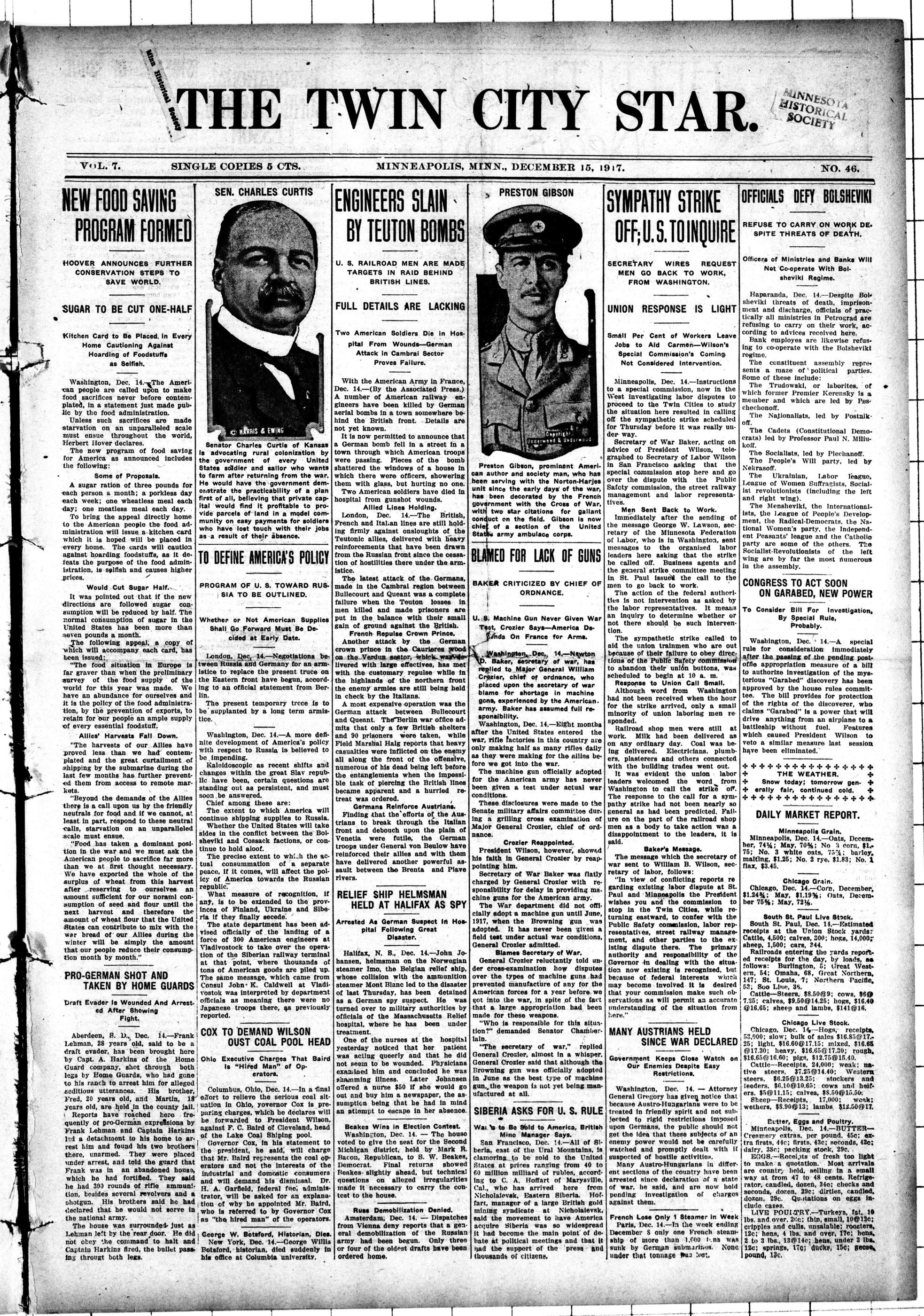
Senator Charles Curtis of Kansas is advocating rural colonization by the government of every United States soldier and sailor who wants to farm after returning from the war. He would have the government demonstrate the practicability of a plan first of all, believing that private capital would find it profitable to provide parcels of land in a model community on easy payments for soldiers who have lost touch with their jobs as a result of their absence.
TO DEFINE AMERICA'S POLICY
PROGRAM OF U. S. TOWARD RUS
SIA TO BE OUTLINED.
Whether or Not American Supplies
Shall Go Forward Must Be Decided at Early Date.
London, Dec. 14.—Negotiations between Russia and Germany for an armistice to replace the present truce on the Eastern front have begun, according to an official statement from Berlin.
The present temporary truce is to be supplanted by a long term armistice.
Washington, Dec. 14.—A more definite development of America's policy with respect to Russia is believed to be impending.
Kaleidoscopic as recent shifts and changes within the great Slav republic have been, certain questions are standing out as persistent, and must soon be answered.
Chief among these are:
The extent to which America will continue shipping supplies to Russia.
The extent to which America will continue shipping supplies to Russia. Whether the United States will take sides in the conflict between the Bolshevki and Cossack factions, or continue to hold aloof.
The precise extent to which the actual consummation of a separate peace, if it comes, will affect the policy of America towards the Russian republic.
What measure of recognition, if any, is to be extended to the provinces of Finland, Ukraine and Siberia if they finally secede.
The state department has been advised officially of the landing of a force of 300 American engineers at Vladivostock to take over the operation of the Siberian railway terminal at that point, where thousands of tons of American goods are piled up. The same message, which came from Consul John·K. Caldwell at Vladivostok was interpreted by department officials as meaning there were no Japanese troops there, as previously reported.
COX TO DEMAND WILSON OUST COAL POOL HEAD
Ohio Executive Charges That Baird is "Hired Man" of Operators.
Columbus, Ohio, Dec. 14.—In a final effort to relieve the serious coal situation in Ohio, governor Cox is preparing charges, which he declares will be forwarded to President Wilson, against F. C. Baird of Cleveland, head of the Lake Coal Shipping pool.
Governor Cox, in his statement to the president, he said, will charge that Mr. Baird represents the coal operators and not the interests of the industrial and domestic consumers and will demand his dismissal. Dr. H. A. Garfield, federal fue; administrator, will be asked for an explanation of why he appointed Mr. Baird, who is referred to by Governor Cox as "the hired man" of the operators.
George W. Botsford, Historian, Dies.
New York, Dec. 14.—George Willis Botsford, historian, died suddenly in his office at Columbia university.
MINNEAPOLIS, MINN., DECEMBER 15, 1917.
ENGINEERS SLAIN BY TEUTON BOMBS
ENGINEERS SLAIN BY TEUTON BOMBS
U. S. RAILROAD MEN ARE MADE TARGETS IN RAID BEHIND BRITISH LINES.
FULL DETAILS ARE LACKING
Two American Soldiers Die in Hospital From Wounds—German Attack in Cambrai Sector Proves Failure.
With the American Army in France, Dec. 14.—(By the Associated Press.) A number of American railway engineers have been killed by German aerial bombs in a town somewhere behind the British front. Details are not yet known.
It is now permitted to announce that a German bomb fell in a street in a town through which American troops were passing. Pieces of the bomb shattered the windows of a house in which there were officers, showering them with glass, but hurting no one. Two American soldiers have died in
Two American soldiers have died in hospital from gunshot wounds.
Allied Lines Holding.
London, Dec. 14.—The British, French and Italian lines are still holding firmly against onsloughts of the Teutonic allies, delivered with heavy reinforcements that have been drawn from the Russian front since the cessation of hostilities there under the armistice.
The latest attack of the Germans, made in the Cambral region between Bellecourt and Queant was a complete failure when the Teuton losses in men killed and made prisoners are put in the balance with their small gain of ground against the British.
French Repulse Crown Prince.
Another attack by the German crown prince in the Carriers wood on the Verdun sector, which was delivered with large effects, has met with the customary repulse while in the highlands of the northern front the enemy armies are still being held in check by the Italians.
A most expensive operation was the German attack between Bullecourt and Queant. The Berlin war office admits that only a few British shelters and 90 prisoners were taken, while Field Marshal Haig reports that heavy casualties were inflicted on the enemy all along the front of the offensive, numerous of his dead being left before the entanglements when the impossible task of piercing the British lines became apparent and a hurried retreat was ordered.
Germans Reinforce Austrians.
Finding that the efforts of the Austrians to break through the Italian front and debouch upon the plain of Venetia were futile, the German troops under General von Beulow have reinforced their allies and with them have delivered another powerful assault between the Brenta and Plave rivers.
RELIEF SHIP HELMSMAN
HELD AT HALIFAX AS SPY
Arrested As German Suspect In Hospital Following Great Disaster.
Halifax, N. S., Dec. 14.—John Johansen, helmsman on the Norwegian steamer Imo, the Belgian relief ship, whose collision with the ammunition steamer Mont Blanc led to the disaster of last Thursday, has been detained as a German spy suspect. He was turned over to military authorities by officials of the Massachusetts Relief hospital, where he has been under treatment.
One of the nurses at the hospital yesterday noticed that her patient was acting querely and that he did not seem to be wounded. Physicians examined him and concluded he was shamming illness. Later Johansen offered a nurse $50 if she would go out and buy him a newspaper, the assumption being that he had in mind an attempt to escape in her absence.
Beakes Wins in Election Contest.
Washington, Dec. 14. — The house voted to give the seat for the Second Michigan district, held by Mark R. Bacon, Republican, to S. W. Beakes, Democrat. Final returns showed Beakes slightly ahead, but technical questions on alleged irregularities made it necessary to carry the contest to the house.
Russ Demobilization Denied.
Amsterdam; Dec. 14. — Dispatches from Vienna deny reports that a general demobilization of the Russian army had been begun. Only three or four of the oldest drafts have been ordered home.
Copyright
Underwood & Underwood
Preston Gibson, prominent American author and society man, who has been serving with the Norton-Harjes unit since the early days of the war, has been decorated by the French government with the Cross of War, with two star citations for gallant conduct on the field. Gibson is now chief of a section of the United States army ambulance corps.
BLAMED FOR LACK OF GUNS
BAKER CRITICIZED BY CHIEF OF ORDNANCE.
U. S. Machine Gun Never Given War Test, Crozier Says—America Defends On France for Arms.
Washington, Dec. 14.—Newton D. Baker, secretary of war, has replied to Major General William Crozier, chief of ordnance, who placed upon the secretary of war blame for shortage in machine gcs, experienced by the American army. Baker has assumed full responsibility.
Washington, Dec. 14.—Eight months after the United States entered the war, rifle factories in this country are only making half as many rifles daily as they were making for the allies before we got into the war.
The machine gun officially adopted for the American army has never been given a test under actual war conditions.
These disclosures were made to the Senate military affairs committee during a grilling cross examination of Major General Crozier, chief of ordnance.
President Wilson, however, showed his faith in General Crozier by reappointing him.
Secretary of War Baker was flatly charged by General Crozier with responsibility for delay in providing machine guns for the American army.
The War department did not officially adopt a machine gun until June, 1917, when the Browning gun was adopted. It has never been given a field test under actual war conditions, General Crozier admitted.
Blames Secretary of War.
General Crozier reluctantly told under cross-examination how disputes over the types of machine guns had prevented manufacture of any for the American forces for a year before we got into the war, in spite of the fact that a large appropriation had been made for these weapons.
"Who is responsible for this situation?" demanded Senator Chamberlain.
"The secretary of war," replied General Crozier, almost in a whisper, General Crozier said that although the Browning gun was officially adopted in June as the best type of machine gun, the weapon is not yet being manufactured at all.
SIBERIA ASKS FOR U. S. RULE
Wail to Be Sold to America, British Mino Manager Says.
San Francisco, Dec. 14.—All of Siberia, east of the Ural Mountains, is clamoring to be sold to the United States at prices ranging from 40 to 60 million milliard of rubles, according to C. A. Hoffart of Marysville, Cal., who has arrived here from Nicholalevsk, Eastern Siberia. Hoffart, manager of a large British gold mining syndicate at Nicholalevsk, said the movement to have America acquire Siberia was so widespread it had become the main point of debate at political meetings and that it had the support of the press and thousands of citizens.
SYMPATHY STRIKE OFF;U.S.TO INQUIRE
SYMPATHY STRIKE OFF;U.S.TO INQUIRE
SECRETARY WIRES REQUEST MEN GO BACK TO WORK, FROM WASHINGTON.
Small Per Cent of Workers Leave Jobs to Ald Carmen—Wilson's Special Commission's Coming Not Considered Intervention.
Minneapolis, Dec. 14.—Instructions to a special commission, now in the West investigating labor disputes to proceed to the Twin Cities to study the situation here resulted in calling off the sympathetic strike scheduled for Thursday before it was really under way.
Secretary of War Baker, acting on advice of President Wilson, telegraphed to Secretary of Labor Wilson in San Francisco asking that the special commission stop here and go over the dispute with the Public Safety commission, the street railway management and labor representatives.
Men Sent Back to Work.
Immediately after the sending of the message George W. Lawson, secretary of the Minnesota Federation of Labor, who is in Washington, sent messages to the organized labor leaders here asking that the strike be called off. Business agents and the general strike committee meeting in St. Paul issued the call to the men to go back to work.
The action of the federal authorities is not intervention as asked by the labor representatives. It means an inquiry to determine whether or not there should be such intervention.
The sympathetic strike called to aid the union trainmen who are out because of their failure to obey directions of the Public Safety commission to abandon their union buttons, was scheduled to begin at 10 a.m. Response to Union Call Small.
Although word from Washington had not been received when the hour for the strike arrived, only a small minority of union laboring men responded.
Railroad shop men were still at work. Milk had been delivered as on any ordinary day. Coal was being delivered. Electricians, plumbers, plasterers and others connected with the building trades went out.
It was evident the union labor leaders welcomed the word from Washington to call the strike off.
The response to the call for a sympathy strike had not been nearly so general as had been predicted. Failure on the part of the railroad shop men as a body to take action was a disappointment to the leaders, it is said.
Baker's Message.
The message which the secretary of war sent to William B. Wilson, secretary of labor, follows:
"In view of conflicting reports regarding existing labor dispute at St. Paul and Minneapolis the President wishes you and the commission to stop in the Twin Cities, while returning eastward, to confer with the Public Safety commission, labor representatives, street railway management, and other parties to the existing dispute there. The primary authority and responsibility of the Governor in dealing with the situation now existing is recognized, but because of federal interests which may become involved it is desired that your commission make such observations as will permit an accurate understanding of the situation from here."
MANY AUSTRIANS HELD
SINCE WAR DECLARED
Government Keeps Close Watch on Our Enemies Despite Easy Restrictions.
Washington, Dec. 14. — Attorney General Gregory has given notice that because Austro-Hungarians were to be treated in friendly spirit and not subjected to rigid restrictions imposed upon Germans, the public should not get the idea that these subjects of an enemy power would not be carefully watched and promptly dealt with if suspected of hostile activities.
Many Austro-Hungarians in different sections of the country have been arrested since declaration of a state of war, he said, and are now held pending investigation of charges against them.
French Lose Only 1 Steamer in Week Paris, Dec. 14.—In the week ending December 8 only one French steamship of more than 1,000 tons was sunk by German submarines. None under that tonnage was lost.
NO. 46.
OFFICIALS DEFY BOLSHEVIKI
REFUSE TO CARRY ON WORK DE-
SPITE THREATS OF DEATH.
Officers of Ministries and Banks Will Not Co-operate With Bolshevik Regime.
Haparanda, Dec. 14.—Despite Bolshevik threats of death, imprisonment and discharge, officials of practically all ministries in Petrograd are refusing to carry on their work, according to advices received here.
Bank employees are likewise refusing to co-operate with the Bolshevik regime.
The constituent assembly represents a maze of political parties. Some of these include:
The Trudowski, or laborites, of which former Premier Kerensky is a member and which are led by Peschechonoff.
The Nationalists, led by Postnikoff.
The Cadets (Constitutional Democrats) led by Professor Paul N. Milluikoff.
The Socialists, led by Plechanoff.
The People's Will party, led by Nekrasoff.
The Urkalnian, Labor league, League of Women Suffragists, Socialist revolutionists (including the left and right wing).
The Menshevik, the Internationalists, the League of People's Development, the Radical-Democrats, the National Women's party, the Independent Peasants' league and the Catholic party are some of the others. The Socialist-Revolutionists of the left wing are by far the most numerous in the assembly.
CONGRESS TO ACT SOON ON GARABED, NEW POWER
To Consider Bill For Investigation,
By Special Rule,
Probably.
Washington, Dec. 14.—A special rule for consideration immediately after the passing of the pending post-offie appropriation measure of a bill to authorize investigation of the mysterious "Garabed" discovery has been approved by the house rules committee. The bill provides for protection of the rights of the discoverer, who claims "Garabed" is a power that will drive anything from an airplane to a battleship without fuel. Features which caused President Wilson to veto a similar measure last session have been eliminated.
THE WEATHER.
Snow today; tomorrow gen-erally fair, continued cold.
DAILY MARKET REPORT.
Minneapolis, Dec. 14.—Oats, December, 74%; May, 70%; No 3 corn, $1.75; No. 3 white oats, 75%; barley, maltting, $1.25; No. 2 rye, $1.83; No. 1 flax, $3.45.
Chicago, Dec. 14—Corn, December,
$1.24 \% ; May, $1.19 \% ; Oats, December
75 \% ; May, 72 \% .
South St. Paul Live Stock.
South St. Paul, Dec. 14.—Estimated receipts at the Union Stock yards: Cattle, 4,500; calves, 200; hogs, 14,000; sheep, 1,500; cars, 244.
Railroads entering the yards reported receipts for the day, by loads, as follows: Burlington, 5; Great Western, 54; Omaha, 68; Great Northern, 147; St. Louis, 7; Northern Pacific, 53; Soo Lue, 35.
Cattle—Steers, $8.50@9; cows, $6@7.25; calves, $9.50@14.25; hogs, $16.40@16.15; sheep and sheep, $141@16.1
Chicago Live Stock
Chicago, Dec. 14.—Hogs, receipts, 53,000; slow; bulk of sales $16.55@17-25; light, $16.60@17.15; mixed, $16.65@17.30; heavy, $16.65@17.30; rough, $16.65@16.60; pigs, $12.75@15.40.
Cattle—Receipts, 24,000; weak; native steers, $7.25@14.40; Western steers, $6.25@13.25; stockers and feeders, $6.10@10.65; cows and heifers, $15.11@5; calves, $8.50@15.50.
Sheep—Receipts, 17,000; weak; wethers, $8.90@13; lambs $12.50@17.
Butter, Eggs and Poultry.
Minneapolis, Dec. 14.—BUTTER—Creamery extras, per pound, 45c; extra firsts, 44c; firsts, 43c; seconds, 42c; dairy, 32c; pecking stock, 29c.
EGGS.—Receipts of fresh too light to make a quotation. Most arrivals are country, held, selling in a small way at from 47 to 48 cents. Refrigerator, canled, dozen, 34c; checks and seconds, dozen, 29c; dirties, candled, dozen, 29c. Quotations on eggs included cases.
LIVE POULTRY.—Turkeys, fat, 10 lbs. and over, 21c; thin, small, 10@12c; cripples and culls, unsalable; roosters, 12c; hens, 4 lbs. and over, 17c; hens, 2 to 3 lbs, 12c@14; hens, under 3 lbs, 12c; springs, 17c; ducks, 15c; geese, pound, 13c.
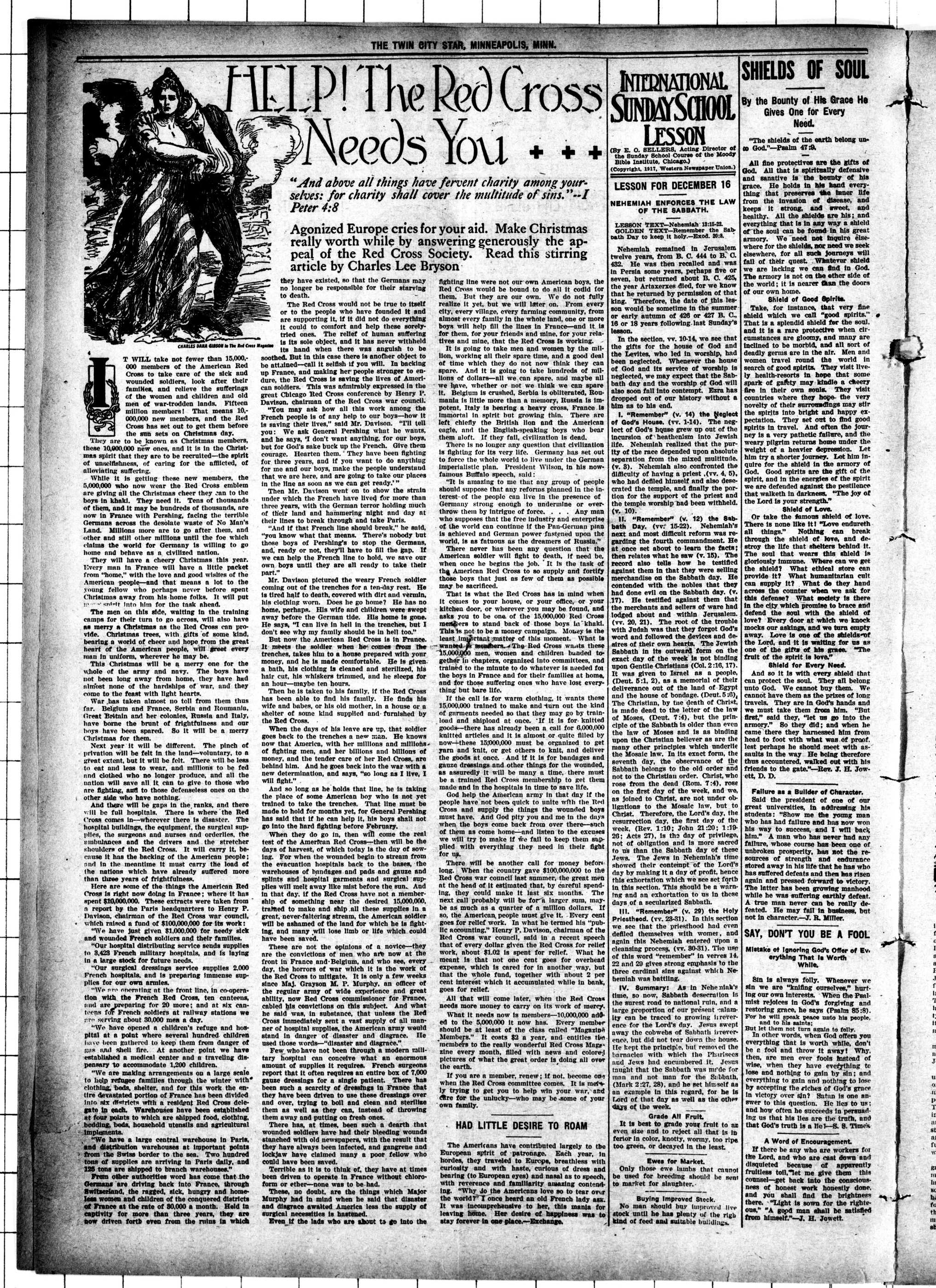
HELP! The Red Cross Needs You +++
CHARLES DANA GIBSON in The Red Cross Magazine
I
T WILL take not fewer than 15,000-000 members of the American Red Cross to take care of the sick and wounded soldiers, look after their families, and relieve the sufferings of the women and children and old men of war-trodden lands. Fifteen million members! That means 10,000,000 new members, and the Red Cross has set out to get them before the sun sets on Christmas day. They are to be known as Christmas members, these 10,000,000 new ones, and it is in the Christmas spirit that they are to be recruited—the spirit of unselfishness, of caring for the afflicted, of alleviating suffering.
While it is getting these new members, the 5,000,000 who now wear the Red Cross emblem are giving all the Christmas cheer they can to the boys in khaki. They need it. Tens of thousands of them, and it may be hundreds of thousands, are now in France with Pershing, facing the terrible Germans across the desolate waste of No Man's Land. Millions more are to go after them, and other and still other millions until the foe which claims the world for Germany is willing to go home and behave as a civilized nation.
They will have a cheery Christmas this year. Every man in France will have a little packet from "home," with the love and good wishes of the American people—and that means a lot to the young fellow who perhaps never before spent Christmas away from his home folks. It will put more spirit into him for the task ahead.
The men on this side, waiting in the training camps for their turn to go across, will also have as merry a Christmas as the Red Cross can provide. Christmas trees, with gifts of some kind, bearing a world of cheer and hope from the great heart of the American people, will greet every man in uniform, wherever he may be.
This Christmas will be a merry one for the whole of the army and navy. The boys have not been long away from home, they have had almost none of the hardships of war, and they come to the feast with light hearts.
War has taken almost no toll from them thus far. Belgium and France, Serbia and Roumania, Great Britain and her colonies, Russia and Italy, have borne the brunt of frightfulness and our boys have been spared. So it will be a merry Christmas for them.
Next year it will be different. The pinch of privation will be felt in the land—voluntary, to a great extent, but it will be felt. There will be less to eat and less to wear, and millions to be fed and clothed who no longer produce, and all the nation will save all it can to give to those who are fighting, and to those defenseless ones on the other side who have nothing.
And there will be gaps in the ranks, and there will be full hospitals. There is where the Red Cross comes in—wherever there is disaster. The hospital buildings, the equipment, the surgical supplies, the surgeons and nurses and orderlies, the ambulances and the drivers and the stretcher shoulders of the Red Cross. It will carry it, because it has the backing of the American people; and in the meantime it must carry the load of the nations which have already suffered more than three years of frightfulness.
Here are some of the things the American Red Cross is right now doing in France; where it has spent $10,000,000. These extracts were taken from a report by the Paris headquarters to Henry P. Davison, chairman of the Red Cross war council, which raised a fund of $100,000,000 for its work: "We have just given $1,000,000 for needy sick and wounded French soldiers and their families. "Our hospital distributing service sends supplies to 3,423 French military hospitals, and is laying in a large stock for future needs. "Our surgical dressings service supplies 2,000 French hospitals, and is preparing immense supplies for our own armies. "We are operating at the front line, in co-operation with the French Red Cross, ten canteens, and are preparing for 20 more; and at six canteens of French soldiers at railway stations we are serving about 30,000 men a day.
"We have opened a children's refuge and hospital at a point where several hundred children have been gathered to keep them from danger of gas and shell fire. At another point we have established a medical center and a travelling dispensary to accommodate 1,200 children.
"We are making arrangements on a large scale to help refuge families through the winter with clothing, beds, shelter, and for this work the entire devastated portion of France has been divided into six districts with a resident Red Cross delegate in each. Warehouses have been established at four points to which are shipped food, clothing, bedding, beds, household utensils and agricultural implements.
"We have a large central warehouse in Paris, and distribution warehouses at important points from the Swiss border to the sea. Two hundred tons of supplies are arriving in Paris daily, and 125 tons are shipped to branch warehouses."
From other authorities word has come that the Germans are driving back into France, through Switzerland, the ragged, sick, hungry and homeless women and children of the conquered districts of France at the rate of 30,000 a month. Held in captivity for more than three years, they are now driven forth even from the ruins in which
THE TWIN CITY STAR, MINNEAPOLIS, MINN.
ELP! The Needs
"And above all things have selves: for charity shall c Peter 4:8
Agonized Europe cries for really worth while by an peal of the Red Cross article by Charles Lee B
"And above all things have fervent charity among yourselves: for charity shall cover the multitude of sins."--I Peter 4:8
Agonized Europe cries for your aid. Make Christmas really worth while by answering generously the appeal of the Red Cross Society. Read this stirring article by Charles Lee Bryson they have existed, so that the Germans may no longer be responsible for their starving to death.
The Red Cross would not be true to itself or to the people who have founded it and are supporting it, if it did not do everything it could to comfort and help these sorely-tried ones. The relief of human suffering is its sole object, and it has never withheld its hand when there was anguish to be fighting line were not our own American boys Red Cross would be bound to do all it could them. But they are our own. We do not realize it yet, but we will later on. From a city, every village, every farming community, almost every family in the whole land, one or a boys will help fill the lines in France—and for them, for your friends and mine, for your lives and mine, that the Red Cross is working it is going to take men and women by the
soothed. But in this case there is another object to be attained—call it selfish if you will. In backing up France, and making her people stronger to endure, the Red Cross is saving the lives of American soldiers. This was admirably expressed in the great Chicago Red Cross conference by Henry P. Davison, chairman of the Red Cross war council. "You may ask how all this work among the French people is of any help to our boys—how it is saving their lives," said Mr. Davison. "Till (tell you: We ask General Pershing what he wants, and he says, I don't want anything, for our boys, but for God's sake buck up the French. Give them courage. Hearten them. They have been fighting for three years, and if you want to do anything for me and our boys, make the people understand that we are here, and are going to take our places in the line as soon as we can get ready." Then Mr. Davison went on to show the strain under which the French have lived for more than three years, with the German terror holding much of their land and hammering night and day at their lines to break through and take Paris.
"And if that French line should break," he said, "you know what that means. There's nobody but those boys of Pershing's to stop the Germans, and, ready or not, they'll have to fill the gap. If we can help the French line to hold, we save our own boys until they are all ready to take their part."
Mr. Davison pictured the weary French soldier coming out of the trenches for a ten-day rest. He is tired half to death, covered with dirt and vermin, his clothing worn. Does he go home? He has no home, perhaps. His wife and children were swept away before the German tide. His home is gone. He says, "I can live in hell in the trenches, but I don't see why my family should be in hell too."
But now the American Red Cross is in France. It meets the soldier when he comes from the trenches, takes him to a house prepared with your money, and he is made comfortable. He is given a bath, his clothing is cleaned and sterilized, his hair cut, his whiskers trimmed, and he sleeps for an hour—maybe ten hours.
Then he is taken to his family, if the Red Cross has been able to find his family. He finds his wife and babes, or his old mother, in a house or a shelter of some kind supplied and furnished by the Red Cross.
When the days of his leave are up, that soldier goes back to the trenches a new man. He knows now that America, with her millions and millions of fighting men, and her billions and billions of money, and the tender care of her Red Cross, are behind him. And he goes back into the war with a new determination, and says, "so long as I live, I will fight."
And so long as he holds that line, he is taking the place of some American boy who is not yet trained to take the trenches. That line must be made to hold for months yet, for General Pershing has said that if he can help it, his boys shall not go into the hard fighting before February.
When they do go in, then will come the real test of the American Red Cross—then will be the days of harvest, of which today is the day of sowing. For when the wounded begin to stream from the evacuation hospitals back to the bases, the warehouses of bandages and pads and gauze and splints and hospital garments and surgical supplies will melt away like mist before the sun. And in that day, if the Red Cross have not a membership of something near the desired 15,000,000, trained to make and ship all these supplies in a great, never-faltering stream, the American soldier will be ashamed of the land for which he is fighting, and many will lose limb or life which could have been saved.
These are not the opinions of a novice—they are the convictions of men who are now at the front in France and Belgium, and who see, every day, the horrors of war which it is the work of the Red Cross to mitigate. It is only a few weeks since Maj. Grayson M. P. Murphy, an officer of the regular army of wide experience and great ability, now Red Cross commissioner for France, cabled his convictions on this subject. And what he said was, in substance, that unless the Red Cross immediately sent a vast supply of all manner of hospital supplies, the American army would stand in danger of disaster and disgrace. He used those words—"disaster and disgrace.
Few who have not been through a modern military hospital can conceive what an enormous amount of supplies it requires. French surgeons report that it often requires an entire box of 7,000 gauze dressings for a single patient. There has been such a scarcity of dressings in France that they have been driven to use these dressings over and over, trying to boll and clean and sterilize them as well as they can, instead of throwing them away and putting on fresh ones.
There has, at times, been such a dearth that wounded soldiers have had their bleeding wounds stanched with old newspapers, with the result that they have always been infected, and gangrene and lockjaw have claimed many a poor fellow who could have been saved.
Terrible as it is to think of, they have at times been driven to operate in France without chloroform or ether—none was to be had.
These, no doubt, are the things which Major Murphy had in mind when he said that disaster and disgrace awaited America less the supply of surgical necessities is hastened.
Even if the lads who are about to go into the
Red Cross You +++
the fervent charity among your- over the multitude of sins."--I
for your aid. Make Christmas answering generously the ap- Society. Read this stirring yson
fighting line were not our own American boys, the Red Cross would be bound to do all it could for them. But they are our own. We do not fully realize it yet, but we will later on. From every city, every village, every farming community, from almost every family in the whole land, one or more boys will help fill the lines in France—and it is for them, for your friends and mine, for your relatives and mine, that the Red Cross is working. It is going to take men and women by the million, working all their spare time, and a good deal of time which they do not now think they can spare. And it is going to take hundreds of millions of dollars—all we can spare, and maybe all we have, whether or not we think we can spare it. Belgium is crushed, Serbia is obliterated, Roumania is little more than a memory, Russia is impotent, Italy is bearing a heavy cross, France is immortal in spirit but growing thin. There are left chiefly the British lion and the American eagle, and the English-speaking boys who bear them aloft. If they fall, civilization is dead.
There is no longer any question that civilization is fighting for its very life. Germany has set out to force the whole world to live under the German imperialistic plan. President Wilson, in his now-famous Buffalo speech, said:
"It is amazing to me that any group of people should suppose that any reforms planned in the interest-of the people can live in the presence of Germany strong enough to undermine or overthrow them by intrigue of force. . . . Any man who supposes that the free industry and enterprise of the world can continue if the Pan-German plan is achieved and German power fastened upon the world, is as fatuous as the dreamers of Russia."
There never has been any question that the American soldier will fight to death, if need be, when once he begins the job. It is the task of the American Red Cross to so supply and fortify those boys that just as few of them as possible may be sacrificed.
That is what the Red Cross has in mind when it comes to your house, or your office, or your kitchen door, or wherever you may be found, and asks you to be one of the 15,000,000 Red Cross members to stand back of those boys in khaki. This is not to be a money campaign. Money is the least important matter of this moment. What is wanted is members. The Red Cross wants these 15,000,000 men, women and children bunded together in chapters, organized into committees, and trained to the minute to do whatever is needed for the boys in France and for their families at home, and for those suffering ones who have lost everything but bare life.
If the call is for warm clothing, it wants these 15,000,000 trained to make and turn out the kind of garments needed so that they may go by trainload and shipload at once. If it is for knitted goods—there has already been a call for 6,000,000 knitted articles and it is almost or quite filled by now—these 15,000,000 must be organized to get yarn and knit, or get others to knit, and deliver the goods at once. And if it is for bandages and gauze dressings and other things for the wounded, as assuredly it will be many a time, there must be a trained Red Cross membership to get them made and in the hospitals in time to save life.
God help the American army in that day if the people have not been quick to unite with the Red Cross and supply the things the wounded boys must have. And God pity you and me in the days when the boys come back from over there—such of them as come home—and listen to the excuses we will try to make if we fall to keep them supplied with everything they need in their fight for us.
There will be another call for money before long. When the country gave $100,000,000 to the Red Cross war council last summer, the great men at the head of it estimated that, by careful spending, they could make it last six months. The next call probably will be for a larger sum, may be as much as a quarter of a million dollars. If so, the American people must give it. Every cent goes for relief work. In what he termed his "public accounting," Henry P. Davison, chairman of the Red Cross war council, said in a recent speech that of every dollar given the Red Cross for relief work, about $1.02 is spent for relief. What he meant is that not one cent goes for overhead expense, which is cared for in another way, but that the whole fund, together with about 2 per cent interest which it accumulated while in bank, goes for relief.
All that will come later, when the Red Cross needs more money to carry on its work of mercy.
What it needs now is members—10,000,000 added to the 5,000,000 it now has. Every member should be at least of the class called "Magazine Members." It costs $2 a year, and entitles the members to the really wonderful Red Cross Magazine every month, filled with news and colored pictures of what the great order is doing all over the earth.
If you are a member, renew; if not, become one when the Red Cross committee comes. It is merely trying to get you to help win your war, and care for the unlucky—who may be some of your own family.
HAD LITTLE DESIRE TO ROAM
The Americans have contributed largely to the European spirit of patronage. Each year, in hordes, they traveled to Europe, breathless with curiosity and with haste, curious of dress and bearing (to European eyes) and nasal as to speech, with reverence and familiarity amazing contending. "Why do the Americans love so to tear over the world?" I once heard an old French lady ask. It was incomprehensive to her, this mania for leaving home. Her desire of happiness was to stay forever in one place.—Exchange.
INTERNATIONAL
SUNDAY SCHOOL
(By E. O. SELLERS, Acting Director of the Sunday School Course of the Moody Bible Institute, Chicago.)
(Copyright 1917, Western Newspaper Union.)
LESSON FOR DECEMBER 16
NEHEMIAH ENFORCES THE LAW OF THE SABBATH.
LESSON TEXT-Nehemlah 13:15-22.
GOLDEN TEXT-Remember the Sabbath Day to keep it holy—Exod. 20:8.
Nehemlah remained in Jerusalem twelve years, from B. C. 444 to B. C. 432. He was then recalled and was in Persia some years, perhaps five or seven, but returned about B. C. 425, the year Artaxerxes died, for we know that he returned by permission of that king. Therefore, the date of this lesson would be sometime in the summer or early autumn of 426 or 427 B. C., 16 or 18 years following last Sunday's lesson.
In the section, vv. 10-14, we see that the gifts for the house of God and the Levites, who led in worship, had been neglected. Whenever the house of God and its service of worship is neglected, we may expect that the Sabbath day and the worship of God will also soon fall into contempt. Ezra has dropped out of our history without a him as to his end.
I. "Remember" (v. 14) the Neglect of God's House. (vv. 1-14). The neglect of God's house grew up out of the incursion of heathenism into Jewish life. Nehemiah realized that the purity of the race depended upon absolute separation from the mixed multitude. (v. 3). Nehemiah also confronted the difficulty of having a priest. (vv. 4, 5), who had defiled himself and also desecrated the temple, and finally the portion for the support of the priest and the temple worship had been withheld. (v. 10).
II. "Remember" (v. 12) the Sabbath Day. (vv. 15-22). Nehemlah's next and most difficult reform was regarding the fourth commandment. He at once set about to learn the facts; then relates what he saw (v. 15). The record also tells how he testified against them in that they were selling merchandise on the Sabbath day. He contended with the nobles that they had done evil on the Sabbath day. (v. 17). He testified against them that the merchants and sellers of ware had lodged about and within Jerusalem. (vv. 20, 21). The root of the trouble with Judah was that they forgot God's word and followed the devices and desires of their own heart. The Jewish Sabbath in its outward form on the exact day of the week is not binding upon Gentile Christians (Col. 2:16, 17). It was given to Israel as a people. (Deut. 5:1, 2), as a memorial of their deliverance out of the land of Egypt and the house of bondage. (Deut. 5:0). The Christian, by the death of Christ, is made dead to the letter of the law of Moses. (Deut. 7:4), but the principle of the Sabbath is older than even the law of Moses and is as binding upon the Christian believer as are the many other principles which underlie the Mosale law. In its exact form, the seventh day, the observance of the Sabbath belongs to the old order and not to the Christian order. Christ, who rose from the dead (Rom. 7:4), rose on the first day of the week, and we, as joined to Christ, are not under obligations to the Mosale law, but to Christ. Therefore, the Lord's day, the resurrection day, the first day of the week. (Rev. 1:10; John 21:20; 1:19; Acts 27), is the day of privilege, not of obligation, and is more sacred to us than the Sabbath day of these Jews. The Jews in Nehemlah's time showed their contempt of the Lord's day by making it a day of profit, hence this exhortation which we see set forth in this section. This should be a warning and an exhortation to us in these days of a secularized Sabbath.
III. "Remember" (v. 29) the Holy Priesthood. (vv. 23-31). In this section we see that the priesthood had even defiled themselves with woman, and again this Nehemiah entered upon a cleansing process. (vv. 30-31). The use of this word "remember" in verses 14, 22 and 29 gives strong emphasis to the three cardinal sins against which Nehemiah was battling.
IV. Summary: As in Nehemiah's time, so now, Sabbath desecration is the surest road to national ruin, and a large proportion of our present calamity can be traced to growing irreverence for the Lord's day. Jesus swept away the cobwebs of Sabbath irreverence, but did not tear down the house. He kept the principle, but removed the barnacles with which the Pharisees and Jews had encumbered it. Jesus taught that the Sabbath was made for man and not man for the Sabbath, (Mark 2:27, 28), and he set himself as an example in this regard, for he is Lord of that day as well as the other days of the week.
Grade All Fruit.
It is best to grade your fruit to an even size and to reject all that is inferior in color, knotty, wormy, too ripie too green, or decayed in the least.
Ewes for Market.
Only those ewe limbs that cannot be used for breeding should be sent to market for slaughter.
Buying Improved Stock.
No man should buy improved live stock until he has plenty of the right kind of feed and suitable buildings.
By the Bounty of His Grace He Gives One for Every
"The shields of the earth belong unto God."—Psalm 47:9.
All fine protectives are the gifts of God. All that is spiritually defensive and sanative is the bounty of his grace. He holds in his hand everything that preserves the inner life from the invasion of disease, and keeps it strong, and sweet, and healthy. All the shields are his; and everything that is in any way a shield of the soul can be found in his great armory. We need not inquire elsewhere for the shields, nor need we seek elsewhere, for all such journeys will fall of their quest. Whatever shield we are lacking we can find in God. The armory is not on the ether side of the world; it is nearer than the doors of our own home.
Shield of Good Spirits.
Take, for instance, that very fine shield which we call "good spirits." That is a splendid shield for the soul, and it is a rare protective when circumstances are gloomy, and many are inclined to be morbid, and all sort of deadly germs are in the air. Men and women travel round the world in search of good spirits. They visit lively health-resorts in hope that some spark of safety may kindle a cheery fire in their own souls. They visit countries where they hope, the very novelty of their surroundings may stir the spirits into bright and happy expectation. They set out to find good spirits in travel. And often the journey is a very pathetic failure, and the weary pilgrim returns home under the weight of a heavier depression. Let him try a shorter journey. Let him inquire for the shield in the armory of God. Good spirits are the gift of the spirit, and in the energies of the spirit we are defended against the pestilence that walketh in darkness. "The joy of the Lord is your strength."
Shield of Love.
Or take the famous shield of love. There is none like it! "Love endureth all things." Nothing can break through the shield of love, and destroy the life that shelters behind it. The soul that wears this shield is gloriously immune. Where can we get the shield? What ethical store can provide it? What humanitarian cult can supply it? What do they hand across the counter when we ask for this defense? What society is there in the city which promise to brace and defend the soul with the shield of love? Every door at which we knock mocks our askings, and we turn empty away. Love is one of the shields-of the Lord, and it is waiting for us as one of the gifts of his grace. "The fruit of the spirit is love."
Shield for Every Need.
And so it is with every shield that can protect the soul. They all belong unto God. We cannot buy them. We cannot have them as the prizes of long travels. They are in God's hands and we must take them from him. "But first," said they, "let us go into the armory." So they did; and when he came there they harnessed him from head to foot with what was of proof. lest perhaps he should meet with assaults in the way. He being therefore thus accounted, walked out with his friends to the gate."—Rev. J. H. Jowett, D. D.
Failure as a Builder of Character.
Failure as a Builder of Character.
Said the president of one of our great universities, in addressing his students: "Show me the young man who has had failure and has now won his way to success, and I will back him." A man who has never had any failure, whose course has been one of unbroken prosperity, has not the resources of strength and endurance stored away in his life that he has who has suffered defeats and then has risen again and pressed forward to victory.
The latter has been growing manhood while he was suffering earthly defeat.
A true man never can be really defeated. He may fall in business, but not in character. J. R. Miller.
SAY, DON'T YOU BE A FOOL
Mistake of ignoring God's Offer of Everything That Is Worth While.
Sin is always folly. Whenever we sin we are "knifing ourselves," hurting our own interests. When the Psalmist rejoices in God's forgiving and restoring grace, he says (Psalm 85:8): For he will speak peace unto his people, and to his saints;
But let them not turn again to folly.
In other words, when God offers you everything that is worth white, don't be a fool and throw it away! Why, then, are men ever fools instead of wise, when they have everything to lose and nothing to gain by sin; and everything to gain and nothing to lose by accepting the riches of God's grace in victory over sin? Satan is one answer to this question. He lies to us; and how often he succeeds in persuading us that his lies are the truth, and that God's truth is a lie! - S. T. Times.
A Word of Encouragement.
If there be any who are workers for the Lord, and who are cast down and disquieted because of apparently fruitless toll, tell me give them this counsel—get back into the consciousness of honest work honestly done, and you shall find the brightness there. "Light is sown for the righteous," "A good man shall be satisfied from himself."—J. H. Jowett.
The Lucky
Horseshoe
By George Elmer Cobb
(Copyright, 1817, Western Newpaper Union.)
"Please, Mr. Bangs, I've got a present for you, and I cleaned it and polished it all up, and Sister Marie laughed at me, because she said it was hardly good enough for you, but she put it in tissue paper, and tied that pretty piece of ribbon around it, and—many happy returns of the day."
Breatheless but ardent, spelling out a lesson palpably acquired by rote—thus little Benny Driscoll. He stood by the wagon that Joe Bangs was driving, and the latter beamed down on him from that jolly rotund face of his, half sentimentally interested, for Bennie was one of his many juvenile favorites, and Benny's sister—quite recently his great weather-beaten hands touched the soft silky bit of ribbon which the delicate fingers of Marie Driscoll had adjusted.
"And how did you know it was my birthday, Benny?" quizzed Joe.
"Sister remembered it," and Joe experienced a quick thrill of delight at this manifestation of interest on the part of the lovely idol he had always worshiped at a distance.
"It isn't much of a present, Mr. Bangs," went on Benny soberly, "but it's all I had."
"What may it be now, Benny?" questioned Joe, balancing the concealed object in his hands and noting that it weighed several pounds.
"It's a horsehoe, Mr. Bangs," explained Benny. "Sister found it in the road. It's a whopper, too. Guess it belonged to one of those big mill horses. You see, I know you like to pitch quoits with horseshoes, so I just made a present of it see. That's all."
"And a great big 'all', Benny, and it's a famous gift, and I appreciate it," and Joe stowed the unexpected present behind the wagon-seat, stretched out his hand to stroke the sunny head of his donor and went on his way all smiles and satisfaction.
There never was such a splendid "big brother" to the minds of the village urchins as Joe Bangs. He was always giving them a lift in his wagon, letting them drive old Dobbin, bring-
A man in a suit and hat carries a briefcase as he walks along a riverbank.
Took in His Surroundings Closely. ing them some little toy or knick-knack from his journeys, making them kites, or play boats, or soldier caps and guns. He had saved Benny from drowning and the little fellow remembered it, and Joe wds his ideal of a hero. As to Benny's wondrously lovely sister, when Joe had undone the gift parcel he carefully stowed the bit of ribbon in an inner pocket as a cherished memento. Then when he reached home he got a ladder and nailed the horseshoe twenty feet up above the front door, for it was too bulky and cumbersome to match his quoit set. "It may be my good luck in helping me to get better acquainted with Benny's sweet sister, Marile," whispered Joe fervently to himself.
Joe Bangs was an important and useful element in the business economy of the little town. Merton was twenty miles away from the railroad and depended on Butterville for supplies. Three days a week Joe drove to that interior city to bring to Merton freight and express and fill orders for local storekeepers. He was trusty, prompt and reliable, as well as always cheerful and accommodating, and everybody was his friend.
Little Benny came over to see a quolt game played with his present and was much disappointed to discover that it had been otherwise employed. Joe soon contented his juvenile favorite, however, by imparting to him the information that he valued too sincere the gift to have it tossed about in the mud like any common, every-day horse-shoe!
It was about a week after that when Joe received a very important commission from the local bank. He was to exchange five thousand dollars in bank notes for the same amount in gold at the Butterville bank. Joe had in the past been entrusted with even larger sums and there was not an lota of suspicion or doubt as to his fidelity and safety by his employers. Joe executed his various errands at Butterville before he went to the bank. The gold was packed in a piece of wire notting and then stowed in a heavy canvas satchel, and with this under his feet on the front seat started on his return journey.
It was late afternoon when Joe struck off across what was known as the swamp road. He had been made uneasy several times from noting that four suspicious looking men were aparently following him. They slunk from cover in his rear, galanced on him by a detour, and Joe made up his mind that they had some unaccountable knowledge of the treasure he carried and were after it.
He was less than five miles from home when he became assured of the fact that the men were closing in upon him. Looking back, he observed two of the men starting on a run in his direction. Viewing the road ahead, Joe noticed the other two peering from a thicket.
"Til beat them!" he muttered resolutely, and suddenly turning the horse from the main road he dashed off along a mere trall, confusing and distancing his pursuers until the vehicle struck a rut and both hind wheels smashed into fragments.
All four of his would-be despollers were to be seen making for the wrecked cart, and at break-neck speed. Joe jumped from the vehicle, seized the satchel and darted down an obscure footpath. His heavy burden impeded rapid progress, however. Joe noted that two of the men had circled about to head him off. He made a desperate resolve, took in his surroundings closely, gave the satchel a fling into the deep water at the side of the path and, unhampered now with the weight of the gold, made a run in the direction of home.
Joe had just cleared a cope of willows when a report rang out. He felt a cracking, tearing sensation inside of his head. The missile had struck a section of the skull, denting it without lacerating, but a strange numbness momentarily spread over him. Then a strange light-headedness succeeded. He fled like some wild being. He was white and breathless as he dashed into the yard of the home of his-married sister. "Quick, Lizzie!" he gasped, sinking to the doorstep, "telephone the bank and then the police. Tell them I was pursued by some thieves and—"
There Joe sank senseless. So they found him when two men from the bank and the marshal arrived, Joe roused up. He seemed none the worse for the escapade, the details of which he narrated with perfect coherence. At the point where he had thrown the satchel of gold into the water, however, he paused blankly, stumbled over his words, and when the banker anxiously inquired where was the spot, Joe shook his head in a dazed way with the words: "I can't remember."
Nor did he in the course of a week, or a month. Perfectly lucid on any other subject, the bullet that had grazed on his skull seemed to have knocked out the one important item of his adventure. The swamp was searched, Joe went over it with the bank people, but with no encouraging discoveries.
"We had no right to leave you to take the responsibility of all that money without a guard," the banker reproved himself. "If you ever locate it, Joe, you shall have half as a reward."
But this incentive had no result. There was a corner knocked away in the memory of the honest fellow and nothing could straighten it out.
Joe Bangs resumed his old business and was trusted and liked as of old. The doctors marvelled, but he was as clear-headed and sensible as ever except as to the hiding place of the gold.
For Joe one happy result of his adventure transpired. Pretty Marie Driscoll became his fiancée after a long courting. All that postponed the wedding was the fact that Joe's savings had not yet reached the amount he deemed necessary to start housekeeping.
One summer afternoon Joe was waiting for Marie, who was to ride over to Butlerville with him. The air was drowsy and Joe fell asleep waiting on a bench outside of the house. Marle appearing, stood gazing at her slumbering lover and had just picked up a loose pebble to playfully throw at him, when something came hurtling down from the top of the house. It was the old horseshoe. Time and weather had loosened its rusted nails. It landed directly on the head of Joe. He sprang to his feet with an echoing yell.
His hand sought the bump raised on his head. He rubbed it thoughtfully. He eyes noted the horseshoe at his feet. Then of a sudden, as if interpreting a vivid flash of memory, he shouted: "And I flung the satchel directly in a line with two crooked sumachs near a flat sock at the edge of the water!"
In fact, what the bullet had knocked out of Joe's brain the horseshoe had knocked in again—he remembered! The banker kept his promise when the long-hidden treasure was found and Marie kept hers, and there was a wedding, and the emblem of good luck the old horseshoe, with twined rose about it was conspicuous at the bride feast.
THE TWIN CITY STAR, MINNEAPOLIS, MINN.
What Well Dressed Women Will Wear
---
S
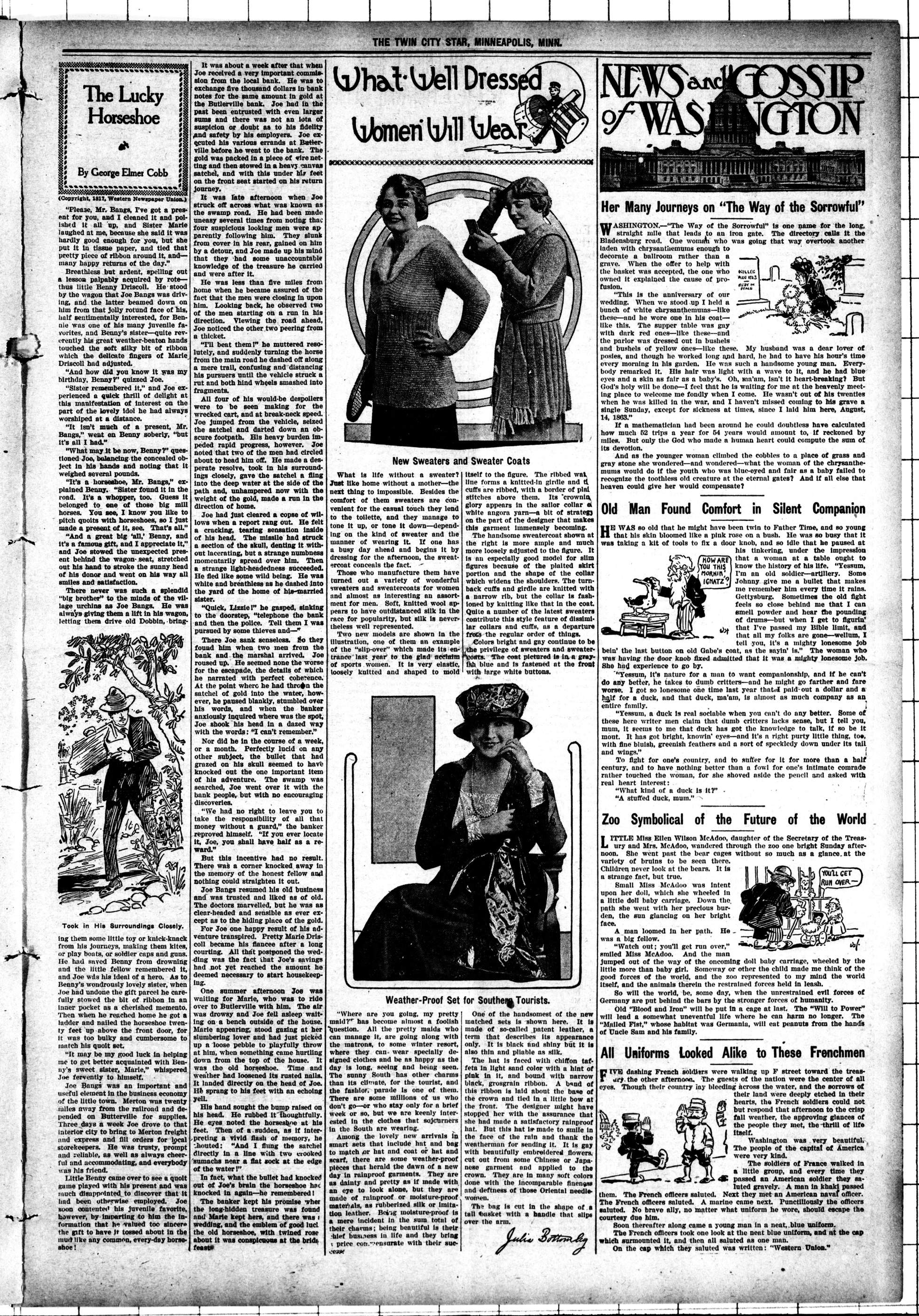
New Sweaters and Sweater Coats
What is life without a sweater? Just like home without a mother—the next thing to impossible. Besides the comfort of them sweaters are convenient for the casual touch they lend to the toilette, and they manage to tone it up, or tone it down—depending on the kind of sweater and the manner of wearing it. If one has a busy day ahead and begins it by dressing for the afternoon, the sweatcoat conceals the fact.
Those who manufacture them have turned out a variety of wonderful sweaters and sweatercoats for women and almost as interesting an assortment for men. Soft, knitted wool appears to have outdistanced silk in the race for popularity, but silk is nevertheless well represented.
itself to the figure. line forms a knitted cuffs are ribbed, wrist stitches above the glory appears in the white angora yarn on the part of the d this garment imminent.
The handsome sweat the right is more more loosely adjust is an especially go figures because of portion and the sl which widens the s back cuffs and gird a narrow rib, but lioned by knitting Quite a number of contribute this style collar collars and cu
Two new models are shown in the illustration, one of them an example of the "silp-over" which made its entrance last year to the glad acetum of sports women. It is very elastic, loosely knitted and shaped to mold
I
I
Weather-Proof Set for Southern Tourists.
"Where are you going, my pretty maid?" has become almost a foolish question. All the pretty maids who can manage it, are going along with the matrons, to some winter resort, where they can wear specially designed clothes and be as happy as the day is long, seeing and being seen. The sunny South has other charms than its climate, for the tourist, and the fashion, parade is one of them. There are some millions of us who don't go—or who stay only for a brief week or so, but we are keenly interested in the clothes that sojourners in the South are wearing.
One of the handsomes matched sets is shown made of so-called pater term that describes its only. It is black and she also thin and pliable as a The hat is faced with feta in light sand color w pink in it, and bound black, grosgrain ribbon. this ribbon is laid about the crown and tied in a the front. The designer stopped her with the as she had made a satisfact hat. But this hat is mad
Among the lovely new arrivals in smart sets that include hat and bag to match or hat and coat or hat and scarf, there are some weather-proof pieces that herald the dawn of a new day in rainproof garments. They are as dainty and pretty as if made with an eye to look alone, but they are made of rainproof or moisture-proof materials, as rubberized silk or imitation leather. Being moisture-proof is a mere incident in the sum total of their charms; being beautiful is their chief business in life and they bring a price compensate with their success.
itself to the figure. The ribbed waist line forms a knitted-in girdle and fluffs are ribbed, with a border of plait stitches above them. Its 'crownin glory appears in the sailor collar of white angora yarn—a bit of strategy on the part of the designer that makes this garment immensely becoming. The handsome swatercoat shown at the right is more ample and much more loosely adjusted to the figure. It is an especially good model for silm figures because of the platted skirt portion and the shape of the collar which widens the shoulders. The turnback cuffs and girdle are knitted with a narrow rib, but the collar is fashioned by knitting like that in the coat. Quite a number of the latest sweaters contribute this style feature of dissimilar collars and cuffs, as a departure frots the regular order of things.
Colors bright and gay continue to be the privilege of sweaters and sweater-coats. The coat pictured is in a gray-blue blue and is fastened at the front with large white buttons.
J
One of the handsomest of the new matched sets is shown here. It is made of so-called patent leather, a term that describes its appearance only. It is black and shiny but it is also thin and pliable as silk.
The hat is faced with chiffon taffeta in light sand color with a hint of pink in it, and bound with narrow black, grosgrain ribbon. A band of this ribbon is laid about the base of the crown and tied in a little bow at the front. The designer might have stopped her with the assurance that she had made a satisfactory rainproof hat. But this hat is made to smile in the face of the rain and thank the weatherman for sending it. It is gay with beautifully embroidered flowers, cut out from some Chinese or Japanese garment and applied to the crown. They are in many soft colors done with the incomparable fineness and deftness of those Oriental needlewomen.
The bag is cut in the shape of a tall basket with a handle that slips over the arm.
Julia Bottomly
NEWS and GOSSIP of WASHINGTON
WASHINGTON,—"The Way of the Sorrowful" is one name for the long, straight mile that leads to an iron gate. The directory calls it the Bladensburg road. One woman who was going that way overtook another
and bushels of yellow ones—like these. My husband was a dear lover of posies, and though he worked long and hard, he had to have his hour's time every morning in his garden. He was such a handsome young man. Everybody remarked it. His hair was light with a wave to it, and he had blue eyes and a skin as fair as a baby's. Oh, ma'am, isn't it heart-breaking? But God's holy will be done—I feel that he is waiting for me at the heavenly meeting place to welcome me fondly when I come. He wasn't out of his twenties when he was killed in the war, and I haven't missed coming to his grave a single Sunday, except for sickness at times, since I laid him here, August, 14, 1863."
If a mathematician had been around he could doubtless have calculated how much 52 trips a year for 54 years would amount to, if reckoned by miles. But only the God who made a human heart could compute the sum of its devotion.
And as the younger woman climbed the cobbles to a place of grass and gray stone she wondered—and wondered—what the woman of the chrysanthemums would do if the youth who was blue-eyed and fair as a baby failed to recognize the toothless old creature at the eternal gates? And if all else that heaven could give her would compensate?
Old Man Found Comfort in Silent Companion
HE WAS so old that he might have been twin to Father Time, and so young that his skin bloomed like a pink rose on a bush. He was so busy that it was taking a kit of tools to fix a door knob, and so idle that he paused at
bein' the last button on old Gabe's coat, as the sayin' is." The woman who was having the door knob fixed admitted that it was a mighty lonesome job. She had experience to go by.
"Yessum, it's nature for a man to want companionship, and if he can't do any better, he takes to dumb critters—and he might go farther and fare worse. I got so lonesome one time last year that I paid-out a dollar and a half for a duck, and that duck, man'am, is almost as much company as an entire family.
"Yessum, a duck is real sociable when you can't do any better. Some of these here writer men claim that dumb critters lacks sense, but I tell you, mum, it seems to me that duck has got the knowledge to talk, if so be it mout. It has got bright, knowin' eyes—and it's a right purty little thing, too, with fine bluish, greenish feathers and a sort of speckledy down under its tail and wings."
To fight for one's country, and to suffer for it for more than a half century, and to have nothing better than a fowl for one's intimate comrade rather touched the woman, for she shoved aside the pencil and asked with real heart interest:
Zoo Symbolical of the Future of the World
Zoo Symbolical of the Future of the World
LITTLE Miss Ellen Wilson McAdoo, daughter of the Secretary of the Treasury and Mrs. McAdoo, wandered through the zoo one bright Sunday afternoon. She went past the bear cages without so much as a glance, at the variety of bruins to be seen there.
jumped out of the way of the oncoming doll baby carriage, wheeled by the little more than baby girl. Someway or other the child made me think of the good forces of the world, and the zoo represented to my mind the world itself, and the animals therein the restrained forces held in leash.
So will the world, be, some day, when the unrestrained evil forces of Germany are put behind the bars by the stronger forces of humanity.
Old "Blood and Iron" will be put in a cage at last. The "Will to Power" will lead a somewhat uneventful life where he can harm no longer. The "Mailed Fist," whose habitat was Germania, will eat peanuts from the hands of Uncle Sam and his family.
All Uniforms Looked Alike to These Frenchmen
FIVE dashing French soldiers were walking up F street toward the treasury. the other afternoon. The guests of the nation were the center of all eyes. Though their country in bleeding across the water, and the sorrows of
them. The French officers saluted. Next they met an American naval officer. The French officers saluted. A marine came next. Punctillously the officers saluted. No brave ally, no matter what uniform he wore, should escape the courtesy due him.
Soon thereafter along came a young man in a neat, blue uniform.
The French officers took one look at the neat blue uniform, and at the cap which surmounted it, and then all saluted as one man.
"This is the anniversary of our wedding. When we stood up I held a bunch of white chrysanthemums—like these—and he wore one in his coat—like this. The supper table was gay with dark red ones—like these—and the parlor was dressed out in bushels
and bushels of yellow ones—like these posies, and though he worked long and every morning in his garden. He was body remarked it. His hair was light eyes and a skin as fair as a baby's. O God's holy will be done—I feel that he住 place to welcome me fondly when when he was killed in the war, and I single Sunday, except for sickness at 14, 1863."
If a mathematician had been arrog how much 52 trips a year for 54 years. But only the God who made a its devotion.
And as the younger woman climbe gray stone she wondered—and wonder mums would do if the youth who was recognize the toothless old creature at heaven could give her would compensa
Old Man Found Comfo
HE WAS so old that he might have b that his skin bloomed like a pink r was taking a kit of tools to fix a doo
HOW ARE YOU THIS MORNING IGNATZ?
bein' the last button on old Gabe's coat was having the door knob fixed admit She had experience to go by.
"Yessum, it's nature for a man to do any better, he takes to dumb crittly worse. I got so lonesome one time laft half for a duck, and that duck, man' entire family.
"Yessum, a duck is real sociable w these here writer men claim that duck mum, it seems to me that duck has mout. It has got bright, knowin' eyes with fine bluish, greenish feathers and and wings."
To fight for one's country, and a century, and to have nothing better than rather touched the woman, for she real heart interest:
"What kind of a duck is it?"
"A stuffed duck, mum."
Zoo Symbolical of the
LITTLE Miss Ellen Wilson McAdoo, Lury and Mrs. McAdoo, wandered th noon. She went past the bear cages variety of bruins to be seen there. Children never look at the bears. It is a strange fact, but true.
Small Miss McAdoo was Intent upon her doll, which she wheeled in a little doll baby carriage. Down the path she went with her precious burden, the sun glancing on her bright face.
A man loomed in her path. He was a big fellow.
"Watch out; you'll get run over," smiled Miss McAdoo. And the man
jumped out of the way of the oncom
little more than baby girl. Someway o
good forces of the world, and the zo
itself, and the animals therein the rest
So will the world, be, some day,
Germany are put behind the bars by the
Old "Blood and Iron" will be put if
will lead a somewhat uneventful life
"Mailed Fist," whose habitat was Gern
of Uncle Sam and his family.
All Uniforms Looked At
FIVE dashing French soldiers were
arry the other afternoon. The gues
eyes. Though their country lay bleedin
A
them. The French officers saluted. New The French officers saluted. A marine saluted. No brave ally, no matter who courtesy due him.
Soon thereafter along came a young The French officers took one look at which surmounted it, and then all salute On the cap which they saluted was
KILLED
ALSO HER
REDAY IN
PEMB
ose. My husband was a dear lover of
d hard, he had to have his hour's time
such a handsome young man. Every-
t with a wave to it, and he had blue
oh, ma'am, isn't it heart-breaking? But
his waiting for me at the heavenly meet-
I come. He wasn't out of his twenties
haven't missed coming to his grave a
times, since I laid him here, August,
and he could doubtless have calculated
ears would amount to, if reckoned by
human heart could compute the sum of
ed the cobbles to a place of grass and
ed—what the woman of the chrysanthe-
blue-eyed and fair as a baby failed to
the eternal gates? And if all else that
date?
Short in Silent Companion
been twin to Father Time, and so young
rose on a bush. He was so busy that it
or knob, and so idle that he paused at
his tinkering, under the impression that a woman at a table ought to know the history of his life. "Yessum, I'm an old soldier—artillery. Some Johnny give me a bullet that makes me remember him every time it rains. Gettysburg. Sometimes the old fight feels so close behind me that I can smell powder and hear the pounding of drums—but when I get to figurin' that I've passed my Bible limit, and that all my folks are gone—wellum, I tell you, it's a mighty lonesome job
that, as the sayin' is." The woman who
told that it was a mighty lonesome job.
so want companionship, and if he can't
ers—and he might go farther and fare
last year that I paid-out a dollar and a
am, is almost as much company as an
when you can't do any better. Some of
mb critters lacks sense, but I tell you,
got the knowledge to talk, if so be it
—and it's a right purty little thing, too,
a sort of speckled down under its tall
to suffer for it for more than a half
than a fowl for one's intimate comrade
hoved aside the pencil and asked with
Future of the World
daughter of the Secretary of the Treas-
rough the zoo one bright Sunday after-
without so much as a glance, at the
YOU'LL GET
RUN OVER
ing doll baby carriage, wheeled by the or other the child made me think of the too represented to my mind the world trained forces held in leash. when the unrestrained evil forces of the stronger forces of humanity. in a cage at last. The "Will to Power" where he can harm no longer. The mania, will eat peanuts from the hands
Like to These Frenchmen
walking up F street toward the treasures of the nation were the center of all across the water, and the sorrows of their land were deeply etched in their hearts, the French soldiers could not but respond that afternoon to the crisp fall weather, the approving glances of the people they met, the thrill of life itself.
Washington was very beautiful. The people of the capital of America were very kind.
The soldiers of France walked in a little group, and every time they passed an American soldier they saluted gravely. A man in khaki passed next they met an American naval officer. He came next. Punctillously the officers at uniform he wore, should escape the man in a neat, blue uniform. At the neat blue uniform, and at the capated as one man.
As written: "Western Union."
PUBLISHED EVERY FRIDAY BY
CHARLES SUMNER SMITH,
Minneapolis, Minnesota.
Entered in the Post Office at Minneapolis as second class matter.
MEMBER
NATIONAL NEGRO PRESS
ASSOCIATION
Subscription by Mail, Postpaid.
ONE YEAR ..... $2.00
SIX MONTHS ..... $125
THREE MONTHS ..... 65
Hamlet B. Rowe, Local Agent.
ADVERTISING RATES.
One Inch—1 Insertion—One Dollar.
Liberal discount given on 3, 6, 9,
Months, or 1 year contracts.
We do not run free ads, or over-run
the time contracted for by our advertisers We respect their right to
advertise at intervals, and rather have
them do so, than to run continuously
an "adv." and an increasing account.
Write all Checks payable to
THE TWIN CITY STAR
1317 North Sixth Ave.
MINNEAPOLIS - MINNESOTA
Call at 1317 6th Ave. N. on Wednesday
to insure matter for publication.
The Star's Phone, Hyland 1205.
THE HOUSTON HANGING.
Unless the underlying causes—lynchings and unfair treatment of women, etc.—are revived, there will be riots (?) between the races. Negroes must die—and those who died at Houston have not died in vain. More must die and more Southern agitators (who serve notice on the administration not to send Negro troops South) must die.
These men would not desert their cause, or prove in any way disloyal to the American flag. They have died in a glorious struggle and are making a new epoch in Negro history. The trenches to be taken by Negro soldiers are everywhere in America and the Negro will not get "over the top" until there is a decided clash between the whites and blacks in the South. The Negro who is worthy of Uncle Sam's service, will not permit civilian outlaws to molest and intimidate him (by pre-arranged pians) and if he is not protected he can be depended upon to take care of himself.
The Negro soldier will face harder battles in America, than "somewhere over there." These have paid the penalty and it is said "they faced death bravely." America's mob violence was the agitator, and race prejudice was their executioner. The death of these men has done more to bring about a real democracy in America than the onslaughts of a thousand black heroes in Europe. The world is watching and the Negro awakening. Those men knew the penalty and suffered the consequences. If the hell hounds of the South or anywhere, choose to intimidate, or in any way molest the Negro soldiers and especially their women, then somebody must die. This is the beginning of the end. The Negro soldier can give but one life. The question is whether it shall be in defense of his own or his country.
The Star wants to see American Negro soldiers in the European war making a record for the race in America. This is their country, their cause is here. If America will not defend them here, many will not get over there, because they will die in a riot or by order of a courtmartial. Neither will be their choice, but their destiny, because there must be real democracy in America. Many Southern white men are willing to die to prevent it, and Negroes are enlisted and willing to die to establish it.
TOO MUCH "OUR SOLDIERS."
Members of our race are too selfish in speaking of their work "for colored soldiers." We should do what we can for our men and when we contribute to the general cause we are helping our boys in war. Special work should be done for them on special occasions, and we should see that our men are not neglected. Let us be as liberal as the other races. It has not yet appeared that Negroes are excluded from the Red Cross benefits. Our boys will get their share in equal proportion, even if we did not contribute anything. Let us work for The American Red Cross. Boys in black have received many comforts in this and other wars, long before their women took any active interest in their welfare. Are the white women knitting for white soldiers only? Miss Clara Barton recognized Negroes among her workers in the Spanish American war and The Red Cross knows no color line, unless we establish it. God forbid!
THE TWIN CITY STAR will be sent to any out of town address. Send your subscription in postage stamps. Read your home paper while visiting in other cities. It's like a letter from home.
THE FORUM PRESIDENCY.
The Star hopes for the election of a president who will carry out the work of The Forum along the plans laid down by its former presidents. They have built it upon a sure foundation and today it is a civic factor and a credit to our people.
The threatened sympathetic strike of the Labor Unions on account of the order of the State Safety commission has caused much unrest in the Twin Cities. It is hoped that it will be settled by Federal intervention. The difficulty arose over the wearing of the union button by the street car union men. The governor has upheld the commission order, and the president of the company has demanded its enforcement and protection for their property, passengers and franchise. The issues are vital. The right of men to organize peaceably for their protection is the concern of the workingmen and a battle of capital against labor is being fought. The old question of state's rights is again revived. There must be a sacrifice made sooner or later. The "button" has caused no violence, yet the state has called out its troops to protect its interest against what may occur, because of its order. The handiwork of politicians can be seen from many angles. Selfish motives and personal profits are more evident than real patriotism. The Negro is not in it, but suffers greatly because of many inconveniences. This is a white man's fight and if there is no compromise there will be a revolution. It appears that those who have position and money should not force the issue on workingmen at this time, without expecting their resentment. The public will suffer and unrest among the working classes because of capitalistic control will be a great hindrance to our nation during this war.
MANY VACANT HOUSES.
There are many vacant houses on the North Side and the landlords are glad to get good tenants to protect their properties. Many vacancies are caused by men going to war. Several respectable families have given up housekeeping. The dependable lodger is not easily found. High cost of living in a buffet-flat at the present price of "wet goods" has caused several evacuations. Those Shylocks who could get double rent a year ago, can't get tenants now. They raised the price whenever they could rent houses to those who ran the amalgamated buffet flats; and by so doing they have made their property undesirable and must wait for a rehabilitation of that section. They will find that moderate rent from honest and respectable tenants is a better and more lasting revenue than excessive incomes from a lawless element, who are here today and gone tomorrow.
RED CROSS SEAL CAMPAIGN.
The date for beginning the Red Cross Seal Campaign has been advanced from November 15th to November 5th.
Dr. I. J. Murphy of the Minnesota Public Health association, state manager, announces the following messages just received:
"The American Red Cross waives the restriction in the contract that no agent put seals on sales before November 5th.
"We understand that man to reach the soldiers in France before. Christmas must be mailed not later than November 15th and preferably at an earlier date. The advantage of allowing an early sale of Red Cross Seals by local campaign managers for packages going to our soldiers is obvious. Accordingly the American Red Cross waives the restriction in the contract which made November 15th the opening day, providing Red Cross Seals be not placed on sale before November 5th.
We have some among our advertisers and subscribers who are a credit to our race for their business-like methods. They pay promptly in advance and expect nothing unreasonable in return. Others want to know "Why we can't 'trust' them?" or send a bill, and then a collector, and finally censor a Negro editor because he can't run his paper "like the white man." Few persons realize that it pays to pay as you go. The Star is not an installment plan proposition. It is a real newspaper run under many difficulties mostly due to the foolish notions and ignorant whims of those whom it serves and protects and from whom it should get its support and their consideration.
A NATIONAL PROBLEM.
Press reports show that America will face the problem of educating many of the Negroes drafted for war service. It may be a "problem" now, but it is a long neglected debt which she must pay with compound interest. Other "problems" will follow in rapid succession America will learn the lesson of patriotic economy at the school of bitter and expensive experience. Nature's centrifugal forces are working, and she rigidly enforces the laws of compensation. The Negro is, and always has been, loyal to our Nation. The war has caused many heretofore indifferent Americans to become pro-Negro in this critical hour. The conservationists and economists have found that their neglect of the health, morals and rights of the Negro has been a willful waste—now a woeful want. Now that the handwriting on the wall is seen, the race will come into its own. The Negro will suffer side by side with the other Americans and by so doing will deliver the destinies of the race.
Eggs 61 Cents in Chicago
Chicago, Dec. 14 - Fresh eggs have
reached the top price of 61 cents a
dozen retail. Some dealers predicted
they would soon reach 75 cents.
ADVERTISE IN THE STAR
THE TWIN CITY STAR, MINNEAPOLIS, MINN.
WORKING FOR REAL SERVICE.
The Ida B. Wells-Burnett club of Red Cross workers is entirely cosmopolitan in its membership. They solicit the support of all classes. The president, Mrs. Fannie Pierce, is a well known social and charity worker and one of our worthy women. Mrs. Mary E. Pope, its secretary, has seen actual service in the United States army and was in the Santiago campaign. Her husband, Sergeant Jack A. Pope, retired, has an enviable army record. They are working for service, not society. While they represent the old residents of this city, they extend a welcome to all women to "do their bit." Those who belong to the lowest class will find work with the Red Cross and should they choose this work they will find their services appreciated more highly, because they have "chosen the better part, which cannot be taken from them."
There is a great demand for laborers now and Negroes are being employed where before they were "not wanted." As a rule, they are making good and their efficiency will overcome much of the general prejudice against them. The Negro has been denied the privilege of employment mostly because of the ignorance of many employers. Since the Negro laborer has better opportunities, he will be a better citizen. The so-called race problem will soon be solved because there is no Negro problem; it is the white man's; and its only solution is an intelligent consideration for the Negro as a man and an acknowledgement of his right to earn his living on equal footing with other citizens.
THE NEGRO IN THE WAR.
The course of the Negro race has been highly creditable in this war. Upon barren soil fell the seeds of sedition and insurrection disseminated by German agents and pro-German newspapers in an attempt to incite the Negroes to uprising against the United States. So far as we have observed, Negro leaders have been conspicuously free from treasonable utterances. Drafted Negroes have gone to the front as cheerfully as any other set of men and, if history repeats itself, they will fight with signal bravery. German bullets will send as much torture and agony into black bodies as into white. Death will not discriminate against the Negro soldier. The patriotism of these people will not be forgotten and should ever be kept in mind and taken into account for full credit in the adjustment of racial problems.—Greenville, S. C., News.
PROGRESS AND THE NEGRO.
It takes years for great improvements to produce visible results. In the South a gregarious, pleasure-loving, improvident race has seemed to be but slightly affected by the economic and industrial changes of the times. The Negro has been the unskilled laborer, the poor tenant former, raising his bale or two of cotton and turning it over to the local buyer in liquidation of his debt for the year's living expenses. The teachings of institutions like Tuskegee, Calhoun and Hampton are producing a class trained in trades, efficiency and initiative, whose influence is a leaven slowly permeating the mass for industrial uplift and awakening in the Negro a sense of his economic value. The labor shortage has been an advantage to him. Seven thousand Negroes applied to the Federal Department of Labor last year in regard to opportunities for employment; testimony to the spread of industrial education—Detroit Free Press.
NOT OUR REPRESENTATIVE.
M.
Philip F. Hale does not in any way, represent The Twin City Star. He is connected with The Advocate. We do not mislead those who inquire about both papers. Several complaints have reached us about "subscribing for the Star from Phil Hale." Those who desire The Advocate can secure it from Mr. Hale. He has no authority to solicit for us and those who wish The Star or The Advocate should get their choice, without any misrepresentation. The Star stands the tests.
Cuba Acts Against Austria.
Cuba Acts Against Austria.
Havana, Dec. 13. The House of Representatives has passed a resolution declaring a state of war to exist between Austria-Hungary and the republic of Cuba. The action was taken after reading a message from President Menocal recommending it.
BUY RED CROSS SEALS.
TO ENROLL MEN FOR WAR WORK
Labor Is Needed in Shipyards and Factories.
HIGHEST SPEED IS NECESSARY
Insatiable Demands of the Large Army at the Front Prompts Government to Inaugurate a Public Service Reserve.
Washington.—A campaign to enroll the country in the United States public service reserve, with particular effort to get men for the shipyards, will be inaugurated by the United States department of labor, acting in co-operation with the shipping board, according to a statement made by William Edwin Hall, national director of the reserve. State directors are being appointed and local organizations perfected in every state.
"The primary object of this campaign," said Mr. Hall, "is to obtain a large list of skilled and semi-skilled men who are not now producing war material or doing work useful to the prosecution of the war, and to get them into the shipyards and the factories which must be maintained at the highest speed if industry is to meet the insatiable demands of a large army at the front.
"It appears from published reports, such as the arrival of the Rainbow Division in France, that the number of American troops at or near the firing line is constantly increasing, and we civilians whom these troops have gone over there to protect, would be shamefully derelict in our national duty and quite wanting in patriotism if we did not make every personal sacrifice to keep our soldiers 100 per cent supplied.
Labor Needed in War Work.
"A number of the non-essential industries are employing labor which is urgently needed for war work—in the shipyards, for example. One is surprised to see how many kinds of workers are needed to build a ship. The shipping board has prepared for the public service reserve a list of 88 different "peace" occupations from which men must—absolutely must—be drawn in order that our tremendous shipbuilding can be carried out in time. You often hear it said that 'ships will win the war,' but today it is being put in a little different way by those who know the situation: A failure on the part of American civilians to build the necessary number of ships will make it impossible for the United States to continue to fight. A lack of ships may lose the war.'
"The United States public service reserve," explained Mr. Hall, "is working at high speed today to obtain all these men needed for shipbuilding, for making equipment, for gun manufacture, for mechanical draughting, for hundfeds of other vital operations. from the 'non-essential industries'—that is, from industries which are important to a country at peace but, in the final analysis, virtually unnecessary to a country at war.
"Our effort is always to obtain the workers for war industry without crippling the peace industry. We will not draw away an over-production of employees from any one locality, from any one industry, from any one employer. War means suffering. A considerable disturbance of industry is inevitable. The public service reserve proposes to bring about the necessary shifting of labor with just as little disturbance as possible. We want no industry and no employer to have to bear any more than a fair, legitimate share of the burden which the peremptory demands of war throw upon all of us."
Differs From Army Enlistment.
Differs From Army Enlistment. "Men who enroll in the United States public service reserve state their trade and suggest other classes of work they could do. If necessary, for the war. The enrolled men will remain at their present jobs and when they are notified that an opportunity to put them into war work has arisen, they are under no obligation to accept the new jobs unless satisfied with wages and conditions. Thus their enrollment in the reserve differs from enlistment in the army, where the soldier has no choice but to obey.
"Every day more and more American workers are beginning to feel in their hearts that in this critical period of the nation's history they should be devoting their energies to the actual war needs of their country. By enrolling in the United States public reserve they enjoy a happier conscience, for they know that they have thereby declared their patriotism and that the moment a war industry needs men of their type they will be given a chance to serve the country without leaving civilian life."
CRAWFISH CLOSES FACTORY
Becomes Lodged in Water Meter and Shuts Off Supply.
An insignificant crawfish, measuring three inches in length, that became lodged in the meter, shut off the supply of water for the big La Belle Iron works at Wheeling, W. Va., and caused the big plant to close down temporarily, making Idle 3,000 workmen.
The crawfish had traveled from the river through the pump plant to the city reservoir and through the water mains, a distance of more than 3,000 feet, before reaching the meter.
Patriotic music
that thrills you
through and through!
Your blood fairly tingles with patriotism
when you hear the soul-stirring anthems and the
famous battle-songs of the Nation on the
Victrola
In these stirring times the music of the hour
is patriotic music. The Victrola brings you all
of it—the time-honored national airs, the great
military marches, and the latest patriotic song
hits as well! Come in and let us demonstrate.
Victrola, $15 to $400. Easy terms.
You can also buy a Stewart Phonograph
of us for only $7.75. It plays all records.
METROPOLITAN MUSIC CO.,
The Complete Music Store,
41-43 South 6th St., Minneapolis.
Victrola XIV,
$150
is shown here
Office Phones—Main 2869; Auto 36774. Dining Room—Main 2831.
Twenty Elegant Steam-Heated and Electric Lighted Rooms.
A la Carte Meals at All Hours—Popular Prices.
246-250 FOURTH AVE. S., MINNEAPOLIS, MINN. Private Dining and Reception Room for Ladies. Special Temperance Beverages. Men's Buffet and Grill; Billiards; Barber Shop in Connection.
THE
Edwin'Clapp
SHOE
EAST WYNDHURT, MAZU USA
HIGHEST GRADE ONLY
Exclusive Agency
Harry C. Feichtinger
Lumber Exchange Minneapolis
Also Cholce Haberdashery, Borsalino, and John B. Stetson Hats
BELL'S BARBER SHOP
CLARENCE W. BELL, Proprietor.
BATHS, BARBER SHOP, POLITE BARBERS
POOL AND BILLIARD HALL
CIGARS, RACE PAPERS, SHOE SHINING
244 THIRD AVE, SOUTH ..MINNEAPOLIS, MINN.
Phone Northwestern, Mainn. 2811.
THE MUSEUM OF THE ARTS AND CULTURE OF THE UNITED STATES
South Side
212 Eleventh Ave
EXPERT BARBERS
CIGARS, POOL AND BILLIAR
RACE PAPERS
THOMPSON &
EXPERT BARBERS; UP TO THE MINUTE.
CIGARS, POOL AND BILLIARD TABLES IN CONNECTION.
RACE PAPERS—SHOES SHINED.
THOMPSON & CARVER, Props.
The Waiters' and Perters' Club
GLOVER SHULL, PRES.
311 HENNEPIN AVE. MINNEAPOLIS
EDDIE BOYD, SECY' LEE WHEELER, MANAGER
SMOKE THE BEST
5C CIGAR
Sight Draft
W. S CONRAD CO., Distributors
NO. 140. E. 6th ST., ST. PAUL.
NO. 1. WESTERN AVE., MINN.
Barber Shop
e. S., Minneapolis
; UP TO THE MINUTE.
D TABLES IN CONNECTION.
SHOES SHINED.
CARVER, Props.
---
N. W. Cedar 8190. Res. Dale 8935
HAMMOND TURNER
Attorney at Law
Suite 321, American Nat'l Bank
Fifth and Cedar Sts.
St. Paul.
WORKING-MEN'S SOCIAL CLUB FOR MEN ONLY 244 3RD AVE. S. MINNEAPOLIS OLIVER & JONES MANAGERS.
Phone Hy. 3605.
Dr. Ellis Burton
DENTIST
Graduate Northwestern Dental
School of Chicago.
715 Sixth Ave. No.,
Minneapolis, Minn.
If you suffer from headaches or your eyes tire or blur the reading—Let me examine them, expert advice and examination FREE. I duplicate any broken lenses made by me or anybody else.
PAEGEL
OPTOMETRIST-OPTICIAN
45 S. 6th St., Minneapolis
CHOICE CITY AND SUBURBAN PROPERTY FOR SALE
ON SMALL MONTHLY PAYMENTS.
B. M. McDew
802 Sykes Block.
N. W. Nic. 621 Minneapolis
N. W. Phone Nic. 1873
J. M. MORRIS
Real Estate Broker
Loans Collections
506 BOSTON BLOCK
MINNEAPOLIS, MINN.
T. S. Center 4639.
WALFRID WESTMAN
Photographer
1425 Washington Ave. So. Minn.
Peterson, The Druggist 1501 Washington Ave. So.
TOILET ARTICLES, DRUGS
PRESCRIPTIONS.
He Solicits Your Patronage.
THE SUNDAY FORUM MEETINGS
The regular meetings of the Minne-
apolis Sunday Forum are held bi-
monthly as follows:
First Sunday Each Month.
St. Peter A. M. E. Church, 22d St.
between 9th and 10th Aves.
Third Sunday Each Month.
Bethesda Baptist Church 1122 8th
St. So.
The public always invited.
Exercises begin at 3:30 p. m.
OSCAR GILBERT PRICE Real Estate
Insurance and Loans
Choice Property for Sale or Rent
401 W. Lake St.
Tel South 4521 Minneapolis
THANN'S BUFFET MOVED
Occupies Phil Reid's Old Place.
Mr. Thann Travis has moved to $0 East Fourth street, St. Paul. He is located at the old place, which was kept many years by the deceased, Phil Reid. Mr. Travis will thoroughly renovate and equip his new location, which is larger and more desirable for his patrons. His genial disposition and business like management will insure to the public every accommodation.—Advertisement.
RENEW YOUR SUBSCRIPTION.
The publisher of The Twin City Star urgently requests that subscribers send in their dues, or ask for a collector to call. The cost of publishing a newspaper is increasing, and it is important that subscriptions and ads be paid for NOW
---
IMPORTANT NOTICE
Unless notes are written plainly and properly arranged they will not be inserted. Many people send in notes regardless of names, initials or composition. Arrangement by the publisher will be charged for. Free notices must be correctly written.
ELKS ELECT NEW OFFICERS.
Ames Lodge, No. 106, I. B. P. O. E. of W., elected the following officers on December 12. Wm. Cratic, Exalted Ruler; Fuller Thompson, E. L. K.; St. Elmo Vinegar, E. L. K.; Joseph Sizer, E. L. K.; Ross Hamilton, Tyler; Geo. W. Bryant, Trustee. The appointive offices will be filled by Exalted Ruler Critic before the public installation, when they will be vested in their new regalia. Ames will remain in the front ranks of Elkdom during the coming year under these efficient officers and their supporters.
THE SUNDAY FORUM.
The Forum will hold its regular meeting at the Bethesda Baptist church Sunday afternoon at 3:30. Final report on the Soldiers' Xmas boxes will be made. Nominations and election of officers for the next term will also take place. Come out and help give the Forum a good set of officers. Mrs. J. H. Redd will play a piano number, "Coquetuella" by Larregla, Mr. Geo. Holbert is expected to speak, and other matters to come before the Forum will make a most interesting program.
W. C. Jeffrey, President.
A ROYAL CANADIAN ENGINEER.
Mr. F. Caldero Fields, of Winnipeg,
who is a graduate of Ames College,
department of mechanical engineering,
has been accepted in the Training
Camp for engineers in Winnipeg. He
left here Friday.
Mr. W. M. Scott, now in Peoria,
Ill., is very sick.
Mr. Geo. P. Simms, 516 No. Humboldt Ave., met with an accident on
Wednesday, falling and spraining his wrist.
Mr. W. M. Smith, foreman in the
post office, was confined home this
week with a severe cold.
Mr. and Mrs. Jos. B. Levy are comfortably quartered at 1721 4th Ave. S.
Mr. Francis Lee is on the sick list.
The Elks' Christmas Tree Exercises begin promptly at 2 P. M. on Christmas day at the hall on 8th Ave. So Presents will be given early. Entertainment to follow. The hall is engaged for the afternoon only.
Mrs. V. S. Cooper arrived from Ottumwa, Ia., to join her husband, Rev. V. S. Cooper, the new pastor of Zion Baptist Church.
Mrs. B. D. Young and Mrs. R. C. Calhoun arranged an agreeable surprise party for Rev. and Mrs. V. S. Cooper at the parsonage, 515 Humboldt Ave. No., this week.
Mr. and Mrs. W. H. Briggs will leave for Kansas City this week for a short visit to her mother, Mrs. M. Whitening.
Secretaries of Lodges may send notices of their newly elected officers for free publication and office information.
Many "climbers" come here and criticise, but they have no record of having done better elsewhere, than folks are doing here. The Editor found Minneapolis without a Negro paper. He did his best to keep one going and now there is one and a —
The hanging of several Negro soldiers and the imprisonment of many by authority of the War Department is certainly some "comfort for the enemy."
Mr. Glover Shull will make a short visit to California on December 19th. He goes to visit his family who are spending the winter in Los Angeles, and to look after some business interests.
PUBLIC INSTALLATION AND BALL
The members of Ames lodge of Elks are preparing a large public installation of the newly elected officers for 1918, to be followed by a reception and dance. Geo. W. Holbert is chairman of the general committee and arrangements are being made to make this another big success for Ames. Dates will be announced later.
DANCING EVERY NIGHT
NORTH SIDE CAFE
723 6th Ave. No.
Good Music Good Order
Owing to an increase in cost, we have raised our prices on all composition. Reading notices will be 10c per line under one inch and 50c per inch thereafter.
THE TWIN CITY STAR, MINNEAPOLIS, MINN.
DULUTH NEWS
By Miss Odessa McCullough,
510 Columbia Bldg., Duluth, Minn.
The Spalding Hotel, from the proprietor down, enthusiastically responded to the effort put forth by the headwaiter, G. O. Smith, to guarantee a Merry Christmas for Messrs. Howard and Latimore, the two waiters called by Uncle Sam in the first draft, now in training at Fort Dodge, Iowa. Those who contributed to the fund were, Messrs. Newcomb, G. O. Smith, Quileg, G. O. Smith, Jr., Shakford, Perkins, Lewis, Lynch, Thomas, Caldwell, Rice, Wynn, Carr, McCullough, Gallop, Ashton, Williams, Soldaistord, Prases, Misses Essel, Sullivan, Anderson and Williams.
Mrs. Vivian Johnson formerly of Kansas City, Mo., recently a resident of Minneapolis, Minn., passed through Duluth Monday afternoon, Dec. 10, enroute to Winnepeg, Man., where she will join her husband making Winnipeg her home.
The Interstate Club met at the home of Mrs. Evans of Oakes Ave., Superior, Wis. Thursday afternoon, Dec. 6. Mrs. Cooper and Miss Odessa McCullough were present as guests of Mrs. Evans and Mrs. McCullough respectively.
A body of young women met at the home of Miss Zella Glenn Wednesday evening to discuss the plans for organizing a club of young women. Miss Zeila Glenn was elected president. "The Parrots Cub" is the name under which that body shall hereafter be known. Fifteen young women make up the club. Knitting for the benefit of our Colored Warriors will be the chief object of these young women.
Messrs. Young and Waters were hosts at an informal hist party at the home of Miss Elnora Rodney at 617 East Fifth Ave., Thursday evening Dec. 6. Those present were Misses Zella Glenn, Elnora Rodney, Odessa McCullough, Messrs. Stokes Rodney, Young and Waters, and Mr. and Mrs. Inman Mobley, Mr. Rodney and his partner Miss McCullough walked away with the belt of champion whist players.
Mrs. H. R. Merry of Sixth street was delightfully surprised Friday evening, Dec. 7, by the members of the choir of St. Marks A. M. E. church, at the home of Atty. R. C. McCullough. Mrs. Merry accompanied by her husband and family is to leave soon for the south where they are to teach school. Her many friends will undoubtedly miss her, but all unite in wishing for both the greatest of success.
Get the habit! Have the Twin City Star with the Duluth column of news sent to the boys in camp. Mr. Earl Smith enjoys the paper each week because of the thoughtfulness of his father, Mr. Ben Smith, who subscribed for six months to this paper.
MADAM ROBINQN'S SUCCESS.
IN HER CHOSEN PROFESSION
Madam H. Robinson, 225 W. 39th St., has charge of a special work at St. Barnabas. Hospital and has_proved her ability as a Chiropractor and Masseuse. She is recommended highly. Mrs. G. H. Grenire, of Moose Lake, Sask., who has taken her treatments, says: "They are wonderful." Madam Robinson is the only one west of Chicago using the Thenena Electric Medium. She deserves much credit for her consistent efforts to compete with the leading chiropractors and is making a record for herself and race among the wealthy residents, who have never before employed colored women.
ELKS' CHRISTMAS PARTY.
Ames Lodge of Elks are preparing for their Christmas Tree and Entertainment for the children, which is their special charity feature much looked for by the young people. The names of children unable to be present on account of illness should be sent to W. R. Morris, Secretary, 818 Met. Life Bldg.
A NORTH SIDE ENTERTAINMENT.
The North Side Cafe, 723 6th Ave.
No. offers to its patrons on Thursday and Sunday evenings the services of Miss Blanche Mason, a popular singer, and Mr. Dan W. Raynor, who will play and sing your favorite selections. Souvenirs for all ladies on Thursday nights. For reservations call Hyland 5851. Advertisement.
Fezzan Temple of the Mystic Shrine is preparing for their annual ball.
Police Officer Chas. Kelso contracted pneumonia on a trip to the hospital to have the casts taken from his leg which was broken several weeks ago. He is improving slowly.
Don't send in your ads and say "send me the bill". Send the bill with the ad or personal. If you haven't a dollar, wait until you get one.
Wanted—Subscribers to Pay.
COAL IN SMALL QUANTITIES.
WITHER'S SMALL-ORDER SERVICE.
Quick and Convenient.
Hyland 2331. Hyland 4712.
CLASSIFIED ADVERTISEMENTS
SEE McDEW! for real estate.
MODERN FLAT, 5 rooms, stove or furnace heat, all conveniences. Mrs. Fately, 1917 5th Ave. So. Call South 4948.
LOWER FLAT for rent; 5 rooms and bath, all modern; desirable location, near car line. 2111 Fifth Ave. S. Call Colfax 3306.
$14.00 Per Month -nt.
FOR RENT—Furnished Room, all modern, steam heated. For one or two gentlemen. 715 6th Ave. No. or call Mrs. Willis, Hyland 5020.
COAL, WOOD AND CHARCOAL
You can get 100 lbs. of Hard or Soft Coal, Bundle Wood or Charcoal. Delivered. Call Withers. Your coal man. Hyland 2331, or Hyland 4712.
EVERY DAY is BARGAIN DAY at the ROOT & HAGEMAN STORE, 407 Nicollet Ave.
A carload of Alaska Reindeer will be sold exclusively by the Minnesota Meat Market at their three stores.
40 South Third St.
725 Hennepin Ave.
1409 Nicollet Ave.
Place Your Order Now.
—Advertisement.
THE WAY. TO MAKE MONEY.
If you wish to add to your income, you can do so by accepting an agency for The Twin City Star. Good commission to competent agents. Use your spare time in soliciting ads and subscriptions. Only honest and intelligent agents wanted. Call Hyland 1205.
AGENTS WANTED—NOW!
Reliable and intelligent agents al ways wanted to solicit business for THE TWIN CITY STAR; also correspondents in principal cities. A chance to earn a good living. Write The Twin City Star, Minneapolis.
Do not waste your time making promises to our agents. Send your money by Express or Post Office Order or in cash or postage stamps.
United States Civil-Service Examinations
STENOGRAPHERS AND TYPEWRITERS WANTED
The United States Government is in urgent need of thousands of typewriter operators and stenographers and typewriters. All who pass examinations for the departments and offices at Washington, D. C., are assured of certification for appointment. It is the manifest duty of citizens with this special knowledge to use it at this time where it will be of most value to the Government. Women especially are urged to undertake this office work. Those who have not the required training are encouraged to undergo instruction at once. Examinations for the Department Service, for both men and women, are held every Tuesday, in 140 of the principal cities of the United States, and applications may be filed with the Commission at Washington, D. C., at any time.
The entrance salary ranges from $1,000 to $1,200 a year. Advancement of capable employees to higher salaries is reasonably rapid. Applicants must have reached their eighteenth birthday on the date of the examination.
For full information in regard to the scope and character of the examination and for application blanks address the U. S. Civil Service Commission, Washington, D. C., or the Secretary of the U. S. Civil Service Board of Examiners at Boston, Mass.; New York.; Philadelphia, Pa.; Atlanta, Ga.; Cincinnati, Ohio; Chicago, Ill.; St. Paul, Minn.; St. Louis, Mo.; New Orleans, La.; Seattle, Wash.; San Francisco, Cal.; Honolulu, Hawaii; or San Juan, Porto Rico.
JOHN A. McILHENNEY, President, U. S. Civil Service Commission, Washington, D. C.
Peoples Christian Assembly.
ELDER G. W. MITCHELL, Pastor,
Assisted by Mrs. G. W. Mitchell.
Comel and Serve the Lord.
1204 Washington Ave. So.
Services Sunday—11 A. M.
Sunday School—1:30 P. M.
Praise Meeting—3 P. M.
Preaching—8 P. M.
THE STAR is the CHEAPEST and
BEST NEGRO PAPER in the
NORTHWEST. It needs 500 more
Subscribers to keep it going. Help
to get us A BIGGER CIRCULATION.
Are you a delinquent subscriber?
If so, why not send your subscription?
Madam Hart, the hairdresser and milliner, has moved to 305 Thirteenth avenue south, where she will be pleased to meet her patrons.
BUY RED CROSS SEALS.
ELKS' RECEPTION AND INSTALLATION of OFFICERS
By AMES LODGE, No. 106, I. B. P. O. E. of W. SOUTH SIDE AUDITORIUM 12TH AVENUE SOUTH AND 3RD STREET, MINNEAPOLIS
WEDNESDAY EVENING, JANUARY 2, 1918
THIS WILL BE THE SOCIAL EVENT OF THE SEASON
The installation exercises will be conducted by Mr. George W. Holbert, by special permission from District Deputy R. H. Johnson, of Gopher Lodge No. 105, of St. Paul. The Lodge has just received its new, special made regalia, the most elaborate in the Northwest.
COME OUT AND SEE
the newly elected officers arrayed in these beautiful robes of office.
Installation Begins Promptly at 10 o'clock.
MUSIC BY McCULLOUGH'S ORCHESTRA
DANCING AFTER THE INSTALLATION
Committee on Arrangements—Fred Thomas, Chairman
Landon, Luke Tichenor, Atty. Wm. R. Morris, Thos. Galbrue
yard, Jr., Archie Watkins.
Committee on Refreshments—Benj. Berry, Chairman;
Art, Wm. Stirman, George W. Bryant, Alex Rogers, Ewing
Floor Committee—Judge Johnson, Chairman; Charem
ugh, James Burkes, Jacob Giles, Alex Irwin.
Reception Committee—P. H. Southall, Chairman; Cha-
ith, B. M. McDew, Edward L. Boyd, Glover Shull, Atty. B.
Bob Spraggins, Dr. J. H. Redd, Richard Newton, Berd
mperson, Joseph Polk, Dr. Joseph Sizer, Benj. Jones, W
wn Washington, Benj. Cabbell, Arthur Reese, Barney Ch
thall, Thos. Whitly.
Committee on Arrangements—Fred Thomas, Chairman; Walter Dodson, Luke Tichenor, Atty. Wm. R. Morris, Thos. Galbraith, W. A. Hilyard, Jr., Archie Watkins.
Committee on Refreshments—Benj. Berry, Chairman; J. E. Stewart, Wm. Stirman, George W. Bryant, Alex. Rogers, Ewing Shannon.
Floor Committee—Judge Johnson, Chairman; Charence McCulough, James Burkes, Jacob Giles, Alex Irwin.
Reception Committee—P. H. Southall, Chairman; Chas, Sumner Smith, B. M. McDew, Edward L. Boyd, Glover Shull, Atty. B. S. Smith, Jacob Spraggins, Dr. J. H. Redd, Richard Newton, Bert "Dutch" Thompson, Joséph Polk, Dr. Joseph Sizer, Benj. Jones, Wm. Cratic, John Washington, Benj. Cabbell, Arthur Reese, Barney Clark, G. E. Southall, Thos. Whitly.
George W. Holbert, General Chairman.
Y. G. B. C.
Y. G. B. C.
THE YOUNG GIRLS BENEFICIAL CLUB will give their ANNUAL NEW YEAR'S MATINEE DANCE January 1, 1918, at Dancing from 2 to 5:30 P. M. We are proud of our reputation gained, because excellent deportment of our patrons. A Refined Bent, Church, Social and Patriotic Endeavor have G. B. C. an honorable distinction.
We are proud of our reputation gained, because of the excellent deportment of our patrons. A Refined Entertainment, Church, Social and Patriotic Endeavor have given the Y. G. B. C. an honorable distinction.
Military Dance and Reception
Come and Meet Our Soldier Boys
The coming event of the Christmas Season will be the Reception and Dance for the entertainment of the boys from Camp Dodge at
Clarence Johnson's Orchestra James Burkes, Floor Mgr. Dancing till 1:00 A.M. Refreshments
Mrs. E. Posey, President Mrs. Josie Williams Secretary Mrs. E. W. Martin, Treasurer
OVERCOATS AT HALF PRICE
We have a few unclaimed tailor made Overcoats which we are willing to offer at one-half price. Come in and see them. It may save you money.
Brown Bros. Merc. Co.
TAILORS AND FURRIERS
21 South Sixth Street
GERMAN PRISON CAMP AS SEEN BY AN AMERICAN
Connecticut Man Arrives Home After Escape Into Sweden on Fertilizer Boat.
WAS HELD IN THREE PRISONS
Lost 80 Pounds in Seven Months Before Aid Came—Guards Worse Off Than Prisoners and Glad to Get Scraps from Food the
New York.—What is a German prison camp like, from the prisoner's viewpoint?
What sort of food, treatment, comforts (if any) do the men receive who are captured by the Germans?
How do the captives stand German prison conditions?
Americans are more than ever vitally interested in these questions, since some of General Pershing's soldiers were made prisoners a few days ago in a trench raid in France.
Through the narrative of an American adventurer who less than a month ago escaped from a German prison and who had had experience with two other confinement camps, the New York World is able to give answers to the questions.
Captured by Moewe.
The narrator is Willet C. Smith of South Norwalk, Conn., who reached this country on November 6 from Sweden, to which land he escaped from Luebeck, Germany, by concealing himself in the hold of a vessel and existing six days without food or water. Smith had been a prisoner, first aboard the German raider Moewe, then in camp at Duelmen, then at Brandenburg and finally at Luebeck, for seven months and one day. He fled on October 11.
Summed up, his testimony is this: There is no particular brutality, no clubbing with guns or stabbing with bayonets as long as prisoners remain orderly. But the food is insufficient—he fell away from 210 to 180 pounds—and long continued subsistence upon German prison fare alone has most grievous effects upon the health. Only the Red Cross and Y. M. C. A. supplies are keeping the prisoners alive at some confinement places. Brandenburg, where about 70,000 prisoners of allied nations were kept, was the worst camp Smith encountered. This is in Prussia, not far from Berlin. Duelmen, in Westphalia, was bad enough, although the treatment was better. At Luebeck, which is not a camp but a port where prisoners are worked on the waterfront, conditions were not bad at all.
Guards Worse Off.
The German soldiers guarding the prisoners were far worse off there than the captives, Smith declares. Relief organizations keep the prisoners supplied with enough food and clothes to get along with, and the middle-aged guards, half starving and in patches, beg supplies from their captive enemies.
"They're sick and disgusted with the war, these fellows at Luebeck," Smith says. "They would often say: 'Look at us, without enough to eat or wear!' The kaiser's no earthly good! He's crazy. Germany's starving and licked and yet he keeps on fighting!"
Smith, a railroad brakeman by trade and a "boomer" by inclination, sailed from Newport News on January 28 for Liverpool as foreman of 54 American horse-wranglers. When his ship, the British-owned steamer Esmeralda, was on her return voyage in March she was captured, robbed and sunk by the raider Moewe, and her crew added to the prisoners of that adventurous craft, who numbered at the end of the Moewe's raiding voyage above 600. How the prisoners were shut be-
THE THINKER
A woman seated in a rocky setting, wearing a headscarf and a long skirt, holding a book.
An old Frenchwoman seated in the midst of what was once her home. Hearing that the Germans had left her home town, driven back by the French, she returned, but to find the ancestral home a mass of ruins.
low, with no chance for their lives, whenever the Moee sighted another vessel, has been told by others, and Smith's narrative of that need not be repeated. He arrived with the rest at Kiel, Germany, on March 21, and next day, with all the Moee's prisoners, was sent to Duelmen, Westphalia, a town about ten miles from the Holland border.
Captors "On Leave."
"We were sent down there in third class cars," Smith said, "with one guard to each ten men. The guards were all middle-aged Germans who had been at the front and who were home on furlough. They complained bitterly because when they got a leave it wasn't really a leave at all. They had to do guard duty or work in a factory or on a farm. This trip lasted all night, but we didn't get a scrap of food till we had breakfast at Duelmen in the morning.
"The camp consisted of a lot of low, wooden, unpainted shacks, with plain board floors. Around the walls ran bunks, one above another. Each bunk had a bag of straw for a mattress, and two medium weight blankets. There were four of these shacks in each enclosure at Duelmen. Each enclosure held about 1,000 prisoners, and had a 12-foot barbed wire fence around it, with the wire at the top bent inward so you couldn't get over. How many of these enclosures there were—each with its four shacks—I don't know, but I was told there were 50,000 prisoners.
"Then there was another barbed wire fence, higher and thicker, on the outside of a roadway which ran around the entire camp. Every 200 feet around this barrier was a sentry box and a sentry. Inside of each smaller enclosure there were two armed guards, marching back and forth.
Nationalities Separated.
"The nationalities were all separated. The French prisoners were kept by themselves. They seemed to get the worst treatment. The Russians were by themselves and we Americans were kept with the English. Nobody got what you'd call good treatment.
"For breakfast every morning we got a piece of bread an inch and a half thick and about four inches square and one tincup of what they called coffee—but I'd call good water spoiled. I don't know what they made it out of, but it was rotten, bitter stuff and not even very hot.
"For dinner and supper we had the same thing every day—turnip soup, with mighty few turnips in it. We never had anything else. No meat, no potatoes, no bread, even, except at breakfast. You could take the turnip soup or starve. It was just about enough to keep you alive. Some of the fellows got so weak they'd have to be carried to the hospital. There they'd get nourishing food for a few days, but as soon as they were a little stronger they'd be chucked out of the hospital. There wasn't much of what you'd call real suffering at Duelman—and the guards were decent enough—but it wasn't much of a life."
Sent to Brandenburg.
On April 3 Smith and his fellow captives of the Moewe were sent from Duelman to the notorious camp at Brandenburg, which is on the Havel river, between Berlin and Magdeburg. Again they had an all-night trip without food and crowded into narrow wooden benches in the worst sort of cars.
"Here we had Prussians for guards, and they were wicked devils," Smith went on. "The camp was the same sort of a place as Duelman, with barbed wire inner inclosures, and then a roadway circling the whole camp and barred on the outside with wire.
"At Duelman they would turn us out and count us only twice a day, but at Brandenburg they gave us the 'raus' a dozen times. They'd keep us standing barefoot in the snow for hours until some major would come up and verify the final count. By this time our shoes had worn out, and most of us actually were barefoot.
"The Prussians hauled and shoved us around like cattle, although I must say I didn't see any one struck or stabbed who didn't have it coming to him.
"At Brandenburg we got the same old food—turnip soup, with never a change. They made the strongest of us work on farms outside the enclosure, clearing the ground for the spring planting; but we got no better food than the rest.
"We nearly froze to death at Brandenburg. There were small stoves in the huts, but they didn't begin to warm them. The blankets—you could see through them! We were all full of insects and had to have our clothes fumigated every two weeks, but in a couple of days we'd be as bad as ever.
"Gets Job on Docks.
"I was about ready to take a desperate chance for escape when on May 1 they asked for 300 volunteers to go to work on the docks at Luebeck. They said they'd give us boots, better clothes and a mark a day for wages. I thought anything was better than Brandenburg, so I volunteered and was taken.
"The clothes they gave us were black uniforms with a yellow stripe down the pants and a yellow band fitted into the sleeve, with our number and the word 'Kriegsgefangenlager' (war prison) on them.
"They did give us better footwear, but you were just as likely as not to get one boot and one shoe, and different sizes. And when they half-soled a shoe they did it with the upper part of an old boot. They had scarcely any leather at all. While I was working on
THE TWIN CITY STAR, MINNEAPOLIS, MINN.
HERE IS "COLLEGEIST" PRIVATE IN U. S. ARMY
San Antonio, Tex.—The best educated man in the southern department of the army has been found in Private George B. L. Thornton. He was born in England, but now is an American citizen and enlisted man in the quartermaster's service. Here is his collegiate education: One year in College St. Servais, Liege, Belgium; one year in College St. Michael, Fribourg, Switzerland; four years in St.-Bede college, Manchester, England; four years to graduation from the University of Oxford. He is getting $30 a month.
the farms I managed to get a pair of wooden shoes to keep my feet off the ground.
"There had been promises of Red Cross packages and Y. M. C. A. boxes at Brandenburg, but they hadn't arrived when I left.
"At Luebeck everything was much better. They kept us in a big warehouse on the Hamburg-American quay, and made us load and unload ships. But here we had steamer bunks to sleep in and decent blankets, and it was luxury compared to the other places. We had the same old bum coffee and turnip soup—but our guards got the same. Then in the summer we began to receive some clothing from the International Y. M. C. A. and some food boxes from the American Red Cross through Copenhagen.
What Y. M. C. A. Sent.
"Every week we got a box that had in it 50 biscuits, some corned beef, veal loaf, suet pudding, condensed milk, one-quarter pound of tea, a slice of bacon, a can of fruit, 50 cigarettes and some tobacco. That saw us through. It was so good we felt sorry for the poor guards and would give them scraps. They offered as high as 50 marks for a pound of tea. And the bacon they would have given anything for."
In June, Smith made his first attempt at escape. He had been working in a shipyard distant from Luebeck and managed to elude his guard at nightfall. He struck out overland, but his prison uniform revealed him and two days later he was captured and returned. For the offense of trying to escape he was given 10 days in the "black hole," with only a piece of bread a day to eat. Also a big German guard "took a couple of cracks" at his face.
"The Spanish ambassador came to see us Americans on June 1 and promised to send us books and clothing, but I never saw any of them. They did begin to put a few potatoes into the turnip soup, and occasionally they put about five pounds of meat into the soup supply for 300 men.
Another Getaway Chance.
"In October I made up my mind to take another chance on a getaway. The ships we were loading were plying between Luebeck and Swedish ports, and I thought I might hide on one of these. They carried mostly salt fertilizer to Sweden, though sometimes some coal and coke, and they brought back pigiron and ore. I never saw them bring in any foodstuffs. Sometimes the German ships would go out carrying barbed wire and iron rods for the trenches on the Russian front. They went to Riga, I believe.
"There was one bont, the Undine, which traveled between Luebeck and a Swedish port named Norrkoping regularly. I got acquainted with a Swede on board her, and he told me one other fellow had made his getaway to Norrkoping by concealing himself in the hold.
"My scheme was this: Every morning the guard would get together an early working crew of 12 men at four o'clock. He would take them on board while it was dark, to get the hatches ready for the others. One morning when I wasn't in this squad I hid myself in the hallway where they always lined up. The guard counted his 12, and then in the darkness I joined them. As we climbed aboard the Undine he didn't know he had 13, instead of 12. He was a boneheaded German anyhow.
"I hid myself in the fertilizer—a combination of salt and sulphur. What it did to me was plenty. My feet are still full of holes and the nails are off my toes."
For six days then (an unusually long journey) Smith remained in the hold. When the vessel docked at Norkkoing and the hatch was opened he dashed down the gangplank to safety. The Swedish police gave him water and food; American consulate attaches clothed him and sent him to Stockholm and then to Christianla, Norway, and there he boarded the liner Bergensjord for home.
Adopted 22 Children.
Vineland, N. J.—William J. Purvis of Rosenhayn celebrated the forty-second anniversary of his marriage the other day by coming to Vineland and visiting the old homestead on O'road. Purvis was married in Milville and the next morning he and his bride adopted five needy children. The couple have kept that practice up until now they can point with pride to a family of 22 that they have raised and sent out into the world, all imbued with the Purvis spirit of America first. The foster father is a survivor of the Civil war and extremely patriotic.
CAPITAL OF WURTEMBURG
Copyright
Ludwig Mies van der Rohe
Street Scene in Stuttgart.
WHEN the German airmen a little while ago bombarded the beautiful and ancient city of Bar-le-Duc in France, the French promptly retaliated by an air raid on the model city of Stuttgart. No two cities could be more unlike or more characteristic of their respective countries than Bar-le-Duc and Stuttgart. As Bar-le-Duc is the symbol of poetry, romance and antiquity, Stuttgart is the personification of all that is modern, scientific and military.
Stuttgart is the capital of Wurtemberg and before the war had a population of 280,000, which included some of its suburbs and a garrison of 32,000 men which was stationed there. It is delightfully situated, surrounded by attractive suburbs and amid vine-clad heights. It is two and a half miles from the Neckar river, in the valley of the Nesenbach. All around it are vineyards which cover the nearby hills, while the distant mountains are in sight.
It is a thoroughly modern town, although its charter does date back to 1220. There are few buildings of an earlier date than the nineteenth century and many of them are of architectural importance. The stately appearance of the city is owing to the pronounced adherence of its architects to the Benaissance type of building, instead of the varieties of styles most cities permit. Nowhere else in the world is the revival of the Benaissance style as well illustrated as in Stuttgart.
Some of Its Great Buildings.
A spacious street, the Kongstrasse, extends diagonally from southwest to northeast through the city and borders the beautiful park, the Schlossplatz, which is adorned with statues, flower beds and pleasure grounds. In the center is a jubilee column in memory of William I. The most prominent buildings are clustered around the Schlossplatz. Among these are the old palace, from the sixteenth century; the new palace, from the eighteenth century and containing 270 apartments; the splendid Kongsbau, a huge modern building with a fine colonade containing ball and concert rooms; the Akademie, formerly the seat of the Karischule where Schiller received part of his education; the Royal library, the Court theater, the palace of the Duchess Vera of Wurtemburg and the palace of the crown prince. Besides these there are numerous fine churches, museums and other institutions. Not far from the Schlossplatz are the court of justice, the royal stables, the new post office, the Central railroad station, the finest in Germany, and many statues. Besides the jubilee column there is another to the memory of Emperor William 1; one to Duke Eberhard the Bearded; a really splendid one to Schiller by Thorwaldsen and one to Christopher, duke of Wurtemberg.
The art galleries and museums of Stuttgart are numerous and valuable. The Museum of Art has a fine collection of pictures, casts and engravings. The Royal library contains about 603,000 printed volumes; 5,550 manuscripts, many of them of great value, and the largest collection of Bibles in the world, there being 7,300 volumes in more than a hundred different languages. There are 2,400 specimens of early printing. It is perhaps the finest library in Germany and is considerably larger than our own Carnegie library of Pittsburgh. Fine Industrial Museum. The Industrial museum contains samples and specimens of the textile fabrics, machines, tools, patterns, models, etc., of nearly every country in the world, all labeled with specifications of patents, trade marks and
price lists. The importance of this collection to the German industries cannot be overestimated. Of French and English fabrics alone there are 280,000 samples, while of French and German carpets there are 70,000 specimens. There is a museum of natural history that is wonderful and valuable. In one of the palaces is a collection of Majolita vases that was purchased in Venice in the eighteenth century. The Wurtemburg Museum of Antiquities contains every sort of relic, imaginable from royal cabinets and armor to a pack of cards painted in the fifteenth century. To see all the objects in these museums and galleries would take a lifetime and then one would not have seen half.
Stuttgart is the center of a network of railroads. It is also the center of the bookmaking and publishing industry of south Germany. It is noted for its excellent educational institutions, and especially its Conservatory of Music, where many Americans have received their musical education. It has a technical high school that confers the degree of doctor of engineering, also a veterinary high school, and a school of art.
Home of Famous Men.
There are a number of great men who have lived in Stuttgart. Among them are Hegel, the philosopher, who was born in 1770; Dannecker, the sculptor, also claimed it as his birthplace; the poet Schiller was educated there, his father being the inspector of the gardens of the Karlschule; Gustav Schwab, the poet, lived there and is buried in the Hoppenlau cemetery; and the tomb of Johann Beuchlin, the humanist, is in one of the churches.
We can imagine the pride the Germans have in this beautiful city, which is a model for all municipalities, and the consternation there must have been when it was attacked by airplanes. It seems an outrage to destroy what is beautiful and valuable, and when the Germans realize the danger and perhaps loss of some of their own art, treasures it is to be hoped they will recognize the perfidy of their own act in destroying the cathedrals of Louvain and Relms.
In Gen. Sir George Higginson's "Genty- one Years of a Guardman's Life." there is a good story of Beau Brummell.
The author had it from the late Lord Lynhurst, who knew him well.
Someone, who no doubt wished to disconcert him by allusion to his parentage, asked in the presence of some of his admirers:
"Pray, Mr. Brummell, how are your good father and mother?
"Thank you," was the reply, "quite well when I left them half an hour ago; but by this time they have probably cut their throats!"
"Good heavens!" exclaimed several of the bystanders, "you must be speaking in joke."
"Not at all," he said with a quiet tone of appreciation of the motives of his questioner; "they were eating peas with their knives."
Conscience Satisfied.
"Lizzie, will you be mine?"
"Not on your life!"
"Don't you love me?"
"No, I don't, and never did."
"Are you sure?"
"Absolutely sure! I would rather be shot than marry you!"
"Thank you for them kind words, Lizzie. I had to ask somebody to marry me in order to do my duty, but now that I have been refusea I will never have to ask anybody else. Now my conscience will allow me to be a merry old bachelor and have money for my old age."—Exchange.
Beau Brummell Story.
STUDENT WOOES CHILD OF FIVE
Freshman at Cornell University Falls in Love With Girl of Tender Age.
SUIT LASTS 12 YEARS
Naturally the Lassie Grew Up and When Persistent Lover Returns From Foreign Visit He Marries Her.
Boston.--After waiting 12 years, Harry Gorham Farnum, a young business man of New York city, has claimed as his bride Miss Viola Evelyn Trueman of Boston and thereby hangs a story of a most unusual courtship, for the bride was but seventeen years old when she married, being a chubby child of five years when Farnum first proposed. At that time he was twenty-two years old and a freshman at Cornell university.
The romance that persisted to a culmination rarely attained outside of story books had its inception at Providence, R. L., where the Trueman and Farnum families had homes in close proximity. The young man's father had made a fortune in the leather business and during college vacation periods the junior Farnum spent the time at home. There he first noted the little girl happy with her dolls.
Wrote to Girl Through Mother.
He played with the little girl and when he returned to college he wrote her letters, through her mother, recounting his adventures and pranks in college. According to Farnum's confession, he was unable to get the baby, countenance out of his mind for a minute. He attended dances, met the eligible girls of the college set, but his mind constantly reverted to the little tot at home.
Three years after their initial meeting, when Viola was nine, her faithful suitor received his degree at Cornell. In most college romances that would have been an opportune time for the lover to have claimed his bride, but Viola continued to play with her dolls and Farnum hastened to New York to pursue a post-graduate course at Columbia university.
Teok Journey Through South America. The college man continued his love-making and the strange-persistence of
THE WEDDING
The Marriage Was Solemnized: his suit won over all members of both families but Papa Trueman, who declared the idea preposterous. Every other member believed that when the proper time arrived Viola and Farnum would be married. After completing his post-graduate course, Farnum went to South America where he spent several years in the hide and leather business. But he did notmit the formality of frequent proposals or cease in his ardent love-making. The girl confessed that she was lonesome for him and longed for his return. When he did get back the Viola of other days was no longer little. She was a woman of seventeen, and big and old enough to marry, so she thought.
A poll of the family was taken and all gave their consent but Papa Trueman. For a time he held out but, worn down finally by the determined assaults of his daughter and her stalwart lover, he gave his consent. The parents of the girl accompanied her to the city hall and obtained the license. Then the party repaired to the Congregational church where the marriage was solemnized.
Found Wealth in Trunk of Recluse. Ord, Neb.—An auctioneer was selling the effects of Mrs. Elizabeth Curle, an aged recluse, who died recently. When bids on a trunk came slow the auctioneer lifted the top and found an expensive toilet set and some silverware wrapped in silk quilts. As he lifted one of the quilts three packages containing $3,000 in bills, dropped to the floor.
Boy Caught Fox by Grabbing Tail.
Brattleboro, Vt.-Charles-Norman,
sixteen years old, captured a fox by
grabbing its tail. The boy saw the
fox's tail protruding from a hole. He
selzed the tail, pulled the fox back and
dit it over the head with a club.
OUT-OF-ORDINARY PEOPLE
Jobs as offered themselves, he settled down in a small way in the real estate business. It was not long before the financial methods he employed in his real estate venture brought him to the attention of the largest construction company in the country and he was installed as a financial adviser at the time this country was passing through a period of money shortage. Times were panicky and many concerns more prosperous than the one he was connected with went to the wall, but through his intuition and grasp of every angle of the business his concern weathered the storm.
HEADS WAR INDUSTRIES BOARD
chairmanship of the war industries board the president brings to its activities the services of one who has familiarized himself to a large extent with the task ahead of the board and likewise has a general knowledge of the relations between industry and the war administration."
The war industries board, of which Mr. Willard assumes leadership, has practical control of all purchases for the American armies and of a large percentage of those for the navy.
LONG IN SERVICE OF UNCLE SAM
LONG IN SERVICE OF UNCLE SAM
been held in the American service by only a few men. Only one or two officers in the United States service have received more brevet commissions for gallantry in action than has this lieutenant general of the army. He was given recognition for gallant services at the battles of Sulphur Springs, Amelia Spring, Sailors' creek, and the brevet as brigadier general "for gallant and meritorious services during the campaign terminating with the surrender of the army under Gen. Robert E. Lee."
URGES INCREASED AERIAL ACTIVITY
URGES INCREASED AERIAL ACTIVITY
Austro-German atrplane factories and aviation camps, even when they are located in inhabited areas, for it would be a mistake to spare the lives of enemy noncombatants now at the price of slaughter of our own innocent victims in the future. Such bombardments by the allies would be justified as a measure of self-defense."
On the first day of the year 1875, in a little hamlet too small even to be listed on the Russian map, Louis J. Horowitz was born. He was very quiet that first day of January—and he has been reticent ever since, but his wonderful success has proved the old maxim that "still water runs deep." Mr. Horowitz has been named by the war council for the post of director of foreign relief of the American Red Cross. Furthermore, he has volunteered to serve without compensation.
For 17 years he remained in Chen-
tochowa, where he attended school
and learned that to run afoul of the
scar would be inviting a free trip to
Siberia. At that time the United
States held out golden opportunities,
so thought Louis, and he embarked
for the "band of the free and the
home of the brave." After stopping
in New York a few years, taking such
jobs as offered themselves, he settled
business. It was not long before the
real estate venture brought him to the
company in the country and he was ins
this country was passing through a pe
panicky and many concerns more prox
with went to the wall, but through his
the business his concern weathered t
HEADS WAR IND
PETER H.
chairmanship of the war industries board the services of one who has familiaris task ahead of the board and likewise tions between industry and the war act The war industries board, of which practical control of all purchases for percentage of those for the navy.
LONG IN SERVICE
Lieut. Gen. Samuel Baldwin Marks Young, who is seventy-seven years old and yet today is doing active service for his country, has a name long enough but not nearly so long as his army record. General Young is one of the vital forces of the movement for universal military training in the United States, and he exercises an active command in the army as governor of the Washington Home for invalidated and superannuated soldiers of the regular army.
Here is a veteran who works every day for his country from revelle to taps and regrets probably that "lights out" sounds as early as it does in the home for veterans under his command. Lieutenant General Young has served in every rank known to the military organization, barring only that of general, a rank which stands by itself and which has been held in the American service by officers in the United States service h for gallantry in action than has this life given recognition for gallant services at Spring, Sailors' creek, and the brevet meritorious services during the campa the army under Gen. Robert E. Lee."
URGES INCREASED
7
Austro-German airplane factories and located in inhabited areas, for it would enemy noacombatants now at the price tims in the future. Such bombardment measure of self-defense."
C. JARRELL C. BING
Down in a small way in the real estate financial methods he employed in his attention of the largest construction talled as a financial adviser at the time period of money shortage. Times were perous than the one he was connected in intuition and grasp of every angle of the storm.
DUSTRIES BOARD
Daniel Willard, president of the Baltimore & Ohio railroad, has been appointed by the president chairman of the war industries board. He succeeds Frank A. Scott, who recently resigned because of ill health.
The appointment was announced after a conference at the White House between President Wilson and Secretary of War Baker.
Mr. Willard will assume his new post immediately. It is understood Mr. Scott will continue as a member of the board.
Secretary Baker's statement announcing the appointment says:
"With the outbreak of the war Mr. Willard was among the patriotic men who quickly volunteered their services to the government. Since that time he has unselfishly devoted his energies to the work of the council of national defense.
"In appointing Mr. Willard to the
ard the president brings to its activities
ized himself to a large extent with the
h has a general knowledge of the rela-
d administration."
which Mr. Willard assumes leadership, has
the American armies and of a large
E OF UNCLE SAM
T. H.
by only a few men. Only one or two have received more brevet commissions tenant general of the army. He was at the battles of Sulphur Springs, Amella as brigadier general "for gallant and sign terminating with the surrender of
O AERIAL ACTIVITY
Signor Caproni, one of the inventors of the noted Caproni airplane, now being tried out successfully in the United States, predicts in a statement made a short time ago that air raids by the enemy will be made next spring on an unprecedented scale. They will not be limited to England, but will be extended to France and Italy.
"Germany intends to resort to ruthless aerial warfare on the same lines that she planned her submarine campaign, and extensive damage and loss of life will be inevitable," he said.
"The only effective defense is an offensive, which will be the best strategy, even if the fear of an approaching attack were not justified, since reprisals in any case would be inevitable.
"The allies should not hesitate to carry out aerial bombardments of
aviation camps, even when they are able be a mistake to spare the lives of the slaughter of our own innocent victims by the allies would be justified as a
THE TWIN CITY STAR, MINNEAPOLIS, MINN.
DADDY'S EVENING FAIRY TALE BY MARY GRAHAM BONNER
SANTA'S TOY SHOP.
"Well, well, well," said Santa Claus, "I must be attending to my duties. Dear me, there seem to be more children than ever this Christmas! That's just what I like—the more children—the more fun!"
Santa Claus chuckled, and then he gave a long whistle. From far away came the sounds from the reindeer, who were trying to say: "We'll be ready any moment to start."
"It's not quite time to start yet, but there are many things to be done. Now, let me see!" And Santa Claus pulled his long white beard and looked about his workshop.
Everything was there. Dolls—oh, such dolls! They could talk and cry. They could say "Mamma, Papa," every single time they were pressed in one certain spot.
There were dolls with blue eyes and golden hair, dolls with brown curls and brown eyes, and there were dear rag dollies, just the kind that said they must be hugged!
And there were soldier boys and sailors, firemen, policemen and jumping jacks. There were trains of cars and great ships, automobiles and fireengines.
Santa Claus looked all about him. Yes, there was every kind of a toy that could be imagined. And there were such nice woolly animals. The white
He Opened the Day's Mail.
ambs were especially lovely this year, but still, Santa Claus decided, the dolls and fire engines and trains of cars were about the best in the whole shop. Great smiles spread over his face, for he thought how he would put these things around Christmas trees and into hanging stockings. What a good time he would have! Ah, how lucky he was!
And he laughed aloud until the reindeer once more sent their special call of: "Are you ready for us? You always laugh like that when you're ready to start."
"Not yet, my fine reindeer," Santa Claus called back. "I'm just thinking a little bit ahead—that's all."
Again Santa Claus walked and looked about his shop. What splendid story books there were, too, this year—many of them filled with beautiful pictures and with stories of animals and birds and flowers and fairies. Stories of adventures were there, too, and stories of school life which older boys and girls would like so much.
- Yes, he did have a fine collection, he decided. And how busy he had been during the summer. He had worked so long and so hard, and now his reward was soon to come. He would see the sleeping children, he would watch them smile as they dreamed of Christmas trees and filled stockings, while at the same time he was making these dreams come true.
"I must get my tree decorations ready," said he to himself. And he brought down from a high shelf upon which were rows of boxes, glorious tinsel, golden stars and gilded candy bags. There were other boxes filled with candles and there were yards and yards of bright decorations of silver and of gold.
"Now I must take another look at the last letters that have come," said Santa Claus.
He opened the day's mall. And such a mall as it was! From hundreds and thousands of fireplaces he had taken these letters, and from other places where the children told him they would put their letters.
"Yes," he said to himself, "everything is in pretty good shape. I haven't forgotten that Lucy wants a doll that says, 'Mamma, Papa,' and Jackie wants a new train of cars."
And so he went on down through the list. There were the names of the children and there were the toys he was going to give them. And waiting, ready to start, were the reindeer.
"I think the children will have a pretty good Christmas this year," chuckled Santa Claus to himself, as he looked once more over his magic toy shop.
Solids From Liquids.
The spectacle of changing liquids into solids is at once both beautiful and mystifying. Pour a concentrated solution of water glass (sodium silicate) into a glass and add enough hydrochloric acid to make the solution acid. The solution will turn into a solid resembling an opal and if the dish is inverted will not fall out. Dissolve a lump of alum in water and add enough ammonia water so that the solution smells strongly of it. Shake the mixture and it will turn into a transparent jelly.
SERCY HAWKTON
INDIE CICOTTE
INTERNATIONAL
FILM
SERVICE
CONNIE
MACK
ADVOCATES OF CLEAN BALLS AND USER OF SHINE BALL.
The annual howl about trick pitching has been heard already.
Connie Mack is the howler, and, while Connie can scarcely claim that sharp practice by the pitchers beat his trick Athletics out of the championship streamer this year, he can come out in favor of legislation by the rule-makers which will put the grand kibosh on shinanigans with a baseball.
And that is just what Cornellus has done. He opines that it would be better for everybody concerned if the aged spitter, the alleged shiner, the emery ball and all other tricks known to the pitching trade be forever abolished from the national pastime.
this may not always work out, a fact that the heavy hitters on day are few in comparison to the few smashers of bygone years.
Percy Haughton of the Nat league was the first one to boost new pitching rules in the winter 1916, but he didn't succeed in vincing the rule-makers that there anything radically wrong with the as it stood at that time, so the p ers were left alone.
Shine Ball a Myth.
During the season just closed was much discussion in the Ame league regarding the shine ball. Die Cottie has since declared there "ain't no sech animal," but
"I hope that the rule-makers will pay some attention to the pitchers when they get together the next time," said Connie recently. "Something should be done to abolish trickery and sharp practice by the slabmen." Connie goes on to opine that something should be done to increase batting, and he believes one of the best ways to do it is to take some of the advantages away from the sharp-shooters. He claims that the batting averages show a decided decrease in hitting from year to year, and, while
Missouri Sprinter Nearly Lost Relay Race at Philadelphia in Effort to Recover Hat.
Students at the University of Missouri are discussing the unexpected slowness of Bob Simpson at the special high hurdle race at the relay games of the University of Pennsylvania at Philadelphia. Bob won his race, but with the—the for him—unusually slow time of 15:2:5, four-fifths of a second slower than his world's record and the slowest competition time he has made in two years. The explanation given by members of the Missouri mile relay team is that the starter's hat blew off after the men had lined up for the race. Bob obligingly started to recover it, but the revolver was shot and the race thus started before the Missouriian regained his position.
International
Film
Service
Bob Simpson.
He overtook his opponents, it was sald, by running one of the fastest races in his life, but of course the timer's watch could not give him credit for that.
Not a Formidable Hitter.
Dave Shean of the Reds does not appear as a very formidable hitter in the batting averages, but he drove in a lot of runs for Matty's team.
Sweeney Joins Colors
Ed Sweeney, the Chicago boy, who formerly caught for the Yankees, now is with the Three Hundred and Forty-third infantry at Camp Grant.
this may not always work out, it is a fact that the heavy hitters of today are few in comparison to the fence-smashers of bygone years.
Percy Haughton of the National league was the first one to boost for new pitching rules in the winter of 1916, but he didn't succeed in convincing the rule-makers that there was anything radically wrong with the code as it stood at that time, so the pitchers were left alone.
Shine Ball a Myth.
During the season just closed there was much discussion in the American league regarding the shine ball. Eddie Clicotte has since declared that there "ain't no sech animal," but that doesn't make it unanimous by a long shot, for there are any number of would-be .300 hitters who will tell you that there is such a thing, and that it isn't a bit of help to an athlete who is trying to swell his slugging figures. There will be a lot of changes in baseball discussed before the winter is over, and the pitching rules may come in for an airing. If they do the boys who make their cakes by wielding a mean salary flipper in the regular season will all try to get themselves traded to the heavy-hitting clubs.
When the major league club owners get together shortly to consider the future of baseball they will vote not only for the 140-game schedule, but also for a new form of player's contract. It is the plan to reduce the term of the contract to five months, covering the period from May 1 to October 1. This means that a player who received $5,000 for six months' work this year will be asked to sign a new contract calling for $4,167. By cutting down all the players in this manner each club will lop off from $15,000 to $20,000 from its salary list, and the major leagues combined will save more than $300,000.
NEW RULE FOR BASKETBALL
Coaches, Referees and Players Are Studying Changes Made by National Rules Committee.
On the threshold of a new season, coaches, referees and players are studying the changes made by the national basketball rules committee. Perhaps the most important among the new rules is the establishment of the "end zone." This rule makes the bounds extend two feet in back of each basket. Thus the baskets are placed within the field of play and much work around and beneath baskets is expected as a result. Another rule change forces a substitute, on entering the game, to report to the score as well as to the referee. The rule declaring the timekeeper's whistle as the official ending of play will eliminate many arguments resulting from the delay in the referee's whistle after the timekeeper has sounded the final whistle.
Tom Hickey In Army.
Tom Hickey, the Santa Clara university player whose services were sought by Connie Mack and other major league managers last spring, is now at an army training camp enlisted for the war. He has been made a sergeant and hopes to work up to a commission.
Pitches Fifteen Wins in Row.
Pitcher Bradley Hogg of the Los Angeles club of the Pacific Coast league won 15 straight games, the final of the streak on the last day of the season.
CREDIT PETER MAHER AS HARDEST HITTER
Presence of Mind of Joe Choynski Saved Australian From
Joe Choynski's presence of mind and his sheer nerve in a pinch saved Bob Fitzsimmons a knockout when he met Peter Maher at New Orleans some years ago.
If you doubt this statement, have the boy page John ("Tex") Dunn, matchmaker of the Broadway Sporting club of Brooklyn, who was the master of ceremonies at New Orleans on the night of the Fitz-Maher battle. Jawn is authority for the statement. Sex he:
"You all seem to think that Fitzsimmons was the greatest hitter among the heavies. Not so!
"Peter Maher was the man!"
"There is probably little doubt that Fitz was the greatest hitter at 155½ pounds, but Maher, ah, my boy, there was the lad who could hit. There never was a man who breathed at 175 or 177 pounds who could hit like Maher. Fitz didn't compare with him as a hitter, for Maher knocked 'em down stone dead and one solid punch was enough.
"Do you know that Maher had Fitz out in the first round of their battle in New Orleans? Well, he did, and I know, because I was the master of ceremonies that night.
"Maher went after Bob with all the gentleness of a wild man in the first round, and Bob was on the floor, ready for the shutter, when Joe Choynski, his chief second, jumped into the ring, kicking the bell with his foot as he went, to end the round.
"It was a nery, quick-witted trick on Choynski's part, but no one was any the wiser. Bob was washed up and told to jab in the second round, and jab he did. When Maher saw him come back so strong he had the fear of the devil in his heart, and he told his seconds that Fitz was a devil in a man's frame.
"Bob kept jabbing Maher during the next ten rounds. He jabbed Peter's nose into a tomato and Peter went out in the eleventh.
"Any time anyone tells you that Peter Maher wasn't the hardest-hitting human who ever pulled on a glove send him around to me and I'll convince him."
JACK LEARY JOINED COLORS
Indianapolis Star First Sacker is Now
Yeoman in United States Navy
—is Popular Player.
Jack Leary has joined the colors.
The first baseman of the champion
Indians is now a yeoman in the United
States navy and, incidentally, he's the
9
Jack Leary.
first American association player who has declared his willingness to serve Uncle Sam in the greatest game of all. Information that this player—one of the most popular (and deservedly so) men who ever wore an Indianapolis uniform—had enlisted to battle for democracy was contained in a telegram received by Manager Jack Hendricks. Those who knew Leary were not at all surprised that he had enlisted. During the playing season he was desirous to do his bit. He wanted then to join the Second Officers' Training Camp at Fort Benjamin Harrison and, only the fact that his brother already had joined the Massachusetts National Guard and that his mother looked to Jack for her support, prevented the Indians' first baseman from enlisting in Indianapolis—either in the training camp or the regular army.
Grover Cleveland Alexander, the Phillies' great right-handed pitcher last season, equaled Christy Mathewson's record established while with the Giants in winning 30 games for three successive years. Alexander this year won 30 games and lost 18. In 1916 he won 33 and lost 12, and in 1915, the only time the Phillies won a pennant, Alexander won 31 and lost 10.
There is strength in pure beer like
Brewed under sanitary condition
Purest of ingredients
The beer without a headache
PURITY BREWING CO.
The Leading Bottle Beer Brewery
PURITY BREWING CO.
The Leading Bottle Beer Brewery
Both Phones 66 MINNEAPOLIS, MINN
Today
WASHING
GOSS
Her Many Journeys on "T
WASHINGTON.—"The Way of the
straight mile that leads to an
Bladensburg road. One woman who
HINGTON SSIP
Arneys on "The Way of the Sorrowful"
The Way of the Sorrowful" is one name for the long
at leads to an Iron gate. The directory calls it the
One woman who was going that way overtook another
WASHINGTON GOSSIP
Her Many Journeys on "The Way of the Sorrowful"
WASHINGTON.—"The Way of the Sorrowful" is one name for the long, straight mile that leads to an iron gate. The directory calls it the Bladensburg road. One woman who was going that way overtook another laden with chrysanthemums enough to decorate a ballroom rather than a grave. When he offer to help with the basket was accepted, the one who owned it explained the cause of profusion.
"This is the anniversary of our wedding. When we stood up I held a bunch of white chrysanthemums—like these—and he wore one in his coat—like this. The supper table was gay with dark red ones—like these—and the parlor was dressed out in bushels
and bushels of yellow ones—like their posies, and though he worked long and every morning in his garden. He was body remarked it. His hair was light eyes and a skin it as fair as a baby's. God's holy will be done—I feel that he ling place to welcome me fondly when when he was killed in the war, and I single Sunday, except for sickness at 14, 1863."
And as the younger woman climbed gray stone she wondered—and wondered mums would do if the youth who was recognize the toothless old creature at heaven could give her would compensate
Old Man Found Comfo
HE WAS so old that he might have been that his sku bloomed like a pink ro was taking a kit of tools to fix a door
wones—like these. My husband was a dear lover of a worked long and hard, he had to have his hour's time garden. He was such a handsome young man. Everyday hair was light with a wave to it, and he had blue hair as a baby's. Oh, ma'am, isn't it heart-breaking? But one feel that he is waiting for me at the heavenly meet-me fondly when I come. He wasn't out of his twenties in the war, and I haven't missed coming to his grave a for sickness at times, since I laid him here, August, older woman climbed the cobbles to a place of grass and seed—and wondered—what the woman of the chrysanthe youth who was blue-eyed and fair as a baby failed to as old creature at the eternal gates? And if all else that would compensate?
Sound Comfort in Silent Companion
He might have been twin to Father Time, and so young and like a pink rose on a bush. He was so busy that itools to fix a door knob, and so idle that he paused at
and bushels of yellow ones—like these. My husband was a dear lover of posies, and though he worked long and hard, he had to have his hour's time every morning in his garden. He was such a handsome young man. Everybody remarked it. His hair was light with a wave to it, and he had blue eyes and a skin as fair as a baby's. Oh, ma'am, isn't it heart-breaking? But God's holy will be done—I feel that he is waiting for me at the heavenly meeting place to welcome me fondly when I come. He wasn't out of his twenties when he was killed in the war, and I haven't missed coming to his grave a single Sunday, except for sickness at times, since I laid him here, August, 14, 1863."
And as the younger woman climbed the cobbles to a place of grass and gray stone she wondered—and wondered—what the woman of the chrysanthenums would do if the youth who was blue-eyed and fair as a baby failed to recognize the toothless old creature at the eternal gates? And if all else that heaven could give her would compensate?
Old Man Found Comfort in Silent Companion
HE WAS so old that he might have been twin to Father Time, and so young that his skin bloomed like a pink rose on a bush. He was so busy that it was taking a kit of tools to fix a door knob, and so idle that he paused at his tinkering, under the impression that a woman at a table ought to know the history of his life. "Yessum, I'm an old soldier—artillery. Some Johnny give me a bullet that makes me remember him every time it rains. Gettysburg. Sometimes the old fight feels so close behind me that I can smell powder and hear the pounding of drums—but when I get to figurin' that I've passed my Bible limit, and that all my folks are gone—wellum, I
bein' the last button on old Gabe's coat was having the door knob fixed admitt she had experience to go by.
"Yessum, it's nature for a man to do any better, he takes to dumb crittle worse. I got so lonesome one time last half for a duck, and that duck, man's entire family.
"Yessum, a duck is real sociable w these here writer men claim that dum mun, it seems to me that duck has g mount. It has got bright, knowin' eyes- with fine blush, greenish feathers and d and wings."
bein' the last button on old Gabe's coat, as the sayin' is." The woman 'who was having the door knob fixed admitted that it was a mighty lonesome job. She had experience to go by.
non old Gabe's coat, as the sayin' is."—The woman 'who knob fixed admitted that it was a mighty lonesome job, to go by.
are for a man to want companionship, and if he can't res to dumb critters—and he might go farther and fare some one time last year that I paid out a dollar and a that duck, ma'am, is almost as much company as an is real sociable when you can't do any better. Some of a claim that dumb critters lacks sense, but I tell you, that duck has got the knowledge to talk, if so be it, that knowin' eyes—and it's a right purty little thing, too, Irish feathers and a sort of speckledy down under its tall duck is it?" num."
Looked Alike to These Frenchmen
sh soldiers were walking up F street toward the treas- noon. The guests of the nation were the center of all country lay bleeding across the water, and the sorrows
"Yessum, it's nature for a man to want companionship, and if he can't do any better, he takes to dumb critters—and he might go farther and fare worse. I got so lonesome one time last year that I paid out a dollar and a half for a duck, and that duck, ma'am, is almost as much company as an entire family.
"Yessum, a duck is real sociable when you can't do any better. Some of these here writer men claim that dumb critters lacks sense, but I tell you, mum, it seems to me that duck has got the knowledge to talk, if so be it mont. It has got bright, knowin' eyes—and it's a right purty little thing, too, with fine blush, greenish feathers and a sort of speckledy down under its tall and wings."
"What kind of a duck is it?"
"A stuffed duck, mum."
All Uniforms Looked Alike to These Frenchmen
FIVE dashing French soldiers were walking up F street toward the treasury the other afternoon. The guests of the nation were the center of all eyes. Though their country lay bleeding across the water, and the sorrows of their land were deeply stched in their
All Uniforms Looked Alike to These Frenchmen
FIVE dashing French soldiers were walking up F street toward the treasury the other afternoon. The guests of the nation were the center of all eyes. Though their country lay bleeding across the water, and the sorrows of their land were deeply etched in their hearts, the French soldiers could not but respond that afternoon to the crisp fall weather, the approving glances of the people they met, the thrill of life itself.
Washington was very beautiful. The people of the capital of America were very kind.
The soldiers of France walked in a little group, and every time they passed an American soldier they sa-
them. The French officers saluted. Not The French officers saluted. A marine saluted. No brave ally, no matter who courtesy due him. Soon thereafter along came a young The French officers took one look at which surmounted it, and then all salute On the cap which they saluted was
ocers saluted. Next they met an American naval officer.
saluted. A marine came next. Punctiliously the officers
y, no matter what uniform he wore, shuld escape the
long came a young man in a neat, blue uniform.
s took one look at the neat blue uniform, and at the cap
and then all saluted as one man.
they saluted was written: "Western Union."
them. The French officers saluted. Next they met an American naval officer. The French officers saluted. A marine came next. Punctilliously the officers saluted. No brave ally, no matter what uniform he wore, should escape the courtesy due him.
Soon thereafter along came a young man in a neat, blue uniform.
The French officers took one look at the neat blue uniform, and at the cap which surmounted it, and then all saluted as one man.
On the cap which they saluted was written: "Western Union."
TO ERADICATE QUACK GRASS
Cover Small Patches With Tar Paper or Fork It Out—Mow and Plow Larger Areas.
For small patches cover with tar paper or fork it out. For a large area first mow it, then plow it under and disk about once a week till fall. Sometimes it pays to follow the disk with the harrow. It will sometimes be found necessary to plow it again at the end of the season. Corn is a good
---
Good
Rocksteller
PURITY BREWING CO.
PUNSYER
Hochsteiner
LAGER
MINNEAPOLIS, MINN
KILLED AND KILLED
IN ROST IN PEACE
his tinkering, under the impression that a woman at a table ought to know the history of his life. "Yessum, I'm an old soldier—artillery. Some Johnny give me a bullet that makes me remember him every time it rains. Gettysburg. Sometimes the old fight feels so close behind me that I can smell powder and hear the pounding of drums—but when I get to figurin' that I've passed my Bible limit, and that all my folks are gone—wellum, I tell you, it's a mighty lonesome lob
their land were deeply etched in their hearts, the French soldiers could not but respond that afternoon to the crisp fall weather, the approving glances of the people they met, the thrill of life itself.
Washington was very beautiful. The people of the capital of America were very kind.
The soldiers of France walked in a little group, and every time they passed an American soldier they saluted gravely. A man in khaki passed
crop to put on this land the following year. If there are any stray plants they can be dug out.
Cull the heens, cull the pullets, cull
the surplus roosters. You cannot afford
to buy or feed good grain to non-
producing fowls.
Don't Butcher Helfers.
Don't kill your heffers. If you have
no use for them, advertise them. Your
neighbors can use them.
THE TWIN CITY STAR. MINNEAPOLIS. MINN.
The HOME BEAUTIFUL
Flowers and Shrubbery
Their Care and Cultivation
```markdown
```
Hydrangea Hortenses—A Fine, Healthy Shrub, Decorative and Easily Group
FLOWER FARMING FOR PROFIT
Few persons realize the enormous money value of flowers sold in the great cities of the United States. The demand for choice flowers never fails to consume all that may be offered. They must be good, though. The city man who wishes flowers for a special decoration does not care how much they cost if they are of the best that can be grown. Flower-farming is an agreeable occupation. But little hired help is required. The costly adjuncts of ordinary farming are not required; such as curing, drying, housing and storing, all necessary in the raising of the standard farm crops. The plants rapidly increase in value, and once a place is going it continues to increase in productive capacity with each succeeding year.
The peony is one of the hardiest of plants and should be grown on the flower farm. It is a hardy plant, withstanding the most severe winters without protection. The Chinese varieties are later in blooming than the native varieties. These are the products of centuries of crossing and have in the blooms all of the delicate shades so popular in decorative art. They must be heavily manured to produce a profusion of flowers, and the ground must be well stirred so that it will hold moisture around the roots of the plant. The blooms are fragrant, lasting and durable and when properly prepared can be successfully shipped 500 to 700 miles to market.
The flowers are produced one at a time and this makes it advisable to have a large number of the plants of the same variety, so that a quantity of the blooms can be cut each day in the same state of development.
The plants remain in the ground from five to seven years, when they must be taken up and divided.
If planted in the fall the peony will bloom the first season, but young plants are apt to be too quick in getting out in the spring and the buds may be injured by late frost. The older plants are more sedate and keep under cover of the ground several days-longer and are rarely touched by the frosts.
It costs upward of $1,000 to produce an acre of full blooming plants.
A field-grown cut flower must be large and durable. It must have a long stem and some green foliage. It must be a single flower perched on the top of the stem.
The hardy Hydrangea fills all these requirements and besides is very suitable for the field cultivation, requiring no fertilizing in ordinary trucking soil. To get results the new wood of each year's growth must be cut away and the bush made to send forth new vigorous stems from the roots or the old top.
In this way a great number of flowers can be secured. One thousand bushes three years old will produce 30,000 flowers.
The blooms unfold slowly and a full month is given to cut and market the flowers.
Being nearly imperishable, no great effort is required to secure the crop.
Often the flowers need only to be cut each two or three days. The value of the crop depends upon getting the flowers very late or very early in the season, therefore the far south, and far north sections are the locations best adapted to the cultivation for profit.
HOW TO POT HOUSE PLANTS
(Prepared by the United States Department of Agriculture.)
Here are suggestions which should help the amateur gardener who wishes to pot plants in the flower garden and bring them into the house for the winter. The following equipment and material is needed: A workbench, suitable soil, a coarse soil sieve, a sprinkling can, a shovel, material for drainage, pots, and plants. The soil should be rich in plant food and should contain sufficient sand and organic matter to prevent any tendency for it to harden or bake upon drying. When moist, it should fall apart readily when squeezed in the hand. Equal parts of a good loam, clean sand, and well-rotted manure or compost, all worked through a coarse sieve, will prove suitable for ordinary work. The following may be considered essentials of good potting: (a) The soil should be moderately moist throughout; (b) the pots should be clean and soaked in water before using; (c) the pots should be of a size suited to the plant; (d) pots four inches in diameter and larger should be filled one-fourth full of pieces of broken pots to provide for drainage; (e) the plants should be placed at the proper depth and in the center of the pot; (f) the soil should be filled about the roots carefully by hand and then made compact by pressure with the thumbs; (g) the plants should be watered thoroughly after potting and then placed away from direct light for a day or two until they are established. If the soil has been properly compacted about the roots, it will be possible to remove the pot by turning it upside down and giving the edge a slight jar, the soil remaining compact. As the plants grow so that their roots fill the pots they should be shifted to larger pots, if they are intended for inside use. Practice in shifting may be given along with potting if there are pot-bound plants on hand.
High school teachers of agriculture who have not received the document dealing with home floriculture may address the states relations service of this department.
A Sahara of Ice.
The interior of Greenland, or the inland ice, is so cold that it gets virtually no rain, says Robert E. Peary in the Century, and the snow does not have a chance to melt in the long sunlit day. So the snow has accumulated century after century until it has filled the valleys, and not only leveled them with the tops of mountains, but the highest of these mountain tops have been gradually buried hundreds and even thousands of feet in ice and snow. Today the interior of Greenland, with its 1,500 miles in length and its 700 miles in maximum width, rising from 4,000 to 9,000 feet or more above sea level, is simply an elevated and unbroken plateau of compacted snow.
IMPORTED AND DOMESTIC WOOLENS AT POPULAR PRICES Your Patronage Desired.
1313 Wash. Ave. South
FOR LADIES & GENTLEMEN
Music Every Day from 2 P. M. to 11 P. M.
Kidd Mitchell, Prop.
LADIES SPECIALLY INV
Orcx 1269
J. & H. Wet Wash
3753-55-57 Ceda
High Grade Specialist
Dry Wash and Fami
OUR WORK IS OUR BEST
POPULAR PRICED SHOE REPAIR
SPECIAL SAMPLE SHOES
WE FIX 'EM WHILE YOU WAIT.
Men's Sewed Soles
Ladies' Sewed Soles
Men's Nailed Soles
Rubber Heels
Ladies' and Boy's Nailed Soles
SEVEN CORNERS' SHOE REPAIR
1424 Washington Ave. So., Minne
M. & H. Wet Wash Laundry
3753-55-57 Cedar Avenue
Grade Specialists in Wet Wash and Family Laundry
WORK IS OUR BEST ADVERTISEMENT
FOR PRICED SHOE REPAIRING.
SPECIAL SAMPLE SHOES
WE FIX 'EM WHILE YOU WAIT.
1 Soles ..... $1.00
1 Soles ..... .85
Soles ..... .85
4 Joy's Nailed Soles ..... .65
DORNERS' SHOE REPAIR SHOP.
Washington Ave. So., Minneapolis.
JOSEPH D.
Kidd Mitchell, Prop. MINNEAPOLIS, MINN.
LADIES SPECIALLY INVITED EVERY DAY.
J. & H. Wet Wash Laundry
3753-55-57 Cedar Avenue
High Grade Specialists in Wet Wash
Dry Wash and Family Laundering
OUR WORK IS OUR BEST ADVERTISEMENT
I
J. A. HUSS
16 North Seventh St., Mi
N. W. Main 3717 (Second
PANAMA HATS A SPE
First-Class Work Guara
J. A. HUSSEY
16 North Seventh St., Minneapolis
N. W. Main 3717 (Second Floor)
PANAMA HATS A SPECIALTY
First-Class Work Guaranteed
YOU HAVE TRIED THE REST. NOW! WHY NOT TRY THE BEST?
THE PEOPLE
Open At All He
1100 Washington Ave. S
J. H. HAYGOOD,
MINNESOTA I
Wholesale and P
Makers or Home Ma
of All Kin
THE PEOPLE'S CAFE
Open At All Hours.
1100 Washington Ave. So., Minneapolis.
J. H. HAYGOOD, PROP.
THE PEOPLE'S CAFE Open At All Hours. 1100 Washington Ave. So., Minneapolis. J. H. HAYGOOD, PROP.
This Telephone Company
Wants to Corr
Our employees have all been taught to be courteous, obliging and careful, but they occasionally make mistakes.
If you believe we have been at fault in any way in dealing with you, please call it to our attention.
We desire to correct any mistake we make and we want you to tell us go we may.
THE
N. W. MAIN 2259
Drex 1269
40 So. Third St.
Souvenirs for Ladies every
Wednesday afternoon and Evening
MINNEAPOLIS, MINN.
INVITED EVERY DAY.
Automatic 61809
Wash Laundry
Cedar Avenue
Dialists in Wet Wash
Family Laundering
BEST ADVERTISEMENT
Minneapolis. JOSEPH DAHL, Prop.
HATS CLEANED
AND RE-BLOCKED
Into Up-to-Date Styles
A. HUSSEY
North Seventh St., Minneapolis.
Main 3717 (Second Floor)
AMA HATS A SPECIALTY
st-Class Work Guaranteed
Automatic 61809
PETER H. BURKE