Twin City Star
Saturday, December 22, 1917
Minneapolis, Minnesota
Page text (machine-generated)
VOL. 7.
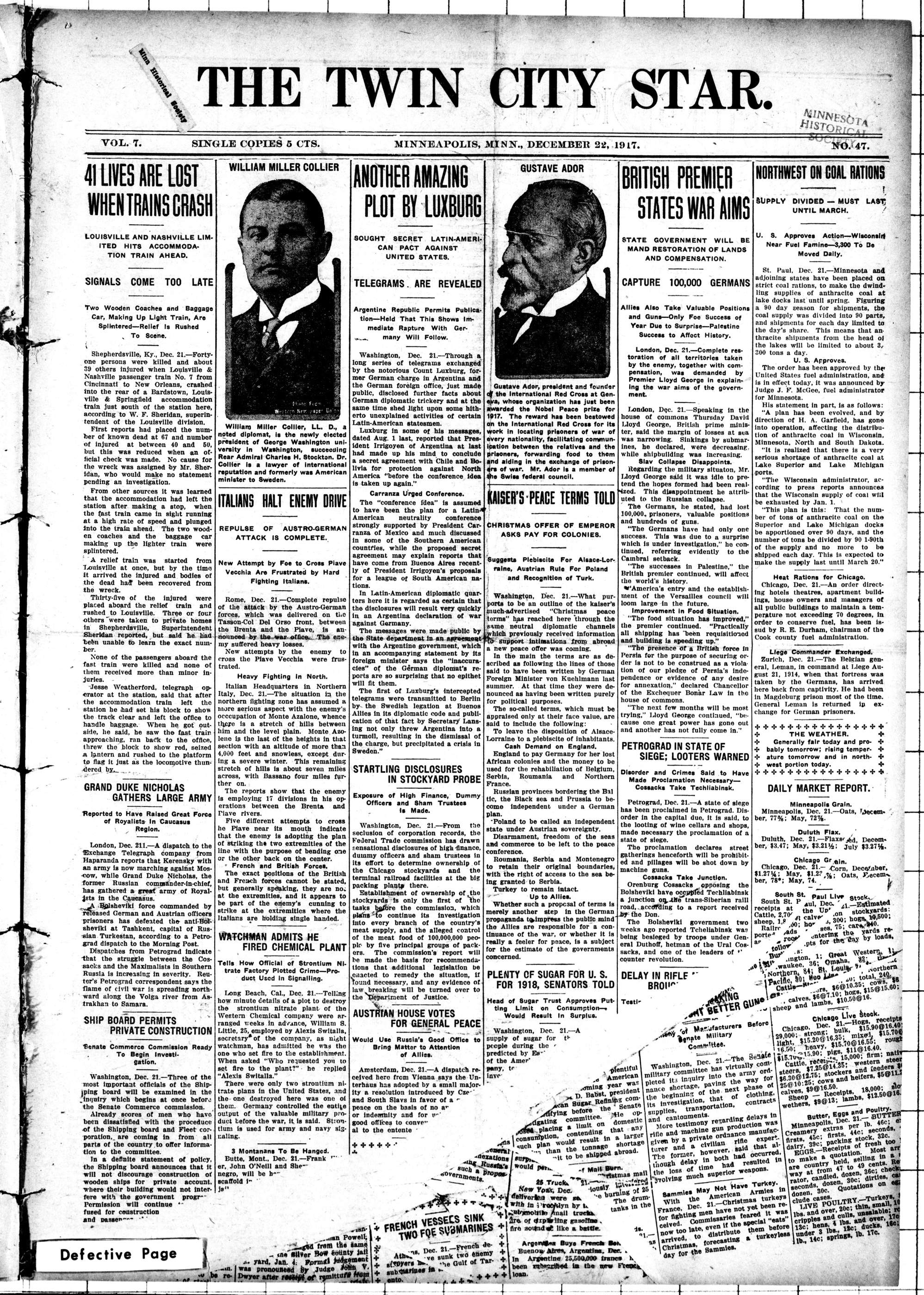
41 LIVES ARE LOST WHEN TRAINS CRASH
41 LIVES ARE LOST WHEN TRAINS CRASH
LOUISVILLE AND NASHVILLE LIM
ITED HITS ACCOMMODA-
TION TRAIN AHEAD.
Two Wooden Coaches and Baggage Car, Making Up Light Train, Are Splintered—Relief Is Rushed
Shepherdsville, Ky., Dec. 21.—Forty-one persons were killed and about 39 others injured when Louisville & Nashville passenger train No. 7 from Cincinnati to New Orleans, crashed into the rear of a Bardstown, Louisville & Springfield accommodation train just south of the station here, according to W. F. Sheridan, superintendent of the Louisville division.
First reports had placed the number of known dead at 67 and number of injured at between 40 and 50, but this was reduced when an official check was made. No cause for the wreck was assigned by Mr. Sheridan, who would make no statement pending an investigation.
From other sources it was learned that the accommodation had left the station after making a stop, when the fast train came in sight running at a high rate of speed and plunged into the train ahead. The two wooden coaches and the baggage car making up the lighter train were splintered.
A relief train was started from Louisville at once, but by the time it arrived the injured and bodies of the dead had been recovered from the wreck.
Thirty-five of the injured were placed aboard the relief train and rushed to Louisville. Three or four others were taken to private homes in Shepherdsville, Superintendent Sheridan reported, but said he had been unable to learn the exact number.
None of the passengers aboard the fast train were killed and none of them received more than minor injuries.
Jesse Weatherford, telegraph operator at the station, said that after the accommodation train left the station he had set his block to show the track clear and left the office to handle baggage. When he got outside, he said, he saw the fast train approaching, ran back to the office, threw the block to show red, seized a lantern and rushed to the platform to flag it just as the locomotive thundered by.
GRAND DUKE NICHOLAS
GATHERS LARGE ARMY
Reported to Have Raised Great Force of Royalists in Caucasus Region.
London, Dec. 211.—A dispatch to the Exchange Telegraph company from Haparanda reports that Kerensky with an army is now marching against Moscow, while Grand Duke Nicholas, the former Russian commander-in-chief, has gathered a great army of Royalists in the Caucasus.
A Bolshevik force commanded by released German and Austrian officers prisoners has defeated the anti-Bolshevik at Tashkent, capital of Russian Turkestan, according to a Petrograd dispatch to the Morning Post.
Dispatches from Petrograd indicate that the struggle between the Cossacks and the Maximalists in Southern Russia is increasing in severity. Reuter's Petrograd correspondent says the flame of civil war is spreading northward along the Volga river from Astrakhan to Samara.
SHIP BOARD PERMITS PRIVATE CONSTRUCTION
Senate Commerce Commission Ready To Begin Investigation.
Washington, Dec. 21.—Three of the most important officials of the Shipping board will be examined in the inquiry which begins at once before the Senate Commerce commission.
Already scores of men who have been dissatisfied with the procedure of the Shipping board and Fleet corporation, are coming in from all parts of the country to offer information to the committee.
In a definite statement of policy, the Shipping board announces that it will not discourage construction of wooden ships for private account, where their building would not interfere with the government program. Permission will continue fused for construction and passen
Defective Page
THE TWIN CITY STAR.
SINGLE COPIES 5 CTS.
WILLIAM MILLER COLLIER
White From
Western Newspaper Union
William Miller Collier, LL. D., a noted diplomat, is the newly elected president of George Washington university in Washington, succeeding Rear Admiral Charles H. Stockton. Dr. Collier is a lawyer of international reputation and formerly was American minister to Sweden.
ITALIANS HALT ENEMY DRIVE
REPULSE OF AUSTRO-GERMAN
ATTACK IS COMPLETE.
New Attempt by Foe to Cross Plave Vecchia Are Frustrated by Hard Fighting Italians.
Rome, Dec. 21.—Complete repulse of the attack by the Austro-German forces, which was delivered on the Tasson-Col Del Orso front, between the Brenta and the Plave, is announced by the war office. The enemy suffered heavy losses.
New attempts by the enemy to cross the Plave Vecchia were frustrated.
Heavy Fighting in North.
Italian Headquarters in Northern Italy, Dec. 21.—The situation in the northern fighting zone has assumed a more serious aspect with the enemy's occupation of Monte Azalone, whence there is a stretch of hills between him and the level plain. Monte Azolene is the last of the heights in that section with an altitude of more than 4,000 feet and snowless, except during a severe winter. This remaining stretch of hills is about seven miles across, with Bassano four miles further on.
The reports show that the enemy is employing 17 divisions in his operations between the Brenta and Piave rivers.
Five different attempts to cross he Piave near its mouth indicate that the enemy is adopting the plan of striking the two extremities of the line with the purpose of bending one or the other back on the center.
French and British Forces.
The exact positions of the British and French forces cannot be stated, but generally speaking, they are not at the extremities, and it appears to be part of the enemy's cunning to strike at the extremities where the Italians are holding single handed.
WATCHMAN ADMITS HE
FIRED CHEMICAL PLANT
Tells How Official of Strontium Nitrate Factory Plotted Crime—Product Used in Signalling.
Long Beach, Cal., Dec. 21.—Telling how minute details of a plot to destroy the strontium nitrate plant of the Western Chemical company were arranged weeks in advance, William S. Little, 25, employed by Alexis Switalla, secretary of the company, as night watchman, has admitted he was the one who set fire to the establishment. When asked "Who requested you to set fire to the plant?" he replied "Alexis Switalla."
There were only two strontium nitrate plans in the United States, and the one destroyed here was one of them. Germany controlled the entire output of the valuable military product before the war, it is said. Strontium is used for army and navy signaling.
3 Montanans To Be Hanged.
Butte, Mont., Dec. 21.—Frank er, John O'Neill and She negro, will be scaffold in is
MINNEAPOLIS, MINN., DECEMBER 22, 1917.
ANOTHER AMAZING PLOT BY LUXBURG
ANOTHER AMAZING PLOT BY LUXBURG
SOUGHT SECRET LATIN-AMERI
CAN PACT AGAINST
UNITED STATES.
TELEGRAMS. ARE REVEALED
Argentine Republic Permits Publication—Held That This Shows Immediate Rapture With Germany Will Follow.
Washington, Dec. 21.—Through a long series of telegrams exchanged by the notorious Count Luxburg, former German charge in Argentina and the German foreign office, just made public, disclosed further facts about German diplomatic trickery and at the same time shed light upon some hitherto unexplained activities of certain Latin-American statesmen.
Luxburg in some of his messages, dated Aug. 1 last, reported that President Irrigoyen of Argentina at last had made up his mind to conclude a secret agreement with Chile and Bolivia for protection against North America "before the conference idea is taken up again."
Carranza Urged Conference.
The "conference idea" is assumed to have been the plan for a Latin-American neutrality conference strongly supported by President Carranza of Mexico and much discussed in some of the Southern American countries, while the proposed secret agreement may explain reports that have come from Buenos Aires recently of President Irigoyen's proposals for a league of South American nations.
In Latin-American diplomatic quarters here it is regarded as certain that the disclosures will result very quickly in an Argentina declaration of war against Germany.
The messages were made public by the State department in an agreement with the Argentine government, which in an accompanying statement by its foreign minister says the "inaccuracies" of the German diplomat's reports are so surprising that no epithet will fit them.
The first of Luxburg's intercepted telegrams were transmitted to Berlin by the Swedish legation at Buenos Aires in its diplomatic code and publication of that fact by Secretary Lansing not only threw Argentina into a turmoil, resulting in the dismissal of the charge, but precipitated a crisis in Sweden."
STARTLING DISCLOSURES
IN STOCKYARD PROBE
Exposure of High Finance, Dummy Officers and Sham Trustees Is Made.
Washington, Dec. 21.—From the seclusion of corporation records, the Federal Trade commission has drawn sensational disclosures of high finance, dummy officers and sham trustees in its effort to determine ownership of the Chicago stockyards and the terminal railroad facilities at the big packing plants there.
Establishment of ownership of the stockyards is only the first of the tasks before the commission, which plans to continue its investigation into every branch of the country's meat supply, and the alleged control of the meat food of 100,000,000 people by five principal groups of packers. The commission's report will be made the basis for recommendations that additional legislation be enacted to remedy the situation, if found necessary, and any evidence of law breaking will be turned over to the Department of Justice.
AUSTRIAN HOUSE VOTES FOR GENERAL PEACE
Would Use Russia's Good Office to Bring Matter to Attention of Allies.
Amsterdam, Dec. 21.—A dispatch received hero from Vienna says the Unterhaus has adopted by a small majority a resolution introduced by Cze and South Slavs in favor of a peace on the basis of no ar or indemnity and for good offices to convey al to the entente
GOSTAVE ADOR
Gustave Ador, president and founder of the International Red Cross at Geneva, whose organization has just been awarded the Nobel Peace prize for 1917. The reward has been bestowed on the International Red Cross for its work in locating prisoners of war of every nationality, facilitating communication between the relatives and the prisoners, forwarding food to them and aiding in the exchange of prisoners of war. Mr. Ador is a member of the Swiss federal council.
KAISER'S·PEACE TERMS TOLD
KAISER'S·PEACE TERMS TOLD
CHRISTMAS OFFER OF EMPEROR
ASKS PAY FOR COLONIES.
Suggesta Plebiscite For Alsace-Lorraine, Austrian Rule For Poland and Recognition of Turk.
Washington, Dec. 21.—What purports to be an outline of the kaiser's much-advertised "Christmas peace terms" has reached here through the same neutral diplomatic channels which previously received information to support intimations from abroad a new peace offer was coming.
In the main the terms are as described as following the lines of those said to have been written by German Foreign Minister von Kuehlmann last summer. At that time they were denounced as having been written purely for political purposes.
The so-called terms, which must be appraised only at their face value, are said to include the following:
To leave the disposition of Alsace-Lorraine to a plebiscite in inhabitants,
Cash Demand on England.
England to pay Germany for her lost African colonies and the money to be used for the rehabilitation of Belgium, Serbia, Roumania and Northern France.
Russian provinces bordering the Baltic, the Black sea and Prussia to become independent under a German plan.
*Poland to be called an independent state under Austrian sovereignty.
Disarmament, freedom of the seas and commerce to be left to the peace conference.
Roumania, Serbia and Montenegro to retain their original boundaries, with the right of access to the sea being granted to Serbia.
Whether such a proposal of terms is merely another step in the German propaganda to impress the public mind the Allies are responsible for a continuance of the war, or whether it is really a feeler for peace, is a subject for the estimate of the governments concerned.
PLENTY OF SUGAR FOR U. S.
FOR 1918, SENATORS TOLD
Head of Sugar Trust Approves Putting Limit on Consumption—Would Result in Surplus.
Washington, Dec. 21.—A supply of sugar for the people during the predicted by Es of the Ameri company, to plentiful American coming year was Sugar Refining committee. He closed placing a limit on domestic consumption, contending that such plan would result in a large than the tonnage shorts it to be shipped abroad would per Mail Burn.
25 Trucks. New York, Dec. loudly loudly deliveries were sealing burning with in Brooklyn by the automobile small trucks. Are of expiring gasoline fire sound like a battle.
Argentina Buys French Beh Buenos Aires, Argentins, Dec. In Argentina 25,500,000 francs have been subscribed in the new French
St. Paul, Dec. 21.—Minnesota and adjoining states have been placed on strict coal rations, to make the dwindling supplies of anthracite coal at lake docks last until spring. Figuring a 90 day season for shipments, the coal supply was divided into 90 parts, and shipments for each day limited to the day's share. This means that anthracite shipments from the head of the lakes will be limited to about 3, 200 tons a day.
U. S. Approves.
The order has been approved by the United States fuel administration, and is in effect today, it was announced by Judge J. F. McGee, fuel administrator for Minnesota.
His statement in part, is as follows:
"A plan has been evolved, and by direction of H. A. Garfield, has gone into operation, affecting the distribution of anthracite coal in Wisconsin, Minnesota, North and South Dakota.
"It is realized that there is a very serious shortage of anthracite coal at Lake Superior and Lake Michigan ports.
"The Wisconsin administrator, according to press reports announces that the Wisconsin supply of coal will be exhausted by Jan. 1."
"This plan is this: That the number of tons of anthracite coal on the Superior and Lake Michigan docks be apportioned over 90 days, and the number of tons be divided by 90 1-90th of the supply and no more to be shipped each day. This is expected to make the supply last until March 20."
Heat Rations for Chicago.
Chicago, Dec. 21.—An order directing hotels theatres, apartment buildings, house owners and managers of all public buildings to maintain a temperature not exceeding 70 degrees, in order to conserve fuel, has been issued by R. E. Durham, chairman of the Cook county fuel administration.
Liege Commander Exchanged.
Zurich, Dec. 21.—The Belgian general, Leman, in command at Liege August 21, 1914, when that fortress was taken by the Germans, has arrived here back from captivity. He had been in Magdeburg prison most of the time. General Leman is returned in exchange for German prisoners.
THE WEATHER.
Generally fair today and pro-
bably tomorrow; rising temper-
ature tomorrow and in north-
west portion today.
Minneapolis, Dec. 21.—Oats, December, 77%; May, 72%.
Duluth Flax.
Duluth, Dec. 21.—Flaxseed, December, $3.47%; May, $3.21%; July $3.27%.
Chicago Grain.
Chicago, Dec. 21.—Corn, December, $1.27%; May, $1.27%; Oats, December, 78%; May, 74.
South St. Paul Live Stock.
South St. P. Paul, Dec. 41.—Estimated receipts at the UP on stockyards: sheep, 1.8; calves, 300; hogs, 10,500; Railroad horses, 75; cars, 240; porters entering the yards re-opts for the day by loads.
Burstington, 1; Great Western, 1; waukee, 36; Omaha, 82; Northern Pacific, 80; Boo Lake, 20; total, 240; Cattle, 20; cows, 68; horses, $6@10.35; cows, $6@7.10; hogs, $15@15.60; calves, $6@7.10; hogs, $15@15.60.
and cantonments.
More testimony regarding delays in rifle and machine gun production was given by a private ordnance manufacturer and a civilian rifle expert. The former, however, said that although delay in both had occurred, the loss of time had resulted in evolving much superior weapons.
Sammies May Not Have Turkey. With the American Armies in France, Dec. 21.—Christmas turkeys for fighting men have not yet been received. Commissaries feared it was now too late, even if the special "eats" arrived, to distribute them before Christmas, forecasting a turkeyless day for the Sammies.
BRITISH PREMIER STATES WAR AIMS
BRITISH PREMIER STATES WAR AIMS
STATE GOVERNMENT WILL BE MAND RESTORATION OF LANDS AND COMPENSATION.
Allies Also Take Valuable Positions and Guns—Only Foe Success of Year Due to Surprise—Palestine Success to Affect History.
London, Dec. 21.—Complete restoration of all territories taken by the enemy, together with compensation, was demanded by Premier Lloyd George in explaining the war aims of the government.
London, Dec. 21.—Speaking in the house of commons Thursday David Lloyd George, British prime minister, said the margin of losses at sea was narrowing. Sinkings by submarines, he declared, were decreasing, while shipbuilding was increasing.
Slav Collapse Disappoints.
Regarding the military situation, Mr. Lloyd George said it was idle to pretend the hopes formed had been realized. This disappointment he attributed to the Russian collapse.
The Germans, he stated, had lost 100,000 prisoners, valuable positions and hundreds of guns.
"The Germans have had only one success. This was due to a surprise which is under investigation," he continued, referring evidently to the Cambrai setback.
"The successes in Palestine," the British premier continued, will affect the world's history.
"America's entry and the establishment of the Versailles council will loom large in the future.
Improvement in Food Situation.
"The food situation has improved," the premier continued. "Practically all shipping has been requisitioned and building is speeding up."
"The presence of a British force in Persia for the purpose of securing order is not to be construed as a violation of our pledge of Persia's independence or evidence of any desire for annexation," declared Chancellor of the Exchequer Bonar Law in the house of commons.
"The next few months will be most trying," Lloyd George continued, "because one great power has gone out and another has not fully come in."
PETROGRAD IN STATE OF SIEGE; LOOTERS WARNED
Disorder and Crimes Said to Have Made Proclamation Necessary—Cossacks Take Techilabinsk.
Petrograd, Dec. 21.—A state of siege has been proclaimed in Petrograd. Disorder in the capital due, it is said, to the looting of wine cellars and shops, made necessary the proclamation of a state of siege.
The proclamation declares street gatherings henceforth will be prohibited and pillages will be shot down by machine guns.
Cossacks Take Junction.
Orenburg Cossacks opposing the Bolshevik have occupied Techilabinsk a junction on the trans-Siberian rail road, according to a report received by the Don.
The Bolshevik government two weeks ago reported Tchellabinsk was being besieged by troops under General Duthoff, hetman of the Ural Cossacks, and one of the leaders of 'counter revolution.
DELAY IN RIFLE BROUGHT
Washington, Dec. 21. The Senate military committee has virtually completed its inquiry into the army ordnance shortage, paving the way for the beginning of the next phase of its investigation, that of clothing, supplies, transportation, contracts
MINNESOTA
HISTORICAL
NORTHWEST ON COAL RATIONS
SUPPLY DIVIDED — MUST LAST UNTIL MARCH.
U. S. Approves Action—Wisconsin Near Fuel Famine-3,300 To Be Moved Daily.
U. S. Approves.
Heat Rations for Chicago.
DAILY MARKET REPORT.
Chicago Live Stock
Chicago, Dec. 21—Hogs, receipts
29,000; strong; bulk, $15.90@16.40
light, $15.20@16.35; mixe1, $15.70
16.50; heavy, $15.70@16.55; rough
lives, $11.60.
$15.70; 15.90; pigs, $11.00;
Cattle, reeches, 15.00; firm; native
steers, $7.25@14.35; western steer
$6.30@12.75; stockers and feeders $2
$15.00; cows and heifers, $5@11.2
25@10.16.50.
calves, $@16.50.
Sheep — Receipts, 18,000; slow
wethers, $@13; lambs, $12.50@16.
Butter, Eggs and Poultry.
Minneapolis, Dec. 21.—BUTTER
Creamery extras per lb. 46c; ex
firsts, 45c; firsts, 44c; seconds,
dalry, 39c; packing stock, 32c.
—Receipts of fresh too.
Most arr
EGGs.—to make a quotation. More are country held, selling in a way at from 47 to 49 cents. Rator, candled, dozen, 36c; check seconds, dozen, 30c; dirties, car, dozen, 30c. Quotations on egg.
clude cases.
POULTRY—Turkeys,
lbs. and over, 20c; thin, small, 1
cripples and culls, unsalable, r
13c; hens, 4 lbs. and over, 17c
under 3 lbs., 12c; ducks, 16c,
lbs., 14c; springs, lb. 17c.
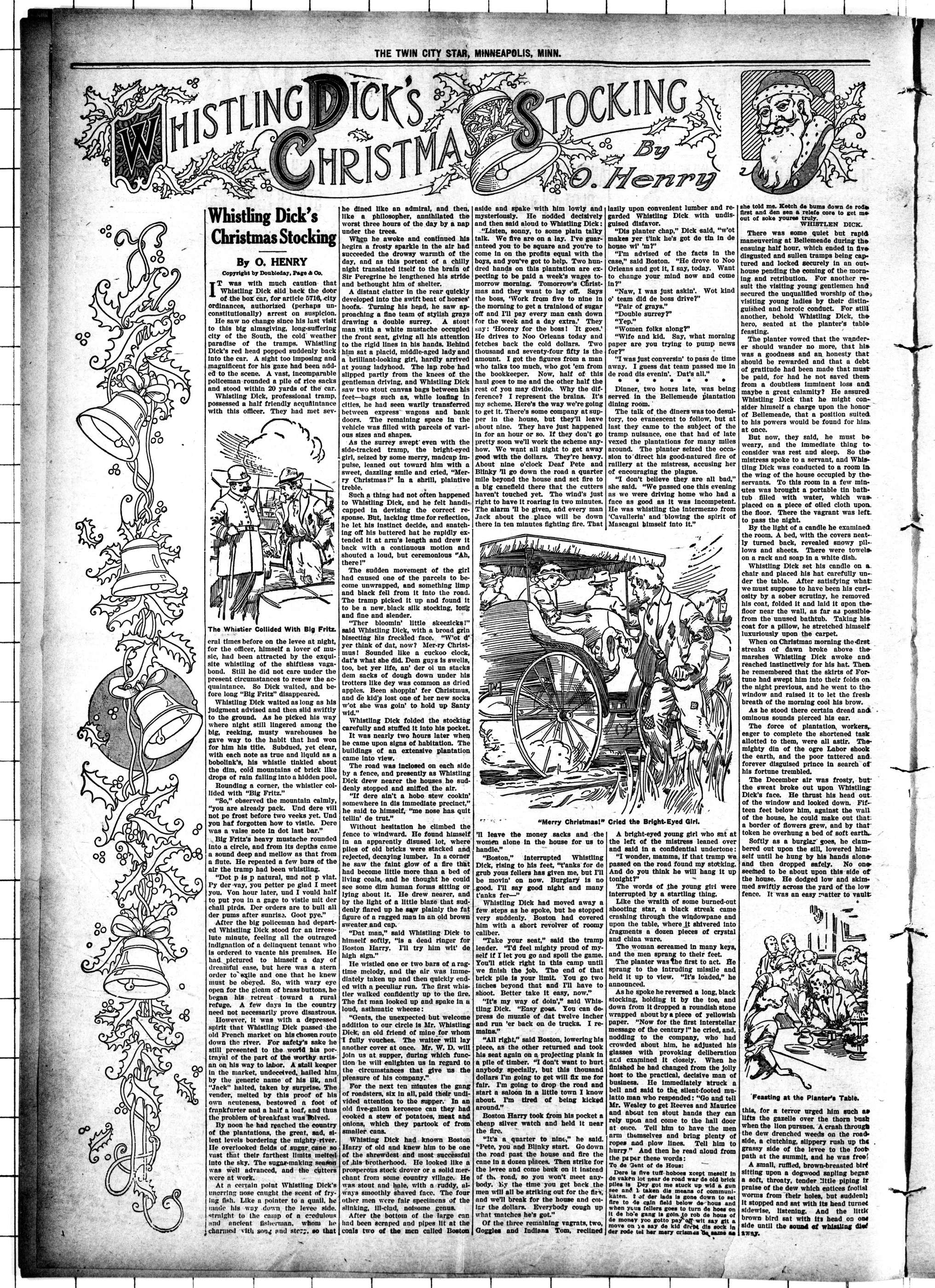
WHISTLING DICK'S CHRISTMAS STOCKING By O. Henry
WHI
Whistling Dick's Christmas Stocking
Whistling Dick's Christmas Stocking
Copyright by Doubleday, Page & Co.
It was with much caution that Whistling Dick slid back the door of the box car, for article 5716, city ordinances, authorized (perhaps unconstitutionally) arrest on suspicion. He saw no change since his last visit to this big almsgiving, long-suffering city of the South, the cold weather paradise of the tramps. Whistling Dick's red head popped suddenly back into the car. A sight too imposing and magnificent for his gaze had been added to the scene. A vast, incomparable policeman rounded a pile of rice sacks and stood within 20 yards of the car.
Whistling Dick, professional trump, possessed a half friendly acquaintance with this officer. They had met sev-
A
The Whistler Collided With Big Fritz. eral times before on the levee at night, for the officer, himself a lover of music, had been attracted by the exquisite whistling of the shiftless vagabond. Still he did not care under the present circumstances to renew the acquaintance. So Dick waited, and before long "Big Fritz" disappeared.
Whistling Dick waited as long as his judgment advised and then slid swiftly to the ground. As he picked his way where night still lingered among the big, reeking, musty warehouses he gave way to the habit that had won for him his title. Subdued, yet clear, with each note as true and liquid as a bobolink's, his whistle tinkled about the dim, cold mountains of brick like drops of rain falling into a hidden pool. Rounding a corner, the whistler collided with "Big Fritz."
"So," observed the mountain calmly, "you are already pack. Dure dere vill not pe frost before two vecks yet. Und you haf forgotten how to vistle. Dere was a vale note in dot last bar." Big Fritz's heavy mustache rounded into a circle, and from its depths came a sound deep and mellow as that from a flute. He repeated a few bars of the air the trump had been whistling. "Dot p is p natural, und not p vlat. Py der vay, you petter pe glad I meet you. Von hour later, und I would half to put you in a gage to vistle mit der chall prlds. Der orders are to bull all derm ups after sunrises. Goot pye."
After the big policeman had departed Whistling Dick stood for an irresolute minute, feeling all the outraged indignation of a delinquent tenant who is ordered to vacate his premises. He had pictured to himself a day of dreamful ease, but here was a stern order to exile and one that he knew must be obeyed. So, with wary eye open for the gleam of brass buttons, he began his retreat toward a rural refuge. A few days in the country need not necessarily prove disastrous. However, it was with a depressed spirit that Whistling Dick passed the old French market on his chosen route down the river. For safety's sake he still presented to the world his portrayal of the part of the worthy artisan on his way to labor. A still keeper in the market, undecided, hailed him by the generic name of his lik, and "Jack" halted, taken by surprise. The vender, melted by this proof of his own acuteness, bestowed a foot of frankfurter and a half a loaf, and thus the problem of breakfast was solved.
By noon he had reached the country of the plantations, the great, sad, silent levels bordering the mighty river. He overlooked fields of sugar cane so vast that their farthest limits melted into the sky. The sugar-making season was well advanced, and the cutters were at work.
At a certain point Whistling Dick's unerring nose caught the scent of frying fish. Like a pointer to a quail, he made his way down the levee side, straight to the camp of a credulous and ancient fisherman, whom he charmed with song and sterz, so that
THE TWIN CITY STAR, MINNEAPOLIS, MINN.
he dined like an admiral, and then, like a philosopher, annihilated the worst three hours of the day by a nap under the trees. When he awoke and continued his hegira a frosty sparkle in the air had succeeded the drowsy warmth of the day, and as this portent of a chilly night translated itself to the brain of Sir Peregrine he lengthened his stride and bethought him of shelter.
A distant clatter in the rear quickly developed into the swift beat of horses' hoofs. Turning his head, he saw approaching a fine team of stylish grays drawing a double survey. A stout man with a white mustache occupied the front seat, giving all his attention to the rigid lines in his hands. Behind him sat a placid, middle-aged lady and a brilliant-looking girl, hardly arrived at young ladhood. The lap robe had slipped partly from the knees of the gentleman driving, and Whilstiling Dick saw two stout canvas bags between his feet—bags such as, while loafing in cities, he had seen warily transferred between express wagons and bank doors. The remaining space in the vehicle was filled with parcels of various sizes and shapes.
As the surrey swept even with the side-tracked tramp, the bright-eyed girl, seized by some merry, madcap impulse, leaned out toward him with a sweet, dazzling smile and cried, "Merry Christmas!" In a shrill, plaintive treble.
Such a thing had not often happened to Whistling Dick, and he felt handicapped in devising the correct response. But, lacking time for reflection, he let his instinct decide, and snatching off his battered hat he rapidly extended it at arm's length and drew it back with a continuous motion and shouted a loud, but ceremonious "Ah, there!"
The sudden movement of the girl had caused one of the parcels to become unwrapped, and something limp and black fell from it into the road. The tramp picked it up and found it to be a new, black silk stocking, long and fine and slender.
"Ther bloomin' little skeezicks!" said Whistling Dick, with a broad grin bisecting his freckled face. "Wot d' yer think of dat, now? Mer-ry Christmas! Sounded like a cuckoo clock, dat's what she did. Dem guys is swells, too, bet yer life, an' der ol un stacks dem sacks of dough down under his trotters like dey was common as dried apples. Been shoplin' fer Christmas, and de kid's lost one of her new socks 'wot she was goin' to hold up Santy wld."
Whistling Dick folded the stocking carefully and stuffed it into his pocket. It was nearly two hours later when he came upon signs of habitation. The buildings of an extensive plantation came into view.
The road was inclosed on each side by a fence, and presently as Whistling Dick drew nearer the houses he suddenly stopped and sniffed the air.
"If dere ain't a hobo stew cookin' somewhere in dis immediate precinct," he said to himself, "me nose has quit tellin' de trut."
Without hesitation he climbed the fence to windward. He found himself in an apparently disused lot, where piles of old bricks were stacked and rejected, decaying lumber. In a corner he saw the faint glow of a fire that had become little more than a bed of living coals, and he thought he could see some dim human forms sitting or lying about it. He drew nearer, and by the light of a little blaze that suddenly flared up he saw plainly the fat figure of a ragged man in an old brown sweater and cap.
"Dat man," said Whistling Dick to himself softly, "is a dead ringer for Boston Harry. I'll try him wilt' de high sign."
He wistled one or two bars of a ragtime melody, and the air was immediately taken up and then quickly ended with a peculiar run. The first whistler walked confidently up to the fire. The fat man looked up and spake in a loud, asthmatic wheeze: "Gents, the unexpected but welcome addition to our circle is Mr. Whistling Dick, an old friend of mine for whom I fully vouches. The waiter will lay another cover at once. Mr. W. D. will join us at supper, during which function he will enlighten us in regard to the circumstances that give us the pleasure of his company."
For the next ten minutes the gang of roadsters, six in all, paid their undivided attention to the supper. In an old five-gallon kerosene can they had cooked a stew of meat, meat and onions, which they partook of from smaller cans.
Whisting Dick had known Boston Harry of old and knew him to be one of the shrewdest and most successful of his brotherhood. He looked like a prosperous stock drover or a solid merchant from some country village. He was stout and hale, with a ruddy, always smoothly shaved face. The four other men were fair specimens of the slinking, ill-clad, noisome genus. After the bottom of the large can and been scraped and pipes lit at the coals two of the men called Boston
aside and spake with him lowly and mysteriously. He nodded decisively and then said aloud to Whistling Dick: "Listen, sonny, to some plain talky talk. We five are on a lay. I've guaranteed you to be square and you're to come in on the profits equal with the boys, and you've got to help. Two hundred hands on this plantation are expecting to be paid a week's wages tomorrow morning. Tomorrow's Christmas and they want to lay off. Says the boss, 'Work from five to nine in the morning to get a trainload of sugar off and I'll pay every man cash down for the week and a day extra.' He says: 'Hooray for the boss! It goes.' He drives to Noo Orleans today and fetches back the cold dollars. Two thousand and seventy-four fifty is the amount. I got the figures from a man who talks too much, who got 'em from the bookkeeper. Now, half of this haul goes to me and the other half the rest of you may divide. Why the difference? I represent the brains. It's my scheme. Here's the way we're going to get it. There's some company at supper in the house, but they'll leave about nine. They have just happened in for an hour or so. If they don't go pretty soon we'll work the scheme anyhow. We want all night to get away good with the dollars. They're heavy. About nine o'clock Deaf Pete and Blinky 'll go down the road a quarter mile beyond the house and set fire to a big canefield there that the cutters haven't touched yet. The wind's just right to have it roaring in two minutes. The alarm 'll be given, and every man Jack about the place will be down there in ten minutes fighting fire. That
A
A man in a hat and coat stands beside a horse, holding a large wheel. In the background, a man in a hat and coat sits in a carriage, with two other men in hats and coats. The scene is set against a cloudy sky.
"Merry Christmas!" Cried the Bright-Eyed Girl.
"I'll leave the money sacks and the women alone in the house for us to handle."
"Boston," interrupted Whistling Dick, rising to his feet, "t'anks for de grub you fellers has given me, but I'll be movin' on now. Burglary is no good. I'll say good night and many t'anks fer—"
Whistling Dick had moved away a few steps as he spoke, but he stopped very suddenly. Boston had covered him with a short revolver of roomy caliber.
"Take your seat," said the tramp leader. "Td feel mighty proud of myself if I let you go and spoil the game. You'll stick right in this camp until we finish the job. The end of that brick pile is your limit. You go two inches beyond that and I'll have to shoot. Better take it easy, now."
A bright-eyed young girl the left of the mistress l and said in a confidential "I wonder, mamma, if that passed on the road found me And do you think he will tonight?"
The words of the young interrupted by a startling t Like the wrath of some shooting star, a black st crashing through the window upon the table, where it sh fragments a dozen pieces and china ware.
The woman screamed in m and the men sprang to thet The planter was the first sprang to the intruding m held it up to view. "It's l announced.
As he spoke he reversed a
"It's my way of doin," said Whistling Dick. "Easy goes. You can depress de muzzle of dat twelve incher and run 'er back on de trucks. I remains."
"All right," said Boston, lowering his piece, as the other returned and took his seat again on a projecting plank in a pile of timber. "I don't want to hurt anybody specially, but this thousand dollars I'm going to get will fix me for fair. I'm going to drop the road and start a saloon in a little town I know about. I'm tired of being kicked around."
Boston Harry took from his pocket a cheap silver watch and held it near the fire.
"It's a quarter to nine," he said.
"Pete, you and Blinky start. Go down the road past the house and fire the cane in a dozen places. Then strike for the levee and come back on it instead of the road, so you won't meet anybody. By the time you get back the men will all be striking out for the fire, and we'll break for the house and color the dollars. Everybody cough up what matches he's got."
Of the three remaining vagrats, two, Goggles and Indiana Tom, reclined
lazily upon convenient lumber and regarded Whistling Dick with undisguised disfavor.
"Dis planter chap," Dick said, "w'ot makes yer t'ink he's got de tin in de house wl' 'm'?
"Im advised of the facts in the case," said Boston. "He drove to Noo Orleans and got it, I say, today. Want to change your mind now and come in?"
"Naw, I was just askin'. Wot kind o' team did de boss drive?"
"Pair of grays."
"Double surrey?"
"Yep."
"Women folks along?"
"Wife and kid. Say, what morning paper are you trying to pump news for?"
"I was just conversin' to pass de time away. I guess dat team passed me in de road dis evenin'. Dat's all."
Dinner, two hours late, was being served in the Bellemeade plantation dining room.
The talk of the dinners was too desultory, too evanescent to follow, but at last they came to the subject of the tramp nuissance, one that had of late vexed the plantations for many miles around. The planter seized the occasion to 'direct his good-natured fire of rallery at the mistress, accusing her of encouraging the plague.
"I don't believe they are all bad," she said. "We passed one this evening as we were driving home who had a face as good as it was incompetent. He was whistling the intermezzo from 'Cavalleria' and blowing the spirit of Mascagni himself into it."
A bright-eyed young girl who sat at the left of the mistress leaned over and said in a confidential undertone: "I wonder, mamma, if that tramp we passed on the road found my stocking. And do you think he will hang it up tonight?" The words of the young girl were interrupted by a startling thing. Like the wrath of some burned-out shooting star, a black streak came crashing through the windowpane and upon the table, where it shivered into fragments a dozen pieces of crystal and china ware. The woman screamed in many keys, and the men sprang to their feet. The planter was the first to act. He sprang to the intruding missile and held it up to view. "It's loaded," he announced.
As he spoke he reversed a long, black stocking, holding it by the toe, and down from it dropped a roundish stone wrapped about by a piece of yellowish paper. "Now for the first interstellar message of the century!" he cried, and, nodding to the company, who had crowded about him, he adjusted his glasses with provoking deliberation and examined it closely. When he finished he had changed from the jolly host to the practical, decisive man of business. He immediately struck a bell and said to the silent-footed mutatto man who responded: "Go and tell Mr. Wesley to get Reeves and Maurice and about ten stout hands they can rely upon and come to the hall door at once. Tell him to have the men arm themselves and bring plenty of ropes and plow lines. Tell him to hurry." And then he read aloud from the paper these words: To do Gent of de Hous:
Dere is five tuff-hobes except meself in d vaken lot near de road war de old brick plies is. Dey got me stuck up wid a gun see and I taken dis means of commun-katen. 2 of der lads is gone down to set fire to de calm field below de hous and to de money he gang is gone to um de hoes on it de he gang is gone to um de hoes on de money you gotto pay off wilt say git a move on ye say de kid drep dis sock in der rode tel her mary crames be same as
she told me. Ketch de bums down de rode first and den sen a relefe core to get me out of soke youres truly.
There was some quiet but rapid maneuvering at Bellemeade during the ensuing half hour, which ended in five disgusted and sullen tramps being captured and locked securely in an outhouse pending the coming of the morning and retribution. For another result the visiting young gentlemen had secured the unqualified worship of the visiting young ladies by their distinguished and heroic conduct. For still another, behold Whistling Dick, the hero, seated at the planter's table feasting.
The planter vowed that the wanderer should wander no more, that his was a goodness and an honesty that should be rewarded and that a debt of gratitude had been made that must be paid, for had he not saved them from a doubtless imminent loss and maybe a great calamity? He assured Whistling Dick that he might consider himself a charge upon the honor of Bellemeade, that a position suited to his powers would be found for him at once.
But now, they said, he must be weary, and the immediate thing to consider was rest and sleep. So the mistress spoke to a servant, and Whistling Dick was conducted to a room in the wing of the house occupied by the servants. To this room in a few minutes was brought a portable tin bath-tub filled with water, which was placed on a piece of oilled cloth upon the floor. There the vagrant was left to pass the night.
By the light of a candle he examined the room. A bed, with the covers neatly turned back, revealed snowy pillows and sheets. There were towels on a rack and soap in a white dish.
Whistling Dick set his candle on a chair and placed his hat carefully under the table. After satisfying what we must suppose to have been his curiosity by a sober scrutiny, he removed his coat, folded it and laid it upon the floor near the wall, as far as possible from the unused bathtub. Taking his coat for a pillow, he stretched himself luxuriously upon the carpet.
When on Christmas morning the first streaks of dawn broke above the marshes Whistling Dick awoke and reached instinctively for his hat. Then he remembered that the skirts of Fortune had swept him into their folds on the night previous, and he went to the window and raised it to let the fresh breath of the morning cool his brow.
As he stood there certain dread and ominous sounds pierced his ear.
The force of plantation workers, eager to complete the shortened task allotted to them, were all astir. The mighty din of the ogre Labor shook the earth, and the poor tattered and forever disgusted prince in search of his fortune trembled.
The December air was frosty, but the sweat broke out upon Whistling Dick's face. He thrust his head out of the window and looked down. Fifteen feet below him, against the wall of the house, he could make out that a border of flowers grew, and by that token he overhung a bed of soft earth.
Softly as a burglar goes, he clambered out upon the sill, lowered himself until he hung by his hands alone and then dropped safely. No one seemed to be about upon this side of the house. He dodged low and skimmed swiftly across the yard of the low fence. It was an easy matter to vault
A
Feasting at the Planter's Table.
this, for a terror urged him such as
lifts the gazelle over the thorn bush
when the lion pursues. A crash through
the dew drenched weeds on the road-
side, a clutching, slippery rush up the
grassy side of the levee to the foot-
path at the summit, and he was free!
A small, ruffled, brown-breasted bird
sitting upon a dogwood saplinger bega-
ing a soft, throaty, tender little piping in
praise of the dew that entices foolish
worms from their holes, but suddenly
it stopped and sat with its head turned
sidewise, listening. And the little
brown bird sat with its head on one
side until the sound of whistling died
away.
By JULIA GRAY
EVEN the little old basement dining room had put on quite a festive appearance Christmas morning. It was rather cold, and the furnace was in its usual state of coy reserve, but Farley had stuck holly and evergreen around the oil paintings of garnished fish and "Highland Cattle," and each table had a brave sprig of mistletoe tied with crimson and green ribbon laid beside each plate. That was Beth's special offering.
As each member of the household came in the greetings were hearty and quite satisfactory, even to Beth. She had not thought the experiment would bring out even that much fellowship and good will from the silent, self-absorbed crowd at Mrs. Forbes'.
She put the prettiest bunch of all and a card of Christmas cheer beside Mr. Benchley's plate. Poor, grouchy old Scotchman, nobody ever had a good word for him. In all the months that she had been an inmate of the Forbes domicile she couldn't remember that anyone had ever given him even a pleasant greeting. He came downstairs to breakfast late and always grumbling, grumbled at his food, which Carrie, the colored maid, slid across the table at him, grumbled at the furnace and weather and the mailman, at the boarders and Mrs. Forbes and life in general.
But Beth liked him best of all. That morning she had found outside her door a box of fresh violets and a book she had been wishing for inscribed from her sincere friend, Alan Farley. It was the book more than the inscription that showed the thoughts of the giver, for it was named "The Well Beloved." As Beth glanced through it she had smiled, remembering a verse that Alan liked to repeat from Mrs. Browning:
What shall I give to my beloved?
A little faith all undisproved.
That was what he gave to her, only not in small measure, in full rich measure, all his heart's faith and love, asking her to believe in him and be patient for his success. And she could not tell him that she didn't give a rap for his success; that she would rather a hundred times over have been married to him, even if she had kept on with her own work, and they had been running mates together. So between them was the promise of marriage and to the boarding house at large he was "there sincere friend."
"The old man's sick in bed," said Carrie briskly, as she swept the crumbs from Beth's place. "He ain't coming down. He's groaning fearful."
Christmas Morning
Christmas Morning
MARY E. MASON
Good gracious! Look what Santa brought!
A stocking full of joy.
And a Teddy Bear that couldn't get in.
All for a good little boy.
Good gracious! Look what Santa brought!
A stocking full of joy.
And a Teddy Bear that couldn't get in.
All for a good little boy.
"Oh, dear," Beth pushed back her chair, but Farley was before her. She found him bending over the old man, tending him like an experienced nurse.
"It's only an attack of acute indigestion," he told her. "He'll be all right. I'm a good doctor." He smiled down at her, and Mr. Benchley groaned and turned over to see who had come in.
"May I wish you Merry Christmas, Mr. Benchley?" Beth asked. "I'm so sorry you don't feel well."
"Don't feel well! Losh, mon, hear the lass talk. Get more hot water. 'Twas on'le a bit of a wee fuddle I had the night, but it left me dowerhis. Fruit cake and wine after ten o'clock wl' bring any mon down on his back. Do they miss me down below?"
He was grave of face, but there was a twinkle in his eye. Alan raised him up and placed a couple of pillows behind him for support.
"Now, you're gay enough, sir," he said.
Benchley looked from one face to the other, one on each side of his bed, and his eyes glowed from under their thatch of heavy gray brows.
"You'll be married the day," he answered slowly. "I once loved a lass to my sorrow, Alan. She was to wait for me, and I pair fool, worked my life out for her, and she married a long legged loon in the next town. I'm tell-
I
"Came Downstairs to Breakfast Late and Always Grumbling."
ing you noo, they will na wait too long. The sex is changeable. I've set my heart on seeing you married before I get another turn for the worst."
"Oh, Mr. Benchley, you're all right," began Beth, hastily, but he put his hund up warningly.
"Don't shock me or alarm me, and don't be arguing wi' me, neither, for my heart's no too strong at that. I've talked this out wi' Alan before you come at all, an' he's beginning to see light aready. I've been watching both of you this long while, and I'm sick o' the halligagging and waiting. You can go quietly over the river to Jersey and be married right away, and I'll pay the bill. Get ready, lass."
Alan's eyes begged her to be yielding, but it was the old set face lying back on the pillows that moved her to act as he wished, and she slipped up to her own room without a word to any one.
When they came back it was the dinner hour, two o'clock on holidays, and as they came down stairs together Beth heard a voice in the dining room, a resounding, hearty, strong voice, Mr. Benchely speaking.
"I had to use subterfuge wi' them," he was saying. "They're both obstinate, but so am I, and I've married them off safe and sound by making it my dying request. An' when you see them coming in you're to gi' them a cheer—"
He stopped short. Beth came first, blushing and wide-eyed, with a sprig of mistletoe on her breast and another in her fair hair. And the old fellow waited breathlessly till she came near. Bending over her, he kissed her on her cheek.
"And may God bless you both the day," he finished.
"Not Our Business."
A story is told of a little girl who in her evening prayer, fold of a child she had seen in the street that day. "He was ragged and I guess he was cold," prayed the little worshiper, "but that isn't any of our business, is it? That is the attitude of some people at Christmas time. They do not seem to realize that it is their business to look out for any outside their own happy little circle, and such miss the best of the day of days.—Girl's Companion.
Not Especially for Father.
"Christmas was created for children," declares a contemporary. It is quite plain that it was not arranged exclusively for the benefit of father.
The PEACE
of the HEART
A CHRISTMAS THOUGHT
by Douglas Malloch
Deep in the heart is the dwelling of peace. There is the temple, the innermost shrine. "Be ye not troubled," for sorrow shall cease- Christmas is here with its message divine. See you the star in the heaven of blue.
Centuries so it has lighted the world,
When we were weary has given us calm;
Flags have been flaunted and flags have been furled,
Still it has lighted the pine and the palm.
Man on his earth cannot dim it with wrong;
Change it with all of his warrior's art
Still we have Christmas,
Glorious Christmas,
Christmas that brings us the peace of the heart.
Life is a labor, and labor is long,
Only by effort we come to the goal;
We shall have need of the star and the song,
Lamp for the highway and light for the soul.
Lift up your eyes to its radiance clear,
On a new year of your pilgrimage start,
Gladdened by Christmas,
God-given Christmas,
Christmas that brings us the peace of the heart.
K
W
T
H
Faithful to duty, to God and to man,
Working your ultimate destiny out,
Filling your place in the infinite plan-
```markdown
```
The Birth of Christ
AND there were in the same country shepherds abiding in the field, keeping watch over their flock by night.
And lo, the angel of the Lord came upon them, and the glory of the Lord shown around about them; and they were sore afraid.
And the angels said unto them,
"Fear not, for, behold, I bring you good tidings of great joy, which shall be to all people.
"For unto you is born this day in the city of David, the Savior, which is Christ, the Lord.
"And this shall be a sign unto you; ye shall find the babe wrapped in swaddling clothes, lying in a manger."
And suddenly there was with the angel a multitude of the heavenly host praising God and saying,
"Glory to God in the highest, and on earth peace, good will toward men."—St. Luke 2:8-14.
```markdown
```
AFFLUENCE
"Some people seem actually proud of a headache after a New Year celebration."
"It isn't the headache they are proud of, but the fact that they had enough money to acquire one."
SANTA CLAUS IS A FAITH
Take Kris Kringle Away From Children and You Rob Christmas of Half Its Joys.
Some very honest people are such sticklers for truth that they are concerned about our firm belief in Santa Claus. Well, it is a good thing to stand up for truth, if we really know the truth. But we know that a great many very learned people have been wrangling about what truth is for several thousand years, and yet it does not seem to be definitely settled. But for the most of us truth is what we truly believe. It is the faith that is in us, and Santa Claus is a faith, if not a fact, and so we say again that we do believe in Santa Claus, says an exchange.
Take Santa Claus away from the children and you rob Christmas of half its joy. Grownup though we may be, we would rather hang up our stocking "the night before Christmas" and find it bulging full of gifts in the dim light Christmas morning, than to have a carload come duly tied up and labeled, and delivered by the mailman. Who wouldn't? There is a lure in the mystery of Santa Claus that has endearened him to every childish heart, and so do not take him away until you have something better to offer.
Only Once a Year.
But how seldom Christmas comes—only once a year; and how soon it is over—a day and a night! If that is the whole of it, it seems not much more durable than the little toys one buys of a faker on the street corner. But surely that need not and ought not to be the whole of Christmas; only a single day of generosity, ransom from the dull servitude of a selfish year. If every gift is a token of personal thought, a friendly feeling, and unselfish interest in the joy of others, then the thought, the feeling, the interest, may remain after the gift is made—Henry van Dyke.
Hla Fun.
"I don't believe in giving expensive Christmas gifts."
"Neither do I, but it's a lot of fun expecting them."
H
By WM. BRADFORD DICKSON
At this fair Christmastide,
When joy bells ring out
The song of plenty and ring in
The reign of peace throughout
That one bows—ours—
The while across the sea
Old Mother Earth is drenched with blood
And hate and carnage reign supreme;
While sucklings wall for milk
And children faint for lack of food;
While strong men fall beside the way
And homeless women kneel in prayer—
If I want for good of
Of frankincense and myrrh,
Of gold, of Ophir or of either Ind,
Of jewels rare or priceless merchandise,
Of marble balls or vast estates,
Nor e'en the costly homage of mankind;
But this—
II.
That I may give each day full meed
Unto the willing mind and heart,
Of light of Truth and warmth of Love,
Of matchless skill in comfort's art—
That magic all transform't touch
Which heals the leper's spots
And turns to naught the wounds and
Deep seeped upon the heart of man
On life's great battlefield;
That I may blind earth's broken hearts,
Lifting up the drooping heads
Of the oppressed and burdened ones,
That I may plant within young hearts
As the grave lilove for the High-
Of mercy for the suffer weak
And those who suffer daily throes
Of hunger, pain, disease, neglect;
That I may know forgetfulness
For daily slights and wrongs;
That I may hourly grow
In love of liberty, of friend and foe.
And all the world
Made me grow a fruitful love
For all the beauty and true
In nature, art, the heavenly realm
And for the noble deeds of all mankind;
That I may fill the widening hours of life
With courage, cheerfulness, and hope;
That I may help my fellow man
Behold the dawn beyond the night.
The sun will beyond the storm.
These are the gifts I crave
Above the blind world's treasure trove
Of gaud and gilt.
Who gives his better self the whole year
through
May the deepest happiness of this Christmas tide come to each and every reader, and may it last all through the coming year.
Home Celebrations.
"I believe in Christmas Day home celebrations; their friendliness, their mystery, their joyous excitement; and in the feeling of security and peace a child has in the midst of them, writes a well-known authority. And I believe that the memory of child has of them fifty years later should still be strong and sweet."
Christmas Carols.
Then arose a joyous clamor, from the wild fowl on the mere, and a voice within cried, "Listen! Christmas carols even here!"—Charles Kingsley.
A Letter to Santa
U.S. MAIL
I'm sending a letter to Santa Claus
To tell him just what I need.
It's printed all out in purple ink.
But I wonder if he can read
ELKS' RECEPTION AND INSTALLATION of OFFICERS
By AMES LODGE, No. IOG, I. B. P. O. E of W.
SOUTH SIDE AUDITORIUM
12TH AVENUE SOUTH AND 3RD STREET, MINNEAPOLIS
WEDNESDAY EVENING, JANUARY 2, 1918
THIS WILL BE THE SOCIAL EVENT OF THE SEASON
The installation exercises will be conducted by Mr. George W. Holbert, by special permission from District Deputy R. H. Johnson, of Gopher Lodge No. 105, of St. Paul. The Lodge has just received its new, special made regalia, the most elaborate in the Northwest.
COME OUT AND SEE
the newly elected officers arrayed in these beautiful robes of office.
Installation Begins Promptly at 10 o'clock.
MUSIC BY MqCULLOUGH'S ORCHESTRA
DANCING AFTER THE INSTALLATION
Committee on Arrangements—Fred Thomas, Chairman
Dson, Luke Tichenor, Atym. Wm. R. Morris, Thos. Galbrau
yard, Jr., Archie Watkins.
Committee on Refreshments—Benj. Berry, Chairman;
Wt. Wm. Stirman, George W. Bryant, Alex Rogers, Ewing
Floor Committee—Judge Johnson, Chairman; Claren
ugh, James Burkes, Jacob Giles, Alex Irwin.
Reception Committee—P. H. Southall, Chairman; Cha
ith, B. M. McDew, Edward L. Boyd, Glover Shull, Atty. B.
Bob Spraggins, Dr. J. H. Redd, Richard Newton, Bert
ampson, Joseph Polk, Dr. Joseph Sizer, Benj. Jones, Wm
Washington, Benj. Cabbell, Arthur Reese, Barney Ch
thall, Thos. Whitly.
Committee on Arrangements—Fred Thomas, Chairman; Walter Dodson, Luke Tichenor, Atty, Wm. R. Morris, Thos. Galbraith, W. A. Hilyard, Jr., Archie Watkins.
Committee on Refreshments—Benj. Berry, Chairman; J. E. Stewart, Wm. Stirman, George W. Bryant, Alex Rogers, Ewing Shannon.
Floor Committee—Judge Johnson, Chairman; Clarence McCulloch, James Burkes, Jacob Giles, Alex Irwin.
Reception Committee—P. H. Southall, Chairman; Chas. Sumner Smith, B. M. McDew, Edward L. Boyd, Glover Shull, Atty, B. S. Smith, Jacob Spraggins, Dr. J. H. Redd, Richard Newton, Bert "Dutch" Thompson, Joseph Polk, Dr. Joseph Sizer, Benj. Jones, Wm. Cratic, John Washington, Benj. Cabbell, Arthur Reese, Barney Clark, G. E. Southall, Thos. Whitly.
George W. Holbert, General Chairman.
Y. G. B. C.
THE YOUNG GIRLS BENEFICIAL CLUB will give their ANNUAL NEW YEAR'S MATINEE DANCE January 1, 1918, at Dancing from 2 to 5:30 P. M. We are proud of our reputation gained, because excellent deportment of our patrons. A Refined E nt, Church, Social and Patriotic Endeavor have G. B. C. an honorable distinction.
We are proud of our reputation gained, because of the excellent deportment of our patrons. A Refined Entertainment, Church, Social and Patriotic Endeavor have given the Y. G. B. C. an honorable distinction.
Military Dance and Reception
The coming event of the Christmas Season will be the Reception and Dance for the entertainment of the boys from Camp Dodge at
Mrs. E. Posey, President Mrs. Josie Williams Secretary Mrs. E. W. Martin, Treasurer
We have a few unclaimed tailor made Overcoats which we are willing to offer at one-half price. Come in and see them. It may save you money.
Brown Bros. Merc. Co.
TAILORS AND FURRIERS
21 South Sixth Street
THE TWIN CITY STAR, MINNEAPOLIS, MINN.
PUBLSHED EVERY FRIDAY BY
CHARLES SUMNER SMITH,
Minneapolis, Minnesota.
Entered in the Post Office at Minneapolis as second class matter.
MEMBER
NATIONAL NEGRO PRESS
ASSOCIATION
Subscription by Mail, Postpaid.
ONE YEAR ..... $2.00
SIX MONTHS ..... $125
THREE MONTHS ..... 65
Hamlet B. Rowe, Local Agent.
ADVERTISING RATES.
One Inch—1 Insertion—One Dollar.
Liberal discount given on 3, 6, 9,
Months, or 1 year contracts.
We do not run free ads, or over-run the time contracted for by our advertisers We respect their right to advertise at intervals, and rather have them do so, than to run continuously an "adv." and an increasing account. Write all Checks payable to
THE TWIN CITY STAR
1317 North Sixth Ave.
MINNEAPOLIS . . . MINNESOTA
Call at 1317 6th Ave. N. on Wednesday to insure matter for publication.
The Star's Phone, Hyland 1205.
THE HOUSTON HANGING.
Unless the underlying causes—lynchings and unfair treatment of women, etc.—are removed, there will be riots (?) between the races. Negroes must die—and those who died at Houston have not died in vain. More must die and more Southern agitators (who serve notice on the administration not to send Negro troops South) must die.
These men would not desert their cause, or prove in any way disloyal to the American flag. They have died in a glorious struggle and are making a new epoch in Negro history. The trenches to be taken by Negro soldiers are everywhere in America and the Negro will not get "over the top" until there is a decided clash between the whites and blacks in the South. The Negro who is worthy of Uncle Sam's service, will not permit civilian outlaws to molest and intimidate him (by pre-arranged pans) and if he is not protected he can be depended upon to take care of himself.
The Negro soldier will face harder battles in America, than "somewhere over there." These have paid the penalty and it is said "they faced death bravely." America's mob violence was the agitator, and race prejudice was their executioner. The death of these men has done more to bring about a real democracy in America than the onslaughts of a thousand black heroes in Europe. The world is watching and the Negro awakening. Those men know the penalty and suffered the consequences. If the hell hounds of the South or anywhere, choose to intimidate, or in any way molest the Negro soldiers and especially their women, then somebody must die. This is the beginning of the end. The Negro soldier can give but one life. The question is whether it shall be in defense of his own or his country.
The Star wants to see American Negro soldiers in the European war making a record for the race in America. This is their country, their cause is here. If America will not defend them here, many will not get over there, because they will die in a riot or by order of a courtmartial. Neither will be their choice, but their destiny, because there must be real democracy in America. Many Southern white men are willing to die to prevent it, and Negroes are enlisted and willing to die to establish it.
TOO MUCH "OUR SOLDIERS."
Members of our race are too selfish in speaking of their work "for colored soldiers." We should do what we can for our men and when we contribute to the general cause we are helping our boys in war. Special work should be done for them on special occasions, and we should see that our men are not neglected. Let us be as liberal as the other races. It has not yet appeared that Negroes are excluded from the Red Cross benefits. Our boys will get their share in equal proportion, even if we did not contribute anything. Let us work for The American Red Cross. Boys in black have received many comforts in this and other wars, long before their women took any active interest in their welfare. Are the white women knitting for white soldiers only? Miss Clara Barton recognized Negroes among her workers in the Spanish American war and The Red Cross knows no color line, unless we establish it. God forbid!
THE TWIN CITY STAR will be sent to any out of town address. Send your subscription in postage stamps. Read your home paper while visiting in other cities. It's like a letter from home.
The hanging of several Negro soldiers and the imprisonment of many by authority"of the War Department is certainly some "comfort for the enemy."
BUY RED CROSS SEALS.
It is time for the promoters of patriotic benefits to entertain their patrons with some real amusements. We have some high class musical and literary talent among our race in the Twin Cities, and the people would have a good chance to hear them. The Star REFUSED to take part in the St. Paul Armory affair on Jan. 8th for one reason, i. e., it appears to be more of a political than patriotic program. Why not have a concert before the dance? Charlie Miller can produce the talent so much enjoyed by all classes. Why not have Hon. Roscoe Conkling Simmonds, the great orator, who is being heard everywhere, visit the state while this patriotic spirit is aroused. We want the boys to have all financial aid possible, and hope that hereafter the promoters will recognize that our people wish to be entertained sometimes by our people, and not always by office sckers and office holders. Let some of these who "love the Negroes" send their patriotic check for our boys or buy a bunch of tickets to hear good Negro talent; instead of buying tickets to get a good crowd present for them to speak to. As long as a few of our prominent white friends can assemble a crowd of our people on any pretext, there will always be a few Negroes to "git it up," because "de white folks says, it's a big thing" and tickets are selling mighty fast.
There is no intent on our part to cast any reflections on the speakers. Some are real friends of the Negro citizens, other are supposed to be. We privately expressed our opinion to the management and they withdrew their advertisement, even threatened us with disloyalty proceedings. The editor of the Star welcomes all investigation and asks that the committee will send the money to the boys and not make it a profit sharing proposition under the guise of patriotism.
THE NEGRO IN THE WAR.
The course of the Negro race has been highly creditable in this war. Upon barren soil fell the seeds of sedition and insurrection disseminated by German agents and pro-German newspapers in an attempt to incite the Negroes to uprising against the United States. So far as we have observed, Negro leaders have been conspicuously free from treasonable utterances. Drafted Negroes have gone to the front as cheerfully as any other set of men and, if history repeats itself, they will fight with signal bravery. German bullets will send as much torture and agony into black bodies as into white. Death will not discriminate against the Negro soldier. The patriotism of these people will not be forgotten and should ever be kept in mind and taken into account for full credit in the adjustment of racial problems.—Greenville, S. C., News.
We have some among our advertisers and subscribers who are a credit to our race for their business-like methods. They pay promptly in advance and expect nothing unreasonable in return. Others want to know "Why we can't 'trust' them?" or send a bill, and then a collector, and finally censor a Negro editor because he can't run his paper "like the white man." Few persons realize that it pays to pay as you go. The Star is not an installment plan proposition. It is a real newspaper run under many difficulties mostly due to the foolish notions and ignorant whims of those whom it serves and protects and from whom it should get its support and their consideration.
A NATIONAL PROBLEM.
Press reports show that America will face the problem of educating many of the Negroes drafted for war service. It may be a "problem" now, but it is a long neglected debt which she must pay with compound interest. Other "problems" will follow in rapid succession. America will learn the lesson of patriotic economy at the school of bitter and expensive experience. Nature's centrifugal forces are working, and she rigidly enforces the laws of compensation. The Negro is, and always has been, loyal to our Nation. The war has caused many heretofore indifferent Americans to become pro-Negro in this critical hour. The conservationists and economists have found that their neglect of the health, morals and rights of the Negro has been a willful waste—now a woeful want. Now that the handwriting on the wall is seen, the race will come into its own. The Negro will suffer side by side with the other Americans and by so doing will deliver the destinies of the race.
WAITERS WANT MORE WAGES.
The waiters, who have been doing extra work at the various hotels, are asking for more wages. The increased cost of living and the salaries paid to laborers in other employment justifies their demand. They should get at least $2.00 for a day's services, even if employed only one meal. The preparation for the job, the time lost for other work, the advance protection given their employers by "booking a day or so ahead," with the services rendered, are well worth a few dollars. An extra waiter's expenses cannot be met with a dollar a meal, and that only about twice a week. There are too many places for working men now, where good salaries obtain, and good waiters will be wanted, if they are not paid better wages.
AGENTS WANTED—NOW!
Reliable and intelligent agents al ways wanted to solicit business for THE TWIN CITY STAR; also correspondents in principal cities. A chance to carn a good living. Write The Twin City Star, Minneapolis.
ADVERTISE IN THE STAR
Patriotic music
that thrills you
through and through!
Your blood fairly tingles with patriotism
when you hear the soul-stirring anthems and the
famous battle-songs of the Nation on the
Victrola
In these stirring times the music of the hour
is patriotic music. The Victrola brings you all
of it—the time-honored national airs, the great
military marches, and the latest patriotic song
hits as well! Come in and let us demonstrate.
Victrolas, $15 to $400. Easy terms.
You can also buy a Stewart Phonograph
of us for only $7.75. It plays all records.
METROPOLITAN MUSIC CO.,
The Complete Music Store,
41-43 South 6th St., Minneapolis.
Victrola XIV,
$150
is shown here
Office Phones—Main 2869; Auto 36774. Dining Room—Main 2831.
Twenty Elegant Steam-Heated and Electric Lighted Rooms.
A la Carte Meals at All Hours—Popular Prices.
246-250 FOURTH AVE. S., MINNEAPOLIS, MINN. Private Dining and Reception Room for Ladies. Special Temperance Beverages. Men's Buffet and Grill; Billiards; Barber Shop in Connection.
THE
Edwin Clapp
SHOE
EAST WYMOUTH, MASS USA.
HIGHEST GRADE ONLY
Exclusive Agency
Harry C. Feichtinger
Lumber Exchange Minneapolis
Also Cholce Haberdashery, Borsalino, and John B. Stetson Hats
BELL'S BARBER SHOP
CLARENCE W. BELL, Proprietor.
BATHS, BARBER SHOP, POLITE BARBERS
POOL AND BILLIARD HALL
CIGARS, RACE PAPERS, SHOE SHINING
244 THIRD AVE, SOUTH .. MINNEAPOLIS, MINN.
Phone Northwestern, Main 8511.
BIOLOGICAL
South Side
212 Eleventh Ave
EXPERT BARBERS
CIGARS, POOL AND BILLIARDS
RACE PAPERS
THOMPSON & C
North Side Barber St.
812 Eleventh Ave. S., Minneapolis.
EXPERT BARBERS; UP TO THE MINUTE
COOL AND BILLIARD TABLES IN CONNE
RACE PAPERS—SHOES SHINED.
THOMPSON & CARVER, Props.
South Side Barber Shop
EXPERT BARBERS; UP TO THE MINUTE. CIGARS, POOL AND BILLIARD TABLES IN CONNECTION. RACE PAPERS—SHOES SHINED. THOMPSON & CARVER, Props.
The Waiters' and Porters' Club
GLOVER SHULL, PRES.
311 HENNEPIN AVE. MINNEAPOLIS
EDDIE BOYD, SECY' LEE WHEELER, MANAGER
---
W. S CONRAD CO., Distributors
NO. 140. E. 6th ST., ST. PAUL.
NO. 1. WESTERN AVE., MIKN.
Barber Shop
e. S., Minneapolis
; UP TO THE MINUTE.
AND TABLES IN CONNECTION.
CHOES SHINED.
CARVER, Props.
MERRY CHRISTMAS And May Your New Year Also Be a Happy One
IMPORTANT NOTICE
Unless notes are written plainly and properly arranged they will not be inserted. Many people send in notes regardless of names, initials or composition. Arrangement by the publisher will be charged for. Free notices must be correctly written.
"MY VISIT TO BETHLEHEM"
Is G. L. Morrill's subject at the People's Church New Garden Theater Sunday 10:30 A. M. JERUSALEM pictures, travel movies, organ.
ELKS ELECT NEW OFFICERS.
Ames Lodge, No. 106, I. B. P. O. E. of W., elected the following officers on December 12. Wm. Critic, Exalted Ruler; Fuller Thompson, E. L. K.; St. Elmo Vinegar, E. L. K.; Joseph Slizer, E. L. K.; Ross Hamilton, Tyler; Geo. W. Bryant, Trustee. The appointive offices will be filled by Exalted Ruler Critic before the public installation, when they will be vested in their new regalia. Ames will remain in the front ranks of Elkdom during the coming year under these efficient officers and their supporters.
The Elks' Christmas Tree Exercises begin promptly at 2 P. M. on Christmas day at the hall on 8th Ave. So. Presents will be given early. Entertainment to follow. The hall is engaged for the afternoon only.
PUBLIC INSTALLATION AND BALL.
The members of Ames lodge of Elks are preparing a large public installation of the newly elected officers for 1918, to be followed by a reception and dance. Geo. W. Holbert is chairman of the general committee and arrangements are being made to make this another big success for Ames. Dates will be announced later.
DANCING EVERY NIGHT
723 6th Ave. No.
Good Music Good Order
Owing to an increase in cost, we have raised our prices on all composition. Reading notices will be 10c per line under one inch and 50c per inch thereafter.
The South Side Barber Shop is now located at 212 11th Ave. So.
Mrs. V. S. Cooper arrived from Ottumwa, Ia., to join her husband, Rev. V. S. Cooper, the new pastor of Zion Baptist Church.
Secretaries of Lodges may send notices of their newly elected officers for free publication and office information.
Don't send in your ads and say "seep me the bill" Send the bill with the ad or personal. If you haven't a dollar, wait until you get one.
A NORTH SIDE ENTERTAINMENT.
The North Side Cafe, 723 6th Ave.
No. offers to its patrons on Thursday
and Sunday evenings the services of
Miss Blanche Mason, a popular singer,
and Mr. Dan W. Raynor, who
will play and sing. For reservations
call Hyland 5551. Advertisement.
ELKS' CHRISTMAS PARTY.
Ames Lodge of Elks are preparing for their Christmas Tree and Entertainment for the children, which is their special charity feature much looked for by the young people. The names of children unable to be present on account of illness should be sent to W. R. Morris, Secretary, 818 Met. Life Bldg.
Mr. Frank Peoples will lease on Dec. 22, to visit relatives in Omaha, Kansas City and Emporia, Kan., where he will spend a short stay with his sister, Mrs. Mary Wilson. He will combine business with pleasure on this trip, going as far as Oklahoma.
The Young Girls Beneficial Club has subscribed to $10.00 worth of Twin City Star subscriptions for the boys in camp.
The Wayman Home Circle of St. Peter's A*M. E. church, L. Jones, president, met last with Mrs. Chas. Seames 1917 5th Ave So. Sixteen were present and spent a delightful evening. Mr. B. Farrell will entertain the Circle New Year's night.
Mr. Wm. Jenkins has moved to 1330 6th Ave. N.
---
SERG'T. POPE TAKES RED CROSS PACKAGES TO CAMP DODGE
Sergt. Z. A. Pope left Monday evening for Camp Dodge to deliver the Christmas boxes to the Minnesota boys of the 366th Inf., which were given them by the contributors to the Forum's Christmas Box Fund. He will remain several days. Sergt. Pope is authorized by the Red Cross to report the needs of the boys and Mrs. Horace Lowry has promised to make it as comfortable for the Negro soldiers as those of other races. The work, under her direction, is progressing rapidly and our women are doing their bit.
Mr. Glover Shull left Thursday morning for a trip to Los Angeles. He will stop enroute at Seattle and Portland, Ore. Mr. Shull will visit his wife and daughters at Los Angeles and expects to return in about a month. He carries the best wishes of many friends who wish him a pleasant trip.
The Social Event of the Holiday Season will be the Matinee Dance of the Young Girls Beneficial Club at Lane's Hall on New Year's Afternoon.
DULUTH NEWS
DULUTH NEWS
By Miss Odessa McCullough,
510 Columbia Bldg., Duluth, Minn.
The Sammies Comfy Committee extend their thanks to the following persons who so generously donated for the Sammy Christmas box:
Mesdames—E. Porter, O. Hazel, M. Adams, M. Price, L. Bryant, M. Glenn, K. Johnson, L. Colby, Lee Young, R. Bush, M. King, C. O'Neal, M. Brown, Olive Russle, D. Henry, S. Bomar, L. Newsome, V. Cooper, E. Mason, C. Banks, H. Smith, B. F. Smith, D. Dawson, Mayweather; Messrs. E. Waters, V. Towles, Earl Stewart, Thos. Roxbough, Wm. Jackson, R. Reeves, T. J. King, A. L. Crawford, Spalding hotel Crew, Luther Dawson.
We desire to thank Mr. G. O. Smith, head waiter at the Spalding Hotel and his ever ready coterie for their financial support of nine dollars.
Thanks and praises are due Mr. and Luther Dawson for the useful parcels solicited by them. Mrs. L. Colby and Mrs. E. Watts deserve special mention for rendering their services that our boys would have home baked cakes. The large Sammy Xmas box is attributed to the generous response made by the friends of the boys.
MRS. M. T. COLE,
General Chairman.
Mr. and Mrs. R. B. Newsome of West Duluth left Saturday, December 15th, for an extended trip, visiting Chicago, Detroit and Ontario. They will return some time after the holidays.
Attorney J. Louis Ervin, of St. Paul, Minn., was a visitor at the office of Atty. R. C. McCullough Tuesday of last week. He possessed every appearance of a very successful business man.
Mrs. C. R. Black of 27 East 7th St. has as visitors for the holidays Mrs. Albert Black, formerly Miss Sidonia Jackson, and daughter Miss Vivian Clark of Winnpeg.
A modest baby girl was born at St. Mary's hospital Tuesday morning, December 18, to Mr. and Mrs. Claude Richardson of 5th Ave. East. Mother and child are doing nicely.
Mr. G. B. Kelley holds a position as assistant postal clerk at the Glass Block during the holidays.
Mr. Otto Steel received an appointment at the postoffice this week but on account of illness was unable to accept the position. Mr. Steel has been quite ill for the past week but is improving quite rapidly.
Mr. Earl Smith, now a non-commissioned officer in the army at Camp Dodge has made application to the officers training camp which opens Jan. 5th, 1918, at Des Molines, Iowa.
News was received from Mr. K. S. Todd. He is now stationed in camp at Newport News, Va.
A Hard Times Party was given under the auspices of the One More Effort Club Thursday evening, Dec. 20, at the St. Marks A. M. E. Church. Prizes were given to the winning competitors in the various games played. Hard Times refreshments were served consisting of Ginger Bread and coffee, or ice cream and cake. A large crowd was in attendance and all proclaimed having a most enjoyable time.
Get the habit! Have the Twin City Star with the Duinth column of news sent to the boys in camp. Mr. Earl Smith enjoys the paper each week because of the thoughtfulness of his father. Mr. Ben Smith, who subscribed for six months to this paper.
THE TWIN CITY STAR, MINNEAPOLIS, MINN.
THE SUNDAY FORUM'S
SUCCESSFUL YEAR
Leads in Social, Civic, Charitable and Patriotic Work.
The work of the Sunday Forum in the month of December was a credit to the organization. Under the efficient leadership of President W. C. Jaffrey, it has lead all organizations in its broad scope of civic endeavor. The public affairs committee under Mr. W. M. Smith, has done much towards race advancement and the general program of music and addresses has been of the highest standard. Mrs. Susie Bogle, who is in charge of its social service has given her time to settlement work and has relieved the sick and secured employment for many women. This is a worthy work of the Forum and one of its most important features. Mrs. Bogle made a report of her service, which won the approval of her hearers.
Mr. L. C. Blyler of the Civic and Commerce Association, was one of the speakers this month. He was well received. He gave a brief talk on the Negro soldiers and his optimistic view of the future of the race was the result of contact with and close observation of our people. He predicted that "a great leader among the Negroes will come out of this war," and showed the great advantage to the race offered by military training.
Settlement Worker Speaks. Miss Belle Meade of the Pillsbury Settlement House gave an instructive talk on the necessity and advantages of settlement work. She asked the co-operation of our people and invited them to take advantage of the many opportunities offered at Pillsbury House. She urged the support of the Boy Scout movement, recently organized and outlined every branch of service rendered the community by the settlement houses, and made it plain that there was no discrimination in any branch because of race or color. The address of Miss Meade was a source of valuable information and The Forum was greatly benefited by her remarks.
Aid For Miss Burroughs School.
Miss E. E. Whitfield, field agent for the National Training school for Girls at Lincoln Heights, Washington, D. C., made an appeal for funds for the school. She outlined the work of Miss Nannie E. Burroughs, its president and her plea for the education of the ignorant working girls brought a financial response to the amount of $29.70.
The Musical Program.
The display of musical talent is one of the Forum's features. Miss Myrtle Mae Williams of St. Paul, Mrs J. H. Redd, Mrs. Blanche Mason and Miss Marienne Jaffrey contributed to the program.
Red Cross Work.
The contributions to the Red Cross were $138 for Christmas boxes, $2.00 for seals and $21.00 in new memberships for 1918 which were solicited by Dr. R. S. Brown.
The officers elected for the ensuing term are: Dr. W. Ellis Burton, president; Mrs. Mary E. Pope, vice president; Miss Frances Mask, secretary; Mrs. S. G. Franklin, assistant secretary; Mrs. Clarence W. Bell, treasurer; Mrs. Liflu Maxwell, journalist; Miss Viola Jackson, organist; P. F. Hale, critic; Wm. Jenkins and Rev. T. B. Stovall, chaplains.
Do not forgive to send the money to the Star which you owe for subscriptions.
DO YOUR SHOPPING HERE.
Remember the Haberdasher in the Lumber Exchange. This is a convenient corner to shop at. They have everything and are the sole dealers in the Edwin Coapp Shoe. Felchtinger, 5th and Hennepin.
Mr. J. W. Haynes suffered a severe stroke of paralysis at his residence on Clinton avenue on Sunday afternoon. His condition is serious. The children of St. Peter Sunday school will celebrate Christmas on Wednesday evening, Dec. 26th with the patrotic spirit. The Stovall boys, Webster and Thos. B. J. , are well at Newport News, Va., and report very cold weather but good health.
MANY VACANT HOUSES.
There are many vacant houses on the North Side and the landlords are glad to get good tenants to protect their properties. Many vacancies are caused by men going to war. Several respectable families have given up housekeeping. The dependable lodger is not easily found. High cost of living in a buffet-flat at the present price of "wet goods" has caused several evacuations. Those Shylocks who could get double rent a year ago, can't get tenants now. They raised the price whenever they could rent houses to those who ran the amalgamated buffet flats; and by so doing they have made their property undesirable and must wait for a rehabilitation of that section. They will find that moderate rent from honest and respectable tenants is a better and more lasting revenue than excessive incomes from a lawless element, who are here today and gone tomorrow.
FRANK PEOPLES.
A PROGRESSIVE HOME BUILDER.
Contractor Frank Peoples is the only member of our race in this city who is rated in Class A as a homebuilder. He is entering his seventh year in this city with brilliant prospects and has under contract a $7,000 duplex at 4311 Wentworth Ave., and a 5-flat apartment house at 1310 East 22nd St., valued at $11,000. He has in his regular employ twelve men daily. Mr. Peoples is not a sub-contractor, but finances his own deals. He has made a good reputation and enjoys the credit and respect of the business men, as well as the confidence of his clients. The flats at 401-409 East 39th street and 3422 Oakland Ave., also the duplex at 2701 Cedar avenue, show his workmanship. He drew the plans and supervised the construction. They are occupied by white and colored tenants and give entire satisfaction. Mr. Peoples is in a position to build you a home, if you own a lot, or on easy payments. He has been always active in race advancement and is prominent in church and civic affairs.
CLASSIFIED ADVERTISEMENTS
SEE McDEW! for real estate.
APARTMENTS IN DUPLEX—Four rooms up and five rooms down. Modern except heat, 2621 Stevens avenue. Cheap rent for the winter. Walter Smith, 2812 Elliot avenue. Telephone South 3113.
MODERN FLAT, 5 rooms, stove or furnace heat, all conveniences. Mrs. Fately, 1917 5th Ave. So. Call South 4948.
LOWER FLAT for rent; 5 rooms and bath, all modern; desirable location, near car line. 2111 Fifth Ave. S Call, Colfax 3306.
FOR RENT—Furnished Room, all modern, steam heated. For one or two gentlemen. 715 6th Ave. No. or call Mrs. Willis, Hyland 5020.
SIX-ROOM MODERN FLAT, downstairs, central location, near car line. Apply J. S. Wright, 2737 11th Ave. So.
FOR RENT — Eight-room house; modern except heat; walking distance from town. Apply to A. Marshall, 715 E. 18th St. South 1848.
COAL. WOOD AND CHARCOAL
You can get 100 lbs. of Hard or Soft Coal, Bundle Wood or Charcoal. Delivered. Call Withers. Your coal man. Hyland 2331, or Hyland 4712.
EVERY DAY is BARGAIN DAY at the KOOT & HAGEMAN STORE, 407 Nicollet Ave.
THE WAY TO MAKE MONEY.
If you wish to add to your income, you can do so by accepting an agency for The Twin City Star. Good commission to competent agents. Use your spare time in soliciting ads and subscriptions. Only honest and intelligent agents wanted. Call Hyland 1205.
Do not waste your time making promises to our agents. Send your money by Express or Post Office Order or in cash or postage stamps.
Peoples Christian Assembly.
ELDER G. W. MITCHELL, Pastor.
Assisted by Mrs. G. W. Mitchell.
Comel and serve the Lord.
1204 Washington Ave. So.
Services Sunday—11 A. M.
Sunday School—1:30 P. M.
Praise Meeting—3 P. M.
Preaching—8 P. M.
THE STAR is the CHEAPEST and
BEST NEGRO PAPER in the
NORTHWEST. It needs 500 more
Subscribers to keep it going. Help
to get us A BIGGER CIRCULATION.
Are you a delinquent subscriber?
If so, why not send your subscription?
Madam Hart, the hairdresser and
milliner, has moved to 305 Thirteenth
avenue south, where she will be
pleased to meet her patrons.
BUY RED CROSS SEALS.
IMPORTED AND DOMESTIC WOOLENS AT POPULAR PRICES Your Patronage Desired.
---
Wednesday afternoon and
KEYSTONE BUFFET and CLUB
1313 Wash. Ave. South
FOR LADIES & GENTLEMEN
Music Every Day from 2 P. M. to 11 P. M.
Kidd Mitchell, Prop.
LADIES SPECIALLY INVITED
Drex 1269
J. & H. Wet Wash
3753-55-57 Cedar
High Grade Specialist
Dry Wash and Family
OUR WORK IS OUR BEST
POPULAR PRICED SHOE REPAIR
SPECIAL SAMPLE SHOES
WE FIX 'EM WHILE YOU WAIT.
Men's Sewed Soles
Ladies' Sewed Soles
Men's Nailed Soles
Rubber Heels
Ladies' and Boy's Nailed Soles
SEVEN CORNERS' SHOE REPAIR
1424 Washington Ave. So., Minneapolis
Motchell, Prop. MINNEAPOLIS
DIES SPECIALLY INVITED EVERY DAY
Auton
& H. Wet Wash Laun
3753-55-57 Cedar Avenue
Grade Specialists in Wet W
Wash and Family Launder
WORK IS OUR BEST ADVERTISEMENT
R PRICED SHOE REPAIRING.
SPECIAL SAMPLE SHOES
WE FIX 'EM WHILE YOU WAIT.
1 Soles ..... $1.00
2 Soles ..... .85
3 Soles ..... .85
4 Soles ..... .40
5 Boy's Nailed Soles ..... .65
ORNERS' SHOE REPAIR SHOP.
Washington Ave. So., Minneapolis.
JOSEPH D
HATS CLEANET
AND RE-BLOCKE
Into Up-to-Date Sty
MINNEAPOLIS, MINN.
SICILLY INVITED EVERY DAY.
Automatic 61809
Wet Wash Laundry
55-57 Cedar Avenue
Specialists in Wet Wash
and Family Laundering
IS OUR BEST ADVERTISEMENT
J. & H. Wet Wash Laundry
3753-55-57 Cedar Avenue
High Grade Specialists in Wet Wash
Dry Wash and Family Laundering
OUR WORK IS OUR BEST ADVERTISEMENT
Men's Sewed Soles $1.00
Ladies' Sewed Soles .85
Men's Nailed Soles .85
Rubber Heels .40
Ladies' and Boy's Nailed Soles .65
SEVEN CORNERS' SHOE REPAIR SHOP.
1424 Washington Ave. So., Minneapolis. JOSEPH DAHL, Prop.
Ave. So., Minneapolis. JOSEPH DAHL, Prop. HATS CLEANED AND RE-BLOCKED Into Up-to-Date Styles
J. A. HUSSEY
16 North Seventh St., Minneapolis
N. W. Main 3717 (Second Floor)
PANAMA HATS A SPECIALTY
First-Class Work Guaranteed
---
YOU HAVE TRIED THE REST. NOW! WHY NOT TRY THE BEST?
Open At All Hours.
1100 Washington Ave. So., Minneapolis.
J. H. HAYGOOD, PROP.
MINNESOTA MEAT
Wholesale and Retail
Makers of Home Made Sausag
of All Kinds
MINNESOTA MEAT CO
Wholesale and Retail
Makers or Home Made Sausages
of All Kinds
Third St. 1409 Nicollet
725 HENNEPIN AVE.
SOTA MEAT CO.
Wholesale and Retail
i Home Made Sausages
of All Kinds
1409 Nicollet Avenue
725 HENNEPIN AVE.
MINNESOTA MEAT CO.
Makers of Home Made Sausages of All Kinds
725 HENNEPIN
This Telephone Company
Wants to Correct Its Errors
Our employees have all been to obliging and careful, but they o take.
If you believe we have been at fa ing with you, please call it to our a
We desire to correct any mistake you to tell us so we may.
Our employees have all been taught to be courteous, ing and careful, but they occasionally make mishaps.
If you believe we have been at fault in any way in de with you, please call it to our attention.
We desire to correct any mistake we make and we wi to tell us so we may.
we have all been taught to be courteous,
feeble, but they occasionally make mis-
we have been at fault in any way in deal-
case call it to our attention.
correct any mistake we make and we want
we may.
Our employees have all been taught to be courteous, obliging and careful, but they occasionally make mistakes.
If you believe we have been at fault in any way in dealing with you, please call it to our attention.
We desire to correct any mistake we make and we want you to tell us so we may.
THE STATE OF NEW YORK
UNITED STATES OF AMERICA
POLLWYNN
UNITED STATES OF AMERICA
---
---
N. W. MAIN 2259
Drex 1269
40 So. Third St.
Souvenirs for Ladies every Wednesday afternoon and Evening
Automatic 61809
M. H. H.
Beneath the Mistletoe
The origin of this Christmas custom, much in favor among the lovelorn, goes back to dim past and is lost in traditions of the Druids.
(By IDA M. BRUCE in Utica Globe.)
HEN a young man at a Christmas party leads, with an attempt at nonchalance, some charming young lady beneath a bough of mistletoe in order to win a "mistletoe kiss" he is of the opinion and had everything sw to do Baldur no harm, erything animate and animate, the animals men and fish and by the water and earth trees, the winds and and snow, all agreed Baldur.
"Go forth and weep
HEN a young man at a Christmas party leads, with an attempt at nonchalance, some charming young lady beneath a bough of mistletoe in order to win a "mistletoe kiss" he is of the opinion that he is luring the young lady into a situation where, by the decree of an ancient custom, she must forfeit the aforesaid kiss.
Frankness compels me to confess that the luring is done by the young lady. For their Christmas parties they secure and suspend the mistletoe and she is indeed a most sedate and rather chilling young person who will not, during the festivities, allow herself to be "lured" beneath the mistletoe. And all this is quite within her rights. It is a custom she inherited from ancestors who dwelt in Britain or Scandinavia, centuries ago. Today the mistletoe and the mistletoe kiss are associated only with Christmas. But, in truth, mistletoe had its significance centuries before the birth in Bethlehem which gave us Christmas.
Scandinavians claim that mistletoe customs originated with them, but there is an English legend antedating those of Scandinavia, which tells how the girls of semibarbaric Britain, in the golden age of the Druids, did themselves hang up boughs of mistletoe and lure young men into their embrace.
According to this legend Chelm, an ancient high priest, had a great temple in the forest where he taught young men to become priests. So popular did this temple become that half the young men of the countryside were leaving their homes and people, and becoming Druid priests.
There was great need of the young men in the camps to hunt and fish and to plant, and, above all, there were so many more malds than young men left that they decided something must be done to reclaim them. The girls sought an ancient witch and asked her help.
"Pick yonder mistletoe that grows without roots upon the trees, go to the edge of the forest round about the tree temple of Chelm and hang it there all around and about the forest. Stand in waiting there, well hidden, until the young men coming forth from the forest each night to bring food to the temple, are under the mistletoe, then step forth. They will clasp you and kiss you whereupon do you scream right lustly and the young men shall be yours."
How the Girls Won Back the Men.
The maldens followed this advice and hung the mistletoe in festoons about the edge of the forest. Standing under it, the young men felt impelled to kiss the maldens who stepped forth to greet them. The maldens, as instructed, screened lustily and Chelm and other of the old Druldis priests rushed forth, fearing their young men were being murdered.
When the good old Druldis saw the young men embracing the maldens they drove them away, for they would have no one among them who had ought to do with women.
And so, through the peculiar influence of the mistletoe, the maldens won back the young men, but the custom of hanging up mistletoe was kept up. Later after the introduction of Christianity, the custom was added to the Christmas festivities.
Christmas Festivities.
From Scandinavian mythology comes the weird but interesting story of the origin of mistletoe, that pale-berried puraste of the forest. One of the best of these legends is that of Baldur, son of Wodin, in the days when those strange gods are said to have walked and talked with the mortals on earth, as did Jupiter and Apollo and Diann and Latonia and the other gods and goddesses of Olympus. Baldur was the Scandinavian god of sunshine and summer and was naturally beloved by all except Loki, the god of hearth fires. For, while the people rushed out of doors to see Baldur when he brought the summer sun, they had no use for Loki until the next winter, consequently Loki disliked Baldur.
Nanna, goddess of the blossoms and wife of Baldur, dreamed terrible dreams of the death of Baldur, and she went to the great god Wodin, her father in law, and told him and he was greatly troubled. But messengers were sent forth throughout the world
New stores for sugar or candy are mounted at the end of a tubular handle and are operated by a spring controlled plunger.
The Philippine Islands have about 40,000 square miles of virgin forest and about 20,000 square miles of second growth timber.
Scientific experiments have demonstrated that the yellow color of cream butter is not necessarily an indi- of their richness.
and rocks and
clouds and rain
never to harm
no more, daugh-
anna, "no harm
husband, my
worth happy.
gods used to
ing stones and
caldur and he
them, because
nor anything
and had everything swear to do Baldur no harm. Everything animate and inanimate, the animals and men and fish and birds,
the water and earth and rocks and trees, the winds and clouds and rain and snow, all agreed never to harm Baldur.
"Go forth and weep no more, daughter," said Wodln to Nanna, "no harm can now come to your husband, my son," and Nanna went forth happy.
After that all the gods used to amuse themselves hurling stones and axes and spears at Baldur and he stood and laughed at them, because neither wood nor petal nor anything could harm him. It was great sport for everyone. One day while at this sport an old woman asked Nanna why they were trying to kill Baldur.
"Everything has promised never to harm him," she explained.
"Everything?" queried the old woman.
"Except the mistletoe, what can that little shrub do?" Nanna laughed scornfully.
The old woman hurried away. Of course it was Loki in disguise. She got a twig of mistletoe and hardened it by charring the outside before the fire, fitted the point to a lance and hurled it at Baldur, whereupon it pierced his heart and he fell dead.
Dedicated to Love and Affection.
As a peace offering the gods dedicated the mistletoe to love and affection and peace just so long as it never touched Loki's territory, the ground. Ever since then the mistletoe has grown without roots, far away from the ground, and even to this day it is used by suspending it above the floor or ground.
And so it is that both ancient Britain and Scandinavia lay their claim to mistletoe customs and the origin of suspending a branch of it beneath which youth may kiss. There is little doubt but what the custom was in use a thousand years before the origin of Christmas. While the story of the maledens who lured back to their camps, and to themselves, the young men who were about to become Druld priests, gives good account of our custom of kissing beneath the mistletoe today, to Scandinavia also belongs much credit. When those brave and romantic Scandinavians looked forward to Vallinala as their heaven, and worshiped the gods Thor and Wodlin on Thor's day and Wodin's day (which is where we get our Thursday and Wednesday), they used to have certain great feast days for their gods.
It became the custom, on observing Thor's day, to build great fires. These were called "Juni" fires. As everyone knows, the Scandinavian "J" is pronounced quite like our pronunciation of the letter "Y," consequently those fires were spoken of as "Yule" fires. The brighter the fires, the higher the flames towered through the forests where the Scandinavians used to gather to pay honor to the great god Thor, the greater pleased was Thor, and so it became necessary to pick out the best of wood to burn.
Then men would go into the forest looking for "Juul" logs, and they soon learned that the trees upon which much mistletoe clung would give the brightest' fires. They did not know the reason for this, and believed that it was due to the work of the great Thor himself who caused the mistletoe to grow on those trees without roots solely as a means of letting his people know which trees were best for burning in his honor.
And so whenever anyone met under the mistletoe in the great forests, no matter how great enemies they were, they dropped their weapons and greeted each other kindly, nor would they take up arms against each other until the sunrise of another day. This was their tribute in memory of Thor.
A Fetish of Good Luck.
They began to take bits of the mistletoe into their homes and hang it over the doorways, and if any enemies came, they could not enter the houses beneath the mistletoe without becoming friends to the people inside so long as they remained there. From this came the habit of greeting people who stepped under the mistletoe with an embrace or a kiss, and at great indoor feasts the mistletoe was hung up in the room and the people greeted each other with kisses.
Later this mistletoe hanging at feasts came to be put in use only at the Christmas feast and from that grew the custom of hanging up the
An expedition of Norwegian scientists is studying the native flora and fauna of almost unknown regions of Northern and Central Asia.
Experiments in the Philippines in crossing native and Connecticut tobacco have produced a variety selling for more than twice the price of the native. For producing decorative light effects rubber balloons have been invented into which electric lamps can be inserted and the balloons distended with air.
mistletoe in order that any standing beneath it might be kissed by the first person who caught her there. Few if any growing things are the subject of as many ancient legends, customs and beliefs as the mistletoe. The fact that the ancient Celts in their druidical religion had two great festivals, one in June and the other in December, the latter being equivalent to our Christmas. In both of these great festivals the gathering of the mistletoe was a sacred rite.
Pliny in his Natural History describes the ceremony. Speaking of the Druids' worship of the oak, he says: "They believe that whatever grows on these trees is sent from heaven and is a sign that the tree has been chosen by the God himself. The mistletoe is very rarely to be met with, but when it is found they gather it with solemn ceremony. This they do especially on the sixth day of the moon, because by the sixth day the moon has plenty of vigor and has not run half its course.
"After the preparations have been made for a sacrifice and a feast under the tree they hall it as the universal healer and bring to the spot two white bulls whose horns have never been bound before. A priest, clad in a white robe, climbs the tree and with a golden sickle cuts the mistletoe, which is caught in a white cloth. Then they sacrifice the victims, praying that God may make his own gift to prosper with those upon whom he has bestowed it.
"They believe that a potion prepared from mistletoe will increase their flocks and that the plant is a remedy against all poison."
It was believed to be a remedy for many ills and this belief is still to be found in many remote places in Europe. In Holstein, for example, the mistletoe is regarded as a healing remedy for wounds and in Lacaune, France, it is always administered by the native people as an antidote for poison. They apply the plant to the stomach of the patient and give him a solution of it to drink as well. The Gaicic word for mistletoe is "an 'nil loe,' which means 'all healer,' and this is probably what the Druids called it in ancient times.
In the northeast of Scotland people used to cut withes of mistletoe at the March full moon; these they bent in circles and kept for a year to cure hectic fevers and other troubles. In some parts of Germany the mistletoe is especially esteemed as a remedy for the ailments of children, who sometimes wear it hung around the neck as an amulet.
In Sweden on midsummer eve mistletoe is diligently sought after, the people believing it to be possessed of many mystic qualities, and that if a sprig of it is attached to the ceiling of the dwelling house, the horse's stall or cow's crib, the "trolls" or evil spirits will then be powerless to injure either man or beast. Branches of the plant are commonly seen in farmhouses hanging from the ceiling to protect the dwellings from all harm, but especially from fire, and persons afflicted with the falling sickness think they can ward off all attacks of the malady by carrying about with them a knife which has a handle of mistletoe.
A Swedish remedy for other complaints is to hang a sprig of mistletoe round the sufferer's neck or to make him wear on his finger a ring made from the plant. Moreover they fashion divining rods of mistletoe or of four different kinds of wood, one of which must be mistletoe. The treasure seeker places the rod on the ground after sundown and when it rests directly over the treasure the rod begins to move as if it were alive. Like their Swedish neighbors, many German peasants consider the mistletoe a powerful charm against evil spirits.
Experimenting with simple apparatus, a California doctor has sent wireless messages through the ground for distances up to 40 miles.
Worn deflated under the cont. a French inventor's life preserver is inflated and made ready for use by inserting a capsule of highly compressed air. Patents have been granted a Chicago woman for candy made and wrapped in the form of artificial flowers, which can be eaten after serving in bouquets.
FAKE WAR HEROES GET COMMISSIONS
CLOTHES AMERICA SENDS TO FRANCE
Copyright
BROOKLYN BROOKWOOD
These practical pennant garments are being made for the people of the devastated districts of France who cannot adjust themselves to American styles of clothing. They are being supplied by the American Fund for French Wounded from patterns collected in France by Mrs. Robert Bacon, wife of the former ambassador, and from models sent from the devastated districts by American fund workers.
Newspaper Correspondent Says Americans Are Taken in by Impostors.
LATEST CONFIDENCE GAME
Fraudulent "Warriors" Exploit War Fever in United States by Impersonating Real Heroes of Foreign Legion and Flying Corps.
Paris.—One of the 'latest and most successful "confidence games" in the United States today, judging from letters and newspaper reports, is the assertion of nondescripts that they are returned American "heroes" of the French foreign legion, or of the Lafayette escadrille. Almost daily the legionaries and aviators at the front send me clippings from American papers which tell of the valorous exploits of a certain man "back from the war," whose deeds and often whose name are unknown on the battle front. It is at the request of many of the brave Americans who are really fighting that I write a word of warning against the fraudulent "warriors" who are exploiting the war fever in the United States, writes Paul Ayres Rockwell in the Chicago News.
Some Never Reach Europe
Some of the impostors have never been in Europe at all; some came over and enlisted in the allied ranks, then managed by one means or another, even by downright desertion, to return to America before ever viewing the firing line.
Others impersonate the men who are in France offering their lives in the fight against the Germans. Sergt Frederick Zinn of Battle Creek, Mich., the famous aviator-observer, recently received a copy of the Hood River (Ore.) News for July 11, 1917, containing a story beginning: "Frederick W. Zinn, an American who has seen active service in the aviation corps of the allied armies in France, spent several days last week in Hood River, and those who met him were thrilled by his stories of aerial combat in the war zone. Mr. Zinn came west to find a half brother and sister, from whom he has become separated since he went to Europe. He traced them to Portland, and was told there that they had been adopted by a Hood River family."
The article goes on at length and gives some personal details about Sergeant Zinn which the impostor probably gleaned from news reports. The real Sergeant Zinn has no half brothers or sisters. He returned to France from a short leave in America last March.
Another clipping from Pasadena, Cal., tells of Richard L. Bryner, who is referred to as a lieutenant and the youngest member of the Lafayette scadrille, who "has been very successful in battling against German war planes. Several of his heroic deeds are chronicled." The name of Bryner has never appeared on the roll call of the Lafayette flying unit.
I have before me the official stenographic report of the interrogation by the senate's committee on military affairs of two Americans who have worn the French aviation uniform. Senator Sheppard asked: "Have you a record of the number of battles in which you have participated?"
Army Adopts Impostors.
One of the men replied that he had been in 17 different engagements. Yet he has never once flown over the front. The other claimed to have had thirty or thirty-five air battles. The truth is that he spent seven months with the
GREAT BRITAIN'S FLEET READY TO FIGHT
Lafayette escadrilade, and during all that time had only about five hours of flight and not one aerial duel. He has been made a first leutenant in the United States army on the strength of his assertions.
A man who deserted from the French aviation corps after France had spent over $5,000 teaching him how to fly is today a leutenant and chief pilot at an American aviation school. He never flew at the front and was never under fire, although he has given out many interviews describing his heroic exploits while fighting the Germans.
A number of other Americans who enlisted in the French aviation corps and were trained as flyers at the expense of the already overburdened French nation went to the United States directly after being brevetted, without ever having gone to the front, and have not yet returned to face the German foe in battle. Some of these men are so shamelessly lacking in honor that even in the training camp they announced to their American comrades that they had not enlisted with the intention of fighting, but to learn a paying occupation, so as to return to America and make money.
Overlooked $1,729 for Years
Bethlehem, Pa. — E. G. Coursen, forty-seven years of age, a Scranton grocer, is an honest man. While looking through a lot of old papers recently, Peter Eichelberger of Portland found a check for $1,729, given him 19 years ago by Coursen, and which had been overlooked. Eichelberger, knowing that the check was outlawed malled it to Coursen, and shortly received another check.
GREAT BRITAIN'S FL
Most Powerful Aggregation of Superfighting Vessels Ever Assembled.
HOLD MOCK BATTLES DAILY
Is Governed by One of the Most Efficient Business Administrations in History—Every Vessel Provisioned for Two Months.
London.—Britain's grand fleet is not only the greatest and most powerful aggregation of superfighting vessels ever assembled by a nation but is undoubtedly governed by one of the most efficient business administrations in naval history. The enormous outpouring of treasure in money and supplies required to keep the grand fleet in condition to leave at a moment's notice for an engagement with the enemy accomplishes maximum results. After a week's visit with the fleet, the New York Sun's correspondent was able to obtain a general idea of the results attained and of the plans upon which this enormous fighting force operates.
Primarily the grand fleet is protecting England from an attack by the German fleet. Since the beginning of the war Germany has known of the existence of this superior force lying silently in wait at its base in northern waters and the thought of contact with it has kept the Teuton navy well within protected harbors.
Secondarily the British battle cruiser squadrons are acting as a protecting force for the Scandinavian traffic, and now that America has brought into being a line of communications across the Atlantic, Bettain's fleet acts as a guard-
SENDS TO FRANCE
CHYOTES WILL HELP DEFEAT THE KAISER
Macon, Ga.—Few people have heard of a chyote. No, it is not an animal. It is a vegetable which grows on a vine and may be used as a pickle or relish. It is appetizing and "hits the spot" with all who have tried it. It is suggested as another article adding to the supply of food in the country's effort to "beat the kalser." The vegetable is about the size of a cucumber.
ENLISTS TO FEED SOLDIERS
Wisconsin Hotel Keeper Enters Service and Is Given the Rank of Sergeant.
Green Bay, Wis.—From potato peeler to chef for some of the principal hotels in the country and then head chef for an overseas force of the American army, has been the career of William J. Rupp, restaurant owner and chef in this city for many years. Mr. Rupp has joined a unit at Allentown, Pa., and has received the rank of sergeant. He expects to go to France within a short time.
Pictures on Apples
Toledo, O.—"Here yare--your monogram on an apple!" It's the latest wrinkle. S. O. Butler, fruit grower of Helmeir, Ind., has a method of putting initials, pictures of horses, cows and most anything on apples. After the fruit has become full grown, but is still green, a stencl is placed on the surface and the leaves pulled away to allow the sunlight to color the skin.
ian for that vital thread of shipping. Every hour since the declaration of war in 1914 the fleet has been in readiness, and its maintenance under such a long strain will constitute one of the glorious chapters in the history of naval affairs.
Provisioned for Two Months.
In the fleet are some thousands of vessels of every kind, aside from the battle cruisers themselves. Each battle cruiser carries a complement of from eight hundred to a thousand men, making in a human element well up into six figures. The exact cannot be given, but the enormity would almost be beyond conception even if put down in terms of hundreds of thousands. Just one item that seemed impressive and which brought up visions of the herculean tasks confronting the commanders of the fleet was the statement that each cruiser must be continually supplied with two months provisions of food, oil and everything else that would be needed by a small-sized city in case of siege.
His majesty's ship St. Vincent is of the battleship type, built in 1908, and it was aboard her that I lived during my visit. She was engaged at the time in daylight target practice, carried out within the harbor in conjunction with the other vessels that made up the squadron. Every man was in his fighting position, carrying out his duties just as if the squadron were attacking an enemy. They were firing spall shuels through sub-calliber guns inside the monsters that are ordinarily used in battle.
Mock Engagement Every Day.
Behides this actual practice of engaging the enemy the entire fleet carries out daily a mock engagement directed from the flagship. This is done altogether on paper, the admiral of the fleet sending out messages giving the imaginary location of his vessels. At a given hour he sends out a message saying the enemy is sighted in a certain position. The fleet is supposed to be sailing at a given speed and when the various vessels come within range they proceed to engage the enemy. On paper many German fleets have been sunk and many allied ships have sunk to Davy Jones' locker. Another method of keeping the men involved in the fighting is through a war "game," in which the whole fleet is plotted out on charts and certain men designated to command the enemy vessels, directing their movements and playing their wits and knowledge against others who are supposed to be commanding British cruisers.
The same methods are used aboard all the hundreds of craft that dot the harbor. There is continued movement. One squadron is always in action some place on the water between the dreary brown hills or is steaming out to sea for patrol. Submarines disappear and reappear constantly and are sworn at by captains who are attempting to keep some target in line. Throughout the whole of the seemingly confused mass of ships there is order and system. Daily or weekly charts show the efficiency of each boat. Not a tn can nor a bone is wasted, and the economy of each ship is known down to the last penny.
Find Cave of Winds.
Columbus, Kan.-A "cave of winds" has been discovered in the Columbus-Miami mining field near the state time north of Quanapaw. The wind is so strong the miners declare their lamps are blown out the moment they enter. But that is not the only peculiar feature of the cave. It was once filled with water, but the pumps of another mining company, more than a mile away, has drained it. When the pumps are not working, water accumulates.
THE
Tom Seaton, immediately after his contract with Los Angeles expired, was notified by Walter McCredie that he had been turned over to Portland by the Chicago Cubs for next season in part payment for Dave Hollocher. It is not at all certain, however, that Seaton will appear in a baseball uniform next year. He received notice to report to the army at American Lake and left for that point. As he hasn't claimed exemption and figures to pass the physical examination, it is probable he will see service with the bull's-eye men in France.
LIONLIKE LAMB IS VERY EASILY TAMED
Young Hercules Changes His Mind at Sight of Sheridan.
John J. Lamb, twenty-nine years old, is slightly over six feet two inches in height, broad in proportion and with fists that look like uncovered hams in repose. Down among the longshoremen, where Lamb was frequently in action, it was reported that those fists resembled British tanks when they got to flying about.
The lionlike Lamb was drawn early in the selective draft. Did he go? Not he. He announced grimly through his teeth that he would like to see any qualified or any unqualified policeman come and get him.
"Is that so!" commented the man in charge of the first branch detective
J
Martin Sheridan.
bureau. "We'd better give this world beater the once over we call out all the reserves."
Thereupon he called before him a young man. Calmly the young man from the bureau walked right up to the longshoreman, and, grinning hopefully, asked if his name were Lamb, followed by the announcement that if it happened to be such, he, Lamb, was expected up at headquarters immediately. Every other longshoreman joyously waited for the explosion.
It never came. After a prolonged survey, Lamb suddenly collapsed in the middle section and replied as meekly as his name sounds: "All right, mister, I'll come." Come he did, subsequently going also to Governor's island, where the federal authorities will deal with him.
The detective in charge of the bureau had cruelly sent down to that pfer one Martin Sheridan, somewhat widely known as a world champion all-around athlete, specializing on hammer throwing and other such lightsome pursuits.
PENN. RAILROAD SPORTS
Record-Breaking Athletic Meet Held at Philadelphia. Athletes representing Pennsylvania railroad divisions recently held a record-breaking athletic meet at Philadelphia. In all, 434 contested. Of this number, 148 took part in track and field events, 80 in rifle shooting, 80 in trap shooting, 80 in lawn tennis events, 40 in tug-of-war contests, 26 in special events and 50 in a baseball game.
CLUBS CARRY TOO MANY
"Every major league club carried too many pitchers this year," says James C. Dunn, owner of the Cleveland's. "Six pitchers are enough for any big league manager. A ball club gets the best results when the manager works four good pitchers in rotation and holds two in reserve."
Dunn favors a player limit of twenty men, including six pitchers, three catchers, six infielders and possibly five outfielders. He also is prepared to cast the Cleveland club's vote for a schedule of 140 games in 1918. It is generally believed that the major leagues will not exceed a 22-player limit.
OPERATION IS BIG AID
Track Star Has Slight Obstruction Removed From Nose. Eddie Frick, the fleet-footed track star of the New York Athletic club, has had his running improved by a surgical operation. Dr. Graeme M. Hammond, president of the Mercury Foot club, and Dr. J. Ernest Gignoux, the champion swordman and former Cornell athlete, discovered that Frick's wind troubled him. They saw he had greater potential speed than he was able to bring into action. An examination resulted in an operation that removed a slight obstruction from the nasal passages. Now Frick does not have to labor and pump for air he is able to romp out in front.
VETERAN OF THE GAME
George F. McBride of Washington, Played Sixteen Years. When a man has spent 16 years in professional baseball he is entitled to be called a veteran of the game, even if he is only thirty-six years old. Such is the case with George F. McBride, who was born in Milwaukee on November 21, 1881. It was in the City league of Milwaukee that he made his first reputation. In 1902 he played third base for Milwaukee and Kansas City, in the American association, after which
J
he spent a couple of seasons with the Western league, playing with the Peoria and St. Joseph clubs. The Pirates drafted him from St. Joe in 1905, but Fred Clarke soon swapped him to the Cardinals for David Bruin. After that he was sent back to Kansas City, but in 1907 he was bought by Washington, with which outfit he has been playing shortest ever since.
Defective Page
Looking at It Legally
By C. B. Lewis
(Copyright, 1917, by the McClure Newspa.
"I don't believe he will all!"
If she didn't, then we must she arrive at? No, ing much time over the and romance had been and common sense had place.
"Why, he wants to hold over me to extort more exclamation.
If there had been no professor had the letter extortion, then he had tage and meant to use it be done to stop him?
Beverly Dare was a twenty-five, who had g
Should you imagine that Miss Florence Gale, eighteen years old, was the first girl that ever fell in love with a dancing master because he was a dancing master, then you are mistaken. They have been doing it ever since there was a dancing master to fall in love with.
Miss Florence was the daughter of a merchant, and ranked well up in the social circles of her town. There had been a private dancing class made up of half a dozen girls and young men, and Professor Paul Revillion had been engaged as director at a high honorarium.
Mind you, he had not been hired, but "engaged." He was not a teacher, but a "director." He wasn't on a salary, like a bookkeeper, but on a honorarium, if you please. His name was not Jim Scott, nor Joe Saunders, but Paul Revillion.
And the professor was nice — very nice. He was nice all over, like a rare, ripe peach. It was noticed even before the first dance was held that he had white teeth and long eyelashes.
The six young men who were to pay their good money for learning the art of dancing looked the professor over, and each and every one determined to kill him as soon as the term of lessons was finished.
The six young women cast sheep'eyes at him and mentally vowed to fall in love almost at once. It is to the credit of the sex that they kept their word. Yes, within a fortnight it was apparent to themselves and others that they were learning to love as well as to dance. The young men read the signs aright and gritted their teeth. They could and did "spat" with the foolish damsels, but they couldn't kill the professor until they had had the worth of their money.
So far as having a very serious flirtation every girl won out. Each one had reasons to believe that she was the chosen one. Each one under the impulse of romance and girlhood silliness, wrote little pink or violet notes, and they were replied to with an outpouring of the heart. The little notes and replies were pretty much alike, but it happened that Miss Gale was more industrious than the others. She wrote two notes to their one.
It therefore logically followed that when the end of the term drew near and Professor Revillon was ready for business, he possessed a package of pink notes signed "Florence" that numbered way up above the half-century mark. It did his heart good as he counted them. It did his heart good as he counted the number written to him by the other maidens.
One day Miss Florence Gale received a note from the professor that set her heart to thumping as it hadn't thumped yet. Some fiend in human form had broken open his trunk at his boarding-house, and among other things stolen was the package of her love notes. The thief had had the audacity to write that he had them, and that he would return them for $200, and not a cent less. If the professor refused to pay the money the letters were to be offered to Mr. Gale at the same price. Mr. Gale was a stern parent.
It was most unfortunate that the professor didn't happen to have $200 in his vest pocket. He could never forgive himself for his carelessness. What would "Dear Florence" do about it? Would she raise the cash or take the consequences? She would be granted three days' grace, and then she was to meet the dancing master at a certain spot at a certain hour and let him know her decision.
"Belleme me, my dear one," he wound up with, "I am thinking of suicide as I pen this. If I was not almost sure that you could get the money of your father I should say farewell to you and send a bullet crashing through my brain."
Miss Florence promptly fainted away, or was going to when her mother asked her who the letter was from. She therefore decided to lie instead of faint. Her first feeling after mastering the contents of the letter was one of ptyt for the professor. He was thinking of blowing his head off! Her next feeling was of herself. She could no more raise $200 than she could raise $2,000,000. Had she asked her father for 75 cents he would have wanted an explanation a rod long.
Poor Miss Florence cried all one night and got up in the morning to lie again. She said it was the toothache. She had gone back to bed to cry again when — she didn't cry. A sudden thought made her sit up. What sort of a man was Professor Revillon to leave a girl to face such a situation alone? He must have a clew to the thief, as he said he had received a letter, but he had not added that he had set the law at work. He had a diamond ring and a diamond pin worth together far more than, the $200, but he had not said anything of selling them to get her letters back.
"He can't be what I thought him," mused the girl; and five minutes later she was saying:
"I don't believe he was robbed at all!"
If she didn't, then what conclusion must she arrive at? No need of spending much time over the question. Love and romance had been scared away, and common sense had taken their place.
"Why, he wants to hold those letters over me to extort money!" was her exclamation.
If there had been no robbery—if the professor had the letters—if he meant extortion, then he had a great advantage and meant to use it. What could be done to stop him?
Beverly Dare was a young-man of twenty-five, who had graduated as a lawyer and hung out his shingle in the town. Up to date he had had but few clients and created no stir. He was spoken of as a nice young man who would make his way, but was not much given to society. Miss Florence Gale had never met him to be introduced. But she went to him for help. "I want legal advice," she quietly explained. "Please state your case."
She had been a silly girl. She had been more than that, and as the penalty had found herself at the mercy of a blackmaller. She told all there was to tell, and then handed over the professor's letter.
"Do you want advice as to whether you shall pay the $200 or not?" was asked when the letter had been read.
"I couldn't pay it if I wanted to, and
I'm sure I don't want to," she replied.
"Looking at it legally, Professor Revillion can be arrested and punished for extortion."
"And I can be held up to ridicule and scandal."
"Well, your letters would have to be read in court."
"Never!"
"Looking at it legally again, Miss Gale, I might try to scare the fellow into giving up your letters. Not too much scare, but just enough."
"I want something worse than a scare."
"I fail to get your idea."
"I want to meet him. I want to be firmly satisfied that he is what I believe him to be. Then I want you to give him a good whaling and take the letters away."
The lawyer turned away to smile, and then turned back to say:
"Miss Gale, looking at it legally, I can't assault and batter a man in the interest of a client."
"Then why not look at it some other way?" she asked.
"As for instance?"
"As Mr. Beverly Dare."
"H'm! I think I could do that. I cannot cite a precedent, but we can make one."
Then came details that were not strictly according to Blackstone, but very interesting nevertheless, and that night Miss Florence didn't suffer for a moment with the toothache. It was two nights later that she went to her tryst with the professor. He had been awaiting her a quarter of an hour. His anxious inquiry as he ran forward and seized both her hands was:
"For the love of Heaven, have you got the money?"
"Have you got the letters?" she asked.
"Yes—yes!"
"Professor, I cannot get the money!"
"What! But you must! Think what it means to you!"
"But you have the letters and can hand them to me right here."
"But my honor is pledged.
"To a robber!"
"See here, you silly kitten, it's $200 for this package or I raise a scandal!"
Miss Florence turned her back on the scoundrel just as something lit on him. It rolled him to the ground and toyed and dallied with him. It punched him and it slugged him. It applied cipithets to him, and then applied the boot.
It was months and months later when Mr. Beverly Dare said to Miss Florence Gale:
"Looking at it legally, my dear client, I think we ought to be married on Thanksgiving."
And he also won that case.
To Give and Take.
Very often one's efforts and good intentions are not appreciated, but even so we should not lose faith in those around us. The human heart craves company and a few good friends are golden treasures, especially to the woman alone, or getting along in years, but she must respect their rights and privileges, says the New York Evening Telegram. She should not make herself unobtrusive or over-familiar, for even those nearest and dearest to us soon demonstrate the irritation they feel if we infringe upon their interests or good nature.
Keep at a safe distance the woman who does not see lots of redeeming features in others. Over-familiar persons bore their closest friends, and these tactless people are the very ones who declare that all humankind is heartless.
Red and Black Hair
In Eastern countries red hair and warts are in the same category; but coming west as far as Constantinople, where red hair is very uncommon, we find it just as greatly admired, and heena used to make it red if it isn't, says a traveler. In England, "Titan red," as it is called, is greatly admired now, and any woman novelist who wants to be among the "biggest sellers" must give her heroine Titian red hair.
Yet in Africa a crop of the blackest, curliest, closest hair imaginable makes a girl the belle of the kraal, especially if she be plump, with piggy eyes, thighs, lip, a nose like an India-rubbed sheep and a skin that shines like a candle stove.
An Ancient English Village
ABOUT six miles southeast of the ancient town of Cirencester, with its Roman memories and, perhaps, the finest church porch that England can show, and some three miles north of the quaint townlet of Cricklade, redolent of Anglo-Saxon history, and boasting a central lantern tower to its church unmatched in all Wiltshire, lies the charming village of Down Ampney—one of four Ampney villages that cluster to the east of Cirencester. The village is right away from the church and the manor house. The trusting stranger visiting it from either of the above-mentioned towns should be warned that he is coming to an inn-less Eden, where the "good entertainment for man and beast" that used to be the boast of our village hostelries is not to be had; nor will he find it in the neighboring village of Latton, just across the Wiltshire border. It is fair to say that both villages seem to get along very comfortably without ins; only the stranger within their gates suffers for the austere virtue of the natives, writes Henry Martin Gibbs in Country Life.
The beauty of the surrounding country, the limestone soil—we are here on the border of the Cotswolds—and the keenly bracing air must be taken as compensating natural advantages. It is a country of rich pasturelands, trout streams and water mendows, where "the willows by the brooks" are a familiar feature; and far away stretch out blue distances, ranges of hills, copses and church spires—a strangely peaceful country, in which hardly a sound seems to break the stillness, and in this war-time, bereft of its male population, it seems doubly deserted. Yet the broad high roads are there, the roads that were made near two thousand years ago by the Roman conquerors. They stretch out across the flat foreground into the dim perspective of the horizon—the Ermine Way and the Fosse Way crossing each other at Cincesten like the arms of a St. Andrew's cross.
Where the Romans Camped.
Naturally, such a country is rich in legends of titanic conflicts between Roman and Britton, Britton and Saxon, Saxon and Dane. Cirencester, as its name tells us, was a Roman castrum of some importance, and the town abounds in relics of the Roman occupation, which took place about the year 50 A.D. At Chedworth, close to the Fosse Way, some 12 miles north of Down Ampney, the remains of a Roman villa—one of the four first-rate ones found in this country—were discovered in 1864. The fact that four crosses were found here—one of the few positive evidences of Romano-British Christianity in Gloucestershire—lends additional interest to this discovery.
Crencester, with the other Romano-British cities of Bath and Gloucester, fell to the Saxon conquerors in 577, but it was the best part of a century later before Christianity, crushed out by this Hun invasion of old time, was reintroduced under the auspices of Wulphere, king of Mercia. A later wave of invasion—this time by the Danes—took place in 905, when Cricklade was pillaged, and the same town was taken and plundered by the followers of Cnut a century later. The Norman invasion seems to have been a more gradual affair—more like the "peaceful penetration" of our own times. No doubt the Saxon thane and earl gave place to intruding Normans, but the bulk of the population, serfs and freemen, were probably but little disturbed by the new order.
One other event of more than local importance occurred in those far-off times, which must not be left unrecorded. At the northern end of the bridge or ford of the River Thames, which takes its rise not far from here at a place called Aust, in 603 St. Augustine of Canterbury held his celebrated conference with the bishops and doctors of the British church.
The House and Church.
Down Ampney is near enough to this famous spot to be permitted to share its fame. Enough has been said to indicate the historical interest as such as the natural charms of the setting. Let us turn to the house and church.
Similarly, the house stands upon the site of a manor house which was old when the manor was granted by Edmund, Earl of Lancaster, a son of Henry III, to Sir Nicholas de Villiers, in 1270. But it would be difficult to point to stonework even of that date, though probably it exists in the foundations and the core of some of the walls.
The Hungerford family came into possession in about 1361, and remained lords of the manor till 1658. The architectural features of the present house date from a rebuilding in 1537, when the house belonged to the Hungerfords. Sir Anthony Hungerford, who succeeded his father, Sir John, in 1525, was the builder of the charming gate-house, of the great hall, and certain other works, many of which have vanished in later rebuildings, or have been metamorphosed into more modern forms. The estates were purchased by an ancestor of the earl of St. Germans, the present owner, early in the eighteenth century.
Down Ampney church, as might be expected, has many links with the lords of the hall, which it so closely adjoins. It is, in fact, abreast of the gate-house. Its chief feature is the beautiful thirteenth century tower and stone spire. The upper stage of the tower has its windows designed in a sort of arcade, with moulded arches and shafts, and over this a parapet with block corbels. The stonework, though weather-stained and lichen-coated, is extraordinarily sharp, and has preserved the peculiar orange-pink color natural to it. A clerestorled nave and aisles, south porch, transepts and chancel, with modern vestry and organ-chamber, complete the plan.
SALIF TAKEN FROM TURKS
Small Port on Arabian Red Sea Coast Has Important Salt Works.
Salif, which has lately been taken from the Turks by ships of the British East Indies squadron, is a small port on the Arabian Red Sea coast situated about 200 miles north of Perim. Its export trade was salt obtained from mines in the interior. It was taken with the loss of one man on the British side. Ninety-four prisoners, two mountain battery guns and three machine guns, with stores, harbor plant and baggage camels, fell into the hands of the British. Salif was protected formerly by the Turkish fort and garrison of the island of Kameran, which lies opposite and within a couple of miles of the promontory on which Salif stands. This island was annexed by the British resident and general officer commanding at Aden in June, 1915, under the following circumstances:
From the outbreak of war, two naval patrols watched the Red Sea coast of Arabia, maintaining a blockade, one, the northern patrol based on Suez, working from that port to Jidda, the other, the southern patrol based on Aden and working from that port to Jidda. It was found that Arab shows flying a neutral flag were carrying supplies of food for the use of the Turkish garrisons to Lohela and Hodelda as well as to Salif; the German Lohela and Hodelda are situated respectively about 50 miles north and south of Salif. In order to put a stop to this traffic and maintain a more effective blockade the British resident at Aden, under whose orders the southern patrol acted, strongly advocated the seizing of the Kameran island as a much more central and effective base to work from than Aden, which is on the south coast of Arabia about 130 miles east of Perim, or 330 miles by sea from Kameran. The British government sanctioned the undertaking, and on June 7, 1917 as small force of artillery and infantry, and the command of the general officer commanding, sailed from Aden to Kameran, occupying en route and harrisoning the Turkish island of Great Hanlash and Luker.
The expedition reached Kamero in the Stirling and June taking the Scottish garrison completed by surprise the much that the island was occupied without any flooded. The ship worked at Smith, owned by Sir Jackson, were seized by the
N. W. Cedar 8190. Res. Dale 8935
HAMMOND TURNER
Attorney at Law
Suite 321, American Nat'l Bank
Fifth and Cedar Sts.
St. Paul.
WORKING-MEN'S
SOCIAL CLUB
FOR MEN ONLY
244 3RD AVE. S.
MINNEAPOLIS
OLIVER & JONES
MANAGERS.
Dr. Ellis Burton
DENTIST
Graduate Northwestern Dental
School of Chicago.
715-Sixth Ave. No.,
Minneapolis, Minn.
If you suffer from headaches or your eyes tire or blur the reading
—Let me examine them, expert advice and examination FREE.
I duplicate any broken lenses made by me or anybody else.
PAEGEL
OPTOMETRIST-OPTICIAN 45 S. 6th St., Minneapolis
CHOICE CITY AND SUBURBAN PROPERTY FOR SALE ON SMALL MONTHLY PAYMENTS.
802 Sykes Block.
N. W. Nic. 621 Minneapolis
N. W. Phone Nic. 1873
J. M. MORRIS
Real Estate Broker
Loans Collections
506 BOSTON BLOCK
MINNEAPOLIS, MINN.
T. S. Center 4639.
WALFRID WESTMAN
Photographer
1425 Washington Ave. So. Minn.
Peterson, The Druggist
1501 Washington Ave. So.
TOILET ARTICLES, DRUGS
PRESCRIPTIONS.
He Sollicits You, Patronage.
THE SUNDAY FORUM MEETINGS
The regular meetings of the Minneapolis Sunday Forum are held bi-monthly as follows:
First Sunday Each Month.
St. Peter A. M. E. Church, 22d St.
between 9th and 10th Aves.
Third Sunday Each Month.
Bethieda Baptist Church 1122 8th
St. So.
The public alw
The image provided is too blurry to accurately recognize any text. It appears to be a grayscale image with a faint, indistinct pattern. If there were text, it would be clearly visible, but due to the low resolution, no text can be accurately transcribed.
Brewed under sanitary condition
Purest of ingredients
The beer without a headache
RITY BREWING CO.
The Leading Bottle Beer Brewery
Phones 66 MINNEAPOLIS, MINN
and SEEN CAPITAL
Especial Event in Washington
spring time brought a brightening of Washington
scented invitations in honor of the lads about us
from home and mother. Rare the Thanksgiving
t boast a
HEARD and SEEN at the CAPITAL
WASHINGTON.—Thanksgiving time brought a brightening of Washington hearth fires and turkey-scented invitations in honor of the lads about us in national livery who are far from home and mother. Rare the Thanksgiving board this year that did not boast a.
one of the
in the trenches of northern France. And Jimmy's
ing God for the proud gift of such a boy, sobbed
a console her. "I'm not a heroine—I'm just his
to think that she was both.
there's a kid that I can mind while its mother is
man urged when Washington's Thanksgiving invlong
the camps. And almost every mother of a
st spot, bid to have that especial man to turkey,
such the soft spot underneath a khaki cont.
has an interesting vaudeville entertainment given
ore the men at Washington barracks. The wee
incheloe of Kentucky accompanied her mother to
eloe, a versatile artist, was one of the headliners
orchestra was filling up the space between two
edition of "Over There" when tiny Miss Kinche-
ping from her protector, inspired by the stirring
low stage and began to dance in a spontaneous
the soldiers with delight. The regular program
intended more of the baby. Grown folk were every-
treat.
Prove Nationality of Bambino
d smells. Also, there are nolses—the Babel shrill
outclashed by the raw Americanism of their jun-
push cart, and always, always the comings and that
first three Americans killed in the trenches of northern France. And Jimmy's mother in her anguish, thanking God for the proud gift of such a-boy, sobbed out to those who would fain console her. "I'm not a heroine—I'm just his mother!"
And I'm rather inclined to think that she was both.
"Please invite me where there's a kid that I can mind while its mother is getting dinner," an enlisted man urged when Washington's Thanksgiving invitations began to circulate among the camps. And almost every mother of a baby, touched in her tenderest spot, bid to have that especial man to turkey. A kiddle always seems to touch the soft spot underneath a khaki coat.
The other night there was an interesting vaudeville entertainment given by patriotic local talent before the men at Washington barracks. The wee daughter of Representative Kincheloe of Kentucky accompanied her mother to the performance. Mrs. Kincheloe, a versatile artist, was one of the headliners of the excellent hill. The orchestra was filling up the space between two numbers with a strenuous rendition of "Over There" when tiny Miss Kincheloe, just three years old, escaping from her protector, inspired by the stirring strains, scrambled up on the low stage and began to dance in a spontaneous baby way that overwhelmed the soldiers with delight. The regular program had to wait. The laddies wanted more of the baby. Grown folk were everyday affairs. A kiddle was a treat.
Would Fight to Prove Nationality of Bambino
IT IS a street of second-hand smells. Also, there are noises—the Babel shrill of foreign parent volces outclashed by the raw Americanism of their jun- lors; the insistent call of the push cart, and always, always the comings and goings of job-lot humanity that must buy other people's cast-offs, because— everybody knows why.
her croon-
d olives, Vesuvius, wayside shrines and banana
ing Latin about the fat, bald-headed baby, except
two made a picture worth looking at, the woman
an apple from a bag.
-the girl explained it with a pride that was someth-
no no dago. She have earrings because my mar-
t name is Magdalena—but my par-per he say it
if she be a boy she be president, maybe."
what is your name?"
ing voice somehow suggested olives, Vosuvius, wayside shrines and banana carts. But there was nothing Latin about the fat, bald-headed baby, except the rings in its ears. As the two made a picture worth looking at, the woman paused and offered the baby an apple from a bag.
"She Amery-can baby"—the girl explained it with a pride that was something fine to see. "She is not no dago. She have earrings because my marmer she say so, and her salent name is Magdalena—but my par-per he say it is Maggee for Amery-can and if she be a boy he be president, maybe."
---
Order a Case Today
HEARD an
at the CA
Thanksgiving Day Espec
WASHINGTON.—Thanksgiving time
hearth fires and turkey-scented in
in national livery who are far from hor
board this year that did not boast a
khaki-covered guest or so. Father and
mother piled high the strangers' plates
jocosely. Never mind the mist in their
eyes.
"Yes, I'm proud of my Jimmy; but I'm not a heroine. I'm just his mother!" Exalted eloquence! They had a grand memorial service for Jimmy at Evansville, Ind., his home town, when the dread word came that Private James B. Gresham, enlisted at nineteen—such a kid!—was one of the
first three Americans killed in the tren mother in her anguish, thanking God in out to those who would fain console mother."
And I'm rather inclined to think the "Please invite me where there's a getting dinner," an enlisted man urged tations began to circulate among the baby, touched in her tenderest spot, by a kiddle always seems to touch the s. The other night there was an inty patricio local telent before the m daughter of Representative Kincheloe the performance. Mrs. Kincheloe, a ve of the excellent bill. The orchestra numbers with a strenuous rendition of loe, just three years old, escaping from strains, scrambled up on the low stage baby way that overwhelmed the soldie had to wait. The laddies wanted more day affairs. A kiddle was a treat.
Would Fight to Prove
IT IS a street of second-hand smells, of foreign parent voices outclashed lors; the insistent call of the push car goings of job-lot humanity that must buy other people's cast-offs, because—everybody knows why.
But at one corner the other morning the sun lay like a yellow blanket on the pavement and the leaves swirled down from the trees as if dying were a gay sort of dance. Also, there was a box, and on the box sat a small girl in blue holding a baby with rings in its ears. The girl was a skinny little tacker, with a dark face, mostly eyes, and as she cuddled the baby her crooning voice somehow suggested olives, carts. But there was nothing Latin in the rings in its ears. As the two made paused and offered the baby an apple "She Amerry-can baby" the girl thing to see. "She is not no dag mer she say so, and her saint name is Maggee for Amerry-can and if she b "Why, that is splendid" the woman "I am Me"oth-
bl
in n
e b
it
THE TWIN CITY STAR, MINNEAPOLIS, MINN.
LAGER
A man is watching a child dance.
SHE IS AMERARY-CAM
BABY — SHE IS
NOT NO DAGO —
NO SIR-E-E
other of God. My mar-mer give me to her
blue all the time I am a child. When I
in my hair and a green dress and felluh to
a babee she come when we get here. No
it heem. I will keel heem if he call her
once what America will do for Maggee,
when she is no longer a fat, bald-headed
ining of Officers Differ
serve officers and their more systematic mitted to the secretary of war by the on to establishment of a school or chools for training of officers, to continue without interruption instead of a few months only, as in the train-camps, the association recommends it a certain number of reserve officers should be sent to France for experience with the troops in field and later brought home to actctors of troops being prepared service. association also notes an other understood purpose of artment to abandon all officers in future solely les given at the head-
o France for train-
the National army
reserve officers
them, and that
nary force in
ie, however.
Hear the New Brunswick
If you will merely come in and listen to The Brunswick for ten or fifteen minutes, asking us to play your favorite records, you will concede, too, that this Phonograph is the final type instrument. Its tone will appeal to you, and when you ask why no other phonograph has reached such perfection in reproduction, we will point out The Brunswick's all-wood sound-chamber, built like a fine violin. This, acousticians declare, is the only logical sound-chamber. Metal they utterly condemn.
SUPERIOR TONE
Tone alone will convince you, after you compare The Brunswick with others, that you prefer a Brunswick.
But you will also choose a Brunswick because it plays all records. No. other phonograph of the leading makes has this wanted feature.
Buy any record—any make—any artist. Your choice is now unrestricted. With a Brunswick you are not compelled to buy only one make of records.
The Brunswick brings to you Pathe records, with the others. We furnish without extra cost a reproducer for Pathe records. Special Easy T BOUTEL
SOCIAL Easy Terms of Paym UTELL BR
Special Easy Terms of Payment
BOUTELL BROS.
MARQUETTE AT 5th ST. SO.
RRCADIA C
Ave. So.
BILL OF FARE
For Xmas and Sundays.
SOUP
Bisque of Turkey and Chicken
RELISHES
Celery and Mixed Pickles
ROASTS
Turkey
Roast Lamb
With Cranberry Sauce
ENTREE
Macaroni with Cheese Fillings
VEGETABLES
Mashed Potatoes
Dessert
Coffee
CANDIES — ICE CREAM — CIGARET
OOT &
103-5-7 NICC
The Idea
men's and
Special Ho
DIA CAFE
Phone Main 3487
L OF FARE
s and Sundays.
SOUP
Turkey and Chicken
DELISHES
and Mixed Pickles
ROASTS
Roast Lamb Roast Chicken
Ranberry Sauce
NNTREE
with Cheese Filling
GETABLES
ed Potatoes Sweet Corn
Dessert
Coffee Milk
CREAM — CIGARS — TOBACCO
7 NICOLLET AV
The Ideal Store for
and Children
Special Holiday Barga
ARCADIA CAFE
500 4th Ave. So. Phone Main 3487
BILL OF FARE
For Xmas and Sundays.
SOUP
Bisque of Turkey and Chicken
RELISHES
Celery and Mixed Pickles
ROASTS
Roast Turkey Roast Lamb Roast Chicken
With Cranberry Sauce
ENTREE
Macaroni with Cheese Filling
VEGETABLES
June Peas Mashed Potatoes Sweet Corn
Dessert
Tea Coffee Milk
FRUIT — CANDIES — ICE CREAM — CIGARS — TOBACCO
403-5-7 NICOLLET AVENUE
Watch the daily papers
---
---
listen to The Brunswick for a play your favorite records, monograph is the final type to you, and when you askched such perfection in re-Brunswick's all-wood sound-This, acousticians declare, is metal they utterly condemn.
A NEW TREAT
Once you know Pathe records, you will appreciate their superiority.
Pathe offers some of the foremost singers, musicians, orchestras, bands, and other musical organizations. The Pathe library—the largest in the world—includes not only American selections, but those of Europe.
Brunswicks range in price from $32.50 to $180. Each size and type represents a saving, compared with similar types and sizes.
Come in today. We are always glad to play The Brunswick for you and explain its features—regardless of whether or not you are ready to buy a phonograph.
BROS.
FE
ain 3487
veet Corn
Milk
TOBACCO
NORTHWESTERN
TRUNK CO.
RETAIL STORE
248 Nicollet Ave. Minneapolis
AGEMAN
LET AVENUE
Store for
children's Wear
y Bargains
Defec
A
A NEW TREAT
Get You Baggage Direct from
——Maker——