Twin City Star
Saturday, January 19, 1918
Minneapolis, Minnesota
Page text (machine-generated)
THE TWIN CITY STAR. MINNESOTA HISTORICAL SOCIETY
V. L. 7.
INDUSTRIES IN EAST STOP AT MIDNIGHT
ADMINISTRATION ACTION TAKEN IN TEETH OF SENATE CALL DEMANDING POSPONEMENT.
PLEA FOR DELAY SPURNED
Garfield Signs Fuel Curtailment Order
And Drastic Step Goes Into Effect
With Backing of President.
Washington, Jan. 18.—At midnight
all industrial plants east of the Mississippi and in the states of Minnesota and Louisiana, excepting 43 specified plants engaged in vital war work, were under order to close down and remain closed until Tuesday at midnight.
The Garfield curtailment order, more drastic than anything the government has ever issued since America entered the war, was officially signed at 6 o'clock.
It was issued in the teeth of a resolution passed a few moments before by the Senate, demanding a postponement. Fifty out of the 69 senators voting in it favored its passage. Nineteen voted in the negative.
At the same time Fuel Administrator Garfield, backed to the limit by President Wilson, issued a statement defending the action and explaining that it resulted, not so much from a shortage of coal, as from the almost hopeless congestion of the railroads.
Direct Effect of Order
It is estimated that between 5,000,000 and 10,000,000 workers, earning between $15,000,000 and $20,000,000 a day in wages, would be affected. Both Garfield and President Samuel Gompers, president of the American Federation of Labor, appealed to the employers not to curtail the wages of these men, but to pay them over the period of the inactivity. A total loss of between $1,500,000,000 and $1,750,000,000 in wages and production values combined was predicted in the debate in the Senate.
Fear that I. W. W. agitators and pro-German propagandists may seize the opportunity to stir up labor troubles caused the Department of Justice to take precautionary steps. Enforcement of the order will be undertaken through the 3,000 state and county administrators scattered through the area involved. Seldom has Washington seen a day of more stirring activity. An astonished Congress paid little attention to any other subject during the day, and officials generally, few of whom had known the order was imminent, talked of little else.
Garfield Makes Statement.
In a lengthy statement, justifying his action, Dr. Garfield declared that the chief consideration prompting it was the necessity for providing fuel for ships to carry food supplies abroad for American troops and the Allies. "The country," he said, "is suffering from over-production and can well suspend manufacturing enterprise for a short time.
"War munitions, food, manufactured products of every description lie at our Atlantic ports in tens of thousands of tons, while literally hundreds of ships waiting loaded with war goods for our men and the Allies cannot take the seas because their bunkers are empty of coal.
"This is war. Whatever the cost we must pay it, so that in face of the enemy there can never be the reproach that we held back from doing our full share. Ships laden with our supplies of food for men and food for guns must have coal and put to sea."
BIGAMY IN GERMANY IS CONDONED BY OFFICIALS
Statement Made By Teuton Journal Which Cry Alarm At Situation.
Geneva, Switzerland, Jan. 18. Several South German newspapers received here cry alarm over the increase of bigamy in Germany in 1917. They say the many acquittals, and the lenient sentences imposed indicate that the authorities are condoning the offense.
Among excuses pleaded by the men accused are loss of memory because of shell shock; departure of the wife without leaving an address, and infidelity on the part of a wife.
Some have gone so far as to declare boldly that plural marriages are good for the nation's future. A corporal told a municipal court that he got married every time he obtained leave from the trenches, and believed he had five wives.
SINGLE COPIES 5 CTS.
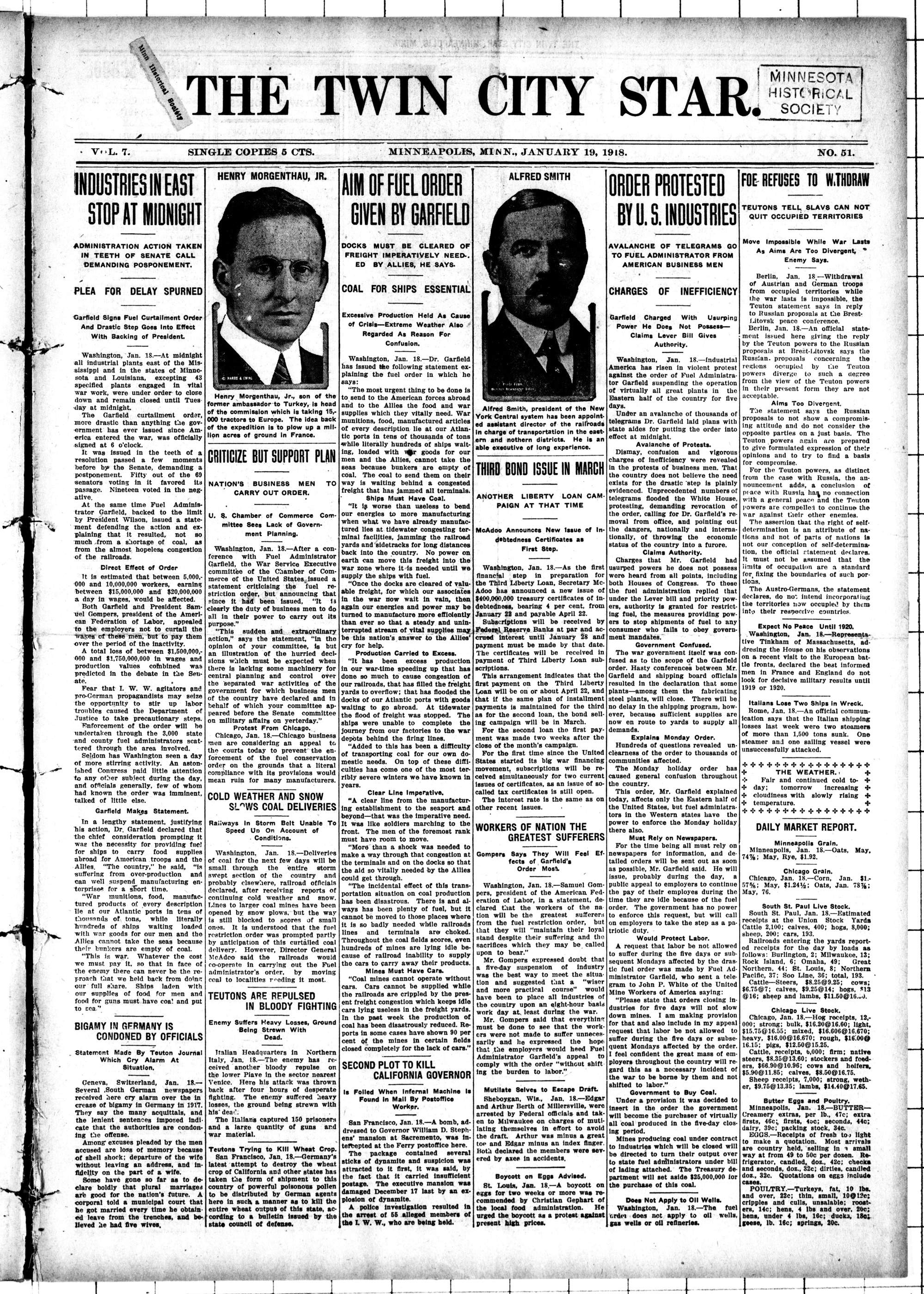
HENRY MORGENTHAU, JR.
Henry Morgenthau, Jr., son of the former ambassador to Turkey, is head of the commission which is taking 15,000 tractors to Europe. The idea back of the expedition is to plow up a million acres of ground in France.
CRITICIZE BUT SUPPORT PLAN
NATION'S BUSINESS MEN TO CARRY OUT ORDER.
U. S. Chamber of Commerce Committee Sees Lack of Government Planning.
Washington, Jan. 18.—After a conference with Fuel Administrator Garfield, the War Service Executive committee of the Chamber of Commerce of the United States, issued a statement criticising the fuel restriction order, but announcing that since it had been issued, "It is clearly the duty of business men to do all in their power to carry out its purpose."
"This sudden and extraordinary action," says the statement, "in the opinion of your committee, is but an illustration of the hurried decisions which must be expected when there is lacking some machinery for central planning and control over the separated war activities of the government for which business men of the country have declared and in behalf of which your committee appeared before the Senate committee on military affairs on yerterday."
Protest From Chicago.
Chicago, Jan. 18.—Chicago business men are considering an appeal to the courts today to prevent the enforcement of the fuel conservation order on the grounds that a literal compliance with its provisions would mean ruin for many manufacturers.
COLD WEATHER AND SNOW
SL^WS COAL DELIVERIES
Railways In Storm Belt Unable To Speed Up On Account of Conditions.
Washington, Jan. 18.—Deliveries of coal for the next few days will be small through the entire storm swept section of the country and probably elsewhere, railroad officials declared, after receiving reports of continuing cold weather and snow. Lines to larger coal mines have been opened by snow plows, but the way is still blocked to scores of small ones. It is understood that the fuel restriction order was prompted partly by anticipation of this curtailed coal delivery. However, Director General McAdco said the railroads would co-operate in carrying out the Fuel administrator's order, by moving coal to localities needing it most.
TEUTONS ARE REPULSED IN BLOODY FIGHTING
Enemy Suffers Heavy Losses, Ground Being Strewn With Dead.
Italian Headquarters in Northern Italy, Jan. 18.—The enemy has received another bloody repulse on the lower Plave in the sector nearest Venice. Here his attack was thrown back after four hours of desperate fighting. The enemy suffered heavy losses, the ground being strewn with his dead.
The Italians captured 150 prisoners and a large quantity of guns and war material.
Teutons Trying to Kill Wheat Crop. San Francisco, Jan. 18.—Germany's latest attempt to destroy the wheat crop of California and other states has taken the form of shipment to this country of powerful poisonous pollen to be distributed by German agents here in such a manner as to kill the entire wheat output of this state, according to a bulletin issued by the state council of defense.
MINNEAPOLIS, MINN., JANUARY 19, 1918.
AIM OF FUEL ORDER GIVEN BY GARFIELD
AIM OF FUEL ORDER GIVEN BY GARFIELD
DOCKS MUST BE CLEARED OF
FREIGHT IMPERATIVELY NEED.
ED BY ALLIES, HE SAYS.
Excessive Production Held As Cause of Crisis—Extreme Weather Also Regarded As Reason For Confusion.
Washington, Jan. 18.—Dr. Garfield has issued the following statement explaining the fuel order in which he says:
"The most urgent thing to be done is to send to the American forces abroad and to the Allies the food and war supplies which they vitally need. War munitions, food, manufactured articles of every description lie at our Atlantic ports in tens of thousands of tons while literally hundreds of ships waiting, loaded with war goods for our men and the Allies, cannot take the seas because bunkers are empty of coal. The coal to send them on their way is waiting behind a congested freight that has jammed all terminals.
Ships Must Have Coal.
"It is worse than useless to bend our energies to more manufacturing when what we have already manufactured lies at tidewater congesting terminal facilities, jamming the railroad yards and sidetracks for long distances back into the country. No power on earth can move this freight into the war zone where it is needed until we supply the ships with fuel."
"Once the docks are cleared of valuable freight, for which our associates in the war now wait in vain, then again our energies and power may be turned to manufacture more efficiently than ever so that a steady and uninterrupted stream of vital supplies may be this nation's answer to the Allies' cry for help.
Production Carried to Excess.
"It has been excess production in our war-time speeding up that has done so much to cause congestion of our railroads, that has filled the freight yards to overflow; that has flooded the docks of our Atlantic ports with goods waiting to go abroad. At tidewater the flood of freight was stopped. The ships were unable to complete the journey from our factories to the war depots behind the firing lines.
"Added to this has been a difficulty of transporting coal for our own domestic needs. On top of these difficulties has come one of the most terribly severe winters we have known in years.
Clear Line Imperative.
"A clear line from the manufacturing establishment to the seaport and beyond—that was the imperative need. It was like soldiers marching to the front. The men of the foremost rank must have room to move.
"More than a shock was needed to make a way through that congestion at the terminals and on the docks so that the aid so vitally needed by the Allies could get through.
"The incidental effect of this transportation situation on coal production has been disastrous. There is and always has been plenty of fuel, but it cannot be moved to those places where it is so badly needed while railroads lines and terminals are choked. Throughout the coal fields scores, even hundreds of mines are lying idle because of railroad inability to supply the cars to carry away their products.
"Mines Must Have Cars.
"Coal mines cannot operate without cars. Cars cannot be supplied while the railroads are crippled by the present freight congestion which keeps idle cars lying useless in the freight yards. In the past week the production of coal has been disastrously reduced. Reports in some cases have shown 90 per cent of the mines in certain fields closed completely for the lack of cars."
SECOND PLOT TO KILL
CALIFORNIA GOVERNOR
Is Foiled When Infernal Machine Is Found In Mail By Postoffice Worker.
San Francisco, Jan. 18.—A bomb, addressed to Governor William D. Stephens' mansion at Sacremento, was intercepted at the Ferry postoffice here. The package contained several sticks of dynamite and suspicion was attracted to it first, it was said, by the fact that it carried insufficient postage. The executive mansion was damaged December 17 last by an explosion of dynamite.
A police investigation resulted in the arrest of 55 alleged members of the I. W. W., who are being held.
ALFRED SMITH
Alfred Smith, president of the New York Central system has been appointed assistant director of the railroads in charge of transportation in the eastern and northern districts. He is an able executive of long experience.
THIRD BOND ISSUE IN MARCH
ANOTHER LIBERTY LOAN CAM
PAIGN AT THAT TIME
McAdoo Announces New Issue of Indebtedness Certificates as
Washington, Jan. 18.—As the first financial step in preparation for the Third Liberty Loan, Secretary McAdoo has announced a new issue of $400,000,000 treasury certificates of indebtedness, bearing 4 per cent, from January 22 and payable April 22.
Subscriptions will be received by Federal Reserve Banks at par and accrued interest until January 28 and payment must be made by that date. The certificates will be received in payment of Third Liberty Loan subscriptions.
This arrangement indicates that the first payment on the Third Liberty Loan will be on or about April 22, and that if the same plan of installment payments is maintained for the third as for the second loan, the bond selling campaign will be in March.
For the second loan the first payment was made two weeks after the close of the month's campaign.
For the first time since the United States started its big war financing movement, subscriptions will be received simultaneously for two current issues of certificates, as an issue of so-called tax certificates is still open.
The interest rate is the same as on other recent issues.
WORKERS OF NATION THE GREATEST SUFFERERS
Gompers Says They Will Feel Effects of Garfield's Order Mosh.
Washington, Jan. 18.—Samuel Gompers, president of the American Federation of Labor, in a statement, declared that the workers of the nation will be the greatest sufferers from the fuel restriction order, but that they will "maintain their loyal stand despite their suffering and the sacrifices which they may be called upon to bear."
Mr. Gompers expressed doubt that a five-day suspension of industry was the best way to meet the situation and suggested that a "wiser and more practical course" would have been to place all industries of the country upon an eight-hour basis work day at least during the war.
Mr. Gompers said that everything must be done to see that the workers were not made to suffer unnecessarily and he expressed the hope that the employers would heed Fuel Administrator Garfield's appeal to comply with the order "without shifting the burden to labor."
Mutilate Selves to Escape Draft.
Sheboygan, Wis., Jan. 18.—Edgar and Arthur Berth of Millersville, were arrested by Federal officials and taken to Milwaukee on charges of mutlating themselves in effort to avoid the draft. Arthur was minus a great toe and Edgar minus an index finger. Both declared the members were severed by axes in accidents.
Boycott on Eggs Advised.
St. Louis, Jan. 18.—A boycott on eggs for two weeks or more was recommended by Christian Gephart of the local food administration. He urged the boycott as a protest against present high prices.
AVALANCHE OF TELEGRAMS GO TO FUEL ADMINISTRATOR FROM AMERICAN BUSINESS MEN
Garfield Charged With Usurping Power He Does Not Possess—Claims Lever Bill Gives Authority.
Washington, Jan. 18.—Industrial America has risen in violent protest against the order of Fuel Administrator Garfield suspending the operation of virtually all great plants in the Eastern half of the country for five days.
Under an avalanche of thousands of telegrams Dr. Garfield laid plans with state alces for putting the order into effect at midnight.
Avalanche of Protests.
Dismay, confusion and vigorous charges of inefficiency were revealed in the protests of business men. That the country does not believe the need exists for the drastic step is plainly evidenced. Unprecedented numbers of telegrams flooded the White House, protesting, demanding revocation of the order, calling for Dr. Garfield's removal from office, and pointing out the dangers, nationally and internationally, of throwing the economic status of the country into a furore.
Claima Authority.
Charges that Mr. Garfield had usurped powers he does not possess were heard from all points, including both Houses of Congress. To these the fuel administration replied that under the Lever bill and priority powers, authority is granted for restricting fuel, the measures providing powers to stop shipments of fuel to any consumer who fails to obey government mandates.
Government Confused.
The war government itself was confused as to the scope of the Garfield order. Hasty conferences between Mr. Garfield and shipping board officials resulted in the declaration that some plants--among them the fabricating steel plants, will close. There will be no delay in the shipping program, however, because sufficient supplies are now en route to yards to supply all demands.
Explains Monday Order.
Hundreds of questions revealed unclearness of the order to thousands of communities affected. The Monday holiday order has caused general confusion throughout the country. This order, Mr. Garfield explained today, affects only the Eastern half of the United States, but fuel administrators in the Western states have the power to enforce the Monday holiday there also.
Must Rely on Newspapers.
For the time being all must rely on newspapers for information, and detailed orders will be sent out as soon as possible, Mr. Garfield said. He will issue, probably during the day, a public appeal to employers to continue the pay of their employees during the time they are idle because of the fuel order. The government has no power to enforce this request, but will call on employers to take the step as a patriotic duty.
Would Protect Labor.
A request that labor be not allowed to suffer during the five days or subsequent Mondays affected by the drastic fuel administrator Garfield, who sent a telegram to John P. White of the United Mine Workers of America saying: "Please state that orders closing industries for five days will not slow down mines. I am making provision for that and also include in my appeal request that labor be not allowed to suffer during the five days or subsequent Mondays affected by the order. I feel confident the great mass of employers throughout the country will regard this as a necessary incident of the war to be borne by them and not shifted to labor."
Government to Buy Coal. Under a provision it was decided to insert in the order the government will become the purchaser of virtually all coal produced in the five-day closing period.
Mines producing coal under contract to industries which will be closed will be directed to turn their output over to state fuel administrators under bill of lading attached. The Treasury department will set aside $25,000,000 for the purchase of this coal.
Does Not Apply to Oil Wells
Washington, Jan. 18.—The fuel order does not apply to oil wells, gas wells or oil refineries.
NO. 51.
FOE REFUSES TO W.THDRAW
TEUTONS TELL, SLAVS CAN NOT
QUIT OCCUPIED TERRITORIES
Move Impossible While War Lasts
As Aims Are Too Divergent,
Enemy Says.
Berlin, Jan. 18.—Withdrawal of Austrian and German troops from occupied territories while the war lasts is impossible, the Teuton statement says in reply to Russian proposals at the Brest-Litovsk peace conference.
Berlin, Jan. 18.—An official statement issued here giving the reply by the Teuton powers to the Russian proposals at Brest-Litovsk says the Russian proposals concerning the regions occupied by the Teuton powers diverge to such a degree from the view of the Teuton powers in their present form they are not acceptable.
Alms Too Divergent.
The statement says the Russian proposals to not show a compromising attitude and do not consider the opposite parties on a just basis. The Teuton powers again are prepared to give formulated expression of their opinions and to try to find a basis for compromise.
For the Teuton powers, as distinct from the case with Russia, the announcement adds, a conclusion of peace with Russia has no connection with a general peace and the Teuton powers are compelled to continue the war against their other enemies.
The assertion that the right of self-determination is an attribute of nations and not of parts of nations is not our conception of self-determination, the official statement declares. It must not be assumed that the limits of occupation are a standard for fixing the boundaries of such portions.
The Austro-Germans, the statement declares, do not intend incorporating the territories now occupied by them into their respective countries.
Expect No Peace Until 1920.
Washington, Jan. 18.—Representative Tinkham of Massachusetts, addressing the House on his observations on a recent visit to the European battle fronts, declared the best informed men in France and England do not look for decisive military results until 1919 or 1920.
Italians Lose Two Ships in Wreck.
Rome, Jan. 18.—An official communication says that the Italian shipping losses last week were two steamers of more than 1,500 tons sunk. One steamer and one sailing vessel were unsuccessfully attacked.
THE WEATHER. Fair and continued cold today; tomorrow increasing cloudiness with slowly rising temperature.
DAILY MARKET REPORT.
Minneapolis Grain.
Minneapolis, Jan. 18.—Oats, May,
74%; May, Rye, $1.92.
Chicago Grain.
Chicago, Jan. 18.—Corn, Jan. $1.-
57%; May, $1.24½; Oats, Jan. 78%;
May, 76.
South St. Paul Live Stock.
South St. Paul, Jan. 18.—Estimated receipts at the Union Stock Yards Cattle 2,100; calves, 400; hogs, 8,000; sheep, 200; cars, 193.
Railroads entering the yards reported receipts for the day by loads as follows: Burlington, 2; Milwaukee, 13; Rock Island, 6; Omaha, 49; Great Northern, 44; St. Louis, 8; Northern Pacific, 37; Soo Line, 36; total, 193.
Cattle—Steers, $8.25@9.25; cows, $6.75@7; calves, $9.25@14; hogs, $13@16; sheep and lambs, $11.50@16...
Chicago Live Stock.
Chicago, Jan. 18.—Hog receipts, 12.000; strong; bulk, $16.20@16.60; light, $15.75@16.55; mixed, $16.60@16.670; heavy, $16.00@16.670; rough, $16.00@16.15; pigs, $12.50@15.25.
Cattle, receipts, 6,000; firm; native steers, $8.35@13.60; stockers and feeders, $6.90@10.96; cows and heifers, $5.90@11.85; calves, $8.50@16.75.
Sheep receipts, 7,000; strong, wether, $7.75@13.35; lambs, $14.40@17.65.
Butter Eggs and Poultry.
Minneapolis, Jan. 18.—BUTTER—Creamy extras, per lb., 47c; firsts, 46c; firsts, 4bc; seconds, 44c; dairy, 39c; packing stock, 34c.
EGGS.—Receipts of fresh to light to make a quotation. Most arrivals are country held, selling in a small way at from 49 to 50c per dozen. Refrigerator, candled, doz, 42c; checks and seconds, doz, 32c; dirties, candled doz, 32c. Quotations on eggs include cases.
POULTRY.—Turkeys, fat, 10 lbs, and over, 22c; thin, small, 10@12c; cripples and culls, unsalable; roosters, 14c; hens, 4 lbs and over, 20c; hens, under 4 lbs, 16c; duckx, 18c; geese, 1b. 16c; springs, 20c.
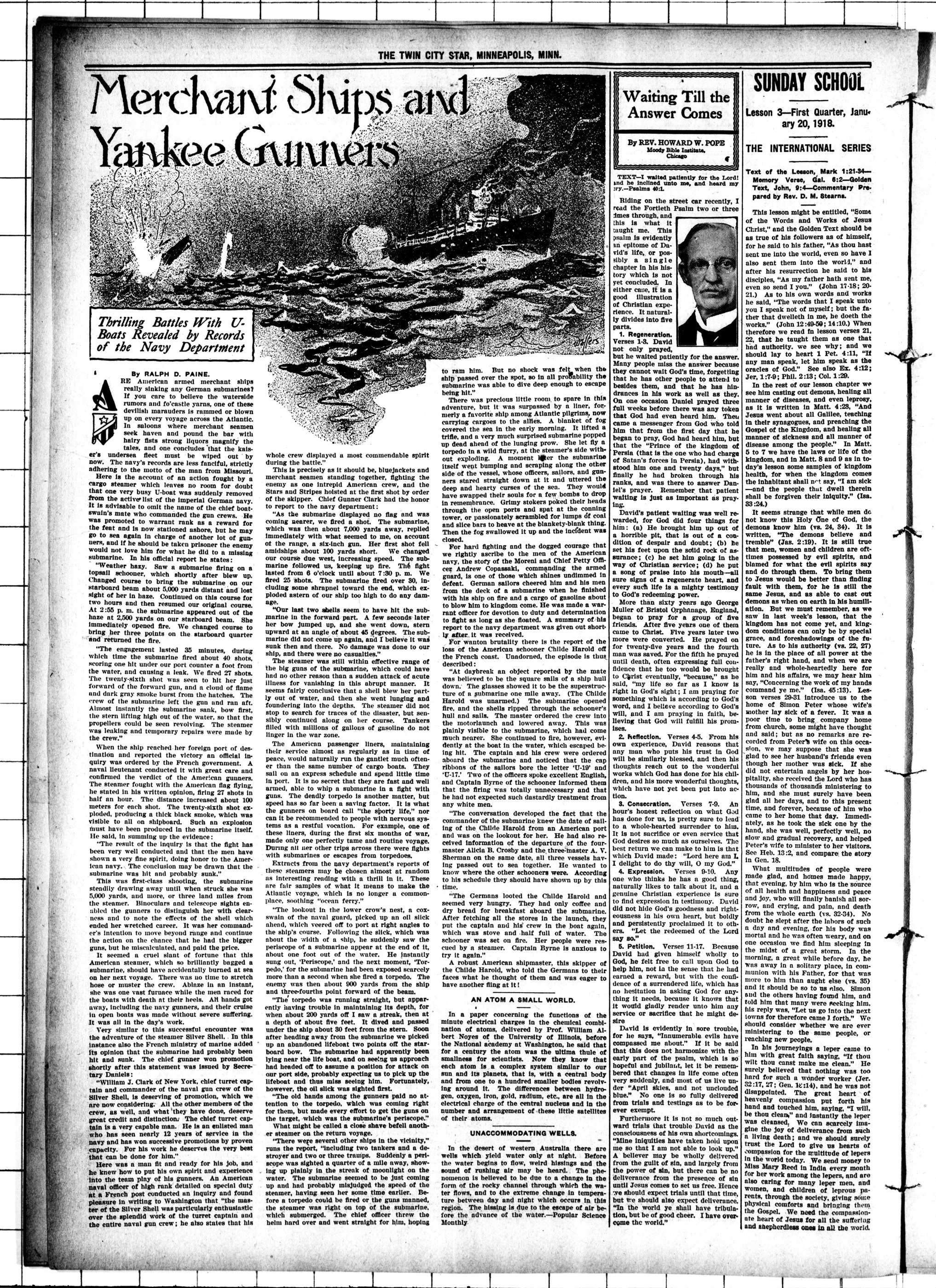
Merchant Ships and Yankee Gunners
Thrilling Battles With U-Boats Revealed by Records of the Navy Department
RE American armed merchant ships really sinking any German submarines? If you care to believe the waterside rumors and fo'castle yarns, one of these devilish marauders is rammed or blown up on every voyage across the Atlantic. In saloons where merchant seamen seek haven and pound the bar with hairy fists strong liquors magnify the tales, and one concludes that the kats-
RE American armed merchant ships really sinking any German submarines? If you care to believe the waterside rumors and fo'castle yarns, one of these devilish marauders is rammed or blown up on every voyage across the Atlantic. In saloons where merchant seamen seek haven and pound the bar with hairy fists strong liquors magnify the tales, and one concludes that the kaiser's undersea fleet must be wiped out by now. The navy's records are less fanciful, strictly adhering to the motto of the man from Missouri
Here is the account of an action fought by a cargo steamer which leaves no room for doubt that one very busy U-boat was suddenly removed from the active list of the imperial German navy. It is advisable to omit the name of the chief boat-swain's mate who commanded the gun crews. He was promoted to warrant rank as a reward for the feat and is now stationed ashore, but he may go to sea again in charge of another lot of gunners, and if he should be taken prisoner the enemy would not love him for what he did to a missing submarine. In his official report he states:
"Weather hazy. Saw a submarine firing on a topsail schooner, which shortly after blew up. Changed course to bring the submarine on our starboard beam about 5,000 yards distant and lost sight of her in haze. Continued on this course for two hours and then resumed our original course. At 2:55 p. m. the submarine appeared out of the haze at 2,500 yards on our starboard beam. She immediately opened fire. We changed course to bring her three points on the starboard quarter and returned the fire.
"The engagement lasted 35 minutes, during which time the submarine fired about 40 shots, scoring one hit under our port counter a foot from the water, and causing a leak. We fired 27 shots. The twenty-sixth shot was seen to hit her just forward of the forward gun, and a cloud of flame and dark gray smoke burst from the hatches. The crew of the submarine left the gun and ran aft. Almost instantly the submarine sank, bow first, the stern lifting high out of the water, so that the propellers could be seen revolving. The steamer was leaking and temporary repairs were made by the crew."
When the ship reached her foreign port of destination and reported the victory an official inquiry was ordered by the French government. A naval lieutenant conducted it with great care and confirmed the verdict of the American gunners. The steamer fought with the American flag flying, he stated in his written opinion, firing 27 shots in half an hour. The distance increased about 100 meters for each shot. The twenty-sixth shot exploded, producing a thick black smoke, which was visible to all on shipboard. Such an explosion must have been produced in the submarine itself. He said, in summing up the evidence:
"The result of the inquiry is that the fight has been very well conducted and that the men have shown a very fine spirit, doing honor to the American navy. The conclusion may be drawn that the submarine was hit and probably sunk."
This was first-class shooting, the submarine steadily drawing away until when struck she was 5,000 yards, and more, or three land miles from the steamer. Binoculars and telescope sights enabled the gunners to distinguish her with clearness and to note the effects of the shell which ended her wretched career. It was her commander's intention to move beyond range and continue the action on the chance that he had the bigger guns, but he miscalculated, and paid the price.
It seemed a cruel slant of fortune that this American steamer, which so brilliantly bagged a submarine, should have accidentally burned at sea on her next voyage. There was no time to stretch hose or muster the crew. Albine in an instant, she was one vast furnace while the men raced for the boats with death at their heels. All hands got away, including the navy gunners, and their cruise in open boats was made without severe suffering. It was all in the day's work.
Very similar to this successful encounter was the adventure of the steamer Silver Shell. In this instance also the French ministry of marine added its opinion that the submarine had probably been hit and sunk. The chief gunner won promotion shortly after this statement was issued by Secretary Daniels:
"William J. Clark of New York, chief turret captain and commander of the naval gun crew of the Silver Shell, is deserving of promotion, which we are now considering. All the other members of the crew, as well, and what they have done, deserve great credit and distinction. The chief turret captain is a very capable man. He is an enlisted man who has seen nearly 12 years of service in the navy and has won successive promotions by proven capacity. For his work he deserves the very best that can be done for him."
Here was a man fit and ready for his job, and he knew how to put his own spirit and experience into the team play of his gunners. An American naval officer of high rank detailed on special duty at a French post conducted an inquiry and found pleasure in writing to Washington that "the master of the Silver Shell was particularly enthusiastic over the splendid work of the turret captain and the entire naval gun crew; he also states that his
THE TWIN CITY STAR, MINNEAPOLIS, MINN.
Ships and runners
s and
s
whole crew displayed a most commendable spirit during the battle."
This is precisely as it should be, bluejackets and merchant seamen standing together, fighting the enemy as one intrepid American crew, and the Stars and Stripes holsted at the first shot by order of the skipper. Chief Wren Clark had the honor to report to the navy department:
"As the submarine displayed no flag and was coming nearer, we fired a shot. The submarine, which was then about 7,000 yards away, replied immediately with what seemed to me, on account of the range, a six-inch gun. Her first shot fell amidships about 100 yards short. We changed our course due west, increasing speed. The submarine followed us, keeping up fire. The fight lasted from 6 o'clock until about 7:30 p. m. We fired 25 shots. The submarine fired over 30, including some shrapnel toward the end, which exploded astern of our ship too high to do any damage.
"Our last two shells seem to have hit the submarine in the forward part. A few seconds later her bow jumped up, and she went down, stern upward at an angle of about 45 degrees. The submarine did not come up again, and I believe it was sunk then and there. No damage was done to our ship, and there were no casualties."
The steamer was still within effective range of the big guns of the submarine, which could have had no other reason than a sudden attack of acute illness for vanishing in this abrupt manner. It seems fairly conclusive that a shell blew her partly out of water, and then she went lunging and foundering into the depths. The steamer did not stop to search for traces of the disaster, but sensibly continued along on her course. Tankers filled with millions of gallons of gasoline do not linger in the war zone.
The American passenger liners, maintaining their service almost as regularly as in time of peace, would naturally run the gantlet much oftener than the same number of cargo boats. They sail on an express schedule and spend little time in port. It is no secret that they are fast and well armed, able to whip a submarine in a fight with guns. The deadly torpedo is another matter, but speed has so far been a saving factor. It is what the gunners on board call "the sporty life," nor can it be recommended to people with nervous systems as a restful vocation. For example, one of these liners, during the first six months of war, made only one perfectly tame and routine voyage. During all her other trips across there were fights with submarines or escapes from torpedoes.
Extracts from the navy department's reports of these steamers may be chosen almost at random as interesting reading with a thrill in it. These are fair samples of what it means to make the Atlantic voyage, which is no longer a commonplace, soothing "ocean ferry."
"The lookout in the lower crow's nest, a coxswain of the naval guard, picked up an oil slick ahead, which veered off to port at right angles to the ship's course. Following the slick, which was about the width of a ship, he suddenly saw the periscope of a submarine appear at the end of it, about one foot out of the water. He instantly sung out, 'Periscope,' and the next moment, "Torpedo," for the submarine had been exposed scarcely more than a second when she fired a torpedo. The enemy was then about 900 yards from the ship and three-fourths point forward of the beam.
"The torpedo was running straight, but apparently having trouble in maintaining its depth, for when about 200 yards off I saw a streak, then at a depth of about five feet. It dived and passed under the ship about 30 feet from the stern. Soon after heading away from the submarine we picked up an abandoned lifeboat two points off the starboard bow. The submarine had apparently been lying near the life boat, and on seeing us approach had headed off to assume a position for attack on our port side, probably expecting us to pick up the lifeboat and thus miss seeing him. Fortunately, however, the oil slick was sighted first.
"The old hands among the gunners paid no attention to the torpedo, which was coming right for them, but made every effort to get the guns on the target, which was the submarine's periscope."
What might be called a close shave befall another steamer on the return voyage.
"There were several other ships in the vicinity," runs the report, "including two tankers and a destroyer and two or three tramps. Suddenly a periscope was sighted a quarter of a mile away, showing up plainly in the streak of moonlight on the water. The submarine seemed to be just coming up and had probably misjudged the speed of the steamer, having seen her some time earlier. Before a torpedo could be fired or the guns manned, the steamer was right on top of the submarine, which submerged. The chief officer threw the helm hard over and went straight for him, hoping
---
vd
walters
to ram him. But no shock was felt when the ship passed over the spot, so in all probability the submarine was able to dive deep enough to escape being hit."
There was precious little room to spare in this adventure, but it was surpassed by a liner, formerly a favorite ship among Atlantic pilgrims, now carrying cargoes to the allies. A blanket of fog covered the sea in the early morning. It lifted a trifle, and a very much surprised submarine popped up dead ahead of the lunging prow. She let fly a torpedo in a wild flurry, at the steamer's side without exploding. A moment later the submarine itself went bumping and scraping along the other side of the vessel, whose officers, sailors, and gunners stared straight down at it and uttered the deep and hearty curses of the sea. They would have swapped their souls for a few bombs to drop in remembrance. Grimy stokers poked their heads through the open ports and spat at the conning tower, or passionately scrambled for lumps of coal and slice bars to heave at the blankety-blank thing. Then the fog swallowed it up and the incident was closed.
For hard fighting and the dogged courage that we rightly ascribe to the men of the American navy, the story of the Morenl and Chief Petty Officer Andrew Copassaki, commanding the armed guard, is one of those which shines undimmed in defeat. German sailors cheered him and his men from the deck of a submarine when he finished with his ship on fire and a cargo of gasoline about to blow him to kingdom come. He was made a warrant officer for devotion to duty and determination to fight as long as she floated. A summary of his report to the navy department was given out shortly after it was received.
For wanton brutality there is the report of the loss of the American schooner Childe Harold on the French coast. Unadorned, the episode is thus described:
"At daybreak an object reported by the mate was believed to be the square sails of a ship hull down. The glasses showed it to be the superstructure of a submarine one mile away. (The Childe Harold was unarmed.) The submarine opened fire, and the shells ripped through the schooner's hull and sails. The master ordered the crew into the motorlaunch and lowered away. This was plainly visible to the submarine, which had come much nearer. She continued to fire, however, evidently at the boat in the water, which escaped being hit. The captain and his crew were ordered aboard the submarine and noticed that the cap ribbons of the sailors bore the letter 'U-19' and 'U-17.' Two of the officers spoke excellent English, and Captain Byrne of the schooner informed them that the firing was totally unnecessary and that he had not expected such dastardly treatment from any white men.
"The conversation developed the fact that the commander of the submarine knew the date of sailing of the Childe Harold from an American port and was on the lookout for her. He had also received information of the departure of the fourmaster Allicia B. Crosby and the three-master A. V. Sherman on the same date, all three vessels having passed out to sea together. He wanted to know where the other schooners were. According to his schedule they should have shown up by this time.
"The Germans looted the Childe Harold and seemed very hungry. They had only coffee and dry bread for breakfast aboard the submarine. After fetching all the stores in the launch, they put the captain and his crew in the boat again, which was stove and half full of water. The schooner was set on fire. Her people were rescued by a steamer. Captain Byrne is anxious to try it again."
A robust American shipmaster, this skipper of the Childe Harold, who told the Germans to their faces what he thought of them and was eager to have another fling at it!
AN ATOM A SMALL WORLD.
In a paper concerning the functions of the minute electrical charges in the chemical combination of atoms, delivered by Prof. William Albert Noyes of the University of Illinois, before the National academy at Washington, he said that for a century the atom was the ultima thule of smallness for scientists. Now they know that each atom is a complex system similar to our sun and its planets, that is, with a central body and from one to a hundred smaller bodies revolving around it. The differences between hydrogen, oxygen, iron, gold, radium, etc., are all in the electrical charge of the central nucleus and in the number and arrangement of these little satellites of their atoms.
UNACCOMMODATING WELLS.
In the desert of western Australia there are wells which yield water only at night. Before the water begins to flow, weird hissings and the sound of rushing air may be heard. The phenomenon is believed to be due to a change in the form of the rocky channel through which the water flows, and to the extreme change in temperature between day and night which occurs in this region. The hissing is due to the escape of air before the advance of the water.—Popular Science Monthly.
By REV. HOWARD W. POPE
Moody Bible Institute,
Chicago
TEXT—I waited patiently for the Lord!
and he inclined unto me, and heard my
ry.—Psalms 40:1
Riding on the street car recently, I
read the Fortieth Psalm two or three
times through, and this is what it taught me. This psalm is evidently an epitome of David's life, or possibly a single chapter in his history which is not yet concluded. In either case, it is a good illustration of Christian experience. It naturally divides into five parts.
JOHN H. BURKE
1. Regeneration
Verses 1-3. David
not only prayed.
but he waited patiently for the answer. Many people miss the answer because they cannot wait God's time, forgetting that he has other people to attend to besides them, and that he has hindrances in his work as well as they. On one occasion Daniel prayed three full weeks before there was any token that God had even heard him. They came a messenger from God who told him that from the first day that he began to pray, God had heard him, but that the "Prince of the kingdom of Persia (that is the one who had charge of Satan's forces in Persia), had withstood him one and twenty days," but finally he had broken through his ranks, and was there to answer Daniel's prayer. Remember that patient waiting is just as important as praying.
David's patient waiting was well rewarded, for God did four things for him: (a) He brought him up out of a horrible pit, that is out of a condition of despair and doubt; (b) he set his feet upon the solid rock of assurance; (c) he set him going in the way of Christian service; (d) he put a song of praise into his mouth—all sure signs of a regenerate heart, and every such life is a mighty testimony to God's redeeming power.
More than sixty years ago George Muller of Bristol Orphanage, England, began to pray for a group of five friends. After five years one of them came to Christ. Five years later two more were converted. He prayed on for twenty-five years and the fourth man was saved. For the fifth he prayed until death, often expressing full confidence that he too would be brought to Christ eventually, "because," as he said, "my life so far as I know is right in God's sight; I am praying for something which is according to God's word, and I believe according to God's will, and I am praying in faith, believing that God will fulfill his promises.
2. Reflection. Verses 4-5. From his own experience, David reasons that any man who puts his trust in God will be similarly blessed, and then his thoughts reach out to the wonderful works which God has done for his children, and his more wonderful thoughts, which have not yet been put into action.
3. Consecration. Verses 7-9. An hour's honest reflection on what God has done for us, is pretty sure to lead to a whole-hearted surrender to him. It is not sacrifice or even service that God desires so much as ourselves. The best return we can make to him is that which David made: "Lord here am I I delight to do thy will, O my God."
4. Expression. Verses 9-10. Any one who thinks he has a good thing, naturally likes to talk about it, and a genuine Christian experience is sure to find expression in testimony. David did not hide God's goodness and righteousness in his own heart, but boldly and persistently proclaimed it to others. "Let the redeemed of the Lord say so."
5. Petition. Verses 11-17. Because David had given himself wholly to God, he felt free to call upon God to help him, not in the sense that he had earned a reward, but with the confidence of a surrendered life, which has no hesitation in asking God for anything it needs, because it knows that it would gladly render unto him any service or sacrifice that he might desire
David is evidently in sore trouble, for he says, "Innumerable evils have compassed me about." If it be said that this does not harmonize with the early part of the psalm, which is so hopeful and jubilant, let it be remembered that changes in life come often very suddenly, and most of us live under "April skies, and not unclouded blue." No one is so fully delivered from trials and testings as to be forever exempt.
Furthermore it is not so much outward trials that trouble David as the consciousness of his own shortcomings. "Mine iniquities have taken hold upon me so that I am not able to look up." A believer may be wholly delivered from the guilt of sin, and largely from the power of sin, but there can be no deliverance from the presence of sin until Jesus comes to set us free. Hence we should expect trials until that time, but we should also expect deliverance. "In the world ye shall have tribulation, but be of good cheer. I have overcome the world."
Lesson 3—First Quarter, January 20, 1918.
THE INTERNATIONAL SERIES
Text of the Lesson, Mark 1:21-94—Memory Verse, Gal. 6:2—Golden Text, John, 9:4—Commentary Prepared by Rev. D. M. Stearns.
This lesson might be entitled, "Some of the Words and Works of Jesus Christ," and the Golden Text should be as true of his followers as of himself, for he said to his father, "As thou hast sent me into the world, even so have I also sent them into the world," and after his resurrection he said to his disciples, "As my father hath sent me, even so send you." (John 17:18; 20:21.) As to his own words and works he said, "The words that I speak unto you I speak not of myself; but the father that dwellest in me, he doeth the works." (John 12:49:50; 14:10.) When therefore we read in lesson verses 21, 22, that he taught us as one that had authority, we see why; and we should lay to heart 1 Pet. 4:11, "If any man speak, let him speak as the oracles of God." See also Ex. 4:12; Jer. 1:7:9; Phil. 2:13; Col. 1:29.
In the rest of our lesson chapter we see him casting out demons, healing all manner of diseases, and even leprosy, as it is written in Matt. 4:23, "And Jesus went about all Galliee, teaching in their synagogues, and preaching the Gospel of the Kingdom, and healing all manner of sickness and all manner of disease among the people." In Matt. 5 to 7 we have the laws or life of the kingdom, and in Matt. 8 and 9 as in today's lesson some samples of kingdom health, for when the kingdom comes the inhabitant shall not say, "I am sick—and the people that dwell therein shall be forgiven their iniquity." (Isa. 33:24.)
It seems strange that while men do not know this Holy One of God, the demons know him (vs. 24, 34). It is written, "The demons believe and tremble" (Jas. 2:19). It is still true that men, women and children are oftimes possessed by evil spirits, and blamed for what the evil spirits say and do through them. To bring them to Jesus would be better than finding fault with them, for he is still the same Jesus, and as able to cast out demons as when on earth in his humiliation. But we must remember, as we saw in last week's lesson, that the kingdom has not come yet, and kingdom conditions can only be by special grace, and foreshadowings of the future. As to his authority (vs. 22, 27) he is in the place of all power at the father's right hand, and when we are really and whole-heartedly here for him and his affairs, we may hear him say, "Concerning the work of my hands command ye me." (Isa. 45:13). Lesson verses 29-31 introduce us to the home of Simon Peter whose wife's mother lay sick of a fever. It was a poor time to bring company home from church, some might have thought and said; but as no remarks are recorded from Peter's wife on this occasion, we may suppose that she was glad to see her husband's friends even though her mother was sick. If she did not entertain angels by her hospitality, she received the Lord who has thousands of thousands ministering to him, and she must surely have been glad all her days, and to this present time, and forever, because of him who came to her home that day. Immediately, as he took the sick one by the hand, she was well, perfectly well, no slow and gradual recovery, and helped Peter's wife to minister to her visitors. See Heb. 13:2, and compare the story in Gen. 18.
What multitudes of people were made glad, and homes made happy, that evening, by him who is the source of all health and happiness and peace and joy, who will finally banish all sorrow, and crying, and pain, and death from the whole earth (vs. 32-34). No doubt he slept after the labors of such a day and evening, for his body was mortal and he was often weary, and on one occasion we find him sleeping in the midst of a great storm. In the morning, a great while before day, he was away in a solitary place, in communion with his Father, for that was more to him than aught else (vs. 35) and it should be so to us also. Simon and the others having found him, and told him that many were seeking him, his reply was, "Let us go into the next towns for therefore came I forth." We should consider whether we are ever ministering to the same people, or reaching new people.
In his journeyings a leaper came to him with great faith saying, "If thou wilt thou canst make me clean." He surely believed that nothing was too hard for such a wonder worker (Jer. 32:17, 27; Gen. 12:14), and he was not disappointed. The great heart of heavenly compassion put forth his hand and touched him, saying, "I will be thou clean," and instantly the leper was cleansed. We can scarcely imagine the joy of deliverance from such a living death; and we should surely trust the Lord to give us hearts of compassion for the multitude of lepers in the world today. We send money to Miss Mary Reed in India every month for her work among the lepers, and are also caring for many leper men, and women, and children of leprous parents, through the society, giving some physical comforts and bringing them the Gospel. We need the compassionate heart of Jesus for all the suffering and shepherdless ones in all the world.
By Oliver Harper
(Copyright, 1917, Western Newspaper Union.)
"What is to be done with that pre-
cious pair of fools up there is what I
can't figure out," said Jim Barker,
blowing a cloud of smoke from his
stubby pine.
"We just can't do anything," replied Joe Timmins, sending a blue cloud over to meet and mingle with that of Jim. "We've tried to tell them that they're foolish, but you can't git anything into that woman's head, except that we are all a set of d——soundrels, and trying to chisel them out of a rich mine. I am plumb outdone with them, and yet we can't let them go on thisaway. Tomorrow will be New Year's, and there they are up there working like heroes at something that will never pay. I wish to goodness some of them smart Alecens in the big colleges would find some way of dealing with refractory ore. Who in Hallifax sent 'em up there, anyhow?"
"Oh, some one in Havilah. You see, the chap, he's a lunger. Got slick in some of them high skyscrapers in New York, and they sent him and that slip of a gal out here to rough it in the mines, hoping that he'd get well—"
"Well, he's in pretty fair health just now, as you'd know if you seen him at work. But, they've sunk every dollar they had in that d—— old Keystone. She thought the stones were so pretty! And, so they are, all green as emeralds, and full of gold, that you could cut out with a pocket knife, but which will never pan out a dollar to the hundred tons."
"I told him and her, when they took out the claim papers that it was had ore, but they knew so much better than I did that I finally let them go ahead. Well, they have their twenty-stamp mill up and the first clean-up will be made to-morrow. They are a pair of fools, but they are such engaging fools—what will they do when they find out?" said the man who kept the saloon.
At this moment a "man who worked for Ed. Ingram, the "fool," came down the trail from the Keystone mine.
"Say, is they a doctor in this here place? If they is, he is wanted up to the Keystone mighty quick. And, where's Annette? She's wanted, too." "Who's hurt? What's the matter, anyway?" asked Jim.
"Matter? Matter enough, I should say. Here is this gal away from home and folks. She's been workin' herself to death to help her fool husband spend money on that rotten old refractory ore mine. They clean up tomorrow after the first nine weeks' run, and she's been bakin' all day to have a New Year's festival for the boys—and by Gosh, there won't be six ounces, and now, now—well."
"Weil—what?" asked the twenty men crowding around him.
"Well?" mocked he, "what'd you expect? She's a-needin' her mother just now—that's what."
"I be a mud," said the old Indian woman who had come and the three hustened up the trail.
The men looked at each other blankly. They knew that this young couple had gone into the mountain hoping that the husband would grow strong. He did, but when Mary had discovered the lead they forgot all but that Mary knew gold when she saw it and here it was, lying in the hard quartz, among the vivid greens of the arsenical deposit, bright and pure. She had found a rich mine! Together they traced the outcroppings, and saw that the gold-bearing ledge was virtually endless, and so placed that tunneling would not be necessary. They took some of the richest specimens of their rock and went down to Havillah, to record their claim. Just for form they went to an assay office. The assayer looked at the beautifully-colored specimens and then stammered and turned red. Mary and Ed were so young and so enthusiastic it were ruthless to destroy their joy. Mary watched him suspiciously. Why was he so agitated?
"Ah—er—have you ever heard of refractory ore?" he asked. "There are many kinds of gold-bearing quartz, but some of it cannot be worked on account of the arsenic. And, I am afraid this is that kind of rock. It looks so." "But look at the gold," said Mary, her eyes flashing, and her cheeks red. "I know—I know, but it would cost much more than it would bring to try to work your claim. Where is your claim?" The two amateur miners looked at each other with quick suspicion, and neither replied. The poor assayer wanted to warn them, but they were sure he wanted to find out where the claim was to rob them. They gathered up their specimens and departed.
They met a man who had a twenty-stamp mill to sell. It had been a bad venture. He set the young folks against all the people at Havilah and Clear Creek, and finally sold them the mill. The people who would have saved them from disaster now let them alone, and waited for the catastrophe. It was bound to come with the first clean up. The mill was bought and laboriously used to the mine and set up. It had cost a thousand dollars for every stamp before it was ready for work. Provi-
stions for a year were taken up to the mine and a force of men engaged. They knew the uselessness of the work, but they were paid to work and not to give advice. The twenty stamps were polished till they shone. The big hopper was ready filled with ore. The blankets had been laid along the incline and the trough made ready. The little stream of water that was to mix with the pulverized rock was waiting to begin its work. The turbines below were filled with water, and the quicksilver there. All was waiting for the signal, but the Ingrams had spent their last dollar. Then, the great machine began to move, the stamps to rise and fall with rhythmic regularity, the broken rock to fill the trough and the water to flow. The Keystone mill was in full operation.
Winter had been abnormally open and so far not a flake of snow had fallen in the mountains. Only a few light rains, and so it was that after nine weeks of blind labor the first real knowledge of the value of the mine would be known. The young people up at the mine were happy, and felt that their prospects were bright. The joy of achievement was greater than anything else. They would know tomorrow. The New Year should see the culmination of their toll and sacrifice, and its recompense.
But in her ignorance Mary had not foreseen how much she was to "need her mother" until New Year's eve.
Finally one of the men at the saloon remarked: "The whole business won't pan out an ounce. They were in a devil of a fix before, and now—well I'm sorry for them."
"So am I," said Doc Stimson, "and I'm sorry just thirty ounces."
One of the other men remarked to the ceiling that he was sorry fifty ounces. Finally all 'present "chipped in" and there was a gathering of nearly two hundred ounces of gold, some of it in bottoms, from the retorts, some river dust, and some the dull grains from placers.
Almost without a sound the crowd started for the Keystone with the gold they had contributed. The watchman was so glad that he was not to be lynched for not having told the foolish children the truth that he was perfectly willing to enter the plot, which was to place all this gold into the turbine tub and allow Ingram to believe it gold from his mine. The main point now was to keep the fatal truth from them. Later—well they would see. So, they all sat down to wait for daylight and possibly news from the shack. They put a stone in the gear of the turbine so that the motion would not wash out the fine particles of dust, as they could not gather with the quicksilver and form amalgam on account of the nullifying effects of the arsenic.
After a long and cold wait there was a lusty wall, a sound never to be forgotten, and they listened breathlessly for news from the doctor.
"It is the finest boy in Kern county," said the doctor, just as the tardy sun came over the mountain. One man wanted to celebrate the day by lynching the man that sold the mill to the innocents, but just then the door opened again and Ed came bounding to them saying:
"Say, boys, I've got a son. Will you come in and see him? Mary is willing but she mustn't talk. And, I'm glad you've come. Oh, yes, Happy New Year."
"Yes—Happy New Year for us all, and the boy in particular!" the men shouted as they followed Ed to the shack. Ed continued:
"You'll all stay to breakfast, for we are going to have the first clean-up right away."
"Just so—just so," said Jim, and then with hushed steps they went into the little shack as though they were treading on holy ground. The beauty and grace of motherhood had fallen on Mary and her smile was ineffable. Even the mine was forgotten in her sweet joy.
TRACTOR ON A RUBBER FARM
Machine on 20,000-Acre Sumatra Plantation Does Work That Required Hundreds of Coolies.
The value of the tractor in expediting farm work has been recognized in many ways, but a striking example of its utility as applied to the cultivation of rubber has been shown by the employment of a tractor on a rubber plantation of 20,000 acres in Sumatra, controlled by one of the largest tire manufacturers in this country. In former days, says a writer, it required 250 coolies to plow three acres a day, but by utilizing a tractor 20 acres are now plowed in that time.
At the time the tractor was purchased about 2,000 acres were producing rubber, and consignments from the plantation are now coming to the American factory.
The development of the plantation was due to the recognition by the company that it was necessary to protect its rubber supply back to the tree. It was one of the lessons brought forcibly to the attention of the commercial world due to the war that without control of raw material supply back of the source, in case of a disturbance in market and transportation conditions, business would be greatly handicapped.
Slow Work.
"How long before my change will be here?" she asked, after waiting a considerable time.
"Oh, I didn't know you were in any hurry," replied the saleslady.
"Didn't know I was in any hurry? Well, I like that!"
"Why, no, your husband won't be ready to start for some time yet. He's out there trying to crank up his car."
THE TWIN CITY STAR, MINNEAPOLIS, MINN.
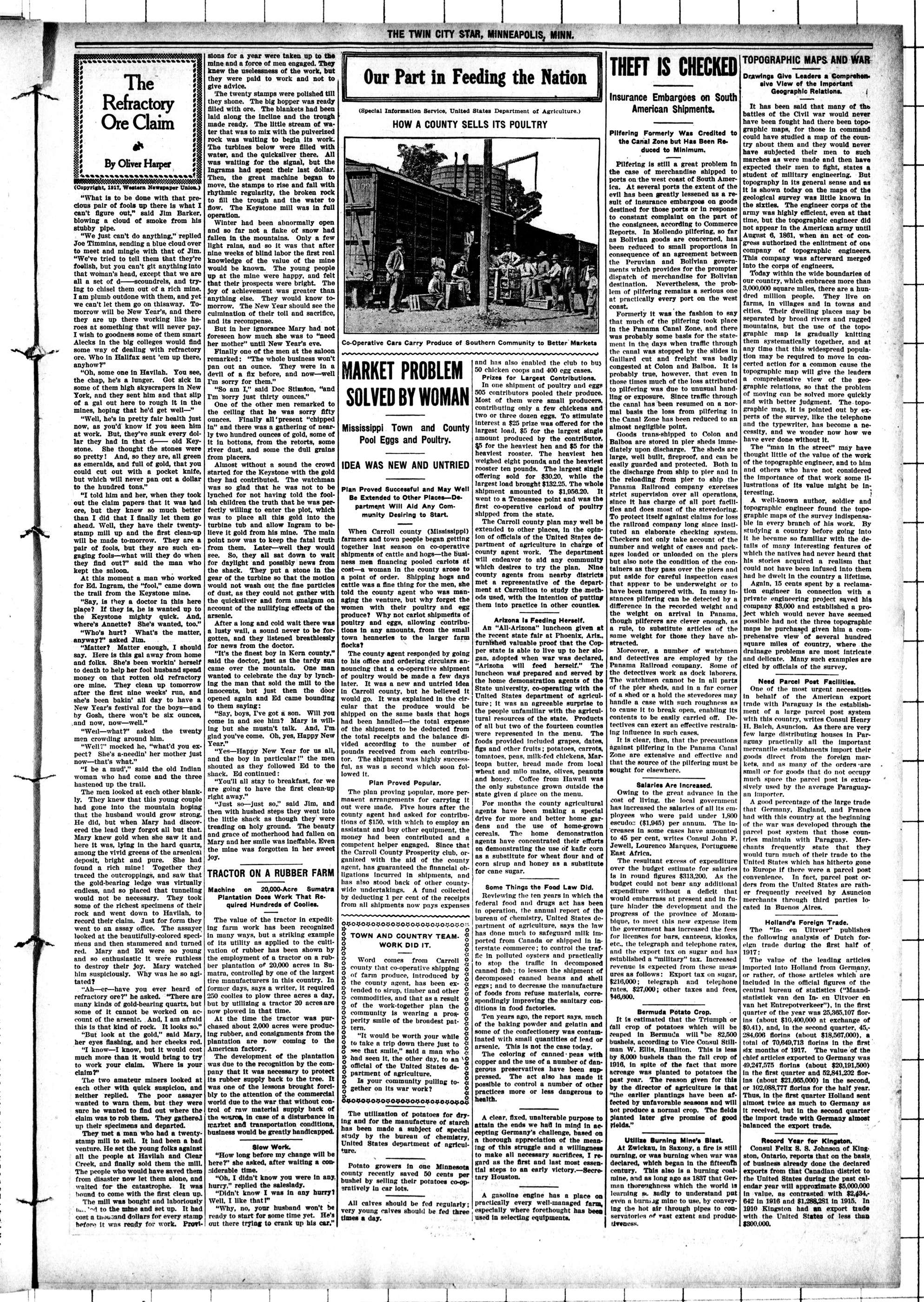
Our Part in Feeding the Nation
Our Part in Feeding the Nation
HOW A COUNTY SELLS TO TODAY
Co-Operative Cars Carry Produce of Southern Community to Better Markets
MARKET PROBLEM SOLVED BY WOMAN
Mississippi Town and County Pool Eggs and Poultry. IDEA WAS NEW AND UNTRIED
Plan Proved Successful and May Well Be Extended to Other Places—Department Will Aid Any Community Desiring to Start.
When Carroll county (Mississippi) farmers and town people began getting together last season on co-operative shipments of cattle and hogs—the business men financing pooled carlots at cost—a woman in the county arose to a point of order. Shipping hogs and cattle was a fine thing for the men, she told the county agent who was managing the venture, but why forget the women with their poultry and egg produce? Why not carlot shipments of poultry and eggs, allowing contributions in any amounts, from the small town henneries to the larger farm flocks?
The county agent responded by going to his office and ordering circulars announcing that a co-operative shipment of poultry would be made a few days later. It was a new and untried idea in Carroll county, but he believed it would go. It was explained in the circular that the produce would be shipped on the same basis that hogs had been handled—the total expense of the shipment to be deducted from the total receipts and the balance divided according to the number of pounds received from each contributor. The shipment was highly successful, as was a second which soon followed it.
Plan Proved Popular.
The plan proving popular, more permanent arrangements for carrying it out were made. Five hours after the county agent had asked for contributions of $150, with which to employ an assistant and buy other equipment, the money had been contributed and a competent helper engaged. Since that the Carroll County Prosperity club, organized with the aid of the county agent, has guaranteed the financial obligations incurred in shipments, and has also stood back of other county-wide undertakings. A fund collected by deducting 1 per cent of the receipts from all shipments now pays expenses
TOWN AND COUNTRY TEAM
WORK DID IT.
Word comes from Carroll county that co-operative shipping of farm produce, introduced by the county agent, has been extended to sirup, timber and other commodities, and that as a result of the work-together plan the community is wearing a prosperity smile of the broadest pattern. "It would be worth your while to take a trip down there just to see that smile," said a man who had seen it, the other day, to an official of the United States department of agriculture. Is your community pulling together on its war work?
```markdown
```
The utilization of potatoes for drying and for the manufacture of starch has been made a subject of special study by the bureau of chemistry, United States department of agriculture.
Potato growers in one Minnesota county recently saved 50 cents per bushel by selling their potatoes co-operatively in car lots.
All calves should be fed regularly; very young calves should be fed three times a day.
and has also enabled the club to buy 50 chicken coops and 400 egg cases.
Prizes for Largest Contributions.
In one shipment of poultry and eggs 505 contributors pooled their produce. Most of them were small producers, contributing only a few chickens and two or three dozen eggs. To stimulate interest a $25 prize was offered for the largest load, $5 for the largest single amount produced by the contributor, $5 for the heaviest hen and $5 for the heaviest rooster. The heaviest hen welged eight pounda and the heaviest rooster ten pounds. The largest single offering sold for $30.20, while the largest load brought $132.25. The whole shipment amounted to $1,956.20. It went to a Tennessee point and was the first co-operative carload of poultry shipped from the state.
The Carroll county plan may well be extended to other places, in the opinion of officials of the United States department of agriculture in charge of county agent work. The department will endeavor to aid any community which desires to try the plan. Nine county agents from nearby districts met a representative of the department at Carrollton to study the methods used, with the intention of putting them into practice in other counties.
Arizona Is Feeding Herself.
An "All-Arizona" luncheon given at the recent state fair at Phoenix, Ariz., furnished valuable proof that the Copper state is able to live up to her slogan, adopted when war was declared, "Arizona will feed herself." The luncheon was prepared and served by the home demonstration agents of the State university, co-operating with the United States department of agriculture; it was an agreeable surprise to the people unfamiliar with the agricultural resources of the state. Products of all but two of the fourteen counties were represented in the menu. The foods provided included grapes, dates, figs and other fruits; potatoes, carrots, tomatoes, peas, milk-fed chickens, Martopa butter, bread made from local wheat and milo malze, olives, peanuts and honey. Coffee from Hawaii was the only substance grown outside the state given a place on the menu.
For months the county agricultural agents have been making a special drive for more and better home gardens and the use of home-grown cereals. The home demonstration agents have concentrated their efforts on demonstrating the use of kaifr corn as a substitute for wheat flour and of corn sirup and honey as a substitute for cane sugar.
Some Things the Food Law Did.
Reviewing the ten years in which the federal food and drugs act has been in operation, the annual report of the bureau of chemistry, United States department of agriculture, says the law has done much to safeguard milk imported from Canada or shipped in interstate commerce; to control the traffic in polluted oysters and practically to stop the traffic in decomposed canned fish; to lessen the shipment of decomposed canned beans and shell eggs; and to decrease the manufacture of foods from refuse materials, correspondingly improving the sanitary conditions in food factories.
Ten years ago, the report says, much of the baking powder and gelatin and some of the confectionery was contaminated with small quantities of lead or arsenic. This is not the case today.
The coloring of canned peas with copper and the use of a number of dangerous preservatives have been suppressed. The act also has made it possible to control a number of other practices more or less dangerous to health.
A clear, fixed, unalterable purpose to attain the ends we had in mind in accepting Germany's challenge, based on a thorough appreciation of the meaning of this struggle and a willingness to make all necessary sacrifices, I regard as the first and last most essential steps to an early victory.—Secretary Houston.
A gasoline engine has a place on practically every well-managed farm, especially where forethought has been used in selecting equipments.
THEFT IS CHECKED
THEFT IS CHECKED
Insurance Embargoes on South American Shipments.
Pilfering Formerly Was Credited to the Canal Zone but Has Been Reduced to Minimum.
Pilfering is still a great problem in the case of merchandise shipped to ports on the west coast of South America. At several ports the extent of the evil has been greatly lessened as a result of insurance embargoes on goods destined for those ports or in response to constant complaint on the part of the consignees, according to Commerce Reports. In Mollendo pilfering, so far as Bolivian goods are concerned, has been reduced to small proportions in consequence of an agreement between the Peruvian and Bolivian governments which provides for the prompt dispatch of merchandise for Bolivian destination. Nevertheless, the problem of pilfering remains a serious one at practically every port on the west coast.
Formerly it was the fashion to say that much of the plifering took place in the Panama Canal Zone, and there was probably some basis for the statement in the days when traffic through the canal was stopped by the slides in Gallard cut and freight was badly congested at Colon and Balbon. It is probably true, however, that even in those times much of the loss attributed to plifering was due to unusual handling or exposure. Since traffic through the canal has been resumed on a normal basis the loss from plifering in the Canal Zone has been reduced to an almost negligible point.
Goods trans-shipped to Colon and Balboa are stored in pier sheds immediately upon discharge. The sheds are large, well built, fireproof, and can be easily guarded and protected. Both in the discharge from ship to pier and in the reloading from pier to ship the Panama Railroad company exercises strict supervision over all operations, since it has charge of all port facilities and does most of the stevedoring. To protect itself against claims for loss the railroad company long since instituted an elaborate checking system. Checkers not only take account of the number and weight of cases and packages loaded or unloaded on the pliers but also note the condition of the containers as they pass over the pliers and put aside for careful inspection cases that appear to be underweight or to have been tampered with. In many instances pilfering can be detected by a difference in the recorded weight and the weight on arrival in Panama, though pilferers are clever enough, as a rule, to substitute articles of the same weight for those they have abstracted.
Moreover, a number of watchmen and detectives are employed by the Panama Railroad company. Some of the detectives work as dock laborers. The watchmen cannot be in all parts of the pier sheds, and in a far corner of a shed or a hold the stevedores may handle a case with such roughness as to cause it to break open, enabling its contents to be easily carried off. Detectives can exert an effective restraining influence in such cases.
It is clear, then, that the precautions against pilfering in the Panama Canal Zone are extensive and effective and that the source of the pilfering must be sought for elsewhere.
Salaries Are Increased.
Owing to the great advance in the cost of living, the local government has increased the salaries of all its employees who were paid under 1,800 escudos: ($1,945) per annum. The increases in some cases have amounted to 45 per cent, writes Consul John F. Jewell, Lourenco Marques, Portuguese East Africa.
The resultant excess of expenditure over the budget estimate for salaries is in round figures $313,200. As the budget could not bear any additional expenditure without a deficit that would embarrass at present and in future hinder the development and the progress of the province of Mozambique, to meet this new expense item the government has increased the fees for licenses for bars, canteens, klosks, etc., the telegraph and telephone rates, and the export tax on sugar and has established a "military" tax. Increased revenue is expected from these measures as follows: Export tax on sugar, $216,000; telegraph and telephone rates, $27,000; other taxes and fees, $46,600.
Bermuda Potato Crop
It is estimated that the Triumph or fall crop of potatoes which will be reaped in Bermuda will *be $2,500 bushels, according to Vice Consul Stillman W. Ellis, Hamilton. This is less by 8,000 bushels than the fall crop of 1016, in spite of the fact that more acreage was planted to potatoes the past year. The reason given for this by the director of agriculture is that "the earlier plantings have been affected by unfavorable seasons and will not produce a normal crop. The fields planted later give promise of good yields."
Utilize Burning Mine's Blast
At Zwickau, in Saxony, a fire is still burning, or was burning when war was declared, which began in the fifteenth century. This also is a burning coalmine, and as long ago as 1837 that German thoroughness which the world is learning so sadly to understand put even a burning mine to use, by conveying the hot air through pipes to conservatories of vast extent and productivity.
TOPOGRAPHIC MAPS AND WAR
Drawings Give Leaders a Comprehensive View of the Important Geographic Relations.
It has been said that many of the battles of the Civil war would never have been fought had there been topographic maps, for those in command could have studied a map of the country about them and they would never have subjected their men to such marches as were made and then have expected their men to fight, states a student of military engineering. But topography in its general sense and as it is shown today on the maps of the geological survey was little known in the sixties. The engineer corps of the army was highly efficient, even at that time, but the topographic engineer did not appear in the American army until August 6, 1861, when an act of congress authorized the enlistment of one company of topographic engineers. This company was afterward merged into the corps of engineers.
Today within the wide boundaries of our country, which embraces more than 3,000,000 square miles, there are a hundred million people. They live on farms, in villages and in towns and cities. Their dwelling places may be separated by broad rivers and rugged mountains, but the use of the topographic map is gradually knitting them systematically together, and at any time that this widespread population may be required to move in concerted action for a common cause the topographic map will give the leaders a comprehensive view of the geographic relations, so that the problem of moving can be solved more quickly and with better judgment. The topographic map, it is pointed out by experts of the survey, like the telephone and the typewriter, has become a necessity, and we wonder now how we have ever done without it.
The "man in the street" may have thought little of the value of the work of the topographic engineer, and to him and others who have not considered the importance of that work some illustrations of its value might be interesting.
A well-known author, soldier and topographic engineer found the topographic maps of the survey indispensable in every branch of his work. By studying a country before going into it he became so familiar with the details of many interesting features of which the natives had never heard that his stories acquired a realism that could not have been infused into them had he dwelt in the country a lifetime.
Again, 15 cents spent by a reclamation engineer in connection with a private engineering project saved his company $3,000 and established a project which would never have seemed possible had not the three topographic maps he purchased given him a comprehensive view of several hundred square miles of country, where the drainage problems are most intricate and delicate. Many such examples are cited by officials of the survey.
Need Parcel Post Facilities
One of the most urgent necessities in behalf of the American export trade with Paraguay is the establishment of a large parcel post system with this country, writes Consul Henry H. Balch, Asunción. As there are very few large distributing houses in Paraguay practically all the important mercantile establishments import their goods direct from the foreign markets, and as many of the orders are small or for goods that do not occupy much space the parcel post is extensively used by the average Paraguayan an importer.
A good percentage of the large trade that Germany, England, and France had with this country at the beginning of the war was developed through the parcel post system that those countries maintain with Paraguay. Merchants frequently state that they would turn much of their trade to the United States which has hitherto gone to Europe if there were a parcel post convenience. In fact, parcel post orders from the United States are rather frequently received by Asuncion merchants through third parties located in Buenos Aires.
Holland's Foreign Trade
The "In- en Ultvoer" publishes the following analysis of Dutch foreign trade during the first half of 1917:
The value of the leading articles imported into Holland from Germany, or rather, of those articles which are included in the official figures of the central bureau of statistics ("Maandstatistik van den In- en Ultvoer en van Entrepotverkeer"), in the first quarter of the year was 25,365,107 florins (about $10,400,000 at exchange of $0.41), and, in the second quarter, 45,284,606 florins (about $18,567,000), a total of 70,649,713 florins in the first six months of 1917. The value of the chief articles exported to Germany was 49,247,757 florins (about $20,191,500) in the first quarter and 52,841,292 florins (about $21,665,000) in the second, or 102,088,777 florins for the half year. Thus, in the first quarter Holland sent almost twice as much to Germany as it received, but in the second quarter the import trade with Germany almost balanced the export trade.
Record Year for Kingston.
Consul Felix S. S. Johnson of Kingston, Ontario, reports that on the basis of business already done the declared exports from that Canadian district to the United States during the past calendar year will approximate $5,000,000 in value, as contrasted with $2,434,642 in 1916 and $1,288,281 in 1915. In 1910 Kingston had an export trade with the United States of less than $300,000.
Entered in the Post Office at Minneapolis as second class matter.
MEMBER
NATIONAL NEGRO PRESS
ASSOCIATION
MEMBER
MINNEAPOLIS ENTERPRISE
ASSOCIATION
ORGANIZED
1867
Subscription by Mail, Postpaid.
ONE YEAR ..... $2.00
SIX MONTHS ..... $125
THREE MONTHS ..... .65
Hamlet B. Rowe, Local Agent.
ADVERTISING RATES.
One Inch-1 Insertion-One Dollar.
Liberal discount given on 3, 6, 9
Months, or 1 year contracts.
We do not run free ads, or over-run
the time contracted for by our ad-
vertisers We respect their right to
advertise at intervals, and rather have
them do so, than to run continuously
an "adv." and an increasing account.
Write all Checks payable to
THE TWIN CITY STAR
1317 North Sixth Ave.
MINNEAPOLIS - MINNESOTA
Call at 1317 6th Ave. N. on Wednesday
to insure matter for publication.
The Star's Phone, Hyland 1205.
In every Negro home there should be a Negro newspaper, especially the local paper. Your interests are local and your support of a local paper will enable it to better represent and protect your interest in the community. Papers of national circulation and "home town" papers are very interesting, but do your part to make your local paper a worthy representative of the race.
PROGRESS AND THE NEGRO.
It takes years for great improvements to produce visible results. In the South a gregarious, pleasure-loving, improvident race has seemed to be but slightly affected by the economic and industrial changes of the times. The Negro has been the unskilled laborer, the poor tenant former, raising his bale or two of cotton and turning it over to the local buyer in liquidation of his debt for the year's living expenses. The teachings of institutions like Tuskegee, Calhoun and Hampton are producing a class trained in trades, efficiency and initiative, whose influence is a leaven slowly permeating the mass for industrial uplift and awakening in the Negro a sense of his economic value. The labor shortage has been an advantage to him. Seven thousand Negroes applied to the Federal Department of Labor last year in regard to opportunities for employment; testimony to the spread of industrial education—Detroit Free Press.
THE NEGRO IN THE WAR.
The course of the Negro race has been highly creditable in this war. Upon barren soil fell the seeds of sedition and insurrection disseminated by German agents and pro-German newspapers in an attempt to incite the Negroes to uprising against the United States. So far as we have observed, Negro leaders have been conspicuously free from treasonable utterances. Drafted Negroes have gone to the front as cheerfully as any other set of men and, if history repeats itself, they will fight with signal bravery. German bullets will send as much torture and agony into black bodies as into white. Death will not discriminate against the Negro soldier. The patriotism of these people will not be forgotten and should ever be kept in mind and taken into account for full credit in the adjustment of racial problems.—Greenville, S. C., News.
A STUDY OF THE NEGRO.
The Negro Migrant—a Menace or a Social and Industriall Asset is a recent publication on the Negro Exodus. It is by Abraham Epstein, B.S., in Economics at the University of Pittsburgh, with an introduction by Francis D. Tyson professor of social economy. This is a valuable study in social economics, complete with 14 illustrations, 29 statistical tables and 76 pages of research work, covering the housing situation, juvenile and adult delinquency, the attitude of employer and labor unions, the health problem, vice conditions, and every condition confronted by the 18,550 Negro migrants in Pittsburgh. The author presents facts and figures favorable and unfavorable to both races, seeking the co-operation of both for civic betterment. Price 50c postpaid. Abraham, Epstein, 1835 Center Ave., Pittsburgh, Pa.
REMEMBER THE NEEDY.
Every effort to relieve those who are sick and in distress, is the duty of all at this time. There is much suffering about us and true charity begins at home, without the usual noise and notoriety.
Wanted—Subscribers to Pay.
THE NEW YEAR
The colorful American has every reason to take courage. The past year may have taken something away but it gave more than it took.
From the Twenty-fourth infantry we have lost three score of the best soldiers in the world, who, up to the bear-baiting of Houston, had an enviable record for discipline and soldierly courtesy.—But we have gained the unprecedented total of 700 colored commissioned officers in the United States army and have an equal status for service in the ranks.
We have heard the greatest Court of the land, by an obiter dictum, re-affirm its approval of ordinary "Jim-Crowism."—But the same court at the same time wiped out the very worst form of "Jim Crow" in the segregation ordinance, and removed from us the threat of an American Ghetto.
We had East St. Louis, a supremely savage effort to beat us back industrially.—But far from being beaten back, we have broken down the industrial wall that hemmed us in the Southeast, and have sent our hardy cohorts to every industrial center of the greatest industrial nation.
We have Chester in Pennsylvania, and Memphis in Tennessee. O, yes, Memphis with all the savage instincts that still infest its purleius.—But we also have Detroit in Michigan and we still have and have still better the Harlem in New 1910 City—THE Harlem!
We have to pay more for our butter and eggs—but we have more to pay with. What boots it to the colored man if eggs be a dime a dozen and his wages so low and his chances to work so slim that he cannot spare the ten cents? It were far better for him that eggs should ill at fifty cents a dozen, if he can earn from three to five dollars a day.
We are still stalked by the shadow of government-departmental segregation.—But in substance we are represented in every department of government service, and have a high civil officer in the war department.
As a racial element in the world war we have earned the hate of Germany.—But we have deepened the love of France. And one of the acknowledged assets of America is our loyalty and magnanimity.
Like all the gentle folk of the world we stand horrified and aghast at this World War and world murder.—But the colored American has gained, in both material and immaterial goods, and will gain proportionately more from this world conflict perhaps, than any other single element in the world.
"THY WILL BE DONE."
WM. PICKENS.
Morgan College, Baltimore, Md.
Jan. I, 1918.
RELIEF FOR DEFENDENTS OF
THE HOUSTON VICTIMS
Washington, Dec. 23.—Colored people throughout the country are being given an opportunity to show how deep is their regret over the tragic hanging of 13 colored soldiers, and life imprisoning of 41 others at Fort Houston, and how deep is their sympathy for their bereaved and needy families, for the National Colored Comfort Committee is sending out one hundred thousand pledge cards with an urgent appeal to respond with contributions. R lie for these sorrowing and needy families is urgent. They need sympathy now in the form of financial help and need it quick. The National Colored Soldiers Comfort Committee has secured the resident address of the dependents of those 13 hung and 41 imprisoned for life, in order to reach them with relief.
Press reports show that America will face the problem of educating many of the Negroes drafted for war service. It may be a "problem" now, but it is a long neglected debt which she must pay with compound interest. Other "problems" will follow in rapid succession America will learn the lesson of patrol economy at the school of bitter and expensive experience. Nature's centrifugal forces are working, and she rigidly enforces the laws of compensation. The Negro is, and always has been, loyal to our Nation. The war has caused many heretofore indifferent Americans to become pro-Negro in this critical hour. The conservationists and economists have found that their neglect of the health, morals and rights of the Negro has been a willful waste—now a woeful wilt. Now that the handwriting on the wall is seen, the race will come into its own. The Negro will suffer side by side with the other Americans and by so doing will deliver the destinies of the race.
The Star wants to see American Negro soldiers in the European war making a record for the race in America. This is their country, their cause is here. If America will not defend them here, many will not get over there, because they will die in a riot or by order of a courtmartial. Neither will be their choice, but their destiny, because there must be real democracy in America. Many Southern white men are willing to die to prevent it, and Negroes are enlisted and willing to die to establish it.
Are you a delinquent subscriber? If so, why not send your subscription?
ADVERTISE IN THE STAR
THE TWIN CITY STAR, MINNEAPOLIS, MINN.
ASIATIC EPIGRAMS
It is hard to chase two hares.
Stagnant water becomes putrid.
We do not cook rice by babbling.
A fog cannot be dispelled by a fan.
Be the pig white or black, it is still a pig.
Who masters his tongue saves his head.
Live contented and you will be a king.
Cheats never starve in an avaricious country.
The eyes are of little use if the mind be blind.
The stag and the tiger do not stroll together.
A pleasant voice brings a snake out of its hole.
The breath of the gnat will not put out the sun.
Knowledge is not acquired in a feather bed.
A man's conversation is the mirror of his heart.
One rushing between two camels is kicked by both.
We heal the wounds of a knife, but not of the tongue.
It is not as safe opening the mouth as keeping it shut.
To acquire a pound of learning requires ten of common sense.
Condemn no one. Regard him who is above thee as thy father; him who is thy equal as thy brother, and him who is below thee as thy son.—Asia Magazine.
ISN'T IT WONDERFUL?
That the leaves of nort spring are already formed in the brown buds on the trees?
That mice, the most hunted of all animals, are still the most numerous of four-footed creatures?
That migrating birds, traveling thousands of miles, can find their way back to their old nesting places?
That an atom of a bird like the Kinglet can survive the coldest weather if it can find plenty of food?
That there are living trees in America that probably were nearly 2,000 years old when Christ was born?
THINGS WORTH KNOWING
A California natural history club is conducting a campaign of education intended to save the lives of harmless snakes, which war upon destructive rodents.
Thirteen freight steamers of the Japan Steamship company hitherto sailing to London by the way of Cape Town are sent through the Panama canal. The new route besides being safer is one week quicker.
The two largest match factories in Sweden have combined under the name Svenskataendstickfabrik, with a capital of $10,720,000 and a reserve of an equal amount. This is said to be the largest combination in the world for producing matches.
A bill has been introduced in the philippine legislature proposing to give an annual subsidy for three years of 8 per cent of the total capital invested in the business, to any person, association or corporation that will organize and establish a paper factory in the Philippine islands.
The past year's whitefish collection at the Put-in-Bay (O.) station of the United States bureau of fisheries was the largest in several years, yielding a total of approximately 500,000,000 eggs. The station was filled to its capacity and many eggs were shipped to Detroit, Duluth and Pennsylvania and New York state hatcheries.
SOME POSTSCRIPTS
The babasu nut of Brazil is 60 per cent oil and one will burn half an hour if a match be touched to it.
Termed a book umbrella, a folding glass box has been invented to permit men to write out of doors when it rains.
A company has been formed in Portugal to develop the hydroelectric power of the northern part of that country.
About 10,000,000 acres of Astrakhan are covered with shifting sands, which are spreading at a rate of 100,000 acres a year!
To tack shades on rollers evenly and without hemming, a machine resembling a hand stapling machines has been invented.
---
ACTIVITIES OF WOMEN
The average height of the women of France is five feet and one inch.
The medical women of this country have organized to help the Red Cross.
The naturalization of about 43,000 women of voting age who will be one of the first results of the suffrage victory in New York.
Although she is past ninety-five years of age, Mrs. Mary Getty of Indiana, Pa., is still acting as knitting instructor for the Indiana chapter of the Red Cross.
Miss Virginia Hylan, drughter of the mayor-elect of New York, has been made president of the Young Women's Democratic league in that city.
STRAY NOTES
The exiled czar of Russia is a great whist player. He formerly used more than 1,200 packs of cards a year at $7 a pack.
Clarence Willard of St. Louis, now at Camp Funston, received by parcel post a letter from his friends which was 300 feet long.
Howard Quimby of Armore, N. Y., caught several perch in the Kensico reservoir and found in the stomach of one two pearls, for which a New York jeweler offered $140.
A parliamentary committee has found that the production of all of London's electric power in a few central stations would save 6,000,000 tons of coal a year and greatly lessen the smoke evil.
Judge Charles W. Coleman of Goshen, N. Y., who was twenty-one and who has been in continuous service for forty-six years resigned recently.
Geological survey statistics show that 75,167,672 gross tons of iron ore were mined in the United States last year, the greatest amount on record, an increase of more than 19,000,000 tons from the previous year.
The biggest air-raid dug-out in England has just been opened to the public for use during air raids. It will accommodate 20,000 persons. The dug-out is really an unfinished railway tunnel, 100 feet underground, on which work was discontinued at the beginning of the war. It is electric lighted and seats have been provided, for 2,000 persons.
BRIEFLY TOLD
A man of one idea isn't so bad if the idea is good.
Gossip and phonographs repeat everything they hear.
A smile that can be bought for a dime is soon swallowed.
Anyway, the man who loses isn't accused of playing unfairly.
Many a broadcloth man owes it to marriage with a callco woman.
A sure cure for insomnia is to have someone knock at the door and tell you to get up.
Every woman is born with a master mind—or, in other words, with a mind no man can master.
A girl's jealousy tickles a man's vanity during courtship, but after marriage—well, that's different.
A second-hand automobile is sometimes better than a new one. Everything breakable about it may be broken.
The average girl is apt to think that the samples of mankind that come under her observation are not what they are advertised to be.—Chicago News.
HERE AND THERE
A brass band composed entirely of young women is one of the boasts of Ogden, Utah.
The Diesel oil engine, which is working successfully in water craft of almost all tonnages, is to be thoroughly tested on European railroads.
The thermos bottle principle has been applied by a Wisconsin inventor to a lunch pail that keeps food hot in one section and cold in another.
A ball that rolls around inside a new spark plug for automobiles is intended by the inventor of the device to prevent accumulation of carbon.
For removing superfluous hairs an inventor has patented a coiled spring, with rings at the ends as handles, that is said to grip them better than tweezers.
The United States has paid Canary island growers during 1917 for onion seeds alone $137,000, the largest amount both in money and crop ever passing between the two places for one kind of seed.
HOME COOKED SPECIAL SUNDAY DINNER, 50c. REGULAR DINNER, 35c.
RELIEF FOR DEFENDENTS OF THE HOUSTON VICTIMS
Washington, Dec. 24.—Colored people throughout the country are being given an opportunity to show how deep is their regret over the tragic hanging of 13 colored soldiers, and life imprisoning of 41 others at Fort Houston, and how deep is their sympathy for their bereaved and needy families, for the National Colored Comfort Committee is sending out one hundred thousand pledge cards with an urgent appeal to respond with contributions. R lief for these sorrowing and needy families is urgent. They need sympathy now in the form of financial help and need it quick. The National Colored Soldiers Comfort Committee has secured the resident address of the dependents of those 13 hung and 41 imprisoned for life, in order to reach them with relief.
Press reports show that America will face the problem of educating many of the Negroes drafted for war service. It may be a "problem" now, but it is a long neglected debt which she must pay with compound interest. Other "problems" will follow in rapid succession America will learn the lesson of patriotic economy at the school of bitter and expensive experience. Nature's centrifugal forces are working, and she rigidly enforces the laws of compensation. The Negro is, and always has been, loyal to our Nation. The war has caused many heretofore indifferent Americans to become pro-Negro in this critical hour. The conservationists and economists have found that their neglect of the health, morals and rights of the Negro has been a willful waste—now a woeful want. Now that the handwriting on the wall is seen, the race will come into its own. The Negro will suffer side by side with the other Americans and by so doing will deliver the destinies of the race.
The Negro soldier will face harder battles in America, than "somewhere over there." These have paid the penalty and it is said "they faced death bravely." America's mob violence was the agitator, and race prejudice was their executioner. The death of these men has done more to bring about a real democracy in America than the onslaughts of a thousand black heroes in Europe. The world is watching and the Negro awakening. Those men knew the penalty and suffered the consequences. If the hell hounds of the South or anywhere, choose to intimidate, or in any way molest the Negro soldiers and especially their women, then somebody must die. This is the beginning of the end. The Negro soldier can give but one life. The question is whether it shall be in defense of his own or his country.
The Star wants to see American Negro soldiers in the European war making a record for the race in America. This is their country, their cause is here. If America will not defend them here, many will not get over there, because they will die in a riot or by order of a courtmartial. Neither will be their choice, but their destiny, because there must be real democracy in America. Many Southern white men are willing to die to prevent it, and Negroes are enlisted and willing to die to establish it.
The hanging of several Negro soldiers and the imprisonment of many by authority of the War Department is certainly some "comfort for the enemy."
WAITERS WANT MORE WAGES. The waiters, who have been doing extra work at the various hotels, are skiing for more wages. The increased cost of living and the salaries paid to thorers in other employment justifies their demand. They should get at least $2,00 for a day's services, even employed only one meal. The preparation for the job, the time lost for their work, the advance protection given their employers by "booking a day or so ahead," with the services endered, are well worth a few dollars. An extra waiter's expenses cannot be met with a dollar a meal, and that only about twice a week. There are too many places for working men now, where good salaries obtain, and good waiters will be wanted, if they are not paid better wages.
Are you a delinquent subscriber?
If so, why not send your subscription?
AGENTS WANTED—NOW!
Iteliable and intelligent agents always wanted to solicit business for THE TWIN CITY STAR; also correspondents in principal cities. A chance to earn a good living. Write The Twin City Star, Minneapolis.
Open from 12 N. to 2 A. M.
NORTH S
HOME COOKED SPECIAL
REGULAR
FINE CHOP SUE
Ladies' Souvenir each Thursd
L. Anderson, Prop.
---
CLASSIFIED ADVERTISEMENTS
SEE McDEW! for real estate.
FOR RENT.—1311 6th Ave. No., six room flat, light, sunny rooms, reasonable rent, all modern. Inquire in store 1309 6th Ave. No.
FOR RENT.—Nicely furnished room, with modern conveniences, on car line, in walking distance of business district. Mrs. Houston, 1907 4th Ave. South. Call South 6434.
ONE LARGE ROOM neatly furnished, modern conveniences, in residential section. Mrs. W. W. Williams, 2900 Eleventh avenue South. Drexel 4728.
APARTMENTS IN DUPLEX—Four rooms up and five rooms down. Modern except heat, 2621 Stevens avenue. Cheap rent for the winter. Walter Smith, 2812 Elliot avenue. Telephone South 3113.
MODERN FLAT, 5 rooms, stove or furnace heat, all conveniences. Mrs. Fately, 1917 5th Ave. So. Call South 4948.
LOWER FLAT for rent; 5 rooms and bath, all modern; desirable location, near car line. 2111 Fifth Ave. S. Call Colfax 3306.
FOR RENT—Furnished Room, all modern, steam heated. For one or two gentlemen. 715 6th Ave. No. or call Mrs. Willis, Hyland 520.
SIX-ROOM MODERN FLAT, downstairs, central location, near car line. Apply J. S. Wright, 2737 11th Ave. So.
FOR RENT — Eight-room house; modern except heat; walking distance from town. Apply to A. Marshall, 715 E. 18th St. South 1848.
COAL, WOOD AND CHARCOAL
You can get 100 lbs. of Hard or Soft Coal, Bundle Wood or Charcoal. Delivered. Call Withers. Your coal man. Hyland 2331, or Hyland 4712.
EVERY DAY is BARGAIN DAY at the ROOT & HAGEMAN STORE, 407 Nicollet Ave.
THE STAR is the CHEAPEST and BEST NEGRO PAPER in the NORTHWEST. It needs 500 more Subscribers to keep it going. Help to get us A BIGGER CIRCULATION.
Owing to an increase in cost, we have raised our prices on all composition. Reading notices will be 10c per line under one inch and 50c per inch thereafter.
Secretaries of Lodges may send notices of their newly elected officers for free publication and office information.
Don't send in your ads and say "send me the bill" Send the bill with the ad or personal. If you haven't a dollar, wait until you get one.
Do not forget to send the money to the Star which you owe for subscriptions.
The Twin City Star stands for equal rights for all American citizens.
Get You Baggage Direct from
Maker
NORTHWESTERN
TRUNK CO.
RETAIL STORE
248 Nicollet Ave. Minneapolis
N. W. Tel. Hyland 5851.
SIDE CAFE
SPECIAL SUNDAY DINNER, 50c.
DINNER, 35c.
EY OUR SPECIALTY.
Sunday night. High Class Service.
723 6th Ave. No.,
Upstairs,
MINNEAPOLIS, MINN.
IMPORTANT NOTICE
Unless notes are written plainly and properly arranged they will not be inserted. Many people send in notes regardless of names, initials or composition. Arrangement by the publisher will be charged for. Free notices must be correctly written.
SUNDAY FORUM MEETING.
THE FORUM MEETS SUNDAY.
Zion Church Revival Services.
Rev. W. S. Cooper, pastor of Zion Baptist church, is conducting revival services, which began Monday night. He preached a very able sermon Sunday evening. Rev. Cooper has informed all applicants for membership that the rules of the church must be strictly kept. He says "Those who come from any denomination excepting the Baptist, must be baptized to become a member of Zion Baptist church. Those coming from Baptist churches must bring their letter. Do not ask me to let down the bars, or break the rules." Rev. Cooper expressed a great desire to build up a membership of devout Christians rather than mere church members. Success to his efforts.
OLD RESIDENTS' RE-UNION.
The old settlers of 25 years ago held a reunion at Knox Hall on Wednesday evening to celebrate the birthdays of Mrs. Fannie Pierre and Mr. John W. Cheatham. He was not present because of illness, but Mrs. Pierre was the leading spirit of the occasion. Several ladies wore their dresses of years ago, and there were basques and bustles, hoop-skirts and pantsailtes, trains, overskirts, polynaisse and the fashionable frills and furbels of bygone days. The prizes were awarded to Mrs. Viney Rogers of St. Paul, Mrs. Jno. S. Wright and Mr. Jere Banham of Minneapolis. Mesdames John Monroe, Belle Whitley, A. Kinslow, (Mother) McIntosh, Geo. Lillard, Abbie Glenn, Florence Stewart, Mary Grimes, Nicholas Price, Helen Jackson. The heads of the families of Williams, Brady, Johnson and McIntosh were present. The Blafs and Burkes and several old settlers were persent. The Virginia Reel was danced and a delicious collation was served. It was decided to make the gathering an annual event. Mrs. F. Pierre was elected president and Mrs. B. Whitley secretary. Severa] old pioneers were not present, but there was a large crowd of the old residents, who have helped make Minneapolis what it is for the race today. There was a creditable showing of posterity and ancestry. It was in every way an example of the true community spirit. The Star is thankful of the invitation to attend and glad to know that it has so many loyal supporters among the pioneers.
Mrs. Chas, Summer Smith is im proving after a few days' illness.
A TESTIMONIAL
Mr. Arthur Thomas of International Falls sent his money order for $5.00 to the Star this week. He is not an agent, sending in a remitance, but paying his subscription, far in advance. He says that he wishes the Star to continue because "it is a Negro paper you can present to write readers and be proud of it."
Mrs. Edw. L. Boyd of Chicago Ave. has returned from a pleasant visit to Omaha, Neb.
Mr. Edw. Hammond is seriously ill, suffering from high blood pressure.
Mr. John W. Cheatham, ex-Capt. of the Fire Dep't., is sick at his residence, 3020 20th Ave So.
Mrs. S. B. Bland of Kansas City, Kan., was agreeably surprised on Jan. 12 at the home of her son and daughter, Mr. and Mrs. C. Biand, 550 7th Ave. No. The occasion was her birthday. Those present were Mesdames Howard Gulibert, C. Hayden, M. A. Dunn, Harry Kimbrough, Rosa Fawyer, Goo. W Lunsford, Geo. Hall and J. M. Gillam. A dainty luncheon was served.
The Maxwells residence on Elliott Ave. has been under quarantine, caused by diptheria among the children.
Mr. John M. Allison is slowly recovering.
Mrs. Wm. Bailey of 4th Ave. So is ill at her residence.
Miss Ida Dorsey is very ill at Eitel Hospital. Her chances for recovery are doubtful.
Mr. Rodney Pickett, formerly a waiter at the Waiters and Porters Club died Thursday at the City Hospital. He has been working in the yards cleaning cars where he contracted pneumonia. He had relatives in Oberlin, Ohio.
Mrs. W. T. McIntosh, 3621 4th Ave. So., is slowly improving after a serious illness.
Mrs. A. M. Price, 1915 4th Ave. So., is confined to her bed with a severe cold.
Send your subscription. Our prices have not changed because of the war. Let your dollar do its duty and The Star will reach a higher standard of service and better circulation.
$MOKE THE RELIABLE
SIGHT DRAFT CIGAR $c.
Fred D. McCracken is being urged by many friends to enter the race for representative in the 8th ward of St. Paul against Rep. Geo. Nordlin. He has many political friends among the white citizens, made during the campaign of Ex. Cong. Fred C. Stevens, for whom he was secretary in Washington for 16 years; also the promised support of the friends of his father-in-law, Capt. Godette of the Fire Department. "Rep. Nordlin has not made good" is the opinion of many of his supporters. Sen. James Handlun will meet serious opposition to his re-election. The integrity and ability of Mr. McCracken makes him a strong factor and his popularity is a great asset. Atty. W. T. Francis was defeated in the legislaaive race in the northeast end of the 8th ward and it is hoped he may run again. Mr. McCracken is asked to represent the northeast part of the ward. The 8th ward has the bulk of the negro population and the chances for two Negro representatives from St. Paul are very good. "Fred" has many friends in Minneapolis and about the state, who are anxious for his success.
TO ADDRESS NEGRO MEETINGS
POSTMASTER SELECTS SHER-
WOOD.
Postal Employee to Address Negro Organizations On War Savings Plans.
Jose A. Sherwood, of the postoffice department of St. Paul, has been assigned by Postmaster Otto Raths to deliver a series of educational addresses to various Negro organizations on the War Savings Certificates and Thrift Stamp plans and has communicated with several secretaries of lodges requesting that Mr. Sherwood "one of the trusted employees of this office be given an opportunity to address your meeting and explain these plans." Several favorable replies have been received and Mr. Sherwood will speak at St. James A. M. E. Church on Sunday morning, Jan. 20, and at Gopher Lodge of Elks on Feb. 13. Other dates to be announced later.
Postmaster Raths has always taken special interest in the welfare of his Negro employees and a hearty co-operation on the part of all Negrees is not only a spirit of national service, but a testimonial of personal appreciation. Mr. Sherwood's address will be highly beneficial, as he is a logical and interesting speaker.
Mrs. Alice R. Bray and daughter, Miss Lynetta Bray, of Chambersburg, Pa. cousins of the late J. P. Jackson, are visiting Mrs. Jennie Johnson, 401 5th Ave. So.
Mr. Frank Peoples, the contractor, has returned from his trip to Omaha, Kansas City and Emporia.
Mrs. Arthur White of 4th Ave. So. is much improved. She suffered from a severe cold.
Mr. Harvey Moss is able to be out again. This is welcome news to his many friends.
Since the government has taken over the railroads, many employees are out of employment. Several railroads men returned from Canada this week.
Mr. Wm. R. Rogers is doing some good publicity work for The Twin City Star. He is well known by nearly all the oldest citizens of both races and many are glad to know of the doings among our people.
Start the New Year by paying your delinquent subscription or a renewal.
HUNTER C. HAYNES, NOTED
RESTAURANTEUR
Saranac Lake, Jan. 2.—Hunter C. Haynes, one of New York's notated restaurant proprietors, and known throughout the United States and Europe as a one-time famous razor strop manufacturer, passed away here at his residence, 28 Lakeflower avenue, at 2:15 a.m. His wife was at his bedside when the end came. Having spent nine months in search of health here, he was fully conscious of his pending death and expressed a desire to be buried in his home town, Selma, Ala. The body was accompanied to New York by his widow, en route to Alabama, where the funeral was held.
NO SIGNIFICANCE IN ACT
Japan Denies Aggressive Movement of Forces.
Tokio, Jan. 18. After a day of exciting rumors, it was officially announced that the dispatch of Japanese warships to Vladivostok was not an aggressive act on the part of Japan and that no grave significance should be deduced from it. Japan, it was explained, does not desire to bring pressure to bear upon Russia, but merely wishes to protect the lives and property of Allied nationals. The war department denied that troops have also been sent to the Russian port.
90 Days for Lowering Flag.
Virginia, Jan. 18.—F. Ternson pulled down the American flag in front of the registration booth in the First ward. He was given a lecture and sentenced by Judge Garoy to 90 days in jail.
Shot Dead for Pulling Whiskers. Kansas City, Mo., Jan. 18.—Because Joe Pratt, 59, pulled his whiskers in a scuffle that followed a practical joke, D. H. Murdock, 75, shot and fatally wounded Pratt.
THE TWIN CITY STAR, MINNEAPOLIS, MINN.
SECY. SKINNER APPEALS FOR SUPPORT FOR N. A. A. C. P.
We have read, with sincere satisfaction, the wonderful achievements of the N. A. A. C. P. for the past year, notwithstanding conditions as they exist in our midst in the hideous forms of oppression, prejudice, segregation, lynchings, etc. Every battle won is not a victory for certain individuals, but for the race, and the question arises: Why should the vast majority of our men and women be so eager to share in the spoils, but are unwilling to help in the chase? We loudly acclaim, murrah, we have secured another victory, but we are unmindful of the fact that we in a large measure, have not even morally helped to secure it. The N. A. A. C. P is the only tangible organization in the field today which is fighting consistently, tenaciously and efficiently those wrongs perpetrated upon a helpless race and securing the right guaranteed under our constitution. The present war has brought about a revolution that the Negro can scarcely fail to appreciate, which will and must ultimately react to our betterment and the time for us to unite our forces into one solid phalanx is now, which will find us at the end of this war not as suppliants, begging for a crumb; but as men and women demanding that which we have justly merited. Our forefathers sacrificed their lives that, today, might live without the yoke of slavery hanging about us. The victory is not complete. We have yet to carry on the fight so that our children can enjoy and live in perfect security and peace. The N. A. A. C. P. appeals to every member of the race to be loyal. Not to be a slacker, but merge our forces into one financially and morally, so as to secure our rights. Will you still put off your admission into the organization? Will you delay? "Procrastination is the tief of time." There are men and women of force, character, of high intelligence who are willing and are prepared to champion the cause, but membership and funds are necessary. Will you not do your bit? The N. A. A. C. P. asks for no requirements, no searching examinations into your history, past, present or future. To be a Negro is the only credential necessary. Attend our meetings! Ask questions! Be informed and I am confident you will have regretted not becoming a member before this time. Membership $1.00 a year. We desire to have at the end of the present year not less than 200 memberships in Minneapolis. This is the time for action, for as Hannah More writes—
The keen spirit
seizes the prompt occasion—makes the thought start into instant action—and at once plans and performs, resolves and executes.
Remember it is a duty you owe to yourself and every member of the race to become associated with the one Negro organization that seizes hold of the problems that confront us and reduces them to a happy solution. I desire that our membership at the end of the ensuing year be increased to 500 and I therefore appeal to every person, regardless of sex, whose love for his race, for equality and justice, transcend every other consideration and align himself and herself with this very worthy organization. Membership fee for one year, $1.00. If your duties prevent your being present at any of the meetings, mail the amount and a receipt will be promptly sent to you. Do not put it off, join the Minneapolis Branch of the National Association for the Advancement of Colored People.
THE OFFICIAL ORGAN.
The Twin City Star is the official organ for publishing all of the activities of the Minneapolis Branch of the National Association for the Advancement of Colored People. Individual notices of time and place of meetings will be discontinued and members are therefore asked to watch the Star. R. Augustine Skinner, Secretary, 2817 Chicago Ave., Minneapolis.
THE ELKS' BULLETIN
A New Negro Publication.
The Elks' Bulletin reached us last week. It is published monthly by the numbers of Pocahontas Lodge 129, I. B. P. E. of W. at Boston, Mass. It is a creditable periodical from every angle, full of news; and although a local publication it bids fair to be national in news of Elkdom within a few years. Bro. Dan Ware sent us this copy, which is dedicated to the general advancement of Elkdom. It is edited by Franklin H. Wright, 40 Magee St., Cambridge, Mass. The Elks' Bulletin has made a successful advent and has our best wishes. Keep it going, Dan! Either "move up or move out."
THE TWIN CITY STAR will be sent to any out of town address. Send your subscription in postage stamps. Read your home paper while visiting in other cities. It's like a letter from home.
AGENTS WANTED—NOW!
Reliable and intelligent agents always wanted to solicit business for THE TWIN CITY STAR; also correspondents in principal cities. A chance to earn a good living. Write The Twin City Star, Minneapolis.
Secretaries of Lodges may send notices of their newly elected officers for free publication and office information.
N. A. A. C. P. ELECTS OFFICERS FOR 1918
The meeting of the N. A. A. C. P. at St. Peter Church last Sunday was very interesting but poorly attended. The present officers were re-elected. The matter of the appointment of a policewoman for our race was taken up and a motion passed to appoint a committee of seven to get a statement from Mayor Van Lear about the appointment. The chair appointed Atty. Gale P. Hilyer, Chas. Sumner Smith and Atty. W. R. Morris. Mr. Morris declined to serve. The chair decided to name the committee later. Rev. Stovall had requested that there be no discussion of the policewoman matter at the meeting and Bro. Upturgrave was there to carry out the pastor's wishes. The meeting adjourned subject to call by the chair.
Atty. B. S. Smith, Pres.; W. C. Jeffrey, Vice Pres.; Miss Eva B. Walker, Treasurer; Atty. R. Augustine Skinner, Secretary.
Executive Committee.
Rabbi S. N. Deinard, L. C. Valle, W. M. Smith, Atty. W. R. Morris, P. H. Southall, Judge E. F. Walte, Sen. S. A. Stockwell, Congressman Thos. D. Schall, Mrs. W. R. Donovan.
Rev. T. B. Stovall, the exponent of the "Get Together" theory was badly needed at the N. A. A. C. P. meeting last Sunday.
CLASSIFIED ADVERTISEMENTS
SEE McDEW! for real estate.
FOR RENT.—1311 6th Ave. No., six room flat, light, sunny rooms, reasonable rent, all modern. Inquire in store 1309 6th Ave. No.
FOR RENT.—Nicely furnished room, with modern conveniences, on car line, in walking distance of business district. Mrs. Houston, 1907 4th Ave. South. Call South 6434.
ONE LARGE ROOM neatly furnished, modern conveniences, in residential section. Mrs. W. W. Williams, 2900 Eleventh avenue South. Drexel 4728.
APARTMENTS IN DUPLEX—Four rooms up and five rooms down. Modern except heat, 2621 Stevens avenue. Cheap rent for the winter. Walter Smith, 2812 Elliot avenue. Telephone South 3113.
LOWER FLAT for rent; 5 rooms and bath, all modern; desirable location, near car line. 2111 Fifth Ave. S. Call Colfax 3306.
FOR RENT—Furnished Room, all modern, steam heated. For one or two gentlemen. 715 6th Ave. No. or call Mrs. Willis, Hyland 5020.
SIX-ROOM MODERN FLAT, downstairs, central location, near car line.
Apply J. S. Wright, 2737 11th Ave. So.
COAL, WOOD AND CHARCOAL
You can get 100 lbs. of Hard or Soft Coal, Bundle Wood or Charcoal. Delivered. Call Withers. Your coal man. Hyland 2331, or Hyland 4712.
EVERY DAY is BARGAIN DAY
at the ROOT & HAGEMAN
STORE, 407 Nicollet Ave.
THE STAR is the CHEAPEST and
BEST NEGRO PAPER in the
NORTHWEST. It needs 500 more
Subscribers to keep it going. Help
to get us A BIGGER CIRCULATION.
Owing to an increase in cost, we
have raised our prices on all composition. Reading notices will be 10c per line, under one inch and 50c per inch thereafter.
Would Drop Many From Draft.
Washington, Jan. 18.—Secretary Baker has advised the Senate military committee the War department favors discharging from draft liability men who have passed the age of 31 who registered on June 5, 1917, and without having been called to the colors.
Get You Baggage Direct from
Maker
NORTHWESTERN
TRUNK CO.
RETAIL STORE
248 Nicollet Ave. Minneapolis
BEN MARIENHOFF For 28 Years at 318 Hennepin Avenue. Tailor to Men
IMPORTED AND DOMESTIC WOOLENS AT POPULAR PRICES Your Patronage Desired.
KEYSTONE BUFFER
1313 Wash
FOR LADIES
Music Every Day fr
Kidd Mitchell, Prop.
LADIES SPECIALLY
STONE BUFFET and CLUB
1313 Wash. Ave. South
FOR LADIES & GENTLEMEN
Music Every Day from 2 P. M. to 11 P. M.
Mitchell, Prop.
MINNEAPOLIS
LADIES SPECIALLY INVITED EVERY DAY
Auton
& H. Wet Wash Laun
3753-55-57 Cedar Avenue
Grade Specialists in Wet Wash and Family Launder
WORK IS OUR BEST ADVERTISEMENT
R PRICED SHOE REPAIRING.
SPECIAL SAMPLE SHOES
E FIX 'EM WHILE YOU WAIT.
1 Soles ..... $1.00
2 Soles ..... .85
3 Soles ..... .85
4 Soles ..... .40
5 Boy's Nailed Soles ..... .65
CORNERS' SHOE REPAIR SHOP.
Washington Ave. So., Minneapolis.
JOSEPH D.
BELL'S BARBER SHOP
CLARENCE W. BELL, Proprietor.
BATHS, BARBER SHOP, POLITE BARBER,
POOL AND BILLIARD HALL
CIGARS, RACE PAPERS, SHOE SHINING
BIRD AVE. SOUTH ..... MINNEAPOLIS,
Phone Northwestern, Main 2511.
1313 Wash. Ave. South
FOR LADIES & GENTLEMEN
Music Every Day from 2 P. M. to 11 P. M.
Kidd Mitchell, Prop. MINNEAPOLIS, MINN.
LADIES SPECIALLY INVITED EVERY DAY.
J. & H. Wet W
3753-55-57 O
High Grade Special
Dry Wash and Fax
OUR WORK IS OUR B
POPULAR PRICED SHOE
SPECIAL SAMPLE SH
WE FIX 'EM WHILE YOU
Men's Sewed Soles
Ladies' Sewed Soles
Men's Nailed Soles
Rubber Heels
Ladies' and Boy's Nailed Soles
SEVEN CORNERS' SHOE RE
1424 Washington Ave. So., M
BELL'S BAR
CLARENCE W.
BATHS, BARBER SH
POOL AND B
CIGARS, RACE PAP
244 THIRD AVE. SOUTH
Phone No. thw
High Grade Specialists in Wet Wash Dry Wash and Family Laundering OUR WORK IS OUR BEST ADVERTISEMENT
BELL'S BARBER SHOP
CLARENCE W. BELL, Proprietor.
BATHS, BARBER SHOP, POLITE BARBERS
POOL AND BILLIARD HALL
CIGARS, RACE PAPERS, SHOE SHINING
244 THIRD AVE. SOUTH . MINNEAPOLIS, MINN
Phone Northwestern. Nain 6011.
The Waiters' and Porters' Club
GLOVER SHULL, PRES.
311 HENNEPIN AVE. MINNEAPOLIS
EDDIE BOYD, BECV. LEE WHEELER, MANAGER
BOLTZMAN
South Side
212 Eleventh Ave
EXPERT BARBERS
CIGARS, POOL AND BILLIARDS
RACE PAPERS—
THOMPSON &
F. PEOPLE
HOME BUILDING
CONTRACTORS AND BUIL
818 METROPOL
OFFICE PHC
You don't need money
I BUILD HOMES ON M
COTTAGES AND FO
ITS JUST LIKE PAYING RENT.
HARRY
North Side Barber Shop
212 Eleventh Ave. S., Minneapolis
EXPERT BARBERS; UP TO THE MINUTE
POOL AND BILLIARD TABLES IN CONNE
RACE PAPERS—SHOES SHINED.
THOMPSON & CARVER, Props.
South Side Barber Shop
212 Eleventh Ave. S., Minneapolis
EXPERT BARBERS; UP TO THE MINUTE.
CIGARS, POOL AND BILLIARD TABLES IN CONNECTION.
RACE PAPERS—SHOES SHINED.
THOMPSON & CARVER, Props.
818 METROPOLITAN LIFE BLDG.
OFFICE PHONE NIC. 1534
don't need money; if you own you
I BUILD HOMES ON MONTHLY PAYMENTS.
COTTAGES AND FOUR FAMILY FLATS
LIKE PAYING RENT. PLA
RRY LEVITO
HARRY LEVITON
Practical Tailor
MEN'S SUITS AND OVERCOATS MADE TO
Dry Cleaning and Fancy Dyeing of Ladies' and Gentle
Phone N. W. Hyland 2875 1317 No. 6th Av
S SUITS AND OVERCOATS MADE TO ORIGIN
ning and Fancy Dyeing of Ladies' and Gent's Garments
W. Hyland 2875 1317 No. 6th Ave., Milwaukee
MEN'S SUITS AND OVERCOATS MADE TO ORDER.
Dry Cleaning and Fancy Dyeing of Ladies' and Gent's Garments.
Phone N. W. Hyland 2875 1317 No. 6th Ave., Minneapolis
N. W. MAIN 2259
Drex 1269
A man in a suit is extending his hand.
Souvenirs for Ladies every Wednesday afternoon and Evening I and CLUB CAFE'S. L. Ave. South & GENTLEMEN m 2 P. M. to 11 P. M. MINNEAPOLIS, MINN. INVITED EVERY DAY.
Wash Laundry
Pedar Avenue
Lists in Wet Wash
Family Laundering
TEST ADVERTISEMENT
Minneapolis. JOSEPH DAHL, Prop.
BARBER SHOP
BELL, Proprietor.
OP, POLITE BARBERS
BILLIARD HALL
ERS, SHOE SHINING
...MINNEAPOLIS, MINN.
tern, Main 2511.
SMOKE THE BEST
5C CIGAR
Sight Draft
W. S CONRAD CO., Distributors
NO. 140. E. 6th ST., ST. PAUL.
NO. 1. WESTERN AVE., MINN.
Barber Shop
e. S., Minneapolis
UP TO THE MINUTE.
TO TABLES IN CONNECTION.
HOOES SHINED.
CARVER, Props.
CABIN
TAN LIFE BLDG.
NE NIC. 1534
; if you own your lot.
MONTHLY PAYMENTS.
OUR FAMILY FLATS
PLANS FREE.
OATS MADE TO ORDER.
of Ladies' and Gent's Garments.
1317 No. 6th Ave., Minneapolis.
Automatic 61809
1830
A man in a suit shaking hands.
WAR SURGEONS WORK MIRACLES
DOING MUCH TO RESTORE FRANGE
Incredible Feats Performed Every Day in Treating Soldiers on Battlefield.
NINE-TENTHS PULL THROUGH
Percentage of Losses Among the Wounded Striking Tribute to the Skill of Surgeons—Speed Important Factor.
French Front.—Almost incredible feats have been and are being accomplished every day of the war by the surgeons who treat soldiers wounded on the battlefield. These remarkable feats have increased in frequency, as the stricken men are more quickly gathered in by the ambulances and brought to the field hospitals for surgical intervention.
At the beginning of the war it was not always possible to clear up a battlefield of the casualties in less than three or four days, and on many occasions wounded men waited even longer before their injuries could be handled.
The result of this was that large numbers of the wounded succumbed from gangrene or blood poisoning, or were rendered so feeble from loss of blood that they were unable to undergo operations that were vitally necessary. It was at that time regarded as a satisfactory result when 60 per cent of the wounded brought into the hospitals recovered eventually from the injuries.
Nine-Tenths Are Saved.
This percentage of losses among the wounded men would at present be regarded with horror by the military surgeons, who now reckon with perfect assurance on saving about nine-tenths of the wounded men coming under their treatment. During the battle of Flanders the percentage of recoveries among wounded men
DOING MUCH TO
Americans Are Doing Wonderful Reconstruction in Devastated Section.
LIVE IN RUDE BARRACKS
Miss Anne Morgan and Her Co-Workers Share in Primitive Life While Carrying on Labors Among Destitute People.
New York.—Miss Margaret Stevenson, co-worker of Miss Anne Morgan in devastated France, has just arrived in this country with the first direct news of the reconstruction work already accomplished by this American Fund for French Wounded unit composed of ten American women. Miss Stevenson told of the 27 villages they have partly rehabilitated, of the 5,000 acres of land they have had cultivated, the hundreds of refugee families they have clothed, fed and installed in houses they have furnished; the classes they are running for children who have run wild since the beginning of the German occupation, and of the community center they have established at Blerancourt, in the heart of the ravaged region.
Live In Rude Barracks.
"We are living in rude wooden barracks built on the ruins of the old Chateau of Blerancourt," said Miss Stevenson. "Our barracks are furnished with the same unpainted furniture and plain iron beds that we give to the peasants. The heads of our unit, Miss Anne Morgan and Miss Anne Drake, share with us in this primitive life. They are up at seven o'clock in the morning, tidy up their huts, help with the dishes, and then are off about their duties, visiting the refugees, finding out their wants and helping install them in temporary shelters. Both Miss Morgan and Miss Dike speak French as well as they do English, and they have entered deeply into the lives of the people. Some-
DECALOGUE OF WAR
Dr. Anna Shaw Announces One for Every Woman.
Wartime Commandments Arranged by the Professor of the University of Turin.
New York.—Here is the new "Decalogue of War," as announced by Dr. Anna Shaw:
1. Do not chatter. Keep to yourself the news you hear, your own impressions and your apprehensions.
2. Do not listen to alarmists, to slackers, or those who would spread discouragement. Silence them.
3. Be moderate in your spending, neither lavish in gifts nor sordid in your economies. Let everything in your life, even your daily expenses, take on at this moment its true national importance.
4. Encourage national industries, avoiding imported goods, even though
MAKING USE OF OLD KID AND LEATHER
Photo From
Western Newspaper Union
The stage women's war relief committee is making great numbers of vests for our soldiers out of discarded kid gloves, old leather pillow tops and library table covers. Two of the members are here shown assorting and sewing the leather.
brought to the hospitals amounted to 86.
This striking figure was still further improved on the occasion of the recent battle in which the French wrested from the Germans the fort of Malmalson and caused them to evacuate the Chemin des Dames after throwing away hundreds of thousands of the crown prince's best troops in the effort to retain it. The French surgeons' reports after the conclusion of the fighting and the treatment of all the wounded show that 90 men out of every 100 brought to the hospital recovered from their hurts
Speed Important Factor.
Speed in collecting the wounded is the greatest factor in bringing about this progress. Americans have had much to do with the speeding up of the ambulance service, for their ambulances have been present at every point where fighting has been severe, and their work has been highly praised by the army commanders. Americans have done much in providing hospital accommodation near the front as well as at the bases.
One instance of American effort in providing for the accommodation and treatment of the wounded is that under the management of Miss Kathleen Park of New York, at her chateau of Annel. There she has worked almost since the very beginning of the war. When the battle for the fort of Malmalson was in progress the hospital dealt with a considerable number of wounded, who were first bandaged on the battlefield and then brought down the River Alsne on board a barge fitted up as a floating hospital.
Miss Park has working with her in conjunction with the French military surgeons a number of American physicians, who all participated in the handling of the French wounded during the battle of Malmalson. Also, she has with her several American trained nurses and helpers.
Among the doctors is George de Tarnovsky of Chicago.
RESTORE FRANGE
thing approaching normal village life has been restored to the communities under the care of the American Fund Unit," Miss Stevenson says. "The French government has placed this unit in charge of the Aisne and Somme districts, both of which were systematically devastated by the Germans.
"Our unit is militarized and works directly under the French army," Miss Stevenson explained. "Through the military authorities, Miss Morgan has obtained valuable aid. Soldiers on eight-day leave from the trenches are put, under her direction, to help rebuild shattered homes and plow the neglected fields. There are no abe-bodied men or women left in this part
MAKING USE OF OLD
The stage women's war relief co-
vests for our soldiers out of discarded
library table covers. Two of the me-
sewing the leather.
they may seem better and less costly, than those made at home.
5. Do not look upon the departure to the front of those to you as an abandonment. Be with them constantly in thought, as they are with you, particularly in the hour of danger.
6. Do not complain of the difficulties, annoyances and privations caused by the war. Think of those who are dying for their country, and complaint will halt upon your lips.
7. Multiply your activities, in your home as well as outside, thereby rendering yourself useful to your country by the work of your hands, the warmth of your heart and the charity of your intelligence.
8. Exhibit day by day and hour by hour the same courage a man shows upon the field of battle. Instruct the ignorant, uphold the feeble, console those who are stricken; transmit your own confidence to others.
9. No matter how long the struggle may last, await victory with strength and patience.
10. If you are stricken in your dearest affections, bear your sorrow nobly, that your tears may be worthy of the
of France. When the Germans retreated they swept the civilians before them. All who were able to work for them they kept behind their lines; the nonproducers—that is, the feeble old people and the small children—they have allowed to return. These are the refugees, the people we have to help make homes for and make self-supporting.
Wonderful People.
"They are wonderful too, these old people," Miss Stevenson went on. "They return to their destroyed homes worn out with suffering and hardships, but no sooner are they on their beloved soil again than they seem revitalized, filled with energy, and the desire to restore all that has been destroyed. They build one-room shelters for themselves from the ruins of their once comfortable homes or else their government puts up small demountable wooden houses for them. These we furnish with everything they need to start home life anew—beds, bedding, chairs, kitchen utensils, and we supply them with clothing and foodstuffs. Everything that is sent to us from America we give them without cost, but the stoves and kitchen utensils that we buy in Paris we sell for two-thirds the cost. They prefer to have it so, and they pay any way they choose—in work or vegetables. The first thing they do when they reach their homes is to start a garden, and many of them have been able to support themselves this way. Others make their living by washing for the soldiers. These are all very old people, remember, aged men and women of seventy-five and even eighty. They walk from villages miles away to get help from us, and they wheel great loads of supplies on wheelbarrows some eight or ten miles over cobble roads.
"These old people who have worked hard and denied themselves all their lives so they would have a competency in their old age have to begin life again with nothing but their stiff old hands and their courageous hearts. They all regret now that they didn't have a little more fun out of life when they were younger, that they had not put off ease and comfort until their old age. But they do not complain; they just dig in and work harder than ever to make a home for the sons and daughters who may come back at the end of the war, or at least for the grandchildren."
STUDENTS ASK FOR
"HOOVERIZED" MENU
Athens, Ga.-Two hundred and sixty-five students of the University of Georgia have presented a petition to the director of their "beenary," the co-operative Denmark Hall, asking that the menu be Hooverized in the latest approved conservation method. They ask for one wheatless day each week, three dinners each week with only corn pone served as bread and other edibles boosted by the food conservationists. The petition ends up with this injunction: "Swat the Kaiser on the bean. Sign this fellows!" and they did.
D KID AND LEATHER
Photo From
Western Newspaper Union
committee is making great numbers of
kid gloves, old leather pillow tops and
members are here shown assorting and
hero whose death you mourn.
These wartime commandments were arranged by the professors of the University of Turin.
SNOW HELPS IN THE SOUTH
Planters Will Reap Benefit of Extension of Snow Line in South This Winter.
Memphis, Tenn.—Planters will benefit to the extent of many thousands of dollars as a result of the snow line extending far into the South this winter. Agricultural experts contend that where land is covered with snow during the winter months it is more productive the following summer. Freezing weather has extended to the Gulf coast and snow has fallen to the depth of several inches over most of the Southern states.
Consul Thomas D. Davis reports from Grenoble, France, that the Grenoble district produced a medium crop of walnuts of good quality; that the yield was slightly reduced by local storms.
---
OLDEST HOUSE in UNITED STATES
THE MUSEUM OF THE AMERICAN REPUBLIC
The Van Rensselaer House.
R ENSSELAER is a small city on the east bank of the Hudson river, opposite Albany, N. Y. Albany
As we stood in front of this old house (facing the river) one beautiful October afternoon we thought a more desirable location for a dwelling could not have been selected, writes Mrs. Halsey Hayford, in the Utica Globe. At our left we have a view for miles down the Hudson. Over at our right is the city of Albany, the upper portion of its $27,000,000-dollar pile of marble (the capitol) being plainly visible. This old mansion faces the southern part of Albany and what we see are old broken-down buildings along the docks, old black foundries, old ice houses, etc. It has been said that everything earthly has something to mar its perfection and we thought this view is not an exception.
We turned toward the house. It towers above the good-sized dwellings on either side and looks very much like a fort. Between the two front windows of our left is a bronzed tablet upon which is the following inscription:
AND to have been erected in 1642 AS a manor house and place of defense
KNOWN as FORT CRAILO.
GEN'L ABERCROMBIE'S headquarters
while marching to attack FORT TICONDEROGA in 1758 where it is said,
That at the cantonment east of the house
Near the old well the army surgeon
R. SCHUCKBURG composed the popular
We entered the small front hall in the middle of the house. Two doors opposite each other admit us into the two main rooms. At the back of the hall, at our left, is an unattractive staircase. The main rooms have odd-fashioned fireplaces with wooden mantles ornamented with wreaths and garlands. Under each window is a seat. Back of the room at the left is a larger hall extending across the house, with a door at either end. The north door is made in two halves, upper and lower. Back of this hall is another good-sized room. All the rooms in this building are of good size and the ceilings are about nine feet high.
When we had ascended the front stairs we took about three steps to our right and at the top of a short flight of stairs at our left is a small room with low ceilings. This was called the "dead room." Any member of the family dying was laid in this room. It was never used for any other purpose. Going down from this room and ascending a short flight of stairs in front of us we reached the upper hall. The arrangement of the three floors of this house is the same. One room at the right, three at the left.
How the House was built.
On July 27, 1630, Killiaen Van Rensselaer, a gentleman who resided in Holland, purchased of the Indians (through his agent) a tract of land, 48 miles one way and 24 the other, containing more than 700,000 acres. It was divided in two parts by the Hudson river. The western half comprised the whole county of Albany, while the eastern half was more than two-thirds of Rensselaer county. Later additional purchases were made. It was found necessary to have a manor house and place of protection against the hostile Mohicans and the Lord Patroon, or the Patroon, as he was called, ordered his agent to build a fort. This he did in 1641, the date which is cut on a stone in the cellar wall, inside of this old building. The brick, shingles and nails used in its construction were sent from Holland. The fort was named Crallio after the Patroon's estate near Hulzen.
Many times when the Indians became particularly hostile the people fled to this fort for safety. Two port holes are still in the front walls of this building. There were nine of these port holes. In the cellar is an underground passage leading to the well. It was made so that when the house was surrounded by the enemy, the inmates could still have a water supply. The well is about 12 feet from the rear of the house, and is nearly filled with water, but is covered with boards. It was said to be 175 feet deep, and was famous for the purity of its water. Until recently there were bones in the cellar, said to have been the bones of Indians. Perhaps they were put there through the trap door still seen in the floor.
Killaean Van Rensselaer died at Amsterdam in 1647, never having visited America. After a time his descendants came from Holland, and occupied this building as a dwelling. As the country became more settled, they rented farms to the colonists, and were to receive annually, as rent, six bushels of oats, two pairs of chickens and a cord of wood, or their equivalent in cash. Many who paid this rent through two or three generations, for the farms which they had occupied, refused to pay it longer. This was the commencement of the "antirent war," which was long and bitter.
Sent Their "Wash" to Holland.
The Van Rensselaers sent annually their soiled linen to Holland to be washed, although the Hudson river was in front of their home. Two old chests in which they sent their soiled linen, were in the attic of this old house until recently.
An addition was built on this old manor house in 1740, and in the early part of 1800, Italian marble mantels took the place of the old wooden ones. They were the first in this country. Later they were replaced by the wooden ones now in the building. Doctor Jeremiah Van Rensselaer lived here in 1852, and was the last member of the family to occupy this house. After his death it was owned by different individuals. The last gentleman who resided here endeavored to have a bill passed by the legislature at Albany for its pursebase by the state. The bill was not passed, and, soon after, he vacated the house, it being "covered with mortgage."
Anyone seeing this old manor house a few months after this would not have had the least doubt of its being the oldest building in the United States. Children played in it by day, and it was a rendezvous for tramps at night. The only reason there was a whole pane of glass left was because it was beyond the reach of a stone thrown by the average small boy. Later it was sold at auction, and purchased by a company of ice dealers. There are but a few feet left on either side of this old mansion, as the lawn at the north was sold last year, and, upon it, a modern dwelling was erected. A similar fate was awaiting the old house when it was purchased by Mrs. Susan De Lancy Van Rensselaer Strong of New York city.
Mrs. Strong is a descendant of Killen Van Rensselaer, and is very enthusiastic in regard to the restoration of this home of her forefathers. The front hall and two large rooms on either side are now being repaired by the order of three patriotic societies. They hope a sufficient number of societies will become interested in the building until it is entirely restored. It will soon be opened to the public, and "kept as a depository of articles of colonial or revolutionary interest." If there is the least doubt about its being the oldest building in the United States, it is certainly very old, and of sufficient historical renown to be worthy of preservation.
Scientists have figured out the average amount of salt carried by the rivers of the world as a total, and have compared with the total quantity of salt in the oceans. From these data (taking into account evaporation and rate of stream flow) it is possible to reckon how many years have been required to make the seas as salt as they are today. On this basis, Prof. Frank Clarke of the United States geological survey, one of the foremost authorities, estimates that the oceans are about 90,000,000 years old.
Age of the Oceans
COLTS FOR GELDING TRADE
Excellent Plan to Mouth Them and
Give Them Some Work During
Spring and Summer.
Colts for the gelding trade want
taking in hand early, and should be
well grown and well done from their
birth, so that at two years old they
should be big and strong enough to
do some work. It is an excellent plan
to mouth them, and work them a
bit during the spring and summer
that they come two years old. They
do not want working very hard, but
a day or two at plow, harrow, or
cultivator, and then a day or two at rest,
and then at it again for a few days,
and so on, gets them tractable, and it
seems to expand their muscles and induce
growth.
Then when the harvest time comes they can be turned off and run through the autumn and winter, receiving just a little grain and chaff through the hard part of the winter to keep them fit, and they will come up at springtime, as three-year-olds, fit to take their places in any job that it is thought fit to put them to.
It must be borne in mind that they should be taught to go anywhere and to do anything, so as to get accustomed to all kinds of work and noises as well. They must be taught to pull, and to back, and to stand still if required.
HORSE FEED AND PROTECTION
Two Important Winter Considerations, Says Dr. McCampbell of Kansas Agricultural College.
Feed and protection are the two important considerations in caring for work horses in winter, in the opinion of Dr. C. W. McCampbell, associate professor of animal husbandry in the Kansas State Agricultural college. "The work horse must be fed and protected in such a manner," said Doctor McCampbell, "that he will be in the best possible condition to stand the
Splendid Farm Team.
hard work of early spring. Feeds are high in price this year and there will be a tendency to cut down on the ration of the horse, but such a policy is poor economy. One should consider carefully the feeding value of the available grains and roughage.
"It is possible to make a considerable saving in the cost of feeds by combining the right feeds. In most parts of Kansas oats and cottonseed meal in proportions of about one to six will be desirable. One can utilize a large amount of good, bright, clean straw if a little alfalfa hay is available."
TO PREVENT STOMACH WORMS
Only Way to Rid Flock of Sheep of internal Parasites is Never to Have Them.
About the only way to rid a flock of sheep of stomach worms and other internal parasites is never to have them, and the only way to never have them, that we know of, is to as frequently as possible change pasture. If a farm is so fenced that the sheep can have different fields and pastures in season to range over, and the old pastures can occasionally be plowed up, not only will big and clean crop yields result but the flock is almost sure to be free from all internal parasites, healthy and vigorous.
SOFT CORN MADE PROFITABLE
One of Best Uses Is Feeding to Hogs and Steers, According to Kabraska Station.
One of the most profitable uses for soft corn will be in feeding hogs and steers, according to the department of animal husbandry of the University of Nebraska. One would be justified in feeding considerable protein supplement in conjunction.
Oil meal and cottonseed meal are relatively cheap taking into consideration the cost of good corn. Experiments have proved that they are worth more than their own weight in corn for feeding cattle.
BROOD SOW WINTER RATIONS
Corn, Tankage, Middlings and Ground Oats Recommended by Indiana Experiment Station.
Corn 90 parts and tankage 10 parts; corn 70 parts, middlings or ground oats 80 parts; corn 1 part, middlings 1 part and ground oats one part; corn 60 parts, bren 30 parts and oil meal 10 parts. All of these are excellent rations for breeding animals, especially for brood sows in winter.—Indiana Experiment Station.
TALES FROM BIG CITIES
Asks "Why Wait?" When One Feels Love's Impulse
LOS ANGELES.—After waiting 30 years before proposing to the sweetheart of his youth, Calvin Mitchell, now fifty-eight years old, feels competent to advise bashful suitors, and that advice is to "speed up." During the 30 years
of Gold." In it he urges bashful sultors not to wait until they are gray for a marriage ceremony. Girl stenographers also he advises to make the most of the opportunities in their offices.
For example, read of Annie, who typed an "Air Castle" in the "Crater of Gold."
"Mother, I have fallen in love with Mr. Zackley, my employer. I could not help it. As I thought I had no chance to win his love and didn't wish to embarrass our relations, I haven't let him suspect my love. I might give way to tears and reveal my love; I fear to return to the office."
"My dear child," replied her mother, "you are sweet and sincere. You have been doing your work so well it may be that Mr. Zackley loves you. Being an honorable man, he is afraid to declare himself for fear of a refusal. Such men would rather face a cannon's mouth than a thundering 'No' from a woman.
"If you love him, my advice is that you go back to the office tomorrow and do not act so formal. Place your hand on his arm carelessly, let a little love light shine in your eyes and say in a cheerful voice, 'I am ready for work again, Mr. Zackley.'"
"Instead of cultivating a deferential demeanor assume a companionable attitude. This will break the ice. If Mr. Zackley has serious intentions he will meet you half way and soon both of you will be happy in each other's love."
Surely Here Is Story of Prize Bone-Headed Thief
Surely Here Is Story of Prize Bone-Headed Thief
CLEVELAND.—Joe Elko, 507 South Sangamon street, wishes the emperor of Austria, his former lord and master of his soul, would hang an iron cross on Cleveland's prize bone-headed thief. A generous mood prompts Joe's thought, for he has his old shoes back
plan to read "when the war is ended." He saved his money until he had $085 in bills, real honest to goodness currency of the good old U. S. A. He had been living in the suburbs. He decided to broaden his field of labor and came to Cleveland. So he came, his worldly possessions in his arms. It was no difficulty to move—he had his extra pants and sweater in one parcel, and his old shoes in the other. His savings he had tucked in the toe of one shoe.
On a preceding visit he had selected a lodging place at the Sangamon street address. Joe found the right building, but he inadvertently stepped into the wrong hallway—the one at 509 Sangamon street. He knocked at the door, and, receiving no response, laid down his bundles and went to the rear, with which he was better acquainted.
Joe had no difficulty in finding the rear entrance at 507. He went upstairs, passed through the flat and went on the front landing. The bundles were not there.
Joe was troubled, but decided to sleep over it. Then he informed Detective Sergeants Joyce and Smith of the police.
It turned out that the detectives' deductions were correct, for they found the shoes in a pawnshop. And the money, all unconscious of its danger, was still in its hiding place.
Authorities Had to Disturb This Young Girl's Plan
Authorities Had to Disturb This Young Girl's Plan
NEW YORK.—A servant in the employ of Mrs. Alfred Duane Pell, wife of the rector of the Church of the Resurrection, answered a ring at the door of the Pell home at 22 West Fifty-third street and admitted a well-dressed
visiting cards," said Mrs. Pell. She then scrutinized her caller closely.
visiting cares, said Mrs. Pell. She then stratified her other closet.
"It is that," said the girl. "I just stopped in to tell you that your husband and I are to be married in about an hour. I thought you might like to know about it."
The girl then calmly seated herself and said she guessed she'd have the rector perform the ceremony himself in the Pell home. Mrs. Pell called the East Fifty-first street police station. When Patrolman Geiman reached the Pell home, Miss Livingson jumped to her feet and exclaimed:
"Oh, look at the pretty cop! Now I guess we all go to the police station."
Patrolman Geiman took her to the station, where the lieutenant on duty telephoned Bellevue hospital for an ambulance.
The girl asked what they were going to do with her, and when she was told she would have to go to Bellevue for a while she laughed and said: "Oh, I know. I'm going to be observed. Well, I'm not crazy, but go ahead and put me in the psychopathic ward. It'll be a fine psychological experiment."
Chose Festive Season to Give Up Life's Struggle
Chose Festive Season to Give Up Life's Struggle
CHICAGO.—"Merry Christmas," said J. K. Keel pleasantly to the clerk at the Marion hotel, as he left his key on the desk. He walked to the lake at the foot of Van Buren street, glanced at the cold, forbidding water a moment, and then plunged into it. The
"I knew I couldn't last very long, so I've been giving my money away, almost freely. Without mentioning my name I gave many and many a dollar to the shivering kids and cripples, and I contributed to all good purposes. My parents are suffering in poor Bohemia. I have not seen them for 25 years."
"Hurrah for Uncle Sam; free Bohemia, Belgium. Vive la France, Serbia, Ceylon, Nora and the whole world's democracy.
BOYS
MY ADVICE
IS—SPEED
UP—DONT
WAIT 30
YEARS
of Gold." In it he urges bashful sulton marriage ceremony. Girl stenographer of the opportunities in their offices.
For example, read of Annie, who of Gold."
"Mother, I have fallen in love will not help it. As I thought I had no c to embarrass our relations, I haven't a way to tears and reveal my love; I fear 'My dear child,' replied her mothe have been doing your work so well I Being an honorable man, he is afraid fusal. Such men would rather face 'No' from a woman.
"If you love him, my advice is the and do not act so formal. Place your love light shine in your eyes and say work again, Mr. Zackley."
"Instead of cultivating a deferent attitude. This will break the ice. If will meet you half way and soon both love."
Surely Here Is Story of
C LEVELAND.—Joe Elko, 507 South of Austria, his former lord and n cross on Cleveland's prize bone-headed thought, for he has his old shoes back—also the $685 he had cached in one of them.
Joe came from Austria a few years ago to the land of liberty. He soon found he was at liberty to work on the railroads as a construction laborer and he has been juggling ties, handling shovels and driving spikes with more or less freedom ever since.
It was a fond notion with Joe that some time he would bring his wife to America. Recently he revised his plan to read "when the war is ende $085 in bills, real honest to goodness He had been living in the suburban labor and came to Cleveland. So he arms. It was no difficulty to move—one parcel, and his old shoes in the toe of one shoe. On a preceding visit he had sele street address. Joe found the right into the wrong hallway—the one at the door, and, receiving no response, rear, with which he was better acquainted. Joe had no difficulty in finding the stairs, passed through the flat and we were not there. Joe was troubled, but decided to tective Sergeants Joyce and Smith of it. It turned out that the detectives' the shoes in a pawnshop. And the men still in its hiding place.
Authorities Had to Distur
NEW YORK.—A servant in the empire the rector of the Church of the Re of the Pell home at 22 West Fifty-th
I'M GOING TO MARRY YOUR HUSBAND--HERE?
visiting cards," said Mrs. Pell. She
"It is that," said the girl, "I just
hand and I are to be married in about
know about it."
The girl then calmly seated herse
rector perform the ceremony himself
East Fifth-first street police station.
Pell home, Miss Livingson jumped to
"Oh, look at the pretty cop! N
station."
Patrolman Geiman took her to the
telephoned Bellevue hospital for an an
The girl asked what they were go
told she would have to go to Bellevue.
"Oh, I know. I'm going to be obse
and put me in the psychopathic ware
ment."
Chose Festive Season to
CHICAGO.—"Merry Christmas," said
the Marion hotel, as he left his ko
at the foot of Van Buren street, gl
moment, and then plunged into it. The
police recovered the body.
A letter addressed to the "City Authorities" was found in the man's clothing. It is believed financial difficulties had prompted Kesl to take his life. The letter read in part:
"My house is gone—so is the money. About the latter I wouldn't care, because I could make it again, and make it honest, too. But what's the use of suffering?
"I knew I couldn't last very long, so I've been giving my money away, name I gave many and many a dollar I contributed to all good purposes. My I have not seen them for 25 years.
"Hurrah for Uncle Sam; free Boh Cevenn, Nora and the whole world's de
"To b—— with the kaiser."
---
mentioned Mr. Mitchell has been a prospector in California, with a residence here. Then one day, all of a sudden like, he realized his love was not dead, and forthwith he sent a query to Mrs. Katherine Gordon, 4016 North Pauline street.
"Will you marry me?" he asked.
At 4:30 o'clock yesterday afternoon the knot was tied by Elder R. F. Mallott of the Maywood Church of Christ. Mr. Mitchell has a mysterious manuscript which he calls "The Crater
us not to wait until they are gray for a
ars also he advises to make the most
typed an "Air Castle" in the "Crater
with Mr. Zackley, my employer. I could
chance to win his love and didn't wish
get him suspect my love. I might give
r to return to the office."
her, "you are sweet and sincere. You
it may be that Mr. Zackley loves you.
it to declare himself for fear of a rea
cannon's mouth than a thundering
at you go back to the office tomorrow
hand on his arm carelessly, let a little
in a cheerful voice, 'I am ready for
final demeanor assume a companionable
Mr. Zackley has serious intentions he
of you will be happy in each other's
Prize Bone-Headed Thief
Sangamon street, wishes the emperor
master of his soul, would hang an iron
thief. A generous mood prompts Joe's
GEE! I'M GLAD THAT THEY DIDN'T LOOK IN THE SHOE
1." He saved his money until he had its currency of the good old U. S. A. ass. He decided to broaden his field of came, his worldly possessions in his he had his extra pants and sweater in other. His savings he had tucked in. I detected a lodging place at the Sangamon building, but he inadvertently stepped 600 Sangamon street. He knocked at said down his bundles and went to the indented. He rear entrance at 507. He went upent on the front landing. The bundles sleep over it. Then he informed Dethe police. Deductions were correct, for they found money, all unconscious of its danger, was
**Urb This Young Girl's Plan**
Doy of Mrs. Alfred Duane Pell, wife of surrection, answered a ring at the door bird street and admitted a well-dressed
girl who said she wanted to see Mrs. Pell at once. She rose and bowed very formally when Mrs. Pell entered the room a few minutes later.
"My name, madam," she said, "is Bertha Livingson, nineteen years old, unmarried, living in 25 East Ninety-ninth street. Do you recognize this, madam?"
She held out a visiting card upon which was engraved "Alfred Duane Pell, D. D."
"It looks like one of my husband's then permitted her caller closely."
be then scrutinized her earlier crozery,
stopped in to tell you that your hus-
t is an hour. I thought you might like to
elf and said she guessed she'd have the
in the Pell home. Mrs. Pell called the
When Patrolman Gelman reached the
her feet and exclaimed:
Now I guess we all go to the police
e station, where the lieutenant on duty
ambulance.
going to do with her, and when she was
for a while she laughed and said:
saved. Well, I'm not crazy, but go ahead
l. It'll be a fine psychological experi-
Give Up Life's Struggle
J. K. Kesl pleasantly to the clerk at
day on the desk. He walked to the lake
enced at the cold, forbidding water a
Lady Bessie
almost freely. Without mentioning my
to the shivering kids and cripples, and
parents are suffering in poor Bohemia.
emia, Belgium. Vive la France, Serbia
mocracy.
THE TWIN CITY STAR, MINNEAPOLIS, MINN.
What
Can We
Do?
THE COAT
---
The Work of School Children and Youths.
Above is the picture of a lad wearing a knitted sweater, helmet and long-wristed mites of the regulation sort made for the soldiers. He has joined the ranks of knitters for the Red Cross and will occupy himself, during his spare time from school duties, with this and other work that he is able to do for the benefit of our fighting men. When the spring comes it is planned to give thousands of youths from fifteen to twenty-one, work in the fields and gardens. In the meantime boys big and little are knitting, making trench torches, cavassing for yearly members of the Red Cross and proving themselves "men among men" in war work.
Helmets, mitts and scarfs are usually knitted, but women who are unfamiliar with knitting and accustomed to the crochet hook, may make equally good ones. A clever method of joining the knitted sweater (when it is finished) along the sides has been introduced by some resourceful mind lately. Yarn in a contrasting color is
Trench Coats Occup
Just as we come to the conclusion that there would be no new departure in styles for the midwinter coat, the "trench coat" breezed in and made an instantaneous success with the younger set. Its name bespoke an interest in it and the coat repays this interest. It is only in details of finishing that it differs from many other of the winter's successful models. It is the sort of comfortable, practical affair that commends itself for general wear, to the active young woman who goes everywhere. But it has a style of its own with a snappy military flavor.
Even though it reaches to the shoe-tops, the trench coat contrives to be trim looking with its wide flat box plait down the front. The belt, of the material, slips through upturned flaps at each side, which are fastened down with big bone buttons. The deep cuffs, that are of uneven width, overlap at the edges and an important button stands guard on each of these. The collar is of the snuggling variety that has won the devotion of the fashionable. It is immensely becoming and comfortable. This garment may be developed in any of the plain, soft coatings that have made this a most successful coat season.
Content to bear comparison with the trench coat, another popular model presents itself in the picture. It also has several interesting points to be considered with yoke and sleeves cut in one, double collar and huge buttons. The collar of cloth amounts to a small cape and the collar of fur is planned so that it may be brought up
used for sewing the straight edges together so that these stitches and no others may be cut, in case it is necessary to open the seams to take the sweater off, when its wearer is wounded. This saves the sweater for future use. But however carefully all these garments are made they will wear out and we must all stick to our knitting for some time to come.
Another item of comfort for the soldiers, that disappears like snow under the sun, is the needed trench torch. Millions of these have already been made by school children and millions more must be made. Then there are the caps, bootees and other garments school girls are making successfully. In planning the work of the school children for 1918 it must be given variety.
Boys and girls did some efficient work in selling bonds for the second Liberty loan and not many of them will return quite empty handed if they take up work in the campaign for new members to the Red Cross. Some of them seem to have such an especial aptitude for this work, grown-ups hate to turn down the young enthusiasts.
by Fashion's Salient.
about the throat and chin in the ap-
proved manner when its wearer deci-
des to cuddle down into it. The deep
cuffs and belt are of cloth like the
coat, the latter fastened with two of
the large buttons, making assurance
doubly sure. These two very sensible
models probably finish the story of
coats for this winter—in a season of
excellent styles they play a creditable
part.
Julia Bottomley
A Unique Camisole.
White or light-colored Italian silk stockings, worn at the heels or toes may be used for a "dainty camisole by removing the feet and cutting the upper parts along the back seam. Use lace three inches wide for the top of the camisole, also to join the two pieces of silk together in the back Ribbon for shoulder straps, adds to make it very attract-ve.
Changeable Velvet
Lovely handbags are now made of dark changeable velvet—purple and black, blue and green and other combinations of dark shades. The velvet is mounted on silver frames.
Scarfs Pinned to Coiffures
Evening scarfs of printed net are also spangled with tiny dots and worn as are the plain maline scarfs, pinned to the colffure.
WIRE FENCE BEST
It Must Be Built to Turn All Stock Without Injury.
TWO QUALITIES ARE NEEDED
To Be Economical It Must Be Constructed as Cheaply as Is Consistent With Durability—Weight Fixes Price.
(Prepared by the United States Department of Agriculture.)
A good job to attend to between the busy seasons is the building and repairing of fences. A farm fence should combine the two qualities of service and economy. To give satisfactory service it must be constructed so as to turn all kinds of stock without injury to them. To be economical it must be built as cheaply as is consistent with durability. The fence that is erected at a low initial cost is not necessarily economical, for it may be short lived.
Wire fences are very generally replacing those of stone, wood, and hedge wherever the latter are becoming unserviceable. In selecting a woven-wire fence, it is preferable to economize by eliminating unnecessary wires rather than by using a lighter weight wire. In pastures where only cattle or horses are to be kept there is no need of providing a fence the spacing in which is close enough to turn hogs.
Weight Determines Cost.
The factor which determines the price of woven wire fencing is its weight, so that in fences of the same height a wide spaced fence with comparatively few wires costs less than a narrow spaced one with more wires. On the other hand, it is becoming generally recognized that the use of heavy wire in fencing is economical. The initial cost of the heavy wire is greater, but its durability is more than sufficient to offset this disadvantage. The labor and other costs in the construction of a fence are practically the same whether a heavy or a light grade of wire is used, but with heavy wire the fence lasts so much longer that this cost of construction is distributed over a much longer time. That this is appreciated by a majority of farmers is indicated by the increase in the percentage of heavy wire that is being sold for fencing purposes.
Common Type of Fence.
For the general farm on which all kinds of stock are kept, and on which the rotations practiced call for temporary pastures, the common type of fence now being adopted in the north central states is one which has approximately ten line wires and a total height of about four feet. The bottom wires are spaced about three inches apart. Such a fence constructed from all No. 9 wire with a strand of barbed wire on the top, Osage orange, locust, red cedar, steel, or cement line posts set a rod apart, and ends and braces of the same materials as for the line posts at distances of 40 rods, is now being built on many farms and is proving serviceable and economical when its long period of usefulness is considered. Such a fence is exceptionally durable and should last approximately 22 years.
CORN FOR A GIVEN LOCALITY
Farmer Must Be Familiar With Prevailing Conditions Before He Can Judge Properly.
The best ear of corn for a given locality is the ear that will give the greatest profit year after year if planted in that locality. We must be familiar with the conditions prevailing in a locality before we can properly judge corn for that locality. The sample of corn which is best for Missouri or southern Iowa should not be planted at all in Minnesota or the Dakotas. Millions of dollars have been
```markdown
```
Good Ears of Seed Corn.
lost by bringing corn from the South and attempting to grow it in the North where it failed to mature. One of the most common mistakes in selecting seed corn is to lay too much stress upon one thing—forgetting all other features, some of which are of great importance. A person will often sacrifice everything to depth of kernel, size or length of ear, or place too much stress upon straightness of rows, filling out at the tip, space between rows, etc. All of which should be taken into consideration, but are not the only things nor even the most important things to be considered.
Grain, eaten and wasted by rats and mice on many farms, would pay all the farmer's taxes.
Dig when the ground is dry.
Let potatoes lie on the ground long enough to dry thoroughly and to toughen the skin.
Carefully wrap each tuber separately in paper.
Place in shallow one-layer boxes and store in a dark cool place.
Take out just before time to send the tubers to the show.
Clean them with a soft brush removing every particle of the dirt.
Avoid pressure in order not to injure the tubers.
Do not wash; tubers wilt if washed and have an unnatural sheen.
Pick out a model of the type, size, color and eyes of the variety to be exhibited.
Make the rest of the lot as nearly like this model as possible.
See that the skin is clean, smooth and free from sunburn, having a desirable luster and bloom and being free from all blemishes of all sorts.
Wrap in soft paper and pack so that they will not jostle or jar in being shipped. — A. W. Aamodt, Potato Specialist, University Farm, St. Paul.
SELECTION OF FEED CATTLE
Butcher Wants Animal That Will Deliver Highest Percentage of Good Cuts—Good Points.
The block is the supreme and final test of the beef animal. The butcher desires an animal that will deliver the highest percentage of good cuts, and show refinement* in parts that are not edible, in order to reduce waste. Fineness of bone, lack of paunchiness and a small head are thus desired by the butchers, but the steer with light bone, small paunch and a frail head would be unable to go through the feeding period and make economical gains.
Even though the strong, vigorous, capacious feeder may not turn out at the finish into the exact ideal of the butcher, he is the one that puts on the largest and steadiest gains, endures heavy feeding for the longest time.
Bunch of Finished Feeders.
finally finishes out with the greatest weight, and yields the highest percentage of prime beef.
In selecting feeders, there is perhaps no point more important than the back. A wide, straight, strong back, with a well sprung rib, is essential. The girth of the steer should be large—that is, the distance around the body back of the shoulder should be as large as possible. This means more room for vital organs and insures a better constitution than is otherwise likely to prevail. Associated also with a large girth is a well-sprung rib, making a wide back on which there is room for the deposition of a large quantity of high-priced meat. There is also greater depth of chest and greater digestive capacity with a large girth.
LAY BLAME FOR POOR CROPS
Wrong Selection of Seed Often Named When Preparation of Soil Is Really the Trouble.
It is not well to blame crop failure on a wrong selection of seed, when the preparation of the field is so often the cause. A field planted with corn where much trash lays buried will too often prove to be nothing else than placing the grains among dead and dry vegetable matter under the ground. There they have no moisture nor soil to hasten or cause germination nor to support life; hence the work and seed both have been lost. The missing hill theory may be supported, partly, by this fact, and it seems very reasonable to believe it has something to do with it instead of laying the whole blame on something else.
SOIL MOISTURE IS WEIGHTY
Most Important Factor in Crop Production—Acts as Food Substance for the Plant.
Soil moisture is the most important factor in crop production. Water not only acts as a food substance for the plant, supplying hydrogen and oxygen, but it is vitally concerned in the essential activities both of the soil and of the plant. It serves as a soil conditioner—giving a favorable physical condition—and regulates soil temperature.