Twin City Star
Saturday, January 26, 1918
Minneapolis, Minnesota
Page text (machine-generated)
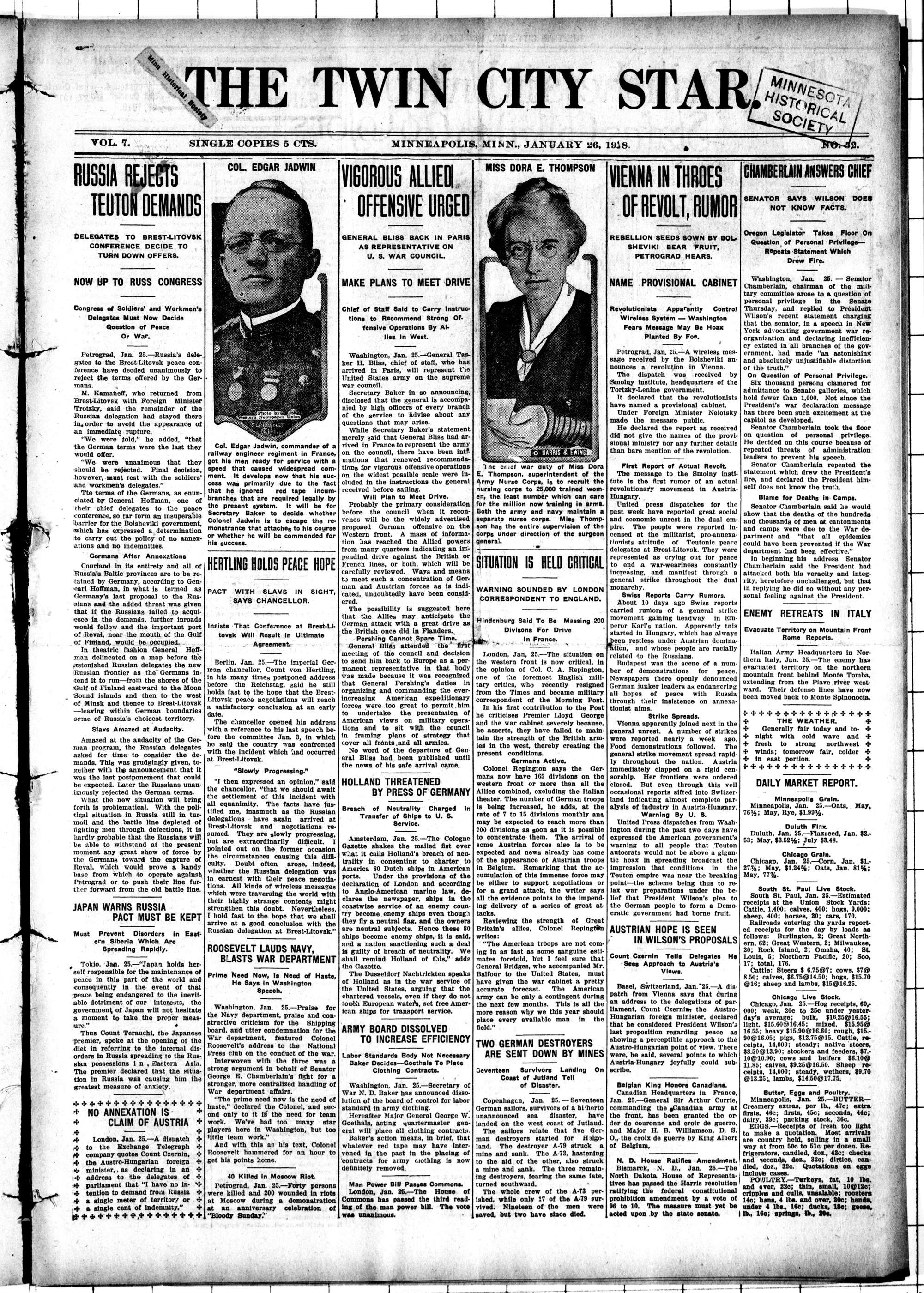
RUSSIA REJECTS TEUTON DEMANDS
DELEGATES TO BREST-LITOVSK
CONFERENCE DECIDE TO
TURN DOWN OFFERS.
NOW UP TO RUSS CONGRESS
Congress of Soldiers' and Workmen's Delegates Must Now Decide Question of Peace Or War.
Petrograd, Jan. 25.—Russia's delegates to the Brest-Litovsk peace conference have decided unanimously to the Germans.
M. Kamaheff, who returned from Brest-Litovsk with Foreign Minister Trotzky, said the remainder of the Russian delegation had stayed there in order to avoid the appearance of an immediate rupture.
"We were told," he added, "that the German terms were the last they would offer.
"We were unanimous that they should be rejected. Final decision, however, must rest with the soldiers' and workmen's delegates."
Tte terms of the Germans, as enunciated by General Hoffman, one of their chief delegates to the peace conference, so far form an insuperable barrier for the Bolshevik government, which has expressed a determination to carry out the policy of no annexations and no indemnities.
Germans After Annexations
Courland in its entirety and all of Russia's Baltic provinces are to be retained by Germany, according to General Hoffman, in what is termed as Germany's last proposal to the Russians and the added threat was given that if the Russians failed to acquiesce in the demands, further inroads would follow and the important port of Reval, near the mouth of the Gulf of Finland, would be occupied.
In theatric fashion General Hoffman delineated on a map before the astonished Russian delegates the new Russian frontier as the Germans intend it to run—from the shores of the Gulf of Finland eastward to the Moon Sound islands and then to the west of Minsk and thence to Brest-Litovsk—leaving within German boundaries
—leaving within German boundaries
some of Russia's choicest territory.
Slavs Amazed at Audacity.
Amazed at the audacity of the German program, the Russian delegates asked for time to consider the demands. This was grudgingly given, together with the announcement that it was the last postponement that could be expected. Later the Russians unanimously rejected the German terms. What the new situation will bring forth is problematical. With the political situation in Russia still in turmoil and the battle line depleted of fighting men through defections, it is hardly probable that the Russians will be able to withstand at the present moment any great show of force by the Germans toward the capture of Royal, which would prove a handy base from which to operate against Petrograd or to push their line further forward from the old battle line.
JAPAN WARNS RUSSIA
PACT MUST BE KEPT
Must Prevent Disorders in Eastern Siberia Which Are Spreading Rapidly.
Tokio, Jan. 25.—"Japan holds herself responsible for the maintenance of peace in this part of the world and consequently in the event of that peace being endangered to the inevitable detriment of our intenesta, the government of Japan will not hesitate a moment to take the proper measure."
Thus Count Terauchi, the Japanese premier, spoke at the opening of the diet in referring to the internal disorders in Russia spreading to the Russian possessions in Eastern Asia. The premier declared that the situation in Russia was causing him the greatest measure of anxiety.
NO ANNEXATION IS
CLAIM OF AUSTRIA
London, Jan. 25.—A dispatch to the Exchange Telegraph company quotes Count Czernin, the Austro-Hungarian foreign minister, as declaring in an address to the delegates of parliament that "I have no intention to demand from Russia a single meter of territory or a single cent of indemnity."
THE TWIN CITY STAR.
SINGLE COPIES 5 CTS.
COL. EDGAR JADWIN
Photo by
Western Newspaper Union
CHICAGO
Col. Edgar Jadwin, commander of a railway engineer regiment in France, got his men ready for service with a speed that caused widespread comment. It develops now that his success was primarily due to the fact that he ignored red tape incumbranches that are required legally by the present system. It will be for Secretary Baker to decide whether Colonel Jadwin is to escape the remonstrance that attaches to his course or whether he will be commended for his success.
HERTLING HOLDS PEACE HOPE
PACT WITH SLAVS IN SIGHT
SAYS CHANCELLOR.
Inists That Conference at Brest-Li
tovak Will Result in Ultimate
Berlin, Jan. 25.—The imperial German chancellor, Count von Hertling, in his many times postponed address before the Rechstag, said he still holds fast to the hope that the Brest-Litovsk peace negotiations will reach a satisfactory conclusion at an early date.
The chancellor opened his address with a reference to his last speech before the committee Jan. 3, in which he said the country was confronted with the incident which had occurred at Brest-Litovsk.
"Slowly Progressing."
"I then expressed an opinion," said the chancellor, "that we should await the settlement of this incident with all equanimity. The facts have justified me, inasmuch as the Russian delegations have again arrived at Brest-Litovsk and negotiations resumed. They are slowly progressing, but are extraordinarily difficult. I pointed out on the former occasion the circumstances causing this difficulty. Doubt often arose, indeed, whether the Russian delegation was in earnest with their peace negotiations. All kinds of wireless messages which were traversing the world with their highly strange contents might strengthen this doubt. Nevertheless, I hold fast to the hope that we shall arrive at a good conclusion with the Russian delegation at Brest-Litovsk."
ROOSEVELT LAUDS NAVY,
BLASTS WAR DEPARTMENT
Prime Need Now, Is Need of Haste, He Says in Washington Speech.
Washington, Jan. 25.—Praise for the Navy department, praise and constructive criticism for the Shipping board, and utter condemnation for the War department, featured Colonel Roosevelt's address to the National Press club on the conduct of the war. Interwoven with the three was a strong argument in behalf of Senator George E. Chamberlain's fight for a stronger, more centralized handling of War department affairs.
"The prime need now is the need of haste," declared the Colonel, and second only to it is the need for team work. We've had too many star players here in Washington, but too little team work."
And with this as his text, Colonel Roosevelt hammered for an hour to get his points home.
40 Killed In Moscow Blot
Petrograd, Jan. 25.—Borty persons were killed and 200 wounded in riots at Moscow during a demonstration at an anniversary celebration of "Bloody Sunday."
MINNEAPOLIS, MINN., JANUARY 26, 1918.
VIGOROUS ALLIED OFFENSIVE URGED
VIGOROUS ALLIED OFFENSIVE URGED
GENERAL BLISS BACK IN PARIS AS REPRESENTATIVE ON U. S. WAR COUNCIL.
MAKE PLANS TO MEET DRIVE
Chief of Staff Said to Carry Instructions to Recommend Strong Offensive Operations By Al-
Washington, Jan. 25.—General Tasker H. Bliss, chief of staff, who has arrived in Paris, will represent the United States army on the supreme war council.
Secretary Baker in so announcing, disclosed that the general is accompanied by high officers of every branch of the service to advise about any questions that may arise.
While Secretary Baker's statement merely said that General Bliss had arrived in France to represent the army on the council, there have been infirmations that renewed recommendations for vigorous offensive operations on the widest possible scale were included in the instructions the general received before sailing.
Will Plan to Meet Drive.
Probably the primary consideration before the council when it reconvenes will be the widely advertised proposed German offensive on the Western front. A mass of information has reached the Allied powers from many quarters indicating an impending drive against the British or French lines, or both, which will be carefully reviewed. Ways and means to meet such a concentration of German and Austrian forces as is indicated, undoubtedly have been considered.
The possibility is suggested here that the Allies may anticipate the German attack with a great drive as the British once did in Flanders. Pershing Cannot Spare Time. General Bliss attended the first meeting of the council and decision to send him back to Europe as a permanent representative in that body was made because it was recognized that General Pershing's duties in organizing and commanding the ever-increasing American expeditionary forces were too great to permit him to undertake the presentation of American views on military operations and to sit with the council in framing plans of strategy that cover all fronts and all armies. No word of the departure of General Bliss had been published until the news of his safe arrival came.
HOLLAND THREATENED BY PRESS OF GERMANY
Breach of Neutrality Charged In Transfer of Ships to U. S. Service.
Amsterdam, Jan. 25.—The Cologne Gazette shakes the malled fist over what it calls Holland's breach of neutrality in consenting to charter to America 80 Dutch ships in American ports. Under the provisions of the declaration of London and according to Anglo-American marine law, declares the newspaper, ships in the coastwise service of an enemy country become enemy ships even though they fly a neutral flag, and the owners are neutral subjects. Hence these 80 ships become enemy ships, it is said, and a nation sanctioning such a deal is guilty of breach of neutrality. We shall remind Holland of this," adds the Gazette.
The Dusseldorf Nachtrickten speaks of Holland as in the war service of the United States, arguing that the chartered vessels, even if they do not touch European waters, set free American ships for transport service.
ARMY BOARD DISSOLVED TO INCREASE EFFICIENCY
Labor Standards Body Not Necessary
Baker Decides—Goethals To Place
Clothing Contracts.
Washington, Jan. 25.—Secretary of War N. D. Baker has announced dissolution of the board of control for labor standard in army clothing.
Hereafter Major General George W. Goethals, acting quartermaster general will place all clothing contracts.
Baker's action means, in brief, that whatever red tape may have intervened in the past in the placing of contracts for army clothing is now definitely removed.
Man Power Bill Passes Commons.
London, Jan. 25.—The House of Commons has passed the third reading of the man power bill. The vote was unanimous.
MISS DORA E. THOMPSON
C HARRIS & EWING
The chief war duty of Miss Dora E. Thompson, superintendent of the Army Nurse Corps, is to recruit the nursing corps to 25,000 trained women, the least number which can care for the million now training in arms. Both the army and navy maintain a separate nurse corps. Miss Thompson has the entire supervision of the corps under direction of the surgeon general.
SITUATION IS HELD CRITICAL
WARNING SOUNDED BY LONDON
CORRESPONDENT TO ENGLAND.
Hindenburg Said To Be Massing 200
Divisions For Drive
London, Jan, 25—The situation on the western front is now critical, in the opinion of Col. C. A. Repington, one of the foremost English military critics, who recently resigned from the Times and became military correspondent of the Morning Post. In his first contribution to the Post he criticises Premier Lloyd George and the war cabinet severely because, he asserts, they have failed to maintain the strength of the British armies in the west, thereby creating the present conditions.
Germans Active.
Colonel Repington says the Germans now have 165 divisions on the western front or more than all the Allies combined, excluding the Italian theater. The number of German troops is being increased, he adds, at the rate of 7 to 15 divisions monthly and may be expected to reach more than 200 divisions as soon as it is possible to concentrate them. The arrival of some Austrian forces also is to be expected and news already has come of the appearance of Austrian troops in Belgium. Remarking that the accumulation of this immense force may be either to support negotiations or for a grand attack, the writer says all the evidence points to the impending delivery of a series of great attacks.
Reviewing the strength of Great Britain's allies, Colonel Repington writes:
"The American troops are not coming in as fast as some sanguine estimates foretold, but I feel sure that General Bridges, accompanied Mr. Balfour to the United States, must have given the war cabinet a pretty accurate forecast. The American army can be only a contingent during the next few months. This is all the more reason why we this year should place every available man in the field."
TWO GERMAN DESTROYERS ARE SENT DOWN BY MINES
Seventeen Survivors Landing On Coast of Jutland Tell of Disaster.
Copenhagen, Jan. 25. — Seventeen German sailors, survivors of a hitherto unannounced sea disaster, have landed on the west coast of Jutland. The sailors relate that five German destroyers started for Holgoland. The destroyer A-79 struck a mine and sank. The A-73, hastening to the aid of the other, also struck a mine and sank. The three remaining destroyers, fearing the same fate, turned southward.
The whole crew of the A-73 perished, while only 17 of the A-79 survived. Nineteen of the men were saved, but two have since died.
VIENNA IN THROES OF REVOLT, RUMOR
VIENNA IN THROES OF REVOLT, RUMOR
REBELLION SEEDS SOWN BY BOL
SHEVIKI BEAR FRUIT,
PETROGRAD HEARS.
NAME PROVISIONAL CABINET
Revolutionists Apparently Control Wireless System — Washington Fears Message May Be Hoax Planted By Foe.
Petrograd, Jan. 25.—A wireless message received by the Bolshovkii announces a revolution in Vienna.
The dispatch was received by Smolny institute, headquarters of the Tortzky-Lenine government.
It declared that the revolutionists have named a provisional cabinet.
Under Foreign Minister Nelotsky made the message public.
He declared the report as received did not give the names of the provisional ministry nor any further details than bare mention of the revolution.
First Report of Actual Revolt.
The message to the Smolny institute is the first rumor of an actual revolutionary movement in Austria-Hungary.
United press dispatches for the past week have reported great social and economic unrest in the dual empire. The people were reported incensed at the militarist, pro-annexationists attitude of Teutonic peace delegates at Brest-Litovsk. They were represented as crying out for peace to end a war-weariness constantly increasing, and manifest through a general strike throughout the dual monarchy.
Swiss Reports Carry Rumors.
About 10 days ago Swiss reports carried rumors of a general strike movement gaining headway in Emperor Karl's nation. Apparently this started in Hungary, which has always been restless under Austrian domination, and whose people are racially related to the Russians.
Budapest was the scene of a number of demonstrations for peace. Newspapers there openly denounced German junker leaders as endangering all hopes of peace with Russia through their insistence on annexationist alms.
Strike Spreads.
Vienna apparently joined next in the general unrest. A number of strikes were reported nearly a week ago. Food demonstrations followed. The general strike movement spread rapidly throughout the nation. Austria immediately clapped on a rigid censorship. Her frontiers were ordered closed. But even through this vell occasional reports sifted into Switzerland indicating almost complete paralysis of industry in Austria-Hungary.
Warning By U. S.
United Press dispatches from Washington during the past two days have expressed the American government's warning to all people that Teuton autocrats would not be above a gigantic hoax in spreading broadcast the impression that conditions in the Teuton empire was near the breaking point—the scheme being thus to relax war preparations under the belief that President Wilson's plea to the German people to form a Democratic government had borne fruit.
AUSTRIAN HOPE IS SEEN IN WILSON'S PROPOSALS
Count Czernin Tells Delegates He Sees Approach to Austria's Views.
Basel, Switzerland, Jan. 25.—A dispatch from Vienna says that during an address to the delegations of parliament, Count Czernin the Austro-Hungarian foreign minister, declared that he considered President Wilson's last proposition regarding peace as showing a perceptible approach to the Austro-Hungarian point of view. There were, he said, several points to which Austria-Hungary joyfully could subscribe.
Belgian King Honors Canadians.
Canadian Headquarters in France, Jan. 25.—General Sir Arthur Currie, commanding the Canadian army at the front, has been granted the order de couronne and croir de guerre, and Major H. B. Williamson, D. S. O., the croix de guerre by King Albert of Belgium.
N. D. House Ratifies Amendment. Bismarck, N. D., Jan. 25.—The North Dakota House of Representatives has passed the Harris resolution ratifying the federal constitutional prohibition amendment by a vote of 96 to 10. The measure must yet be acted upon by the state senate.
CHAMBERLAIN ANSWERS CHIEF
SENATOR SAYS WILSON DOES NOT KNOW FACTS.
Oregon Legislator Takes Floor On Question of Personal Privilege—Repeats Statement Which Drew Fire.
Washington, Jan. 25. — Senator Chamberlain, chairman of the military committee arose to a question of personal privilege in the Senate Thursday, and replied to President Wilson's recent statement charging that the senator, in a speech in New York advocating government war reorganization and declaring inefficiency existed in all branches of the government, had made "an astonishing and absolutely unjustifiable distortion of the truth."
On Question of Personal Privilege.
Six thousand persons clamored for admittance to Senate galleries, which hold fewer than 1,000. Not since the President's war declaration message has there been such excitement at the capitol as developed.
Senator Chamberlain took the floor on question of personal privilege. He decided on this course because of repeated threats of administration leaders to prevent his speech.
Senator Chamberlain repeated the statement which drew the President's fire, and declared the President himself does not know the truth.
Blame for Deaths in Camps.
Senator Chamberlain said he would show that the deaths of the hundreds and thousands of men at cantonments and camps were due to the War department and "that all epidemics could have been prevented if the War department had been effective." In beginning his address Senator Chamberlain said the President had attacked both his veracity and integrity, heretofore unchallenged, but that in replying he did so without any personal feeling against the President.
ENEMY RETREATS IN ITALY
Evacuate Territory on Mountain Front Rome Reports.
Italian Army Headquarters in Northern Italy, Jan. 25.—The enemy has evacuated territory on the northern mountain front behind Monte Tomba, extending from the Piave river westward. Their defense lines have now been moved back to Monte Spinonocia.
THE WEATHER.
Generally fair today and to-
night with cold wave and
fresh to strong northwest
winds; tomorrow fair, colder
in east portion.
DAILY MARKET REPORT.
Minneapolis Grain.
Minneapolis, Jan. 25—Oats, May,
76½; May, Rye, $1.99½.
Duluth Flax.
Duluth, Jan. 25—Flaxseed, Jan. $3.-
53; May, $3.52½; July $3.48.
Chicago Grain.
Chicago, Jan. 25—Corn, Jan. $1.-
27½; May, $1.24½; Oats, Jan. 81½;
May, 77½.
South St. Paul Live Stock.
South St. Paul, Jan. 25—Estimated
receipts at the Union Stock Yards:
Cattle, 1,400; calves, 400; hogs, 9,000;
sheep, 400; horses, 20; cars, 170.
Railroads entering the yards report-
ed receipts for the day by loads as
follows: Burlington, 2; Great Northern,
62; Great Western, 2; Milwaukee,
20; Rock Island, 2; Omaha, 40; St.
16; Northern Pacific, 20; Soo,
17; total, 176.
Cattle: Steers $ 6.75@7; cows, $7@
8.50; calves, $6.75@14.50; hogs, $15.70
@16; sheep and lambs, $16.125.
Chicago Live Stock
Chicago, Jan. 25—Hog receipts, 60-00; weak, 20c to 25c under yesterday's average; bulk, $16.25@16.55; light, $15.60@16.45; mixed, $15.95@16.55; heavy $15.90@16.60; rough, $15.90@16.05; pigs, $12.75@15. Cattle, receipts, 14,00; steady, native steers, $8.50@13.90; stockers and feeders, $7.10@10.90; cows and heifers $6.10@11.85; calves, $9.25@16.50. Sheep receipts, 14,00; steady, weters, $9.70@13.25; lambs, $14.50@17.75.
Butter, Eggs and Poultry.
Minneapolis, Jan. 25—BUTTER—Creamery extras, per lb, 47c; extra firsts, 46c; firsts, 45c; seconds, 44c; dairy, 39c; packing stock, 36c.
EGGS.—Receipts of fresh too light to make a quotation. Most arrivals are country held, selling in a small way at from 50c to 51c per dozen. Refrigerators, candled, doz., 42c; checks and seconds, doz., 32c; dirties, candled, doz., 32c. Quotations on eggs include cases.
POWLTRY.—Turkeys, fat, 10 lbs and over, 22c; thin, small, 10@12c; cripples and culls, unsalable; roosters 14; hens, 4 lbs. and over, 20c; hens, under 4 lbs, 16c; ducks, 18c; geese, 1b, 16c; springs, 18c, 20c.
By EARLE HOOKER EATON.
F A MAN wants to fight nowadays there is no reason why he should not be accommodated. The United States is not only a vast recruiting camp for its own armies, but Great Britain is engaged in a strenuous campaign to get every Britfisher and Canadian in the United States to volunteer for service under the British flag.
I
This work is being done pending the outcome of international negotiations at Washington which, if consummated, will permit the British and Canadian recruiting mission under the leadership of Brig. Gen. W. A. White, C. M. G., to draft every Britisher and Canadian now residing in the United States, and the United States to draft every one of its citizens who lives in Great Britain or Canada.
This is a very important matter, particularly for the Britishers and Canadians, because there are at least 200,000 of them over whom Old Glory waves, and the names and addresses of at least 175,000 of them are known to General White and his staff because they have been taken from the draft records of the United States. Many of these are coming forward every day of their own accord, but the recruiting mission wants every man of them who is physically fit to volunteer for the British or Canadian armies. About 14,000 have already gone into these armies, and in one month recently over half of the recruits secured for the Canadian expeditionary forces came from the United States.
When Brigadier General White asks a man to fight he doesn't ask him to do any more than he has done himself. He is an officer in the regular army of Great Britain, and that he lost no time himself in getting into the fray is shown by the fact that he reached Belgium about August 6, 1914, a few days after the war was declared, and got into action almost immediately. He had general charge of the rear guard actions from Mons to the Marne, in which a small British army ma-
Although pineapples are grown rather extensively in the Straits Settlements, the canning of this fruit being one of the most flourishing of the minor industries, there appears to be little definite information available as to the acreage and actual production in the different localities, according to Consul Harry Campbell, detailed as vice consul at Singapore, Straits Settlements.
Pineapples are for the most part raised as a catch crop in connection with rubber plantations, since they can be grown very easily and with little cost between the rubber trees during the first two or three years of their growth. This procedure has been especially attractive to planters (mostly Chinese) having small holdings on the island of Singapore, as it affords the planter an income during the years that the rubber trees are coming into bearing, while proximity to the canning factories of Singapore makes the marketing simple and inexpensive.
It is estimated that about 2,000 acres of pineapples were planted on rubber estates on the island of Singapore in 1916. Any definite figures as to acreage in other parts of the peninsula are not available, but it appears that the industry in the Federated Malay states is not important, being limited almost entirely to small plots for local market purposes.
The value of the exports of pineapples from the Straits Settlements during 1916 was $2,506,910.
THE TWIN CITY STAR, MINNEAPOLIS, MINN.
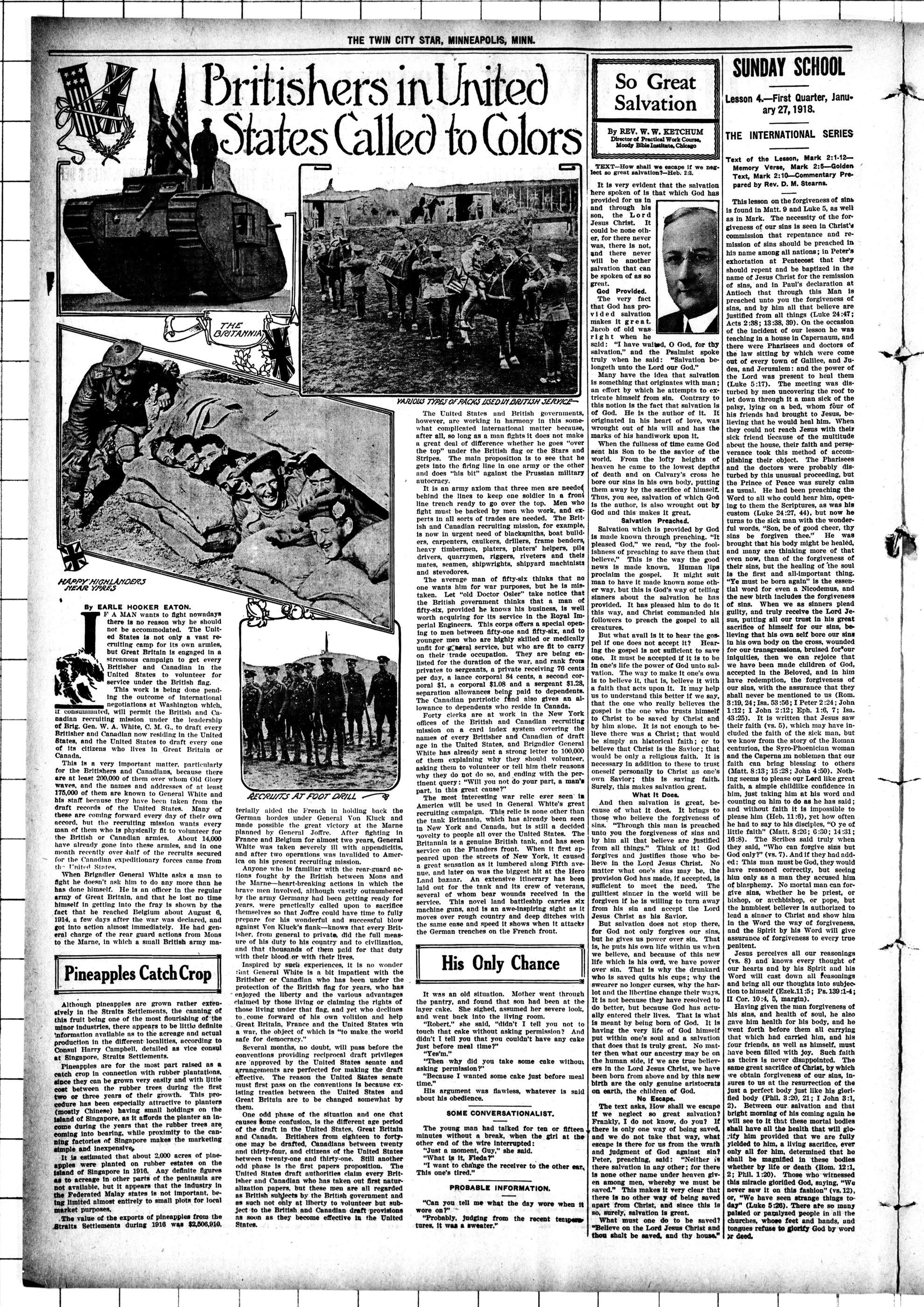
Britishers in United States Called to Colors
materially aided the French in holding back the German hordes under General Von Kluck and made possible the great victory at the Marne planned by General Joffre. After fighting in France and Belgium for almost two years, General White was taken severely ill with appendicitis, and after two operations was invalidated to America on his present recruiting mission.
Anyone who is familiar with the rear-guard actions fought by the British between Mons and the Marne—heart-breaking actions in which the brave men involved, although vastly outnumbered by the army Germany had been getting ready for years, were practically called upon to sacrifice themselves so that Joffre could have time to fully prepare for his wonderful and successful blow against Von Kluck's flank—knows that every British, from general to private, did the full measure of his duty to his country and to civilization, and that thousands of them paid for that duty with their blood or with their lives.
Inspired by such experiences, it is no wonder that General White is a bit impatient with the Britsher or Canadian who has been under the protection of the British flag for years, who has enjoyed the liberty and the various advantages claimed by those living or claiming the rights of those living under that flag, and yet who declines to come forward of his own volition and help Great Britain, France and the United States win a war, the object of which is "to make the world safe for democracy."
Several months, no doubt, will pass before the conventions providing reciprocal draft privileges are approved by the United States senate and arrangements are perfected for making the draft effective. The reason the United States senate must first pass on the conventions is because existing treaties between the United States and Great Britain are to be changed somewhat by them.
One odd phase of the situation and one that causes some confusion, is the different age period of the draft in the United States, Great Britain and Canada. Britishers from eighteen to forty-one may be drafted, Canadians between twenty and thirty-four, and citizens of the United States between twenty-one and thirty-one. Still another odd phase is the first papers proposition. The United States draft authorities claim every Britisher and Canadian who has taken out first naturalization papers, but these men are all regarded as British subjects by the British government and as such not only at liberty to volunteer but subject to the British and Canadian draft provisions as soon as they become effective in the United States.
VARIOUS TYPES OF PACKS USED IN BRITISH SERVICE
The United States and British governments, however, are working in harmony in this somewhat complicated international matter because, after all, so long as a man fights it does not make a great deal of difference whether he goes "over the top" under the British flag or the Stars and Stripes. The main proposition is to see that he gets into the firing line in one army or the other and does "his bit" against the Prussian military autocracy.
It is an army axiom that three men are needed behind the lines to keep one soldier in a front line trench ready to go over the top. Men who fight must be backed by men who work, and experts in all sorts of trades are needed. The British and Canadian recruiting mission, for example, is now in urgent need of blacksmiths, boat builders, carpenters, caulkers, drillers, frame benders, heavy timbermen, platers, platers' helpers, pile drivers, quarrymen, riggers, riveters and their mates, seamen, shipwrights, shipyard machinists and stevedores.
The average man of fifty-six thinks that no one wants him for war purposes, but he is mistaken. Let "old Doctor Osler" take notice that the British government thinks that a man of fifty-six, provided he knows his business, is well worth acquiring for its service in the Royal Imperial Engineers. This corps offers a special opening to men between fifty-one and fifty-six, and to younger men who are highly skilled or medically unit for general service, but who are fit to carry on their trade occupation. They are being enlisted for the duration of the war, and rank from privates to sergeants, a private receiving 76 cents per day, a lance corporal 84 cents, a second corporal $1, a corporal $1.08 and a sergeant $1.28, separation allowances being paid to dependents. The Canadian partriotic fund also gives an allowance to dependents who reside in Canada.
Forty clerks are at work in the New York offices of the British and Canadian recruiting mission on a card index system covering the names of every Britsher and Canadian of draft age in the United States, and Brigadier General White has already sent a strong letter to 100,000 of them explaining why they should volunteer, asking them to volunteer or tell him their reasons why they do not do so, and ending with the pertinent query: "Will you not do your part, a man's part, in this great cause?"
The most interesting war relic ever seen in America will be used in General White's great recruiting campaign. This relic is none other than the tank Britannia, which has already been seen in New York and Canada, but is still a decided novelty to people all over the United States. The Britannia is a genuine British tank, and has seen service on the Flanders front. When it first appeared upon the streets of New York, it caused a great sensation as it lumbered along Fifth avenue, and later on was the biggest hit at the Hero Land bazaar. An extensive itinerary has been laid out for the tank and its crew of veterans, several of whom bear wounds received in the service. This novel land battleship carries six machine guns, and is an awe-inspiring sight as it moves over rough country and deep ditches with the same ease and speed it shows when it attacks the German trenches on the French front.
His Only Chance
It was an old situation. Mother went through the pantry, and found that son had been at the layer cake. She sighed, assumed her severe look, and went back into the living room.
"Robert," she said, "didn't I tell you not to touch that cake without asking permission? And didn't I tell you that you couldn't have any cake just before meal time?"
"Yes'm."
"Then why did you take some cake without asking permission?"
"Because I wanted some cake just before meal time."
His argument was flawless, whatever is said about his obedience.
SOME CONVERSATIONALIST.
The young man had talked for ten or fifteen minutes without a break, when the girl at the other end of the wire interrupted:
"Just a moment, Guy," she said.
"What is it, Fleda?"
"I want to change the receiver to the other ear.
This one's tired."
PROBABLE INFORMATION.
"Can you tell me what the day wore when it wore on?"
"Probably, judging from the recent temperatures, it was a sweater."
By REV. W. W. KETCHUM
Director of Practical Work Course,
Moody Bible Institute, Chicago
TEXT—How shall we escape if we neglect so great salvation?—Heb. 2:3.
It is very evident that the salvation here spoken of is that which God has provided for us in and through his son, the Lord Jesus Christ. It could be none other, for there never was, there is not, and there never will be another salvation that can be spoken of as so great.
PETER H.
God Provided.
The very fact that God has provided salvation makes it great. Jacob of old was right when he said: "I have waited, O God, for thy salvation," and the Psalmist spoke truly when he said: "Salvation belongeth unto the Lord our God."
Many have the idea that salvation is something that originates with man; an effort by which he attempts to extricate himself from sin. Contrary to this notion is the fact that salvation is of God. He is the author of it. It originated in his heart of love, was wrought out of his will and has the marks of his handiwork upon it.
When the fullness of time came God sent his Son to be the savior of the world. From the lofty heights of heaven he came to the lowest depths of death and on Calvary's cross he bore our sins in his own body, putting them away by the sacrifice of himself. Thus, you see, salvation of which God is the author, is also wrought out by God and this makes it great.
Salvation Preached.
Salvation which is provided by God is made known through preaching. "It pleased God," we read, "by the foolishness of preaching to save them that believe." This is the way the good news is made known. Human lips proclaim the gospel. It might suit man to have it made known some other way, but this is God's way of telling sinners about the salvation he has provided. It has pleased him to do it this way, and Christ commanded his followers to preach the gospel to all creatures.
But what avail is it to hear the gospel if one does not accept it? Hearing the gospel is not sufficient to save one. It must be accepted if it is to be in one's life the power of God unto salvation. The way to make it one's own is to believe it, that is, believe it with a faith that acts upon it. It may help us to understand this better if we say, that the one who really believes the gospel is the one who trusts himself to Christ to be saved by Christ and by him alone. It is not enough to believe there was a Christ; that would be simply an historical faith; or to believe that Christ is the Savior; that would be only a religious faith. It is necessary in addition to these to trust oneself personally to Christ as one's own Savior; this is saving faith. Surely, this makes salvation great.
What It Does.
And then salvation is great, because of what it does. It brings to those who believe the forgiveness of sins. "Through this man is preached unto you the forgiveness of sins and by him all that believe are justified from all things." Think of it! God forgives7 and justifies those who believe in the Lord Jesus Christ. No matter what one's sins may be, the provision God has made, if accepted, is sufficient to meet the need. The gulltest sinner in the world will be forgiven if he is willing to turn away from his sin and accept the Lord Jesus Christ as his Savior.
But salvation does not stop there, for God not only forgives our sins, but he gives us power over sin. That is, he puts his own life within us when we believe, and because of this new life which is his own, we have power over sin. That is why the drunkard who is saved quits his cups; why the swearer no longer curses, why the harlot and the libertine change their ways. It is not because they have resolved to do better, but because God has actually entered their lives. That is what is meant by being born of God. It is having the very life of God himself put within one's soul and a salvation that does that is truly great. No matter then what our ancestry may be on the human side, if we are true believers in the Lord Jesus Christ, we have been born from above and by this new birth are the only genuine aristocrats on earth, the children of God.
No Escape.
The text asks, How shall we escape if we neglect so great salvation? Frankly, I do not know, do you? If there is only one way of being saved, and we do not take that way, what escape is there for us from the wrath and judgment of God against sin? Peter, preaching, said: "Neither is there salvation in any other; for there is none other name under heaven given among men, whereby we must be saved." This makes it very clear that there is no other way of being saved apart from Christ, and since this is so, surely salvation is great. What must one do to be saved? "Belleve on the Lord Jesus Christ and thou shalt be saved, and thy house."
Lesson 4.—First Quarter, January 27, 1918.
THE INTERNATIONAL SERIES
Text of the Lesson, Mark 2:1-12- Memory Verse, Mark 2:5-Golden Text, Mark 2:10-Commentary Prepared by Rev. D. M. Stearns.
This lesson on the forgiveness of sins is found in Matt. 9 and Luke 5, as well as in Mark. The necessity of the forgiveness of our sins is seen in Christ's commission that repentance and remission of sins should be preached in his name among all nations; in Peter's exhortation at Pentecost that they should repent and be baptized in the name of Jesus Christ for the remission of sins, and in Paul's declaration at Antioch that through this Man is preached unto you the forgiveness of sins, and by him all that believe are justified from all things (Luke 24:47; Acts 2:38; 13:38, 39). On the occasion of the incident of our lesson he was teaching in a house in Capernaum, and there were Pharisees and doctors of the law sitting by which were come out of every town of Gallilee, and Juden, and Jerusalem: and the power of the Lord was present to heal them (Luke 5:17). The meeting was disturbed by men uncovering the roof to let down through it a man sick of the palsy, lying on a bed, whom four of his friends had brought to Jesus, believing that he would heal him. When they could not reach Jesus with their sick friend because of the multitude about the house, their faith and perseverance took this method of accomplishing their object. The Pharisees and the doctors were probably disturbed by this unusual proceeding, but the Prince of Peace was surely calm as usual. He had been preaching the Word to all who could hear him, opening to them the Scriptures, as was his custom (Luke 24:27, 44), but now he turns to the sick man with the wonderful words, "Son, be of good cheer, thy sins be forgiven thee." He was brought that his body might be healed, and many are thinking more of that even now, than of the forgiveness of their sins, but the healing of the soul is the first and all-important thing. "Ye must be born again" is the essential word for even a Nicodemus, and the new birth includes the forgiveness of sins. When we as sinners plead guilty, and truly receive the Lord Jesus, putting all our trust in his great sacrifice of himself for our sins, believing that his own self bore our sins in his own body on the cross, wounded for our transgressions, bruised for our iniquities, then we can rejoice that we have been made children of God, accepted in the Beloved, and in him have redemption, the forgiveness of our sins, with the assurance that they shall never be mentioned to us (Rom. 8:19; 24; Isa. 53:56) I Peter 2:24; John 1:12; I John 2:12; Eph. 1:6, 7; Isa. 43:25). It is written that Jesus saw their faith (vs. 5), which may have included the faith of the sick man, but we know from the story of the Roman centurion, the Syro-Phoenician woman and the Capernaum nobleman that our faith can bring blessing to others (Matt. 8:13; 15:28; John 4:50). Nothing seems to please our Lord like great faith, a simple childlike confidence in him, just taking him at his word and counting on him to do as he has said; and without faith it is impossible to please him (Heb. 11:6), yet how often he had to say to his disciples, "O ye of little faith" (Matt. 8:20; 6:30; 14:31, 16:8). The Scribes said truly when they said, "Who can forgive sins but God only?" (vs. 7). And if they had added: This man must be God, they would have reasoned correctly, but seeing him only as a man they accused of blasphemy. No mortal man can forgive sins, whether he be priest, or bishop, or archbishop, or pope, but the humble believer is authorized to lead a sinner to Christ and show him in the Word the way of forgiveness, and the spirit by his Word will give assurance of forgiveness to every true penitent.
Jesus perceives all our reasonings (vs. 8) and knows every thought of our hearts and by his Spirit and his Word will cast down all reasonings and bring all our thoughts into subjection to himself (Ezek.11:5; Ps. 139:1-4; II Cor. 10:4, 5, margin).
Having given the man forgiveness of his sins, and health of soul, he also gave him health for his body, and he went forth before them all carrying that which had carried him, and his four friends, as well as himself, must have been filled with joy. Such faith as theirs is never disappointed. The same great sacrifice of Christ, by which we obtain forgiveness of our sins, insures to us at the resurrection of the just a perfect body just like his glorified body (Phil. 3:20, 21; I John 3:1, 2). Between our salvation and that bright morning of his coming again he will see to it that these mortal bodies shall have all the health that will glorify him provided that we are fully yielded to him, a living sacrifice, ever only all for him, determined that he shall be magnified in these bodies whether by life or death (Rom. 12:1, 2; Phil. 1:20). Those who witnessed this miracle glorified God, saying, "We never saw it on this fashion" (vs. 12), or, "We have seen strange things today" (Luke 5:26). There are so many palsied or palazyzed people in all the churches, whose feet and hands, and tongues refuse to glorify God by word or deed.
---
INTHELIMELIGHT
WILL ASSIST SECRETARY BAKER
When it became necessary to confer with Secretary of War Baker, Maj. Benedict Crowell was obliged to put on his overcoat and cap and step across the street in Washington to the state, war and navy building. But now he has taken his typewriter from the Mills building to the office of assistant secretary of war.
President Wilson has appointed Major Crowell to help the secretary of war as assistant secretary with some of the difficulties and intricate problems connected with carrying on and winning the war. Major Crowell is an engineer by profession and first showed his merit by his expert advice to the general munitions board, especially concerning steel production immediately after the formation of the national council of defense in Washington. It was in the engineer corps that he was given his commission, and later he was placed in charge of the Washington
office of the Panama canal. Major Crowell is a man thoroughly trained in the technical matters pertaining to the munitions situation, and as he, too, came from Cleveland, O., it is believed that the secretary and his assistant will work in closest harmony.
office of the Panama canal. Major Crow technical matters pertaining to the mu from Cleveland, O., it is believed that the in closest harmony.
SPRECKELS, THE SUGAR MAN
compete with the trust in the Eastern to the American Sugar Refining company then decided to retire from business, family companies, he departed for a y however, found him in Hawaii, in chal of the Hawaii Commercial and Sugar retired from business and traveled in York again, he soon became active as fining company, which was capitalize president, and has held that office ever
compete with the trust in the Eastern market. In 1895 the plant was sold to the American Sugar Refining company at a large profit. Mr. Spreckels then decided to retire from business, and, severing all connections with the family companies, he departed for a year's travel in Europe. The next year, however, found him in Hawaii, in charge of the enormous sugar plantations of the Hawaii Commercial and Sugar company. Five years later he again retired from business and traveled in Europe for three years. Back in New York again, he soon became active as an organizer of the Federal Sugar Refining company, which was capitalized at $10,000,000. He became its first president, and has held that office ever since.
WON FAME AS STATESMAN
One of the most picturesque figures in the senate is that of Senator Knute Nelson, whose decision to retire from the senate has met with insistent protest on the part of his friends. But inasmuch as he has the reputation of being "the hardest-headed individual in the senate" it is not thought likely that even President Wilson's letter urging him to return will induce any change of mind. He has been Minnesota's senator for four successive terms, since 1895.
Born in Voss, Norway, in 1843, descended, as he says himself, from a long line of Norwegian pirates, Knute Nelson came to the United States with his mother when six years old, and they made their first American home in Chicago. Knute helped his mother by selling papers in the streets. Later they moved to Wisconsin, and for three years he attended the academy at Albion. In the Civil war he entered
the Fourth Wisconsin Volunteer infantry, serving three years. He studied law after the war, and was admitted to the bar in 1867. He was elected to the house of representatives in 1883, after having served terms in the legislatures of both Minnesota and Wisconsin. After six years in the lower house of congress he tired and resumed his law practice. He was elected governor of Minnesota in 1892 and was re-elected two years later, but resigned in 1895 to become United States senator.
the Fourth Wisconsin Volunteer infa law after the war, and was admitted the house of representatives in 1888, latures of both Minnesota and Wisconsin of congress he tired and resumed his la Minnesota in 1892 and was re-elected to become United States senator. Senator Nelson is described as "sl
Senator Nelson is described as "short of stature, big boned, well set up."
IS HONORED BY SCIENTISTS
PETER H. BURGESS
stitute of Great Britain (1906), the Royal Berlin Academy of Sciences (19) association is of comparatively recent meeting in 1899, and a year later was ing last year his eminence in the do worthy candidate for recognition and the greatest honor in its gift.—From
stitute of Great Britain (1900), the Royal Academy of Sweden (1907), and the Royal Berlin Academy of Sciences (1909). His membership in the American association is of comparatively recent date; for he joined it only at its Boston meeting in 1898, and a year later was made a fellow. At the New York meeting last year his eminence in the domain of chemistry easily made him a worthy candidate for recognition and the association gladly conferred on him the greatest honor in its gift.—From the Scientific American.
well is a man thoroughly trained in the
nitions situation, and as he, too, came
the secretary and his assistant will work
Claus A. Spreckels, president of the Federal Sugar Refining company, who, in the recent investigation into the sugar and coal shortage made startling accusations against the government's food administration, and who in turn was accused by Mr. Hoover as being a foe to the food rule, is one of the best-known sugar men in the country. He was born in San Francisco in 1858, of German ancestry. His father, known as the "Sugar King," had established the California Sugar refinery in San Francisco, and it was here, where he went to work at seventeen, that the young Spreckels had his opportunity to study all phases of the sugar business. In 1892, after he had served as secretary of all the Spreckels companies, he was transferred to Philadelphia as vice president and general manager of the Spreckels Sugar Refining company, which had been established two years previously in order to market. In 1895 the plant was sold pany at a large profit. Mr. Spreckels and, severing all connections with the year's travel in Europe. The next year, urge of the enormous sugar plantations company. Five years later he again Europe for three years. Back in New an organizer of the Federal Sugar Red at $10,000,000. He became its first or since
entry, serving three years. He studied to the bar in 1867. He was elected to after having served terms in the legislature. After six years in the lower house practice. He was elected governor of two years later, but resigned in 1895. Short of stature, big boned, well set up."
Theodore William Richards, president of the American Association for the Advancement of Science, was born in Germantown, Pa., on January 31, 1868, and is the son of William T. Richards, a famous American painter of marine and landscapes, and Anna Matlack Richards, well known for her poetical writings.
Scientific societies at home and abroad have honored him with elections. In the United States he is a member of the American Academy of Arts and Sciences (1891), the American Philosophical society (1903) and since 1899 of the National Academy of Sciences. In 1914 he served the American Chemical society as its president, also he is an honorary member of the Ghemists club of New York city. Among his honors abroad are foreign membership in the London Chemical society (1908) and honorary or corresponding membership in the Royal In-
Royal Academy of Sweden (1907), and the 009). His membership in the American date; for he joined it only at its Boston made a fellow. At the New York meet main of chemistry easily made hirs a the association gladly conferred on him the Scientific American.
THE TWIN CITY STAR, MINNEAPOLIS, MINN.
FIRST HALL MARKS
Hieroglyphics Stamped on Gold and Silver in 1300.
Guild Formed in Early Days to Protect the Buyer in the Matter of Purity of Metal.
What are the strange hieroglyphics stamped on the back of silver articles in England, and what do these marks signify? This is a question which has often puzzled the inquisitive. A tedious and technical subject, you say, On the contrary, a most absorbing and appealing one. Read here what an expert in the matter of these markings has to say, and be convinced.
"The first hall mark was used in Paris in 1300. It was employed for both gold and silver, principally the former. Some goldsmiths had been underselling others and as there was no difference in labor or perfection of detail, it was obvious that much inferior metal was being used. So a guild was founded to protect the buyer in the matter of purity of metal. The guild specified the 'Paris touch,' which meant that a certain standard of metal was to be maintained.
"About 1327 a stir took place in England for a slightly different reason. Privateering off the coast was frequent, the result being that silver vessels were brought back and made either into coins or other vessels. As the product was of a lower grade than the English standard, a goldsmiths' guild was established there also, with the rather awe-lnspiring title of 'Origin and Mystery of the Fellowship of Goldsmiths.' The guild specified that standard metal must contain 925 parts of silver and 75 parts of copper. Its members had authority to travel through the provinces of the United Kingdom assaying silver vessels, and if any specimen was not up to standard it was confiscated or a fine of double its value was imposed on the maker.
"When a piece was made it was the custom to send it to the guild-hall. There it was assayed and if found to be of the proper proportion it was stamped with the English hall mark, or as it was then called, the 'guildhall mark,' commonly referred to as 'the king's touch.'
"A leopard's head was the first mark employed in England and the maker also was privileged to place his own stamp upon it, which generally consisted of the first two letters of his surname. As so few people were able to read, most of the tradesmen had signs which they placed on their productions, hence the modern trade mark. In 1459 the guildhall added a letter marking the year that a piece was made, but as the full alphabet was not used, the date is very difficult to determine. Later the leopard's head was changed to a lion passant, which in turn gave way to a lion's head erased with a figure of Brittania.
"The collector of old silver must look out for the method of 'glorifying' used by unscrubulous dealers who cut the hall marks out of old spoons or forks and fit them into a big piece to mislead the unwary. It is extraordinary that so much good old English silver has survived, considering the vlecisstudes through which it has passed. In the Wars of the Roses, for instance, much plate was confiscated and melted into coins for carrying on the strife."
Use Paper as Fuel.
Every household in Italy saves all the odd bits of paper. These are soaked in water and kneaded into balls, then put in the sun to dry. They will serve to give a little heat later on. Walk down a fashionable street in Milan and you will see pyramids of these paper balls in the balconies of the houses of the rich—Exchange.
Wouldn't Be Slighted
The principal of a school once had occasion to lick a very refractory pupil. It was very manger punishment, but the child complained to his father when he went home that day. The next day the father paid the principal a visit.
"I understand," said the irate parent, "that you licked my boy yesterday."
"I did," was the reply, "but not severely."
"Well," said the father, "I want you to know that I am one of the largest taxpayers in this place and my boy is entitled to as good a licking as any other boy gets. If you slight him again, you'll hear from me in no uncertain terms."
Oldest College Sorority.
The oldest of the women's college sororities is the Alpha Delta Pi, which was founded at Wesleyan female college in 1851.
Just It.
"My lawyer thought this was a feasible course."
"Of course, he did. To a lawyer all courses are fees-able."
Obtain First-Class Concrete.
To obtain first-class concrete it is absolutely necessary to use good material, and the work must be done by competent and conscientious men.
Dirt In Milk.
About nine-tenths of the dirt in milk has been found to be cow manure. Keep the cow and the dairy barn clean.
Secure Supply of Seed.
Have you secured your seed corn for next year? If not, do it now!
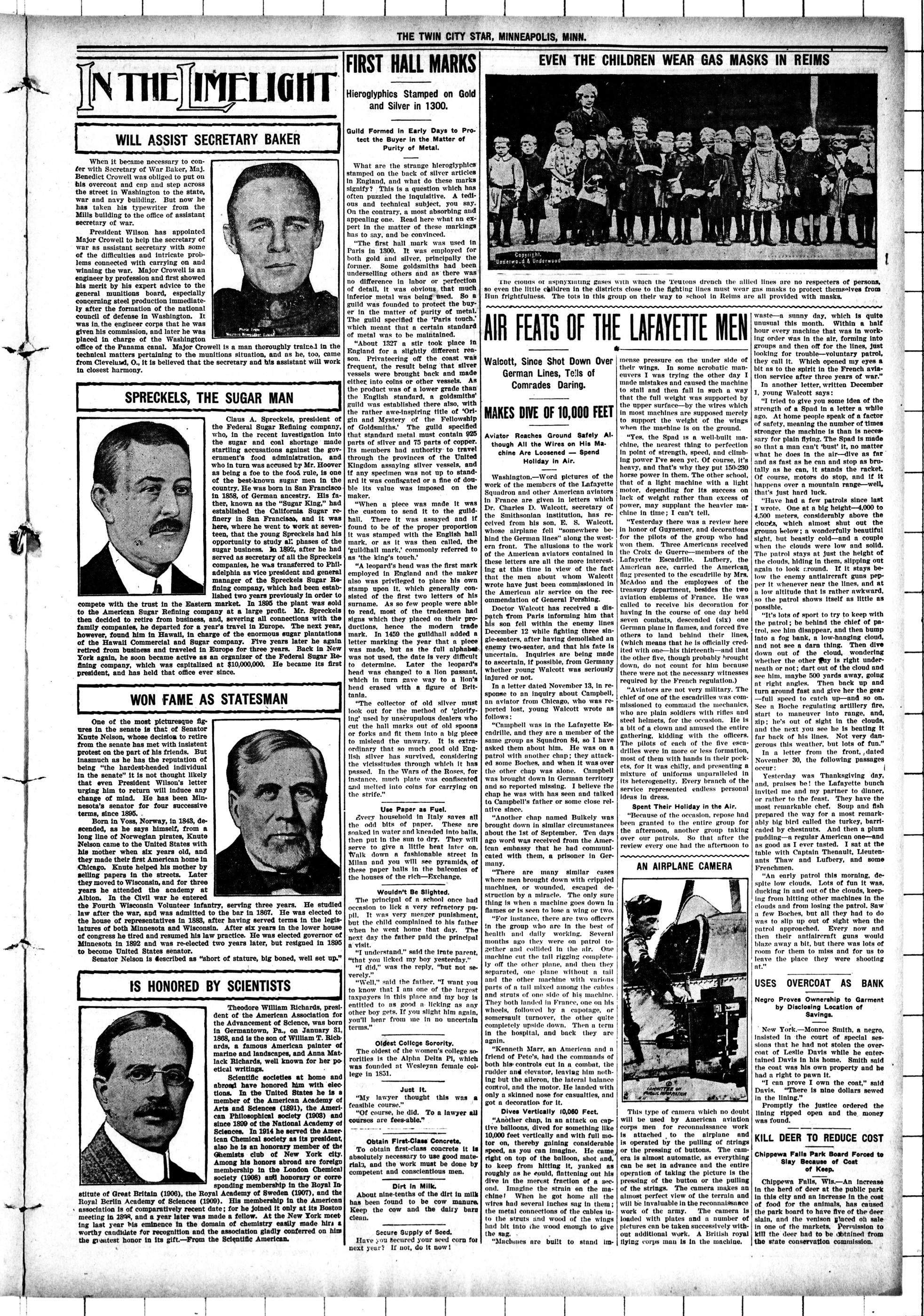
EVEN THE CHILDREN WEAR GAS MASKS IN REIMS
The clouds or asphyxiating gases with which the Teutons drench the allied lines are no respecters of persons, so even the little children in the districts close to the fighting lines must wear gas masks to protect themselves from Hun frightfulness. The tots in this group on their way to school in Reims are all provided with masks.
AIR FEATS OF THE LAFAYETTE MEN
Walcott, Since Shot Down Over German Lines, Tells of Comrades Daring.
MAKES DIVE OF 10,000 FEET
Aviator Reaches Ground Safely Although All the Wires on His Machine Are Loosened — Spend Holiday in Air.
Washington.—Word pictures of the work of the members of the Lafayette Squadron and other American aviators in France are given in letters which Dr. Charles D. Walcott, secretary of the Smithsonian institution, has received from his son, E. S. Walcott, whose airplane fell "somewhere behind the German lines" along the western front. The allusions to the work of the American aviators contained in these letters are all the more interesting at this time in view of the fact that the men about whom Walcott wrote have just been commissioned in the American air service on the recommendation of General Pershing.
Doctor Walcott has received a dispatch from Paris informing him that his son fell within the enemy lines December 12 while fighting three single-seaters, after having demolished an enemy two-seater, and that his fate is uncertain. Inquiries are being made to ascertain, if possible, from Germany whether young Walcott was seriously injured or not.
In a letter dated November 13, in response to an inquiry about Campbell, an aviator from Chicago, who was reported lost, young Walcott wrote as follows:
"Campbell was in the Lafayette Escadrille, and they are a member of the same group as Squadron 84, so I have asked them about him. He was on a patrol with another chap; they attacked some Boches, and when it was over the other chap was alone. Campbell was brought down in German territory and so reported missing. I believe the chap he was with has seen and talked to Campbell's father or some close relative since.
"Another chap named Bulkely was brought down in similar circumstances about the 1st of September. Ten days ago word was received from the American embassy that he had communicated with them, a prisoner in Germany.
"There are many similar cases where men brought down with crippled machines, or wounded, escaped destruction by a miracle. The only sure thing is when a machine goes down in flames or is seen to lose a wing or two."
"For instance, there are two officers in the group who are in the best of health and daily working. Several months ago they were on patrol together and collided in the air. One machine cut the tail rigging completely off the other plane, and then they separated, one plane without a tail and the other machine with various parts of a tail mixed among the cables and struts of one side of his machine. They both landed in France, one on his wheels, followed by a capotage, or somersault turnover, the other quite completely upside down. Then a term in the hospital, and back they are again.
"Kenneth Marr, an American and a friend of Pete's, had the commands of both his controls cut in a combat, the rudder and elevator, leaving him nothing but the alleron, the internal balance control, and the motor. He landed with only a skinned nose for casualties, and got a decoration for it.
Dives Vertically (0.060 Fect.
"Another chap, in an attack on captive balloons, dived for something like 10,000 feet vertically and with full motor on, thereby gaining considerable speed, as you can imagine. He came right on top of the balloon, shot and, to keep from hitting it, yanked as roughly as he could, flattening out his dive in the merest fraction of a second. Imagine the strain on the machine! When he got home all the wires had several inches sag in them; the metal connections of the cables into the struts and wood of the wings had bit into the wood enough to give the sag.
"Machines are built to stand im-
mense pressure on the under side of their wings. In some acrobatic maneuvers I was trying the other day I made mistakes and caused the machine to stall and then fall in such a way that the full weight was supported by the upper surface—by the wires which in most machines are supposed merely to support the weight of the wings when the machine is on the ground.
"Yes, the Spad is a well-built machine, the nearest thing to perfection in point of strength, speed, and climbing power I've seen yet. Of course, it's heavy, and that's why they put 150-230 horse power in them. The other school, that of a light machine with a light motor, depending for its success on lack of weight rather than excess of power, may supplant the heavier machine in time; I can't tell.
"Yesterday there was a review here in honor of Guynemer, and decorations for the pilots of the group who had won them. Three Americans received the Croix de Guerre—members of the Lafayette Escadrille. Lufbery, the American ace, carried the American flag presented to the escadrille by Mrs. McAdoo and the employees of the treasury department, besides the two aviation emblems of France. He was called to receive his decoration for having in the course of one day held seven combats, descended (six) one German plane in flames, and forced five others to land behind their lines, (which means that he is officially credited with one—his thirteenth—and that the other five, though probably brought down, do not count for him because there were not the necessary witnesses required by the French regulation.)
"Aviators are not very military. The chief of one of the escadrilles was commissioned to command the mechanics, who are plain soldiers with rifles and steel helmets, for the occasion. He is a bit of a clown and amused the entire gathering, kidding with the officers. The pilots of each of the five escadrilles were in more or less formation, most of them with hands in their pockets, for it was chilly, and presenting a mixture of uniforms unparalleled in its heterogeneity. Every branch of the service represented endless personal ideas in dress.
Spent Their Holiday in the Air.
"Because of the occasion, repose had been granted to the entire group for the afternoon, another group taking over our patrols. So that after the review every one had the afternoon to
AN AIRPLANE CAMERA
COMMITTEE OF
PUBLIC INVESTIGATION
This type of camera which no doubt will be used by American aviation corps men for reconnaissance work is attached to the airplane and is operated by the pulling of strings or the pressing of buttons. The camera is almost automatic, as everything can be set in advance and the entire operation of taking the picture is the pressing of the button or the pulling of the strings. The camera makes an almost perfect view of the terrain and will be invaluable in the reconnaissance work of the army. The camera is loaded with plates and a number of pictures can be taken successively without additional work. A British royal flying corps man is In the machine.
waste—a sunny day, which is quite unusual this month. Within a half hour every machine that was in working order was in the air, forming into groups and then off for the lines, just looking for trouble—voluntary patrol, they call it. Which opened my eyes a bit as to the spirit in the French aviation service after three years of war."
In another letter, written December 1, young Walcott says:
"I tried to give you some idea of the strength of a Spad in a letter a while ago. At home people speak of a factor of safety, meaning the number of times stronger the machine is than is necessary for plain flying. The Spad is made so that a man can't 'bust' it, no matter what he does in the air—dive as far and as fast as he can and stop as brutally as he can, it stands the racket. Of course, motors do stop, and if it happens over a mountain range—well, that's just hard luck.
"Have had a few patrols since last I wrote. One at a big height—4,000 to 4,500 meters, considerably above the cloak, which almost shut out the ground below; a wonderfully beautiful sight, but beastly cold—and a couple when the clouds were low and solid. The patrol stays at just the height of the clouds, hiding in them, slipping out again to look around. If it stays below the enemy antialcraft guns pepper it whenever near the lines, and at a low altitude that is rather awkward, so the patrol shows itself as little as possible.
"It's lots of sport to try to keep with the patrol; be behind the chief of patrol, see him disappear, and then bump into a fog bank, a low-hanging cloud, and not see a darn thing. Then dive down out of the cloud, wondering whether the other boy is right underneath or not; dart out of the cloud and see him, maybe 500 yards away, going at right angles. Then back up and turn around fast and give her the gear—full speed to catch up—and so on. See a Boche regulating artillery fire, start to maneuver into range, and, zip; he's out of sight in the clouds, and the next you see he is beating it far back of his lines. Not very dangerous this weather, but lots of fun."
In a letter from the front, dated November 30, the following passages occur:
Yesterday was Thanksgiving day, and, praises be! the Lafayette bunch invited me and my partner to dinner, or rather to the feast. They have the most remarkable chef. Soup and fish prepared the way for a most remarkably big bird called the turkey, barricaded by chestnuts. And then a plum pudding—a regular American one—and as good as I ever tasted. I sat at the table with Captain Thaunt, Lleutenants Thaw and Lufbery, and some Frenchmen.
"An early patrol this morning, despite low clouds. Lots of fun it was, ducking in and out of the clouds, keeping from hitting other machines in the clouds and from losing the patrol. Saw a few Boches, but all they had to do was to slip up out of sight when the patrol approached. Every now and then their antifaircraft guns would blaze away a bit, but there was lots of room for them to miss and for us to leave the place they were shooting at."
USES OVERCOAT AS BANK
Negro Proves Ownership to Garment by Disclosing Location of Savings.
New York.—Monroe Smith, a negro, insisted in the court of special sessions that he had not stolen the overcoat of Leslie Davis while he entertained Davis in his home. Smith said the coat was his own property and he had a right to pawn it.
"I can prove I own the coat," said Davis. "There is nine dollars sewed in the lining."
Promptly the justice ordered the lining ripped open and the money was found.
KILL DEER TO REDUCE COST
Chippewa Falls Park Board Forced to Slay Because of Cost of Keep.
Chippewa Falls, Wls.—An increase in the herd of deer at the public park in this city and an increase in the cost of food for the animals, has caused the park board to have five of the deer slain, and the venison placed on sale in one of the markets. Permulsion to kill the deer had to be obtained from the state conservation commission.
PUBLISHED EVERY FRIDAY BY
CHARLES SUMNER SMITH,
Minneapolis, Minnesota.
Entered in the Post Office at Minneapolis as second class matter.
MEMBER
NATIONAL NEGRO PRESS
ASSOCIATION
MEMBER
MINNEAPOLIS ENGINEER
ASSOCIATION
ORGANIZED
1867
Subscription by Mail, Postpaid.
ONE YEAR .....$2.00
SIX MONTHS .....$125
THREE MONTHS ......65
Hamlet B. Rowe, Local Agent.
ADVERTISING RATES.
One Inch—1 Insertion—One Dollar.
Liberal discount given on 3, 6, 9,
Months, or 1 year contracts.
We do not run free ads, or over-run
the time contracted for by our ad-
vertisers We respect their right to
advertise at intervals, and rather have
them do so, than to run continuously
an "adv." and an increasing account.
Write all Checks payable to
THE TWIN CITY STAR
1317 North Sixth Ave.
MINNEAPOLIS - MINNESOTA
Call at 1317 6th Ave. N. on Wednesday to insure matter for publication. The Star's Phone, Hyland 1205.
In every Negro home there should be a Negro newspaper, especially the local paper. Your interests are local and your support of a local paper will enable it to better represent and protect your interest in the community. Papers of national circulation and "home town" papers are very interesting, but do your part to make your local paper a worthy representative of the race.
The anniversary of the birthday of Frederick Douglass will be celebrated through the country as usual.
THE NEGRO IN THE WAR.
The course of the Negro race has been highly creditable in this war. Upon barren soil fell the seeds of sedition and insurrection disseminated by German agents and, pro-German newspapers in an attempt to incite the Negroes to uprising against the United States. So far as we have observed, Negro leaders have been conspicuously free from treasonable utterances. Drafted Negroes have gone to the front as cheerfully as any other set of men and, if history repeats itself, they will fight with signal bravery. German bullets will send as much torture and agony into black bodies as into white. Death will not discriminate against the Negro soldier. The patriotism of these people will not be forgotten and should ever be kept in mind and taken into account for full credit in the adjustment of racial problems.—Greenville, S. C., News.
AVOID THE BOOMERANG.
The spirit of fair play must be the dominant note of a successful newspaper. Once lost to sight, the withering of influence begins, and once started it is hard to stop. Rabid partisanship, the refusal to hear two sides of an argument, the dictatorial attitude, the assumption of final authority on all subjects, the adoption of the "I am holier than thou" attitude invariably lead to the tortuous road which ends in loss of power. Newspaper readers are quick to sense the spirit of fair play in their editor. If he be himself unjust he cannot long hide the fact from his readers. If he be fair-minded his openness of character is reflected in everything he writes and publishes.
Every man is entitled to his day in court. The condemnation of a principle without a hearing is a Prussianized practice which never can find place in this country. This applies equally to public men as to business problems, economics, and all things else. The editor eventually must judge what is right and what is wrong. But his judgment will mean little, unless it be based on justice. The public is entitled to hear both sides of an argument. When this is done frankly and the editor takes his position, his readers know at once whether he is a just man or one who would rather win than be right. Hiding the other fellow's side of the case always proves to be a boomerang. Let both sides be heard.—The American Press.
REMEMBER THE NEEDY.
Every effort to relieve those who are sick and in distress, is the duty of all at this time. There is much suffering about us and true charity begins at home, without the usual noise and notoriety.
Send your subscription. Our prices have not changed because of the war. Let your dollar do its duty and The Star will reach a higher standard of service and better circulation.
Since the government has taken over the railroads, many employees are out of employment. Several railroads men returned from Canada this week.
M.
DUBOIS' BIRTHDAY EDITION.
"The Crisis" to Review the Life of Editor Dubois on His Fiftieth Birthday.
Dr. W. E. B. DuBois, the distinguished publicist, reaches his fiftieth birthday February 23. A unique celebration is planned. It is to be in the form of an autobiography that will appear, with an art likeness, in the February Crisis magazine. The life story includes a description of his humble birth at Great Barrington, Massachusetts, a tribute to his ambitious mother, his early encounter with race prejudice, his long struggle for an education in Massachusetts, at Fisk university, at Harvard university and in Germany; his life work in Ohio, in Georgia and finally for the past eight years as editor of the Crisis, that has grown to 68,000 copies. This story of Dr. DuBois life, as told by himself, grips the enthusiasm, thrills and inspires. It will be read with great interest by Negroes of all ages.
The Crisis, published at 70 Fifth Avenue, New York city, is the organ of the National Association for the Advancement of Colored People, Judge Moorfield Story, president; Major Joel E. Spingarn, chairman; Oswald Garrison Villard, treasurer; James Weldon Johnson, field secretary. The vice presidents are Archibald H. Grimke, Rev. John Haynes Holmes, Bishop John Hurst, John E. Millholland, Mary White Ovington. This organization recently helped to defeat the segregation laws by securing a unanimous verdict from the United States supreme court.
THE NEW YEAR
-1918-
The color of American has every reason to take courage. The past year may have taken something away but it gave more than it took.
From the Twenty-fourth infantry we have lost three score of the best soldiers in the world, who, up to the bear-baiting of Houston, had an enviable record for discipline and soldierly courtesy.—But we have garned the unprecedented total of 700 colored commissioned officers in the United States army and have an equal status for service in the ranks.
We have heard the greatest Court of the land, by an obiter dictum, re-affirm its approval of ordinary "Jim-Crowism."—But the same court at the same time wiped out the very worst form of "Jim Crow" in the segregation ordinance, and removed from us the threat of an American Ghetto.
We had East St. Louis, a supremely savage effort to beat us back industrially.—But far from being beaten back, we have broken down the industrial wall that hemmed us in the Southeast, and have sent our hardy cohorts to every industrial center of the greatest industrial nation.
We have Chester in Pennsylvania, and Memphis in Tennessee. O, yes, Memphis with all the savage instincts that still infest its purleus.—But we also have Detroit in Michigan and we still have and have still better the Harlem in New York City—THE Harlem!
We have to pay more for our butter and eggs—but we have more to pay with. What boots it to the colored man if eggs be a dime a dozen and his wages so low and his chances to work so slim that he cannot spare the ten cents? It were far better for him that eggs should : ll at fifty cents a dozen, if he can earn from three to five dollars a day.
We are still stalked by the shadow of government-departmental segregation.—But in substance we are represented in every department of government service, and have a high civil officer in the war department.
As a racial element in the world war we have earned the hate of Germany.—But we have deepened the love of France. And one of the acknowledged assets of America is our loyalty and magnanimity.
Like all the gentle folk of the world we stand horrified and aghast at this World War and world murder.—But the colored American has gained, in both material and immaterial goods, and will gain proportionately more from this world conflict perhaps, than any other single element in the world.
"THY WILL BE DONE."
WM. PICKENS.
Morgan College, Baltimore, Md.
Jan. 1, 1918.
THE TWIN CITY STAR, MINNEAPOLIS, MINN.
WITH THE INVENTORS
An electric fan features a new filter to cool the water as it passes through fabric tubes by evaporation without the use of ice.
Camphor production from leaves having passed the experimental stage in Formosa, the government has planted large areas in trees.
Chinese poultrymen preserve duck eggs fresh for many months by coating them with a mixture of ashes, tea dust, clay, salt and lime.
An American patent has been granted an English inventor for a shoe with detachable soles and heels, which can be easily replaced when worn.
RIGHT FROM•THE SHOULDER
Truth and popularity seldom keep company.
Those who travel fastest are generally the slowest to settle.
No diplomat can hope to hold his job longer than he can hold his tongue.
There are more slackers than paupers in the present ranks of the unemployed.
The price of fuel has risen to a point where a hot-air artist is regarded as a social lion.
These are the days when the coal man gathers in the shekels the ice man overlooked.
Popularity is often found among the remnants on the bargain counter, but success, never.
Chemists have failed utterly to explain why cold cash so often burns holes in one's pocket.
Few persons reach that degree of eminence where they can become annoyed at camera fiends.
Some patriots are so punctilious about observing a meatless Tuesday that they will not even order a Welsh rabbit.
Since the advent of woman suffrage in California the marriage rate has steadily declined; too many women prefer espousing a cause to a husband.
BUSINESS COMMANDMENTS
1. Honor the chief. There must be a head to everything.
2. Have confidence in yourself, and make yourself fit.
3. Harmonize your work. Let sunshine radiate and penetrate.
4. Handle the hardest job first each day. Easy ones are pleasures.
5. Do not be afraid of criticism—criticize yourself often.
6. Be glad and rejoice in the other fellow's success—study his methods.
7. Do not be misled by dislikes. Acid ruins the finest fabric.
8. Be enthusiastic—it is contagious.
9. Do not have the notion success means simply money-making.
10. Be fair, and do at least one decent act every day in the year.—Samuel F. Taylor, in the Printing Art.
DOINGS ELSEWHERE
Helena, Mont., wants conservation of elk for food.
Fairbanks, Alaska, is to have an agricultural college.
Milwankee is to have a new electric railroad terminal depot.
St. Louis, Mo., schoolboys are being enrolled for spring work on farms.
Philadelphians are urged to "post letters early" to facilitate collection of mail.
NOTES OF THE DAY
Several thousand acres are given over to the cultivation of pineapples in Hawaii.
Twenty-four lumber yards in Wisconsin now employ women as lumber handlers.
A loan fund of $10,000 for helping poor students is one of the features of Henry Kendall college, in Oklahoma. No more than $200 a year is lent to any student. The borrower must be a high school graduate.
According to released Englishmen, who have arrived from the camp for British civilians at Ruhleban, Germany, no food had been provided for them by the Germans in three months. They were entirely dependent on the parcels sent out from Great Britain.
---
Even a 16-inch gun may be less dangerous than a 12-inch mouth.
Lots of people seek Opportunity—a good many only reconnoiter it.
Haven't you noticed that ancestral pride always traces its "descent?"
Men are sometimes like razors—the cheapest has the strongest pull.
Yet the community gourd at the old spring never poisoned anybody.
A "laggard in love" may be giving the girl further respite from hunger.
Of course, if nations will "stop to argue," the Yankees will get 'em, most of the time.
Maybe a man speaks of his "inmost soul" because it isn't apparent upon the outside.
Energy is the motive power of the human machine. Don't waste it in blowing the whistle.
Possibly our friends, the enemy, may be induced to talk peace while some of them are still alive.
The race is not deteriorating. The quarrels over the spring marble-games will soon be just as vigorous as ever.
Some men, like that Russian red, Lenine, wear whiskers to protect the throat, then keep the wind roaring through the inside.—J. H. Mackley.
HIT AND MISS
With some women the price mark controls two of life's assets—clothes and a husband.
Opportunity knocks once, but your friends knock all the time.
A flirtation is the salt and pepper on life's porterhouse, but the world finds too much seasoning hard to swallow.
Consider how the clock gets there, hand over hand.
Attempt to follow the advice of all your friends and it will be a padded cell for you.
GLOBE SIGHTS
Some persons mistake formalities for religion.
There is more society than religion in some churches.
Too many mistake their prejudices for facts in the case.
A man who hasn't any morals usually has an excuse of morale.
No matter what a man's salary is his wife feels that she earns it.
Some of the most worthless men we ever knew get up the earliest.
Many a cordial invitation is extended with the hope it will not be accepted.
When a man talks about living his own life there is some curiosity to know whom with.
Children don't believe their parents know best and occasionally they are right about it.
A man who looks back at his school days as life's happiest time hasn't had a great deal of fun.
Our latest freak, who is always urging people to be patriotic, is now working at Camp Funston as a carpenter, and always lays off on Saturday so he can work on Sunday and draw double pay from the government.—Atchison Globe.
STATISTICAL NOTES
Hawaii has 14 volcanic craters.
Britain has 900,000 war prisoners.
Texas uses convict labor to work 65,000 acres of land.
Britain is spending about $7,000,000 a day in the United States.
United States has added 20,000 persons to Washington departmental payrolls on war account.
INTERESTING FACTS
One of the easiest ways to cool an overheated oven is to stand a basin of cold water in.
France is the best foreign patron of the United States patent office, with Great Britain following closely.
Made of stiffly crimped material, a ribless umbrella has been invented by a resident of New York state.
Deposits of asphalt that are believed to be practically inexhaustible have been discovered in the Philippines.
TO ADDRESS NEGRO MEETINGS
POSTMASTER SELECTS SHER-
WOOD.
Jose A. Sherwood, of the postoffice department of St. Paul, has been assigned by Postmaster Otto Raths to deliver a series of educational addresses to various Negro organizations on the War Savings Certificates and Thrift Stamp plans and has communicated with several secretaries of lodges requesting that Mr. Sherwood "one of the trusted employees of this office be given an opportunity to address your meeting and explain these plans." Several favorable replies have been received and Mr. Sherwood will speak at St. James A. M. E. Church on Sunday morning, Jan. 20, and at Gopher Lodge of Elks on Feb. 13. Other dates to be announced later.
Postmaster Raths has always taken special interest in the welfare of his Negro employees and a hearty co-operation on the part of all Negroes is not only a spirit of national service, but a testimonial of personal appreciation. Mr. Sherwood's address will be highly beneficial, as he is a logical and interesting speaker.
SECY. SKINNER APPEALS FOR SUPPORT FOR N. A. A. C. P.
We have read, with sincere satisfaction, the wonderful achievements of the N. A. A. C. P. for the past year, notwithstanding conditions as they exist in our midst in the hideous forms of oppression, prejudice, segregation, lynchings, etc. Every battle won is not a victory for certain individuals, but for the race, and the question arises: Why should the vast majority of our men and women be so eager to share in the spoils, but are unwilling to help in the chase? We loudly acclaim. Hurrah, we have secured another victory, but we are unmindful of the fact that we in a large measure, have not even morally helped to secure it. The N. A. A. C. P is the only tangible organization in the field today which is fighting consistently, tenaciously and efficiently those wrongs perpetrated upon a helpless race and securing the right guaranteed under our constitution. The present war has brought about a revolution that the Negro can scarcely fail to appreciate, which will and must ultimately react to our betterment and the time for us to unite our forces into one solid phalanx is now, which will find us at the end of this war not as suppliants, begging for a crumb; but as men and women demanding that which we have justly merited. Our forefathers sacrificed their lives that we, today, might live without the yoke of slavery hanging about us. The victory is not complete. We have yet to carry on the fight so that our children can enjoy and live in perfect security and peace. The N. A. A. C. P. appeals to every member of the race to be loyal. Not to be a slacker, but merge our forces into one financially and morally, so as to secure our rights. Will you still put off your admission into the organization? Will you delay? "Procrastination is the thief of time." There are men and women of force, of character, of high intelligence who are willing and are prepared to champion the cause, but membership and funds are necessary. Will you not do your bit? The N. A. A. C. P. asks for no repremixtures, no searching examinations into your history, past, present or future. To be a Negro is the only credential necessary. Attend our meetings! Ask questions! Be informed and I am confident you will have regretted not becoming a member before this time. Membership $1.00 a year. We desire to have at the end of the present year not less than 200 memberships in Minneapolis. This is the time for action, for as Hannah More writes.
The keen spirit
seizes the prompt occasion—makes the thought start into instant action—and at once plans and performs, resolves and executes.
Remember it is a duty you owe to yourself and every member of the race to become associated with the one Negro organization that seizes hold of the problems that confront us and reduces them to a happy solution. I desire that our membership at the end of the ensuing year be increased to 500 and I therefore appeal to every person, regardless of sex, whose love for his race, for equality and justice, transcend every other consideration and align himself and herself with this very worthy organization. Membership fee for one year, $1.00. If your duties prevent your being present at any of the meetings, mail the amount and a receipt will be promptly sent to you. Do not put it off, join the Minneapolis Branch of the National Association for the Advancement of Colored People.
The Twin City Star is the official organ for publishing all of theivities of the Minneapolis Branch of the National Association for the Advancement of Colored People. Individual notices of time and place of meetings will be discontinued and members are therefore asked to watch the Star.
R. Augustine Skinner, Secretary,
2817 Chicago Ave., Minneapolis.
Are you a delinquent subscriber?
If so, why not send your subscription?
ADVERTISE IN THE STAR
HOME OF UNITED CIVIC LEAGUE
New York Organization Settles In Fine Quarters.
STANDS FOR EQUAL JUSTICE
Thrifty Civic Body Founded by the Well Known John M. Royall Purchases and Equipa Building For Larger Scope of Work—Motto of the League is "Pulling Together."
New York.—At last the colored citizens of New York city have realized a long felt want, for they have now provided themselves with a modern and up to date clubhouse and will in the future make a specialty of providing suitable lodging rooms and board to representative men visiting and passing through the city. The handsome and modernly equipped building recently purchased at 184 West One Hundred and Thirty-fifth street is now ready and will be used for the com
[Name]
PRESIDENT JOHN M. BOYALL.
venience of the members of the United Civic league and the accommodation of the public.
The league's building is without doubt the only place in this big city offering the equipment and facilities it is provided with, and without doubt also shows the rapid strides of the United Civic league, which was founded by John M. Royall and a few other loyal citizens in 1913 for elective representation throughout the state of New York and the nation and for political justice and an equal administration of the laws.
The large and lengthy basement can be suitably arranged for athletic events or for business purposes, while the main floor consists of reception and reading rooms and a large auditorium for entertainments and social functions. On the second floor there are four extra large light rooms for office use with steam, light and janitor services included. Adjoining these to the rear are the large bathroom and the manager's room.
The third floor has three finely furnished, large, light, alry rooms for gentlemen lodgers by day, week or month, and off these are a large dining room, pantry and kitchen, which are occupied by Caterer Watkins for serving business men's lunches and catering to special parties.
The United Civic league's motto is "Pulling Together," and the officers are John M. Royall, president; W. H. Willis, first vice president; J. E. Earlas, second vice president; Joseph L. Pritchard, treasurer; Henry D. Dolphin, secretary, and W. G. Isaacs, financial secretary.
Board of governors are Benjamin F. Thomas, chairman; B. H. Lewis, vice chairman; J. C. Thomas, Sr.; John A. Ross, Charles H. Payne, W. H. Rhodes, V. T. Thomas, J. W. Rose, E. A. Johnson, John Phinizee, Philip A. Payton, George W. Beaman, Philip M. Thorne, Sykes S. Beaman and Anthony McCarthy. John E. Robinson is the building secretary and manager.
Having on its official staff this corps of business men, many who are merchants and representing the largest there is in the colored people's commercial life, the league will continue to add to its long list of achievements throughout the city and state.
N. A. A. C. P. ELECTS OFFICERS FOR 1918
Atty. B. S. Smith, Pres.; W. C. Jeffrey, Vice Pres.; Miss Eva B. Walker, Treasurer; Atty. R. Augustine Skinner, Secretary.
Executive Committee.
Rabbi S. N. Deinard, L. C. Valle, W. M. Smith, Atty. W. R. Morris, P. H. Southall, Judge E. F. Waite, Sen. S. A. Stockwell, Congressman Thos. D. Schall, Mrs. W. R. Donovan.
Rev. T. B. Stovall, the exponeht of the "Get Together" theory was badly needed at the N. W. A. C. P. meeting last Sunday.
Don't send in your ads and say "send me the bill" Send the bill with the ad or personal. If you haven't a doblar, wait until you get one.
Do not forget to send the money to the Star which you owe for subscriptions.
IMPORTANT NOTICE
Unless notes are written plainly and properly arranged they will not be inserted. Many people send in notes regardless of names, initials or composition. Arrangement by the publisher will be charged for. Free notices must be correctly written.
Celobrate Their 31st Anniversary
Sergt. and Mrs. Z. A. Pope celebrated their 31st wedding anniversary on Jan. 19th. A large number of friends were present and the evening was spent very pleasantly. A delicious lunch was served. Sergt. Pope received a number of useful presents, also the congratulations of a host of friends.
Union Hall Loses Suit
The suit of H. M. Sely, contractor, who built the Union Hall, against the Carpenter Lumber Co. and the North land Pine Co., growing out of lumber removed from Union Hall premises by those companies while the hall was being constructed in 1915 was tried before Judge Brill and a jury in the Ramsey county district court and the jury awarded a verdict to the contractor for the full amount of the value of the lumber taken with interest at 6 per cent. Attorney W. T. Francis represented the contractor. Union Hall is owned by the Odd Fellows and Masons of St. Paul and is the only fraternal building owned by Negroes in the state.
WADE-FRACTION MARRIAGE.
Miss Opal Lavura Wade, daughter of Mrs. Quentin Hicks, 1000 Iglehart ave., St. Paul, was married to Mr. Walter Fraction on Jan. 16th at 8:30 p. m., at the home of the bride. Rev. Henderson of St. James' A. M. E. Church officiated. The wedding march was played by Miss Ruth Harris, accompanied by Mr. Leon Abbey, violinist. The bride was given away by her brother, Carl Wade. A reception was held after the wedding for relatives and intimate friends only. The bride and groom will reside with the bried's mother until spring then they will go to housekeeping.
Mr. Charles Noble has returned from a pleasant trip to Chicago.
Miss Frances Mask entertained a party of friends on Wednesday evening. Skating was the pleasant feature.
Mrs. Wm. Hyde, 3432 Oakland ave., entertained at breakfast on Monday Rev. and Mrs. T. B. Stovall and Mesdames Minnie Buttner and Emma Grimes.
Mrs. Abbie Glenn had the good fortune to recover a valuable earring which she lost on the night of the Old Residents' Reunion. It was found by a neighbor in front of her residence.
Mr. Will C. Jeffery has been on the sick list. He underwent a minor operation for nasal trouble and is much improved.
Deputy Sheriff John M. Allison is improving.
Miss Marienne Jeffrey and Mr. Wendell W. Gibbs graduated from the High Schools this week.
The employes of the Minneapolis Steel Machinery Co. are arranging for a dance next month.
Mr. Beverly F. Keeeser, an old resident, has been very ill at his residence, 715 West 31st st. His many frineds are anxious for his recovery.
Mr. Edward Hammond has returned home from the Asbury Hospital.
Death of Ernest Watkins
The unexpected news of the death of Ernst Watkins was sadly received this week. He was the son of Mr. Archie Watkins, the well known clubman, and was employed at the Rogers Cafe. He died after an operation from blood poisoning. Funeral services were held Friday.
The Charity Ball for the benefit of Attucks Home will be held next week.
Queen of Sheba Chapter, O. E. S., are preparing for a Mask Ball and Lady Minstrels on St. Valentine's night.
THE TWIN CITY STAR will be sent to any out of town address. Send your subscription in postage stamps. Read your home paper while visiting in other cities. It's like a letter from home.
AGENTS WANTED—NOW!
Reliable and intelligent agents always wanted to solicit business for THE TWIN CITY STAR; also correspondents in principal cities. A chance to earn a good living. Write The Twin City Star, Minneapolis.
Secretaries of Lodges may send notices of their newly elected officers for free publication and office information.
THE STAR is the CHEAPEST and BEST NEGRO PAPER in the NORTHWEST. It needs 500 more Subscribers to keep it going. Help to get us A BIGGER CIRCULATION.
SMOKE THE RELIABLE SIGHT DRAFT CIGAR
D. R. King
FREDERICK DOUGLASS
THE LEADING SPIRIT OF THE ANTI-SLAVERY MOVEMENT
Born a Slave; Died a Statesman.
SUNDAY FORUM MEETING.
The Minneapolis Sunday Forum met Jan. 20, 1918, at Bethesda Baptist Church. A good attendance was present, which somewhat increased as the meeting proceeded, due to the tendency of a certain part of the Forum's audience to neglect promptness. The meeting was called to order by the president and opened by prayer of Chaplain Jenkins. After the usual trend of business the audience was favored with a violin solo, presented by Mr. Eldridge Garrett. Mr. Garrett is to be commended for his efforts along the line of advancement, not only of education, but of a broader art. "music."
Owing to the absence of the journalist, Mrs. Maxwell, the meeting was thrown open for the presentation of notes of interest pertaining to the race. Mrs. Pansy Chavis, a former nurse of Provident Hospital, Chicago, told of the success of that institution in raising funds for the reopening of its dispensary.
Lawyer Wm. R. Morris also had words of commendation for Mayor Van Lear for prohibiting the showing of "The Birth of the Nation."
Mrs. Kate Smith, one of the official moving picture censors, also told of the untiring efforts of Mrs. C. M. Scott and Miss K. Wallace of the board in prohibiting any picture that would seem unfair to the race.
Rev. Harrabellio A. Morangeopa, a native of Africa, who is on a tour of the countries of the world, doing work on behalf of the London Missionary Society, gave an interesting address.
A short address was given by Rev. Seymour of Los Angeles, Cal.
The meeting was adjourned by Rev. Seymour's benediction, every one feeling satisfied by having attended so interesting a meeting of the Sunday Forum.
The next meeting of the Minneapolis Sunday Forum will be held at St. Peter's Church Feb. 2, 1918.
FRANCIS MASK, Secy.
Elks Seek New Members.
Ames Lodge No. 106, B. P. O. E. of W., has started a campaign for new members. Ames is one of the progressive lodges of Elkdom and under the administration of Exalted Ruler Wm. Critic plans to increase its membership.
St. Anthony Lodge Officers.
St. Anthony Lodge of Odd Fellows, No. 2877, elected the following officers at their regular meeting:
J. J. Turner, N. G.; John A. Witthers, P. N. G.; H. R. Morgan, V. G.; J. W. Thornton, N. F.; Moses L. Brown, P. N. F.; N. C. Stone, W. F.; W. R. Morris, P. S.; W. W. Williams, E. S.; Wm. H. Jenkins, Warden.
St. Paul Patriarchy Initiation.
The St. Paul Patriarchy No. 114 initiated a class of ten candidates at its regular meeting on Thursday evening, Jan. 10. The new Patriarchs are: N. C. Stone, McDuff Woodward, Rev. T. B. Stovall, J. R. Lynn, James O. Riley, Ross Dean, A. H. Hatton, B. L. White, C. H. Jackson, John A. McAdam, Mitchell Woodford.
Zion Church Revival Services
Rev. W. S. Cooper, pastor of Zion Baptist church, is conducting revival services, which began Monday night. He preached a very able sermon Sunday evening. Rev. Cooper has informed all applicants for membership that the rules of the church must be strictly kept. He says "Those who come from any denomination excepting the Baptist, must be baptized to become a member of Zion Baptist church. Those coming from Baptist churches must bring their letter. Do not ask me to let down the bars, or break the rules." Rev. Cooper expressed a great desire to build up a membership of devout Christians rather than mere church members. Success to his efforts.
Mrs. Wm. Bailey of 4th Ave. So. is ill at her residence.
Miss Ida Dorsey is very ill at Eitel Hospital. Her chances for recovery are doubtful.
Owing to an increase in cost, we have raised our prices on all composition. Reading notices will be 10c per line under one inch and 50c per inch thereafter.
THE TWIN CITY STAR, MINNEAPOLIS, MINN.
RELIEF FOR DEFENDENTS OF THE HOUSTON VICTIMS Washington, Dec. 23.—Colored people throughout the country are being given an opportunity to show how deep is their regret over the tragic hanging of 13 colored soldiers, and life imprisoning of 41 others at Fort Houston, and how deep is their sympathy for their bereaved and needy families, for the National Colored Comfort Committee is sending out one hundred thousand pledge cards with an urgent appeal to respond with contributions. R lief for these sorrowing and needy families is urgent. They need sympathy now in the form of financial help and need it quick. The National Colored Soldiers Comfort Committee has secured the resident address of the dependents of those 13 hung and 41 imprisoned for life, in order to reach them with relief.
CLASSIFIED ADVERTISEMENTS
SEE McDEW! for real estate.
FOR RENT.—1311 6th Ave. No., six room flat, light, sunny rooms, reasonable rent, all modern. Inquire in store 1309 6th Ave. No.
FOR RENT.—Modern flat; five nice rooms and large attic; short distance from heart of city; one block from car line. M. J. Fately, 1917 5th Ave. So. Phone South 4948.
FOR RENT.—Nicely furnished room, with modern conveniences, on car line, in walking distance of business district. Mrs. Houston, 1907 4th Ave. South. Call South 6434.
ONE LARGE ROOM neatly furnished, modern conveniences, in residential section. Mrs. W. W. Williams, 2900 Eleventh avenue South. Drexel 4728.
APARTMENTS IN DUPLEX—Four rooms up and five rooms down. Modern except heat, 2621 Stevens avenue. Cheap rent for the winter. Walter Smith, 2812 Elliot avenue. Telephone South 3113.
LOWER FLAT for rent; 5 rooms and bath, all modern; desirable location, near car line. 2111 Fifth Ave. S. Call Colfax 3306.
FOR RENT—Furnished Room, all modern, steam heated. For one or two gentlemen. 715 6th Ave. No. or call Mrs. Willis, Hyland 5e20.
SIX-ROOM MODERN FLAT, downstairs, central location, near car line. Apply J. S. Wright, 2737 11th Ave. So.
COAL, WOOD AND CHARCOAL
COAL, WOOD AND CHARCOAL You can get 100 lbs. of Hard or Soft Coal, Bundle Wood or Charcoal. Delivered. Call Withers. Your coal man. Hyland 2331, or Hyland 4712.
EVERY DAY is BARGAIN DAY at the ROOT & HAGEMAN STORE, 407 Nicollet Ave.
Get You Baggage Direct from
Maker
NORTHWESTERN
TRUNK CO.
RETAIL STORE
248 Nicollet Ave, Minneapolis
A.
Miss Catherine Lealtad, who was teaching school in Cincinnati, has resigned and gone to New York and is preparing to take charge of Y. W. C. A. work in the South Atlantic states of Virginia, North and South Caroline, Georgia and Florida. Miss Lealtad is the daughter of Rev. and Mrs. A. H. Lealtad and was the valedictorian of her class at Macalester College.
WILLIAMS
Mrs. Victoria Clay-Haley is one of the leading women of America. She is chairman of the Red Cross committee of St. Louis and national organizer of the National Federation of Afro-American Women's Clubs.
HON. RALPH W. TYLER.
WORKING FOR SOLDIERS' COM-
FORT.
Hon. Ralph W. Tyler, ex-auditor of the United States Navy Department, is the secretary of the National Colored Soldiers' Comfort Committees. Mr. Tyler has opened offices at 1101 You st., N. W., Washington, D. C., where he receives all donations for the comforts of Negro Soldiers and the relief of their dependents.
J. H.
JAMES WELDON JOHNSON.
Field Secretary of the National Association for the Advancement of Colored People. Author of "Fifty Years" and other poems.
Editor T. Thomas Fortune is the dean of Negro editors. He made the New York Age the first Negro newspaper of national prominence. His reputation as a journalist of the first rank is universally known.
IMPORTED AND DOMESTIC WOOLENS AT POPULAR PRICES Your Patronage Desired.
Souvenirs for Ladies every Wednesday afternoon and Evening
1313 Wash. Ave. South FOR LADIES & GENTLEMEN Music Every Day from 2 P. M. to 11 P. M.
Kidd Mitchell, Prop. MINNEAPOLIS
LADIES SPECIALLY INVITED EVERY D
Orex 1269 Autom
J. & H. Wet Wash Laun
3753-55-57 Cedar Avenue
High Grade Specialists in Wet W
Dry Wash and Family Launder
OUR WORK IS OUR BEST ADVERTISEM
POPULAR PRICED SHOE REPAIRING.
SPECIAL SAMPLE SHOES
WE FIX 'EM WHILE YOU WAIT.
Men's Sewed Soles ..... $1.00
Ladies' Sewed Soles ..... .85
Men's Nailed Soles ..... .85
Rubber Heels ..... .40
Ladies' and Boy's Nailed Soles ..... .65
SEVEN CORNERS' SHOE REPAIR SHOP.
Wash Laundry
edar Avenue
lists in Wet Wash
family Laundering
TEST ADVERTISEMENT
High Grade Specialists in Wet Wash Dry Wash and Family Laundering OUR WORK IS OUR BEST ADVERTISEMENT
POPULAR PRICED SHOE REPAIRING SPECIAL SAMPLE SHOES
Minneapolis. JOSEPH DAHL, Prop.
BARBER SHOP
BELL, Proprietor.
OP, POLITE BARBERS
MILLIARD HALL
ERS, SHOE SHINING
...MINNEAPOLIS, MINN.
tern, Main 2511.
BELL'S BARBER SHOP
CLARENCE W. BELL, Proprietor.
BATHS, BARBER SHOP, POLITE BARBER
POOL AND BILLIARD HALL
CIGARS, RACE PAPERS, SHOE SHINING
244 THIRD AVE. SOUTH .. MINNEAPOLIS,
Phone Northwestern, Main 2511.
BELL'S BARBER SHOP
CLARENCE W. BELL, Proprietor.
BATHS, BARBER SHOP, POLITE BARBERS
POOL AND BILLIARD HALL
CIGARS, RACE PAPERS, SHOE SHINING
244 THIRD AVE, SOUTH .. MINNEAPOLIS, MINN.
Phone Northwestern, Main 2811.
The Waiters' and Porters' Club
GLOVER SHULL, PRES.
311 HENNEPIN AVE. MINNEAPOLIS
EDDIE BOYD, BECY' LEE WHEELER, MANAGER
SMOKE THE BEST
5C CIGAR
Sight Draft
W. S CONRAD CO., Distributors
NO. 140. E. 6th ST., ST. PAUL.
NO. 1. WESTERN AVE., MINN.
Barber Shop
e. S., Minneapolis
UP TO THE MINUTE.
AND TABLES IN CONNECTION.
HOES SHINED.
CARVER, Props.
South Side Barber Shop
212 Eleventh Ave. S., Minneapolis
EXPERT BARBERS; UP TO THE MINU
CIGARS, POOL AND BILLIARD TABLES IN CONNE
RACE PAPERS—SHOES SHINED.
THOMPSON & CARVER, Props.
South Side Barber Shop
212 Eleventh Ave. S., Minneapolis
EXPERT BARBERS; UP TO THE MINUTE.
CIGARS, POOL AND BILLIARD TABLES IN CONNECTION.
RACE PAPERS—SHOES SHINED.
THOMPSON & CARVER, Props.
ES
CO.
LDERS
TAN LIFE BLDG.
NE NIC. 1534
; if you own your lot.
MONTHLY PAYMENTS.
YOUR FAMILY FLATS
PLANS FREE.
You don't need money; if you own your lot. I BUILD HOMES ON MONTHLY PAYMENTS. COTTAGES AND FOUR FAMILY FLATS ITS JUST LIKE PAYING RENT. PLANS FREE.
HARRY LEVITON
MEN'S SUITS AND OVERCOATS MADE TO ORDER.
Dry Cleaning and Fancy Dyeing of Ladies' and Gent's Garments.
Phone N. W. Hyland 2875 1317 No. 6th Ave., Minneapolis.
N. W. MAIN 2259
Orex 1269
A
with the inscription
Automatic 61809
PETER H. BURKE
Handshake
IN THE
CITIES
PHILADELPHIA.—As the crowds of shoppers thronged Market street late the other afternoon Detectives John Morgan and Mike Hines noticed a poorly clad woman leading two little girls and carrying a baby, making her way along the sidewalks. The children
woman and inquired into the cause of her poor her husband was industrious and hardworking, and was unable to work. The children, who had been unable to go to school because they were. The heart of the detective was touched. dren into a store near by and ordered shoes declined, saying that she had a pair of shoes at but she was wearing slippers so she might a store, when the case was explained to him, said Morgan, and would give the baby a pair of other two pairs at cost, and he would send children and woman left the store happy, and the kind old uncle was they had found on the
How the Battle of Moquin Grill
NEW YORK.-Pale becomes the history of the nificant the story of the Somme. Hark to the Moquin Grill. It is at Moquin's where lies pro
woman and inquired into the cause of her poverty, and was told that while her husband was industrious and hardworking, he had been ill for some time and was unable to work. The children, who were eight and ten years old, had been unable to go to school because they had no shoes, the woman said. The heart of the detective was touched. He took the woman and children into a store near by and ordered shoes for all of them. The woman declined, saying that she had a pair of shoes at home which were fairly good, but she was wearing slippers so she might save them. The clerk of the store, when the case was explained to him, said he would come half way with Morgan, and would give the baby a pair of shoes and let Morgan have the other two pairs at cost, and he would send provisions to the house. The children and woman left the store happy, and the children did not know who the kind old uncle was they had found on the street.
How the Battle of Moquin Grill Began and Ended
How the Battle of Moquin Grill Began and Ended
NEW YORK.-Pale becomes the history of the battle of the Marne. Insignificant the story of the Somme. Hark to the engagement magnificent of the Moquin Grill. It is at Moquin's where long-haired artists with flowing
a punk piece of canvas! "But," interspersed painting no recommendation whatsoever—not Gilbert thought profoundly for a space. For a clear.
"But certainly—yes. You see I am fair! were well painted. I kiss my hand to them. There was a Peruvian bark. And a short Senator Beca Flore maybe—the very one who p from another table and the fight was on.
The fist of genius flew against the chin o and took the tablecloth and spilled the harco Chateau Pape de Neuf, and a couple of bomb not go off. Then—as they do with the colors things up. Walters parted them and there was
Merely Caressed Erring Husba
BOSTON.—The best brand of luck is the var mailed fist, while the correct way to impre jab. These are the maxims torn from a lengthy
a punk piece of canvas! "But," interspersed one of the diners, "has the painting no recommendation whatsoever—not a single good point?" Artist Gilbert thought profoundly for a space. For once his French rang loud and clear.
"But certainly—yes. You see I am fair! The buttons of the coat—they were well painted. I kiss my hand to them. They were great."
There was a Peruvian bark. And a short stout and middle-aged man, Senor Beca Flore maybe—the very one who painted the picture—jumped up from another table and the fight was on.
The fist of genius flew against the chin of genius. M. Gilbert wavered and took the tablecloth and spilled the harcots, the soup, the entrees, the Chateau Pape de Neuf, and a couple of bombs mocha that fortunately did not go off. Then—as they do with the colors on their palettes—they mixed things up. Walters parted them and there was no decision.
Merely Caressed Erring Husband With Horseshoe
Merely Caressed Erring Husband With Horseshoe
BOSTON.—The best brand of luck is the variety which has back of it the mailed fist, while the correct way to impress a husband is with a quick jab. These are the maxims torn from a lengthy oration of Mrs. Rose Sterling, as read by her in the domestic relations.
especially when she came in an armored stair
"I ain't had a cent from him in three
Sterling, "so I went to where he works and as
He grinned and said at present writin' he was
him if he knew what was good for him he w
bucks. He laughed at me, and then I just had to
"It was a piece of iron she handed me, you
banged me across the head with a piece of ir
card she'll leave with me."
"Madame, you certainly had no right to hi
iron," warned the magistrate, severely. "You
"Aw, shucks, judge," returned Mrs. Sterling
him. That was only a horseshoe that I had to
Animals in Chicago Zoo Thin
CHICAGO.—The proud old eagle may think
of animal life, but he has nothing on the
Lincoln park. The bears at Lincoln park observ
especially when she came in an armored state or belligerency to collect.
"I ain't had a cent from him in three weeks, judge," explained Mrs. Sterling, "so I went to where he works and asked him, ladylike, for my $15. He grinned and said at present writen' he was unable to remit nothin' I told him if he knew what was good for him he would come clean with those 15 bucks. He laughed at me, and then I just had to hand him one in the mouth."
"It was a piece of iron she handed me, your honor," broke in Henry. "She banged me across the head with a piece of iron and says that's her visitin' card she'll leave with me."
"Madame, you certainly had no right to hit your husband with a piece of iron," warned the magistrate, severely. "You might have killed him."
"Aw, shucks, judge," returned Mrs. Sterling, "I was just playin' like with him. That was only a horseshoe that I had took along for luck."
Animals in Chicago Zoo Think as Sherman Did
CHICAGO.—The proud old eagle may think he is the most patriotic form of animal life, but he has nothing on the bears and birds and things at Lincoln park. The bears at Lincoln park observe meatless day, in fact, eatless
thin and temperamental as Russian dancers," "When do the bears hibernate?" DeVry wore DeVry replied, sadly and patently, as the were the oldest of old stuff to him: "Bears in o Despite the curtailment of their rations as should be tucked away in a hollow tree suckin the year, the Lincoln park bruins gallop around time, and when the bread cart comes along and bread each they hold a bear jubilee that stings At that, the denizens of the Chicago zo brothers and sisters domiciled in the menage have all been put on short rations, and it his animals that have been the pride of the Berli sacrificed to furnish a meal for the hungry kalser's "kultured" realm.
DeVry replied, sadly and patiently, as though the question and answer were the oldest of old stuff to him: "Bears in captivity never hibernate." Despite the curtailment of their rations and the fact that all good bears should be tucked away in a hollow tree sucking their paws at this season of the year, the Lincoln park bruins gallop around their cages like colts in springtime, and when the bread cart comes along and gives them four loaves of rye bread each they hold a bear jubilee that stags up all the rest of the animals. At that, the denizens of the Chicago zoo are no worse off than their brothers and sisters domiciled in the menageries of the old world. They have all been put on short rations, and it has been said that some of the animals that have been the pride of the Berlin zoological gardens have been sacrificed to furnish a meal for the hungry citizens of that center of the kalser's "kultured" realm.
Morgan was attracted by the woman's thin clothing, and on looking at the children he saw that their shoes hardly covered their feet. Water and mud oozed from the thin water-soaked soles. The baby which the woman carried did not have on shoes. Its stockinged feet were exposed to the weather. The detective stopped the
YOU - PERRO -
YOU WILL -
INSULTA THE
PICTURE
-YOU !!
!!!!
as read by her In the domestic relations court, pursuant to the appearance there of her husband, Henry Sterling. Mrs. Sterling explained that she had issued a summons against Henry because he had summoned to come across weekly with $5. Henry sandwiched in a little gossip about this point to the effect that he, Henry Sterling, was really the complainant in this case, and not his wife, and he wished a perpetual injunction against any more calls from her,
A wolf and a lion are playing with a bird.
WHY CAN'T WE GET SHOES AN' THINGS, MOTHER?
If her poverty, and was told that while working, he had been ill for some time ten, who were eight and ten years old, since he had no shoes, the woman said, touched. He took the woman and child shoes for all of them. The woman shoes at home which were fairly good, might save them. The clerk of the chim, said he would come half way with hair of shoes and let Morgan have the d send provisions to the house. Theopy, and the children did not know who on the street.
In Grill Began and Ended
Story of the battle of the Marne. Insig-Hark to the engagement magnificent of where long-haired artists with flowing
ties prove by argument that they can draw anything—except salaries. In Moquin's the other night one saw at work the fists of fame, the fists of genius, fists that control brushes that are gold handled and tipped with diamonds, palettes inlaid with jade, porphyory and pearl.
C. Allan Gilbert was seated at a table with sculptors and artists. The subject of a painting of J. P. Morgan came up. Gilbert exploded about it. What a dumb! Name of a dog, what
hrpersped one of the diners, "has the bear—not a single good point?" Artist L. For once his French rang loud and fair! The buttons of the coat—they them. They were great." A short stout and middle-aged man, he painted the picture—jumped up on. The chin of genius. M. Gilbert wavered the harcots, the soup, the entrees, the of bombs mocha that fortunately did the colors on their palettes—they mixed there was no decision.
Husband With Horseshoe
In the variety which has back of it the to impress a husband is with a quick lengthy oration of Mrs. Rose Sterling,
U
ordered state of belligerency to collect.
three weeks, judge," explained Mrs.
and asked him, ladylike, for my $15.
he was unable to remit nothin' I told
him he would come clean with those 15
just had to hand him one in the mouth.
me, your honor," broke in Henry. "She
cee of iron and says that's her visitin'
hit to hit your husband with a piece of
"You might have killed him."
Sterling, "I was just playin' like with
had took along for luck."
Think as Sherman Did
my think he is the most patriotic form
on the bears and birds and things at
observe meatless day, in fact, eatless
day, every Sunday and their Monday morning grouch is most pronounced. Every day is a wheatless day with the bruins. They get nothing but rye loaves which have been damaged in the making.
"And the government's making rules about the feeding of seeds to birds," said Cy DeVry, keeper of the animals. "There isn't a bit of waste in our feeding system nowadays and if we cut down the rations any more the animals are going to begin to get
nancers."
HeVry was asked.
He, as though the question and answer bears in captivity never hibernate."
ations and the fact that all good bears are sucking their paws at this season of around their cages like colts in spring-long and gives them four loaves of rye at stigs up all the rest of the animals.
cagoo zoo are no worse off than their menageries of the old world. They and it has been said that some of the Berlin zoological gardens have beez hungry citizens of that center of the
THE TWIN CITY STAR, MINNEAPOLIS, MINN.
What Can We
Do?
Fads And Fancies
Of
Fashion
CALMLY CONSCIOUS OF HER PRETTY CLOTHES.
In instructing schoolchildren in knitting, they must begin with the simplest things first and advanced to those that are more difficult, as in anything else. Some of the schools started out with the six-inch squares made of colored yarns on No. 3 needles, and after that they undertake mufflers, then wristlets. The squares are used by the Red Cross by joining them to make small quilts or coverlets.
Yarn and knitting needles can be purchased either from stores or Red Cross chapters. The standardized Red Cross needles are in three sizes, and their numbers and sizes are as follows:
Knitting needles, No. 1—135-1,000 inch in diameter.
Knitting needles, No. 2—175-1,000 inch in diameter.
Knitting needles, No. 3—200-1,000 inch in diameter.
The children use No. 3 needles. They are first taught to "cast on" and to avoid making their first stitches too tight. Beginning on the small squares the children practice until they can make the stitches even and firm. They must be taught to pick up a dropped stitch and sometimesravel out and re-
Fads And
Of
Fash
CALMLY CONSCIOUS OF
Mothers love to make dainty finery for their little girls at any season of the year, but more especially now, at the season when indoors is more inviting than outdoors. In the North the long winter evenings must be filled somehow and leisurely sewing on pretty white clothes is as much pastime as work. Many mothers count on January and February as the time for getting the little one's sewing out of the way, before the approach of Easter compels them to give time and attention to the more important needs of themselves.
In January dry goods stores put on their annual sales of white goods and present their new-season models in children's frocks—assortments are complete and prices low, so the merchant plays into the hands of those patrons who count on making lingerie and children's clothes at this time. Styles for little folks do not change much; there is so little room for improvement in them. We all like to see the same sheer white fabrics trimmed with the same simple needlework, or fine embroidery and lingerie laces that we have come to associate always with babyhood.
knit a square several times. Both boys and girls like the work.
They are taught to splice the yarn when it must be joined or to leave ends two or three inches long to be darned in. All knots and ridges are to be avoided. When they have learned to knit the squares they can take up the mufflers. For these they must use the regulation gray or khaki colored yarn that is sold for army garments, and one pair of No. 3 needles. For a muffler $2\frac{1}{2}$ hanks of yarn (% pound) are needed. Cast on 50 stitches (or a few more or less if necessary) to make a width of 11 inches. Knit in the same way as for the squares, with the plain or garter stitch until the muffler is 68 inches long.
Wristlets may be knitted on No. 2 needles, using one pair. They require $ \frac{1}{2} $ hank of yarn ( $ \frac{1}{8} $ pound). Cast on 48 stitches, knit 2 and purl 2 for 12 inches, and sew up, leaving 2 inches open space for the thumb, 2 inches below the edge. The next garment to be taken up in the course of training is considerably more difficult than the muffler, but only requires two needles; Direction for it will be given in another article.
Fancies
HER PRETTY CLOTHES.
Above a dress-up frock for the small lady of three or four years is pictured. It is made of fine batiste and narrow val lace. This is a frock for state occasions, like a birthday party, in the life of the little miss. It is, therefore, indulged in more lace and embroidery than any other of her belongings.
It is cut with a long body and a short, full skirt, scalloped at the bottom. There is a straight piece of fine swiss embroidery down the front set in with lace insertion at each side. Little jacket fronts are set on at each side with val edging set in a scent ruffle on the edges.
Rosettes of pink satin ribbon at each side of the front emphasize the beginning and the end of a skirt sash that marks the joining of the waist and skirt. A wide soft ribbon makes this sash a very splendid affair that matches up well with the hat of pink ribbon and white lace. There is a miniature rose on its brim. No wonder the little one is calmly conscious of being well dressed!
Julia Bottomley
DISEASES OF GALF
Most Common Trouble of Young Animals Is Diarrhea.
CONDITION HINDERS GROWTH
Ailment Is Result of Disturbance of Digestive Apparatus—Number of Preparations Are Used for Its Treatment.
(Prepared by the United States Department of Agriculture.)
Diarrhea, or scours, is probably the most common disease of calves. Great care must be taken at all times to prevent this condition, as it always hinders the growth and development of the animal and in addition is often hard to cure. This disease is the result of disturbance of the digestive apparatus of the calf and may be caused in a number of ways, the more important of which are the following: Irregular feeding, overfeeding, sudden change of feed, fermented feeds, feeding dirty or sour milk or milk of diseased cows, the use of dirty milk pails or feed boxes, and damp, dirty stables. As soon as scours is discovered it is best to separate the infected calf from the others and carefully disinfect the pen. The feed should be reduced immediately at least one-half, milk pails cleaned and sterilized, feed boxes cleaned and disinfected, and any other causes mentioned above eliminated.
A number of preparations are used to treat this disease, a few of the more common of which are blood meal, a teaspoonful at a feed; white of egg; limewater, etc. A dose of four drops of formalin to each quart of milk has been used to advantage, and a drench of three ounces of castor oil followed by a teaspoonful of a mixture of ogan part salol and two of subnitrate of bismuth also is recommended. Ordinary white clay, mixed with water to the consistency of thick cream, and given in doses of a quarter or even half a pint, three times a day, has been used recently, with excellent effect.
White Scours.
White scours, or infectious dysentery of the calf, generally affects a number of calves in a lot, and first appears shortly after birth as a diarrhea with light-colored, offensive droppings. During the course of this disease the calf wants to sleep all the time and cannot be induced to suck or drink. It is also very much weakened by the disease and usually dies within three or four days. As far as the department knows, there is no specific method of curing the disease. Ordinary white clay, mixed with water to the consistency of thick cream, and given in doses of a quarter or even half a pint, three times a day, has been found to be very valuable. Manufacturers of biological products, however, are now selling a potent serum which they claim to be effective in both prevention and cure.
Prevention consists in the use of sanitary precautions, such as clean, dry, and disinfected pens for calving, and careful disinfection of the navel of the calf at birth, painting the cord with tincture of iodine, and tying it with silk thread. As this disease is of so serious a character that it may cause the loss of a season's crop of calves, the details for the control of an outbreak should be referred to the state live-stock official or to a qualified veterinarian in the community.
QUAIL DEVOURS WEED SEEDS
Bird Wages Continuous Warfare Against Several of Destructive Insect Pests.
An investigation shows that half of the food of the quall consists of noxious weed seeds, one-fourth of grains, and one-tenth of fruits. Most of the grain eaten by the quall is picked up from the stubble. From early spring to late fall the quall wages a continu-
Quails Out of Work in Winter. ous war against insects, including several of the most destructive pests. If feeds freely on potato beetles, chinch bugs, cucumber beetles, wire worms, bill bugs, cloverleaf weevils, bollweevils, army worms and cutworms.
RANKING OF GRAIN STRAWS
Oats Comes First, With Barley, Wheat and Rye Following—Alsike Leads Clover Straws.
Of the grain straws, oats comes first, barley second, wheat third, rye fourth. It is doubtful if the latter should be used for anything but bedding. Alsike clover is the best of the clover straws, followed by red clover, with white clover straw last. Of the other legume straws, pea straw takes first rank, followed by alfalfa, and then bean straw.
Recent poultry selection demonstrations in Lawrence county, Pennsylvania, have developed interesting results. In one case a two-week record kept by one farmer shows that 41 good hens laid 241 eggs as compared with four eggs laid by 41 poor hens; in another case a record of 19 days shows that 28 good hens laid 111 eggs as compared with 27 eggs laid by 47 poor hens. In the latter case the college representative selected the hens September 22 and no eggs were laid by the poor hens until September 29. During a two-week period 19 good hens in one flock laid 152 eggs, while 13 poor hens in the same flock laid two eggs.
Practice poultry selection and increase your returns. The good winter layer has bright eyes, legs set well apart, pale beak and shanks in late fall and early winter. She also has a strong, broad back, a deep and full abdomen, a deep rounded chest and is vigorous and active.
STANCHIONS HANDY FOR CALF
Simple and Convenient Means for Preventing Larger Animals From Eating Too Much.
Simple stanchions for calves are a convenient means of preventing the larger calves from eating the small one's share of the feed, also for feeding many calves quickly and without confusion. The diagram shows the construction.
While stanchions are usually built in the barn, a few panels of them are exceedingly useful as part of the fence
Simple Stanchion for Calves.
in the calf lot. In such cases the calves come to the stanchions at feeding time, and may be safely fed by a child, since there is no occasion for entering the calf lot. Persons who have been accustomed to dealing with husky, bunting calves will appreciate the advantage of stanchion feeding.
BALANCED RATIONS FOR HEN
Fowle Cannot Produce Eggs Unless They Have Lime to Make Shells—Grit Also Needed.
Hens fed an unbalanced ration produce only one-third to one-half as many eggs as hens fed a balanced ration during the same time. An unbalanced ration wastes from one-half to two-thirds of the feed. Be sure the ration is balanced.
Hens cannot make eggs unless they have lime to make the shells. Feed and water usually contain only enough lime to shell one egg for each ten eggs the feed would produce. The number of eggs produced from high-priced feed should not be limited because of a lack of lime. Keep crushed lime rock or oyster shell before the hens at all times. Supply hard, sharp grit also.
PROPER ATTENTION TO EWES
Little Attention Given at Weaning Time Will Be Well Repaid—Should Be Dried Off Carefully.
At weaning time the ability of a ewe to produce a good lamb often is ruined because the necessary care is not taken to see that she is dried off properly. A little care at this time will be well repald. Two or three days after the separation the ewes should be milked out. All of the milk need not be drawn from the udder, but enough should be taken to leave the udder soft and pliable. Mark with colored chalk ewes needing no further attention. In about three days the ewes should be milked out again and the drys marked. Further attention should be given four or five days later to those not dry.
SAVE YOUR POULTRY MANURE
Droppings Sprinkled With Land Plaster Make Excellent Fertilizer for Vegetables.
Save your poultry manure for the garden patch. Sprinkle it with land plaster (gypsum) or coal ashes. This makes an excellent compound for a fertilizer. This manure is very valuable, and will make a big improvement in your garden soil.
FEED FOR MILK PRODUCTION
First Use of Food Is for Maintaining Functions of Body—Rest Goes for Milk and Fat.
The first use to which the animal puts its food, whether producing milk or not, is to maintain the functions of the body. The feed in excess of this amount is used for producing milk, for storing fat, or for the growth of the foetus.
"Give us an exhibition, Mr. Dacre, won't you?"
"Oh, I'm past all that, lads."
"No, no," pressed an eager, excited coterie of schoolboys. "There's some new fellows here and we've been bragging about your acts."
"All right, I'll see if Snowfoot has forgotten his lessons. Don't let any of you fellows get the circus fever out of this, though. The glare and glitter don't last long, and I wasted the best years of my life in the sawdust ring and you see what I've turned out to be."
"The jolly friend of everybody!" shouted an enthusiastic chorus of voices.
"Yes, but a shiftless rover, never settling down, Jack-of-all-trades, a meal today, none tomorrow—Houpla! Snowfoot!"
Everybody in town knew Snowfoot. He was a big built, gentle but strong and steady and belonged to Widow Brayton. Everybody, too, knew Widow Brayton and pitted her, for she was desperately poor and an invalid. There were two children, Ned a lad of eleven and Alma just turning sixteen. When the father died these two had stepped into the breach so far as their, limited capacity of earning could count. Alma was receiving a mere pittance in a sort of apprenticeship to the village milliner. Ned, young as he was, earned ten dollars a week with old Snowfoot.
This was how he did it: A Mr. Dalby, sickly and a cripple, with his wife and a hired helper, ran a small farm a short distance from the Brayton place. There were fifteen cows, and he made a proposition to Mrs. Brayton to have Ned help milk these and supply the milk to regular customers. Mrs. Brayton had Snowfoot and a wagon, Ned was a loyal, enterprising lad, worked early and late and it looked as though the family was on the road to better times.
"As soon as I am able to trim hats instead of sewing braid only, we shall have all kinds of money, mother," Alma used to say.
Paul Dacre had dropped into Fernale one morning early when Ned stood leaning in dismay over Snowfoot on the public street. Snowfoot had collapsed when some equine aliment came suddenly upon him and was lying prone upon the ground between the shafts, writhing and gasping.
"He's a goner" an old timer had pronounced.
"Let me see. I know considerable about horses," said Paul, coming up. He examined the eyes and mouth of the animal, took a pencil, wrote the names of two ingredients on a chip of wood and said: "Go to the drug store mix these powders in a quart of hot water and hurry back as fast as you can."
Ned sped away with the prescription. He returned with a steaming jar. Deft and skillful, the stranger administered the medicine. In five minutes old Snowfoot was regarding him with a look as though he fully comprehended his attention, and when he at length gained his feet he lovingly ladd his cheek against Paul's shoulder.
They became great friends, those three. Then a new token of interest came into Paul Dacre's life. He naturally met Alma and they became quite friendly. Head-strong, erratic, ne'er-do-well as he was, there was something beautiful in his love for Ned and old Snowfoot. Paul did old jobs in the town, but every morning he was on hand to help Ned get over his route.
As to Alma, he idolized her, and told her so. "Some day I'll make a fortune," he declared. "I'll make you all rich and you'll have so many suitors you can pick some prince or major general for the husband you deserve."
And now Paul, homeward bound, was surrounded by a crowd of juvenile admirers. He pretended to whisper in Snowfoot's ear. Immediately the clever animal he had trained in old-time circus tricks started running around in a ring. Paul described a running jump, to land squarely upon the back of the horse. A dozen times they sped around the ring. Then Paul made Snowfoot steal a handkerchief from his pocket, locate a hidden ear of corn and nod his head seven times when asked how many days there were in the week.
Paul stood spellbound with dread and doubt, when, late the next afternoon, he went up to the house to accompany Ned on his evening delivery rounds. Ned was seated on the step of the wagon, a picture of disconsolate dismay. From inside the house came the wailing of Mrs. Brayton. Alma came out wiping the tears from her eyes.
"Oh, Mr. Dacre," she cried, "Snow-foot is gone!"
"Gone!" repeated Paul, agast.
"Yes, there was an old debt of poor dead father. It was beyond our power to pay it. Our creditor promised to wait, but two hours ago he appeared with the sheriff and a writ. They seized the horse, auctioned him off, and a man taking a string of horses to sell
at the stock yards in the city old in Snowfoot and drove him off."
Paul was speedy activity personified. He hurried to a neighbor and arranged for a horse until his return. "I'll get back Snowfoot if I have to go to jail for it!" he declared, and was off on the trail of the man with the market-bound string of horses.
It was the next morning when Paul reached the city and located the horse market at the stock yards, close on the heels of Snowfoot. He found where his favorite and some twenty other horses were housed in a pen, to be sold at auction the next morning.
Paul had but one idea, to make away with Snowfoot. He would walt till dark. Then his old friend should find freedom. Paul put in the time wandering about the great yards to finally come to a great building arched over with glass and just being completed. It was a vast auditorium, built to house farmers' conventions and stock shows. At one end was a stage. Nothing was yet set in place, and pulleyed ropes and platforms were suspended from the roof rafters, from which workmen were suspended putting in chandellers and otherwise perfecting the lighting system.
About the middle of the building stood a well-dressed, important-looking man, holding his little four-year-old daughter by the hand. He was giving orders as to certain construction details to the contractors, and, Paul learned casually, was head officer of the cattle exchange, a man of enormous wealth who made a hobby of improved live stock. His restive little daughter, a bright, lovely little midget, had taken advantage of her father's preoccupation and had run about fifty feet to the other end of the building. She had clambered up the steps leading to the stage and was running up and down the platform, pleased at the hollow echo of her pattering feet on the smooth boards.
"Hi, there!" suddenly rang out a frightful yell aloft. Within a flashing second of time the scene was one of indescribable confusion. The fusing lamp of one of the overhead workers had exploded. The dripping contents had scattered everywhere; up aloft the whole inside framework was ablaze. The burning liquid, dropping to the floor, had set a great heap of shavings, block and bench frames on fire. Paul chanced to be near the stage. As he saw an impassable barrier of fire shut off the entire front end of the building he heard the vain shouts of the agonized father, beaten back by the curtain of fire, pleading for the rescue of his darling child. The brick wall behind the stage was solid. The fire was advancing to lick up the new framework. Paul ran to the child.
"Little one," he said hurriedly, "for papa's sake will you do just as I say? If I set you on my back with your arms around my neck, will you hold fast—fast?" "But won't I burn?"
"You won't burn, darling. You shall be safe with your father in a jiffy, if you just hold on and never let go." It was well that the old skill of his one-time trapeze experience held Paul Dacre in good stead now. The little one kept her word like a Trojan. She did not even whisper as, half way up one of the long ropes, a sweep of dancers came against them like a blast. Then they were at the rafters. Seizing a board, Paul smashed out a broad sash. Now they were on the roof. He drew up the eighty-odd feet of rope, let it trail down over the roof, and inch by inch descended down the slant, over the edge, and the gathered crowd cheered and grouped about the hero rescuer and the little child.
Paul Dacre did not have to steal Snowfoot to get him back home. He could have redeemed the animal had it taken thousands, for the father of the little Evaline could not sufficiently show his gratitude. He offered Paul the charge of a stock farm at a high salary. He even came down to the Brayton home to visit him. And Alma began to see the nobleness of character in the ex-circus rider. And little Evaline was showing Alma how she had clung to Paul the day of the fire, and putting out her hands drew the face of Alma close to her own.
And as it nestled there, the chubby hand drew that of Paul in loving contact, and Alma's eyes met those. of Paul, and the revelation of perfect love was complete.
Lumber Raft to Cross Sea
One of the marvels of the age, according to the marine authorities, an invention which will make possible the towing of 210,000 cubic feet of lumber safely across the Atlantic ocean, has been completed at a provincial port.
No matter how severe the storms or how dangerous the undertaking, the big raft is so constructed that it will be able to make the long trip without any possibility of loss or damage. Most of the machinery used in this initial craft can be used over again, and so the cost of construction, estimated at close to $30,000, will not affect the business end of the undertaking.
The lumber, said to be sorely needed on the other side, is valued at $150,000. The big raft has been under construction for several months, 70 men being employed all the time on the work of building it.
The Poultry Flock.
Reports recently gathered concerning 5,298 flocks of poultry show that the average number of hens per flock is 107, as compared with 146, in 1914. This information, which was obtained by an incubator manufacturer in the middle West, indicates that shortage of supply has been an important factor in producing present high prices for poultry and eggs.
THE TWIN CITY STAR, MINNEAPOLIS, MINN.
DAIRY
Quiet in
SKIMMED MILK IS VALUABLE
Little Richer in Protein Than Whole Milk, but Lower in Carbohydrates —Feeding Calves.
Skimmed milk is a little richer in protein than whole milk, but lower in carbohydrates. Since most of the fat has been removed in the cream the skimmed milk will need carbohydrates to make it a balanced ration for calves.
A good plan is to replace a portion of the whole milk with skimmed milk, gradually increase the skimmed milk with some form of carbohydrates till all of the whole milk is replaced by skimmed milk. Fine ground meal is one of the best carbohydrate supplements to be fed with skimmed milk. Some feeders cook the meal, stir it in
Whole Milk Age.
the skimmed milk and feed it to the calf. After the calf is two weeks old it will eat fine ground meal and if fed small quantities will assimilate it. Linseed meal is also used.
Care should be taken in feeding calves. They should be taught to drink from the pail as soon as possible. Nothing but clean vessels should be used and the milk should be clean and warm.
KICKING COW EASILY CURED
Rope Passed Around Body of Offending Animal, Drawn Tight, Will Prove Effective.
The kicking cow is easily cured by the proper methods. To cure the offending animal take a rope with a loop in one end of it or a trunk strap and pass it around the body of the cow. Draw it tight. The cow usually will jump a little at first, but when she finds she cannot get out of the rope, she will stand—and cannot kick. If this method causes the cow to give bloody milk, place the rope or strap behind the udder and draw it up in the same manner. With some cows this cannot be done because of the shape of the udder.
Another method is to hobble the cow by passing the rope around each leg behind the udder, and tying just above the hocks. This is rather dangerous for the man tying the rope. After the preventive measure has been repeated several times the cow will stand readily to be milked.
SUCCEESS IN DAIRY BUSINESS
Dalryman Must Put Himself* Through Some Process of Training—Knowledge Is Essential.
Under the strained circumstances of these days, to succeed in dairy work you must know how to think, and that means that you must have put yourself through some process of training, either on your own hook or by proxy, that is, with the help of a school or working for some practical dairyman. It does not matter at all how you get your information, just so you get it, but to begin dairying without it is as hopeless as to jump into a deep river without knowing how to swim.
DRINKING WATER FOR STOCK
Cow Will Not Reach Maximum Production Unless She Has Abundant Supply in Winter.
Warm drinking water for the dairy stock will save feed and also benefit the milk flow. It saves feed because it does not draw on the vitality of the cow as does cold water. It benefits the milk flow because a cow will not reach her maximum production unless she drinks water abundantly. This she will not do if it is ice cold.
COW TESTING IS PROFITABLE
Farmers May Have Work Done at Nominal Cost by Joining Association—Cost Is Divided.
Farmers who are too busy to test their own cows may now have this work done for them at a nominal cost by joining a cow-testing association. A cow-testing association is an organization of about twenty-six dairy farmers who employ co-operatively a man to test their cows for economical production
I
A
Since it is expected that the everyday serviceable dress of today, will be quiet as to color and simple in construction, great demands are made upon the ingenuity of designers. Their cleverness must come to the rescue—to redeem frocks from somberness and lift them out of the commonplace. In the face of these restrictions, they have done wonders with the means at hand. We are more charmed with their original ways of doing things than with any of their past achievements. They have thought out ways of combining black with gray or beige or any neutral color, that more than reconcile us to the absence of bright color. Other dark colors are managed with the same cleverness.
The dark blue, one-piece frock shown in the picture is a fine example of good designing. Imagine it in velours or duvetyn with gray duvetyn providing the needed contrast. A band of the gray set in about the neck makes place for a cut-out applique in blue. The front of the bodice is extended below
The Last Ha
The last hats of winter, like autumn leaves, herald their departure by becoming more brilliant than at any other time of the year. They abdicate in favor of spring millinery much earlier in the year than they used to; for Fashion takes to satin or even straw hats before the snow is off the ground. Anything that looks like spring makes a strong appeal in the lands of long winters, and furthermore, Northern tourists' hats, displayed in Northern shops, lure women into being illogical. And there is no particularly good reason why a flower hat, or a hat of malines, should not be worn in midwinter.
Two of the hats in the group above are of velvet and the third is of satin. At the center, a high, soft crown and a wide brim, with easy, flowing hues, make a lovely variation of the always pleasing picture hat. A handsome ostrich feather proclaims the return of the plume to the best of places for it. This hat is essentially beautiful; it can never look out of date. A hat with narrow brim and round crown, shown at the left of the group, is another becoming shape that is always good style. It is gay, with a spray of brilliant flowers, the black velvet of the hat serving as a wonderful frill for their color and sheen. The hat at the right is the most popular of small shapes, and is made in dark, brilliant straw braids, as well as in satin and velvet. Its first purpose is to be becoming and its other reason for existence is the support of the gorgeous gariture of black satin rib-
---
the waistline and two large disks of the gray cloth find the best of positions on it. The same odd applique is stitched to them.
The frock is plaited across the front in the skirt portion and where it joins the bodice, small disks of the gray cloth answer to the roll call of the plaits. There is a belt of the blue material, which is fastened to the front of the bodice at each side with a large flat bone button.
A. band of blue, piped with gray is wrapped about the sleeve at the wrist. It is wide at one end and narrow at the other, the narrow end rounded and overlapping the other, is fastened down with a button. This is a very simple finish for the sleeves, but no one seems to have thought of it before.
Considering that the designer made such a success of this use of gray with blue he was justified in adding a soft cape collar of gray crepe georgette, although the frock would still be a success without it.
nts of Winter
bon, brocaded with gold, which covers the top of the hat. The ribbon is arranged in a bow with two loops at the front.
It is noteworthy that each of these hats depends upon a single trimming feature for its adornment, and that they bespeak variety in new millinery. One carries a plume, one a flower, and one contrives its magnificence with ribbon. Hats are worn far down over the eyes this winter, and coat collars far up about the face. Just about all that is to be seen of the face is a pair of eyes, when milady cuddles down into her fur collar.
Julia Bottomly
In the newest assortment of blouses are some from Paris which indicate a marked preference for fine materials and simple lines. They have special reference to their affiliation with suits; although several of them are so constructed that they may be worn as gulmpes with the sleeveless frock of satin or of serge.
There are models made of handkerchief linen whose only trimming is in hand fagoting; others are delicately trimmed with drawn work or have insets of real fillet lace. The new high collar is featured, although in deference to the wishes of many American women. Paris has sent blouses that have the familiar V-neck with the sailor or round collar.
---
Every right action and true thought sets the seal of its beauty on person and face.—Ruskin.
The world is mine oyster, which I with sword will open.—Shakespeare.
THINGS THAT HELP.
When washing crepe waists they will keep their freshness if dipped in a rinse water of very thin starch and dried over a coat hanger.
One woman who has much flat ironing to do economizes her strength by using a large kitchen table, spreading towels
One woman who has much flat ironing to do economizes her strength by using a large kitchen table, spreading towels bed linen and such flat pieces which may be ironed while the more particular ironing is being done. The ironing sheet should of course be placed over these pieces, then with a little extra folding and a press or two they are ready for clothes bars. When traveling, small boxes or pieces of pasteboard will keep waists and small articles from getting rumped. These may be labeled, saving the opening of wrong boxes.
To removed hot-water marks from a japanned tray, try rubbing with a little sweet oil. After the marks have all disappeared, polish the tray with a little dry flour and a soft duster.
Equal parts of ammonia and turpentine will take paint out of clothing even if well dried. Saturate the spot two or three times and then wash in soapsuds.
Window shades that have become cracked may be repainted with an oil paint, using care to keep them flat. Dry thoroughly and turn to give the other side of the shade a cont. Window shades are going up in price as the other household articles, so if we can renew them by such treatment it will be an economy.
When cleaning rappboards, protect the walls from careless spotting with a large piece of pasteboard, held against the wall during the process of cleaning. In these days of sugar conservation, the children will be made happy with animal crackers, dipped in various colored frostings, or a fondant may be used. A cheap and effective mixture for chapped hands is a thick paste made of lard and flour well mixed and rubbed into the hands at night. It will be well to wear gloves to protect the bedding from the fat. Never throw water on burning oil, it only scatters it. Smolder it with anything nearest at hand, sand, earth, or even with flour. A brush and a can of paint and varnish will do wonders in a home, to make things look better and give them a new lease of life.
The secret of success in life is for a man or woman to be ready for his opportunity when it comes.—Disraeli.
SOME GOOD PLAIN DISHES.
Shred cabbage with a sharp knife cutting it as fine as possible, it will be
with a sharp knife
possible, it will be
more delicate
than if chopped.
For cold slaw add
thick sour cream,
a little sugar, salt
and a dash of
vinegar if the
cream is not too
sour. Sweet cream
and vinegar may
than if chopped. For cold slaw add thick sour cream, a little sugar, salt and a dash of vinegar if the cream is not too sour. Sweet cream and vinegar may be used instead of sour cream. Codfish With Egg Sauce.—Sonk large pieces of boneless codfish over night in cold water, then simmer slowly in the morning after draining from the first water. To a rich white sauce add one or two hard cooked eggs sliced and carefully stirred in just before pouring the sauce over the cooked fish.
To save butter for cake making, seasoning of vegetables and for various uses where butter seems indispensible try this combination: One pound each of lard and suet melted, the suet of course tried out and mixed with the lard, then add a pound of butter, mix well and use as butter. The butter flavors the mixture so well, that more lard and suet may be used with a pound of butter, with good results. Ham Mousse.—Put sufficient cold broiled ham through the food chopper. Stir into two cupfuls of the ham a tablespoonful of gelatine dissolved in a little water then add a half cupful of boiling water. Season with pepper and mustard then add half a cupful of heavy cream whipped stuff. Turn into molds and set in the ice chest to harden. Serve with a mayonnaise dressing and with hot boiled cabbage and boiled rice.
Transparent Pudding.—Cook a cupful of pearl taploca in sufficient water to cover and until it is transparent. Stir in a quarter of a cupful of sugar, the grated rind and juice of a lemon, when the sugar is dissolved turn into a glass serving dish. When cold serve with powdered sugar and cream.
A good mixture of fats for use in place of butter except for the table is a pound of suet, a pound of lard and a pound of butter. Try out the suet, strain it and stir in the lard and butter. The butter will flavor the three pounds of fat sufficiently to make it nearly as good as butter.
Cranberry Pudding.—Sift together two cupfuls of flour, a pinch of salt, and three teaspoonfuls of baking powder. Add sufficient milk to make a batter pudding, stir in a cupful of sweetened and strained cranberry jelly and steam for an hour and a half. Serve with a hard sauce.
Nellie Maxwell
News of the State Condensed for Busy Folks
The exemption board of Red Lake county has put 24 more registrants in Class 1 in addition to the 38 already classified by the board.
John Haack, a patient at the hospital for the insane at St. Peter, hanged himself with a roller towel in an empty closet Sunday night. Haack had been an inmate for a year and a half, coming from Pipestone.
Edwin Adams, fuel administrator for Clay county, said that fuel dealers in Moorhead and generally throughout Clay county were well disposed to follow the suggestions made by the state fuel administrator.
Reconstruction of a portion of a man's skull and an operation on his legs has transformed Robert Kelly, 35 years old, from a paralytic, unable to talk, into health at Rochester. The operation is the newest feat of the Mayo clinic.
More than 100 Thief River Falls business men met and passed resolutions expressing cheerful, hearty and cordial support to Fuel Administrator Garfield's recent fuel saving order, and pledged patriotic compliance with the order.
George R. Parker, Sunday school superintendent of Sauk Rapids, was finned $25 and costs by Justice Bell on a charge of assault and battery preferred against him by Rev. F. B. Marks of the Congregational church. Parker will appeal.
The appointment of John Carter as captain of the St. Cloud Home Guard has been confirmed. Warren Stewart, formerly top sergeant, will be second lieutenant. Henry Sullivan will be top sergeant and his post will be taken by Morris Dudley.
James Foley, 28, for the last two years proprietor of a livery business at Cold Spring, died of pneumonia. The remains were taken to Eden Valley to the home of his father. Foley contracted his fatal illness while making a drive to Pearl Lake.
Charles R. Frazier, formerly superintendent of the Little Falls schools, and afterward superintendent at Winnona and assistant superintendent of public instruction, recently superintendent of the Everett (Wash.) schools, has accepted the position of director of vocational education for the state of Washington, under the new federal law.
Rufus Harper, negro, on trial at Hastings for the murder of Alex Bush, white, changed his plea from not guilty to guilty of murder in the third degree at the end of the first day's hearing and testimony and was sentenced from one to 25 years in state prison. Harper and Bush were employed at the Swift & Co. packing plant at South St. Paul. Frederick Wilhelm Legler, Minneapolis, an enemy alien under arrest in Minneapolis for seditious utterances, probably will be interned for the period of the war. Legler boasted that he had gone to Camp Dodge and had taken photographs of the details of the camp. He also said that he had been able to get mail through to Germany through Sweden.
When a man in the audience at a Duluth moving picture theater failed to stand when the orchestra played the "Star Spangled Banner," a young woman standing beside him decided to take matters into her own hands, and proceeded to administer several hard blows upon his face and shoulders. The slacker left the theater, but lodged no complaint with the police.
Mike Osga, Sr., of Opole, arrested on a charge of selling liquor without a license, was taken before Justice Alden in court at St. Cloud and paid a fine of $50 and costs, amounting to $61.75.
Winona Masonic orders are patriotic, and the Winona Temple dedication, which was to have been attended by several hundred members, has been postponed to assist in conservation of fuel.
An executive committee meeting of the Crow Wing County Sunday School association was held at Brainerd. The county convention, it was decided, will be held at Brainerd the week of June 17.
Deputy Game Warden Walter Klinefeltter is engaged in cutting holes in home of the shallow lakes of the immediate vicinity of Stillwater in order to allow air to get to the fish so as to prevent them from being smothered.
War lunches served to the school students of the domestic science rooms at the Central school at East Grand Forks seems to be very popular with the school children, for 141 were served during the first week after the lunches were commenced.
A resolution condemning the Nonpartisan league and recommending that its propaganda be discouraged and "promoters thereof be rejected from our homes, our halls, our churches, our schools, and all other places of public gathering," has been adopted by the public safety commission of Faribault county.
A. A. McPheeters, agricultural instructor at the Northfield high school, has been appointed agricultural agent in Dakota county. He is successor to R. C. Pollock, who has been appointed to an important position in agricultural work in South Dakota.
Winona's barbers are the latest recruits in Fuel Administrator Garfield's coal saving campaign. They have agreed to open a half hour later in the morning and close an hour earlier in the evening. This, in spite of the fact that the Garfield order issued Wednesday means the loss of a day each week.
SEIBERLICH TO RETAIN PLACE
Draft Board Member Remains When Governor Recommends No Further Action.
Increase in State for 1917 is $340,000,000 Over Previous Year, Despite War Demands, Indicating Thrift.
St. Paul.
Governor Burnquist has recommended "that no further action be taken in proceedings for the removal of Robert Seiberlich, member of the state boxing commission, from the Eighth ward draft board in Minneapolis, his secretary, Gustaf Lindquist, said, following the demand by Provost Marshal General E. H. Crowder for the Governor's recommendation in the case.
Charges were made that Mr. Solberich was strongly pro-German in his sympathies before the United States entered the war and in various ways had proved himself to be unfit to serve on the draft board. Provost Marshal General Crowder refused to act without a recommendation from Governor Burnquist.
```markdown
```
Bank Deposits Increase
Wartime thrift and economy among Minnesotaotans is reflected in increases in their bank deposits. These have gained in spite of liberal subscriptions to the Liberty Loans, Red Croos and other patriotic causes, according to summaries on the latest state bank call made public by F. E. Pearson, state superintendent of banks. Deposits in Minnesota state banks increased more than $34,350,000 in 1917, and $3,150,000 of the increase was after Oct. 18, when Liberty Loan and other campaigns were taking large sums.
"In the state banks the usual percentage of gains were maintained in the face of wartime demands," said Superintendent Pearson. "This showing is remarkable, because of the unusual financial demands, and indicates that people are learning thrift and are prosperous. The general financial situation is extremely satisfactory."
Deposits totaling $248,311,067 were listed on Dec. 31, against those of $213,960,615 Dec. 27, 1916. Cash reserves were maintained at a high level, in the last cuil amounting to $42,911,159 or $23,692,749 in excess of legal requirements, and compared with a total of $38,780,282 Dec. 27, 1916. Total assets of 1,113 banks aggregated nearly $287,000,000, having advanced $38,265,000 in the year. Loans were listed at $231,500,000 in the last report, indicating a gain of $21,468,000 during 1917 business.
♦ ♦ ♦
New Mours at State House.
Capitol offices have begun a new schedule of hours from 8:30 a. m. to 5:30 p. m. to make up time under the new order for all-day closing on Saturdays. The Saturday closing order was issued by Gustaf Lindquist, secretary to Governor Burnquist, after consultations with department heads. Fuel saving measures adopted recently are expected to reduce the daily coal consumption at the building from an average of 14 tons to considerably less than 10 tons. Further savings are being attempted at the old capitol building.
Hotels Face Action
W. A. Wittbacker, state hotel inspector, announces that 100 Minneapolis and St. Paul hotel and restaurant keepers who failed to pay the 1917 state license fee are facing prosecution. Lists of these places were turned ever to the county attorneys, with requests that actions be brought against them at once. The Minneapolis list of 85 hotels and restaurants includes several large ones.
```markdown
```
$225,000 Ore Royalties Paid State.
Payments of $25,000 in royalties on iron ore taken from state-owned mineral lands have been virtually completed at the office of State Treasurer Henry Rines. The remittances covered amounts due for the last quarter of 1917. J. P. Funk, mineral lands clerk, said that the showing is a favorable one.
* * *
Minnesota Ranka Ninth:
Washington, Jan. 23.—Farm products of the United States reached the unprecedented value of $19,443,849-381 last year, an increase of more than $6,000,000,000 over 1916 and almost $9,000,000,000 more than in 1915. Minnesota ranks ninth, with crops valued at $480,230,000.
No Legal Barrier.
Reported plans of the Consumers United States company, an offshoot of the Nonpartisan league to invade Minnesota and organize chain stores probably will not be affected by the state blue sky law. Members of the Minnesota Securities commission, charged with administration of the new statute to protect Minnesota investors against wild cat investment schemes, expressed informal opinions to that effect, explaining that the plan involves simply an employment contract.
Copyright
Underwood &
Underwood
CHRISTY MATHEWSON, MANAGER OF REDS.
Christy Mathewson, manager of the Reds, is coming out of his retirement as a hurler. Big Six will take the mound next season, he announced the other day. As his club will have to get along with six pitchers, he will keep himself in condition and be ready to go on the slab when his services are needed. The veteran hardly can be expected to take his regular turn or pitch many games, but aid as a relief hurler and games if necessary.
Matty announced his m a hurler after he won his Mordecal Brown of the C go on Labor day, 1916. S has not played, but has in fine condition by hurlin ters in practice.
University of Pennsylvania Marvel Meets Famous Indian—Both Took Up Same Sports.
Two of the greatest athletes of modern times clasped hands in admiration of one another recently. One was Jim Thorpe, the famous Indian, and the other was J. Howard Berry, the University of Pennsylvania marvel. Thorpe, when a student at Carlisle, won the Olympic decathlon and pentathlon, in 1912, and during the last three years Berry has won the Ameri-
I
J. Howard Berry. can pentathlon championship, held in connection with the Penn relay carnival. Both athletes specialized in the same branches of sport while at college. Berry has always been a great admirer of Thorpe.
U. S. G. A. APPEALS TO CLUBS TO CLOSE UP
As a valuable aid in conserving coal, the United States Golf association has appealed to country clubs to close their doors until April 1. The appeal was the outcome of a letter received from Doctor Garfield, fuel administrator, who believes that 100,000 tons of coal could be saved during the winter by the closing of the clubs.
Watson's Record Peculiar.
Mule Watson of the Cardinals, had a peculiar pitching record during the 1917 season. He was knocked out or taken out of ten straight games, but won the five complete games he labored.
Hildebrand Is Gentle.
George Hildebrand was the gentlest of Ban Johnson's unpipes in the 1917 campaign, banishing but two players, Speaker of the Indians, and Mike McNally of the Red Sox.
or pitch many games, but he plans to aid as a relief hurler and pitch full games if necessary. Matty announced his retirement as a hurler after he won his game from Mordecai Brown of the Cubs in Chicago on Labor day, 1916. Since then he has not played, but has kept himself in fine condition by hurling to the batters in practice.
HOME RUN HIT IS CAUSE OF JEALOUSY
Jack Hendricks, manager of the pennant-winning Indianapolis American association team, when making a trip to Columbus, played a team composed of convicts at the Ohio state prison.
The game was played in the prison yard, with the cold gray walls in the background.
In the latter part of the game a negro murderer who was playing the outfield for the convicts came to bat. He took an awful cut and the ball soared over the fence and out of sight for a home run. A negro burglar who was coaching on the sidelines, yelled:
"Lawdy, Mussy, how I'd like to be on dat ball."
SHOOTERS USED GLASS BALLS
Trapshooting of Today Differs Materially From That Sport of Days Gone By.
Back in the early eighties, when American sportsmen began to demand a between season outlet for their gunning enthusiasm, some bright genius conceived the idea of the glass ball as a fitting target to try the prowess of the marksman, and the object was projected at unknown angles from a mechanical contrivance known as a trap.
The name of Bogardus, in connection with glass-ball shooting, is not only historical, but still alive and dominant in the reminiscences of old timers, a goodly percentage of whom still follow the trapshooting sport.
Trapshooting today, however, differs materially from that sport of bygone days; the traps are more scientifically constructed, the target, instead of being globular in form, is saucer-shaped, and besides covering its 50-yard flight with the speed of an arrow, rotates as well.
It has become customary for writers to refer to the clay pigeons as "the inanimate target." So long as they remain packed in barrels or stacked in the traphouse this is quite proper. But were you to ask any of the 500,000 active trap shooters in the country for his personal opinion he would unhesitatingly say that immediately following its release from the trap it becomes just about as anized as devilish ingenuity could conceive.
WINGED MESSENGERS IN WAR
Often When Telephonic and Other Communication Are Cut, Pigeons Reach Home Safely.
Members of the Quaker City Concourse association, one of the big national pigeon-flying organizations, have expressed a willingness to supply the government with a number of their winged messengers for war service. During the spring it is expected that thousands of pigeons will be shipped abroad. It is reported that 97 per cent of the pigeons released in the European trenches, often when telephonic and all other means of communication are cut off, reach their destination in safety, thus delivering important messages
SPORT ACTIVITIES AFTER END OF WAR
Baseball, Football and Boxing Will Have Larger Following.
Instruction Given in Various Camps, Sure to Develop Many Devotees of Sport, Who Have Never Before Been Interested.
Baseball, boxing and football are going to have large followings after the war than they have today.
That this will be true in baseball particularly is the prediction of many men high up in the game, and it has been pointed out by followers of boxing that the instruction being given the soldiers in all of Uncle Samuel's training camps will develop thousands of devotees of the manly art who have never before been interested.
Football, which has been growing by leaps and bounds within the past five years, may not gain many active participants through the formation of training camp elevens, but it will certainly gain in popularity.
At Close of Civil War.
The pathway to success for present day baseball in the United States was opened wide with the close of the Civil war. Hundreds of soldiers returned from the battlefields on which the blue and gray armies fought their many great conflicts hardened through the rigors of service in the open and demanding some form of sport competition, or, at least, recreation, upon which to center their interest and in which those who brought youth back with them could find active exercise. From the ending of the Civil war to the present day baseball has been gaining in popularity. It has suffered several rude shocks owing to internal strife, but as an attraction which gained and held public interest it has developed wonderfully.
With thousands of Uncle Sam's soldier boys equipped with baseball, boxing and football paraphernalia while in the service, thousands of young bloods coming on who will demand red-blooded recreations and pastimes on a larger scale than ever before and the country at large weary of death-dealing conflicts and grateful for the chance to relax, sports should thrive on a greater scale than ever.
Sports will be encouraged in every way possible by the government, too. President Wilson, Secretary of War Baker and many of our lawmakers at Washington, have openly expressed the opinion that health-giving sports should be encouraged and continued throughout the length and breadth of the land, even in war times.
SEVEN RULES FOR GOLFERS
Harry Vardon Gives Cardinal Points to Devotees of Links—Keep the Head Steady.
Seven cardinal rules for golfers, as set down by the famous Harry Vardon, are as follows:
1. Keep the head steady and do not let the left heel turn outward—then the body can only wind up when the arms go back.
2. Grip firmest with the thumbs and forefingers—they are not so well adapted as the other fingers to the purpose of taking a strong hold, and they are the most important of all for the purpose of the golf grip.
3. Let the club-head lead, the left wrist turning inward, the arms following the club-head and the right hip screwing next.
4. Don't throw the arms forward as you start to come down as though you were mowing grass. Rather
A man in a suit bending forward with a cane.
Harry Vardon.
throw them back, and let them come round in their own way from that point.
5. Let the movement of the right shoulder be steady and rhythmic; it should have nothing in the nature of a sudden drop or jerk.
6. Don't be afraid to hit hard; if you are swinging correctly, hard hitting is not "pressing."
7. Keep your head still until the club has struck the ball.
Winnings of Hourless.
Hourless, the great French-bred colt, owned by Mr. Belmont, won a total of $23,275 during the last season.
If you suffer from headaches or your eyes tire or blur the reading—Let me examine them, expert advice and examination FREE. I duplicate any broken lenses made by me or anybody else.
PAEGEL
OPTOMETRIST-OPTICIAN
45 S. 6th St., Minneapolis
N. W. Cedar 8190. Res. Dale 8935
HAMMOND TURNER
Attorney at Law
Suite 321, American Nat'l Bank
Fifth and Cedar Sts.
St. Paul.
WORKING-MEN'S
SOCIAL CLUB
FOR MEN ONLY
244 3RD AVE. S.
MINNEAPOLIS
OLIVER & JONES
MANAGERS.
Phone Hy. 3605.
Dr. Ellis Burton
DENTIST
Graduate Northwestern Dental
School of Chicago.
715 Sixth Ave. No.,
Minneapolis, Minn.
Peterson, The Druggist
1501 Washington Ave. So.
TOILET ARTICLES, DRUGS
PRESCRIPTIONS.
He Sollicits You. Patronage.
CHOICE CITY AND SUBURBAN PROPERTY FOR SALE ON SMALL MONTHLY PAYMENTS.
802 Sykes Block.
N. W. Nic. 621 Minneapolis
J. M. MORRIS
Real Estate Broker
Loans Collections
506 BOSTON BLOCK
MINNEAPOLIS, MINN.
T. S. Center 4639.
WALFRID WESTMAN
Photographer
1425 Washington Ave. So. Minn.
SUNDAY FORUM MEETINGS
The regular meetings of the Minneapolis Sunday Forum are held bi-monthly as follows:
First Sunday Each Month.
St. Peter A. M. E. Church, 22d St.
between 9th and 10th Aves.
Third Sunday Each Month.
Bethesda Baptist Church 1122 8th
St. So.
The public always invited.
Exercises begin at 3:30 p. m.
OSCAR GILBERT PRICE
Real Estate
Insurance and Loans
Choice Property for Sale or Rent
401 W. Lake St.
Tel South 4521 Minneapolis
A STUDY OF THE NEGRO.
The Negro Migrant—a Menace or a Social and Industrial Asset, is a recent publication on the Negro Exodus. It is by Abraham Epstein, B.S., in Economics at the University of Pittsburgh, with an introduction by Francis D. Tyson professor of social economy. This is a valuable study in social economics, complete with 14 illustrations, 29 statistical tables and 76 pages of research work, covering the housing situation, juvenile and adult delinquency, the attitude of employer and labor unions, the health problem, vice conditions, and every condition confronted by the 18,550 Negro migrants in Pittsburgh. The author presents facts and figures favorable and unfavorable to both races, seeking the co-operation of both for civic betterment. Price 50c postpaid. Abraham, Epstein, 1835 Center Ave., Pittsburgh, Pa.
---