Twin City Star
Saturday, March 9, 1918
Minneapolis, Minnesota
Page text (machine-generated)
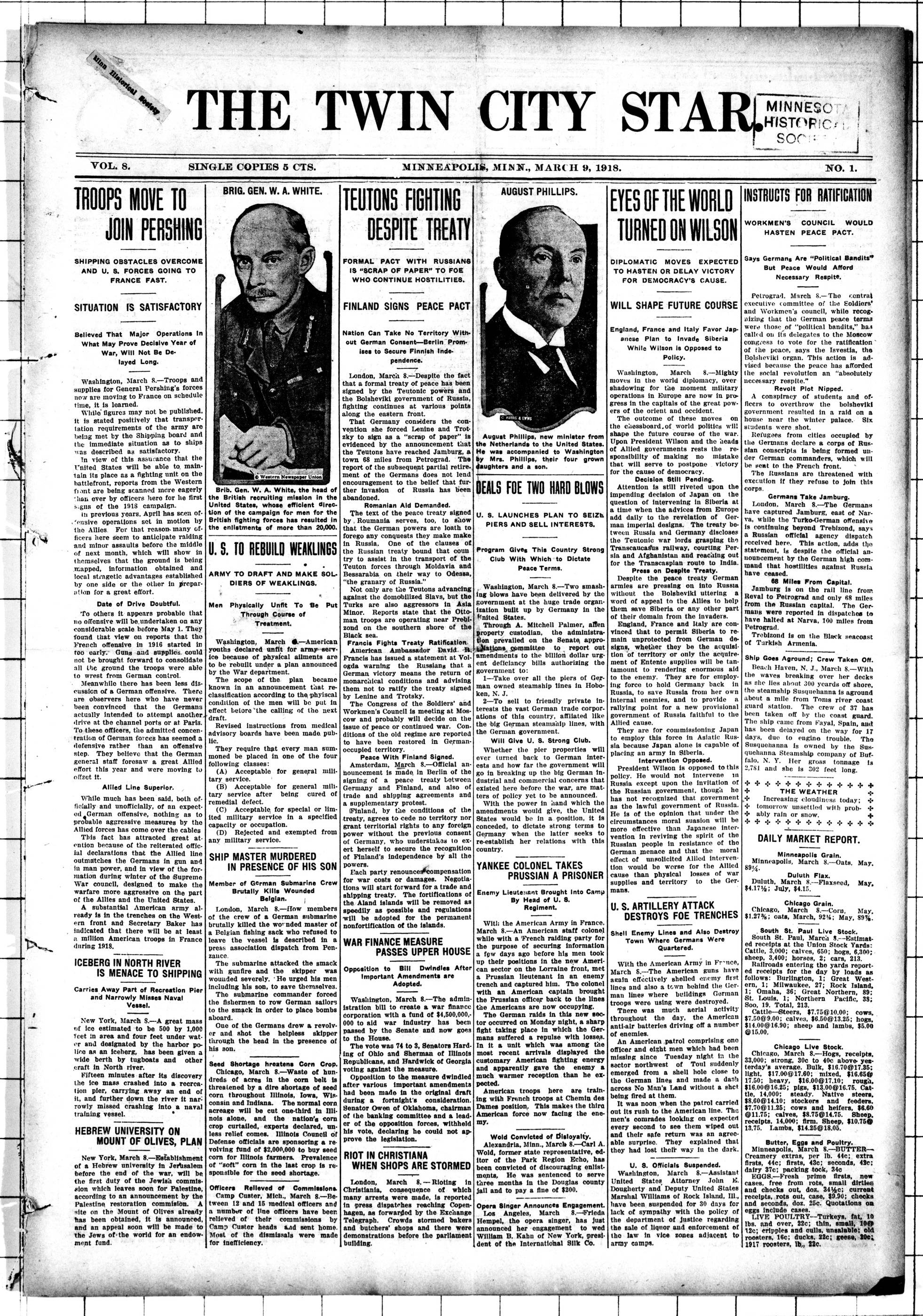
THE TWIN CITY STAR.
VOL. 8.
TROOPS MOVE TO JOIN PERSHING
SHIPPING OBSTACLES OVERCOME AND U. S. FORCES GOING TO FRANCE FAST.
SITUATION IS SATISFACTORY
Believed That Major Operations In What May Prove Decisive Year of War, Will Not Be Delayed Long.
Washington, March 8.—Troops and supplies for General Pershing's forces now are moving to France on schedule time, it is learned.
While figures may not be published, it is stated positively that transportation requirements of the army are being met by the Shipping board and the immediate situation as to ships was described as satisfactory.
In view of this assurance that the United States will be able to maintain its place as a fighting unit on the battlefront, reports from the Western front are being scanned more eagerly than ever by officers here for the first signs of the 1913 campaign.
In previous years, April has seen offensive operations set in motion by the Allies. For that reason many officers here seem to anticipate raiding and minor assaults before the middle of next month, which will show in themselves that the ground is being mapped, information obtained and local strategic advantages established by one side or the other in preparation for a great effort.
Date of Drive Doubtful.
To others it appears probable that no offensive will be undertaken on any considerable scale before May 1. They found that view on reports that the French offensive in 1916 started in too early. Guns and supplies could not be brought forward to consolidate all the ground the troops were able to wrest from German control. Meanwhile there has been less discussion of a German offensive. There are observers here who have never been convinced that the Germans actually intended to attempt another drive at the channel ports or at Paris. To these officers, the admitted concentration of German forces has seemed a defensive rather than an offensive step. They believe that the German general staff foresaw a great Allied effort this year and were moving to offset it.
Allied Line Superior.
While much has been said, both officially and unofficially, of an expected German offensive, nothing as to probable aggressive measures by the Allied forces has come over the cables. This fact has attracted great attention because of the reiterated official declarations that the Allied line outmatches the Germans in gun and in man power, and in view of the formation during winter of the Supreme War council, designed to make the warfare more aggressive on the part of the Allies and the United States. A substantial American army already is in the trenches on the Western front and Secretary Baker has indicated that there will be at least a million American troops in France during 1918.
ICEBERG IN NORTH RIVER IS MENACE TO SHIPPING
Carries Away Part of Recreation Pier and Narrowly Misses Naval Vessel.
New York, March S.—A great mass of ice estimated to be 500 by 1,000 feet in area and four feet under water and designated by the harbor police as an iceberg, has been given a wide berth by tugboats and other craft in North river.
Fifteen minutes after its discovery the ice mass crashed into a recreation pier, carrying away an end of it, and further down the river it narrowly missed crashing into a naval training vessel.
HEBREW UNIVERSITY ON MOUNT OF OLIVES, PLAN
New York, March 8.—Establishment of a Hebrew university in Jerusalem before the end of the war, will be the first duty of the Jewish commission which leaves soon for Palestine, according to an announcement by the Palestine restoration commission. A site on the Mount of Olives already has been obtained, it is announced, and an appeal soon will be made to the Jews of the world for an endowment fund.
BRIG. GEN. W. A. WHITE.
© Western Newspaper Union
Brib. Gen. W. A. White, the head of the British recruiting mission in the United States, whose efficient direction of the campaign for men for the British fighting forces has resulted in the enlistments of more than 20,000.
U. S. TO REBUILD WEAKLINGS
Washington, March 4.—American youths declared unfit for army service because of physical ailments are to be rebuilt under a plan announced by the War department.
The scope of the plan became known in an announcement that reclassification according to the phyiscal condition of the men will be put in effect before the calling of the next draft.
Revised instructions from medical advisory boards have been made public.
They require that every man summoned be placed in one of the four following classes:
(A) Acceptable for general military service.
(B) Acceptable for general military service after being cured of remedial defect.
(C) Acceptable for special or limited military service in a specified capacity or occupation.
(D) Rejected and exempted from any military service.
SHIP MASTER MURDERED IN PRESENCE OF HIS SON
Member of German Submarine Crew Brutally Kills Wounded Belgian.
London, March 8.—How members of the crew of a German submarine brutally killed the wounded master of a Belgian fishing sack who refused to leave the vessel is described in a press association dispatch from Penzance.
The submarine attacked the smack with gunfire and the skipper was wounded severely. He urged his men including his son, to save themselves.
The submarine commander forced the fishermen to row German sailors to the smack in order to place bombs aboard.
One of the Germans drew a revolver and shot the helpless skipper through the head in the presence of his son.
Seed Shortage threatens Corn Crop. Chicago, March 8.—Waste of hundreds of acres in the corn belt is threatened by a dire shortage of seed corn throughout Illinois, Iowa, Wisconsin and Indiana. The normal corn acreage will be cut one-third in Illinois alone, and the nation's corn crop curtailed, experts declared, unless relief comes. Illinois Council of Defense officials are sponsoring a revolving fund of $2,000,000 to buy seed corn for Illinois farmers. Prevalence of "soft" corn in the last crop is responsible for the seed shortage.
Officers Relieved of Commissions. Camp Custer, Mich., March 8.—Between 12 and 15 medical officers and a number of lice officers have been relieved of their commissions by Camp Custer heads and sent home. Most of the dismissals were made for inefficiency.
MINNEAPOLIS, MINN., MARCH 9, 1918.
TEUTONS FIGHTING DESPITE TREATY
TEUTONS FIGHTING DESPITE TREATY
FORMAL PACT WITH RUSSIANS IS "SCRAP OF PAPER" TO FOE WHO CONTINUE HOSTILITIES.
FINLAND SIGNS PEACE PACT
Nation Can Take No Territory Without German Consent—Berlin Promises to Secure Finnish Independence.
London, March 8.—Despite the fact that a formal treaty of peace has been signed by the Teutonic powers and the Bolshevki government of Russia, fighting continues at various points along the eastern front.
That Germany considers the convention she forced Lenine and Trotzky to sign as a "scrap of paper" is evidenced by the announcement that the Teutons have reached Jamburg, a town 68 miles from Petrograd. The report of the subsequent partial retirement of the Germans does not lend encouragement to the belief that further invasion of Russia has been abandoned.
Romanian Aid Demanded.
The text of the peace treaty signed by Roumania serves, too, to show that the German powers are loath to forego any conquests they make in Russia. One of the clauses of the Russian treaty bound that country to assist in the transport of the Teuton forces through Moldavia and Bessarabia on their way to Odessa, "the granary of Russia."
Not only are the Teutons advancing against the domobilized Slavs, but the Turks are also aggressors in Asia Minor. Reports state that the Ottoman troops are operating near Prebzond on the southern shore of the Black sea.
Francis Fights Treaty Ratification
American Ambassador David R. Francis has issued a statement at Vologda warning the Russians that a German victory means the return of monarchical conditions and advising them not to ratify the treaty signed by Lenine and Trotsky.
The Congress of the Soldiers' and Workmen's Council is meeting at Moscow and probably will decide on the issue of peace or continued war. Conditions of the old regime are reported to have been restored in German-occupied territory.
Peace With Finland Signed.
Amsterdam, March 8.—Official announcement is made in Berlin of the signing of a peace treaty between Germany and Finland, and also of trade and shipping agreements and a supplementary protest.
(Finland, by the conditions of the treaty, agrees to cede no territory nor grant territorial rights to any foreign power without the previous consent of Germany, who undertakes to exert herself to secure the recognition of Finland's independence by all the powers.
Each party renounces compensation for war costs or damages. Negotiations will start forward for a trade and shipping treaty. The fortifications of the Aland islands will be removed as speedily as possible and regulations will be adopted for the permanent nonfortification of the islands.
WAR FINANCE MEASURE
PASSES UPPER HOUSE
Opposition to Bill Dwindles After Important Amendments are Adopted.
Washington, March 8.—The administration bill to create a war finance corporation with a fund of $4,500,000,000 to aid war industry has been passed by the Senate and now goes to the House.
The vote was 74 to 3, Senators Harding of Ohio and Sherman of Illinois Republicans, and Hardwick of Georgia voting against the measure.
Opposition to the measure dwindled after various important amendments had been made in the original draft during a fortnight's consideration. Senator Owen of Oklahoma, chairman of the banking committee and a leader of the opposition forces, withheld his vote, declaring he could not approve the legislation.
RIOT IN CHRISTIANA WHEN SHOPS ARE STORMED
London, March 8. — Rioting in Christiana, consequence of which many arrests were made, is reported in press dispatches reaching Copenhagen, as forwarded by the Exchange Telegraph. Crowds stormed bakers and butchers' shops and there were demonstrations before the parliament building.
AUGUST PHILLIPS.
August Phillips, new minister from the Netherlands to the United States. He was accompanied to Washington by Mrs. Phillips, their four grown daughters and a son.
DEALS FOE TWO HARD BLOWS
U. S. LAUNCHES PLAN TO SEIZE
PIERS AND SELL INTERESTS.
Program Gives This Country Strong Club With Which to Dictate Peace Terms.
Washington, March 8.—Two smashing blows have been delivered by the government at the huge trade organization built up by Germany in the United States.
Through A. Mitchell Palmer, allen property custodian, the administration prevailed on the Senate approvals committee to report out amendments to the billion dollar urgent deficiency bills authorizing the government to:
1—Take over all the piers of German owned steamship lines in Hoboken, N. J.
2—To sell to friendly private interests the vast German trade corporations of this country, affiliated like the big German steamship lines, with the German government.
Will Give U. S. Strong Club.
Whether the pier properties will ever turned back to German interests and how far the government will go in breaking up the big German industrial and commercial concerns that existed here before the war, are matters of policy yet to be announced.
With the power in hand which the amendments would give, the United States would be in a position, it is conceded, to dictate strong terms to Germany when the latter seeks to re-establish her relations with this country.
YANKEE COLONEL TAKES
PRUSSIAN A PRISONER
Enemy Lieutenant Brought Into Camp By Head of U. 8. Regiment.
With: the American Army in France. March 8.—An American staff colonel while with a French raiding party for the purpose of securing information a few days ago before his men took up their positions in the new American sector on the Lorraine front, met a Prussian lieutenant in an enemy trench and captured him. The colonel with an American captain brought the Prussian officer back to the lines the Americans are now occupying.
The German raids in this new sector occurred on Monday night, a sharp fight taking place in which the Germans suffered a repulse with losses. In it a unit which was among the most recent arrivals displayed the customary American fighting energy and apparently gave the enemy a much warmer reception than he expected.
American troops here are training with French troops at Chemin des Dames position. This makes the third American force now facing the enemy.
Wold Convicted of Disloyalty.
Wolff Convicted for Disobeyance.
Alexandria, Minn., March 8—Carl A. Wold, former state representative, editor of the Park Region Echo, has been convicted of discouraging enlistments. He was sentenced to serve three months in the Douglas county jail and to pay a fine of $200.
Opera Singer Announces Engagement.
Los Angeles, March 8.—Frieda Hempel, the opera singer, has just announced her engagement to wed William B. Kahn of New York, president of the International Silk Co.
EYES OF THE WORLD TURNED ON WILSON
DIPLOMATIC MOVES EXPECTED TO HASTEN OR DELAY VICTORY FOR DEMOCRACY'S CAUSE.
WILL SHAPE FUTURE COURSE
England, France and Italy Favor Japanese Plan to Invade Siberia While Wilson is Opposed to Policy.
Washington, March 8.—Mighty moves in the world diplomacy, over shadowing for the moment military operations in Europe are now in progress in the capitals of the great powers of the orient and occident.
The outcome of these moves on the chessboard, of world politics will shape the future course of the war. Upon President Wilson and the heads of Allied governments rests the responsibility of making no mistake that will serve to postpone victory for the cause of democracy.
Decision Still Pending.
Attention is still riveted upon the impending decision of Japan on the question of intervening in Siberia at a time when the advices from Europe add daily to the revelation of German imperial designs. The treaty between Russia and Germany discloses the Teutonic war lords grasping the Transcaucasus railway, courting Persia and Afghanistan and reaching out for the Transcaspian route to India.
Press on Despite Treaty:
Despite the peace treaty German armies are pressing on into Russia without the Bolshevik uttering a word of appeal to the Allies to help them save Siberia or any other part of their domain from the invaders.
England, France and Italy are convinced that to permit Siberia to remain unprotected from German designs, whether they be the acquisition of territory or only the acquisition of Entente supplies will be tantamount to rendering enormous aid to the enemy. They are for employing force to hold Germany back in Russia, to save Russia from her own internal enemies, and to provide a rallying point for a new provisional government of Russia faithful to the Allied cause.
They are for commissioning Japan to employ this force in Asiatic Russia because Japan alone is capable of placing an army in Siberia.
President Wilson is opposed to this policy. He would not intervene in Russia except upon the invitation of the Russian government, though he has not recognized that government as the lawful government of Russia. He is of the opinion that under the circumstances moral suasion will be more effective than Japanese intervention in reviving the spirit of the Russian people in resistance of the German menace and that the moral effect of unsolicited Allied intervention would be worse for the Allied cause than physical losses of war supplies and territory to the Germans.
U. S. ARTILLERY ATTACK
DESTROYS FOE TRENCHES
Shell Enemy Lines and Also Destroy Town Where Germans Were Quartered.
With the American Army in France, March 8.—The American guns have again effectively shelled enemy first lines and also a town behind the German lines where buildings German troops were using were destroyed.
There was much aerial activity throughout the day, the American anti-air batteries driving off a number of enemies.
An American patrol comprising one officer and eight men which had been missing since Tuesday night in the sector northwest of Toul suddenly emerged from a shell hole close to the German lines and made a dash across No Man's Land without a shet being fired at them.
It was noon when the patrol carried out its rush to the American line. The men's comrades looking on expected every second to see them wiped out and their safe return was an agreeable surprise. They explained that they had lost their way in the dark.
U. S. Officials Suspended.
Washington, March 8.—Assistant United States Attorney John E. Dougherty and Deputy United States Marshal Williams of Rock Island, Ill., have been suspended for 30 days for lack of sympathy with the policy of the department of justice regarding the sale of liquor and enforcement of the law in vice zones adjacent to army camps.
INSTRUCTS FOR RATIFICATION
WORKMEN'S COUNCIL WOULD
HASTEN PEACE PACT.
Says Germans Are "Political Bandits"
But Peace Would Afford
Necessary Respite.
Petrograd. March 8.—The central executive committee of the Soldiers' and Workmen's council, while recognizing that the German peace terms were those of "political bandits," has called on its delegates to the Moscow congress to vote for the ratification of the peace, says the Isvestia, the Bolshevik organ. This action is advised because the peace has afforded the social revolution an "absolutely necessary respite."
Revolt Plot Nipped.
A conspiracy of students and officers to overthrow the bolshevik government resulted in a raid on a house near the winter palace. Six students were shot. Retugees from cities occupied by the Germans declare a corps of Russian conscripts is being formed under German commanders, which will be sent to the French front. The Russians are threatened with execution if they refuse to join this corps.
Germans Take Jamburg.
London, March 8.—The Germans have captured Jamburg, east of Narva, while the Turko-German offensive is continuing beyond Trebizond, says a Russian official agency dispatch received here. This action, adds the statement, is despite the official announcement by the German high command that hostilities against Russia have ceased.
68 Miles From Capital.
Jamburg is on the rail line from Reval to Petrograd and only 68 miles from the Russian capital. The Germans were reported in dispatches to have halted at Narva, 100 miles from Petrograd.
Trebizond is on the Black seacoast of Turkish Armenia.
Ship Goes Agrground; Crew Taken Off.
Beach Haven, N. J., March 8.—With the waves breaking over her decks as she lies about 300 yards off shore, the steamship Susquehanna is around about a mile from Toms river coast guard station. The crew of 37 has been taken off by the coast guard. The ship came from Fayal, Spain, and has been delayed on the way for 17 days, due to engine trouble. The Susquehanna is owned by the Susquehanna Steamship company of Buffalo, N. Y. Her gross tonnage is 2,781 and she is 302 feet long.
THE WEATHER
Increasing cloudiness today;
tomorrow unsettled with prob-
ably rain or snow.
DAILY MARKET REPORT.
Minneapolis Grain.
Minneapolis, March 8—Oats, May.
89%.
Duluth Flax.
Duluth, March 8—Flaxseed, May.
$4.17%; July, $4.15.
Chicago Grain.
Chicago, March 8—Corn, May.
$1.27%; cats, March, 92%; May, 89%.
South St. Paul Live Stock.
South St. Paul, March $—Estimated
receipts at the Union Stock Yards:
Cattle, 3,000; calves, 650; hogs, 6,300;
sheep, 3,400; horses, 2; cars, 213.
Railroads entering the yards reported
receipts for the day by loads as
follows: Burlington, 1; Great Western,
1; Milwaukee, 2; Rock Island,
1; Omaha, 36; Great Northern, 89;
St. Louis, 1; Northern Pacific, 38;
Soo, 19. Total, 213.
Cattle-Steers, $7.75@10.00; cows,
$7.50@9.00; calves, $6.50@13.25; hogs,
$14.00@16.90; sheep and lambs, $5.00
@15.00.
Chicago Live Stock.
Chicago, March 8.—Hogs, receipts, 33,000; strong, 30c to 40c above yesterday's average. Bulk, $16.70@17:35; light, $17.00@17:60; mixed, $16.65@17:50; heavy, $16.00@17:10; rough, $16.00@16:25; pigs, $13.00@16:75. Cattle, 14,000; steady. Native steers, $8.60@14:10; stockers and feeders, $7.70@11:25; cows and heifers, $6.60@11:75; calves, $8.75@14:75. Sheep, receipts, 14,000; firm. Sheep, $10.75@13.75. Lambs, $14.25@18.05.
Butter, Eggs and Poultry.
Minneapolis, March 8.—BUTTER—Creamery extras, per lb. 44c; extra firsts, 44c; firsts, 43c; seconds, 42c; dairy 34c; packing tock, 34c
EGGS—Fresh prime firsts, new cases, free from rots, small dirties and checks out, doz. 34½c; current receipts, rots out, case, $9.90; checks and seconds, doz. 25c. Quotations on eggs include cases.
LIVE POULTRY—Turkeys, fat, 10 lbs. and over, 22c; thin, small, 10¹³c; cripples and culls, unsalable; old roosters, 16c; ducks, 22c; geese, 20c; 1917 roosters, lb. 22c.
THE BOWSER
HAMMER CHEFS
THE BOWSER
HAMMER CHEFS
OWSER
CHEFS
THE BO
HAMOKO
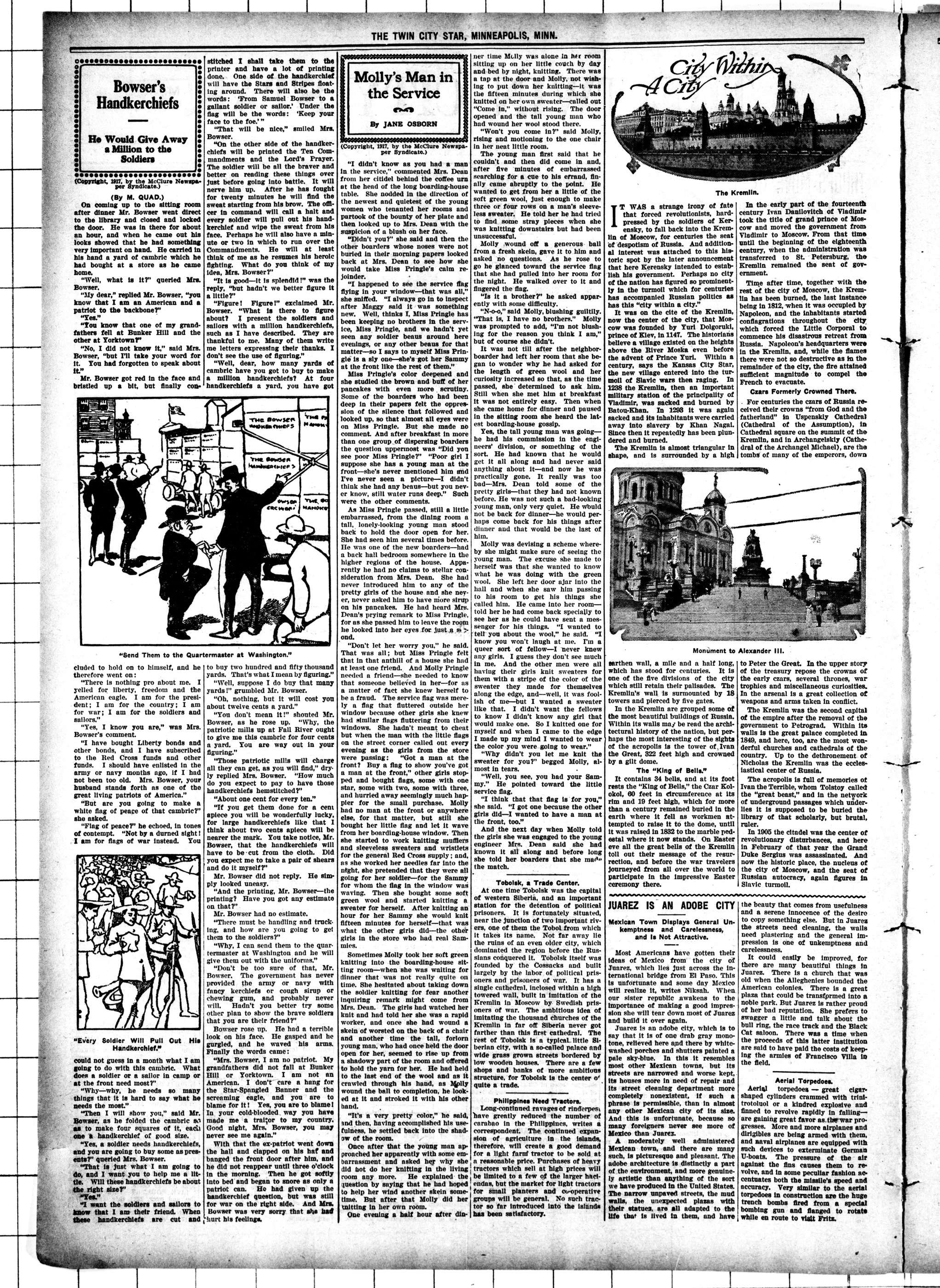
"Send Them to the Quartermaster at Washington."
Bowser's
Handkerchiefs
He Would Give Away
a Million to the
Soldiers
(Copyright 1937, by the McClure Newspaper
NY Times)
(By M. QUAD.)
On coming up to the sitting room after dinner Mr. Bowser went direct to the library and closed and locked the door. He was in there for about an hour, and when he came out his looks showed that he had something very important on hand. He carried in his hand a yard of cambrick which he had bought at a store as he came home.
"Well, what is it?" queried Mrs. Bowser.
"My dear," replied Mr. Bowser, "you know that I am an American and a patriot to the backbone?"
"Yes."
"You know that one of my grand-fathers fell at Bunker Hill and the other at Yorktown?"
"No, I did not know it," said Mrs. Bowser, "but I'll take your word for it. You had forgotten to speak about it."
Mr. Bowser got red in the face and bristled up a bit, but finally con-
"Send Them to the Quar
cluded to hold on to himself, and he therefore went on:
"There is nothing pro about me. I yelled for liberty, freedom and the American eagle. I am for the president; I am for the country; I am for war; I am for the soldiers and sailors."
"Yes, I know you are," was Mrs. Bowser's comment.
"I have bought Liberty bonds and other bonds, and I have subscribed to the Red Cross funds and other funds. I should have enlisted in the army or navy months ago, if I had not been too old. Mrs. Bowser, your husband stands forth as one of the great living patriots of America."
"But are you going to make a white flag of peace of that cambric?" she asked.
"Flag of peace?" he echoed, in tones of contempt. "Not by a durned sight! I am for flags of war instead. You
```markdown
```
"Every Soldier Will Pull Out His Handkerchief."
could not guess in a month what I am going to do with this camble. What does a soldier or a sailor in camp or at the front need most?
"Why—why, he needs so many things that it is hard to say what he needs the most."
"Then I will show you," said Mr. Bowser, as he folded the camble ax as to make four squares of it, each one a handkerchief of good size.
"Yes, a soldier needs handkerchiefs, and you are going to buy some as presents?" queried Mrs. Bowser.
"That is just what I am going to do, and I want you to help me a little. Will these handkerchiefs be about the right size?"
"I want the soldiers and sailors to know that I am their friend. When these handkerchiefs are cut and
stitched I shall take them to the printer and have a lot of printing done. One side of the handkerchief will have the Stars and Stripes floating around. There will also be the words: 'From Samuel Bowser to a gallant soldier or sailor.' Under the flag will be the words: 'Keep your face to the foe.' "That will be nice," smiled Mrs. Bowser.
"On the other side of the handkerchiefs will be printed the Ten Commandments and the Lord's Prayer. The soldier will be all the braver and better on reading these things over just before going into battle. It will nerve him up. After he has fought for twenty minutes he will find the sweat starting from his brow. The officer in command will call a halt and every soldier will pull out his handkerchief and wipe the sweat from his face. Perhaps he will also have a minute or two in which to run over the Commandments. He will at least think of me as he resumes his heroic fighting. What do you think of my idea, Mrs. Bowser?"
"It is good—it is splendid!" was the reply, "but hadn't we better figure it a little?"
"Figure! Figure!!" exclaimed Mr. Bowser. "What is there to figure about? I present the soldiers and sailors with a million handkerchiefs, such as I have described. They are thankful to me. Many of them write me letters expressing their thanks. I don't see the use of figuring."
"Well, dear, how many yards of cambrick have you got to buy to make a million handkerchiefs? At four handkerchiefs a yard, you have got
THE BOWSER
MOWER THIEF
THE P
MOWER
THE BOWSER
MOWER THIEF >
OWSER
ERCHIEF
THE P
MOWER
termaster at Washington."
to buy two hundred and fifty thousand yards. That's what I mean by figuring."
"Well, suppose I do buy that many yards!" grumbled Mr. Bowser.
"Oh, nothing, but it will cost you about twelve cents a yard."
"You don't mean it!" shouted Mr. Bowser, as he rose up. "Why, the patriotic mills up at Fall River ought to give me this cambridge for four cents a yard. You are way out in your figuring."
"Those patriotic mills will charge all they can get, as you will find," dryly replied Mrs. Bowser. "How much do you expect to pay to have those handkerchiefs hemstitched?"
"About one cent for every ten."
"If you get them done for a cent apiece you will be wonderfully lucky, for large handkerchiefs like that I think about two cents apiece will be nearer the mark. You take notice, Mr. Bowser, that the handkerchiefs will have to be cut from the cloth. Did you expect me to take a pair of shears and do it myself?"
Mr. Bowser did not reply. He simply looked uneasy.
"And the printing, Mr. Bowser—the printing? Have you got any estimate on that?"
Mr. Bowser had no estimate.
"There must be handling and trucking, and how are you going to get them to the soldiers?"
"Why, I can send them to the quartermaster at Washington and he will give them out with the uniforms."
"Don't be too sure of that, Mr. Bowser. The government has never provided the army or navy with fancy kerchiefs or cough sirup or chewing gum, and probably never will. Hadn't you better try some other plan to show the brave soldiers that you are their friend?"
Bowser rose up. He had a terrible look on his face. He gasped and he gurgled, and he waved his arms. Finally the words came:
"Mrs. Bowser, I am no patrol. My grandfathers did not fall at Bunker Hill or Yorktown. I am not an American. I don't care a hang for the Star-Spangled Banner and the screaming eagle, and you are to blame for it! Yes, you are to blame! In your cold-blooded way you have made me a traitor to my country. Good night, Mrs. Bowser, you may never see me again."
With that the ex-patriot went down the hall and clapped on his haf and banged the front door after him, and he did not reappear until three o'clock in the morning. Then he got softly into bed and began to snore as only a patriot can. He had given up the handkerchief question, but was still for war on the right side. And Mrs. Bowser was very sorry that she had hurt his feelings.
Molly's Man in the Service
By JANE OSBORN
(Copyright, 1917, by the McClure Newspaper Syndicate.)
"I didn't know as you had a man in the service," commented Mrs. Dean from her citidel behind the coffee urn at the head of the long boarding-house table. She nodded in the direction of the newest and quietest of the young women who tenanted her rooms and purtook of the bounty of her plate and then looked up to Mrs. Dean with the suspicion of a blush on her face.
"Didn't you?" she said and then the other boarders whose noses were not buried in their morning papers looked back at Mrs. Dean to see how she would take Miss Pringle's calm reiinder.
"I happened to see the service flag flying in your window—that was all," she sniffed. "I always go in to inspect after Maggy sald it was something new. Well, thinks I, Miss Pringle has been keeping no brothers in the service, Miss Pringle, and we hadn't yet seen any soldier beaurs around here evenings, or any other beaurs for that matter—so I says to myself Miss Pringle is a sly one—she's got her Sammy at the front like the rest of them."
Miss Pringle's color deepened and she studied the brown and buff of her pancakes with even more scrutiny. Some of the boarders who had been deep in their papers felt the oppression of the silence that followed and looked up, so that almost all eyes were on Miss Pringle. But she made no comment. And after breakfast in more than one group of dispersing boarders the question uppermost was "Did you see poor Miss Pringle?" "Poor girl I suppose she has a young man at the front—she's never mentioned him and I've never seen a picture—I didn't think she had any beaus—but you never know, still water runs deep." Such were the other comments.
As Miss Pringle passed, still a little embarrassed, from the dining room a tall, lonely-looking young man stood back to hold the door open for her. She had seen him several times before. He was one of the new boarders—had a back hall bedroom somewhere in the higher regions of the house. Apparently he had no claims to stellar consideration from Mrs. Dean. She had never introduced him to any of the pretty girls of the house and she neyer, never asked him to have more sip on his pancakes. He had heard Mrs. Dean's prying remark to Miss Pringle, for as she passed him to leave the room he looked into her eyes for just a second.
"Don't let her worry you," he said. That was all; but Miss Pringle felt that in that anthill of a house she had at least one friend. And Molly Pringle needed a friend—she needed to know that someone believed in her—for as a matter of fact she knew herself to be a fraud. The service flag was merely a flag that fluttered outside her window because other girls she knew had similar flags fluttering from their windows. She hadn't meant to cheat but when the man with the little flags on the street corner called out every evening as the girls from the store were passing: "Got a man at the front? Buy a flag to show you've got a man at the front," other girls stopped and bought flags, some with one star, some with two, some with three, and hurried away seemingly much happier for the small purchase. Molly had no man at the front or anywhere else, for that matter, but still she bought her little flag and let it wave from her boarding-house window. Then she started to work knitting mufflers and sleeveless sweaters and wristlets for the general Red Cross supply; and, as she worked her needles far into the nftg, she pretended that they were all going for her soldier—for the Sammy for whom the flag in the window was waving. Then she bought some soft green wool and started knitting a sweater for herself. After knitting an hour for her Sammy she would knit fifteen minutes for herself—that was what the other girls did—the other girls in the store who had real Sammies.
Sometimes Molly took her soft green knitting into the boarding-house sitting room—when she was waiting for dinner that was not really quite on time. She hesitated about taking down the soldier knitting for fear another inquiring remark might come from Mrs. Dean. The girls had watched her knit and had told her she was a rapid worker, and once she had wound a skein of worsted on the back of a chair and another time the tall, forlorn young man, who had once held the door open for her, seemed to rise up from a shadowy part of the room and offered to hold the yarn for her. He had held to the last end of the wool and as it crawled through his hand, as Molly wound the ball to completion, he looked at it and stroked it with his other hand.
"It's a very pretty color," he said, and then, having accomplished his usefulness, he settled back into the shadow of the room.
Once after that the young man approached her apparently with some embarrassment and asked her why she did not do her knitting in the living room any more. He explained the question by saying that he had hoped to help her wind another skein sometime. But after that Molly did her twining in her own room.
One evening a half hour after dinn
her time Molly was alone in her room sitting up on her little couch by day and bed by night, knitting. There was a tap at the door and Molly, not wishing to put down her knitting—it was the fifteen minutes during which she knitted on her own sweater—called out "Come in," without rising. The door opened and the tall young man who had wound her wool stood there.
"Won't you come in?" said Molly, rising and motioning to the one chair in her neat little room.
The young man first said that he couldn't and then did come in and, after five minutes of embarrassed searching for a cue to his errand, finally came abruptly to the point. He wanted to get from her a little of the soft green wool, just enough to make three or four rows on a man's sleeveless sweater. He told her he had tried to find some stray pieces when she was knitting downstairs but had been unsuccessful.
Molly wound off a generous ball from a fresh skin, gave it to him and asked no questions. As he rose to go he glanced toward the service flag that she had pulled into her room for the night. He walked over to it and fingered the flag.
"Is it a brother?" he asked apparently with some difficulty.
"N-o-O," said Molly, blushing guiltily.
"That is, I have no brothers." Molly was prompted to add, "I'm not blushing for the reason you think I am," but of course she didn't.
It was not till after the neighborboarder had left her room that she began to wonder why he had asked for the length of green wool and her curiosity increased so that, as the time passed, she determined to ask him.
Still when she met him at breakfast it was not entirely easy. Then when she came home for dinner and paused in the sitting room she heard the latest boarding-house gossip.
Yes, the tall young man was going—he had his commission in the engineers' division, or something of the sort. He had known that he would get it all along and had never said anything about it—and now he was practically gone. It really was too bad—Mrs. Dean told some of the pretty girls—that they had not known before. He was not such a bad-looking young man, only very quiet. He would not be back for dinner—he would perhaps come back for his things after dinner and that would be the last of him.
Molly was devising a scheme whereby she might make sure of seeing the young man. The excuse she made to herself was that she wanted to know what he was doing with the green wool. She left her door door into the hall and when she saw him passing to his room to get his things she called him. He came into her room—told her he had come back specially to see her as he could have sent a messenger for his things. "I wanted to tell you about the wool," he said. "I know you won't laugh at me. I'm a queer sort of fellow—I never knew any girls. I guess they don't see much in me. And the other men were all having their girls knit sweaters for them with a stripe of the color of the sweater they made for themselves along the edge, and—well, it was foolish of me—but I wanted a sweater like that. I didn't want the fellows to know I didn't know any girl that would make one. So I knitted one for myself and when I came to the edge I made up my mind I wanted to wear the color you were going to wear."
"Why didn't you let me knit the sweater for you?" begged Molly, almost in tears.
"Well, you see, you had your Sammy." He pointed toward the little service flag.
"I think that that flag is for you," she said. "I got one because the other girls did—I wanted to have a man at the front, too."
And the next day when Molly told the girls she was engaged to the young engineer Mrs. Dean said she had known it all along and before long she told her boarders that she made the match.
Tobolsk, a Trade Center.
At one time Tobolsk was the capital of western Siberia, and an important station for the detention of political prisoners. It is fortunately situated, near the nunction of two important rivers, one of them the Tobol from which it takes its name. Not far away lie the ruins of an even older city, which dominated the region before the Russians conquered it. Tobolsk itself was founded by the Cossacks and built largely by the labor of political prisoners and prisoners of war. It has a single cathedral, inclosed within a high towered wall, built in imitation of the Kremlin in Moscow by Swedish prisoners of war. The ambitious idea of imitating the thousand churches of the Kremlin in far off Siberia never got farther than this first cathedral. The rest of Tobolsk is a typical little Siberian city, with a so-called palace and wide grass grown streets bordered by low wooden houses. There are a few shops and banks of more ambitious structure, for Tobolsk is the center of quite a trade.
Philippines Need Tractors.
Long-continued ravages of rinderpes have greatly reduced the number of carabao in the Philippines, writes a correspondent. The continued expansion of agriculture in the islands, therefore, will create a good demand for a light farm tractor to be sold at a reasonable price. Purchases of heavy tractors which sell at high prices will be limited to a few of the larger haciendas, but the market for light tractors for small planters and cooperative groups will be general. No such tractor so far introduced into the islands has been satisfactory.
City Within
A City
IT WAS a strange irony of fate that forced revolutionists, hard-pressed by the soldiers of Kerensky, to fall back into the Kremlin of Moscow, for centuries the seat of despotism of Russia. And additional interest was attached to this historic spot by the inter announcement that here Kerensky intended to establish his government. Perhaps no city of the nation has figured so prominently in the turmoil which for centuries has accompanied Russian politics as has this "city within a city."
It was on the cite of the Kremlin, now the center of the city, that Moscow was founded by Yuri Dolgoruki, prince of Klev, in 1147. The historians believe a village existed on the heights above the River Moska even before the advent of Prince Yuri. Within a century, says the Kansas City Star, the new village entered into the turmoil of Slavic wars then raging. In 1288 the Kremlin, then an important military station of the principality of Vladimir, was sacked and burned by Batou-Khan. In 1298 it was again sacked and its inhabitants were carried away into slavery by Khan Nagal. Since then it repeatedly has been plundered and burned. The Kremlin is almost triangular in shape, and is surrounded by a high
СВОЕСКИЙ СВОЕСКИЙ
СВОЙСКИЙ
Monument to Alexander III.
sarthen wall, a mile and a half long, which has stood for centuries. It is one of the five divisions of the city which still retain their palisades. The Kremlin's wall is surmounted by 18 towers and pierced by five gates. In the Kremlin are grouped some of the most beautiful buildings of Russia. Within its walls may be read the architectural history of the nation, but perhaps the most interesting of the sights of the acropolis is the tower of Ivan, the Great, 322 feet high and crowned by a gift dome.
It contains 34 bells, and at its foot rests the "King of Bells," the Czar Kolokol, 60 feet in circumference at its rim and 19 feet high, which for more than a century remained buried in the earth where it fell as workmen attempted to raise it to the dome, until it was raised in 1832 to the marble pedestal where it now stands. On Easter eve all the great bells of the Kremlin toll out their message of the resurrection, and before the war travelers journeyed from all over the world to participate in the impressive Easter ceremony there.
JUAREZ IS AN ADOBE CITY
Mexican Town Displays General Unkemptness and Carelessness, and Is Not Attractive.
Most Americans have gotten their ideas of Mexico from the city of Juarez, which lies just across the international bridge from El Paso. This is unfortunate and some day Mexico will realize it, writes Niksah. When our sister republic awakens to the importance of making a good impression she will tear down most of Juarez and build it over again.
Juarez is an adobe city, which is to say that it is of one drab gray monotone, relieved here and there by white-washed porches and shutters painted a pale sky-blue. In this it resembles most other Mexican towns, but its streets are narrowed and worse kept, its houses more in need of repair and its street cleaning department more completely nonexistent, if such a phrase is permissible, than in almost any other Mexican city of its size. And this is unfortunate, because so many foreigners never see more of Mexico than Juarez.
A moderately well administered Mexican town, and there are many such, is picturesque and pleasant. The adobe architecture is distinctly a part of the environment, and more genuinely artistic than anything of the sort we have produced in the United States. The narrow unpaved streets, the mud walls, the unexpected plazas with their statues, are all adapted to the life that is lived in them, and have
The "King of Bella."
In the early part of the fourteenth century Ivan Danilovitch of Vladimir took the title of grand prince of Moscow and moved the government from Vladimir to Moscow. From that time until the beginning of the eighteenth century, when the administration was transferred to St. Petersburg, the Kremlin remained the seat of government.
Time after time, together with the rest of the city of Moscow, the Kremlin has been burned, the last instance being in 1812, when it was occupied by Napoleon, and the inhabitants started confagrations throughout the city which forced the Little Corporal to commence his disastrous retreat from Russia. Napoleon's headquarters were in the Kremlin, and, while the flames there were not so destructive as in the remalder of the city, the fire attained sufficient magnitude to compel the French to evacuate.
Czars Formerly Crowned There.
For centuries the czars of Russia received their crowns "from God and the fatherland" in Uspenskyl Cathedral (Cathedral of the Assumption), in Cathedral square on the summit of the Kremlin, and in Archangelskly (Cathedral of the Archangel Michael), are the tombs of many of the emperors, down
to Peter the Great. In the upper story of the treasury repose the crowns of the early cairs, several thrones, war trophies and miscellaneous curiosities. In the arsenal is a great collection of weapons and arms taken in conflict.
The Kremlin was the second capital of the empire after the removal of the government to Petrograd. Within its walls is the great palace completed in 1849, and here, too, are the most wonderful churches and cathedrals of the country. Up to the dethronement of Nicholas the Kremlin was the ecclesiastical center of Russia.
The acropolis is full of memories of Ivan the Terrible, whom Tolstoy called the "great beast," and in the network of underground passages which underlies it is supposed to be buried the library of that scholarly, but brutal, ruler.
In 1905 the citadel was the center of revolutionary disturbances, and here in February of that year the Grand Duke Sergius was assassinated. And now the historic place, the nucleus of the city of Moscow, and the seat of Russian autocracy, again figures in Slavic turmil.
the beauty that comes from usefulness and a serene innocence of the desire to copy something else. But in Juarez the streets need cleaning, the walls need plastering and the general impression is one of unkemptness and carelessness.
It could easily be improved, for there are many beautiful things in Juarez. There is a church that was old when the Alleghenies bounded the American colonies. There is a great plaza that could be transformed into a noble park. But Juarez is rather proud of her bad reputation. She prefers to swagger a little and talk about the bull ring, the race track and the Black Cat saloon. There was a time when the proceeds of this latter institution are said to have paid the costs of keeping the armies of Francisco Villa in the field.
Aerial torpedoes — great cigar-shaped cylinders crammed with trintrolotoluol or a kindred explosive and finned to revolve rapidly in falling—are gaining great favor as the war progresses. More and more airplanes and dirigibles are being armed with them, and naval airplanes are equipped with such devices to exterminate German U-boats. The pressure of the air against the fins causes them to revolve, and in some peculiar fashion accentuates both the missile's speed and accuracy. Very similar to the aerial torpedoes in construction are the huge trench bombs fired from a special bombing gun and flanged to rotate while en route to visit Fritz.
---
Aerial Torpedoes.
"Amy Nair Says"
By JOAN MARSH
(Copyright, 1917, by the McClure Newspaper Syndicate.)
Julius Bates couldn't quite decide to his own satisfaction whether it was because Ruth Claridge was such an unusually pretty girl or because she was such an amazingly clever illustrator that he was so completely fascinated by her, and that before she had been on the list of regular contributors to the small magazine of which he was editor for two weeks he had found pretext to take her to luncheon two or three times and once to the theater. Perhaps it was neither her cleverness nor her pretiness entirely; but mingled with them her delightful naivety and lack of sophistication. For though Ruth had quite obviously "arrived" in her work she had in the year that she had lived in the big, grimy city, lost very little of the refreshing candor and childlike enthusiasm that characterized her as a country-bred girl. Surely she must have known that she was very pretty—a girl like Ruth could not have lived alone in the city so long without having been rather wearied with reminders of the fact—yet when Julius had, rather innaly as he thought later, told her she was the prettiest girl he had ever known, she opened her perfectly frank blue eyes wide and said: "I am glad you told me so. I like to be thought pretty and I am glad that you think so." Besides Ruth never flirted. And Julius was just at the old-young age when he had convinced himself that flirting was a great waste of time.
She was in large measure still a mystery to him and so he was doubly pleased when she asked him to "come to supper" in her small apartment where Julius had been informed she shared quarters with that eminently successful novelist, Amy Nair. Julius was relieved to know that Amy was not to be present. The supper was set for eight o'clock so that both he and Ruth might dispose of their day's occupation before the little spread.
The apartment proved to be just a well furnished "studio," the details and fine points of which—the careful elimination of every accessory or ornament which was not intrinsically beautiful and the exquisite subordination of tones to the decorative scheme of the whole interior—was rather lost on Julius. But there was an air of repose and seclusion about the large room—apparently the living room, eating room and work room combined—that put Julius in an agreeable frame of mind. Ruth responded to his ring and explained that the "old mammy" who kept house for her and Amy Nair had prepared the spread and then departed.
"I thought we could be cozier if we were all alone in the place. Amy won't be back till all hours."
Then as she led him into the studio he got his first glimpse of her dress. It was like nothing he had ever seen before—surely not like the dress in which he had first seen her. He could not object to it on the score of immodesty for the soft folds of fabric clung high at the throat and well down on her wrists. But—could it really be possible?—the ample folds of the skirt somehow fell down to her feet in two divisions and were caught at both ankles in a neat metallic anklet. Even that was not immodest but rather more modest, Julius had to admit, than the street costume of most young women.
Ruth saw his scrutiny. "Oh, my dress," she said. "Isn't the color lovely. It's read batik—from Ceylon. Amy Nair got it for me. I am glad you like it—Amy Nair says."
"But I'm not quite sure I do," stammered Julius, and then as Ruth stood off and pivoted on her oriental slipper for his full inspection he honestly admitted that it was extremely becoming—"only hardly conventional."
There was supper, and after supper Ruth carried off the supper tray and brought back the coffee in a Turkish brass outfit that even Julius was connoiseur enough to admire. From the folds of her remarkable house gown Ruth drew out a little metal cigarette box and opening it deftly with one hand she held it out to her guest.
"There are several other sorts in the large jar on the table," she said.
"Personally, I don't care for Turkish."
Julius tried to conceal his surprise. He had never even wondered whether or not Ruth smoked. Other girls with whom he was associated in his editing did, but even they had never received him alone in their own apartments and then preferred a complete assortment of cigarettes. He felt the suspicion of a frown involuntarily come over his forehead but he fought it back.
They talked about everything that chanced into their heads—more as Julius had talked with some keenly alert, clean-minded young boy of his acquaintance; and as they talked Ruth smoked nonchalantly—not in the least languidly. At ten Julius rose to go. Somewhere in the back of his mind he recalled that he had read that although women who live alone may receive callers unchaperoned those callers must never remain after ten. Ruth urged him to stay—still as a young boy would have done when he had not had enough conversation, rather than as a young woman wish-
ing still further to try her charms on a man whom she knows to be her admirer. Julius was reluctant. "Don't you think I'd better," he said. "I mean wouldn't it be the conventional thing to do? If you had let the mammy stay in then we might have prolonged the party—but, you are all alone—" Ruth shot back a glance of indignation but more of disappointment. She told him she did not think the speech was worthy of him and Julius admitted that he had been rather clumsy.
"Amy Nair says that no really omnipresent people give those foolish conventions a thought and she says that it is people who invent them and who see evil in smoking and unusual but beautiful costumes who are really the immoral people. And she says that it is our duty—really our duty—to show people that morality and decency don't depend on a few stupid and antiquated conventions. Amy Nair is as virtuous as my own mother and yet she does things every day that would make people like you condemn her."
Julius tried to make some stand for himself and mumbled something about the impossibility for a girl so pretty as Ruth was, to live with the freedom of a young bachelor and then Ruth went off again on a spirited defense of Amy Nair and her own position. "That's just it. Women have to take their place in the world and work as hard as men. It's just a worn-out prejudice that makes you think that there are certain things a woman may do and certain things a man may do. Why, Amy Nair says that if she had a son and he had a taste for dressmaking she'd make him a great dress-maker, just to show people that the old ideas about special vocations for men and women are all poppocky and nonsense. I don't see why a man shouldn't do anything that a woman does and surely I don't see why I shouldn't have as many privileges as you."
The conversation drifted back to less heated topics and an hour later when Julius finally left he was in a state of mental confusion. One thing he was sure of, however, and that was that he was completely in love with Ruth and that in spite of the fact that she hadn't yet begun to flirt with him.
Then Julius asked Ruth to supper in his rooms. In the interval they hadn't mentioned the subject of their heated discussion. And at half past seven Ruth found herself seated before Julius' cheerful open fireplace in his bachelor apartment—Julius himself in a daintily flowered dressing gown at the other side of the fender. From the book pocket at the side of his chair he pulled out a ball of yarn and a half finished soldier's muffler and without comment began to knit—not at all easily but still in a measure effectively. Ruth's eyes opened wide. "Well of all things!" she exclaimed; then as she met Julius' eyes she paused and changed the subject. Presently Julius excused himself to get supper. He had left his man off, he said, so he could give Ruth a sample of his cooking and after supper he donned an apron and cleared away the dishes and remained long enough in the kitchen to tell Ruth that he had been washing the dishes. He dotted on that sort of thing, he told her.
At ten Ruth rose to go. "I've been awfully gidd to have you here," he told her, making no move to go and don his cont and hat to see her home. "It's so seldom one finds a girl that will come and spend an evening with a man like this. I hope you'll come often." Ruth paused — said goodby and started out. second later she returned. She asked Julius to call a taxi. She said she didn't like to go through the streets alone at that time. "Amy Nair says it is rather dangerous for a girl alone." But there were two tears in her eyes as she returned and Julius, with coat and hat on ready to follow her, was quick to see them. He put a protecting arm around her shoulder as they started out together.
"I know you're just been teasing me
—I know you don't usually knit or
wear a flowered dressing gown," she
said. "And I didn't in the least want
to come alone to see you, but I didn't
want to refuse after all I'd said. Why
have you been so unfair to me?"
"Because I was a little jealous—"
said Julius. "Jealous of Amy Nair.
She has taught you a good deal of
good sense and some foolishness."
And before they had reached Amy
Nair's studio that night Ruth, like the
frank little girl that she was, had told
Julius that she loved him and had
consented to be his wife.
Marine Pecullarities.
There are two natural phenomena of quite regular recurrence which have given unique fame to the Japanese bay of Toyama. The lightning cuttlefish is a rather tiny species that emits a wonderful phosphorescence when aroused, and while the fish is not confined to the locality, it swarms along the coast in April and May. As the fishermen seek them with special nets the alarmed creatures glow with exceptional brilliance. The second phenomenon is the Shinkero or mirage. The mirage, seen along the shore, begins as a faint mist and then develops into a panorama forest, castles, bridges and marching men and horsemen.
"Relieving Our Minds."
What passes for reasoning on most occasions is a series of vocal sounds which serve—to use a phrase at once popular and scientific—to "relieve our minds." Arguments employed in political addresses, sermons, and newspaper editorials are commonly little more than ejaculations, called forth by feelings of approval or disapproval, comfort or alarm.—James Harvey Robinson in the Atlantic.
THE TWIN CITY STAR, MINNEAPOLIS, MINN.
What Well Dressed Women Will Wear
UNDERWOOD & UNDERWOOD
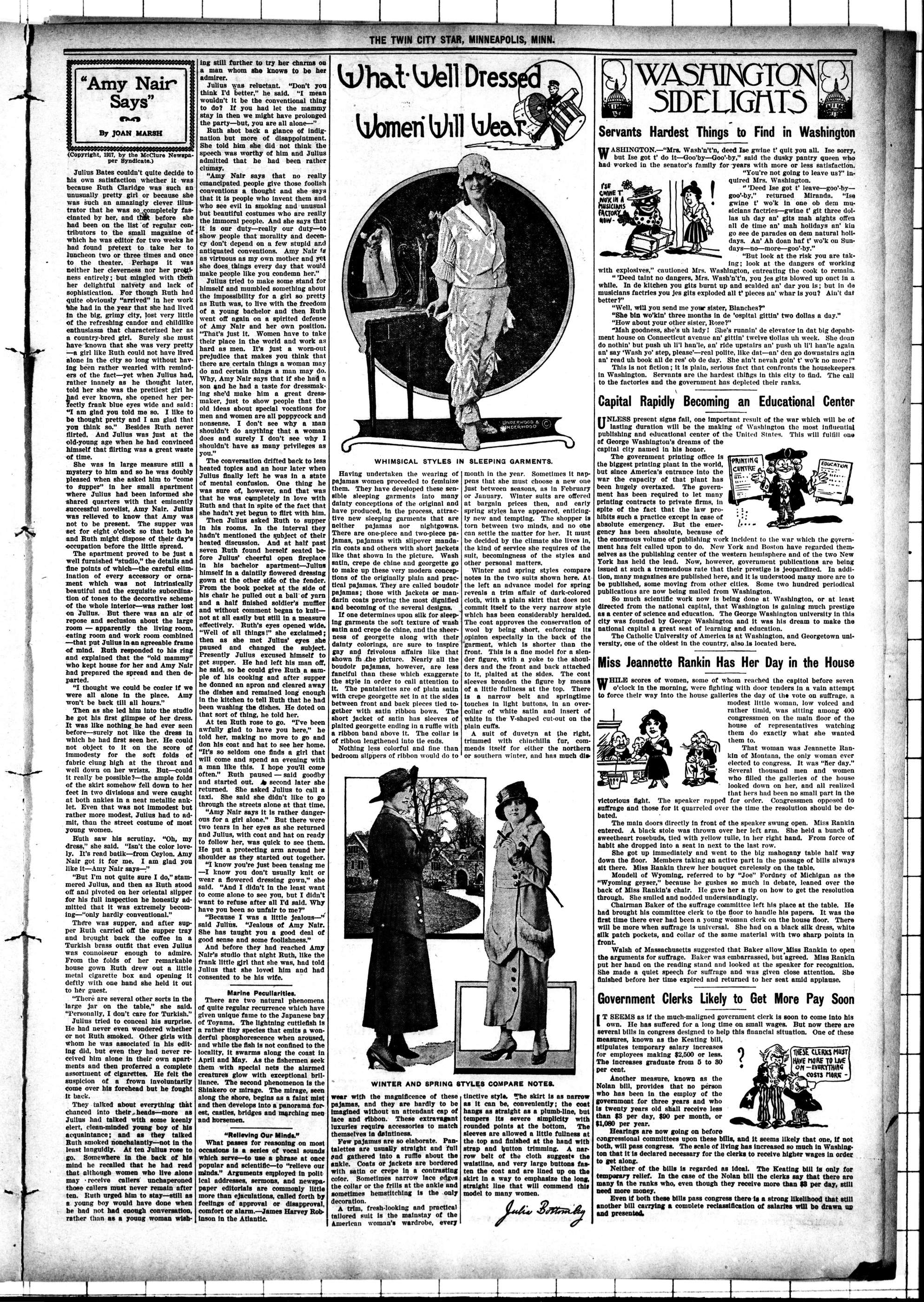
WHIMSICAL STYLES IN SLEEPING GARMENTS.
THE WOOL COAT
WINTER AND SPRING STYLES COMPARE NOTES.
Having undertaken the wearing of pajamas women proceeded to feminize them. They have developed these sensible sleeping garments into many dainty conceptions of the original and have produced, in the process, attractive new sleeping garments that are neither pajamas nor nightgowns. There are one-piece and two-piece pajamas, pajamas with silipover mandarin coats and others with short jackets like that shown in the picture. Wash satin, crepe de chine and georgette go to make up these very modern conceptions of the originally plain and practical pajamas. They are called boudor pajamas; those with jackets or mandarin coats proving the most dignified and becoming of the several designs.
If one determines upon silk for sleeping garments the soft texture of wash satin and crepe de chine, and the sheerness of georgette along with their dainty colorings, are sure to inspire gay and frivolous affairs like that shown in the picture. Nearly all the boudor pajamas, however, are less fanciful than these which exaggerate the style in order to call attention to it. The pantalettes are of plain satin with crepe georgette set in at the sides between front and back pieces tied together with satin ribbon bows. The short jacket of satin has sleeves of platted georgette ending in a ruffle with a ribbon band above it. The collar is of ribbon lengthened into tie ends.
Nothing less colorful and fine than bedroom slippers of ribbon would do to
WINTER AND SPRING
wear with the magnificence of these pajamas, and they are hardly to be imagined without an attendant cap of lace and ribbon. These extravagant luxuries require accessories to match themselves in daintiness.
Few pajamas are so elaborate. Pantailettes are usually straight and full and gathered into a ruffle about the ankle. Coats or jackets are bordered with satin or crepe in a contrasting color. Sometimes narrow lace edges the collar or the frills at the ankle and sometimes hemstitching is the only decoration.
A trim, fresh-looking and practical tailored suit is the mainstay of the American woman's wardrobe, every
---
Servants Hardest Things to Find in Washington
WASHINGTON.—"Mrs. Washn't'n, deed Ise gwine t' quit you all. Ise sorry, but Ise got t' do it—Goo'by—Goo'by," said the dusky pantry queen who had worked in the senator's family for years with more or less satisfaction.
"You're not going to leave us?" inquired Mrs. Washington.
"Deed Ise got t' leave—goo'by—goo'by," returned Miranda. "Ise gwine t' wok in one ob dem musicians factries—gwine t' git three dollars uh day an' gits mah nights offen all de time an' mah holidays an' kin go see de parades on dem natural holidays. An' Ah doan haf t' wok on Sundays—no—more—goo'by."
"But look at the risk you are taking; look at the dangers of working with explosives," cautioned Mrs. Washington, entreating the cook to remain.
"Deed taint no dangers, Mrs. Washn't'n, you Jes gits blowed up onc in a while. In de kitchen you gits burnt up and scalded an' dar you is; but in de musicians factries you Jes gits exploded all t' pieces an' whar is you? Ain't dat better?"
"Deed taint no dangers, Mrs. Washington, entreating the cook to reclaim
while. In de kitchen you gits burn up and scalded an' dar you is; but in de musicians factories you jes gits exploded all t' pieces an' whar is you? Ain't dat better?
"Well, will you send me your sister, Blanches?"
"She bin wokin' three months in de 'ospital gittin' two dollars a day."
"How about your other sister, Rose?"
"Mah goodness, she'suh lady! She's runnin' de elevator in dat big depaht-ment house on Connecticut avenue an' gittin' twelve dollars uh week. She doun do nothin' but push uh il'hl'le, an' ride upstairs an' push uh il'hl'le again an' say 'Wash yo' step, please'—real polite, like dat—an' den go downstairs again an' read uh book all de res' ob de day. She ain't nevah goin' t' wo'k no more!"
This is not fiction; it is plain, serious fact that confronts the housekeepers in Washington. Servants are the hardest things in this city to find. The call to the factories and the government has depleted their ranks.
Capital Rapidly Becoming an Educational Center
UNLESS present signs fall, one important result of the war which will be of lasting duration will be the making of Washington the most influential publishing and educational center of the United States. This will fulfill one of George Washington's dreams of the capital city named in his honor.
"Mah goodness, she's uh lady! She's runnin' de elevator in dat big department house on Connecticut avenue an' gittin' twelve tollas uh week. She doon do nothin but push uh il'l han'le, an' ride upstairs an' push uh il'l han'le again an' say 'Wash yo' step, please—real polite, like dat—an' den go downstairs again an' read uh book all de res' ob de day. She ain't nevah goin' t' wo k no more!" This is not fiction; it is plain, serious fact that confronts the housekeepers in Washington. Servants are the hardest things in this city to find. The call to the factories and the government has depleted their ranks.
Capital Rapidly Becoming an Educational Center
UNLESS present signs fail, one important result of the war which will be of lasting duration will be the making of Washington the most influential publishing and educational center of the United States. This will fulfill one of George Washington's dreams of the capital city named in his honor.
The government printing office is the biggest printing plant in the world, but since America's entrance into the war the capacity of that plant has been hugely overtaxed. The government has been required to let many printing contracts to private firms, in spite of the fact that the law prohibits such a practice except in case of absolute emergency. But the emergency has been absolute, because of
the enormous volume of publishing work incident to ment has felt called upon to do. New York and B selves as the publishing center of the western hemis York has held the lead. Now, however, governme issued at such a tremendous rate that their presti tion, many magazines are published here, and it is un be published, some moving from other cities. Sor publications are now being mailed from Washington. So much scientific work now is being done a directed from the national capital, that Washington as a center of science and education. The George W. city was founded by George Washington and it w national capital a great seat of learning and educa The Catholic University of America is at Washin versity, one of the oldest in the country, also is loca Miss Jeannette Rankin Has Her WHILE scores of women, some of whom reached o'clock in the morning, were fighting with door to force their way into the house galleries the day modest little
the enormous volume of publishing work incident to the war which the government has felt called upon to do. New York and Boston have regarded themselves as the publishing center of the western hemisphere and of the two New York has held the lead. Now, however, government publications are being issued at such a tremendous rate that their prestige is jeopardized. In addition, many magazines are published here, and it is understood many more are to be published, some moving from other cities. Some two hundred periodical publications are now being mailed from Washington.
So much scientific work now is being done at Washington, or at least directed from the national capital, that Washington is gaining much prestige as a center of science and education. The George Washington university in this city was founded by George Washington and it was his dream to make the national capital a great seat of learning and education.
The Catholic University of America is at Washington, and Georgetown university, one of the oldest in the country, also is located here.
Miss Jeannette Rankin Has Her Day in the House
WHILE scores of women, some of whom reached the capitol before seven o'clock in the morning, were fighting with door tenders in a vain attempt to force their way into the house galleries the day of the vote on suffrage, a modest little woman, low voiced and rather timid, was sitting among 400 congressmen on the main floor of the house of representatives watching them do exactly what she wanted them to.
That woman was Jeannette Rankin of Montana, the only woman ever elected to congress. It was "Her day." Several thousand men and women who filled the galleries of the house looked down on her, and all realized
victorious suffrage and bated.
The man entered. A sweetheart habit she she go down the floor sit there.
Monde "Wyoming back of Mine through. S
Chairman had brought first time to will be more silk patch front.
Walsh the argument put her hand She made finished be
Governor
T SEEMS own. He several bill measures, stipulates for employ The increase per cent.
Another Nolan bill,
victorious fight. The speaker rapped for order, suffrage and those for it quarreled over the time thibated.
The main doors directly in front of the speaker entered. A black stole was thrown over her left sweetheart rosebuds, tied with yellow tulle, in her habit she dropped into a seat in next to the last rest.
She got up immediately and went to the big down the floor. Members taking an active part in sit there. Miss Rankin threw her bouquet carelessly. Mondell of Wyoming, referred to by "Joe" For "Wyoming geyser," because he gushes so much in back of Miss Rankin's chair. He gave her a tip on through. She smiled and nodded understandingly.
Chairman Baker of the suffrage committee left had brought his committee clerk to the floor to hand first time there ever had been a young woman clerk will be more when suffrage is universal. She had oak silk patch pockets, and collar of the same material front.
Walsh of Massachusetts suggested that Baker of the arguments for suffrage. Baker was embarrassed put her hand on the reading stand and looked at the She made a quiet speech for suffrage and was g finished before her time expired and returned to her
Government Clerks Likely to Get
T SEEMS as if the much-maligned government clerk own. He has suffered for a long time on small several bills in congress designed to help this finance
victorious fight. The speaker rapped for order. Congressmen opposed to suffrage and those for it quarreled over the time the resolution should be debated.
The main doors directly in front of the speaker swung open. Miss Rankin entered. A black stole was thrown over her left arm. She held a bunch of sweetheart rosebuds, tied with yellow tulle, in her right hand. From force of habit she dropped into a seat in next to the last row.
She got up immediately and went to the big mahogany table half way down the floor. Members taking an active part in the passage of bills always sit there. Miss Rankin threw her bouquet carelessly on the table.
Mondell of Wyoming, referred to by "Joe" Fordney of Michigan as the "Wyoming geyser," because he gushes so much in debate, leaned over the back of Miss Rankin's chair. He gave her a tip on how to get the resolution through. She smiled and nodded understandingly.
Chairman Baker of the suffrage committee left his place at the table. He had brought his committee clerk to the floor to handle his papers. It was the first time there ever had been a young woman clerk on the house floor. There will be more when suffrage is universal. She had on a black silk dress, white silk patch pockets, and collar of the same material with two sharp points in front.
Walsh of Massachusetts suggested that Baker allow Miss Rankin to open the arguments for suffrage. Baker was embarrassed, but agreed. Miss Rankin put her hand on the reading stand and looked at the speaker for recognition. She made a quiet speech for suffrage and was given close attention. She finished before her time expired and returned to her seat amid applause.
Government Clerks Likely to Get More Pay Soon
T SEEMS as if the much-maligned government clerk is soon to come into his own. He has suffered for a long time on small wages. But now there are several bills in congress designed to help this financial situation. One of these measures, known as the Keating bill,
measures, known as the Keating bill, stipulates temporary salary increases for employees making $2,500 or less. The increases graduate from 5 to 30 per cent.
Another measure, known as the Nolan bill, provides that no person who has been in the employ of the government for three years and who is twenty years old shall receive less than $3 per day, $90 per month, or $1,080 per year.
Hearings are now going on before
going on. In going on, these bills, and it seems likely that one, if not both, will pass congress. The scale of living has increased so much in Washington that it is declared necessary for the clerks to receive higher wages in order to get along.
congressional committees upon these bills, and it seb both, will pass congress. The scale of living has incr on that it is declared necessary for the clerks to rec to get along.
Neither of the bills is regarded as ideal. The temporary relief. In the case of the Nolan bill the many in the ranks who, even though they receive n need more money.
Even if both these bills pass congress there is a another bill carrying a complete reclassification of and presented.
Neither of the bills is regarded as ideal. The Keating bill is only for temporary relief. In the case of the Nolan bill the clerks say that there are many in the ranks who, even though they receive more than $8 per day, still need more money. Even if both these bills pass congress there is a strong likelihood that still another bill carrying a complete reclassification of salaries will be drawn up and presented.
---
month in the year. Sometimes it nappens that she must choose a new one just between seasons, as in February or January. Winter suits are offered at bargain prices then, and early spring styles have appeared, enticingly new and tempting. The shopper is torn between two minds, and no one can settle the matter for her. It must be decided by the climate she lives in, the kind of service she requires of the suit, becomingness of the styles and other personal matters.
Winter and spring styles compare notes in the two suits shown here. At the left an advance model for spring reveals a trim affair of dark-colored cloth, with a plain skirt that does not commit itself to the very narrow style which has been considerably heralded. The coat approves the conservation of wool by being short, enforcing its opinion especially in the back of the garment, which is shorter than the front. This is a fine model for a slender figure, with a yoke to the shoulders and the front and back attached to it, plaited at the sides. The coat sleeves broaden the figure by means of a little fullness at the top. There is a narrow belt and springtime touches in light buttons, in an overcollar of white satin and insert of white in the V-shaped cut-out on the plain cuffs.
A suit of duvetyn at the right,
trimmed with chinchilla fur, commends itself for either the northern or southern winter, and has much dis
tinctive style. The skirt is as narrow as it can be, conveniently; the coat hangs as straight as a plumb-line, but tempers its severe simplicity with rounded points at the bottom. The sleeves are allowed a little fullness at the top and finished at the hand with strap and button trimming. A narrow belt of the cloth suggests the waistline, and very large buttons fasten the coat and are lined up on the skirt in a way to emphasize the long, straight line that will commend this model to many women.
Julia Bottomily
WASHINGTON SIDELIGHTS
"Deed Ise got t' leave--goo-by—goo-by," returned Miranda. "Ise gwine t' wok in one ob dem musicians factries—gwine t' git three dollars uh day an' gits mah nights offen all de time an' mah holidays an' kin go see de parades on dem natural holidays. An' Ah doh har t' wok on Sundays—no—more—goo-by."
"But look at the risk you are taking; look at the dangers of workingington, entreating the cook to remain. hn'tn't, you jes gits blowed up onet in a o and scalded an' dar you is; but in de all t' pieces an' whar is you? Ain't dat
"Well, will you send me your sister, Blanches?"
"She bin wo'kin' three months in de 'ospital gittin' two dollars a day."
"How about your other sister, Rose?"
he 'ospital gittin' two dollars a day."
"P"
's runnin' de elevator in dat big depaht-
gittin' twelve dollars uh week. She doan
de upstairs an' push uh ll' han'le again
like dat—an' den go downstairs again
She ain't nevah goin' t' wo'k no more!"
us fact that confronts the housekeepers
est things in this city to find. The call
us depleted their ranks.
g an Educational Center
tant result of the war which will be of
ing of Washington the most influential
the United States. This will fulfill one
PRINTING CENTRE
EDUCATION
k incident to the war which the govern-
York and Boston have regarded them-
western hemisphere and of the two New
er, government publications are being
their prestige is jeopardized. In addi-
and, it is understood many more are to
cities. Some two hundred periodical
in Washington.
being done at Washington, or at least
at Washington is gaining much prestige
the George Washington university in this
on and it was his dream to make the
ing and education.
is at Washington, and Georgetown uni-
also is located here.
Has Her Day in the House
whom reached the capitol before seven
with door tenders in a vain attempt
cries the day of the vote on suffrage, a
modest little woman, low voiced and rather timid, was sitting among 400 congressmen on the main floor of the house of representatives watching them do exactly what she wanted them to.
That woman was Jeannette Rankin of Montana, the only woman ever elected to congress. It was "her day." Several thousand men and women who filled the galleries of the house looked down on her, and all realized that hers had been no small part in the
for order. Congressmen opposed to
or the time the resolution should be de-
fend the speaker swung open. Miss Rankin
over her left arm. She held a bunch of
tulle, in her right hand. From force of
to the last row.
at to the big mahogany table half way
active part in the passage of bills always
quiet carelessly on the table.
by "Joe" Fordney of Michigan as the
so much in debate, leaned over the
her a tip on how to get the resolution
standingly.
committee left his place at the table. He
floor to handle his papers. It was the
woman clerk on the house floor. There
l. She had on a black silk dress, white
name material with two sharp points in
that Baker allow Miss Rankin to open
embarrassed, but agreed. Miss Rankin
looked at the speaker for recognition.
he and was given close attention. She
returned to her seat amid applause.
How to Get More Pay Soon
Government clerk is soon to come into his
time on small wages. But now there are
up this financial situation. One of these
?
THESE CLERKS MUST
HAVE MORE TO LIVE
ON-EVERYTHING
COSTS MORE -
ills, and it seems likely that one, if not living has increased so much in Washing-clerks to receive higher wages in order is ideal. The Keating bill is only forolan bill the clerks say that there are they receive more than $3 per day, still less there is a strong likelihood that still sification of salaries will be drawn up
PAPAL CIRCLE
THE TWIN CITY STAR
PUBLSHED EVERY FRIDAY BY CHARLES SUMNER SMITH,
Minneapolis, Minnesota.
Entered in the Post Office at Minneapolis as second class matter.
MEMBER
NATIONAL NEGRO PRESS
ASSOCIATION
Subscription by Mail, Postpaid.
ONE YEAR ..... $2.00
SIX MONTHS ..... $125
THREE MONTHS ..... .65
Hamlet B. Rowe, Local Agent.
ADVERTISING RATES.
One Inch—1 Insertion—One Dollar.
Liberal discount given on 3, 6, 9,
Months, or 1 year contracts.
We do not run free ads, or over-run
the time contracted for by our ad-
vertisers. We respect their right to
advertise at intervals, and rather have
them do so, than to run continuously
an "adv." and an increasing account.
Write all Checks payable to
Call at 1317 6th Ave. N. on Wednesday to insure matter for publication. The Star's Phone, Hyland 1205. Send your subscription. Our prices have not changed because of the war. Let your dollar do its duty and The Star will reach a higher standard of service and better circulation.
Negro Must Use "Extreme Caution"
and Face Facts Squately.
Atlantic City, Feb. 28.—"The American Negro needs to exercise extreme caution lest it be swept away on a wave of false optimism," says Floyd Delos Francis, secretary-general of the Negro American Alliance.
In a statement which the Alliance is sending out from its national headquarters, the Secretary General continues: "It is well to be optimistic and look on the bright side of thnigs, but there is a danger mark that must be carefully avoided. At the present time there is much machine-made opinion finding its way into the public print. The Negro is being assured that all is well. There is much talk about what he has done in the past and how he can be depended upon in the future. He is being lauded as an American citizen who always rises equal to the emergency. While being filled with enthusiasm by hired enthusiasts it is well for him to pause, face the facts squarely and use his common sense.
"We are at war with Austria, yet Austrian alien, enemies have more privileges than Negro soldiers in uniform. The fact is that democracy is being made a farce and mockery right here in America. It is time for the Negro to cease fooling himself or when the war is over he will be lost." - Balto-Afro-American Ledger.
SOUTHERN JUSTICE
AT REDUCED PRICES
The administration of justice (7) to Negroes in the southland is both speedy and economic. It is cheaper to lynch a Negro than erect a scaffold and purchase a pine box; or keep him alive as an inmate of a penal institution. Also it is a combination of business and pleasure to publicly cremate a Negro man or woman to make a civic holiday—and less expensive There is no loss of time, money or material in their due process of Lynch law. They are sowing the wind and have not figured the cost.
PRES. KNEALING DEAD
A USEFUL CAREER ENDED
Rev. Dr. H. T. Knealing, president of Western University at Ouindarou, Kans., died on Feb. 25th, after a long illness. He was a native of Austin, Texx., and served as president of Paul Quinn College, Waco, Tex.; assistant principal of Prairie View (Tex.) Normal School, and supervisor of Colored Schools in Austin, Tex. He was for 16 years the editor of the A. M. E. Review and the author of several pamphlets. Funeral services were held at Western University on Feb. 27th.
WHERE IS THIS SCHOOL?
There is a collector soliciting and receiving money for a Negro School. Prominent business men in St. Paul have contributed. It is reported that it is the I. T. Hill school for Negroes, also there is a newspaper man in the game, and a leader? has endorsed it. "Mysterious" Harry Adams, the confidence man, has been released from St. Peter, where he was committed after feigning insanity and charges were not brought against him for his many fraudulent collections. Of course, it is all right to collect money for a realschool, or with good intentions to build oone; but where is this school? Maybe R. B. Montgomery, who specializes in charitable collections, can tell the public or find out about it for general information. Speak up!
Secretaries of Lodges may send notices of their newly elected officers for free publication and office information.
ADVERTISE IN THE STAR
THE MARRIAGE OF THE WOMAN
MRS. MARY B. TALBERT, PRESIDENT NATIONAL ASSOCIATION OF COLORED WOMEN'S CLUBS, BUFFALO, N. Y.
Mrs. Talbert has issued the call of the Annual Meeting of the National Federation to be held in Denver, 1918. The Afro-American Women have purchased the homestead of Frederick Douglass at Washington, D. C., which will be their National Headquarters and a historical museum.
2
CHARLES W. FILLMORE
Capt. Fillmore was the organizer of the 15th N. Y. regiment. While serving in France he received the sad news of the death of his wife in New York. Her body was taken the Xenia, Ohio, for burial.
PETER H. HARRIS
SERGEANT HORACE F. DANIELS.
Sergt. Daniels is making rapid progress at Camp Dodge. He left with the first draft of Minnesota Negroes and was commissioned as sergeant of Headquarters Company, 337th Infantry. He has the best wishes of many friends in Minneapolis, to whom he wishes to thank through these columns for their interest in his welfare.
YOUR PUBLICITY PAYS.
All persons interested in the progress of their lodges, churches, societies etc., should value the power of printer's ink. They should see that their secretaries SEND ALL NOTICES to the newspapers in proper time. They think the Editor should attend every affair, whether invited or not, and should know "What is going on?"—without being informed. Many exchanges clip from our columns, and often things done in Minneapolis get national publicity.
THE TWIN CITY STAR will be sent to any out of town address. Send your subscription in postage stamps. Read your home paper while visiting in other cities. It's like a letter from home.
AGENTS WANTED—NOW!
Reliable and intelligent agents always wanted to solicit business for THE TWIN CITY STAR; also correspondents in principal cities. A chance to earn a good living. Write The Twin City Star, Minneapolis.
SMOKE THE RELIABLE
SIGHT DRAFT CIGAR
THE TWIN CITY STAR, MINNEAPOLIS, MINN.
J. B.
Pres. J. C. Napler, ex-register of the treasury, is the president of the National Negro Business League, which meets this year in Atlantic City. He is the successor of the late Dr. Booker T. Washington, and is also treasurer of the National Soldiers' Comfort Committee.
H.
MAJOR R. B. JACKSON.
Maj. Jackson won the nomination for alderman in the primaries recently held in Chicago, defeating ex-Alderman Oscar DePriest, who may decide to run independently.
A. E.
WILLIAM HARRISON.
Atty. W. H. Harrison, the brilliant orator from Oklahoma, is making loyalty speeches through the country. He was endorsed by the Negro Bar Association and received his appointment early this year.
A. B.
Lester Walton, newspaper man, theatrical manager and sport writer, has been named, with several of the leading white men of the theatrical world, to provide amusement for the soldiers. Mr. Walton was formerly of St. Louis, Mo., and is a son-in-law of Editor Fred R. Moore of the New York Age.
SUBSCRIBE FOR THE STAR.
If you suffer from headaches or your eyes tire or blur the reading—Let me examine them, expert advice and examination FREE. I duplicate any broken lenses made by me or anybody else.
PAEGEL
OPTOMETRIST-OPTICIAN
45 S. 6th St. Minneapolis
N. W. Cedar 8190. Res. Dale 8935
HAMMOND TURNER
Attorney at Law
Suite 321, American Nat'l Bank
Fifth and Cedar Sts.
St. Paul.
WORKING-MEN'S
SOCIAL CLUB
FOR MEN ONLY
244 3RD AVE. S.
MINNEAPOLIS
SYLVESTER W. OLIVER &
BENJAMIN JONES
Managers
Phone Hy. 3605.
Dr. Ellis Burton
DENTIST
Graduate Northwestern Dental
School of Chicago.
715 Sixth Ave. No.,
Minneapolis, Minn.
Peterson, The Druggist
1501 Washington Ave. So.
TOILET ARTICLES, DRUGS
PRESCRIPTIONS.
He Solicits Your Patronage.
CHOICE CITY AND SUBURBAN PROPERTY FOR SALE ON SMALL MONTHLY PAYMENTS.
Houses and Flats for Rent.
B. M. McDew
T. S. Center 4639.
WALFRID WESTMAN
Photographer
1425 Washington Ave. So. Minn.
HAVE YOUR PIANO TUNED!
MY WORK GUARANTEED
HENRY R. MORGAN
711 Bryant Ave. No. Minneapolis
N. W. Hyland 5879
Office Hours: Sundays:
2 to 6 p. m. 10 to 1 p. m.
9:30 a. m. to 12:30 p. m.
R. S. BROWN, M. D.
Office 408-9 Tribune Annex
67 Fourth Street Southr.
N. W. Main 2040. T. S. 38191
Res. 608 E. 14th St.
N. W. Main 2388 Minneapolis
DRS. BROWN & BURGER
Chronic Diseases and Orthopraxy
10 South 3rd Street
Nic. 3555 Minneapolis
Nothing Changed But the Price
Nothing Changed But the Price
Sight Drafts Still the Same Fine Old Cigar You've Always Liked
When your dealer asks you six cents apiece for your old friend Sight Draft, don't get the idea that he is trying to put something over on you.
The plain truth of the matter is that our labor and other manufacturing costs have increased so much that we had the choice of cutting down the size of the Sight Draft cigar, using inferior tobacco, or raising the price one cent.
We believed you would rather have the same old Sight Draft quality, the same old size, even if it cost you a penny more. So, from now on Sight Draft will be six cents.
Try a Sight Draft today. It's worth six cents, and you experienced smokers KNOW it is. W. K. Gresh & Song makers. W. S. Conrad Co., St. Paul, wholesale distributors. —Advertisement
THE WINTER COAT
They're marked down below all semblance of actual value or cost.
WOOLVELOURS, CHEVIOTS and POMPOMS at $7.50, $10.95 and $16.95
A FEW PLUSH COATS at $14.95 and $20.00
HATS CLEANED
AND RE-BLOCKED
Into Up-to-Date Styles
J. A. HUSSEY
16 North Seventh St., Minneapolis
N. W. Main 3717 (Second Floor)
PANAMA HATS A SPECIALTY
First-Class Work Guaranteed
WAR
CLUB
MARC
JO
WAR SAVING
BUY WAR SAV
DECLARE F
Spirella
CORSETS
WAR SAVINGS SOCIETY BUY WAR SAVING STAMPS DECLARE FOR THRIFT
will give you lithe, uncorseted grace and constant comfort, yet mould your figure to the present fashion. They are fitted to your measure in your own home by a trained corsetiere—the Spirella way. A telephone call or post-card will bring an expert to your home to explain the Spirella service and boning in detail.
Owing to an increase in cost, we have raised our prices on all composition. Reading notices will be 10c per line under one inch and 50c per inch thereafter.
Spirella Corset Shop
CORA E. CARR
365 Aurora Ave.
St. Paul, Minn.
The Twin City Star stands for
equal rights for all American citizens
SMOKE THE RELIABLE
SIGHT DRAFT CIGAR
IMPORTANT NOTICE
Unless notes are written plainly and properly arranged they will not be inserted. Many people send in notes regardless of names, initials or composition. Arrangement by the publisher will be charged for. Free notices must be correctly written.
THE SUNDAY FORUM
The last meeting of the Minneapolis Sunday Forum at St. Peter A. M. E. church, was very interesting and well attended. The ladies of Alpha Chapter Rel Cross, who recently graduated from the class in Surgical Dressings attended, some appeared in their uniforms. Mrs. Victoria Graham spoke on the work of the Chapter and the Forum donated $7.00 for a table for their station in the Kistler building. Short talks were made by Atty B. S. Smith, Atty. Harry L. Scott, Mr. John L. McHie, Mrs. W. R. Donovan and Mrs. Susie Bogle made a favorable report on their Social Service work. Mr. Wm. M. Smith outlined the plans for the Annual Welcome Meeting to be held next month. Rev. H. Allen Smith gave a Shakespearian reading. Mr. Hale, critic, presented his criticisms in his usual style. Mrs. Clara B. Montgomery of Milwaukee, an official of the Juvenile Court, was present. Mr. Veasus Pope read an excellent paper. D. W. E. Burton presided. It was one of the best meetings of recent date.
Editor Chas. Sumner Smith made a short talk on "Financial Co-operation as the Basis of Race Advancement" and his motion to donate a table to the Red Cross Chapter was carried unanimously. Next meeting at Bethesda Baptist church on March 17th.
OUR NEW ATTORNEY:
Mr. Harry L. Scott, after spending eight years at Howard University, graduated in 1911 with the degree of A. B. While at Howard he won two gold medals for excellence in debate, and in 1910 won the distinction of successfully representing Howard in an intercollegiate debate. In 1916 he finished the University of Buffalo law department. While serving his necessary time for admission in this state he has just finished the Northwestern College of Law. In 1912 Mr. Scott was elected delegate to the first state convention of the N. R. Progressive party. In this party he served successfully as committeeman for Erie County, N. Y., and served with equal success as state committeeman. In 1916, Mr. Scott was called to Indiana to assist the G. O. P., where he was placed by our national chairman, Will H. Hays, upon the speakers' bureau to stump the state of Indiana. Last June, Mr. Scott was elected as a delegate to the Auditorium convention, and in a masterly address demanded recognition of our race upon the Hennepin County Public Safety Commission. Mr. Scott through this fight, made possible the place which Atty. William R. Morris now holds. We wish him all success in his new field.
WAIT FOR THE ANNUAL EASTER BALL of the KNIGHTS OF PYTHIAS AT ARCADE HALL.
Mr. Ernest B. James and family have gone to Seattle, Wash., to reside. Mr. John W. Cheatath, ex-captain of the Fire Dept., is rapidly improving from his recent illness. The O. M. E. Art Club met last week with Mrs. Albert A. Ford, 1205 6th Ave. No. Mrs. Hilda Kennedy read an excellent paper on "The Negro in the War." The social hour and musical program were the other interesting features.
"WAITERS NIGHT" AT BETHESDA.
A Special Program.
Rev. D. E. Beasley of Bethseda Baptist church, will preach a special sermon to the Walters. He expects a large attendance. Rev. Beasley is a favorite among them, with whom he has worked. He was for many years head waiter of the Commercial Club. A special program is being arranged. The public is invited.
Mr. Beverly Keeesee continues ill at his residence, 715 West 31st St. He is slowly improving, which is good news to his many friends.
Mr. Martin Brown and Scoutmaster Will C. Jeffrey are arranging for an evening of amusement for the benefit of the Boy Scouts. Program to be announced later.
Mr. Glover Shull and family, who have been spending the winter in Los Angeles, are enroute home, stopping at Salt Lake City, Denver and Omaha. They are expected to arrive here next week.
Mr. Hamlet B. Rowe returned last week from Richmond, Ind., where he was called on account of the illness of his father, Benjamin Rowe, who is suffering with cancer. He was formerly a messenger to Gov. Bradley of Kentucky and is one of the best known men of that section. He visited this city several months ago enroute to Rochester, Minn., for medical treatment. His condition is serious, but hopeful. Hamlet stopped in Chicago on his trip to and from Richmond, Ind.
A BIG NIGHT IN ELKDOM
Ames Lodge of Minneapolis Has Big Initiation at its Last Meeting-
At the last meeting of Ames Lodge 106, I. B, P. O. E. W., held Tuesday, Feb. 26, the antlered herd had a very large time. Besides the regular routine business, they initiated 25 new candidates and reinstated 4 who had by some hook or crooked escaped from the park. After the initiation which lasted until about 3:30 a.m., a splendid supper was served by Judge Johnston, the Master of Social Sessions, which was enjoyed by all as much as the strenuous ceremonies which preceded it. The new members are: Roy Langford, David R. Francis, John Jackson, Arthur Burris, Henry Turner, George Lunsford, Isaac J. Thompson, William Miller, Jesse Johnson, E. S. Simpson, Benj. D. Lewis, Edward Johnson, Hiram Edwards, Clyde Walker, Maurice Daniels, Alphonso Johnstone, Edward Williams, A. W. Morris, Horace St. Clair, Roy Bryant, James Hamilton, Lester Parks, Gray Hemphill, K. Workoff, James Ellis. Those reinstated were: Charles Fisher, Clifford Hawkins, Oscar Price, Marion Lorentz. The "drive" is still on and on Tuesday, March 26, a large number are expected to be "horned."
The Star is not worried about the Advocate, or trying to take any leadership from Hon. Wm. R. Morris, who fosters that publication. We are glad he is leading something or somebody but it appears that Editor Montgomery is leading Mr. Morris. If so, they will suffer serious consequences.
A PATRIOTIC MEETING
The National Association for the Advancement of Colored People, will hold a Loyalty and Patriotic meeting at Central High School on Tuesday night, March 19th. Among the speakers are: W. Thomas Cullen and Judge W. E. Leary of Minneapolis, and Orrington C. Hall of St. Paul. A movement for membership is planned and the public is invited. The admission is FREE. B. S. Smith, Pres.; R. A. Skinner, Sec'y.
A LOCAL AGENT FOR
ALL PUBLICATIONS.
Mr. S. G. Franklin, 3217 Eight 37th St., Minneapolis, will accept subscriptions for any magazine or periodical pugilished. He specializes in Negro literature and can secure any kind of Negro literature on short notice. Write him or call up Drexel 4616.
Mr. Franklin is an authorized agent of The Twin City Star. Consult him about our Combination Subscriptions with all Negro publications.
READ THIS CAREFULLY.
If you receive a newspaper by mail and do not wish to pay for it, just refuse it by informing your postman. Then it will be returned to the publisher and he will be notified to discontinue sending it. There is no reason why a person should pay for a paper forced on them, but every reason why it should be paid for when ordered and accepted.
Mrs. Elizabeth Robb and her daughter, Ms. Marie Caldwell of Seattle, have been visiting in Chicago. During their stay here they were the guests of Miss Dorothy Morris, 512 12th Ave. So. They left for Seattle after a pleasant visit.
Mrs. Daniel W. Raynor left Wednesday for Madison, Wis., to visit relatives.
Mr. Robert Showell, 2614 31st Ave. So., has been confined to his home several weeks. He is one of the oldest employees of the Omaha railway and we are pleased to let his many friends know that the Mr. Showers who died recently was not "Bob." We wish him an ultimate recovery.
The funeral of Mr. Rufus Dennis was held last week. He was one of the trusted employees of the Pullman Co., and leaves a wife to mourn his loss. Mr. Dennis was well liked by all who knew him, and his death after a short illness, was a shock to the community. He owned one of the most beautiful homes at Lincoln St. N. E., in this city.
Mrs. Eugene Shuck of Bemidji,
Minn., has renewed her subscription
to the Star. Mr. and I. Shuck are
doing nily. Mr. Shuck is a recognized musician of ability.
Atty. B. S. Smith spoke last Sunday
night at St. Peter A. M. E. church. He is assisting the drive for members for
the N. A. A. C. P. of which he is president.
Mr. Herbert D. Parker of 3511 Snelling Ave., is on the sick list.
Deputy Sheriff John Allison, 2921
Tenth Ave. So., is recovering rapidly.
Mr. J. P. Anderson left last week
for Montreal.
Mr. Clarence W. Bell of Bell's Barber Shop, has put in a choice line of confections, and is catering to the wants of his patrons in every way.
Editor Chas. Sumner Smith has been on the sick list during past month.
Do not forget to send the money so the Star which you owe for subscriptions.
THE TWIN CITY STAR, MINNEAPOLIS, MINN.
JOHN H. BURKE
ALBERT H. GREENLAW.
TO APPEAR IN RECITAL.
Albert E. Greenlaw, a professional soloist, will appear soon in the Twin Cities. Mr. Greenlaw appeared at Pilgrim Baptist Church, St. Paul, a few years ago, and won a host of admirers. He has a national reputation.
TRINITY M. E. CHURCH.
Rev. H. Allen Smith is the pastor of the Trinity M. E. church, recently organized, which has a membership of 25 members. Services are held at 419 14th Ave. So. The public is invited.
Mr. P. H. Southall has succeeded Mr. John Ellott, former head waiter of the Nicollet Hotel, who resigned.
THE NATIONAL HOTEL RE- OPENED.
The dining room of the National Hotel, which was closed on account of the dry order of the Safety Commission, was reopened last week. Mr. Daniel Piper took charge with an efficient crew of waiters many of whom were former employees. Business is very good and Mr. Piper has made an excellent showing.
AN ABLE ORATOR.
Atty. Harry L. Scott proved his reputation as an able speaker in recent appearances before The St. Paul Forum. The Minneapolis Forum and at St. Peter A. M. E. church. He was the recipient of many compliments on his onation on Frederick Douglass. Rev. Stovall spoke in praise of his valuable assistance to St. Peter church as a church worker and Sunday School teacher.
CLASSIFIED ADVERTISEMENTS
SEE McDEW! for real estate.
COAL, WOOD AND CHARCOAL
You can get 100 lbs. of Hard
or Soft Coal, Bundle Wood or
Charcoal. Delivered. Call With-
ers. Your coal man. Hyland
2331, or Hyland 4712.
EVERY DAY is BARGAIN DAY
at the ROOT & HAGEMAN
STORE, 407 Nicollet Ave.
The South Side Barber Shop is now located at 212 118 Ave. So.
Peoples Christian Assembly.
ELDER G. W. MITCHELL, Pastor.
Assisted by Mrs. G. W. Mitchell.
Comel and Serve the Lord.
1204 Washington Ave. So.
Services Sunday—11 A. M.
Sunday School—1:30 P. M.
Praise Meeting—3 P. M.
Preaching—8 P. M.
THE WAY TO MAKE MONEY.
If you wish to add to your income, you can do so by accepting an agency for The Twin City Star. Good commission to competent agents. Use your spare time in soliciting ads and subscriptions. Only honest and intelligent agents wanted. Call Hyland 1205.
Do not waste your time making promises to our agents. Send your money by Express or Post Office Order or in cash or postage stamps.
We have some among our advertisers and subscribers who are a credit to our race for their business-like methods. They pay promptly in advance and expect nothing unreasonable in return. Others want to know "Why we can't 'trust' them?" or send a bill, and then a collector, and finally censor a Negro editor because he can't run his paper "like the white man." Few persons realize that it pays to pay as you go. The Star is not an installment plan proposition. It is a real newspaper run under many difficulties mostly due to the foolish notions and ignorant whims of those whom it serves and protects and from whom it should get its support and their consideration.
THE STAR is the CHEAPEST and
BEST NEGRO PAPER in the
NORTHWEST. It needs 500 more
Subscribers to keep it going. Help
to get us A BIGGER CIRCULATION.
Are you a delinquent subscriber?
If so, why not send your subscri-
tion?
"I Have Lived More in 30 Minutes in Airplane Flight Than in 30 Years of My Life," Writes Congressman Schall
Office Phones—Main 2869; Auto 36774. Dining Room—Main 2831.
Twenty Elegant Steam-Heated and Electric Lighted Rooms.
A la Carte Meals at All Hours—Popular Prices.
246-250 FOURTH AVE. S., MINNEAPOLIS, MINN.
Private Dining and Reception Room for Ladies. Special Temperance Beverages. Men's Buffet and Grill; Billiards; Barber Shop in Connection.
Minneapolis Gas Light Co.
SOUTH SEVENTH STREET
GAS RANGES
1918 MODELS
Easy Payments
Minnesota Representative
Is First Blind Man to
Fly in Machine.
Sails Over Washington
With Col. Lee of the
British Army.
For the first time in history, a blind man last week experienced the sensation of riding in the air. Congressman Thomas D. Schall of Minnesota, the only blind member of the House, as well as Senator New of Indiana, and William Denman, former chairman of the shipping board, flew over Washington with Col. Charles F. Lee of the British flying corps.
Congressman Schall described the experience as wonderfully exhilarating. He was so delighted with his first fligt that immediately on reaching the ground he requested to be taken up again, to loop the loop, and other aerial feats.
Mr. Schall told of his sensations in the following signed article in the Washington Times:
By Congressman Schall.
The other day Colonel Lee called me up and asked me if I'd like to fly. I guess some of my friends had been talking to him, and they decided to have me fly, to find out how a blind man would enjoy it.
I had often spoken of wanting to fly, because I had always been interested in aviation, but I never really expected the opportunity to go up. So I jumped at the offer, and we arranged the date.
Now I've flown, and I want to say it's the finest feeling in the world. I wouldn't have missed that flight for anything. There's a buoyant sensation—a smoothness that's simply indescribable.
Have you ever been in an automobile that was going about 50 miles an hour? And did that car hit one of those bumps that lift the whole machine and sent you up out of your seat? Well, that's something like it—only there's no bump like when the auto lands again.
Gentle Lifting. Swaving.
I could tell when we left the ground. The bumping of the machine along the uneven turf ceased, to be replaced by that gentle lifting and swaying. Then I knew we were in the air. Of course I had no sensation of altitude. I do not know how high we were. But I knew we were up some—further than I'd care to jump down. It's a funny feeling when you turn around, the way the wind goes around you—first blowing from in front, then the back, and so on. When we did the nose dive, I had that same sort of lift in my 'insides' that one gets in an elevator going down rapidly. Only the sensation develops beyond a scare into an cestatic exhilation.
Likes Birdman's Life
M. B.
Congressman Thomas D. Schall.
You see, on my first flight, the colonel, apparently thinking he'd have to treat me gently because I was blind, didn't loop the loop. When I landed I was so disappointed that I asked to go up again and do stunts. Colonel Lee granted my request.
I've never seen an airplane. I've been blind about 11 years, but before that I did see one of those cigar-shaped balloons, with a fan on one end—an ordinary dirigible. But I have an idea of what an airplane looks like from what I've been told. Then, too, last spring there was an airplane here, and I took the opportunity to go over the whole thing carefully with my hands, and in that way I got a pretty good mental picture of what it's like.
Handled Like Bag of Meal.
Getting into Colonel Lee's machine was my worst trouble. They handled me like a bag of meal. But I finally got in all right, and it was worth all the trouble. I didn't want to be strapped in, and didn't need it, but my wife insisted on it, so I was.
You see, the centrifugal force keeps one safe in the seat when one turns, spins and loops. One can feel the seat pressing under one, showing there's no danger of falling out. Then, too, there's a bar in front to be held onto by the hands, so you see, I was in no danger.
Before I went up I imagined the sensation must be something like those felt when in an auto. That's all I could really imagine beforehand. But it's nothing like it—nothing like any-
Failing to Loop-the-Loop First Time, He Makes Second Ascent.
"What a Terror Machines Must Be Swooing Down on Trenches."
thing I've ever been in. It's something like a scenic railway ride—only raised to the nth power of delight.
Do you know—I lived more in that 30 minutes' flight than I did in 30 years of my life!
It was a great stimulant. I'd advise thirsty Washingtonians to fly if they feel like stimulation. It's a great substitute for booze. I feel now as if I'd had two or three drinks. But I haven't.
Couldn't Be Afraid.
Afraid? I couldn't be afraid with a man like Colonel Lee in charge. You know, to the blind man his sense of hearing is like another man's sense of seeing. I can tell by a man's voice what his character is. And Colonel Lee's voice showed me he was a man to trust—a man that was there in an emergency. I felt in his voice a note of confidence, a note of expertise, fearlessness. Colonel Lee is unemotional, unsentimental, clear-headed—a man on whom I instinctively felt I could rely. If I had ever to take a long desert journey, Colonel Lee is the man I'd pick for my pal. He'd be there when needed. While we were over the river, there was engine trouble. I heard the motor missing, and I heard a grunt from Colonel Lee that told me something was wrong. I heard him tugging at his levers, or something, and then I heard the even roar again and a satisfied grunt from the colonel that told me everything was all right again. So I didn't worry. Why should I?
Had the Advantage.
I really think I enjoy flying more than a man who could see. You see, I have the advantage. A man with sight has the handleap of being able to see how far he'd have to fall if something did go wrong. That's where I've got it over him.
I think the airplane has it all over Billy Sunday's brigade of angels, too. That win-on-the back business is too crude. In an airplane you have all the pleasure of flying, without having to flap your own wings.
Why don't they use it more over there?
It must be a terror, swooping down into a trench where it rakes with a hail of bullets. There must be almost annihilation in that trench.
I hope America sends them over there in such number that we can go over the top in airplanes, even if we don't smash through the line.
Quick and Convenient.
Hyland 2331. Hyland 4712.
VIOLENT ARTILLERY DUELS
Mark French Front Where Foe is Rushing Troops.
London, March 8.—From Flanders to the Swiss border artillery duels of more or less violence are taking place on various sectors and here and there raiding parties of both sides are frequently in operation. The British have carried out successful forays against the Germans east of Ballecourt and near Lens, in which latter sector the Germans for the past few days have been heavily shelling them. German reinforcements continue to be sent up behind the lines in Belgium and France, according to General Maurice, director of military operations at the British war office.
At present, he says, although the enemy has 16 more divisions than the Allies along this entire front, the Allied troops are numerically stronger and also hold the upper hand in riffes, guns and aircraft, but that this superiority is diminishing.
Gold Won by Our Ships Prosperity of Merchant Marine Due to the War
Washington.—The present golden era for American shipping, resulting from great demand for ocean tonnage, and the extraordinary profits that have been made in our carrying trade by sea, have been shown by research to be a recurrence of similar conditions that have prevailed three times before in the history of the American merchant marine.
Whenever there has been any extraordinary condition to change political or economic balances in this or other great countries, prosperity for shipping has followed, say experts of the United States shipping board.
In proof of this they point to the great expansion of our foreign trade following both the Revolutionary war and the War of 1812, by which the merchants of New York and New England were enriched, and also the fortunes made by American ship owners following the Mexican war, with its resulting great rush of ploneers to the new gold state of California.
None of the stories of fabulous earnings of vessels in the merchant marine in the first three years of the present war—before the shipping board began regulating freight charges at sea—are more interesting than those of the wealth won by ships owned in old Salem, Mass., in the period in which their owners were developing American trade with distant parts of the earth, following both peace treaties with England.
In 1799 the ship Mt. Vernon of Salem made a profit of $100,000, four times her original cost, on a single round trip to China, going out with sugar, and returning via the Mediterranean, where she took on silks and wines for the American market.
The owner of the Mt. Vernon, Ellias Hasket Derby, died while she was on this voyage and left an estate valued at $1,000,000, the largest American fortune to that time.
Salem captains were ever on the alert for new ventures in those days of rich profits. When in 1795 Capt. Jonathan Carnes of Salem heard by way of gossip when ashore at Barcelona, Spain, that pepper grew wild on the coasts of Sumatra, he noted the information carefully. On his arrival home he imparted it to Jonathan Peele, a Salem merchant, who forthwith flirted out the schooner Rajah, and dispatched her to Sumatra.
The Rajah brought back the first full cargo of pepper to be landed in America, and her owner reaped the tidy profit from its sale of 700 per cent on his investment.
Certain ships, known for their lucky voyages, made fortunes for their owners. One famous in the annals of that period was the ship George—known as the "Salem frigate"—which made regular voyages to the East Indies for 22 years, accomplishing 21 voyages in all, and earned a fortune for George Peabody, afterward famous as a millionaire philanthropist.
Food Problem
By Dr. Samuel G. Dixon
Commissioner of Health of Pennsylvania
Most of our foodstuffs are made up of different constituents. A potato is
A. B.
largely composed of starch, whereas beefsteak is largely composed of nitrogen or protein. Starch represents so many heat-producing units, and beefsteak likewise produces its own quota. This is so when you consider the matter from a lab-
oratory standpoint, but if you made a test of the same values by feeding these foods to human beings you would find the values varied greatly because of the variations of the human or organic machinery which handled them. Starch, for instance, in the cases of some individuals, passes through the digestive system without the body assimilating it and obtaining the addition of its heat units. In the cases of other individuals, the same thing would happen with beefsteak.
For this reason we must remember, when advising foodstuff for a community, that what is one man's meat is another man's poison. Thus it behoves those who have the power to regulate foodstuffs for a community to be liberal enough in drawing up their lists to meet the demands of the different capabilities of the digestive system of the different individuals. In other words, one capable of making a rational selection must have a thorough knowledge of the physiology of foodstuffs.
The people of the state of Pennsylvania eat too much potato. The large proportion of starch in the composition of this vegetable produces a catarrhial condition of the digestive tract, which interferes with digestion and leaves the patient insufficiently nourished, eventually over a long series of years producing starvation.
Meat, as a rule, is also overcaten by
The value of her cargoes may be judged in that in her 22 years of active existence there was paid on them at the Salem customhouse, in import duties, not less than $600,000. The George was a tiny ship, as vessels go nowadays, being only 114 feet long, yet she proved a shining example in other ways of the glories of the early American merchant marine. She had the reputation of carrying the most intelligent crews to be found anywhere—except possibly on certain other American ships—and was famed for the number of men who graduated from her forecastle to the quarter deck.
When she sailed on her first voyage to India, in 1815, hardly a man in her crew was twenty-one years old, yet each was an experienced seaman, and nearly every one was a navigator.
Of the sailors who served on her in her long and prosperous career, 45 became captains, 20 chief mates, and six second mates. Thomas M. Saunders, who served on her as a boy, passed through every grade—of ordinary and able seaman, third, second and chief mate—and ultimately became her captain.
The case of the George has been cited as an example of the beneficial effect of continued prosperity on a nation's merchant marine.
Not less than 7,000 men signed articles in the counting room of Joseph Peabody to man his fleet, the various craft which made 38 voyages to Calcutta, 17 to Canton, 32 to Sumatra, 47 to St. Petersburg and 30 to other European ports.
In the later period of the so-called clipper ship era of the merchant marine, great profits were made by American ships at a time when the vessels of other nations were grubbing for charters. This was due to the superior speed of the American vessels.
The Rainbow, the first distinctly clipper ship built anywhere, cleared 200 per cent profit on her first voyage to China, in 1846.
The Oriental, an American clipper built in New York in 1849, to compete with the English tea ships, earned $48,000 in freight money on her first cargo of tea from Hong-Kong to London. Her cost was $70,000.
In the gold rush to California, in 1849 and 1850, many ships earned more than their value in a single voyage. Demand for space regulated the charge for carrying freight, as it does now, and the top price reached was $60 a ton.
At this rate the ship Samuel Russell earned $72,000 in freight money on one voyage—more than her cost. Some of the charters made in the earlier period of the war for American vessels were on such a liberal basis that the freight money for a single voyage to Archangel, for example, paid for the ship making the voyage, a condition to be looked for, say the experts, in times of abnormal demand for cargo space.
Pennsylvanians. Just now, however, during the tension of the war, we need more meat than usual.
It should also be kept in mind that meat will be more easily produced during the war than will vegetables, for our trouble will be the want of male help to carry out the continuous demands occasioned by the cultivation of vegetables during all stages from planting to gathering, whereas cattle can in great measure take care of themselves, and what human help is required need not be of the highest development, either physical or mental.
Provisions for the Pensions of Soldiers or Dependents
Section 112 of the national defense act of June 3, 1016, provides: "When any officer or enlisted man of the National Guard drafted into the service of the United States in time of war is disabled by reason of wounds or disability received or incurred while in the active service of the United States in time of war, he shall be entitled to all the benefits of the pension laws existing at the time of his service, and in case such officer or enlisted man dies in the active service of the United States in time of war or in returning to his place of residence after being mustered out of such service, or at any other time in consequence of wounds or disabilities received in such active service, his widow and children, if any, shall be entitled to all the benefits of such pension laws."
To the Point.
A face that never wears a smile should be avoided.
He who praises men and flatters women has many fair-weather friends.
No, Robert, the starboard of a steamer is not reserved for the star boarders.
A man can't have his cake and eat it, too—especially on his first trip across the pond.
The bachelor is the prune of the human family and the spinster is the preserved peach.
It isn't necessary that a brilliant conversationist should know what he is talking about.
THE TWIN CITY STAR, MINNEAPOLIS, MINN.
Potatoes as Substitute For Wheat and Any Other Grains in Making Bread
It is hardly possible to estimate from a standpoint of food conservation the great value of potatoes as a substitute for wheat and other grains in the making of bread.
One hundred million bushels of small potatoes will save 100,000,000 bushels of wheat. About 30 per cent of the annual potato crop in the United States consists of small potatoes which are unmarketable, made little use of, practically wasted, almost a total loss to the country. The small potatoes can be substituted for one-third the wheat flour used in making bread. Potato bread is better bread in every way than bread made entirely of wheat or a combination of wheat and other grains.
The use of potatoes in bread is economical at any time. It is patriotic at this time; it utilizes waste potatoes; saves wheat and other grain which can be exported; saves corn, barley and oats which can be used to produce meats and fats for our soldiers; gives us white, moist and wholesome bread for every meal; does not require extra work for the housewife, nor change the usual custom and practices of the home; means two and one-third wheatless days a week, ten wheatless days a month, four wheatless months a year.
Potatoes are grown in every section of the country, found in every home, are a universal food. Every family can produce them. Potatoes are an abundant crop in the United States;
Baking
Mixing Potato Bread.
the possibilities of increasing the total yield in this country cannot be estimated. Potatoes are a perishable crop—cannot be exported to foreign countries, cannot be carried over from one season to another. The potatoes we grow in this country we must use at home. The nature of potato starch is so nearly the same as wheat flour that there is no difficulty in using this combination in bread making.
Last season the farmers of the United States produced about 440,000,000 bushels of potatoes. About 100,000,000 bushels of this crop were small, irregular, unmarkable potatoes.
I earnestly believe that in no other way can so great a saving be made in food in America with so little labor and so small expense as the use of small potatoes in the making of bread in place of small grains which can be shipped to our soldiers and the fighting armies of the allies to help us win this war.
Baked or boiled potatoes, mashed or put through ricer, can be substituted for one-third the wheat flour in any standard recipe for making wheat bread, biscuits, pancakes, waffles, doughnuts, ple crusts, etc. When potatoes are used, a little less liquid may be required in the mixing.
Mother's Cook Book.
A two-pound cut of short ribs cooked in a kettle as stew with a bunch of carrots put around it while cooking and about twenty minutes before meal drop in a few potatoes to cook, the meat seasons and flavors the carrot and the carrots sweeten the meat. The broth may be saved and used for soup, adding an onion, a tablespoonful of rice and egg noodles or any vegetables left over from a previous meal. Cut up a tablespoonful of parsley in the soup just before serving.
Bread Crumb Bread.
Take two pounds of left over bread, crusts, or rolls, soaked well in plenty of water then squeeze out and pass the mixture through a sieve to make it fine grained, add two tablespoonfuls of molasses, a half teaspoonful of salt, and a half cupful of home made yeast, knead in flour until well mixed, let rise, mold into leaves and bake.
Save sugar in cooking rhubarb, cranberries by adding the sugar after the cooking and using a little corn starch for thickening, cook well after adding the corn starch.
Save all fats, the reason they are so scarce and so necessary is that explosives are made of glycerine and glycerin is made of fats.
Save on butter, by using oleomar garine or any vegetable butter.
Hark! There the guns have awakened
Madly they stamp and roar—
Sharling their hungry impatience—
Gluttonous lions of war.
Seventy yards through the clamor,
Under a curtain of fire,
Wet with the mists of the morning,
Glimmers the German wire.
"Charge!" through the throbbing silence,
After the crash and boom,
Into the pallid daybreak—
Over a boon of boom.
Low on the far horizon
Trembles a faint white star—
O mother—mother of mine—
What a beautiful mother you are!
Our Army Camps
Where Your Soldier Boy Is—
How to Get There.
Most of the army camps are prepared to receive visitors and there is a great demand on the part of relatives and friends to visit their soldiers and sailors. For those who are unacquainted with the locations of camps and how to reach them this list is published:
Camp Custer, National army, on Grand Trunk and Michigan Central roads near Battle Creek, Mich.; also reached by trolley. One-way fare from Battle Creek to Camp Custer via Michigan Central, 14 cents.
Camp Devens, National army, on Boston & Maine railway, about one-half mile from Ayer, Mass.; reached by electric line or auto.
Camp Dix, National army, on Pennsylvania road, 1.9 miles from Lewistown, Pa. One-way fare from Philadelphia, 79 cents.
Camp Dodge, National army, on Interurban (electric) Railway company. Fare from Des Moines: intrastate, 20 cents; interurban state, 27 cents.
Camp Funston, National army, located at Funston, Kan., on main line of Union Pacific, 3.8 miles from Fort Riley, Kan. One-way fares from Junction City: interstate, 22 cents; intrastate, 15 cents.
Camp Gordon, National army, located at Chamblee, Ga., 13:5 miles from Atlanta, on Southern railway. One-way fare from Atlanta on Southern railway, 35 cents; via electric line, 20 cents.
Camp Grant, National army, on C., M. & G. railroad, 4.8 miles from Rockford, Ill.; also reached by trolley.
Camp Jackson, National army, 4.9 miles from Columbia, S. C., on Southern railway; also reached by trolley. One-way fares from Columbia via Southern railway, 20 cents; via electric line, 10 cents.
Camp Lee, National army, 7 miles from Petersburg, Va., on Norfolk & Western railway; also reached by trolley. One-way fare from Petersburg via N. & W. railway, 20 cents.
Camp Lewis, National army, located directly at American Lake station on Northern Pacific railway.
Camp Meade, National army, on Washington, Baltimore & Annapolis electric railway, 1.6 miles from Odenton, Md. Fare from Odenton, 5 cents.
Camp Pike, National army, on Missouri Pacific, 5 miles from Military Junction and on C.R. R. & P., about $1\frac{1}{2}$ miles from Argenta, Ark. One-way fares as follows: From Argenta, 18 cents; from Little Rock, 24 cents; from Military Junction, 15 cents.
Camp Sherman, National army $2\frac{1}{2}$ miles from Chillicothe, O., on B. & O. railroad. One-way fare from Chillicothe by taxi, 25 cents.
Camp Zachary Taylor, National army, located at Dumesnill, Ky., on Southern railway, 11.6 miles from Louisville; also reached by Louisville street car line. One-way fare from Louisville; via Southern railway, 20 cents; via electric line, 5 cents.
Camp Travis, National army (Fort Sam Houston), on G., H. & S. A. and M. K. & T. railways, 4.25 miles from San Antonio, Tex.
Camp Upton, National army, on Long Island railroad, 64.5 miles from New York city. Fares from New York: one-way, $1.93; round trip, $3.54.
Use of Calling Cards and Answering of Formal Notes
There is usually a very good reason for all the different social etiquettes, and you can usually figure it out all by yourself. Take, for instance, the question of calling cards. Many persons are in doubt as to the number of cards they should leave. The answer is, according to an authority, to leave as many cards as there are persons that you wish to see and are indebted to. It is the only thoughtful thing to do and exactly what you would naturally do if you were not convinced that etiquette is tricky. Another thing that seems to puzzle is the answering of formal notes. If you receive a formal note, answer it formally, and make your spacing as much like the note you received as possible.
There is nothing mysterious about it. If you are polite and thoughtful and use your mind a bit you can never do far wrong. The instinct for the curious thing can easily be cultivated and it is essential in every walk of
© Western Newspaper Union
Miss Dalton, shown in the insert, is one of the educators and instigators of a general movement to care for youngsters after school hours, while their mothers are at work earning a living. The children are taught to knit, make their own clothing, draw, cook and bake. They are given coffee and dainties every afternoon.
"Made in America" Labels Should Replace Germany's and Japan's Trade Marks
For years and years it was "Made in Germany." Everything upon which such a tag could be placed with any show of reason was said to have been "Made in Germany." Toys and tools, knives and fish hooks, guns and jewelry—everything upon which a high profit was desired by the dealer was labeled in that way.
Today Germany is not in high favor, and there is scarcely an article in any store with a German label. In fact the label factories have discontinued the printing of "Made in Germany" labels for American manufacturers to paste upon American products.
It would seem, then, asserts the Houston Post, that this is a good time for Americans to learn that the best goods of every kind which are manufactured under heaven are "Made in America."
But the manufacturers do not seem to think so. Instead of the "Made in Germany" labels, we have with us today "Made in Japan" labels. Thus the label printer has had to change his label with no resulting benefit to the American people. The goods sold under this misleading label are made in American factories by American workmen paid American scales. They always have been made in America. It is likely they always will be made in America. And the fact that they are made in America assures the purchaser that they are the best goods of the kind selling for a like price in the world.
It is time for the "Made in America" label to be used on all American made goods; and it would not be a bad law which would compel American manufacturers to place an American label on their every product.
Wise and Otherwise.
A cynic is a man who will tell you the reason some fellows succeed is because everybody else is too tired or too lazy to put up any opposition to them.
Honors are like underwear; you should take it for granted that people know you have them.
Any man who would sue a girl for breach of promise ought to be confined in an upholstered cell.
Ever notice how a small boy delights in standing under a big safe that is being hoisted to the to story of a building?
Where Interest Coupons of Liberty Loan Bonds Payable
The interest coupons of Liberty loan bonds are payable at any federal reserve bank or subtreasury and at the treasury department in Washington, and any National bank which is a general depositary of government funds is required to cash these coupons without charge. It is believed, says a treasury department bulletin, that no bank or trust company which is a depositary of the proceeds of Liberty bonds or treasury certificates of indebtedness will make a charge for collecting the coupons, paying cash to the holder. The service rendered by banking institutions in cashing these interest coupons is a substantial one, but it is hoped that these depositaries will perform the service without charge as a patriotic duty.
"Are you fond of dogs?" "Very.
They stick right by you, and they're not
forever forcing their opinions on you"
—Detroit Free Press.
HOW TO PICK
PAYING HENS
Do you know which chickens in your flock are producing enough eggs to pay for their feed?
Can you tell the hen that lays six times that number, many of them in the season of high prices?
Can you tell the steady layer from the "boarder" in your flock without first opening her and looking at the egg sack?
Those are some of the questions that puzzle poultry farmers the country over.
The hen that produces three or four eggs a week, and is on the job nearly the year around is the hen that is always hustling, according to J. G. Halpin of the College of Agriculture, University of Wisconsin.
She is the first hen off the roost in the morning and the last on at night. She is always foraging; following the plow in the spring in search of grubs and cut-worms, roaming the woods and fields during the summer, devouring many injurious insects and their larvae, and busily gleaning about the threshing machine or gorging herself on weed seeds in the fall. She is the hen that is unafraid, yet nervous; the hen with the bright eye and the scarlet comb. She is always singing as she works and is generally at work scratching away for dear life making her own living out of God's good green earth. She goes often to the water tank and drinks deeply for much of the eggs she produces is water.
Women May Be in Demand as Jurors in Suffrage States
The reduction through the war in the number of men available for service as jurors and the fact that women in this state have obtained the suffrage, suggest that before long we shall have women in the jury boxes, says the New York Herald.
If the next legislature makes women eligible it will be interesting to see whether they will willingly serve or whether they will be like the men who daily besiege the office of the commissioner of jurors seeking exemption and resorting to questionable devices in the attempt to obtain it.
In the case of a woman on trial for crime woman jurors would have a hundred clues to character and conduct that are imperceptible to men. And when passing upon one of their own sex there would be no danger of women being so emotionally lenient as men have shown themselves to be.
Fashion Hints.
Chenille embroidery vies with wool embroidery in decorating the new dresses.
Bags to match the new winter hat!
Dull wood brown—a new color arrival.
Adjustable fish tail vells—have you one?
Wool jersey is still the ideal sport suit fabric.
Plaids and stripes for sports wear.
Detachable tunics—a new note.
Sailor Lad Tricks
Her sailor brother has come home and taught her a number of tricks about the laundry. He lays his white trousers on a board and brushes them with salt water, but, not having any of the ocean wave, he makes a solution of water and salt answer the purpose. She was so delighted with the result, which not only cleans the trousers, but stiffens them as well, that she has tried it on her white shoes.
ALLIED RE-ENFORCEMENTS ARRIVE IN ITALY TO HOLD BACK INVADING ARMY
Motortrucks in the war zone in France are generally operated at from 12 to 15 miles per hour, but the governors are usually set to allow of a speed of 18 to 20 miles per hour in an emergency. They are also required to operate on second gear up to a normal speed of 12 miles per hour, so that in undulating country the convoy is not spread out by vehicles slowing up on hills. The later trucks designed have a reduction of 50 to 1 on low gear in order that they will maneuver on low reverse under bad road conditions without it being necessary to race the engine in starting. It is found in practice that even the axles do not suffer so much from this extreme reduction as by racing the engine and letting the clutch in as is necessary with some older type trucks sent from America.
The allies rushed re-enforcements to Italy to help stop the Austro-German advance when it was at its height, and these re-enforcements have been a great aid to the Italians. The photograph shows one of the first batches of French autos as they arrived in Milan. The autos are used as transport trucks.
NEW USES FOUND FOR AUTOMOBILE
Adaptation to War's Needs Brings Changes in Industry.
RAILROADS TO BE ASSISTED
Motor Car Fits In for Direct Purpose of War to Greater Extent Than We Have Yet Discovered—Business to Expand.
Commenting on the use of the automobile in war times, the president of a large tire and rubber concern says:
"The government at Washington is doing some things that startle us because we do not have a proper understanding of what its program is. Much has been said about stopping the automobiles. This is all nonsense. The government is going to lay its heavy hand on the nonessential industries, but the rubber business and the automobile business are not in that class. They are essential industries.
Motors Wanted for War.
"Just because in England and France the use of automobiles had to be checked it does not follow that we have parallel conditions here. You must remember that in England and France they are dealing not with 29-cent gasoline, but with $1 and $1.25 gasoline, and that over there the man power is exhausted, almost to the last man. They have to get every man available, even from the essential industries, on the battle front. They want the automobiles to run for government purposes. When I was there in 1915, they were already 'booing' civilian automobiles along the streets of London.
Commercial Business to Expand.
Commercial Business to Expand
"But we are not going to get to that point in this country. Here we have a tremendous area, and a great amount of transportation is necessary. The railroads cannot carry it. The automobile fits in for the direct purpose of the war to a greater extent than we have yet discovered. The commercial end of the business will expand tremendously. More commercial cars will be made than we have ever dreamed of. The joy riders will be clipped off, but that does not mean that the man who takes his family out for a ride on Sunday or holiday to get a readjustment from the tension of the week will be criticized.
Tire Industry Essential.
"On the contrary, it is the rational things that ought to be done. The line of demarcation can never be drawn very clearly, but it will not be drawn so arbitrarily that a man will be criticized for taking his family out for a ride, as is the case in England. A great many of the cars now running will take off their touring bodies, and put on other bodies to work economically for war purposes. Tires will be used right along, more and more every year, no matter what happens. The tire industry is essential and it is going on, notwithstanding the production of automobiles may be cut. We are going to find that we must work more as a whole, for the one thing, the plan of the government."
MISFIRING AT SLOW SPEEDS
Common Cause of Complaint With Usual Carburetor System—Go Over Ignition Carefully.
Poor engine operation at low car speeds is a common complaint with the usual carburetor system. Often an air leak throws out the carburetor adjustment so that an insufficient amount of fuel is fed. Wide plug gaps with a magneto with weak magnets is a combination which may give this trouble.
With a battery system in use the ignition may be neglected at first and the carburetion attended to, but this done the ignition should be gone over carefully.—Motor.
IMPROMPTU TOLL ROAD PAYS
Kind-Hearted Farmer Allowed Motorists to Pass Through Uncultivated Field for Small Sum.
A motorist bound along the road from Detroit to Toledo, one of the worst to be found in many states, reports that he encountered one 200-yard stretch where, because the grade was high, there was no way to turn off from the paving. "A kind-hearted farmer," he told the Ohio Motorist, "stood at the gate of his barnyard and for the sum of 25 cents allowed each motorist to pass through the gate, over an uncultivated field for about 200 yards, and onto the road again."
RAIN WATER FOR BATTERIES
Hard Liquid, Containing Minerals Is Harmful—Remove Caps at Top of the Battery.
"Hard water, containing minerals, is harmful to the battery," says F. J. Stone, manager of a Boston concern.
"Water that is pure as drinking water is not necessarily pure water for your battery. Distilled water or clear rain water is the best.
"Removing the caps at the top of the battery, water should be added until it stands well above the plates, though not to the top of the containers."
SIGNALS CHANGE OF COURSE
Invention of Texan Provides Efficient Contrivance Easily Applied to Automobiles.
The Scientific American in illustrating and describing a vehicle signal, invented by G. W. Edmond of El Paso, Tex., says:
The invention relates to signaling devices particularly suitable for use on automobiles to indicate a change of course. The object is to provide an inexpensive and efficient contrivance which can be easily applied to an automobile so as to become prominent when actuated to attract attention, and
Vehicle Signal.
for this purpose when thrown into the operative position a folding flag is attached near the free end of the arm, the flag unfolds automatically, to render the arm apparent in the dark, an incandescent light is provided at the extremity of the arm.
NOVEL HEADLIGHT FOR AUTOS
Connecticut Man Has New Patent Design to Furnish Illumination Without Glare.
S
M. N. Finklestein of Greenwich, Conn., has just patented a new headlight for automobiles, designed to furnish a maximum amount of illumination on the highway and to do away with the dangerous glare. The direct rays are shielded in such a way as to cover the ground and light it up thoroughly, without precipitating the light to a distance.
THE TWIN CITY STAR, MINNEAPOLIS, MINN.
THE KITCHEN CABINET
It is certain that there is not enough wheat, corn, or rice in the world to let one bit be wasted in any way which we can avoid or control.-H. Hoover.
Who hath his surplus well laid by
And doth invest his all for good;
Whose dividend returns are sure and
high,
In bank of truth and brotherhood!
-J. H. Ayers.
THE DAILY PROBLEM.
What shall we have for dinner? is the daily problem, and any aids toward
GOOD THINGS IN SEASON.
A sandwich filling that is unusual but good, is Italian. Boll a pound of
TEA CUP
lem are always welcome.
Pea Griddle Cakes....Soak two cupfuls of dried peas over night and cook the next day until soft and will pass through a sieve. Keep the water to use for sauces or soup stock. Beat two eggs, add the volks to the purée, with
calf's liver until tender, then while hot rub it through a sieve. Measure and mix with it three-fourths of the amount of stuffed olives finely chopped. Add salt, pepper and mayon-
FISH
a cupful of milk, half cupful of barley flour, a tablespoonful of drippings, a half teaspoonful of salt, and a teaspoonful and a half of baking powder. Then fold the whites of the eggs and bake on a hot griddle. Serve as a vegetable or as a meat substitute.
naise to moisten and spread on buttered or rye bread.
Tuna Timbales—Melt two tablespoonfuls of butter, add a fourth of a cupful of bread crumbs and a cupful of milk, cook five minutes, stirring constantly. Add a pound can of tuna fish, flaked, two eggs slightly beaten, a tablespoonful each of chopped parsley and lemon juice, a half teaspoonful of celery salt, the same of onion juice and salt, and an eighth of a teaspoonful of pepper. Turn into buttered custard cups and cook in water in a moderate oven. Serve with tomato sauce.
Fruit Pudding.—Slice two quarts of apples, measure one and a half cupfuls of sugar, half a cupful of water, three tablespoonfuls of butter, a third of a nutmeg grated, seven slices of bread. Butter the bread and soak in the cold water until soft. Place it in the bottom of a baking dish, spread over it half of the apple and sprinkle with half of the sugar and nutmeg. Repeat, pour in water by the spoonful, cover with a plate, and bake very slowly two and one-half hours. Serve hot or cold. Lemon sauce goes well with this pudding.
Hot Chicken Sandwiches—Cook the chicken until tender in plenty of water so there will be a good supply of broth. Cool, remove the meat from the bones and clip it into bits with the scissors. Put the skin and giblets except liver through the meat chopper and mix the chicken with enough stock to make the mixture moist. Thicken the remaining stock with one and a half tablespoonfuls of flour and cook until smooth, season well with salt, pepper and onion juice. For each serving take two slices of bread place a spoonful of the chicken on a slice, turn over it another slice and dip a ladle of gravity over it. Serve with potato. This will serve 15.
Kedgeres.—Take equal parts of fish and rice, for one cupful of rice take two hard-cooked eggs, one teaspoonful of curry powder, two tablespoonfuls of butter, a half a tablespoonful of cream, salt, pepper and cayenne to taste. Put the shredded fish, cooked rice, butter and white of eggs, cut fine, cream and seasoning in a dish, and toss over the fire until hot. Rub the yolks of the eggs through a sleeve, sprinkle with the curry, and serve hot. Boiled samp, or coarse hominy is very palatable. Soak it over night, simmer gently all day, adding water as needed. Just before serving add butter, cream and seasoning of salt and serve hot.
Scalloped Peaches—Butter a baking dish and cover the bottom with sliced peaches, fresh or canned. Sprinkle with buttered cracker crumbs and repeat until the dish is full, having the crackers on top. Pour over the Juice from the can or a sugar slurp, if fresh fruit is used, and bake 45 minutes 'in fresh fruit, 30 if canned peaches.
Codfish Pie.—Take one cupful of shredded mashed potatoes, two eggs, a half cupful of milk, mix well, add one beaten egg. Put into a shallow baking dish, spread with the other egg beaten lightly, then cover with buttered crumbs. Bake in a quick oven. Slip onto a chop dish and serve with a garnish of parsley.
Other fruits, like pears, plums, apricots may be used in this way, adding acid or sugar as needed to make the dish palatable.
"Conserve your food supply and win the war."
Ennui is simply being tired of doing
anything and being too tired to do anything
else.
All of you have read the words before.
But when you read them now remember you
COMMON VEGETABLES.
Have got your "little bit" to do.
Good cheer is the every day pres-
cription that keeps the heart alive.
We do not tire of the daily potato, but we do weary of the vegetable served in the same way. This is true of all of the other common vegetables. They are served too often in the same old way. Try boiling them for 10 or 15 minutes with the skins on, then
MORE GOOD THINGS.
#
A good winter relish to serve with meat is:
Beet Relish.—Take a quart each of finely chopped cooked beets, and cabbage, add two cupfuls of sugar, a cupful of finely chopped celery and a cupful of fresh grated horseradish. Mix with cold vinegar and seal.
peel and put into the oven to bake. Every bit of such a potato will be eaten. This method may be varied by basting them with any sweet fat while baking, of course having them in a pan in either case.
Sweet Potato Pie.—
Pare, boll and mash
Beets when young and tender, the size of a walnut, are delicious with butter, pepper and salt, with a dash of lemon juice or vinegar. When good sized they may be cooked, scooped out and used as receptacles for chopped salad of any kind. Place on a lettuce leaf or in a nest of shredded lettuce and serve with a good salad dressing. This is a most wholesome and attractive salad.
three large sweet potatoes. Season with salt and beat light. Line a casserole with pork sausage, put in the potatoes, cover with sausage and bake in a hot oven 30 minutes. Bake uncovered the last ten minutes.
Macaroni With Kidney Beans.—Cook a cupful of macaroni until soft. Heat a cupful of milk and add to it a tablespoonful of butter and one of flour rubbed smooth, cook five minutes, then add a cupful of hot, strained tomato and a pint of canned beans.
Turnips may also be cooked and used as cups for a hot vegetable or a salad filled with creamed carrots or potatoes and used as a garnish for meat they will taste good and appeal to the eye.
Lentils With Oignies—Take a cupful of lentils soaked over night, cook in two cupfuls of water with a stalk of celery, a sliced carrot and two sprigs of parsley. Remove the seasoning and rub through a sieve, stir in a cupful of onion purée, a cupful of soft bread crumbs, salt and pepper to taste and one beaten egg to bind the mixture. Form into cones with floured hands and chill for an hour. Then dip in egg, crumbs and fry in deep fat. Serve garnished with water cress.
Carrots are very nice boiled tender and served with green peas; season with butter, pepper and salt and with a dash of sugar. Sliced carrots are good boiled until tender and then allowed to simmer in a little sweet fat with a spoonful and two of shredded onion; salt and pepper to taste, then served around chops or stew.
Swiss chard should be a standby during the growing season, and canned for the months when it cannot be grown. Take the white stalks, cook and serve in a well-seasoned white sauce, or mix with celery for a salad. The greens are treated in various ways—molded and served as a salad or hot with chopped, cooked egg. The stalks may be cooked and serve as asparagus or in a lemon ring or a beet ring as a salad. French or mayonnaise dressing is appropriate for this vegetable.
Onion Loaf—Put a cupful and a quarter of nuts through a meat chopper. Moisten the soft part of a loaf of brand which has been flaked, add the nuts, a teaspoonful of mixed herbs, a half teaspoonful of salt, a dash of paprika and a cupful of finely chopped onion, mix with two tablespoonfuls of butter and half a cupful of cream. Work with the hands into a loaf, put into a buttered pan and bake one hour basting with butter and serve hot with cream sauce.
Corn as pudding, corn with tomatoes as an escalloped dish, stuffed green peppers, all lend themselves to an endless variety of dishes.
Parker House Hong
Take one and a fourth cupfuls of flour, three-fourths of a cupful of cornmeal, two tablespoonfuls of baking powder, one-half teaspoonful of salt and a tablespoonful of sugar, the same of shortening, one beaten egg and one cupful of milk. Roll out a half thick, cut and fold. Bake twenty
Cooked beets shoe stringed or latticed, using the handy little cutter, will make a pretty salad all by themselves if chilled and served in lettuce nests.
Nellie Maxwell
MODERN IDEAS IN THIS DAIRY BARN
Carefully Planned Structure Provides Shelter for Thirty- Five Animals. VENTILATION BIG FEATURE
Intake and Foul Air Flues Assure an Adequate Supply of Fresh Air for the Stock at all Times of the Year.
Mr. William A. Radford will answer questions and give advice FREE OF COST on all subjects pertaining to the subject of building work on the farm, for the readers of this paper. On account of his wide experience as Editor, Author and Manufacturer, he is, without doubt, the highest authority on all these subjects. Address all inquiries to William A. Radford, No. 1827 - Prairie avenue, Chicago, Ill., and only inlines three-cent stamp for reply.
By WILLIAM A. RADEFORD.
The close relation between modern farm buildings, especially dairy barns, and enduring prosperity for the farm is seldom appreciated at its full worth. Farming for permanent prosperity adds to the equipment of the farm each year. Practical business on the farm demands first the permanent improvement of the soil. This requires live stock. Live stock calls for good fences and comfortable buildings. The acme of perfection in farm management is the building up of a richer
THE BARN
soil year after year. the improvement of farm live stock and the increase in numbers to consume the roughage and grains on the farm.
install floors both ways from a point a little less than halfway back from the manger. A slight slope is given from this point to the manger and a greater
More live stock and better live stock demand more buildings, better constructed. Farm animals kept under good business management are made comfortable in cold weather and they are given a variety of foods to keep growing in winter as rapidly as in summer.
Business farming for permanent prosperity requires that a good many different operations shall follow along, then merge one into the other. At the same time it is not necessary for any farmer to wait until he has all the different arrangements made to jump into permanent farm work, because it is better, easier and more natural to commence in a small way and lead up step by step from the improvement of the soil to sanitary ventilated buildings.
Besides there is more real, genuine enjoyment in building up a farm business in this way. Each little success brings its own reward. Each load of manure properly handled and worked into the soil adds its quota of humus, which fosters soil bacteria and holds moisture to produce a larger crop.
Each load of lime helps to prepare the soil to grow more clover, to sup-
LITTER CORNER BLOCK
LITTER ALLEY
10 COW STALLS
MANCER
LITTER CORNER BLOCK
FEEDING ALLEY
MANCER
10 COW STALLS
MANCER
LITTER CORNER BLOCK
MORT FUR
Plan of Dairy Barn With Structural Tile Silo.
ply more humus, to raise more corn, to fill more silos, to feed more beef cattle and dairy cows, to build more and better buildings.
The greatest incentive to the business of permanent farming is the dream of having every head of live stock purebred and registered and housed comfortably in all kinds of weather, and fed bountifully on the best the land produces, with both grain and fodder left over in the spring as a measure of safety.
000 tons of rubber and such other products as kapok, pepper, hides and coconut oil. This was seven times the value we purchased there in 1913.
Striking Back.
The elder of two boys had been taught to protect his brother and never strike back or in any way hurt the smaller one. Finally the younger one took so much advantage of this rule that the older boy was many times tempted to break over bounds, and at
Such farmers are honored wherever their names are mentioned. They are recognized as being of more importance than statesmen. Their achievement is of greater value than the building of a railway, or the digging of a canal, because it means permanent prosperity springing perennially from the soil in spontaneous profusion. It
PINE BOND
means setting an example for thousands of other farmers to do likewise. A carefully planned and well built dairy barn providing 35 stalls for cows, a generous sized calf pen and a bull pen is shown in the accompanying view. This barn is built near Janesville, Wis. The plan calls for a double row of stalls along the central feed alley. On one side of the alley accommodations for 18 cows are provided in an unbroken line, at the end of which the calf pen is built. The stalls on the other side of the alley are divided into a set of ten and a set of seven, a passageway between the feeding alley and the litter alley being placed in line with a Dutch door in the outer wall at this point. The bull pen is located at the end of this row of stalls. A stairway to the haymow is framed into the end wall of the barn in the bull pen. The silo is built at this end of the barn and a feed room connects it with the feeding alley in the main structure. The feed carrier track is extended into this feeding room.
The ventilation system utilizes three large-size ventilators connected with four-air flues carried along the rafters on either side of the ventilator base and down to near the floor line in the stable. Fresh air is admitted to the stable through flues which start just above the concrete block basement wall, are carried up the wall to the floor joists and across to registers in the ceiling above the feeding alley. The combined effective area of the intake flues is figured about 10 per cent in excess of the combined effective area of the four-air flues, which ensures an adequate supply of fresh air to the animals at all times.
The foundations of this barn are solidly laid of concrete sad the floors are poured of the same material, the mangers and gutters being formed as a part of the floor structure. It has been found an advantage to slope the
THE BARN
stall floors both ways from a point a little less than halfway back from the manger. A slight slope is given from this point to the manger and a greater slope is given from this point to the gutter. The object is to prevent the cows from pushing all of their bedding back into the gutter during the night. Gutter drains are fitted with covers to prevent loss of valuable fertilizer and clogging of the drainage system. The stable wall above the concrete blocks is finished with 8-inch boards placed vertically, and the interior is finished with ceiling stock so that the stable will be warm.
New Trade With East Indies.
The East Indies have always suggested to us the adventurous trade of the days when our shipowners and merchants sought fortune on the other side of the globe. In more recent years they became something of a myth, so far as actual commercial intercourse went, although they still supplied us with some articles we like, including tobacco, pepper and nutmegs. Besides, an American company has a vast rubber estate in these regions. Now, remarks the Nation's Business, the var has brought us back to the East Indies once more. From Java and Sumatra we took $35,000,000 in goods during 1916—half their tine, 12.
000 tons of rubber and such other products as kapok, pepper hides and coconut oil. This was seven times the value we purchased there in 1913.
Striking Back.
The elder of two. boys had been taught to protect his brother and never strike back or in any way hurt the smaller one. Finally the younger one took so much advantage of this rule that the older boy was many times tempted to break over pounds, and at last the mother said, "I believe now the only way we can ever stop Tom from striking you so much is for you to strike him back so he will learn that it really hurts." With a big sigh of relief his brother said: "Yes, mother, I really believe it would be best, for just think if he keeps on how he will abuse his wife."
In these days there is NO REASON FOR "BLUE MONDAY"
BECAUSE—
we wash clothes clean for less than home lau-
costs and without the old-time wear and tea-
old-time laundry.
Phone Main 5080 for us to call.
Gross Bros.
MINNEAPOLIS DYE HOUSE
CLEANERS LAUNDERERS & DYERS
86-88-90-SOUTH 101STREET
ALEXANDER GROSS • IRVING H. ROBITSHEK • ALLEN M. GR
BEN MARIENHOF
For 28 Years at 318 Hennepin Avenue.
Tailor to Men
we wash clothes clean for less than home laundering costs and without the old-time wear and tear of the old-time laundry.
Phone Main 5080 for us to call.
Gross Bros.
MINNEAPOLIS DYE HOUSE
CLEANERS LAUNDERERS & DYERS
86-88-90-SOUTH 10TH STREET
ALEXANDER GROSS • IRVING H. ROBITSHEK • ALLEN M. GROSS
BEN MARIENHOFF
IMPORTED AND DOMESTIC WOOLENS AT POPULAR PRICES Your Patronage Desired.
Drex 1269 Autom
J. & H. Wet Wash Laundry
3753-55-57 Cedar Avenue
High Grade Specialists in Wet W
Dry Wash and Family Launder
OUR WORK IS OUR BEST ADVERTISEMENT
J. & H.
375
High Grade
Dry Wash
OUR WORK
J. & H. Wet Wash Laundry
3753-55-57 Cedar Avenue
High Grade Specialists in Wet Wash
Dry Wash and Family Laundering
OUR WORK IS OUR BEST ADVERTISEMENT
POPULAR PRICED SHOE REPAIRING.
SPECIAL SAMPLE SHOES
WE FIX 'EM WHILE YOU WAIT.
Men's Sewed Soles ..... $1.00
Ladies' Sewed Soles ..... .85
Men's Nailed Soles ..... .85
Rubber Heels ..... .40
Ladies' and Boy's Nailed Soles ..... .65
SEVEN CORNERS' SHOE REPAIR SHOP.
1424 Washington Ave. So., Minneapolis.
BELL
CL
BATHS, B
PO
CIGARS,
244 THIRD AVI
BELL'S BARBER SHOP
CLARENCE W. BELL, Proprietor.
BATHS, BARBER SHOP, POLITE BARBER
POOL AND BILLIARD HALL
CIGARS, RACE PAPERS, SHOE SHINING
244 THIRD AVE. SOUTH .. MINNEAPOLIS,
Phone Northwestern, Main 2511.
BELL'S BARBER SHOP
CLARENCE W. BELL, Proprietor.
BATHS, BARBER SHOP, POLITE BARBERS
POOL AND BILLIARD HALL
CIGARS, RACE PAPERS, SHOE SHINING
244 THIRD AVE. SOUTH . MINNEAPOLIS, MINN.
Phone Northwestern. Main 2811.
GLOVER SHULL, PRES.
311 HENNEPIN AVE. MINNEAPOLIS
EDDIE BOYD, SECQ. LEE WHEELER, MANAGER
HARRY LEVITO
Practical Tailor
MEN'S SUITS AND OVERCOATS MADE TO ORD
Dry Cleaning and Fancy Dyeing of Ladies' and Gent's Gar
Phone N. W. Hyland 2875
1317 No. 6th Ave., Mi
HARR
Pr
MEN'S SUITS
Dry Cleaning and
Phone N. W. Hyland
South
HARRY LEVITON
MEN'S SUITS AND OVERCOATS MADE TO ORDER.
Dry Cleaning and Fancy Dyeing of Ladies' and Gent's Garments.
Phone N. W. Hyland 2875 1317 No. 6th Ave., Minneapolis.
South Side Barber Shop
212 Eleventh Ave. S., Minneapolis
EXPERIENCE
CIGARS, POOL A
RA
THC
EXPERT BARBERS; UP TO THE MINUS CIGARS, POOL AND BILLIARD TABLES IN CONNECT RACE PAPERS—SHOES SHINED. THOMPSON & CARVER, Props.
EXPERT BARBERS; UP TO THE MINUTE.
CIGARS, POOL AND BILLIARD TABLES IN CONNECTION.
RACE PAPERS—SHOES SHINED.
THOMPSON & CARVER, Props.
N. W. MAIN 2259
1313 Wash. Ave. South
FOR LADIES & GENTLEMEN
Music Every Day from 2 P. M. to 11 P. M.
Kidd Mitchell, P
LADIES S
Subscr
Kidd Mitchell, Prop. MINNEAPOLIS LADIES SPECIALLY INVITED EVERY D
Subscribe for the St
Kidd Mitchell, Prop. MINNEAPOLIS, MINN.
LADIES SPECIALLY INVITED EVERY DAY.
Subscribe for the Star
Drex 1269
A
for less than home laundering
old-time wear and tear of the
Bros.
DYE HOUSE
RERS & DYERS
TH 10TH STREET
BITSHEK • ALLEN M. GROSS
IENHOFF
3 Hennepin Avenue.
to Men
Wash Laundry
edar Avenue
lists in Wet Wash
family Laundering
ST ADVERTISEMENT
BER SHOP
BELL, Proprietor.
P, POLITE BARBERS
MILLIARD HALL
BARS, SHOE SHINING
MINNEAPOLIS, MINN.
tern, Main 2511.
LEVITON
I Tailor
OATS MADE TO ORDER.
of Ladies' and Gent's Garments.
1317 No. 6th Ave., Minneapolis.
UP TO THE MINUTE.
TO TABLES IN CONNECTION.
HOES SHINED.
ARVER, Props.
Souvenirs for Ladies every
Wednesday afternoon and Evening
MINNEAPOLIS, MINN.
INVITED EVERY DAY.
Automatic 61809
0
```markdown
```
THE TWIN CITY STAR, MINNEAPOLIS, MINN.
LYNDON SMITH IS DEAD
Attorney General of Minnesota Passes Away.
Had Been Stricken With Paralysis, and Never Regained Consciousness.
St. Paul, March 5—Lyndon A. Smith, attorney general of Minnesota, died at 1 a.m. Tuesday at his residence at the Marlborough apartments, St. Paul, He was 63 years old.
Mr. Smith suffered a stroke of paralysis just a week ago and never regained complete consciousness. His fatal illness came suddenly, following several months of excellent health.
[Picture of a man with a white beard and a black suit, wearing a bow tie. The background is a solid black oval.]]
Lyndon A. Smith
He was stricken after he had reached his home at the close of the day's work.
His death closes a life-long career spent in public service, more than a quarter of a century of which was spent in Minnesota. Previous to that he had been in the service of the federal government.
Attorney-General Six Years.
Mr. Smith had been attorney-general a little more than six years. He was appointed to the office by Governor Eberhart, January 1, 1912, to fill a vacancy caused by the resignation of George T. Simpson. At that time he had been assistant attorney-general for three years. From 1899 to 1903, he had served as lieutenant-governor of the state.
Mr. Smith's illness, at first regarded by his physicians as probably fatal, assumed a less serious aspect later on, and the progress he seemed to be making from day to day gave rise to hopes that he would recover. He appeared to improve up to Sunday when he suffered a sudden relapse, and it became evident that the end was near.
TO STOP VOTING BY ALIENS
Punishment Urged by Hennepin Judge —Draft Opponent Hit.
Minneapolis, March 5.—Allen voting in Minnesota elections must stop and allens who have exercised the elective franchise must be punished, according to the seriousness of their offense as shown by evidence, District Judge Daniel Flisn has just told the new Hennepin County grand jury in his charge.
Judge Fish also told the grand jury to put an effective stop to opposition to the draft and to such attacks on the government as will hinder the prosecution of the war.
Minnesota allens who have refused to register as directed by the Minnesota Public Safety commission should be inferred for the period of the war, State Auditor J. A. O. Preus contends. He already has the names of a number said to have failed to register.
PRISON TWINE PRICE FIXED
Farmers Expected to Save $400,000 Despite Advance.
St. Paul, March 4.—Minnesota state prison binder twine prices of from 21 cents to 26 cents a pound, compared with 13 to 15 cents last season, have been fixed by the state board of control at a conference with Warden C. S. Reed. Despite the increase in prices it is estimated the prison twine output of 18,800,000 pounds will mean a 1918 saving of $400,000 to Minnesota farmers on the basis of government fixed maximum prices.
Chairman Ralph W. Wheelock of the board of control said prison twine last season was sold at times at prices 6 cents below the market quotations on raw material, and nearly 7 cents below prices of private manufacturers.
Republicans Win Mayoralities. Portland, Me., March 5.—Republican mayors were elected in seven of the nine cities which voted in this state Monday.
Must Entertain Soldiers.
Washington, March 5.—Representative Miller of Minnesota, who visited the battle fronts in France last year, told the House that the United States must make provision for the entertainment of its soldiers when on leave from the trenches. France and Great Britain, he said, have recognized the necessity of allowing their soldiers to go home whenever requirements will permit, and added that because they can make frequent visits home they are more contented than the Canadians, Australians and others.
NO W
The
EACH A
Levin
1/3 TO 1/2
Rather than move
new factory, they
saving we gladly p
Anything Y
Even in normal t
examples of high-
unusual sale.
The Few
Three-p
This high grade
in a high grade m
mahogany. A $250.
price ...
These are sample
NO WAR PIE
The Entire 1911
EACH A MASTERPIECE
Levin Bros.' Upholstery
1/3 TO 1/2 OFF VAT
Earlier than move these samples from our factory, they decided to accept saving we gladly pass on to you.
Anything You Buy at This Store
Even in normal times you would be examples of high-grade, standard for unusual sale.
The Few Pieces Illustrated
Three-piece Living Room
This high grade Living Room Suite on a high grade mulberry velour, good mahogany. A $250.00 value. Sale price
These are samples and, in most cases, it's to
NO WAR PRICES HERE
Rather than move these samples from their temporary location to their new factory, they decided to accept our offer for the entire exhibit. The saving we gladly pass on to you.
Anything You Buy at This Sale Is a Real Investment.
Even in normal times you would be fortunate to secure such splendid examples of high-grade, standard furniture at the prices offered at this unusual sale.
The Few Pieces Illustrated Indicate the Genuine Savings.
This high grade Living Room Suite of 3 pieces is finely upholstered and covered in a high grade mulberry velour, good spring seat construction, frame finished mahogany. A $250.00 value. Sale price $142.50
These are samples and, in most cases, no duplicates. Select yours before it's too late.
Tapestry Chair
Large Wing Chair
or Rocker, covered in
tapestry. "Comfy"
tapestry seat, high
grade. A $60 value.
Sale
price $30
BOU
The Nation's
Depend on
BOUTELL
The Nation's Fighters Depend on the Telephone
The telephone business was among the first to be called on for unusual service in the war.
All over the country the important railroad points, the bridges, the big grain elevators, munition factories and water-supply systems have been guarded, first by detachments of the national guard and now by private watchmen.
This need is requiring special telephone service, and the total amount of telephone work to provide it is enormous.
The call to arms brought to the Bell Telephone System imperative duties and responsibilities.
No nation entered the war with anywhere near the number of skilled telephone men, or as dependable and comprehensive telephone service as this country possessed.
More than 6,800 former Bell Telephone employees are now in some branch of the military service in Europe, or in training camps here.
In spite of the war and what increased number of telephone so many of our trained men, the of labor and the high cost of tel
In spite of all these obstacle public for telephone service in a
In spite of the war and what
increased number of telephone men,
so many of our trained men, the
of labor and the high cost of tec
In spite of all these obstacle
public for telephone service in a
NORTHWESTER
Uncle Sam pays over 4%
NEW YORK CITY HOSPITAL CENTER
HOSPITAL CENTER
CITY HOSPITAL
NEW YORK CITY HOSPITAL CENTER
The Few Pieces Illustrated Indicate the Genuine Savings.
In spite of the war and what it has meant to this company in the increased number of telephone messages to handle, the enlistment of so many of our trained men, the shortage of equipment, the scarcity of labor and the high cost of telephone materials—
In spite of all these obstacles, we are meeting the needs of the public for telephone service in a remarkably successful way.
Duofold Bed
A Duofold style Bed Davenport, oak frame, finished fumed and upholstered in Spanish leather cloth. When opened makes into full size bed. A $30
$60 value. Sale price .... Many others at various prices.
Ov
Lea
Roo
and
$30
Sale
CONVENIENT PAYMENTS ARRANGED.
Marquette Avenue at Fifth Street
NORTHWESTERN TELEPHONE EXCHANGE CO.
Uncle Sam pays over 4% on War Savings Stampe. Buy one Today.
A
Only the telephone companies could furnish the skilled telephone men the government needed in the army signal corps.
When the war came, telephone plants had to be built or enlarged at all the army posts, training camps, navy yards and department headquarters. Similar telephone systems have had to be installed in the American training camps, army headquarters, hospitals, etc., in Europe.
In addition to the military demands for telephone service, business activity, accelerated and increased by the war, has required enormous amounts of telephone service and equipment.
Overstuffed Rocker
Large Spanish
Leather Upholstered
Rocker, good springs
and comfortable. A
$30 value.
Sale price. $18