Twin City Star
Saturday, March 16, 1918
Minneapolis, Minnesota
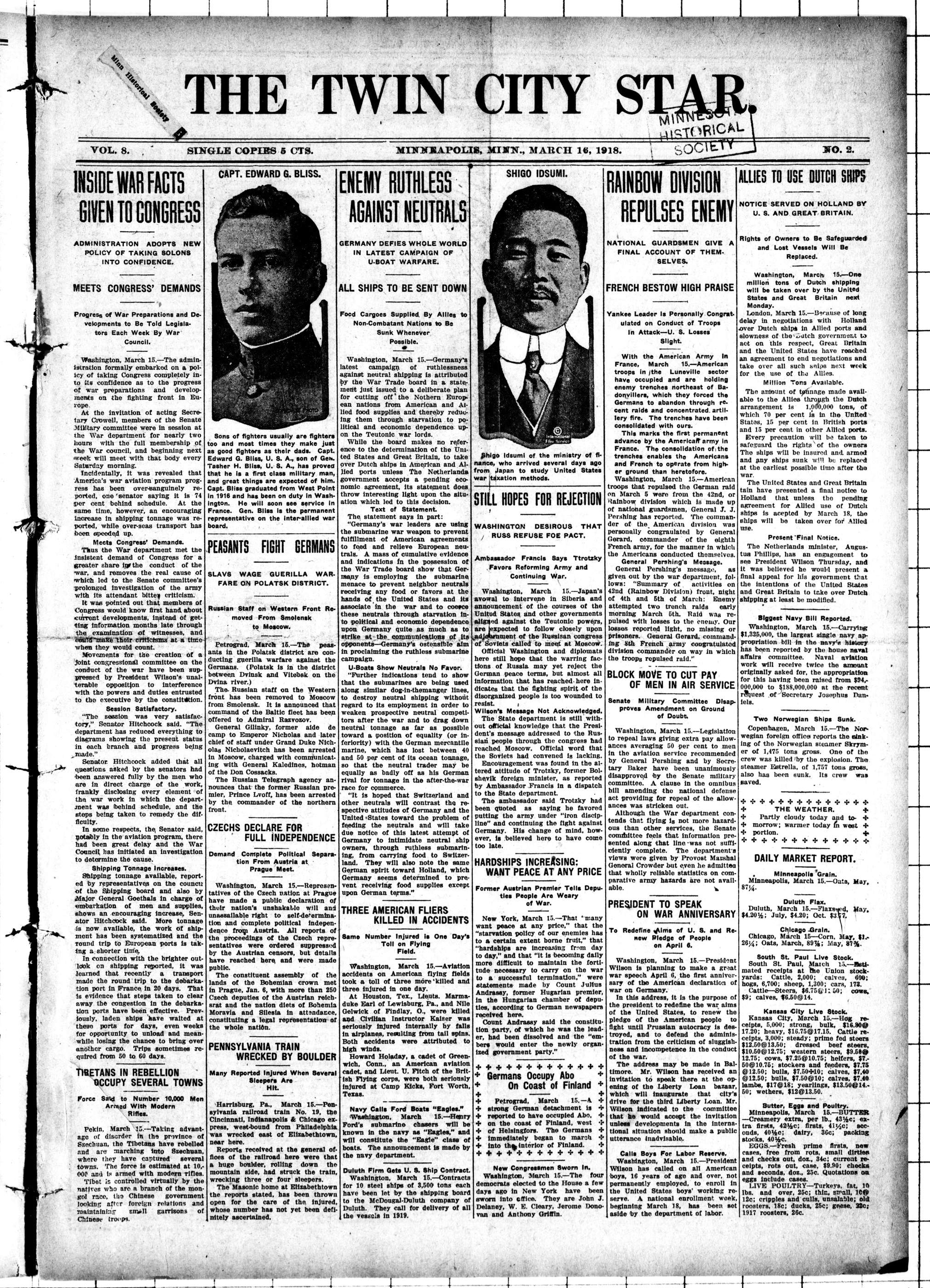
Page text (machine-generated)
INSIDE WAR FACTS GIVEN TO CONGRESS
ADMINISTRATION ADOPTS NEW POLICY OF TAKING SOLONS INTO CONFIDENCE.
MEETS CONGRESS' DEMANDS
Progress of War Preparations and Develpments to Be Told Legislators Each Week By War
Washington, March 15.—The administration formally embarked on a policy of taking Congress completely into its confidence as to the progress of war preparations and developments on the fighting front in Europe.
At the invitation of acting Secretary Crowell, members of the Senate Military committee were in session at the War department for nearly two hours with the full membership of the War council, and beginning next week will meet with that body every Saturday morning.
Incidentally, it was revealed that America's war aviation program progress has been over-sanguinely reported, one 'senator saying it is 74 per cent behind schedule. At the same time, however, an encouraging increase in shipping tonnage was reported, while over-seas transport has been speeded up.
Mects Congress' Demands.
Thus the War department met the insistent demand of Congress for a greater share in the conduct of the war, and removes the real cause of which led to the Senate committee's prolonged investigation of the army with its attendant bitter criticism. It was pointed out that members of Congress would know first hand about current developments, instead of getting information months late through the examination of witnesses, and could make their criticisms at a time when they would count. Movements for the creation of a joint congressional committee on the conduct of the war have been suppressed by President Wilson's unalterable opposition to interference with the powers and duties entrusted to the executive by the constitution.
Session Satisfactory
"The session was very satisfactory," Senator Hitchcock said. "The department has reduced everything to diagrams showing the present status in each branch and progress being made."
Senator Hitchcock added that all questions asked by the senators had been answered fully by the men who are in direct charge of the work, frankly disclosing every element of the war work in which the department was behind schedule, and the steps being taken to remedy the difficulty.
In some respects, the Senator said, notably in the aviation program, there had been great delay and the War Council has initiated an investigation to determine the cause.
Shipping Tonnage Increases.
Shipping tonnage available, reported by representatives on the council of the Shipping board and also by Major General Goethals in charge of embarkation of men and supplies, shows an encouraging increase, Senator Hitchcock said. More tonnage is now available, the work of shipment has been systematized and the round trip to European ports is taking a shorter time.
In connection with the brighter outlook on shipping reported, it was learned that recently a transport made the round trip to the debarkation port in France in 20 days. That is evidence that steps taken to clear away the congestion in the debarkation ports have been effective. Previously, laden ships have waited at these ports for days, even weeks for opportunity to unload and meanwhile losing the chance to bring over another cargo. Trips sometimes required from 50 to 60 days.
TIBETANS IN REBELLION
OCCUPY SEVERAL TOWNS
Force Said to Number 10,000 Men Armed With Modern Rifles.
Pekin, March 15.—Taking advantage of disorder in the province of Szechuan, the Tibetans have rebelled and are marching into Szechuan, where they have captured several towns. The force is estimated at 10,000 and is armed with modern rifles. Tibet is controlled virtually by the natives who are a branch of the mongol race, the Chinese government looking after foreign relations and maintaining small garrisons of Chinese troops.
THE TWIN CITY STAR
CAPT. EDWARD G. BLISS.
BROOKLYN PHOTO
Sons of fighters usually are fighters too and most times they make just as good fighters as their dads. Capt. Edward G. Bliss, U. S. A., son of Gen. Tasher H. Bliss, U. S. A., has proved that he is a first class military man, and great things are expected of him. Capt. Bliss graduated from West Point in 1916 and has been on duty in Washington. He will soon see service in France. Gen. Bliss is the permanent representative on the inter-allied war board.
PEASANTS FIGHT GERMANS
SLAVS WAGE GUERILLA WAR
FARE ON POLATSK DISTRICT.
Petrograd, March 15.—The peasants in the Polatsk district are conducting guerilla warfare against the Germans. (Polatsk is in the district between Dvinsk and Vitebsk on the Dvina river.)
The Russian staff on the Western front has been removed to Moscow from Smolensk. It is announced that command of the Baltic fleet has been offered to Admiral Razovozov.
General Gillinky, former aide de camp to Emperor Nicholas and later chief of staff under Grand Duke Nicholas Nicholaevitch has been arrested in Moscow, charged with communicating with General Kaledines, hotman of the Don Cossacks.
The Russian Telegraph agency announces that the former Russian premier, Prince Lvoff, has been arrested by the commander of the northern front.
CZECHS DECLARE FOR
FULL INDEPENDENCE
Demand Complete Political Separation From Austria at Prague Meet.
Washington, March 15.—Representatives of the Czech nation at Prague have made a public declaration of their nation's unshakable will and unassailable right to self-de-ermination and complete political independence from Austria. All reports of the proceedings of the Czech representatives were ordered suppressed by the Austrian censors, but details have reached here and were made public.
The constituent assembly of the lands of the Bohemian crown met in Prague, Jan. 6, with more than 250 Czech deputies of the Austrian reichsrat and the nation diets of Bohemia Moravia and Silesia in attendance, constituting a legal representation of the whole nation.
PENNSYLVANIA TRAIN
WRECKED BY BOULDER
Many Reported Injured When Several Sleepers Are Hit.
Harrisburg, Pa., March 15.—Pensylvania railroad train No. 19, the Cincinnati, Indianapolis & Chicago express, west-bound from Philadelphia was wrecked east of Elizabethtown, near here.
Reports received at the general offices of the railroad here were that a huge boulder, rolling down the mountain side, had struck the train, wrecking three or four sleepers.
The Masonic home at Elizabethtown the reports stated, has been thrown open for the care of the injured, whose number has not yet been definitely ascertained.
MINNEAPOLIS, MINN., MARCH 16, 1918.
ENEMY RUTHLESS AGAINST NEUTRALS
ENEMY RUTHLESS AGAINST NEUTRALS
GERMANY DEFIES WHOLE WORLD
IN LATEST CAMPAIGN OF
U-BOAT WARFARE.
ALL SHIPS TO BE SENT DOWN
Food Cargoes Supplied By Allies to Non-Combatant Nations to Be Sunk Whenever
Washington, March 15.—Germany's latest campaign of ruthlessness against neutral shipping is attributed by the War Trade board in a statement just issued to a deliberate plan for cutting off the Northern European nations from American and Allied food supplies and thereby reducing them through starvation to political and economic dependence upon the Teutonic war lords.
While the board makes no reference to the determination of the United States and Great Britain, to take over Dutch ships in American and Allied ports unless The Netherlands government accepts a pending economic agreement, its statement does throw interesting light upon the situation which led to this decision.
"Germany's war leaders are using the submarine war weapon to prevent fulfillment of American agreements to feed and relieve European neutrals. A mass of cumulative evidence and indications in the possession of the War Trade board show that Germany is employing the submarine menace to prevent neighbor neutrals receiving any food or favors at the hands of the United States and its associate in the war and to coerce these neutrals through starvation into political and economic dependence upon Germany quite as much as to strike at the communications of its opponents-Germany's ostensible aim in proclaiming the ruthless submarine campaign.
U-Boats Show Neutrals No Favor.
"Further indications tend to show that the submarines are being used along similar dog-in-the-manger lines, to destroy neutral shipping without regard to its employment in order to weaken prospective neutral competitors after the war and to drag down neutral tonnage as far as possible toward a position of equality (or inferiority) with the German mercantile marine, which has lost between 40 and 50 per cent of its ocean tonnage, so that the neutral trader may be equally as badly off as his German rival for tonnage in the after-the-war race for commerce.
"It is hoped that Switzerland and other neutrals will contrast the respective attitudes of Germany and the United States toward the problem of feeding the neutrals and will take due notice of this latest attempt of Germany to intimidate neutral ship owners, through ruthless submaring, from carrying food to Switzerland. They will also note the same German spirit toward Holland, which Germany seems determined to prevent receiving food supplies except upon German terms."
THREE AMERICAN FLIERS KILLED IN ACCIDENTS
Same Number Injured is One Day's Toll on Flying Field.
Washington, March 15.—Aviation accidents on American flying fields took a toll of three more killed and three injured in one day.
At Houston, Tex., Lieuts. Marmaduke Earl of Lewisburg, Pa., and Nile Gelwick of Findlay, O., were killed and Civilian Instructor Kaiser was seriously injured internally by falls in airplanes, resulting from tall spins. Both accidents were attributed to high winds.
Howard Holaday, a cadet of Greenwich, Conn., an American aviation cadet, and Lieut. U. Fitch of the British Flying corps, were both seriously injured at Camp Kicks, Fort Worth, Texas.
Navy Calls Ford Boats "Eagles."
Washington, March 15.—Henry Ford's submarine chasers will be known in the navy as "Eagles," and will constitute the "Eagle" class of boats. The announcement is made by the navy department.
Duluth Firm Gets U. S. Ship Contract. Washington, March 15.—Contracts for 10 steel ships of 3,500 tons each have been let by the shipping board to the McDougal-Duluth company of Duluth. They call for delivery of all the vessels in 1919.
SHIGO IDSUMI.
International
Film Service
Shige Idsumi of the ministry of finance, who arrived several days ago from Japan to study United States war taxation methods.
STILL HOPES FOR REJECTION
WASHINGTON DESIROUS THAT RUSS REFUSE FOE PACT.
Ambassador Francis Says Ttrotzky Favors Reforming Army and Continuing War.
Washington, March 15.—Japan's avowal to intervene in Siberia and announcement of the courses of the United States and other governments aligned against the Teutonic powers, are expected to follow closely upon adjournment of the Russian congress of Soviets called to meet at Moscow.
Official Washington and diplomats here still hope that the warring factions of Russia may yet reject the German peace terms, but almost all information that has reached here indicates that the fighting spirit of the disorganized people is too wounded to resist.
Wilson's Message Not Acknowledged.
The State department is still without official knowledge that the President's message addressed to the Russian people through the congress had reached Moscow. Official word that the Soviets had convened is lacking.
Encouragement was found in the altered attitude of Ttrotzky, former Bolshevik foreign minister, as reported by Ambassador Francis in a dispatch to the State department.
The ambassador said Trotzky had been quoted as saying he favored putting the army under "iron discipline" and continuing the fight against Germany. His change of mind, however, is believed here to have come too late.
HARDSHIPS INCREASING:
WANT PEACE AT ANY PRICE
Former Austrian Premier Tells Deputies People Are Weary of War.
New York, March 15.—That 'many want peace at any price," that the "starvation policy of our enemies has to a certain extent borne fruit," that "hardships are increasing from day to day," and that "it is becoming daily more difficult to maintain the fortitude necessary to carry on the war to a successful termination," were statements made by Count Julfus Andrassy, former Hugarian premier, in the Hungarian chamber of deputies, according to German newspapers received here.
Count Andrassy said the constitution party, of which he was the leader, had been dissolved and the "embers would enter the newly organized government party."
Germans Occupy Abo
On Coast of Finland
* Petrograd, March 15.—A * strong German detachment is * reported to have occupied Abo. * on the coast of Finland, west * of Helsingfors. The Germans * immediately began to march * into the interior of Finland. *
New Congressmen Sworn In.
Washington, March 15.—The four democrats elected to the House a few days ago in New York have been sworn into office. They are John J. Delaney, W. E. Cleary, Jerome Donovan and Anthony Griffin.
RAINBOW DIVISION REPULSES ENEMY
NATIONAL GUARDSMEN GIVE A FINAL ACCOUNT OF THEM- SELVES.
FRENCH BESTOW HIGH PRAISE
Yankee Leader Is Personally Congratulated on Conduct of Troops In Attack—U. S. Losses
With the American Army In France, March 15.—American troops in / the Luneville sector have occupied and are holding enemy trenches northeast of Badyvillers, which they forced the Germans to abandon through recent raids and concentrated artillery fire. The trenches have been consolidated with ours.
This marks the first permanent advance by the American army in France. The consolidation of the trenches enables the Americans and French to operate from higher ground than heretofore.
Washington, March 15.—American troops that repulsed the German raid on March 5 were from the 42nd, or Rainbow division which is made up of national guardsmen, General J. J. Pershing has reported. The commander of the American division was personally congreculated by General Gerard, commander of the eighth French army, for the manner in which the Americans conducted themselves.
General Pershing's Message.
General Pershing's message, as given out by the war department, follows: "Summary of activities on 42nd (Rainbow Division) front, night of 4th and 5th of March: Enemy attempted two trench raids early morning March 5th. Raid was repulsed with losses to the enemy. Our losses reported light, no missing or prisoners. General Gerard, commanding 8th French army congratulated division commander on way in which the troops repulsed raid."
BLOCK MOVE TO CUT PAY OF MEN IN AIR SERVICE
Senate Military Committee Disapproves Amendment on Ground of Doubt.
Washington, March 15.—Legislation to repeal laws giving extra pay allowances averaging 50 per cent to men in the aviation service recommended by General Pershing and by Secretary Baker have been unanimously disapproved by the Senate military committee. A clause in the omnibus bill amending the national defense act providing for repeal of the allowances was stricken out.
Although the War department contends that flying is not more hazardous than other services, the Senate committee feels that information presented along that line was not sufficiently complete. The department's views were given by Provost Marshal General Crowder but even he admitted that wholly reliable statistics on comparative army hazards are not available.
PRESIDENT TO SPEAK ON WAR ANNIVERSARY
To Redefine Alms of U. S. and Renew Pledge of People on April 6.
Washington, March 15.—President Wilson is planning to make a great war speech April 6, the first anniversary of the American declaration of war on Germany.
In this address, it is the purpose of the president to redefine the war aims of the United States, to renew the pledge of the American people to fight until Prussian autocracy is destroyed, and to defend the administration from the criticism of sluggishness and incompetence in the conduct of the war.
The address may be made in Baltimore. Mr. Wilson has received an invitation to speak there at the opening of the Liberty Loan bazaar, which will inaugurate that city's drive for the third Liberty Loan. Mr. Wilson indicated to the committee that he would accept the invitation unless developments in the international situation should make a public utterance inadvisable.
Calla Boys For Labor Reserve
Calls Boys For Labor Reserve
Washington, March 15.—President Wilson has called on all American boys, 16 years of age and over, not permanently employed, to enroll in the United States boys' working reserve. A national enrollment week, beginning March 18, has been set aside by the department of labor.
NO. 2.
ALLIES TO USE DUTCH SHIPS
NOTICE SERVED ON HOLLAND BY U. S. AND GREAT BRITAIN.
Rights of Owners to Be Safeguarded and Lost Vessels Will Be
Washington, March 15.—One million tons of Dutch shipping will be taken over by the United States and Great Britain next Monday. London, March 15.—Because of long delay in negotiations with Holland over Dutch ships in Allied ports and slowness of the Dutch government to act on this respect, Great Britain and the United States have reached an agreement to end negotiations and take over all such ships next week for the use of the Allies.
Million Tons Available.
The amount of teenage made available to the Allies through the Dutch arrangement is 1,000,000 tons, of which 70 per cent is in the United States, 15 per cent in British ports and 15 per cent in other Allied ports. Every precaution will be taken to safeguard the rights of the owners. The ships will be insured and armed and any ships sunk will be replaced at the earliest possible time after the war. The United States and Great Britain tain have presented a final notice to Holland that unless the pending agreement for Allied use of Dutch ships is accepted by March 18, the ships will be taken over for Allied use.
Present 'Final Notice.
The Netherlands minister, Augustus Phillips, has an engagement to see President Wilson Thursday, and it was believed he would present a final appeal for his government that the intentions of the United States and Great Britain to take over Dutch shipping at least be modified.
Biggest Navy Bill Reported.
Washington, March 15—Carrying $1,325,000, the largest single navy appropriation bill in the navy's history has been reported by the house naval affairs committee. Naval aviation work will receive twice the amount originally asked for, the appropriation for this having been raised from $34,000,000 to $188,000,000 at the recent request of Secretary Josephus Daniels.
Two Norwegian Ships Sunk.
Copenhagen, March 15.—The Norwegian foreign office reports the sinking of the Norwegian steamer Skrymer of 1,475 tons gross. One of the crew was killed by the explosion. The steamer Estrella, of 1,757 tons gross, also has been sunk. Its crew was saved.
THE WEATHER.
Partly cloudy today and to-morrow; warmer today in west portion.
DAILY MARKET REPORT.
Minneapolis Grain.
Minneapolis, March 15.—Oats, May.
87½.
Duluth Flax.
Duluth, March 15.—Flaxseed, May.
$4.20½; July, $4.20; Oct. $377.
Chicago Grain.
Chicago, March 15—Corn, May, $1-
26¼; Oats, March, 89½; May, 87½.
South St. Paul Live Stock.
South St. Paul, March 15.—Estimated receipts at the Union stock-
yards: Cattle, 2,000; calves, 600;
hogs, 6,700; sheep, 1,300; cars, 173.
Cattle—Steers, $6.75@1.50; cows,
$9; calves, $6.50@14.
Kansas City Live Stock.
Kansas City, March 15—Hog receipts, 5,000; strong, bulk, $16.80@17.20; heavy, $16.75@17.15. Cattle receipts, 3,000; steady; prime fed steers $12.50@13.50; dressed beef steers $10.50@12.75; western steers, $9.58@12.75; cows, $7.25@10.75; hefters, $7.50@10.75; stockers and feeders, $7.75@12.50; bulls, $7.50*10; calves, $7.40@12.50; bulls, $7.50*10; calves, $7.40 lambe, $17*18; yearlings, $13.50@14.50; wethers, $12@13.50.
Butter, Eggs and Poultry.
Minneapolis, March 15—BUTTER
—Creamery extra, per lb., 43½c; extra firsts, 42½c; firsts, 41½c; seconds, 40½c; dairy, 36c; packing stocks, 40½c.
EGGS.—Fresh prime firsts, new cases, free from rots, small dirties and checks out, doz, 34c; current receipts, rots out, case, $9.90; checks and seconds, 25c. Quotations on eggs include cases.
LIVE POULTRY—Turkeys, fat, 10 lbs. and over, 25c; thin, small, 16¾ 12c; cripples and culls, unsalable; old roosters, 18c; ducks, 25c; geese, 22c; 1917 roosters, 26c.
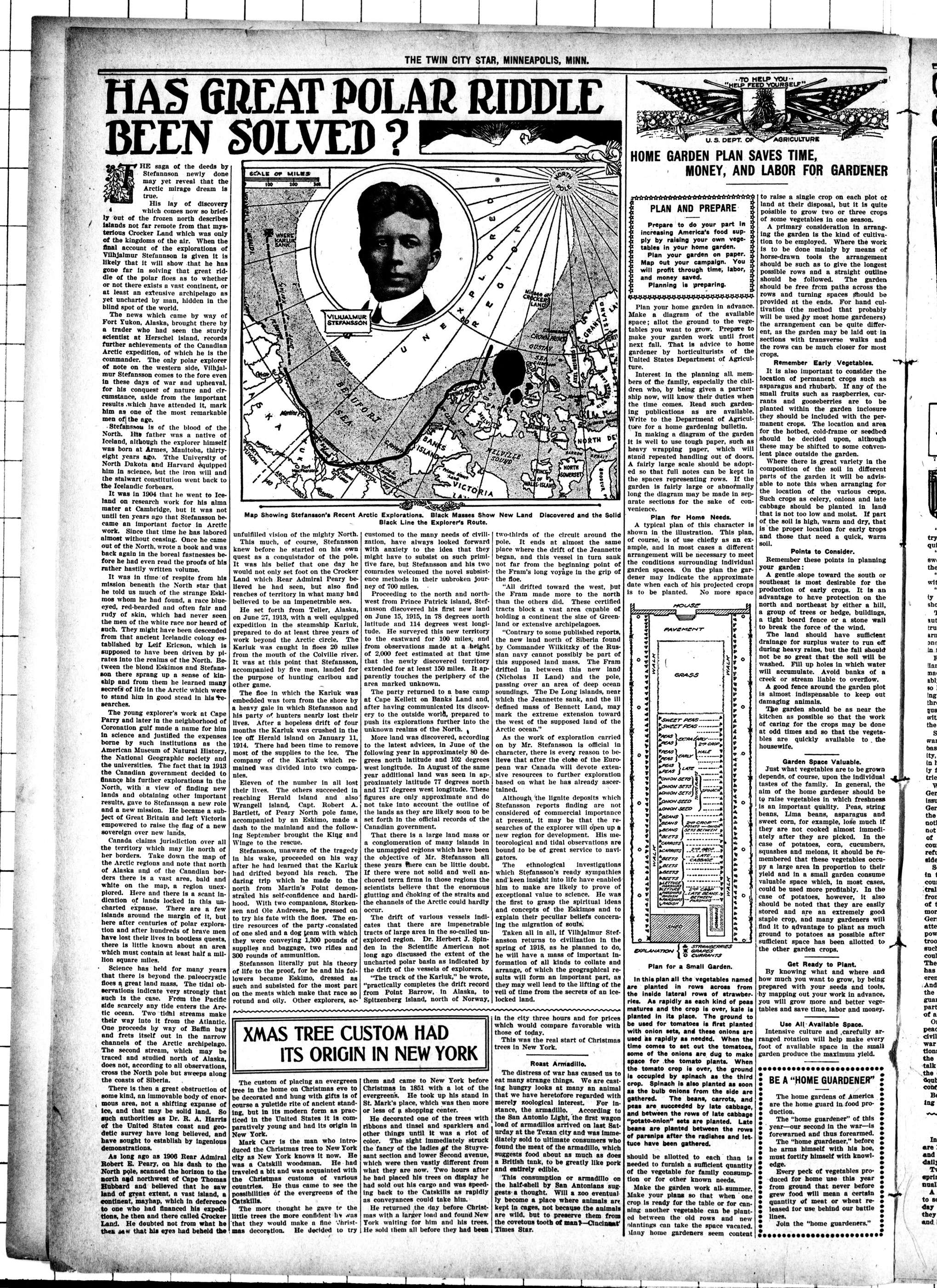
HAS GREAT POLAR RIDDLE BEEN SOLVED?
HE saga of the deeds by Stefannson newly done may yet reveal that the Arctic mirage dream is true.
T
His lay of discovery which comes now so brief
which comes now so briefly out of the frozen north describes islands not far remote from that mysterious Crocker Land which was only of the kingdoms of the air. When the final account of the explorations of Vilhjhulm Stefannson is given it is likely that it will show that he has gone far in solving that great riddle of the polar floes as to whether or not there exists a vast continent, or at least an extensive archipelago as yet uncharted by man, hidden in the blind spot of the world.
The news which came by way of Fort Yukon, Alaska, brought there by a trader who had seen the sturdy scientist at Herschel island, records further achievements of the Canadian Arctic expedition, of which he is the commander. The only polar explorer of note on the western side, Vilhjalmur Stefansson comes to the fore even in these days of war and upheaval, for his conquest of nature and circumstance, aside from the important results which have attended it, mark him as one of the most remarkable men of the age.
Stefansson is of the blood of the North. His father was a native of Iceland, although the explorer himself was born at Armes, Manitoba, thirty-eight years ago. The University of North Dakota and Harvard equipped him in science, but the iron will and the stalwart constitution went back to the Icelandic forbears.
It was in 1904 that he went to Iceland on research work for his alma mater at Cambridge, but it was not until ten years ago that Stefansson became an important factor in Arctic work. Since that time he has labored almost without ceasing. Once he came out of the North, wrote a book and was back again in the boreal fastnesses before he had even read the proofs of his rather hastily written volume.
It was in time of respite from his mission beneath the North star that he told us much of the strange Eskimos whom he had found, a race blue-eyed, red-bearded and often fair and rudy of skin, which had never seen the men of the white race nor heard of such. They might have been descended from that ancient Icelandic colony established by Leif Ericson, which is supposed to have been driven by pirates into the realms of the North. Between the blond Eskimos and Stefansson there sprang up a sense of kinship and from them he learned many secrets of life in the Arctic which were to stand him in good stead in his researches.
The young explorer's work at Cape Parry and later in the neighborhood of Coronation gulf made a name for him in science and justified the expenses borne by such institutions as the American Museum of Natural History, the National Geographic society and the universities. The fact that in 1913 the Canadian government decided to finance his further explorations in the North, with a view of finding new lands and obtaining other important results, gave to Stefansson a new role and a new mission. He became a subject of Great Britain and left Victoria empowered to raise the flag of a new sovereign over new lands.
Canada claims jurisdiction over all the territory which may lie north of her borders. Take down the map of the Arctic regions and note that north of Alaska and of the Canadian borders there is a vast area, bald and white on the map, a region unexplored. Here and there is a scant indication of lands locked in this uncharted expanse. There are a few islands around the margin of it, but here after centuries of polar exploration and after hundreds of brave men have lost their lives in bootless quests, there is little known about an area which must contain at least half a million square miles.
Science has held for many years that there is beyond the paleocrystic floes a great land mass. The tidal observations indicate very strongly that such is the case. From the Pacific side scarcely any tide enters the Arctic ocean. Two tidal streams make their way into it from the Atlantic. One proceeds by way of Baffin bay and frets itself out in the narrow channels of the Arctic archipelago. The second stream, which may be traced and studied north of Alaska, does not, according to all observations, cross the North pole but sweeps along the coasts of Siberia.
There is then a great obstruction of some kind, an immovable body of enormous area, not a shifting expanse of ice, and that may be solid land. So such authorities as Dr. R. A. Harris of the United States coast and geodetic survey have long believed, and have sought to establish by ingenious demonstrations.
As long ago as 1906 Rear Admiral Robert E. Peary, on his dash to the North pole, scanned the horizon to the north and northwest of Cape Thomas Hubbard and believed that he saw land of great extent, a vast island, a continent, mayhap, which in deference to one who had financed his expeditions, he then and there called Crocker Land. He doubted not from what he then saw that his eyes had behold the
SCALE OF MILES
100 200 300
NORTH POLE
UNEXPLORED
WHERE KARLUN SANK
VILHUALMUR STEFANSSON
Milage of CROCKER'S LAND
CROWN POINT GUSTAV
SEA CLIMBING
GRANT ISLAND
NORTH DE
MARTINS PARK
BEAUFORT SEA
BANKS ISLAND
WELVILLER SOUND
VICTORIA
PRINCE OF WALLES ISLAND
NORTH SOVERSET
Map Showing Stefansson's Recent Arctic Explorations. Black Masses Show New Land Discovered and the Solid Black Line the Explorer's Route.
XMAS TREE CUSTOM HAD ITS ORIGIN IN NEW YORK
unfulfilled vision of the mighty North. This much, of course, Stefansson knew before he started on his own quest as a conquistador of the pole. It was his belief that one day he would not only set foot on the Crocker Land which Rear Admiral Peary believed he had seen, but also find reaches of territory in what many had believed to be an Impenetrable sea. He set forth from Teller, Alaska, on June 27, 1913, with a well equipped expedition in the steamship Karluk, prepared to do at least three years of work beyond the Arctic circle. The Karluk was caught in floes 20 miles from the mouth of the Colville river. It was at this point that Stefansson, accompanied by five men, landed for the purpose of hunting caribou and other game.
The floe in which the Karluk was embedded was torn from the shore by a heavy gale in which Stefansson and his party of hunters nearly lost their lives. After a hopeless drift of four months the Karluk was crushed in the ice off Herald island on January 11, 1914. There had been time to remove most of the supplies to the ice. The company of the Karluk which remained was divided into two companies. Eleven of the number in all lost their lives. The others succeeded in reaching Herald island and also Wrangell Island, Capt. Robert A. Bartlett, of Peary North pole fame, accompanied by an Eskimo, made a dash to the mainland and the following September brought the King and Winge to the rescue.
Stefansson, unaware of the tragedy in his wake, proceeded on his way after he had learned that the Karluk had drifted beyond his reach. The daring trip which he made to the north from Martin's Point demonstrated his self-confidence and hardihood. With two companions, Storksen and Ole Andresen, he pressed on to try his fate with the floes. The entire resources of the party consisted of one sled and a dog team with which they were conveying 1,300 pounds of supplies and baggage, two rifles and 300 rounds of ammunition.
Stefansson literally put his theory of life to the proof, for he and his followers became Eskimo, dressed as such and subsisted for the most part on the meats which make that race so rotund and oily. Other explorers, ac-
The custom of placing an evergreen tree in the home on Christmas eve to be decorated and hung with gifts is of course a yuletide rite of ancient standing, but in its modern form as practiced in the United States it is comparatively young and had its origin in New York.
Mark Carr is the man who introduced the Christmas tree to New York city as New York knows it now. He was a Catskill woodsman. He had traveled a bit and was acquainted with the Christmas customs of various countries. He thus came to see the possibilities of the evergreens of the Catskills.
The more thought he gave to the little trees the more confident he was that they would make a fine Christmas decoration. He decided to try
THE TWIN CITY STAR, MINNEAPOLIS, MINN.
customed to the many needs of civilization, have always looked forward with anxiety to the idea that they might have to subsist on such primitive fare, but Stefansson and his two comrades welcomed the novel subsistence methods in their unbroken journey of 700 miles.
Proceeding to the north and northwest from Prince Patrick island, Stefansson discovered his first new land on June 15, 1915, in 78 degrees north latitude and 114 degrees west longitude. He surveyed this new territory to the eastward for 100 miles, and from observations made at a height of 2,000 feet estimated at that time that the newly discovered territory extended for at least 150 miles. It apparently touches the periphery of the area marked unknown.
The party returned to a base camp at Cape Kellett on Banks Land and, after having communicated its discovery to the outside world, prepared to push its explorations further into the unknown realms of the North. More land was discovered, according to the latest advices, in June of the following year in approximately 80 degrees north latitude and 102 degrees west longitude. In August of the same year additional land was seen in approximately latitude 77 degrees north and 117 degrees west longitude. These figures are only approximate and do not take into account the outline of the lands as they are likely soon to be set forth in the official records of the Canadian government.
That there is a large land mass or a conglomeration of many islands in the unmapped regions which have been the objective of Mr. Stefansson all these years there can be little doubt. If there were not solid and well anchored terra firma in those regions the scientists believe that the enormous glutting and choking of the straits and the channels of the Arctic could hardly occur.
The drift of various vessels indicates that there are impenetrable tracts of large area in the so-called unexplored region. Dr. Herbert J. Spinden in the Scientific American not long ago discussed the extent of the uncharted polar basin as indicated by the drift of the vessels of explorers.
"The track of the Karluk," he wrote, "practically completes the drift record from Point Barrow, in Alaska, to Spitzenberg island, north of Norway,
them and came to New York before Christmas in 1851 with a lot of the evergreens. He took up his stand in St. Mark's place, which was then more or less of a shopping center. He decorated one of the trees with ribbons and tinsel and sparklers and other things until it was a riot of color. The sight immediately struck the fancy of the ladies of the Stuyvesant section and lower Second avenue, which were then vastly different from what they are now. Two hours after he had placed his trees on display he had sold out his cargo and was speeding back to the Catskills as rapidly as conveyances could take him. He returned the day before Christmas with a larger load and found New York waiting for him and his trees. He sold them all before they had been
two-thirds of the circuit around the pole. It ends at almost the same place where the drift of the Jeannette began, and this vessel in turn sank not far from the beginning point of the Fram's long voyage in the grip of the floe.
"All drifted toward the west, but the Fram made more to the north than the others did. These certified tracts block a vast area capable of holding a continent the size of Greenland or extensive archipelagoes.
"Contrary to some published reports, the new land north of Siberia found by Commander Wilkitzky of the Russian navy cannot possibly be part of this supposed land mass. The Fram drifted in between this new land (Nicholas II Land) and the pole, passing over an area of deep ocean soundings. The De Long islands, near which the Jeannette sank, and the ill defined mass of Bennett Land, may mark the extreme extension toward the west of the supposed land of the Arctic ocean."
As the work of exploration carried on by Mr. Stefansson is official in character, there is every reason to believe that after the close of the European war Canada will devote extensive resources to further exploration based on what he has already ascertained.
Although the lignite deposits which Stefansson reports finding are not considered of commercial importance at present, it may be that the researches of the explorer will open up a new region for development. His meteorological and tidal observations are bound to be of great service to navigators.
The ethnological investigations which Stefansson's ready sympathies and keen insight into life have enabled him to make are likely to prove of exceptional value to science. He was the first to grasp the spiritual ideas and concepts of the Eskimos and to explain their peculiar beliefs concerning the migration of souls.
Taken all in all, if Vilhjalmur Stefansson returns to civilization in the spring of 1918, as he planned to do, he will have a mass of important information of all kinds to collate and arrange, of which the geographical results will form an important part, as they may well lead to the lifting of the veil of time from the secrets of an ice-locked land.
in the city three hours and for prices which would compare favorable with those of today.
This was the real start of Christmas trees in New York.
Roast Armadillo.
The distress of war has caused us to eat many strange things. We are casting hungry looks at many an animal that we have heretofore regarded with merely zoological interest. For instance, the armadillo. According to the San Antonio Light, the first wagon load of armadillos arrived on last Saturday at the Texan city and was immediately sold to ultimate consumers who found the meat of the armadillo, which suggests food about as much as does a British tank, to be greatly like pork and entirely edible.
This consumption or armadillo on the half-shell by San Antonians suggests a thought. Will a zoo eventually become a place where animals are kept in cages, not because the animals are wild, but to preserve them from the covetous tooth of man?—Cincinnati Times Star.
TO HELP YOU
"HELP FEED YOURSELF"
U.S. DEPT. OF AGRICULTURE
HOME GARDEN PLAN SAVES TIME, MONEY, AND LABOR FOR GARDENER
PLAN AND PREPARE
Prepare to do your part in increasing America's food supply by raising your own vegetables in your home garden. Plan your garden on paper. Map out your campaign. You will profit through time, labor, and money saved.
Plan your home garden in advance Make a diagram of the available space; allot the ground to the vegetables you want to grow. Prepare to make your garden work until frost next fall. That is advice to home gardener by horticulturists of the United States Department of Agriculture. Interest in the planning all members of the family, especially the children who, by being given a partnership now, will know their duties when the time comes. Read such gardening publications as are available Write to the Department of Agriculture for a home gardening bulletin.
In making a diagram of the garden it is well to use tough paper, such as heavy wrapping paper, which will stand repeated handling out of doors. A fairly large scale should be adopted so that full notes can be kept in the spaces representing rows. If the garden is fairly large or abnormally long the diagram may be made in separate sections for the sake of convenience.
Plan for Home Needs.
A typical plan of this character is shown in the illustration. This plan, of course, is of use chiefly as an example, and in most cases a different arrangement will be necessary to meet the conditions surrounding individual garden spaces. On the plan the gardener may indicate the approximate date when each of his projected crops is to be planted. No more space
HOUSE
PAVEMENT
WALK
GRASS
SWEET PEAS
SWEET PEAS
PEAS
EXTRA EARLY
2'DROP
PEAS
PEAS
EARLY
HALE
PEAS
PEAS
LATE
ONION SETS
ONION SETS
ONION SETS
ONION SEED
ONION SEED
BEANS
BEANS
BEANS
BEETS
CARROTS
CARROTS
2'DROP
BEETS
LATE
CABBAGE
BEETS
BEETS
BEETS
BEETS
LETIVUS
LETIVUS
AMMONS
AMMONS
BARBISH
BARBISH
LANDISH
2'DROP
LATE BEANS.
PARKHIS
SHED
EXPLANATION
STRAWBERRIES
GRAPES
Plan for a Small Garden.
In this plan all the vegetables named are planted in rows across from the inside lateral rows of strawberries. As rapidly as each kind of pea matures and the crop is over, kale is planted in its place. The ground to be used for tomatoes is first planted with onion sets, and these onions are used as rapidly as needed. When the time comes to set out the tomatoes, some of the onions are dug to make space for the tomato plants. When the tomato crop is over, the ground is occupied by spinach as the third crop. Spinach is also planted as soon as the bulb onions from the side are gathered. The beans, carrots, and peas are succeeded by late cabbage and between the rows of late cabbage "potato-onlon" sets are planted. Late beans are planted between the rows of parsnips after the radishes and lettuce have been gathered.
should be allotted to each than is needed to furnish a sufficient quantity of the vegetable for family consumption or for other known needs.
Make the garden work all-summer.
Make your plans so that when one crop is ready for the table or for canning another vegetable can be planted between the old rows and new plantings can take the space vacated.
Many home gardeners seem content
to raise a single crop on each plot of land at their disposal, but it is quite possible to grow two or three crops of some vegetables in one season. A primary consideration in arranging the garden is the kind of cultivation to be employed. Where the work is to be done mainly by means of horse-drawn tools the arrangement should be such as to give the longest possible rows and a straight outline should be followed. The garden should be free from paths across the rows and turning spaces should be provided at the ends. For hand cultivation (the method that probably will be used by most home gardeners) the arrangement can be quite different, as the garden may be laid out in sections with transverse walks and the rows can be much closer for most crops.
Remember Early Vegetables.
It is also important to consider the location of permanent crops such as asparagus and rhubarb. If any of the small fruits such as raspberries, currants and gooseberries are to be planted within the garden enclosure they should be included with the permanent crops. The location and area for the hotbed, cold-frame or seedbed should be decided upon, although these may be shifted to some convenient place outside the garden.
Where there is great variety in the composition of the soil in different parts of the garden it will be advisable to note this when arranging for the location of the various crops. Such crops as celery, onions and late cabbage should be planted in land that is not too low and moist. If part of the soil is high, warm and dry, that is the proper location for early crops and those that need a quick, warm soil.
Points to Consider.
Remember these points in planning your garden:
A gentle slope toward the south or southeast is most desirable for the production of early crops. It is an advantage to have protection on the north and northeast by either a hill, a group of trees or hedge, buildings, a tight board fence or a stone wall to break the force of the wind.
The land should have sufficient drainage for surplus water to run off during heavy rains, but the fall should not be so great that the soil will be washed. Fill up holes in which water will accumulate. Avoid banks of a creek or stream liable to overflow.
A good fence around the garden plot is almost indispensable to keep out damaging animals.
The garden should be as near the kitchen as possible so that the work of caring for the crops may be done at odd times and so that the vegetables are quickly available to the housewife.
Garden Space Valuable.
Just what vegetables are to be grown depends, of course, upon the individual tastes of the family. In general, the aim of the home gardener should be to raise vegetables in which freshness is an important quality. Peas, string beans, Lima beans, asparagus and sweet corn, for example, lose much if they are not cooked almost immediately after they are picked. In the case of potatoes, corn, cucumbers, squashes and melons, it should be remembered that these vegetables occupy a large area in proportion to their yield and in a small garden consume valuable space which, in most cases, could be used more profitably. In the case of potatoes, however, it also should be noted that they are easily stored and are an extremely good staple crop, and many gardeners will find it to advantage to plant as much ground to potatoes as possible after sufficient space has been allotted to the other garden crops.
Get Ready to Plant.
By knowing what and where and how much you want to grow, by being prepared with your seeds and tools, by mapping out your work in advance, you will grow more and better vegetables and save time, labor and money.
Use All Available Space.
Intensive culture and carefully arranged rotation will help make every foot of available space in the small garden produce the maximum yield.
BE A "HOME GUARDENER"
```markdown
```
The home gardens of America are the home guard in food production.
The "home guardener" of this year—our second in the war—is forewarned and thus forearmed.
The "home guardener," before he arms himself with his hoe, must fortify himself with knowledge.
Every peck of vegetables produced for home use this year from ground that never before grew food will mean a certain quantity of meat or wheat released for use behind our battle lines.
Join the "home guardeners."
Where World Peace May Be Concluded
Switzerland Likely to Stage Conference
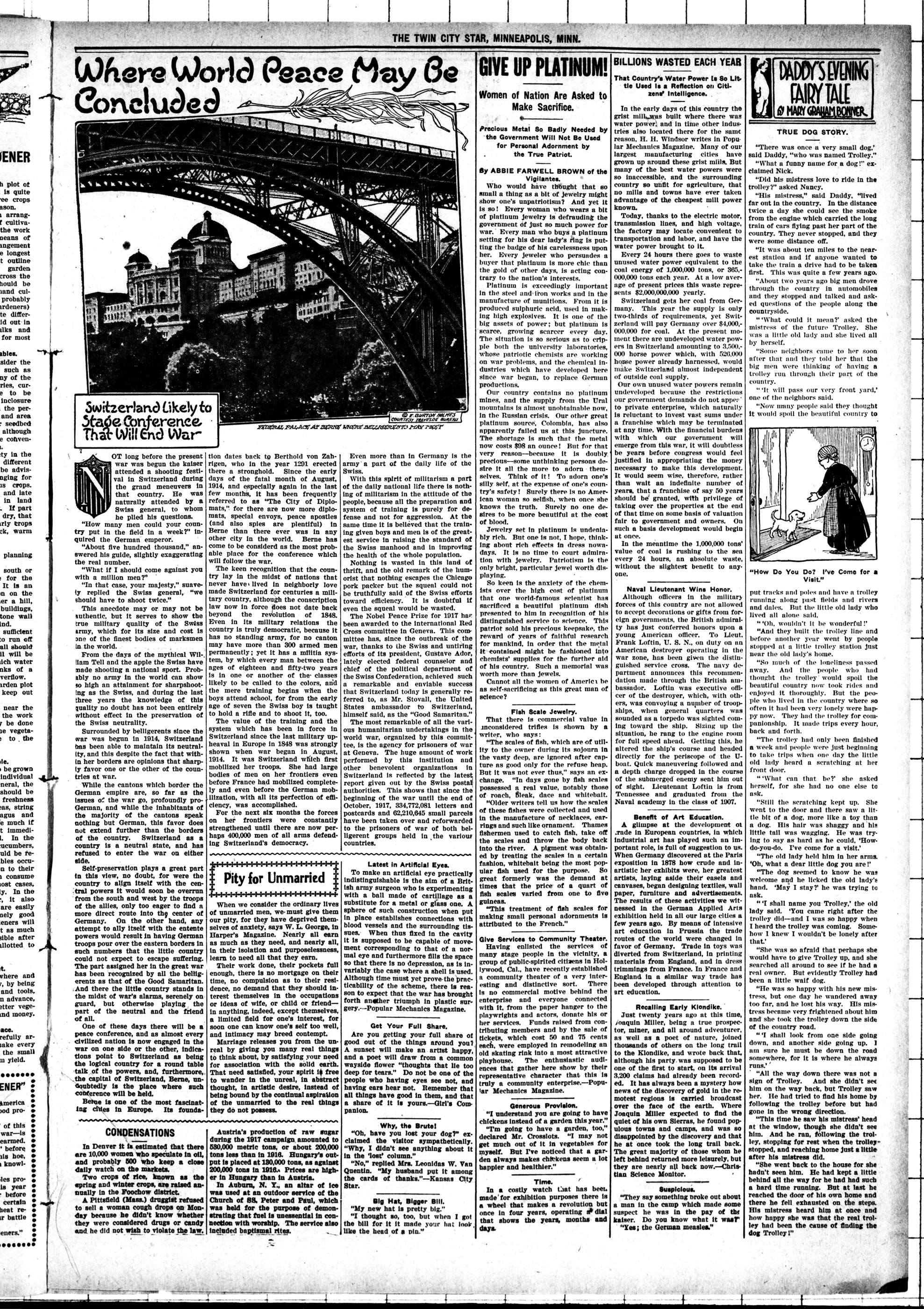
FEDERAL PALACE AS BEFORE WHATSEE BELLINGERS TO FLY TRAVEL
N
OT long before the present war was begun the kaiser attended a shooting festival in Switzerland during the grand meeuvers in that country. He was naturally attended by a Swiss general, to whom he pled his questions.
"How many men could your country put in the field in a week?" inquired the German emperor.
"About five hundred thousand," answered his guide, slightly exaggerating the real number.
"What if I should come against you with a million men?"
"In that case, your majesty," suavey replied the Swiss general, "we should have to shoot twice."
This anecdote may or may not be authentic, but it serves to show the true military quality of the Swiss army, which for its size and cost is one of the finest bodies of marksmen in the world.
From the days of the mythical William Tell and the apple the Swiss have made shooting a national sport. Probably no army in the world can show so high an attainment for sharpshooting as the Swiss, and during the last three years the knowledge of this quality no doubt has not been entirely without effect in the preservation of the Swiss neutrality.
Surrounded by belligerents since the war was begun in 1914, Switzerland has been able to maintain its neutrality, and this despite the fact that within her borders are opinions that sharply favor one or the other of the countries at war.
While the cantons which border the German empire are, so far as the issues of the war go, profoundly pro-German, and while the Inhabitants of the majority of the cantons speak nothing but German, this favor does not extend further than the borders of the country. Switzerland as a country is a neutral state, and has refused to enter the war on either side.
Self-preservation plays a great part in this view, no doubt, for were the country to align itself with the central powers it would soon be overrun from the south and west by the troops of the allies, only too eager to find a more direct route into the center of Germany. On the other hand, any attempt to ally itself with the entente powers would result in having German troops pour over the eastern borders in such numbers that the little country could not expect to escape suffering. The part assigned her in the great war has been recognized by all the belligerents as that of the Good Samaritan. And there the little country stands in the midst of war's alarms, serenely on guard, but otherwise playing the part of the neutral and the friend of all.
One of these days there will be a peace conference, and as almost every civilized nation is now engaged in the war on one side or the other, indications point to Switzerland as being the logical country for a round table talk of the powers, and, furthermore, the capital of Switzerland, Berne, undoubtedly is the place where such conference will be held.
Berne is one of the most fascinating cities in Europe. Its founda-
CONDENSATIONS
In Denver it is estimated that there are 10,000 women who speculate in oil, and probably 500 who keep a close daily watch on the markets.
Two crops of rice, known as the spring and winter crops, are raised annually in the Foochow district.
A Pittsfield (Mass.) druggist refused to sell a woman cough drops on Monday because he didn't know whether they were considered drugs or candy and he did not wish to violate the law.
FEDERAL PALACE AT BERNE WHERE BELLIGERENTS MAY TELT
tion dates back to Berthold von Zahrigen, who in the year 1201 erected there a stronghold. Since the early days of the fatal month of August, 1914, and especially again in the last few months, it has been frequently referred to as "The City of Diplomats," for there are now more diplomats, special envoys, peace apostles (and also spies are plentiful) in Berne than there ever was in any other city in the world. Berne has come to be considerd as the most probable place for the conference which will follow the war.
The keen recognition that the country lay in the midst of nations that never have lived in neighborly love made Switzerland for centuries a military country, although the conscription law now in force does not date back beyond the revolution of 1848. Even in its military relations the country is truly democratic, because it has no standing army, for no canon may have more than 300 armed men permanently; yet it has a militia system, by which every man between the ages of eighteen and fifty-two years is in one or another of the classes likely to be called to the colors, and the mere training begins when the boys attend school, for from the early age of seven the Swiss boy is taught to hold a rifle and to shoot it, too.
The value of the training and the system which has been in force in Switzerland since the last military upheaval in Europe in 1848 was strongly shown when war began in August, 1914. It was Switzerland which first mobilized her troops. She had large bodies of men on her frontiers even before France had mobilized completely and even before the German mobilization, with all its perfection of efficiency, was accomplished.
For the next six months the forces on her frontiers were constantly strengthened until there are now perhaps 400,000 men of all arms defending Switzerland's democracy.
When we consider the ordinary lives of unmarried men, we must give them our pity, for they have deprived themselves of anxiety, says W. L. George, in Harper's Magazine. Nearly all earn as much as they need, and nearly all, in their isolation and purposelessness, learn to need all that they earn. Their work done, their pockets full enough, there is no mortgage on their time, no compulsion as to their residence, no demand that they should interest themselves in the occupations or ideas of wife, or child or friend—in anything, indeed, except themselves, a limited field for one's interest, for soon one can know one's self too well, and intimacy may breed contempt.
Marriage releases you from the unreal by giving you many real things to think about, by satisfying your need for association with the solid earth. That need satisfied, your spirit is free to wander in the unreal, in abstract thought, in artistic desire, instead of being bound by the continual aspiration of the unmarried to the real things they do not possess.
Austria's production of raw sugar during the 1917 campaign amounted to 580,000 metric tons, or about 200,000 tons less than in 1916. Hungary's output is placed at 180,000 tons, as against 200,000 tons in 1916. Prices are higher in Hungary than in Austria.
In Auburn, N. Y., an altar of ice was used at an outdoor service of the Church of SS. Peter and Paul, which was held for the purpose of demonstrating that fuel is unessential in connection with worship. The service also included baptismal rites.
THE TWIN CITY STAR, MINNEAPOLIS, MINN.
Even more than in Germany is the army a part of the daily life of the Swiss. With this spirit of militarism a part of the daily national life there is nothing of militarism in the attitude of the people, because all the preparation and system of training is purely for defense and not for aggression. At the same time it is believed that the training given boys and men is of the greatest service in raising the standard of the Swiss manhood and in improving the health of the whole population. Nothing is wasted in this land of thrift, and the old remark of the humorist that nothing escapes the Chicago pork packer but the squelal could not be truthfully said of the Swiss efforts toward efficiency. It is doubtful if even the squelal would be wasted.
The Nobel Peace Prize for 1917 has been awarded to the International Red Cross committee in Geneva. This committee has, since the outbreak of the war, thanks to the Swiss and untiring efforts of its president, Gustave Ador, lately elected federal counselor and chief of the political department of the Swiss Confederation, achieved such a remarkable and enviable success that Switzerland today is generally referred to, as Mr. Stovall, the United States ambassador to Switzerland, himself said, as the "good Samaritan."
The most remarkable of all the various humanitarian undertakings in the world war, organized by this committee, is the agency for prisoners of war at Geneva. The huge amount of work performed by this institution and other benevolent organizations in Switzerland is reflected by the latest report given out by the Swiss postal authorities. This shows that since the beginning of the war until the end of October, 1917, 384,772,081 letters and postcards and 62,210,645 small parcels have been taken over and reforwarded to the prisoners of war of both belligerent groups held in the various countries.
Latest in Artificial Eyes
To make an artificial eye practically indistinguishable is the aim of a British army surgeon who is experimenting with a ball made of cartilage as a substitute for a metal or glass one. A sphere of such construction when put in place establishes connections with blood vessels and the surrounding tissues. When thus fixed in the cavity it is supposed to be capable of movement corresponding to that of a normal eye and furthermore fills the space so that there is no depression, as is invariably the case where a shell is used. Although time must yet prove the practicability of the scheme, there is reason to expect that the war has brought forth another triumph in plastic surgery....Popular Mechanics Magazine.
Get Your Full Share.
Are you getting your full share of good out of the things around you? A sunset will make an artist happy, and a poet will draw from a common wayside flower "thoughts that lie too deep for tears." Do not be one of the people who having eyes see not, and having ears hear not. Remember that all things have good in them, and that a share of it is yours.—Girl's Companion.
Why, the Brute!
"Oh, have you lost your dog?" exclaimed the visitor sympathetically. "Why, I didn't see anything about it in the 'lost' column." "No," replied Mrs. Leonidas W. Van Quentin. "My husband put it among the cards of thanks."—Kansas City Star.
Big Hat, Bigger Bill.
"I thought so, too, but when I got the bill for it it made your hat look like the head of a pin."
Women of Nation Are Asked to Make Sacrifice.
Precious Metal So Badly Needed by the Government Will Not Be Used for Personal Adornment by the True Patriot.
By ABBIE FARWELL BROWN of the Violantes.
Who would have thought that so small a thing as a bit of jewelry might show one's unpatriotism? And yet it is so! Every woman who wears a bit of platinum jewelry is defrauding the government of just so much power for war. Every man who buys a platinum setting for his dear lady's ring is putting the badge of his carelessness upon her. Every jeweler who persuades a buyer that platinum is more chic than the gold of other days, is acting contrary to the nation's interests.
Platinum is exceedingly important in the steel and iron works and in the manufacture of munitions. From it is produced sulphuric acid, used in making high explosives. It is one of the big assets of power; but platinum is scarce, growing scarcer every day. The situation is so serious as to cripple both the university laboratories, whose patriotic chemists are working on war problems, and the chemical industries which have developed here since war began, to replace German productions.
Our country contains no platinum mines, and the supply from the Ural mountains is almost unobtainable now, in the Russian crisis. Our other great platinum source, Colombia, has also apparently failed us at this juncture. The shortage is such that the metal now costs $08 an ounce! But for that very reason—because it is doubly precious—some unthinking persons desire it all the more to adorn themselves. Think of it! To adorn one's silly self, at the expense of one's country's safety! Surely there is no American woman so selfish, when once she knows the truth. Surely no one desires to be more beautiful at the cost of blood.
Jewelry set in platinum is undeniably rich. But one is not, I hope, thinking about rich effects in dress nowadays. It is no time to court admiration with jewelry. Patriotism is the only bright, particular jewel worth displaying.
So keen is the anxiety of the chemists over the high cost of platinum that one world-famous scientist has sacrificed a beautiful platinum dish presented to him in recognition of his distinguished service to science. This patriot sold his precious keepsake, the reward of years of faithful research for mankind, in order that the metal it contained might be fashioned into chemists' supplies for the further aid of his country. Such a memorial was worth more than jewels.
Cannot all the women of America be as self-sacrificing as this great man of science?
Flish Scale Jewelry
That there is commercial value in inconsidered trifles is shown by a writer, who says:
"The scales of fish, which are of utility to the owner during its sojourn in the vasty deep, are ignored after capture as good only for the refuse heap. But it was not ever thus," says an exchange.
"In days gone by fish scales possessed a real value, notably those of roach, bleak, dace and whitebait.
"Older writers tell us how the scales of these fishes were collected and used in the manufacture of necklaces, earrings and such like ornament. Thames fishermen used to catch fish, take off the scales and throw the body back into the river. A pigment was obtained by treating the scales in a certain fashion, whitebait being the most popular fish used for the purpose. So great formerly was the demand at times that the price of a quart of fish scales varied from one to five gulneas.
"This treatment of fish scales for making small personal adornments is attributed to the French."
Give Services to Community Theater. Having enlisted the services of many stage people in the vicinity, a group of public-spirited citizens in Hollywood, Cal., have recently established a community theater of a very interesting and distinctive sort. There is no commercial motive behind the enterprise and everyone connected with it, from the paper hanger to the playwrights and actors, donate his or her services. Funds raised from contributing members and by the sale of tickets, which cost 50 and 75 cents each, were employed in remodeling an old skating rink into a most attractive playhouse. The enthusiastic audiences that gather here show by their representative character that this is truly a community enterprise.—Popular Mechanics Magazine.
Generous Provision.
"I understand you are going to have chickens instead of a garden this year." "I'm going to have a garden, too," declared Mr. Crosslots. "I may not get much out of it in vegetables for myself. But I've noticed that a garden always makes chickens seem a lot happier and healthier."
Time.
In a costly watch that has been made for exhibition purposes there is a wheel that makes a revolution but once in four years, operating dial that shows the years, months and days.
BILLIONS WASTED EACH YEAR
That Country's Water Power Is So Little Used is a Reflection on Citizens' Intelligence.
In the early days of this country the grist mill was built where there was water power, and in time other industries also located there for the same reason, H. H. Windsor writes in Popular Mechanics Magazine. Many of our largest manufacturing cities have grown up around these grist mills. But many of the best water powers were so inaccessible, and the surrounding country so unfit for agriculture, that no mills and towns have ever taken advantage of the cheapest mill power known.
Today, thanks to the electric motor, transmission lines, and high voltage, the factory may locate convenient to transportation and labor, and have the water power brought to it.
Every 24 hours there goes to waste unused water power equivalent to the coal energy of 1,000,000 tons, or 365,000,000 tons each year. At a low average of present prices this waste represents $2,000,000,000 yearly.
Switzerland gets her coal from Germany. This year the supply is only two-thirds of requirements, yet Switzerland will pay Germany over $4,000,000 for coal. At the present moment there are undeveloped water powers in Switzerland amounting to 3,500,000 horse power which, with 526,000 horse power already harnessed, would make Switzerland almost independent of outside coal supply.
Our own unused water powers remain undeveloped because the restrictions our government demands do not appear to private enterprise, which naturally is reluctant to invest vast sums under a franchise which may be terminated at any time. With the financial burdens with which our government will emerge from this war, it will doubtless be years before congress would feel justified in appropriating the money necessary to make this development. It would seem wise, therefore, rather than wait an indefinite number of years, that a franchise of say 50 years should be granted, with privilege of taking over the properties at the end of that time on some basis of valuation fair to government and owners. On such a basis development would begin at once.
In the meantime the 1,000,000 tons' value of coal is rushing to the sea every 24 hours, an absolute waste, without the slightest benefit to anyone.
Naval Lieutenant Wins Honor
Naval Lieutenant Wins Honor. Although officers in the military forces of this country are not allowed to accept decorations or gifts from foreign governments, the British admiralty has just conferred honors upon a young American officer. To Lieut. Frank Loftin, U. S. N., on duty on an American destroyer operating in the war zone, has been given the distinguished service cross. The navy department announces this recommendation made through the British ambassador. Loftin was executive officer of the destroyer, which, with others, was conveying a number of troopships, when general quarters was sounded as a torpedo was sighted coming toward the ship. Sizing up the situation, he rang to the engine room for full speed ahead. Getting this, he altered the ship's course and headed directly for the periscope of the U-boat. Quick maneuvering followed and a depth charge dropped in the course of the submerged enemy sent him out of sight. Lieutenant Loftin is from Tennessee and graduated from the Naval academy in the class of 1907.
Benefit of Art Education.
A glimpse at the development on trade in European countries, in which industrial art has played such an important role, is full of suggestion to us. When Germany discovered at the Paris exposition in 1878 how crude and inartistic her exhibits were, her greatest artists, laying aside their easels and canvases, began designing textiles, wall paper, furniture and advertisements. The results of these activities we witnessed in the German Applied Arts exhibition held in all our large cities a few years ago. By means of intensive art education in Prussia the trade routes of the world were changed in favor of Germany. Trade in toys was diverted from Switzerland, in printing materials from England, and in dress trimmings from France. In France and England in a similar way trade has been developed through attention to art education.
Recalling Early Klondike.
Just twenty years ago at this time, Joaquin Miller, being a true prospector, miner, and all around adventurer, as well as a poet of nature, joined thousands of others on the long trail to the Klondike, and wrote back that, although his party was supposed to be one of the first to start, on its arrival 3,200 claims had already been recorded. It has always been a mystery how news of the discovery of gold in the remotest regions is carried broadcast over the face of the earth. Where Joaquin Miller expected to find the quiet of his own Sierra, he found populous towns and camps, and was so disappointed by the discovery and that he at once took the long trail back. The great majority of those whom he left behind returned more leisurely, but they are nearly all back now.—Christian Science Monitor.
Suspicious.
"They say something broke out about a man in the camp which made some suspect he was in the pay of the kaiser. Do you know what it was?" "Yes; the German measles."
DADDY'S EVENING
FAIRY TALE
MARY GRAHAM BONNER
"There was once a very small dog,' said Daddy, "who was named Trolley."
"What a funny name for a dog!" exclaimed Nick.
"Did his mistress love to ride in the trolley?" asked Nancy.
"His mistress," said Daddy, "lived far out in the country. In the distance twice a day she could see the smoke from the engine which carried the long train of cars flying past her part of the country. They never stopped, and they were some distance off.
"It was about ten miles to the nearest station and if anyone wanted to take the train a drive had to be taken first. This was quite a few years ago.
"About two years ago big men drove through the country in automobiles and they stopped and talked and asked questions of the people along the countryside.
"What could it mean?" asked the mistress of the future Trolley. She was a little old lady and she lived all by herself.
"Some neighbors came to her soon after that and they told her that the big men were thinking of having a trolley run through their part of the country.
"It will pass our very front yard," one of the neighbors said.
"Now many people said they thought it would spoil the beautiful country to
"How Do You Do? I've Come for a Visit."
put tracks and poles and have a trolley running along past fields and rivers and dales. But the little old lady who lived all alone said.
"Oh, wouldn't it be wonderful!"
"And they built the trolley line and before another year went by people stopped at a little trolley station just near the old lady's home.
"So much of the loneliness passed away. And the people who had thought the trolley would spoil the beautiful country now took rides and enjoyed it thoroughly. But the people who lived in the country where so often it had been very lonely were happy now. They had the trolley for companionship. It made trips every hour, back and forth.
"The trolley had only been finished a week and people were just beginning to take trips when one day the little old lady heard a scratching at her front door.
'What can that be?' she asked herself, for she had no one else to ask.
'Still the scratching kept up. She went to the door and there saw a little bit of a dog, more like a toy than a dog. His hair was shaggy and his little tail was wagging. He was trying to say as hard as he could. 'How-do you-do. I've come for a visit.'
'The old lady held him in her arms. 'Oh, what a dear little dog you are!'
'The dog seemed to know he was welcome and he licked the old lady's hand. 'May I stay?' he was trying to ask.
'I shall name you Trolley,' the old lady said. 'You came right after the trolley did—and I was so happy when I heard the trolley was coming. Somehow I knew I wouldn't be lonely after that.'
"She was so afraid that perhaps she would have to give Trolley up, and she searched all around to see if he had a real owner. But evidently Trolley had been a little waff dog.
"He was so happy with his new mistress, but one day he wandered away too far, and he lost his way. His mistress became very frightened about him and she took the trolley down the side of the country road.
"I shall look from one side going down, and another side going up. I am sure he must be down the road somewhere, for it is where he always runs."
"All the trolley down there was not a sign of Trolley. And she didn't see him on the way back, but Trolley saw her. He had tried to find his home by following the trolley before but had gone in the wrong direction.
"This time he saw his mistress' head at the window, though she didn't see him. And he ran, following the trolley, stopping for rest when the trolley stopped, and reaching home just a little after his mistress did.
"She went back to the house for she hadn't seen him. He had kept a little behind all the way for he had had such a hard time running. But at last he reached the door of his own home and there he fell exhausted on the steps. His mistress heard him at once and how happy she was that the real trolley had been the cause of finding the dog Trolley!"
PUBLISHED EVERY FRIDAY BY CHARLES SUMNER SMITH, Minneapolis, Minnesota. Entered in the Post Office at Minneapolis as second class matter. MEMBER NATIONAL NEGRO PRESS ASSOCIATION
ADVERTISING RATES.
One Inch—1 Insertion—One Dollar.
Liberal discount given on 3, 6, 9,
Months, or 1 year contracts.
We do not run free ads, or over-run
the time contracted for by our ad
vertisers We respect their right to
advertise at intervals, and rather have
them do so, than to run continuously
an "adv." and an increasing account.
Write all Checks payable to
Call at 1317 6th Ave. N. on Wednesday to insure matter for publication. The Star's Phone, Hyland 1205. Send your subscription. Our prices have not changed because of the war. Let your dollar do its duty and The Star will reach a higher standard of service and better circulation.
Negro Must Use "Extreme Caution"
and Face Facts Squately.
Atlantic City, Feb. 28. "The American Negro needs to exercise extreme caution lest it be swept away on a wave of false optimism," says Floyd Delos Francis, secretary-general of the Negro American Alliance.
In a statement which the Alliance is sending out from its national headquarters, the Secretary General continues: "It is well to be optimistic and look on the bright side of thnigs, but there is a danger mark that must be carefully avoided. At the present time there is much machine-made opinion finding its way into the public print. The Negro is being assured that all is well. There is much talk about what he has done in the past and how he can be depended upon in the future. He is being lauded as an American citizen who always rises equal to the emergency. While being filled with enthusiasm by hired enthusiasts it is well for him to pause, face the facts squarely and use his common sense.
"We are at war with Austria, yet Austrian alien enemies have more privileges than Negro soldiers in uniform. The fact is that democracy is being made a farce and mockery right here in America. It is time for the Negro to cease fooling himself or when the war is over he will be lost." - Balto-Afro-American Ledger.
SOUTHERN JUSTICE
AT REDUCED PRICES
The administration of justice (1)
to Negroes in the southland is both
speedy and economic. It is cheaper
to lynch a Negro than erect a scaffold and purchase a pine box; or keep him alive as an inmate of a penal institution. Also it is a combination of business and pleasure to publicly cremate a Negro man or woman to make a civic holiday—and less expensive. There is no loss of time, money or material in their due process of Lynch law. They are sowing the wind and have not figured the cost.
YOUR PUBLICITY PAYS
All persons interested in the progress of their lodges, churches, societies etc., should value the power of printer's ink. They should see that their secretaries SEND ALL NOTICES to the newspapers in proper time. They think the Editor should attend every affair, whether invited or not, and should know "What is going on?"—without being informed. Many exchanges clip from our columns, and often things done in Minneapolis get national publicity.
THE TWIN CITY STAR will be sent to any out of town address. Send your subscription in postage stamps. Read your home paper while visiting in other cities. It's like a letter from home.
AGENTS WANTED—NOW!
Reliable and intelligent agents always wanted to solicit business for THE TWIN CITY STAR; also correspondents in principal cities. A chance to earn a good living. Write The Twin City Star, Minneapolis.
READ THIS CAREFULLY
If you receive a newspaper by mail and do not wish to pay for it, just refuse it by informing your postman. Then it will be returned to the publisher and he will be notified to discontinue sending it. There is no reason why a person should pay for a paper forced on them, but every season why it should be paid for when ordered and accepted.
Secretaries of Lodges may send notices of their newly elected officers for free publication and office information.
TRADE BRIEF OF INTEREST
Garden and grass seeds are in de mand in Argentina.
Prices for an asbestos shingle plant are wanted in Bristol, Va.
An Italian firm has asked for catalogues for flour mill machinery.
Peruvian merchants wish to purchase a plant for the manufacture of absorbent cotton.
Data and prices on gas analysis instruments are desired by a concern in Clarksdale, Miss.
A market exists in India for power plants, such as engines and equipment for the hauling of rice.
A French firm in Lyon wants to represent American makers of yarns, schappe silk and artificial silk.
Brick supplies are needed for new university buildings in Atlanta, Ga. The buildings are to cost $225,000.
There is a market in Rio de Janelro, Brazil, for rabbit hair that can be used for the making of felt hats.
An odorless garbage can has been invented in which refuse is placed on a shelf and scraped into the receptacle by turning a handle without opening the lid.
For motor trucks with broad, flat tires an Englishman has invented an antiskidding device consisting of large metal rings fastened together with chains.
Double-tread wheels have been invented for motortrucks, the inner treads, which are slightly smaller than the tire-carrying ones, being formed to fit railroad tracks.
All previous records of grain-handling were broken by the government elevator at Bort Colborne, Ontario, when 404,000 bushels of wheat were discharged in eight hours.
Doors for a double garage invented by a Washington man consist of two at the sides, hung in the usual manner, and a central one double the size of the others, swung on a central pivot.
The rain falls, but it gets up again in dew time.
An outward laugh often conceals an inward groan.
A pistol is twice as dangerous when the owner is loaded.
A very little woman is often at the bottom of a very big fuss.
Usually the path of a budding genius is pretty well strewn with thorns.
Every old bachelor thinks it the easiest thing in the world to manage a wife.
WITH THE SAGES
Chance and accident are only aliases for ignorance.—Huxley.
The great man is he who does not lose his child's heart.—Mencius.
Good, the more communicated, the more abundant grows.—Milton.
We conquer our fate when we submit to it cheerfully.—Horace Smith.
It is another's fault if he be ungrateful; but it is mine if I do not give.—Seneca.
Be always displeased at what thou art, if thou desire to attain to what thou art not; for where thou hast pleased thyself, there thou abidest.—Quarles.
We may judge of whether we are going upward or not by the views we are getting. "Do your thoughts range more widely from year to year, and is your life filled with more and higher interests?"—Selected.
There are three friendships which are advantageous, and three which are injurious. Friendship with the upright; friendship with the sincere, and friendship with the man of observation; these are advantageous. Friendship with the insinuatingly soft, and friendship with the glib-tongued; these are injurious—Confucius.
POPULAR SCIENCE
Iron money is passing in Germany, and the Siamese are using porcelain.
Hygiene is being taught to the less civilized natives of the Philippines with motion pictures.
Bivalves suspected of bearing pearls are examined by the X-ray to avoid destroying the shellfish.
The protein content of cottonseed flour is in excess of that of meat, and efforts are being made to popularize it as a food.
Dundee manufacturers are about to give up the use of earthenware, glass jars and tins, for a stout cardboard container.
---
THE TWIN CITY STAR, MINNEAPOLIS, MINN.
GLOBE SIGHTS
A banker cannot afford to be too friendly.
Every fixer has some man that he can "fix."
Some people are always mad because some lies aren't the truth.
There are more goats this winter than for many years. Ask father.
Don't depend on congress or the administration; depend on yourself.
There are two ways to guess, but a man-guesses wrong oftener than right.
The man who says he doesn't pay any attention to his competitor is lying.
People are usually willing to do their duty, but they do not like to do too much of it.
An Atchison young man now goes with a country girl, so he can get something to eat now and then.
It is about as much trouble to get a girl ready to go away to school as it is to get her ready to be married.
Don't review your work in the evening unless you want to know how poorly you have done during the day.
Our American Jews don't want to go back to Jerusalem any more than our German-Americans want to go back to Germany.
Before a woman is married she expects him to pay her compliments; after marriage he is satisfactory if he pays her bills.
A lover, of course, believes he outclasses a husband in the matter of Christmas presents, but how many lovers turn over their entire salaries?
A good many married men are now teasing their wives by saying that so many of our soldiers will be killed off that polygamy will have to be practiced after the war.—Atchison Globe.
FROM COMMERCE REPORTS
Great Britain's ration of wool for civil purposes is to be reduced.
New Zealand is making a determined effort to improve the breed of its stock.
Italy uses little spice, as cheese and tomato pastes are eaten as condiments, together with salt.
Last year the total foreign trade of the United States reached to more than $9,000,000,000, a gain of nearly $1,300,000,000 over 1916.
East Africa complains that American moving picture films are calculated to bring derision upon the courts and are therefore not desirable.
Greece wants merchandise for its emptied shelves. A merchant says: "I am interested in all sorts of goods. I am ready to pay cash for them. The price is of secondary consequence." Ship space is impossible to get.
AROUND THE WORLD
Ireland last year exported 162,823 pigs.
Holland's imports are restricted to necessaries of life by law.
Arizona is agitating for restoration of death penalty for murder.
Balearic islands have an area of 1,936 square miles and 335,860 inhabitants.
Barcelona province, Spain, has an area of 2,966 square miles and 1,136,068 people.
Slam's rice crop has been seriously damaged by recent floods. It is estimated that there will be a loss of 279,000 tons of paddy.
STARS AND STRIPES
In this age, coming events cast their press agents before.
No man ever made many enthusiastic converts praising himself.
When a man dances with his own wife it always looks as though he did so to keep the other fellows away.
Music hath charms, but a lot of sounds that come from the neighbor's graphophone do not always soothe the savage.
HYGIENIC SINNERS
The roller towel.
The janitor or porter who dry-sweeps the floor.
The restaurant toothpick and the cigar cutter.
The streetcar conductor who holds the transfer slips in his mouth.
The cook who tastes from the pot and stirs, with the tasting spoon.
The milkman who takes the temperature of the milk with his finger.
NEWS OF STATE TERSELY TOLD
Recent Happenings In Minnesota Given In Brief Items For Busy Readers.
Detroit.—Alfred Meill, 92 years old, for 46 years a resident of Becker county commissioner for 20 years and a member of the Public Library Commission, died here.
Breckenridge.—The farm bureau board of directors met at the courthouse and approved the appointment of L. S. Stallings as agricultural agent of Wilkin county.
Sandstone.—John H. Sharpe has received definite information from Washington that his brother, Frank Sharpe of Sandstone, was a victim of the torpeded Tuscania.
Isanti.—A very successful Sunday school institute was held in Isanti Sunday afternoon and evening, conducted by A. M. Locker, state secretary of the Minnesota Sunday School association.
Faribault.—Laurence Grote, 27, years old, of this city, hurled himself form the third story window of the St. Lucas hospital, death resulting instantly, when he struck the pavement forty feet below.
St. Peter.—Several German allens in the county who had not registered are seeking registration now. All have been voters and one woman registered whose husband served a term in the Minnesota legislature.
Ada.—Rev. Mr. Hinderline has resigned as pastor of Our Saviour's congregation at this place, his resignation to take effect in May. Rev. Hinderle has been in charge of the congregation here for 11 years.
Roosevelt.—Roosevelt is doing fairly well in the sale of thrift stamps. William Oaks heads the list with $165. A. J. Hamilton has $82.60, while others bring the total up to $500.
Chisago City.—The Red Cross benefitted to the extent of $995 at an auction held here. A cake, donated by Mrs. P. J. Gustafson, brought $72, and a Holstein calf, given by E. L. Peterson, was sold for $136.
Fergus Falls.—Frank E. Hubbard, who, for the past 40 years, has been a resident of Otter Tall county, passed away at his home in Oak Valley of heart failure and other complications due to old age. He was born in Cook county, Ill., Jan. 27, 1851.
Cambridge.—Supt. Thielvoldt and principal, Miss Lundeen, have been appointed enrolling officers of the United States boys' working reserve to enroll boys from 16 to 21 years of age for farm work or other employment to assist in winning the war.
Bemidjil. — Louis Strawbridge, a farmer living near here, was arrested on a charge of illegal sale of liquor. An automobile and several quarts of liquor were seized. Strawbridge refused to stop when ordered, and a shot was fired through his machine. St. Paul.—To prevent further illegal voting by aliens, the public safety commission has been asked to authorize the pulication of lists of aliens who registered as required by the commission a short time ago. J. A. O. Preus, state auditor, made the request saying that unless the lists were printed in some form the very purpose of the registration would be defeated.
St. Paul.—Veterans of the Soldiers home and their freinds and well-wishers throughout the state—which means every one in Minnesota—need not worry over the present financial troubles of the home, for not one old soldier there is to suffer or be inconvenienced. This assurance was given at Governor Burnquist's office. A way will be found promptly and gladly to meet the problem.
Hallock.—A federal officer is here investigating cases of Isaac Lagerquist and his two sons, Andrew Lagerquise and John Lagerquist. The latter is accused of being a deserter from Camp Dodge, and the former is held for an attempt to wreck the Soo flyer near Karlstad. Disloyalty charges may be lodged against the father and his son, John. The attempt to wreck the train failed.
Bemidji. — Roland, Henrionette, a bank clerk, was sentenced to life imprisonment at Stillwater for the murder of Oscar Nelson, a bank clerk, Nov. 15, 1917. Nelson was working in the Northern National bank when Henrionette entered last fall. Henrionette opened an argument with Nelson, it is said, declaring the latter should join the army. During the altercation Nelson was killed. Red Wing.--Fred H. Davis, 67, a pioneer Red Wing resident, committed suicide by cutting the arteries in his wrist with a razor. His body was found by the police after a two-hour search, following his disappearance. Illness and melancholia are thought to have temporarily deranged him. Mr. Davis was at one time Chief of police at Red Wing.
Princeton.—At a meeting of the Dalbo Starch Manufacturing company it was decided to commence buying potatoes and to purchase only from stockholders in the corporation. The factory will be started up immediately after a sufficient quantity of potatoes has been taken in. Long Prairie.—In spite of strongly organized opposition to the county agent movement in the form of petitions from half a dozen townships, the board of county commissioners passed the necessary corporation measure. E.W. Bemis of Reynolds township was elected president of the farm bureau.
Little Falls.—The Morrison county schools will get $13,885 from the state school apportionment for March.
Sandstone.—Supt. G. V. Kinney has been elected school superintendent at International Falls at a salary of $2,500.
Nemadji.—E. Saburn was seriously injured here while attempting to break a horse to the harness. He was removed to a Duluth hospital.
Minneapolis.—J. F. McGee, federal fuel administrator for Minnesota, has been named to supervise transportation of food commodities in this state.
Bagley.—Albert Turner, 53, one of the early settlers of the town of People, died at the St. Vincent's hospital at Crookston. The cause of his death was cancer.
Crookston—Crookston plans to make a strong Red Cross drive for funds for the Polk county chapter of the Red Cross during the month of March and will give a series of entertainments and auctions for that purpose.
Kenyon—George Breidal, a nonpartisan league organizer, was escorted to the railroad station here, forced to kiss the American flag and then purchased a ticket for Dodge Center. He was put on the train with orders not to return.
Mankato—The will of the late Mrs. Johanna Kron was filed and disposed of an estate valued at $120,000. The will divides the estate equally between one son, four daughters and one grandson. Mrs. Kron died February 25, aged 88 years, and her son, Joseph Kron, was the flask white child born in Mankato.
Duluth.While the recent storm was at its height, a loaded street car breaking loose on a hill here, crashed into a tree, and finally into a house at the edge of the street. Three persons were injured, none seriously. The house was moved from its foundation and one side smashed. The car was demolished.
Duluth.Supplies of hard coal have been reduced almost to the vanishing point at most of the docks on both sides of the bay and shipments by companies with supplies are being strictly regulated by state and local fuel administrators. It is believed, however, that consumers dependent upon magazine stoves will be taken care of.
Minneapolis.—Proprietors of stone quarries in Minnesota met here and organized the Minnesota Crushed Stone Producers' association, which will be affiliated with the National Crushed Stone Producers' association. C. D. Brewer, Duluth, was elected as President; B. F. Pay, Mankato, vice president, and J. F. Ganley, Minneapolis, secretary-treasurer. Mora.—A house occupied by Mr. and Mrs. Bert Elliott, near Warman school house, was destroyed by fire, caused by the explosion of an oil stove which was being used. When the explosion occurred the oil was scattered about the room and caught fire. Mr. Elliott was not at home at the time, but Mrs. Elliott, two children and Mrs. Elliott's sister, were in the room and had some difficulty in escaping.
Minneapolis.—There are 850 cars of bailed hay sidetracked along the Willmar division of the Great Northern railroad in Minnesota which will be ruined unless moved soon, said J. F. McGee, Federal fuel administrator for Minnesota, who wired Wm. McAdoo of the necessity of cars to move the product. Mr. McAdoo telegraphed that every effort will be made to increase the car supply, to hasten shipments of the hay.
St. Paul.-H. T. Mosching of Waterville was reported to A. L. Wilson, state food administrator, to have ordered 300 pounds of sugar through a warehouse for his own use. J. M. Drew, an investigator, found that the sugar had not been delivered. He ordered it turned over to a store keeper in Waterville for sale to customers. Mossching explained he was not informed of the regulations ruling the amount of sugar an individual might buy.
St. Paul.—Minnesota high school boys more than 16 will be excused from their school duties to accept positions on farms during the crop season, but they will not be given their full school credits for the time absent, according to action taken at a conference of high school principals of this city interested in the plan. Boys, who remain six months on a farm will receive one unit of credit of their high school course and those working three months will receive one-half unit.
Shakopee—Two French war orphans have been adopted in Shakopee through the efforts of Ms. J. R. Pink. One, a boy, was adopted by Mr. ane Mrs. Pink, and the other, a girl, was adopted by the city. This is the first city in the Northwest officially to adopt an orphan for its own. Pierre Callet, two and a half years old, is the boy adopted by the Mr. and Mrs. Pink and Mile. Lucieanne Montellet, 12 years old, is the girl to be raised by the city. Due to the efforts of Mrs. Pink, sufficient money was raised to assure the children a good education and careful training, together with a plentiful supply of clothing.
Winona—The trained leadership of this nation must not be depleted by the war and for that reason there must be great efforts on the part of educational institutions to equip the young people for the problems that will come at the conclusion of hostilities. This is the message carried to the people of Minnesota by a special committee of the Minnesota state normal school board composed of John C. Wise, Mankato; G. E. Maxwell, Winsena; C. H. Couper, Mankato; J. C. Brown, St. Cloud; F. A. Weld, Moorhead, and E. W. Bohannon, Duluth.
WILSON SENDS SLAVS MESSAGE
President Pledges Support of United States In Restoring Free Russia.
PLEA FOR DEMOCRACY
Word Delivered to Soldiers' and Workmen's Congress Meeting to Pass on Germany's Peace Tokens.
Washington, March 13.—President Wilson has sent a message of sympathy to the Russian people on the eve of the gathering at Moscow of the Russian congress of Soviets, which is to pass judgment on the German made peace accepted by the bolsheviks at Brest-Litovsk. The message is sent through the congress with a pledge that the United State will avail itself of every opportunity to aid them in driving out autocracy and restoring Russia to her place in the world with complete sovereignty and independence.
The United States now recognizes no government in Russia, but the President cabled his message to the American consul at Moscow for delivery to the congress, which is made up of soldiers' and workingmen's representatives and speaks for at least a considerable part of the Russian people.
Wilson's Message.
"May I not take advantage of the meeting of the Congress of the Soviets to express the sincere sympathy which the people of the United States feel for the Russian people at this moment, when the German power has been thrust in to interrupt and turn back the whole struggle for freedom and substitute the wishes of Germany for the purposes of the people of Russia.
"Although the government of the United States is unhappily not now in a position to render the direct and effective aid it would wish to render, I beg to assure the people of Russia, through the congress, that it will avail itself of every opportunity to secure for Russia once more complete sovereignty and independence in her own affairs and full restoration to her great role in the life of Europe and the modern world. The whole heart of the people of the United States is with the people of Russia in the attempt to free themselves from autocratic government and become the masters of their own life.
May Be New Uprising.
The President does not urge the Soviets to reject the peace treaty, though the delivery of his message at this time may be interpreted as suggesting such a course. But there seems to be still a strong belief here that difficulty for Germany in the East by no means is ended; that the humiliating nature of the Teutonic terms begins to be realized by the great mass of the Russians and the tyranny of the war lords in occupied territory shows itself, that will be a new uprising that will make itself felt.
May Lessen Misgivings.
Coming at the time it does, the President's message may serve to lessen misgivings in Russia over the proposed intervention by Japan in Siberia. The understanding here is that there is no difference of opinion among the Allies that any operations undertaken by Japan to check German machinations in the East and protect the war stores at Vladivostek will not in any degree threaten permanently Russia's territorial integrity.
LONG TERMS FOR SOCIALISTS
Twenty to 25 Year Sentences for insubordination Announced.
Camp Dodge, Iowa, March 18—Found guilty by a general courtmartial of refusing to obey orders, eight National army men from St. Paul, all professed socialists, have been sentenced to long terms of imprisonment in the Leavenworth penitentiary, it is announced.
One of the men, A. S. Broms, was given 20 years and the other seven were sentenced to 25 years confinement, all at hard labor.
13 Lost When Tugboat Sinks
New Orleans, March 12. - Thirteen persons, mostly negroes, were last when the tugboat W. A. Blaise saak in the Mississippi river near here, after she rammed a Mexican oil tanker.
Red and White Guards Battle
Stockholm, March 12—Heavy fighting is continuing in Finland between the Finnish White Guard and the Russian Red Guard troops, according to an official statement from the headquarters of the White Guard at Vasa. Violent encounters are reported on the Satakunta and Savalako from Sanguinary fighting is proceeding day and night without interruption in Karelia. The statement announces that the Russians in the Avhola fighting keep continually throwing fresh forces in the fray.
LOCAL NEWS
IMPORTANT NOTICE
Unless notes are written plainly and properly arranged they will not be inserted. Many people send in notes regardless of names, initials or composition. Arrangement by the publisher will be charged for. Free notices must be correctly written.
WAIT FOR THE ANNUAL EASTER BALL of the KNIGHTS OF PYTHIAS AT ARCADE HALL.
Mr. Herbert D. Parker of 3511 Snell- ing Ave., is on the sick list.
Do not forget to send the money to the Star which you owe for subscriptions.
A COMING EVENT.
Hon. Moorefield Story has shown his unawavering attitude in standing for fair play and justice to the Negro and is giving all of his time, money, energy and intelligence to secure their rights guaranteed under the constitution. His recent victory in arguing so successfully the Louisville segregation case in the supreme court in which a unanimous decision favorable to us was handed down, marks him one of, if not the greatest, modern abolitionists.
We can best show our appreciation to Mr. Story as he says: "Do not hold laudatory meetings but I shall feel best repaid, if every branch will join enthusiastically in the effort to secure 50,000 members for the N. A. A. C. P. We need a large membership to insure the permanent success of our great movement against race prejudice. Plans are being perfected for the great MOOREFIELD STORY DRIVE for members. Do your bit towards its success. Join the National Association for the Advancement of Colored People! Do it NOW! R. AUGUSTINE SKINNER
R. AUGUSTINE SKINNER,
Local Secy
Vocal Solo ..... Miss Tiny Whiteside
Dramatic Reading ..... Miss Lawrence
Plano Solo ..... Miss Edith Stone
"Negro Art" ..... Marlon La Reintz
Vocal Solo ..... Prof. Rufus Wilson
MOCK TRIAL AND DANCE.
Come to the big Trial and Dance on Wednesday evening, March 20, at the Pillsbury Settlement House, Fourth street and 16th avenue south. O. A. Lawrence vs. J. H. Redd. Suit arises out of an automobile accident. Messrs. Martin Brown and Rector Hubbard, and Attorneys Harry L. Scott and Gale P. Hilyer, representatives. Trial at 8:15 p. m. Don't fail to hear it. Admission 25c. Benefit of Boy Scouts. --Advertisement.
GUILTY OF MURDER.
Cilton Swendall, 516 12th avenue south, who shot and killed his mother-in-law, Mrs. Eliza Jane Briggs, at her residence, 3119 18th avenue south, and seriously wounded his wife and her brother, Lovel Keith, was found guilty of murder in the district court on March 14th. After the shooting Swendall made his escape and when located slashed his throat with a razor. Atty. W. R. Morris defended him.
Deputy Sheriff John Allison has returned to his position as bailiff in Judge Fish's courtroom. He has been confined to his home several weeks from a broken kneecap, sustained in a fall from his porch. His recovery was remarkable and despite his age he shews no results from his accident.
Mrs. Wm. Smith, 2441 Fifth avenue south, wife of Foreman Smith of the P. O. Dept., has recovered from her illness under the care of Dr. R. S. Brown.
Mr. J. M. Morris has moved his office from the Boston block to his own building at 1719 Fourth avenue south.
Mrs. W. F. McKenzie, 3913 Clinton avenue, and her sister, Mrs. G. W. Wright, 903 No. Fourth street, returned Tuesday from Keokuk, Ia., where they visited their father, Dr. T. H. Phillips, who is recovering from a severe illness.
Mr. Thomas Carroll leaves this week for Parshall, N. D., to put in his crop of 100 acres of wheat and 20 acres of barley. He is one of our successful farmers, having drawn his claim in the government land lottery. His farm is well located and very valuable. Mr. Carroll is employed on the See Ry. running to Duluth.
Mr. Henry Burkes, well known as "Little Heinle," is very ill. at the City hospital. Many friends have called to see him.
Mr. Geo. Slaughter has been very sick, but has returned to work.
A PATRIOTIC MEETING
A PATRIOTIC MEETING
The National Association for the
Advancement of Colored People, will
hold a Loyalty and Patrolotic meeting
at Central High School on Tuesday
night, March 19th
SUBSCRIBE FOR THE STAR
ATTORNEY FRANCIS
SECURES ACQUITTAL
Pullman Porter "Not Gully." Fred Cotton of St. Paul, while employed as a Pullman porter on the Northern Pacific Sta. Ry., severely cut a brakeman at Sta. Minn., on Sept. 27, 1917. He used a knife and 31 stitches were necessary to seep up the cuts. Cotton was tried in the county court at Long Prairie, Minn., this week, charged with assault in the second degree and was acquitted. Atty. Wm. T. Francis of St. Paul defended him. There were no sight witnesses, but depositions were presented from a woman passenger, Mrs. Marguerite J. Taylor, Davenport, Ia., and Watson H. Wyman, Jr., of the battleship New Hampshire, U. S. N., both white. They heard the conversation. Mr. Cotton is a partner in the 20th Century poolroom on Fourth street, St. Paul, and is loud in his praise of the way Atty. Francis presented his case, proving self-defense.
A SPECIAL MEETING.
National Association for the Advancement of Colored People.
It is the duty of every Negro to attend the Mass Loyalty and Patriotic meeting to be held on Tuesday evening, March 19th, at Central high school at 8:15. The auditorium seats 2,000 persons and should be filled with loyal citizens. The following speakers will appear:
Rev. Thomas Cullen—Race Advancement.
Orrington C. 'Hall—Race Preparedness.
Judge W. C. Leary—Race Tolerance.
R. Augustine Skinner—Race Loyalty.
President B. T. Smith of the Minneapolis branch of the National Association for the Advancement of Colored People, will preside.
MORRIS FOR "G. E. B."
W. R. Morris of Ames Lodge, I. B. P. O. Elks of the World, is a candidate for Grand Exalted Ruler. A publicity committee is pushing his candidacy. There are several other candidates and it is believed that Exalted Ruler Armond W. Scott of Washington, D. C., the present exalted ruler, will succeed himself. The convention is scheduled for Baltimore, Md., this year, but there is a general opinion that it will be indefinitely postponed on account of the war which has called to colors many of the Negro Elks all over the country.
MAY QUEEN FESTIVAL
Ames Lodge will have a May Festival and the queen will receive a diamond ring. A committee is getting ready and the girls are getting busy. Watch for the date!
CALLED TO THE COLORS.
W. R. Godette, Jr., 852 Albermarle St. St. Paul, son of Capt. W. R. Godette of the city fire department, left Wednesday for Camp Sherman, Chillicothe, O., to join the 317th engineer's regiment. Mr. Godette is an architect and draftsman. He is a graduate of the Mechanics' Arts high school and took a 3-year course in the architectural department of the University of Minnesota.
YOUNG PEOPLES' LYCEUM
The Young Peoples' Lyceum of St. James M. E. church, Jay and Fuller streets, St. Paul, will meet Sunday, March 17. A special program has been arranged. Attorney Harry L. Scott will be the principal speaker.
Mrs. Gladys Smith returned last week from Des Moines, where she visited her husband, Sergt. Roy Smith of Co. B 366th Inf., Camp Dodge. She had a delightful visit and "Roy" sent his regards to his many friends.
"WAITER'S NIGHT" AT BETHESDA
A Special Program.
Rev. D. E. Beasley of Bethseda Baptist church, will preach a special sermon to the Walters. He expects a large attendance. Rev. Beasley is a favorite among them, with whom he has worked. He was for many years head waiter of the Commercial Club. A special program is being arranged. The public is invited.
Mr. Geo. L. Hoage of St. Paul will be one of the speakers at Bethesda Baptist church on Sunday evening.
Mr. Beverly Keeesee continues ill at his residence, 715 West 31st St. He is slowly improving, which is good news to his many friends.
SPECIAL LUNCHEON SERVED.
Stewart's Hotel and Simmonds Arcadia Cafe offer their restaurant service to those attending the N. A. A. C. P. meeting on Tuesday night. Those desiring midnight service can be easily accommodated.—Adv.
Owing to an increase in cost, we have raised our prices on all composition. Reading notices will be 10c per line under one inch and 50c per inch thereafter.
THE STAR is the CHEAPEST and BEST NEGRO PAPER in the NORTHWEST. It needs 500 more Subscribers to keep it going. Help to get us A BIGGER CIRCULATION.
THE FORUM MEETS SUNDAY.
ADVERTISE IN THE STAR
THE TWIN CITY STAR, MINNEAPOLIS, MINN.
M.
TO APPEAR IN: RECITAL.
Albert E. Greenlaw, a professional soloist, will appear soon in the Twin Cities. Mr. Greenlaw appeared at Pilgrim Baptist Church, St. Paul, a few years ago, and won a host of admirers. He has a national reputation.
TRINITY M. E. CHURCH.
Rev. H. Allen Smith is the pastor of the Trinity M. E. church, recently organized, which has a membership of 25 members. Services are held at 419 14th Ave. So. The public is invited.
CLASSIFIED ADVERTISEMENTS
Since I do not care to accept congratulations unless earned or deserved I must adopt this course to inform the irresponsible gossipy person or persons, whose imaginations like the finger of a clock, run the great circuit, that I have not joined the ranks of the Benedicts. It is certainly annoying and it has become a nuisance to be accosted by parties on the street, in the church, office and other places, and forced to listen to said parties wearing a broad grin, sardonic or otherwise, shouting in my ear. "I congratulate you." (Query). For what? (Answer). "I heard you were married." When that time comes I shall consult no one and my friends and well-wishers will be informed in the regular manner. I do wish the said gossipers and news-mongers will advertise and give publicity to the loyalty and patriotic meeting for Tuesday at the Central high school as completely as they did my imaginary marriage.
R. AUGUSTINE SKINNER.
SEE McDEW! for real estate.
COAL. WOOD AND CHARCOAL
COAL, WOOD AND CHARCOAL
You can get 100 lbs. of Hard or Soft Coal, Bundle Wood or Charcoal. Delivered. Call Withers. Your coal man. Hyland 2331, or Hyland 4712.
EVERY DAY is BARGAIN DAY at the ROOT & HAGEMAN STORE, 407 Nicollet Ave.
The South Side Barber Shop is now located at 212 11th Ave. So.
Peoples Christian Assembly.
ELDER G. W. MITCHELL, Pastor.
Assisted by Mrs. G. W. Mitchell.
Comel and Serve the Lord.
1204 Washington Ave. So.
Services Sunday—11 A. M.
Sunday School—1:30 P. M.
Praise Meeting—3 P. M.
Preaching—8 P. M.
THE WAY TO MAKE MONEY.
If you wish to add to your income, you can do so by accepting an agency for The Twin City Star. Good commission to competent agents. Use your spare time in soliciting ads and subscriptions. Only honest and intelligent agents wanted. Call Hyland 1205.
Do not waste your time making promises to our agents. Send your money by Express or Post Office Order or in cash or postage stamps.
We have some among our advertisers and subscribers who are a credit to our race for their business-like methods. They pay promptly in advance and expect nothing unreasonable in return. Others want to know "Why we can't 'trust' them?" or send a bill, and then a collector, and finally censor a Negro editor because he can't run his paper "like the white man." Few persons realize that it pays to pay as you go. The Star is not an installment plan proposition. It is a real newspaper run under many difficulties mostly due to the foolish notions and ignorant whims of those whom it serves and protects and from whom it should get its support and their consideration.
Are you a delinquent subscriber?
If so, why not send your subscription?
The Twin City Star stands for equal rights for all American citizens.
SMOKE THE RELIABLE
SIGHT DRAFT CIGAR
FOR EARLY SPRING
FOR EARLY SPRING
Attractive Gown Created for Favorite Parisian Actress.
Original Model Was of Beige Gaberdine and Embroideries Worked in Self-Colored Silks and Wools.
The second sketch shows one of Premet's latest spring models.
This little gown was created for a favorite Parisian actress, who is going to Monte Carlo to give some "war charity" performances. The material of the original model, writes Idalia de Villiers, was beige gaberdine and the embroideries were worked in self-colored silks and wools. The smart collar was made of beaver fur, and the cuffs matched. This dress would look quite as well with collar and cuffs of velvet, or of the dress material embroidered.
At the same time it must be recorded that small fur collars are appearing on many of the new spring dresses and it is whispered that when the hot summer days are with us again we shall be bringing out such "summer fur" as beaver, fitch, dyed rabbit and mole. This fashion of applying small pieces of fur to summer dresses is not
THE FASHION OF THE TWENTIETH CENTURY
A Premet Model of Beige Gathered With Self-Colored Silk and Wool Embroidery. A Little Collar of Beaver. Black Satin Turban. at all extravagant. Fur lasts a long time and a well-cut collar may be worn with very many different dresses—those intended for evening use as well as day frocks. Both Premet and Doeuillet are showing long straight lines this spring. Indeed this applies to most of our leading dressmakers, but chez Doeuillet it is specially in evidence. Some of his best models measure a bare yard and a half at the hem of the skirt and the tunics are so long, and cut so straight, that the general effect is wonderfully youthful.
Docuillet remains faithful to the large and picturesque collar which he so successfully introduced two or three seasons ago. In some cases these collars are covered with short-haired fur. In others they are made of some supply material, such as suede, glove kid, chamois leather, etc., and richly embroidered.
Neckwear Colors.
The fad for rose-colored neckwear and for that of French blue is being seriously menaced by the advance of certain collars and cuffs made of canary-colored satin and organdle. One thing about the yellow neckwear is that it goes very well indeed with blue serge frocks, those of blue crepe charmeuse or black satin. The yellow is now so deep in tone as to be trying, and its sunlight tinge is apt to be becoming more than all white. The vogue for high necks has brought about the introduction of gimps made of white satin in front and with net backs. These gimps have the necks variously finished with turn-over collars or with chokers that terminate in the jabot suggestion. For the most part they are sleeveless and are to be worn in lieu of waistcoats or with the open frock of more or less dressy pretension.
New Linens for the Housekeeper
New Linens for the Housekeeper.
The new linens for household use show a great deal more lace trimming than has been the fashion in some time, and the favored lace seems to be filet. Handsome towels of linen damask have strips of fillet above the hem and above the fillet a delicate hand-embroidered pattern. Tea cloths show a fillet edge with a line of hemstitching an inch above, and a fillet square in one corner with hand embroidery trailing about it. An interesting card table cover is of white linen with a fillet border and fillet squares at each corner showing the card symbols, heart, diamond, club and spade, each worked delicately into the fillet mesh.
If you suffer from headaches or your eyes tiré or blur the reading—Let me examine them, expert advice and examination FREE. I duplicate any broken lenses made by me or anybody else.
PAEGEL
OPTOMETRIST-OPTICIAN
45 S. 6th St., Minneapolis
N. W. Cedar 8190. Res. Dale 8935
HAMMOND TURNER
Attorney at Law
Suite 321, American Nat'l Banks
Fifth and Cedar Sts.
St. Paul.
Peterson, The Druggist
1501 Washington Ave. So.
802 Sykes Block.
N. W. Nic. 621 Minneapolis
T. S. Center 4639.
WALFRID WESTMAN
Photographer
1425 Washington Ave. So. Minn.
HAVE YOUR PIANO TUNED!
MY WORK GUARANTEED
HENRY R. MORGAN
711 Bryant Ave. No. Minneapolis
N. W. Hyland 5879
Auto 34497
DRS. BROWN & BURGER
Chronic Diseases and Orthopraxy
10 South 3rd Street
Nic. 3555 Minneapolis
Sight Drafts Still the Same Fine Old Cigar You've Always Liked
The plain truth of the matter is that our labor and other manufacturing costs have increased so much that we had the choice of cutting down the size of the Sight Draft cigar, using inferior tobacco, or raiding the price one cent.
We believed you would rather have the same old Sight Draft quality, the same old size, even if it cost you a penny more. So, from now on Sight Draft will be six cents.
Try a Sight Draft today. It's worth six cents, and you experienced smokers KNOW it is. W. K. Gresh & Sean, makers. W. S. Conrad Co., St. Paul, wholesale distributors. — Advertisement.
SURPLICE JACKET A NEW ONE
Coat is Already in America, but France is Sending Over Various Applications of the One Idea.
Cheruit is showing short jackets with fronts cut into long ends that cross below the bust, slip through slashes in the underarm seams and come out again to tie at the back. This coat is already in America, according to a fashion writer, but France is sending over, later, a dozen or more applications of the one idea.
There are short zouave jackets with ends that do not go through any slashes in the underarm seams, but frankly form a girdle and tie in a flat bow at the back of the waist. If this jacket is of dark blue serge or gaberdine, as it frequently is, it has these ends tipped with bright scarlet broadcloth or Angora cloth, to match the short, military collar taken from the English uniform.
Angora cloth is used by France on the best coat suits. A piece of a time-worn sweater, for instance, would provide an attractive accessory on a new suit under the ruling of this law. Girdles are made of this Angora cloth, as well as cuffs, and some short coats are edged with a band of it. In green, scurlet and blue, it is exceedingly popular.
Writing of sweaters, the newest one brought from France is made from baby ribbon in bright colors. It is the top notch conservation sweater. Not an inch of worsted is used. France has launched it as the successful novelty of the season, and it bids fair to catch the popular American taste, just as did those knitted silk sweaters and caps that were launched by Chanel in Deauville the summer before the war.
QUESTION OF THE BRASSIERE
Difficult to Determine Whether the Apparel Should Be Included Under Corset or Lingerie Head.
It is hard to know whether brassieres ought to be included under the general head of corsets or lingerie. It is true that they carry out and accentuate the best lines of the corset, and an intelligent corset saleswoman can always recommend a special brassiere to go with 'any style corset that you may choose.
Filet lace is used lavishly in some of the new brassieres. They are indeed far different than those of heavy linen—rather bulky and clumsy in appearance, however satisfactory in effect—that were introduced into the market when brassieres first came into fashion. It is now possible to get brassieres for evening wear, no matter how low the decolletage may be. Some are made with a deep V at the back, straps of lace over the shoulder and a round or V line at the front. Others are made without any shoulder straps, but are so cleverly cut that they give the necessary support to the figure.
WAISTCOATS SURE OF FAVOR
Garment Promises to Be Much Worn This Spring, Adding to the Wardrobe of Smart Women.
Waistcoats are surely to be much worn this spring and an important accessory in the smart woman's wardrobes, since the neckwear counters in most shops show them in most tempting cut and color.
The fact is, notes a fashion writer, owing to the wool shortage that makes necessary a curtailing of the amount of fabric in the woolen suit for spring, the Eton coat and other types of short coat are coming in with a vengeance. And the waistcoat that extends below the coat in front will help to piece out this stubby little coat.
Clever women will find an excellent way of remodeling last year's suit by shortening the coat—or having a tailor do so for them—and brightening it and rejuvenating it by adding a waistcoat
LARGE HAT FOR SPRING
LUCY BROWN
1900-1980
If this model is a sample of the next season's trend in hats, it is pretty certain that conservation of materials is not going to apply to hats. The designers don't care how large they make their creations, and if all their results will turn out as pretty as this charming hat, few will wish to curtail them. Though designed for spring, this exquisite hat is just the thing for those who intend to spend the rest of the winter far below the Mason-Dixon line. It is of black and white volle, with a brim of black straw.
Dresses.
Jersey dresses are more generally called for in the early spring orders than is usual with this material, says the Dry Goods Economist. Taffeta is wanted, and big business is being done on dresses made in this fabric. Taffeta combined with sheer silk crepe, also pointed crepe or chiffon, is meeting with success.
WORKING-MEN'S
SOCIAL CLUB
FOR MEN ONLY
244 3RD AVE. S.
MINNEAPOLIS
SYLVESTER W. OLIVER &
BENJAMIN JONES
Managers
Dr. Ellis Burton
DENTIST
Graduate Northwestern Dental
School of Chicago.
715 Sixth Ave. No.,
Minneapolis, Minn.
TOILET ARTICLES, DRUGS
PRESCRIPTIONS.
He Sollicits You. Patronage.
CHOICE CITY AND SUBURBAN PROPERTY FOR SALE ON SMALL MONTHLY PAYMENTS.
Houses and Flats for Rent.
Office Hours: . Sundays:
2 to 6 p. m. 10 to 1 p. m.
9:30 a. m. to 12:30 p. m.
R. S. BROWN, M. D.
Office 408-9 Tribune Annex
67 Fourth Street Soutr.
N. W. Main 2040. T. S. 38191
Res. 608 E. 14th St.
N. W. Main 2388 Minneapolis
Nothing Changed But the Price
When your dealer asks you six cents apiece for your old friend Sight Draft, don't get the idea that he is trying to put something over on you.
A Mutual Confession
By HILDA MORRIS
(Copyright, 1988, by the McClure Newspaper
per Syndicate).
(Copyright, 1918, by the McClure Newspaper Syndicate.)
They first met, of all places' in the world, in the Egyptian room of a great museum. Peggy was looking at a mummy in a glass case. It was the mummy of a lady, painted cheerfully in patterns of red and blue and yellow with a discreet touch of gold. It was a fascinating mummy.
"Wouldn't colors like those be just the very thing to embroider my dress with?" she asked the person opposite. She was very busy following a pattern with her forefinger, and did not look up.
"They certainly would," agreed the individual she had so evidently appealed to.
Peggy lifted her head with a start, and saw a tall young man looking at her rather quizzically.
"Oh-I—I—excuse me; I thought you were Harriet!" she exclaimed, blushing to the brim of her pretty brown hat. The young man bowed gravely.
"I beg your pardon," he said. "I thought you were speaking to me, since there's no one else in sight."
"You thought I was speaking to you when we've not even met?" Peggy repeated, looking very indignant. "Why, I—I wouldn't—I'm not that kind of a person! My sister was here a minute ago, and I thought—"
It was the young man's turn to look embarrassed.
"I didn't think for a minute you were any kind of person who is not proper," he explained carefully, a twinkle in his eyes. "You see, real appreciation of art is a sort of bond between people. I thought that you were so in love with that mummy that you just had to share your pleasure with some one, and I was the only person around at the moment. I am sorry if I offended you. But it would make a stunning embroidery pattern. Did you want it for a border?" "Yes," Peggy nodded. She had a feeling that she ought to run away, but he seemed like a gentleman, and he was getting out paper and pencil. Almost before she knew it she was watching him sketch the border for her—lotus, bud and scroll. It seemed that he was an artist, and his name was Morton—Arnold Morton. Of course, it was all very improper for her to stay there with him, but it was quite pleasant. When sister Har-
walfrs
"Oh—I—I—Excuse Me!"
riet returned she found them chatting quite like old friends. Mr. Morton promised to color the border and bring it around to Peggy some evening that week. Altogether, it was a very exciting adventure.
"Where did you meet Mr. Morton?" Harriet asked as they walked home. Harriet was an older sister, with a responsible feeling of chaperonage for Peggy's nineteen years.
Peggy blushed and murmured some guilty thing about the office. After all, she never got a chance to meet any man. Now that fate, in the form of a mummy, had brought this one into her life, why should she object to him because they had not been properly introduced?
"He seems like a nice young man." Harriet commented, and sighed softly. There had been no nice young men in her life. She was thirty-five, and had kept house for all the others. It had hurt her that Peggy—pretty, golden-haired Peggy—should have to work in an office and have no social life. Now, perhaps—Harriet dreamed for Peggy the things she dared not dream for herself.
Peggy was half afraid that Mr. Morton would forget to call, or think better of it. But he came. They spent an evening in the living room of the sisters' little apartment, Harriet having gone to a Red Cross meeting, and Peggy played for him and sang. She even got out an old portfolio of drawings she had made in school and showed them to him. He said she had talent, and pretty hair—and other things. He asked her to go to a lee-
ture with him on the following evening
"Mr. Morton is a very intellectual young man, isn't he!" Harriet asked as Peggy dressed the next evening.
"It's so nice to go to lectures, instead of silly plays or moving pictures."
"Yes," agreed Peggy. "I suppose he is intellectual."
During the weeks that followed Arnold Morton came very often to the little apartment, and he and Peggy spent many evenings at lectures and concerts, many Sunday afternoons at art galleries and museums. Sometimes they had little suppers together at very quiet places, and sometimes he came home with Peggy for Welsh rarebit and Harriet's hot biscuits. Altogether, they spent a delightful autumn together.
But sometimes Peggy wondered a little. There was a lot of new plays she couldn't help longing to see; also the graceful beauties pictured in the Sunday papers and the magazines. She couldn't help wishing to hear the latest music and see the newest dances.
Arnold, however, seemed to have no thought for anything that was not cultural in the way of amusement. Music, pictures, exhibitions of old furniture and rugs, all of these appealed to him as worthy forms of entertainment. And so Peggy tried to put more frivolous desires out of her mind; she sought earnestly to cultivate her interest in things "worth while." She wanted to be Arnold's intellectual equal if she could. She even got books from the library on such subjects as the history of art, the theory of color, and modern music. She puckered her pretty brow over them and found them interesting, in their way.
"After all," she used to tell herself, "you're learning an awful lot, Peggy Andrews. You ought to be glad Arnold isn't like everybody else. Most any man can take a girl to musical comedy and talk about the chorus, but not very many know all about pictures and etchings and things, like Arnold."
And so, after a while Peggy thought that she had quite stifled her desire for frivolous pleasures. She even felt superior when she heard the other girls in the office talking about the favorites of the moving picture world or the latest hits in musical comedy.
One evening just before she left the office Arnold telephoned her, his voice sounding strangely excited.
"Could you have dinner with me, without going home?" he asked. "I've got something to tell you—something great! It won't keep. I will come over for you right away, if you can. All right—five minutes!"
Peggy thanked her stars that she had worn her newest and prettiest crepe de chine blouse to work that morning. She powdered her nose and gave her golden hair an extra pat. Whatever was the matter with Arnold? It was not at all like him to be impulsive.
It was very evident when she met him that something had happened to Arnold—something pleasant. His eyes were bright with enthusiasm—the joy of success.
"Dinner at a real place tonight!" he announced. "I've got an order—a real big order—for some book illustrations. There's money in it, Peggy—real money! Aren't you glad? Don't you know what it means to us?"
He took Peggy's hands and held them close, there in the dark little hall where they waited for the elevator.
"To us!" she repeated softly.
"To us—you and me! You'll marry me now, won't you, Peggy? Now that I'm going to amount to something; earn a decent living? I couldn't ask you before—"
The elevator came just then, and Peggy's answer was a squeeze of his hand—a squeeze that meant "yes," and a lot of other things.
They had dinner in a delightful restaurant, where an orchestra played behind a bower of plants, as orchestras should, and where Peggy had to let him order everything for her, because she did not in the least know what the French names of things meant. They lingered over their candle-lit table, holding hands, perhaps, looking deep into one another's eyes.
"And now," Arnold sald at length, "we've got the evening before us. What shall we do to celebrate, Peggy? Anything you wish."
Peggy puckered her pretty brow in thought. "Well," she began, "there's a lecture on textiles at the museum tonight, and that orchestra concert—" A flicker of disappointment darted over his face. "Either one," he agreed. "I just thought maybe you'd like to see that new show at the Summer garden. There's a lot of good dancing in it, they say." Peggy's face was irradiated. "Oh, Arnold, could we? I'd just love to see it, if it wouldn't bore you." "Bore me!" he exclaimed. "I've been just dying to see a good show all winter. You don't suppose I've been taking you to free concerts and things because I liked 'em, do you? It was just because I hadn't any money, and I thought you really enjoyed them. You see, I first found you in a museum."
"Oh, Arnold," she breathed, "I'm so glad you don't like them either. I've tried my very best, but I hate museums!"
"You darling!" he whispered. "So do I."
Didn't Have to Ask.
Henry was returning from the neighbor's vineyard, where he had helped himself to several bunches of grapes without asking. When he stopped to eat a few of them he was suddenly caught by the wife of the keeper. "Henry," she said, "if you had asked I would have given you all the grapes you wanted." "Oh," replied Henry fearlessly, "I got all I wanted without asking."
THE TWIN CITY STAR, MINNEAPOLIS, MINN.
Fads And Fancies
Of
Fashion
THE WOMEN'S WORLD
SUIT WITH CLOSE FITTING COAT.
There is a choice this season in the line of the silhouette. We may disavow curves entirely and wear a coat or dress that is straight from neck to hem, or go to the other extreme and choose a bodice or coat that is fitted in to the figure closely, or stop anywhere between these. Half way between seems to be the happy medium that is most generally becoming. But the possessor of a very good figure may go even farther than the semifitted coat with fine effect as is attested by the coat suit which reflects this place of the style as shown in the picture above.
This braid and button trimmed suit of serge sets snugly to the body above the waist where the lines of the coat flow out into ripples at the back and sides, but are almost straight at the front. Parallel rows of narrow silk braid, stitched across the sides and back of the coat, end in a row of small bone buttons at each side. This is a novel placing of braid which is char-
T
THE HAT MARKET
acteristic of this season. Corresponding rows of braid, ending in buttons are placed on the sleeves. There is a shawl collar and an over-collar of washable white satin.
In order to preserve the snug lines about the waist this cont is fastened with three buttons at the front. There are several ways of arriving at this closely fitted effect by means of ingenious cutting. They are novel but not more successful than the simple and direct methods shown in the picture.
The style of the skirt in this suit may be taken as a criterion for the season. It is a straight-line model, fitted about the hips, with waistline very slightly raised and it could hardly be simpler. These are the ideals that all skirt makers seem to have in mind just now.
all over with beads and city in the new style; tight roses of folded silky without concealing a foliage lies in a flat wrim. It is one of the mers class as belonging style. Below, at the rip net covered with creep faced with yedda braid sash of ribbon that was crown and through slas. The ends loiter along the leads them half the leisure. A cluster of chefs are joined to the shap stitches that are disposition with them.
The satin-covered shap the simplest of the threecept for folds on the
Millinery shops are radiant with joyous Easter hats all proclaiming that styles have taken a new tack and are sailing in the direction of bright trimmings and plenty of them. Flowers are sprouting all over some shapes, others are fully covered with foliage. Ribbons are nothing if not abundant, made up into all kinds of fancigl and beauti-
ful garnitures and applied in novel ways. Ornaments, after a long, partial eclipse, have emerged and are given a conspicuous place of honor in the millinery firmament.
This return to favor of millinery trimmings comes as a surprise, for hats have been so meagerly ornamented for two seasons, that we were about to pronounce the obsequies over those lovely furbelows—the flowers and feathers and ribbons and laces and everything—that seemed to have languished to the point of death. There is no telling what will come to pass over night in the world of millinery, for here they are again, ready to form a joyous Easter parade proclaiming the eternal feminine.
The three hats pictured are typical styles. At the center is a wide-brimmed model of leghorn braid with its crown covered with crepe. Having gone this far last year the crown would consider nothing more expected of it. But now it is first dotted
THE HAT
all over with beads and then its audacity in the new style adds as many tight roses of folded silk as it can carry without concealing the beads. Rose foliage lies in a flat wreath about the brim. It is one of the hats that trimmers class as belonging to the "bumpy" style. Below, at the right, a poke bonnet covered with crepe georgette, is faced with yedda braid. It has a long sash of ribbon that wanders over the crown and through slashes in the brim. The ends lotter along their way, which leads them half the length of the figure. A cluster of cherries and leaves are joined to the shape with chenille stitches that are disposed to divide attention with them.
The satin-covered shape at the left is the simplest of the three models. Except for folds on the side-crown the satin is put on plain. But there is method in this madness, the hat is merely a foll for a large ornament of cut crystals—mock amethysts—set in metal and elaborated with beads.
Julia Bottomly
TOUCHED THEM ALL
TOUCHED THEM ALL
Grim Men of War Affected by Pathetic Scene.
Only the Passing of Little Coffin on Its Way to the Cemetery, but for a Time Held Up Traffic in a Channel Port.
There was some noise along the jetty and yet more noise in the wide and narrow streets of the town—clanging street cars, whip-cracking faeces, yelling newsboys, honking taxis, and soldiers and sailors tramping the pavements. Noise enough and of the kind befitting a channel port in war time; but for a time at least we heard the noise let down and the bustle softened.
In a wide street of shops appeared a white-haired priest with a white crucifix held high before him. Behind him was another priest reading from a book of prayer. Two laymen came next, bearing a little white painted table with a little white coffin—a cheap board coffin—resting on it. There was a canopy of plain white boards over the little coffin. There were a few white blossoms on the canopy and beside the coffin a few illies-of-the-valley—only a few.
Two other laymen followed the coffin-bearers. All the men were bare-headed. Three women—young women and young mothers to look at—followed the two men. One of the young women was in deep black. A group of little girls followed the young woman. Two very old women came last. No more than that, walking through a crowded street at two o'clock of a bright day!
It was on us almost before we saw it. Men took off their hats as it passed; women blessed themselves. Sometimes men's lips murmured a short prayer, always the women did. The soldiers and sailors, when they were French, saluted nearly always; the British sometimes. The officers, if anything, saluted more profoundly than the enlisted men and, when they did not stop dead still, held a hand to their caps for eight or ten paces in passing.
Two soldiers were talking with two girls of the streets. One of the soldiers took off his cap. One of the girls stopped talking to say a little word of prayer. Both soldiers faced about and all four gazed in silence for long after the little cortegue had passed on. Then the first soldier put on his cap, all faced about and resumed their talk, but more slowly and not quite so loudly as before.
An English Tommy was driving a street car—a swearing Tommy that you could hear a block away. He came on the mourners from behind. He was in a hurry, and by clanging his bell he could have crowded by. But he held the car in check, nursing it so as not to frighten the two old women in the rear—until they came to a wide square. Here there was room. He clanged his bell, not too loudly, turned on the juice, and hurried to make up for lost time.
Men are being killed by the millions over here, and other men who have been there—these very men on these streets—will tell you that they hardly turn their heads to see one more killed. But a child is different. James B. Connolly, in Collier's.
One of the Women of France.
One of the Women of France.
I saw a very good-looking nurse in a French hospital dressing a man's head which had been seared in a powder explosion. She chatted in good English as she prepared the wound for another application of the remedy. I did not know until later that she was the Baroness de Rothschild, herself the founder of the hospital. When I dined at her chateau that evening she told me that she worked with the wounded every day from 7 a. m. to 1, when she went home to luncheon; that she returned to her task at 4 and quit at 7 in the evening. It gave me a new sensation to hear this beautiful woman in evening dress and jewels, whose wealth it would be difficult to estimate, telling how she had become one of the working women of France. It was odd by the old standards, but c'est la guerre.—Irving Batcheller in the New York Independent.
All in the Point of View:
Pavlowa says when her company, a- vived in Buenos Aires all the papers were full of their praises except a little new native paper, which published an article saying nothing else than that "they were surprised that the men and women of the company were so immoral." As Mine. Pavlowa is very particular about her company that hurt a lot and she quickly made inquiries as to why so astounding a statement should have been made. "Why," answered the editor, "the girls go about unveiled with short skirts on and the men often wear no hats!"—Detroit Free Press.
Japan's New Military Airplane.
A gigantic military airplane has just been finished at the military arsenal, Tokyo. It was chiefly-designed by the late Lieutenant Sawada, who met a tragic death at Tokorozawa. The machine has been a year and a half under construction, during which time vast improvement has been made in aerial navigation. This airplane is equipped with three 100-horsepower engines, and is capable of maintaining 80 miles an hour for six hours' continuous flight. The machine will carry five passengers.
ALL IN FIGHT FOR LIBERTY
Every Man, Woman and Child in the United States Is Charged With a Sacred Duty.
A war machine, today, is America. Traveling the road of Success, it is bound for Victory.
With the direction of the machine we have, most of us, little to do. We must trust the man at the wheel of State to drive forward with speed and care.
But with the condition of the machine itself we are implicitly concerned. For its effective operation we are every one of us responsible. Every American is, in fact, an essential part of the mechanism which is to carry the world forward to a new era of liberty.
But the motor, alas, is not yet "tuned up." It rattles badly. Loose and imperfectly assembled, it knocks and overheats.
Why? Because so many of us are still careless and confident, indifferent to our duty as citizens. In one week, for instance, there were reported 537 violators of the lighting regulations in New York. There still are profiteers, still women who knit colored sweaters for their own use, still persons who repeat scandalous rumors, deterring the Cause. Tightwads and slackers still abound. No wonder our war machine is still ineffectual. It needs the regulation of a national conscience.
How then shall we tighten up the screws? This way: Every citizen must see to it that his part is well done. We must stop all leaks—economize in light, coal, wheat, beef and sugar. We must get more mileage, give up pleasure and profit, knit, work, inspire others, insist that all obey the law, and watch out for spies. The motor must have fuel—subscribe to the Liberty loan. Lubricate the machinery with contributions to the Red Cross! There is, in short, only one thing upon which we must all concentrate—Success! And Success will not come until every man, woman and child realizes his own vital responsibility in the prosecution of this war as a great crusade for universal democracy.
Are you doing everything in your power to help win the war?—helping in every way and every day? Do you feel that nothing matters except victory?
If we do not win—disaster!
When everyone regards his obligations as deeply as if he were an enlisted soldier and fights in his own way the civic battle of patriotism, then, and not till then, will the American war machine bring us to the longed-for end—universal peace.—Gelett Burgess, of The Vigilantes.
Australia and the Farm.
Plans for the further development of the agricultural possibilities of Australia at the close of the European war are already being considered by the government and as a first step it is proposed to establish a federal bureau of agriculture which work heretofore has been handled separately by the bureaus of the different states themselves.
To obtain first-hand information as to how the bureau of agriculture at Washington conducts the affairs of the bureau and the experiment stations throughout all the states, the Australian government is sending A. E. V. Richardson, agricultural superintendent of the Victoria department of agriculture, on a six months' tour through the United States. Mr. Richardson passed through Honolulu recently on the Sonoma. He will visit the bureau at Washington and also many of the experiment stations and from his investigations select the best points in the American system to incorporate in the Australian bureau when it is formed.
China Now Supplying Hair Nets-
China Now Supplying Hair Nets
The war has added a celestial touch to woman's crowning glory. Milady's "invisible" hair nets are now made in China. Already the hand of the Hun has been removed from the heads of our women. All these nets used to be "made in Germany."
The "made in Germany" is in quotation because, as a matter of fact, the nets were made in China and only finished up in German and Austrian villages. The war has knocked out this traffic and the nets now come direct from the province of Shantung, China, where labor is cheap and human hair plentiful. The traffic last year amounted to $334,000.
The division of woman's war work of the committee on public information, responsible for this information, does not say from what kind of a Chinese person, male, female, live or dead, the hair comes.
How Ships Sink
Nearly every class or design of vesel is said to sink in a particular way. For instance, the old type of single-bottom steamer, with few or no bulkheads—almost invariably founders on more or less of an even keel, which means that they sink level.
The case of a modern vessel, which is built with numerous subdivisions, founders with her bow or stern high out of the water; or with a heavy list to one side. The bulkheads prevent the water which enters the vessel from finding the level; consequently, when one particular portion of the ship is full of water while the remalnder is practically water-tight, that part which is water-laden sinks first.
City and Village Delinguents
City and Village Demonstrations Recently the Journal of Delinquency declared that in one state the villages rather than the cities furnished a larger proportionate share of delinquents.
---
(Copyright, 1918, by the McClure Newspaper Syndicate.)
Josiah Chapman thoughtfully turned the envelope in his hand over and over before opening it. It was like others received at intervals during the past months from the woman he expected to marry, and he could recall every word she had written him—meager words, for her handwriting was large, the correspondence cards she affected were small, and six only had he received during the weeks of her absence. At first he attributed this to weariness. Then he felt angered.
There was also a hurt that she could give him so little time as merely to send an address as she moved from place to place. But at last he accepted the situation, although once he thought of joining her and coming to some understanding of this unusual state of affairs, almost on the eve of marriage. He rejected this, however, feeling sure he would receive an explanation later. He was in this state of mind when he opened the envelope, yet he paused before reading the card. No one would have suspected him of sentiment, yet this self-contained man longed for a line telling him he was necessary to the woman who would soon bear his name, and there was a contraction of the heart as he read the words he believed would give a new address.
In this he was mistaken. What he read caused him quickly to leave the room. Two hours later he was journeying, westward in the grip of a fear like nothing he had ever known.
The letter had been three weeks upon the way. It would be three weeks before he could reach her. Over and over he reread the few written lines and concentrated his mind in an effort to discover what was between them.
"Joe, dear," she had written, "can you come to me at once? I know you will, but six weeks is long to wait. You cannot reach me in less time, and I need you so.
"HARRIET."
What he heard when he reached Fairbanks increased his anxiety. A fire had burned the hotel three months before, and taken toll of one poor fellow's life. The other inmates, save Harriet Wheeler, were not in the building at the time. She had arrived that day and, weary with the trip up the Yukon, had fallen into heavy sleep. She roused later, but not sufficiently to note that anything was wrong, and for a space quietly watched the little
walters
"Never Walk Again."
spirals of white drift through the partition, sleepily wondering what they could be. Suddenly nostrils and throat stung. She coughed. The white wisps changed to acrid smoke and brought a realization of her danger.
She sprang to the door and tried to make her way out, but the smoke blinded her. Groping against the wall, she at last stumbled into an opening that led outside. There, where should have been safety, she was struck by a falling timber.
She knew little for weeks. When consciousness returned she found herself dependent upon the generosity of the kind-hearted people who had taken her in, her letters of credit gone and all else she had with her. A word at a time, as strength permitted, she had written to Josiah Chapman, and as he now looked down upon her she wondered at the inscrutability of fate and prayed a breathless prayer for strength to say what she knew must be said.
"Why didn't you telegraph?" he asked. "I could have been here earlier and you would have been that much nearer health."
"There is a fine physician here, and he has been most kind. I talked with him before writing. He tells me I will never walk again."
"That is not true. When I get you home—"
She interrupted. "We must face the facts, Joe. All that I can hope for is to sit in a wheel chair. I try to realize what that will mean. I cannot. I will, in time, and it will be hard; but harder than that is the knowledge
that our lives must be led apart. I have tried your patience these past months, but I have been obsessed by the fear that I did not care enough to give up my independence and be happy in so doing. It has taken this to make me know."
"That you do not love me?"
"How much I cared." Her voice faltered. "Do not make it hard for me, Joe. I—I cannot bear that just now."
He covered her restless hand with his. "You have always seemed to a woman of unusual intelligence, Harriet. I find that I am mistaken. Your talk is idiotic. I have known you were restless in our engagement. You were afraid marriage would curtail your various interests and bind you to a life you could not escape. That is about it, is it not?
"Dear, did you ever really think what home meant—home, spelled in big capital letters? Not an apartment; not rooms in a hotel—but a home with space about it, with roses, with beds of old-fashioned phlox, with trellises of sweet peas. Inside, comfort, not luxury; old-fashioned, with the sun streaming through the windows, the fire in the living room glinting across the rugs, and the two of us sitting there contented. I have pictured this too long to give it up. The only difference between anticipation and reality is that the scene changes from the living room to your own. For a little time you will not move about with your usual freedom. That will right itself, and the sooner we get home the sooner you will be better."
"Joe, I tell you—"
"Put your mind on those rose beds, Harriet." He paused, then went on in a lower tone. "Put the whole of your mind upon my need of you. If I knew you would spend the rest of your life as you are lying now, I would not give you up. Neither of us has any one but the other. Your money will buy you service. It will not buy what I give you with my whole strength."
Her eyes clouded with tears.
"Greater love hath no man,' Joe, dear, but I cannot let you.bind yourself to such a life of sacrifice."
"You would do it for me."
The answer was an unhesitating "yes."
He bent toward her. "I have never held you in my arms, Harriet; you were not approachable. It would hurt you if I took you into them now, and I must wait. Neither have I kissed you. That can be remedied, and will give you something to think about far pleasanter than that taradiddle of Doctor Marsh's."
The color flooded her face. "You wouldn't. I am helpless."
"Harriet, I would—and will." Suitling action to words, he kissed her, not once, but many times, then hastily left the room.
But for all his apparent assurance he was troubled. Navigation would soon close, and it was imperative they should leave on the next steamer. It was equally imperative that she should marry him, and the only man in town at the time accredited with power to perform the ceremony was a justice of the peace.
He knew she would object, and to one of less steadfastness of purpose the outlook would have been discouraging as he went to her, his hands full of letters, that for the moment absorbed him, but not to such an extent he did not feel her hand travel down his coat sleeve and come to rest in the broad palm opened to receive it.
"Joe, when does the steamer leave?"
He looked up at that. "Tomorrow, Why?"
"Could I go?"
"Of course. I would not leave you." She seemed to weigh something in her mind before speaking again, then said wistfully:
"It would be lovely to live in that old-fashioned house and have such a wonderful garden."
"You are going to live there, Harriet. What is more, you are going to walk about that garden with me and see its wonders by moonlight. I have arranged with Judge Harris to call this evening and marry us."
"Judge Harris! There is no question of marriage now. If there was, do you think I would consent to be married by any one other than a minister of my own church?"
"As we are situated, there is no help for it," he answered quietly. "You must reach Johns Hopkins at the earliest moment. Marbury is on the hospital staff, and you cannot be in better hands."
"Joe, Joe! What do you take me for? I cannot accept such a sacrifice, even if I were willing to be married by a justice of the peace."
"There is no question of sacrifice. It is something deeper. Be sensible. You cannot travel with me unless you bear my name."
"Sensible! I think I lost my senses last night when you kissed me," she said under her breath. But he heard, and at once kissed her again.
Two years later Josiah Chapman crossed the plaza of his old-fashioned house in the Green Spring valley and called his wife through the open door.
"Harriet, I have brought an old friend home to dinner. Come and welcome him."
The echo of his voice had scarcely died away in the broad hall before she came toward him, slowly, haltingly, and aided by a crutch, but erect and walking. Facing her, a gentleman waited with outstretched hand. For an instant she paused in surprise, then laid her own hand in the one held out to her.
"Ah," she said with the utmost pleasure, "no one could be more welcome at Yarrow than Judge Harris. Against my will he made me a very happy woman."
THE TWIN CITY STAR, MINNEAPOLIS, MINN.
Seeing London
In Two Days
The Albert Memorial.
AS SO many American soldiers are passing through London on their way to the western front, the following article from Country Life on "How to See London in Two Days," is timely. In normal days, when American visitors filled the hotels, sight-seeing was, in spite of American hustle, a fairly leisurely thing. It is the soldiers who are here today who have to be the real hustlers. Their sight-seeing has often to be crammed into a day or two's leave, and the problem of how to see all possible, and yet so to see as to store up mental pictures, clear, definite and full of color, on which to draw in pleasurable restrospection for the rest of life, is one which probably few of them are solving.
Now, the secret of success in sight-seeing is discrimination and selection. Try to see everything and you see—effectively—nothing. Your thousand impressions are mixed, in a week they are hard to disentangle, in a year they have vanished. On this principle I throw out ideas for those who have no more than a couple of days to give to the work and the pleasure. On more than one ground I should counsel the giving up of at least half a day to outdoor sight-seeing. The hugeness of London strikes everyone who gives days to its discovery. The best way of getting the same impression quickly is to travel from end to end of the route of one of the great London liners—the "General" motorbuses. It matters little which you take. Service 38—Victoria to Walthamstow—will show you much of west and central London and of the northeast. At Dal-
DIPHANE
LORD LORD
ston you can pick up No. 106 to Mile End station, thence you can return by the Mile End road to the city and by Fleet street and the Strand to the heart of things, having seen something of the real and wonderful East End, allen, cosmopolitan; and having passed through the Mile End road.
But this is only one suggestion. If you are for less of variety and for more of the splendor, you can as easily go south, west or north—out by Kensington and Hammersmith to Richmond—and this will be for many a more delightful excursion, since it would give time for a peep at the wonderful view from the hilltop; or from Charing Cross to Golders Green.
block, the chambers and the Bloody left on the w of their long in.
While in the two other things Guildhall and church—the form toric connection that has been for justice, the meet poration and the feasts.
I should ignorment, except as not let the opin rob you of a rigid modern work.
Country Walk in London.
Of the half day I should counsel you to leave an hour for what has been called "the finest country walk in London." For that you should contrive a 'bus ride that will leave you in the Bayswater road, near Lancaster Gate, with still an hour to spare. Then walk by the flashing waters of the Long Water and the Serpentine, and under the noble trees, through all the beauties of Kensington Gardens and Hyde. Park to Hyde Park corner, down Constitution Hill to the Mall, and so to Charing Cross. You will then have seen in the best possible way the verdant belt in the heart of London kept inviolate in the royal parks, Rotten Row, Buckingham palace, the Victoria memorial, St. James' palace, Mariborough House and the palaces of Carlton House Gardens. Everyone will want to see West-
Everyone will want to see Westminster Abbey. There, almost more
than anywhere, you need the help on selection and restraint. If you give yourself up to the vergers they will tell you all about the royal tombs. When they have left you, think for a moment of my iden. Remember that the Abbey has been three things: First, a monastery; next, the royal church and the tomb of many kings; and, then, the grave of great men. As to the first, do not leave till you have seen the cloisters, the chapter house, the undercroft and the chapel of the Pyx, the little cloister—and, if you are there on Saturday, the hall of Westminster school, which was the dormitory of the monks. These things illustrate the daily monastic life and are without question the most picturesque thing remaining of the middle ages. As to the next, the vergers will have shown you the coronation seat, and the tombs of the great kings, to that of Henry V who fought at Agincourt. As to the third, I counsel you to see Poets' Corner—the south transept—for its reminders of the men who have knitted the empire together in the poetry of a common speech.
What to See in the Tower.
You will go to the Tower. Here, again, remember that the Tower has been three things: a fortress, a royal palace and a prison. The White Tower is the oldest complete building in London. It was the keep built by the Conqueror to overwea the city. It never was of the city, and a bit of the Roman wall here shows how the outer boundary of the earlier city was overrun. See the Traitor's gate, by which prisoners entered the Tower and so few left it; the site of the headman's
```markdown
```
block, the chambers in the Beauchamp and the Bloody towers, where prisoners left on the walls pathetic messages of their long internment. While in the city I should suggest two other things at least to see—the Guildhall and St. Bartholomew's church—the former because of its historic connection with the city, as a hall that has been for 500 years the court of justice, the meeting place of the corporation and the scene of historic feasts. I should ignore the houses of parlament, except as to the outside, but do not let the opinions of certain critics rob you of a right appreciation of this modern work. See Westminster hall, however, if you can, as the ancient court of justice, and for its magnificent timber roof.
There yet remain, of the major institutions, St. Paul's and the National gallery. They are more easy to deal with than Westminster or the Tower, St. Paul's has no secrets as Westminster has. It is revealed at one view. To have seen it from outside is to carry the memory of its huge bulk and form forever, and in the main that is true of it internally, though a few minutes can be spared for the tombs of Nelson, Wellington, Lord Roberts and other great soldiers. The National gallery, too, is comparatively easy to see on the principle of restraint.
One thing remains. Do not fall to walk the embankment from Westminster to Blackfriars, both for its river views and for the finest river front of buildings in the world.
---
NO SECOND TABLE
This Man Has Gone Back on Time-Honored Institution.
Event of His Youthful Days, in Which a Parson and a Barrel Stave Figured Prominently, Soured Him Permanently.
"Wonder if that measly custom of makin' children wait whenever there is company at the table is in force anywhere in civilization today?" asked "Dunc," the barber.
"Why?" asked the customer, who knew Dunc's failing. "That does not concern you now, does it?" He was about to say something else, but the lather was too close.
"Not directly," replied Dunc, "but I was a victim of the cussed tall timber style so many times when I was a kid that I never have forgotten it."
That was enough. The customer, a regular, knew that Dunc was in a reminiscent mood, so he closed his eyes and let the yarn unravel.
"I never could understand the sense in such a fool custom. I never cared to eat with company. In fact, I preferred not to, as their presence interfered with my freedom of motion. I used to eat by the 'touch system'; that is, I never had to look. My father said I was a walkin' allegory of hunger. I have been intendin' for forty years to find out just what he meant, but somehow I haven't had the time.
"Well, anyway, if mother had just given me a handout, anything in the form of food, I would have been willing" to eat it in the kitchen or the woodshed. But, no, we must wait and wait nice. There were five of us, each one just as empty as I always was. But if the children didn't wait nice the family wasn't in good standin' when I was a kid.
"The worst lickin' I ever got was for bawlin' out a preacher when he took the last piece of chicken. Five of us were on the firing line just outside the dlinn' room. I was in the first line trench, lookin' through the crack. After that salamander had finished his pie he said: 'Sister Beezer, you certainly cook the best fried chickin' of anyone I know. I'm not goin' to leave any for manners. I'm just goln' to take this last piece.'
"And it was the last piece and I knew it, for I had counted 'em from where I stood. I had that piece set and intended to grab it at the first charge of the bread line which I headed."
"Why did he call your mother Mrs. Beezer?' asked the customer. "Your name is Duncan, isn't it?"
"Duncan McCarty Beezer," replied Dune proudly, "that's it. Well, anyway, I let an awful yelp out of me. I was hostile and told the preacher he didn't have any manners to leave. I got a wallopin' with a barrel stave, and nothin' to eat at all, and I always have been sore about that.
"I swore then that if ever I grew up, got married and had children they'd get theirs if the company had to do on half rations. And I've kept that oath. The four Beezer at my house never had to wait for their chow."
Clemenceau's Way.
M. Clemenceau, in his capacity of minister for war, is setting his house in order. No matter in hand of less than first-rate importance—and then he deals with it himself—is to take more than three days to settle. It is not a reform, it is a revolution, is the remark of those who have experienced the circumlocutions, delays and red tape of officialdom. "No longer is the head of a department to ask for written reports from his subordinates on insignificant questions, when a few minutes' conversation would settle the whole question. No longer is pen to be put to paper, and stacks of documents collected, when a simple telephone call would suffice." And as final proof that the order is grieu du Tigre, the Tiger's own mark, it may be added that departments are to be subjected to supervision when least expected, and that disregard for the three-days' rule will result in severe penalties for the persons concerned—Christian Science Monitor.
How He Got His Uniform.
He was a recruit in an aviation camp in Texas. Uniforms were short there, and many were forced to wear civilian clothes. One young man, who was especially resourceful, was missing from inspection one morning.
"Where's Blank?" asked the lieutenant.
"In his tent, sir," replied a friend. "He has no clothes."
The lieutenant made haste to get to the tent.
"What are you doing here without your clothes?" he shouted.
"I borrowed the clothes I wore down here from a friend and promised to return them. Last night I boxed them up and sent them by express to his home."
Needless to say the lieutenant soon "dug up" a uniform for the recruit.
Put Ban on Chocolate Candy.
The Parts Association of Chocolate Manufacturers, because of the shortage of sugar and as the result of an interview with the minister of food supply, has decided hereafter to make only tablet chocolate and to abandon entirely the production of the various forms of chocolate candy. It has also requested that under these circumstances the importation of such products be likewise prohibited.
PROCLAIM BAN ON CIGAKETTE
Coterie of Indianapolis Women Think They Have Good Reason for Joining Crusade Against it.
That the cigarette must be eliminated is the firm conviction of a large number of women in the northern part of the city, not only because they believe it is injurious in itself, but also in view of the fact that it is interfering with certain phases of war work and is proving a disturbing factor in social affairs. It is recognized that the problem is a big one, and it may be that the first activity may be anatomical and directed at "places" over which parents have undisputed jurisdiction.
This movement was determined on the other afternoon when a North side matron invited in a few friends and neighbors to knit, sew or darn as they wished, to hear some music and drink a cup of tea. Some of the guests permitted their little boys to go over to Mrs. McPherson's to play while the mammas were gone. When the Hooverized function was well under way there was a knock at the door and Master McPherson inquired whether "Miss" Gregg was there. "Better come over to our house and get Jack, for he's awful slick," was his announcement. Mrs. Gregg selzed her wraps and made a bee line to rescue Jack. A little later she returned to the party and responded to anxious inquiries with a smile, saying: "He's better now, and I don't think it's serious."
There was another violin number, and Mrs. Redough had just poured a few cups of tea, when the telephone rang. The hostess answered the call and then paged Mrs. Wrong.
It was Mrs. McPherson herself, "Your little boy's here, and he's quite ill. He's perfectly rigid, and I'm frightened," she said.
Mrs. Wrong also dashed forth to give succor to her offspring. She, too, returned after a while, and seemed rather put out. She forestalled the impending questions by announcing: "Cigarettes! I'll finish the treatment later."
Mrs. Wagoner had just finished reheeling a sock and the function was about to close when the telephone rang again, and Mrs. Redough was summoned. It was her husband.
"Now don't you tell me that you have been smoking cigarettes and are sick," she almost shouted.
"No, no, dearle. Don't get excited. I am all right," he assured her. "I don't want to break up the party, but if you wish to go to the show, you'd better be getting down here."—Indianapolis News.
Gloomy Russian Writers.
According to Charles Gray Shaw in the North American Review, Russian fiction is not gloomy so much because it represents actual Russian conditions, but because Russian writers are by nature gloomy. At least that he believes to be true of Dostoevsky, the subject of his article, for he says:
"It is a terrible thing to fall into the hands of the living God, but that is what happened to Fydor Dostolevsky. It was not Russia, vast, fantastic, terrible, but real existence as such which wrung from his soul his tales of self-inquisition. 'Reality has caught me upon a hook;' this chance expression in one of his romances of reality is the confessed secret of the anguished author. Dostolevsky is Russia, and 'the Russian soul is a dark place.' Having said this of his own land, Dostolevsky, without playing upon Amiel's pretty epigram, 'the landscape is a state of the soul,' proceeds to show us how the outer darkness pervades his own soul. He knows not why, but at dusk there comes over him an oppressive and agonizing state of mind difficult to define, but recognizable in the form of 'mystical terror.'
These Ships Laid Up.
"A Dutch East Indian cannot hel smiling when he finds fear expressed that the German and Austrian ships in East Indian harbors might run out to sea as raiders," said a Hollander who is in New York on business, "Forty steamships flied into our harbors. In the Emma harbor and the Queen's Bay at Panang are lying the Van Kleist and Rhineland of the North German Lloyd, the Ninive of the Hamburg-American line and the Orsowa, an Austrian boat from Flume.
"These ships will require no more watching because of the luxuriant growth of shell and coral. The steamships must now be covered with a layer of coral and shell from thirty to forty inches thick. About two years ago attempts were made to move the Von Kielst, but no greater speed than five knots could be got out of her, although the ship originally had a speed of twenty knots."—New York Sun.
Donate Sponges to Red Cross
The Greek-American sponge fishermen at Tarpon Springs, Fla., have made one of the most unique gifts that the American Red Cross has yet received. Each fishing captain, as his boat unloaded, contributed a bunch of sponges to the lot being gathered for the Red Cross. The sponges were sold for $808 at public auction on the Sponge exchange, the only public square sponge market in the United States. The money was sent to the Red Cross.
For Duration.
"You say you and your wife quarrel a great deal, and yet you don't want a divorce?" "No, I'm satisfied. You see I enlisted in the matrimonial ranks for the duration of the war."
In these days there is NO REASON FOR "BLUE MONDAY"
WE wash clothes clean for less than home lau-
costs and without the old-time wear and tea-
old-time laundry.
Main 5080 for us to call.
Gross Bros.
MINNEAPOLIS DYE HOUSE
CLEANERS LAUNDERERS & DYERS
86-88-90 SOUTH 10TH STREET
DER GROSS • IRVING H. ROBITSHEK • ALLEN M. GRO
EN MARIENHOP
For 28 Years at 318 Hennepin Avenue.
Tailor to Men
we wash clothes clean for less than home laundering costs and without the old-time wear and tear of the old-time laundry.
Phone Main 5080 for us to call.
Gross Bros.
MINNEAPOLIS DYE HOUSE
CLEANERS LAUNDERERS & DYERS
86-88-90 SOUTH 10TH STREET
ALEXANDER GROSS • IRVING H. ROBITSHEK • ALLEN M. GROSS
IMPORTED AND DOMESTIC WOOLENS AT POPULAR PRICES Your Patronage Desired.
A & H. Wet Wash Launcher
3753-55-57 Cedar Avenue
Grade Specialists in Wet Wash and Family Launderer
WORK IS OUR BEST ADVERTISEMENT
ER PRICED SHOE REPAIRING.
SPECIAL SAMPLE SHOES
WE FIX 'EM WHILE YOU WAIT.
I Soles $1.00
D Soles .85
I Soles .85
s .40
Boy's Nailed Soles .65
ORNERS' SHOE REPAIR SHOP.
Washington Ave. So., Minneapolis. JOSEPH DA
BELL'S BARBER SHOP
CLARENCE W. BELL, Proprietor.
PATHS, BARBER SHOP, POLITE BARBER
POOL AND BILLIARD HALL
CIGARS, RACE PAPERS, SHOE SHINING
BIRD AVE. SOUTH ... MINNEAPOLIS,
Phone Northwestern, Main 2511.
The Waiters' and Porters' Club
J. & H. Wet Wash Laundry
3753-55-57 Cedar Avenue
High Grade Specialists in Wet Wash
Dry Wash and Family Laundering
OUR WORK IS OUR BEST ADVERTISEMENT
BELL'S BARBER SHOP
CLARENCE W. BELL, Proprietor.
BATHS, BARBER SHOP, POLITE BARBERS
POOL AND BILLIARD HALL
CIGARS, RACE PAPERS, SHOE SHINING
244 THIRD AVE. SOUTH . MINNEAPOLIS, MINN.
Phone Northwestern, Main 2511.
GLOVER SHULL, PRES.
311 HENNEPIN AVE. MINNEAPOLIS
EDDIE BOYD, SECY' LEE WHEELER, MANAGER
HARRY LEVITON
Practical Tailor
ITS SUITS AND OVERCOATS MADE TO ORDER
Cleaning and Fancy Dyeing of Ladies' and Gent's Garments
W. Hyland 2875 1317 No. 6th Ave., Minneapolis
MEN'S SUITS AND OVERCOATS MADE TO ORDER.
Dry Cleaning and Fancy Dyeing of Ladies' and Gent's Garments.
Phone N. W. Hyland 2875 1317 No. 6th Ave., Minneapolis.
South Side Barber Shop
212 Eleventh Ave. S., Minneapolis EXPERT BARBERS; UP TO THE MINUTE POOL AND BILLIARD TABLES IN CONNECT RACE PAPERS—SHOES SHINED. THOMPSON & CARVER, Props.
EXPERT BARBERS; UP TO THE MINUTE.
CIGARS, POOL AND BILLIARD TABLES IN CONNECTION.
RACE PAPERS—SHOES SHINED.
THOMPSON & CARVER, Props.
KEYSTONE BUFFET and CLUB CAFE
1313 Wash. Ave. South
FOR LADIES & GENTLEMEN
Music Every Day from 2 P. M. to 11 P.M.
Mitchell, Prop. MINNEAPOLIS ADIES SPECIALLY INVITED EVERY DAY Subscribe for the St
Kidd Mitchell, Prop. MINNEAPOLIS, MINN.
LADIES SPECIALLY INVITED EVERY DAY.
Drex 1269
J. & H.
375
High Grade
Dry Wash
OUR WORK
POPULAR PRICE
SPECIAL S
WE FIX 'EM
Men's Sewed Soles ...
Ladies' Sewed Soles ...
Men's Nailed Soles ...
Rubber Heels ...
Ladies' and Boy's Nailer
SEVEN CORNERS
1424 Washington
BELL
CL
BATHS, B
PO
CIGARS,
244 THIRD AVENUE
```markdown
```
HARF
Pr
MEN'S SUITS
Dry Cleaning and
Phone N. W. Hylan
South
EXPERIENCE
CIGARS, POOL A
RAQ
THC
N. W. MAIN 2259
Kidd Mitchell, P
LADIES
Subscr
for less than home laundering
old-time wear and tear of the
s Bros.
S DYE HOUSE
RERS & DYERS
TH 10TH STREET
BITSHEK • ALLEN M. GROSS
RIENHOFF
B Hennepin Avenue.
to Men
Wash Laundry
Cedar Avenue
lists in Wet Wash
family Laundering
TEST ADVERTISEMENT
MINNEAPOLIS. JOSEPH DAHL, Prop.
BARBER SHOP
MELL, Proprietor.
POLITE BARBERS
MILIARD HALL
BARS, SHOE SHINING
MINNEAPOLIS, MINN.
tern, Main 2511.
LEVITON
I Tailor
OATS MADE TO ORDER.
of Ladies' and Gent's Garments.
1317 No. 6th Ave., Minneapolis.
UP TO THE MINUTE.
TO TABLES IN CONNECTION.
HOES SHINED.
ARVER, Props.
Souvenirs for Ladies every
Wednesday afternoon and Evening
MINNEAPOLIS, MINN.
INVITED EVERY DAY.
or the Star
Automatic 61809
PETER H. BURKE
A man in a suit giving a handshake.
THE TWIN CITY STAR, MINNEAPOLIS, MINN.
ARD and SEEN
the CAPITAL
Still Stands in Front of War C
ON.—The deadly statue of Frederick the Great, the st
who was termed by Dr. R. M. McElroy of Princeton un-
ll of the whole Prussian philosophy," still lurks in front
HEARD and SEEN at the CAPITAL
WASHINGTON.—The deadly statue of Frederick the Great, the statue of the man who was termed by Dr. R. M. McElroy of Princeton university, "the head devil of the whole Prussian philosophy," still lurks in front of the
such as one lynching bee on its way to bag Fred, and in imme-
ment now and then at the War college, a peaceful insu-
dent down the river, would not come amiss.
There are reasons. It isn't even impossible that the po-
er are more familiar with the statue than is Doctor McEl-
ral attitude seems to be that if the man who founded
added anything like the statue of him in Washington, God be-
velt, then president, put the statue out in front of the
showing a good deal of judgment, for few people ever get
Union Women Open Their Homes for War Ca-
tion women, always liberal in the matter of lending their
houses, have been especially so with regard to war benefit en-
prises. Mrs. Gaff's ballroom has been repeatedly placed
sighted so much as one lynching bee on its way to bag Fred, and intimated a little excitement now and then at the War college, a peaceful institution three miles down the river, would not come amiss.
Of course, there are reasons. It isn't even impossible that the people of Washington are more familiar with the statue than is Doctor McElroy. At least, the general attitude seems to be that if the man who founded the German state looked anything like the statue of him in Washington, God help the German people.
Mr. Roosevelt, then president, put the statue out in front of the War college, thus showing a good deal of judgment, for few people ever get to see it there.
Washington Women Open Their Homes for War Causes
WASHINGTON women, always liberal in the matter of lending their homes for charity, have been especially so with regard to war benefit entertainments or enterprises. Mrs. Gaff's ballroom has been repeatedly placed at the disposal of committees in charge of
has been the regular meeting place on Saturday afternoons of the army women who are knitting for the engineers, besides having been loaned for several war benefits since the beginning of the winter. Mrs. Henry Huddleston Rogers of New York, who with Mr. Rogers is spending the winter here, has converted a portion of the handsome Duncan McKim house, which they are occupying, into a miniature factory for turning out articles knitted by machinery. A number of machines have been installed and are in motion every day manufacturing comforts for the soldiers. Mrs. Edward Beale McLean is making similar use of one of the large apartments of McLean house, where a group of women meet at regular intervals to make surgical dressings. Mrs. Junius MacMurray has loaned space in her house, in Massachusetts avenue, for the storing of wool to be converted into garments for the soldiers and for the weekly meeting of some of the army women.
a regular meeting place on Saturday afternoons of the
week are knitting for the engineers, besides having been loo-
ked benefits since the beginning of the winter. Mrs. Henry Huc-
ny York, who with Mr. Rogers is spending the winter he
portion of the handsome Duncan McKim house, which
to a miniature factory for turning out articles knitted
number of machines have been installed and are in
manufacturing comforts for the soldiers. Mrs. Edward Be-
ng similar use of one of the large apartments of McLean
of women meet at regular intervals to make surgical dri-
macMurray has loaned space in her house, in Massac
the storing of wool to be converted into garments for the
weekly meeting of some of the army women.
Bureau Is Doing Important Work in the
the history of conflicts of the world has the weather provo-
ctor as in the war that is now in progress in Europe.
to the use of airplanes, dirigibles and captive balloons,
Weather Bureau Is Doing Important Work in the War
NEVER in the history of conflicts of the world has the weather proved such a potent factor as in the war that is now in progress in Europe. This is largely due to the use of airplanes, dirigibles and captive balloons, to the
was apparent that the weather bureau had an importa- recognition of this fact the secretary of agriculture commu- tary of war and invited attention to the service which by the weather bureau in furnishing the fullest informa- tion conditions in the United States and adjacent region the service that trained experts could render as aids in planning military operations. The secretary of war suggestions, and preparations were made at once for the carrying out the plan. obvious that the activities of the weather bureau for the tim- necessarily be extended to two primary objects: (1) The weather for purely military operations, and (2) the s-air for the benefit of aviators, balloonists and artillerists in charge of the aerological investigations of the bur- commissioned a major and placed in charge of the military. The aerological work heretofore performed by the aud, in addition to the enlarged activities made post appropriation of $100,000 for this work.
Lines Needed for Uncle Sam's New War
reduced increase in the number of naval vessels since the war has given rise to at least one problem which is of much perplexity to the naval authorities. The dep
ernment—it was apparent that the weather bureau had an important part to play. In recognition of this fact the secretary of agriculture communicated with the secretary of war and invited attention to the service which might be rendered by the weather bureau in furnishing the fullest information concerning weather conditions in the United States and adjacent regions. He also indicated the service that trained experts could render as aids to commanders in planning military operations. The secretary of war heartily accepted the suggestions, and preparations were made at once for the fullest co-operation in carrying out the plan.
It was obvious that the activities of the weather bureau for the time being at least would necessarily be extended to two primary objects: (1) The forecasting of the weather for purely military operations, and (2) the sounding of the upper air for the benefit of aviators, balloonists and artillerists.
The official in charge of the aerological investigations of the bureau has also been commissioned a major and placed in charge of the military aerological work. The aerological work heretofore performed by the bureau will be continued, in addition to the enlarged activities made possible by congressional appropriation of $100,000 for this work.
More Names Needed for Uncle Sam's New Warships
THE unprecedented increase in the number of naval vessels since the outbreak of the war has given rise to at least one problem which is proving to be a source of much perplexity to the naval authorities. The department
naturalist or ornithologist of the country come to the rescue the navy department will be in a dilemma. The difficulty is that in naming vessels the department has drawn upon certain classes of names. The destroyers are named after naval heroes, the mine sweepers are named after birds, the tugs after Indian chiefs and the colliers after mythological deities or heroes.
or northologists of the country come to the rescue that will be in a dilemma. The difficulty is that in naming vessels drawn upon certain classes of names. The destroyer, naval heroes, the mine sweepers are named after birds, chiefs and the colliers after mythological deities or heroes enough deities to go around for the collers, but the sea safter whom the scores of new destroyers are to be found there are not mav y Ind'n chiefs left.
Instant secretary of the navy, Franklin D. Roosevelt, admits of Webster's Unabridged Dictionary afforded very little names suitable for mine sweepers. He admitted to a list, which is pictured in the act of seizing a snake with its propriate, and the laughing jackass even worse. It has the supply of suitable birds' names is very limited.
Action is even worse with reference to the destroyers. The scale is increasing with extraordinary rapidity and the number up to the present time, at least, remains stationary. So enough heroes' names to go around and the department's necessity either of recognizing new ones or switch method of nomenclature.
There are enough deities to go around for the collers, but the supply of naval heroes after whom the scores of new destroyers are to be added is running low and there are not many Ind'an chiefs left.
The assistant secretary of the navy, Franklin D. Roosevelt, admitted that the appendix of Webster's Unabridged Dictionary afforded very little in the way of bird's names suitable for mine sweepers. He admitted that the secretary bird, which is pictured in the act of seizing a snake with its talons is hardly appropriate, and the laughing jackass even worse. It has been found that the supply of suitable birds' names is very limited.
The situation is even worse with reference to the destroyers. The number of these vessels is increasing with extraordinary rapidity and the number of naval heroes, up to the present time, at least, remains stationary. Soon there will not be enough heroes' names to go around and the department is confronted with the necessity either of recognizing new ones or switching to some other method of nomenclature.
HEARD an
at the CA
Frederick Still Stands i
WASHINGTON.-The deadly statue
the man who was termed by Dr.
"the head devil of the whole Prussian
HE SURE DOES LOOK LIKE AN AWFUL MUTT
sighted so much as one lynching bee or a little excitement now and then at the three miles down the river, would not. Of course, there are reasons. It is Washington are more familiar with the least, the general attitude seems to be man state looked anything like the state German people. Mr. Roosevelt, then president, put college, thus showing a good deal of justice there.
Washington Women Open T
WASHINGTON women, always liberal for charity, have been especially sentiments or enterprises. Mrs. Gaff's ball
disposal of committees in charge of one benefit or another. Mrs. Jennings, at whose home the women who came to this country in behalf of the French orphans had their first hearing, has been equally generous. Mme. Jusserand has given a room in the embassy for the weekly rendezvous of the women connected with the embassy and with the French high commission who are knitting for the American soldiers. Mrs. Henry F. Dimock's ballroom
has been the regular meeting place of women who are knitting for the english several war benefits since the beginning of Rogers of New York, who with Mr. R. converted a portion of the handsome occupying into a miniature factory for chinery. A number of machines have every day manufacturing comforts for Leen is making similar use of one of a where a group of women meet at regular Mrs. Junius MacMurray has loaned an avenue, for the storing of wool to be and for the weekly meeting of some a Weather Bureau Is Doing It NEVER in the history of conflicts of war a potent factor as in the war that largely due to the use of airplanes,
NOT COLD FOG I CAN'T FOOL THEM, IT SEEMS CALM WIND SNOW
ernment—it was apparent that the war to play. In recognition of this fact the with the secretary of war and invited be rendered by the weather bureau incerning weather conditions in the Un also indicated the service that trained manders in planning military operat accepted the suggestions, and preparat co-operation in carrying out the plan. It was obvious that the activities o at least would necessarily be extended casting of the weather for purely mil of the upper air for the benefit of avis The official in charge of the aerol also been commissioned a major and logical work. The aerological work will be continued, in addition to the congressional appropriation of $100,000
More Names Needed for U
THE unprecedented increase in the break of the war has given rise to be a source of much perplexity to
is confronted with a dearth of names. Names are needed for the numerous destroyers, mine sweepers and patrol boats which have been added to the naval list or will be added in scores within the next few months. To make matters worse, Henry Ford is preparing to turn out in quantity a new type of vessel, something between a submarine chaser and a patrol boat, which must have a name of some kind, however informal the christening may be. And unless the Audubon societies, the
naturalist or ornithologist of the o
department will be in a dilemma. The
department has drawn upon certain
named after naval heroes, the mine sive
after Indian chiefs and the colliers an
There are enough deities to go ar
naval heroes after whom the scores
running low and there are not mar y In
The assistant secretary of the navy
the appendix of Webster's Unibridge
way of bird's names suitable for m
secretary bird, which is pictured in
is hardly appropriate, and the laugh
found that the supply of suitable bird
The situation is even worse with m
of these vessels is increasing with ex
naval heroes, up to the present time, a
will not be enough heroes' names to
fronted with the necessity either of
some other method of nomenclature.
a SEEN CAPITAL
in Front of War College
of Frederick the Great, the statue of R. M. McElroy of Princeton university, philosophy," still lurks in front of the
War college. Doctor McElroy announced at a luncheon in New York he was going to start a movement to tear down Frederick and turn him into bullets. But Washington so far has manifested an alarming apathy to the patriotic project. So far as can be discovered, nobody has yet burned Frederick in effigy since Doctor McElroy disclosed the insidious, and secret wickedness of Frederick's teachings. The watchman at the war college says he hasn't
on its way to bag Fred, and intimated the War college, a peaceful institution come amiss. It isn't even impossible that the people of the statue than is Doctor McElroy. At that if the man who founded the Gerteu of him in Washington, God help the statue out in front of the War judgment, for few people ever get to see their Homes for War Causes. In the matter of lending their homes to with regard to war benefit entertain-room has been repeatedly placed at the
HOLLYWOOD
on Saturday afternoons of the army meers, besides having been loaned for g of the winter. Mrs. Henry Huddleston Rogers is spending the winter here, has Duncan McKim house, which they are or turning out articles knitted by mage been installed and are in motion of the soldiers. Mrs. Edward Beale Mc the large apartments of McLean house, ar intervals to make surgical dressings. space in her house, in Massachusetts converted into garments for the soldiers of the army women.
Important Work in the War
the world has the weather proved such is now in progress in Europe. This is dirigibles and captive balloons, to the
highly perfected and powerful artillery and to the modern methods of warfare first brought into practice in this conflict. Foreknowledge of existing and expected weather conditions, both in the air and on the surface, has, therefore, become of the utmost importance. When active preparations for the military preparedness of this country were begun—when the declaration was made by the United States that a state of war existed with the German gov-
weather bureau had an important part in secretary of agriculture communicated attention to the service which might furnishing the fullest information conti-uted States and adjacent regions. He experts could render as aids to com-ons. The secretary of war heartily were made at once for the fullest of the weather bureau for the time being to two primary objects: (1) The forestary operations, and (2) the soundingators, balloonists and artillerists. logical investigations of the bureau has placed in charge of the military aero-heretofore performed by the bureau enlarged activities made possible by D for this work.
Uncle Sam's New Warships
number of naval vessels since the out-at least one problem which is proving the naval authorities. The department
I WONDER IF
THEYLL NAME A
BOAT AFTER ME
country come to the rescue the navy difficulty is that in naming vessels the classes of names. The destroyers are weepers are named after birds, the tugs after mythological deities or heroes.OUND for the collers, but the supply of new destroyers are to be added is odin chief's left.ARY, Franklin D. Roosevelt, admitted that all Dictionary afforded very little in the nine weepers. He admitted that the act of seizing a snake with its talons, jackass even worse. It has been its names is very limited.Reference to the destroyers. The number extraordinary rapidity and the number of least, remains stationary. Soon there go around and the department is con- recognizing new ones or switching to
Patriotic music
that thrills you
through and through!
Your blood fairly tingles with patriotism
when you hear the soul-stirring anthems and the
famous battle-songs of the Nation on the
Victrola
In these stirring times the music of the hour
is patriotic music. The Victrola brings you all
of it—the time-honored national airs, the great
military marches, and the latest patriotic song
hits as well! Come in and let us demonstrate.
Victrolas, $15 to $400. Easy terms.
You can also buy a Stewart Phonograph
of us for only $7.75. It plays all records.
METROPOLITAN MUSIC CO.,
The Complete Music Store,
41-43 South 6th St., Minneapolis.
Victrola XIV,
$150
is shown here
NINTH ANNUAL GRAND EASTER BALL
Under the Auspices of Pride of the West Co., No. 1, Uniform Rank
TWIN-CITY KNIGHTS OF PYTHIAS
of N. A. S. A. E. A. A. & A., Brig. Gen'l. Wm. R. Morris, commanding.
ARCADIA DANCING PALACE,
Fifth Street Opposite Court House.
MONDAY EVENING, APRIL 1st, 1918
This will be as usual, the gala event of the season.
Music by McCullough's Orchestra.
Committee of Arrangements: Capt. W. C. Jeffrey, Col. S. G. West,
Col. P. H. Southall, Col. Wm. Clack, Col. F. G. Thomas, chairman, Sergt.
Cooper Lewis. Reception: Col. Henry Thompson, Sergt. L. F. Thomas,
Lieut. G. E. Southall, C. H. Stone, C. D. Hall, Floor: Col. Glover Shull,
John Gibson, Lieut. J. H. Burke, Capt. Fred Conner, Sergt. Geo. Housey, Ewing Shannon.
Office Phones—Main 2869; Auto 36774. Dining Room—Main 2831.
Twenty Elegant Steam-Heated and Electric Lighted Rooms.
A la Carte Meals at All Hours—Popular Prices.
246-250 FOURTH AVE. S., MINNEAPOLIS, MINN. Private Dining and Reception Room for Ladies. Special Temperance Beverages. Men's Buffet and Grill; Billiards; Barber Shop in Connection.
Admission 50c
Office Phones—Main 2869; Auto 367
Twenty Elegant Steam-Heated
A la Carte Meals at All
STEWART
J. Ed. Stewart, Prop.
Private Dining and Reception
ance Beverages. Men's Buffet and
Connection.
F. PEOPLE
HOME BUILDING
CONTRACTORS AND BUILD
818 METROPOLIS
OFFICE PHC
You don't need money
I BUILD HOMES ON M
COTTAGES AND FO
ITS JUST LIKE PAYING RENT.
FLOODS MENACE W. V. TOWNS
Twenty-Four Hours of Rain Swell All Streams.
Charleston, W. Va., March 15—Central West Virginia, including the territory contiguous to Charleston and Huntington, is menaced by what is predicted may be the worst flood since 1861.
Due to the twenty-four hours of continuous rainfall, all streams in this section of the state, including the Kanawha and Elk rivers, have overflowed their banks. Landslides throughout the mountains have practically paralleled railway traffic.
Charleston is isolated with the exception of one branch line of the Kanawha & Michigan railroad.
Warren, Pa., March 15.—Warren county will go dry on May 1 by a court decision. The action of Judge Hinckley and two associate judges was based upon a remonstrance containing 35,000 names which asked that the 33 retailers, two wholesalers and one brewer in the county, be denied licenses.
4. Dining Room—Main 2831.
and Electric Lighted Rooms.
Hours—Popular Prices.
'S HOTEL
Chas. Brody, Mgr.
Room for Ladies. Special Temper-
Grill; Billiards; Barber Shop in
ES
CO.
LDERS
TAN LIFE BLDG.
ONE NIC. 1534
y; if you own your lot.
MONTHLY PAYMENTS.
OUR FAMILY FLATS
PLANS FREE.
TO OUST DISLOYAL EDITORS
Minneapolis, March 13.—Unpatriotic newspaper publishers, if there are any in the organization, are facing early expulsion from the Minnesota Editorial association, according to advises received by C. W. Henke, publicity director of the State Public Safety commission. Persuant to resolutions recently adopted by the association, a survey to determine whether any members are not giving the government full co-operation will be started this week by a committee headed by A. O. Moreaux, publisher of the Laverne Herald and president of the state association, Mr. Henke said.
AGROUND WITH 121 ON BOARD
Steamer Calls for Help—Coast Guards Respond.
An Atlantic Port, March 14.—The steamer Kershaw of the Merchants and Miners line, with 121 passengers aboard, has reported that, she is aground in a fog off the southern New England coast. The coast guards have rigged up a breeches buoy to take the passengers off.