Twin City Star
Saturday, March 23, 1918
Minneapolis, Minnesota
Page text (machine-generated)
VOL. 8.
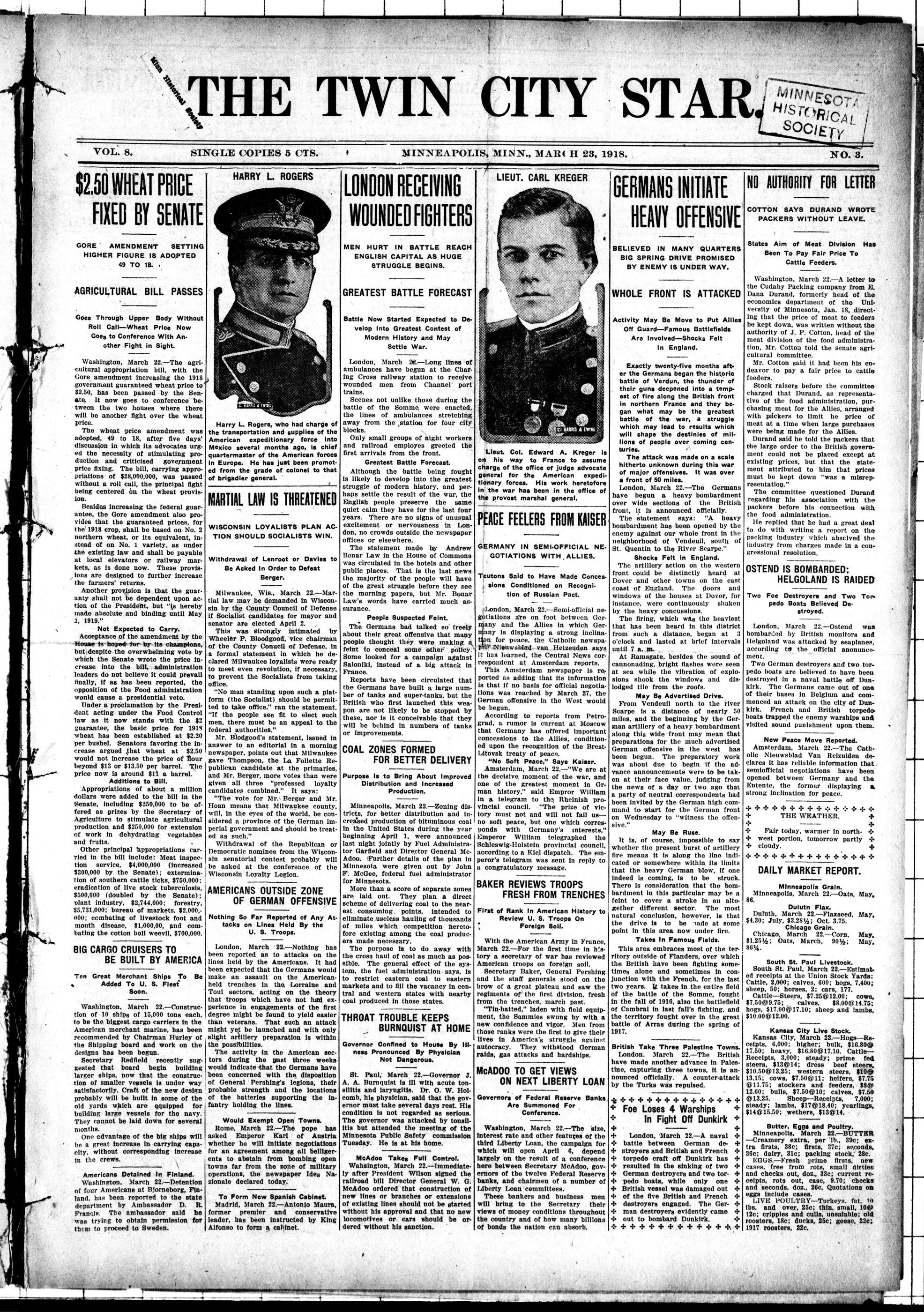
$2.50 WHEAT PRICE FIXED BY SENATE
GORE AMENDMENT SETTING
HIGHER FIGURE IS ADOPTED
49 TO 18.
Goes Through Upper Body Without Roll Call—Wheat Price Now Goes to Conference With Another Fight in Sight.
Washington, March 22.—The agricultural appropriation bill, with the Gore amendment increasing the 1918 government guaranteed wheat price to $2.50, has been passed by the Senate. It now goes to conference between the two houses where there will be another fight over the wheat price.
The wheat price amendment was adopted, 49 to 18, after five days' discussion in which its advocates urged the necessity of stimulating production and criticised government price fixing. The bill, carrying appropriations of $28,000,000, was passed without a roll call, the principal fight being centered on the wheat provision.
Besides increasing the federal guarantee, the Gore amendment also provides that the guaranteed prices, for the 1918 crop, shall be based on No. 2 northern wheat, or its equivalent, instead of on No. 1 variety, as under the existing law and shall be payable at local elevators or railway markets, as is done now. These provisions are designed to further increase the farmers' returns.
Another provision is that the guaranty shall not be dependent upon action of the President, but "is hereby made absolute and binding until May 1, 1919."
Not Expected to Carry.
Acceptance of the amendment by the House is hoped for by its champions, but despite the overwhelming vote by which the Senate wrote the price increase into the bill, administration leaders do not believe it could prevail finally, if as has been reported, the opposition of the Food administration would cause a presidential veto.
Under a proclamation by the President acting under the Food Control law as it now stands with the $2 guarantee, the basic price for 1918 wheat has been established at $2.20 per bushel. Senators favoring the increase argued that wheat at $2.50 would not increase the price of flour beyond $13 or $13.50 per barrel. The price now is around $11 a barrel.
Additions to Bill.
Appropriations of about a million dollars were added to the bill in the Senate, including $250,000 to be offered as prizes by the Secretary of Agriculture to stimulate agricultural production and $250,000 for extension of work in dehydrating vegetables and fruits.
Other principal appropriations carried in the bill include: Meat inspection service, $4,000,000 (increased $300,000 by the Senate); extermination of southern cattle ticks, $750,000; eradication of live stock tuberculosis, $500,000 (doubled by the Senate); plant industry, $2,744,000; forestry, $5,731,000; bureau of markets, $2,000,000; combating of livestock foot and mouth disease, $1,000,00, and combating the cotton boll weevil, $700,000.
BIG CARGO CRUISERS TO BE BUILT BY AMERICA
Ten Great Merchant Ships To Be Added To U. S. Fleet Soon.
Washington. March 22.—Construction of 10 ships of 15,000 tons each, to be the biggest cargo carriers in the American merchant marine, has been recommended by Chairman Hurley of the Shipping board and work on the designs has been begun.
Secretary Redfield recently suggested that board begin building larger ships, now that the construction of smaller vessels is under way satisfactorily. Craft of the new design probably will be built in some of the old yards which are equipped for building large vessels for the navy. They cannot be laid down for several months.
One advantage of the big ships will be a great increase in carrying capacity, without corresponding increase in the crews.
Americans Detained in Finland.
Washington. March 22.—Detention of four Americans at Blorneborg, Finland, has been reported to the state department by Ambassador D. R. Francis. The ambassador said he was trying to obtain permission for them to proceed to Sweden.
THE TWIN CITY STAR.
SINGLE COPIES 5 CTS.
HARRY L. ROGERS
MINISTERIO DE HELICONES
E ZUMA 1975
Harry L. Rogers, who had charge of the transportation and supplies of the American expeditionary force into Mexico several months ago, is chief quartermaster of the American forces in Europe. He has just been promoted from the grade of colonel to that of brigadier general.
MARTIAL LAW IS THREATENED
WISCONSIN LOYALISTS PLAN ACTION SHOULD SOCIALISTS WIN.
Withdrawal of Lenroot or Davies to Be Asked In Order to Defeat Berger.
Milwaukee, Wis., March 22.—Martial law may be demanded in Wisconsin by the County Council of Defense if Socialist candidates for mayor and senator are elected April 2.
This was strongly intimated by Wheeler P. Bloodgood, vice chairman of the County Council of Defense, in a formal statement in which he declared Milwaukee loyalists were ready to meet even revolution, if necessary, to prevent the Socialists from taking office.
"No man standing upon such a platform (the Socialist) should be permitted to take office," ran the statement.
"If the people see fit to elect such men, there must be an appeal to the federal authorities."
Mr. Bloodygood's statement, issued in answer to an editorial in a morning newspaper, points out that Milwaukee gave Thompson, the La Follette Republican candidate at the primaries, and Mr. Berger, more votes than were given all three "professed loyalty candidates combined." It says:
"The vote for Mr. Berger and Mr. Hoan means that Milwaukee county, will, in the eyes of the world, be considered a province of the German imperial government and should be treated as such." Withdrawal of the Republican or Democratic nominee from the Wisconsin senatorial contest probably will be asked at the conference of the Wisconsin Loyalty Legion.
AMERICANS OUTSIDE ZONE OF GERMAN OFFENSIVE
Nothing So Far Reported of Any Attacks on Lines Held By the U. S. Troops.
London, March 22.—Nothing has been reported as to attacks on the lines held by the Americans. It had been expected that the Germans would make an assault on the American-held trenches in the Lorraine and Toul sectors, acting on the theory that troops which have not had experience in engagements of the first degree might be found to yield easier than veterans. That such an attack might yet be launched and with only slight artillery preparation is within the possibilities.
The activity in the American sectors during the past three weeks would indicate that the Germans have been concerned with the disposition of General Pershing's legions, their probable strength and the locations of the batteries supporting the infantry holding the lines.
Rome, March 22.—The pope has asked Emperor Karl of Austria whether he will initiate negotiations for an agreement among all belligerents to abstain from bombing open towns far from the zone of military operations, the newspaper Idez Nazionale declared today.
To Form New Spanish Cabinet.
Madrid, March 22.—Antonio Maura, former premier and conservative leader, has been instructed by King Alfonso to form a cabinet.
MINNEAPOLIS, MINN., MARCH 23, 1918.
LONDON RECEIVING WOUNDED FIGHTERS
LONDON RECEIVING WOUNDED FIGHTERS
MEN HURT IN BATTLE REACH
ENGLISH CAPITAL AS HUGE
STRUGGLE BEGINS.
GREATEST BATTLE FORECAST
Battle Now Started Expected to Develop Into Greatest Contest of Modern History and May Settle War.
London, March 28.—Long lines of ambulances have begun at the Charing Cross railway station to receive wounded men from Channel port trains.
Scenes not unlike those during the battle of the Somme were enacted, the lines of ambulances stretching away from the station for four city blocks.
Only small groups of night workers and railroad employees greeted the first arrivals from the front.
Greatest Battle Forecast.
Although the battle being fought is likely to develop into the greatest struggle of modern history, and perhaps settle the result of the war, the English people preserve the same quiet calm they have for the last four years. There are no signs of unusual excitement or nervousness in London, no crowds outside the newspaper offices or elsewhere. The statement made by Andrew Bonar Law in the House of Commons was circulated in the hotels and other public places. That is the last news the majority of the people will have of the great struggle before they see the morning papers, but Mr. Bonar Law's words have carried much assurance.
People Suspected Feint.
The Germans had talked so freely about their great offensive that many people thought they were making a feint to conceal some other policy. Some looked for a campaign against Saloniki, instead of a big attack in France.
Reports have been circulated that the Germans have built a large number of tanks and super-tanks, but the British who first launched this weapon are not likely to be stopped by these, nor is it conceivable that they will be behind in numbers of tanks or improvements.
COAL ZONES FORMED FOR BETTER DELIVERY
Purpose Is to Bring About Improved Distribution and Increased Production.
Minneapolis, March 22. -Zoning districts, for better distribution and increased production of bituminous coal in the United States during the year beginning April 1, were announced last night jointly by Fuel Administrator Garfield and Director General McAdoo. Further details of the plan in Minnesota were given out by John F. McGee, federal fuel administrator for Minnesota.
More than a score of separate zones are laid out. They plan a direct scheme of delivering coal to the nearest consuming, points, intended to eliminate useless hauling of thousands of miles which competition heretofore existing among the coal producers made necessary.
The purpose is to do away with the cross haul of coal as much as possible. The general effect of the system, the fuel administration says, is to restrict eastern coal to eastern markets and to fill the vacancy in central and western states with nearby coal produced in those states.
THROAT TROUBLE KEEPS
BURNQUIST AT HOME
Governor Confined to House By Illness Pronounced By Physician Not Dangerous.
St. Paul,' March 22.—Governor J. A. A. Burnquist is ill with acute tonsillitis and laryngitis. Dr. O. W. Holcomb, his physician, said that the governor must take several days rest. His condition is not regarded as serious. The governor was attacked by tonsilitis but attended the meeting of the Minnesota Public Safety commission Tuesday. He is at his home.
McAdoo Takea Full Control.
Washington, March 22.—Immediately after President Wilson signed the railroad bill Director General W. G. McAdoo ordered that construction of new lines or branches or extensions of existing lines should not be started without his approval and that no new locomotives or cars should be ordered without his sanction.
LIEUT. CARL KREGER
C HARRIS & EWING
Lleut. Col. Edward A. Kreger is on his way to France to assume charge of the office of judge advocate general for the American expeditionary forces. His work heretofore in the war has been in the office of the provost marshal general.
PEACE FEELERS FROM KAISER
GERMANY IN SEMI-OFFICIAL NEGOTIATIONS WITH ALLIES.
Teutons Said to Have Made Concessions Conditioned on Recognition of Russian Pact.
London, March 22.—Semi-official negotiations are on foot between Germany and the Allies in which Germany is displaying a strong inclination for peace, the Catholic newspaper Nieuwslind van Hetzeuden says it has learned, the Central News correspondent at Amsterdam reports.
This Amsterdam newspaper is reported as adding that its information is that if no basis for official negotiations was reached by March 27, the German offensive in the West would be begun.
According to reports from Petrograd, a rumor is current at Moscow that Germany has offered important concessions to the Allies, conditioned upon the recognition of the Brest-Litovsk treaty of peace.
"No Soft Peace," Says Kaiser. Amsterdam, March 22.—"We are at the decisive moment of the war, and one of the greatest moment in German history," said Emporr William in a telegram to the Rheinish provincial council. "The prize of victory must not and will not fall us—no soft peace, but one which corresponds with Germany's interests," Emperor William telegraphed the Schleswig-Holstein provincial council, according to a Kiel dispatch. The emperor's telegram was sent in reply to a congratulatory message.
BAKER REVIEWS TROOPS
FRESH FROM TRENCHES
First of Rank In American History to Review U. S. Troops On Foreign Soil.
With the American Army in France, March 22.—For the first time in history a secretary of war has reviewed American troops on foreign soil.
Secretary Baker, General Pershing and the staff generals stood on the brow of a great plateau and saw the regiments of the first division, fresh from the trenches, march past.
"Tin-hatted," laden with field equipment, the Sammies swung by with a new confidence and vigor. Men from those ranks were the first to give their lives in America's struggle against autocracy. They withstood German raids, gas attacks and hardships.
McADOO TO GET VIEWS
ON NEXT LIBERTY LOAN
Governors of Federal Reserve Banks Are Summoned For Conference.
Washington, March 22.—The size, interest rate and other features of the third Liberty Loan, the campaign for which will open April 6, depend largely on the result of a conference here between Secretary McAdoo, governors of the twelve Federal Reserve banks, and chairmen of a number of Liberty Loan committees.
These bankers and business men will bring to the Secretary their views of money conditions throughout the country and of how many billions of bonds the nation can absorb.
GERMANS INITIATE HEAVY OFFENSIVE
GERMANS INITIATE HEAVY OFFENSIVE
BELIEVED IN MANY QUARTERS
BIG SPRING DRIVE PROMISED
BY ENEMY IS UNDER WAY.
Activity May Be Move to Put Allies Off Guard—Famous Battlefields Are Involved—Shocks Felt in England.
Exactly twenty-five months after the Germans began the historic battle of Verdun, the thunder of their guns deepened into a tempest of fire along the British front in northern France and they began what may be the greatest battle of the war, a struggle which may lead to results which will shape the destinies of millions of people over coming centuries.
The attack was made on a scale hitherto unknown during this war of major offensives. It was over a front of 50 miles.
London, March 22.—The Germans have begun a heavy bombardment over wide sections of the British front, it is announced officially.
The statement says: "A heavy bombardment has been opened by the enemy against our whole front in the neighborhood of Vendeuil, south of St. Quentin to the River Scarpe."
Shocks Felt in England. The artillery action on the western front could be distinctly heard at Dover and other towns on the east coast of England. The doors and windows of the houses at Dover, for instance, were continuously shaken by the heavy concussions. The firing, which was the heaviest that has been heard in this district from such a distance, began at 3 o'clock and lasted at brief intervals until 7 a.m. At Ramsgate, besides the sound of cannonading, bright flashes were seen at sea while the vibration of explosions shook the windows and dislodged tile from the roofs.
May Be Advertised Drive.
From Vendeuil north to the river Scarpe is a distance of nearly 50 miles, and the beginning by the German artillery of a heavy bombardment along this wide front may mean that preparations for the much advertised German offensive in the west has been begun. The preparatory work was about due to begin if the advance announcements were to be taken at their face value, judging from the news of a day or two ago that a party of neutral correspondents had been invited by the German high command to start for the German front on Wednesday to "witness the offensive."
May Be Ruse.
It is, of course, impossible to say whether the present burst of artillery fire means it is along the line indicated or somewhere within its limits that the heavy German blow, if one indeed is coming, is to be struck. There is consideration that the bombardment in this particular may be a feint to cover a stroke in an altogether different sector. The most natural conclusion, however, is that the drive is to be made at some point in this area now under fire.
Takes In Famous Fields.
This area embraces most of the territory outside of Flanders, over which the British have been fighting sometimes alone and sometimes in conjunction with the French, for the last two years. It takes in the entire field of the battle of the Somme, fought in the fall of 1916, also the battlefield of Cambrai in last fall's fighting, and the territory fought over in the great battle of Arras during the spring of 1917.
British Take Three Palestine Towns. London. March 22—The British have made another advance in Palestine, capturing three towns, it is announced officially. A counter-attack by the Turks was repulsed.
* Foe Loses 4 Warships
* In Fight Off Dunkirk
London, March 22.—A naval battle between German destroyers and British and French torpedo craft off Dunkirk has resulted in the sinking of two German destroyers and two torpedo boats, while only one British vessel was damaged out of the five British and French destroyers engaged. The German destroyers evidently came out to bombard Dunkirk.
*******
MINNESOTA HISTORICAL SOCIETY
NO AUTHORITY FOR LETTER
COTTON SAYS DURAND WROTE
PACKERS WITHOUT LEAVE.
States Aim of Meat Division Has Been To Pay Fair Price To Cattle Feeders.
Washington, March 22.—A letter to the Cudahy Packing company from E. Dana Durand, formerly head of the economics department of the University of Minnesota, Jan. 18, directing that the price of meat to feeders be kept down, was written without the authority of J. P. Cotton, head of the meat division of the food administration, Mr. Cotton told the senate agricultural committee.
Mr. Cotton said it had been his endeavor to pay a fair price to cattle feeders.
Stock raisers before the committee charged that Durand, as representative of the food administration, purchasing meat for the Allies, arranged with pickers to limit he price of meat at a time when large purchases were being made for the Allies.
Durand said he told the packers that the large order to the British government could not be placed except at existing prices, but that the statement attributed to him that prices must be kept down "was a misrepresentation."
The committee questioned Durand regarding his association with the packers before his connection with the food administration.
He replied that he had a great deal to do with writing a report on the packing industry which abscived the industry from charges made in a congressional resolution.
OSTEND IS BOMBARDED;
HELGOLAND IS RAIDED
Two Foe Destroyers and Two Torpedo Boats Believed Destroyed.
London, March 22.—Ostend was bombarded by British monitors and Helgoland was attacked by seaplanes, according to the official announcement.
Two German destroyers and two torpedo boats are believed to have been destroyed in a naval battle off Dunkirk. The Germans came out of one of their bases in Belgium and commenced an attack on the city of Dunkirk. French and British torpedo boats trapped the enemy warships and visited sound punishment upon them.
New Peace Move Reported.
Amsterdam, March 22—The Catholic Nieuwslad Van Reizuiden declares it has reliable information that semiofficial negotiations have been opened between Germany and the Entente, the former displaying strong inclination for peace.
THE WEATHER.
Fair today, warmer in northwest portion, tomorrow partly cloudy.
DAILY MARKET REPORT.
Minneapolis Grain.
Minneapolis, March 22.—Oats, May.
86.
Duluth Flax.
Duluth, March 22.—Flaxseed, May.
$4.30; July, $3.28½; Oct, 3.75.
Chicago Grain.
Chicago, March 22.—Corn, May.
$1.25½; Oats, March, $90½; May.
86¼.
South St. Paul Livestock.
South St. Paul, March 22.—Estimated receipts at the Union Stock Yards:
Cattle, 2,000; calves, 600; hogs, 7,400;
sheep, 50; horses, 2; cars, 177.
Cattle—Steers, $7.25@12.00; cows,
$7.50@9.75; calves, $8.00@14.75;
hogs, $17.00@17.10; sheep and lambs,
$10.00@12.00.
Kansas City Live Stock.
Kansas City, March 22—Hogs—Receipts, 6,000; heavy, bulk, $16.80@17.50; heavy, $16.80@17.10. Cattle—Receipts, 3,000; steady; prime fed steers, $13@14; dress beef steers, $10.50@13.25; western steers, $10@13.15; cows, $7.50@11; heifers, $7.75@11.75; stockers and feeders, $8@12.60; bulls, $7.50@10; calves, $7.50@13.25. Sheep—Receipts, 7,000; steady; lambs, $17@18.40; yearlings, $14@15.50; wethers, $13@14.
Butter, Eggs and Poultry
Minneapolis, March 22—BUTTER—Creamery extra, per lb., 39c; extra firsts, 38c; firsts, 37c; seconds, 36c; dairy, 31c; packing stock, 28c. EGGS—Fresh prime firsts, new cases, free from rots, small dirties and checks out, doz, 33c; current receipts, rots out, case, 9.70; checks and seconds, doz, 26c. Quotations on eggs include cases.
LIVE POULTRY—Turkeys, fat, 10 lbs. and over, 25c; thin, small, 10@12c; cripples and culls, unsalable; old roosters, 18c; ducks, 25c; geese, 22c; 1917 roosters, 22c.
Beecher Street
By R. RAY BAKER
(Copyright, 1918, by the McClure Newspaper Syndicate.)
If Ethel Drayton had done some real reasoning instead of leaping at conclusions and acting on impulse, it is likely that her bark of romance, with Clif Elridge in command, would have sailed serenely down the river of agreeableness into the sea of matrimony without encountering a storm. On the other hand, that kind of journey would not have been real romance—it would have lacked zest—so perhaps it is just as well that Herman Hartell came over to Ethel's desk that dreary, rainy afternoon in April and unfolded the secret. "I have something to say that is very disagreeable to me," began Hartell as he brushed a hand caressingly over his miniature moustache and looked down at Ethel's curly brown hair coiled on the back of her head in a business-like knob that served as a pencil holder. "Nevertheless," he went on. "I feel in duty bound to say it."
Ethel jerked a sheet of paper from her typewriter and turned her black eyes up at the head shipping clerk. The tiny, bristling ridge of hair on Hartell's upper lip forced a smile to her face, but this was dispelled when Hartell explained:
"It's about Clifford. You see, last night—"
While this conversation was taking place, the subject of the remarks sat on a high stool at the other side of the Lewis Wholesale Paper company's shipping office and poured over a file of orders. Out of a corner of his eye he saw the head shipping clerk approach the stenographer's desk, and he frowned.
Hartell leaned over Ethel's chair as he revealed the secret, and Cliff ruffled his flaxen hair on one hand and thrummed on his desk with the other.
Half an hour later Cliff slipped from his stool and into his light overcoat. Carrying his hat, he approached Ethel, who was still busy at the typewriter. He passed and smiled pleasantly, but she continued rattling the keys.
"You needn't trouble yourself to wait for me," she informed him in lily tones without pausing in her work or looking up. "T'll be a little late, and Mr. Hartell has promised to see me home."
Cliff's smile vanished. Before he had a chance to reply, she had slipped a ring from a finger of her left hand and extended it toward him. She looked into his eyes with a stare encrusted with ice.
"I can't wear this any longer," she said, "after the way you have acted lately. I have heard that all men must sow wild oats, but I assure you that my man won't. If you must gamble and carouse, you can't expect to become my husband. I have learned all about your going to a saloon or gambling den on Beecher street almost every night, and that's enough for me. Good-night."
Cliff stumbled down the steps to the street and walked three blocks, heedless of the pouring rain, before he came to himself and found the ring clasped in his hand. Then he stopped dead still in the middle of a street crossing, undecided whether to leap in the river or go back and throw Herman Hartell from the roof of the six-story Lewis building. He decided to do neither; instead, he headed for Beecher street.
Ethel completed her work and was escorted to her rooming place by Hartell. At the door she took his hand and said earnestly:
"You don't know how I appreciate the revelation you have made to me. I know it must have been hard for you to come and tell me about seeing Clifford go into that terrible place so many times; and I am grateful."
"Don't mention it, please," protested Hartell, striving unsuccessfully to reach his mustache with his tongue. "I couldn't bear to see you throw yourself away on a worthless fellow. I save a good many blocks by cutting through Beecher street on the way home and that's how I happened to notice him there."
The next day Ethel failed to appear at the office, telephoning that she was suffering from a headache. The succeeding day was Sunday. The rain had ceased but the weather had turned chilly and the sun hid behind clouds. Ethel listened in vain for the doorbell or the telephone, hoping Cliff would appear as he had done each day for more than a year. True, she had told him it was all over; nevertheless, she had expected him to come and make some kind of a protest and attempt an explanation. The morning passed very gloomily for her.
Early in the afternoon the landlady summoned her to the telephone, and Ethel tripped over a chair in her haste to answer the call.
"This is Mr. Hartell," said the voice on the wire. "Could I call on you this afternoon?"
"I'm sorry," she replied, "but I'm too ill to entertain." And she went back to her room to gaze thoughtfully at a picture of a flaxen-haired, smiling youth.
About five o'clock a delegation of three girls from her Sunday school class called on her.
"We were anxious to learn if you were ill," said one, "and if not we wanted you to go with us to visit a poor family that the class has decided to help."
Ethel took decided interest in the ex-
curston when it was explained that the family lived on Beecher street. They walked past the gloomy, rickety wooden dwellings, through throngs of dirty urchins who hooted and made faces at them, and finally came to a dingy opening that proved to be the entrance to a flight of stairs. Up these steps the girls stumbled, their way lighted by only a few rays that sifted through the cracks in the filmsy outside wall. One of the party knocked at the door that confronted them at the top of the stairs. Footsteps sounded on the floor, evidently those of a child. Some one fumbled at the knob and the door was swung open to reveal a chubby, round-faced boy of about four years.
A malmed, disreputable toy bear was suspended by its leg from one hand of the tot, who blinked curiously at his four visitors. The opening of the door permitted a warm, pungent odor to penetrate the hull and each of the girls involuntarily shuddered. "Who is it?" called a voice from within—a weak, plaintive voice, that of a woman. The tot, who was clothed in a nondescript suit of several materials and colors, turned and called:
"Tree dirls."
"Come right in," answered the voice. "I am ill and cannot come to the door."
The girls entered and noticed that the pungent odor increased. The room was permeated with an unhealthful warmth, caused by keeping all the windows closed and thus conserving the heat radiated from the small wood stove.
The designs on the wall paper had all but become eradicated by accumulation of smoke, grease and dust. On one wall was a framed picture of a young man and woman, evidently a bridal couple. A row of picture postcards was the only other decoration.
A table occupied the center of the room, and nearby were a three-legged stool and a dilapidated rocking chair. The floor was covered with a faded rug carpet.
"Here I am," called the woman, from the dingiest corner of the room. "Don't look around. I'm too ill to keep the place clean, and Jimmy here is too young."
The girls found her lying on a narg row bed, or rather, a bunke. She was frail and emaciated, but she carried a pleasant smile of greeting.
Jimmy hovered near, still clinging to the bear. Ethel, a lover of children, picked him up in her arms.
"My, my, what clothes!" she murmured to herself, but Jimmy overheard her.
"I'm donna have new suit," he announced. "Man's donna bring it."
"Who do you—" Ethel began, but at that moment Jimmy, hearing familiar sounds on the stairs, screamed from her arms and dashed toward the door.
"He hears his man," explained the woman on the bed. "Nearly every night he brings us food, and sometimes candy or something to wear. He found Jimmy on the street one night and came home with him. Jimmy told me his man was going to bring him a new suit today." The door was flung open and a young man entered, placed a bundle on the stool and gathered the little boy in his arms.
"My man," breathed Jimmy, hugging the newcomer, while Ethel started forward in amazement upon recognizing him.
"Cliff!" she cried.
Clifford Eldridge placed his human burden on the floor and stared in astonishment that equaled her own. So it was decreed that a home of poverty should be the setting for a proud, sensitive, impulsive girl to ask forgiveness—and get it.
Let Children Pick Clothes
Everyone remembers when he or she was a child how irritating it was to have our parents pick all our clothes without giving us any choice in the matter. In the Woman's Home Companion a writer says: "Now, what I am asking for the boys is this: Take your sons with you when you buy their clothing. Consult their tastes somewhat. Don't let them select anything ridiculous, but give them a choice of half a dozen sensible coats or hats or whatever it may be. Don't scold them too much if they come home with the straps on their bloomer trousers unhooked so the trouser legs are almost long. No doubt the captain of the baseball team and 'all the other fellows' wear theirs that way. Or if your boy comes up the street with his cap over his right ear, while you are telling him that he looks 'just like a little street tough' remember it was the style that you, yourself followed last winter, and that 'what all the fellows do' means just as much to Johnny as Paris notes do to you."
Snakes.
An explanation of this hallucination is offered by the result of French experiments a few years ago. Sixteen alcoholic patients were examined with the ophthalmoscope, and it was found that the minute blood vessels in the retina of the eyes were congested. In this condition they appear black, and are projected into the field of vision, where their movements resemble the squirming of serpents.
Professional Dignities
"Dishere canal boat business is loomin' up right important," remarked Mr. Erastus Pinkley. "I specks darts gotta be some 'scussion 'bout my employment."
"What's the matter with your job?" "It's all right, 'ceppin' jes' dis. I don't want to be called 'a mule driver' no mo." Hereafter I wants to be 'luded to as 'a pilot.'
THE TWIN CITY STAR, MINNEAPOLIS, MINN.
Fitness for Army Flying Sense of Equilibrium One of the Most Important Tests Applicant Must Pass
The physical examination of candidates for the aviation branch of the army is more rigid than that for other branches. Among the most important tests a man has to pass is that of his sense of equilibrium. How this is done is described by Dr. Charles P. Small of Chicago in the Journal of the American Medical Association.
The candidate is seated in a Barany chair—so called after the discoverer of the organs of equilibration. This is a swing with footrest, a long handle with which it can be whirled around and a catch by which it can be stopped at once with the examiner's foot. The man's eyes are closed and his head is tilted at about thirty degrees. The chair is then rotated to the right, ten revolutions in twenty seconds, and suddenly stopped. The applicant is told to open his eyes and look straight in front of him at some object. If he be normal, his eyes will make jerky movements to the left for about twenty-five seconds.
The test is repeated, with the chair whirling to the left, which will produce eye-jerks to the right.
The examiner stands in front of the still blindfolded candidate, tells him to extend his right arm directly in front of him and with his forefinger touch the tip of the examiner's. Then he is told to raise his arm above his head and bring it down to exactly the same spot. This is repeated with the left arm. The chair is swung around ten times in ten seconds, and the instant it stops the examiner touches the candidate's forefinger as before and tells him to repeat the raising and lowering of the hand. If he be normal he will not touch the finger, but will "past point" several inches to the right of it. The test is repeated to the left, and the normal man "past points" to the left.
Those experiments test the normality of the horizontal canals. That for the perpendicular canal follows. The candidate bends forward at an angle of 90 degrees, eyes still blindfolded, his head resting on his fists held on his knees. The chair is rotated to the right ten times in ten seconds. The instant it is stopped the man is told to sit upright. If normal, he will fall toward the right. The test is then made by swinging to the left, when he will fall to the left.
This method of testing the sense of equilibrium has superseded all others because it is the most exact.
Mother's Cook Book.
If I have faltered more or less
in my great task of happiness
If I have moved among my race
And shown no happy morning face
if beams from happy human eyes
Have moved me not, if morning skies
Books, and my food, and summer rain
Knocked on my sullen heart in vain.
Lord, thy most pointed pleasure take
And stab my spirit
—B. J. Stevenson
Food for the Family.
Corn meal dishes are very good when good meal and careful preparation is thought worthy of attention. Even the member of the family who doesn't like corn meal, may be won over if appetizing dishes, well prepared, are served. As a mush with good top milk there is nothing better for the youngster's supper, and even grandfather longs for it, if he has had New England training. Then what was left may be molded and fried for breakfast, a dish fit for the king.
Tamale Ple.
Make a mush by stirring two cupfuls of corn meal into six cupfuls of boiling water, add one and one half teaspoonfuls of salt and cook 45 minutes. Brown one onion sliced in hot fat, add a pound of hamburger steak and stir until well seared, then add salt and pepper and two cupfuls of tomato. A sweet red pepper or a green one as an addition. Grease a baking dish and put a layer of the mush then a layer of the meat and cover with mush. Bake one-half hour.
English sparrows make fine eating. In many places they are caught with a trap and a dozen or fifteen make a good meal for a large family. They may be baked in a pie like the Mother Goose rhyme of four and twenty black birds baked in a pie.
Good Pressed Meat.
Boll two pounds of pigs' hocks in salted water until the meat drops from the bones. In a separate pot, cook a pound of lean beef until tender. Mix the meat adding such seasonings as desired and mold in a loaf. The liquor in which the meat was cooked may be used for soup or to cook corn meal mush, giving it a most appetizing flavor. Nellie Maxwell
Farmers Would Save Quail to War on the Boll Weevil
When a Georgia farmer found the crop of a quall that he had killed on his farm loaded with boll weevils he immediately conferred with county authorities to ascertain if he could keep hunters off his land, which is not fenced. He was very much disappointed when informed that he could not do so.
It is stated on good authority that in farms in this part of the county where the quall and other insect-destroying birds have been protected the boll weevil is but seldom seen, while on adjoining farms, where the public is permitted to hunt, cotton crops have been practically devastated by them.
A concerted movement is now on foot among the farmers to conserve the quail in an effort to, combat the boll weevil. The matter will in all probability be brought to the attention of the legislature when it meets this summer, with the idea of having more stringent laws passed for the protection of insect-destroying birds.
Says Hunting Dogs and Common Curs Possess War Service Qualifications
"French war dogs are not the only ones that could be taught to do great service in the world struggle," remarked H. R. Turner, a Kentuckian, discussing the marvelous feats performed by some of the dogs on the battlefields of France.
"The dog of America commonly called a cur has instinct for such service. Some patriotic women in the West have undertaken to train dogs for Red Cross work, and they have found that the 'cur' dog is possessed of all the natural qualifications for war service. But, in my judgment, the Kentucky hunting dog is better adapted for this work than any other because of his wonderful instincts. A few years ago a sportsman of Iowa had a hunting dog bred in Kentucky. It was an unusually fine dog and during the 'racing' season in Kentucky he sent his dog back to Kentucky to take part in the fox chasing. After the sport was over the friends to whom the animal had been sent lost him. They were much perturbed, because they had promised they would see that the dog was sent safe back home to Iowa. After many days of searching, however, they sent word to the owner that the animal had disappeared. Sixty days afterward they were informed that the dog had returned to his home in Iowa."
Brief Facts.
Baking for a few minutes in a hot oven will add to the life of sachet powders.
Texas Farmers Urged to Produce Peanuts for Use in Both Meal and Butter
That former peanut manufacturer who said that people could exist for a long time on nothing else but peanut butter and crackers was doing a little gratitulous advertising for crackers, asserts the Houston Post. There is no reason why Texas peanuts should not furnish both bread and butter for all Texas people and there might be enough for a few favored mortals in other states. If the food and feed campaign which is being conducted should result in the planting of 1,000,000 acres in peanuts this year, Texas farmers will be richer by some $50,000,000 and the food supply will contain a plenty of one of the best foods in the world. And then if the food administration shall force the peanut factories to make a reasonable proportion of the nuts into edible meal the country will have plenty of bread material as well as a liberal layer of butter for every slice.
Defective Page
There are nearly 500 sulphur mines on the Island of Sicily. Chairs are being made of paper, twisted and re-enforced with steel rods. A mustache guard that can be attached to any cup is an English invention. For portable electric lamps a screen to check their glare has been invented. Fireproof barrels made from sugar mill refuse have been invented in Hawaii. A company in Japan has begun the production of soda by an electrical process.
Special Nicotine Tobacco
Grown for Other Purposes
Than Chewing and Smoking
While half the trades seem to be busy, to judge by advertisements, producing coffeeless coffee, tanninless tea, and tobacco without nicotine, it does seem a bit incredulous to learn of seedsmen offering seeds guaranteed to produce tobacco with from three to ten times as much nicotine content as is found in ordinary smoking and chewing grades, observes a writer in the New York Times. Of course, that is no evidence that the time-honored belief that nicotine harms humans has been discarded, for in the same seed catalogues one finds tobacco seeds commended to the planter because they will produce leaf with the minimum of the supposed poison. Doctors still tell us to smoke mild tobacco, and the cigarette with its claim that its makeup carries little nicotine continues to grow in popularity.
But there are not a few uses for tobacco other than smoking, chewing, and snuffing, and nearly all of these demand a weed that has lots of poison in it. Florists buy thousands of pounds every year to burn in smoldering piles in their greenhouses to kill insects and eradicate the tiny moths that lay eggs that produce plant destroyers. And it is the nicotine in the smoke that kills the pests.
Nicotine is about the most efficacious remedy when garden plants are attacked by sucking insects. These destroyers cannot be harmed by eating foliage and stems with paris green and arsenic of lead, for they have long, sharp beaks; some carry proboscises proportionately as long as an elephant's, and these they drive into leaf and blossom stems and suck out the vital juices. Only a contact polish will kill them, and nicotine does it most surely. A green or pink or white plant louse, busily sucking the life out of a plant, turns brown the instant nicotine touches his body, stiffens his legs, draws out his beak, and drops dead.
Tobacco solutions that carry 30 per cent of nicotine sell for $1.50 a pint, hence the ambition to grow tobacco rich in the deadly essence.
A SMILE FOR YOU
Accounts for It.
"I was told that your neighbors, the Spats, were breaking up housekeeping."
JEAN-PAUL
"Oh, that accounts for the racket we heard in their flat this morning."
The Reason.
"The fortune-telling business is a paying one, isn't it?" "It ought to be when it starts off with a prophet."
Social Ambitions
"Mrs. Comeup is not stopping at any expense to break into society. Her prizes at her charitable card parties are really princely."
"What are they? Jeweled ornaments?"
"No, nothing, so common as that. At her last party the first prize was a ton of hard coal."
Retribution.
"I understand it was a gasoline car which struck Henry."
"Exactly, and that is one reason he is 'smelling out a suit.'"
Bon Vivant—Haven't seen Jack at the club for a week.
Mrs. Jack—No, Jack's been out of town.
Bon Vivant—Oh, we were beginning to worry about him. We feared he was staying at home.
Not to Be Disputed.
"Have you any definite theory as to why the cost of living has increased?"
...
"Certainly; I think it is because prices have gone up."
Talking Photoplays Next;
Eliminates the Phonograph
and Utilizes Film Recor
Numerous attempts have been made to link the phonograph with the projector and give speech to the silent drama. Inability to obtain perfect synchronism of sound and motion has been only one of the bugaboos encountered. The limited capacity of talking-machine records, the difficulty of amplifying the sound sufficiently for theater purposes without increasing the foreign noises to an objectionable degree, and the impossibility of cutting or mending a film without destroying the usefulness of the sound record have been other of the bewildering enigmas. Their solution has finally been undertaken in a new way and highly promising results attained.
The newest system of talking cinematography eliminates the phonograph and utilizes a film record that is produced by photographic and rendered by magnetic, instead of mechanical, means. This enables the sound and the picture records to be of correspondings lengths and synchronous. This method is described in the March Popular Mechanics Magazine.
(By E. O. SELLERS, Acting Director of the Sunday School Course of the Moody Bible Institute, Chicago.)
(Copyright, 1918, Western Newspaper Union.)
LESSON FOR MARCH 24
JESUS MINISTERING TO THE MUL-
TITUDES.
LESSON TEXT-Mark 6:32-58.
GOLDEN TEXT-The son of man came
not to be ministered unto, but to minister,
and to give his life a ransom for man.
DEVOTIONAL READING-John 6:35-40.
ADDITIONAL MATERIAL FOR
TEACHERS-Exodus 16:14-18. Matt. 25:14;
Luke 4:16-21. James 1:27. Rev. 13:17.
PRIMARY TOPIC—Jesus a helper at all times.
tum
MEMORY VERSE—Be of good cheer:
te L, be not la, be not—Mark 6:50
it is I: be not afraid.-Mark 6:50
MEREMEDIATE TOPIC-Helping the
needy.
SENIOR AND ADULT TOPIC- (?)
This parable marks the high level of the year of popularity in the life of our Lord. It is such an important miracle as to be the only one recorded by all four gospel writers. The returning disciples (v. 31) are urged by the Master to come with him into a desert place and rest and also that he might comfort their hearts over the death of John the Baptist. "They had no leisure." Jesus knew the need and also the proper use of leisure, but the multitude would not grant him this but flocked to his retreat in the desert. They followed that they might listen to his gracious words, or behold some new wonder, but Jesus also saw and ministered, (v. 24). Carlyle said he saw in England "forty million people mostly fools." Not so with Jesus; he saw and was moved, not with sarcasm, but with a compassion that took the form of teaching (v. 34). It is better to teach a man how to help himself than to help the man without the teaching. We also infer that the soul of a man is of more value than his body. It is not enough, however, to say "God bless you; be warmed and fed," when a man is hungry. Sympathy must issue in action.
A Great Task.
John tells us of the conversation with Phillip. Phillip lived in Bethsaida nearby, but to feed this multitude was too great a task, even with his knowledge and resources (John 6:5, 7). Yet we need not be surprised at Phillip's slowness of faith. Moses in a similar case was once nonplussed as to how to feed the thousands in the wilderness (see Numbers 11:21-33). The central fact concerns neither the need nor our poverty, but the absolute surrender of our all—however little—to God.
Another disciple, Andrew, who had brought his brother, Simon Peter, to the Savior, in his desperation found a boy whose mother had thoughtfully provided him with a lunch consisting of five barley biscuits and two small dried herrings (John 6:9). This is a great commentary on the tide of interest at this time—that even this hungry boy should have forgotten his lunch; the circumstances emphasized the helplessness of the disciples in order that Jesus might show his power. His command "Give ye them," (v. 37) teaches us that we are to give what we have, not to look to others, nor to do our charity by proxy (Pro. 11:24, 25). Again the Savior asks his disciples to seek (v. 38) as though he would teach them the boundless resources of his kingdom. Give what you have and he will bless and increase it to meet the needs of the multitude. The secret of success points to the moment when he took the loaves and looking up (to God who also saw their needs), he blessed it.
Living Bread.
This conservation process was a stinging rebuke to the orientals, and is being emphasized in these days of food conservation in connection with war needs. Too long we have been prodigal of God's marvelous bounties. God gives us that we may use; and we lose it unless it is shared. Jesus, the living bread, (John 6:48) will satisfy hunger and give life. As bread generates in the human body heat, energy, vitality and power, so he will feed the hungry souls of men. We have at hand the Word. It is for lack of it that men die in the deepest and truest sense of that Word. The poverty and perplexity of the disciples in the presence of similar great need, is being repeated over and over again, and yet how faithless it is. We have not enough to feed the multitude. Our few loaves of comfort, amusement, counsel, etc., will not sustain them in the present world's crisis; but when we break unto them the living bread, it meets the deep hunger of the human heart; and they will have enough and to spare if they will only eat it. In these days when the emphasis is being laid on material bread for the sustenance of the nation, there is great danger lest we forget the necessity of breaking the living bread to the starving multitudes of the world. We must maintain the supremacy of the spiritual, or lack the dynamic to provide the material.
How true the words of the late Dr.
Maltle Davenport Babcock:
Back of the loaf is the snowy flour;
Back of the flour the mill:
The problem which the disciples could not meet, Jesus discerned and solved. As they co-operated with him and gave of that which he had first blessed, each had a basketfull to take away and thus was well repaid for sharing with the multitude.
FACES DEATH IN MOSCOW BATTLE
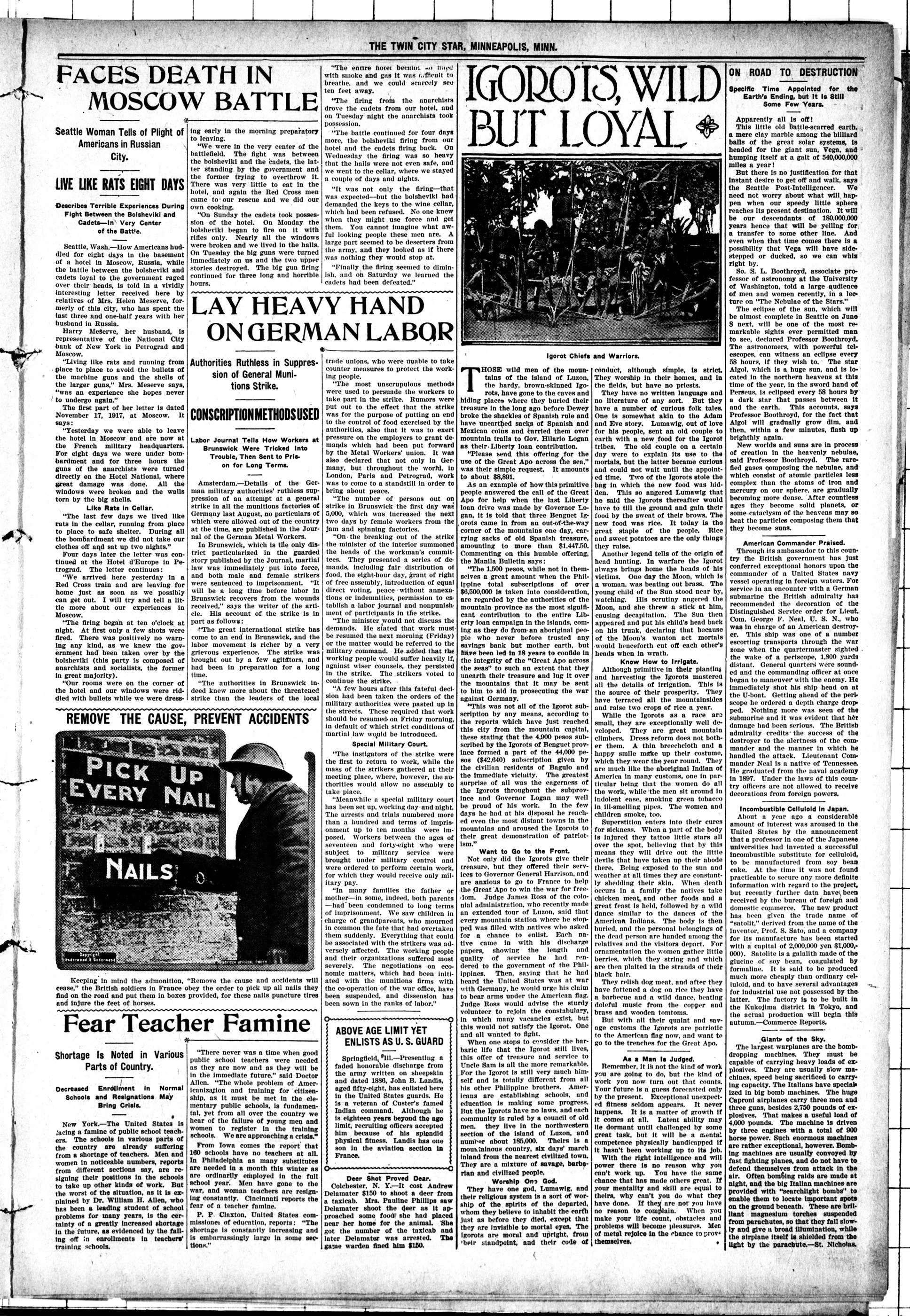
REMOVE THE CAUSE, PREVENT ACCIDENTS
PICK UP
EVERY NAIL
NAILS
Copyright
Underwarn & Underwarn
BRITISH OFFICIAL PHOTO
Keeping in mind the admonition, "Remove the cause and accidents will cease," the British soldiers in France obey the order to pick up all nails they find on the road and put them in boxes provided, for these nails puncture tires and injure the feet of horses.
Seattle Woman Tells of Plight of Americans in Russian City.
LIVE LIKE RATS EIGHT DAYS
Describe Terrible Experiences During Fight Between the Bolshevik and Cadets—In Very Center of the Battle.
Seattle, Wash.—How Americans huddled for eight days in the basement of a hotel in Moscow, Russia, while the battle between the bolshevik and cadets loyal to the government raged over their heads, is told in a vividly interesting letter received here by relatives of Mrs. Helen Meserve, formerly of this city, who has spent the last three and one-half years with her husband in Russia.
Harry Meserve, her husband, is representative of the National City bank of New York in Petrograd and Moscow.
"Living like rats and running from place to place to avoid the bullets of the machine guns and the shells of the larger guns," Mrs. Meserve says, "was an experience she hopes never to undergo again."
The first part of her letter is dated November 17, 1917, at Moscow. It says:
"Yesterday we were able to leave the hotel in Moscow and are now at the French military headquarters. For eight days we were under bombardment and for three hours the guns of the anarchists were turned directly on the Hotel National, where great damage was done. All the windows were broken and the walls torn by the big shells.
Like Rats in Cellar.
"The last few days we lived like rats in the cellar, running from place to place to safe shelter. During all the bombardment we did not take our clothes off and sat up two nights." Four days later the letter was continued at the Hotel d'Europe in Petrograd. The letter continues: "We arrived here yesterday in a Red Cross train and are leaving for home just as soon as we possibly can get out. I will try and tell a little more about our experiences in Moscow. "The firing began at ten o'clock at night. At first only a few shots were fired. There was positively no warning any kind, as we knew the government had been taken over by the bolshevik (this party is composed of anarchists and socialists, the former in great majority).
"Our rooms were on the corner of the hotel and our windows were riddled with bullets while we were dress-
REMOVE THE CAUSE
PICK U
EVERY N
NAILS
Copyright
underwood & Underwood
Keeping in mind the admonition,
cease," the British soldiers in France
find on the road and put them in boxes
and injure the feet of horses.
Fear Teach
Shortage Is Noted in Various Parts of Country.
Decreased Enrollment in Normal Schools and Resignations May Bring Crisis.
New York.—The United States is facing a famine of public school teachers. The schools in various parts of the country are already suffering from a shortage of teachers. Men and women in noticeable numbers, reports from different sections say, are resigning their positions in the schools to take up other kinds of work. But the worst of the situation, as it is explained by Dr. William H. Allen, who has been a leading student of school problems for many years, is the certainty of a greatly increased shortage in the future, as evidenced by the falling off in enrollments in teachers' training schools.
LAY HEAVY HAND ONGERMAN LABOR
ing early in the morning preparatory to leaving.
"We were in the very center of the battlefield. The fight was between the bolshevik and the cadets, the latter standing by the government and the former trying to overthrow it. There was very little to eat in the hotel, and again the Red Cross men came to our rescue and we did our own cooking.
"On Sunday the cadets took possession of the hotel. On Monday the bolshevik began to fire on it with rifles only. Nearly all the windows were broken and we lived in the halls.
On Tuesday the big guns were turned immediately on us and the two upper stories destroyed. The big gun firing continued for three long and horrible hours.
LAY HEAV ONGERM
Authorities Ruthless in Suppression of General Muni-tions Strike.
CONSCRIPTION METHODS USED
Labor Journal Tells How Workers at Brunswick Were Tricked Into Trouble, Then Sent to Prison for Long Terms.
Amsterdam.—Details of the German military authorities' ruthless suppression of an attempt at a general strike in all the munitions factories of Germany last August, no particulars of which were allowed out of the country at the time, are published in the Journal of the German Metal Workers.
In Brunswick, which is the only district particularized in the guarded story published by the Journal, martial law was immediately put into force, and both male and female strikers were sentenced to imprisonment. "It will be a long time before labor in Brunswick recovers from the wounds received," says the writer of the article. His account of the strike is in part as follows:
"The great international strike has come to an end in Brunswick, and the labor movement is richer by a very grievous experience. The strike was brought out by a few agitators, and had been in preparation for a long time.
"The authorities in Brunswick indeed knew more about the threatened strike than the leaders of the local
PREVENT ACCIDENTS
"Remove the cause and accidents will obey the order to pick up all nails they provided, for these nails puncture tires
ner Famine
"There never was a time when good public school teachers were needed as they are now and as they will be in the immediate future." said Doctor Allen. "The whole problem of Americanization and training for citizenship, as it must be met in the elementary public schools, is fundamental, yet from all over the country we hear of the failure of young men and women to register in the training schools. We are approaching a crisis."
From Iowa comes the report that 160 schools have no teachers at all. In Philadelphia as many substitutes are needed in a month this winter as are ordinarily employed in the full school year. Men have gone to the war, and woman teachers are resigning constantly. Cincinnati reports the fear of a teacher famine.
P. P. Claxton, United States commissioner of education, reports: "The shortage is constantly increasing and is embarrassingly large in some sections."
THE TWIN CITY STAR, MINNEAPOLIS, MINN.
"The entire hotel became so mud with smoke and gas it was difficult to breathe, and we could scarcely see ten feet away.
"The firing from the anarchists drove the cadets from our hotel, and on Tuesday night the anarchists took possession.
"The battle continued for four days more, the bolshevik firing from our hotel and the cadets firing back. On Wednesday the firing was so heavy that the halls were not even safe, and we went to the cellar, where we stayed a couple of days and nights.
"It was not only the firing—that was expected—but the bolsheviki had demanded the keys to the wine cellar, which had been refused. No one knew when they might use force and get them. You cannot imagine what awful looking people these men are. A large part seemed to be deserters from the army, and they looked as if there was nothing they would stop at.
"Finally the firing seemed to diminish, and on Saturday we learned the cadets had been defeated."
trade unions, who were unable to take counter measures to protect the working people.
"The most unscrupulous methods were used to persuade the workers to take part in the strike. Rumors were put out to the effect that the strike was for the purpose of putting an end to the control of food exercised by the authorities, also that it was to exert pressure on the employers to grant demands which had been put forward by the Metal Workers' union. It was also declared that not only in Germany, but throughout the world, in London, Paris and Petrograd, work was to come to a standstill in order to bring about peace.
"The number of persons out on strike in Brunswick the first day was 5,000, which was increased the next two days by female workers from the jam and spinning factories.
"On the breaking out of the strike the minister of the interior summoned the heads of the workman's committees. They presented a series of demands, including fair distribution of food, the eight-hour day, grant of right of free assembly, introduction of equal direct voting, peace without annexations or indemnities, permission to establish a labor journal and nonpunishment of participants in the strike.
"The minister would not discuss the demands. He stated that work must be resumed the next morning (Friday) or the matter would be referred to the military command. He added that the working people would suffer heavily if, against wiser counsels, they persisted in the strike. The strikers voted to continue the strike."
"A few hours after this fateful decision had been taken the orders of the military authorities were pasted up in the streets. These required that work should be resumed on Friday morning, in default of which strict conditions of martial law would be introduced.
Special Military Court.
"The instigators of the strike were the first to return to work, while the mass of the strikers gathered at their meeting place, where, however, the authorities would allow no assembly to take place.
"Meanwhile a special military court has been set up, working day and night. The arrests and trials numbered more than a hundred and terms of imprisonment up to ten months were imposed. Workers between the ages of seventeen and forty-eight who were subject to military service were brought under military control and were ordered to perform certain work, for which they would receive only military pay.
"In many families the father or mother—in some, indeed, both parents—had been condemned to long terms of imprisonment. We saw children in charge of grandparents, who mourned in common the fate that had overtaken them suddenly. Everything that could be associated with the strikers was adversely affected. The working people and their organizations suffered most severely. The negotiations on economic matters, which had been initiated with the munitions firms with the co-operation of the war office, have been suspended, and dissension has been sown in the ranks of labor."
ABOVE AGE LIMIT YET ENLISTS AS U. S. GUARD
Springfield, *ill.*—Presenting a faded honorable discharge from the army written on sheepskin and dated 1886, John B. Landis, aged fifty-eight, has enlisted here in the United States guards. He is a veteran of Custer's famed Indian command. Although he is eighteen years beyond the ago limit, recruiting officers accepted him because of his splendid physical fitness. Landis has one son in the aviation section in France.
Dear Shot Proved Dear
Colchester, N. Y.—It cost Andrew Delamater $150 to shoot a deer from a taxicab. Mrs. Pauline Phillips saw Delamater shoot the deer as it approached some food she had placed near her home for the animal. She got the number of the taxicab and later Delamater was arrested. The game warden fined him $150.
IGOROTS,WILD BUT LOYAL
PAPUA NEW GUINEA
Igorot Chiefs and Warriors.
HOSE wild men of the mountains of the island of Luzon, the hardy, brown-skinned Igo-
the hurry, brought igorots, have gone to the caves and hiding places where they buried their treasure in the long ago before Dewey broke the shackles of Spanish rule and have unearthed sacks of Spanish and Mexican coins and carried them over mountain trails to Gov. Hilario Logan as their Liberty loan contribution.
"Please send this offering for the use of the Great Apo across the sea," was their simple request. It amounts to about $8,891.
As an example of how this primitive people answered the call of the Great Apo for help when the last Liberty loan drive was made by Governor Logan, it is told that three Benguet Igorots came in from an out-of-the-way corner of the mountains one day, carrying sacks of old Spanish treasure, amounting to more than $1,447.50. Commenting on this humble offering, the Manila Bulletin says:
"The 1,500 pesos, while not in themselves a great amount when the Philippine total subscriptions of over $6,500,000 is taken into consideration, are regarded by the authorities of the mountain province as the most significant contribution to the entire Liberty loan campaign in the islands, coming as they do from an aboriginal people who never before trusted any savings bank but mother earth, but have been led in 18 years to confide in the integrity of the "Great Apo across the seas" to such an extent that they unearth their treasure and lug it over the mountains that it may be sent to him to aid in prosecuting the war against Germany.
"This was not all of the Igorot subscription by any means, according to the reports which have just reached this city from the mountain capital, these stating that the 4,000 pesos subscribed by the Igorots of Benguet province formed a part of the 44,000 pesos ($42,640) subscription given by the civilian residents of Bagulo and the immediate vicinity. The greatest surprise of all was the eagerness of the Igorots throughout the subprovince and Governor Logan may well be proud of his work. In the few days he had at his disposal he reached even the most distant towns in the mountains and aroused the Igorots to their great demonstration of patriotism."
Want to Go to the Front.
Not only did the Igorots give their treasure, but they offered their services to Governor General Harrison, and are anxious to go to France to help the Great Apo to win the war for freedom. Judge James Ross of the colonial administration, who recently made an extended tour of Luzon, said that every mountain station where he stopped was filled with natives who asked for a chance to enlist. Each native came in with his discharge papers, showing the length and quality of service he had rendered to the government of the Philippines. Then, saying that he had heard the United States was at war with Germany, he would urge his claim to bear arms under the American flag. Judge Ross would advise the sturdy volunteer to rejoin the constabulary, in which many vacancies exist, but this would not satisfy the Igorot. One and all wanted to fight.
When one stops to consider the barbaric life that the Igorot still lives, this offer of treasure and service to Uncle Sam is all the more remarkable. For the Igorot is still very much himself and is totally different from all his other Phillipine brothers. Americans are establishing schools, and education is making some progress. But the Igorots have no laws, and each community is ruled by a council of old men, they live in the northwestern section of the island of Luzon, and number about 185,000. Theirs is a mountainous country, six days' march inland from the nearest civilized town. They are a mixture of savage, barbarian and civilized people.
They have one god, Lumawig, and their religious system is a sort of worship of the spirits of the departed, whom they believe to inhabit the earth just as before they died, except that they are invisible to mortal eyes. The igorots are moral and upright, from their standpoint, and their code of
Worship On2 God.
conduct, although simple, is strict.
They worship in their homes, and in the fields, but have no priests.
They have no written language and no literature of any sort. But they have a number of curious folk tales.
One is somewhat akin to the Adam and Eve story. Lumawig, out of love for his people, sent an old couple to earth with a new food for the Igorot tribes. The old couple on a certain day were to explain its use to the mortals, but the latter became curious and could not wait until the appointed time. Two of the Igorots stole the bag in which the new food was hidden. This so angered Lumawig that he said the Igorots thereafter would have to till the ground and gain their food by the sweat of their brows. The new food was rice. It today is the great staple of the people. Rice and sweet potatoes are the only things they raise.
Another legend tells of the origin of head hunting. In warfare the Igorot always brings home the heads of his victims. One day the Moon, which is a woman, was beating out brass. The young child of the Sun stood near by, watching. His scrutiny angered the Moon, and she threw a stick at him, causing decapitation. The Sun then appeared and put his child's head back on his trunk, declaring that because of the Moon's wanton act mortals would henceforth cut off each other's heads when in wrath.
Know How to Irrigate.
Although primitive in their planting and harvesting the Igorots mastered all the details of irrigation. This is the source of their prosperity. They have terraced all the mountainsides and raise two crops of rice a year. While the Igorots as a race are small, they are exceptionally well developed. They are great mountain climbers. Dress reform does not bother them. A thin breechelcloth and a happy smile make up their costume, which they wear the year round. They are much like the aboriginal Indian of America in many customs, one in particular being that the women do all the work, while the men sit around in indolent ease, smoking green tobacco in ill-smelling pipes. The women and children smoke, too.
Superstition enters into their cures for sickness. When a part of the body is injured they tattoo little stars all over the spot, believing that by this means they will drive out the little devils that have taken up their abode there. Being exposed to the sun and weather at all times they are constantly shedding their skin. When death occurs in a family the natives take chicken meat and other foods and a great feast is held, followed by a wild dance similar to the dances of the American Indians. The body is then buried, and the personal belongings of the dead person are handed among the relatives and the visitors depart. For ornamentation the women gather little berries, which they string and which are then plaited in the strands of their black hair.
They relish dog meat, and after they have fattened a dog on rice they have a barbecue and a wild dance, beating doleful music from the copper and brass and wooden tomtoms.
But with all their quiet and savage customs the Igorots are patriotic to the American flag now, and want to go to the trenches for the Great Apo.
As a Man Is Judged.
Remember, it is not the kind of work you are going to do, but the kind of work you now turn out that counts. Your future is a guess forecasted only by the present. Exceptional unexpected fitness seldom appears. It never happens. It is a matter of growth if it comes at all. Latent ability may lie dormant until challenged by some great task, but it will be a mental competence physically handicapped if it hasn't been working up to its job. With the right intelligence and will power there is no reason why you can't work up. You have the same chance that has made others great. If your mentality and skill are equal to theirs, why can't you do what they have done. If they are not you have no reason to complain. When you make your life count, obstacles and problems will become pleasures. Men of metal rejoice in the chance to prove themselves.
Specific Time Appointed for the Earth's Ending, but it is Still Some Few Years.
Apparently all is off!
This little old battle-scarred earth, a mere clay marble among the billiard balls of the great solar systems, is headed for the giant sun, Vega, and humping itself at a galt of 540,000,000 miles a year!
But there is no justification for that instant desire to get off and walk, says the Seattle Post-Intelligencer. We need not worry about what will happen when our speedy little sphere reaches its present destination. It will be our descendants of 180,000,000 years hence that will be yelling for a transfer to some other line. And even when that time comes there is a possibility that Vega will have side-stepped or ducked, so we can whiz right by.
So. S. L. Boothroyd, associate professor of astronomy at the University of Washington, told a large audience of men and women recently, in a lecture on "The Nebulae of the Stars."
The eclipse of the sun, which will be almost complete in Seattle on June 8 next, will be one of the most remarkable sights ever permitted man to see, declared Professor Boothroyd. The astronomers, with powerful telescopes, can witness an eclipse every 58 hours, if they wish to. The star Algal, which is a huge sun, and is located in the northern heavens at this time of the year, in the sword hand of Perseus, is eclipsed every 58 hours by a dark star that passes between it and the earth. This accounts, says Professor Boothroyd, for the fact that Algal will gradually grow dim, and then, within a few minutes, flash up brightly again.
New worlds and suns are in process of creation in the heavenly nebulae, said Professor Boothroyd. The rarefied gases composing the nebulae, and which consist of atomic particles less complex than the atoms of iron and mercury on our sphere, are gradually becoming more dense. After countless ages they become solid planets, or some cataclysm of the heavens may so heat the particles composing them that they become suns.
American Commander Praised.
Through its ambassador to this country the British government has just conferred exceptional honors upon the commander of a United States naval vessel operating in foreign waters. For service in an encounter with a German submarine the British admiralty has recommended the decoration of the Distinguished Service order for Lieuf, Com. George F. Neal, U. S. N., who was in charge of an American destroyer. This ship was one of a number escorting transports through the war zone when the quartermaster sighted the wake of a periscope, 1,800 yards distant. General quarters were sounded and the commanding officer at once began to maneuver with the enemy. He immediately shot his ship head on at the U-boat. Getting ahead of the periscope he ordered a depth charge dropped. Nothing more was seen of the submarine and it was evident that her submarine had been serious. The British admiralty credits the success of the destroyer to the alertness of the commander and the manner in which he handled the attack. Lieutenant Commander Neal is a native of Tennessee. He graduated from the naval academy in 1897. Under the laws of this country officers are not allowed to receive decorations from foreign powers.
Incombustible Celluloid In Japan.
About a year ago a considerable amount of interest was aroused in the United States by the announcement that a professor in one of the Japanese universities had invented a successful incombustible substitute for celluloid, to be manufactured from soy bean cake. At the time it was not found practicable to secure any more definite information with regard to the project, but recently further data have been received by the bureau of foreign and domestic commerce. The new product has been given the trade name of "satolit," derived from the name of the inventor, Prof. S. Sato, and a company for its manufacture has been started with a capital of 2,000,000 yen $1,000,-000). Satolite is a galalith made of the glucine of soy bean, coagulated by formaline. It is said to be produced much more cheaply than ordinary celluloid, and to have several advantages for industrial use not possessed by the latter. The factory is to be built in the Kukojima district in Tokyo, and the actual production will begin this autumn.—Commerce Reports.
Gianty of the Sky.
The largest warplanes are the bomb-dropping machines. They must be capable of carrying heavy loads of explosives. They are usually slow machines, speed being sacrificed to carrying capacity. The Italians have specialized in big bomb machines. The huge Caproni airplanes carry three men and three guns, besides 2,750 pounds of explosives. That makes a useful load of 4,000 pounds. The machine is driven by three engines with a total of 900 horse power. Such enormous machines are rather exceptional, however. Bombing machines are usually conveyed by fast fighting planes, and do not have to defend themselves from attack in the air. Often bombing raids are made at night, and the big Italian machines are provided with "searchlight bombs" to enable them to locate important spots on the ground beneath. These are brilliant magnesium torches suspended from parachutes, so that they fall slowly and give a broad illumination, while the airplane itself is shielded from the light by the parachute—St. Nicholas.
THE TWIN CITY STAR
PUBLSHED EVERY FRIDAY BY
CHARLES SUMNER SMITH,
Minneapolis, Minnesota.
Entered in the Post Office at Minneapolis as second class matter.
MEMBER
NATIONAL NEGRO PRESS
ASSOCIATION
Subscription by Mail, Postpaid.
ONE YEAR .....$2.00
SIX MONTHS .....$125
THREE MONTHS ......65
Hamlet B. Rowe, Local Agent.
ADVERTISING RATES.
One Inch—1 Insertion—One Dollar.
Liberal discount given on 3, 6, 9,
Months, or 1 year contracts.
We do not run free ads, or over-run the time contracted for by our advertisers. We respect their right to advertise at intervals, and rather have them do so, than to run continuously an "adv." and an increasing account. Write all Checks payable to
Send your subscription. Our prices have not changed because of the war. Let your dollar do its duty and The Star will reach a higher standard of service and better circulation.
Negro Must Use "Extreme Caution" and Face Facts Squarely.
Atlantic City, Feb. 28.—"The American Negro needs to exercise extreme caution lest it be swept away on a wave of false optimism," says Floyd Delos Francis, secretary-general of the Negro American Alliance.
In a statement which the Alliance is sending out from its national headquarters, the Secretary General continues: "It is well to be optimistic and look on the bright side of things, but there is a danger mark that must be carefully avoided. At the present time there is much machine-made opinion finding its way into the public print. The Negro is being assured that all is well. There is much talk about what he has done in the past and how he can be depended upon in the future. He is being laden as an American citizen who always rises equal to the emergency. While being filled with enthusiasm by hired enthusiasts it is well for him to pause, face the facts squarely and use his common sense.
"We are at war with Austria, yet Austrian alien enemies have more privileges than Negro soldiers in uniform. The fact is that democracy is being made a farce and mockery rigat here in America. It is time for the Negro to cease fooling himself or when the war is over he will be lost." - Balto-Afro-American Ledger.
OUR UNCHANGED POLICIES.
Now that the candidates for office are entering the race in the coming primaries, and The Twin City Star has always taken an active part in discussing the political situation and presenting the issues of the campaign; it will try to maintain its former policies of giving a fair expression of the attitude of all office-seekers, so far as the Negro is concerned. It does not (for revenue only) write up every candidate as " a friend of our race" or "the right man in the right place." It gives each the advantage of the columns under "paid advertisements."
The Twin City Star intends to expose any candidate whose record has been against the Negro. Its editor has a fair knowledge of the history of several campaigns and has made a study of the value of the Negro vote. He is not bound by any individual or party, and has stood, at all times, for the political recognition of Negro voters. The Twin City Star is a paper with a worthy purpose, recognized by its readers as a reliable source of information, an intelligent and fearless advocate for equal rights for all men.
PHIL. BROWN'S PHILOSOPHY.
We have never known two injustices to make anything right. The Saturday News has prospered by being as just to the white man as it has ever been to the Negro. We have never gone off half-cooked upon any proposition. Whenever we grope, we are in search of the truth. We want to be right and avoid as nearly as possible being wrong. We are not for the Negro right or wrong. We want him to be right. We complain because a majority of white people will always side with a white man when a question arises between him and one of our color: still certain colored newspapers, without making any investigation whatsoever as to the evidence, would have the entire Negro race do identically what they condemn the white people for doing. Because the white people do wrong is no reason why the Negroes should do wrong. The best preparedness to receive justice is to be just yourself.—Hokingsville (Ky.) News.
"Phil" is preaching a true doctrine, which will bring about real racial reciprocity. We need more such fair-minded Negro editors.
A PATRIOTIC MEETING
By the National Association for the Advancement of Colored People.
The Auditorium of the Central High School was well filled on Tuesday evening by a representative crowd who attended the meeting of the National Association for the Advancement of Colored People. The exercises were opened with prayer by Rev. T. B. Stovall. President B. S. Smith outlined the alms and objects of the association and the purpose of the meeting. Inspiring addresses were made by O. C. Hall of St. Paul and Judge C. L. Rockwood, Attorney R. A. Skinner and Rev. T. E. Cullen. Musical selections were rendered by Miss Amy Belasco, pianist, and Mrs. Horvey Poor, vocalist; also by a ladies quartete (Mesdames Chas. Sexton, Gus. Arthur, Robt. Glenn and Blanche Mason). Miss Dorothy Walker played the opening and closing numbers. The program was excellent. The following resolutions were read by Editor Smith. The ladies of Alpha Station of the Red Cross were seated on the platform and assisted in raising the collection for the St. Louis branch. Rev. D. E. Beasley pronounced the benediction. Several new members were added to the Association.
REPORT OF RESOLUTION'S COMMITTEE.
WHEREAS, we. The Minneapolis Branch of the N. A. A. C. P., have assembled tonight to unite in a nationwide movement, to encourage the members of our race to continue their fight for its civil, social and political rights as American citizens, and to express our loyalty to our Nation in this war, and also trusting in that Divine Providence which has safeguarded the destinies of every Nation that has given equal rights to all men; therefore, we present the following resolutions as the sense of this meeting:
BE IT RESOLVED:
1. That we pledge our loyalty to our President, Hon. Woodrow Wilson and our Nation in this war to make America and the world safe for democracy.
2. That we propose as real American citizens to do our part to gain the victory for the allies, that we may maintain our glorious record as loyal and patriotic Americans.
3. We extend our heartiest thanks to the chief executive of the Nation for his commutation of the sentence of the five Negro soldiers court-martialed at Houston, Texas, and we hope that hereafter all sentences of death upon soldiers be given his personal attention.
4. We thank the National Association for the Advancement of Colored People and the Negro Independent Political League for their activities in presenting to the President the petition asking clemency for the colored soldiers, and to these organizations we commend the support of every loyal American, who stands for justice, irrespective of race, color or condition.
5. That we extend our thanks to Mayor Thomas Van Lear of our city for prohibiting that vicious photoplay "The Birth of a Nation" and for his efforts to prevent discrimination in public places in our city.
6. We regret the apparent indifference, on the part of the war officials of Minnesota, as to their utter disregard of the privileges and opportunities, which should be granted its Negro conscripts and enlisted men according to their industrial efficiency for Selective Service, and we hereby serve notice on our State officials demanding equal recognition at their hands, that we may receive full credit for our service to our State and Nation in this crisis.
7. We regard the denial of any right of any American citizen to serve his country, as giving aid and comfort to the enemy.
7. We pledge ourselves to subordinate every issue, social and political to successfully carry on the fight against Segregation and race discrimination, and we further propose to demand an expression from all aspirants for political offices in order to safeguard ourselves against those, who seek by legislation to deny us our civil rights, guaranteed us under the constitution.
9.That a copy of these resolutions be engrossed in the records of this Organization and published in the local press.
Chas. Sumner Smith,
The resolutions were adopted unanimously.
CARD OF THANKS.
On behalf of the Minneapolis Branch of the N. A. A. C. P. I desire sincerely to express my gratitude to the Red Cross Ladies and those persons who so willingly took part on the program at the mass meeting held at the Central High School. I must also thank those who by their presence showed their loyalty and exemplified it by a voluntary contribution of $32.80 to aid the East St. Louis sufferers; which amount, after deducting the incidental expenses, printing, etc., will be promptly forwarded to the Central Branch at New York, which in turn will remit same to the proper authorities at East St. Louis.
R. AUGUSTINE SKINNER,
Local Secy.
SMOKE THE RELIABLE
SIGHT DRAFT CIGAR
THE TWIN CITY STAR, MINNEAPOLIS, MINN.
THE DETECTIVE STORY
A careful study of the latest volume of detective fiction gives the following results for 115 pages:
Broadest jump made by hero in Apache den, 121 feet.
Number of people who "nod comprehendingly," fifteen.
Number of whistles of astonishment, twelve.
Detective hero sucks in his breath seven times.
Reformed crook sees heaven in a good woman's eyes, four times.
Highest speed attained by detective's limousine in pursuit of kidnapers, five hundred miles an hour.
Highest distance climbed by detective up precipitious wall, forty-five feet.
Number of occasions on which he might just as well have used the stairs, five.
Number of languages spoken by detective hero like a native, apparently, twenty-four; also a smattering of ancient Javanese and Tasmanian.
Number of occasions on which reformed crook narrowly escapes being accepted by the good woman and so ruining the story, twelve.
Number of inquiries from wife of reader whether it isn't time to put away the trash and go to bed, five.—New York Envening Post.
SAYINGS OF WISE MEN
Learning without thought is labor lost.—Confucius.
They never fall who die in a great cause.—Lord Byron.
It is well to think. It is divine to act well.—Horace Mann.
Men do less than they ought unless they do all they can.—Thomas Carlyle.
To live thy better, let thy worst thoughts die.—Sir Walter Raleigh.
He who has learned how to obey will know how to command.—Solon.
Words are daughters of earth but ideas are sons of heaven.—Doctor Johnson.
A friendless heart is like a hollow shell that sighs over its own emptiness.—Thomas Hood.
Absence of occupation is not rest; a mind quite vacant is a mind distressed.—William Cowper.
If you know how to spend less than you get you have the philosopher's stone.—Franklin.
Good nature will always supply the absence of beauty but beauty cannot supply the absence of good nature.—Joseph Addison.
LUSH LACONISMS
Stock speculator's tipple—Mar-gin.
Too many toots make a man destitute.
A couple of horns don't make the moon full.
Would you call a pony of brandy a spirited animal?
The highball isn't always an antidote for low spirits.—Boston Transcript.
AROUND THE WORLD
In England it is mandatory to employ at least 70 per cent of female labor in all industrial plants.
The tailoring trade in New York city has over 30,000 women workers of the voting age who are unnaturalized.
A resident of Richmond, Cal., has saved all the odds and ends of string for 17 years, and now has a ball weighing 80 pounds, and is said to contain about 40 miles of string.
FAMOUS SLIPS
Ferry —
—— of a girl.
Pillow —
—— of the tongue.
Potato —
What you — the waiter.
QUAKER QUIPS
By the time a man is old enough to know better he is too old to take advantage of it.
Wisdom comes with years. The older a man grows the more he realizes how young he used to be.
Accidents will happen in the best regulated families, so a girl must expect to have her heart broken once in a while.
The man who is looking for a job sometimes realizes that there is plenty of room at the top, but mighty little at the bottom.
w.ITH THE SACES
To live our lives, to get out what is in us, to do our share of the world's work, and live brotherly with out fellows—that is what we are here for.—Edward S. Martin.
To work, to help and to be helped, to learn sympathy through suffering, to learn through wonder; behold! this is what it is to prosper; that is what it is to live.—Phillips Brooks.
One contented with what he has done stands but small chance of becoming famous for what he will do. He has laid down to die. The grass is already growing over him.—Bovee.
When we speak of friendship, which is the best thing in the world (for it is love and beneficence, it is charity that is fitted for society), we cannot suppose a brave pile should be built up with nothing.—Jeremy Taylor.
Many men can rightly assert that their opinions do not change; but they are not wise in boasting of the fact. It shows too often that they have learned nothing since the day on which they reached their opinions. So obvious an evidence of ignorance or foolishness no man should advertise.—Selected.
RANDOM THOUGHTS
Is food going out of style?
They also serve who only sit and knit.
The season's best cellar—the well-coated one.
Why not have the government take over the weather?
No, Robert, broken-down arches won't interfere with your playing croquet.
Our chimneys are unsuitable for burning soft coal because they are too sootable. — Exchange.
---
STATISTICAL NOTES
Twenty-five per cent of the total number of munition workers in England are women.
Since 1891 the state of South Australia has nearly 36,000 miles of vermin-proof fences.
England, France, Italy and Belgium, taken together, import normally 40 per cent of their breadstuffs. This year they must import 60 per cent.
Americans are the greatest meat eaters, the consumption being averaged at 172 pounds per capita a year, 119 in England, 113 in Germany, 80 in France and Holland, 64 in Austria-Hungary, 50 in Russia and 49 in Spain.
IN OTHER CITIES
Atlanta, Ga., reports 12,000 Billy Sunday converts.
Sacramento has dropped German from high school studies.
Brooklyn, N. Y., expects to run trains in new subways in 1918 autumn.
New York in 1917 spent $20,112,500 for dwellings to house 67,410 persons.
Carney's Point, N. J., must spend $30,000 in 1918 for new school buildings.
Savannah, Ga., has an organization of girls praying daily at sunset for American success in the war.
BITS OF INFORMATION
United States mints in 1917 made 406,000,000 new coins.
United States has 4,283,289 Methodists in northern states.
Glasgow in September quarter of 1917 sent to the United States goods valued at $1,920,879.
More than 44,000,000 acres of coal lands in 14 states of the United States are to be opened in 1918.
SAYS THE OWL
Even the cave man had ideals, but he carried a club.
The pay envelope should be an incidental—not an ultimate ambition.
Why not draft all the "free speech" advocates to drive army mules?
The foe may take consolation from the "craw-fish," which swims just as defiantly backwards.
POINTED PARAGRAPHS
A man never has to go half way to meet trouble.
Insomnia is seldom caused by the things a man doesn't say.
Some men make a specialty of doing others they are dunned by.
Wise is the man who can keep appearances up and expenses down.
Patriotic music
that thrills you
through and through!
Your blood fairly tingles with patriotism
when you hear the soul-stirring anthems and the
famous battle-songs of the Nation on the
Victrola
In these stirring times the music of the hour
is patriotic music. The Victrola brings you all
of it—the time-honored national airs, the great
military marches, and the latest patriotic song
hits as well! Come in and let us demonstrate.
Victrolas, $15 to $400. Easy terms.
You can also buy a Stewart Phonograph
of us for only $7.75. It plays all records.
METROPOLITAN MUSIC CO.,
The Complete Music Store,
41-43 South 6th St., Minneapolis.
Victrola XIV,
$150
is shown here
Office Phones—Main 2869; Auto 36774. Dining Room—Main 2831.
Twenty Elegant Steam-Heated and Electric Lighted Rooms.
A la Carte Meals at All Hours—Popular Prices.
STEWART'S HOTEL
246-250 FOURTH AVE. S., MINNEAPOLIS, MINN. Private Dining and Reception Room for Ladies. Special Temperance Beverages. Men's Buffet and Grill; Billiards; Barber Shop in Connection.
NINTH ANNUAL GRAND EASTER BALL
Under the Auspices of Pride of the West Co., No. 1, Uniform Rank
TWIN-CITY KNIGHTS OF PYTHIAS
of N. A. S. A. E. A. A. & A., Brig. Gen'l. Wm. R. Morris, commanding.
ARCADIA DANCING PALACE,
Fifth Street Opposite Court House.
MONDAY EVENING, APRIL 1st, 1918
This will be as usual, the gala event of the season.
Music by McCullough's Orchestra.
Committee of Arrangements: Capt. W. C. Jeffrey, Col. S. G. West,
Col. P. H. Southall, Col. Wm. Clack, Col. F. G. Thomas, chairman, Sergt.
Cooper Lewis. Reception: Col. Henry Thompson, Sergt. L. F. Thomas,
Lieut. G. E. Southall, C. H. Stone, C. D. Hall, Floor: Col. Glover Shull,
John Gibson, Lieut. J. H. Burke, Capt. Fred Conner, Sergt. Geo. Housley, Ewing Shannon.
OPEN SATURDAY EVENINGS FROM 6 TO 8 P. M.
By Using Certificates of Deposit in This Bank.
STATE DEPARTMENT
BETWEEN NICOLLET AND
Minneapolis
RAISES FOR RAIL WORKERS
1,700,000 Employes to Divide Extra $200,000,000.
Washington, March 21.—Wage increases for all of the 1,700,000 employes of the railroads of the country have been decreed by Director General W. G. McAdoo's railroad wage board, according to information obtained here.
The board recently closed offices
CABIN
TAN LIFE BLDG.
NE NIC. 1534
; if you own your lot.
MONTHLY PAYMENTS.
OUR FAMILY FLATS
PLANS FREE.
74. Dining Room—Main 2831.
and Electric Lighted Rooms.
Hours—Popular Prices.
'S HOTEL
Chas. Brody, Mgr.
S., MINNEAPOLIS, MINN.
Room for Ladies. Special Temper-
Grill; Billiards; Barber Shop in
AND EASTER BALL
One West Co., No. 1, Uniform Rank
RIGHTS OF PYTHIAS
Gen'l. Wm. R. Morris, commanding.
CINCING PALACE,
opposite Court House.
APRIL 1st, 1918
gala event of the season.
Bough's Orchestra.
Capt. W. C. Jeffrey, Col. S. G. West,
Col. F. G. Thomas, chairman, Sergt.
Gerry Thompson, Sergt. L. F. Thomas,
D. Hall, Floor: Col. Glover Shull,
Capt. Fred Conner, Sergt. Geo. Hous-
GS FROM 6 TO 8 P. M.
ST PAID
YOU DEPOSIT
OSIT BANK
MARQUETTE ON 4TH ST.
is, Minn.
tive hearings on demands of four brotherhoods of railway employees. The board found that the increased cost of living made necessary higher wage for all railway employees, including clerks. The increase will apply to unorganized as well as organized employees.
It is estimated that the increases proposed by the board will aggregate $200,000,000. The pay roll of the railroads is now $1,500,000,000 annually.
```markdown
```
Táxi 1:30
LOCAL NEWS
IMPORTANT NOTICE Unless notes are written plainly and properly arranged they will not be inserted. Many people send in notes regardless of names, initials or composition. Arrangement by the publisher will be charged for. Free notices must be correctly written.
Do not forget to send the money to the Star which you owe for subscriptions.
WELFARE WORKER SELECTED.
Owing to the many charges against Negroes in the Minneapolis Court since the increase of that element of our population, Judge C. L. Smith has selected Mrs. Lulu Maxwell to look after their welfare. The position carries no salary or police authority, but is one which should benefit our people. Mrs. Susie Bogle and Mrs. W. R. Donovan declined this special work, because of other social and charitable work in the settlements. Judge Smith said he was "desirous of having other ladies take interest in this work." He is fair-minded and is always willing to give the first offenders a chance to make good, and gives the limit to the regulars. Attorney B. S. Smith was asked by Judge Smith to take up this matter, which he did by presenting the names of these ladies. Mrs. Maxwell is eligible for the position of policewoman and this position will give her much experience.
A SUCCESSFUL MEETING.
The sermon to the Porters and Waiters last Sunday at Bethesda Baptist Church was well attended. Rev. Beasley preached on "Christ at Work." Solos were sung by Mrs. Kate Smith and Mr. J. H. Allison. Short addresses were held by Attorney's B. S. Smith, Gale P. Hilyer, and R. A. Skinner, Editor Chas. Sumner Smith and Geo. L. Hoage. The club and hotels were represented by delegations headed by Messrs. P. H. Southall, Henry Richardson, Oscar Price, J. M. Moss, Robert Glenn, Bert Ellis and W. H. Walker. It was a high compliment to this class of workers, and an inspiring occasion.
Mr. Grant Ramey, 256 Bryant Ave. No., was on the bridle paths last Sunday. He owns one of the best saddle and driving horses in the city. Mr. and Mrs. Ramey are among the regular patrons of our driveways. He is the janitor of the Minneapolis Gas Light Co., where he has been employed for many years. Mrs. Minnie Adams, wife of Mr. J. A. Adams, 616 Hoag Ave., expects to leave next month for her home in Carlisle, Pa., to visit her uncle, Supt. Geo. Folk of the Carlisle Indian School. Mr. and Mrs. Glover Shull and daughters, Misses Mildred and Edna, returned Sunday from a winter's stay in Los Angeles, Cal., stopping at intermediate points enroute. They had a delightful visit and are enjoying excellent health.
Mr. Eddie L. Boyd left Tuesday night for his home in Starkville, Miss., to visit relatives. He will stop over at Chicago and Memphis and Little Rock and New Orleans, La.
Mr. Calvin L. Mason has entirely recovered from his recent illness.
Mr. Frank Connors, Bryant Ave. No., has recovered from an attack of pneumonia.
Mr. and Mrs. Joseph B. Levy will spend Easter in Chicago as guests at the Idle Wild Hotel.
Send us your subscription in stamps, check or postal order. Do it now!
Mrs. B. S. Smith of Oakland Ave. has returned from a visit to her sister, Mrs. Minnie York Rose of Chicago.
Mrs. M. L. Rutlege has gone to California to join her husband, who formerly kept "The Foraker Cafe" in this city.
The entertainment held Wednesday night for the Boy Scouts was a success.
Mrs. Al. Moss is in Indianapolis, Ind., visiting her brother, Mr. Thomas Lewis, who is seriously ill.
Miss Gertrude Irvin of Omaha, Neb., is visiting Colonel and Mrs. E. F. Mitchell, 1313 Washington Ave. So. Mr. Robt Lee Diggs has returned from Canada where he was employed in railway service. Many important news items were received last week too late for publication.
Corp. Harry Hale has been transferred from Camp Dodge to Camp Sherman, Chillicothe, O., where he is taking instructions in gas warfare, before leaving for the front.
Mr. Andy Quinn, employed at the State Deposit Bank, (whose ad apears in this issue), assures our readers that they will be accorded every courtesy and privileges given other depositors and invites their patronage. He is held in high esteem by the officials of this bank.
The funeral of Henry Burkes was held Tuesday at Amor's Parliars. He dled Saturday at Hopewell Hospital from tuberculosis. "Heina" as he was called, was well known and was a nephew of Mr. James Burkes and Mrs. Ida M. Dorsey, who is very ill.
JOHN H. HARRIS
R. AUGUSTINE SKINNER.
Secretary Minneapolis Branch of the National Association for the Advancement of Colored People.
A COMING EVENT.
Hon. Moorefield Story has shown his unwavering attitude in standing for fair play and justice to the Negro and is giving all of his time, money, energy and intelligence to secure their rights guaranteed under the constitution. His recent victory in arguing so successfully the Louisville segregation case in the supreme court in which a unanimous decision favorable to us was handed down, marks him one of, if not the greatest, modern abolitionists.
We can best show our appreciation to Mr. Story as he says: "Do not hold laudatory meetings but I shall feel best repaid, if every branch will join enthusiastically in the effort to secure 50,000 members for the N. A. C. P. We need a large membership to insure the permanent success of our great movement against race prejudice. Plans are being perfected for the great MOOREFIELD STORY DRIVE for members. Do your bit towards its success. Join the National Association for the Advancement of Colored People! Do It NOW! LOCAL CAMPAIGN OPENED
The Minneapolis rBanch has opened up its campaign to contribute its share to the 50,000 membership in the Moorefield Storey Drive. If we are determined to stem the tide of prejudice and safeguard our rights; the association must be strong in numbers and in financial resources, and it will be a greater power throughout the nation. The membership fee is only ONE DOLLAR a year, one half of which is remitted to the New York National Headquarters and the other remaining half is retained in our treasury for local expenses. Will you not become a member and help the Association to make America free for black humanity? You must not be a slacker and you cannot be a conscientious objector. Have your dollar ready for the drive; let Minneapolis be in the race by sending no less than 500 memberships.
NORTH SIDE CAFE MOVED.
The North Side Cafe is now located at the corner of Bryant and 6th Ave. North, upstairs. Mr. L. Anderson, the proprietor, will announce his grand opening later on. Service now ready for the public. (Advertisement.)
MR. WILLIAMS LOSES SUIT.
The suit brought by George T. Williams against Mrs. Sarah Reynolds to recover $16.00, the value of one horse, double harness, a wagon and a bob sleigh which Williams claims to be his property and that Mrs. Reynolds had unlawfully converted to, her uses after he had paid her for it, was tried before Judge Haupt and a jury in the District Court last Monday and the jury rendered a verdict in favor of Mrs. Reynolds. Attorney J. Louis Ervin represented Mr. Williams, and Attorney W. T. Francis represented Mrs. Reynolds.
THE SUNDAY FORUM
The regular meetings of the Minneapolis Sunday Forum are held bi-monthly as follows:
First Sunday Each Month.
St. Peter A. M. E. Church, 22d St.
between 9th and 10th Aves.
Third Sunday Each Month.
Bethesa Baptist Church 1122 8th St. So.
The public always invited.
Exercises begin at 3:30 p. m.
Mr. J. M. Morris has moved his office from the Boston block to his own building at 1719 Fourth avenue south.
MALE HELP WANTED.
A reliable man to wash windows and cut lawns. Steady work till November. Good wages. Write to Louis Cavette, 4553 Bryant Ave. So. Calfax 947.
MAY QUEEN FESTIVAL
Ames-Lodge will have a May Festival and the queen, will receive a diamond ring. A committee is getting ready and the girls are getting busy. Watch for the date!
SUBSCRIBE FOR THE STAR.
THE TWIN CITY STAR, MINNEAPOLIS, MINN.
CLASSIFIED ADVERTISEMENTS
SEE McDEW! for real estate.
COAL, WOOD AND CHARCOAL
You can get 100 lbs. of Hard or 'Soft Coal, Bundle Wood or Charcoal. Delivered. Call Withers. Your coal man. Hyland 2331, or Hyland 4712.
EVERY DAY is BARGAIN DAY at the ROOT & HAGEMAN STORE, 407 Nicollet Ave.
The South Side Barber Shop is now located at 212 11th Ave. So.
Peoples Christian Assembly.
ELDER G. W. MITCHELL, Pastor.
Assisted by Mrs. G. W. Mitchell.
Comel and Serve the Lord.
1204 Washington Ave. So.
Services Sunday—11 A. M.
Sunday School—1:30 P. M.
Praise Meeting—3 P. M.
Preaching—8 P. M.
THE WAY TO MAKE MONEY.
If you wish to add to your income, you can do so by accepting an agency for The Twin City Star. Good commission to competent agents. Use your spare time in soliciting ads and subscriptions. Only honest and intelligent agents wanted. Call Hyland 1205.
Do not waste your time making promises to our agents. Send your money by Express or Post Office Order or in cash or postage stamps.
We have some among our advertisers and subscribers who are a credit to our race for their business-like methods. They pay promptly in advance and expect nothing unreasonable in return. Others want to know "Why we can't 'trust' them?" or send a bill, and then a collector, and finally censor a Negro editor because he can't run his paper "like the white man." Few persons realize that it pays to pay as you go. The Star is not an installment plan proposition. It is a real newspaper run under many difficulties mostly due to the foolish notions and ignorant whims of those whom it serves and protects and from whom it should get its support and their consideration.
READ THIS CAREFULLY.
If you receive a newspaper by mail and do not wish to pay for it, just refuse it by informing your postman. Then it will be returned to the publisher and he will be notified to discontinue sending it. There is no reason why a person should pay for a paper forced on them, but every reason why it should be paid for when ordered and accepted.
Are you a delinquent subscriber? If so, why not send your subscription?
The Twin City Star stands for equal rights for all American citizens.
Owing to an increase in cost, we have raised our prices on all composition. Reading notices will be 10c per line under one inch and 50c per inch thereafter.
THE STAR is the CHEAPEST and BEST NEGRO PAPER in the NORTHWEST. It needs 500 more Subscribers to keep it going. Help to get us A BIGGER CIRCULATION.
YOUR PUBLICITY PAYS.
All persons interested in the progress of their lodges, churches, societies etc., should value the power of printer's ink. They should see that their secretaries SEND ALL NOTICES to the newspapers in proper time. They think the Editor should attend every affair, whether invited or not, and should know "What is going on?" without being informed. Many exchanges clip from our columns, and often things done in Minneapolis get national publicity.
AGENTS WANTED—NOW!
Reliable and intelligent agents always wanted to solicit business for THE TWIN CITY STAR; also correspondents in principal cities. A chance to earn a good living. Write The Twin City Star, Minneapolis.
FALL OF PETROGRAD NEAR
Germans Approach Former Capital—No Defense Expected.
London, March 21.—The fall of Petrograd is imminent.
German troops, probably advancing along the Baltic coast from Narva and northeast of Pskov and Dvinsk, are nearing the Russian metropolis, according to dispatches received in London.
The population is said to be passively awaiting the coming of the invaders, and there are no indications the Bolshevki authorities will attempt to oppose the Germans before giving up the city.
Foe Drops Mustard Gas.
With the American Army in France, March 21.—A German airplane has flown over the American sector northwest of Toul and dropped rubber balls 18 inches in diameter filled with liquified mustard gas.
J. B. H.
GLOVER SHULL
Pres. of the Waiters' and Porters'
Club at 311 Hennepin Ave.
PORTERS AND WAITERS CLUB
"SMOKE TALK" AND RE-
CEPTION."
The members of The Porters and
Walters Club will be entertained at
a Smoker in honor of its President,
Mr. Glover Shull, who returned last
Sunday from a lengthy visit to Cali-
fornia. Refreshments and a choice
program will be on hand. Remember
the date, Wednesday evening, March
27th. A pleasant evening is promis-
ed.
Lee Wheeler, Manager.
311 Heun. Ave., Minn.
DULUTH NEWS
DULUTH NEWS
DULUTH PAYS TRIBUTE TO MRS.
NANNIE NEWMAN.
By George B. Kelley.
(Special to the Twin City Star).
Before an audience which filled the Auditorium of St. Mark's A. M. E.
Church Saturday afternoon, March 9,
1918, Rev. George I. Holt painted a
beautiful word picture of the closing
years of the life of Mrs. Nannie
Newman who passed away March 7,
1918, taking for his text the 57
Psalm: "Be merciful unto me, Oh
God, be merciful!"
Rev. Holt held his audience in attentive silence for an hour, as step by step he unfolded the pages of Mrs. Newman's life book to the view of all and gave unstinted praise to her magnificent devotion to the cause of Christianity and the Church. The service was one of impressive serenity, enhanced with simple music beautifully sung by a vested Choir. Mrs. Rosa Bush sang one of Mrs. Newman's favorite hymns by request of the deceased. A wealth of floral offerings of beautiful spring flowers surrounded the casket and almost hid it from view. Resolutions of sympathy and esteem on the part of the Church Board were read by Mrs. Marie Coles. The pallbearers were selected from the officers of the Church. Mrs. Newman was a member of the Stewardess Board. She is survived by a brother, sister and daughter. Her last illness was spent at the home of her daughter, Mrs. Luther Dawson, whose untiring devotion did much to make her passing one of peace and comfort.
Miss O. L. McCullough is agent for the Progressive Assurance Co.
Mr. G. O. Smith, head waiter of the Spalding Hotel, is able to resume his duties after a few days illness.
Mr. H. Herbert is expecting to be called to the colors any day.
Mr. Frank Bradley, formerly of Minneapolis, but now making his home with his family at New Duluth, is very ill at the County Tubercular Hospital.
Mrs. N. S. Spragin and children left Duluth Sunday for an extended trip throughout the south. She will visit Ocalla, Florida, to visit Mrs. Spragin, mother-in-law, and Bryant, Texas, to visit her father. Will return in the latter part of September.
Mr. Wallace Rodney, who fell several weeks ago breaking his knee cap is expecting to return home the latter part of this week. He has the hearty wishes of all.
Mrs. Wagner, mother of Mrs. N. S. Merry, departed this life Saturday night. The public extends heartfelt sympathy to those in sorrow.
Mr. D. N. McCullough of Omaha was the guest of his brothers, Atty. R. C. McCullough and sisters, Mrs. H. S. Spragin and F. W. Thaupiers. He was given a warm reception by all not having seen Mrs. Maupius for the past seventeen years. He is enroute to Seattle, Washington, where he will join his wife for permanent residence.
The Parrots Club met at the home of Miss Elnora Rodney, Tuesday evening, where plans were completed for the Easter dance to be given at Coffin's Hall April 1. Wish them luck.
Mrs. Merry, organist for St. Mark's A. M. E. Church, is on the sick list.
THE TWIN CITY STAR will be sent to any out of town address. Send your subscription in postage stamps. Read your home paper while visiting in other cities. It's like a letter from home.
Secretaries of Lodges may send notices of their newly elected officers for free publication and office information.
BECAUSE
we wash clothes clean for less than home laundering costs and without the old-time wear and tear of the old-time laundry.
Phone Main 5080 for us to call.
Gross Bros.
MINNEAPOLIS DYE HOUSE
CLEANERS LAUNDERERS & DYERS
86-88-90 SOUTH 10TH STREET
ALEXANDER GROSS • IRVING H. ROBITSHEK • ALLEN M. GROSS
IMPORTED AND DOMESTIC WOOLENS AT POPULAR PRICES Your Patronage Desired.
A & H. Wet Wash Launcher
3753-55-57 Cedar Avenue
Grade Specialists in Wet Wash and Family Launderer
WORK IS OUR BEST ADVERTISEMENT
R PRICED SHOE REPAIRING.
SPECIAL SAMPLE SHOES
WE FIX 'EM WHILE YOU WAIT.
Soles ..... $1.00
D Soles ..... 8.5
I Soles ..... 8.5
Soles ..... 4.0
Joy's Nailed Soles ..... 6.5
DORNERS' SHOE REPAIR SHOP.
Washington Ave. So., Minneapolis.
JOSEPH D.
BELL'S BARBER SHOP
CLARENCE W. BELL, Proprietor.
BATHS, BARBER SHOP, POLITE BARBER
POOL AND BILLIARD HALL
CIGARS, RACE PAPERS, SHOE SHINING
BARD AVE. SOUTH
MINNEAPOLIS,
Phone Northwestern, Main 2511.
The Waiters' and Porters' Club
J. & H. Wet Wash Laundry
3753-55-57 Cedar Avenue
High Grade Specialists in Wet Wash
Dry Wash and Family Laundering
OUR WORK IS OUR BEST ADVERTISEMENT
POPULAR PRICED SHOE REPAIRING SPECIAL SAMPLE SHOES
BELL'S BARBER SHOP
CLARENCE W. BELL, Proprietor.
BATHS, BARBER SHOP, POLITE BARBERS
POOL AND BILLIARD HALL
CIGARS, RACE PAPERS, SHOE SHINING
244 THIRD AVE. SOUTH . MINNEAPOLIS, MINN.
Phone Northwestern. Nain 3011.
GLOVER SHULL, PRES.
311 HENNEPIN AVE. MINNEAPOLIS
EDDIE BOYD, BECV. LEE WHEELER, MANAGER
BARRY LEVITO
Practical Tailor
SUITS SUITS AND OVERCOATS MADE TO ORIGINATE and Fancy Dyeing of Ladies' and Gent's Gauze
W. Hyland 2875
1317 No. 6th Ave., M
North Side Barber Shop
212 Eleventh Ave. S., Minneapolis
EXPERT BARBERS; UP TO THE MINUTE POOL AND BILLIARD TABLES IN CONNEY RACE PAPERS—SHOES SHINED.
THOMPSON & CARVER, Props.
MEN'S SUITS AND OVERCOATS MADE TO ORDER.
Dry Cleaning and Fancy Dyeing of Ladies' and Gent's Garments.
Phone N. W. Hyland 2875 1317 No. 6th Ave., Minneapolis.
South Side Barber Shop
EXPERT BARBERS; UP TO THE MINUTE.
CIGARS, POOL AND BILLIARD TABLES IN CONNECTION.
RACE PAPERS—SHOES SHINED.
THOMPSON & CARVER. Props.
TONE BUFFET and CLUB
1313 Wash. Ave. South
FOR LADIES & GENTLEMEN
Music Every Day from 2 P. M. to 11 P. M.
utchell, Prop.
MINNEAPOLIS
LADIES SPECIALLY INVITED EVERY D
Drex 1269
J. & H.
375
High Grade
Dry Wash
OUR WORK
POPULAR PRICE
SPECIAL
WE FIX 'EM
Men's Sewed Soles ...
Ladies' Sewed Soles ...
Men's Nailed Soles ...
Rubber Heels ...
Ladies' and Boy's Nail
SEVEN CORNER
1424 Washington
BELL
CR
BATHS, H
PO
CIGARS
244 THIRD AV
A
HARRIS
P
MEN'S SUITS
Dry Cleaning and
Phone N. W. Hylan
South
212 E
EXPERIENCE
CIGARS, POOL A
RAO
THO
N. W. MAIN 2259
KEYSTONE
F
Music
Kidd Mitchell, P
LADIES S
Wash Laundry
Cedar Avenue
lists in Wet Wash
family Laundering
TEST ADVERTISEMENT
MINNEAPOLIS. JOSEPH DAHL, Prop.
BARBER SHOP
BELL, Proprietor.
BAR, POLITE BARBERS
MILLIARD HALL
ERS, SHOE SHINING
MINNEAPOLIS, MINN.
tern, Main 2511.
and Porters' Club
LEVITON
I Tailor
BOATS MADE TO ORDER.
of Ladies' and Gent's Garments.
1317 No. 6th Ave., Minneapolis.
Barber Shop
e. S., Minneapolis
UP TO THE MINUTE.
TO TABLES IN CONNECTION.
HOES SHINED.
HARVER, Props.
Souvenirs for Ladies every Wednesday afternoon and Evening I and CLUB CAFE' A. Ave. South & GENTLEMEN m 2 P. M. to 11 P. M. MINNEAPOLIS, MINN. INVITED EVERY DAY.
Automatic 61809
[Pictorial portrait of a man]
```markdown
```
What Well Dressed Women Will Wear
THE FASHION OF THE TWENTIETH CENTURY
SUITS THAT LOOK LIKE SPRING.
Here is a group of suits for spring that even the unpracticed eye-at a glance—will perceive to be quite unlike the suits of yesterday. Their designers have wandered into green fields and pastures new, gathering ideas, and are displaying the results of their wanderings now in suits that have many interesting style features. They appear to have centered attention on coats and to have agreed that skirts shall be plain, hang straight, or show a little narrowing toward the bottom, and reach at least to the shoe top.
In coats the most noticeable innovation is the uneven line at the bottom of the coat skirt. There is only an occasional coat that is even at the bottom edge, but this variety is good style always. Another new feature in coats is the fitted-in lines at the back, which are achieved by new methods of cutting and shaping, that almost vie with semifitted models in point of numbers. There are many coats that fall to close at the front, and some whose only closing point is at the waistline. These open models are worn with light waistcoats in some cases, or over blouses that are glimpsed to the waist. At the left of the picture a very graceful and clever coat has pointed fronts and its skirt is set on to a
```markdown
```
Q
TUNIC SKIRT OF STRIPED SILK.
double-breasted body ending in a belt across the front. There is a little ripple in the skirt of the coat, which slopes upward from the front and across the back. Some models of this kind are very short at the back. The collar and cuffs are of satin with white polka dots and the skirt narrows toward the hem.
At the right of the picture the suit of serge maintains more mannish lines, but reverses the order of things shown in the other suit. Its coat slopes down in a curved line across the back, and is one of the longest models shown. It is worn over a low-cut vest of white wash satin and has a satin overcollar. The edges are bound with narrow silk braid and strips of this braid, with two bone buttons finish the cuff. The skirt is plain and hangs almost straight.
Little sketches elsewhere in the picture reveal the diversity of the new
---
styles. Assortments are so wide in suits that every woman may have the satisfaction of satisfying her own style and preferences when she makes a selection.
The dressy, separate silk skirt has made a history for itself that insures its welcome every season, but its great day is ushered in with spring. Its rival, the sports skirt, has promoted it; success for the separate skirt of silk is sure and deserved, and there is no end to the variety in silks and color combinations that make it a thing of beauty this spring.
* Two or three shades of one color in stripes and plaids, or combinations of contrasting colors, or colors with cross-bars in black or white, in as many designs as we find in ginghams, make the choice unlimited, but so far stripes have been developed into the most attractive of the new skirts.
The season is dominated by two styles, each with many variations. One is the skirt laid in plaits about the waistline and the other is the tunic skirt. The plaited skirt is not so new as the tunic, but it is too good looking, and may be fitted with too much good style for women to leave it out of their reckoning. Tunic, like coats, are usually uneven in length. They are ingeniously
T
draped and here the art of the designer either shines or falls. In the skirt shown above a single piece of silk is so well managed in the draping that the stripes run diagonally across the front and horizontally across the back. A feature to be noted is the disposition of most of the fullness in the tunic at the front of the skirt and the sash of silk, like the skirt, tied in a bow of two loops, at the front of the waist. The square end of the silk used for the tunic is cascaded at the left side and nicely finished with a row of small, flat buttons set close together. The underskirt is plain and narrow, merely two lengths of goods sewed together and finished with a three-inch hem.
Julia Bottomly
---
THE TWIN CITY STAR. MINNEAPOLIS. MINN.
A Newspaper Clipping
By SUSAN CLAGETT
(Copyright, 1913, by the McClure Newspaper Syndicate.)
Hugh McIntosh sorted his letters rapidly, pausing for an instant to look at the superscription upon a small, square envelope, the handwriting of which he did not recognize. This he laid aside for the moment for more pressing business and then forgot it.
This was strange, for it was an insistent thing, lying as it did alone upon the desk in front of him. Once his eyes fell upon it and he stretched out his hand to take it up but was interrupted and not until he left the office, hours later, was he conscious that the letter was still unread.
He picked it up and slipped it into his pocket, thinking to read it at his leisure and again it was forgotten. Yet he was neither a careless nor forgetful mad, but at this time he was absorbed by an important case that claimed all his energy and determination to carry it to a successful issue. Beside this, he believed it to be an invitation which he had no time to accept.
Two months later as he was passing the White House he collided with a woman in white who had suddenly stopped in his path to read the suffrage banner held aloft by a very tired-looking girl. With an apology he was about to pass on, when he caught a side view of the face under the broad-brimmed hat. "You," he said, stopping short and holding out his hand. "I thought you were in California." "I was until two months ago," Mary Bowie answered, "and it is good to be back, even if my throat does contract with an ache every time a uniform passes me. War seemed farther away out there, but here, where almost every other man you meet is in khaki, it is very near."
"Yes," he said, looking at her with appreciative eyes, "living in Washington we are in the midst of things and the war is brought very close. But suppose we forget it for a time. Come and take lunch with me. I know a place where they give you wonderful rolls and a delicious salad. That is, of course, unless you prefer a hotel."
"My tastes are still simple," she replied with a laugh. "Rolls and salad sound good to a hungry woman."
"It is rather a shabby little place," he answered, almost in apology.
"What matter? Washington is a city of extremes. Two blocks up the avenue from the White House is shabbiness indeed. Walk down Seventeenth street until you reach the Corcoran Art gallery. What do you pass? Gentility, nothing more until you come to the wonderful group of buildings further on. That is the one thing about Washington—its strong contrasts."
"I did not bring you to lunch to talk about contrasts and extremes. I want to hear about yourself. Why didn't you let me know you were in town?"
"Don't you read the daily papers?" she asked carelessly. "I believe I was announced even to the details of my traveling dress, which was an old one, by the way, and did not deserve notoriously."
"I never read the society news and frivolity does not sit well upon you, my dear young lady. What reason did you have for not sending me your card?"
"Are you sure I did not?"
"Quite sure. It would have reached me if you had sent it."
"I forgot your address and did not think to look in the directory. You can give it to me now, if you will."
He looked at her steadily. "Are you quite sure that was the reason?"
"Why not? It is the best I can think of on the spur of the moment," she returned lightly.
"Why should there be a reason?" he asked again.
"Why do you always look for one?" she countered back. "Think of it as a woman's whim."
"Neither whims nor frivolity becomes you," he replied shortly, "but I will give you my card." He drew a flat case from his pocket and, not finding what he wanted, laid several papers upon the table. Uppermost on the pile was the unopened letter received two months before.
Mary Bowie's eyes widened, then became expressionless as she glanced from it to her companion, still searching for his elusive card. As he raised his eyes they, also, were caught and held by the square envelope.
"I forgot it," he said simply. "It reached me when I was absorbed in an important case. Of course it was nexcusable. I meant to read it when I had leisure, but whenever I started to open it I was interrupted. If you will pardon me I will look over it now."
"Let it wait. An hour or so will now make little difference to your correspondent."
"I have never corresponded with a woman in my life, and I doubt if this is anything more important than an invitation."
She placed a hand over the letter, still lying on the table. "Just a little longer," she said gayly. "There is no telling what news it may contain and you may wish you had read it alone."
He shook his head as he slit the envelope. "I will not have it longer upon my conscience."
As he opened the sheet he found it blank. Curiously he further unfolded it and a newspaper clipping dropped upon the table. It fell right side up
and held his gaze. Over and over he read the printed words, then raised his eyes to the girl's face.
"You were right. It does contain news." He touched the envelope. "I have never seen your handwriting. Did you direct this?"
For answer she took a pencil and card from her bag and wrote his name upon it.
He placed it beside the envelope and studied the two. His glance again fell upon the printed slip which, after a moment's hesitation, he read aloud:
"Mr. and Mrs. Robert Bowle enounce the engagement of their daughter, Mary, to Mr. William Berkeley. The wedding will take place in the early fall."
For a time he looked absently at the clipping, then his eyes sought and held hers.
"Not if I can prevent it," he said at last. "Do you think I will let you go out of my life without protest?" "I have never been in your life." The reply came a trifle breathlessly. "You have probably not realized it any more than I, but this," touching the slip of paper, "makes it very plain to me. The trouble has been I have never had time for play, but in the back of my mind has always been the certainty that you and I would live out our lives together. There has been no time for play nor for that delightful experience, courtship, and courtship is what a girl wants, is it not?" "Surely it is her right." The reply held a touch of asperity.
"I suppose so and now I have no time for it. This letter came two months ago. It is now October, I will have to take you whether you will, or no. The courtship can come afterward." He looked at his watch. "There is just time to reach the city hall before it closes. Will you come with me and from there to some clergyman? I am afraid to let you out of my sight, Mary."
"And Mr. Berkely? I gave him my promise."
"This is a question between you and me. I love you. I hope you care enough for me to marry me. Some promises should be broken before they break one's life. And, Mary, we can be very happy together. If I had time you would find it out before, but I am pressed for time and the knowledge must come later. Will you come?"
She had risen and was fumbling rather almlessly with her glove button.
"I think I had better tell you something first," she replied a little unsteadily. "I found I did not care for Mr. Berkely and at the eleventh hour broke my engagement. I discovered before it was too late that I cared for another man."
"And that man?"
"He was very stupid." She looked at him squarely now. "I had to find some way to make him know his own mind for I was sure he cared for me, but for many years he had taken me so as a matter of course that he did not realize it. You asked me if I directed that envelope. I did not, but I know who did. It was addressed to you at my request, and I think, Hugh, as you are willing, we will forget there is such a thing as a big wedding. I would rather go quietly with you to St. Mark's parsonage."
CONDUCTED BURIALS IN STATE
Large Amounts of Money Spent by Colonists of Virginia in Exercises Over Their Dead.
In colonial Virginia* funerals were social as well as solen occasion, as is shown by Mrs. Mary N. Stanard in her interesting review of the seventeenth-century customs of Virginians. When death entered the planter's home messengers were sent on horseback overland, or by sail or rowboat up and down the rivers to notify friends and relatives, while in the kitchen the big pot was put into the little one; for not only did the colonists bring with them the English custom of the funeral feast, but much of the company that would he ere long at the door would arrive hungry after a journey of many miles and would remain several days, consuming a great quantity of food and drink. The funeral expenses of John Smalcombe, who died in 1645, included a steer about four years old and a barrel of strong beer, which together cost nine hundred and sixty pounds of tobacco—nearly four times as much as the coffin, which cost two hundred and fifty pounds. Powder "spent at this funeral" cost twenty-four pounds of tobacco.
Snow Worms.
In Germany the term "snow worm" is applied to the larva of a beetle often found in the snow. Many species of insect are commonly found on glaciers. The most abundant of these are the springtails, which hop like miniature fleas or wriggle deftly into the cavities of the snow, but are so minute that the passerby needs to look for them in order to see them. Snow-loving springtails are not confined to glaciers; they occur in great numbers on the surface of melting snow on bright, sunny spring days through the northern United States.
Varied Interesta
Yes, by all means go in for a change of work, and know the vigor, enthusiasm of fitness that will come to you as a result. It is foolish, almost sulcidal, to keep everlastingly pegging away at the same thing. Fresh thoughts always come with fresh tasks, and everyone of us should, if we have our own best interests at heart turn our spare hours over to some work that is absolutely new and strange to us.
NEW SPRING STYLE
Coat and Skirt, an Evidence of Grace and Simplicity.
Clever Women, With Aid of Their Dressmakers Can Easily Copy Many of Season's Fashions.
Women—all women—still want to look attractive and to make the best of themselves, but there is to be no extravagance, either in actual expenditure or in general style. And just here, observes a prominent fashion authority, the good sense of our Parisian dressmakers makes itself felt. The new spring styles are models of grace and simple charm, in fact, many of them are so very simple in outline that any clever girl could copy them, perfectly, with the aid of a needlewoman or "the little dressmaker round the corner."
For example, take the charming model of this spring coat and skirt. It is a Worth model made of dull blue oatmeal cloth with many rows of machine-stitching done in thick cherry-red silk on the hem of the skirt and also on the coat. At the waist there is a smart girdle made of cherry-red
THE WINTER COAT
A spring coat and skirt of dull blue oatmeal cloth stitched with thick cherry-colored silk. Cherry red cord at waist.
silk棉, finished off with long tassels. This was a simple little costume intended for morning wear, and it could be copied in any color and any soft material. If desired the machine stitching could match the dress material, the girdle, of course, following suit. A particularly smart spring suit might be made from this model, in navy monks' cloth with a machine stitching in bordenaux-red, with girdle to match. Or the costume would look very elegant and attractive in black camel's hair cloth, with black silk stitchings and a printed silk lining for the coat.
at the sleeves of this model are wider at the wrist than at the elbow. This is one of the new ideas. These sleeves are not at all exaggerated in outline, but the wide opening at the wrist is unmistakable. The pretty girl's hat shown on the figure is one of Caroline Reboux's latest designs.
It was expressed in cherry-red felt and by way of trimming there was a fan-shaped ornament made of dark blue horse-hair jutting out from the narrow brim at the back. Tails had a notably large crown and quite a narrow brim. This is an idea which seems certain of success. Hats of this order must be pulled well down on the head, covering the hair except at the sides. On young and pretty girls these hats are exceedingly attractive, but they are not for every one.
WOOL COAT. YARN TRIMMING
Knitted Work Still the Vogue, Adding to Smartness of One of the Newest Pieces of Apparel.
Apparently we all have grown so used to knitting that we just cannot stop doing it. At least, one is justified in such inference from the number of knitted accessories and the forms of knitted trimming one sees nowadays in the shops. To begin with, the vogue of the knitted wool sweater is by no means finished. Women stop in their war work of making socks and mufflers now and then to knit a sweater for themselves of some gay yarn.
Perhaps the newest thing is the woolen coat with trimmings of knitted yarn. Some of these coats are very smart. They are expensive, too, for, of course, the knitted work is hand done, and they also are a novelty. One of a dark, dull green cloth shows sleeves, pockets and a walstcoat front of knitted green worsted. Others have only collar, cuffs and belt or collar, cuffs and pockets of the worsted work, and a good many have vests or waistcoats of it.
Garments Add to Completion of Algerian Trousered Skirt Suits—Belt Instead of a Sash Is Used.
Coming along with short, Algerian trousered skirts are jackets that are zouave in shape sometimes, again showing the straight, short, boyish line of the other kind of Algerian coat. Instead of the sash, there is the belt, but it does not measure out the waistline; it is merely an ornament, narrow, colorful and with a buckle of metal or kid placed in front.
The individualists will probably make these straight little jackets in velvetteen, braid them heavily with soutache and add to the neck a waistcoat of white jersey fastened with tiny gilt buttons. They will cut the sleeves slim at the top, slightly flaring over the hand and slashed at the back. The jacket itself will be slashed below the belt line on each side.
Such a coat may serve for several skirts. There is a tendency toward this for the spring, as it points the way to economy and variety. Our skirts wear out; our jackets rarely do, and the latter garment is more expensive and more difficult to make than the former. So one perfectly turned out satin or velvet coat may serve to dismiss the subject from a woman's mind and she can pick up or make in her own sewing room skirts of jersey, of full Burgundy crepe de chine, of plaid and of pongee that will give her a chance to escape the appearance of being in uniform.
NO LONGER SHACKLE WOMEN
Styles Undoubtedly Will Be Adhered To, but Discomfort Is Not Likely to Be Endured Again.
As for the styles, this is the age of woman, and she surely will not stop in mid-career, nor will she go back to all sorts of limitation, declares a fashion authority. Never again will she endure tight corsets, in order to achieve a small waist; nor will she make herself uncomfortable with high collars.
Some people, of course, like them and can wear them with ease, but the woman whom they do not suit will serenely decline to make herself a martyr to them.
So, when it is said that narrow skirts, for instance, are to be worn that does not mean that they will be so scanty that they are not practical, that one cannot walk in them, but rather that they are not to possess any superfluous fullness around the bottom. The silhouette of the season is long and slender.
Gloveskin Frocks.
Gloveskin cloth frocks are extremely popular in Paris this winter. They are made very simply, with almost no trimming at all, the richness of the fabric offering the distinctive quality. A model in doeskin-colored gloveskin cloth is trimmed with beaver, and is accompanied by a smart black velvet hat. A pearl gray model may be accompanied by black fox furs. A midnight gloveskin costume is most lovely with chinchilla.
French Knots Are Smart.
French knots in three shades of purple give a smart note to the satin and chiffon waist. Orchid purple satin is used for the waist, while string color chiffon forms a big turnover collar and vest front. Simulating buttons on the vest are groups of French knots shading from deep purple to faint lavender in tone. The waist fastens underneath the French knots with snappers.
FINE CRAFTS OF SILK
Every sort of plaid and every sort of stripe appear in spring lines of silk to make the way of the designer of separate skirts a path of pleasure. He is not hampered by short allowance of material and he is inspired by lovely colors so all that he need keep in mind is that simplicity is the order of the day.
The skirt of striped silk shown in the picture is simple and smart, with a graduated tunic plaited at one side and pointed at the other. There's a draped girdle of silk ending under three buttons at the right side.
(Copyright, 1919, by the McClure Newspaper Syndicate.)
Mrs. Stewart's house parties were always admiringly planned, and it was because everyone was always sure of finding a congenial companion at her house that the younger members of her kindred and acquaintance always accepted her invitations. For if truth were to be told there was nothing luxurious in her hospitality, and there was little amusement or entertainment save what the guests and the hostess could provide by their own wits, for the fine old Stewart mansion contained none of those short cuts to hospitality and amusement. If one wished to dance there was no photograph to provide music—and the dancing could not progress unless one of the guests happened to know some dance tunes to be played on the old piano. There was no nearby country club and there were no automobiles in the Stewart stables. But despite these shortcomings Mrs. Stewart never wearied of getting up little parties and thought nothing of filling her eight guest rooms at a time, and the guests always came with enthusiasm. The secret of her success was that she was at heart a matchmaker, and though she did not think of every girl at her parties as a possible wife for one of the other guests, she always did think of them as partners for a country walk. She never invited a girl unless she was sure she could provide some nice young man who would find her society delightful, and never invited even the least prepossessing of young men without making sure that there was one young woman in the number gifted enough to appreciate the fine points of his personality.
Mrs. Stewart even went so far as to make little lists of her guests on the backs of discarded envelopes—for she was instilled with the spirit of old-time thrift as well as with the lavishness of old-time hospitality. And in these lists she would pair her guests off, making sure, of course, that they would pair, and that there would be no three-handed affairs—no two men hanging at the feet of one young belle while one of the young girls went partnerless.
For the first party of the season she had planned to have all the guest rooms filled, and as four of them contained large double beds, this meant that she would have 12 guests. Most of them were young people who had already met at similar parties—some of them already engaged as the result of her careful planning. The only names on her lists that she had not been able to link up with any other names were those of Miss Nancy Marbury and Nathaniel Stobridge.
"There really isn't anything they can have in common," sighed Mrs. Stewart, "Miss Nancy is a college girl, keen about suffrage and a tennis shark, and a perfect dance fan—and poor Nathaniel can't abide college women, is an anti at heart and the most indolent old dear that ever drew breath. He could lle all day in a hammock under a shady tree with a dusty book of family records in his hands and an occasional renewal of cooling beverage at his side and think himself delightfully entertained—while to keep up with Nancy a man would have to take cross-country tramps, play tennis madly and know all the new dance steps."
Mrs. Stewart tried to revise her list so as to pair some one off with Mr. Stobridge and have some one left over that would be congenial with Nancy. But the arrangement for the other guests was perfect. The affinity between each of the other two couples was inevitable. So Mrs. Stewart took the most recent letter she had received from Nancy and the letter she had from Mr. Stobridge accepting her invitation from her desk and read them through in search of some sympathy in common.
"I shall be mighty glad of a little rest," said Nancy in her letter, "for I have been working night and day for a month or more on the Marbury Family Record. Our family association commissioned me to get the data together and put it in shape for publication. You'd be surprised how interesting it has been and of course my work in college fitted me for that sort of research. What we were most anxious to show was that the Marbury family is one of the Stobridge-Claridge connection. You have heard of them, I am sure. It is an alliance of a group of the most distinguished colonial families in the state and to prove our connection we have to show at least five intermarriages with either of the two families since they came to this country. Well, I have at last been able to find the fifth intermarriage, though it was not easy, as the Marbury records are fragmentary. Now that the Record is practically complete I shall be delighted to come to your house party and take a little relaxation before sending the copy to the printer."
Mrs. Stewart had on first reading the letter glanced but hastily over this passage, as she was not herself, particularly interested in genealogical matters. But now the mention of the Stobridge family—that to which the indolent Nathaniel belonged—caught her attention and then she recalled that Nathaniel himself had dabbled more than casually in the study of his own and allied family records.
"Well, I'll get them started on genealogy and perhaps they can find enough in common to keep them amused for the week-end." And rather reluctantly, for she still felt that the temperaments of Nancy and Nathaniel would be no more sympathetic than oil and water, she turned her attention to ordering the wherewithal to keep her large family abundantly provisioned, seeing that the old-fashioned fourposter beds in her guest rooms were newly made up with linen sheets and otherwise making ready for the house party.
Nathaniel had at first shown only a polite attention to Nancy when, on the first day of the party, Mrs. Stewart proposed that they be partners for one of her nice little woodland strolls that were so important a part of the program for the other members of the party.
She could not fail to notice that conversation between them lagged as they wound their way after the others through the freshly leaved trees in the woodland. "And you aren't interested in tennis, either," she heard Nancy say, laughing, to Mr. Stobridge—"really you are most hard to talk to." "Oh, Nancy dear," Mrs. Stewart said suddenly coming up to them. "I forgot to tell you that Mr. Stobridge is almost as enthusiastic about genealogy as you are and he is one of the colonial Stobridges. But I know you have found much in common," she fibbed, "without discussing anything so dry as family records." Thus having sowed the seeds of congeniality she sauntered ahead to watch over the interests of the other members of her little party.
"It is really most extraordinary," Nathaniel told his hostess that night as the party broke up to retire, "to find a young woman of Miss Marbury's type so seriously interested in genealogy. We've had a delightful time talking—perhaps I should say that I have and now I am impatiently looking forward to tomorrow."
The next day—Saturday—Mrs. Stewart was content to notice that Nathaniel and Nancy actually did continue their discussion and comparison of notes. "But don't you see how important it is to prove that fifth intermarriage?" she heard Nancy saying almost pleadingly. "Because if I don't my little volume of Marbury records will be almost useless. I was so sure that Hannah Jane did marry Nehemiah Storbridge. It was Nehemiah, I am sure, and the rest of the name was blurred in the family Bible"
"Positively, my dear girl," she heard Nathaniel reply. "He was a confirmed bachelor. There always have been bachelors in the Stobridge family, and I am true to type. It must have been some other Nehemiah."
That night after all the guests had retired, Mrs. Stewart heard low voices in the hall below and only slightly alarmed at a vague thought of burglar, she started to descend the broad stairs of the front hall. Then she stopped short. For there by the last dying glow of the fire that had been lighted to drive off the chill earlier in the evening sat Nathaniel and Nancy. Nancy had met him there to show him her records.
"You see, there is every reason to believe that it was Nehemiah Stobridge that my Hannah Jane married."
"But my dear little girl—" Mrs. Stewart's pulses began to beat fast for words like that are dear to the heart of a born match-maker—"my dear little Nancy, Nehemiah was an old bachelor." Then Mrs. Stewart tipped back to her room and slept content. She forgot the discussion and disagreement about Hannah Jane and Nehemiah and thought only of those words of Nathaniel's. It was two weeks after her little house party had come successfully to a finish and all her guests had declared it the most wonderful party they had ever attended, when she got a letter from Nancy.
"Nathaniel and I want you to know first," the letter began, "and I think perhaps you knew which way the wind blew before your house party ended. Yes, we are engaged and we are so congenial. And this is how it happened. I just had to find that fifth intermarriage, and the idea struck Nathaniel first that we could do it—I mean provide a fifth intermarriage between the Marburys and the Stobridges. Only of course we would have done it any way—we just couldn't have helped it. And you, dear, are responsible for it all."
Happy Youth.
It is so easy to say the word that checks laughter; to scowl at the exuberance that bubbles over in foolish girl and boy jests. It is difficult for us of an older generation to remember how, when we were young, we loved to laugh and sing and dance and make merry. Youth is so sensitive and it is so easy to spoil an evening with just a glance or an impatient word. When one comes in, glowing from a wonderful evening, a querulous voice or a faultfinding word is like sticking a pin into a gay balloon. Sympathy is so much better. Even if youth is headstrong the faultfinding does not do very much good, but often harm. But sympathy gains confidence, and confidence between the young and the old is a great safeguard for youth and well worth cultivating.
First United States Dollar.
In 1786 the congress of the Confederation chose as the monetary unit of the United States the dollar of 375.64 grains of pure silver. This unit had its origin in the Spanish plaster or milled dollar, which constituted the basis of the metallic circulation of the English colonies in America. It was never coined, for there was no mint in the United States.
THE TWIN CITY STAR, MINNEAPOLIS, MINN.
I shall be young again—and pretty enough
To make the salins smile at me as I pass
With swift white feet across the heavenly grass.
I shall be gay and careless, and my heart
Forever like some hidden bird, shall sing
Of some approaching and most lovely
thing.
Surely, a thought absurd, unorthodox,
To enter through an office door, or come
Groteyes as the subway crowds rush
home.
There is a mirror in my lodging house
Stained here and there with lines like
slanting rain.
That shows a woman neat and tired and
plain.
But in that mirror that no other sees
I watch sometimes the girl in Paradise—
Pretty—and young—with laughter in her
eyes.
Theodosia Garrison in Everybody's.
Vast Amount of Cordwood Is Burned in Cook Stoves and Friendly Fireplaces
Whenever a man builds a suburban nome these days—and, happily enough, the number is relatively vast—a fairly large proportion of the plans contain a provision for an open hearth in which wood may be burned. These represent, observes a writer in the Cincinnati Enquirer, the pleasant memories of many of the builders of their boyhood days when a crackling, aromatic wood fire lighted and warmed the living rooms of their homes. More often, though, it stands for the fascination of such a fire. Children of the city dearly delight in making and watching bonfires, and when they are afforded the joys of camping fairly revel in the blazing twigs and branches beneath the kettle. When they leave the city's heart for its fringes the thought of an open hearth as a concomitant to the freer life they expect to lead always presents itself.
Hence the surprisingly large demand for cordwood. It is of interest to state that in the United States last year, despite the increased production of coal, there were consumed 81,875,000 cords of wood, the value of which exceeded $225,000,000. It was the seventh crop in monetary value in 1917. Ahead of it were corn, wheat, oats, potatoes, hay and cotton. Much of this, indeed the greatest part of it, was burned on farms, the average consumption on each Ohio rural holding being 13 cords, valued at $3 a cord. Texas leads in wood consumption; Michigan is next, then Ohio, and fourth is New York. In each of these four leaders the value of the wood is over $10,000,000.
Experts in these matters say that there is no better way of ventilating an apartment than through the means of a hearth or grate, so that there is a double blessing conferred as one sits in his easy chair and watches the ever-changing pictures that attend a reverie before a blazing log fire.
Statistical Notes.
There. are 9,893 saloons in Illinois.
The United States has 350,000 Indians.
There are 556 war charities registered in London.
The United States government will expend $1,000,000,000 during the coming year in military buildings.
The Rockefeller Foundation has contributed $100,000 to the fund for welfare work among Jewish soldiers.
An ordinary airplane, exclusive of the engine, has over 200 separate pieces, besides over 4,000 units, 3,000 screws, 1,000 steel stampings and 800 forgings.
Girls Needed on the French Farms, Asserts War Worker
One of the objects of Miss Anne Morgan's recent return to America from France, where she has been aiding in restoring communities devastated by German invaders, is to obtain for France a large number of girls to work on farms.
"I would like it to be known to American girls on farms that we need them in France more than all other girls," Miss Morgan said.
"We don't want theorists but would like to get women from the West—women who have worked on the farm and don't mind doing field work."
Miss Morgan, sister of J. P. Morgan and treasurer of the American Fund for French Wounded, said she and her associates in France, American women, had placed 5,500 acres under cultivation and had established a dairy with soldiers to milk the cows.
Internal Revenue Collected.
During the fiscal year ending June
30, 1917, the total amount of internal
revenue collected was $449,712,412.
The smallest amount collected in any
state was $82,662 in Nevada, and the
largest was $61,881,336 in New York.
Of the states that paid over $10,000,000
each were: California, $13,758,375;
Delaware, $11,761,308; Illinois, $62,
113,711; Indiana, $33,108,519; Kentucky,
$45,471,967; Louisiana, $11,
947,445; Maryland, $10,125,838; Missouri,
$15,200,577; New Jersey, $13,
10,549; New York, $61,881,336; North
Carolina, $29,114,283; Ohio, $30,402,
55; Pennsylvania, $41,304,248; Wisconsin,
$13,455,001.
Students at Long Island School Are Lending Their Assistance in Many Ways
© Western Newspaper Union
The Farmingdale Agricultural school, Long Island, is alive with the predominating war spirit. The students are working diligently and industriously at their task, agriculture, to assist the country to carry out an effective prosecution of the war. The female element is doing a good share of the work while the opposite sex is extending all energy in the patriotic endeavor. The picture shows a girl at a machine saw ripping sections for a pig sty.
Declares United States Can Independently Produce Own Chemicals After War
That the United States can independently produce its own chemical necessities after the war is predicted by Prof. D. D. Jackson of the Columbia university department of chemical engineering. He says that at present the country is manufacturing dyes equal in amount to normal consumption, and that the number of colors produced is constantly increasing.
"With proper legislation," states Professor Jackson, "we can manufacture on a competitive basis practically every chemical product which we now import. Cheap labor is not a factor of importance. The tremendous advantage which Germany had at the beginning of the war has taken more than three years to counteract, and the result has been an awakening in other countries to the necessity of furthering the chemical and metallurgical industries in every possible way. The Germans have for many years realized the grave necessity of furthering the work of the chemist and the chemical engineer for warfare as well as for the necessities of industry in times of peace. They knew that by developing their enormous color establishments they were producing factories which could readily be changed over to explosive works in times of war. They realized that the industries for the fixation of nitrogen used in fertilizers in time of peace also could be used for production of enormous quantities of picric acid and trinitrotoluol in wartime."
Africa Is Interested in War; Receives the News Every Day
The war has from the first been brought right home to Africa. The four German colonies, over which the war extended, have an area more than four times as great as Germany; and there has been long and hard fighting in all of them except Togo. Outside and within these areas of actual warfare live thousands of whites who are intensely interested in the European struggle. Many of these whites, even in the depths of Africa, are receiving the essence of the news every day. Even the Sahara desert is now partly belted by a telegraphic line, a French enterprise, with wireless extension in Timbuktu. Thus this once mysterious city of the Sudan is now in touch with the great events of the day. The Belgian Congo is efficiently served by the French cable to Libreville, and the land line to Stanley Pool, where navigation of the upper Congo begins. The news is then wired up the Congo to the mouth of the Congo, and then by wireless to Stanley Falls, 780 miles above the Kasal.
The Opium Habit.
There are three different forms of taking opium. Some people, for example, the Turks, eat it; others, like the Chinese, smoke it, while the inhabitants of more civilized countries usually drink it as laudanum. The drug is obtained from the unripe fruit of the common white poppy. Incisions are made in the heads of this plant, from which a creamy juice exudes, hardening on its exposure to the air. This is scraped off and made up into small cakes, in which form it is sold. The confirmed opium eater or smoker reduces himself to an indescribably wretched state of mind and body, and very seldom lives to be forty if the practice has been acquired at an early period in life.
FOR THE POULTRY GROWER
Egg production is largely a question of breeding, according to Harold H. Amos, superintendent of the Kansas State Agricultural college poultry farm. Eggs from winter layers should be selected foratching purposes.
Under natural conditions no eggs were laid in the winter months. Artificial methods have been resorted to until by proper selection and management a large number of eggs can be had during the coldest months of the year.
Feeding and care have a great deal to do with winter egg production. Of greater importance, however, is selection and breeding. It has been determined by careful observation that, generally speaking, the hens that make the best records during the fall and winter months are the best all year layers.
All hens will lay fairly well in March, April and May. The poor layers seldom, if ever, lay in those months when prices are the highest. They are not economical producers and should not be kept as breeding stock.
Where possible breeding pens should be maintained during the butching season. All poor layers, undeveloped pullets, and otherwise imperfect birds should be discarded prior to the breeding season if satisfactory results are to be expected.
Early hatched chicks are the most profitable both for meat and for egg production. They are the most easily raised because while they are young they are not subjected to the cloudy, rainy weather which comes later in the spring. They are usually more vigorous. Later chicks have a higher rate of mortality due to the extremely hot weather and the presence of a greater number of parasites.
General purpose breeds should be hatched not later than the last of April if the pullets are to be developed for egg production' the following fall and winter. The young cockerel can be disposed of as broilers at much better prices than those of later hatches. With strictly egg breeds, it is not advisable to hatch before the middle of March, as they will often begin to lay early and go into molt about the first of January.
The President's Cabinet.
President Wilson's cabinet consists of Robert Lansing of New York, secretary of state; William G. McAdoo of New York, secretary of the treasury; Newton D. Baker of Ohio, secretary of war; Thomas W. Gregory of Texas, attorney general; Albert S. Burleson of Texas, postmaster general; Josephus Daniels of North Carolina, secretary of the navy; Franklin K. Lane of California, secretary of the interior; David F. Houston of Missouri, secretary of agriculture; William C. Redfield of New York, secretary of commerce; William B. Wilson of Pennsylvania, secretary of labor.
Girl Is Deputy U. S. Marshal.
Colorado, the banner suffrage state, which has honored its mothers, wives and daughters for years past with positions of trust and responsibility in addition to giving them the ballot, now claims the distinction of having the first woman deputy United States marshal. She is Miss Lola Anderson, twenty-five years old, who took the oath of office and entered upon the duties of her position a week before Christmas.
Army Officer, Once a Convict, Is Restored to Full Citizen-
ship.
Albany, N. Y.—A big, broad-shouldered man, wearing an officer's uniform, with two silver bars on his shoulders, walked into the executive chamber of the capitol here, and stepped smartly to the governor's desk.
"Governor, I am a captain in the —th regiment," he said by way of introduction.
"Sit down, captain," invited the governor. "What can I do for you?" "Your excellency, I am in distress—great distress. I am well beyond the draft age. When the war broke out I entered a training camp and won a first lieutenancy. Shortly after I was promoted to captain. I am now recommended for the gold leaf of a major. All my life I have tried to act on the square with all the world.
"But I fell—that was years ago. I was sentenced to state prison. Three years ago you paroled me. When I left Great Mendow prison I thought that your act had restored me to citi-
A
"But I Fell—That Was Years Ago."
zenship. I learned that it didn't a fortnight ago when men of my home town—Brooklyn—threatened to reveal to army authorities that I was an exconvict. And then they told me that I was still carrying the brand of a felon; that your parole was nothing. I couldn't afford to fight them. I knew I'd get a square deal from you, so I came here to—"
"You came here," interrupted the governor, "to be restored to citizenship. You shall be."
And less than five minutes later Captain — of the —th regiment held the governor's hand in his right and in the left the governor's pardon restoring him to citizenship.
He is now with his regiment on his way to France.
"HUMAN WOLF" TO BE FREE
Has Four Murders to His Credit and Has Served 51 Years In
Little Rock, Ark.—Yates Standridge, known as the "Arkansaw Human Wolf," who has four murders to his credit and who was serving a term of 52 years in the state penitentiary, will be a free man next year. Governor Brough having reduced the sentence from 52 to 15 years.
Standridge has already served 14 years. Once Standridge escaped from prison and before he was captured he killed a man and a woman and shot another woman's arm off. He also killed a prison guard.
In Newton county, the home of the "Wolf," news that he is to be released has caused fear in the heart of more than one man—especially those who testified against Standridge when he was tried for murder.
CONFISCATED EVIDENCE,
BUT LEO BLUSHED NOT
Chicago.—Leo Wright was caught after he had made his way into a sub-post office wearing, it is charged, one pair of trousers when he went in and two when he came out. The order to the police was, "Confiscate the evidence." Wright did not blush.
USE SCREEN FOR DETECTIVES
Cleveland Police Chief Believes His Men Are Becoming Too Well Known to Crooks.
Cleveland.—Chief of Police Smith believes his detective force is becoming entirely too well known in the underworld. They are being spotted, he thinks, so he has made a screen behind which the sleuths camouflage themselves every morning while the night's prisoners pass in review.
The screen is painted on one side and the sleuths are able to look the prisoners over in search of "wanted" criminals, but the prisoners cannot see the detectives.
SO EEE ina
BAGS FOR LOANS
"TO FARN OWNERS
se eee eee rye OF
Bullets,
Washington.—The federal farm
Joan board has issued the following
rules for the guidance of ‘the land
banks in determining what aréa con-
stitutes a fag for loaning purposes:
“First, Generally—The farm must be
of sufficient area to yield at the hands
of an ordinarily capable farmer, put-
ting {t to the use to which it Is gen-
erally adapted and using average meth-
‘ods, an income sufficient to maintain
the family of the applicant ‘and dis-
charge the interest and amortization
payments.
“Second, Specially—Where through
intensive farming or the practice of a
specialty a sufficient income has been
regularly derived from a tract de-
ficient in area for ordinary farming,
‘ar where the application of the pros-
pective borrower shows that he is by
experience capable of producing such
an income from such a tract, such area
may be accepted as sufficient, provid-
ed the land has a stable and perma-
nent market value sufficient to warrant
the loan applied for, This ruling does
not apply to fruit and orchard lands
which have already been the subjects
of definite rulings by this board.”
Under the first paragraph of this ral-
tng loans may be made to the ordinary
farmer on the basis of average skill
and efficiency, and no tract of land
will be accepted ag a farm eligible for
a loan under the federal farm loan act
Unless it 1s large enongh to support
the family and take care of the loan
under the average farm conditions of
the neighborhood.
But under the second paragraph of
the ruling the Intensive farmer or the
man who practices a profitable special-
ty, or who shows himself able to do
#0, will be given financial support by
the federal loan system, even though
his farm may be too small for ordinary
farming purposes, provided that the
Jand quite apart from its use ins a
stable aud permanent land value which
will wake the loan safe whether it is
well operated, or badly operated, or
not operated at all.
Qualified men registered under the
elective service law may be inducted
Into service to fill the call for 10,000
skilled mechanies needed by the avin-
tion section of the signal corps, by
applying to their local boards. Men
not registered may enlist at recrult-
ing stations. 3
The present call is particularly for
machinists, auto mechanics, engine re-
pairmen, gunsmiths, chauffeurs, car-
penters, blacksmiths, tinsmithts, sheet-
gretal workers, propeller makers,
Wireless operators and constructors,
tallors, tent-makers, sall-makers, truck
masters, vulcanizers, welders, and ex-
perts on magnetos, ignition systems,
cameras, watches, and clocks.
Men will be sent to San Antonio,
Tex., for segregation by trades, fol-
towed by a brief course of instruction
at flying flelds or factories, then or-
ganized into squadrons mostly for
nervice overseas. Additional Informa-
tion may be secured by application to
the afr division, personnel department,
Washington, D. C.
‘The present war has brought forth
a new kind of ammunition for airplane
use in the form of special cartridges
containing bullets for armor-piercing,
tracing, and incendiary purposes. All
of these cartridges are of the small
rifle calibers, according to a statement
Reteciead ‘by the war. department
ie three-tenths of an inch diameter
and short length of the bullet left lt-
tle space for the armorpiercing ele-
ment or for tracer and incendiary com-
position, but such combinations have
been made.
‘The bullets developed by the United
States ordnance department have been
tested on land and from airplanes to
see if there Is any difference In thelr
performance when fired from a quick-
ly moving airplane in the upper atmos-
phere and when fired on land. ‘These
tests Indicate that the United States
has developed a class of special
cartridges with a performance fully
equal to or surpassing that attained
abroad.
More than 1,600 tons of anthracite
coal were condemned in Pennsylvania
markets by representatives of the fuel
administration recently in the eam-
paign to compel the delivery of clean
coal.
Following the plan adopted for Cal-
Ifornta and Colorado, the food admin-
istration has appointed a commission
to determine the cost of producng
sugar beets in Nebraska. The com-
has no power to fix prices,
bat I expected that its figures will
‘as the basis for yoluntary price
agreements between growers and pur-
ee ae
All cheese now in storage must be
auarketed. before June 15, unless spe-
al permission to hold, is given by the
administration.
.. The use of gas in warfare dates back
to about 400 B.C, The Spartans sat-
urated wood with pitch and sulphur
and burned tt under the walls of cities
which they were attacking, For sev-
eral centuries gas has~not been used
in warfare, and ‘The Hague convention
definitely ruled against tt. However,
on April 22, 1915, the Germans Uber-
ated great clouds of gas against Cana-
dian troops near Ypres. ‘Terrible de-
struction and demoralization resulted
from this first gas attack, and within
a week England was making plans for
gas warfare against the Germans,
. Soon after the first German gas at-
tack English and French women sent
to the front hundreds of thousands of
home-made gas masks. For the most
part they were merely bandages im-
Pregnated with chemicals to wrap
agpund the mouth and nose. ‘These
Mezgency masks saved many lives.
tut afforded orfly limited protection,
Commenting on the decision to regu-
late the consumption of bread in Puris
by means of tickets, reference !s made
by some of the Paris newspapers to
the success of the bread card in Switz-
erland, where the bread has been ra-
tioned for several months, resulting in
an economy of 45 per cent of the
amount consumed previously.
‘The average amount allotted per
person per day 1s 250 grams (which
will soon be reduced to 200 grams).
Each individual card contains a cer-
tain number of coupons for 250, 700, 50
and 25 grams of bread, amountiny in
all to the total monthly allotment.
These coupons may be used whenever
the holder desires, either at the pak-
er’s or at a restaurant; in fact, guests
in private families are expected to de-
tach from. thelr individual, bread cards
the coupons equivalent to the amount
of bread consumed.
More than $11,000,000,000 of war-
visk Insurance has so far been written,
covering over 1,500,000 persons in the
military and naval services. ‘The aver-
age amount of insurance applied for Is
nearly $9,000, ‘The maximum permit-
ted is $10,000, and the minimum $1,
000.
Final figures show the United States
army, both here and abroad, 18 well
over 90 per cent insured. In many
‘camps 99 per cent of the personnel 1s
protected by government insurance.
‘The insurance now on the books of the
bureau is mor@ than three times as
great as the ordinary insurance held
by the largest commercial company in
the world,
All new persons Joining the service
may apply for insurance within 120
days ofter Joining the colors. Auto-
matic insurance ceased for all men,
regardless of enlistment date, on Feb
ruary 12.
An ordnance base that will cost ap-
proximately $25,000,000 is under con-
struction In France. It will include a
gun-repalr plant equipped to reline
more than 800 guns a month; a large-
capacity carriage’ repair plant; a
motor-vehicle repair plant capable of
overhauling more than 1,200 vehicles
a month; a small-arms repair plant to
handle 58,000 rifles and machine guns
a month; a large shop for the repatr
of horse and infantry equipment; a
reloading plant capuble of reloading
about 100,000 artillery cartridges a
day.
‘The ordnance base will include 20
large storehouses, 12 shop buildings,
100 smaller shops and magazines, and
machine and tool equipment costing
$5,000,000. Approximately 450 officers
and 16,000 men will be required for
maintenance,
According to an announcement by
Secretary “Lane additional parks will
he open to tourists this year on the fol-
lowing dates:
Yosemite, California, May 1 Bre.
vember 1; Rocky Mountain National
park, Colorado, May 1 to November
1; Seqyotn National park, California,
May 15 to October 10; General Grant
National park, California, May 15 to
October 10; Mesa Verde National park,
Colorado, June 1 to September 30;
Mount Ranier National park, Washing-
ton, June 1 to September 16; Glacter
National park, Montana, June 15 to
September 15; Crater Lake National
park, Oregon, July 1 to September 30;
Yellowstone National park, Wyoming,
June 2% to September 15.
‘The mayor of ‘a suburb of Antwerp
has been ordered to deliver to the Ger-
tans forty fat cats. 2
i ies iG
dialed bated 4 ca, isis am
‘
THE TWIN CITY STAR, MINNEAPOLIS, MINN.
———
ee
Bemidji—The biggest memb
NEWS OF STATE |sscewmnct®iah’
nection with the Commercial c
under way.
TERSELY TOLD Crookston—The Polk county
ter of the Red Cross plans to pu
big Red Cross auction sale in (
ston Saturday, March 30.
i i St. Cloud.—D. E. Collins died
Recent Happenings In Minnesota | ..21;, white on hts way trom ble
Given In Brief Items For near Sauk Center to St. Paul, |
Busy Readers. he was to have entered a hospit
ee ee ee oe, ee
of $4,693.
St. Paul—Nearly 60,000 cords of
fuel wood will be cut on state-own-
ed lands beforg fall in the coal con-
servation movement, Oscar Arneson,
superintendent of state timber, estim-
ated in a report to State Auditor
Preus. ;
Albert Lea—At the opening vf the
Freeborn county Red . Créss auction
sale in this city a United States flag
4 feet by 6 fect, without a standard,
was the first offer. The flag was start-
ed at $100 and sold for $400 eash to
William Nelson of this city.
Minneapolis.—In a special appeal to
farmers of Minnesota, Herbert C.
Hoover, federal food administrator,
asks that they market their surplus
wheat before May 15 as a war pro-
moting measure, The appeal was an-
nounced by A. D. Wilson, Mr. Hoov-
sota.
Minneapolis.—Appeals for box cars
to move baled hay awaiting shipment
along the Great Northern lines in
Miusesota have resulted in movement
of 300\cars within ten days. Judge
‘J.P. Me Gee of the Minnesota State
Public Safety. commission was not}
ea by W. G. McAdoo, director gen-
St. Paul.— Minnesota permanent
trust funds, which total $39,000,000,
with nearly $3,600,000 increase, during
the last 12 months, will reach the $80,-
000,000 mark within ten years, and
excced the combined total of similar
funds in all states east of the Missis-
sippi river, according to a statement
issued by State Treasurer Henry
Rines.
Minneapolis.—A contract will be en-
tered into at once between the Un!
versity of Minnesota and the War de-
partment whereby the former will un-
dertake to house, feed and instruct
500 Nationa! army men for two
months, beginning April 8. Iustrue-
tion will be tu general airplane me-
chanics and will be given by the de-
partment of agriculture on its camp-
us.
Madelia.—Pork sold-for $55 a pound,
butter $3 a pound, chickens $93 each,
eggs $29 a crate, cakes $49, apples
at 50 cents apiece, corn $25 a bush-
el. These are some of the prices paid
for food at a Red Cross drive here
for the benefit of the local chapter.
A 20-pound hog was sold under tha
hammar for $1,100. Even the squeal
was saved and canned on a phono-
graph record to be forwarded to Ma-
della soldiers at the front. The auc-
tion netted $6,000.
Moorhead.—G. S. Barnes, Jr., mana-
ger of the large Barnes farm near
Glyndon, Minn., was arrested by Sher-
iff McDonald of Moorhead at a Fargo
hotel charged with manslaughter in
the first degree. Barnes is accused of
hitting M. Magnus, a farm hand, while
operating his automobile at a high
rate of speed, killing him. Barnes
pleaded not guilty and was released
under $5,000 bail when arraigned be-
fora James Witherow, court commis-
sioner. .
Minneapolis.—War Savings Cltb
week came to a close with a quarter
of the total population of Minnesota
enrolled in War clubs and pledged to
give the United States government a
steady weekly income of approxim-
ately $500,000 which, for the remain-
ing weeks of 1918 would mean $20,-
000,000 for Minnesota. There organ-
ized 7,000 War clubs, with an average
membership of 75 Sana to a club,
which would give a total membership
of 525,000 out of a population in Min-
nesota of @ little more than 2,000,-
000.
Washington.—Civil service examina-
tions are announced for April 16 by
the Postoffice department to fill va-
cancies at the postoffices at Crovks-
ton, St. Cloud and Virginia and Far-
go, N. D. This will be the first time a
postmaster receiving a salary of more
than $2,400 a year has been designated
by civil service. Salaries of the dif-
ferent officers are: Crookston. 92,-
800; St. Cloud, $3,100; Virginia, $2,-
800; Fargo, $3,700. Only persons who
live in the postal Itmits of the cittes
nained are eligible to take the qxamt-
nations.
St. Paul—Resignation of John Lind
from the Minnesota Public Safety
Commission and appointment of ‘Tho.
¥. Cashman of Owatonna to fill the
place of the former governor is an
nounced by Governor J. A. A. Burn:
quist. Mr. Lind’s resignation, ex
pected for some time, was necessary
because of his appointment as chalr-
man of the advisory commission cre-
ated by the federal government of
labor, which required that, he spend
practically all his time jn Washing-
ton. afr. Cashman is a former state
senator. /
‘Winona.—Six thousand organized
oys’ and girls’ clubs, thriving this
year, especially under the Impetus giv-
en them through patriotic conscious-
ness of members, are prepared in
Shain acces) testi eaien Aisa Gath eb niiatte
Bemidji—The biggest membership
arive ever launched in Bemidji in con-
nection with the Commercial club is
under way.
Crookston.—The Polk county chap-
ter of the Red Cross plans to put on a
big Red Cross auction sale in Crook-
ston Saturday, March 30.
St. Cloud—D. E. Collins died on a
train while on his way from his home
near Sauk Center to St. Paul, where
he was to have entered a hospital for
treatment.
St. Paul.—The state is condemning
‘fourteen lots on Langford avenue with
which to enlarge the state fair
grounds at a point opposite the Hippo-
drome building.
Mankato.—Total sales of war say-
ings stamps and thrift stamps in Blue
Earth county up to March 1 amounted
to $18,743.15, according to R, E.
Brown, county chairman.
Brainerd—Two weeks after the
death of his mother, Mrs. John Peter-
son, Sr., her son, John Peterson, Jr.,
died at Ellensburg, Wash. He was a
Wash., and formerly lived here,
Moorhead.—Maynard Rundgren, 12,
son of Charles Rundgren, a carpenter,
sustained a broken leg when hit by a
courthouse street car while riding on
a horse in front of the Comstock hotel.
Luverne—During an electrical storm
hero a barn on the farm of Jens
‘Thorsen of Magnolia township was
struck by lightning and thirty-thr
head of cattle and horses were killed,
Jackson—The township of Sloux
Valley voted Monday to consolidate
seven school districts and erect, one
of the finest schools in Southern Min-
nesota. A teachers’ home will be built
near the school.
St. Cloud.—George W. Helm, mana-
ger of the Le Sauk Milling company,
denies the réport which was being
circulated that his mill had been clos-
ed and ha had been fined for violation
of the food regulations.
‘St. Cloud.—Articles of incot enration
for the Farmers’ State Bank of
Georgeville have been filed with the
county register of deeds. This is the
first bank to be located in Georgeville,
‘The capital stock 1s $12,000.
East Grand Forks.—Extenslve re
/pairs are being made to the manse
of the Mendenhall Memorial Presby-
terian church to put the house in com-
plete repair before the newly called
pastor, Rey. F. C. Oliver, arrives.
Hinckley.—The electric light com-
pany will replace ine ling between
Hinckley and Sandstone with a heay-
ior wire some time during the com-
ing summer. ‘The increase in business
‘has caused the present wire to be
rent.
Pipgstone—Andrew J. Knudson, the
‘first Pipestone county man to die in
‘the army service during the present
war, was buried with military honors
here. Knudson died after an attack
‘of appendicitisin a hospital at San
| Antonio.
St. Cloud,—Miss Daisy Gudgell, who
thas been principal of the Jefferson
‘school during the past year, has re-
ceived an appointment from Wash-
ington to a position in the war risk
insurance department and has left to
accept the new. position.
Fergus Falls.—The first sedition
case to be tried in Fergus Falls came
up for hearing before Judge Haagen-
son in the municipal court here. Ped-
er Sandbeck was tha defendant. He
was convicted of making seditious
‘statements and given three months.
St. Paul—Albert Steinhauser, edi-
tor o: the New Ulm Review, and the
German language publication, the
Now Ulm Post, was expelled from the
tionesota Editorial association by
‘the executive committee of the or-
ganization at a meeting in the Hotel
‘Saint Paul.
St. Cloud—Machinery for the man-
ufacturing and assembling of Pan au-
tomobiles {s being moved into Factory
Butlding No. 2 of tha Pan Motor com
pany plant west of the city, and work
will commence at once on the turning
out of the “250” model Pan cars in
this structure.
‘Minneapolis.—Joseph C. Mulholland
‘58, a member of the civil sertice com-
mission and well known labor leader,
‘dier from burns recalved in a boller
explosion in the hospital heating
plant March 5. His was the second
death resulting from the explosion, in
which six men were severely injured.
_ New Ulm.—Dr. .L. A. Fritsche has
withdrawn as @ candidate for re
election. His withdrawal 1s sald to
have been caused by the opposition
developed among citizens who be-
Neved his candidacy, after he had
‘once been removed from office by the
Stata Public Safety Commission for
his part in alleged disloyal demonstra-
‘tons last summer, was a reflection
‘ot New Ulm’s loyalty to the Stars and
‘Stripes. i
his part in alleged disloyal demonstra-
tons last summer, was a reflection
‘ot New Ulm’s loyalty to the Stars and
‘Stripes. i
St. Paul—Appointments of two new
assistants In the state dairy and food
departments announced by Commis.
sioner James Sorenson. W. 8. New-
‘gard ‘of Shakopee was appointed a
state food inspector, and will have
headquarters at Duluth. He-fills the
vacancy caused by the appointment of
A. D. Sibbald of Duluth as assistant
commissioner. Georga W. Hagberg of
Stockholm, was named a state cream-
ery inspector and dssigned to the Ot-
tertail county district.
Brainerd—The annua! summer meet-
ing of the Northern Minnesota Dovel:
opment associatién will be held on
June 7-8 at Walker, according to an-
nouncement made by Secretary Fred
‘T. Lincoln, who has returned from a
conference with prominent boosters at
Walker, held at the Commercial club
in that city. Plans fot the entertato-
ment of at least 1,000 visitors are al
teady being made,
Madelia.—The grade children of the
Madelia public schools gave a patri
otic program for the benefit of the
Rett Cross here, Sx hundred persons
attended. The Red Cross netted $108,
HOLLAND OBJECTS;
’
SEVENTY-SEVEN VESSELS IN
AMERICAN WATER REQUISI-
TIONED DESPITE PROTEST.
GERMAN THREATS EFFECTIVE
Were Cause of Holland’s Refusal to
Put Into Effect Her Agreement
to Restore Ships To Normal
Service. e
land's refusal in the face of German
threats to put into, effect her volun-
tary agreement -for festoring her
merchant marine to normal activity,
the United States government has
requisitioned all Dutch ships in
American waters. United States
naval guards went on board the ships
immediately. At the same time Great
Britain was taking over Dutch ves-
sels in British ports.
A total of 77 ships of probably 600,-
000 tons was added to the American
merchant marine by the requisition-
ing. Another 400,000 tons are put into
the Allied service by Great Britain’s
action. Most of them will be used in
the food carrying trade between the
United States and Burope.
President Wilson’s proclamation
taking over the ships was issued only
after word finally came from London
that Holland's delayed reply was a
rejection of the British-American de-
mand, :
Guarantee Made to Holland.
‘The government had waited more
than 48 hours beyond the time when
Holland had been requested to make
a decision as to whether she would
carry out the original pact or submit
to requisitioning. Every effort was:
made to avoid drastic action, as trans-
fer by agreement was sought, rather
than by seizure, although the latter is
an exercise of sovereign rights justi-
fied in international law and practiced
by all nations.
Although the ships had been taken
over without any formal agreement,
the United States proposes to carry
out scrupulously the terms of the or-
fginal pact, so that Holland shall ,re-
ceive ample foodstuffs and will be pro-
tected in her colonial trade by having
sufficient tonnage to maintain its
commerce,
The President's proclamation was
‘issued, authorizing the navy to take
over the vessels, whieh will be
equipped and operated by the Navy
department and the Shipping board,
the Dutch crews being supplemented
by American civilian gallors and naval
reservists. Compensation, will be
made to the owners, as required by
law.
President Maker Statement.
In a statement outlining the nego-
tiations which preceded the requisi-
tioning, President Wilson pointed out
that the permanent agreement with
the Dutch government had been
Blocked by Germany, despite the lit-
tle kingdom's acute need of food:
stuffs, for which the agreement pro-
vided. A temporary agreement then
was negotiated to tide over the
emergency and that too, was held up
by Prussian diplomacy.
“Although the reason never was
formally expressed,” the President
said, “it was generally known that
the Dutch shipowners feared lest
their ships would be destrayed by
German submarines. That this fear
was not wholly unjustified has unhap-
pily been shown by the recent act of
the German government in sinking
the Spanish ship Sardinero outside
the danger zone, when carrying a
cargo of grain for Switzerland, and
after the submarine commander had
ascertained this fact by an inspection
of the ship's papers.”
For two months the proposed agree.
ments lay in diplomatic pigeon holes
without action and meanwhile, the
President says:
“German threats have grown more
violent.” The final proposal to Hol-
land was transmitted on March 7 and
set last Monday as the time by which
a repl¥ was wished. Failing to receive
a favorable reply, the United States
proceeded to requisition the ships as
dictated by military necessity.
FEAR FOE MOVE ON MOSCOW
Russians Anxious Over Apparent En-
veloping Campaign.
London, March 21.—Various _re-
ports from Russia indicate the great-
est anxiety over what appears to. bo
an enveloping movement the Austro-
German forces are carrying out
against Moscow. There is talk of
moving the government, according to
these advices, to Sarjov, 450. miles
southeast, or to Nichni Novgorod, 265
miles northeast of Moscow.
U. 8. Has Hopes For Russia.
__ Washington, March 21,—The United
States government holds firm to the
Delief there is yet-hope of arousing
‘Russia against the Teutons, “It is a
small margin,” high officials say, “but
‘worth hanging on to.” And it may
‘de assured President Wilson will con-
‘tinue his efforts to drive home to the
‘Russians America’s friendship to the
last. Confidence in official circles
‘here has been aroused slightly by the
‘Rew tone adopted toward America by
‘the Russian press cince the Presi-
‘dent's message to the soviet congress,
ay @)
If you suffer from headaches or
your eyes tire or blur the reading
—Let me examine them, expert
advice and examination FREE,
I duplicate any broken lenseg-
tmade by me or anybody else.
OPTOMETRIST-OPTICIAN
45S.6thSt, ~ Minneapolis
N. W. Cedar 8190. Res. Dale 8935
HAMMOND TURNER
Attorney at Law
Suite 321, American Nat'l Banke
Fifth and Cedar Sts.
St. Paul.
WORKING-MEN’S —
SOCIAL CLUB
FOR MEN ONLY
244 3RDAVE.S.
MINNEAPOLIS
SYLVESTER W. OLIVER &
BENJAMIN JONES
Managers:
Phone Hy. 3605. e
Dr. Ellis Burton
: DENTIST
Graduate Northwesterh Dental
School of Chicago.
71S Sixth Ave. No,
Minneapolis, Minn.
Peterson, The Druggist
1501 Weshington Ave. So,
TOILET ARTICLES, DRUGS‘
PRESCRIPTIONS.
He Solicits Your Patronage.
—_—
CHOICE CITY AND SUBUR-
BAN PROPERTY FOR SALE
2N SMALL MONTHLY PAY-
MENTS.
Houses and Flats for Rent.
B. M. McDew
802 Sykes, Block.
N. W. Nic. 621 Minneapolis,
—_——____.__.
——
T. S. Center 4639.
WALFRID WESTMAN
Photographer
1425 Washington Ave. So. Minn.
HAVE YOUR PIANO TUNED!
MY WORK GUARANTEED
HENRY R. MORGAN .
711 Bryant Ave. No. Minneapolis
N. W. Hyland 5879
Office Hours: ‘Sundays:
2to6p. m. Wtolpm
9:30 a. m. to 12:30 p. m
R. S. BROWN, M. D.
Office 408-9 Tribune Annex
67 Fourth Street Soutr.
N. W. Main 2040. T. 8. 38194
Res. 608 E. 14th St,
N. W. Main: 2388 Minneapolis
Auto 34497
DRS. BROWN & BURGER
Chronic Diseases and Orthopraxy
10 South 8rd Street
Nic, 3555 Minnespolis
Nothing Changed
But the Price
‘Sight Drafts Still the Same Fine Old Cigar
You've Always Liked
‘When your desler asks you six conte
apiece for. your old friend Sight Draft,
don’t get the idea that he is trying to pub
something over on you.
‘The plain truth of the matter Se thas
our labor and other manufacturing costs
have increased so much that we bad the
‘choice of cutting down the size of the
Sight Draft cigar, using inferior tobacco,
or raising the price one cent.
We believed you would rather have
the same old Sight Draft quality, the
same old size, even if it cost you =
more. fo, from now on Sight Drafte will
be six cents,
‘Try a Sight Draft today. It’s worth
six conts, and you experienced smokers
KNOW it is, W. K. Gresh & Sons,
makers. W. 8. Conrad Co, St. Panl,
wholesale distributors, —ad=-rtisement