Twin City Star
Saturday, May 4, 1918
Minneapolis, Minnesota
Page text (machine-generated)
THE TWIN CITY STAR.
VOL. 8.
ASKS CONGRESS FOR FIFTEEN BILLIONS
ASKS CONGRESS FOR FIFTEEN BILLIONS
SECRETARY OF WAR BAKER OUT LINES REQUIREMENTS TO CARRY ON THE WAR.
WANTS MILLION MORE MEN
Appropriation Is Intended to Cover the Initial Cost of a Minimum United States Army of Three Million Mep.
Washington, May 3.—President Wilson, through Secretary of War Baker, requested Congress to appropriate $15,000,000,000 for expenses and blanket authority for increasing the numerical strength of the United States army.
It was, officially proposed to limit the size of the fighting force only to the facilities of the war department for assembling the soldiers and transporting them to the battlefronts of Europe.
This is the administration program adopted by the president and the cabinet last Tuesday. It came as a surprise to the House military affairs committee when presented by Secretary Baker, although the estimates were expected to be large.
For Army of 3,000,000 Men.
The appropriation is intended to cover the initial cost of a minimum army of 3,000,000 men. It is proposed to raise the additional forces necessary to get this total immediately. That means according to the experts, not less than another 1,000,000 must be obtained through the draft during the next few months.
The outstanding feature of the schedule is that it will give the United States a greater army available for foreign service than is represented by the total military strength of the Teutonic empires on the western front.
Secretary Baker told the committee he did not desire to estimate the number of men it might become necessary to raise "for the reason that any number implies a limit, and the only possible limit is our ability to equip and transport men which is constantly on the increase."
Committee in Executive Session.
Secretary Baker made his statement to the committee in executive session. He was accompanied by Major General March, chief of staff, and Provost Marshal General Crowder.
It developed that when the first estimates were submitted by the war department for appropriations, the amounts named aggregated $6,610,223,299. At a later date, supplemental estimates brought the total up to about $7,500,000,000. Secretary Baker now estimates the last total must be doubled. In this way the estimate of $15,000,000,000 is reached.
AMERICA WILL SEND ENOUGH MEN TO WIN
Secretary Daniels Declares Age Limit Will Be Changed If Found Necessary.
Philadelphia, May 3.—As many millions as may be needed to win the war be sent to the battlefront, Secretary Josephus Daniels declared in an address on behalf of the Third Liberty Loan.
"Let us not think in terms of fixed numbers," said the secretary. "Congress has provided the selective draft and when there are enough ships all these men will be on the fields of France. If there is not enough men between 21 and 31 to win the war the age limit will be changed and men of 40 and 50 if need be will respond to the colors."
DUTCH AND GERMANS
REACH AN AGREEMENT
Discussions Between Two Nations
Result in Settlement of
Differences.
London, May 3.—With apparently
semiofficial authority, the Nieuwe
Rotterdammeche Courant announces
that discussions between Germany
and Holland have advanced to such
a degree that a settlement satisfactory
to both parties has been reached
and communication can be expected
on the subject soon.
BUY W. S. S.
May Day Quiet in Vienna.
Vienna, May 3.—May day meetings
took place in various districts of Vienna.
They all passed off without
any incident worth mentioning, the
participants going quietly home.
From the provinces no incidents thus
far have been reported.
BUY W. S. S.
SINGLE COPIES 5 CTS.
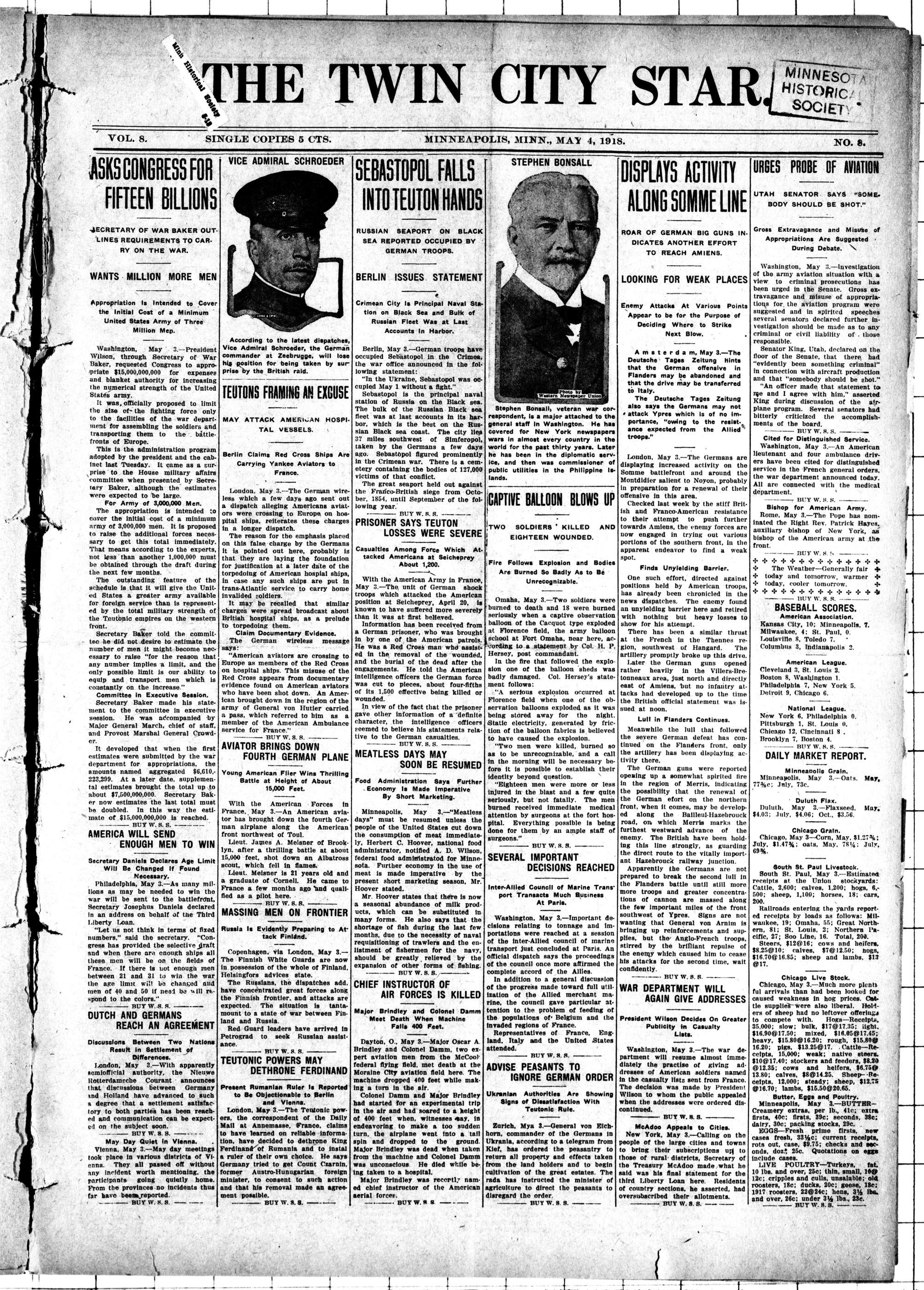
According to the latest dispatches, Vice Admiral Schroeder, the German commander at Zeebrugge, will lose his position for being taken by surprise by the British raid.
TEUTONS FRAMING AN EXCUSE
MAY ATTACK AMERICAN HOSPI
TAL VESSELS.
Berlin Claims Red Cross Ships Are Carrying Yankee Aviators to France.
London, May 3.---The German wireless which a few days ago sent out a dispatch alleging Americans aviators were crossing to Europe on hospital ships, reiterates these charges in a longer dispatch.
The reason for the emphasis placed on this false charge by the Germans it is pointed out here, probably is that they are laying the foundation for justification at a later date of the torpeding of American hospital ships, in case any such ships are put in trans-Atlantic service to carry home invalid soldiers.
It may be recalled that similar charges were spread broadcast about British hospital ships, as a prelude to torpedoing them.
Claim Documentary Evidence.
The German wireless message says:
"American aviators are crossing to Europe as members of the Red Cross on hospital ships. This misuse of the Red Cross appears from documentary evidence found on American aviators who have been shot down. An American brought down in the region of the army of General von Hutter carried a pass, which referred to him as a member of the American Ambulance service for France."
Young American Flier Wins Thrilling Battle at Height of About 15,000 Feet.
With the American Forces in France, May 3.—An American aviator has brought down the fourth German airplane along the American front northwest of Toul.
Lieut. James A. Meisner of Brooklyn, after a thrilling battle at about 15,000 feet, shot down an Albatross scout, which fell in flames.
Lieut. Meisner is 21 years old and a graduate of Cornell. He came to France a few months ago and qualified as a pilot here.
Russia Is Evidently Preparing to Attack Finland.
Copenhagen, via London, May 3.—The Finnish White Guards are now in possession of the whole of Finland, Helsingfors advices state.
The Russians, the dispatches add, have concentrated great forces along the Finnish frontier, and attacks are expected. The situation is tantaum to a state of war between Finland and Russia.
Red Guard leaders have arrived in Petrograd to seek Russian assistance.
BUY W. S. S.
TEUTONIC POWERS MAY
DETHRONE FERDINAND
Present Rumanian Ruler Is Reported to Be Objectionable to Berlin and Vienna.
London, May 3.—The Teutonic powers, the correspondent of the Daily Mall at Annemasse, France, claims to have learned on reliable information, have decided to dethrone King Ferdinand of Rumania and to install a ruler of their own choice. He says Germany tried to get Count Czarnin, former Austro-Hunugarian foreign minister, to consent to such action and that his removal made an agreement possible.
BUY W. S. S.
MINNEAPOLIS, MINN., MAY 4, 1918.
SEBASTOPOL FALLS INTO TEUTON HANDS
RUSSIAN SEAPORT ON BLACK
SEA REPORTED OCCUPIED BY
GERMAN TROOPS.
BERLIN ISSUES STATEMENT
Crimean City Is Principal Naval Station on Black Sea and Bulk of Russian Fleet Was at Last Accounts in Harbor.
Berlin, May 3.—German troops have occupied Sebastopol in the Crimee, the war office announced in the following statement:
"In the Ukraine, Sebastopol was occupied May 1 without a fight."
Sebastopol is the principal naval station of Russia on the Black sea. The bulk of the Russian Black sea fleet was at last accounts in its harbor, which is the best on the Russian Black sea coast. The city lies 37 miles southwest of Simferopol, taken by the Germans a few days ago. Sebastopol figured prominently in the Crimean war. There is a cemetery containing the bodies of 127,000 victims of that conflict.
The great seaport held out against the Franco-British siege from October, 1854, until September of the following year.
BUY W. S. S.
PRISONER SAYS TEUTON
LOSSES WERE SEVERE
Casualties Among Force Which Attacked Americans at Seicheprey About 1,200.
With the American Army in France, May 3.—The unit of German shock troops which attacked the American position at Seicheprey, April 20, is known to have suffered more severely than it was at first believed.
Information has been received from a German prisoner, who was brought in by one of the American patrols.
He was a Red Cross man who assisted in the removal of the wounded, and the burial of the dead after the engagements. He told the American intelligence officers the German force was cut to pieces, about four-fifths of its 1,500 effective being killed or wounded.
In view of the fact that the prisoner gave other information of a definite character, the intelligence officers seemed to believe his statements relative to the German casualties.
MEATLESS DAYS MAY
SOON BE RESUMED
Food Administration Says Further Economy Is Made Imperative By Short Marketing.
Minneapolis, May 3.—"Meatless days" must be resumed unless the people of the United States cut down the consumption of meat immediately, Herbert C. Hoover, national food administrator, notified A. D. Wilson, federal food administrator for Minnesota. Further economy in the use of meat is made imperative by the present short marketing season, Mr. Hoover stated.
Mr. Hoover states that there is now a seasonal abundance of milk products, which can be substituted in many forms. He also says that the shortage of fish during the last few months, due to the necessity of naval requisitioning of trawlers and the enlistment of fishermen for the navy, should be greatly relieved by the expansion of other forms of fishing.
CHIEF INSTRUCTOR OF AIR FORCES IS KILLED
Major Brindley and Colonel Damm Meet Death When Machine Falls 400 Feet.
Dayton, O., May 3.—Major Oscar A. Brindley and Colonel Damm, two expert aviation men from the McCool federal flying field, met death at the Moraine City aviation field here. The machine dropped 400 feet while making a turn in the air.
Colonel Damm and Major Brindley had started for an experimental trip in the air and had soared to a height of 400 feet when, witnesses say, in endeavoring to make a too sudden turn, the airplane went into a tall spin and dropped to the ground. Major Brindley was dead when taken from the machine and Colonel Damm was unconscious. He died while being taken to a hospital.
Major Brindley was recently named chief instructor of the American aerial forces.
STEPHEN BONSALL
Photo by
Western Newspaper Union
Stephen Bonsall, veteran war correspondent, is a major attached to the general staff in Washington. He has covered for New York newspapers wars in almost every country in the world for the past thirty years. Later he has been in the diplomatic service, and then was commissioner of public utilities in the Philippine islands.
CAPTIVE BALLOON BLOWS UP
TWO SOLDIERS KILLED AND EIGHTEEN WOUNDED.
Fire Follows Explosion and Bodies Are Burned So Badly As to Be Unrecognizable.
Omaha, May 3.—Two soldiers were burned to death and 18 were burned seriously when a captive observation balloon of the Cacquot type exploded at Florence field, the army balloon school at Fort Omaha, near here, according to a statement by Col. H. P. Hersey, post commandant.
In the fire that followed the explosion one of the balloon sheds was badly damaged. Col. Hersey's statement follows:
"A serious explosion occurred at Florence field when one of the observation balloons exploded as it was being stored away for the night. Static electricity, generated by friction of the balloon fabrics is believed to have caused the explosion.
"Two men were killed, burned so as to be unrecognizable, and a call in the morning will be necessary before it is possible to establish their identity beyond question.
"Eighteen men were more or less injured in the blast and a few quite seriously, but not fatally. The men burned received immediate medical attention by surgeons at the fort hospital. Everything possible is being done for them by an ample staff of surgeons."
BUY W. S. S.
SEVERAL IMPORTANT
DECISIONS REACHED
Inter-Allied Council of Marine Transport Transacts Much Business At Paris.
Washington, May 3.—Important decisions relating to tonnage and importations were reached at a session of the inter-Allied council of marine transport just concluded at Paris. An official dispatch says the proceedings of the council once more affirmed the complete accord of the Allies.
In addition to a general discussion of the progress made toward full utilization of the Allied merchant marine, the council gave particular attention to the problem of feeding of the populations of Belgium and the invaded regions of France.
Representatives of France, England, Italy and the United States attended.
ADVISE PEASANTS TO
IGNORE GERMAN ORDER
Ukranian Authorities Are Showing Signs of Dissatisfaction With Teutonic Rule.
Zurich, Mya 3.—General von Eichhorn, commander of the Germans in Ukrania, according to a telegram from Kief, has ordered the peasantry to return all property and effects taken from the land holders and to begin cultivation of the great estates. The rada has instructed the minister of agriculture to direct the peasants to disregard the order.
DISPLAYS ACTIVITY ALONG SOMME LINE
DISPLAYS ACTIVITY ALONG SOMME LINE
ROAR OF GERMAN BIG GUNS INDICATES ANOTHER EFFORT TO REACH AMIENS.
LOOKING FOR WEAK PLACES
Enemy Attacks At Various Points
Appear to be for the Purpose of
Deciding Where to Strike
Next Blow.
A m a t e r d a m, May 3.—The
Deutsche Tages Zeitung Hints
that the German offensive in
Flanders may be abandoned and
that the drive may be transferred
to Italy.
The Deutsche Tages Zeitung
also says the Germans may not
attack Ypres which is of no im-
portance, "owing to the resis-
tance expected from the Allied
troops."
London, May 3.—The Germans are
displaying increased activity on the
Somme battlefront and around the
Montdidier salient to Noyon, probably
in preparation for a renewal of their
offensive in this area.
Checked last week by the stiff Brit-
ish and Franco-American resistance
to their attempt to push further
towards Amiens, the enemy forces are
now engaged in trying out various
portions of the southern front, in the
apparent endeavor to find a weak
spot.
Finds Unyielding Barrier.
One such effort, directed against positions held by American troops, has already been chronicled in the news dispatches. The enemy found an unyielding barrier here and retired with nothing but heavy losses to show for his attempt.
There has been a similar thrust at the French in the Thennes region, southwest of Hangard. The artillery promptly broke up this drive. Later the German guns opened rather heavily in the Villers-Bretonneaux area, just north and directly east of Amiens, but no infantry attacks had developed up to the time the British official statement was issued at noon.
Lull in Flanders Continues.
Meanwhile the lull that followed the severe German defeat has continued on the Flanders front, only the artillery has been displaying activity there.
The German guns were reported opening up a somewhat spirited fire in the region of Merris, indicating the possibility that the renewal of the German efort on the northern front, when it comes, may be developed along the Balleul-Hazebrouck road, on which Merris marks the furthest westward advance of the enemy. The British have been holding this line strongly, as guarding the direct route to the vitally important Hazebrouck railway junction.
Apparently the Germans are not prepared to break the second lull in the Flanders battle until still more troops and greater concentrations of cannon are massed along the few important miles of the front southwest of Ypres. Signs are not wanting that General von Arnim is bringing up reinforcements and supplies, but the Anglo-French troops, stirred by the brilliant repulse of the enemy which caused him to cease his attacks for the second time, wait confidently.
WAR DEPARTMENT WILL AGAIN GIVE ADDRESSES
President Wilson Decides On Greater Publicity in Casualty Lists.
Washington, May 3.—The war department will resume almost immediately the practise of giving addresses of American soldiers named in the casualty lists sent from France. The decision was made by President Wilson to whom the public appealed when the addresses were ordered discontinued.
New York, May 3--Calling on the people of the large cities and towns to bring their subscriptions up to those of rural districts, Secretary of the Treasury McAdoo made what he said was his final statement for the third Liberty Loan here. Residents of country sections, he asserted, had oversubscribed their allotments.
NO. 8.
URGES PROBE OF AVIATION
UTAH SENATOR SAYS "SOME
BODY SHOULD BE SHOT."
Gross Extravagance and Misuse of Appropriations Are Suggested During Debate.
Washington, May 3.—Investigation of the army aviation situation with a view to criminal prosecutions has been urged in the Senate. Gross extravagance and misuse of appropriations for the aviation program were suggested and in spirited speeches several senators declared further investigation should be made as to any criminal or civil liability of those responsible.
Senator King, Utah, declared on the floor of the Senate, that there had "evidently been something criminal" in connection with aircraft production and that "somebody should be shot."
"An officer made that statement to me and I agree with him," asserted King during discussion of the airplane program. Several senators had bitterly criticized the accomplishments of the board.
BUY W. S. S.
Cited for Distinguished Service.
Washington, May 3.—An American lieutenant and four ambulance drivers have been cited for distinguished service in the French general orders, the war department announced today. All are connected with the medical department.
Bishop for American Army.
Rome, May 3.—The Pope has nominated the Right Rev. Patrick Hayes,
auxiliary bishop of New York, as bishop of the American army at the front.
BUY W. S. 5
The Weather—Generally fair
today and tomorrow, warmer
today, cooler tomorrow.
BASEBALL SCORES.
American Association.
Kansas City, 10; Minneapolis, 7.
Milwaukee, 4; St. Paul, 0.
Louisville 8; Toledo 7.
Columbus 3; Indianapolis 2.
American League.
Cleveland 3, St. Louis 2.
Boston 8, Washington 1.
Philadelphia 7, New York 5.
Detroit 9, Chicago 6.
National League.
New York 6, Philadelphia 0.
Pittsburgh 1, St. Louis 0.
Chicago 12, Cincinnati 8.
Brooklyn 7, Boston 4.
DAILY MARKET REPORT.
Minneapolis Grain.
Minneapolis, May 3.—Oats, May.
77%c; July, 73c.
Duluth Flax.
Duluth, May 3.—Flaxseed, May.
$4.03; July, $4.06; Oct., $3.56.
Chicago Grain.
Chicago, May 3—Corn, May, $1.27%;
July, $1.47%; oats, May, 78%; July,
69%.
South St. Paul Livestock.
South St. Paul, May 3.—Estimated receipts at the Union stockyards:
Cattle, 2,600; calves, 1,200; hogs, 6-
500; sheep, 1,100; horses, 18; cars,
200.
Railroads entering the yards reported
receipts by loads as follows: Milwaukee, 19; Omaha, 55; Great Northern,
81; St. Louis, 2; Northern Pacific, 27; Soo Line, 16. Total, 200.
Steers, $12@16; cows and heifers,
$8.25@10; calves, $7@12.50; hogs,
$16.70@16.85; sheep and lambs, $13
@17.
Chicago Live Stock.
Chicago, May 3.—Much more plentiful arrivals than had been looked for caused weakness in hog prices. Cattle supplies were also liberal. Holders of sheep had no lofter offerings to compete with. Hogs—Receipts, 35.000; slow; bulk, $17@17.35; light, $16.90@17.50; mixed, $16.65@17.45; heavy, $15.80@16.20; rough, $15.80@16.20; pigs, $13.25@17. Cattle—Receipts, 15.000; weak; native steers, $10@17.40; stockers and feeders, $8.20@12.35; cows and heifers, $6.75@13.80; calves, $8@14.25. Sheep—Receipts, 12.000; steady; sheep, $17@16.70; lambs, $15.50@20.65.
Butter, Eggs and Poultry, Minneapolis, May 3.—BUTTER-Creamery extras, per lb, 41c; extra firsts, 40c; firsts, 39c; seconds, 38c; dairy, 30c; packing stocks, 29c.
EGGS—Fresh prime firsts, new cases fresh, $31½c; current receipts, rots out, case, $7.75; checks and seconds, doz, 25c. Quotations on eggs include cases.
LIVE POULTRY—Turkeys, fst, 10 lbs. and over, 25c; thin, small, 10½c; cripples and culls, unsalable; old roosters, 18c; ducks, 20c; geese, 18c; roosters, 22@24c; hens, 3½lbs. and over, 26c; under 3½lbs, 23c.
Private Monson
By LYNN ROBY MEEKINS
(Copyright, 1918, Western Newspaper Union.)
It was in the midst of the Civil war. Harner went out to take a last look at the field. A battle would certainly be fought the next day. His own inferences had been corroborated by a hint from the headquarters to which he was temporarily attached.
When he first appeared as a war correspondent, full of the romance that his work promised, he waited for the fights and then threw into his descriptions all, the resources of his ready pen and prompt vocabulary, but it would not do. He soon found that by the time his copy was ready the other fellows held the wires and he was left to receive pleasant messages from the home office about dispatches being quite good, but somewhat ancient, with an occasional reminder that the paper he represented was not a monthly publication.
So he learned to gather and arrange the preliminaries and then to dash in the details where the cannons were booming and the bullets were scoring their points with human lives in the great and glorious game of war. Even with the swiftness that experience had brought to him his lot was far from happy. He did not mind hard work—that was a part of the business—but after he had run through one of the hottest and prettiest skirmishes he had ever seen, had witnessed wonderful deeds of valor, and had taken his own life in his hands and made a bold dash across country to a telegraph station, only to receive in acknowledgment of his superb description the message, "Adjectives are cheap and telegraph tolls are not," his feelings were honestly hurt. True it was that the skirmish was but an incident in the mighty conflict between the great sections of a great country and history has not found space to mention it, but Harner knew that it was more savage and picturesque than many of the battles to which pages were given, and he wrote as he saw.
Then, too, there was the restraint of his work. When a soldier is fired at he has the satisfaction of firing back,
THE MASTER
"You Can Fix it as You Please."
but it is never pleasant to have the other fellow do all the shooting. As a correspondent Harner was a noncombatant. He was shot at as much as any of the soldiers and a great deal more than some of them, and he simply had to stand it without the privilege of returning the compliment.
But he had become used to it all now, and the battle of the morrow must be attended to. He knew the locations of the commands; he believed he had the plans of the fight, and he wanted to get the field of operations so clear in his mind that his account would be as accurate in its topography as in its other important particulars. He had permission to rove within the lines and he was-on his way to the line.
As he turned into a path which would save him some of the distance a young soldier overtook him. He was handsome and young, with the rosy health of perfect physical manhood. Harner viewed him closely and into his mind came a pity that such hope should be used as food for gunpowder. "My name is Monson, Company C. Eighth volunteers," he said, "and I want you to do me a favor." "Very glad to do anything I can," replied Harner.
"Your paper goes to our town and anything that is printed about us will be read there," he went on. "What I ask may seem a little strange, but I know that you can do it without much trouble to yourself."
"Well, what is it?"
"In your dispatch about tomorrow's fight I want you to report as dead William B. Monson, private in Company C, who enlisted from Spring Falls."
Harner took a more careful look at the young man, but there was nothing in his contenance to indicate that he was either insane of insincere. But it seemed to be a jest and Harner smiled.
"How would you like it put?" he asked.
"I don't understand."
"Of course you want to die a hero's death. Shall I have you leading your company over the enemy's ramparts; or dashing forth to grasp the flag from hostile hands; or picking up a burning bomb; or throwing yourself in front of your captain to save his precious uniform from an approaching bullet—or shall it be just a plain case of dead in the line of duty with only an empty knapsack and a visiting card to tell the story of a life cut down in the bloom of youth?
"You can fix it as you please," said the young man solemnly. "I suppose you newspaper fellows have to put things in to fill up and as I am going to die it won't make much difference how it happens. But I'll be satisfied with just a line—just say I'm dead. That's all I ask."
"I suppose," he said, "that you have never taken time to consider why my paper keeps me out here or why I stay. It isn't for the fun of the thing, I assure you. They are not paying me a salary and expenses merely to spend their surplus or to enable me to telegraph bogus news. If you had had four years of the work only to get complaints from alleged editors, who sit in easy chairs and think they rule in the country with a headline or a double-leased screed and who know more than all the generals and correspondents in both armies you would understand things better. It's hard enough to persuade these omnipotents to recognize real news when they see it, much less to send them statements which are not true."
Harner's sarcasm went for naught. The soldier did not comprehend it and apparently did not care to. His only reply was vaguely put. "I suppose I would," he said, "but you'll do this for me, won't you?" "Of course not." "Why won't you?" "Simply because I won't," said Harner with emphasis. The soldier stood as if undetermined what to do. Then he looked up and said: "Well, never mind, for you'll have to do it anyhow." "I hope not," replied Harner, and more seriously, "you're too young to die. Your country needs you even if your sweetheart doesn't." Blushing deeply and stammering something which Harner did not understand the soldier turned and walked raidly away.
The battle was fought. Throughout the conflict Harner was here, there and everywhere getting facts and names and details. There was no time in that awful slaughter to notice trifles. Human lives were as cheap as grass and were mowed down as mercilessly. So it happened that it was not until several days later when the papers containing the reports reached the moving army that Harner observed his own report: "Monson, William H.—Private Company C. Enlisted from Spring Falls, Shot through the shoulder while saving company's colors."
In the next issue was a dispatch from Spring Falls saying that Monson was one of the best young men of Spring Falls and that his death was universally deplored.
"Well that beats me," said Harner, "I wonder if my memory served me a trick, I'll see." The command had moved many miles but the company was still with it and he immediately sought out the captain and asked him about Private Monson.
"Poor fellow!" was the reply. "He was the bravest fool I ever saw. I suppose they buried him with the rest."
After the war Harner did not return to his paper. The editors who had mutilated his copy and against whom he had an accumulated antipathy equal to that which the war correspondents, whose usefulness Harner could prove was first pointed out by General George Washington, were still in charge and he did not feel like coming directly under their orders. So he tried other things, but as the years went by and the other things did not make him rich, he succumbed to the inevitable and entered journalism again. To him was given a roving commission to visit and write up the places where the conquests of industry were making the wealth that was to pay the debts of the war.
In the course of time his duties took him to Spring Falls, a village which had become a city, with its splendid water power utilized, with great manufactories on every side. He saw it all and finally he saw upon the side of a large mill, "William H. Monson." The name seemed strangely familiar, and yet he could not place it. It was gone amid all the thousands of forgotten things in the crowded years.
But the next morning it came like a flash.
And then the story. Colonel Monson told it at his own fireside after Harner had been presented to his wife as the man who refused to report him dead.
"But I did report you dead," insisted Harner.
"Yes, but it was all a mistake. They thought I was, but I wasn't. In fact it was almost as untrue as the report which reached me the day before the battle that a certain young lady had thrown me over."
And after that came the experiences so interesting to hear in time of peace that were so hard to know in the days of war.
Food Economy.
"Not as much as he used to," answered Mr. Jobbles. "I'm teaching that dog to Fletcherize. Yesterday I induced him to znaw a single small bone for an hour."
THE TWIN CITY STAR, MINNEAPOLIS, MINN.
THE NEW YORKER
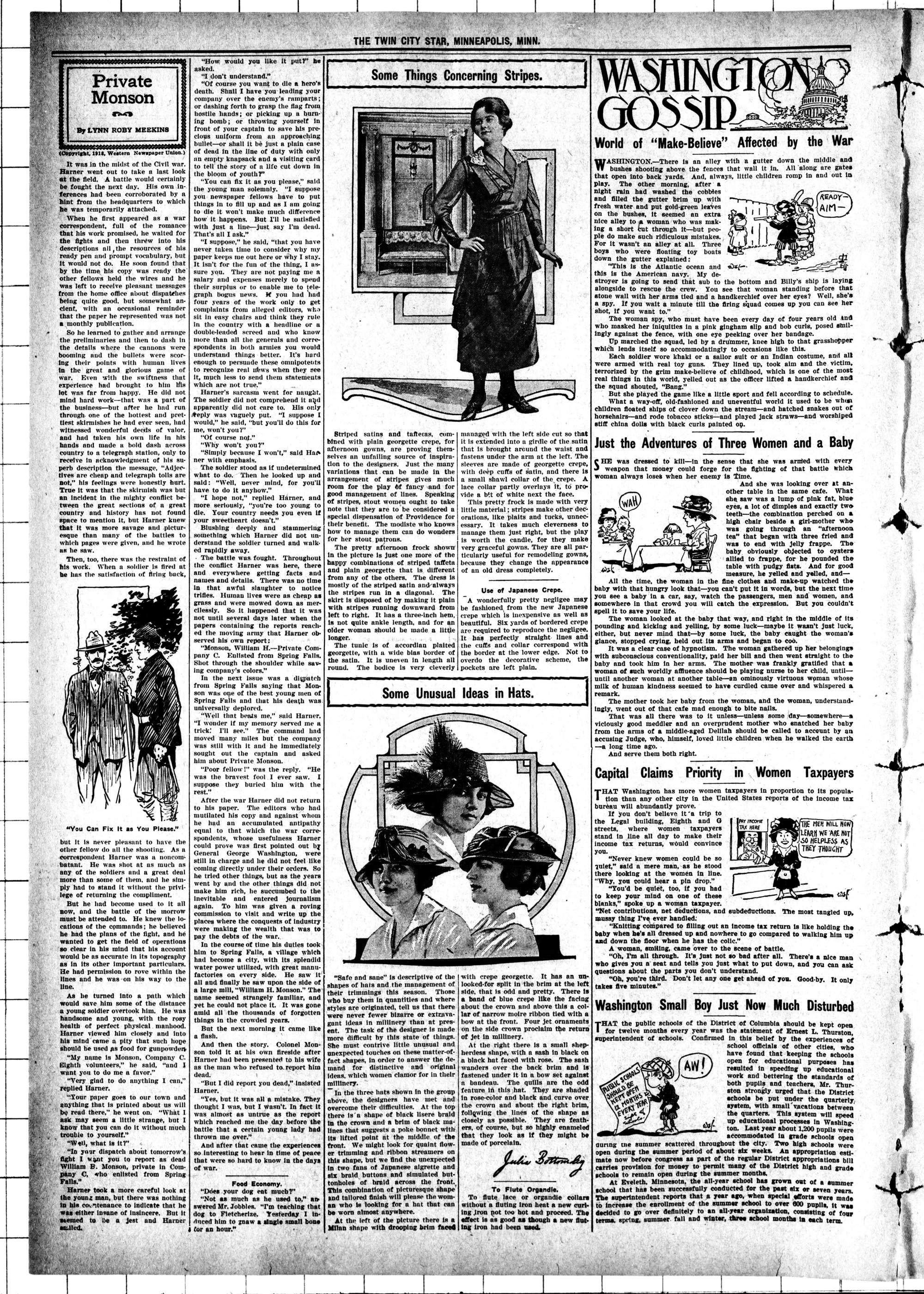
Striped satins and taffetas, combined with plain georgette crepe, for afternoon gowns, are proving themselves an unfailing source of inspiration to the designers. Just the many variations that can be made in the arrangement of stripes gives much room for the play of fancy and for good management of lines. Speaking of stripes, stout women ought to take note that they are to be considered a special dispensation of Providence for their benefit. The modiste who knows how to manage them can do wonders for her stout patrons.
The pretty afternoon frock shown in the picture is just one more of the happy combinations of striped taffeta and plain georgette that is different from any of the others. The dress is mostly of the striped satin and always the stripes run in a diagonal. The skirt is disposed of by making it plain with stripes running downward from left to right. It has a three-inch hem, is not quite ankle length, and for an older woman should be made a little longer. The tunic is of accordian plaited georgette, with a wide blas border of the satin. It is uneven in length all round. The bodice is very cleverly
Some Unusual Ideas in Hats.
L
J
"Safe and sane" is descriptive of the shapes of hats and the management of their trimlings this season. Those who buy them in quantities and where styles are originated, tell us that there were never fewer bizarre or extravagant ideas in millinery than at present. The task of the designer is made more difficult by this state of things. She must contrive little unusual and unexpected touches on these matter-of-fact shapes, in order to answer the demand for distinctive and original ideas, which women clamor for in their millinery.
In the three hats shown in the group above, the designers have met and overcome their difficulties. At the top there is a shape of black lisse braid in the crown and a brim of black maltes that suggests a poke bonnet with its lifted point at the middle of the front. We might look for quaint flower trimming and ribbon streamers on this shape, but we find the unexpected in two fans of Japanese algrette and six braid buttons and simulated buttonholes of braid across the front. This combination of picturesque shape and tallored finish will please the woman who is looking for a hat that can be worn almost anywhere. At the left of the picture there is a Milan shape with drooping brim faced
---
managed with the left side cut so that it is extended into a girdle of the satin that is brought around the waist and fastens under the arm at the left. The sleeves are made of georgette crepe, with deep cuffs of satin, and there is a small shawl collar of the crepe. A lace collar partly overlays it, to provide a bit of white next the face. This pretty frock is made with very little material; stripes make other decorations, like plaits and tucks, unnecessary. It takes much cleverness to manage them just right, but the play is worth the candle, for they make very graceful gowns. They are all particularly useful for remodelling gowns, because they change the appearance of an old dress completely.
Use of Japanese Crepe.
A wonderfully pretty negligee may be fashioned from the new Japanese crepe which is inexpensive as well as beautiful. Six yards of bordered crepe are required to reproduce the negligee. It has perfectly straight lines and the cuffs and collar correspond with the border at the lower edge. Not to overdo the decorative scheme, the pockets are left plain.
I
with crepe georgette. It has an unlooked-for splint in the brim at the left side, that is odd and pretty. There is a band of blue crepe like the facing about the crown and above this a collar of narrow more ribbon tied with a bow at the front. Four jet ornaments on the side crown proclaim the return of jet in millinery.
At the right there is a small shepherdess shape, with a sash in black on a black hat faced with rose. The sash wanders over the back brim and is fastened under it in a bow set against a bandeau. The quilts are the odd feature in this hat. They are shaded in rose-color and black and curve over the crown and about the right brim, following the lines of the shape as closely as possible. They are feathers, of course, but so highly enameled that they look as if they might be made of porcelain.
Julis Bottomly
To Flute Organdle.
To flute lace or organdle collars without a fluting iron heat a new curling iron not too hot and proceed. The effect is as good as though a new fluting iron had been used.
WASHINGTON GOSSIP
WASHINGTON.—There is an alley with a gutter down the middle and bushes shooting above the fences that wall it in. All along are gates that open into back yards. And, always, little children romp in and out in
stroyer is going to send that sub to the bottom and Billy's ship is laying alongside to rescue the crew. You see that woman standing before that stone wall with her arms tied and a handkerchief over her eyes? Well, she's a spy. If you wait a minute till the firing squad comes up you can see her shot, if you want to."
The woman spy, who must have been every day of four years old and who masked her inquiries in a pink gingham slip and bob curls, posed smilingly against the fence, with one eye peeking over her bandage.
Up marched the squad, led by a drummer, knee high to that grasshopper which lends itself so accommodatingly to occasions like this.
Each soldier wore khaki or a sailor suit or an Indian costume, and all were armed with real toy guns. They lined up, took aim and the victim, terrorized by the grim make-believe of childhood, which is one of the most real things in this world, yelled out as the officer lifted a handkerchief and the squad shouted, "Bang."
But she played the game like a little sport and fell according to schedule. What a way-off, old-fashioned and uneventful world it used to be when children floated ships of clover down the stream—and hatched snakes out of horsehairs—and rode tobacco sticks—and played jack straws—and worshiped stiff china dolls with black curls painted op.
Just the Adventures of Three Women and a Baby
HE was dressed to kill—in the sense that she was armed with every weapon that money could forge for the fighting of that battle which woman always loses when her enemy is Time.
All the time, the woman in the fine clothes and make-up watched the baby with that hungry look that—you can't put it in words, but the next time you see a baby in a car, say, watch the passengers, men and women, and somewhere in that crowd you will catch the expression. But you couldn't spell it to save your life.
The woman looked at the baby that way, and right in the middle of its pounding and kicking and yelling, by some luck—maybe it wasn't just luck, either, but never mind that—by some luck, the baby caught the woman's glance, stopped crying, held out its arms and began to coo.
It was a clear case of hypnotism. The woman gathered up her belongings with subconscious conventionality, paid her bill and then went straight to the baby and took him in her arms. The mother was frankly gratified that a woman of such worldly affluence should be playing nurse to her child, until—until another woman at another table—an ominously virtuous woman whose milk of human kindness seemed to have curled came over and whispered a remark.
The mother took her baby from the woman, and the woman, understandingly, went out of that cafe mad enough to bite nails.
That was all there was to it unless—unless some day—somewhere—a viciously good meddler and an overprudent mother who snatched her baby from the arms of a middle-aged Delliah should be called to account by an accusing Judge, who, himself, loved little children when he walked the earth—a long time ago.
Capital Claims Priority in Women Taxpayers
THAT Washington has more women taxpayers in proportion to its population than any other city in the United States reports of the income tax bureau will abundantly prove.
"Net contributions, net deductions, and subdeductions. The most tangled up, mussey thing I've ever handled:
"Knitting compared to filling out an income tax return is like holding the baby when he's all dressed up and nowhere to go compared to walking him up and down the floor when he has the colic."
A woman, smiling, came over to the scene of battle.
"Oh, I'm all through. It's just not so bad after all. There's a nice man who gives you a seat and tells you just what to put down, and you can ask questions about the parts you don't understand.
"Oh, you're third. Don't let any one get ahead of you. Good-by. It only takes five minutes."
Washington Small Boy Just Now Much Disturbed
Washington Small Boy Just Now Much Disturbed
THAT the public schools of the District of Columbia should be kept open for twelve months every year was the statement of Ernest L. Thurston, superintendent of schools. Confirmed in this belief by the experiences of
during the summer scattered throughout the city. Two high schools were open during the summer period of about six weeks. An appropriation estimate now before congress as part of the regular District appropriations bill carries provision for money to permit many of the District high and grade schools to remain open during the summer months.
At Eveleth, Minnesota, the all-year school has grown out of a summer school that has been successfully conducted for the past six or seven years. The superintendent reports that a year ago, when special efforts were made to increase the enrollment of the summer school to over 600 pupils, it was decided to go over definitely to an all-year organization, consisting of four terms, spring, summer fall and winter, three school months in each term.
play. The other morning, after a night rain had washed the cobbles and filled the gutter brim up with fresh water and put gold-green leaves on the bushes, it seemed an extra nice alley to a woman who was making a short cut through it—but people do make such ridiculous mistakes. For it wasn't an alley at all. Three boys who were floating toy boats down the gutter explained:
"This is the Atlantic ocean and this is the American navy. My de-
stroyer is going to send that sub to
alongside to rescue the crew. You u
stone wall with her arms tied and a ha
a spy. If you wait a minute till the
shot, if you want to."
The woman spy, who must have
who masked her inquiries in a pink g
ingly against the fence, with one eye.
Up marched the squad, led by a d
which lends itself so accommodatingly.
Each soldier wore khaki or a sall
were armed with real toy guns. The
terrorized by the grim make-believe of
real things in this world, yelled out a
the squad shouted, "Bang."
But she played the game like a little.
What a way-off, old-fashioned and
children floated ships of clover down to
horsehairs—and rode tobacco sticks—a
stiff china dolls with black curls painn
Just the Adventures of T
SHE was dressed to kill—in the se
weapon that money could forge in
woman always loses when her enemy
WAH
All the time, the woman in the r baby with that hungry look that—you you see a baby in a car, say, watch somewhere in that crowd you will call spell it to save your life.
The woman looked at the baby the pounding and kicking and yelling, by either, but never mind that—by some glance, stopped crying, held out its arm.
It was a clear case of hypnotism. with subconscious conventionality, paid baby and took him in her arms. The woman of such worldly affluence should until another woman at another table, milk of human kindness seemed to have remark.
The mother took her baby from the ingly, went out of that cafe mad enoug. That was all there was to it uviciously good meddler and an overprt from the arms of a middle-aged Delil accusing Judge, who, himself, loved life—a long time ago.
And serve them both right.
Capital Claims Priority
THAT Washington has more women
tion than any other city in the U
bureau will abundantly prove.
If you don't believe it a trip to
the Legal building, Eighth and G
streets, where women taxpayers
stand in line all day to make their
income tax returns, would convince
you.
"Never knew women could be so
quiet," said a mere man, as he stood
there looking at the women in line.
"Why, you could hear a pin drop."
"You'd be quiet, too, if you had
to keep your mind on one of these
blanks," spoke up a woman taxpayer.
"Net contributions, net deductions, and
everything Use, use, use, used."
Knitting compared to filling out a baby when he's all dressed up and now and down the floor when he has the c A woman, smiling, came over to t "Oh, I'm all through. It's just no who gives you a seat and tells you you questions about the parts you don't u "Oh, you're third. Don't let any o takes five minutes."
Washington Small Boy J
THAT the public schools of the District for twelve months every year was superintendent of schools. Confirmed
PUBLIC SCHOOLS
SHOULD BE
KEEP OPEN
12 MONTHS
EVERY YEAR
AW!
during the summer scattered through open during the summer period of abate now before congress as part of a carries provision for money to permit schools to remain open during the sun. At Eveleth, Minnesota, the all-year school that has been successfully cone The superintendent reports that a year to increase the enrollment of the sun decided to go over definitely to an a terma, spring, summer, fall and winter
READY-
AIM-
中國
the bottom and Billy's ship is laying
see that woman standing before that
handkerchief over her eyes? Well, she's
firing squad comes up you can see her
been every day of four years old and
ingham slip and bob curls, posed smil-
peeking over her bandage.
rummer, knee high to that grasshopper
y to occasions like this.
for suit or an Indian costume, and all
y lined up, took alm and the victim,
if childhood, which is one of the most
is the officer lifted a handkerchief and
table sport and fell according to schedule.
I uneventful world it used to be when
the stream—and hatched snakes out of
and played jack straws—and worshiped
ed up.
Three Women and a Baby
ense that she was armed with every
for the fighting of that battle which
is Time.
And she was looking over at another table in the same cafe. What she saw was a lump of pink fat, blue eyes, a lot of dimples and exactly two teeth—the combination perched on a high chair beside a girl-mother who was going through an "afternoon tea" that began with three fried and was to end with jelly frappe. The baby obviously objected to oysters allied to frappe, for he pounded the table with pudgy fats. And for good measure, he felled and yelled, and—
the clothes and make-up watched the can't put it in words, but the next time the passengers, men and women, and catch the expression. But you couldn't eat way, and right in the middle of its some luck—maybe it wasn't just luck, be luck, the baby caught the woman's arms and began to coo.
The woman gathered up her belongings her bill and then went straight to the mother was frankly gratified that and be playing nurse to her child, until—an ominously virtuous woman whose vee curdled came over and whispered a the woman, and the woman, understand-gh to bite nails.
less—unless some day—somewhere—a student mother who snatched her babyah should be called to account by an little children when he walked the earth
in Women Taxpayers
taxpayers in proportion to its popula- lited States reports of the income tax
MY INCOME
TAX HERE
THE MEH MILL NOW
LEARN WE'ARE NOT
SO HELPLESS AS
THEY THOUGHT
and subdeductions. The most tangled up,
an income tax return is like holding the
there to go compared to walking him up
colic."
The scene of battle.
It so bad after all. There's a nice man
what to put down, and you can ask
understand.
One get ahead of you. Good-by. It only
Just Now Much Disturbed
District of Columbia should be kept open
the statement of Ernest L. Thurston,
in this belief by the experiences of
school officials of other cities, who have found that keeping the schools open for educational purposes has resulted in speeding up educational work and bettering the standards of both pupils and teachers, Mr. Thurston strongly urged that the District schools be put under the quarterly system, with small vacations between the quarters. This system will speed up educational processes in Washington. Last year about 1,200 pupils were accommodated in grade schools open
out the city. Two high schools were about six weeks. An appropriation esti- the regular District appropriations bill at many of the District high and grade summer months. Our school has grown out of a summer ducted for the past six or seven years. Our ago, when special efforts were made summer school to over 600 pupils, it was all-year organization, consisting of four, three school months in each term.
THE KITCHEN CABINET
prepared on short notice. Canned soups are another available dish. A white sauce with fish, flesh or fowl or almost any vegetable, cold cooked eggs or macaroni will make a good main dish.
An omelet is always welcome and the housewife who keeps herself well supplied with eggs need not worry if she knows how to prepare a fluffy, tasty omelet.
A half a cupful of rice may be browned in a little butter, then water added to cook it, and when tender strir in two or three eggs with a little milk or cream with seasonings. This will taste like scrambled eggs with use of half the number.
For dessert one may always call upon the preserve closet, and with a cracker or small sponge cake or piece of fruit cake with a hot drink, the dessert is easy. If a stale cake is in one's possession, steam it and make a sauce of a cupful of sugar, two tablespoonfuls of flour well blended, and just enough boiling water to cook the mixture until smooth, then add a nice lump of butter, a grating of nutmeg, and a tablespoonful or two of good vinegar, with a pinch of salt. Serve the sauce hot as well as the steamed cake.
Another quick dessert is called "Fifteen Minute Pudding," and is one every housewife should know how to prepare. Take a cupful of flour, sifted with a teaspoonful of baking powder, a little salt and a cup of milk. Put into greased cups with a layer of any juicy fruit like cherries in between the spoonfuls of batter. Steam 15 minutes in a dish of boiling water. Serve with cream.
Oh! that mine eyes might closed be
To what concerns me not to see;
That deafness might possess mine ear
To what concerns me not to hear;
That truth my tongue may always tie
From ever speaking foolishly.
-Thos. Elmwood.
SAVORY, SATISFYING DISHES.
The conscientious housewife who is trying to fulfill the requirements of
chicken broth, with one cupful of stale bread crumbs. Bring to the boiling point and let simmer 45 minutes, then rub through a sieve and add a cupful of milk. Melt two tablespoonfuls of butter, add two of flour and stir until well blended, then pour on gradually while stirring constantly the boiling hot stock. Add a cupful of thin cream or a beaten egg with a cupful of milk. Season well with salt and pepper and serve piping hot.
Oatmeal Scrapple.—Boil two pounds of flank steak until tender, put it through a meat grinder. To the liquor of the beef add a pint of oatmeal, boil for half an hour, then mix with the meat, season with pepper and salt, and mold in a bread pan. Fry the slices in hot fat until deep brown.
Prune Ice Cream.—Soak a cupful of prunes in water to cover overnight. Cook in the same water until tender, remove the stones and put the pulp through a strainer. Add a cupful of sugar, four tablespoonfuls of lemon juice, a pinch of salt, and $1\frac{1}{4}$ cupfuls of cream. Freeze and serve garnished with nut meats. The juice of two oranges may be used in place of the lemons, making a pleasing variety.
Creamed Sardines.—Melt four tablespoonfuls of butter, add one-fourth of a cupful of soft bread crumbs, add one cupful of cream and bring to the boiling point; add one box of sardines, two cooked eggs finely chopped, one-half teaspoonful of salt, a few dashes of paprika. Reheat and serve on narrow strips of buttered toast.
Doughnuts that have become dry may be dipped in cold water and reheated in the oven, making them quite palatable.
Nellie Maxwell
Strange Fate of a Clock.
The Germans have tried many unsuccessful expedients to catch progressive Father Time and force him back into his medieval trappings, which they believe to be still in fashion.
When the picturesque old church at Etrellers fell before the enemy's artillery, though the shell of the symbolically sacred structure was absolutely ruined, the clock escaped destruction.
Now it forms the front wall of a British Tommy's hut which is perched in front of the sheltering pile of debris. Time is with the Allies.—Popular Science Monthly.
Look inwards! for you have a lasting fountain of happiness at home that will always bubble up if you will but dig for it.—Marcus Aurelius.
Inquisitive People.
Inquisitive people are the funnels of conversation; they do not take anything for their own use, but merely to pass it to another.—Steele.
THE KITCHEN CABIN
We should, be keerful how we en-
curridge luxuries. It is but a step for-
ward from hoe cake to plum puddin',
but it's a mile and a half by the neare-
st road when we have to go back
again.—Josh Billings.
A FEW PRETTY SALADS.
The combination of light green found
in the cucumber, and the rich red of the
ripe tomato makes a salad most alluring. Small tomatoes may be peeled and cut in the form of a tulip with a bit of yellow mayonnaise for the center; placed on head lettuce, they look
a salad most alluring. Small tomatoes may be peeled and cut in the form of a tulip with a bit of yellow mayonnaise for the center; placed on head lettuce, they look like a flower.
A pretty way to serve cucumber is to peel it, then pare in rounds as one does an apple, keeping the pieces as long as possible. Wind in rose shape, place a spoonful of mayonnaise in the center and if placed on lettuce or a slice of tomato will prove both pleasing to the eye and the palate.
Chopped cucumber with onion used as a filling for tomato cups, the filling mixed with a good boiled dressing or any kind of oil dressing, is another good combination well liked.
Green Pepper With Cheese.—Cut green peppers in halves, removing the seeds and white pulp, then fill with highly seasoned cream cheese which has been softened with cream; a few chopped chives may be added. The peppers are set away to chill, and when ready to serve cut them in slices. The slice will have a ring of the pretty green or red of the pepper around the cheese.
Tomato and Pineapple Salad.—Peel shapey small tomatoes and cut in eighths, keeping it together at the blossom end. Open out like a flower and fill the center with chopped pineapple and celery and dot with a spoonful of yellow mayonnaise just before serving. Slices of radish with slices of onion of the same size in overlapping slices make a pretty garnish for a plain lettuce or head lettuce salad.
Head Lettuce With Peanuts—Take a half cupful of nice fresh peanuts, roll with the rolling pin until crushed like crumbs. Sprinkle these over head lettuce that has been dressed with a highly seasoned French dressing with a tablespoonful of onion added to it.
She dresses aye sae clean and neat, Baith decent and genteel. And then there's something in her gait Makes ony dress look weel.
—Burns.
GOOD THINGS TO TRY.
Pastry may be made by using barley flour without any wheat flour. Pro-
ceed as with any pastry. The mixture will be a little more difficult to handle, but it makes very good pastry. Baking powder biscuit may also be made, using barley flour
pastry. The mixture will be a little more difficult to handle, but it makes very good pastry. Baking powder biscuit may also be made, using barley flour exclusively, with a little larger proportion of baking powder.
Molasses Cookies—Take a half-cupful each of sugar, molasses and vegetable fat, melt and mix together; cool; add one cupful of sour or butter milk, one and three-fourths cupfuls of flour, one cupful of barley flour, a teaspoonful each of soda, baking powder, ginger, allspice, cloves and salt. Mix well and set in the ice box until stiff and cold. Roll out quickly and cut before the mixture becomes too soft to handle.
Camp Pudding—Put a pint of stale bread crumbs with a pint of milk in a saucepan to crush for half an hour; add a half-cupful of honey, one egg well beaten, a few gratings of nutmeg; mix well and bake until the pudding is set in the center. Serve hot with honey or maple sirup.
Oatmeal Sweetbits—Cream one cupful of sugar with a teaspoonful of fat; add the yolks of two eggs well beaten, two and one-half cupfuls of rolled oats mixed with two teaspoonfuls of baking powder, and when well blended fold in the well-beaten whites of the eggs with a teaspoonful of vanilla. Drop on a baking sheet with a teaspoon and bake in a slow oven, allowing plenty of room for the cakes to spread.
Potato Coffee Cake—Take two cupfuls of flour, two tablespoonfuls of fat, one-third of a cupful of sugar, a teaspoonful of salt, a fourth of a cupful of skim milk, a half yeast cake and cinnamon or grated lemon peel for flavoring. Melted fat and sugar with a few chopped nuts may be usd to spread over the top just before baking.
SHORT NOTICE DISHES.
The housewife who is at all efficient, tries to have something that may
something that may be drawn upon for an emergency when the unexpected guest or "three were invited here nine," which will sometimes happen in the best regulated neighborhoods. A cream
be drawn upon for an emergency when the unexpected guest or "three were invited here come nine," which will sometimes happen in the best regulated neighborhoods. A cream soup with crackers or crotons will make a good beginning for any meal after breakfast or if broth of any kind is at hand a variety of soups may be
SALMON
clientous housewife who is fulfill the requirements of her food pledge is often much puzzled to plan a well-balanced meal.
M
Spring Soup—Peel and thinly slice one onion and cook in a tablespoonful of butter for five minutes, stirring constantly, then add four cups of.
Strange Fate of a Clock.
Inguisitive People.
THE TWIN CITY STAR, MINNEAPOLIS, MINN.
LATEST TYPE OF FRENCH AUTO AMBULANCE
© Western Newspaper Union
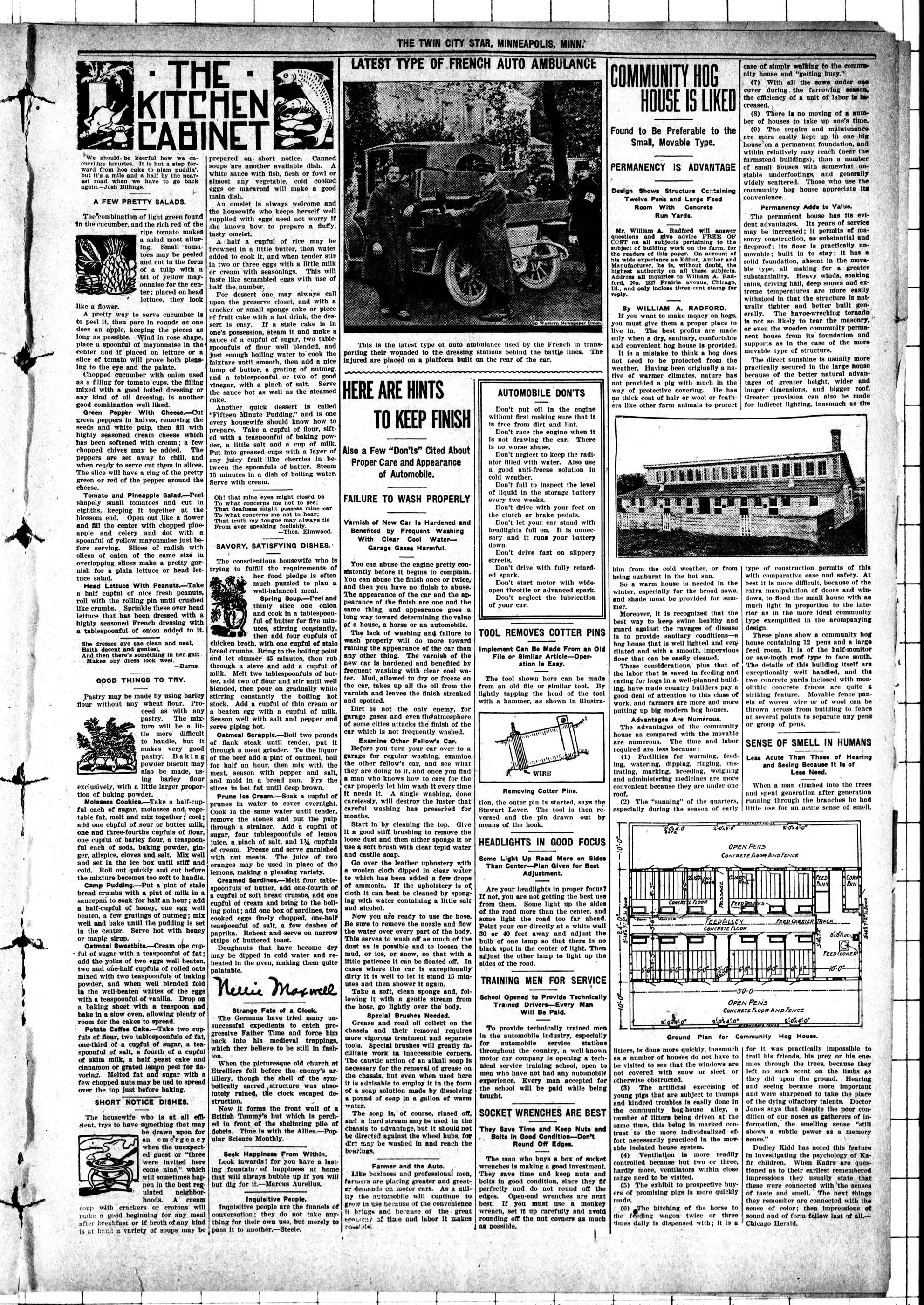
This is the latest type of auto ambulance used by the French in transporting their wounded to the dressing stations behind the battle lines. The injured are placed on a platform built on the rear of the car.
HERE ARE HINTS TO KEEP FINISH
FAILURE TO WASH PROPERLY
Varnish of New Car Is Hardened and Benefited by Frequent Washing With Clear Cool Water—
Garage Gases Harmful.
You can abuse the engine pretty consistently before it begins to complain. You can abuse the finish once or twice, and then you have no finish to abuse. The appearance of the car and the appearance of the finish are one and the same thing, and appearance goes a long way toward determining the value of a house, a horse or an automobile. The lack of washing and failure to wash properly will do more toward ruining the appearance of the car than any other thing. The varnish of the new car is hardened and benefited by frequent washing with clear cool water. Mud, allowed to dry or freeze on the car, takes up all the oil from the varnish and leaves the finish streaked and spotted.
Dirt is not the only enemy, for garage gases and even the atmosphere of some cities attacks the finish of the car which is not frequently washed.
Examine Other Fellow's Car.
Before you turn your car over to a garage for regular washing, examine the other fellow's car, and see what they are doing to it, and once you find a man who knows how to care for the car properly let him wash it every time it needs it. A single washing, done carelessly, will destroy the luster that careful washing has preserved for months.
Start in by cleaning the top. Give it a good stiff brushing to remove the loose dust and then either sponge it or use a soft brush with clear tepid water and castile soap.
Go over the leather uphostery with a woolen cloth dipped in clear water to which has been added a few drops of ammonia. If the upholstery is of cloth it can best be cleaned by sponging with water containing a little salt and alcohol.
Now you are ready to use the hose. Be sure to remove the nozzle and flow the water over every part of the body. This serves to wash off as much of the dust as is possible and to loosen the mud, or ice, or snow, so that with a little patience it can be floated off. In cases where the car is exceptionally dirty it is well to let it stand 15 minutes and then shower it again.
Take a soft, clean sponge and, following it with a gentle stream from the hose, go lightly over the body.
Special Brushes Needed.
Grease and road oil collect on the chassis and their removal requires more vigorous treatment and separate tools. Special brushes will greatly facilitate work in inaccessible corners. The caustic action of an alkali soap is necessary for the removal of grease on the chassis, but even when used here it is advisable to employ it in the form of a soap solution made by dissolving a pound of soap in a gallon of warm water. The soap is, of course, rinsed off, and a hard stream may be used in the chassis to advantage, but it should not be directed against the wheel hubs, for dirt may be washed in and reach the bearings.
Farmer and the Auto
Like business and professional men, farmers are placing greater and greater demands on motor cars. As a utility the automobile will continue to grow in use because of the convenience it brings and because of the great economy of time and labor it makes possible.
AUTOMOBILE DON'TS
Don't put oil in the engine without first making sure that it is free from dirt and lint.
Don't race the engine when it is not drawing the car. There is no worse abuse.
Don't neglect to keep the radiator filled with water. Also use a good anti-freeze solution in cold weather.
Don't fail to inspect the level of liquid in the storage battery every two weeks.
Don't drive with your feet on the clutch or brake pedals.
Don't let your car stand with headlights full on. It is unnecessary and it runs your battery down.
Don't drive fast on slippery streets.
Don't drive with fully retarded spark.
Don't start motor with wide-open throttle or advanced spark.
Don't neglect the lubrication of your car.
TOOL REMOVES COTTER PINS
Implement Can Be Made From an Old File or Similar Article—Operation is Easy.
The tool shown here can be made from an old file or similar tool. By lightly tapping the head of the tool with a hammer, as shown in illustra-
WIRE
tion, the outer pin is started, says the Stewart Lever. The tool is then reversed and the pin drawn out by means of the hook.
HEADLIGHTS IN GOOD FOCUS
Some Light Up Road More on Sides Than Center—Plan Given for Best Adjustment.
Are your headlights in proper focus? If not, you are not getting the best use from them. Some light up the sides of the road more than the center, and some light the road too far ahead. Point your car directly at a white wall 30 or 40 feet away and adjust the bulb of one lamp so that there is no black spot in the center of light. Then adjust the other lamp to light up the sides of the road.
TRAINING MEN FOR SERVICE
School Opened to Provide Technically Trained Drivers—Every Man Will Be Paid.
To provide technically trained men in the automobile industry, especially for automobile service stations throughout the country, a well-known motor car company is opening a technical service training school, open to men who have not had any automobile experience. Every man accepted for the school will be paid while being taught.
SOCKET WRENCHES ARE BEST
They Save Time and Keep Nuts and Bolts in Good Condition—Don't Round Off Edges.
The man who buys a box of socket wrenches is making a good investment. They save time and keep nuts and bolts in good condition, since they fit perfectly and do not round off the edges. Open-end wrenches are next best. If you must use a monkey wrench, set it up carefully and avoid rounding off the nut corners as much as possible.
COMMUNITY HOG HOUSE IS LIKED
Found to Be Preferable to the Small, Movable Type.
PERMANENCY IS ADVANTAGE
Design Shows Structure Containing Twelve Pens and Large Feed Room With Concrete Run Yards.
Mr. William A. Radford will answer questions and give advice FREE OF COST on all subjects pertaining to the subject matter, or work for the readers of this paper. On account of his wide experience as Editor, Author and Manufacturer, he is, without doubt, the highest authority on all these subjects. Address all inquiries to William A. Radford, 600 Fifth Avenue, Chicago, Ill., and only inclose three-cnt stamp for reply.
Bv. WILLIAM A. BADEFORD
If you want to make money on hogs, you must give them a proper place to live in. The best profits are made only when a dry, sanitary, comfortable and convenient hog house is provided. It is a mistake to think a hog does not need to be protected from the weather. Having been originally a native of warmer climates, nature has not provided a pig with much in the way of protective covering. He has no thick coat of hair or wool or feathers like other farm animals to protect
THE HISTORY OF THE MUSEUM
hin from the cold weather, or from type of construction permits of this being sunburnt in the hot sun. with comparative ease and safety. A
So a warm house is needed in the winter, especially for the brood sows, and shade must be provided for summer.
Moreover, it is recognized that the best way to keep swine healthy and guard against the ravages of disease is to provide sanitary conditions—a hog house that is well lighted and ventilated and with a smooth, impervious floor that can be easily cleaned.
These considerations, plus that of the labor that is saved in feeding and caring for hogs in a well-planned building, have made country builders pay a good deal of attention to this class of work, and farmers are more and more putting up big modern hog houses.
Advantages Are Numérous.
The advantages of the community house as compared with the movable are numerous. The time and labor required are less because:
(1) Facilities for warming, feeding, watering, dipping, ringing, castrating, marking, breeding, weighing and administering medicines are more convenient because they are under one roof.
(2) The "sunning" of the quarters, especially during the season of early
2'0.4'0
BARK
2'0.4'0
OPEN
CONCRETE
KIRKPARK
FLOOR
PASSAGE
GUARANTEE
CONCRETE FLOOR
Gutter
FEED ALLEY
CONCRETE FLOOR
6'0'
6'0'
6'0'
3'0'
10'0'
10'0'
2'0.4'0
2'0.4'0
2.0'4.0"
2.0'4.0"
2.0'4.0"
OPEN PENS
CONCRETE FLOOR AND FENCE
RUIT PANE
FLOOR
GUARD RAIL
CONCRETE FLOOR
FEED BINS
CORN BIN
GUTTER
FEED BROWS
FEED ALLEY
FEED CORRER
BACK
8'0'1.0"
FEED COOKER
10'0'0"
50.0
OPEN PENS
CONCRETE FLOOR AND FENCE
2.0'4.0"
2.0'4.0"
2.0'4.0"
Ground Plan for Community Hog House
litters, is done more quickly, inasmuch as a number of houses do not have to be visited to see that the windows are not covered with snow or sleet, or otherwise obstructed.
(3) The artificial exercising of young pigs that are subject to thumps and kindred troubles is easily done in the community hog-house alley, a number of litters being driven at the same time, this being in marked contrast to the more individualized effort necessarily practiced in the movable isolated house system.
(4) Ventilation is more readily controlled because but two or three, hardly more, ventilators within close range need to be visited.
(5) The exhibit to prospective buyers of promising pigs is more quickly made.
for it was practically trail his friends, his miles through the tree left no such scent of they did upon the g and seeing became and were sharpened of the dying olfactory Jones says that desi dition of our noses as formation, the smell shows a subtle power sense."
Dudley Kidd has no in investigating the pigs children. When it tioned to their earl impressions they use these were connected of taste and smell, they remember are co-
(6) The hitching of the horse to the feeding wagon twice or three times daily is dispensed with; it is a
case of simply walking to the community house and "getting busy." (7) With all the sows under one cover during the farrowing season, the efficiency of a unit of labor is increased. (8) There is no moving of a number of houses to take one's time. (9) The repairs and maintenance are more easily kept up in one big house on a permanent foundation, and within relatively easy reach (near the farmstead buildings), than a number of small houses with somewhat unstable underfootings, and generally widely scattered. Those who use the community hog house appreciate its convenience.
Permanent Ads to Value.
The permanent house has its evident advantages. Its years of service may be increased; it permits of masonry construction, so substantial and fireproof; its floor is practically unmovable; built in to stay; it has a solid foundation, absent in the movable type, all making for a greater substantiality. Heavy winds, soaking rains, driving hail, deep snows and extreme temperatures are more easily withstood in that the structure is naturally tighter and better built generally. The havoc-wrecking tornado is not so likely to tear the masonry, or even the wooden community permanent house from its foundation and supports as in the case of the more movable type of structure.
The direct sunshine is usually more practically secured in the large house because of the better natural advantages of greater height, wider and longer dimensions, and bigger roof. Greater provision can also be made for indirect lighting, inasmuch as the
THE MILL
type of construction permits of this with comparative ease and safety. At best it is more difficult, because of the extra manipulation of doors and windows, to flood the small house with as much light in proportion to the interior as in the more ideal community type exemplified in the accompanying design.
These plans show a community hog house containing 12 pens and a large feed room. It is of the half-monitor or saw-tooth roof type to face south. The details of this building itself are exceptionally well handled, and the two concrete yards inclosed with monolithic concrete fences are quite striking feature. Movable fence panels of woven wire or of wool can be thrown across from building to fence at several points to separate any pens or group of pens.
SENSE OF SMELL IN HUMANS
Less Acute Than Those of Hearing and Seeing Because It Is of Less Need.
When a man climbed into the trees and spent generation after generation running through the branches he had little use for an acute sense of smell,
2'0" x 4'0"
CIN PENS
CEMENT FLOOR AND FENCE
FEED BINS
CORN BIN
TROUPS
FEED CARRIER
BACK
8'0" LINE
FEED COOKER
10'0"
0'0"
0'0"
CIN PENS
CEMENT FLOOR AND FENCE
2'0" x 4'0"
3401 TERRAIN LOOR
for it was practically impossible to trail his friends, his prey or his enemies through the trees, because they left no such scent on the limbs as they did upon the ground. Hearing and seeing became more important and were sharpened to take the place of the dying olfactory talents. Doctor Jones says that despite the poor condition of our noses as gatherers of information, the smelling sense "still shows a subtle power as a memory sense."
Dudley Kidd has noted this feature in investigating the psychology of Kafir children. When Kafirs are questioned as to their earliest remembered impressions they usually state that these were connected with the senses of taste and smell. The next things they remember are connected with the sense of color; then impressions of sound and of form follow last of all.—Chicago Herald.
---
LP
‘THE TWIN CITY STAR
Hy
)PUBLSHED EVERY FRIDAY BY
° CHARLES SUMNER SMITH,
‘Minneapolis, ‘Minnesota.
| Bntered in the Post Office at Min-
‘peapolis as second class matter.
[rerondiBERts,reene
NATIONAL NEGRO PRESS
f ASSOCIATION
‘Bubscription by Mail, Postpaid.
HONE YEAR ose csseseeeeeo $200
_SIX MONTHS $125
WHREE MONTHS ............ 65
ADVERTISING RATES.
{One Inch—1 Insertion—One Dollar,
Liberal discount given on 3, 6, 9,
Months, or 1 year contracts,/
We do not run free ads, or over-run
the time contracted for by our ad-
ertisers We respect their right tc
advertise at intervals, and rather have
‘them do so, than to run continuously
‘an “adv.” and an increasing account.
(rite all Checks payable to
THE TWIN'CITY STAR
1817 North Sixth Ave.
MINNEAPOLIS - - MINNESOTA
___ Call at 1317 6th Ave, N. on Wednes-
‘day to insure matter for publication.
The Star’s Phone, Hyland 1205.
Send your subscription. Our prices
have not changed because of the war.
Let your dollar do its duty and The
Star will reach a higher standard of
service and better circulation.
OUR UNCHANGED POLICIES.
Now that the candidates for of
‘fice are entering the race in the com-
ing primaries, and The Twin City
Star has always taken an active part
in discussing the political situation
‘and presenting the issues of the cam
paign; it will try to maintain its for-
mer policies of giving a fair expres-
aion of the attitude of all office-seek
ers, 80 far as the Negro is concerned.
It oes not (for revenue only) write
up every candidate as “ a friend of
our race” or “the right man in the
right place.” It gives each the ad.
vantage of the columns under “paid
advertisements.”
The Twin City Star intends to ex.
pose any candidate whose record has
been against the Negro. Its editor
has fair knowledge of the history
of several campaigns and has made
a study of the value of the Negro
vote. He is not bound by any indt-
vidual or party, and has stood, at
all times, for the political recogni.
ton of Negro voters. The Twin City
Star is a paper with a worthy pur.
pose, recognized by its readers as
@ reliable source of information, an
Intelligent and fearless advocate for
‘equal rights for all men,
We have never known two injus-
tices to make anything right. The
Saturday News has prospered .by be
Ing as just to the white man as it has
ever been to the Negro. We have
never gone off half-cocked upon any
proposition. Whenever we grope, we
are in search of*the truth, We want
to be right and avoid as nearly as
possible being wrong. We are not
for the, Negro right of wrong. We
ant him to be right. We complain
because a majority of white people
will always side with a white man
when a question arises between him
and one of our color; still certain col-
pred newspapers, without making any
Investigation whatsoever as to the
evidence, would have’ the entire Ne
gro race do {dentically what they con-
demn the white people for doing. Be
tause the white people do wrong is
no reason why the Negroes should
flo wrong. The best preparedness to
receive justice is to be Just yourself.
—Hopkingville (Ky.) Nows.
‘The Role Of The Social Worker.
‘Never, perhaps, has the position of
the social service worker, profession-
AL and .c.uwen', been go strategic as
now. The war has made unprece-
dented demands upon this group, de-
mands beyond all proportion to the
umber prepared to meet them. Gov-
ernmental agencies, Red Cross, Y.
M. C. A, and a host of other organ-
izations have drawn their services and
are making insistent demands for
more.
‘To a large extent the social work.
r—and the definition has a wide
scope—is being called upon to answer
most perplexing questions: what chall
be done with the crippled soldiers;
how shall the increase in juvenile
, be met; what methods
be used to Americanize the for-
tign born? These questions might be
‘multiplied indefinitely.
Much of the progress and forward
trend of the next few years will rest
‘In the fiands of the social workers
backed by the intelligent conviction of
‘the community.
READ THIS CAREFULLY?
If you receive a newspaper by mail
and do not wish to pay for it, just
tefuge it by informing your postman.
‘Then it will be returned to the puv-
Msher and he wil be notified to dis.
fontinue sending it. ‘There is no
“teason why 8 person should pay for
‘b paper forced on thom, but every
‘reason why it should be paid for wien
prdered and accepted.
"The Twin City Star stands tor
equal rights for all American citizens.
Francis Condemns Wrongs
Against Negro Americans
This country and its European ab
Hes are engaged in a titanic struggle
to make the world safe for democ
racp. Thousands of black boys have
been called from their homes in the
South to the training comps to pre
(pare for the journey across the sea
to fight in the trenches in no man's
land. When they left their homes
they had to wait in dark and dingy
seperate Negro waiting rooms to
board Jim Crow cars, and.as they
whirl thru the state of Tennesse 1
fancy 1 can see the picture arising
before their mind’s eye of the recent
horrible bruning at the stake of one
of the members of the race; as they
rode thru the state of Mississippi,
Alabama, Georgia and Louisiana, |
beleive they: saw in retrospect the
pictures of black men and women
and children lynched by unawful
mobs. After they had reached the
camp and especially at Houston,
Texas, and while wearing the unt
form of the American Army, and as
they passed along the streets of Hous-
ton by the public parks, I feel with
them the humiliation they suffered
when their eyes rested upon the signs
at the entrance to the park “Negroes
Not Allowed.”
A few day ago im the great city
ot New York, in its laudable purpose
to celebrate the birthday of our first
president, George Washington, whom
we delight to honor as the father of
our country, plans had been made for
the parading of ten thousand Ameri-
can soldiers with a view to stirring
‘patriotism and inspiring loyalty. It
was intended that no black soldiers
‘should participate in this patriotic
demonstration, but the Negroes of
‘that city, filled with patriotism to the
country and loyalty to its flag, were
not satisfied with the thought that
they should not be represented in the
honors given to the soldiers while in
this country after they had trained
for service abroad, démanded that
some of the black soldiers from the
same training camp whence came the
white, be permitted to follow the
flog on Broadway. After great pres-
sure brought to bear upon municipal,
city and government officials it was
determined that one battalion, 600
Negroes, should be in the line, pro-
vided, that the Negroes of the city
of New York should furnish the food
for the black boys on the day of the
parade. Undaunted by this unusual
provision, they were equal to the
emergency and met the condition and
through their loyalty and patriotism
their hearts were made glad by the
sight of 600 real, simon pure, hundred
per cent United. States American
Patriots in that great celebration.
‘The deeds of the American Ne-
groes in the wars in which this
country has been engaged furnishes
some of the brightest pages of Amer-
ican history and no greater loyalty
upon the battlefields of France, and
no nobler deeds of valor in the front
line trenches will be done by any sol-
diers, and no man will die with a
brighter smile on his face in sacri-
ficing his life for the principles of de-
mocracy than will the Negro. This
race segregation and discrimination
is caused by the viper prejudice
which has spread its virus from South
to North, East and West, but we are
praying ‘that “pulpit, church, press
and all right thinking people will cry
aloud and spare not until this crime
against God and humanity is destroy-
ed from the earth.
ATTY. W. T. FRANCIS,
It is a good thing for;more of our
people to apply for some of the pa-
trlotie positions open to them, then
we would not have so many com-
plaints about “not boing wanted"—
instead, we find them ready to take
advantage of any effort made by
others to advance the race, to ‘secure
money or position for themselves.
City Work for Negro Lakerers,
‘There is a great opportunity for
Negroes to secure employment al
street laborers by applying to the
Civil Service Commiesion in the City
Hall. Wages about $3.00 per day.
‘The Star has been informed that sev-
eral crews are needed in asphalt and
paving work. Many Negroes , have
been employed under the present
Commission, and this privilege should
be appreciated and taken advantage
of.
“ENLIST OR WORK” CAMPAIGN.
The military authorities intend tc
push the enlist or work’ campaign
among the Negroes. There are many
{dlers who have no lawful means of
support. They will be drafted into
the industrial army. Get work, gen
tlemen of leisure, even if as a side
line.
Me: Miva Seeks Judecehia.
Ex-Congressman Frank M. Nye 1s
a candidate for judge of the district
court. He has always shown his
readiness to secure equal rights for
Negro citizens. His legal ability,
honesty and ripe judicial mind, fit
him for the position. Mr. Nye {s an
eloquent speaker, often his voice has
deen heard, advocating justice to and
opportunity for the Negro. It is their
chance to show their gratitude by
their suffrage, and they wili.
Are you a delinquent sub: rt
If 20, why not send you?
tion?
Do not waste your time making
promises to our agents. Send your
money by Express or Post Office Or-
der or in cash of postace stamps.
THE TWIN CITY STAR, MINNEAPOLIS, MINN.
$<
three hours, expecting to |
bits any second, we finally
ward. Just as we left the
behind us, up over a rid
Se stream of galloping horses,
VIVID WORD PICTURE PAINTED | “It’s the cavalry,” somec
BY AN ILLINOIS OFFICER IN fea eas Tmade ont Unk
‘THE GREAT BATTLE. They galloped past us,
————_*—- mad, took up a position t
swung into position, unlin
BRITISH IN HERCULEAN TASK | in two minutes were biazi
ARNOUER EREMY Srvigrene Mnereg
* Ten to One, Slaughter of Germans
Was Terrific—Thrilling Details by
Lieut. Roswell T. Pettit. ‘
Details of the Halg retreat Imthe
famous battle in Picardy, are most
interestingly told by First Lieutenant
Roswell T. Pettit, M. O-R. C., of Ot-
tawa, Ill, in m letter to his father,
Dr. J. W. Pettit of the Ottawa tuber-
culosis colony and published in the
Chicago Tribune. The American off-
cer endured nine days of the horrors
and was in the thickest of the fighting
during the retreat of the British Fifth
army from St. Quentin. Ideutenant
Pettitis report of the battle thrills, and
the stress of the great conflict are
given before his Impressions had in any
way been dfilled by time, written im-
mediately after his experience. His
letter follows:
Lieutenant Pettit’s Letter.
‘March 30.
Dear Father: Now that the show Is
over for me for the time being, and I
have time to breathe and sleep and eat
and write, I'l try and tell you about
the battle. Before you receive this
you will have had the whole story from
the papers, but I know you will be
interested In knowing what I did in the
affair.
Of course, the things I saw were but
an iffinitesimal part of a gigantic
whole and It would be impossible for
me to give a correct description of the
battle. And as I write this, I do It
with no knowledge whatever of what
has been going on even a few miles
from me.
T have not seen a paper in eight days;
I have received.no mafl,and the only
information we have recelved has been
by word of mouth, and most of what
we hear must be wild rumors. For ex-
ample: The French have advanced
20 miles at Verdun, the Ameri-
cans have taken Ostend, and are on
their way to Zeebrugge, and a great
naval battle has been fought In the
North sea.
All Tknow is that on this part of the
front the Germans attaeked us in over-
whelming numbers, in places ten divi-
sions to our one; that they suffered
terrible losses, but finally broke
through our lines of defense, one after
another, and fighting for the most part,
a rear guard action, we have- retired
about 15 miles in a straight line.
For a week before the battle started
we had been oxpecting it; we were
ready to move on 30 minutes’ no-
tice. I had been out with combatant
‘as well as medical officers on tours of
reconnaissance, definite methods of
evacuation of the wounded ‘had been
worked out, and our plans of counter-
attack been made. After four or five
days of waiting, the storm finally
broke.
‘The Boche opened up on us at 5 a. m.,
March 21, with the heaviest barrage I
have ever heard, .“Stand to,” was
sounded, we turned out dressed, and
had all our equipment packed in 80
minutes. ‘Then we sat down and
waited for order’ to move. The bar-
rage kept up continuously, sometimes
heavier and then of less intensity,
sometimes it seemed to be to the north
of us and then suddenly it switched to
the south.
Our balloons were up as soon as It
was light and the airplanes were buz-
zing over our heads. The ground mist
gradually cleared and the Germans
put a hail of shrapnel on our camp
and we all took cover, but three men
were hit. Why it is a fellow always
feels safer with a roof over his head,
even If he knows bullets and shrapne!
and pieces of shell will go through
boards and corrugated fron Just like
paper.
Ordered to Move.
Our orders to move finally came and
we marched off to the brigade assem-
bly point several miles away, This as.
sembly point was in a little bunch of
trees about the size of Ailen park and
behind and separated from a. larger
wood in front, In the larger wood
there was a battery of heavy artillery
and shells were dropping in there two
or three to a minute, and It was heavy
stuff, too.
Sometimes they overshot .the big
wood and shells were landing In the
open around the little wood where ms
brigade had its assembly point. A:
we approached our little copse we
could make all this out from some dis
tance away and it wasn't a pleasant
sensation to feel that we were march
ing straight into it.
‘All the battalions arrived and in that
little copse there must have been ai
least two thousand men, What
chance if the Germans onty knew! Bu
the shells continued to drop in front o'
us and on elther side, but none lande¢
‘among us, and after waiting there fo1
Re
‘The typical Russian congregation,
worships, ‘with a ‘reverence and devo-
tion which might well shame some
western congregations. There are none
of the,laughing and talking before and
after the service, none of the smiling
‘and whispering during the singing of
hymns, which so painfully characterize
restless and talkative Americans, The
Russlan quietly and reverently enters
his chorch, patiently stands throug? a
service whose length 1s often pro-
‘tracted to two or three hours, und
Taree nours, expecting to be Diown to
bits any second, we finally moved for-
ward. Just as we left the copse, from
behind us, up over a ridge, came a
stream of galloping horses.
“It’s the cavalry,” someone shouted,
but soon I made out lmbers and field
guns,
‘They galloped past us, going like
mad, took up a position to our right,
swung into position, unlimbered, and
In two minutes were blazing away. It
was a thrilling sight.
Torn by Shella,
In going forward we went around
the end of the larger wood in front of
‘us, over ground that was torn to bits
by the heavy shell fire that had just
Preceded, over another edge, across a
wvalley, and under the crest of a hill.
And here we found the tanks going
over the top of the hill to take up
their position. At this point we were
still about’a mile from the front line.
At this place I opened up an ald post
under the crest of the hill to take care
of what wounded came in while we
were getting into position. I looked
back mergss the valley we had Just
traversed.
Shrapnel was bursting in the alr,
shells were whizzing overhead, and our
guns behind me were belching forth
the fire. ‘The noise was deafening.
A railroad ran through the valley
and an engine pulling a couple of flat
‘cars was going by. A couple of sol-
diers, were sitting on the rear truck
swinging their feet. A shell burst on
the track and only missed the last car
about fifteen yards. Neither man was
hit and the train went blithely on.
By this time it was getting along
toward evening, the sun was sinking
in the west, and finally went down a
great ball of fire, At the time, I re-
member, I noticed Its color. It was
blood red and had a sinister look. Was
it my imagination, or might it have
been a premonition? At any rate, I
shall never forget the color of the sun
as it set that night at the end of the
first day of probably one of the great-
est battles in history. It certainly
didn’t look good to me.
‘The drumming of the guns contin-
ued, twilight gradually deepened into
night, the signalers stopped their wig-
wagging and took up their flash sig-
nals, a fog dropped down on us and
put the lights out of business, and
when we left to go forward under the
cover of darkness they were busy put-
ting out their telephone lines—signal-
ers and runners don’t have an easy
time. >
Shell Dump Goes Up.
Behind us a shell Janded in an am-
munition dump and it went up with a
roar; then the rifle ammunition started
going off like a great bunch of fire-
crackers, and great tongues of flame
lit up tife sky.
Tt is reported that the Germans had
broken through our line and we were
to counter-attack in the morning. We
got into positions without a single
casualty. I opened an aid post in an
old dugout and settled down to sleep
until morning. You may think it fun-
ny that one could sleep under such
conditions, but I had been up since
5:30, md tramped about six or seven
miles, hdd had a rather trying day
and was dog tired.
So I settled down on the rough plank
floor and was soon asleep. I must
have been asleep a couple of hours
when a runner came from heudquar-
ters and told us we were to move off
immediately. I looked at my watch and
it was 1:30 a-‘m. on the second day.
We went back to the railroad, fol-
lowed it around to a position some six
miles to the north of us, landing there
about 4 in the morning and flopped
down on the floor of some abandoned
huts to wait further orders. Our or-
ders came along about 9 o'clock. We
marched up actoss the open prairie,
the sun shining, and it was yeally hot.
Just like some of the warm days we
get the last of March at home. In
‘going forward it was necessary
for us to march seventy-five yards in
‘front of three batteries of field guns.
There are six guns to a battery. Thiey
ghoot an elghteen-pound shell and
while we were there each gun was
‘shooting twice to the minute. You
can imagine the racket when I tell
you that the discharge of one gun can
be heard about four miles. In addi-
tion the Boche was trying to knock
out this battery and he was dropping
his six inch shells a little too close for
\comfort.
Nearly in a Trap.
Then“I made a lovely mistake. 1
was to establish an aid post near bat-
talion headquarters and went blithely
on when I met a company commander
and asked him where to go.
“Back there about) a quarter of
mile,” he replied. “This is the front
center company. If you keep on tr
the direction you are going you are
going up over that ridge and Fritz will
be waiting for you with a machine
though he may not understand every
‘part of the-elaborate ritual, he gives
ft his unwavering attention. —Ex-
‘change.
| Has Coat of Elk Teeth.
‘Those who are in a position to know
say $3 Is a fair average price for an
elk tooth, such ax are sold to mem-
bers of the order of the Elkg, ac-
cording to Popular Science .Monffily.
Much higher. prices are paid for tery
good xpecimens.
TA Qando dealer tin. Btoubenvitle; Ow
cannon fire ceased, the machine guns
‘settled down to an occasional fitful
burst and it was midday of a beautiful
spring day, ,
A couple of pertridge flew. over me.
What did they know or care abéut all
this noise and racket and men getting
up in line and killing each other?
Along about three o'clock things be-
gan to liven up again. In the mean-
time headquarters had, been establish
ed in a sunken road with banks about
fifteen feet high on either side (lever
this cut was half filled with dead).
‘My aid post was In a dngout near by
and gradually things got hatter and
hotter.
Our men had dug themselves in
and were popping away with their
rifles. ‘he field batteries behind us
were putting up a barrage, airplanes
were circling overhead, both ours and
the Germans’. The Germans put up a
counter-barrage, the machine guns
were going like mad. I was standing
with the colonel on a little rise of
ground above the sunken road when
the Germans broke through about a
mile to the north of us. They could
be plainly seen pouring over the ridge
in close formation,
Tanks Get ‘Into Action.
‘Then the tanks came up, and you
should have seen them run! Just like
rabbits!’ ‘The tanks retired; the
Boches reformed and came at it
again, They tell me that at certain
Places our men withstood fifteen suc-
cessive attacks and that the Germans
went down in thousands. One Welsh-
man told me that his gun accounted
for 7% in three minutes during one
wave.
Machine-gun bullets were nipping
around me, the shell fire was getting
hotter, and even though it was a won-
derful sight to watch I decided “dls.
cretion was the better part of valor,”
or something like that, and got down
in my dugout.
I was sitting there smoking a cig-
arette when my orderly came down
and said I was being relieved and was
to go back and work with the ambu
lance. Fifteen hours later the mar
that relieved me was captured. But
1 am getting ahead of my story.
I went back to the advanced dress-
ing station through the hottest shell
fire I ever experienced. More than
once I went down on my face when a
shell burst and the pleces went whiz-
zing over my head, I spent the night
in a mined village where the advanced
dressing station was located, and all
night they shelled it to blazes. It was
remarkable how few casualties’ we
had.
About eleven o'clock the morning of
the third day a shell blew in the side
of our post, but luckily no on® was
hurt. We stuck to it until about four
in the afternoon, when we saw out
men retiring over a ridge in front of
us, keeping up a continuous machine
gun and rifle fire, and we beat It back
to another village and opened anoth-
er post.
The Begrimed Lord.
About ten o'clock on the morning o!
the fourth day Lord Thyme, my col:
onel when I was with the battalion
stumbled into the shack where I was
sitting. He looked like a ghost. He
had lost his hat, his face was covered
with a four days’ beard, the sweat
had traced tracks in the dust from his
forehead to his chin, His sleeve was
torn and bloody and he had g gash in
his arm where he had been struck by
a plece of fiying shell case.
“My God, doc, are you here?” he
said. “You got out just in time. The
battalion is all gone. The sunken road
is filled with dead—mostly Huns
damn 'em. The. line broke on the
right; we were surrounded, and al
the last we were fighting back and
back. Only thirty of us got away.”
So we knew the Boche had broker
through to our right and our left, and
it was a question of how long it would
he before we, too, were surrounded
but we wanted to stick it out as long
as we couid.
But not more thon an hour later a
medical officer rusted in from one of
the battalions and between gasps for
breath told us the Germans were on
the edge of the village, had shot hin
through the sleeve with a machine
gun bullet (luckily that was all), und
for us to beat it.
‘The ninth day, sftting around the
fire in our mess after the best dinner
we had had in days, the commanding
officer handed me some papers and
said, “Here Is something that will In
terest you, Pettit. I want to say we
shall be sorry to lose you.”
‘And this is what it was: “Lieut
Roswell T. Pettit, M. R. C., is relleve¢
from duty with the British army and
will proceed to the A. H. F., where he
will report for duty.”
T leave for Paris In the morning
has.a coat covered with 3,300 of these
teeth, which he values at $10,000, and
does not wish to sell {t at that or any
other price, ‘The coat proper was
«nade by an Indian in Manitoba, Can-
‘ada, and Is sinew sewed. It weighs
28 pounds. ‘There are two rows of an-
telope teeth, 159 in all, down the front.
The owner of the coat is a proml-
nent member of the order of Elks and
wears the coat at all conventions.
With the coat the owner wears an or
nate luce made of the largest of the
‘elk teeth in his collection.
| Bre
If you suffer from headaches or
your eyes tire or blur the reading
—Let me examine them, expert
advice and examination FREE.
I duplicate any broken lenses
made by me or anybody else.
OPTOMETRIST-OPTICIAN
45S. 6th St, Minneapolia
——_$_———
N. W. Cedar 8190. Res. Dale 8935
HAMMOND TURNER
Attorney at Law ‘
Suite 321, American Nat'l Bank
Fifth and Cedar Sts.
St. Paul.
WORKING-MEN’S
SOCIAL CLUB
FOR MEN ONLY
244 3RDAVE.S.
MINNEAPOLIS
SYLVESTER W: ‘OLIVER a
BENJAMIN JONES |
Managers:
Se TTT 5
Phone Hy. 3605.
Dr. Ellis Burton
DENTIST
Graduate Northwestern Dental
School of Chicago.
715 Sixth Ave. No,
Minneapolis, Minn.
Peterson, The Druggist
1501 Weshington Ave. So.
TOILET ARTICLES, DRUGS:
PRESCRIPTIONS.
He Solicits Your Patronage,
Ss
CHOICE CITY AND SUBUR-
BAN PROPERTY. FOR SALE.
DN SMALL MONTHLY PAY-
MENTS.
Houses and Flats for Rent.
B. M. McDew
802 Sykes Block.
N. W. Nic. 621 Minneapolis:
——<<_
——
T. &. Center 4639. =
WALFRID WESTMAN
Photographer
1425 Washington Ave. So. Minn.
HAVE YOUR PIANO TUNED!
MY WORK GUARANTEED
HENRY R. MORGAN
711 Bryant Ave. No. Minneapolis:
N. W. Hyland 5879
Offica Hours: Sundays:
2to6p.m. 0 tol p.m
9:30 a. m. to 12:30_p, m.
R. S. BROWN, M. BD.
Office 408-9 Tribune Annex
67 Fourth Street Soutr.
: N. W. Main 2040. T. S. 38195
Res. 608 B, 14th St.
N. W. Main 2388 Minneapolia
Auto 34497
Chronic Diseases and Orthopraxy
10 South Srd Street
Nic. 3555 Minneapolis
But the Price
Sight Drafts Still the Same Fine Old Cigar
‘You've Always Liked
‘When your dealer asks you six cents:
aplece for your old fread Sight Deaty
doc’? get the ides that he is trying to pat.
eens oe 18
Laat lpn don
labor
hate incroned so nioch that wo had the
choice of iting down the ssa of the
Gight Draft cigar, using inférior tobaceo,
the
“ie bre you woul rather have
Sera a Beh Den ently, So
even if it cost you »
oan Bo, from now on Wight Dratte will
be six conte,
\Try 8 Sight Draft today. It’s worty
dx conte, and you experienced smokers:
KNOW it is. W. K. Gresh & Sona,
makers. W. 8. Conrad Co, St Panl,
wholesale distributors, —gjvertizensan,,
|
LOCAL NEWS
. IMPORTANT NOTICE
Unless: notes are written. plainly
and properly arranged they will not
be inserted. Many people send in
notes regardless of names, initials or
composition. Arrangement by the
Publisher will be charged for. Free
notices must be correctly written.
Secretaries of Lodges may send "0-
tices of their newly elected officers
for free publication and office infor-
mation.
Do not forget to send the money
to the Star which you owe for sub-
scriptions.
Mr. J. M. Morris has moved his
office from the Boston block to his
own building at 1719: Fourth avenue
south,
A SPECIAL NOTICE.
NAA CLP
All authorized solicitors for the
Moorfield Storey Drive for new mem-
bers for the National Association for
the Advancement of Colored People
have, been furnished receipt books of
“the association signed by the local sec-
retary. Get a receipt when you pay
rour dollar.
R. Augustine Skinner, Local Sec.
Secretary Skinner issues a timely
warning. There are active promoters
who are interested in the financial end
gf every movement. They have a
habit of making a losing report of
financial successes. The list of new
members will be published. Make it
1,000,
Not For Boy Scouts.
‘The entertainment to be given by
che Tabasco Club on May 8, is not a
Boy Scout Benefit. They are a set
of worthy young men, who are man-
aging their own social and financial
affairs. (Editor.)
Miss Isabel Ford is ill at the Uni-
versity hospital.
Mr. Harry L. Davis is at the City
Hospital with a broken arm.
Mrs, Mary Anderson has moved
from 2422 25th Ave. So. to 3349 21st
‘Ave. So.
Send us \ your subscription in
stamps, check or postal order. .Do
it now!
Miss Lillian Thomas will be the
Queen at the May Festival given by
Ames Lodge of Elks.
Negroes Subscribed to Third Liber.
ty Loan in large numbers to help
‘win the war. |
Wanted—A live, honest, correcpond.
ent and agent. Apply to Twin City
Star.
- THE MU-SO CHORAL CLUB.
‘The latest acquisition to the musi-
cal circles of Minneapolis is the Mu-
So Choral club. It was organized
several months ago by a number of
the music lovers of the city, and its
purpose {s the study and rendition of
chorus and four part music, both for
its own advancement and the advance-
ment of the better class of music
in the race, Its membership 1s lim-
ited to 30 active and 12 honorary
members, and it now has a waiting
list of 7 for active: membership. Mrs.
Beulah Van Hook ts the president;
Mrs. Cleo Walker, vice president;
Mr. Paul Curry, secretary; Miss Essie
Mason, treasurer and pianist, and W.
C. Jeffrey, director.
DIVORCE SUIT DISMISSED.
The suit for divorce brought by B.
©. Coleman against his wife, Ela
Coleman, was dismissed in District
Court by Judge Orr last Tuesday, the
Judgo finding that Mr. Coleman had
failed to prove his case. Mrs. Cole-
man secured Attorney W. T. Francis
and came from Carthage, Ind., to
fight the case. Attorney J. Louis
Ervin represented Mr. Coleman.
‘Tho ‘body of Mrs. Mary Williams,
418 6th Ave. No. was shipped to
Kansas City this week. She died last
Sunday.
Secy. R. Augustine Skinner of the
N. A. A.C. R. will speak Sunday
night at St. Peter A.M. KE. Church
on “What is True Leadership’” All
are invited. Seats free.
Mr. Edward Pipkin, while working
in the Nelson Paper Mill, mashed
tw6 of his fingers, ;
Mr, James Banks, traveling chef of
the C. P.Ry., was in the Twin Cities
‘his week securing cooks for the din-
ing car service of the Canadian Pa-
cifle Ry.
eanvibec Reka) DEDICATED!
A service flag was dedicated at
Bethesda Baptist church on April 28
to the members im active service,
Mrs. Mary A. Pope presided and in-
troduced the speakers. A special pro.
gram was presented by the Ladies of
the G. A. R., who attended in a dele-
gation. Addresses. by Chas. Sumner
Smith, Wm. R. Morris and Rev. D. E
Beasley, a.solo by Mr, J. H, Allison
and a recitation by Miss Neal re.
ceived the praise of the entire aud.
fence The ladies of Alpha Chapter
of the Red Cross attended in uniform.
SMOKE THE RELIABLE
SIGAT DRAFT CIGAR
HON, LC, HODGSON
(Larry Ho.)
a
S Fi ye |
| FEE
eae
ae
For Mayor.
Age 44 years.
“Born in Hastings, Minn.
Lived in St, Paul 20 years.
Public experience 1899-1901.
‘Two years assistant secretary Min-
nesota State Dept. of Public instruc:
tion.
1905 Asst. Secretary State Census
Bureau.
1905 and 1913 Secretary to Speaker
of Minnesota House of Representa:
Lives.
1914-1918, Four years secretary to
mayor of St. Paul,
We predict that he will lead his
ticket by ten thousand majority.
MOREFIELD STOREY DRIVE EX-
‘ TENDED.
The Morefield Storey Drive has
been extended to May 19th inclusive
in order that Minneapolis should ‘not
be found wanting at the last account.
ing. We have always been on the
firing line in évery crisis and let
us not shirk our manifest duty now.
Join the N. A. A. C. P. and help win
this great struggle for liberty, equall.
ty and justice. Membership dues are
only one dollar a year.
R. Augustine Skinner, Secy.
B. S. Smith, President.
PARTIAL REPORT OF DRIVE.
Incomplete returns to date, 150.
Help us to reach the 500 mark by
May 18th.
Hon. Moorefield Story has shown
his unwavering attitude in standing
for fair play and justice to the Negro
and is giving all of his time, money,
energy and intelligence to secure
their rights guaranteed under the
constitution. His recent victory in
arguing so successfully the Louisville
segregation case in the supreme court
in which a unanimous decision fay-
orable to us was handed down, marks
him one of, if not the greatest, mod-
ern abolitionists.
The Get-together meeting of the
Minneapolis Sunday Forum was held
‘Monday night. An excellent program
was rendered. Atty. Scott delivered
an address. Refreshments were
served free. :
Having the responsibility of the
organization of the Home Guard, the
editor was unable to get locai news
this week.
‘THE TWIN CITY REVIVAL.
| The Twin City Revival will be con-
‘ducted during next month. Rey, W.
8. Ellington of Nashville, Tenn., and
Rev. H, F. Bray of Chicago, will hold
meetings in both cities.
CLASSIFIED ADVERTISEMENTS
EVERY DAY is BARGAIN DAY
at the ROOT & HAGEMAN
STORE, 407 Nicollet Ave.
SEE McDEW! for real estate.
FURNITURE FOR SALE.
15 sq. yds. linoleum, $3.50; 1 Mgore
Range with water front, $12.50; 1
Eclipse Waterheater, $8.50; 1 Round
Oak heater, $7.00; 2 Perfection Oil
Heaters, $2.50 and $4.00; 6 doz. fruit
Jars at 36¢ a doz.; 1 White Enameled
Dresser, $8.00; 1 bed, complete, Way
Sagless Spring and A No. 1 Cotton
Mattress, $8.50, Call So, 6434 or 1907
4th Ave. So,
A DESIRABLE FLAT.
A desirable flat, good location, all
modern, sestenianiljooaied near
car line. pply Jno. 8. Wright, Main
postoffice, ;
MALE HELP WANTED.
A reliable man to wash windows
Cavette, 4359 Bryant Ave. So, Call
vember. Good wages. Write to Louis
and cut lawns. Steady work till No-
Colfax 947.
MaSNo etc etle e
| MU-80. CHORAL cLUB
in concert of 30 voices
under direction of
W. C, JEFFREY
At Pillsbury Settlement House
4th St, and 16th Ave. Minneapolis
WEDNESDAY NIGHT, MAY 8TH
Followed by a Promenade
Program 8:30 Tickets 25¢
Officers-~Miss Bulah. Van Hook, Pres.
Miss Cleo Walker, Vice President.
Mr. Paul Curry, Sccretary.
Accompanist—Miss Essie Mason.
ADVERTISE IN THE STAR
THE TWIN CITY STAR, MINNEAPOLIS, MINN.
News of the State
Condensed for Busy Folks
‘Winona.—The quadrennial state
convention of the Equitable Fraternal
union was held here today with near-
ly 100 delegates attending.
Henderson.—Five fishermen were
arrested here for illegal fishing in the
Minnesota river. One was sentenced
to 30 days; the rest paid $26 fines.
Melrose—Governor J. A. A. Burn
quist and Bishop Joseph Busch will
be the speakers at a loyalty meet-
ing to be held here Sunday, May 5.
Minneapolis—A conference __ of
macaroni manufacturers of the Unit-
ed States will take place in Minne-
apolis July 8 9 and 10, according to
J. T. Williams, president of the Na-
tional Macaroni Manufacturers’ asso-
ciation,
Cloquet—With State Superinten-
dent C. G. Schulz delivering the dedi-
catory address, the new high. school
erected here at a cost of about $100,-
000, was’ dedicated. Frank Nelson,
President of the Minnesota college,
also spoke.
Sauk Rapids—The county has
voted bonds for $25,000 for road
work this year. Three bridges will
be built, one at: the outlet of Little
Rock in place of the old Gordon
bridge, and the others at Maywood
and Granite Ledge.
Hibbing.—Captain David Owen
Williams, commander of Battery B,
125th Field Artillery, Camp Cody, N.
M,, @fed in the army and navy hos-
pital at Hot Springs, Ark,, of Bright's
disease. Every flag in Hibbing is at
halfmast.
Waseca.—Lieutenant Bernald J.
Gallagher, reported as missing in ac-
tion March 29 in the war depart-
ment’s casualty list of April 20, is
“safe and well,” according to a cable-
gram just received from him by his
father, B. M. Gallagher of this city.
Moorhead—Moorhead may become
affiliated with the proposed Red Cross
baseball league organized in this sec-
tion. At a meeting of Moorhead fans
the question was quite thoroughly dis-
cussed, and the local field is being
canvassed to determine the financial
support available.
Stillwater—Failing in his attempt
to enlist in the army or navy on ac-
count of his youth and afraid to re-
turn home after running away, Hol-
lister Demo, 16 years old, Newport,
Minn., who disappeared on April 11,
was found in a shoe factory at Red
Wing and brought home.
Moorhead—The Moorhead elemen-
tary department of the Minnesota
Normal school, located here, has es-
tablished an employment bureau. One
of the leading reasons for the bur-
eau is to furnish work for school chil-
dren, after school hours. The bur-
eau was successfully inaugurated.
Minneapolis—Homer C. Clark, vice
chairman of the ninth district Lib-
erty Loan committee estimates 800,-
000 as the minimum number of sub-
scribers in the district to the third
Joan, compared with 621,770 in the
second campaign. All figures are
subject to later revision, Mr. Clark
sald.
St. Peter.—Oscar Nelson told the
draft board that he should be ex-
empted because of the care which his
wife and baby needed. Mrs. Nelson
sald they needed care all right, but
that Oscar had not supported them
for 16 months. She recommended
that they put her husband in the
“shock troops.”
St. Cloud.—All time freights which
have been running over the Willmar
division from and to St. Paul and
Minneapolis have been routed over
the Fergus Falls division for an in-
deffaite period beginning Tuesday.
This will throw a great deal more
traffic through St. Cloud. The change
fs temporary and is necessitated by
construction work on the Willmar
line.
Minneapolis—Gross. margins for
retail coal dealers of Minnesota out-
side the three large cities have been
fixed by an order of Judge J. F. Me-
Gee, federal fuel administrator for
Minnesota, made immediately effec-
tive. The margins allowed are 25
to 40 cents a ton higher than those
Permitted to city dealers. The ex-
planation is that small town dealers
have a smaller volume of business
and hence a greater percentage of
“overhead” costs.
St. Paul—The State Publle Safety
commission has Nfused to sanction
the leases of state timber purchases
for the storage of timber cut, but
not removed before Juno 1, as the Jaw
requires. The statute specifically
provides that all timber remaining
on state lands on oxpiration of the
cutting contracts shall revert to the
ownership of the state, and pleas
that railroad ties and other products
affected are necessary to the prose-
eution of the war were deemed insut-
ee a ee |; See, a ee
church South had an operation per
formed here.
East Grand Forks,—Three squads of
the local homie guard went to Tabor
to act as military escort for the ro-
mains of John Palya, who served on
the Mexican border.
Hastings—Mrs, M. Gossing, a pio
neer of Daxota county, died at hex
home here at the age of 78 years
She is survived by her husband and
several sons and daughters.
New Richland—A community ser-
vice flag bearing 50 stars, sold for
$3,180 at a Red Cross auction sale
here. The total; proceeds of the sale
were nearly $6,000. Henry Deutsch
of Minneapolis made a stirring
speech,
Fairmont —Livestock men of this
county Aavo started a movement for
better sock by organizing the Mar-
tin Covtty Livestock association.
County Treasurer John Haeckel was
elected president.
Red Wing—Dr. E. J, Colberg, of the
Swedish Lutheran church, was chosen
at a meeting of the senior class of
the high school to deliver the bac-
calaureate sermon to the graduates
of 1918, in June. He addressed the
class of 1917.
Hastings—Mr. and Mrs. W. W.
Stuart of Hastings eelebrated their
58th wedding anniversary here. They
were married in 1860 and came to
Minnesota seven years later and have
resided here since. Mr. Stuart was
for many years an architect and con-
tractor.
Minneapolis, — The afinnesota
Transfer Railway company handled
during March a total of 1,361 cars
loaded with immigrant movables of
which Minnesota received 588; North
Daxota, 229; Canada, 210, and’ Mow
tana, 116. Minnesota made a sub-
stalatial gain during the month. —
St. Paul—The proposal to unity
telephone service and eliminate dual
service in Minnesota is being gener-
ally indorsed by commercial clubs and
Other civic organizations and by in-
dependent telophone _—_ companies
throughout the state, Chairman Ira
B, Mills of the state railroad and
Warehouse commission, said.
Crookston.—Authorities are invest!-
gating tho conditions under which a
bomb filled with high explosives was
placed in tho Ada Milling company’s
building. The bomb was hidden in a
suitcase found by workmen. It is be-
Heved a defective fuse saved the
building from destruction. Manager
Bodding said he thought the bomb
had been set by some pro-German
sympathizer.
‘Winona.—Investigation of a series
of” boxcar robberies in the Burling-
ton railroad yards here recently ro-
sulted in the arrest of Joseph Cizew-
ski, Peter Weaver and Joe Miynozak
of this city, charged with stealing and
selling large quantities of food sup-
plies consigned to the war depart-
ment by a local packing house for use
in the United States army in France,
according to Chief of Police Huck.
St. Cloud—Dr. E. F. Green of the
state reformatory at St. Cloud, died
at Walker of pulmonary tuberculosis.
He was a recognized authority in
this state on the Binet-Simon sys-
tem. He applied it to every English-
speaking inmate of reformatory and
the plan worked out successfully be-
cause the man was not only judged
by the crime he committed, but by
conditions which prompted his act.
St. Cloud.—Walter Smith, former
state treasurer, who was transferred
some months ago from the prison
at Stillwater to the state sanatorium
for consumptives at Walker because
he had developed tuberculosis, is re-
covering and walks ofghteen miles a
day, according to members of the
state board of visitors, who returned
from a visit to the sanitorium. Smith
fg very anxious for a parolo that he
may have another chance to make
good, members said.
Jackson.—County Attorney Herbert
Nicholas will submit to tho Stato
Safety commission the question of
Towa bootleggers obtaining Mquor at
Comfrey and hauling 4t acrss the line.
Six men have been arrested, two in
Jackson and four near the state line.
It, is sald they had two automobiles
loaded with liquor. Four of the pris-
oners, all of whom weré from Spen-
cer, Iowa, were turned over to fed-
eral authorities at Mankato. They
dre charged with attempting to take
liquor into a dry state.
‘Minneapolis—Consumers in Minne-
sota are buying moro potatoes as a
Tesult of the federal food administra-
tion's “potatriot” campaign, officials
sald, but the marketing of potatoes
has fallen off, due, it is supposed, to
the fact that farmers are busy. with
thelr spring planting. “Potatoes
must go onto the market now,” said
By all means read that Iit-
tle folder in your electric
bill! To look it over, every
month, is a good American
habit, because the object of »
every device shown is to
‘save steps, time and labor.
Remember this the next time
you receive your Electric
Bill.
he
°
Hennepin Lumber Co.
226 Plymouth Building.
RETAIL LUMBER AND MILL WORK
We Finance Buildings.
Also all Kinds of Insurance through
ARTHUR P. SMITH CO.
MAY 8 . May 8
| THE COLORED TABASCO CLUB
| of the Minneapolis Steel & Machinery Co., cordially invites yourself
and friends to attend their
| SECOND DANCING AND PRIZE CARD PARTY
to be given at the
NEW COLISEUM HALL, WEDNESDAY EVENING, MAY 8
2708 E. Lake St., Minneapolis, Minn.
EXCELLENT MUSIC ADMISSION 35¢
N. W. Main 5040 Auto. 37032
Ladies’ Work Given Special Attention. Work Called for and De-
livered to Any Part of the City. One Day Service.
ames €. GOMBS BROS, Haroto c.
TAILORS
Our Motto: “PROMPTNESS” ee
French Dry Cleaning, Dyeing, Repairing and Pressing
High Grade Work a Specialty.
809 Fourth Ave. So. Minneapolis Minnesota.
Office Phones—Main 2869; Auto 36774, Dining Room—Main 2831.
Twenty Elegant Stsam-Heated and Electric Lighted Rooms.
A la Carte Meals at All Hours—Popular Prices,
STEWART’S HOTEL |
J. Ed. Stewart, Prop. Chas. Brody, Mgr.
246-250 FOURTH AVE. S., MINNEAPOLIS, MINN.
i i Ladies. i 3
ance Beverages: "Men's Suber and Gril: Bitards; Soke Sem Es
Connection,
We have some among our advertis- THE SUNDAY
ers and subscribers who are a credit Spee
to our race for their business-like
methods. They pay promptly in ad-| Tze resular meeting
vance and expect nothing unreason-|*Polls Sunday Forum
able in return. Others want to know | Monthly as follows:
“Why we can’t ‘trust’ them?” or send Viret: Sunday | Ee
a bill, and then a collector, and finally | | St. Poter A. M. E. ¢
censor a Nexro editor because he can't | between Sth and 10th
run his paper “like the white man.” Tolnd Suastey: Ea
Few persons realize that it pays to| Bethesda Baptist C!
pay ag you go. The Star {s not an | St So.
installment plan proposition. It is a| The public always |
real newspaper run wader many difi-| Exercises begin at 3
culties mostly due to the foolish 20- | —————————
‘tions and ignorant whims of those ary
whom ft serves and protects and from
whom it should get its anpport and} * PJARITY
their consideration. 3
ee rea For the Ben
COAL, WOOD AND GHARCOAL | GRISPUS ATTUC
You can get 100 Ibs. of Hard given by {
or Soft Coal, Bundle Wood or} smart ser WH
Charcoal. Deliveréd. Call With-| cotiseum Hall, 27th
ers. Your coal man. Hyland] weonespay eve.,
2331, or Hyland 4712. ‘Admission |
THE SUNDAY FORUM
‘The regular meetings of the Minne~
epolis Sunday Forum are hold bh
monthly as follows:
First Sunday Each Month,
St. Poter A. M. E. Church, 22d St
between 9th and 10th Aves.
Third Sunday Each Month,
Bethosda Baptist Church 1122 sty
8t. So.
‘The public always Invited.
Exeroisés begin at 3:30 p,m.
nn
” For the Benefit of
RISPUS ATTUCKS HOME
given by the
SMART SET WHIST CLUB
Coliseum Hall, 27th and Lake St.
WEDNESDAY EVE. MAY 15, 1918
Admission 380.
We Do Not Know What War Means
MARINES FORM THEIR FAMOUS SLOGAN
FIRST
FEST.
This remarkable photograph shows the words of their winning slogan formed by 800 marines in training for the battlefields. It took just seven minutes from the time the word of command was uttered until every man was in his place forming the slogan "First to Fight" in living letters.
War Correspondent Declares Even Neutral Countries Feel It More Than We.
MUST MAKE EVERY SACRIFICE
To Win This War the American People Must Awaken to Full Realization of All It Means and All It Demands.
Chicago.—"We do not know that we are at war. Five thousand miles away our troops are moving into battle. In a million American homes, the casuallists are watched with anxious eyes. Tears and anguish and heartbreaks are the price we must pay to write a headline of Victory," declared Oswald F. Schuette, for three years war correspondent of the Chicago News with the armies of the Central powers, in an address before the Press club of Chicago.
"A year ago we unfurled the battle flags of the republic. We pledged ourselves to the greatest sacrifice this greatest of world wars might demand. The American people are ready to make that sacrifice. But so far we do not know over here what war really is. I have come out of three years in that inferno. All Europe is aflame. It knows it is in the war. Even neutral countries such as Switzerland feel it a hundredfold more than we. There economy and conservation is no longer a master of preachment, of voluntary sacrifice. It is a matter of enforced necessity, of grim compulsion. They are not saving food to feed someone else. They are saving because they have too little themselves. And in the warring countries, there is war in every breath. War is a tragic reality for them. They do not need flags in the streets to remind them of the war—and you see few flags over there. War portions out their mender rations. War is their cook. War allots the comforts of their daily life, and the proportions are small. Luxuries are gone. War stalks through their streets with the soldiers in uniform. War's shadow is behind the mothers who pray in the churches that their boys may be saved. "We hardly know these things. We
GOVERNOR A KNITTER
M.
The chief executive of Arzona,
Gov. George W. P. Hunt, knits for the
soldiers of his state during his leisure time. The governor is very proficient with the needles and already has turned over several sweaters and other comforts for the use of the state's drafted men. Recently, while en route to Washington for a conference with President Wilson, he knitted a six-foot scarf for a boy in khaki.
Woman Wins Rank of Chief Yoeman
are revelling in luxury, and call it war economy. We think we are saving, yet I have seen more food wasted in the two weeks since I landed in New York than in the three years of my war experiences.
"I do not say this as a complaint. I say it as a warning. We must learn quickly the great lessons of this war. For every day we wait now will cost us two later on. If we wait long enough, they will cost us weeks. To win this war, we must awaken to a full realization of all it means and all it demands. We must be in it, not one million strong, but one hundred millions strong. We must make economy not a fad or a principle, but a sacrifice.
"Five weeks' ago, I was in General Pershing's headquarters in France, and saw our soldiers march out to unknown destinies in the trenches. Proudly they marched, knowing that they carried with them the hearts and the prayers of our great nation. Now it is up to us to show them that we are behind them. And we will do so.
"Don't be misled by any false tale that our enemy is collapsing, that Germany is on the verge of revolution, that her army is ready to mutiny, that her people are starving. We have believed too many such reports in the year that has past. Germany is not
Attains Highest Grade in Navy Open to One of Her Sex.
HAS DONE EFFICIENT WORK
Had an Important Part in Building Up Armed Guards' Organization—Now Keeps Records of This Service.
Washington.—The encounters of American merchant vessels with German submarines constitute one of the most thrilling chapters of the war. When the president ordered our merchantmen armed for protection against undersea attack the navy was called upon to furnish hundreds of guns and thousands of trained gunners to man them. To perform this task a new branch of the service was organized—the "armed guards." Even before this country declared war they were on active duty, and the first man of the navy to lose his life in service against the enemy was a member of the armed guards, John I. Eopolucel, lost in the sinking of the Aztec April 1, 1917.
One of the most efficient aids of Commander Farley in building up the armed guards organization was a young woman, Miss Helen E. Brooks, now confidential secretary to Lieutenant Commander Hall, who succeeded Commander Farley.
Shares in Big Events.
Miss Brooks has had a share in many of the most interesting incidents of the war. It was to her desk that the news came, of the sinking of the Aztec and the Vacuum. She received the account of the sinking of the first German submarine by the Silver Shell; of the long battle of the Morenl, which fought an enemy U-boat until almost the entire ship was in flames; of the four-hour fight of the J. L. Luckenbach which, though hit many times, refused to surrender. She made out the lists of the first men taken prisoner by Germany, members of the armed guard of the ill-fated Campana. She has transcribed many letters of commendation of men for heroic deeds, and many messages transmitting to relatives the sad news that a son, husband or brother has been killed or wounded.
The names, ratings and addresses of next of kin of all the members of the armed guards are kept on cards, in a separate envelope for each vessel. The records of all those who lose their lives in the service of their country are kept in a special division. These constitute the navy's "roll of honor." Those who have been com-
starving. She has been mighty hungry for three years. But Germany knows that she is in the war. GOVERNOR I
One Egg In Three Weeks.
"Shortly after the after the diplomatic relations a year ago, when I was still in Berlin for the Daily News, an American colleague, the Berlin representative of the Associated Press, contracted pneumonia. It was a critical case. The physicians said they could cure the pneumonia. But they said the patient would never recover. The Berlin food rations, they said, would not permit that. Patients such as he, they say, invariably died. That was the penalty of war. For it takes eggs and butter and milk and other unknown luxuries to bring a man back from the grave. At that time, the Berlin egg ration was about one every three weeks. Every three weeks, by the calendar, a coupon on the egg card would be validated to entitle the holder to purchase one egg from the grocer with whom his name had been registered. Often the groceries did not have eggs enough to fill even this scanty order. But we sent out an appeal to every available American to help. We mobilized every egg in the American colony in Berlin. We gathered all the butter we could find. We asked no questions when there seemed some doubt as to the strictness with which the "one egg every three weeks" regulation had been obeyed. But this patient had three delicious omelets a day for three weeks. No one else in all the Central powers, not the kaiser nor Hindenburg, had revealed in any such luxury of eggs in three years of war. But it saved his life. It was the mobilization of the eggs, not the physicians, that did it."
mended for heroic deeds also have a special place—and there are hundreds of them already, though we have been at war less than a year. The department seeks to secure and keep on file photographs of all the men of the navy killed in service against the enemy, and those specially commended. Miss Brooks has had a hand in building up these measures to perpetuate the memory of the navy's heroes and preserve interesting and authentic material for history.
Won Rapid Promotion.
Enlisting in the naval reserve in April, 1917, as a yeoman, third class, Miss Brooks has already risen to the highest rank open to women in the navy, that of chief yeoman. As secretary to Lieutenant Commander Hall she superintends the work of two yeoman stenographers and a mail clerk,
Mary
Chief Yeoman Brooks.
all three of them men. Like all the other women yeomen, she is regularly enlisted in the navy—enlisted for the term of the war. At first they were commonly termed "yeowomen" and "yeomanettes," but these nicknames are frowned upon by naval officials, whose attitude has been well expressed by Rear Admiral McGowan, paymaster general of the navy: "They must not be called 'yeowomen' or 'yeomanettes.' These women are as much a part of the navy as the men who have enlisted. They do the same work and receive the same pay as men of the same rating. They are yeomen, and have done yeoman service in the immensely increased work imposed upon the navy by the war."
Maine Miller Probably Only Man in Country Not Affected by Change.
Kennebunkport, Me.—James D. Perkins, proprietor of a tidewater mill, is probably the only man in this country whose hours of labor were not affected by the new daylight saving plan.
The mill, located on the Meusam river, is operated by the tide. When it is full, Mr. Perkins closes gates and confines the water to a reservoir. As the tide ebbs he opens the gates to allow the water to escape into a sluiceway.
As the tide is about an hour later each day, Mr. Perkins cares nothing for clocks or the sun, or any other daylight saving plans. He is following the tide schedule, as he has for mahy years.
A Wisconsin inventor has patented skis with pivoted footpieces that send a wearer along over snow or ice as he presses his toes down against the runners.
Photo by
Western Newspaper Union.
Atlanta, Ga., recently had a war-garden parade in which Governor Dorsey plowed the best furrow in the shortest time. The photograph shows Governor Dorsey (on extreme right) and Mayor Asa G. Candler of Atlanta (next to Governor Dorsey), the rivals. The president of the Atlantic Advertising Men's club, H. G. Hastings, is presenting the winner with a bouquet made of Georgia-grown vegetables.
TEN SUBMARINES SUNK BY AVIATORS
British Admiralty Gives Out Details of Achievements of Seaplanes.
Undersea Craft Unable to Dive Before Missiles Are Dropped—One Destroyed in Act of Attack on Merchantman.
London.—Details concerning the destruction recently of ten German submarines by naval aircraft, eight by seaplanes and the others by dirigibles, have been obtained by the Associated Press from admiralty reports. The first case is described as follows:
"While on patrol in the English channel a seaplane sighted a submarine eight miles away, directly in the path of an oncoming convoy of merchant ships. The seaplane dived at 90 miles an hour. The submarine attempted to escape by submerging, but was just awash as the seaplane reached a bombing position and released two bombs, one of which exploded on the conning tower. The seaplane dropped, two more bombs into the midst of the bubbles from the collapsed submarine, which was of the largest type, carrying two guns."
The second case: "At dawn a seaplane sighted a large submarine on the surface, with a member of the crew standing by the gun. The seaplane dropped a bomb on the tail of the U-boat and afterward photographed the sinking submarine, with a big hole in its deck. A second bomb was dropped close to the submarine's bow, and the U-boat collapsed."
Catches U-Boat on Surface.
The third case: "Two seaplanes attacked a large submarine traveling on the surface at 14 knots, with two men in the conning tower. A bomb was exploded close to the conning tower, and the submarine began to sink stern first. A bomb from a second seaplane completed the work."
The fourth case: "Three, patrol planes sighted a large submarine as it was submerging, and dropped two bombs close to the conning tower, causing the submarine to turn turtle and disappear in a mass of oil and wreckage."
The fifth case: "A seaplane sighted two submarines close to the surface and dropped two bombs. One bomb was ineffective, and the other hit the deck fairly amidships. The submarine was hidden by the smoke of the explosion, and when the smoke cleared the U-boat was sinking, with both ends in the air."
The sixth case: "A seaplanet saw the track of a torpedo fired at a merchantman. It dived toward the surface and sighted the black shade of the submarine well below the surface. It dropped two bombs, which both ex-
Are Doing Efficient Service in Great Britain.
Annual Report of Inspector Praises Work in Combating Evils of War.
London—The success of women on the police force is amply demonstrated in the annual report of Sir Leonard Dunning, H. M. Inspector of constabulary, just published.
Seven counties and 24 cities and boroughs have women "on the strength," and "their introduction into professional police work," says Sir Leonard, "may well help authorities to combat evils which have presented increasing difficulties to them for years past."
While most of the women are engaged in clerical work, others are given duties requiring the complete confidence of a woman or child, which
ploded close to the submarine, resulting in a large quantity of oil, bubbles and wreckage." The seventh case: "Two seaplanes sighted a U-boat on the surface and dropped a bomb each. The first bomb caused a heavy list to the U-boat, which began to sink by the stern. The second bomb exploded in the center of the swirl, demolishing the U-boat."
Oil Patch Shows Fate.
The eighth case: "A seaplane dropped a bomb on a submarine just emerging and the U-boat disappeared with a heavy list to port. The pilot dropped a second bomb into the swirl and a few minutes later a patch of oil 150 feet long and 12 feet wide appeared on the surface."
The ninth case: "A naval airship at midday sighted a suspicious patch of oil and circled it in an effort to ascertain the cause. Suddenly a periscope broke the surface in the midst of the oil. The airship dropped a bomb close to the periscope and a series of bubbles began appearing, indicating that the damaged submarine was moving slowly away under the water. Several more bombs were dropped in the path indicated until satisfactory evidence was obtained of the enemy's destruction."
The tenth case: "An airship dropped two bombs over a submarine which was engaged in attacking merchantmen. Great patches of oil and bubbles indicated severe damage and trawlers made this complete by depth charges."
COURT FREES MAN WHO WHIPPED A PRO-GERMAN
Fond Du Lac, Wis.—Because John Fox asserted that he could place a German flag on his residence if he so desired he was given a beating by James Finnegan. Fox had Finnegan arrested, but the court declared that it could find no man guilty in an assault case provoked by any individual who talked favorably concerning the Teuton flag.
BARRED FROM LAKE VESSELS
Subjects of Germany and Austria Will Not Be Permitted on Them This Summer.
Cleveland, O.—Federal officers here have issued an order prohibiting subjects of Germany and Austria from working or riding on lake vessels—either freight or passenger—this summer. Neither will they be permitted within 100 feet of a pler or dock where any vessel of 500 tons capacity is located.
Waterproof pockets with water-tight fastenings for bathing attire have been invented by two New York men.
a woman can win better than a man; the maintenance of public decorum among girls, supervision over female servants' registries, duties under the shop hours acts, food control orders and the like, and supervision over places of amusement catering for children.
It is net, Sir Leonard hopes, suggested that women should be employed in the suppression of public order and the arrest of dangerous or violent criminals.
With regard to the desirability of intrusting to them that part of the investigation of sexual crime which involves intimate conversation with the victim, the inspector declares that the police themselves were the first to recognize this, but until some years ago failed to find a woman of education who recognized this as a woman's work.
Sir Leonard pays tribute to the fine work being done by the women police employed by the ministry of munitions, and refers also to the success of the efforts of the women patrols. He denies that the increase of offenses by juveniles and the decrease of personal chastity of girls are the
American Prisoners In Germany Being Cared For.
Food Sent Regularly Through International Red Cross in Switzerland.
Washington.—Food is now being sent regularly to American prisoners in Germany by the American Red Cross through an arrangement with the international Red Cross in Switzerland.
The American Red Cross office at Paris recently received a complete list of the 159 Americans then prisoners in Germany. The German government permits the Red Cross to send each man 20 pounds of food a week, in two packages of ten pounds each.
This Red Cross service is being enlarged and a warehouse to hold food enough for 10,000 American prisoners already is under construction near Berne, Switzerland. It is estimated that at least 90 per cent of the food packages reach the men.
Parents, wives and relatives of our soldiers and sailors will find in this particular Red Cross service the greatest satisfaction because they have dreaded German prison life for their loved ones perhaps more than death itself.
The American prisoners will be permitted to write two letters and four post cards each month, and also to acknowledge the receipt of food packages. The Red Cross food package follows the army ration pretty closely, and frequently fresh white bread is included from the Red Cross bakery in Berne.
This service is one more reason why the American people will respond generously to the next Red Cross war fund campaign, May 20-27, when another $100,000,000 to "carry on" will be asked.
BUY
MESS
Master Dick Bruns of New York is the youngest Thrift stamp salesman in the country.
JAILED BECAUSE OF LOOKS
Youth Who Looks Older Than He Is
Spends 202 Days Behind
Bars.
Indianapolls, Ind.—Just because he
looks to be twenty-five, but in fact
is only twenty years old, Murphy Cutrer
of Shreveport, Ln., has spent 202 days
since June 5 last in jails on charges
of being a draft slacker. Cutrer has
just been released from his latest trouble
after having been in the Marlon
county jail 20 days. He was first ar-
rested in Fredonia, Kan., and held for
20 days, then he spent 56 days in an-
other jail on similar charges. In each
case he was able to prove he lacked
one day of being twenty-one on registration
day.
Gives 395 Pounds of Milk
Columbia, Mo.—Campus Lady Hengeveld Alpha of the University of Missouri dairy herd has broken the Missouri butter record for two-year-olds. In a recent test this cow produced 395.2 pounds of milk and 21.95 pounds of butter a week.
consequence of the war or that they have been aggravated by the war.
For years past police reports have laid stress on the decay of parental control and the influence of parents with a true sense of their responsibilities does not seem likely to revive. Crime is showing an upward tendency —reduced street lighting, bigamy, concealment of birth and infanticide, the latter directly due to circumstances of the war contributing.
"TWO BITS A DAY—THE PATRIOT'S WAY," WINNER
Los Angeles, Cal.—"Two bits a day—the patriot's way," was the prize winning slogan in a contest conducted by a local bank. Five thousand patriot's participated in the contest. "Win the war, bit by bit" won the second prize, and "Every miser helps the kaiser" won the third prize.
ee fe
e
HAPPENINGS in the
Ba ¥
te oom > ‘
I I PEEBLES Tange hos
copnteonr RNa ant ae
Rhinoceros Does Not Take Kindly to Pneumonia
N= YORK,—Pneumonia is prevalent in the New York Zoological park in
the Bronx. It is particularly prevalent in the great Indian rhinoceros.
Nobody knows how prevalent a disease can become in a rhinoceros, according
@iraffe’s keeper carries a stepladder also, and the ostrich man‘carries a basket
of thermometers.
‘Teddy and Louisa are doing as well as could be expected, but the great
Indian rhinoceros is very low indeed. As soon as he was stricken Dick
Richards ran out and got a dozen porous plasters to put on the small of his
back, and when he returned the great Indian rhinoceros was lying flat on
his back, denting the pillow with his horn and shaking the bullding with his
breathing.
It took Dick and a force of assistants with crowbars a good half hour to
persuade the invalid to roll over, and when he did it took another fifteen
minutes to discover where the simall of his back was. When the spot was
found it was evident that the supply of porous plasters was inadequate. Dick
‘had to rush out and get a couple of dozen more, and while he was gone the
rhinoceros rolled over on his back again.
Yesterday, however, the plasters were in place, but Dick and the patient
think there must be something wrong with them. They didn’t seem to draw
right somehow. So Dick hustled out for some towels to dip in hot water to
wrap his patient in. In the whole park he could find only three dozen towels,
and the Jot of them scarcely would make a handkerchief for the great Indian
rhinoceros,
‘The ever resourceful nurse obtained a dozen tablecloths, however, and
succeeded in giving his patient the first Turkish bath he ever experienced.
Dick hopes the tablecloths did the trick, but the great Indian rhineceros
‘undoubtedly is one of the sickest rhinoceroses that ever lay flat on its back
and played that it was a steam plano.
Draft Boards Find Ways to Deal With Slackers
CR e Aho a majority of slackers have sought to evade military
service by submitting sad stories of physical ailments or helpless depend-
ents, more than a few classical excuses have been heard by local boards and
‘The youth did so.
“Can you hear this?” asked the physician, In a low tone.
No response.
“Can you hea Mie how?” This was spoken In an ordinary voice.
No response.
“Now, put your hand over your left ear,” said the doctor, in a faint volve.
‘The order was promptly obeyed; the candidate “saw the light” and meekly
submitted to the rest of the examination.
A sweet young woman, employed in one of the Detroit draft board offices,
caught several slackers who were clever enough to foil the medical examiners.
One instance, which was reported by a member of the local board, concerned a
young man who insisted he was deaf and who evaded the tests and tricks of
the examiners. As he left the medical room the smile which the demure miss
flashed at him caused him to forget war and home and country.
“Were you accepted?” the young woman asked in a very low tone.
“Naw; they turned me down, and gee, I wanted to——”
“Don’t worry, my friend, we made a little ‘mistake and you're accepted,”
eaid a drawling voice behind the slacker. i
‘The youth whirled and faced the medical officer. He blushed an@ stam:
mered, but finally began to grin.
“That's number six for me,” said the girl in the case.
6 ” 4 .
Seem Unable to Get “Hang” of Daylight Saving
BAL ORE. Tiere is in this city a man who swears he can't get the
hang of the “daylight saving” plan. He is a perfectly intelligent fellow,
with a keen enough brain, and there is a strong opinion that his Inability to
‘There will be the sporty fellow, who, thinking to slip one over on the
government, will look at his watch, note that the hands register 1 o'clock,
and will exclaim:
“It’s only midnight, boys—we've got another hour yet.”
An intelligent-looking man was heard to say:
“[m not going to be mixed up about this time business—I'm going to
carry two watches, one in my left vest pocket and one in my right vest
pocket. When I want to do anything I'll look at the one in my right pocket,
but when I want to really know what time it Is, I'll look at the other one.”
Meets Her Baby Under Exceptional Circumstances
Ds introduces you to William Anderson.
William is thirteen months old and he met his mother, Mrs. Hazel
Anderson, for the first time Friday. It was an unconventional sort of meet-
day, She said that she was a nervous wreck before her baby was born,
through treatment alleged to have been accorded her by her husband. She
was in the hospital for several weeks after William came, The baby was
placed in the home of her husband's mother.
Now Mrs. Anderson always has yearned for her baby. She told Judge
Webster so, ‘The Judge gave her a decree and the custody of the child. But
despite these legal alds she couldn't get possession of William until Deputy
‘John O'Brien stepped in the breach.
“| didn't want to dress him,” said the perspiring O’Brien. “I was afraid
to take time, ‘That's why he's only got those night things on.”
“Bless his precious heart,” sald Mrs. Anderson.
dues; wath be’ had a:4utmring Irie:
ance, until he has @ suffering rhinoc-
eros on his hands. Other victims are
Teddy, an Alaskan brown bear, and
Louisa, a Himalayan black bear.
All three have been taken to the
Asolation ward of the hospital pro-
vided for such contingencies and
strict precautions are being taken to
guard against further spread of the
epidemic. Every ‘keeper carries
‘thermometer with which to take the
temperature of his charges. The
Wes
understand the “daylight sa?ing”
scheme 1s largely due to an argumen-
tative disposition.
But, however that may be, there is
something to what he says. ‘There 1s
going to be a lot of topsy-turvy busi-
ness resulting from the doublequick
of the clocks, unless people really do
what they are being told to do:
“Set your clock forward an hour
and—forget it!”
‘The trouble is some of these birds
are determined not to forget It.,
There will be the sporty fellow,
government, will look at his watch, 1
‘and will exclaim:
“It’s only midnight, boys—we've g
An Intelligent-looking man was he
“Lm not going to be mixed up a
carry two watches, one in my left ¥
pocket. When I want to do anything !
but when I want to really know what |
Meets Her Baby Under |
Det eee on te
William 1s thirteen months ol
Anderson, for the first time Friday. I
(DEAR £ DP 4
(TILE qos
era Oe $3
gee O
i rey e
/) Py
a ee SO
i
day. She sald that she was a nervo
through treatment alleged to have bee
was in the hospital for several weeks
placed in the home of her husband’s n
Now Mrs. Anderson always has y
Webster 60. The judge gave her » dec
despite these legal aids she couldn't g
‘John O'Brien stepped in the breach.
“y didn't want to dress him,” said
to take tlme, ‘That's why he's only got
“Bless his precious heart,” sald Mi
i ‘i
\ \
\
a IS BE
&) es ey
Sy hee S
ENG We A
We os. A .
S eg Ces
ew se
‘The following little system caught
more than one would-be evader:
A youth alleging defective hear-
ing was taken into an examining
room,
. “My hearing is pretty bad,” he
told the medical officer.
“That so? Let's see,” said the doc-
tor, as he stepped close to the young
man.
“Put your hand over your right
ear,” sald the doctor, loudly,
Go (1 can't FIGGER
Gey) JOUT THIS ha
Er DAYLIGHT SAVI
Ne STUNT —
by
i
Lis
=o ae
who, thinking to slip one over on the
ote that the hands register 1 o'clock,
ot another hour yet.”
ard to say:
bout this time business—I’m going to
est pocket and one in my right vest
"ll look at the one in my right pocket,
ime it is, I'll look at the other one.”
xceptional Circumstances
William Anderson.
d and he met his mother, Mrs, Hazel
t was an unconventional sort of meet-
ng, too, because William was in bis
nightie and John O’Brien, a deputy
sheriff, had charge of the Introduc-
tion. ‘It was at the county bullding.
‘Mrs. Anderson snatched the baby
In an eager embrace. °
She cried over him a bit as
women will, and William cooed and
gurgled and seemed to understand just
what [t a all about.
‘Then Mrs. Anderson told how it
happened—that she hadn't seen ‘her
own baby until after his first birth-
us wreck before her baby was born,
n accorded her by her husband. She
after William came, ‘The baby was
jother.
yarned for her baby. She told Judge
ree and the custody of the child. But
et possession of William until Deputy
the perspiring O'Brien, “I was afraid
those night things on.”
8. Anderson.
‘ *
THE TWIN CITY STAR, MINNEAPOLIS, MINN.
The Housewife andthe War
pecial Information Service, United States Department of Agriculture.)
PLAN YOUR MEALS FOR A WEEK
: oo " hee
ee
ag — as ae
ape = | > 24
| ae | ee VG .
ee — P- -
ee ee q fy
a es t—e ts
ee
With Her Meals Scheduled, the Housewife’s Saturday Market Basket Can Bring
Food for a Week, Except Some Perishables,
ministration, This woman works her
PLANNING MENUS Schedule to save time, fuel, and labor.
On Saturday she baked her oatmeal
; bread to last for Sunday, Monday and
Tuesday. The rolls for Sunday were
therefore ready to be rehented Sunday
morning. The hen for’ the chicken
__ loaf was cooked in the fireless cooker
i ion | Saturday in one cooking compartment
Satisfactory Answer to Question | visie a quantity of apricots was cook
“What Shall 1 Have for Ing in the other compartment, The
Dinner?” codfish balls were made Saturday
night, thus utilizing some mashed po-
tatoes left from dinner.
‘Twice the quantity of hominy grits
MAKE FEWER MARKET TRIPS | required were cooked in the double
boiler for Monday breakfast and utll-
ae ized with the apricots left from Sun-
Definite Schedule Will Be Great Help | day to make the apricot-hominy scal-
In Avoiding Waste—Meals Sug- | lop. In the same way enough apples
gested to Meet Food Adminis. were baked for two meals. Corn slrup
tration’s Requirements. was used to sweeten the baked apples
It will pay you, Mrs. Housekeeper,
to sit down for an hour each week
‘and spend the time in planning your
‘week's menus in advance. Especially
at this time when all are striving to
conserve food, you will find a definite
schedule a great help in avolding
waste.
Here are some menus for a week
from a woman who belleves in a work-
ing schedule for her household. ‘The
meals are carefully planned to meet,
first of all, the food administration's
Tequirements, using substitutes for
wheat, meat, fat, and sugar, and they
show also how a little careful plan-
ning can save the time and labor of
the busy housewife. Features of the
menus are the breadless meals and
“quick breads” (muffins, etc.) made
from other grains to save wheat, and
the use of meat substitutes and savory
dishes which call for little meat.
‘The meals suggested are all simple
and are planned to meet the needs of
a family of four, consisting of two
adults and two children. None of the
menus are inflexible but could easily
be varied to meet changing conditions.
You can use these as guides in plan-
bing your family meals,
‘The cecipes for most of the dishes
given in the accompanying menus are
published in the United States Food
Leaflets of the United States depart-
ment of agriculture and the food ad-
A WEEK’S MEALS FOR FOUR
SUNDAY.
Luncheon or Supper.
Cheese sandwiches
Stuffed dates
Ecce
MONDAY.
Luncheon or Supper.
ered en
renee et
‘Hot cocoa Marmalade
TUESDAY.
Luncheon or Supper.
ony eae
Oatmeal cookies
‘Tea or milk
WEDNESDAY.
Luncheon or Supper.
hese nave
rea Sete
‘Oatmeal pudding
‘THURSDAY.
Luncheon or Supper.
aren = Se
Bagel
nest eae i
=a
pes wie
FRIDAY.
Luncheon or Supper.
i
Se
a
SATURDAY.
Luncheon oF Supper.
Smoked fish with tomato
x
Baked ee Butter
scotch oat erackers
Breakfast.
stewed dried apricota
‘Sean ba
Bot wheat and oatmeal,
Jolle and butter
Gottee for aduita
‘Milk for children
Breakfast.
Stewed
mag TE Pt
‘Barley biscuit and
Coffee or milk
Breakfast.
Rhubarb satice
Creamed Cig on toasted
‘utmecl bread
‘Coffee or milk
Breakfast.
Bakea
ett tee
Coeamseat mule
Contes or male
| Breakfast.
‘orn, fakes. with canned
CPaacben tnd top ine
Bike omne
+ Soted or mie
Breakfast.
Hominy grits with milk
meee
“girerak
er
Breakfast,
Baked
Ontmgal'®” “Rornpread
‘Coffee or milk
ministration. This woman works her
schedule to save time, fuel, and labor.
On Saturday she baked her oatmeal
bread to last for Sunday, Monday and
Tuesday. The rolls for Sunday were
therefore ready to be reheated Sunday
morning. The hen for’ the chicken
loaf was cooked In the fireless cooker
Saturday in one cooking compartment
while a quantity of apricots was cook-
Ing in the other compartment. The
codfish balls were made Saturday
night, thus utilizing some mashed po-
tatoes left from dinner.
‘Twice the quantity of hominy grits
required were cooked in the double
boller for Monday breakfast and utll-
ized with the apricots left from Sun-
day to make the apricot-hominy scal-
lop. In the same way enough apples
were baked for two meals. Corn strup
was used to sweeten the baked apples
and stewed fruit in place of sugar.
‘The stock from bolling the chicken
served as the basis for chicken soup
‘Tuesday, and the small’ quantities of
left-over vegetables used for the vege-
table salad Friday,
Instead of stopping each day to ans-
wer the question, “What shall T cook
today? answer it at one time for the
whole week, ‘Try the plan and see
how much easier your work becomes.
Matrons for Rest Rooms.
In rest rooms employing matrons
many activities can be carried on
which otherwise would not be possible.
The matron not only sees that the
rose room is kept In a clean, sanitary
condition at all times, but she may
provide for a sleeping child or a sys-
tem for providing hot lunches at noon
for women and children. She may
cate for packages which otherwise
might have to be carried from place
to place. In some rest rooms the
matron takes charge of the woman's
exchange, which usually {s supervised
by a committee from the women's
clubs.
Egg yolks, which are rich In fat and
which are often left over from cake
making, may be used to enrich soups
or may be combined with milk to make
custards which resemble cream In com-
position and can be used as cream, ag
on desserts.
Dinner.
Chicken loaf with gravy
Butwered carrots
‘teamed rice
Celery
Oatmeal bread
vihsmemeds)
rat gelatin
Dinner,
Hot ple of mutton and
Seek
cold ala
Stuffed. potatoes
Apricot hominy ‘seallop
Dinner.
pean chycken, soup
Bean Wat "Tomato sauce
gutter
Green onidns and lettuce
Haked. potato
coecalate”tapoca
Dinner,
Pot roast of beet
Browned potatoes and
Pree’ beets
Buttered carrots
Cornstarch mold ‘served
‘with canned sllced
peaches
Dinner.
Pot roast of beef
Mashed potatoes
ie te
pee
Coffee, ten or mule
Dinner.
Scalloped fish
Stewed tomatoes |
potatoes
sired Veatinble salad
steamed. “ralsin pudding
with sauce
Dinner,
)—_hephere la with
Cannea°corn Radishes
Green. beans
porter ™* Stined’trult
Tes rnin
Better Methods of Cultivating
Crop Are Urged for Produc-
ing More Per Acre,
GENERAL PLAN IS OUTLINED
tn Some Sections Employment of Fen
tilizers to Supply Needed Elements
of Plant Food Is of Greatest
lninectiiee: Y's
(@repared by the United States Depart:
ment of Agricutture.)
‘The use of more efficient tmple
ments will increase total production,
not only by increasing acreage, but
also by increasing acre yields.
Yields per acre may be increased
by better methods of tilling the
ground and better methods of cultivat-
{ng the crop. Any general advice as
to better methods of tillage must be
modified to meet specific conditions, ng
methods found valuable in some local-
Stles may be of less value or even detrl-
mental.in other localities. As generat
advice the following suggestions are
valuable and properly applied will lead
to Increased acre ylelds,
Land Is‘ plowed In order to loosen tt
‘and enable water to enter In grenter
quantity, be absorbed to greater depth,
and remain longer tn the soll.
A deep seed bed well supplied with
soll moisture and well draified makes
@ big corn yleld possible, whether the
summer proves “too dry” or “too wet."
If not well plowed, some lands are
80 Impervious that during several
weeks of rainy weather they remain
ary below a depth of 5 or 10 inches.
‘When the soil ts loose to « sufficient
depth, corn roots penetrate in abun-
dance to a depth of 3 or 4 feet.
‘The growing of clover and deep-
rooted plants s profitably practiced
with most soils, and subsolling 1s prof-
Itably practiced with some soils to in-
crease their water-absorbing capacity
and to enable the corn roots to use the
soll to grenter depths,
Large plows and plenty of power
will facilitate this thorough prepara-
tlon of the seed bed..
‘On many heavy clay sotls the yleld
of corn per acre depends largely upon
the thoroughness of the plowing.
It 1s necessary to loosen all the land
‘and leave no large alr spaces. To “cut
and cover” Is not good practi¢e.
Difference In Plowing.
A pasture field was plowed in alter.
nate strips by two men, one a careful
plowman and the other a poor plow-
man. The poorly plowed strips showed
poorer corn all through the summer
and: produced 20 bushels less corn to
the acre than the well-plowed strips.
‘The cazeless plowman allowed the
plow ts “cut and cover” in places,
leaving hard spots where the plow
id not loosen the land and large alr
DD =
Se a
eee Ki ge “
ee ete Ww + ee
oe ce ee kee |
ik, ae et
Oe eels
Boge wie |
Rea 63 ae os:
Le ghoog
Early Cultivation Is an Aid to In-
ereased Corn Production.
‘spaces where the overturned sod buck-
led and did not come in contact with
the subsoil. Hills of corn growing on
hard spots or over large alr spaces
usually produce poorly.
‘The most successful corn growers
realize the importance of thorough
early cultivations, which prevent any
check in the growth of the plants due
to weeds or crusted soll. From the
time of germination to the maturing
of the corn the farmer should see that
the plants are not subjected to any
Preventable unfavorable conditions,
but are permitted to make a stendy
vigorous growth.
Use Weeders and Harrows,
Horse weeders and harrows should
be used when needed to brenk a sur-
face crust, check insect depredations,
or kill young weeds that start before
the cotn ts up or large enough to be
worked with other implements. For
the first cultivation after the plants
‘are up, and while they are very smnall,
narrow shovels that throw the soll
very little should be-used, and fenders
usually are desirable to prevent the
covering of the yea
After the plasts have reached a
height of 2 or 8 feet, the soll, even
in the middle of the rows, should not
be cultivated deeper than 4 inches,
‘and usually a shallower cultivation
will prove better. For retaining soll
moisture a loose soll mulch 2 or 3
Inches in thickness ‘should be main-
tained.
Corn should be cultivated often
enough to keep down weeds and to
maintain constantly a loose sof mulch
until the corn has attained its growth,
To this end a greater number wt cult!-
vations will be necessary when rains
at intervals of about a week cnuse the
suctace soll to ran together and crust
DEMAND FOR SUGAR
Bees Will Return Profitable Crop
of Sweets Each Year.
Ample Room for Expansion of Both
“Production and Consumption—
Beekeeping Should Be Ex.
tended in Many Localities.
(Prepared by the United States Depart-
‘ment of Agriculture.)
With tlie present growing demand
for sugar in the United States, It is
{mportant that every possible means
be employed on the farm to produce
substitutes. One way by which this
can be done is to keep bees and get
a crop of honey, which can be used in
many ways In place of sugar. The pro-
duction of honey ip this country can
be Increased without great effort. Not
only should those who already keep
bees incretse the number of their col-
onies, but the industry should be ex-
tended in localities where beekeeping.
has not been tried on a commercial
scale,
‘The average annual honey crop of
the United States fs about 250,000,000
ponnds and Is sufficient to supply ench
Re ota 2 sae
Becta
“DORR RG sa SERS i
Sygate a anne ee tate
USS ee I ee
RGD
Fong ay |
est tie mareg ee
tp an an
PO ac
iN ear eee a
fee ON eS
Bae ES pe a
ue ae
Spree
4 ae iy
ag +b =F ie
ENT ame
2 ae ERRNO NS
WellArranged Apiary.
man, woman and child with about 2%
pounds a year, which Is equivalent to
8 per cent of the amount of sugar they
consume in normal times. ‘Thus there
{s ample room for expansion of both
the production and consumption. ‘The
present use of honey in the home usu-
ally 1s as a substitute for Jellies, jams,
and sirup. It fs little used In domestic
cooking or baking, but this use should
be increased. While honey within re-
cent years has sold at prices sufficient-
ly low to Justify its use as a substitute
for sugar, it 1s rarely used In commer
clal food manufacturing except In the
making of certain cakes which must
be kept motst for a considerable time.
Usually, however, the supply of honey
Is 80 inadequate that most of the erop
can be used as a spread for bread.
With the use Imited as it 1s, many
people In the United States rarely eat
honey, but it Is evident that there
might be developed a ready sale for
honey asa supplement to sugar, if
production were increased many times.
The amount of nectar secreted by
the untold myriads of flowers, from
which bees, make honey, ts large be-
yond our comprehension. The total
amount of sugar in the nectar greatly
exceeds the amount of all sugar and
other sweets consumed by the Ameri-
ean people, Unfortunately, from the
standpoint of man, this sugar cannot
all be collected and utilized as human
food, Even the honey bee, which ts 80
often used as an example of industry,
consumes for its own food the larger
part of all that It collects,
Beekeeping Is, therefore, the mennis
of saving for human use a small frac-
tion of the vast store of sugar secreted.
But the raw material ts free and its
conservation costs only a small ex-
penditure for equipment and relatively
little in labor, and the honey crop could
be increased 10 or even 20 times with-
out Increasing the cost of production
per pound to an appreciable degree.
LIMESTONE FOR SOUR SOILS
Farmers Have Been Too Slow In Ap
Preciating Its Value—Alds Manure
and Fertilizer.
Ground limestone is the greatest
known ald to bigger, better crops.
Farmers have been far too slow t=
appreciating {ts value. Only ten years
ago, not more than a few hundred
tons of lime were used in this country
annually. At the present time the
yearly tonnage has mounted up to the
million-mark, but even this is too it-
tle, by far.
It has been sald that one acre im
every three of arable Iand in this coun
try is sour. Authorities claim that
lime fs badly needed all over eastern
Ohio. Nearly every acre of land im
New England is in need of liming.
Also the land of the Atlantic and Gulf
coast plains, In Wisconsin, four-fifths
of the land in the state needs it badly.
Even in the heart of the corn belt, the
richest land in the world, farmers are
turning to the use of lime to grow big
crops of corn and wheat. Every acre
of sour land in the country badly needs
and should have two to four tons of
ground limestone applied.
Surely if every farm in the gardes
spot of America (the corn belt) finds
it profitable to use lime, it will pay
men in less favored sections of the
country.
Not only fs lime good tn itself te
sweeten sour farms, (but ft helps me-
nure and fertilizer make good crops
by liberating other vitel plant foods
P| i .
detente titan. [esate EN STAR i , I SPT VEN os POR LL pee EN a tac Sa : Rete
Le
SAVE $20.25 ‘Monday
ON THIS BEAUTIFUL PULLMAN BED
$39.75 eS $39.15
SS =:
= SP Se
ieee a
:
WOODWARD-PAGE CO.
COMPLETE HOMEFURNISHINGS 7TH AND MARQUETTE
—— Given by ——
Ames Lodge 106 I. B. P. O. E. of W.
: - & y
Amma *
, Sea
; Ce ee"
ARCADIA HALL
5th Street, Opposite Court House, Minneapolis,on ~~
MONDAY EVENING, MAY 13. ;
A modern revival of the beautiful old time custom of “Crowning
ihe May Queen” with May Poles, Maids of Honor, and appropriate
music. Miss Lilliene Thomas has been selected as Queen of the
May.. Come out and participate in this novel event. Coronation
at 11 P. M. sharp.
MUSIC BY McCULLOUGH’S ORCHESTRA |
Refreshments by the Lodge.
¥ COMMITTEE OF ARRANGEMENTS: Benj. Berry, Maurice Dan-
iels, Walter Dodson, Clarence McCullough, Henry Turner, George
Bryant, P. H. Southall.
FLOOR COMMITTEE: James Burke, Judge Johnson, Jacob
Giles, Alex Irwin, Chairman.
RECEPTION COMMITTEE: Irving Rhoades, Henry Thompson,
Dr. W. Ellis Burton, Bert Thompson, Thos. Roxberough, Edward
Johnson, Dr. J. H. Redd, Edward Stewart, James Branch, Chas.
Sumner Smith, Chairman,
REFRESHMENT COMMITTEE: Alex Rogers, Dr. J. B. Sizer, Wm.
Stirman, Luke Tichenor, Roy Austin, Clyde Walker, Fred Thomas,
Chairman. s
ADMISSION 50 CENTS TAXIS AT 1:45
GEORGE W. HOLBERT, General Chairman.
oi BENEFIT ENTERTAINMENT GRAND LODGE
GIVEN BY ;
MASONIC CLUB
ak ~ + AT LABOR TEMPLE HALL
: (ath St. and Bth Ave, So.
‘ MONDAY, MAY 6, 1918
McCULLOUGH’S ORCHESTRA
SELECT YOUR OWN QUEEN
Admission 35¢ First Prize for the Queen, $5.00
COMMITTEE—Z. J. Johnson, Geo. Johnson, Fred D. Parkinson
Chairman, M. W. Judy, Fred E, Abbey.
Washington, May 8—Rallroads un-
‘der the four months of government
‘operation just closed recetveg from
the government $90,614,000 ag loans
‘or aiyanco payments on government
compousation, Director Genetal W. @.
McAdoo announced.
Washington, May %.—Uruguayan
Minister Carlos De Pena died in a hos-
pital here after a brief illness, He
was a pallbearer at the funeral of
Chilean Minister Aldunate, who died
suddenly two weeks ago. De Pena
became ill the same day,
‘We can best show our appreciation
to Mr. Story as he says: “Do not
hold laudatory meetings but 1 shall
feel best repaid, it every branch will
join enthusiastically in the effort to
secure 50,000 members for the N. A.
A.C. P. We need a large member.
ship to insure the permanent success
of our great movement against race
Prejudico. Plans are being perfected
for the great MOOREFIELD STORY
DRIVE for members. Do your bit
towards its success. Join the Na-
tional “Association for the Advance:
ment of Colored People! Do it NOW!
‘The Minneapolis rBanch has opened
up {ts campaign to contribute its
share to the 50,000 membership in
tha Moorefield Storey Drive. If we are
determined to stem the tide of
Prejudice and safeguard our rights;
the association must be strong in
numbers and in financial resources,
and it will be a greater power
throughout the nation. The member-
ship fee, is only ONE Roshan a
year, one half of which is remitted to
the New York National Headquarters
and the other remaining half is re-
tained in our treasury, for local ex-
penses. Will you not become @ mem-
ber and help the Assoc‘ation to make
America free for black humanity?
You must not be a slacker and you
cannot be a conscientious objector.
Have your dollar ready for the
drive; let Minneapolis be in the race
by sending no less than 500 member-
ships.
R. AUGUSTINE SKINNER,
‘Local Sec.
Negro Must Use “Extreme Caution’
and Face Facts Squarely.
Atlantic City, Feb. 28—“Tie Am
erican Negro needs to exercise ex
treme caution lest it be swept away
on @ wave of false optim{sm,”. says
Floyd Delos Francis, secretary-gener
al of the Negro American Alliance.
In a statement which the Alliance
is sending out from its national
headquarters, the Secretary General
continues: “It is well to be optimistic
and look on the bright side of thnigs
but there is a danger mark that must
be carefully avoided. At the present
time there is much maciine-made
opinion finding its way into the public
print, The Negro is being assured
that all ts well. There is much talk
about what he has done in the past
and how he can be depended upon in
the future. He is being lauded as an
American citizen wao always rises
equal to the emergency: While be
ing filled with enthusiasm’ by hired
enthusiasts {t 1s well for him tc
pause, face the facts squarely and use
his common sense.
“We are at war with Austria, ye
Austrian allen enemies have more
privileges than Negro soldiers in unt
form. Tho fact is that democracy i
being made a farce and mockery rigat
here in America, It is time for the
Negro to cease fooling himself ot
when the war is over ha will be lost.’
—Balto-Afro-American Ledger.
TWO HOME GUARD COMPANIES.
Negro Citizens to Form Sixteenth Bat-
tolee
‘The formation of two local com-
panies has been authorized by Gov.
Burnquist, khown as Co. C and Co. D
ot the 16th Battalion, Minnesota
Home Guard. Attorney Gale P. Hib
yer and Chas, Sumner Smith were
authorized to form the respective
companies, having been named as pro-
visional captains. There is much en-
thusiasm among the Negroes over the
opportunity to enter the military serv-
fee of the state. Men of military
record have offered their services and
several musicians have decided to
take active interest in organizing a
band and fife and dram corps. The
two local companies will begin work
asa unit, and the St. Paul officers
and men are invited to be present
when the Minneapolis companies are
mustered in, Over 130 members have
enrolled.
CRUSHING OF GERMANY CAN BE
ACCOMPLISHED ONLY BY OUR
{ FINANCIAL AID.
RESPOND TO LIBERTY LOAN
Appeal to All True Citizens to Help
Eliminate the Diseased Tree Lying
Across the Path of True Demos:
racy.
(By WINSTON ‘CHURCHILL, Whe
Recently Returned From the War
Zone.)
Germany may be likened to a great
tree that has fallen across the path
of democracy. The trunk {s belng
chopped through by two axes, the mill
tary ax and the propagandist ax
Te the trunk 1s to be severed ant
the obstruction removed, nelther ax
must be spared. Americans must con-
tribute willingly to help thelr allies
to support their army ati navy, which
will be the deciding military factor in
the struggle.
Our smerican president was the
first world statesman to make clear
that while a military victory is es:
sential, it is not in itself adequate,
‘The great significance of this war
Hes not on the battle lines, but behind
them. It s a war for human liberty,
and that which restricts human
liberty, not only in the German em-
pire, but also in America and England
and France and Italy and Russia
must be abolished. We are beginning
to percelve that the future progress
of democracy depends on national un-
selfishness and international co-opera-
Aton" actenetpcally eoscate9d:
lesued World Proclamation.
In a series of masterly state papers
Mr. Wilson has announced to the world
that America enters the war unselfish-
ly, and has defined the true issue
for all the peoples of the earth—éven
for those deluded portions of the-Ger-
man population which, because of a
false system of education, have hith-
erto upheld the hands of the worst
enemies of liberty, the Junkers. Until
quite recently, one of the most dis
‘quieting symptoms from the polnt of
view of the allles was a discontent
with, If not an actual opposition to, the
‘war of large elements among the work-
Ing classes of the allled peoples. In
Russia, where democracy was most
cruelly suppressed, where conditions
for the peasant and the workingman
‘were hardest, a revolution actually
took place—a revolution that has
‘sounded the keynote of our times. The
world service which our president Is
doing js that of enlisting the alte
glance of those masses for the war.
He fs convincing them that It {s thetr
war, And these are they upon whom
the evils of an outword economic sys-
tem have pressed hardest, and who
hitherto have seen Nttle hope that vie-
tory over the Germans meant thelr
own deliverance, Mr. Wilson has is-
sted a world proctamation of emancl-
pation from economie slavery.
Make Their Own Treaties.
He not only declares that powerful
‘ations shall cease to explolt little na-
tions, but that powerful “individuals
shall cease to exploit their fellow men,
He declares that henceforth no wars
shall be: fought for domination, and
that to this end secret treaties shall
be abolished. ‘The peoples through
their representatives shalt make their
own treaties. And Just as national
democracy insures to the individual
the greatest amount of self-determina-
tion, of self-realizatton, world democ-
racy shalt insure self-determination to
the Individuat nations. of the earth, in
order that each may be free to make
Its own contribution to world democ-
racy.
Fighting for Oppressed.
‘This Is the spirit in which Amertea
has entered the war. We are fighting
for the oppressed everywhere. And
‘we are equally determined that the in-
justice and inequalities that exist in
our own government, the false stand
ards of worth, the materialism, the
luxury and waste shall be purged from
our midst. We shall seize this oppor-
tunity to finish up the cleaning of our
own household, To sustain dur army
‘and navy in the struggle for such a
cause, to uphold our president, to ald
our allies who have fought so long and
so bravely, these are worthy’ of our
sacrifices. I am confident that the re
sponse of the American people to the
third Liberty loan will be generous.
Bonds Feed the Boys.
Every farmer knows how his boys
tke to eat. Mother's fried chicken
and apple dumplings and pumpkin pié
haven’t n chance In the world when
the boys sit down'at table. Lots of
farmers’ boys are in France and the
farmer doesn't want them to go hun-
gry over there. Liberty Bonds buy
food for them.
Don’t Bury Your Bond,
When you and your neighbor have
bought your Liberty Bonds, don't take
them tiome and hide them if the cup
board. "Take them to your countr
banker and have him give you
cates of deposit for the bonds. You
banker can take these Honds to a Fed:
eral Reserve bank nnd borrow money
for your use In ense you suddea}y nd
yourself In-need of funds. Hiding’ «
bond Is as bad ax hoarding money. Keegy
the bonds and the money in. elrculs:
tion and the country will pull through
this erists all right,
Send for a copy of the unique Picture Map Folder
“The Twin Cities Today”
e | win Cities | oday
S$ $$$
Handsomest Booklet of Information About Mineapolis
and St. Paul Published
Printed in four colors, on finest paper. Tells how to
see.and enjoy all the interesting sights in and about
Minnesota’s Two Great Cities, in the least possible
time, at the least possible expense.. Contains much in-
formation and many pictures as well as ten splendid
colored maps of Twin City interest.
‘These ten colored maps show attractively Minnehaha
Falls and Park, Como Park.and Lake Como, Lake Min-
netonka, White Bear Lake, the Central Portion of Min-
neapolis, the Chain of Lakes, Phalen Park and Lake, .
the University Campus and the Central Portion of St.
Paul, while the largest map shows the Twin Cities and
surrounding suburbs, a territory 16 miles by 48 miles,
with their famous Lakes, Rivers and Parks. The folder
is most instructive and entertaining.
——
A copy of this interesting publication will be mailed
to any address on receipt of six cents in stamps.
A. W. Warnock, General Passenger Agent, Twin City Lines, Minneapolis,
BEN MARIENHOFF
For 28 Years at 318 Hennepin Avenue.
Tailor to Men
IMPORTED AND DOMESTIC WOOLENS
AT POPULAR PRICES
Your Patronage Desired.
Orex 1269 Automatic 61809
J. & H. Wet Wash Laundry
3753-55-57 Cedar Avenue ~
High Grade Specialists in Wet Wash
Dry Wash and Family Laundering
OUR WORK IS OUR BEST ADVERTISEMENT
' HOE REPAIRING —_”
| POPULAR PRICED SHOE REPAIRING 443
SPECIAL SAMPLE SHOES Ls
WE FIX ‘EM WHILE You WAIT. €| \
‘Men's Sewed Soles —.-_----_-- $1.00 | eae |
Ladies’ Sewed Soles a5 |S aang
‘Men's Nailed Soles... 85 \BEN |
Rubber Heels cee 40
Ladies’ and Boy's Nailed Soles 5s Wai
| Wace
/SEVEN CORNERS’ SHOE REPAIR SHOP. SE
| 1424 Washington Ave. So. Minneapolis. Josep DAML, Prem
SSS eee
——_—_—$—_—— ny
é i Jy J 2
| The Waiters’ and Porters’ Club
| GLOVER SHULL, Pres.
311 HENNEPIN AVE. MINNEAPOLIS ~
| EDDIE BOYD, Sccv' LEE WHEELER, Manacen
¥
i Tt. 7, inital a aan oon hen ano Mtn eo oe ee
BELL’S BARBER SHOP
CLARENCE W. BELL, Proprietor.
BATHS, BARBER SHOP, POLITE BARBERS x
POOL AND BILLIARD HALL
CIGARS, RACE PAPERS, SHOE SHINING |
244 THIRD AVE. SOUTH .-MINNEAPOLIS, MINN.
Phone Nofthwestern, Main 2511.
ne
¥ * :
South Side Barber Shop
212 Eleventh Ave. S., Minneapolis
aie EXPERT BARBERS; UP TO THE MINUTE.
8 POE aD kee SAR uE CONMECTION
THOMPSON & CARVER, Props,
Sn
Practical Tailor
eee
y .MEN’S SUITS AND OVERCOATS MADE‘TO ORDER.
Dry Cleaning and Fancy Dyeing of Ladies’ and Gent’s Garments.
Phone N. W. Hyland 2875 1317 No. 6th Ave., Minneapolis,
THE WAY TO MAKE MONEY.
It you wish to add to your income,
sou can ¥. ‘so by accepting an agency
‘or The Twin City Star. Good com-
nission to competent agents. Use
‘our spare time in soliciting ads and
vubseriptions. Only honest and intel-
gent agents wanted, Call Hyland
Atty.
conspic
Ww. Mit
Labor |
here at
in this
atrenue
Montgo
on rec
Morris
“These
inside
a gene
‘The b
many ¢
ness m
had co
He r
trial I
which |
arreste
wallet
a book
butions
were ts
tograpl
notified
and tr
of the
interes!
rnection
‘Montgo
James
end wa
‘to Mr.
AGENTS WANTED—NOW!
Reliable and. intelligent agents al.
ways wanted to solicit business for
THE TWIN CITY STAR; also corre:
spondents in principal cities, A
chance to earn a good livirg. Write
The Twin City Star, Minneapolis, s
——_f 7
Read the Negro Papers.