Twin City Star
Saturday, May 11, 1918
Minneapolis, Minnesota
Page text (machine-generated)
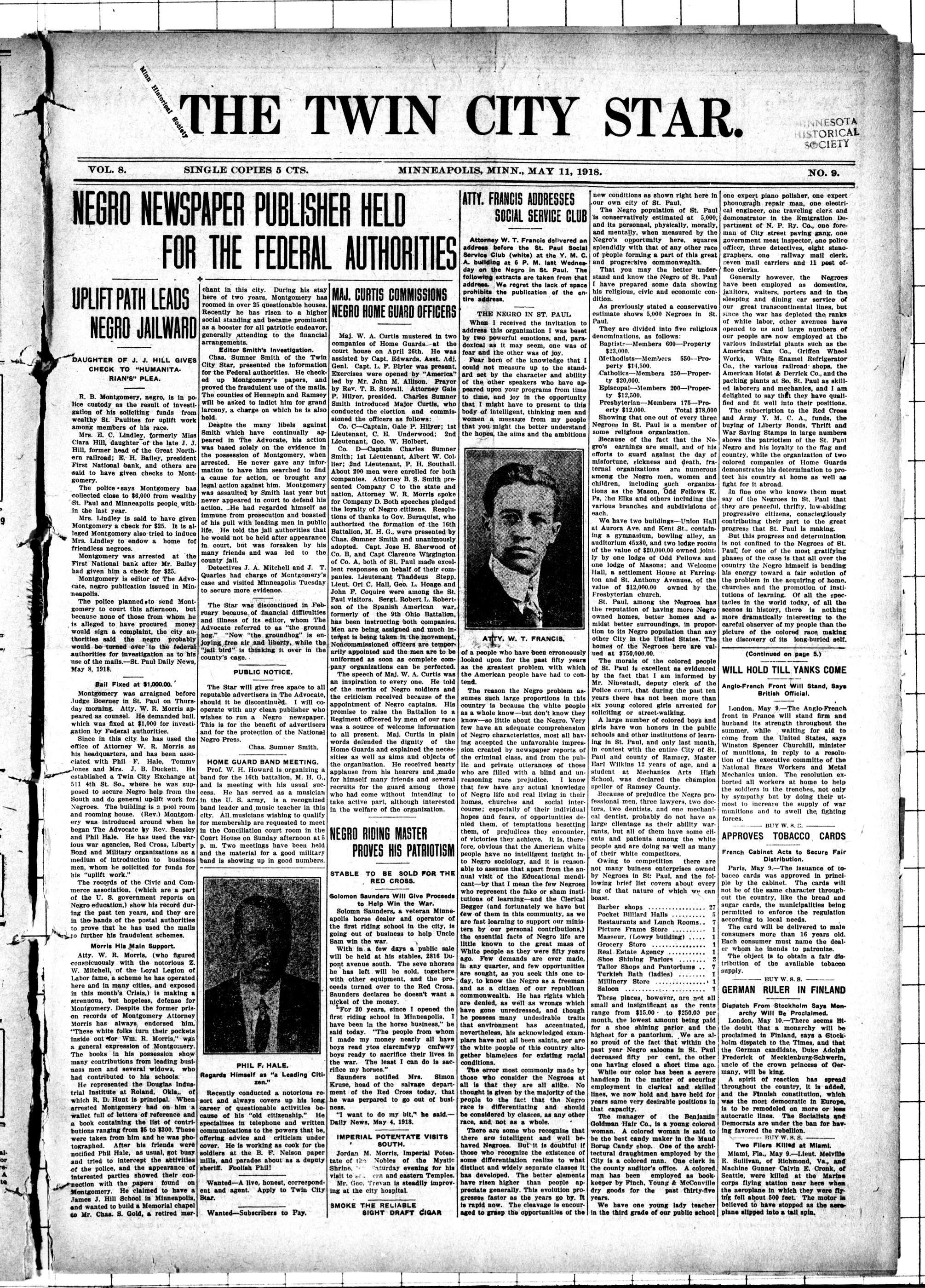
NEGRO NEWSPAPER PUBLISHER HELD FOR THE FEDERAL AUTHORITIES
VOL. 8.
UPLIFT PATH LEADS NEGRO JAILWARD
DAUGHTER OF J. J. HILL GIVES CHECK TO "HUMANITA-RIAN'S" PLEA.
R. B. Montgomery, negro, is in police custody as the result of investigation of his soliciting funds from wealthy St. Paulites for uplift work among members of his race.
Mrs. E. C. Lindley, formerly Miss Clara Hill, daughter of the late J. J. Hill, former head of the Great Northern railroad; E. H. Bailey, president First National bank, and others are said to have given checks to Montgomery.
The police says Montgomery has collected close to $6,000 from wealthy St. Paul and Minneapolis people within the last year.
Mrs. Lindley is said to have given Montgomery a check for $25. It is alleged Montgomery also tried to induce Mrs. Lindley to endow a home for friendless negroes.
Montgomery was arrested at the First National bank after Mr. Bailey had given him a check for $25.
Montgomery is editor of The Advocate, negro publication issued in Minneapolis.
The police planned to send Montgomery to court this afternoon, but because none of those from whom he is alleged to have procured money would sign a complaint, the city authorities said the negro probably would be turned over to the federal authorities for investigation as to his use of the mails.—St. Paul Daily News, May 8, 1918.
Bail Fixed at $1,000.00.
Montgomery was arraigned before Judge Boerner in St. Paul on Thursday morning. Atty. W. R. Morris appeared as counsel. He demanded ball, which was fixed at $1,000 for investigation by Federal authorities.
Since in this city he has used the office of Attorney W. R. Morris as his headquarters, and has been associated with Phil F. Hale, Tommv Jones and Mrs. J. B. Duckett. He established a Twin City Exchange at 511 4th St. So., where he was supposed to secure Negro help from the South and do general up-lift work for Negroes. The building is a pool room and rooming house. (Rev.) Montgomery was introduced around when he began The Advocate by Rev. Beasley and Phil Hale. He has used the various war agencies, Red Cross, Liberty Bond and Military organizations as a medium of introduction to business men, whom he solicited for funds for his "uplift work."
The records of the Civic and Commerce association, (which are a part of the U. S. government reports on Negro education,) show his record during the past ten years, and they are in the hands of the postal authorities to prove that he has used the mails to further his fraudulent schemes.
Morris His Main Support.
Atty. W. R. Morris, (who figured conspicuously with the notorious Z. W. Mitchell, of the Loyal Legion of Labor fame, a scheme he has operated here and in many cities, and exposed in this month's Crisis,) is making a strenuous, but hopeless, defense for Montgomery. Despite the former prison records of Montgomery Attorney Morris has always, endorsed him, "These white folks turn their pockets inside out for Wm. R. Morris," was a general expression of Montgomery. The books in his possession show many contributions from leading business men and several widows, who had contributed to his schools.
He represented the Douglas Industrial Institute at Roland, Okla., of which R. D. Hunt is principal. When arrested Montgomery had on him a wallet full of letters of reference and a book containing the list of contributions ranging from $5 to $300. These were taken from him and he was photographed. After his friends were notified Phil Hale, as usual, got busy and tried to intercept the activities of the police, and the appearance of interested parties showed their connection with the papers found on Montgomery. He claimed to have a James J. Hill School in Minneapolis, and wanted to build a Memorial chapel to Mr. Chas. S. Gold, a retired mer-
THE TWIN CITY STAR.
SPAPER PUBLISH FOR THE FEDERAL chant in this city. During his stay here of two years, Montgomery has roomed in over 25 questionable houses. Recently he has risen to a higher social standing and became prominent as a booster for all patriotic endeavor, generally attending to the financial arrangements.
Editor Smith's Investigation.
Chas. Summer Smith of the Twin City Star, presented the information for the Federal authorities. He checked up Montgomery's papers, and proved the fraudulent use of the mails. The counties of Hennepin and Ramsey will be asked to indict him for grand larceny, a charge on which he is also held.
Despite the many libels against Smith which have continually appeared in The Advocate, his action was based solely on the evidence in the possession of Montgomery, when arrested. He never gave any information to have him searched to find a cause for action, or brought any legal action against him. Montgomery was assaulted by Smith last year but never appeared in court to defend his action. He had regarded himself as immune from prosecution and boasted of his pull with leading men in public life. He told the jail authorities that he would not be held after appearance in court, but was forsaken by his many friends and was led to the county jail.
Detectives J. A. Mitchell and J. T. Quarles had charge of Montgomery's case and visited Minneapolis Tuesday to secure more evidence.
The Star was discontinued in February because of financial difficulties and illness of its editor, whom The Advocate referred to as "the ground hog." "Now "the groundhog" is enjoying free air and liberty, while the "jail bird" is thinking it over in the county's cage.
PUBLIC NOTICE.
The Star will give free space to all reputable advertisers in The Advocate, should it be discontinued. I will cooperate with any clean publisher who wishes to run a Negro newspaper. This is for the benefit of advertisers and for the protection of the National Negro Press.
Chas. Sumner Smith.
HOME GUARD BAND MEETING.
Prof. W. H. Howard is organizing a band for the 16th battalion, M. H. G., and is meeting with his usual success. He has served as a musician in the U. S. army, is a recognized band leader and music teacher in this city. All musicians wishing to qualify for membership are requested to meet in the Conciliation court room in the Court House on Sunday afternoon at 5 p. m. Two meetings have been held and the material for a good military band is showing up in good numbers.
M.
Regards Himself as "a Leading Citizen."
Recently conducted a notorious resort and always covers up his long career of questionable activities because of his "old citizenship." He specializes in telephone and written communications to the powers that be, offering advice and criticism under cover. He is working as cook for the soldiers at the B. F. Nelson paper mills, and parades about as a deputy sheriff. Foolish Phil!
Wanted—A live, honest, correspondent and agent. Apply to Twin City Star.
Wanted—Subscribers to Pay.
MINNEAPOLIS, MINN., MAY 11, 1918.
MAJ. CURTIS COMMISSIONS NEGRO HOME GUARD OFFICERS
Maj. W. A. Curtis mustered in two companies of Home Guards - at the court house on April 26th. He was assisted by Capt. Edwards, Asst. Adj. Genl. Capt. L. F. Blyler was present. Exercises were opened by "America" led by Mr. John M. Allison. Prayer by Rev. T. B. Stovall. Attorney Gale P. Hilyer, presided. Charles Sumner Smith introduced Major Curtis, who conducted the election and commissioned the officers as follows: Co. C—Captain, Gale P. Hilyer; 1st Lieutenant, C. E. Underwood; 2nd Lieutenant, Geo. W. Holbert.
Co. D—Captain Charles Sumner Smith; 1st Lieutenant, Albert W. Collier; 2nd Lieutenant, P. H. Southall. About 200 men were enrolled for both companies. Attorney B. S. Smith presented Company C to the state and nation, Attorney W. R. Morris spoke for Company D. Both speeches pledged the loyalty of Negro citizens. Resolutions of thanks to Gov. Burnquist, who authorized the formation of the 16th Battalion, M. H. G., were presented by Chas. Sumner Smith and unanimously adopted. Capt. Jose H. Sherwood of Co. B, and Capt Clarence Wiggington of Co. A, both of St. Paul made excellent responses on behalf of their companies. Lieutenant Thaddeus Stepp, Lleut. Ori C. Hall, Geo. L. Hoage and John F. Coquire were among the St. Paul visitors. Sergt. Robert L. Robertson of the Spanish American war, formerly of the 9th Ohio Battalion, has been instructing both companies. Men are being assigned and much interest is being taken in the movement. Noncommissioned officers are temporarily appointed and the men are to be uniformed as soon as complete company organizations can be perfected.
The speech of Maj. W. A. Curtis was an inspiration to every one. He told of the merits of Negro soldiers and the criticism received because of the appointment of Negro captains. His promise to raise the Battallion to a Regiment officered by men of our race was a source of welcome information to all present. Maj. Curtis in plain words defended the dignity of the Home Guards and explained the necessities as well as aims and objects of the organization. He received hearty applause from his hearers and made for himself many friends and several recruits for the guard among those who had come without intending to take active part, although interested in the welfare of the organization.
NEGRO RIDING MASTER
PROVES HIS PATRIOTISM
NEGRO RIDING MASTER
PROVES HIS PATRIOTISM
STABLE TO BE SOLD FOR THE RED CROSS.
Solomon Saunders Will Give Proceeds to Help Win the War.
Solomun Saunders, a veteran Minneapolis horse dealer and operator of the first riding school in the city, is going out of business to help Uncle Sam win the war.
With in a few days a public sale will be held at his stables, 2816 Dupont avenue south. The seve nhorses he has left will be sold, together with other equipment, and the proceeds turned over to the Red Cross. Saunders declares he doesn't want a nickel of the money.
"For 20 years, since I opened the first riding school in Minneapolis, I have been in the horse business," he said today. "The people from whom I made my money nearly all have boys read ytos clarcmfwyp cnfwwy boys ready to sacrifice their lives in the war. The least I can do is sacrifice my horses."
Saunders notified Mrs. Simon Krusse, head of the salvage department of the Red Cross today, that he was prepared to go out of business.
"I want to do my bit," he said.—Daily News, May 4, 1918.
IMPERIAL POTENTATE VISITS
SOUTH.
Jordan M. Morris, Imperial Potentate of the Nobles of the Mystic Shrine. Saturday evening for his visit to Scarne and eastern Temples. Mr. Geo. Trevan is steadily improving at the city hospital. SMOKE THE RELIABLE SIGHT DRAFT CIGAR
ATTY. FRANCIS ADDRESSES SOCIAL SERVICE CLUB
Attorney W. T. Francis delivered an address before the St. Paul Social Service Club (white) at the Y. M. C. A. building at 6 P. M. last Wednesday on the Negro in St. Paul. The following extracts are taken from that address. We regret the lack of space prohibits the publication of the entire address.
THE NEGRO IN ST. PAUL
When I received the invitation to address this organization I was beset by two powerful emotions, and, paradoxical as it may seem, one was of fear and the other was of joy.
Fear born of the knowledge that I could not measure up to the standard set by the character and ability of the other speakers who have appeared upon your programs from time to time, and joy in the opportunity that I might have to present to this body of intelligent, thinking men and women a message from my people that you might the better understand the hopes, the aims and the ambitions
ATTY. W. T. FRANCIS.
of a people who have been erroneously looked upon for the past fifty years as the greatest problem with which the American people have had to contend.
The reason the Negro problem assumes such large proportions in this country is because the white people as a whole know—but don't know they know—so little about the Negro. Very few have an adequate comprehension of Negro characteristics, most all having accepted the unfavorable impression created by newspaper reports of the criminal class, and from the public and private utterances of those who are filled with a blind and unreasoning race prejudice. I know that few have any actual knowledge of Negro life and real living in their homes, churches and social intercourse; especially of their individual hopes and fears, of opportunities denied them, of temptations besetting them, of prejudices they encounter, of victories they achieve. It is, therefore, obvious that the American white people have no intelligent insight into Negro sociology, and it is reasonable to assume that apart from the annual visit of the Educational mendicant—by that I mean the few Negroes who represent the fake or sham institutions of learning—and the Clerical Begger (and fortunately we have but few of them in this community, as we are fast learning to support our ministers by our personal contributions,) the essential facts of Negro life are little known to the great mass of White people as they were fifty years ago. Few demands are ever made, in any quarter, and few opportunities are sought, as you seek this one today, to know the Negro as a freeman and as a citizen of our republican commonwealth. He has rights which are denied, as well as wrongs which have gone unredressed, and though he possess many undesirable traits that environment has accentuated, nevertheless, his acknowledged exemplars have not all been saints, nor are the white people of this country altogether blameless for existing racial conditions.
The error most commonly made by those who consider the Negroes at all is that they are all alike. No thought is given by the majority of the people to the fact that the Negro race is differentiating and should be considered by classes, as any other race, and not as a whole.
There are some who recognize that there are intelligent and well behaved Negroes. But it is doubtful if those who recognize the existence of some differentiation realize to what distinct and widely separate classes it has developed. The better elements have risen higher than people appreciate generally. This evolution progresses faster as the years go by. It is rapid now. The cleavage is encouraged to grasp the opportunities of the
new conditions as shown right here in our own city of St. Paul.
The Negro population of St. Paul is conservatively estimated at 5,000, and its personnel, physically, morally, and mentally, when measured by the Negro's opportunity here, squares splendidly with that of any other race of people forming a part of this great and progressive commonwealth.
That you may the better understand and know the Negro of St. Paul I have prepared some data showing his religious, civic and economic condition.
As previously stated a conservative estimate shows 5,000 Negroes in St. Paul.
They are divided into five religious denominations, as follows:
Baptist—Members 600—Property $23,000.
Methodists—Members 550—Property $14,500.
Catholics—Members 250—Property $20,000.
Episcopal—Members 200—Property $12,500.
Presbyterian—Members 175—Property $12,000. Total $78,000.
erty $12,000. Total $78,000
Showing that one out of every three Negroes in St. Paul is a member of some religious organization.
Because of the fact that the Negro's earnings are small, and of his efforts to guard against the day of misfortune, sickness and death, fraternal organizations are numerous among the Negro men, women and children, including such organizations as the Mason, Odd Fellows K. Ps. the Elks and others including the various branches and subdivisions of each.
We have two buildings—Union Hall at Aurora Ave. and Kent St., containing a gymnasium, bowling alley, an auditorium 45x80, and two lodge rooms of the value of $20,000.00 owned jointly by one lodge of Odd Fellows and one lodge of Masons; and Welcome Hall, a settlement House at Farrington and St. Anthony Avenues, of the value of $12,000.00 owned by the Freshbyterian church.
St. Paul, among the Negroes has the reputation of having more Negro owned homes, better homes and amidst better surroundings, in proportion to its Negro population than any other City in the United States. The homes of the Negroes here are valued at $750,000.00.
The morals of the colored people of St. Paul is excellent as evidenced by the fact that I am informed by Mr. Ninestadt, deputy clerk of the Police court, that during the past ten years there has not been more than six young colored girls arrested for soliciting or street-walking. A large number of colored boys and girls have won honors in the public schools and other institutions of learning in St. Paul, and only last month, in contest with the entire City of St. Paul and county of Ramsey, Master Earl Wilkins 12 years of age, and a student at Mechanics Arts High School, was declared the champion speller of Ramsey County. Because of prejudice the Negro professional men, three lawyers, two doctors, and one mechanical dentist, probably do not have as large clientage as their ability warrants, but all of them have some clients and patients among the white people and are doing as well as many of their white competitors. Owing to competition there are not many buiness enterprises owned by Negroes in St. Paul, and the following brief list covers about everying of that nature of which we can boast.
Barber shops ..... 27
Pocket Billiard Halls ..... 5
Restaurants and Lunch Rooms ..... 7
Picture Frame Store ..... 1
Masseur (Lowry building) ..... 1
Grocery Store ..... 1
Real Estate Agency ..... 1
Shoe Shining Parlors ..... 2
Tailor Shops and Pantoriums ..... 7
Turkish Bath (ladies) ..... 1
Millinery Store ..... 1
Saloon ..... 1
These places, however, are not all small and insignificant as the rents range from $15.00 to $250.03 per month, the lowest amount being paid for a shoe shining parlor and the highest for a pantorium. We are also proud of the fact that within the past year Negro saloons in St. Paul decreased fifty per cent, the other one having closed a short time ago.
While our color has been a severe handicap in the matter of securing employment in clerical and skilled lines, we now hold and have held for years same very desirable positions in that capacity.
The manager of the Benjamin Goldman Hair Co., is a young colored woman. A colored woman is said to be the best candy maker in the Maud Borup Candy shop. One of the architectural draughtmen employed by the City is a colored man. One clerk in the county auditor's office. A colored man has been employed as bookkeeper by Finch, Young & McConville dry goods for the past thirty-five years. We have one young lady teacher in the third grade of our public school
INNESOTA
HISTORICAL
SOCIETY
NO. 9.
one expert piano polisher, one expert phonograph repair man, one electrical engineer, one traveling clerk and demonstrator in the Emigration Department of N. P. Ry. Co., one foreman of City street paving gang, one government meat inspector, one police officer, three detectives, eight stenographers, one railway mail clerk, seven mail carriers and 11 post office clerks.
Generally however, the Negroes have been employed as domestics, janitors, waiters, porters and in the sleeping and dining car service of our great transcontinental lines, but since the war has depleted the ranks of white labor, other avenues have opened to us and large numbers of our people are now employed at the various industrial plants such as the American Can Co., Griffen Wheel Works, White Enamel Refrigerator Co., the various railroad shops, the American Hoist & Derrick Co., and the packing plants at So. St. Paul as skilled laborers and mechanics, and I am delighted to say that they have qualified and fit well into their positions.
The subscription to the Red Cross and Army Y. M. C. A., funds, the buying of Liberty Bonds, Thrift and War Saving Stamps in large numbers shows the patriotism of the St. Paul Negro and his loyalty to the flag and country, while the organization of two colored companies of Home Guards demonstrates his determination to protect his country at home as well as fight for it abroad.
In fine one who knows them must say of the Negroes in St. Paul that they are peaceful, thrifty, law-abiding progressive citizens, conscieriously contributing their part to the great progress that St. Paul is making.
But this progress and determination is not confined to the Negroes of St. Paul, for one of the most gratifying phases of the case is that all over the country the Negro himself is bending his energy toward a fair solution of the problem in the acquiring of home churches and the promotion of institutions of learning. Of all the spectacles in the world today, of all the scenes in history, there is nothing more dramatically interesting to the careful observer of my people than the picture of the colored race making the discovery of its long-buried self.
(Continued on page 5.)
WILL HOLD TILL YANKS COME
Anglo-French Front Will Stand, Says British Official. London, May 9.—The Anglo-French front in France will stand firm and husband its strength throughout the summer, while waiting for aid to come from the United States, says Winston Spencer Churchill, minister of munitions, in reply to a resolution of the executive committee of the National Brass Workers and Metal Mechanics union. The resolution exhorted all workers at home to help the soldiers in the trenches, not only by sympathy but by doing their utmost to increase the supply of war munitions and to swell the fighting forces.
APPROVES TOBACCO CARDS
French Cabinet Acts to Secure Fair Distribution.
Paris, May 9.—The issuance of tobacco cards was approved in principle by the cabinet. The cards will not be of the same character throughout the country, like the bread and sugar cards, the municipalities being permitted to enforce the regulation according to local needs.
The card will be delivered to male consumers more than 16 years old. Each consumer must name the dealer whom he inends to patronize.
The object is to obtain a fair distribution of the available tobacco supply.
GERMAN RULER IN FINLAND
Dispatch From Stockholm Says Mon-
achy. Will Be. Reclaimed.
Hobby Will Be Proclaimed.
London, May 10.—There seems little doubt that a monarchy will be proclaimed in Finland, says a Stockholm dispatch to the Times, and that the German candidate, Duke Adolph Frederick of Mecklenburg-Schwerin, uncle of the crown princess of Germany, will be king.
A spirit of reaction has spread throughout the country, it is added, and the Finnish constitution, which was the most democratic in Europe, is to be remodeled on more or less autocratic lines. The Socialists and Democrats are under the ban for having favored the rebellion.
BUY W. S. S.
Two Filers Killed at Miami.
Miami, Fla., May 9.—Lient. Melville E. Sullivan, of Richmond, Va., and Machine Gunner Calvin E. Cronk, of Seattle, were killed at the Marine corps flying station near here when the aeroplane in which they were flying fell about 500 feet. The motor is believed to have stopped as the aeroplane slipped into a tall spin.
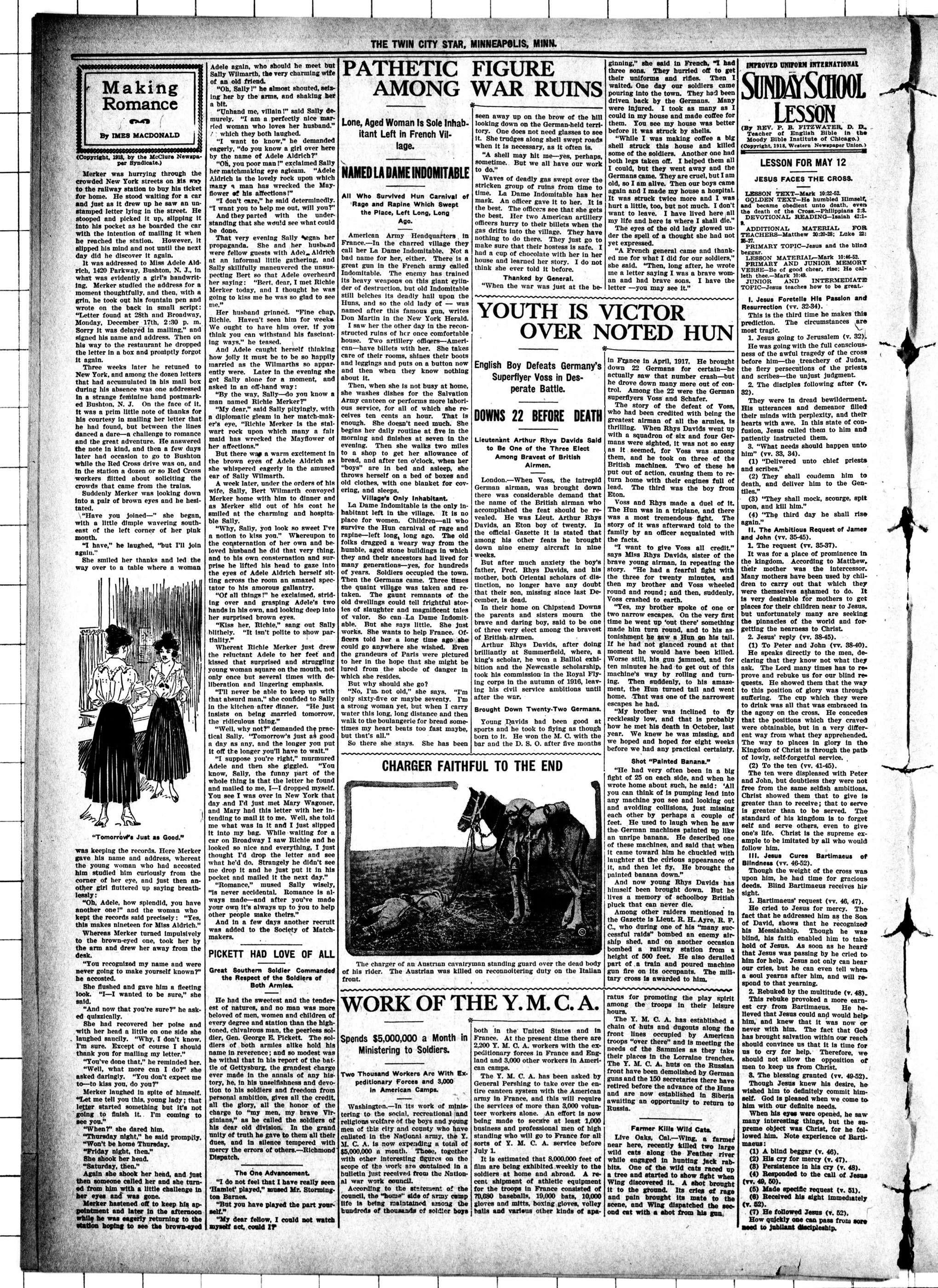
Making Romance
By IMES MACDONALD
(Copyright, 1918, by the McClure Newspaper Syndicate.)
Merker was hurrying through the crowded New York streets on his way to the railway station to buy his ticket for home. He stood waiting for a car and just as it drew up he saw an unstamped letter lying in the street. He stooped and picked it up, slipping it into his pocket as he boarded the car with the intention of mailing it when he reached the station. However, it slipped his mind and not until the next day did he discover it again.
It was addressed to Miss Adela Aldrich, 1420 Parkway, Bushton, N. J., in what was evidently a girl's handwriting. Merker studied the address for a moment thoughtfully, and then, with a grin, he took out his fountain pen and wrote on the back in small script: "Letter found at 28th and Broadway, Monday, December 17th, 2:30 p. m. Sorry it was delayed in mail," and signed his name and address. Then on his way to the restaurant he dropped the letter in a box and promptly forgot it again.
Three weeks later he returned to New York, and among the dozen letters that had accumulated in his mail box during his absence was one addressed in a strange feminine hand postmarked Bushton, N. J. On the face of it, it was a prim little note of thanks for his courtesy in mailing her letter that he had found, but between the lines danced a dare—a challenge to romance and the great adventure. He answered the note in kind, and then a few days later had occasion to go to Bushton while the Red Cross drive was on, and in the station a dozen or so Red Cross workers flitted about soliciting the crowds that came from the trains.
Suddenly Merker was looking down into a pair of brown eyes and he hesitated.
"Have you joined—" she began, with a little dimple wavering southeast of the left corner of her pink month.
"I have," he laughed, "but I'll join again."
She smiled her thanks and led the way over to a table where a woman
THE NEW YORKER
"Tomorrow's Just as Good."
was keeping the records. Here Merker gave his name and address, wherent the young woman who had accosted him studied him curiously from the corner of her eye, and just then another girl fluttered up saying breathlessly:
"Oh, Adele, how splendid, you have another one!" and the woman who kept the records said precisely: "Yes, this makes nineteen for Miss Aldrich."
Whereens Merker turned impulsively to the brown-eyed one, took her by the arm and drew her away from the desk.
"You recognized my name and were never going to make yourself known?" he accosted.
She flushed and gave him a fleeting look. "I—I wanted to be sure," she said.
"And now that you're sure?" he asked quizzically.
She had recovered her poise and with her head a little on one side she laughed saucily. "Why, I don't know. I'm sure. Except of course I should thank you for malling my letter."
"You've done that," he reminded her. "Well, what more can I do?" she asked daringly. "You don't expect me to—to kiss you, do you?"
Merker laughed in spite of himself. "Let me tell you this, young lady; that letter started something but it's not going to finish it. I'm coming to see you."
"When?" she dared him.
"Thursday night," he said promptly.
"Won't be home Thursday."
"Friday night, then."
She shook her head.
"Saturday, then."
Again she shook her head, and just then someone called her and she turned from him with a little challenge in her eyes and was gone.
Merker hastened off to keep his appointment and later in the afternoon while he was eagerly returning to the station hoping to see the brown-eyed
Adele again, who should he meet but Sally Wilmarth, the very charming wife of an old friend.
"Oh, Sally!" he almost shouted, seizing her by the arms, and shaking her a bit.
"Unhand me, villain!" said Sally demurely, "I am a perfectly nice married woman who loves her husband." which they both laughed.
"I want to know," he demanded eagerly, "do you know a girl over here by the name of Adele Aldrich?"
"Oh, you poor man!" exclaimed Sally her matchmaking eye agleam. "Adele Aldrich is the lovely rock upon which many a man has wrecked the Mayflower of his affections!"
"I don't care," he said determinedly. "I want you to help me out, will you?"
And they parted with the understanding that she would see what could be done.
That very evening Sally began her propaganda. She and her husband were fellow guests with Adei. Aldrich at an informal little gathering, and Sally skillfully maneuvered the unspecting Bert so that Adele overheard her saying: "Bert, dear, I met Richie Merker today, and I thought he was going to kiss me he was so glad to see me."
Her husband grinned. "Fine chap, Richie. Haven't seen him for weeks. We ought to have him over, if you think you can withstand his fascinating ways," he teased.
And Adele caught herself thinking how jolly it must be to be so happily married as the Wilmarths so apparently were. Later in the evening she got Sally alone for a moment, and asked in an off-hand way:
"By the way, Sally—do you know a man named Richie Merker?"
"My dear," said Sally pityingly, with a diplomatic gleam in her match-maker's eye. "Richle Merker is the stalwart rock upon which many a fair maid has wrecked the Mayflower of her affections."
But there was a warm excitement in the brown eyes of Adole Aldrich as she whispered eagerly in the amused ear of Sally Wilmarth.
A week later, under the orders of his wife, Sally, Bert Wilmarth conveyed Merker home with him to dinner and as Merker slid out of his coat he smiled at the charming and hospitable Sally.
"Why, Sally, you look so sweet I've a notion to kiss you." Whereupon to the consternation of her own and beloved husband he did that very thing, and to his own consternation and surprise he lifted his head to gaze into the eyes of Adele Aldrich herself sitting across the room an amazed spectator to his amorous gallantry. "Of all things!" he exclaimed, striding over and grasping Adele's two hands in his own, and looking deep into her surprised brown eyes. "Kiss her, Richle," sang out Sally blithely. "It isn't polite to show partiality." Whereat Richle Merker just drew the reluctant Adele to her feet and kissed that surprised and struggling young woman square on the mouth, not only once but several times with deliberation and lingering emphasis.
"I'll never be able to keep up with that absurd man," she confided to Sally in the kitchen after dinner. "He just insists on being married tomorrow, the ridiculous thing."
"Well, why not?" demanded the practical Sally. "Tomorrow's just as good a day as any, and the longer you put it off the longer you'll have to wait."
"I suppose you're right," murmured Adele and then she giggled. "You know, Sally, the funny part of the whole thing is that the letter he found and mailed to me, I-I dropped myself. You see I was over in New York that day and I'd just met Mary Wagoner, and Mary had this letter with her intending to mall it to me. Well, she told me what was in it and I just slipped it into my bag. While waiting for a car on Broadway I saw Richie and he looked so nice and everything, I just thought I'd drop the letter and see what he'd do. Strangely he didn't see me drop it and he just put it in his pocket and mailed it the next day." "Romance," mused Sally wisely, "is never accidental. Romance is always made—and after you've made your own it's always up to you to help other people make theirs."
And in a few days another recruit was added to the Society of Matchmakers.
Great Southern Soldier Commanded the Respect of the Soldiers of Both Armies.
He had the sweetest and the tenderest of natures, and no man was more beloved of men, women and children of every degree and station than the hightoned, chivalrous man, the peerless soldier, Gen. George E. Pickett. The soldiers of both armies alike hold his name in reverence; and so modest was he withal that in his report of the battle of Gettysburg, the greatest charge ever made in the annals of any history, he, in his unselfishness and devotion to his soldiers and freedom from personal ambition, gives all the credit, all the glory, all the honor of the charge to "my men, my brave Virginians," as he called the soldiers of his dear old division. In the grand unity of truth he gave to them all their dues, and in silence tempered with mercy the errors of others.—Richmond Dispatch.
"I do not feel that I have really seen 'Hamlet' played," mused Mr. Stormington Barnes.
"But you have played the part yourself."
"My dear fellow, I could not watch myself act, could I?"
THE TWIN CITY STAR, MINNEAPOLIS, MINN.
PATHETIC FIGURE AMONG WAR RUINS
Maurice Dufour
The charger of an Austrian cavalryman standing guard over the dead body of his rider. The Austrian was killed on reconnoitering duty on the Italian front.
WORK OF THE Y.M.C.A.
NAMED LA DAME INDOMITABLE
All Who Survived Hun Carnival of Rage and Rapine Which Swept the Place, Left Long, Long
American Army Headquarters in France.—In the charred village they call her La Dame Indomitable. Not a bad name for her, either. There is a great gun in the French army called Indomitable. The enemy has trained its heavy weapons on this giant cylinder of destruction, but old Indomitable still belches its deadly hall upon the Huns, and so the old lady of — was named after this famous gun, writes Don Martin in the New York Herald. I saw her the other day in the reconstructed ruins of her once comfortable house. Two artillery officers—American—have billets with her. She takes care of their rooms, shines their boots and leggings and puts on a button now and then when they know nothing about it.
Then, when she is not busy at home, she washes dishes for the Salvation Army canteen or performs more laborious service, for all of which she receives ten cents an hour. That is enough. She doesn't need much. She begins her daily routine at five in the morning and finishes at seven in the evening. Then she walks two miles to a shop to get her allowance of bread, and after ten o'clock, when her "boys" are in bed and asleep, she throws herself on a bed of boxes and old clothes, with one blanket for covering, and sleeps.
Villages Only Inhabitant.
La Dame Indomitable is the only inhabitant left in the village. It is no place for women. Children—all who survive the Hun carnival of rage and rapine—left long, long ago. The old folks dragged a weary way from the humble, aged stone buildings in which they and their ancestors had lived for many generations—yes, for hundreds of years. Soldiers occupied the town. Then the Germans came. Three times the quint village was taken and retaken. The gaunt remnants of the old dwellings could tell frightful stories of slaughter and magnificent tales of valor. So can La Dame Indomitable. But she says little. She just works. She wants to help France. Officers told her a long time ago she could go anywhere she wished. Even the grandeurs of Paris were pictured to her in the hope that she might be lured from the abode of danger in which she resides.
But why should she go?
"No, I'm not old," she says. "Tm only sixty-five or maybe seventy. I'm a strong woman yet, but when I carry water this long, long distance and then walk to the boulangerie for bread sometimes my heart beets too fast maybe, but that's all."
So there she stays. She has been
CHARGER FAITH
The charger of an Austrian cavairy of his rider. The Austrian was killed front.
WORK OF T
Spends $5,000,000 a Month in Ministering to Soldiers.
Two Thousand Workers Are With Expeditionary Forces and 3,000
Washington.—In its work of ministering to the social, recreational and religious welfare of the boys and young men of this city and county who have enlisted in the National army, the Y. M. C. A. is now expending a total of $5,000,000 a month. Those, together with other interesting figures on the scope of the work are contained in a bulletin just received from the National war work council.
According to the statement of the council, the "home" side of army camp life is being maintained among the hundreds of thousands of soldier boys
YOUTH IS VICTOR OVER NOTED HUN
seen away up on the brow of the hill looking down on the German-held territory. One does not need glasses to see it. She trudges along shell swept roads when it is necessary, as it often is.
"A shell may hit me—yes, perhaps, sometime. But we all have our work to do."
Waves of deadly gas swept over the stricken group of ruins from time to time. La Dame Indomitable has her mask. An officer gave it to her. It is the best. The officers see that she gets the best. Her two American artillery officers hurry to their billets when the gas drifts into the village. They have nothing to do there. They just go to make sure that their hostess is safe. I had a cup of chocolate with her in her house and learned her story. I do not think she ever told it before.
Thanked by General.
YOUTH IS W OVER N
English Boy Defeats Germany's Superflyer Voss in Desperate Battle.
DOWNS 22 BEFORE DEATH
Lieutenant Arthur Rhys Davids Said to Be One of the Three Elect Among Bravest of British Airmen.
London.—When Voss, the intrepid German airman, was brought down there was considerable demand that the name of the British airman who accomplished the feat should be revealed. He was Lieut. Arthur Rhys Davids, an Eton boy of twenty. In the official Gazette it is stated that among his other feats he brought down nine enemy aircraft in nine weeks.
But after much anxiety the boy's father, Prof. Rhys Davids, and his mother, both Oriental scholars of distinction, no longer have any doubt that their son, missing since last December, is dead.
In their home on Chipstead Downs the parents and sisters mourn the brave and daring boy, said to be one of three very elect among the bravest of British airmen.
Arthur Rhys Davids, after doing brilliantly at Summerfield, where, a king's scholar, he won a Balliol exhibition and the Newcastle scholarship, took his commission in the Royal Flying corps in the autumn of 1916, leaving his civil service ambitions until after the war.
Brought Down Twenty-Two Germans.
Young Davids had been good at sports and he took to flying as though born to it. He won the M. C. with the bar and the D. S. O. after five months
FUL TO THE END
man standing guard over the dead body on reconnoitering duty on the Italian
HE Y. M. C. A.
both in the United States and in France. At the present time there are 2,200 Y. M. C. A. workers with the expeditionary forces in France and England and 3,000 other workers in American camps. The Y. M. C. A. has been asked by General Pershing to take over the entire canteen system with the American army in France, and this will require the services of more than 3,000 volunteer workers alone. An effort is now being made to secure at least 1,000 business and professional men of high standing who will go to France for all sorts of Y. M. C. A. service before July 1.
It is estimated that 8,000,000 feet of film are being exhibited weekly to the soldiers at home and abroad. A recent shipment of athletic equipment for the troops in France consisted of 79,630 baseballs, 19,000 bats, 10,000 gloves and mitts, boxing gloves, volley balls and various other kinds of apa-
ginnning," she said in French, "I had three sons. They hurried off to get their uniforms and rifles. Then I waited. One day our soldiers came pouring into the town. They had been driven back by the Germans. Many were injured. I took as many as I could in my house and made coffee for them. You see my house was better before it was struck by shells. "While I was making coffee a big shell struck this house and killed some of the soldiers. Another one had both legs taken off. I helped them all I could, but they went away and the Germans came. They are cruel, but I am old, so I am alive. Then our boys came again and I made my house a hospital. It was struck twice more and I was hurt a little, too, but not much. I don't want to leave. I have lived here all my life and here is where I shall die."
The eyes of the old lady glowed under the spell of a thought she had not yet expressed.
"A French general came and thanked me for what I did for our soldiers," she said. "Then, long after, he wrote me a letter saying I was a brave woman and had brave sons. I have the letter—you may see it."
in France in April, 1917. He brought down 22 Germans for certain—he actually saw that number crash—but he drove down many mere out of control. Among the 22 were the German superfliers Voss and Schafer. The story of the defeat of Voss, who had been credited with being the greatest airman of all the armies, is thrilling. When Rhys Davids went up with a squadron of six and four Germans were sighted, it was not so easy as it seemed, for Voss was among them, and he took on three of the British machines. Two of these he put out of action, causing them to return home with their engines full of lead. The third was the boy from Eton.
Voss and Rhys made a duel of it. The Hun was in a triplane, and there was a most tremendous fight. The story of it was afterward told to the family by an officer acquainted with the facts. "I want to give Voss all credit." says Miss Rhys Davids, sister of the brave young airman, in repeating the story. "He had a fearful fight with the three for twenty minutes, and then my brother and Voss wheeled round and round; and then, suddenly, Voss crashed to earth.
"Yes, my brother spoke of one or two narrow escapes. On the very first time he went up 'out there' something made him turn round, and to his astonishment he saw a Hun on his tail. If he had not glanced round at that moment he would have been killed. Worse still, his gun jammed, and for ten minutes he had to get out of this machine's way by rolling and turning. Then suddenly, to his amazement, the Hun turned tall and went home. That was one of the narrowest escapes he had.
"My brother was inclined to fly recklessly low, and that is probably how he met his death in October, last year. We knew he was missing, and we hoped and hoped for eight weeks before we had any practical certainty.
Shot "Painted Banana."
"He had very often been in a big fight of 25 on each side, and when he wrote home about such, he said: 'All you can think of is pumping lead into any machine you see and looking out and avoiding collisions, just missing each other by perhaps a couple of feet. He used to laugh when he saw the German machines painted up like an unripe banana. He described one of these machines, and said that when it came toward him he chuckled with laughter at the curious appearance of it, and then let fly. He brought the painted banana down."
And now young Rhys Davids has himself been brought down. But he lives a memory of schoolboy British pluck that can never die.
Among other raiders mentioned in the Gazette is Lieut. R. H.Ayre, R. F.C., who during one of his "many successful raids" bombed an enemy airship shed, and on another occasion bombed a railway station from a height of 500 feet. He also derailed part of a train and poured machine gun fire on its occupants. The military cross is awarded to him.
ratus for promoting the play spirit among the troops in their leisure hours.
The Y. M. C. A. has established a chain of huts and dugouts along the front lines occupied by American troops "over there" and is meeting the needs of the Sammies as they take their places in the Lorraine trenches. The Y. M. C. A. huts on the Russian front have been demolished by German guns and the 150 secretaries there have retired before the advance of the Huns and are now established in Siberia awaiting an opportunity to return to Russia.
Farmer Kills Wild Cats
Live Oaks, Cal.-Wing, a farmer near here, recently killed two large wild cats along the Feather river while engaged in hunting jack rabbits. One of the wild cats raced up a tree and started to show fight when Wing discovered it. A shot brought it to the ground. Its cries of rage and pain brought its mate to the scene, and Wing dispatched the second cat with a shot from his gun.
IMPROVED UNIFORM INTERNATIONAL
SUNDAY SCHOOL
LESSON
(By REV. P. B. FITZWATER, D. D.
Teacher of English Bible in the
Moody Bible Institute of Chicago.)
(Copyright, 1918, Western Newspaper Union.)
LESSON FOR MAY 12
JESUS FACES THE CROSS.
LESSON TEXT-Mark 10:32-52.
LESSON TEXT-Mark 10:32-52.
GOLDEN TEXT-He humbled Himself,
and became obedient unto death, even
the death of the Cross.-Philippians 2:8.
DEVOTIONAL READING-Isaiah 42:1-
9.
ADDITIONAL MATERIAL FOR
TEACHERS-Matthew 20:20-28; Luke 22:
25-27.
PRIMARY TOPIC-Jesus and the blind
beggar.
LESSON MATERIAL-Mark 10:46-52.
PRIMARY AND JUNIOR MEMORY
VERSE-Be of good cheer, rise; He calle
thee-Mark 10:49.
JUNIOR AND INTERMEDIATE
TOPIC-Jesus teaches how to be great.
I. Jesus Foretells His Passion and
Resurrection (vv. 32-34).
This is the third time he makes this
prediction. The circumstances are
most tragic.
1. Jesus going to Jerusalem (v. 32).
He was going with the full consciousness of the awful tragedy of the cross before him—the treachery of Judas, the fiery persecutions of the priests and scribes—the unjust judgment.
2. The disciples following after (v. 32).
They were in dread bewilderment. His utterances and demeanor filled their minds with perplexity, and their hearts with awe. In this state of confusion, Jesus called them to him and patiently instructed them.
3. "What needs should happen unto him" (vv. 33, 34).
(1) "Delivered unto chief priests and scribes."
(2) They shall coudemn him to death, and deliver him to the Gentiles."
(3) "They shall mock, scourge, split upon, and kill him."
(4) "The third day he shall rise again."
11. The Ambitious Request of James and John (vv. 35-45).
1. The request (vv. 35-37).
It was for a place of prominence in the kingdom. According to Matthew, their mother was the intercessor. Many mothers have been used by children to carry out that which they were themselves ashamed to do. It is very desirable for mothers to get places for their children near to Jesus, but unfortunately many are seeking the pinnacles of the world and forgetting the nearness to Christ.
2. Jesus' reply (vv. 38-45).
(1) To Peter and John (yy. 38-40).
(1) To Peter and John (vv. 38-40). He speaks directly to the men, declaring that they know not what they ask. The Lord many times has to reprove and rebuke us for our blind requests. He showed them that the way to this position of glory was through suffering. The cup which they were to drink was all that was embraced in the agony on the cross. He concedes that the positions which they craved were obtainable, but in a very different way from what they apprehended. The way to places in glory in the Kingdom of Christ is through the path of lowly, self-forgetful service.
(2) To the ten (vv. 41-45).
The ten were displeased with Peter and John, but doubtless they were not free from the same selfish ambitions. Christ showed them that to give is greater than to receive; that to serve is greater than to be served. The standard of his kingdom is to forget self and serve others, even to give one's life. Christ is the supreme example to be imitated by all who would follow him.
III. Jesus Cures Bartimaeus of Blindness (vv. 46-52).
Though the weight of the cross was upon him, he had time for gracious deeds. Blind Bartimaeus receives his sight.
1. Bartimaeus' request (vv. 46, 47).
He cried to Jesus for mercy. The fact that he addressed him as the Son of David, shows that he recognized his Messiahship. Though he was blind, his faith enabled him to take hold of Jesus. As soon as he heard that Jesus was passing by he cried to him for help. Jesus not only can hear our cries, but he can even tell when a soul yearns after him, and will respond to that yearning.
2. Rebuked by the multitude (v. 48).
This rebuke provoked a more earnest cry from Bartimaeus. He believed that Jesus could and would help him, and knew that it was now or never with him. The fact that God has brought salvation within our reach should convince us that it is time for us to cry for help. Therefore, we should not allow the opposition of men to keep us from Christ.
8. The blessing granted (vv. 49-52).
Though Jesus knew his desire, he wished him to definitely commit himself. God is pleased when we come to him with our definite needs.
When his eyes were opened, he saw many interesting things, but the supreme object was Christ, for he followed him. Note experience of Bartimaeus:
(1) A blind beggar (v. 46).
(2) His cry for mercy (v. 47).
(3) Persistence in his cry (v. 48).
(4) Responded to the call of Jesus (vv. 49, 50).
(5) Made specific request (v. 51).
(6) Received his sight immediately (v. 52).
(7) He followed Jesus (v. 52).
How quickly one can pass from sore need to jubilant discipleship.
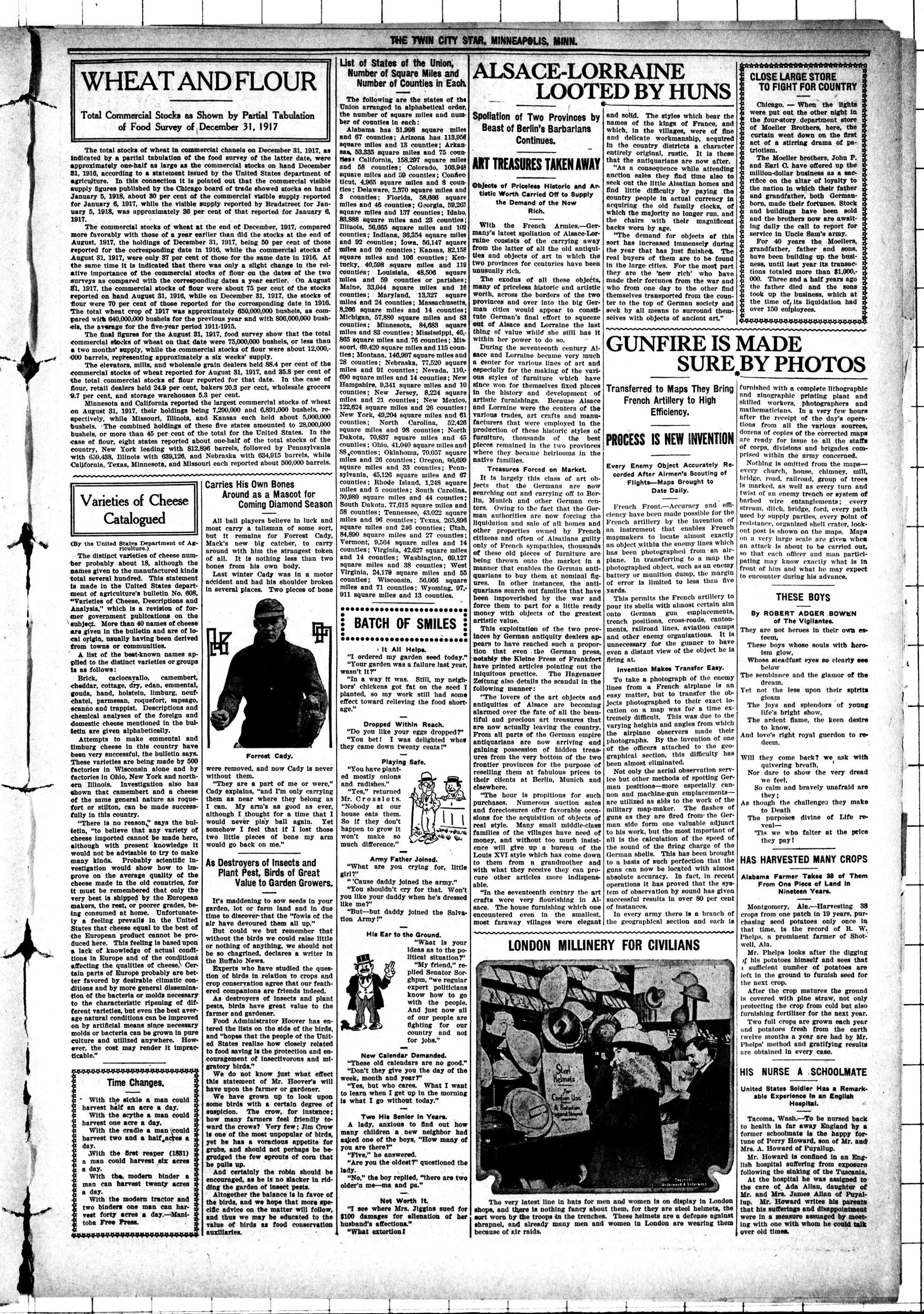
WHEATANDFLOUR
Total Commercial Stocks as Shown by Partial Tabulation of Food Survey of December 31, 1917
The total stocks of wheat in commercial channels on December 31, 1917, as indicated by a partial tabulation of the food survey of the latter date, were approximately one-half as large as the commercial stocks on hand December 31, 1916, according to a statement issued by the United States department of agriculture. In this connection it is pointed out that the commercial visible supply figures published by the Chicago board of trade showed stocks on hand January 5, 1918, about 30 per cent of the commercial visible supply reported for January 6, 1917, while the visible supply reported by Bradstreet for January 5, 1918, was approximately 36 per cent of that reported for January 6, 1917.
Minnesota and California reported the largest commercial stocks of wheat on August 31, 1917, their holdings being 7,290,000 and 6,891,000 bushels, respectively, while Missouri, Illinois, and Kansas each held about 5,000,000 bushels. The combined holdings of these five states amounted to 28,000,000 bushels, or more than 45 per cent of the total for the United States. In the case of flour, eight states reported about one-half of the total stocks of the country, New York leading with 812,896 barrels, followed by Pennsylvania with 639,438, Illinois with 639,126, and Nebraska with 634,915 barrels, while California, Texas, Minnesota, and Missouri each reported about 500,000 barrels.
Varieties of Cheese Catalogued
(By the United States Department of Agriculture.)
The distinct varieties of cheese number probably about 18, although the names given to the manufactured kinds total several hundred. This statement is made in the United States department of agriculture's bulletin No. 608, "Varieties of Cheese, Descriptions and Analysis," which is a revision of former government publications on the subject. More than 40 names of cheese are given in the bulletin and are of local origin, usually having been derived from towns or communities.
A list of the best-known names applied to the distinct varieties or groups is as follows:
Brick, cactocayallo, camembert, cheddar, cottage, dry, edan, emmental, gouda, hand, holstein, limburg, neufchatel, parmesan, roquefort, sapsago, scanno and trappist. Descriptions and chemical analyses of the foreign and domestic cheese mentioned in the bulletin are given alphabetically.
Attempts to make emmental and limburg cheese in this country have been very successful, the bulletin says. These varieties are being made by 500 factories in Wisconsin alone and by factories in Ohio, New York and northern Illinois. Investigation also has shown that camembert and a cheese of the same general nature as roquefort or stilton, can be made successfully in this country.
"There is no reason," says the bulletin, "to believe that any variety of cheese imported cannot be made here, although with present knowledge it would not be advisable to try to make many kinds. Probably scientific investigation would show how to improve on the average quality of the cheese made in the old countries, for it must be remembered that only the very best is shipped by the European makers, the rest, or poorer grades, being consumed at home. Unfortunately a feeling prevails in the United States that cheese equal to the best of the European product cannot be produced here. This feeling is based upon a lack of knowledge of actual conditions in Europe and of the conditions affecting the qualities of cheese. Certain parts of Europe probably are better favored by desirable climatic conditions and by more general dissemination of the bacteria or molds necessary to the characteristic ripening of different varieties, but even the best average natural conditions can be improved on by artificial means since necessary molds or bacteria can be grown in pure culture and utilized anywhere. However, the cost may render it impracticable."
Time Changes.
With the sickle a man could harvest half an acre a day.
With the scythe a man could harvest one acre a day.
With the cradle a man could harvest two and a half acres a day.
With the first reaper (1831) a man could harvest six acres a day.
With the modern binder a man can harvest twenty acres a day.
With the modern tractor and two binders one man can harvest forty acres a day.—Manitoba Free Press.
Carries His Own Bones Around as a Mascot for Coming Diamond Season
All ball players believe in luck and most carry a tallman of some sort, but it remains for Forrest Cady, Mack's new big catcher, to carry around with him the strangest token of all. It is nothing less than two bones from his own body.
Last winter Cady was in a motor accident and had his shoulder broken in several places. Two pieces of bone
Forrest Cady.
were removed, and now Cady is never without them.
"They are a part of me or were." Cady explains, "and I'm only carrying them as near where they belong as I can. My arm's as good as ever, although I thought for a time that I would never play ball again. Yet somehow I feel that if I lost those two little pieces of bone my arm would go back on me."
As Destroyers of Insects and Plant Pest, Birds of Great Value to Garden Growers.
It's maddening to sow seeds in your garden, lot or farm land and in due time to discover that the "fowls of the air have devoured them all up." But could we but remember that without the birds we could raise little or nothing of anything, we should not be so chagrined, declares a writer in the Buffalo News.
Experts who have studied the question of birds in relation to crops and crop conservation agree that our feathered companions are friends indeed.
As destroyers of insects and plant pests, birds have great value to the farmer and gardener.
Food Administrator Hoover has entered the lists on the side of the birds, and "hopes that the people of the United States realize how closely related to food saving is the protection and encouragement of insectivorous and migratory birds."
We do not know just what effect this statement of Mr. Hoover's will have upon the farmer or gardener. We have grown up to look upon some birds with a certain degree of suspicion. The crow, for instance; how many farmers feel friendly toward the crows? Very few; Jim Crow is one of the most unpopular of birds, yet he has a voracious appetite for grubs, and should not perhaps be begrudged the few sprouts of corn that he pulls up. And certainly the robin should be encouraged, as he is no slacker in ridding the garden of insect pests. Altogether the balance is in favor of the birds, and we hope that more specific advice on the matter will follow, and thus we may be educated to the value of birds as food conservation auxiliaries.
THE TWIN CITY STAR, MINNEAPOLIS, MINN.
List of States of the Union Number of Square Miles and Number of Counties in Each
The following are the states of the Union arranged in alphabetical order, the number of square miles and number of counties in each:
Alabama has 51,998 square miles and 67 counties; Arizona has 113,956 square miles and 13 counties; Arkansas, 53,835 square miles and 75 counties; California, 158,297 square miles and 58 counties; Colorado, 103,945 square miles and 59 counties; Confeccitic, 4,965 square miles and 8 counties; Delaware, 2,370 square miles and 3 counties; Florida, 58,066 square miles and 46 counties; Georgia, 59,205 square miles and 137 counties; Idaho, 88,888 square miles and 23 counties; Illinois, 56,695 square miles and 102 counties; Indiana, 36,354 square miles and 92 counties; Iowa, 56,147 square miles and 99 counties; Kansas, 82,158 square miles and 106 counties; Kentucky, 40,598 square miles and 119 counties; Louisiana, 48,506 square miles and 59 counties or parishes; Malne, 33,044 square miles and 16 counties; Maryland, 13,327 square miles and 24 counties; Massachusetts, 8,266 square miles and 14 counties; Michigan, 57,880 square miles and 88 counties; Minnesota, 84,838 square miles and 88 counties; Mississippi, 48,855 square miles and 76 counties; Missouri, 69,420 square miles and 115 counties; Montana, 146,997 square miles and 28 counties; Nebraska, 77,520 square miles and 91 counties; Nevada, 110,690 square miles and 14 counties; New Hampshire, 9,341 square miles and 10 counties; New Jersey, 8,224 square miles and 21 counties; New Mexico, 122,624 square miles and 26 counties; New York, 49,204 square miles and 61 counties; North Carolina, 52,426 square miles and 98 counties; North Dakota, 70,837 square miles and 45 counties; Ohio, 41,040 square miles and 88 counties; Oklahoma, 70,057 square miles and 26 counties; Oregon, 96,690 square miles and 33 counties; Pennsylvania, 45,126 square miles and 67 counties; Rhode Island, 1,248 square miles and 5 counties; South Carolina, 30,989 square miles and 44 counties; South Dakota, 77,015 square miles and 58 counties; Tennessee, 43,022 square miles and 96 counties; Texas, 205,890 square miles and 246 counties; Utah, 84,890 square miles and 27 counties; Vermont, 9,564 square miles and 14 counties; Virginia, 42,627 square miles and 14 counties; Washington, 60,127 square miles and 38 counties; West Virginia, 24,170 square miles and 55 counties; Wisconsin, 56,066 square miles and 71 counties; Wyoming, 97,911 square miles and 13 counties.
BATCH OF SMILES
It All Helps.
"I ordered my garden seed today."
"Your garden was a failure last year, wasn't it?"
"In a way it was. Still, my neighbors' chickens got fat on the seed I planted, so my work still had some effect toward relieving the food shortage."
Dropped Within Reach.
"Do you like your eggs dropped?"
"You bet! I was delighted when they came down twenty cents!"
"You have planted mostly onions and radishes."
FARMER
"Yes," returned Mr. Crosslots. "Nobody at our house eats them. So if they don't happen to grow it won't make so much difference."
"What are you crying for, little girl?"
"Cause daddy joined the army."
"You shouldn't cry for that. Won't you like your daddy when he's dressed like me?"
"But—but daddy joined the Salvation Army!"
His Ear to the Ground.
"What is your ideas as to the political situation?"
POLICE
"My friend," replied Senator Sorghm, "we regular expert politicians know how to go with the people. And just now all of our people are fighting for our country and not for jobs."
"These old calendars are no good."
"Don't they give you the day of the week, month and year?"
"Yes, but who cares. What I want to learn when I get up in the morning is what I go without today."
Two His Senior In Years.
A lady, anxious to find out how many children a new neighbor had asked one of the boys, "How many of you are there?"
"Five." he answered.
"Are you the oldest?" questioned the lady.
"No," the boy replied, "there are two older'n me—ma and pa."
Not Worth It.
"I see where Mrs. Jiggins sued for $100 damages for alienation of her husband's affections."
"What extortion!
ALSACE-LORRAINE LOTED BY HUNS
LONDON MILLINERY FOR CIVILIANS
Stork Helmets
For Civilian Use
A Propulsion
Engineered & Built
The very latest line in hats for men and women is on display in London shops, and there is nothing fancy about them, for they are steel helmets, the sort worn by the troops in the trenches. These helmets are a defense against shrapnel, and already many men and women in London are wearing them because of air raids.
Spoliation of Two Provinces by Beast of Berlin's Barbarians Continues.
ART TREASURES TAKEN AWAY
Objects of Priceless Historic and Artistic Worth Carried Off to Supply the Demand of the New Rich.
With the French Armies.—Germany's latest spoliation of Alsace-Lorraine consists of the carrying away from the latter of all the old antiquities and objects of art in which the two provinces for centuries have been unusually rich.
The exodus of all these objects, many of priceless historic and artistic worth, across the borders of the two provinces and over into the big German cities would appear to constitute German's final effort to squeeze out of Alsace and Lorraine the last thing of value while she still has it within her power to do so.
During the seventeenth century Alsace and Lorraine became very much a center for various lines of art and especially for the making of the various styles of furniture which have since won for themselves fixed places in the history and development of artistic furnishings. Because Alsace and Lorraine were the centers of the various trades, art crafts and manufacturers that were employed in the production of these historic styles of furniture, thousands of the best pieces remained in the two provinces where they became heirlooms in the native families.
Treasures Forced on Market
It is largely this class of art objects that the Germans are now searching out and carrying off to Berlin, Munich and other German centers. Owing to the fact that the German authorities are now forcing the liquidation and sale of all homes and other properties owned by French citizens and often of Alsatians guilty only of French sympathies, thousands of these old pieces of furniture are being thrown onto the market in a manner that enables the German antiquarians to buy them at nominal figures. In other instances, the antiquarians search out families that have been impoverished by the war and force them to part for a little ready money with objects of the greatest artistic value.
This exploitation of the two provinces by German antiquity dealers appears to have reached such a proportion that even the German press, notably the Kleine Press of Frankfort have printed articles pointing out the iniquitous practice. The Hagenauer Zeitung also details the scandal in the following manner:
"The lovers of the art objects and antiquities of Alsace are becoming alarmed over the fate of all the beautiful and precious art treasures that are now actually leaving the country. From all parts of the German empire antiquarians are now arriving and gaining possession of hidden treasures from the very bottom of the two frontier provinces for the purpose of reselling them at fabulous prices to their clients at Berlin, Munich and elsewhere.
"The hour is propitious for such purchases. Numerous auction sales and foreclosures offer favorable occasions for the acquisition of objects of real style. Many small middle-class families of the villages have need of money, and without too much insistence will give up a bureau of the Louis XVI style which has come down to them from a grandmother and with what they receive they can procure other articles more indispensable.
"In the seventeenth century the art crafts were very flourishing in Alsace. The house furnishing which one encountered even in the smallest, most faraway villages were elegant
GUNFIRE IS MADE SURE BY PHOTOS
and solid. The styles which bear the names of the kings of France, and which, in the villages, were of fine and delicate workmanship, acquired in the country districts a character entirely original, rustic. It is these that the antiquarians are now after. "As a consequence while attending auction sales they find time also to seek out the little Alsatian homes and find little difficulty by paying the country people in actual currency in acquiring the old family clocks, of which the majority no longer run, and the chairs with their magnificent backs worn by age.
"The demand for objects of this sort has increased immensely during the year that has just finished. The real buyers of them are to be found in the large cities. For the most part they are the 'new rich' who have made their fortunes from the war and who from one day to the other find themselves transported from the counter to the top of German society and seek by all means to surround themselves with objects of ancient art."
Transferred to Maps They Bring French Artillery to High Efficiency.
PROCESS IS NEW INVENTION
Every Enemy Object Accurately Recorded After Airmen's Scouting of Flights—Maps Brought to Date Daily.
French Front.—Accuracy and efficiency have been made possible for the French artillery by the invention of an instrument that enables French mmapakers to locate almost exactly an object within the enemy lines which has been photographed from an airplane. In transferring to a map the photographed object, such as an enemy battery or munition dump, the margin of error is limited to less than five yards.
This permits the French artillery to pour its shells with almost certain aim onto German gun emplacements, trench positions, cross-roads, cantonments, railline lines, aviation camps and other enemy organizations. It is unnecessary for the gunner to have even a distant view of the object he is firing at.
Invention Makes Transfer Easy.
To take a photograph of the enemy lines from a French airplane is an easy matter, but to transfer the objects photographed to their exact location on a map was for a time extremely difficult. This was due to the varying heights and angles from which the airplane observers made their photographs. By the invention of one of the officers attached to the geographical section, this difficulty has been almost eliminated.
Not only the aerial observation service but other methods of spotting German positions—more especially cannon and machine-gun emplacements—are utilized as aids to the work of the military map-maker. The flashes of guns as they are fired from the German side form one valuable adjunct to his work, but the most important of all is the calculation of the speed of the sound of the firing charge of the German shells. This has been brought to a basis of such perfection that the guns can now be located with almost absolute accuracy. In fact, in recent operations it has proved that the system of observation by sound has given successful results in over 80 per cent of instances. In every army there is a branch of the geographical section and each is
CLOSE LARGE STORE
TO FIGHT FOR COUNTRY
Chicago. — When the lights were put out the other night in the four-story department store of Moeller Brothers, here, the curtain went down on the first act of a stirring drama of patriotism. The Moeller brothers, John P. and Earl C. have offered up the million-dollar business as a sacrifice on the altar of loyalty to the nation in which their father and grandfather, both German-born, made their fortunes. Stock and buildings have been sold and the brothers now are awaiting daily the call to report for service in Uncle Sam's army.
For 40 years the Moellers, grandfather, father and sons, have been building up the business, until last year its transactions totaled more than $1,000,000. Three and a half years ago the father died and the sons took up the business, which at the time of its liquidation had over 150 employees.
MADE BY PHOTOS
furnished with a complete lithographic and zinographic printing plant and skilled workers, photographers and mathematicians. In a very few hours after the receipt of the day's operations from all the various sources, dozens of copies of the corrected maps are ready for issue to all the staffs of corps, divisions and brigades comprised within the army concerned.
Nothing is omitted from the maps—every church, house, chimney, mill, bridge, road, railroad, group of trees is marked, as well as every turn and twist of an enemy trench or system of barbed wire entanglements; every stream, ditch, bridge, ford, every path used by supply parties, every point of resistance, organized shell crater, look-out post is shown on the maps. Maps on a very large scale are given when an attack is about to be carried out, so that each officer and man participating may know exactly what is in front of him and what he may expect to encounter during his advance.
THESE BOYS
By ROBERT ADGER BOWEN
of The Vigilantes.
They are not heroes in their own esteem,
These boys whose souls with heroism glow,
Whose steadfast eyes so clearly see below
The semblance and the glamor of the dream.
Yet not the less upon their spirits gleam
The joys and splendors of young life's bright show,
The ardent flame, the keen desire to know,
And love's right royal guerdon to redeem.
Will they come back? we ask with quivering breath.
Nor dare to show the very dread we feel.
So calm and bravely unafraid are they;
As though the challenges they make to Death
The purposes divine of Life reveal—
'Tis we who falter at the price they pay!
HAS HARVESTED MANY CROPS
Alabama Farmer Takes 38 of Them From One Piece of Land in Nineteen Years.
Montgomery, Ala.—Harvesting 38 crops from one patch in 19 years, purchasing seed potatoes only once in that time, is the record of R. W. Phelps, a prominent farmer of Shotwell, Ala.
Mr. Phelps looks after the digging of his potatoes himself and sees that a sufficient number of potatoes are left in the ground to furnish seed for the next crop.
After the crop matures the ground is covered with pine straw, not only protecting the crop from cold but also furnishing fertilizer for the next year.
Two full crops are grown each year and potatoes fresh from the earth twelve months a year are had by Mr. Phelps' method and gratifying results are obtained in every case.
HIS NURSE A SCHOOLMATE
United States Soldier Has a Remarkable Experience in an English Hospital.
Tacoma, Wash.—To be nursed back to health in far away England by a former schoolmate is the happy fortune of Perry Howard, son of Mr. and Mrs. A. Howard of Puyallup.
Mr. Howard is confined in an English hospital suffering from exposure following the sinking of the Tuscania. At the hospital he was assigned to the care of Ada Allan, daughter of Mr. and Mrs. James Allan of Puyallup. Mr. Howard writes his parents that his sufferings and disappointment were in a measure assuaged by meeting with one with whom he could talk over old times.
---
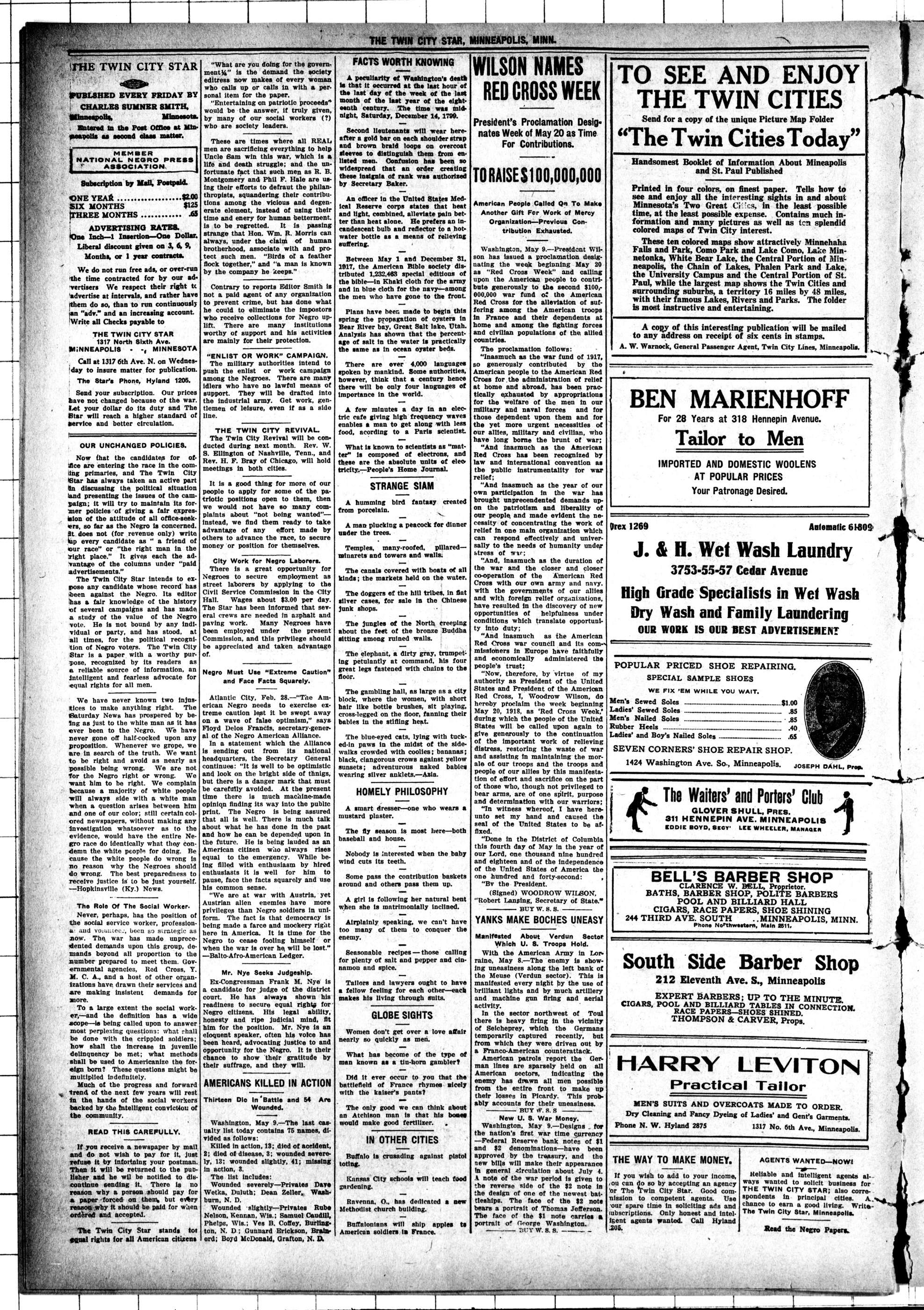
THE TWIN CITY STAR
PUBLISHED EVERY FRIDAY BY
CHARLES SUMNER SMITH,
Minneapolis, Minnesota.
Entered in the Post Office at Minneapolis as second class matter.
MEMBER
NATIONAL NEGRO PRESS
ASSOCIATION.
ONE YEAR ..... $2.00
SIX MONTHS ..... $125
THREE MONTHS ..... .65
We do not run free ads, or over-run the time contracted for by our advertisers We respect their right to advertise at intervals, and rather have them do so, than to run continuously an "adv." and an increasing account. Write all Checks payable to
MINNEAPOLIS MINNESOTA
Call at 1317 6th Ave. N. on Wednesday to insure matter for publication.
The Star's Phone, Hyland 1205.
Send your subscription. Our prices have not changed because of the war.
Let your dollar do its duty and The Star will reach a higher standard of service and better circulation.
OUR UNCHANGED POLICIES.
Now that the candidates for office are entering the race in the coming primaries, and The Twin City Star has always taken an active part in discussing the political situation and presenting the issues of the campaign; it will try to maintain its former policies of giving a fair expression of the attitude of all office-seekers, so far as the Negro is concerned, it does not (for revenue only) write up every candidate as "a friend of our race" or "the right man in the right place." It gives each the advantage of the columns under "paid advertisements."
The Twin City Star intends to expose any candidate whose record has been against the Negro. Its editor has a fair knowledge of the history of several campaigns and has made a study of the value of the Negro vote. He is not bound by any individual or party, and has stood, at all times, for the political recognition of Negro voters. The Twin City Star is a paper with a worthy purpose, recognized by its readers as a reliable source of information, an intelligent and fearless advocate for equal rights for all men.
We have never known two injustices to make anything right. The Saturday News has prospered by being as just to the white man as it has ever been to the Negro. We have never gone off half-cocked upon any proposition. Whenever we grope, we are in search of the truth. We want to be right and avoid as nearly as possible being wrong. We are not for the Negro right or wrong. We want him to be right. We complain because a majority of white people will always side with a white man when a question arises between him and one of our color; still certain colored newspapers, without making any investigation whatsoever as to the evidence, would have the entire Negro race do identically what they condemn the white people for doing. Because the white people do wrong is no reason why the Negroes should do wrong. The best preparedness to receive justice is to be just yourself.—Hopkinsville (Ky.) News.
The Role Of The Social Worker.
Never, perhaps, has the position of the social service worker, professiona and volunteer, been so strategic as now. The war has made unprecedented demands upon this group, demands beyond all proportion to the number prepared to meet them. Governmental agencies, Red Cross, Y. M. C. A., and a host of other organizations have drawn their services and are making insistent demands for more.
To a large extent the social worker—and the definition has a wide scope—is being called upon to answer most perplexing questions: what shall be done with the crippled soldiers; how shall the increase in juvenile delinquency be met; what methods shall be used to Americanize the foreign born? These questions might be multiplied indefinitely.
Much of the progress and forward trend of the next few years will rest in the hands of the social workers backed by the intelligent conviction of the community.
READ THIS CAREFULLY.
If you receive a newspaper by mail and do not wish to pay for it, just refuse it by informing your postman. Then it will be returned to the publisher and he will be notified to discontinue sending it. There is no reason why a person should pay for a paper forced on them, but every reason why it should be paid for when ordered and accepted.
The Twin City Star stands for equal rights for all American citizens
"What are you doing for the government?4" is the demand the society editress now makes of every woman who calls up or calls in with a personal item for the paper.
"Entertaining on patriotic proceeds" would be the answer, if truly given, by many of our social workers (?) who are society leaders.
These are times where all REAL men are sacrificing everything to help Uncle Sam win this war, which is a life and death struggle; and the unfortunate fact that such men as R. B. Montgomery and Phil F. Hale are using their efforts to defraud the philanthropists, squandering their contributions among the vicious and degenerate element, instead of using their time and enery for human betterment, is to be regretted. It is passing strange that Hon. Wm. R. Morris can always, under the claim of human brotherhood, associate with and protect such men. "Birds of a feather flock together," and "a man is known by the company he keeps."
Contrary to reports Editor Smith is not a paid agent of any organization to prevent crime, but has done what he could to eliminate the impostors who receive collections for Negro uplift. There are many institutions worthy of support and his activities are mainly for their protection.
"ENLIST OR WORK" CAMPAIGN.
The military authorities intend to push the enlist or work campaign among the Negroes. There are many idlers who have no lawful means of support. They will be drafted into the industrial army. Get work, gentlemen of leisure, even if as a side line.
THE TWIN CITY REVIVAL.
The Twin City Revival will be conducted during next month. Rev. W. S. Ellington of Nashville, Tenn., and Rev. H. F. Bray of Chicago, will hold meetings in both cities.
It is a good thing for more of our people to apply for some of the patriotic positions open to them, then we would not have so many complaints about "not being wanted"—instead, we find them ready to take advantage of any effort made by others to advance the race, to secure money or position for themselves.
City Work for Negro Laborers.
There is a great opportunity for Negroes to secure employment as street laborers by applying to the Civil Service Commission in the City Hall. Wages about $3.00 per day. The Star has been informed that several crews are needed in asphalt and paving work. Many Negroes have been employed under the present Commission, and this privilege should be appreciated and taken advantage of.
Negro Must Use "Extreme Caution" and Face Facts Squately.
Atlantic City, Feb. 28.—"The American Negro needs to exercise extreme caution least it be swept away on a wave of false optimism," says Floyd Delos Francis, secretary-general of the Negro American Alliance.
In a statement which the Alliance is sending out from its national headquarters, the Secretary General continues: "It is well to be optimistic and look on the bright side of thins, but there is a danger mark that must be carefully avoided. At the present time there is much machine-made opinion finding its way into the public print. The Negro is being assured that all is well. There is much talk about what he has done in the past and how he can be depended upon in the future. He is being lauded as an American citizen who always rises equal to the emergency. While being filled with enthusiasm by hired enthusiasts it is well for him to pause, face the facts squarely and use his common sense.
"We are at war with Austria, yet Austrian alien enemies have more privileges than Negro soldiers in uniform. The fact is that democracy is being made a farce and mockery rigat here in America. It is time for the Negro to cease fooling himself or when the war is over he will be lost." - Balto-Afro-American Ledger.
Mr. Nye Seeks Judgeship.
Ex-Congressman Frank M. Nye is a candidate for judge of the district court. He has always shown his readiness to secure equal rights for Negro citizens. His legal ability, honesty and ripe judicial mind, fit him for the position. Mr. Nye is an eloquent speaker, often his voice has been heard, advocating justice to and opportunity for the Negro. It is their chance to show their gratitude by their suffrage, and they will.
AMERICANS KILLED IN ACTION
Thirteen Dio In "Battle and 54 Are Wounded.
Washington, May 9.—The last casualty list today contains 75 names, divided as follows:
Killed in action, 13; died of accident, 2; died of disease, 3; wounded severely, 13; wounded slightly, 41; missing in action, 3.
The list includes:
Wounded severely—Privates Daye Wetka, Duluth; Dean Zeller, Washburn, N. D.
Wounded slightly—Privates Rube Nelson, Kennan, Wis.; Samuel Caudill, Phelps, Wis.; Ves B. Coffey, Burlington, N. D.; Gunnard Erickson, Brainerd; Boyd McDonald, Grafton, N. D.
FACTS WORTH KNOWING
A peculiarity of Washington's death is that it occurred at the last hour of the last day of the week of the last month of the last year of the eighteenth century. The time was midnight, Saturday, December 14, 1799.
Second lieutenants will wear here-after a gold bar on each shoulder strap and brown braid loops on overcoat sleeves to distinguish them from enlisted men. Confusion has been so widespread that an order creating these insignia of rank was authorized by Secretary Baker.
WILSON NAIL
RED CROSS
President's Proclamation Week of May 2
For Contributors
TO RAISE $100,000
An officer in the United States Medical Reserve corps states that heat and light, combined, alleviate pain better than heat alone. He prefers an incandescent bulb and reflector to a hot-water bottle as a means of relieving suffering.
Between May 1 and December 31, 1917, the American Bible society distributed 1,232,483 special editions of the bible—in Khaki cloth for the army and in blue cloth for the navy—among the men who have gone to the front.
Plans have been made to begin this spring the propagation of oysters in Bear River bay, Great Salt lake, Utah. Analysis has shown that the percentage of salt in the water is practically the same as in ocean oyster beds.
There are over 4,000 languages spoken by mankind. Some authorities, however, think that a century hence there will be only four languages of importance in the world.
A few minutes a day in an electric cafe giving high frequency waves enables a man to get along with less food, according to a Paris scientist.
What is known to scientists as "matter" is composed of electrons, and these are the absolute units of electricity—People's Home Journal.
STRANGE SIAM
A humming bird fantasy created from porcelain.
A man plucking a peacock for dinner under the trees.
Temples, many-roofed, pillared—minarets and towers and walls.
The canals covered with boats of all kinds; the markets held on the water.
The doggers of the hill tribes, in flat silver cases, for sale in the Chinese junk shops.
The jungles of the North creeping about the feet of the bronze Buddha sitting among ruined walls.
The elephant, a dirty gray, trumpeting petulantly at command, his four great legs fastened with chains to the floor.
The gambling hall, as large as a city block, where the women, with short hair like bottle brushes, sit playing, cross-legged on the floor, fanning their babies in the stifling heat.
The blue-eyed cats, lying with tucked-in paws in the midst of the sidewalks crowded with coolies; bananas; black, clangorous crowns against yellow sunsets; adventurous naked babies wearing silver anklets.—Asia.
HOMELY PHILOSOPHY
A smart dresser—one who wears a mustard plaster.
The fly season is most here—both baseball and house.
Nobody is interested when the baby wind cuts its teeth.
Some pass the contribution baskets around and others pass them up.
A girl is following her natural bent when she is matrimonially inclined.
Airplainly speaking, we can't have too many of them to conquer the enemy.
Seasonable recipes—those calling for plenty of salt and pepper and cinnamon and spice.
Tallors and lawyers ought to have a fellow feeling for each other—each makes his living through suits.
GLOBE SIGHTS
Women don't get over a love affair nearly so quickly as men.
What has become of the type of man known as a tiu-horn gambler?
Did it ever occur to you that the battlefield of France rhymes nicely with the kaiser's pants?
The only good we can think about an Atchison man is that his bones would make good fertilizer.
IN OTHER CITIES
Buffalo is crusading against pistol toting.
Kansas City schools will teach food gardening.
Ravenna, O., has dedicated a new Methodist church building.
Buffalontans will ship apples to American soldiers in France.
WILSON NAMES RED CROSS WEEK
President's Proclamation Designates Week of May 20 as Time For Contributions.
TORAISE$100,000,000
American People Called Qn To Make Another Gift For Work of Mercy Organization—Previous Contribution Exhausted.
Washington, May 9.—President Wilson has issued a proclamation designating the week beginning May 20 as "Red Cross Week" and calling upon the American people to contribute generously to the second $100,000,000 war fund of the American Red Cross for the alleviation of suffering among the American troops in France and their dependents at home and among the fighting forces and civilian populations of the allied countries.
The proclamation follows:
"Inasmuch as the war fund of 1917, so generously contributed by the American people to the American Red Cross for the administration of relief at home and abroad, has been practically exhausted by appropriations for the welfare of the men in our military and naval forces and for those dependent upon them and for the yet more urgent necessities of our allies, military and civilian, who have long borne the brunt of war; "And inasmuch as the American Red Cross has been recognized by law and international convention as the public instrumentality for war relief;
"And inasmuch as the year of our own participation in the war has brought unprecedented demands upon the patriotism and liberality of our people and made evident the necessity of concentrating the work of relief in one main organization which can respond effectively and universally to the needs of humanity under stress of war;
"And, inasmuch as the duration of the war and the closer and closer co-operation of the American Red Cross with our own army and navy, with the governments of our allies and with foreign relief organizations, have resulted in the discovery of new opportunities of helpfulness under conditions which translate opportunity into duty;
"And inasmuch as the American Red Cross war council and its commissioners in Europe have faithfully and economically administered the people's trust;
"Now, therefore, by virtue of my authority as President of the United States and President of the American Red Cross, I, Woodrow Wilson, do hereby proclaim the week beginning May 20, 1918, as 'Red Cross Week,' during which the people of the United States will be called upon again to give generously to the continuation of the important work of relieving distress, restoring the waste of war and assisting in maintaining the morale of our troops and the troops and people of our allies by this manifestation of effort and sacrifice on the part of those who, though not privileged to bear arms, are of one spirit, purpose and determination with our warriors:
"In witness whereof, I have hereunto set my hand and caused the seal of the United States to be affixed.
"Done in the District of Columbia this fourth day of May in the year of our Lord, one thousand nine hundred and eighteen and of the independence of the United States of America the one hundred and forty-second:
"Bv the President.
(Signed) WOODROW WILSON.
"Robert Lansing, Secretary of State."
YANKS MAKE BOCHES UNEASY
Manifested About Verdun Sector Which U. S. Troops Hold.
With the American Army in Lorraine, May 8.—The enemy is showing uneasiness along the left bank of the Meuse (Verdun sector). This is manifested every night by the use of brilliant lights and by much artillery and machine gun firing and aerial activity.
In the sector northwest of Toul there is heavy fire in the vicinity of Selcheprey, which the Germans temporarily captured recently, but from which they were driven out by a Franco-American counterattack.
American patrols report the German lines are sparsely held on all American sectors, indicating the enemy has drawn all men possible from the entire front to make up their losses in Picardy. This probably accounts for their uneasiness.
Washington. May 9.—Designs for the nation's first war time currency —Federal Reserve bank notes of $1 and $2 denominations—have been approved by the treasury, and the new bills will make their appearance in general circulation about July 4. A note of the war period is given to the reverse side of the $2 note in the design of one of the newest battleships. The face of the $2 note bears a portrait of Thomas Jefferson. The face of the $1 note carries a portrait of George Washington.
TO SEE AND ENJOY THE TWIN CITIES Send for a copy of the unique Picture Map Folder "The Twin Cities Today"
Handsomest Booklet of Information About Mineapolis and St. Paul Published
Printed in four colors, on finest paper. Tells how to see and enjoy all the interesting sights in and about Minnesota's Two Great Cities, in the least possible time, at the least possible expense. Contains much information and many pictures as well as ten splendid colored maps of Twin City interest.
These ten colored maps show attractively Minnehaha Falls and Park, Como Park and Lake Como, Lake Minnetonka, White Bear Lake, the Central Portion of Minneapolis, the Chain of Lakes, Phalen Park and Lake, the University Campus and the Central Portion of St. Paul, while the largest map shows the Twin Cities and surrounding suburbs, a territory 16 miles by 48 miles, with their famous Lakes, Rivers and Parks. The folder is most instructive and entertaining.
A copy of this interesting publication will be mailed to any address on receipt of six cents in stamps. A. W. Warnock, General Passenger Agent, Twin City Lines, Minneapolis.
IMPORTED AND DOMESTIC WOOLENS AT POPULAR PRICES Your Patronage Desired.
Orex 1269
J. & H. Wet Wash Laun
3753-55-57 Cedar Avenue
High Grade Specialists in Wet W
Dry Wash and Family Launder
OUR WORK IS OUR BEST ADVERTISEMENT
POPULAR PRICED SHOE REPAIRING.
SPECIAL SAMPLE SHOES
WE FIX 'EM WHILE YOU WAIT.
Men's Sewed Soles ..... $1.00
Ladies' Sewed Soles ..... .85
Men's Nailed Soles ..... .85
Rubber Heels ..... .40
Ladies' and Boy's Nailed Soles ..... .65
SEVEN CORNERS' SHOE REPAIR SHOP.
Wash Laundry
Cedar Avenue
Artists in Wet Wash
Family Laundering
BEST ADVERTISEMENT
J. & H. Wet Wash Laundry
3753-55-57 Cedar Avenue
High Grade Specialists in Wet Wash
Dry Wash and Family Laundering
OUR WORK IS OUR BEST ADVERTISEMENT
1424 Washington Ave. So., Minneapolis.
The Waiters' and Porters' Club
GLOVER SHULL, PRES.
311 HENNEPIN AVE. MINNEAPOLIS
EDDIE BOYD, SEGY. WHEELER, MANAGER
BELL'S BARBER SHOP
CLARENCE W. BELL, Proprietor.
BATHS, BARBER SHOP, POLITE BARBER,
POOL AND BILLIARD HALL
CIGARS, RACE PAPERS, SHOE SHINING
244 THIRD AVE. SOUTH ...MINNEAPOLIS.
Phone Northwestern, Main 2511.
South Side Barber Shop
212 Eleventh Ave. S., Minneapolis
EXPERT BARBERS; UP TO THE MINUS
CIGARS, POOL AND BILLIARD TABLES IN CONNE
RACE PAPERS—SHOES SHINED.
THOMPSON & CARVER, Props.
HARRY LEVITO
Practical Tailor
MEN'S SUITS AND OVERCOATS MADE TO ORIG
Dry Cleaning and Fancy Dyeing of Ladies' and Gent's Gar
Phone N. W. Hyland 2875
1317 No. 6th Ave., MI
BARBER SHOP
BELL, Proprietor.
SHOP, POLITE BARBERS
MILLIARD HALL
BARBERS, SHOE SHINING
...MINNEAPOLIS, MINN.
Eastern, Main 2511.
Barber Shop
e. S., Minneapolis
; UP TO THE MINUTE.
D TABLES IN CONNECTION.
SHOES SHINED.
CARVER, Props.
LEVITON
Tailor
COATS MADE TO ORDER.
of Ladies' and Gent's Garments.
1317 No. 6th Ave., Minneapolis.
BELL'S BARBER SHOP
CLARENCE W. BELL, Proprietor.
BATHS, BARBER SHOP, POLITE BARBERS
POOL AND BILLIARD HALL
CIGARS, RACE PAPERS, SHOE SHINING
244 THIRD AVE. SOUTH . MINNEAPOLIS, MINN.
Phone Northwestern. Main 811.
South Side Barber Shop
212 Eleventh Ave. S., Minneapolis
EXPERT BARBERS; UP TO THE MINUTE.
CIGARS, POOL AND BILLIARD TABLES IN CONNECTION.
RACE PAPERS—SHOES SHINED.
THOMPSON & CARVER. Props
MEN'S SUITS AND OVERCOATS MADE TO ORDER.
Dry Cleaning and Fancy Dyeing of Ladies' and Gent's Garments.
Phone N. W. Hyland 2875 1317 No. 6th Ave. Minneapolis
AGENTS WANTED—NOW!
Reliable and intelligent agents always wanted to solicit business for THE TWIN CITY STAR; also correspondents in principal cities. A chance to earn a good living. Write The Twin City Star, Minneapolis.
Read the Negro Papers.
---
---
A
THE WAY TO MAKE MONEY.
If you wish to add to your income, you can do so by accepting an agency or The Twin City Star. Good commission to competent agents. Use your spare time in soliciting ads and subscriptions. Only honest and intelligent agents wanted. Call Hyland 205.
Automatic 61809
[Picture of a man]
Handshake
ON THIS BEAUTIFUL PULLMAN BED
LIBERAL CREDIT EXTENDED
COMPLETE HOMEFURNISHINGS
MAY QUEEN BALL
Given by
Ames Lodge 106 I. B. P. O. E. of W.
ARCADI
5th Street, Opposite Co
MONDAY EVE
A modern revival of the beauty
the May Queen" with May Poles,
music. Miss Lilliene Thomas ha
May. Come out and participate
at 11 P. M. sharp.
ARCADIA HALL
On Street, Opposite Court House, Minneapolis
MONDAY EVENING, MAY 13.
a revival of the beautiful old time custom of
"been" with May Poles, Maids of Honor, and
Lilliene Thomas has been selected as Guest
out and participate in this novel event.
sharp.
ARCADIA HALL
5th Street, Opposite Court House, Minneapolis, on
MONDAY EVENING, MAY 13.
A modern revival of the beautiful old time custom of "Crowning the May Queen" with May Poles, Maids of Honor, and appropriate music. Miss Lilliene Thomas has been selected as Queen of the May. Come out and participate in this novel event. Coronation at 11 P. M. sharp.
MUSIC BY McCULLOUGH'S ORCHESTRA Refreshments by the Lodge.
COMMITTEE OF ARRANGEMENT
iels, Walter Dodson, Clarence M
Bryant, P. H. Southall.
FLOOR COMMITTEE: James
Giles, Alex Irwin, Chairman.
RECEPTION COMMITTEE: In
Dr. W. Ellis Burton, Bert Thom
Johnson, Dr. J. H. Redd, Edwar
Sumner Smith, Chairman.
REFRESHMENT COMMITTEE:
Stirman, Luke Tichenor, Roy Au
Chairman.
REE OF ARRANGEMENTS: Benj. Berry, M.
Dodson, Clarence McCullough, Henry Tur-
n. Southall.
COMMITTEE: James Burke, Judge John
Burwin, Chairman.
CON COMMITTEE: Irving Rhoades, Henry
Burton, Bert Thompson, Thos. Roxboro
J. J. H. Redd, Edward Stewart, James B.
th, Chairman.
MENT COMMITTEE: Alex Rogers, Dr. J. B.
ke Tichenor, Roy Austin, Clyde Walker, F.
50 CENTS TAX
GEORGE W. HOLBERT, General Chairman
COMMITTEE OF ARRANGEMENTS: Benj. Berry, Maurice Daniels, Walter Dodson, Clarence McCullough, Henry Turner, George Bryant, P. H. Southall.
FLOOR COMMITTEE: James Burke, Judge Johnson, Jacob Giles, Alex Irwin, Chairman.
RECEPTION COMMITTEE: Irving Rhoades, Henry Thompson, Dr. W. Ellis Burton, Bert Thompson, Thos. Roxborough, Edward Johnson, Dr. J. H. Redd, Edward Stewart, James Branch, Chas. Sumner Smith, Chairman.
REFRESHMENT COMMITTEE: Alex Rogers, Dr. J. B. Sizer, Wm. Stirman, Luke Tichenor, Roy Austin, Clyde Walker, Fred Thomas, Chairman.
ADMISSION 50 CENTS TAXIS AT 1:45
GEORGE W. HOLBER
F. PEOPLE
HOME BUILDING
CONTRACTORS AND BUIL
818 METROPOLI
OFFICE PHC
You don't need money
I BUILD HOMES ON M
COTTAGES AND FO
ITS JUST LIKE PAYING RENT.
GEORGE W. HOLBERT, General Chairman.
818 METROPOLITAN LIFE BLDG.
OFFICE PHONE NIC. 1534
don't need money; if you own you
I BUILD HOMES ON MONTHLY PAYMENTS.
COTTAGES AND FOUR FAMILY FLATS
LIKE PAYING RENT. PL
You don't need money; if you own your lot. I BUILD HOMES ON MONTHLY PAYMENTS. COTTAGES AND FOUR FAMILY FLATS ITS JUST LIKE PAYING RENT. PLANS FREE.
AVIATORS RESCUED AT SEA
Had Been Adrift Eighteen Hours in Damaged Plane.
An Atlantic Port, May 10.—Their hydroairplane adrift at sea and in danger of sinking from a leaking pontoon, Ensign Arhur Laverents, naval aviator, and C. C. Cotton, observer, were rescued by a coastwise steamship 35 miles off Miami, Fla. The men had been floating on the plane 38 hours without food or water after an engine breakdown forced them to drop to the water.
One of the pontoons sprung a leak
---
A HALL
Art House, Minneapolis, on
WINNING, MAY 13.
ful old time custom of "Crowning
Maids of Honor, and appropriate
is been selected as Queen of the
in this novel event. Coronation
NTS: Benj. Berry, Maurice Dan-
cCullough, Henry Turner, George
Burke, Judge Johnson, Jacob
Viving Rhoades, Henry Thompson,
Pinson, Thos. Roxborough, Edward
d Stewart, James Branch, Chas.
Alex Rogers, Dr. J. B. Sizer, Wm.
Stin, Clyde Walker, Fred Thomas,
T, General Chairman.
TAN LIFE BLDG.
ONE NIC. 1534
; if you own your lot.
MONTHLY PAYMENTS.
OUR FAMILY FLATS
PLANS FREE.
and the craft would not have stayed
affloat more than half an hour after
the rescue, the aviators said. Sharks
added to their peril.
American Locomotives in France.
Paris, May 10.—On railway lines in France 245 large type American locomotives are now in operation. They were brought to France in parts and set up in the army machine shops. Likewise 514 American freight cars of 30 tons capacity each have been set up and 700 more are in process of being assembled, while another 700 are on the way. The ordinary freight car of France is of the 10-ton type.
TAXIS AT 1:45
THE TWIN CITY STAR, MINNEAPOLIS, MINN.
Saving Today Is More Than a Habit—It's Your Patriotic Duty. Avail Yourself Now of This Opportunity.
7TH AND MARQUETTE
MOREFIELD STOREY DRIVE EXTENDED.
The Morefield Storey Drive has been extended to May 19th inclusive in order that Minneapolis should not be found wanting at the last accounting. We have always been on the firing line in every crisis and let us not shirk our manifest duty now. Join the N. A. A. C. P. and help win this great struggle for liberty, equality and justice. Membership dues are only one dollar a year.
R. Augustine Skinner, Secy.
B. S. Smith, President.
We can best show our appreciation to Mr. Story as he says: "Do not hold laudatory meetings but I shall feel best repaid, if every branch will join enthusiastically in the effort to secure 50,000 members for the N. A. C. P. We need a large membership to insure the permanent success of our great movement against race prejudice. Plans are being perfected for the great MOOREFIELD STORY DRIVE for members. Do your bit towards its success. Join the National Association for the Advancement of Colored People! Do it NOW! The Minneapolis rBanch has opened up its campaign to contribute its share to the 50,000 membership in the Moorefield Store Drive. If we are determined to stem the tide of prejudice and safeguard our rights; the association must be strong in numbers and in financial resources, and it will be a greater power throughout the nation. The membership fee is only ONE DOLLAR a year, one half of which is remitted to the New York National Headquarters and the other remaining half is retained in our treasury for local expenses. Will you not become a member and help the Association to make America free for black humanity? You must not be a slacker and you cannot be a conscientious objector. Have your dollar ready for the drive; let Minncapolis be in the race by sending no less than 500 memberships.
R. AUGUSTINE SKINNER,
Local Secy.
Hon. Moorefield Story has shown
his unwavering attitude in standing
for fair play and justice to the Negro
and is giving all of his time, money,
energy and intelligence to secure
their rights guaranteed under the
constitution. His recent victory in
arguing so successfully the Louisville
segregation case in the supreme court
in which a unanimous decision favorable
to us was handed down, marks
him one of, if not the greatest, modern
abolitionists.
We have some among our advertisers and subscribers who are a credit to our race for their business-like methods. They pay promptly in advance and expect nothing unreasonable in return. Others want to know "Why we can't 'trust' them?" or send a bill, and then a collector, and finally censor a Negro editor because he can't run his paper "like the white man." Few persons realize that it pays to pay as you go. The Star is not an installment plan proposition. It is a real newspaper run under many difficulties mostly due to the foolish notions and ignorant whims of those whom it serves and protects and from whom it should get its support and their consideration.
AGENTS WANTED—NOW!
Reliable and intelligent agents always wanted to solicit business for THE TWIN CITY STAR; also correspondents in principal cities. A chance to earn a good living. Write The Twin City Star, Minneapolis.
Do not waste your time making promises to our agents. Send your money by Express or Post Office Order or in cash or postage stamps.
SUBSCRIBE FOR THE STAR.
ADVERTISE IN THE STAR
LOCAL NEWS
IMPORTANT NOTICE
Unless notes are written plainly and properly arranged they will not be inserted. Many people send in notes regardless of names, initials or composition. Arrangement by the publisher will be charged for. Free notices must be correctly written.
Secretaries of Lodges may send notices of their newly elected officers for free publication and office information.
Do not forget to send the money to the Star which you owe for subscriptions.
Mr. J. M. Morris has moved his office from the Boston block to his own building at 1719 Fourth avenue south.
A SPECIAL NOTICE.
N. A. A. C. P.
All authorized solicitors for the Moorfield Storey Drive for new members for the National Association for the Advancement of Colored People have been furnished receipt books of the association signed by the local secretary. Get a receipt when you pay your dollar.
R. Augustine Skinner, Local Sec.
Secretary Skinner issues a timely warning. There are active promoters who are interested in the financial end of every movement. They have a habit of making a losing report of financial successes. The list of new members will be published. Make it 1,000.
Miss Isabel Ford is ill at the University hospital.
Mr. Harry L. Davis is at the City Hospital with a broken arm.
Mrs. Mary Anderson has moved from 2422 25th Ave. So. to 3349 21st Ave. So.
Send your subscription in stamps, check or postal order. Do it now!
Miss Lillian Thomas will be the Queen at the May Festival given by Ames Lodge of Elks.
Negroes subscribed to Third Liberty Loan in large numbers to help win the war.
Mr. and Mrs. E. A. Mitchell have moved to 1828 4th Ave. So.
Mr. Andrew Quinn will leave Saturday night for Indianapolis to visit his brother James who is very ill.
TRINITY M. E. CHURCH.
Rev. H. Allen Smith is the pastor of the Trinity M. E. church, recently organized, which has a membership of 25 members. Services are held at 419 14th Ave. So. The public is invited.
The South Side Barber Shop is now located at 212 11th Ave. So.
Remember the "THIRD LIBERTY LOAN."
CLASSIFIED ADVERTISEMENTS
EVERY DAY is BARGAIN DAY
at the ROOT & HAGEMAN
STORE, 407 Nicollet Ave.
SEE McDEW! for real estate.
FURNITURE FOR SALE.
15 sq. yds. linoleum, $3.50; 1 Moore Range with water front, $12.50; 1 Eclipse Waterheater, $8.50; 1 Round Oak heater, $7.00; 2 Perfection Oil Heaters, $2.50 and $4.00; 6 doz fruit jars at 35c a doz; 1 White Enameled Dresser, $8.00; 1 bed, complete, Way Sagleigh Spring and A No. 1 Cotton Mattress, $8.50. Call So. 6434 or 1907 4th Ave. So.
A DESIRABLE FLAT.
A desirable flat, good location, all modern, conveniently located near car line. pply Jno. S. Wright, Main postoffice. Call N. W. Orchid 19-W.
A reliable man to wash windows
Cavette, 4553 Bryant Ave. So. Call
vember. Good wages. Write to Louis
and cut lawns. Steady work till No-
Colfax 947.
CHARITY BALL
For the Benefit of
CRISPUS ATTUCKS HOME
given by the
SMART SET WHIST CLUB
Coliseum Hall, 27th and Lake St.
WEDNESDAY EVE., MAY 15, 1918
Admission 35c.
THE SUNDAY FORUM
The regular meetings of the Minne-
apolis Sunday Forum are held bi-
monthly as follows:
First Sunday Each Month.
St. Peter A. M. E. Church, 22d St.
between 9th and 10th Aves.
Third Sunday Each Month.
Bethesda Baptist Church 1122 8th
St. So.
The public always invited.
Exercises begin at 3:30 p. m.
ADVERTISE IN THE STAR
ATTY. FRANCIS ADDRESSES SOCIAL SERVICE CLUB
(Continued from First Page.)
For a while dazed and confused by the liberty into which it was thrust and which it knew not how to use, stupefied by the anodyne of bondage still lingering in its blood, it now is beginning to stir from its lethargy and emerge from its bewilderment.
At last the dawn is beginning to break, and he who has been asleep or groping blinding in the night is coming forth into the morning. The light of a new day is upon his face and that cheer, which made possible the bearing of the burden of the schackles of slavery, and softened the sting of the overseer's lash, is still in his heart.
We are living in an age and an epoch which is characterized by a growing and insistent demand for justice and democracy. The United States is sending men, money and munitions to the battle fields of Europe as its demand for justice, freedom and equality of opportunity for all peoples, and it would be well for the Americans at this time to remember that here in our own country for the past fifty years since the abolition of slavery, is a race loyal, patriotic people who are not enjoying at the hands of this government here at home the principles of that democracy for which we are fighting to make the world safe, and in which fight God helping us, we will be victorious.
The Negro is loyal in time of peace and patriotic in the time of war. He vies with every other American citizen in allegiance to the constitution, in honor to the American flag and offers his life and resources to the government for the maintenance of our republic as a world power in brigging about the world democracy for all mankind.
Did it ever occur to you that what you and I commonly know as the Negro race is not a Negro race. Webster's Standard dictionary defines Negro as "One of the black races in Africa." The colored people in America are not a black race. They are a multi-colored race, peculiar in that they vary in color and in other important particulars.
All other peoples have some or several peculiar racial marks that are characteristic of that certain people, most races can be told by their surname, as for instance Murphy, O'Toole, Flanagin, plainly denote the Irish, and LaBatty, St. Julian and DeBaptist, the French; Olson, Johnson and Anderson, the Swede; Goldbloom, Simon and Cohen, the Jew; with Wagner, Betz and Herman the German. But there is no name that is peculiar to the American colored man.
All other races have some peculiar facial feature, hair or distinctive color that marks them unmistakably, but the American colored man has the facial features of every race under the sun. He has hair from the texture of the Coarsest wool to softness of silk, and in all colors from black to golden. He varies in complexion from the darkness of an Egyptian night to as fair as the lily, and because of these variations you pass many of them on the streets day after day with never even a suspicion that they belong to that race of people commonly called Negro in this country. And this condition, having been created by the American white man, it therefore appears to me that this race variety was MADE IN AMERICA, and that we are a race without nationality save that which we have acquired under hard conditions upon the soil of this country. We owe neither allegiance nor sympathy to any foreign prince, potentate or power. We hate tyranny because we have been the victims of tyranny. We have no prejudices acquired abroad, no affiliations with an older civilization, no prepossessions of language, religion or philosophy or kultur to mitigate our Americanism therefore, we are simon-pure one hundred per cent American.
We now have nearly a hundred thousand such Negroes in the camps and across the seas "somewhere in France," and at this hour 33,000, more are on their way from their homes in the south to the various training camps. And although compelled to wait for their trains in separate, dingy and dirty waiting rooms, and to ride in jim-crow cars through the States of Mississippi, Alabama, Georgia, Louisiana and Tennessee, states made infamous by the lynching and burning at the stake of helpless black men, women and children, we are glad to fight our country's battles and we bear no malice for the wrongs we have suffered.
Through our faith in divine promises we believe we see the dawning of a new day upon earth. We are looking beyond this wild, engulfing world war; across the setting muck of murdering American mobs, through the thick maze of social and industrial propaganda into the very purposes of God for a Christian world and the United States of America made safe for the Negro.
The Social Service Club is an organization composed of the paid officials of the several civic and charitable institutions of St. Paul. Atty. Francis was selected last October to speak at the monthly dinner in May. This honor has never been accorded to one of his race. He received the praise of many prominent persons who were among the invited guests.
SUBSCRIBE FOR THE STAR.
If you suffer from headaches or your eyes tire or blur the reading—Let me examine them, expert advice and examination FREE. I duplicate any broken lenses made by me or anybody else.
OPTOMETRIST-OPTICIAN
45 S. 6th St. Minneapolis
N. W. Cedar 8190. Res. Dale 8935
HAMMOND TURNER
Suite 321, American Nat'l Bank Fifth and Cedar Sts. St. Paul.
WORKING-MEN'S
SOCIAL CLUB
FOR MEN ONLY
244 3RD AVE. S.
MINNEAPOLIS
SYLVESTER W. OLIVER &
BENJAMIN JONES
Managers
Phone Hy. 3605.
Graduate Northwestern Dental School of Chicago.
715 Sixth Ave. No.,
Minneapolis, Minn.
Peterson, The Druggist
1501 Washington Ave. So.
TOILET ARTICLES, DRUGS
PRESCRIPTIONS.
He Solicits Your Patronage.
CHOICE CITY AND SUBURBAN PROPERTY FOR SALE ON SMALL MONTHLY PAYMENTS.
Houses and Flats for Rent.
B. M. McDew
802 Sykes Block.
N. W. Nic. 621 Minneapolis
T. S. Center 4639.
WALFRID WESTMAN
Photographer
1425 Washington Ave. So. Minn.
HAVE YOUR PIANO TUNED
MY WORK GUARANTEED
HENRY R. MORGAN
711 Bryant Ave. No. Minneapolis
N. W. Hyland 5879
Office Hours: Sundays:
2 to 6 p. m. 10 to 1 p. m.
9:30 a. m. to 12:30 p. m.
R. S. BROWN, M. D.
Office 408-9 Tribune Amex
67 Fourth Street Soutr.
N. W. Main 2040. T. S. 38191
Res. 608 E. 14th St.
N. W. Main 2388 Minneapolis
Auto 34497
DRS. BROWN & BURGER
Chronic Diseases and Orthopraxy
10 South 3rd Street
Nc. 3555 Minneapolis
Nothing Changed But the Price
Sight-Drafts Still the Same-Fine Old Cigar You've Always Liked
When your dealer asks you six cents apiece for your old friend Sight Draft, don't get the idea that he's trying to put something over on you. The plain truth of the matter is that our labor and other manufacturing costs have increased so much that we had the choice of cutting down the size of the Sight Draft cigar, using inferior tobacco, or raising the price one cent.
We believed you would rather have the same old Sight Draft quality, the same old size, even if it cost you a penny more. So, from now on Sight Drafts will be six cents.
Try a Sight Draft today. It's worth six cents, and you experienced smokers KNOW it is. W. K. Gresh & Bone, makers. W. S. Couned Co. St. Paul, wholesale distributors. — Advertisement
---
WHO IS WHO NOW
SAYS GERMAN LACKS HUMOR
11.5
has made this the most terrible of all w chiefly through their disability to criti John Galsworthy has devoted him French hospital back of the firing line.
John Galsworthy has devoted himself to war work and has been in a French hospital back of the firing line.
MARRIED INTO ROYALTY
MARRIED INTO ROYALTY
With the announcement not long ago that Mrs. William Bateman Leeds, of New York and Newport, had been married in Switzerland to Prince Christopher of Greece, the most advanced step was taken in the Americanaization of European royalty. Her marriage into a royal family places her in a position never before occupied by an American woman. Her husband, who is thirty years old and eleven years her junior, is a grandson of the late King Christian IX of Denmark, son of the assassinated King George of Greece, brother of the deposed King Constantine of that country, and uncle of the present King Alexander.
Born Miss Nancy Stewart, of Cleveland, Ohio, this American woman thus enters the circle of the royal families of Prussia, Great Britain and Norway, and of the Romanoffs, who once ruled Russia. She becomes a cousin by mar-
riage of King George of England and of Queen Victoria of Spain. She may call the Queen Dowager of England and the one-time Dowager Tsaritsa of Russia aunts and the Emperor of Germany and the deposed Czar of Russia cousins. She becomes connected also with another American, one of the few who have been married into reigning royal families.
mriage of King George of England and to call the Queen Dowager of England and Russia aunts and the Emperor of German cousins. She becomes connected also to who have been married into reigning n DIRECTOR OF MIL
DIRECTOR OF MILITARY TRAINING
DIRECTOR OF MILITARY TRAINING
M. B. M.
try. The next year brought him a trai he served for seven years, obtaining he took this regiment to Cuba in 1899. Him ment sent him to the Philippines, when for three years. Aside from the actual personal exp war, he was military attache with the J
try. The next year brought him a transfer to the Twentieth infantry, where he served for seven years, obtaining his commission as captain in 1898. He took this regiment to Cuba in 1899. His stay was not long, as the war depart ment sent him to the Philippines, where he served his country in the islands for three years.
Aside from the actual personal experience he obtained during the Spanish war, he was military attache with the Japanese army during the war in 1904.
GOES BACK FOR MORE
GOES BACK FOR MORE
Corporal Peter Robinson of Udica, N. Y., reported recently at the British and Canadian recruiting mission in New York while on his way back to France. The corporal has served nearly three years in the trenches with the East Lancashire regiment and the Royal Welsh Fusiliers, and fought at the Marne, Neuve Chapelle, Loos and the Somme. He has been mixed up in four hand-to-hand bayonet encounters with the enemy and got his man each time. In his first fight of this kind, however, at Mametz, his antagonist gave him a severe bayonet wound in the thigh before succumbing to Irish valor.
The corporal was gassed at Loos, and was buried by the explosion of a big shell which killed five men and wounded three others near him. In addition to his bayonet thrust, he was struck by shrapnel and his chin still plainly shows the mark of the wound,
It may interest 200,000 Britishers and Canadians who are being urged to volunteer in the United States—before they are drafted—to learn that Peter volunteered on August 8, 1914, and was so anxious to get to the front that he paid his own fare to England. Furthermore, having already done quite a bit of "his bit," the corporal has gons back to do a bit more.
It may interest 200,000 Britishers and unteer in the United States—before volunteered on August 8, 1914, and we paid his own fare to England. Furthe of "his bit," the corporal has gone ba
John Galsworthy, the famous English novelist, who has written a great deal of the great war, thinks the greatest German fault is lack of humor. He has this to say on the subject:
"The German of today has no philosophic humor, no power of self criticism. This is a terrible national defect, whether emanating from the individual deficiency or from living under a despotic bureaucracy organized as a state despotism."
Galsworthy believes the allies will triumph through their sentiment and sense of humor. "There is in the blood of the American, Frenchman and Englishman a salt which inclines our people to individual liberty and to those democratic forms of government which alone permit of enough philosophic humor and self-criticism to keep patriotism sober. The inspiration of an ideal that far transcends the idea of glory to our individual countries wars yet waged. The Germans will lose size themselves. oneself to war work and has been in a
א. מ.
of Queen Victoria of Spain. She may and the one-time Dowager Tsaritsa of many and the deposed Czar of Russia with another American, one of the few royal families.
MILITARY TRAINING
When a town boasts of ninety-seven odd inhabitants—numerically speaking—it always welcomes a new arrival. Sixty years ago, Dec. 20, the little town of Charlottéville, N. Y., welcomed John F. Morrison to its fold.
Last December Secretary of War Baker observed the Morrison birthday celebration by appointing the party in question to be director of military training for the United States army, with headquarters at the war college in Washington.
Major General John F. Morrison was born in 1857. He grew up in the manner of any small town lad until he became twenty years of age; then he obtained an appointment to the United States military academy, where he was given a commission as second lieutenant in the Twentieth infantry, which he continued to hold for nine years, when he was rewarded with a first lieutenant with the First infantry transfer to the Twentieth infantry, where his commission as captain in 1808. He is stay was not long, as the war depart are he served his country in the islands experience he obtained during the Spanish Japanese army during the war in 1904.
PETER BURTON
Canadians who are being urged to vol- they are drafted—to learn that Peter as so anxious to get to the front that he more, having already done quite a bit back to do a bit more.
THE TWIN CITY STAR, MINNEAPOLIS, MINN.
FINAL AND DECISIVE CHAMPIONSHIP BOXING BOUTS HELD AT CAMP UPTON
Photo by
Western Newspaper Union.
Twenty-five thousand khaki-clad fight fans witness the final and decisive boxing bouts held in the open-air ring at Camp Upton. Six matches were staged to determine the title holder in the various classes. The contenders, in splendid trim, gave a fast and clever exhibition. The photograph shows the Geragty-Richle Ryan meeting.
TO RECENT DEATH LIST
International
Film Service
The death of Charley Mitchell, former middleweight champion of England, adds one more name to death's recent toll of ring celebrities. Mitchell started professional fighting when he was in his teens and rapidly rose to be champion of England. In 1883 he was brought to America to meet John L. Sullivan, and he was the first man to knock that famous warrior down. Their bout at Madison Square Garden was stopped by the police in the third round. In 1888 they fought a famous 39-round battle to a draw in Chantilly, France. Five years later Mitchell was knocked out by Corbett in three rounds. Mitchell, whose photograph is shown herewith, made frequent trips to the United States and was long a picturesque figure in the sporting worlds on both sides of the Atlantic. These are the men who died within the last year:
Bob Fitzsimmons, John L. Sullivan,
Mike Donovan, Les Darcy, Terry McGovern, Billy Madden, manager of Sullivan and Mitchell; Charley White, referee, and Frank Gotch, champion wrestler.
STARS ARE OVER DRAFT AGE
List of Players Over Limit Includes Bill Killifer, Frank Baker and Zimmerman.
While daily reports announce the fact that some major league star has been chosen in the selective draft, there are a great many classy players in the majors who are far above the are for selective service.
The following players in the major leagues are above the draft age limit: Jimmy Austin, Frank Baker, Jack Collins, Gravy Cravath, Jake Daubert, Larry Doyle, Arthur Fletcher, Charley Herzog, Heinle Zimmerman, Larry Gardner, George Gibson, Ivan Howard, Bill Killifer, John Lobert, Sherwood Mgee, Fred Luderus, George McBride, Eddie Plank, Jack Murray, Dode Paskert, Frank Schulte, Bert Shotten, Oscar Stanage, Terry Turner, Jimmy Walsh, Leon Ames, Larry Cheney, Eddie Cotte, Jack Coombs, James Levander and Harry Sallee.
Eddie Plank is the Nestor of the veteran squad of exempts, the family Good Book accrediting him with forty-two summers. George Gibson probably is the only one with a son in the army. Gibson evidently got an early start in the matrimonial game, as he now is only "going on" thirty-eight, the same age as Dode Paskert. Gravvy Cravath and Frank Schulte are in their thirty-sixth years, if the records are true.
Matty Prepares to Pitch.
Christopher Mathewson has aroused Cincinnati fans by warming up in practice at the Reds' training camp down South. Big Six says that he doesn't intend to pitch regularly this year, but that in cases of emergency he wants to be in shape to enter the box.
Sticks to Army Job.
Earl Thompson, who had been depended on to play first base for Tacoma this season, is lost to the club. He has decided to stick to his job with a shipbuilding company, which makes him safe from army service.
POOR RECOMMENDATION
"Recommendations of ball players amount to a whole lot, not," muses the Veteran Frank Bancroft of the Cincinnati Reds. "Yea, ho! Long, long ago, I had to get a first baseman for the club I was managing. The one I chose, on the recommendation of all the wise ones, lasted half a season and, to get him, I turned down a fellow whom the critics said would never do. The one I turned down was Dan Brouthers, that was all!"
ROWLAND HAS STRONG TEAM
First Busher to Win World's Championship Will Be Hard to Beat for Pennant This Year.
Clarence Rowland, the first busher to win a world's championship, is
managing the White Sox again this year. Clarence is thirty-nine years old. He led the White Sox to victory in the American league championship last season and won the world's championship of 1917 from New York with the Sox. Rowland succeeded Jimmy Callahan as manager of the Sox
PITTSBURG
in 1915. He came up with a brilliant bush-league record, having managed minor-league clubs with success in Aberdeen, Winnipeg, Jacksonville, Dubuque and Peoria. Rowland has the strongest team in the American league and will be hard to beat for the pennant this year.
DIAMOND NOTES
The Cleveland club has released pitcher Shoup to Portland.
If the Pirates win the pennant Pittsburgh will be just as gloomy as ever.
The Chattanooga club has sold Outfielder Sylvester to Waco of the Texas League.
Evers may lose his throwing arm and his batting eye, but his chin will go on forever.
You may have a lot of tough luck, but you can always be thankful that you are not a minor league magnate.
"B E Z" may be the first letters of Hugo Bezdek's name, but his players say "be easy" is not his motto by any means.
The veteran outfielder, Al Schweitzer, last year with Rochester in the International, has joined Joe Tinker's Columbus team.
While the American association will have no set rule on it, the opinion seems to be that practically all clubs will start games late this season.
Outfielder Roy Wolfe, who played with Rock Island last year until the Three-I league suspended, has been signed by Wichita of the Western league.
Heine Zim is in form. He won a footrace with a bush leaguer in an exhibition game the other day. He is now ready to resume his pursuit chase of Eddie Collins.
You want to be careful this season and not ask the peanut boy to give you a bag of "hot roasted thrift stamps." The venders will have the "war savies" for sale, which is one more way the national pastime is to help Uncle Sam.
MOGULS LACKING IN ENTHUSIASM IN WAR
MOGULS LACKING IN ENTHUSIASM IN WAR
Captain Huston Raps Owners of Major League Clubs.
Baseball Paying Too Much Attention to Dollars and Cents—It Was Boss of Yankees Who Suggested Drilling of Players.
Capt. T. L. Huston's scathing arrangement of big league baseball men for what he calls a lack of interest to the proper extent in the war, may be traced, to a large extent, to the statement given out by Captain Huston, almost a year ago.
At that time Captain Huston was in a training camp near Detroit, Mich., he hammered the interview out on a small typewriter while he sat on a camp stool in a tent.
It was the part owner of the Yankees who suggested the idea of drilling American league ball players, which was gobbled up by Ban Johnson, president of the league, so quickly that Ban was given the publicity that went with it. The fact that Captain Huston was the originator was lost sight of in the praise for Johnson. Seeing into the future, and outlining forthcoming difficulties for baseball, Captain Huston suggested in this statement that drilling be prolonged in the American league by having the accomplished men in the clubs drill companies of fans who would act as a sort of home guard in case of need. In this manner, Captain Huston pointed out, there would be some good from the drills so patriotically paraded before the fans last summer.
Instead of taking up Captain Huston's suggestion Johnson and his colleagues ignored it to such an extent that it has now been dropped from the league. There will be no drilling at all this summer in the American league. Captain Huston's missionary work in the American league has gone for naught, which may account for some of the bitterness his letter from the land of fire and brimstone carries. Captain Huston points out a grave and forceful fact: That baseball is paying too much attention to the dollars and cents of business, rather than to the business of exerting everything in the interest of the war. The American public is patiently standing for it, but whether it will continue to do so is a quistion. The action of the magnates in raising admission fees above the cost of the war tax will not serve to make the public more patient.
BRIGHT FUTURE FOR SPORTS
President Pilkington of Amateur Oarsen Talks of Athletics After End of War
Jim Pilkington, president of the National Association of Amateur Oarsmen, sees a brilliant prospect for all athletic sports when peace is declared. Pilkington, whose active association with the governing body in rowing goes back to 1876—within a decade of the end of the Civil war—believes that conditions following the great war will be much the same as those which were experienced here in the reconstruction period.
"The Civil war, or rather the ending of it, gave sport its impetus in this country," said Jim.
"Because Uncle Sam is practically making athletics compulsory in the land and naval forces, hundreds and thousands of young men who never before engaged in sport have become active and enthusiastic athletes. It is easy to see what the result will be when the war ends."
INDIANAPOLIS TEAM
SIGNS HENDRICKSON
Photo by
Western Newspaper Union
Olaf Hendrickson, for a number of years on the Boston Red Sox team as utility player and pinch hitter, has been sold to the Indianapolis club of the American association.
144,000 Bats for France.
Shipment of 144,000 baseball bats, the largest in baseball history, has been started from Louisville, Ky., for the Lorraine sector of the western fighting front in Europe, according to officials of the Young Men's Christian association.
The unluckiest man in the world is the man who thinks he is lucky.
The trouble with most good people is that they make a business of it.
The law is reason dulled by compromise between many conflicting viewpoints.
The least important benefit to be derived from the study of the law is the actual legal knowledge which one obtains.
The way to get what you want is to show that you deserve it before you ask—and then perhaps you won't have to ask.
Blue sky or a promise of what may happen can be sold by a man who knows how, but it takes a lot of training to learn how.
When a young man comes out of college he must have confidence in himself, but he should not advertise his self-confidence.
Learning how to sell the public something that the public doesn't want is a service to society as well as an invaluable training of oneself.
Almost always before a specialist can get in action, it is necessary for a lot of nonspecialists to go out and get the money for the specialist to specialize with.
One of the greatest dangers to the successful career of a public man, whether he be a politician or merchandizer, is that he may overestimate the composite intelligence which makes up public opinion.—From "If I Were Twenty-one," by William Maxwell.
POPULAR SCIENCE
A newly-designed pair of scissors has a space in the handles for the storage of cotton and needles.
An Italian electric plant is partly operated from the heat of underground springs from a volcano.
Open air schools of New York are said to have accomplished wonders in bringing the color of health to the cheeks of anaemic children.
Rhotanium, the name of a new substitute for platinum, is an alloy of metals of the platinum groups, and is being used for crucibles, ignition tubes and thermo couples.
PERSONAL FIRE PLEDGE
As to self-protection against fires in one's property the National Board of Fire Underwriters suggests that each individual should pledge himself as follows:
I will keep our match supply in metal boxes.
So far as I can I will use only safety matches.
No lamps will be filled by artificial light or after dark.
I will see that every match is out before it leaves my hand.
Coal oil and gasoline will be kept in absolutely air-tight, metal receptacles.
If I smoke, I will smoke where neither match, pipe nor stub will endanger life or property.
SEVEN WONDERS OF WORLD
1. How the German people can believe all the kaiser tells them.
2. Whether there are any heights of fiendishness which the disciples of kultur have not yet achieved.
3. What excuse the pan-German militarists are going to offer the few remaining people after it is all over.
4. What the kaiser expects to accomplish by the wholesale devastation of whatever country his troops may occupy.
5. To what extremes the German people have been put to continue their existence for three years without trade communication with the outside world.
6. Whether the latest premier may not also be the last.
7. How there can still be such things as pro-Germans—Life.
WITH THE SAGES
All the greatest men live in their purpose and effort more than it is possible for them to live in reality.—Ruskin.
Be courteous, be obliging, but don't give yourself over to be melted down for the benefit of the tallow trade.—George Ellot.
If mistakes were copyrighted, it would be impossible to make one without infringing on some other fellow's patent.—Selected.
Happiness comes from striving, doing, loving, achieving, conserving—always something positive and forceful.—David Starr Jordan.
---
The Housewife and the War
(Special Information Service, United States Department of Agriculture.) A FIRELESS COOKER FOR THE WARM DAYS
```markdown
```
Material Needed for Making a Fireless Cooker.
FIRELESS COOKER IS EASILY MADE
Used With Kerosene Stove as Starter Kitchen Is Made More Habitable.
TIME AND FUEL ARE SAVED
Device Is Warm Weather Comfort In Any Household—Food May Be Left Cooking Without Any Worry as to the Results.
The fireless cooker is a warm weather comfort in most any kitchen. Used in conjunction with r kerosene stove, it means not only economy in fuel but it makes the kitchen a more habitable place when the warm days come. Fireless cookers are now being made and used in hundreds of homes in town and country. What is more pleasing to the housekeeper than to put her dinner in the fireless cooker before she goes to town or market and to find it ready for serving when she returns?
Advantages of Cooker.
The fireless cooker offers several advantages. The first is economy of time, as the housekeeper may leave the food cooking without worrying about the result while she is engaged in other household duties or while she is away from home. Some foods are improved by long cooking at relatively low temperature. The texture and flavor of tougher cuts of meats, old, tough fowl and ham are improved by slow cooking. Cereals and dried legumes and dried fruits are more palatable and wholesome when cooked for a long time. Soups and stews are delicious when cooked in the cooker. Baking, however, cannot be done very conveniently and satisfactorily in the ordinary homemade fireless cooker.
Economy of Fuel.
In some sections of the country economy of fuel must be an important consideration. The food for the cooker may be started on a wood or coal range when the morning meal is being prepared. The food to be cooked is first heated to boiling point on the stove in the cooking vessel and then this vessel, covered with a tight lid, is quickly placed in the cooker where the cooking continues. The cooker is so constructed that the heat does not escape. For long cooking it is necessary to place in the cooker under the cooking vessel a hot radiator. A soapstone is the best radiator and can be purchased at most hardware stores at 50 cents. A stove lid, a brick, or disk made of concrete, heated and placed in the cooker, may serve as the radiator.
When Cooking by Fireless.
Don't let the food or disk cool before you put them in the fireless. The food will not cook unless there is enough heat shut up with it. Reheat the food that requires long cooking, if it cools before it is finished. Reheat the food before serving, if necessary. A small quantity of food cools quickly, so either use the disks or put
A glass jar with a lid and a metal screw on the side.
a small vessel containing the food in the regular cooking vessel and surround it with hot water. Soapstone disks will increase the usefulness of your cooker. They can be heated hotter than the boiling point of water and when shut up in the fireless furnish heat which cooks the food. If you made your fireless according to directions, you can safely use the disks. Heat them very hot, but do not let them get red hot, for fear of cracking. With one below and one on top of the cooking vessel you will be able to roast meat or even to bake bread or puddings. Without the disks your fireless is useful only for certain kinds of food—cereals, beans, pot roasts, stews, etc.
Make Fireless Cooker.
A tightly built box, an old trunk, a galvanized-iron dish can $ _{1} $ a candy bucket, a tin lard can, a lard tub, and a butter firkin are some of the containers that have been used successfully in the construction of fireless cookers.
The inside container or nest which holds the vessel of hot food may be a bucket of agate, galvanized-iron or tin. This nest must be deep enough to hold the radiator and the vessel of food but not large enough to leave much space, as the air space will cool the food. The inside container must have a tight-fitting cover, and straight sides are desirable.
The packing or insulation must be some material which is a poor conductor of heat. The following materials may be used and they should be dry: Lint cotton, cotton-seed hulls, wool, shredded newspaper, Spanish moss, ground cork, hay, straw, and excelsor. Sheet asbestos one-eighth inch thick and heavy cardboard have proved to be the best lining for the outer container and the wrapping for the nest. Heavy wrapping paper or several sheets of newspaper may be used for lining the outer container, but the nest should be wrapped with asbestos or heavy cardboard to prevent the hot stone scorching or burning the packing.
It is well to have the outside container large enough to permit four inches of packing below and around the sides of the nest. If a cooker is being made with two nests, six inches of packing should be allowed between the nests. Pack into the bottom of the lined outer container four inches of the packing. Place the nest or inside container wrapped with asbestos or heavy cardboard and hold steady while the packing is put around tightly and firmly until it reaches the top of the nest.
Make a collar, as shown in illustration, of cardboard, sheet asbestos, or wood to cover the exposed surface of the insulating material. This collar should fit tightly.
Make a cushion which when filled with the packing will be at least four inches thick and will fill completely the space between the top of the nest and the lid of the outside container. It should fit against the top tightly enough to cause pressure when the lid is closed.
The outside of the fireless cooker can be made more attractive by staining or painting it. The lid may be held in place by screen-door hooks and eyes. The cooker may be placed on casters so that it can be easily moved.
THE TWIN CITY STAR, MINNEAPOLIS, MINN.
STORIES of AMERICAN CITIES
```markdown
```
Siberian Timber Wolf Imagines He's Chow Dog
PORT WASHINGTON, L. I. N. Y. "Skoy" is a full-blooded timber wolf belonging to Addison Mizner, but he doesn't know it, and believes himself to be a pet dog and is fully as tame and playful as the chow dogs which are
The baby wolf was three weeks old when a cock home at Great Neck. However, a trip aboard arrangements, and Hitchcock prevailed upon A at his kennels at Port Washington. So Skoy wow chows and has grown up exactly like a dog. N pet, but he has copied the familiar dog tricking and affection as any of the dogs on the pla a single black mark against his character or a To be sure, some of the mothers in Port W Mizner that it does not make the village more a wolf run at large in the streets, but Mizner asses innocent until he is proven guilty. Curator Ditmars of the Bronx zoo says Skoy wolf he has ever known. There have been man they have never become so thoroughly domestic associated with dogs so long that he probably i
Like Scene from Certain Famous
NEW YORK.—The Manhattan end of the Brook looked very much like a New England b fashioned custom of serving pie with the toast dentally many small boys had various kinds of pie for their lunch, while a score or two went to work next day with a piece of pie in each hand.
The baby wolf was three weeks old when he came to live at the Hitchcock home at Great Neck. However, a trip abroad necessitated making other arrangements, and Hitchcock prevailed upon Addison Mizner to bring him up at his kennels at Port Washington. So Skoy was turned loose among a lot of chows and has grown up exactly like a dog. Not only has he become a great pet, but he has copied all the familiar dog tricks. He demands as much petting and affection as any of the dogs on the place, and up to date there is not a single black mark against his character or conduct.
To be sure, some of the mothers in Port Washington have complained to Mizner that it does not make the village more attractive to have a full-blooded wolf run at large in the streets, but Mizner asserts that Skoy should be called innocent until he is proven guilty.
Curator Ditmars of the Bronx zoo says Skoy is the only genuinely tame wolf he has ever known. There have been many so-called tame wolves, but they have never become so thoroughly domesticated as Skoy. He has been associated with dogs so long that he probably imagines he is a dog.
Like Scene from Certain Famous "Movie" Picture
Like Scene from Certain Famous "Movie" Picture
NEW YORK.—The Manhattan end of the Brooklyn Bridge one day last week looked very much like a New England breakfast table where the old-fashioned custom of serving pie with the toast and coffee still lingers. Incidentally many, small boys, had various
going anything but good—Leonard Kohlasch, Policeman James, who is stationed at the Mar about the pie—their origin, destination, and how away horse, which insisted upon spreading them Kohlasch left the pie factory with a load of row eating places. The horse stepped out of the air and started for Manhattan at a pace the Maud S.
The driver said he did the best he could, half way across the bridge he changed his trot until he ran into the emergency gates at the Mar. The rest can better be told by any small b were near the accident. There was pie of even 15 minutes to clean up the street car track and who felt like having a piece of pie helped himself.
Like the Humble Snail, Man
OS ANGELES—Introducing Charles Kellogg human woodpecker. Mr. Kellogg was born Indians and has a ranch at Kellogg Springs, years to
going anything but good—Leonard Kohlasch, the driver of the wagon, told Policeman James, who is stationed at the Manhattan end of the bridge, all about the pie—their origin, destination, and how they were rerouted by a runaway horse, which insisted upon spreading all they over the bridge.
Kohlasch left the pie factory with a load of freshly baked pies for Park row eating places. The horse stepped out of the stable with its head in the air and started for Manhattan at a pace that would have done credit to Maud S.
The driver said he did the best he could, but when the horse got about half way across the bridge he changed his trot to a run and never stopped until he ran into the emergency gates at the Manhattan end.
The rest can better be told by any small boy, and some large ones, who were near the accident. There was pie of every kind everywhere. It took 15 minutes to clean up the street car track and during that time every one who felt like having a piece of pie helped himself.
Like the Humble Snail, Man Carries His House
Like the Humble Snail, Man Carries His House
OS ANGELES.—Introducing Charles Kellogg, Kellogg Springs, Cal., the human woodpecker. Mr. Kellogg was born in California, was raised by Indians and has a ranch at Kellogg Springs, but just now and probably for
a motor tour of the country, living inside the tree-trunk muter in his bungalow.
The exterior of this tree-trunk home is finish and windows are works of art. The interior rooms and the walls are coated with wax, the beautiful. This home on wheels is equipped w fireplace for cool nights. A thickness of 4 inch wall of the house.
The biggest problem Mr. Kellogg has to over trunk into a home was how to hollow it. Some had when it is known that even an acetylene through steel, failed to make satisfactory headw a motor driven chisel. He finished the job hin
"Get de Dough!" Is Strict Ru
CHICAGO.—In the language of the messenger 1-A. Max Rashky, 2040 Potomac avenue, kn at the Western Union branch office, just north
tour of the country, living inside the tree-trunk as comfortably as any commuter in his bungalow.
The exterior of this tree-trunk home is finished in mission style. Its doors and windows are works of art. The interior is divided into several cozy rooms and the walls are coated with wax, the effect of which is strikingly beautiful. This home on wheels is equipped with electric lights and an open fireplace for cool nights. A thickness of 4 inches of the tree-trunk forms the wall of the house.
The biggest problem Mr. Kellogg has to overcome in converting this tree-trunk into a home was how to hollow it. Some idea of his difficulty may be had when it is known that even an acetylene torch, such as is used to cut through steel, failed to make satisfactory headway. Mr. Kellogg finally devised a motor driven chisel. He finished the job himself with an ax.
"Get de Dough!" Is Strict Rule—and Boy Got It
"Get de Dough!" Is Strict Rule—and Boy Got It
CHICAGO—In the language of the messenger boy "Get de dough!" is rule 1-A. Max Rashky, 2040 Potomac avenue, knows the rule. He is employed a: the Western Union branch office, just north of the river on Clark street
"But I can't pay you 15 cents," she replied.
"That's the office charge," he answered firmly.
"Well, I only have a dollar and a nickel," she
Before the argument went further Mrs. Fri-
and stepped aboard a southbound car.
But Max had no intention of being eluded. I
to pay a 5-cent fare, but he wanted his money.
"Pay me! Pay me!" the boy shouted as he
passengers in pursuit of his quarry.
"You've gotta pay me," Max declared.
The altercation entertained the passengers
street. Mrs. Frielander got off and strode acr
tagging after, and finally she slapped him and h
"Well, what'll I do with her?" Lieutenant
street station asked the boy.
"Lock her up if she don't pay," Max answer
original run. I've lost two hours chasing her at 30
more, and 10 cents for carfare; the whole thing
Before the argument went further Mrs. Frielander tripped into the street and stepped aboard a southbound car.
But Max had no intention of being eluded. He bounded after her. He had to pay a 5-cent fare, but he wanted his money.
"Pay me! Pay me!" the boy shouted as he squirmed through a crowd of passengers in pursuit of his quarry.
"You've gotta pay me," Max declared.
The altercation entertained the passengers until the car reached Monros street. Mrs. Frielander got off and strode across to State street. Max was tagging after, and finally she slapped him and he called a policeman.
"Well, what'll I do with her?" Lieutenant McMahon at the South Clark street station asked the boy.
"Lock her up if she don't pay," Max answered. "There's 15 cents for the original run, I've lost two hours chasing her at 30 cents an hour, that's 60 cents more, and 10 cents for carfare; the whole thing is 85 cents."
Max "got de dough" all right.
SURE
I'M A
CHOW
DOG
All this happened when a pie wagon belonging to the Consumers' Pie Baking company got tangled up with the emergency runway gate at the Manhattan end of the bridge.
When traffic had been restored to normal 15 minutes later, and the street cars were again running—for pie on street car tracks makes the
TANK CAR
Returning after delivering two messages yesterday, the boy met Mrs. Mabel Frielander, 1242 North Leavitt street.
"Go over to 1822 Lincoln avenue, where I used to live, and see if there's any mail for me," she told him.
Doffing his cap with a flourish, Max trotted away and soon returned, but empty-handed.
"Fifteen cents, please," he said in a particularly crisp and exceedingly businesslike manner.
Max "got de dough" all right.
Skoy was born in the Bronx zoc two years ago. His mother was a fullblooded Siberian wolf that had been given to the zoo by Prince Paul Troubetskoy. Out of compliment to the prince the officials presented him one of her whelps and the generous Russian in turn presented him to Raymond Hitchcock, the comedian. This is how "Skoy" got his name, an abbreviation of the Russian name of Troubetskoy.
old when he came to live at the Hitch-a trip abroad necessitated making other upon Addison Mizner to bring him up so Skoy was turned loose among a lot of a dog. Not only has he become a great dog tricks. He demands as much pet in the place, and up to date there is not a tester or conduct.
In Port Washington have complained to be more attractive to have a full-blooded Skoy asserts that Skoy should be called.
says Skoy is the only genuinely tame been many so-called tame wolves, but by domesticated as Skoy. He has been probably imagines he is a dog.
Famous "Movie" Picture
at the Brooklyn Bridge one day last week England breakfast table where the old the toast and coffee still lingers. Incl-
Rest
Ohlasch, the driver of the wagon, told
at the Manhattan end of the bridge, all
and, how they were rerouted by a run-
ding them all over the bridge.
A load of freshly baked pies for Park
out of the stable with its head in the
space that would have done credit to
he could, but when the horse got about
and his trot to a run and never stopped
at the Manhattan end.
By small boy, and some large ones, who
wole of every kind everywhere. It took
track and during that time every one
peed himself.
Man Carries His House
Is Kellogg, Kellogg Springs, Cal., the
was born in California, was raised by
springs, but just now and probably for
years to come his address will be: In a Roaming Redwood Tree, Somewhere, U. S. A.
Mr. Kellogg recently fell victim to the wanderlust, but having lived in the woods the greater part of his life, he was reluctant to leave such surroundings. He finally solved the problem, however, by deciding to take the woods—or part of them—with him.
He hollowed out a 22-foot section of a huge redwood tree, mounted it on a motortruck chassis and began his treetruck as comfortably as any com-
he is finished in mission style. Its doors interior is divided into several cozy wax, the effect of which is strikingly equipped with electric lights and an open of 4 inches of the tree-trunk forms the has to overcome in converting this tree-it. Some idea of his difficulty may be acetylene torch, such as is used to cut cury headway. Mr. Kellogg finally devised the job himself with an ax.
Dict Rule—and Boy Got It
messenger boy "Get de dough!" is rule venue, knows the rule. He is employed just north of the river on Clark street
PAY ME!
he replied.
he fired firmly.
Mickel," she responded.
Mrs. Frielander tripped into the street
heluded. He bounded after her. He had
money.
heed as he squirmed through a crowd of
ed.
passengers until the car reached Monroe
rode across to State street. Max was
him and he called a policeman.
seutenant McMahon at the South Clark
max answered. "There's 15 cents for the
Cheerful Lighthouse Inmate
Photo by
Western Newspaper Union
At the home for blinded soldiers and sailors at Torquay, an annex of the famous St. Dustan's, in Regent Park, London. Making string bags which are sold for the benefit of the blind.
FOR THE POULTRY GROWER
Hens of the medium-sized breeds—Plymouth Rocks, Wyandottes, Rhode Island Reds and Orpingtons are best suited to backyard conditions. Large hens kept in close confinement are likely to get too fat to lay well. Small, nervous hens are apt to develop such vices as egg eating and feather eating. The bad tendencies mentioned do not prohibit the keeping of large and small breeds in small back yards, but makes it necessary for the keeper to use extraordinary care to keep them in good condition and productive. White and light-colored varieties are not desirable for small back yards, because their plumage soils too easily.
As a rule it is most satisfactory to buy hens of a local poultry keeper or dealer in live poultry. Desirable small flocks are frequently offered by people who are obliged by change of work or of residence to sell their poultry. Dealers in live poultry everywhere sort out from their general receipts the hens that show good breeding and quality to sell to back yard poultry keepers. When satisfactory stock cannot be obtained locally, the advertising columns of newspapers should be consulted, and the hens bought from the nearest breeder who can supply what is wanted at a reasonable price.
For the back yard flock kept to produce eggs, it is not necessary to have hens of extra good standard quality. What breeders of standard poultry call choice utility hens are as good as any for egg production and cost but little more than ordinary mongrels. Hens of this grade in the medium-sized breeds usually are a little under standard weights, and have superficial faults, as unsoundness of color, or irregularity of markings or of the shape of the comb, which in no way affect their laying capacity, but make them unfit for exhibition and undesirable for breeding purposes.
When buying hens in person particular attention should be given to the general condition—whether the bird seems vigorous and lively, and to the appearance of the comb and the condition of the feet. Healthy hens have bright red combs and bright eyes. A slight paleness of the comb is simply an indication that the hen is not laying at the time; but a bird whose comb has either a yellowish or bluish cast should be rejected, for these are symptoms of internal disorders. The skin and scales of legs and toes should be smooth, and the soles of the feet soft and free fromorns.
Split Infinitive.
The "split infinitive" is a term used by critical grammarians to designate the placing of an adverb or a phrase between an infinitive and its sign "to," thus separating or disconnecting the infinitive from a word that properly belongs to it. Following are examples: "I went there in order to personally inspect it," instead of "I went there in order to inspect it personally" or "in order personally to inspect it;" "the acid is allowed to slowly percolate"; "the glare of the fire seemed to completely light the city." Each of these sentences splits the infinitive by placing words between the infinitive and the "to" that belongs to it.
German Socialism
The German Socialists have ideas of brotherhood which agree with those of the kaiser. You first seize your brother's country, kill off his women and children, appropriate his raw material, call upon God to witness your loving kindness, set up one of your sons as king and the trick is done. It is all explained in your treaty, in which you tell how much you love the dear ones you have enslaved.—Brooklyn Eagle.
Summer Storage of Coal Is Way to Prevent Another Fuel Famine the Coming Winter
Before the winter's fires are cold, the United States fuel administration is urging the storage of fuel for next winter. Every effort that can be made to prevent a repetition of the coal shortage of this year will be made. State administrators have already taken up next year's problem, and they will devote most of their time to it throughout the spring and summer. The state council of defense will join in the campaign. Through every official source all coal users will be urged to begin buying and storing coal now for next year. Every private user in particular is urged to put in his next winter's coal at the earliest possible date, and get out of the market.
The purpose behind the efforts of both the fuel administration and the state councils is to keep the coal mines working throughout the summer. Only a comparatively small amount of coal can be stored at the mines. The only places where it can be stored in quantities to prevent the possibility of another famine next winter is on the premises of the individual users and the dealers.
Also transportation facilities are much better in summer than in winter. More cars are available. There is no danger of bad-weather blockades. The traffic congestion of the winter months is not a summer problem.
There is plenty of coal. Enough, and more than enough, can be mined, if the mines are kept working all the time. But it cannot be mined unless it is taken away from the mines. And it cannot be taken away from the mines unless there are purchasers.
Next year's traffic problems will in all probability be as great as those of this year. The only way to prevent a coal shortage is to begin piling it up, and continue to do so throughout the summer.
Statistical Notes.
One of the best paying jobs for women in Japan is that of hairdresser.
Several women are acting as newspaper correspondents behind the lines along the battle front in France.
American women in various parts of the country are now operating farm tractors.
Qualified women lawyers in Italy are about to be granted the privilege of practicing their profession in that country.
Blind Man Runs Farm.
Undeterred by a handicap of total blindness, Nicholas Johnson operates a large farm at Farmington, Del., and has proved that sheep farming can be successfully carried on in lower Delaware without grazing land and by growing hay for day feeding. The wool alone from his sheep last season paid all expenses, and from the sale of the young lambs he realized several thousand dollars.
How to Raise Potatoes.
Put Irish potatoes in drills about four or five inches deep. Put one eye every eight inches, and replant where they fail to come up. In hoeing, do not cut the roots, and do not draw earth too high on the plant after it has a good start, as this causes a second crop of potatoes to start growing, which will set back the bigger ones, states an authority. Use a solution of parsley green for potato beetles. In dry seasons prying up the middles with fork, without turning the earth any whatever, and then watering with a hose has an almost miraculous effect.