Twin City Star
Saturday, May 18, 1918
Minneapolis, Minnesota
Page text (machine-generated)
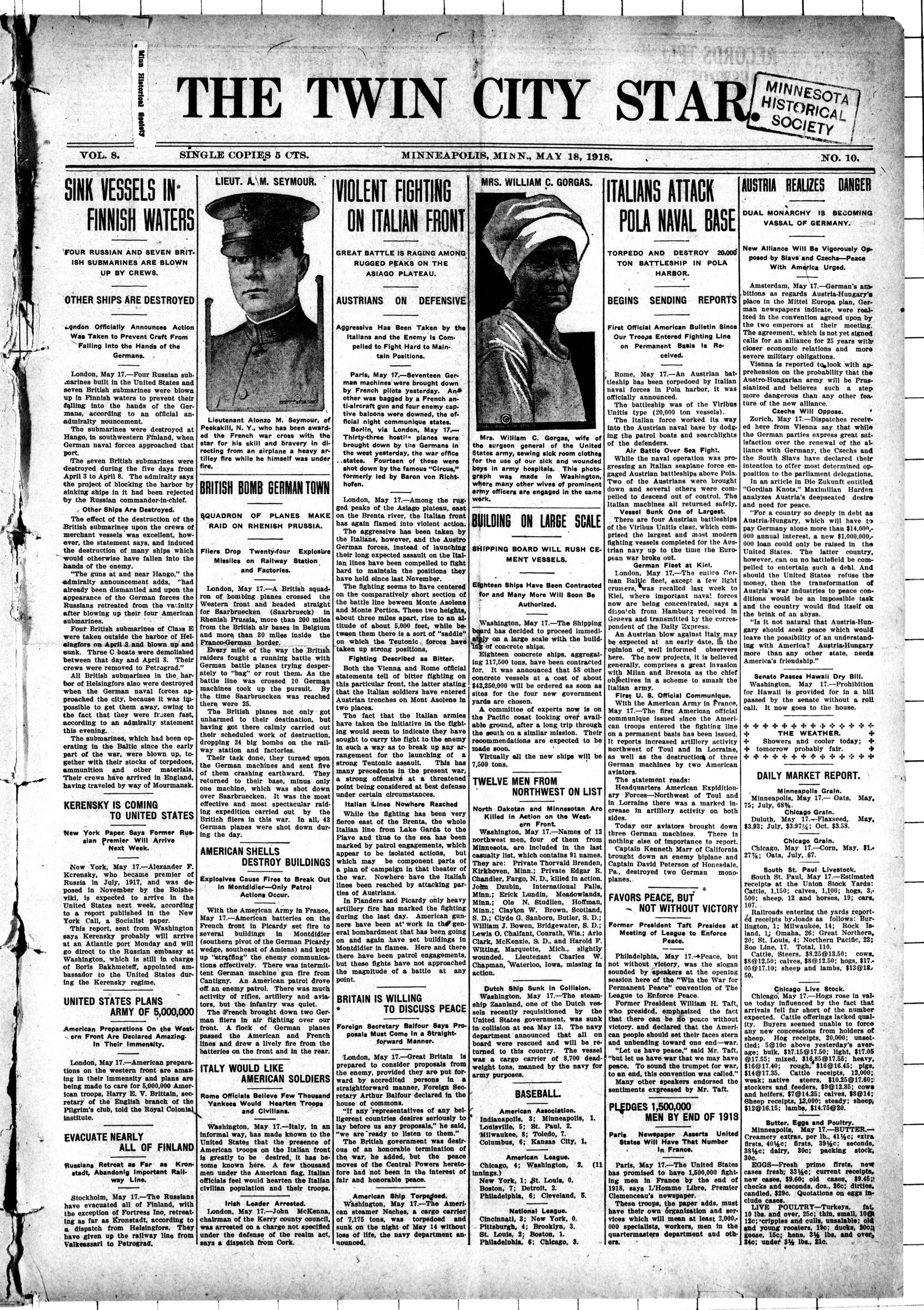
THE TWIN CITY STAR MINNESOTA HISTORICAL SOCIETY
VOL. 8.
SINK VESSELS IN FINNISH WATERS
FOUR RUSSIAN AND SEVEN BRIT
ISH SUBMARINES ARE BLOWN
UP BY CREWS.
OTHER SHIPS ARE DESTROYED
London Officially Announces Action Was Taken to Prevent Craft From Falling Into the Hands of the Germans.
London, May 17.—Four Russian submarines built in the United States and seven British submarines were blown up in Finnish waters to prevent their falling into the hands of the Germans, according to an official and admiralty nouncement.
The submarines were destroyed at Hango, in southwestern Finland, when German naval forces approached that port.
The seven British submarines were destroyed during the five days from April 3 to April 8. The admiralty says the project of blocking the harbor by sinking ships in it had been rejected by the Russian commander-in-chief.
Other Ships Are Destroyed.
The effect of the destruction of the British submarines upon the crews of merchant vessels was excellent, however, the statement says, and induced the destruction of many ships which would otherwise have fallen into the hands of the enemy.
"The guns at and near Hango," the admiralty announcement adds, "had already been dismantled and upon the appearance of the German forces the Russians retreated from the vacinity after blowing up their four American submarines.
Four British submarines of Class E were taken outside the harbor of Helingfors on April 3 and blown up and sunk. Three C boats were demolished between that day and April 8. Their crews were removed to Petrograd."
All British submarines in the harbor of Helsingfors also were destroyed when the German naval forces approached the city, because it was impossible to get them away, owing to the fact that they were frozen fast, according to an admiralty statement this evening.
The submarines, which had been operating in the Baltic since the early part of the war, were blown up, together with their stocks of torpedoes, ammunition and other materials. Their crews have arrived in England, having traveled by way of Mourmansk.
KERENSKY IS COMING TO UNITED STATES
New York Paper Says Former Russian Premier Will Arrive Next Week.
New York, May 17.—Alexander F. Kcrensky, who became premier of Russia in July, 1917, and was deposed in November by the Bolshevik, is expected to arrive in the United States next week, according to a report published in the New York Call, a Socialist paper.
This report, sent from Washington says Kerensky probably will arrive at an Atlantic port Monday and will go direct to the Russian embassy at Washington, which is still in charge of Boris Bakhmeteff, appointed ambassador to the United States during the Kerensky regime.
UNITED STATES PLANS
ARMY OF 5,000,000
American Preparations On the Western Front Are Declared Amazing. In Their Immensity.
London, May 17.—American preparations on the western front are amazing in their immensity and plans are being made to care for 5,000,000 American troops, Harry E. V. Brittain, secretary of the English branch of the Pilgrim's club, told the Royal Colonial institute.
EVACUATE NEARLY ALL OF FINLAND
Russians Retreat as Far as Kronstadt, Abandoning Important Railway Line.
Stockholm, May 17.—The Russians have evacuated all of Finland, with the exception of Fortress Ino, retreating as far as Kronstadt, according to a dispatch from Helsingfors. They have given up the railway line from Valkeassarl to Petrograd.
SINGLE COPIES 5 CTS.
LIEUT. A. \ M. SEYMOUR.
Lieutenant Alonzo M. Seymour, of Peekskill, N. Y., who has been awarded the French war cross with the star for his skill and bravery in directing from an airplane a heavy artillery fire while he himself was under fire.
BRITISH BOMB GERMAN TOWN
SQUADRON OF PLANES MAKE RAID ON RHENISH PRUSSIA.
Fliers Drop Twenty-four Explosive Missiles on Railway Station and Factories.
London, May 17.—A British squadron of bombing planes crossed the Western front and headed straight for Saarbrueck (Saarbrueck) in Rhenish Prussia, more than 200 miles from the British air bases in Belgium and more than 30 miles inside the Franco-German border.
Every mile of the way the British raiders fought a running battle with German battle planes trying desperately to "bag" or rout them. As the battle line was crossed 10 German machines took up the pursuit. By the time Saarbrueck was reached there were 25.
The British planes not only got unharmed to their destination, but having got there calmly carried out their scheduled work of destruction, dropping 24 big bombs on the railway station and factories.
Their task done, they turned upon the German machines and sent five of them crashing earthward. They returned to their base, minus only one machine, which was shot down over Saarbruecken. It was the most effective and most spectacular raiding expedition carried out by the British filers in this war. In all, 43 German planes were shot down during the day.
AMERICAN SHELLS DESTROY BUILDINGS
Explosives Cause Fires to Break Out in Montdidier—Only Patrol Actions Occur.
With the American Army in France, May 17.—American batteries on the French front in Picardy set fire to several buildings in Montdidier (southern pivot of the German Picardy wedge, southeast of Amiens) and kept up "straffing" the enemy communications effectively. There was intermittent German machine gun fire from Cantigny. An American patrol drove off an enemy patrol. There was much activity of rifles, artillery and aviators, but the infantry was quiet.
The French brought down two German fliers in air fighting over our front. A flock of German planes passed the American and French lines and drew a lively fire from the batteries on the front and in the rear.
ITALY WOULD LIKE AMERICAN SOLDIERS
Rome Officials Believe Few Thousand Yankees Would Hearten Troops and Civilians.
Washington, May 17.—Italy, in an informal way, has made known to the United States that the presence of American troops on the Italian front is greatly to be desired, it has become known here. A few thousand men under the American flag, Italian officials feel would hearten the Italian civilian population and their troops.
Irish Leader Arrested.
London, May 17.—John McKenna, chairman of the Kerry county council, was arrested on a charge not specified under the defense of the realm act, says a dispatch from Cork.
MINNEAPOLIS, MINN., MAY 18, 1918.
VIOLENT FIGHTING ON ITALIAN FRONT
GREAT BATTLE IS RAGING AMONG
RUGGED PEAKS ON THE
ASIAGO PLATEAU.
AUSTRIANS ON DEFENSIVE
Aggressive Has Been Taken by the Italians and the Enemy Is Compelled to Fight Hard to Maintain Positions.
Paris, May 17.—Seventeen German machines were brought down by French pilots yesterday. Another was bagged by a French air-aircraft gun and four enemy captive baloons were downed, the official night communique states.
Berlin, via London, May 17.—Thirty-three hostile planes were brought down by the Germans in the west yesterday, the war office...states. Fourteen of these were shot down by the famous "Circus," formerly led by Baron von Richthofen.
London, May 17.—Among the rugged peaks of the Asiago plateau, east on the Brenta river, the Italian front has again flamed into violent action. The aggressive has been taken by the Italians, however, and the Austro German forces, instead of launching their long expected assault on the Italian lines have been compelled to fight hard to maintain the positions they have held since last November.
The fighting seems to have centered on the comparatively short section of the battle line between Monte Asolene and Monte Pertica. These two heights, about three miles apart, rise to an altitude of about 5,000 feet, while between them there is a sort of "saddle" on which the Teutonic forces have taken up strong positions.
Fighting Described as Bitter.
Both the Vienna and Rome official statements tell of bitter fighting on this particular front, the latter stating that the Italian soldiers have entered Austrian trenches on Mont Asolene in two places.
The fact that the Italian armies have taken the initiative in the fighting would seem to indicate they have sought to carry the fight to the enemy in such a way as to break up any arrangement for the launching of a strong Teutonic assault. This has many precedents in the present war, a strong offensive at a threatened point being considered at best defense under certain circumstances.
While the fighting has been very fierce east of the Brenta, the whole Italian line from Lake Garda to the Plave and thus to the sea has been marked by patrol engagements, which appear to be isolated actions, but which may be component parts of a plan of campaign in that theater of the war. Nowhere have the Italian lines been reached by attacking parties of Austrians. In Flanders and Picardy only heavy artillery fire has marked the fighting during the last day. American gunners have been at work in the general bombardment that has been going on and again have set buildings in Montdidier in flames. Here and there there have been patrol engagements, but these fights have not approached the magnitude of a battle at any point.
Foreign Secretary Balfour Says Proposals Must Come in a Straightforward Manner.
London, May 17.—Great Britain is prepared to consider proposals from the enemy, provided they are put forward by accredited persons in a straightforward manner, Foreign Secretary Arthur Balfour declared in the house of commons.
"If any representatives of any belligerent countries desires seriously to lay before us any proposals," he said, "we are ready to listen to them."
The British government was desirous of an honorable termination of the war, he added, but the peace moves of the Central Powers heretofore had not been in the interest of fair and honorable peace.
American Ship Torpedoed.
Washington, May 17.—The American steamer Neches, a cargo carrier of 7,175 tons, was torpedoed and sunk on the night of May 14 without loss of life, the navy department announced.
MRS. WILLIAM C. GORGAS.
C
Mrs. William C. Gorgas, wife of the surgeon general of the United States army, sewing sick room clothes for the use of our sick and wounded boys in army hospitals. This photograph was made in Washington, where many other wives of prominent army officers are engaged in the same work.
SHIPPING BOARD WILL RUSH CE
MENT VESSELS.
Eighteen Ships Have Been Contracted for and Many More Will Soon Be Authorized.
Washington, May 17.—The Shipping board has decided to proceed immediately on a large scale with the building of concrete ships.
Eighteen concrete ships, aggregating 117,500 tons, have been contracted for. It was announced that 58 other concrete vessels at a cost of about $42,250,000 will be ordered as soon as sites for the four new government yards are chosen.
A committee of experts now is on the Pacific coast looking over available ground, after a long trip through the south on a similar mission. Their recommendations are expected to be made soon.
Virtually all the new ships will be 7,500 tons.
TWELVE MEN FROM
NORTHWEST ON LIST
North Dakotan and Minnesota Aro Killed in Action on the Western Front.
Washington, May 17.—Names of 12 northwest men, four of them from Minnesota, are included in the last casualty list, which contains 91 names. They are: Private Thorvald Brenden, Kirkhoven, Minn.; Private Edgar R Chandler, Fargo, N. D., killed in action. John Dzubin, International Falls, Minn.; Erick Lundin, Meadowlands, Minn.; Ole N. Studdlen, Hoffman, Minn.; Clayton W. Brown, Scotland, S. D.; Clyde G. Sanborn, Butler, S. D.; William J. Bowen, Bridgewater, S. D.; Lewis O. Chalfant, Conrath, Wis.; Arlo Clark, McKenzie, S. D., and Harold F. Witting, Marquette, Mich., slightly wounded. Lieutenant Charles W. Chapman, Waterloo, Iowa, missing in action.
Dutch Ship Sunk in Collision.
Washington, May 17.—The steamship Zaanland, one of the Dutch vessels recently requisitioned by the United States government, was sunk in collision at sea May 13. The navy department announced that all on board were rescued and will be returned to this country. The vessel was a cargo carrier of 8,700 deadweight tons, manned by the navy for army purposes.
BASEBALL
American Association.
Indianapolis, 3; Minneapolis, 1.
Louisville, 5; St. Paul, 2.
Milwaukee, 8; Toledo, 7.
Columbus, 6; Kansas City, 1.
New York, 1; St. Louis, 0.
Boston, 7; Detroit, 2.
Philadelphia, 6; Cleveland, 5.
National League.
Cincinnati, 3; New York, 0.
Pittsburgh, 4; Brooklyn, 3.
St. Louis, 2; Boston, 1.
Philadelphia, 6; Chicago, 3.
ITALIANS ATTACK POLA NAVAL BASE
ITALIANS ATTACK POLA NAVAL BASE
TORPEDO AND DESTROY 20,000
TON BATTLESHIP IN POLA
HARBOR.
First Official American Bulletin Since Our Troops Entered Fighting Line on Permanent Basis Is Re-
Rome, May 17.—An Austrian battleship has been torpedoed by Italian naval forces in Pola harbor, it was officially announced.
The battleship was of the Viribus Units type (20,000 ton vessels).
The Italian force worked its way into the Austrian naval base by dodging the patrol boats and searchlights of the defenders.
Air Battle Over Sea Fight.
While the naval operation was progressing an Italian seaplanet force engaged Austrian battleships above Pola.
Two of the Austrians were brought down and several others were compelled to descend out of control. The Italian machines all returned safely.
Vessel Sunk One of Largest.
There are four Austrian battleships of the Viribus Units class, which comprised the largest and most modern fighting vessels completed for the Austrian navy up to the time the European war broke out.
German Fleet at Kiel.
London, May 17.—The entire German Baltic fleet, except a few light cruisers, was recalled last week to Kiel, where important naval forces now are being concentrated, says a dispatch from Hamburg received in Geneva and transmitted by the correspondent of the Daily Express.
An Austrian blow against Italy may be expected at an early date, in the opinion of well informed observers here. The new projects, it is believed generally, comprises a great invasion with Milan and Bresota as the chief objectives in a scheme to smash the Italian army.
First U. S. Official Communique.
With the American Army in France, May 17—The first American official communique issued since the American troops entered the fighting line on a permanent basis has been issued. It reports increased artillery activity northwest of Toul and in Lorraine, as well as the destruction of three German machines by two American aviators.
The statement reads:
Headquarters American Expeditionary Forces—Northwest of Toul and in Lorraine there was a marked increase in artillery activity on both sides.
Today our aviators brought down three German machines. There is nothing else of importance to report.
Captain Kenneth Marr of California brought down an enemy biplane and Captain David Peterson of Honesdale, Pa., destroyed two German monoplanes.
FAVORS PEACE, BUT NOT WITHOUT VICTORY
Former President Taft Presides at Meeting of League to Enforce Peace.
Philadelphia, May 17. → Peace, but not without victory, was the slogan sounded by speakers at the opening session here of the "Win the War for Permanent Peace" convention of The League to Enforce Peace.
Former President William H. Taft, who presided, emphasized the fact that there can be no peace without victory, and declared that the American people should set their faces stern and unbending toward one end—war. "Let us have peace," said Mr. Taft, "but let us have war that we may have peace. To sound the trumpet for war, to an end, this convention was called." Many other speakers endorsed the
Many other speakers endorsed the sentiments expressed by Mr. Taft.
PLEDGES 1,500,000
MEN BY END OF 1919
Paris Newspaper Asserts United States Will Have That Number In France.
Paris, May 17.—The United States has promised to have 1,500,000 fighting men in France by the end of 1918, says L'Homme Libre, Premier Clemenceau's newspaper.
These troops, the paper adds, must have their own organization and services which will mean at least 2,000,000 specialists, workers, men in the quartermasters department and others.
NO. 10.
AUSTRIA REALIZES DANGER
DUAL MONARCHY IS BECOMING VASSAL OF GERMANY.
New Alliance Will Be Vigorously Opposed by Slavs and Czechs—Peace With America Urged.
Amsterdam, May 17.—German's ambitions as regards Austria-Hungary's place in the Mittel Europa plan, German newspapers indicate, were realized in the convention agreed upon by the two emperors at their meeting. The agreement, which is not yet signed calls for an alliance for 25 years with closer economic relations and more severe military obligations.
Vienna is reported to look with apprehension on the probability that the Austro-Hungarian army will be Prussianized and believes such a step more dangerous than any other feature of the new alliance.
Czechs Will Oppose.
Zurich, May 17.—Dispatches received here from Vienna say that while the German parties express great satisfaction over the renewal of the alliance with Germany, the Czechs and the South Slavs have declared their intention to offer most determined opposition to the parliament delegations.
In an article in Die Zukunft entitled "Gordian Knots," Maximilian Harden analyzes Austria's deepseated desire and need for peace.
"For a country so deeply in debt as Austria-Hungary, which will have to pay Germany alone more than $14,000,000 annual interest, a new $1,000,000 loan could only be raised in the United States. The latter country, however, can on no battlefield be compelled to entertain such a deal. And should the United States refuse the money, then the transformation of Austria's war industries to peace conditions would be an impossible task and the country would find itself on the brink of an abyss.
"Is it not natural that Austria-Hungary should seek peace which would leave the possibility of an understanding with America? Austria-Hungary more than any other state, needs America's friendship."
Senate Passes Hawaii Dry Bill. Washington, May 17.—Prohibition for Hawaii is provided for in a bill passed by the senate without a roll call. It now goes to the house.
THE WEATHER.
Showers and cooler today;
tomorrow probably fair.
DAILY MARKET REPORT.
Minneapolis Grain.
Minneapolis, May 17.— Oats, May.
75; July, 68%.
Chicago Grain.
Duluth, May 17.— Flaxseed, May.
$3.93; July, $3.97%; Oct. $3.58.
Chicago Grain.
Chicago, May 17.— Corn, May, $1.
27%; Oats, July, 67.
South St. Paul Livestock.
South St. Paul, May 17.— Estimated receipts at the Union Stock Yards:
Cattle, 1,150; calves, 1,100; hogs, 3.
500; sheep, 12 and horses, 19; cars,
107.
Railroads entering the yards reported
receipts by loads as follows: Burlington, 1; Milwaukee, 14; Rock Island, 1; Omaha, 26; Great Northern, 20; St. Louis, 4; Northern Pacific, 22;
Soo Line, 17. Total, 110.
Cattle, Steers, $8.25@13.50; cows,
$8@12.50; calves, $8@12.50; hogs, $17.
05@17.10; sheep and lambs, $13@18.50.
Chicago Live Stock.
Chicago, May 17.—Hogs rose in value today influenced by the fact that arrivals fell far short of the number expected. Cattle offerings lacked quality. Buyers seemed unable to force any new concessions from holders of sheep. Hog receipts, 20,000; unsettled; 5@106 above yesterday's average; bulk, $17.15@17.50; light, $17.05@17.55; mixed, $16.85@17.55; heavy, $16@17.40; rough, $16@16.45; pigs, $14@17.35. Cattle receipts, 12,000; weak; native steers, $10.25@17.60; stockers and feeders, $9@12.85; cows and heifers, $7@17.45; calves, $8@14; Sheep receipts, 12,000; steady; sheep, $12@16.15; lambs, $14.75@20.
Butter, Eggs and Poultry.
Minneapolis, May 17.—BUTTER.—Creamy extras, per lb, 41½ c; extra firsts, 40½ c; firsts, 39½ c; seconds, 33½ c; dairy, 30 c; packing stock, 30 c.
EGGS—Fresh prime firsts, new cases fresh; 33½ c; current receipts, new cases, $9.60; old cases, $9.45; checks and seconds, doz, 26 c; dirties, candled, $29 c. Quotations on eggs include cases.
LIVE POULTRY—Turkeys, fat, 10 lbs. and over, 25 c; thin, small, 10¾ 12 c; cripples and culls, unsalable; old and young roosters, 19 c; ducks, 20 c; geese, 15 c; hens, 3½ lbs. and over, 24 c; under 3½ lbs., 21 c.
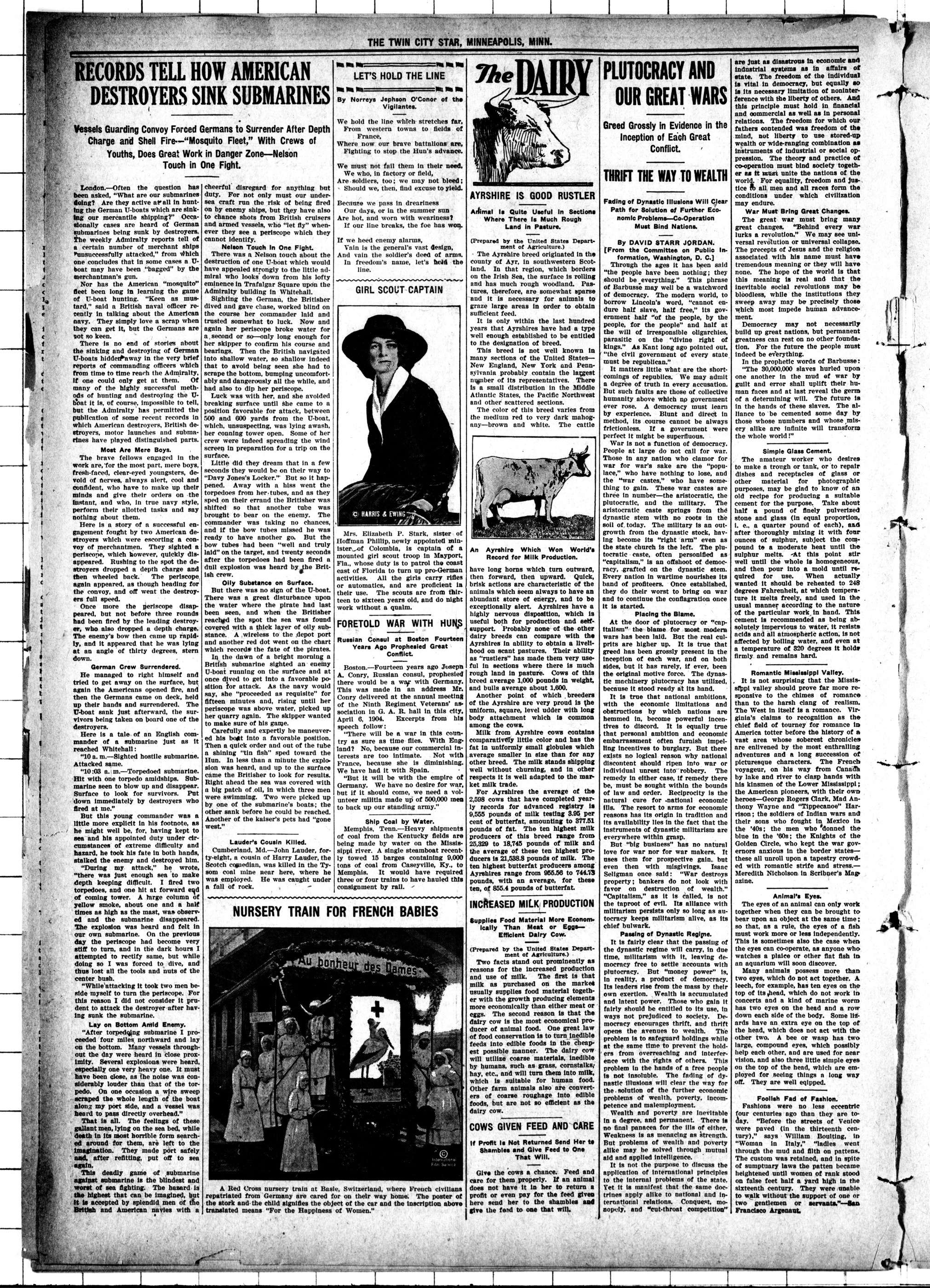
RECORDS TELL HOW AMERICAN DESTROYERS SINK SUBMARINES
Vessels Guarding Convoy Forced Germans to Surrender After Depth Charge and Shell Fire—"Mosquito Fleet," With Crews of Youths, Does Great Work in Danger Zone—Nelson Touch in One Fight.
London.—Often the question has been asked, "What are our submarines doing? Are they active at all in hunting the German U-boats which are sinking our mercantile shipping?" Occasionally cases are heard of German submarines being sunk by destroyers. The weekly Admiralty reports tell of a certain number of merchant ships "unsuccessfully attacked," from which one concludes that in some cases a U-boat may have been "bagged" by the merchantman's gun.
cheerful disregard for anything but duty. For not only must our undersea craft run the risk of being fired on by enemy ships, but they have also to chance shots from British cruisers and armed vessels, who "let fly" whenever they see a periscope which they cannot identify.
Nelson Touch in One Fight.
There was a Nelson touch about the destruction of one U-boat which would have appealed strongly to the little admiral who looks down from his lofty
Nor has the American "mosquito" fleet been long in learning the game of U-boat hunting. "Keen as mustard," said a British naval officer recently in talking about the American navy. They simply love a scrap when they can get it, but the Germans are not so keen.
There is no end of stories about the sinking and destroying of German U-boats hidden away in the very brief reports of commanding officers which from time to time reach the Admiralty, if one could only get at them. Of many of the highly successful methods of hunting and destroying the U-boat it is, of course, impossible to tell, but the Admiralty has permitted the publication of some recent records in which American destroyers, British destroyers, motor launches and submarines have played distinguished parts.
Most Are Mere Boys.
The brave fellows engaged in the work are, for the most part, mere boys, fresh-faced, clear-eyed youngsters, devoid of nerves, always alert, cool and confident, who have to make up their minds and give their orders on the instant, and who, in true navy style, perform their allotted tasks and say nothing about them.
Here is a story of a successful engagement fought by two American destroyers which were escorting a convoy of merchantmen. They sighted a periscope, which however, quickly disappeared. Rushing to the spot the destroyers dropped a depth charge and then wheeled back. The periscope again appeared, as though heading for the convoy, and off went the destroyers full speed.
Once more the periscope disappeared, but not before three rounds had been fired by the leading destroyer, who also dropped a depth charge. The enemy's bow then came up rapidly, and it appeared that he was lying at an angle of thirty degrees, stern down.
German Crew Surrendered.
He managed to right himself and tried to get away on the surface, but again the Americans opened fire, and then the Germans came on deck, held up their hands and surrendered. The U-boat sank just afterward, the survivors being taken on board one of the destroyers.
Here is a tale of an English commander of a submarine just as it reached Whitehall:
"10 a. m.—Sighted hostile submarine. Attacked same.
"10:03 a. m.—Torpedeoed submarine. Hit with one torpedo amidships. Submarine seen to blow up and disappear. Surface to look for survivors. Put down immediately by destroyers who fired at me."
But this young commander was a little more explicit in his footnote, as he might well be, for, having kept to sea and his appointed duty under circumstances of extreme difficulty and hazard, he took his fate in both hands, stalked the enemy and destroyed him. "During my attack," he wrote, "there was just enough sea to make depth keeping difficult. I fired two torpedoes, and one hit at forward end of coming tower. A large column of yellow smoke, about one and a half times as high as the mast, was observed and the submarine disappeared. The explosion was heard and felt in our own submarine. On the previous day the periscope had become very stiff to turn, and in the dark hours I attempted to rectify same, but while doing so I was forced to dive, and thus lost all the tools and nuts of the center bush.
"While attacking it took two men beside myself to turn the periscope. For this reason I did not consider it prudent to attack the destroyer after having sunk the submarine.
Lay on Bottom Amid Enemy.
"After torpeding submarine I proceeded four miles northward and lay on the bottom. Many vessels throughout the day were heard in close proximity. Several explosions were heard, especially one very heavy one. It must have been close, as the noise was considerably louder than that of the torpedo. On one occasion a wire sweep scraped the whole length of the boat along my port side, and a vessel was heard to pass directly overhead." That is all. The feelings of these gallant men, lying on the sea bed, while death in its most horrible form searched around for them, are left to the imagination. They made port safely and, after refitting, put off to sea again.
This deadly game of submarine against submarine is the blindest and worst of sea fighting. The hazard is the highest that can be imagined, but it is accepted by splendid men of the British and American navies with a
NURSERY TRAIN FOR FRENCH BABIES
Au bonheur des Dames
International
Film Service
A Red Cross nursery train at Basle, Switzerland, where French civilians repatriated from Germany are cared for on their way home. The poster of the stork and the child signifies the object of the car and the inscription above translated means "For the Happiness of Women."
cheerful disregard for anything but duty. For not only must our undersea craft run the risk of being fired on by enemy ships, but they have also to chance shots from British cruisers and armed vessels, who "let fly" whenever they see a periscope which they cannot identify.
Nelson Touch In One Eight.
There was a Nelson touch about the destruction of one U-boat which would have appealed strongly to the little admiral who looks down from his lofty eminence in Trafalgar Square upon the Admiralty building in Whitehall.
Sighting the German, the Britisher dived and gave chase, worked blind on the course her commander laid and trusted somewhat to luck. Now and again her periscope broke water for a second or so—only long enough for her skipper to confirm his course and bearings. Then the British navigated into shallow water, so shallow indeed that to avoid being seen she had to scrape the bottom, bumping uncomfortably and dangerously all the while, and had also to dip her periscope.
Luck was with her, and she avoided breaking surface until she came to a position favorable for attack, between 500 and 600 yards from the U-boat, which, unsuspecting, was lying awash, her cunning tower open. Some of her crew were indeed spreading the wind screen in preparation for a trip on the surface.
Little did they dream that in a few seconds they would be on their way to "Davy Jones's Locker." But so it happened. Away with a hiss went the torpedoes from her-tubes, and as they sped on their errand the Britsher was shifted so that another tube was brought to bear on the enemy. The commander was taking no chances, and if the bow tubes missed he was ready to have another go. But the bow tubes had been "well and truly laid" on the target, and twenty seconds after the torpedoes had been fired a dull explosion was heard by the British crew.
Oily Substance on Surface.
But there was no sign of the U-boat. There was a great disturbance upon the water where the pirate had last been seen, and when the Britisher reached the spot the sea was found covered with a thick layer of oily substance. A wireless to the depot port and another red dot went on the chart which records the fate of the pirates. In the dawn of a bright morning a British submarine sighted an enemy U-boat running on the surface and at once dived to get into a favorable position for attack. As the navy would say, she "proceeded as requisite" for fifteen minutes and, rising until her periscope was above water, picked up her quarry again. The skipper wanted to make sure of his game.
Carefully and expertly he maneuvered his boat into a favorable position. Then a quick order and out of the tube a shining "tin fish" sped toward the Hun. In less than a minute the explosion was heard, and up to the surface came the Britisher to look for results. Right ahead the sea was covered with a big patch of oil, in which three men were swimming. Two were picked up by one of the submarine's boats; the other sank before he could be reached. Another of the kaiser's pets had "gone west."
Lauder's Cousin Killed.
Cumberland, Md.—John Lauder, forty-eight, a cousin of Harry Lauder, the Scotch comedian, was killed in the Tysom coal mine near here, where he was employed. He was caught under a fall of rock.
THE TWIN CITY STAR, MINNEAPOLIS, MINN.
By Norreys Jephson O'Conor of the Vigilantes.
We hold the line which stretches far,
From western towns to fields of
France,
Where now our brave battalions are,
Fighting to stop the Hun's advance.
We must not fall them in their need.
We who, in factory or field,
Are soldiers, too; we may not bleed;
Should we, then, find excuse to yield.
Vain is the general's vast design,
And vain the soldier's deed of arms.
In freedom's name, let's hold the
line.
GIRL SCOUT CAPTAIN
© HARRIS & EWING
Mrs. Elizabeth P. Stark, sister of Hoffman Phillip, newly appointed minister_of Colombia, is captain of a mounted girl scout troop in Mayport, Fla., whose duty is to patrol the coast east of Florida to turn up pro-German activities. All the girls carry rifles or automatics, and are proficient in their use. The scouts are from thirteen to sixteen years old, and do night work without a qualm.
FORETOLD WAR WITH HUNS
Russian Consul at Boston Fourteen Years Ago Prophesied Great Conflict.
Boston.—Fourteen years ago Joseph A. Conry, Russian consul, prophesied there would be a war with Germany. This was made in an address Mr. Conry delivered at the annual meeting of the Ninth Regiment Veterans' association in G. A. R. hall in this city, April 6, 1904. Excerpts from his speech follow:
"There will be a war in this country as sure as time flies. With England? No, because our commercial interests are too intimate. Not with France, because she is diminishing. We have had it with Spain.
"But it will be with the empire of Germany. We have no desire for war, but if it should come, we need a volunteer militia made up of 500,000 men to back up our standing army."
Ship Coal by Water.
Memphis, Tenn.-Heavy shipments of coal from the Kentucky fields are being made by water on the Mississippi river. A single steamboat recently towed 15 barges containing 9,000 tons of coal from Caseville, Ky., to Memphis. It would have required three or four trains to have hauled this consignment by rail.
The DAIRY
Animal Is Quite Useful in Sections Where There Is Much Rough Land in Pasture.
(Prepared by the United States Department of Agriculture.)
The Ayrshire breed originated in the county of Ayr, in southwestern Scotland. In that region, which borders on the Irish Sea, the surface is rolling and has much rough woodland. Pastures, therefore, are somewhat sparse and it is necessary for animals to graze large areas in order to obtain sufficient feed.
It is only within the last hundred years that Ayrshires have had a type well enough established to be entitled to the designation of breed.
This breed is not well known in many sections of the United States—New England, New York and Pennsylvania probably contain the largest number of its representatives. There is a small distribution in the Middle Atlantic States, the Pacific Northwest and other scattered sections. The color of this breed varies from the medium red to very dark mahogany—brown and white. The cattle
An Ayrshire Which Won World's Record for Milk Production.
have long horns which turn outward, then forward, then upward. Quick, brisk actions are characteristic of the animals which seem always to have an abundant store of energy, and to be exceptionally alert. Ayrshires have a highly nervous disposition, which is useful both for production and self-support. Probably none of the other dairy breeds can compare with the Ayrshires in ability to obtain a livelihood on scant pastures. Their ability as "rustlers" has made them very useful in sections where there is much rough land in pasture. Cows of this breed average 1,000 pounds in weight, and bulls average about 1,600. Another point of which breeders of the Ayrshire are very proud is the uniform, square, level udder with long body attachment which is common among the cows.
Milk from Ayrshire cows contains comparatively little color and has the fat in uniformly small globules which average smaller in size than for any other breed. The milk stands shipping well without churning, and in other respects it is well adapted to the market milk trade.
For Ayrshires the average of the 2,598 cows that have completed yearly records for advanced registry is 9,555 pounds of milk testing 3.95 per cent of butterfat, amounting to 377.51 pounds of fat. The ten highest milk producers of this breed range from 25,329 to 18,745 pounds of milk and the average of these ten highest producers is 21,538.8 pounds of milk. The ten highest butterfat producers among Ayrshire range from 955.56 to 744.73 pounds, with an average, for these ten, of 855.4 pounds of butterfat.
INCREASED MILK PRODUCTION
Supplies Food Material More Economically Than Meat or Eggs— Efficient Dairy Cow. (Prepared by the United States Department of Agriculture.)
Two facts stand out prominently as reasons for the increased production and use of milk. The first is that milk as purchased on the market usually supplies food material together with the growth producing elements more economically than either meat or eggs. The second reason is that the dairy cow is the most economical producer of animal food. One great law of food conservation is to turn inedible feeds into edible foods in the cheapest possible manner. The dairy cow will utilize coarse materials, inedible by humans, such as grass, cornstalks, hay, etc., and will turn them into milk, which is suitable for human food. Other farm animals also are converters of coarse roughage into edible foods, but are not so efficient as the dairy cow.
COWS GIVEN FEED AND CARE
If Profit Is Not Returned Send Her to Shambles and Give Feed to One That Will.
Give the cows a chance. Feed and care for them properly. If an animal does not have it in her to return a profit or even pay for the feed given here send her to the shambles and give the feed to one that will.
PLUTOCRACY AND OUR GREAT WARS
Greed Grossly in Evidence in the Inception of Each Great Conflict.
THRIFT THE WAY TO WEALTH
Fading of Dynastic Illusions Will Clear Path for Solution of Further Economic Problems—Co-Operation Must Bind Nations.
By DAVID STARR JORDAN.
[From the Committee on Public In-
formation, Washington, D. C.]
Through the ages it has been said "the people have been nothing; they should be everything." This phrase of Barbusse may well be a watchword of democracy. The modern world, to borrow Lincoln's word, "cannot endure half slave, half free," its government half "of the people, by the people, for the people" and half at the will of irresponsible oligarchies, parasitic on the "divine right of kings." As Kant long ago pointed out, "the civil government of every state must be republican."
It matters little what are the short-comings of republics. We may admit a degree of truth in every accusation. But such faults are those of collective humanity above which no government ever rose. A democracy must learn by experience. Blunt and direct in method, its course cannot be always frictionless. If a government were perfect it might be superfluous.
War is not a function of democracy. People at large do not call for war. Those in any nation who clamor for war for war's sake are the "populace," who have nothing to lose, and the "war castes," who have something to gain. These war castes are three in number—the aristocratic, the plutocratic, and the military. The aristocratic caste springs from the dynastic stem with no roots in the soil of today. The military is an outgrowth from the dynastic stock, having become its "right arm" even as the state church is the left. The plutocratic caste, often personified as "capitalism," is an offshoot of democracy, grafted on the dynastic stem. Every nation in wartime nourishes its band of profiteers. Once established, they do their worst to bring on war and to continue the conflagration once it is started.
Placing the Blame.
At the door of plutocracy or "capitalism" the blame for most modern wars has been laid. But the real culprits are higher up. It is true that greed has been grossly present in the inception of each war, and on both sides, but it has rarely, if ever, been the original motive force. The dynastic machinery plutocracy has utilized, because it stood ready at its hand.
It is true that national ambitions, with the economic limitations and obstructions by which nations are hemmed in, become powerful incentives to discord. It is equally true that personal ambition and economic embarrassment often furnish impelling incentives to burglary. But there exists no logical reason why national discontent should ripen into war or individual unrest into robbery. The remedy in either case, if remedy there be, must be sought within the bounds of law and order. Reciprocity is the natural cure for national economic ills. The resort to arms for economic reasons has its origin in tradition and its availability lies in the fact that the instruments of dynastic militarism are everywhere within grasp.
But "big business" has no natural love for war nor for war makers. It uses them for prospective gain, but even then with misgivings. Isaac Seligman once said: "War destroys property; bankers do not look with favor on destruction of wealth." "Capitalism," as it is called, is not the taproot of evil. Its alliance with militarism persists only so long as autocracy keeps militarism alive, as its chief bulwark.
Passing of Dynastic Regime.
It is fairly clear that the passing of the dynastic regime will carry, in due time, militarism with it, leaving democracy free to settle accounts with plutocracy. But "money power" is, in reality, a product of democracy. Its leaders rise from the mass by their own exertion. Wealth is accumulated and latent power. Those who gain it fairly should be entitled to its use, in ways not prejudiced to society. Democracy encourages thrift, and thrift opens the avenues to wealth. The problem is to safeguard holdings while at the same time to prevent the holders from overreaching and interference with the rights of others. This problem in the hands of a free people is not insoluble. The fading of dynastic illusions will clear the way for the solution of the further economic problems of wealth, poverty, incompetence and maleemployment.
Wealth and poverty are inevitable in a degree, and permanent. There is no final panacea for the ills of either. Weakness is as menacing as strength. But problems of wealth and poverty alike may be solved through mutual aid and applied intelligence. It is not the purpose to discuss the application of international principles to the internal problems of the state. Yet it is manifest that the same doctrines apply alike to national and international relations. Conquest, monoply, and "cut-throat competition"
are just as disastrous in economic and industrial systems as in affairs of state. The freedom of the individual is vital in democracy, but equally so is its necessary limitation of noninterference with the liberty of others. And this principle must hold in financial and commercial as well as in personal relations. The freedom for which our fathers contended was freedom of the mind, not liberty to use stored-up wealth or wide-ranging combination as instruments of industrial or social oppression. The theory and practice of co-operation must bind society together as it must unite the nations of the world. For equality, freedom and justice to all men and all races form the conditions under which civilization may endure.
War Must Bring Great Changes.
War Must Bring Great Changes.
The great war must bring many great changes. "Behind every war lurks a revolution." We may see universal revolution or universal collapse. The precepts of Jesus and the religion associated with his name must have tremendous meaning or they will have none. The hope of the world is that this meaning is real and that the inevitable social revolutions may be bloodless, while the institutions they sweep away may be precisely those which most impede human advancement.
Democracy may not necessarily build up great nations, but permanent greatness can rest on no other foundation. For the future the people must indeed be everything.
In the prophetic words of Barbusse: "The 30,000,000 slaves hurled upon one another in the mud of war by guilt and error shall uplift their human faces and at last reveal the germ of a determining will. The future is in the hands of these slaves. The alliance to be cemented some day by those whose numbers and whose misery alike are infinite will transform the whole world!"
Simple Glass Cement
The amateur worker who desires to make a trough or tank, or to repair dishes and receptacles of glass or other material for photographic purposes, may be glad to know of an old recipe for producing a suitable cement for the purpose. Take about half a pound of finely pulverized stone and glass (in equal proportion, i.e., a quarter pound of each), and after thoroughly mixing it with four ounces of sulphur, subject the compound to a moderate heat until the sulphur melts. At this point stir well until the whole is homogeneous, and then pour into a mold until required for use. When actually wanted it should be reheated to 248 degrees Fahrenheit, at which temperature it melts freely, and used in the usual manner according to the nature of the particular work in hand. This cement is recommended as being absolutely impervious to water, it resists acids and all atmospheric action, is not affected by boiling water, and even at a temperature of 320 degrees it holds firmly and remains hard.
Romantic Mississippi Valley.
It is not surprising that the Mississippi valley should prove far more responsive to the chimes of romance than to the harsh clang of realism. The West in itself is a romance. Virginia's claims to recognition as the chief field of tourney for romance in America totter before the history of a vast area whose soberest chronicles are enlivened by the most enthralling adventures and a long succession of picturesque characters. The French voyageur, on his way from Canada by lake and river to clasp hands with his kinsmen of the Lower Mississippi; the American pioneers, with their own heroes—George Rogers Clark, Mad Anthony Wayne and "Tippecanoo" Harrison; the soldiers of Indian wars and their sons who fought in Mexico in the '40s; the men who donned the blue in the '60s; the Knights of the Golden Circle, who kept the war governors anxious in the border states—these all unroll upon a tapestry crowded with romantic strife and stress.—Meredith Nicholson in Scribner's Magazine.
Animal's Eyes.
The eyes of an animal can only work together when they can be brought to bear upon an object at the same time; so that, as a rule, the eyes of a fish must work more or less independently. This is sometimes also the case when the eyes can co-operate, as anyone who watches a plaice or other flat fish in an aquarium will soon discover.
Many animals possess more than two eyes, which do not act together. A leech, for example, has ten eyes on the top of its head, which do not work in concerts and a kind of marine worm has two eyes on the head and a row down each side of the body. Some lizards have an extra eye on the top of the head, which does not act with the other two. A bee or wasp has two large, compound eyes, which possibly help each other, and are used for near vision, and also three little simple eyes on the top of the head, which are employed for seeing things a long way off. They are well equipped.
Foolish Fad of Fashion.
Fashions were no less eccentric four centuries ago than they are today. "Before the streets of Venice were paved (in the thirteenth century)," says William Boulting, in "Woman in Italy," "ladies went through the mud and flinth on pattens. The custom was retained, and in spite of sumptuary laws the patten became heightened until women of rank stood on false feet half a yard high in the sixteenth century. They were unable to walk without the support of one or two gentlemen or servants."—San Francisco Argonaut.
Margeret
By SUSAN CLAGETT
Copyright, 1918, by the McClure Newspaper Syndicate.
The air was filled with the perfume of roses and the morning breeze blew the light curtains to and fro and wafed the delicious fragrance through the open window. A little child was seated upon the floor burying a white kitten under the red rose petals she had pulled from stems scattered about. Near her lay a doll very much undressed. Beside it a little pile of dalty clothing ready for use when her mistress remembered what was due to respectability.
Watching the group with listless eyes was a woman, stretched with an invalid's inertness upon a couch. Listening to the child's low talk, she caught the sound of a quick step upon the veranda and a faint gleam of color rose to her face to disappear before a man stepped through the long window into the room; a man alert in movement whose keen eyes softened to a marvelous gentleness as he looked toward her.
With an almost imperceptible motion the girl pressed more deeply into the pillows supporting her. The slight movement was not lost upon the man, who laid his hand upon the child's head, laughing as he turned her face to meet his gaze.
"What a careless, careless mother, Ruth, to leave your child in this condition. She will take cold."
"I'm awfully anxious, Doctor Max, and I'm glad you have come," she answered, gravely. "I'm afraid Columbia has hurt herself and will have to have an op'ration."
With gravity equaling her own, the physician took the doll and worked at stiff and broken joints until legs and arms moved easily. He was glad of the respite, for the slight withdrawing of the woman upon the couch had hurt him to the quick. Not until the doll was in perfect order did he turn and take the slender hand in his strong, warm clasp. With professional quickness he noted the irregular pulse and heavy eyes.
"You did not sleep last night," he said gently.
"No," she answered, quietly meeting his eyes.
With a sigh he left her side and stood for long looking with unseeing eyes into the old-fashioned garden; searching, as he daily searched, his mind for some means of combating the will of the woman he desired above all things to make his wife, and as always he turned toward her feeling the utter futility of any effort he might make.
"You gain no strength," he said at last, the misery in his heart told in the sudden strain of his voice. For the moment the usually self-contained physician was not himself. And words he felt should not be spoken at the present time were forced from his lips by his intolerable anxiety.
"If I thought my leaving you, Margeret, would be your gain, I would go within the hour. But you need me. You need my strength, my understanding. This, that you allow to stand between us is a false conception of your physical condition. You have thought about yourself until you have become obsessed by the idea that you are a helpless invalid."
"Will I ever be strong, Max?"
"Strength would come with happiness. It is happiness you are fighting with all that is in you under the mistaken impression that you would make of my life a failure by coming to me, whereas I need you more than I can say. I need peace of mind. That I cannot have when I see you putting from you the love God has implanted in your heart; that you have told me you feel for me.
"The battle is going against you, dear. Each day I see it. It is the constant effort to keep the barrier between us that tells so upon you. I know this as your physician. I know it because of my love for you. Why are you so unwilling to allow me to be the judge of what is best for me? That is what you are doing. Deciding for me, Dear, no man who is a man is going to accept without protest such a decision. If you care nothing for me there is nothing more to be said. I am man enough, I hope, to take my medicine without whimpering. But you have told me that you do care; that you will not give yourself to me because you will be a drag upon my life."
There was a moment of silence, then she put her slender fingers about his and rested her cheek against his hand. "Max, would that be at peace if I did as you wish?" she asked gently as she placed his hand over her laboring heart. "Would happiness continue where there would be constant regret? You say I am obsessed by the fear I would spoil your life. I am. What help could I be to a man climbing, as you are climbing each day higher in your profession? I would be proud of you, yet I could do nothing but sit and wait and listen. And when you were not with me there would always be regret. Try as I would, I could not hide it. Your love would find it out and you would be as miserable as I."
"You talk nonsense," he returned roughly. "I am thinking of you as well as myself. It is your life as well as mine I am begging for. Hearts can be starved as well as bodies, only some take longer to die than others.
I am a strong man, Margeret, while you—"
He gripped the frame of the window until the veins stood out in great cords upon his hand. He had forced himself to speak quietly and his voice gave no hint of the agony of fear that possessed him.
"Are you going to let your will stand between us, spoil our lives? Happiness will lengthen yours. And mine?" He drew a deep breath. "We will not talk of mine, dear. For your own sake I implore you to listen to me."
"Auntie, what does Doctor Max want you to do?" The forgotten child slipped between them and threw an arm across the frail figure.
"He wishes me to go away with him, dear."
"Will you?" Ruth questioned in sudden fear.
The weary eyes looked steadily into the dominant ones above her and were held by the pain and misery she saw in their depths. Her own were dark with suffering as she turned away with a sligh.
"No, sweatheart."
With a laugh of relief the child resumed her play and the man left the room.
Some hours later as the last rays of the setting sun glinted across the flower-scented room, Ruth danced into it holding her doll closely saying over and over one word until the rythm reached the dulled consciousness of the woman lying on the couch and aroused her.
"What is it you say, dear?"
"Such a funny word that mammy told me about," the child answered, "Skidded. I want to know what it means, because she says Doctor Max did it down the hill. She didn't tell me where."
Suddenly erect Margeret stared at the child. "Tell Mammy Rose to come here, Ruth, and we will find out what she meant."
"Ts right' hyar, Miss Mar'gret. I jus' dun foller dat chil' case I feared she'd say somefin' she shouldn't. Now don' yo' git skeeper, honey, fo' thar ann' nothin' to git skeeper about."
"What are you talking about, Mammy? What has happened to Doctor Max? Tell me at once."
"Jus' nuffin but what dat no count nigger, Jake, tol'me. He say de doctor skidded, ef yo' know what dat mean, an' dun brought up at de horsepiddle. Lan's sake! Whar yo' goin', Miss Margaret, hab yo' done gone clare crazy?"
For Margeret had left the couch and was making her way slowly; stumblingly toward the veranda through the open window.
Followed by her old nurse and the wondering child, with one intent, to reach the hospital around the corner from her home, she went falteringly on, catching now and then to mamy's shoulder, again straightening herself and walking alone while the old colored woman muttered imprecations upon her son, Jake, whose story had brought about this unheard-of thing.
But the strength, keyed for the moment to unusual exertion could last but a little time. Conscious that it was fast leaving her, Margeret prayed for it to last until she reached the building; prayed that she would be in time to tell him that she was awake at last. Nothing mattered but that he should know what life would mean to her without him, and she hurried, hurried until at length she sank exhausted upon the steps leading up to St. Luke's.
There were people about who stared at her. Mammy Rose with hands upon her bulging hips glared at them as she sheltered the girl with her huge figure. Then an inspiration came to her and her manner changed to ingratiating blandness.
"Ef one ob yo'alls 'll go up that an' ask fo' de doctor I suttnily'd be much erblegged."
"Any one in particular?" some one asked.
"Suttnily not," she replied, with dignity. "Jug' some doctor'll do."
She waited long, long enough for the passshery, their curiosity unsatisfied, to go their different ways. Hearing steps behind her she turned and for the second time within the hour gasped out her amazement at the unexpected.
"Fo' Gawds sake! Wot yo' doin' runnin' down dese hyar stairs! Miss Mar'gret an' me'me'toy' yo' was daid!"
"Hush Mammy," Doctor Max said imperatively. "Hush." Stooping, he gathered the girl into his arms. Then Margeret spoke.
"I am only tired. Just tired. Is it really you, Max? I was afraid I would never reach you and I wanted so to tell you that I give up. I thought I was right, dear, but nothing matters now but just you," and before the scandalized gaze of Mam my Rose the girl slipped her arms about the big doctor's neck, "just as ef she had'n bin brung up 'spectable," the old woman moaned.
Why He Took Out Insurance.
A life insurance man wrote a large policy on a well-to-do business man not long ago, and when he delivered the policy asked:
"Do you mind telling me why you, a wealthy man, have taken out this life insurance?"
"Men die at the wrong time!" he said.
If men could only die at the right time, when their work is finished, when their finances are in good shape, when their going will create the least possible disturbance to their families and their business, insurance would be of less use than it, says Everyweek. But every man who is worth while always has an iron in the fire somewhere.
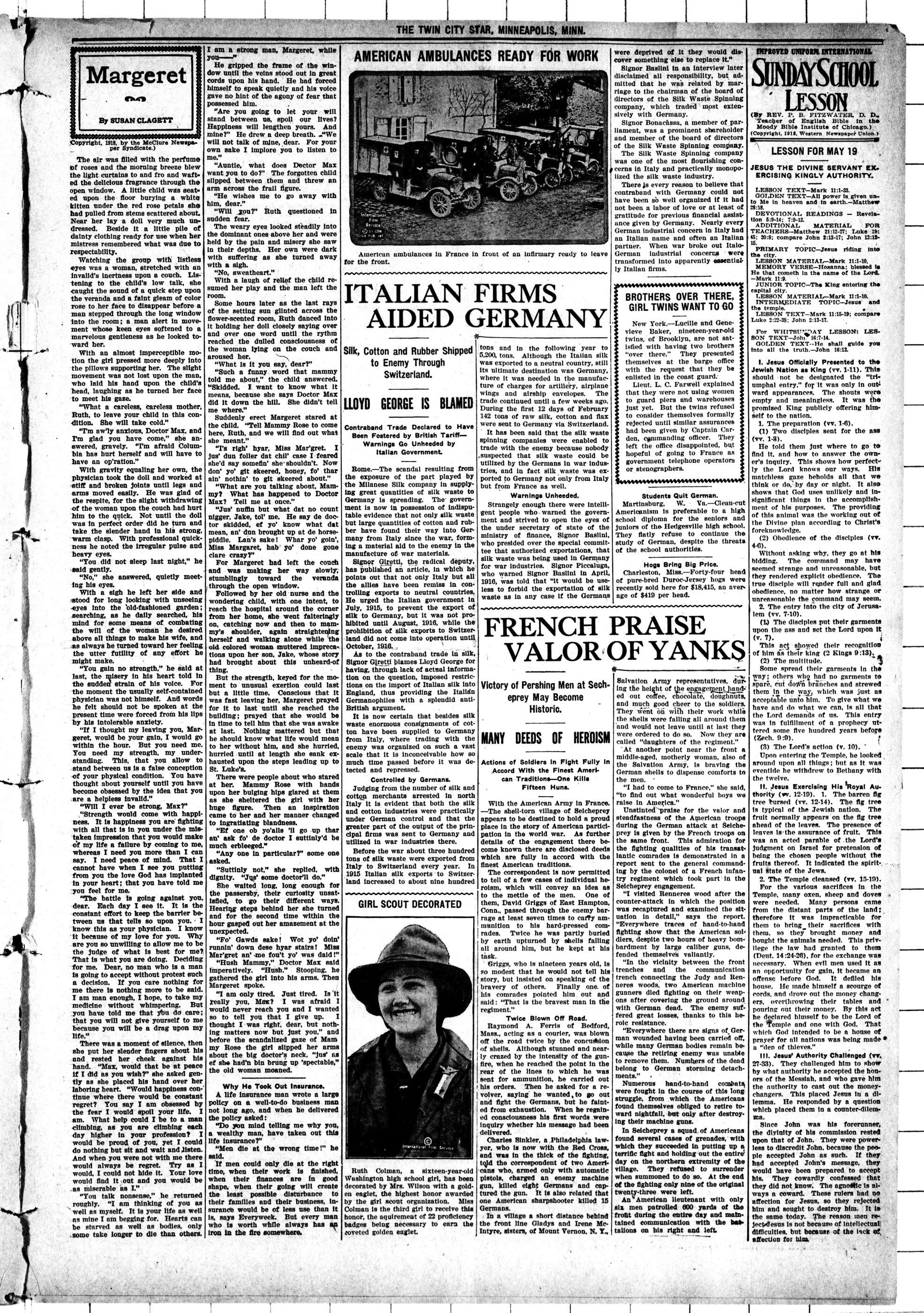
AMERICAN AMBULANCES READY FOR WORK
INTERNATIONAL
Film
BROADCAST
BY COM
ON PUB 187
American ambulances in France in front of an infirmary ready to leave for the front.
American ambulances in France in front of an infirmary ready to leave for the front.
ITALIAN FIRMS AIDED GERMANY
LLOYD GEORGE IS BLAMED
Contraband Trade Declared to Have Been Fostered by British Tariff—Warnings Go Unheeded by Italian Government.
Rome.—The scandal resulting from the exposure of the part played by the Milanese Silk company in supplying great quantities of silk waste to Germany is spreading. The government is now in possession of indisputable evidence that not only silk waste but large quantities of cotton and rubber have found their way into Germany from Italy since the war, forming a material aid to the enemy in the manufacture of war materials.
Signor Giretti, the radical deputy, has published an article, in which he points out that not only Italy but all the allies have been remiss in controlling exports to neutral countries. He urged the Italian government in July, 1915, to prevent the export of silk to Germany, but it was not prohibited until August, 1916, while the prohibition of silk exports to Switzerland did not come into operation until October, 1916.
As to the contraband trade in silk, Signor Giretti blames Lloyd George for having, through lack of actual information on the question, imposed restrictions on the import of Italian silk into England, thus providing the Italian Germanophiles with a splendid anti-British argument.
It is now certain that besides silk waste enormous consignments of cotton have been supplied to Germany from Italy, where trading with the enemy was organized on such a vast scale that it is inconceivable how so much time passed before it was detected and repressed.
Controlled by Germans.
Judging from the number of silk and cotton merchants arrested in north Italy it is evident that both the silk and cotton industries were practically under German control and that the greater part of the output of the principal firms was sent to Germany and utilized in war industries there.
Before the war about three hundred tons of silk waste were exported from Italy to Switzerland every year. In 1915 Italian silk exports to Switzerland increased to about nine hundred
GIRL SCOUT DECORATED
INTERNATIONAL FILM SERVICE
Ruth Colman, a sixteen-year-old Washington high school girl, has been decorated by Mrs. Wilson with a golden eaglet, the highest honor awarded by the girl scout organization. Miss Colman is the third girl to receive this honor, the acquirement of 22 proficiency badges being necessary to earn the coveted golden eaglet.
FRENCH PRAISE VALOR OF YANKS
tons and in the following year to 5,200 tons. Although the Italian silk was exported to a neutral country, still its ultimate destination was Germany, where it was needed in the manufacture of charges for artillery, airplane wings and airship envelopes. The trade continued until a few weeks ago. During the first 12 days of February 142 tons of raw silk, cotton and flax were sent to Germany via Switzerland. It has been said that the silk waste spinning companies were enabled to trade with the enemy because nobody suspected that silk waste could be utilized by the Germans in war industries, and in fact silk waste was exported to Germany not only from Italy but from France as well.
Warnings Unheeded.
Strangely enough there were intelligent people who warned the government and strived to open the eyes of the under secretary of state of the ministry of finance, Signor Basilini, who presided over the special committee that authorized exportations, that silk waste was being used in Germany for war industries. Signor Piccalung, who warned Signor Basilini in April, 1910, was told that "it would be useless to forbid the exportation of silk waste as in any case if the Germans
FRENCH VALOR
Victory of Pershing Men at Sech-
eprey May Become
Historic.
MANY DEEDS OF HEROISM
Actions of Soldiers in Fight Fully in Accord With the Finest American Traditions—One Kills Fifteen Huns.
With the American Army in France,
—The shell-torn village of Selcheprey appears to be destined to hold a proud place in the story of American participation in the world war. As further details of the engagement there become known there are disclosed deeds which are fully in accord with the finest American traditions.
The correspondent is now permitted to tell of a few cases of individual heroism, which will convey an idea as to the mettle of the men. One of them, David Griggs of East Hampton, Conn., passed through the enemy barrage at least seven times to carry ammunition to his hard-pressed comrades. Twice he was partly buried by earth upturned by shells falling all around him, but he kept at his task. Griggs, who is nineteen years old, is so modest that he would not tell his story, but insisted on speaking of the bravery of others. Finally one. of his comrades pointed him out and said: "That is the bravest man in the regiment."
Twice Blown Off Road.
Raymond A. Ferris of Bedford, Mass., acting as a courier, was blown off the road twice by the concussion of shells. Although stunned and nearly crazed by the intensity of the gunfire, when he reached the point in the rear of the lines to which he was sent for ammunition, he carried out his orders. Then he asked for a revolver, saying he wanted to go out and fight the Germans, but he fainted from exhaustion. When he regained consciousness his first words were inquiry whether his message had been delivered.
Charles Sinkler, a Philadelphia lawyer, who is now with the Red Cross, and was in the thick of the fighting, told the correspondent of two Americans who, armed only with automatic pistols, charged an enemy machine gun, killed eight Germans and captured the gun. It is also related that one American sharpshooter killed 15 Germans.
In a village a short distance behind the front line Gladys and Irene McIntyre, sisters, of Mount Vernon, N. Y.
were deprived of it they would discover something else to replace it." Signor Basini in an interview later disclaimed all responsibility, but admitted that he was related by marriage to the chairman of the board of directors of the Silk Waste Spinning company, which traded most extensively with Germany. Signor Bonacassa, a member of parliament, was a prominent shareholder and member of the board of directors of the Silk Waste Spinning company. The Silk Waste Spinning company was one of the most flourishing concerns in Italy and practically monopolized the silk waste industry.
There is every reason to believe that contraband with Germany could not have been so well organized if it had not been a labor of love or at least of gratitude for previous financial assistance given by Germany. Nearly every German industrial concern in Italy had an Italian name and often an Italian partner. When war broke out Italo-German industrial concerns were transformed into apparently essentially Italian firms.
BROTHERS OVER THERE,
GIRL TWINS WANT TO GO
New York.—Lucille and Genevieve Baker, nineteen-year-old twins, of Brooklyn, are not satisfied with having two brothers "over there." They presented themselves at the barge office with the request that they be enlisted in the coast guard.
Lieut. L. C. Farwell explained that they were not using women to guard piers and warehouses just yet. But the twins refused to consider themselves formally rejected until similar assurances had been given by Captain Garden, commanding officer. They left the office disappointed, but hopeful of going to France as government telephone operators or stenographers.
---
Students Quit German.
Martinsburg, W. Va.—Clean-cut Americanism is preferable to a high school diploma for the seniors and juniors of the Hedgesville high school. They flatly refuse to continue the study of German, despite the threats of the school authorities.
Hogs Bring Big Price
Charleston. Miss.—Forty-four head of pure bred Duroc hens hogs were recently sold here for $18,415, an average of $419 per head.
Salvation Army representatives, during the height of the engagement handed out coffee, chocolate, doughnuts, and much good cheer to the soldiers. They went on with their work while the shells were falling all around them and would not leave until at last they were ordered to do so. Now they are called "daughters of the regiment." At another point near the front a middle-aged, motherly woman, also of the Salvation Army, is braving the German shells to dispense comforts to the men.
"I had to come to France," she said, "to find out what wonderful boys we raise in America."
Unstinted praise for the valor and steadfastness of the American troops during the German attack at Selcheprey is given by the French troops on the same front. This admiration for the fighting qualities of his transatlantic comrades is demonstrated in a report sent to the general commanding by the colonel of a French infantry regiment which took part in the Selcheprey engagement.
"I visited Renneres wood after the counter-attack in which the position was recaptured and examined the situation in detail," says the report. "Everywhere traces of hand-to-hand fighting show that the American soldiers, despite two hours of heavy bombardment by large caliber guns, defended themselves vallantly.
"In the vicinity between the front trenches and the communication trench connecting the Judy and Rennes woods, two American machine gunners died fighting on their weapons after covering the ground around with German dead. The enemy suffered great losses, thanks to this heroic resistance.
"Everywhere there are signs of German wounded having been carried off, while many German bodies remain because the retiring enemy was unable to remove them. Numbers of the dead belong to German storming detachments."
Numerous hand-to-hand combats were fought in the course of this long struggle, from which the Americans found themselves obliged to retire toward nightfall, but only after destroying their machine guns.
In Selcheprey a squad of Americans found several cases of grenades, with which they succeeded in putting up a terrific fight and holding out the entire day on the northern extremity of the village. They refused to surrender when summoned to do so. At the end of the fighting only nine of the original twenty-three were left.
An American lieutenant with only six men patrolled 600 yards of the front during the entire day and maintained communication with the bastions on his right and left.
IMPROVED UNIFORM INTERNATIONAL
SUNDAY SCHOOL
LESSON
(By REV. P. B. FITZWATER, D. D.
Teacher of English Bible in the
Moody Bible Institute of Chicago.)
(Copyright, 1918, Western Newspaper Union.)
LESSON FOR MAY 19
JESUS THE DIVINE SERVANT EX-
ERCISING KINGLY AUTHORITY.
LESSON TEXT—Mark 11:1-33.
GOLDEN TEXT—All power is given un-
to Me in heaven and in earth—Matthew
28:18.
DEVOTIONAL READINGS — Revela-
tion 5:9-14; 7:9-12.
ADDITIONAL MATERIAL FOR
TEACHERS—Matthew 21:12-27; Luke 19:
45; 20:8; compare John 2:13-17; John 12:18-
15.
PRIMARY TOPIC—Jesus riding into
the city.
LESSON MATERIAL—Mark 11:1-10.
MEMORY VERSE—Hosanna; blessed
He that cometh in the name of the Lord.
—Mark 11:9.
JUNIOR TOPIC-The King entering the capital city.
LESSON MATERIAL-Mark 11:1-10.
INTERMEDIATE TOPIC-Jesus and
Jesus.
the temple.
LESSON TEXT--Mark 11:15-19; compare
Luke 2:22-38; John 2:13-17.
For WHITESUNDAY LESSON: LESSON TEXT--John 16:7-14.
GOLDEN TEXT--He shall guide you
into all the truth--John 16:13.
1. Jesus Officially Presented to the
Jewish Nation as King (vv. 1-11). This
should not be designated the "tri-
umphal entry," for it was only in out-
ward appearances. The shouts were
empty and meaningless. It was the
promised King publicly offering him-
self to the nation.
1. The preparation (vv. 1-6).
(1) Two disciples sent for the ass
(vv. 1-3).
He told them just where to go to find it, and how to answer the owner's inquiry. This shows how perfectly the Lord knows our ways. His matchless gaze beholds all that we think or do, by day or night. It also shows that God uses unlikely and insignificant things in the accomplishment of his purposes. The providing of this animal was the working out of the Divine plan according to Christ's foreknowledge.
(2) Obedience of the disciples (vv. 4-6).
Without asking why, they go at his bidding. The command may have seemed strange and unreasonable, but they rendered explicit obedience. The true discipline will render full and glad obedience, no matter how strange or unreasonable the command may seem.
2. The entry into the city of Jerusalem (vv. 7-10).
(1) The disciples put their garments upon the ass and set the Lord upon it (v. 7).
This act showed their recognition of him as their king (2 Kings 9:13).
(2) The multitude.
Some spread their garments in the way; others who had no garments to spare, cut down branches and strewed them in the way, which was just as acceptable unto him. To give what we have and do what we can, is all that the Lord demands of us. This entry was in fulfillment of a prophecy uttered some five hundred years before (Zech. 9:9).
(3) The Lord's action (v. 10).
Upon entering the Temple, he looked around upon all things; but as it was eventide he withdrew to Bethany with the twelve.
II. Jesus Exercising His Royal Authority (vw. 12-19). 1. The barren fig tree bursed (vv. 12-14). The fig tree is typical of the Jewish nation. The fruit normally appears on the fig tree ahead of the leaves. The presence of leaves is the assurance of fruit. This was an acted parable of the Lord's judgment on Israel for pretension of being the chosen people without the fruits thereof. It indicated the spiritual state of the Jews.
2. The Temple cleansed (vv. 15-19).
For the various sacrifices in the Temple, many oxen, sheep and doves were needed. Many persons came from the distant parts of the land; therefore it was impracticable for them to bring their sacrifices with them, so they brought money and bought the animals needed. This privilege the law had granted to them (Deut. 14:24-26), for the exchange was necessary. When evil men used it as an opportunity for gain, it became an offense before God. It defiled his house. He made himself a scourge of cords, and drove out the money changers, overthrowing their tables and pouring out their money. By this act he declared himself to be the Lord of the Temple and one with God. That which God intended to be a house of prayer for all nations was being made a "den of thieves."
111. Jesus' Authority Challenged (vv. 27-33). They challenged him to show by what authority he accepted the honors of the Messiah, and who gave him the authority to cast out the money-changers. This placed Jesus in a dilemma. He responded by a question which placed them in a counter-dilemma.
Since John was his forerunner, the divinity of his commission rested upon that of John. They were powerless to discredit John, because the people accepted John as such. If they had accepted John's message, they would have been prepared to accept his. They cowardly confessed that they did not know. Theagnostic is always a coward. These rulers had no affection for Jesus, so they rejected him and sought to destroy him. It is the same today. The reason men reject Jesus is not because of intellectual difficulties, but because of the lack of affection for him.
MEMBER
NATIONAL NEGRO PRESS
ASSOCIATION
ONE YEAR .....$2.00
SIX MONTHS .....$125
THREE MONTHS .....65
ADVERTISING RATES.
One Inch—1 Insertion—One Dollar.
Liberal discount given on 3, 6, 9,
Months, or 1 year contracts.
We do not run free ads, or over-run
the time contracted for by our ad-
vertisers. We respect their right to
advertise at intervals, and rather have
them do so, than to run continuously
ar"adv." and an increasing account.
Write all Checks payable to
Call at 1317 6th Ave. N. on Wednesday to insure matter for publication. The Star's Phone, Hyland 1205. Send your subscription. Our prices have not changed because of the war. Let your dollar do its duty and The Star will reach a higher standard of service and better circulation.
If President Wilson would take the same interest to prevent the lynching of Negroes, that Attorney General Gregory did to indict the murderers of Albert Praeger, a German-American recently lynched in Illinois, every Negro would not hesitate to make every possible sacrifice to win this war. However, our President condones the wrongs against real Americans by his cruel silence.
OUR UNCHANGED POLICIES.
Now that the candidates for office are entering the race in the coming primaries, and The Twin City Star has always taken an active part in discussing the political situation and presenting the issues of the campaign; it will try to maintain its former policies of giving a fair expression of the attitude of all office-seekers, so far as the Negro is concerned. It does not (for revenue only) write up every candidate as " a friend of our race" or " the right man in the right place." It gives each the advantage of the columns under "paid advertisements."
The Twin City Star intends to expose any candidate whose record has been against the Negro. Its editor has a fair knowledge of the history of several campaigns and has made a study of the value of the Negro vote. He is not bound by any individual or party, and has stood, at all times, for the political recognition of Negro voters. The Twin City Star is a paper with a worthy purpose, recognized by its readers as a reliable source of information, an intelligent and fearless advocate for equal rights for all men.
We have never known two injustices to make anything right. The Saturday News has prospered by being as just to the white man as it has ever been to the Negro. We have never gone off half-cocked upon any proposition. Whenever we grope, we are in search of the truth. We want to be right and avoid as nearly as possible being wrong. We are not for the Negro right or wrong. We want him to be right. We complain because a majority of white people will always side with a white man when a question arises between him and one of our color; still certain colored newspapers, without making any investigation whatsoever as to the evidence, would have the entire Negro race do identically what they condemn the white people for doing. Be cause the white people do wrong is no reason why the Negroes should do wrong. The best preparedness to receive justice is to be just yourself. —Hopkinsville (Ky.) Nows.
We are living in an age and an epoch which is characterized by a growing and insistent demand for justice and democracy. The United States is sending men, money and munitions to the battle fields of Europe as its demand for justice, freedom and equality of opportunity for all peoples, and it would be well for the Americans at this time to remember that here in our own country for the past fifty years since the abolition of slavery, is a race loyal, patriotic people who are not enjoying at the hands of this government here at home the principles of that democracy for which we are fighting to make the world safe, and in which fight God helping us, we will be victorious.
READ THIS CAREFULLY.
If you receive a newspaper by mail and do not wish to pay for it, just refuse it by informing your postman. Then it will be returned to the publisher and he will be notified to discontinue sending it. There is no reason why a person should pay for a paper forced on them, but every reason why it should be paid for when ordered and accepted.
SUBSCRIBE FOR THE STAR.
"What are you doing for the government %" is the demand the society editress now makes of every woman who calls up or calls in with a personal item for the paper.
"Entertaining on patriotic proceeds" would be the answer, if truly given, by many of our social workers (?) who are society leaders.
These are times where all REAL men are sacrificing everything to help Uncle Sam win this war, which is a life and death struggle; and the unfortunate fact that such men as R. B. Montgomery and Phil F. Hale are using their efforts to defraud the philanthropists, squandering their contributions among the vicious and degenerate element, instead of using their time and energy for human betterment.
Contrary to reports Editor Smith is not a paid agent of any organization to prevent crime, but has done what he could to eliminate the impostors who receive collections for Negro uplift. There are many institutions worthy of support and his activities are mainly for their protection.
"ENLIST OR WORK" CAMPAIGN. The military authorities intend to push the enlist or work campaign among the Negroes. There are many idlers who have no lawful means of support. They will be drafted into the industrial army. Get work, gentlemen of leisure, even if as a side line.
It is a good thing for more of our people to apply for some of the patriotic positions open to them, then we would not have so many complaints about "not being wanted" instead, we find them ready to take advantage of any effort made by others to advance the race, to secure money or position for themselves.
City Work for Negro Laborers.
There is a great opportunity for Negroes to secure employment as street laborers by applying to the Civil Service Commission in the City Hall. Wages about $3.00 per day. The Star has been informed that several crews are needed in asphalt and paving work. Many Negroes have been employed under the present Commission, and this privilege should be appreciated and taken advantage of.
Negro Must Use "Extreme Caution"
and Face Facts Squarely.
Atlantic City, Feb. 28.—"The American Negro needs to exercise extreme caution lest it be swept away on a wave of false optimism," says Floyd Delos Francis, secretary-general of the Negro American Alliance.
In a statement which the Alliance is sending out from its national headquarters, the Secretary General continues: "It is well to be optimistic and look on the bright side of thnigs, but there is a danger mark that must be carefully avoided. At the present time there is much machine-made opinion finding its way into the public print. The Negro is being assured that all is well. There is much talk about what he has done in the past and how he can be depended upon in the future. He is being lauded as an American citizen who always rises equal to the emergency. While being filled with enthusiasm by hired enthusiasts it is well for him to pause, face the facts squarely and use his common sense.
"We are at war with Austria, yet Austrian alien enemies have more privileges than Negro soldiers in uniform. The fact is that democracy is being made a farce and mockery right here in America. It is time for the Negro to cease fooling himself or when the war is over he will be lost." - Balto-Afro-American Ledger.
Mr. Nye Seeks Judgeship.
Ex-Congressman Frank M. Nye is a candidate for judge of the district court. He has always shown his readiness to secure equal rights for Negro citizens. His legal ability, honesty and ripe judicial mind, fit him for the position. Mr. Nye is an eloquent speaker, often his voice has been heard, advocating justice to and opportunity for the Negro. It is their chance to show their gratitude by their suffrage, and they will.
The Role Of The Social Worker.
Never, perhaps, has the position of the social service worker, professional and volunteer, been so strategic as now. The war has made unprecedented demands upon this group, demands beyond all proportion to the number prepared to meet them. Governmental agencies, Red Cross, Y. M. C. A., and a host of other organizations have drawn their services and are making insistent demands for more.
To a large extent the social worker—and the definition has a wide scope—is being called upon to answer most perplexing questions: what shall be done with the crippled soldiers; how shall the increase in juvenile delinquency be met; what methods shall be used to Americanize the foreign born? These questions might be multiplied indefinitely.
Much of the progress and forward trend of the next few years will rest in the hands of the social workers backed by the intelligent conviction of the community.
AGENTS WANTED—NOW!
Reliable and intelligent agents always wanted to solicit business for THE TWIN CITY STAR; also correspondents in principal cities. A chance to earn a good living. Write The Twin City Star, Minneapolis.
THE TWIN CITY STAR, MINNEAPOLIS, MINN.
M.
Daughter of Fred G. Thomas, an active member of Ames Lodge. Miss Thomas was crowned as Queen at the Elks May Party.
ELKS MAY PARTY
A BRILLIANT SUCCESS
The May Festival, given by Ames Lodge No. 106, I. B. P. O. E. of W. at Arcadia Auditorium on May 13th was an evening of pleasure to over 600 perspns. The Elks Quartette, Clarence McCullough, Alex Ervin, Earl D. Stewart, and Roy Austin, rendered two selections, receiving applause. McCullough's orchestra furnished the dance music. About 80 Elks formed a hollow square, in which the throne was arranged. Grand Esquire P. H. Southall escorted Miss Thomas, who was followed by Misses Corinne Parsons, Mary Vader, Odette Johnson, Virginia Thompson, Georgia Cunningham, and Mamie Smith, her malds of honor. They carried streamers of purple and white ribbon (Ames colors). Two silk American flags and Ames' banner presented a military and patriotic spectacle. The Elks wore black fezzes. The beautiful gowns of the ladies added splendor to the ceremony. Mr. Geo. W. Holbert, who arranged the affair, crowned the queen after appropriate remarks. A flash light was taken by Mr. Beadon.
Dancing was resumed. Brothers Archie Watkins and W. R. Morris attended the door. The chairmen of the committees: Refreshments, Fred G. Thomas; floor, Alex Ervin; reception, Chas. Sumner Smith; were well supported. The spacious dancing floor and promenades were filled with a congenial crowd of cosmopolitans who spent a very enjoyable evening. Exalted Ruler W. D. Cratic received many compliments on the deportment in general and the active interest taken by its new members.
THE FORUM MEETS SUNDAY.
Mrs. Francis Cunningham wife of Fréd Cunningham, 712 Rondo St., is slowly improving after a stay in several Southern cities in search of health.
Sergt. John W. Harper, U. S. A., retired, is home again from a winter visit to Zanesville, Ohio. He is accompanied by hs wife. They reside at 548 Aurora Ave., St. Paul.
The Twin City revival began May 15th, with good prospects.
THE TWIN CITY REVIVAL.
The Twin City Revival will be conducted during this month. Rev. W. S. Ellington of Nashville, Tenn., and Rev. H. F. Bray of Chicago, will hold meetings in both cities.
The Twin City Ministerial Alliance was entertained by Rev. D. E. Beasley at the residence of Mrs. Charles Gibson, 2828 5th Ave. So., Wednesday afternoon. The Evangelists, Rev. H. F. Bray, D. D., of Chicago, and Rev. W. S. Ellington, D. D., of Nashville, who are here to conduct the Twin City Wide Union Evangelistic campaign, were guests of honor. The ladies of the Pulpit Aid society of Bethesda Baptist church served a most delicious four course dinner. It was quite a profitable meeting. Rev. W. S. Ellington gave words of appreciation in behalf of the Alliance. Closing prayer by Rev. Geo. Camp, benediction by Rev. V. S. Cooper.
Negroes subscribed to Third Liberty Loan in large numbers to help win the war.
Do not waste your time making promises to our agents. Send your money by Express or Post Office Order or in cash or postage stamps.
In 1917 Alaska produced minerals valued at $41,760,000.
United States has 4,288,289 Methodists in Northern states.
The Presbyterian board of foreign missions has 1,853 missionaries on its rolls.
Full sunlight is estimated to be 600,000 times brighter than full moonlight.
About $500,000,000 a year is being spent on education in the United States.
Great Britain is using 200,000 ash trees a year in the manufacture of airplanes.
For home consumption Great Britain imports about 30,000,000 pounds of coffee annually.
Out of a total world production in 1915 of 150,000 tons of rubber Brazil contributed 35,000 tons, or about 28 per cent.
Sixty men a thousand are now being killed in the war, and about 150 men out of each thousand are wounded.
The deposits in the 294 postal savings banks throughout Bulgaria have reached the unprecedented amount of $11,820,800.
According to a statistician in Europe only two per cent of musicians are bald as compared with 16 per cent of men in other intellectual pursuits.
The United States produced about 6,946,000 short tons of salt last year, the geological survey has estimated, an increase of about 9 per cent from the previous year.
FLASHLIGHTS
He is happiest who doesn't expect all the joy in the world.
Fleas may be good for a dog, but the trouble is to keep them on the dog.
The fellow who doesn't expect some day to better his best has lost all ambition.
We can stand for a lot of things, but the man who is sure that the other fellow is subsidized gives us a large-sized pain.
The little boy may not know it but he'll never get another suit that will give him as much joy as that first corduroy outfit.
One of the things a young girl has to discover for herself is that a man may look well in a dress suit and still be a poor provider.
Sooner or later every fellow hopes he'll come to the time when the doctor will think him rich enough to order South for the winter.
One of the things we have often wondered about is, does the young fellow who takes his girl riding on the rear seat of his motorcycle drive right up to the house to get her or does he have to meet her on some street corner? If he calls boldly for her, don't father and mother have a word to say?
WORDS OF WISE MEN
He who loses his temper seldom finds it as good as before it was lost.
No man has a right to do as he pleases unless he pleases to do right.
Thrift is one of the corner stones on which manhood must be constructed.
However wretched a fellow mortal may be, he is still a member of our common species.
Be touched with tenderness and sympathy for all that this life can feel and can suffer, and do not add a pang to the burden of the world's sorrow.
The best man and most beloved by the gods is he that as a husbandman does the duties of husbandry; as a surgeon the duties of the medical art; in political life the duty toward the commonwealth. The man that does nothing well is neither useful nor agreeable.
Almost everyone believes in the principle of making a new start. When we fall we comfort ourselves with the hope that we can try again. But we must not forget that in starting again one of the most important considerations is just where we should make this new start and how to begin it.—Chicago Post.
NUGGETS BY THE WAYSIDE
De worl' owes all a livin', but some don't want ter hustle like a bill collector.
Some folks dat give instructions 'bout how de worl' orter run can't manage themselves two minutes.
After you gits ter de hilltop you won't be makin' good of you fergits de rains' what raised you ter it.
When yo' done yo' duty by axin' be Lawd fer yo' daily broad, he wants ter see you hittin licks ter git it.
---
Be patient with the man who boasts "an ice-water bath every morning." His veracity, may be benumbed.—J. H. Mackley in Ohio Farmer.
STARS AND STRIPES
A woman occasionally laughs before the joke is finished, but she can always cry at the right time.
It is useless for the individual who makes a noise like a screech owl to pose as the dove of peace.
Do not envy the successful man. Think of the trouble he had in making out that income tax return sheet.
WORTH KNOWING
Canada has only two inhabitants for each square mile of territory.
Spain's government officials are to get a war bonus of a month's salary.
Frequent and moderate rain is the most effective of all sanitary agencies.
Savings banks of Norway considerably increased the number of depositors and the total of deposits during 1916, the chief gain taking place in the fisheries districts.
As the beginning of a great conservation project in South Africa a dam is being built across Sunday's river that will impound sufficient water to support 10,000 persons.
Official figures just made public indicate that nearly 50,000 women have replaced men employed in banking institutions in Great Britain since the commencement of the war.
TIPS FROM TEXAS
Our idea of a proper literary person is one who collects a library of thrift stamp books.
Our idea of a capable woman is one who eliminates all the red tape when she gets ready to take her husband to church.
Our observation is that a girl has to be about five years old before she understands that she hasn't anything fit to wear.
As a general thing, even the most indifferent man would hate for people to think his legs are the same shape as his pants.
The time may come in this country when any woman with a husband will be glad to swap an O-bonehead for a T-bone steak.
We judge from what we have read in ancient history that about the quickest way for an old-timer to attract attention was to blow a ram's horn.—Dallas News.
AVOIDING ACCIDENTS
Turn out the gas—use your breath for living.
It is often easy to tell "just how it happened."
Keep your head, arms and body inside a moving car.
Accidents may be avoided through the use of common sense.
Look where you are going. Don't walk north while looking south.
There is greater personal advantage in knowing that "it" can't happen to you.
Most accidents are due to haste, carelessness, forgetfulness and ignorance.
There is more wisdom in accident prevention than in a knowledge of first aid.
When getting out of a train or trolley car face toward the engine, the motorman or driver.
If you suffer from headaches or your eyes tire or blur the reading—Let me examine them, expert advice and examination FREE. I duplicate any broken lenses made by me or anybody else.
PAEGEL
OPTOMETRIST-OPTICIAN
45 S, 6th St. Minneapolis
N. W. Cedar 8190. Res. Dale 8935
HAMMOND TURNER
Attorney at Law
Suite 321, American Nat'l Bank
Fifth and Cedar Sts.
St. Paul.
FOR MEN ONLY
244 3RD AVE. S.
MINNEAPOLIS
SYLVESTER W. OLIVER &
BENJAMIN JONES
Managers
Phone Hy. 3605.
Dr. Ellis Burton
DENTIST
Graduate Northwestern Dental
School of Chicago.
715 Sixth Ave. No.,
Minneapolis, Minn.
Peterson, The Druggist
1501 Washington Ave. So.
TOILET ARTICLES, DRUGS
PRESCRIPTIONS.
He Sollicits Your Paironage.
CHOICE CITY AND SUBURBAN PROPERTY FOR SALE ON SMALL MONTHLY PAYMENTS.
Houses and Flats for Rent.
B. M. McDew
802 Sykes Block.
N. W. Nic. 621 Minneapolis
T. S. Center 4639.
WALFRID WESTMAN
Photographer
1425 Washington Ave. So. Minn.
HAVE YOUR PIANO TUNED!
MY WORK GUARANTEED
HENRY R. MORGAN
711 Bryant Ave. No. Minneapolis
N. W. Hyland 5879
Office Hours: Sundays:
2 to 6 p. m. 10 to 1 p. m.
9:30 a. m. to 12:30 p. m.
R. S. BROWN, M. D.
Office 408-9 Tribune Annex
67 Fourth Street Soutr.
N. W. Main 2040. T. S. 38191
Res. 608 E. 14th St.
N. W. Main 2388 Minneapolis
DRS. BROWN & BURGER
Chronic Diseases and Orthopraxy
10 South 3rd Street
Nc. 3555 Minneapolis
Nothing Changed But the Price
Nothing Changed But the Price
Sight Drafts Still the Same Fine Old Cigar You've Always Liked
When your dealer asks you six cents apiece for your old friend Sight Draft, don't get the idea that he is trying to put something over on you.
The plain truth of the matter is that our labor and other manufacturing costs have increased so much that we had the choice of cutting down the size of the Sight Draft cigar, using Inferior tobacco, or raising the price one cent.
We believed you would rather have the same old Sight Draft quality, the same old size, even if it cost you a penny more. So, from now on Sight Draft will be six cents.
Try a Sight Draft today. It's worth six cents, and you experienced smokers. KNOW it is. W. K. Greah & Sons, maker. W. S. Conrad Co., St. Paul, wholesale distributor. Advertisement
IMPORTANT NOTICE
IMPORTANT NOTICE Unless notes are written plainly and properly arranged they will not be inserted. Many people send in notes regardless of names, initials or composition. Arrangement by the publisher will be charged for. Free notices must be correctly written.
GRAND PUBLIC RECEPTION.
The National Association for the Advancement of Colored People will give a Grand Public Reception at Coliseum Hall on Lake Street near 27th Ave., Minneapolis, on June 4th. Watch for the Adv.
Secretaries of Lodges may send notices of their newly elected officers for free publication and office information.
Do not forget to send the money to the Star which you owe for subscriptions.
Mr. J. M. Morris has moved his office from the Boston block to his own building at 1719 Fourth avenue south
COMPANY "D" DRILL.
The members of Company D, 16th Battalion, M. H. G., are ordered to report at headquarters in the city hall on Monday evening, beginning May 20th, and on each Monday thereafter until further notice, for company drill and instructions.
Charles Sumner' Smith,
Captain Commanding Co. D.
N. A. A. C. P. NOTES.
Every employee of The Porters and Waiters club has taken a membership in the N. A. A. C. P.
Hon. B. S. Smith and wife are leading the "drive" and expect to report 200 new members.
Minneapolis will go over the top with a large increase, caused by the energetic committee, making the Moorefield Storey Drive.
Ames Lodge of Elks at a recent meeting passed a resolution that every member be requested to become a member of the N. A. A. C. P. Severyal brothers are active members of that body.
W. H. Millsaps, who is residing with Mr. and Mrs. C. W. Bell, is the father of a baby born May 8th at City Hospital. Mother is doing well.
Mrs. W. C. Jeffrey has undergone a successful operation for tonsilitis.
Mr. Eddie Boyd is suffering with tonsilitis.
A SPECIAL NOTICE.
N. A. A. C. P.
All authorized solicitors for the Moorfield Storey Drive for new members for the National Association for the Advancement of Colored People have been furnished receipt books of the association signed by the local secretary. Get a receipt when you pay your dollar. R. Augustine Skinner, Local Sec.
The Mu-So Choral club under the direction of W. C. Jeffrey gave its first concert at Pillsbury Settlement house Wednesday evening of last week and from every point of view it was a decided success. From an artistic standpoint in its shading, phrasing, precision of attack and release, and all the attention to detail that goes to make a successful choral organization it showed the result of careful training and preparation. An audience, that one seldom sees out, comfortably filled the auditorium and showed its appreciation by generous applause after each number. W. C. Jeffrey.
A WOMAN'S SUCCESS IN RESEARCH WORK
Mrs. Lillian A. Turner of St. Paul, Minn., the only Negro student to receive a degree from the University of Minnesota this year, was one of the twenty-three students recently elected to Phi Beta Kappa, the honorary academic fraternity. This is the first time that this university has conferred such an honor on a student of our race, therefore this election marks the beginning of a new era for Negro students who may enroll in the university. They may always have hope that true merit will be recognized.
Mrs. Turner finished her academic work in three and a half years with the degree of Bachelor of Arts with honors, a degree requiring a higher general average and more intensive work than the straight Bachelor of Arts degree. On the basis of the excellency of her thesis Mrs. Turner was sent by the department of Anthropology and Sociology of the University to do research work at Wilberforce University. Since her return Mrs. Turner has been doing intensive work in the graduate school of the University of Minnesota.
Secretary Skinner issues a timely warning. There are active promoters who are interested in the financial end of every movement. They have a habit of making a losing report of financial successes. The list of new members will be published. Make it 1,000.
Negro Files For Legislature.
Harry L. Scott, a young Negro lawyer, has filed for the legislature, and has begun his campaign. Mr. Scott lives at 620 Girard Ave. No., in the third ward.
EDITOR MONTGOMERY'S CASE
Editor R. B. Montgomery of The National Advocate was released from custody on last Saturday in Municipal Court, St. Paul. He was held in default of $1,000 for Federal investigation. No charges had been placed against him. Attorney W. R. Morris defended him. Attorney Harry L. Scott secured a writ of habeas corpus, and was arguing his case In the District Court, when Editor Montgomery was released.
TALK OF A FRAMEUP.
Attorney Harry L. Scott has accused Editor Smith of a frame-up on Montgomery. When Mr. Montgomery was in jail, Editor Smith called up Rev. V. S. Cooper, Attorney W. R. Morris and Proprietor Anderson of the North Side Cafe, to inform them of his misfortune. Montgomery was arrested in the First National Bank of St. Paul, and Smith had nothing to do with any information causing his arrest. The record of Mr. Montgomery is, and has been for a long time, in the hands of proper authorities for investigation, also his books, papers and stationery show his activities. Even on the night before his arrest he presented an invitation to Captains Smith and Hillyer of the Home Guard, inviting them to appear with their companies at Rev. Cooper's church. Rev. Cooper denies written or authorized the invitations. This was Mr. Montgomery's frame-up. We do not apologize for any part taken in this affair. If Montgomery was unjustly imprisoned it appears that Attorney Scott could get legal redress, and such action would do more to vindicate his client than the abuse of persons, who acted within their rights. The donors to the projects of Mr. Montgomery have not dropped his case. This true, he caught a lot of suckers, and many won't prosecute. There is no record that Editor Smith had asked any person to appear against him. Mr. Montgomery can't deny his prison record, and it is evident that he specialized in arranging the financial part of every proposition, in which he is interested. The fact that Editor Smith checked up his effects, that he could not give bond, that he was in jail a week, show that there were reasonable grounds for his arrest. The Star advises Attorney Scott to review the copies of his correspondence, and find therein a letter he sent to Editor Smith in reference to action against Mr. Montgomery. Scott is fighting for supremacy in the legal field, and wants to climb to the top of the profession, regardless of ethics, when he has never had a real case at bar in these courts. He is an able speaker and should have more consideration for himself then to commit professional suicide. He has our pity, and will receive a full report, if he intends to "run the Star out of town." After you, my dear young and egotistic candidate.
THE STERLING CLUB.
Held a Splendid Meeting at St. James Church Last Sunday Evening.
Church Last Sunday Evening.
One of the most delightful meetings ever held in St. Paul was the first annual public "Home Beautiful" meeting of the Sterling Club at St. James church last Sunday evening. Every number on the program was excellently rendered and enthusiastically received by the audience that packed the church to overflowing.
The meeting was also to do honor to the last graduates of the School of Agriculture, University of Minnesota, Misses Cornelia Gordon, Lucille Elliott and Grace Wills and Master Earl Wilkins, the champion speller of Ramsey county.
The members of the club and its honor guests were seated about the altar rail.
A very elaborate program had been arranged in which there appeared: Mr. E. L. Finney, Rev. J. M. Henderson, Mrs. Emma Shaw-Archer, St. James choir, J. E. Johnson, B. C. Archer, C. W. Wigington, Claude D. Jackson, Orri C. Hall, Mrs. Harriet Loomis-Oliver, Miss Albreta Bell, Mrs. Harriet Grisson-Hall, Attorney Hammond Taylor, Mrs. Mae Black-Mason, Sterling Quartette, Messrs. Hickman, Walker, Murphy and Archer. Dr. O. D. Howard and Mr. F. D. McCracken made short speeches. The day being Sunday the audience refrained, very reluctantly, from audible applause, but substituted Chautauqua salutes which were enthusiastically rendered.
The members of the club are: J. E. Johnson, Pres.; F. D. McCracken, vice president; B. C. Archer, secretary; O. D. Howard, treasurer; H. Turner, critic; J. H. Golins, J. H. Hickman, Jr., W. A. Hilyard, J. E. Murphy, D. T. Reed, O. C. Hall, W. R. Dyer, Jas. Watson, E. C. Walker, C. W. Wigington, H. F. McIntyre, J. Q. Adams, Honorary Member.
Misses Crystal Brown, Muriel Alexander, Aurelia Wheldin and Muriel Lucas acted as ushers—The St. Paul Appeal.
HOME GUARD BAND MEETING.
Prof. W. H. Howard is organizing a band for the 16th battalion, M. H. G., and is meeting with his usual success. He has served as a musician in the U. S. army, is a recognized band leader and music teacher in this city. All musicians wishing to qualify for membership are requested to meet in the Conciliation court room in the Court House on Sunday afternoon at 4 p. m. Two meetings have been held and the material for a good military band is showing up in good numbers.
THE TWIN CITY STAR. MINNEAPOLIS. MINN.
M.
Governor of Minnesota.
Gov. Burnquist is the first governor of Minnesota to authorize the formation of a Negro military organization and commission its Negro officers. The 16th Battalion, Minnesota Home Guards, is one of the regular military units of this state, and there will be a regiment in the near future.
"THE KEYSTONE BUFFET OPENED.
The Keystone Buffet, which was closed on account of the death of its proprietor, late "Kidd" Mitchell, has been opened under the management of "Jimmy" Smith, former bartender and favorite of its patrons. Jimmy is making a successful start. He invites his friends and solicits the patronage of the public. Everything in the line of drinks is kept, and served in first class style. You need not follow the crowd, even if you're all alone; visit the Keystone.
Mr. "Link" Manley, who has spent several months in the City Hospital, is able to be out, under outdoor treatment. He is paralyzed on one side, but able to walk. Mr. Manley is a veteran of the sporting fraternity, and is cared for by his friends. He left Friday for Chicago.
ELKS INITIATION.
Ames Lodge will conduct their regular initiation on May 28th and June 25th.
CLASSIFIED ADVERTISEMENTS
EVERY DAY is BARGAIN DAY at the ROOT and HAGEMAN STORE, 407 Nicollet Ave. SEE McDEW! for real estate.
FURNITURE FOR SALE.
15 sq. yds. linoleum, $3.50; 1 Moore Range with water front, $12.50; 1 Eclipse Waterheater, $8.50; 1 Round Oak heater, $7.00; 2 Perfection Oil Heaters, $2.50 and $4.00; 6 doz. fruit jars at 35c a doz.; 1 White Enameled Dresser. $8.00; 1 bed, complete, Way Sagless Spring and A No. 1 Cotton Mattress, $8.50. Call So. 6434 or 1907 4th Ave. So.
Two light housekeeping rooms for rent, near business district, on car line. Comfortably furnished. Also one single room for $2.00 per week. Call Drexel 3967.
A DESIRABLE FLAT.
A desirable flat, good location, all modern, conveniently located near car line. apply Jno. S. Wright, Main postoffice.
Call N. W. Orchid 19-W.
THE SUNDAY FORUM
The regular meetings of the Minneapolis Sunday Forum are held bi-monthly as follows:
First Sunday Each Month.
St. Peter A. M. E. Church, 22d St.
between 9th and 10th Aves.
Third Sunday Each Month.
Bethesda Baptist Church 1122 8th St. So.
The public always invited.
Exercises begin at 3:30 p. m.
THE KEYSTONE BUFFET
(Formerly "Kid" Mitchell's)
Now under new management of JIMMY SMITH
1313 Washington Ave So.
Main 2259 Minneapolis
ADVERTISE IN THE STAR
Wanted—A live, honest, correspondent and agent. Apply to Twin City Star.
TRINITY M. E. CHURCH.
Rev. H. Allen Smith is the pastor of the Trinity M. E. church, recently organized, which has a membership of 25 members. Services are held at 419 14th Ave. So. The public is invited.
The South Side Barber Shop is now located at 212 11th Ave. So.
Wanted—Subscribers to Pay.
SMOKE THE RELIABLE
SIGHT DRAFT CIGAR
---
ATTY. FRANCIS ADDRESSES SOCIAL SERVICE CLUB
ATTY. FRANCIS ADDRESSES SOCIAL SERVICE CLUB
Attorney W. T. Francie delivered an address before the St. Paul Social Service Club (white) at the Y. M. C. A. building at 6 P. M. last Wednesday on the Negro in St. Paul. The following extracts are taken from that address. We regret the lack of space prohibits the publication of the entire address.
THE NEGRO IN ST. PAUL
When I received the invitation to address this organization I was beset by two powerful emotions, and, paradoxical as it may seem, one was of fear and the other was of joy.
Fear born of the knowledge that I could not measure up to the standard set by the character and ability of the other speakers who have appeared upon your programs from time to time, and joy in the opportunity that I might have to present to this body of intelligent, thinking men and women a message from my people that you might the better understand the hopes, the aims and the ambitions
206
ATTY. W. T. FRANCIS.
of a people who have been erroneously looked upon for the past fifty years as the greatest problem with which the American people have had to contend.
The reason the Negro problem assumes such large proportions in this country is because the white people as a whole know—but don't know they know—so little about the Negro. Very few have an adequate comprehension of Negro characteristics, most all having accepted the unfavorable impression created by newspaper reports of the criminal class, and from the public and private utterances of those who are filled with a blind and unreasoning race prejudice. I know that few have any actual knowledge of Negro life and real living in their homes, churches and social intercourse; especially of their individual hopes and fears, of opportunities denied them. of temptations besetting them, of prejudices they encounter, of victories they achieve. It is, therefore, obvious that the American white people have no intelligent insight into Negro sociology, and it is reasonable to assume that apart from the annual visit of the Educational mendicant—by that I mean the few Negroes who represent the fake or sham institutions of learning—and the Clerical Begger (and fortunately we have but few of them in this community, as we are fast learning to support our ministers by our personal contributions,) the essential facts of Negro life are little known to the great mass of White people as they were fifty years ago. Few demands are ever made, in any quarter, and few opportunities are sought, as you seek this one today, to know the Negro as a freeman and as a citizen of our republican commonwealth. He has rights which are denied, as well as wrongs which have gone unredressed, and though he possess many undesirable traits that environment has accentuated, nevertheless, his acknowledged exemplars have not all been saints, nor are the white people of this country altogether blameless for existing racial conditions.
The error most commonly made by those who consider the Negroes at all is that they are all alike. No thought is given by the majority of the people to the fact that the Negro race is differentiating and should be considered by classes, as any other race, and not as a whole.
There are some who recognize that there are intelligent and well behaved Negroes. But it is doubtful if those who recognize the existence of some differentiation realize to what distinct and widely separate classes it has developed. The better elements have risen higher than people appreciate generally. This evolution progresses faster as the years go by. It is rapid now. The cleavage is encouraged to grasp the opportunities of the new conditions as shown right here in our own city of St. Paul.
The Negro population of St. Paul is conservatively estimated at 5,000, and its personnel, physically, morally, and mentally, when measured by the Negro's opportunity here, squares splendidly with that of any other race of people forming a part of this great and progressive commonwealth. That you may the better understand and know the Negro of St. Paul I have prepared some data showing his religious, civic and economic condition. As previously stated a conservative
estimate shows 5,000 Negroes in St. Paul. They are divided into five religious denominations, as follows:
Baptists—Members 600—Property
$23,000.
(Methodists—Members 550—Property $14,500.
Catholics—Members 250—Property $20,000.
Episcopal—Members 200—Property $12,500.
Presbyterian—Members 175—Property $10,000. Total $55,000
erty $12,000. Total $78,000
Showing that one out of every three Negroes in St. Paul is a member of some religious organization.
Because of the fact that the Negro's earnings are small, and of his efforts to guard against the day of misfortune, sickness and death, fraternal organizations are numerous among the Negro men, women and children, including such organizations as the Mason, Odd Fellows K. Ps, the Elks and others including the various branches and subdivisions of each.
We have two buildings—Union Hall at Aurora Ave, and Kent St., containing a gymnasium, bowling alley, an auditorium 45x80, and two lodge rooms of the value of $20,000.00 owned jointly by one lodge of Odd Fellows and one lodge of Masons; and Welcome Hall, a settlement House at Farrington and St. Anthony Avenues, of the value of $12,000.00 owned by the Presbyterian church.
St. Paul, among the Negroes has the reputation of having more Negro owned homes, better homes and amidst better surroundings, in proportion to its Negro population than any other City in the United States. The homes of the Negroes here are valued at $750,000.00.
The morals of the colored people of St. Paul is excellent as evidenced by the fact that I am informed by Mr. Ninestadt, deputy clerk of the Police court, that during the past ten years there has not been more than six young colored girls arrested for soliciting or street-walking. A large number of colored boys and girls have won honors in the public schools and other institutions of learning in St. Paul, and only last month, in contest with the entire City of St. Paul and county of Ramsey, Master Earl Wilkins 12 years of age, and a student at Mechanics Arts High School, was declared the champion speller of Ramsey County.
Because of prejudice the Negro professional men, three lawyers, two doctors, two dentists, and one mechanical dentist, probably do not have as large clientage as their ability warrants, but all of them have some clients and patients among the white people and are doing as well as many of their white competitors. Owing to competition there are not many business enterprises owned by Negroes in St. Paul, and the following brief list covers about every ing of that nature of which we can boast.
Barber shops ..... 27
Pocket Billiard Halls ..... 5
Restaurants and Lunch Rooms.. 1
Picture Frame Store ..... 1
Masseur, (Lowry building) ..... 1
Grocery Store ..... 1
Real Estate Agency ..... 1
Shoe Shining Parlors ..... 2
Tailor Shops and Pantoriums ..... 7
Turkish Bath (ladies) ..... 1
Millinery Store ..... 1
Saloon ..... 1
These places, however, are not all small and insignificant as the rents range from $15.00 to $250.00 per month, the lowest amount being paid for a shoe shining parlor and the highest for a pantorium. We are also proud of the fact that within the past year Negro saloons in St. Paul decreased fifty per cent, the other one having closed a short time ago.
While our color has been a severe handicap in the matter of securing employment in clerical and skilled lines, we now hold and have held for years same very desirable positions in that capacity.
The manager of the Benjamin Goldman Hair Co., is a young colored woman. A colored woman is said to be the best candy maker in the Maud Borup Candy shop. One of the architectural draughtmen employed by the City is a colored man. One clerk in the county auditor's office. A colored man has been employed as bookkeeper by Finch, Young & McConville dry goods for the past thirty-five years.
We have one young lady teacher in the third grade of our public school one expert piano polisher, one expert phonograph repair man, one electrical engineer, one traveling clerk and demonstrator in the Emigration Department of N. P. Ry. Co., one foreman of City street paving gang, one government officer, three detectives, eight stenographers, one railway mail clerk, seven mail carriers and 11 post office clerks.
Generally however, the Negroes have been employed as domestics, janitors, waiters, porters and in the sleeping and dining car service of our great transcontinental lines, but since the war has depleted the ranks of white labor, other avenues have opened to us and large numbers of our people are now employed at the various industrial plants such as the American Can Co., Griffen Wheel Works, White Enamel Refrigerator Co., the various railroad shops, the American Hoist & Derrick Co., and the packing plants at So. St. Paul as skilled laborers and mechanics, and I am delighted to say that they have qualified and fit well into their positions. The subscription to the Red Cross and Army Y. M. C. A., funds, the buying of Liberty Bonds, Thrift and
War Saving Stamps in large numbers shows the patriotism of the St. Paul Negro and his loyalty to the flag and country, while the organization of two colored companies of Home Guards demonstrates his determination to protect his country at home as well as fight for it abroad. In fine one who knows them must say of the Negroes in St. Paul that they are peaceful, thrifty, law-abiding progressive citizens, consciously contributing their part to the great progress that St. Paul is making.
But this progress and determination is not confined to the Negroes of St. Paul, for one of the most gratifying phases of the case is that all over the country the Negro himself is bending his energy toward a fair solution of the problem in the acquiring of home, churches and the promotion of institutions of learning. Of all the spectacles in the world today, of all the scenes in history, there is nothing more dramatically interesting to the careful observer of my people than the picture of the colored race making the discovery of its long-buried self. For a while dazed and confused by the liberty into which it was thrust and which it knew not how to use, stupefied by the anodyne of bondage still lingering in its blood, it now is beginning to stir from its lethargy and emerge from its bewilderment.
At last the dawn is beginning to break, and he who has been asleep or groping blinding in the night is coming forth into the morning. The light of a new day is upon his face and that cheer, which made possible the bearing of the burden of the schackles of slavery, and softened the sting of the overseer's lash, is still in his heart.
The Negro is loyal in time of peace and patriotic in the time of war. He vies with every other American citizen in allegiance to the constitution, in honor to the American flag, and offers his life and resources to the government for the maintenance of our republic as a world power in brigning about the world democracy for all mankind.
Did it ever occur to you that what you and I commonly know as the Negro race is not a Negro race. Webster's Standard dictionary defines Negro as "One of the black races in Africa." The colored people in America are not a black race. They are a multi-colored race, peculiar in that they vary in color and in other important particulars.
All other peoples have some or several peculiar racial marks that are characteristic of that certain people, most races can be told by their surname, as for instance Murphy, O'Toole, Flanagin, plainly denote the Irish, and LaBatty, St. Julian and DeBaptist, the French; Olson, Johnson and Anderson, the Swede; Goldbloom, Simon and Cohen, the Jew; with Wagner, Betz and Herman the German. But there is no name that is peculiar to the American colored man.
All other races have some peculiar facial feature, hair or distinctive color that marks them unmistakably, but the American colored man has the facial features of every race under the sun. He has hair from the texture of the Coarsest wool to softness of silk, and in all colors from black to golden. He varies in complexion from the darkness of an Egyptian night to as fair as the lily, and because of these variations you pass many of them on the streets day after day with never even a suspicion that they belong to that race of people commonly called Negro in this country. And this condition, having been created by the American white man, it therefore appears to me that this race variety was MADE IN AMERICA, and that we are a race without nationality save that which we have acquired under hard conditions upon the soil of this country. We owe neither allegiance nor sympathy to any foreign prince, potentate or power. We hate tyranny because we have been the victims of tyranny. We have no prejudices acquired abroad, no affiliations with an older civilization, no prepossessions of language, religion or philosophy of cultur to mitigate our Americanism therefore, we are simon-pure one hundred per cent American.
We now have nearly a hundred thousand such Negroes in the camps and across the seas "somewhere in France," and at this hour 33,000, more are on their way from their homes in the south to the various training camps. And although compelled to wait for their trains in separate, dingy and dirty waiting rooms, and to ride in jim-crow cars through the States of Mississippi, Alabama, Georgia, Louisiana and Tennessee, states made infamous by the lynching and burning at the stake of helpless black men, women and children, we are glad to fight our country's battles and we bear no malice for the wrongs we have suffered.
Through our faith in divine promises we believe we see the dawning of a new day upon earth. We are looking beyond this wild, engulfing world war; across the setting muck of murdering American mobs, through the thick maze of social and industrial propaganda into the very purposes of God for a christian world and the United States of America made safe for the Negro.
The Social Service Club s an organization composed of the paid officials of the several civic and charitable institutions of St. Paul. Atty. Francis was selected last October to speak at the monthly dinner in May. This honor has never been accorded to one of his race. He received the praise of many prominent persons who were among the invited guests.
Most people understand that the United States army has been tremendously expanded in the year America has been at war. All have seen the army grow, in one sense—they have watched the men go away, have written letters and sent packages to the boys.
Few realize, however, that the army has increased 700 per cent, in round numbers, in that one year. Official figures from Washington show that it has.
When America entered the war on April 6, 1917, the total strength of all branches of the service (Regular army, National Guard and reserves) was 212,034-9,524 officers and 202,510 men.
On April 6, 1918, the grand total strength of the American army (all branches) was 1,652,725-123,801 officers and 1,528,924 men.
<table><thead><tr><th rowspan="2"></th><th colspan="2">April, 1917</th><th colspan="2">April, 1918</th></tr><tr><th>Officers</th><th>Men</th><th>Officers</th><th>Men</th></tr></thead><tbody><tr><td>Regular army</td><td>5,971</td><td>121,797</td><td>10,698</td><td>503,142</td></tr><tr><td>National Guard</td><td>3,733</td><td>76,713</td><td>16,893</td><td>431,583</td></tr><tr><td>Reserve corps (in service)</td><td>0</td><td>4,000</td><td>96,210</td><td>77,300</td></tr><tr><td>National army</td><td>0</td><td>0</td><td>0</td><td>516,839</td></tr><tr><td>Total</td><td>9,524</td><td>202,510</td><td>123,801</td><td>1,528,924</td></tr><tr><td colspan="5">The cost of the army during the first year of the war is a thing that is generally overestimated. People are prone to think of the billions that have been appropriated instead of the actual amounts that have been expended.</td></tr><tr><td colspan="5">Official figures from Washington show that the total expenditures on the army for the year America has been in the war—including everything from new cantonments to shoe laces and a good many things not properly chargeable to the war—were $3,006,761,907.15.</td></tr><tr><td colspan="5">That sum does not include, of course, the obligations of the war department—contracts made for the billions of dollars' worth of supplies that will be furnished this year; it is the sum actually paid out for materials already delivered and pay of the men for the time they have already served. There are included river and harbor and civil establishment expenditures that would have been made had there been no war. The detailed official figures of war department appropriations and expenditures for the year are as follows:</td></tr><tr><td colspan="5">Since the declaration of war congress has made the following appropriations for the war department:</td></tr></tbody></table>
Civil establishment $ 16,205,143.00
Military establishment 7,413,885,463.48
Rivers and harbors 34,731,150.00
Total $7,464,771,756.48
Withdrawals from the treasury have been made under these appropriations during the period from June 15, 1917, to March 9, 1918, as follows:
Civil establishment $ 6,517,918.70
Military establishment 2,891,606,885.85
Rivers and harbors 18,637,102.00
Manager George Stallings Is in the Game Heart and Soul on the Ball Diamond
Fred Mitchell, manager of the Chicago Cubs, delights to tell stories of his former boss, Miracle Man Stallings of the Braves. When Mitch was Stalling's assistant in Boston he had many a run-in with the manager, and he admits now that Stallings thinks more of a man who will answer him back on occasion.
Stallings is a firebrand in baseball; never laughs, rarely smiles, doesn't jest, and roasts the daylight out of a
A. B.
George T. Stallings.
man who makes a slip. He is also a nervous person, and becomes enaptured on the bench while he is watching a game, and plays the whole contest over, solo, as he sits on the players' coop.
Stallings is merciless in calling down a player and criticizing his work.
"A fellow made a bobble once while Stallings was watching from the bench," said Mitchell. "Look at that boob," said Stallings, "What a bonehead! No, he isn't a bonehead; his head is made of Krupp steel."
Another German Atrocity.
Weird and wonderful are the mixtures that pass as tobacco in Germany now that the government has decreed that anything is tobacco that contains not less than 5 per cent of that weed. The rest may be dried leaves of beech, cherry, chicory, hops, beetroot, sorrel, potato, rhubarb or coltsfoot. One German writer says that the result is "a rank offense, it smells to heaven." Cigars made from this "tobacco" go by the appropriate popular name of "Infamla Scandalosa."
England to Grow Sunflowers.
The production of sunflowers is being encouraged in England. The ministry of food and production department has issued instructions on how to grow sunflowers and advises all persons to grow them, explaining that the seed is rich in oil and makes a excellent chicken food.
$3,006,761,907.15
PLAN AHEAD FOR BETTER POULTRY
One must plan ahead in order to be successful in any line of endear. Poultry keeping is no exception, writes an authority. If you do not have the breeding birds you need for the season of 1918, now is a good time to get them. There is a country-wide scarcity of good birds for breeding purposes, and one must expect to pay somewhat higher prices than in past years. It will not pay to get inferior birds in order to save a little of the purchase price.
If you are just starting, or if you want new blood, you can buy either stock or eggs for hatching. Men are more likely to buy stock because they do not usually handle eggs so carefully as women and also because usually they have more money to spend. To buy stock is the safer plan, of course, and on the whole is better, but it costs more money. For both stock and eggs prices are high and will continue so. One cannot expect to buy eggs for hatching in 1918 in quantities, at $5 per hundred. Such low prices are now absurd for eggs from stock of any decent quality at all.
Most poultry breeders, except those who have a large number of birds of superior quality, are compelled to replenish their flock with new blood almost every year. Our flocks either go up or go down. Just because prices are higher than normal we must be careful to get good quality in what we buy. This is a time when poor stuff will not pay. There never was a time when it was so true that the best is none too good." It does not pay to keep inferior fowls now.
Why They Are Called Tumblers.
About 1,500 years ago the Saxons in England used drinking vessels that were made of horns of cattle or oxen. They were shaped like cones. As their bottoms were pointed they would not stand erect. When a man had his drinking horn filled he disposed of its contents at a single draught and did not lay it down until he had drained it. These horns were tumblers in the sense that they would not stand upright. Although our modern glasses do not have this objectionable quality, the name that originated in early Saxon times still persists.
Twenty Years Ago.
Bicycles were as common as legs.
Automobiles and millionaires were rare.
Table board was $3 a week,
or $5 a week with the "best
room in the house."
Hotels had a "bill of fare,"
and the "menu" with prices
marked opposite was almost
unknown.
Appendicitis had just been
discovered.
Nobody wore white shoes, and
palm beach suits were in the
"alpaca stage."
Jules Verne had a monopoly
on the submarine.—Washington
Times.
THE TWIN CITY STAR, MINNEAPOLIS, MINN.
No Established Wheatless Days, but Pound and Half Should Be the Very Limit
The United States food administration has made wheatless days and wheatless meals optional in private homes. But that does not mean the lid has been taken off. It only means that the question of which day or meal shall be wheatless is left to the individual household. In other words, the food administration has made the reduction of wheat consumption a test of good citizenship. Each citizen in the land is asked, as a good American, to cut his individual wheat consumption to a pound and a half a week. That means to cut the ordinary, peace-time consumption in two. It doesn't matter on what day or what meals that is done, just so it is done. In that regard the food administration says:
"In making optional the observance of wheatless days in private homes the food administration lifted no restrictions upon the consumption of wheat products. It is merely asking the American people to reduce their per capita consumption to not more than $1\frac{1}{2}$ pounds per week. . . .
"This is an absolute military necessity. The method of saving is being left entirely to the individual. If it can be done without foregoing the use of wheat at any specified meal or on any day, the food administration's urgent plea for further conservation will be carried out to the letter."
HAVE A LAUGH
His Temptation.
"I hope my husband won't get inveigled into any games with those card sharks."
"Oh, he'll know when they are trying to cheat him."
"I'm not afraid of that, but you know, he's a sharpshooter."
A Victim of Fate.
3
"When I began business," said plutocrat wearily. "I made a solemn vow that when I had made an even million I would quit."
"But you've made that many times over," said the other man, "and still you are accumulating."
"That's the curse of it. When ever I think I've made an even million I find on figuring it up it's either a little more or a little less, and I've got to renew the heart-breaking struggle." And the unfortunate man sighed heavily.
"Why am I rejected?" asked the applicant for military service. "Weak heart," replied the examining surgeon. "Weak heart?" retorted the youth. "If I had a weak heart do you think I'd want to go into this kind of a war?"
Early Crop.
"So you own a good many suburban houses and small farms. Live on any of them?"
"No."
"Then you don't raise anything your self."
"Oh, yes; every spring I raise rents."
Mental Industry.
"It's wrong to say I don't work, mister," said Plodding Pete.
"What work do you do?"
A
"Brain work. I have to think up a terrible lot of excuses for not acceptin' jobs."
"He's taken a big government contract for the same profit he'd charge, a private corporation."
An Excusing Spirit.
"Didn't I see the grocer's boy kiss you this morning, Susan?"
"Yes'm. But he ain't to blame, ma'am. 'Twas the iceman set him the bad example."
Up-to-Date.
"Has your 'cook anything deleterious in your daily diet, Mrs. Comeup?"
"Sure, she has. We have everything now that's the style."
How President Kruger Decided Problem for Two Brothers
That very canny person, President Kruger, was once called upon, as King Solomon before him, to pass judgment in a matter of ownership. The case was that of two brothers, who had been left a farm and could not agree as to the division which had to be made. They agreed that, rather than take the matter to the courts, they would let President Kruger decide. President Kruger appears to have hesitated about as little as King Solomon did. He instructed the elder brother to make what he considered a fair division, and then he gave first choice to the younger brother. A solution, like Solomon's, both masterly and simple—Christian Science Monitor.
Machine Signs Five Checks at Once
C HARRIS & EWING
The tremendous clerical burden of the war has multiplied the number of labor-saving devices employed by the United States government. The check-signing machine, operated in this picture by J. L. Summers, disbursing clerk of the treasury, is used extensively in bureaus where the writing of five signatures by one operation is saving time and money.
(Prepared by the United States Department of Agriculture.)
Here in the United States it is difficult to realize that there is no other edible product, except perhaps meat, upon which more people in the world are dependent for food than rice, and that we might advantageously consume much greater quantities of this nutritious food and grow the increase in our own rice fields. An increased production and consumption not only would expand a profitable industry, but the eating of more rice in the place of wheat would release a greater quantity of the bread grain for shipment to the allies.
The average per capita consumption of rice for food in this country is scarcely 6 pounds a year, and most of this is consumed in the Southern states. The high esteem in which rice is held in other countries is indicated by their per capita consumption. Norway and Sweden consume over 9 pounds per capita; Russia over 11 pounds; England, 27 pounds; France, 34 pounds; Italy, over 101 pounds, and Germany more than 93 pounds. But even these European countries do not begin to eat as much rice as Japan and China. There, rice is the most important article of diet. Each man, woman and child in Japan, on the average, consumes 147 pounds of rice each year, and those in China, 153 pounds.
The placing of such dependence upon rice as a staple food certainly proves beyond a doubt that it is highly nutritious; analysis of rice supports this proof. Pound for pound rice is about as nutritious as wheat. Every 100 pounds of cleaned rice contains 87.7 pounds of nutrient, of which 8 pounds are protein, 0.3 pound fat, 79 pounds carbohydrates, and 0.4 pound ash. The analysis of wheat flour shows that it contains 87.1 pounds of nutrient in each 100 pounds, of which 10.8 pounds are protein, 1.1 pounds fat, 74.8 pounds carbohydrates, and 0.4 pound ash. Thus the total nutrient in rice is a trifle greater than in wheat. Wheat has the advantage in protein and rice in carbohydrates.
Although rice is the great foodstuff of the Orient, it is not used there in making a raised bread. In this country dieticians have made excellent bread by substituting as high as 25 per cent of rice for wheat flour, and have obtained a white yeast bread of excellent flavor.
With the Inventors.
A glass bottle blowing machine with a capacity of 2,000 bottles an hour has been invented in Europe. Electrical apparatus for tapping trees, which can be left without attention for months, has been invented. Spring pads to be strapped to the knees have been invented for the comfort of persons obliged to kneel at their work. To prevent rubber fire hose cracking while dry an inventor has patented a reel that keeps it filled with compressed air.
The Concrete Ship.
Faith, the new concrete ship, has the appearance of a concrete cellar foundation. This may be the very thing some unseen and unknown barnacle has been waiting to cling to. Our bold experiment will bring out some surprising discoveries, no doubt. If it shows a new way to use cement there will be a boom in cement stocks. We have no end of raw material for cement making and no conservationist can tell us when we shall be shy of the stuff that makes ships if the Faith is a winner.—Brooklyn Eagle.
Mushroom Growth of Some German Cities Formerly of Very Little Importance
The predominance of war industries in the German empire has given a mushroom growth to a large number of German cities which formerly boasted of little commercial importance, according to a London correspondent.
Munich, instead of occupying third position in population and importance, now ranks seventh. One of the most remarkable examples of war-boom towns is Bochum, situated in the rich iron ore district of Westphalia. Before the war it had a population of 65,000; now the official census gives it 764,774.
The newest list of important German cities and their population follows:
Berlin, 3,386,624; Hamburg, 1,014-
654; Bochum, 764,774; Leipzig, 763-
689; Cologne, 671,220; Luisburg, 619-
800; Munich, 608,124; Dortmund, 568-
055; Essen, 562,507; Dresden, 531-
697; Breslau, 519,947; Dussellor,
449,643; Recklinghausen, 444,160;
Frankfort, 414,578; Konigshutte, 413-
786; Hanover, 407,800; Kiel, 370,835;
Chemnitz, 358,786; Unremburg, 357-
141; Stuttgart, 340,354; Slberfeld,
339,400; Bremen, 299,526.
Mother's Cook Book.
The kitchen should be a frank and
friendly part of the house. Thoreau.
Almost every one who has an unlimited
quantity of food at his disposal overeats.
-Hubbard.
Foods in Season.
Asparagus, beet greens, spinach and all the other tender garden things which are so wholesome are now found in our markets.
Molded Beet Greens
Wash the greens through many waters to be sure they are well-cleansed, add boiling water to cover and cook until tender. It will take about three hours. Drain and press out all the water possible, remove a few of the beets that are as large as walnuts and slip off the skins in cold water. Slice the beets and press against the side of an earthen mold. Chop the greens fine, season with salt and pepper and butter and fill the prepared mold. Set a plate with a weight above the vegetables and let them become chilled. Serve sliced with mayonnaise dressing.
Any stalks of asparagus left over from a previous meal may be used for a most delectable salad using the following dressing:
Chiffonade Dressing.
Chop fine the white of a hard-cooked egg, add the yolk pressed through a sieve, a tablespoonful each of chopped chives, parsley, capers and cooked beet, half a tablespoonful of scraped onion, half a teaspoonful each of salt and paprika, half a cupful of oil and three tablespoonfuls of vinegar. Mix and beat until thoroughly blended.
Down South Cornbread.
Sift together one cupful of yellow cornmeal, half a teaspoonful of salt, two teaspoonfuls of baking powder, beat one egg and stir into the dry ingredients, with one quart of sweet milk. Turn the mixture into a wellbuttered baking dish. Add two tablespoonfuls of butter cut into bits. Bake in a hot oven twenty-five minutes. Stir often until the bread begins to thicken. Serve with a spoon and from the baking dish. This may be served as a dessert with grated maple sugar or with sugar and cream.
Sardine Toast
Remove the crust from carefully toasted bread and spread with butter mixed with a teaspoonful of lemoz juice and minced parsley. On each place three sardines and put the toast into the oven to heat. Serve at once. Nellie Maxwell
Would you win eternal fame
And immortalize your name?
Do you covet praise and self-
esteem?
For it's not the thing you do, but how you do it.
Would you find the pot of gold
With its blessings manifold,
But with it have your conscience free from blight?
Then cut your wants in half,
Make thrift your daily staff,
And keep your credit and your honor bright.
And when the tempter offers graft, forsake it;
For it's not how much you make, but how you make it.
Would you build your monument
Ere your busy life be spent;
Or would you the applause of men command?
hand.
If man's easy comes, do not abuse it.
For it's not how much you save, but how
you use it.
-William Davenport in Forbes Magazine,
Consumption of Sugar Goes Up to 84 Pounds Per Capita Since Revolutionary Period
The American who during the world's greatest war must get along with one lump of sugar instead of two in his coffee will be interested in the fact that the Revolutionary patrons had much less or none at all of the sweetening food material. A century ago, says the United States department of agriculture, the people of this country consumed less than one-tenth as much sugar as they do now. In 1791-1795, just after the Revolution, the estimated annual consumption was 7.5 pounds per capita. In 1821-1825 the average per capita consumption was 8.3 pounds and was practically the same 20 years earlier. But in the five years ending with 1915 the total consumption in the United States was approximately 8,000,000,000 pounds, a yearly average of about 84 pounds for each person, or 378 pounds for an average family (4.5 persons).
Reasons for the increase can be found not only in many new and extended uses for sugar but also in numerous sources of the product. Domestic cane and beet fields supplied 23 per cent of the sugar we used in 1911-1915; the planters of Hawaii, Porto Rico and the Philippines furnished 26 per cent; while Cuba, supplemented by small amounts from other foreign countries, furnished 51 per cent. During these five years the sugar consumption of the United States averaged almost 160,000,000 pounds per week. The supply for 27 weeks came from foreign countries, our island possessions furnished supplies for 13 weeks' consumption, while the product of the United States proper was equivalent to 12 weeks' average consumption.
Old Age Cannot Wear Out Its Shoes as Recklessly As Does the Gay Youth
Preparing for easy old age is one of the spurs that has transformed a wholesome ambition into a "vaulting ambition that o'erleaps itself." Many a man has shortened his life overworking to take care of the old age that he thus snuffed out, observes a writer in the Minneapolis Journal. Any man is remiss who does not prepare against old age, but nature has also taken a hand in this preparation.
Old age cannot wear out its shoes as recklessly as does youth. The normal old man finds better entertainment in meditation than he could in expensive amusement. Memory is his "movie." Society does not ask old people to burn expensive midnight light nor to appear on dress parade. Thus normal and gratifying reduction of outgo is equivalent to an addition to the income.
Feverish preparation for old age implies the belief not only that the appetite will not decrease with old age, but that old age will be wholly helpless to sustain itself. As a matter of fact, but a small proportion of the old are totally disabled for gainful labor. And few, if any, old people are as happy when idle as when occupied with such work as they are fitted to do. The wise old man has learned what as a foolish young man he failed to see, that "enough is as good as a feast," and that after all "man wants but little here below." Sensible comfort in old age does not come very high.
Government Appeals to Patriotism of Sportsmen
The United States department of agriculture appeals to the patriotism and true sportsmanship of all persons to co-operate with it in the enforcement of the federal law for the protection of migratory birds, especially at this time when the problem of conserving the food supply is taxing the ingenuity of the world. It is gratifying to know that the majority of sportsmen have observed the federal regulations and this fact has contributed largely to the successful results accomplished. A sense of patriotic duty should impel every one to conserve this natural food asset, thus perpetuating the species and increasing the supply for the benefit of all the people.
The department has planned to increase greatly its force of wardens, who will be actively engaged during the spring migration in securing evidence upon which to base prosecutions against those who may violate the law.
Mr. Romanoff and Family in Exile
Intimate View of Life of Former Royal Family of Russia in Siberian Home
ONE OF TWENTY GREAT PALACES FORMERLY OCCUPIED BY CZAR
NICHOLAS ROMANOFF
By IVAN NARODNY
In Philadelphia Public Ledger.
T WAS as a measure of safety for the life of the dethroned czar and his family that the Russian government authorities decided that the former ruler and his family be sent to Tobolsk, Siberia, till the constituent assembly could determine how best to solve the problem of their future.
FORMER CZARINA AND HER DAUGHTERS
Kerensky was then premier, and it fell upon him to deliver the fateful decision as politely as possible. He called personally at the palace of Tsarskoe-Selo and gave twenty-four hours to the royal exiles to pack their trunks and make themselves ready for their journey. The ex-czar turned white and stammered in answer to Kerensky:
"If it is God's and the people's will we shall obey."
A day thereafter the premier again called on the ex-czar and informed him that the train which was to take him and his family to Siberia was ready. In four closed automobiles, guarded by a company of Cossacks, the royal exiles left their stately residence and drove to the railway station, where they were met by Baron Fredericks, the former minister of the court; General Voylekoff, the former commander of the palace, and Countess Naryshkin, the former lady in waiting to the czarina. These were to follow their former masters to Siberia.
The baggage consisted of fifteen trunks and a few suitcases or handbags. These were carried into the car by the two loyal servants and the family members themselves. A dead silence prevailed on the platform when the once feared and respected ruler walked to his car. Premier Kerensky held his arm. Vice Premier Nekrassov accompanied the ex-zarina. It was a heavy and painful moment, a moment full of depressing thoughts. Seldom, if ever, in history has there been a more complete change in human fortunes than that which Nicholas Romanoff has suddenly undergone. From a household expenditure of $12,000,000 a year he has now been reduced to about $3,000 a year. From having twenty palaces at his command he was at first cut down to an eight-room flat in an old Siberian municipal building. From being the most powerful autocrat of All the Russians he became suddenly plain Mr. Nicholas Alexandrovich Romanoff. Siberian exile.
I have succeeded in receiving considerable details concerning the ex-czar's manner of life and views at Tobolsk. It is only a short while ago that he was permitted to move from the small flat into the monastery. Here he is now occupying a small room in the house of the archimandrite, while the ex-czarina occupies another room in an adjoining building. Though apparently free, the ex-czar and his family are really exiles, guarded carefully by the soldiers over whom he used to possess a command of life and death.
In this dreary town of 45,000 inhabitants the ex-czar and his family have remained the chief objects of interest. While a special attention had been paid by the guards to him and the ex-czarina, the daughters are free to come and go as they please, and from them the townspeople have learned a great deal about the household and life of their dethroned rulers.
The residence determined for the ex-czar consisted of eight rooms of the second floor of the former governor's house at Tobolsk. It is a rather roomy house, built in the stately style of Russian institutions, of brick in white stucco, with a sloping green roof. It is not situated in the aristocratic quarter of the city, which lies on higher ground on the farther side of the Tobol river. The lower floor was occupied by the guarding officers, who had been specially selected on account of their loyalty to the revolutionary cause.
Nicholas and the former czarina occupied a room each and two rooms were put aside for the daughters and the son Alexis, the former heir apparent. There were a dining room, a wide kitchen and a general sitting room, and the rest of the flat was given over to the servants. The revolutionary government allowed three servants, a butler and two maids.
Contrast these quarters with those the Roman-offs formerly enjoyed at Tsarskova-Seb, Petrohof, at the Winter and Anchkova palaces in Petrograd, at Livadia, in Gatchina, and the twenty-odd palaces they possessed. The Peterhof palace was so large that a person could lose himself in it, and 200 servants were employed solely to steer guests through it. The Hall of Mirrors in the Winter palace at Petrograd is 200 feet in length and is con-
THE TWIN CITY STAR, MINNEAPOLIS, MINN.
off and
in Exile .
View of Life of Former Royal
of Russia in Siberian Home
ENTY GREAT PALACES FORMERLY OCCUPIED BY CZAR
FORMER CZARINA AND HER DAUGHTERS
sidered one of the most gorgeous rooms in existence.
In the early days of their life in Tobolsk Nicholas and his wife were kept really prisoners within their flat. They were only allowed out for the purpose of attending services in the Cathedral of Annunciation or the monastery where they now live, or going to the public baths. They attended divine services twice every Sunday and on religious anniversaries of importance. They attended the public baths once a week.
The Romanoff family are living a very simple life. They cannot afford oranges, lemons, pears, peaches, pineapples and many other delicacies which are quite common in America. They could not have spirituous drinks if they wanted them, for the law which Nicholas first promulgated himself is still in force. Instead of sugar they use honey for their table.
As a true hausfrau, the ex-czarina generally assists the cook in the kitchen to prepare the meals.
The Romanoffs have a light breakfast at nine o'clock, luncheon at one and dinner at six. The late hour for breakfast and the early hour for dinner are planned to suit the convenience of the servants.
Day after day the same monotonous routine continues, with its simple meals and its lack of excitement. There are no social pleasures and no entertainments. Until recently their lives were filled with state banquets, great court balls and receptions and pageants of various kinds, not to mention the military and religious ceremonies and other diversions perhaps equally exciting. Now they cannot even entertain the mayor or the school children of the town.
The former czarina was greatly excited about the banishment and suffered during the first days after her arrival at Tobolsk. But she soon overcame her sorrows and took an active interest in the housekeeping. She likes roast goose and roast veal cooked in the German style. There are rumors that she is now very lively in her conversation and bitter about her fate.
On the other hand, the ex-czar has been very silent, gloomy and reflective. He frequently has brushed away a tear from his eyes. He has grown very haggard, gray and old-looking. He wears ordinarily the uniform of a general of the Prebrajensky regiment, which he is allowed to use, although he no longer enjoys the rank.
Perhaps the most interesting news of the Romanoff family relates to the daughters. There are four of these girls, all pretty and attractive: Olga, aged twenty-two; Tatiana, aged twenty; Marle, aged eighteen, and Anastasia, aged sixteen. They were nearly frightened to death at the outbreak of the revolution, but now, under just treatment, they are developing into good republicans and perhaps even radicals.
The government has very kindly and no doubt wisely allowed these young girls to come and go as they please, without any watch being kept upon them. They mix freely with the people of the town and travel to all parts of the country if they wish. It is no uncommon thing to hear the son of a local shopkeeper say to the former Grand Duchess Olga, eldest daughter of the former czar of all the Russias:
"Hello, Olga Nicholaevna, won't you go for a ride this evening?"
To this Olga will reply, without being the least offended:
"No, thank you, Ivan Petrovich, I have an important meeting of the Woman's club to attend."
Usually the girls are addressed, according to the regular Russian style, as "Olga Nicholaevna," meaning "Olga, daughter of Nicholas;" "Tattiana Nicolaevna," and so on. The ex-czar is addressed as "Hospodin Romanoff" and the ex-czarina as "Hospo莎 Romanova," the prefixes used being the Russian equivalents of "Mr." and "Mrs."
---
All the daughters of the former czar have plenty of money at their disposal, as they have been allowed to retain the possession of the cash they had before the revolution as well as the jewels which they possessed individually.
Olga, who is the most serious member of the family, is a volunteer nurse in the local military hospital, where she spends five hours every day. Tatiana's occupations were more indefinite, as she is a girl who likes more the social side of life and therefore made the largest number of friends in this Siberian town. All the Romanoff girls mix freely with the ordinary citizens of Tobolsk. They often go to the Municipal theater, and on these occasions they sit down in the lobby, which serves the purpose of the French cafe as a social meeting place. They also go to large tea parties in the town, sell at the booths of the charity bazaars and attend luncheons at the Merchants' club. They are members of the Woman's club and the Red Cross society of the town. They are also frequent visitors at all the radical meetings and lectures in Tobolsk.
A rather interesting change has taken place with the former heir apparent, little Alexis, known to his family and friends as "Allosha." From the monarchical point of view he is more important than all the girls put together. He has become very democratic and enjoys the banishment. He is allowed to go out and play in the public park as long as he pleases, but he is watched all the time, because he might be used by conspirators in an attempt to restore the monarchy.
It is interesting to know that little Allosha appears to be in much better health than when he was heir to the throne, although he still suffers from the stiffness of the right leg which he acquired in a mysterious accident. His color is better than it was and he appears to have recovered to some extent from the slow poisoning to which Rasputin subjected him as a means of maintaining his influence over the czar and czarina.
While the younger members of the Romanoff family are reasonably happy, there is no doubt that the former czar and czarina are intensely miserable. They are tormented by the loss of their power and splendor and the great heritage that had been handed down to them from generations of famous ancestors. While the former czarina is filled with rage against those who have brought her to the present condition, Nicholas shows only melancholy.
Though occasionally downcast, she has a more aggressive and restless character than her husband. She busies herself in the household work, probably in order to save herself from going mad over her troubles. She rises at eight o'clock in the morning, makes a brief toilet and puts on a kitchen dress. Then she goes into the kitchen, looks over the provisions and plans the meals for the day. She made all her jars of jelly and jam for last winter. The former czarina prides herself on her skill in making all kinds of cake and pastry. Pathetically she hopes that the fallen czar will be cheered by a cake baked by her own imperial hands. But all her efforts are in vain. Her husband has been gradually losing his appetite.
The exiled czarina is most saddened by the thought that she has lost all the historic crown jewels of Russia, representing a value of millions of dollars. Many of these which she was forced to leave behind in the palace at Tsarkoe-Selo now adorn the wives and sweethearts of leading socialists and bolshevik politicians. One thought consoles her: that she sent away a large part of her personal jewels to Darmstadt, Germany just before the revolution broke out.
It was in last November that the government permitted the exiled czar and his family to make their residence in the monastery near Tobolsk, where they are now living under the supervision of the clergy and local police, most of the guards having been withdrawn. The routine of their daily life in the monastery is virtually the same as it was in the former governor's house, only the atmosphere is more religious and they are secluded from the curious eyes of the outside world.
French Clothes at High Prices
New York.-The millions who are employed in the making of women's apparel in this country are disturbed by an important discussion that is going on among themselves.
It has to do with the importation of French clothes, with the prices asked for all kinds of apparel, with the threatened abolition of the famous French semiannual exhibitions, and with the tendency of the public to ask for American clothes.
No woman should be ignorant of this situation, asserts a prominent fashion writer. On her shoulders, as an individual, which is part of a mass, rests much of the responsibility of the future. In France women are the decisive factors in fashion; in this country they have not assumed that role. With the exception of a few, they are willing to be led. They are guided by those in authority, and those in authority are guided by Paris.
This is not true to the extent that the reformers and the critics preach. No one is any the worse for it. Our country has not been in a position to assume the leadership in fashions, any more than in art, architecture or literature. We have had to be led in all these things; yet the very man who goes to Paris and Italy for art is the first one to ask his wife why she is foolish enough to adopt the French fashions!
If, therefore, the American women were not free thinkers regarding clothes, and were merely led into each fashion by a comfortable noose that was pulled along by the merchants and dressmakers, it was because they placidly felt that this was the best path in which they should tread.
Since the war, however, there has been a growing feeling here of independence of Paris. All of us who firmly believed that no country could get along without the deciding vote of France as to what should be done in clothes, realized, during the first years of the war, that our opinion was correct.
Changes of Importance.
But the situation has changed, and our beliefs have changed with it. As far as one can see, there is no chance of our losing the comfort of getting from Paris our inspiration as to the silhouette, and we shall also get from that country of consummate art in apparel, the various movements of cloth, the details of ornamentation, and the production of new tissues, which stimulate and enliven our work. But—and I say that with full conviction, after talking with people in power and with dressmakers, designers and merchants who have had their hand on the pulse of things for three years—a decided change is coming over our method of launching fashions.
The reasons are important, not only to the merchant, but to each woman. She is a thinking individual these days, if she never was before, and she will
I
This gown is in black taffeta embroidered with jet beads, is very narrow at the hem and has short tight sleeves. An apron of black taffeta is gathered to the yoke in front and left open in back, where it is edged with a narrow piece of white fur at each side. Jet cord passes through slits in front and ties, with ends that reach nearly to the knees.
decide what is best to be done and will either coincide with the new method of work or go against it. Therefore, she ought to be informed of the conditions.
The American buyers were not enthusiastic, it is true, over the purchasing of hundreds of French gowns, although they spent an immense amount of money out of pure good will and taking a gumble. The prices were beyond all limitations set for clothes. France said she was compelled to ask such prices, and the American buyers thought they were compelled to give them; but they assert themselves as determined never to do it again.
Two hundred and fifty dollars was a simple price for any gown. Two hundred dollars was asked for a muslin without lace or embroidery. Callot asked from five to six hundred dollars apiece for her evening frocks. Now add to that the 60 per cent duty which every merchant must pay to our customs. There were some gowns that cost a thousand dollars to land. What would be the return on such clothes? No American woman would buy them. America's Narrow Skirt.
It may be remembered that last season America invented the skirt with
THE FASHION OF THE TWENTIETH CENTURY
A Girlish Frock by Doueillet—It is made of dark blue taffeta, with round neck and short baby sleeves. The decolletage is trimmed with gold braid, and this is repeated at one side of the skirt, where it ends in several gold roses.
the slight bustle and the bias folds going upward from the knee to the back. It is claimed that a French designer sent to this country for twelve of these sketches, and adopted the bustle in deference to American wishes. Good evidence for the truth of this statement is shown in the bustle which a certain French house has sent to this country.
Another piece of alteration that is given away by good dressmakers is adding to a frock a narrow plain underskirt and cutting the gown itself 10 to 12 inches shorter, and letting it fall as a tunic with a girdle over the new addition. This eliminates the flares in the chemise robe of yesterday and gives one the proper silhouette.
As long as it is fashionable to wear two or three materials in combination one is not called upon to match the one-time chemise gown in cloth or color when adding a separate under-skirt over which to drop it. Black satin goes with blue serge, beige cloth or brown gaberdine. It also goes with plaids and checks; and on the other hand Scotch designs in woolen and other fabrics are used for skirts. Tunics of plain material are combined with these skirts by the best dress-makers, and therefore the amateur sewing woman need not be timid in making the same combination.
The prophets who spoke against the success of the Italian neckline should be without honor today. The American woman took up this difficult neckline of the Renaissance with an enthusiasm that was most unexpected. One might call it well nigh universals wherever fashionably dressed women are foregathered. It is not only the ruling line in gowns for the street and semiformal frocks for the evening, but it rules in separate blouses.
It is not considered fashionable any more to pull the collar of one's blouse over one's coat. Remember that. It is a small touch, but a most important one, this spring. The coat may have its own collar of white plique batiste or filet lace, but it cannot be ornamented with a collar that is not attached to it.
It is not necessary to keep to white at the neckline. Collars and cuffs are made of white organdies and checked ginghams; but these should not be adopted for any hour except informal ones. (Copyright, 1918, by the McClure Newspaper Syndicate.)
Waistcoat Effects.
Some of the new French waists have waistcoat effects, which are a popular style in knowing no limits.