Twin City Star
Saturday, May 25, 1918
Minneapolis, Minnesota
Page text (machine-generated)
VOL. 8.
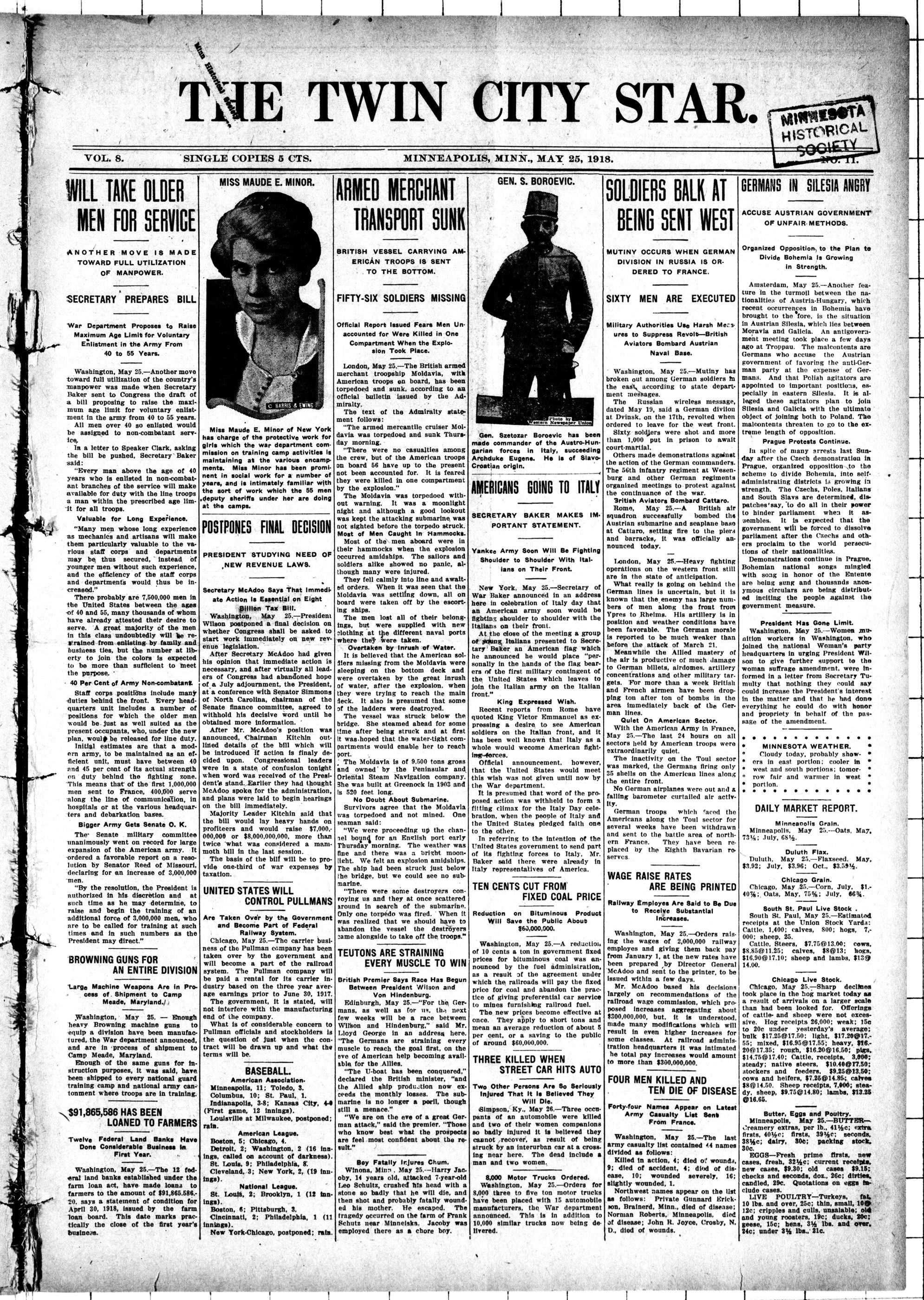
WILL TAKE OLDER MEN FOR SERVICE
WILL TAKE OLDER MEN FOR SERVICE
ANOTHER MOVE IS MADE
TOWARD FULL UTILIZATION
OF MANPOWER.
SECRETARY PREPARES BILL
War Department Proposes to Raise Maximum Age Limits for Voluntary Enlistment in the Army From
Washington, May 25.—Another move toward full utilization of the country's manpower was made when Secretary Baker sent to Congress the draft of a bill proposing to raise the maximum age limit for voluntary enlistment in the army from 40 to 55 years. All men over 40 so enlisted would be assigned to non-combatant service. In a letter to Speaker Clark, asking the bill be pushed, Secretary Baker said: "Every man above the age of 40 years who is enlisted in non-combatant branches of the service will make available for duty with the line troops a man within the prescribed age limit for all troops.
Valuable for Long Experience.
"Many men whose long experience as mechanics and artisans will make them particularly valuable to the various staff corps and departments may be thus secured, instead of younger men without such experience, and the efficiency of the staff corps and departments would thus be increased."
There probably are 7,500,000 men in the United States between the ages of 40 and 55, many thousands of whom have already attested their desire to serve. A great majority of the men in this class undoubtedly will be retained from enlisting by family and business ties, but the number at liberty to join the colors is expected to be more than sufficient to meet the purpose.
40 Per Cent of Army Non-combatant.
Staff corps positions include many duties behind the front. Every headquarters unit includes a number of positions for which the older men would be just as well suited as the present occupants, who, under the new plan, would be released for line duty. Initial estimates are that a modern army, to be maintained as an efficient unit, must have between 40 and 45 per cent of its actual strength on duty behind the fighting zone. This means that of the first 1,000,000 men sent to France, 400,000 serve along the line of communication, in hospitals or at the various headquarters and debarkation bases.
Bigger Army Gets Senate O. K.
The Senate military committee unanimously went on record for large expansion of the American army. It ordered a favorable report on a resolution by Senator Reed of Missouri, declaring for an increase of 3,000,000 men.
"By the resolution, the President is authorized in his discretion and at such time as he may determine, to raise and begin the training of an additional force of 3,000,000 men, who are to be called for training at such times and in such numbers as the President may direct."
BROWNING GUNS FOR AN ENTIRE DIVISION
Large Machine Weapons Are in Process of Shipment to Camp Meade, Maryland..
Washington, May 25. — Enough heavy Browning machine guns to equip a division have been manufactured, the War department announced, and are in process of shipment to Camp Meade, Maryland.
Enough of the same guns for instruction purposes, it was said, have been shipped to every national guard training camp and national army cantonment where troops are in training.
Twelve Federal Land Banks Have Done Considerable Business in First Year.
Washington, May 25.—The 12 federal land banks established under the farm loan act, have made loans to farmers to the amount of $91,865,586.20, says a statement of condition for April 30, 1918, issued by the farm loan board. This date marks practically the close of the first year's business.
THE TWIN CITY STAR.
SINGLE COPIES 5 CTS.
C HARRIS & EWING
Miss Maude E. Minor of New York has charge of the protective work for girls which the war department commission on training camp activities is maintaining at the various encampments. Miss Minor has been prominent in social work for a number of years, and is intimately familiar with the sort of work which the 55 men deputy sheriffs under her are doing at the camps.
POSTPONES FINAL DECISION
PRESIDENT STUDYING NEED OF NEW REVENUE LAWS.
Secretary McAdoo Says That Immediate Action Is Essential on Eight Billion Tax Bill.
Washington, May 25.—President Wilson postponed a final decision on whether Congress shall be asked to start work immediately on new revenue legislation.
After Secretary McAdoo had given his opinion that immediate action is necessary, and after virtually all leaders of Congress had abandoned hope of a July adjournment, the President, at a conference with Senator Simmons of North Carolina, chairman of the Senate finance committee, agreed to withhold his decisive word until he obtained more information.
After Mr. McAdoo's position was announced, Chairman Kitchin outlined details of the bill which will be introduced if action is finally decided upon. Congressional leaders were in a state of confusion tonight when word was received of the President's stand. Earlier they had thought McAdoo spoke for the administration, and plans were laid to begin hearings on the bill immediately.
Majority Leader Kitchin said that the bill would lay heavy hands on profiteers and would raise $7,000,000,000 or $8,000,000,000, more than twice what was considered a mammoth bill in the last session.
The basis of the bilf will be to provide one-third of war expenses by taxation.
UNITED STATES WILL CONTROL PULLMANS
Are Taken Over by the Government and Become Part of Federal Railway System.
Chicago, May 25.—The carrier business of the Pullman company has been taken over by the government and will become a part of the railroad system. The Pullman company will be paid a rental for its carrier industry based on the three year average earnings prior to June 30, 1917.
The government, it is stated, will not interfere with the manufacturing end of the company.
What is of considerable concern to Pullman officials and stockholders is the question of just when the contract will be drawn up and what the terms will be.
BASEBALL.
Indianapolis, 3-8; Kansas City, 4-8
(First game, 12 innings).
Louisville at Milwaukee, postponed;
rain.
American League.
Boston, 5; Chicago, 4.
Detroit, 2; Washington, 2 (16 innings,
called on account of darkness).
St. Louis, 9; Philadelphia, 8.
Cleveland, 3; New York, 2, (19 innings).
National League.
St. Louis, 2; Brooklyn, 1 (12 innings).
New York-Chicago, postponed; rain.
MINNEAPOLIS, MINN., MAY 25, 1918.
ARMED MERCHANT TRANSPORT SUNK
BRITISH VESSEL CARRYING AM
ERICÁN TROOPS IS SENT
TO THE BOTTOM.
FIFTY-SIX SOLDIERS MISSING
Official Report Issued Fears Men Unaccounted for Were Killed in One Compartment When the Explosion Took Place.
London, May 25.—The British armed merchant troopship Moldavia, with American troops on board, has been torpedoed and sunk, according to an official bulletin issued by the Admiralty.
The text of the Admiralty statement follows:
"The armed mercantile cruiser Moldavia was torpedoed and sunk Thursday morning.
"There were no casualties among the crew, but of the American troops on board 56 have up to the present not been accounted for. It is feared they were killed in one compartment by the explosion."
The Moldavia was torpedoed without warning. It was a moonlight night and although a good lookout was kept the attacking submarine was not sighted before the torpedo struck.
Most of Men Caught in Hammocks.
Most of the men aboard were in their hammocks when the explosion occurred amidships. The sailors and soldiers alike showed no panic, although many were injured.
They fell calmly into line and awaited orders. When it was seen that the Moldavia was settling down, all on board were taken off by the escorting ships.
The men lost all of their belongings, but were supplied with new clothing at the different naval ports where they were taken.
Overtaken by Inrush of Water.
It is believed that the American soldiers missing from the Moldavia were sleeping on the bottom deck and were overtaken by the great inrush of water, after the explosion, when they were trying to reach the main deck. It also is presumed that some of the ladders were destroyed.
The vessel was struck below the bridge. She steamed ahead for some time after being struck and at first it was hoped that the water-tight compartments would enable her to reach port.
The Moldavia is of 9,500 tons gross and owned by the Peninsular and Oriental Steam Navigation company. She was built at Greenock in 1903 and is 520 feet long.
No Doubt About Submarine.
Survivors agree that the Moldavia was torpedoed and not mined. One seaman said:
"We were proceeding up the channel bound for an English port early Thursday morning. The weather was fine and there was a bright moonlight. We felt an explosion amidships. The ship had been struck just below the bridge, but we could see no submarine.
"There were some destroyers conveying us and they at once scattered around in search of the submarine. Only one torpedo was fired. When it was realized that we should have to abandon the vessel the destroyers same alongside to take off the troops."
TEUTONS ARE STRAINING EVERY MUSCLE TO WIN
British Premier Says Race Has Begun Between President Wilson and Von Hindenburg.
Edinburgh, May 25.—For the Germans, as well as for us, the next few weeks will be a race between Wilson and Hindenburg," said Mr. Lloyd George in an address here. "The Germans are straining every muscle to reach the goal first, on the eve of American help becoming available for the Allies.
"The U-boat has been conquered," declared the British minister, "and the Allied ship production now exceeds the monthly losses. The submarine is no longer a peril, though still a menace."
"We are on the eve of a great German attack," said the premier. "Those who know best what the prospects are feel most confident about the result."
Boy Fatally Injures Chum.
Winona, Minn. May 25—Harry Jacoby, 14 years old, attacked 7-year-old Leo Schultz, crushed his head with a stone so badly that he will die, and then shot and probably fatally wounded his mother. He escaped. The tragedy occurred on the farm of Frank Schutz near Minneiska. Jacoby was employed there as a chore boy.
GEN. S. BOROEVIC.
BENT OF BURGESSI
Photo by
Western Newspaper Union
Gen. Szetozar Boroevic has been made commander of the Austro-Hungarian forces in Italy, succeeding Archduke Eugene. He is of Slavo-Croatian origin.
AMERICANS GOING TO ITALY
SECRETARY BAKER MAKES IMPORTANT STATEMENT.
Yankee Army Soon Will Be Fighting Shoulder to Shoulder With Italians on Their Front.
New York, May 25.—Secretary of War Baker announced in an address here in celebration of Italy day that an American army soon would be fighting shoulder to shoulder with the Italians on their front.
At the close of the meeting a group of young Italians presented to Secretary Baker an American flag which he announced he would place "personally in the hands of the flag bearers of the first military contingent of the United States which leaves to join the Italian army on the Italian front."
King Expressed Wish.
Recent reports from Rome have quoted King Victor Emmanuel as expressing a desire to see American soldiers on the Italian front, and it has been well known that Italy as a whole would welcome American fighting forces.
Official announcement, however, that the United States would meet this wish was not given until now by the War department.
It is presumed that word of the proposed action was withheld to form a fitting climax for the Italy Day celebration, when the people of Italy and the United States pledged faith one to the other.
In referring to the intention of the United States government to send part of its fighting forces to Italy. Mr. Baker said there were already in Italy representatives of America.
TEN CENTS CUT FROM
FIXED COAL PRICE
Reduction on Bituminous Product Will Save the Public About $60,000,000.
Washington, May 25.—A reduction of 10 cents a ton in government fixed prices for bituminous coal was announced by the fuel administration, as a result of the agreement under which the railroads will pay the fixed price for coal and abandon the practice of giving preferential car service to mines furnishing railroad fuel.
The new prices become effective at once. They apply to short tons and mean an average reduction of about 5 per cent, or a saving to the public of around $60,000,000.
THREE KILLED WHEN
STREET CAR HITS AUTO
Two Other Persons Are So Seriously Injured That It Is Believed They Will Die.
Simpson, Ky., May 26.—Three occupants of an automobile were killed and two of their women companions so badly injured it is believed they cannot recover, as result of being struck by an interurban car at a crossing near here. The dead include a man and two women.
8.000 Motor Trucks Ordered.
Washington, May 25.—Orders for 8,000 three to five ton motor trucks have been placed with 15 automobile manufacturers, the War department announced. This is in addition to 10,000 similar trucks now being delivered.
SOLDIERS BALK AT BEING SENT WEST
SOLDIERS BALK AT BEING SENT WEST
MUTINY OCCURS WHEN GERMAN
DIVISION IN RUSSIA IS OR
DERED TO FRANCE.
Military Authorities Use Harsh Measures to Suppress Revolt—British Aviators Bombard Austrian Naval Base.
Washington, May 25.—Mutiny has broken out among German soldiers in the east according to state department messages.
The Russian wireless message, dated May 19, said a German divilion at Dvinsk, on the 17th, revolted when ordered to leave for the west front. Sixty soldiers were shot and more than 1,000 put in prison to await court-martial.
Others made demonstrations against the action of the German commanders. The 56th infantry regiment at Wesenburg and other German regiments organized meetings to protest against the continuance of the war.
British Aviators Bombard Cattaro.
Rome, May 25.—A British air squadron successfully bombed the Austrian submarine and seaplane base at Cattaro, setting fire to the piers and barracks, it was officially announced today.
London, May 25.—Heavy fighting operations on the western front still are in the state of anticipation.
What really is going on behind the German lines is uncertain, but it is known that the enemy has large numbers of men along the front from Ypres to Rhelms. His artillery is in position and weather conditions have been favorable. The German morale is reported to be much weaker than before the attack of March 21.
Meanwhile the Allied mastery of the air is productive of much damage to German billets, airdromes, artillery concentrations and other military targets. For more than a week British and French airmen have been dropping ton after ton of bombs in the area immediately back of the German lines.
Quiet On American Sector.
With the American Army in France, May 25.—The last 24 hours on all sectors held by American troops were extraordinarily quiet.
The inactivity on the Toul sector was marked, the Germans firing only 35 shells on the American lines along the entire front.
No German airplanes were out and a falling barometer curtailed air activity.
German troops which 'acced the Americans along the Toul sector for several weeks have been withdrawn and sent to the battle area of northern France. They have been replaced by the Eighth Bavarian reserves.
WAGE RAISE RATES
ARE BEING PRINTED
Railway Employees Are Said to Be Due to Receive Substantial Increases.
Washington, May 25.—Orders raising the wages of 2,000,000 railway employees and giving them back pay from January 1, at the new rates have been prepared by Director General McAdoo and sent to the printer, to be issued within a few days.
Mr. McAdoo based his decisions largely on recommendations of the railroad wage commission, which proposed increases aggregating about $300,000,000, but, it is understood, made many modifications which will result in even higher increases for some classes. At railroad administration headquarters it was intimated the total pay increases would amount to more than $300,000,000.
FOUR MEN KILLED AND
TEN DIE OF DISEASE
Forty-four Names Appear on Latest Army Casualty List Sent From France.
Washington, May 25.—The last army casualty list contained 44 names divided as follows:
Killed in action, 4; died of wounds, 9; died of accident, 4; died of disease, 10; wounded severely, 16; slightly wounded, 1.
Northwest names appear on the list as follows: Private Gunnard Erickson, Brainerd, Minn., died of disease; Norman Roberts, Minneapolis, died of disease; John R. Joyce, Crosby, N. D., died of wounds.
MINNESOTA
HISTORICAL
SOCIETY
GERMANS IN SILESIA ANGRY
ACCUSE AUSTRIAN GOVERNMENT OF UNFAIR METHODS.
Organized Opposition, to the Plan to Divide Bohemia Is Growing in Strength.
Amsterdam, May 25.—Another feature in the turmoil between the nationalities of Austria-Hungary, which recent occurrences in Bohemia have brought to the fore, is the situation in Austrian Silesia, which lies between Moravia and Galicia. An antigovernment meeting took place a few days ago at Troppau. The malcontents are Germans who accuse the Austrian government of favoring the anti-German party at the expense of Germans. And that Polish agitators are appointed to important positions, especially in eastern Silesia. It is alleged these agitators plan to join Silesia and Galicia with the ultimate object of joining both to Poland. The malcontents threaten to go to the extreme length of opposition.
Prague Protests Continue.
In spite of many arrests last Sunday after the Czech demonstration in Prague, organized opposition to the scheme to divide Bohemia, into self-administrating districts is growing in strength. The Czechs, Poles, Italians and South Slavs are determined, dispatches'say, 'to do all in their power to hinder parliament when it assembles. It is expected that the government will be forced to dissolve parliament after the Czechs and others proclaim to the world persecutions of their nationalities.
Demonstrations continue in Prague, Bohemian national songs mingled with song in honor of the Entente are being sung and thousands anonymous circulars are being distributed inciting the people against the government measure.
President Has Gone Limit.
Washington, May 25.—Women munition workers in Washington, who joined the national Woman's party headquarters in urging President Wilson to give further support to the woman suffrage amendment, were informed in a letter from Secretary Tumulty that nothing they could say could increase the President's interest in the matter and that he had done everything he could do with honor and propriety in behalf of the passage of the amendment.
Cloudy today, probably showers in east portion: cooler in west and south portions; tomorrow fair and warmer in west portion.
DAILY MARKET REPORT.
Minneapolis Grain.
Minneapolis, May 25.—Oats, May,
73½; July, 68½.
Duluth Flax.
Duluth, May 25.—Flaxseed. May,
$3.92; July, $3.96; Oct., $3.59½.
Chicago Grain.
Chicago, May 25.—Corn, July, $1.40½; Oats, May, 75½; July, 66½.
South St. Paul Live Stock.
South St. Paul, May 25.—Estimated receipts at the Union Stock Yards:
Cattle, 1,400; calves, 800; hogs, 7,000; sheep, 25.
Cattle, Steers, $7.75@13.00; cows,
$8.85@11.25; calves, $8@13; hogs,
$16.90@17.10; sheep and lambs, $13@14.00.
Chicago Live Stock.
Chicago, May 25.—Sharp declines took place in the hog market today as a result of arrivals on a larger scale than had been looked for. Offerings of cattle and sheep were not excessive. Hog receipts 26,000; light; 15c to 20c under yesterday's average; bulk $17.25@17.50; light; $17.20@17.55; mixed; $16.95@17.55; heavy; $16.20@17.35; rough; $16.20@16.50; pigs; $14.75@17.40; Cattle, receipts, 3,000; steady; native steers; $10.40@17.50; stockers and feeders; $9.25@13.50; cows and heifers; $7.25@14.55; calves $8@14.50. Sheep receipts, 7,000; steady, sheep; $9.75@14.80; lambs; $13.25@16.5.
Butter, Eggs and Poultry.
Minneapolis, May 25—BUTTER—Creamy extras, per lb. 41½ c; extra firsts, 40½ c; firsts, 39½ c; seconds, 38½ c; dairy, 30 c; packing stock, 30 c.
EGGS—Fresh prime firsts, new cases, fresh, 32½ c; current receipts, new cases, $9.30; old cases $9.15; checks and seconds, doz., 26 c; dirties, candled, 29 c. Quotations on eggs include cases.
LIVE POULTRY—Turkeys, fat 10 lbs. and over, 25 c; thin, small, 10¹² c; cripples and culls, unavailable; old and young roosters, 19 c; ducks, 20 c; geese, 15 c; hens, 3½ lbs. and over, 24 c; under 3½ lbs., 21 c.
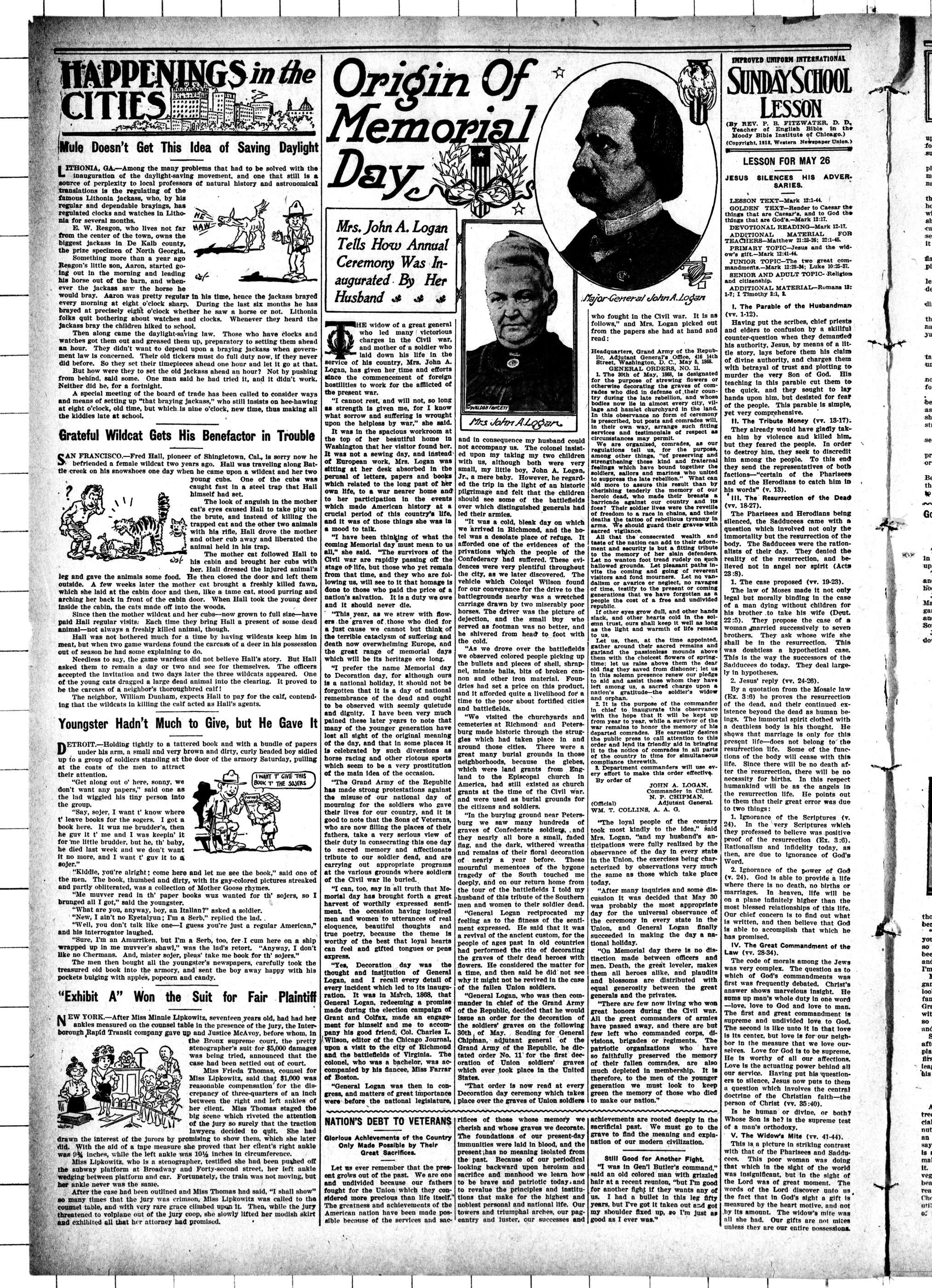
HAPPENINGS in the CITIES
Mule Doesn't Get This Idea of Saving Daylight
ITHONIA, GA.—Among the many problems that had to be solved with the inauguration of the daylight-saving movement, and one that still is a source of perplexity to local professors of natural history and astronom
would bray. Aaron was pretty regular in his time, hence the jackass brayed every morning at eight o'clock sharp. During the last six months he has brayed at precisely eight o'clock whether he saw a horse or not. Lithonia folks quit bothering about watches and clocks. Whenever they heard the jackass bray the children hiked to school.
Then along came the daylight-saving law. Those who have clocks and watches got them out and greased them up, preparatory to setting them ahead an hour. They didn't want to depend upon a braying jackass when government law is concerned. Their old tickers must do full duty now, if they never did before. So they set their timepieces ahead one hour and let it go at that.
But how were they to set the old jackass ahead an hour? Not by pushing from behind, said some. One man said he had tried it, and it didn't work. Neither did he, for a fortnight.
A special meeting of the board of trade has been called to consider ways and means of setting up "that braying jackass," who still insists on hee-hawing at eight o'clock, old time, but which is nine o'clock, new time, thus making all the kiddies at school.
Grateful Wildcat Gets His Benefactor in Trouble
Grateful Wildcat Gets His Benefactor in Trouble
SAN FRANCISCO—Fred Hall, pioneer of Shingletown, Cal., is sorry now he befriended a female wildcat two years ago. Hall was traveling along Battle creek on his snowshoes one day when he came upon a wildcat and her two
leg and gave the animals some food. He then closed the door and left them outside. A few weeks later the mother cat brought a freshly killed fawn, which she laid at the cabin door and then, like a tame cat, stood purring and arching her back in front of the cabin door. When Hall took the young deer inside the cabin, the cats made off into the woods.
Since then the mother wildcat and her cubs—now grown to full size—have paid Hall regular visits. Each time they bring Hall a present of some dead animal—not always a freshly killed animal, though.
Hall was not bothered much for a time by having wildcats keep him in meat, but when two game wardens found the carcass of a deer in his possession out of season he had some explaining to do.
Needless to say, the game wardens did not believe Hall's story. But Hall asked them to remain a day or two and see for themselves. The officers accepted the invitation and two days later the three wildcats appeared. One of the young cats dragged a large dead animal into the clearing. It proved to be the carcass of a neighbor's thoroughbred calf!
The neighbor, William Dunham, expects Hall to pay for the calf, contending that the wildcats in killing the calf acted as Hall's agents.
Youngster Hadn't Much to Give, but He Gave It
Youngster Hadn't Much to Give, but He Gave It
DETROIT.—Holding tightly to a tattered book and with a bundle of papers under his arm, a small and very brown and dirty, curly headed boy sidled up to a group of soldiers standing at the door of the armory Saturday, pulling at the coats of the men to attract
"Kiddle, you're alright; come here and let me see the book," said one of the men. The book, thumbed and dirty, with its gay-colored pictures streaked and partly obliterated, was a collection of Mother Goose rhymes.
"Me muver read in th' paper books wuz wanted for th' sojers, so I brunged all I got," said the youngster.
"What are you, anyway, boy, an Italian?" asked a soldier.
"New, I ain't no Eyetalyun; I'm a Serb," replied the lad.
"Well, you don't talk like one—I guess you're just a regular American," and his interrogator laughed.
"Sure, I'm an Amurriken, but I'm a Serb, too, fer. I cum here on a ship wrapped up in me muver's shawl," was the lad's retort. "Anyway, I don't like no Chermans. And, mister sojer, pleas' take me book for th' sojers."
The men then bought all the youngster's newspapers, carefully took the treasured old book into the armory, and sent the boy away happy with his pockets bulging with apples, popcorn and candy.
"Exhibit A" Won the Suit for Fair Plaintiff
"Exhibit A" Won the Suit for Fair Plaintiff
NEW YORK.—After Miss Minnie Lipkowitz, seventeen years old, had had her ankles measured on the counsel table in the presence of the jury, the Interborough Rapid Transit company gave up and Justice McAvoy, before whom, in
drawn the interest of the jurors by promising to show them, which she later did. With the aid of a tape measure she proved that her client's right ankle was $9\frac{1}{4}$ inches, while the left ankle was $10\frac{1}{2}$ inches in circumference.
Miss Lipkowitz, who is a stenographer, testified she had been pushed off the subway platform at Broadway and Forty-second street, her left ankle wedging between platform and car. Fortunately, the train was not moving, but her ankle never was the same.
After the case had been outlined and Miss Thomas had said, "I shall show" so many times that the jury was crimson, Miss Lipkowitz was called to the counsel table, and with very rare grace climbed upon it. Then, while the jury threatened to volplane out of the jury coop, she slowly lifted her modish skirt and exhibited all that her attorney had promised.
translations is the regulating of the famous Lithonia jackass, who, by his regular and dependable brayings, has regulated clocks and watches in Lithonia for several months.
E. W. Reagon, who lives not far from the center of the town, owns the biggest jackass in De Kalb county, the prize specimen of North Georgia.
Something more than a year ago Reagon's little son, Aaron, started going out in the morning and leading his horse out of the barn, and whenever the jackass saw the horse he
would bray. Aaron was pretty regular in H every morning at eight o'clock sharp. Duy brayed at precisely eight o'clock whether of folks quit bothering about watches and c jackass bray the children hiked to school.
Then along came the daylight-saving I watches got them out and greased them up, an hour. They didn't want to depend upon ment law is concerned. Their old tickers m did before. So they set their timepieces ah.
But how were they to set the old jackas from behind, said some. One man said he Neither did he, for a fortnight.
A special meeting of the board of trade and means of setting up "that braying jackas at eight o'clock, old time, but which is nine the kiddles late at school.
Grateful Wildcat Gets His
SAN FRANCISCO.-Fred Hall, pioneer of befflended a female wildcat two years s the creek on his snowshoes one day when he
---
?
leg and gave the animals some food. He t
outside. A few weeks later the mother c
which she laid at the cabin door and then,
arching her back in front of the cabin door
inside the cabin, the cats made off into the
Since then the mother wildcat and her c
paid Hall regular visits. Each time they b
animal—not always a freshly killed animal,
Hall was not bothered much for a time
meat, but when two game wardens found the
out of season he had some explaining to do.
Needless to say, the game wardens did
asked them to remain a day or two and
accepted the invitation and two days later
of the young cats dragged a large dead anin
be the carcass of a neighbor's thoroughbred
The neighbor, William Dunham, expects
ing that the wildcats in killing the calf acted
Youngster Hadn't Much to
DETROIT.—Holding tightly to a tattered
under his arm, a small and very brown
up to a group of soldiers standing at the doe
at the coats of the men to attract
their attention.
"Get along out o' here, sonny, we don't want any papers," said one as the lad wiggled his tiny person into the group.
"Say, sojer, I want t' know where t' leave books for the sogers. I got a book here. I wuz me brudder's, then he guv it t' me and I was keeplin' it for me little brudder, but he, th' baby, he died last week and we don't want it no more, and I want t' guv it to a sofer."
"Kiddle, you're alright; come here and the men. The book, thumbed and dirty, with and partly obliterated, was a collection of M "Me muvur read in th' paper books brunged all I got," said the youngster.
"What are you, anyway, boy, an Italian? "New, I ain't no Eyetalyun; I'm a Serb "Well, you don't talk like one—I guess and his interrogator laughed.
"Sure, I'm an Amurriken, but I'm a Se wrapped up in me muvver's shawl," was the like no Chermans. And, mister sojer, pleas" The men then bought all the youngster treasured old book into the armory, and se pockets bulging with apples, popcorn and car
"Exhibit A" Won the Su
NEW YORK.—After Miss Minnie Lipkowitz ankles measured on the counsel table in borough Rapid Transit company gave up and
alberts
drawn the interest of the jurors by promise did. With the aid of a tape measure she pus was 9% inches, while the left ankle was 10% Miss Lipkowitz, who is a stenographer, the subway platform at Broadway and For wedging between platform and car. Fortuna her ankle never was the same.
After the case had been outlined and Miss so many times that the jury was crimson, counsel table, and with very rare grace clim threatened to volplane out of the jury coop, and exhibited all that her attorney had prom
HE HAW
20-
in his time, hence the jackass brayed
b. During the last six months he has
either he saw a horse or not. Lithonia
and clocks. Whenever they heard the
pool.
living law. Those who have clocks and
mup, preparatory to setting them ahead
up upon a braying jackass when governers
must do full duty now, if they never
needs ahead one hour and let it go at that.
jackass an hour? Not by pushing
he had tried it, and it didn't work.
trade has been called to consider ways
jackass," who still insists on hee-hawing
nine o'clock, new time, thus making all
his Benefactor in Trouble
er of Shingletown, Cal., is sorry now he
ears ago. Hall was traveling along Bat-
en he came upon a wildcat and her two
young cubs. One of the cubs was caught fast in a steel trap that Hall himself had set.
The look of anguish in the mother cat's eyes caused Hall to take pity on the brute, and instead of killing the trapped cat and the other two animals with his rifle, Hall drove the mother and other cub away and liberated the animal held in his trap.
The mother cat followed Hall to his cabin and brought her cubs with her. Hall dressed the injured animal's
He then closed the door and left them her cat brought a freshly killed fawn, then, like a tame cat, stood purring and door. When Hall took the young deer to the woods. Their cubs—now grown to full size—have they bring Hall a present of some dead animal, though. A time by having wildcats keep him in and the carcass of a deer in his possession to do. She did not believe Hall's story. But Hall and see for themselves. The officers later the three wildcats appeared. One animal into the clearing. It proved to abred calf! Expects Hall to pay for the calf, contended as Hall's agents.
to Give, but He Gave It
ered book and with a bundle of papers grown and dirty, curly headed boy sided the door of the armory Saturday, pulling
I WANT T GIVE THIS
BOOK T' THE SOJERS
WARNING
COURSE
me and let me see the book," said one of
y, with its gay-colored pictures streaked
of Mother Goose rhymes.
Books wuz wanted for th' sojers, so I
allan?" asked a soldier.
"Serb," replied the lad.
"guess you're just a regular American,"
a Serb, too, fer I cum here on a ship
was the lad's retort. "Anyway, I don't
pleas' take me book for th' sojers."
Mngster's newspapers, carefully took the
and sent the boy away happy with his
and candy.
Suit for Fair Plaintiff
kowitz, seventeen years old, had had her
role in the presence of the jury, the Inter-
p and Justice McAvoy, before whom, in
the Bronx supreme court, the pretty stenographer's suit for $5,000 damages was being tried, announced that the case had been settled out of court.
Miss Frieda Thomas, counsel for Miss Lipkowitz, said that $1,000 was reasonable compensation for the discrepancy of three-quarters of an inch between the right and left ankles of her client. Miss Thomas staged the big scene which riveted the attention of the jury so surely that the traction lawyers decided to quit. She had
promising to show them, which she later she proved that her client's right ankle was 10½ inches in circumference.ograph, testified she had been pushed off and Forty-second street, her left ankle fortunately, the train was not moving, but and Miss Thomas had said, "I shall show" Jason, Miss Lipkowitz was called to the climbed upon it. Then, while the jury coop, she slowly lifted her modish skirt and promised.
Origin Of Memorial Day
Mrs. John A. Logan Tells How Annual Ceremony Was Inaugurated By Her Husband
HE widow of a great general who led many victorious charges in the Civil war, and mother of a soldier who laid down his life in the service of his country, Mrs. John A. Logan, has given her time and efforts since the commencement of foreign hostilities to work for the afflicted of the present war.
"I cannot rest, and will not, so long as strength is given me, for I know what sorrow and suffering is wrought upon the helpless by war," she said.
It was in the spacious workroom at the top of her beautiful home in Washington that her visitor found her. It was not a sewing day, and instead of European work, Mrs. Logan was sitting at her desk absorbed in the perusal of letters, papers and books which related to the long past of her own life, to a war nearer home and to her participation in the events which made American history at a crucial period of this country's life, and it was of those things she was in a mood to talk.
"I have been thinking of what the coming Memorial day must mean to us all," she said. "The survivors of the Civil war are rapidly passing off the stage of life, but those who yet remain from that time, and they who are following us, will see to it that homage is done to those who paid the price of a nation's salvation. It is a duty we owe and it should never die.
"This year, as we strew with flowers the graves of those who died for a just cause we cannot but think of the terrible cataclysm of suffering and death now overwhelming Europe, and the great range of memorial days which will be its heritage are long.
"I prefer the name Memorial day to Decoration day, for although ours is a national holiday, it should not be forgotten that it is a day of national remembrance of the dead and ought to be observed with seemly quietude and dignity. I have been very much pained these later years to note that many of the younger generation have lost all sight of the original meaning of the day, and that in some places it is celebrated by such diversions as horse racing and other riotous sports which seem to be a very prostitution of the main idea of the occasion.
"The Grand Army of the Republic has made strong protestations against the misuse of our national day of mourning for the soldiers who gave their lives for our country, and it is good to note that the Sons of Veterans, who are now filling the places of their fathers, take a very serious view of their duty in consecrating this one day to sacred memory and affectionate tribute to our soldier dead, and are carrying out appropriate programs at the various grounds where soldiers of the Civil war lie buried.
"I can, too, say in all truth that Memorial day has brought forth a great harvest of worthily expressed sentiment, the occasion having inspired men and women to utterances of real eloquence, beautiful thoughts and true poetry, because the theme is worthy of the best that loyal hearts can feel and gifted tongues or pens express.
"Yes, Decoration day was the thought and institution of General Logan, and I recall every detail of every incident which led to its inauguration. It was in March, 1868, that General Logan, redeeming a promise made during the election campaign of Grant and Colfax, made an engagement for himself and me to accompany his good friend, Col. Charles L. Wilson, editor of the Chicago Journal, upon a visit to the city of Richmond and the battlefields of Virginia. The colonel, who was a bachelor, was accompanied by his flancee, Miss Farrar of Boston.
"General Logan was then in congress, and matters of great importance were before the national legislature,
NATION'S DEBT TO VETERANS
Glorious Achievements of the Country Only Made Possible by Their Great Sacrifices.
Let us ever remember that the present grows out of the past. We are one and undivided because our fathers fought for the Union which they considered more precious than life itself. The greatness and achievements of the American nation have been made possible because of the services and sac-
©WALDON TAYCETT
Mrs John A. Logan
and in consequence my husband could not accompany us. The colonel insisted upon my taking my two children with us, although both were very small, my little boy, John A. Logen, Jr., a mere baby. However, he regarded the trip in the light of an historic pilgrimage and felt that the children should see some of the battlefields over which distinguished generals had led their armies.
"It was a cold, bleak day on which we arrived in Richmond, and the hotel was a desolate place of refuge. It afforded one of the evidences of the privations which the people of the Confederacy had suffered. These evidences were very plentiful throughout the city, as we later discovered. The vehicle which Colonel Wilson found for our conveyance for the drive to the battlegrounds nearby was a wretched carriage drawn by two miserably poor horses. The driver was the picture of dejection, and the small boy who served as footman was no better, and he shivered from head to foot with the cold.
"As we drove over the battlefields we observed colored people picking up the bullets and pieces of shell, shrapnel, minnie balls, bits of broken cannon and other iron material. Foundries had set a price on this product, and it afforded quite a livelihood for a time to the poor about fortified cities and battlefields.
"We visited the churchyards and cemetery at Richmond and Petersburg made historic through the struggles which had taken place in and around those cities. There were a great many burial grounds in those neighborhoods, because the glebes, which were land grants from England to the Episcopal church in America, had still existed as church grants at the time of the Civil war, and were used as burial grounds for the citizens and soldiers.
"In the burying ground near Petersburg we saw many hundreds of graves of Confederate soldier, and they nearly all bore a small, faded flag, and the dark, withered wreaths and remains of their floral decoration of nearly a year before. These mournful mementoes of the bygone tragedy of the South touched me deeply, and on our return home from the tour of the battlefields I told my husband of this tribute of the Southern men and women to their soldier dead.
"General Logan reciprocated my feeling as to the fitness of the sentiment expressed. He said that it was a revival of the ancient custom, for the people of ages past in old countries had performed the rite of decorating the graves of their dead heroes with flowers. He considered the matter for a time, and then said he did not see why it might not be revived in the case of the fallen Union soldiers.
"General Logan, who was then commander in chief of the Grand Army of the Republic, decided that he would issue an order for the decoration of the soldiers' graves on the following 30th of May. Sending for General Chipman, adjutant general of the Grand Army of the Republic, he dictated order No. 11 for the first decoration of Union soldiers' graves which ever took place in the United States.
"That order is now read at every Decoration day ceremony which takes place over the graves of Union soldiers
rifiches of those whose memory we cherish and whose graves we decorate. The foundations of our present-day immunities were laid in blood, and the present has no meaning isolated from the past. Because of our periodical looking backward upon heroism and sacrifice and manhood we learn how to be brave and patriotic today, and to revalue the principles and institutions that make for the highest and noblest personal and national life. Our towers and triumphal arches, our pageantry and luster, our successes and
Major-General John A. Logan
who fought in the Civil war. It is as
follows," and Mrs. Logan picked out
from the papers she had at hand and
read:
Headquarters, Grand Army of the Repub-
lic. Adjutant General's Office, 416 14th
Street, Washington, D. C., May 5, 1888.
GENERAL ORDERS, NO. 11.
1. The 30th of May, 1868, is designated for the purpose of strewing flowers or otherwise decorating the graves of comrades who died in the rebellion, and whose bodies now lie in almost every city, village and hamlet churchyard in the land.
In this observance no form of ceremony is prescribed, but posts and comrades will, in their own way, arrange such fitting services and testimonials of respect as circumstances may permit.
We are organized, comrades, as our regulations call us, the purpose, and strengthening those kind and fraternal feelings which have bound together the soldiers, sailors and marines who united to suppress the late rebellion." What can aid more to assure this result than by cherishing tenderly the memory of our heroic dead, who made their breasts a barricade against our country and foes? Their soldier lives were the souls of those who died in the rebellion and their death, the tattoo of rebellious tyranny in arms. We should guard their graves with sacred vigilance.
All that the consecrated wealth and taste of the nation can add to their adornment and security is but a fitting tribute to the memory of her slain defenders. Let no wanton foot tread rudely on such hallowed grounds. Let pleasant paths invite the coming and foul of reverence for food and courors. Let no vandalism or avarice or neglect, no ravages of time, testify to the present or coming generations that we have forgotten as a people the cost of a free and undivided republic. If other eyes grow dull, and other hands slack, and other hearts cold in the solemn trust, ours shall keep it well as long as the light and warmth of life remain. Let us, then, at the time appointed, gather around their sacred remains and garland the passionest mounds above them with the choicest flowers of springtime; let us raise above them the dear old flag they saved from dishonor; let us in this solemn presence renew our pledge to aid and assist those whom they have among us, a sacred charge upon a nation, our attitude—the soldier's widow and orphan.
2. It is the purpose of the commander in chief to inaugurate this observance with the hope that it will be kept up from year to year, while a survivor of the war remains to honor the memory of his departed comrades. He earnestly desires the public press to call attention to this order and lend its friendly aid in bringing it to the notice of comrades in all parts of the country in time for simultaneous compliance therewith.
3. Department commanders will use every effort to make this order effective. By order of
JOHN A. LOGAN,
Commander in Chief.
N. P. CHIPMAN.
(Official) Adjutant General WM. T. COLLINS, A. A. G.
"The loyal people of the country took most kindly to the iden," said Mrs. Logan, "and my husband's anticipations were fully realized by the observance of the day in every state in the Union, the exercises being characterized by observations very much the same as those which take place today.
"After many inquiries and some discussion it was decided that May 30 was probably the most appropriate day for the universal observance of the ceremony in every state in the Union, and General Logan finally succeeded in making the day a national holiday.
"On Memorial day there is no distinction made between officers and men. Death, the great leveler, makes them all heroes alike, and plaudits and blossoms are distributed with equal generosity between the great generals and the privates.
"There are few now living who won great honors during the Civil war. All the great commanders of armles have passed away, and there are but few left who commanded corps, divisions, brigades or regiments. The patriotic organizations who have so faithfully preserved the memory of their fallen comrades, are also much depleted in membership. It is therefore, to the men of the younger generation we must look to keep green the memory of those who died to make our nation."
achievements are rooted deeply in the sacrificial past. We must go to the grave to find the meaning and explanation of our modern civilization.
Still Good for Another Fight.
"I was in Genl' Butter's command," said an old colored man with grizzled hair at a recent reunion, "but I'm good for another fight if they want any of us. I had a bullet in this leg fifty years, but I've got it taken out and got my shoulder fixed up, so I'm just as good as I ever was."
SUNDAY SCHOOL
LESSON
(By REV. P. B. FITZWATER. D. D. Teacher of English Bible in the Moody Bible Institute of Chicago. (Copyright, 1918. Western Newspaper Union.)
LESSON FOR MAY 26
LESSON TEXT-Mark 12:1-44.
GOLDEN TEXT—Render to Caesar the things that are Caesar's, and to God the things that are God's.—Mark 12:17.
DEVOTIONAL READING—Mark 12:17.
ADDITIONAL MATERIAL FOR TEACHERS—Matthew 21:28-26; 22:1-45.
PRIMARY TOPIC—Jesus and the widow's gift.—Mark 12:41-44.
JUNIOR TOPIC—The two great commandments.—Mark 12:28-34; Luke 10:25-37.
SENIOR AND ADULT TOPIC—Religion and citizenship.
ADDITIONAL MATERIAL—Romans 13:1-7; I Timothy 2:1, 2.
I. The Parable of the Husbandman (vy. 1:12).
Having put the scribes, chief priests and elders to confusion by a skillful counter-question when they demanded his authority, Jesus, by means of a little story, lays before them his claim of divine authority, and charges them with betrayal of trust and plotting to murder the very Son of God. His teaching in this parable cut them to the quick, and they sought to lay hands upon him, but desisted for fear of the people. This parable is simple, yet very comprehensive.
II. The Tribute Money (vv. 13-17).
They already would have gladly taken him by violence and killed him, but they feared the people. In order to destroy him, they seek to discredit him among the people. To this end they send the representatives of both factions—"certain of the Pharisees and of the Herodians to catch him in his words" (v. 13).
III. The Resurrection of the Dead (vv. 18-27).
The Pharisees and Herodians being silenced, the Sadduees came with a question which involved not only the immortality but the resurrection of the body. The Sadduees were the rationalists of their day. They denied the reality of the resurrection, and believed not in angel nor spirit (Acts 28:8).
1. The case proposed (vv. 19-23).
1. The case proposed (Vv. 18-20).
The law of Moses made it not only legal but morally binding in the case of a man dying without children for his brother to take his wife (Deut. 22:5). They propose the case of a woman married successively to seven brothers. They ask whose wife she shall be in the resurrection. This was doubtless a hypothetical case. This is the way the successors of the Sadduces do today. They deal largely in hypotheses.
2. Jesus' reply (vv. 24-26).
By a quotation from the Mosaic law (Ex. 3:6) he proves the resurrection of the dead, and their continued existence beyond the dead as human beings. The immortal spirit clothed with a deathless body is his thought. He shows that marriage is only for this present life—does not belong to the resurrection life. Some of the functions of the body will cease with this life. Since there will be no death after the resurrection, there will be no necessity for births. In this respect humankind will be as the angels in the resurrection life. He points out to them that their great error was due to two things:
1. Ignorance of the Scriptures (v. 24). In the very Scriptures which they professed to believe was positive proof of the resurrection (Ex. 3:6). Rationalism and infidelity today, as then, are due to ignorance of God's Word.
2. Ignorance of the power of God (v. 24). God is able to provide a life where there is no death, no births or marriages. In heaven, life will be on a plane infinitely higher than the most blessed relationships of this life. Our chief concern is to find out what is written, and then believe that God is able to accomplish that which he has promised.
IV. The Great Commandment of the Law (vv. 28-34).
The code of morals among the Jews was very complex. The question as to which of God's commandments was first was frequently debated. Christ's answer shows marvelous insight. He sums up man's whole duty in one word—love, love to God and love to man. The first and great commandment is supreme and undivided love to God. The second is like unto it in that love is its center, but love is for our neighbor in the measure that we love ourselves. Love for God is to be supreme. He is worthy of all our affections. Love is the actuating power behind all our service. Having put his questioners to silence, Jesus now puts to them a question which involves the central doctrine of the Christian faith—the person of Christ (vv. 35:40). Is he human or divine, or both? Whose Son is he? is the supreme test of a man's orthodoxy. V. The Widow's Mite (vv. 41-44).
This is a picture in striking contrast with that of the Pharisees and Sadducees. This poor woman was doing that which in the sight of the world was insignificant, but in the sight of the Lord was of great moment. The words of the Lord discover unto us the fact that in God's sight a gift is measured by the heart motive, and not by its amount. The widow's mite was all she had. Our gifts are not mites unless they are our entire possessions.
Right Use of the Flag
It Should Never Be Permitted to Touch the Ground, Nor Draped as a Decoration
In these days when every household should have a flag, and should fly it upon every occasion offered, its correct use should be known to all. The following, from the National Geographic Magazine, tells the proper usage succinctly:
"While there is no federal law in force pertaining to the manner of displaying, hanging, or saluting the United States flag, or prescribing any ceremonies that should be observed, there are many regulations and usages of national force bearing on the subject.
"In raising the flag it should never be rolled up and holsted to the top of the staff before unfurling. Instead, the fly should be free during the act of holsting, which should be done quickly. It should be taken in slowly and with dignity. It should not be allowed to touch the ground on shore, nor should it be permitted to trail in the dust. It should not be hung where it can be contaminated or soiled easily, or draped over chairs or benches for seating purposes, and no object or emblem of any kind should be placed upon it or above it.
"A common but regrettable practice at public meetings is to drape the flag like a tablecloth over the speaker's table and then place on the flag a pitcher of ice water, flowers, books, etc.
"The flag should not be festooned over doorways or arches. Always let the flag hang straight. Do not tie it in a bow knot. Where colors are desired for decorative purposes, use red, white and blue bunting.
"The flag should not be holsted upside down, other than as a signal of distress at sea.
"International usage forbids the display of the flag of one nation above that of any other with which it is at peace. When the flags of two or more nations are displayed, they should be on separate staffs, or on separate half-yards of equal size and on the same level.
"The flag should never be raised or lowered by any mechanical appliance.
"When the national colors are passing on parade, or in review, the spectator should, if walking, halt, and if sitting arise and stand at attention and uncover.
"When flags are used in unveiling a statue or monument they should not be allowed to fall to the ground, but should be carried aloft to wave out, forming a distinctive feature during the remainder of the ceremony.
"Where the national flag is displayed with state or other flags, it should be given the place of honor on the right. Its use should be confined as much as possible to its display upon the staff. Where used as a banner, the union should fly to the north in streets running east and west, and to the east in streets running north and south.
"Old, faded, or wornout flags should not be used for banners or other secondary purposes."
"When no longer fit for display, the flag should be destroyed privately, preferably by burning or other methods lacking the suggestion of irreverence or disrespect.
"A flag or an ensign at half-mast is the universal sign of mourning. Before being placed at half-mast the flag must always be raised to the stop of the staff, and before it is lowered from half-mast it must likewise be holsted to the top."
Good Irish Name Helped Mike Hogan Get a Tryout With John McGraw's Team
The bird who said there is nothing in a name had his signals gummed up.
There is quite a bit in some names, and the case of Mike Hogan of Colibes, N. Y., proves it beyond a doubt.
Just before the Giants started for Marlin and spring training, Mike Hogan bounced into the Giants' offices and announced that he was ready to go South.
John McGraw gave him the up and down, scratched his noggan in deep
International Film Service
Pitcher M. B. Hogan.
thought, and utterly failed to remember of ever having heard of him.
"Why, the paper up in Cohoes said you wanted to give me a trial and so here I am," explained Hogan. "I've been pitching sompro ball up home, and I guess you've heard about me, I'm a machinist by trade."
McGraw had never dreamed of Hogan, but he liked the youngster's looks, and, most of all, he took a fancy to the name of Hogan. McGraw would like to surround himself with Doyles, McCarthys and Hogans, so he decided to give Mike a chance, and Mike went to Marlin.
So there is something in a name after all, for Hogan, who had never played professional ball, is getting his first tryout in the strongest minor league in the country, and all because his name is Hogan.
The Butter Tree.
A tree, known as the shea, or butter tree, is beginning to attract commercial attention. It supplies not only nuts, but also butter that may become an article of commercial importance, says the San Francisco Argonaut. It is already exported to Europe, where makers of artificial butter find use for it. Almost two-thirds of the nut is vegetable butter. The tree begins to bear when it is fifteen years old, and reaches its prime in twenty-five years. Chocolate manufacturers could easily utilize the product. It might also be of use in making candies and soap.
Wait till the laurel bursts its buds,
And creeping ivy flings its graces
About the lichen's rocks, and floods
Of sunshine fill the shady places.
Potato Muffins.
Take one cupful of mashed potato, packing the cup firmly, add a cupful of warm milk, a half a yeast cake, two eggs, a tablespoonful of lard, a tablespoonful of sugar, a teaspoonful of salt, and flour to make a stiff dough. Let rise, shape into biscuits. Let rise again, and bake 15 minutes. Set the muffins at eleven and bake at six.
Potato Stuffng.
Mix two cupfuls of mashed potato one cupful of soft bread crumbs, one third of a cupful of melted shortening, half a teaspoonful each of salt and poultry dressing, a few dashes of cayenne pepper, mix thoroughly and use as stuffing for fish or poultry.
Swiss Potato Soup.
Take four large potatoes, one large white turnip, three quarts of boiling water, a quart of scalded milk, one-half an onion, four tablespoonfuls of fat, one-third of a cupful of barley flour, and a half teaspoonful of salt, and one-eighth of a teaspoonful of pepper. Wash the potatoes and turnip, cut in small pieces and cook ten minutes, drain and add the onion cut in slices, add three cupfuls of water, cook until the vegetables are soft, press them through a sieve, return to the water; add milk, reheat and thicken with the flour and fat cooked together; add seasoning.
Potato Pures
Pour boiling water over a fourth of a pound of salt pork, scrape and rinse in cold water. To the pork add three potatoes, pared and cut in quarters, one onion, peeled and sliced, four branches of parsley, half a cupful of chopped celery, all cooked until tender in just enough water to cover. Remove the pork, press the vegetables through the sleeve, adding the water. Add a quart of hot milk, a teaspoonful and a half of salt, a half teaspoonful of pepper, and when, boiling stir in an egg beaten with a little cold milk. Serve at once without further cooking or the egg will curdle the mixture.
Potatoes, to be palatable boiled, should be drained as soon as they are tender, then shaken over the heat to remove all steam and make them mealy.
Nerie Maxwell
Short and Snappy.
Jealousy at best - is but a chronic case of self-love.
A shady character doesn't al-
A shady character doesn't always keep a man cool.
During the courtship love shows up in the dark.
Men of genius often make a fortune for a man of talent.
Singers who pursue the even tenor of their way never get off their bass.
Sometimes the man who is afraid to take a chance is beaten at his own game.
There will certainly be ten American cities, when the 1920 census count is made, that will have a population in excess of 500,000, and there may be as many as fifteen that will pass the half-million population score, states a writer in the Baltimore American. Baltimore is going to be in the big ten, but where along in the big ten? New York, Chicago and Philadelphia will be the three largest cities in the order named. But what city will occupy fourth place? And just what place in the first ten column will Baltimore occupy? The question may seem trivial, but it is a question in which the people of at least five cities, Baltimore being included in the five, are even now taking a lively interest.
The five cities that will be in competition for fourth place are Baltimore, Boston, St. Louis, Detroit and Cleveland. The city that is most likely to beat Baltimore in the race for fourth place is Detroit, which now has an estimated population of 825,000. Estimated populations sometimes shrink tremendously when the government count is made, and it may be so with the spurty metropolis of Michigan. St. Louis is claiming a 1918 population of 850,000, but this also is subject to possible shrinkage, as it is 163,000 greater than the 1910 score. Boston has not extended her boundary lines and is not making any claim to extraordinary population growth. The New England city does claim an increase of 100,000 over the 1910 count, however, or a present population of 767,000.
It seems to be a warranted conclusion that Baltimore must score above 800,000 to get fourth place in the column. If the Baltimore score should be around, say, 750,000, the Greater Baltimore may not be located above seventh place and may be in eighth position, or only two places from bottom. But the Baltimore count may be in a way of surprise. We don't know just how many people there are in the annex.
A FEW SMILES
A Wise Silence.
"What excuse did you give the wife last night?"
"I gave none."
"Didn't even tell her it was business detained you?"
"Heavens, man, if I'd uttered the word 'bishness' I'd have given myself dead away."
George—You have stolen my heart.
Q
Peggy—That's a nice thing to say after you've been begging me for six months to accept it.
Service.
"You have always considered yourself a servant of the people." "Yes," said Senator Sorghum. "But understand this. I'm not one of those servants who get independent and want to run the whole works."
If She's Mercenary
"What is the best way to lead up to a proposal?"
"You might make some casual reference to the size of your income tax."
"Yes?"
"In a majority of cases that will put the young woman in a receptive frame of mind."
Interviewing a Lion Tamer.
"What are your methods in lion taming. I would pay you well for a few lessons."
A
"I don't mind giving you lessons, mister. But there's nothing in the business, I warn you."
"I don't wish to embark in the business. Thought wife."
A Bright Idea.
Friend—How perfectly devoted you are to your husband.
Wife—Yes. I'm trying to spoil him so that if I die and he marries again no other woman could live with him.
Speak of 100,000 Army as Sort of Corporal's Guard
The war has blunted the old meaning of figures and we speak gibly of an army of 100,000 men or more, General Pershing's offer to General Foch, as though it were only a sort of corporal's guard. Late reports hint at a larger figure than that equaling Kitchener's first army. Never before in our history have 100,000 men fought under the Stars and Stripes in any one battle. The Army of the Potomac, with which Grant and Mende fought the campaign of 1864, had an aggregate strength of less than 120,000, and only a part of them were used in any single engagement. Earlier there had been rather more than 70,000 federal troops at Gettysburg, about 65,000 at Chattanooga. Sherman started from Atlanta with some 66,000. Napoleon had 72,000 men at Waterloo and the British numbered 68,000.
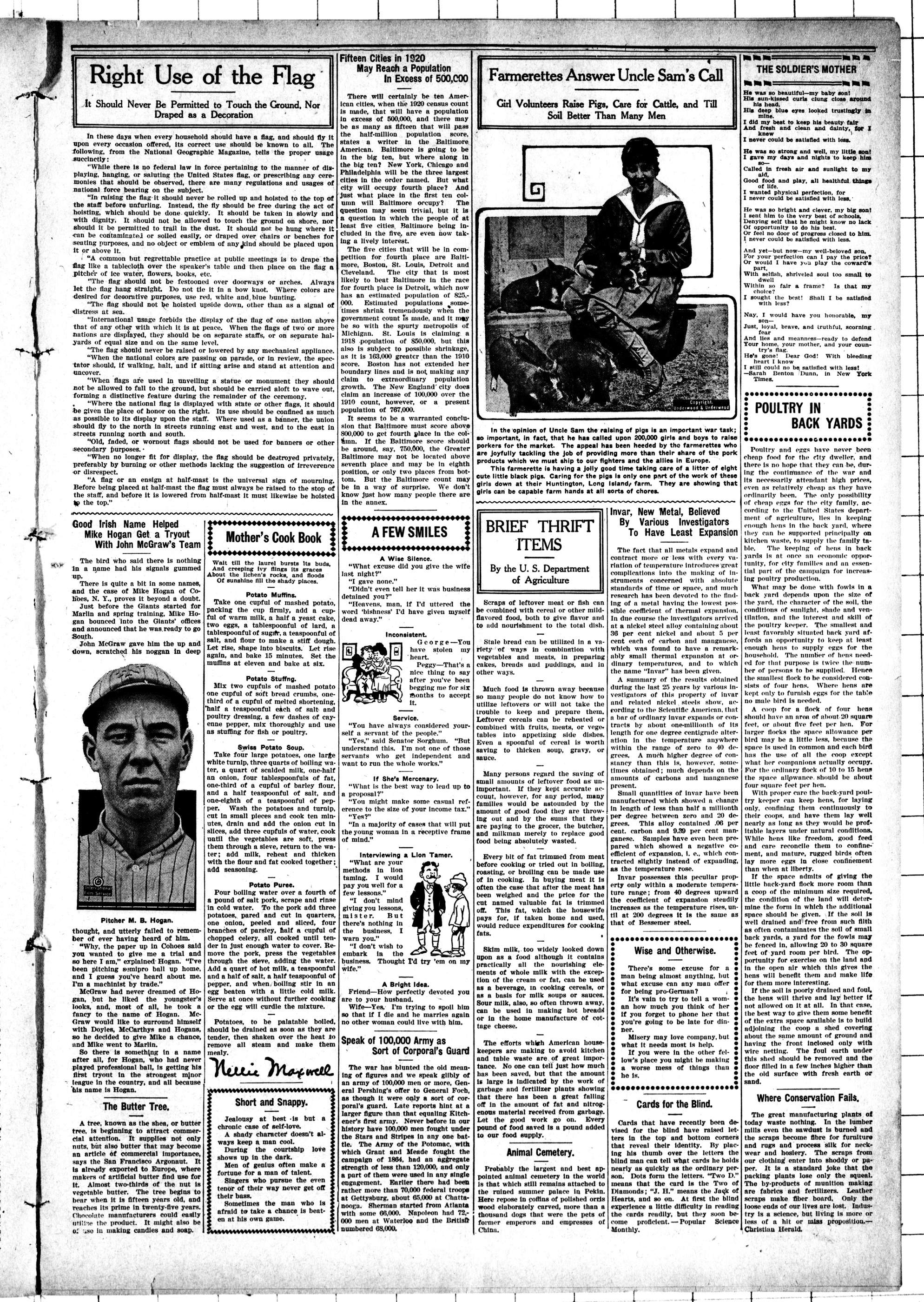
Girl Volunteers Raise Pigs, Care for Cattle, and Till Soil Better Than Many Men
Copyright
Underwood & Underwood
In the opinion of Uclean Sam the raising of pigs is an important war task; so important, in fact, that he has called upon 200,000 girls and boys to raise porkers for the market. The appeal has been heeded by the farmerettes who are joyfully tackling the job of providing more than their share of the pork products which we must ship to our fighters and the allies in Europe.
This farmerette is having a jolly good time taking care of a litter of eight cute little black pigs. Caring for the pigs is only one part of the work of these girls down at their Huntington, Long Island, farm. They are showing that girls can be capable farm hands at all sorts of chores.
By the U. S. Department of Agriculture
Scraps of leftover meat or fish can be combined with cereal or other mild-flavored food, both to give flavor and to add nourishment to the total dish.
Stale bread can be utilized in a variety of ways in combination with vegetables and meats, in preparing cakes, breads and puddings, and in other ways.
Much food is thrown away because so many people do not know how to utilize leftovers or will not take the trouble to keep and prepare them. Leftover cereals can be reheated or combined with fruits, meats, or vegetable tables into appetizing side dishes. Even a spoonful of cereal is worth saving to thicken soup, gravy, or sauce.
Many persons regard the saving of small amounts of leftover food as unimportant. If they kept accurate account, however, for any period, many families would be astounded by the amount of good food they are throwing out and by the sums that they are paying to the grocer, the butcher, and milkman merely to replace good food being absolutely wasted.
Every bit of fat trimmed from meat before cooking or tried out in boiling, roasting, or broiling can be made use of in cooking. In buying meat it is often the case that after the meat has been weighed and the price for the cut named valuable fat is trimmed off. This fat, which the housewife pays for, if taken home and used, would reduce expenditures for cooking fats.
Skim milk, too widely looked down upon as a food although it contains practically all the nourishing elements of whole milk with the exception of the cream or fat, can be used as a beverage, in cooking cereals, or as a basis for milk soups or sauces. Sour milk, also, so often thrown away, can be used in making hot breads or in the home manufacture of cottage cheese.
The efforts which American house-keepers are making to avoid kitchen and table waste are of great importance. No one can tell just how much has been saved, but that the amount is large is indicated by the work of garbage and fertilizer plants showing that there has been a great falling off in the amount of fat and nitrogenous material received from garbage. Let the good work go on. Every pound of food saved is a pound added to our food supply.
Animal Cemetery.
Probably the largest and best appointed animal cemetery in the world is that which still remains attached to the ruined summer palace in Pekin. Here repose in coffins of polished orris wood elaborately carved, more than a thousand dogs that were the pets of former emperors and empresses of China.
Invar, New Metal, Believed By Various Investigators To Have Least Expansion
The fact that all metals expand and contract more or less with every variation of temperature introduces great complications into the making of instruments concerned with absolute standards of time or space, and much research has been devoted to the finding of a metal having the lowest possible coefficient of thermal expansion. In due course the investigators arrived at a nickel steel alloy containing about 36 per cent nickel and about 5 per cent each of carbon and manganese, which was found to have a remarkably small thermal expansion at ordinary temperatures, and to which the name "Invar" has been given.
A summary of the results obtained during the last 25 years by various investigators of this property of invar and related nickel steels show, according to the Scientific American, that a bar of ordinary invar expands or contracts by about one-millionth of its length for one degree centigrade alteration in the temperature anywhere within the range of zero to 40 degrees. A much higher degree of constancy than this is, however, sometimes obtained; much depends on the amounts of carbons and manganese present.
Small quantities of invar have been manufactured which showed a change in length of less than half a millionth per degree between zero and 20 degrees. This alloy contained .06 per cent. carbon and 9.39 per cent manganese. Samples have even been prepared which showed a negative coefficient of expansion, i.e., which contracted slightly instead of expanding, as the temperature rose.
Invar possesses this peculiar property only within a moderate temperature range; from 40 degrees upward the coefficient of expansion steadily increases as the temperature rises, until at 200 degrees it is the same as that of Bessemer steel.
Wise and Otherwise.
There's some excuse for a man being almost anything, but what excuse can any man offer for being pro-German? It's vain to try to tell a woman how much you think of her if you forget to phone her that you're going to be late for dinner. Misery may love company, but what it needs most is help. If you were in the other fellow's place you might be making a worse mess of things than he is.
Cards for the Blind.
Cards that have recently been devised for the blind have raised letters in the top and bottom corners that reveal their identity. By placing his thumb over the letters the blind man can tell what cards he holds nearly as quickly as the ordinary person. Dots form the letters. "Two D." means that the card is the Two of Diamonds; "J. H." means the Jaqk of Hearts, and so on. At first the blind experience a little difficulty in reading the cards readily, but they soon become proficient. —Popular Science Monthly.
He was so strong and well, my little son
I gave my days and nights to keep him
so-
Called in fresh air and sunlight to my
aid.
Good food and play, all healthful things
of life.
I wanted physical perfection, for
I never could be satisfied with less.
He was so bright and clever, my big son!
I sent him to the very best of schools.
Denying self that he might know no lack
Of opportunity to do his best.
Or feel no door of progress closed to him.
I never could be satisfied with less.
And yet—but now—my well-beloved son,
For your perfection can I pay the price?
Or would I have you play the coward's
part.
With selfish, shriveled soul too small to dwell
Within so fair a frame? Is that my choice?
I sought the best! Shall I be satisfied with less?
Nay, I would have you honorable, my son—
Just, loyal, brave, and truthful, scorning fear
And lies and meanness—ready to defend
Your home, your mother, and your country's flag.
He's gone! Dear God! With bleeding heart I know
I still could no be satisfied with less!
-Sarah Benton Dunn, in New York Times.
POULTRY IN
BACK YARDS
Poultry and eggs have never been cheap food for the city dweller, and there is no hope that they can be, during the continuance of the war and its necessarily attendant high prices, even as relatively cheap as they have ordinarily been. The only possibility of cheap eggs for the city family, according to the United States department of agriculture, lies in keeping enough hens in the back yard, where they can be supported principally on kitchen waste, to supply the family table. The keeping of hens in back yards is at once an economic opportunity, for city families and an essential part of the campaign for increasing poultry production.
What may be done with fowls in a back yard depends upon the size of the yard, the character of the soil, the conditions of sunlight, shade and ventilation, and the interest and skill of the poultry keeper. The smallest and least favorably situated back yard affords an opportunity to keep at least enough hens to supply eggs for the household. The number of hens needed for that purpose is twice the number of persons to be supplied. Hence the smallest flock to be considered consists of four hens. Where hens are kept only to furnish eggs for the table no male bird is needed.
A coop for a flock of four hens should have an area of about 20 square feet, or about five feet per hen. For larger flocks the space allowance per bird may be a little less, because the space is used in common and each bird has the use of all the coop except what her companions actually occupy. For the ordinary flock of 10 to 15 hens the space allowance should be about four square feet per hen. With proper care the back-yard poultry keeper can keep hens, for laying only, confining them continuously to their coops, and have them lay well nearly as long as they would be profitable layers under natural conditions. While hens like freedom, good feed and care reconcile them to confinement, and mature, rugged birds often lay more eggs in close confinement than when at liberty.
If the space admits of giving the little back-yard flock more room than a coop of the minimum size required, the condition of the land will determine the form in which the additional space should be given. If the soil is well drained and free from such filth as often contaminates the soil of small back yards, a yard for the fowls may be fenced in, allowing 20 to 30 square feet of yard room per bird. The opportunity for exercise on the land and in the open air which this gives the hens will benefit them and make life for them more interesting.
If the soil is poorly drained and foul, the hens will thrive and lay better if not allowed on it at all. In that case, the best way to give them some benefit of the extra space available is to build adjoining the coop a shed covering about the same amount of ground and having the front inclosed only with wire netting. The foul earth under this shed should be removed and the floor filled in a few inches higher than the old surface with fresh earth or sand.
Where Conservation Fails.
The great manufacturing plants of today waste nothing. In the lumber mills even the sawdust is burned and the scraps become fibre for furniture and rugs and process silk for neckwear and hosery. The scraps from our clothing enter into shoddy or paper. It is a standard joke that the packing plants lose only the squeal. The by-products of muntion making are fabrics and fertilizers. Leather scraps make fiber board. Only the loose ends of our lives are lost. Industry is a science, but living is more or less of a hit or miss proposition.—Christian Herald.
PUBLISHED EVERY FRIDAY BY
CHARLES SUMNER SMITH,
Minneapolis, Minnesota.
Entered in the Post Office at Minneapolis as second class matter.
MEMBER
NATIONAL NEGRO PRESS
ASSOCIATION
Subscription by Mail, Postpaid.
ONE YEAR ..... $2.00
SIX MONTHS ..... $125
THREE MONTHS ..... .65
ADVERTISING RATES.
One Inch—1 Insertion—One Dollar.
Liberal discount given on 3, 6, 9,
Months, or 1 year contracts.
We do not run free ads, or over-run the time contracted for by our advertisers We respect their right to advertise at intervals, and rather have them do so, than to run continuously an "adv." and an increasing account. Write all Checks payable to
Call at 1317 6th Ave. N. on Wednesday to insure matter for publication. The Star's Phone, Hyland 1205. Send your subscription. Our prices have not changed because of the war. Let your dollar do its duty and The Star will reach a higher standard of service and better circulation.
If President Wilson would take the same interest to prevent the lynching of Negroes, that Attorney General Gregory did to indict the murders of Albert Praeger, a German-American recently lynched in Illinois, every Negro would not hesitate to make every possible sacrifice to win this war. However, our President condones the wrongs against real Americans by his cruel silence.
OUR UNCHANGED POLICIES.
Now that the candidates for office are entering the race in the coming primaries, and The Twin City Star has always taken an active part in discussing the political situation and presenting the issues of the campaign; it will try to maintain its former policies of giving a fair expression of the attitude of all office-seekers, so far as the Negro is concerned; It does not (for revenue only) write up every candidate as "a friend of our race" or "the right man in the right place." It gives each the advantage of the columns under "paid advertisements."
The Twin City Star intends to expose any candidate whose record has been against the Negro. Its editor has a fair knowledge of the history of several campaigns and has made a study of the value of the Negro vote. He is not bound by any individual or party, and has stood, at all times, for the political recognition of Negro voters. The Twin City Star is a paper with a worthy purpose, recognized by its readers as a reliable source of information, an intelligent and fearless advocate for equal rights for all men.
We have never known two injustices to make anything right. The Saturday News has prospered by being as just to the white man as it has ever been to the Negro. We have never gone off half-cocked upon any proposition. Whenever we grope, we are in search of the truth. We want to be right and avoid as nearly as possible being wrong. We are not for the Negro right or wrong. We want him to be right. We complain because a majority of white people will always side with a white man when a question arises between him and one of our color; still certain colored newspapers, without making any investigation whatsoever as to the evidence, would have the entire Negro race do identically what they condemn the white people for doing. Be cause the white people do wrong is no reason why the Negroes should do wrong. The best preparedness to receive justice is to be just yourself. —Hopkinsville (Ky.) News.
We are living in an age and an epoch which is characterized by a growing and insistent demand for justice and democracy. The United States is sending men, money and munitions to the battle fields of Europe as its demand for justice, freedom and equality of opportunity for all peoples, and it would be well for the Americans at this time to remember that here in our own country for the past fifty years since the abolition of slavery, is a race loyal, patriotic people who are not enjoying at the hands of this government here at home the principles of that democracy for which we are fighting to make the world safe, and in which fight God helping us, we will be victorious.
READ THIS CAREFULLY.
If you receive a newspaper by mail and do not wish to pay for it, just refuse it by informing your postman. Then it will be returned to the publisher and he will be notified to discontinue sending it. There is no reason why a person should pay for a paper forced on them, but every reason why it should be paid for when ordered and accepted.
SUBSCRIBE FOR THE STAR.
E. J. CONROY CANDIDATE FOR MAYOR.
Always a friend of the Worker, it will be interesting to the Trades Unionists of Minneapolis to know that Mr. Conroy was a member of the old Knights of Labor, acting as a delegate from the Plasterers' Union, and while acting in that capacity met with many old time Union men of the vicinity, who formulated the plans that have since been recognized as the nucleus of the present Trade Union movement. In 1892 Mr. Conroy was elected County Commissioner, in which capacity he served 8 years, acting as chairman of the Board for 4 years of that time, and as Chairman of the Board served as member of the Tax Levy Board, for 4 years.
Mayor Haynes selected Mr. Conroy to act as Chief of Police during the years 1903-4, and it is generally conceded that while acting in that capacity he gave much of his time and energy to the welfare of the community. Following this in 1906 he was elected Alderman from the Second Ward, and served 4 years in the City Council, and took active part in the field against the General Electric Company's proposed franchise, which ultimately resulted in reducing the electric lighting rates one-half from the former rate.
He also assisted in framing the present Gas Light- Company franchise. In 1898 Mr. Conroy, as a member of the Board of County Commissioners, introduced a resolution providing that all County printing bear the label of the Printing Trades Council, which was finally passed after a bitter fight from those on the Board opposed to the resolution. During the millers' strike of 1904, as Chief of Police he handled the situation so conservatively and successfully as to receive many words of commendation from prominent members of Organized Labor.
(Prepared and inserted by Geo. P. Douglas, First Natl. Soo Line Bldg., for E. J. Conroy.)
BUY A BOND.
S.
CONGRESS
MEMBER LEGISLATIVE SESSIONS
1901-1905-1909-1911-1917.
SUPPORTED FOLLOWING MEASURES:
Inheritance Tax
Civil Service Law
Firemen's Pension
Child Labor Laws
Public Welfare Bill
Teachers' Pension
Office: N. W. Main 2658.
Prepared and circulated by I. M.
Cavanagh in behalf of W. D. Washburn, for which $5.00 is to be paid.
"ENLIST OR WORK" CAMPAIGN.
The military authorities intend to push the enlist or work campaign among the Negroes. There are many idlers who have no lawful means of support. They will be drafted into the industrial army. Get work, gentlemen of leisure, even if as a side line.
It is a good thing for more of our people to apply for some of the patriotic positions open to them, then we would not have so many complaints about "not being wanted"—instead, we find them ready to take advantage of any effort made by others to advance the race, to secure money or position for themselves.
Are you a delinquent subscriber? If so, why not send your subscription?
AGENTS WANTED—NOW!
Reliable and intelligent agents always wanted to solicit business for THE TWIN CITY STAR; also correspondents in principal cities. A chance to earn a good living. Write The Twin City Star, Minneapolis.
SMOKE THE RELIABLE
SIGHT DRAFT CIGAR
THE TWIN CITY STAR, MINNEAPOLIS, MINN.
1937
Was born in Red Wing, Goodhue County, Minnesota. He is a candidate on the Republican Ticket to succeed himself as Railroad and Warehouse Commissioner. He was appointed November 15th, 1917, for the unexpired term ending December 31st, 1918. He is a graduate of the University of Minnesota, and has practiced law for nine years.
NEGRO RIVETER BREAKS RECORD AND RECEIVES PRIZE
A gang of negro riveters working at Sparrows Point, Md., in the plant of the Bethlehem Steel Corporation broke the world's record for driving rivets. One of the gang, Charles Knight, drove 4,875 three-quarter inch rivets in a nine-hour day. The previous highest record was 4,442 made by a workman in a Scottish shipyard. This is the way the Negro is demonstrating his patriotism at home while his brothers in black in the army are showing it in France. Mr. Knight is a highly respectable and industrious citizen of Baltimore, a native of Virginia.
Telegrams announcing the new record were sent to Mr. Chas. M. Schwab, Director-General for the Fleet Corporation and other officials connected with shipbuilding. If a bridge of ships will enable our soldiers to go over, to be fed and our allies to have supplies, the Negro will have a large share in building these ships. Mr. Knight is one of thousands of negro shipworkers. At Newport News Yards alone there are about 8,000 employed. Commenting on this performance of work the Washington Times of May 18 said: Not many months ago German propagandists were spreading the story that the colored people of the South, even as far North as this city, were preparing to revolt against the Government and do what they could to hinder the work of the war.
Day before yesterday there was a revolution, but it was not the kind the Germans planned. Charles Knight, colored, and seven colored helpers, turned upside down every record that had ever been made for driving rivets into the hulls of ships.
That is the kind of a revolution the colored men of this country are carrying on.
That is the kind of a revolution they may be depended on to carry on to the end of the war.
Foreman Knight set an excellent example of efficiency to every citizen of the country, whether he be black or white.
Lord Northcliffe awarded Knight $125.00, the first international prize for the best score above all previous records. Knight will attempt to set another mark.
CLASSIFIED ADVERTISEMENTS
EVERY DAY is BARGAIN DAY at the ROOT & HAGEMAN STORE, 407 Nicollet Ave.
SEE McDEW! for real estate.
FURNITURE FOR SALE.
15 sq. yds. linoleum, $3.50; 1 Moore Range with water front, $12.50; 1 Eclipse Waterheater, $8.50; 1 Round Oak heater, $7.00; 2 Perfection Oil Heaters, $2.50 and $4.00; 6 doz. fruit jars at 35c a doz.; 1 White Enameled Dresser. $8.00; 1 bed, complete, Way Saglew Spring and A No. 1 Cotton Mattress, $8.50. Call So. 6434 or 1907 4th Ave. So.
Two light housekeeping rooms for rent, near business district, on car line. Comfortably furnished. Also one single room for $2.00 per week. Call Drexel 3967.
A desirable flat, good location, all modern, conveniently located near car line. pply Jno. S. Wright, Main postoffice. Call N. W. Orchid 19-W.
THE SUNDAY FORUM
The regular meetings of the Minneapolis Sunday Forum are held bi-monthly as follows:
First Sunday Each Month.
St. Peter A. M. E. Church, 22d St.
between 9th and 10th Aves.
Third Sunday Each Month.
Bethesda Baptist Church 1122 8th St. So.
The public always invited.
Exercises begin at 3:30 p. m.
The South Side Barber Shop is now located at 212 11th Ave. So.
Wanted—Subscribers to Pay.
If a man has too much iron in his blood he may turn to steal.
Know of a man so stuck on himself that he struts in his sleep.
Thrift stamps will help stamp kaiserism out of a troubled world.
When lovely woman stoops to folly, 'tis time for man to scoot, by golly!
Some women are never perfectly happy unless they are perfectly miserable.
Leaves have their time to fall but fall never seemed to know when it was time to leave.
Nothing in the world speaks with more authority than a woman who has had three husbands.
Even if a woman has the best husband on earth it is no sign that she will meet him in heaven.
Women are not so blamed smart. Only about one in five knows how to put up her own hair.
When it comes to fighting for democracy Uncle Sam appears to be the capable party who can go it a loan.
He is as cheerful as sausage soup.
The weather clears off like flour soup.
You have dished out your soup and now you must eat it.
You marry? Why, you don't know how to make water soup.
She must have had giggle soup today. (Of a girl who cannot stop laughing.)
If I did such a mean thing I should have to eat it with my soup every day.—Boston Transcript.
SCIENCE JOTTINGS
The sycamore tree bears fruit after 20 years' growth.
The manufacture of porcelain pyrometer tubes is a new industry.
Alcohol when pure is greenish in color, while water is distinctly blue in shade.
A wireless station has been recently erected at Cape Juby, on the coast of Africa.
The Iceland coal fields will supply 180,000,000 tons of a quality equal to the Scottish coal.
Ammonia water which has been used for washing may be further utilized as a fertilizer for plants.
New Zealand is going extensively into the erection of concrete roads, because the cost of upkeep is so low.
A Belgian machine for digging canals will eat its way through the ground at a rate of 100 yards an hour.
The scrap and waste of the marble quarries at Rutland, Vt., is now made up into quicklime, hydrated lime and agricultural lime.
The residue of the indigo plant after the extraction of the indican, known commercially as indigo, is used in India as a fertilizer for tobacco.
SOME PEOPLE BELIEVE THESE
If the thumb and one finger do not meet around your wrist you are a glutton.
If it rains while the sun shines the saying is that the devil is whipping his wife.
Pick up a pin that lies crosswise in your pathway and you will have good fortune.
Small ears indicate that a person is stingy. Large ones show that he is generous.
When you move into a new house always send beforehand a loaf of bread and a new broom.
To allow a child to look into the mirror before it is a month old will cause it trouble in teething.
To rob a swallow's nest built in a fire house was held in the olden time to be a more fearful sacrilege than to steal a chalice from a church.
If you dream of falling and are awakened by the fancied jar of landing it is a sign you are going to be ill. If you awake while still in midair you will continue in good health.
STRAIGHT TIPS
One thing worse than a quitter is a chap who is afraid to begin.
Even the moral struggle is in need of a good many "range-finders."
Where you are treated best and grumble most.
Home is the blossom of which heaven is the fruit.
A world of strife shut out, a world of love shut in.
The best place for a married man after business hours.
The golden setting in which the brightest jewel is "mother."
The father's kingdom, the children's paradise, the mother's world.
The center of our affections, around which our heart's best wishes twine.
The place where the great are sometimes small, and the small often great.
A working model of heaven, with real angels in the form of mothers and wives.
The jewel casket containing the most precious of all jewels—domestic happiness.
Home is the coziest, kindliest, sweetest place in all the world, the scene of our purest earthly joys and deepest sorrow.
A popular paradoxical institution, in which woman works in the absence of man, and man rests in the presence of woman.
A hive in which, like the industrious bee, youth garners the sweets and memories of life for age to meditate and feed upon.
An arbor which shades when the sunshine of prosperity becomes too dazzling; a harbor where the human bark finds shelter in time of storm.
Home is a person's estate obtained without injustice, kept without disquietude; a place where time is spent without repentance, and which is ruled by justice, mercy and love.
POINTED PARAGRAPHS
Don't keep a good scheme on hand when it should be placed on foot.
The richer a man is the harder he tries to make people believe he is poor.
Two of the most bitter things in life are being jilted by a girl and a dose of quinine.
Eventually the meek may innerlit the earth—when Mr. Hohenzollern gets through with it.
A pawnbroker says it takes a man of nerve to pawn his umbrella in the course of a rainstorm.
Contentment is better than riches and the average man is too polite to want the best for himself.
The man who is content to wait for posterity to do him justice will not miss the bitter pangs of disappointment.
A hundred years ago men married younger than they do now—but women didn't object to doing housework then.
POOR RICHARD, JR.
A woodpecker maketh his living by knocking, but what excuse hath thee?
Friend, do not be too proud to tarry a moment with the humble. Even the Century Limited stoppeth at Tanktown.
The bantam becometh ferocious in a telephone argument, knowing full well that all men are the same weight in a battle over the phone.
The failure thinketh not of the acorns that groweth into oaks, but pondereth too long on the acorns that the hogs eat.—Philadelphia Record.
BRIEFES FROM BILLVILLE
The members of the literary club having enlisted for the war, there's more to eat around these diggin's now.
There's but one way to make a Georgia farmer believe that you mean business—and that's to "get back to the soil" with a hoe in your hand.
The objection to whale steak is, in the first place, that we're not where we can catch whales, and even if we should hook one, we're too poor to hire help to land it.-Atlanta Constitution.
JUST FACTS
Education has limits for everybody to reach, and men's educations are as diversified as their faces.
The reformer and the poet have cut their hair and lost must of their glory—and gained much good sense.
Man's religion is ever haunted with the superstition of paganism. Signs and omens make his life miserable.
NUTTY HOUSEHOLD HINTS
A coat of shellac on top of a pumpkin pie will prevent it from moulding.
A dish cloth made of rubber is much better than one made of cloth. Moths will, not touch it.
If you suffer from headaches or your eyes tire or blur the reading—Let me examine them, expert advice, and examination FREE. I duplicate any broken lenses made by me or anybody else.
PAEGEL
OPTOMETRIST-OPTICIAN
45 S. 6th St. Minneapolis
N. W. Cedar 8190 Res. Dale 8935
HAMMOND TURNER
Attorney at Law
Suite 321, American Nat'l Bank
Fifth and Cedar Sts.
St. Paul.
WORKING-MEN'S SOCIAL CLUB
FOR MEN ONLY
244 3RD AVE. S.
MINNEAPOLIS
SYLVESTER W. OLIVER &
BENJAMIN JONES
Managers
Phone Hy. 3605.
Dr. Ellis Burton
DENTIST
Graduate Northwestern Dental
School of Chicago.
715 Sixth Ave. No.,
Minneapolis, Minn.
Peterson, The Druggist 1501 Washington Ave. So.
TOILET ARTICLES, DRUGS
PRESCRIPTIONS.
He Solicits Your Patronage.
CHOICE CITY AND SUBURBAN PROPERTY FOR SALE ON SMALL MONTHLY PAYMENTS.
Houses and Flats for Rent.
B. M. McDew
802 Sykes Block.
N. W. Nic. 621 Minneapolis
T. S. Center 4639.
WALFRID WESTMAN
Photographer
1425 Washington Ave. So. Minn.
HAVE YOUR PIANO TUNED!
MY WORK GUARANTEED
HENRY R. MORGAN
711 Bryant Ave. No. Minneapolis
N. W. Hyland 5879
Office Hours: Sundays:
2 to 6 p. m. 10 to 1 p. m.
9:30 a. m. to 12:30 p. m.
R. S. BROWN, M. D.
Office 408-9 Tribune Annex
67 Fourth Street Soutr.
N. W. Main 2040. T. S. 38191
Res. 608 E. 14th St.
N. W. Main 2388 Minneapolis
Auto 34497
ORS. BROWN & BURGER
Chronic Diseases and Orthopraxy
10 South 3rd Street
Nic. 3555 Minneapolis
Nothing Changed But the Price
Nothing Changed But the Price
Sight Drafts Still the Same Fine Old Cigar You've Always Liked
When your dealer asks you six cents apiece for your old friend Sight Draft, don't get the idea that he is trying to put something over on you.
The plain truth of the matter is that our labor and other manufacturing costs have increased so much that we had the choice of cutting down the size of the Sight Draft cigar, using inhaler tobacco, or raising the price one cent.
We believed you would neither have the same old Sight Draft quality, the same old size, even if it cost you a penny more. So, from now on sight Drafts will be six cents.
Try a Sight Draft today. It's worth six cents, and you experienced smokers KNOW it in. W. K. Gresh & Sone, makers. W. S. Conrad Co., St. Paul, wholesale companies. — Advertisement
---
IMPORTANT NOTICE
Unless notes are written plainly and properly arranged they will not be inserted. Many people send in notes regardless of names, initials or composition. Arrangement by the publisher will be charged for. Free notices must be correctly written.
GRAND PUBLIC RECEPTION.
The National Association for the Advancement of Colored People will give a Grand Public Reception at Coliseum Hall on Lake Street near 27th Ave., Minneapolis, on June 4th. Watch for the Adv.
Secretaries of Lodges may send notices of their newly elected officers for free publication and office information.
Do not forget to send the money to the Star which you owe for subscriptions.
Sergt. Z. A. Pope, U. S. A., retired, is ill in the hospital at Ft. Snelling.
The preachers who are most active in political circles are not doing their share to make the Twin City Revival a success.
Miss Isabel Ford has returned to her home, 720 Bryant Ave. No., after being sick at University Hospital. She is improving rapidly.
Capt. Gale C. Hilyer of Company C of the Home Guard announces that Friday of each week will be the regular drill night of his company.
Mr. Joseph Young of 11th Ave. So made his annual trip to his home in Leavenworth, Kan., to visit his mother and relatives for Decoration Day.
Mr. Lee R. Wheeler, mgr. of the Porters' and Waiters' Club, is on a vacation, on account of illness. He is improving under care of Dr. Redd.
A DEPOSIT IS REQUIRED ON ALL POLITICAL ADVERTISEMENTS.
Mr. S. G. Franklin has been very ill at his residence with a severe cold.
Sergt. J. W. Harper, U. S. A., retired, came over from St. Paul last Monday night to look over the Home Guard and was well pleased with the sowing made.
Some of the Negro attorneys are boosting various candidates for County Attorney, hoping to be appointed as assistant. It is evident that they could not decide on one Negro applicant and one candidate. The Negro members of the bar should get together.
Those candidates, opposing present office holders, whose loyalty has been proven, by their records in and out of office, especially since we entered this war; are the most avowed pro-Germans and traitors. They are causing internal strife by trivial differences. Their opinions, merely mercenary and personal, are causing a sentiment, bordering on a revolution. Any effort to seriously divide the American people at this time is an act of treason. Such confusionists should be publicly denounced by a vote for the present incumbents or loyal opponents. The Star has said "Patriotism is the refuge of the professional politician."
COMPANY "D" DRILL.
The members of Company D, 16th Battalion, M. H. G., are ordered to report at headquarters in the city hall on Monday evening, beginning May 20th, and on each Monday thereafter until further notice, for company drill and instructions.
Charles Sumner Smith,
Captain Commanding Co. D.
N. A. A. C. P. NOTES.
Every employee of The Porters and Walters club has taken a membership in the N. A. A. C. P.
Hon. B. S. Smith and wife are leading the "drive" and expect to report 200 new members.
Minneapolis will go over the top with a large increase, caused by the energetic committee, making the Moorefield Storey Drive.
Ames Lodge of Elks at a recent meeting passed a resolution that every member be requested to become a member of the N. A. A. C. P. Several brothers are active members of that body.
SHERWOOD APPOINTED MAJOR.
Capt. Jose H. Sherwood of Company B. of St. Paul, was appointed Major of the 16th Battalion of Minnesota Home Guards, this week. Sergt. Robt. L. Robinson of Minneapolis was selected as Adjutant. Sergt. Geo. L. Hoag was made Battalion Supply Officer. Both rank as 1st Lieutenants. The Battalion is composed of Companies A. and B. of St. Paul, and C. and D. of Minneapolis. It is the first military unit of negroes in this state.
DR. FRENCH LEAVES FOR SERVICE.
Dr. John A. French, the St. Paul dentist, left Friday for Camp Funston, where he was called for war service.
THE FIRST ENTERTAINMENT
of Co. A. of St. Paul, Minnesota Home
Guard, will be given in June. Watch
for the Adv.
THE SUNDAY FORUM.
The Minneapolis Sunday Forum met last Sunday at Bethesda Baptist church. The meeting was well attended. A resolution was introduced by Editor Smith, to amend the bylaws, which would make the Forum a representative organization instead of a mass meeting. Atty. Scott strenuously opposed the resolution, which will be voted upon at a later meeting. Atty. Scott represented the minority. The principal address was delivered by Hon. Ori C. Hall of St. Paul who made an appeal for members for the N. A. A. C. P. Several new members were enrolled. Dr. Burton, the president, was absent on account of his wife's illness. Miss Sadie Marshall acted a temporary secretary. The election of officers will be held next month and Dr. Burton should succeed himself.
FLAG DAY PARADE
All organizations wishing to take part in the Flag Day Parade, will secure place in line by sending their names to Chas. Sumner Smith, 1317 6th Ave. No., who has been selected to arrange a Division. Invitations are extended to every military, civic, fraternal or social organization wishing to show their patriotism on June 14. The U. S. Flag will only be used as the Standards. Decorations of red, white and blue may be used for floats, etc.
SENTENCED TO PRISON.
Wm. Raspberry, a member of Engine House Co. o. 1, St. Paul, was sentenced from 1 to 7 years at hard labor in Stillwater prison for carnal knowledge of his stepdaughter. He pleaded guilty. Engine House Company is composed of all negroes and Raspberry was a skilled mechanic. He is a son-in-law of Mr. Steve Hopkins, Sr., the veteran railroda man.
MEMORIAL DAY PARADE.
Companies C. and D. of the Home Guard will take part in the Memorial Day parade. They will form on 6th St. So., right resting on 3rd Ave. So., at 2 p. m. All men are requested to assemble at Headquarters in the Court House at 1 o'clock p. m., and report to Adopt. Robt. L. Robinson.
SPECIAL SERVICE FOR WOMEN
Bethesda Baptist Church, May 26, 3:30 p. m.
Dr. Bray will be at Memorial Baptist Church from May 23 to 26, at Pilgrim Baptist Church from May 27 to 31; Dr. Ellington will be at St. Peter A. M. E. Chruch, Minneapolis, May 23 to 31.
THE TWIN CITY REVIVAL
Sunday services; May 26, Dr. Bray will preach, St. Paul, Zion Presbyterian, 11:00 a. m.; Memorial Baptist, 8:00 p. m. Dr. Ellington will preach, Minneapolis, Bethesda Baptist, 11:00 a. m., St. Peter Methodist, 8:00 p. m.
DECORATION DAY.
Let us not forget our departed dead
on May 30. This is the day set apart
annually for their remembrance.
Miss Sadie Monteen has recovered
from her recent illness.
Mr. and Mrs. L. R. Walker have
moved to 3537 4th Ave. So.
Mr. J. W. McMoore and family have
moved to 630 6th Ave. No.
Dr. W. Ellis Barton is the father of
a baby boy born this week. Mother
and baby are well.
Several men left Monday night for
Winnipeg to work on the Canadian
dining and sleeping cars.
Mr. John W. Mack of the Omaha Ry. will return home after two weeks in St. John's Hospital in St. Paul, where he underwent a minor operation, and is rapidly improving.
NEGRO LOYALTY MEETING
Wednesday evening, May 29, 1918, at Arcade Hall, 1311 Washington Ave. So. The audience will be addressed by the following speakers, viz: Thos. Van Lear, mayor, candidate for re-election.
Oscar Martinson, candidate for
sheriff.
A. R. Chestnut, candidate for county
attorney.
R. S. Wiggin, candidate for Municipal
judge.
Albert T. Bastin, alderman, for re-election.
Paid Announcement.
"THE KEYSTONE BUFFET OPENED.
The Keystone Buffet, which was closed on account of the death of its proprietor, late "Kidd" Mitchell, has been opened under the management of "Jimmy" Smith, former bartender and favorite of its patrons. Jimmy is making a successful start. He invites his friends and solicits the patronage of the public. Everything in the line of drinks is kept, and served in first class style. You need not follow the crowd, even if you're all alone; visit the Keystone.
Negroes subscribed to Third Liberty Loan in large numbers to help win the war.
THE TWIN CITY STAR, MINNEAPOLIS, MINN.
Veterans Always With the Boys in Spirit, Though They May Not March.
COMES the old-time feelin' at the beatin' o' the drum.
An' I'm sittin' in the sunlight
an' a-watchin' of 'em come!
An' I seem rejuvenated!—see the
old-time battle sky,
An' I'm one o' them same youngsters
—with the boys a-marchin' by!
Don't they keep step fine!
An' I'd give the world to jine!
(They's lots o' grayhaired fellers
that could form a battle line!)
The winds that wave the old flag seem to sing a battle song!
A man is sitting on a fence, watching a boy jumping over it. The man is wearing a hat and a coat. The fence is made of wooden posts and metal rails. There are trees and a hedge in the background.
An' the rifle on the rack there—must
I see it with a sigh,
My war days gone forever, an' the
boys a-marchin' by?
Keepin' step so fine—
How it thrills this heart o'
mine!
(An' lots o' grayhaired fellers that
would form a battle line!)
It isn't to the old brigades they're
handin' out the guns,
Though when it comes to trouble we
Though when it comes to trouble we are all the country's sons!
An' that's why I'm a-sayin', when the time's drawin' nigh,
I'm one o' them same youngsters—
with the boys a-marchin' by!
Don't they keep step fine!
An' I'd give the world to jine!
(They's lots o' grayhaired fellers
that would leap to battle line!)
—Frank L. Stanton, in the Atlanta
Constitution.
God made man to go by motives, and
he will not go without them, any more
than a boat without steam, or a balloon
without gas—Beecher.
Comte De Paris Knew and Loved Famous Soldier Who Gave His Life for His Country.
It was after the review that I made the personal acquaintance of the officers with whom I was to have the good fortune to fight for a cause which was already dear to me. All made me cordially welcome, but it was with Kearny that I found myself most at home. He it was who could speak to me of the French army in Algeria in 1840 and of the memories left by my family in that country. He did so in terms which deeply touched the heart of the exile, the son of the Duc d'Oriens, Kearny had participated in one of those campaigns on African ground which brought out strongly the merits of the French soldier. He had also associated himself with the triumphs of France in the Italian campaign of 1859.
His abrupt speech and imperious manner denoted a proud disposition, and a character incapable of flattery or of dissimulation. But though at first his manner was not always fitted to
In the praise and sympathy given so generously to wives and mothers of soldiers in this war, grandmothers are not often mentioned, but still, in France at least, the grandmother is the soul of the country, according to the foreign news service of the woman's committee of the council of national defense. "They are the women who gave to France the men at Verdun, and they are now making it possible abroad for the women to take the men's places in factory and business,
Memorial Day Finds the Nation Battling for Freedom of the Whole World.
MEMORIAL DAY was born of a war fought that this nation, under God, should have a new birth of freedom, and that government of the people, for the people and by the people shall not perish from the earth."
A half a century and more has passed since that immortal utterance. Now the nation is again in arms, to fight that "the world may be made safe for democracy."
Then, the young republic, struggling upward toward its vision of freedom, learned through the bitter travail of Civil war that the nation could not exist half slave and half free. The vision has broadened with the widening years. Then it was for the freedom of a race the nation fought. Now the sword is drawn for the imperiled liberty of the world.
The natal day of our independence we have been wont to celebrate with loud acclaim and vaunting pride Memorial day ever has been our time for solemn contemplation. Another Memorial day is at hand, and as America lays its flowers on the graves of its soldier dead, it hears again that revered voice from the slopes of Getsburg bidding us to be not unmindful that "it is rather for us to be here dedicated to the great task remaining before us, that from these honored dead we take increased devotion to that cause for which they gave the last full measure of devotion; that we here highly resolve that these dead shall not have died in vain."
A beautiful, a poetic symbolism Memorial day had come to be to us: The people who walk with slow steps in the quiet cemeteries, the children in their white dresses who with loving hands place wreaths "alike for the friend and the foe," the venerable men who are the links that bind us to an age long gone, and, as we believed, forever gone, when nation warred with nation and blood lust grew in hearts that had thrilled at the sight of the same flag.
And now with what a new and sudden significance has Memorial day been vested. With what different thought will they go "lovingly haden with flowers." How much more reverently than in those conventional days that already seem so far away will the little flags be planted on each patriot mound. And who is there, when taps, clear and soft as a benediction, is sounded for those who "dream of battlefields no more," will not remember that on a neighboring hill on the morrow from that same silvery bugle will leap the revelille for another generation of freedom's soldiers?
If solemn memories of the past and earnest thought for the future bring that new birth of freedom, who shall say that those have died in vain for whom flowers will be spread in far Memorial days to come?
The Heroic Dead.
And so Memorial day is here again, and we lift up our eyes and behold the hosts gathering all over this land and marching to the cemeteries. They are bringing flowers—wreaths and pillows and crosses. These are tokens of a nation's love and emblems of a nation's gratitude. We honor the Northern and the Southern dead today, and with one hand put a wreath on the Federal, while with the other we put a similar wreath on the Confederate graves.—Christian Advocate.
Three Kinds of Good.
There are three kinds of good in the world—getting good, doing good and being good. The first is animal, the second human and the third divine.
attract, one soon learned to appreciate the noble qualities of his heart, the firmness of his will, the accuracy of his judgment, the truthfulness and grandeur of his soul.
If he did not spare his soldiers at the decisive moment, he spared himself still less, and by his example obtained from his followers truly heroic efforts.
—Philippe, Comte de Paris, in The Century.
IN MEMORY
The flags are flown half-mast today,
The bugle's note is still;
We celebrate the fame of those Who rest upon the hill.
They fought and conquered; honor be
To those who bravely died
That freedom might prevail with us,
And peace with us abide.
to be the breadwinner or the children.
It is the women of the last generation
who are taking care of the little children,
caring for them while the mothers are at work, arranging for or superintending their education, being, at advanced age, mothers all over again for the good of their country."
Natural Astonishment.
"This is so sudden!"
"Do you mean his proposal?"
"No; the way I got the connection as soon as I rang up."
FIRST ANNUAL ENTERTAINMENT
UNDER THE AUSPICES OF THE Minneapolis Branch OF THE
National Association
Advancement of C
COLISEUM
Corner Lake Street and
Monday Evening,
McCullough's 7 P
Come oue come all a
Grand Promenade 9:30
Admission
National Association for the
Encement of Colored Peo
COLISEUM HALL
Corner Lake Street and 27th Ave. South
Day Evening, June 3rd,
Bullough's 7 Piece Orch
come one come all and enjoy the eve
onade 9:30 Special Street
Admission 50c
National Association for the Advancement of Colored People
Corner Lake Street and 27th Ave. South
Monday Evening, June 3rd, 1918
McCullough's 7 Piece Orchestra
Come oue come all and enjoy the evening
Grand Promenade 9:30 Special Street Car Service
BROWN S. SMITH, President
NEGRO LOYALTY
WEDNESDAY EVENING
AT ARCADE HALL, 1311 W
THE FOLLOWING SPEAKER RS
MAYOR THOS. VAN LEAR, Candi da
OSCAR MARTINSON, candidate f or
ATTY. A. R. CHESTNUT candida te
ATTY. R. S. WIGGIN, candidate f or
ALDERMAN ALBERT BASTIS, cand
ALL SIXTH WARD VOTERS R
COMMITTE: B. Berry, J. J. Ro be
Hennepin L
NO LOYALTY MEET
EDNESDAY EVENING, MAY 29, 1918.
CADE HALL, 1311 WASHINGTON AVENUE
LOWING SPEAKERS WILL BE P
VAN LEAR, Candidate for Mayor.
NSON, candidate f or sheriff.
BESTNUT candidate te for County Attorneys.
GGIN, candidate f or Municipal Judge.
BERT BASTIS, candidate for re-electi
TH WARD VOTERS REQUESTED TO BE
: B. Berry, J. J. Roberts.
nepin Lumber
NEGRO LOYALTY MEETING
NEGRO LOYALTY MEETING
AT ARCADE HALL, 1311 WASHINGTON AVE. SO.
THE FOLLOWING SPEAKERS WILL BE PRESENT.
MAYOR THOS. VAN LEAR, Candidate for Mayor.
OSCAR MARTINSON, candidate f or sheriff.
ATTY. A. R. CHESTNUT candida te for County Attorney.
ATTY. R. S. WIGGIN, candidate f or Municipal Judge.
ALDERMAN ALBERT BASTIS, candidate for re-election.
ALL SIXTH WARD VOTERS REQUESTED TO BE PRESENT.
COMMITTE: B. Berry, J. J. Roberts.
Hennepin Lumber Co.
Hennepin Lumber Co.
226 Plymouth Building.
RETAIL LUMBER AND MILL WORK
We Finance Buildings.
Also all Kinds of Insurance through
ARTHUR P. SMITH CO.
Office Phones—Main 2869; Auto 36774.
Twenty Elegant Steam-Heated ar
A la Carte Meals at All Ho
STEWART'S
Elegant Steam-Heated and Electric Lighted a Carte Meals at All Hours-Popular Prices WART'S HOT
Twenty Elegant Steam-Heated and Electric Lighted Rooms. A la Carte Meals at All Hours—Popular Prices.
J. Ed. Stewart, Prop.
246-250 FOURTH AVE. S.
Private Dining and Reception Rooms
ance Beverages. Men's Buffet and O
Connection.
N. W. Main 5040
Ladies' Work Given Special Attention
livered to Any Part of the O
JAMES E. COMBS I
TAILOR
Our Motto: "PRO
French Dry Cleaning, Dyeing,
High Grade Work
809 Fourth Ave. So.
550 FOURTH AVE. S., MINNEAPOLIS,
Cleaning and Reception Room for Ladies. Speci-
ca. Men's Buffet and Grill; Billiards; Bar-
140
Given Special Attention. Work Called
to Any Part of the City. One Day So
COMBS BROS. H
TAILORS
Our Motto: "PROMPTNESS"
Dry Cleaning, Dyeing, Repairing and
High Grade Work a Specialty.
H Ave. So. Minneapolis M
246-250 FOURTH AVE. S., MINNEAPOLIS, MINN. Private Dining and Reception Room for Ladies. Special Temperance Beverages. Men's Buffet and Grill; Billiards; Barber Shop in Connection.
Ladies' Work Given Special Attention. Work Called for and Delivered to Any Part of the City. One Day Service.
JAMES E. COMBS BROS. HAROLD C.
TAILORS Our Motto: "PROMPTNESS"
French Dry Cleaning, Dyeing, Repairing and Pressing
High Grade Work a Specialty.
809 Fourth Ave. So. Minneapolis Minnesota.
A SPECIAL NOTICE.
N. A. A. C. P.
All authorized solicitors for the Moorfield Storey Drive for new members for the National Association for the Advancement of Colored People have been furnished receipt books of the association signed by the local secretary. Get a receipt when you pay your dollar. R. Augustine Skinner. Local Sec.
THE FORUM MEETS SUNDAY.
THE TWIN CITY REVIVAL.
The Twin City Revival will be conducted during this month. Rev. W. S. Ellington of Nashville, Tenn., and Rev. H. F. Bray of Chicago, will hold meetings in both cities.
Send us your subscription in stamps, check or postal order. Do it now!
---
Association for the Colored People
M HALL
and 27th Ave. South
June 3rd, 1918
Piece Orchestra
and enjoy the evening
Special Street Car Service
ion 50c
R. AUGUSTINE SKINNER, Sec.
L TY MEETING
WING, MAY 29, 1918.
WASHINGTON AVE., SO.
ERS WILL BE PRESENT.
candidate for Mayor.
or sheriff.
ate for County Attorney.
or-Municipal Judge.
candidate for re-election.
REQUESTED TO BE PRESENT.
berts.
Lumber Co.
174. Dining Room—Main 2831.
and Electric Lighted Rooms.
Hours—Popular Prices.
'S HOTEL
Chas. Brody, Mgr.
S., MINNEAPOLIS, MINN.
Room for Ladies. Special Temper-
d Grill; Billiards; Barber Shop in
Antion. Work Called for and De-
e the City. One Day Service.
BROS. HAROLD C.
LORS
"PROMPTNESS"
ing, Repairing and Pressing
ark a Specialty.
Minneapolis Minnesota.
THE KEYSTONE BUFFET
(Formerly "Kid" Mitchell's)
Now under new managenent of
JIMMY SMITH
1313 Washington Ave So.
Main 2259 Minneapolis
ELKS INITIATION.
Ames Lodge will conduct their regular initiation on May 28th and June 25th.
Sergt. John W. Harper, U. S. A. retired, is home again from a winter visit to Zanesville, Ohio. He is accompanied by his wife. They reside at 548 Aurora Ave., St. Paul.
The Twin City revival began May 15th, with good prospects.
Auto. 37032
"When"and"If"
By R. RAY BAKER
(Copyright, 1918, by the McClure Newspaper Syndicate.)
Arfur Calkins had dark gray eyes; a job as day clerk in the Winton hotel, wavy, light brown hair, no parents, a care-free nature, two hundred thousand dollars—almost—and two prospective brides.
The gray eyes he acquired from his mother, the brown hair from his father, the sunny disposition from both.
He obtained the hotel job when grief over the death of Mrs. Calkins claimed her husband three months after her demise. That was when Arthur was twenty-four. The two hundred thousand dollars was bequeathed to Arthur by his father—"when" and "if." The young man was to receive the small fortune on his twenty-seventh birthday anniversary, if by that time he was married to Winfred Sheldon, daughter of Herbert Sheldon, who had found some half million profit in lumber. Mr. Calkins stipulated in the will that his son was not to get the inheritance unless he had lived on his own resources up to his twenty-seventh birthday and unless Sheldon had become his wife, provided, it was stated in the document—Miss Sheldon herself did not break the engagement.
Arthur had become bethrothed to her on the day he cast his first vote, and his parents had approved so heartily that the "if" clause was put in the will in an attempt to seal the bargain. To what extent Arthur considered the clause as sealing was shown when, in his twenty-sixth year, he asked Miss Geraldine Fox, a cafeteria cashier, to become his bride.
Now, Arthur was by no means a trifler or a crusher of maiden's hearts, at least not intentionally. He felt that he was sincere in both cases. He believed in the doctrine that no man can love more than one woman at a time, besides his mother, but he was having difficulties in deciding which of these particular two—both of them decidedly attractive girls—was the one.
Tuesdays and Thursdays he called on Miss Sheldon and on Wednesday and Fridays he paid visits to the home of Miss Fox. All of his wooing was done in the evening, of course, for he was obliged to sit behind the hotel desk seven days a week. As the two ladies lived in different cities, about sixty miles apart, and as they moved in distinctly different social circles, neither became aware of the existence of a rival.
Nor was Miss Fox or her widowed mother cognazant of that marriage clause in the Calkins will. Arthur felt that he would find means to "get rid" of Miss Sheldon if he finally decided in favor of Miss Fox. There was some way, he told himself, to arrange it so Miss Sheldon would break the engagement.
Arthur lived in Lansing, while the Sheldons' home was in St. Johns, a small city about twenty miles north, and the Foxes resided in Jackson, a fairly good-sized municipality somewhat smaller than Lansing, and approximately forty miles south of the latter place.
At the time this story opens Arthur was getting worried. One reason was that it was nearing the time when he must marry Miss Sheldon or else the two hundred thousand, held in trust by Benjamin Trueman, a lifelong friend of Mr. Calkins, would go to charity. Another reason was that the subject of announcing engagements had been hinted several times of late by both the Sheldons and Foxes.
Thus matters stood one morning when Arthur walked into the hotel, went behind the desk, hung up his coat and hat, stuck a pencil behind his ear, glared at the bellboy dozing on a bench and received the greatest shock he had ever experienced before or after the death of his parents.
As he bent over the register his glance swept over—and then went back to—a folded newspaper that lay on the desk. A headline in the obituary column rose right up and smote him between the eyes. The top lines of the head were:
Benjamin Trueman.
Arthur stared duly at the paper without seeing a word for the space of several moments, then came to himself and perused the story which informed him that the aged attorney had been found dead in his office late the previous evening by a cleaning woman. The doctor, who was summoned, said heart failure had caused his death, and a letter, written the day before and left on the desk, showed that he had known of his condition and had had premonitions of his death. The letter said that he (Mr. Trueman) had lost every cent he possessed by speculation and that worry over this had caused the trouble that he felt would soon end his life.
Arthur felt genuinely sorry, because Mr. Trueman had been such a close friend of his father and also because he himself had been fond of the old man. It was not until later in the day, however, that he became apprehensive that his own destiny might be affected by Trueman's losses. It was suggested to him by the proprietor of the hotel. "It's to) bad boy," said the latter. "Old Trueman must have used up all that coin of yours. But don't worry
about the future; you can have this job as long as you want it."
"Thanks," Arthur responded, more dryly than gratefully, and went out to investigate. He learned that not a single valuable paper or cent of currency had been found in Mr. Trueman's office or in the adjoining apartments where the lawyer had led his lonely life. Arthur spent a restless night. He had been counting on that money, particularly as he anticipated becoming some one's husband—just whose was not yet to be determined.
In the afternoon he went walking in hopes of inhaling courage and hope along with fresh air. A short distance from the hotel he all but collided with a fashionably-dressed girl, who was swinging along with a haughty gait expressive of a do-you-know-who-I-am demeanor.
"Well, Art!" she cried in surprise, "How you startled me! I was just going to see you."
A smile lit up his face. Here was some one who could comfort him.
"Come ahead and see me, then," he suggested. "Till go back and I guess we can have the drawing room to ourselves."
She went, and he told her of the developments of the last twenty-four hours. For some reason, however, her enthusiasm over the engagement had vanished, and instead of the sympathy he had a right to expect all he received was a diamond ring he had presented to her a few weeks previously.
"I'm sorry," she said coldly, "but your position as clerk in the Winton.
wil.
Stared Dully at the Paper.
with no other prospects, makes it impossible for me to marry you. I have decided to accept the proposal of Eaton Gregory, who has asked me several times."
When she had taken her disdainful departure, Earl bowed his head in object misery and shed big, wet tears on a monogramed handkerchief. That handkerchief—one twelfth of a Christmas present—gave him an inspiration, and he acted on it, with the result that he was soon crawling out of town on an interurban local.
He arrived at the home of his fiancee, the only one he had left, late in the afternoon, and accepted an invitation to dinner.
"I won't reveal the disaster until I get food," he told himself, with the treatment from his other fiancee in mind.
"When the meal had been concluded and the two young people were alone, Arthur, with considerable misgivings, unfolded his tale of woe.
"I'm just a poor hotel clerk," he said with a choking voice, "so I've come to release you from our engagement."
There were tears in her eyes as she took one of his hands in both of hers.
"Why?" she inquired, on the verge of sobbing. "Don't you care for me any more?"
He felt dazed; this treatment was so different.
"Yes—yes," he replied, somewhat huskily, "but you don't want to marry me, now that I've got to work for small wages the rest of my life."
She wiped her eyes with a tiny piece of silk and then looked ardently into his grey ones.
"Arthur Calkins," she said earnestly, "I don't care for your money. I marry you if you didn't have any job at all, and take in washing, if necessary, to support us. Fortunately," she added, "that won't be necessary."
That night, when he returned to the hotel, Arthur Calkins found a letter awaiting him. It had been written by Lawyer Trueman just before his death and had been delayed in the mail. One paragraph said:
"My Dear Friend:—Now that I feel my strength going, I want you to know that I remained faithful to my trust. You will find the two hundred thousand dollars inheritance in negotiable bonds, made out in your name, if you will pry up the board under the left leg of the foot of the bed in my room."
So Arthur Calkins fulfilled all the terms of his father's will; for, you see, Winifred Sheldon had turned out to be the right kind of a real girl in spite of her parents' money, while Miss Fox—well, sometimes there is something in a name.
Styles Never Change.
From fresco paintings of women in the Cretan palaces of about 2000 B. C. it is learned that the women of that time pinched in their waists, wore elaborate coifresses, shoes with high heels and hats which might have come from a Parisian hatshop.
The Housewife and the War
(Special Information Service, United States Department of Agriculture.) SOME QUICK BREADS THAT SAVE WHEAT.
THE BROWNIE
Plate of Palatable and Attractive Muffins Made Without the Use of Any Wheat Flour.
EAT HOT BREADS AS WAR MEASURE
Use of Substitutes Will Do Much to Relieve Wheat Situation and Aid Allies.
SOME GOOD THINGS TO EAT
Biscuits, Muffins, Waffles and Griddle Cakes Are Better Than Yeast Bread—Will Tickle Palate and Satisfy Stomach.
Biscuits, muffins, griddle cakes, waffles—use these in place of yeast bread and save wheat. To make a yeast bread of good texture some wheat flour must be used to furnish the gluten necessary for this form of leavening. Quick breads leavened with baking powders or sour milk, or cream of tartar with baking soda, do not need this gluten, so we can use other cereal flours that do not contain gluten for them. Barley flour, corn flour, cornmeal, buckwheat flour, oatmeal, sweet potato flour, kafir, and feteria meal—all such can be used for quick breads. Their use will do much to relieve the wheat situation, as they require no wheat. They are delicious, too, so when you serve your family with hot breads made from the wheat substitutes you help your country and the allies, and at the same time furnish your family with good things to eat.
For hot biscuits almost any of the substitute flours can be used, using the same amount of shortening and baking powder as for wheat biscuit and enough liquid to make a dough of the right consistency for rolling. Half corn flour and half cornmeal makes a good biscuit or half cornmeal and half peanut meal. This barley drop biscuit is delicious:
Barley Drop Biscuits.
2 cupfuls barley 1 cupful milk.
flour. 4 tablespoonsfat.
6 teaspoonfuls bak- 1½ teaspoonfuls salt.
ing powder.
Baked in a sheet this makes a good shortcake, buttered and served with fresh crushed berries or other fruit.
When soy-bean meal or peanut meal are used the fat should be reduced, as both of these contain much fat.
For muffins the standard recipe can again be used, substituting the other flours in place of all or part of the wheat flour. Rolled oats can be put through a food grinder and used as any other flour or meal in quick breads. Here is a delicious muffin made from oatmeal and corn flour:
Oatmeal-Corn Flour Muffins.
1 cupful oatmeal. 4 teaspoonfuls baking powder.
1 cupful corn flour. 1 tablespoonful melted eggs.
2 eggs. 1 tablespoonful fat.
These muffins made from corn flour and boiled rice or boiled hominy grits are also delicious:
**Muffins.**
1 cupful cold boiled 1 egg.
hominy grits or 2 teaspoonfuls bak-
bolled rice or powder.
1½ cup sweet milk. ½ teaspoonful salt.
1¼ cupcake corn 1 tablespoonful melt-
flour.
Grilldle cakes and waffles are always popular. Buckwheat cakes made with baking powder in place of the old-
fashioned yeast-raised buckwheat cakes are very good.
**Buckwheat Cakes or Waffles.**
1½ cupful of buck- 1½ cupfuls milk.
wheat flour. 2 eggs.
3 teaspoonfuls bak- 1 tablespoonful melting powder.
1 teaspoonful salt.
Corn flour, barley flour, or one-half corn flour and one-half peanut meal or sweet potato flour can be used in the following recipe to make delicious, crisp, brown waffles:
Waffles.
1½ cupfuls milk. 2 cupfuls flour.
2 eggs. 3 teaspoonfuls bak-
3 tablespoonfuls fat. ing powder.
1 teaspoonful salt.
Get acquainted with the delicious quick breads that can be made without wheat flour. If every family in the United States were acquainted with them, a wheat shortage would never pinch again, war or no war. By not being acquainted with them, you are missing an opportunity for sorely needed patriotic service. Besides, you are missing the opportunity of eating delicious bread. Get acquainted with quick breads made from cornmeal and wheat substitutes. It is a duty you owe your country—and a pleasure you owe yourself.
New spinach is Favorite.
This is just an item about spinach and how you can help prevent a rather important loss in it. All that is asked of you is that you do not discriminate unfairly, when you go to market, in the matter of two kinds of spinach which are practically alike except in looks. Prickly seeded spinach is an old type that is coming back on the market this year because seed of the common spinach -Savoy-leaf - is scarce. It resembles the dandelion somewhat in appearance. It has just as much food value and as good a flavor as the smoother-leafed Savoy which you are more accustomed to buying, and can be cooked in the same way. Only a few years ago, before the Savoy became almost the only type grown commercially, the prickly seeded spinach was the most popular kind produced for winter use.
So don't snub this old favorite. Specialists of the United States department of agriculture are eager to have this explanation spread broadcast because they fear a loss may result from the belief of many consumers and dealers that the prickly-seeded type is a new one differing in food value.
Why Use Cornmeal?
A 35-bushel yield of corn, which crop produces more human food than any other commonly grown on American farms, will supply nearly 150 pounds of protein needed for flesh building and more than 3,000,000 units (calories) of energy. Wherever conditions are favorable for extending corn acreage it is evident that considerable addition can be made to the supply of human food.
Let it be urged once again, use more cornmeal. Millers should give special attention to the preparation of cornmeal of good quality and housewives should use increased quantities of this nutritious and palatable product as a substitute for wheat for bread making and other purposes. It is more practicable to increase the use of cornmeal in this country than abroad, for our people are familiar with corn as a food, while most European peoples are not, though now they try to do what they can.
Savory Meat Savers.
Beans, peas and other legumes are especially important articles of food at the time because of the large amount of protein they contain, which makes them valuable as meat savers. The legumes protein, however, is not a complete substitute for that supplied by meat, fish, poultry, eggs, milk, cheese, etc. The legumes will not, therefore, entirely take the place of meat and similar sources of protein in the diet. They should perhaps be looked upon as meat savers rather than meat substitutes. They will perform their function as food better if used in connection with some of the other sources of protein named rather than alone. For this reason such dishes as the following, for example, are preferable to beans or other legumes alone: Pork and beans, Boston roast (cold baked beans and cheese), bean soup with boiled egg, stews of meat and legumes, bean quattrettes with boiled egg, and bean chowders and purees with milk.
COLONY OF BEES IS LIKE MACHINE
Beekeeper Who Knows His Business Is Thoroughly Sure of Success.
PROPER HOUSE IS IMPORTANT
Greatest Source of Loss Is Death and Weakness of Insects in Winter—Disease Discourages Many Beginners.
(From the United States Department of Agriculture.)
The productive colony of bees is like a good machine in the hands of a good mechanic. While energy is consumed simply to run the machine, a good mechanic does the right work at the right time and obtains the greatest possible reward in the machine's output. So the beekeeper who has made a study of the business and knows how properly to direct the energies of the bees is sure of winning the greatest success. Many good beekeepers in the United States receive a good living from their bees and have incomes equal to that of a prosperous farmer in other lines of agriculture. Bees should be properly housed in good hives. Swarming should be controlled, surplus room should be provided at the proper time, and in abundance, and adequate protection and care to prevent losses should be provided during the winter.
Of the major sources of loss of bees the greatest is the death and weakness of colonies in winter. By starvation and exhaustion of vitality the average winter loss in most localities is fully 10 per cent. It is not at all unusual for the honey crop to be reduced one-half by poor wintering, yet this coming winter loss can be reduced readily to less than 1 per cent.
A second source of loss is from two infectious diseases of the brood of bees, European foulbrood and American foulbrood. Within the past few years many of the states have provided for aplary inspection, and in all but a few states these diseases are sufficiently controlled to permit commercial beekeepers to conduct their work with virtually full returns. In spite of such success the annual loss of colo-
A man stands in a field holding a tree.
Collecting a Swarm of Bees. nies from disease is probably $2,000,-000, and many beginners in beekeeping are discouraged by the disease situation. This source of loss is therefore a serious one. When a colony becomes populous during a good honey flow it normally makes preparation to swarm, thus dividing itself into two colonies. While this instinct is advantageous to wild bees, it results in a reduction in the honey crop if the division occurs, as it usually does, just before or during the time when nectar is especially abundant. Rarely can swarming be entirely prevented, even with the best of care, but the proper measure of a beekeeper's skill is his success in reducing this activity. A failure to attempt this causes untold loss in honey every year, and the methods of swarm prevention and control can be understood only by careful study and experience.
The proper giving of room for surplus honey is important in this connection. It is an unusually good locality in which nectar is abundant all summer and this room must be given at just the right time. This necessitates watchful study of the nectar-producing flowers. It is quite a common practice for beekeepers to put on one "super" for the storage of surplus honey and to wait until this is entirely filled before giving more space. This results in the loss of much honey from lack of storage space, and often too much is stored in the part of the hive which should be devoted to brood rearing. The proper placing of room for surplus honey requires vigilance and study, and a failure to provide this room on time and in the proper way often may reduce the crop to one-third.
Ripening Cream.
By ripening cream the albuminous matter is rendered more tenacious, making the churning easier. The proper ripening of cream has a good dead to do with the loss of fat in churning.
May Be Due to Roots Giving Off Poisonous Substances.
Fact That Noxious Plants Do Harm Is Many Ways Is Reason Why Farmer Should Make Efforts to Subdue These Invaders.
(Prepared by the United States Department of Agriculture.)
The full reason why weeds reduce yields is not definitely known. It is well recognized that weeds deprive crops of moisture, plant food, and sunlight, and by these means cause decreased yields. Experiments have shown, however, that even where there is a supply of moisture and plant food sufficient for the needs of both the weeds and the crop, weeds still exert a detrimental effect. This may be due in part to the wood roots giving off substances which are poisonous to crops. A more generally accepted explanation, however, is that the roots
```markdown
```
Well-Cultivated Cornfield, Free of Weeds—Food, Not Waste, Produced on This Land.
Well-Cultivated Cornfield, Free of Weeds—Food, Not Waste, Produced on This Land.
of the weeds interfere with the root development of the cultivated plants. This is thought by many to be the principal factor involved, and undoubtedly it plays an important part. The fact that weeds do harm in more ways than has been supposed is all the more reason why the farmer should make strenuous efforts to subdue these invaders. Land that should produce 60 bushels of corn may yield no more than 20 bushels if weeds are not kept down by adequate cultivation, and the net profit to the farmer is relatively much less for the resulting poor crop than these figures on yield show.
Another loss results from the presence of weed seeds in crop seeds. This necessitates much labor in separating or results in dockage by dealers if the separation is not made. Wheat containing wild-onion bulblets is sometimes docked as much as 50 per cent, and in some cases there is no sale at all for such wheat. The agricultural experiment station of Minnesota estimates that in that state alone the damage to wheat due to weed seeds amounts to two and a half million dollars yearly.
There are other causes of damage resulting from weeds, which in some cases are important. The harvesting and curing of crops are sometimes made difficulty by the presence of weeds. Russian thistle, bindweed, and Canada thistle usually are a source of great annoyance at harvest time to the growers of small grains. Again, some weeds harbor fungi and insects which attack nearby crops; the clubroot of cabbage is fostered on the wild-mustard tribe of weeds, and the Colorado potato beetle lives also on nightshade and henbane. Furthermore, some weeds are polisonous or otherwise injurious to man, live stock, or livestock products. Polison ivy, sumac, jimson weed, and the seeds of corn cockle are polisonous to man; wild onion and bitter-weed spoll dairy products; cowbane, water parsnip and loco weed are polisonous to stock; and the barbed seeds of squirreltail grass and procupine grass penetrate the noses and mouths of live stock, causing painful sores.
It is difficult to estimate the damage of weeds, but it is probable that they cost the American farmer several hundred million dollars every year.
FOOD FOR A QUEEN
.(Prepared by the United States Department of Agriculture.)
"The King was in his counting house, counting out his money The Queen was in her parlor, eating bread and honey."
So goes the Mother Goose rhyme, which shows that honey has long been regarded as food for kings and queens.
Yet the humblest American family can have this choice food if they keep bees in their backyard or on their farm. Bees require little attention—most anyone can master the simple rules essential to successful beekeeping. Try it, but remember that unless bees receive the care they need they will not yield a crop.
Allies of the Kaiser.
The kaiser has an ally in every sheep-killing cur in America.
DOUBLE THE CROP TO BE VICTORIOUS IN THE WAR
International Film Service
© BY COM.
ON PUB IMP.
American troops in the first-line trenches in the Lorrale sector keeping a sharp lookout for any signs of suspicious movements of the enemy.
American troops in the first-line trenches in the Lorrale sector keeping a sharp lookout for any signs of suspicious movements of the enemy.
Food Is Now America's Most Important Asset and Weapon.
COMB OUT THE IDLE MEN
Draft the Exempted Men in an Agricultural Army—Put a Million Men at the Disposal of the Farmer.
By MARK SWAN,
of the Vigilantes.
We Americans like to consider ourselves the most wide-awake people in the world. Hustle is our middle name, and we glory in it. When the word American is mentioned, in connection with a job, or an emergency, we conjure up a mental picture of an alert and determined individual, with the fine frenzy of conflict flaming in his eyes, rolling up his sleeves and doing things. We revel in this conception of ourselves. It is very complimentary and very comforting. There is one slight flaw in the picture. It isn't true
Naturally, when a spectacular opportunity arises, like the declaration of war last April, we do wake up and do things. We buy bonds, and enlist, and drill; we join defense leagues, and knit. and make bandages, and all the rest of it—feverishly, sincerely—taking great credit to ourselves, meanwhile, for our unalloyed patriotism, and forgetting, by the way, that all the things we are doing, and mean to do, should have been foreseen, and done long ago, quietly, thoroughly, and as a matter of course.
We Are Asleep.
We were warned over and over again. But we were asleep. And we're asleep now. We're facing the most tremendous emergency that has ever confronted us, the bald, cold fact that the United States is not going to raise as much food as we raised last year, that we are not going to raise nearly enough to supply ourselves and our allies with food—and we're sound asleep!
The lack of result, when the widely advertised and justly popular Mother Hubbard sought a bone for her dog, is known to all readers of juvenile history, and goes to prove that the lady lacked foresight. She had a food problem, and she didn't meet it.
Like true descendants of old Mother Hubbard and Rip Van Winkle we stand asleep at the switch, and apparently we will never start to take action until the cupboard is bare. Then it will be too late.
This year we have had heatless days and wheatless days and meatless days. Next year we will have eatless days, but nobody seems to be unduly distressed.
ON GUARD IN THE A
International Film Service
American troops in the first-line to a sharp lookout for any signs of suspic
HE CAPTURES 17 KUNS
Sergeant, Single-Handed, Performs Remarkable Feat.
Gets Distinguished Conduct Medal for Heroic Deed at Battle of Sanctuary Wood.
Chicago.—Sergt. Francis T. Fraser, who single-handed captured 17 Germans in Sanctuary Wood where now there is bitter fighting, called recently to see officers of the British-Canadian Recruiting mission some of whom, including Lieut. S. MacDonald, belongs to his battalion, The Black Watch, Sergeant Fraser is one of the few who have been awarded the D. C. M.
How one of the "Laddies from Hell," without a rifle end with several bullet holes through his clothes, was able to take captive 17 stelwart Germans, was told by one of the officers of the mission. He said: "It was during the battles at Sanctuary Wood when The
UNKNOWN HERO WINS CITATION
If a German army were landing on Long Island our inertia would vanish. We would stop discussing what's going on in Russia, and worrying about who's going to pitch for the Giants—we might even cut out the movies, or the cabarets, for a night or two. We'd drill and shout and work and very likely fight and die.
The situation confronting us is just as serious, though not as dramatic, as if Hindenburg were advancing on Bayshore. Hunger is just as deadly an enemy as the Hun.
Food is our most important asset and weapon. The only way we can get food is to plant it, cultivate it and harvest it. But the farmer claims he can't get labor to do this work.
To any mind capable of comprehending the startling news that two and two are four, it would seem that the vital thing to do is to get labor to the farmer, and get it to him quickly so he can plant his crops. If he doesn't plant soon he can't plant at all.
Now we can't do this as individuals, but we can get together and ask the government to do it. Draft the exempted men in an agricultural army. Draft all the boys from eighteen to
UNKNOWN WINS
French Unable to Learn Identity of Soldier Who Gave Life for Country.
REFUSES TO SAVE HIMSELF
With Pipe In Mouth He Tranquilly Picks Off German After German Until He Falls, Riddled With
With the French Armies.-To the Seventy-ninth French regiment of infantry belongs the honor of the only citation in the present war to "An Unknown Soldier."
The croix de guerre, which the citation merited, and which in view of the hero's death would ordinarily be given by the French government to the soldier's nearest relatives, lies unclaimed at the ministry of war at Paris. All that is known of the man is the manner of his death and the fact that he is buried where he fell on the heights of Saint Epvre.
The story of this "unknown soldier" is unquestionably the story of thousands of other French heroes in the early days of the war.
The only difference is that this "unknown soldier" received a citation for
AMERICAN TRENCHES
© BY COM.
ON PUB INF.
renches in the Lorraine sector keeping
dous movements of the enemy.
Black Watch made a raid on the Boches, that Sergeant Fraser became isolated from his companions but kept right on going even after he dropped his rifle. He had about 30 bombs and felt well armed with them. When the Germans ran into a dugout he pursued them, and as he was about to hurl his last bomb at them, they came out of the dug-out with their hands up, crying 'Kamerad' and every one of them surrendered. Later they told him they were glad to be prisoners and get out of the fighting.
"It was the duke of Devonshire who placed the distinguished conduct medal on the breast of Sergeant Fraser, and the duke told him that he should have had more than the D. C. M. for such a feat."
Jail War Garden.
Bartlesville, Okla.—The Bartlesville county jail is to have a war garden. The jailer, under sheriff and deputy sheriff have arranged for the garden. They will take their turns in tending the garden, which will furnish pens, beans, radishes, onions and other vegetables for the prison table.
Writes to Replace His Dead Brother in Draft
Camp Lee, Va.—"Is there any possible chance for me to join your company in my brother Milton's place? If so, I will report within two weeks." The officers of this camp are endeavoring to make it possible for the full-blooded American, Paul Bergison, who wrote this appeal, to join the division. Young Bergison's brother, a Pittsburgh draftee, died here recently.
twenty-one, not subject to military service. Comb out the idle men. Put a million men at the disposal of the farmer. It won't hurt any man to work outdoors from March to September, and if now and then we find one too proud to work, the chances are the experience will do him good.
Will we see it in time? Will the national alarm clock go off, and will we realize that each one of us must take hold and help—or will we join that large and imposing band whose philosophy of life may be briefly summed up in the trenchant phrase, "Let George do it"? If we drowse on, next winter we will have an excellent chance for repentance at leisure, while we dine on snowballs a la Russe.
his life's sacrifice and the others did not. This is the story:
On August 26, 1914, during the forenoon, the First battalion of the Seventy-ninth regiment of Infantry, which had been declimated at Morange, was hastily reformed in the vicinity of Rosleeres-Aux-Salines from a contingent of reserves which had been rushed up.
That evening before the original members of the battalion had had time even to get acquainted with their new comrades, the battalion was engaged by the Germans in a violent surprise attack on the heights of the farm of Saint-Eyre, near Luneville.
About five in the afternoon the advanced line of the battalion took shelter back of a little ridge, which protected it from the Germans, who were only 100 yards ahead. A veritable storm, both of rifle and artillery fire, whistled constantly over the heads of the sheltered French battalion.
Suddenly, from out of the ranks of the Third company, an unknown reservist, who had just arrived that morning, leaped to the summit of the little ridge under which the battalion was resting.
Dropping to his knees, with a pipe hanging from his mouth, he began tranquilly to fire shot after shot into the ranks of the Germans, just 100 yards ahead.
Consternation reigned in the ranks of the First battalion of the Seventyninth. Then, the officers recovering from their surprise, loudly ordered the man back into ranks.
But the latter, without ceasing for an instant his firing and without even dropping his pipe from his mouth, beloowed back: "Leave me alone. I'm an expert marksman and I want to do something for my country while I have such a fine chance to do it." From the very first instant of his appearance on the summit of the ridge the rifle fire of the entire regiment of Germans was centered on him. Yet for a full five minutes he continued tranquilly to fire with sure aim into their ranks before he finally riddled with bullets, the stock of his rifle shattered into splinters and his pipe knocked from his mouth as he rolled over on the ground. A moment afterward, the Seventyninth leaped again to the assault and drove the Germans down the ridge.
That night the Seventy-ninth buried their hero on the summit of the ridge where he had fallen. There was nothing about his person to indicate his identity. His deed of heroism was signaled to the ministry of war. The ministry of war did everything in its power to identify the soldier, but without results. Unwilling that the sacrifice should go unrecorded, the citation was granted in the name of "An Unknown Soldier."
HOUSE STANDS 300 YEARS
Fairbanks Home in Dedham, Mass. Is Oldest Frame Building in Country.
Boston.—The enduring strength of wood is evidenced in the Fairbanks house in Dedham, Mass., built in 1636, and believed to be the oldest frame house now standing in the United States, where, some time ago, members of the Fairbanks family gathered for a reunion from all over the country. The house is open as a historic museum, but many builders, contractors and lumber men have visited the structure and examined it for something more than a historic interest.
The oak timbers used in the old house were brought from England in about the year 1635. They are still solid and strong and supporting. The bricks came at that time as ballast. Mr. and Mrs. Jonathan Fairbanks came from Cowerby, Yorkshire, in 1623 and built the house in 1636.
Motor-cycles and bicycles are becoming popular throughout Stam.
MOTION
J
Once upon a time—that is before the war—nothing ever presumed to dispute the supremacy of the tailored suit for street wear, and nothing will ever outclass it. But tailored suits require men to make them and in France the men were gone to war. So "the dressmaker's dress" came in, the one-piece, daytime frock made its appearance on the street. We have gone further now, as war has compelled economy, and we have two-in-one frocks and daytime frocks that are evidently made for street wear in place of a suit.
Both a tailored suit and a daytime frock for street wear are shown in the illustration as examples of good styles for young women. In the suit the coat is made interesting by pointed panels at the back and front, overlapping pointed side pieces and finished with rows of large bone buttons in its skirt. The sleeves are long and a white embroidered overcollar calls attention to the fact that the coat is
Millinery in Es
In millinery, as in other things, the season's styles have gravitated toward a few types that have established themselves and will last as long as the summer lasts—and perhaps longer. One may be sure of them anywhere. Among them are wide-brimmed and moderately wide-brimmed sailor shapes, small hats that have a suggestion of the poke bonnet in their lines and the cloche or drooping-brimmed bell shape, with its brim a little wider than in the beginning of spring. These persist among others that are almost as popular; as small turbans and medium-sized turbanlike shapes with spirited brim lines and coronets. The last is a type that women of middle age like best.
Plenty of variety appears in these favored shapes in popular hats. One does not look for eccentricities in the shapes themselves; but in the trimmings all sorts of pretty whitms find expression, especially among street hats. An example of this appears in the smart hat with curled quill trimming that is shown in the accompanying picture. This model has been made in black and in several colors—each hat all in one color—with brim and side crown of caterpillar braid, facing and 'top crown of satin. The quill that trims it is of the same satin and is the spice of the creation. It departs from the way of quills, leaving their straight and narrow path to follow a willful spiral of its own.
A beautiful wide-brimmed hat is made of crepe georgette faced with braid. The upper part of the crown is covered with folds of crepe and the lower part with a smooth band of it that makes a perfect background for the tie of narrow moire ribbon and embroidered oak leaves that form the
cut high in the neck, at the back, which is characteristic of this season's coats. The skirt is plain, as it should be, and is shorter than the modes of the season authorize—a concession to the youthfulness of its wearer.
The dress of navy blue satin is somewhat complicated. The skirt is in one piece but has the effect of a tunic caught up at the sides near the bottom with satin-covered buttons. The bodice gives the impression of a short coat, open in front to the waistline where it fastens with hook and eye and is finished with two satin-covered buttons. It is cleverly extended at each side to form a panier drapery over the hips. The ends of the drapery are brought up to the bodice at the back. The narrow, shawl collar and long sleeves, extended into faring cuffs over the hand and finished with small satin-covered buttons, reveal expert designing. And the wide, soft girdle on the front of the skirt bears further witness to it.
established Styles
trimming. Large satin acorns express a happy afterthought of the designer. This hat would be pretty in sand-color or gray or white for midsummer. Black is the best choice for the remaining hat. It is of lisere braid and taffeta silk with a narrow collar of grosgrain ribbon. It is given a crisp, military style by upstanding ostrich feathers at the front. They are uncurled and brilliant and are set on with a handsome jet ornament.
Julia Bottomly
The new shade of red known as Wilson red or Swiss red is really very taking, especially early in the spring. It ought to look well even in midsummer at the seashore or in the country, but of course the favor in which a color is held at this date is no criterion of the midsummer favor it may enjoy. At all events, just now all sorts of odds and ends are featured in this clear new shade of red. Especially effective are the many red beads that shop keepers have dug up from some forgotten corner and that manufacturers have rushed to the shops. They are strikingly pretty with white blouses and especially for the young girl.
Jersey Suita.
The sleeveless idea is in high favor in three-piece suits of jersey, or jersey and silk stockinette, or of silk stockinette and tricotine.
The very smart three-piece semisport suits have a sweaterlike bodice of silk stockinette with jersey sleeves, a skirt of jersey and a 32 or 34-inch sleeveless jacket of jersey. The skirts are plaited or may be cut on straight, slim lines.
DADDY'S EVENING FAIRY TALE BY MARY GRAHAM BONNER
THE MOON'S TALK.
"A little girl named Tiddy," said Daddy, "went to visit a little girl named Huntzle.
HAPPY MIDNIGHT
"Now Beatrice lived where it was very warm. The roses blossomed almost all through the winter and there was no such thing as snow and ice and blizzards.
"Tiddy was glad she didn't live in that country all the time, for she loved to coast and skate. Of course for Beatrice it was
A Ridiculously const and skate. Big Moon. Of course for Beatrice it was different. Beatrice would not have liked a cold climate, but for a visit it was entirely different. And that was the way each one felt about the part of the land where the other lived. "One morning Beatrice said to Tiddy: "Let's cut some roses.' There were so many roses and flowers that Tiddy didn't know what to make of such quantities of them. "How will we ever find enough vases to put them in?' she asked. "Oh,' said Beatrice, 'we'll only take the ones with the great long stems for the vases and leave the others on the ground.' "Are you joking?' asked Tiddy.
No, certainly not, said Beatrice.
"You mean you're going to leave roses on the ground! Can't we give them to some one?"
"Every one around here has all the roses imaginable. It may seem strange to have all the roses one can use and give away and enjoy, but that's the truth. And we really cut them off and let them drop on the ground, because we try to make them grow with longer stems next time."
"Tiddy was never so surprised in her life. It was like living in a land of roses. She had never visited Beatrice before in the rose season. How wonderful it all was—roses and sunshine and warmth and beautiful country.
"And, too, when she had visited Beatrice before she was so very young she hadn't noticed such things. She had been only a very wee child and had thought of nothing but nice warm bottles of milk and rattles!
"When night came and she had become used to seeing roses, roses everywhere—on the ground, in vases, on the bushes—she saw an enormous moon come up from behind a hill.
"Did you ever, in your life, see such a big, such a ridiculously big moon? she asked Bentrice.
"Beatrice laughed. 'Well, I suppose I am so used to seeing such a big moon that it doesn't surprise me.'
"Tidy couldn't think of anything else after she had gone to bed but the many, many roses and the great big moon.
"In a little while she saw something round and yellow at the end of her bed. And it began to grow bigger and bigger until it covered up all the iron rods at the foot.
"Well, Miss Tiddy,' said the Moon in a low and solemn voice, 'how do you like this part of the world?'
"I like it," she said; "in fact, I love it, but it doesn't seem real."
"Now," said the Moon, "that is what I don't understand. When things are beautiful and wonderful and everyone is happy folks will say, "It doesn't seem real." And if things are going wrong they think they are very real. Lovely things and happy things are just as real as the other kind—just as real, Miss Tiddy."
"Why are you so big, then? You don't look real—though I suppose you are."
"I'm real, and this is the way I look in this part of the world. Other
in this part of things are big and beautiful and so I try to look the same way. I'm not really at the foot of your bed, but I am really in your dream.
A girl holding a bouquet of flowers.
"And what I want to say above everything else is that there are all sorts of real and wonderful things in the world that people don't half appreciate because they have
people don't half Like Living in a appreciate because they have been thinking in such a twisted way for so long a time. They have grown to think real things were the horrid things and the nice things were all make-believe. But don't you believe it, little Tiddy. The most real things in the world are the beautiful, happy things.
"I'm sorry I called you ridiculous," said Tiddy, "for you're really an awfully nice ripon."
"Thanks," said the Moon. "I knew it was only a joke because you couldn't get used to my size right away. But please get used to believing that nice things are real!" And so, many times after that Tiddy knew that what the Moon had said was right."
What to Expect.
We get out of life just what we put into it.
U. S. IN WAR TO THE LIMIT, SAYS WILSON
President Opens Red Cross Campaign With Speech at New York.
Executive Asserts America Will Continue to Send Troops to France Until Germany is Defeated—Asserts Huns' Peace Talk Is Dishonest.
New York, May 20.—President Wilson in his speech on Saturday opening the Red Cross drive for a second $100,000,000 war fund, announced that the purpose of the United States is to set no limits on its efforts to win the war.
"I have heard gentlemen recently say," said he, "that we must get 5-000,000 men ready. Why limit it to 5,000,000? I have asked congress to name no limit, because congress intends, I am sure, as we ill intend, that every ship that can carry men or supplies shall go laden upon every voyage with every man and every supply she can carry."
The United States, the president declared, will not be diverted from its purpose of winning the war by insincere approaches on the subject of peace. Dwelling on the duty of Americans to give to the Red Cross, the president declared no man could afford to make money out of the war. The audience was composed of distinguished men and women, most of whom have been leaders in the work of the Red Cross.
Text of President's Speech.
The president's speech in full follows:
"Mr. Chairman and Fellow Countrymen—I should be very sorry to think that Mr. Davison in any degree curtailed his exceedingly interesting speech for fear that he was postponing mine, because I am sure you listened with the same intense and intimate interest with which I listened to the extraordinarily vivid account he gave of the, things which he had realized because he had come in contact with them on the other side of the waters.
"We compass them with our imagination; he compassed them in his personal experience. And I am not come here tonight to review for you the work of the Red Cross.
"I am not competent to do so because I have not had the time or the opportunity to follow it in detail.
"I have come here simply to say a few words to you as to what it all seems to me to mean, and it means a great deal.
Won't Limit Army to 5,000,000.
"There are two duties with which we are face to face. The first duty is to win the war. And the second duty, that goes hand-in-hand with it, is to win it greatly and worthily, showing the real quality of our power not only but the real quality of our purpose and of ourselves.
"Of course, the first duty, the duty that we must keep in the foreground of our thought until it is accomplished, is to win the war.
"I have heard gentlemen recently say that we must get 5,000,000 men ready. Why limit it to 5,000,000:
"I have asked the congress of the United States to name no limit because the congress intends, I am sure, as we all intend, that every ship that can carry men or supplies shall go laden upon every voyage with every man and every supply she can carry.
Peace Offers Insincere.
"And we are not to be diverted from the grim purpose of winning the war by any insincere approaches upon the subject of peace. I can say with a clear conscience that I have tested those intimations and have found them insincere.
"I now recognize them for what they are—an opportunity to have a free hand, particularly in the East, to carry out purposes of conquest and exploitation.
"Every proposal with regard to accommodation in the West involves a reservation with regard to the East. Now, so far as I am concerned, I intend to stand by Russia as well as France."
[A voice from the audience interrupted with: "God bless you."]
"The helpless and the friendless are the very ones that need friends and succor, and if any man in Germany thinks we are going to sacrifice anybody for our sake, I tell him now they are mistaken.
"For the glory of this war, my fel-
SEES GERMAN FUTURE DARK
Socialist Leader Finds Situation "Most Serious" Despite "Successes" of the Army.
Washington, May. 20.—Gloomy reflections on the future or Germany by Socialist Deputy David, writing in the Schwaebische Tagwacht, are quoted in an official dispatch from Geneva.
"If Germany does not succeed when peace is concluded in dissolving the world coalition, the war) will be lost
low citizens, insofar as we are concerned, is that it is, perhaps for the first time in history, an unselfish war. "I could not be proud to fight for a selfish purpose, but I can be proud to fight for mankind. "If they wish peace let them come forward through accredited representatives and lay their terms on the table. We have laid ours, and they know what they are. "But behind all this grim purpose, my friends, lies the opportunity to demonstrate not only force, which will be demonstrated to the utmost, but the opportunity to demonstrate character, and it is that opportunity that we have most conspicuously in the work of the Red Cross.
"Not that our men in arms do not represent our character, for they do, and it is a character which those who see and realize appreciate and admire; but their duty is the duty of force. The duty of the Red Cross is the duty of merely and succor and friendship.
War Uniting the World.
"Have you formed a picture in your imagination of what this war is doing for us and for the world?"
"In my own mind I am convinced that not a hundred years of peace could have knitted this nation together as this single year of war has knitted it together; and better even than that, if possible, it is knitting the world together.
"Look at the picture. In the center of the scene, four nations engaged against the world, and at every-point of vantage, showing that they are seeking selfish aggrandizement; and, against them, twenty-three governments representing the greater part of the population of the world, drawn together into a new sense of community of interest, a new sense of community of purpose, a new sense of unity of life.
"The secretary of war told me an interesting incident the other day. He said when he was in Italy a member of the Italian government was explaining to him the many reasons why Italy felt near to the United States.
Heart of U. S. in Italy.
"If you want to try an interesting experiment go up to any one of these troop trains and ask in English how many of them have been in Amtrica, and see what happens."
"He tried the experiment. He went up to a troop train and he said: 'How many of you boys have been in America?' and he said it seemed to him as if half of them sprang up: 'Me from San Francisco; me from New York; all over.'"
"There was part of the heart of America in the Italian army. People that had been knitted to us by association, who knew us, who had lived amongst us, who had worked shoulder to shoulder with us, and now friends of America, were fighting for their native Italy.
Assails War Profiteers.
"Friendship is the only cement that will ever hold the world together. And this intimate contact of the Red Cross with the people who are suffering the terrors and deprivations of this war is going to be one of the greatest instrumentalities of friendship that the world ever knew, and the center of the heart of it all, if we sustain it properly, will be this land that we so dearly love.
"My friends, a great day of duty has come, and duty finds a man's soul as no kind of work can ever find it.
"May I say this? The duty that faces us all now is to serve one another, and no man can afford to make a fortune out of this war.
"There are men amongst us who have forgotten that, if they ever saw it. Some of you are old enough—I am old enough—to remember men who made fortunes out of the Civil war, and you know how they were regarded by their fellow citizens. That was a war to save one country—this is a war to save the world."
Better to Give Than Lend.
"And your relation to the Red Cross is one of the relations which will relieve you of the stigma. You can't give anything to the government of the United States; it won't accept it. There is a law of congress against accepting even services without pay.
"The only thing that the government will accept is a loan, and duties performed; but it is a great deal better to give than to lend or to pay and your great channel for giving is the American Red Cross.
"Down in your hearts you can't take very much satisfaction, in the last analysis, in lending money to the government of the United States, because the interest which you draw will burn your pockets; it is a commercial transaction, and some men have even dared to cavil at the rate of interest, not knowing the incidental commentary that constitutes upon their attitude.
"But when you give, something of your heart, something of your soul, something of yourself goes with the gift, particularly when it is given in such form that it never can come back by way of direct benefit to yourself. You know there is the old cynical definition of gratitude, as the lively, expectation of favors to come."
Make World Fitter Place to Live.
"Well, there is no expectation of fa- for her," he says, "for in that case one could not call it a true peace. It will only be an armistice whose burden of armaments will bring us to a state of total exhaustion. We cannot forever hold the entire world under domination.
"The situation of our country is most serious in spite of the successes we have won. It is impossible to be mistaken when one coolly considers face to face the resources which our adversaries have at their disposal. A pence dictated by the military has
vors to come in this kind of giving. These things are bestowed in order der that the world may be a fitter place to live in; that men may be succored; that homes may be restored; that suffering may be relieved; that the face of the earth may have the blight of destruction taken away from it, and that wherever force goes there shall go mercy and helpfulness.
"And when you give, give absolutely all that you can spare, and don't consider yourself liberal in the giving. If you give with self-adulation, you are not giving at all, you are-giving to your own vanity; but if you give until it hurts, then your heart blood goes into it.
DRUP RAIL C
M'ADOO ISSUES SWEET DER REMOVING PRESID OF ALL ROADS.
U. S. DIRECTORS TO
To Retain Positions Office Sever All Connections Transportation Systems come Government Employ
"And think what we have here. We call it the American Red Cross, but it is merely a branch of a great international organization, which is not only recognized by the statutes of each of the civilized governments of the world, but it is recognized by international agreement and treaty as the reconized and accepted instrument of mercy and succor.
"And one of the deepest stains that rests upon the reputation of the German army is that they have not respected the Red Cross.
Cross Emblem of Christianity.
"That goes to the root of the matter. They have not respected the instrumentality they themselves participated in setting up as the thing which no man was to touch, because it was the expression of common humanity. "We are members, by being members of the American Red Cross, of a great fraternity and comradeship which extends all over the world, and this cross which these ladies bore today is an emblem of Christianity itself.
"It fills my imagination, ladies and gentlemen, to think of the women all over this country who are busy tonight and are busy every night and every day doing the work of the Red Cross; busy with a great eagerness to find out the most serviceable thing to do; busy with a forgetfulness of all the old frivolities of their social relationships, ready to curtail the duties of the household in order that they may contribute to this common work that all their hearts are engaged in, and in doing which their hearts become acquainted with each other.
Drawn Into Great Family.
"When you think of this you realize how the people of the United States are being drawn together into a great intimate family, whose heart is being used for the service of the soldiers not only, but the service of civilians where they suffer and are lost in a maze of distress and distractions.
"And you have, then, this noble picture of justice and mercy as the two servants of liberty. For only where men are free do they think the thoughts of comandership; only where they are free do they think the thoughts of sympathy; only where they are free are they mutually helpful; only where they are free do they realize their dependence upon one another, and their comradeship in a common interest and common necessity.
"I heard a story told the other day that was ridiculous, but it is worth repeating because it contains the germ of truth. An Indian was enlisted in the army. He returned to the reservation on a furlough. He was asked what he thought of it. He said: 'No much good; too much salute; not much shoot.' Then he was asked: 'Are you going back?' 'Yes'
"Well, do you know what you are fighting for?' 'Yes, me know; fight to make whole damn world Democratic party.'
"He had evidently misunderstood some innocent sentence of my own."
"But, after all, although there is no party purpose in it, he got it right as far as the word 'party'; to make the whole word democratic in the sense of community of interest and of purpose, and if you ladies and gentlemen could read some of the touching dispatches which come through official channels, for even through official channels there come voices of humanity that are infinitely pathetic; if you could catch some of those voices that speak the utter longing of oppressed and helpless peoples all over the world to hear something like the 'Battle Hymn of the Republic,' to hear the feet of the great hosts of liberty going to set them free, to set their minds free, set their lives free, set their children free, you would know what comes into the heart of those who are trying to contribute all the brains and power they have to this great enterprise of liberty.
"I summon you to the comradeship. I summon you to say how much and how sincerely and how unanimously you sustain, the heart of the world." The president marched on foot through Fifth avenue earlier in the day at the head of 75,000 soldiers of mercy. Then, standing in the reviewing stand, he gravely saluted the colors as the women of the Red Cross filed past. They marched in a seemingly endless line, bearing their flags as bravely and wearing their uniforms as proudly as the nation's fighting men. Probably never before had New York seen such a demonstration of patriotism.
been concluded in the east, and we are beginning to feel the effects of it."
French Workers Make Pact.
Paris, May 20. A complete under-standing has been reached between the leaders of the workers in the Paris districts and Premier Clemenceau. At a meeting at which the questions causing unrest among the workers were discussed the leaders promised the premier they would issue a notice calling upon the munition workers to resume work.
M'ADOO ISSUES SWEEPING ORDER REMOVING PRESIDENTS OF ALL ROADS.
U. S. DIRECTORS TO MANAGE
To Retain Positions Officials Must Sever All Connections With the Transportation Systems and Become Government Employees Solely.
Washington, May 22.—Director General McAdoo has removed every railroad president in the United States from active duty as executive manager of his respective road. A federal director will be appointed for each road, to be responsible only to the railroad administration.
In many cases the president of the road may be named federal director.
As another step in the reorganization of railroad management, the director general ordered the creation of two operating districts—the Allegheny region, consisting of the principal trunk lines east of Pittsburgh, excluding the New York Central, managed by C. H. Markham, now regional director for the South, and the Pocahontas district, consisting of the east and west trunk lines terminating at Hampton Roads.
Statement by McAdoo. The following statement was issued by Director General McAdoo:
"In view of the direct responsibility for the operation of the railroads of the country placed upon Director General McAdoo by the act of congress and by the proclamations of the president, he has been unable to escape the conclusion that it will be advisable to place in direct charge of each property for operating purposes a representative to be known, as the federal manager, who will report to the regional director.
"As far as practicable this federal manager will be chosen from the operating officers of the particular property who are entirely familiar with its employees and its conditions.
"Except so far as may be necessary to meet the emergency conditions which compel the government to take control of the railroads, the federal manager of each railroad will endeavor to avail himself to the fullest extent of the advantages incident to the operations of the particular railroad as a unit and the preservation of its identity.
Seeks Best Results.
"This is believed to be of essential importance not only to secure the best results during the period of government control, but also to give the greatest degree of reassurance to the officers and employees that the railroad careers upon which they have entered will not be narrowed, but if anything, will be broadened, and to give the greatest possible reassurance to the stockholders that their just interests in the properties will be respected and that nothing will be needlessly done to have even the appearance of impairing their just rights."
Under the radical plan outlined by Mr. McAdoo, the board of directors will operate in purely an advisory capacity.
More Important Roads.
A list of the more important railroads and the names of their presidents follow:
Aitchison, Topeka and Santa Fe, E. P. Ripley. Boston and Maine, James H. Hustis (receivership).
Eastern Illinois, William J. Jackson (receivership).
Chicago and Northwestern, R. H.
Alshon.
Chicago, Burlington & Quincy, Hale
Holden.
Chicago Great Western, W. L. Park (acting).
Chicago, Indianapolis and Louisville, Harry R. Kurrie.
Chicago, Milwaukee and St. Paul, H. E. Byram.
Great Northern, Louis W. Hill.
Illinois Central, C. H. Markham (resigned).
Kansas City Southern, J. A. Edson.
Lehigh Valley, E. E. Loomis.
Michigan Central, Alfred H. Smith.
Missouri, Kansas and Texas, C. E. Schaff (president and receiver.
Missouri Pacific, B. F. Bush.
New York Central, Alfred H. Smith.
New York, New Haven and Hartford, Edward J. Pearson.
Northern Pacific, Jule M. Hannaford.
Pennsylvania, Samuel Reed.
Pere-Marquette, F. H. Alfred.
Seaboard Air Line, William J. Harahan.
Southern Pacific, William Sproule.
Southern railway, Falfralf Harrison.
Wabash, Edward F. Kearney.
Union Pacific, E. E. Calvin.
Sidewalk Conversations.
(When two successful business men chance to meet.)
"Hello, old top."
"Lo. How are you?"
"Fine. How's yourself?"
"Fine. What's doing?"
"Nothing. Anything new?"
"Not a thing. Heard anything latey?"
"Nope. You?"
"Not a whisper. Everything quiet."
"Yep. Pretty dead."
"Yeah. Well, so long. Pretty busy."
"Same Lere. Good-by."
TO SEE AND ENJOY THE TWIN CITIES Send for a copy of the unique Picture Map Folder "The Twin Cities Today"
Handsomest Booklet of Information About Mineapolis and St. Paul Published
Printed in four colors, on finest paper. Tells how to see and enjoy all the interesting sights in and about Minnesota's Two Great Cities, in the least possible time, at the least possible expense. Contains much information and many pictures as well as ten splendid colored maps of Twin City interest.
These ten colored maps show attractively Minnehaha Falls and Park, Como Park and Lake Como, Lake Minnetonka, White Bear Lake, the Central Portion of Minneapolis, the Chain of Lakes, Phalen Park and Lake, the University Campus and the Central Portion of St. Paul, while the largest map shows the Twin Cities and surrounding suburbs, a territory 16 miles by 48 miles, with their famous Lakes, Rivers and Parks. The folder is most instructive and entertaining.
A copy of this interesting publication will be mailed to any address on receipt of six cents in stamps. A. W. Warnock, General Passenger Agent, Twin City Lines, Minneapolis.
BEN MARIENHOFF
For 28 Years at 318 Hennepin Avenue.
Tailor to Men
IMPORTED AND DOMESTIC WOOLENS
AT POPULAR PRICES
Your Patronage Desired.
J. & H. Wet Wash Laundry
3753-55-57 Cedar Avenue
High Grade Specialists in Wet Wash
Dry Wash and Family Laundering
OUR WORK IS OUR BEST ADVERTISEMENT
The Waiters' and Porters' Club
GLOVER SHULL, PRES.
311 HENNEPIN AVE. MINNEAPOLIS
EDDIE BOYD, SECV. LEE WHEELER, MANAGER
BELL'S BAR
CLARENCE W.
BATHS, BARBER SHOP
POOL AND BAR
CIGARS, RACE PAPERS
244 THIRD AVE. SOUTH
Phone Northw
South Side
212 Eleventh Ave
EXPERT BARBER
CIGARS, POOL AND BILLIAR
RACE PAPERS—
THOMPSON &
HARRY
Practical
MEN'S SUITS AND OVER
Dry Cleaning and Fancy Dyeing
Phone N. W. Hyland 2875
BELL'S BARBER SHOP
CLARENCE W. BELL, Proprietor.
THS, BARBER SHOP, POLITE BARBER,
POOL AND BILLIARD HALL,
INGARS, RACE PAPERS, SHOE SHINING
RD AVE. SOUTH ...MINNEAPOLIS,
Phone Northwestern, Main 2511.
North Side Barber Shop
112 Eleventh Ave. S., Minneapolis.
EXPERT BARBERS; UP TO THE MINUTE
POOL AND BILLIARD TABLES IN CONNE
RACE PAPERS—SHOES SHINED.
THOMPSON & CARVER, Props.
RRY LEVITO
Practical Tailor
SUITS AND OVERCOATS MADE TO ORD
ing and Fancy Dyeing of Ladies' and Gent's Gar
Hyland 2875
1317 No. 6th Ave., Mi
BELL'S BARBER SHOP
CLARENCE W. BELL, Proprietor.
BATHS, BARBER SHOP, POLITE BARBERS
POOL AND BILLIARD HALL
CIGARS, RACE PAPERS, SHOE SHINING
244 THIRD AVE. SOUTH ..MINNEAPOLIS, MINN.
Phone Northwestern, Main 2811.
South Side Barber Shop
EXPERT BARBERS; UP TO THE MINUTE. CIGARS, POOL AND BILLIARD TABLES IN CONNECTION. RACE PAPERS-SHOES SHINED. THOMPSON & CARVER, Props.
MEN'S SUITS AND OVERCOATS MADE TO ORDER. Dry Cleaning and Fancy Dyeing of Ladies' and Gent's Garments. Phone N. W. Hyland 2875 1317 No. 6th Ave., Minneapolis.
THE WAY TO MAKE MONEY.
If you wish to add to your income, you can do so by accepting an agency or The Twin City Star. Good commission to competent agents. Use our spare time in soliciting ads and subscriptions. Only honest and intelligent agents wanted. Call Hyland 205.
---
A
Wash Laundry
Cedar Avenue
lists in Wet Wash
family Laundering
TEST ADVERTISEMENT
BARBER SHOP
BELL, Proprietor.
SHOP, POLITE BARBERS
BILLIARD HALL,
BARS, SHOE SHINING
...MINNEAPOLIS, MINN.
Eastern, Main 2511.
Barber Shop
e. S., Minneapolis
UP TO THE MINUTE.
TABLES IN CONNECTION.
HOES SHINED.
CARVER, Props.
LEVITON
Tailor
COATS MADE TO ORDER.
of Ladies' and Gent's Garments.
1317 No. 6th Ave., Minneapolis.
AGENTS WANTED—NOW!
Reliable and intelligent agents always wanted to solicit business for THE TWIN CITY STAR; also correspondents in principal cities. A chance to earn a good living. Write The Twin City Star, Minneapolis.
Read the Negro Papers.
Automatic 61809
```markdown
```
A