Twin City Star
Saturday, June 1, 1918
Minneapolis, Minnesota
Page text (machine-generated)
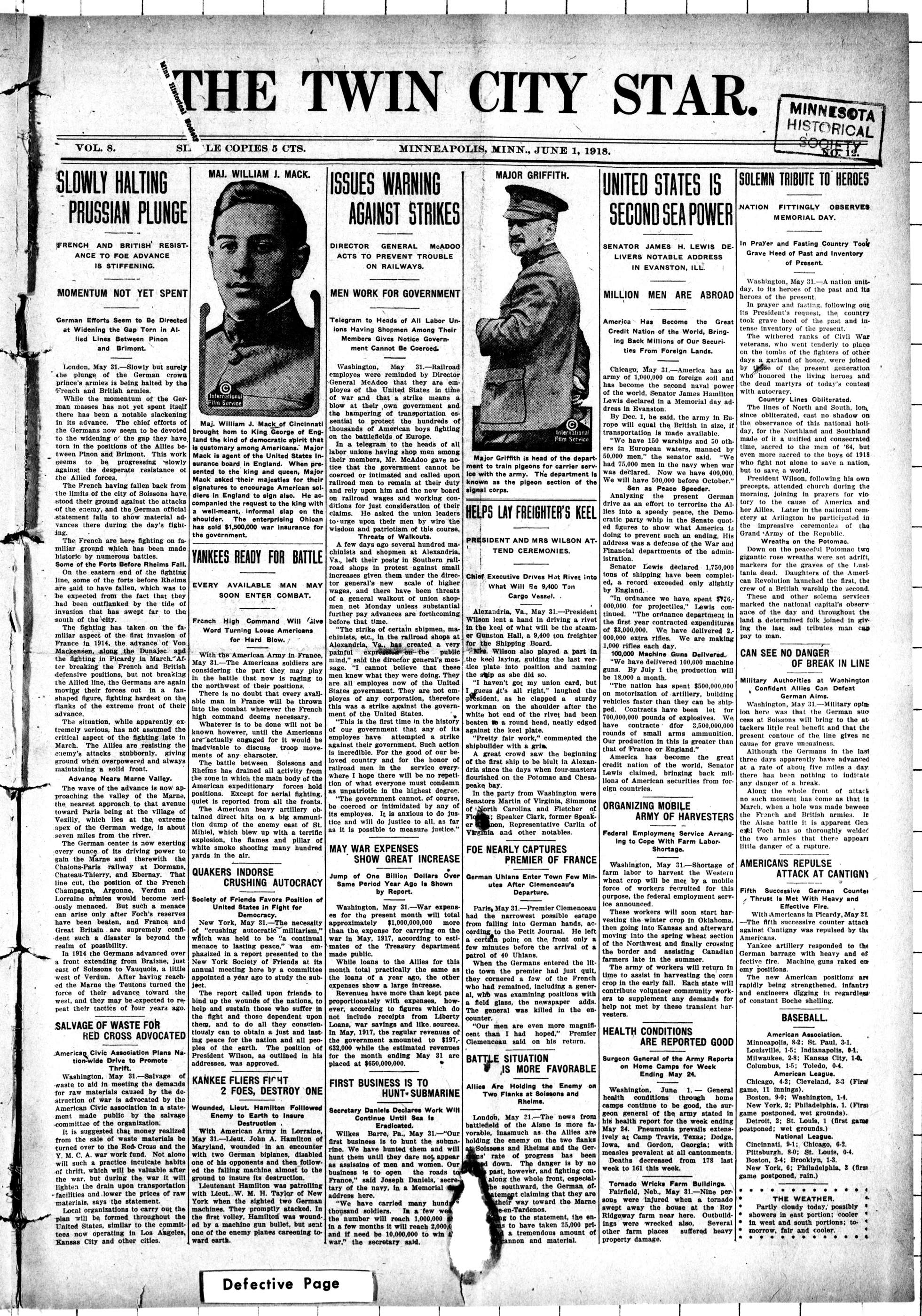
THE TWIN CITY STAR.
SLOWLY HALTING PRUSSIAN PLUNGE
SLOWLY HALTING PRUSSIAN PLUNGE
FRENCH AND BRITISH' RESISTANCE TO FOE ADVANCE IS STIFFENING.
MOMENTUM NOT YET SPENT
German Efforts Seem to Be Directed at Widening the Gap Torn in Allied Lines Between Pinon and Brimont.
London, May 31.—Slowly but surely the plunge of the German crown prince's armies is being halted by the French and British armies.
While the momentum of the German masses has not yet spent itself there has been a notable slackening in its advance. The chief efforts of the Germans now seem to be devoted to the widening o' the gap they have, torn in the positions of the Allies between Pinon and Brimont. This work seems to be progressing slowly against the desperate resistance of the Allied forces.
The French having fallen back from the limits of the city of Soissons have stood their ground against the attacks of the enemy, and the German official statement falls to show material advances there during the day's fighting.
The French are here fighting on familiar ground which has been made historic by numerous battles.
Some of the Forts Before Rheims Fall.
On the eastern end of the fighting line, some of the forts before Rheims are said to have fallen, which was to be expected from the fact that they had been outflanked by the tide of invasion that has swept far to the south of the city.
The fighting has taken on the familiar aspect of the first invasion of France in 1914, the advance of Von Mackensen, along the Dunajac and the fighting in Picardy in March. After breaking the French and British defensive positions, but not breaking the Allied line, the Germans are again moving their forces out in a fan-shaped figure, fighting hardest on the flanks of the extreme front of their advance.
The situation, while apparently extremely serious, has not assumed the critical aspect of the fighting late in March. The Allies are resisting the enemy's attacks stubbornly, giving ground when overpowered and always maintaining a solid front.
Advance Nears Marne Valley.
The wave of the advance is now approaching the valley of the Marne, the nearest approach to that avenue toward Paris being at the village of Vezilly, which lies at the extreme apex of the German wedge, is about seven miles from the river.
The German center is now exerting every ounce of its driving power to gain the Marne and therewith the Chalons-Paris railway at Dormans, Chateau-Thierry, and Ebernay. That line cut, the position of the French Champagne, Argonne, Verdun and Lorraine armies would become aeriously menaced. But such a menace can arise only after Foch's reserves have been beaten, and France and Great Britain are supremely confident such a disaster is beyond the realm of possibility.
In 1914 the Germans advanced over a front extending from Braisne, just east of Solssons to Vauquois, a little west of Verdun. After having reached the Marne the Teutons turned the force of their advance toward the west, and they may be expected to repeat their tactics of four years ago.
SALVAGE OF WASTE FOR RED CROSS ADVOCATED
American Civic Association Plans Nation-wide Drive to Promote Thrift.
Washington, May 31.—Salvage of waste to aid in meeting the demands for raw materials caused by the destruction of war is advocated by the American Civic association in a statement made public by the salvage committee of the organization.
It is suggested that money realized from the sale of waste materials be turned over to the Red-Cross and the Y. M. C. A. war work fund. Not alone will such a practice inculcate habits of thrift, which will be valuable after the war, but during the war it will lighten the drain upon transportation facilities and lower the prices of raw materials, says the statement.
Local organizations to carry out the plan will be formed throughout the United States, similar to the committees now operating in Los Angeles, Kansas City and other cities.
MAJ. WILLIAM J. MACK.
International Film Service
Maj. William J. Mack of Cincinnati brought hom to King George of England the kind of democratic spirit that is customary among Americans'. Major Mack is agent of the United States Insurance board in England. When presented to the king and queen, Major Mack asked their majesties for their signatures to encourage American soldiers in England to sign also. He accompanied the request to the king with a well-meant, informal slap on the shoulder. The enterprising Ohioan has sold $1,500,000 war insurance for the government.
YANKEES READY FOR BATTLE
EVERY AVAILABLE MAN MAY SOON ENTER COMBAT.
French High Command Will Give Word Turning Loose Americans for Hard Blow.
With the American Army in France, May 31.—The Americans soldiers are considering the part they may play in the battle that now is raging to the northwest of their positions.
There is no doubt that every available man in France will be thrown into the combat wherever the French high command deems necessary.
Whatever is to be done will not be known however, until the Americans are actually engaged for it would be inadvisable to discuss troop movements of any character.
The battle between Soissons and Rheims has drained all activity from the zone in which the main body of the American expeditionary forces hold positions. Except for aerial fighting, quiet is reported from all the fronts.
The American heavy artillery obtained direct hits on a big ammunition dump of the enemy east of St. Mihiel, which blew up with a terrific explosion, the flames and pillar of white smoke shooting many hundred yards in the air.
QUAKERS INDORSE
CRUSHING AUTOCRACY
Society of Friends Favors Position of United States in Fight for Democracy.
New York, May 31.—The necessity of "crushing autocratic militarism," which was held to be "a continual menace to lasting peace," was emphasized in a report presented to the New York Society of Friends at its annual meeting here by a committee appointed a year ago to study the subject.
The report called upon friends to bind up the wounds of the nations, to help and sustain those who suffer in the fight and those dependent upon them, and to do all they conscientiously can to obtain a just and lasting peace for the nation and all peoples of the earth. The position of President Wilson, as outlined in his addresses, was approved.
KANKEE FLIERS FIGHT
2 FOES, DESTROY ONE
Wounded, Lieut. Hamilton Followed Enemy to Earth to Insure Destruction .
With American Army in Lorraine, May 31.-Lieut. John A. Hamilton of Maryland, wounded in an encounter with two German biplanes, disabled one of his opponents and then followed the falling machine almost to the ground to insure its destruction.
Lieutenant Hamilton was patrolling with Lieut. W. M. H. Taylor of New York when the sighted two German machines. They promptly attacked. In the first volley, Hamilton was wounded by a machine gun bullet, but sent one of the enemy planes careening toward earth.
Defective Page
MINNEAPOLIS, MINN., JUNE 1, 1918.
ISSUES WARNING AGAINST STRIKES
ISSUES WARNING AGAINST STRIKES
DIRECTOR GENERAL McADOO
ACTS TO PREVENT TROUBLE
ON RAILWAYS.
MEN WORK FOR GOVERNMENT
Telegram to Heads of All Labor Unions Having Shopmen Among Their Members Gives Notice Government Cannot Be Coerced.
Washington, May 31.—Railroad employees were reminded by Director General McAdoo that they are employees of the United States in time of war and that a strike means a blow at their own government and the hampering of transportation essential to protect the hundreds of thousands of American boys fighting on the battlefields of Europe.
In a telegram to the heads of all labor unions having shop men among their members, Mr. McAdoo gave notice that the government cannot be coerced or intimated and called upon railroad men to remain at their duty and rely upon him and the new board on railroad wages and working conditions for just consideration of their claims. He asked the union leaders to urge upon their men by wire the wisdom and patriotism of this course.
A few days ago several hundred machinists and shopmen at Alexandria, Va., left their posts in Southern railroad shops in protest against small increases given them under the director general's new scale of higher wages, and there have been threats of a general walkout or union shopmen net Monday unless substantial further pay advances are forthcoming before that time.
"The strike of certain shipmen, machinists, etc., in the railroad shops at Alexandria, Va., has created a very painful expression on the public mind," said the director general's message. "I cannot believe that these men knew what they were doing. They are all employees now of the United States government. They are not employees of any corporation, therefore this was a strike against the government of the United States.
"This is the first time in the history of our government that any of its employees have attempted a strike against their government. Such action is incredible. For the good of our beloved country and for the honor of railroad men in the service everywhere I hope there will be no repetition of what everyone must condemn as unpatriotic in the highest degree.
"The government cannot, of course, be coerced or intimidated by any of its employees. It is anxious to do justice and will do justice to all, as far as it is possible to measure justice."
MAY WAR EXPENSES
SHOW GREAT INCREASE
Jump of One Billion Dollars Over Same Period Year Ago is Shown by Report.
Washington, May 31.—War expenses for the present month will total approximately $1,000,000,000 more than the expense for carrying on the war in May, 1917, according to estimates of the Treasury department made public.
While loans to the Allies for this month total practically the same as the loans of a year ago, the other expenses show a large increase.
Revenues have more than kept pace proportionately with expenses, however, according to figures which do not include receipts from Liberty Loans, war savings and like sources. In May, 1917, the regular revenues of the government amounted to $197,632,000 while the estimated revenues for the month ending May 31 are placed at $650,000,000.
FIRST BUSINESS IS TO HUNT·SUBMARINE
Secretary Daniels Declares Work Will Continue Until Sea is Eradicated.
Wilkes Barre, Pa., May 31.—"Our first business is to hunt the submarine. We have hunted them and will hunt them until they dare not appear as assissins of men and women. Our business is to open the roads to France," said Joseph Daniels, secretary of the navy, in a Memorial address here.
"We have carried many hundred thousand soldiers. In a few weeks the number will reach 1,000,000 at in a few months it will reach 2,000,0 and if need be 10,000,000 to win a war," the secretary said.
MAJOR GRIFFITH.
International Film Service
Major Griffith is head of the department to train pigeons for carrier service with the army. The department is known as the pigeon section of the signal corps.
HELPS LAY FREIGHTER'S KEEL
PRESIDENT AND MRS WILSON AT-
TEND CEREMONIES.
Chief Executive Drives Hot Rivet into What Will Be 9,400 Ton Cargo Vessel.
Alexandria, Va., May 31.—President Wilson lent a hand in driving a rivet in the keel of what will be the steamer Gunston Hall, a 9,400 ton freighter for the Shipping Board.
Mrs. Wilson also played a part in the keel laying, guiding the last vice plate into position and naming the ship as she did so.
"I haven't got my union card, but I guess it's all right," laughed the president, as he clapped a sturdy workman on the shoulder after the white hot end of the rivet had been beaten to a round head, neatly edged against the keel plate.
"Pretty fair work," commented the shipbuilder with a grin.
A great crowd saw the beginning of the first ship to be built in Alexandria since the days when four-masters flourished on the Potomac and Chesapeake bay.
In the party from Washington were Senators Martin of Virginia, Simmons of North Carolina and Fletcher of Florida; Speaker Clark, former Speaker Johnson, Representative Carlin of Virginia and other notables.
FOE NEARLY CAPTURES
PREMIER OF FRANCE
German Uhlans Enter Town Few Minutes After Clemenceau's Departure.
Paris, May 31.—Premier Clemenceau had the narrowest possible escape from falling into German hands, according to the Petit Journal. He left a certain point on the front only a few minutes before the arrival of a patrol of 40 Uhlans.
When the Germans entered the little town the premier had just quit, they cornered a few of the French who had remained, including a general, who was examining positions with a field glass, the newspaper adds. The general was killed in the encounter.
"Our men are even more magnificent than I had hoped," Premier Clemenceau said on his return.
BATTLE SITUATION IS MORE FAVORABLE
Allies Are Holding the Enemy on Two Flanks at Soissons and Rheims.
London, May 31.—The news from battlefield of the Aisne is more favorable, inasmuch as the Allies are holding the enemy on the two flanks at Soissons and Rheims and the Germans' rate of progress has been slowed down. The danger is by no past, however, and fighting con- along the whole front, especial- the southward, the German of- statement claiming that they are on their way toward the Marne en-Tardenos.
Lung to the statement, the en- tents to have taken 35,000 pri- miled a tremendous amount of cannon and material.
UNITED STATES IS SECOND SEA POWER
UNITED STATES IS SECOND SEA POWER
SENATOR JAMES H. LEWIS DE
LIVERS NOTABLE ADDRESS
IN EVANSTON, ILL.
MILLION MEN ARE ABROAD
America Has Become the Great Credit Nation of the World, Bringing Back Millions of Our Securities From Foreign Lands.
Chicago, May 31.—America has an army of 1,000,000 on foreign soil and has become the second naval power of the world. Senator James Hamilton Lewis declared in a Memorial day address in Evanston.
By Dec. 1, he said, the army in Europe will equal the British in size, if transportation is made available.
"We have 150 warships and 50 others in European waters, manned by 50,000 men," the senator said. "We had 75,000 men in the navy when war was declared. Now we have 400,000. We will have 500,000 before October."
Sen as Peace Speeder.
Analyzing the present German drive as an effort to terrorize the Allies into a speedy peace, the Democratic party whip in the Senate quoted figures to show what America is doing to prevent such an ending. His address was a defense of the War and Financial departments of the administration.
Senator Lewis declared 1,750,000 tons of shipping have been completed, a record exceeded only slightly by England.
"In ordinance we have spent $776,000,000 for projectiles," Lewis continued. "The ordinance department in the first year contracted expenditures of $3,000,000. We have delivered 2,000,000 extra rifles. We are making 1,000 rifles each day.
100,000 Machine Guns Delivered.
"We have delivered 100,000 machine guns. By July 1 the production will be 18,000 a month.
"The nation has spent $500,000,000 on motorization of artillery, building vehicles faster than they can be shipped. Contracts have been let for 700,000,000 pounds of explosives. We have contracted dfor 3,500,000,000 rounds of small arms ammunition. Our production in this is greater than that of France or England."
America has become the great credit nation of the world, Senator Lewis claimed, bringing back millions of American securities from foreign countries.
ORGANIZING MOBILE ARMY OF HARVESTERS
Federal Employment Service Arranging to Cope With Farm Labor Shortage.
Washington, May 31.—Shortage of farm labor to harvest the Western wheat crop will be met by a mobile force of workers recruited for this purpose, the federal employment service announced. These workers will soon start harvesting the winter crop in Oklahoma, then going into Kansas and afterward moving into the spring wheat section of the Northwest and finally crossing the border and assisting Canadian farmers late in the summer. The army of workers will return in time to assist in harvesting the corn crop in the early fall. Each state will contribute volunteer community workers to supplement any demands for help not met by these transient harvesters.
HEALTH CONDITIONS ARE REPORTED GOOD
Surgeon General of the Army Reports on Home Camps for Week Ending May 24.
Washington, June 1. — General health conditions through home camps continue to be good, the surgeon general of the army stated in his health report for the week ending May 24. Pneumonia prevails extensively at Camp Travis, Texas; Dodge, Iowa, and Gordon, Georgia; with measles prevalent at all cantonments. Deaths decreased from 178 last week to 161 this week.
Tornado Wricks Farm Buildings. Fairfield, Neb., May 31. — Nine persons were injured when a tornado swept away the house at the Roy Ridgeway farm near here. Outbuildings were wrecked also. Several other farm places suffered heavy property damage.
MINNESOTA
HISTORICAL
SOCIETY
NO.12
SOLEMN TRIBUTE TO HEROES
NATION FITTINGLY OBSERVES MEMORIAL DAY.
In Prayer and Fasting Country Took Grave Heed of Past and Inventory of Present.
Washington, May 31.—A nation unit-day, to its heroes of the past and its heroes of the present.
In prayer and fasting, following out its President's request, the country took grave heed of the past and intense inventory of the present.
The withered ranks of Civil War veterans, who went tenderly to place on the tombs of the fighters of other days a garland of honor, were joined by those of the present generation who honored the living heroes and the dead martyrs of today's contest with autocracy.
Country Lines Obliterated.
The lines of North and South, lone since obliterated, cast no shadow on the observance of this national holiday, for the Northland and Southland made of it a unified and consecrated time, sacred to the men of '64, but even more sacred to the boys of 1918 who fight not alone to save a nation, but to save a world.
President Wilson, following his own precepts, attended church during the morning, joining in prayers for victory to the cause of America and her Allies. Later in the national cemetery at Arlington he participated in the impressive ceremonies of the Grand Army of the Republic.
Wreaths on the Potomac.
Down on the peaceful Potomac two gigantic rose wreaths were set adrift, markers for the graves of the Lusitania dead. Daughters of the American Revolution launched the first, the crew of a British warship the second.
These and other solemn services marked the national capital's observance of the day and throughout the land a determined folk joined in giving the last sad tributes man can pay to man.
CAN SEE NO DANGER
OF BREAK IN LINE
Military Authorities at Washington Confident Allies Can Defeat German Alms.
Washington, May 31.—Military opinion here was that the German success at Solssons will bring to the attackers little real benefit and that the present contour of the line gives no cause for grave uneasiness.
Although the Germans in the last three days apparently have advanced at a rate of about five miles a day there has been nothing to indicate any danger of a break.
Along the whole front of attack no such moment has come as that is March, when a hole was made between the French and British armies. In the Alsne battle it is apparent General Foch has so thoroughly welded the two armies that there appear little danger of a rupture.
AMERICANS REPULSE
Fifth Successive German Counter Thrust Is Met With Heavy and Effective Fire.
With Americans in Picardy, May 31.
The fifth successive counter attack against Cantigny was repulsed by the Americans.
Yankee artillery responded to the German barrage with heavy and effective fire. Machine guns raked enemy positions.
The new American positions are rapidly being strengthened, infantry and engineers digging in regardless of constant Boche shelling.
BASEBALL.
American Association.
Minneapolis, 8-2; St. Paul, 3-1.
Louisville, 1-5; Indianapolis, 0-1.
Milwaukee, 2-8; Kansas City, 1-0.
Columbus, 1-5; Toledo, 0-4.
American League.
Chicago, 4-2; Cleveland, 3-3 (First game, 11 innings).
Boston, 9-0; Washington, 1-4.
New York, 2; Philadelphia, 1. (First game postponed, wet grounds).
Detroit, 2; St. Louis, 1 (first game postponed; wet grounds.)
National League.
Cincinnati, 9-1; Chicago, 6-2.
Pittsburgh, 8-0; St. Louis, 0-4.
Boston, 2-4; Brooklyn, 1-3.
New York, 6; Philadelphia, 3 (first game postponed, rain.)
THE WEATHER.
Partly cloudy today; possibly showers in east portion; cooler in west and south portions; to morrow, fair and cooler.
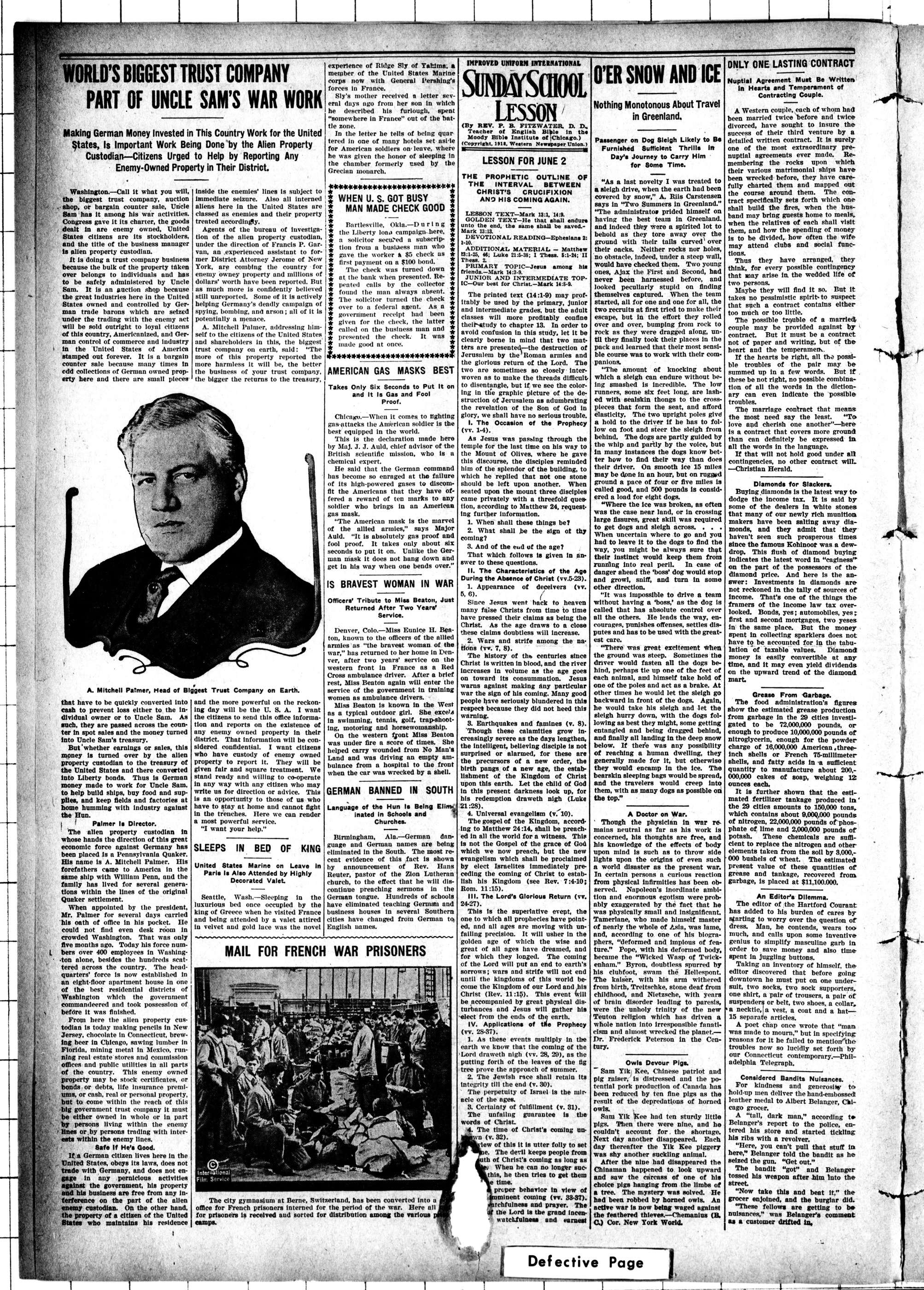
WORLD'S BIGGEST TRUST COMPANY PART OF UNCLE SAM'S WAR WORK
Making German Money Invested in This Country Work for the United States, Is Important Work Being Done by the Alien Property Custodian-Citizens Urged to Help by Reporting Any Enemy-Owned Property in Their District.
J.
A. Mitchell Palmer, Head of Biggest Trust Company on Earth.
Washington.—Call it what you will, the biggest trust company, auction shop, or bargain counter sale, Uncle Sam has it among his war activities. Congress gave it its charter, the goods dealt in are enemy owned, United States citizens are its stockholders, and the title of the business manager is alien property custodian.
It is doing a trust company business because the bulk of the property taken over belongs to individuals and has to be safely administered by Ucle Sam. It is an auction shop because the great industries here in the United States owned and controlled by German trade barons which are setzed under the trading with the enemy act will be sold outright to loyal citizens of this country, Americanized, and German control of commerce and industry in the United States of America stamped out forever. It is a bargain counter sale because many times in odd collections of German owned property here and there are small pieces
A. Mitchell Palmer, Head of B
that have to be quickly converted into cash to prevent loss either to the individual owner or to Uncle Sam. As such, they are passed across the counter in spot sales and the money turned into Uncle Sam's treasury. But 'whether earnings or sales, this money is turned over by the alien property custodian to the treasury of the United States and there converted into Liberty bonds. Thus is German money made to work for Uncle Sam, to help build ships, buy food and supplies, and keep fields and factories at home humming with industry against the Hun.
Palmer Is Director
The allen property custodian in whose hands the direction of this great economic force against Germany has been placed is a Pennsylvania Quaker. His name is A. Mitchell Palmer. His forefathers came to America in the same ship with William Penn, and the family has lived for several generations within the lines of the original Quaker settlement.
When appointed by the president, Mr. Palmer for several days carried his oath of office in his pocket. He could not find even desk room in crowded Washington. That was only five months ago. Today his force numbers over 400 employees in Washington alone, besides the hundreds scattered across the country. The headquarters' force is now established in an eight-floor apartment house in one of the best residential districts of Washington which the government commandeered and took possession of before it was finished.
From here the alien property custodian is today making pencils in New Jersey, chocolate in Connecticut, brewing beer in Chicago, sawing lumber in Florida, mining metal in Mexico, running real estate stores and commission offices and public utilities in all parts of the country. This enemy owned property may be stock certificates, or bonds or debts, life insurance premiums, or cash, real or personal property, but to come within the reach of this big government trust company it must be either owned in whole or in part by persons living within the enemy lines or by persons trading with interests within the enemy lines.
If a German citizen lives here in the United States, obeys its laws, does not trade with Germany, and does not engage in any pernicious activities against the government, his property and his business are free from any interference on the part of the alien enemy custodian. On the other hand, the property of a citizen of the United States who maintains his residence
MAIL FOR FRENCH WAR PRISONERS
International Film Service
The city gymnasium at Berne, Switzerland, has been converted into a office for French prisoners interned for the period of the war. Here all for prisoners is received and sorted for distribution among the various p camps.
inside the enemies' lines is subject to immediate seizure. Also all intermed aliens here in the United States are classed as enemies and their property treated accordingly.
Agents of the bureau of investigation of the alien property custodian, under the direction of Francis P. Garvan, an experienced assistant to former District Attorney Jerome of New York, are combing the country for enemy owney property and millions of dollars' worth have been reported. But as much more is confidently believed still unreported. Some of it is actively helping Germany's deadly campaign of spying, bombing, and arson; all of it is potentially a menace.
A. Mitchell Palmer, addressing himself to the citizens of the United States and shareholders in this, the biggest trust company on earth, said: "The more of this property reported the more harmless it will be, the better the business of your trust company, the bigger the returns to the treasury,
ggest Trust Company on Earth.
and the more powerful on the reckoning day will be the U. S. A. I want the citizens to send this office information and reports on the existence of any enemy owned property in their district. That information will be considered confidential. I want citizens who have custody of enemy owned property to report it. They will be given fair and square treatment. We stand ready and willing to co-operate in any way with any citizen who may write us for direction or advice. This is an opportunity to those of us who have to stay at home and cannot fight in the trenches. Here we can render a most powerful service.
SLEEPS IN BED OF KING
United States Marine on Leave in Paris Is Also Attended by Highly Decorated Valet.
Seattle, Wash.—Sleeping in the luxurious bed once occupied by the king of Greece when he visited France and being attended by a valet attired in velvet and gold lace was the novel
MAIL FOR FRENCH
experience of Ridge Sly of Yakima, a member of the United States Marine corps now with General Pershing's forces in France. Sly's mother received a letter several days ago from her son in which he described his furlough, spent "somewhere in France" out of the battle zone. In the letter he tells of being quartered in one of many hotels set aside for American soldiers on leave, where he was given the honor of sleeping in the chamber formerly used by the Grecian monarch.
WHEN U. S. GOT BUSY
MAN MADE CHECK GOOD
Bartlesville, Okla.—During the Liberty loan campaign here, a solicitor secured a subscription from a business man who gave the worker a $5 check as first payment on a $100 bond. The check was turned down at the bank when presented. Repeated calls by the collector found the man always absent. The solicitor turned the check over to a federal agent. As a government receipt had been given for the check, the latter called on the business man and presented the check. It was made good at once.
AMERICAN GAS MASKS BEST
Takes Only Six Seconds to Put It on and It Is Gas and Fool Proof.
Chicago.—When it comes to fighting gas attacks the American soldier is the best equipped in the world.
This is the declaration made here by Maj. J. J. Auld, chief advisor of the British scientific mission, who is a chemical expert.
He said that the German command has become so enraged at the failure of its high-powered gases to discomfit the Americans that they have offered a reward of ten marks to any soldier who brings in an American gas mask.
"The American mask is the marvel of the allied armies," says Major Auld. "It is absolutely gas proof and fool proof. It takes only about six seconds to put it on. Unlike the German mask it does not hang down and get in his way when one bends over."
IS BRAVEST WOMAN IN WAR
Officers' Tribute to Miss Beaton, Just Returned After Two Years' Service.
Denver, Colo.—Miss Eunice H. Beaton, known to the officers of the allied armies as "the bravest woman of the war," has returned to her home in Denver, after two years' service on the western front in France as a Red Cross ambulance driver. After a brief rest, Miss Beaton again will enter the service of the government in training women as ambulance drivers.
Miss Beaton is known in the West as a typical outdoor girl. She excee in swimming, tennis, golf, trap-shooting, motoring and horsewomanship.
On the western front Miss Beaton was under fire a score of times. She helped carry wounded from No Man's Land and was driving an empty ambulance from a hospital to the front when the car was wrecked by a shell.
GERMAN BANNED IN SOUTH
Language of the Hun Is Being Eliminated in Schools and Churches.
Birmingham, Ala.—German language and German names are being eliminated in the South. The most recent evidence of this fact is shown by announcement of Rev. Hans Reuter, pastor of the Zion Lutheran church, to the effect that he will discontinue preaching sermons in the German tongue. Hundreds of schools have eliminated teaching German and business houses in several Southern cities have changed from German to English names.
IMPROVED UNIFORM INTERNATIONAL SUNDAY SCHOOL LESSON
(By REV. P. B. FITZWATER. D. D.
Teacher of English Bible in the
Moody Bible Institute of [Chicago].
(Copyright, 1918, Western Newspaper Union.)
LESSON FOR JUNE 2
THE PROPHETIC OUTLINE OF
THE INTERVAL BETWEEN
CHRIST'S CRUCIFIXION
AND HIS COMING AGAIN.
LESSON TEXT-Mark 13:1, 14:9.
GOLDEN TEXT-He that shall endure
unto the end, the same shall be saved.
Mark 13:1.
DEVOTIONAL READING—Ephesians 2:
1-10.
ADDITIONAL MATERIAL - Matthew
13:1-25, 46; Luke 21:5-38; I Thess. 5:1-24; II
Thess. 2
PRIMARY TOPIC—Jesus among his friends.—Mark 14:3-9
JUNIOR AND INTERMEDIATE TOPIC—Our best for Christ.—Mark 14:5-9
The printed text (14:1-9) may profitably be used by the primary, junior and intermediate grades, but the adult classes will more profitably confine their study to chapter 13. In order to avoid confusion in this study, let it be clearly borne in mind that two matters are presented—the destruction of Jerusalem by the Roman armies and the glorious return of the Lord. The two are sometimes so closely interwoven as to make the threads difficult to disentangle, but if we see the coloring in the graphic picture of the destruction of Jerusalem as adumbrating the revelation of the Son of God in glory, we shall have no serious trouble.
I. The Occasion of the Prophecy (vv. 1-4).
As Jesus was passing through the temple for the last time on his way to the Mount of Olives, where he gave this discourse, the disciples reminded him of the splendor of the building, to which he replied that not one stone should be left upon another. When seated upon the mount three disciples came privately with a threefold question, according to Matthew 24, requesting further information.
1. When shall these things be?
2. What shall be the sign of thy coming?
3. And of the end of the age?
That which follows is given in answer to these questions.
II. The Characteristics of the Age During the Absence of Christ (vv.5-23).
1. Appearance of deceivers (vv. 5, 6).
Since Jesus went back to heaven many false Christs from time to time have pressed their claims as being the Christ. As the age draws to a close these claims doubtless will increase. 2. Wars and strife among the nations (vv. 7, 8). The history of the centuries since Christ is written in blood, and the river increases in volume as the age goes on toward its consummation. Jesus warns against making any particular war the sign of his coming. Many good people have seriously blundered in this respect because they did not heed this warning.
3. Earthquakes and famines (v. 8).
Though these calamities grow increasingly severe as the days lengthen, the intelligent, believing disciple is not surprised or alarmed, for these are the precursors of a new order, the birth pangs of a new age, the establishment of the Kingdom of Christ upon this earth. Let the child of God in this present darkness look up, for his redemption dawning nigh (Luke 21:28).
4. Universal evangelism (v. 10).
Universal Evangelism (v. 10).
The gospel of the Kingdom, according to Matthew 24:14, shall be preached in all the world for a witness. This is not the Gospel of the grace of God which we now preach, but the new evangelism which shall be proclaimed by elect Israelites immediately preceding the coming of Christ to establish his Kingdom (see Rev. 7:4-10; Rom. 11:15).
III. The Lord's Glorious Return (vv. 24-27).
This is the superlative event, the one to which all prophecies have pointed, and all ages are moving with unfailling precision. It will usher in the golden age of which the wise and great of all ages have dreamed, and for which they longed. The coming of the Lord will put an end to earth's sorrows; wars and strife will not end until the kingdoms of this world become the Kingdom of our Lord and his Christ (Rev. 11:15). This event will be accompanied by great physical disturbances and Jesus will gather his elect from the ends of the earth.
IV. Applications of the Prophecy (vv. 28-37).
1. As these events multiply in the earth we know that the coming of the Lord draweth nigh (vv. 28, 29), as the putting forth of the leaves of the fig tree prove the approach of summer.
2. The Jewish race shall retain its integrity till the end (v. 30).
The perpetuity of Israel is the miracle of the ages.
3. Certainty of fulfillment (v. 31).
The unfailing guarantee is the words of Christ.
4. The time of Christ's coming unknown (v. 32).
Review of this it is utter folly to set time. The devil keeps people from truth of Christ's coming as long as he. When he can no longer succeeds, he then tries to get them the time.
A proper behavior in view of imminent coming (vv. 33-37), watchfulness and prayer. The of the Lord is the grand incenew watchfulness and earnest
Defective Page
O'ER SNOW AND ICE
Nothing Monotonous About Travel in Greenland.
Passenger on Dog Sleigh Likely to Be Furnished Sufficient Thrills in Day's Journey to Carry Him for Some Time.
"As a last novelty I was treated to a sleigh drive, when the earth had been covered by snow," A. Riis Carstensen says in "Two Summers in Greenland." "The administrator prided himself on having the best team in Greenland, and indeed they were a spirited lot to behold as they tore away over the ground with their tails curved over their oaks. Neither rocks nor holes, no obstacle, indeed, under a steep wall, would have checked them. Two young ones, Ajax the First and Second, had never been harnessed before, and looked peculiarly stupid on finding themselves captured. When the team started, all for one and one for all, the two recruits at first tried to make their escape, but in the effort they rolled over and over, bumping from rock to rock as they were dragged along, until they finally took their places in the pack and learned that their most sensible course was to work with their companions.
"The amount of knocking about which a sleigh can endure without being smashed is incredible. The low runners, some six feet long, are lashed with sealskin thongs to the cross-pieces that form the seat, and afford elasticity. The two upright poles give a hold to the driver if he has to follow on foot and steer the sleigh from behind. The dogs are partly guided by the whip and partly by the voice, but in many instances the dogs know better how to find their way than does their driver. On smooth ice 15 miles may be done in an hour, but on rugged ground a pace of four or five miles is called good, and 500 pounds is considered a load for eight dogs.
"Where the ice was broken, as often was the case near land, or in crossing large fissures, great skill was required to get dogs and sleigh across. . . . When uncertain where to go and you had to leave it to the dogs to find the way, you might be always sure that their instinct would keep them from running into real peril. In case of danger ahead the 'boss' dog would stop and growl, sniff, and turn in some other direction.
"It was impossible to drive a team without having a 'boss,' as the dog is called that has absolute control over all the others. He leads the way, encourages, punishes offenses, settles disputes and has to be used with the greatest care.
"There was great excitement when the ground was steep. Sometimes the driver would fasten all the dogs behind, perhaps tie up one of the feet of each animal, and himself take hold of one of the poles and act as a brake. At other times he would let the sleigh go backward in front of the dogs. Again, he would take his sleigh and let the sleigh hurry down, with the dogs following as best they might, some getting entangled and being dragged behind, and finally all landing in the deep snow below. If there was any possibility of reaching a human dwelling, they generally made for it, but otherwise they would encamp in the ice. The bearskin sleeping bags would be spread, and the travelers would creep into them, with as many dogs as possible on the top."
Though the physician in war remains neutral as far as his work is concerned, his thoughts are free, and his knowledge of the effects of body upon mind is such as to throw side lights upon the origins of even such a world disaster as the present war. In certain persons a curious reaction from physical infirmities has been observed. Napoleon's inordinate ambition and enormous egotism were probably exaggerated by the fact that he was physically small and insignificant. Tamerlane, who made himself master of nearly the whole of Asia, was lame, and, according to one of his biographers, "deformed and implous of feature." Pope, with his deformed body, became the "Wicked Wasp of Twickenham." Byron, doubtless spurred by his clubfoot, swam the Hellespont. The kaiser, with his arm withered from birth, Trettschke, stone deaf from childhood, and Nietzsche, with years of brain disorder leading to paresis, were the unholy trinity of the new Teuton religion which has driven a whole nation into irresponsible fanatism and almost wrecked the planet—Dr. Frederick Peterson in the Century.
Sam Yik Kee, Chinese patriot and pig raiser, is distressed and the potential pork production of Canada has been reduced by ten fine pigs as the result of the depredations of horned owls.
Sam Yik Kee had ten sturdy little pigs. Then there were nine, and he couldn't account for the shortage. Next day another disappeared. Each day thereafter the Yik Kee piggery was shy another suckling animal.
After the nine had disappeared the Chinaman happened to look upward and saw the carcass of one of his choice pigs hanging from the limbs of a tree. The mystery was solved. He had been robbed by horned owls. An active war is now being waged against the feathered thieves.—Chemanius (B. C.) Cor. New York World.
A Doctor on War.
Owls Devour Pigs.
DNLY ONE LASTING CONTRACT
Nuptial Agreement Must Be Written in Hearts and Temperament of Contracting Couple.
A Western couple, each of whom had been married twice before and twice divorced, have sought to insure the success of their third venture by a detailed written contract. It is surely one of the most extraordinary preemptual agreements ever made. Remembering the rocks upon which their various matrimonial ships have been wrecked before, they have carefully charted them and mapped out the course around them. The contract specifically sets forth which one shall build the fires, when the husband may bring guests home to meals, when the relatives of each shall visit them, and how the spending of money is to be divided, how often the wife may attend clubs and social functions.
Thus they have arranged, they think, for every possible contingency that may arise in the wedded life of two persons. Maybe they will find it so. But it takes no pessimistic spirits to suspect that such a contract contains either too much or too little. The possible trouble of a married couple may be provided against by contract. But it must be a contract not of paper and writing, but of the heart and the temperament. If the hearts be right, all the possible troubles of the pair may be summed up in a few words. But if these be not right, no possible combination of all the words in the dictionary can even indicate the possible troubles.
The marriage contract that means the most need say the least. "To love and cherish one another"—here is a contract that covers more ground than can definitely be expressed in all the words in the language. If that will not hold good under all contingencies, no other contract will.—Christian Herald.
Diamonds for Slackers.
Buying diamonds is the latest way to dodge the income tax. It is said by some of the dealers in white stones that many of our newly rich minton makers have been salting away diamonds, and they admit that they haven't seen such prosperous times since the famous Kohinoor was a dewdrop. This flush of diamond buying indicates the latest word in "caginess" on the part of the possessors of the diamond price. And here is the answer: Investments in diamonds are not reckoned in the tally of sources of income. That's one of the things the framers of the income law tax overlooked. Bonds, yes; automobiles, yes; first and second mortgages, two yees in the same place. But the money spent in collecting sparklers does not have to be accounted for in the tabulation of taxable values. Diamond money is easily convertible at any time, and it may even yield dividends on the upward trend of the diamond mart.
Grease From Garbage
The food administration's figures show the estimated grease production from garbage in the 29 cities investigated to be 72,000,000 pounds, or enough to produce 10,000,000 pounds of nitroglycerin, enough for the powder charge of 16,000,000 American, three-inch shells or French 75-millimeter shells, and fatty acids in a sufficient quantity to manufacture about 200,000,000 cakes of soap, weighing 12 ounces each.
It is further shown that the estimated fertilizer tankage produced in the 29 cities amounts to 150,000 tons, which contains about 9,000,000 pounds of nitrogen, 22,000,000 pounds of phosphate of lime and 2,000,000 pounds of potash. These chemicals are sufficient to replace the nitrogen and other elements taken from the soil by 3,000,000 bushels of wheat. The estimated present value of these quantities of grease and tankage, recovered from garbage, is placed at $11,100,000.
An Editor's Dilemma
The editor of the Hartford Courant has added to his burden of cares by starting to worry over the question of dress. Man, he contends, wears too much, and calls upon some inventive genius to simplify masculine garb in order to save money and also time spent in juggling buttons.
Taking an inventory of himself, the editor discovered that before going downtown he must put on one undersuit, two socks, two sock supporters, one shirt, a pair of trousers, a pair of suspenders or belt, two shoes, a collar, a necktie, a vest, a coat and a hat—15 separate articles.
A poet chap once wrote that "man was made to mourn," but in specifying reasons for it he failed to mention the troubles now so lucidly set forth by our Connecticut contemporary.—Philadelphia Telegraph.
Considered Bandits Nuisances.
For kindness and generosity to hold-up men deliver the hand-embossed leather medal to Albert Belanger, Chicago grocer.
A "tall, dark man," according to Belanger's report to the police, entered his store and started tickling his ribs with a revolver.
"Here, you can't pull that stuff in here," Belanger told the bandit as he selzed the gun. "Get out."
The bandit "got" and Belanger tossed his weapon after him into the street.
"Now take this and beat it," the grocer enjoined, and the burglar did.
grocer enjoined, and the burglar did. "These fellows are getting to be nulsances," was Belanger's comment as a customer drifted in.
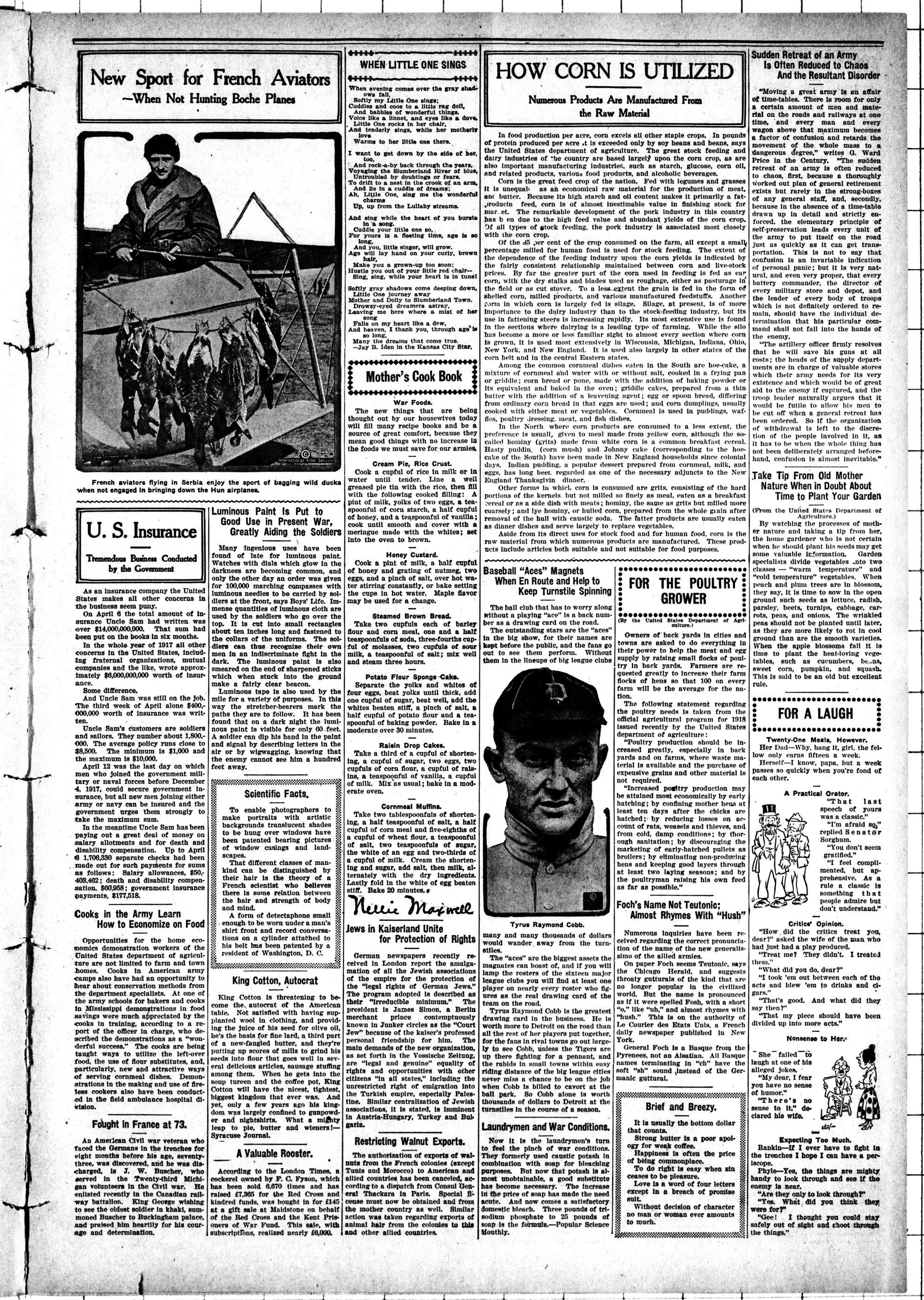
International Film Service
French aviators flying in Serbia enjoy the sport of bagging wild ducks when not engaged in bringing down the Hun airplanes.
U. S. Insurance
Tremendous Business Conducted
by the Government
As an insurance company the United States makes all other concerns in the business seem puny. On April 6 the total amount of insurance Uncle Sam had written was over $14,000,000,000. That sum had been put on the books in six months. In the whole year of 1917 all other concerns in the United States, including fraternal organizations, mutual companies and the like, wrote approximately $6,000,000,000 worth of insurance.
Some difference.
And Uncle Sam was still on the job.
The third week of April alone $400,
000,000 worth of insurance was written.
Uncle Sam's customers are soldiers
and sailors. They number about 1,800,
000. The average policy runs close to
$8,500. The minimum is $1,000 and
the maximum is $10,000.
April 12 was the last day on which
men who joined the government military
or naval forces before December
4, 1917, could secure government insurance,
but all new men joining either
army or navy can be insured and the
government urges them strongly to
take the maximum sum.
In the meantime Uncle Sam has been paying out a great deal of money on salary allotments and for death and disability compensation. Up to April 6,1706,330 separate checks had been made out for such payments for sums as follows: Salary allowances, $50,408,462; death and disability compensation, $60,958; government insurance payments, $177,518.
Cooks in the Army Learn How to Economize on Food
Opportunities for the home economics demonstration workers of the United States department of agriculture are not limited to farm and town homes. Cooks in American army camps also have had an opportunity to hear about conservation methods from the department specialists. At one of the army schools for bakers and cooks in Mississippi demonstrations in food savings were much appreciated by the cooks in training, according to a report of the officer in charge, who described the demonstrations as a "wonderful success." The cooks are being taught ways to utilize the left-over food, the use of flour substitutes, and, particularly, new and attractive ways of serving cornmeal dishes. Demonstrations in the making and use of fireless cookers also have been conducted in the field ambulance hospital division.
Fought in France at 73.
An American Civil war veteran who faced the Germans in the trenches for eight months before his age, seventy-three, was discovered, and he was discharged, is J. W. Buscher, who served in the Twenty-third Michigan volunteers in the Civil war. He enlisted recently in the Canadian railway battalion. King George wishing to see the oldest soldier in khaki, summoned Buscher to Buckingham palace, and praised him heartily for his courage and determination.
Luminous Paint Is Put to Good Use in Present War, Greatly Aiding the Soldiers
Many ingenious uses have been found of late for luminous paint. Watches with dials which glow in the darkness are becoming common, and only the other day an order was given for 100,000 marching compasses with luminous needles to be carried by soldiers at the front, says Boys' Life. Imense quantities of luminous cloth are used by the soldiers who go over the top. It is cut into small rectangles about ten inches long and fastened to the collars of the uniforms. The soldiers can thus recognize their own men in an indiscriminate fight in the dark. The luminous paint is also smeared on the end of sharpened sticks which when stuck into the ground make a fairly clear beacon.
Luminous tape is also used by the mile for a variety of purposes. In this way the stretcher-bearer mark the paths they are to follow. It has been found that on a dark night the luminous paint is visible for only 60 feet. A soldier can dip his hand in the paint and signal by describing letters in the air or by wigwagging, knowing that the enemy cannot see him a hundred feet away.
Scientific Facts.
To enable photographers to make portraits with artistic backgrounds translucent shades to be hung over windows have been patented bearing pictures of window casings and landscapes.
That different classes of mankind can be distinguished by their hair is the theory of a French scientist who believes there is some relation between the hair and strength of body and mind.
A form of detectaphone small enough to be worn under a man's shirt front and record conversations on a cylinder attached to his belt has been patented by a resident of Washington, D. C.
King Cotton, Autocrat
King Cotton is threatening to become the, autocrat of the American table. Not satisfied with having supplanted wool in clothing, and providing the juice of his seed for olive oil, he's the basis for fine lard, a third part of a new-fangled butter, and they're putting up scores of mills to grind his seeds into flour that goes well in several delicious articles, sausage stuffing among them. When he gets into the soup tureen and the coffee pot, King Cotton will have the nicest, tightest, biggest kingdom that ever was. And yet, only a few years ago his kingdom was largely confined to gunpowder and nightshirts. What a mighty leap to ple, butter and wieners!—Syracuse Journal.
A Valuable Rooster.
According to the London Times, a cockerel owned by F. C. Fyson, which has been sold 6,670 times and has raised £7,365 for the Red Cross and kindred funds, was bought in for £145 at a gift sale at Maidstone on behalf of the Red Cross and the Kent Prisoners of War Fund. This sale, with subscriptions, realized nearly £6,000.
WHEN LITTLE ONE SINGS
When evening comes over the gray shadows fall,
Softly my Little one sings;
Cuddles and coos to a little rag doll,
And babbles of wonderful things.
Voice like a linet, and eyes like a dove,
Little One rocks in her chair,
And tenderly sings, while her motherly love
Warms to her little one there.
I want to get down by the side of her,
too.
And rock-a-by back through the years,
Voyaging the Slumberland River of blue,
Untroubled by doubts or fears.
To drift to a nest in the crook of an arm,
And lie in a cuddle of dreams;
Ah, Little One, sing me the wonderful charms
Up, up from the Lullaby streams.
And sing while the heart of you bursts in a song.
Cuddle your little one so.
For years is a fleeting time, age is so long.
And you, little singer, will grow.
Age will lay hand on your curly, brown hair.
Make you a grown-up for soon.
Hustle you out of your little chair—
Sing, sing, while your heart is in tunnel
Softly gray shadows come deepening down,
Little One journey away
Mother and Dolly to Slumberland Town.
Drowsy-eyed dreamers astray,
Leaving me here where a mist of her
song
Falls on my heart like a dew,
And heaven, I thank you, through age
is so long,
Many the dreams that come true.
-Jay B. Iden in the Kansas City Star,
Mother's Cook Book
The new things that are being thought out by our housewives today will fill many recipe books and be a source of great comfort, because they mean good things with no increase in the foods we must save for our armies.
Cream Pie. Rice Crust.
Cook a cupful of rice in milk or in water until tender. Line a well greased pie tin with the rice, then fill with the following cooked filling: A pint of milk, yolks of two eggs, a teaspoonful of corn starch, a half cupful of honey, and a teaspoonful of vanilla; cook until smooth and cover with a meringue made with the whites; set into the oven to brown.
Honey Custard.
Cook a plnt of milk, a half cupful of honey and grating of nutmeg, two eggs, and a pinch of salt, over hot water stirring constantly, or bake setting the cups in hot water. Maple flavor may be used for a change.
Steamed Brown Bread.
Take two cupfuls each of barley flour and corn meal, one and a half teaspoonfuls of soda, three-fourths cupful of molasses, two cupfuls of sour milk, a teaspoonful of salt; mix well and steam three hours.
Potato Flour Sponge-Cake.
Separate the yolks and whites of four eggs, beat yolks until thick, add one cupful of sugar, beat well, add the whites beaten stiff, a pinch of salt, a half cupful of potato flour and a teaspoonful of baking powder. Bake in a moderate over 30 minutes.
Raisin Drop Cakes.
Take a third of a cupful of shortening, a cupful of sugar, two eggs, two cupfuls of corn flour, a cupful of raisins, a teaspoonful of vanilla, a cupful of milk. Mix as usual; bake in a moderate oven.
Cornmeal Muffins.
Take two tablespoonfuls of shortening, a half teaspoonful of salt, a half cupful of corn meal and five-eighths of a cupful of wheat flour, a teaspoonful of salt, two teaspoonfuls of sugar, the white of an egg and two-thirds of a cupful of milk. Cream the shortening and sugar, add salt, then milk, alternately with the dry ingredients. Lastly fold in the white of egg beaten stiff. Bake 20 minutes.
Jews in Kaiserland Unite for Protection of Rights
German newspapers recently received in London report the amalgamation of all the Jewish associations of the empire for the protection of the "legal rights of German Jews." The program adopted is described as their "irreducible minimum." The president is James Simon, a Berlin merchant prince contemptuously known in Junker circles as the "Court Jew" because of the kaiser's professed personal friendship for him. The main demands of the new organization, as set forth in the Vossische Zeitung, are "legal and genuine" equality of rights and opportunities with other citizens "in all states," including the unrestricted right of emigration into the Turkish empire, especially Palestine. Similar centralization of Jewish associations, it is stated, is imminent in Austria-Hungary, Turkey and Bulgaria.
Restricting Walnut Exports.
The authorization of exports of walnuts from the French colonies (except Tunis and Morocco) to American and allied countries has been canceled, according to a dispatch from Consul General Thackara in Paris. Special license must now be obtained and from the mother country as well. Similar action was taken regarding exports of animal hair from the colonies to this and other allied countries.
HOW CORN IS UTILIZED
In food production per acre, corn excels all other staple crops. In pounds of protein produced per acre $a$ t is exceeded only by soy beans and beans, says the United States department of agriculture. The great stock feeding and dairy industries of the country are based largely upon the corn crop, as are also important manufacturing industries, such as starch, glucose, corn oil, and related products, various food products, and alcoholic beverages. Corn is the great feed crop of the nation. Fed with legumes and grasses it is unequal as an economical raw material for the production of meat, and butter. Because its high starch and oil content makes it primarily a fat-producin feed, corn is of almost inestimable value in finishing stock for mar. et. The remarkable development of the pork industry in this country has b en due to the high feed value and abundant yields of the corn crop. Of all types of stock feeding, the pork industry is associated most closely with the corn crop.
Of the 85 per cent of the crop consumed on the farm, all except a small percentage milled for human food is used for stock feeding. The extent of the dependence of the feeding industry upon the corn yields is indicated by the fairly consistent relationship maintained between corn and live-stock prices. By far the greater part of the corn used in feeding is fed as ear corn, with the dry stalks and blades used as roughage, either as pasturage in the field or as cut stever. To a less extent the grain is fed in the form of shelled corn, milled products, and various manufactured feedstuffs. Another corn in which corn is largely fed is silage. Silage, at present, is of more importance to the dairy industry than to the stock-feeding industry, but its use in fattening steers is increasing rapidly. Its most extensive use is found in the sections where dairying is a leading type of farming. While the silo has become a more or less familiar sight to almost every section where corn is grown, it is used most extensively in Wisconsin, Michigan, Indiana, Ohio, New York, and New England. It is used also largely in other states of the corn belt and in the central Eastern states.
Among the common cornmeal dishes eaten in the South are hoe-cake, a mixture of cornmeal and water with or without salt, cooked in a frying pan or griddle; corn bread or pone, made with the addition of baking powder or its equivalent and baked in the oven; griddle cakes, prepared from a thin batter with the addition of a leavening agent; egg or spoon bread, differing from ordinary corn bread in that eggs are used; and corn dumplings, usually cooked with either meat or vegetables. Cornmeal is used in puddings, waffles, poultry dressing, meat, and fish dishes.
In the North where corn products are consumed to a less extent, the preference is usual, given to meal made from yellow corn, although the so-called hominy (grits) made from white corn is a common breakfast cereal. Hasty puddin, (corn mush) and Johnny cake (corresponding to the hoe-cake of the South) have been made in New England households since colonial days. Indian pudding, a popular dessert prepared from cornmeal, milk, and eggs, has long beet, regarded as one of the necessary adjuncts to the New England Thanksgivin dinner.
Other forms in which, corn is consumed are grits, consisting of the hard portions of the kernels, but not milled so finely as meal, eaten as a breakfast cereal or as a side dish with meats; hominy, the same as grits but milled more coarsely; and lye hominy, or hulled corn, prepared from the whole grain after removal of the hull with caustic soda. The fatter products are usually eaten as dinner dishes and serve largely to replace vegetables.
Aside from its direct uses for stock food and for human food, corn is the raw material from which numerous products are manufactured. These products include articles both suitable and not suitable for food purposes.
Baseball "Aces" Magnets When En Route and Help to Keep Turntle Spinning
The ball club that has to worry along without a playing "ace" is a back number as a drawing card on the road. The outstanding stars are the "aces" in the big show, for their names are kept before the public, and the fans go out to see them perform. Without them in the lineups of big league clubs
D
Tyrus Raymond Cobb.
many and many thousands of dollars would wander away from the turnstiles. The "aces" are the biggest assets the magnates can boast of, and if you will lamp the rosters of the sixteen major league clubs you will find at least one player on nearly every roster who figures as the real drawing card of the team on the road. Tyrus Raymond Cobb is the greatest drawing card in the business. He is worth more to Detroit on the road than all the rest of her players put together, for the fans in rival towns go out largely to see Cobb, unless the Tigers are up there fighting for a pennant, and the rabids in small towns within easy riding distance of the big league cities never miss a chance to be on the job when Cobb is billed to cavort at the ball park. So Cobb alone is worth thousands of dollars to Detroit at the turnstiles in the course of a season.
Laundrymen and War Conditions.
Now it is the laundrymen's turn to feel the pinch of war conditions. They formerly used caustic potash in combination with soap for bleaching purposes. But now that potash is almost unobtainable, a good substitute has become necessary. The increase in the price of soap has made the need acute. And now comes a satisfactory domestic bleach. Three pounds of trisodium phosphate to 25 pounds of soap is the formula.—Popular Science Monthly.
FOR THE POULTRY GROWER
(By the United States Department of Agriculture.)
Owners of back yards in cities and towns are asked to do everything in their power to help the meat and egg supply by raising small flocks of poultry in back yards. Farmers are requested greatly to increase their farm flocks of hens so that 100 on every farm will be the average for the nation.
The following statement regarding the poultry needs is taken from the official agricultural program for 1918 issued recently by the United States department of agriculture:
"Poultry production should be increased greatly, especially in back yards and on farms, where waste material is available and the purchase of expensive grains and other material is not required.
"Increased poultry production may be attained most economically by early hatching; by confining mother hens at least ten days after the chicks are hatched; by reducing losses on account of rats, weasels and thieves, and from cold, damp conditions; by thorough sanitation; by discouraging the marketing of early-hatched pullets as broilers; by eliminating non-producing hens and keeping good layers through at least two laying seasons; and by the poultryman raising his own feed as far as possible."
Foch's Name Not Teutonic; Almost Rhymes With "Hush"
Numerous inquiries have been received regarding the correct pronunciation of the name of the new generalisimo of the allied armies.
On paper Foch seems Teutonic, says the Chicago Herald, and suggests throaty gutturals of the kind that are no longer popular in the civilized world. But the name is pronounced as if it were spelled Fosh, with a short "o," like "uh," and almost rhymes with "hush." This is on the authority of Le Courier des Etats Unis, a French daily newspaper published in New York.
General Foch is a Basque from the Pyrenees, not an Alsatian. All Basque names terminating in "ch" have the soft "sh" sound instead of the Germanic guttural.
Brief and Breezy.
It is usually the bottom dollar that counts.
Strong butter is a poor apology for weak coffee.
Happiness is often the price of being commonplace.
To do right is easy when sin ceases to be pleasure.
Love is a word of four letters except in a breach of promise suit.
Without decision of character no man or woman ever amounts to much.
Sudden Retreat of an Army Is Often Reduced to Chaos And the Resultant Disorder
"Moving a great army is an affair of time-tables. There is room for only a certain amount of men and material on the roads and railways at one time, and every man and every wagon above that maximum becomes a factor of confusion and retards the movement of the whole mass to a dangerous degree," writes G. Ward Price in the Century. "The sudden retreat of an army is often reduced to chaos, first, because a thoroughly worked out plan of general retirement exists but rarely in the strong-boxes of any general staff, and, secondly, because in the absence of a time-table drawn up in detail and strictly enforced, the elementary principle of self-preservation leads every unit of the army to put itself on the road just as quickly as it can get transportation. This is not to say that confusion is an invariable indication of personal panic; but it is very natural, and even very proper, that every battery commander, the director of every military store and depot, and the leader of every body of troops which is not definitely ordered to remain, should have the individual determination that his particular command shall not fall into the hands of the enemy.
"The artillery officer firmly resolves that he will save his guns at all costs; the heads of the supply departments are in charge of valuable stores which their army needs for its very existence and which would be of great aid to the enemy if captured, and the troop leader naturally argues that it would be futile to allow his men to be cut off when a general retreat has been ordered. So if the organization of withdrawal is left to the discretion of the people involved in it, as it has to be when the whole thing has not been deliberately arranged beforehand, confusion is almost inevitable."
Take Tip From Old Mother Nature When in Doubt About Time to Plant Your Garden
(From the United States Department of Agriculture.)
By watching the processes of mother nature and taking a tip from her, the home gardener who is not certain when he should plant his seeds may get some valuable information. Garden specialists divide vegetables into two classes — "warm temperature" and "cold temperature" vegetables. When peach and plum trees are in blossom, they say, it is time to sow in the open ground such seeds as lettuce, radish, parsley, beets, turnips, cabbage, carrots, peas, and onions. The wrinkled peas should not be planted until later, as they are more likely to rot in cool ground than are the smooth varieties. When the apple blossoms fall it is time to plant the heat-loving vegetables, such as cucumbers, beans, sweet corn, pumpkin, and squash. This is said to be an old but excellent rule.
FOR A LAUGH
Twenty-One Meals, However.
Her Dad—Why, hang it, girl, the fellow only earns fifteen a week.
Herself—I know, papa, but a week passes so quickly when you're fond of each other.
"That last speech of yours was a classic."
C
"I'm afraid so," replied Senator Sorghum.
"You don't seem gratified."
"I feel complimented, but apprehensive. As a rule a classic is something that people admire but don't understand."
Critics' Opinion.
"How did the critics treat you, dear?" asked the wife of the man who had just had a play produced.
"Treat me? They didn't. I treated them."
"What did you do, dear?"
"I took 'em out between each of the acts and blew 'em to drinks and cigars."
"That's good. And what did they say then?"
"That my piece should have been divided up into more acts."
edx1-
She failed to laugh at one of his alleged jokes.
"My dear, I fear you have no sense of humor."
"There's no sense to it," declared his wife.
Rankin—If I ever have to fight in the trenches I hope I can have a periscope.
Phyle—Yes, the things are mighty handy to look through and see if the enemy is near.
“Are they only to look through?”
“Yes. What did you think they were for?”
“Gee! I thought you could stay safely out of sight and shoot through the things.”
THE TWIN CITY STAR
PUBLSHED EVERY FRIDAY BY
CHARLES SUMNER SMITH,
Minneapolis, Minnesota.
Entered in the Post Office at Minneapolis as second class matter.
MEMBER
NATIONAL NEGRO PRESS
ASSOCIATION
ONE YEAR ..... $2.00
SIX MONTHS ..... $125
THREE MONTHS ..... .65
ADVERTISING RATES.
One Inch—1 Insertion—One Dollar.
Liberal discount given on 3, 6, 9,
Months, or 1 year contracts.
We do not run free ads, or over-run
the time contracted for by our ad-
vertisers. We respect their right to
advertise at intervals, and rather have
them do so, than to run continuously
an "adv." and an increasing account.
Write all Checks payable to
Call at 1317 6th Ave. N. on Wednesday to insure matter for publication.
The Star's Phone, Hyland 1205.
Send your subscription. Our prices have not changed because of the war.
Let your dollar do its duty and The Star will reach a higher standard of service and better circulation.
Hamlet B. Rows, Local Agent and Advertising Sollicitor.
If President Wilson would take the same interest to prevent the lynching of Negroes, that Attorney General Gregory did to indict the murderers of Albert Praeger, a German-American recently lynched in Illinois, every Negro would not hesitate to make every possible sacrifice to win this war. However, our President condones the wrongs against real Americans by his cruel silence.
THE MAYORALTY CAMPAIGN.
There are six candidates for mayor at the primary election. We are not personally interested in any particular one of the aspirants, to succeed man deserving the respect of every Mayor Van Lear. Dr. Warham is a Negro. Mayor Van Lear has done much to guarantee them their civil rights. He has prohibited the "Birth of a Nation," and we would be ungrateful should we not give credit to whom it is due. The Star editor carries no votes in his vest pocket, nor quarrels with any one because of political preferences. The Negro is intelligent and watches the record. However, he does not approve of the Socialist party which is comprised of some good men and loyal citizens. He advises all voters to consider their ballot as their greatest protection, and to vote for the men whom they think will fill their offices for the greatest good to the greatest number.
OUR UNCHANGED POLICIES.
Now that the candidates for office are entering the race in the coming primaries, and The Twin City Star has always taken an active part in discussing the political situation and presenting the issues of the campaign; it will try to maintain its former policies of giving a fair expression of the attitude of all office-seekers, so far as the Negro is concerned. It does not (for revenue only) write up every candidate as "a friend of our race" or "the right man in the right place." It gives each the advantage of the columns under "paid advertisements."
The Twin City Star intends to expose any candidate whose record has been against the Negro. Its editor has a fair knowledge of the history of several campaigns and has made a study of the value of the Negro vote. He is not bound by any individual or party, and has stood, at all times, for the political recognition of Negro voters. The Twin City Star is a paper with a worthy purpose, recognized by its readers as a reliable source of information, an intelligent and fearless advocate for equal rights for all men.
Those candidates, opposing present office holders, whose loyalty has been proven, by their records in and out of office, especially since we entered this war; are the most avowed pro-Germans and traitors. They are causing internal strife by trivial differences. "Their opinions, merely mercenary and personal, are causing a sentiment, bordering on a revolution. Any effort to seriously divide the American people at this time is an act of treason. Such confusionists should be publicly denounced by a vote for the present incumbents or loyal opponents. The Star has said "Patriotism is the refuge of the professional politician."
READ THIS CAREFULLY
If you receive a newspaper by mail and do not wish to pay for it, just refuse it by informing your postman. Then it will be returned to the publisher and he will be notified to discontinue sending it. There is no reason why a person should pay for a paper forced on them, but every reason why it should be paid for when ordered and accepted.
There is never any excuse for lynching. The recent murderous outburst in Georgia against Negroes, rightly or wrongly suspected of crime, has disgraced our civilization and brought the blush of shame to national pride. So far as the facts have been brought to light, it appears to be one of the cases in which even the pretense of an excuse was lacking. Americans who have any appreciation of what we are fighting Germany for in this great world war, are profoundly ashamed of those who were guilty of this crime. The splendid record our Negro soldiers are making in France adds greatly to our humiliation when we read of the brutal lynchings of their brothers at home. Sectional and national prejudices are being obliterated by the war, and the same ought to be true of race prejudices.—Minneapolis Journal.
AGAIN, IT IS GEORGIA.
The Negro Soldier in the Trenches—His Folks at Home in the "Black Belt."
"He gave a magnificent example of courage and energy," says a French General of Division of Private Henry Johnson, U. S. A., colored. "A good and brave soldier," he says of Needham Roberts, also colored, whose life Johnson saved. "Both men fought bravely," says General Pershing in his official communique. Together though both severely wounded, they beat off an attack by twenty Germans in a listening post, forcing them to flee. For their splendid initiative, valor and determination the Croix de Guerre has been awarded them; to Johnson the gold palm also.
Upon the same page of The World that described this feat of arms appeared a dispatch from Valdosta, Ga., telling how Mary Turner, colored, was hanged by a mob.
For the crime of killing a white man and wounding his wife, two men had been lynched last week. Mrs. Turner was the fourth victim, her husband preceding her by a few hours. The murder plot was supposed to have been made in her home; she "was said to have had the dead farmer's watch" when captured. Legal evidence against her there was none; even the lynch-law testimony, not subject to cross-examination, was worthless and inconclusive.
In France two Negro volunteers, badly wounded, give an example of courage and energy in the defense of democracy which is deemed worthy of citation before a whole army division and by General Pershing. In one of the leading states of the South a negro woman is put to death by a mob, without companionship of her sex, without evidence or plea, in defiance of law and justice. With teas of thousands of American Negroes fighting for civilization in France under the American flag, how much longer are the American people to tolerate Negrb lynchings?—New York World.
We are living in an age and an epoch which is characterized by a growing and insistent demand for justice and democracy. The United States is sending men, money and munitions to the battle fields of Europe as its demand for justice, freedom and equality of opportunity for all peoples, and it would be well for the Americans at this time to remember that here in our own country for the past fifty years since the abolition of slavery, is a race loyal, patriotic people who are not enjoying at the hands of this government here at home the principles of that democracy for which we are fighting to make the world safe, and in which fight God helping us, we will be victorious.
We have never known two injustices to make anything right. The Saturday News has prospered by being as just to the white man as it has ever been to the Negro. We have never gone off half-cocked upon any proposition. Whenever we grope, we are in search of the truth. We want to be right and avoid as nearly as possible being wrong. We are not for the Negro right or wrong. We want him to be right. We complain because a majority of white people will always side with a white man when a question arises between him and one of our color; still certain colored newspapers, without making any investigation whatsoever as to the evidence, would have the entire Negro race do identically what they condemn the white people for doing. Because the white people do wrong is no reason why the Negroes should do wrong. The best preparedness to receive justice is to be just yourself.—Hopkinsville (Ky.) Nows.
Atty. Harry L. Scott is a candidate for the legislature. He has not conducted his campaign as well as should be expected of one of his intelligence. However, he is a Negro and The Star does not present any personal attacks by Mr. Scott, who has used church and press to further his malicious methods, but will leave the matter until after election. Mr. Scott is in the "hands of his friends?" and we will use no influence against him. He has acted in haste and will surely repent at leisure, making due apology for his indiscretion.
Some of the Negro attorneys are booeting various candidates for County Attorney, hoping to be appointed as assistant. It is evident that they could not decide on one Negro applaint and one candidate. The Negro members of the car should get together.
THE TWIN CITY STAR, MINNEAPOLIS, MINN.
Bruce L. Corman
Gov. Burnquist is the first govemor of Minnesota to authorize the formation of a Negro military organization and commission its Negro officers. The 16th Battalion, Minnesota Home Guards, is one of the regular military units of this state,
A WOMAN'S SUCCESS IN RESEARCH WORK
Mrs. Lillian A. Turner of St. Paul, Minn., the only Negro student to receive a degree from the University of Minnesota this year, was one of the twenty-three students recently elected to Phil Beto Kappa, the honorary academic fraternity. This is the first time that this university has conferred such an honor on a student of our race, therefore this election marks the beginning of a new era for Negro students who may enroll in the university. They may always have hope that true merit will be recognized.
Mrs. Turner finished her academic work in three and a half years with the degree of Bachelor of Arts with honors, a degree requiring a higher general average and more intensive work than the straight Bachelor of Arts degree. On the basis of the excellency of her thesis Mrs. Turner was sent by the department of Anthropology and Sociology of the University to do research work at Wilberforce University. Since her return Mrs. Turner has been doing intensive work in the graduate school of the University of Minnesota.
NEGRO RIVETER BREAKS RECORD AND RECEIVES PRIZE
A gang of negro riveters working at Sparrows Point, Md., in the plant of the Bethlehem Steel Corporation broke the world's record for driving rivets. One of the gang, Charles Knight, drove 4,875 three-quarter inch rivets in a nine-hour day. The previous highest record was 4,442 made by a workman in a Scottish shipyard. This is the way the Negro is demonstrating his patriotism at home while his brothers in black in the army are showing it in France. Mr. Knight is a highly respectable and industrious citizen of Baltimore, a native of Virginia.
Telegrams announcing the new record were sent to Mr. Chas. M. Schwab, Director-General for the Fleet Corporation and other officials connected with shipbuilding. If a bridge of ships will enable our soldiers to go over, to be fed and our allies to have supplies, the Negro will have a large share in building these ships. Mr. Knight is one of thousands of negro shipworkers. At Newport News Yards alone there are about 8,000 employed. Commenting on this performance of work the Washington Times of May 18 said: "Not many months ago German propagandists were spreading the story that the colored people of the South, even as far North as this city, were preparing to revolt against the Government and do what they could to hinder the work of the war.
Day before yesterday there was a revolution, but it was not the kind the Germans planned. Charles Knight, colored, and seven colored helpers, turned upside down every record that had ever been made for driving rivets into the hulls of ships.
That is the kind of a revolution the colored men of this country are carrying on.
That is the kind of a revolution they may be depended on to carry on to the end of the war.
Foreman Knight set an excellent example of efficiency to every citizen of the country, whether he be black or white.
Lord Northcliffe awarded Knight $125.00, the first international prize for the best score above all previous records. Knight will attempt to set another mark.
It is a good thing for more of our people to apply for some of the patriotic positions open to them, then we would not have so many complaints about "not being wanted"—instead, we find them ready to take advantage of any effort made by others to advance the race, to secure money or position for themselves.
Wanted—A live, honest, correspondent and agent. Apply to Twin City Star.
The Twin City Star stands for equal rights for all American citizens.
CONG. SCHALE'S OF JUSTION.
Atty. Fred McMillan, who aspires to succeed Cong. Schall, was interviewed by the Star. He declined to advertise in "the opposition paper." Mr. McMillan may do "in the fail" after the primaries. He was told "there ain't going to be no fail" after the primaries. He will fall on the morning of the primaries. Mr. McMillan appeared to be very congenial, but he could not show where he could equal or surpass Our Favorite Congressman. Unfortunately, Mr. McMillan did not select the best types of Negroes as his benchmen. That was impossible.
The Investigation of Schall Caused St. Louis Riot.
The fact that Cong. Schall was the member of the House Committee on Rules, which received the committee of representative Negro women, and reported favorably on the Dyer resolution, which bought about the investigation of the St. Louis Riot, is enough to make every American who stands for equal justice to all men, to vote for Mr. Schall and such men of his convictions.
The Republicans of his district, who did their best to defeat him at the last election, have repented and endorsed him. The Supreme Court has decided that he is a Republican, and his name is on the Republican ticket. Mr. McMillan has done Mr. Schall a great favor by contesting his right to file as a Republican, because he filed (against his wishes) in last camp paign as a Progressive. Mr. McMillan has set at naught every legal question as to Mr. Schall's Republicanism.
There are several who may question his vote to elect Speaker Clark but they are the political peddlers of party wares, who find no market for their cheap wares, during these days of American economy.
Loyalty must defeat treason.
This is the only reason best politicus
Loyal voters won't count if surrendered
Get Busy!
WALTER H. NEWTON
CANDIATE FOR CONGRESS
for the 5th District.
Asst. County Atty. Walter H. Newton is a candidate for Congress from the 5th District, which comprises every ward in the city, excepting the 3rd, 4th, and 10th. He has a splendid record as a public spirited citizen, and is recognized as one of the leaders in the Republican ranks. He was secretary of the last Republican City Convention held in this city, and was secretary of the last State Republican Convention before the primary law was passed. During the last presidential campaign, he was associated with Messrs. F. H. Carpenter, Guy V. Howard, A. A. D. Rahn, Geo. Akerso, W. W. Heffelfinger, and other Republican leaders, who at the eleventh hour organized the Young Men's Republican Club, and saved the State for the Republicans. His special work among the Negro voters, to whom he made several speeches, won him a host of admirers, and he credits to their efforts the success of the Republican party in a contest, which commanded the attention of the nation. As a county prosecutor, he is without question one of the best, perhaps the best ever in Hennepin County. He is fearless and fair, and demands enforcement of law regardless of race or color. Mr. Newton has shown every virtue of our race, who have had any dealings with him. He is advised by the Negro members of the bar, and those who have felt his power as prosecutor commend him for his fairness and consideration. Mr. Newton is a graduate of the University of Minnesota and holds the rank of Lieut. in the Minnesota Home Guard. He stands for America's defense in this war and his loyalty is unlimited. Mr. Newton, if elected, will be a valuable addition to the Republican representatives from this state in Congress. He can measure up with Congress. Schall, in demanding the enforcement of Federal law, according to the constitution of the U. S., thereby giving to all men equal rights and privileges, regardless of race, creed, color, or condition. If Mr. Newton goes to Congress, America will profit by his activity for honest, efficient and patriotic legislation.
REGISTER MONDAY, JUNE 3.
If you do not register on Monday
June 3rd, you cannot vote In the Prl
maries on June 17th.
LOYAL T. BINTLIFF
Served in the Spanish-American War, Philippine Islands, 18981900; Sergeant Major, 1st Minnesota Infantry, Mexican Border 1916-1917. TAXPAYER AND EMPLOYER OF LABOR 25 YRS. IN THIS CITY
Inserted by John P. Nash for W. M. Nash, for which the sum of $5.00 has been paid.
WILLIAM M. NA
Candidate for
COUNTY ATTORNEY
ILLIAM M. NA
Candidate for
COUNTY ATTORNEY
Hennepin County
Assistant County Attorney under
County Attorneys Al. J. Smith and
James Robertson.
Prepared for and by Fred W. Putnam, Red is to be paid by R. W. Marshall.
by Fred W. Putnam, Red Wing, Minn.
by R. W. Marshall.
Prepared for and by Fred W. Putnam, Red Wing, Minn., for which $10.00 is to be paid by R. W. Marshall.
FRED W. PUTNAM
REPUBLICAN CANDIDATE TO
SUCCEED HIMSELF
Railroad and Warehouse Co.
Fred W. Putnam was born at Red Wing, Minn., Minnesota, of New England parentage, educated in schools and Minnesota State University. Was in pro Wing until appointed to his present office.
My platform is to support the president in the vigil war, and to give the public a square deal in all matters.
and Warehouse Com
in was born at Red Wing, Minn., in
new England parentage, educated in
Nevada State University. Was in practi
cated to his present office.
to support the president in the vigor
the public a square deal in all matter
Fred W. Putnam was born at Red Wing, Minn., in Goodhue County, Minnesota, of New England parentage, educated in Red Wing public schools and Minnesota State University. Was in practice of law at Red Wing until appointed to his present office.
My platform is to support the president in the vigorous prosecution of war, and to give the public a square deal in all matters under my jurisdiction.
For Railroad and Warehouse Commissiener Vote for One
ady Minstrels'
will be given by—
OPEN ESTHER TEMPLE No. 2. S. M.
at Pillsbury Settlement House
15th Ave So. and 4th St.
Evening, June 14th
7:15 Curtain
Program
MILITARY BA
GRAND MARCH
RACE FEATURE FILM
under the auspices of
NESOTA HOME GUAR
CO. A, 16th BATTALION
UNION HALL, ST. PAU
The Lady Minstrel
—will be given
QUEEN ESTHER TEMPLE
at Pillsbury Settlement
15th Ave So. and 4
Friday Evening, Jun
The Lady Minstrels' Festival
The Lady Minstrels' Festival
Door Open at 7:15
Dancing after Program
MILITARY
10:30 p. m. GRAND MARC
9:00 p. m. RACE FEATURE I
under the auspice
MINNESOTA HOME
CO. A, 16th BATTALION
at UNION HALL,
MILITARY BALL
10:30 p. m. GRAND MARCH 10:30 p. m.
9:00 p. m. RACE FEATURE FILM 9:00 p. m.
MINNESOTA HOME GUARD
CO. A, 16th BATTALION
at UNION HALL, ST. PAUL
KENT AND AURORA
on 50c Taxis Cal
WEEK'S LOSSES ARE 33,694
British List Gives Over Thirty-five Hundred Men Killed.
London, May 29.—British casualties reported in the week ending May 28 reached a total of 33,694. They are divided as follows:
Killed or died of wounds: Officers, 168; Men, 3,527.
The total for last week was 36,677, and for the week before, 41,612, the largest of any week since the beginning of the German offensive.
SEVEN KILLED; 18 WOUNDED
Thirty-eight Names Appear on Last U.
S. Caucalao List.
Washington, May 29—The last army casualty list contained 58 names, divided as follows: Killed in action, 7; died of wounds, 1; died of drowning, 1; died of disease, 5; wounded severely, 18; missing in action, 6. The following northwest names appear: Private David D. Nehsenberg, Drake, N. D., killed in action; Private Herman H. Reich, Bloomer, Wis., and Private Michael T. Wilman, Ashland, Wis., wounded severely.
---
FRED W. PUTNAM
Admission 50c
M. NASH
ate for
ATTORNEY
in County
m, Red Wing, Minn., for which $10.00 PUTNAM
house Commissioner
Ed Wing, Minn., in Goodhue County, edge, educated in Red Wing public society. Was in practice of law at Red Wing office.
President in the vigorous prosecution of deal in all matters under my jurisdiction.
issuer Vote for One
strels' Festival
given by—
PLE No. 2. S. M. T.
settlement House
and 4th St.
June 14th, 1918
Curtain at 8:15 p. m.
Admission 35c
RY BALL
MARCH 10:30 p. m.
URE FILM 9:00 p. m.
uspices of
HOME GUARD
BATTALION
LL, ST. PAUL
Anna Held Says She Won't Die Until Foe Is Whipped.
New York, May 29.—"I will not die until France is again altogether France, and the Germans are driven back across the Rhine," Anna Held declared. Her physician says the noted actress can live only a short time longer, as she is suffering from an incurable disease.
The disease is known as multiple myolema, which causes disintegration of the bones.
RENEW ATTACKS. IN RUSSIA.
Boreign Minister Protests German Advance on Don.
London, May 29.—Simultaneously with the renewal of their western drive, the Germans have resumed a sharp aggressive in Russia which has elicited a wireless protest from Foreign Minister Tchitcherin. The latter says in his note that large German forces are attacking Valuki and that other German troops are on the offensive on the lower Don.
SUBSCRIBE FOR THE STAR.
Taxis Called 1 a. m.
LOCAL NEWS
IMPORTANT NOTICE Unless notes are written plainly and properly arranged they will not be inserted. Many people send in notes regardless of names, initials or composition. Arrangement by the publisher will be charged for. Free notices must be correctly written.
GRAND PUBLIC RECEPTION.
The National Association for the Advancement of Colored People will give a Grand Public Reception at Colseum Hall on Lake Street near 27th Ave., Minneapolis, on June 3rd. B. S. Smith, President. R. Augustine Skinner, Secy.
Don't Fail to Visit Dickerson's Carnival JUNE 1st TO 8th
Do not forget to send the money to the Star which you owe for subscriptions.
Sergt. Z. A. Pope, U. S. A., retired, is ill in the hospital at Ft. Snelling.
PROMINENT HOTEL MAN DIES.
Mr. Flore E. Zonne, proprietor of the Andrews Hotel, died last week, after a long illness. Mr. Zonne was one of the staunch admirers of Negro waiters, and always showed every consideration for hotel employees. He was a fine man and by his death, the community has lost an active citizen and the hotel employees have suffered a severe loss. He was loved and respected by all who knew him.
LEAVES FOR WAR SERVICE.
Mr. Chas. Earl Duncan, son of Mrs. Rebeecque Scott, left for Camp Dix, N. J., where he was called to serve with 137th Field Artillery as a Junior Radio operator. He was initiated as a member of Ames Lodge of Elks on Tuesday night.
The next event is the military reception by the Minneapolis Companies on FLAG DAY (evening) JUNE 14.
The preachers who are most active in political circles are not doing their share to make the Twin City Revival a success.
Miss Isabel Ford has returned to her home, 720 Bryant Ave. No., after being sick at University Hospital. She is improving rapidly.
Mr. Joseph Young of 11th Ave. So made his annual trip to his home in Leavenworth, Kan., to visit his mother and relatives for Decoration Day.
Mr. Lee R. Wheeler, mgr. of the Porters' and Waiters' Club, is on a vacation, on account of illness. He is improving under care of Dr. Redd.
Sergt. J. W. Harper, U. S. A., retired, came over from St. Paul last Monday night to look over the Home Guard and was well pleased with the hsowing made.
THE FIRST ENTERTAINMENT of Co. A. of St. Paul, Minnesota Home Guard, will be given in June. Watch for the Adv.
Murray's Orchestra will play at the Forum Sunday, June 2nd. Appropriate Memorial Program.
COMPANY "D" DRILL.
The members of Company D, 16th Battalion, M. H. G., are ordered to report at headquarters in the city hall on Monday evening, beginning May 20th, and on each Monday thereafter until further notice, for company drill and instructions.
Charles Sumner Smith,
Captain Commanding Co. D.
Capt. Gale C. Hilyer of Company C of the Home Guard announces that Friday of each week will be the regular drill night of his company.
N. A. A. C. P. NOTES.
Every employee of The Porters and Waiters club has taken a membership in the N. A. A. C. P.
Hon. B. S. Smith and wife are leading the "drive" and expect to report 200 new members.
Minneapolis will go over the top with a large increase, caused by the energetic committee, making the Moorefield Storey Drive.
Ames Lodge of Elks at a recent meeting passed a resolution that every member be requested to become a member of the N. A. A. C. P. Several brothers are active members of that body.
Miss Sadie Monteen has recovered from her recent illness.
Mr. and Mrs. L. R. Walker have moved to 3537 4th Ave. So.
Mr. J. W. McMoore and family have moved to 630 6th Ave. No.
Mr. and Mrs. E. A. Mitchell have moved to 1828 4th Ave. So.
Mr. John W. Mack of the Omaha Ry. will return home after two weeks in St. John's Hospital in St. Paul, where he underwent a minor operation, and is rapidly improving.
What is the Big Event for Monday Evening, June 3rd?
All organizations wishing to take part in the Flag Day Parade, will secure place in line by sending their names to Chas. Sumner Smith, 1317 6th Ave. No., who has been selected to arrange a Division. Invitations are extended to every military, civic, fraternal or social organization wishing to show their patriotism on June 14. The U. S. Flag will only be used as the Standards. Decorations of red, white and blue may be used for floats, etc.
SHERWOOD APPPOINTED MAJOR.
Capt. Jose H. Sherwood of Company B. of St. Paul, was appointed Major of the 16th Battalion of Minnesota Home Guards, this week. Sergt. Robt. L. Robinson of Minneapolis was selected as Adjutant. Sergt. Geo. L. Hoage was made Battalion Supply Officer. Both rank as 1st Lieutenants. The Battalion is composed of Companies A. and B. of St. Paul, and C. and D. of Minneapolis. It is the only military unit of Negroes in this state.
HOME GUARD BAND MEETING.
Prof. W. H. Howard is organizing a band for the 16th battalion, M. H. G., and is meeting with his usual success. He has served as a musician in the U. S. army, is a recognized band leader and music teacher in this city. All musicians wishing to qualify for membership are requested to meet in the Elks' Hall on Sunday afternoon at 4 o'clock sharp. 8th Ave. So. and 4th St.
THE TWIN CITY REVIVAL
Sunday services, May 26, Dr. Bray will preach, St. Paul, Zion Presbyterian, 11:00 a. m.; Memorial Baptist, 8:00 p. m. Dr. Ellington will preach, Minneapolis, Bethesda Baptist, 11:00 a. m., St. Peter Methodist, 8:00 p. m.
"HEROES OLD AND NEW"
Is G. L. Morrill's subject at the People's Church, New Garden Theater, Sunday, 10:30 a.m. Cuba pictures, movies, organ. All welcome.
Mr. Andy Quinn has returned from a visit to Indiana and Kentucky, where he visited relatives.
Mr. and Mrs. Clarence Cunningham are residing at 54 Aldrich Ave. No. Ms. Cunningham recently returned from a visit to relatives in Eastern cities.
Miss Gladys Waters is the stenographer in the office of Atty. Gale P. Hilyer.
Mr. Harry L. Davis, who has been in the City Hospital several weeks with a broken shoulder, is expected to be out in about ten days.
Mrs. Walter A. Houston and mother, Mrs. Nellie Kellum, will leave Sunday night for Seattle. She is accompanied by her two children.
CLASSIFIED ADVERTISEMENTS
EVERY DAY is BARGAIN DAY at the ROOT & HAGEMAN STORE, 407 Nicollet Ave. SEE McDEW! for real estate.
FOR SALE—A BARGAIN
RESTAURANT AND ROOMING HOUSE.
Located at 2010 Cedar ave., Minneapolis, near Milwaukee Shops and Sleeping Car Yards. Good business.
Selling at a sacrifice on account of sickness. Established Business, respectable patronage. Will sell on terms. Apply Mrs. Rogers, 2010 Cedar Ave., or Phone So. C399.
Two light housekeeping rooms for rent, near business district, on car line. Comfortably furnished. Also one single room for $2.00 per week. Call Drexel 3967.
A DESIRABLE FLAT.
A desirable flat, good location, all modern, conveniently located near car line. pply*Jno. S. Wright, Main postoffice. Call N. W. Orchid 19-W.
DICKERSON'S COMBINED SHOWS AND BIG CARNIVAL
Washington Ave. S. & 13th Ave
EVERTHING TO ELEVATE .
NOTHING TO DEGRADE
A Show of Refined Amusement
Beginning June 1st till Monday,
June 8. Remember the clean
exhibition of last year.
Special Saturday Night Features
"ENLIST OR WORK" CAMPAIGN.
The military authorities intend to push the enlist or work campaign among the Negroes. There are many idlers who have no lawful means of support. They will be drafted into the industrial army. Get work, gentlemen of leisure, even if as a side line.
Do not waste your time making promises to our agents. Send your money by Express or Post Office Order or in cash or postage stamps.
Read the Negro Papers.
THE TWIN CITY STAR, MINNEAPOLIS, MINN.
OSCAR MARTINSON, Candidate for Sheriff
M.
Oscar Martinson, ex-chief of police, is a candidate to succeed Sheriff Langum. He has many friends among the Negro voters. Mr. Martinson was a fair minded and efficient chief. He will have a hard fight to beat the present sheriff, who has held office several terms. Chief Martinson stood the attacks of radical reformers under Mayor Nye's administration, and war never accused of unlawful dealings. He is fearless and capable, and has a good record as a laborer and police officer. Since the war began, he has had charge of the private protection of several indus tries and his efficient services are a proof of his ability.
Political advertisement. Included in Edition Smith for which $10.00 has
Political advertisement. Inserted by Editor Smith for which $10.00 has been paid.
(Prepared and inserted by Geo. P. Douglas, First Natl. Soo Line Bldg. for E. J. Conroy.)
480
E. J. CONROY CANDIDATE FOR MAYOR.
Always a friend of the Worker, it will be interesting to the Trades Unionists of Minneapolis to know that Mr. Conroy was a member of the old Knights of Labor, acting as a delegate from the Plasterers' Union, and while acting in that capacity met with many old time Union men of the vicinity, who formulated the plans that have since been recognized as the nucleus of the present Trade Union movement. In 1892 Mr. Conroy was elected County Commissioner, in which capacity he served 8 years, acting as chairmen of the Board for 4 years of that time, and as Chairman of the Board served as member of the Tax Levy Board, for 4 years.
Mayor Haynes selected Mr. Conroy to act as Chief of Police during the years 1903-4, and it is generally conceded that while acting in that capacity he gave much of his time and energy to the welfare of the community. Following this in 1906 he was elected Alderman from the Second Ward, and served 4 years in the City Council, and took active part in the field against the General Electric Company's proposed franchise, which ultimately resulted in reducing the electric lighting rates one-half from the former rate.
He also assisted in framing the present Gas Light Company franchise. In 1898 Mr. Conroy, as a member of the Board of County Commissioners, introduced a resolution providing that all County printing bear the label of the Printing Trades Council, which was finally passed after a bitter fight from those on the Board opposed to the resolution. During the millers' strike of 1904, as Chief of Police he handled the situation so conservatively and successfully as to receive many words of commendation from prominent members of Organized Labor.
Negro Files For Legislature
Harry L. Scott, a young Negro lawyer, has filed for the legislature, and has begun his campaign. Mr. Scott lives at $20 Girard Ave. No. in the third ward.
ARTHUR T. CONLEY
COUNTY ATTORNEY
As Former Assistant associated in im-
portant cases,
Candidate for Representative
31st Legislative District.
Comprising 5th and 6th Wards.
Loyalty Candidate
Residence, 1916 Third Ave. So.
PAID ADVERTISEMENT
(Inserted for Dr. Thos. E. Warham,
for which $10.00 will be paid.)
6
DR. THOS. E. WARHAM
Candidate for Mayer.
A short biographical sketch of a former member of the ranks of union labor.
Thomas Tweed Warham was born in Canada, at Kingston, Ontario, on August 31, 1866. The son of Richard Lee Warham and Agnes Warham. The father of Thomas Tweed was a painter by occupation, who moved with his family in 1873 to Belleville, Canada. The son attended the public school of that town and continued his education in high school, from which he graduated when fifteen years of age.
Thomas Tweed Warham came to Minneapolis in 1886, where he took up the work of a painter and paper-hanger, at which he worked for several years. He was an active member of the Painters and Decorators' Union in connection with the Knights of Labor. He was one of the last seven members to hold the charter until it finally had to be surrendered. He has always stood out prominent for union labor, does so at the present time and will always do so.
It had always been his ambition to take up the study of medicine and surgery, and after a course of preparation he entered the medical department of Hammie University September, 1893, graduating in June, 1897, with the degree of M. D. C. M. He worked at his trade during the summer and saved his money, attended college in the winter, working his way through by his own resources.
Dr. Warham is not a pre-election friend of the Negroes. He has consistently manifested his friendship for the Negro, during the 32 years he has resided in this city. He resides at 3525 Nicollet Ave., Minneapolis.
ASSISTANT CITY
ATTORNEY MADE GOOD
Argued Against "The Birth of a Nation."
Atty. R. S. Wiggin, assistant city attorney, who is a candidate for the Municipal Bench, will be remembered as the people's representative, who so successfully argued against the Birth of a Nation, in the District Court. He made such a strong showing before the State Supreme Court, that the opinions in the decision against the film from Minnesota, were used effectively to prevent its being shown in many other cities. Mr. Wiggin is able to boast of an ancestry whose identification with leading abolitionists, is a record, he can point to with pride. His father was one of the first teachers of Negro slaves in the days of the "Underground Railroad." He is congenial, conservative and well qualified to be a Municipal Judge.
BUY A BOND.
CONGRESS
MEMBER LEGISLATIVE SESSIONS
1901-1905,1909-1911-1917.
SUPPORTED FOLLOWING MEAS-
URES:
Inheritance Tax
Civil Service Law
Firemen's Pension
Child Labor Laws
Public Welfare Bill
Teachers' Pension
Workzaen's Compensation Act
Firemen Two-platoon Law
Bi-monthly Payment of Wages.
Residence: 2319 First Avenue South
House: N. W. So. 2200.
Office: N. W. Main 2658.
Prepared and circulated by I. M.
Cavanagh in behalf of W. D. Wash-
burn, for which $5.00 is to be paid.
HAROLD M. LEWIS
PETER H.
CANDIDATE for REPRESENTATIVE 31st Legislative District
Political Advertisement for which $5.00 is to be paid.
BRITISH CASUALTIES HEAVY
German Forces Suffer Severely During Fierce Fighting.
London, May 30.—Although the British losses admittedly are considerable, the latest reports from the front state that the enemy's casualties are extremely severe as a result of some of the fiercest fighting since March 21.
While appreciating the gravity of the situation in view of the crossing of the Aisne, military circles are calmly confident that the enemy will be unable to accomplish his obvious purpose of weakening the other fronts where the main attack undoubtedly will be projected.
ADVERTISE IN THE STAR
Wanted—Subscribers to Pay.
MILITARY RECEP-
TION AND DANCE
under auspices of
COMPANIES C and D
MINNESOTA HOME GUARD
Committee—Members of Both Companies.
at the
NEW VIKING HALL,
(Former Labor Temple)
8th Ave. S. and 4th St., Mpls.
Transfer From all Cars
Admission 50c
Music by 16th Battalion Band Taxis at 1.45
NEGRO HOME GUARDS RECEIVE AN OVATION ON MEMORIAL DAY
MARCHED IN BATTALION FORMATION.
Despite the downpour of rain which threatened the postponement of the Memorial Day parade, it was one of the largest demonstrations of military strength and patriotic spirit ever witnessed in Minneapolis. The sun came out in all his glory, just in time to assure a perfect day for the occasion. The Negro companies of the 16th Battalion, Companies C and D., of the Minnesota Home Guards, commanded by Captains Gale C. Hillyer and Chas. Sumner Smith, respectfully, marched with the Home Guard division, as a battalion. Companies A and B paraded in St. Paul, Adjutant Robt. L. Robinson, formerly of the 24th U. S. Infantry, commanded the Minneapolis unit as acting Major. Lieut. Albert W. Collier acted as Adjutant, and Sergt. James Eddings, acting Sergt. Major. The colors were the two beautiful silk flags of the K. P's and Elks, carried by Color Sergeants John L. McHie and Luther Crabtree, Privates Chas. C. Hines and Jacob H. Giles as colorguards. Lieuts. C. E. Underwood and P. H. Southall and First Sergeants, George W. Newton and Wm. Clack, commanded the platoons.
All along the line of march there was special applause for the "Colored Boys," and complimentary remarks could be heard which encouraged the men.
A photo was taken of the companies, before the parade, by Mr. R. W. Beaulon. About 50 men were present in each company. The Home Guards have been recently organized, and have not been uniformed. They made a soldierly appearance. Every man wore white gloves.
Among them were several Spanish War veterans and ex-regulars. Having had little instruction, the showing on Memorial Day proved that the Negro is easily trained, and has in him the natural qualities necessary for a fit soldier, and especially that he prefers men of his own race as his officers. Satisfactory reports were received from officers on the Staff of Governor J. A. A. Bprnquist, who authorized the formation of the 16th Battalion. The appearance of the men recalled the valor of the Negro troops in all the wars of this nation, and was a strong protest against many injustices suffered by the Negroes because of sectional lawlessness. Another parade will take place on
Another parade will take place on Flag Day, June 14th.
Major Jose H. Sherwood of St. Paul, reviewed Companies C. and D of Minneapolis, on last Wednesday night, preparatory for Memorial day parade.
Mrs. Eugene Shuqs of Bemidji, Minn., is visiting with Mrs. Johnson 401 5th Ave. So.
JOHN A. DICKERSON
Owner and Manager
AGENTS WANTED—NOW!
Reliable and intelligent agents ak
ways wanted to solicit business for
THE TWIN CITY STAR; also correspon-
dents in principal cities. A
chance to earn a good living. Write
The Twin City Star, Minneapolis.
Secretaries of Lodges may send notices of their newly elected officers for free publication and office information.
THE WAY TO MAKE MONEY.
If you wish to add to your income, you can do so by accepting an agency for The Twin City Star. Good commission to competent agents. Use your spare time in soliciting ads and subscriptions. Only honest and intelligent agents wanted. Call Hyland 1205.
Negroes subscribed to Third Liberty Loan in large numbers to help win the war.
THE SUNDAY FORUM
The regular meetings of the Minneapolis Sunday Forum are held bi-monthly as follows:
First Sunday Each Month.
St. Peter A. M. E. Church, 22d St.
between 9th and 10th Aves.
Third Sunday Each Month.
Bethesda Baptist Church 1122 8th
St. So.
The public always invited.
Exercises begin at 3:30 p. m.
COAL IN SMALL QUANTITIES.
WITHER'S SMALL-ORDER
SERVICE.
Quick and Convenient.
Hyland 2331. Hyland 4712.
ADVERTISE IN THE STAR
Caring for Wounded From Overseas
END
NO
PHOTO
NCTHING HERMALDER
ONE OF THE OPERATING ROOMS
Great Army Hospital in New York Already Filling With the Soldiers From Battle Front
MERICA'S closest link with the battlefields of Europe is the United States army hospital No. 1, situated at Gun Hill road and Bainbridge avenue, the Bronx, New York. Down the path from the hospital to the Gun Hill station of the subway limp wounded soldiers who are entitled to be ranked with veterans of the west front. They are in the minority as yet because not more than three-quarters of the pa-
MERICA'S closest link with the battlefields of Europe is the United States army hospital No. 1, situated at Gun Hill road and Bainbridge avenue, the Bronx, New York. Down the path from the hospital to the Gun Hill station of the subway limp wounded soldiers who are entitled to be ranked with veterans of the west front. They are in the minority as yet because not more than three-quarters of the patients of this hospital have been members of the American expeditionary force, and of those who have been on overseas duty many have returned to this side because they were found unfit for active service rather than for treatment of wounds.
Nevertheless this country comes more closely into touch with the actualities of war on this little stretch of road where the men sun themselves on pleasant days than anywhere else on this side of the Atlantic.
Sometimes a man with one leg makes his way along the road adroitly balancing himself on crutches; sometimes it is a sturdy lad with his arm in a sling or his head bound up. There are eye cases and men otherwise wounded, and here and there in the procession a soldier comes along in a wheeled chair.
Less than a year ago there was nothing but vacant ground, used as an athletic field by Columbia university and known as Columbia Oval, where the hospital now stands, says a writer in the New York World. Today a wooden city occupies this ground. In part this city testifies to the ready patriotism of Columbia university and in part it is a monument to the efficiency of the war department. A modest distaste for publicity is characteristic of
the hospital. Its growth was so quiet as to seem magical. Although more than five million persons, all of whom, with the possible exception of a few of the most militant pacifists, cherish a patriotic interest in all such institutions, are residing just to the south of it, it attained completion without the general public being aware of its existence and was taking care of men who had been across and been wounded in battle while most of the residents of New York continued to regard it as merely in course of construction.
Every afternoon from two o'clock until four the high tide of sympathy sets in from the outside world toward the hospital. It was at this time that armed with a letter from the war department I approached the entrance. It was necessary to fall in with a long procession of women, most of them burdened with bumpy packages which contained oranges, apples, bananas, homemade chocolate cakes, apple pies, cream puffs and other articles of food suitable to the dietary of an invalid and calculated to relieve the tedium of hospital life.
The wooden city which constitutes the hospital is set upon a hill. Fresh winds sweep over it and it is flooded with sunshine. Spotless cleanliness and perfect order prevail from end to end of the plant and the most meticulous housekeeper at the end of a prying visit might very well sigh and admit that men even keep house better than women do.
It was due to the initiative of Columbia university that this large hospital was so soon established. The university idea was to organize and thoroughly equip a hospital for the use of American troops, which hospital, construction and all should be put up in New York and afterward carried across the ocean. The hospital was to be officered by physicians from the College of Physicians and Surgeons, the medical school of Columbia university.
Ground for the hospital was broken May 18, little more than a month after the declaration of war. The first building was finished in June. But when the hospital was offered to the government in July it was decided that the project of transporting the plant, buildings and all to France was impractical and that the hospital would serve a very useful purpose if it remained on Columbia Oval.
Thirty-nine buildings were included in the original plan as presented by the university. The government has since increased the number to 60, but the type of buildings has remained the same. Each building is a long, low rectangle, one story high and with the sides made up so largely of glass that all the wards resemble sun parlor. The executive building is two stories high, but it, like the others, is of the simplest possible construction, unpainted without and unplastered within. The buildings are lined with heavy paper, with the object of making them warmer. Otherwise they are as simple as the wooden sheds which served as headquarters for the first officers' training camps.
The entire group of buildings is somewhat in the form of the letter H, the executive building serving as the cross piece of the H. On the second floor of this building are the executive offices of the hospital, as simple as the other parts of the institution. The office of Adjutant Dean F. Winn, fitted out mostly with unpainted furniture constructed by the enlisted men, is at one side and next are the offices of Col.
or Wounded
verseas
SOME OF
THE MANY
WARDS IN BIG
HOSPITAL, ALL
RESEMBLING SUIN PARLORS
Douglas F. Duval, in command of the hospital. Colonel Duval has as members of his staff many physicians from private life who have given up their practices to take service with the army. In round numbers the hospital is now able to afford 1,100 beds for patients. If it is enlarged, as is contemplated, there will be provision for caring for 5,000 men. These men come from all the camps from Long Island to Norfolk, Va., as well as from overseas. They suffer from a great variety of illnesses which are discovered during a last examination in camp before they are sent to the other side. Then they are transferred to the Gun Hill Road hospital either for treatment or for examination for discharge. The hospital is fully equipped and can give definitive treatment of every sort if necessary. But as it stands at the point of embarkation, and at the point of debarkation as well, as the war progresses it is supposed that it will more and more be used as a clearing house.
There are 42 wards in the hospital altogether. The number devoted to surgical uses is usually so far nine or ten, including nose and throat cases. The wounded men from the other side are still too few to constitute an important feature of the surgical work. More than half of the surgical cases up to the present are due to nose and throat troubles, many of which have existed for a long time and have been exaggerated by life in camp during the very cold winter. There is a psychopathic ward and a neurologic ward, sometimes more than one of each of these. The rest of the wards are for medical cases. The variety of these is as great as in civil life. There are many "heart cases." These include men who have of course had some heart affection before entering the army. This has been augmented under the strain of army training.
"They have slipped in through a dozen different channels," explained the officer of the day who accompanied me upon the rounds of the hospital. "Sometimes, for instance, a boy has got in through the good offices of the village doctor whom he has known all his life. The physician wanted to do the boy a good turn and has been oversanguine about his holding up under the increased strain of army life. A boy who really wants to go to war is sometimes able to overpersuade a physician who really doesn't mean to fall in conscientiousness. Then, too, there are many cases which would get along well enough in civil life, and a physician may be honestly convinced that the trouble is unimportant. But somewhere along the line the boy breaks down. it may not be until he gets to Camp Merritt and is about to be shipped out in a day or two. Perhaps it will not be until he gets over on the other side. There is a great effort on the part of the army to weed them out before they get across, but it hasn't always been accomplished."
When we stepped into a typical ward and looked around us I wished that it might be possible for the army to give a public demonstration of a United States military hospital. One usually thinks of such a place as rather dolorous, but United States Army Hospital No. 1 is one of the most cheerful places in New York city. Perhaps it is because the buildings are new wooden ones, so much less ponderous than those of other hospitals, that Hospital No. 1 seems to bid one to take courage and look on the brighter side of life. Only youth and hope have been sheltered
within these fresh walls and have looked through these long rows of windows.
There are 24 beds to a ward, ranged opposite to each other. Beside each bed is a little table on which there are usually disposed entertaining magazines and books, a vase of flowers, perhaps, or some fruit.
In one of the wards a group of patients wrapped in their dressing gowns had gathered around a low table at one end of the room. They sat in the very comfortable rocking chairs which are provided. There was a large bouquet of daffodils in a vase on the table. As they sat and rocked, peacefully talking as if all time were before them, they presented a picture of extreme comfort.
"These boys are rather petted, aren't they?" I suggested to the officer of the day. "There's nothing too good for them."
"Oh, no, they're not petted at all," said the officer of the day firmly. "But it is true that there's nothing too good for them."
At one end of each ward building there is a sun parlor and at the other end there are the bathrooms, the ward master's room and the kitchen and the serving room. The food is brought from a general kitchen and kept hot on steam tables in the ward kitchen, which is also used for making the special dishes which are prepared for men who are on individual diets.
We found two members of the kitchen police force examining a large bread pudding which one of the nurses had just concocted for some of the men in her ward.
The members of the kitchen police, who were convalescents and well enough to help out with the work, said that although they had never meant to take up dish washing and food serving as a career they didn't mind it. In fact, they found the work quite pleasant.
"And we're here to do whatever is needed," said one of these khaki-clad youths. "That's what the army means."
The other youth said that he had only one regret in the matter.
As he looked very noble when he said this, I thought he was about to add that his only regret was that he had but one life to give for his country, dish washing, kitchen detail or whatever it was. But instead of this he added that the only trouble was he was too well to get any of the bread pudding.
There were many rheumatism cases in the wards. Most of these young men will soon get well and be fit for return to duty. The camp conditions of this very bad winter are responsible for their contracting the disease in most cases.
The hospital has two operating rooms, both excellently arranged, and the larger so well lighted from the top as well as the sides that surgeons regard it as unexcelled in this particular by any operating room in New York.
Convalescent patients as well as the soldiers who have been assigned to the work of the hospital take their meals in the mess hall, and the call to mess made it quite evident that a large proportion of the patients of this hospital will soon be returned to active duty as well as even a soldier need be. Capt. James W. Decker, mess officer, and Sergt. Lem Cain, menu maker, have achieved wonderful results in setting savory dishes before the patients without exceeding the 60 cents a day allowed by the government for the purchase of food for each man.
Physicians from civil life, as well as those who have been in the service for many years, constitute the staff of the hospital. Many of them are noted surgeons or medical practitioners who have given up large practices to take up the army work. Every man on the staff has a specialty, so that while he regularly performs routine ward duties he can be called upon to treat any patient requiring his specialized skill.
All this enormous hospital, even to the laundry which turns out 12,000 pieces of laundry a week, is managed entirely by the army. It is a matter of pride with some of the hospital enthusiasts that the only person not in khaki or in war nurse uniform who helps to make the wheels go around in any of the departments is the laundry seastextr.
WHAT THE GERMAN DOCTRINE MEANS
Dangerous Element Carrying On Campaign on This Side of the Ocean.
KULTUR BOOSTERS ARE BUSY
United States Is Honeycombed with
Kaiser's Spies Who Are Respon-
sible for the Many Crimes
Committed.
BY EMERSON HOUGH.
(From the Committee on Public In-
formation, Washington, D. C.) At the time of the civil war I was a very young boy, but I still retain a few memories of those days. I can recall the figure of a major, later my Sabbath school teacher. He wore a black hat with a gold cord, and carried a very large and heavy sword. I can recall some of the old life-and-drum music. I remember seeing the railway engine come in covered with crepe—the train which bore the news of the assassination of President Lincoln. I can remember the fall of Richmond; my mother was ill in bed at that time, and I remember that she sat up and pounded against the footboard of the bed with her two hands, she was so glad to believe that the end of the war was now at hand.
I recall other and yet more somber scenes. My father was in the recruiting service under Gen. James B. Fry. I remember that during one of his visits home I saw him melting lead in the old bullet ladie in the kitchen stove—he was running bullets for his rifle. Two men of the recruiting service had been waylaid and killed by spies within the past week. It was thought that this next party from the department would also be waylaid. I can still remember the grim look on my father's face as he cleaned his rifle and ran the bullets for it.
I believe I got them my first touch of real hatred for an enemy. I learned then that a spy was about as bad as any creature in the world ever could be. He had killed without mercy. He was himself to be killed without mercy if need came for that.
This country is honeycombed with German spies today. They are worse than any spies that ever nested on this soil before. They do not lie low. They are a trifle exultant, a trifle confident. They always have been blatant, clumsy, awkward, from Bernstorff and his crew on down.
Time for Drastic Action.
What are we doing to take care of this dangerous element which is carrying on the German war campaign on this side of the ocean? For a long time we have remained as awkward, as clumsy, and as blatant as they themselves. We have had before our eyes always the somewhat sacred image of the American melting pot—God save the mark! We have retained the belief that any man who kneeled down and sobbed on shipboard when he first saw the Statue of Liberty—I believe that is the correct description of it—was by some miraculous process at once made into an American.
There has been a certain pacifist sentiment, made the stronger by a certain political feeling, which has been afraid to antagonize the German element in America, spies or not spies. A great many peaceful gentlemen have thought that we ought not to declare war on a country in part owned by some of our citizenry—it might hurt the feelings of such men. And has the alien not sobbed before the justly celebrated Statue of Liberty in the narrowes below Manhattan? And is he not, therefore, an American?
On the day when the Lustania was sunk I went home with a newspaper in my hand, pretty much a-tremble my own self at the thought of all those women and babies—it is a hard thing to talk of even yet. We ought not, I suppose, to call to mind that Lustania medal struck in Germany—ought not to recall Germany's exaltation over the foul murder of those little ones. I suppose it sounds vengeful to say that we ought to wash that out deep and deep, so long as there is any German of this generation left alive.
But do you really think that Germany did not indorse that deed? Do you really think the Germans on this side of the water—a great many of them—did not sympathize with Germany in that act? Let me mention one little fact:
When I stepped into the elevator with my newspaper in hand I showed the great black headlines to the man who was running the elevator—he is a good German-American, has been naturalized as an American citizen, has lived in this country for a great many years, speaks very good English, and has always been held a quiet and useful sort of man.
"Vell," he said, looking at the headlines, "Dey vos varned, vosn't dey? Vot made dem sail?"
Wolf In Sheep's Clothing.
Now the point is that this German-American actually thought that the Kaiser of Germany had the right to print a demand in a New York daily on the morning that ship sailed, warning our people not to take to the high seas about their business. He really thought that Germany was right in killing those women and children. This man was a servant. I could not abuse him nor argue with him. I simply said—and choked somewhat as
I said it—"This will cost Germany the war!" He shook his head. I did not argue with him.
You cannot tell what man is a spy today. You cannot tell the sort of clothes he will wear, what may be his rank or station in life, what may be his real ambition, his real aim in life. He may speak German alone, or broken English, or many tongues fluently. But—if any assurance be needed after the long list of incendiary fires, of incendiary explosions, of losses of ships, of buildings, of manufacturing plants through the treachery of "German-Americans" living this side the water—you may be sure of one thing: That same secret diplomacy, that same treachery, that same faithlessness, which broke open Russia for Germany and took Russia off the firing line for us; that same treachery which broke down the first Italian army at the Isozo; that same German treacherous diplomacy which was undertaken at Washington; that same treachery of the German guest at the American table which has marked that faithless nation all these years—that same unvarying principle, in the form of a practical German propaganda for the German cause, exists all through the United States today. The country is honeycombed with German spies. It is time wasted to have too much sympathy with them or those who back them and inspire them.
Washington sent 1,200 alien enemies out of the city limits not long ago. In a Chicago court recently there were more than 100 alien enemies on trial at one time. These are men whom we may call bolsheviki in America. They are doing all they can to undermine this government. They are doing all they can here, there, and everywhere, in countless ways, in countless places, to kill the American enthusiasm for this war and the American confidence in our ability to win this war.
Those Worse Than Traitors.
This propaganda is an enormous thing and a tremendously dangerous thing. Any man who countenances it, any man who apologizes for these traitors, is himself worse than a traitor to his country today. He sides with the murderers of innocent women and children. He indorsets the German submarine, the German bombing of non-combatant towns, the use of liquid fire in war, and gas in war—all those abominable contrivances of cowardice with which Germany has attempted to impose her will upon the civilized portion of the world.
We Americans don't know how many American troops there are on French soil today — but Germany knows; be sure of that. There is no great move made here, nor any small move of military preparation, which Germany does not know as well as we do, or better. There has never been in the history of the world so complete a campaign of perfidy and treachery and underhanded faithlessness as Germany has shown to the civilized world in this war. Why be patient with it? Why not root it out? Why not call a spade a spade, a spy a spy? And why not give to the spies the things that we owe to spies?
I have heard the mayor of a very big city—and a mayor for more than one term, too—sit laughing at table and say, just before one of his campaigns, "What do I care for the American vote? To — with it! I want the German vote!"
Well, he got the German vote. He was elected. He could be elected again by the German vote. But I fancy that by and by it is going to be the question of a good many of our Knownothings. What is the American vote? Does that really need to include the spy vote?
Depredations of Spies.
America is being stabbed in the back all the time by traitors and by spies. It is not only the sort of rough-neck spy who blows up a munion plant or wrecks a railroad train. It is the shrewder and more Machlavellian spy who attempts to wreak yet greater ruin on us by undermining our own national spirit, by instilling a feeling of distrust of the government, of the administration, of our army, of our country, of our aims and purposes in this war.
Our aims and purposes in this war are ratified by practically the entire world outside of the central powers of Europe. If we had no other reason in the world to go to war except the sinking of the Lusitania, that reason alone were reason enough.
The horrors of the German practices in France and Belgium are now being placed gingerly before our American readers. A few of the writing men of this country have had these facts in incontestable form, illustrated, proved, attested by chapter and verse and line and word any time these months and years. So far as these awful things can be put in print, and, so far as the American people shall realize them, there will be enough even then to prove beyond a peradventure that never was any barbary of the worst of savages committed in their intensest frenzy of war, which paralleled for one moment the cold-blooded, deliberate campaign of barbary practiced by the higher authorities of Germany in this war. They parallel that by their practice in our own country.
The campaign against spies impends. It will have to be started and finished some time in our history. I presume, perhaps, we may wait—perhaps, we may better wait a little while—until there has come our first terrible reverse across the sea. Then, methinks, the slow, white heat of anger—of just and unappeasable wrath—may arise against the Copperheads of these years as it did against the Copperheads who fought behind the lines in our last other war for freedom.
Baseball Should Be Encouraged in Times of War, Says John Tener
realized that to keep her soldiers fit they must be given opportunity to indulge in their favorite sports, and by government appropriation that country has used a large sum of money for the purchase of athletic paraphernalia for use of the athletes of her army. President Wilson has given every encouragement to and in fact has urged the continuance of outdoor sports during the war.
Under the selective draft or conscription act professional baseball players are called to the service of their country precisely the same as those in any other profession, vocation or walk in life, and have answered, and are just as ready to answer the call either by enlistment or draft as other patriotic citizens; but until that call comes they must, as they should, continue to earn their livelihood in the profession which gives to them the greatest compensating return and in which they are most expert. Many players have enlisted and under the operation of the draft law baseball has furnished its quota.
We all realize, especially at this hour, the pressing call that is upon each of us to aid our country in doing all in our power to quickly furnish men and means to combat the enemy and to insure an early and complete victory to our arms, and this effort will be best sustained by getting into the open and into the sunshine occasionally and by either witnessing or participating in outdoor sports to gain that health and vigor and alertness of intellect necessary to do well the work that may come to our hand.
Canada for years past has played and accepted baseball almost to the exclusion of other summer sports, and has carried the game into England and, with our own boys, is now playing it in France, where, in fact, all the troops of the allied armies engage in playing our national game, which seems to have in it the very spirit and inspiration that fits the player for the supreme effort of the soldier.
While we must all do our utmost for our country at this time, we must also have our hour of recreation, and to recreate the body and sharpen our senses I know of no better tonic than baseball.
Train Women in Poise and Judgment for Better Government of World
By MRS. WILLIAM GRANT BROWN
President of Michigan Federation of Clubs
I would not have woman usurp man's place in world affairs, but I would have her reach an equal footing with him. I do not believe the right to govern should be entrusted solely to man or entirely to woman. I would have them divide the right. And by dividing the right they would arrive at the balanced viewpoint which would be a benefit to humankind. It would efface from government many, if not all, of the evils that prevail. Some man-made laws are perfectly ridiculous, but so would some woman-made laws be, if she were allowed to build them alone.
Woman's entrance into public life is not so objectionable as it once was because what she is doing is commendable work. She has become accustomed to seeing herself in the public eye. It has been her club training that has fitted her to go out into civic life and which has qualified her for the part she is playing. While I regret woman's entrance into business affairs, while I am sorry she must go out from her home, conditions today decree she must, and there remains nothing for her to do but to go on.
But before she makes her move into public life I believe a woman should have some sort of training to fit her for those trials and responsibilities with which she intends to burden herself. There should be a school for the study of government, and to this institution I would not only send woman but man as well.
I would first be sure she was fitted for her work in whatever sphere she enters, and I would be sure of her integrity and honesty and truthfulness. I do not believe women should be appointed to office through social influence, and those seeking positions should be the last to be recognized.
Light That Warms Heart and Makes One Love All Little Children
Some girls are little mothers at heart almost from the time their baby lips have learned to form a few words.
I watched a small girl the other day as she sat rocking her baby brother to sleep—such a roly-poly, husky fellow he was—much too large and heavy to be held by so small a girl.
And though he wasn't just the easiest sort of a little tad to manage, not once did the little girl lose patience with him.
Her bright, sunny face radiated tenderness and cheerfulness, and in her soft eyes was a spark of the light that some day will burn brightly when she holds her own babies in her arms, close, close against her breast.
I watched her all the rest of the day as she cared for the wee boy while her own busy mother went about her work and, though the little girl was very young and extremely childish in her ways—not one bit old—there was something in her pretty face and something in her way of handling that young brother of hers that made you think of her as a little mother.
And that is what she was—a little mother. We often see them as they bend over their dollies and sing soft lullabies to them. It is a little light that burns in their eyes even when they are scarcely beyond their own cradle days—a light that grows deeper and brighter with the passing of the years whether or not they ever have babies of their own, and it is a light that sends a glow of warmth about the heart and that makes one love all little children.
E. J. HOWE 1930.
By JOHN K. TENER, President of National League
Baseball, in common with all others, in my opinion, should be encouraged not as well as in times of peace.
Baseball really had its origin during war, when soldiers in that great country themselves physically and in spirit by enlisted new game. This was true with our war with Spain, as it is true with today who have enlisted under the color in the camps here or at the front in the very inception of the present war. Keep her soldiers fit they must be given our favorite sports, and by government appended a large sum of money for the purchase of the athletes of her army. President Winston to and in fact has urged the continue the war.
Selective draft or conscription act professed to the service of their country precise her profession, vocation or walk in life, and already to answer the call either by enlisting citizens; but until that call comes they are to earn their livelihood in the profession, best compensating return and in which they have enlisted and under the operation of enlisted its quota.
Size, especially at this hour, the pressing case of our country in doing all in our power to combat the enemy and to insure an earnest arms, and this effort will be best sustained into the sunshine occasionally and by either outdoor sports to gain that health and we necessary to do well the work that may come years past has played and accepted baseball over summer sports, and has carried the game down boys, is now playing it in France, where allied armies engage in playing our nation in it the very spirit and inspiration that fit sort of the soldier.
Must all do our utmost for our country and our hour of recreation, and to recreate uses I know of no better tonic than baseball.
Women in Poise and Judice Better Government of Worl
By MRS. WILLIAM GRANT BROWN
President of Michigan Federation of Clubs
It have woman usurp man's place in world to reach an equal footing with him. I do not should be entrusted solely to man or entitle them divide the right. And by dividing the relaxed viewpoint which would be a benefit from government many, if not all, of the non-made laws are perfectly ridiculous, but laws be, if she were allowed to build them also entrance into public life is not so objection that she is doing is commendable work. Seeing herself in the public eye. It has fitted her to go out into civic life and was part she is playing. While I regret womens, while I am sorry she must go out by decree she must, and there remains not she makes her move into public life I be the sort of training to fit her for those trials which she intends to burden herself. The study of government, and to this institution but man as well.
It be sure she was fitted for her work in war. I would be sure of her integrity and honesty not believe women should be appointed to and those seeking positions should be the
What Warms Heart and Makes Love All Little Children
Baseball, in common with all other outdoor sports, in my opinion, should be encouraged in times of war as well as in times of peace. Baseball really had its origin during the Civil war, when soldiers in that great conflict benefited themselves physically and in spirit by engaging in this then new game. This was true with the soldiers in our war with Spain, as it is true with our brave boys today who have enlisted under the colors and are either in the camps here or at the front in France. From the very inception of the present war England has
We are little mothers at heart almost from
learned to form a few words.
a small girl the other day as she sat roo
—such a roly-poly, husky fellow he was—
held by so small a girl.
He wasn't just the easiest sort of a little
the little girl lose patience with him.
The sunny face radiated tenderness and che
was a spark of the light that some day will
her own babies in her arms, close, close again
her all the rest of the day as she cared for
her mother went about her work and the
PRAX
Amiens and Its Cathedral.
THE battle in which the allies and the central powers have been engaged in northeastern France often is referred to in the dispatches as the "Battle of Picardy," although as a political subdivision the province of Picardy no longer exists. Since the division into departments was made, Picardy was cut up into the departments of the Somme, Pas-de-Calais, Aisne and Oise. In the ancient days when it existed as one of the great historic provinces of France, its boundaries extended from Hainaut and Artois on the north and from Champagne on the east to the province of Normandy and the English channel on the west, with a maritime frontier running from the mouth of the Aa to the cliffs of Caux, and it included within its boundaries the whole of the basin of the Somme river and a great part of that of the Oise.
tween 1220 was Robert of a nave maisles and l with aisles, apse surroun length is 468 The facade, square tow three portal fusion of st tral portal of Christ, which has g name of the God." Surre two gallerier rose window Wood That Ruskin wood carving ever you to leave up
Under the Romans it was inhabited by the Morini, the Ambiani, the Veromandui, the Bellovaci and the Suessiones, whose names are still preserved in the modern cities of Amtens, Vermandols, Benauvals and Soissons. It was a battleground in Caesar's day and the Romans built military roads through the province and erected defensive citadels along the banks of the Somme.
It was in Picardy, too, that the first nucleation of France as a nation took place, under the Merovingian kings in the fifth century. "The history of ancient France," says Michelet, "had its sources in Picardy." Here Clovis made his first capital at Solsons and Charlemagne founded his at Noyon. Famous battles were fought within its borders long before the first Prussian set foot upon its soil. Crecy, where Edward the Black Prince won his spurs, and Agincourt, where Henry V of England, with his bowmen, wrought such havoc with the French army—the bowmen whose spirits were said to have rendered miraculous assistance to the allies at the Battle of the Marne.
Land of Beautiful Landscapes.
Land of Beautiful Landscapes. A land of beautiful landscapes is the land of Picardy—or was before the devastating Hun plowed up its fair fields, tore up its roads and laid low its forests and its famous avenues of aspen and poplars—as "Picturesque Picardy" it was known to poets and artists and writers and travelers. David Murray, the famous Scottish landscape painter, gave its pastoral beauties to the world in almost three score of his canvases. Many of Corot's finest landscapes are laid in the valley of the Oise or Somme. Rusklin and Robert Louis Stevenson have glorified it in art and literature. But today it is a scene of ruin, ravage and desolation. Many of its age-old towns have been made level with the plain, some of its historic cathedrals and chateaux are heaps of ruins and great craters of shell holes mark the face of the land. As Lord Byron said of Greece, "Tis Picardy, but living Picardy no more."
And now again the guns of the Huns have been thundering in the heart of Picardy and at the gates of its ancient capital, Amiens, the beautiful, the "Venice of Picardy," home of rare art treasures and city of the cathedral which has been named by the Picards themselves the "Cathedral of the Beautiful God," and by art lovers the "Parthenon of Gothic architecture.
The cathedral of Amiens is one of the largest churches in the world, being surpassed in the magnitude of its construction only by St. Peter's at Rome, St. Sophia's at Constantinople and the cathedral of Cologne. Into its sculptured stones and statues have been wrought by its builders almost a complete biblical history, both of the Old and New Testaments. Ruskin calls the cathedral "the Bible of Amiens," and in his lecture under that title he has given an interpretation of its thousands of sculptured figures and of its "sermons in stones."
The cathedral was built chiefly be-
tween 1220 and 1288. Its architect was Robert de Luzarches. It consists of a nave nearly 140 feet high, with aisles and lateral chapels, a transcept with aisles, and a choir ending in an apse surrounded by chapels. The total length is 469 feet, its breadth 216 feet. The facade, which is flanked by two square towers without spires, has three portals decorated with a profusion of statuary, and over the central portal is the remarkable statue of Christ, of the thirteenth century, which has given to this entrance the name of the "porch of the beautiful God." Surmounting the portals are two galleries, and above these a fine rose window.
Wood That Leaps Like Living Flames. Ruskin went into raptures over the wood carvings of the chair. "Whatever you wish to see, or are forced to leave unseen at Amiens," he said, "if the overwhelming possibilities of your existence and the inevitable necessities of precipitate locomotion in their fulfillment have left you so much as one quarter of an hour, not out of breath, for the contemplation of the capital of Picardy, give it wholly to the cathedral choir. Aisles and porches, lancet windows and roses, you can see elsewhere as well as here—but such carpenter's work you cannot. It is latefully developed flamboyant just past the fifteenth century, and has some Flemish-stolidity mixed with the playing French fire of it; but wood carving was the Picard's joy from his youth up, and so far as I know there is nothing else so beautiful cut out of the goodly trees of the world. Sweet and young grained wood it is; oak, trained and chosen for such work, sound now as four hundred years since. Under the carver's hand it seems to cut like clay, to fold like silk, to leap like living flame. Canopy crowning canopy, pinnacle piercing pinnacle—it shoots and wreathes itself into an enchanted glade, inextricable, imperishable, fuller of leafage than any forest, and fuller of story than any book."
Ruskin notes that the dominant tone of the sculptures that so profusely decorate the cathedral is that of peace and mercy.
Summing up his interpretation of the Amlens cathedral, the "Bible of Amlens," as Ruskin asks:
"Who built it, shall we ask? God and man is the first true answer. The stars in their courses built it, and the nations. Greek Athena labors here, and the Roman Father Jove, and Guardian Mars. The Gaul labors here and the Frank; knightly Norman, mighty Ostrogoth, and wasted anchorite of Idumea. The actual man who built it scarcely cared to tell you he did so; nor do the historians brag of him. Any quantity of heraldries of knaves and fainceants you may find in what they call their history; but this is probably the first time you ever read the name of Robert of Luzarches.
In South America, near Buenos Aires, is a colony where the members make or grow everything they want and import nothing. It is called the Calonia Cosme. The workmen have seven hours' work a day and earn not money but time. Their wages are hours and half-hours. These are sometimes saved up till they have a week in hand. Then they go off on an excursion or spend their savings in some other pleasure-producing manner. If a man wants a chair or table he pays for it in hours of work which are deducted from the balance to his credit.
Young Bob was found by his father sobbing in a corner.
"What's the matter, youngster?" he asked.
"Why, pop," blubbered the boy. "I've got a nickel, and there isn't any slot around here to drop it in."
Where Time Is Money.
All Dressed Up.
OUTFIT FOR BRIDE
Ivory White Satin Remains the Favored Material.
Lace Is Again Fashionable and Often Family Heirlooms Are Used—The Going-Away Gown.
Though no one begrudges the bride of this year her traditional bridal panopy of ivory satin, lace and tulle, it is not expected of her to provide an elaborate and expensive trouseau of handsome evening gowns and stunning afternoon costumes, states a fashion writer. The sentiment of the times is against display in dress, and this year's dearth of formal entertainments, of the usual sequence of balls and dinners and house parties precludes the necessity of a large supply of costly clothes for anybody—even for the bride who is supposed to enjoy a special program of galeties in the first months of her married life.
Honeymoons are being cut short this year—as a rule the bridegroom, after a brief furlough for his wedding and the ensuing trip of a week or ten days, goes back to his regiment or to his ship and the bride settles down quietly with her home people—or near them—and though she goes out formally, has naturally not much heart for formal affairs.
the wedding day costume, however,
is another matter. It would be an unnatural bride who did not claim her
full privilege of bridal panoply, perhaps claim it the more determinedly
because robbed of other privileges of
brides in normal times. A woman can be a bride but once, and even in wartime she wants to wear the trailing white satin, the pearls, the orange blossoms and the symbolic veil which may be hers on this one great occasion—and this one only—of all her life. Many a beautiful wedding gown has been worn this year and the summer wedding gown promise to be no less beautiful than those of midwinter. Ivory white satin, the traditional "bride" satin, is the favored material for the wedding gown and though the spring models keep to the slender silhouette now insisted upon by fashion, there are many lovely ways of breaking the straight, slim lines with soft draperies and panels of airy fabric. Lace is again fashionable on the bridal gown, and some are trimmed with rare old point and Venice laces have come down as family heirlooms. Of the newer laces, shadow lace is the favorite, because of its delicate texture and lovely draping qualities. Embroidered chiffon is used also, and pearl embroidered chiffon is specially distinguished.
Every bride nowadays seems to seek some individual and original vell arrangement and many are the interesting caps and coronets of lace or tulle from which the vell falls at the back to the end of the train. The Russian cap, rising to a peak at the front, has been used, and various sorts of peasant cap, modified or exaggerated in line and carried out in lace, tulle or silver tissue. The vell now covers, or almost covers, the hair as a modern hat does and is no longer poised or perched high on the head, caught by a puff of tulle or a cluster of orange blossoms.
Second only in importance to the bridal gown is the smart costume in which the bride bids farewell to her friends and starts away to begin her married life. The going-away gown, as it is always called, is less often a gown, than a tailored suit of formal and elaborate type; sometimes it is a gown covered by a very smart topcoat—when the bride starts her wedding trip in a motorcar. This practical costume will most likely, this
WING TRIMMED. ROLLED BRIM
Photo by
Western Newspaper Union
This stunning wing-trimmed hat has a charm which is irresistible. The narrow rolled brim is in two-toned effect. The arrangement of the wings is rather daring, but very smart, and the flowing vell, which is a popular fashion this spring, softens the effect of the whole.
Copyright
London and England
Although extreme in outline, this cape of bolivia cloth is one of the most attractive shown this year. It is in maroon shade with a large roll collar that forms a bodice effect and ties in front under the cape. The fringe is another new note. The cape is very charming and there is little doubt that it will be one of the favorites for the summer and fall seasons.
spring, be a tailored suit of dark blue tricot serge made with a straight, plain skirt and dashing little jacket in loose box or Eton style and the bride will certainly possess one or two attractive waistcoats to do the suit justice; one waistcoat perhaps of dotted foulard silk, the other of beige silk poplin, or of pearl gray faille silk.
ARRANGING THAT NEW COLLAR
Piece Regarded as One of the Prettiest Decorations of the Present
Those new collars that are really long bias strips of fabric, made double, are perhaps one of the prettiest bits of neck accessory that we have had this season. They are really new, and they possess therefore the charm that always attaches itself to novelty. Moreover, they are in themselves attractive. They lend themselves to all sorts of graceful arrangement, and they give a soft and becoming line at the neck, no matter how they are arranged.
To begin with, they are made in the form of a double bias strip, from six to eight inches wide, and perhaps a yard or a yard and a quarter long. They are the simplest things in the world to make, for the double width of fabric is just sewed up, like an envelope, then turned right side out, the end left open is blind stitched shut, and the whole thing is pressed.
But in spite of the fact that these new collars are so easy to make, they are well worth buying ready made, for they are sold in the shops reasonably in the most attractive fabrics.
These new collars may be worn in many ways. Of course the most usual way is to bring it around the neck, rolled over softly and tie it in a four-hand or loose knot at the end of the V-shaped line of the blouse in front. In this way these collars are worn on frocks of serge and foulard. Sometimes, too, the ends are tied like a windsor tie in a bow, with two loops and two ends.
Sometimes a little blas fold of net is stitched along one side of the center of the collar, and by means of this net the collar is basted into position. Otherwise it is best to pin it securely at the back with a little silver cuff pin.
These collars are made in satin, organdie, georgette crepe, crepe de chine and chiffon. They are made in every color imaginable, as well as in white; and they are even made in little checks. Some of them in foulard show all sorts of designs, although the best foulard ones are dotted. Then there are others of black and white checks, in a rather big design, but one that is very effective, nevertheless, either with a white or black or navy blue frock.
A Knitting Help.
White bone knitting needles slip through the wool much quicker if they are first filed on a plain kitchen file as you would a lead pencil into a long, smooth point.
Overblouses Tunic.
The newest overblouses are almost as long as the tunic.
FIRST ENTERTAINMENT
UNDER THE AUSPICES OF THE Minneapolis Branch OF THE
National Assoc
Advancement of
COLISEU
Corner Lake Street
Monday Evening,
McCullough's 7
Come oue come a
Grand Promenade 9:30
Admiss
BROWN S. SMITH, President
Hennepin
National Association for the
Advancement of Colored People
COLISEUM HALL
Corner Lake Street and 27th Ave. South
Day Evening, June 3rd, 1918
Bullough's 7 Piece Orchestra
Come oue come all and enjoy the evening
enade 9:30 Special Street Car Service
Admission 50c
TH, President R. AUGUSTINE SKINNER, Sec.
nepin Lumber Co.
National Association for the Advancement of Colored People
Corner Lake Street and 27th Ave. South
Monday Evening, June 3rd, 1918
McCullough's 7 Piece Orchestra
Come oue come all and enjoy the evening
Grand Promenade 9:30 Special Street Car Service
Admission 50c
BROWN S. SMITH, President
R. AUGUSTINE SKINNER, Sec.
Hennepin Lumber Co.
226 Plymouth Building.
RETAIL LUMBER AND MILL WORK
We Finance Buildings.
Also all Kinds of Insurance through
ARTHUR P. SMITH CO.
Office Phones—Main 2869; Auto 36
Twenty Elegant Steam-Heated
A la Carte Meals at All
STEWART
J. Ed. Stewart, Prop.
246-250 FOURTH AVE.
Private Dining and Reception
ance Beverages. Men's Buffet and
Connection.
—Main 2869; Auto 36774. Dining Room—Main 2831.
Elegant Steam-Heated and Electric Lighted Rooms.
Carta Carte Meals at All Hours—Popular Prices.
EWART'S HOTEL
Ewart, Prop. Chas. Brody, Mgr.
250 FOURTH AVE. S., MINNEAPOLIS, MINN.
Dining and Reception Room for Ladies. Special Temper-
tors. Men's Buffet and Grill; Billiards; Barber Shop in
040 Auto. 37032
Given Special Attention. Work Called for and De-
to Any Part of the City. One Day Service.
COMBS·BROS. HAROLD C.
TAILORS
Our Motto: "PROMPTNESS"
Dry Cleaning, Dyeing, Repairing and Pressing
High Grade Work a Specialty.
North Ave. So. Minneapolis Minnesota.
pirella
CORSETS
(NOT SOLD IN STONES)
Office Phones—Main 2869; Auto 36774. Dining Room—Main 2831.
Twenty Elegant Steam-Heated and Electric Lighted Rooms.
A la Carte Meals at All Hours—Popular Prices.
246-250 FOURTH AVE. S., MINNEAPOLIS, MINN. Private Dining and Reception Room for Ladies. Special Temperance Beverages. Men's Buffet and Grill; Billiards; Barber Shop in Connection.
Ladies' Work Given Special Attention to Any Part of the
JAMES E. COMBS
TAIL
Our Motto: "I
French Dry Cleaning, Dyei
High Grade Wo
809 Fourth Ave. So.
Spirella
CORSETS
Ladies' Work Given Special Attention. Work Called for and Delivered to Any Part of the City. One Day Service.
JAMES E. COMBS BROS. HAROLD C.
TAILORS Our Motto: "PROMPTNESS"
French Dry Cleaning, Dyeing, Repairing and Pressing
High Grade Work a Specialty.
809 Fourth Ave. So. Minneapolis Minnesota.
will give you lithe, uncorseted grace and constant comfort, yet mould your figure to the present fashion. They are fitted to your measure in your own home by a trained corsetiere—the Spirella way. A telephone call or post-card will bring an expert to your home to explain the Spirella service and boning in detail.
```markdown
```
Charged, Together With Wife, With Hoarding Food.
Washington, May 31.—Francis S. Nash, a medical director of the navy, and his wife were indicted by a grand jury here on a charge of hoarding food stuffs. Investigators found more than a ton and a half of sugar stored in the Nash home.
---
Attention!
N. W. Main 5040
Auto. 37032
( NOT SOLD IN STORIES )
Spirella Corset Shop
CORA E. CARR
808 Aurora Ave.
St. Paul, Minn.
U. S. DOCTORS TAKEN BY FOE
American Physicians Included In Prisoners Captured. Amsterdam, May 30.—A Wolff bureau telegram filed in Berlin, in giving an account of the fighting along the Chemin des Dames, briefly mentions that among the prisoners taken from the British were a number of American doctors.
THE TWIN CITY STAR, MINNEAPOLIS, MINN.
Nothing Changed But the Price
Nothing Changed But the Price
Sight Drafts Still the Same Fine Old Cigar You've Always Liked
When your dealer asks you six cents apiece for your old friend Sight Draft, don't get the idea that he is trying to put something over on you.
The plain truth of the matter is that our labor and other manufacturing costs have increased so much that we had the choice of cutting down the size of the Sight Draft cigar, using inferior tobacco, or raising the price one cent.
We believed you would rather have the same old Sight Draft quality, the same old size, even if it cost you a penny more. So, from now on Sight Drafts will be six cents.
Try a Sight Draft today. It's worth six cents, and you experienced smokers KNOW it is. W. K. Gresh & Sons, makers. W. S. Conrad Co., St. Paul, wholesale distributors. — Advertisement
WORKING-MEN'S SOCIAL CLUB
244 3RD AVE. S.
MINNEAPOLIS
SYLVESTER W. OLIVER &
BENJAMIN JONES
Managers
Peterson, The Druggist
1501 Washington Ave. So.
TOILET ARTICLES, DRUGS
PRESCRIPTIONS.
He Solicits Your Patronage.
CHOICE CITY AND SUBURBAN PROPERTY FOR SALE
ON SMALL MONTHLY PAYMENTS.
802 Sykes Block.
N. W. Nic. 621 Minneapolis
T. S. Center 4639.
WALFRID WESTMAN
Photographer
1425 Washington Ave. So. Minn.
Office Hours: Sundays:
2 to 6 p. m.
10 to 1 p. m.
9:30 a. m. to 12:30 p. m.
R. S. BROWN, M. D.
Office 408-9 Tribune Annex
67 Fourth Street Sout.
N. W. Main 2040. T. S. 38191
Res. 608 E: 14th St.
N. W. Main 2388 Minneapolis
Now under new management of JIMMY SMITH
1313 Washington Ave So.
Main 2259 Minneapolis
NEW DRAFT CALL IS COMING
To Follow Shortly After Registration of June 5.
Washington, May 29.—The provost marshal general's office intends to make a sizeable draft call directly after the 21 year old men register on June 5. This has developed as one of the steps contemplated in increasing rapidly the size of the army.
America's war machine is now striking its pace, and it is estimated that by the end of this year the supply of class 1 men will have been nearly exhausted, either at necessary war work or in the military establishment.
Already men have been called from classes 2 and 3, men who are skilled in trades or callings that fit into the army's war work.
FOUR BOCHE AIRMEN DOWNED
Three American Aviators Make Short Work of Them.
With American Army in Lorraine, May 29.—Three American aviators defeated four German airmen in a spectacular battle over the lines today, destroying one enemy plane and driving the others back behind their lines.
The fighting raged for a quarter of an hour, during which the machines constantly were engaged in thrilling maneuvers.
Just before the Germans fled the wings of one of their machines was entirely shot away, so that the fuselage dropped like a plummet.
252 ENEMY PLANES DOWNED
Washington, May 30.—Allied airmen brought down and destroyed 252 German airplanes the week from May 16 to May 23. The operations include only the western front.
MYSTERY OF LOVE
A curse, I say, on all laws but those which love has made.—Pope.
Love has never know a law beyond its own sweet will.—Whittler.
Love is a spark of immortal fire given by Allah to lift from earth our low desire.—Byron.
Oh, Love! Love! when you get hold of us one may bid prudence adieu.—La Fountaine.
Love is blind, and lovers cannot see the pretty follies, that they themselves commit.—Shakespere.
All thoughts, passions and delights are but ministers of love and feed his sacred flame.—Coleridge.
Love rules men below and salants above, for love is heaven and heaven is love.—Sir Walter Scott.
To love for the sake of being loved is human, but to love for the sake of loving is angelic.—Lamartine.
True love is a thing to walk with, hand in hand, through the everydayness of this work-a-day world.—Lowell.
Love is the secret sympathy which can bind heart to heart and mind to mind in body and in soul.—Sir Walter Scott.
The pleasure of love is in loving. We are happier in the passion we feel than in that we inspire.—La Roche-foucauld.
POPULAR SCIENCE
A recently patented toaster holds a slice of bread between two spring clips so that the heat can strike its entire surface.
Ceylon's pearl fisheries are believed to be the world's oldest industry, as they have been carried on for more than thirty centuries.
A patent has been granted for a brush and comb mounted on a box in to which they fold for carrying or to protect them from dust.
Driven by bicycle gearing and a propeller, a miniature submarine has been invented in which bathers can plunge beneath the water.
A process has been invented in Holland for manufacturing a food for swine from fish refuse that does not affect the flavor of the pork.
A rubber wash basin has been invented for motorists or tourists that is proof against hot water and can be folded compactly for carrying.
Macedonia is rich in coal deposits, many of which appear on the surface of the ground, but they never have been systematically developed.
WHAT'S THE DIFFERENCE
When a plumber makes a mistake he charges twice for it.
When a judge makes a mistake, it becomes the law of the land.
When a preacher makes a mistake, nobody knows the difference.
When a dentist makes a mistake, he can always repair the damage.
When an electrician makes a mistake, he blames it on induction—nobody knows what that is.
When a lawyer makes a mistake, it's just what he wanted, because he has a chance to try the case all over again.
When a carpenter makes a mistake, it's just what he expected, because chances are ten to one that he never learned his trade anyway.
But when a newspaper man makes a mistake: Good night—H. M. P., in New York Sun.
SHUT-IN PHILOSOPHY
Kindness is not handing a blind begar a nickel and asking him for four cents change.
Worry is a detour from the right road of thought—a destructive, ruinous, bumpy side path.
The driver of those who are driven to drink ought to have both a hack driver's and revenue license.—From the Sing Sing Star-Bulletin.
CONCERNING FRIDAY
The French call Friday "Vendredi"
—Venus' day.
Friday is Friga's day—Friga being
the northern Venus.
Gladstone, Disraeli and Bismarck
were born on a Friday.
Scandinavians regard Friday as the
luckiest day of the week.
Our ancestors believed that eggs laid
on a Friday would cure colic.
"Friday face" still lingers as a term
of reproach for a sour-visaged person.
---
TO SEE AND ENJOY THE TWIN CITIES Send for a copy of the unique Picture Map Folder "The Twin Cities Today"
Handsomest Booklet of Information About Mineapolls and St. Paul Published
Printed in four colors, on finest paper. Tells how to see and enjoy all the interesting sights in and about Minnesota's Two Great Cities, in the least possible time, at the least possible expense. Contains much information and many pictures as well as ten splendid colored maps of Twin City interest.
These ten colored maps show attractively Minnehaha Falls and Park, Como Park and Lake Como, Lake Minnetonka, White Bear Lake, the Central Portion of Minneapolis, the Chain of Lakes, Phalen Park and Lake, the University Campus and the Central Portion of St. Paul, while the largest map shows the Twin Cities and surrounding suburbs, a territory 16 miles by 48 miles, with their famous Lakes, Rivers and Parks. The folder is most instructive and entertaining.
A copy of this interesting publication will be mailed to any address on receipt of six cents in stamps. A. W. Warnock, General Passenger Agent, Twin City Lines, Minneapolis
IMPORTED AND DOMESTIC WOOLENS AT POPULAR PRICES Your Patronage Desired.
Orex 1269
Auto
J. & H. Wet Wash Laun
3753-55-57 Cedar Avenue
High Grade Specialists in Wet
Dry Wash and Family Launder
OUR WORK IS OUR BEST ADVERTISEMENT
POPULAR PRICED SHOE REPAIRING.
SPECIAL SAMPLE SHOES
WE FIX 'EM WHILE YOU WAIT.
Men's Sewed Soles ..... $1.00
Ladies' Sewed Soles ..... .85
Men's Nailed Soles ..... .85
Rubber Heels ..... .40
Ladies' and Boy's Nailed Soles ..... .65
SEVEN CORNERS' SHOE REPAIR SHOP.
Wash Laundry
Cedar Avenue
Salists in Wet Wash
family Laundering
TEST ADVERTISEMENT
High Grade Specialists in Wet Wash Dry Wash and Family Laundering OUR WORK IS OUR BEST ADVERTISEMENT
Men's Sewed Soles ..... $1.00
Ladies' Sewed Soles ..... .85
Men's Nailed Soles ..... .85
Rubber Heels ..... .40
Ladies' and Boy's Nailed Soles ..... .65
SEVEN CORNERS' SHOE REPAIR SHOP.
1424 Washington Ave. So., Minneapolis.
The Waiters' and Porters' Club
GLOVER SHULL, PRES.
311 HENNEPIN AVE. MINNEAPOLIS
EDDIE BOYD, SECY. LEE WHEELER, MANAGER
BELL'S BARBER SHOP
CLARENCE W. BELL, Proprietor.
BATHS, BARBER SHOP, POLITE BARBER,
POOL AND BILLIARD HALL
CIGARS, RACE PAPERS, SHOE SHINING
244 THIRD AVE. SOUTH ...MINNEAPOLIS,
Phone Northwestern, Main 2811.
South Side Barber Shop
212 Eleventh Ave. S., Minneapolis
EXPERT BARBERS; UP TO THE MINUTE
CIGARS, POOL AND BILLIARD TABLES IN CONNE
RACE PAPERS—SHOES SHINED.
THOMPSON & CARVER, Props.
HARRY LEVITO
Practical Tailor
MEN'S SUITS AND OVERCOATS MADE TO ORD
Dry Cleaning and Fancy Dyeing of Ladies' and Gent's Gar
Phone N. W. Hyland 2875
1317 No. 6th Ave., Mi
BARBER SHOP
BELL, Proprietor.
SHOP, POLITE BARBERS
MILLIARD HALL
BARS, SHOE SHINING
MINNEAPOLIS, MINN.
Western, Main 8511.
Barber Shop
e. S., Minneapolis
UP TO THE MINUTE.
TABLES IN CONNECTION.
SHOES SHINED.
CARVER, Props.
LEVITON
Tailor
COATS MADE TO ORDER.
of Ladies' and Gent's Garments.
1317 No. 6th Ave., Minneapolis.
BELL'S BARBER SHOP
CLARENCE W. BELL, Proprietor.
BATHS, BARBER SHOP, POLITE BARBERS
POOL AND BILLIARD HALL
CIGARS, RACE PAPERS, SHOE SHINING
244 THIRD AVE. SOUTH ..MINNEAPOLIS, MINN.
Phone Northwestern, Main 8811.
South Side Barber Shop
212 Eleventh Ave. S., Minneapolis EXPERT BARBERS; UP TO THE MINUTE. CIGARS, POOL AND BILLIARD TABLES IN CONNECTION. RACE PAPERS—SHOES SHINED. THOMPSON & CARVER, Props.
MEN'S SUITS AND OVERCOATS MADE TO ORDER.
Dry Cleaning and Fancy Dyeing of Ladies' and Gent's Garments.
Phone N. W. Hyland 2875 1317 No. 6th Ave. Minneapolis
AGENTS WANTED—NOW!
Reliable and intelligent agents always wanted to solicit business for THE TWIN CITY STAR; also correspondents in principal cities. A chance to earn a good living. Write The Twin City Star, Minneapolis.
Read the Negro Papera.
---
---
A man in a suit
THE WAY TO MAKE MONEY.
If you wish to add to your income, you can do so by accepting an agency or The Twin City Star. Good commission to competent agents. Use your spare time in soliciting ads and subscriptions. Only honest and intelligent agents wanted. Call Hyland 205.
Automatic 61809
```markdown
```
A