Twin City Star
Saturday, June 29, 1918
Minneapolis, Minnesota
Page text (machine-generated)
THE TWIN CITY STAR.
VOL. 8.
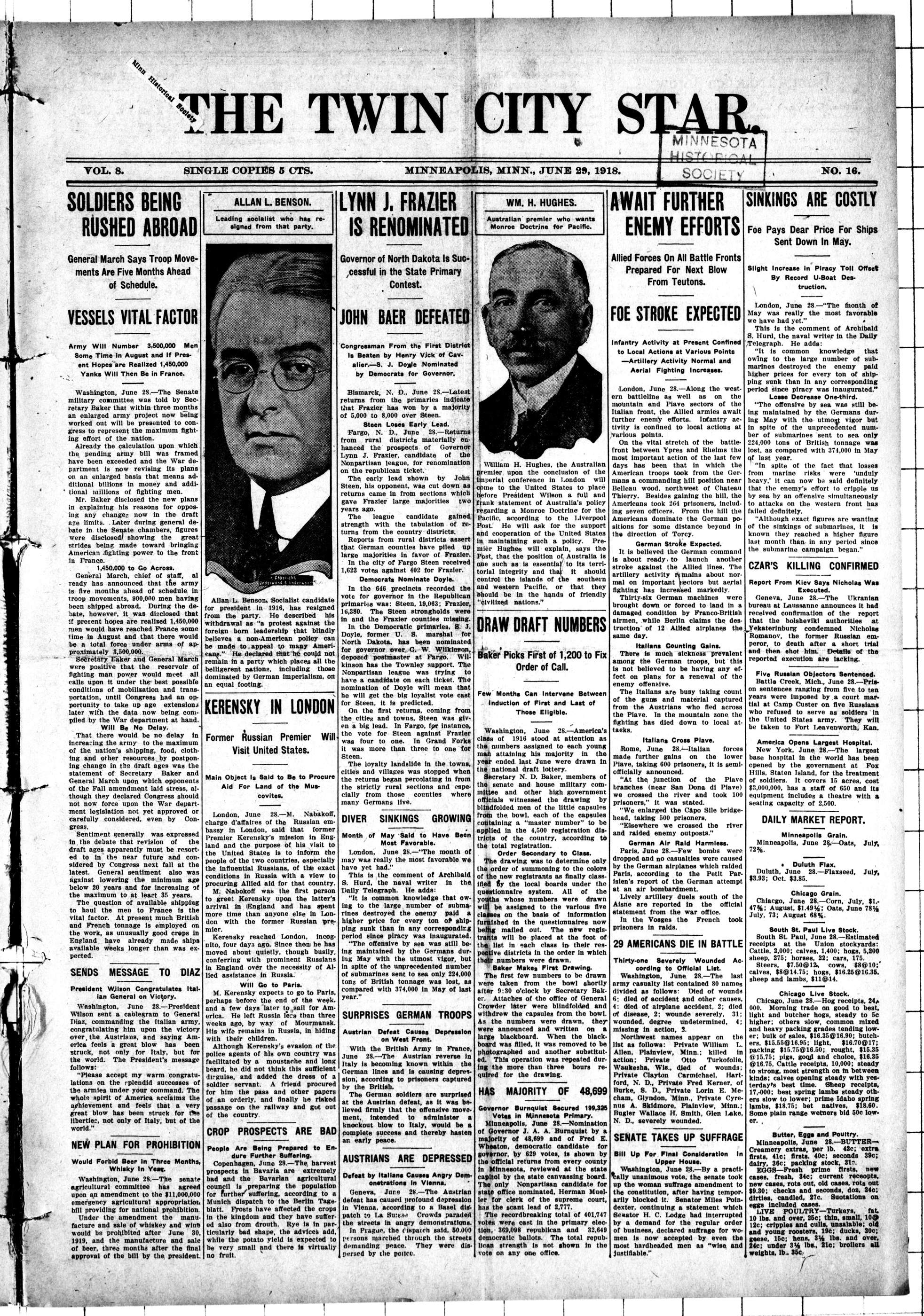
SOLDIERS BEING RUSHED ABROAD
General March Says Troop Movements Are Five Months Ahead of Schedule.
VESSELS VITAL FACTOR
Army Will Number 3,500,000 Men Some Time in August and If Present Hopes are Realized 1,450,000 Yanks Will Then Be in France.
Washington, June 28.—The Senate military committee was told by Secretary Baker that within three months an enlarged army project now being worked out will be presented to congress to represent the maximum fighting effort of the nation.
Already the calculation upon which the pending army bill was framed have been exceeded and the War department is now revising its plans on an enlarged basis that means additional billions in money and additional millions of fighting men.
Mr. Baker disclosed the new plans in explaining his reasons for opposing any changes now in the draft age limits. Later during general debate in the Senate chambers, figures were disclosed showing the great strides being made toward bringing American fighting power to the front in France.
1.450.000 to Go Across.
General March, chief of staff, al ready has announced that the army is five months ahead of schedule in troop movements, 900,000 men having been shipped abroad. During the debate, however, it was disclosed that if present hopes are realized 1,450,000 men would have reached France some time in August and that there would be a total force under arms of approximately 3,500,000.
Secretary Baker and General March were positive that the reservoir of fighting man power would meet all calls upon it under the best possible conditions of mobilization and transportation, until Congress had an opportunity to take up age extensions later with the data now being compiled by the War department at hand.
Will Be No Delay.
That there would be no delay in increasing the army to the maximum of the nation's shipping, food, clothing and other resources by postponing change in the draft ages was the statement of Secretary Baker and General March upon which opponents of the Fall amendment laid stress, although they declared Congress should not now force upon the War department legislation not yet approved or carefully considered, even by Congress.
Sentiment generally was expressed in the debate that revision of the draft ages apparently must be resorted to in the near future and considered by Congress next fall at the latest. General sentiment also was against lowering the minimum age below 20 years and for increasing of the maximum to at least 35 years. The question of available shipping to haul the men to France is the vital factor. At present much British and French tonnage is employed on the work, as unusually good crops in England have already made ships available weeks longer than was expected.
SENDS MESSAGE TO DIAZ
President Wilson Congratulates Italian General on Victory.
Washington, June 28.—President Wilson sent a cablegram to General Diaz, commanding the Italian army, congratulating him upon the victory over the Austrians, and saying America feels a great blow has been struck, not only for Italy, but for the world. The President's message follows:
"Please accept my warm congratulations on the splendid successes of the armies under your command. The whole spirit of America accolls the achievement and feels that a very great blow has been struck for the liberties, not only of Italy, but of the world."
NEW PLAN FOR PROHIBITION
Would Forbid Beer in Three Months, Whisky in Year.
Washington, June 28.—The senate agricultural committee has agreed upon an amendment to the $11,000,000 emergency agricultural appropriation bill providing for national prohibition. Under the amendment the manufacture and sale of whiskey and wine would be prohibited after June 30, 1919, and the manufacture and sale of beer, three months after the final approval of the bill by the president.
SINGLE COPIES 5 CTS.
Leading socialist who has resigned from that party.
Copyright,
Underwood & Underwood
Allan L. Benson, Socialist candidate for president in 1916, has resigned from the party. He described his withdrawal as "a protest against the foreign born leadership that blindly believes a non-American policy can be made to appeal to many Americans." He declared that he could not remain in a party which places all the belligerent nations, including those dominated by German imperialism, on an equal footing.
KERENSKY IN LONDON
Former Russian Premier Will Visit United States.
Main Object Is Said To Be To Procure
Aid For Land of the Mus-
London, June 28.—M. Nabakoff, charge d'affaires of the Russian embassy in London, said that former Premier Kerensky's mission in England and the purpose of his visit to the United States is to inform the people of the two countries, especially the influential Russians, of the exact conditions in Russia with a view to procuring Allied aid for that country. M. Nabakoff was the first person to greet Kerensky upon the latter's arrival in England and has spent more time than anyone else in London with the former Russian premier. Kerensky reached London, incognito, four days ago. Since then he has moved about quietly, though busily, conferring with prominent Russians in England over the necessity of Allied assistance in Russia.
Will Go to Paris.
M. Kerensky expects to go to Paris, perhaps before the end of the week, and a few days later to sail for America. He left Russia less than three weeks ago, by way of Mourmansk. His wife remains in Russia, in hiding with their children.
Although Kerensky's evasion of the police agents of his own country was facilitated by a moustache and long beard, he did not think this sufficient dirugue, and added the dress of a soldier servant. A friend procured for him the pass and other papers of an orderly, and finally he risked passage on the railway and got out of the country.
CROP PROSPECTS ARE BAD
People Are Being Prepared to Endure Further Suffering.
Copenhagen, June 28. The harvest prospects in Bavaria are extremely bad and the Bavarian agricultural council is preparing the population for further suffering, according to a Munich dispatch to the Berlin Tagelblatt. Frosts have affected the crops in the kingdom and they have suffered also from drouth. Rye is in particularly bad shape, the advices add, while the potato yield is expected to be very small and there is virtually no fruit.
MINNEAPOLIS, MINN., JUNE 29, 1918.
LYNN J. FRAZIER IS RENOMINATED
Governor of North Dakota Is Successful in the State Primary Contest.
JOHN BAER DEFEATED
Congressman From the First District
Is Beaten by Henry Vick of Cavalier.-S. J. Doyle Nominated
by Democrats for Governor.
Bismarck, N. D., June 28.—Latest returns from the primaries indicate that Frazier has won by a majority of 5,000 to 8,000 over Steen.
Steen Loses Early Lead.
Fargo, N. D., June 28.—Returns from rural districts materially enhanced the prospects of Governor Lynn J. Frazier, candidate of the Nonpartisan league, for renomination on the republican ticket.
The early lead shown by John Steen, his opponent, was cut down as returns came in from sections which gave Frazier large majorities two years ago.
The league candidate gained strength with the tabulation of returns from the country districts.
Reports from rural districts assert that German counties have piled up large majorities in favor of Frazier.
In the city of Fargo Steen received 1,623 votes against 402 for Frazier.
Democrats Nominate Doyle.
In the 646 precincts recorded the vote for governor in the Republican primaries was: Steen, 19,063; Frazier, 16,380. The Steen strongholds were in and the Frazier counties missing.
In the Democratic primaries, S. J. Doyle, former U. S. marshal for North Dakota, has been nominated for governor over G. W. Wilkinson, deposed postmaster at Fargo. Wilkinson has the Townley support. The Nonpartisan league was trying to have a candidate on each ticket. The nomination of Doyle will mean that he will get the big loyalist vote cast for Steen, it is predicted.
On the first returns, coming from the cities and towns, Steen was given a big lead. In Fargo, for instance, the vote for Steen against Frazier was four to one. In Grand Forks it was more than three to one for Steen.
The loyalty landslide in the towns, cities and villages was stopped when the returns began percolating in from the strictly rural sections and especially from those counties where many Germans live.
DIVER SINKINGS GROWING
Month of May Said to Have Been Most Favorable.
London, June 28.—"The month of may was really the most favorable we have yet had."
This is the comment of Archibald S. Hurd, the naval writer in the Daily Telegraph. He adds:
"It is common knowledge that owing to the large number of submarines destroyed the enemy paid a higher price for every ton of shipping sunk than in any corresponding period since piracy was inaugurated.
"The offensive by sea was still being maintained by the Germans during May with the utmost vigor, but in spite of the unprecedented number of submarines sent to sea only 224,000 tons of British tonnage was lost, as compared with 374,000 in May of last year."
SURPRISES GERMAN TROOPS
Austrian Defeat Causes Depression on West Front.
With the British Army in France, June 28.—The Austrian reverse in Italy is becoming known within the German lines and is causing depression, according to prisoners captured by the British.
The German soldiers are surprised at the Austrian defeat, as it was believed firmly that the offensive movement, intended to administer a knockout blow to Italy, would be a complete success and thereby hasten an early peace.
AUSTRIANS ARE DEPRESSED
Defeat by Italianis Causes Angry Demonstrations in Vienna.
Geneva, June 28.—The Austrian defeat has caused profound depression in Vienna, according to a Basel dispatch to La Susse Crowds paraded the streets in angry demonstrations.
In Prague, the dispatch said, 50,000 persons marched through the streets demanding peace. They were dispersed by the police.
Australian premier who wants Monroe Doctrine for Pacific.
Monroe Doctrine for Pacific.
William H. Hughes, the Australian premier upon the conclusion of the imperial conference in London will come to the United States to place before President Wilson a full and frank statement of Australia's policy regarding a Monroe Doctrine for the Pacific, according to the Liverpool Post. He will ask for the support and cooperation of the United States in maintaining such a policy. Premier Hughes will explain, says the Post, that the position of Australia is one such as is essential to its territorial integrity and that it should control the islands of the southern and western Pacific, or that they should be in the hands of friendly "civilized nations."
DRAW DRAFT NUMBERS
Baker Picks First of 1,200 to Fix Order of Call.
Few Months Can Intervene Between Induction of First and Last of Those Eligible.
Washington, June 28.—America's class of 1916 stood at attention as the numbers assigned to each young man attaining his majority in the year ended last June were drawn in the national draft lottery.
Secretary N. D. Baker, members of the senate and house military committee and other high government officials witnessed the drawing by blindfolded men of the little capsules from the bowl, each of the capsules containing a "master number" to be applied in the 4,500 registration districts of the country, according to the total registration.
Order Secondary to Class.
Order Secondary to Class.
The drawing was to determine only the order of summoning to the colors of the new registrants as finally classified by the local boards under the questionnaire system. All of the youths whose numbers were drawn will be assigned to the various five classes on the basis of information furnished in the questionnaires now being mailed out. The new registrants will be placed at the foot of the list in each class in their respective districts in the order in which their numbers were drawn.
Baker Makes First Drawing.
The first few numbers to be drawn were taken from the bowl shortly after 9:30 o'clock by Secretary Baker. Attaches of the office of General Crowder later were blindfolded and withdrew the capsules from the bowl. As the numbers were drawn, they were announced and written on a large blackboard. When the blackboard was filled, it was removed to be photographed and another substituted. This operation was repeated during the more than three hours required for the drawing.
HAS MAJORITY OF 48,699
Governor Burnquist Secured 199,325 Votes in Minnesota Primary.
Minneapolis, June 28.—Nomination of Governor J. A. A. Burnquist by a majority of 48,699 and of Fred E. Wheston, democratic candidate for governor, by 629 votes, is shown by the official returns from every county in Minnesota, reviewed at the state capitol by the state canvassing board.
The only Nonpartisan candidate for state office nominated, Herman Mueller for clerk of the supreme court, has the scant lead of 2,777.
The recordbreaking total of 401,747 votes were cast in the primary election, 369,098 republican and 32,649 democratic ballots. The total republican strength is not shown in the vote on any one office.
AWAIT FURTHER ENEMY EFFORTS
Allied Forces On All Battle Fronts Prepared For Next Blow From Teutons.
FOE STROKE EXPECTED
Infantry Activity at Present Confined to Local Actions at Various Points —Artillery Activity Normal and Aerial Fighting Increases.
London, June 28.—Along the western battline as well as on the mountain and Plave sectors of the Italian front, the Allied armies await further enemy efforts. Infantry activity is confined to local actions at various points.
On the vital stretch of the battlefront between Ypres and Rheims the most important action of the last few days has been that in which the American troops took from the Germans a commanding hill position near Belleau wood, northwest of Chateau Thierry. Besides gaining the hill, the Americans took 264 prisoners, including seven officers. From the hill the Americans dominate the German positions for some distance beyond in the direction of Torcy.
German Stroke Expected.
It is believed the German command is about ready, to launch another stroke against the Allied lines. The artillery activity remains about normal on important sectors but aerial fighting has increased markedly. Thirty-six German machines were brought down or forced to land in a damaged condition by Franco-British airmen, while Berlin claims the destruction of 12 Allied airplanes the same day.
Itallans Counting Gains.
There is much sickness prevalent among the German troops, but this is not believed to be having any effect on plans for a renewal of the enemy offensive.
The Italians are busy taking count of the guns and material captured from the Austrians who fled across the Piave. In the mountain zone the fighting has died down to local attacks.
Italiana Cross Plave.
Rome, June 28.—Italian forces made further gains on the lower Plave, taking 600 prisoners, it is semi-officially announced.
"At the junction of the Plave branches (near San Dona di Plave) we crossed the river and took 100 prisoners," it was stated.
"We enlarged the Capo Sile bridgehead, taking 500 prisoners.
"Elsewhere we crossed the river and raided enemy outposts."
German Air Raid Harmless.
Paris, June 28.—Few bombs were dropped and no casualties were caused by the German airplanes which raided Paris, according to the Petit Parisien's report of the German attempt at an air bombardment.
Lively artillery duels south of the Alsne are reported in the official statement from the war office.
In the Vosges the French took prisoners in raids.
29 AMERICANS DIE IN BATTLE
Thirty-one Severely Wounded According to Official List.
Washington, June 28.—The last army casualty list contained 80 names divided as follows: Died of wounds 6; died of accident and other causes, 4; died of airplane accident, 2; died of disease, 2; wound severely, 31; wounded, degree undetermined, 4; missing in action, 2.
Northwest names appear on the list as follows: Private William L. Allen, Plainview, Minn.; killed in action; Private Otto Turkofolle, Waukesha, Wis., died of wounds; Private Clayton Carmichael, Hartford, N. D., Private Fred Kerner, of Burke, S. D., Private Lorin E. Mecham, Glyndon, Minn., Cyrenus A. Skidmore, Plainview, Minn.; Bugler Wallace H. Smith, Glen Lake, N. D., severely wounded.
SENATE TAKES UP SUFFRAGE
Bill Up For Final Consideration in Upper House. Washington, June 28.—By a practically unanimous vote, the senate took up the woman suffrage amendment to the constitution, after having temporarily blocked it. Senator Miles Potindexer, continuing a statement which Senator H. C. Lodge had interrupted by a demand for the regular order of business, declared suffrage for women is now accepted by even the most hardheaded men as "wise and justifiable."
SINKINGS ARE COSTLY
Foe Pays Dear Price For Ships Sent Down In May.
Slight Increase in Piracy Toll Offset
By Record U-Boat Des-
London, June 28.—"The month of May was really the most favorable we have had yet."
This is the comment of Archibald S. Hurd, the naval writer in the Daily Telegraph. He adds:
"It is common knowledge that owing to the large number of submarines destroyed the enemy paid higher prices for every ton of shipping sunk than in any corresponding period since piracy was inaugurated."
Losse Decrease One-third.
"The offensive by sea was still being maintained by the Germans during May with the utmost vigor but in spite of the unprecedented number of submarines sent to sea only 224,000 tons of British tonnage was lost, as compared with 374,000 in May of last year.
"In spite of the fact that losses from marine risks were 'unduly heavy,' it can now be said definitely that the enemy's effort to cripple us by sea by an offensive simultaneously to attacks on the western front has failed definitely.
"Although exact figures are wanting of the sinkings of submarines, it is known they reached a higher figure last month than in any period since the submarine campaign began."
CZAR'S KILLING CONFIRMED
Report From Kiev Says Nicholas Was Executed.
Geneva, June 28.—The Ukrainian bureau at Lausanne announces it had received confirmation of the report that the bolshevik authorities at Yekaterinburg condemned Nicholas Romanov, the former Russian emperor, to death after a short trial and then shot him. Details of the reported execution are lacking.
Five Russian Objectors Sentenced.
Battle Creek, Mich., June 28—Prison sentences ranging from five to ten years were imposed by a court martial at Camp Custer on five Russians who refused to serve as soldiers in the United States army. They will be taken to Fort Leavenworth, Kan.
America Opens Largest Hospital.
New York, June 28.—The largest base hospital in the world has been opened by the government at Fox Hills, Staten Island, for the treatment of soldiers. It covers 15 acres, cost $3,000,000, has a staff of 650 and its equipment includes a theatre with a seating capacity of 2,500.
DAILY MARKET REPORT.
Minneapolis Grain.
Minneapolis, June 28—Oats, July,
72%.
Duluth Flax.
Duluth, June 28—Flaxseed, July,
$3.93; Oct. $3.85.
Chicago Grain.
Chiacgo, June 28—Corn, July, $1-
47%; August, $1.49½; Oats, June 78½
July, 73; August 68%.
South St. Paul Live Stock.
South St. Paul, June 28—Estimated
receipts at the Union stockyards:
Cattle, 2,000; calves, 1,400; hogs, 5,200
sheep, 275; horses, 22; cars, 175.
Steers, $7.50@12; cows, $8@10;
calves, $8@14.75; hogs, $16.25@16.35.
sheep and lambs, $11@14.
Chicago Live Stock.
Chicago, June 28—Hog receipts, 24,000. Morning trade on good to best, light and butcher hogs, steady to 5c higher; others slow, common mixed and heavy packing grades tending lower; bulk of sales, $16.35@16.90; butchers, $15.55@16.95; light, $16.70@17; packing $15.75@16.50; rough, $15.35@15.75; pigs, good and choice, $16.35@16.75. Cattle receipts, 10,000; steady to strong, most strength on in between kinds; calves opening steady with yesterday's best time. Sheep receipts, 17,000; best spring lambs steady others slow to lower; prime Idaho spring lambs, $18.75; bet natives, $18.60. Some plain range wetners bid 50c lower.
Butter, Eggs and Poultry.
Minneapolis, June 28.—BUTTER—
Creamy extras, per lb. 12¹; extra
firsts, 41¹; firsts, 40¹; seconds 39¹;
dairy, 36¹; packing stock, 31¹.
EGGS—Fresh prime firsts, new
cases, fresh, 34¹; current reeps,
new cases, rots out, old cases, rots out
$9.30; checks and seconds, doz, 24¹;
dirtles, candled, 27¹. Suctations on
eggs included cases.
LIVE POULTRY—Turkeys, fat
10 lbs. and over, 25¹; thin, small, 10¹
@; cripples and culls, unsalable; old
and young roosters, 19¹; ducks, 20¹;
geese, 15¹; hens, 3½ lbs. and over,
24¹; under 3½ lbs. 21¹; broilers all
weights. lb. 35¹.
Farm Production Grows
Estimated Gross Value of Wealth Produced on Farms in 1917 Exceeds Nineteen Billion Dollars
Following the items of the census of 1910, the United States department of agriculture has estimated the gross value of the wealth produced on farms in 1917 to be $19,444,000,000. This is divided into a total of $13,611,000,000 for all crops and $6,833,000,000 for animal products and animals sold off farms and slaughtered on farms. Such totals as these, even though they represent gross values, would have been regarded as fabulous before 1916.
The census total of wealth production on farms is $2,500,000,000 for 1889, $4,700,000,000 for 1899, and $8,600,000,000 for 1909, and the estimate for 1915 is $10,800,000,000. These numbers, being dollars and not quantities of product, are the resultant of two factors, production and price, and hence, as gauges of the productivity of the agricultural industry, may be above or below the fact.
In the ordinary course of events, many years must have elapsed before the products of farms would reach the stupendous aggregate gross value of 1917. The average increase per year from 1889 to 1899 was $226,000,000; from 1899 to 1909, $384,000,000; from 1909 to 1915, $370,000,000, and from 1899 to 1915, 16 years, $379,000,000. At the average annual rate of increase for the 16 years, not until 1938 would the gross value of 1917 be reached, computed as an increase over 1915. Mainly due to increase of price since 1915, the calendar has been anticipated by 21 years.
In the continuous annual record, extending back 21 years, 1911 is the only year with a decline in total gross value of farm products when compared with the preceding year, and that year was one with low production. A year that hardly exceeded the preceding one was 1914, when the price of cotton was demoralized by the war. By the end of 1915 the prices of most farm products were still nearly on the plane of 1914, with crop production 7 per cent above; and the total gross value of farm production was $10,775,000,000, a gain of nearly a billion dollars over either 1913 or 1914.
Then followed a rapid ascent of prices of farm products, and the weighted index for the prices of principal crops in December, 1916, was 56 per cent above 1915, so that, although the crop production was 14 per cent less, the total gross value of farm production was $13,406,000,000, or 25 per cent above 1915, itself the topmost year at that time.
The performance of 1916 in farm wealth production, unprecedentedly large though it was, was a puny precursor of 1917. The price index number of the principal crops of this year is 35 per cent above 1916 and 111 per cent above 1915, and complicated with this enormous factor is a crop production that is 12 per cent above 1916. Hence it is that the grand aggregate of $13,611,000,000 is reached as the gross value of the farm crop production of 1917, and of $19-444,000,000 as the total of all production.
Caution is given by the department of agriculture against accepting this total of $19,444,000,000 as the amount of the farmers' cash income, and also against regarding it as a net income. There are duplication and triplication of value and also omitted items; cost of production must be considered, and certainly for 1916 and 1917 a soaring cost has complicated the problem. It is a gross income in a vague, undefinable, intangible sense, which cannot be reduced to a net income, nor net wealth production, by any process.
Baseball Equipment Aids in Making Athletes of Soldiers of the U. S. Now in France
Three months ago an earnest appeal from a second lieutenant of an engineer regiment doing duty at a permanent post back of the lines in France, for athletic equipment to outfit five teams was mailed to Clark Griffith. Mr. Griffith responded to the call.
Up to the present time the Griffith Bat and Ball fund has given the boys about 48,000 balls, 12,000 bats, 4,000 catcher's masks, 4,000 catcher's mitts, 4,000 chest protectors, 4,000 first base-
THE MILITARY
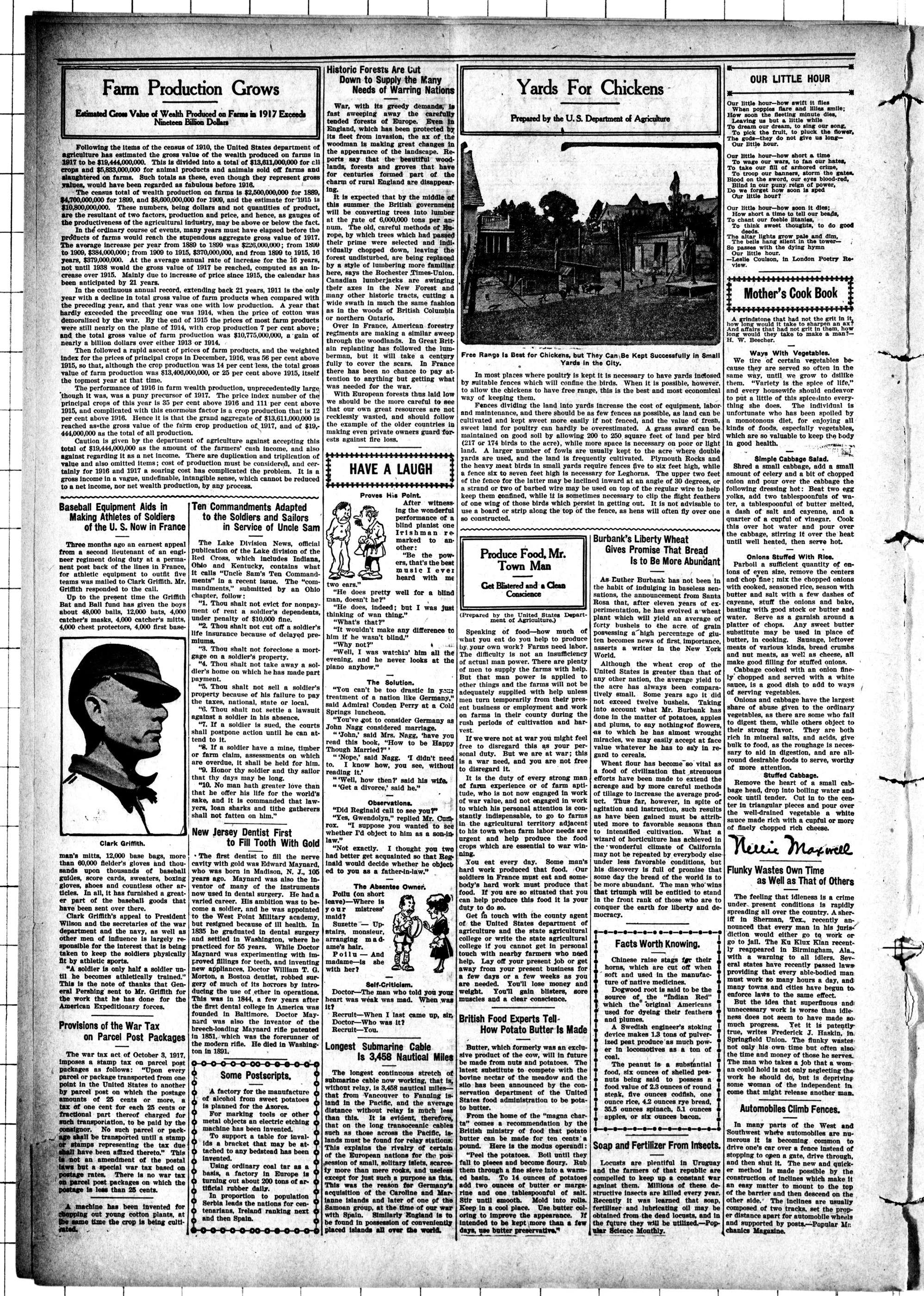
Clark Griffith.
man's mitts, 12,000 base bags, more than 60,000 fielder's gloves and thousands upon thousands of baseball guides, score cards, sweaters, boxing gloves, shoes and countless other articles. In all, it has furnished a greater part of the baseball goods that have been sent over there.
Clark Griffith's appeal to President Wilson and the secretaries of the war department and the navy, as well as other men of influence is largely responsible for the interest that is being taken to keep the soldiers physically fit by athletic sports.
"A soldier is only half a soldier until he becomes athletically trained." This is the note of thanks that General Pershing sent to Mr. Griffith for the work that he has done for the American Expeditionary forces.
Provisions of the War Tax on Parcel Post Packages
The war tax act of October 3, 1917, imposes a stamp tax on parcel post packages as follows: "Upon every parcel or package transported from one point in the United States to another by parcel post on which the postage amounts of 25 cents or more, a tax of one cent for each 25 cents or fractional part thereof charged for such transportation, to be paid by the consignor. No such parcel or package shall be transported until a stamp or stamps representing the tax due shall have been affixed thereto." This is not an amendment of the postal laws but a special war tax based on postage rates. There is no war tax on parcel post packages on which the postage is less than 25 cents.
A machine has been invented for chopping out young cotton plants, at the same time the crop is being cultivated.
Ten Commandments Adapted to the Soldiers and Sailors in Service of Uncle Sam
The Lake Division News, official publication of the Lake division of the Red Cross, which includes Indiana, Ohio and Kentucky, contains what it calls "Uncle Sam's Ten Commandments" in a recent issue. The "commandments," submitted by an Ohio chapter, follow:
"1. Thou shalt not evict for nonpayment of rent a soldier's dependents, under penalty of $10,000 fine.
"2. Thou shalt not cut off a soldier's life insurance because of delayed premiums.
"3. Thou shalt not foreclose a mortgage on a soldier's property.
"4. Thou shalt not take away a soldier's home on which he has made part payment.
"5. Thou shalt not sell a soldier's property because of his failure to pay the taxes, national, state or local.
"6. Thou shalt not settle a lawsuit against a soldier in his absence.
"7. If a soldier is sued, the courts shall postpone action until he can attend to it.
"9. Honor thy soldier and thy sailor that thy days may be long.
"10. No man hath greater love than that he offer his life for the world's sake, and it is commanded that lawyers, loan sharks and tithe gatherers shall not fatten on him."
New Jersey Dentist First to Fill Tooth With Gold
The first dentist to fill the nerve cavity with gold was Edward Maynard, who was born in Madison, N. J., 105 years ago. Maynard was also the inventor of many of the instruments now used in dental surgery. He had a varied career. His ambition was to become a soldier, and he was appointed to the West Point Military academy, but resigned because of ill health. In 1835 he graduated in dental surgery and settled in Washington, where he practiced for 55 years. While Doctor Maynard was experimenting with improved fillings for teeth, and inventing new appliances, Doctor William T. G. Morton, a Boston dentist, robbed surgery of much of its horrors by introducing the use of ether in operations. This was in 1844, a few years after the first dental college in America was founded in Baltimore. Doctor Maynard was also the inventor of the breech-loading Maynard rifle patented in 1851, which was the forerunner of the modern rifle. He died in Washington in 1891.
Some Postscripts.
A factory for the manufacture of alcohol from sweet potatoes is planned for the Azores. For marking tools or other metal objects an electric etching machine has been invented. To support a table for invalids a bracket that may be attached to any bedstead has been invented. Using ordinary coal tar as a basis, a factory in Europe is turning out about 200 tons of artificial rubber daily. In proportion to population Serbia leads the nations for centenarians, Ireland ranking next and then Spain.
Historic Forests Are Cut Down to Supply the Many Needs of Warring Nations
War, with its greedy demands, is fast sweeping away the carefully tended forests of Europe. Even in England, which has been protected by its fleet from invasion, the ax of the woodman is making great changes in the appearance of the landscape. Reports say that the beautiful woodlands, forests and groves that have for centuries formed part of the charm of rural England are disappearing.
It is expected that by the middle of this summer the British government will be converting trees into lumber at the rate of 6,000,000 tons per annum. The old, careful methods of Europe, by which trees which had passed their prime were selected and individually chopped down, leaving the forest undisturbed, are being replaced by a style of lumbering more familiar here, says the Rochester Times-Union. Canadian lumberjacks are swinging their axes in the New Forest and many other historic tracts, cutting a wide swath in much the same fashion as in the woods of British Columbia or northern Ontario.
Over in France, American forestry regiments are making a similar sweep through the woodlands. In Great Britain replanting has followed the lumberman, but it will take a century fully to cover the scars. In France there has been no chance to pay attention to anything but getting what was needed for the war. With European forests thus laid low we should be the more careful to see that our own great resources are not recklessly wasted, and should follow the example of the older countries in making even private owners guard forests against fire loss.
HAVE A LAUGH
HAVE A LAUGH
Proves His Point.
A man is talking to a man.
After witnessing the wonderful performance of a blind pianist one Irishman remarked to another: "Be the powers, that's the best music I even heard with me
two ears."
"He does pretty well for a blind man, doesn't he?"
"He does, indeed; but I was just thinking of wan thing."
"What's that?"
"It wouldn't make any difference to him if he wasn't blind."
"Why not?"
"Well, I was watchin' him all the evening, and he never looks at the piano anyhow."
The Solution:
"You can't be too drastic in your treatment of a nation like Germany," said Admiral Couden Perry at a Cold Springs luncheon.
"You've got to consider Germany as John Nagg considered marriage.
"John," said Mrs. Nagg, "have you read this book, "How to be Happy Though Married?""
"Nope," said Nagg. "I didn't need to. I know how, you see, without reading it."
"Well, how then?" said his wife.
"Get a divorce," said he.
Observations.
"Yes, Gwendolyn," replied Mr. Cumrox. "I suppose you wanted to see whether I'd object to him as a son-in-law." "Not exactly. I thought you two had better get acquainted so that Reginald would decide whether he objected to you as a father-in-law."
A MAN AND A WOMAN
Suzette — Upstairs, monsieur, arranging ma-dame's hair.
Pollu — And madame—is she with her?
Doctor—The man who told you your heart was weak was mad. When was it?
Recruit—When I last came up, sir,
Doctor—Who was it?
Recruit—You.
Longest Submarine Cable Is 3,458 Nautical Miles
The longest continuous stretch of submarine cable now working, that is, without relay, is 3,458 nautical miles—that from Vancouver to Fanning island in the Pacific, and the average distance without relay is much less than this. It is evident, therefore, that on the long transoceanic cables such as those across the Pacific, islands must be found for relay stations. This explains the rivalry of certain of the European nations for the possession of small, solitary islets, scarcely more than mere rocks, and useless except for just such a purpose as this. This was the reason for Germany's acquisition of the Caroline and Marianne islands and later of one of the Samoan group, at the time of our war with Spain. Similarly England is to be found in possession of conveniently placed islands all over the world.
Yards For Chickens
Prepared by the U.S. Department of Agriculture
Free Range Is Best for Chickens, but They Can Be Kept Successfully in Small Yards in the City.
In most places where poultry is kept it is necessary to have yards inclosed by suitable fences which will confine the birds. When it is possible, however, to allow the chickens to have free range, this is the best and most economical way of keeping them.
Fences dividing the land into yards increase the cost of equipment, labor and maintenance, and there should be as few fences as possible, as land can be cultivated and kept sweet more easily if not fenced, and the value of fresh, sweet land for poultry can hardly be overestimated. A grass sward can be maintained on good soil by allowing 200 to 250 square feet of land per bird (217 or 174 birds to the acre), while more space is necessary on poor or light land. A larger number of fowls are usually kept to the acre where double yards are used, and the land is frequently cultivated. Plymouth Rocks and the heavy meat birds in small yards require fences five to six feet high, while a fence six to seven feet high is necessary for Leghorns. The upper two feet of the fence for the latter may be inclined inward at an angle of 30 degrees, or a strand or two of barbed wire may be used on top of the regular wire to help keep them confined, while it is sometimes necessary to clip the flight feathers of one wing of those birds which persist in getting out. It is not advisable to use a board or strip along the top of the fence, as hens will often fly over one so constructed.
Produce Food,Mr. Town Man
Get Blistered and a Clean Conscience
(Prepared by the United States Department of Agriculture.)
Speaking of food—how much of what you eat do you help to produce by your own work? Farms need labor. The difficulty is not an insufficiency of actual man power. There are plenty of men to supply the farms with help. But that man power is applied to other things and the farms will not be adequately supplied with help unless men turn temporarily from their present business or employment and work on farms in their county during the rush periods of cultivation and harvest.
If we were not at war you might feel free to disregard this as your personal duty. But we are at war; this is a war need, and you are not free to disregard it.
It is the duty of every strong man of farm experience or of farm aptitude, who is not now engaged in work of war value, and not engaged in work to which his personal attention is constantly indispensable, to go to farms in the agricultural territory adjacent to his town when farm labor needs are urgent and help produce the food crops which are essential to war winning.
You eat every day. Some man's hard work produced that food. Our soldiers in France must eat and somebody's hard work must produce that food. If you are so situated that you can help produce this food it is your duty to do so.
Get in touch with the county agent of the United States department of agriculture and the state agricultural college or write the state agricultural college if you cannot get in personal touch with nearby farmers who need help. Lay off your present job or get away from your present business for a few days or a few weeks as you are needed. You'll lose money and weight. You'll gain blisters, sore muscles and a clear conscience.
British Food Experts Tell How Potato Butter Is Made
Butter, which formerly was an exclusive product of the cow, will in future be made from nuts and potatoes. The latest substitute to compete with the bovine nectar of the meadow and the silo has been announced by the conservation department of the United States food administration to be potato butter. From the home of the "magna charta" comes a recommendation by the British ministry of food that potato butter can be made for ten cents' a pound. Here is the modus operandi:
"Peel the potatoes. Boil until they fall to pieces and become flour. Rub them through a fine sieve into a warmed basin. To 14 ounces of potatoes add two ounces of butter or margarine and one tablespoonful of salt. Stir until smooth. Mold into rolls. Keep in a cool place. Use butter coloring to improve the appearance. If intended to be kept more than a few days, use butter preservative."
Burbank's Liberty Wheat Gives Promise That Bread Is to Be More Abundant
As Euther Burbank has not been in the habit of indulging in baseless sensations, the announcement from Santa Rosa that, after eleven years of experimentation, he has evolved a wheat plant which will yield an average of forty bushels to the acre of grain possessing a high percentage of gluten becomes news of first importance, asserts a writer in the New York World.
Although the wheat crop of the United States is greater than that of any other nation, the average yield to the acre has always been comparatively small. Some years ago it did not exceed twelve bushels. Taking into account what Mr. Burbank has done in the matter of potatoes, apples and plums, to say nothing of flowers, as to which he has almost wrought miracles, we may easily accept at face value whatever he has to say in regard to cereals.
Wheat flour has become so vital as a food of civilization that strenuous efforts have been made to extend the acreage and by more careful methods of tillage to increase the average product. Thus far, however, in spite of agitation and instruction, such results as have been gained must be attributed more to favorable seasons than to intensified cultivation. What a wizard of horticulture has achieved in the wonderful climate of California may not be repeated by everybody else under less favorable conditions, but his discovery is full of promise that some day the bread of the world is to be more abundant. The man who wins that triumph will be entitled to stand in the front rank of those who are to conquer the earth for liberty and democracy.
Facts Worth Knowing.
Chinese raise stags for their horns, which are cut off when soft and used in the manufacture of native medicines. Dogwood root is said to be the source of the "Indian Red" which the original Americans used for dyeing their feathers and plumes. A Swedish engineer's stoking device makes 1.3 tons of pulverized peat produce as much power in locomotives as a ton of coal. The peanut is a substantial food, six ounces of shelled peanuts being said to possess a food value of 2.3 ounces of round steak, five ounces codfish, one ounce rice, 4.2 ounces rye bread, 35.5 ounces spinach, 5.1 ounces apples, or six ounces bacon.
Soap and Fertilizer From Insects.
Locusts are plentiful in Uruguay and the farmers of that republic are compelled to keep up a constant war against them. Millions of these destructive insects are killed every year. Recently it was learned that soap, fertilizer and lubricating oil may be obtained from the dead locusts, and in the future they will be utilized.—Popular Science Monthly.
Our little hour—how swift it flies
When poppies flare and lilies smile;
How soon the fleeting minute dies,
Leaving us but a little while
To dream our dream, to sing our song,
To pick the fruit, to pluck the flower,
The gods—they do not give us long—
Our little hour.
Our little hour—how short a time
To wage our wars, to fan our hates,
To take our fill of armored crime,
To troop our banners, storm the gates,
Blood on the sword, our eyes blood-red,
Blind in our puny reign of power,
Do we forget how soon is sped
Our little hour?
Our little hour—how soon it dies;
How short a time to tell our beads,
To chant our feeble litilian,
To think sweet thoughts, to do good deeds.
The altar lights grow pale and dim,
The bells hang silent in the tower—
So passes with the dying hymn
Our little hour.
-Leslie Coulson, in London Poetry Rev-
view.
Mother's Cook Book
A grindstone that had not the grit in it,
how long would it take to sharpen an ax?
A grindstone that had not grit in them not
long would they take to make a mat?
H. W. Beecher,
Ways With Vegetables.
We tire of certain vegetables because they are served so often in the same way, until we grow to dsllike them. "Variety is the spice of life," and every housewife should endeavor to put a little of this spice into everything she does. The individual is unfortunate who has been spoiled by a monotonous diet, for enjoying all kinds of foods, especially vegetables, which are so valuable to keep the body in good health.
Simple Cabbage Salad.
Shred a small cabbage, add a small amount of celery and a bit of chopped onion and pour over the cabbage the following dressing hot: Beat two egg yolks, add two tablespoonfuls of water, a tablespoonful of butter melted, a dash of salt and cayenne, and a quarter of a cupful of vinegar. Cook this over hot water and pour over the cabbage, stirring it over the heat until well heated, then serve hot.
Options Stuffed With Bice
Parboil a sufficient quantity of onions of even size, remove the centers and chop fine; mix the chopped onions with cooked, seasoned rice, season with butter and salt with a few dashes of cayenne, stuff the onions and bake, basting with good stock or butter and water. Serve as a garnish around a platter of chops. Any sweet butter substitute may be used in place of butter, in cooking. Sausage, leftover meats of various kinds, bread crumbs and nut meats, as well as cheese, all make good filling for stuffed onions. Cabbage cooked with an onion finely chopped and served with a white sauce, is a good dish to add to ways of serving vegetables.
Onions and cabbage have the largest share of abuse given to the ordinary vegetables, as there are some who fall to digest them, while others object to their strong flavor. They are both rich in mineral salts, and acids, give bulk to food, as the roughage is necessary to aid in digestion, and are all-round desirable foods to serve, worthy of more attention.
Stuffed Cabbage.
Remove the heart of a small cabbage head, drop into boiling water and cook until tender. Cut in to the center in triangular pieces and pour over the well-drained vegetable a white sauce made rich with a cupful or more of finely chopped rich cheese.
Flunky Wastes Own Time as Well as That of Others
The feeling that idleness is a crime under. present conditions is rapidly spreading all over the country. A sheriff in Sherman, Tex., recently announced that every man in his jurisdiction would either go to work or go to jail. The Ku Klux Klan recently reappeared in Birmingham, Ala., with a warning to all idlers. Several states have recently passed laws providing that every able-bodied man must work so many hours a day, and many towns and cities have begun to enforce laws to the same effect.
But the idea that superfluous and unnecessary work is worse than idleness does not seem to have made so much progress. Yet it is patently true, writes Frederick J. Haskin, in Springfield Union. The flunky wastes not only his own time but often also the time and money of those he serves. The man who takes a job that a woman could hold is not only neglecting the work he should do, but is depriving some woman of the independent income that might release another man.
Automobiles Climb Fences.
In many parts of the West and Southwest where automobiles are numerous it is becoming common to drive one's car over a fence instead of stopping to open a gate, drive through, and then shut it. The new and quicker method is made possible by the construction of inclines which make it an easy matter to mount to the top of the barrier and then descend on the other side. The inclines are usually composed of two tracks, set the proper distance apart for automobile wheels and supported by posts.—Popular Mechanics Magazine.
AYING OUR DEB TO FRANCE
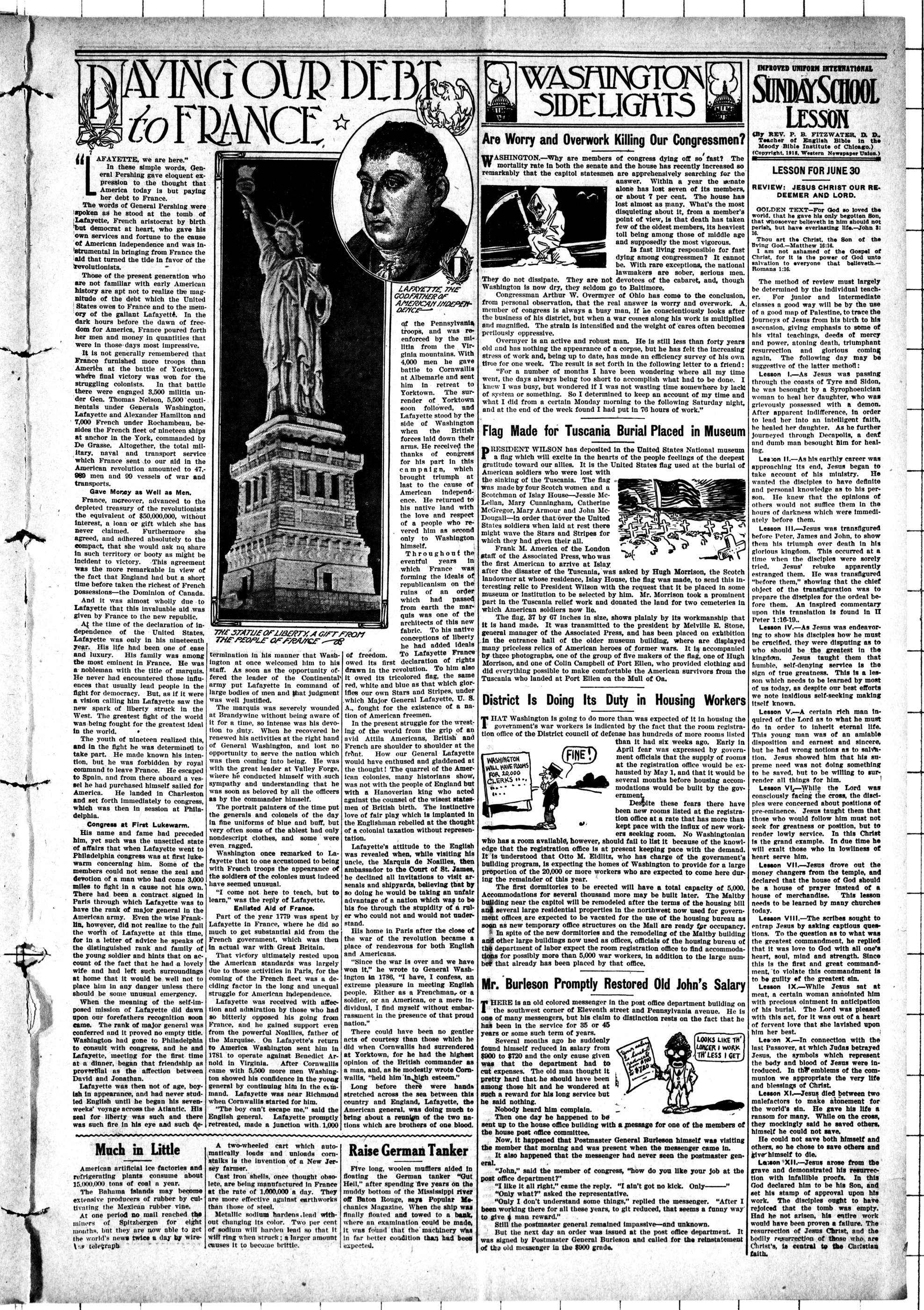
AFAYETTE, we are here." In these simple words, General Pershing gave eloquent expression to the thought that America today is but paying her debt to France. The words of General Pershing were spoken as he stood at the tomb of Lafayette, French aristocrat by birth but democrat at heart, who gave his own services and fortune to the cause of American independence and was instrumental in bringing from France the aid that turned the tide in favor of the revolutionists.
Those of the present generation who are not familiar with early American history are apt not to realize the magnitude of the debt which the United States owes to France and to the memory of the gallant Lafayette. In the dark hours before the dawn of freedom for America, France poured forth her men and money in quantities that were in those days most impressive.
It is not generally remembered that France furnished more troops than America at the battle of Yorktown, where final victory was won for the struggling colonists. In that battle there were engaged 3,500 militia under Gen. Thomas Nelson, 5,500 continents under Generals Washington, Lafayette and Alexander Hamilton and 7,000 French under Rochambeau, besides the French fleet of nineteen ships at anchor in the York, commanded by De Grasse. Altogether, the total military, naval and transport service which France sent to our aid in the American revolution amounted to 47,989 men and 99 vessels of war and transports.
Gave Money as Well as Men.
France, moreover, advanced to the depleted treasury of the revolutionists the equivalent of $50,000,000, without interest, a loan or gift which she has never claimed. Furthermore she agreed, and adhered absolutely to the compact, that she would ask nq share in such territory or booty as might be incident to victory. This agreement was the more remarkable in view of the fact that England had but a short time before taken the richest of French possessions—the Dominion of Canada. And it was almost wholly due to Lafayette that this invaluable aid was given by France to the new republic.
At the time of the declaration of independence of the United States, Lafayette was only in his nineteenth year. His life had been one of ease and luxury. His family was among the most eminent in France. He was a nobleman with the title of marquis. He never had encountered those influences that usually lead people in the fight for democracy. But, as if it were a vision calling him Lafayette saw the new spark of liberty struck in the West. The greatest fight of the world was being fought for the greatest ideal in the world.
The youth of nineteen realized this, and in the fight he was determined to take part. He made known his intention, but he was forbidden by royal command to leave France. He escaped to Spain, and from there aboard a vessel he had purchased himself salled for America. He landed in Charleston and set forth immediately to congress, which was then in session at Philadelphia.
Congress at First Lukewarm.
His name and fame had preceded him, yet such was the unsettled state of affairs that when Lafayette went to Philadelphia congress was at first lukewarm concerning him. Some of the members could not sense the zeal and devotion of a man who had come 3,000 miles to fight in a cause not his own. There had been a contract signed in Paris through which Lafayette was to have the rank of major general in the American army. Even the wise Franklin, however, did not realize to the full worth of Lafayette at this time, for in a letter of advice he speaks of the distinguished rank and family of the young soldier and hints that on account of the fact that he had a lovely wife and had left such surroundings at home that it would be well not to place him in any danger unless there should be some unusual emergency.
When the meaning of the self-imposed mission of Lafayette did dawn upon our forefathers recognition soon came. The rank of major general was conferred and it proved no empty title. Washington had gone to Philadelphia to consult with congress, and he and Lafayette, meeting for the first time at a dinner, began that friendship as proverbal as the affection between David and Jonathan.
Lafayette was then not of age, boyish in appearance, and had never studied English until he began his seven-weeks' voyage across the Atlantic. His zeal for liberty was such and there was such fire in his eye and such de-
Much in Little
Much in Little
American artificial ice factories and refrigerating plants consume about 15,000,000 tons of coal a year. The Bahama islands may become extensive producers of rubber by cultivating the Mexican rubber vine. At one period no mail reached the miners of Spitzbergen for eight months, but they are now able to get the world's news twice a day by wire telegraph
J
of freedom
owed its first declaration of rights drawn in the revolution. To him also it owed its tricolored flag, the same red, white and blue as that which glorifies our own Stars and Stripes, under which Major General Lafayette, U. S. A., fought for the existence of a nation of American freemen.
In the present struggle for the wrestling of the world from the grip of an avid Attila Americans, British and French are shoulder to shoulder at the front. How our General Lafayette would have enthused and gladdened at the thought! The quarrel of the American colonies, many historians show, was not with the people of England but with a Hanoverian king who acted against the counsel of the wisest statesmen of British birth. The instinctive love of fair play which is implanted in the Englishman rebelled at the thought of a colonial taxation without representation.
Lafayette's attitude to the English was revealed when, while visiting his uncle, the Marquis de Noailles, then ambassador to the Court of St. James, he declined all invitations to visit arsenals and shipyards, believing that by so doing he would be taking an unfair advantage of a nation which was to be his foe through the stupidity of a ruler who could not and would not understand.
His home in Paris after the close of the war of the revolution became a place of rendezvous for both English and Americans.
"Since the war is over and we have won it," he wrote to General Washington in 1786, "I have, I confess, an extreme pleasure in meeting English people. Either as a Frenchman, or a soldier, or an American, or a mere individual, I find myself without embarrassment in the presence of that proud nation."
There could have been no gentler acts of courtesy than those which he did when Cornwallis had surrendered at Yorktown, for he had the highest opinion of the British commander as a man, and, as he modestly wrote Cornwallis, "held him in high esteem." Long before there were hands stretched across the sea between this country and England, Lafayette, the American general, was doing much to bring about a reunion of the two nations which are brothers of one blood.
Raise German Tanker
Five long, woolen mufflers aided in floating the German tanker "Gut Hell," after spending five years on the muddy bottom of the Mississippi river off Baton Rouge, says Popular Mechanics Magazine. When the ship was finally floated and towed to a bank, where an examination could be made, it was found that the machinery was in far better condition than had been expected.
termination in his manner that Washington at once welcomed him to his staff. As soon as the opportunity offered the leader of the Continental army put Lafayette in command of large bodies of men and that judgment was well justified.
The marquis was severely wounded at Brandywine without being aware of it for a time, so intense was his devotion to duty. When he recovered his activities at the right hand of General Washington, and lost no opportunity to serve the nation which was then coming into being. He was with the great leader at Valley Forge, where he conducted himself with such sympathy and understanding that he was soon as beloved by all the officers as by the commander himself.
of framed drawn it owed red, wilted or which A., fordion of it. In the ling of avid French frbnt. would the the lean can was no with a against
The portrait painters of the time put the generals and colonels of the day in fine uniforms of blue and buff, but very often some of the ablest had only nondescript clothes, and some were even ragged.
Washington once remarked to Lafayette that to one accustomed to being with French troops the appearance of the soldiers of the colonies must indeed have seemed unusual.
"I come not here to teach, but to learn," was the reply of Lafayette.
Enlisted Aid of France.
Part of the year 1779 was spent by Lafayette in France, where he did so much to get substantial aid from the French government, which was then in actual war with Great Britain.
That victory ultimately rested upon the American standards was largely due to those activities in Paris, for the coming of the French fleet was a deciding factor in the long and unequal struggle for American independence. Lafayette was received with affection and admiration by those who had so bitterly opposed his going from France, and he gained support even from the powerful Noallies, father of the Marquise. On Lafayette's return to America Washington sent him in 1781 to operate against Benedict Arnold in Virginia. After Cornwallis came with 5,500 more men Washington showed his confidence in the young general by continuing him in the command. Lafayette was near Richmond when Cornwallis started for him. "The boy can't escape me," said the English general. Lafayette promptly retreated, made a junction with 1,000
A two-wheeled cart which automatically loads and unloads cornstalks is the invention of a New Jersey farmer. Cast iron shells, once thought obsolete, are being manufactured in France at the rate of 1,000,000 a day. They are more effective against earthworks than those of steel. Metallic sodium hardens, lead without changing its color. Two per cent of sodium will harden lead so that it will ring when struck; a larger amount causes it to become brittle.
LAFVETTE, THE
GODFATHER OF
AMERICAN INDEPENDENCE
of the Pennsylvania troops, and was reinforced by the militia from the Virginia mountains. With 4,000 men he gave battle to Cornwallis at Albemarle and sent him in retreat to Yorktown. The surrender of Yorktown soon followed, and Lafayette stood by the side of Washington when the British forces laid down their arms. He received the thanks of congress for his part in this campaign, which brought triumph at last to the cause of American independence. He returned to his native land with the love and respect of a people who revered him as second only to Washington himself.
Throughout the eventful years in which France was forming the ideals of republicanism on the ruins of an order which had passed from earth the marquais was one of the architects of this new fabric. To his native conceptions of liberty he had added ideals To Lafayette France
WASHINGTON SIDELIGHTS
Are Worry and Overwork Killing Our Congressmen?
Are Worry and Overwork Killing Our Congressmen?
WASHINGTON.—Why are members of congress dying off so fast? The mortality rate in both the senate and the house has recently increased so remarkably that the capitol statesmen are apprehensively searching for the
They do not dissipate. They are not devotees of the cabaret, and, though Washington is now dry, they seldom go to Baltimore.
Congressman Arthur W. Overmyer of Ohio has come to the conclusion, from personal observation, that the real answer is worry and overwork. A member of congress is always a busy man, if he conscientiously looks after the business of his district, but when a war comes along his work is multiplied and magnified. The strain is intensified and the weight of cares often becomes perilously oppressive.
Overmyer is an active and robust man. He is still less than forty years old and has nothing the appearance of a corpse, but he has felt the increasing stress of work and, being up to date, has made an efficiency survey of his own time for one week. The result is set forth in the following letter to a friend:
"For a number of months I have been wondering where all my time went, the days always being too short to accomplish what had to be done. I knew I was busy, but wondered if I was not wasting time somewhere by lack of system or something. So I determined to keep an account of my time and what I did from a certain Monday morning to the following Saturday night, and at the end of the week found I had put in 76 hours of work."
Flag Made for Tuscania Burial Placed in Museum
PRESIDENT WILSON has deposited in the United States National museum a flag which will excite in the hearts of the people feelings of the deepest gratitude toward our allies. It is the United States flag used at the burial of
after the disaster of the Tuscania, was asked by Hugh Morrison, the Scotch landowner at whose residence, Islay House, the flag was made, to send this interesting relic to President Wilson with the request that it be placed in some museum or institution to be selected by him. Mr. Morrison took a prominent part in the Tuscania relief work and donated the land for two cemeteries in which American soldiers now lie.
The flag, 37 by 67 inches in size, shows plainly by its workmanship that it is hand made. It was transmitted to the president by Melville E. Stone, general manager of the Associated Press, and has been placed on exhibition in the entrance hall of the older museum building, where are displayed many priceless relics of American heroes of former wars. It is accompanied by three photographs, one of the group of five makers of the flag, one of Hugh Morrison, and one of Colin Campbell of Port Ellen, who provided clothing and did everything possible to make comfortable the American survivors from the Tuscania who landed at Port Ellen on the Mull of Oa.
District Is Doing Its Duty in Housing Workers
District Is Doing Its Duty in Housing Workers
THAT Washington is going to do more than was expected of it in housing the government's war workers is indicated by the fact that the room registration office of the District council of defense has hundreds of more rooms listed
who has a room available, however, should fall to list it because of the knowledge that the registration office is at present keeping pace with the demand. It is understood that Otto M. Eldlitz, who has charge of the government's building program, is expecting the homes of Washington to provide for a large proportion of the 20,000 or more workers who are expected to come here during the remainder of this year.
The first dormitories to be erected will have a total capacity of 5,000. Accommodations for several thousand more may be built later. The Maltby building near the capitol will be remodeled after the terms of the housing bill and several large residential properties in the northwest now used for government offices are expected to be vacated for the use of the housing bureau as soon as new temporary office structures on the Mall are ready for occupancy.
In spite of the new dormitories and the remodeling of the Maltby building and other large buildings now used as offices, officials of the housing bureau of the department of labor expect the room registration office to find accommodations for possibly more than 5,000 war workers, in addition to the large number that already has been placed by that office.
Mr. Burleson Promptly Restored Old John's Salary
Mr. Burleson Promptly Restored Old John's Salary
THERE is an old colored messenger in the post office department building on the southwest corner of Eleventh street and Pennsylvania avenue. He is one of many messengers, but his claim to distinction rests on the fact that he has been in the service for 35 or 45 years or some such term of years.
sent up to the house office building with a message for one of the members of the house post office committee.
It also happened that the messenger had never seen the postmaster general.
"John," said the member of congress, "how do you like your job at the post office department?
"I like it all right," came the reply. "I ain't got no kick. Only——"
"Only what?" asked the representative.
"Only I don't understand some things," replied the messenger. "After I been working there for all these years, to git reduced, that seems a funny way to give a man reward."
Still the postmaster general remained impassive—and unknown.
Still the postmaster general remained impassive—and unknown. But the next day an order was issued at the post office department. It was signed by Postmaster General Burleson and called for the reinstatement of the old messenger in the $000 grade.
Grim Reaper
They do not dissipate. They are not Washington is now dry, they seldom go. Congressman Arthur W. Overmyer from personal observation, that the re member of congress is always a busy the business of his district, but when a and magnified. The strain is intensified perilously oppressive. Overmyer is an active, and robust old and has nothing the appearance of stress of work and, being up to date, h time for one week. The result is set for "For a number of months I have went, the days always being too short knew I was busy, but wondered if I w of system or something. So I determi what I did from a certain Monday me and at the end of the week found I has
Flag Made for Tuscania
PRESIDENT WILSON has deposited a flag which will excite in the heart gratitude toward our allies. It is the
American soldiers who were lost with the sinking of the Tuscania. The flag was made by four Scotch women and a Scotchman of Islay House—Jessie McLellan, Mary Cunningham, Catherine McGregor, Mary Armour and John McDougall—in order that over the United States soldiers when laid at rest there might wave the Stars and Stripes for which they had given their all.
Frank M. America of the London staff of the Associated Press, who was the first American to arrive at Islay
after the disaster of the Tuscania, war landowner at whose residence, Islay Herteresting relic to President Wilson with museum or institution to be selected by part in the Tuscania relief work and which American soldiers now lie.
The flag, 37 by 67 inches in size, it is hand made. It was transmitted general manager of the Associated Pr in the entrance hall of the older many priceless relics of American here by three photographs, one of the group Morrison, and one of Colin Campbell did everything possible to make comfort Tuscania who landed at Port Ellen on
District Is Doing Its D
THAT Washington is going to do more government's war workers is indication office of the District council of def
WASHINGTON WILL HAVE ROOMS FOR 20,000 CLERKS FINE!
who has a room available, however, she edge that the registration office is at. It is understood that Otto M. Eldritz building program, is expecting the home proportion of the 20,000 or more working the remainder of this year.
The first dormitories to be erected Accommodations for several thousand building near the capitol will be remod and several large residential properties ment offices are expected to be vacate soon as new temporary office structure.
In spite of the new dormitories and and other large buildings now used as a the department of labor expect the rooctions for possibly more than 5,000 war ber that already has been placed by t
Mr. Burleson Promptly R
THERE is an old colored messenger in the southwest corner of Eleventh a one of many messengers, but his claim has been in the service for 35 or 45 years or some such term of years.
Several months ago he suddenly found himself reduced in salary from $900 to $720 and the only cause given was that the department had to cut expenses. The old man thought it pretty hard that he should have been among those hit and he wondered at such a reward for his long service but he said nothing. Nobody heard him complain.
Then one day he happened to be sent up to the house office building with the house post office committee.
Now, it happened that Postmaster the member that morning and was pre It also happened that the messeng eral.
"John," said the member of cong post office department?
"I like it all right," came the reply.
"Only what?" asked the represent.
"Only I don't understand some the been working there for all these years, to give a man reward."
Still the postmaster general remain But the next day an order was is was signed by Postmaster General Bur of the old messenger in the $900 grade
answer. Within a year the senate alone has lost seven of its members, or about 7 per cent. The house has lost almost as many. What's the most disquieting about it, from a member's point of view, is that death has taken few of the oldest members, its heaviest toll being among those of middle age and supposedly the most vigorous. Is fast living responsible for fast dying among congressmen? It cannot be. With rare exceptions, the national lawmakers are sober, serious men.
devotees of the cabaret, and, though no to Baltimore.
of Ohio has come to the conclusion, real answer is worry and overwork. A man, if he conscientiously looks after war comes along his work is multiplied and the weight of cares often becomes heavier. He is still less than forty years a corpse, but he has felt the increasing use made an efficiency survey of his own worth in the following letter to a friend: he been wondering where all my time to accomplish what had to be done. I was not wasting time somewhere by lack need to keep an account of my time and turning to the following Saturday night, I put in 76 hours of work."
Burial Placed in Museum
In the United States National museums of the people feelings of the deepest United States flag used at the burial of
is asked by Hugh Morrison, the Scotch house, the flag was made, to send this in the request that it be placed in some by him. Mr. Morrison took a prominent donated the land for two cemeteries in shows plainly by its workmanship that to the president by Melville E. Stone, and has been placed on exhibition museum building, where are displayedoes of former wars. It is accompaniedof five makers of the flag, one of Hugh I Port Ellen, who provided clothing andtable the American survivors from theMull of Oa.
Duty in Housing Workers
be than was expected of it in housing theated by the fact that the room registra- tense has hundreds of more rooms listed
than it had six weeks ago. Early in April fear was expressed by government officials that the supply of rooms at the registration office would be exhausted by May 1, and that it would be several months before housing accommodations would be built by the government.
Despite these fears there have been new rooms listed at the registration office at a rate that has more than kept pace with the influx of new workers seeking room. No Washingtonian
could fall to list it because of the knowl-
present keeping pace with the demand.
who has charge of the government's
miles of Washington to provide for a large
ers who are expected to come here dur-
did will have a total capacity of 5,000.
more may be built later. The Maltby
kept after the terms of the housing bill
in the northwest now used for govern-
al for the use of the housing bureau as
as on the Mall are ready for occupancy.
and the remodeling of the Maltby building
offices, officials of the housing bureau of
on registration office to find accommodation-
workers, in addition to the large num-
hat office.
Restored Old John's Salary
in the post office department building on
street and Pennsylvania avenue. He is
to distinction rests on the fact that he
YOUR ADMINISTRATIVE PRODUCTS FROM $900 TO $750
LOOKS LIKE TH' LONGER I WORK TH' LESS I GET
in a message for one of the members of
General Burleson himself was visiting
resent when the messenger came in.
He had never seen the postmaster gen-
ess, "how do you like your job at the
"I aln't got no klck. Only——"
positive.
ings," replied the messenger. "After I
to git reduced, that seems a funny way
ed impassive—and unknown.
sued at the post office department. It
leson and called for the reinstatement
IMPROVED UNIFORM INTERNATIONAL SUNDAY SCHOOL LESSON
By REV. P. B. FITZWATER, D. D.
Teacher of English Bible in the
Moody Bible Institute of Chicago.
(Copyright, 1918, Western Newspaper Union.)
LESSON FOR JUNE 30
REVIEW: JESUS CHRIST OUR RE-
DEEMER AND LORD.
GOLDEN TEXT—For God so loved the world, that he gave his only begotten Son, that whosoever believeth in him should not perish, but have everlasting life.—John 3:16.
Thou art the Christ, the Son of the Living God.—Matthew 15:16.
I am not ashamed of the Gospel of Christ, for it is the power of God unto salvation to everyone that believeth.—Romans 1:16.
The method of review must largely be determined by the individual teacher. For junior and intermediate classes a good way will be by the use of a good map of Palestine, to trace the journeys of Jesus from his birth to his ascension, giving emphasis to some of his vital teachings, deeds of mercy and power, atoning death, triumphant resurrection and glorious coming again. The following day may be suggestive of the latter method:
Lesson I.—As Jesus was passing through the coasts of Tyre and Sidon, he was besought by a Syrophoenician woman to heal her daughter, who was grievously possessed with a demon. After apparent indifference, in order to lead her into an intelligent faith, he healed her daughter. As he further journeyed through Decapolis, a deaf and dumb man besought him for healing.
Lesson II.—As his earthly career was approaching its end, Jesus began to take account of his ministry. He wanted the disciples to have definite and personal knowledge as to his person. He knew that the opinions of others would not suffice them in the hours of darkness which were immediately before them.
Lesson III.—Jesus was transfigured before Peter, James and John, to show them his triumph over death in his glorious kingdom. This occurred at a time when the disciples were sorely tried. Jesus' rebuke apparently estranged them. He was transfigured "before them," showing that the chief object of the transfiguration was to prepare the disciples for the ordeal before them. An inspired commentary upon this translation is found in II Peter 1:16-19.
Lesson IV.—As Jesus was endeavoring to show his disciples how he must be crucified, they were disputing as to who should be the greatest in the kingdom. Jesus taught them that humble, self-denying service is the sign of true greatness. This is a lesson which needs to be learned by most of us today, as despite our best efforts we note insidious self-seeking making itself known.
Lesson V.—A certain rich man inquired of the Lord as to what he must do in order to inherit eternal life. This young man was of an amiable disposition and earnest and sincere, but he had wrong notions as to salvation. Jesus showed him that his supreme need was not doing something to be saved, but to be willing to surrender all things for him.
Lesson VI<sub>2</sub>—While the Lord was consciously facing the cross, the disciples were concerned about positions of pre-eminence. Jesus taught them that those who would follow him must not seek for greatness or position, but to render lowly service. In this Christ is the grand example. In due time he will exalt those who in lowliness of heart serve him.
Lesson VII.—Jesus drove out the money changers from the temple, and declared that the house of God should be a house of prayer instead of a house of merchandise. This lesson needs to be learned by many churches today.
Lesson VIII.—The scribes sought to entrap Jesus by asking captious questions. To the question as to what was the greatest commandment, he replied that it was love to God with all one's heart, soul, mind and strength. Since this is the first and great commandment, to violate this commandment is to be guilty of the greatest sin.
Lesson IX.—While Jesus sat at meat, a certain woman annointed him with precious oilment in anticipation of his burial. The Lord was pleased with this act, for it was out of a heart of fervent love that she lavished upon him her best.
Lesson X. In connection with the last Passover, at which Judas betrayed Jesus, the symbols which represent the body and blood of Jesus were introduced. In the emblems of the communion we appropriate the very life and blessings of Christ.
Lesson XI. Jesus died between two malefactors to make atonement for the world's sin. He gave his life a ransom for many. While on the cross, they mockingly said he saved others, himself he could not save.
He could not save both himself and others, so he chose to save others and give himself to die.
Lason XII.—Jesus arose from the grave and demonstrated his resurrection with infallible proofs. In this God declared him to be his Son, and set his stamp of approval upon his work. The disciples ought to have rejoiced that the tomb was empty. Had he not arisen, his entire work would have been proven a failure. The resurrection of Jesus Christ, and the bodily resurrection of those who are Christ's, is central to the Christian faith.
Pan a SORTA SEAM Re ROO REE Ne Aa tee, Se ap rie eo CT ee oe ae Se eT Ee
RT eee te re frry oF SMPALIG MES TET Se eye eee eee
bales yh 1) aS Se a SR ded = an oe
PRES PR" ees Sie te Do Fe yl ahaneed ‘a 2"
7 ta ei iad aden in RR alg ts ba Re ia 4
FHE TWIN CITY STAR
a SE
‘PUBLSHED EVERY FRIDAY BY
', CHARLES SUMNER SMITH,
‘Minneapolis, Minnesota.
» Batered in the Post Office at Min-
Geapolis as second class matter.
MEMBER
NATIONAL NEGRO PRESS
al ASSOCIATION
@ubecristion by Mail, Postpaid.
“ONE YEAR ........eeseeee000e$20
$IX MONTHS $12:
JHREE MONTHS ............ 6
ADVERTISING RATES.
One Inch—1 Insertion—One Dollar
Liberal discount given on 3, 6, 9,
Months, or 1 year contracts.
‘We do not run free ads, or over-rus
the time contracted for by our ad
vertisers We respect their right tc
advertise at intervals, and rather have
them do 80, than to run continuous;
jan “adv.” and an increasing account.
Write all Checks payable to
THE TWIN CITY STAR
1317 North Sixth Ave.
M:NNEAPOLIS - - MINNESOTA
Call at 1317 6th Ave. N. on Wednes-
day to insure matter for publication.
The Star's Phone, Hyland 1208.
Send your subscription. Our prices
have not changed because of the war.
Let your dollar do its duty and The
Star will reach a higher standard of
service and better circulation.
‘ mm Fa
“THE REPUBLICAN PARTY I
‘THE SHIP; ALL ELSE IS THE SEA,”
aid Frederick Douglass. Now is the
most important time for Negroes to
stand by the old party of Lincoln and
Grant,
Keep Minnesota a Republican State.
mee
We are living in an age and an
epoch which is characterized by a
growing and insistent demand for jus-
tice and democracy. The United
States is sending men, money and
munitions to the. battle fields of Eu-
Tope as its demand for justice, free-
dom and equality of opportunity for
ail peoples, and it would be well for
the Americans at this tine to remem-
ber that here in our own country for
the past fifty years since the aboll-
tion of slavery, is a race loyal, patri-
otic people who are not enjoying at
the hands of this government here at
home the principles of that democracy
for which we are fighting to make the
world safe, and in which fight God
helping us, we will be victorious.
W. T. FRANCIS
‘We have never known two injus-
tices to make anything right. The
Gaturday News has prospered by be-
ing as just to the white man as it has
ever been to the Negro. We have
never gone off half-cocked upon any
Proposition. Whenever we grope, we
are in search of the truth. We want
to be right and avold as nearly as
possible beihg wrong. We are not
for the Negro right or wrong. We
want him to be right. We complain
Decause a majority of white people
will always side with a white man
when a question arises between him
and one of our color; still certain col-
ored newspapers, without making any
investigation whatsoever as to the
evidence, would have the entire Ne-
gro race do identically what they con-
demn the white people for doing. Be
¢ause the white people do wrong is
No reason why the Negroes should
do wrong. The best preparedness to
Teceive justice is to be just yourself.
Hopkinsville (Ky.) News. j
“ENLIST OR WORK” CAMPAIGN.
The military authorities intend to
push the enlist or work campaign
‘among the Negroes. There are many
fdlers who have no lawful means of
support. They will be drafted into
the industrial army. Get work, gen-
tlemen of lelsure, even it as a side
.
HELP THE Y. M. C. A.
hie Offer Expires August 1, 1918,
One dollar’ will be given to the
Colored Y. M. C. A. in this city for
every paid annual subscription to
the Twin City Star. (Editor.)
; fe SUBSCRIBE NOW.
READ THIS CAREFULLY,
If you receive a newspaper by mail
and do not wish to pay for it, just
fefuse it by informing your postman.
‘Phen it will be returned to the puo-
Msher and he wil be notified to dis-
continue sending it. There is no
Teason why a person should pay for
® paper forced on them, but every
Feason why it should be paid for wien
“ordered and accepted.
= aie
SUBSCRIBERS WANTED — Make
the im City Star a live and depend-
ble eekly Negro newspaper by
me ‘your subscription.
gaa @ dollar on your account, or
‘fet @ new subscriber, The Star is
A és ‘PAPER.
mh Te
| 2Are you a delinquent subscriber?
t 90 why not send your subscrip-
eS ——
‘end the Negro Papers.
COMMISSIONS NEGRO
MINNESOTA HOME GUARD
Commissions have been signed for
the following Staff Officers:
JOSE H. SHERWOOD—Major.
ROBERT L. ROBINSON—First Liew-
tenant and Adjutant. :
GEORGE L. HOAGE—First Lieuten-
ant and Supply Officer.
ARTHUR J, TODD—First Lieutenant
and Ordnance Officer.
DR. VALDQ TURNER—Captain, Med-
feal Corps.
DR. JAMES H. REDD—First Lieuten-
ant Medical Corps.
Major Sherwood has appointed Ira
8. Ashe Battalion Sergeant Major.
Coripany “B” elected officers follow-
Ing Captain Sherwood's promotion to
Major.
ORRINGTON C. HALL—Captain,
T. W. STEPP—First Lieutenant.
JOHN F. COQUIRE—Second Lieuten-
ant.
The following clipping is from one
of the leading papers of Western Can-
ada.
WHY THIS OUTCRY
AGAINST THE NEGRO?
Editor, The Herald:—-
‘The attention of the readers of The
Calgary Daily Herald, both broad and
narrow thinkers within the city of Cal-
gary and province of Alberta, is called
to analyze the true conditions of the
labor question, which is causing so
much animosity by the colored men re-
placing the white ones in the dining
car capacity.
‘One could readily believe more an-
tagonistic remarks could not have
been anticipated had the heretofore
white crews been replaced by Huns
themselves,
‘We seem to forget we are striving
to maintain democracy. We also fail
to view the fact that intelligence is
the shaping of every man's destiny.
Can we, within our hearts, deny
these men who have proved them-
selves as loyal as any race, with such
@ catastrophe facing us, the rights
to such an insignificant position as
has caused this dispute, when we
ourselves have closed the doors to
‘him of more intelligent positions
which he is capable of holding?
As true democrats let us for a mo-
ment remove the veil of prejudice and
view him from an angle of his true
worth; they have more than proven
their loyalty to the U. 8. A., under con-
ditions 1 will not mention. France
found in them such loyalty and pa-
triotism that her standing army of 200,-
000 consisted of them. Has France
had cause to regret it? No. Let us
recall at the outbreak of the war his
anxiety to prove his ldyalty and pa-
triotism to Canada. Our hearts were
8o- against him, he was plainly told,
“This is the white man’s war.”
Since the adoption of the draft law,
some of these very same men have
been called to the colors. This same
rejected man will, at present, and must
in future prove himself capable of
holding any position the white man
holds if allowed the chance.
So let us as true democrats cease
our hostilities towards him, which is
based on account of his color; grant
him what the future must give—the
right of an equal chance.
SYMPATHIZER
The Calgary Daily Herald,
AGAIN, IT IS GEORGIA.
The Negro Soldier in the Trenches—
His Folks at Home in the “Black
Beit.” $8
“He gave a magnificent example
of ,courage and energy,” says a
French General of Division of Private
Henry Johnson, U. 8. A., colored. “A
good and brave soldier,” he says of
‘Needham Roberts, also colored, whose
life Johnson saved. “Both men fought
bravely,” says General Pershing in
hjs official communique. _ Together
though both severely wounded, they
beat off an attack by twenty Germans
in a listening post, forcing them to
flee. For their splendid initiative,
valor and determination the Croix de
Guerre has been awarded them; to
Johnson the gold palm also.
Upon the same page of The World
that described this feat of arms ap-
peared a dispatch from Valdosta, Ga.,
telling how Mary Turner, colored
wag hanged by a mob.
For the crime of killing a white
man and wounding his wife, two men
had been lynched last week. Mrs.
Turner was the fourth victim, her
husband preceding her by a few
hours. The murder plot was sup
posed to have been made in her
home; she “was said to have had
the dead farmer's watch” when cap
tured. Legal evidence against her
there was none; even the lynch-law
testimony, not subject to crossex-
amination, was worthless and in.
conclusive.
In France two Negro volunteers
badly wounded, give an example of
courage and energy in the defense of
democracy which 1s deemed worthy
of citation before a whole army di
vision and’ by General Pershing. In
one of the leadng states of :he South
@ negro woman is put to death by a
mob, without companionship of het
sex, without evidence or plea, in de
fiance of law and justice.
‘With tens of thousands of Amer
joan Negroes fighting for civilization
fn France under the Amercan flag
hom much longer are the American
people to tolerate Negro lynchings'
—New York World.
SEND IN YOUR NEWS
ADVERTISE IN THE STAR
FACTS WORTH KNOWING
Great Britain and Ireland consume
{80,000,000 rabbits as food annually.
‘To blow two soap bubbles at once,
‘one within the other, is the purpose of
& recently patented pipe.
‘The Pennsylvania railroad states
that shippers could save $2,000,000 a
year by more carefully packing
freight.
Japanese copper mines yielded 111,-
562 tons of ore last year, an increase
of nearly 30,000 tons from the preced-
ing year,
Apparatus has been invented for ac-
curately testing the hardness of metals
by showing thelr resistance to the
teeth of files.
English chemists have made a syn-
thetic turpentine at what is sald to bé
onethird the cost of the genuine
American article,
Eighty thousand women are serving
with the Red Cross ambulances and
hospitals in France, Algeria, Morocco
and in the Orient.
A Japanese is the inventor of a
street sprinkler that distributes water
s0 as to form advertisements on
smooth pavements.
Clad only in nightgown and over-
shoes and chasing a coyote carrying @
pair of fat hens in its mouth for a
distance of half a mile in zero weather
was the stunt of Ernest Barnes, a
farmer near Smith Center, Kan.
Henry B. Plerce, an English ship-
owner, who started life in humble cir.
cumstances as a laborer in the harbor
‘works at Messina and afterwards be-
came one of the leading shipowners in
Italy, has just died at his home near
Naples, leaving a fortune of $20,000,
000, At the great Messina earthquake
nine years ago all the other members
of his family were killed.
~ POINTED PARAGRAPHS
Every woman who is a good listener
jg truly unselfish,
It takes two banana skins to make a
pair of slippers.
An old bachelor says that a certifi
cate of birth is a milk ticket.
A man who boasts of having small
feet has the same kind of brain,
Girls are illogical because they are
too fond of begging the question.
Some girls go abroad to complete
thelr education, and others get mar
ried at home.
Many a man who couldn't train a
dog ‘decently imagines that he is an
ideal child trainer.
It 1s usually a case of misplaced
confidence when a woman marries a
man for the purpose of reforming him.
When a woman doses her invalid
hustand with herb tea and he doesn't
get well he is elther contrary or un-
grateful.
THINGS YOU MAY NOT KNOW
Of the old-time vegetable dyes Bra-
gil possesses an almost endless variety.
In some parts of northern Arabia
the hills are so well stocked with bees
that no sooner are hives placed than
they are occupied.
‘Tungsten, which only in recent
years has come into general use, was
discussed exhaustively by a Spanish
treatise written in 1781,
EORSSS WEES OB DISEe
With the Hons, tigers and other
members of the cat tribe, the night
finds them at thelr livellest, and they
sleep most between the midday meal
and supper time.
Because of the war Scotland has
been cutting down a great many trees
to supply its own needs. Much of the
land thus cleared will eventually be
used for agriculture.
Currants from Greece are now
pagked by machinery in a mfnner
which ts far more cleanly and eco-
nomical than the old “hand methods.”
‘The latter have always been question-
able.
A cablegram from the American
consul at Padang, Sumatra, recelved
April 22, states that the government
has prohibited the exportation of cin-
chona bark, quinine, quinine salts, tin,
tin ore and kapok. y
Uruguay has appointed a commis-
sion to investigate the feasibility of
‘a scher? to turn the locust pest into
a blessing by using these insects In the
manufacture of fertilizer, soap and lu-
bricants and stock feed.
The hell of Mahomet is as full of
terror as his heaven is of delight. The
wicked will suffer alternately from
cold and heat; when ‘thirsty, bolling
water will be given them, and they
will be shod with shoes of fire.
A brass band and football and
cricket teams are found among stu
dents of the missionary college at
‘tution in Dark Continent that af
fers Afrieans @ standard college edu
“THE WORLD DO MOVE”
A gasoline torch that cannot be
blown out supplies the heat for a new
cooking stove for campers,
A new mop for washing automobiles
has a hollow handle through which
water is fed by screwing it to hose.
4 holder has been patented for safe-
ty razor blades to enable them to be
used by tailors or dressmakers for
ripping seams,
A Californian 1s the inventor of a
registering device to be attached to a
hen’s back to record the number of
eggs she lays.
‘The extermination ‘ot all files is the
aim of two British physicians who
are experimenting with a parasite that
kills the insects,
‘The vacuum-cleaning process has
been applied with specially designed
apparatus to removing soot and dirt
from boller tubes.
‘To make a kitchen stove help warm
the room in which it is used a metal
cover that radiates the heat evenly
has been patented.
With government encouragement,
extensive experiments will be made
with a view to reviving the growing
of flax in Scotland,
Made of fiat steel spring a quick-
ly adjusted belt has been invented to
take the place of strings on kitchen
or laboratory aprons,
A rudder has been patented, nor-
mally within the hull of a vessel, but
which can be projected through the
bow to ald in steering.
A method has been invented in Eu-
rope for treating old hops so that
they can be used as an acceptable
substitute for tobacco.
HITS FROM SHARP WITS :
me
| What ts called temptation is
; only inclination’s opportunity—
Albany Journal.
rd
| Little sins are eggs from |
| which great sorrows are hatched. |
| Chicago News,
Charity begins at home, but :
it isn't charity if it stays there, |
| Birmingham Press,
Lima Beane doesn’t think sup- |
porting an automobile to be |
grounds for military exemption. |
| Toledo Blade.
- . Do they call a battleship “she”
| Because it is determined to get |
in the last word in a scrap?—
| Milwaukee News.
; It ts almost impossible to ship |
| success over a line that’s all -
| clogged up with good intentions, ;
; —Binghamton Press, ;
Shih E HE EH EnEbhEbEbbe
STRAY PLANTS.
The very best place for a profes
ional “iron fist” 1s the scrap-heap. .
‘Tis a mighty, innumerable host,
when Humanity girds on the armor.
Even a great nation like ours has
many sins to answer for—including
“champion pugilists.”
Some men want to be the stamens
in the blossom of life—but the fra-
grance they bring gives them away.
Where is the good old brother who
sed to shut his eyes and sing through
his tiose) “Jee-ru-sa-lem, My Hap-pee
Home?”
But, if you ask your dealer to shake
@own the potatoes in the measure
don’t you see it would brulse your
potatoes?
Sometimes you meet a food con-
servationist who would be more en:
tertaining with a mouth full of
mashed potatoes,
BITS OF WISDOM
It’s a wise head that knows Its own
mind,
‘What will Hoover say when ft comes
to filling a long felt want?
‘The quickest way to reach prosper.
ity 1s to look in the dictionary.
Some people appear to think that
they can win the war by going to a
photographer.
This country will never run out of
heroes as long as the press associa-
tions hold out.
TAKEN FROMEXCHANGES
Strong paper has been made in In-
in from pulp obtained from a species
of ginger plant that grows throughout
that country.
A nail puller patented by a Pennssi-
‘vantan has jaws with a graduated se-
les of serrations to grasp nails of dif-
ferent sizes,
A selentist in Sweden has advanced
the theory that bearded grains draw
lectricity frova the air to ald them in
her growth,
GET READY!
soft Se - an ee Set ot ee
FOR THE BIG
PICNIC OF THE SEASON
GIVEN BY THE
§ MEN’S EPISCOPAL CLUB Fo
Of Minneapolis and St. Paul on, J
iS oat
PARKER’S LAKE
Everybody will be assured of a good time
BANCING BOATING BATHING FISHING
McCULLOUGH’S ORCHESTRA
The committee will see to it that this outing will be conducted In
, _ the highly efficient way that has characterized all of
their past picnics.
TO GO TO PARKER'S LAKE FROM ST. PAUL
Leave St. Paul via Interurban cars (University Avenue Line) Forty-five mine
utes before train time, given below. Get off car at Second Avenue North.
Walk two blocks to Electric Short Line Depot, Seventh Street and Second
Avenue North, Phone Main 1987, =
ELECTRIC TRAIN SCHEDULE.
IMPORTANT NOTICE—Trains will leave promptly as scheduled
LEAVING AT:— 7:30 A. M, 11 A. Me 2:15 P.M. 4:20 P. Me
Special Train Leaves Minneapolis At 2:15 P. M. Sharp
TRAINS RETURNING FROM LAKE AT: 6:29 P. M. AND 9:30 P. M.
Se ee ees
ROUND TRIP TICKETS. ADULTS 60 CENTS CHILDREN 35 CENTS
ee Ns een el ee SA
COMMITTEE OF ARRANGEMENTS.
ST. PAUL COMMITTEE.
John M. LaCoste, Chairman
Tra 8. Ashe Louis Moore F. D. McCracken
C. W. Wigington Chas. Cuthbert Wm. Pettet
1 MINNEAPOLIS COMMITTEE.
i Dr. R. 8. Brown, Chairman
F. Terry * J. Houstoa:
The management reserves the right to refuse undesirable persons.
Peterson, The Druggist
1501 Washington Ave. So,
TOILET ARTICLES, DRUGS
PRESCRIPTIONS.
He Solicits Your Patronage.
T. 8. Center 4639.
WALFRID WESTMAN
Photographer |
41425 Washington Ave. So. Minn.
WORKING-MEN’S
SOCIAL CLUB
FOR MEN ONLY
244 3RD AVE. S.
MINNEAPOLIS
SYLVESTER W. OLIVER &
BENJAMIN JONES.
Managers
THE KEYSTONE BUFFET
(Formerly “Kid” Mitchell's)
Now under new management of
JIMMY SMITH
1313 Washington Ave So.
Main 2259 Minneapolis
ee
‘Wanted—A live, honest, correspond-
ent and agent. Apply to Twin City
Star.
. SUBSCRIBE FOR THE STAR,
CLARENCE BELL MOVES
INTO NEW QUARTERS
Having secured a more desirable
building for my barber shop and pool
hall, | have moved to 250 Third Ave.
8. (same block), where everything
will be complete for the accommoda-
tion and comfort of my patrons. Up-
to-date service and courteous treat-
ment extended to all. Public patron-
age solicited.
CLARENCE W. BELL.
(Advertisemept.)
“ WASTE-RASKET COPY.
We are daily receiving all sorts of
“News” from Negro organization and
institutfons, prepared by some pre-paid
press agent, with a request that, “The
—— —— would greatly appreciate
the use of the enclosed in the, current
iseue of your valued paper.” When
Negroes in general learn to pay for
publicity, they will get ‘better results
from advertising and their copy will
not be consigned to the waste-basket
or kitghen stove.
Do not forget to send the money
to the Star which you owe for sub
scriptions.
Nothing Changed
But the Price
‘Sight Drafts StiH the Same Fine Old Cigar’
‘You've Always Liked
‘When your dealer asks you six conte
apiece for your old friend Bight
don’t get the ides that he is trying to
something over on you.
‘The plain truth of the matter is thes
our labor and other manufacturing costs.
have increased so much that we had the
Choice of cutting down the size of the
Bight Draft cigar, using inferior tobacco,
‘or raising the price one cent. .
We believed you Would rather have
the same old Sight Draft quality, the
same old size, even if it cost you » penny:
more. So, from now on Bight Drafts will
besix cents.
‘Try « Bight Draft today. It's worth
ie conta and yom cxperenced euskens
KNOW it is. W. K. Gresh & Som,
makers. W. 8. Conrad Co, St. Paal,
wholesale distributors. —Advertisement
CHOICE CITY AND SUBUR+
BAN PROPERTY FOR SALB
ON SMALL MONTHLY PAYe
MENTS.
Houses and Flats for Rent, -
B. M. McDew
802 Sykes Block.
N. W. Nic. 621 Minneapolis
———$——
Otfica Hours: Sundays:
\atoopm. 10 to1p. m
9:30 a m. €o 12:30 p. m.
R. S. BROWN, M. D.
Office 408-9 Tribune Annex
67 Fourth Street Soutr.
N. W. Main 2040. T. S. 38194
Res, 608 B. 14th St.
N. W. Main 2388 Miznonpoli
COAL IN SMALL QUANTITIES.
WITHER’S SMALL-ORDER
“ SERVICE.
Quick and Convenient.
Hyland 2331. Hyland 4712
EVERY DAY is BARGAIN DAY
at the ROOT & HAGEMAN
STORE, 407 Nicollet Ave.
) AGENTS WANTED—NOW!
Reliable and intelligent agents al
ways wanted to solicit business for
THE TWIN CITY STAR; also corre-
spondents in principal’ cities. A
ehance to earn a good living. Write.
‘The Twin City Star, Minneapolis. _
Do not waste your time making
Promises to our agents. saree
money by Express or Post Or
der or in cash or postage stamps. -
SUBSCRIBE FOR THE STAR,
GO GO
Go!
your money in our Savings Department. Any time is a but now is the best, in order to take advantage of the best period which closes July 10.
NORWESTERN NATIONAL BANK
RQUETTE,, AVE., BETWEEN 4TH AND 5TH.
RESOURCES $53,000,000
nepin Lumber Co.
to deposit your money in our Savings Department. Any time is a good time, but now is the best, in order to take advantage of the new interest period which closes July 10.
NORTHWESTERN NATIONAL BANK
MARQUETTE., AVE., BETWEEN 4TH AND 5TH.
RESOURCES $53,000,000
Hennepin Lumber Co.
226 Plymouth Building. RETAIL LUMBER AND MILL WORK We Finance Buildings. Also all Kinds of Insurance through ARTHUR P. SMITH CO.
Office Phones—Main 2869; A
Twenty Elegant Steam-
A la Carte Meals
STEWAF
—Main 2869; Auto 36774. Dining Room—Main 2831. Elegant Steam-Heated and Electric Lighted Rooms. la Carte Meals at All Hours—Popular Prices.
Office Phones—Main 2869; Auto 36774. Dining Room—Main 2831.
Twenty Elegant Steam-Heated and Electric Lighted Rooms.
A la Carte Meals at All Hours—Popular Prices.
STEWART'S HOTEL
J. Ed. Stewart, Prop.
250 FOURTH AVE. S., MINNEAPOLIS, MINN.
Dining and Reception Room for Ladies. Special Temper-
ages. Men's Buffet and Grill; Billiards; Barber Shop in
5040 . Auto. 37032
Given Special Attention. Work Called for and De-
d to Any Part of the City. One Day Service.
COMBS BROS. HAROLD C.
TAILORS
Our Motto: "PROMPTNESS"
Dry Cleaning, Dyeing, Repairing and Pressing
High Grade Work a Specialty.
North Ave. So: Minneapolis Minnesota.
246-250 FOURTH
Private Dining and Rece
ance Beverages. Men's Buff
Connection.
246-250 FOURTH AVE. S., MINNEAPOLIS, MINN. Private Dining and Reception Room for Ladies. Special Temperance Beverages. Men's Buffet and Grill; Billiards; Barber Shop in Connection.
Ladies' Work Given Special
livered to Any Part
JAMES E. COME
Our Motto
French Dry Cleaning,
High Grad
809 Fourth Ave. So.
Ladies' Work Given Special Attention. Work Called for and Delivered to Any Part of the City. One Day Service.
JAMES E. COMBS BROS. HAROLD C.
Our Motto: "PROMPTNESS"
French Dry Cleaning, Dyeing, Repairing and Pressing
High Grade Work a Specialty.
809 Fourth Ave. So. Minneapolis Minnesota.
A woman operating a machine.
The Pleasant Work of Telephone Operating
Among the feature have attracted and he women, are pleasant unity for advancement Good health, good common school educa telephone operator mu
long the features of telephone operating, which
attracted and held so many bright young business
are pleasant surroundings, good wages, oppor-
tor advancement and permanency of position.
and health, good manners, a pleasant voice and a
n school education are qualifications which every
one operator must possess.
NORTHWESTERN TELEPHONE EXCHANGE CO.
Among the features of telephone operating, which have attracted and held so many bright young business women, are pleasant surroundings, good wages, opportunity for advancement and permanency of position.
Good health, good manners, a pleasant voice and a common school education are qualifications which every telephone operator must possess.
---
---
N. W. Main 5040
BELL COUNTY
MISSOURI
Now is the Time
Chas. Brody, Mgr.
. Auto. 37032
Save Food
Buy War Savings Stamps
and Liberty Bonds
THE TWIN CITY STAR, MINNEAPOLIS, MINN.
LOCAL NEWS
IMPORTANT NOTICE
Unless notes are written plainly and properly arranged they will not be inserted. Many people send in notes regardless of names, initials or composition. Arrangement by the publisher will be charged for. Free notices must be correctly written.
THE WAY TO MAKE MONEY.
If you wish to add to your income, you can do so by accepting an agency for The Twin City Star. Good commission to competent agents. Use your spare time in soliciting ads and subscriptions. Only honest and intelligent agents wanted. Call Hyland 1205.
Mr. John Cheatham is very sick at his residence, 3020 20th Ave. So.
At the last regular meeting of Ames Lodge No. 1, B. P. O. E. of W., held on June 11, the following officers were elected: Exalted ruler, Wm. Cratic; E. L. K., Fuller Thompson; E. L. K., Joseph Sizer; E. L. K., N. Stone; treasurer, Wm. Stirman; financial secretary, W. R. Morris; tiler, Ross Hamilton; trustee, L. Tischner. Several new candidates for membership will be initiated at the next meeting on June 25th.
DEATH OF AN OLD RESIDENT
The funeral services of Mrs. Ida Dorsey were held June 21 at Amor's Parlors. Several friends were present, Rev. T. B. Stovale preached the sermon. Mrs. Dorsey was, in her youth, a member of the Baptist church, at her home in Lexington, Ky. During her lingering illness of cancer, she renewed her faith and died as a Christian. She leaves a brother and daughter.
A CARD OF THANKS.
We wish to express our sincere thanks to our friends for their sympathy ad kindness during the illness and death of Mrs. Ida Dorsey, also for the floral offerings.
Mr. and Mrs. James H. Burkes.
Mrs. Alvah Hunton.
ELKS ANNUAL CONVENTION
The annual meeting of the Grand Lodge of the Improved Benevolent Protective Order of Elks of the World will be held in Baltimore in August. Grand Exalted Ruler, Armond W. Scott is a candidate for re-election, Atty. Wm. Stanton of Pittsburg, Pa. and Atty. Wm. R. Morris of Minneapolis have announced their candidacy for Grand Exalted Ruler. The re-election of Scott is generally conceded.
Mrs. Z. A. Pope and Mrs. Ophelia Rice are delegates to the Annual Encampment of the Ladies of the G.A. R. They served on several committees and are active workers of our race in the Minnesota Department.
Mr. Wm Arantz left Monday with the draftees for Camp Grant, and Ames Lodge of Elks will have another star in its Service Flag.
Miss Marvel Jackson, daughter of Mr. and Mrs. Madison Jackson of Prospect Park, who has been very ill with pneumonia, is considerably improved. Miss Jackson was a member of the graduating class of South High School, but was deprived of the privilege of being present at the graduating exercises on account of her illness but she received her diploma at home just the same as well as many floral remembrances from her. classmates and friends which had a salutary effect in hastening her recovery.
The Lady Minstrels for the Y. M. C. A., which was given at Pittsburg Settlement House was a grand success.
It is probable that there will not be a call for the Minnesota conscripts among the people during July.
If you approve of the Colored Y. M. C. A. contribute a dollar to them by subscribing for the Twin City Star for $2.00 per year. They will receive One Dollar and you will get the paper and also become one of the Dollar Donors.
UNION SUNDAY SCHOOL PICNIC
The Annual Picnic of the Sunday Schools of the Twin Cities will be held Monday, July 29, at Como Park. This is the annual re-union event of our people of the Twin Cities and is one of the most pleasant outings of the summer.
Sergt. Harry Hale, 325th Field Signal Co., C. American Expeditionary Forces, has informed his parents, Mr. and Mrs. Jacob A. Redmond, that he has arrived safely overseas. Sergt. Hale is slated for a second lieutenancy after arrival.
Mr. John Arnold, of Tacoma, Wash., has arrived here to reside permanently.
Mother Foster is improving at the residence of Mrs. S. A. Gould.
Chas. Sumner Smith of the Twin City Star attended the Annual Outing of the Minnesota Editorial Associations at Glenwood, Minn., held this week.
SMOKE THE RELIABLE
SIGHT DRAFT CIGAR
THAT'S ALLI
DR. BROWN ACQUITTED
Dr. R. S. Brown, was acquitted in the District Court this week. He was tried for a violation of the Drug act, being accused of illegal selling of drugs to dope users. The jury deliberated about fifteen minutes. The verdict was welcomed by friends of Dr. Brown. He is the oldest practicing Negro physician in the Twin Cities, and this exoneration will permit him to retain his former high standing as a physician and good citizen.
WILL SHOW NEGRO PICTURES
"Trooper of Troop K" and other interesting movies of Negro life, will be shown in this city at an early date. The famous Negro star, Noble M. Johnson will be featured.
"Trooper of Troop K" is a reproduction of the Battle of Carrizal, showing a detachment of the famous 24th Infantry in action. It is the movie masterpiece of the year and a military love drama, consisting of an entire Negro cast. Mr. Johnson is supported by Beulah Hall and Jimmie Smith. Watch for the time and place.
MULLEN-JACKSON
The marriage of Miss Irene, Mullen to Mr. Marshall Jackson of Osceola, Ia., took place on Wednesday, June 9, at the residence of the bride's parents, Mr. and Mrs. John L. Gibson, 614 Bradford Ave. No. There were 46 guests present. A reception was held after the ceremony which was performed by Rev. T. B. Stovall.
The happy couple have gone to Osceola to reside.
Mr. Chas. Baker, the expert auto-mechanic, left last week for Seattle. Wash. He will be employed by the Elliott Motor Car Works, where "Charley" Butler, who left several weeks ago, is employed.
Messrs. Wendell Palmas and Earl Cromley have gone to Seattle to work in the government shipyard.
Do Not Forget!
The Episcopal Picnic.
PARKER'S LAKE, JULY 17TH.
DICKERSON'S CARNIVAL REFINED RECREATION
ONE WEEK ONLY.
Dickerson's Carnival will open at Washington Ave. No. and Plymouth on June 26 and close Saturday night, July 6th. Everything to amuse.
John A. Dickerson, Owner.
Mr. Wm. Cratic is sick at his residence.
The idlers are securing work since the looking for loafers campaign was started.
The Negro Home Guard Companies and Band of the 16th Battalion are making rapid progress. They will soon be in uniform.
The Annual Convention of the Afro-American Federated Womens' Club was held at Memorial Baptist Church, St. Paul, on June 27-28th. Rev. W. S. Cooper will preach at St. Peter A. M. E. Church on Sunday night, June 30th. Zion Baptist Church will be closed on that evening.
House for Rent, six rooms choice location. 1108 E. 36th St. See McDew, 802 Sykes Block, Call Nic. 621.
Miss Lillian Benton has returned from Kansas after graduating from Summer High School in Kansas City. She intends to enter the Univ. of Minn. this fall and make Minneapolis her future home.
Miss Mildred Morgan of Yankton, S. D. will soon be in the city, visiting her friend, Miss Lillian Benton, 2010 Cedar Ave.
Mr. Roscoe Allan of Savage, Minn., is spending the summer in this city. Ames Lodge of Elks will give their annual Picnic at Parker's Lake on July 24th.
Wanted—A live, honest, correspondent and agent. Apply to Twin City Star.
DICKERSON'S COMBINED SHOWS AND BIG CARNIVAL
A Show of Refined Amusement
EVERTHING TO ELEVATE
NOTHING TO DEGRADE
JUNE 29 TO JULY 6.
WASHINGTON AND PLY-
MOUTH AVES NO., MPLS.
Remember the clean
exhibition of last year.
Special Saturday Night Features
JOHN A. DICKERSON
Owner and Manager
TO SEE AND ENJOY THE TWIN CITIES Send for a copy of the unique Picture Map Folder "The Twin Cities Today"
Handsomest Booklet of Information About Mineapolls and St. Paul Published
Printed in four colors, on finest paper. Tells how to see and enjoy all the interesting sights in and about Minnesota's Two Great Cities, in the least possible time, at the least possible expense. Contains much information and many pictures as well as ten splendid colored maps of Twin City interest.
These ten colored maps show attractively Minnehaha Falls and Park, Como Park and Lake Como, Lake Minnetonka, White Bear Lake, the Central Portion of Minneapolis, the Chain of Lakes, Phalen Park and Lake, the University Campus and the Central Portion of St. Paul, while the largest map shows the Twin Cities and surrounding suburbs, a territory 16 miles by 48 miles, with their famous Lakes, Rivers and Parks. The folder is most instructive and entertaining.
A copy of this interesting publication will be mailed to any address on receipt of six cents in stamps. A. W. Warnock, General Passenger Agent, Twin City Lines, Minneapolis.
IMPORTED AND DOMESTIC WOOLENS AT POPULAR PRICES Your Patronage Desired.
Drex 1269
Autor
J. & H. Wet Wash Laun
3753-55-57 Cedar Avenue
High Grade Specialists in Wet W
Dry Wash and Family Launder
OUR WORK IS OUR BEST ADVERTISEMENT
POPULAR PRICED SHOE REPAIRING.
SPECIAL SAMPLE SHOES
WE FIX 'EM WHILE YOU WAIT.
Men's Sewed Soles ..... $1.00
Ladies' Sewed Soles ..... .85
Men's Nailed Soles ..... .85
Rubber Heels ..... .40
Ladies' and Boy's Nailed Soles ..... .65
SEVEN CORNERS' SHOE REPAIR SHOP.
Wash Laundry
Cedar Avenue
lists in Wet Wash
family Laundering
TEST ADVERTISEMENT
J. & H. Wet Wash Laundry
3753-55-57 Cedar Avenue
High Grade Specialists in Wet Wash
Dry Wash and Family Laundering
OUR WORK IS OUR BEST ADVERTISEMENT
SEVEN CORNERS' SHOE REPAIR SHOP. 1424 Washington Ave. So., Minneapolis.
The Waiters' and Porters' Club
GLOVER SHULL, PRES.
011 HENNEPIN AVE. MINNEAPOLIS
EDDIE BOYD, BECV. LEE WHEELER, MANAGER
BELL'S BARBER SHOP
CLARENCE W. BELL, Proprietor.
BATHS, BARBER SHOP, POLITE BARBER,
POOL AND BILLIARD HALL
CIGARS, RACE PAPERS, SHOE SHINING
244 THIRD AVE. SOUTH ...MINNEAPOLIS,
Phone Northwestern, Main 2811.
South Side Barber Shop
212 Eleventh Ave. S., Minneapolis
EXPERT BARBERS; UP TO THE MINUS
CIGARS, POOL AND BILLIARD TABLES IN CONNE
RACE PAPERS—SHOES SHINED.
THOMPSON & CARVER, Props.
HARRY LEVITO
Practical Tailor
MEN'S SUITS AND OVERCOATS MADE TO ORIG
Dry Cleaning and Fancy Dyeing of Ladies' and Gent's Gar
Phone N. W. Hyland 2875 1317 No. 6th Ave., M
BARBER SHOP
BELL, Proprietor.
SHOP, POLITE BARBERS
BILLIARD HALL
BARBERS, SHOE SHINING
MINNEAPOLIS, MINN.
Eastern, Main 2511.
Barber Shop
e. S., Minneapolis
; UP TO THE MINUTE.
AND TABLES IN CONNECTION.
SHOES SHINED.
CARVER, Props.
LEVITON
Tailor
COATS MADE TO ORDER.
of Ladies' and Gent's Garments.
1317 No, 6th Ave., Minneapolis.
BELL'S BARBER SHOP
CLARENCE W. BELL, Proprietor.
BATHS, BARBER SHOP, POLITE BARBERS
POOL AND BILLIARD HALL
CIGARS, RACE PAPERS, SHOE SHINING
244 THIRD AVE. SOUTH ..MINNEAPOLIS, MINN.
Phone Northwestern, Male, 2811.
South Side Barber Shop
212 Eleventh Ave. S., Minneapolis EXPERT BARBERS; UP TO THE MINUTE. CIGARS, POOL AND BILLIARD TABLES IN CONNECTION. RACE PAPERS—SHOES SHINED. THOMPSON & CARVER, Props.
MEN'S SUITS AND OVERCOATS MADE TO ORDER.
Dry Cleaning and Fancy Dyeing of Ladies' and Gent's Garments.
Phone N. W. Hyland 2875 1317 No. 6th Ave., Minneapolis.
AGENTS WANTED—NOW!
Reliable and intelligent agents always wanted to solicit business for THE TWIN CITY STAR; also correspondents in principal cities. A chance to earn a good living. Write The Twin City Star, Minneapolis.
Read the Negro Paper.
---
---
Orex 1269
```markdown
```
THE WAY TO MAKE MONEY.
If you wish to add to your income, you can do so by accepting an agency or The Twin City Star. Good commission to competent agents. Use your spare time in soliciting ads and subscriptions. Only honest and intelligent agents wanted. Call Hyland 205.
Automatic 61809
[Picture of a man]
BRITISH CAPITAL ALIVE WITH SPIES
GIGANTIC SIREN OF NOTRE DAME, PARIS
THE AIR SHOW
This siren placed on the tower of Notre Dame is one of the 26 fixed stress that are being installed all over Paris 'to warn the people of air raids or the approach of the shells from the long-range German gun. The sound from each of these sirens will carry a distance of 1,500 meters.
Americans Are Warned to Keep Their Mouths Shut While Staying in London.
GREAT WHISPERING GALLERY
Women Are Particularly Active in Seeking Information From Careless Officers—Still Most Coopopollitan City in the World.
London.—To young American fighting men, as well as to English, the same advice is good—that it is a wise and patrolotic soldier and sailor who keeps his war information to himself; because, despite repeated warnings about the dangerous habit of discussing military and naval matters in public, London restaurants and hotels are still full of chatterers. In the past women have been accused of being possessed of an uncontrollable passion for gossip, but it seems that men are even worse in this respect.
Some idea of the danger of random talk about matters that should be kept confidential and never discussed in public may be gathered from the fact that London is still the most cosmopolitan city in the world. The West end is crowded with male and female adventurers from almost every known country, including Germany, and although every one of them would swear by everything that is holy that they are longing passionately for an allied victory, there is little reason to doubt that some of them are spies, and many undoubtedly are potential spies.
To give an example: Only recently in one of London's biggest hotels there was quite a little cluster of Russian women. They were young and pretty, had attractive manners, and were not hampered by any chaperon. So they soon found admirers in plenty—just what they were after.
Confined Attention to Officers.
Perhaps there would not have been anything very strange about this but for the fact that these young women confined their attention exclusively to officers, soldiers, sailors, and airmen. They invariably turned the cold shoulder upon civilians, but no sooner did a strange officer appear in the lounge than somehow or other they managed to scrape up an acquaintance with him.
Another curious thing about these women was that they rarely spoke to any man for more than 20 minutes or half an hour. Perhaps they would have a cup of coffee with him or smoke a cigarette, but in a few minutes the women made some excuse and went away.
Still more suspicious was the fact that several of these Russian women were seen to be constantly conversing with a young Russian civilian. He also was stopping in the hotel and appeared wherever he was seen with them to be cross-examining the women. Eventually their behavior attracted attention, and they were watched. The next day they disappeared and have not been seen since.
*Women Probably Acted for Spies.*
Of course, it is just possible that there is an innocent, or, at any rate, plausible explanation of these mysterious women. On the other hand it it regarded as likely that they were in the pay of a spy organization; that their part of the business was to collect information, which they handed over to a master spy, who in his turn sifted and checked the data he received, and then in some way or other transmitted them to Berlin.
Only the other evening two young pilots were dining in a restaurant noted for its foreign clientele. They were talking loudly and, as is the way sometimes with young men, somewhat needlessly. When, however, a woman, a total stranger to both of them, sitting at the next table leaned over and said: "I wonder if you can tell me where the — squadron is stationed now; I have a friend there," the youngsters were shrewd enough to say they did not know and started talking about theaters. There is, of course, the wise dictum that "those who talk don't know, and those who know don't talk." All the
TELLS OF BRUTALITY OF HUN OFFICERS
same it must be remembered that London is one great whispering gallery, and the most casual remark dealing with operations in France or else where may be just the final check wanted by the Germans to verify a vast mass of information obtained from a thousand and one sources. GREEK KING VISITS ALLIES
Copyright
Underwood & Underwood
FRENCH OFFICIAL PHOTO
King Alexander of Greece is shown here coming out of an Italian bombarding dug-out that he inspected during his recent visit to the allied forces at Saloniki. The youthful Greek king also reviewed one of the British regiments in Greece.
German Deserter Describes Brutal Treatment Inflicted on Men in Army.
FATHER CRIPPLED FOR LIFE
Crimes Will Darken History of Kaiserism Forever, When People of the World Learn the Whole Story.
Marion, O.—Curt Hadlich, a young German mechanic employed in local shops, one-time aviator in the German army, soldier of fortune and finally an American citizen, not only believes the stories of German brutality that have come from across seas but he thinks when the whole story has been told crimes that will darken the pages of the history of kaiserism forever will come to the people of the world. They will be told not only by victims but by the very soldiers of the kaiser himself, Hadlich thinks.
He is a deserter from the German army because of treatment he could not stand. His father is a life cripple from the indignities even of peace times.
"The German soldier is treated like a dumb animal," says Hadlich. "He must grin and bear it—there is no appeal." Hadlich's story perhaps is the more interesting because he has traveled enough, seen enough and learned enough outside the confines of Germany to appreciate conditions that exist there.
Father Crippled for Life.
"My father is a living example of the effects of German militarism," he said. "After the war, if he still is living, I expect to have him come to this country to live as God intended people should live. He too can tell stories of how brutal German officers are to the soldiers under them. "Like all young Germans, he entered military service when he was twenty. One day his company was practicing
NOTRE DAME, PARIS
Pretty French Stenographer Is Cause of Literary Epidemic Among the Marines.
Somewhere in France.—Letter Writing has become all the rage among the wounded United States marines confined to the base hospitals here.
The reason is a French stenographer, a pretty one, too, who has volunteered to write letters home for her incapacitated American brothers.
The petite Parisienne makes a daily visit to the Marine hospitals for dictation—and the wounded devil dogs have suddenly become literary giants. They anxiously await her visits and fairly swamp her with mail.
"Gee, if I only had about three more aunts and six more cousins to write to," sighed one husky sea-Soldier, as the pretty little "steno" moved on to the next cot.
USE BURIED COIN FOR BONDS
Mountainers of Tennessee Dig Up Thousands of Dollars to Invest in Liberty Bonds.
Johnson City, Tenn.—Thousands of dollars in money that had been buried by the mountainers of east Tennessee was dug up recently and invested in Liberty bonds. Gold and silver currency was lifted from fireplace corners, dug up from under the garden trees and taken from the trunks of hollow oaks. Some of the money paid for the bonds dated back more than half a century. The third loan is the only one in which the mountainers largely participated.
Performs Patriotic Duty.
Hazleton, Pa.-The famous Buck mountain, near here, will do its bit in beating the kaiser. The anthracite coal which fired John Ericson's Monitor when it defeated the Confederate Merrimac came from the ground of Buck mountain and now that same ground has been turned over to amateur war gardeners for the growing of potatoes.
scaling. He had been ill and was unable to get over a fence at which practice was being held. An officer struck him with a sword. He fell and his arm was broken. It was not properly cared for, and that arm has been useless since.
"While I was stationed at the forts at Metz and Strassburg I saw things happen myself that would make an American soldier think that the discipline he sometimes complains about is heaven in comparison. The soldiers get Sunday off at certain periods and look forward to them because they can visit home.
"I have seen it happen time and time again that officers kept some of the men in barracks, apparently merely nursing a slight grudge of a personal nature—perhaps merely to have a blit of sport at the private's expense. These same officers would think up all kinds of punishments for their men, often putting a fellow at some task on his day off while several hundred other soldiers were idle and could have done the same work.
Just Keep Them Busy.
"I have seen officers order men to carry water from the big barrels kept in barracks, sometimes three or four stories high, merely to give them a task. After they had emptied the barrels they would be forced to carry the water back up and fill them again.
"I have seen privates put to work on Sunday morning with a bucket of water and a tooth brush and ordered to scrub the floors.
"If a private does not shoot or march as well as the officer thinks he should, he is certain to be punished. One favorite treatment then was to require a private to stand erect, then kneel to the ground, repeating the performance for an hour or more. I've seen officers beat and kick soldiers who became exhausted from this task. It frequently happens that a three days' strenuous drill on bread and water diet follows."
Hadlich has taken out his first naturalization papers, and although registered as an enemy alien, is listed in the aviation reserve corps and hopes to be able to enter the American army aviation section in the near future.
HELLO GIRL'S ANSWER TO KAISER IS LIBERTY BONDS
Cleveland, O.—Miss Margaret Hibbard, a telephone operator who has not been over from England long, lost her brother, Lleut. E. J. Hibbard, in action in Europe. Her answer was a Liberty bond purchased from her small salary. Then she heard that her younger brother had also given his life in the battle for democracy in the battle of Picardy plain.
"I went right out and bought another Liberty bond," she said. "That's my answer to the kaiser."
Athletic Stars Enlist.
Washington.—Scores of former athletic stars are enlisting for service with the Y. M. C. A. to instruct and help the American soldier overseas to keep himself physically fit to fight.
BOMBAYGREATCITY
Beautiful Metropolis Owes Much to the Parsis.
Unthinkable Towers of Silence Still Maintained in Heart of Most Fashionable Residential District—Population Now Million.
Bombay now has nearly 1,000,000 inhabitants. At the beginning of the nineteenth century it already had 200,000 and early in the twentieth century the census tanks counted 959,537 souls, Eleanor Franklin Egan writes in the Saturday Evening Post. Nearly 700,000 of these are Hindus and 150,000 are Mohammedans, while less than 16,000 are Christians, counting both pure European and mixed blood.
There are about 60,000 Parsis, and the Parsis are the most interesting and important element in the community. It is to British initiative and example and to Parsi appreciation, intelligence and generosity that Bombay owes the fact of her present existence as one of the most beautiful cities in the world.
Yet the Parsis still maintain the unthinkable towers of silence in the heart and center of Bombay's most fashionable residential district; the towers of silence, where the Parsi dead are disposed of by the forever hovering horrible flocks of kites, which on occasion grow gorged and careless and drop human flesh and little bones in the flowering fragrant gardens of the great on Malabar hill. But what would you? The towers of silence are unthinkable only to the Christian mind. To the mind of the Parsi all other methods of disposing of the dead are unthinkable.
The Parsis are sometimes carelessly referred to as Persian Jews or are grouped with Persian Jews, of whom there are a good many in Bombay. But the faith of the Parsis is not the Jewish faith. They are Zoroastrians—worshipers of the sun and fire as the truest manifestations of the Almighty—and they came down from Persia into India about the middle of the seventh century, when they began to be grossly persecuted by the Mohammedan conquerors of the Sassanian empire.
But they were persecuted always by the Mohammedan conquerors of India and by the Hindus, until the happy day arrived for all religions when British power began to be predominant in India. But Bombay was purely British long before the rest of India was anything but a happy hunting ground for English merchants, and the Parsis along with other mistreated elements in the population flocked to the sure shelter of the British flag. There are only about 100,000 Parsis in all India today and 90,000 of them belong to the Bombay Presidency or province; and at least 60,000 of these live in the city of Bombay.
Many of them are gentlemen of the finest type and they are distinguishable by their long black coats and the curious stiff black miterlike hats they wear. Their homes are the most pretentious in the city—palaces set alongside British palaces in the most fashionable districts; and they control a tremendous percentage of the city's commerce and trade.
Origin of Tea Drinking
Tea drinking seems to have originated in China; and the Chinese, according to Prof. King, in his "Farmers of Forty Centuries," drank it first as a sanitary measure, having found that boiling their water saved them from typhoid and afterward adding tea leaves to make the boiled water palatable. Dr. R. A. Gortner of the University of Minnesota, writing in Science, believes that this is not an exact description of what happened, but that the discovery of the efficacy of tea as a typhoid preventive came after its general adoption in China as a pleasing drink.
Children's Savings
More than 40,000 children under sixteen years of age have savings accounts in the Los Angeles banks. They have more than $1,000,000 on deposit, or an average of something over $25 each. One thirteen-year-old youngster is credited with heading the list. He has nearly $2,000 on deposit, from a beginning made with 50 cents when he was seven years old.
Many of the Los Angeles banks make special provisions for the savings accounts of children and in addition to accepting savings accounts, teach lessons of theft in their advertising matter. They also lend encouragement to theft propaganda in the public schools and children's organizations.
Seashells Instead of Glass.
One curious thing noted by Americans in the Philippines was the use by natives of seashells in lieu of window glass. There is a bivalve mollusk, native to the waters of that part of the world, which has a shell seven or eight inches in diameter, so thin as to be transparent. It is plentiful and costs nothing. Glass is expensive.
Why Celery Helps Complexion.
Those who suffer from rheumatism often find great relief by including celery in their diet, and this useful vegetable is also a good blood purifier, and therefore excellent for folk who are troubled with bad complexions.
Wasted Energy.
Pollu—Poor old Rene was sure unlucky.
Franz—How?
Pollu—Had his head shot off just after he finished shaving.
Writer Explains Why Men Button Their Clothing With the Right Hand.
A popular writer who is particularly fond of giving his readers diluted science, in sugared pellets, says that men button their clothing with the right hand because their prehistoric ancestors to carry shields on their left arms. To quote his own words: "Primitive man had a shield on his left arm to protect the heart side from attack. That left his right hand free to do the buttoning."
This is interesting and highly imaginative, but is it true? Did primitive man wear shirts and collars, vests and coats, that buttoned up at all? And did he know that his heart was more important to guard than his lungs or his liver? Is there any real evidence that he was concerned about the relative value of his internal organs, when he fashioned his shield? Did he carry his shield on his left arm to protect his heart or was it to leave his right arm, apparently always the stronger, in the majority of individuals, free to wield a sword or spear, or a stone hammer or knobbed war club, farther back toward the beginning of man's long story on this battered old planet?
Beyond question, he wanted his most efficient hand and arm free to use his weapons, but is it certain or even probable that he had a strong preference for being stabbed in the right side, if he must needs be punctured at all? Surely the weapon of attack always dominated the means of defense. The knife counted more than the shield. The spear controlled the use of hands and arms more than any buckler ever did. Buttons are placed for the convenience of the right hand, not because the left hand was kept busy, carrying a shield, in the childhood of the human race, but because the right hand was usually the stronger and more skillful then, just as it is now.
Sense of Taste.
The principal seat of the sense of taste is the mucous membrane of the tongue, in which dissection reveals a cutis or chorion, a papillary structure, and an epithelium. The cutis is tough, but thinner and less dense than in most parts of the cutaneous surface, and receives the insertions of the intrinsic muscles of the tongue. The papillary structure differs from that of the skin in not being concealed under the epithelium, but in projecting from the surface like the villi of the digestive canal, and it thus gives to the tongue its well known roughness. The epithelium is of the scaly variety, as on the skin, but is much thinner on the tongue than on the skin. It is most dense about the middle of the upper surface of the tongue, and it is here that, in disordered digestion, there is the chief accumulation of fur, which, in reality, is simply a depressed and over-abundant formation of epithelium. The papillae on the surface of the tongue are either simple or compound. The former, which closely resemble those on the skin, are scattered over the whole surface of the tongue in parts where the others do not exist, and they likewise participate in the formation of the compound papillae.
The Supreme Test.
I was at a strange little meeting in Ohio, and just before the meeting a woman came up with a very stern expression on her face and said: "I am just going to tell you this. I had to give my boy. He was drafted and I had no choice. But I won't give up my food for anybody." It sounded as if her food was of more value to her than her boy. "But won't you please come to the meeting and hear what I have to tell you about how it is over there?" I asked. She came; and after the meeting she came to me and said: "I am just going to tell you that I am going to change my mind. I will go without some of the things."—Mrs. A. Burnett-Smith, in the Atlantic.
Hint on Physical Culture.
Merely to hear the sound of music gives one the dancing impulse—an inclination to move the feet or the hands or the body in time with the rhythm of the music. To make your exercise attractive, therefore, start your music first and then as you feel the swing of it you will find pleasure in going through your exercises. Make it a part of your daily schedule. You can either follow the practice of taking ordinary, standard exercises to the accompaniment of music or you can do special dancing movements. All dancing movements partake of the character of exercise—Curl E. Williams in Physical Culture.
The Angry Tree.
In Australia there grows a species of acacia commonly called the "angry tree." It reaches the height of 80 feet, after a rapid growth, and in outward appearance somewhat resembles a gigantic century plant. When the sun sets the leaves fold up and the tender twigs coil tightly, and if the shoots are handled the leaves rustle and move uneasily for a time.
Wifey's Ultimatum.
"Looks like women will soon have the ballot everywhere, my dear."
"Uh."
"How are you going to vote?"
"Well, I'm not going to vote in this old hat, I can tell you. You'll have to buy me a new one."—Louisville Courier-Journal.
Naturally.
"The leader who embezzled from his players won't come back to face the music."
ROBIN AND LEOPARD.
"I would hate to be a robin," said the leopard to the little red robin who was singing in a tree near the leopard's yard.
"Thank you for the compliment, you're very kind, I'm sure," said the robin, chirping happily.
"You're always so peaceful and so sweet," said the leopard. "There
"Thank you for the compliment, you're very kind, I'm sure," said the robin, chirping happily.
"You're always so peaceful and so sweet," said the leopard.
"There is nothing fierce and wild about you. You're a consider."
"I'm a Wild Leop- is nothing fierce ard." and wild about you. You're a silly little thing, I consider."
"Too bad, too bad," chirped the robin. "I won't bother you any more then. I have a concert engagement at four o'clock, and I might just as well have a little practice first."
"No, no, don't leave," said the leopard. "You amuse me. I really can't understand you."
"I suppose," said the robin, who thereupon returned to his former perch, "that it must be hard for a leopard to think like a robin. It would be just as hard for me to think as you do. And so it's hard for you to understand me—because we're both so different."
"That's so," said the leopard, "we are very different. But I would like to know why you sing instead of roar, why you chirp instead of growl, why you eat worms instead of animals, and why you are happy instead of cross."
"I can't answer so many questions at a time," said the robin, "unless I chirp and sing and say to everything that it's all because I'm a robin a r-o-b-i-n!"
And the robin gave the loveliest of trills.
"Now, you needn't begin to practice for that concert," said the leopard. "I want you to talk to me."
"Dear me," said the robin. "You are very severe! And pray tell why can't I practice if I want to? I can fly away from you, and you can't catch me. You're in a yard which is only a very big care."
"Please don't be mean," said the leopard, and as he looked very sorrowful, the robin said:
"I'm sorry. I didn't intend to be mean, I am sure, but you mustn't command me to talk to you. You must ask me politely."
"Very well," said the leopard. "Now, little Mr. Robin, will you kindly have speech with me? There," he added, "that was fine, wasn't it, robin?"
The robin chirped and laughed. "That was fine," he agreed. "Well, now I will answer your questions one by one."
"Good!" said the leopard.
"In the first place," said the robin, "I love to sing. It makes me happy. And too, I was given this voice by dear Mother Nature. It's wrong not to make the most of the things that are given to us, and to give others happiness by them if we can."
"Dear me," said the leopard, "you certainly have a good disposition. Well, continue."
"I chirp instead of growl, because I can talk in that way. I can't growl. And I eat worms because I think they're delicious, and my throat is the size for little worms and not for big meals.
"I am happy because the world is so nice. There are brooks and trees, green lawns and this beautiful zoo park, there is sunshine and there is dear Mrs. Robin Red Breast whom I love so much. She is such a good, kind mate! And there are the dear baby robins, too."
"Gracious!" growled the leopard softly, for he was trying to be nice
to the robin.
"Well, your story is very interesting, but there is an old, old, old saying about the leopard not being able to change his spots, which means, I believe, that the leopard can't change his nature, so I couldn't sing, nor chirp, nor eat worms. And Mrs. Leopard has even been known to eat
"Well, your story is very interesting, but there is an old, old, old saying about the leopard not being able to change his spots, which means, I believe, that the leopard can't change his nature, so I couldn't sing, nor chirp, nor eat worms. And Mrs. Leopard has even been known to eat her children up! We could never be robins. We will always be leopards. And after all, I'm very glad, for I'd hate to be gentle.
"Do you know," he continued, "that I'm a leopard, a wild leopard, and I'll never change. Folks know that so they made up a saying about me which has always been true.
"So good-day, little robin. Glad to have had a chat with you. But I can't be a robin, and I'm glad, after all, that I'm a leopard, for if I weren't I couldn't be wilder than the tiger!" And the robin agreed with the old, old saying as he flew off to the concert.
More Than One Use.
"Well, after all," remarked Tommy, who had lost a leg in the war, "there's one advantage in having a wooden leg."
"What's that?" asked his friend.
"You can hold up your bloomin' sock with a tin-tack!" chuckled the hero, "Boy's Life.
THE WINTER COAT
Light summer frocks demand that their wearers shall provide themselves with summer wraps of some sort, to be carried along in case of need. The midsummer frocks accomplish their mission by looking pretty and comfortable when the thermometer registers high, and as the thermometer often backslides to the region of cold, when it hangs near the sea or in the mountains, the summer wrap must be responsible for comfort.
In wraps the choice lies between capes and coats and garments that combine the two. For there are many compromises that are part coat and part cape. With the vogue for sleeveless coats there comes about a two-in-one arrangement whereby a cape may be added to a coat and each of them worn separately.
There are not many of these but there are several good combinations
For the Wedding Cortege
FOR THE WEDDING GARDEN
THE WEEKEND
Wars and rumors of wars failed to divert June brides from their determination to have as lovely weddings as ever were staged upon this distracted but beauty-loving planet. The great war has hastened many a wedding, and brides have been more than ever inclined to make themselves and the wedding cortege something superlatively beautiful—a picture to linger in the memory of the groom, even though Mars snatches him away and flings him to the other side of the world.
Here are three hats from a wedding cortege. They prove that it takes more distractions than we have now to dampen the enthusiasm of designers of the most beautiful of all headwear. At the center of the group there is a stately hat for the matron of honor. It is made of sand-colored malines and pale gold lace and there is a mantle of the malines flowing from a collar
Batiste Blouses.
Smart little blouses of fine butteau in white or delicate color, pink or blue or lavender, are made with contrasting collar and cuffs of washable satin. The collar is narrow and is attached to the body of the blouse at the edges in a point, below which the collar extends in long sash ends, which are loosely knotted in cravat form. Some of the new models in satin or crepe de chine have overlapping collar and cuffs of georgette crepe in the same tone or contrasted color.
Waistcoats.
Waistcoats of checked gingham are seasonable accessories for the tailleur or dress. They are liked in two-tone effects and some of them have fluted edges. $ ^{+} $ is frequently possible to pick up handkerchiefs with a border matching the pattern of the waistcoat, or one's initial may be embroidered in the predominating color of that adjective.
---
Waistcoats.
of coat and cape like the handsome example shown in the picture. Drivetyn and light weight wool velour, heavy wool poplin and other lightweight coatings are used for making them. Cape coats are shorter than either separate capes or coats, the length pictured being about the limit. In this coat a narrow girdle is provided made of the material and the coat is much like a sleeveless sweater coat. The buttons are covered with cloth and the design smart and elegant.
Always we have the dependable silk coat for wear over summer frocks. At the right of the picture there is shown a new model in black taffeta with large white pearl buttons, proclaiming that it is a midsummer garment. It is long, with a panel down the back and front. No one need be told that it is of the all-round useful sort that is always popular.
A
of the gold lace. This mantle is very full and is to be worn with a frock in the same color.
Below and at the left the small hat made of Val lace over pink crepe georgette may be worn by either bridesmaid or flower girl. It has a short veil of pink tulle and a cluster of small pink rose buds for trimming. At the right a hat is shown made of white malines and lilies of the valley. It has a huge bow at the back with a long hanging end of malines. This is swathed about the throat and face as shown in the picture. This hat may be worn by a bride who prefers it to a veil, or it may be made up in pale pink for a bridesmaid who is to attend a bride wearing a vell.
Julia Bottomly
The vogue for knitted trimmings, such as collars and cuffs, pockets and belts, has gained such headway that now one comes upon a frock trimmed with knitted braid. Truly, it is a bright idea with capital letters. How easy it will be to make the new trimming for your jersey dress. You need not have it necessarily of wool, either, though a combination of wool and silk is lovely, especially if done in two colors. Braids of silk, twine, cotton and even ribbon can be knit on needles with the plain knitting stitch or a variation of purling and knitting to make fancy patterns. Twine braid for a linen suit will be very good looking and cheap, too.
To remove paint from the hands or wearing apparel wet in kerosene and wash at once.
Knitted Braid:
Kerosene.
TALES FROM BIG CITIES
NEW YORK.—To the average person who rushes from his apartment to the subway station each morning the man who stops him to whisper something about "hi-cash" and "ol close" is but a lowly dealer in cast-off garments. But
the money left in discarded clothing of the average New Yorker. His findings last year, according to his own estimates, totaled $5,600.
“Of course, I try to restore any jewel that I find in the pocket of a suit I buy,” he said. “If I know where the suit comes from I take it back immediately and usually am given a reward.
“Bott in buying old clothes you must remember that we get many suits in the course of a day; we meet many people and we don’t have time to do much examining of pockets if we are going to get over the district we must cover.
“The result is that if I get in at night with half a dozen suits I nearly all ways find something stuck in some hidden pocket in one of the coats. Sometimes it is a five-dollar bill that the owner tried to hide from his wife and succeeded in hiding from himself. Sometimes it is a piece of small change—too small to warrant a return trip to the owner. But occasionally it is something of value, such as a diamond ring.
“Once I found an engagement ring valued at $450. I returned it and received $50 as a reward. On another occasion I found an old jewel that looked as if it was worth about 15 cents. I returned it because it was so old, however, and found it was worth more to its owner than if it had been made of diamonds. He gave me $50 as a reward.
“In my experience I have found that one suit in 12 has something of value in it. That really is the profit of the business, since the margin of profit in handling old clothes is not enough to make it worth our time unless there were other means of making an income out of it to be found.”
Saloons of Hoboken Are Turned Into Libraries
Saloons of Hoboken Are Turned Into Libraries
NEW YORK.—Since Uncle Sam took the book out of Hoboken, three of its saturation centers have been converted into libraries. Three months ago the library war service took over the three vacated saloons for use as receiving and shipping stations for books bound
is more drastic or complete than the supplanting of bottles with books and liquor with learning. In place of stocks of wet goods there are stacks of dry books heaped high before the massive mirrors, and the only signs of beer are beer signs on the walls. There are books in the drawers, books on the shelves, books in the ice boxes—tons of books rising from the floor in immense masses and tapering at the top like pyramids of knowledge.
In the olden days, before Uncle Sam picked up Hoboken and left her broken-hearted, these cafes were the gathering places of Germans. The spacious rooms which perhaps rang with cheers at German victory are now flooded with books until sometimes they burst through the front doors and run out upon the sidewalk. Those who unknowingly wander up and down Hoboken's principal street in search of liquid refreshment find only food for thought in the form of that which inspires, but does not inebriate, and stimulates, but does not intoxicate.
William Old-Bear of Oklahoma Stirs Up Chicago
CHICAGO--There came into West Madison street one William Old-Bear of Cushing, Okla. There lingered about William the quaint fancy of the Wiklup, the gentle solnolent zephyr of the endless prairies, the song of the
streets and winked a sinful eye. A pedestrian chanced by among the hundreds who scurry. Perhaps something in the unconscious phiz of the pedestrian recalled an ancient foe. For William Old-Bear drew back his fist and let fly. It caught the pedestrian a prodigious jolt and set him astonished upon the curbstone.
Another pedestrian tripped past. Suddenly he sprawled upon the walk. William Old-Bear had dealt him a wallop that came clear from the stone age.
Two more pedestrians fell and dropped into the profound sleep of unconsciousness before someone thought to turn in a rlot call. Policemen Marshall, Joiner and Gall of the Desplaines station came at a gallop.
In the police station he almost tore down the jail. Then it was realized what alled William Old-Bear. He was rushed to the bridewell hospital, where the reflections of his all-beholding retina came true. There was no wiklup, no somnolent zephyr; but plink buffalooes and blue snakes and turkeys with straw bonnets on frolicked in endless profusion before him. For William Old-Bear has the D. Ts.
Airedale Popular With Signal Corps in Chicago
Airedale Popular With Signal Corps in Chicago
CHICAGO—The Alfredale, a shaggy, sad-eyed dog that gained popularity only in recent years, has convinced officers of the Central department, Signal corps, United States army, of its superiority over all breeds as a canine war
"The Airedale is a cross from a bull terrier, otter hound and Berkeley terrier. It is a result of years of careful breeding, and its name, it is said, is derived from the Aire valley of England, where is originated."
The dogs now in training were either given to the Signal corps by patrolotic citizens or purchased by interested army officers. Scores of them with long pedigrees and valued highly have been given and other offers are coming in daily. Females are in greater demand because of their intelligence. Methods of training are a military secret.
"When the dogs are taken at the age of from ten to eighteen months and properly developed as one-man dogs (for the Airedale is distinctly a one-man dog) no beast can equal them as war dogs," said the officer. "Their color blends perfectly with night shades. The ability of the dogs to allp quietly through barb-wire entanglements without a scratch is remarkable."
A FINE DAY'S WORK
the money left in discarded clothing of last year, according to his own estimate. "Of course, I try to restore any jersey buy," he said. "If I know where theately and usually am given a reward." "Bott in buying old clothes you must the course of a day; we meet many people examining of pockets if we are going to. "The result is that if I get in at n ways find something stuck in some hide times it is a five-dollar bill that the succeeded in hiding from himself. So too small to warrant a return trip to thing of value, such as a diamond ring. "Once I found an engagement ringceived $50 as a reward. On another occasion as if it was worth about 15 cents. I ever, and found it was worth more to diamonds. He gave me $50 as a reward. "In my experience I have found the in it. That really is the profit of the handling old clothes is not enough to other means of making an income out.
Saloons of Hoboken Art
NEW YORK.—Since Uncle Sam took saturation centers have been convect the library war service took over the
and shipping stations for books bound for the French front. The saloons were stripped of their fixtures and have been the sorting and packing centers from which 100,000 books have started on their journey to the firing line.
Inside the cafes the spligots that once gurgled with glee when spoken to are now speechless, and the beer cases have given way to book cases.
Of all the transformations wrought by the hand of Mars in Hoboken none
is more drastic or complete than the liquor with learning. In place of stock books heaped high before the massive beer signs on the walls. There are book books in the ice boxes—tons of books and tapering at the top like pyramids in the olden days, before Uncle broken-hearted, these cafes were the gcious rooms which perhaps rang with c with books until sometimes they burst upon the sidewalk. Those who unknow principal street in search of liquid re the form of that which inspires, but does not intoxicate.
William Old-Bear of Okla
CHICAGO.—There came into West M Cushing, Okla. There lingered al Wikiup, the gentle somnolent zephyr
203-
streets and winked a sinful eye. A ped
who scurry. Perhaps something in the
called an ancient foe. For William Old
caught the pedestrian a prodigious joll
stone.
Another pedestrian tripped past.
William Old-Bear had dealt him a wail.
Two more pedestrians fell and dri
sousness before someone thought to
Joiner and Gall of the Desplaques station.
In the police station he almost to
what ailed William Old-Bear. He was
the reflections of his all-beholding retin
somolent zephyr; but pink buffaloes a
bonnets on frolicked in endless profus
has the D. T's.
Airedale Popular With
CHICAGO.—The Airedale, a shaggy, s
in recent years, has convinced off
corps, United States army, of its super
R-R-R-R.
established beyond doubt its superlordy particularly those used by the Germn "The Airedale is a cross from a burrier. It is a result of years of caref derived from the Aire valley of England The dogs now in training were eti citizens or purchased by interested an pedigrees and valued highly have been daily. Females are in greater demand of training are a military secret. "When the dogs are taken at the properly developed as one-man dogs (dog) no beast can equal them as w blends perfectly with night shades. through barb-wire entanglements with
in reality the old clothes dealer is a gambler in human nature, who counts his profits not in the difference between the cost and selling price of the garments handled, but his daily find of cash, jewels or valuable papers that are in one of every 12 suits that pass through his hands.
One dealer in second-hand clothes, who covers a territory he has mapped out for himself in the Washington Heights district, estimates that $5,000 a year is a conservative estimate on
the average New Yorker. His findings
tales, totaled $5,600.
level that I find in the pocket of a suit I
suit comes from I take it back immedi-
ist remember that we get many suits in
please and we don't have time to do much
get over the district we must cover.
right with half a dozen suits I nearly al-
den pocket in one of the coats. Some-
owner tried to hide from his wife and
mimes it is a piece of small change—
the owner. But occasionally it is some-
valued at $450. I returned it and reca-
sion I found an old jewel that looked
returned it because it was so old, how-
its owner than if it had been made of.
at one suit in 12 has something of value
business, since the margin of profit in
take it worth our time unless there were
of it to be found."
**The Turned Into Libraries**
In the book out of Hoboken, three of its
sorted into libraries. Three months ago
three vacated saloons for use as receiving
5+
supplanting of bottles with books and
saws of wet goods there are stacks of dry
mirrors, and the only signs of beer are
inks in the drawers, books on the shelves,
rising from the floor in immense masses
of knowledge.
Sam picked up Hoboken and left her
gathering places of Germans. The spu-
cers at German victory are now flooded
t through the front doors and run out
wildly wander up and down Hoboken's
freshment find only food for thought in
not inebriate, and stimulates, but does
Oklahoma Stirs Up Chicago
Madison street one William Old-Bear of
out William the quiet fancy of the
of the endless prairies, the song of the
coyote, and the solemn silences of the
starlit night.
The crash of traffic appalled him automobiles zoomed past him like dragons, and the street seemed a rushing, bawling, hopeless bedlam. William Old-Bear turned in at the sign of the dusty larynx and bought himself a man's size snifter, and more of the same.
When he had filled his person with potent mead he stood forth upon the sidewalk at Jefferson and Madison
estrian chanced by among the hundreds unconscious phiz of the pedestrian re-Bear drew back his fast and let fly. It and set him astonished upon the curb.
Suddenly he sprawled upon the walk, top that came clear from the stone age, appped into the profound sleep of unconturn in a riot call. Policemen Marshall, on came at a gallop. We down the jail. Then it was realized rushed to the bridewell hospital, where a came true. There was no wikilup, no and blue snakes and turkeys with straw don before him. For William Old-Bear
Signal Corps in Chicago
ad-eyed dog that gained popularity only cers of the Central department, Signal priority over all breeds as a canine war
messenger. While official authorization for use of the Alredale on the battlefields of Europe has not yet been issued by the war department, schools for intensive courses in training have been established and officers say that reports from the various army camps show that the dogs have made remarkable progress.
"The Alredale surpasses all other dogs in point of intelligence, and although peaceful, is also most courageous," said one officer. "Tests have y over other dogs as a war messenger, army.
all terrier, otter hound and Berkeley terrier breeding, and its name, it is said, is used, where is originated." He given to the Signal corps by patriotic army officers. Scores of them with long ten given and other offers are coming in because of their intelligence. Methods of from ten to eighteen months and for the Alredale is distinctly a one-man dogs," said the officer. "Their color The ability of the dogs to slip quietly but a scratch is remarkable."
The Housewife and the War
(Special Information Service, United States Department of Agriculture.) CAN—ALL WHO CAN CAN!
A woman in a long coat and hat is placing a wooden rack into a large metal pot.
This Ordinary Wash Boiler, With a Wooden False Bottom, is Good Enough for Successful Home Canning.
MAKING SUCCESS AS HOME CANNER
FULL INFORMATION ON WORK
Small Children, Grandfathers and Grandmothers May Be Efficient Soldiers in Service of Nation
Anybody who can do good housework and who will make a serious effort to master some essential details can be a successful home canner. Of course, good sense and more than ordinary care must be exercised, and certain definitely demonstrated principles must be adhered to.
It is not necessary to discuss those principles here. The United States department of agriculture has reduced them to simple terms and printed them in plain language. Full printed information on canning may be had from the department of agriculture by any who care to ask for it—both general information and specific information on particular fruits and vegetables. In addition to that, the department of agriculture has an army of home demonstrators, experts in canning, who are anxious to give practical, first-hand instruction, and one of whom is within reach of practically every housewife in the United States.
Operation and Equipment.
The operation is simple. Means of instruction are adequate and easily available. The equipment is neither expensive nor hard to find. An ordinary wash boiler with some strips of board at the bottom is as good a canning boiler as can be found. There is no equipment required in canning beyond the ordinary articles to be found in the average household.
The things that must not be so readily dismissed is the duty of everybody to see to it that all fruits and vegetables not required for immediate use shall be canned and carried over into the winter, to increase the food supply of a world that, for some time to come, cannot be very far from the verge of hunger.
There is, as everybody knows, a shortage of available labor for food production. All people cannot do all the kinds of labor that are necessary to produce food. But here is an opportunity for those who cannot plant and plow, harvest and gather into the garner—an opportunity to make available large quantities of as good food as there is in the world.
Housewife as Director.
Probably the housewife, in most cases, will have to be the director of the canning operations. But, in most cases, she will not have to do all, or even the greater part, of the labor. In most of the processes of canning, boys and girls—even comparatively small boys and girls—can be efficient helpers. Old persons—grandmothers who have ceased to be active heads of houses and grandfathers who have long since retired from business—can do excellent work in helping along the canning operations—can render as real and as efficient service to the nation as their alwart sons who are growing food crops or making munitions of war or building ships.
Club In Every Home.
There might very well be a canning club in every house. In a few cases, of course, the club must consist just of the husband and the wife. But, in the great majority of cases there will be a large membership—some boys and girls, a grandmother or a grandfather, or both. And it could be made a mighty interesting organization, because, in the first place, it would be a military organization fighting for the freedom of the world. Think of it! Mother as the general in command, directing a campaign against the kaiser, and all the other members of the family constituting units in the army, each with a particular and important duty. A thousand times you have wished that you could have fought beside grandpa when he was a soldier in a great war. Here is the chance. Three generations fighting shoulder to shoulder on the right side of the greatest war the world has ever seen!
MORE CANNED GOODS
First Step—Get jars and tops, clean them, and have them ready for use.
Second Step—Have new rubber rings ready to put the seal on your canned products.
Third Step—Conveniently arrange canning outfit and other equipment.
A determination to save food and help your country, coupled with a plentiful supply of fresh vegetables and fruits, if carefully managed by safe and sanitary methods, will give results that are successful and satisfying.
Bulletins containing directions for canning, preserving, jelly making, drying and other conserving methods will be sent free on request to the United States department of agriculture, Washington.
---
Practical Cannergrams
Get down to cases—cases of home-canned products.
A row of filled preserving jars is a good defense against winter.
Sterilized, sealed, saved—the three "S's" of home canning.
S. O. S.-Sterilize on stove—another way of saying "boll those jars of fruits and vegetables so they will keep perfectly."
The useful life of a preserving jar—filled in summer, ready by fall, emptied in winter—hungry to save more food next spring and summer.
A wooden false bottom in a home-canning outfit is a raft that keeps lots of perishable food from being lost.
An all-round good thing for the nation—a rubber ring on a preserving jar.
A fourth floor apartment is a fine place to produce a canned garden.
Persons of every level should can, the family in the top flat as well as the dweller in the bungalow.
You don't need even a foot of earth to raise a canned garden—in fact the less dirt the better in home canning.
The colors of those jars of canned and preserved products put a service emblem in your kitchen.
Brighten the corner in that kitchen closet—with canned beans, fruits, berries.
When the skin has been subjected to a blow, take a little dry starch, moisten it with cold water and lay it on the injured spot. This will prevent the skin from discoloring.
ROOT & HAGEMAN
403-5-7 NICOLLET AVENUE
THIS FIRE SALE
—A SENSATION
Everyone Surprised at the Trifling Damage
Still More Surprised at the Tempting Prices
It is just this way—the stock received only a slight sprinkle of water,
a puff of smoke, and all was over. The insurance companies have paid us liberally; enough so that we can now sell you a pretty dress or hat or blouse at ONE-FOURTH, ONE-THIRD, ONE-HALF regular prices. That's a big item in these times. Come.
BUY YOUR SUMMER OUTFIT NOW
AT FIRE SALE SAVINGS
Dresses, Suits, Coats, Millinery, Gloves, Bathing Suits,
Undermuslins, Blouses, Corsets, Underwear, Etc.
A$94,000 Stock---Ladies' High Grade Ready to Wear
SPECIAL BARGAINS EVERY DAY DURING SALE
A.
MISS NANNIE E. BURROUGHS.
MISS BURROUGHS TO SPEAK.
Miss Nannie E. Burroughs, president of the National Training School for Negro Girls at Lincoln Heights, Washington, D. C., is expected in the Twin Cities next week. Announcements of her appearances will be given in several churches. Miss Burroughs is one of America's leading women and always has a large audience.
NEW REGIMENT OF NEGROES IS TO BE FORMED AT GRANT
Rockford, Ill., June 19.—Twenty junior officers have been sent South to meet the 3,000 Negro recruits from Mississippi who will begin their march on Camp Grant tomorrow, it was announced today at the cantonment.
The men will form the nucleus for the organization of a new Negro regiment whose training will be carried on at Camp Grant under white officers.
Fifteen thousand white recruits will enter the cantonment beginning Monday. Ten thousand of this contingent will come from Minnesota, while the remainder will be drown from northern Illinois counties.
WILBERFORCE TO HAVE MILITARY TRAINING CAMP
(Special to Twin City Star.)
The citizens of Wilberforce, Ohio, where the noted University, which bears the same name is located, are looking forward with great anticipation to the time when the Federal Government will bring its first group of selected men to Wilberforce for training. There will be about two hundred in the first quota. These men will be trained along certain industrial lines.
These facts, with that that the Summer School which will be conducted as usual at the University, promise to make the present summer at Wilberforce a lively one.
Wilberforce is the only Negro school that has had a military department with a government officer. This fact makes it practically fitting that the University should be designated to perform this particular service for the government. There will be courses in carpentry, blacksmithing, shoemaking and automobile repairing for the soldiers.
YOUNG RADIO OPERATOR
SEEKS SERGEANT'S STRIPES
In a letter to his mother, Mr. Charles Earl Duncan, recently attached to the Radio Corps, 137th Field Artillery, at Camp Dix, N. J. gives an interesting glimpse of his preparations for the overseas work he hopes soon to begin. Mr. Duncan is one of a picked detachment assigned to brigade headquarters. Earl, as he is best known to his many Minneapolis friends, has successfully passed all inspections and been advanced to the rank of corporal. He is entered for a competitive examination with a number of Tuskegee draftees. The successful candidate will be made radio sergeant in charge of radio apparatus, sending and receiving all messages between the various batteries and headquarters. Just before leaving Minneapolis Earl joined the Bethesda Baptist church and was initiated in Ames Lodge of Elks. His letter explains that he is keeping well his obligations. It is gleaned from his letter that he is in best of health and spirits, looking forward eagerly to active service in the near future "somewhere in France." With commendable foresight young Duncan has taken out government insurance for $10,000.
WASTE-BASKET COPY.
We are daily receiving all sorts of "News" from Negro organization and institutions, prepared by some pre-paid press agent, with a request that, "The would greatly appreciate the use of the enclosed in the current issue of your valued paper." When Negroes in general learn to pay for publicity, they will get better results from advertising and their copy will not be consigned to the waste-basket or kitchen stove.
SUBSCRIBERS WANTED — Make the Twin City Star a live and dependable weekly Negro newspaper by sending your subscription.
Send a dollar on your account, or get a new subscriber. The Star is THE PAPER.
ADVERTISE IN THE STAR
JURY CLEARS MRS. DUGAN;
STORY OF SLAYING IS TOLD
Army Officer's Wife Who Shot and Killed Negro Barber Is Exonerated and Makes First Public Statement of Shooting.
No indictment was returned yesterday by the Ramsey county grand jury against Mrs. Merle Dugan, wife of Lieutenant Irvine Dugan, who shot and killed Louis Watson, Negro barber, in her home at 1731 Princeton avenue, early June 13.
Colincident with the favorable report of the jury, Mrs. Dugan issued a statement to the Pioneer Press, the first public explanation since the shooting, her lips having been sealed on advice of her uncle, Judge John W. Willis, St. Paul attorney.
Give First Statement.
On advice of her husband she issued the following statement of incidents that occurred the night of the shooting at her home:
"My mother, the children and myself retired at about 10:30 P. M. I had undressed and was reading a book in bed. About 11:45 P. M. the telephone rang, and I answered on the extension telephone in my room. A masculine voice came over the telephone.
"Some one asked if Mr. Dugan was home. I answered that he was not. The party then said: 'Well, then, I have something to say to you.'
Hangs up Receiver.
"I asked who was talking and was told-that it was not necessary that I know who was calling. I answered that I did not desire to talk to any one who would not give a name and hung up the receiver.
"I went back to bed and resumed reading. About 15 minutes later, as near as I could remember, I heard a noise and thought it was downstairs.
"I put on a bathrobe and took the revolver. I went downstairs and tried the back door and found it locked, I returned to the bedroom and got into bed. I felt uneasy and put on the bathrobe again and took the revolver to make sure that all of the doors were locked.
Saw Open Door.
"I went into the front room and could see by the light from the street lamp that one of the French doors leading onto the back porch was open.
"I was frightened at seeing the door open. I started back toward the den, intending to telephone for protection. Just then I heard a noise in the dining room, which is off the porch.
"I walked toward the dining room. Standing in the archway between the parlor and the dining room I could see the form of a man outlined against one of the side windows in the dining room.
"I was terrified. I called: 'Get out of here.'
"The man then raised his arm and
advanced and when he was four or five feet from me and standing between the settee and the dining room table I aimed at him as well as I could and fired the revolver over and over again, until the form dropped on the settee.
"I was frightened and did not know what to do. Then I called up John S. Christison, 682 Dayton avenue, an old friend of my father's family, telling him that I had killed a man and asking him to come over.
"He arrived about fifteen minutes later and told me to call the police, which I did."
WILBERFORCE TO HAVE MILITARY TRAINING
(Special to Twin City)
The citizens of Wilberforn where the noted University bears the same name is looking forward with great tition to the time when the Government will bring its f of selected men to Wilber training. There will be about dred in the first quota. T will be trained along certain lines.
Flower Incident Recalled.
Lieutenant Dugan explained the report that Mrs. Dugan had received flowers from Watson without any card inclosed in the box.
"I remember at the time my wife received the flowers, over a year ago. She asked me if I had sent them. I said no, but that the sender would probably let her know. Other than that there was nothing unusual in the receiving of them."
The jury deliberated two hours. County Attorney R. D. O'Brien was in charge of the presentation of the case to the jury. He called all witnesses who had any knowledge of the shooting or of the surroundings of the home, as well as many persons who claimed to have any information concerning the alleged attempts on the part of the Negro to force his attentions on Mrs. Dugan.
Dugan Before Jury.
Lieutenant Dugan, with County Attorney O'Brien's consent, was permitted to relate to the jury the circumstances surrounding the shooting as told him by his wife. Briefly he detailed the entry of the Dugan home and the slaying of the intruder by his wife. Lieutenant Dugan's appearance before the jury was a departure from usual procedure.
Among the witnesses called before the grand jury were Mrs. E. G. Willis, mother of Mrs. Dugan; Mrs. Alice May, neighbor; L. Anderson, forist, 324 University avenue, of whom Watson is said to have ordered flowers sent to the Dugan house; Miss B. Olson, a clerk in Anderson's employ; John S. Christison, contractor for carrying mail from the postoffice to the Depot, an intimate friend of the Dugan and Willis families; doctors who held the post-mortem examination over Watson's body and detectives and policemen who called at the Dugan home following the shooting and later investigated the case.
Peoples Christian Assembly.
ELDER G. W. MITCHELL, Pastor
Assisted by Mrs. G. W. Mitchell.
Comel and Serve the Lord.
1204 Washington Ave. So.
Services Sunday—11 A. M.
Sunday School—1:30 P. M.
Praise Meeting—3 P. M.
Preaching—8 P. M.
WILBERFORCE TO HAVE MILITARY TRAINING CAMP
The citizens of Wilberforce, Ohio, where the noted University, which bears the same name is located, are looking forward with great anticipation to the time when the Federal Government will bring its first group of selected men to Wilberforce for training. There will be about two hundred in the first quota. These men will be trained along certain industrial lines. These facts, with that that the Summer School which will be conducted as usual at the University, promise to make the present summer at Wilberforce a lively one.
Wilberforce is the only Negro school that has had a military department with a government officer. This fact makes it practically fitting that the University should be designated to perform this particular service for the government. There will be courses in carpentry, blacksmithing, shoemaking and automobile repairing for the soldiers.
FIRST COLORED Y. M. C. A. OPENED FOR INSPECTION
The home of the Colored Y. M. C. A., located at 1012 South Sixth St., was opened for inspection on Tuesday evening, June 18th. The ceremonies were simple, but impressive and inspiring. W. S. Simmons, chairman of the Board of Control, announced the speakers. He said that a committee of seven had arranged for the rent of the building, and for the opening. Encouraging speeches were made by Rev. T. B. Stovell, Presiding Elder Higgins, Mr. Homer Cannon, Editor Smith, and Attorneys Harry L. Scott and B. S. Smith, who was the principal speaker. Mr. Smith cautioned against solicitation for aid by questionable persons. There was a good attendance. Osa A. Lawrence, the secretary, asked for memberships, and donations of furnishings for the building. The Twin City Star headed the list of donors. Refreshments were served. The Y. M. C. A. is being started under the most favorable conditions. Let everyone be a booster.
MISS BURROUGHS TO SPEAK.
Miss Nannie E. Burroughs, president of the National Training School for Negro Girls at Lincoln Heights, Washington, D. C., is expected in the Twin Cities next week. Announcements of her appearances will be given in several churches. Miss Burroughs is one of America's leading women and always has a large audience.
Secretaries of Lodges may send notices of their newly elected officers for free publication and office information.
Hon. W. H. Lewis delivered the commencement address at Wilberforce, Ohio. Attorney Lewis, one of the leading men of his race, is a graduate of Harvard College, ex-member of the Massachusetts legislature, former star athlete, and is now honorary football coach of Harvard, ex-United States district attorney for Massachusetts and ex-fourth assistant attorney general of the United States. He is a practicing lawyer of Boston. Mass., and was the leader in the legal fight against the extradition of Chas. Johnson to West Virginia, which was won in Boston.
93 AMERICANS ARE
Twenty-four Wounded in Fighting On West Front.
Washington, June 27—The last army casualty list contained 94 names, divided as follows:
Killed in action, 47; died of wounds 7; died of accident and other causes, 4; died of disease, 3; died of airplane accident, 1; wounded severely, 20; wounded, degree undetermined, 2; missing in action, 7.
The marine casualty list contained 50 names, divided as follows: killed in action, 46; died of wounds, 2; wounded severely, 2.
Northwest names appear on the list as follows: Private A. G. Peter, No. Menominie, Wis., Private F. J. Verguez, Waukesha, Wis., -Private B. A. Schebke, Grand Rapids, Wis., killed in action.
TO ARRIVE EARLY IN
Italians Are Encouraged Over News Yankees Are Coming.
Rome, June 27.—American troops will be in Italy probably early in July, according to notification given to the Italian authorities by $enator Cotillo, of New York, who is here on official business.
This announcement of direct participation of American units alongside the forces now fighting in Italy has produced an encouraging effect.
70 PER CENT COMBAT TROOPS
About 900,000 Americans Have Been Sent to France.
Washington, June 27.—Between 60 and 70' per cent of the 900,000 American soldiers who have been sent to France are actual combat troops. Secretary Baker said, "These figures are necessarily rough estimates. Naturally I would not care to deal with specific figures in this connection. I regard the achievement of the past year as entirely satisfactory."
The Twin City Star stands for equal rights for all American citizens.
You have been thinking for a long time about saving money. Now is a good time to start because our new Interest Quarter begins July 1st. Deposits made up to and including July 1st draw interest from the 1st of July. Compounded Quarterly.
HENNEPIN COUNTY SAVINGS BANK
MINNEAPOLIS
RAIDER NEAR WEST INDIES
German Cruiser Is Said to Have Sunk British Vessel.
Norfolk, Va., June 27.—Reports of the presence of a fast and heavily armed German raider in West Indian waters were brought here by masters of vessels arriving from Central and South American. The ship is said to be of the cruiser type, with a rakish build and clean lines.
The raider first made here appearance 200 miles east of Hamilton, Bermuda, where she is reported to have sunk a large British ship. Two American merchant ships were shelled but managed to escape.
FEDERAL CONTROL SOUGHT
Taft To Ask Government to Take Over Street Railways.
Washington, June 27.—Congress will be asked to pass legislation authorizing the government to take over control of the street railways of the country so there may be an adjustment between revenues and wages, William H. Taft, former president and now chairman of the federal war labor board, said following a conference attended by street railway officials.
SEE McDEFW! for real estate.