Twin City Star
Saturday, July 6, 1918
Minneapolis, Minnesota
Page text (machine-generated)
THE TWIN CITY STAR.
St. Louis Negroes in Patriotic Parade.
AMERICAN
BLOCK DEVILS
FROM ST. LOUIS
TO BERLIN
VOL. 8.
St. Louis
AMERICAN
BLACK DEV
FROM STL
TO BERL
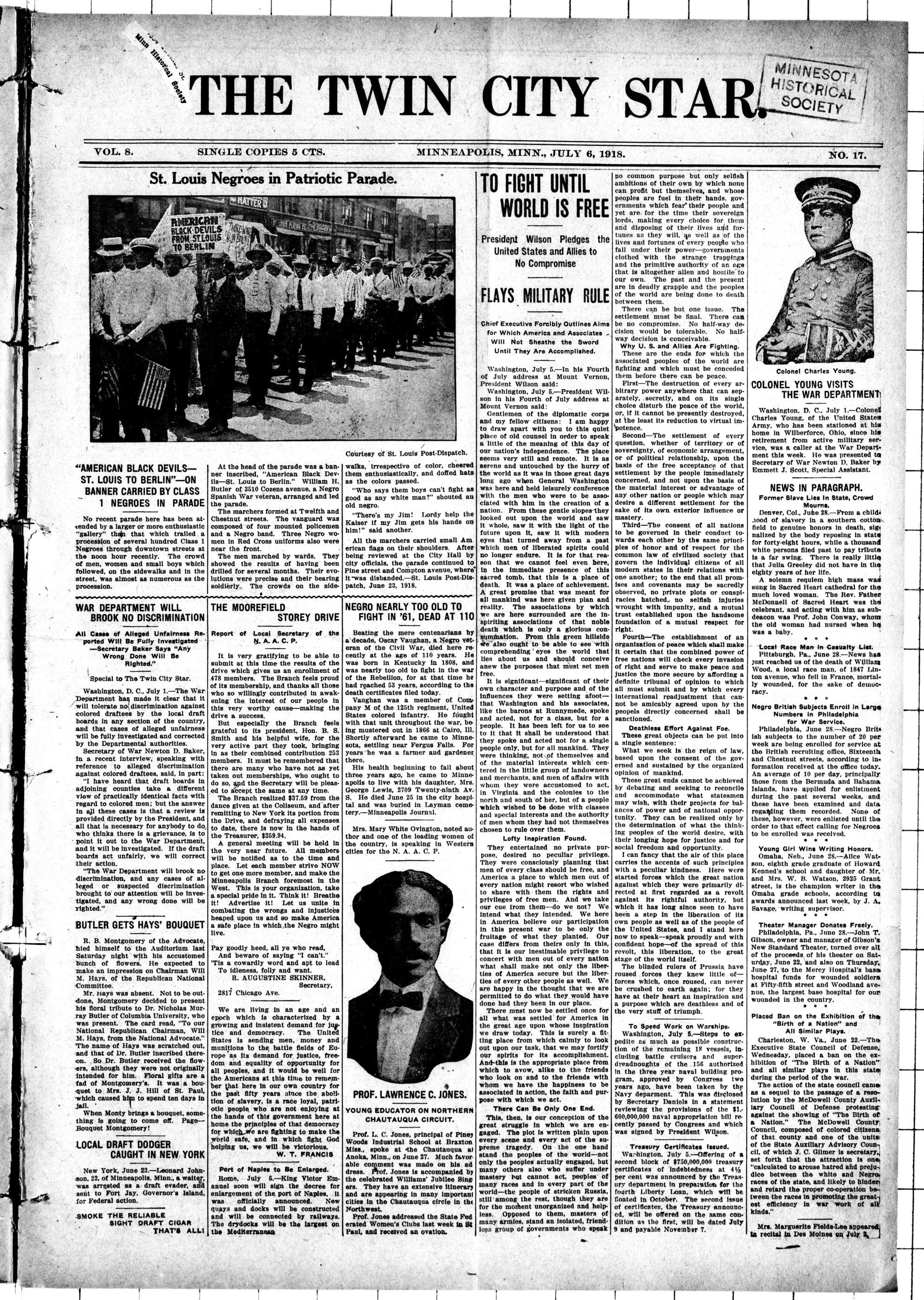
"AMERICAN BLACK DEVILS— ST. LOUIS TO BERLIN"—ON BANNER CARRIED BY CLASS 1 NEGROES IN PARADE
No recent parade here has been attended by a larger or more enthusiastic "gallery" than that which trailed a procession of several hundred Class 1 Negroes through downtown streets at the noon hour recently. The crowd of men, women and small boys which followed, on the sidewalks and in the street, was almost as numerous as the procession.
WAR DEPARTMENT WILL BROOK NO DISCRIMINATION
All Cases of Alleged Unfairness Reported Will Be Fully Investigated —Secretary Baker Says "Any Wrong Done Will Be Righted."
Special to The Twin City Star.
Washington, D. C., July 1.—The War Department has made it clear that it will tolerate no discrimination against colored draftees by the local draft boards in any section of the country, and that cases of alleged unfairness will be fully investigated and corrected by the Departmental authorities.
Secretary of War Newton D. Baker, in a recent interview, speaking with reference to alleged discrimination against colored draftees, said, in part:
"I have heard that draft boards in adjoining counties take a different view of practically identical facts with regard to colored men; but the answer in all these cases is that a review is provided directly by the President, and all that is necessary for anybody to do who thinks there is a grievance, is to point it out to the War Department, and it will be investigated. If the draft boards act unfairly, we will correct their action.
"The War Department will brook no discrimination, and any cases of alleged or suspected discrimination brought to our attention will be investigated, and any wrong done will be righted."
BUTLER GETS HAYS' BOUQUET
R. B. Montgomery of the Advocate, hied himself to the Auditorium last Saturday night with his accustomed bunch of flowers. He expected to make an impression on Chairman Will M. Hays, of the Republican National Committee.
Mr. Hays was absent. Not to be outdone, Montgomery decided to present his floral tribute to Dr. Nicholas Murray Butler of Columbia University, who was present. The card read, "To our National Republican Chairman, Will M. Hays, from the National Advocate." The name of Hays was scratched out, and that of Dr. Butler inscribed thereon. So Dr. Butler received the flowers, although they were not originally intended for him. Floral gifts are a fad of Montgomery's. It was a bouquet to Mrs. J. J. Hill of St. Paul, which caused him to spend ten days in jail.
When Monty brings a bouquet, something is going to come off. Page—Bouquet Montgomery!
LOCAL DRAFT DODGER
CAUGHT IN NEW YORK
New York, June 23.—Leonard Johnson, 22, of Minneapolis, Minn., a waiter, was arrested as a draft evader, and sent to Fort Jay, Governor's Island, for Federal action.
SMOKE THE RELIABLE
SIGHT DRAFT CIGAR
THAT'S ALLI
SINGLE COPIES 5 CTS.
his Negroes in Patriotic
ICAN
DEVILS
ATLOUIS
RILIN
At the head of the parade was a banner inscribed, "American Black Devils—St. Louis to Berlin." William H. Butler of 3510 Cozens avenue, a Negro Spanish War veteran, arranged and led the parade.
The marchers formed at Twelfth and Chestnut streets. The vanguard was composed of four mounted policemen and a Negro band. Three Negro women in Red Cross uniforms also were near the front.
The men marched by wards. They showed the results of having been drilled for several months. Their evolutions were precise and their bearing soldierly. The crowds on the side-
THE MOOREFIELD
STOREY DRIVE
Report of Local Secretary of the N. A. A. C. P.
It is very gratifying to be able to submit at this time the results of the drive which gives us an enrollment of 478 members. The Branch feels proud of its membership, and thanks all those who so willingly contributed in awakening the interest of our people in this very worthy cause—making the drive a success.
But especially the Branch feels grateful to its president, Hon. B. S. Smith and his helpful wife, for the very active part they took, bringing in as their combined contribution 253 members. It must be remembered that there are many who have not as yet taken out memberships, who ought to do so, and the Secretary will be pleased to accept the same at any time.
The Branch realized $37.59 from the dance given at the Coliseum, and after remitting to New York its portion from the Drive, and defraying all expenses to date, there is now in the hands of the Treasurer. $259.94.
A general meeting will be held in the very near future. All members will be notified as to the time and place. Let each member strive NOW to get one more member, and make the Minneapolis Branch foremost in the West. This is your organization, take a special pride in it. Think it! Breathe it! Advertise it! Let us unite in combating the wrongs and injustices heaped upon us and so make America a safe place in which the Negro might live.
Pay goodly heed, all ye who read,
And beware of saying "I can't."
Tis a cowardly word and apt to lead
We are living in an age and an epoch which is characterized by a growing and insistent demand for justice and democracy. The United States is sending men, money and munitions to the battle fields of Europe as its demand for justice, freedom and equality of opportunity for all peoples, and it would be well for the Americans at this time to remember that here in our own country for the past fifty years since the abolition of slavery, is a race loyal, patriotic people who are not enjoying at the hands of this government here at home the principles of that democracy for which we are fighting to make the world safe, and in which fight God helping us, we will be victorious. W. T. FRANCIS
Port of Naples to Be Enlarged.
er, and and, Rome, July 5.—King Victor Emanuel soon will sign the decree for enlargement of the port of Naples, it was officially announced. New quays and docks will be constructed and will be connected by railways. The drydocks will be the largest on the Mediterranean
MINNEAPOLIS, MINN., JULY 6, 1918.
Courtesy of St. Louis Post-Dispatch. walks, irrespective of color, cheered them enthusiastically, and doffed hats as the colors passed. "Who says them boys can't fight as good as any white man?" shouted an old negro. "There's my Jim! Lordy help the Kaiser if my Jim gets his hands on him!" said another. All the marchers carried small American flags on their shoulders. After being reviewed at the City Hall by city officials, the parade continued to Pine street and Compton avenue, where it was disbanded—St. Louis Post-Dispatch, June 23, 1918.
NEGRO NEARLY TOO OLD TO FIGHT IN '61, DEAD AT 110
Beating the mere centenarians by a decade, Oscar Vaughan, a Negro veteran of the Civil War, died here recently at the age of 110 years. He was born in Kentucky in 1808, and was nearly too old to fight in the war of the Rebellion, for at that time he had reached 53 years, according to the death certificates filed today.
Vaughan was a member of Company M of the 125th regiment, United States colored infantry. He fought with that unit throughout the war, being mustered out in 1866 at Cairo, Ill. Shortly afterward he came to Minnesota, settling near Fergus Falls. For years he was a farmer and gardener there.
His health beginning to fall about three years ago, he came to Minneapolis to live with his daughter, Mrs. George Lewis, 2709 Twenty-ninth Av. S. He died June 25 in the city hospital and was buried in Layman cemetery.—Minneapolis Journal.
Mrs. Mary White Ovington, noted author and one of the leading women of the country, is speaking in Western cities for the N. A. A. C. P.
M.
PROF. LAWRENCE C. JONES.
YOUNG EDUCATOR ON NORTHERN CHAUTAUQUA CIRCUIT.
Prof. L. C. Jones, principal of Piney Woods Industrial School at Braxton Miss., spoke at the Chautauqua at Anoka, Minn., on June 27. Much favorable comment was made on his ad dress. Prof. Jones is accompanied by the celebrated Williams' Jubilee Singers. They have an extensive itinerary and are appearing in many important cities in the Chautauqua circle in the Northwest.
Prof. Jones addressed the State Federated Women's Clubs last week in St Paul, and received an ovation.
TO FIGHT UNTIL WORLD IS FREE
TO FIGHT UNTIL WORLD IS FREE
President Wilson Pledges the United States and Allies to No Compromise
Chief Executive Forcibly Outlines Aims
for Which America and Associates
Will Not Sheathe the Sword
Until They Are Accomplished.
Washington, July 5.—In his Fourth
of July address at Mount Vernon,
President Wilson said:
Washington, July 5.—President Wilson
in his Fourth of July address at
Mount Vernon said:
Gentlemen of the diplomatic corps and my fellow citizens: I am happy to draw apart with you to this quiet place of old counsel in order to speak a little of the meaning of this day of our nation's independence. The place seems very still and remote. It is as serene and untouched by the hurry of the world as it was in those great days long ago when General Washington was here and held leisurely conference with the men who were to be associated with him in the creation of a nation. From these gentle slopes they looked up upon the world and saw it whole, saw it with the light of the future upon it, saw it with modern eyes that turned away from a past which men of liberated spirits could no longer endure. It is for that reason that we cannot feel even here, in the immediate presence of this sacred tomb, that this is a place of death. It was a place of achievement. A great promise that was meant for all mankind was here given plan and reality. The associations by which we are here surrounded are the inspiriting associations of that noble death which is only a glorious consummation. From this green hillside we also ought to be able to see with comprehending eyes the world that lies about us and should conceive anew the purposes that must set men free.
It is significant—significant of their own character and purpose and of the influences they were setting afoot—that Washington and his associates, like the barons at Runnymede, spoke and acted, not for a class, but for a people. It has been left for us to see to it that it shall be understood that they spoke and acted not for a single people only, but for all mankind. They were thinking, not of themselves and of the material interests which centered in the little group of landowners and merchants, and men of affairs with whom they were accustomed to act, in Virginia and the colonies to the north and south of her, but of a people which wished to be done with classes and special interests and the authority of men whom they had not themselves chosen to rule over them.
Lofty Inspiration Found.
They entertained no private purpose, desired no peculiar privilege. They were consciously planning that men of every class should be free, and America a place to which men out of every nation might resort who wished to share with them the rights and privileges of free men. And we take our cue from them—do we not? We intend what they intended. We here in America believe our participation in this present war to be only the fruitage of what they planted. Our case differs from theirs only in this, that it is our inestimable privilege to concert with men out of every nation what shall make not only the liberties of America secure but the liberties of every other people as well. We are happy in the thought that we are permitted to do what they would have done had they been in our place. There must now be settled once for all what was settled for America in the great age upon whose inspiration we draw today. This is surely a fitting place from which calmly to look out upon our task, that we may fortify our spirits for its accomplishment. And this is the appropriate place from which to avow, alike to the friends who look on and to the friends with whom we have the happiness to be associated in action, the faith and purpose with which we act.
There Can Be Only One End.
This, then, is our conception of the great struggle in which we are engaged. The plot is written plain upon every scene and every act of the supreme tragedy. On the one hand stand the peoples of the world—not only the peoples actually engaged, but many others also who suffer under mastery but cannot act, peoples of many races and in every part of the world—the people of stricken Russia, still among the rest, though they are for the moment unorganized and helpless. Opposed to them, masters of many armies, stand an isolated, friendless group of governments who speak
no common purpose but only selfish ambitions of their own by which none can profit but themselves, and whose peoples are fuel in their hands, governments which fear their people and yet are for the time their sovereign lords, making every choice for them and disposing of their lives and fortunes as they will, as well as of the lives and fortunes of every people who fall under their power—governments clothed with the strange trappings and the primitive authority of an age that is altogether alien and hostile to our own. The past and the present are in deadly grapple and the peoples of the world are being done to death between them.
There can be but one issue. The settlement must be final. There can be no compromise. No half-way decision would be tolerable. No half-way decision is conceivable.
Why U. S. and Allies Are Fighting.
These are the ends for which the associated peoples of the world are fighting and which must be conceded them before there can be peace.
First—The destruction of every arbitrary power anywhere that can separately, secretly, and on its single choice disturb the peace of the world, or, if it cannot be presently destroyed, at the least its reduction to virtual impotence.
Second—The settlement of every question, whether of territory or of sovereignty, of economic arrangement, or of political relationship, upon the basis of the free acceptance of that settlement by the people immediately concerned, and not upon the basis of the material interest or advantage of any other nation or people which may desire a different settlement for the sake of its own exterior influence or mastery.
Third—The consent of all nations to be governed in their conduct towards each other by the same principles of honor and of respect for the common law of civilized society that govern the individual citizens of all modern states in their relations with one another; to the end that all promises and covenants may be sacredly observed, no private plots or conspiracies hatched, no selfish injuries wrought with impunity, and a mutual trust established upon the handsome foundation of a mutual respect for right.
Fourth—The establishment of an organization of peace which shall make it certain that the combined power of free nations will check every invasion of right and serve to make peace and justice the more secure by affording a definite tribunal of opinion to which all must submit and by which every international readjustment that cannot be amicably agreed upon by the peoples directly concerned shall be sanctioned.
Deathless Effort Against Foe.
These great objects can be put into a single sentence:
What we seek is the reign of law, based upon the consent of the governed and sustained by the organized opinion of mankind.
These great ends cannot be achieved by debating and seeking to reconcile and accommodate what statesmen may wish, with their projects for balances of power and of national opportunity. They can be realized only by the determination of what the thinking peoples of the world desire, with their longing hope for justice and for social freedom and opportunity.
I can fancy that the air of this place carries the accents of such principles with a peculiar kindness. Here were started forces which the great nation against which they were primarily directed at first regarded as a revolt against its rightful authority, but which it has long since seen to have been a step in the liberation of its own people as well as of the people of the United States, and I stand here now to speak—speak proudly and with confident hope—of the spread of this revolt, this liberation, to the great stage of the world itself.
The blinded rulers of Prussia have roused forces they knew little of—forces which, once roused, can never be crushed to earth again; for they have at their heart an inspiration and a purpose which are deathless and of the very stuff of triumph.
To Speed Work on Warships.
Washington, July 5.—Steps to expedite as much as possible construction of the remaining 18 vessels, including battle cruisers and superdreadnoughts of the 156 authorized in the three year naval building program, approved by Congress two years ago, have been taken by the Navy department. This was disclosed by Secretary Dantols in a statement reviewing the provisions of the $1,600,000,000 naval appropriation bill recently passed by Congress and which was signed by President Wilson.
Treasury Certificates Issued.
Washington. July 5.—Offering of a second block of $750,000,000 treasury certificates of indebtedness at 4 1/2 per cent was announced by the Treasury department in preparation for the fourth Liberty Loan, which will be floated in October. The second issue of certificates, the Treasury announced, will be offered on the same condition as the first, will be dated July 9 and payable November 7.
Washington, D. C., July 1.—Colonel Charles Young, of the United States Army, who has been stationed at his home in Wilberforce, Ohio, since his retirement from active military service, was a caller at the War Department this week. He was presented to Secretary of War Newton D. Baker by Emmett J. Scott, Special Assistant.
Denver, Col., June 28.—From a childhood of slavery in a southern cotton field to genuine honors in death, signaled by the body reposing in state for forty-eight hours, while a thousand white persons filed past to pay tribute is a far swing. There is really little that Julia Greeley did not have in the eighty years of her life.
A solemn requiem high mass was sung in Sacred Heart cathedral for the much loved woman. The Rev. Father McDonnell of Sacred Heart was the celebrant, and acting with him as subdeacon was Prof. John Conway, whom the old woman had nursed when he was a baby.
* * *
Local Race Man in Casualty List.
Pittsburgh, Pa., June 28.—News has just reached us of the death of William Wood, a local race man, of 1847 Linton avenue, who fell in France, mortally wounded, for the sake of democracy.
Negro British Subjects Enroll in Large Numbers in Philadelphia for War Service
Philadelphia, June 28.—Negro British subjects to the number of 20 per week are being enrolled for service at the British recruiting office, Sixteenth and Chestnut streets, according to information received at the office today. An average of 10 per day, principally those from the Bermuda and Bahama Islands, have applied for enlistment during the past several weeks, and these have been examined and data regarding them recorded. None of these, however, were enlisted until the order to that effect calling for Negroes to be enrolled was received.
Young Girl Wins Writing Honors.
Omaha, Neb., June 28.—Alice Watson, eighth grade graduate of Howard Kenned's school and daughter of Mr. and Mrs. W. B. Watson, 2925 Grant street, is the champion writer in the Omaha grade schools, according to awards announced last week, by J. A. Savage, writing supervisor.
Theater Manager Donates Freely.
Philadelphia, Pa., June 28.—John T.
Gibson, owner and manager of Gibson's
New Standard Theater, turned over all
of the proceeds of his theater on Saturday,
June 22, and also on Thursday,
June 27, to the Mercy Hospital's base
hospital funds for wounded soldiers
at Fifty-fifth street and Woodland avenue,
the largest base hospital for our
wounded in the country.
Placed Ban on the Exhibition of the "Birth of a Nation" and All Similar Plays.
Charleston, W. Va., June 22.—The Executive State Council of Defense, Wednesday, placed a ban on the exhibition of "The Birth of a Nation" and all similar plays in this state during the period of the war.
The action of the state council cane as a sequel to the passage of a resolution by the McDowell County Auxiliary Council of Defense protesting against the showing of "The Birth of a Nation." The McDowell County Council, composed of colored citizens of that county and one of the units of the State Auxiliary Advisory Council, of which J. C. Glmer is secretary, set forth that the attraction is one "calculated to arouse hatred and prejudice between the white and Negro races of the state, and likely to hinder and retard the proper co-operation between the races in promoting the greatest efficiency in war work of all kinds."
Mrs. Marguerite Fields-Lee appeared in recital in Des Moines on July 2.
(Copyright, 1918, by the McClure Newspaper Syndicate.)
Jean Coleman looked up as Thomas Waring came into the office. He was half an hour late and there was something unusual in his manner.
"Miss Coleman," he began abruptly, "I'm going to get married. I'm going to be called in the next draft and I want something to leave behind me—someone, I should say."
The stenographer looked up quickly and smiled slightly.
"Nice for the girl," she remarked noncommittally.
"I realize that, but she doesn't have to do it unless she wants to. I intend to make it perfectly clear. And that's why I came to you for advice about the matter—you are so sensible. I knew you could help me. I'm going to advertise in a matrimonial journal and I'd like you to see the applicant I think the best before I accept her—will you?" It was almost too much, but Jean was equal to the occasion. Her sense of humor asserted itself and she laughed merrily.
"I'll do all I can," she assured him. "Report to me in a week and tell me your progress. Good luck to you. I have to get back to work now so you'd better run along."
Tom Waring went to his own desk and pondered on the peculiarities of women. He knew Jean would help him but he did think she might have been a little more interested and not so amused. Her eyes—wonderful eyes she had, too—had twinkled all the time he talked, and he was really very serious. He was also very lonely and his story about wanting someone to leave behind him had been put rather cold-bloodedly because he did not find it easy to say exactly what he meant to Jean. She probably thought him foolish enough already. So he wrote a satisfactory advertisement of his intentions, put it in the paper, and waited for developments with some consternation.
During the week that followed he had sixty-five applications. Widows, orphans and maldens read the welcome notice, and he was pursued by thin women, fat women, ugly women and foolish women; but the charming, sweet and perfect young creature for
w. f. ross
Perfect Young creature.
whom he longed did not appear. The majority of them were middle-aged, and few at all good looking.
Discouraged and tired out, at the end of three days he dropped into a chair beside Jean Coleman's desk, just after five o'clock. There was no one else in the office.
"Well, what luck?" she asked him cheerfully, noticing his defected air.
"I'm disgusted—utterly disgusted—I guess I'll never be married. I didn't know there were so many women in this city who wanted husbands. There isn't a single one I could ever learn to love, even if my life depended on it."
"People don't generally have to learn to love," ventured Jean.
"How do you know so much about it, Miss Coleman?"
Jean blushed and began to straighten up her desk.
"I learn a lot by observation, Sir Benedict, and just now I must leave you and go to dinner. Your week isn't up and I told you to come to me at the end of a week and we'd see about the bride. Three days is not half long enough, and now you've started it, you've got to see this matrimonial venture through, just to show it's not a joke."
Waring agreed grudgingly, and together they left the office. Just outside he had a sudden inspiration.
"Won't you go to dinner with me?" he asked her. "We could go somewhere where they dance if you like to—it would be great fun if you would."
For a second Jean seemed to hesitate, and then replied somewhat briskly:
"I'm sorry, but I have an engagement. You go and see if you've had any more answers and come to me again in four days. Good-night." Warring felt his spirits sink below zero. She talked like a doctor applying some awful medicine," he said to
himself, "Who the deuce was she going to dinner with, anyway?" When Jean left him she went directly to a nearby lunch counter, where she dined in state with—herself. But Waring did not know that. He passed an uneventful and very unpleasant evening by himself and finally came to the conclusion that matrimony was a deep problem to be carefully considered. And he wondered what Jean Coleman knew about being in love, anyway—evidently something.
He determined to see the thing through honestly, however, and wearly wrote to and interviewed a few more applicants. At the end of that time he was sure of two things—he did not want to marry any of the women he had seen, but he did want to marry Jean Coleman. He began to wonder why he had not found it out before. She probably wouldn't look at him now that he had made such an idiot of himself. He was glad he hadn't told anyone else but her, anyway—he wasn't proud of his venture.
The door bell rang penetratingly and he gronned hopelessly. Nevertheless, he was resigned, and when his landlady, Mrs. Morley, ushered in a velled, slight little woman in a dark suit, he was prepared for the worst.
"I saw your advertisement in the paper," she began in a clear, strangely familiar voice.
"I regret to say I'm no longer in the market," he put in hurriedly, before she had a chance to say anything more.
"Oh, I didn't come to apply," she assured him hastily, "I only came to tell you you're all wrong about getting a wife this way. I thought maybe you didn't have anyone to advise you, I'm very old"—her voice belled the word—and I thought I might save you from doing something foolish. Please don't marry in haste—you'll surely meet someone some day who will make your waiting worth while. You can't just make yourself love people, you know, even if you are married, and you mustn't make such a dreadful mistake and ruin your life. Even if you are going away, don't jump into marriage hastily—please believe what I say."
In her earnestness and excitement the woman had quite forgotten herself. She was actually pleading with him to save himself, and he was listening, fascinated to what she had to say. When she had finished she stood with her hands pressed together, and he could feel that she was looking at him through the still lowered vell. Suddenly she seemed to recall herself and, with a quick movement, walked towards the door. Waring sprang after her and seized her by the arm.
"Let me go!" she commanded him.
"I must go at once. I only came because I thought I might help you—I don't want anyone to see my face."
"I must," he insisted, and before she had a chance to struggle further, he threw the heavy vell back from her hat. Then he stood fixed.
"Jean1" he cried, and gazed into a flushed and tear-stained face. "I might have known it was you; no one else could be so wonderful," he added, still devouring her with his eyes.
"I never meant you to know," she said, sinking into the first chalr, "but I couldn't bear to have you marry one of those applicants—it was too much. I never thought you'd be so rude and lift my veil. It was foolish of me to come—please let me go now."
"Yes, I'm going to take you home, but not until I know who you went out to dinner with on Thursday. I've thought about it ever since."
"Thank goodness! I want to know if you will go out to dinner with me tomorrow night, and every night after that for the rest of your life? I love you—I have for a long time, but I didn't know it and was coming to tell you about it tomorrow. I've been a fool but I'll promise to be wiser after this if you'll only take me."
He was kneeling beside her now, and both her hands were in his.
"Oh, I do love you," said Jean, softly. "Better than anyone in the world, and if you approve of me really, I'll answer your advertisement tonight. You're right sure I'll do?"
"So sure that we'll go out now and have our first dinner!"
And together they ran hand in hand down the stairs, laughing as they went.
Varieties of Spruce.
There are about 15 varieties of spruce, of which the Sitka spruce is the most valuable. Norway spruce, the commonest, so-called because it forms the chief lumber supply of Norway, is also found in middle Europe and in Siberia. Sitka spruce grows on the Pacific coast from northern California to Alaska; it is only found in coast regions, never inland. It grows easily to 150 feet in height, and frequently to more than 300 feet with a diameter of seven or eight feet at 100 feet from the base. In the islands of southeastern Alaska trees have been noted more than 200 feet tall and 25 feet in diameter four or five feet from the base.
Shot at a Venture
When the result of a certain horse race reached an English mining village, one of the collers remarked to his chum: "Ah've made a nice little dinner out of that race, and by sheer luck, too. Ah chalked all t' names o' t' horses on a revolving target, an' took it into a field and got my own woman to shoot an arrow at it while it wor spinning." "An' it stuck into the winner, did it?" asked his friend. "No, it didn't," said the coller. "It stuck into a fine fat duck that wor waddling along at t' side o' t' field, and we had it for dinner today wf' sage an' onions!"
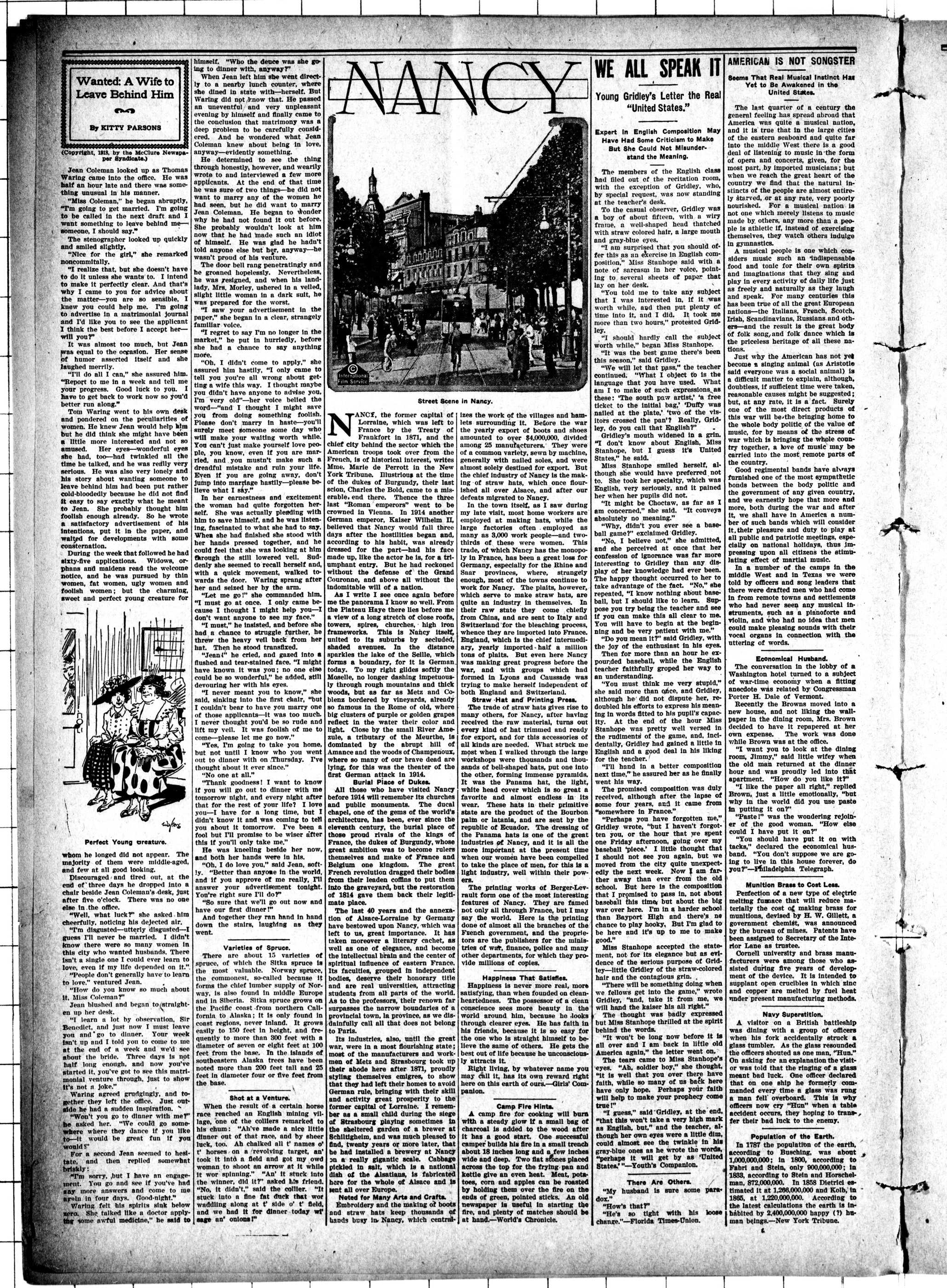
NANCY
International Film Service
Street Scene in Nancy.
NANCIF, the former capital of Lorraine, which was left to France by the Treaty of Frankfurt in 1871, and the chief city behind the sector which the American troops took over from the French, is of historical interest, writes Mme. Marie de Perrott in the New York Tribune. Illustrious at the time of the dukes of Burgundy, their last sion, Charles the Bold, came to a miserable, end there. Thence the three last "Roman emperors" went to be crowned in Vienna. In 1914 another German emperor, Kaiser Wilhelm II, believed that Nancy would fall three days after the hostilities began and, according to his habit, was already dressed for the part—had his face made up, like the actor he is, for a triumphant entry. But he had reckoned without the defense of the Grand Couronne, and above all without the indomitable will of a nation.
As I write I see once again before me the panorama I know so well. From the Plateau Haye there lies before me a view of a long stretch of close roofs, towers, spires, churches, high iron frameworks. This is Nancy itself, united to its suburbs by secluded, shaded avenues. In the distance sparkles the lake of the Selle, which forms a boundary, for it is German today. To my right glides softly the Moselle, no longer dashing impetuously through rough mountains and thick woods, but as far as Metz and Coblenz bordered by vineyards, already so famous in the Rome of old, where big clusters of purple or golden grapes reflect in the water their color and light. Close by the small River Amezule, a tributary of the Meurthe, is dominated by the abrupt hill of Aance and the woods of Champenoux, where so many of our brave dead are lying, for this was the theater of the first German attack in 1914.
All those who have visited Nancy before 1914 will remember its churches and public monuments. The ducal chapel, one of the gems of the world's architecture, has been, ever since the eleventh century, the burial place of those proud rivals of the kings of France, the dukes of Burgundy, whose great ambition was to become rulers themselves and make of France and Belgium one kingdom. The great French revolution dragged their bodies from their leaden coffins to put them into the graveyard, but the restoration of 1814 gave them back their legitimate place.
The last 40 years and the annexation of Alsace-Lorraine by Germany have bestowed upon Nancy, which was left to us, great importance. It has taken more a literary cachet, as well as one of elegance, and become the intellectual brain and the center of spiritual influence of eastern France. Its faculties, grouped in independent bodies, deserve their honorary title and are real universities, attracting students from all parts of the world. As to the professors, their renown far surpasses the narrow boundaries of a provincial town, la province, as we disdainfully call all that does not belong to Paris.
Its industries, also, until the great war, were in a most flourishing state; most of the manufacturers and workmen of Metz and Strasbourg took up their abode here after 1871, proudly styling themselves emigres, to show that they had left their homes to avoid German rule, bringing with their skill and activity great prosperity to the former capital of Lorraine. I remember as a small child during the siege of Strasbourg playing sometimes in the sheltered garden of a brewer at Schlitgheim, and was much pleased to find, twenty years or more later, that he had installed a brewery at Nancy on a really gigantic scale. Cabbage pickled in salt, which is a national dish of the Alsatians, is fabricated here for the whole of Alsace and is sent all over Europe.
Noted for Many Arts and Crafts.
Embroidered and the making of boots
and straw hats keep thousands of
hands busy in Nancy, which centrals
izes the work of the villages and hamlets surrounding it. Before the war the yearly export of boots and shoes amounted to over $4,000,000, divided among 25 manufacturers. They were of a common variety, sewn by machine, generally with nailed soles, and were almost solely destined for export. But the chief industry of Nancy is the making of straw hats, which once flourished all over Alsace, and after our defeats migrated to Nancy.
In the town itself, as I saw during my late visit, most home workers are employed at making hats, while the large factories often employed as many as 3,000 work people—and two thirds of these were women. This trade, of which Nancy has the monopoly in France, has been a great loss for Germany, especially for the Rhine and Saar provinces, where, strangely enough, most of the towns continue to work for Nancy. The plaits, however, which serve to make straw hats, are quite an industry in themselves. In their raw state they come chiefly from China, and are sent to Italy and Switzerland for the bleaching process, whence they are imported into France. England, which is the chief intermediary, yearly imported-half a million tons of plaits. But even here Nancy was making great progress before the war, and with groups which had formed in Lyons and Caussade was trying to make herself independent of both England and Switzerland.
Straw Hat and Printing Press.
The trade of straw hats gives rise to many others, for Nancy, after having received the raw material, turns out every kind of hat trimmed and ready for export, and for this accessories of all kinds are needed. What struck me most when I walked through the large workshops were thousands and thousands of bell-shaped hats, put one into the other, forming immense pyramids. It was the Panama hat, the light, white head cover which is so great a favorite and almost endless in its wear. These hats in their primitive state are the product of the Bourbon palm or latania, and are sent by the republic of Ecuador. The dressing of the Panama hats is one of the great industries of Nancy, and it is all the more important at the present time when our women have been compelled to take the place of men, for this is a light industry, well within their powers.
The printing works of Berger-Levrault form one of the most interesting features of Nancy. They are famed not only all through France, but I may say the world. Here is the printing done of almost all the branches of the French government, and the proprietors are the publishers for the ministries of war, finance, police and many other departments, for which they provide millions of copies.
Happiness is never more real, more satisfying, than when founded on clean-heartedness. The possessor of a clean conscience sees more beauty in the world around him, because he looks through clearer eyes. He has faith in his friends, because it is so easy for the one who is straight himself to believe the same of others. He gets the best out of life because he unconsciously attracts it.
Right living, by whatever name you may call it, has its own reward right here on this earth of ours.—Girls' Companion.
A camp fire for cooking will burn with a steady glow if a small bag of charcoal is added to the wood after it has a good start. One successful camper builds his fire in a small trench about 18 inches long and a few inches wide and deep. Two flat stones placed across the top for the frying pan and kettle give an even heat. Meat, potatoes, corn and apples can be roasted by holding them over the fire on the ends of green, pointed sticks. An old newspaper is useful in starting the fire, and plenty of matches should be at hand.—World's Chronicle.
Happiness That Satisfies
Camp Fire Hints
WE ALL SPEAK IT
Expert in English Composition May Have Had Some Criticism to Make But She Could Not Misunderstand the Meaning.
The members of the English class had filed out of the recitation room, with the exception of Gridley, who, by special request, was now standing at the teacher's desk.
To the casual observer, Gridley was a boy of about fifteen, with a wiry frame, a well-shaped head thatched with straw colored hair, a large mouth and gray-blue eyes.
"I am surprised that you should offer this as an exercise in English composition." Miss Stanhope said with a note of sarcasm in her voice, pointing to several sheets of paper that lay on her desk.
"You told me to take any subject that I was interested in, if it was worth while, and then put plenty of time into it, and I did. It took me more than two hours," protested Gridley.
"I should hardly call the subject worth while," began Miss Stanhope.
"It was the best game there's been this season," said Gridley.
"We will let that pass," the teacher continued.
"What I object to is the language that you have used. What am I to make of such expressions as these: 'The south paw artist,' 'a free ticket to the initial bag,' 'Duffy was nailed at the plate,' 'two of the visitors crossed the pan?' Really, Gridley, do you call English?"
Gridley's mouth widened in a grin. "I don't know about English, Miss Stanhope, but I guess it's United States," he said.
Miss Stanhope smiled herself, although she would have preferred not to. She took her specialty, which was English, very seriously, and it palmed her when her pupils did not.
"It might be Choctaw, as far as I am concerned," she said. "It conveys absolutely no meaning."
"Why, didn't you ever see a baseball game?" exclaimed Gridley.
"No, I believe not," she admitted, and she perceived at once that her confession of ignorance was far more interesting to Gridley than any display of her knowledge had ever been. The happy thought occurred to her take advantage of the fact. "No," she repeated, "I know nothing about baseball, but I should like to learn. Suppose you try being the teacher and see if you can make this all clear to me. You will have to begin at the beginning and be very patient with me."
"Do you mean it?" said Gridley, with the joy of the enthusiast in his eyes.
the joy of the enthusiast in his eyes.
Then for more than an hour he expoured baseball, while the English teacher faithfully groped her way to an understanding.
"You must think me very stupid," she said more than once, and Gridley, although he did not dispute her, redoubled his efforts to express his meaning in words fitted to his pupil's capacity. At the end of the hour Miss Stanhope was pretty well versed in the rudiments of the game, and, incidentally, Gridley had gained a little in English and a good deal in his liking for the teacher.
"I'll hand in a better composition next time," he assured her as he finally went his way.
The promised composition was duly received, although after the lapse of some four years, and it came from "somewhere in France."
"Perhaps you have forgotten me," Gridley wrote, "but I haven't forgotten you, or the hour that we spent one Friday afternoon, going over my baseball 'piece.' I little thought that I should not see you again, but we moved from the city quite unexpectedly the next week. Now I am farther away than ever from the old school. But here is the composition that I promised to pass in, not about baseball this time, but about the big war over here. I'm in a harder school than Bayport High and there's no chance to play hooky. But I'm glad to be here and it's up to me to make good."
Miss Stanhope accepted the statement, not for its elegance but as evidence of the serious purpose of Gridley—little Gridley of the straw-colored hair and the contagious grin.
"There will be something doing when we fellows get into the game," wrote Gridley, "and, take it from me, we will hand the kaiser his all right."
The thought was badly expressed but Miss Stanhope thrilled at the spirit behind the words.
"It won't be long now before it is all over and I am back in little old America again," the letter went on.
The tears came to Miss Stanhope's eyes. "Ah, soldier boy," she thought, "it is well that you over there have faith, while so many of us back here have only hope. Perhaps your faith will help to make your prophecy come true."
"I guess," said Gridley, at the end, "that this won't take a very high mark as English, but," and the teacher, although her own eyes were a little dim, could almost see the twinkle in his gray-blue ones as he wrote the words, "perhaps it will get by as 'United States.'"—Youth's Companion.
There Are Others.
"My husband is sure some paradox."
"How's that?"
"He's so tight with his loose change."—Florida Times-Union.
AMERICAN IS NOT SONGSTER
Seems That Real Musical Instinct Has Yet to Be Awakened in the United States.
The last quarter of a century the general feeling has spread abroad that America was quite a musical nation, and it is true that in the large cities of the eastern seaboard and quite far into the middle West there is a good deal of listening to music in the form of opera and concerts, given, for the most part, by imported musicians; but when we reach the great heart of the country we find that the natural instincts of the people are almost entirely starved, or at any rate, very poorly nourished. For a musical nation is not one which merely listens to music made by others, any more than a people is athletic if, instead of exercising themselves, they watch others indulge in gymnastics.
A musical people is one which considers music such an 'indispensable food and tonic for their own spirits and imaginations that they sing and play in every activity of daily life just as freely and naturally as they laugh and speak. For many centuries this has been true of all the great European nations—the Italians, French, Scotch, Irish, Scandinavians, Russians and others—and the result is the great body of folk song, and folk dance which is the priceless heritage of all these nations.
Just why the American has not yet become a singing animal (as Aristotle said everyone was a social animal) is a difficult matter to explain, although, doubtless, if sufficient time were taken, reasonable causes might be suggested; but, at any rate, it is a fact. Surely one of the most direct products of this war will be the bringing home to the whole body politic of the value of music, for by means of the stress of war which is bringing the whole country together, a love of music may be carried into the most remote parts of the country.
Good regimental bands have always furnished one of the most sympathetic bonds between the body politic and the government of any given country, and we earnestly hope that more and more, both during the war and after it, we shall have in America a number of such bands which will consider it, their pleasure and duty to play at all public and patriotic meetings, especially on national holidays, thus impressing upon all citizens the stimulating effect of martial music.
In a number of the camps in the middle West and in Texas we were told by officers and song leaders that there were drafted men who had come in from remote towns and settlements who had never seen any musical instruments, such as a planoforte and violin, and who had no idea that men could make pleasing sounds with their vocal organs in connection with the uttering of words.
Economical Husband.
The conversation in the lobby of a Washington hotel turned to a subject of war-time economy when a fitting anecdote was related by Congressman Porter H. Dale of Vermont. Recently the Brown's moved into a new house, and not liking the wallpaper in the dining room, Mrs. Brown decided to have it repapered at her own expense. The work was done while Brown was at the office. "I want you to look at the dining room, Jimmy," said little wifey when the old man returned at the dinner hour and was proudly led into that apartment. "How do you like it?" "I like the paper all right," replied Brown, just a little emotionally, "but why in the world did you use paste in putting it on?" "Paste!" was the wondering rejoiner of the good woman. "How else could I have put it on?"
"You should have put it on with tacks," declared the economical husband. "You don't suppose we are going to live in this house forever, do you?"—Philadelphia Telegraph.
Munition Brass to Cost Less.
Penetration of a new type of electric melting furnace that will reduce materially the cost of making brass for munitions, devised by H. W. Gillett, a government chemist, was announced by the bureau of mines. Patents have been assigned to Secretary of the Interior Lane as trustee. Cornell university and brass manufacturers were among those who assisted during five years of development of the device. It is intended to supplant open crucibles in which zinc and copper are melted by fuel heat under present manufacturing methods.
Navy Superstition.
A visitor on a British battleship was dining with a group of officers when his fork accidentally struck a glass tumbler. As the glass resounded the officers shouted as one man, "Hun." On asking for an explanation the visitor was told that the ringing of a glass meant bad luck. One officer declared that on one ship he formerly commanded every time a glass was rung a man fell overboard. This is why officers now cry "Hun" when a table accident occurs, they hoping to transfer their bad luck to the enemy.
Population of the Earth.
In 1787 the population of the earth, according to Busching, was about 1,000,000,000; in 1800, according to Fabri and Stein, only 900,000,000; in 1833, according to Stein and Horschelman, 872,000,000. In 1858 Dietricl estimated it at 1,266,000,000 and Kolb, in 1865, at 1,220,000,000. According to the latest calculations the earth is inhabited by 2,400,000,000 happy (?) human belenga—New York Tribune.
eh ee cues) ee ie Re CS atta be RES Mae clh aM a rts tas esc di Mapes Soe OR a
ui MOR eee ie ale re eS see Ree ns eae elas Wiuaaistac ea eiea ots eam ep
7 ‘ XX. » = eR my
, J REAR OE ICED SEES ESS ne
’ Li, a eee ce:
5 5 le RE SG a
KT me arate ee Nar tomer eve) 5:
PUN eh
= Rect Ace oes I NR SN, co Br ged ees
& . ° BS NN eg 74 SES eaten en Rss ces.
Many ships bearing hie WS 2 GB GN ota meee a
nurses and wounded [Mao NBs ON
i eae 3 PRN 5 NB A MY LR at ate)
rh ‘soldiers have been tar- ff Ls a ea aes ee
Sgeays Bis SO SSS MARE ARM eR oC ET UE
go.) gets for the German fi go. -7. 7a eee ee
ee U-Boa! Rs eS ee asaeepeeet es
expat tS $a. eSSULS'S SRSR a eca
I a rere Fre eh a Sea Cu ees peat
ra a mn Se eS a eo : | rs
Sct tM ai asa a at ea By PGE ere
4 Vee een Pee oe a coe
Os | Wat Gece es ei oo 6 RN ie No 7 eer
was | OG ee a ee Se et se
re \ erie ie PANT ith OR Bi ara aan ines
ez OF a. or as oo SENG OTIS ODO LI BREE hc OS pei Reet
C2 LG ee ee
— a ee ie eer ane ee er
Cet OP er poeta age Se ee RS Beige Rea
see Mn ee Oo EO an oe Be See eect car Mee oO
ae ee cree ee ee Bus a cle burn ta
ae pt neem Ce ae SAN KON: Se reg zl are
Enea ease eer Bea oR 7 RSPR Argh ice RO CS aE
Oe Bo Spar cio ESSE TIE ct aaa eho MAP a0 apne
GE cage pra a tea perce GO Moameetwings Vet)
ae Ee ry cee a Pn rey atten eM NERC aanlieema ge SHLD teat toa! gay EY
Se alll Oe Spe ee mgr SS
as, ou Sg HTT PINRO 0 nee
ae ss sire Sigs aii pata: gaaeo” Bight of March 20-21 (1917). ‘The torpedotng of
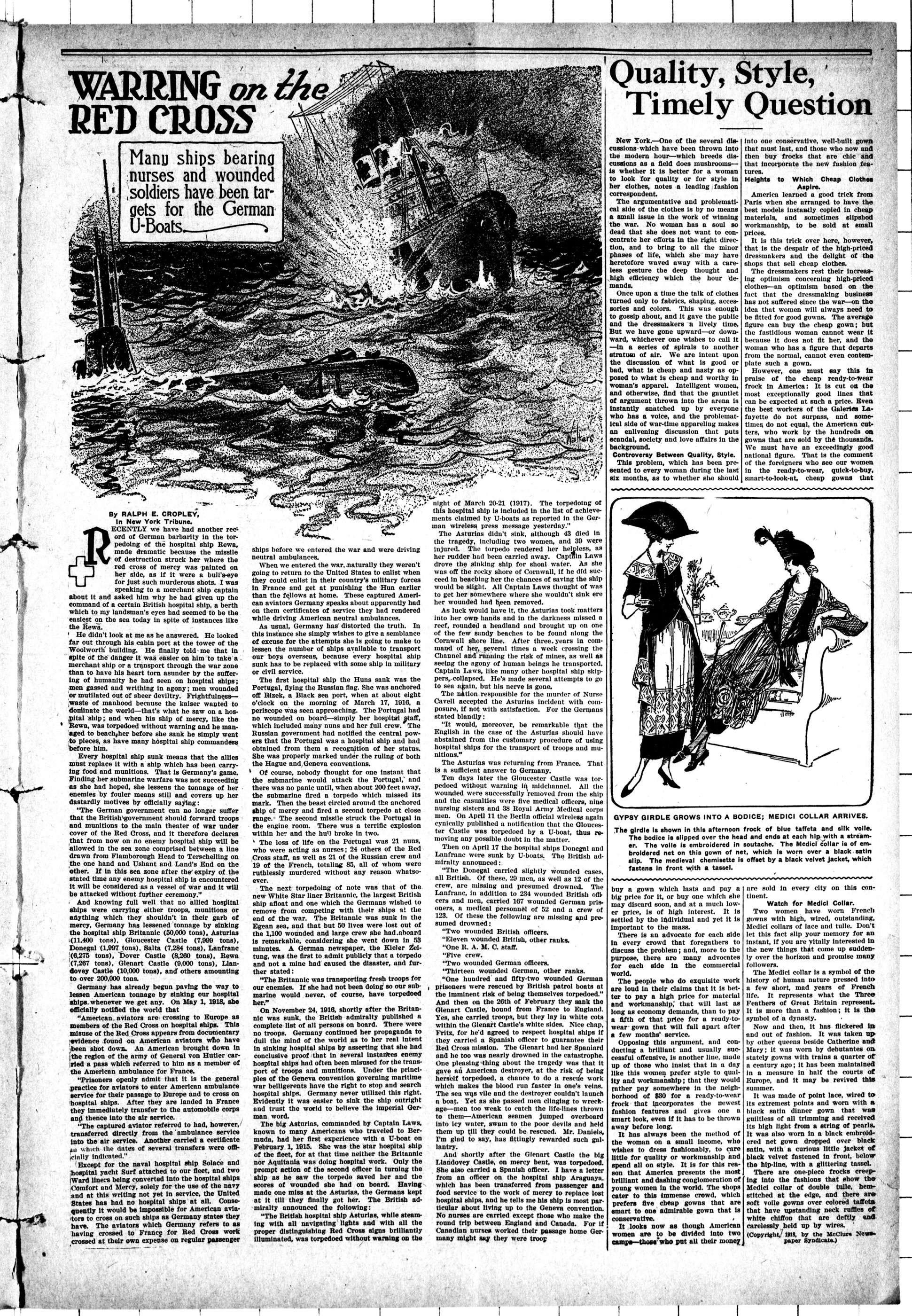
By RALPH E. CROPLEY,
In New York Tribune.
ECENTLY we have had another ree
‘ord of German barbarity in the tor-
pedolng of the hospital ship Rewa,
made dramatic because the missile
Y of destruction struck her where the
red cross of mercy was ‘painted on
her side, as if it were a bull’seye
for just such murderous shots. I was
AR
uU for just such murderous shots. I was
speaking to a merchant ship captain
about it and asked him why he had given up the
command of a certain British hospital ship, a berth
which to my landsman’s eyes had seemed to be the
easiest on the sea today in spite of instances like
the Rewa.
' He didn't look at me as he answered. He looked
far out through his cabin port at the tower of the
‘Woolworth’ building. He finally told:me that in
spite of the danger {t was easter on him to take’a
merchant ship or a transport through the war zone
than to have his heart torn asunder by the suffer-
ing of humanity he had seen on hospital ships;
men gassed and writhing in agony; men wounded
‘or mutilated out of sheer deviltry. Frightfulness—
waste of manhood because the kaiser wanted to
onlinate the world—that’s what he saw on a hos-
pital ship; and when his ship of mercy, like the
‘Rewa, was torpedoed without warning and he man-
‘aged to beachyher before she sank he simply went
to pleces, as have many hospital ship commanders
‘before him,
Every hospital ship sunk meaas that the allies
must replace it with a ship which has been carry-
ing food and munitions. ‘That is Germany's game.
Finding her submarine warfare was not succeeding
as she had hoped, she lessens the tonnage of her
enemies by fouler means still and covers up her
dastardly motives by officially saying:
“The German government can no longer suffer
that the British\government should forward troops
and munitions to the main theater of war under
cover of the Red Gross, and it therefore declares
that from now on no enemy hospital ship will be
allowed in the sea zone comprised between a line
drawn from Flamborough Head to Terschelling on
the one hand and Ushant and Land’s End on the
‘other, If in this sea zone after the’ expiry of the
stated time any enemy hospital ship is encountered
it will be considered as a vessel of war and {t will
be attacked without further ceremony.”
+ And knowing full well that no allled hospital
ships were carrying either troops, munitions or
anything which they shouldn't in thelr garb of
mercy, Germany has lessened tonnage by sinking
the hospital ship Britannic (50,000 tons), Asturias
(1,400 tons), Gloucester Castle (7,900 tons),
Donegal (1,997 tons), Salta (7,284 tons), Lanfranc
{@275 tons), Dover Castle (8,260 tons), Rewa
(7,267 tons), Glenart Castle (9,000 tons), Llan-
dovey Castle (10,000 tons), and others amounting
to over 200,000 tons.
Germany has already begun paving the way to
Jessen American tonnage by sinking our hospital
sbips. whenever we get any. On May 1, 1918, she
officially notified the world that
“American_aviators are: crossing to Europe a8
members of the Red Cross on hospital ships. This
misuse of the Red Cross appears from documentary
evidence found on American aviators who have
\been shot down, An American brought down in
{the region of the army of General von Hutier car-
|ried a pass which referred to him as a member of
the American ambulance for France.
“Prisoners openly admit that it is the general
practice for aviators to enter American ambulance
service for their passage to Europe and to cross on
‘hospital ships. After they are landed in France
they immediately transfer to the automobile corps
‘and thence into the afr service.
“The captured aviator referred to had, however,
transferred directly from the ‘ambulance service
into the air service. Another carried a certificate
au which the dates of several transfers were off
inlly indicated.”
“I Bxcept for the naval hospital ship Solace and
‘hospital yacht Surf attached to our fleet, and two
{Ward liners being converted into the hospital ships
(Comfort and Mercy, solely for the use of the navy
and at this writing not yet In service, the United
States has had no hospital ships at all. Conse-
quently it would be impossible for American avia-
itors to cross on such ships as Germany states they
have, The aviators which Germany refers to as
having crossed to France for Red Cross work
crossed at thelr own expense on regular passenger
we : ma 7
: >»
ships before we entered the war and were driving
neutral ambulances,
When we entered the war, naturally they weren't
going to return to the United States to enlist when
they could enlist in their country’s military forces
in France and get at punishing the ‘Hun earlier
than the fellows at home. ‘These captured Amerl-
ean aviators Germany speaks about apparently had
on them certificates of service they had rendered
while driving American neutral ambulances.
‘As usual, Germany has distorted the truth. In
this instance she simply wishes to give a semblance
of excuse for the attempts she 1s golng to make to
lessen the number of ships available to transport
our boys overseas, because every hospital ship
sunk has to be replaced with some ship in military
or civil service.
‘The first hospital ship the Huns sank was the
Portugal, flying the Russian flag. She was anchored
oft Rizek, a Black sea port, when at about elght
o'clock on the morning of March 17, 1916, a
periscope was seen approaching. ‘The Portugal had
no wounded on board—simply her hospital staff,
which included many nuns and her full crew.” The
Russian government had notified the central pow-
ers that the Portugal was a hospital ship and had
obtained from them a recognition of her status.
She was properly marked under the ruling of both
the Hague and Geneva conventions.
* Of course, nobody thought for one instant that
the submarine would attack the Portugal, and
there was no panic until, when about 200 feet away,
the submarine fired a torpedo which missed its
mark. Then the beast circled around the anchored
ship of mercy and fired a second torpedo at close
range.° The second missile struck the Portugal in
the engine room. There was a terrific explosion
within her and the hu!) broke in two.
‘ ‘The loss of life on the Portugal was 21 nuns,
who were acting as nurses; 24 others of the Red
Cross staff, as well as 21 of the Russian crew and
19 of the French, totaling 85, all of whom were
ruthlessly murdered without any reason whatso-
ever.
‘The next torpedoing of note was that of the
new White Star liner Britannic, the largest British
ship afloat and one which the Germans wished to
remove from competing with thelr ships at the
end of the war. The Britannic was sunk in the
Egean sea, and that but 50 lives were lost out of
the 1,100 wounded and large crew she had.nboard
is remarkable, considering she went down in 53
minutes. A German newspaper, the Kleler Zel-
tung, was the first to admit publicly that a torpedo
and not a mine had caused the disaster, und fur-
ther stated:
“The Britannic was transporting fresh troops for
our enemfes. If she had not been doing so our sub-
marine would never, of course, have torpedoed
her”
‘On November 24, 1916, shortly after the Britan-
nic was sunk, the British admiralty published a
complete list of all persons on board. There were
no troops, Germany continued her propaganda to
dull the mind of the world as to her real intent
in sinking hospital ships by asserting that she had
conclusive proof ‘that in several instarfees enemy
hospital ships had often been misused for the trans-
port of troops and munitions. Under the prinel-
ples of the Geneva convention governing maritime
war belligerents have the right to stop and search
hospital ships. Germany never utilized this right.
Evidently it was easter to sink the ship outright
and trust the world to believe the imperial Ger-
man word,
The big Asturias, commianded by Captain Laws,
known to many Americans who traveled to Ber-
muda, had her first experience with a U-boat on
February 1, 1915. She was the star hospital ship
of the fleet, for at that time neither the Britannic
nor Aquitania was doing hospital work. Only the
prompt action of the second officer in turning the
ship as he saw the torpedo saved her and the
scores of wounded she had on board. Having
made one miss at the Asturias, the Germans kept
at it till they finally got her. The British ad-
miralty announced the following:
“The British hospital ship Asturias, while steam-
ing with all navigating Ughts and with all the
proper distinguishing Red Cross signs brilliantly
iNuminated, was torpedoed without warning on the
night of March 20-21 (1917). The torpedoing of
this hospital ship is included in the lst of achteve-
ments claimed by U-boats as reported In the Ger-
man wireless press message yesterday.”
‘The Asturias didn’t sink, although 43 died In
the tragedy, including two women, and 30 were
Injured. he torpedo rendered her helpless, as
her rudder had been carried away. Captfin Laws
drove the sinking ship for shoal water. As she
was off the rocky shore of Cornwall, if he did sue-
ceed in beacbing her the chances of saving the ship
would be slight. All Captain Laws thought of was
to get her somewhere where she wouldn't sink ere
her wounded had been removed.
As luck would have it, the Asturias took matters
into her owm hands and in the darkness missed a
reef, rounded a headland and brought up on one
of the few sandy beaches to be found along the
Cornwall shore line. After three. years in com-
mand of her, several times a week crossing the
Channel and running the risk of mines, as well as
seeing the agony of human beings he transported,
Captain Laws, like many other hospital ship skip-
pers,-collapsed. He's made several attempts to go
to sea gain, but his nerve ts gone.
The nation responsible for the murder of Nurse
Cavell accepted the Asturias incident with com-
Posure, if not with satisfaction, For the Germans
stated blandly :
“It would, moreover, be remarkable that the
English in the case of the Asturias should have
abstained from the customary procedure of using
hospital ships for the transport of troops and mu-
nitions.”
‘The Asturias was returning from France, That
is a sufficient answer to Germany.
Ten days later the Gloucester Castle was tor-
pedoed without warning 1 midchannel. All the
wounded were successfully removed from the ship
and the casualties were five medical officers, nine
nursing sisters and 38 Royal Army Medical corps
men, On April 11 the Berlin official wireless again
cynically published a notification that the Glouces:
ter Castle was torpedoed by a U-boat, thus re
moving any possible doubt in the matter.
‘Then on April 17 the hospital ships Donegal and
Lanfranc were sunk by U-boats. ‘The British ad
miralty announced :
“The Donegal carried slightly wounded cases,
all British. Of these, 29 men, as well as 12 of the
crew, are missing and presumed drowned. The
Lanfranc, in addition to 234 wounded British off
cers and men, carried 167 wounded German pris-
oners, a medical personnel of 52 and a crew of
128, Of these the following are missing and pre
sumed drowned: ’
“Two wounded British officers,
“Bleven wounded British, other ranks,
“One R. A. M. C. staff.
“Five crew.
“Two wounded German officers.
“Thirteen wounded German, other ranks.
“One hundred’ and fifty-two wounded German
prisoners were rescued by British patrol boats at
the Imminent risk of being themselves torpedoed.”
‘And then on the 26th of February they sank the
Glenart Castle, bound from France to England.
Yes, she carried troops, but they lay in white cots
within the Glenart Castle's white sides. Nice chap,
Fritz, for he'd agreed to respect hospital ships if
they carried a Spanish officer to guarantee their
Red Cross mission. ‘The Glenart had her Spaniard
‘and he too was nearly drowned in the catastrophe.
One pleasing thing about the tragedy was that It
gave an American destroyer, at the risk of being
herself torpedoed, a chance to do a rescue work
which makes the blood run faster in one’s veins.
‘The sea wgs vile and the destroyer couldn't launch
a boat. Yet as she passed men clinging to wreck-
fage—men too weak to catch the Iife-lines thrown
to them—American seamen jumped overboard
Into iey water, swam to the poor devils and held
them up till they could be rescued. Mr. Daniels,
T'm glad to say, has fittingly rewarded such gal-
lantry.
And shortly after the Glenart Castle the big
Llandovey Castle, on mercy bent, was torpedoed.
She also carried a Spanish officer. I have a letter
from an officer on the hospital ship Araguaya
which has been transferred from passenger and
food service to the work of mercy to replace lost
hospital ships, and he tells me his ship 1s most par
tieular about living up to the Geneva convention
No nurses are carried except those who make the
round trip between England and Canada. For it
Canadian nurses worked thelr passage home Ger-
many might say they were troop
Quality, Style,’
Timely Question
LN ERD aw J e |
mm 4D
fot A a. A j ’
y i ee by, Sah NS
PY) Gi
ey Gh Nae i (Opin Jr
ae Sd
“i
J} \ 22 — |
~~
GYPSY GIRDLE GROWS INTO A BODICE; MEDICI COLLAR ARRIVES.
The girdle Is shown in this afternoon frock of blue taffeta and silk voile.
The bodice is slipped over the head and ends at each hip. with a stream-
er, The voile is embroidered in soutache. The Medicl collar is of em-
broidered net on this gown of net, which is worn over a black. satin
slip. ‘The medieval chemisette is offeet by a black velvet jacket, which
fastens in front with a taseel.
‘New York.—One of the several dis-
cussions-which have been thrown into
the modern hour—which breeds dis
cussions as a field does mushrooms—
is whether it is better for a woman
to look for quality or for style in
her clothes, notes a leading fashion
correspondent.
‘The argumentative and problematt
eal side of the clothes is by no means
a small issue in the work of winning
the war. No woman has a soul s0
dead that she does not want to con-
centrate her efforts in the right direc-
tion, and to bring to all the minor
phases of life, which she may have
heretofore waved away with a care
less gesture the deep thought and
high efficiency which the hour ue
mands,
‘Once upon a time the talk of clothes
turned only to fabrics, shaping, acces
sorles and colors. ‘This was enough
to gossip about, and it gave the public
and the dressmakers “a lively time
But we have gone upward—or down:
ward, whichever one wishes to call i
—in a series of spirals to another
stratum of air. We are intent upon
the discussion of what 1s good ot
bad, what is cheap and nasty as op-
posed to what is cheap and worthy tn
woman's apparel. Intelligent women,
and otherwise, find that the gauntlet
of argument thrown into the arena {s
instantly snatched up by everyone
who has a voice, and the problemat
teal side of war-time appareling makes
an enlivening discussion that puts
scandal, society and love affairs in the
background.
Controversy Between Quality, Style.
‘This problem, which has been pre
sented to every woman during the las!
six months, as to whether she should
buy a gown which lasts and pay a
big price for it, or buy one whfch she
may discard soon, and at a much low-
er price, is of high interest. It is
settled by the individual and yet it is
Important to the mass.
‘There is an advocate for each side
In every crowd that foregathers to
discuss the problem; and, more to the
purpose, there are many advocates
for each side in the commercial
world.
‘The people who do exquisite work
are loud in their claims that it 1s bet-
ter to pay a high price for material
and workmanship; that will last as
long as economy demands, than to pay
a fifth of that price for a ready-to-
wear’ gown that will fall apart after
a few months’ ervice.
Opposing this argument, and con-
ducting a brilliant and usually suc-
cessful offensive, is another line, made
up of those who insist that in a day
lke this women prefer style to qual-
ity and workmanship; that they would
qather pay somewhere in the nelgh-
borhood of $80 for a ready-to-wear
frock that incorporates the newest
fashion features and gives one a
‘smart look, even if it has to be thrown
away before long.
Tt has always been the method of
the woman on a small income, who
wishes to dress fashionably, to care
ttle for quality or workmanship and
spend all on style. It is for this rea-
son that America presents the most
brilliant and dashing conglomeration of
young women in the world. The shops
cater to this immense crowd, which
prefers five cheap gowns that are
smart to one admirable gown that is
conservative. ’
| It looks now as though American
women are to be divided into two
campe—those"who put all thelr money
Into one conservative, well-built gown
that must last, and those who now and
then buy frocks that are chic “and
‘that incorporate the new fashion fea-
tures.
Heights to Which Cheap Clothes
Aspire.
America learned a good trick from
Paris when she arranged to have the
best models instantly copled in cheap
materials, and sometimes elipshod
workmanship, to be sold at emall
prices.
It is this trick over here, however,
that is the despair of the high-priced
dressmakers and the delight of the
shops that sell cheap clothes.
‘The dressmakers rest their increas-
ing optimism concerning high-priced
clothes—an optimism based on the
fact that the dressmaking business
has not suffered since the war—on the
idea that women will always need to
be fitted for good gowns. The average
figure can buy the cheap gown; but
the fastidious woman cannot wear it
because it does not fit her, and the
woman who has a figure that departs
from the normal, cannot even contem-
plate such a gown.
However, one must say this in
praise of the cheap ready-to-wear
frock in America: It is cut om the
most exceptionally good Ines that
can be expected at such a price. Even
the best workers of the Galeries La-
fayette do not surpass, and some-
times do not equal, the American cut-
ters, who work by the hundreds on
gowns that are sold by thé thousands.
‘We must have an exceedingly good
national figure. ‘That is the comment
of the foreigners who see our women
in the rendy-to-wear, quick-to-buy,
sinart-to-look-at, cheap gowns that
are sold in every city on this con-
tinent.
Watch for Medici Collar.
‘Two women have worn French
gowns with high, wired, outstanding,
Medici collars of lace and tulle. Don't
let this fact slip your memory for an
instant, if you are yitally interested in
the new things that come up sudden-
ly over the horizon and promise many
followers.
‘The Medict collar is a symbol of the
history of human nature pressed into
a few short, mad years of French
Ife, It represents what the Three
Feathers of Great Britain represent.
It is more than a fashion; it 1s the
symbol of a dynasty. ;
Now and then, it has. flickered in
‘and out of fashion. It was taken up
by other queens beside Catherine an@
Mary; it was worn by debutantes om
stately gowns with trains a quarter of
a century ago; it has been maintained
in a mensure in half the courts of
Europe, and it may be revived this
summer.
It was made of point lace, wired to
Its extremest points and worn with @
black satin dinner gown that was
guiltless of all trimming and recelved
{ts high light from a etring of pearls.
It was also worn in a black embrold-
ered net gown dropped over black
satin, with a curious Iittle jacket of
black velvet fastened in front, below
the hip-line, with a glittering tassel.
‘There are one-piece frocks creep-
ing into the fashions that show the
Medici collar of double tulle, hem-
stitched at the edge, and there are
soft volle gowns over colored taffeta
that have upstanding neck ruffles of
white chiffon that are deftly and
carelessly held up by wires, *
(Copyright, 1918, by the McClure News
paper Syndicate.)
PUBLSHED EVERY FRIDAY BY
CHARLES SUMNER SMITH,
Minneapolis, Minnesota.
Entered in the Post Office at Minneapolis as second class matter.
MEMBER
NATIONAL-NEGRO PRESS
ASSOCIATION
Subscription by Mail, Postpaid.
ONE YEAR .....$2.00
SIX MONTHS .....$125
THREE MONTHS ......65
ADVERTISING RATES.
One Inch—1 Insertion—One Dollar.
Liberal discount given on 3, 6, 9,
Months, or 1 year contracts.
We do not run free ads, or over-run
the time contracted for by our ad-
vertisers. We respect their right to
advertise at intervals, and rather have
them do so, than to run continuously
an "adv." and an increasing account.
Write all Checks payable to
MINNEAPOLIS - MINNEA
Call at 1317 6th Ave. N. on Wednesday to insure matter for publication.
The Star's Phone, Hyland 1205.
Send your subscription. Our prices have not changed because of the war.
Let your dollar do its duty and The Star will reach a higher standard of service and better circulation.
Hamlet B. Rows, Local Agent and Advertising Solicitor.
```markdown
```
"THE REPUBLICAN PARTY IS THE SHIP; ALL ELSE IS THE SEA," said Frederick Douglass. Now is the most important time for Negroes to stand by the old party of Lincoln and Grant.
Keep Minnesota a Republican State.
Tillman is dead, but his program of discrimination against Negro citizens still lives. For that alone, he will be long remembered.
Because Dr. R. S. Brown secured a leading white attorney to defend him in the District Court last week, he was classed among disloyal Negroes in an article in last week's Advocate, Montgomery's garbage-barrel publication. Dr. Brown was acquitted. He had the right to employ whom he wished. There should be no color line in business. Negroes cannot invite or promote racial prejudice. If there were any logic in the Advocate's criticism, Negroes should not be allowed to render professional, industrial or any kind of service to other races; there should be segregation and Jim Crow laws, and they should be denied their civil, social and human rights.
Mutual co-operation between individuals of any race is an economic factor, protected by real courts of justice. Montgomery's article would not get the approval of the Negro attorneys of the Twin Cities, most of whom are solely dependent on their white clientage, and all of whom, at times, have business and professional relations with white people.
Let us not draw the color line. Reciprocity between the races will be the salvation of the Negro. Montgomery is guilty of libel against practice. He is courting the favor of many ignorant unfortunates, like himself, who are jealous of the prosperity and progress of men and women of their race.
Montgomery has caused a feeling against our race since he came here, and has done nothing to elevate the standard of his race in the community, but has lowered it to a great extent.
Such "germs of degeneracy" as he, are permitted to infest our social body, because they "play the Uncle Tom" and pose as a good old darky, that they may carry out their criminal plans.
FINE VERBAL OUTPUT.
Congressman Pou, Democrat, North Carolina, said in debate: "As I stand here now I can see all over the South the vine-clad cabins of this kihdly race. They have their faults, but disloyalty is not among those faults. In their homes you will find a burning love of country, a burning love for the flag. From these little homes throughout the South responding to their country's call the young Negro men are now answering, 'Here; we are ready.'"
Why then not enact a law that any man, white or black, who serves in the military or naval service of his country in this war, shall have the right to cast his vote in any election hereafter and to have it honestly counted? Why not a law against lynching, which is even more important to the loyal young and old "Negroes" of this country? Why not, by Presidential order, stop the numerous colonies being drawn in the governmental departments at Washington, D. C., principally, and elsewhere in the country against Afro-Americans, who are eligible to appointment to clerical positions as a result of passing civil service examinations? Some one should inform Mr. Pou that fine words are good up to a certain point. Fine acts count—Cleveland Gazette
"The colored troops fought nobly." That was more than half a century ago. They "fought nobly" on the plains, in the islands of the Pacific and the Atlantic, wherever they have been called on to fight. Properly led, they are magnificent fighting men; faithful, fearless, devoted, cheerful. And now in France they are living up to the reputation they have won on other, far distinct fields.
We have been told of the particularly valorous acts of two of them, Harry Johnson of Albany and Needham Roberts of Trenton, N. J. They have been enrolled among the heroes of the world and have been cited for the Crox de Guerre before the French army. They accomplished some incredible thing—fought with skill and calmness as their wounds accumulated, substituted one weapon for another as their assailants crowded about them, finally beat back a score and more of Germans before they sank unconscious at their posts as help came to them. For the arriving squads there was nothing to do except to carry them back to the lines for transport to the hospital; these two men had finished the job and Johnson's sole thought was of his duty: "Corporal London, turn out the guard!" were his first words when consciousness came back to him. They will get well of their wounds, but not as soon as they want to, and their only wish is to return to the trenches. Of them the French General, a soldier not unaccustomed to heroic and skilful military deeds, wrote to his superior:
"The American report is too modest. As a result of oral information furnished to me it appears that the blacks were extremely brave and this little combat does honor to the American." If the good and the great who have preceded the hero of the present are privileged to read the citation for conspicuous bravery that mark their honorable successors, how must the shade of Robert Gould Shaw rejoice!—The New York Sun.
We have never known two injustices to make anything right. The Saturday News has prospered by being as just to the white man as it has ever been to the Negro. We have never gone off half-cooked upon any proposition. Whenever we grope, we are in search of the truth. We want to be right and avoid as nearly as possible being wrong. We are not for the Negro right or wrong. We want him to be right. We complain because a majority of white people will always side with a white man when a question arises between him and one of our color; still certain colored newspapers, without making any investigation whatsoever as to the evidence, would have the entire Negro race do identically what they condemn the white people for doing. Be cause the white people do wrong is no reason why the Negroes should do wrong. The best preparedness to receive justice is to be just yourself.—Hopkinsville (Ky.) News.
The following clipping is from one of the leading papers of Western Canada.
WHY THIS OUTCRY
AGAINST THE NEGRO?
Editor, The Herald:—
The attention of the readers of The Calgary Daily Herald, both broad and narrow thinkers within the city of Calgary and province of Alberta, is called to analyze the true conditions of the labor question, which is causing so much animosity by the colored men replacing the white ones in the dining car capacity.
One could readily believe more antagonistic remarks could not have been anticipated had the heretofore white crews been replaced by Huns themselves.
We seem to forget we are striving to maintain democracy. We also fall to view the fact that intelligence is the shaping of the fact that destiny.
Can we, within our hearts, deny these men who have proved themselves as loyal as any race, with such a catastrophe facing us, the rights to such an insignificant position as has caused this dispute, when we ourselves have closed the doors to him of more intelligent positions which he is capable of holding?
As true democrats let us for a moment remove the veil of prejudice and view him from an angle of his true worth; they have more than proven their loyalty to the U. S. A., under conditions I will not mention. France found in them such loyalty and patriotism that her standing army of 200,000 consisted of them. Has France had cause to regret it? No. Let us recall at the outbreak of the war his anxiety to prove his loyalty and patriotism to Canada. Our hearts were so against him, he was plainly told, "This is the white man's war."
Since the adoption of the draft law, some of these very same men have been called to the colors. This same rejected man will, at present, and must in future prove himself capable of holding any position the white man holds if allowed the chance.
So let us as true democrats cease our hostilities towards him, which is based on account of his color; grant him what the future must give—the right of an equal chance.
SYMPATHIZER.
The Calgary, Daily Herald.
Are you a delinquent subscriber?
If so, why not send your subscription?
Read the Negro Papers.
THE TWIN CITY STAR, MINNEAPOLIS, MINN.
MUCH IN LITTLE
Duplex springs have been invented by a Californian, an auxiliary spring coming into action if the main one breaks or is overloaded.
A man who is connected with the heavy field artillery is no more likely to be killed than one in the employ of a railroad, army officers say.
St. Louis is experimenting with surrounding traffic policemen at night with light thrown from searchlights mounted on nearby buildings.
Paris has established a museum of the horse, presenting a complete history of the animal from the earliest known period to the present day.
To equalize unemployment in the winter months, members of Seattle (Wash.) Painters' union will work five days a week. Saturday will be the off day.
Without counting 1,413 men already serving in dockyards and military stations on the outbreak of the war, 5,051 London police officers are engaged in war service.
The Great Western Railway system extends over 3,008 miles, thus taking first place in the United Kingdom. The Northwestern comes second, with 1,969 miles.
Be a self-starter and get ahead in the world.
Don't be the kind that must be addressed in an angry tone if they are to be impressed.
Such a man gives honest service at all times, and this is what counts in the work-a-day world.
It should be sufficient for any employer or superior officer to pleasantly request certain services from you.
Don't be the sort of an employee who must have instructions pounded into him before they have any effect.
It is too expensive to hire men to work and then have to hire others to watch them every minute that proper service may be secured.
There are two kinds of men in this world—those who have to be "cranked up" and self-starters. As employees the first are unprofitable. Therefore:
The willing worker, the man who acts immediately upon instructions which are pleasantly given to him, is the sort of employee who is worth having.
The man who must be whacked and pounded into action is no good in any establishment, and the sooner such men get the gate the better for their employers.
CHUNKS OF INFORMATION
There are more than 200,000 stammerers in the United States.
New Mexico has a lizard which is reputed to squirt blood from its eyes.
Nine-tenths of Russia's gold mining is done on lands owned or formerly owned by the czar.
One of the easiest ways to cool an overheated oven is to stand a basin of cold water in it.
Development of water power in Norway has made electricity cheaper than steam in that country.
France is the best foreign patron of the United States patent office, with Great Britain following closely.
Cameo cutting, one of the most ancient occupations, has recently been introduced into the United States.
Most of Japan's pearl divers are women, who begin to learn the trade at the age of thirteen or fourteen.
Iron embedded in concrete in Germany has been found to be free from rust after more than forty-five years.
California is a large producer of barley, more than 35,000,000 bushels being the 1917 crop in the Sacramento valley.
Chicago has more telephones than all France and a single office building in New York contains more than there are in the whole of Greece.
A New Jersey woman has invented a mesh bag to hold a door key and prevent it from being lost among the contents of a pocketbook or shopping bag.
The average annual meat product from the Tonto national forest of Arizona and the Humboldt national forest in Nevada is estimated at $2,000,000.
Having found a way to remove the knots and bleach the pulp, a plant for the manufacture of paper from bamboo will be established in Trinidad by Scotch interests.
---
PET SUPERSTITIONS
Thousands of intelligent people have their favorite superstitions.
When the left hand itches it's a sure sign you are going to have money come to you. It always itches a day or so before pay day, and the proper thing to do when the left hand itches is to rub it on wood, and you'll get something good.
If you spill salt you're sure to have a row with someone unless you throw some of the salt over your left shoulder.
Never set your shoes on the top of anything or you're likely to be disappointed.
If you give a friend anything sharp as a gift it will cut friendship.
In walking with a friend allow nothing to come between you and your friend, for it might part friendship.
Never walk under a ladder; it's unlucky; especially if the ladder happens to fall on you.
It is said that three lighted lamps left in a row are a sign of death.
Wisacres claim that a child born with a veil is likely to become rich.
Old-fashioned farmers planted in the dark of the moon.
Unless a child falls out of bed during its babyhood it's likely to grow up an idiot, although the fall may cripple it for life.
A "newlywed" must wear out his wedding clothes before he can expect to prosper.
Those who whistle at night talk with the devil.
A female child that resembles its father is sure to be lucky.
A broken looking glass will cause seven years of bad luck.
FLASHLIGHTS
The best way to train a boy is to set him a good example.
In order to die rich some men make their families live poorly.
The trouble with the near-great is that they're not near enough.
The best politics and the best religion today is to be a patriot.
The man who does his best is usually the man who gives his best, too.
The man who is his own worst enemy certainly lives up to the injunction to "love your enemies."
The best tailor in the world can't make a suit of clothes to beat the khakl uniform Uncle Sam is putting out.
Every woman has a sneaking suspicion that her husband has a source of income that she doesn't know anything about.
We can remember the time when the chocolate icing on a cake used to be sneered at if it wasn't at least a quarter of an inch thick.
Men do many things in the heat of passion but few of the hot-tempered fellows ever seem to get mad enough at the kaiser to go and enlist.
POPULAR SCIENCE
Full sunlight is estimated to be 600,000 times brighter than full moonlight.
The pearl is the only gem that does not require the lapidary's art to bring out its beauty.
The development of water power in Norway has made electricity cheaper than steam in that country.
A leather covered metal tube to be slipped over an umbrella to roll it tight has been patented in England.
Concrete floors can be made almost noiseless by covering them with heavy tar paper, attached by cement.
Pennsylvania railroad states that shippers could save $2,000,000 a year by more careful packing of freight.
A gasoline engine driven dynamo that is entirely automatic in its action is attracting attention in England.
The natives of New Guinea are the shortest lived people in the world, which is attributed to their diet of the larvae of certain beetles.
SHOTS FROM THE MAGAZINE.
He jests at scars who never used a safety razor.
If you desire to be universally hated, try to be neutral.
In the human race, right unsupported by force is soon left.
Another Death Valley tourist has died a natural death. He forgot his canteen.
TO SEE AND ENJOY THE TWIN CITIES Send for a copy of the unique Picture Map Folder "The Twin Cities Today"
Handsomest Booklet of Information About Mineapolis and St. Paul Published
Printed in four colors, on finest paper. Tells how to see and enjoy all the interesting sights in and about Minnesota's Two Great Cities, in the least possible time, at the least possible expense. Contains much information and many pictures as well as ten splendid colored maps of Twin City interest.
These ten colored maps show attractively Minnehaha Falls and Park, Como Park and Lake Como, Lake Minnetonka, White Bear Lake, the Central Portion of Minneapolis, the Chain of Lakes, Phalen Park and Lake, the University Campus and the Central Portion of St. Paul, while the largest map shows the Twin Cities and surrounding suburbs, a territory 16 miles by 48 miles, with their famous Lakes, Rivers and Parks. The folder is most instructive and entertaining.
A copy of this interesting publication will be mailed to any address on receipt of six cents in stamps.
A. W. Warnock, General Passenger Agent, Twin City Lines, Minneapolis.
IMPORTED AND DOMESTIC WOOLENS AT POPULAR PRICES Your Patronage Desired.
A & H. Wet Wash Laun-
3753-55-57 Cedar Avenue
Grade Specialists in Wet W
Wash and Family Launder
WORK IS OUR BEST ADVERTISEMENT
R PRICED SHOE REPAIRING.
SPECIAL SAMPLE SHOES
WE FIX 'EM WHILE YOU WAIT.
1. Soles ..... $1.00
2. Soles ..... .85
3. Soles ..... .85
4. Baby's Nailed Soles ..... .65
DORNERS' SHOE REPAIR SHOP.
Washington Ave. So., Minneapolis.
JOSEPH D.
J. & H. Wet
3753-55-57
High Grade Special
Dry Wash and Fash
OUR WORK IS OUR B
POPULAR PRICED SHOE
SPECIAL SAMPLE SH
WE FIX 'EM WHILE YOU
Men's Sewed Soles
Ladies' Sewed Soles
Men's Nailed Soles
Rubber Heels
Ladies' and Boy's Nailed Soles
SEVEN CORNERS' SHOE RE
1424 Washington Ave. So., M
High Grade Specialists in Wet Wash Dry Wash and Family Laundering OUR WORK IS OUR BEST ADVERTISEMENT
Men's Sewed Soles ..... $1.00
Ladies' Sewed Soles ..... .85
Men's Nailed Soles ..... .85
Rubber Heels ..... .40
Ladies' and Boy's Nailed Soles ..... .65
SEVEN CORNERS' SHOE REPAIR SHOP.
1424 Washington Ave. So., Minneapolis. JOSEPH DAHL, Prop.
The Waiters' and Porters' Club
GLOVER SHULL, PRES.
311 HENNEPIN AVE. MINNEAPOLIS
EDDIE BOYD, SECY. LEE WHEELER, MANAGER
BELL'S BAR
CLARENCE W.
BATHS, BARBER SH
POOL AND B
CIGARS, RACE PAP
244 THIRD AVE. SOUTH
Phone Northw
South Side
212 Eleventh Ave
EXPERT BARBERS
CIGARS, POOL AND BILLIAR
RACE PAPERS—
THOMPSON &
HARRY
BELL'S BARBER SHOP
CLARENCE W. BELL, Proprietor.
BATHS, BARBER SHOP, POLITE BARBER,
POOL AND BILLIARD HALL
CIGARS, RACE PAPERS, SHOE SHINING
RD AVE. SOUTH ..MINNEAPOLIS.
Phone Northwestern, Main 2511.
North Side Barber S
212 Eleventh Ave. S., Minneapolis.
EXPERT BARBERS; UP TO THE MINU
POOL AND BILLIARD TABLES IN CONNE
RACE PAPERS—SHOES SHINED.
THOMPSON & CARVER, Props.
HARRY LEVITO
BELL'S BARBER SHOP
CLARENCE W. BELL, Proprietor.
BATHS, BARBER SHOP, POLITE BARBERS
POOL AND BILLIARD HALL
CIGARS, RACE PAPERS, SHOE SHINING
244 THIRD AVE. SOUTH
MINNEAPOLIS, MINN.
Phone No. northwestern. Main 2811.
South Side Barber Shop
212 Eleventh Ave. S., Minneapolis EXPERT BARBERS; UP TO THE MINUTE. CIGARS, POOL AND BILLIARD TABLES IN CONNECTION. RACE PAPERS—SHOES SHINED. THOMPSON & CARVER, Props.
HARRY LEVITON
Practical Tailor
MEN'S SUITS AND OVERCOATS MADE TO
Dry Cleaning and Fancy Dyeing of Ladies' and Gentle
Phone N. W. Hyland 2875 1317 No. 6th Av
S SUITS AND OVERCOATS MADE TO ORDER
Mining and Fancy Dyeing of Ladies' and Gent's Garments
7. Hyland 2875 1317 No. 6th Ave., Milwaukee
MEN'S SUITS AND OVERCOATS MADE TO ORDER. Dry Cleaning and Fancy Dyeing of Ladies' and Gent's Garments. Phone N. W. Hyland 2875 1317 No. 6th Ave., Minneapolis.
THE WAY TO MAKE MONEY.
If you wish to add to your income, you can do so by accepting an agency for The Twin City Star. Good commission to competent agents. Use your spare time in soliciting ads and subscriptions. Only honest and intelligent agents wanted. Call Hyland 205.
---
Drex 1269
A
Wash Laundry
Cedar Avenue
Allists in Wet Wash
Family Laundering
BEST ADVERTISEMENT
BARBER SHOP
BELL, Proprietor.
DOP, POLITE BARBERS
MILLIARD HALL
BERS, SHOE SHINING
MINNEAPOLIS, MINN.
Eastern, Main 2511.
Barber Shop
e. S., Minneapolis
; UP TO THE MINUTE.
AND TABLES IN CONNECTION.
SHOES SHINED.
CARVER, Props.
LEVITON
COATS MADE TO ORDER. of Ladies' and Gent's Garments. 1317 No. 6th Ave., Minneapolis.
AGENTS WANTED—NOW!
Reliable and intelligent agents always wanted to solicit business for THE TWIN CITY STAR; also correspondents in principal cities. A chance to earn a good living. Write The Twin City Star, Minneapolis.
Read the Negry Papers.
Automatic 61809
```markdown
```
1
LOCAL NEWS
IMPORTANT NOTICE
Unless notes are written plainly and properly arranged they will not be inserted. Many people send in notes regardless of names, initials or composition. Arrangement by the publisher will be charged for. Free notices must be correctly written.
THE WAY TO MAKE MONEY.
If you wish to add to your income, you can do so by accepting an agency for The Twin City Star. Good commission to competent agents. Use your spare time in soliciting ads and subscriptions. Only honest and intelligent agents wanted. Call Hyland 1205.
WIEL SHOW NEGRO PICTURES
"Trooper of Troop K" and other interesting movies of Negro life, will be shown in this city at an early date. The famous Negro star, Noble M. Johnson will be featured.
"Trooper of Troop K" is a reproduction of the Battle of Carrizal, showing a detachment of the famous 24th Infantry in action. It is the movie masterpiece of the year and a military love drama, consisting of an entire Negro cast. Mr. Johnson is supported by Beulah Hall and Jimmie Smith. Notch for the two and also
Do Not Forget!
The Episcopal Picnic.
PARKER'S LAKE, JULY 17TH.
The idlers are securing work since the looking for loafers campaign was started. The Negro Home Guard Companies and Band of the 16th Battalion are making rapid progress. They will soon be in uniform.
UNION SUNDAY SCHOOL PICNIC
The Annual Picnic of the Sunday
Schools of the Twin Cities will be held
Monday, July 29, at Como Park. This
is the annual re-union event of our
people of the Twin Cities and is one
of the most pleasant outings of the
summer.
If you approve of the Colored Y. M.
C. A. contribute a dollar to them by
subscribing for the Twin City Star for
$2.00 per year. They will receive One
Dollar and you will get the paper and
also become one of the Dollar Donors.
CLARENCE BELL MOVES
INTO NEW QUARTERS
Having secured a more desirable building for my barber shop and pool hall, I have moved to 250 Third Ave. S. (same block), where everything will be complete for the accommodation and comfort of my patrons. Up-to-date service and courteous treatment extended to all. Public patronage solicited.
CLARENCE W. BELL.
(Advertisement.)
This Offer Expires August 1, 1918.
One dollar will be given to the Colored Y. M. C. A. in this city for every paid annual subscription to the Twin City Star. (Editor:)
SUBSCRIBE NOW.
"ENLIST OR WORK" CAMPAIGN.
The military authorities intend to push the enlist or work campaign among the Negroes. There are many idlers who have no lawful means of support. They will be drafted into the industrial army. Get work, gentlemen of leisure, even if as a side line.
READ THIS CAREFULLY.
If you receive a newspaper by mail and do not wish to pay for it, just refuse it by informing your postman, then it will be returned to the publisher and he will be notified to discontinue sending it. There is no reason why a person should pay for a paper forced on them, but every reason why it should be paid for when ordered and accepted.
RADIO OPERATOR
ARRIVES "OVER SEAS"
Chas. Earl Duncan has arrived safely over seas, according to reports received at The Star office this week.
Dr. John R. French, of the Dental Corps, is serving in France with a unit which includes many of the Minnesota boys.
Secretaries of Lodges may send notices of their newly elected officers for free publication and office information.
THE SUNDAY FORUM.
The Sunday Forum will meet Sunday at St. Peter A. M. e. church.
The Twin City Star stands for equal rights for all American citizens.
SEND IN YOUR NEWS
ADVERTISE IN THE STAR
COLORED Y. M. C. A. NOTES.
Secretary Makes Report—Much Interest Shown and Material Aid Given.
We are glad to announce to the public in this our first monthly report of the Y. M. C. A. work among our people in this city, that the enthusiasm with which the work has been generally received and the willing cooperation assured by all, to help to successfully push forward the work is extremely encouraging and portends for the future a glorious outcome, and a powerful influence in our city for Christian citizenship and race betterment.
We believe by uniting our efforts and entreating Divine assistance, the time will not be long before we shall have an organization and a building of which both the city of Minneapolis and our race will be proud.
As the giant oak grows from a little acorn, we hope a great plant will be the outgrowth of our Y. M. C. A work, started one month ago at 1016 Sixth street south.
We are gradually getting our house furnished, and the Y. M. C. A. activities started, and within a week or so we hope to have the rooms so equipped that the men can find sufficient entertainment and reading matter as to make the place attractive enough to cause them to spend much of their leisure time there.
We are grateful to the following for donations:
Mr. Chas. Gibson, a piano.
Mr. Skellet, free hauling of piano.
Mrs. E. Peale, the loan of two pictures.
Mr. James Adams—Pole and fixtures.
Mrs. N. Stone, pair, or portieres.
Mrs. Hutchinson, one center table.
Mr. Trevan, one rug and hammock.
Mrs. Elizabeth Smith, one large picture.
Mrs. Eldridge, magazines.
Mrs. Pone, gas fixtures.
We also extend our gratitude to the ladies under Mrs. Kennedy who gave the entertainment at the Pillsbury Settlement House on the evening of the 25th of June. $16.50 was realized. On the evening of the 18th of June, at our informal opening, pledges amounting to $24, and cash to the amount of $5.75, was taken. Mrs. Chas. Sumner Smith donated $5. A list of those who pledged and the amounts given will be given in July's report. A collection of $3 was taken up at our meeting Sunday afternoon, June 23. Total cash receipts during month of June was $25.25.
We hope that our people, as a whole, seeing the much needed work which has been started in our city, will be liberal with the means, and help to speed on its success. Send all donations of any kind to
and dus'credit will be given to the
dazor.
HOME GUARD NOTICE
16TH BATTALION
Co.'s C and D of Minneapolis.
Company C—Regular drill nights every Monday and Friday. Assemble at 8 p. m. in Room 30, Courthouse.
CAPT. GALE C. HILYER.
Company D—Regular drill every Monday and Thursday evening at 8 p. m. Assemble at Headquarters in Room 30, Courthouse.
CAPT. CHAS. SUMNER SMITH.
SERGT. ARTHUR STEWART.
The proceeds of the ball given by Cos. C. and D. amounted to over $100. The 16th Battalion Band received $52.06, aside from a paid expense account of over $28.00.
Lieut. J. Homer Goins, agent of the Lincoln Motion, Picture Co., was in Minneapolis on Monday night, arranging for an exhibition of "Trooper of Troop K." Watch for the date.
CLASSIFIED ADVERTISEMENTS
FOUR UNFURNISHED ROOMS.
Four elegant unfurnished rooms, in absolutely modern home, near Lake St. residential section, near two car lines. Call at 3008 Bryant Ave. S.
LARGE FURNISHED ROOM—Reasonable rent; modern except heat; one block from car line. Mrs. W. W. Williams, 2900 Eleventh Ave. So. Tel. Drexel 4728.
FIVE MODERN ROOMS FOR RENT
—Very reasonable; in good order; on the North Side. Call Leviton, 1317 No. 6th Ave. Hy. 2875.
Wanted—A live, honest, correspondent and agent. Apply to Twiff City Star.
House for Rent, six rooms choice location. 1108 E. 36th St. See McDew, 802 Sykes Block, Call Nic. 621.
SEE McDFW! for real estate.
SUBSCRIBERS WANTED — Make the Twin City Star a live and dependable weekly Negro newspaper by sending your subscription.
Send a dollar on your account, or get a new subscriber. The Star is THE PAPER.
AN INVITATION.
Visit Simmons Cafe, 500 Fourth avenue south, for Clean Food and Cool Beverages.
Popular Prices. Sanitary Service.
---
THE TWIN CITY STAR. MINNEAPOLIS. MINN.
DRAFT NUMBERS DRAWN FOR 1918 ARMY CLASSES
Washington.—America's second draft lottery took place June 27.
The following table shows you at a glance in what order your number is drawn. The registration numbers—"your number"—are arranged in numerical order. The figure in the first column is your registration number. The figure in the second column tells the order in which it was drawn.
You will now be assigned by your board to one of the five classes of registrants. This classification will be based on questionnaires to be mailed out at once.
Then you will be placed on your class list (after the 1917 men now on it). The order of this final placing is determined by the "call number" given you by the drawing.
801 TO 900.
801.....229.....834.....1187.....866.....948
802.....460.....836.....798.....867.....145
803.....879.....836.....36.....863.....909.....909
804.....616.....837.....869.....869.....909.....909
805.....842.....838.....965.....871.....565.....785
806.....1163.....839.....950.....872.....785.....807
807.....144.....840.....117.....874.....964
808.....583.....841.....688.....875.....193
809.....111.....842.....707.....876.....870
810.....1164.....843.....223.....877.....1074
811.....584.....844.....814.....879.....1074
812.....490.....845.....872.....890.....292
813.....423.....846.....885.....881.....135
814.....363.....847.....456.....882.....593
815.....243.....848.....1077.....883.....928
816.....54.....849.....1060.....884.....734
817.....3.....850.....185.....885.....65
818.....328.....851.....104.....886.....413
819.....128.....852.....1037.....887.....681
820.....998.....853.....642.....888.....968
821.....97.....854.....969.....890.....858
822.....275.....855.....401.....891.....974
823.....1029.....856.....469.....892.....1068
824.....159.....837.....441.....883.....418
825.....1023.....858.....650.....894.....1174
826.....1073.....859.....99.....895.....318
827.....493.....860.....119.....896.....687
828.....161.....861.....733.....897.....634
829.....479.....862.....235.....898.....393
830.....1068.....863.....1068.....900.....549
831.....927.....864.....284.....549
832.....200.....865.....96.....
901 TO 1000.
901.....1156.....935.....370.....967.....840
902.....199.....936.....1199.....968.....1144
903.....604.....937.....141.....969.....32
904.....533.....938.....491.....970.....574
905.....780.....940.....468.....571.....925
906.....773.....941.....189.....972.....510
907.....783.....942.....446.....873.....787
908.....973.....942.....853.....974.....192
909.....431.....943.....830.....975.....744
910.....1062.....944.....679.....976.....306
911.....531.....945.....831.....977.....407
912.....550.....946.....628.....973.....39
913.....589.....947.....497.....979.....437
914.....483.....948.....492.....880.....228
916.....624.....949.....924.....981.....1168
917.....660.....951.....1057.....982.....1147
918.....505.....952.....415.....983.....781
920.....647.....953.....1034.....984.....213
921.....189.....954.....852.....985.....253
922.....717.....955.....916.....996.....854
923.....88.....956.....579.....988.....45
924.....257.....967.....215.....989.....867
925.....408.....958.....368.....990.....760
926.....748.....969.....610.....991.....451
927.....294.....960.....1171.....992.....279
928.....77.....961.....29.....993.....1009
929.....620.....962.....506.....265.....22
930.....484.....963.....557.....998.....696
931.....1152.....964.....320.....999.....273
932.....852.....965.....917.....1000.....961
933.....874.....966.....349.....
1001 34 1036 1002 1069 114
1002 673 1037 438 1070 65
1003 897 1037 485 1071 50
1004 296 1038 627 1072 580
1004 838 1040 350 1073 860
1005 775 1041 733 1074 786
1006 987 1042 239 1075 99
1007 20 1043 446 1076 766
1008 1140 1044 782 1078 61
1009 812 1045 476 1079 881
1010 1046 701 1080 447
1011 551 1047 966 1081 1044
1012 58 1048 230 1082 582
1013 1148 1049 337 1083 281
1014 37 1050 564 1085 802
1015 636 1051 195 1086 333
1016 103 1052 651 1087 851
1018 810 1053 938 1088 864
1019 1143 1054 1184 1089 134
1020 896 1055 956 1090 21
1021 607 1056 771 1091 4
1023 739 1057 623 1092 984
1024 631 1058 697 1093 105
1025 85 1060 600 1094 880
1026 577 1061 792 1095 303
1027 807 1062 703 1096 664
1029 168 1063 863 1097 769
1031 1012 1064 676 1098 432
1032 242 1065 892 1099 801
1033 572 1066 949 1100 509
1034 310 1066 729
1035 157 1067 143
1101 TO 1200.
1101 962 1133 106 1165 578
1102 955 1134 826 1166 980
1104 253 1135 421 1167 41
1105 327 1136 723 1168 2
1106 828 1137 371 1169 153
1107 126 1138 513 1170 646
1108 126 1139 82
GET READY!
FOR THE BIG PICNIC OF THE SEASON GIVEN BY THE MEN'S EPISCOPAL CLUB Of Minneapolis and St. Paul on
WEDNESDAY PARKER
WEDNESDAY JULY 17
PARKER'S LAKE
Everybody will be assured of a good time
DANCING BOATING
McCULLOUGH
The committee will see to it that the highly efficient way their pass
TO GO TO PARKER'S
Leave St. Paul via Interurban cars (Uutes before train time, given below.
Walk two blocks to Electric Short L Avenue North. Phone Main 1987.
ELECTRIC T
IMPORTANT NOTICE—Trains
LEAVING AT:— 7:30 A. M.
Special Train Leaves Minn
TRAINS RETURNING FROM LA
ROUND TRIP TICKETS ADULTS
COMMITTEE OF
ST. PAUL C
John M. LaC
Ira S. Ashe
Louis
C. W. Wigington
Chas. C
MINNEAPOLIS
Dr. R. S. Bro
F. Terry
The management reserves the ri
Peterson, The Druggist
1501 Washington Ave. So.
DANCING BOATING BATHING FISHING
McCULLOUGH'S ORCHESTRA
The committee will see to it that this outing will be conducted in the highly efficient way that has characterized all of their past picnics.
TO GO TO PARKER'S LAKE FROM ST. PAUL
Leave St. Paul via Interurban cars (University Avenue Line) Forty-five minutes before train time, given below. Get off car at Second Avenue North, Walk two blocks to Electric Short Line Depot, Seventh Street and Second Avenue North, Phone Main 1987.
ROUND TRIP TICKETS ADULTS 60 CENTS CHILDREN 35 CENTS
COMMITTEE OF ARRANGEMENTS.
ST. PAUL COMMITTEE.
John M. LaCoste, Chairman
Ira S. Ashe
Louis Moore
F. D. McCracken
C. W. Wigington
Chas. Cuthbert
Wm. Pettet
MINNEAPOLIS COMMITTEE.
Dr. R. S. Brown, Chairman
F. Terry
J. Houston
The management reserves the right to refuse undesirable persons.
TOILET ARTICLES, DRUGS
PRESCRIPTIONS.
He Solicits Your Patronage.
T. S. Center 4639.
WALFRID WESTMAN
Photographer
1425 Washington Ave. So. Minn.
WORKING-MEN'S,
SOCIAL CLUB
FOR MEN ONLY
244 3RD AVE. S.
MINNEAPOLIS
SYLVESTER W. OLIVER &
BENJAMIN JONES
Managers
THE KEYSTONE BUFFET
(Formerly "Kid" Mitchell's)
Now under new management of
JIMMY SMITH
1313 Washington Ave So.
Main 2259 Minneapolis
Wanted—A live, honest, correspondent and agent. Apply to Twin City Star.
SUBSCRIBE FOR THE STAR.
CLARENCE BELL MOVES
INTO NEW QUARTERS
Having secured a more desirable building for my barber shop and pool hall, I have moved to 250 Third Ave. S. (same block), where everything will be complete for the accommodation and comfort of my patrons. Upto-date service and courteous treatment extended to all. Public patronage solicited.
CLARENCE W. BELL.
(Advertisement.)
WASTE-BASKET COPY.
We are daily receiving all sorts of "News" from Negro organization and institutions, prepared by some pre-paid press agent, with a request that, "The _____ would greatly appreciate the use of the enclosed in the current issue of your valued paper." When Negroes in general learn to pay for publicity, they will get better results from advertising and their copy will not be consigned to the waste-basket or kitchen stove.
Do not forget to send the money to the Star which you owe for subscriptions.
Y JULY 17
R'S LAKE
BATHING FISHING
IS ORCHESTRA
At this outing will be conducted in that has characterized all of picnics.
LAKE FROM ST. PAUL
University Avenue Line) Forty-five min- Get off car at Second Avenue North, Line Depot, Seventh Street and Second
RAIN SCHEDULE.
will leave promptly as scheduled
11 A. M. 2:15 P. M. 4:20 P. M.
Seapolis At 2:15 P. M. Sharp
AE AT: 6:29 P. M. AND 9:30 P. M.
60 CENTS CHILDREN 35 CENTS
CARRANGEMENTS.
COMMITTEE.
Caste, Chairman
Moore F. D. McCracken
Thorbert Wm. Pettet
COMMITTEE.
Town, Chairman
J. Houston
right to refuse undesirable persons.
Nothing Changed But the Price
Sight Drafts Still the Same Fine Old Cigar You've Always Liked
When your dealer asks you six cents apiece for your old friend Sight Draft, don't get the idea that he is trying to put something over on you.
The plain truth of the matter is that our labor and other manufacturing costs have increased so much that we had the choice of cutting down the size of the Sight Draft cigar, using inferior tobacco or raising the price one cent.
We believed you would rather have the same old Sight Draft quality, the same old size, even if it cost you a penny more. So, from now on Sight Draft will be six cents.
Try a Sight Draft today. It's worth six cents, and you experienced smokers KNOW it is. W. K. Gresh & Song, makers. W. S. Conrad Co. St. Paul, wholesale distributors. — Advertisement
CHOICE CITY AND SUBURBAN PROPERTY FOR SALE ON SMALL MONTHLY PAYMENTS.
Houses and Flats for Rent.
B. M. McDew
802 Sykes Block.
N. W. Nic. 621 Minneapolis
Office Hours: Sundays:
2 to 6 p. m. 10 to 1 p. m.
9:30 a. m. to 12:30 p. m.
R. S. BROWN, M. D.
Office 408-9 Tribune Annex
67 Fourth Street Soutr.
N. W. Main 2040. T. S. 3819
Res. 608 E. 14th St.
N. W. Main 2388 Minneapolis
COAL IN SMALL QUANTITIES.
WITHER'S SMALL-ORDER
SERVICE.
Quick and Convenient.
Hyland 2331. Hyland 4712.
EVERY DAY is BARGAIN DAY at the ROOT & HAGEMAN STORE, 407 Nicollet Ave.
AGENTS WANTED—NOW!
Reliable and intelligent agents always wanted to solicit business for THE TWIN CITY STAR; also correspondents in principal cities. A chance to earn a good living. Write The Twin City Star, Minneapolis.
Do not waste your time making promises to our agents. Send your money by Express of Post Office Order or in cash or postage stamps.
SUBSCRIBE FOR THE STAR.
-AT-
Tales of GOTHAM and other CITIES
Gothamites Still Fall for the Bunk of "Magic"
NEW YORK—"Oom, the omnipotent," has fallen afoul of the district attorney again. The law seems to have an unkind, materialistic lack of sympathy toward this particular psychic who in flowing purple robes sat in his
magicians who are to be prosecuted on crude, impolite material criminal charges. One in the Bronx collected a tangible five-dollar bill the other day from a worried and credulous woman who was persuaded that her purchase of a "cryptic name" would protect her son, who is an army aviator, from any harm.
The arrest of the Gapper "Oom" and of several others has shown New York that it has not progressed so very altitudinously above the cultural level of savage magic. The amulet has less potency than in the days of Alexander Traillianus, yet there is still a good market for it.
The wonder of the faking psychic is the class of people he attracts. Many of his patrons are high up in the social world, hard-headed business men fall and one famous writer was bitten by the psychic bug.
The rendezvous or retreats are in the most select neighborhoods. Doors are opened softly, heavy carpets deaden all footfalls and queer Egyptian odors spoil perfectly good atmosphere. Many of the victims fall into stupors after going through the weird practices of the various cults. One actress recently stated at a drug investigation that she became addicted to drugs by visiting these mystic parlor.
Isaak Walton Coppers Land Big Alcoholic Catch
Isaak Walton Coppers Land Big Alcoholic Catch
CHICAGO—The welkin rang right mertly upon the Isle of Joy, some hundred feet or so off the shore of Lake Calumet. It was but one o'clock of a Sunday afternoon, and already there were many good fishermen and true absorbing the good, cheer, and other.
Thirty-five minutes after three and 71 men and a few women were betaking of Mine Host Vorak's hospitality, when up spake the fishermen of the muddy sloop.
"You're pinched," they said.
"You bet you are," chorused 12 other fishermen, displaying police stars.
Joy departed from the isle. Several fancily dressed young men departed, also via the lake.
The lake's trusty mud held. The fancily dressed bucks stuck tight till hauled out by the grinning coppers. Boats were requisitioned and an hour later 76 men and four women were lodged in the Kensington police station. One of these was Vorak, who was charged with selling liquor without a license, operating a public nuisance, and contributing to the delinquency of children. The others were charged with being inmates of a public nuisance.
Gallant Old Skipper and His Sixty Young Girls
NEW YORK.—The skipper of a well-known tug was seen hanging around the Battery at a very late hour the other night. He strolled up and down and occasionally went over to the Eastern to gargle his throat and have a
up to Captain — and asked him how about it. Just like that. "Can't a man have a date with some girls without you fish gettin' all het up about it?" demanded the skipper.
"Girls!" gasped Bill. "Girls! Ain't one enough for an old barnacle like you? How many y'gonna meet, anyhow?"
"Oh, 'bout 60," replied the tugboat captain, complacently. That was too much for Bill. He went away and told the rest of the bunch and a close watch was kept on the skipper.
"Guess the pore oil' feller's lost one of his oarlocks or sumplin'," sighed Bobby Peach, sympathetically.
Then the girls showed up. Sixty of them. And they all cried, "Hello, Cap! Greetings, skipper!" Then they climbed aboard the old man's tug and sailed out into the night.
The explanation is that they were all Red Cross nurses (and pretty ones, too), living on Ellis island while awaiting transportation to France. Somebody had given them a theater party and Captain — was delegated to see that they got back to the island, the regular ferry—that most frivolous of vessels—having broken down.
Riverside Drive Attracts Visitors in New York
NEW YORK—Riverside drive is the mecca for visitors these beautiful days. Its delightful, shady walks are crowded with strangers, both civilians and men in uniform, who represent every nation in the scrap on the side of the city.
skill. Vast sums have been expended in its construction and maintenance. Long before the Revolution this portion of Manhattan was occupied by the suburban residences of wealthy New Yorkers, and the banks of the Hudson were dotted with country villas and estates. In most cases these homes were so situated that when the drive was opened they either had to be removed to make way for the roadbed or were set so far back as to be entirely off the lane. The plan of this magnificent roadway was conceived by William M. Tweed when he was in the height of his political power, but it was not opened until 1880. The drive first gained a national reputation in 1885 when General Grant was buried there. In spite of its natural beauty and pure air, Riverside, drive has never approached Fifth avenue as a fashionable residence thoroughfare.
When improvements began it was freely predicted that the Drive would fail, if not surpass. Fifth avenue, but this prophecy failed of fulfilment.
THIS AMULET
WILL COST
ONLY $5.82
magicians who are to be prosecuted by charges. One in the Bronx collected a from a worried and credulous woman of a "cryptic name" would protect her any harm.
The arrest of the dapper "Oom" in York that it has not progressed so far level of savage magic. The amulet of Alexander Traillianus, yet there is still the wonder of the faking psychic Many of his patrons are high up in the men fall and one famous writer was bribe The rendezvous or retreats are in are opened softly, heavy carpets dead odors spoil perfectly good atmosphere. after going through the weird practice recently stated at a drug investigation visiting these mystic parlors.
Isaak Walton Coppers L
CHICAGO.—The welkin rang right m dred feet or so off the shore of L of a Sunday afternoon, and already the
absorbing the good cheer and other things that were to be had, for a price, within the fishermen's lodge. James D. Vorak, mine host, counted his shekels and grinned.
A muddy sloop grounded on the sandy shore. Two fishermen stepped therefrom.
"We're hungry and—thirsty," the fishermen said.
"Welcome to our city," said mine host. "All's well here. Plenty to drink and not a con in sight"
"You're pinched," they said. "You bet you are," chorused 12 o Joy departed from the isle. Sever also via the lake. The lake's trusty mud held. The hauled out by the grinning coppers, later 76 men and four women were leo One of these was Vorak, who was a license, operating a public nuisance, a children. The others were charged with Gallant Old Skipper and NEW YORK.—The skipper of a well the Battery at a very late hour the and occasionally went over to the Ea
HELLO CAP!
up to Captain — and asked him how
have a date with some girls without
demanded the skipper.
"Girls!" gasped Bill. "Girls! Air
you? How many ygonna meet, anythy
"Oh, 'bout 60," replied the tugboat.
That was too much for Bill. He w
and a close watch was kept on the s
"Guess the spore oil' feller's lost o
Bobby Peach, sympathetically.
Then the girls showed up. Sixty
Cap! Greetings, skipper!" Then they
sailed out into the night.
The explanation is that they were
too), living on Ellis island while awa
body had given them a theater party,
that they got back to the island, the
vessels—having broken down.
Riverside Drive Attracts
NEW YORK.—Riverside drive is the
Its delightful, shady walks are cro
men in uniform, who represent every
allies, while the drives stream with vehicles of all descriptions from the filver to the big sightseeing cars, all come to view the picturesque Hudson river and get a glimpse of the foreign warships. This spot is one of New York's most beautiful avenues and few, if any, thoroughfares in America surpass it in natural beauty and attractiveness. The charms of the scenery have been enhanced by the landscape gardener and the roadway, as it now exists, is a triumph of engineering
skill. Vast sums have been expended. Long before the Revolution this port suburban residences of wealthy New York were dotted with country villas and esse so situated that when the drive was or snake way for the roadbed or were seated. The plan of this magnificent mansion was tweed when he was in the height of opened until 1880. The drive first gained General Grant was buried there. In air, Riverside, drive has never approached residence thoroughfare.
When improvements began it was rival, if not surpass, Fifth avenue, b
"Oom" has before been in the toils. In appearance he looks like the flap-pocketed, silkshirted, pomaded parler cobra of the prewar days. He is a devil with the ladies who go in for the cosmic urge, the assorted purple vibrations, astral eccentricities, soul harmonies, luminous personalities, and the rest of the weird sisterhood of psychic catch words.
There are many of these spiritual
on crude, impolite material criminal
tangible five-dollar bill the other day
who was persuaded that her purchase
her son, who is an army aviator, from
and of several others has shown New
every altitudinously above the cultural
has less potency than in the days of
a good market for it.
ic is the class of people he attracts.
the social world, hard-headed business
ritten by the psychic bug.
the most select neighborhoods. Doors
den all footfalls and queer Egyptian
Many of the victims fall into stupors
es of the various cults. One actress
that she became addicted to drugs by
and Big Alcoholic Catch
errily upon the Isle of Joy, some hun-
take Calumet. It was but one o'clock
ere many good fishermen and true
YOU'RE PINCHED!
and 71 men and a few women were reality, when up spake the fishermen of other fishermen, displaying police stars, al fancily dressed young men departed, and fancily dressed bucks stuck tight till Boats were requisitioned and an hour lodged in the Kensington police station, charged with selling liquor without a and contributing to the delinquency of being inmates of a public nuisance. I His Sixty Young Girls I-known tug was seen hanging around other night. He strolled up and down stern to gargle his throat and have-a
contab with Hoboken John. As this particular skipper was seldom seen about after hours, the curiosity of the "regulars" at the Battery and South Ferry was thoroughly aroused. Bobby Peach, the clam sage of South street, and the Battery Dolphin held a conference and Towed as how sumplin' was up, while Joe Mury, the Battery's family policeman, shook his head and said maybe Captain — was going to sow some wild oats in his old age. So Bill Quigley just went right about it. Just like that. "Can't a man you fish gettin' all het up about it?"
n't one enough for an old barnacle like
'w?' captain, complacently.
sent away and told the rest of the bunch
skipper.
one of his oarlocks or sumpin'," sighed
of them. And they all cried, "Hello,
climbed aboard the old man's tug and
all Red Cross nurses (and pretty ones,
litting transportation to France. Some-
and Captain — was delegated to see
regular ferry—that most frivolous of
Visitors in New York
mecca for visitors these beautiful days.
weded with strangers, both civilians and
nation in the scrap on the side of the
A boy and a girl are walking on a street. A man is standing behind them, holding a cane. A house is visible in the background.
and in its construction and maintenance.
ation of Manhattan was occupied by the
Yorkers, and the banks of the Hudson
states. In most cases these homes were
opened they either had to be removed to
it so far back as to be entirely off the
roadway was conceived by William M.
of his political power, but it was not
named a national reputation in 1885 when
spite of its natural beauty and pure
coached Fifth avenue as a fashionable
freely predicted that the Drive would
but this prophecy failed of fulfillment.
IMPROVED UNIFORM INTERNATIONAL SUNDAY SCHOOL
(By REV. P. B. FITZWATER, D. D.
Teacher of English Bible in the Moody
Bible Institute of Chicago.)
(Copyright, 1918, Western Newspaper
LESSON FOR JULY 7
BEGINNING THE CHRISTIAN LIFE.
LESSON TEXT—Acts 16:13-34.
GOLDEN TEXT—Whosoever will, let him eat the water of life freely—Revelation 22:17.
DEVOTIONAL READING—John 15:4-16.
ADDITIONAL MATERIAL FOR TEACHERS—Acts 2:37-47; 8:26-40; Romans 5:1-11.
PRIMARY TOPIC—Loving and trusting Jesus—John 1:28-51.
MEMORY VERSE—We love because he first memory us—I John 4:19.
1. How Lydia Began the Christian Life (vv. 13-15).
Lydia was the first convert to Christ in Europe. Hers was a typical conversion. Note the steps therein:
1. Attendance at the place of prayer (v. 13).
The accustomed place here was at the river side. The accustomed place today is in church. God can and does save men and women without any seeming connection with places of established worship, but he appears to most people at such places. The very fact that he has established and sustains churches here and there is an urgent call to all men and women to place themselves in the way of salvation. While no one can save himself, yet all can put themselves in the way of salvation by attending church, reading the Bible, etc.
2. Listening to the preaching of the Word of God (vy. 13.14).
Paul took advantage of the opportunity which was given him by the assemblage of this group of devoted women to preach Christ to them. He was alert for and prized highly the opportunity to tell the people about Christ. He knew also how perilous it was to neglect to witness for Christ at a time when unsaved people are together. The opportunity is God's call to preach Christ.
3. Her heart was opened by the Lord (v. 14).
The individual may place himself in the way of salvation by coming near to the means of grace, and the preacher may preach the Word of God, but there is no hope of salvation until the heart is opened by the Lord (John 6:44, 45). While the salvation of every one is dependent upon this sovereign act of the Lord, yet we can be sure that he is willing at all times to do this for those who, like Lydia, place themselves in the way of his saving grace. 4. She was baptized. (v. 15).
This ordinance follows belief in Christ. The invariable rule in the early church was for believers to be baptized. While there is no salivation in the water of baptism, yet hearty obedience should be rendered in this respect (Acts 2:38-41; 8:12; Mark 16:16). Lydia brought her household to Christ. This is as it should be. She showed signs of the new life, in that she expressed gratitude toward those who had been instrumental in her conversion (v.15) by constraining them to share the hospitality of her home. II. How the Philippian Jailer Began the Christian Life (vv. 25-34).
The casting out of the spirit of divination from the damsel landed Paul and Silas in prison. The pain of bleeding backs, and of feet in stocks, kept them from sleeping; but not from praying and singing. The Lord heard their prayers and sent an earthquake which shook the jail, opened the doors of the prison, and loosed the bonds from the prisoners' hands.
(1) Visitation of the supernatural (vv. 27-29). The jaller was awakened from his sleep by the earthquake. This earthquake was unusual in that it loosed the bonds from the prisoners' hands. In his desperation the jaller was about to commit suicide. This was averted by Paul's assurance that all were safe. The fact that the doors were opened and the prisoners free and yet no one escaped, showed him that something unusual had occurred. Therefore, he came trembling and prostrated himself before Paul and Silas.
(2) The great question (v. 30). In the presence of the supernatural he cried out, "What must I do to be saved?" One's salvation is not far off when he utters this cry with sincerity.
(3) The vital answer (vv. 31, 32).
"Belleve on the Lord Jesus Christ," is the only way to be saved. (Acts 4:12). Though the way of salvation is restricted, it is simple and easy. No one who has believed on Christ has failed to receive it. The jailer's faith was not blind faith, for they spake unto him the word of the Lord, and to all that were in his house. They were taught the meaning of belief in Christ.
(a) The evidence of a transformed life (vv. 33, 34).
(a) He was baptized (v. 33). As soon as one believes on Christ he wants to be baptized.
(b) He tenderly washed the stripes of Paul and Silas, showing that he was no longer the brutal jailer (v. 34).
(c) He rejoiced (v. 34). The one who really accepts Christ is filled with joy.
(d) A transformed home (v. 34).
He believed on Christ and was baptized, and his household.
OUT-OF-ORDINARY PEOPLE
C. RARIS & ENTER
He enlisted at the age of twenty years in the cavalry.
Harbord fought in the Spanish-A the Philippines. He went to Mexico Pershing to France, serving there as until put in charge of the marines.
JUSTIN GODART,
He enlisted at the age of twenty years in the infantry and rose rapidly, later in the cavalry.
Harbord fought in the Spanish-American war and served 12 years in the Philippines. He went to Mexico with Pershing and then went with Pershing to France, serving there as chief of staff of the American forces until put in charge of the marines.
JUSTIN GODART, NOTED FRENCHMAN
Justin Godart, member of the French parliament from Lyon, and until recently secretary of state for the sanitary service of the war department, who was sent to the United States by his government primarily to convey the thanks of France to the Red Cross, the Y. M. C. A. and other organizations, is a lawyer and received his LLD. at the University of Lyon. He specialized before the war in the study of sociology.
The city of Lyon sent him as its representative to the house of deputies in 1906. There, as a member of the high commission of labor, he proved himself to be a progressive leader in the framing of laws improving the conditions of labor.
When the war broke out he had just been elected vice president of the house of deputies. He joined the army at once as a hospital orderly in the same service of which he was later to
become chief. He organized the medi-
French expeditionary force in Italy an-
The French front M. Godart visited c
not an advanced first-ald post from
personally visited, often under circum
the war cross at Craonne in July, 191
artillery fire.
become chief. He organized the medical service on the French front, in the French expeditionary force in Italy and also in the French army in Saloniki. The French front M. Godart visited constantly. There is not an ambulance, not an advanced first-ald post from Flanders to Alsace which he has not personally visited, often under circumstances involving great risk. He won the war cross at Craonne in July, 1917, while visiting advanced posts under artillery fire.
WHO IS VON RINTELEN?
International City District
Frederick William, was Von Rintelen, Henry of Prussia. He was for years His wife, member of a wealthy Berlin society leaders of Berlin. She has be man Red Cross and is said to have bee mission to the United States.
Frederick William, was Von Rintelen, the intimate of the emperor and Prince Henry of Prussia. He was for years a high official of the Deutsches bank. His wife, member of a wealthy Berlin family named Kauffman, is one of the society leaders of Berlin. She has been prominent in the work of the German Red Cross and is said to have been cognizant of her husband's dangerous mission to the United States.
NEWBERRY IN SERVICE AGAIN
Truman Handy Newberry, the wealthy Detroit business man whom President Roosevelt made assistant secretary of the navy, is again in the service of his country, working 10 or 12 hours a day, and at least half that long on Sundy, at a desk in a fourth-floor office at 280 Broadway, New York, headquarters of the Third naval district.
The annual salary of a lieutenant commander of the United States naval reserve force, which is the rank Mr. Newberry holds, is less than the monthly dividend he gets from almost any one of his numerous industries in Michigan. The work is hard; the hours long.
As principal assistant to the commander of the Third naval district for the management of the naval reserve forces, Lieutenant Commander Newberry has charge of the work in a stretch of country extending from
Barnegat, N. J., to New London, Conn., and reaching north to Lake Erie, and including the port of New York and the New York navy yard. As a aid to Rear Admiral Usher, commander of the district, he serves under officers who, a decade ago, looked to him, as head of the navy department, for their orders.
Barnegat, N. J., to New London, Conn. including the port of New York and the Admiral Usher, commander of the dl decade ago, looked to him, as head of And Lieutenant Commander Newb in the year or more that he has been York only one day, and then*on a trip
And Lieutenant Commander Newberry likes it. He likes it so much that in the year or more that he has been on duty here he has been out of New York only one day, and then on a trip of inspection through his district.
Brig. Gen. James G. Harbord, temporarily in command of the marines that are teaching the Germans in France something about American fighting, is well known as a real soldier, a fighter who entered the army as a private and fought his way up through the ranks to the high position he now holds.
General Harbord was placed in command of the marines by General Pershing until a general officer of marines is appointed to supreme command of the soldiers of the sea to succeed Brig. Gen. Charles A. Doyen, found physically disqualified for service at the front.
General Harbord, as commander of the marines at the "front of the front," is right in his element, officers on duty say. Born in Illinois, he was graduated from the Kansas State Agricultural college and then gave up his career as farmer to shoulder a gun,
in the infantry and rose rapidly, later
American war and served 12 years in
to with Pershing and then went with
chief of staff of the American forces
NOTED FRENCHMAN
C HARRIS & EWING
cal service on the French front, in the and also in the French army in Salonikl. constantly. There is not an ambulance, Flanders to Alsace which he has not instances involving great risk. He won 7, while visiting advanced posts under
Capt. Franz von Rintelen, alias Hansen, alias Gasche, alias Gates, etc., leader of the German bomb plotters in the United States, and for whom the German government is trying to exchange an American prisoner of war, was said, when a captive in England three years ago, to be the Duke Adolph of Mecklenburg-Schwerin, a relative of the German emperor. At the time of his trial in New York there also were persistent reports that he bore a much closer relationship to the emperor, but one which was not officially recognized.
Von Rintelen and ten other plotters were convicted last February of attempting to blow up American ships and were sentenced to Atlanta penitentiary for a year and a half and fined $2,000 each.
One of the most prominent members of the German war party, at the head of which was the crown prince,
the intimate of the emperor and Prince a high official of the Deutsches bank. family named Kauffman, is one of the keen prominent in the work of the German cognizant of her husband's dangerous
T. H.
and reaching north to Lake Erie, and the New York navy yard. As aid to Rear district, he serves under officers who, a the navy department, for their orders.erry likes it. He likes it so much that on duty here he has been out of New of inspection through his district.
BOY SCOUTS
"ALL OUGHT TO BE SCOUTS"
"If I had my way," says Edward Bok. "I would have every boy on his twelfth birthday become a boy scout. I know of no single idea in our modern life that has in it so many possibilities for the development of the best qualities in a boy as the scout idea.
"It has been the making of several boys that I know; it has awakened even a larger number. My own boy is a scout, and so I speak from personal experience.
"The scout idea fits into these busy days for fathers with particular force, since where the father cannot give as much attention to his boy as in normal times, or is away from home on service, the scoutmaster comes in with his steadying influence in a peculiarly happy way."
"The entire fundamental structure of good citizenship lies in the idea: obedience, a respect for authority and himself, consideration for the other fellow, honor, courtesy, and a love of country. Where is there a better secular code than this to instill into a boy of thirteen?"
SCOUTS IN REAL WAR WORK.
The Boy Scouts of America is growing at the rate of 1,200 a day. A regiment of youngsters is being recorded each 24 hours at the national headquarters in New York city. There are now 353,048 of these scouts twelve years old and over.
The reason is that the government has given the boys who are scouts many real things to do to help win the war, and they have found out that as scouts they can have a definite and clearly recognized part to play in the winning of it.
While other boys are simply tossing their hats up or cheering from the "side lines," the Boy Scouts of America is being called upon by the president, the secretary of the treasury, the war department, the food administration and other branches of the government, the Red Cross, the Liberty loan committees and all factors in winning the war.
ASSEMBLY IN THE CAMP.
I
Scout Routine Is Rigidly Observed at the Summer Gatherings.
WHAT THE BOY SCOUTS DO.
The world interest in the boy scout movement challenges the intelligent understanding of every one, and yet many people still ask "What is scouting?" and "What do boy scouts do?" The boy scout idea is a movement rather than an organization. It aims to supplement existing organizations such as the home, church and school by engaging the boys' leisure energies in outdoor games and activities of cultural and practical value. The aim of the scout movement is to inculcate character, which, though essential to success in life, is not taught within the school, and being largely a matter of environment is too generally left to chance, often with deplorable results. The scout movement endeavors to supply the required environment and ambitions through games and outdoor activities, which lead a boy to become a better man, a good citizen.
GOOD TURNS BY SCOUTS
Every pound of tin used in this country is imported. By saving tin we also save cargo space. A manufacturer says that the Boy Scouts of America can patrolly save the empty tubes from tooth paste, cold cream, etc.
The scout drive in Waterbury, Conn., for books in co-operation with the Rotary club brought in 60,000 volumes.
Cleaned up the town and hauled out 15 loads of rubbish is the report from Salem, III.
YANKEE TROOPS
WIN ITIGH' PRAISE
. a
eee" S ——_
French and British Impressed by Lae
Splendid Enterprise and ‘The soldier probably will recover,
Initiation. but he will never cross bayonets with
¥ rm the Germans again, as he will lose
ae ae his leg.
Show Great Daring.
HEROIC DEEDS AREPREDICTED | stony American oftcers and privates
: showed great daring and fortitude In
— withstanding the German attacks
General Says American spirit at |S/0nE the Mame at Chateau Thierry
and Jaulgonne.
oe ee Foie “et Capt, John R. Mendénhall of New
Rochelle, N, Y., it sl
Chateau Thierry. Rochelle, N. ¥., went without sleep for
London—The behavior of the
American troops at Chateau Thierry
has demonstrated more than anything
that has happened on the American
front the splendid tnitiative and en-
terprise with which the American ar-
my is endowed, and nothing” has
aroused the keener enthusiasm of the
commander, says the Dally Mall cor-
respondent with the American army
in France, 3
He quotes an unnamed French gen-
eral as saying that the American spir-
ft and enterprise at a critical moment
served to mafntain the morale of the
French troops around Chateau Thier-
¥y.
Among the Incidents of the engage-
ment the correspondent mentions Is
the steadiness and persistence of the
American machine gun fire in the
streets of Chateau Thierry. Company
after company of the enemy marching
four abreast, repeatedly tried to ad-
vance, but recoiled sorely shattered
before the fire of the American gun-
ners. The streets were strewn with
German dead and wounded and the
American officers estimate . they in-
filcted at least 1,000 casualties.
Predicts Herole Deeds.
When a bridge across the Marne
was blown up, the correspondent adds,
the Americans were left on the north-
ern bank with the enemy in front of
them and the river at thelr backs, Car-
rying thelr guns, the Americans de-
scended to the lower banks of, the riv-
er, and under enemy machine ‘gun and
artillery fire succeeded in reaching the
next bridge.
The correspondent predicts that
much will be heard of the deeds of
the Americans in the next few days,
and adds:
“American troops fresh from the
United States continye to arrive with
regularity and in numbers more than
sufficient to justify renewed conf-
dence in the ultimate trumph of the
entente. The Americans at this mo-
ment are distributed over a very wide
front. .
“In some sectors entire American
divisions form one unit, holding a
certain extent of line, while . else-
where they are brigaded with French
and British regiments. In the Lune-
ville and Toul sectors the Americans
hold very difficult sattents—in the
‘Toul sector completely dominated by
the German artillery on Moptsec. The
Germans recently have bela drench
ing these positions with gas, but the
Americans stood firm and won the
ready appreciation of all observers.”
‘The spirit and morale of the Amerl-
can soldiers wounded in the Cantigny
battle, 90 per cent of whom will re-
cover, is wonderful. ‘The first ques-
tion they ask the surgeon fs: :
“Doe, when will I be able to go
back after the Germans who fixed
me?”
‘Two young privates were waiting
their turn to enter the operating-room
of a large American hospital in Paris.
‘One said:
“f have been over the top three
times, and it 1s the greatest sport I
ever had, Fix me up quick because
I want to go back after the Boches
again.”
‘The second soldier, who had a seri-
ous wound in the thigh, sald:
“If I do not return to the trenches
I have the satisfaction of knowing
BRITON PRAISES “YANK DOC”
Officer of Essex Regiment Says Lieut
C. T. McCarthy Is Brave and
Beloved.
London, England.—An officer of the
Ninth Essex regiment, in a letter writ-
ten home, pays tribute to an American
officer ‘serving with the regiment.
“Lieut. O, T. McCarthy, medical off
cer of our regiment,” says the letter,
“is one of the first Americans serving
in France to obtain the British milll-
tary cross. He was attached to our
regiment Inst December. Our ‘Yank
doc,’ as we call him, is one of the best
of men, He Is loved by all the officers
and men,
“He is strict, but never has anybody
been wounded or sick without the doc-
tor going to him, no matter what the
shelling or other conditions. He ob-
tained the military cross for magnif-
cent work in the recent Albert fighting.
He went to the front with our regi-
ment in motor busses to meet the
Boche and during the worst period our
vegiment has known he was always in
front ‘with his medical ald, At one
time he had his aid post in a quarry
right in our front Ine and always
where the fighting was worst he was
with the wounded. In slack times he
made ten and carried it to those who
could aot make It themselves, Never
does he miss an opportunity of per-
forming a kind act. Here's to our
"Yank doc.'”-
GERMAN PRISON CAMPS WHERE YANKS ARE HELD
a of aman 7
peut —
i s “ rm res t
‘d Soya rn we Noe { nusera
EQ’R Wy a Y L |
20 Bie Mame SEL, 7 |
| a Be I Se
EC ipae 8 > Fak ~ 6
ae Kemi ~ °”
ony eal _ at
5 i s waka ¢ "4G ~
Ja Bs po ik alan
“eae a a AA ates
Bureau of Prisoners’ Relief American Red Cross.
Of these 27 German prison camps in which Americans now are held,
Tuchel, near Danzig,-is the chief prison camp for our captured boys in
uniform, according to advices reaching the American Red Cross. In each of
the camps shown by a black square on the map and in one small camp which
cannot be located, there are elther captured goldlers or else American sea
men taken from submarined merchantmen. ‘Nhe Red Cross had direct rd
ports from 231 men in these camps at the beginning of June, and to each 14
sending through Its prisoners’ relief warehouses at Berne, 20 pounds of food
a week und 1s supplying clothing, comforts, tobacco, and, in fact, everything
the men need. In supplying captured soldiers and sailors the Red Cros
acts as the transmitting agency for the army or the navy, which furnishes thi,
supplies. In addition to the prisoners actually on its records, the Red Cross
belleves that there are some 200 additional American prisoners in Germany
who have not yet reached the prison camps whera they are to be located
permanently. ‘The Red Cross, however, is already prepared to caro for these
fas soon as reported, and in fact has stored in Berne or in transit supplies
enough to maintain 22,000 prisoners, if necessary, for six months. Awaiting
‘American prisoners sent to Tuchel 1s a stock of Red Cross packages of food
‘and clothing in charge of three of our captured boys, who are appojnted the
Red Cross relief committee for that prison camp. Similar reserve stocks will
be placed in other prisons as {t becomes evident that they are to be used ng
centers for imprisoned Americans, who thus will be fed and cletkcd imme
diately,
that I fixed three—two bayoneted and
one shot. I am satisfied.”
The soldier probably will recover,
but he will never cross bayonets with
the Germans again, as he will lose
his leg.
Show Great Daring.
Many American officers and privates
showed great daring and fortitude in
withstanding the German attacks
along the Marne at Chateau Thierry
‘and Jaulgonne, J
Capt. John R. Mendénhall of New
Rochelle, N. ¥., went without sleep for
three days and remained steadily at
the head of his company during that
time,
Corp. Jules Mangold of McDonald,
Pa., was sent out to investigate Ger
man snipers under a heavy fire from
the American line. He found the
snipers, pointed them out to his com-
rades and the Germans fired no more.
Capt. George Wakerine, the French
Maison officer with the American unit,
stood by the Americans in the thick of
the fight, encouraging and cheering
them. ‘The Americans, he sald, show:
ed most wonderful fighting spirit and
were jolly, even laughing and joking
while a perfect hell raged around
them. s
3 HE WAS FOR GERMANY—
GOT TAR AND FEATHERS
Vicksburg, Miss—“I am for
Germany and I am awaiting the
day—and it won’t be more than
% two or three years at most—
when Germany invades the
United States, Germany will
make a.real country ‘out of this
slipshod, grafting nation.”
‘This statement, accredited to
W. M. Wilkerson, caused him to
be taken from a passenger train
and treated to a coat of tar and
feathers. He ‘was then commit-
ted to jail.
heneennpbennnnnbennnen
THREE SONS ARE FIGHTING
Mother Wants to Engage In Some War
Work That Will Take Her to
France.
St. Paul, Minn.—Mrs, P. Holstrom of
No. 690 Conway street has three sons
fighting for Uncle Sam, and she her-
self 1s planning to go into some kind
ot war work that will take her to
France.
Enoch Holstrom, a graduate of Cor.
nell untversity, went to France with an
engineering unit, and during a phase of
the present German offensive twenty-
two American engineers were killed
around him, but he came through un-
scathed. He was promoted for his brav-
ery under fire from second to first lieu-
tenant,
Harry Holstrom, twenty-two years
old, is on the ocean somewhere chasing
submarines,
Ben Holstrom, twenty years old, who
Joined his brother in the fight against
the kaiser, though he is not of draft
age, is in the aviatton section and now
is awaiting orders,
, All of the boys graduated from Me-
chanic Arts High school. The two lat-
ter attended Cornell university.
HAS FIVE SONS IN FRANCE
Kansas Town Presents Parents With
Fine Flag at Public Cele-
bration. )
Hays, Kan.—A silk service fiag of
five stars was formally presented by
the City of Hays to Mr. and Mrs. An-
ton Gross at a celebration here recently
which packed the largest theater. Five
of thelr sons are already in the army
and a sixth will enlist as soon as the
school where he is teaching closes for
the summer. This will make six of the
elght Gross sons in the service of Uncle
Sam. .
One is already in France and another
1s supposed to have sailed.
Mrs. Gross, the mother, responded to
a speech of presentation. She thanked
‘the people of Hays and said she deem-
ed it a privilege to have been the moth-
er of the men who would help to make
the right more powerful than force and
aggression,
‘Martin Gross {s with the 187th Infan-
try. John is in France In the heavy ar.
tillery. Theodore is at Jefferson bar.
tacks. Paul is supposed to have salled
for France, and Jacob {s at Camp
Greene, N. 0.
ETHER MAKES QUICK CURE
Negro, Trying to Avoid Draft, Forgets
‘About Back Disease When He
Comes To.
Camp Gordon, Atlanta, Ga.-A Geor
gia negro'selectman was being exame
ined by the medical officers and devel-
oped a strange case of spinal deform-
ity. He declared he had been afilicted
for years, When tried at drill he was
so drawn and bent in the back that
military service seemed an {mposst-
bility. He was taken to the hospital
and told an apparently stwight story
of his affiietion. A ght dose of
ether was administered. When the ne-
gro returned to semiconsciousness he
raised up, stretched himself perfectly
straight, walked about the room, and
acted normally. Reminded that he was
thought a cripple he again lapsed Into
a horrible looking deformed soldier,
but this time it did not work. “Boss,”
he sald, “dat medsun you-all gimme
sho’ cured me quick.”
SHEARERS ASK $60 A DAY
‘Are Now Making $40 a Day Trimming
Sheep in Idaho, but
‘Want More.
Boise, Idaho.—Sheep shearers in
Idaho are making $40 day, and if
thelr demands for more wages are met
they will make $60 a day, according to
J. B, Whitson, a sheepman, in a com-
plaint to the state council of defense,
Sheepmen declare they have informa:
tlon indicating a state-wide sheep
shearing combination has been bullt
up.
Shearers are getting 15 cents a head
and by using machines each man can
shear from 200 to 800 head of sheep
aday. The shearers have made a de
‘man for an Increase to 20 cents a head,
In addition, the boss of the crews is
paid for boarding his men, which would
bring the charge to about 28 cents 9
head, say the sheep owners.
A Case for Hoover.
Albany, N. ¥.—Heeding only spring
with {ts blossoms and bird songs,
Thomas Farrell, eleven, and Frank
Redmond, nine, followed the call of the
road. ‘They were found asleep in 2
haystack six miles away from home,
holding closely six eggs.
RALPH DE PALMA PROVES WINNER OF .
HARKNESS HANDICAP AUTOMOBILE RACE
PS Th
hh ee :
ca op
oe bi
Se ag
Pe
Ce ; 4
cc oe Se =
et R,
Os a g
ea 2s S fC
Ea epheE — i
A eae 8
Ralph De Palma was the winner of the 100-mile Harkness handicap auto-
mobile race at Sheepshead Bay speedway, and not Tom Milton, as at first an-
nounced, according to a revised report given out by the American Automobile
association.
Immediately after the race, De Palma, who had been placed fourth, pro-
tested. He insisted that he had twice lapped Barney Oldfield, credited with
second place, and that he should have been given second place. Later, the
figures of the scorers were checked and De Palma’s claims verified In the report
made to the automobile association.
UNASSISTED DOUBLE PLAY.
Douglas Baird, Card third
sacker, made a put-out at first
the other day, and incidentally
an unassisted double play. The
Cards were playing the Reds,
and with Neale on first. Wingo
rapped a hot liner straight at
Baird. Neale was away with
the crack of the bat, as the hit
looked safe, but the third base-
man speared it and then raced
across the diamond to first, beat-
ing Neale and taking the put-out
himself.
Ee le op > :
ese, [le
ee ye
ie, |i he
of Th (ae
Oelkh fe <
bee LL ee |
Mr 1 E
VY, od i
; OE i
A fr ao Ci
It has been some years since a ball
slayer has had the nerve to wear a
mustache during the playing season,
but this spring Catcher John Henry of
the Boston Braves grew one. Mus-
taches went out of existence among
ball players when John ‘Titus left the
big leagues some years ago and none
has had the nerve to display one until
Henry came to bat this year. He
probably beeame brave enough to
sprout one because he plays with the
Braves. sss
CATCHER FOR BILL DONOVAN
J. Howard Berry's Father Was Member
of Many Clubs—Was Discoverer
‘of Buck Herzog.
J. Howard Berry was a name known
in baseball circles before the now fa-
mous all-round athlete of Penn become
a headliner on account of his wonder-
ful versatility and skill in sport.
J. Howard Berry, Sr. was a profes:
stonal ball player who was a member
of more clubs than usually is the ex-
perience of even the most migratory
ball players. le
He was a playmate in his youth of
Jesse Burkett. He played for Rock-
ford, Il, under Hugh Nicol, with the
Athletics of Philadelphia, with Tom
Burns of Hartford, with Waterbury
as catcher for Wild Bill Donovan, with
Philadelphia Nationals, and other min-
or league and semiprofessional teams.
‘It was Berry, Sr., who recommended
Buck Herzog for his first professional
engagement with the York York club
of the Tri-State league.
Chivington’s New Job.
Tom Ohivington, former president
of the American association, is with
tie Colonels as business manager.
DIAMOND
-NOTES -
Baldermo Acosta is back with the
Atlanta Crackers.
sf ee
Bert Gallia ts acclaimed as the best
hurler on the Browns’ staff.
eee
Charley Risberg keeps right on play-
ing brilliant ball at third base.
eee
Hub Perdue's batting record of .014
should elect him to Crowder's idler
class.
eee
Utility Man.Chuck Wortman fs find-
ing {t difficult to break into the Cub
Uneup.
eee
Earle Neale of the Reds plays closer
to the fence than any other left fielder
in the National league.
cee
J. Weldon Wyckoff, pitcher last
year for the Boston Americans, has
been algned by Minneapolis,
eee
O'Farrell, a colt, 1s catching regu-
larly for the Cubs, who will lose Kil-
lefer, Daly and Elliott in the draft.
eee
Chet Thomas should strengthen the
Indians, for when Steven O'Neill is
absent only a rookie {s left to catch.
eee
Buffalo continues to make changes.
Among recent acquisitions are Tom
McCabe and Marty Murphy, outfleld-
ers,
eee
In “Swede” Risberg the White Sox
have as clever a utility Inflelder as
1s to be found in major league com-
pany, ‘
eee
President Hempstead of the New
York Giants has the major league
baseball scores cabled to France every
evening. iat
eae
So far Jack Hendricks, the Car
dinals’ new boss, has found the pilot-
ing of a big league team a tough
Proposition.
eee
It is estimated that the Increased
railroad rates will mean an additional
expense of $5,000 a year for each ma-
Jor league club, :
eee yale
‘The Joplin management, in an at-
tempt to catch the fans, has decided
to try the experiment of starting its
games at 4 o'clock.
gee
‘The Giants are as unpopular as ever
in Cincinnati and verbal clashes be-
tween the fans and the New York
players followed every game.
eee
Walter Pipp of the New York Yan-
kees 1s the latest diamond performer
to talk of taking a shipyard Job to
get deferred draft classification.
eee
Since Rollie Zelder was made the
Cubs’ regular second baseman he has
batted at a .240 clip, and seemingly
is Improving all the time in his bat-
ting. °
eee
Bill Phelon, the Cincinnati scribe,
remarks that as a pitcher Joe Wood,
now with Cleveland, was never much
ot a hitter. Wrong, Bill—Wood al-
ways could hit.
eee
Baseball does not appear to be suf-
fering much as a rival of the war.
Large crowds are turning out every-
where as if glad of the chance to for-
get the war for a few hours. When
w team Is playing good ball it is mak-
ing no complaints of the crowd, |
i
JOHNSON LEAGUE GIVES
BALL CHEST 7O SOLDIERS ,
President Ban Johnson of the
American League of Baseball
clubs, announces that in’ re
sponse to an appeal of the Red
Cross for baseball equipment for
the use of hospital units over-
seas his organization has ap-
propriated $5,000 for the pur-
pose and that shipment of par-
aphernalla will start immediate-
ly for France. The shipment
will include 2,000 balls, 500 bats,
50 first basemen’s mitts, 50
catchers’ gloves, 150 infielders’
mitts, 100 chest protectors and
50 masks.
\ -
As Enthusiastic Over Hit for
Three Bases as for Boot.
Have Not Learned That Most Danger-
‘ous Place to Stand and Watch Is
Behind Bat—Big Entertain-
ment for the Strollers.
Are the French people baseball fans?
0 Ia Ia; anyone who was out on the
Bols de Boulogne on a recent Sunday
and saw the thousands of excited Pari-
sians crowding around the two base-
ball diamonds would answer that ques-
tlon with an emphatle “Out.”
‘The games were staged between the
Medical Department Repair Shop No.
1 and the Searchlight Division on one
dlamond and the Red Cross drivers and
Y. M. ©. A. nine on another. ;But the
fans didn’t know who was playing—
nor did they care, says Stars and
Stripes, Whenever someone cracked
out a binger for three bags, a chorus
of whatever is French for “Atta boy!”
rose from the crowd, And whenever
the shortstop de a boot and let the
ball get throug to left field, the fans
Uked it Just a8 well as if he'd made
the assist.
And the Paris games are the first
In history where the umplre has a
chance with the bleachers. The rea-
son is that they don't know what or
‘why or wherefore is the umpire. And
the ‘umpires, to date, aren't giving in-
terviews to the Paris dailles explain-
Ing the duties of their positions.
But these new friends of our na-
tlonal game must learn that the worst
place to stand while watching a game
is behind the catcher. In the recent
games they were crowded within two
feet of the plate and it was impossl-
ble to keep them back, “C'est danger-
eux!” an Ameriean would yell at them.
“Ah, oul,” they agreed and moved back
all of two inches,
Those games ran for only five in-
nings, and within that time there were
several casualties, When a foul came
screaming over their heads, they laugh-
ed; when the catcher let a bad one
pass and It tapped a fan on the head,
everybody came back for more, There
are bound to be some serious injur-
Tea when the league opens If provisions
are not made to keep the enthusiasts
from acting as backstops,
«As a baseball game It wouldn't have
got very many paragraphs on a
hone sporting page, but ax entertain-
ment for the strollers to Bolse de Bou-
logne it was a world beater.
CHAPPELL, FORMER SOX
OUTFIELDER, IS IN NAVY
ite SY
fe %
en
ie
Sean! vad
Bo he
Le Verne Chappell, known in base
ball as “Larry,” has joined the navy.
Chappell had a brief spectacular ca-
reer in baseball. While with the Mil-
waukee club in the American associa-
tion he was a star and his work was
so brilliant that Owner Comiskey of
the White Sox purchased him at what
was then almost a record price.
Sickness, accidents and other mis-
fortunes combined against Larry and
he was never able to duplicate his
minor league record In the majors. He
left the White Sox and this season was
in the Pacific Coast league.
Cardinals Not Hitting Well,
John Hendricks, Cardinals’ ptlot,
says the reason his team is not win-
ning is because his good hitters, Horns-
by, Smith, Cruise and Gonzales, are not
stinging the ball as hard as they did at
this time last year.
GO GO
Go!
to deposit your money in our Savings Department. Any time is a good time, but now is the best, in order to take advantage of the new interest period which closes July 10.
NORTHWESTERN NATIONAL BANK
MARQUETTE., AVE., BETWEEN 4TH_AND 5TH.
RESOURCES $53,000,000
Hennepin Lumber Co.
—Main 2869; Auto 36774. Dining Room—
Elegant Steam-Heated and Electric Lighted R
a la Carte Meals at All Hours—Popular Prices.
Office Phones—Main 2869; Auto 36774. Dining Room—Main 2831.
Twenty Elegant Steam-Heated and Electric Lighted Rooms.
A la Carte Meals at All Hours—Popular Prices.
250 FOURTH AVE. S., MINNEAPOLIS, M.
Dining and Reception Room for Ladies. Special
ages. Men's Buffet and Grill; Billiards; Barb
5040
Work Given Special Attention. Work Called
and to Any Part of the City. One Day Servi
COMBS BROS. HA
TAILORS
Our Motto: "PROMPTNESS"
Dry Cleaning, Dyeing, Repairing and Pr
High Grade Work a Specialty.
North Ave. So. Minneapolis Mi
246-250 FOURTH AVE. S., MINNEAPOLIS, MINN. Private Dining and Reception Room for Ladies. Special Temperance Beverages. Men's Buffet and Grill; Billiards; Barber Shop in Connection.
Ladies' Work Given Special Attention. Work Called for and Delivered to Any Part of the City. One Day Service.
JAMES E. COMBS BROS. HAROLD C.
TAILORS Our Motto: "PROMPTNESS"
French Dry Cleaning, Dyeing, Repairing and Pressing
High Grade Work a Specialty.
809 Fourth Ave. So. Minneapolis Minnesota.
A woman operating a machine.
The Pleasant Work of Telephone Operating
long the features of telephone operating, extracted and held so many bright young b
are pleasant surroundings, good wages, for advancement and permanency of position
and health, good manners, a pleasant voice, in school education are qualifications which one operator must possess.
Among the features of telephone operating, which have attracted and held so many bright young business women, are pleasant surroundings, good wages, opportunity for advancement and permanency of position.
Good health, good manners, a pleasant voice and a common school education are qualifications which every telephone operator must possess.
---
N. W. Main 5040
JAMES E.
French Dry
809 Fourth A
The
Among the have attracts women, are tunity for ad
Good hear common sch telephone op
MIDDLEBURG
COUNTY
MIDDLEBURG
COUNTY
226 Plymouth Building.
RETAIL LUMBER AND MILL WORK
We Finance Buildings.
Also all Kinds of Insurance through
ARTHUR P. SMITH CO.
Dining Room—Main 2831.
Electric Lighted Rooms.
Popular Prices.
HOTEL
Chas. Brody, Mgr.
NEAPOLIS, MINN.
Ladies. Special Temper-
Billiards; Barber Shop in
Work Called for and De-
One Day Service.
OS. HAROLD C.
NESS"
Hairing and Pressing
Specialty.
Minneapolis Minnesota.
the operating, which right young business good wages, oppor- oency of position. pleasant voice and a applications which every HONE EXCHANGE CO.
Save,Food Buy War Savings Stamps and Liberty Bonds
---
Auto. 37032
THE TWIN CITY STAR, MINNEAPOLIS, MINN.
REICHSTAG HEARS CALLS FOR REVOLT
REICHSTAG HEARS CALLS FOR REVOLT
SOCIALIST DEPUTIES FIND MANY FAULTS IN GERMAN GOVERNMENT.
OBJECTS TO PEACE TREATY
Scheidemann Also Asks That the Government Take the Initiative in Stopping Air Raids on Open
Amsterdam, July 5—During the debate in the German reichstag on the Roumanian peace treaty, Philipp Scheidemann, the Socialist leader, said that the Socialists objected to many stipulations of the treaty and reserved their attitude toward it. He asked that the government take the initiative in stopping air raids on open towns. Reverting to Secretary von Kuehlmann's speech of June 25, Herr Scheidemann declared that it had created a sensation because "it expressed in the form of a program what has long been known to be the government's opinion." "Unfortunately," he continued, "Dr. von Kuehlmann was obliged the next day to obliterate the impression caused. His retraction before main headquarters opens up unpleasant vistas." Attacking the government for not representing its views as a whole, Herr Scheidemann said:
"We want a government which knows, like the army leaders, how to beat its adversary. To the present government we are unable to vote even a budget." George Ledebour, a social democratic leader, was called to order by the president of the chamber for declaring: "It is the duty of the German proletariat everywhere to issue a summons for a revolution." Friedrich Von Bayer, the imperial vice chancellor, replied to Herr Scheldemann: "It is well," he said, "that the Socialist's rejection of the budget is merely a demonstration, for if the other parties acted likewise, the cause of the fatherland and freedom would not be served." Herr Scheldemann's reference to peace, he added, did not call for a fresh governmental declaration.
"What would result after our previous experience?" he asked.
Fears Misapprehension Abroad.
"The usual result is to excite the people and cause a conflict of view in this country and abroad. One sees, indeed, something that looks like a tiny spark and that evokes hope of better insight on the part of our enemies, but it is in general so weak that the disadvantages abroad arising from such declarations cannot be outweighed by it.
"These disadvantages are that the enemy government in order to maintain cohesion and incite their peoples, give a false meaning to our sincerely meant words, suggesting that they mean we are unable to bring the war to a victorious end."
He assented to Herr Scheidemann's declaration of the German peace terms-"The conclusion of peace with honor and without prejudicing Germany in peace terms"-declaring that the German government had gone beyond this formula.
"We must wait until the enemy's will to war and will to destruction are broken," he added.
ALLIES PEN RUSSIAN
DESTROYERS IN PORT
Bar Four Ships From Sea When Czecho-Slovaks Capture Vladivostok.
London, July 5.-Diplomatic advices received from Vladivostok said the city was quiet with Czecho Slovak forces in complete control, after enforcing general disarmament and occupying the principal governmental buildings.
American, British and Japanese naval guards who have been on duty for months, guarding war stores, were reinforced from ships in the harbor when it became apparent that the Czecho-Slovaks were preparing to take charge of the city by force. They apparently had no part in the fighting, however.
The dispatch added that four Russian destroyers controlled by the Bolshevik government had been prevented from leaving the harbor by allied naval commanders.
Sweden Proteaste German Mines.
Stockholm, July 5—The Swedish government has protested to Berlin concerning the discovery in the Cattagal of two anchored German mines. Sweden was not notified of the presence of the mines.
Alleged German Lace Firm Seized.
New York, July 5—The International Textile, Inc., a $1,500,000 lace manufacturing company, of Bridgeport, Conn., a branch of the largest corporation of its kind in the world, has been seized by the United States government, it was announced here by A. Mitchell Palmer, alien property custodian. The seizure was determined on when it was discovered that all the company's books, the correspondence files and other documents which would tend to show German ownership had been destroyed.
ELKS' ANNUAL OUTING
Ames Lodge, No. 100
WEDNESDAY
PARKER
DANCING BOATING
ROUND TRIP TICKETS ADULTS
Everybody will be as
DANCING BOATING BATHING FISHING
ROUND TRIP TICKETS ADULTS 60 CENTS CHILDREN 35 CENTS
Everybody will be assured of a good time
We offer fifty dozen E
erican Panama Hat
fine, close weaves, a
There is a vast differ
called Jap Panama tha
the genuine Equadori
It will pay you to in
STAN
CLOTHING
NICOLLET
AMERICANS RESERVE FIRE
Mow Down Germans at Close Range With Machine, Guns.
With the American Army in France, July 5.—A heavy German counter attack against the American positions at Vaux was repulsed, the enemy losing very heavily. Not a foot of the ground won by the Americans in their attack on Monday night was lost.
The counter attack developed after the Germans had heavily bombarded Vaux and Bols de la Roche. When the German infantry leaped from the trenches the troops came over in close formation. In some cases whole companies were allowed to approach close to the American line, then the American machine gunners, from their hidden nests, let loose a perfect hail of bullets, mowing down the enemy ranks and piling the dead all over the ground where the Germans were trying to advance.
BARS TRADING FOR 10 YEARS
Liverpool Cotton Exchange Decides to Boycott Teutons. Liverpool, July 5.—At a general meeting of the members of the Liverpool Cotton exchange it was unanimously resolved "that no member or members of a firm shall trade, either directly or indirectly, with the present enemies of Great Britain for a period of 10 years after the war."
LORD RHONDDA.
PETER H. BURGESS
Lord Rhonda, Great Britain's food controller, died at his home in Danwern Park, Wales, as the result of overwork in handling the food situation.
VESSELS MAKE GREAT SPLASH
ONE HUNDRED MERCHANT SHIPS
ARE LAUNCHED.
Approximately Half a Million Tons of Shipping Slip From Ways in American Yards.
Washington, July 5. — Emulating the "shot that was heard around the world" at Lexington 142 years ago, 100 merchant ships slid into American waters with a great splash that will be felt throughout the universe. Approximately half a million tons of shipping slipped from the ways, constituting another section of that great bridge of carriers to France across which will tread America's immense army of democracy crushers.
Without holding back a single ship in order to swell the number, the ship-builders, by brawn and sacrifice, added appreciably to the thin moving life line spanning the Atlantic. More vessels took the water than Germany's entire submarine fleet can destroy in a month at the present rate of under-seas piracy. This achievement, which probably will be accounted among the safest and sanest Fourth of July celebrations in the country's history, was made possible only by the loyalty and devotion of the shipyard workers themselves working under the organization of Chairman Hurley of the shipping board and Director General Schwab of the emergency fleet corporation.
Simple ceremonies accompanied the launchings though tremendous enthusiasm was aroused at each yard as the blocks were knocked from under the ships and they started down the ways towards the great American goal.
GENERAL PERSHING
SENDS GREETINGS
Informs Premier American Army Appreciates Fighting Alongside British
Paris, July 5.—General J. J. Pershing sent the following message to David Lloyd George, the British premier:
"The American army in France feels special satisfaction in knowing that yours is beside it for the anniversary of the Declaration of Independence. I have learned with equal pleasure that the people of England are uniting with our soldiers and sailors to celebrate Fourth of July with unusual brilliance—uniting for a manifestation of sympathy and international concord, which will remain a memorable date in the history of our nations."
DANIELS VOICES HIS
CONFIDENCE IN NAVY
Says Glee of German Press Over Submarines off Atlantic Coast Cannot Last Long.
New York, July 5—"German U-boats are being sunk faster than Germany can build them.
"They are impotent as a decisive factor in the war."
Secretary of the Navy Dantels stated this flatly, verifying recent claims of Entente representatives as to the submarine situation.
"The glee of the German press upon the appearance of submarines off the American coast will be of short duration," he said. "The army and navy merit praise for their work of shaping and shipping a million men overseas."
Los Angeles Paper Suspends.
Los Angeles, July 5.—Announcement was made that the Los Angeles Daily Morning Tribune "is not a necessity in these war times and the money, material and labor used in its production should be conserved for other important works," and that it would discontinue publication. "If conditions justify after the war, the publication will be resumed," the announcement said. The Tribune was established July 4, 1911, by Edwin T. Earl.
A STAG
AGE, No. 106, I. B. P.
WEDNESDAY, JULY
—AT—
RKER'S LA
BOATING BATHING
TICKETS ADULTS 60 CENTS CH
everybody will be assured of a good ti
THE MASTER
A VERY SPECIAL PANAMA HAT OFFER.
for fifty dozen Equadorian Soil
in Panama Hats in different
close weaves, at..... $
e is a vast difference between
nap Panama that is made of pau
une Equadorian.
I pay you to investigate this
TANDAR
CLOTHING HOUSE
NICOLLET AT SIXTH
We offer fifty dozen Equadorian South American Panama Hats in different shapes, fine, close weaves, at..... $5.00 There is a vast difference between the so-called Jap Panama that is made of paper and the genuine Equadorian. It will pay you to investigate this offer..
STANDARD
clothing HOUSE
NICOLLET AT 9KTH
---
I. B. P. O. E. of W.
JULY 24
S LAKE
BATHING FISHING
20 CENTS CHILDREN 35 CENTS
red of a good time
uadorian South Am-
in different shapes,
$5.00
ence between the so-
sis made of paper and
estigate this offer.
PARD
FOURD
AT SIXTH
Now Is the Time
You have been thinking for a long time about saving money. Now is a good time to start because our new Interest Quarter begins July 1st. Deposits made up to and including July 1st draw interest from the 1st of July. Compounded Quarterly.
HENNEPIN COUNTY SAVINGS BANK
MINNEAPOLIS