Twin City Star
Saturday, July 13, 1918
Minneapolis, Minnesota

Page text (machine-generated)
THE TWIN CITY STAR. MINNESOTA HISTORICAL SOCIETY
VOL. 8.
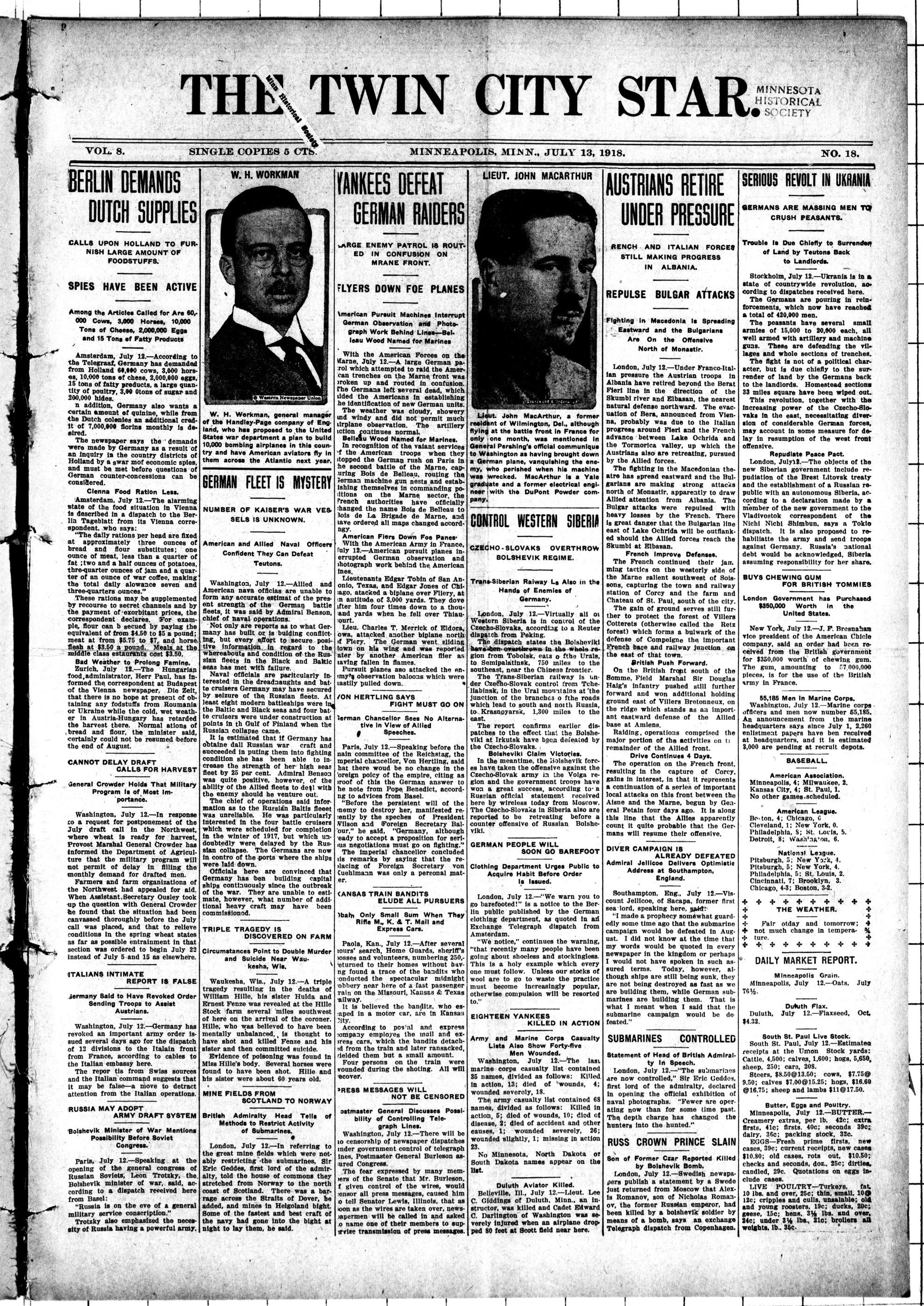
BERLIN DEMANDS DUTCH SUPPLIES
CALLS UPON HOLLAND TO FURNISH LARGE AMOUNT OF FOODSTUFFS.
SPIES HAVE BEEN ACTIVE
Among the Articles Called for Are 60,
000 Cows, 3,000 Horses, 10,000
Tons of Cheese, 2,000,000 Eggs
and 15 Tons of Fatty Products
Amsterdam, July 12.—According to
the Telegraaf, Germany has demanded
from Holland 60,000 cows, 3,000
horses, 10,000 tons of cheese, 2,000,000 eggs,
15 tons of fatty products, a large quantity
of poultry, 3,000 tons of sugar and
200,000 hides.
In addition, Germany also wants a
certain amount of quinine, while from
the Dutch colonies an additional credit
of 7,000,000 florins monthly is desired.
The newspaper says the demands
were made by Germany as a result of
an inquiry in the country districts of
Holland by a swar mof economic spies,
and must be met before questions of
German counter-concessions can be
considered.
Cienna Food Ration Less.
Amsterdam, July 12.—The alarming state of the food situation in Vienna is described in a dispatch to the Berlin Tageblatt from its Vienna correspondent, who says:
"The daily rations per head are fixed at approximately three ounces of bread and flour substitutes; one ounce of meat, less than a quarter of fat; two and a half ounces of potatoes, three-quarter ounces of jam and a quarter of an ounce of war coffee, making the total daily allowance seven and three-quarter ounces."
These rations may be supplemented by recourse to secret channels and by the payment of exorbitant prices, the correspondent declares. For example, flour can b secured by paying the equivalent of from $4.50 to $5 a pound; meat at from $7.55 to $7.50 and horse flesh at $3.50 a pound. Meals at the middle class restaurants cost $3.50.
Bad Weather to Prolong Famine. Zurich, July 12.—The Hungarian food, administrator, Herr Paul, has informed the correspondent at Budapest of the Vienna newspaper, Die Zeit, that there is no hope at present of obtaining any fodstuff from Roumania or Ukraine while the cold, wet weather in Austria-Hungary has retarded the harvest there. Normal actions of bread and flour, the minister said, certainly could not be resumed before the end of August.
CANNOT DELAY DRAFT
CALLS FOR HARVEST
General Crowder Holds That Military Program Is of Most Importance.
Washington, July 12.—In response to a request for postponement of the July draft call in the Northwest, where wheat is ready for harvest, Provost Marahal General Crowder has informed the Department of Agriculture that the military program will not permit of delay in filling the monthly demand for drafted men.
Farmers and farm organizations of the Northwest had appealed for aid. When Assistant, Secretary Ousley took up the question with General Crowder he found that the situation had been canvassed thoroughly before the July call was placed, and that to relieve conditions in the spring wheat states as far as possible entrainment in that section was ordered to begin July 22 instead of July 5 and 15 as elsewhere.
ITALIANS INTIMATE REPORT IS FALSE
Germany Said to Have Revoked Order Sending Troops to Assist Austrians.
Washington, July 12.—Germany has revoked an important army order issued several days ago for the dispatch of 12 divisions to the Italian front from France, according to cables to the Italian embassy here.
The report tis from Swiss sources and the Italian command suggests that it may be false—a move to detract attention from the Italian operations.
RUSSIA MAY ADOPT
ARMY DRAFT SYSTEM
Bolshevik Minister of War Mentions Possibility Before Soviet Congress.
Paris, July 12.—Speaking at the opening of the general congress of Russian Soviets, Leon Trotzky, the Bolshevik minister of war, said, according to a dispatch received here from Basel:
"Russia is on the eve of a general military service conscription."
Trotzky also emphasized the necessity of Russia having a powerful army.
W. H. WORKMAN
© Western Newspaper Union
W. H. Workman, general manager of the Handley-Page company of England, who has proposed to the United States war department a plan to build 10,000 bombing airplanes in this country and have American aviators fly in them across the Atlantic next year.
GERMAN FLEET IS MYSTERY
NUMBER OF KAISER'S WAR VES
SELS IS UNKNOWN.
American and Allied Naval Officers Confident They Can Defeat
Washington, July 12.—Allied and American nava officials are unable to form any accurate estimate of the present strength of the German battle fleets, it was said by Admiral Benson, chief of naval operations.
Not only are reports as to what Germany has built or is building conflicting, but every effort to secure positive information in regard to the whereabouts and condition of the Russian fleets in the Black and Baltic seas has met with failure.
Naval officials are particularly interested in the dreadnaughts and battle cruisers Germany may have secured by seizure of the Russian fleets. At least eight modern battleships were in the Baltic and Black seas and four battle cruisers were under construction at points in the Gulf of Finland when the Russian collapse came.
It is estimated that if Germany has obtained dall Russian war craft and succeeded in putting them into fighting condition she has been able to increase the strength of her high seas fleet by 25 per cent. Admiral Benson was quite positive, however, of the ability of the Allied fleets to deal with the enemy should he venture out.
The chief of operations said information as to the Russian Baltic fleet was unreliable. He was particularly interested in the four battle cruisers which were scheduled for completion in the winter of 1917, but which undoubtedly were delayed by the Russian collapse. The Germans are now in control of the ports where the ships were laid down. Officials here are convinced that Germany has been building capital ships continuously since the outbreak of the war. They are unable to estimate, however, what number of additional heavy craft may have been commissioned.
TRIPLE TRAGEDY IS DISCOVERED ON FARM
Circumstances Point to Double Murder and Sulicide Near Waukesha, Wis.
Waukesha, Wis., July 12.—A triple tragedy resulting in the deaths of William Hille, his sister Hulda and Ernest Fenze was revealed at the Hille Stock farm several miles southwest of here on the arrival of the coroner. Hille, who was believed to have mentally unbalanced, is thought to have shot and killed Fenze and his sister and then committed suicide. Evidence of poisoning was found in Miss Hille's body. Several horses were found to have been shot. Hille and his sister were about 60 years old.
MINE FIELDS FROM SCOTLAND TO NORWAY
British Admiralty Head Tells of Methods to Restrict Activity of Submarines.
London, July 12.—In referring to the great mine fields which were notably restricting the submarines, Sir Eric Geddes, first lord of the admiralty, told the house of commons they stretched from Norway to the north coast of Scotland. There was a barrage across the Straits of Dover, he added, and mines in Helgoland bight. Some of the fastest and best craft of the navy had gone into the bight at night to lay them, he said.
MINNEAPOLIS, MINN., JULY 13, 1918.
YANKEES DEFEAT GERMAN RAIDERS
LARGE ENEMY PATROL IS ROUTED IN CONFUSION ON MRANE FRONT.
FLYERS DOWN FOE PLANES
American Pursuit Machines Interrupt German Observation and Photograph Work Behind Lines—Belleau Wood Named for Marines
With the American Forces on the Marne, July 12.—A large German parrol which attempted to raid the American trenches on the Marne front was broken up and routed in confusion. The Germans left several dead, whichided the Americans in establishing the identification of new German units. The weather was cloudy, showery and windy and did not permit much airplane observation. The artillery action continues normal.
Belleau Wood Named for Marines.
In recognition of the valiant services of the American troops when they stopped the German rush on Paris in the second battle of the Marne, capturing Bols de Belleau, routing the German machine gun nests and establishing themselves in command positions on the Marne sector, the French authorities have officially changed the name Bols de Belleau to Bols de La Brigade de Marne, and have ordered all maps changed accordingly.
American Fiers Down Foe Panes. With the American Army in France, July 12.—American pursuit planes interrupted German observation and photograph work behind the American lines.
Lieutenants Edgar Tobin of San Antonio, Texas, and Edgar Jones of Chicago, attacked a biplane over Fliery, at an altitude of 3,000 yards. They dove after him four times down to a thousand yards when he fell over Thiaucourt.
Lieu. Charles T. Merrick of Eldora, Iowa, attacked another biplane north of Fliery. The German went sliding down on his wing and was reported later by another American flier as saving fallen in flames.
Pursuit planes also attacked the enemy's observation balloons which were hastily pulled down.
/ON HERTLING SAYS
FIGHT MUST GO ON
German Chancellor Sees No Alternative in View of Allied Speeches.
Paris, July 12.—Speaking before the main committee of the Reichstag, the imperial chancellor, Von Hertling, said that there woud be no change in the foreign policy of the empire, citing as proof of this the German answer to the note from Pope Benedict, according to advices from Basel.
"Before the persistent will of the enemy to destroy her, manifested recently by the speaches of President Wilson and Foreign Secretary Bailour," he said, "Germany, although ready to accept a proposition for serious negotiations must go on fighting." The imperial chancellor concluded his remarks by saying that the replacing of Foreign Secretary von Kuehlmann was only a personal matter.
<ANSAS TRAIN BANDITS
ELUDE ALL PURSUERS
Obahn Only Small Sum When They Riffle M., K. & T. Mail and Express Cars.
Paola, Kan., July 12.—After several tours' search, Home Guards, sheriff's losses and volunteers, numbering 250, returned to their homes without having found a trace of the bandits who conducted the spectacular midnight robber near here of a fast passenger train on the Missouri, Kansas & Texas railway.
It is believed the bandits, who escaped in a motor car, are in Kansas City.
According to postal and express company employees the mail and express cars, which the bandits detached from the train and later ransacked, fielded them but a small amount.
Four persons on the train were vounded during the shooting. All will recover.
PRESS MESSAGES WILL NOT BE CENSORED
postmaster General Discusses Possibility of Controlling Telegraph Lines.
Washington, July 12.—There will be 10 censorship of newspaper dispatches under government control of telegraph lines, Postmaster General Burleson assured Congress.
The fear expressed by many members of the Senate that Mr. Burleson, f given control of the wires, would sensor all press messages, caused him to tell Senator Lewis, Illinois, that as soon as the wires are taken over, newsapermen will be called in and asked o name one of their members to supwise transmission of press messages.
LIEUT. JOHN MACARTHUR
Gustafson & Indelia LTD.
Lieut. John MacArthur, a former resident of Wilmington, Del., although flying at the battle front in France for only one month, was mentioned in General Perahing's official communique to Washington as having brought down a German plane, vanquishing the enemy, who perished when his machine was wrecked. MacArthur is a Yale graduate and a former electrical engineer with the DuPont Powder company.
CONTROL WESTERN SIBERIA
CZECHO - SLOVAKS OVERTHROW
BOLSHEVIK REGIME.
London, July 12.—Virtually all on Western Siberia is in control of the Czecho-Slovaks, according to a Reuter dispatch from Peking.
The dispatch states the Bolshevik have been overshown in the whole region from Tobolsk, eats o fthe Urals, to Semipalatinsk, 750 miles to the southeast, near the Chinese frontier.
The Trans-Siberian railway is under Czecho-Slovak control from Tcheliabinsk, in the Ural mountains at the junction of the branches o fthe roads which lead to south and north Russia, to Krasnoyarsk, 1,300 miles to the east.
The report confirms earlier dispatches to the effect that the Bolshevik at Irkutsk have been defeated by the Czecho-Slovaks.
Bolshevik Claim Victories.
In the meantime, the Bolshevik forces have taken the offensive against the Czecho-Slovak army in the Volga region and the government troops have won a great success, according to a Russian official statement received here by wireless today from Moscow.
The Czecho-Slovaks in Siberia also are reported to be retreating before a counter offensive of Russian Bolshevik.
GERMAN PEOPLE WILL
SOON GO BAREFOOT
Clothing Department Urges Public to Acquire Habit Before Order is issued.
London, July 12.—"We warn you to go barefooted!" is a notice to the Berlin public published by the German clothing department, as quoted in an Exchange Telegraph dispatch from Amsterdam.
"We notice," continues the warning, "that recently many people have been going about shearless and stockingless. This is a holy example which every one must follow. Unless our stocks of wool are to go to waste the practice must become increasingly popular, otherwise compulsion will be resorted to."
EIGHTEEN YANKEES
KILLED IN ACTION
Army and Marine Corps Casualty Lists Also Show Forty-five Men Wounded.
Washington, July 12.—The last marine corps casualty list contained 35 names, divided as follows: Killed in action, 13; died of wounds, 4; wounded severely, 18.
The army casualty list contained 68 names, divided as follows: Killed in action, 5; died of wounds, 10; died of disease, 2; died of accident and other causes, 1; wounded severely, 26; wounded slightly, 1; missing in action 23.
No Minnesota, North Dakota or South Dakota names appear on the list.
Duluth Aviator Killed.
Belleville, Ill., July 12—Lleut. Lee C. Giddings of Duluth, Minn., an instructor, was killed and Cadet Edward C. Darlington of Washington was severely injured when an airplane dropped 80 feet at Scott field near here.
AUSTRIANS RETIRE UNDER PRESSURE
AUSTRIANS RETIRE UNDER PRESSURE
RENCH AND ITALIAN FORCES
STILL MAKING PROGRESS
IN ALBANIA.
REPULSE BULGAR ATTACKS
Fighting in Macedonia is Spreading Eastward and the Bulgarians Are On the Offensive North of Monastir.
London, July 12.—Under Franco-Italian pressure the Austrian troops in Albania have retired beyond the Berat Fierl line in the direction of the Skumbi river and Elbasan, the nearest natural defense northward. The evacuation of Bera, announced from Vienna, probably was due to the Italian progress around Fierl and the French advance between Lake Ochrida and the Tormorica valley, up which the Austrians also are retreating, pursued by the Allied forces.
The fighting in the Macedonian theatre has spread eastward and the Bulgarians are making strong attacks north of Monastir, apparently to draw Allied attention from Albania. The Bulgar attacks were repulsed with heavy losses by the French. There is great danger that the Bulgarian line east of Lake Ochrida will be outflanked should the Allied forces reach the Skumbi at Elbasan.
French Improve Defenses.
The French continued their jamming tactics on the weesterly side of the Marne salient southwest of Soissons, capturing the town and railway station of Corcy and the farm and Chateau of St. Paul, south of the city.
The gain of ground serves still further to protect the forest of Villers Cotterets (otherwise called the Retz forest) which forms a bulwark of the defense of Compigne the important French base and railway junction on the east of that town.
British Push Forward.
On the British front south of the Somme, Field Marshal Sir Douglas Halg's infantry pushed still further forward and won additional holding ground east of Villers Bretonneux, on the ridge which stands as an important eastward defense of the Allied base at Amlens.
Ralding, operations comprised the major portion of the activities on the remainder of the Allied front.
The operation on the French front, resulting in the capture of Corcy, gains in interest, in that it represents a continuation of a series of important local attacks on this front between the Alsine and the Marne, begun by General Petain four days ago. It is along this line that the Allies apparently count it quite probable that the Germans will resume their offensive.
DIVER CAMPAIGN 18
ALREADY DEFEATED
Admiral Jellicoe Delivers Optimistic Address at Southampton, England.
Southampton, Eng., July 12—Viscount Jellicoe, of Sacapa, former first sea lord, speaking here, said:
"I made a prophecy somewhat guardedly some time ago that the submarine campaign would be defeated in August. I did not know at the time that my words would be quoted in every newspaper in the kingdom or perhaps I would not have spoken in such assured terms. Today, however, although ships are still being sunk, they are not being destroyed as fast as we are building them, while German submarines are building them. That is what I meant when I said that the submarine campaign would be defeated."
SUBMARINES CONTROLLED
Statement of Head of British Admiralty In Speech. London, July 12.—"The submarines are now controlled," Sir Eric Geddes, first lord of the admiralty, declared in opening the official exhibition of naval photographs. "Fewer are operating now than for some time past. The depth charge has changed the hunters into the hunted."
RUSS CROWN PRINCE SLAIN
Son of Former Czar Reported Killed by Bolshevik Bomb.
London, July 12.—Swedish newspapers publish a statement by a Swede just returned from Moscow that Alexis Romanov, son of Nicholas Romanov, the former Russian emperor, had been killed by a bolshevik soldier by means of a bomb, says an exchange Telegraph dispatch from Copenhagen.
NO.18.
SERIOUS REVOLT IN UKRANIA
GERMANS ARE MASSING MEN TO CRUSH PEASANTS.
Trouble is Due Chiefly to Surrender of Land by Teutons Back to Landlords.
Stockholm, July 12.—Ukrania is in a state of countrywide revolution, according to dispatches received here.
The Germans are pouring in reinforcements, which now have reached a total of 420,000 men.
The peasants have several small armies of 15,000 to 20,000 each, all well armed with artillery and machine guns. These are defending the villages and whole sections of trenches.
The fight is not of a political character, but is due chiefly to the surrender of land by the Germans back to the landlords. Homestead sections 33 miles square have been wiped out.
This revolution, together with the increasing power of the Czecho-Slovaks in the east, necessitating diversion of considerable German forces, may account in some measure for delay in resumption of the west front offensive.
Repudiate Peace Pact.
London, July 12.—The objects of the new Siberian government include repudiation of the Brest Litovsk treaty and the establishment of a Russian republic with an autonomous Siberia, according to a declaration made by a member of the new government to the Vladivostok correspondent of the Nichi Nichi Shim bun, says a Toklo dispatch. It is also proposed to rehabilitate the army and send troops against Germany. Russia's national debt would be acknowledged, Siberia assuming responsibility for her share.
BUYS CHEWING GUM
FOR BRITISH TOMMIES
London Government has Purchased $350,000 Worth in the United States.
New York, July 12.—J. F. Bresnahan vice president of the American Chicle company, said an order had been received from the British government for $350,000 worth of chewing gum. The gum, amounting to 57,000,000 pieces, is for the use of the British army in France.
55.185 Men In Marine Corps.
Washington, July 12.—Marine corps officers and men now number 55,185. An announcement from the marine headquarters says since July 1, 2,260 enlistment papers have been received at headquarters, and it is estimated 3,000 are pending at recruit depots.
American Association. Minneapolis, 4; Milwaukee, 2. Kansas City, 4; St. Paul, 1. No other games scheduled.
American League. Boston, 4; Chicago, 6. Cleveland, 1; New York, 0. Philadelphia, 8; St. Louis, 5. Detroit, 8; Washington, 6.
National League. Pittsburgh, 5; New York, 4. Pittsburgh, 5; New York, 4. Philadelphia, 5; St. Louis, 2. Cincinnati, 7; Brooklyn, 3. Chicago, 4-3; Boston, 3-2.
THE WEATHER.
Fair otday and tomorrow; not much change in tempera-
ture.
DAILY MARKET REPORT.
Minneapolis Grain. Minneapolis, July 12.—Oats, July 76½.
Duluth Flax. Duluth, July 12.—Flaxseed, Oct. $4.32.
South St. Paul Live Stock.
South St. Paul, July 12.—Estimated receipts at the Umon Stock yards: Cattle, 4,500; calves, 1,600; hogs, 5,650; sheep, 250; cars, 208.
Steers, $8.50@13.50; cows, $7.75@9.50; calves $7.00@15.25; hogs, $16.60@16.75; sheep and lambs $11@17.50.
Butter, Eggs and Poultry.
Minneapolis, July 12.—BUTTER.—Creamery extras, per lb. 42c; extra checks, 41c; firsts, 40c; seconds 39c; dairy, 36c; packing stock, 32c.
EGGS—Fresh prime firsts, new cases, 39c; current receipts, new cases $10.80; old cases, rots out, $10.50; checks and seconds, doz, 25c; dirties, candled, 29c. Quotations on eggs include cases.
LIVE POULTRY—Turkeys, fat, 10 lbs. and over, 25c; thin, small, 10@12c; cripples and culls, unavailable; old and young roosters, 19c; ducks, 20c; geese, 15c; hens, 3½ lbs. and over, 24c; under 3½ lbs., 21c; broilers all weights, lb., 35c.
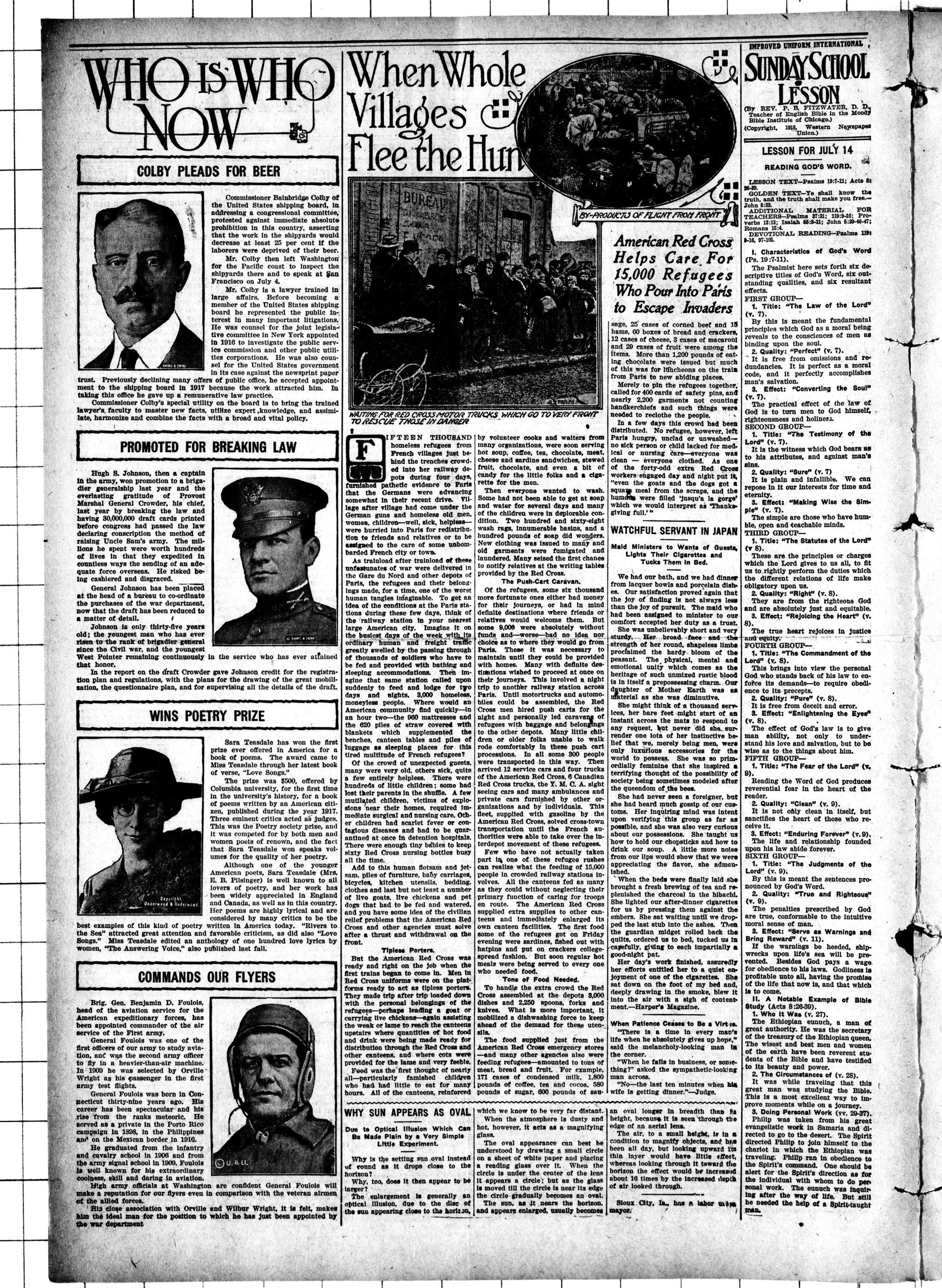
WHO IS WHO NOW
SINGLE & TWENTY
trust. Previously declining many offe ment to the shipping board in 1917 taking this office he gave up a remun Commissioner Colby's special util lawyer's, faculty to master new facts, late, harmonize and combine the facts
PROMOTED FOR
trust. Previously declining many offers of public office, he accepted appointment to the shipping board in 1917 because the work attracted him. In taking this office he gave up a remunerative law practice.
Commissioner Colby's special utility on the board is to bring the trained lawyer's, faculty to master new facts, utilize expert knowledge, and assimilate, harmonize and combine the facts with a broad and vital policy.
PROMOTED FOR BREAKING LAW
Hugh S. Johnson, then a captain in the army, won promotion to a brigadier generalship last year and the everlasting gratitude of Provost Marshal General Crowder, his chief, last year by breaking the law and having 30,000,000 draft cards printed before congress had passed the law declaring conscription the method of raising Uncle Sam's army. The millions he spent were worth hundreds of lives in that they expedited in countless ways the sending of an adequate force overseas. He risked being cashiered and disgraced.
General Johnson has been placed at the head of a bureau to co-ordinate the purchases of the war department, now that the draft has been reduced to a matter of detail.
Johnson is only thirty-five years old; the youngest man who has ever risen to the rank of brigadier general since the Civil war, and the youngest
West Pointer remaining continuously in the service who has ever attained that honor.
West Pointer remaining continuously that honor.
In the report on the draft Crowde tion plan and regulations, with the pla zation, the questionnaire plan, and for
In the report on the draft Crowder gave Johnson credit for the registration plan and regulations, with the plans for the drawing of the great mobilization, the questionnaire plan, and for supervising all the details of the draft.
WINS POETRY PRIZE
WINS POETRY PRIZE
Copyright
Underwood & Underwood
best examples of this kind of poetry in the Sea" attracted great attention and Songs." Miss Teasdale edited an anwomen, "The Answering Voice," also p
best examples of this kind of poetry written in America today. "Rivers to the Sea" attracted great attention and favorable criticism, as did also "Love Songs." Miss Teasdale edited an anthology of one hundred love lyrics by women, "The Answering Voice," also published last fall.
COMMANDS OUR FLYERS
COMMANDS OUR FLYERS
Brig. Gen. Benjamin D. Foulus, head of the aviation service for the American expeditionary forces, has been appointed commander of the air service of the First army.
General Foulus was one of the first officers of our army to study aviation, and was the second army officer to fly in a heavier-than-air machine. In 1900 he was selected by Orville Wright as his passenger in the first army test flights.
General Foulus was born in Connecticut thirty-nine years ago. His career has been spectacular and his rise from the ranks meteoric. He served as a private in the Porto Rico campaign in 1898, in the Philippines and on the Mexican border in 1916.
He graduated from the infantry and cavalry school in 1906 and from the army signal school in 1909. Foulus is well known for his extraordinary coolness, skill and daring in aviation.
High army officials at Washington make a reputation for our flyers even of the allied forces. His close association with Orville him the ideal man for the position to the war department
High army officials at Washington are confident General Foulois will make a reputation for our flyers even in comparison with the veteran airmen of the allied forces. His close association with Orville and Wilbur Wright, it is felt, makes him the ideal man for the position to which he has just been appointed by the war department
Commissioner Bainbridge Colby of the United States shipping board, in addressing a congressional committee, protested against immediate absolute prohibition in this country, asserting that the work in the shipyards would decrease at least 25 per cent if the laborers were deprived of their beer. Mr. Colby then left Washington for the Pacific coast to inspect the shipyards there and to speak at San Francisco on July 4. Mr. Colby is a lawyer trained in large affairs. Before becoming a member of the United States shipping board he represented the public interest in many important litigations. He was counsel for the joint legislative committee in New York appointed in 1916 to investigate the public service commission and other public utilities corporations. He was also counsel for the United States government in its case against the newsprint paper
ers of public office, he accepted appoint- because the work attracted him. In erative law practice. ty on the board is to bring the trained utilize expert, knowledge, and assimi- with a broad and vital policy.
BREAKING LAW
C. JAMES A. 1907
in the service who has ever attained or gave Johnson credit for the registrars for the drawing of the great mobilisupervising all the details of the draft. greatly swell of thousands be fed and p sleeping acc agine that suddenly to days and moneyless p
Sara Teasdale has won the first prize ever offered in America for a book of poems. The award came to Miss Teasdale through her latest book of verse, "Love Songs."
The prize was $500, offered by Columbia university, for the first time in the university's history, for a book of poems written by an American citizen, published during the year 1917. Three eminent critics acted as judges. This was the Poetry society prize, and it was competed for by both men and women poets of renown, and the fact that Sara Teasdale won speaks volumes for the quality of her poetry.
Although one of the younger American poets, Sara Teasdale (Mrs. E. B. PilSinger) is well known to all lovers of poetry, and her work has been widely appreciated in England and Canada, as well as in this country. Her poems are highly lyrical and are considered by many critics to be the
written in America today. "Rivers to favorable criticism, as did also "Love chology of one hundred love lyrics by published last fall.
U. U.
n are confident General Foulois will
in comparison with the veteran airmen
and Wilbur Wright, it is felt, makes
which he has just been appointed by
Why, too, larger?
The enlarge
optical illus
the sun appe
When Whole Villages Flee the Hun
BUREAU
BY-P
WAITING FOR RED CROSS MOTOR TRUCKS WHICH GO TO VERY FRONT TO RESCUE THOSE IN DANGER
IFTEEN THOUSAND homeless refugees from French villages just behind the trenches crowded into her railway depots during four days, furnished pathetic evidence to Paris that the Germans were advancing somewhat in their recent drive. Village after village had come under the German guns and homeless old men, women, children—well, sick, helpless—were hurried into Paris for redistribution to friends and relatives or to be assigned to the care of some unbombarded French city or town.
by volunteer cooks and waiters from many organizations, were soon serve hot soup, coffee, tea, chocolate, me cheese and sardine sandwiches, stew fruit, chocolate, and even a bit candy for the little folks and a cirtette for the men.
Then everyone wanted to was Some had not been able to get at so and water for several days and man of the children were in deplorable condition. Two hundred and sixty-elew wash rags, innumerable basins, and hundred pounds of soap did wonders. New clothing was issued to many a old garments were fumigated a
As trainload after trainload of these unfestunates of war were delivered in the Gare du Nord and other depots of Paris, the refugees and their belongings made, for a time, one of the worst human tangles imaginable. To get an idea of the conditions at the Paris stations during these few days, think of the railway station in your nearest large American city. Imagine it on the busiest days of the week with its ordinary human and freight traffic greatly swelled by the passing through of thousands of soldiers who have to be fed and provided with bathing and sleeping accommodations. Then imagine that same station called upon suddenly to feed and lodge for two days and nights, 3,000 homeless, moneyless people. Where would an American community find quickly—in an hour two—the 960 mattresses and the 620 piles of straw covered with blankets which supplemented the benches, canteen tables and piles of luggage as sleeping places for this tired multitude of French refugees?
Of the crowd of unexpected guests, many were very old, others sick, quite a few entirely helpless. There were hundreds of little children; some had lost their parents in the shuffle. A few mutilated children, victims of explosions near their homes, required immediate surgical and nursing care. Other children had scarlet fever or contagious diseases and had to be quarantined at once in detention hospitals. There were enough tiny babies to keep sixty Red Cross nursing bottles busy all the time.
Add to this human flotsam and jetsam, plies of furniture, baby carriages, bicycles, kitchen utensils, bedding, clothes and last but not least a number of live goats, live chickens and pet dogs that had to be fed and watered, and you have some idea of the civilian relief problems that the American Red Cross and other agencies must solve after a thrust and withdrawal on the front.
But the American Red Cross was ready and right on the job when the first trains began to come in. Men in Red Cross uniforms were on the platforms ready to act as tipless porters. They made trip after trip loaded down with the personal belongings of the refugees—perhaps leading a goat or carrying live chickens—again assisting the weak or lame to reach the canteens upstairs where quantities of hot food and drink were being made ready for distribution through the Red Cross and other canteens, and where cots were provided for the lame and very feeble. Food was the first thought of nearly all—particularly famished children who had had little to eat for many hours. All of the canteens, reinforced
WHY SUN APPEARS AS OVAL
Due to Optical Illusion Which Can Be Made Plain by a Very Simple Little Experiment.
Why is the setting sun oval instead of round as it drops close to the horizon?
Why, too, does it then appear to be larger?
The enlargement is generally an optical illusion, due to the disc of the sun appearing close to the horizon.
FTEEN THOUSAND homeless refugees from French villages just behind the trenches crowded into her railway depots during four days.
Tipless Porters.
BY-PRODUCTS OF FLIGHT FROM FRONT
by volunteer cooks and waiters from many organizations, were soon serving hot soup, coffee, tea, chocolate, meat, cheese and sardine sandwiches, stewed fruit, chocolate, and even a bit of candy for the little folks and a cigarette for the men.
Then everyone wanted to wash. Some had not been able to get at soap and water for several days and many of the children were in deplorable condition. Two hundred and sixty-eight wash rags, innumerable basins, and a hundred pounds of soap did wonders. New clothing was issued to many and old garments were fumigated and laundered. Many seized the first chance to notify relatives at the writing tables provided by the Red Cross.
Of the refugees, some six thousand more fortunate ones either had money for their journeys, or had in mind definite destinations where friends or relatives would welcome them. But some 9,000 were absolutely without funds and—worse—had no idea nor choice as to where they would go from Paris. These it was necessary to maintain until they could be provided with homes. Many with definite destinations wished to proceed at once on their journeys. This involved a night trip to another railway station across Paris. Until motortrucks and automobiles could be assembled, the Red Cross men hired push carts for the night and personally led caravans of refugees with baggage and belongings to the other depots. Many little children or older folks unable to walk rode comfortably in these push cart processions. In all some 300 people were transported in this way. Then arrived 12 service cars and four trucks of the American Red Cross, 6 Canadian Red Cross trucks, the Y. M. C. A. sight seeing cars and many ambulances and private cars furnished by other organizations and by individuals. This fleet, supplied with gasoline by the American Red Cross, solved cross-town transportation until the French authorities were able to take over the interdepot movement of these refugees.
Few who have not actually taken part in one of these refugee rushes can realize what the feeding of 15,000 people in crowded railway stations involves. The all canteens fed as many as they could without neglecting their primary function of caring for troops en route. The American Red Cross supplied extra supplies to other canteens and immediately enlarged its own canteen facilities. The first food some of the refugees got on Friday evening were sardines, fished out with hatpins and put on crackers college-spread fashion. But soon regular hot meals were being served to every one who needed food.
To handle the extra crowd the Red Cross assembled at the depots 3,000 dishes and 2,250 spoons, forks and knives. What is more important, it mobilized a dishwashing force to keep ahead of the demand for these utensils.
The food supplied just from the American Red Cross emergency stores—and many other agencies also were feeding refugees—amounted to tons of meat, bread and fruit. For example, 171 cases of condensed milk, 1,800 pounds of coffee, tea and cocon, 580 pounds of sugar, 600 pounds of sau-
which we know to be very far distant.
When the atmosphere is dusty and hot, however, it acts as a magnifying glass.
The oval appearance can best be understood by drawing a small circle on a sheet of white paper and placing a reading glass over it. When the circle is under the center of the lens it appears a circle; but as the glass is moved till the circle is near its edge the circle gradually becomes an oval. The sun, as it nears the horizon, and appears enlarged, usually becomes
American Red Cross Helps Care For 15,000 Refugees Who Pour Into Paris to Escape Invaders
sage, 25 cases of corned beef and 15 hams, 60 boxes of bread and crackers, 12 cases of cheese, 3 cases of macaroni and 29 cases of fruit were among the items. More than 1,200 pounds of eating chocolate were issued but much of this was for luncheons on the train from Paris to new abiding places. Merely to pin the refugees together, called for 400 cards of safety pins, and nearly 2,200 garments not counting handkerchiefs and such things were needed to reclocate the people.
In a few days this crowd had been distributed. No refuge, however, left Paris hungry, unclad or unwashed—no slick person or child lacked for medical or nursing care—everyone was clean — everyone clothed. As one of the forty-odd extra Red Cross workers engaged day and night put it "even the goats and the dogs got a square meal from the scraps, and the humans were filled 'jusqu'a la gorge' which we would interpret as 'Thanks-giving full.'"
WATCHFUL SERVANT IN JAPAN
Maid Ministers to Wants of Guesta
Lights Their Cigarettes and
Tucks Them In Bed.
We had our bath, and we had dinner from lacquer bowls and porcelain dishes. Our satisfaction proved again that the joy of finding is not always less than the joy of pursuit. The maid who had been assigned to minister to our comfort accepted her duty as a trust. She was unbelievably short and very sturdy. Her broad face and the strength of her round, shapeless limbs proclaimed the hardy bloom of the peasant. The physical, mental and emotional unity which comes as the heritage of such unmixed rustic blood is in itself a prepossessing charm. Our daughter of Mother Earth was as material as she was diminutive.
She might think of a thousand services, her bare feet might start of an instant across the mats to respond to any request, but never did she surrender one lota of her instinctive belief that we, merely being men, were only luxurious accessories for the world to possess. She was so primordially feminine that she inspired a terrifying thought of the possibility of society being sometimes modeled after the queendom of the bees.
She had never seen a foreigner, but she had heard much gossip of our customs. Her inquiring mind was intent upon verifying this group as far as possible, and she was also very curious about our possessions. She taught us how to hold our chopsticks and how to drink our soup. A little more noise from our lips would show that we were appreciating the flavor, she admonished.
When the beds were finally laid she brought a fresh brewing of tea and replenished the charcoal in the hibachi. She lighted our after-dinner cigarettes for us by pressing them against the embers. She sat waiting until we dropped the last stub into the ashes. Then the guardian midget rolled back the quilts, ordered us to bed, tucked us in carefully, giving to each impartially a good-night pat.
Her day's work finished, assuredly her efforts entitled her to a quiet enjoyment of one of the cigarettes. She sat down on the foot of my bed and, deeply drawing in the smoke, blew it into the air with a sigh of contentment.—Harper's Magazine.
When Patience Ceases to Be a Virtue.
"There is a time in every man's life when he absolutely gives up hope," said the melancholy-looking man in the corner.
"When he falls in business, or something?" asked the sympathetic-looking man across. "No—the last ten minutes when his wife is getting dinner."—Judge.
an oval longer in breadth than its height, because it is seen through the edge of an aerial lens.
The air, to a small height, is in a condition to magnify objects, and has been all day, but looking upward its thin layer would have little effect, whereas looking through it toward the horizon the effect would be increased about 16 times by the increased depth of air looked through.
Sioux City, Ia., has a labor union mayor.
IMPROVED UNIFORM INTERNATIONAL SUNDAY SCHOOL LESSON
(By REV. P. B. FITZWATER. D. D.
Teacher of English in the Moody
Bible Institute of Chicago.)
(Copyright, 1918. Eastern Newspapers
Union.)
LESSON FOR JULY 14
LESSON TEXT—Psalms 19:7-11; Acts $;
96-39.
GOLDEN TEXT-Ye shall know the truth, and the truth shall make you free.- John 8:23.
ADDITIONAL MATERIAL FOR TEXTUAL PROBLEMS Psalms 7:31; 119:3-46; Proverbs 13:12; Isaiah 56:3-11; John 5:39-46-47; Romans 15:4.
DEVOTIONAL READING—Psalms 119;
9-16, 97-106.
1. Characteristics of God's Word
(Ps. 19:7-11).
The Psalmist here sets forth six descriptive titles of God's Word, six outstanding qualities, and six resultant effects.
FIRST GROUP—
1. Title: "The Law of the Lord" (v. 7).
By this is meant the fundamental principles which God as a moral being reveals to the consciences of men as binding upon the soul.
2. Quality: "Perfect" (v. 7).
2. Quality: "Perfect" (V. 7).
It is free from omissions and redundancies. It is perfect as a moral code, and it perfectly accomplishes man's salvation.
3. Effect: "Converting the Soul" (v. 7).
The practical effect of the law of God is to turn men to God himself, righteousness and holiness.
SECOND GROUP—
1. Title: "The Testimony of the Lord" (v. 7).
It is the witness which God bears as to his attributes, and against man's sins.
2. Quality: "Sure" (v. 7)
It is plain and infallible. We can repose in it our interests for time and eternity.
3. Effect: "Making Wise the Simple" (v. 7).
The simple are those who have humble, open and teachable minds.
THIRD GROUP—
1. Title: "The Statutes of the Lord" (v. 8).
These are the principles or charges which the Lord gives to us all, to fit us to rightly perform the duties which the different relations of life make obligatory upon us.
2. Quality: "Right" (v. 8).
They are from the righteous God and are absolutely just and equitable.
3. Effect: "Rejoicing the Heart" (v. 8).
The true heart rejoices in justice and equity.
FOURTH GROUP—
1. Title: "The Commandment of the Lord" (v. 8).
This brings into view the personal God who stands back of his law to enforce its demands—to require obedience to its precepts.
2. Quality: "Pure" (v. 8).
It is free from deceit and error.
3. Effect: "Enlightening the Eyes" (v. 8).
The effect of God's law is to give man ability, not only to understand his love and salvation, but to be wise as to the things about him.
FIFTH GROUP—
1. Title: "The Fear of the Lord" (v. 9).
Reading the Word of God produces reverential fear in the heart of the reader.
2. Quality: "Clean" (v. 9).
It is not only clean in itself, but sanctifies the heart of those who receive it.
3. Effect: "Enduring Forever" (v. 9).
The life and relationship founded upon his law abide forever.
SIXTH GROUP—
1. Title: "The Judgments of the Lord" (v. 9).
By this is meant the sentences pronounced by God's Word.
2. Quality: "True and Righteous" (v. 9).
The penalties prescribed by God are true, conformable to the intuitive moral sense of man.
3. Effect: "Serve as Warnings and Bring Reward" (v. 11).
If the warnings be heeded, shipwrecks upon life's sea will be prevented. Besides God pays a wage for obedience to his laws. Godliness is profitable unto all, having the promise of the life that now is, and that which is to come.
II. A Notable Example of Bible Study (Acts 8:26-39).
1. Who It Was (v. 27).
The Ethiopian eunuch, a man of great authority. He was the secretary of the treasury of the Ethiopian queen. The wisest and best men and women of the earth have been reverent students of the Bible and have testified to its beauty and power.
2. The Circumstances of (v. 28).
It was while traveling that this great man was studying the Bible. This is a most excellent way to improve moments while on a journey.
3. Doing Personal Work (vv. 29-37). Philip was taken from his great evangelistic work in Samaria and directed to go to the desert. The Spirit directed Philip to join himself to the chariot in which the Ethiopian was traveling. Philip ran in obedience to the Spirit's command. One should be alert for the Spirit's direction as for the individual with whom to do personal work. The eunuch was inquiring after the way of life. But still he needed the help of a Spirit-taught man.
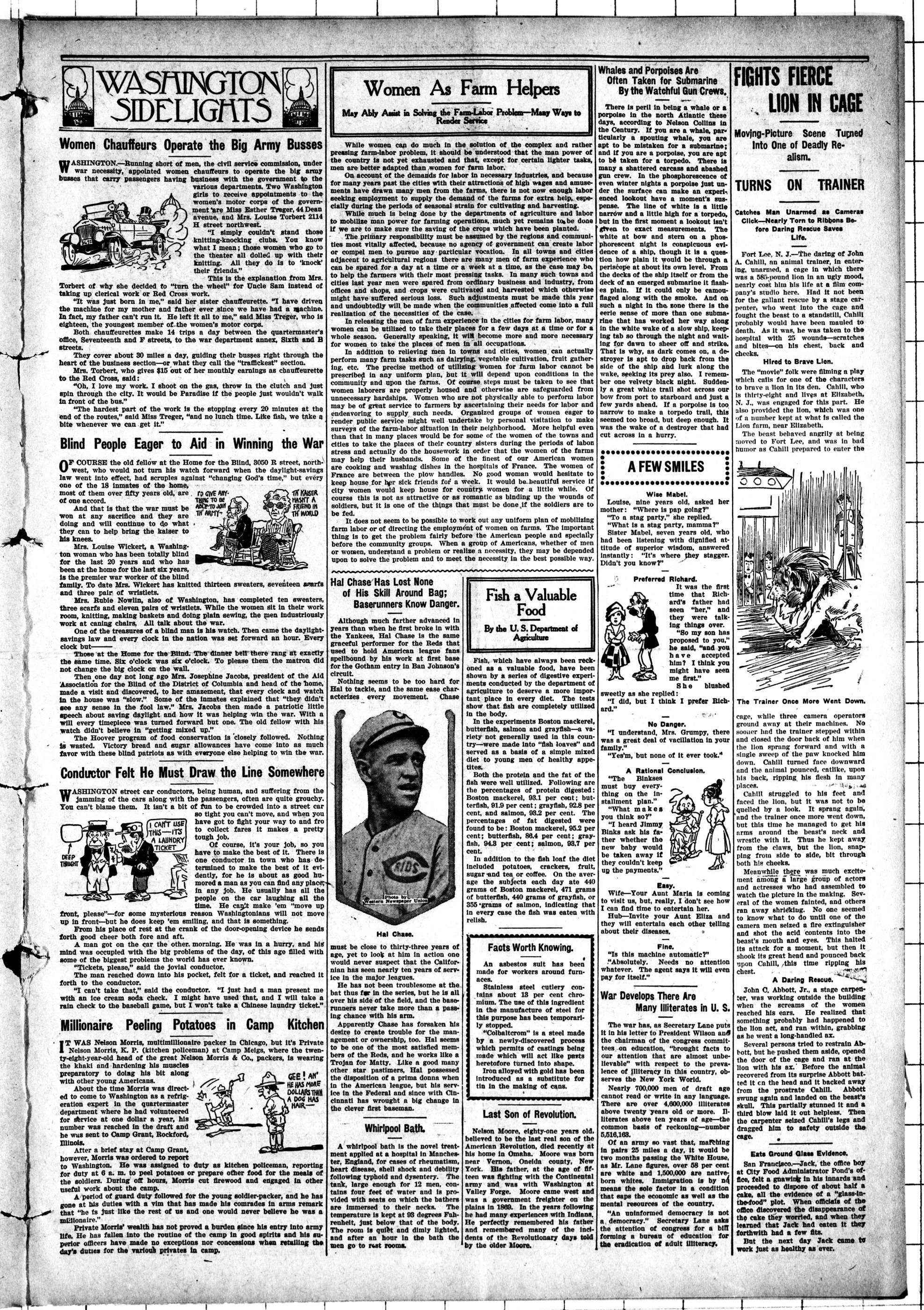
WASHINGTON SIDELIGHTS
WASHINGTON.—Running short of men, the civil service commission, under war necessity, appointed women chauffeurs to operate the big army busses that carry passengers having business with the government to the
various departments. Two Washington girls to receive appointments to the women's motor corps of the government are Miss Esther Treger, 44 Dean avenue, and Mrs. Louise Torbert 2114 H street northwest. "I simply couldn't stand those knitting-knocking clubs. You know what I mean; those women who go to the theater all dolled up with their knitting. All they do is to 'knock' their friends."
This is the explanation from Mrs. the wheel" for Uncle Sam instead of work.
her sister chauffeurette. "I have driven her ever since we have had a machine. It all to me," said Miss Treger, who is women's motor corps.
as a day between the quartermaster's the war department annex, Sixth and B
guilding their busses right through the they call the "traffickest" section.
her monthly earnings as chauffeurette
the gas, throw in the clutch and just radise if the people just wouldn't walk
the stopping every 20 minutes at the and no lunch time. Like fish, we take a
Aid in Winning the War
home for the Blind, 3050 R street, northch forward when the daylight-savings insist "changing God's time," but every
Torbert of why she decided to "turn the wheel taking up clerical work or Red Cross work.
"It was just born in me," said her sister of the machine for my mother and father ever since in fact, my father can't run it. He left it all to me eighteen, the youngest member of the women's m. Both chauffeurettes make 14 trips a day to office, Seventeenth and F streets, to the war dep streets.
They cover about 30 miles a day, guiding the heart of the business section—or what they call it. Mrs. Torbert, who gives $15 out of her month to the Red Cross, said:
"Oh, I love my work. I shoot on the gas, to spin through the city. It would be Paradise if the in front of the bus."
"The hardest part of the work is the stop end of the routes," said Miss Treger, "and no lunite whenever we can get it."
Blind People Eager to Aid in
OF COURSE the old fellow at the Home for the west, who would not turn his watch forward law went into effect, had scruples against "char one of the 18 inmates of the home, most of them over fifty years old, are
TO GIVE AN INTRING TO BE
Torbert of why she decided to "turn the wheel" for Uncle Sam instead of taking up clerical work or Red Cross work.
"It was just born in me," said her sister chauffeurette. "I have driven the machine for my mother and father ever since we have had a machine. In fact, my father can't run it. He left it all to me," said Miss Treger, who is eighteen, the youngest member of the women's motor corps.
Both chauffeurettes make 14 trips a day between the quartermaster's office, Seventeenth and F streets, to the war department annex, Sixth and B streets.
They cover about 30 miles a day, guilding their busses right through the heart of the business section—or what they call the "traffickest" section.
Mrs. Torbert, who gives $15 out of her monthly earnings as chauffeurette to the Red Cross, said:
"Oh, I love my work. I shoot on the gas, throw in the clutch and just spin through the city. It would be Paradise if the people just wouldn't walk in front of the bus."
"The hardest part of the work is the stopping every 20 minutes at the end of the routes," said Miss Treger, "and no lunch time. Like fish, we take a bite whenever we can get it."
Blind People Eager to Aid in Winning the War
Blind People Eager to Aid in Winning the War
OF COURSE the old fellow at the Home for the Blind, 3050 R street, northwest, who would not turn his watch forward when the daylight-savings law went into effect, had scruples against "changing God's time," but every one of the 18 inmates of the home,
ted thirteen sweaters, seventeen scarfs
Washington, has completed ten sweaters,
gets. While the women sit in their work
ing plain sewing, the men industriously
t the war.
n is his watch. Then came the daylight-
ation was set forward an hour. Every
The dinner bell there rang at exactly
clock. To please them the matron did
Josephine Jacobs, president of the Aid
act of Columbia and head of the home,
amazement, that every clock and watch
the inmates explained that "they didn't
Jacobs then made a patriotic little
it was helping win the War. With a
ward but one. The old fellow with his
up."
servation is closely followed. Nothing
allowances have come into as much
everyone else helping to win the war.
Draw the Line Somewhere
is, being human, and suffering from the
the passengers, often are quite grouchy,
of fun to be crowded into a street car
family. To date Mrs. Wickert has knitted thirteen sweaters, seventeen scarfs and three pair of wristlets.
family. To date Mrs. Wickert has knitted thirteen and three pair of wristlets.
Mrs. Rubie Nowlin, also of Washington, b three scarfs and eleven pairs of wristlets. While room, knitting, making baskets and doing plain s work at caning chairs. All talk about the war.
One of the treasures of a blind man is his w savings law and every clock in the nation was clock but——
Those at the Home for the Blind. The dinn the same time, Six o'clock was six o'clock. To not change the big clock on the wall.
Then one day not long ago Mrs. Josephine Association for the Blind of the District of Colo made a visit and discovered, to her amazement, in the house was "slow." Some of the inmates see any sense in the fool law." Mrs. Jacobs speech about saving daylight and how it was he will every timepiece was turned forward but o watch didn't believe in "getting mixed up."
The Hoover program of food conservation is wasted. Victory bread and sugar allowance favor with these blind patriots as with everyone.
Conductor Felt He Must Draw t
WASHINGTON street car conductors, being hu jamming of the cars along with the passengers You can't blame them. It isn't a bit of fun to so tight
Mrs. Ruble Nowlin, also of Washington, has completed ten sweaters, three scarfs and eleven pairs of wristlets. While the women sit in their work room, knitting, making baskets and doing plain sewing, the men industriously work at caning chairs. All talk about the war.
One of the treasures of a blind man is his watch. Then came the daylight-savings law and every clock in the nation was set forward an hour. Every clock but——
Those at the Home for the Blind. The dinner bell there rang at exactly the same time. Six o'clock was six o'clock. To please them the matron did not change the big clock on the wall.
Then one day not long ago Mrs. Josephine Jacobs, president of the Aid Association for the Blind of the District of Columbia and head of the home, made a visit and discovered, to her amazement, that every clock and watch in the house was "slow." Some of the inmates explained that "they didn't see any sense in the fool law." Mrs. Jacobs then made a patriotic little speech about saving daylight and how it was helping win the war. With a will every timepiece was turned forward but one. The old fellow with his watch didn't believe in "getting mixed up."
The Hoover program of food conservation is closely followed. Nothing wasasted. Victory bread and sugar allowances have come into as much favor with these blind patrols as with everyone else helping to win the war.
Conductor Felt He Must Draw the Line Somewhere
Conductor Felt He Must Draw the Line Somewhere
WASHINGTON street car conductors, being human, and suffering from the jamming of the cars along with the passengers, often are quite grouchy. You can't blame them. It isn't a bit of fun to be crowded into a street car
time. H front, please"—for some mysterious reason We up in front—but he does keep 'em smiling, and From his place of rest at the crank of the forth good cheer both fore and aft. A man got on the car the other. morning. mind was occupied with the big problems of the some of the biggest problems the world has ever
reason Washingtonians will not move killing, and that is something. Bank of the door-opening device he sends is morning. He was in a hurry, and his embs of the day, of this age filled with d has ever known. conductor. pocket, felt for a ticket, and reached it instructor. "I just had a man present me right have used that, and I will take a I won't take a Chinese laundry ticket."atoes in Camp Kitchen fire packer in Chicago, but it's Private man) at Camp Melgs, where the twenson Morris & Co., packers, is wearing
front, please"—for some mysterious reason Washingtonians will not move up in front—but he does keep 'em smiling, and that is something.
From his place of rest at the crank of the door-opening device he sends forth good cheer both fore and aft.
A man got on the car the other morning. He was in a hurry, and his mind was occupied with the big problems of the day, of this age filled with some of the biggest problems the world has ever known.
"Tickets, please," said the jovial conductor. The man reached down into his pocket, felt for a ticket, and reached it forth to the conductor.
The man reached down into his pocket, felt forth to the conductor.
"I can't take that," said the conductor. "I with an ice cream soda check. I might have to rain check to the baseball game, but I won't take Millionaire Peeling Potatoes
IT WAS Nelson Morris, multimillionaire packer, Nelson Morris, K. P. (kitchen policeman) at City-eight-year-old head of the great Nelson Morri
"I can't take that," said the conductor. "I just had a man present me with an ice cream soda check. I might have used that, and I will take a rain check to the baseball game, but I won't take a Chinese laundry ticket."
Millionaire Peeling Potatoes in Camp Kitchen
Millionaire Peeling Potatoes in Camp Kitchen
IT WAS Nelson Morris, multimillionaire packer in Chicago, but it's Private Nelson Morris, K. P. (kitchen policeman) at Camp Meigs, where the twenty-eight-year-old head of the great Nelson Morris & Co., packers, is wearing the khaki and hardening his muscles
duty as kitchen policeman, reporting for prepare other food for the meals of its cut firewood and engaged in other for the young soldier-packer, and he has made his comrades in arms remark and one would never believe he was a saved a burden since his entry into army of the camp in good spirits and his suns nor concessions when retailing the in camp.
to Washington. He was assigned to duty as a for duty at 6 a. m. to peel potatoes or prepare the soldiers. During off hours, Morris cut fire useful work about the camp.
A period of guard duty followed for the young gone at his duties with a vim that has made him that "he is just like the rest of us and one we millionaire."
Private Morris' wealth has not proved a burd life. He has fallen into the routine of the camp perior officers have made no exceptions nor day's duties for the various privates in camp.
to Washington. He was assigned to duty as kitchen policeman, reporting for duty at 6 a.m. to peel potatoes or prepare other food for the meals of the soldiers. During off hours, Morris cut firewood and engaged in other useful work about the camp.
A period of guard duty followed for the young soldier-packer, and he has gone at his duties with a vim that has made his comrades in arms remark that "he is just like the rest of us and one would never believe he was a millionaire."
Private Morris' wealth has not proved a burden since his entry into army life. He has fallen into the routine of the camp in good spirits and his superior officers have made no exceptions nor concessions when retailing the day's duties for the various privates in camp.
4572
And that is that the war must be won at any sacrifice and they are doing and will continue to do what they can to help bring the kalser to his knees.
Mrs. Louise Wickert, a Washington woman who has been totally blind for the last 20 years and who has been at the home for the last six years, is the premier war worker of the blind
I CAN'T USE THIS—IT'S A LAUNDRY TICKET
DEEP THUGHT
the khaki and hardening his muscles preparatory to dolag his bit along with other young Americans. About the time Morris was directed to come to Washington as a refrigeration expert in the quartermaster department where he had volunteered for service at one dollar a year, his number was reached in the draft and he was sent to Camp Grant, Rockford, Illinois. After a brief stay at Camp Grant, however, Morris was ordered to report
I'D GIVE ANY-
THING TO BE
ABLE TO JOIN
TH' ARMY
TH' KANSER
HASSET A
FRIEND IN
TH' WORLD
so tight you can't move, and when you have got to fight your way to and fro to collect fares it makes a pretty tough job. Of course, it's your job, so you have to make the best of it. There is one conductor in town who has determined to make the best of it evidently, for he is about as good humored a man as you can find any place in any job. He usually has all the people on the car laughing all the time. He can't make 'em "move up
GEE! AN'
HE HAS MORE
DOLLARS THAN
A DOG HAS
HAIR—
Women As Farm Helpers
May Ably Assist in Solving the Farm-Labor Problem—Many Ways to Render Service
While women can do much in the solution of the complex and rather pressing farm-labor problem, it should be understood that the man power of the country is not yet exhausted and that, except for certain lighter tasks, men are better adapted than women for farm labor.
On account of the demands for labor in necessary industries, and because for many years past the cities with their attractions of high wages and amusements have drawn many men from the farms, there is not now enough labor seeking employment to supply the demand of the farms for extra help, especially during the periods of seasonal strain for cultivating and harvesting.
While much is being done by the departments of agriculture and labor to mobilize man power for farming operations, much yet remains to be done if we are to make sure the saving of the crops which have been planted.
The primary responsibility must be assumed by the regions and communities most vitally affected, because no agency of government can create labor or compel men to pursue any particular vocation. In all towns and cities adjacent to agricultural regions there are many men of farm experience who can be spared for a day at a time or a week at a time, as the case may be, to help the farmers with their most pressing tasks. In many such towns and cities last year men were spared from ordinary business and industry, from offices and shops, and crops were cultivated and harvested which otherwise might have suffered serious loss. Such adjustments must be made this year and undoubtedly will be made when the communities affected come into a full realization of the necessities of the case.
In releasing the men of farm experience in the cities for farm labor, many women can be utilized to take their places for a few days at a time or for a whole season. Generally speaking, it will become more and more necessary for women to take the places of men in all occupations.
In addition to relieving men in towns and cities, women can actually many farm tasks such as dairying, vegetable cultivation, fruit gathering, etc. The precise method of utilizing women for farm labor cannot be prescribed in any uniform plan, but it will depend upon conditions in the community and upon the farms. Of course steps must be taken to see that women laborers are properly housed and otherwise are safeguarded from unnecessary hardships. Women who are not physically able to perform labor may be of great service to farmers by ascertaining their needs for labor and endeavoring to supply such needs. Organized groups of women eager to render public service might well undertake by personal visitation to make surveys of the farm-labor situation in their neighborhood. More helpful even than that in many places would be for some of the women of the towns and cities to take the places of their country sisters during the periods of labor stress and actually do the housework in order that the women of the farms may help their husbands. Some of the finest of our American women are cooking and washing dishes in the hospitals of France. The women of France are between the plow handles. No good woman would hesitate to keep house for her sick friends for a week. It would be beautiful service if city women would keep house for country women for a little while. Of course this is not as attractive or as romantic as binding up the wounds of soldiers, but it is one of the things that must be done if the soldiers are to be fed.
It does not seem to be possible to work out any uniform plan of mobilizing farm labor or of directing the employment of women on farms. The important thing is to get the problem fairly before the American people and specially before the community groups. When a group of Americans, whether of men or women, understand a problem or realize a necessity, they may be depended upon to solve the problem and to meet the necessity in the best possible way.
Hal Chase Has Lost None of His Skill Around Bag; Baserunners Know Danger.
Although much farther advanced in years than when he first broke in with the Yankees, Hal Chase is the same graceful performer for the Reds that used to hold American league fans spellbound by his work at first base for the Gotham entry in Ban Johnson's circuit.
Nothing seems to be too hard for Hal to tackle, and the same ease characterizes every movement. Chase
RIDS
Photo by
Western Newspaper Union
Hal Chase.
must be close to thirty-three years of age, yet to look at him in action one would never suspect that the Californiaian has seen nearly ten years of service in the major leagues.
He has not been troublesome at the bat thus far in the series, but he is all over his side of the field, and the baserunners never take more than a passing chance with his arm.
Apparently Chase has forsaken his desire to create trouble for the management or ownership, too. Hal seems to be one of the most satisfied members of the Reds, and he works like a Trojan for Matty. Like a good many other star pastimers, Hal possessed the disposition of a prima donna when in the American league, but his service in the Federal and since with Cincinnati has wrought a big change in the clever first baseman.
Whirlpool Bath.
A whirlpool bath is the novel treatment applied at a hospital in Manchester, England, for cases of rheumatism, heart disease, shell shock and debility following typhoid and dysentery. The tank, large enough for 12 men, contains four feet of water and is provided with seats on which the bathers are immersed to their necks. The temperature is kept at 93 degrees Fahrenheit, just below that of the body. The room is quiet and dimly lighted, and after an hour in the bath the men go to rest rooms.
Fish a Valuable Food
By the U. S. Department of Agriculture
Fish, which have always been reckoned as a valuable food, have been shown by a series of digestive experiments conducted by the department of agriculture to deserve a more important place in every diet. The tests show that fish are completely utilized in the body.
In the experiments Boston mackerel, butterfish, salmon and grayfish—a variety not generally used in this country—were made into "fish loaves" and served as a basis of a simple mixed diet to young men of healthy appetites.
Both the protein and the fat of the fish were well utilized. Following are the percentages of protein digested: Boston mackerel, 93.1 per cent; butterfish, 91.9 per cent; grayfish, 92.8 per cent, and salmon, 93.2 per cent. The percentages of fat digested were found to be: Boston mackerel, 95.2 per cent; butterfish, 86.4 per cent; grayfish, 94.8 per cent; salmon, 93.7 per cent.
In addition to the fish loaf the diet included potatoes, crackers, fruit, sugar and tea or coffee. On the average the subjects each day ate 440 grams of Boston mackerel, 471 grams of butterfish, 440 grams of grayfish, or 355 grams of salmon, indicating that in every case the fish was eaten with relish.
Facts Worth Knowing.
An asbestos suit has been made for workers around furnaces. Stainless steel cutlery contains about 13 per cent chromium. The use of this ingredient in the manufacture of steel for this purpose has been temporarily stopped. "Colbaltcrom" is a steel made by a newly-discovered process which permits of castings being made which will act like parts heretofore turned into shape. Iron alloyed with gold has been introduced as a substitute for tin in the making of cans.
Last Son of Revolution.
Nelson Moore, eighty-one years old, believed to be the last real son of the American Revolution, died recently at his home in Omaha. Moore was born near Vernon, Oneida county, New York. His father, at the age of fifteen was fighting with the Continental army and was with Washington at Valley Forge. Moore came west and was a government freighter on the plains in 1869. In the years following he had many experiences with Indians, He perfectly remembered his father and remembered many of the incidents of the Revolutionary days told by the older Moore.
Whales and Porpoises Are Often Taken for Submarine By the Watchful Gun Crews.
There is peril in being a whale or a porpoise in the north Atlantic these days, according to Nelson Collins in the Century. If you are a whale, particularly a spouting whale, you are apt to be mistaken for a submarine; and if you are a porpoise, you are apt to be taken for a torpedo. There is many a shattered carcass and abashed gun crew. In the phosphorescence of even winter nights a porpoise just under the surface can make an experienced lookout have a moment's suspense. The line of white is a little narrow and a little high for a torpedo, but in the first moment a lookout isn't given to exact measurements. The white at bow and stern on a phosphorescent night is conspicuous evidence of a ship, though it is a question how plain it would be through a periscope at about its own level. From the decks of the ship itself or from the deck of an emerged submarine it flashes plain. If it could only be camouflaged along with the smoke. And on such a night in the zone there is the eerie sense of more than one submarine that has worked her way along in the white wake of a slow ship, keeping tab so through the night and waiting for dawn to sheer off and strike. That is why, as dark comes on, a destroyer is apt to drop back from the side of the ship and lurk along the wake, seeking its prey also. I remember one velvety black night. Suddenly a great white trail shot across our bow from port to starboard and just a few yards ahead. If a porpoise is too narrow to make a torpedo trail, this seemed too broad, but deep enough. It was the wake of a destroyer that had cut across in a hurry.
A FEW SMILES
Wise Mabel.
Louise, nine years old, asked her mother: "Where is pap going?"
"To a stag party," she replied.
"What is a stag party, mamma?"
"What is a stag party, mamma?"
Sister Mabel, seven years old, who had been listening with dignified attitude of superior wisdom, answered instantly: "It's where they stagger. Didn't you know?"
It was the first time that Richard's father had seen "her," and they were talking things over.
A
"So my son has proposed to you," he said, "and you have accepted him? I think you might have seen me first."
She blushed sweetly as she replied: "I did, but I think I prefer Richard."
"I understand, Mrs. Grumpy, there was a great deal of vacillation in your family."
"Yes'm, but none of it ever took."
A Rational Conclusion.
"The Binkses must buy everything on the installment plan."
A woman and a man talking.
"What makes you think so?" "I heard Jimmy Binks ask his father whether the new baby would be taken away if they couldn't keep up the payments."
Wife—Your Aunt Maria is coming to visit us, but, really, I don't see how I can find time to entertain her.
Hub—Invite your Aunt Eliza and they will entertain each other telling about their diseases.
"Absolutely. Needs no attention whatever. The agent says it will even pay for itself."
War Develops There Are Many Illiterates in U. S.
The war has, as Secretary Lane puts it in his letter to President Wilson and the chairman of the congress committees on education, "brought facts to our attention that are almost unbelievable" with respect to the prevalence of illiteracy in this country, observes the New York World.
Nearly 700,000 men of draft age cannot read or write in any language. There are over 4,600,000 illiterates above twenty years old or more. Illiterates above ten years of age—the common basis of reckoning—number 5,516,163.
Of an army so vast that, matching in pairs 25 miles a day, it would be two months passing the White House, as Mr. Lane figures, over 58 per cent are white and 1,500,000 are native-born whites. Immigration is by no means the sole factor in a condition that saps the economic as well as the mental resources of the country.
"An uninformed democracy is not a democracy." Secretary Lane asks the attention of congress for a biff forming a bureau of education for the eradication of adult illiteracy.
Moving-Picture Scene Turned Into One of Deadly Realism.
Catches Man Unarmed as Cameras
Click—Nearly Torn to Ribbons Before Daring Rescue Saves
Fort Lee, N. J.—The daring of John A. Cahill, an animal trainer, in entering, unarmed, a cage in which there was a 585-pound lion in an ugly mood, nearly cost him his life at a film company's studio here. Had it not been for the gallant rescue by a stage carpenter, who went into the cage and fought the beast to a standstill, Cahill probably would have been mauled to death. As it was, he was taken to the hospital with 25 wounds—scratches and bites—on his chest, back and checks.
Hired to Brave Lion.
The "movie" folk were filming a play which calls for one of the characters to brave a lion in its den. Cahill, who is thirty-eight and lives at Elizabeth, N. J., was engaged for this part. He also provided the lion, which was one of a number kept at what is called the Lion farm, near Elizabeth. The beast behaved angrily at being moved to Fort Lee, and was in bad humor as Cahill prepared to enter the
A lion is running through a crowded room. There are three people behind a barred window.
The Trainer Once More Went Down.
cage, while three camera operators ground away at their machines. No sooner had the trainer stepped within and closed the door back of him when the lion sprang forward and with a single sweep of the paw knocked him down. Cahill turned face downward and the animal pounced, catlike, upon his back, ripping his flesh in many places.
Cahill struggled to his feet and faced the lion, but it was not to be quelled by a look. It sprang again, and the trainer once more went down, but this time he managed to get his arms around the beast's neck and wrestle with it. Thus he kept away from the claws, but the lion, snapping from side to side, bit through both his cheeks.
Meanwhile there was much excitement among a large group of actors and actresses who had assembled to watch the picture in the making. Several of the women fainted, and others ran away shrieking. No one seemed to know what to do until one of the camera men setized a fire extinguisher and shot the acid contents into the beast's mouth and eyes. This halted its attack for a moment, but then it shook its great head and pounced back upon Cahill, this time ripping his chest.
A Daring Rescue.
John C. Abbott, Jr., a stage carpenter, was working outside the building when the screams of the women reached his ears. He realized that something probably had happened to the lion act, and ran within, grabbing as he went a long-handled ax.
Several persons tried to restrain Abbott, but he pushed them aside, opened the door of the cage and ran at the lion with his ax. Before the animal recovered from its surprise Abbott batted it on the head and it backed away from the prostrate Cahill. Abbott swung again and landed on the beast's skull. This partially stunned it and a third blow laid it out helpless. Then the carpenter seized Cahill's legs and dragged him to safety outside the cage.
Eats Ground Glass Evidence.
San Francisco.—Jack, the office boy at City Food Administrator Pond's office, felt a gnawing in his innards and proceeded to dispose of about half a cake, all the evidence of a "glass-in-the-food" plot. When officials of the office discovered the disappearance of the cake they worried, and when they learned that Jack had eaten it they forthwith had a few fits. But the next day Jack came to work just as healthy as ever.
PUBLISHED EVERY FRIDAY BY
CHARLES SUMNER SMITH,
Minneapolis, Minnesota.
Entered in the Post Office at Minneapolis as second class matter.
MEMBER
NATIONAL NEGRO PRESS
ASSOCIATION
ONE YEAR .....$2.00
SIX MONTHS .....$125
THREE MONTHS .....65
ADVERTISING RATES.
One Inch—1 Insertion—One Dollar.
Liberal discount given on 3, 6, 9,
Months, or 1 year contracts.
We do not run free ads, or over-run
the time contracted for by our ad-
vertisers. We respect their right to
advertise at intervals, and rather have
them do so, than to run continuously
an "adv." and an increasing account.
Write all Checks payable to
THE TWIN CITY STAR
1317 North Sixth Ave.
MINEAPOLIS - - MINNESOTA
Call at 1317 6th Ave. N. on Wednesday to insure matter for publication.
The Star's Phone, Hyland 1205.
Send your subscription. Our prices have not changed because of the war. Let your dollar do its duty and The Star will reach a higher standard of service and better circulation.
Hamlet B. Rowe, Local Agent and Advertising Solicitor.
---
"THE REPUBLICAN PARTY IS THE SHIP; ALL ELSE IS THE SEA," said Frederick Douglass. Now is the most important time for Negroes to stand by the old party of Lincoln and Grant.
Keep Minnesota a Republican State.
If you approve of the Colored Y. M. C. A. contribute a dollar to them by subscribing for the Twin City Star for $2.00 per year. They will receive One Dollar and you will get the paper and also become one of the Dollar Donors.
Tillman is dead, but his program of discrimination against Negro citizens still lives. For that alone, he will be long remembered.
Let us not draw the color line. Reciprocity between the races will be the salvation of the Negro.
FINE VERBAL OUTPUT.
Congressman Pou, Democrat, North Carolina, said in debate:
"As I stand here now I can see all over the South the vine-clad cabins of this kindly race. They have their faults, but disloyalty is not among those faults. In their homes you will find a burning love of country, a burning love for the flag. From these little homes throughout the South responding to their country's call the young Negro men are now answering, 'Here; we are ready.'"
Why then not enact a law that any man, white or black, who serves in the military or naval service of his country in this war, shall have the right to cast his vote in any election hereafter and to have it honestly counted? Why not a law against lynching, which is even more important to the loyal young and old "Negroes" of this country? Why not, by Presidential order, stop the numerous colorlines being drawn in the governmental departments at Washington, D. C., principally, and elsewhere in the country against Afro-Americans, who are eligible to appointment to clerical positions as a result of passing civil service examinations? Some one should inform Mr. Pou that fine words are good up to a certain point. Fine acts count.—Cleveland Gazette.
We have never known two injustices to make anything right. The Saturday News has prospered by being as just to the white man as it has ever been to the Negro. We have never gone off half-cooked upon any proposition. Whenever we grope, we are in search of the truth. We want to be right and avoid as nearly as possible being wrong. We are not for the Negro right or wrong. We want him to be right. We complain because a majority of white people will always side with a white man when a question arises between him and one of our color; still certain colored newspapers, without making any investigation whatsoever as to the evidence, would have the entire Negro race do identically what they condemn the white people for doing. Be cause the white people do wrong is no reason why the Negroes should do wrong. The best preparedness to receive justice is to be just yourself. — Hopkinsville (Ky.) News.
"ENLIST OR WORK" CAMPAIGN.
The military authorities intend to push the enlist or work campaign among the Negroes. There are many idlers who have no lawful means of support. They will be drafted into the industrial army. Get work, gentlemen of leisure, even if as a side line.
Read the Negro Papers.
STRAY PLANTS
▲ shout for the brave.
▲ hope in every thought.
▲ prayer with every shot.
▲ hand-clasp for the true.
▲ strong arm for the weary.
▲ friendliness in every act.
▲ merry greeting for the young.
▲ generous patience with the old.
▲ bright smile for the despondent.
▲ tear—and a dollar—for the needy.
Sweet drafts from the fountain of life.
▲ part in the sum of human achievement.
To leave the world better than we found it.
To have made love stronger, and hope brighter.
▲ tuneful voice in the grand chorus of salvation.—J. H. Markley in Ohio Farmer.
PENCIL POINTS
The best diamonds are of the first water—but it's different with milk.
A defective stomach keeps more people awake than a guilty conscience.
How superior a boy feels when he hears some other boy being scolded.
It takes a strong-minded woman to keep her calendar torn off up to date.
The average man is apt to believe what the world doesn't say about him.
The woman of the hour is the one who promises to be ready in a second.
Happy is the individual who sees things as they should be instead of as they are.
'A St. Louis spinster was recently kissed in a dark hall, and she hasn't had a light there since.
JUST THOUGHTS
A lie is often told without saying a word.
The wise prophet lays up an explanation for a rainy day.
Poverty is an effective grindstone for sharpening the wits.
Love may be blind, but it never fails to hear papa's footstep on the stair.
Many a woman who makes a man a mighty poor wife makes him a rich husband.
Some men don't know that they are beaten until long after other people make the discovery.
Some men celebrate the anniversary of their birth as long as they live, but the average woman abandons it as soon as she grows up.
JUST SO
It's a wise child that discovers that father can't use his Thrift stamps for car fare.
Usually the fellow who wants the earth wants the other fellow to keep it in order for him.
One of the reasons the war has lasted this long is because too many people have thought it couldn't last.
A man may not necessarily be wise because he says nothing but at least he keeps others from knowing how foolish he may be.
FROM COMMERCE REPORTS
Manufacturing rubber tires will begin in China presently.
Australia has 300 "movie" theaters.
Prices of admission are high, from 6 to 60 cents.
Sweden was prosperous last year.
The number of failures was about one-half of the 1913 total. Mining was notably profitable.
IMPROVEMENTS
A wheelbarrow which folds up completely is made to take up little storage room when temporarily out of service.
Tungsten, which only in recent years has come into general use, was discussed exhaustively by a Spanish treatise written in 1781.
Lathe tools made of alloys of cobalt with chromium and other metals have been found to work satisfactorily at speeds greater than is possible with tools made of high-speed steel.
The inventor of a lawn sprinkler in which the hose is directed against a revolving wheel claims that it will scatter the water farther and simulate rain better than any similar device.
---
THE TWIN CITY STAR, MINNEAPOLIS, MINN.
Our Emancipator
Our Flag
Scenes from "The Trooper of Troop K."
```markdown
```
Emancipation Day Celebration and Military Exhibition
Moving Pictures of "Trooper of Troop K" under the management of Lt. Homer Goins
"Trooper of Troop K" and other interesting movies of Negro life, will be shown in this city at an early date. The famous Negro star, Noble M. Johnson will be featured.
"Trooper of Troop K" is a reproduction of the Battle of Carrizal, showing a detachment of the famous 24th Infantry in action. It is the movie masterpiece of the year and a military love drama, consisting of an entire Negro cast. Mr. Johnson is supported by Beulah Hall and Jimmie Smith.
READ THIS CAREFULLY.
If you receive a newspaper by mail and do not wish to pay for it, just refuse it by informing your postman. Then it will be returned to the publisher and he will be notified to discontinue sending it. There is no reason why a person should pay for a paper forced on them, but every reason why it should be paid for when ordered and accepted.
Do Not Forget!
The Episcopal Picnic.
PARKER'S LAKE, JULY 17TH.
THE WAY TO MAKE MONEY. If you wish to add to your income, you can do so by accepting an agency for The Twin City Star. Good commission to competent agents. Use your spare time in soliciting ads and subscriptions. Only honest and intelligent agents wanted. Call Hyland 1205.
SEND IN YOUR NEWS
Do not write on both sides of paper when you send in notes.
Admission 50c
HELP THE Y. M. C. A.
This Offer Expires August 1, 1918.
One dollar will be given to the Colored Y. M. C. A. in this city for every paid annual subscription to the Twin City Star. (Editor.)
SUBSCRIBE NOW.
The Twin City Star stands for equal rights for all American citizens.
ADVERTISE IN THE STAR
WILL SHOW NEGRO PICTURES
"Trooper of Troop K" and other interesting movies of Negro life, will be shown in this city at an early date.
The famous Negro star, Noble M. Johnson will be featured.
"Trooper of Troop K" is a reproduction of the Battle of Carrizal, showing a detachment of the famous 24th Infantry in action. It is the movie masterpiece of the year and a military love drama, consisting of an entire Negro cast. Mr. Johnson is supported by Beulah Hall and Jimmie Smith. Watch for the time and place.
Do Not Forget!
The Episcopal Picnic.
PARKER'S LAKE, JULY 17TH.
Mr. Elmer Vinegar and family have moved to Oakland Ave.
Mr. John W. Cheatham, the veteran fireman, continues quite ill at his residence, 3020 20th Ave. S.
The idlers are securing work since the looking for loafers campaign was started.
The Negro Home Guard Companies and Band of the 16th Batallion are making rapid progress. They will soon be in uniform.
THE SUNDAY FORUM.
NEWLY ELECTED OFFICERS.
The regular election of the Minneapolis Sunday Forum was held Sunday at Bethesda church.
The newly elected officers are: Dr. W. E. Burton, president; Mrs. Lulu Maxwell, vice-president; Miss Tiny Whiteside, secretary; Miss Hattie Hill, assistant secretary; Mrs. Clarence W. Bell, treasurer; Miss Viola Jackson, organist; Miss Frances Duncan, journalist.
Dr. Burton, Mrs. Bell and Miss Jackson were re-elected. Dr. Elmer E. Cheeks, the dentist, made a brief address.
Mrs. S. E. Ellsworth, of Albuquerque, N. Mex., and her grandson, Medfordford Nolles, are visiting her grandson, Mr. S. G. Franklin, 3217 E. 37th St., for two months.
Miss Estelle F. Monroe of So. Pittsburg, Tenn., is visiting her father, Mr. Thomas Donaldson. She is the guest of Miss Isabel Ford, 720 N. Bryant Ave., for three weeks.
Mrs. Roy Scott and her two children left last Friday for her home in Monticello, Minn., after a visit with her mother, Mrs. Jennie Ford, and mother-in-law, Mrs. Arthur White.
Miss Elenor Rivers, daughter of Dr. D. F. Rivers, of Washington, D. C., is visiting Mr. and Mrs. B. S. Smith, of Oakland Ave.
Friends to Erect Grave Stone.
Friends of late J. P. Jackson will meet at the residence of his sister,
Mrs. Jennie Johnson, 40' 5th Ave. S., on July 14, to arrange for the erection of a grave stone which will be erected on July 23, the anniversary of his burial. Several members of Ames Lodge of Elks and the various branches of the Grand United Order of Odd Fellows, of which he was a faithful member, have subscribed and will bring their donations.
Mr. Chas, Sumner Smith, Editor Twin City Star, Minneapolis, Minn.
Dear Sir: I would like published in your next issue of Star just a few lines to my many friends, notifying them of my departure from Minneapolis. I've just arrived in Los Angeles (which I've contemplated making my future home), from down on the Mexican border, looking after some of my interests in that part of the country. My best regards to the brothers of Ames Lodge. Wishing you a continued success, and thanking you kindly in advance, I remain.
Brother Henderson made many friends while here, and he has their best wishes.
Mrs. Helen E. Lane, of Monterey, Minn., spent a week visiting her mother, Mrs. Ophelia Rice, 1409 S. 5th St. Her aunt, Mrs. Mary E. Pope, gave a family dinner in her honor on Sunday.
Mr. Moses Scott is in the Cook Co. Hospital, Chicago, suffering from tuberculosis.
Mr. Albert Wallace, chauffeur for Mr. Gillette, of the Minneapolis Steel and Machinery Co., will undergo a minor operation Saturday.
Starts Home From Manila
Mr. Phillip McCullough, son of Mrs. Nellie McCullough, has started from Manila, P. I., on a trip home. He accompanies the remains of Mrs. Hart, wife of his employer, who died recently. Mr. McCullough is the chief clerk for Mr. J. F. Hart, who owns a rice plantation.
Corp. Julius J. Turner, of Co. D, M. H. G., will go to Winnipeg next week on business.
The editor of the Star hopes to celebrate his 44th birthday on July 15th.
Mr. Calvin Bullock, of the Soo Ry., has returned from Seattle. He is gradually improving in health, after a serious illness, and has not lost any of his good humor, for which he is well known.
M. B. B.
W. T. FRANCIS
FRANCIS APPOINTED WAR
ORATOR.
The Northwest has been recognized by the War Department in the appointment of Attorney W. T. Francis as one of the speakers to present the war aims of the government to the colored people of the United States.
HEAR THE. 16TH BATTALION
BAND!
Out-Door Rehearsal in St. Paul.
The newly organized band of the 16th Battalion M. H. G., under the leadership of Prof. W. H. Howard, will appear at the St. Anthony Ave. Skating Rink on Sunday afternoon at 4 p. m., July 14th. Forty pieces, among them many professionals. Come and hear them. No admission.
EXPECTS CALL FOR NATIONAL ARMY.
For Y. M. C. A. Overseas Service.
Capt. Orrington C. Hall, of Co. B. M. H. G., also clerk in the office of the county auditor of St. Paul, is awaiting a call for Y. M. C. A. work in the National Army.
Capt. Hall has been prominent in church circles. He was secretary of the A. M. E. Sunday schools of the Chicago conference and originator of the "Big Brother Movement" among our people in St. Paul, which is a religious factor. He was in the Spanish-American war and we wish him every success should he receive his commission.
Rev. B. N. Murrell, former pastor of Pilgrim Baptist church, has arrived safely overseas. He received a commission after spending three months at the training camp for Negro officers at Camp Dodge last year.
Illness of Old Citizen.
Mr. Thos. H. Lyles, the undertaker of St. Paul, is seriously ill. Mr. Lyles is one of St. Paul's leading citizens and many are anxious for his recovery. During his illness his business is managed by his wife.
MRS CLAUDIA NEALY FREED
MRS. CLARIA NEALY FREED.
At the hearing before the governor last Saturday in the matter of the extradition of Mrs. Claudia Nealy, sought by the state of Illinois upon the charge of stealing diamonds from her step-father in Chicago, the governor denied the writ upon the ground that the application was defective and the showing upon the facts insufficient. Lawyer Francis represented Mrs. Nealy at the hearing.
DEATH OF MRS. HICKMAN.
Mrs. J. H. Hickman, Sr., died suddenly at her residence, 533 Rondo St. St. Paul, on July 4th. She died at 7:30 a.m. of heart failure at the breakfast table. Mrs. Hickman was a resident of St. Paul for over 50 years and was one of its most intelligent and respected women. Funeral services were held July 6th from the residence and Memorial Baptist church. Rev. T. J. Card officiated.
Mrs. Anstatia Robinson has returned to Winnipeg after a two weeks' visit with her sister, Miss Anderson and Mrs. Cora E. Carr, of St. Paul.
Mrs. H. I. Williams is home again from a visit to Griggsville, Ill., spending her month's vacation with her mother.
Mrs. Fred F. McGhee and Mrs. Minnie Plummer are spending two weeks at Anoka, Minn.
Mr. Richard L. Stokes has received an appointment as regular clerk in the St. Paul postoffice.
Attorney W. T. Francis was in Fargo, N. D., last week on legal business.
IN MEMORIAM
JAMES PRESTON JACKSON
Born in Chambersburg, Pa.,
December 25, 1860.
Died in Minneapolis, Minn.,
July 19, 1917.
In loving memory, by his sister,
Mrs. Jennie Johnson.
HOME GUARD NOTICE
16TH BATTALION
Co.'s C and D of Minneapolis.
Company C—Regular drill nights every Monday and Friday. Assemble at 8 p. m. in Room 30, Courthouse.
CAPT. GALE C. HILYER.
Company D—Regular drill every Monday and Thursday evening at 8 p. m. Assemble at Headquarters in Room 30, Courthouse.
CAPT. CHAS. SUMNER SMITH.
SERGT. ARTHUR STEWART.
THE TWIN CITY STAR, MINNEAPOLIS, MINN.
FINANCIAL CAMPAIGN
FOR ATTUCKS ORPHAN-
AGE AND HOME
COLORED Y. M. C.
Secretary Makes Report-
est Shown and Material
REV. THOMPSON, OF WILBER FORCE, O., WILL CONDUCT SPECIAL SERVICES.
A Statement by the Board.
BOARD OF MANAGERS OF THE CRISPUS ATTUCKS ORPHANAGE AND OLD FOLKS' HOME MAKES STATEMENT.
To the citizens of Minnesota:
Feeling that the public is interested in this institution which cares for the dependent Negroes of the Northwest, we wish to make public the following conditions:
There are at present twenty-one inmates in the Home. The Matron, with her assistants, is well qualified to properly care for them. The present location, 469 Collins St., is very desirable. A large building with thirty-five rooms, on a beautiful lot, was purchased for the consideration of five thousand dollars ($5,000.00). We have paid one thousand and six hundred dollars ($1,600.00), leaving a balance due on the purchase price of three thousand and four hundred dollars ($3,400.00). The building is very much in need of repairs.
To pay off this indebtedness and properly repair the building, the Board of Managers are appealing to the public for the sum of eight thousand dollars ($8,000.00).
The Board is very fortunate in engaging the services of Rev. Eugene Thompson, of Wilberforce, Ohio, to run a financial campaign. Rev. Eugene Thompson comes highly recommended.
We feel that the success of this effort will place us in a position to accomplish much greater good. The business of the Home is looked after by a board of managers, as follows: John Sellers, Minneapolis, president; Mattle R. Hicks, St. Paul, secretary; M. R. Krauft, of the Merchants National Bank, St. Paul, treasurer—Paid Advertisement.
Sustained by Supreme Court.
The case of Searles vs. Searles was tried at St. Peter, Minn. May, 1917, and was taken to the Supreme Court on appeal by Attorney B. S. Smith, who argued his case on June 10th. A favorable decision was handed down June 28, which gave his client a right to real estate valued at $6,000.00.
NORTH SIDE CAFE RAIDED.
The North Side Chop Suey Cafe and Restaurant was raided on Monday night, by officers of the State Safety Commission. Several patrons were taken to the police station and released on ball. Charges of disorderly conduct were placed against them. They were dismissed in municipal court on Thursday.
Several opinions were expressed that because the proprietor's wife is white and there were white women in the place, the officers made the arrests through prejudice. This is the usual alibi, but Negroes conduct public places, where the patrons are of both races, and there are no suspicions that liquor is being served, and there is no worry about any kind of officers; neither do they boast of any police protection.
The social clubs and saloons pay a federal tax and sell liquor, but the buffet flats and restaurants take great chances when they do so.
Mr. Anderson has a nice place and mixing of patrons of both races, is not evidence of "disorderly conduct." Now that he has not been caught with the goods the small amount of liquor found "belonged to the guests," he should be on the look-out. He has been under investigation and should not allow any violation of law in his place. This is a warning.
Chas. Sumner Smith paid a fine of $15.00 in Municipal Court for slapping Phil Hale and spitting in his face. Hale circulated libelous rumors and acted like a cur, when Smith, whom Hale attempted to speak to on the street, remonstrated with him.
CLASSIFIED ADVERTISEMENTS
FOUR UNFURNISHED ROOMS.
Four elegant unfurnished rooms, in absolutely modern home, near Lake St. residential section, near two car lines. Call at 3008 Bryant Ave. S.
LARGE FURNISHED ROOM—Reasonable rent; modern except heat; one block from car line. Mrs. W. W. Williams, 2900 Eleventh Ave. So. Tel. Drexel 4728.
FIVE MODERN ROOMS FOR RENT—Very reasonable; in good order; on the North Side. Call Leviton, 1317 No. 6th Ave. Hy. 2875.
Wanted—A live, honest, correspondent and agent. Apply to Twin City Star.
House for Rent, six rooms choice location. 1108 E. 36th St. See McDew, 802 Sykes Block, Call Nic. 621.
SEE McDFW! for real estate.
SUBSCRIBERS WANTED — Make the Twin City Star a live and dependable weekly Negro newspaper by sending your subscription.
Send a dollar on your account, or get a new subscriber. The Star is THE PAPER.
AN INVITATION.
Visit Simmons Cafe, 500 Fourth avenue south, for Clean Food and Cool Beverages.
COLORED Y. M. C. A. NOTES.
Secretary Makes Report—Much Interest Shown and Material Aid Given.
We are glad to announce to the public in this our first monthly report of the Y. M. C. A. work among our people in this city, that the enthusiasm with which the work has been generally received and the willing cooperation assured by all, to help to successfully push forward the work is extremely encouraging and portends for the future a glorious outcome, and a powerful influence in our city for Christian citizenship and race betterment.
We believe by uniting our efforts and entreating Divine assistance, the time will not be long before we shall have an organization and a building of which both the city of Minneapolis and our race will be proud.
As the giant oak grows from a little acorn, we hope a great plant will be the outgrowth of our Y. M. C. A work, started one month ago at 1016 Sixth street south.
We are gradually getting our house furnished, and the Y. M. C. A. activities started, and within a week or so we hope to have the rooms so equipped that the men can find sufficient entertainment and reading matter as to make the place attractive enough to cause them to spend much of their leisure time there.
We are grateful to the following for donations:
Mr. Chas. Glbson, a piano.
Mr. Skellet, free hauling of piano.
Mrs. E. Peale, the loan of two pictures.
Mr. James Adams—Pole and fixtures.
Mrs. N. Stone, pair of portieres.
Mrs. Hutchinson, one center table.
Mr. Trevan, one rug and hammock.
Mrs. Elizabeth Smith, one large picture.
Mrs. Eldridge, magazines.
Mrs. Pope, gas fixtures.
Mr. J. A. Withers, gas chandelier.
We also extend our gratitude to the ladies under Mrs. Kennedy who gave the entertainment at the Pillsbury Settlement House on the evening of the 25th of June. $16.50 was realized. On the evening of the 18th of June, at our informal opening, pledges amounting to $24, and cash to the amount of $5.75, was taken. Mrs. Chas. Sumner Smith donated $5. A list of those who pledged and the amounts given will be given in July's report. A collection of $3 was taken up at our meeting Sunday afternoon, June 23. Total cash receipts during month of June was $25.25.
We hope that our people as a whole, seeing the much needed work which has been started in our city, will be liberal with the means, and help to speed on its success. Send all donations of any kind to
O. A. LAWRENCE,
910 Eighth Ave. S.,
Minneapolis, Minn.
and due credit will be given to the
donor.
THE MOOREFIELD
Report of Local Secretary of the N. A. A. C. P.
It is very gratifying to be able to submit at this time the results of the drive which gives us an enrollment of 478 members. The Branch feels proud of its membership, and thanks all those who so willingly contributed in awakening the interest of our people in this very worthy cause—making the drive a success.
But especially the Branch feels grateful to its president, Hon. B. S. Smith and his helpful wife, for the very active part they took, bringing in as their combined contribution 253 members. It must be remembered that there are many who have not as yet taken out memberships, who ought to do so, and the Secretary will be pleased to accept the same at any time.
The Branch realized $37.59 from the dance given at the Coliseum, and after remitting to New York its portion from the Drive, and defraying all expenses to date, there is now in the hands of the Treasurer, $259.94.
A general meeting will be held in the very near future. All members will be notified as to the time and place. Let each member strive NOW to get one more member, and make the Minneapolis Branch foremost in the West. This is your organization, take a special pride in it. Think it! Breathe it! Advertise it! Let us unite in combating the wrongs and injustices heaped upon us and so make America a safe place in which the Negro might live.
Pay goodly heed, all ye who read,
And beware of saying "I can't."
Tis a cowardly word and apt to lead
To idleness, folly and want.
CLARENCE BELL MOVES INTO NEW QUARTERS
Having secured a more desirable building for my barber shop and pool hall, I have moved to 250 Third Ave. S. (same block), where everything will be complete for the accommodation and comfort of my patrons. Up-to-date service and courteous treatment extended to all. Public patronage solicited.
CLARENCE W. BELL.
(Advertisement.)
SMOKE THE RELIABLE
SIGHT DRAFT CIGAR
THAT'S ALLI
GET READY!
FOR THE BIG
PICNIC OF THE SEASON
GIVEN BY THE
MEN'S EPISCOPAL CLUB
Of Minneapolis and St. Paul on
WEDNESDAY PARKER
WEDNESDAY JULY 17
Everybody will be assured of a good time
DANCING BOATING
McCULLOUGH
The committee will see to it that the highly efficient way tha their pass
TO GO TO PARKER'S
Leave St. Paul Va Interurban care (Uutes before train time, given below.
Walk two blocks to Electric Short L Avenue North. Phone Main 1987.
ELECTRIC T
IMPORTANT NOTICE—Trains
LEAVING AT:— 7:30 A. M.
Special Train Leaves Minn
TRAINS RETURNING FROM LAK
ROUND TRIP TICKETS ADULTS
DANCING BOATING BATHING FISHING
The committee will see to it that this outing will be conducted In the highly efficient way that has characterized all of their past picnics.
TO GO TO PARKER'S LAKE FROM ST. PAUL
Leave St. Paul via Interurban cars (University Avenue Line) Forty-five minutes before train time, given below. Get off car at Second Avenue North. Walk two blocks to Electric Short Line Depot, Seventh Street and Second Avenue North. Phone Main 1987.
ELECTRIC TRAIN SCHEDULE.
IMPORTANT NOTICE—Trains will leave promptly as scheduled
LEAVING AT:— 7:30 A. M. 11 A. M. 2:15 P. M. 4:20 P. M.
Special Train Leaves Minneapolis At 2:15 P. M. Sharp
TRAINS RETURNING FROM LAKE AT: 6:29 P. M. AND 9:30 P. M.
COMMITTEE OF ARRANGEMENTS.
ST. PAUL COMMITTEE.
John M. LaCoste, Chairman
Ira S. Ashe
Louis Moore
F. D. McCracken
C. W. Wigington
Chas. Cuthbert
Wm. Pettet
MINNEAPOLIS COMMITTEE.
Dr. R. S. Brown, Chairman
F. Terry
J. Houston
The management reserves the right to refuse undesirable persons.
Peterson, The Druggist
1501 Washington Ave. So.
TOILET ARTICLES, DRUGS
PRESCRIPTIONS.
He Sollicits Your Patronage.
T. S. Center 4639.
· WALFRID WESTMAN
Photographer
1425 Washington Ave. So. Minn.
WORKING-MEN'S SOCIAL CLUB
FOR MEN ONLY
244 3RD AVE. S.
MINNEAPOLIS
SYLVESTER W. OLIVER &
BENJAMIN JONES
Managers
THE KEYSTONE BUFFET
(Formerly "Kid" Mitchell's)
Now under new management of
JIMMY SMITH
1313 Washington Ave So.
Main 2259 Minneapolis
Wanted—A live, honest, correspondent and agent. Apply to Twin City Star.
SUBSCRIBE FOR THE STAR
CLARENCE BELL MOVES
INTO NEW QUARTERS
Having secured a more desirable building for my barber shop and pool hall, I have moved to 250 Third Ave. 8. (same block), where everything will be complete for the accommodation and comfort of my patrons. Up-to-date service and courteous treatment extended to all. Public patronage solicited.
CLARENCE W. BELL.
(Advertisement.)
WASTE-BASKET COPY.
We are daily receiving all sorts of "News" from Negro organization and institutions, prepared by some pre-paid press agent, with a request that, "The would greatly appreciate the use of the enclosed in the current issue of your valued paper." When Negroes in general learn to pay for publicity, they will get better results from advertising and their copy will not be consigned to the waste-basket or kitchen stove.
Do not forget to send the money to the Star which you owe for subscriptions.
Ira S. Ashe
C. W. Wigington
DAY JULY 17
R'S LAKE
BATHING FISHING
S ORCHESTRA
At this outing will be conducted In
that has characterized all of
it picnics.
LAKE FROM ST. PAUL
University Avenue Line) Forty-five min-
Get off car at Second Avenue North.
Line Depot, Seventh Street and Second
RAIN SCHEDULE.
will leave promptly as scheduled
1 A. M. 2:15 P. M. 4:20 P. M.
Esapolis At 2:15 P. M. Sharp
E AT: 6:29 P. M. AND 9:30 P. M.
60 CENTS CHILDREN 35 CENTS
Nothing Changed But the Price
Sight Drafts Still the Same Fine Old Cigar You've Always Liked
When your dealer asks you six cents apiece for your old friend Sight Draft don't get the idea that he is trying to put something over on you.
The plain truth of the matter is that our labor and other manufacturing costs have increased so much that we had the choice of cutting down the size of the Sight Draft cigar, using inferior tobacco, or raising the price one cent.
We believed you would rather have the same old Sight Draft quality, the same old size, even if it cost you a penny more. So, from now on Sight Drafts will be six cents.
Try a Sight Draft today. It's worth six cents, and you experienced smokers KNOW it is. W. K. Greath & Sons, makers. W. S. Conrad Co., St. Paul, wholesale distributors. Advertisements
CHOICE CITY AND SUBURBAN PROPERTY FOR SALE ON SMALL MONTHLY PAYMENTS.
Houses and Flats for Rent.
B. M. McDew
802 Sykes Block.
N. W. Nic. 621 Minneapolis
Office Hours: Sundays:
2 to 6 p. m. 10 to 1 p. m.
9:30 a. m. to 12:30 p. m.
R. S. BROWN, M. D.
Office 408-9 Tribune Annex
67 Fourth Street Soutr.
N. W. Main 2040. T. S. 38199
Res. 608 E. 14th St.
N. W. Main 2388 Minneapolis
COAL IN SMALL QUANTITIES.
WITHER'S SMALL-ORDER
SERVICE.
Quick and Convenient.
Hyland 2331. Hyland 4712.
EVERY DAY is BARGAIN DAY at the ROOT & HAGEMAN STORE, 407 Nicollet Ave.
AGENTS WANTED—NOW!
Reliable and intelligent agents always wanted to solicit business for THE TWIN CITY STAR; also correspondents in principal cities. A chance to earn a good living. Write The Twin City Star, Minneapolis.
Do not waste your time making promises to our agents. Send your money by Express or Post Office Order or in cash or postage stamps.
SUBSCRIBE FOR THE STAR,
F. D. McCracken Wm. Pettet
TWO-FABRIC FROCK
Voile and Organdie Found Harmonious for Blending.
Old-Fashioned Calice Is One of the Newcomers Among the Favored Materials.
Gray gaberdine and navy satin are combined in this simple little frock, sleeves and yoke being of navy georgette. The belt, sleeve band and narrow border of the satin bodice are of gaberdine braided in navy. This dress fastens in the center back, and the pleated skirt is drawn in harem fashion at the hem, so as to avoid a flare which is not fashionable this season. If desired the dress might be made up in two shades of linen with sleeves and yoke of sheer net or fine volle, or it may be entirely of satin either in one or two colors, with sleeves and yoke of net or georgette.
Two-fabric dresses have had an amazing vogue this season, and a woman who is economically inclined may utilize the unworn part of a last season frock with sufficient new material to piece it out.
Heavy and light-weight linen are combined in summer dresses; volle and organdle are found harmonious fabrics for blending, and a great deal of fine cotton net is used both with volle and organdle.
One of the newest comers in the field is old-fashioned calico, which is made up into charming simple little frocks, with collar and cuffs, belt, etc., of white linen or plque. Sometimes a surplus waist has long ends that continue to the back of the frock, where they are tied in a high, wide bow, and
A
Graceful Two-Fabric Frock. occasionally these ends are finished all around with an inch wide ruffle of self fabric, Ruffles and tucks trim the skirts. These callco dresses, it is believed, will be strong rivals of the gingham dresses, introduced last season and revived for 1918.
USES FOR BLOTTING PAPER
Discarded Absorbent Will Serve Many Purposes About the Home In Emergencies.
Save every piece of blotting paper that comes into your home, even those that have advertising upon them, for besides being useful in the writing desk it is very practical for absorbing other things about the house besides ink.
A piece of blotting paper put under table mats wherever vases of flowers are to be set protects the polish of the table from dew drops from the flowers or any dampness that seeps from porous pottery.
To press out light grease spots a piece of clean blotting paper placed under the fabric to absorb the grease will cause the spots to disappear, usually, when a hot fation is pressed directly on the spot.
When the children apply for "paint rags" for water color painting a square of blotting paper is a fine substitute, for it absorbs the color and water from a wet paint brush immediately
The tolerant man is the open-minded man, the mentally-balanced man, the understanding man. He knows that he himself is not the sole repository of human wisdom. He knows that wisdom will not die when he does. He knows that usually he can learn something from the humblest of his associates.
Rich Platinum Rock.
Platinum is now being secured in Siberia from dunite, a conglomerate
INTERNATIONAL FIRE SERVICE
No design for this summer's wear is more attractive or rich than this sport suit in Norfolk style, made of fiber silk in light blue and trimmed with novelty buttons in blue and white.
SMOCKS IN STYLE THIS YEAR
Garment Graces Various Social Functions—Crepes, Linens and Pongees Still Used.
Smocks which had great vogue last year for garden and sport wear have become more fashionable this year and now grace all kinds of social functions. The firmer materials of last year, the crepes, linens and pongees are still used for the ordinary smocks, but those for dress wear are of the sheerest geogrettes and some dainty ones make use of organdie and voile, especially in printed patterns.
Originality is given free play in the designing of these garments and some very beautiful ones have been inspired by Japanese mandarin coats, Russian native costumes and other oriental garments.
Printed volle or printed georgette embroidered in some bright-colored yarns will give the desired effect. The sleeves are loose three-quarter legth affairs with tiny balls weighting down the corners. The belt with its pouch pocket directly in the front is typically Indian. Instead of holding arrow heads or food as it did in the long ago days it holds Miss America's ball of yarn while she knits at her afternoon party.
DICTATES OF FASHION
Cape gloves show a new color called mahogany. Entire gowns are still made of flesh-colored crepe.
The favored heels are low French and Cuban military. The new currant reds are used to brighten dull gowns.
Pique collars, cuffs and belts appear on silk dresses.
Crystal collars, cuffs and belts appear on silk dresses.
Boleros in various forms appear on little girls' dresses.
Smart tallored suits have edges bound with silk braid.
Smart dresses for children are made of silk gingham.
and is less "messy." In drying paintbrushes the same blotter can be used again.
In cooking greasy things, such as croquettes, doughnuts and potato chips, a large square of clean blotting paper on which to drain these foods as they come hot from the frying kettle helps make them more appetizing, healthful and daintier to look upon.
When water is spilled upon any delicate table cover an immediate application of fresh blotting paper will preserve it in good condition. When any liquid is spilled upon the tablecloth a small square blotter will absorb it quicker and more satisfactorily than wiping up with a cloth.
Velvet Hata.
If the cost of velvet continues to increase hats of this fabric for autumn will of necessity be small in size—that is if they are to be popular, for otherwise they would be too great a luxury for the average woman and this would be unfortunate, as velvet hats are so generally becoming.
Sashes are frequently lined with a contrasting material.
rock, which exists there in large quantities. By grinding and washing processes the platinum is extracted from the chrome-iron ore contained in the rock. A recent experiment secured 200 ounces of platinum out of 9,720 pounds of chromitic slack.
"Miss Oldgirl says she was so embarrassed she actually changed countenance."
"Then it was a great chance for her."
The KITCHEN CABINET
Blest be the tongue that speaks no ill. Whose words are always true. That keeps the law of kindness still Whatever others do.
Blest be the hands that toll to aid The great world's ceaseless need— The hands that never are afraid To do a kindly deed.
The cherry pie is considered the fine qua non of pie excellence; and who could refuse a wedge of juicy lusciousness? Cherries, like many of our fruits, cannot be enjoyed to the full until one may pick and eat from the trees when the fruit is in its
wedge of juicy lusciousness? Cherries, like many of our fruits, cannot be enjoyed to the full until one may pick and eat from the trees when the fruit is in its prime. Fine varieties are the wonderful Bling and Royal Ann which grow in perfection in southern Idaho where the trees are as large as an ordinary shade tree, carrying tons of the uscious fruit. An experience never to be forgotten is to ride under those trees, plecking the great meaty cherries, so solid that there is no danger of staining the gown, with all the lap can hold.
Spiced Cherries.—Cherries are spiced as any other fruit. Take seven pounds of the cherries to five pounds of sugar, three tablespoonfuls each of cinnamon and cloves tied in a cloth and cooked in a pint of vinegar. Cook all together an hour and a half very slowly. Remove the bag of spices, if desired, before putting away.
Cherry Olives.—Get the rich, dark, well-flavored cherries. To a pint of the cherries left with the stems on add a cup each of water and vinegar; add a teaspoonful of salt and seal. They will be ready as an appetizer in two weeks.
Pickled Cherries.—Pit the desired quantity of cherries and cover over night with a good vinegar; in the morning drain and add an equal weight of sugar. Stir occasionally through the day, then set away in a cool cellar, covered with a cloth and plate. The vinegar may be sweetened and bottled for a summer drink.
Cherries canned fresh are delicious. Add equal measures of pitted cherries and sugar, stir until the sugar is dissolved, can in sterile jars, seal and keep in a cold place. If you have room in the ice chest a few pints may be used most acceptably all through the hot weather, as a garnish for pudding and ices.
Tis everybody's business
In this old world of ours,
To root up all the weeds he finds
And make room for the flowers,
So that every little garden
No matter where it lies,
May look like that which God once made,
And called it Paradise.
SUMMER DISHES.
When cooking peas wash the pods and boil them first, reserving the liquor to cook the peas. This is a French method of conservation and gives the peas a much finer flavor. Add a teaspoonful of sugar to the water when cooking the peas and sometime, for a change of flavor, drop in a bunch of mint.
Spoon
Lettuce is so commonly served fresh and crisp
or with a dressing of bacon fat that we must remind ourselves that it is both tasty and wholesome cooked as one does any vegetable. When lettuce gets a little old is the best time to turn it into greens. Dress it with butter, pork fat, or in any way to give it a good seasoning. It may be cooked until tender, then served with thin cream or milk, with seasonings as one does tender cabbage. "Cucumbers are another vegetable so commonly served uncooked that we forget how good they are cooked until tender and served with a butter sauce, seasoning with onion juice, salt and pepper.
Swiss chard is a vegetable which should find its way into every garden. When very young it may be used as a crisp salad, with French dressing, and when well grown as greens. Splanch is another most wholesome green which, when eaten freely in the spring and summer, will supply all the iron needed in most diets. In this season of the year when there is such a wealth of fruit and vegetables we should see that they are served every day upon our tables. For those who accuse the salad of giving them indigestion, let them look into the whole meal and especially the salad dressing. Mustard when used in even small quantities will cause stomach trouble. When using mustard the merest suggestion is sufficient. French dressing is easy to make and on the whole is the most wholesome of salad dressings. If your family do not like olive oil, teach them to, like it, for it is quite worth while.
To eat as many potatoes as possible and save the wheat let us have potato salad often and always put a cupful of mashed potato into any of the yeast breads as well as in baking powder biscuit.
Nut Potato Salad.—Mix a cupful of pecan meats, broken in bits with two cupfuls of riced potato. Sprinkle with salt and pepper, add onion juice and marinate with French dressing. Serve on watercress with a boiled dressing.
Nessie Maxwell
How $50,000,000 Worth of Wheat Alone May Be Conserved This Year By More Careful Methods
By ROBERT H. MOULTON.
The United States food administration estimates that approximately three bushels threshed, because of careless man can be saved if every farmer in the county which have been outlined. If this is do 000 bushels of wheat for this year's crops exceedingly probable, it means the bushels, worth, at $2.20 a bushel, the to this country. And this applies to a other small grains will be in proportion.
In order to impress upon the farm careful methods in threshing, the food grain-threshing division, under the dibourg, an active wheat producer of Okpaign which it is hoped will bring abe to carry on educational work among farming committees which will be establish will be composed of the county food ad and a retired thresherman representing
States food administration grain corporation approximately three bushels of grain are a because of careless methods, and believe every farmer in the country will follow certain outlined. If this is done, and figuring on a wheat for this year's crop, which government probable, it means that the staggering to at $2.20 a bushel, the huge sum of $52,800. And this applies to wheat alone. The results will be in proportion. Impress upon the farmers the necessity of in threshing, the food administration has division, under the direction of Capt. Ken, wheat producer of Oklahoma, and has enthoped will bring about the desired resultational work among farmers through the m which will be established in each county. Of the county food administrator, county fisherman representing the local council of
The United States food administration grain corporation of New York estimates that approximately three bushels of grain are lost in every 100 bushels threshed, because of careless methods, and believes that this amount can be saved if every farmer in the country will follow certain simple rules which have been outlined. If this is done, and figuring on a basis of 800,000-000 bushels of wheat for this year's crop, which government reports indicate is exceedingly probable, it means that the staggering total of 24,000,000 bushels, worth, at $2.20 a bushel, the huge sum of $52,800,000 will be saved to this country. And this applies to wheat alone. The saving on oats and other small grains will be in proportion.
In order to impress upon the farmers the necessity of employing more careful methods in threshing, the food administration has just created a grain-threshing division, under the direction of Capt. Kenneth D. Hequembourg, an active wheat producer of Oklahoma, and has entered upon a campaign which it is hoped will bring about the desired result. It is proposed to carry on educational work among farmers through the medium of threshing committees which will be established in each county. These committees will be composed of the county food administrator, county agricultural agent and a retired thresherman representing the local council of defense.
THE GUNS OF THE TANK
Threshing Scene in the Great Wheat Belt.
Agriculturists, threshing machine m nedge of threshing machine operations, in threshing operations, but ask how i in what manner it can be accomplished istration grain corporation states that threshed can be saved by having all repair, with ample power, and by seciently adjusted to meet varying cond blown into the straw pile; that one busy by having all machines in such repair, around them on to the ground, and if w is otherwise scattered about the machi machine leaves the field; that % bush by careful handling of bundles from tl by arranging the bundle wagons so that be caught and saved.
The percentage of wheat which h tributed upon the ground or into straw the farm is a very considerable one, a these leakages with the excuse that the were turned in. The food administrat age this practice during the present year to animals. Many reports have alre green with sprouted grain. In some made it profitable practice last year chase the straw pile and rethresh. In of wheat by this rethreshing process h.
The importance of having all ma cannot be overestimated. This include speed; keeping all teeth straight and s are capable of delivering sufficient po keep the separator up to the required tions; making proper adjustment of co and arranging that extra supplies and
its, threshing machine men and others with a farm machine operations, readily admit that the operations, but ask how much of this waste it can be accomplished. In answer to this corporation states that it believes 1% bushel saved by having all machines go into hard power, and by seeing that during harvest to meet varying conditions, so that a min draw pile; that one bushel in every 100 three machines in such repair that very little grain to the ground, and if what does leak out inferred about the machine, is cleaned and the field; that % bushel in every 100 threeing of bundles from the shock to the machine bundle wagons so that all grain which scavenged of wheat which has been lost in the ground or into straw piles to be fed laterly considerable one, and farmers as a rule in the excuse that the stock would get the food administration is particularly active during the present year, when no wheat at any reports have already come in of strained grain. In some sections of Kansas the practice last year to follow other triple and rethresh. Instances of from 3 to rethreshing process have been common. Hence of having all machinery in perfect size estimated. This includes keeping the threshell all straw and sharp; seeing that the delivering sufficient power, with a safe motor up to the required speed, under average proper adjustment of concaves and other parts extra supplies and repair are on h
Agriculturists, threshing machine men and others with an intimate knowledge of threshing machine operations, readily admit that there is a big waste in threshing operations, but ask how much of this waste can be saved, and in what manner it can be accomplished. In answer to this, the food administration grain corporation states that it believes $1\%$ bushels in every 100 threshed can be saved by having all machines go into harvest in excellent repair, with ample power, and by seeing that during harvest they are sufficiently adjusted to meet varying conditions, so that a minimum of grain is blown into the straw pile; that one bushel in every 100 threshed can be saved by having all machines in such repair that very little grain leaks under and around them on to the ground, and if what does leak out in this manner, and is otherwise scattered about the machine, is cleaned and threshed before the machine leaves the field; that $1\%$ bushel in every 100 threshed can be saved by careful handling of bundles from the shock to the machine or stack, and by arranging the bundle wagons so that all grain which scatters therein shall be caught and saved.
The percentage of wheat which has been lost in the past by being distributed upon the ground or into straw piles to be fed later to the animals on the farm is a very considerable one, and farmers as a rule have overlooked these leakages with the excuse that the stock would get the benefit when they were turned in. The food administration is particularly anxious to discourage this practice during the present year, when no wheat at all should be fed to animals. Many reports have already come in of straw piles appearing green with sprouted grain. In some sections of Kansas threshing outfits made it profitable practice last year to follow other threshing outfits, purchase the straw pile and rehresh. Instances of from 3 to 7 per cent saving of wheat by this rehreshing process have been common.
The importance of having all machinery in perfect shape for threshing cannot be overestimated. This includes keeping the thresher cylinder up to speed; keeping all teeth straight and sharp; seeing that the pulleys and belts are capable of delivering sufficient power, with a safe margin of excess, to keep the separator up to the required speed, under average operating conditions; making proper adjustment of concaves and other parts of the separator, and arranging that extra supplies and repair parts are on hand.
Infertile Eggs Keep Best
The greatest loss in preserved eggs comes from the fact that fertile eggs are preserved, according to C. S. Anderson of the Colorado Agricultural college. Fertile eggs will keep equally as well as infertile eggs, providing at no time they have been brought to a degree of heat where the germ starts to develop. In holding fertile eggs for preserving, they should not be allowed to get above 50 degrees Fahrenheit. During the early spring months this is easily done, but in warmer weather poultrymen should take the precaution and produce infertile eggs. Fertilization is not an incentive to egg production among domestic fowls, and the number of eggs produced will be in no way diminished.
The fertile eggs contain no germ to be developed, withstand more heat, are slow to decay, and can be preserved with the minimum amount of loss.
Raise Mint and Parsley.
Start a little mint in an out-of-the-way corner. It is very handy and will live on for year after year. You will find it a welcome addition to cocktails, to lemonade and to iceed tea. Added to lemon ice, it both colors and flavors it. It also will furnish material for mint sauce to serve with lamb and mutton. Parsley, too, should be planted. You will find use for it every day for garnishing and also for flavoring soups and cottage cheese.
Yield of Tomatoes.
The average yield of tomatoes in the United States last year is placed at about four tons to the acre, according to Farm Life. Nearly 1,000,000 tons of tomatoes were "manufactured"—that is, canned and made into catsups, etc. Cannerles are offering $15 to $18 the ton for tomatoes this season.
---
ation grain corporation of New York
inshels of grain are lost in every 100
methods, and believes that this amount
country will follow certain simple rules
me, and figuring on a basis of 800,000,
op, which government reports indicate
at the staggering total of 24,000,000
huge sum of $52,800,000 will be saved
wheat alone. The saving on oats and
others the necessity of employing more
and administration has just created a
section of Capt. Kenneth D. Hequem-
lahoma, and has entered upon a cam-
ut the desired result. It is proposed
farmers through the medium of thresh-
hed in each county. These committees
administrator, county agricultural agent
the local council of defense.
Gray-eyed men, says a Fort Worth correspondent, are the best marksmen. This has been proved after eight months' experience at the rifle range of Camp Bowle, and besides old army experts will tell you the same thing. When Capt. E. R. Breese was here giving his instruction in the use of the new rifle he said that proficiency in marksmanship usually ran according to the color of the eyes, men having gray being the best shots, gray-blue coming next, blue third, hazel fourth, brown fifth, and black sixth. Records show that soldiers whose eyes are light brown to black cannot shoot with accuracy at a distance greater than 500 yards and at 800 yards miss the target altogether.
Even with different nations the color of the eyes has determined shooting ability. Nearly every Mexican has brown or black eyes and they—well, they are the poorest shots in the world.
Timely Thoughts.
When passion is king, reason is dethroned.
Any man who speaks nothing but the truth is never garrulous.
If Ananias were living today he would not be considered so much.
Usually the more money a man has the more selfish his children are.
Every man knows how mean his acquaintances are, but he is never absolutely sure about himself.
Electric Light Hatches Chicks.
A new system of incubation hatches chicks by the heat of an electric light under a glass bell in which the eggs are placed.
He was working just as peaceful as he used to work at home-
That's anywhere you care to name from Galveston to Nome-
He was oiling up an engine, or was toying with a spade.
When the Teutons took a notion that they'd like to start a raid.
Well, the worker saw them coming—like the spawn spilled out of hell-
And he cocked his Yankee eye at them and said: "Oh, very well,
If my job is interrupted I'll find something else to do."
And he shook his hairy Yankee fist at all the Teuton crew.
Then he hailed a wounded Tommy and he said: "See here, my son,
I would thank you mightly kindly if you'd leteme have your gun;
For those chaps have stopped my working and I feel chock-full of spite.
So I guess I'll dig a shelter hole and settle down to fight."
He didn't soldier training and he didn't need command.
For the credit and the honor of the Yankee Engineers.
And he may be dead or living, but wherever he is found
He will sure be facing forward and holding hard his ground;
And he holds his proper station in the hearts of those at home—
That's everywhere that you can name from Galveston to Nome!
—C. C. A. Child, in "The Fighting Engineer."
Mother's Cook Book
A bar of soap may become a murderous weapon. A poor cooking stove has sometimes been the slow fire on which the wife has been roasted.
Good Wartime Dishes
A most tasty combination which was discovered quite by accident is the following: In preparing a potato salad for a small family the addition of two guests made the stretching of the salad imperative, so a cupful of nicely seasoned cottage cheese, which had been left over, was added to the potato salad, making such a tasty one that hereafter we will use cottage cheese with our potato salad. A plimento had been used to season the cheese, which added to the appetizing flavor.
Gingerbread.
Beat one egg, add a cupful of sugar, a tablespoonful of ginger, two cupfuls of flour, a half cupful of melted fat, one cupful of molasses, a teaspoonful of salt and lastly a cupful of boiling water in which a teaspoonful of soda has been dissolved. Bake 40 minutes in a moderate oven.
Virginia Spoon Bread.
Add a half cupful of hominy to a quart of water and cook for 25 minutes, then add two teaspoonfuls of salt, three beaten eggs, four tablespoonfuls of shortening; add a cupful of milk, two cupfuls of cornmeal and one and a half teaspoonfuls of baking powder. Mix and beat thoroughly, then bake in a well greased dish 45 minutes. Serve with a spoon from the dish.
Oat Crackers.
Take two cupfuls of rolled oats ground through the meat chopper, add one-fourth of a cupful of milk, one-fourth of a cupful of molasses, one and a half tablespoonfuls of fat, one-fourth of a teaspoonful of soda and one teaspoonful of salt. Mix and roll thin, cut in squares and bake 20 minutes in a moderate oven. This recipe makes three dozen cookies.
Spiced Oatmeal Cakes.
Take one and a half cupfuls of wheat flour and oatmeal, one-fourth of a cupful each of sugar and raisins, one-fourth of a teaspoonful of soda, a half teaspoonful of baking powder, three tablespoonfuls of fat, one-fourth of a cupful of molasses and a half teaspoonful of cinnamon. Heat the fat and molasses to the boiling point, mix and bake in muffin pans for 30 minutes.
Nexie Maxwell
Much has been said about the virtues of the onion, but few know of its use as a disinfectant, says the London Chronicle.
An onion cut in half and set in a room will attract to itself all manner of germs, leaving the air sweet and pure; it is therefore most valuable in cases of infection. You should take care, however, to burn the onion afterward.
No part of an onion should ever be used for domestic purposes after having been allowed to lie about overnight. The eating of raw onions is a great personal protective in time of epidemic, and if taken with cucumbers the breath is left innocent of any objectionable odor.
New Caps for Yankees.
A new cap without brim or peak, and matching the army uniform in color, is being worn now by all American soldiers overseas. War department statements said the cap not only is more practical than the regulation campaign hat worn by soldiers in this country, but adds to the safety of the men in the trenches, as in the case of tall men the campaign hats could be seen above the parapets. The cap can be worn under the steel trench helmet.
The Kiss
Taboo
nd
bs By VINCENT G. PERRY
(Copyright, i ty the Mocture Newspa-
It was a glorious afternoon, Poets
and writers with a wide vocabulary of
adjectives would have revelled in de
scribing it. Lenora Montrose sank into
‘@ comfortable big chair on the’ veran-
da and endeavored to enjoy every
breath of it. But even enjoying after
Moons becomes tiresome, especially to
girls of Lenora’s type, so she rum-
maged through the magazine rack by
her side in search of something of in-
terest. A magazine fell from the cen-
ter of the pile and opened at her feet.
Lenora gave an exclamation of disap-
Proval as she saw her own face look-
ing at her from the open page.
Would that that article and pleture
might vanish from her sight, she wish-
ed, as she kicked the book closed, It
was the most idiotic thing she had
ever read. She hadn't thought that at
first, but now she felt it nearly every
minute of the. day. Why couldn't she
forget it? She couldn’t, no matter how
hard she tried, for she had been so
proud of it at first; and she had read
it so many times it was impressed on
her memory for afi time to come. The
Paragraph under her picture was the
one that galled her most. The arti-
cle was practically all about her fa-
ther, but that one paragraph about
herself was the one she hated, . She
could see it in her mind’s eye staring
out at her morning, noon and night.
“Miss Lenora Montrose, the charming
young lady~ pictured’ above, only
daughter of Doctor Montrose, the well
known health specialist, falls in line
‘with her father’s views on the oscula:
tory practi. The young man who
weds her will be denled the privilege
of kissing his bride, she states em-
Phatically. Doctor. Montrose is en
deavoring to secure legislation "tc
mage kissing legal.” <nsahigase
Bile Whé. ald have made such
a statement for publication she could
not see now, but she had made it, and
there was no denying it. It was barels
five months before that she had giver
the interview to the magazine writer ir
connection with the article about her
father. She was just fresh from
school and hadn't thought of anything
but books and what a great man her
father was. How was she to know
that some day she would yant to be
Kissed?
Her change of views all came about
because of the new chauffeur. ‘That
was another thing to worry about—
she was in love with a chauffeur. The
: a,
or tS eR:
lon
nA
Cay hese
eM! Ni ie
LF ae
Why Couldn't She Forget it.
very thought of it made her blush.
To think of her, the daughter of one
of the leading scientists of the day, in
Jove with a chauffeur. Here her senti-
ment got the best of her pride. Dick
Cochrane was not a common chauffeur
—far from it. He was the very finest
chauffeur and the best looking young
man sie had ever known. He showed
refinement and education, too, that be-
wildered her, Who was Dick and
where did he come from? she asked
herself a dozen times a day. She was
sure there was a romance connected
with him and she was going to find
out all about {t. Perhaps it was better
she did not know. Why in the world
couldn't he tell her? He would, she
‘was sure, when he asked her to mar-
ry him. He had been on the point of
asking her on two or three occasions
but he hadn't. Why hadn't he? Was
it for the same reason that he didn’t
kiss her? He had been on the point of
kissing her on more than two or three
oceasions and had always stopped
himself. She knew that he knew. of
the magazine articles and that was
what caused him to refrain. How she
hated that article! All her pent-up
feeling was exerted In one kick at the
magazine at her feet and {t shot trom
the veranda and lit at the feet of Dick
Cochrane as he rounded the corner of
the house.
“Who's throwing magazines at me?”
he called out, as he picked It up. He
caught sight of Lenora’s flushed face
‘and whistled softly, “What has been
disturbing you, Nora? he asked. He
was the only one who had ever dared
shorten her name; “Not'this maguxine,
I hope?»
“I hate it!" Nora erled. “I hate it,
and its.‘beastly publisher and inter-
viewer, I hate-every word in it.”
He ran his fingers through the pages
and opened the book at the article
that had caused all the disturbance.
“Why here is your picture in It.”
‘The surprise in his yolce was well
feigned,
“You knew it was there all the
Hie stp excialed, Imostientiz. It
is a horrible picture and that article
4s idiotte. I can't understand father
bothering about ‘such triyial things
‘when there are so many big things in
the world to engage his attention.”
“Then you do think kissing-is all
right?” he asked, hopefully. “You
never made such a ‘statement—this
article is a He?",
“I did make that statement. The
article was true then, but I've changed
my views. I was only a silly girl
then.”
“This magazine ts only three months
014,” he said, as he looked at the date.
“Hasn't your change of views been
rather sudden?”
“I gave that interview two months
before that Issue was published. ‘That
was before I knew you.”
“Has our acquaintance had anything
to do with your change of mind?” he
smiled,
“You have never kissed me.” She
was on the defensive in a minute.
“No. Ihave never-dared. You see,
Tam only your father’s chauffeur.”
“That is not what has kept you
back. Was it because of the article?”
she asked, :
Dick scaled the verafida railing and
stood by her side.
“Before I answer that question wilt
you let me kiss you?” he asked eag-
erly.
Lenora blushed, but she did not re
fuse. That was all the answer Dick
needed, 2 se MO
“Now,” he sald, as he sat down be-
side her, “I can tell you what I have
wanted to tell you for the past month,
It was not because of that article
that-I didn't kiss you, but it was be-
cause of it that f did. By so doing I
have won a wager of five thousand
epee we
mat!” Lenora gasped. “Five thou-
sand dollars for kissing me.”
“Yes,” he laughed.
“Tam not a chauffeur in reality; im
tact, I am far from it. I kave three
chauffeurs of my own.”
“I knew it!” Lenora eried, as she
Jumped to her feet. “You-have de-
celved. me. You have been trifling with
my affections, just ¢o win five thou-
sand dollars. Hew cruel of you!”
‘There was an outburst of tears before
she could start for the house.
“Stop, Noral* Dick interceded, sert-
ously. “I fave something more to
say.”
He had almost,to drag her back te
the’ chatz, “If you will give me «
chance { will set everything right,” he
Pleaded. “I did come to trifle with
your affections, Your picture and the
article came under discussion at my
elab, and I got mixed up in an argu
ment about it that resulted in the
wager belng made. I guaranteed to
kiss you, without using force, before
three months were over. Tomorrow ts
the last day. I was beginning to think
that I was going to lose out, too. You
see, when I made the wager I didn't
figure on falling in love with you, If it
hadn't been for +that I would have
stolen a kiss long ago, but every time
I had half an opportunity I changed
my mind. I respeeted you and what
you believed in too mych for anything
lke that. I do love you, Nora, and
I want to marry you. Didn't my kiss
tell you that?”
“I have heard it sald that kisses say
‘a lot,” she replied, “but I haven't had
enough of them to quite understand
thelr language.”
“Suppose I teach it to you,” he sug-
gested, planting a sample lesson on
her lps,
Mongolian Horse Racing.
Perhaps the prohibition of horse
racing wold be more deeply resented
in Mongolia than in any other coun-
try of the world. There it ranks as
the favorite pastime of all classes,
including the Buddhist clergy, who
number fully one third of the total
population, The races are never under
ten miles, and the Mongolian “derby”
Is a contest over thirty miles of rough
steppe. When C. W. Campbell, of
the Chinese consular service, traveled
through Mongolia in 1902 he witnessed
a race meeting which was presided
rey: Sa (Oe egal. afin, aoet ot the
comipeting pontes being owned by
lamas. The great races which take
place yearly ut Urga are held under
the direct patronage of the lama pope
of Mongolia, who becomes the owner
of all the winners. A horse race with
a bishop in the judge's box, a public
chiefly clerical, no bookmakers or bet-
ting and nominal prizes is a phenom-
enon unlikely to be seen in this coun-
try.—Manchester (England) Gua:d-
fan, -
Waterproof Substitute for Leather.
The extremely high price of leattfer
has been a factor in producing a new
substitute which is already being used
extensively in making workingmen's
gloves, and other articles, and 1s prov-
ing to be more durable than the split
leather used for that purpose, says an
article in Popular Mechanic Maga-
zine. Unlike leather, this substitute
does not harden after being wet, but
dries soft and pliable.
Flattery That Failed.
“Your daughter has a beautiful
votce.”
“That ain't my daughter singing
now. ‘That's the windmill’ outside
squeaking. I told Pa to grease that
thing a week ago” _
The Housewife and the War
: A STOVE DRIER YOU CAN MAKE
an
cin
oa se hm
= a 4
TIME TO PREPARE
FORDRYING FOOD
This Method of Conserving Re-
quires No Sugar—Especially
Important This Year.
EFFICIENT DRIER IS CHEAP
Currents of Heated Air Pass Over
Product as Well as Up Through It
Inducing More Rapid and
Uniform Drying.
Special emphasis is placed this year
by food conservation specialists on the
importance of drying, This method
requires no sugar, and as its advan-
tages become better known is attain-
ing wide popularity. “Nearly every
product of the soll. can be dried and
thus preserved for use months and
even years later. Bulletins describing
tested drying methods will be sent free
on application to the United States
department of agriculture,
Vegetables and frults can be dried
in an oven, in trays or racks over the
Kitchen stove, or in a specially con-
structed drier. ‘There are small driers
‘on the market which give satisfactory
results. The small cookstove driers
or evaporators are small oyenlike
structures usually made, of galvanized
sheet fron, or of wood and galvanized
fron. ‘They are of such size that they
can be placed on the top of an ordi-
nary gas, wood or coal range or kero-
sene stove.
A Homemade Drier,
A drier that can be used on a gas,
‘wood or coal range or kerosene stove
can be easily and cheaply made. The
dimensions of the ones ‘shown in the
photograph are: base 24 by 16 inches;
height, 36 inches (including the base).
"The drier can Le made smaller if de-
sired.
‘The base, 6 inches high, 1s made of
galvanized sheet iron. It flares toward
the bottom, and has two small open-
Ings for ventilation in ench of the
four sides. On the base rests a box:
like frame made of 1. or 1%-Inch
strips of wood. The two sides are
braced with 1%-Inch strips which
serve as cleats on which the trays in
the drier rest. ‘These are placed at
intervals of 8 inches. ‘The frame Is
covered with tin or galvanized sheet
fron which is tacked to the wooden
strips of the frame, Thin strips of
‘wood may be used instead of tin or
sheét iron. The door is fitted on small
hinges and fastened with a thumb
latch, It opens wide so that the trays
can easily be removed. The bottom
in the drier is made of a plece of per-
forated galvanized sheet fron. Two
inches above the bottom is placed a
solld sheet of galvanized iron, three
inches less in length and width than
the bottom. This sheet rests on two
wires fastened to the sides of the
drier, This prevents the direct heat
from coming in contact with the prod:
uct and serves ag a radiator to spread
.the heat more evenly.
‘Will Hold Eight Trays.
The first tray ts placed 3 Inches
above the radiator. The trays rest on
the cleats 8 inches apart. A drier of
the given dimensions will hold eight
trays, The frame for the tray is made
‘of 1-inch strips on which 1s tacked gal-
vanized screen wire, which forms the
bottom of the tray. ‘The tray is 21 by
15 Inches, making it 8 Inches less in
depth than the drier. ‘The lowest tray
when placed in the drier is pushed to
the back, leaving the 8-Inch space in
front, The next tray is placed even
with the front, leaving a S-inch space
in the back, The other trays alternate
th the same way. A ventilator opening
Vy qT |
fs left in the top of the drier through
which the moist air may pass away.
h Air Current Hastens Drying.
‘The principle of construction is that
currents of heated alr pass over the
Product as well as up through It,
gathering the moisture and passing
away. The current of air induces a
more rapid and uniform drying. The
upper trays can be shifted to the lower
part of the drier and the lower trays
to the upper part as drying proceeds,
so as to dry products uniformly
throughout.
Cleanliness In Bread Making.
Cleanliness is important in all
forms of cookery, but important
for several reasons in bread
making. Bread almost always
contains bacteria, and these are
likely to produce in dough sub-
stances which spoll the flavor of
the bread, Yeast has no flavor
which survives the cooking, and
the substances which it pro-
duces, carbon dioxide and alco-
ho}, are driven off by the heat
of the oven, Bacteria, on the
other hand, are Ikely to pro-
duce sour or rancid substances
which are not removed by bak-
ing.
Your Cleaning Closet.
A closet, cupboard or wardrobe in
the kitchen is the best place for keep-
ing the cleaning utensils. A backstair
closet 1s also a good place. One end
of a back porch may be inclosed and
used for such a purpose. The closet
should have plenty of hooks and racks
for utensils and'a shelf for cleaning
materials,
‘The housekeeper should choose uten-
sils according to her own needs and
according to the requirements of her
house, Those suggested below gre in-
expensive and will help to lighten the
work of cleaning:
Bucket with wringer for mopping,
A plece of inch board 15 inches
square with rollers makes a conven!-
ent platform on which to set the mop
bucket, and permits it to be moved
easily without lifting.
‘Wall mop made by tying a bag made
of wool or cotton cloth over an ordl-
nary broom,
‘A broom, with a hook screwed in the
end of the handle by which It can be
hung up.
A long-handled- dustpan.
Several brushes for cleaning puv
poses,
Cheesecloth, worn silk and flannet-
ette for dusters.
Dusters may be made by dipping
pieces of cheesecloth in two quarts of
warm water to which one-half cupful
ot kerosene has been added, These
cloths should be kept away from the
stove or lighted lamp, as they are in-
flammable.
A blackboard. eraser covered with
flannelette for stove polishing.
An oll floor mop to use on olled
or polished floors. Several makes can
be found on the market, or one may
be made of old stockings or any dis-
carded woolen or flannelette material.
‘The material is cut into one-inch
strips and sewed across the middle to
a foundation of heavy cloth,. This 1s
fastened to an old broom handle pr
used in a clamp mop handle. The mop
1s dipped Into a solution made of one-
half cupful melted paraffin and one
cupful Kerosene, and allowed to dry.
‘To keep it molst, {t 1s rolled tight and
kept in a.paper bag, away from stove
or lamp.
A caryet sweeper or a vacuum
cleaner should be used in the daily
cleaning of the carpets and rugs. A
vacuum cleaner operated by hand or
electric power removes practically all
the dust and dirt from carpets and
rugs in @ dustless manner.
‘The duck averages ten dozen egg!
to | {
a ay oe 2 pigs ERS Ee
STORIES, OE es as
LD fe ay
f Bede fre fin
Nig > [been B rer geo oer
iN Fe Fe hat
WA ee rag oa eat '
‘ a
oe Pag Lt Be "hi Sing
gr GeO Preece “Apes
Mrs. Brown Bear Resented Spouse’s Playfulness
Sx. FRANCISCO.—Grim tragedy hangs over Bear Holow in the ravine at
the camp—tragedy symbolized by a weeping spouse who grieves before
the latest golden ster to be added to the honor roll of Great Lakes. From
gave Susie a beur bug. Her eyes fluttering open, Susie reciprocated by wal-
loping John playfully in the jaw. This bit of tenderness resulted in John
biting Susie on the left hind foot, a display of affection which led Susie to
claw two yards of fur off John's spinal column.
John was quite willing to let it go at that for the time being. But the
love of a woman, once aroused, Is a dangerous thing, especially that of a
eave-lady.
“Somebody had better hurry and rescue Johnnie Bear!” shouted a re-
erult, rushing into Ensign Sharpe's office a few minutes later. “Susie's got
him down and is biting and tearing the hide off’n him.”
Members of the guard dashed into Bear Hollow—but it was too late,
Even as they appeared, John rolled out from Susie's claws and lay with
glassy eyes staring into the bluc heaveng. He was dead. A post-mortem
examination disclosed the fact that a blood vessel had been ruptured by the
excitement,
Dumfounded by the result of the unleashing of her affections, Susie
was overcome by grief. Last night it was thought she may follow her mate
to bear heaven,
Mystery of Intoxicated Cows Is Now Explained
TE, CAL.—The cows thought It was a perfectly delightful tasting
weed. So they ate and ate and ate and—so on. But when the chemists
analyzed the milk produced by a certain Tropico dairy company recently and
that the gutters in Tropico are level affairs, and if there is enough liquid
a good part of it usually runs “every which way.” And it so happened that
a large quantity of rich yellow liquor settled on the ground where a Tropico
dairyman had pastured his cows.
And several weeks later the ‘unsuspecting bovines chewed down a num-
ber of the tall weeds that so suddenly had sprang up in the pasture.
And—also—that is why the milk sold by the Tropico dairy had such a
faintly satisfying odor, and taste.
Careful investigation of the milk revealed a certain small percentage of
alcohol, it is said. The dumfounded cow owner so valiantly protested his
innocence of any bootlegging scheme that an investigation of thé feed of the
cows subsequently was made, resulting in the discovery of the mysterious
booze weed.
For want of a better name, residents of Tropico have named the weed
“Intoxico.” The cows have been taken, out of the field where the weed was
discovered and a careful watch of its growth 1s being recorded,
, 2 .
“Sweethearts’ Evening” Proves Great Attraction
NEW YORK.—From now on every evening will be ‘sweethearts’ evening”
at the new Enlisted Men's club, in the Broadway Congregational taber-
pacle, at Fifty-sixth street and Broadway. This announcement was made by
“What I like best is to talk to a pretty girl,” said one khaki-clad young
man. “That is what all we fellows like best, only some of us haven't nerve
enough te speak it out,” he added in confiding to Captain Fearn.
The club Is open from eleven o'clock in the morning to eleven o'clock at
night, and at all times there are older women and men on hand who, in addl-
tion to trying to make it pleasant for the soldiers and seamen, will serve as
chaperons,
There are four shower baths, and last Saturday 40 men used them, The
army men take to water more than the navy men, There are several tables.
of billiards, and these can be used at any time except during Sunday services.
‘There {s a large library.
‘There are 40 small green tables with white tops and green chairs about
them. Here, Paris style, meals are served. Dinner is 30 cents and luncheon
25 cents. Religion is tabooed, so that Jews and Catholics will feel as welcome
as Protestants.
Peevish Parrot Makes Trouble for Its Owner
ere is a parrot on the third floor, back, of an apart-
ment house that has displayed, according to testimony in the police court,
some evidence of being a music critic. The bird does not hesitate to ree
through the airshaft window. Mr. Jasper told the magistrate that he did pot
trifle with music, and he could hardly recall when the last note was uttered
by his lips.
‘The magistrate knows that no parrot, no matter how innocent he may
appear tripping about his cage, is limited in its vocabulary. Taking all
phases of the case into consideration and resting his judicial head on his arm
‘on the desk, he meditated for a while and finally announced that a parrot
with an unlimited vocabulary should not be limited to the confines of a cage
‘and he believed that {t would improve the disposition of the parrot if it were
allowed the freedom of the Michaelson home.
‘The magistrate directed Mrs. Michaelson ‘to release the bird if she
wished to preserve the peace of the apartments, She consented,
\ - Caio
WA ee,
GS BLE Soa
ordered the proprietor arrested as @
bootlegger, things began to happen,
First of all, Tropico ts dry—bone
ary. It turned as arid as a sandhill
several months ago. And liquor held
by the police, taken in confiscation
ralds, had no place in the Tropico Jail.
The court ordered it destroyed.
Accordingly, the officers of the Inw
took keg after keg of it, knocked out
the heads of the barrels, and let the
contents of barrels and bottles run
‘down the gutters. However, it chanced
the Ume of their enrollment as rookies
in detention two weeks ago, John and
Susie Bear led an ideal life. John
would nose out the choicest tidbits
from his dally rations and slip them to
Susle for dessert, and Susie in turn
would He for hours scratching John’s
back.
But behind this lovely picture of
conjugal bliss stalked the specter of
death, Yesterday morning, it appears,
John upon being awakened by the
beckery etic ier ae: gg 2 ye ABs
(MAR-RVELO-ouS
GRASS - WEE
ARE GETTING
HIC - NON ~ £
SGey
LY M 2
x
Paw 7
affairs, and if there is enough liquid
which way.” And it so happened that
settled on the ground where a Tropico
specting bovines chewed down a num-
had sprung up in the pasture,
sold by the Tropico dairy had such a
revealed a certain small percentage of
cow owner so valiantly protested his
hat an investigation of thé feed of the
1g in the discovery of the mysterious
ents of Tropico have named the weed
n. out of the field where the weed was
growth 1s being recorded.
Proves Great Attraction
vening will be “sweethearts’ evening”
n the Broadway Congregational taber-
vay. This announcement was made by
aa a Soe eee eee
charge of the club, after the first
“sweethearts” evening, which whs
unanimously voted a great success by
those present. Not only are sweet-
hearts of army and navy men wel-
come, but wives, mothers, sisters and
girl friends are urged to attend,
Pilgrim Hall, ‘the basement of the
church, has been fitted up for the uni-
formed men, and it will be used for
rest and revreation quarters for the
duration of the war, Z
pretty girl,” said one khaki-clad young
ke best, only some ef us haven't nerve
confiding to Captain Fearn.
ock in the morning to eleven o'clock at
women and men on hand who, in addi-
the soldiers and seamen, will serve as
last Saturday 40 men used them. The
he navy men, There are several tables
iny time except during Sunday services.
vith white tops and green chairs about
‘rved. Dinner is 30 cents and luncheon
Jews and Catholics will feel as welcome
Trouble for Its Owner
t on the third floor, back, of an apart-
ording to testimony in the police court,
ic. The bird does not hesitate to ree
ELKS' ANNUAL OUTING
THE DEER
DENESDAY, JULY 24
—AT—
PARKER'S LAKE
BOATING BATHING FISHING
GO TO PARKER'S LAKE FROM ST. PAUL
Mala Interurban care (University Avenue Line) Forty-five min-
time, given below. Get off car at Second Avenue North.
To Electric Short Line Depot, Seventh Street and Second
Phone Main 1987.
ELECTRIC TRAIN SCHEDULE.
AT NOTICE—Trains will leave promptly as scheduled
7:30 A.M. 11 A.M. 2:15 P.M. 4:20 P.M.
Special Train Leaves Minneapolis At 2:15 P.M. Sharp
BURNING FROM LAKE AT: 6:29 P.M. AND 9:30 P.M.
ICKETS ADULTS 60 CENTS CHILDREN 35 CENTS
Everybody will be assured of a good time
nepin Lumber Co.
Ames Lodge, No.106, I. B. P. O. E. of W.
TO GO TO PARKER'S LAKE FROM ST. PAUL
Leave St. Paul via Interurban cars (University Avenue Line) Forty-five minutes before train time, given below. Get off car at Second Avenue North. Walk two blocks to Electric Short Line Depot, Seventh Street and Second Avenue North. Phone Main 1987.
ELECTRIC TRAIN SCHEDULE.
IMPORTANT NOTICE—Trains will leave promptly as scheduled
LEAVING AT: 7:30 A. M. 11 A. M. 2:15 P. M. 4:20 P. M.
Special Train Leaves Minneapolis At 2:15 P. M. Sharp
TRAINS RETURNING FROM LAKE AT: 6:29 P. M. AND 9:30 P. M.
ROUND TRIP TICKETS ADULTS 60 CENTS CHILDREN 35 CENTS
Everybody will be assured of a good time
Hennepin Lumber Co.
226 Plymouth Building.
RETAIL LUMBER AND MILL WORK
We Finance Buildings.
Also all Kinds of Insurance through
ARTHUR P. SMITH CO.
Office Phones—Main 2869; A
Twenty Elegant Steam-
A la Carte Meals
STEWAF
Main 2869; Auto 36774. Dining Room—Main 2831. Elegant Steam-Heated and Electric Lighted Rooms. La Carte Meals at All Hours—Popular Prices. WART'S HOTEL
Office Phones—Main 2869; Auto 36774. Dining Room—Main 2831.
Twenty Elegant Steam-Heated and Electric Lighted Rooms.
A la Carte Meals at All Hours—Popular Prices.
STEWART'S HOTEL
J. Ed. Stewart, Prop.
250 FOURTH AVE. S., MINNEAPOLIS, MINN.
Mining and Reception Room for Ladies. Special Temper-
s. Men's Buffet and Grill; Billiards; Barber Shop in
040 Auto. 37032
Given Special Attention. Work Called for and De-
246-250 FOURTH
Private Dining and Rece
ance Beverages. Men's Buff
Connection.
246-250 FOURTH AVE. S., MINNEAPOLIS, MINN.
Private Dining and Reception Room for Ladies. Special Temperance Beverages. Men's Buffet and Grill; Billiards; Barber Shop in Connection.
Ladies' Work Given Special livered to Any Part
Ladies' Work Given Special Attention. Work Called for and Delivered to Any Part of the City. One Day Service.
JAMES E. COMBS BROS. HAROLD C.
TAILORS Our Motto: "PROMPTNESS"
French Dry Cleaning, Dyeing, Repairing and Pressing
High Grade Work a Specialty.
809 Fourth Ave. So. Minneapolis Minnesota.
THE RIDER
N. W. Main 5040
FISHING
BATHING
Chas. Brody, Mgr.
Auto. 37032
THE TWIN CITY STAR, MINNEAPOLIS, MINN.
The force of ideas is never felt till they are veted down.—Theodore Tilton.
A man behind the times is apt to speak ill of them, on the principle that nothing looks well from behind.—Holmes.
One can neither protect nor arm himself against criticism. We must meet it defiantly, and thus gradually please it.—Goethe.
True liberty consists only in the power of doing what we ought to will, and in not being constrained to do what we ought not to will.—Jonathan Edwards.
Conscience, true as the needle to the pole, points steadily to the pole-star of God's eternal justice, reminding the soul of the fearful realities of the life to come.-Gillett.
A knowledge of right and duty only renders one a greater hypocrite unless he have moral sense and moral life sufficient to conform to his own convictions.-J. B. Walker.
When the intellect moves to the work of human elevation, the power which gives the impulse and secures permanency is generated in the heart and conscience.-J. B. Walker.
All the while, did we only see,
We walk in the Master's company;
We fight but 'tis He who nerves our
arm,
He turns the arrows which else might
harm.
And out of the storm he brings a
calm.
Thine to work as well as pray,
Clearing thorny wrongs away,
Plucking up the weeds of sin,
Letting heaven's warm sunshine in.
Ef you want peace, the thing you've
gut tu du
STATISTICAL NOTES
In Mexico City flour is $50
per barrel in American gold.
More than 100,000 women are
employed on Prussian-Hessian
railways in Germany as against
only 10,000 before the war.
Pennsylvania railway is adding 76 new trains.
United States government is
buying 50,000,000 feet of rail-
way car lumber.
WITH THE SAGES
Endeavor to do thy duty and thou wilt know thy capacity.—Goethe.
By persistent labor man may attain to all excellence.—Demosthenes.
Man's great fault is that he has so many small ones.—Jean Paul Richter.
There is a gift beyond the reach of art, of being eloquently silent—Bovee.
He that waits to do a great deal at once will never do any.—Doctor Johnson.
No one is so insignificant as to be sure his example can do no hurt.—Lord Clarendon.
WISE REMARKS
The successful man begins to mind his neighbor's business just as soon as the neighbor neglects it.
This altruistic generation hopes not only to sow the seeds of world democracy but to gather the harvest.
While a congress of nations may not lighten the burdens of democracy, it may strengthen democracy's back.
Irrespective of when peace is signed or what the stipulations are, "Made in Germany" will not be a popular trade mark in England or the United States for at least a generation.
OBSERVATIONS
Opportunity is always looking for the right man.
Everybody is willing to forgive his enemies after he has licked them.
An electric grill has been invented that cooks a steak when placed upon it as the meat lies on a platter.
As a rule the biggest difference between the great and the ordinary is that the great have worked harder.
AUSTRALIAN PHILOSOPHER
Time is a great institution. I don't know what we would do without it.
Sometimes I wonder what would have happened if there had never been anything.
The doctrine of immortality is a hard thing to prove. Nobody has lived forever up to date.
If the tax on the next door dog was sufficient the animal would wipe out the public debt.—Sol M., in the Sydney Bulletin.
CAPTAIN ROWAN DISMISSED AS HE DREW COLOR LINE
Georgian From Mississippi Who Refused to Drill Company in Line With Colored Soldiers Dishonorably Discharged From Army.
Little Rock, Ark., June 29.—By virtue of a telegraphic communication from the War Department received at headquarters at Camp Pike yesterday, Captain Eugene C. Rowan, late of the 162d Depot Brigade, was dismissed from the service and Lieutenant Robert H. Hall formerly of Brooklyn, N. Y., was dismissed and given a sentence at the military prison at Fort Leavenworth, Kan.
Captain Rowan's case attracted considerable attention while it was before a general court martial several months ago, because it was the first time the color line has figured in a national army court. Captain Rowan was charged with having refused to ebey an order issued by the brigade commander, calling for a troop formation, because it was asserted both colored and white soldiers were included in the formation. The officer is a native of Georgia, but has recently lived in Mississippi. Leutenant Hall deserted his organization late in February. Several days after his desertion a check-up of the mess fund revealed shortages amounting to about $7,000. He was arrested in San Francisco and brought back to camp. Hall is a native of Brooklyn, N. Y.
"COLORED TROOPS
FOUGHT NOBLY"
"The colored troops fought nobly." That was more than half a century ago. They "fought nobly" on the plains, in the islands of the Pacific and the Atlantic, wherever they have been called on to fight. Properly led, they are magnificent fighting men; faithful, fearless, devoted, cheerful. And now in France they are living up to the reputation they have won on other, far distinct fields.
We have been told of the particularly valorous acts of two of them. Harry Johnson of Albany and Needham Roberts of Trenton, N. J. They have been enrolled among the heroes of the world and have been cited for the Crox de Guerre before the French army. They accomplished some incredible thing—fought with skill and calmness as their wounds accumulated, substituted one weapon for another as their assailants crowded about them, finally beat back a score and more of Germans before they sank unconscious at their posts as help came to them. For the arriving squads there was nothing to do except to carry them back to the lines for transport to the hospital; these two men had finished the job and Johnson's sole thought was of his duty: "Corporal London, turn out the guard!" were his first words when consciousness came back to him. They will get well of their wounds, but not as soon as they want to, and their only wish is to return to the trenches. Of them the French General, a soldier not unaccustomed to heroic and skilful military deeds, wrote to his superior:
"The American report is too modest. As a result of oral information furnished to me it appears that the blacks were extremely brave and this little combat does honor to the American." If the good and the great who have preceded the hero of the present are privileged to read the citation for conspicuous bravery that mark their honorable successors, how must the shade of Robert Gould Shaw rejoice!—The New York Sun.
COLONEL YOUNG VISITS THE WAR DEPARTMENT
Washington, D. C., July 1.—Colonel Charles Young, of the United States Army, who has been stationed at his home in Wilberforce, Ohio, since his retirement from active military service, was a caller at the War Department this week. He was presented to Secretary of War Newton D. Baker by Emmett J. Scott, Special Assistant.
WAR DEPARTMENT WILL BROOK NO DISCRIMINATION
All Cases of Alleged Unfairness Reported Will Be Fully Investigated
—Secretary Baker Says "Any
Special to The Twin City Star.
Washington, D. C., July 1—The War Department has made it clear that it will tolerate no discrimination against colored drafteres by the local draft boards in any section of the country, and that cases of alleged unfairness will be fully investigated and corrected by the Departmental authorities.
Secretary of War Newton D. Baker, in a recent interview, speaking with reference to alleged discrimination against colored drafteres, said, in part:
"I have heard that draft boards in adjoining counties take a different view of practically identical facts with regard to colored men; but the answer in all these cases is that a review is provided directly by the President, and all that is necessary for anybody to do who thinks there is a grievance, is to point it out to the War Department, and it will be investigated. If the draft boards act unfairly, we will correct their action.
"The War Department will brook no discrimination, and any cases of alleged or suspected discrimination brought to our attention will be investigated, and any wrong done will be righted."
TO SEE AND ENJOY THE TWIN CITIES Send for a copy of the unique Picture Map Folder "The Twin Cities Today"
Handsomest Booklet of Information About Mineapolis and St. Paul Published
Printed in four colors, on finest paper. Tells how to see and enjoy all the interesting sights in and about Minnesota's Two Great Cities, in the least possible time, at the least possible expense. Contains much information and many pictures as well as ten splendid colored maps of Twin City interest.
These ten colored maps show attractively Minnehaha Falls and Park, Como Park and Lake Como, Lake Minnetonka, White Bear Lake, the Central Portion of Minneapolis, the Chain of Lakes, Phalen Park and Lake, the University Campus and the Central Portion of St. Paul, while the largest map shows the Twin Cities and surrounding suburbs, a territory 16 miles by 48 miles, with their famous Lakes, Rivers and Parks. The folder is most instructive and entertaining.
A copy of this interesting publication will be mailed to any address on receipt of six cents in stamps.
A. W. Warnock, General Passenger Agent, Twin City Lines, Minneapolis.
IMPORTED AND DOMESTIC WOOLENS AT POPULAR PRICES Your Patronage Desired.
Drex 1269 Auto
J. & H. Wet Wash Laun
3753-55-57 Cedar Avenue
High Grade Specialists in Wet
Dry Wash and Family Launder
OUR WORK IS OUR BEST ADVERTISEMENT
POPULAR PRICED SHOE REPAIRING.
SPECIAL SAMPLE SHOES
WE FIX 'EM WHILE YOU WAIT.
Men's Sewed Soles ..... $1.00
Ladies' Sewed Soles ..... .85
Men's Nailed Soles ..... .85
Rubber Heels ..... .40
Ladies' and Boy's Nailed Soles ..... .65
SEVEN CORNERS' SHOE REPAIR SHOP.
Wash Laundry
Kedar Avenue
Artists in Wet Wash
Family Laundering
TEST ADVERTISEMENT
J. & H. Wet Wash Laundry
3753-55-57 Cedar Avenue
High Grade Specialists in Wet Wash
Dry Wash and Family Laundering
OUR WORK IS OUR BEST ADVERTISEMENT
1424 Washington Ave. So., Minneapolis.
The Waiters' and Porters' Club
GLOVER SHULL, PRES.
311 HENNEPIN AVE. MINNEAPOLIS
EDDIE BOYD, SECY. LEE WHEELER, MANAGER
BELL'S BARBER SHOP
CLARENCE W. BELL, Proprietor.
BATHS, BARBER SHOP, POLITE BARBER
POOL AND BILLIARD HALL
CIGARS, RACE PAPERS, SHOE SHINING
244 THIRD AVE. SOUTH ...MINNEAPOLIS
Phone Northwestern, Main 2511.
South Side Barber S
212 Eleventh Ave. S., Minneapolis
EXPERT BARBERS; UP TO THE MINU
CIGARS, POOL AND BILLIARD TABLES IN CONNE
RACE PAPERS—SHOES SHINED.
THOMPSON & CARVER, Props.
HARRY LEVITO
BARBER SHOP
BELL, Proprietor.
SHOP, POLITE BARBERS
MILLIARD HALL
BERS, SHOE SHINING
...MINNEAPOLIS, MINN.
Eastern, Main 2511.
Barber Shop
e. S., Minneapolis
; UP TO THE MINUTE.
D TABLES IN CONNECTION.
SHOES SHINED.
CARVER, Props.
LEVITON
BELL'S BARBER SHOP
CLARENCE W. BELL, Proprietor.
BATHS, BARBER SHOP, POLITE BARBERS
POOL AND BILLIARD HALL
CIGARS, RACE PAPERS, SHOE SHINING
244 THIRD AVE. SOUTH ..MINNEAPOLIS, MINN.
Phone Northwestern, Main 2511.
South Side Barber Shop
212 Eleventh Ave. S., Minneapolis
EXPERT BARBERS; UP TO THE MINUTE.
CIGARS, POOL AND BILLIARD TABLES IN CONNECTION.
RACE PAPERS—SHOES SHINED.
THOMPSON & CARVER, Props.
HARRY LEVITON
Practical Tailor
MEN'S SUITS AND OVERCOATS MADE TO ORIGIN
Dry Cleaning and Fancy Dyeing of Ladies' and Gent's Gar
Phone N. W. Hyland 2875 1317 No. 6th Ave., M
COATS MADE TO ORDER. of Ladies' and Gent's Garments. 1317 No. 6th Ave., Minneapolis.
MEN'S SUITS AND OVERCOATS MADE TO ORDER. Dry Cleaning and Fancy Dyeing of Ladies' and Gent's Garments. Phone N. W. Hyland 2875 1317 No. 6th Ave., Minneapolis.
AGENTS WANTED—NOW!
Reliable and intelligent agents always wanted to solicit business for THE TWIN CITY STAR; also correspondents in principal cities. A chance to earn a good living. Write The Twin City Star, Minneapolis. Read the Negro Paper.
---
---
```markdown
```
THE WAY TO MAKE MONEY.
If you wish to add to your income, you can do so by accepting an agency or The Twin City Star. Good commission to competent agents. Use your spare time in soliciting ads and subscriptions. Only honest and intelligent agents wanted. Call Hyland 205.
Automatic 61809
O
1