Twin City Star
Saturday, August 10, 1918
Minneapolis, Minnesota
Page text (machine-generated)
THE TWIN CITY STAR.
BAKER AND DANIELS STOP ENLISTMENTS
BAKER AND DANIELS STOP ENLISTMENTS
ARMY AND NAVY WILL ACCEPT
NO MORE MEN UNTIL
DRAFT BILL PASSES.
PROTECTION TO INDUSTRIES
Orders issued Also Exclude Civilian From Appointments to Officers' Training Camps Until Further Notice.
Washington, Aug. 9.—Voluntary enlistments in the army and navy have been suspended completely to prevent disruption of industry, pending disposition of the bill proposing to extend draft ages to include all men between 18 and 45 years.
Orders were issued by Secretaries Baker and Daniels directing no voluntary enlistments be accepted until further orders.
The orders also exclude civilians from appointments to officers training camps until further notice.
The orders were issued after a conference between Secretaries Baker and Daniels and were made public after President Wilson had visited the offices of both. It is not known whether his visit had to do with the enlistment situation, but just before he conferred with the cabinet officers there was no indication that a step of such drastic nature was contemplated.
It was explained that the view of the government is that many of the older men are indispensible in their present occupation, but the natural result of the debate on the draft age question is certain to lead to a rush to the recruiting offices. It is regarded as essential that men greatly needed at home should be prevented from rushing into the army under a mistaken idea that they are certain to be drafted anyhow and prefer to join the service voluntarily.
Liberal Exemption Probable.
It was evident that plans for applying the new draft limitations to the older men include a very careful classification of each individual to determine his position at home and probably a far more liberal construction of industrial exemption rules than has heretofore been the case.
MALADY OF HUNGER
ACUTE IN AUSTRIA
Widespread Discontent Is Caused by 116 Per Cent Rise in Bread Price.
London, Aug. 9. — There is widespread discontent in the large Austrian towns by a recent rise of 116 per cent in the price of bread, according to an Exchange Telegraph dispatch from Zurich.
The Socialist party in Austria has declared that it is impossible for working classes to bear this increase, and negotiations have been opened with the government over the situation. Meetings of protest have been held in the populous working class districts of Vienna, Prague and Gratz.
RISH SECRETARY WILL
DRAFT NEW MEASURE
Announces In Commons Home Rule Bill Will Have Chance of Passage.
London, Aug. 9.—Replying to inquiry by John Dillon, Nationalist leader, concerning the government's Irish policy, Edward Shortt, secretary for Ireland, announced in commons he will be engaged during the recess in helping to draft a home rule bill which will be likely to pass.
HOLDS NEWS GATHERING
ESSENTIAL INDUSTRY
Secretary Baker Says, However, Cases Must Be Disposed of Individually. Washington, Aug. 9.—News gathering is an indispensible industry, Secretary Baker said in discussing draft regulations, though a particular man's relation to that industry must depend, Mr. Baker added, upon the facts in his case and the possibility of replacing him.
AUSTRIANS REINFORCED
FOR ITALIAN OFFENSIVE
Large Number of Troops Are Reported Arriving on Italian and Albanian Fronts.
Washington, Aug. 9.—Official dispatches from Rome say news has reached there from Switzerland that Austro-German reinforcements are being sent in large numbers to both the Italian and Albanian fronts. Another enemy offensive against Italy is looked for at any time.
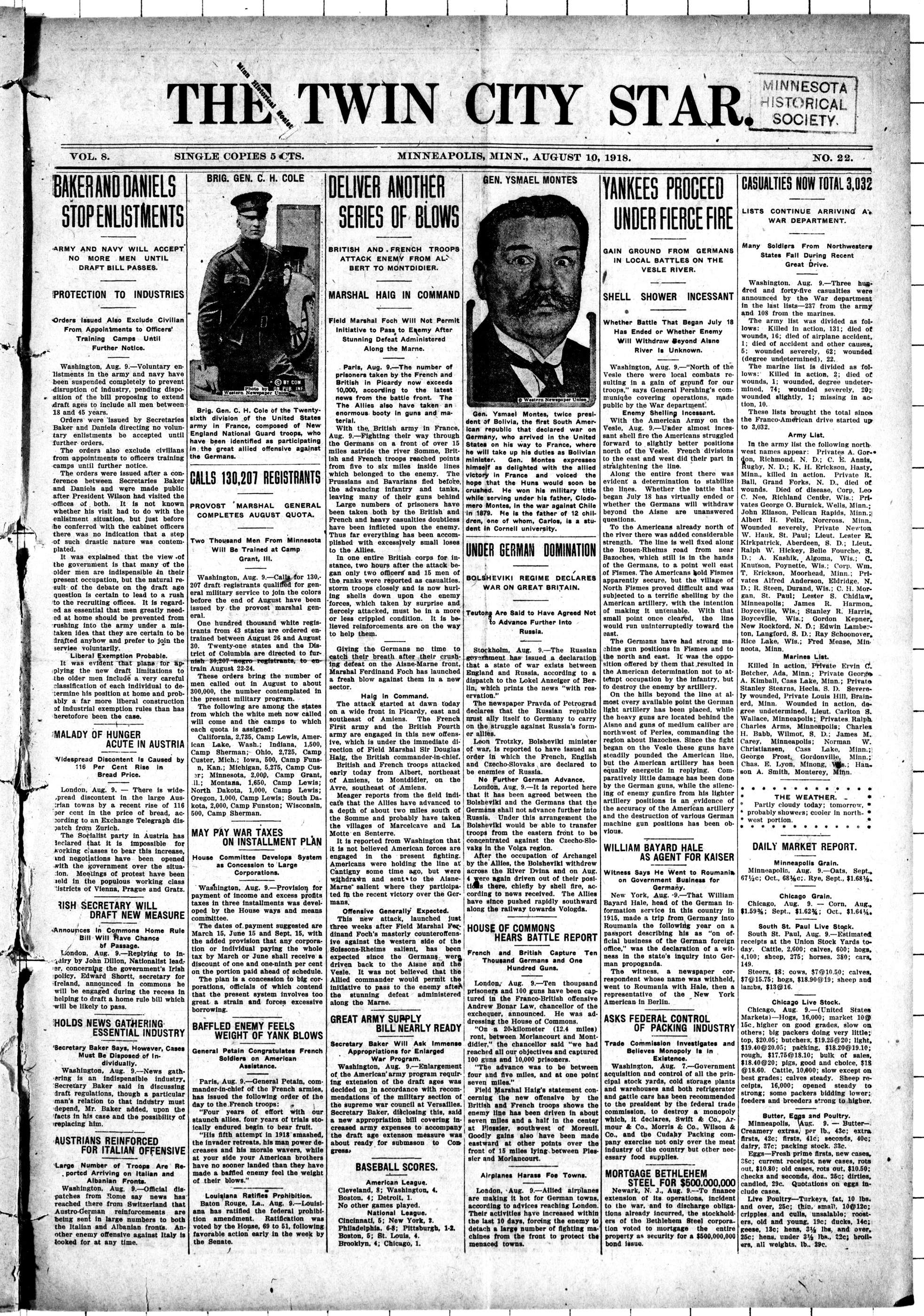
Brig. Gen. C. H. Cole of the Twenty-sixth division of the United States army in France, composed of New England National Guard troops, who have been identified as participating in the great allied offensive against the Germans.
CALLS 130,207 REGISTRANTS
PROVOST 'MARSHAL GENERAL
COMPLETES AUGUST QUOTA.
Two Thousand Men From Minnesota Will Be Trained at Camp
Washington, Aug. 9.—Calls for 130, 207 draft registrants qualified for general military service to join the colors before the end of August have been issued by the provost marshal general.
One hundred thousand white registrants from 43 states are ordered entrained between August 26 and August 30. Twenty-one states and the District of Columbia are directed to furnish 30,267 negro registrants, to entrain August 22-24.
These orders bring the number of men called out in August to about 300,000, the number contemplated in the present military program.
The following are among the states from which the white meh now called will come and the camps to which each quota is assigned:
California, 2,735, Camp Lewis, American Lake, Wash.; Indiana, 1,500, Camp Sherman; Ohio, 2,725, Camp Custer, Mich.; Iowa, 500, Camp Funser, Kan.; Michigan, 5,275, Camp Cusser; Minnesota, 2,000, Camp Grant, ll.; Montana, 1,650, Camp Lewis; North Dakota, 1,000, Camp Lewis; Oregon, 1,000, Camp Lewis; South Dakota, 2,000, Camp Funster; Wisconsin, 500, Camp Sherman.
MAY PAY WAR TAXES
ON INSTALLMENT PLAN
House Committee Develops System as Concession to Large Corporations.
Washington, Aug. 9.—Provision for payment of income and excess profits taxes in three installments was developed by the House ways and means committee.
The dates of payment suggested are March 15, June 15 and Sept. 15, with the added provision that any corporation or individual paying the whole tax by March or June shall receive a discount of one and one-ninth per cent on the portion paid ahead of schedule.
The plan is a concession to big corporations, officials of which contend that the present system involves too great a strain and forces excessive borrowing.
BAFFLED ENEMY FEELS WEIGHT OF YANK BLOWS
General Petain Congratulates French Soldiers on American Assistance.
Paris, Aug. 9.—General Petain, commander-in-chief of the French armies, has issued the following order of the day to the French troops:
"Four years of effort with our staunch allies, four years of trials stocally endured begin to bear fruit.
"His fifth attempt in 1918 smashed, the invader retreats, his man power decreases and his morale wavers, while at your side your American brothers have no sooner landed than they have made a baffled enemy feel the weight of their blows."
Louisiana Ratifies Prohibition.
Baton Rouge, La., Aug. 9.—Louisiana has ratified the federal prohibition amendment. Ratification was voted by the House, 69 to 51, following favorable action early in the week by the Senate.
MINNEAPOLIS, MINN., AUGUST 10, 1918.
DELIVER ANOTHER SERIES OF BLOWS
DELIVER ANOTHER SERIES OF BLOWS
BRITISH AND FRENCH TROOPS
ATTACK ENEMY FROM AL-
BERT TO MONTDIDIER.
Field Marshal Foch Will Not Permit Initiative to Pass to Enemy After Stunning Defeat Administered Along the Marne.
Paris, Aug. 9.—The number of prisoners taken by the French and British in Picardy now exceeds 10,000, according to the latest news from the battle front. The Allies also have taken an enormous booty in guns and material.
With the British army in France, Aug. 9.—Fighting their way through the Germans on a front of over 15 miles astride the river Somme, British and French troops reached points from five to six miles inside lines which belonged to the enemy. The Prussians and Bavarians fled before the advancing infantry and tanks, leaving many of their guns behind. Large numbers of prisoners have been taken both by the British and French and heavy casualties doubtless have been inflicted upon the enemy. Thus far everything has been accomplished with excessively small loses to the Allies.
In one entire British corps for instance, two hours after the attack began only two officers and 15 men of the ranks were reported as casualties. storm troops closely and is now hurling shells down upon the enemy forces, which taken by surprise and fiercely attacked, must be in a more or less crippled condition. It is believed reinforcements are on the way to help them.
Giving the Germans no time to catch their breath after their crushing defeat on the Alsne-Marne front, Marshal Ferdinand Foch has launched a fresh blow against them in a new sector.
Haig in Command.
The attack started at dawn today on a wide front in Picardy, east and southeast of Amiens. The French First army and the British Fourth army are engaged in this new offensive, which is under the immediate direction of Field Marshal Sir Douglas Halg, the British commander-in-chief. British and French troops attacked early today from Albert, northeast of Amiens, to Montdidier, on the Avre, southeast of Amiens.
Meager reports from the field indicate that the Allies have advanced to a depth of about two miles south of the Somme and probably have taken the villages of Marcelcave and La Motte en Senterre.
It is reported from Washington that it is not believed American forces are engaged in the present fighting. Americans were holding the line at Cantigny some time ago, but were withdrawn and sent to the Aisne-Marne salient where they participated in the recent victory over the Germans.
Officine d'athénite expédite
This new attack, launched just
three weeks after Field Marshal Ferdinand Foch's masterly counteroffensive against the western side of the Soloslams-Rheims salient, has been expected since the Germans were driven back to the Aisne and the Vesle. It was not believed that the Allied commander would permit the initiative to pass to the enemy after the stunning defeat administered along the Marne.
GREAT ARMY SUPPLY
BILL NEARLY READY
Secretary Baker Will Ask Immense Appropriations for Enlarged War Program. Washington, Aug. 9.—Enlargement of the American army program requiring extension of the draft ages was decided on in accordance with recommendations of the military section of the supreme war council at Versailles. Secretary Baker, disclosing this, said a new appropriation bill covering increased army expenses to accompany the draft age extension measure was about ready for submsson to Congress.
BASEBALL SCORES.
American League.
Cleveland, 8; Washington, 4.
Boston, 4; Detroit, 1.
No other games played.
National League.
Cincinnati, 5; New York, 2.
Philadelphia, 6-8; Pittsburgh, 1-2.
Boston, 5; St. Louis, 4.
Brooklyn, 4; Chicago, 1.
GEN. TOMALE MONTES
© Western Newspaper Union
Gen. Ysmael Montes, twice president of Bolivia, the first South American republic that declared war on Germany, who arrived in the United States on his way to France, where he will take up his duties as Bolivian minister. Gen. Montes expresses himself as delighted with the allied victory in France and voiced the hope that the Huns would soon be crushed. He won his military title while serving under his father, Clodomero Montes, in the war against Chile in 1879. He is the father of 12 children, one of whom, Carlos, is a student in Cornell university.
UNDER GERMAN DOMINATION
BOLSHEVIKI REGIME DECLARES
WAR ON GREAT BRITAIN.
Teutonia Are Said to Have Agreed Not to Advance Further Into Russia.
Stockholm, Aug. 9.—The Russian government has issued a declaration that a state of war exists between England and Russia, according to a dispatch to the Lokel Anzeiger of Berlin, which prints the news "with reservation."
The newspaper Pravda of Petrograd declares that the Russian republic must ally itself to Germany to carry on the struggle against Russia's former allies.
Leon Trotzky, Bolshevik minister of war, is reported to have issued an order in which the French, English and Czecho-Slovaks, are declared to be enemies of Russia.
No Further German Advance.
London, Aug. 9.—It is reported here that it has been agreed between the Bolshevik and the Germans that the Germans shall not advance further into Russia. Under this arrangement the Bolshevik would be able to transfer troops from the eastern front to be concentrated against the Czecho-Slovaks in the Volga region.
After the occupation of Archangel by the Allies, the Bolshevik withdrew across the River Dvina and on Aug. 4 were again driven out of their positions there, chiefly by shell fire, according to news received. The Allies have since pushed rapidly southward along the railway towards Vologda.
HOUSE OF COMMONS
HEARS BATTLE REPORT
French and British Capture Ten Thousand Germans and One Hundred Guns.
London, Aug. 9.—Ten thousands prisoners and 100 guns have been captured in the Franco-British offensive Andrew Bonar Law, chancellor of the exchequer, announced. He was addressing the House of Commons.
"On a 20-kilometer (12.4 miles) ront, between Morlancourt and Montdidier," the chancellor said "we had reached all our objectives and captured 100 guns and 10,000 prisoners.
"The advance was to be between four and five miles, and at one point seven miles."
Field Marshal Haig's statement concerning the new offensive by the British and French troops shows the enemy line has been driven in about seven miles and a half in the center at Plessier, southwest of Moreuil. Goodly gains also have been made eastward at other points over the front of 15 miles lying between Plessier and Morlancourt.
Airplanes Harass Foe Towns.
London, Aug. 9.—Allied airplanes are making it hot for German towns, according to advices reaching London. Their activities have increased within the last 10 days, forcing the enemy to detach a large number of fighting machines from the front to protect the menaced towns.
YANKEES PROGEED UNDER FIERGE FIRE
YANKEES PROGEED UNDER FIERGE FIRE
GAIN GROUND FROM GERMANS IN LOCAL BATTLES ON THE VESLE RIVER.
Whether Battle That Began July 18 Has Ended or Whether Enemy Will Withdraw Beyond Aisne River Is Unknown.
Washington, Aug. 9.—"North of the Vesle there were local combats resulting in a gain of ground for our troops," says General Pershing's communique covering operations, made public by the War department.
Enemy Shelling Incessant.
With the American Army on the Vesle, Aug. 9.—"Under almost incessant shell fire the Americans struggled forward to slightly better positions north of the Vesle. French divisions to the east and west did their part in straightening the line.
Along the entire front there was evident a determination to stabilize the lines. Whether the battle that began July 18 has virtually ended or whether the Germans will withdraw beyond the Aisne are unanswered questions.
To the Americans already north of the river there was added considerable strength. The line is well fixed along the Rouen-Rheulais road from near Bazoches, which still is in the hands of the Germans, to a point west east of Fismes. The Americans hold Fismes apparently secure, but the village of North Fismes proved difficult and was subjected to a terrific shelling by the American artillery, with the intention of making it untenable. With that small point once cleared, the line would run uninterruptedly toward the east. The Germans have had strong machine gun positions in Fismes and to the north and east. It was the opposition offered by them that resulted in the American determination not to attempt occupation by the infantry, but to destroy the enemy by artillery.
On the hills beyond the line at almost every available point the German light artillery has been placed, while the heavy guns are located behind the Alsne and guns of medium caliber are northwest of Perles, commanding the region about Bazoches. Since the fight began on the Vesle these guns have steadily pounded the American line, but the American artillery has been equally energetic in replying. Comparatively little damage has been done by the German guns, while the silencing of enemy gunfire from his lighter artillery positions is an evidence of the accuracy of the American artillery and the destruction of various German machine gun positions has been obvious.
WILLIAM BAYARD HALE
AS AGENT FOR KAISER
Witness Says He Went to Roumania on Government Business for Germany.
New York, Aug. 9.—That William Bayard Hale, head of the German information service in this country in 1915, made a trip from Germany into Roumania the following year on a passport describing his as "on official business of the German foreign office," was the declaration of a witness in the state's inquiry into German propaganda.
The witness, a newspaper correspondent whose name was withheld, went to Roumania with Hale, then a representative of the New York American in Berlin.
ASKS FEDERAL CONTROL
OF PACKING INDUSTRY
Trade Commission Investigates and Believes Monopoly Is in Existence.
Washington, Aug. 7.—Government acquisition and control of all the principal stock yards, cold storage plants and warehouses and both refrigerator and gattle cars has been recommended to the president by the federal trade commission, to destroy a monopoly which, it declares, Swift & Co., Armour & Co., Morris & Co., Wilson & Co., and the Cudahy Packing company exercise not only over the meat industry of the country but other necessary food supplies.
MORTGAGE BETHLEHEM
STEEL FOR $500,000,000
Newark, N. J., Aug. 9--To finance
extension of its operations, incident
to the war, and to discharge obliga-
tions already incurred, the stockholders
of the Bethlehem Steel corporation
voted to mortgage the entire
property as security for a $500,000,000
bond issue.
CASUALTIES NOW TOTAL 3,032
LISTS CONTINUE ARRIVING A
WAR DEPARTMENT.
Many Soldiers From Northwestern States Fall During Recent Great Drive.
Washington. Aug. 9.—Three hundred and forty-five casualties were announced by the War department in the last lists—237 from the army and 108 from the marines.
The army list was divided as follows: Killed in action, 131; died of wounds, 16; died of airplane accident, 1; died of accident and other causes, 5; wounded severely, 62; wounded (degree undetermined), 22.
The marine list is divided as follows: Killed in action, 2; died of wounds, 1; wounded, degree undetermined, 74; wounded severely, 20; wounded slightly, 1; missing in action, 10.
These lists brought the total since the Franco-American drive started up to 3,032.
Army List.
In the army list the following northwest names appear: Privates A. Gordon, Richmond, N. D.; C. E. Annis, Rugby, N. D.; K. H. Erickson, Hasty, Minn., killed in action. Private R. Ball, Grand Forks, N. D., died of wounds. Died of disease, Corp. Leo C. Nee, Richland Center, Wis.; Privates George O. Burnick, Wells, Minn.; John Ellison, Pelican Rapids, Minn.; Albert H. Felx, Norcross, Minn. Wounded severely, Private Newton W. Hauk, St. Paul; Lieut. Lester E. Kirkpatrick, Aberdeen, S. D.; Lieut. Ralph W. Hickey, Belle Fourche, S. D.; A. Kashik, Algoma, Wis.; C. Knutson, Poynette, Wis.; Corp. Wm. T. Erickson, Moorhead, Minn.; Privates Alfred Anderson, Eldridge, N. D.; R. Steen, Durand, S.; C. H. Morgan, St. Paul; Lester S. Chidlaw, Minneapolis; James R. Harmon, Boyceville, Wis.; Stanley R. Harris, Boyceville, Wis.; Gordon Kepner, New Rockford, N. D.; Edwin Lambert, Langford, S. D.; Ray Schoonover, Rice Lake, Wis.; Fred Mense, Minnesota, Minn.
Marines List.
Killed in action, Private Ervin C. Betcher, Ada, Minn.; Private George A. Klimball, Cass Lake, Minn.; Private Stanley Stearns, Hecla, S. D. Severely wounded, Private Louis Hill, Brainerd, Minn. Wounded in action, degree undetermined, Lieut. Carlton S. Wallace, Minneapolis; Privates Ralph Charles Arms, Minneapolis; Charles H. Babb, Wilmot, S. D.; James M. Carey, Minneapolis; Norman W. Christiansen, Cass Lake, Minn.; George Frost, Gordonville, Minn.; Chas. E. Lyon, Minong, Ws.; Hanson A. Smith, Monterey, Minn.
THE WEATHER.
Partly cloudy today; tomorrow,
probably showers; cooler in north-
west portion.
DAILY MARKET REPORT.
Minneapolis. Aug. 9.—Oats, Sept.
67½%; Oct. 68½%; Rye, Sept. $1.63½%.
Chicago Grain.
Chicago, Aug. 9. — Corn, Aug.
$1.59% ; Sept. , $1.62% ; Oct. , $1.64%
South St. Paul Live Stock.
South St. Paul, Aug. 9.—Estimated receipts at the Union Stock Yards today. Cattle, 2,600; calves, 600; hogs, 4,100; sheep, 275; horses, 380; cars, 149.
Steers, $8; cows, $7@10.50; calves, $7@15.75; hogs, $18.90@19; sheep and lambs, $13@16.
Chicago Live Stock.
Chicago, Aug. 9. —(United States Markets)—Hogs, 16,000; market 10@15c, higher on good grades, slow on others; big packers doing very little; top, $20.05; butchers, $19.25@20; light, $19.40@20.05; packing, $18.20@19.10; top, $20.55; butchers, $19.25@20; light, $19.40@20.05; packing, $18.20@19.10; rough, $17.75@18.10; bulk of sales, $18.40@20; pigs, good and choice, $18@18.00; Cattle, 10,000; slow except on best grades; calves steady. Sheep receipts, 16,000; opened steady to strong; some packers bidding lower; feeders and breeders strong to higher.
Butter, Eggs and Poultry.
Minneapolis, Aug. 9. —Butter—Creamery extras, per lb, 43c; extra firsts, 42c; firsts, 41c; seconds, 40c; dairy, 37c; packing stock, 33c.
Eggs—Fresh prime new, new cases, 38c; current receipts, new cases, rots out, $10.80; old cases, rots out, $10.50; checks and seconds, doz. 25c; dirties, candled, 29c. Quotations on eggs include cases.
Live Poultry—Turkeys, fat, 10 lbs, and over, 25c; thin, small, 10@12c; cripples and culls, unsalable; roosters, old and young, 19c; ducks, 14c; geese, 13c; hens, 3½ lbs, and over, 25c; hens, under 3½ lbs, 22c; broilers, all weights, lbs. 29c.
A Present for Stephen
By LOUISE OLIVER
(Copyright, 1918, by the McClure Newspaper Syndicate.)
The lieutenant picked up a thin tin pipe out of the basket and held it up with a smile.
"I haven't seen one since I was ten years old. It's a bean-shooter, isn't it?"
Jane laughed delightedly. "Yes, it is. Do you think a small boy would like it?"
"If he doesn't, he isn't human, I should say."
"There's only one trouble about that, though," went on Jane, more soberly. "I never thought until after I had bought it, that his mother is in very modest circumstances, and buying beans for a small boy to shoot into people's eyes might not happen to be a way she would choose to spend her money."
They were sitting on a fallen log in a maple grove beside the road. Overhead the birds were chirping and fluttering in ecstacy, for the day was one of nature's rarest, the kind she flings before the eyes of a winter-worn world to rekindle hope and faith in better things to come. It was early spring, but already there were signs that one young man's fancy had turned lightly to thoughts of—very great admiration at least for the girl beside him.
In front of them on the road stood a car, Jane's; that had stopped for repair. Just as it happened, the lieutenant had come along and offered to help mend the perforated tire.
Jane had accepted gratefully and now the car stood again ready for action, to use a military phrase.
There was really no reason why she shouldn't have gone ahead on her errand, but, when even the birds were fussily choosing their mates, and the long day was theirs, why shouldn't they rest a few minutes on the log and talk awhile?
"It's a birthday basket I'm taking to a little friend of my mother's," Jane explained, dumping the things out on the ground. "I wish you knew my mother," she went on. "If you did you would appreciate these things. The dear soul was born without any sense of humor at all, and dad and I nearly
A man and a woman sit on a rock, reading a newspaper. They are surrounded by trees and a tractor in the background.
"It's a Bean-Shooter."
have fits about her. Every May she's been sending some poor little fellow out this road a birthday present, and she always chooses the awful things for him. One year it was ear muffs and mittens she'd got at a sale. She said his mother could keep them in moth balls till the next winter. And once she sent six bottles of sarsaparilla, for she said all children needed a blood purifier in the spring and no doubt his mother was too poor to buy him any. She's sent everything from the 'Life of Shakespeare' to Gibbon's 'Rome' in the reading line, and once when she couldn't think of anything useful for him she sent a bolt of sheeting for his mother."
"Evidently she has a sense of values." laughed the lieutenant.
"You're right there," nodded Jane. "Well, anyway, she was too busy to attend to it this year with all her war work, and had a notion to let it go, but I thought it was a good chance to make up to the little fellow for all his years of disappointment, so I offered to take the burden of shopping and delivery off her shoulders. And here I am!
"Blessed person! And how old is your little boy?
"Bless your heart, I don't know," sald Jane. "And I doubt if mother does, either. The little fellow was a protege of Aunt Mary, who died. And all we know is that mother was to send a birthday present to Stephen Hampton every year on the tenth of May."
"But perhaps—" the lieutenant stopped. "You're right. There isn't a doubt in the world that your visitation will make up for all his former troubles."
"Well, there's the bean-shooter, and here's a bag of marbles—nearly all glassies, too—and a top, and a mouthorgan, a baseball and some peanuts and bananas." "Bully for you! He's a funny boy if
he can't have a perpetual birthday all summer."
Jane put her treasures back into the basket. "I must be going," she said, rising quickly. "It is getting very late. My boy won't have any birthday present at all if I stay here any longer."
"That's so!" he agreed reluctantly. "But won't you let me go with you?"
Jane considered a moment, then looked up into his steady gray eyes. "Mother's very touch about my talking to strangers, and the sky's been our only introduction—that and the car. But she's dotty on uniforms—a soldier to her is a combination of martyr and saint—so I guess you may come and see Stephen get his presents. Do you happen to know where the Hamptons live?"
"Yes, I'll take you there if you really don't mind my going."
Before long they turned into the driveway of a very pretentious country house. Jane was startled.
"Where are we going?"
"To the Hamptons."
"Why—I don't understand. Surely they can't live here. I thought they were poor."
"They used to be, but somebody left them some money. But surely that doesn't make any difference, does it? They're the same people, not changed a bit, and boys are the same the world over."
"That's true," answered Jane, a bit dubiously.
"And I do think you'll miss something if you don't know Mrs. Hampton. She's the finest woman I know."
They had come to the door now.
"All right," said Jane, stepping out of the car.
"But I was thinking of the sarsaparilla."
In the big sunny living room Jane was to discover something. The photograph in a silver frame on the reading table and that of a little boy on the wall were evidently the same person, and encountering the eyes of the officer, she realized that he was the original of both.
As this information conveyed itself to her brain, and the consciousness of a fearful blunder was sending the very blood to her cheeks, Mrs. Hampton came in. Jane waited for no introduction. "I've made a terrible mistake," she cried, pointing to the basket. "I've come to give your little boy his birthday present, and even ear muffs and sarsaparilla would be better than the stuff I have brought."
Then suddenly she laughed uncontrollably. "Oh, wait till I tell dad. You won't be jiggle die, though! Beanshooters, marbles, peanuts! Oh, my! For an army officer, too!"
"Dearle," said Mrs. Hampton, "don't feel distressed about it. Your mother has always kindly remembered Steve, but she never came out to see us, and I think she lost track of time. We always made good use of the things she sent, and saw that some one got them, but we never liked to hurt her by explaining."
"Feel distressed! Oh, goodness! I don't feel distressed! I think it's a splendid joke."
Mother and son nodded at each other and smiled. If there was anything in the world they admired, it was a sense of humor.
"Besides," said Stephen, "it's the best birthday I've ever had. I'm going to give your mother a special note of thanks for sending me the nicest present in the world."
And the gray eyes were too full of meaning for Jane to question what he meant.
"That's true, dear," said Mrs. Hampton, smiling. "He's carried your picture since you were a little girl with curls. He said you looked so jolly." Jane smiled gratefully and held out her hand.
"That's splendid of you. Suppose you go back home with me and show mother how little Stephen has grown up," she said.
"I'd love to," he answered, "and incidentally I'll mention to her a real birthday present I want sometime."
But Jane, flushing, had nothing to answer to this.
Disgusted Motorman.
A young woman accompanied by a little boy, signaled a State street car at Schiller street. The conductor gave the customary two rings and the car started. At the same moment a man rushed from the sidewalk, waving his arms frantically at the motorman and pointing to something under the rear wheels of the car.
The motorman turned pale as he clamped down the emergency brake and brought the car to such a sudden stop that it knocked the heads of passengers together.
He waited breathless as the man dived under the truck and brought forth frumphantly—not the crushed form of a little child, but the young woman's hat.
"Humph!" said the motorman disgusted; "to stop a car just for a hat!"—Chicago American.
Success Is a Habit.
E. W. Howe, the Kansas writer and philosopher, says that "success is easier than failure." He is right. For constructive forces always work smoother than destructive forces. Success is a habit. It's doing the simple, everyday, useful tasks that look very important, and doing them exceedingly well. Nearly always the successful man is the unnoticed man, the man who began years before to do the simple things in the best way he knew how—and kept it up. The man who did the right thing—over and over again. The small and unimportant today—made into a habit—is sure to be the great and essential tomorrow when dire need, and maybe stress shall call out every reserve and demand every ounce of all that you are.
Resources of the Jordan Valley
THE VILLAGE OF MALTA
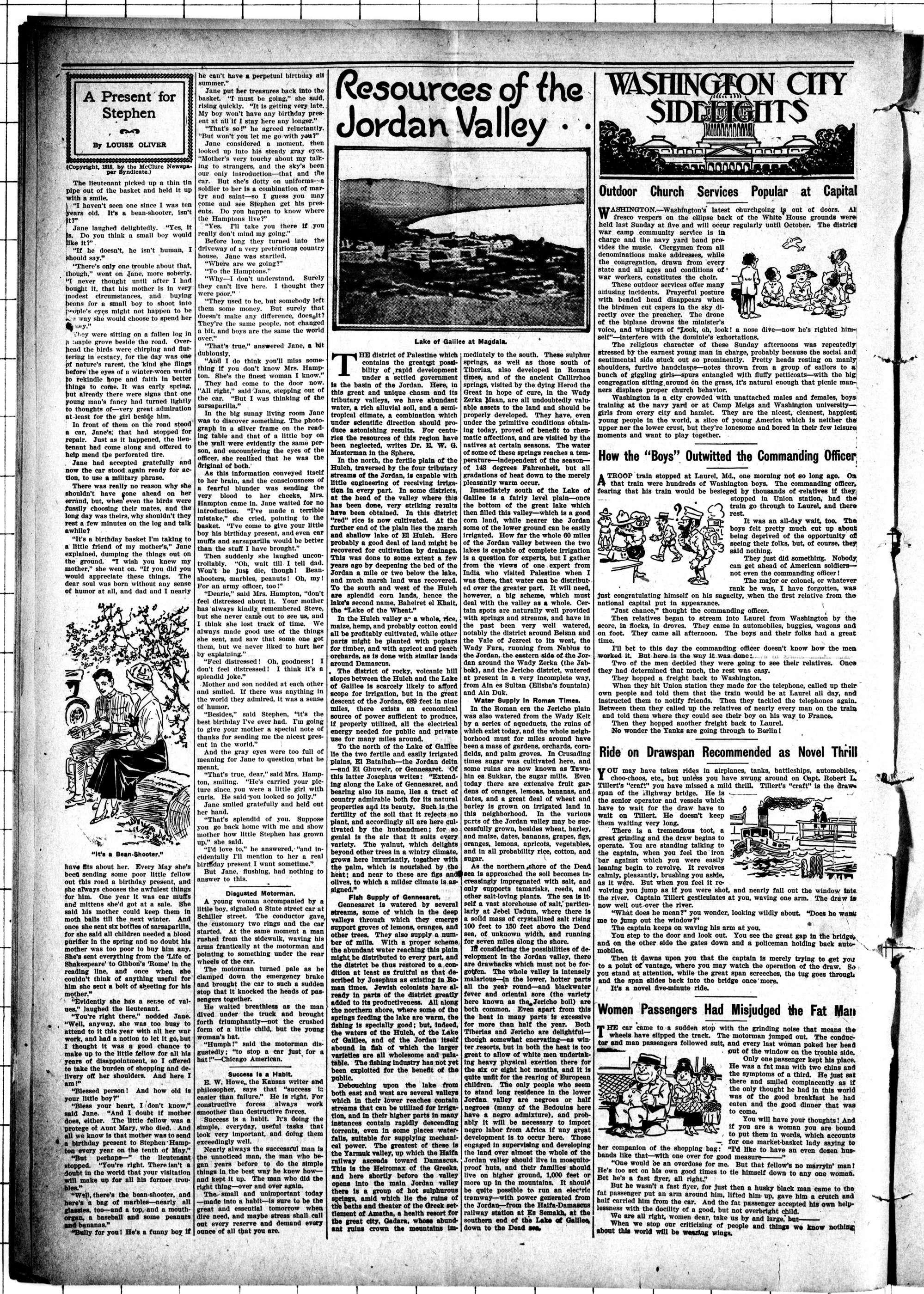
Lake of Galilee at Magdala.
THE district of Palestine which contains the greatest possibility of rapid development
under a settled government is the basin of the Jordan. Here, in this great and unique chasm and its tributary valleys, we have abundant water, a rich alluvial soil, and a semi-tropical climate, a combination which under scientific direction should produce astonishing results. For centuries the resources of this region have been neglected, writes Dr. E. W. G. Masterman in the Sphere.
In the north, the fertile plain of the Huleh, traversed by the four tributary streams of the Jordan, is capable with little engineering of receiving irrigation in every part. In some districts, at the head of the valley where this has been done, very striking results have been obtained. In this district "red" rice is now cultivated. At the further end of the plain lies the marsh and shallow lake of El Huleh. Here probably a good deal of land might be recovered for cultivation by drainage. This was done to some extent a few years ago by deepening the bed of the Jordan a mile or two below the lake, and much marsh land was recovered. To the south and west of the Huleh are splendid corn lands, hence the lake's second name, Bahelreel el Khaft, the "Lake of the Wheat."
In the Huleh valley a whole, rice, maize, hemp, and probably cotton could all be profitably cultivated, while other parts might be planted with poplars for timber, and with apricot and peach orchards, as is done with similar lands around Damascus. The district of rocky, volcanic hill slopes between the Huleh and the Lake of Galllee is scarcely likely to afford scope for irrigation, but in the great descent of the Jordan, 689 feet in nine miles, there exists an economical source of power sufficient to produce, if properly utilized, all the electrical energy needed for public and private use for many miles around.
To the north of the Lake of Galilee lie the two fertile and easily irrigated plains, El Batalah—the Jordan delta—and El Ghuwel, or Gennesaret. Of this latter Josephus writes: "Extending along the Lake of Gennesaret, and bearing also its name, lies a tract of country admirable both for its natural properties and its beauty. Such is the fertility of the soil that it rejects no plant, and accordingly all are here cultivated by the husbandmen; for so genial is the air that it suits every variety. The walnut, which delights beyond other trees in a wintry climate, grows here luxuriously, together with the palm, which is nourished by the heat; and near to these are figs and olives, to which a milder climate is assigned."
Fish Supply of Gennesaret. Gennesaret is watered by several streams, some of which in the deep valleys through which they emerge support groves of lemons, oranges, and other trees. They also supply a number of mills. With a proper scheme the abundant water reaching this plain might be distributed to every part, and the district be thus restored to a condition at least as fruitful as that described by Josephus as existing in Roman times. Jewish colonists have already in parts of the district greatly added to its productiveness. All along the northern shore, where some of the springs feeding the lake are warm, the fishing is specially good; but, indeed, the waters of the Huleh, of the Lake of Galilee, and of the Jordan itself abound in fish of which the larger varieties are all wholesome and palatable. The fishing industry has not yet been exploited for the benefit of the public.
Debouching upon the lake from both east and west are several valleys which in their lower reaches contain streams that can be utilized for irrigation, and in their higher parts in many instances contain rapidly descending torrents, even in some places waterfalls, suitable for supplying mechanical power. The greatest of these is the Yarmuk valley, up which the Haifa railway ascends toward Damascus. This is the Helromax of the Greeks, and here shortly before the valley opens into the main Jordan valley there is a group of hot sulphurous springs, amid which lie the ruins of the baths and theater of the Greek settlement of Amathea, a health resort for the great city, Gadara, whose abundant ruins crown the mountains im-
mediately to the south. These sulphur springs, as well as those south of Tiberias, also developed in Roman times, and of the ancient Callirrhoe springs, visited by the dying Herod the Great in hope of cure, in the Wady Zerka Maan, are all undoubtedly valuable assets to the land and should be properly developed. They have, even under the primitive conditions obtaining today, proved of benefit to rheumatic affections, and are visited to the natives at certain seasons. The water of some of these springs reaches a temperature—independent of the season—of 143 degrees Fahrenheit, but all gradations of heat down to the merely pleasantly warm occur.
Immediately south of the Lake of Galllee is a fairly level plain—once the bottom of the great lake which then filled this valley—which is a good corn land, while nearer the Jordan some of the lower ground can be easily irrigated. How far the whole 60 miles of the Jordan valley between the two lakes is capable of complete irrigation is a question for experts, but I gather from the views of one expert from India who visited Palestine when I was there, that water can be distributed over the greater part. It will need, however, a big scheme, which must deal with the valley as a whole. Certain spots are naturally well provided with springs and streams, and have in the past been very well watered, notably the district around Belsan and the Vale of Jezreel to its west, the Wady Fara, running from Nablus to the Jordan, the eastern side of the Jordan around the Wady Zerka (the Jabbok), and the Jericho district, watered at present in a very incomplete way, from Aln es Sultan (Elisha's fountain) and Ain Duk.
Water Supply In Roman Times.
Water Supply in Roman Thurs.
In the Roman era the Jericho plain was also watered from the Wady Kelt by a series of aqueducts, the ruins of which exist today, and the whole neighborhood must for miles around have been a mass of gardens, orchards, cornfields, and palm groves. In Crusading times sugar was cultivated here, and some ruins are now known as Tawahin es Sukkar, the sugar mills. Even today there are extensive fruit gardens of oranges, lemons, bananas, and dates, and a great deal of wheat and barley is grown on irrigated land in this neighborhood. In the various parts of the Jordan valley may be successfully grown, besides wheat, barley, and maize, dates, bananas, grapes, figs, oranges, lemons, apricots, vegetables, and in all probability rice, cotton, and sugar.
As the northern shore of the Dead sea is approached the soil becomes increasingly impregnated with salt, and only supports tamarisks, reeds, and other salt-loving plants. The sea is itself a vast storehouse of salt, particularly at Jebel Udum, where there is a solid mass of crystallized salt rising 100 feet to 150 feet above the Dead sea, of unknown width, and running for seven miles along the shore.
If considering the possibilities of development in the Jordan valley, there are drawbacks which must not be forgotten. The whole valley is intensely malarious—in the lower, hotter parts all the year round—and blackwater fever and oriental sore (the variety here known as the Jericho boll) are both common. Even apart from this the heat in many parts is excessive for more than half the year. Both Tiberias and Jericho are delightful—though somewhat enervating—as winter resorts, but in both the heat is too great to allow of white men undertaking heavy physical exertion there for the six or eight hot months, and it is quite unfit for the rearing of European children. The only people who seem to stand long residence in the lower Jordan valley are negroes or half negroes (many of the Bedouins here have a negro admixture), and probably it will be necessary to import negro labor from Africa if any great development is to occur here. Those engaged in supervising and developing the land over almost the whole of the Jordan valley should live in mosquito-proof huts, and their families should live on higher ground, 1,000 feet or more up in the mountains. It should be quite possible to run an electric tramway—with power generated from the Jordan—from the Haifa-Damascus railway station at Es Semakh, at the southern end of the Lake of Galllee, down to the Dead sea.
WASHINGTON CITY
SIDELIGHTS
WASHINGTON.—Washington's latest churchgoing is out of doors. All fresco vespers on the ellipse back of the White House grounds were held last Sunday at five and will occur regularly until October. The district war camp community service is in charge and the navy yard band provides the music. Clergymn from all denominations make addresses, while the congregation, drawn from every state and all ages and conditions of war workers, constitutes the choir. These outdoor services offer many antusing incidents. Prayerful posture with bended head disappears when the birdmen cut capers in the sky directly over the preacher. The drone
k! a nose dive—now he's righted him-ortations.
see Sunday afternoons was repeatedly charge, probably because the social and evidently. Pretty heads resting on manly thrown from a group of sailors to aided with fluffy petticoats—with the big ass, it's natural enough that picnic man-
with unattached males and females, boys and Melgs and Washington university—They are the nicest, cleanest, happiest of young America which is neither the lonesome and in their few leisure
and the Commanding Officer
Md., one morning not so long ago. On shington boys. The commanding officer, aged by thousands of relatives if they,
voice, and whispers of "Look, oh, look! a nose dive—now he's righted himself"—interfere with the dominic's exhortations.
voice, and whispers of "Look, oh, look! a nose div self"—interfere with the dominie's exhortations.
The religious character of these Sunday af stressed by the earnest young man in charge, probal sentimental side stuck out so prominently. Pretty shoulders, furtive handclaps—notes thrown from bunch of giggling girls—spurs entangled with fluffy congregation sitting around on the grass, it's natura ners displace proper church behavior.
Washington is a city crowded with unattached training at the navy yard or at Camp Melgs and girls from every city and hamlet. They are the young people in the world, a slice of young Amer upper nor the lower crust, but they're lonesome and moments and want to play together.
How the "Boys" Outwitted the Con
A TROOP train stopped at Laurel, Md., one morn that train were hundreds of Washington boys. fearing that his train would be besieged by thou
The religious character of these Sunday afternoons was repeatedly stressed by the earnest young man in charge, probably because the social and sentimental side stuck out so prominently. Pretty heads resting on manly shoulders, furtive handclasps—notes thrown from a group of sailors to a bunch of giggling girls—spurs entangled with fluffy petticoats—with the big congregation sitting around on the grass, it's natural enough that picnic manners displace proper church behavior.
Washington is a city crowded with unattached males and females, boys training at the navy yard or at Camp Meigs and Washington university—girls from every city and hamlet. They are the nicest, cleanest, happiest young people in the world, a slice of young America which is neither the upper nor the lower crust, but they're lonesome and bored in their few leisure moments and want to play together.
How the "Boys" Outwitted the Commanding Officer
TROOP train stopped at Laurel, Md., one morning not so long ago. On that train were hundreds of Washington boys. The commanding officer, fearing that his train would be besieged by thousands of relatives if they, stopped in Union station, had the train go through to Laurel, and there rest.
It was an all-day wait, too. The boys felt pretty much cut up about being deprived of the opportunity of seeing their folks, but, of course, they said nothing.
They just did something. Nobody can get ahead of American soldiers—not even the commanding officer!
The major or colonel, or whatever rank he was. I have forgotten, was
just congratulating himself on his sagacity, when the first relative from the national capital put in appearance.
"Just chance," thought the commanding officer. Then relatives began to stream into Laurel from Washington by the score, in flocks, in droves. They came in automobiles, buggies, wagons and on foot. They came all afternoon. The boys and their folks had a great time.
Then relatives began to stream into Laurel i score, in flocks, in droves. They came in automobile on foot. They came all afternoon. The boys and time.
I'll bet to this day the commanding officer do worked it. But here is the way it was done:.... Two of the men decided they were going to s they had determined that much, the rest was easy.
into Laurel from Washington by the
ne in automobiles, buggies, wagons and
The boys and their folks had a great
ling officer doesn't know how the men
as done:
ere going to see their relatives. Once
est was easy.
I'll bet to this day the commanding officer doesn't know how the men worked it. But here is the way it was done:
Two of the men decided they were going to see their relatives. Once they had determined that much, the rest was easy.
They hopped a freight back to Washington. When they hit Union station they made for the telephone, called up their own people and told them that the train would be at Laurel all day, and instructed them to notify friends. Then they tackled the telephones again. Between them they called up the relatives of nearly every man on the train and told them where they could see their boy on his way to France.
When they hit Union station they made for the own people and told them that the train would be instructed them to notify friends. Then they tack Between them they called up the relatives of nearl and told them where they could see their boy on l Then they hopped another freight back to Lau No wonder the Yanks are going through to Bark
Ride on Drawspan Recommended
YOU may have taken rides in airplanes, tanks, choo-choos, etc., but unless you have swung an Tillert's "craft" you have missed a mild thrill. Till
made for the telephone, called up their train would be at Laurel all day, and then they tackled the telephones again.atives of nearly every man on the train their boy on his way to France. it back to Laurel. through to Berlin!
commended as Novel Thrill
planes, tanks, battleships, automobiles, have swung around on Capt. Robert L. old thrill. Tillert's "craft" is the draw-
Then they hopped another freight back to Laurel.
No wonder the Yanks are going through to Berlin!
Ride on Drawspan Recommended as Novel Thrill
YOU may have taken rides in airplanes, tanks, battleships, automobiles, choo-choos, etc., but unless you have swung around on Capt. Robert L. Tillert's "craft" you have missed a mild thrill. Tillert's "craft" is the draw span of the highway bridge. He is the senlor operator and vessels which have to wait for the draw have to wait on Tillert. He doesn't keep them waiting very long.
There is a tremendous toot, a great grinding and the draw begins to operate. You are standing talking to the captain, when you feel the iron bar against which you were easily leaning begin to revolve. It revolves calmly, pleasantly, brushing you aside,
ot, and nearly fall out the window into
ats you, waving one arm. The draw is
er, looking wildly about. "Does he want
arm at you.
t. You see the great gap in the bridge
n and a policeman holding back auto-
e captain is merely trying to get you
y watch the operation of the draw. So
t span screeches, the tug goes through
ridge once more.
Misjudged the Fat Man
with the grinding noise that means the
me motorman jumped out. The conduc-
and every last woman poked her head
out of the window on the trouble side
volving you jump as if you were shot, and nearly the river. Captain Tillert gesticulates at you, wavin now well out over the river.
"What does he mean?" you wonder, looking wild me to jump out the window?"
volving you jump as if you were shot, and nearly fall out the window into the river. Captain Tillert gesticulates at you, waving one arm. The draw is now well out-over the river.
"What does he mean?" you wonder, looking wildly about. "Does he want me to jump out the window?"
The captain keeps on waving his arm at you.
You step to the door and look out. You see the great gap in the bridge and on the other side the gates down and a policeman holding back automobiles.
You step to the door and look out. You see the and on the other side the gates down and a police mobiles.
Then it dawns upon you that the captain is to a point of vantage, where you may watch the op you stand at attention, while the great span screech and the span slides back into the bridge once more.
It's a novel five-minute ride.
Women Passengers Had Misjudge
THE car came to a sudden stop with the grindle wheels have slipped the track. The motorman jor and man passengers followed suit, and every las
Then it dawns upon you that the captain is merely trying to get you to a point of vantage, where you may watch the operation of the draw. So you stand at attention, while the great span screeches, the tug goes through and the span slides back into the bridge once more.
Women Passengers Had Misjudged the Fat Man
THE car came to a sudden stop with the grinding noise that means the wheels have slipped the track. The motorman jumped out. The conductor and man passengers followed suit, and every last woman poked her head out of the window on the trouble side.
Only one passenger kept his place. He was a fat man with two chins and the symptoms of a third. He just sat there and smiled complacently as if the only thought he had in this world was of the good breakfast he had eaten and the good dinner that was to come.
You will have your thoughts! And if you are a woman you are bound to put them in words, which accounts for one market-basket lady saving to
her companion of the shopping bag: "Td like to be bands like that—with one over for good measure—" "One would be an overdose for me. But that fad He's too set on his own good times to tie himself or Bet he's a fast flyer, all right."
But he wasn't a fast flyer, for just then a husky fat passenger put an arm around him, lifted him up half carried him from the car. And the fat passenger lessness with the docility of a good, but not overbright.
We are all right, women dear, take us by and let. When we stop our criticizing of people and to about this world will be wearing wings.
her companion of the shopping bag: "Td like to have an even dozen husbands like that—with one over for good measure——"
"Id like to have an even dozen hus-
good measure——"
e. But that fellow's no marryln' man!
o tie himself down to any one woman.
it then a husky black man came to the
lifted him up, gave him a crutch and
he fat passenger accepted his own help-
at not overbright child.
e us by and large, but——
e people and things we know nothing
ags.
"One would be an overdose for me. But that fellow's no marryin' man! He's too set on his own good times to tie himself down to any one woman. Bet he's a fast flyer, all right."
But he wasn't a fast flyer, for just then a husky black man came to the fat passenger put an arm around him, lifted him up, gave him a crutch and half carried him from the car. And the fat passenger accepted his own helplessness with the docility of a good, but not overbright child.
We are all right, women dear, take us by and large, but——
When we stop our criticizing of people and things we know nothing about this world will be wearing wings.
war camp community service is in charge and the navy yard band provides the music. Clergymm from all denominations make addresses, while the congregation, drawn from every state and all ages and conditions of war workers, constitutes the choir.
These outdoor services offer many amusing incidents. Prayerful posture with bended head disappears when the birdmen cut capers in the sky directly over the preacher. The drone of the biplane drowns the minister's
?
span of the highway bridge. He is the senior operator and vessels which have to wait for the draw have to wait on Tillert. He doesn't keep them waiting very long.
There is a tremendous toot, a great grinding and the draw begins to operate. You are standing talking to the captain, when you feel the 'iron bar against which you were easily leaning begin to revolve. It revolves calmly, pleasantly, brushing you aside, as it were. But when you feel it re-
A man and two women are sitting on a bench.
Peculiar Method of Snaring Migrating Pigeons
At Cava dei Tirreni the Birds Are Waylaid With Nets and Silings—Much Ingenuity Necessary to Secure Good "Bag."
It is not often that one comes across a little place that has an ingenious and exciting sport all its own. At Cava del Tirreni in Italy, nowever, there has for a thousand years, existed a peculiar form of pigeon catching. It was introduced in 892, says Mr. Herbert Vlivan in Italy at War and it has flourished ever since. At the beginning of every autumn great flocks of pigeons migrate from Siberia to Africa and pass over Cava and the Gulf of Salerno. They probably have other routes, but Cava is the only place where they are waylaid with nets and slings. The season is at its height from the 15th to 25th of October.
The pigeon catchers are mostly men of the lower middle class, who club together to form six societies, or "games." A game usually consists of three or four towers and a clearing where the nets are set up. One tower is probably a thousand yards from the net, and the nearest perhaps seventy yards, but the distances vary. The towers are tall and slim, windowless and weather-beaten. There are steps about halfway up the inside, and a rickety ladder leads to the parapet at the top. Each society has also a neat little clubhouse, usually near the chief tower.
In a merry mood the members take their places in the fresh morning air. Most of them are dressed in velveteen coats, top-boots and peaked caps. Two men ascend each tower and the rest are distributed among the nets. In each of the clearings stands a small house from the center of which rises a tall black mast. To that two huge nets are fastened, stretching right and left to clumps of trees and spreading out obliquely to the ground. Inside the house is a handle and a cogwheel for raising the weighted nets. The lookout place is a straw hut two or three miles away in the direction from which the pigeons are expected. When the watcher sights a flock of birds he gives a signal on his horn, which other watchers scattered about the woods take up.
The birds travel at a tremendous speed, always with a leader, and in flocks of from 30 to 100. Every one takes to cover, for the birds are easily frightened. The men on the towers are provided with long slings and whitewashed stones about the size of small hens' eggs. These they discharge with great force. The pigeons, it is said, mistake the stones for hawks and make frantic efforts to avoid them, so the silingers must fling the stones where they do not wish the birds to go; yet when they are flying high, a stone flung beneath them will bring them hurtling downward. Then, with loud cries, the watchers drive them toward the nets. The stone-slinging is the essence of the sport, and it requires strong muscles, a quick eye and a steady alm.
But the netting is also difficult. The man at the ropes is white and nervous; everything now depends upon him. If he releases the weight at the right moment, the net comes down instantly and the birds are bagged. A moment too soon, and they see the danger and avoid it; a moment too late and they pass in safety. It is a matter of an instant, and many more flocks escape than are taken.
The birds are gray and somewhat smaller than the domestic pigeon. They cannot be trained or tamed. The sport is far from being profitable, for even when they have good luck the pigeon catchers never take enough birds to pay for the elaborate preparation they have made. But the moment when the nets whirl down at Cava is a moment of rare excitement.
"War Time."
A novel memento of the great war is a clock, which is made from munitions—both enemy and allied—collected on the Somme battlefield by a soldier, who afterwards used them for this purpose. The body of the clock is a German shellcase, and German cartridges form the legs. Of the three cartridges on top of the timepiece, the two outside are German, and the one gracing the center French, while the two small ornaments between these are Belgian bullets. The side ornaments are made from Vercy-light cases, pierced to amit of a British cartridge projecting through the top. The pendulum consists of five French bullets, and the figures and hands are bent to shape from copper wire taken from German trenches.
To complete the whole, the clock movement inside is also of German make, and, after necessary repairs, is found to be entirely adequate.
Look to Africa for Food.
The world-wide shortage of food and the certainty that this shortage will continue in modified form for years to come has roused France to utilize more fully her great colonies just across the Mediterranean. Comprehensive plans are being formed—and started on the way to fulfillment—for refrigerating and packing plants in Algeria, so that the animals need not be shipped across the sea alive. These institutions, too, will give a much readier and steadier market than has been available hitherto, and that is probably all that is needd to quadruple the meat exports of North Africa.
GOES FAR BACK IN HISTORY
French City of Montdidier Was of Importance in First Millennium of the Christian Era.
The National Geographic society issues the following war geography bulletin on Montdidier, a few miles east of Amlens:
"This little town, whose history dates back to the first millennium of the Christian era, had a population of less than 5,000 at the beginning of the war, but it was rich in historic associations. It is said to have derived its name from the fact that Didler or Desiderius, the last of the Lombard kings, was imprisoned here in 774 by Charlemagne. It will be remembered that Charlemagne, having put aside his first wife, Desiderius' daughter, took up the quarrel of Pope Adrian I with the Lombard monarch, and after marching an army across the Alps, captured the erstwhile father-in-law's capital city, Ticinum, and took the vanquished ruler back to France, where he died in captivity.
"Montdidier is attractively situated on an eminence on the banks of the river Don. It is the capital of an arrondissement in the department of the Somme, and is 62 miles north of Paris by rail, and 23 miles southeast of Amlens. Its chief industries before the war were tanneries and the manufacture of zinc-white.
"When the tides of war finally recede it is probable that the three buildings in which the citizens of Montdidier took the greatest pride will be crumbling ruins. These are the church of St. Pierre, which was built before Columbus set sail on his voyage of discovery, and which contains a tomb and font of the eleventh century; the church of St. Sepulchre, a fifteenth century edifice, and the Palais de Justice, formerly the city castle. In the last named building visitors before the war were shown six unusually handsome Brussels tapestries of the seventeenth century. These were undoubtedly removed before the Germans entered the city.
"Montdidier's most famous son was Parmentier, the scientist, who gave impetus to the culture of the potato in France. A statue erected here commemorates his gift to the nation.
"For a number of years this little city was governed by its own lords, then passed under the dominion of the counts of Crepy and Valois. In the twelfth century it became a possession of the French crown and received a charter of liberties. In 1636 it offered a gallant and successful resistance to the Spanish invaders."
Avoid Grouch and Live Long.
Writing for the Minneapolis Journal, A. J. R. notes the demise of a Seattle citizen one hundred and three years old, and suggests that one of the reasons why he lived so long was that he never grouched at the breakfast table or elsewhere. Discussing this, A. J. R. writes "The enjoyment of breakfast and of the sunrise always comes so easily to me that I sometimes wall in charity for persons who, I have been led to believe, start the generous day wrong by raising hades at the breakfast table. I will freely wager 75 cents that the Seattle centenarian who lived to be one hundred and three never insurged at breakfast, never complained of the food, nor sneered at his wife's cooking."
The aged Seattleer ascribed his longevity to his own temper; he had not been angry since he was twenty, and had driven a yoke of oxen most of his life. * Also, loved everybody, and everybody loved him.
He Hadn't Realized
The custodian of an Indianapolls building recently hired a colored man, George, to work about the building. George had always worked as a "house man" and came well recommended. The first day of his employment, however, George was out for lunch the greater part of three hours.
The custodian was naturally annoyed. "Where in thunder have you been?" he inquired the minute he set eyes on the erring George. "Me? Why, Ise been home takin' a nap," George answered, in a surprised tone. "I always takes a nap in the middle of the day."
"Well, believe me," the custodian declared, "you don't do that any more. You're needed around here."
Was George aggrieved? Not a bit of it. A most appreciative grin spread over his face.
"Well, now," he said slowly, "you'll have to excuse me this time, boss. It's just that I didn't realize before how important I is around here."
Labor-Saving Harvester.
One thousand improved wheat-harvesting machines, known as combines, will be used in Washington state and other states of the Northwest this year, according to farm-help specialists of the United States department of agriculture, and will effect a great saving in labor. These machines, which cut the heads from wheat and thrasher the grain as they travel across the field, can be operated by two persons, and each machine will harvest from 350 to 400 acres of wheat during a season. They are marked labor savers over the old type combine, which required about 20 men.
No Chance for the Old Man.
It was the first time that Richard's father had seen "her" and they were talking things over.
"So my son has proposed to you," he said, "and you've accepted him? I think you might have seen me first."
She blushed sweetly as she replied: "I did, but I think I prefer Richard."
FRENCH HEAVY GUNS ADVANCE THROUGH MUD
FRENCH OFFICIAL PHOTO
Photo by Western Newspaper Union
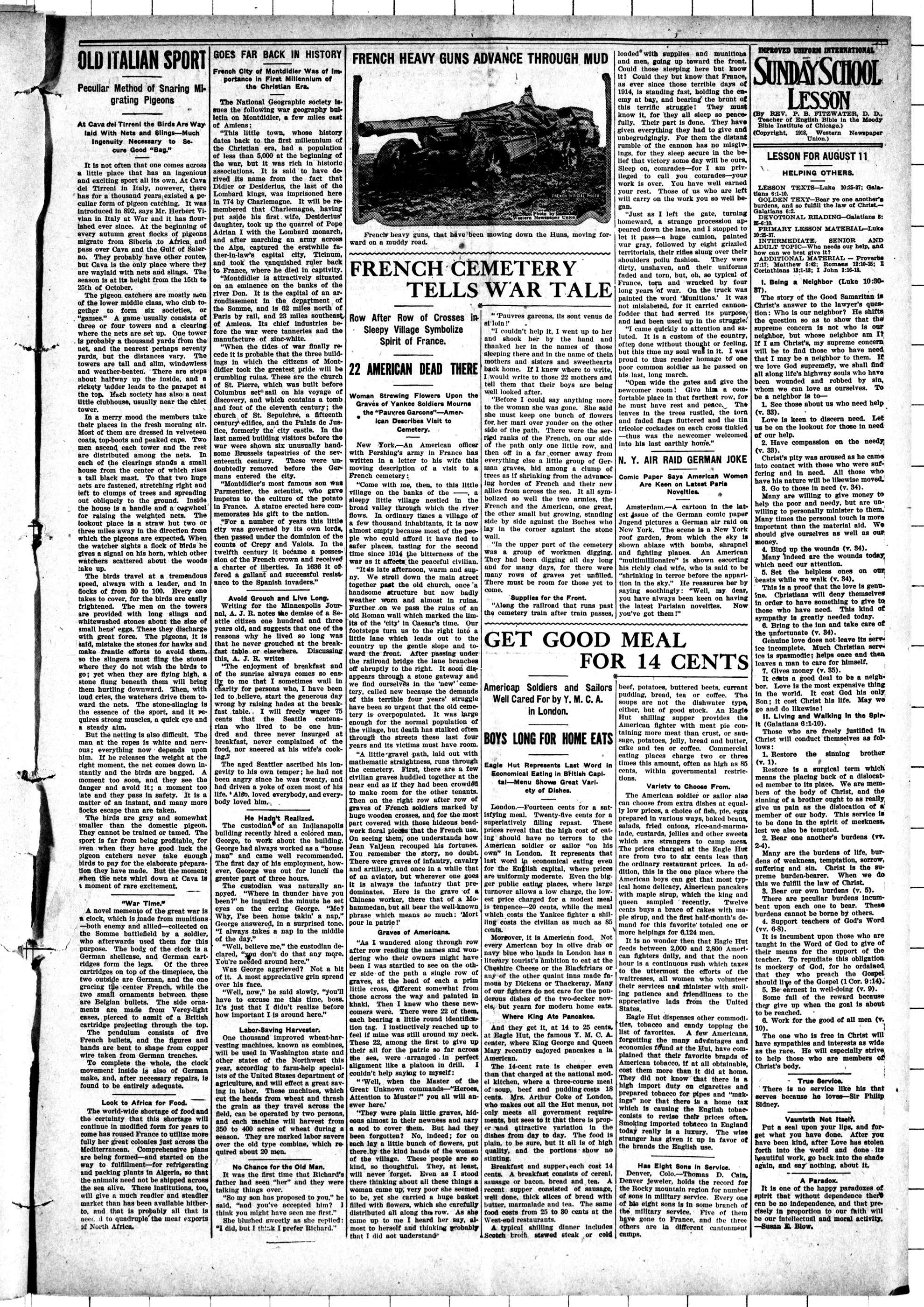
French heavy guns, that have been mowing down the Huns, moving forward on a muddy road.
French heavy guns, that have been mowing down the Huns, moving forward on a muddy road.
FRENCH CEMETERY TELLS WAR TALE
22 AMERICAN DEAD THERE
Woman Strewing Flowers Upon the Graves of Yankee Soldiers Mourns the "Pauvres Garcones"—Amer- jean Describes Visit to
New York.—An American officer with Pershing's army in France has written in a letter to his wife this moving description of a visit to a French cemetery;
"Come with me, then, to this little village on the banks of the ——, a sleepy little village nestled in the broad valley through which the river flows. In ordinary times a village of a few thousand inhabitants, it is now almost empty because most of the people who could afford it have fled to safer places, tasting for the second time since 1914 the bitterness of the war as it affects the peaceful civilian.
"It's late afternoon, warm and sunny. We stroll down the main street together past the old church, once a handsome structure but now badly weather worn and almost in ruins. Further on we pass the ruins of an old Roman wall which marked the limits of the 'city' in Caesar's time. Our footsteps turn us to the right into a little lane which leads out to the country up the gentle slope and toward the front. After passing under the railroad bridge the lane branches off abruptly to the right. It soon disappears through a stone gateway and we find ourselves in the 'new' cemetery, called new because the demands of this terrible four years' struggle have been so urgent that the old cemetery is overpopulated. It was large enough for the normal population of the village, but death has stalked often through the streets these last four years and its victims must have room.
"A little gravel path, laid out with mathematic straightness, runs through the cemetery. First, there are a few civilian graves huddled together at the near end as if they had been crowded to make room for the other tenants. Then on the right row after row of graves of French soldiers marked by huge wooden crosses, and for the most part covered with those hideous beadwork floral pieces that the French use. On seeing them, one understands how Jean Vallean recouped his fortunes. You remember the story, no doubt. There were graves of infantry, cavalry and artillery, and once in a while that of an aviator, but wherever one goes it is always the infantry that predominates. Here is the grave of a Chinese worker, there that of a Mohammedan, but all bear the well-known phrase which means so much: 'Mort pour la patrie!'
Graves of Americans.
"As I wandered along through row after row reading the names and wondering who their owners might have been I was startled to see on the other side of the path a single row of graves, at the head of each a prim little cross, different somewhat from those across the way and painted in khaki. Then I knew who these newcomers were. There were 22 of them, each bearing a little round identification tag. I instinctively reached up to feel if mine was still around my neck. These 22, among the first to give up their all for the patrie so far across the sea, were arranged in perfect alignment like a platoon in drill. I couldn't help saying to myself:
"Well, when the Master of the Great Unknown commands—'Heroes, Attention to Muster'" you all will answer here."
"They were plain little graves, hideous almost in their newness and nary a sod to cover them. But had they been forgotten? No, indeed; for on each lay a little bunch of flowers, put there, by the kind hands of the women of the village. These people are so kind, so thoughtful. They, at least, will never forget. Even as I stood there thinking about all these things a woman came up, very poor she seemed to be, yet she carried a huge basket filled with flowers, which she carefully distributed all along the row. As she came up to me I heard her say, almost to herself and thinking probably that I did not understand"
GET GOOD MEAL FOR 14 CENTS
"Pauvres garcons, ils sont venus de loin!"
"I couldn't help it, I went up to her and shook her by the hand and thanked her in the names of those sleeping there and in the name of their mothers and sisters and sweethearts back home. If I knew where to write, I would write to those 22 mothers and tell them that their boys are being well looked after.
"Before I could say anything more to the woman she was gone. She said she must keep one bunch of flowers for her marl over yonder on the other side of the path. There were the serred ranks of the French, on our side of the path only one little row, and then off in a fur corner away from everything else a little group of German graves, hid among a clump of trees as if shrinking from the advancing hordes of French and their new allies from across the sea. It all symbolized so well the two armies, the French and the American, one great, the other small but growing, standing side by side against the Boches who lay in the corner against the stone wall.
"In the upper part of the cemetery was a group of workmen digging. They had been digging all day long and for many days, for there were many rows of graves yet unfilled. There must be room for those yet to come. Supplies for the Front.
"Along the railroad that runs past the cemetery train after train passes,
Americap Soldiers and Sailors Well Cared For by Y. M. C. A. in London.
BOYS LONG FOR HOME EATS
Eagle Hut Represents Last Word in Economical Eating in British Capital—Menu Shows Great Variety of Dishes.
London.—Fourteen cents for a satisfying meal. Twenty-five cents for a superlatively filling repast. These prices reveal that the high cost of eating should have no nortries to the American soldier or sailor "on his own" in London. It represents that last word in economical eating even for the English capital, where prices are uniformly moderate. Even the bigger public eating places, where large turnover allows a low charge, the lowest price charged for a modest meal is tenpence—20 cents, while the meal which costs the Yankee fighter a shilling costs the civilian as much as 85 cents.
Morseover, it is American food. Not every American boy in olive drab or navy blue who lands in London has a literary tourist's ambition to eat at the Chishure Cheese or the Blackfriars or any of the other quiet inns made famous by Dickens or Thackeray. Many of our fighters do not care for the ponderous dishes of the two-decker novels, but yearn for modern home eats.
Where King Ate Pancakes.
And they get it, at 14 to 25 cents, at Eagle Hut, the famous Y. M. C. A. center, where King George and Queen Mary recently enjoyed pancakes a la American.
The 14-cent rate is cheaper even than that charged at the national model kitchen, where a three-course meal of soup, beef and pudding costs 18 cents. Mrs. Arthur Coke of London, who makes out all the Hut menus, not only meets all government requirements, but sees to it that there is proper and attractive variation in the dishes from day to day. The food is plain, to be sure, but it all is of high quality, and the portions show no stinting.
Breakfast and supper, each cost 14 cents. A breakfast consists of cereal, sausage or bacon, bread and tea. A recent supper consisted of sausage, well done, thick slices of bread with butter, marmalade and tea. The same food costs from 25 to 30 cents at the West-end restaurants. A typical shilling dinner Includes Scotch broth stewed steak or cold
loaded with supplies and munittnts and men, going up toward the front. Could those sleeping here but know it! Could they but know that France, as ever since those terrible days of 1914, is standing fast, holding the enemy at bay, and bearing the brunt of this terrible struggle! They must know it, for they all sleep so peacefully. Their part is done. They have given everything they had to give and unbegrudgingly. For them the distant rumble of the cannon has no misgivings, for they sleep secure in the belief that victory some day will be ours. Sleep on, comrades—for I am privileged to call you comrades—your work is over. You have well earned your rest. Those of us who are left will carry on the work you so well began.
"Just as I left the gate, turning homeward, a strange procession appeared down the lane, and I stopped to let it pass—a huge camlion, painted war gray, followed by eight grizzled territorials, their rifles slung over their shoulders pollu fashion. They were dirty, unshaven, and their uniforms faded and torn, but, oh, so typical of France, torn and wracked by four long years of war. On the truck was painted the word 'Munitions.' It was not mislabeled, for it carried cannon-fodder that had served its purpose, and had been used up in the struggle. "I came quickly to attention and saluted. It is a custom of the country, often done without thought or feeling, but this time my soul was in it. I was proud to thus render homage to one poor common soldier as he passed on his last long march.
"Open wide the gates and give the newcomer room! Give him a comfortable place in that furthest row, for he must have rest and peace. The leaves in the trees rustled, the torn and faded flags fluttered and the tin tricolor cockades on each cross tinkled—thus was the newcomer welcomed into his last earthy home."
N. Y. AIR RAID GERMAN JOKE
Comic Paper Says American Women Are Keen on Latest Paris Novelties.
Amsterdam.—A cartoon in the latest issue of the German comic paper Jugend pictures a German air raid on New York. The scene is a New York roof garden, from which the sky is shown ablaze with bombs, shrapnel and fighting planes. An American "multimillionaire" is shown escorting his richly clad wife, who is said to be "shrinking in terror before the apparition in the sky." He reassures her by saying soothingly: "Well, my dear, you have always been keen on having the latest Parisian novelties. Now you've got them!"
beef, potatoes, buttered beets, currant pudding, bread, tea or coffee. The soups are not the dishwater type, either, but of good stock. An Eagle Hut shilling supper provides the American fighter with meat pie containing more meat than crust, or sausage, potatoes, jelly, bread and butter, cake and tea or coffee. Commercial eating places charge two or three times this amount, often as high as 85 cents, within governmental restrictions.
Variety to Choose From.
The American soldier or sailor also can choose from extra dishes at equally low prices, a choice of fish, plie, eggs prepared in various ways, baked beans, salads, fried onions, rice-and-marmalade, custards, jellies and other sweets which are strangers to camp mess. The prices charged at the Eagle Hut are from two to six cents less than the ordinary restaurant prices. In addition, this is the one place where the American boys can get that most typical home delicacy, American pancakes with maple sirup, which the king and queen sampled recently. Twelve cents buys a brace of cakes with maple sirup, and the first half-month's demand for this favorite totaled one or more helpings for 6.124 men.
It is no wonder then that Eagle Hut feeds between 2,000 and 2,800 American fighters daily, and that the noon hour is a continuous rush which taxes to the uttermost the efforts of the waitresses, all women who volunteer their services and minister with smiling patience and friendliness to the appreciative lads from the United States.
Eagle Hut dispenses other commodities, tobacco and candy topping the list of favorites. A few Americans, forgetting the many advintages and economies found at the Hut, have complained that their favorite brands of American tobacco, if at all obtainable, cost them more than it did at home. They did not know that there is a high import duty on cigarettes and prepared tobacco for pipes and "makings" nor that there is a home tax which is causing the English tobaccoists to revise their prices often. Smoking imported tobacco in England today really is a luxury. The wise stranger has given it up in favor of the brands the English use.
Has Eight Sona In Service
Denver, Colo.—Thomas D. Cain, Denver jeweler, holds the record for the Rocky mountain region for number of sons in military service. Every one of his eight sons is in some branch of the military service. Five of them have gone to France, and the three others are in different cantonment camps.
IMPROVED UNIFORM INTERNATIONAL
SUNDAY SCHOOL
LESSON
(By REV. P. B. FITZWATER, D. D.
Teacher of English Bible in the Moody
Bible Institute of Chicago).
(Copyright, 1912. Western Newspaper
Union.)
LESSON FOR AUGUST 11
LESSON TEXTS-Luke 10:25-37; Galatians 6:1-10.
GOLDEN TEXT-Bear ye one another's but you do no fulfill the law of Christ. Galatians 6:2.
DEVOTIONAL READING—Galatians 8:
5:6-10
PRIMARY LESSON MATERIAL—Luke 10:25-37.
INTERMEDIATE, SENIOR AND ADULT TOPIC—Who needs our help, and how can we best give it?
ADDITIONAL MATERIAL — Proverbs 17:17; Matthew 5:42; Romans 12:10-15; I Corinthians 13:11-18; I John 3:16-18.
1. Being a Neighbor (Luke 10:30-87).
The story of the Good Samaritan is Christ's answer to the lawyer's question: Who is our neighbor? He shifts the question so as to show that the supreme concern is not who is our neighbor, but whose neighbor am I? If I am Christ's, my supreme concern will be to find those who have need that I may be a neighbor to them. If we love God supremely, we shall find all along life's highway souls who have been wounded and robbed by sin, whom we can love as ourselves. To be a neighbor is to—
1. See those about us who need help (v. 33).
Love is keen to discern need. Let us be on the lookout for those in need of our help.
2. Have compassion on the needy (v. 33).
Christ's pity was aroused as he came into contact with those who were suffering and in need. All those who have his nature will be likewise moved.
3. Go to those in need (v. 34).
Many are willing to give money to help the poor and needy, but are unwilling to personally minister to them. Many times the personal touch is more important than the material aid. We should give ourselves as well as our money.
4. Bind up the wounds (v. 34).
Many indeed are the wounds today which need our attention.
5. Set the helpless ones on our beasts while we walk (v. 34).
This is a proof that the love is genuine. Christians will deny themselves in order to have something to give to those who have need. This kind of sympathy is greatly needed today.
6. Bring to the inn and take care of the unfortunate (v. 34).
Genuine love does not leave its service incomplete. Much Christian service is spasmodic; helps once and then leaves a man to care for himself.
7. Gives money (v. 35).
It costs a good deal to be a neighbor. Love is the most expensive thing in the world. It cost God his only Son; it cost Christ his life. May we go and do likewise!
II. Living and Walking in the Spirit (Galatians 6:1-10).
Those who are freely justified in Christ will conduct themselves as follows:
1. Restore the sinning brother (v. 1).
Restore is a surgical term which means the placing back of a dislocated member to its place. We are members of the body of Christ, and the sinning of a brother ought to as really give us pain as the dislocation of a member of our body. This service is to be done in the spirit of meekness, lest we also be tempted.
2. Bear one another's burdens (vv. 2-4).
Many are the burdens of life, burdens of weakness, temptation, sorrow, suffering and sin. Christ is the supreme burden-bearer. When we do this we fulfill the law of Christ.
4. Support teachers of God's Word (vv. 6-8).
It is incumbent upon those who are taught in the Word of God to give of their means for the support of the teacher. To repudiate this obligation is mockery of God, for he ordained that they who preach the Gospel should live of the Gospel (1 Cor. 9:14).
5. Be earnest in well-doing (v. 9).
Some fall of the reward because they give up when the goal is about to be reached.
6. Work for the good of all men (v. 10).
The one who is free in Christ will have sympathies and interests as wide as the race. He will especially strive to help those who are members of Christ's body.
True Service
There is no service like his that serves because he loves—Sir Philip Sidney.
Vaunteth Not Itself.
Put a seal upon your lips, and forget what you have done. After you have been kind, after Love has stolen forth into the world and done its beautiful work, go back into the shade again, and say nothing, about it.
A Paradox.
It is one of the happy paradoxes of spirit that without dependence there can be no independence, and that precisely in proportion to our faith will be our intellectual and moral activity. Susan E. Blow.
MEMBER
NATIONAL NEGRO PRESS
ASSOCIATION
Subscription by Mail, Postpaid.
ONE YEAR ..... $2.00
SIX MONTHS ..... $125
THREE MONTHS ..... .65
ADVERTISING RATES.
One Inch—1 Insertion—One Dollar.
Liberal discount given on 3, 6, 9,
Months, or 1 year contracts.
We do not run free ads, or over-run
the time contracted for by our ad-
vertisers. We respect their right to
advertise at intervals, and rather have
them do so, than to run continuously
an "adv." and an increasing account.
Write all Cheeks payable to
THE TWIN CITY STAR
1317 North Sixth Ave.
MINNEAPOLIS - MINNESOTA
Call at 1317 6th Ave. N. on Wednesday to insure matter for publication.
The Star's Phone, Hyland 1205.
Send your subscription. Our prices have not changed because of the war.
Let your dollar do its duty and The Star will reach a higher standard of service and better circulation.
```markdown
```
"THE REPUBLICAN PARTY IS THE SHIP; ALL ELSE IS THE SEA," said Frederick Douglass. Now is the most important time for Negroes to stand by the old party of Lincoln and Grant.
Keep Minnesota a Republican State.
"LARRY HO" NOT GUILTY.
Mayor Lawrence G. Hodgson of St. Paul did not issue the order which discriminated against Negro citizens in the saloons of that city on the day the Negro drafted men were entrained; also denied he had authorized any saloon-keepers to refuse all Negroes, regardless of draft age. The order of the State Public Safety Commission was fair and impartial.
There are some "agitators" ready to kick when they hear one side of any affair in which a Negro is involved. And these first. kickers are the last workers for their race. The Public Safety order, to saloons on the day the boys left for Camp was absolutely impartial, but there are many who tried to raise the issue of prejudice. God save these reformers, for they know not what they do.
THE COLOR THAT
"The colored troops fought bravely." It does not matter whether this historic report emerged from the Civil War or from one of the earlier struggles of the Republic. It has been historically true at all times. General Pershing reports from the field of France: "I cannot commend too highly the spirit shown among the colored combat troops who exhibit fine capacity for quick training and eagerness for the most dangerous work." In these words the American commanding officer bears glad testimony to the bravery and devoted spirit of the American Negroes who are doing their full share for the defense of their country and the triumph of civilization and democracy.
It always has been so. In every war in which the United States has engaged, the report has been to the same effect as the historic message quoted: "The colored troops fought bravely." In the Continental army, in the American revolution, in the naval triumphs of the War of 1812, in the struggle between North and South and finally in the brief contest with Spain, the American of African descent proved his valor and staying qualities. Now, in the greatest of wars and the greatest of duties, the Negro has conducted himself so as to win the approbation of our greatest soldier. The kalser will find that the American Negroes sent against his levied troops are of a color that will not run.—St. Paul Pioneer Press.
We have never known two injustices to make anything right. The Saturday News has prospered by being as just to the white man as it has ever been to the Negro. We have never gone off half-cocked upon any proposition. Whenever we grope, we are in search of the truth. We want to be right and avoid as nearly as possible being wrong. We are not for the Negro right or wrong. We want him to be right. We complain because a majority of white people will always side with a white man when a question arises between him and one of our color; still certain colored newspapers, without making any investigation whatsoever as to the evidence, would have the entire Negro race do identically what they condemn the white people for doing. Be cause the white people do wrong is no reason why the Negroes should do wrong. The best preparedness to receive justice is to be just yourself.—Hopkinsville (Ky.) News.
---
"The colored troops fought nobly." That was more than half a century ago. They "fought nobly" on the plains, in the islands of the Pacific and the Atlantic, wherever they have been called on to fight. Properly led, they are magnificent fighting men; faithful, fearless, devoted, cheerful. And now in France they are living up to the reputation they have won on other, far distinct fields.
We have been told of the particularly valorous acts of two of them. Harry Johnson of Albany and Needham Roberts of Trenton, N. J. They have been enrolled among the heroes of the world and have been cited for the Croix de Guerre before the French army. They accomplished some incredible thing—fought with skill and calmness as their wounds accumulated, substituted one weapon for another as their assaultants crowded about them, finally beat back a score and more of Germans before they sank unconscious at their posts as help came to them. For the arriving squads there was nothing to do except to carry them back to the lines for transport to the hospital; these two men had finished the job and Johnson's sole thought was of his duty: "Corporal London, turn out the guard!" were his first words when consciousness came back to him. They will get well of their wounds, but not as soon as they want to, and their only wish is to return to the trenches. Of them the French General, a soldier not unaccustomed to heroic and skilful military deeds, wrote to his superior:
"The American report is too modest. As a result of oral information furnished to me it appears that the blacks were extremely brave and this little combat does honor to the American." If the good and the great who have preceded the hero of the present are privileged to read the citation for conspicuous bravery that mark their honorable successors, how must the shade of Robert Gould Shaw rejoice!—The New York Sun.
THOSE GEORGETTES.
Of the creation of fads there is no end, and for every one fad, there are a thousand fools. The Georgette Crepe fad is on and as a result, thousands of women are naked. They put on thicker clothes to go to bed than they do to go into the streets. The "indications" are that some of these wearers are "kinder" shy on underwear. They haven't the quality that goes with Georgette. In fact, Summer is a tell tale. We find that we have an army of "outside show" ladies who dare not faint. Through the airy, gauzy, sleezy "creations," we see coarse, soiled, dingy, underwear. Then too, size and shape of arms should regulate the style and texture of the material for waist. Broom sticks and mill posts should not be covered with Georgette.
Have you seen the one inch shoulder strap girls? Surely she must wear that simply as an "expression" of patriotism. She likes shoulder straps and in these days when patriotism is expressed in every possible way, she dons the strap.
But isn't it strange that these sleezly dressed women and girls cannot keep their arms down. Perhaps they feel light enough to fly, but we wish they would keep their wings down until they are ready to use more "mum."—Miss Nannie E. Burroughs in "The Worker."
We are living in an age and an epoch which is characterized by a growing and insistent demand for justice and democracy. The United States is sending men, money and munitions to the battle fields of Europe as its demand for justice, freedom and equality of opportunity for all peoples, and it would be well for the Americans at this time to remember that here in our own country for the past fifty years since the abolition of slavery, is a race loyal, patriotic people who are not enjoying at the hands of this government here at home the principles of that democracy for which we are fighting to make the world safe, and in which fight God helping us, we will be victorious.
W. T. FRANCIS
Negro Must Use "Extreme Caution"
and Face Facts Squarely.
Atlantic City, Feb. 28. "Tae American Negro needs to exercise extreme caution lest it be swept away on a wave of false optimism," says Floyd Delos Francis, secretary-general of the Negro American Alliance.
In a statement which the Alliance is sending out from its national headquarters, the Secretary General continues: "It is well to be optimistic and look on the bright side of things, but there is a danger mark that must be carefully avoided. At the present time there is much machine-made opinion finding its way into the public print. The Negro is being assured that all is well. There is much talk about what he has done in the past and how he can be depended upon in the future. He is being lauded as an American citizen who always rises equal to the emergency. While being filled with enthusiasm by hired enthusiasts, it is well for him to pause, face the facts squarely and use his common sense.
"We are at war with Austria, yet Austrian alten enemies have more privileges than Negro soldiers in uniform. The fact is that democracy is being made a farce and mockery right here in America. It is time for the Negro to cease fooling himself or when the war is over he will be lost." - Balto-Afro-American Ledger.
THE TWIN CITY STAR, MINNEAPOLIS, MINN.
A. B.
URGES NATIONAL
President Gunner Appeals to Colored Americans to Assemble at Chicago in September to Deliberate on Organization by Colored Americans to Get World Democracy.
Hillburn, N. Y., August 3, 1918.
Dear Fellow Colored Americans:
The National Liberty Congress which recently convened in the city of Washington, fully accomplished its avowed aim and object, viz: "To press the just claims of Colored American citizens to share in the world democracy, and to take positive measures to secure from the Government guarantee of the abolition of disfranchisement and of all caste discriminations, civil and political."
Expressed in plain uncompromising English, our just grievances were brought squarely before the House of Representatives, and before the American people, by said Liberty Congress, and were made a prominent and permanent part of the Congressional Records. (June 29, 1918.) It seems providentially fortunate therefore, that this note-worthy achievement on the part of the Liberty Congress is to be so soon followed by the Eleventh Annual Convention of the National Equal Rights League, to be held in September, in the city of Chicago.
Our League is to convene in one of the most wide-awake political and social centres in the United States and during a most critical period in the world's conflict. From this important centre we shall urge our people to remain loyal to our country and to the cause of humanity. We mean to stand by Old Glory to the death; we intend also to contend to the death, if need be, for an equal share in that same democracy for which so many.thousands of brave Colored Americans are cheerfully pouring out their life's blood. To secure these blessings to ourselves we must organize quickly those who are proscribed seeking to combat proscription.
Therefore, let us get together for organization as a race to enforce our claims to world democracy. Every church, civic, educational, fraternal, political and business organization among our people, without regard to sect, sex or party, are invited to be represented in the Chicago convention by one, two or several delegates to deliberate on the organizing of our race for self-defense. An especial appeal is made for the quick formation of equal rights and democracy leagues or committees for the purpose of sending delegates to this national convention for race organization for liberty.
Let every community join this Colored Liberty Organization Drive. Let us as a race get ready to enforce our claim to World Democracy as an issue of this world war.
Yours for democracy now.
BYRON GUNNER.
Pres. Nat'l Equal Rights League.
The Role Of The Social Worker.
Never, perhaps, has the position of the social service worker, professional and volunteer, been so strategic as now. The war has made unprecedented demands upon this group, demands beyond all proportion to the number prepared to meet them. Governmental agencies, Red Cross, Y. M. C. A., and a host of other organizations have drawn their services and are making insistent demands for more.
To a large extent the social worker; and the definition has a wide scope—is being called upon to answer most perplexing questions: what shall be done with the crippled soldiers; how shall the increase in juvenile delinquency be met; what methods shall be used to Americanize the foreign born? These questions might be multiplied indefinitely.
Much of the progress and forward trend of the next few years will rest in the hands of the social workers backed by the intelligent conviction of the community.
Maj. J. W. A. Curtis, chief of staff of the Adjutant General's office, has been called to Washington for duty. He leaves with the best wishes of the officers and men of the 16th Battalion. M. H. G., which was mustered in by him. He has been their friend and advisor and will be greatly missed. Their loss is the Nation's gain.
Read the Negro Papers.
SUBSCRIBERS WANTED — Make the Twin City Star a live and dependable weekly Negro newspaper by sending your subscription.
Troubles are like bables; they grow larger by nursing.
A girl never truly loves a man if she admits he has faults.
A boy's first pair of trousers always fit if the pockets are large enough.
Time can never heal a woman's grief if it comes in the form of a wrinkle.
Nature is the only artist capable of producing a perfect picture of health.
The girl in the case knows a man's in love long before he tumbles to the fact.
Do a man a favor and he will consider you under everlasting obligation to him.
Marriage isn't a lottery. When a man draws a blank in a lottery that's the end of it.
Only the judge at a prize baby show knows how to sympathize with a baseball umpire.
The fool takes things as they come, but the wise guy lets a good many of them pass on.
When a man tells a woman a joke he usually has to follow it up with an explanation.
There is always a trying moment for a woman when her dress comes home from the modiste.
It's all well enough to believe in fate, providing you act according to your best judgment.
By adding together the total assets of insurance companies as printed in their folders a man can form some idea of the money there is in the world.
SCRAPS
More than 600 women applied for the nurses' training camp at Vassar college.
The demand of the New York Musicians' union for higher wages has been rejected.
A Belgian machine for digging canals will eat its way through the ground at a rate of 100 yards an hour.
Mobile infirmaries, operated by women, are to be established behind the United States lines in France.
New Zealand is going extensively into the erection of concrete roads, because the cost of upkeep is so low.
The Herts (England) war agricultural committee has started a library of fiction for girls working on the farms.
The National Federation of Foundry Unions has been recently established in England, with a membership of 50,000.
A pure white mineral wool is being manufactured at Yarraville, a suburb of Melbourne, from basalt rock or "blue stone."
Women may serve in the naval reserve as telephone switchboard operators, nurses and "yeowomen" or clerical workers.
The scrap and waste of the marble quarries at Rutland, Vt., is now made up into quicklime, hydrated lime and agricultural lime.
It has been noticed that the ash tree is very injurious to vegetation under its shade, while scarcely any plant will grow under a yew.
MORE "HOWLERS"
Among the answers to questions at a school examination appeared the following:
"Gross-ignorance is 144 times as bad as just ordinary ignorance."
"Anchorite is an old-fashioned hermit sort of a fellow who has anchored himself in one place."
"Vacuum is nothing with the air sucked out of it put up in a pickle bottle—it is very hard to get."—Christian Register.
FLASHLIGHTS
The blundering idiot frequently walls that he did his best.
The reason right has to wait for victory is because there are so many things right won't do to win.
There are two kinds of people in the world. Those who inherit money and those who are busy earning it for others to inherit.
The difference between the kaiser and the allies is that the kaiser doesn't care how many men he kills trying to bolster his wobbling throne.
JUST THOUGHTS
The contented liar uses a soft mattress.
No noose is good news to the convicted murderer.
SHOTS FROM THE MAGAZINE
To mediocrity genius is an offense.
Good listeners are always reputed intelligent.
Kultur develops a race with heart of bronze and cheek of brass.
The kaiser is an unscrupulous speculator whose merchandise is men.
Half hearts that succumb to the first blow have no place in the ranks of democracy.
The junkers are slowly waking to a realization that the resources of democracy are inexhaustible.
In democracies the orbits of business and politics never join; perhaps that is why no merchant or banker has ever become president.
While the recent German offensive did not feaze the allies it succeeded in crushing the life of the pacifist sentiment in Great Britain.
PERTINENT FACTS
United States banana supply is restricted by ship shortage.
Philadelphia must economize on ice. Didn't put up enough last winter.
More than 100 eggs have been found in the alligator. They are eaten in the West Indian islands.
Moss plays an important part in some places of retaining the moisture in the ground and in other places in preventing sudden floods.
FROM THE BACK COUNTRY
The only difference between drinkin' at a bar an' in a cafe is that you git tired sooner standin' up.
If you are a tightwad, a half-pint o' dry coffee grounds in th' pocket will keep your money from rustin'.
If it wuzn't fer an occasional homemade sign t' laugh at, some roads would be mighty hard to travel.
The hardest thing about gardenin' is t' keep from raisin' too much lettuce.—Kin Hubbard of the Indianapolis News.
ANGER DOESN'T PAY
Anger is a weakness that many people mistake for strength.
Anger creates a poison within the body which upsets the digestive apparatus.
This explains why the grouch is a dyspeptic.
Anger burns up bodily energy just as much as hard work.
Anger is as bad for the nervous system as sand is for the gearing of a machine.—Kansas Board of Health Bulletin.
A HELPFUL HINT OR TWO
Those who despise common things lack common sense.
If you nurse and coddle your troubles, you will invite others.
Many persons who really have an aim in life are too lazy to shoot.
Nothing Changed But the Price
Sight Drafts Still the Same Fine Old Cigar You've Always Liked
When your dealer asks you six cents apiece for your old friend Sight Draft, don't get the idea that he is trying to put something over on you.
The plain truth of the matter is that our labor and other manufacturing costs have increased so much that we had the choice of cutting down the size of the Sight Draft cigar, using inferior tobacco, or raising the price one cent.
We believed you would rather have the same old Sight Draft quality, the same old size, even if it cost you a penny more. So, from now on Sight Drafts will be six cents.
Try a Sight Draft today. It's worth six cents, and you experienced smokers KNOW it is. W. K. Gresh & Song, makers. W. S. Conrad Co., St. Paul, wholesale distributors. — Advertisement
CHOICE CITY AND SUBURBAN PROPERTY FOR SALE ON SMALL MONTHLY PAYMENTS.
Houses and Flats for Rent.
B. M. McDew
802 Sykes Block.
N. W. Nic. 621 Minneapolis
Office Hours: Sundays:
2 to 6 p. m. 10 to 1 p. m.
9:30 a. m. to 12:30 p. m.
R. S. BROWN, M. D.
Office 408-9 Tribune Annex
67 Fourth Street Soutr.
N. W. Main 2040. T. S. 38191
Res. 608 W. 14th St.
N. W. Main 2888 Minneapolis.
WORKING-MEN'S
SOCIAL CLUB
FOR MEN ONLY
244 3RD AVE. S.
MINNEAPOLIS
SYLVESTER W. OLIVER &
BENJAMIN JONES
Managers
Peterson, The Druggist
1501 Washington Ave. So.
TOILET ARTICLES, DRUGS
PRESCRIPTIONS.
He Solicits Your Patronage.
T. S. Center 4639.
WALFRID WESTMAN
Photographer
1425 Washington Ave. So. Minn.
THE KEYSTONE BUFFET
(Formerly "Kid" Mitchell's)
Now under new management of
JIMMY SMITH
1313 Washington Ave So.
Main 2259 Minneapolis
CLARENCE BELL MOVES
INTO NEW QUARTERS.
Having secured a more desirable
building for my barber shop and pool
hall, I have moved to 250 Third Ave.
S. (same block), where everything
will be complete for the accommodation
and comfort of my patrons. Up-to-date service and courteous treat-
ment extended to all. Public patron-
age solicited.
CLARENCE W. BELL.
(Advertisement)
COMMISSIONS NEGRO
COMMISSIONS NEGRO
MINNESOTA HOME GUARD
Commissions have been signed for
the following Staff Officers:
JOSE H. SHERWOOD—Major.
ROBERT L. ROBINSON—First Lieutenant and Adjutant.
GEORGE L. HOAGE—First Lieutenant and Supply Officer.
ARTHUR J. TODD—First Lieutenant and Ordnance Officer.
DR. VALDO TURNER—Captain, Medical Corps.
DR. JAMES H. REDD—First Lieutenant Medical Corps.
Major Sherwood has appointed Ira S. Ashe Battalion Sergeant Major.
Company "B" elected officers following Captain Sherwood's promotion to Major.
ORRINGTON C. HALL—Captain.
T. W. STEPP—First Lieutenant.
JOHN F. COQUIRE—Second Lieutenant.
Are you a delinquent subscriber?
If so, why not send your subscription?
SMOKE THE RELIABLE
SIGHT DRAFT CIGAR
THAT'S ALL
That's what every captured American proceeds to do when he reaches the prison camp at Brandenburg, Germany, to which naval captives are sent by Germany.
When the prisoner arrives after a long journey to a German port and through the Limburg concentration prison, he is met by Chief Gunner's Mate James Delaney and three other American prisoners who constitute the American help committee of the American Red Cross in Brandenburg camp, about 20 miles from Berlin.
To meet just such a contingency the American Red Cross from its prisoner's relief warehouse at Berne has sent this committee a stock of emergency food parcels and supplies of clothing and various comforts, such as soap, brushes, towels, etc.
There are no speeches of welcome—for the men are anything but welcome—just a good American handshake, and the committee hands over a Red Cross parcel containing ten pounds of real American "eats."
Most of the food is cooked and ready to be wolfed by a man who has his own opinion about the sustaining powers of thin soup. When finally the sailor stretches and sighs the sigh of the well fed, the committee shoots its first question.
"Smoke?"
This, too, is answered from another Red Cross package containing the cigarettes, pipe and tobacco.
The arrival is then given a post card addressed to the prisoners' relief bureau at Berne. This card gives the Red Cross facts which it communicates to the prisoner's family in America. The card adds a new name to the list of military and civil prisoners to whom the American Red Cross each week sends 20 pounds of bread, meat, fish, dried fruit, vegetables, sugar, coffee, tea, etc.
The card also gives the sizes of shoes and garments the prisoner wears so that uniforms or other clothing can be supplied. Smokers receive regular packages of tobacco.
These shipments are made from the vast stores which the Red Cross has collected at Berne for the relief of captured Americans in Germany, enough to maintain 22,000 Americans for six months.
No American prisoner needs anything beyond what is being supplied to him except spending money. In fact, Franklin Abbott, director of the department of prisoners' relief, urges relatives of captured men not to attempt to send them parcels.
"But do the American prisoners get these Red Cross shipments?" is a question asked frequently.
"They do," is Mr. Abbott's positive answer. "The American Red Cross has means of making certain that the prisoners get what is sent. Every package calls for return of a receipt signed by the prisoner.
"If any one fails to acknowledge a package, an immediate inquiry is started. If the package miscarried, the International Red Cross, through neutral agencies in Germany, finds out what became of the shipment.
"We have a similar committee for army prisoners at Tuchel in charge of Sergeant Halyburton. These stocks are not large, just a few hundred parcels, but we maintain these stocks at a point where we believe they will feed any reasonable number of prisoners until the weekly shipments from Berne come through."
Eat! Eat! Eat!
That's what every captured Amherst the prison camp at Brandenburg, Germany by Germany.
When the prisoner arrives after passing through the Limburg concentration prison James Delaney and three other American help committee of the American 20 miles from Berlin.
To meet just such a contingency the prisoner's relief warehouse at Berne has set food parcels and supplies of clothing brushes, towels, etc.
There are no speeches of welcome come—just a good American handshake. Cross parcel containing ten pounds of food. Most of the food is cooked and reowned opinion about the sustaining poor sailor stretches and sighs the sigh of first question.
"Smoke?"
This, too, is answered from another cigarette, pipe and tobacco.
The arrival is then given a post-bureau at Berne. This card gives the to the prisoner's family in America. The military and civil prisoners to whom sends 20 pounds of bread, meat, fish, tea, etc.
The card also gives the sizes of so that uniforms or other clothing card packages of tobacco.
These shipments are made from the collected at Berne for the relief of cots to maintain 22,000 Americans for six. No American prisoner needs any him except spending money. In fact, ment of prisoners' relief, urges relation send them parcels.
"But do the American prisoners question asked frequently.
"They do," is Mr. Abbott's positivity means of making certain that the package calls for return of a receipt s.
"If any one fails to acknowledge started: If the package miscarried, neutral agencies in Germany, finds out.
"We have a similar committee for Sergeant Halyburton. These stocks are cels, but we maintain these stocks a feed any reasonable number of prison Berne come through."
GIRLS · RAISING POULTRY
Poultry raising is excellent work for the girls in the home. It affords exercise in the open, allows an opportunity for the girls to earn spending money and train their minds in animal husbandry and the economy of production. Poultry raising under the supervision of some girls is very profitable. With all the facilities for raising fowls that may be found on most farms the girls have opportunities for building up a pleasant and profitable industry.
One of the faults of our economic system of farming is that it does not afford adequate opportunity for the girls to become efficient, self-supporting and independent when this becomes necessary. By giving the girls a chance with poultry they may earn enough to support themselves if necessary, even pay their way through college.
How to Select Ideal Camp Site for a Summer Outing
When you make your camp, pick out a rise of ground where there is good drainage, and where the trees are not too thick, for good circulation of air is important, says Boys' Life, the Boy Scouts' Magazine. Avoid large softwood trees such as cottonwood, poplar and soft maple, as the limbs break off easily in a storm and a big branch might come crashing down on your tent and seriously injure the occupants. Good campers do not pitch their tents directly under large oak, elm, ash or hard maples, as those trees are most frequently struck by lightning. Avoid rank grass, for that is a sign of excessive moisture. Never pitch camp in narrow ravines or gullies, for frequently in sudden storms they carry small torrents of water, which would flood your camp.
Worldly Wisdom.
When passion is king, reason is dethroned.
Any man who speaks nothing but the truth is never garrulous.
Politics may not pay, but most candidates are compelled to put up.
If Ananias were living today he would not be considered so much.
Every man knows how mean his acquaintances are, but he is never absolutely sure about himself.
This the Talking Nation.
It is said we are a nation of talkers, because this country uses four times as many telephones as all the rest of the world. And may be the charge is true, for it is the women who do most of the talking over the telephone; men, as a rule, dislike to use the instrument. Twelve million telephones are in use in the United States. Among the cities, New York leads, with 700,000.
Ping Bodie Is One of New York Yanks' Heavy Hitters and Is Doing Good Service
Ping Bodie is one of the New York Yankees' heaviest batters. Miller Huggins seems to be getting more baseball out of him than did any other manager. Bodie was with the White Sox for some time and was criticized so extensively by the press and his manager that he was unable to play to the true worth of his talent. He
I
went back to the coast and was purchased by Connie Mack for whom he shone with the bat. Huggins desired a slugging ball club and purchased Bodie from Mack and has had no cause to regret it, for the chunky outfielder is rapping the ball timely, is playing a nice game in the field and has not been accused of perpetrating any "boners" on the bases.
Each Hen Should Produce Ten Dozen Eggs Per Year.
The average novince can reasonably expect to get an average of at least ten dozen eggs per hen per year from his small flock in the back yard. On the basis of two hens to each member of the family, according to the department of agriculture, this will give 20 dozen eggs in a year to each person, which amount is about halfway between the general average of farm and city consumption. No back yard poultry keeper should be satisfied with less than this. Every back yard poultry keeper should try to get as much more as possible.
To provide an egg a day for each person, two hens would have to lay 183 eggs each per year. This is by no means an impossible average for small flocks. It is perhaps not too much to say that in cases where the person attending the flock is practically "on the job" all the time, that is, in a position to look after the wants of the birds three or more times a day, an average of better than 13 dozen eggs per hen can easily be secured. If the hens are mature and in good condition at the start, and have the vitality to carry them through a year of heavy laying.
Big Increase in the Maple
The maple sugar crop of 1918 in the 13 states, which include nearly all the producing region, was 13,270,900 pounds, and the sirup production was 4,905,200 gallons, according to the government market report. The total of sugar and sirup, counting one gallon of sirup as equivalent to eight pounds of sugar, would be 52,512,500 pounds of sugar. The production in 1917 was 10,838,650 pounds of sugar and 4,286,100 gallons of sirup, both being equivalent to 45,127,400 pounds of sugar. The 13 states covered by this report produced about 99 per cent of the total maple sugar and sirup in the census year 1909.
The principal region of production extends from northwestern Ohio through New York to Vermont and includes parts of Maine, New Hampshire, Massachusetts and Pennsylvania. Outside of this region there is also production of importance in the mountain country beginning with the southern counties of Pennsylvania and extending through western Maryland into scattered localities in West Virginia; also in parts of Michigan, Wisconsin and Indiana. The increased demand and higher prices for maple sugar and sirup helped to cause a larger number of trees to be tapped in 1918 than in 1917, or even in 1900. A total of 19,298,200 trees were tapped in 1918, of which 15,616,000, or 81 per cent, were in the four states of Vermont, New York, Ohio and Pennsylvania.
Weather conditions in the northern part of the sugar region, namely, in New England, New York, Pennsylvania and Michigan, were favorable. There were cold nights alternating with warmer days.
Observations of American Soldiers on Gentle Art of Bombing Hospitals by Huns
The Hun has bombed hospitals, off and on, all during the war. Hitherto he has covered it up by complaining that the houses of mercy were placed too close to the front, near military centers which are perfectly fair game, and that any strafing of the helpless was quite incidental and, therefore, in a sense, regrettable. But his recent attack in force with more than 20 airplanes upon a plainly marked group of hospital buildings far behind the British lines—the raid having obviously that objective—far surpasses all his previous performances of frightfulness.
The Hun no longer apologizes. He no longer pleads "military necessity" as excuse for his slaughter of the helpless. He glories in his guilt.
Fatuous people who still believe, in the face of such proof as this, that a negotiated peace with "liberal" Germany is within the range of probability ought to be led quietly by the hand and placed in a retreat for the feeble-minded. There is only one way to deal with the Hun. Thank God we have learned that way!-The Stars and Stripes, Official paper of the A. E. F.
SUMMER SMILES
A senator said the other day:
"Attacks on Hog island are ill conceived. Hog island assailants have looked too suspiciously at perfectly innocent transactions.
"It's like the young married man who stepped into a coal dealer's and said:
"Send me round a ton of coal, please."
"Yes, sir. What size?" the dealer asked.
The young man looked at the dealer severely.
"Exactly the 2,240-pound size," he said, in a stern voice."
"What book does the lady want?"
A
"She says it is something with a queer name, something odd."
"Try her on the Odyssey."
Desire for Knowledge.
"There is one thing I want to know, pop."
"What is it, son?"
"Can swordfishes fence?"
Paw, Take Shame to Yourself!
May (reading the newspaper)—I see here where two fellers was arrested while they were robbin' the same place the second time.
Paw (with an exasperating grin)—By gum, that's what I'd call a repeatin' rifle.
MONEY MAN
"A friend of Jaggsby sent him a case of champagne and it fell into his' wife's hands."
"Did she score him about it?"
"No, she just kept Mumm."
"That photograph flatters your husband."
"Yes. He says he's a going to have something in this house that will say a kind word for him."
Maiden Makes Daily Delivery to Houseboats and Other Points Along the Stream
Copyright
Bauerwood & Underwood
Girls! What would you do if you had to get up at five o'clock every morning, go to the post office for your bag of mail and then row around a river for some seven miles delivering the mall to the houseboats, and sometimes finding that during the night a houseboat had broken loose from its moorings and drifted another five miles down the river and you had to row like fury to catch up with it, because you had a special delivery letter for the party on board? Again what would you do? What would you say? Well, here is eighteen-year-old Doris Beaumont of Staines, England, who is doing that very thing and appears to enjoy it. She has been appointed postgirl by the postmaster general and is starting on her morning trip up the river Thames with her bag of mail.
Throughout the northern hemisphere July is recognized as the warmest month of the year, though August is often a close second and has many days of extreme heat. This heated term in July continues, notwithstanding the sun has begun its course of recession from the Tropic of Cancer.
July was originally the fifth month of the Roman year and for that reason bore the name "Quintillis." In the Alban calendar it had 36 days. Romulus reduced it to 31 and Numa to 30 days. So it stood for several centuries. It was restored to 31 days by Julius Caesar, who felt a personal interest in Quintillis, as it was his birth month. After the death of Caesar, who had largely reformed the calendar, Mark Anthony changed the name to July in honor of the family of Caesar. It is said "this month was selected for this distinction when the sun was most potent to denote that Julius was the emperor of the world and therefore the appropriate leader of one-half of the year." The Saxons caled July the "hay month," because the hay was usually mowed in that month. They also called it the "mead or meadow month" from the meeds being then in bloom.
Some Postscripts.
A patent has been granted for an egg substitute made chiefly from thoroughly cooked yams. Chiefly for roofing automobiles, an imitation glass that resembles celluloid has been invented in Euorpe. Recent government statistics have shown that clay products are being made in every one of the United Stafes. Drinking cups are made from rhinoceros horn by natives of Sumatra, who believe that they counteract poison.
War Trenches, One of the Most Ancient War Devices
The trench, consisting of a protective ditch with or without a defensive earth work in front, is one of the most obvious devices of warfare and doubtless one of the most ancient. It is mentioned in the Bible several times and we are told that when David pursued Saul and overtook him encamped, "Saul lay sleeping within the trench and his spear stuck in the ground at his bolster." Shakespeare knew the military use of trenches. In the play of "Coriolanus," laid in the time of ancient Rome, he speaks of the enemy "following us to our trenches," and again of "our party to their trenches driven." These and other quotations that could be given show that trenches are by no means a modern device. The fighters of old knew how to dig themselves in. The modern trench is merely an improvement and elaboration of an old device.
Eagles of Olympus.
Eagle hunting is a casual pastime for at least one allied aviator. Flight Captain Mortureaux of the French Salonika army, shot two while flying near Mount Olympus. He landed, secured the game, and returned to his hangar with them.
TO THE SISTER
But you've grown quite a lot since I came here,
And you've written a letter to me—
It's a secret, and we'll keep it well,
Your brother and you and the ocean,
And nobody's going to tell.
You were only a tot when I left you,
I remember I bade you good-by,
And kissed you, as a bit flustered,
And promised you never would cry,
But I know that you cried, little sister,
As soon as I'd gone out the door,
And did I cry myself; I'm a soldier,
So don't ask me anything more.
I think of you often, kid sister—
You're the only kid sister I've got—
I know you'll be good to your mother,
And I know that you'll help her a lot.
And whenever she seems to be gloomy,
You must be happy now,
You were only a kid to your brother,
But you're more than the world to him now.
—From Stars and Stripes, France.
Startling Defects Develop in Rigorous Aviation Tests for Air Service in Army
That a startling percentage of men now being accepted for air service have hidden physical weaknesses that may prove their undoing is indicated by new scientific tests that have been made on a large number of newly enlisted airmen, says John Ason Ford in Popular Mechanics Magazine. These tests, which reveal so much of vital import for our armies, have been made by a Chicago specialist, Capt. Charles Moore Robertson of the Medical Reserve corps, who has fitted up for the purpose a cabinet in which each flier-to-be was placed and subjected to atmospheric conditions identical, so far as pressure is concerned, with those obtaining in flying, the air being rarified by means of a powerful pump.
Each man was examined both before and after being confined in the cabinet, each examination consisting in taking the blood pressure, ascertaining the muscle tone by measuring the duration of one nerve impulse with a dynamometer and stop watch, and in revolving the subject in a pivoted chair. The records show that the first examinations gave no indication of the condition that would exist after the "flight," over 25 per cent of the men proving unfit, according to these tests. For this reason it is strongly contended that a most serious mistake is being made in accepting men for air service merely on the basis of a physical examination made without taking into account the effect of sudden changes of air pressure.
War Is Work, Despite Views Many May Have of Conflict
The glory of war stands out when you think of war, not as romance or duty or sacrifice or idea, but as work. Bill and Tommy and Jean and Hans in the trenches may curse at the diplomats who have brought them into the mess, grumble at the officers who lead them into death traps, at the commissariat that underfeeds them, at the orderlies who come too late with their stretchers and morphine; but that is precisely the same way in which a man responds to his employer, his foreman, and his grocer and butcher, in peace time. Few of us, in the normal life, relish the particular job set for us, but the job as a whole is something which will not admit of question. Suppose we do ask the men in the trenches why they are fighting and they cannot tell us why. What then? They are fighting because for the time being war is work.—Atlantic.
Snakes are a valuable asset and there should be a campaign against killing them, writes Gayne T. K. Norton in American Forestry Magazine. The article goes on to show what the snake does for food conservation by way of killing rodents, and insects, the greatest enemies to grain that man knows. The public has become acquainted with snakes as never before, writes Mr. Norton, because of the thousands who have been engaged in the campaign for war gardens that has been conducted by the national emergency food garden commission. "With this summer the millions of war gardens have given the snake popular interest. Tremendously increased village has brought people and snakes together.
"Unless much education work is done the number of snakes that will be killed next year by the well-meaning but misinformed gardeners will be very large. Our snakes are a national asset worth many millions of dollars and should be conserved. The relation it bears to successful crops is important—more important than even the average farmer realizes.
"Reptiles are not enemies. They never attack unless in self defense. Of our 151 species, but 17 are poisonous—two species of Elaps, coral snake, and 15 species of Crotaline snakes, the copperhead and moccasin, the dwarf and typical rattlesnakes. On the other hand the help rendered is valuable. The pests destroyed each year, especially the rodents that injure crops and communicate diseases, roll up a large balance of good service in their favor.
"Rodents are destroyers of farm products, cause loss by fire through gnawing matches and insulation from electric wires, and of human life through germ carrying, particularly the bubonic plague. They also destroy eggs, young poultry, squabs and pigeons, birds and young rabbits, pigs and lambs. A loss to husbandry not estimated in figures, but realized as extensive, is due to the killing of fruit trees by girdling or other injuries to the bark by species of wild rodents. As a destructive agency the rodents have no rival.
"The gross ignorance regarding our snakes causes slaughter of all things that wear scales and crawl. Farmers should protect and breed the harmless snakes rather than kill them. Many European countries have protective legislation."
Work and be happy from sun to sun,
For the housekeepers' work is never done;
But thank the good father for work to do
For the children's love, for the husband
true.
What Shall We Have to Eat?
Peanuts are wholesome, nutritious
and economical—three good reasons
why we should serve them in various
ways to save more expensive foods.
Peanut Hash.
Take a cupful of freshly washed, shelled nuts, run them through the food chopper, being careful to remove all the thin, brown skins from the nuts before grinding. Add one cupful each of boiled potatoes, cut fine, and one cupful of bread crumbs. Mix with a cupful of milk, season well with salt, pepper, onion or parsley. Melt a tablespoonful of sweet fat in a frying pan, add the hash and cook slowly until well browned. Serve with currant jelly.
Peanut Irish Stew
Slice thin six large onions and cut in cubes an equal measure of uncooked potatoes; cook until the potatoes are half done; then add half a cupful of finely chopped roasted peanuts and cook until the vegetables are tender. When ready to serve add a half a cupful of peanuts cut in halves.
Deviled Peanuts
Blanch and chop two tablespoonfuls of peanuts and fry brown in two tablespoonfuls of fat. Mix together one tablespoonful each of chutney and worcestershire sauce, two small pickled cucumbers, chopped, and salt and pepper to taste. Add to the peanuts, then spread on small squares of hot buttered toast or fried bits of bread.
Baked Peanuts
Shell unroasted peanuts, pour boiling water over them, letting it stand until the skins are easily removed. Place a pint of these in a bean pot with two quarts of water, season with salt and paprika, cover and bake slowly until soft and mealy, which will require about eight hours.
Peanuts chopped or peanut butter used with rice, adds the needed fat to make a well-balanced dish.
Nellie Maxwell
Beautiful French Toys.
"Made in Germany" used to be the label on beautiful things that came out of Santa's pack, but now it is changed to "Made in France." Dainty little French mademoiselles, stocky Breton peanuts, sturdy pollus, and American soldiers, all kinds of queer animals that would delight a child and wonderful wooden scenes of farmyards and gardens are the handiwork of wounded French soldiers and have been made under the direction of famous artists, who have donated their services to the government.
7 Sirona
5 O R IE y fa Le SE
: d Mu
AY oT _
] tee | re ae 1.) >
Official Sanction Given to the Girl “Bellhop”
Le ANGELES.—Enter the girl bellhop as a war measure. Any day now
we may see her at her post in some hotel filling the place of a young man
nabbed by the work-or-fight order of Provost Marshal General Crowder. She
Buests of the Aostelries was his further statement. It will be a duty of the
Proprietors to see that thelr charges are treated with all proper respect.
‘As a bellboy, woman is permissible, but as a night clerk, never, stated
‘Mr. Shearer. Wherever she Is effleient as a day clerk or accountant, she is
to \be welcomed, for then a mere man may be put to “work” provided, of
course, he is not of draft age. But even though male clerks are considered
“essentials” by the government, not so with the myriads of hatrack men,
walters, porters telephone boys, and underelerks that are to be found in
every first-class hostelry. ‘Their positions are considered of the “susie”
varlety which almost any girl can fill,
Even the alien enemy gets a chance, it was eald. He ts considered “pers
missible” although hardly “advisable” in'a hotel, Mr. Shearer remarked. ‘That
is, provided he keeps his mouth shut and his hands busy at productive in-
dustry,
‘The jazzy “artists” of the cabaret have been declared as not necessary
to the winning of the war, the draft board representative averred, and are to
be hauled out of office along with some “ham” actors and the film supers,
“To the trenches with ‘em,” he sald, “May thelr sweet voices lull Frits
to aleep.” And perhaps they will! -
Ownership of Dog Might Have Puzzled Solomon
— le
BROOkL ENT Atter @ collie dog answered to every name everybody in the
court hurled at him, Magistrate Gelsmar announced that if he lives to the
everripe age of one thousand years he will never again try to decide the
Green cut in, emphasizing the verb, “His name is Laddie, The idea of
calling my pet such a common name as Rover!’
Magistrate Geismar told the women to take positions tm different parts
of the courtroom. He directed one of the attendants to take the dog to the
door of the room and release him. Mrs, Knappenberger hugged the animal
when he trotted to her side.
“Try it again,” ordered the court.
‘The second time the dog galloped up to where Mrs. Green was sitting. At
Magistrate Geismar’s order the women changed places and the dog trotted
to each alternately.
“Here, Jack!” said a policeman. The dog nearly knocked him over
answering the call.
‘The dog answered to Bouncer, Lizzle, Jake, Marmaduke, Rex, Molly,
Sylvester, Topsy and Henry in turn,
“Here, George!” yelled a lawyer. The colli¢ leaped over chairs to answer
that one.
“I give it up,” said Magistrate Gelsmar. “When a dog has as many
aliases as that it’s time to call for help. You two women had better go to a
eivil court.”
Decision May Cause- Diminution of “Joy Riding”
N™. YORK.—Walking, a method of locomotion that went out of style
with the advent of the flivver, is due for a grand revival, A Brooklyn
court has decided that an automobile owner is responsible for injuries suf-
the face, even the owner who likes to take an audience along to listen ¢o
his garage patter will hesitate before loading his chariot with potential law-
suits. In the Bronx and other sections where it is a common thing to see
free or four adults and five or six children stuffed into a half-portion car,
‘the decision will cause acute distress.
'The woman who sued was out riding with a neighbor. The neighbor was
Jolly well hitting it up along a smooth road. In the offing a big motortruck
‘was in charge of a fellow with nothing on his mind but his hat.
"There was a grinding of brakes and then the crash, and the woman who
gued found herself hanging by a perfectly good skirt to the limb of a per-
feetly good tree, and to say that it spoiled her outing is putting it mildly, She
was awarded $4,000.
"The owner of the car took her to a hospital and paid for the arnica and
all that sort of thing, but the law held that in this age of radical reform in
the relations of mankind there was nothing to do but assess damages.
Took His Freedom Just a Little Too Literally
Cienega Krohn was perfectly willing to give her husband to
the United States, but to another woman, never. So read what happened
to Henry E. because he took too much for granted. Henry's patriotic spirit
the would be in training,’ to his wife, So Marguerite became suspicious, and
her suspicions bore fruit when she met Henry, in civilian togs, parading a
Bouth Chicago thoroughfare, and on his arm was a beautiful blonde.
‘To her protests, Marguerite told the police, Henry replied that when she
said she could get along without him, he took unto himself another wife who
‘wouldn't be so independent. She went to Crown Point and found recorded
there, she told the police, the marriage of Henry to Christina Smith of
Chicago. bs
Judge Prindiville. granted the usual warrant for Henry's arrest. He)
“telleit to the judge” later
tilek we,
a wer weopoe wy Te
government and in line for honors
along with the farmerette, the woman
bus driver and the female elevator
boy, it was announced at a meeting
of the Southern California Hotel
Men's association by Robert M. Shear-
er, who represented the city draft
boards and gave an interpretation of
the new ruling.
‘That the “hopperettes,” as they
may come to be called, are to be pro-
tected from possible affronts by male
i
corn
ered by friends who happen to be in
his automobile just before it hits a
tree or tries to dispute the right of
way with a train,
‘Thousands upon thousands of per-
sons who spend Sunday helping some
friendly car owner gasoline himself
into bankruptcy and the rest of the %
week telling others what a rotten car
he has, will now have to stand around
and xonst him as he starts out un- GE
accompanied, all alone by himself.
With that decision staring him in
the face, even the owner who likes to tak
his garage patter will hesitate before loadi
suits. In the Bronx and other sections wh
free or four adults and five or six childr
the decision will cause acute distress.
‘The woman who sued was out riding wi
folly well hitting it up along a smooth roa
was in charge of a fellow with nothing on.
‘There was a grinding of brakes and the
gued found herself hanging by a perfectly
feetly good tree, and to say that it spoiled he
was awarded $4,000.
‘The owner of the car took her to a hos
all that sort of thing, but the law held tha
the relations of mankind there was nothing
Took His Freedom Just a
(itCAc0- Maranerite Krohn was perfect
the United States, but to another womar
to Henry E. because he took too much for
ae
P of tH. ss
so OPE stays) 12 3
CAD es * Tirp
jt Te
et ly iP otic,
PAS
4 lesit
“4 iN oN
[Ya Sa
aS oS eu . Heni
es
the
he woilld be in training,’to his wife. So ¥
her suspicions bore fruit when she met H
South Chicago thoroughfare, and on his arm
‘To her protests, Marguerite told the po
said she could get along without him, he to
wouldn't be so independent. She went to |
there, she told the police, the marriage
‘Chicago.
Judge Prindiville granted the usual w
“telleit to the Judge" later
t - 1
ee eee aan. ae nsec
- So a special camouflage di-
vision ends a chapter in military cam-
ouflage in America, A little more
than a year ago It was.doubtful wheth-
er or not the army would have any
great use for camoufleurs in the forces
abroad. By the recent decree mill-
tary camouflage is made an essential
in every regiment, like engineering,
trench digging, map making, road
building, and sharpshooting. There
are now, according to military camou-
fleurs in-New ‘York city, about 500 ex-
pert camoufleurs abroad with the Per-
shing forces. The new order makes
it necessary for each regiment in every
training camp on this side to have
at least 16 camoufleurs to train other
men in the new art of camouflage.
Whence will these new camoufleurs
come? Who 1s to make them profl-
cient, when even the best-trained “old”
military and naval men admit igno-
rance?
Until the airplane came in the cav-
alry was the scouting arm of the army,
says a writer in, New York Times.
Now a large part of the cavalry of
the United States army has been dis-
mounted and put to machine guns.
‘The airman ts the scout. ‘This was
the chief factor In raising camou-
flage to its present rank of {mpor
tance. A mounted scout could scarce-
ly be deceived by artifictal camoufiage.
‘Now the scout passing at heights of
about 1,500 feet cannot tell whether
the camouflage, if clever, is artificial.
His kodak, however, is not so easy to
fool. It will record many things
which escape the eye.
For that reason lights and shades,
depressions and knolls in the terrain,
and shadows have to be carefully stud-
fed by the military camoufleur. That
makes it necessary for him to know
shade and tone value as they register
on the eye of the birdman and on the
camera lens. i
Under the instruction of Lieut. H.
Ledyard Towle of the Seventy-first in-
fantry 1s the New York division of
military camouflage, in which the
men belong to the new National army
‘and wear the unfform and insignia of
the engineers, and on the sleeve the
letters “M. ©."—Military Camoufleur.
They include landscape gardeners, art-
ists, miniature painters, Rortratt
painters, photographers, woodworkers,
mural decorators, draftsmen, and en-
gineers. It is probable that these men
will be used to Instruct the various
regiments in military camouflage.
Methods of Teaching.
An observer need only follow these
camoufleurs to the 60-aere tract which
the city of Yonkers donated to Liew-
tenant Towle for camouflage work, or
into thelr great classroom in New
York city, to get an {dea of the chief
methods of teaching the value of de-
pressions, color values, lights and
shades, and locations. There are ad-
fustable wires that tilt the miniature
terrain boards to just thé desired
slant, so that the soldier can view
them from the angle of a sharpshoot-
er, as {f from an airplane, from the
rear or from in front. , Gauzy curtains
create an illusion of Various lights at
different hours. . Thus light blue cur
tains make the twilight Just before
dawn. Light rose and blue and yel-
low make dawn, noonday, and dusk
curtains the evening.
From 1,500 feet telephone poles,
camouflaged, disappear. Dugouts with
a path crossing over the roof are like
the side of the hill. Even the gray,
blue and red caisson wagon moving
along the road ts a blur of color.
Canvases in triangular shape tied to
Crops of corn are being burned in
Argentina because of a lack of ships
in which to export the cereal.
Losses from fire in the United
Bates increased over $40,000,000 last
year, due to war conditions and the
speeding up of industries.
‘Tlie anthracite coal strike of 1902
began May 12 and ended October 21.
Th» employees involved numbered
about 147.500, The estimated total
loss was $26,210,000,
UT WA
ownership of a dog. No, sir; not even
it he knows the dog's owner intimate-
ly and had been in the habit of meet-
ing them taking each other out for an
airing three times a day.
Mrs, Sally Knappenberger of 4522
‘Third avenue and Mrs, Jane Green of
127 Thirty-second street, Brooklyn,
each claimed the collie.
“His name is Rover, your honor,”
explained Mrs. Knappenberger. “He
was like one of the family until—”
“He is one of my family,” Mrs,
MOP
BV
“1S een
Waxed WFO at the Frutniess U-v0at,.
according to Marguerite. He wanted
to Join the navy and help drive Von
‘Tirpitz and his crew off the high seas.
Being self-reliant as well as patri-
otic, Marguerite gave her consent,
with no little pride is her husband's
desire to fight for his country, telling
hiya that she could support thelr little
daughter while he was at war. So
Henry went on his way.
But Henry neglected to write from
the naval station, where she thought
PME AE SYS 29 Tate WS ore in grea oN or Peace eae
eo ea hi? 2 sikh ea me eae
| SAIN ooh og | ae ne el
Bex cams We wt mae Oe wh)
a ie ae te = 7 rs Dee. ee mare
Ll. Oey Se ea > Coane
eT a een eee 2S a eae
Yo See ee Ee ae Pet N a ianin oo He
j ee ee alt ie nb wale:
Women \ a eee he sna
asWellasMen \> — ea See wae
B/ Are NowTrained ee a a’ Be note Rens. Me Bey
el asCamoufleursfor =a ee. | A 5 AN rer:
st Service With the a ek eT NG
2\ ; cs és eons BM aE
we United States ‘ e/a ee ne)
eA ° Ss ie Bay.
\ j= Aaa fae, cine
BEN J NE gs aa Y ee
Fe LE ag Pag oe | es ek
Western eg ar Union gm go) |, SR
ECENT orders of the gow
ernment to the engineering
department of the United
States army to stop en-
listing men as camoufleurs
INTERESTING ITEMS
Ribak is
Pe hs aa vert hs,
eS gehen ae oid :
eee” pelt oer x fi bod a i
alae Se oo er] 3 ies
po iss Seo \ i
fe 5 OF Vy Dav ay op, ‘
2 OTE leh Soe
eee
the foot of the telephone poles, out-
ward and on both sides, conceal the
road. To an observer on foot or in
the alr at a thousand feet the hill
looks deserted—an almost treeless
plain with no distinguishing feature
save a neglected old path. Yet that
hillside harbors six dugouts, several
observation and listening posts, men,
cannon, machine guns, and a net-
work of telephone wires.
Beyond Yonkers there are trench
sections with “No Man's Land” and
its barbed wire entanglements and dug-
outs. The trenches are dug so deep
that the heads of the men do not show
above the surface, and the sod re-
moyed to dig them {s replaced. The
openings of the dugouts of the
trenches are not, as Is sometimes sup-
posed, far behind the trenches. They
are in the trenches with the entrance
‘on the enemy’side. Bombs may fall
in the mouth of-the dugout, but sel-
dom inside.
“he obvious 1s sometimes as good
as the Invisible,” Lieutenant Towle
sald recently. “For instance, the fa-
mous dumniy fleet the British used,
Another camouflage to which the Ger-
mans were dupes was a red cannon,
scantily camouflaged, placed by the
British at the summit of a hill. The
cannon was visible to every German
scout flying over It, but {t seemed so
obviously a fake that not a single
enemy bomb was dropped on It. Yet
{t held {ts position. for a long time,
and at night poured its stream of fire
into the enemy.
“The same idea ts carried out by
the American camoufleurs, who model
dummy men and guns for decoys. The
enemy air scout sees a partly camou-
flaged cannon or machine gun with Its
men bending over {t at work and the
smoke pouring from {ts nozzle inter.
mittently. He cannot see, completely
hidden from view, a real cannon whose
men are firing a deadly volley from
under cover, and whose ammunition
comes to them through tunnels,
“Such experiments are being made
by the military camoufleurs at Yonk-
ers. There are other tricks to be
learned, for they also do their own
painting of army equipment before us
ing {t. Although an arfbulance or
army truck may not be entirely invist-
ble on account of the various back-
grounds it must pass, It can be mot-
tled into a very poor target. In mo-
tion it will appear as a blur caused by
heat rays, for {t is mottled In the col-
ors whose values constitute colors
which the sun's rays would make.”
Natural Camouflage Discarded,
At first natural camouflage was
used almost entirely, A clump of
trees and brush hid a whole machine
gun company, a group of rocks harbor-
ed a listening post, and a deserted mill
might hold a regiment. But the enemy
has learned that even the “trees and
stones hear,” and a natural camou-
flaged refuge is never safe wholly
from air attack now, The most inno-
cent seeming object 1s nevertheless
‘an “object,” and therefore a target for
the scout, whereas a perfectly smooth
hillside, with no distinguishing marks,
may be almost entirely undermined,
and yet not arouse suspicion.
Lieutenant Towle’s men learn cam-
Building trades returns from 85 Ca-
nadian cities for a recent month indt-
cate that employment decreased more
than 42 per cent, as compared with
the previous month, and over 46 per
cent, as compared with the same month
tm 1917,
‘The royal borough. of Kensington,
England, now snaintains three com-
munal kitchens, which serve excellent
‘meals for 12 cents, The menu ts:
Soup, 7 cents; fishcakes, 4 centa; half-
portions of potatoes and cabbage, 2
‘cents; corn flour mold, 4 cents.
ouflage from the defensive and offen:
sive points of view—how to advance
under cover and how to defend them-
selves under cover. They have invent-
ed scouting and .camoufeurs’ sharp-
shooters’ sults which, when worn by
the soldier, make him appear like a bit
of the landscape, as a boulder, a log, @
stump, or a part of the foliage of #
tree, .
Women Being Trained.
American women camoufleurs are
being trained according to the same
method as the men, under the Wom-
en's League for National Service and
under Lieutenant Towle. Discussing
thelr work, he sata:
“There isn't any renson why the
women shouldn't do as well as the
men as camoufleurs—that 1s, In mak-
ing the materials behind the lines, It
isn't heavy work, but It demands In-
genious workers, skilled in details.”
‘Tryon Hall, the old C. K. G. Billings
place on Washington Heights, bought
by John D. Rockefeller, Jr. to be
given, ultimately, to the city for a
park, 1s the spot chosen for the prac
tical experimental work by the wom-
en, Hither they go with Lieutenant
Towle to try out the!r camouflage suits
and be photographed, wearing them, in
different positions, to see that they
blend with different cotors of the lund:
scape and would be Invisible to the
enemy not only on the firing line but
on the plates of the enemy photog-
rapher.
This is the most serlous work that
has been undertaken under the au-
splees of the National League for
Woman's Service. ‘The members of
the camouflage corps, of whom there
are about 40, confidently expect to
cross the water to assist In the camou-
flage work at which English and
French women are already busy.
They will not be accepted by the
government as regular workers and
enlisted for the service until they have
completed thelr training and shown
that they have made good, but the fact
that Lieutenant Towle 1s on leave In
order to instruct them {s sufficient
proof that thelr work will be consid-
ered.
No Age Limit for Women.
There ts no age limit, up or down,
for women joining the corps, but each
member must have had some practical
technical training before she joins.
This keeps from the corps very young
girls. The members are young women
who are self-supporting. ‘They are
artists, architects, metal workers,
wood carvers, photographers, ete. It 18
an exceptionally versatile and respon-
sible group. They take’ a threo
months’ course under Lieutenant
Towle.
Each member of the class makes
and develops her own camouflage sult,
according 'to her own ideas, with the
foundatich of instruction that she has
received. Suits as they have been con-
structed by the gitls so far are In one
piece, like a diver's sult, with a hood
covering the head. A human face
shows white in the distance and the
corps {8 experimenting with vells as
face coverings.
Earth brown fs the usual foundation
color, and upon this go yellows,
greens, grays, and splashes of black.
*ottery is the oldegt, the longest and
most widely diffused of all human arts,
Its history, if recorded, would be as
old as the history of man; its tecord-
¢d history begins with the building of
the tower of Babel. The oldest pot-
tery knowh is Egyptian, but every peo-
ple, civilized or barbarian, has prac-
ticed the art in one or another form.
All study in every department of art
begins at a period not tong after the
Mosaic deluge, out pottery is the
eurliest of all forms of art.
| | |
Pottery the Oldest Art.
Oh for a booke dnd a shady nooke
Either in doors or out;
‘Wit he green leaves whispering over
nead
Qf the street cryers all about.
Where I'mate read all, at’ my ease
Both for ‘the newe ane olde:
For’ a “Jollio. good. book ‘whéreon to
iooke
Is better to me than golée.
MEATLESS DISHES.
Peanuts and peanut butter are foods
Which take the place of meats and are
cheap in price. Va-
_ rious dther nuts,
= when reasonable In
r\ AWW price and equany
OAs nutritious, should
LSD be used often to
RZ tke the place of
FES ment.
. i ee og yl
=
om
Le
‘Soak a Quart of fine bread crumbs in
tnilk; mix with ita cup of shelled pen-
‘nuts finely ground; add an egg well
eaten, and salt and pepper to taste.
Mix as the usual meat loaf and bake
about as long. Serve with tomate
sauce. Cook a pint of tomatoes with
half an onion, four cloves, a plece of
bay leat, sprig of parsley and a blade
of mace. When well cooked, strain,
Put two tablespoonfuls of butter in a
saucepan, add a slice of onion, brown
and add two tablespoonfuls of flour.
‘When smooth add the tomato; season
with salt and pepper and serve,
Pea Timbales.—Cook a pint of peas
until tender, then mash through a colt
ander and beat the pulp to a paste, To
this add two well-beaten’ eggs, two
tablespoonfuls of melted fat, onlon
Juice; pepper and salt to season. When
well blended, place ia buttered molds
and bake until done.
Peas on Toast—Prepare a rich,
white sauce, stir in a few cooked peas,
season well and serve ‘on buttered
toast. This Is a simple and easy dish
to prepare, but most wholesome and
nutritious. Asparagus prepared in the
same way with a hard-cooked egg or
two 1s a well-relished dish and very
sustaining.
Scalloped Cheese —Cheese in its dif
ferent forms is an excellent substitute
for meat. Cottage cheese, which may
be made in the home, ts a most versa-
tile one to use In many ways, Take
any good flavored cheese, cut in small
pieces and use in layers in a baking
dish with small cubes of bread; re~
Peat until the dish is full, Beat two
eggs, add salt and pepper to taste and
mix with pint of milk, Powr this
custard over the bread and cheese and
bake until set. Serve hot as a lunch
eon or supper dish.
A poem every flower In
And every leat a line.
The empty spit, never cherish wit:
Minervit loves the larder,
USES FOR LEFT-OVER CHEESE.
Cheese {s so nutritious, an ounce be»
Ing equal to two ounces of meat#withe
out its waste. Cheese is
particularly good with
starchy foods and foods
lacking in fat and flavor.
Cheese should be
bought In such quantities
that there need be no
waste, ag It molds very
ensily. Grate all the
.Z
ee
small pieces left over and put them In
fa glass with a Ught cover; keep coot
and dry. Cooking cheese at too high @
‘temperature makes {t difficult of diges-
tion, When possible, cook It at a low
temperature or in the hot mixture just
long enough to melt it. A tablespoon-
ful of cheese will add flavor to some
dish, and not even a scrap should be
thrown away.
Ontons cooked and then baked as am
escalloped dish with white sauce and
cheese is a very fine dish. Cabbage
cooked in the same way 1s also good.
Fried Cheese Sandwiches—These
‘are sufficiently sustaining to serve as
‘a main dish with a salad, Take thin
slices of cheese, sprinkle with pepper
and salt or other seasoning if liked,
put asa filling Into sandwiches, them
brown the sandwiches on both sides in.
a little hot olive ofl,
Cottage cheese with raspberry jam
makes delicious sandwich filling.
Crackers heaped with grated cheese
and browned fn the oven or heated un-
til the cheese melts 1s a most tasty ac~
compantment to a cup of tea.
Cheese Balle—Add a dash of tobas-
¢o sauce to a small amount of cottage
cheese which has been well seasoned 5
make pink with paprika and roll into
small balls, Roll the balls in finely
minced black walnut meats. Serve om
lettuce with Freuch dressing.
Hashed Brown Potatoes With Cot-
‘tage Cheese—Chop cold boiled pota-
toes fine and season well with salt,
pepper and onion juice. Mix with
enough milk to help brown when
turned into the pan, which is greased
with some sweet fat or oll. Cook the
potatoes slowly without stirring untid
they are brown underneath. Mean-
while mix cream with cottage cheese
until It spreads easily, adding chopped
onion, chives, parsley or plmentos, a
ttle left-over ham, or chill sauce, and
spread over the potatoes; then fold
MWke an omelet and turn out on a hot
platter at once. ‘The acid flavor, if not
Uked in the cheese, may be removed
by the addition of @ pinch of soda
when mixing the cheese with the
cream, .
Potatoes, onfons and corn, all roast»
ed in the ashes of the fire, develop um
tasted flavors,
tte ly i A ALL AA
Little Stories From Real Life Illustrating How They Back Up Uncle Sam.
LIBERTY BONDS TEACH THRIFT
Encourage Saving Habit in Those Who Never Saved Before— Great Crisis Demands the Best From All of Us.
President of the National Farm Power Group of Agricultural Papers.
Did you read that item in the newspapers the other day, of a one-time distinguished and prosperous citizen of Chicago who died suddenly in the hospital, unknown, alone, unloved? He was an old man, a victim of adversity, forgotten by the acquaintances of his prosperity. The authorities were about to consign the body to the potter's field when they found in his pocket a Liberty bond for $50 and a certificate of a fraternal lodge to which he had once belonged. That society was notified and gave him a Christian burial, the undertaker and cemetery accepting the bond in payment for coffin and lot.
Jamie, We Salute You!
A good man and true is Jamie Bliss, age five years, who lives with mamma and papa on a farm near Eau Claire, Wis. Jamie had heard all the discussion about Liberty bonds and Thrift stamps, and, not yet being established in business for himself, was puzzled a little to know how such a little boy could have a part in this great undertaking. At the same time he learned how sorely our fighting men need wool and the great idea came to him. Without consulting anyone, Jamie started about the farm harvesting from hedges and wire fences the little wisps of wool left there as his father's sheep pastured. As a result of his expedition Jamie came into the house with his pockets and inside of his waist bulging with wool. Mamma Bliss was somewhat astonished when he explained that he was gathering wool to sell so he could buy Thrift stamps, but being a wise mother, she saw the point quickly.
Since then Honorable Jamie, wool gatherer to Uncle Sam, makes daily excursions into the sheep pasture. Already his wool has purchased two $5 War Savings stamps and a good start toward another one. This, folks, is something which was not taught out of a book, but it is a sample of the patriotic citizenship now growing up, ready to stand at the helm a few decades hence.
Becoming a Bondholder.
Among my friends for years is a hard-wooing farmer with wife and several children. He never seemed to quite "get there." Though he worked hard, he just lacked the knack of getting a bit ahead. During the past year he seemed to have prospered. When I saw him last week he said: "It's this way: I subscribed $50 for a Liberty bond last year, and simply had to pay for it. I did so by paying in every dollar I could spare, instead of spending money for things we could just as well do without. It is curious how one accumulates if they go at it that way.
"I see now that one reason why I never saved any money was because I didn't have anything like this to take my cash a little at a time. I used to think that I would begin saving when I had my bills paid and $25 to the good, but; I have discovered at this late date that the way to do it is to save a little at a time and put it by as you get it. I have been surprised to find that the same is true of so many other farmers, especially renters. What they have put into the Liberty bond is money that would have slipped through their fingers. They would have nothing to show for it, whereas now they have got a bond earning good interest, while their money is helping to lick the kalser. My first bond is now paid in full and I am beginning to save up my subscription to the fourth Liberty bond."
This reminds me of still another case where the boys and girls have earned and saved along with their parents until their subscription for each of the three Liberty loans are now paid up. They did not see how they could raise the money for their first subscription, but their second was double that, and the third was still larger. The oldest boy was taken by the graft, which made the family all the more determined. The mother is saving her egg money, each of the children has a bit of a garden from which they are selling stuff, one of the girls is a member of the pig club, and the oldest boy still at home has quarter of an acre of onions that promises a splendid crop. The father is harvesting a heavy crop of
LIBERTY BOND IN FIRE
Mixed With Newspapers It Was Used for Kindling.
Mrs. Charles Stoeckel of Georgetown, Del., found it rather cool and damp one day recently and decided to kindle a little wood fire in one of her stoves. She used an old newspaper or two picked up from the center table, to start the wood. Among the papers was a $50 Liberty bond, which her husband had purchased at the
wheat, and last spring made up his mind to devote not less than one third of the proceeds to the war. This one family is planning to subscribe $1,000 for the fourth Liberty loan, and if all goes well, will be able to pay down nearly half the amount.
A Horde of Huns at Your Door.
You know what they would do to you and your women—a fate far worse than death. You know how Huns have laid bare the countryside they have conquered—no animal or plant allowed to survive, even trees and vines cut off close to the ground. Rural homes demolished, barns burned.
You know how the Boches enslave the farmers of Belgium, Poland, the Ukraine. Words cannot depict the horror of it.
To prevent the same thing happening right here to you and your family, to your own community, state and nation—that is what our boys are fighting for "over there."
It is a question of right over might! Shall liberty be destroyed by slavery? This is the question the war is to answer for you and me and for generations yet unborn.
This final struggle for the survival of the fittest among humans demands every ounce of our energy, every cent of our money. Noble men and women are patriotically devoting some or all of their time, without money and without price, to help Uncle Sam win a victory. Others are giving produce or money to the good cause. Millions of our healthiest young men, the very seed of the race, are sacrificing their lives that you and I and others may live in peace. The very least that each of us can do now is to lend our money to Uncle Sam so that he will have the funds with which to fight. The war is costing billions. The only way the government can get the money is to borrow it from the people or tax it out of them. The more the public leeds to the government, the less taxes it will have to pay.
You can help in this crises by subscribing to the fourth Liberty loan. These government bonds are the safest investment on earth. They are absolutely good. They yield good interest. You can get your interest money twice a year. If you have to use your principal, you can sell your bond any minute, or you can use it as security at the bank to borrow for temporary wants. The latter is the better way, because it doesn't help the government any for you to sell your bond or for somebody else to buy your bond. Get your bond direct from the government; then your money goes direct to the government and will be used by it to pay the wages of soldiers and sailors and to furnish the ships and munitions with which they shall win the victory.
Must Do Our Best.
It is up to each of us to do not our bit but our best. It's a question of life or death. Simplify, economize, go without things, so that the effort, time, thought and money thus saved may be transmuted into the things that shall enable the American flag to fly over Berlin—a symbol of the new civilization which is to insure peace through victory.
In our rural homes, on our farms, in the trenches, in other branches of service, in subscriptions to the Liberty bonds and War stamps, our American farmers have repeatedly gone over the top. Their efforts, their patriotism, their loyalty, have been universally recognized. Now in this fourth Liberty loan our rural folks will show the same generous confidence in the eternal principles of human liberty and of self government that were championed by those Middlesex farmers: "Their flags to April breeze unfurled, Who fired the shot heard 'round the world."
GOES WOOING IN AN AIRSHIP
Maiden's Neighbors in London Suburb Have Fears for Their Roofs.
London.—A pretty bit of chivalry was seen in a London suburb the other day. Early in the morning the knight-errant was out on his airplane and was flying low—so low as to make the tenants of the terrace anxious about their roofs.
On the miniature lawn in the center of the 30-foot garden the maiden waited until there fluttered down through the morning mist a little streamer of white material. It missed the garden and fell into the roadway.
The maiden rushed out and picked up her love letter.
The neighbors' curtains resumed their stillness, and the little episode of these grim days was closed.
Discard Hun Music Books.
San Francisco.—Because several songs in the music books used in California public schools savored of German origin, with perhaps a trace of the well-known German propaganda in them, the state board of education has decreed that the books must go into the discard. A new series has been prepared for the pupils, which, it is announced, is "free from all German taint."
bank for his daughter. Nellie, and had laid on the table until he could present it. The bond was burned to ashes, but Stoeckel is trying to get a new one, as he has the number and the bank officials distinctly remember him buying it.
Build Ship in Fifteen Days.
Workman, Clark & Co., shipbuilders at Belfast, Ireland, have achieved a world's record in completing an 8,000-ton standard vessel in fifteen days after she was launched.
THE TWIN CITY STAR, MINNEAPOLIS, MINN.
BANQUET AND FAREWELL RE-
CEPTION TO SIXTH WARD
DRAFTEES
COLORED NURSES TO BE
USED IN ARMY
Orders Issued by War Dept.
One of the most enjoyable functions of the past week was the banquet and reception tendered, to the Colored Draftees of the Sixth ward by the members of the South Side Club at their spacious club rooms, 212 118 avenue S. On Wednesday evening July 31st, the entire draft contingent of the ward, 49 in number, and their ladies, were invited to be present, and right royally were they entertained. The reception hall was used as a dining room and the room was set in banquet form with seats for 90 persons. Patriotic and tasteful decorations were beautifully blended and the tables were decorated with cut flowers. At 10:00 p. m. the boys and their ladies sat down and were served with an elegant banquet, the menu being as follows:
New Creamed Potatoes
Boiled Ham, Champagne Sauce
Stuffed Olives
Radishes
American Cheese Toasted Wafers
Cigars Cigarettes
During the courses Mr. Roscoe Lane, who acted as master of ceremonies, introduced Major Jos. L. H. Sherwood, Adjutant Robt. L. Robinson and Lieut. George W. Holbert, of the 16th Battalion, Minnesota Home Guards. They fairly took the crowd off their feet by their inspiring talks. When the splendid repast had been disposed of the tables were cleared away and under the inspiring strains of sweet music provided by the Club's orchestra under the direction of Mr. Ralph Crump, the happy boys and their friends indulged in dancing until the "wee sma' hours" of the morning. Every member of the Club contributed to the success of the affair by his individual help and work. President Thompson was uniring in his efforts to see that everything possible should be done to make the boys' farewell a glorious one.
Messrs. Everett Jackson, Roy Langford, Edward Williams, Willie Bruce and "Little Mutt" volunteered their services as waiters and were vigilant to the wants of the guests. Mr. Judge Johnson supervised the preparation of the banquet food, which was prepared by Miss Cecil Ellis, the Club's efficient cateress. As one of the boys put it, "it was the grandest affair of the week because we had our women with us." The Club has already ordered a beautiful Service Flag and an honor roll of members who are in service, which will be displayed in the club rooms.
The following were the draftees from the 6th ward: Lewis Labox, Jas. Arlington, Ernest Potter, Barney Clark, William Cosby, William Ross McDonald, Matthew Ewing, Lawrence McClellan, Robt. Ray, William H. Ray, Eugene Saunders, John Sayles, Wm. Shannon, Wm. H. Thomas, George W. Taylor, James Wilson, James L. Parker, John W. Pate, Manuel Pearson, William Porter, Gurvas Oliver, Allie Merriweather, Harrison Morton, Ralph Mcintosh, Stover Leight, Lawrence Johnson, E. J. Flakes, E. M. Fassett, Eddie Blackman, James Bradford, Byron Toler, Marcue Trent, Chas. Williams, Chas. D. Williams, Myles P. Pruett, Robt. Boyd, John Allen, Compton White, Marvin Hale, Leroy Jackson, Julius E. Hill, William Matthews, Jasper Green, Louis Darcus, Fred Crawford, George Henry, Eldridge Williams, Harry Jones, Tommy Johnson, Frank Collins, Third Ward; Lesile Lawrence, Fough Ward.
DRAFTED INDIANS LEAVE FOR SOUTH.
A Former Carlisle Star.
Weldon Page, who has a host of friends about town, left Friday for Wadsworth, S. C. He was a Carlisle student and an athletic star of fame from 1901 to 1906, when he played quarter and left end. He is also a civil engineer and mechanic. Weldon is an Osage from near Bar Harbor, Me. He will be accompanied by Julian Hill, an Onida Indian from Onida, Wis. Page wanted to go with the Negro boys but could not get classified with them from the draft board. He goes with best wishes from a host of friends who wish him every success.
$20 FOR ATTUCKS' HOME.
Manager John N. Sellars reported about $20 collected for the Attucks' Home by the tags sold at the military exhibition on Thursday night.
Mr. John W. Cheatham, the veteran fireman, continues quite ill at his residence, 3020 20th Ave. S.
Mrs. E. A. Mitchell, 1828 4th Ave. So., is confined to her home suffering from a severe accident, and is unable to walk.
HOME GUARD NOTICE
16TH BATTALION
Company C—Regular drill nights every Monday and Friday. Assemble at 8 p. m. in Room 30, Courthouse. CAPT. GALE C. HILYER.
Company D—Regular drill every Monday and Thursday evening at 8 p. m. Assemble at Headquarters in Room 30, Courthouse.
CAPT. CHAS. SUMNER SMITH,
SERGT. ARTHUR STEWART.
Office Phones—Main 2869; Auto 36774. Dining Room—Main 2831.
Twenty Elegant Steam-Heated and Electric Lighted Rooms.
A la Carte Meals at All Hours—Popular Prices.
246-250 FOURTH AVE. S., MINNEAPOLIS, MINN. Private Dining and Reception Room for Ladies. Special Temperance Beverages. Men's Buffet and Grill; Billiards; Barber Shop in Connection.
COLORED NURSES TO BE USED IN ARMY CAMPS
Orders Issued by War Department Makes Opening for Hundreds at Six Base Hospitals in This Country—Many May Go Overseas.
Washington, D. C., July 22, 1918.—The War Department authorizes the following statement from Emmet J. Scott, special assistant to the Secretary of War:
"Orders were issued today by the War Department to the office of the Surgeon General, which will enable colored nurses who have been registered by the American Red Cross Society, to render service for their own race in the Army. Colored nurses will be assigned to the base hospitals now established at Camp Funston, Fort Riley, Kansas; Camp Grant, Rockford, Illinois; Camp Dodge, Des Moines, Iowa; Camp Taylor, Louisville, Ky.; Camp Sherman, Chillicothe, Ohio, and Camp Dix, Wrightstown, N. J. At these camps a total of about 38,000 colored troops are stationed. General Pershing has been asked by cable whether the services of colored nurses can be utilized to advantage among the American
LOST—BLACK CRAVENETTE COAT
Will person who found new black
cravenette overcoat left in boat at
Episcopal picnic at Parker's Lake on
July 17th, return same to owner, R.
B. Moulden, 3848 4th Ave. So., Minneapolis and receive liberal reward.—(Advertisement.)
MILITARY EXHIBITION A SUCCESS.
The Military Exhibition at Arcade Hall on Thursday night was a big success. Nearly 1,000 persons attended. "Trooper of Troop K," the Lincoln Film Co. movie, was heartily applauded. Maj. Sherwood reviewed the 16th Battalion Home Guards. Sergt. Fred D. McCracken of St. Paul gave an inspiring talk to the drafted men.
"Trooper of Troop K" is a reproduction of the Battle of Carrizal, showing a detachment of the famous 24th Infantry in action. It is the movie masterpiece of the year and a military love drama, consisting of an entire Negro cast. Mr. Johnson is supported by Beulah Hall and Jimmie Smith.
The employment record of all persons in the "Enlist or Work" campaign is causing a scare among the idlers. It means that they may be called to the harvest fields in the Industrial Army. This is another condition caused by this war, which is a great benefit to many Negroes.
PAT CASEY'S PRAYER
It Was Answered Through the Y. M. C. A., but He Wasn't Quite Satisfied.
(This story comes from France via Chicago.)
An Irish soldier, after eight months of hard, active service, applied for a furlough. His request was granted, and then it dawned on him that he had no money to take advantage of his holiday. He wanted $100 to go to Paris.
He was at his wit's end, there being no time to be lost, when he recalled his old mother's advice to apply to the good God above in time of trouble. So he wrote and posted his letter.
"Dear Lord: Here I am after fight-
10 months in mud up to me neck.
The work is somewhat unpleasant, but
ye'll be glad to hear that I killed 50
Germans. Now, I'm a little tired and
I have me furlough all right, but I
have no money left, having spent most
of what I had for praye. books. Ask
Fr. Tom McCarthy if you don't believe me.
So, Lord, I ask ye in the name of
all the saints for the small sum of
$100. Sure, ye'll never miss it, and
if ye send me the money I'll never forget yer in me prayers. Pat Casey."
In due course this appeal reached
the censor's office, which happened in
this particular locality to be housed in
the Y. M. C. A. quarters. The letter was passed around and aroused considerable attention and interest, as Casey was known to be a brave and cheerful fighter.
Contributions were sought, and finally the sum of $50 was raised. This was sent to the applicant, without comment, in a Y. M. C. A. envelope. The next day the following acknowledgment was received:
"Dear Lord, I've received your $50, as per application for furlough money, and I thank ye. May yer shadow never grow less. But I make so bold as to give ye a word of warnin'. Send the next money by the K. C.'s. Ye sent the last by the Y. M. C. A., and they nipped half of it. Pat Casey."
Are you a delinquent subscriber? If so, why not send your subscription?
Send a dollar on your account, or get a new subscriber. The Star is THE PAPER.
BARNUM & BAILEY'S BIG 4-RING CIRCUS AUGUST 19 & 20
Ringling Bros. Mammoth Show and Great Spectacle Will Soon Be Close At Hand.
"Ringling Day," the big holiday for which young and old impatiently walt, promises to eclipse all other events on the calendar at Minneapolis Monday and Tuesday, August 19 and 20.
Exhibitions will be given both afternoon and night—no end of strange and remarkable wild animals in the gigantic Five-Continent Menagerie, and whole hours of sensations in the mammoth main tent. This season the Ringling Brothers are opening their program with a wonderful spectacle entitled "In Days of Old." There is a ballet of 300 dancing girls and no end of other striking features. Following the spectacle will come a thousand areneic sensations. Eighty clowns will furnish fun and more trained animals and trick horses and elephants will appear than ever before.
Miss Hallie Q. Brown and Miss Geraldine Hodges will appear in recital at St. Peter A. M. E. Church, Sunday evening, Aug. 11th. Admission free. Silver offering.
ATTY. MORRIS DENIES
HALE'S STATEMENT
In the issue of June 27, 1918, of the National Advocate the following statement over the signature of Philip F. Hale is unauthorized and untrue: "If you do not believe what we say, call up Mr. William R. Morris, attorney at law, in the Metropolitan building, and he will tell you that he does not allow the Twin City Star to come into his office, and could not and would not endorse this paper under any circumstances." (Signed) WM. R. MORRIS. Phil Hale, after writing a series of libelous articles in the Advocate against Editor Smith, has asked The Star for a retraction of certain statements recently published. The Editor of The Star will retract when wrong, but those articles about Hale are TRUE, and extremely moderate under the circumstances. Can't retract those statements.
Sergt-Major Webster S. Stovall, serving with the American expeditionary forces "somewhere in France," writes his parents, Rev. and Mrs. Thos. B. Stovall, that "they are being well taken care of, have plenty of food and are-treated very well." Webster and his brother Thomas B. are examples of our best young men in the National Army, and such optimistic reports are encouraging to those who may be called to follow them and to their relatives and friends at home.
"ENLIST OR WORK" CAMPAIGN.
The military authorities intend to push the enlist or work campaign among the Negroes. There are many idlers who have no lawful means of support. They will be drafted into the industrial army. Get work, gentlemen of leisure, even if as a side line.
Wanted—A live, honest, correspondent and agent. Apply to Twin City Star.
Do not waste your time making promises to our agents. Send your money by Express or Post Office Order or in cash or postage stamps.
Mrs. Mary White Ovington, noted author and one of the leading women of the country, is speaking in Western cities for the N. A. A. C. P.
Secretaries of Lodges may send notices of their newly elected officers for free publication and office information.
Reliable and intelligent agents always wanted to solicit business for THE TWIN CITY STAR; also correspondents in principal cities. A chance to earn a good living. Write The Twin City Star, Minneapolis.
Let us not draw the color line. Reciprocity between the races will be the salvation of the Negro.
Do not forget to send the money to the Star which you owe for subscriptions.
The Twin City Star stands for equal rights for all American citizens.
THESE are serious times, and every onie must show a serious task, but how efficient would we be if we worked all the time?
Each morning and afternoon at school the children are given a recess, to sharpen their tired brains and take the kninks out of their cramped little legs.
Like the boys and girls in school we must play a little now and then too, to be able to work the harder after we are done playing.
That's why we have hunted to the four corners of the earth for clean talent of every kind to amuse you in a wholesome manner this year.
For recreation and play of the finest type no place compares with the Minnesota State Fair September 2 to 7.
---
ST. ANTHONY LODGE NO. 2877
Officers.
W. W. Williams, N. G.; David Murray, V. G.; J. J. Turner, P. N. G.; N. Boice, N. F.; I. S. Bogie, P. N. F.; Wm. R. Morris, P. S.; A. L. Drew, E.; S. O. A. Lee, Chaplain, S. Davia, Warden; Jno. W. Harper, Jr., Guardian; N. C. Stone, W. T.; J. A. Witners, R. S. N. G.; Jno. W. Harper, Sr., L. S. N. G.; M. L. Brown, R. S. V. G.; Wm. Burgess, L. S. V. G.
THE SUNDAY FORUM.
NEWLY ELECTED OFFICERS.
The newly elected officers are: Dr. W. E. Burton, president; Mrs. Lulu Maxwell, vice-president; Miss Tiny Whiteside, secretary; Miss Hattie Hill, assistant secretary; Mrs. Clarence W. Bell, treasurer; Miss Viola Jackson, organist; Miss Frances Duncan, journalist.
Dr. Burton, Mrs. Bell and Miss Jackson were re-elected. Dr. Elmer E. Cheeks, the dentist, made a brief address.
Mr. Martin Brown was elected critic of the Sunday Forum at its last meeting. His name was unintentionally left off the list of elected officers.
CLASSIFIED ADVERTISEMENTS
SEE McDFW! for real estate.
N. W. Nicollet 1534
JOSEPH YOUNG
Loans on Real Estate
and Chattles
818 Metropolitan Life Bldg.
Minneapolis, Minn.
FOR RENT.
Two rooms, furnished or unfurnished; suitable for light housekeeping or bedrooms. Mrs. Alice Brower. 2426 5th Ave. So. Call South 4474.
NICE FRONT ROOM For Rent—Suitable for two; gentlemen preferred. Snelling and 4th Ave. car lines pass the door; good location; walking distance. Call So. 117 before noon. Mrs. E. A. Mitchell. 1828 4th Ave. So.
MODERN FLAT FOR RENT.
Modern Five Room Flat, 1st floor. Good location; walking distance. Apply J. S. Wright, Main Postoffice. Tel. N. W. 19 W.
FOR RENT—Five rooms, 803 Basset Pl.; modern except heat; reasonable rent; 3 rooms first floor, 2 rooms second; very good basement. Call Leviton, 1317 No. 6th Ave. Hy. 2875.
LARGE FURNISHED ROOM—Reasonable rent; modern except heat; one block from car line. Mrs. W. W. Williams, 2900 Eleventh Ave. So. Tel. Drexel 4728.
EVERY DAY is BARGAIN DAY at the ROOT & HAGEMAN STORE, 407 Nicollet Ave.
READ THIS CAREFULLY
If you receive a newspaper by mail and do not wish to pay for it, just refuse it by informing your postman. Then it will be returned to the publisher and he will be notified to discontinue sending it. There is no reason why a person should pay for a paper forced on them, but every reason why it should be paid for when ordered and accepted.
Visit Simmons Cafe, 500 Fourth avenue south, for Clean Food and Cool Beverages
Popular Prices, Sanitary Services
SUBSCRIBE NOW.