Twin City Star
Saturday, August 17, 1918
Minneapolis, Minnesota

Page text (machine-generated)
THE TWIN CITY STAR.
VOL. 8.
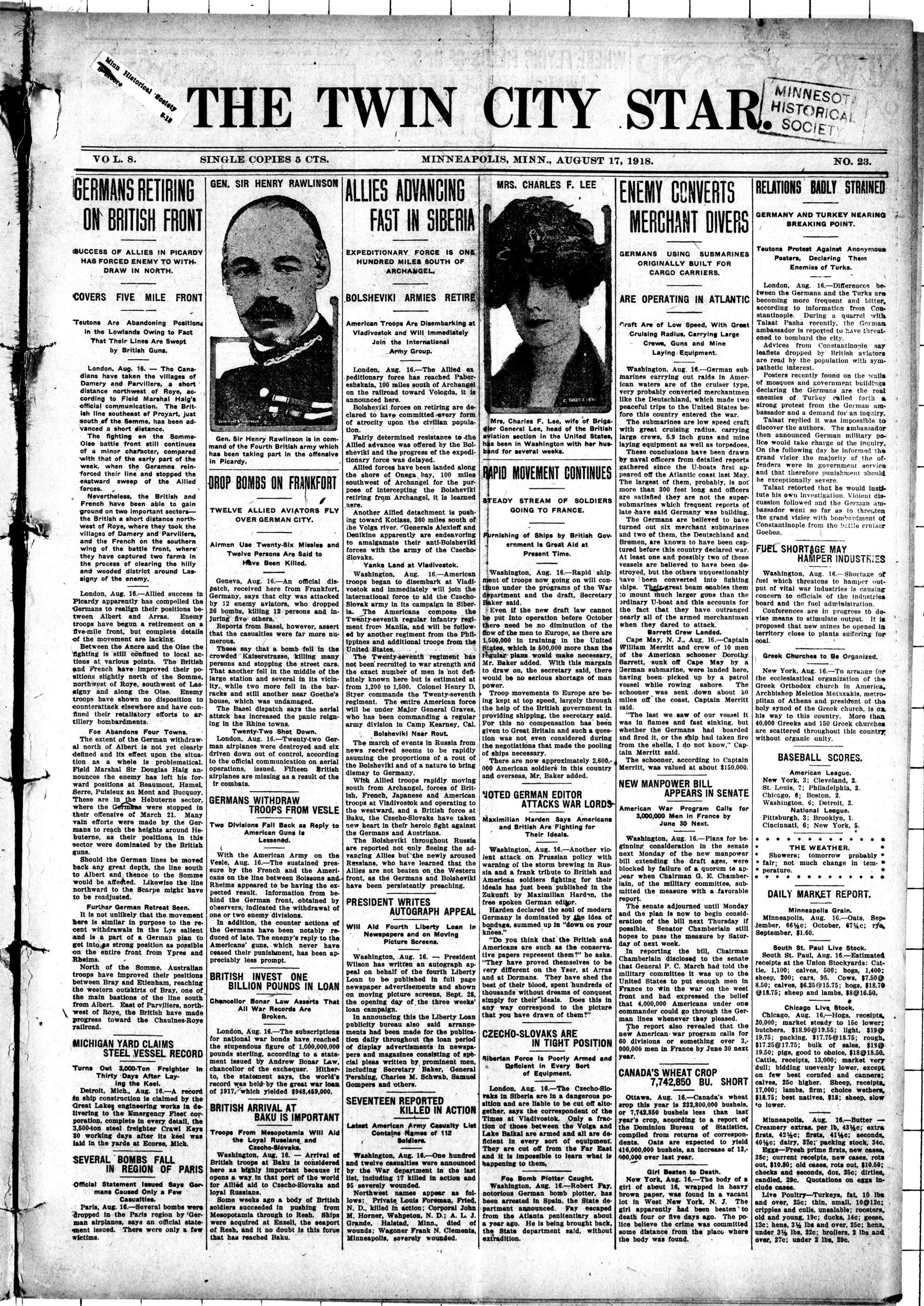
GERMANS RETIRING ON BRITISH FRONT
SUCCESS OF ALLIES IN PICARDY HAS FORCED ENEMY TO WITH-DRAW IN NORTH.
COVERS FIVE MILE FRONT
Teutons Are Abandoning Position in the Lowlands Owing to Fact That Their Lines Are Swept by British Guns.
London, Aug. 16. — The Canadians have taken the villages of Damery and Parvillers, a short distance northwest of Roye, according to Field Marshal Halg's official communication. The British line southeast of Proyart, just south of the Somme, has been advanced a short distance.
The fighting on the Somme-Oise battle front still continues of a minor character, compared with that of the early part of the week, when the Geramans reinforced their line and stopped the eastward sweep of the Allied forces.
Nevertheless, the British and French have been able to gain ground on two important sectors—the British a short distance northwest of Roye, where they took the villages of Damery and Parvillers, and the French on the southern wing of the battle front, where they have captured two farms in the process of clearing the hilly and wooded district around Lassigny of the enemy.
London, Aug. 16—Allied success in Picardy apparently has compelled the Germans to realign their positions between Albert and Arras. Enemy troops have begun a retirement on a five-mile front, but complete details of the movement are lacking. Between the Ancre and the Oise the fighting is still confined to local actions at various points. The British and French have improved their positions slightly north of the Somme, northwest of Roye, southwest of Lassigny and along the Oise. Enemy troops have shown no disposition to counterattack elsewhere and have confined their retaliatory efforts to artillery bombardments.
Foe Abandons Four Towns.
The extent of the German withdrawal north of Albert is not yet clearly defined and its effect upon the situation as a whole is problematical. Field Marshal Sir Douglas Haig announces the enemy has left his forward positions at Beaumont, Hamel, Serre, Pulsieux au Mont and Bucquoy. These are in the Hebuterne sector, where the Germans were stopped in their offensive of March 21. Many vain efforts were made by the Germans to reach the heights around Hebuterne, as their positions in this sector were dominated by the British guns.
Should the German lines be moved back any great depth, the line south to Albert and thence to the Somme would be affected. Likewise the line northward to the Scarpe might have to be readjusted.
Further German Retreat Seen.
It is not unlikely that the movement here is similar in purpose to the recent withdrawals in the Lys salient and is a part of a German plan to get into as strong position as possible on the entire front from Ypres and Rheims.
North of the Somme, Australian troops have improved their positions between Bray and Etlenham, reaching the western outskirts of Bray, one of the main bastions of the line south from Albert. East of Parvillers, north-west of Roye, the British have made progress toward the Chaulnes-Roye railroad.
MICHIGAN YARD CLAIMS
STEEL VESSEL RECORD
Turns Out 3,000-Ton Freighter in Thirty Days After Laying the Keel.
Detroit, Mich. Aug. 16.—A record in ship construction is claimed by the Great Lakes engineering works in delivering to the Emergency Fleet corporation, complete in every detail, the 3,500-ton steel freighter Crawl Keys 30 working days after its keel was laid in the yards at Ecorse, Mich.
SEVERAL BOMBS FALL IN REGION OF PARIS
Official Statement issued Says Germans Caused Only a Few Caustattles.
Paris, Aug. 16.—Several bombs were dropped in the Paris region by 'German airplanes,' says an official statement issued. There were only a few wictims.
GEN. SIR HENRY RAWLINSON
Gen. Sir Henry Rawlinson is in command of the Fourth British army which has been taking part in the offensive in Picardy.
DROP BOMBS ON FRANKFORT
TWELVE ALLIED AVIATORS FLY
OVER GERMAN CITY.
Airmen Use Twenty-Six Missiles and Twelve Persons Are Said to Have Been Killed.
Geneva, Aug. 16.—An official dispatch, received here from Frankfort, Germany, says that city was attacked by 12 enemy aviators, who dropped 26 bombs, killing 12 persons and injuring five others.
Reports from Basel, however, assert that the casualties were far more numerous.
These say that a bomb fell in the crowded Kaiserstrasse, killing many persons and stopping the street cars. That another fell in the middle of the large station and several in its vicinity, while two more fell in the barracks and still another near Goethe's house, which was undamaged.
The Basel dispatch says the aerial attack has increased the panic reigning in the Rhine towns.
Twenty-Two Shot Down.
London, Aug. 16.—Twenty-two German airplanes were destroyed and six driven down out of control, according to the official communication on aerial operations, issued. Fifteen British airplanes are missing as a result of the Ir combats.
GERMANS WITHDRAW
TROOPS FROM VESLE
Two Divisions Fall Back as Reply to American Guns is Lessened.
With the American Army on the Vesle, Aug. 16.—The sustained pressure by the French and the Americans on the line between Soissons and Rheims appeared to be having the expected result. Information from behind the German front, obtained by observers, indicated the withdrawal of one or two enemy divisions.
In addition, the counter actions of the Germans have been notably reduced of late. The enemy's reply to the Americans' guns, which never have ceased their punishment, has been appreciably less prompt.
BRITISH INVEST ONE
BILLION POUNDS IN LOAN
Chancellor Bonar Law Asserts That All War Records Are Broken.
London, Aug. 16.—The subscriptions for national war bonds have reached the stupendous figure of 1,000,000,000 pounds sterling, according to a statement issued by Andrew Bonar Law, chancellor of the exchequer. Hitherto, the statement says, the world's record was held by the great war loan of 1917, which yielded $948,459,000.
BRITISH ARRIVAL AT BAKU IS IMPORTANT
Troops From Mesopotamia Will Aid the Loyal Russians and Czecho-Slovaks.
Washington, Aug. 16. — Arrival of British troops at Baku is considered here as highly important because it opens a way in that port of the world for Allied aid to Czecho-Slovaks and loyal Russians.
Some weeks ago a body of British soldiers succeeded in pushing from Mesopotamia through to Resh. Ships were acquired at Enzell, the seaport of Resh, and it no doubt is this force that has reached Baku.
MINNEAPOLIS, MINN., AUGUST 17, 1918.
ALLIES ADVANCING FAST IN SIBERIA
EXPEDITIONARY FORCE IS ONE
HUNDRED MILES SOUTH OF
ARCHANGEL
BOLSHEVIKI ARMIES RETIRE
London, Aug. 16.—The Allied expeditionary force has reached Paboreshskala, 100 miles south of Archangel on the railroad toward Vologda, it is announced here.
Bolsheyki forces on retiring are declared to have committed every form of atrocity upon the civilian population.
Fairly determined resistance to the Allied advance was offered by the Bolshevki and the progress of the expeditionary force was delayed.
Allied forces have been landed along the shore of Onega bay, 100 miles southwest of Archangel for the purpose of intercepting the Bolshevki retiring from Archangel, it is learned here.
Another Allied detachment is pushing toward Kotlass, 260 miles south of the Volga river. Generals Alexieff and Denikline apparently are endeavoring to amalgamate their anti-Bolshevki forces with the army of the Czecho-Slovaks.
Washington, Aug. 16.—American troops began to disembark at Vladivostok and immediately will join the international force to aid the Czechoslovak army in its campaign in Siberia. The Americans compose the Twenty-seventh regular infantry regiment from Manila, and will be followed by another regiment from the Philippines and additional troops from the United States.
The Twenty-seventh regiment has not been recruited to war strength and the exact number of men is not definitely known here but is estimated at 1,200 to 1,500. Colonel Henry D. Styter commands the Twenty-seventh regiment. The entire American force will be under Major General Graves, who has been commanding a regular army division in Camp Kearney, Cal.
Bolsheviki Near Rout.
The march of events in Russia from news received seems to be rapidly assuming the proportions of a rout of the Bolshevik and of a nature to bring dismay to Germany.
With Allied troops rapidly moving south from Archangel, forces of British, French, Japanese and American troops at Vladivostok and operating to the westward, and a British force at Baku, the Czecho-Slovaks have taken new heart in their heroic fight against the Germans and Austrians.
The Bolshevik throughout Russia are reported not only fleeing the advancing Allies but the newly aroused Russians, who have learned that the Allies are not beaten on the Western front, as the Germans and Bolshevik have been persistently preaching.
PRESIDENT WRITES
AUTOGRAPH APPEAL
Will Aid Fourth Liberty Loan in Newspapers and on Moving Picture Screens.
Washington, Aug. 16. — President Wilson has written an autograph appeal on behalf of the fourth Liberty Loan to be published in full page newspaper advertisements and shown on moving picture screens, Sept. 28, the opening day of the three weeks' loan campaign.
In announcing this the Liberty Loan publicity bureau also said arrangements had been made for the publication daily throughout the loan period of display advertisements in newspapers and magazines consisting of special pleas written by prominent men, including Secretary Baker, General Pershing, Charles M. Schwab, Samuel Gompers and others.
SEVENTEEN REPORTED KILLED IN ACTION
Latest American Army Casualty List Contains Names of 112 Soldiers.
Washington, Aug. 16.—One hundred and twelve casualties were announced by the War department in the last list, including 17 killed in action and 95 severely wounded.
Northwest names appear as follows: Private Louis Foreman, Fried, N. D., killed in action; Corporal John M. Horner, Wahpeton, N. D.; A. L. J. Grande, Halstad, Minn., died of wounds; Wagoner Frank N. Clements, Minneapolis, severely wounded.
MRS. CHARLES F. LEE
Mrs, Charles F. Lee, wife of Brigadier General Lee, head of the British aviation section in the United States, has been in Washington with her husband for several weeks.
STEADY STREAM OF SOLDIERS
GOING TO FRANCE.
Furnishing of Ships by British Government is Great Aid at Present Time.
Washington, Aug. 16.—Rapid shipment of troops now going on will continue under the programs of the War department and the draft, Secretary Baker said.
Even if the new draft law cannot be put into operation before October there need be no diminution of the flow of the men to Europe, as there are 1,500,000 in training in the United States, which is 500,000 more than the regular plans would make necessary, Mr. Baker added. With this margin to draw on, the secretary said, there would be no serious shortage of man power.
Troop movements to Europe are being kept at top speed, largely through the help of the British government in providing shipping, the secretary said. For this no compensation has been given to Great Britain and such a question was not even considered during the negotiations that made the pooling of ships necessary.
There are now approximately 2,600,000 American soldiers in this country and overseas, Mr. Baker added.
NOTED GERMAN EDITOR ATTACKS WAR LORDS
Maximilian Harden Says Americans and British Are Fighting for Their Ideals.
Washington, Aug. 16.—Another violent attack on Prussian policy with warning of the storm brewing in Russia and a frank tribute to British and American soldiers fighting for their ideals has just been published in the Zukunft by Maximilian Hardn, the free spoken German editor.
Harden declared the soul of modern Germany is dominated by the idea of bondage, summed up in "down on your knees."
"Do you think that the British and Americans are such as the conservative papers represent them?" he asks.
"They have proved themselves to be very different on the Yser, at Arras and at Dormans. They have shed the best of their blood, spent hundreds of thousands without dreams of conquest simply for their ideals. Does this in any way correspond to the picture that you have drawn of them?"
CZECHO-SLOVAKS ARE IN TIGHT POSITION
Siberian Force Is Poorly Armed and Deficient in Every Sort of Equipment.
London, Aug. 16.—The Czecho-Slovak in Siberia are in a dangerous position and are liable to be cut off altogether, says the correspondent of the Times at Vladivostok. Only a fraction of those between the Volga and Lake Baikal are armed and all are deficient in every sort of equipment. They are cut off from the Far East and it is impossible to learn what is happening to them.
Foe Bomb Plotter Caught.
Washington, Aug. 16.—Robert Fay, notorious German bomb plotter, has been arrested in Spain, the State department announced. Fay escaped from the Atlanta penitentiary about a year ago. He is being brought back, the State department said, without extradition.
ENEMY CONVERTS MERCHANT DIVERS
ENEMY CONVERTS MERCHANT DIVERS
GERMANS USING SUBMARINES ORIGINALLY BUILT FOR CARGO CARRIERS.
ARE OPERATING IN ATLANTIC
Craft Are of Low Speed, With Great Cruising Radius, Carrying Large Crewe, Guns and Mine Laying Equipment.
Washington, Aug. 16.—German submarines carrying out raids in American waters are of the cruiser type, very probably converted merchantmen like the Deutschland, which made two peaceful trips to the United States before this country entered the war.
The submarines are low speed craft with great cruising radius, carrying large crews, 5.9 inch guns and mine laying equipment as well as torpedoes. These conclusions have been drawn by naval officers from detailed reports gathered since the U-boats first appeared off the Atlantic coast last May. The largest of them, probably, is not more than 300 feet long and officers are satisfied they are not the super-submarines which frequent reports of late have said Germany was building.
The Germans are believed to have turned out six merchant submarines and two of them, the Deutschland and Bremen, are known to have been captured before this country declared war. At least one and possibly two of these vessels are believed to have been destroyed, but the others unquestionably have been converted into fighting ships. Their great beam enables them to mount much larger guns than the ordinary U-boat and this accounts for the fact that they have outraned nearly all of the armed merchantmen when they dared to attack.
Barrett Crew Landed.
Cape May, N. J., Aug. 16.—Captain William Merritt and crew of 10 men of the American schooner Dorothy Barrett, sunk off Cape May by a German submarine, were landed here, having been picked up by a patrol vessel while rowing ashore. The schooner was sent down about 20 miles off the coast, Captain Merritt said.
"The last we saw of our vessel it was in flames and fast sinking, but whether the Germans had boarded and fired it, or the ship had taken fire from the shell, I do not know." Captain Merritt said.
The schooner, according to Captain Merritt, was valued at about $150,000.
NEW MANPOWER BILL APPEARS IN SENATE
American War Program Calls for 3,000,000 Men in France by June 30 Next.
Washington, Aug. 16.—Plans for beginning consideration in the senate next Monday of the new manpower bill extending the draft ages, were blocked by failure of a quorum to appear when Chairman G. E. Chamberlain, of the military committee, submitted the measure with a favorable report.
The senate adjourned until Monday and the plan is now to begin consideration of the bill next Thursday if possible. Senator Chamberlain still hopes to pass the measure by Saturday of next week.
In reporting the bill, Chairman Chamberlain disclosed to the senate that General P. C. March had told the military committee it was up to the United States to put enough men in France to win the war on the west front and had expressed the belief that 4,000,000 Americans under one commander could go through the German lines whenever they pleased.
The report also revealed that the new American-war program calls for 60 divisions or something over 3,000,000 men in France by June 30 next year.
CANADA'S WHEAT CROP
7,742,850 BU. SHORT
Ottawa, Aug. 16.—Canada's wheat crop this year is 223,800,000 bushels, or 7,742,850 bushels less than last year's crop, according to a report of the Dominion Bureau of Statistics, compiled from returns of correspondents. Oats are expected to yield 416,000,000 bushels, an increase of 13,000,000 over last year.
Girl Beaten to Death
New York, Aug. 16.—The body of a girl of about 16, wrapped in heavy brown paper, was found in a vacant lot in West New York, N. J. The girl apparently had been beaten to death four or five days ago. The police believe the crime was committed some distance from the place where the body was found.
NO.23.
RELATIONS BADLY STRAINED
GERMANY AND TURKEY NEARING BREAKING POINT.
Teutons Protest Against Anonymous Posters, Declaring Them Enemies of Turks.
London, Aug. 16.—Differences between the Germans and the Turks are becoming more frequent and bitter, according to information from Constantinople. During a quarrel with Talaat Pasha recently, the German ambassador is reported to have threatened to bombard the city.
Advices from Constantinople say leaflets dropped by British aviators are read by the population with sympathetic interest.
Posters recently found on the walls of mosques and government buildings declaring the Germans are the real enemies of Turkey called forth a strong protest from the German ambassador and a demand for an inquiry.
Talaat replied it was impossible to discover the authors. The ambassador then announced German military police would take charge of the inquiry. On the following day he informed the grand vizier the majority of the offenders were in government service and that therefore punishment should be exceptionally severe.
Talaat retorted that he would institute his own investigation. Violent discussion followed and the German ambassador went so far as to threaten the grand vizier with bombardment of Constantinople from the battle cruiser Goeben.
FUEL SHORTAGE MAY
HAMPER INDUSTRIES
Washington, Aug. 16.—Shortage of fuel which threatens to hamper output of vital war industries is causing concern to officials of the industries board and the fuel administration. Conferences are in progress to devise means to stimulate output. It is proposed that new mines be opened in territory close to plants suffering for coal.
Greek Churches to Be Organized.
New York, Aug. 16.—To arrange for the ecclesiastical organization of the Greek Orthodox church in America, Archbishop Meletios Metaxakis, metropolitan of Athens and president of the holy synod of the Greek church, is on his way to this country. More than 40,000 Greeks and 150 Greek churches are scattered throughout this country without organic unity.
BASEBALL SCORES.
American League.
New York, 3; Cleveland, 2.
St. Louis, 7; Philadelphia, 2.
Chicago, 6; Boston, 2.
Washington, 6; Detroit, 2.
National League.
Pittsburgh, 3; Brooklyn, 1.
Cincinnati, 6; New York, 5.
THE WEATHER.
Showers; tomorrow probably
fair; not much change in tem-
perature.
DAILY MARKET REPORT.
Minneapolis Grain.
Minneapolis, Aug. 16.—Oats, September, 66½c; October, $7¼c; rye, September, $1.60.
South St. Paul Stock. South St. Paul, Aug. 16.—Estimated receipts at the Union Stockyards: Cattle, 1,100; calves, 500; hogs, 1,400; sheep, 200; cars, 95. Cows, $7.50@8.50; calves, $6.25@15.75; hogs, $18.70@18.75; sheep and sheep, $8@16.50.
Chicago Live Stock.
Chicago, Aug. 16.—Hogs, receipts, 20,000; market steady to 15c lower; butchers, $18.90@19.55; light, $19@19.75; packing, $17.75@18.75; rough, $17.25@17.75; bulk of sales, $19@19.50; pigs, good to choice, $18@18.50; Cattle, receipts, 13,000; market very dull; bidding unevenly lower, except on few best cornfed and cannars; calves, 25c higher. Sheep, receipts, 17,000; lambs, firm; choice wethers, $18.75; best natives, $18; sheep, slow to lower.
Minneapolis, Aug. 16.—Butter — Creamery extras, per lb, 43½c; extra firsts, 42½c; firsts, 41½c; seconds, 40½c; dairy, 37c; packing stock, 34c. Eggs—Fresh prime firsts, new cases, 38c; current receipts, new cases, rots out, $10.80; old cases, rots out, $10.50; checks and seconds, doz, 25c; dirtles, candled, 29c. Quotations on eggs include cases.
Live Poultry—Turkeys, fat, 10 lbs and over, 25c; thin, small, 10@12c; cripples and culls, unsalable; roosters, old and young, 19c; ducks, 14c; geese, 13c; hens, 3½l and over, 25c; hens, under 3½l lbs. 22c; broilers, 2 lbs and over, 27c; under 2 lbs. 29c.
NEWS and GOSSIP OF WASHINGTON
WASHINGTON.—It is right early in the season for goldenrod, but there are always pioneers. One blossom, anyhow, must have started in to bloom ahead of official fall weddings, for a notorman had it stuck in his cap as he breezed his car toward the capl-
wiser, knew better. "Betcher he stuck it there, girl gave it to him. He knows how to make a ole man, did I show you the postcard Lil sent a dandy."
The other responded with a suddenness I considered when Lil's favors were being passed "Let's look."
The younger fellow fumbled in his pockets, bening nonchalance that he must have left it in "Your other coat—huh."
That was every word he uttered, but—enough is always enough. There was no other. The two foolish youngsters, Lord love them and that was all there was to it, unless—unless own for goldenrod all fringed around a cool sp the old Chesapeake swishing in and out acr things flashing in the air—and chirping in the roots and—everything.
Read This and Learn Proper I
HE IS a nice man from 'way down south in the home of an equally nice woman, who With a kindly thoughtfulness which is one of nice, he
wiser, knew better. "Better he stuck it there to make her believe his other girl gave it to him. He knows how to make 'em jealous, all right. Oh, say, ole man, did I show you the postcard Lil sent me from Colonial Beach? It's a dandy."
The other responded with a suddenness which implied his right to be considered when Lil's favors were being passed around.
"Let's look."
The younger fellow fumbled in his pockets and then remarked with madening nonchalance that he must have left it in his other coat.
"Your other coat—huh."
That was every word he uttered, but—take it from dear Mercutio—enough is always enough. There was no other coat.
The two foolish youngsters, Lord love them, grinned over the show down, and that was all there was to it, unless—unless you have a memory of your own for goldenrod all fringed around a cool spring, with big trees overhead, the old Chesapeake swishing in and out across the beach—and dear live things flashing in the air—and chirping in the bushes—and crawling under roots and—everything.
Read This and Learn Proper Name for Grapefruit
Read This and Learn Proper Name for Grapefruit
HE IS a nice man from 'way down south' in Dixie. And he has a room in the home of an equally nice woman, who is helping to win the war. With a kindly thoughtfulness which is one of the reasons that make people
a better reason, could you, seeing that pomelo
a grape?
If you notice, few discoverers get the immo-
n of names, whether it be a Columbus, who foun
who provided it with something new in fruits
one of the little kinks in human nature that wi
as the well-known millennium comes our way.
Mrs. Frank Leslie, formerly of New York
prominent promoter of the popularity of pome-
conceded her share in renaming the fruit for
"the big balls grow in clusters like grapes."
In the present wisdom to which she has s
realizes the entire foolishness of robbing a ma-
tall the fruit of his labor—we have to go to h
Also, grapefruit tastes better when you call
And the Women Simply Could
ARE Washington women gallant? Now, I c
question. All I want to do is set forth
street car the other afternoon, and leave it to
you will. The car was one of these
a better reason, could you, seeing that pomelo neither looks nor tastes like a grape?
If you notice, few discoverers get the immortality due them in the matter of names, whether it be a Columbus, who founded a continent, or a Pomelo, who provided it with something new in fruit—but don't worry. It is just one of the little kinks in human nature that will be straightened out as soon as the well-known millennium comes our way.
Mrs. Frank Leslie, formerly of New York and now of heaven, was a prominent promoter of the popularity of pomelo in the North, and frankly conceded her share in renaming the fruit for the reason, as she explained, "the big balls grow in clusters like grapes."
In the present wisdom to which she has attained, Mrs. Leslie doubtless realizes the entire foolishness of robbing a man of what you might literally call the fruit of his labor—we have to go to heaven to see things like that.
Also, grapefruit tastes better when you call it pomelo. Try it once.
And the Women Simply Couldn't See Him at All
ARE Washington women gallant? Now, I don't propose to answer that question. All I want to do is set forth something I saw happen on a street car the other afternoon, and leave it to you to answer the question as you will. The car was one of these
Now an electric ball is pretty heavy. And when two hands are required to hold and guard it that leaves few hands to hang onto straps with. And there aren't any straps on these ears, anyway. The best you can do is grab the back of a seat, or let your closely packed neighbors of the moment hold you up by mere juxtaposition. Every so often that car was occupied by a woman.
heavy. And when two hands are required to few hands to hang onto straps with. And the ears, anyway. The best you can do is grab the closely packed neighbors of the moment hold. Every seat in that car was occupied by a w. They were resting from their arduous shop. The man, who for lo! these twenty-some has been rising from his seat and giving it thought that maybe this time the tables would "These kind ladies," he thought, "will se with this thing and will take pity on me. Su enough to get up and offer me her seat."
They were resting from their arduous shopping of the afternoon.
The man, who for lo! these twenty-some years, he told me afterward, has been rising from his seat and giving it to women in the street cars, thought that maybe this time the tables would be turned.
"These kind ladies," he thought, "will see what difficulty I am having with this thing and will take pity on me. Surely one of them will be sport enough to get up and offer me her seat."
He eagerly looked around for the "sport."
But all the women were looking out the windows.
Zeal May Be Overdone, but the World Needs It
TWO woman clerks started to walk to work in the early days of car crushes and have kept it up ever since—going and coming without missing a day.
Also they have developed the crusading zeal of the reformer, and with the loftiest intentions in the world are
Zeal May Be Overdone, but the World Needs It
TWO woman clerks started to walk to work in the early days of car crushers and have kept it up ever since—going and coming without missing a day. Also they have developed the crusading zeal of the reformer, and with the
good, honest, everyday people—object to being their own choosing. For days and weeks grown fully accepted their reformatory raids, but—you the other morning he settled them with a mass less considered original, but which Socrates going how many others in eons gone before.
"That's the worst of you good women, Ye. For that time, anyway, the crusaders we same, brothers, what sort of a world would this good women should learn to let go?
good, honest, everyday people—object to being made over by patterns not of their own choosing. For days and weeks growing into months he has cheerfully accepted their reformatory raids, but—you know about that last straw—the other morning he settled them with a masculine protest which he doubtless considered original, but which Socrates got in ahead of him, and no telling how many others in eons gone before.
"That's the worst of you good women. You never know when to let go." For that time, anyway, the crusaders went down in defeat, but all the same, brothers, what sort of a world would this be for you and for all of us if good women should learn to let go?
as he breezed his car toward the capitol the other afternoon.
The yellow of it caught the interest of an oldish couple, who smiled at each other, the way comrades do when some trifle recalls associations that belong to both. Also, the sprig passed its talk-value on to a couple of young fellows, one of whom must have had experiences to go by:
"His girl gave him that."
His companion, being a trifle
youncer and therefore a whole lot
山
you win. The car was one of these alldoor affairs in which innocent passengers are packed to the tune of "Plenty of room up front." He was an inoffensive-looking man with a large bundle in his arms. The bundle, wrapped in paper and tied with string, had all the seeming of a windmill. In reality it was an electric fan, as was apparent to prying eyes from the fact that a bit of the brass blade had penetrated the wrapper.
Now an electric fan is pretty
SURE IT DOES
WALKING
MAKES ONE
BEAUTIFUL
LET'S LOOK
YOU SHOULD SEE TH' SWELL POSTCARD LIL SENT ME
it there to make her believe his other to make 'em jealous, all right. Oh, say, Ill sent me from Colonial Beach? It's leness which implied his right to be big passed around.
pockets and then remarked with mad-left it in his other coat.
I, but—take it from dear Mercutio—no other coat.
love them, grinned over the show down,—unless you have a memory of your a cool spring, with big trees overhead, out across the beach—and dear live in the bushes—and crawling under
Upper Name for Grapefruit
south in Dixie. And he has a room in man, who is helping to win the war, is one of the reasons that make people
nice, he brought the woman a bag of fruit the other day.
It was a bulgy bag filled with yellow balls that the woman accepted as grapefruit. But it wasn't grapefruit. The man said so, and he knew.
"Down home, where this fruit grows, we call it pomelo, in honor of the man who introduced it into this country from the far East. We have always called it pomelo, and we always shall, because pomelo is its proper name." And you couldn't ask
it pomelo neither looks nor tastes like
the immortality due them in the matter
who founded a continent, or a Pomelo,
in fruit—but don't worry. It is just
e that will be straightened out as soon
our way.
New York and now of heaven, was a
of pomelo in the North, and frankly
fruit for the reason, as she explained,
apes."
She has attained, Mrs. Leslie doubtless
ing a man of what you might literally
go to heaven to see things like that.
I call it pomelo. Try it once.
Couldn't See Him at All
Now, I don't propose to answer that
it forth something I saw happen on a
e it to you to answer the question as
小川一
quired to hold and guard it that leave
And there aren't any straps on these
is grab the back of a seat, or let your
ent hold you up by mere juxtaposition
by a woman.
ous shopping of the afternoon.
enty-some years, he told me afterward,
living it to women in the street cars,
es would be turned.
"will see what difficulty I am having
me. Surely one of them will be sport
it."
"sport."
but the windows.
but the World Needs It
to work in the early days of car crushs
ing and coming without missing a day,
ing zeal of the reformer, and with the
loftiest intentions in the world are making life raspy for friends who prefer to ride.
"It is so much healthier, don't you know, and look at what we save. If you would only take the trouble to rise a bit earlier—all it requires is will power and—all that and more.
But there are always others. One of them is a man in the same office, whom the crusaders have known years enough to nag into salvation, regardless of the world-old fact that people—
to being made over by patterns not of beeks growing into months he has cheer-but—you know about that last straw—with a masculine protest which he doubtcrates got in ahead of him, and no tellefore. men. You never know when to let go."aders went down in defeat, but all the would this be for you and for all of us if
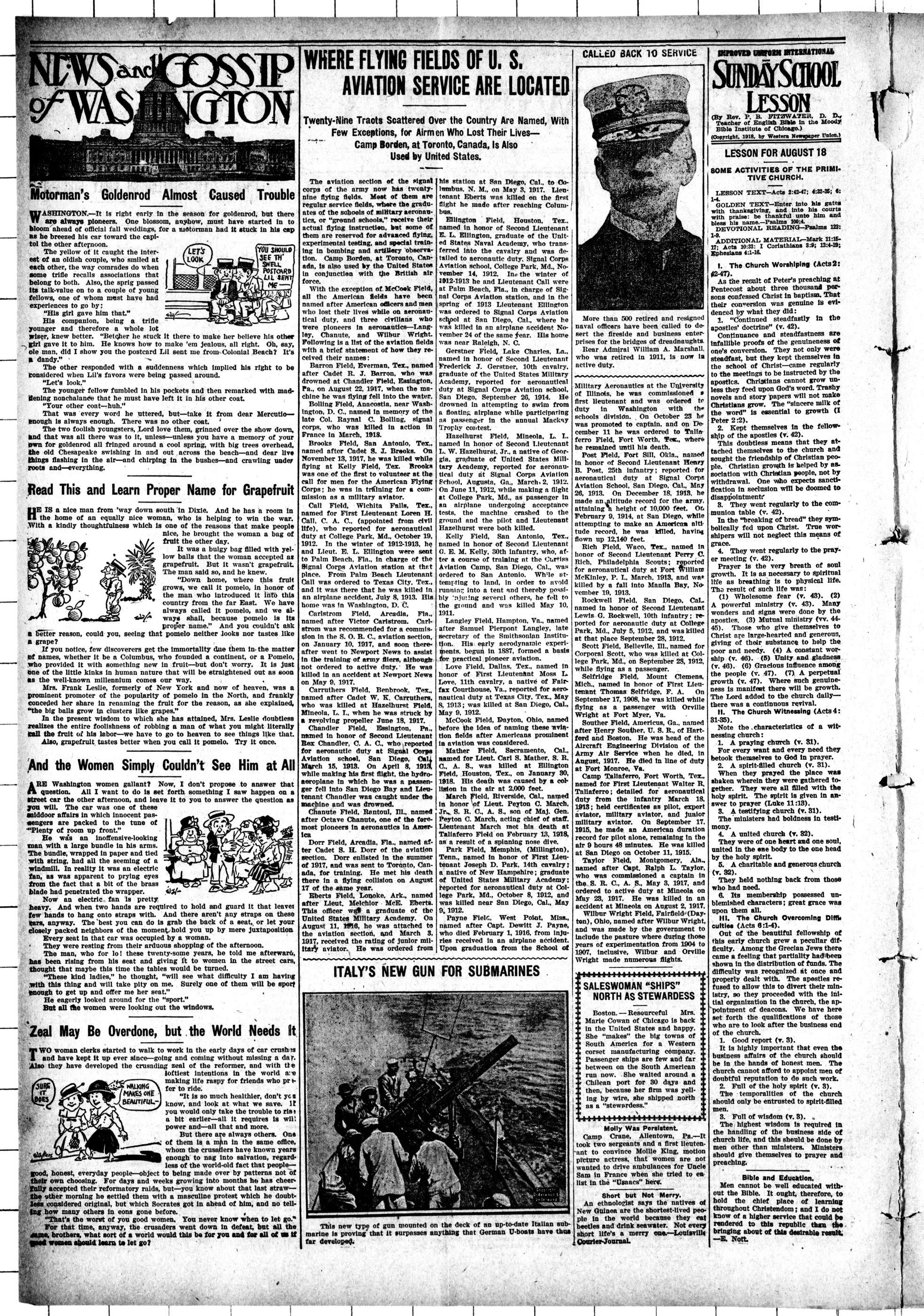
WHERE FLYING FIELDS OF U. S. AVIATION SERVICE ARE LOCATED
Twenty-Nine Tracts Scattered Over the Country Are Named, With Few Exceptions, for Airmen Who Lost Their Lives Camp Borden, at Toronto, Canada, Is Also Used by United States.
ITALY'S NEW GUN FOR SUBMARINES
COPPER
COPPER
UNDERWARD
This new type of gun mounted on the deck of an up-to-date Italian submarine is proving that it surpasses anything that German U-boats have thus far developed.
The aviation section of the signal corps of the army now has twenty-nine flying fields. Most of them are regular service fields, where the graduates of the schools of military aeronautics, or "ground schools," receive their actual flying instruction, but some of them are reserved for advanced flying, experimental testing, and special training in bombing and artillery observation. Camp Borden, at Toronto, Canada, is also used by the United States in conjunction with the British air force.
With the exception of McCook Field, all the American fields have been named after American officers and men who lost their lives while on aeronautical duty, and three civilians who were ploneers in aeronautics—Langley, Chanute, and Wilbur Wright. Following is a list of the aviation fields with a brief statement of how they received their names:
Barron Field, Everman, Tex., named after Cadet R. J. Barron, who was drowned at Chandler Field, Essington, Pa., on August 22, 1917, when the machine he was flying fell into the water.
Bolling Field, Anacostia, near Washington, D. C., named in memory of the late Col. Raynal C. Bolling, signal corps, who was killed in action in France in March, 1918.
Brooks Field, San Antonio, Tex., named after Cadet S. J. Brooks. On November 13, 1917, he was killed while flying at Kelly Field, Tex. Brooks was one of the first to volunteer at the call for men for the American Flying Corps; he was in training for a commission as a military aviator.
Call Field, Wichita Falls, Tex., named for First Lieutenant Loren H. Call, C. A. C., (appointed from civil life), who reported for aeronautical duty at College Park, Md., October 19, 1912. In the winter of 1912-1913, he and Lieut. E. L. Ellington were sent to Palm Beach, Fla., in charge of the Signal Corps Aviation station at that place. From Palm Beach Lieutenant Call was ordered to Texas City, Tex., and it was there that he was killed in an airplane accident, July 8, 1913. His home was in Washington, D. C.
Carlstrom Field, Arcadia, Fln., named after Victor Carlstrom. Carlstrom was recommended for a commission in the S. O. R. C., aviation section, on January 10, 1917, and soon thereafter went to Newport News to assist in the training of army filers, although not ordered to active duty. He was killed in an accident at Newport News on May 9, 1917.
Carruthers Field, Benbrook, Tex., named after Cadet W. K. Carruthers, who was killed at Hazelhurst Field, Mineola, L. L., when he was struck by a revolving propeller June 18, 1917.
Chandler Field, Essington, Pa., named in honor of Second Lieutenant Bex Chandler, C. A. C., who reported for aeronautic duty at Signal Corps Aviation school, San Diego, Cal. March 15, 1913. On April 8, 1913, while making his first flight, the hydroaeroplane in which he was a passenger fell into San Diego Bay and Lieutenant Chandler was caught under the machine and was drowned.
Chanute Field, Rentoul, Ill., named after Octave Chanute, one of the foremost ploneers in aeronautics in America
Dorr Field, Arcadia, Fla., named after Cadet S. H. Dorr of the aviation section. Dorr enlisted in the summer of 1917, and was sent to Toronto, Canada, for training. He met his death there in a flying collision on August 17 of the same year.
Eberts Field, Lonoke, Ark., named after Lleut, Melchior McE. Eberts. This officer was a graduate of the United States Military Academy. On August 11, 1816, he was attached to the aviation section, and March 3, 1917, received the rating of junior military aviator. He was ordered from
his station at San Diego, Cal., to Columbus, N. M., on May 3, 1917. Lieutenant Eberts was killed on the first flight he made after reaching Columbus.
Ellington Field, Houston, Tex., named in honor of Second Lieutenant E. L. Ellington, graduate of the United States Naval Academy, who transferred into the cavalry and was detailed to aeronautic duty, Signal Corps Aviation school, College Park, Md., November 14, 1912. In the winter of 1912-1913 he and Lieutenant Call were at Palm Beach, Fla., in charge of Signal Corps Aviation station, and in the spring of 1913 Lieutenant Ellington was ordered to Signal Corps Aviation school at San Diego, Cal., where he was killed in an airplane accident November 24 of the same year. His home was near Raleigh, N. C.
Gerstner Field, Lake Charles, La., named in honor of Second Lieutenant Frederick J. Gerstner, 10th cavalry, graduate of the United States Military Academy, reported for aeronautical duty at Signal Corps Aviation school, San Diego, September 26, 1914. He drowned in attempting to swim from a floating airplane while participating as passenger in the annual Mackay Trophy contest.
Hazelhurst Field, Mineola, L. L. named in honor of Second Lieutenant L. W. Hazelhurst, Jr., a native of Georgia, graduate of United States Military Academy, reported for aeronautical duty at Signal Corps Aviation School, Augusta, Ga., March 2, 1912. On June 11, 1912, while making a flight at College Park, Md., as passenger in an airplane undergoing acceptance tests, the machine crashed to the ground and the pilot and Lieutenant Hazelhurst were both killed.
Kelly Field, San Antonio, Tex., named in honor of Second Lieutenant G. E. M. Kelly, 30th infantry, who, after a course of training at the Curtiss Aviation Camp, San Diego, Cal., was ordered to San Antonio. While attempting to land, in order to avoid running into a tent and thereby possibly injuring several others, he fell to the ground and was killed May 10, 1911.
Langley Field, Hampton, Va., named after Samuel Pierpont Langley, late secretary of the Smithsonian Institution. His early aerodynamic experiments, begun in 1887, formed a basis for practical pioneer aviation.
Love Field, Dallas, Tex., named in honor of First Lieutenant Moss L Love, 11th cavalry, a native of Fairfax Courthouse, Va., reported for aeronautical duty at Texas City, Tex., May 8, 1913; was killed at San Diego, Cal., May 9, 1912.
McCook Field, Dayton, Ohio, named before the idea of naming these aviation fields after Americans prominent in aviation was considered.
Mather Field, Sacramento, Cal., named for Lieut. Carl S. Mather, S. R. C., A. S., was killed at Ellington Field, Houston, Tex., on January 30, 1918. His death was caused by a collision in the air at 2,000 feet.
March Field, Riverside, Cal., named in honor of Lieut. Peyton C. March, Jr., S. R. C., A. S., son of Maj. Gen. Peyton C. March, acting chief of staff. Lieutenant March met his death at Tallafero Field on February 13, 1918, as a result of a spinning nose dive.
Park Field, Memphis, (Millington), Tenn., named in honor of First Lieutenant Joseph D. Park, 14th cavalry; a native of New Hampshire; graduate of United States Military Academy; reported for aeronautical duty at College Park, Md., October 8, 1912, and was killed near San Diego, Cal., May 9, 1912.
Payne Fielc, West Polat, Miss., named after Capt. Dewitt J. Payne, who died February 1, 1916, from injuries received in an airplane accident. Upon graduation from the School of
TOMMY H.
More than 500 retired and resigned naval officers have been called to desert the fireside and business enterprises for the bridges of dreadnaughts. Rear Admiral William A. Marshall, who was retired in 1911, is now in active duty.
Military Aeronautics at the University of Illinois, he was commissioned first lieutenant and was ordered to duty in Washington with the schools division. On October 23 he was promoted to captain, and on December 11 he was ordered to Tallafero Field, Fort Worth, Tex., where he remained until his death.
Post Field, Fort Sill, Okla., named in honor of Second Lieutenant Henry B. Post, 25th infantry; reported for aeronautical duty at Signal Corps Aviation School, San Diego, Cal., May 26, 1913. On December 18, 1913, he made an altitude record for the army, attaining a height of 10,000 feet. On February 9, 1914, at San Diego, while attempting to make an American altitude record, he was killed, having flown up 12,140 feet. Rich Field, Waco, Tex., named in honor of Second Lieutenant Perry C. Rich, Philadelphia Scouts; reported for aeronautical duty at Fort William McKinley, P. L. March, 1913, and was killed by a fall into Manila Bay, November 19, 1913.
Rockwell Field, San Diego, Cal. named in honor of Second Lieutenant Lewis G. Rockwell, 10th infantry; reported for aeronautic duty at College Park, Md., July 5, 1912, and was killed at that place September 28, 1912.
Scott Field, Belleville, Ill., named for Corporal Scott, who was killed at College Park, Md., on September 28, 1912, while flying as a passenger.
Selfridge Field, Mount Clemens, Mich., named in honor of First Lieutenant Thomas Selfridge, F. A. On September 17, 1908, he was killed while flying as a passenger with Orville Wright at Fort Myer, Va.
Souther Field, Americus, Ga., named after Henry Souther, U. S. R., of Hartford and Boston. He was head of the Aircraft Engineering Division of the Army Air Service when he died, in August, 1917. He died in line of duty at Fort Monroe, Va.
Camp Talinaferro, Fort Worth, Tex., named for First Lieutenant Walter R. Talinaferro; detailed for aeronautical duty from the infantry March 18, 1913; held certificates as pilot, expert aviator, military aviator, and junior military aviator. On September 17, 1915, he made an American duration record for pilot alone, remaining in the air 9 hours 48 minutes. He was killed at San Diego on October 11, 1915. Taylor Field, Montgomery, Ala., named after Capt. Ralph L. Taylor, who was commissioned a captain in the S. R. C., A. S., May 3, 1917, and ordered to active duty at Mineola on May 23, 1917. He was killed in an accident at Mineola on August 2, 1917.
Wilbur Wright Field, Fairfield (Dayton), Ohio, named after Wilbur Wright, and was made by the government to include the pasture where during those years of experimentation from 1904 to 1907, inclusive, Wilbur and Orville Wright made numerous flights.
SALESWOMAN "SHIPS"
NORTH AS STEWARDESS
Boston. — Resourceful Mrs. Marie Cowan of Chicago is back in the United States and happy. She "makes" the big towns of South America for a Western corset manufacturing company. Passenger ships are few and far between on the South American run now. She waited around a Chilean port for 30 days and then, because her firm was yelling by wire, she shipped north as a "stewardess."
Camp Crane, Allentown, Pa.—It took two sergeants and a first lieutenant to convince Mollie King, motion picture actress, that women are not wanted to drive ambulances for Uncle Sam in France when she tried to enlist in the "Usnacs" here.
Short but Not Merry.
An ethnologist says the natives of New Guinea are the shortest-lived people in the world because they eat beetles and drink seawater. Not every short life's a merry one.—Louisville Courier Journal.
(By Rev. P. B. FITTWATER, D. D. Teacher of English Bible in the Moody Bible Institute of Chicago.) (Copyright, 1918, by Western Newspaper Union.)
LESSON FOR AUGUST 18
SOME ACTIVITIES OF THE PRIMI-
TIVE CHURCH.
LESSON TEXT—Acts 2:42-47; 4:32-35; 6:
14
GOLDEN TEXT-Enter into his gates with thanksgiving, and into his courts with praise: be thankful unto him and bless his name. -Psalms 118:10-12
GOLDEN TEXT-Nephilim 123:
DEVOTIONAL READING—Psalms 122:
1.9
ADDITIONAL MATERIAL—Mark 11:15-17; Acts 10:33: I Corinthians 3:9; 12:4-29; Ephesians 4:1-16.
1. The Church Worshiping (Acts 2:42-47).
As the result of Peter's preaching at Pentecost about three thousand persons confessed Christ in baptism. That their conversion was genuine is evidenced by what they did:
1. "Continued steadfastly in the apostles' doctrine" (v. 42).
Continuance and steadfastness are infallible proofs of the genuliness of one's conversion. They not only were steadfast, but they kept themselves in the school of Christ—came regularly to the meetings to be instructed by the apostles. Christians cannot grow unless they feed upon God's word. Trashy novels and story papers will not make Christians grow. The "sincere milk of the word" is essential to growth (I Peter 2:2).
2. Kept themselves in the fellowship of the apostles (v. 42).
This doubtless means that they attached themselves to the church and sought the friendship of Christian people. Christian growth is helped by association with Christian people, not by withdrawal. One who expects sanctification in seclusion will be doomed to disappointment.
3. They went regularly to the communion table (v. 42).
In the "breaking of bread" they symbolically fed upon Christ. True worshipers will not neglect this means of grace.
4. They went regularly to the prayer meeting (v. 42).
Prayer is the very breath of soul growth. It is as necessary to spiritual life as breathing is to physical life. The result of such life was:
(1) Wholesome fear (v. 43). (2) A powerful ministry (v. 43). Many wonders and signs were done by the apostles. (3) Mutual ministry (vv. 44-45). Those who give themselves to Christ are large-hearted and generous, giving of their substance to help the poor and needy. (4) A constant worship (v. 46). (5) Unity and gladness (v. 46). (6) Gracious influence among the people (v. 47). (7) A perpetual growth (v. 47). Where such genuineness is manifest there will be growth. The Lord added to the church daily—there was a continuous revival.
II. The Church Witnessing (Acts 4: 31-35).
Note the characteristics of a witnessing church:
1. A praying church (v. 31).
For every want and every need they betook themselves to God in prayer.
2. A spirit-filled church (v. 31).
When they prayed the place was shaken wherein they were gathered together. They were all filled with the holy spirit. The spirit is given in answer to prayer (Luke 11:13).
3. A testifying church (v. 31).
The ministers had boldness in testimony.
4. A united church (v. 32).
They were of one heart and one soul, united in the one body to the one head by the holy spirit.
5. A charitable and generous church (v. 32).
They held nothing back from those who had need.
6. Its membership possessed unblemished characters; great grace was upon them all.
HI. The Church Overcoming Difficulties (Acts 6:1-4).
Out of the beautiful fellowship of this early church grew a peculiar difficulty. Among the Grecian Jews there came a feeling that partiality had been shown in the distribution of funds. The difficulty was recognized at once and properly dealt with. The apostles refused to allow this to divert their ministry, so they proceeded with the initial organization in the church, the appointment of deacons. We have here set forth the qualifications of those who are to look after the business end of the church.
1. Good report (v. 3).
It is highly important that even the business affairs of the church should be in the hands of honest men. The church cannot afford to appoint men of doubtful reputation to do such work.
2. Full of the holy spirit (v. 3).
The temporalities of the church should only be entrusted to spirit-filled men.
3. Full of wisdom (v. 8).
The highest wisdom is required in the handling of the business side of church life, and this should be done by men other than ministers. Ministers should give themselves to prayer and preaching.
Bible and Education.
Men cannot be well educated without the Bible. It ought, therefore, to hold the chief place of learning throughout Christendom; and I do not know of a higher service that could be rendered to this republic than the bringing about of this desirable result.
—E. Nott.
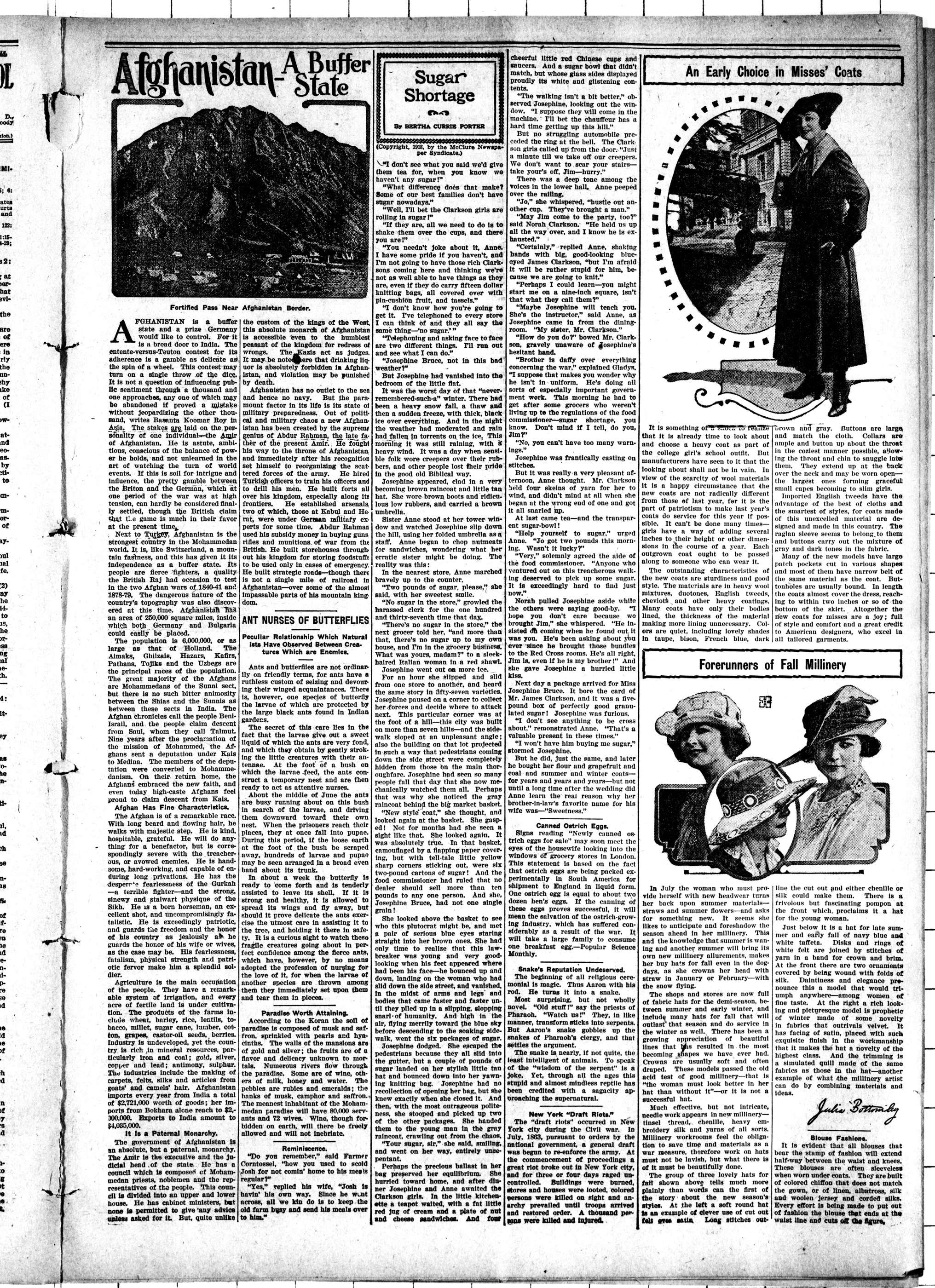
Afghanistan-A Buffer State
THE MOUNTAIN
Fortified Pass Near Afghanistan Border.
AFGHANISTAN is a buffer state and a prize Germany would like to control. For it is a broad door to India. The entente-versus-Teuton contest for its adherence is a gamble as delicate as the spin of a wheel. This contest may turn on a single throw of the dice. It is not a question of influencing public sentiment through a thousand and one approaches, any one of which may be abandoned if proved a mistake without jeopardizing the other thousand, writes Basantun Koomar Roy in Asia. The stakes are laid on the personality of one individual—the Amir of Afghanistan. He is astute, ambitious, conscious of the balance of power he holds, and not unlearned in the art of watching the turn of world events. If this is soil for intrigue and influence, the pretty gamble between the Briton and the German, which at one period of the war was at high tension, can hardly be considered finally settled, though the British claim that the game is much in their favor at the present time.
Next to Turkey, Afghanistan is the strongest country in the Mohammedan world. It is, like Switzerland, a mountain fastness, and this has given it its independence as a buffer state. Its people are fierce fighters, a quality the British Raj had occasion to test in the two Afghan wars of 1840-41 and 1878-79. The dangerous nature of the country's topography was also discovered at this time. Afghanistan has an area of 250,000 square miles, inside which both Germany and Bulgaria could easily be placed.
The population is 6,000,000, or as large as that of Holland. The Aimaks, Ghilzals, Hazars, Kafirs, Pathans, Toljiks and the Uzbegs are the principal races of the population. The great majority of the Afghans are Mohammedans of the Sunni sect, but there is no such bitter animosity between the Shias and the Sunnis as between these sects in India. The Afghan chronicles call the people BenIsrail, and the people claim descent from Saul, whom they call Talmut. Nine years after the proclamation of the mission of Mohammed, the Afghans sent a deputation under Kais to Medina. The members of the deputation were converted to Mohammedanism. On their return home, the Afghans embraced the new faith, and even today high-caste Afghans feel proud to claim descent from Kais.
Aghan Has Fine Characteristics.
The Afghan is of a remarkable race. With long beard and flowing hair, he walks with majestic step. He is kind, hospitable, grateful. He will do anything for a benefactor, but is correspondingly severe with the treacherous, or avowed enemies. He is handsome, hard-working, and capable of enduring long privations. He has the desperse fearlessness of the Gurkah—a terrible fighter—and the strong, sinewy and stalwart physique of the Silkh. He is a born horseman, an excellent shot, and uncompromisingly fatalistic. He is exceedingly patriotic, and guards the freedom and the honor of his country as jealously as he guards the honor of his wife or wives, as the case may be. His fearlessness, fatalism, physical strength and patriotic fervor make him a splendid soldier.
Agriculture is the main occupation of the people. They have a remarkable system of irrigation, and every acre of fertile land is under cultivation. The products of the farms include wheat, barley, rice, lentils, tobacco, millet, sugar cane, lumber, cotton, grapes, castor-oil seeds, berries. Industry is undeveloped, yet the country is rich in mineral resources, particularly iron and coal; gold, silver, copper and lead; antimony, sulphur. The industries include the making of carpets, felts, silks and articles from goats' and camels' hair. Afghanistan imports every year from India a total of $2,721,000 worth of goods; her imports from Bokhara alone reach to $2,000,000. Exports to India amount to $4,035,000.
It Is a Paternal Monarchy.
The government of Afghanistan is an absolute, but a paternal, monarchy. The Amir is the executive and the judicial head of the state. He has a council which is composed of Mohammedan priests, noblemen and the representatives of the people. This council is divided into an upper and lower house. He has cabinet ministers, but none is permitted to give any advice unless asked for it. But, quite unlike
the custom of the kings of the West. this absolute monarch of Afghanistan is accessible even to the humblest peasant of the kingdom for redress of wrongs. The Kazis act as judges. It may be noted here that drinking liquor is absolutely forbidden in Afghanistan, and violation may be punished by death.
Afghanistan has no outlet to the sea and hence no navy. But the paramount factor in its life is its state of military preparedness. Out of political and military chaos a new Afghanistan has been created by the supremely genius of Abdur Rahman, the late father of the present Amir. He fought his way to the throne of Afghanistan, and immediately after his recognition set himself to reorganizing the scattered forces of the army. He hired Turkish officers to train his officers and to drill his men. He built forts all over his kingdom, especially along its frontiers. He established arsenals, two of which, those at Kabul and Herat, were under German military experts for some time. Abdur Rahman used his subsidy money in buying guns rifles and munitions of war from the British. He built storehouses through out his kingdom for storing foodstuffs to be used only in cases of emergency. He built strategic roads—though there is not a single mile of railroad in Afghanistan—over some of the almost impassable parts of his mountain kingdom.
ANT NURSES OF BUTTERFLIES
Peculiar Relationship Which Natural Ists Have Observed Between Creatures Which are Enemies.
Ants and butterflies are not ordinarily on friendly terms, for ants have a ruthless custom of seizing and devouring their winged acquaintances. There is, however, one species of butterfly the larvae of which are protected by the large black ants found in Indian gardens.
The secret of this care lies in the fact that the larvae give out a sweet liquid of which the ants are very fond, and which they obtain by gently stroking the little creatures with their antennae. At the foot of a bush on which the larvae feed, the ants construct a temporary nest and are then ready to act as attentive nurses.
About the middle of June the ants are busy running about on this bush in search of the larvae, and driving them downward toward their own nest. When the prisoners reach their places, they at once fall into pupae. During this period, if the loose earth at the foot of the bush be scraped away, hundreds of larvae and pupae may be seen arranged in a broad even band about its trunk.
In about a week the butterfly is ready to come forth and is tenderly assisted to leave its shell. If it is strong and healthy, it is allowed to spread its wings and fly away, but should it prove delicate the ants exercise the utmost care in assisting it to the tree, and holding it there in safety. It is a curious sight to watch these fragile creatures going about in perfect confidence among the fierce ants, which have, however, by no means adopted the profession of nursing for the love of it, for when the larvae of another species are thrown among them they immediately set upon them and tear them in pieces.
Paradise Worth Attaining.
According to the Koran the soil of paradise is composed of musk and saffron, sprinkled with pearls and hyacinths. The walls of the mansions are of gold and silver; the fruits are of a flavor and delicacy unknown to mortals. Numerous rivers flow through the paradise. Some are of wine, others of milk, honey and water. The pebbles are rubles and emeralds; the banks of musk, camphor and saffron. The meanest inhabitant of the Mohammedan paradise will have 80,000 servants and 72 wives. Wine, though forbidden on earth, will there be freely allowed and will not inebrate.
Reminiscence.
"Do you remember," said Farmer Corntossel, "how you used to scold Josh for not comin' home to his mess is regular?"
"Yes," replied his wife, "Josh is havin' his own way. Since he wont across, all we kni do is to keep the old farm busy and send his meals over to him."
Sugar
Shortage
BY BERTHA CURRIE PORTER
(Copyright, 1918, by the McClure Newspaper Syndicate.)
"I don't see what you said we'd give them tea for, when you know we haven't any sugar!"
"What difference does that make? Some of our best families don't have sugar nowadays."
"Well, I'll bet the Clarkson girls are rolling in sugar!"
"If they are, all we need to do is to shake them over the cups, and there you are!"
"You needn't joke about it, Anne. I have some pride if you haven't, and I'm not going to have those rich Clark-sons coming here and thinking we're not as well able to have things as they are, even if they do carry fifteen dollar knitting bags, all covered over with pin-cushion fruit, and tassels."
"I don't know how you're going to get it. I've telephoned to every store I can think of and they all say the same thing—'no sugar.'"
"Telephoning and asking face to face are two different things. I'll run out and see what I can do."
"Josephine Bruce, not in this bad weather?"
But Josephine had vanished into the bedroom of the little flat.
It was the worst day of that "neverremembered-such-a" winter. There had been a heavy snow fall, a thaw and then a sudden freeze, with thick, black ice over everything. And in the night the weather had moderated and rain had fallen in torrents on the ice. This morning it was still raining, with a heavy wind. It was a day when sensible folk wore creepers over their rubbers, and other people lost their pride in the good old Biblical way.
Josephine appeared, clad in a very becoming brown raincoat and little tan hat. She wore brown boots and ridiculous low rubbers, and carried a brown umbrella.
Sister Anne stood at her tower window and watched Josephine slip down the hill, using her folded umbrella as a staff. Anne began to chop nutmeats for sandwiches, wondering what her erratic sister might be doing. The reality was this:
In the nearest store, Anne marched bravely up to the counter.
"Two pounds of sugar, please," she said, with her sweetest smile.
"No sugar in the store," growled the harrassed clerk for the one hundred and thirty-seventh time that day.
"There's no sugar in the store," the next grocer told her, "and more than that, there's no sugar up to my own house, and I'm in the grocery business. What was yours, madam?" to a sleek-haired Italian woman in a red shawl. I Josephine went out on more ice.
Josephine were out to the more rec. For an hour she slipped and slid from one store to another, and heard the same story in fifty-seven varieties. Josephine paused on a corner to collect her forces and decide where to attack next. This particular corner was at the foot of a hill—this city was built on more than seven hills—and the sidewalk sloped at seven an unpleasant angle; also the building on that lot projected in such a way that pedestrians coming down the side street were completely hidden from those on the main thoroughfare. Josephine had seen so many people fall that day that she now mechanically watched them all. Perhaps that was why she noticed the gray raincoat behind the big market basket.
"New style coat," she thought, and looked again at the basket. She gasped! Not for months had she seen a sight like that. She looked again. It was absolutely true. In that basket, camouflaged by a flapping paper covering, but with tell-tale little yellow sharp corners sticking out, were six two-pound cartons of sugar! And the food commissioner had ruled that no dealer should sell more than ten pounds to any one person. And she, Josephine Bruce, had not one single grain!
She looked above the basket to see who this plutocrat might be, and met a pair of serious blue eyes staring straight into her brown ones. She had only time to realize that this lawbreaker was young and very good-looking when his feet appeared where had been his face—he bounced up and down, landing on the woman who had slid down the side street, and vanished, in the midst of arms and legs and bodies that came faster and faster until they piled up in a slipping, slopping snarl of humanity. And high in the air, flying merrily toward the blue sky before descending to the soaking sidewalk, went the six packages of sugar.
Josephine dodged. She escaped the pedestrians because they all slid into the gutter, but a couple of pounds of sugar landed on her stylish little tan hat and bounced down into her yawning knitting bag. Josephine had no recollection of opening her bag, but she knew exactly when she closed it. And then, with the most outrageous politeness, she stooped and picked up two of the other packages. She handed them to the young man in the gray raincoat, crawling out from the chaos, "Your sugar, sir," she said, smiling, and went on her way, entirely unrepentant.
Perhaps the precious ballast in her bag preserved her equilibrium. She hurried toward home, and after dinner Josephine and Anne awaited the Clarkson girls. In the little kitchenette a teapot waited, with a fat little red jug of cream and a plate of nut and cheese sandwiches. And four
cheerful little red Chinese cups and saucers. And a sugar bowl that didn't match, but whose glass sides displayed proudly its white and glistening contents.
"The walking isn't a bit better," observed Josephine, looking out the window. "I suppose they will come in the machine. I bet the chauffeur has a hard time getting up this hill."
But no struggling automobile preceded the ring at the bell. The Clarkson girls called up from the door. "Just a minute till we take off our creepers. We don't want to scar your stairs—take your's off, Jim—hurry."
There was a deep tone among the volces in the lower hall. Anne peeped over the railing.
"Jo," she whispered, "hustle out another cup. They've brought a man."
"May Jim come to the party, too?" said Norah Clarkson. "He held us up all the way over, and I know he is exhausted."
"Certainly," replied Anne, shaking hands with big, good-looking blueyed James Clarkson. "but I'm afraid it will be rather stupid for him, because we are going to knit."
"Perhaps I could learn—you might start me on a nine-inch square, isn't that what they call them?"
"Maybe Josephine will teach you. She's the instructor," said Anne, as Josephine came in from the diningroom. "My sister, Mr. Clarkson."
"How do you do?" bowed Mr. Clarkson, gravely unaware of Josephine's hesitant hand.
"Brother is daffy over everything concerning the war," explained Gladys, "I suppose that makes you wonder why he isn't in uniform. He's doing all sorts of especially important government work. This morning he had to get after some grocers who weren't living up to the regulations of the food commissioner—sugar shortage, you know. Don't mind if I tell, do you, Jim?"
"No, you can't have too many warnings."
Josephine was frantically casting on stitches.
But it was really a very pleasant afternoon, Anne thought. Mr. Clarkson held four skeins of yarn for her to wind, and didn't mind at all when she began at the wrong end of one and got it all snarled up.
At last came tea—and the transparent sugar-bowl!
"Help yourself to sugar," urged Anne. "Jo got two pounds this morning. Wasn't it lucky?" "Very," solemnly agreed the aide of the food commissioner. "Anyone who ventured out on this treacherous walking deserved to pick up some sugar. It is exceedingly hard to find just now." Norah pulled Josephine aside while the others were saying good-by. "I hope you don't care because we brought Jim," she whispered. "He insisted on coming when he found out it was you. He's been asking about you ever since he brought those bundles to the Red Cross rooms. He's all right, Jim is, even if he is my brother!" And she gave Josephine a hurried little kiss.
Next day a package arrived for Miss Josephine Bruce. It bore the card of Mr. James Clarkson, and it was a five-pound box of perfectly good granulated sugar! Josephine was furious, "I don't see anything to be cross about," remonstrated Anne. "That's a valuable present in these times." "I won't have him buying me sugar," stormed Josephine.
But he did, just the same, and later he bought her flour and grapefruit and coal and summer and winter coats—for years and years and years—but not until a long time after the wedding did Anne learn the real reason why her brother-in-law's favorite name for his wife was—"Sweetness."
Canned Ostrich Eggs
Signs reading "Newly canned ostrich eggs for sale" may soon meet the eyes of the housewife looking into the windows of grocery stores in London. This statement is based on the fact that ostrich eggs are being packed experimentally in South America for shipment to England in liquid form. One ostrich egg is equal to about two dozen hen's eggs. If the canning of these eggs proves successful, it will mean the salvation of the ostrich-growing industry, which has suffered considerably as a result of the war. It will take a large family to consume one breakfast egg—Popular Science Monthly.
Snake's Reputation Undeserved.
The beginning of all religious ceremonial is magic. Thus Aaron with his rod. He turns it into a snake.
Most surprising, but not wholly novel. "Old stuff!" say the priests of Pharaoh. "Watch us!" They, in like manner, transform sticks into serpents. But Aaron's snake gobbles up the snakes of Pharaoh's clergy, and that settles the argument.
The snake is nearly, if not quite, the least intelligent of animals. To speak of the "wisdom of the serpent" is a joke. Yet, through all the ages this stupid and almost mindless reptile has been credited with a sagacity approaching the supernatural.
New York "Draft Riots."
The "draft riots" occurred in New York city during the Civil war. In July, 1863, pursuant to orders by the national government, a general draft was begun to re-enforce the army. At the commencement of proceedings a great riot broke out in New York city, and for three or four days raged uncontrolled. Buildings were burned, stores and houses were looted, colored persons were killed on sight and anarchy prevailed until troops arrived and restored order. A thousand persons were killed and injured.
A
33
It is something of a shock to realize that it is already time to look about and choose a heavy coat as part of the college girl's school outfit. But manufacturers have seen to it that the looking about shall not be in vain. In view of the scarcity of wool materials it is a happy circumstance that the new coats are not radically different from those of last year, for it is the part of patriotism to make last year's coats do service for this year if possible. It can't be done many times—girls have a way of adding several inches to their height or other dimensions in the course of a year. Each outgrown coat ought to be passed along to someone who can wear it.
The outstanding characteristics of the new coats are sturdiness and good style. The materials are in heavy wool mixtures, duotones, English tweeds, cheviots and other heavy contours. Many coats have only their bodies lined, the thickness of the material making more lining unnecessary. Colors are quiet, including lovely shades in taupe, bison, French blue, dark
Forerunners o
In July the woman who must provide herself with new headwear turns her back upon summer materials—straws and summer flowers—and asks for something new. It seems she likes to anticipate and foreshadow the season ahead in her millinery. This and the knowledge that summer is waning and another summer will bring its own new millinery allurements, makes her buy hats for fall even in the dogdays, as she crowns her head with straw in January or February—with the snow flying.
The shops and stores are now full of fabric hats for the demi-season, between summer and early winter, and include many hats for fall that will outlast that season and do service in the winter as well. There has been a growing appreciation of beautiful lines that has resulted in the most becoming shapes we have ever had. Crowns are usually soft and often draped. These models passed the old acid test of good millinery—that is "the woman must look better in her hat than without it"—or it is not a successful hat.
Much effective, but not intricate, needle work appears in new millinery—tinsel thread, chenille, heavy embroidery silk and yarns of all sorts. Millinery workrooms feel the obligation to save time and materials as a war measure, therefore work on hats must not be lavish, but what there is of it must be beautifully done.
The group of three lovely hats for fail shown above tells much more plainly than words can the first of the story about the new season's styles. At the left a soft round hat is an example of clever use of cut out felt green satin Long stitches out-
grown and gray. Buttons are large and match the cloth. Collars are ample and button up about the throat in the coziest manner possible, allowing the throat and chin to snuggle into them. They extend up at the back over the neck and may be worn open—the largest ones forming graceful small capes becoming to slim girls. Imported English tweeds have the advantage of the best of cloths and the smartest of styles, for coats made of this unexcelled material are designed and made in this country. The raglan sleeve seems to belong, to them and buttons carry out the mixture of gray and dark tones in the fabric.
Many of the new models have large patch pockets cut in various shapes and most of them have narrow belt of the same material as the cont. Buttonholes are usually bound. In length the coats almost cover the dress, reaching to within two inches or so of the bottom of the skirt. Altogether the new coats for misses are a joy; full of style and comfort and a great credit to American designers, who excel in all tailored garments.
Fall Millinery
line the cut out and either chenille or silk could make them. There is a frivolous but fascinating pompon at the front which, proclaims it a hat for the young woman.
Just below it is a hat for late summer and early fall of navy blue and white taffeta. Disks and rings of white felt are joined by stitches of yarn in a band for crown and brim. At the front there are two ornaments covered by being wound with folds of silk. Daintiness and elegance pronounce this a model that would triumph anywhere—among women of fine taste. At the right a rich looking and picturesque model is prophetic of winter made of some novelty in fabrics that outrivals velvet. It has facing of satin, placed with such exquisite finish in the workmanship that it makes the hat a novelty of the highest class. And the trimming is a simulated quill made of the same fabrics as those in the hat—another example of what the millinery artist can do by combining materials and ideas.
Julia Bottomly
Blouse Fashions.
It is evident that all blouses that bear the stamp of fashion will extend half-way between the waist and knees. These blouses are often sleeveless when worn under coats. They are built of colored chiffon that does not match the gown, or of linen, albatross, silk and woolen jersey and corded silks. Every effort is being made to put out of fashion the blouse that ends at the waist line and cuts off the figure.
PUBLISHED EVERY FRIDAY BY
CHARLES SUMNER SMITH,
Minneapolis, Minnesota.
Entered in the Post Office at Minneapolis as second class matter.
MEMBER
NATIONAL NEGRO PRESS
ASSOCIATION
Subscription by Mail, Postpaid.
ONE YEAR .....$2.00
SIX MONTHS .....$125
THREE MONTHS ......65
ADVERTISING RATES.
One Inch—1 Inscription—One Dollar.
Liberal discount given on 3, 6, 9,
Months, or 1 year contracta.
We do not run free ads, or over-run the time contracted for by our advertisers. We respect their right to advertise at intervals, and rather have them do so, than to run continuously an "adv." and an increasing account. Write all Checks payable to
THE TWIN CITY STAR
1317 North Sixth Ave.
MINNEAPOLIS - MINNESOTA
Call at 1317 6th Ave. N. on Wednesday to insure matter for publication.
The Star's Phone, Hyland 1205.
Send, your subscription. Our prices have not changed because of the war. Let your dollar do its duty and The Star will reach a higher standard of service and better circulation.
```markdown
```
"THE REPUBLICAN PARTY IS THE SHIP; ALL ELSE IS THE SEA," said Frederick Douglass. Now is the most important time for Negroes to stand by the old party of Lincoln and Grant.
Keep Minnesota a Republican State.
HOME GUARD FRICICTION.
The Home Guard as an organization is a valuable asset to our state's military forces and a credit to our race. We regret to say, that like the organizations of the white companies, the usual friction has developed. There is among the Negroes a desire of some to outrank their superiors, and the proper discipline has not been maintained. Instead of supporting each other to make the entire,outfit an efficient organization, there is a spirit among a few to be insubordinate to such an extent that progress is hindered.
Efforts are being made to make it unpleasant for those who have the responsibilities of organization in order that the agitators might succeed in command. Whether this is pro-German propaganda, or a natural desire on the part of those to climb over the corpses of their fellows to secure official prominence, is a question which will be answered none too soon. A spirit of harmony and tolerance should prevail. The time given to criticism and gossip could be better used for instruction, so badly needed.
The Home Guard is a permanent organization, but some men and officers have unwillingly separated themselves from it. it is time for Negroes to learn that discipline in all military branches at this time, whether state or federal, is compulsory and violations are punishable. Restricting the progress of any organization to aid the nation in this war, is a federal crime. Although some are innocent of such intent, they are ignorant tools of the underlying forces at home, for which Home Guards are authorized to destroy in order that all citizens shall be protected.
COLORED NURSES TO BE USED IN ARMY CAMPS
Orders Issued by War Department Makes Opening for Hundreds at Six Base Hospitals in This Country—Many May Go Overseas.
Washington, D. C., July 22, 1918.—The War Department authorizes the following statement from Emmet J. Scott, special assistant to the Secretary of War:
"Orders were issued today by the War Department to the office of the Surgeon General, which will enable colored nurses who have been registered by the American Red Cross Society, to render service for their own race in the Army. Colored nurses will be assigned to the base hospitals now established at Camp Funston, Fort Riley, Kansas; Camp Grant, Rockford, Illinois; Camp Dodge, Des Moines, Iowa; Camp Taylor, Louisville, Ky.; Camp Sherman, Chillicothe, Ohio, and Camp Dix, Wrightstown, N. J. At these camps a total of about 38,000 colored troops are stationed. General Pershing has been asked by cable whether the services of colored nurses can be utilized to advantage among the American
The military authorities intend to push the enlist or work campaign among the Negroes. There are many soldiers who have no lawful means of support. They will be drafted into the industrial army. Get work, gentlemen of leisure, even if as a side line.
HALE, THE HUN,
is very busy with his drop-letter system submarine service, asking for the investigation of somebody.
The annual encampment of the Veterans of Foreign Wars was held in this city this week, and the sessions were in every way inspiring to all who attended. The parades, entertainments and publicceptions showed the patriotic spirit of our citizens. The visiting delegates were appreciative of the hospitality shown them, and loud in their praises of the beauty and progress of the Northwest. Gov. Burnquist and other prominent speakers addressed the veterans. Now that our country is engaged in another foreign war, the membership of the organization is incomprehensible, and millions of members may be added to it within a few years. There was a grand reunion, and although only two Negroes took part in the parades and program (Comrade Henderson of 24th U. S. Vol. Inf., and Editor Chas. Sumner Smith), there was an invitation extended them by Commander Allen and Executive Secretary Jack J. Shauer, of Patterson Post, to join the order. The latter was elected Junior Vice Commander-in-Chief at this session.
Smith Did Not Postit.
The statement in the Minneapolis Journal that "Favorable action was taken on the petition of Chas. S. Smith, Minneapolis, representing the Negro veterans, to create a subsidiary post in Minneapolis for Negro Veterans of Foreign Wars," was incorrectly reported. Editor Smith, one of the speakers at the West Hotel smoker, approved of the post, which had been suggested by some Negro veteran and had been talked of by the committee. He said that he would assist in the organization, but could not take active part officially. As captain of a company of Negro Home Guards and an advocate for Negro officers' training camps and other racial units to show their united service and strength, he favored the suggestion for a Negro post. However, there is no provision denying a Negro the right to membership in any post. The Robt. E. Bell Post, G. A. R., and Co. L of the 6th Mass. Inf., now in the National Army, and the fighting Negro units of today are examples of racial organization. They stand out as models of the merits of Negro soldiers, while if indiscriminately recruited, our racial identity and honor would be a matter of conjecture rather than a proven fact.
A DISTINGUISHED VISITOR.
Miss Hallie Q. Brown spoke at St. Peter's A. M. E. church on Sunday night. Madame Jean Hodgers sang two beautiful solos. Miss Brown is a logical speaker and her lecture was heartily received. Editor Smith arranged for her appearance, and although short notice was given, a full house greeted her. Her theme was "The Value of Power" and she showed the wonderful opportunities and privileges given all people of the present age. Miss Brown opened the Sub-Annual Conference, held this week at St. Peter's church. She represented Bishop Coppin, who could not appear. Despite her arduous duties at Wilberforce University, she is completing her summer tour, en route from Denver, where she attention the National Convention of Colored Women's Clubs. She made the most inspiring address at the exercises for the drafted Negroes in St. Paul on Aug. 1. Miss Brown is one of our oldest elocutionists and among the front rank of public speakers. Having visited abroad, she is familiar with foreign customs. Her prophecies of the Negro's condition after the war are based on an economic analysis, founded on Biblical record and religious faith. To those who heard her, she revealed a glorious future for all humanity, as a result of this war.
We have never known two injustices to make anything right. The Saturday News has prospered by being as just to the white man as it has ever been to the Negro. We have never gone off half-cooked upon any proposition. Whenever we grope, we are in search of the truth. We want to be right and avoid as nearly as possible being wrong. We are not for the Negro right or wrong. We want him to be right. We complain because a majority of white people will always side with a white man when a question arises between him and one of our color; still certain colored newspapers, without making any investigation whatsoever as to the evidence, would have the entire Negro race do identically what they condemn the white people for doing. Because the white people do wrong is no reason why the Negroes should do wrong. The best preparedness to receive justice is to be just yourself. —Hopkinsville (Ky.) Nows.
We are living in an age and an epoch which is characterized by a growing and insistent demand for justice and democracy. The United States is sending men, money and militations to the battle fields of Europe as its demand for justice, freedom and equality of opportunity for all peoples, and it would be well for the Americans at this time to remember that here in our own country for the past fifty years abuse the abolition of slavery, is a race loyal, patriotic people who are not enjoying at the hands of this government here at home the principles of that democracy for which we are fighting to make the world safe, and in which fight God helping us, we will be victorious.
W. T. FRANCIS
Let us not draw the color line. Reciprocity between the races will be the salvation of the Negro.
ADVERTISE IN THE STAR
THE TWIN CITY STAR, MINNEAPOLIS, MINN.
REVISED TEN COMMANDMENTS
1. Into him who removeth a guard shall rest be given from his labors.
2. If thou thinkest "Safety First," thou thinketh well, for unto thee is given the power to think properly.
3. If in the midst of thy labors thou givest counsel to fellow workmen regarding dangers, thou hast kept the Golden Rule—"Safety First."
4. He that sneereth at safety improvements laggeth behind in the march of progress. To him all men turneth the cold shoulder.
5. To him that looketh to the future and thinketh "Safety First," all shall be given—eyes to see, hands to labor, ears to hear, limbs to speed him on his way—health to perform his daily tasks.
6. Of him that endangereth his fellow workmen knowingly an example shall be made—he shall be removed from the honor roll, and the pay roll.
7. Unto thee is given sight. Close not the windows of thy soul, nor lose the beauties of nature by falling to wear goggles.
9. By-paths that wander off into No Man's Land shalt thou avoid, but follow the straight path of "Safety First" to success.
10. Allow thy Safety Light to shine and hide it not beneath thy cloak—one single ray may pierce the gloom, changing the entire world for thy fellow men.—Safety Engineering.
FLASHLIGHTS
About all some men have succeeded in doing in this world is to die rich.
Love is a divine attribute, but somehow or other we can't understand how any decent man can do anything but hate the kaiser.
The reason some men seem to get more fun out of this life than others is because they don't try to hang onto every nickel they get.
A man may be a born leader, but it is also true that that fact is never discovered until he has fully demonstrated his ability to be a good fellow.
We can't understand, when this war is over, how any man is going to be able to brag to the one-armed or one-legged American soldier about the money he has saved.
One of the first discoveries a bride makes about her husband is that he can't find anything that she has put away in a bureau drawer even when it is right under his nose.
AROUND THE WORLD
Paris is to have underground theaters.
Pennsylvania restricts carrying pistols.
Mexican soldiers are eating burro meat.
London prohibits confetti to save paper.
Norway will eat whale fat during the war.
Guatemala earthquake refugees are swarming into Mexico destitute.
New Zealand's tunnel under South Island, five miles long, is nearing completion.
ABOUT PERSONS
Mrs. J. C. Barry of Brockton, Mass. has 22 kinsmen in American war forces.
Mrs. Elmer Enger, a Miller, S. D. Indian squaw, has contributed a son to the army.
John Burroughs, aged naturalist, says his motto is: "Keep cheerful and mind your own business."
Representative T. D. Schall of Minneapolis, says: "There are no questions that can be settled until the war is over."
BY THE OFFICE SAGE
Sometimes a plain cook is quite pretty.
A wise man never considers a woman's age.
The difference between see and saw is intense.
Dignity may stoop to conquer, but it never grovels in the dust.
A gratulous falsehood is probably one that gives itself away.
Don't think that because a corporation has no soul it is on its uppers.
True friends should be selected because of the good looks they haven't got.
We own what we love. The world is his who has eyes to see.
A man's life is felt in proportion to the character it contains.
He discovers the force of the moral law who violates its principles.
The principle of affinity is at the root of taste, affection, aspiration and ideal.
Pure and abiding pleasures come to me not from material things but from myself.
No man is demeaned by the nature of his work, but by his attitude toward it.
The wild rose is tinted as delicately in a hidden vale as in the garden of the rich.
The definition of wealth is taste. The soul sets up its own mansions and the lover of beauty is never poor.
The Next Big Thing! IS THE JOINT
The length of the war will not be measured, by the golden rule.
Millionaires caught in the draft are not necessarily soldiers of fortune.
Hoch the kaiser? Might just as well; we have every other country in hock.
'Sfunny, but the rolling stones are the ones who don't take a tumble to themselves.
The kaiser is fighting on a large front and putting up a bigger one to his people.
Just because the soldiers do a bit of hiking is no reason to believe the war will be a walkover.
Can't buy sugar in the city—don't get any in the army—somebody's playing a sweet trick on the government.
The citizen looks forward to the end of the war, but the soldier looks forward to the end of the month—Pay day.
The Members of the Patriarchy, led by the 16th Battalion Band of 40 pieces, will parade from the Old Capitol to the Boat.
What is bred in the bone will never come out of the flesh.—The Two Fishermen.
There is no gathering the rose without being pricked by the thorns.—The Two Travelers.
It has been the providence of nature to give this creature (the cat) nine lives instead of one.—The Greedy and Ambitious Cat.
T. E. Frank
J. C. Treva
Noal S Floor Man man Refre Winstead,
PATRIARCHY COMMITTEE
T. E. Franklin, Chairman; C. H. Jackson, James R. Riley, James A. Lynn, John McAdams, A. Jones, Secretary; J. B. Johnson, Treasurer.
BAND COMMITTEE
J. C. Trevan, Chairman; F. H. Greeves, Wm. Moden, Howard Curry, Clarence Gellss, James Burkes, J. H. Burt.
Noal Stone, Manager Minneapolis Patriarchy Division; John T. Claiborne, Floor Manager; E. A. Hatton, Chairman Ticket Committee; Ross Dean, Chairman Refreshment Committee; Prof. W. H. Howard, Music Director; Arthur Winstead, General Manager.
TICKETS
BOAT LEAVES THE FOOT OF JACKSON STREET AT 8:30 P. M. SHARP.
---
Christianity never failed on a personal test.
New and fresh opportunities spring up as roses do around us.
The tragedy of life is not death, but the prostitution of the soul.
Though it be but a poor candle, I must live by.my own light—I am content you should also live by your own candle.—Exchange.
WITH THE SAGES
It is better to be nobly remembered than nobly born.—Ruskin.
Our distinctions do not lie in the places we occupy, but in the grace and dignity with which we fill them.—Slimms.
Reproof is a medicine like mercury or opium; if it be improperly administered, it will do harm instead of good.—Horace Mann.
Posttiveness is a most absurd folble. If you are in the right, it lessens your triumph; if in the wrong, it adds shame to your defeat.—Sterne.
No man can ever be noble who thinks meanly or contemptuously of himself, and no man can ever be noble who thinks first and only of himself.—W. H. Dollinger.
Aim at perfection in everything, though in most things it is unattainable. However, they who aim at it, and persevere, will come much nearer to it than those whose laziness and despondency make them give it up as unattainable. -Chesterfield.
SERVICE SNAPS
PILPAY'S SAYINGS
Men are used as they use others.—
The King Who Became Just.
We ought to do our neighbor all the good we can. If you do good, good will be done to you; but if you do evil, the same will be measured back to you again.—Dabschelin and Pilpay.
SAYS THE OWL
Many a man's popularity is due to what he doesn't say.
It's seldom the widow's fault if she remains inconsolable.
When a woman eats pickles she is in love—with the pickles.
A man's wealth brings him a lot of unhappiness if he loses it.
Never cry over spilled milk. There is enough water wasted as it is.
```markdown
```
A
```markdown
```
The Next IS THE MOONLIGHT TO BE GIVEN
MOONLIGHT EXCURSION
SAINT PAUL PATRIARCHY 114
G. U. O. O. O.
AND
16TH BATTALION BAND, MINNESOTA HON
ON THE BIG PALATIAL STEAMER
RED WING AND BARGE MANITO
Tuesday Eve., Au
The Members of the Patriarchy, led by the 16th Battalion
will parade from the Old Capitol to the
G.U.O.O.F.
AND
16TH BATTALION BAND, MINNESOTA HOME GUARDS
ON THE BIG PALATIAL STEAMER
RED WING AND BARGE MANITOU
Tuesday Eve., Aug. 20
DANCING BEGINNING PROMPTLY AT 8:30.
PATRIARCHY COMMITTEE
T. E. Franklin, Chairman; C. H. Jackson, James R. Riley, James McAdams, A. Jones, Secretary; J. B. Johnson, Treas.
BAND COMMITTEE
F. C. Trevan, Chairman; F. H. Greeves, Wm. Moden, Howard Geliss, James Burkes, J. H. Burt.
Noal Stone, Manager Minneapolis Patriarchy Division; John Floor Manager; E. A. Hatton, Chairman Ticket Committee; Ronman Refreshment Committee; Prof. W. H. Howard, Music D. Winstead, General Manager.
Office Phones—Main 2869; Auto 36774. Dining Room—Main 2831.
Twenty Elegant Steam-Heated and Electric Lighted Rooms.
A la Carte Meals at All Hours—Popular Prices.
246-250 FOURTH AVE. S., MINNEAPOLIS, MINN. Private Dining and Reception Room for Ladies. Special Temperance Bevcrages. Men's Buffet and Grill; Billiards; Barber Shop in Connection.
THE only way America can increase the world's supply of food is by the use of more labor-saving machinery. We have land enough but lack of labor is the limiting factor; so more uptodate farm machinery must be put at work to take the place of the farm laborers we simply cannot get.
There is only one machine power recruiting station in all this community where the steel workmen needed to increase crop yields can be found. The only place where new types and models of farm machinery can be compared by you for purchase is at the Minnesota State Fair September 2 to 7.
Big Thing!
POINT
EXCURSION
DESIGN BY
O. O. F.
MINNESOTA HOME GUARDS
FINAL STEAMER
ARGE MANITOU
e., Aug. 20
the 16th Battalion Band of 40 pieces,
and Capitol to the Boat.
COMMITTEE
James R. Riley, James A. Lynn, Johns
J. B. Johnson, Treasurer.
COMMITTEE
Wm. Moden, Howard Curry, Clarence
Ss, J. H. Burt.
Triarchy Division; John T. Claiborne,
Ticket Committee; Ross Dean, Chair-
H. Howard, Music Director; Arthur
50 CENTS
IMPORTANT NOTICE
Unless notes are written plainly and properly arranged they will not be inserted. Many people send in notes regardless of names, initials or composition. Arrangement by the publisher will be charged for. Free notices must be correctly written.
Mr. Bert Ellis returned last week from Lawrence, Kan., where he visited his father, Benj. Ellis, and his sister, Mrs. Eva French. While there he assisted at the entrainment of the second draft, an account of which appeared in the Lawrence Daily Journal. Returning he visited Sergt. G. H. Fortner at Camp Dodge, and friends in Kansas City.
A LEGAL HOLD-UP
Atty. W. T. Francis of St. Paul left Wednesday for Decorah, la., on legal business. He went to take legal action against a circus. All interested parties are white.
SHERWOOD ELECTED GRAND
COMMANDER OF
Maj. Jose H. Sherwood of the 16th Battalion, Minnesota Home Guards, was elected Grand Commander of the Knights Templar, Missouri jurisdiction, at the session in Marshall, Mo. this week. He is expected home next week, spending a few days at Camp Dodge and Kansas City.
DEATH OF JOHN CHEATHAM.
The news of the death of ex-Capt. John Cheatham, veteran fireman, was announced last Thursday. The funeral will be held Saturday. Mr. Cheatham has been ill several weeks.
MASONS TO ENTERTAIN
THE GRAND LODGE
The Men's Club will entertain the State Grand Lodge on August 20, at Masonic Hall, 24th St. and 5th Ave. So. Watch for program.
Mr. and Mrs. W. J. Grimes have moved to 1601 Portland ave.
Rev. John Eliot Allen, of the Second Baptist church, Hutchinson, Kan., is filling the pulpit at the Pilgrim Baptist church. He will preach at Bethesda Baptist church in Minneapolis on Sunday next.
Mrs. Josephine Thorton of East Lake street is very ill.
ATTY. MORRIS DENIES
HALE'S STATEMENT
In the issue of June 27, 1918, of the National Advocate the following statement over the signature of Philip F. Hale is unauthorized and untrue:
"If you do not believe what we say, call up Mr. William R. Morris, attorney at law, in the Metropolitan building, and he will tell you that he does not allow the Twin City Star to come into his office, and could not and would not endorse this paper under any circumstances."
(Signed) WM. R. MORRIS.
Phil Hale, after writing a series of libelous articles in the Advocate against-Editor Smith, has asked The Star for a retraction of certain statements recently published. The Editor of The Star will retract when wrong, but those articles about Hale are TRUE, and extremely moderate under the circumstances. Can't retract those statements.
Messrs. Barney Clark and Calvin Lewis returned last week, having fallen in the physical examination for active service.
Mrs. Fred S. Carver, James ave. No., entertained Mr. and Mrs. Eugene Russell of Omaha at dinner Sunday. Covers were laid for eight.
Mr. and Mrs. Eugene Russell of Omaha were visiting guests of her brother, Mr. "Bud" Green and wife during last week. Mrs. Russell is a prominent official of the Afro-American Federation of Women's Clubs.
Mrs. W. B. Walker, 936 St. Anthony ave., is spending a month on a visit to her home in Lexington, Ky.
Mr. and Mrs. Ambrose Glenn have arrived home, after residing in Detroit, Mich., to remain indefinitely. Mrs. Glenn was formerly Miss Melvina Chandler.
Mrs. Florence Johnson and Misses Arlita and Regina Teal, nieces of Mr. and Mrs. Samuel Teal, 3525 4th Ave. So., are visiting their mother, Mrs. Eliza Berryman, in Sparta, Ill.
The Elks' ball on Monday night was not well attended. Not advertised—was the reason.
The billboard display of the movie of "Uncle Tom's Cabin" is a wonderful advancement in lithographic presentation. Those celebrated characters, Uncle Tom and Topsy, are shown in group, with Little Eva in the center. The features of each are uniform. The absence of kinky hair and big lips makes the posters unusually attractive.
Mr. Palmas Jackson arrived this week from Seattle to visit his parents in Kansas before entering the war service, receiving an honorable discharge from Co. D of the 16th Battalion.
SUBSCRIBE NOW.
M. B.
Bert M. Ellis.
NEW FUNERAL DIRECTOR.
Mr. Bert Ellis, a young man of our city, is to be congratulated upon his venture into the business world, as a funeral director. He is well known in the Twin Cities, having worked for several years from bellboy to head bellman at the Minneapolis Athletic Club. He has a good education and he studied embalming, having had former experience in undertaking. He denied himself many of the pleasures of life and used his spare time to perfect himself in his chosen profession. Mr. Ellis is not like most young men of our race, who have started out without financial protection. He has saved enough to purchase a modern funeral outfit, which is a credit to the business men of our race.
Mr. J. E. Bostrom, of Bostrom's Undertaking Co., 3008 South 27th avenue, Minneapolis, heard of the ability of Mr. Ellis, and they became associated in business. Mr. Ellis has an office and every convenience for service in that building.
Mr. Ellis is determined to bring funeral management among our people up to its highest standard. He deserves the patronage and support of those who appreciate his efforts and admire his ambition. He solicits public patronage and depends on his ability to render efficient service, and hopes to satisfy his patrons.
Mr. George Gamble, who left with the draft for Camp Dodge, has been transferred to California. He is an expert mechanic and received one of the highest percentages ever made in that camp.
Mr. Alex Erwin, the ex-professional ball player, was seriously cut by Boyd Francisco in an altercation on 4th Ave, and 18th St. So. on Monday night. He is in the city hospital. His many friends are interested in him and hope for his speedy recovery. Mr. Glover Shull, who was passing in his auto, came to Erwin's rescue and took him to the hospital. The account that it happened in the Porters and Waiters' Club is untrue. Erwin is very popular and well liked generally.
Mr. Chas. H. Robinson, clerk in the office of Boyd Transfer Co., is on his vacation.
CLASSIFIED ADVERTISEMENTS
SEE McDFW! for real estate.
N. W. Nicollet 1534
JOSEPH YOUNG
Loans on Real Estate
and Chattles
818 Metropolitan Life Bldg.
Minneapolis, Minn.
STORE FOR RENT.
Store for rent at 715 Sixth ave. N., in Greenberg's brick building. Store all modern. Steam heat furnished. Building 22x80. Best block on the avenue. Will rent reasonable for desirable business. Inquire at Greenberg's store, or phone Hyland 3947.
FOR RENT.
Two rooms, furnished or unfurnished; suitable for light housekeeping or bedrooms. Mrs. Alice Brower, 2426 5th Ave. So. Call South 4474.
NICE FRONT ROOM For Rent—Suitable for 'two; gentlemen preferred. Snelling and 4th Ave. car lines pass the door; good location; walking distance. Call So. 117 before noon. Mrs. E. A. Mitchell, 1828 4th Ave. So.
MODERN FLAT FOR RENT.
Modern Five Room Flat, 1st floor. Good location; walking distance. Apply J. S. Wright, Main Postoffice. Tel. N. W. 19 W.
EVERY DAY is BARGAIN DAY at the ROOT & HAGEMAN STORE, 407 Nicollet Ave.
NEGRO NURSES WANTED.
Major Jose H. Sherwood, 971 St. Anthony Ave., St. Paul, will be glad to receive the names of any graduate nurses among the colored women. He has been requested to forward such information to proper authorities for the organization of Colored Red Cross workers for overseas service.
Wanted—A live, honest, correspondent and agent. Apply to Twin City Star.
SMOKE THE RELIABLE
SIGHT DRAFT CIGAR
THAT'S ALL!
THE TWIN CITY STAR, MINNEAPOLIS, MINN.
NEWS OF STATE TERSELY TOLD
Recent Happenings In Minnesota Given In Brief Items For
Winona.—Ernest Fedders, aged 10, harrowly escaped serious injury when a street car struck a baggage wagon which the lad was driving. Rochester.—The League of Minnesota Municipalities will hold its annual convention here Oct. 16 and 17, the Armory having secured for the gathering. Mankato.—Struck by a car as she ran out to collect money for the Red Cross social, Beatrice Paine was knocked down in the road, and was bruised and injured. Mankato.—F. W. Bates, city clerk of Mankato for the past seven years, having served under four mayors, has resigned to take up a position with the government as internal revenue inspector.
Virginia.—Although the registration blanks for the United States Student Nurse Reserve corps have been here only a few days, ten girls have already enrolled. Six of these are from Mountain Iron.
St. Cloud—Chairman Fred Schilpin of the war chest committee has announced that subscriptions are now being received at the rate of $4,000 per month, totaling nearly $50,000 a year, the goal originally set.
St. Paul.—St. Paul industries have been awarded a contract for the production of 140,000 tool handles, through the St. Paul war industries board. Wood working plants have pooled their resources to execute the contract.
St. Paul.—Protection from flood for 50,000 acres of hay land located along the upper Mississippi in northern Cass county is asked by A. D. Wilson, Federal food administrator at Washington, and through that body to the war department.
Hastings.—Charles B. Wiederholz, a young farmer living near Miersville, was electrocuted by a bolt of lightning. As he put his hand on a barb wire, lightning struck an iron pole nearby and the current struck through Wiederholz's body.
Virginia.—The Oliver Iron Mining company announced a voluntary increase of 10 per cent in the wages of all employees of the company, effective at once. The action, it was stated at the Virginia office of the company, will affect more than 12,000 persons on the Mesaba iron range.
Hibbing.—The wages of steam shovel operators working for the village in street work and excavating has been fixed at $9.50 a day by the village council. The scale was granted after comparing the wages paid by the various mine properties at Hibbing and the nearby districts.
Grand Rapids.—The contracts have been let for the construction of three rural schools. These are the Horizon school in Bustitown, the Arbo school north of Grand Rapids and the Moose Park school in northwestern Itasca county. They will be schools of oneroom type and will cost between $1,500 and $1,600 each.
St. Paul.—Thomas H. Canfield, secretary of the Minnesota state fair, has arranged with the committee on public information to have the Allied War exposition shown at the fair. This exhibit of war trophies which attracted great attention on the Pacific coast will be one of the leading display features of the annual farm exposition.
St. Paul.—The most extensive wheat hoarder that Minnesota has yet produced is John Wilson, Kragnes, Route 1, near Moorehead, who was found to have 2,836 bushels of wheat in his possession. Rather than stand prosecution, Wilson made a donation of $1,000 to the Red Cross and signed an application for Thrift Stamps amounting to $1,000.
Hibbing—Citizens of Hibbing and the range must exercise the closest scrutiny in the disposition of both hard and soft coal this year, according to a decision by the state fuel administration for the Hibbing district. Every person who can use wood will have to do so. Up to the real cold spell, which may be up to mid-winter at least, wood will have to be used in air-tight heaters or fireplaces and in wood stoves. Only when the coldest est weather begins will coal be allowed.
Crookston.-At a meeting of the Red River Valley Development association here the association recommended that the state of Minnesota take legislative action to provide an eighty-acre tract of land for each returning soldier who may desire to purchase the same on terms similar to those now governing the sale of state school lands. The meeting was called at the instance of President A. M. Sivertson of this city for the purpose of giving consideration to this subject previous to a state meeting to be held at Minneapolis.
Winona.-Winona high school shortly will be listed as a junior officer's training school if the recommendation of Captain S. Y. Britt, examining officer for training camps, is accepted at Washington. Captain Britt has returned from Winona where he was sent by the department for an inspection.
Hibbing.-Charged with alding and assisting an alleged draft evader and furnishing him food, William Bartlett, farmer in the Deer river country, was arrested by Game Warden George Wood, and is being held here for Federal autorities.
Eveleth.—The People's State Bank of Eveleth will open for business by September 1, according to officers of the institution.
Crosby.—The shores of Serpent lake are lined with dead tuliple fish, a species of whitefish. It is thought dynamiters have done the work.
Red Lake Falls.—The Red Lake county fair will be held at Red Lake Falls August 27, 28 and 29. Many special features have been secured for the occasion.
Little Falls.—Rev. M. O. Stockland, formerly pastor of the Methodist church here, has been granted a commission as a chaplain and assigned to Red Cross work in France.
St. Paul.—Final determination of the case against Albert Pfaender, a New Ulm attorney, for remarks he is alleged to have made at New Ulm a year ago, will be discussed at the annual meeting of the Minnesota State Bar association at Faribault.
Hibbing.—In order to assist Hibbing housewives in the canning and drying of vegetables the domestic science rooms of the Hibbing high school are now open for any women who are interested. Miss Florence Ames, domestic science teacher, is to be in charge. Virginia.—The local school district will receive Federal aid for the trades and industrial course in the new high school, according to an announcement made by State High School Inspector E. M. Phillips. There are twenty-one high schools in the state who will receive aid under the Smith-Hughes bill. Red Wing.—Arrangements have been practically completed for the national convention of the Young Peoples' Luther League of America, which will be held here August 22 to 25. This is the first convention of the league and Red Wing was selected because it is considered one of the centers of the nation's Lutheran population.
St. Paul.—Early payments on loans of $200,000 to Minnesota counties and municipalities were ordered by the state board of investment. A new list of loans, totaling $175,000, was approved for payment when funds became available. It includes an item of $100,000 for refunding bonds to be issued by the village of Gilbert. Red Wing.—Clyde R. La Verney, 12 years old, son of Mr. and Mrs. Frank La Verney, Chicago, and Isabella L. Rogers, 12 years old, daughter of Mr. and Mrs. Edward Rogers, Goodhue, Minn., were instantly killed near here when they were struck by a Milwaukee passenger train. The children, accompanied by their parents, were on their way to a picnic.
Virginia. — Arthur Tornquist, his mother, Mrs. A. E. Tornquist, and Charles Miller, all of Virginia, have returned from a 9,000-mile automobile trip in Mr. Tornquist's auto. They left here in September and drove through nine states in the Central West and West. They made an extended stay at Medford, Ore., and also at Fresno and other points in California. Brainerd—Plans for the "three-in-one" convention of the Northern Minnesota Development association, embodying in its annual meeting that of the Minnesota Potato Growers' association and the Northern Minnesota Sheep Growers' association, will be discussed at an important conference to be held at Grand Rapids in a few days, Secretary Fred T. Lincoln of this city has announced.
Crookston.—The Northwest Experiment station at Crookston was recently visited by a number of well-known scientists who occupy positions in the experiment stations surrounding Minnesota. They were on an inspection trip through North Dakota, South Dakota, Iowa and Wisconsin in order to get into closer touch with the experimental work done by the various field crop departments at those stations.
Bemidjil.—Governor J. A. A. Burnquist was here as the speaker at the ceremonies of laying the cornerstone of the new Bemidjil normal school. The personnel of his party included several state officials of prominence, including State Auditor Preus, Secretary of State Schmahl, members of the State Safety commission, members of the state legislature, president of the state normals, members of the state normal board and many others.
St. Paul.—Reports that the central School of Agriculture at University Farm, St. Paul, is not to open this fall on account of the fact that the buildings are being used by the army mechanics training school are not true. The army mechanics training school will be conducted on University Farm campus, but barracks and other buildings are being erected especially for their use this winter, so that the dormitories and regular classrooms will be available for the Agricultural School and College men. D. D. Mayne, principal of the school, and E. M. Freeman, dean of the college, look for a large attendance and keen interest in the work of the students this fall, owing to the fact that students in the school will give special attention to military matters, and students in the college will be enlisted in the students' army training corps, a part of the national army recently created by the Secretary of War. Full particulars as to courses may be had by addressing Office of Secretary, University Farm, St. Paul.
St. Paul.—Funds of nearly $60,000 are available for food, fuel and other living expenses of Civil war veterans at the Minnesota Soldiers' home during the coming winter. The announcement was made by M. J. Desmond, accounts 'superintendent in the office of J. A. O. Preus, state auditor. Fergus Falls.—Jomica Castot, a Russian, was adjudged insane and committed to the hospital here. His condition is believed to have been caused by worry over his family in Russia. He kept his money and valuables in a tin can tied to a post in front of the shack in which he lived.
WORLD'S EVENTS IN SHORT FORM
BEST OF THE NEWS BOILED DOWN TO LIMIT.
ARRANGED FOR BUSY PEOPLE
Notes Covering Most Important Happenings of the World Compiled In Briefest and Most Succinct Form for Quick Consumption.
Domestic
Lieut. James H. Dale, St. Louis, aviation officer, made a successful 3,000-foot leap with a parachute from an airplane at Tellaferro field, Texas, the third person to accomplish the feat.
A letter written by President Wilson which was made public at Atlanta, Ga., urges Georgians to vote for W. J. Harris, a former member of the federal trade commission, for the United States senate in order to defeat Senator Hardwick.
---
First Lieut. Thomas B. Evans of Santa Cruz, Cal., and Corp. George D. Sensey of Ridgefield Park, N. J., were killed in an airplane accident. The plane in which they were flying dropped into Colon bay and the men were drowned.
---
The seizure of four more enemy-owned corporations with a capitalization of over $2,000,000 was announced in New York by A. Mitchell Palmer, alien property custodian. The companies will be sold.
Louislann has ratified the federal prohibition amendment. Ratification was voted by the house, 69 to 51, following favorable action early in the week by the senate.
Second Lieuts. Harry S. Herr and Leon W. Adelsperger, both of Springfield, O., were killed at Talferro field, Tex., when the machines they were piloting collided at an altitude of about 3,000 feet and fell to the ground.
Announcement has been made of a wage increase of approximately 10 per cent for all refinery employees of the Standard Oil company of New Jersey.
Judge John M. Becker of Monroe, Wis., trind in the federal court at Eau Claire on a charge of having made unpatriotic utterances, was convicted by a jury. Sentence was deferred.
The death toll in the gulf storm which swept Lake Charles, La., and vicinity totaled 23.
Twenty-two of the 24 hangars on Gerstner aviation field near Lake Charles, La., were blown down and many airplanes destroyed or entirely swept away by the tropical storm which struck that region.
Gerstner field training camp for aviators was badly damaged by a storm. The property loss near Lake Charles, La., is more than $1,000,000. Several structures went down.
An increase in street car fares for Detroit, Mich., was announced by the Detroit United railway. The new rates will be 6 cents cash or ten tickets for 55 cents, instead of a flat 5-cent charge.
Foreign
King Ferdinand of Bulgaria is suffering from mental strain and needs absolute seclusion and rest, according to a dispatch to the Exchange Telegraph company from Amsterdam quoting advices from Cologne.
The government of the "country of the north," recently established at Archangel, Russia, after a revolution against the bolshevik, has addressed a proclamation to the people of the district, declaring the bolshevik regime at an end and announcing that the new government has taken up the duty of governing the region.
Lieut. Frank Foster Foss, U. S. A., was killed and five sailors were injured by a boiler explosion on an American ship in a British port, says a dispatch from London. Lieutenant Foss' home is in Providence, R. L.
Washington
Bitterly assailing the great packing firms of Swift, Armour, Morris, Cudahy and Wilson for creating a "structure of conspiracy, control, monopoly and restraint," the federal trade commission, in a report to President Wilson recommends that immediate steps be taken to give the government a monopoly over such portion of their business as "will restore competition."
President Wilson, aroused over the grave danger in the coal situation of the country and continuing decreases in production, addressed a proclamation to all persons engaged in coal mining, calling for prompt and vigorous action by operators and miners.
---
Secretary of War Newton D. Baker announced that the American military contingent to go to Russia will number less than 10,000. The combined strength of the allies is not expected to exceed 25,000 men.
Complaints charging attempts to force maintenance of resale prices were issued by the federal trade commission against the Vortex manufacturing company of Chicago and a New York and an Ohio concern.
Manufacturers of passenger automobiles were advised by the war industries board to convert their plants to 100 per cent war work not later than January 1.
U.S.—Teutonic War News
Coming to the surface in the midst of a fleet of fishing schooners off the Massachusetts coast, a German submarine sank nine vessels of the fleet, the navy department announced.
The first American field army has been organized in France. It is under the direct command of General Pershing. The creation of the First field army is the first step toward the coordination of all the American forces in France.
---
A monster heavy gun plant and reclamation equipment base, costing from $25,000,000 to $30,000,000, comparable to the Krupps at Essen, Germany, to be built in France for the American expeditionary forces, the war department announced.
By the provisions of a general army order, the terms regular army, National Guard, National army and reserve corps are abolished for all purposes, and with them go all insignia other than the plain "U. S." monogram heretofore reserved for regulars only.
Slick and wounded soldiers landed in the United States from the American expeditionary forces and sent to various army hospitals during the week ended August 2, numbered 159.
---
The Diamond Shoals lightship off Cape Hatteras was shelled and sunk by a German submarine, the navy department announced. The crew of the lightship reached the shore safely in boats.
Personal
William Pitt Kellogg, formerly of Canton, Ill., who served during the reconstruction period as United States senator from Louisiann, and as governor of that state, died in Washington at the age of eighty-eight.
European War News
The German embassy at Moscow will remove immediately to Pskov, owing to conditions in Moscow, according to advices to Copenhagen from Berlin.
A German destroyer was sunk eight miles off Zeebrugge, according to an official statement issued in London by the British admiralty. The statement says that the destroyer was sunk by striking a British mine.
An official communication issued in London by the air ministry announces that an air raid has been made on Karlsruhe and that there was an explosion in the Karlsruhe station.
---
The long-range cannon with which the Germans have intermittently bombarded Paris for more than four months past have now been silent for two days. This fact may be explained by the allied advance.
* * *
The antibolshevik movement in Russia is growing rapidly, the bolshevik soviet organization having virtually gone to pieces. Nikolai Lenine, the premier, and Leon Trotzky, his war minister, intend to flee to Germany should the situation become too serious. These statements are made in recent Russian newspapers received in London.
---
German submarines operating off the French coast on August 3 sank the small American steamship Lake Portage and the British steamer Berwind. Lake Portage, of 1,998 gross tons, was built last year.
Official dispatches to Washington from Rome say news has reached there from Switzerland that Austro-German en-forcements are being sent in large numbers to both the Italian and Albanian fronts.
...
Since August, 1914, including those already with the colors, Great Britin alone has raised for the army and navy 6,250,000 men, for the most part voluntarily, declared Premier Lloyd George in an address in the house of commons. One hundred and fifty German submarines have been destroyed, Mr. Lloyd George announced, more than half of them in the last year.
For failure to stop the Franco-American offensive 19 German officers have been retired.
---
More than seven million letters from American soldiers in France have been received at Atlantic ports since July 29 and the post office department announced that everyone of them was started for its destination within 24 hours after its arrival.
A squadron of Italian airplanes, commanded by Capt. Gabriele D'Annunzio, has flown over Vienna and dropped manifestoes. The planes were not molested.
After the occupation of Archangel by the allies, the bolshevik withdrew across the River Dvina and on August 4 were again driven out of their positions-there, chiefly by shellfire, according to news received in London. The allies have since rushed rapidly southward along the railway toward Veloceda.
THE KITCHEN CABINET
M
THE KITCHEN CABINET
Through envy, through malice, through hating. Against the world, early and late. No one can surreptitiously for forty-five minutes. Turn out on a hot platter and pour a rich tomato sauce around the loaf.
Through envy, through malice,
through hating.
through hating,
Against the world, early and late,
No lot of our courage abating,
Our part is to work and defend.
Alice, Carv.
Rice with chicken, lamb, mutton or chopped tongue makes most tasty croquettes.
SEASONABLE DISHES.
SAVE THE SUGAR DESSERTS.
Cereals, even the leftovers from breakfast, may be used to make de-
Among the light desserts which are easy for the inexperienced housewife
I
iricious and nourishing dishes as puddings and desserts.
to prepare are the fruit combinations. Fruits are rich in mineral substances and acids which are needed in the blood. The following desserts, while saving sugar, are
Bread
Date Hominy Pudding.—Soak a cupful of hominy in four cupfuls of water with a teaspoonful of salt over night. Cook in a double boiler until the liquid is absorbed, then stir in a cupful of honey, a grating of nutmeg and the grated rind of a lemon. Grease a pudding mold and in the bottom place four dates. Cover with an inch of the cooked hominy and arrange a row of dates around the dish, pour in the remainder of the hominy, cover and steam two hours. When done, ummold and serve cold with cream and sugar or hot with a sweet sauce.
giving us a new and delicious flavor.
Chocolate Pears.—Steam unstemmed pears until tender, after peeling and coring carefully. To the juice of a lemon and half a cupful of water add corn or maple syrup until it is quite sweet; to each cupful of the juice add a heaping tablespoonful of chocolate and vanilla to flavor. Cook until smooth and pour over the pears.
Soy Bean Loaf.—Wash and drain well one pound of soy beans, place them in a saucepan and cover with plenty of cold water; put in an onion stuck with a clove, a little salt, a bay leaf and a half teaspoonful of thyme, tied in a bit of muslin. Cover the sauce pan and cook at a low temperature until the beans are tender, adding more water if needed. When cold put through a meat chopper, season with salt and pepper, stir in a half cupful of catsup, two canned pimentos and the whites of two hard-cooked eggs chopped fine; mix well, turn out on a floured board, brush over with the beaten yolk of egg and sprinkle with bread crumbs. Place in a greased pan and bake in a moderate oven three-quarters of an hour. Garnish with parsley. Serve either hot or cold.
Pineapple Bavarian Cream.—Dissolve two tablespoonful of gelatine in a half cupful of cold water. Heat together one grated pineapple or one can of preserved pineapple, a half-cupful of corn sirup, a tablespoonful of lemon juice; add to the gelatine and stir until the gelatine is thoroughly dissolved. Then chill the mixture in a pan of water, stirring constantly. When it begins to thicken fold in a cupful of cream, whipped. Place in a mold and set aside to chill.
Jellied Figs—Dissolve two tablespoonfuls of gelatine in half a cupful of water. Cook a pound of figs with two cupfuls of water slowly, until the skins are tender. Add the boiling water in which the figs were cooked to the softened gelatine and stir until thoroughly dissolved. Add a half-cupful of corn sirup and enough grape juice to make four cupfuls of liquid. Put the liquid and figs in layers in a mold, letting each layer of liquid partly set before adding the next. Serve when unmolded with cream.
Chill Con Carne.—Cut two pounds of round steak into small square pieces. Melt two tablespoonfuls of butter substitute in a saucepan and when hot add the steak, fry brown; then add one cupful of boiling water and four tablespoonfuls of rice. Cook until tender. Add three canned red peppers cut in pieces, one cupful of cooked beans, two parboiled onions cut in slices, one tablespoonful of flour, four cloves, one clove of garlic, chopped, a teaspoonful of salt and cook until the gravity is of the right consistency. Serve garnished with parsley.
Raisin Sandwich.-Stew raisins in a little orange juice until plump. Put aside to chill. Spread graham crackers with the raisins and a little grated maple sugar mixed with cream. Put on another cracker and the sandwich is ready.
The movement for conservation is not only helping in saving food for our army and allies, but it is educating us away from rich pastry and puddings, which we are finding most important in keeping our nation's health up to standard.
String Beans With Pork.—Remove the strings from two quartes of green beans and slice them lengthwise into one-eighth-inch strips. Cut into dice one thin slice of salt pork, three inches square, and fry it in a granite stew pan. Put in the beans, with a cupful of boiling water, and let them cook half an hour; then add a half teaspoonful of salt, a dash of pepper, a teaspoonful of sugar, half a cupful of vinegar and simmer until the beans are tender. When nearly cooked thicken with a teaspoonful of flour, if desired.
A hearty welcome manifested in kindly and polite attentions, will make a very plain meal more enjoyable than a banquet.
WAYS WITH SWEETBREADS.
Sweetbreads, being perishable meat, are one of the best of summer meats
which we may feel free to use. When the price is not prohibitive they should be frequently served.
```markdown
```
There is no contentment without congenial and useful occupation. Happy is the one who is skilled to do something very well.
Sweetbreads should be fresh, as they spoil quickly.
FOOD HINTS.
When you fry cormeal mush roll each slice in cormeal with a pinch of
Remove all the skin, fibers and tubes without breaking the sweetbreads themselves. Soak in cold water for an hour, changing it often to extract all the blood. Drain and put to cook in simmering water for 20 minutes. Use the broth in which they were cooked as a basis for the sauce in which to serve them. Plunge the sweetbreads as soon as cooked into cold water to keep them firm and white. If to be baked, wrap each sweetbread in a cheesecloth and put it under a weight.
sugar; the slices will brown quickly and evenly with less fat.
肉
Rabbit en Casserole.—As rabbit is one of our meats we are asked to use to save beef, some of us will need to get over fussiness about eating rabbit which is most wholesome and good flavored meat. Dress the rabbit and cut it up in serving sized pieces, brown in any sweet fat, then add two tablespoonfuls of corn flour and two cupfuls of hot water. Strr until smooth, pour over the rabbit, add a few slices of onion which have been browned in a little fat, a cupful of celery, a bit of bay leaf, salt and pepper and enough water to half cover. Cover and cook slowly for an hour and a half. If a thicker sauce or gravy is desired add more corn flour. Serve hot with a tart jelly.
Braised Sweetbreads.—Place in a baking pan a layer of new peas and small carrots with new potatoes; on this bed of vegetables place the prepared sweetbreads with a few cubes of fat salt pork. Add enough of the stock in which the sweetbreads were cooked to cover the vegetables. Cover tight and cook about forty minutes. Season with salt and pepper during the cooking.
Sweetbreads in Gelatine.—Cut into small dice two cupfuls of cooked sweetbreads. Soak a tablespoonful of gelatine in one-quarter of a cupful of the broth and dissolve it in half a cupful of hot broth. Add the sweetbreads, one tablespoonful of lemon juice and salt and pepper to taste. Stand the mixture in a pan of ice water, stir frequently and as it begins to stiffen fold in one cupful of whipped cream and two tablespoonfuls of chopped parsley. Turn into molds and chill. Serve in slices on crisp lettuce leaves.
Bombay Soup.—Put a tablespoonful of peanut butter into a saucepan, add one onion sliced and cook slowly without browning; then add one large sour apple sliced, but not peeled, a tablespoonful of thyme, juice of half a lemon, a teaspoonful of curry powder, a tablespoonful of salt and two tablespoonfuls of rice, cooked. Cover and simmer gently for ten minutes with one quart of good soup stock.
Tomatoes Stuffed With Sweetbreads.
—Peel and scoop out the centers of medium-sized tomatoes, sprinkle with salt and invert to drain. Set on ice to chill. Cut sweetbreads previously cooked, into dice, add a few cooked asparagus tips, a spoonful of minced green pepper, season well with salt and paprika, add mayonnaise dressing to molten, and fill the tomatoes. Garnish each with a stuffed olive.
Rice and Meat Loaf.—Butter a mold and line it three-quarters of an inch thick with hot, steamed rice. Prepare a mixture of two cupfuls of finely chopped meat, seasoned well with pepper, celery, salt, onion and lemon juice; add a quarter of a cupful of crumbs and enough rice water to make of the right consistency. Stock of any kind may be used if there is no rice water. Nearly fill the mold with this mixture then cover with a layer of the rice, put on the buttered lid and steam
Nellie Maxwell
INTHE LIMELIGHT
DICTATOR OF UKRAINIA
When the Ukraine declared its independence the rada, or governing body, declined to submit to the demands of the German military authorities. The latter therefore removed the rada by force and found a compliant tool.
Gen. Pavlo Skoropadski was declared dictator of the Ukraine, and proclamations were posted all over the walls of Kiev and other large cities in the Ukraine.
General Skoropadski is a member of an ancient Ukrainian family. He commanded a Ukrainian army corps on the Russian front, and after the Russian revolution was a prominent factor in Ukrainian politics. He is forty-five years old. Skoropadski was called "hetman," which means head man or chief. It implies military dictatorship.
Skoropadski was a military dictator in every sense of the word, except
that he took his orders from German was staged by Germany. Skoropadski with General Elchorn, and the latter's Within a week after assuming the Skoropadski's life. He was wounded. This incident made him more careful moved about Klev he did so with a la fifths of his advisers were German men Stace assuming the dictatorship Skorop fanatic to establish German domination as nearly as possible the social and e Czar Nicholas.
that he took his orders from Germany. The whole overturning of the rada was staged by Germany. Skoropadski had previously come to an agreement with General Elchorn, and the latter's staff arranged the coup d'etat. Within a week after assuming the hettmanstve an attempt was made on Skoropadski's life. He was wounded in the shoulder by a revolver bullet. This incident made him more careful of his personal safety. Whenever he moved about Kiev he did so with a large escort of German cavalry. Three-fifths of his advisers were German military, financial and economic experts. Since assuming the dictatorship Skoropadski has worked with the ardor of a fanatic to establish German domination firmly in the Ukraine and to recreate as nearly as possible the social and economic conditions as they were under Czar Nicholas.
PERSHING'S CHIEF ENGINEER
C. HARRIS & EWING
mation of the flats of the Anacostia
August, 1860, but was appointed to the
Early in the present war he organi
to France in command of them in o
services "over there" are appreciated
risen to the grade of major general in
GREAT PRODUC
mation of the flats of the Anacostia river. He was born in Virginia in August, 1860, but was appointed to the army from Ohio. Early in the present war he organized a regiment of engineers and went to France in command of them in one of the early expeditions. That his services "over there" are appreciated is shown by the fact that he has since risen to the grade of major general in the National army.
GREAT PRODUCTION ENGINEER
"If our industrial machine were made to run at top speed and maximum capacity, according to the laws of production which have already been discovered, America could win the war, pay for it out of hand, live in comparative opulence while we were doing it and be immensely richer at the close than we ever were before."
This amazing statement came from one of New York's greatest production engineers, H. L. Gantt. Formerly vice president of the American Society of Mechanical Engineers, Mr. Gantt is a practical organizer and administrator of the first rank, whose advice is sought daily by some of America's biggest industrial organizations. He is now president of a new organization known as "The New Machine," not a corporation with something to sell, but a group of engineers, manufacturers and bankers who have united in a plan to reconstruct Ameri-
ca's industrial system so that our national efficiency will correspond with the traditional efficiency of the individual American workingman.
ca's industrial system so that our nation traditional efficiency of the individual "On the whole," said Mr. Gantt, "o machines are actually operating during and on the whole these machines, due are producing only about 50 per cent of
"On the whole," said Mr. Gantt, "only about 50 per cent of our industrial machines are actually operating during the time they are expected to operate; and on the whole these machines, during the time they are being operated, are producing only about 50 per cent of what they are expected to produce."
RULER IN SIBERIA
RULER IN SIBERIA
M.
the history of Russia and, it is hope The seat of the new government is at of two white and two greer stripea
the history of Russia and, it is hoped, the forerunner of a great Russia. The seat of the new government is at Vladivostok, and its new flag consists of two white and two green stripes.
A.
y. The whole overturning of the rada had previously come to an agreement staff arranged the soup d'etat. He hemtanstve an attempt was made on in the shoulder by a revolver bullet, of his personal safety. Whenever he urge escort of German cavalry. Three-military, financial and economic experts. padski has worked with the ardor of a firmly in the Ukraine and to recreate economic conditions as they were under
Maj. Gen. William C. Langfitt has been appointed chief engineer of the American expeditionary forces.
General Langfitt served in Washington for several years. At one time he was in command of the engineer school and depot at Washington barracks, and later had charge of the District water supply system and the improvement of the Potomac and Anacostia rivers.
In 1912-1913 he made a special study of all available sources for increasing the water supply of the District and for utilizing the Great Falls of the Potomac for developing electric power for federal and municipal uses. His report on those subjects is regarded as the standard authority today.
General Langfitt also was identified with the early development of East Potomac park into a great playground and for the plans for the rech-
a river. He was born in Virginia in the army from Ohio. Alized a regiment of engineers and went one of the early expeditions. That his is shown by the fact that he has since in the National army.
ACTION ENGINEER
PETER H.
onal efficiency will correspond with the American workingman. Only about 50 per cent of our industrial the time they are expected to operate; bring the time they are being operated, of what they are expected to produce."
Lieutenant General Horvath, general manager of the Chinese Eastern railroad who is intensely anti-bolshevik, has proclaimed himself ruler of the temporary Siberian government and intends to restore the political and commercial treaties of Russia with the entente allies. He also intends to repel the bolshevik, establish a nonpolitical army and restore all property. He also has declared himself as in favor of religious freedom.
The allies' ministers in Pekin at first asked Horvath to withdraw his proclamation on the ground that he intended to prevent the progress westward of the Czecho-Slovakies. The general assured the ministers that, far from offering obstacles, he wished to come to an understanding with the Czechs.
The establishment of a new provisional government for Siberia will make it the first democratic state in
ed, the forerunner of a great Russia. Vladivostok, and its new flag consists
HAPPENINGS in the BIG CITIES
Jury Sets Fancy Price on Young Lady's Big Toe
NEW YORK.—Brooklyn is offering $17,500 for big toes. 'This is believed to be the record price for such articles.' As there is no present indication the offer will be increased, it looks like a good time for those persons who
range to get a tidy sum for one of your smaller ones in case you don't feel like parting with either of your grown-up toes. Before chopping any of them off, however, it might be well to submit them to the supreme court jury of 12 good men and true—or as much so as Brooklyn men can be—who decided that the Coney Island and Brooklyn Railroad company ought to pay $17,500 to Miss Fannie C. Clamerille for removing the big toe of her left foot without first having obtained her permission.
Miss Clamerille was greatly attached to the big toe until July 31, 1917, when she alleges, she was permanently separated from it by being thrown from an open car.
Immediately following the verdict those in the courtroom began speculating on how many toes they could spare and keep from tipping over. More than one man was heard to observe he would be willing to have one of his toes cut off close to his knee for half the amount.
Nothing in the evidence disclosed that Miss Clamerille's big toe was other than the ordinary, matter-of-fact, well-behaved big toe. No superior intelligence was claimed for it. There was no suggestion of it having been trained for any special purpose. In short, it was just a plain, honest, more-or-less blunt big toe, a toe that minded its own business and did not interfere with other toes. The fact that such a toe could earn that much money was what started the spectators figuring out how much income tax they would have to pay on certain amounts.
Proving That When an Elephant Won't, She Won't
Proving That When an Elephant Won't, She Won't
NEW YORK—There is nothing more exasperating—unless it be a hang-nail—than a homesick elephant. To this statement yardmen of the Long Island railroad and employees of the Richards circus of Coney Island will
car specially fitted with mooring chains, her associates told Gwendolyn goodby, warned her to be careful of fresh drummers and her complexion, and to be sure to tip the porter, and then tearfully tramped back to the park.
Gwendolyn was led aboard the car by her trainer and submitted to being tied fast. Then the door was closed and the trainer fled, pursued by indignant trumpeting.
A telephone call reached the park before he did, and he retraced his steps to see Gwendolyn standing-beside the ruins of the box car, with an "Tm-not-going-to-Wisconsin" expression on her face.
She rubbed the tip end of her snout on the trainer's arm and seemed glad to see him, and her eyes roved over to where a group of rough railroad men were standing, and she gave them a haughty "Tm-a-lady" stare. There was nothing else to do, so the trainer led her back to her companions and then went over to drink his breakfast.
Memphis "Tabby" Is Stripped of Its Iron Cross
Memphis "Tabby" Is Stripped of Its Iron Cross
MEMPHIS—Glory be! The fair name of Memphis is saved from utter defamation. The black cat now wears a green necktie. Originally the black cat—the god of luck that presides over and lends dignity to the Black Cat lunch rooftop at the Chissea—had &
the iron cross of Kaiser Bill he sees! So he just sat right down and took his pen in hand and wrote Mr. Hoover a letter telling all about the German emblem which adorned the advertising matter of the Chisca lunch room.
Mr. Hoover writes back to the local food administrators and asked 'em how about it. The matter was referred to Bert Parker, as chairman of the Hotel and Restaurant Keepers' association, with instructions to censure the Chisca for being unpatriotic.
Bert writ a letter, also, to Mr. Hoover and explained huccum the cat was wearing a Maltese cross—the same antedating Kaiser Bill's bit of trinkery by several centuries.
But—yesterday new menus appeared upon the scene and the nocturnal prowler of inky hue now adorns its neck with a great bow of green ribbon.
Matter of Pup's Ownership Is Quickly Settled
Matter of Pup's Ownership Is Quickly Settled
BROOKLYN—Desiring to learn more about the great world in which she lived, Beauty, a French poodle pup, wandered from the home of Mrs. Harry Kalman at 811 East Tenth street one morning last week. A few days
The magistrate looked at Beauty and Beauty looked back at the magistrate. The court was clearly in a quandary, when Mrs. Kalman's "dearest friend" entered court, leading Beauty's mother.
Miss Beauty rushed joyously over to Mrs. Beauty, who regarded her with a look more of sorrow than of anger, which plainly conveyed the message: "My daughter, what brings you into this place?"
Magistrate Ten Eyck told Mrs. Kalman to take Beauty home.
"There is unmistakable proof that by instinct an animal knows its mother," said the court.
are in need of money to exchange toes for cash. Nearly everyone could get along with fewer toes, especially in these parts, where the car straps are hung so low one doesn't need toes to stand on. Another thing about cashing in a few toes is that it will make no difference in your appearance. No one need know that your sudden prosperity is due to your having obtained an absolute divorce from them. While the Brooklyn price referred to a big toe, no doubt you could ar-
range to get a tidy sum for one of you like parting with either of your grown off, however, it might be well to submit good men and true—or as much so as that the Coney Island and Brooklyn M to Miss Fannie C. Ciamerille for remove first having obtained her permission.
Miss Ciamerille was greatly attack when, she alleges, she was permanent from an open car.
Immediately following the verdict lating on how many toes they could spit than one man was heard to observe M toes cut off close to his knee for half.
Nothing in the evidence disclosed to than the ordinary, matter-of-fact, welfare was claimed for it. There was a for any special purpose. In short, it blunt big toe, a toe that minded its or other toes. The fact that such a toe started the spectators figuring out how pay on certain amounts.
Proving That When an E
NEW YORK.—There is nothing more nail—than a homesick elephant. T Island railroad and employees of the
ELEPHANT
car specially fitted with mooring chain by, warned her to be careful of fresh, be sure to tip the porter, and then tear Gwendolyn was led aboard the car tied fast. Then the door was closed a nant trumpeting. A telephone call reached the par steps to see Gwendolyn standing-besh "I'm-not-going-to-Wisconsin" expression. She rubbed the tip end of her snow to see him, and her eyes roved over to were standing, and she gave them a b nothing else to do, so the trainer led went over to drink his breakfast.
Memphis "Tabby" Is St
MEMPHIS.—Glory be! The fair na defamation. The black cat now v black cat—the god of luck that preside
Cat lunch room at the Chisca—had a maltese cross, symbol of ye ancient crusader, suspended about its neck with a ribbon.
Upon the menus of the restaurant the black cat, bearing her decoration, appeared. Thus has it been since the time the Chisca opened for business.
Comes then a travelling man from Chicago and gazes upon the portrait of the aforesaid feline. Does he see a Maltese cross? Hevings, no! 'Tis
the iron cross of Kaiser Bill he sees! his pen in hand and wrote Mr. Hoover emblem which adorned the advertising Mr. Hoover writes back to the loo how about it. The matter was referre Hotel and Restaurant Keepers' associa Chisca for being so unpatriotic. Bert writ a letter, also, to Mr. Hoo wearing a Maltese cross—the same as by several centuries. But-yesterday new menus appear prowler of inky hue now adorns its ne
Matter of Pup's Owner
BROOKLYN.—Desiring to learn more lived, Beauty, a French poodle pu Harry Kalman at 311 East Tenth street
I DON'T CARE WHO MY OWNER IS
Silan said the poodle was hers and the magistrate looked at Beauty's trate. The court was clearly in a quir friend" entered court, leading Beauty's Miss Beauty rushed joyously over a look more of sorrow than of anger, "My daughter, what brings you into the Magistrate Ten Eyck told Mrs. Ka "There is unmistakable proof the mother," said the court.
ID BE WILLING TO
HAVE 'EM CUT MY
TOE OFF AT
TIN KNEE
FOR THAT
MUCH-
our smaller ones in case you don't feel up tooes. Before chopping any of them it them to the supreme court jury of 12 as Brooklyn men can be—who decided Railroad company ought to pay $17,500wing the big toe of her left foot without attached to the big toe until July 31, 1917, separately separated from it by being thrown at those in the courtroom began specu-pare and keep from tipping over. More she would be willing to have one of his the amount. that Miss Ciamerille's big toe was other ob-behaved big toe. No superior intell- no suggestion of it having been trained was just a plain, honest, more-or-less own business and did not interfere with could earn that much money was what much income tax they would have to Elephant Won't, She Won't are exasperating—unless it be a hang-To this statement yardmen of the Long Richards circus of Coney Island will attest individually and in chorus.
Gwendolyn, one of the largest elephants of the herd, believes most firmly that her place is in the home. That is why she didn't start for Wisconsin the other day. That is also why she will probably not go at all until the railroad builds an elephant-proof box car.
Trunk to tall, with Gwendolyn leading, the Richards herd lurched down to the railroad yard the other morning, and there, before a box
us, her associates told Gwendolyn good- drummers and her complexion, and to fully tramped back to the park. or by her trainer and submitted to being and the trainer fled, pursued by indig- before he did, and he retraced his hide the ruins of the box car, with an on her face. at on the trainer's arm and seemed glad to where a group of rough railroad men haughty "Tm-a-lady" stare. There was her back to her companions and then stripped of Its Iron Cross name of Memphis is saved from utter swears a green necktie. Originally the ties over and lends dignity to the Black
A cat is sitting on a desk and reading a newspaper. The newspaper has a picture of a cat on the cover. The man is wearing a suit and has a mustache. He is looking at the newspaper with a thoughtful expression.
! So he just sat right down and took a letter telling all about the German matter of the Chisca lunch room. Local food administrators and asked 'em led to Bert Parker, as chairman of the nation, with instructions to censure the over and explained huccum the cat was antedating Kaiser Bill's bit of trinkery; freed upon the scene and the nocturnal neck with a great bow of green ribbon. *Birship Is Quickly Settled* We about the great world in which she up, wandered from the home of Mrs. get one morning last week. A few days
later Mrs. Kalman saw the dog being chaperoned by Mrs. Louis Silfin of 421 East Ninth street. Mrs. Silfin refused to surrender the poodle, so Mrs. Kalman summoned her before Magistrate Ten Eyck in the Essex Market court.
That put it up to Beauty, but the pup was not playing any favorites. She looked as Mrs. Kalman and then at Mrs. Silfin as much as to say, "Fight it out between you!"
Mrs. Kalman sald the pup was a present from her "dearest friend." Mrs.
that it had been bought and paid for. and Beauty looked back at the magis- sandary, when Mrs. Kalman's "dearest s mother.
to Mrs. Beauty, who regarded her with which plainly conveyed the message: is place?
lman to take Beauty home.
at by instinct an animal knows its-
Heroic France Defies the Hun
Comtesse de Reyas is a Frenchwoman, who came to America last April to represent the American committee for devastated France, and is now engaged in an extensive tour of the United States, speaking about her experiences in the war-ridden districts. The comtesse's father is French, but her mother was a Philadelphiaian who went to Europe when a small child and was brought up there, and who was a professor at Thomas Willing, and her granduncle, George Read, were all signers of the Declaration of Independence, and one of them, George Clymer, was among the six who helped to frame the Constitution—Editor's Note.
By COMTESSE MADELEINE DE BRYAS.
SOMETIMES meet, in the course of my travels, people who say: "Ah, poor France! Tragic, invaded country!" But to these people I would say: "No, no! You do not know your France. It is not poor France, but noble France. Not tragic France, but heroic France!"
I
I can best explain my meaning by describing an incident which took place on the occasion of one of the recent air raids on Paris. An air raid is a nerve-racking time. The newspaper accounts and the magazine stories do not tell you one-hundredth of the anguish lived through by the people who crouch in their cellars, listing to bombs that explode close by and expecting all the time that the next missile will demolish the house over their heads.
The favorite gathering places for civilians during air raids is in the cellars. During the raid of which I speak, one of these underground places was crowded with refugees. But they were not moping or trembling. Instead, they were constantly joking and laughing about their predicament. They did not for one second lose their fine courage and stanchness.
When the bombs had ceased to fall, they came up to the street level once more. But they did not breathe great sighs of relief and thank their lucky stars for not being hit. Not they! Their eyes glowed with the fire of unquenched spirit, and they shook their fists in the direction of the departing German airplanes.
"Those fools!" they shouted. "Those fools! They think they can break us! They do not know us! Never shall we yield! Never."
This is not the only splendid exhibition of French devotion that I have seen with my own eyes. The people in the rural regions are no less determined in their ardor. Although nearly one-fifth of France has been invaded by a ruthless enemy and some portions invaded the second time, these country folk would die rather than give themselves up to the foe.
In a village of the devastated district I found a little old woman who was living alone. She was working at washing linen for the soldiers who were in trenches not far away. Her own house had been burned down by the Germans. She told me her nathetic story.
It seems that a German officer who had a very bad reputation for molesting the civilians had been quartered in her house. After he had been there for a few hours he went to the small stove which heated the house and opened it to put in some wood. But when he put in the stick of wood he allowed the end to protrude, so that, as soon as it began to burn, the fire blazed outward into the room. He then placed a screen near this blazing wood so that it would catch fire. The old woman saw what he was doing and knew that it was his design to burn down her house. He had already burned a house in the next street in the same manner. Knowing" that she was powerless to prevent him, and being filled with despair, she fell on her knees before him.
"Spare me!" she entreated of him. "Spare this house and allow me to live here in peace. What have I ever done to you!"
But she had hardly uttered these words when shame overcame her because she was abasing herself before a German. In another instant she had risen to her feet.
"What am I doing!" she exclaimed. "Je suis perdu! I am disgraced. I have entreated a favor from the foe of my native country." Then she crossed the room before the astonished officer and took up his gun. Placing it in his hands she told him to kill her. "I deserve no less than death," she said. "I have disgraced France by kneeling to ask a favor of one of her enemies."
Probably the German officer would have killed the woman, but at that moment one of his brother officers came into the house. He must have had a more tender heart, for he took pity on the old woman and put a stop to the proceedings. So her
POTTERY
HALL
house escaped for the time being. But later on it was burned by other Germans. When I found this woman she was working 18 hours each day washing for the soldiers. I asked her why she worked so hard and she told me that it was because she had nothing left to her in the wide world, and the only way to keep herself from heartbreak was to be always occupied. The conditions under which most of these people have been living are horrifying. Their houses are heaps of ruins. You can hardly believe the systematic way in which the Germans proceeded to destroy their dwellings. A bomb was thrown into every house along the line of march. The furniture was all broken up or burned, fruit trees were cut down, and the wells polluted. Yet, when the invading tide was swept back these villagers came back at once to their former homes. This devotion of the French peasant to his little home is something which Americans can hardly appreciate. He loves it ardently; it is almost a part of him; he cannot bear to leave it.
During the time when they were struggling to rebuild their shattered homes, these peasants had to live in cellars and dugouts. Of course these places were most unhealthy and not fit to remain in. I once went down into a cellar in which an old couple was living. The roof of the cellar was so low that when I was seated on a little plank talking to the old people I had to stoop. The floor was entirely mud, and the water seeped in through the walls and trickled down in tiny streamlets. In the corner was the straw bed which had been furnished the old couple seven months before. It was indescribably filth and so damp that one could twist it and wring water out of it. Yet the chief desire of the old woman was for a plate to eat off. The Germans had destroyed their crockery and household utensils and they had only one old metal skillet, in which they cooked and from which they ate.
In one village I saw a mother who had gone back to live in a little shelter which she had built for herself in the corner formed by the only two remaining walls of her dwelling. Over the top of this place she placed planks. One side was open to the weather. The cold, raw weather made it difficult to exist in such a place. I myself have lived in a little wooden building near the front, similar to the barracks in which the soldiers live, and I know the cruel winter weather of these parts of France.
The hardship has been greatest on the little children. Oh, the poor children! They no longer play. They have forgotten all their games. They do not know what it means to run and laugh and be gay. As they walk along the streets you will see them start suddenly and look over their shoulders in a frightened way. So great has been the terror instilled into them by the Germans.
An officer told me of seeing two little children standing against a wall in the town of Maissin, in the north of France, one day in August, 1914. Across the road was a burning house. When the French officer asked them why they were waiting so patiently, they replied that a German had shut their father and mother up in that house and had told them to wait there until they came back to fetch them.
Defective Page
The treatment of children during the German occupation was very terrible. Little tots of four and five, and children on up to the ages of thirteen and fourteen, were forced to work all day for their enslavers. They were taken into the fields at five in the morning and were not allowed to come back until seven in the evening. During all that time they were given only one meal. Their tasks were to dig potatoes, cut away the barbed-wire entanglements and pick up unexploded shells. After the Germans went away there was no milk to be got because all the cows had been either killed or driven away. In one district there were 500 children who existed for months without a single drop of milk. I met one little girl who had been kept for 20 days on a diet consisting of nothing but bread and soup, the latter being watery and scarcely at all nourishing.
The destruction of the schoolhouses has made it impossible for the young children to gain any education. It is no strange thing to encounter a boy or girl of eleven who can neither read nor write. In their hideous thoroughness, the Germans destroyed books, pencils, desks and all. Not a thing was left. After the American relief workers came into the devastated regions they established schools and built little wooden buildings in which to carry on the work.
At one school they told a story of a little girl who was brought in with the other children to learn to read. As soon as she discovered an old chair in one of the corners she immediately got into it and curled up in utter enjoyment and relaxation. She could not be persuaded to get out of that chair. The teacher inquired why she was so pleased with the chair and learned that the household in which the child lived had not boasted a single chair since the first invasion of the Germans.
The separation of the children from their parents is another very tragic occurrence. In the months and years before they are reunited the children grow and change so that they are not recognizable to their parents when they meet again. Some of them, to be sure, wear on a chain about their necks little gold baptismal gifts on which their names are inscribed. But this is exceptional. It is one of the confessed schemes of the Germans to divide and scatter families as much as possible.
My heart bleeds for the children of France! Oh, that they should suffer this unmerited abuse and tribulation!
The deportation of young girls has been systematically practiced. A German officer comes to the front door of a house and orders the entire family to assemble outside on the door step. Then he picks at random a number of the younger women of the family. "I will take you . . . and you . . . and you!" he says, indicating the chosen ones with his forefinger. At this summons they must leave their homes at once. They are not allowed to pack their belongings nor to carry much buggage. They are permitted only so much as they can carry wrapped in a handkerchief.
After they are taken into Germany they are put to work cultivating the fields, doing the hardest and most menial kind of labor. They are forced to live with the soldiers, and are rudely treated by them. They can send no word to their families, and it is almost as though they were dead.
The relief work in the invaded districts has been tireless. Great credit is due to the American committee for devastated France, organized by Miss Anne Morgan. Over 1,000 children have been turned over to this committee to be cared for. One of its most useful works has been in assisting the stricken people to leave their homes so long as there is danger from the Germans in the vicinity. Pitiful stories are told of the flight of these people. One old woman refused to be separated from her goat in transit, and would only consent to go when she could be assured that another goat could be got in case her own was lost.
France has been hard-tried, but she is not broken. Never has the mercy of the French people been more unshaken than it is today. France halls with joy the arrival of the Americans. It is most fitting that these great sister republics should be fighting side by side in this hour of stress. Victory will be won; it is inevitable! But ah, the pain, the woe and the unnecessary degradation that have followed in the wake of the invaders! Will the world ever forget these? Can the bitter memory ever be effaced?
THE END OF THE WAR.
A soldier at Camp Grant asked a French lieutenant, who was there as instructor, how much longer the war would last. The Frenchman calmly answered: "Well, I am not sure, but the tenth year will surely be the worst, and after that every seventh year will be bad."
Over the same ground where Caesar fought nearly 2,000 years ago, and with many implements of war remarkably like those used by his army, the allies are fighting the Germans today, says a writer in Pittsburgh Dispatch. The foe is the same in cruelty and in overbearing nature, as any school boy or girl who has read the commentaries of the great Roman general can tell you. How history repeats itself and how important as well as interesting is the study of the Latin language become since the war is illustrated in telling fashion by a classical exhibit in the University of Pittsburgh.
In the exhibit, which was arranged under the direction of B. L. Ullman of the State Classical association, is a model of a bridge built over the Rhine by Caesar. It was made from the description given by Caesar.
The bridge is almost exactly like the temporary bridge the soldiers at Plattsburg are now being taught to make and on which they expect to cross the Rhine as they go into the domain of the kaiser.
The Roman ballista, used to throw stones at the enemy, is made exactly on the same principle as the machine used today to throw trench bombs. Modern springs now take the place of the twisted rawhide with which momentum was obtained by the Roman machine. A model of the Roman ballista is in the exhibit.
On the same principle is the catapult, used by the Romans to shoot arrows. Several of the weapons used by the Roman soldiers, including sword and spear, forerunners of the bayonet, are much like those used in the present war. Models of all these are in this exhibit. There are also models of the Roman soldier and of the soldier of today, both wearing headpieces of metal much alike.
The boy who is reading Caesar can tell you that Relms, whose wonderful cathedral has been destroyed by the Germans, was named from the Raml tribe mentioned by Caesar and that Solssons takes its name from the Suesiones tribe, conquered by Caesar. The Commentaries are full of names made familiar by the war going on today and the schoolboy reads with added interest how Caesar defeated Arlovistus, king of the Germans, and won other triumphs on the same battle front as that of the allies today. The wolf holes he describes are much like the traps used to ensnare and bewilder the enemy now.
Other articles in the exhibit made by students show what a wealth of Roman tradition has been handed down to us. The Roman fasces, shown on the new United States dime, is the original of the mace, the symbol of power, used by the speaker of the house of representatives. The fasces, in turn, had its origin in the sticks used by the Romans to flog offenders and the ax used by them to cut off the heads of the worst of them.
The Halt, the Blind and the Malmed
The large number of men, women, girls, and boys in Great Britain who are receiving wages they never dreamt of before the war, are not always unmindful of the wants of others. In fact, many of the "world's sad derelicts" are benefiting substantially by the good times of their fortunate brethren. Instances of it are very noticeable in the Black country. On pay day, in the particular region, may be seen wandering to a convenient "pitch" thealm, the halt, and the blind. Some have musical instruments which they perform upon. Others sing, some are blind, and others are minus a limb. They all have caps or other receptacles for coppers. When the works gates are open, and the workers come forth with pockets full of money, there is a variation in the music which can be described as weird. But is is a great time for the musicians. There is a continual "clink, clink" into the caps of the poor folk until the last worker has passed their line.
Put Both on Their Feet.
It was in the bar parlor of the Spotted Dog. The subject was the rise in the price of beer, and the man who had his glass of cider said it was the very best tax he had ever known.
"Since the rise in the price of beer I have not drunk any at all, and the money I have saved has put me on my feet—yes, fairly put me on my feet," replied the gargler of applejuice.
"Well," said the landlord, "come to think o' that, it's put me on my feet, too—for since this 'ere bloomin' tax 'as come into operation. I've 'ad to sell my 'orse an' trap!"—British Farm and Home.
To Do Away With "Rush Hour."
In order to prevent the rush of workers the British board of trade tramways committee suggests that industrial concerns should "stagger" their times of opening and closing. By taking on and discharging work people at intervals of ten minutes or so the cars could be worked more economically and there would be a continuous stream of passengers; instead of the present rush at certain hours.
"Some day I shall hear their music and, looking out across the plain, I shall see their red coats coming nearer. Then the signal will be given and we shall rush out to welcome our deliverers, our cousins, the English, and we shall be a free people." Thus, in dreamy evidences, spoke Shahim, the bravest and most beautiful, I had been told of the younger generation of the Druses, as we sat together resting in the middle of a hard day's journey in the mountains of the Mauran, on the borders of the old Aralia. I showed no astonishment at this selfiequay; indeed, I was not astonished, having heard about their "cousins the English" ever since I had first come among the Druses some years before. But gently taking his rifle from his knees and examining it carefully as if carrying on his musings, I said: "Yes, and here is her name engraved on the stock of your rifle." This did arise astonishment in him. "Whose name?" he asked with animation. "The name of the English queen." I replied; and there, under the crown, I showed him the letters V. R. He fondled the gun even more lovingly, for the rifle is the Druses' sweetheart, and murmured: "She is a good lady. Strange that so great a country should be ruled by a woman, yet our learned men tell us that even Tadnur in the days of its greatness was ruled by a queen;" then confidentially: "Our cousins the English sent us these; they cost us much money; but these bring them take all that, and we are thankful, for otherwise we should have to fight the Arabs with slings and spears." He leaned forward with his rifle across his lap and with chin in hand, gazed intensely, but with the dreamy gaze of the oriental, out over the vast plain at our feet, listening in his day dream for the strange martial music he benged to hear, and wistfully picturing to himself the red coats of the "cousins the English" as they should advance to the deliverance of his people. —Howard Crosby Butter, in Scribner's Magazine.
Through Chinese Spectacles.
Here are some comments on the kaller from the pen of a Chinese student:
"The German Kaiser is not the superior Man as deciphered by the Chinese literature; he is surely a mean fellow containing much fraudish quaning in his deceited heart. The Superior Man is shown in the merits of the excellent heart with much loving kindness to all peoples; the mean fellow is displayed in the black heart of the unreagued devils of the hell with much loving kindness only to himself. In the history of China was a Emperor who burn the books and slew the scholars to extinct the civilizations of the peaceful inhabitants; but he was not success in his crafty tricks, for the civilizations could never be extinct by such dishonourable barbarism means. Now the German Kaiser he also awfully wishing to save the people and extinct the civilizations of the universe; he also destroy the literature books, and the arts, and the ships, and mess the people of Allies Nations . . . But he will not be success."—Manchester Guardian.
Canine Life Saver.
Bogs have been given their share of credit for saving human life, from time to time, but it is doubtful if any canine, however faithful, has ever given a bettor account of himself as a life saver than a dog did here. While driving home to their farm from Pipestone, Mr. and Mrs. Charles Thiele were run down at a cross road by another car which was traveling at great speed. When the crash occurred the Thiele car was picked up by the other and the force of the collision threw a fifteen-months-old baby from Mrs. Thiele's arms. The child would have met certain death beneath the cars but for the fact that in falling the baby struck a dog which was riding on the footboard of the other car. The dog grabbed the dress of the child and clung to it until the cars could be stopped. The baby received fewer injuries than did the other occupants of the cars. Both machines were badly wrecked. Pipestone (Minn.) Dispatch.
Frost Not Due to Moen.
The moon may be of tremendous importance to young folks hanging over the garden gate or to night marauders with an incurable thirst for watermelon, but it should have no sinister significance to gardeners or farmers. In some sections of the country prevails a popular belief that in the season when frost is to be expected its occurrence is largely influenced by the phase of the moon or other periodical phenomena. Careful tabulation of frost data and comparison with moon phases fails to diselse any such relation. All persons interested are therefore cautioned to watch not the moon but the forecasts issued by the weather bureau.
The Women at Work
We simply can't feel surprised these days when women step into a new line of work. Every day calls them to a new labor. A survey of the present field gives an idea of the variety of work they do. Women are: Elevator conductors, telegraph operators, railroad ticket agents, munition workers, editors, farm laborers, ushers, pilots for airplane mail delivery, mail carriers, county officers, drivers of motortrucks, street car conductors, foresters, architects, finger-print experts, judges on the bench, lighthouse keepers and ship captains
Nothing Changed But the Price
Sight Drafts Still the Same Fine Old Cigar You've Always Liked
When your dealer asks you six cents apiece for your old friend Sight Draft, don't get the idea that he is trying to put something over on you.
The plain truth of the matter is that our labor and other manufacturing costs have increased so much that we had the choice of cutting down the size of the Sight Draft cigar, using inferior tobacco, or raising the price one cent.
We believed you would rather have the same old Sight Draft quality, the same old size, even if it cost you a penny more. So, from now on Sight Drafts will be six cents.
Try a Sight Draft today. It's worth six cents, and you experienced smokers KNOW it is. W. K. Gresh & Sons, makers. W. S. Conrad Co., St. Paul, wholesale distributors. — Advertisement
CHOICE CITY AND SUBURBAN PROPERTY FOR SALE ON SMALL MONTHLY PAYMENTS.
802 Sykes Block.
N. W. Nic. 621 Minneapolis
Office Hours: Sundays:
2 to 6 p. m. 10 to 1 p. m.
9:30 a.m. to 12:30 p.m.
R. S. BROWN, M. D.
Office 408-9 Tribune Annex
67 Fourth Street Soutr.
N. W. Main 2040. T. S. 38191
Res. 608 W. 14th St.
N. W. Main 2338 Minneapolis
WORKING-MEN'S
SOCIAL CLUB
FOR MEN ONLY
244 3RD AVE. S.
MINNEAPOLIS
SYLVESTER W. OLIVER &
BENJAMIN JONES
Managers
Peterson, The Druggist 1501 Washington Ave. So.
TOILET ARTICLES, DRUGS PRESCRIPTIONS. He Solicits Your Paironage.
T. S. Center 4639.
1425 Washington Ave. So. Minn.
THE KEYSTONE BUFFET
(Formerly "Kid" Mitchell's)
Now under new management of
JIMMY SMITH
1313 Washington Ave So.
Main 2259 Minneapolis
CLARENCÉ BELL MOVES INTO NEW QUARTERS
Having secured a more desirable building for my barber shop and pool hall, I have moved to 250 Third Ave. S. (same block), where everything will be complete for the accommodation and comfort of my patrons. Up-to-date service and courteous treatment extended to all. Public patronage solicited.
CLARENCE W. BELL.
(Advertisement.)
COMMISSIONS NEGRO
MINNESOTA HOME GUARD
Commissions have been signed for
the following Staff Officers:
JOSE H. SHERWOOD—Major.
ROBERT L. BOBBIN—First Lt. Leu.
ROBERT L. ROBINSON—First Leu-
tenant and Adlutant.
DR. VALDO TURNER—Captain, Medical Corps.
Major Sherwood has appointed Ira S. Ashe Battallion Sergeant Major.
Company "B" elected officers following Captain Sherwood's promotion to Major.
ORRINGTON C. HALL—Captain.
T. W. STEPP—First Lieutenant.
JOHN F. COQUIRE—Second Lieutenant.
Are you a delinquent subscriber? If so, why not send your subscription?
SMOKE THE RELIABLE
SIGHT DRAFT CIGAR
THAT'S ALL!
Service Flag Regulations
No Official Rules, But This Plan Has the Approval of the Adjutant General of the Army
While there are no official rules or regulations covering the use of the service flag, because the service flag itself is unofficial, the following, prepared in the judge advocate general's department, has the approval of the adjutant general of the army:
"Entitled to a Star—All officers and enlisted men of the regular army, the regular army reserve, the officers' reserve corps, and the enlisted reserve corps; of the National Guard and National Guard reserve recognized by the militia bureau of the war department; of the navy, the marine corps, and the coast guard; of the naval militia, naval reserve force, marine corps reserve, and national naval volunteers recognized by the navy department; officers only of the public health service, detailed by the secretary of the treasury for duty either with the army or with the navy; personnel of lighthouse service and of coast geodetic survey transferred by the president to the service and jurisdiction of war or navy department; members of the nurse corps, army field clerks, field clerks of the quartermaster corps, civilian clerks and military employees on duty with military forces detailed for service abroad in accordance with the provisions of existing law; members of any other body who have heretofore or may hereafter become a part of the military or naval forces of the United States.
"The term 'military service' as used in this definition shall signify active service in any branch of service heretofore mentioned or referred to, but reserves and persons on the retired list shall not be included in the term 'persons in military service' until ordered to active service.
"Men attending officers' training camps of the United States army or navy at cantonments, camps or forts are in the active military service.
"While it is not intended to minimize the work done by persons connected with, or of assistance to the military or naval service, but not a part of it, members of the Red Cross, Y. M. C. A., K. C.; Jewish welfare board, and like organizations are not to be represented on the service flag.
"No objection is seen to extending the service flag honor to those in the service of our allies.
"Meaning of the stars—(a) A blue star is used to represent each person, man or woman, in the military or naval service of the United States.
"(b) For those killed in action a gold star will be substituted for the blue star, or superimposed on it, entirely covering it.
"(c) For those wounded in action a silver star will be substituted for the blue star, or superimposed on it, entirely covering it. Use of this star would be limited to those entitled to the official wound chevron, which is awarded to those receiving wounds in action with the enemy or disabled by a gas attack, necessitating treatment by a medical officer.
"(d) For those who subsequently die from such wounds or gas disablement, the gold star will be superimposed on the silver, leaving a margin of silver around the gold.
“(e) For those disabled or invalided home by injury or disease incurred in line of duty, a silver star will be superimposed on the blue, leaving a margin of blue around the silver.
“(f) For those who subsequently die as a result of such accident or disease contracted in line of duty, a gold star will be substituted for this silver star, or superimposed on it, covering the silver star entirely, but leaving the margin of blue.
“(g) Men reported missing are presumed to have been taken prisoner and should continue to be represented by the blue star.
“(h) Men discharged, not for the good of the service or on request or resignation, but from wounds or physical incapacity contracted in the line of duty, shall continue to be represented by the silver star. When discharged for other causes they would appear to be thereafter no more entitled to representation than others not in the military service.”
POULTRY CATECHISM AND CRITICISM
Do you keep chickens?
If not why not?
If so, are they approved breeds?
What kind of fowl are kept in your neighborhood?
Are they just "chickens," or are they real, working, hens, earning their grub?
Can you name five or six of the best breeds of hens and describe the outstanding qualities of each?
Do turkeys, ducks or geese possess any advantages over hens?
Under what circumstances might this be so?
How long does it take to hatch a hen's egg, a duck egg, a goose egg, a turkey egg?
Do you sell more eggs than you eat?
How many eggs did you sell last year?
Did you calculate the average price?
Do you know what your hens cost to feed?
Which sells for the most—a Plymouth Rock, a Leghorn, a Brahma?
A goose, turkey or duck—per pound?
Whose fault is it if the hens are not laying?
Are you calculating on having laying hens next winter?
Do you know that hens can be made to lay under scientific conditions and that "chance" doesn't make poultry-keeping profitable?
Has the hen as much right to complain of her housing, feeding or medical care as you have about not getting more eggs?
Reverse this question. Does the hen feel cheap?
Seventy-four per cent of an egg is water. Do you expect eggs from thirsty hens? Nix.
Fifteen per cent of an egg is protein. Protein is the food that makes muscle and lean meat. Hens get protein from worms, bugs, insects, grasshoppers and meat scraps. Can your hens get enough of these summer and winter? You can't have sausage if you have no meat to grind up, eh? Rabbitts, squirrels, buttermilk and butchers' offal make good egg-producing diet.
An egg is ten per cent fat. Fat is made from starch. Grain, especially corn, is rich in starch.
An egg is one per cent mineral matter, mostly lime. This forms shell. See that the hens get enough. Can't sell soft shell eggs, can you?
Some people might as well expect the cat to lay eggs as the hen when one compares the care they both get.
Painting Proves Original.
An oil painting of Queen Anne of Austria presenting her son, Louis XIV, to the court of France, which has been hanging for many years in the mayor's pavilions of the city hall at New Orleans, is declared by art experts to be the original picture, painted in 1667, by Nicholas Mignard, court artist of Louis XIV.
THE TWIN CITY STAR. MINNEAPOLIS. MINN.
First Major League Player to Reach the Century Mark in Hits the Present Season
Frank Baker is the first player in the major leagues to reach the century mark in hits this season. This accomplishment has been greatly instrumental in helping the New York Yankees toward the leadership in the American league. Baker, when he left the Athletics a few years ago, was thought to have lost
30
Frank Baker. his slugging ability, but he has proved conclusively in the present race that his eye has not lost its sharpness. He has hammered out a lot of extra base hits in acquiring his total of 100 bingles. New Yorkers have made him a greater idol than he was in Philadelphia, and if the team wins the championship much of the credit will go to Baker and his trusty bludgeon.
President's Cabinet Members; Their Previous Occupations.
The names of the president's cabinet, their residence and occupation previous to appointment follow: Secretary of State Robert Lansing of New York was a lawyer and authority on international law; Secretary of the Treasury William G. McAdoo of New York was a lawyer and railroad manager; Secretary of War Newton D. Baker of Ohio was a lawyer and had been mayor of Cleveland; Attorney General Thomas W. Glegory of Texas, lawyer; Postmaster General Albert S. Burleson of Texas, lawyer; Secretary of the Navy Josephus Daniels of North Carolina, lawyer and newspaper man; Secretary of the Interior Franklin K. Lane of California, lawyer and newspaper man; Secretary of Agriculture David F. Houston of Missouri, teacher and president of an agricultural college; Secretary of Commerce William C. Redfield of New York, business man connected with large corporations; Secretary of Labor William B. Wilson of Pennsylvania, mine worker, president of local miners' union and secretary of national union.
CHILD AND MOTHER
O Mother-my-love, if you'll give me your hand,
And go where I ask you to wander,
I will lead you away to a beautiful land—
The Dreamland that's waiting out yonder.
We'll walk in a sweet posie garden out there
Where the moonlight and starlight are streaming
And the flowers and birds are filling the air
With fragrance and music of dreaming.
There'll be no little tired-out boy to undress
No questions or cares to perplex you;
There'll be no little bruises or bumps to caress,
Nor patches of stockings to vex you.
For I'll wack you away on a silver dew stream.
And sing you asleep when you're weary,
And no one shall know of our beautiful dream,
But you and your own little dearle.
And when I'm tired I'll nestle my head
In the bosom that's soothed me so often
And the wide-awake stars shall sing in my heart
A song which our dreaming shall soften.
So Mother-my-love, let me take your dear hand,
And away through the starlight we'll wander—
Away through the mist to the beautiful land—
The Dreamland that's waiting out yonder!
—Eugene Field.
In life's universal garden
We have each to hoe our row,
And to make life's worth the living,
We must hoe it, hoe it,
—Caroline L. Sumner,
Seasonable Recipes
A most delicious dessert very simple and easy to prepare and one that is most attractive to look at is junket, served in sherbet cups, topped with a spoonful of raspberries or any sweetened fruit and over this a spoonful of sweetened whipped cream.
To prepare the junket take a junket tablet and dissolve it in a tablespoonful of cold water. Warm a pint of milk until just Juke warm, like new milk, add the dissolved tablet and stir well to mix it thoroughly through the milk, flavor and sweeten to taste and pour into sherbet cups. Let stand in the kitchen until the junket is firm, then set on ice. Fresh berries of any kind when crushed and mixed with equal measures of sugar will keep indefinitely when carefully sealed and kept in a cool place. Junket tablets come in a small wooden box and will keep well until used.
Canned fruit may be used for this dessert, but it is not as good as the fresh.
Barley Flour Sponge Cake.
Beat the yolks of five eggs ver-
light; gradually beat in one cupful of
granulated sugar, then the grated rind
and juice of half a lemon. Fold in one
cupful of sifted barley flour and the
whites of the eggs beaten very light.
Bake in a tube pan 50 minutes. Corn
flour or potato flour may be substi-
tuted for the barley, using half as much.
Rolled Jelly Cake, Potato Flour.
Beat two eggs without separating the whites and yolks; gradually beat in seven-eighths of a cupful of sugar. a half teaspoonful of lemon extract or a grating of lemon rind, two tablespoonfuls of butter substitute and one-half cupful of hot water; then add a half cupful of potato flour, a half teaspoonful of salt, one and one-half teaspoonfuls of baking powder sifted with the flour. Bake in a shallow pan 15 minutes. Turn on a cloth wrung out of warm water, trim the edges and spread with fruit jelly. Roll, keeping the damp cloth between the hands and cake. Remove the cloth as soon as rolled. One cupful of barley or one-half cupful of corn flour may be used in place of the potato flour.
Nessie Maxwell
Things Worth Forgetting.
People in different parts of China do not speak the same language, and they wouldn't have anything interesting to say if they did. Croesus, once richest man in the world, didn't have enough kale to back the present war more than forty minutes. There is a dispute on by Egyptologists as to whether Cleopatra was a good looker or a fright. During the glacial period ice could be had for nothing as far south as Durango, Mexico.
Magnetic Storms Interfere With the Flight of Pigeons.
One of the many explanations that have been offered to account for the fact that migrating birds are able to find their way by night and in cloudy or foggy weather is that they are sensitive in some way to currents of terrestrial magnetism, and therefore direct their flight by the magnetic meridians. This suggestion was put forth by M. A. Thauzies, a French pigeon fancier, who declares that carrier pigeons make poor flights during the occurrence of magnetic storms. He also asserts that the general use of wireless telegraphy has diminished the reliability of the birds to a surprising extent.—Popular Science Monthly.
TO SEE AND ENJOY THE TWIN CITIES Send for a copy of the unique Picture Map Folder. "The Twin Cities Today"
Handsomest Booklet of Information About Mineapolis and St. Paul Published
Printed in four colors, on finest paper. Tells how to see and enjoy all the interesting sights in and about Minnesota's Two Great Cities, in the least possible time, at the least possible expense. Contains much information and many pictures as well as ten splendid colored maps of Twin City interest.
These ten colored maps show attractively Minnehaha Falls and Park, Como Park and Lake Como, Lake Minnetonka, White Bear Lake, the Central Portion of Minneapolis, the Chain of Lakes, Phalen Park and Lake, the University Campus and the Central Portion of St. Paul, while the largest map shows the Twin Cities and surrounding suburbs, a territory 16 miles by 48 miles, with their famous Lakes, Rivers and Parks. The folder is most instructive and entertaining.
A copy of this interesting publication will be mailed to any address on receipt of six cents in stamps.
A. W. Warnock, General Passenger Agent, Twin City Lines, Minneapolis.
BEN MARIENHOFF
For 28 Years at 318 Hennepin Avenue.
Tailor to Men
IMPORTED AND DOMESTIC WOOLENS
AT POPULAR PRICES
Your Patronage Desired.
J. & H. Wet
3753-55-57
High Grade Special
Dry Wash and Fash
OUR WORK IS OUR D
POPULAR PRICED SHOE
SPECIAL SAMPLE SHOE
WE FIX 'EM WHILE YOU
Men's Sewed Soles
Ladies' Sewed Soles
Men's Nailed Soles
Rubber Heels
Ladies' and Boy's Nailed Soles
SEVEN CORNERS' SHOE RE
1424 Washington Ave. So., M
High Grade Specialists in Wet Wash Dry Wash and Family Laundering OUR WORK IS OUR BEST ADVERTISEMENT
SEVEN CORNERS' SHOE REPAIR SHOP.
The Waiters' and Porters' Club
GLOVER SHULL, PRES.
311 HENNEPIN AVE. MINNEAPOLIS
EDDIE BOYD, SEGV. LEE WHEELER, MANAGER
BELL'S BAR
CLARENCE W.
BATHS, BARBER SHOP
POOL AND BATH
CIGARS, RACE PAPERS
244 THIRD AVE. SOUTH
Phone Northw
South Side
212 Eleventh Ave
EXPERT BARBERS
CIGARS, POOL AND BILLIARDS
RACE PAPERS—
THOMPSON &
HARRY
Practical
MEN'S SUITS AND OVER
Dry Cleaning and Fancy Dyeing
Phone N. W. Hyland 2875
BELL'S BARBER SHOP
CLARENCE W. BELL, Proprietor.
THS, BARBER SHOP, POLITE BARBER,
FOOL AND BILLIARD HALL
OGARS, RACE PAPERS, SHOE SHINING
RD AVE. SOUTH ... MINNEAPOLIS.
Phone Northwestern, Main 2611.
North Side Barber Shop
12 Eleventh Ave. S., Minneapolis.
EXPERT BARBERS; UP TO THE MINUTE
FOOL AND BILLIARD TABLES IN CONNE
RACE PAPERS—SHOES SHINED.
THOMPSON & CARVER, Props.
RRY LEVITO
Practical Tailor
SUITS AND OVERCOATS MADE TO OR
ing and Fancy Dyeing of Ladies' and Gent's Gar
Hyland 2875
1317 No. 6th Ave., M
BELL'S BARBER SHOP
CLARENCE W. BELL, Proprietor.
BATHS, BARBER SHOP, POLITE BARBERS
POOL AND BILLIARD HALL
CIGARS, RACE PAPERS, SHOE SHINING
244 THIRD AVE. SOUTH
MINNEAPOLIS, MINN.
Phone No. Northwestern. Main 8111.
South Side Barber Shop
212 Eleventh Ave. S., Minneapolis EXPERT BARBERS; UP TO THE MINUTE. CIGARS, POOL AND BILLIARD TABLES IN CONNECTION. RACE PAPERS—SHOES SHINED. THOMPSON & CARVER. Props.
MEN'S SUITS AND OVERCOATS MADE TO ORDER. Dry Cleaning and Fancy Dyeing of Ladies' and Gent's Garments. Phone N. W. Hyland 2875 1317 No. 6th Ave., Minneapolis.
THE WAY TO MAKE MONEY.
If you wish to add to your income, you can do so by accepting an agency or The Twin City Star. Good commission to competent agents. Use your spare time in soliciting ads and subscriptions. Only honest and intelligent agents wanted. Call Hyland 205.
---
Orex 1269
A
Wash Laundry
Cedar Avenue
Artists in Wet Wash
Family Laundering
TEST ADVERTISEMENT
BARBER SHOP
BELL, Proprietor.
SHOP, POLITE BARBERS
BILLIARD HALL
BARS, SHOE SHINING
MINNEAPOLIS, MINN.
Eastern, Main 8511.
Barber Shop
e. S., Minneapolis
; UP TO THE MINUTE.
AND TABLES IN CONNECTION.
HOES SHINED.
CARVER, Props.
LEVITON
Tailor
COATS MADE TO ORDER.
of Ladies' and Gent's Garments.
1317 No. 6th Ave., Minneapolis.
AGENTS WANTED—NOW!
Reliable and intelligent agents always wanted to solicit business for THE TWIN CITY STAR; also correspondents in principal cities. A chance to earn a good living. Write The Twin City Star, Minneapolis.
Read the Negro Paper.
Automatic 61809
O
1