Twin City Star
Saturday, August 24, 1918
Minneapolis, Minnesota
Page text (machine-generated)
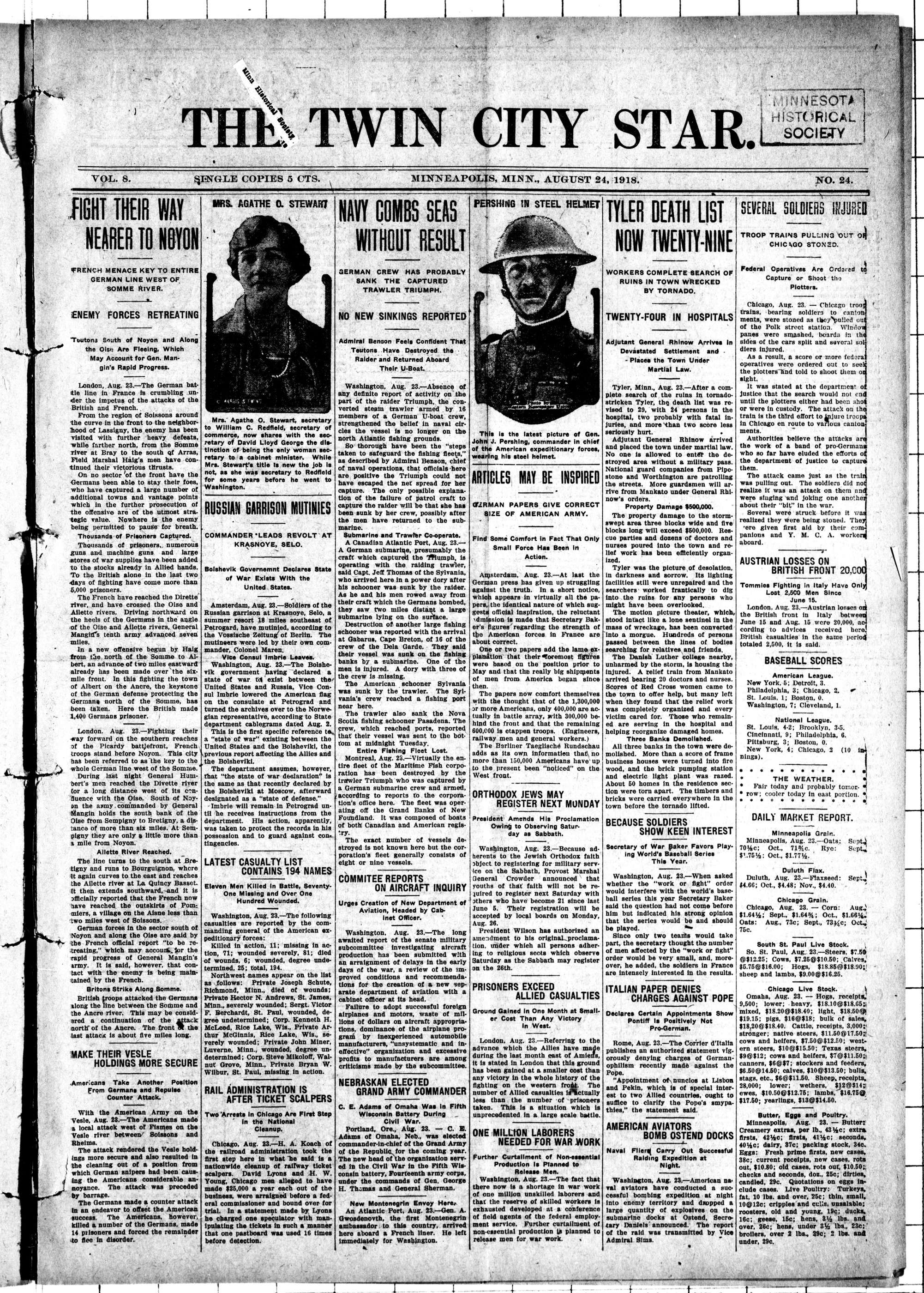
FIGHT THEIR WAY NEARER TO NOYON
FIGHT THEIR WAY NEARER TO NOYON
FRENCH MENACE KEY TO ENTIRE
GERMAN LINE WEST OF
SOMME RIVER.
ENEMY FORCES RETREATING
Teutons South of Noyon and Along the Oisn Are Fleeing, Which May Account for Gen. Mangin's Rapid Progress.
London, Aug. 23—The German battle line in France is crumbling under the impetus of the attacks of the British and French.
From the region of Solissons around the curve in the front to the neighborhood of Lassigny, the enemy has been visited with further heavy defeats, while farther north, from the Somme river at Bray to the south of Aras, Field Marshal Haig's men have continued their victorious thrusts.
On no sector of the front have the Germans been able to stay their foes, who have captured a large number of additional towns and vantage points which in the further prosecution of the offensive are of the utmost strategic value. Nowhere is the enemy being permitted to pause for breath.
Thousands of Prisoners Captured.
Thousands of prisoners, numerous guns and machine guns and large stores of war supplies have been added to the stocks already in Allied hands. To the British alone in the last two days of fighting have come more than 5,000 prisoners.
The French have reached the Dirette river, and have crossed the Oise and Allette rivers. Driving northward on the heels of the Germans in the angle of the Oise and Allette rivers, General Mangin's tenth army advanced seven miles.
In a new offensive begun by Halg from the north of the Somme to Albert, an advance of two miles eastward already has been made over the six-mile front. In this fighting the town of Albert on the Ancre, the keystone of the German defense protecting the Germans north of the Somme, has been taken. Here the British made 1,400 Germans prisoner.
London. Aug. 23.—Fighting their way forward on the southern reaches of the Picardy battlefront, French troops stand before Noyon. This city has been referred to as the key to the whole German line west of the Somme.
During last night General Humbert's men reached the Dirette river for a long distance west of its confluence with the Oise. South of Noyon the army commanded by General Mangin holds the south bank of the Oise from Sempigny to Bretigny, a distance of more than six miles. At Sempigny they are only a little more than a mile from Noyon.
Aillette River Reached.
The line turns to the south at Bretigny and runs to Bourguignon, where it again curves to the east and reaches the Allette river at La Quincy Basset. It then extends southward, and it is officially reported that the French now have reached the outskirts of Pommiers, a village on the Alsne less than two miles west of Soissons.
German forces in the sector south of Noyon and along the Oise are said by the French official report "to be retreating," which may account for the rapid progress of General Mangin's army. It is said, however, that contact with the enemy is being maintained by the French.
Britons Strike Along Somme.
British troops attacked the Germans along the line between the Somme and the Ancre river. This may be considered a continuation of the attack north of the Ancre. The front of the last attack is about five miles long.
MAKE THEIR VESLE HOLDINGS MORE SECURE
Americans Take Another Position From Germans and Repulse Counter Attack.
With the American Army on the Vesle, Aug. 23.—The Americans made a local attack west of Fishes on the Vesle river between/ Solssons and Rheims.
The attack rendered the Vesle holdings more secure and also resulted in the cleaning out of a position from which German snipers had been causing the Americans considerable annoyance. The attack was preceded by barrage.
The Germans made a counter attack in an endeavor to offset the American success. The Americans, however, killed a number of the Germans, made 14 prisoners and forced the remainder to flee in disorder.
THE TWIN CITY STAR.
MRS. AGATHE O. STEWART
C MARRIS & FWENT
Mrs. Agathe O. Stewart, secretary to William C. Redfield, secretary of commerce, now shares with the secretary of David Lloyd George the distinction of being the only woman secretary to a cabinet minister. While Mrs. Stewart's title is new the job is not, as she was secretary to Redfield for some years before he went to Washington.
RUSSIAN GARRISON MUTINIES
COMMANDER 'LEADS REVOLT AT KRASNOYE, SELO.
Bolshevik Government Nt Declares State of War Exists With the United States.
Amsterdam, Aug. 23.—Soldiers of the Russian garrison at Krasnoye, Selo, a summer resort 18 miles southeast of Petrogard, have mutinied, according to the Vossische Zeitung of Berlin. The mutineers were led by their own commander, Colonel Maren.
Vice Consul Imbrie Leaves.
Washington, Aug. 23.—The Bolshevik government having declared a state of war to exist between the United States and Russia, Vice Consul Imbrie lowered the American flag on the consulate at Petrograd and turned the archives over to the Norwegian representative, according to State department cablegrams dated Aug. 2.
This is the first specific reference to a "state of war" existing between the United States and the Bolshevik, the previous report affecting the Allies and the Bolshevik.
The department assumes, however, that "the state of war declaration" is the same as that recently declared by the Bolshevik at Moscow, afterward designated as a "state of defense."
Imbrie will remain in Petrograd until he receives instructions from the department. His action, apparently, was taken to protect the records in his possession and to guard against contingencies.
LATEST CASUALTY LIST
CONTAINS 194 NAMES
Eleven Men Killed in Battle, Seventy-
One Missing and Over One
Hundred Wounded.
Washington, Aug. 23.—The following
casualties are reported by the com-
manding general of the American expeditionary forces:
Killed in action, 11; missing in action,
71; wounded severely, 81; died of
wounds, 6; wounded, degree undetermined, 25; total, 194.
Northwest names appear on the list
as follows: Private Joseph Schute,
Richmond, Minn., died of wounds;
Private Hector N. Andrews, St. James,
Minn., severely wounded; Sergt. Victor F.
Berchardt, St. Paul, wounded,
degree undetermined; Corp. Kenneth H.
McLead, Rice Lake, Wis., Private Arthur
McGinnis, Rice Lake, Wis.,
severely wounded; Private John Miner,
Luverne, Minn., wounded, degree
undetermined; Corp. Steve Mikoloff, Wal-
nut Grove, Minn., Private Bryan W.
Wilbur, St. Paul, missing in action.
RAIL ADMINISTRATION IS AFTER TICKET SCALPERS
Two Arrests in Chicago Are First Step in the National Cleanup.
Chicago, Aug. 23.—H. A. Koach of the railroad administration took the first step here in what he said is a nationwide cleanup of railway ticket scalpers. David Lyons and H. W. Young, Chicago men alleged to have made $25,000 a year each out of the business, were arraigned before a federal commissioner and bound over for trial. In a statement made by Lyons he charged one speculator with manipulating the tickets in such a manner that one pastboard was used 16 times before detection.
MINNEAPOLIS, MINN., AUGUST 24, 1918.
NAVY COMBS SEAS WITHOUT RESULT
GERMAN CREW HAS PROBABLY
SANK THE CAPTURED
TRAWLER TRIUMPH.
NO NEW SINKINGS REPORTED
Admiral Benson Feels Confident That Teutons Have Destroyed the Raider and Returned Aboard Their U-Boat.
Washington, Aug. 23.—Absence of any definite report of activity on the part of the raider Triumph, the converted steam trawler armed by 16 members of a German U-boat crew, strengthened the belief in naval circles the vessel is no longer on the north Atlantic fishing grounds.
So thorough have been the "steps taken to safeguard the fishing fleets," as described by Admiral Benson, chief of naval operations, that officials here are positive the Triumph could not have escaped the net spread for her capture. The only possible explanation of the failure of patrol craft to capture the raider will be that she has been sunk by her crew, possibly after the men have returned to the submarine.
Submarine and Trawler Co-operate. A Canadian Atlantic Port, Aug. 23.—A German submarine, presumably the craft which captured the Triumph, is operating with the raiding trawler, said Capt. Jeff Thomas of the Sylvania, who arrived here in a power dory after his schooner was sunk by the raider. As he and his men rowed away from their craft which the Germans bombed, they saw two miles distant a large submarine lying on the surface. Destruction of another large fishing schooner was reported with the arrival at Gaborus, Cape Breton, of 16 of the crew of the Dela Garde. They said their vessel was sunk on the fishing banks by a submarine. One of the men is injured. A dory with three of the crew is missing. The American schooner Sylvania was sunk by the trawler. The Sylvania's crew reached a fishing port near here. The trawler also sank the Nova Scotia fishing schooner Pasadena. The crew, which reached ports, reported that their vessel was sent to the bottom at midnight Tuesday.
Entire Fishing Fleet Lost.
Montreal, Aug. 23.—Virtually the entire fleet of the Maritime Fish corporation has been destroyed by the trawler Triumph who was captured by a German submarine crew and armed, according to reports to the corporation's office here. The fleet was operating off the Grand Banks of New Foundland. It was composed of boats of both Canadian and American registry.
The exact number of vessels destroyed is not known here but the corporation's fleet generally consists of eight or nine vessels.
COMMITEE REPORTS
ON AIRCRAFT INQUIRY
Urges Creation of New Department of Aviation, Headed by Cabinet Officer.
Washington. Aug. 23.—The long awaited report of the senate military subcommittee investigating aircraft production has been submitted with an arrangement of delays in the early days of the war, a review of the improved conditions and recommendations for the creation of a new separate department of aviation with a cabinet officer at its head.
Failure to adopt successful foreign airplanes and motors, waste of millions of dollars on aircraft appropriations, dominance of the airplane program by inexperienced automobile manufacturers, "unsystematic and ineffective" organization and excessive profits to manufacturers are among criticisms made by the subcommittee.
NEBRASKAN ELECTED
GRAND ARMY COMMANDER
C. E. Adams of Omaha Was in Fifth Wisconsin Battery During Civil War.
Portland, Ore., Algr. 23. — C. E. Adams of Omaha, Neb., was elected commander-in-chief of the Grand Army of the Republic for the coming year. The new head of the organization served in the Civil War in the Fifth Wisconsin battery, Fourteenth army corps, under the commands of Gen. George H. Thomas and General Sherman.
New Montenegrin Envoy Here.
An Atlantic Port, Aug. 23.—Gen. A. Gwosdenovth, the first Montenegrin ambassador to this country, arrived here aboard a French liner. He left immediately for Washington.
PERSHING IN STEEL HELMET
This is the latest picture of Gen. John J. Pershing, commander in chief of the American expeditionary forces, wearing his steel helmet.
ARTICLES MAY BE INSPIRED
GZRMAN PAPERS GIVE CORRECT
SIZE OF AMERICAN ARMY.
Find Some Comfort in Fact That Only Small Force Has Been in
Amsterdam, Aug. 23.—At last the German press has given up struggling against the truth. In a short notice, which appears in virtually all the papers, the identical nature of which suggests official inspiration, the reluctant admission is made that Secretary Baker's figures regarding the strength of the American forces in France are about correct.
One or two papers add the lame explanation that their foremost figures were based on the position prior to May and that the really big shipments of men from America began since then.
The papers now comfort themselves with the thought that of the 1,300,000 or more Americans, only 400,000 are actually in battle array, with 300,000 behind the front and that the remaining 600,000 is etappen troops. (Engineers, railway men and general workers.)
The Berliner Taeglische Rundschau adds as its own information that no more than 150,000 Americans have up to the present been "noticed" on the West front.
ORTHODOX JEWS MAY
REGISTER NEXT MONDAY
President Amends His Proclamation
Owing to Observing Saturday as Sabbath.
Washington, Aug. 23.—Because adherents to the Jewish Orthodox faith object to registering for military service on the Sabbath, Provost Marshal General Crowder announced that youths of that faith will not be required to register next Saturday with others who have become 21 since last June 5. Their registration will be accepted by local boards on Monday, Aug. 26.
President Wilson has authorized an amendment to his original proclamation, under which all persons adhering to religious sects which observe Saturday as the Sabbath may register on the 26th.
PRISONERS EXCEED
ALLIED CASUALTIES
Ground Gained in One Month at Smaller Cost Than Any Victory in West.
London, Aug. 23.—Referring to the advance which the Allies have made during the last month east of Amiens, it is stated in London that this ground has been gained at a smaller cost than any victory in the whole history of the fighting on the western front. The number of Allied casualties is actually less than the number of prisoners taken. This is a situation which is unprecedented in a large scale battle.
ONE MILLION LABORERS NEEDED FOR WAR WORK
Further Curtailment of Non-essential Production Is Planned to Release Men. Washington, Aug. 23.—The fact that there now is a shortage in war work of one million unskilled laborers and that the reserve of skilled workers is exhausted developed at a conference of field agents of the federal employment service. Further curtailment of non-essential production is planned to release men for war work.
TYLER DEATH LIST NOW TWENTY-NINE
TYLER DEATH LIST NOW TWENTY-NINE
WORKERS COMPLETE SEARCH OF
RUINS IN TOWN WRECKED
BY TORNADO.
TWENTY-FOUR IN HOSPITALS
Adjutant General Rhinow Arrives In Devstated Settlement and - Placea the Town Under
Tyler, Minn., Aug. 23. After a complete search of the ruins in tornado-stricken Tyler, the death list was revised to 29, with 24 persons in the hospital, two probably with fatal injuries, and more than two score less seriously hurt.
Adjutant General Rhinow arrived and placed the town under martial law. No one is allowed to enter the destroyed area without a military pass. National guard companies from Pipestone and Worthington are patrolling the streets. More guardsmen will arrive from Mankato under General Rhinow's orders.
Property Damage $500,000.
The property damage to the storm-swept area three blocks wide and five blocks long will exceed $500,000. Rescue parties and dozens of doctors and nurses poured into the town and relief work has been efficiently organized.
Tyler was the picture of desolation, in darkness and sorrow. Its lighting facilities still were unrepaired and the searchers worked frantically to dig into the ruins for any persons who might have been overlooked.
The motion picture theater, which stood intact like a lone sentinel in the mass of wreckage, has been converted into a morgue. Hundreds of persons passed between the lines of bodies searching for relatives and friends.
The Danish Luther college nearby, unharmed by the storm, is housing the injured. A relief train from Mankato arrived bearing 20 doctors and nurses. Scores of Red Cross women came to the town to offer help, but many left when they found that the relief work was completely organized and every victim cared for. Those who remained are serving in the hospital and helping reorganize damaged homes.
Three Banks Demolished.
All three banks in the town were demolished. More than a score of frame business houses were turned into fire wood, and the brick pumping station and electric light plant was razed. About 50 homes in the residence section were torn apart. The timbers and bricks were carried everywhere in the town before the tornado lifted.
BECAUSE SOLDIERS
SHOW KEEN INTEREST
Secretary of War Baker Favors Playing World's Baseball Series This Year.
Washington, Aug. 23.—When asked whether the "work or fight" order would interfere with the world's baseball series this year Secretary Baker said the question had not come before him but indicated his strong opinion that the series would be and should be played.
Since only two teams would take part, the secretary thought the number of men affected by the "work or fight" order would be very small, and, moreover, he added, the soldiers in France are intensely interested in the results.
ITALIAN PAPER DENIES
CHARGES AGAINST POPE
Declares Certain Appointments Show Pontiff is Positively Not Pro-German.
Rome, Aug. 23.—The Corrier d'Italia publishes an authorized statement vigorously denying charges of Germanophilism recently made against the Pope.
"Appointment of nuncios at Lisbon and Pekin, which is of special interest to two Allied countries, ought to suffice to clarify the Pope's smypathies," the statement said.
AMERICAN AVIATORS
BOMB OSTEND DOCKS
Naval Filiers Carry Out Successful Raiding Expedition at Night.
Washington, Aug. 23.—American naval aviators have conducted a successful bombing expedition at night into enemy territory and dropped a large quantity of explosives on the submarine docks at Ostend, Secretary Daniels announced. The report of the raid was transmitted by Vice Admiral Sims.
MINNESOTA HISTORICAL SOCIETY
NO.24.
SEVERAL SOLDIERS INJURED
TROOP TRAINS PULLING OUT OR CHICAGO STONED.
Federal Operatives Are Ordered to Capture or Shoot the
Chicago, Aug. 23. — Chicago troop trains, bearing soldiers to cantonments, were stoned as they pulled out of the Polk street station. Window panes were smashed, boards in the sides of the cars split and several soldiers injured.
As a result, a score or more federal operatives were ordered out to seek the plotters and told to shoot them on sight.
It was stated at the department of justice that the search would not end until the plotters either had been shot or were in custody. The attack on the train is the third effort to injure troops in Chicago en route to various cantonments.
Authorities believe the attacks are the work of a band of pro-Germans who so far have eluded the efforts of the department of justice to capture them.
The attack came just as the train was pulling out. The soldiers did not realize it was an attack on them and were singing and joking one another about their "bit" in the war.
Several were struck before it was realized they were being stoned. They were given first aid by their companions and Y. M. C. A. workers aboard.
AUSTRIAN LOSSES ON BRITISH FRONT 20,000
Tommies Fighting in Italy Have Only
Lost 2,500 Men Since
June 15.
London, Aug. 23.—Austrian losses on
the British front in Italy between
June 15 and Aug. 15 were 20,000, acc
ording to advises received here.
British casualties in the same period
totaled 2,500, it is said.
BASEBALL SCORES
American League.
New York, 5; Detroit, 3.
Philadelphia, 3; Chicago, 2.
St. Louis, 1; Boston, 0.
Washington, 7; Cleveland, 1.
National League.
St. Louis, 4-2; Brooklyn, 3-5.
Cincinnati, 9; Philadelphia, 6.
Pittsburg, 3; Boston, 0.
New York, 4; Chicago, 2 (10 innings).
THE WEATHER.
Fair today and probably tomorrow; cooler today in east portion.
DAILY MARKET REPORT.
Minneapolis Grain.
Minneapolis, Aug. 23.—Oats: Sept.
70%c; Oct., 71%c; Rye: Sept.
1.75%2; Oct., 1.77%2.
Duluth Flax.
Duluth, Aug. 23.—Flaxseed: Sept.
4.66; Oct., 4.48; Nov., 4.40.
Chicago Grain.
Chicago, Aug. 23. — Corn: Aug. $1.64½; Sept., $1.64¼; Oct., $1.66¾
Oats: Aug., 73c; Sept., 73¾c; Oct. 75c.
South St. Paul Live Stock.
So. St. Paul, Aug. 23 — Steers, $7.50
@$12.25; Cows, $7.25@$10.50; Calves,
$5.75@$16.00; Hogs, $18.88@$18.90;
sheep and lambs, $9.00@$16.25.
Chicago Live Stock.
Omaha, Aug. 23. — Hogs, receipts,
9,500; lower, heavy, $18.10@$18.65;
mixed, $18.20@$18.40; light, $18.50@$19.15; pigs, $16@$18; bulk of sales,
$18.20@$18.40. Cattle, receipts, 3,000;
stronger; native steers, $11.50@$17.50;
cows and heifers, $7.50@$12.50; western steers, $10@$15.50; Texas steers,
$9@$12; cows and heifers, $7@$11.50;
canners, $6@$7; stockers and feeders,
$6.50@$14.50; calves, $10@$13.50; bulls,
stags, etc., $6@$11.50. Sheep, receipts,
28,000; lower, wethers, $12@$14;
ewes, $10.50@$12.75; lambs, $16.75@$17.50; yearlings, $13@$14.50.
Butter, Eggs and Poultry.
Minneapolis, Aug. 23. — Butter: Creamery extras, per lb., 42 1/2 c; extra firsts, 42 1/2 c; firsts, 41 1/2 c; seconds, 40 1/2 c; dairy, 37 c; packing stock, 34 c.
Eggs: Fresh prime firsts, new cases, 38 c; current receipts, new cases, rots out, $10.80; old cases, rots out, $10.50; roosters and seconds, doz. 25 c; drieties, candled, 29 c. Quotations on eggs include cases. Live Poultry: Turkey, fat, 10 lbs. and over, 25 c; thin, small, 10@12 c; cripples and culls, unsalable; roosters, old and young, 19 c; ducks, 16 c; geese, 15 c; hens, 3 1/2 lbs. and over, 28 c; hens, under 3 1/2 lbs., 23 c; broilers, over 2 lbs., 29 c; 2 lbs. and under, 29 c.
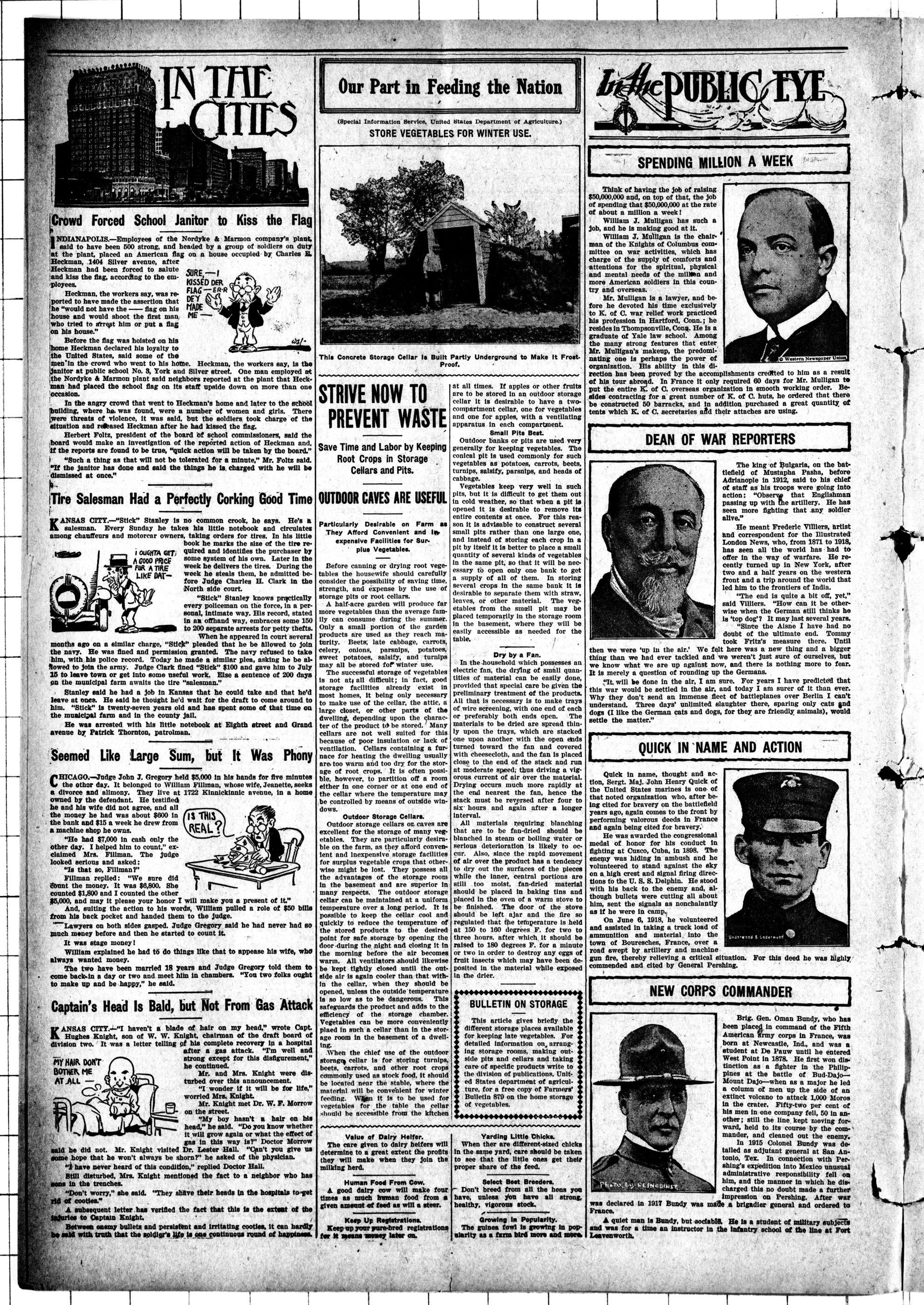
IN THE
CITIES
NDIANAPOLIS—Employees of the Nordyke & Marmon company's plant, said to have been 500 strong, and headed by a group of soldiers on duty at the plant, placed an American flag on a house occupied by Charles E. Heckman. 1404 Silver avenue, after
men in the crowd who went to his home. Heckman, the workers say, is the janitor at public school No. 3, York and Silver street. One man employed at the Nordyke & Marmon plant said neighbors reported at the plant that Heckman had placed the school flag on its staff upside down on more than one occasion.
In the angry crowd that went to Heckman's home and later to the school building, where he was found, were a number of women and girls. There were threats of violence, it was said, but the soldiers took charge of the situation and released Heckman after he had kissed the flag.
Herbert Foltz, president of the board of school commissioners, said the board would make an investigation of the reported action of Heckman and, if the reports are found to be true, "quick action will be taken by the board."
"Such a thing as that will not be tolerated for a minute," Mr. Foltz said. "If the janitor has done and said the things he is charged with he will be dismissed at once."
Tire Salesman Had a Perfectly Corking Good Time
Tire Salesman Had a Perfectly Corking Good Time
KANSAS CITY.—"Stick" Stanley is no common crook, he says. He's a salesman. Every Sunday he takes his little notebook and circulates among chauffeurs and motorcar owners, taking orders for tires. In his little
months ago on a similar charge, "Stick" pleaded that he be allowed to join the navy. He was fined and permission granted. The navy refused to take him, with his police record. Today he made a similar plea, asking he be allowed to join the army. Judge Clark fined "Stick" $100 and gave him to July 15 to leave town or get into some useful work. Else a sentence of 200 days on the municipal farm awaits the tire "salesman."
Stanley said he had a job in Kansas that he could take and that he'd leave at once. He said he thought he'd wait for the draft to come around to him. "Stick" is twenty-seven years old and has spent some of that time on the municipal farm and in the county jail.
He was arrested with his little notebook at Eighth street and Grand avenue by Patrick Thornton, patrolman.
CHICAGO—Judge John J. Gregory held $5,000 in his hands for five minutes the other day. It belonged to William Fillman, whose wife, Jeanette, seeks a divorce and allmony. They live at 1722 Kninnickinnie avenue, in a home owned by the defendant. He testified
And, sulting the action to his words, William pulled a role of $50 bills from his back pocket and handed them to the judge.
Lawyers on both sides gasped. Judge Gregory said he had never had so much money before and then he started to count it.
It was stage money!
William explained he had to do things like that to appease his wife, who always wanted money.
The two have been married 18 years and Judge Gregory told them to come back in a day or two and meet him in chambers. "You two folks ought to make up and be happy," he said.
Captain's Head Is Bald, but Not From Gas Attack
Captain's Head Is Bald, but Not From Gas Attack
KANSAS CITY. "I haven't a blade of hair on my head," wrote Capt. Hughes Knight, son of W. W. Knight, chairman of the draft board of division two. It was a letter telling of his complete recovery in a hospital
said he did not. Mr. Knight visited Dr. Lester Hall. "Can't you give us some hope that he won't always be shorn?" he asked of the physician.
"I have never heard of this condition," replied Doctor Hall.
Still disturbed, Mrs. Knight mentioned the fact to a neighbor who has sons in the trenches.
"Don't worry," she said. "They shave their heads in the hospitals to get rid of cooties."
A subsequent letter has verified the fact that this is the extent of the injuries to Captain Knight.
Between enemy bullets and persistent and irritating cooties, it can hardly be said with truth that the soldier's life is one continuous round of happiness.
Heckman, the workers say, was reported to have made the assertion that he "would not have the —— flag on his house and would shoot the first man who tried to arrest him or put a flag on his house."
Before the flag was holsted on his home Heckman declared his loyalty to the United States, said some of the
men' in the crowd who went to his host janitor at public school No. 8, York and the Nordyke & Marmon plant said nephew man had placed the school flag on its occasion.
In the angry crowd that went to B building, where he was found, were a were threats of violence, it was said situation and released Heckman after herbert Foltz, president of the board would make an investigation of if the reports are found to be true, "quit "Such a thing as that will not be "If the janitor has done and said the dismissed at once."
Tire Salesman Had a Pet
KANSAS CITY.—"Stick" Stanley is salesman. Every Sunday he talk among chauffeurs and motorcar owner
I OUGHTA GET
A GOOD PRICE
FUR A TIRE
LIKE DAT
months ago on a similar charge, "Stick the navy. He was fined and permission him, with his police record. Today he allowed to join the army. Judge Clark f 15 to leave town or get into some user on the municipal farm awaits the tire. Stanley said he had a job in Kar leave at once. He said he thought he' him, "Stick" is twenty-seven years of the municipal farm and in the county. He was arrested with his little avenue by Patrick Thornton, patrolm
Seemed Like Large Su
CHICAGO.—Judge John J. Gregory h the other day. It belonged to Willi a divorce and allommy. They live at
owned by the defendant. He testified
he and his wife did not agree, and all
the money he had was about $600 in
the bank and $15 a week he drew from
a machine shop he owns.
"He had $7,000 in cash only the
other day. I helped him to count," ex-
claimed Mrs. Fillman. The judge
looked serious and asked:
"Is that so, Fillman?"
Fillman replied: "We sure did
count the money. It was $6,800. She
counted $1,800 and I counted the other
$5,000, and may it please your honor I
And, suiting the action to his wo
from his back pocket and handed them
Lawyers on both sides gasped. Ju
much money before and then he starte
It was stage money!
William explained he had to do the
always wanted money.
The two have been married 18 y
come back-in a day or two and meet h
to make up and be happy," he said.
Captain's Head Is Bald,
KANSAS CITY. "I haven't a blad
Hughes Knight, son of W. W. K
division two. It was a letter telling
MY HAIR DON'T
BOTHER ME
AT ALL
sald he did not. Mr. Knight vlsited some hope that he won't always be sall "I have never heard of this condit Still disturbed, Mrs. Knight ment sons in the trenches. "Don't worry," she said. "They sh rid of cooties." A subsequent letter has verified injuries to Captain Knight. Between enemy bullets and persist he said with truth that the soldier's life
SURE, — I
KISSED DER
FLAG — ER-R
DEY
MADE
ME —
time. Heckman, the workers say, is the
and Silver street. One man employed at
neighbors reported at the plant that Heck-
s staff upside down on more than one
Heckman's home and later to the school
a number of women and girls. There
, but the soldiers took charge of the
he had kissed the flag.
board of school commissioners, sald the
the reported action of Heckman and,
rick action will be taken by the board."
colored for a minute," Mr. Foltz sald.
things he is, charged with he will be
Perfectly Corking Good Time
no common crook, he says. He's a
es his little notebook and circulates
taking orders for tires. In his little
book he marks the size of the tire required and identifies the purchaser by some system of his own. Later in the week he delivers the tires. During the week he steals them, he admitted before Judge Charles H. Clark in the North side court.
"Stick" Stanley knows practically every policeman on the force, in a personal, intimate way. His record, stated in an offhand way, embraces some 150 to 200 separate arrests for petty thefts.
When he appeared in court several
kick" pleaded that he be allowed to join
on granted. The navy refused to take
him made a similar plea, asking he be al-
named "Stick" $100 and gave him to July
ful work. Else a sentence of 200 days
"salesman."
Assas that he could take and that he'd
d wait for the draft to come around to
and has spent some of that time on
jail.
notebook at Eighth street and Grand
man.
him, but It Was Phony
held $5,000 in his hands for five minutes
am Fillman, whose wife, Jeanette, seeks
1722 Kinnickinnie avenue, in a home
IS THIS REAL?
"I will make you a present of it," words, William pulled a role of $50 bills in to the judge.
Judge Gregory said he had never had so much to count it.
ings like that to appease his wife, whoears and Judge Gregory told them to him in chambers. "You two folks ought to but Not From Gas Attack
e of hair on my head," wrote Capt. night, chairman of the draft board of of his complete recovery in a hospital after a gas attack. "I'm well and strong except for this disfigurement," he continued.
Mr. and Mrs. Knight were disturbed over this announcement.
"I wonder if it will be for life," worried Mrs. Knight. Mr. Knight met Dr. W. F. Morrow on the street. "My boy hasn't a hair on his head," he said. "Do you know whether it will grow again or what the effect of gas in this way is?" Doctor Morrow
Dr. Lester Hall. "Can't you give us a horn?" he asked of the physician. Ton," replied Doctor Hall. Moned the fact to a neighbor who has have their heads in the hospitals to get the fact that this is the extent of the patient and irritating cooties, it can hardly be one continuous round of happiness.
Our Part in Feeding the Nation
Our Part in Feeding the Nation
(Special Information Service, United States Department of Agriculture.) STORE VEGETABLES FOR WINTER USE.
A man stands in front of a small shed surrounded by trees.
This Concrete Storage Cellar Is Built Partly Underground to Make It Frost-Proof.
STRIVE NOW TO PREVENT WASTE
Save Time and Labor by Keeping Root Crops in Storage Cellars and Pits.
OUTDOOR CAVES ARE USEFUL
Particularly Desirable on Farm as They Afford Convenient and expensive Facilities for Surplus Vegetables.
Before canning or drying root vegetables the housewife should carefully consider the possibility of saving time, strength, and expense by the use of storage pits or root cellars. A half-acre garden will produce far more vegetables than the average family can consume during the summer. Only a small portion of the garden products are used as they reach maturity. Beets, late cabbage, carrots, celery, onions, parsnips, potatoes, sweet potatoes, salsify, and turnips may all be stored for winter use.
The successful storage of vegetables is not at all difficult; in fact, good storage facilities already exist in most homes, it being only necessary to make use of the cellar, the attic, a large closet, or other parts of the dwelling, depending upon the character of the product to be stored. Many cellars are not well suited for this because of poor insulation or lack of ventilation. Cellars containing a furnace for heating the dwelling usually are too warm and too dry for the storage of root crops. It is often possible, however, to partition off a room either in one corner or at one end of the cellar where the temperature may be controlled by means of outside windows.
Outdoor Storage Cellars.
Outdoor storage cellars or caves are excellent for the storage of many vegetables. They are particularly desirable on the farm, as they afford convenient and inexpensive storage facilities for surplus vegetable crops that otherwise might be lost. They possess all the advantages of the storage room in the basement and are superior in many respects. The outdoor storage cellar can be maintained at a uniform temperature over a long period. It is possible to keep the cellar cool and quickly to reduce the temperature of the stored products to the desired point for safe storage by opening the door during the night and closing it in the morning before the air becomes warm. All ventilators should likewise be kept tightly closed until the outside air is again cooler than that within the cellar, when they should be opened, unless the outside temperature is so low as to be dangerous. This safeguards the product and adds to the efficiency of the storage chamber. Vegetables can be more conveniently placed in such a cellar than in the storage room in the basement of a dwelling.
When the chief use of the outdoor storage cellar is for storing turnips, beets, carrots, and other root crops commonly used as stock food, it should be located near the stable, where the material will be convenient for winter feeding. When it is to be used for vegetables for the table the cellar should be accessible from the kitchen
Value of Dairy Heifer.
The care given to dairy heifers will determine to a great extent the profits they will make when they join the milking herd.
Human Food From Cow.
A good dairy cow will make four times as much human food from a given amount of feed as will a steer.
Keep Up Registrations.
Keep up your pure-bred registrations for it means money later on.
at all times. If apples or other fruits are to be stored in an outdoor storage cellar it is desirable to have a two-compartment cellar, one for vegetables and one for apples, with a ventilating apparatus in each compartment.
Small Pits Best.
Outdoor banks or pits are used very generally for keeping vegetables. The conical pit is used commonly for such vegetables as potatoes, carrots, beets, turnips, salisfy, parsnips, and heads of cabbage.
Vegetables keep very well in such pits, but it is difficult to get them out in cold weather, so that when a pit is opened it is desirable to remove its entire contents at once. For this reason it is advisable to construct several small pits rather than one large one, and instead of storing each crop in a pit by itself it is better to place a small quantity of several kinds of vegetables in the same pit, so that it will be necessary to open only one bank to get a supply of all of them. In storing several crops in the same bank it is desirable to separate them with straw, leaves, or other material. The vegetables from the small pit may be placed temporarily in the storage room in the basement, where they will be easily accessible as needed for the table.
Dry by a Fan.
In the household which possesses an electric fan, the drying of small quantities of material can be easily done, provided that special care be given the preliminary treatment of the products. All that is necessary is to make trays of wire screening, with one end of each or preferably both ends open. The materials to be dried are spread thinly upon the trays, which are stacked one upon another with the open ends turned toward the fan and covered with cheesecloth, and the fan is placed close to the end of the stack and run at moderate speed; thus driving a vigorous current of air over the material. Drying occurs much more rapidly at the end nearest the fan, hence the stack must be reversed after four to six hours and again after a longer interval.
All materials requiring blanching that are to be fan-dried should be blanched in steam or boiling water or serious deterioration is likely to occur. Also, since the rapid movement of air over the product has a tendency to dry out the surfaces of the pieces while the inner, central portions are still too moist, fan-dried material should be placed in baking tins and placed in the oven of a warm stove to be finished. The door of the stove should be left ajar and the fire so regulated that the temperature is held at 150 to 160 degrees F. for two to three hours, after which it should be raised to 180 degrees F. for a minute or two in order to destroy any eggs of fruit insects which may have been deposited in the material while exposed in the drier.
This article gives briefly the different storage places available for keeping late vegetables. For detailed information on arranging storage rooms, making outside pits and cellars and taking care of specific products write to the division of publications, United States department of agriculture, for a free copy of Farmers' Bulletin 879 on the home storage of vegetables.
Yarding Little Chicks.
When ther are different-sized chicks in the same yard, care should be taken to see that the little ones get their proper share of the feed.
Select Best Breeders.
Don't breed from all the hens you have, unless you have all strong, healthy, vigorous stock.
Growing in Popularity.
The guinea fowl is growing in popularity as a farm bird more and more
In the PUBLIC EYE
SPENDING MILLION A WEEK
Think of having the job of raising $50,000,000 and, on top of that, the job of spending that $50,000,000 at the rate of about a million a week!
William J. Mulligan has such a job, and he is making good at it.
William J. Mulligan is the chairman of the Knights of Columbus committee on war activities, which has charge of the supply of comforts and attentions for the spiritual, physical and mental needs of the million and more American soldiers in this country and overseas.
Mr. Mulligan is a lawyer, and before he devoted his time exclusively to K. of C. war relief work practiced his profession in Hartford, Conn.; he resides in Thompsonville, Conn. He is a graduate of Yale law school. Among the many strong features that enter Mr. Mulligan's makeup, the predominating one is perhaps the power of organization. His ability in this di-
rection has been proved by the accomplishments credited to him as a result of his tour abroad. In France it only required 60 days for Mr. Mulligan to put the entire K. of C. overseas organization in smooth working order. Besides contracting for a great number of K. of C. huts, he ordered that there be constructed 50 barracks, and in addition purchased a great quantity of tents which K. of C. secretaries aid their attaches are using.
rection has been proved by the account of his tour abroad. In France it only put the entire K. of C. overseas organ sides contracting for a great number of be constructed 50 barracks, and in tents which K. of C. secretaries and the
DEAN OF WAR REPORTERS
[Picture of a man with a white beard and a bald head, wearing a dark suit and a white shirt. The background is black.]
[The text is in a serif font, centered, and reads: "PRESIDENT OF THE UNION OF THE STATE OF NEW YORK."]
then we were 'up in the air.' We felt thing than we had ever tackled and we know what we are up against no. It is merely a question of rounding up. "It will be done in the air, I am this war would be settled in the air, Why they don't send an immense fee understand. Three days' unlimited dogs I like the German cats and dogs settle the matter."
then we were 'up in the air.' We felt here was a new thing and a bigger thing than we had ever tackled and we weren't just sure of ourselves, but we know what we are up against now, and there is nothing more to fear. It is merely a question of rounding up the Germans.
"It will be done in the air, I am sure. For years I have predicted that this war would be settled in the air, and today I am surer of it than ever. Why they don't send an immense fleet of battleplanes over Berlin I can't understand. Three days' unlimited slaughter there, sparing only cats and dogs (I like the German cats and dogs, for they are friendly animals), would settle the matter."
QUICK IN NAME AND ACTION
Quick in name, thought and action, Sergt. Maj. John Henry Quick of the United States marines is one of that noted organization who, after being cited for bravery on the battlefield years ago, again comes to the front by performing valorous deeds in France and again being cited for bravery.
He was awarded the congressional medal of honor for his conduct in fighting at Cuzco, Cuba, in 1898. The enemy was hiding in ambush and he volunteered to stand against the sky on a high crest and signal firing directions to the U. S. S. Delphin. He stood with his back to the enemy and, although bullets were cutting all about him, sent the signals as nonchalantly as if he were in camp.
On June 6, 1918, he volunteered and assisted in taking a truck load of ammunition and material into the town of Bouresches, France, over a road swept by artillery and machine
gun fire, thereby relieving a critical situation. For this deed he was highly commended and cited by General Pershing.
NEW CORPS COMMANDER
PHOTO BY ELINADINE
was declared in 1917 Bundy was made France.
A quiet man is Bundy, but sociable and was for a time an instructor in the Leavenworth.
was declared in 1917 Bundy was made a brigadier general and ordered to France.
A quiet man is Bundy, but sociable. He is a student of military subjects and was for a time an instructor in the infantry school of the line at Fort Leavenworth.
© Western Newspaper Union
epilships credited to him as a result required 60 days for Mr. Mulligan toization in smooth working order. Beof K. of C. huts, he ordered that there addition purchased a great quantity of their attaches are using.
The king of Bulgaria, on the battlefield of Mustapha Pasha, before Adrianople in 1912, said to his chief of staff as his troops were going into action: "Observe that Englishman passing up with the artillery. He has seen more fighting that any soldier alive."
He meant Frederic Villiers, artist and correspondent for the Illustrated London News, who, from 1871 to 1918, has seen all the world has had to offer in the way of warfare. He recently turned up in New York, after two and a half years on the western front and a trip around the world that led him to the frontiers of India.
"The end is quite a bit off, yet," said Villiers. "How can it be otherwise when the German still thinks he is 'top dog'? It may last several years.
"Since the Aisne I have had no doubt of the ultimate end. Tommy took Fritz's measure there. Until
It here was a new thing and a bigger one weren't just sure of ourselves, but aw, and there is nothing more to fear, the Germans. sure. For years I have predicted that and today I am surer of it than ever, set of battleplanes over Berlin I cannot laughter there, sparing only cats and cats, for they are friendly animals), would
Underwood & Underwood
Brig. Gen. Oman Bundy, who has been placed in command of the Fifth American army corps in France, was born at Newcastle, Ind., and was a student at De Pauw until he entered West Point in 1873. He first won distinction as a fighter in the Philippines at the battle of Bud-Dajo—Mount Dajo—when as a major he led a column of men up the side of an extinct volcano to attack 1,000 Moros in the crater. Fifty-two per cent of his men in one company fell, 50 in another; still the line, kept moving forward, held to its course by the commander, and cleaned out the enemy. In 1915 Colonel Bundy was detailed as adjutant general at San Antonio, Tex. In connection with Pershing's expedition into Mexico unusual administrative responsibility fell on him, and the manner in which he discharged this no doubt made a further impression on Pershing. After war
He a brigadier general and ordered to
4. He is a student of military subjects
the infantry school of the line at Fort
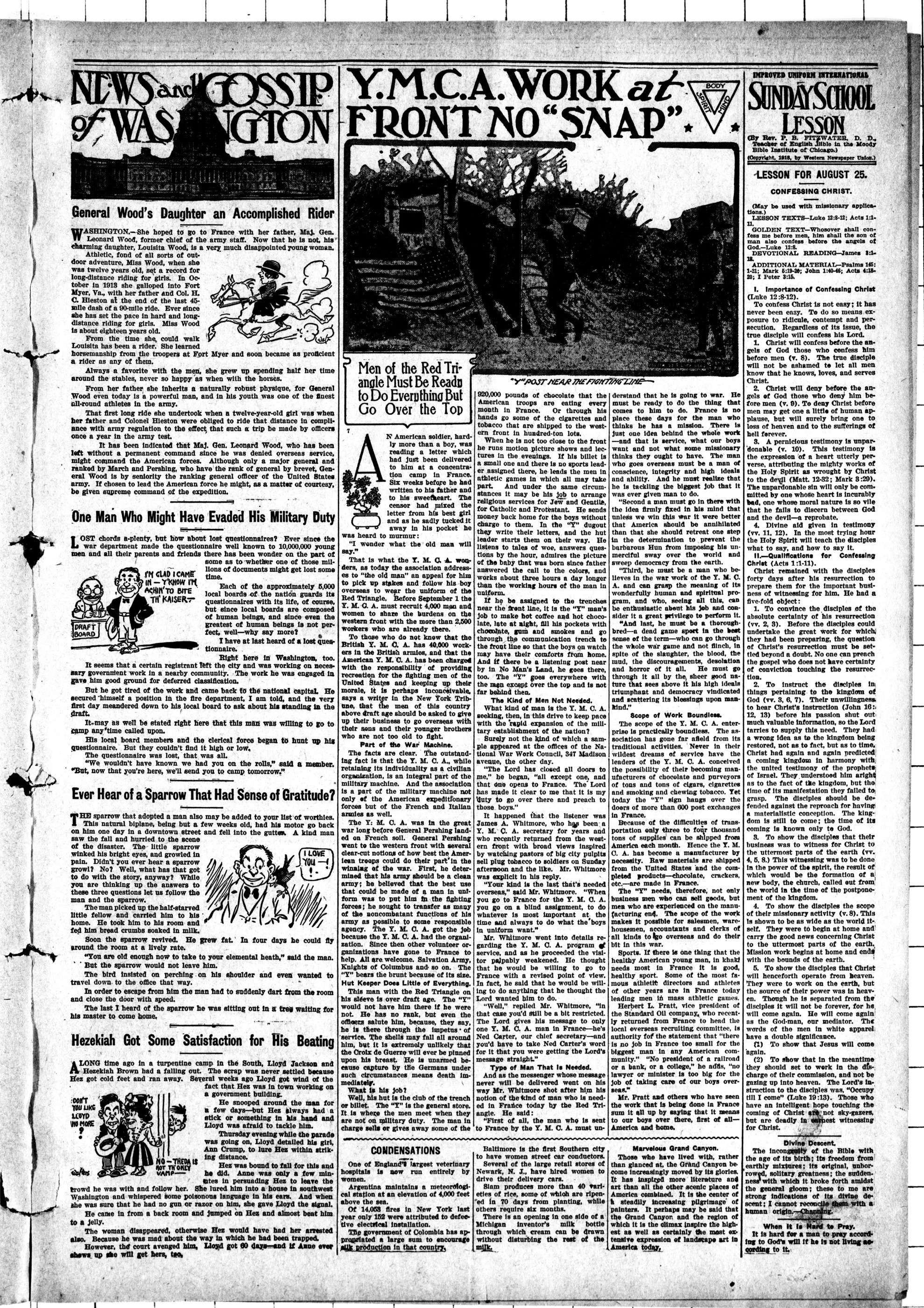
NEWS and GOSSIP of WASHINGTON Y.M.C.A.WORK at FRONT NO "SNAP" BODY SPIRIT MIND
General Wood's Daughter an Accomplished Rider
WASHINGTON.—She hoped to go to France with her father, Maj. Gen. Leonard Wood, former chief of the army staff. Now that he is not, his charming daughter, Louisita Wood, is a very much disappointed young woman.
horsemanship from the troopers at Fort Myer and soon became as proficient a rider as any of them.
Always a favorite with the men, she grew up spending half her time around the stables, never so happy as when with the horses.
From her father she inherits a naturally robust physique, for General Wood even today is a powerful man, and in his youth was one of the finest all-round athletes in the army.
That first long ride she undertook when a twelve-year-old girl was when her father and Colonel Hieston were obliged to ride that distance in compliance with army regulation to the effect that such a trip be made by officers once a year in the army test.
It has been indicated that Maj. Gen. Leonard Wood, who has been left without a permanent command since he was denied overseas service, might command the American forces. Although only a major general and ranked by March and Pershing, who have the rank of general by brevet, General Wood is by seniority the ranking general officer of the United States army. If chosen to lead the American force he might, as a matter of courtesy, be given supreme command of the expedition.
One Man Who Might Have Evaded His Military Duty
LOST chords a-plenty, but how about lost questionnaires? Ever since the war department made the questionnaire well known to 10,000,000 young men and all their parents and friends there has been wonder on the part of
It seems that a certain registrant left the city and was working on necessary government work in a nearby community. The work he was engaged in gave him good ground for deferred classification.
But he got tired of the work and came back to the national capital. He secured himself a position in the fire department, I am told, and the very first day meandered down to his local board to ask about his standing in the draft.
It may as well be stated right here that this man was willing to go to camp any time called upon.
His local board members and the clerical force began to hunt up his questionnaire. But they couldn't find it high or low.
The questionnaire was lost, that was all.
"We wouldn't have known we had you on the rolls," said a member. "But, now that you're here, we'll send you to camp tomorrow."
Ever Hear of a Sparrow That Had Sense of Gratitude?
THE sparrow that adopted a man also may be added to your list of worthies. This natural biplane, being but a few weeks old, had his motor go back on him one day in a downtown street and fell into the gutter. A kind man
Soon the sparrow revived. He grew fat. In four days he could fly around the room at a lively rate.
"You are old enough now to take to your elemental heath," said the man.
But the sparrow would not leave him.
The bird insisted on perching on his shoulder and even wanted to travel down to the office that way.
In order to escape from him the man had to suddenly dart from the room and close the door with speed.
The last I heard of the sparrow he was sitting out in a tree waiting for his master to come home.
Hezekiah Got Some Satisfaction for His Beating
ALONG time ago in a turpentine camp in the South, Lloyd Jackson and Hezekiah Brown had a falling out. The scrap was never settled because Hez got cold feet and ran away. Several weeks ago Lloyd got wind of the
crowd he was with and follow her. She lured him into a house in southwest Washington and whispered some poisonous language in his ears. And when she was sure that he had no gun or razor on him, she gave Lloyd the signal.
He came in from a back room and jumped on Hez and almost beat him to a jelly.
The woman disappeared, otherwise Hez would have had her arrested also. Because he was mad about the way in which he had been trapped.
However, the court avenged him. Lloyd got 60 days—and if Anne ever shows up she will get hers, too.
Athletic, fond of all sorts of outdoor adventure, Miss Wood, when she was twelve years old, set a record for long-distance riding for girls. In October in 1913 she galloped into Fort Myer, Va., with her father and Col. H. C. Hleston at the end of the last 45-mile dash of a 90-mile ride. Ever since she has set the pace in hard and long-distance riding for girls. Miss Wood is about eighteen years old.
From the time she could walk Louisita has been a rider. She learned
horsemanship from the troopers at For a rider as any of them.
Always a favorite with the men, around the stables, never so happy as
From her father she inherits a Wood even today is a powerful man, all-round athletes in the army.
That first long ride she undertook her father and Colonel Hieston were once a year in the army test.
It has been indicated that Mr left without a permanent command a might command the American forces, ranked by March and Pershing, who heral Wood is by seniority the ranking army. If chosen to lead the American be given supreme command of the exp
One Man Who Might Have
LOST chords a-plenty, but how about war department made the question men and all their parents and friends
I'M GLAD I CAME
IN — Y'KNOW I'M
ACHIN' TO BITE
TH' KAISER
DRAFT
BOARD
It seems that a certain registrant lary government work in a nearby con gave him good ground for deferred clio. But he got tired of the work and secured himself a position in the first day meandered down to his local draft.
It may as well be stated right he camp any time called upon.
His local board members and the questionnaire. But they couldn't find The questionnaire was lost, that "We wouldn't have known we h" But, now that you're here, we'll send
Ever Hear of a Sparrow The
THE sparrow that adopted a man also This natural biplane, being but a on him one day in a downtown street
saw the fall and hurried to the scene of the disaster. The little sparrow winked his bright eyes, and growled in pain. Didn't you ever hear a sparrow growl? No? Well, what has that got to do with the story, anyway? While you are thinking up the answers to these three questions let us follow the man and the sparrow.
The man picked up the half-starved little fellow and carried him to his home. He took him to his room and fed him bread crumbs soaked in milk.
Soon the sparrow revived. He
around the room at a lively rate.
"You are old enough now to take t
But the sparrow would not leave
The bird insisted on perching o
travel down to the office that way.
In order to escape from him the m
and close the door with speed.
The last I heard of the sparrow h
his master to come home.
Hezekiah Got Some Satt
ALONG time ago in a turpentine ca
Hezekiah Brown had a falling out.
Hez got cold feet and ran away. Sev
DON'T YOU LIKE LLOYD NO MORE
NO — THEDA IS NOT THE ONLY VAMP —
crowd he was with and follow her. She Washington and whispered some poison she was sure that he had no gun or raa He came in from a back room and to a jelly. The woman disappeared, otherwhi also. Because he was mad about the However, the court avenged him, shows up she will get hers, too.
A
port Myer and soon became as proficient
she grew up spending half her time
when with the horses.
naturally robust physique, for General
and in his youth was one of the finest
when a twelve-year-old girl was when
obliged to ride that distance in compli-
ct, that such a trip be made by officers
aj. Gen. Leonard Wood, who has been
since he was denied overseas service,
Although only a major general and
have the rank of general by brevet, Gen-
g general officer of the United States
force he might, as a matter of courtesy,
pedition.
The Evaded His Military Duty
Int lost questionnaires? Ever since the
nainaire well known to 10,000,000 young
there has been wonder on the part of
some as to whether one of those millions of documents might get lost some time.
Each of the approximately 5,000 local boards of the nation guards its questionnaires with its life, of course, but since local boards are composed of human beings, and since even the greatest of human beings is not perfect, well—why say more?
I have at last heard of a lost questionnaire.
Right here in Washington, too.
left the city and was working on necess-
munity. The work he was engaged in
classification.
He came back to the national capital. He
be department, I am told, and the very
board to ask about his standing in the
where that this man was willing to go to
he clerical force began to hunt up his
it high or low.
was all.
had you on the rolls," said a member.
you to camp tomorrow."
What Had Sense of Gratitude?
o may be added to your list of worthles.
few weeks old, had his motor go back
and fell into the gutter. A kind man
I LOVE YOU !
grew fat. In four days he could fly
to your elemental heath," said the man.
him.
on his shoulder and even wanted to
man had to suddenly dart from the room
he was sitting out in a tree waiting for
Pissaction for His Beating
camp in the South, Lloyd Jackson and
. The scrap was never settled because
general weeks ago Lloyd got wind of the fact that Hez was in town working on a government building.
He snooped around the man for a few days—but Hez always had a stick or something in his hand and Lloyd was afraid to tackle him.
Thursday evening while the parade was going on, Lloyd detailed his girl, Ann Crump, to lure Hez within striking distance.
Hez was bound to fall for this and he did. Anne was only a few minutes in persuading Hez to leave the
he lured him into a house in southwest
enous language in his ears. And when
razor on him, she gave Lloyd the signal,
and jumped on Hez and almost beat him
se Hez would have had her arrested
away in which he had been trapped.
Lloyd got 60 days—and if Anne ever
Men of the Red Tri-
Men of the Red Triangle Must Be Ready to Do Everything But Go Over the Top
A
N American soldier, hardly more than a boy, was reading a letter which had just been delivered to him at a concentration camp in France. Six weeks before he had written to his father and to his sweetheart. The censor had mixed the letter from his best girl and as he sadly tucked it away in his pocket he was heard to murmur: "I wonder what the old man will say."
That is what the Y. M. C. A. wonders, as today the association addresses to "the old man" an appeal for him to pick up stakes and follow his boy overseas to wear the uniform of the Red Triangle. Before September 1 the Y. M. C. A. must recruit 4,000 men and women to share the burdens on the western front with the more than 2,500 workers who are already there.
To those who do not know that the British Y. M. C. A. has 40,000 workers in the British armies, and that the American Y. M. C. A. has been charged with the responsibility of providing recreation for the fighting men of the United States and keeping up their morale, it is perhaps inconceivable, says a writer in the New York Tribune, that the men of this country above draft age should be asked to give up their business to go overseas with their sons and their younger brothers who are not too old to fight.
Part of the War Machine.
The facts are clear. The outstanding fact is that the Y. M. C. A., while retaining its individuality as a civilian organization, is an integral part of the military machine. And the association is a part of the military machine not only of the American expeditionary forces but of the French and Italian armies as well.
The Y: M. C. A. was in the great war long before General Pershing landed on French soil. General Pershing went to the western front with several clear-cut notions of how best the American troops could do their part in the winning of the war. First, he determined that his army should be a clean army; he believed that the best use that could be made of a man in uniform was to put him in the fighting forces; he sought to transfer as many of the noncombatant functions of his army as possible to some responsible agency. The Y. M. C. A. got the job because the Y. M. C. A. had the organization. Since then other volunteer organizations have gone to France to help. All are welcome. Salvation Army, Knights of Columbus and so on. The "Y" bears the brunt because of its size. Hut Keeper Does Little of Everything.
This man with the Red Triangle on his sleeve is over draft age. The "Y" would not have him there if he were not. He has no rank, but even the officers salute him, because, they say, he is there through the impetus of service. The shells may fall all around him, but it is extremely unlikely that the Croix de Guerre will ever be plumed upon his breast. He is unarmed because capture by the Germans under such circumstances means death immediately.
What is his job?
Well, his hut is the club of the trench or billet. The "T" is the general store.
It is where the men meet when they are not on military duty. The man in charge sells or gives away some of the
CONDENSATIONS
One of England's largest veterinary hospitals is now run entirely by women.
Argentina maintains a meteorological station at an elevation of 4,000 feet above the sea.
Of 14,053 fires in New York last year only 152 were attributed to defective electrical installation.
The government of Colombia has appropriated a large sum to encourage silk production in that country.
POST NEAR THE FIGHTING LINE
920,000 pounds of chocolate that the American troops are eating every month in France. Or through his hands go some of the cigarettes and tobacco that are shipped to the western front in hundred-ton lots. derstand that must be read comes to his place these thinks he just one idea
When he is not too close to the front he runs motion picture shows and lectures in the evenings. If his billet is a small one and there is no sports leader assigned there, he leads the men in athletic games in which all may take part. And under the same circumstances it may be his job to arrange religious services for Jew and Gentile, for Catholic and Protestant. He sends money back home for the boys without charge to them. In the "Y" dugout they write their letters, and the hut leader starts them on their way. He listens to tales of woe, answers questions by the hour, admires the picture of the baby that was born since father answered the call to the colors, and works about three hours a day longer than the working hours of the man in uniform.
If he be assigned to the trenches near the front line, it is the "Y" man's job to make hot coffee and hot chocolate, late at night, fill his pockets with chocolate, gum and smokes and go through the communication trench to the front line so that the boys on watch may have their comforts from home. And if there be a listening post near by in No Man's Land, he goes there, too. The "Y" goes everywhere with the man except over the top and is not far behind then.
The Kind of Men Not Needed.
What kind of man is the Y. M. C. A. seeking, then, in this drive to keep pace with the rapid expansion of the military establishment of the nation?
Surely not the kind of which a sample appeared at the offices of the National War Work Council, 347 Madison avenue, the other day.
"The Lord has closed all doors to me," he began, "all except one, and that one opens to France. The Lord has made it clear to me that it is my duty to go over there and preach to those boys."
It happened that the listener was James A. Whitmore, who has been a Y. M. C. A. secretary for years and who recently returned from the western front with broad views inspired by watching pastors of big city pulps sell plug tobacco to soldiers on Sunday afternoon and the like. Mr. Whitmore was explicit in his reply.
"Your kind is the last that's needed overseas," said Mr. Whitmore. "When you go to France for the Y. M. C. A. you go on a blind assignment, to do whatever is most important at the time and always to do what the boys in uniform want."
Mr. Whitmore went into details regarding the Y. M. C. A. program service, and as he proceeded the visitor palpably weakened. He thought that he would be willing to go to France with a revised point of view. In fact, he said that he would be willing to do anything that he thought the Lord wanted him to do.
"Well," replied Mr. Whitmore, "in that case you'd still be a bit restricted. The Lord gives his message to only one Y. M. C. A. man in France—he's Ned Carter, our chief secretary—and you'd have to take Ned Carter's word for it that you were getting the Lord's message straight."
Type of Man That Is Needed.
And as the messenger whose message never will be delivered went on his way Mr. Whitmore shot after him his notion of the kind of man who is needed in France today by the Red Triangle. He said:
"First of all, the man who is sent to France by the Y. M. C. A. must un-
Baltimore is the first Southern city to have women street car conductors. Several of the large retail stores of Newark, N. J., have hired women to drive their delivery cars. Slam produces more than 40 varieties of rice, some of which are仁pened in 70 days from planting, while others require six months. There is an opening in one side of a Michigan inventor's milk bottle through which cream can be drawn without disturbing the rest of the milk.
derstand that he is going to war. He must be ready to do the thing that comes to him to do. France is no place these days for the man who thinks he has a mission. There is just one idea behind the whole work—and that is service, what our boys want and not what some missionary thinks they ought to have. The man who goes overseas must be a man of conscience, integrity and high ideals and ability. And he must realize that he is tackling the biggest job that it was ever given man to do.
"Second a man must go in there with the idea firmly fixed in his mind that unless we win this war it were better that America should be annihilated than that she should retreat one step in the determination to prevent the barbarous Hun from imposing his unmerciful sway over the world and sweep democracy from the earth.
"Third, he must be a man who believes in the war work of the Y. M. C. A. and can grasp the meaning of its wonderfully human and spiritual program, and who, seeing all this, can be enthusiastic about his job and consider it a great privilege to perform it. "And last, he must be a thoroughbred—a dead game sport in the best sense of the term—who can go through the whole war game and not finch, in spite of the slaughter, the blood, the mud, the discouragements, desolation and horror of it all. He must go through it all by the sheer good nature that sees above it his high ideals triumphant and democracy vindicated and scattering its blessings upon mankind."
Scope of Work Boundless.
The scope of the Y. M. C. A. enterprise is practically boundless. The association has gone far afield from its traditional activities. Never in their wildest dreams of service have the leaders of the Y. M. C. A. conceived the possibility of their becoming manufacturers of chocolate and purveyors of tons and tons of cigars, cigarettes and smoking and chewing tobacco. Yet today the "Y" sign hangs over the doers of more than 600 post exchanges in France. Because of the difficulties of transportation only three to four thousand tons of supplies can be shipped from America each month. Hence the Y. M. C. A. has become a manufacturer by necessity. Raw materials are shipped from the United States and the completed products—chocolate, crackers, etc—are made in France.
The "T" needs, therefore, not only business men who can sell goods, but men who are experienced on the manufacturing end. The scope of the work makes it possible for salesmen, warehousemen, accountants and clerks of all kinds to go overseas and do their bit in this war. Sports. If there is one thing that the healthy American young man, in khaki needs most in France it is good, healthy sport. Some of the most famous athletic directors and athletes of other years are in France today leading men in mass athletic games.
Herbert L. Pratt, vice president of the Standard Oil company, who recently returned from France to head the local overseas recruiting committee, is authority for the statement that "there is no job in France too small for the biggest man in any American community." "No president of a railroad or a bank, or a college," he adds, "no lawyer or minister is too big for the job of taking care of our boys overseas."
Mr. Pratt and others who have seen the work that is being done in France sum it all up by saying that it means to our boys over there, first of all—America and home.
Those who have lived with, rather than glanced at, the Grand Canyon become increasingly moved by its glories. It has inspired more literature and art than all the other scenic places of America combined. It is the center of it steadily increasing pilgrimage of painters. It perhaps may be said that the Grand Canyon and the region of which it is the olimax inspire the highest as well as certainly the most extensive expression of landscape art in America today,
Marvelous Grand Canyon.
(By Rev. P. B. FTTTWATER, D. D.
Teacher of English Bible in the Moody
Bible Institute of Chicago.)
(Copyright, 1918, by Western Newspaper Union.)
LESSON FOR AUGUST 25.
CONFESSING CHRIST.
(May be used with missionary applications.)
LESSON TEXTS—Luke 12:3-12; Acts 1:1-11.
GOLDEN TEXT—Whosover shall confess me before men, him shall the son of man also confess before the angels of God.—Luke 12:8.
DEVOTIONAL READING—James 3:1-18
ADDITIONAL MATERIAL—Faalms 145: 1-21; Mark 11: 29-30; John 1: 40-46; Acts 4: 18-20; I Peter 3: 15.
1. Importance of Confessing Christ (Luke 12: 8-12).
To confess Christ is not easy; it has never been easy. To do so means exposure to ridicule, contempt and persecution. Regardless of its issue, the true disciple will confess his Lord.
1. Christ will confess before the angels of God those who confess him before men (v. 8). The true disciple will not be ashamed to let all men know that he knows, loves, and serves Christ.
2. Christ will deny before the angels of God those who deny him before men (v. 9). To deny Christ before men may get one a little of human applause, but will surely bring one to loss of heaven and to the sufferings of hell forever.
3. A pernicious testimony is unparadonable (v. 10). This testimony is the expression of a heart utterly perverse, attributing the mighty works of the Holy Spirit as wrought by Christ to the devil (Matt. 12-32; Mark 3-29). The unparadonable sin will only be committed by one whose heart is incurably bad, one whose moral nature is so vile that he fails to discern between God and the devil—a reprobate.
4. Divine aid given in testimony (vv. 11, 12). In the most trying hour the Holy Spirit will teach the disciples what to say, and how to say it.
II.—Qualifications for Confessing Christ (Acts 1:1-11).
Christ remained with the disciples forty days after his resurrection to prepare them for the important business of witnessing for him. He had a five-fold object:
1. To convince the disciples of the absolute certainty of his resurrection (vv. 2, 3). Before the disciples could undertake the great work for which they had been preparing, the question of Christ's resurrection must be settled beyond a doubt. No one can preach the gospel who does not have certainty of conviction touching the resurrection.
2. To instruct the disciples in things pertaining to the kingdom of God (vv. 3, 6, 7). Their unwillingness to hear Christ's instruction (John 16: 12, 13) before his passion shut out much valuable information, so the Lord tarries to supply this need. They had a wrong idea as to the kingdom being restored, not as to fact, but as to time. Christ had again and again predicted a coming kingdom in harmony with the united testimony of the prophets of Israel. They understood him aright as to the fact of the kingdom, but the time of its manifestation they failed to grasp. The disciples should be defended against the reproach for having a materialistic conception. The kingdom is still to come; the time of its coming is known only to God.
3. To show the disciples that their business was to witness for Christ to the uttermost parts of the earth (vv. 4, 5, 8.) This witnessing was to be done in the power of the spirit, the result of which would be the formation of a new body, the church, called out from the world in the time of the postponement of the kingdom.
4. To show the disciples the scope of their missionary activity (v. 8). This is shown to be as wide as the world itself. They were to begin at home and carry the good news concerning Christ to the uttermost parts of the earth. Mission work begins at home and ends with the bounds of the earth.
5. To show the disciples that Christ will henceforth operate from heaven. They were to work on the earth, but the source of their power was in heaven. Though he is separated from the disciples it will not be forever, for he will come again. He will come again as the God-man, our mediator. The words of the men in white apparel have a double significance.
(1) To show that Jesus will come again.
(2) To show that in the meantime they should set to work in the discharge of their commission, and not be gazing up into heaven. The Lord's instruction to the disciples was, "Occupy till I come" (Luke 19:13). Those who have an intelligent hope touching the coming of Christ are not sky-gazers, but are deadly in earnest witnessing for Christ.
Divine Descent
The incongruity of the Bible with the age of its birth; its freedom from earthly mixtures; its original, unborrowed, solitary greatness; the suddenness with which it broke forth amidst the general gloom; these to me are strong indications of its divine descent; I cannot reconcile them with a human origin—Channing.
When It Is Hard to Pray.
It is hard for a man to pray according to God's will if he is not living according to it.
PUBLISHED EVERY FRIDAY BY
CHARLES SUMNER SMITH,
Minneapolis, Minnesota.
Entered in the Post Office at Minneapolis as second class matter.
MEMBER
NATIONAL NEGRO PRESS
ASSOCIATION
ONE YEAR .....$2.00
SIX MONTHS .....$125
THREE MONTHS ......65
ADVERTISING RATES.
One Inch—1 Insertion—One Dollar.
Liberal discount given on 3, 6, 9,
Months, or 1 year contracts.
We do not run free ads, or over-run
the time contracted for by our advertisers. We respect their right to
advertise at intervals, and rather have
them do so, than to run continuously
an "adv." and an increasing account.
Write all Checks payable to
Send your subscription. Our prices have not changed because of the war. Let your dollar do its duty and The Star will reach a higher standard of service and better circulation.
```markdown
```
"THE REPUBLICAN PARTY IS THE SHIP; ALL ELSE IS THE SEA," said Frederick Douglass. Now is the most important time for Negroes to stand by the old party of Lincoln and Grant.
Keep Minnesota a Republican State.
Let us not draw the color line. Rectprocity between the races will be the salvation of the Negro.
HOME GUARD FRICTION.
The Home Guard as an organization is a valuable asset to our state's military forces and a credit to our race. We regret to say, that like the organizations of the white companies, the usual friction has developed. There is among the Negroes a desire of some to outrank their superiors, and the proper discipline has not been maintained. Instead of supporting each other to make the entire outfit an efficient organization, there is a spirit among a few to be insubordinate to such an extent that progress is hindered.
Efforts are being made to make it unpleasant for those who have the responsibilities of organization in order that the agitators might succeed in command. Whether this is pro-German propaganda, or a natural desire on the part of those to climb over the corpses of their fellows to secure official prominence, is a question which will be answered none too soon. A spirit of harmony and tolerance should prevail. The time given to criticism and gossip could be better used for instruction, so badly needed.
The Home Guard is a permanent organization, but some men and officers have unwillingly separated themselves from it. It is time for Negroes to learn that discipline in all military branches at this time, whether state or federal, is compulsory and violations are punishable. Restricting the progress of any organization to aid the nation in this war, is a federal crime. Although some are innocent of such intent, they are ignorant tools of the underlying forces at home, for which Home Guards are authorized to destroy in order that all citizens shall be protected.
COLORED NURSES TO BE USED IN ARMY CAMPS
Orders Issued by War Department Makes Opening for Hundreds at Six Base Hospitals in This Country—Many May Go Overseas.
Washington, D. C., July 22, 1918.—The War Department authorizes the following statement from Emmet J. Scott, special assistant to the Secretary of War:
"Orders were issued today by the War Department to the office of the Surgeon General, which will enable colored nurses who have been registered by the American Red Cross Society, to render service for their own race in the Army. Colored nurses will be assigned to the base hospitals now established at Camp Funston, Fort Riley, Kansas; Camp Grant, Rockford, Illinois; Camp Dodge, Des Molines, Iowa; Camp Taylor, Louisville, Ky.; Camp Sherman, Chillicothe, Ohio, and Camp Dix, Wrighttown, N. J. At these camps a total of about 38,000 colored troops are stationed. General Pershing has been asked by cable whether the services of colored nurses can be utilised to advantage among the American
"ENLIST OR WORK" CAMPAIGN. The military authorities intend to push the enlist or work campaign among the Negroes. There are many idlers who have no lawful means of support. They will be drafted into the industrial army. Get work, gentlemen of leisure, even if as a side
A. B.
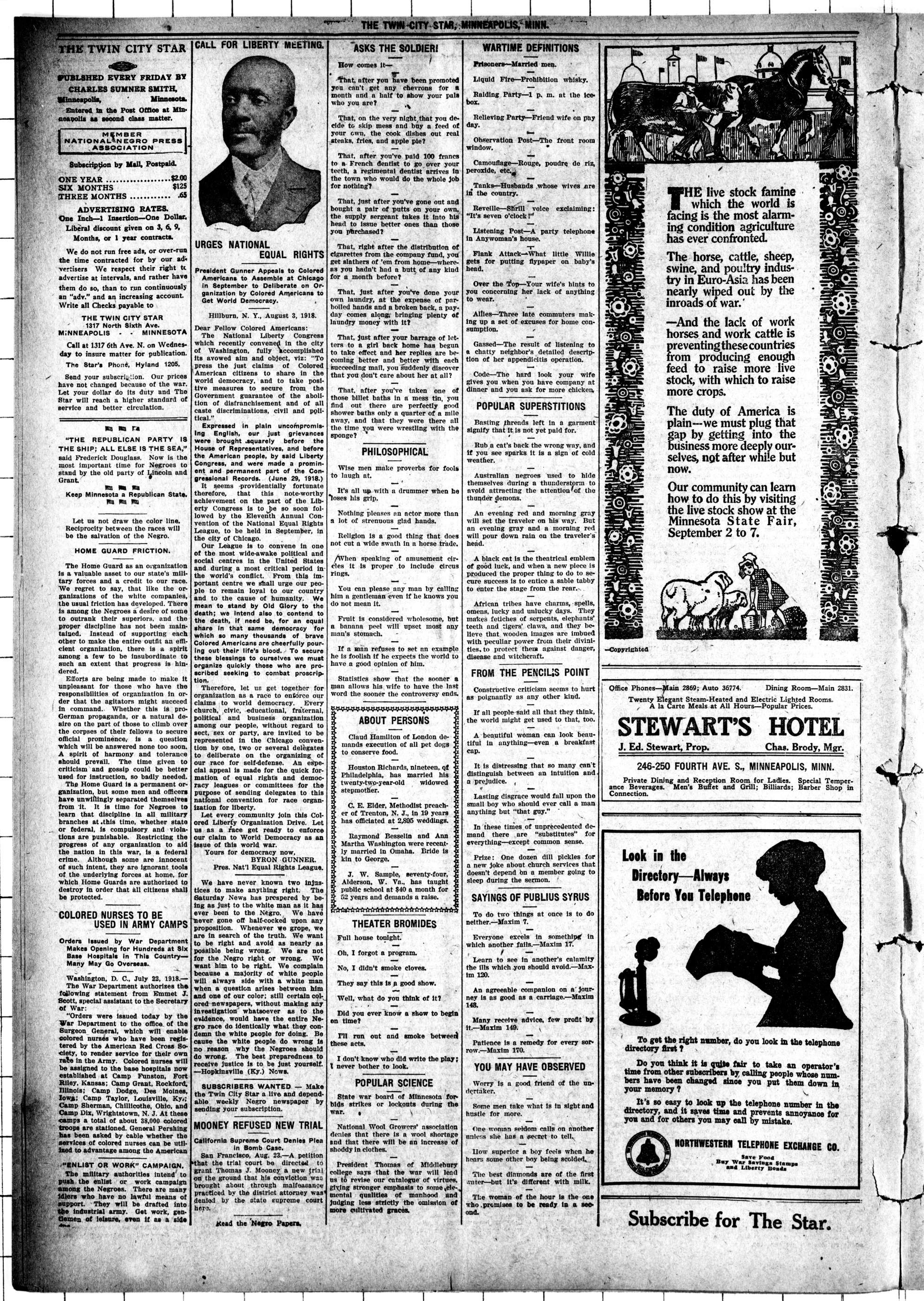
President Gunner Appeals to Colored Americans to Assemble at Chicago in September to Deliberate on Organization by Colored Americans to Get World Democracy.
Hillburn, N. Y., August 3, 1918.
Dear Fellow Colored Americans:
The National Liberty Congress which recently convened in the city of Washington, fully accomplished its avowed aim and object, viz: "To press the just claims of Colored American citizens to share in the world democracy, and to take positive measures to secure from the Government guarantee of the abolition of disfranchisement and of all caste discriminations, civil and political."
Expressed in plain uncompromising English, our just grievances were brought squarely before the House of Representatives, and before the American people, by said Liberty Congress, and were made a prominent and permanent part of the Congressional Records. (June 29, 1918.) It seems providentially fortunate therefore, that this note-worthy achievement on the part of the Liberty Congress is to be so soon followed by the Eleventh Annual Convention of the National Equal Rights League, to be held in September, in the city of Chicago.
Our League is to convene in one of the most wide-awake political and social centres in the United States and during a most critical period in the world's conflict. From this important centre we shall urge our people to remain loyal to our country and to the cause of humanity. We mean to stand by Old Glory to the death; we intend also to contend to the death, if need be, for an equal share in that same democracy for which so many thousands of brave Colored Americans are cheerfully pouring out their life's blood. To secure these blessings to ourselves we must organize quickly those who are proscribed seeking to combat prescription.
Therefore, let us get together for organization as a race to enforce our claims to world democracy. Every church, civic, educational, fraternal, political and business organization among our people, without regard to sect, sex or party, are invited to be represented in the Chicago convention by one, two or several delegates to deliberate on the organizing of our race for self-defense. An especial appeal is made for the quick formation of equal rights and democracy leagues or committees for the purpose of sending delegates to this national convention for race organization for liberty.
Let every community join this Colored Liberty Organization Drive. Let us as a race get ready to enforce our claim to World Democracy as an issue of this world war.
We have never known two injustices to make anything right. The Saturday News has prospered by being as just to the white man as it has ever been to the Negro. We have never gone off half-cocked upon any proposition. Whenever we grope, we are in search of the truth. We want to be right and avoid as nearly as possible being wrong. We are not for the Negro right or wrong. We want him to be right. We complain because a majority of white people will always side with a white man when a question arises between him and one of our color; still certain colored newspapers, without making any investigation whatsoever as to the evidence, would have the entire Negro race do identically what they condemn the white people for doing. Be cause the white people do wrong is no reason why the Negroes should do wrong. The best preparedness to receive justice is to be just yourself.—Hopkinsville (KY.) Nows.
SUBSCRIBERS WANTED — Make the Twin City Star a live and dependable weekly Negro newspaper by sending your subscription.
MOONEY REFUSED NEW TRIAL
California Supreme Court Denies Plea in Bomb Case.
San Francisco, Aug. 23.—A petition that the trial court be directed to grant Thomas J. Mooney a new trial on the ground that his conviction was brought about through malfeasance practiced by the district attorney was denied by the state supreme court here.
Read the Negro Papers.
That, after you have been promoted you can't get any chevroons for a month and a half to show your pals who you are?
That, on the very night that you decide to skip mess and buy a feed of your own, the cook dishes out real steaks, fries, and apple pie?
That, after you've paid 100 francs to a French dentist to go over your teeth, a regimental dentist arrives in the town who would do the whole job for nothing?
That, just after you've gone out and bought a pair of putts on your own, the supply sergeant takes it into his head to issue better ones than those you purchased?
That, right after the distribution of cigarettes from the company fund, you get slathers of 'em from home—whereas you hadn't had a butt of any kind for a month before?
That, just after you've done your own laundry, at the expense of parboiled hands and a broken back, a payday comes along, bringing plenty of laundry money with it?
That, just after your barrage of letters to a girl back home has begun to take effect and her replies are becoming better and better with each succeeding mail, you suddenly discover that you don't care about her at all?
That, after you've taken one of those billet baths in a mess tin, you find out there are perfectly good shower baths only a quarter of a mile away, and that they were there all the time you were wrestling with the sponge?
PHILOSOPHICAL
Wise men make proverbs for fools to laugh at.
It's all up with a drummer when he loses his grip.
Nothing pleases an actor more than a lot of strenuous glad hands.
Religion is a good thing that does not cut a wide swath in a horse trade.
When speaking of amusement circles it is proper to include circus rings.
Fruit is considered wholesome, but a banana peel will upset most any man's stomach.
If a man refuses to set an example he is foolish if he expects the world to have a good opinion of him.
Statistics show that the sooner a man allows his wife to have the last word the sooner the controversy ends.
ABOUT PERSONS
Claud Hamilton of London demands execution of all pet dogs to conserve food.
Houston Richards, nineteen, of Philadelphia, has married his twenty-two-year-old widowed stepmother.
C. E. Elder, Methodist preacher of Trenton, N. J., in 19 years has officiated at 2,895 weddings.
Raymond Besselin and Ann Martha Washington were recently married in Omaha. Bride is kin to George.
J. W. Sample, seventy-four, Alderson, W. Va., has taught public school at $40 a month for 52 years and demands a raise.
THEATER BROMIDES
Full house tonlight.
No, I didn't smoke cloves.
They say this is a good show.
Did you ever know a show to begin on time?
I'll run out and smoke between these acts.
I don't know who did write the play; I never bother to look.
POPULAR SCIENCE
State war board of Minnesota forbids strikes or lockouts during the war.
National Wool Growers' association denies that there is a wool shortage and that there will be an increase of shoddy in clothes.
President Thomas of Middlebury college says that the war will lead us to revise our catalogue of virtues, giving stronger emphasis to some elemental qualities of manhood and judging less strictly the omission of more cultivated graces.
---
Prisoners—Married men.
Liquid Fire—Prohibition whisky.
Raiding Party—1 p. m. at the ice box.
Relieving Party—Friend wife on pay day.
Camouflage—Rouge, poudre de riz,
peroxide, etc.
Tanks—Husbands whose wives are
in the country.
Revelillo—Shrill voice exclaiming:
"It's seven o'clock!"
Flank Attack—What little Willie gets for putting flypaper on baby's head.
Over the Top—Your wife's hints to you concerning her lack of anything to wear.
Gassed—The result of listening to a chatty neighbor's detailed description of her appendicitis operation.
Code—The hard look your wife gives you when you have company at dinner and you ask for more chicken,
POPULAR SUPERSTITIONS
Basting threads left in a garment signify that it is not yet paid for.
Rub a cat's back the wrong way, and if you see sparks it is a sign of cold weather.
Australian negroes used to hide themselves during a thunderstorm to avoid attracting the attention of the thunder demons.
An evening red and morning gray will set the traveler on his way. But an evening gray and a morning red will pour down rain on the traveler's head.
A black cat is the theatrical emblem of good luck, and when a new piece is produced the proper thing to do to secure success is to entice a sable tabby to enter the stage from the rear.
African tribes have charms, spells, omens, lucky and unlucky days. They makes fetiches of serpents, elephants' teeth and tigers' claws, and they believe that wooden images are imbued with peculiar power from their divinities, to protect them against danger, disease and witchcraft.
FROM THE PENCIL;S POINT
Constructive criticism seems to hurt as poignantly as any other kind.
If all people said all that they think, the world might get used to that, too.
A beautiful woman can look beautiful in anything—even a breakfast cap.
It is distressing that so many can't distinguish between an intuition and a prejudice.
Lasting disgrace would fall upon the small boy who should ever call a man anything but "that guy."
In these times of unprecedented demand there are "substitutes" for everything—except common sense.
Prize: One dozen dill pickles for a new joke about church services that doesn't depend on a member going to sleep during the sermon.
SAYINGS OF PUBLIUS SYRUS
To do two things at once is to do neither.—Maxim 7.
Everyone excels in something in which another fails.—Maxim 17.
Learn to see in another's calamity the ills which you should avoid.—Maxim 120.
An agreeable companion on a journey is as good as a carriage.—Maxim 148.
Many receive advice, few profit by it.—Maxim 149.
Patience is a remedy for every sorrow.—Maxim 170.
YOU MAY HAVE OBSERVED
Worry is a good friend of the undertaker.
Some men take what is in sight and hustle for more.
One woman seldom calls on another unless she has a secret to tell.
How superior a boy feels when he hears some other boy being scolded.
The best diamonds are of the first water—but it's different with milk.
The woman of the hour is the one who promises to be ready in a second.
```markdown
```
A
THE live stock famine which the world is facing is the most alarming condition agriculture has ever confronted. The horse, cattle, sheep, swine, and poultry industry in Euro-Asia has been nearly wiped out by the inroads of war.
And the lack of work horses and work cattle is preventing these countries from producing enough feed to raise more live stock, with which to raise more crops.
The duty of America is plain----we must plug that gap by getting into the business more deeply ourselves, not after while but now.
Our community can learn how to do this by visiting the live stock show at the Minnesota State Fair, September 2 to 7.
Office Phones—Main 2869; Au
Twenty Elegant Steam-
A la Carte Meals
STEWAF
—Main 2869; Auto 36774. Dining Room—Main 2
Elegant Steam-Heated and Electric Lighted Rooms.
la Carte Meals at All Hours—Popular Prices.
Office Phones—Main 2869; Auto 36774. Dining Room—Main 2831.
Twenty Elegant Steam-Heated and Electric Lighted Rooms.
A la Carte Meals at All Hours—Popular Prices.
J. Ed. Stewart, Prop.
246-250 FOURTH
Private Dining and Recei-
ce Beverages. Men's Buff
connection.
Look in the
Directory—Alw
Before You Te
To get the right nu
directory first?
Do you think it is
time from other subscri-
bers have been change
your memory?
It's so easy to look
directory, and it saves
you and for others you
in the
factory—Always
before You Telephone
get the right number, do you look in the telephone
by first?
you think it is quite fair to take an operator's
m other subscribers by calling people whose num-
ve been changed since you put them down in
memory?
so easy to look up the telephone number in the
way, and it saves time and prevents annoyance for
for others you may call by mistake.
246-250 FOURTH AVE. S., MINNEAPOLIS, MINN. Private Dining and Reception Room for Ladies. Special Temperance Beverages. Men's Buffet and Grill; Billiards; Barber Shop in Connection.
Look in the
Directory—Always
Before You Telephone
To get the right number, do you look in the telephone directory first?
Do you think it is quite fair to take an operator's time from other subscribers by calling people whose numbers have been changed since you put them down in your memory?
It's so easy to look up the telephone number in the directory, and it saves time and prevents annoyance for you and for others you may call by mistake.
NORTHWESTERN TELEPHONE EXCHANGE CO.
Save Food
Buy War Savings Stamps
and Liberty Bonds
oscribe for The Star.
Subscribe
BELL
1850
Dining Room—Main 28
Electric Lighted Rooms.
Popular Prices.
HOTEL
Chas. Brody, Mgr.
LADIES. Special Temp
Billiards; Barber Shop
look in the telephone
take an operator's
g people whose num-
put them down in
phone number in the
events annoyance for
mistake.
he Star.
IMPORTANT NOTICE
Unless notes are written plainly and properly arranged they will not be inserted. Many people send in notes regardless of names, initials or composition. Arrangement by the publisher will be charged for. Free notices must be correctly written.
Mrs. Florence Johnson and Misses Arilta and Regina Teal, nieces of Mr. and Mrs. Samuel Teal, 3525 4th Ave. So., are visiting their mother, Mrs. Eliza Berryman, in Sparta, Ill.
DEATH OF EX-FIREMAN.
John Cheatham, Ex-Capt. of Minneapolis Fire Department, died at his residence on August 15, aged 63 years. Funeral services were held August 17 at Bethesda Baptist church where he had been a member for a number of years. Rev. Beasley preached a fitting sermon using as his subject "The Christian's Confidence." Funeral rites were conducted by the Masons and Ladies of the Eastern Star. A platoon of 24 firemen attended as escort. The floral pieces were numerous. Interment at Layman cemetery. Mr. Cheatham leaves a wife, three children and several relatives. He was highly respected and had been in bad health several years.
OFFICIAL CHANGES IN
NEGRO HOME GUARDS
W. R. Morris was commissioned a Captain in the 16th Battalion, M. H. G., last week. He was assigned to Co. D. of Minneapolis, relieving Capt. Chas, Sumner Smith, who is assigned to staff as field officer. Lieut. Geo. W. Holbert and R. L. Robinson were discharged from the military service for violation of orders of the Minnesota Public Safety Commission. Sergt. Wm. Clack was commissioned Second Lieutenant, and assigned to Co. C. 16th Battalion. During the absence of Maj. Sherwood, Capt. C. W. Wigington served as acting major.
NEW RED CROSS SUPERVISOR.
Mrs. S. G. Franklin has been appointed Supervisor of Alpha Chapter. She succeeds Mrs. Noah C. Stone, resigned. Mrs. Franklin is making arrangements for quarters for the Chapter. Owing to much distraction the work at the Chapter is far behind. Plans to continue the good work of Alpha Chapter will be devised at the re-organization of the Chapter.
ELKS TO ATTEND CONVENTION.
W. R. Morris, Geo. W. Holbert and P. H. Southall of Ames Lodge of Minneapolis, and Geo. W. Stewart of Gopher Lodge of St. Paul, will attend the annual convention of the Grand Lodge of Elks at Baltimore next week. Morris is a candidate for Grand Exalted Ruler.
Mr. and Mrs. Henry Keeyes have returned from Syracuse, N. Y., where they went to attend the funeral of his mother, Mrs. Lucina Keeyes.
Mrs. Emma Jeffrey has moved to 809 Fourth ave. N.
Mrs. W. W. Williams, 2900 Eleventh ave. S., left last week for Pilly, Wis., to visit her parents and relatives. She will remain there about two weeks.
Mr. and Mrs. Joseph B. Levy will leave this week for an extended eastern trip, visiting Chicago, Washington, Baltimore, Philadelphia, Cape May and Atlantic City. They have just completed furnishing their elegant apartments at Fourth ave. S., and will be at home to their many friends on their return. Mr. Levy is an alternate to the Elks' Convention from Ames Lodge.
The boat excursion by the 16th Battalion Band and St. Paul Patriochie was a big success. There were several visitors to the Twin Cities aboard and everybody enjoyed the music of the band, which has made such progress under Prof. W. H. Howard.
Mr. Garfield Cook has gone to Kansas City to visit his sister, Mrs. Belle Cook, 1921 E. Elgheteenth st. He will stop in Des Moines and at Camp Dodge. Mr. Cook is in charge of the cafe car of the Great Western R. R. to Rochester. He comes in daily contact with many of our representative men and women, who go to the famous Mayo's sanitarium, where there is no color line.
Rev. D. E. Beasley, of St. Paul, has moved to 1911 Fourth ave. S., in this city.
Mrs. Georgia Broadus and Miss Ethel Waters of Lexington, Ky., are visiting their sister, Mrs. Belle Branch, 3511 E. 37th St.
Mrs. R. J. Cooke, 1301 Sixth ave. N., is visiting her mother in Washington, D. C.
Mrs. J. Hoffman, of 3640. Snelling ave. was agreeably surprised on the evening of Aug. 16, when a party of friends called at her home. Mrs. C. Cunningham arranged the affair. The social features were enjoyed by all and the surprise was a grand success.
Mrs. W. J. Gates and daughter, Rhea, of Montreal, are visiting friends in the Twin Cities. They are the guests of Mrs. Arthur White, 2832 Fifth ave. S.
THE DEFENSE OF THE UNITED STATES
Our boys overseas are not going to fall victims to the gas attacks of the Prussians if Uncle Sam can prevent it. Different kinds of gas
JOHN H. BURKE
NEW FUNERAL DIRECTOR.
Mr. Bert Ellis, a young man of our city, is to be congratulated upon his venture into the business world, as a funeral director. He is well known in the Twin Cities, having worked for several years from bellboy to head bellman at the Minneapolis Athletic Club. He has a good education and he studied embalming, having had former experience in undertaking. He denied himself many of the pleasures of life and used his spare time to perfect himself in his chosen profession. Mr. Ellis is not like most young men of our race, who have started out without financial protection. He has saved enough to purchase a modern funeral outfit, which is a credit to the business men of our race.
Mr. J. E. Bostrom, of Bostrom's Undertaking Co., 3008 South 27th avenue, Minneapolis, heard of the ability of Mr. Ellis, and they became associated in business. Mr. Ellis has an office and every convenience for service in that building. Mr. Ellis is determined to bring funeral management among our people up to its highest standard. He deserves the patronage and support of those who appreciate his efforts and admire his ambition. He solicits public patronage and depends on his ability to render efficient service, and hopes to satisfy his patrons.
SHERWOOD ELECTED GRAND
COMMANDER OF
KNIGHTS TEMPLARS
Maj. Jose H. Sherwood of the 16th Battallon, Minnesota Home Guards, was elected Grand Commander of the Knights Templar, Missouri jurisdiction, at the session in Marshall, Mo., this week. He is expected home next week, spending a few days at Camp Dodge and Kansas City.
Mrs. Jennie Ford has gone to Winnipeg to visit her daughter, Mrs. H. J. Pitts. She is accompanied by Thomas Donaldson, Jr. During her absence Miss Isabel Ford is residing with Mrs. B. A. Smith at Oakland Ave.
SMOKE THE RELIABLE
SIGHT DRAFT CIGAR
THAT'S ALL!
THE TWIN CITY STAR, MINNEAPOLIS, MINN.
masks used by the United States are interesting features of the big war show at the Minnesota State Fair, September 2 to 7.
NEGRO NURSES WANTED.
Major Jose H. Sherwood, 971 St. Anthony Ave., St. Paul, will be glad to receive the names of any graduate nurses among the colored women. He has been requested to forward such information to proper authorities for the organization of Colored Red Cross workers for overseas service.
Miss Mildred Plummer entertained for several young ladies last week.
Mrs. Levi Spencer, of Montreal, has returned home after a visit to her son, Harold Spencer, who has entered the war.
CLASSIFIED ADVERTISEMENTS
CLASS MCEFW for real estate.
WANTED--EXPERIENCED PIANIST.
At once. Lady or gentleman pianist, who has bad experience in theatre and dance work. Colored preferred. Write Prof. Eugene Schuck, Box 1, Bemidji, Minn., or phone 669 W.
N. W. Nicollet 1534
JOSEPH YOUNG
Loans on Real Estate and Chattles
818 Metropolitan Life Bldg.
Minneapolis, Minn.
HOUSE FOR RENT.
Five rooms, modern except heat,
2316 Tenth ave. S. Vacant September
1; rent $17.50 per month. Call Main
2040.
STORE FOR RENT.
Store for rent at 715 51th ave. N. in Greenberg's brick building. Store all modern. Steam heat furnished. Building 22x80. Best block on the avenue. Will rent reasonable for desirable business. Inquire at Greenberg's store, or phone Hyland 3947.
FOR RENT
Two rooms, furnished or unfurnished; suitable for light housekeeping or bedrooms. Mrs. Alice Brower, 2426 5th Ave. So. Call South 4474.
NICE FRONT ROOM Fog Rent—Suitable for two; gentlemen preferred. Snelling and 4th Ave. car lines pass the door; good location; walking distance. Call So. 117 before noon. Mrs. E. A. Mitchell, 1828 4th Ave. So.
MODERN FLAT FOR RENT. Modern Five Room Flat, 1st floor. Good location; walking distance. Apply J. S. Wright, Main Postoffice. Tel. N. W. 19 W.
EVERY DAY is BARGAIN DAY at the ROOT & HAGEMAN STORE, 407 Nicollet Ave.
Wanted—A live, honest, correspondent and agent. Apply to Twin City Star.
Do not waste your time making promises to our agents. Send your money by Express or Post Office Order or in cash or postage stamps.
ADVERTISE IN THE STAR
PROFITEERING IS BARED BY REPORT
Treasury Department Tells How the American Public Has Been Made to Pay.
BIG INCREASES OVER 1916
Producers of Foodstuffs Made the Most Enormous Profits, and Nearly Every Other Branch of Industry Piled Up Huge Riches.
Washington, Aug. 17.—The treasury department's report on profiteering, just completed in response to a senate resolution and covering 31,500 corporations, reveals the fact that astonishing profits have been made in almost every branch of industry in America in 1916 and 1917. The names of the concerns are not made public. The treasury department takes the position that it would be a violation of existing law to make public the names of corporations and their earnings. The senate resolution is not sufficient to suspend the law; it would require a joint resolution, the treasury department holds.
The most extraordinary profitteering revealed by the report was in foodstuffs. Producers of nearly all the common necessities of life were shown to have made enormously increased profits in 1917 over 1916, although their earnings in 1916 were in numerous cases far above the 100 per cent mark. Ment packers' profits were shown to have increased substantially. One large packer made $19,000,000 more in 1917 than in 1916. In the iron and steel industry sensational profits were disclosed. In coal and oil profits mounted to unparalleled figures. Public utilities of virtually every character also came in for a liberal share of the increased prosperity.
Among the dairy concerns large increases of profits were shown. One company with $600,000 capital made $166,000 in 1917, against $25,000 the year before. The small dairymen made the largest percentages of increased profits. One little concern with a capital of $2,400 made $11,659, as compared with $4,000 for 1916. Fruit and vegetable growing industry's profits increased considerably over those for 1916, although they were fairly large for that year. One concern's profits were 240 per cent more for 1917 than for 1916. Concerns with small capital showed the largest increases. Wheat, corn and barley growing was not so profitable, according to the returns. One concern with $425,000 capital lost money.
Stock breeding showed substantially increased profit in nearly all the concerns listed. The industry also showed large profits for the previous year. One concern's profits were 255 per cent more in 1917 than in 1916. A large number of industries listed as "miscellaneous agricultural industries" showed some strikingly large profits, beginning in 1916 and increasing rapidly in 1917.
Food Men Gain Riches.
Of 216 concerus listed under the caption "Bread and other baking products," profiteering of an amazing character was shown. For example, one company capitalized at $40,000 increased its profits from $50,000 in 1916 to $107,000 in 1917. Few of them showed increases of less than 20 per cent on their capital stock.
In the canning industry one company which earned 377 per cent in 1916 earned 1,047 per cent in 1917. Another, capitalized at $93,000, made $247,000 in 1917, against $66,000 in 1916. A $50,000 concern which made $25,000 in 1916 made $142,000 in 1917.
The manufacture of syrups, molasses and glucose netted much increased profit. One company with $350,000 capital earned $363,000 in 1917 against $176,000 in 1916. Ice cream was an especially big money maker.
Of more than 500 flour, feed and grist mills listed only a few failed to show largely increased profits. One $2,500,000 concern made $752,000 in 1916 and $1,200,000 in 1917.
There was a general upward rise in most packing companies' profits. The largest concern listed had a capital of $100,000,000, upon which it earned $49,000,000 in 1917, against $30,000,000 in 1916.
Startling Profits in Leather.
Leather manufacturers, including the dealers in hides, and makers of boots and shoes and trunks and valises, made profits in 1916 and 1917 that are startling. One shoe manufacturing concern, with $1,000,000 capital, made 313 per cent in 1916, but no excess in 1917.
Scores of boot and shoe manufacturing concerns, whose capital was from $100,000 to $1,000,000, made all the way from 20 to more than 1,000 per cent in 1916.
Our Silver Goes to India.
The viceroy of India, Lord Chelmsford, returns thanks to the American government for its contribution to the silver supply. There is plenty more that can be spared. Only $77,000,000 of the cart-wheel standard silver dollars are in circulation, while about $440,000,000 are stored in treasury vaults and represented in circulation by silver certificates—in effect, warehouse receipts. The borrowing from the treasury by our government of a few hundred millions of the discs to be
The profits of the brewers ranged from 25 to 175 per cent in 1916, and their excess profits in 1917 were from 5 to 50 per cent, most of the large breweries making an average profit of 42 to 50 per cent in 1916, and an excess profit of 10 per cent in 1917.
The distillers of whiskies and spirits made profits in 1916 that ranged from 9 to 823 per cent, while their excess profits last year were from 12 to 400 per cent.
Coal Men Pile Up Wealth.
The Pennsylvania and West Virginia soft coal mining companies made enormous excess profits in 1917, according to the report. The large companies all made profits in 1916 ranging from 25 to 150 per cent.
In 1917 all of the large bituminous operators, the report shows, made unusual profits. One mine made 1,626 per cent on its capital in 1916 and 4,337 per cent in 1917. Another made 1,872 per cent in 1916 and 5,983 per cent in 1917.
Profits of the midcontinent bituminous operators were smaller, averaging 50 per cent.
The big oil producing companies of Illinois, Indiana, New York, Pennsylvania, Ohio, Kentucky, Tennessee, and West Virginia made from 28 to 396 per cent in 1916 and enormous excess profits in 1917. The Texas, Oklahoma and Kansas oil companies showed similar profits for both years.
All of the garment manufacturers made gigantic profits in 1916, those for the larger companies ranging from 25 to 75 per cent that year. They showed excess profits in 1917 of from 5 to 55 per cent.
Small dealers in flour and grain, with capital stock of from $1,000 to $8,000, made excess profits that ranged as high as 519 per cent. The report also shows that the small dealers in furniture and other household goods made enormous profits last year, with excess profits as high as 350 per cent. Retail dealers in tobacco made enormous profits off the smokers of the country, the highest being 3,176 per cent, and the average approximately 80 per cent in 1916. These profits were doubled during 1917.
Auto Builders Wax Fat.
Most of the automobile companies hit high marks in earnings in 1916, but they went still higher in 1917. The largest listed, however, did not show any extraordinary increase in profits over those of 1916. One company with $31,000,000 capital in 1916 earned $17,000,000, then boosted its capital stock to $96,000,000 and then earned $23,000,000. A $19,000,000 concern which earned $4,608,000 in 1916 made $5,258,000 in 1917. A $19,000,000 company made $4,713,000 in 1917, against $4,100,000 in 1916.
A tin plate mill with $49,000,000 capital made $54,000,000 net profit in 1917, against $19,000,000 in 1916, or an increase of 72 per cent on its capital stock.
Transportation, public utilities, and light and power companies, with very few exceptions, fared exceedingly well during 1916 and 1917. Their profits in 1916 generally ranged from 6 to 80 per cent on their capital stock, while they nearly all made excess profits in 1917 of from 3 to 35 per cent. Profits of the large public utilities companies in 1916 and 1917 ranged from 11 to 25 per cent.
Steam and electric railroads in 1916 made from 17 to 207 per cent profits, while in 1917 they made profits in excess of 1916 that ranged between 15 and 20 per cent, according to the report.
Marine, fire, and life insurance concerns enjoyed unusually large increases in profits. One company earned 483 per cent more on its capital stock in 1917 than in 1916. Another capitalized at $700,000 increased its income from $324,000 in 1916, to $3,778,000 in 1917.
How Dry Goods Men Fared.
A list of 2,092 clothing and dry goods merchants, including department stores, showed profits for 1917 in excess of those over 1916, as high as 191.43 per cent on the capital stock. The concerns making the enormous profits, however, were the smaller firms.
Retail grocers and provision brokers made their enormous "war profits" in 1916, the report shows. The grocers made only a small profit in 1917 in excess of their 1916 profits. Of the 1,633 concerns listed in the report, however, only a dozen show profits of less than 20 per cent on their capital stock in 1916, the year before the United States entered the war, and the profits of some concerns that year were as high as 1,813 per cent. Most of the grocers, both large and small concerns, the report shows, made average profits in 1916 of from 50 to 200 per cent:
Sentimental Gush.
"It's positively silly, of course, but a guess most of us have been that way at some time in our lives."
"What are you talking about?"
"I just now overheard a young chap telling 'earth's fairest creature' why it was that the sugar shortage wasn't bothering him in the least."—Birmingham Age-Herald.
converted into bullion and loaned to our silver-using allies is good finances. New York Herald.
Rather Slow.
"I don't suppose you would consider houseboating a form of sport?"
"I should say not!" replied the motorist. "Why, the last time I was on board a houseboat it took us a week to cover a distance I can travel in my car in about two hours of moderately fast driving."—Birmingham Age-Herald.
Nothing Changed But the Price
Sight Drafts Sill the Same Fine Old Cigar You've Always Liked
When your dealer asks you six cents apiece for your old friend Sight Draft, don't get the idea that he is trying to put something over on you.
The plain truth of the matter is that our labor and other manufacturing costs have increased so much that we had the choice of cutting down the size of the Sight Draft cigar, using Inferior tobacco, or raising the price one cent.
We believed you would rather have the same old Sight Draft quality, the same old size, even if it cost you a penny more. So, from now on Sight Drafts will be six cents.
Try a Sight Draft today. It's worth six cents, and you experienced smokers KNOW it is. W. K. Gresh & Sona, makers. W. S. Conrad Co., St. Paul, wholesale distributors. — Advertisement
CHOICE CITY AND SUBURBAN PROPERTY FOR SALE ON SMALL MONTHLY PAYMENTS.
802 Sykes Block.
N. W. Nic. 621 Minneapolis
Office Hours: Sundays:
9 to 6 p. m. 10 to 1 p. m.
9:30 a. m. to 12:30 p. m.
R. S. BROWN, M. D.
Office 408-9 Tribune Annex
67 Fourth Street Soutr.
N. W. Main 2040. T. S. 38192
Res. 608 E. 14th St.
N. W. Main 2388 Minneapolis
WORKING-MEN'S
SOCIAL CLUB
FOR MEN ONLY
244 3RD AVE. S.
MINNEAPOLIS
SYLVESTER W. OLIVER &
BENJAMIN JONES
Managers
Peterson, The Druggist
1501 Washington Ave. So.
TOILET ARTICLES, DRUGS
PRESCRIPTIONS.
He Solicits Your Patronage.
T. S. Center 4639.
WALFRID WESTMAN
Photographer
1425 Washington Ave. So. Minn.
THE KEYSTONE BUFFET
(Formerly "Kid" Mitchell's)
Now under new management of
JIMMY SMITH
1313 Washington Ave So.
Main 2259 Minneapolis
CLARENCE BELL MOVES INTO NEW QUARTERS
Having secured a more desirable building for my barber shop and pool hall, I have moved to 250 Third Ave. S. (same block), where everything will be complete for the accommodation and comfort of my patrons. Up-to-date service and courteous treatment extended to all. Public patronage solicited. CLARENCE W. BELL. (Advertisement)
COMMISSIONS NEGRO
MINNESOTA HOME GUARD
Commissions have been signed for
the following Staff Officers:
JOSE H. SHERWOOD—Major.
ROBERT L. ROBINSON—First Lieutenant and Adjutant.
GEORGE L. HOAGE—First Lieutenant and Supply Officer.
ARTHUR J. TODD—First Lieutenant and Ordnance Officer.
DR. VALDO TURNER—Captain, Medical Corps.
DR. JAMES H. REDD—First Lieutenant Medical Corps.
Major Sherwood has appointed Ira S. Ashe Battalion Sergeant Major.
Company "B" elected officers following Captain Sherwood's promotion to Major.
ORRINGTON C. HALL—Captain.
T. W. STEPP—First Lieutenant.
JOHN F. COQUIRE—Second Lieutenant.
Are you a delinquent subscriber?
If so, why not send your subscription?
SMOKE THE RELIABLE
SIGHT DRAFT CIGAR
THAT'S ALLI
Nature is conducting a "starvation drive" against Germany and Austria. While the crops of America and her allies promise this year to break all records for size, those of Germany and her allies will be smaller than at any time since the war began.
Widespread drought enveloped the central empires during April, May and June, which, combined with intense heat and an unseasonable frost during the first five days of June, stopped the development of all the vegetables and roots so urgently needed by the Teutons.
The frost destroyed one-third of the potato crop, especially in the northern part of the country. Peas and beans also were seriously damaged. At the same time the heat and drought increased the ravages of all kinds of pestiferous insects, so the crop of apples and peas will be insignificant. It also delayed the wheat crop and with the failure of Roumania and the Ukraine to deliver the expected wheat, Germany is in a bad way.
On the other hand, America's wheat crop will exceed 800,000,000 bushels, if it doesn't reach the billion-bushel mark predicted earlier in the season. The corn crop forecasted will be 3,160,000,000 bushels, breaking all records. The oat crop also will be a bumper one.
Canadian crop estimates differ, owing to the fact that the wheat country is so vast and enjoys varying weather, but indications are for a record crop for our northern ally also.
English crop experts report favorably on the prospects for this year, and good crops in the uninvaded portions of France, with an average yield in Holland and Spain, are predicted.
Italy, it is anticipated, will produce 164,000,000 bushels of wheat as against 140,000,000 bushels last year. An abundance of wheat is promised from India, Australia and Argentina. The question with those countries is one of tonnage and not of the size of the crop.
It doesn't look, therefore, as if the allied peoples will starve this year. The restrictions on the use of flour probably will be modified to a great degree by the food administration.
But the Germans will tighten their belts another notch and wait hungrily for the "vlctorious peace" their rulers have promised them.
How to Can Without Sugar
Fruits Will Keep Perfectly When Properly Canned in Water
Frank Schulte Comes Back After He Was Counted Down and Out as a Ball Player
Some ball players are often counted as down and out, but refuse to quit. Frank Schulte is one of these. He was regarded as a has-been in the National league and was well cast
"Keep canning, sugar or no sugar," should be the motto of housewives throughout the country this fall. If you can't get enough sugar for home canning put up your fruit without it, advises the United States department of agriculture. The products will keep perfectly until a time when more sugar is available or until a sugar substitute program has been worked out. Fruits put up in this way are excellent for ple-filling and salads and may be used in desserts, puddings, ices and punches.
In canning fruit without sugar, can the product the day it is picked. Cull, stem, seed, and clean fruit by placing in strainer and pouring cold water over it. Pack the product carefully in hot glass jars or tin cans until full. Use a tablespoon, wooden ladle, or table knife for packing purposes. Pour boiling hot water over the product in the hot jar. Place rubbers and caps in position, not tight. If using tin cans, seal completely. Place in the sterilizer vat, or canner, and sterilize for the length of time given below according to the particular type of outfit used:
Hot water bath, homemade or commercial ..... 30
Water seal, 214 degrees ..... 20
5 pounds steam pressure ..... 12
10 pounds steam pressure ..... 10
After sterilizing remove the filled containers. Seal jars; invert to cool and test the joints. Wrap in paper to prevent bleaching and store in a dry, cool place. If tin cans are used it will be found advantageous to plunge them into cold water immediately after sterilization to cool them quickly.
Short and Snappy.
Any man can take himself seriously, but success is getting others to take him that way. It's hard to convince a lazy man that the sunrise is a sight worth getting up to see. Just bear in mind that when your conversation is worth listening to you will always have an audience. The man who can't see that by sticking to his lathe and turning out as many pieces of needed machinery as possible he is helping the soldiers overseas to win the war, has mighty little imagination.
Every American soldier now entering the trenches carries an American Red Cross comfort kit, containing towel, shirt, writing paper, pencil, soap, handkerchief, socks, mirror and tobacco. The number of kits cannot be stated but the fact that every soldier has one means that the work done by the American women is a big comfort to the soldiers now on the firing line. This fact should be a solace to American women who have made them as well as to the soldiers. This statement is made on the authority of Maj. James H. Perkins, American Red Cross commissioner to Europe. It is added that more socks and tobacco are needed.
Population Center Changes.
When the census was taken in 1910 the center of population was in the city of Bloomington, Ind. When the first census was taken in 1790 the center of population was 23 miles east of Baltimore, Md.
Frank Schulte Comes Back After He Was Counted Down and Out as a Ball Player
Some ball players are often counted as down and out, but refuse to quit. Frank Schulte is one of these. He was regarded as a has-been in the National league and was finally cast adrift. He declined to go to the minors and sought a position in the American league. Clark Griffith of
F
Frank Schulte.
Washington picked him up and is not sorry for it, as Schulte has been hitting better for the Senators than he did in the National league for several seasons. He has proved a valuable man in the pinches and has made it possible for Griffith's club to win many games with his long drives. Reports have it that he is also playing splendidly in the outfield.
Castor Oil Is Soon to Be Off the Market, According To Druggists' Prediction
Castor oil, the public's one unfailing remedy for all ills, is about to go off the market. At least this is the prediction of Indianapolis wholesale druggists, who say that it is only a matter of a few months until the oil will be dropped from druggists' price lists.
Again the war is to blame. The oil is made from the castor bean, which for years has been imported by the United States from the East Indies by the thousands of pounds. Now the war not only has curtalled the importation of the bean enormously, but has created a demand for the oil derived from it that would have taxed the capacity of manufacturers had they been able to secure the normal supply of the raw product.
The government has found, drug dealers say, that no other oil is as perfect a lubricant for the type of engines used in the country's airplanes as castor oil. Consequently orders have gone forth from Washington diverting the present supply of castor oil in drug warehouses from civilian to federal use.
Goat's Milk Popular.
Canned goats' milk is finding an increasing market all over the world, and is said to be a profitable industry. In the course of the year the goat will produce 12 times its weight, but the goat is not so reliable as an all-yearround source of supply. Goats' milk is very rich, and is in demand as a food for invalids and many children, and the goat is said to be further free from tuberculosis.
Alien Property Custodian
Is Title of New Official
Created Since War Began
"Alien property custodian" is the title of a new official created by an act of congress of October 6, 1917, known as the "trading with the enemy act." It relates to the handling and disposition of productive properties in the country previously owned and operated by companies or corporations of a country now at war with the United States. In effect, it confiscates such properties, temporarily, leaving their final disposition for future settlement. Section 6 of the act says:
"That the president is authorized to appoint, prescribe the duties of and fix the salary (not to exceed $5,000 per annum) of an official to be known as the alien property castoidian, who shall be empowered to receive all money and property in the United States due or belonging to an enemy, or ally of an enemy, which may be paid, conveyed, transferred, assigned or delivered to said custodian under the provisions of this act, and to hold, administer and account for the same under the general direction of the president and so provided in this act."
Every corporation incorporated within the United States, and every unincorporated company doing business here which issues stock certificates is required to send the alien property custodian a list of its officers or stockholders residing in a country with which we are at war, together with the amount of stock owned by such person. The alien property custodian is vested with all the powers of a common law trustee in respect of all property which shall come into his possession in pursuance of the provisions of the act, and may manage such property and do anything in respect thereof necessary to its control and operation during the war, its ultimate disposition to be settled afterward. There is reason to believe that personal representatives of the German government, perhaps even the kaiser himself, have become stockholders in certain business concerns in this country and the "allen property custodian" has declared his intention to root them out.
SUMMER SMILES
Silencing a Bore.
He was boring the fair young thing to tears.
"It costs a great deal more than one would think to become a broad-minded and intelligent man of the world," he remarked.
The young thing saw her opportunity and took it.
"I suppose so," she said, "and I don't blame you for saving your money."
Where He Got Off.
"That actor is very pompous. He says he has arrived."
A
"He has," replied the manager "This is where he gets off."
"Dustin Stax must have been mighty smart to earn such a vast fortune."
"Yes," commented the expert accountant blandly; "but not smart enough to figure out his own income tax."
Somewhere.
Mrs. Flatbush—So your husband is "somewhere in France!" Mrs. Bensonhurst—So. I believe. Mrs. Flatbush—But don't you know where?
Mrs. Bensonhurst—No.
Mrs. Bensonhurst—No.
Mrs. Flatbush—Don't you feel some what concerned?
Mr. Bensonhurst—Why, no. When he was here I knew he was some where in America, but half of the time I didn't know where—Yonkers Statesman.
"Of course you read up on agriculture."
THE BOSS
"Yep," replied Farmer Corntosel. "I expect to make enough off the farm this year to buy books to teach me how to run it."
"Jones made a very lame speech on the subject under discussion."
"No wonder, when his argument hadn't a leg to stand on."
"Autochir," Name for a Truck Train Carrying Special Loads
The word "autochir" has been invented by Americans in France to describe a truck train carrying a special type of load toward the front. The first syllable of the word is easy enough to understand; the second is from the word "chirurgical," the old way of spelling surgical. The Red Cross motortruck trains, which have been given the name, carry a complete tent hospital of 200 beds. One of the trucks transports an operating room and another a sterilizing room. The other trucks, of which there are usually 18, carry double tenting, sturdy framework, floors in sections, window frames, heating stoves and full equipment for diet kitchens.
MARINES HAVE NO FEAR OF HUNS
Wounded Are Only Anxious to Get Back Where the Battle Is Raging.
ONLY CONTEMPT FOR ENEMY
Say When They Get Into Actual Fighting Contact With Fos There Is No Fight Left in Him.
London.—A naval attache who saw about 50 American marines in hospital suffering from wounds or gassing in the recent German offensive found every one of them full of cheer regarding the future; every one anxious to get well and be back in the fighting line. And every one of them held a poor opinion of Fritz as a fighting man. They were unanimous, the attache declared, in stating that the Germans were long-distance fighters only. As one of them said:
"They are not so bad when they are 50 yards away with a machine gun, but at close quarters the German soldiers are no good."
Marine after marine asserted that when he and his comrades got into actual fighting contact with the enemy there was no light left in him. Then the Germans would throw down their guns, and, waving their hands over their heads, cry out "Kamerad!"
Feel Contempt for Huns.
"Our men," added the attach, "gave me the impression of looking with utter contempt upon the German soldiers, who can fight only when they feel that they have the protection of artillery and gas, and surrender when it comes to hand to hand fighting.
"Far from feeling the slightest dread of the enemy, every man expressed eagerness to get out of hospital and return to the front. Every one of them wanted a chance of getting even with the Germans for having been gassed or wounded.
"The men were justly proud of the record that the marines had made, and their morale appeared to be of the very highest quality. The cheerfulness of all, including some infantry in the wards, may be summarized by the remark of one recovering from gas: 'Why,' he said, 'there's nothing in it. When all of us marines get going, we will wipe Fritz off the map, and we will eat our next Christmas dinner at home at that.'"
A British officer who has seen much of the American marines at their headquarters in France, and seen them at work against the Boche, writing on what he describes as "an instructive glimpse at the American war spirit
Copyright
Underwood & Underwood
This picture of Her Royal Highness, Princess Mary, only daughter of their majesties, King George and Queen Mary, shows her in the garb of a Red Cross nurse. Her Royal Highness has commenced her duties as a Red Cross nurse and is serving as a probationer at the Hospital for Sick Children, London.
British Aviator Killed in Triangular Fight.
Salvation Army Truck Driver Figures in Tragic Air Battle at the Front.
Paris.—Dying in the arms of a Salvation Army supply truck driver at the front in France, a British aviator who had just been crashed to earth in a desperate triangular battle in the sky had the satisfaction of witnessing the defeat of his German antagonist by a French plane just before he drew his last breath.
The struggle, according to a report reaching here occurred recently just behind the allied lines in France, and was witnessed by Ransom Gifford, eighteen-year-old son of Col. Adam Gifford, head of the Salvation Army for New England, and residing in Boston.
CAN'T KEEP A GOOD SHIP DOWN
and American efficiency in the field," says:
"On the reads to the front there is perpetual movement. Hundreds of motor lorries, each one packed with French soldiers, pass us in quick succession on their way to another part of the line. Again and again we pass bodies of American troops on the march, then a group of women and children. Although the road winds over the face of a well tilled countryside, few birds are seen, except for an occasional pair of ring doves. Such is the incongruity of war!
"We find the marines' headquarters at an old farmhouse, but in on every 'de' hum of aircraft, humous, and links up the intermittent crash of artillery fire. A Boche observation balloon hangs above the woods to eastward, and a 'woolly bear' shell lays a vivid black smudge against the limited skyline ahead. In the farmyard we seem to stand in a little world apart, but the sounds of adjacent fighting are close about us.
"A marine officer who has had no sleep for three nights comes in, dusty but cheerful; from the trenches. The marines are doing themselves proud out there, he says. There has been some stiff fighting in the woods, but the Boche will have to shift soon; that is the opinion of this old campaigner, who has fought by sea and land all over the globe. We leave the farm under the guidance of a young lieutenant, a 'broth of a boy,' with the face of a Greek god.
CAN'T KEEP GOOD
Half of Torpedoed Craft of Great Britain Have Been Salvaged.
METHODS GREATLY IMPROVED
Much Greater Weights Than Believed Possible Are Now Being Lifted—
London-Of 400 British ships sunk in the last two and a half years at least 50 per cent have been raised from the bottom of the sea. The organization responsible—the Admiralty Salvage department—is composed entirely of experts employed by a commercial firm which engaged in the business before the war. Ships were so cheap then, however, that often it did not pay to raise a sunken wreck and restore her to seagoing condition.
Things are very different now, and the result is that invention has been stimulated to an extraordinary extent. It used to be considered that 1,500 tons was the greatest weight that could be lifted from under water by wire ropes. A sunken government collier that was obstructing a fairway was lifted out of the mud recently and carried away by four lifting ships, with sixteen 9-inch wire ropes, and the deadweight carried was calculated at 2,750 tons. The wreck was shifted one mile at the first lift, and so was gradually taken to the beach, patched up and sent off to the repalring yard. She went back into service and made several voyages before a torpedo ended her career altogether.
Ships sunk in deep water cannot be salved. It is not expected that the Lusatania, for example, will ever be lifted. Divers cannot work in more than 25 fathoms successfully, though for special purposes they may sometimes go down to 85 fathoms for a brief spell of work.
The bulk of the ships saved have been sunk in less than 20 fathoms, or have been towed inshore by rescue tugs, and have gone around in fairly easy positions.
The salvage men face considerable risks, not only from bad weather but also from submarine attack. Only one Young Gifford was hauling supplies to hutments along the line, when suddenly three big planes circled immediately over his head and opened up a terrific fight.
In a short time one plane shot downward in flames and crashed to earth less than 100 feet from Gifford's truck. The young Salvationist ran to the wreckage, and after desperate efforts extricated the broken and bleeding aviator, who was still alive. Two French soldiers, who had been concealed near by ran up, and noting the condition of the aviator, raced off in different directions for a doctor and ambulance. Young Gifford held the dying airman in his arms, enabling him to lee back, and with fast closing eyes gaze at the conflict still raging immediately over their heads. The French plane put the German to rout, whereupon the English fighter with a smile relaxed and expired in the arms of the Salvationist.
Gifford states that for a month he has not had his shoes off, and that this is no uncommon occurrence with the supply drivers. He spent 24 hours under his truck on a subsequent trip when it ran off the road into a ditch.
"A rough cart track runs behind a belt of woods, and in this vicinity the American artillery is stationed. We approach one of the batteries, well hidden even at close quarters. A telephone fixed to a tree trunk rings sharply, and the captain, capless and without tunic, a megaphone in one hand, answers the call.
" 'Very good, sir!' He swings 'round to the guns.
" 'On barrage! Fire!'
"Through the megaphone his order penetrates to every corner of the wood, and the gunners leap to their work in a moment. Crash! Crash-Crash! Crash! The guns fling out their deafening message of death almost simultaneously, and in the momentary silence between the rounds the whizz of the shells can be heard as they fly on their way to the wood where the Boche still lingers.
"It is real team work, this gunnery, nothing else describes it—the work of a team, perfectly trained, in which keenness and efficiency produce a result beyond praise. For a time salvo follows salvo. Then comes the order 'Cease fire!' and silence descends upon the battery."
HERE'S GREAT CHANCE FOR WAR PROFITEERS
Manchester, Conn. — James Veich has a hen which lays freak eggs once a week. They are usually of large size. The latest one, a double egg, measured 8½ inches in circumference and 7½ inches around the center. In the center of the larger egg was a smaller one, the shell of which was harder than the one outside.
salvage ship, however, has been lost through enemy action.
One of the largest oil tank steamships was mined and caught fire. There was a heavy explosion and the decks were flooded with burning oil. The cargo consisted largely of benzine. Most persons would conclude that the case was hopeless. Not so. The vessel was scuttled by gun fire and thus the fire was extinguished. Then divers plugged all the shot holes, besides closing other apertures. On being pumped out the vessel floated and was forthwith taken to a repairing port.
As showing how valuable is the new submersible electric motor pump, a recently torpedoed ship which carried a cargo (mainly foodstuffs) of more than $15,000,000 value had a hole 40 feet long by 28 feet deep in her side. She was taken in to bury rescue tugs, but went down before time had served to beach her suitably. No ordinary pumping power would have served the need, but the new type pump enabled stakehold, engine room and all her after holds to be pumped out, so that cargo could be discharged and the vessel taken higher up the beach. Then the lightening process was continued until the vessel was floated and taken into dock, practically all her cargo being saved.
The number of the ships of the mercantile marine actually salved by the department in two years from 1915 to 1917 was 260. All these vessels were of big tonnage. For the present year the monthly totals of such vessels salved were: January, 14; February, 41; March, 37; April, 36, and May, 19. Thus the department has saved 407 important vessels of the mercantile marine. This does not include vessels salved outside of home waters. The larger figures of the latter period were due, not to increased enemy activity but to improved salvage methods. Many risks are run by the divers, particularly from gases generated by decomposed vegetables and meat in the holds of sunken ships, deaths having resulted from this cause. Grain, it seems, develops sulphureted hydrogen, which occasions blindness and violent sickness.
A chemist, however, has found a preparation which when sprayed on a rotting cargo immediately kills the gases and enables men to carry on their work in safety.
with shells dropping around it all day and half the night.
Mother Hands Beautiful Passenger Wallop for Each of Her Sons In Service.
Monessen, Pa.—"Tm making big money, and for my part I wish the war would keep up awhile longer," remarked a man on a street car here. A well-dressed, motherly-looking woman arose and gave the man a stinging slap, with "Take that for my son in France! And take that for my other son who is in camp waiting to go to France!" she said as she applied the same treatment to the other cheek. The man took his punishment without saying a word.
Postwoman in Wyoming.
Pine Bluffs, Wyo.—Wyoming has its first woman mall carrier. Miss Elizabeth Rutledge of this place is in charge of the rural route between here and Gallio. She took the place of Herbert Foulks, called in the last draft.
The Double
Scoop
By IMES MACDONALD
(Copyright, 1918, by the McClure Newspaper Syndicate.)
Allcia Randall was twenty-seven. She had gone through many stages of development since her twentieth year. One of the most charming debutantes in her set, her popularity remained undimmed as new debutantes came dancing after her. She had survived a violent love affair attached to a spectacular engagement with a man who had been unworthy, and she had also survived the sordidness of its ending and the offensiveness of its publicity. Soon afterward she had experienced the death of her father, who was dear to her, and the following financial crash which left her to her own devices for making a living. And she had made her living very creditably, indeed, as the city editor of a certain metropolitan daily can testify, for within a few short years she had advanced from sob-sistering to the editorship of the woman's page, which position she adorned when Webster Rhodes joined the staff.
It is to be regretted that when this young man first came under her critical eye, Alicia Randall sniffed a very superior sniff. She was at that point in feminine life where she locked upon all men under ninety-two with suspicion—and upon those under thirty with scorn. She placed Web Rhodes at twenty-five, when in fact, he was nearly thirty, and mentally filed him away as a harmless impertinence, a mere boy. But Web Rhodes refused to stay filed. He sensed her attitude at once and laughed at her, and one morning he thrust his head in her office door and shouted disrespectfully, "Hello, Auntie! How's life?"
And in the days and weeks that followed he cheerfully rumpled up her
walters
dignity and tossed it into the ash-can of neglect, once entering her sanctuary to place a kiss with much gallantry on the back of her outraged hand.
"How can you be such an impriment kid?" she demanded angrily.
"You're lucky, young woman," he grinned. "The next time I'm planning to kiss you right on the nose. Now what do you think about that?"
Whereat she laughed. How could she help it? It was impossible to stay angry at the ridiculous boy. However, she avoided him as much as possible, for he took the most startling liberties with such an ingenious charm that it was most disconcerting to the reserved Miss Randall, although she knew it was just the overwhelming exuberance of the spirit of his youth. No one could look into his clean, fine eyes without liking him instantly, and, in spite of herself, she could not resent his freedom as much as she felt that she should, for you see, Alicia was a girl-woman, after all.
The first realization of her own attitude toward Web came on a day when she lunched with Amy Barlow, a girl of the old social whirl in which Alicia Randall had once moved. The luncheon was by appointment at Miss Barlow's request, and its purpose was soon evident.
"There's a very, interesting young man on your paper named Webster Rhodes," began the stunning Miss Barlow. "Do you know him?" Though surprised, Alicia admitted that she did. "What I want to know is this," smiled the irresistible Amy, "is he vulnerable?" "I don't understand," sparred the puzzled Alicia.
"The point is this," explained Amy: "The election is but two months away, as you know. Father has gone to extreme lengths to make sure of the election of certain candidates. This Mr. Rhodes has something on father, which if published, would not only overturn his plans but probably involve him in the most disgraceful political scandal that this town's ever known. Mr. Rhodes has been 'approached' without success, and father has put it up to me." She arched her perfect brows with amused confidence in her own powers of persuasion.
Alicia was stunned. "You—you mean to—make him fall in love with you?" she asked.
ective Page
Puzzled Alicia.
"Not only that," condescended the charming Miss Barlow, "but I would even marry him if necessary. Father says he's rather a splendid chap." "And you want me to introduce you, is that it?" murmured Alcita. "Exactly," laughed Miss Barlow. So it was that within two weeks the entire staff was "on," and when Rhodes entered the editorial office he would be greeted with cheers and loud laughter. "And how," someone would ask solicitously, "is the charming heiless resting today?" or "Love me, Webble, and the world is yours!" or "Noah, old rooster hold out for a stiff dowry—and don't forget your honest debts, boy;" or "Webbie, dear, marriage is a hard life."
But Webster Rhodes only grinned good naturedly and went on his war—usually with the fascinating Miss Barlow. She 'phoned him, she noted him, she called for him in her racing car. They drove together, lunched together, and he was entertained at the Barlow manslon where he was possible for him to be there.
Week after week of this followed, and Alicia stuck to her job with defiant eyes and tight-pressed lips. Whenever she saw Rhodes he seemed just the same as always, but she seldom saw him now. He was ambitious—she knew that. Money, social position, a beautiful wife—all these things had been held out to him and he had fallen for them!
The election drew nearer and nearer, till it was but five days off—then four. The tension was growing every hour. It drew her back to her desk that night after dinner on the pretense of a press of work, but she did nothing but sit there and wait—she knew not for what. Eight o'clock came—nine—she opened her door and looked out into the big editorial room. She saw Rhodes enter, and noted that he looked tired and unempired. The city editor leaped up at the sight of Rhodes and went forward to meet him. They talked earnestly for a moment as they walked over to Rhodes' desk. The city editor was jubilant about something for, as Web slumped down into his chair, his boss slammed him on the back and laughed encouragingly before turning back to his own work, while Web himself sprawled before his desk and put a fresh roll of copy paper into his machine.
Puzzled, Alicia shut her door and waited another hour, then looked out again where Webster Rhodes sat alternately glowering at his copy and writing in spasmodic spurts of energy. Finally he glanced up and saw her standing there. He beckoned and she crossed the room to stand by his side. "Stick around a while longer, Alicia," he grinned up at her, "if you want to see the fun."
That was all. He did not look at her again but went driving along at his story. And Alicia "stuck around" till one o'clock in the morning, when Webster Rhodes finished his work with sigh and sought her where she sat with her head in her arms on her desk.
She jumped nervously as she heard the door shut behind him. The drone of the heavy presses that jarred the building had almost lulled her to sleep. "Look," he said, spreading a damp copy of the morning edition before her,
And there across the front page was his scoop story of the Barlow election scandal. He had just that moment finished his follow-up story which would be printed in a later edition. In getting together his material and in making his investigations he hadn't slept for two days, and Allica looked up into his tired eyes contritely.
"I-I thought you had—had fallen for Amy Barlow—and her—her scheme," she murmured.
"Who? Me? Not on your life!" he said, picking up her hat and jamming it down over her pretty nose. "Come on, let's eat, I'm hungry."
A tear slid down from one of Allica's downcast eyes.
"And when I'm hungry," he chuckled, as he gathered her into his arms. "I always want my dessert first. Two scoops in one day is not so bad," he added, after the editor of the Woman's Page had been efficiently although not sufficiently kissed.
Impressionistic.
The artist took his brush, dipped it in a bucket of paint and wiped it across the surface of the canvas several times horizontally. When he had done this he took the result of labor in hand and carefully placed it in an elaborate frame.
"What's the idea?" his boon companion inquired.
"Impressionistic study."
"Do you mean, to tell me that is a finished painting?"
"Certainly."
"What are you going to call it?"
"A village street from the rear seat of a motorcycle."
Tracing Slain by Watches.
The first number of a novel casualty list has just appeared in Germany. It contained the number of watches found among the belongings of men killed in action who cannot otherwise be identified. Watches, when sold or repaired, are usually marked and numbered by the watchmaker and recorded, and the German military authorities, by circulating the new casualty list among watchmakers throughout Germany, hope to establish the identity of many dead soldiers.
Sights.
Old Wayback—Ole Bill Kidder's son Rufe writes from France that he don't git a chance to look around scarcely watchin' the sights. Whadja reckon the 'feller means?
Mrs. Wayback—Wall, I am sertinly surprised at your ig'rance, Hiram Wayback. Don't you know the young feller's one of them cannon p'inters?
WHAT CAN WE DO?
Equipped for Beach and Swimming
In its issue of July 8, 1918, the Red Cross Bulletin, issued at Washington, has the following account of the heroism of Red Cross nurses under fire: "Private A. C. McLeod, the first American soldier to be wounded in France, was hurt when the Germans bombed a Red Cross hospital. He owes his life, he believes, to the Red Cross nurse who stuck by him in the shattered ward, and saw that he had prompt surgical attention. Two of the nurses were wounded by the same bomb that hurt Mr. McLeod, but the rest of the women, it was stated, were as cool as the men. Here is his own story in which it will be noticed the Red Cross nurse is given the principal place:
"Our hospital, a British-American one in Flanders, was bombed the night of September 4, last. I was working in this hospital, at which I had been assigned to the transportation section. The patients who could do so went to the bomb-proof cellar when the air raid opened, but there were a number of soldiers so badly wounded that they could not be moved. A number of nurses stayed with the soldiers, and I remained to help.
"Suddenly, a bomb made a direct hit and exploded nearby. It pretty nearly cleaned out the hospital. My legs were smashed to a pulp and I was raving with pain. I won't describe the scene about me, for that would be too horrible. A nurse stayed by my side. She stuck to me and saw that I had prompt attention, and I probably owe my life to the immediate amputation which was ordered. The bombing of this hospital cost one nurse an eye, and another a foot. The rest of the nurses were as cool as the men. I can't say too much for the work of the American Red Cross in France." Here is something from the Central Division Bulletin, published at Chicago, which needs to be considered just now: Willing Workers Only.
Writing Workers Only.
"The growing seriousness of conditions respecting transportation, housing, et cetera, prompt the suggestion
Equipped for Bea
Little children take to the water like ducklings and ought to be given a chance to learn to swim, wherever their lot may be cast. This is an essential part of their education and might well be a part of public school instruction, as gymnastics are, since safety and assurance and pleasure in the water in after life depend upon it. Some youngsters learn so early that they hardly remember the time. Boys, who like to travel in gangs, shift for themselves if there is any water in walking distance that will give them a chance for water sports, and teach one another how to swim, often by heroic methods. Girls make fine swimmers, and certainly ought to be given a chance to learn at the earliest time possible.
Nearly all the bathing suits for girls under fourteen are made like the knitted wool suit shewn in the picture. The body and the short and narrow but elastic skirt are in one piece—the body long-waisted. Separate, close-fitting trunks are pitched to the body, a little below the normal waistline, and the suit buttons on one shoulder with two rather large bone buttons. Caps to be worn in the water are of rubber cloth, and made in light colors and fanciful ways. They serve to distinguish their little wearers' heads among
that the war countries of Europe are no place at present for persons without definite business of actual value to war or war relief work.
"The war council of the American Red Cross announces that the Red Cross commissions abroad do not desire any person to enter into foreign service except upon the explicit understanding that they shall be ready at any and all times to undertake any service and in any place, subject to the control and direction of the Red Cross officials under whom they are serving; and that, until further order by the war council, no person shall be sent to service with the Red Cross abroad for the purpose merely of inspecting the work, with the intention of using the results of such inspection for lecture or literary material."
White Silk Vella
Pure silk vells in white, rather coarse mesh, come in large rectangular shape, to be thrown gracefully over the brim of summer sailors; the mesh, quite open over the face and hat, grows finer at the bottom of the vell, and a sprawling flower design is woven into this finer mesh. These white silk vells give a dressy effect to the sport or semisport costume, and they are very graceful, floating about in a summer breeze. Best of all, they may be washed in soap and water and dried in one's room overnight. If pinned out while damp over a pillow they require no ironing.
White Stock Favored.
For, although the colored organdle collar-and-cuff set prevails, it is not the only type of neckwear in vogue at present. Very different from it, but equally popular, is the severe, high, white stock new in fashion. This stock is made from heavy material—usually linen or duck; it is uncomfortably high, and is fitted with two strips at the back which are to be brought around to the front, looped over once and held in place with a stick pn or snapper.
ch and Swimming
many others when the beaches are crowded, as well as keep the hair dry. Many of the suits are blue, with bands in white and in strong colors. Bright green, banded with white, and bright orange banded with black are favorites this season. With these usually there are rubber caps to match, made in many ways, so that watching mothers may easily keep an eye on the particular head that is her care. Most youngsters are barefooted unless the beach is rocky, in which case soft cloth shoes protect them. Some suits are provided with a knitted sash, matching its border in color, and finished with yarn tassels, but it is merely for ornament and not needed. It is a pretty embellishment, however, that gives tone to the plain little suit, as may be gathered from the picture.
Julia Bottomly
Creating Space.
By creating legitimate places for possessions that otherwise would be out of place one can gain an effect of spaciousness and order, and give even small city quarters the capacity to hold a great deal without seeming crowded.
PRACTICAL WORK OF DISINFECTION
Thoroughness in Performing Operation Is Important for Securing Best Results.
Various Surfaces Should Be Swept Clean and All Refuse Matter Removed—Selection and Preparation of Disinfectant.
(From the United States Department of Agriculture.)
In the practical work of disinfection there are three essentials:
1. A preparation of the building that will facilitate reaching organisms of disease.
2. A disinfectant which upon contact can be depended upon to destroy such organisms.
3. A method of applying the disinfectant that will assure the most thorough contact with the bacteria.
```markdown
```
Before beginning the use of disinfectant it is essential that certain preliminary work be done in and about the stable that is to be treated. The various surfaces, such as ceilings, walls, partitions, floors, etc., should be swept until free from cobwebs and dust. Any accumulation of filth should be removed by scraping and scrubbing, using for this purpose a wire or other stiff brush and warm water with a liberal quantity of washing soda. In some cases the woodwork may have become softened and so porous as to be a good medium for the absorption of disease germs. Such woodwork should be removed, burned, and replaced with new material.
Remove Refuse Matter.
All refuse, manure, etc., from stable and barnyard should be removed to a place inaccessible to live stock and, if possible, be burned or thoroughly mixed with a solution of chloride of lime in the proportion of six ounces to one gallon of water. If the floor is of earth, it will doubtless have become stained with urine and contaminated to a depth of several inches. In such cases four inches or more of the surface soil should be removed and treated as suggested above for refuse and manure.
Having made ready the field operation, the next consideration should be the selection and preparation of the disinfectant. The fact must not be overlooked that many agents used for the destruction of bacteria are likewise polisonous to animals and man. In fact, some drugs, although powerful as germicides, are so polisonous as to preclude their general use in the work of disinfection. Among such, as previously stated, is bichloride of mercury, which possesses the power of destroying not only bacteria, but spores as well. It is therefore essential in deciding upon an agent to select one having a known germicidal strength, properties of solubility, and at the same time possessing a reasonable degree of safety to animals and man.
Method of Application.
The efficiency and economy of the work will depend in a great measure upon the method of applying the disinfectant. Economy requires that the disinfecting solution be applied rapidly; efficiency requires that it be not only spread in such manner as to cover the entire surface requiring disinfection, but that sufficient quantity and force be used to drive the so
A
Pall Spraying Pump Suitable for Disinfecting Small Stables. lution into all cracks and crevices. Where a very limited surface is to be treated, as, for example, one stall, it may be possible to apply the disinfectant in a satisfactory manner by means of a whitewash brush. In all cases, however, the best method of applying the disinfectant and the lime wash is by means of a strong spray pump.
The entire interior of the stable should be saturated with the disinfectant. Special attention should be given to the feeding troughs and drains. After the disinfectant has dried, the surface may be sprayed with lime wash, provided this has not been combined with the disinfectant as previously described. When the work has been completed it will be advisable to open all doors and windows of the building for the admission of air and light.
Binders and Platform Harvesters
Save Man-Power and
Energy.
Performing Task by Hand Is Hard,
Dieagreeable Job—Bundle Elevator
Attachment Eliminates
One Man in the Crew.
(Prepared by the United States Department of Agriculture.)
This year when farm help is so limited, there is an urgent need for labor-saving machinery wherever possible. One man with a corn knife by working hard can cut and shock an average of $1\frac{1}{2}$ acres a day. Two men with a platform harvester can harvest 4 or 5 acres in the same time and three men with a corn binder in a ten-hour day can cut and shock from 7 to 9 acres. Cutting corn by hand is a hard, disagreeable task, the bulletin points out, and the time when it should be done is limited to a few days if the full feeding value of the corn is to be retained. Full plowing, seeding for winter wheat and digging potatoes must be done on many farms at about the same time. In such cases, the timeliness and ease of accomplishing the work are determining factors in deciding the advisability of using corn-cutting machinery.
The corn binder does the best work when the corn is all standing upright.
A
Labor-Saving Methods of Harvesting Corn.
Usually most satisfactory results are obtained with a three-horse team, and sometimes four horses are necessary when the corn is heavy or the ground hilly. In ordinary yields, one man operating the binder will keep two men busy gathering the bundles and shocking them. These three men cutting and shocking by hand would scarcely cover more than four acres in a day and it would be necessary to work much harder than when the corn binder is used, thus the machine requiring less laborious work takes from one-half to two-thirds as long to cut a given acreage.
When the binder is used for cutting corn for silage the labor of at least two men will be saved as compared to cutting by hand. One binder will usually be able to cut the corn as fast as a 12 or 14-inch silage cutter can handle it. A great deal of time is saved in unloading at the cutter, because the corn is in bundles, which enables a further reduction in the size of the harvesting crew.
A bundle elevator attachment to the corn binder saves further labor. By this attachment the bundles of corn are delivered directly to a wagon driven by the side of the binder. This method eliminates another man in the crew. When the bundles are dropped from the binder to the ground two men are generally required to hand them up as fast as one man can arrange them on the wagon. When an elevator attachment is used one man usually arranges the bundles on the wagon as they are delivered from the binder and another man or boy drives the team.
The platform harvester is the most satisfactory machine when the acreage in corn is not sufficiently large to justify a binder. This machine consists of an A-shaped platform on low wheels two sides of which are equipped with knives. It is drawn by one horse, operated by two men, and cuts two rows at a time. The men gather the stalks as they are cut; and when the shock is reached the horse is stopped and the men carry the cut corn to the shock. In cutting corn with a platform harvester for silage much time can be saved and efficient work done if a wagon is driven alongside the harvester and the corn placed on it directly as it is cut. By this method approximately five acres of corn yielding 8 tons of silage per acre constitutes a fair day's work. Two men with a platform harvester and one horse will cut and shock at least as much corn in a day as three men cutting by hand. This machine thus taking the place of one hired helper will very nearly pay for itself in cutting 40 acres.
Avoid Damp Grass.
Don't allow the heas to run the chicks through the damp grass on dewy mornings or rainy days.
MUST DISCOURAGE BUYING LUXURIES
Many of So-Called Necessities Should Also Be Used Sparingly as Possible.
Money Could Be Turned Into Liberty Bonde and Thrift Stamps, and Labor Into Essential Industry
BY KORTIMER L. SCHIFF.
So much has been said and written in recent months on the subject of thrift, that it must by this time be the self-evident fact that unless the strictest economy is practiced by the people of this country, the enormous sums and the mass of goods which the war requires cannot be forthcoming. The most important contribution which the civilian population can make towards the winning of the war is to so order its daily life as to prevent waste and thus make available for military purposes the goods and labor which would otherwise be dissipated in production for unnecessary purposes. Not only must the spending of money for luxuries be discouraged, but even so-called necessities must be used as sparingly as possible. It is only in that way that the growing need of our army and navy can be met.
The amount which the individual can thus contribute may seem small, but if all pursue such a course conscientiously, the resultant saving is enormous. Surely it is due to our brave boys at the front that our military operations be not hampered by a lack of supplies due to production at home being diverted into non-essential channels. It must always be borne in mind and cannot be stated too often, that doing without something results in a double advantage to the government. The money thus saved is made available for the purchase of Liberty bonds and War Savings stamps and in addition a corresponding amount of labor and goods is released for war purposes.
To illustrate by a concrete example, if a man does not buy a new overcoat, but makes his old one do for another season, he not only can place at the disposal of the government the money which he would have used for that purpose, but the manufacturer can use that cloth and the labor for making the overcoat in manufacturing a military or naval overcoat for one of our soldiers or sailors.
Thrift Will Help Win War.
Fuel and food conservation work in a similar way and everything which we as individuals do without means just so much more for our allies or for ourselves for war purposes. The gospel of thrift cannot be preached too often or too strongly, not only for its direct bearing on the war, but also for its effect on the future of this country. We have been so blessed with natural resources and facilities for production, that we have been an extravagant people, and it is certain to be of incalculable advantage if we learn the value of saving. We have been extravagant not only in the expenditure of money, but also in what is even more important, in the use of our raw material and of our land. Intensive farming and full use of buying products are examples of this kind of thrift, which if intelligently practiced will tremendously increase our production.
Saving to be effective must be systematic and not haphazard in character. The greatest advantage of War Savings associations or the purchase of Liberty bonds on the installment plan is that they require the setting aside of a definite sum each week or each month and the making of the domestic budget accordingly. And the remainder of the money thus set aside is saved and invested in the premier security of the world, in the obligation of the United States of America.
Frugality Great Asset.
The problems of peace are going to be no less serious than those of war, but we face them with confidence, if, as a result of the habits we have acquired during war time, we shall have become a thrifty and economical people and a nation of savers. "Waste not, want not" is a true old saying, but its application was never more important than now. France's greatest asset has been the thrift and frugality of her people and we can do no better than to emulate her in this, as in so many other things. To do so each must do his or her share and by so doing divert production from non-essentials into essentials and make available the labor and goods needed for military purposes. In the same way, it is only by thrift and economy that we can speed up our production and make participation in the war more and more effective.
"Ma," said five-year-old Wilhe to the cleanliness administrator of the household, "I believe I could be a better boy if you wouldn't wash me so much."
"What has washing to do with your behavior?"
"Well, ma, you know that after you wash your hair, you say you can't do a thing with it."
How About Gossips?
The human voice is produced by 44 different muscles.
Dexter Christened for Friend of Owner; Maud S. for Daughter of Owner; Cresceus for Hippodrome Driver.
Every race horse is required to have a name, and when a champion appears many an inquiry is made in regard to the new performer and especially his name. Starting with Flora Temple the first 2:20 performer, says a writer, the records show that she won her first race under the stable name of Flora but no one has ever explained why Temple was added later.
George Alley named Dexter for his friend Dexter Bradford. The name of this horse was known to more people than any one that ever lived. Many a man who is now gray-headed can recall when as a lad his hobby horse was called Dexter, while the sled which he was given at Christmas had Dexter's name or a picture of him stamped on it. Also at the present time nearly every printing office in the country has in stock a few electrons of Dexter to insert in advertisements. The original was a print with Murphy in the saddle, the rider being removed when the wood cut was made. The Dexter print was also used by manufacturers of weather-vanes for barns and race track buildings all over the country.
Goldsmith Mald trotted her first races in 1866 as the Goldsmith Mare She was then owned by Alden Goldsmith. When he started out in 1867 he changed the word "Mare" to "Maid." R. B. Conklin, the breeder of Rarus, declared that the colt would be a champion, so he selected the Lat in word "rarus," meaning "rare," to designate him from the common herd He made good. In 1875 St. Julien was named for a brand of wine. Sargent who was training the gelding, asked for a name to be used in entering him at Ppughkeepsie. On the same day an agent from a wine house left a sample bottle on a Mr. Galway's desk in his New York store. He noticed the name St. Julien on the label and told Sargent to pass it along to the horse, which General Grant saw reduce the world's record at Oakland, Cal., in 1879, when returning from his trip around the world.
Maud S. was named after Maud Stone, the daughter of her Cincinnati owner. Sunol carried the name of a town in California, while Nancy Hanks was given the name of Lincoln's mother. Alx was named for the princess who married the recently deposed czar of Russia. The Abbott brought in a new line of names with "the" attached, the Village Farm producing a number of them. Crescue was named after a celebrated driver in the Roman hippodrome. Lou Dillon combines the names of her dam and sire, and Uhlan carries a name affixed to light cavalry of Tartar origin and which was first introduced into European armies in Poland.
While the war is not yet over, the American Y. M. C. A. and brother organizations among the allies have already won praise from the highest military commanders for their work in maintaining the spirit of the armies of democracy.
This great organization, says Detroit News, originated in an invitation extended by George Williams, a London dry goods merchant, to his young men employees to meet in an upper room of his store for a period of Bible study and prayer.
This was in 1844. The meetings were so successful that larger and better quarters were secured and other young men were invited to join. Similar associations were formed in other English cities. In 1851 the movement reached America, that year witnessing the formation of the Y. M. C. A. branches in Montreal and Boston.
In 1854 the first international conference met in Paris, with delegates present from America, Canada, England and several countries of continental Europe. There are now 10,000 branches in the world, of which 2,192 are in North America. The international headquarters of the Y. M. Q. A. are at Geneva, Switzerland.
"We Kings."
"We kings must stand together." So wrote Emperor Charles to King Ferdinand of Roumania last winter. Evidently his reasoning was found cogent by King Ferdinand—and perhaps it would be hard to blame him, observes Boston Transcript. All that a man hath will he give for his life. Emperor Charles had it in his power to save the "traitor Hohenzollern"—that is to say, the Roumanian representative of the elder and honorable branch of the Hohenzollern family—from the wrath of the "Hohenzollern of Berlin. And at all events King Ferdinand, to save his crown, perhaps his head, acceded to the German-Austrian terms, though his heroic queen thus far scorns the disgrace. "We kings must stand together." Also the democracies must stand together. More and more the warfare of the central empires takes on the character of a new "holy alliance" of tyrants, in whose willing service none but slaves is found.
An unhappy divorce scandal was being discussed in the presence of an English official.
"Poor Smith!" a banker sighed. "To fall at the age of sixty-nine! He'd climbed to the very top of the moral ladder, too. In fact, he was a Sunday school superintendent. How strange that at sixty-nine Smith should fall from the ladder's top!"
"But wasn't there a woman at the bottom of it?" laughed the official.
THE TWIN CITY STAR, MINNEAPOLIS, MINN.
NEWS OF STATE TERSELY TOLD
semldji.—One of the Bemldji hotels are advertising for "bell girls." Thief River Falls—Commencing Sept. 1, the Soo railway will place two more freight trains on the line from Thief River Falls and west.
Mankato.—One of the boldest robberies ever recorded in this city was pulled off when thieves entered the La Vogue shop and made their getaway with $1,000 worth of dresses and gowns.
Little falls.—The grand jury has returned indictment against John Wozmiak on three counts, charging first degree murder. Wozmiak cut the throats of his three children at his farm home July 12.
Stillwater—Sheriff T. H. Maher arrested Ambrose Barry on the charge of assaulting a young woman of this county, the arrest being made by St. Paul officials at the request of County Attorney Thoreen.
Brainerd.—The Brainerd Co-operative Creamery company has engaged Hermer Banson of the Albert Lea State creamery as buttmeraker. The new creamery is expected to begin operations about Sept. 15.
Rochester—Mrs. C. H. Rogers was very seriously injured recently by the explosion of a gasoline torch in the cellar of her home, where Mr. Rogers was doing some repair work and had three gasoline torches burning.
Minneapolis.—Frances Cox, 3 years old, was killed by, an automobile driven by W. R. Landy. The child was crossing Newton avenue and walked into the path of the auto. A rear wheel passed over her body. Fairmont.—A. J. Lindenburg, 16 years old, pleaded guilty before Judge Dean to affixing his name to a dozen or more worthless checks and passing them on local merchants, Judge Dean sentenced him to the Red Wing training school. St. Paul.—Governor Burnquist will redesignate the new regiments of National Guard in Minnesota. 'Instead of calling them the First, Second and Third Minnesota troops, they will be called the Fourth, Fifth and Sixth regiments.
St. Paul.—"School Patriotism," a handbook for the Teachers' Patriotic league and Dittle Citizens' league, written by Supt. C. G. Schulz of the state department of education, will be distributed to schools in all sections of the state.
St. Paul.—A number of booze carrying autos in the northern Minnesota Indian territory, confiscated by Indian agents, will shortly be sold at public auction. There is said to be quite a variety of cars, but the Fords are largely in the majority.
St. Cloud.—Capt. John W. Carter has been informed by Adjutant General Rhinow that the St. Cloud company of Home Guards has been accepted into the Fifth Regiment of National Guards with headquarters at Mankato. In connection with the local unit a fully organized motor corps has been formed in St. Cloud.
Winona—Employers of women and minors at less than $6 a week in Winona are liable to prosecution under the state minimum wage law. The warning was issued by Miss Eliza E. Evans, secretary of the Minnesota minimum wage commission, following reports that the wage law is being disregarded in many cases here. Winona.—When patriotic Winona men in a jocular spirit organized a society known as the Yellow Dogs and designed only to help along American war-time activities they evidently did not know that the name is applied to a certain definite class in the United States which has a sinister purpose and which is now the object of a strong campaign of opposition.
Virginia.—Alleging that Idell Layton, age 60, and he had been living together for the last fifteen years as common law man and wife, Joe Vieu, a pioneer settler near Gheen, filed suit in district court here against the woman to recover money he had placed in property she now owns. A marriage license was granted to Miss Layton and George Webster. Vieu alleges that he sold his own claim so that he might invest the money to improve the woman's property, and says that he stands to lose all if she marries.
Duluth.—John Quincy Adams of Duluth was unanimously elected president of the Minnesota State Association of Stationary Engineers here, Jess Williams of Minnesota was elected vice president; J. F. Gould was chosen from a field of four nominities to serve as secretary; J. E. Marshall was re-elected treasurer; J. Joyal, Duluth, becomes the new state conductor; T. S. F. Hays was unanimously re-elected state deputy, and Mr. Cookman, St. Paul, doorkeeper, Minheapolis was selected as the meeting city next year. Winona—Major B. P. Rosenberry of this city has arrived safely in France. He is the first of Winona's physicians in France and from all indications the division with which he is connected will go directly into the Somme district for active service.
Bemidil.—The first two tractors to be manufactured by the Short Turn Tractor company of this city were sold and delivered yesterday, one being sold to John Suckert, who owns a farm a few miles west of Bemidil, and the other being to John O'Jompera of Cokato. Two more tractors will be completed soon.
Mankato Woman Active In Y.
W. C. A. War Work.
M.
Minnesota is to be divided into nine districts for the co-operative war fund campaign of the W. Y. W. C. A. and the Y. M. C. A., to be held late in October. The district chairmen are now being selected. One of the first to be chosen is Mrs. C. J. Holman, of Mankato, who is leader, for the second district, represented by the counties of Nicollet, LeSueur, Rice, Blue Earth, Waseca, Steele, Faribault and Freeburn.
The Y. W. C. A. is to have a particle ularly effective showing of all its war work at the state fair in September. One of the features is to be a miniature hostess house, a war-time activity of the association, which makes a special appeal to the American family, because it gives the soldiers in the cantonments a touch of home. Sixty-one of these houses have been built by the Y. W. C. A. since America began the mobilization of its army. Twenty-five more have been authorized and many more are needed. It is for this work that the association this coming fall will ask $2,400,000.
St. Paul—Chili sauce and ketchup will not be a luxury in Minnesota this winter. Dispatches from various parts of the state indicate that the tomato yield has been very satisfactory.
St. Paul.—The department of justice announced that A. R. Lanceille, a German alien of Mankato, arrested on the charge of representing himself as a recruiting officer, will probably be interned for the balance of the war. Winona.—Charles W. Anding, ex-county auditor, who was recently convicted of violation of the espionage act and sentenced to a year and a half in 'the federal penitentiary at Fort Leavenworth, Kan., has been granted a third stay of forty days. Red Wing.—A squint-eyed forger who passed off three worthless checks in Red Wing came to grief in Winona when he attempted the same game. In Red Wing he used the name of Richard Kelly, but in Winona he made his checks payable to W. A. Latten.
Bemidji.—The Bemidji chief of police had a personally conducted tour to Thief River Falls Monday night, when he acted as chaperone to two misguided girls, who had aspirations to become "actorettes." One of the girls was 16 and the other 18 years of age. They were willing to go home after a little fatherly advice.
Stillwater.—At an inquest held over the body of George P. Wolf, an alleged horse thief, who was killed by revolver wounds, inflicted by two officers when Wolf sought to evade arrest, Sheriff Thomas H. Maher of Washington county and Patrolman Andrew Robinson, South St. Paul, were exonerated by the coroner's jury.
St. Paul—The Minnesota Public Safety commission has begun an investigation of the charges of Attorney Thomas O'Brien who stated that rich men's sons were exempted from draft when they had no more to do than to chase a rubber ball about the back yard lot while widows' boys were obliged to go to war because their sisters were able to eke out part of the living by clerking in a department store.
St. Paul.-Lax management of the Walker state tuberulosis sanatorium under the previous administration of that institution, is criticized in a report made public by the state board of visitors. Farm machinery was left scattered without protection in the farm yards; knives, forks and other tableware apparently thrown into the garbage were found in the hopsens and other evidences of careless management were reported by the board. The board visited the Walker sanatorium with state health board and other officials recently on the invitation of Dr. P. M. Hall, Minneapolis, newly elected superintendent. The report states that Dr. Hall is not responsible for any of the conditions criticized.
Faribault—The board of governors of the Minnesota Bar association expelled Attorney Albert Pfawender of New Ulm from membership in the association. The vote was 15 to 1. Action was taken because of an anti-war address which Pfawender delivered shortly after the United States became involved in the war. The same action was taken in the case of James A. Peterson of Minneapolis, who was convicted of disloyalty and who faces a prison sentence. Peterson was an unsuccessful candidate for United States senator on the Republican ticket at the June primary
TO SEE AND ENJOY THE TWIN CITIES Send for a copy of the unique Picture Map Folder "The Twin Cities Today"
Handsomest Booklet of Information About Mineapolis and St. Paul Published
Printed in four colors, on finest paper. Tells how to see and enjoy all the interesting sights in and about Minnesota's Two Great Cities, in the least possible time, at the least possible expense. Contains much information and many pictures as well as ten splendid colored maps of Twin City interest.
These ten colored maps show attractively Minnehaha Falls and Park, Como Park and Lake Como, Lake Minnetonka, White Bear Lake, the Central Portion of Minneapolis, the Chain of Lakes, Phalen Park and Lake, the University Campus and the Central Portion of St. Paul, while the largest map shows the Twin Cities and surrounding suburbs, a territory 16 miles by 48 miles, with their famous Lakes, Rivers and Parks. The folder is most instructive and entertaining.
A copy of this interesting publication will be mailed to any address on receipt of six cents in stamps.
A. W. Warnock, General Passenger Agent, Twin City Lines, Minneapolis.
IMPORTED AND DOMESTIC WOOLENS AT POPULAR PRICES Your Patronage Desired.
Drex 1269
J. & H. Wet W
3753-55-57
High Grade Special
Dry Wash and Fash
OUR WORK IS OUR B
POPULAR PRICED SHOE
SPECIAL SAMPLE SHOE
WE FIX 'EM WHILE YOU
Men's Sewed Soles
Ladies' Sewed Soles
Men's Nailed Soles
Rubber Heels
Ladies' and Boy's Nailed Soles
SEVEN CORNERS' SHOE RE
1424 Washington Ave. So., M
The Waiters' a
A & H. Wet Wash Laun-
3753-55-57 Cedar Avenue
Grade Specialists in Wet W
Wash and Family Launder
WORK IS OUR BEST ADVERTISEMENT
R PRICED SHOE REPAIRING.
SPECIAL SAMPLE SHOES
WE FIX 'EM WHILE YOU WAIT.
Soles ..... $1.00
1 Soles ..... .85
Soles ..... .85
3 ..... .40
Oy's Nailed Soles ..... .65
ORNERS' SHOE REPAIR SHOP.
Washington Ave. So., Minneapolis.
JOSEPH D
The Waiters' and Porters' Club
J. & H. Wet Wash Laundry 3753-55-57 Cedar Avenue High Grade Specialists in Wet Wash Dry Wash and Family Laundering OUR WORK IS OUR BEST ADVERTISEMENT
POPULAR PRICED SHOE REPAIRING SPECIAL SAMPLE SHOES
GLOVER SHULL, PRES.
311 HENNEPIN AVE. M1NNEAPOLIS
EDDIE BOYD, BECY LEE WHELLER, MANAGER
BELL'S BAR
CLARENCE W.
BATHS, BARBER SHOP
POOL AND BATH
CIGARS, RACE PAPER
244 THIRD AVE, SOUTH
Phone Northw
South Side
212 Eleventh Ave
EXPERT BARBERS
CIGARS, POOL AND BILLIARDS
RACE PAPERS
THOMPSON &
HARRY
Practical
MEN'S SUITS AND OVER
Dry Cleaning and Fancy Dyeing
Phone N. W. Hyland 2875
BELL'S BARBER SHOP
CLARENCE W. BELL, Proprietor.
BATHS, BARBER SHOP, POLITE BARBER,
POOL AND BILLIARD HALL
CIGARS, RACE PAPERS, SHOE SHINING
BIRD AVE, SOUTH ...MINNEAPOLIS,
Phone Northwestern, Math 2611.
North Side Barber Shop
212 Eleventh Ave. S., Minneapolis.
EXPERT BARBERS; UP TO THE MINUTE.
POOL AND BILLIARD TABLES IN CONNE
RACE PAPERS—SHOES SHINED.
THOMPSON & CARVER, Props.
ARRY LEVITO
Practical Tailor
SUITS AND OVERCOATS MADE TO ORIG
nning and Fancy Dyeing of Ladies' and Gent's Gar
W. Hyland 2875
1317 No. 6th Ave., MI
BELL'S BARBER SHOP
CLARENCE W. BELL, Proprietor.
BATHS, BARBER SHOP, POLITE BARBERS
POOL AND BILLIARD HALL
CIGARS, RACE PAPERS, SHOE SHINING
244 THIRD AVE. SOUTH ..MINNEAPOLIS, MINN.
Phone Northwestern, Mail 2611.
South Side Barber Shop
EXPERT BARBERS; UP TO THE MINUTE.
CIGARS, POOL AND BILLIARD TABLES IN CONNECTION.
RACE PAPERS—SHOES SHINED.
THOMPSON & CARVER. Props.
MEN'S SUITS AND OVERCOATS MADE TO ORDER. Dry Cleaning and Fancy Dyeing of Ladies' and Gent's Garments. Phone N. W. Hyland 2875 1317 No. 6th Ave., Minneapolis
THE WAY TO MAKE MONEY.
If you wish to add to your income, you can do so by accepting an agency or The Twin City Star. Good commission to competent agents. Use your spare time in soliciting ads and subscriptions. Only honest and intelligent agents wanted. Call Hyland 205.
---
Automatic 61809
Wash Laundry
Cedar Avenue
Allists in Wet Wash
Family Laundering
TEST ADVERTISEMENT
minneapolis. JOSEPH DAHL, PROF. and Porters' Club
BARBER SHOP
BELL, Proprietor.
SHOP, POLITE BARBERS
MILLIARD HALL
ERS, SHOE SHINING
MINNEAPOLIS, MINN.
Eastern, Main 2811.
Barber Shop
e. S., Minneapolis
; UP TO THE MINUTE.
AND TABLES IN CONNECTION.
SHOES SHINED.
CARVER, Props.
LEVITON
Tailor
COATS MADE TO ORDER.
of Ladies' and Gent's Garments.
1317 No. 6th Ave., Minneapolis.
AGENTS WANTED—NOW!
Reliable and intelligent agents always wanted to solicit business for THE TWIN CITY STAR; also correspondents in principal cities. A chance to earn a good living. Write The Twin City Star, Minneapolis.
Read the Negro Paper.
O