Twin City Star
Saturday, August 31, 1918
Minneapolis, Minnesota
Page text (machine-generated)
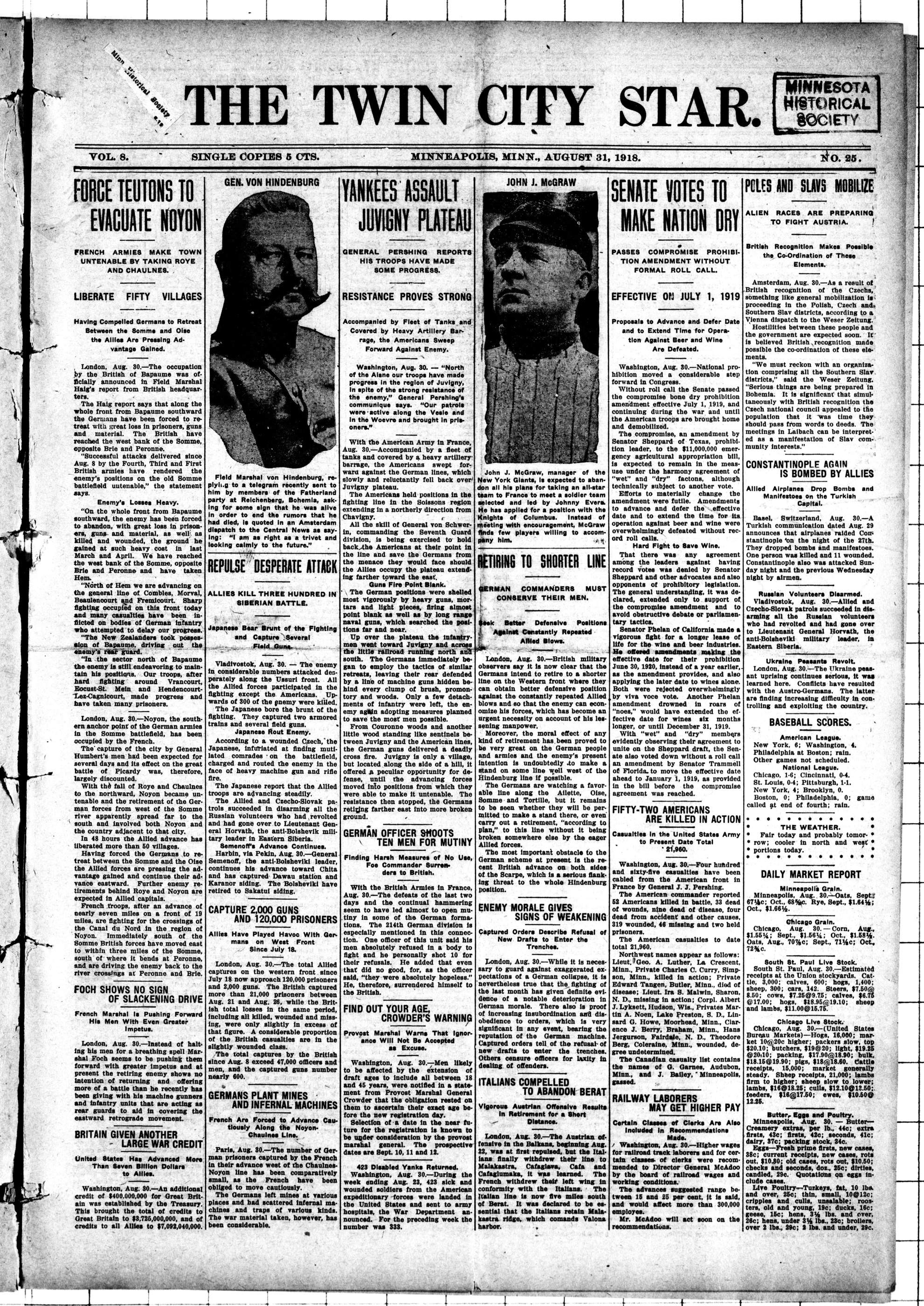
FORCE TEUTONS TO EVACUATE NOYON
FRENCH ARMIES MAKE TOWN UNTENABLE BY TAKING ROYE AND CHAULNES.
Having Compelled Germans to Retreat Between the Somme and Oise the Allies Are Pressing Advantage Gained.
London, Aug. 30.—The occupation by the British of Bapaume was officially announced in Field Marshal Halg's report from British headquarters.
The Halg report says that along the whole front from Bapaume southward the Germans have been forced to retreat with great loss in prisoners, guns and material. The British have reached the west bank of the Somme, opposite Brie and Peronne.
"Successful attacks delivered since Aug. 8 by the Fourth, Third and First British armies have rendered the enemy's positions on the old Somme battlefield untenable," the statement says.
Enemy's Lossea Heavy.
"On the whole front from Bapaume southward, the enemy has been forced to abandon, with great loss in prisoners, guns and material, as well as killed and wounded, the ground he gained at such heavy cost in last March and April. We have reached the west bank of the Somme, opposite Brie and Peronne and have taken Hem.
"North of Hem we are advancing on the general line of Combles, Morval, Beauencourt and Fremicourt. Sharp fighting occupied on this front today and many casualties have been inflicted on bodies of German infantry who attempted to delay our progress.
"The New Zealanders took possession of Bapaume, driving out the enemy's rear guard.
"In the sector north of Bapaume the enemy is still endeavoring to maintain his positions. Our troops, after hard fighting around Vrancourt, Eocust-St. Mein and Hendencourt-Lez-Cagnicourt, made progress and have taken many prisoners.
London, Aug. 30.—Noyon, the southern anchor point of the German armies in the Somme battlefield, has been occupied by the French.
The capture of the city by General Humbert's men had been expected for several days and its effect on the great battle of Picardy was, therefore, largely discounted.
With the fall of Roye and Chaulnes to the northward, Noyon became untenable and the retirement of the German forces from west of the Somme river apparently spread far to the south and involved both Noyon and the country adjacent to that city. In 48 hours the Allied advance has liberated more than 50 villages.
Having forced the Germans to retreat between the Somme and the Oise the Allied forces are pressing the advantage gained and continue their advance eastward. Further enemy retirements behind Roye and Noyon are expected in Allied capitals.
French troops, after an advance of nearly seven miles on a front of 19 miles, are fighting for the crossings of the Canal du Nord in the region of Noyon. Immediately south of the Somme British forces have moved east to within three miles of the Somme, south of where it bends at Peronne, and are driving the enemy back to the river crossings at Peronne and Brie.
FOCH SHOWS NO SIGN
OF SLACKENING DRIVE
French Marshal Is Pushing Forward His Men With Even Greater Impetus.
London, Aug. 30.—Instead of halting his men for a breathing spell Marshal Foch seems to be pushing them forward with greater impetus and at present the retiring enemy shows no intention of returning and offering more of a battle than he recently has been giving with his machine gunners and infantry units that are acting as rear guards to aid in covering the eastward retrograde movement.
United States Has Advanced More
Than Seven Billion Dollars
to Allies.
Washington, Aug. 30.—An additional
credit of $400,000,000 for Great Brita-
in was established by the Treasury.
This brought the total of credits to
Great Britain to $3,725,000,000, and of
credits to all Allies to $7,092,040,000.
THE TWIN CITY STAR.
GEN. VON HINDENBURG
M.
Field Marshal von Hindenburg, replyiing to a telegram recently sent to him by members of the Fatherland party at Reichenberg, Bohemia, asking for some sign that he was alive in order to end the rumors that he had died, is quoted in an Amsterdam dispatch to the Central News as saying: "I am as right as a trivet and looking calmly to the future."
REPULSE DESPERATE ATTACK
ALLIES KILL THREE HUNDRED IN
SIBERIAN BATTLE.
Vladivostok, Aug. 30. — The enemy in considerable numbers attacked desperately along the Ussuri front. All the Allied forces participated in the fighting except the Americans. Upwards of 300 of the enemy were killed.
The Japanese bore the brunt of the fighting. They captured two armored trains and several field guns.
Japanese Rout Enemy.
According to a wounded Czech, the Japanese, infuriated at finding mutilated comrades on the battlefield, charged and routed the enemy in the face of heavy machine gun and rifle fire.
The Japanese report that the Allied troops are advancing steadily.
The Allied and Czecho-Slovak patrols succeeded in disarming all the Russian volunteers who had revolted and had gone over to Lieutenant General Horvath, the anti-Bolshevik military leader in Eastern Siberia.
Semenoff's Advance Continues.
Harbin, via Pekin, Aug. 30.—General Semenoff, the anti-Bolshevik leader, continues his advance toward Chita and has captured Dawau station and Karanor siding. The Bolshevik have retired to Sakatui siding.
CAPTURE 2,000 GUNS AND 120,000 PRISONERS
Allies Have Played Havoc With Germans on West Front Since July 18.
London, Aug. 30.—The total Allied captures on the western front since July 18 now approach 120,000 prisoners and 2,000 guns. The British captured more than 21,000 prisoners between Aug. 21 and Aug. 26, while the British total losses in the same period, including all killed, wounded and missing, were only slightly in excess of that figure. A considerable proportion of the British casualties are in the slightly wounded class.
The total captures by the British since Aug. 8 exceed 47,000 officers and men, and the captured guns number nearly 600.
French Are Forced to Advance Cautiously Along the Noyon-Chaulines Line.
Paris, Aug. 30.—The number of German prisoners captured by the French in their advance west of the Chaulines-Noyon line has been comparatively small, as the French have been obliged to move cautiously.
The Germans left mines at various places and had scattered infernal machines and traps of various kinds. The war material taken, however, has been considerable.
MINNEAPOLIS, MINN., AUGUST 31, 1918.
YANKEES ASSAULT JUVIGNY PLATEAU
GENERAL PERSHING REPORTS
HIS TROOPS HAVE MADE
SOME PROGRESS.
RESISTANCE PROVES STRONG
Accompanied by Fleet of Tanks and Covered by Heavy Artillery Barrage, the Americans Sweep Forward Against Enemy.
Washington, Aug. 30. — "North of the Alane our troops have made progress in the region of Juvigny, in spite of the strong resistance of the enemy," General Pershing's communique says. "Our patrols were active along the Vesle and in the Woevre and brought in prisoners."
With the American Army in France, Aug. 30. — Accompanied by a fleet of tanks and covered by a heavy artillery barrage, the Americans swept forward against the German lines, which slowly and reluctantly fell back over Juvigny plateau.
The Americans held positions in the fighting line in the Solissons region extending in a northerly direction from Chavigny.
All the skill of General von Schwerin, commanding the Seventh Guard division, is being exercised to hold back the Americans at their point in the line and save the Germans from the menace they would face should the Allies occupy the plateau extending farther toward the east.
Guns Fire Point Blank.
The German positions were shelled most vigorously by heavy guns, mortars and light pieces, firing almost point blank as well as by long range naval guns, which searched the positions far and near.
Up over the plateau the infantrymen went toward Juvigny and across the little railroad running north and south. The Germans immediately began to employ the tactics of similar retreats, leaving their rear defended by a line of machine guns hidden behind every clump of brush, promontory and woods. Only a few detachments of infantry were left, the enemy again adopting measures planned to save the most men possible.
From Couronne woods and another little wood standing like sentinels between Juvigny and the American lines, the German guns delivered a deadly cross fire. Juvigny is only a village, but located along the side of a hill, it offered a peculiar opportunity for defense, until the advancing forces moved into positions from which they were able to make it untenable. The resistance then stopped, the Germans retiring farther east into more broken ground.
GERMAN OFFICER SHOOTS
TEN MEN FOR MUTINY
Finding Harah Measures of No Use, Foe Commander Surrenders to British.
With the British Armies in France, Aug. 30.—The defeats of the last two days and the continual hammering seem to have led almost to open mutiny in some of the German formations. The 214th German division is especially mentioned in this connection. One officer of this unit said his men absolutely refused in a body to fight and he personally shot 10 for their refusals. He added that even that did no good, for, as the officer said, "they were absolutely hopeless." He, therefore, surrendered himself to the British.
Provost Marshal Warne That ignorance Will Not Be Accepted as Excuse.
Washington, Aug. 30.—Men likely to be affected by the extension of draft ages to include all between 18 and 45 years, were notified in a statement from Provost Marshal General Crowder that the obligation rested on them to ascertain their exact age before the new registration day.
Selection of a date in the near future for the registration is known to be under consideration by the provost marshal general. The prospective dates are Sept. 10, 11 and 12.
423 Disabled Yanks Returned.
Washington, Aug. 30.—During the week ending Aug. 23, 423 sick and wounded soldiers from the American expeditionary forces were landed in the United States and sent to army hospitals, the War Department announced. For the preceding week the number was 333.
JOHN J. McGRAW
1
John J. McGraw, manager of the New York Giants, is expected to abandon all his plans for taking an all-star team to France to meet a soldier team selected and led by Johnny Evers. He has applied for a position with the Knights of Columbus. Instead of meeting with encouragement, McGraw finds few players willing to accompany him.
RETIRING TO SHORTER LINE
GERMAN COMMANDERS MUST CONSERVE THEIR MEN.
Seek Better Defensive Positions Against Constantly Repeated Allied Blows.
London, Aug. 30.—British military observers say it is now clear that the Germans intend to retire to a shorter line on the Western front where they can obtain better defensive position against the constantly repeated Allied blows and so that the enemy can economize his forces, which has become an urgent necessity on account of his lessening manpower.
Moreover, the moral effect of any kind of retirement has been proved to be very great on the German people and armies and the enemy's present intention is undoubtedly to make a stand on some line well west of the Hindenburg line if possible.
The Germans are watching a favorable line along the Alette, Oise, Somme and Tortille, but it remains to be seen whether they will be permitted to make a stand there, or even carry out a retirement, "according to plan," to this line without it being broken somewhere else by the eager Allied forces.
The most important obstacle to the German scheme at present is the recent British advance on both sides of the Scarpe, which is a serious flanking threat to the whole Hindenburg position.
ENEMY MORALE GIVES SIGNS OF WEAKENING
Captured Orders Describe Refusal of New Drafts to Enter the Trenches.
London, Aug. 30.—While it is necessary to guard against exaggerated expectations of a German collapse, it is nevertheless true that the fighting of the last month has given definite evidence of a notable deterioration in German morale. There also is proof of increasing insubordination and disobedience to orders, which is very significant in any event, bearing the reputation of the German machine. Captured orders tell of the refusal of new drafts to enter the trenches. Others censure officers for laxity in dealing of offenders.
ITALIANS COMPELLED TO ABANDON BERAT
Vigorous Austrian Offensive Results In Retirement for a Short Distance.
London, Aug. 30.—The Austrian offensive in the Balkans, beginning Aug. 22, was at first repulsed, but the Italians finally withdrew their line to Malakastra, Cafaglawa, Cafa and Cafaglumaks, it was learned. The French withdrew their left wing in conformity with the Italians. The Italian line is now five miles south of Berat. It was declared to be essential that the Italians retain Malakastra ridge, which comands Valona harbor.
SENATE VOTES TO MAKE NATION DRY
SENATE VOTES TO MAKE NATION DRY
PASSES COMPROMISE PROHIBI
TION AMENDMENT WITHOUT
FORMAL ROLL CALL.
EFFECTIVE ON JULY 1, 1919
Proposals to Advance and Defer Date and to Extend Time for Operation Against Beer and Wine Are Defeated.
Washington, Aug. 30.—National prohibition moved a considerable step forward in Congress.
Without roll call the Senate passed the compromise bone dry prohibition amendment effective July 1, 1919, and continuing during the war and until the American troops are brought home and demobilized.
The compromise, an amendment by Senator Sheppard of Texas, prohibition leader, to the $11,000,000 emergency agricultural appropriation bill, is expected to remain in the measure under the harmony agreement of "wet" and "dry" factons, although technically subject to another vote.
Efforts to materially change the amendment were futile. Amendments to advance and defer the effective date and to extend the time for its operation against beer and wine were overwhelmingly defeated without record roll calls.
Hard Fight to Save Wine.
That there was any agreement among the leaders against having record votes was denied by Senator Sheppard and other advocates and also opponents of prohibitory legislation. The general understanding, it was declared, extended only to support of the compromise amendment and to avoid obstructive debate or parliamentary tactics.
Senator Phelan of California made a vigorous fight for a longer lease of life for the wine and beer industries. He offered amendments making the effective date for their prohibition June 30, 1920, instead of a year earlier, as the amendment provides, and also applying the later date to wines alone. Both were rejected overwhelmingly by viva voce vote. Another Phelan amendment drowned in roars of "noes," would have extended the effective date for wines six months longer, or until December 31, 1919.
With "wet" and "dry" members evidently observing their agreement to unite on the Sheppard draft, the Senate also voted down without a roll call an amendment by Senator Trammell of Florida to move the effective date ahead to January 1, 1919, as provided in the bill before the compromise agreement was reached.
FIFTY-TWO AMERICANS ARE KILLED IN ACTION
Casualties in the United States Army to Present Date Total 21,960.
Washington, Aug. 30.—Four hundred and sixty-five casualties have been cabled from the American front in France by General J. J. Pershing.
The American commander reported 52 Americans killed in battle, 33 dead of wounds, nine dead of disease, four dead from accident and other causes, 319 wounded, 46 missing and two held prisoners.
The American casualties to date total 21,960.
Northwest names appear as follows: Lleut. Geo. A. Luther, La Crescent, Minn., Private Charles C. Curry, Simpson, Minn., killed in action; Private Edward Tangen, Butler, Minn., died of disease; Lieut. Ira S. Malwin, Sharon, N. D., missing in action; Corpl. Albert J. Lyksett, Hudson, Wis., Privates Martin A. Noen, Lake Preston, S. D., Linsard G. Howe, Moorhead, Minn., Clarence J. Berry, Braham, Minn., Hans Jergurson, Fairdale, N. D., Theodore Berg, Coleraine, Minn., wounded, degree undetermined.
The Canadian casualty list contains the names of G. Garnes, Audubon, Minn., and J. Bailey, Minneapolis, gassed.
RAILWAY LABORERS
MAY GET HIGHER PAY
Certain Classes of Clerks Are Also Included in Recommendations Made.
Washington, Aug. 30.—Higher wages for railroad track laborers and for certain classes of clerks were recommended to Director General McAdoo by the board of railroad wages and working conditions.
The advances suggested range between 15 and 25 per cent, it is said, and would affect more than 300,000 employees.
Mr. McAdoo will act soon on the recommendations.
MINNESOTA
HISTORICAL
80CIETY
NO.25.
POLES AND SLAVS MOBILIZE
ALIEN RACES ARE PREPARING TO FIGHT AUSTRIA.
British Recognition Makes Possible the Co-Ordination of These Elements.
Amsterdam, Aug. 30.—As a result of British recognition of the Czechs, something like general mobilization is proceeding in the Polish, Czech and Southern Slav districts, according to a Vienna dispatch to the Weser Zeitung. Hostilities between these people and the government are expected soon. It is believed British recognition made possible the co-ordination of these elements.
"We must reckon with an organization comprising all the Southern Slav districts," said the Weser Zeitung. "Serious things are being prepared in Bohemia. It is significant that simultaneously with British recognition the Czech national council appealed to the population that it was time they should pass from words to deeds. The meetings in Laibach can be interpreted as a manifestation of Slav community interests."
CONSTANTINOPLE AGAIN
IS BOMBED BY ALLIES
Allied Airplanes Drop Bombs and Manifestoes on the Turkish Capital.
Basel, Switzerland, Aug. 30.—A Turkish communication dated Aug. 29 announces that airplanes raided Constantinople 'on the night of the 27th. They dropped bombs and manifestoes. One person was killed and 11 wounded. Constantinople also was attacked Sunday night and the previous Wednesday night by airmen.
Rusalan Volunteer Dearmed
Vladivostok, Aug. 30.—Allied and Czecho-Slovak patrols succeeded in disarming all the Russian volunteers who had revolted and had gone over to Lieutenant General Horvath, the anti-Bolshevik military leader, in Eastern Siberia.
Ukraine Peasants Revolt.
London, Aug. 30.—The Ukraine peasant uprising continues serious, it was learned here. Conflicts have resulted with the Austro-Germans. The latter are finding increasing difficulty in controlling and exploiting the country.
BASEBALL SCORES.
American League.
New York, 6; Washington, 4.
Philadelphia at Boston; rain.
Other games not scheduled.
Boston, 0; Philadelphia, 0; game called at end of fourth; rain.
* * * * * * * * * * * * * * *
* THE WEATHER. *
* Fair today and probably tomor-
* row; cooler in north and west
* portions today.
DAILY MARKET REPORT
Minneapolis Gram
Minneapolis, Aug. 30—Oats, Sept.
67½ c; Oct, 68½ c. Rye, Sept., $1.64½;
Oct., $1.66½.
Chicago Grain.
Chicago, Aug. 30. — Corn, Aug. $1.15%$; Sept., $1.15%$; Oct., $1.15%$; Oats, Aug., $70%$;c; Sept., $71%$;c; Oct., $72%$c.
South St. Paul Live Stock.
South St. Paul, Aug. 30.—Estimated receipts at the Union stockyards. Cattle, 3,000; calves, 600; hogs, 1,400; sheep, 300; cars, 142. Steers, $7.50@8.50; cows, $7.25@9.75; calves, $6.75@17.00; hogs, $18.95@19.10; sheep and lambs. $11.00@15.75.
Chicago Live Stock
Chicago, Aug. 30:—(United States Bureau Markets)—Hogs, 16,000; market 10@20c higher; packers slow, top $20.10; butchers, $19@20; light, $19.25@20:10; packing, $17.90@18.90; bulk, $18.15@19.95; pigs, $18@18.60. Cattle receipts, 15,000; market generally steady. Sheep receipts, 21,000; lambs firm to higher; sheep slow to lower; lambs, $16@18.25; culls, $12.10@12.50; feeders, $16@17.50; ewes, $10.50@12.25.
Butter, Eggs and Poultry.
Minneapolis, Aug. 30. — Butter—Creamy extras, per lb., 44c; extra firsts, 43c; firsts, 42c; seconds, 41c; dairy, 37c; packing stock, 34c.
Eggs—Fresh prime firsts, new cases, 38c; current recalpts, new cases, rots out, $10.80; old cases, rots out, $10.50; checks and seconds, doz., 25c; dirties, candled, 29c. Quotations on eggs include cases.
Live Poultry—Turkeys, fat, 10 lbs. and over, 25c; thin, small, 10@12c; cripples and culls, unsalable; roosters, old and young, 19c; ducks, 16c; geese, 15c; hens, 3½ lbs. and over, 26c; hens, under 3½ lbs., 23c; broilers, over 2 lbs., 29c; 2 lbs. and under, 29c.
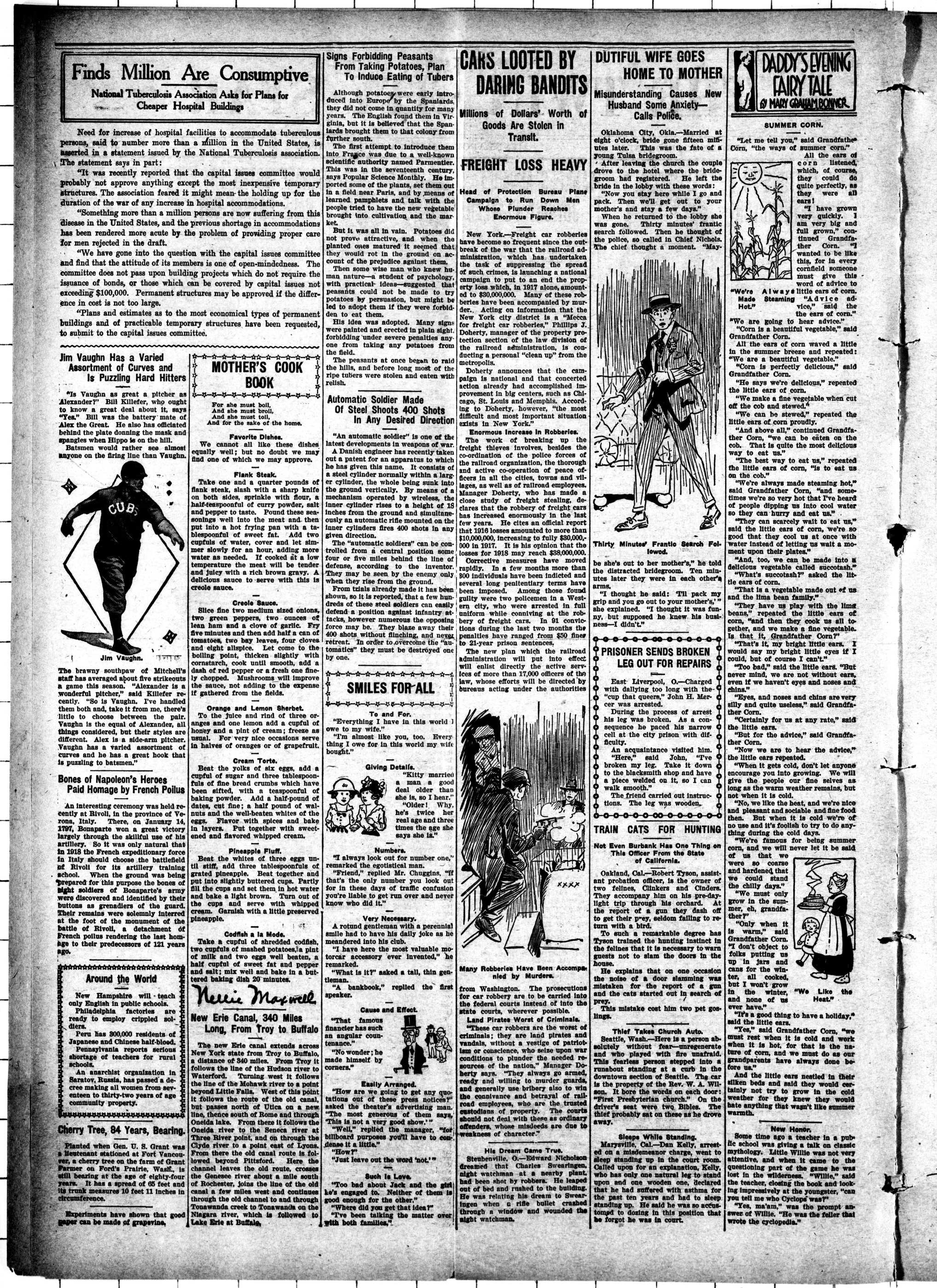
Need for increase of hospital facilities to accommodate tuberculous persons, said to number more than a million in the United States, is asserted in a statement issued by the National Tuberculosis association. The statement says in part:
"It was recently reported that the capital issues committee would probably not approve anything except the most inexpensive temporary structures. The association feared it might mean the holding up for the duration of the war of any increase in hospital accommodations.
"Something more than a million persons are now suffering from this disease in the United States, and the previous shortage in accommodations has been rendered more acute by the problem of providing proper care for men rejected in the draft.
"We have gone into the question with the capital issues committee and find that the attitude of its members is one of open-mindedness. The committee does not pass upon building projects which do not require the issuance of bonds, or those which can be covered by capital issues not exceeding $100,000. Permanent structures may be approved if the difference in cost is not too large."
"Plans and estimates as to the most economical types of permanent buildings and of practicable temporary structures have been requested, to submit to the capital issues committee.
Jim Vaughn Has a Varied Assortment of Curves and Is Puzzling Hard Hitters
"Is Vaughn as great a pitcher as Alexander?" Bill Killefer, who ought to know a great deal about it, says "Yes." Bill was the battery mate of Alex the Great. He also has officiated behind the plate donning the mask and spangles when Hippo is on the hill. Batsmen would rather see almost anyone on the firing line than Vaughn.
CUBS
Jim Vaughn.
The brawny southpaw of Mitchell's staff has averaged about five strikeouts a game this season. "Alexander is a wonderful pitcher," said Killefer recently. "So is Vaughn. I've handled them both and, take it from me, there's little to choose between the pair. Vaughn is the equal of Alexander, all things considered, but their styles are different. Alex is a side-arm pitcher. Vaughn has a varied assortment of curves and he has a great hook that is puzzling to batsmen."
Bones of Napoleon's Heroes Paid Homage by French Poilus
An interesting ceremony was held recently at Rivoll, in the province of Verona, Italy. There, on January 14, 1797, Bonaparte won a great victory largely through the skillful use of his artillery. So it was only natural that in 1918 the French expeditionary force in Italy should choose the battlefield of Rivoll for its artillery training school. When the ground was being prepared for this purpose the bones of eight soldiers of Bonaparte's army were discovered and identified by their buttons as grenadiers of the guard. Their remains were solemnly interred at the foot of the monument of the battle of Rivoll, a detachment of French pollus rendering the last homage to their predecessors of 121 years ago.
New Hampshire will teach only English in public schools. Philadelphia factories are ready to employ crippled soldiers. Peru has 300,000 residents of Japanese and Chinese half-blood. Pennsylvania reports serious shortage of teachers for rural schools. An anarchist organization in Saratov, Russia, has passed a decree making all women from seventeen to thirty-two years of age community property.
Cherry Tree, 84 Years, Bearing.
Planted when Gen. U. S. Grant was a lieutenant stationed at Fort Vancouver, a cherry tree on the farm of Grant Farmer on Ford's Prairie, Wasil, is still bearing at the age of eighty-four years. It has a spread of 65 feet and its trunk measures 10 feet 11 inches in circumference.
Experiments have shown that good paper can be made of grapevine.
We cannot all like these dishes equally well; but no doubt we may find one of which we may approve.
Flank Steak.
Take one and a quarter pounds of flank steak, slash with a sharp knife on both sides, sprinkle with flour, a half-teaspoonful of curry powder, salt and pepper to taste. Pound these seasonings well into the meat and then put into a hot frying pan with a tablespoonful of sweet fat. Add two cupfuls of water, cover and let simmer slowly for an hour, adding more water as needed. If cooked at a low temperature the meat will be tender and juicy with a rich brown gravy. A delicious sauce to serve with this is creole sauce.
Creole Sauce.
Slice fine two medium sized onions, two green peppers, two ounces of lean ham and a clove of garlic. Fry five minutes and then add half a can of tomatoes, two bay leaves, four cloves and eight allspice. Let come to the boiling point, thicken slightly with cornstarch, cook until smooth, add a dash of red pepper or a fresh one finely chopped. Mushrooms will improve the sauce, not adding to the expense if gathered from the fields.
Orange and Lemon Sherbet.
To the juice and rind of three oranges and one lemon add a cupful of honey and a pint of cream; freeze as usual. For very nice occasions serve in halves of oranges or of grapefruit.
Cream Torte.
Beat the yolks of six eggs, add a cupful of sugar and three tablespoonfuls of fine bread crumbs which have been sifted, with a teaspoonful of baking powder. Add a half-pound of dates, cut fine; a half pound of walnuts and the well-beaten whites of the eggs. Flavor with spices and bake in layers. Put together with sweetened and flavored whipped cream.
Pineapple Fluff.
Beat the whites of three eggs until stiff, add three tablespoonfuls of grated pineapple. Beat together and put into slightly buttered cups. Partly fill the cups and set them in hot water and bake a light brown. Turn out of the cups and serve with whipped cream. Garnish with a little preserved pineapple.
Codfish a la Mode.
Take a cupful of shredded codfish, two cupfuls of mashed potatoes, a pint of milk and two eggs well beaten, a half cupful of sweet fat and pepper and salt; mix well and bake in a buttered baking dish 20 minutes. Nellie Maxwell
The new Erie canal extends across New York state from Troy to Buffalo, a distance of 340 miles. From Troy it follows the line of the Hudson river to Waterford. Turning west it follows the line of the Mohawk river to a point beyond Little Falls. West of this point it follows the route of the old canal, but passes north of Utica on a new line, thence south of Rome and through Oneida lake. From there it follows the Oneida river to the Seneca river at Three River point, and on through the Clyde river to a point east of Lyons. From there the old canal route is followed beyond Pitttsford. Here the channel leaves the old route, crosses the Genesee river about a mile south of Rochester, joins the line of the old canal a few miles west and continues through the old channel to and through Tonawanda creek to Tonawanda on the Niagara river, which is followed to Lake Erie at Buffalo.
Although potatoes were early introduced into Europe by the Spaniards, they did not come in quantity for many years. The English found them in Virginia, but it is believed that the Spaniards brought them to that colony from further south.
The first attempt to introduce them into France was due to a well-known scientific authority named Parmentier. This was in the seventeenth century, says Popular Science Monthly. He imported some of the plants, set them out in a field near Paris, and by means of learned pamphlets and talk with the people tried to have the new vegetable brought into cultivation and the market.
But it was all in vain. Potatoes did not prove attractive, and when the planted ones matured it seemed that they would rot in the ground on account of the prejudice against them.
Then some wise man who knew human nature—a student of psychology, with practical ideas—suggested that peasants could not be made to try potatoes by persuasion, but might be led to adopt them if they were forbidden to eat them.
His idea was adopted. Many signs were painted and erected in plain sight, forbidding under severe penalties anyone from taking any potatoes from the field.
The peasants at once began to raid the hills, and before long most of the ripe tubers were stolen and eaten with relish.
"An automatic soldier" is one of the latest developments in weapons of war. A Danish engineer has recently taken out a patent for an apparatus to which he has given this name. It consists of a steel cylinder normally within a larger cylinder, the whole being sunk into the ground vertically. By means of a mechanism operated by wireless, the inner cylinder rises to a height of 19 inches from the ground and simultaneously an automatic rifle mounted on the inner cylinders fires 400 shots in any given direction. The "automatic soldiers" can be controlled from a central position some four or five miles behind the line of defense, according to the inventor. They may be seen by the enemy only when they rise from the ground.
From trials already made it has been shown, so it is reported, that a few hundreds of these steel soldiers can easily defend a position against infantry attacks, however numerous the opposing force may be. They blaze away their 400 shots without flinching, and never retreat. In order to overcome the "automatics" they must be destroyed one by one.
To and For.
"Everything I have in this world I owe to my wife."
"I'm almost like you, too. Every thing I owe for in this world my wife bought."
"Kitty married a man a good deal older than she is, so I hear."
"Older! Why, he's twice her real age and three times the age she says she is."
W
"I always look out for number one," remarked the egotistical man. "Friend," replied Mr. Chuggins, "if that's the only number you look out in these days of traffic confusion you're liable to get run over and never know who did it."
Very Necessary.
A rotund gentleman with a perennial smile had to have his daily joke as he meandered into his club.
"I have here the most valuable motorcar accessory ever invented," he remarked.
"What is it?" asked a tall, thin gentleman.
"A bankbook," replied the first speaker.
A man in a top hat and suit stands with two other men.
"That famous financier has such an angular countenance."
"No wonder; he made himself by corners."
"How are we going to get any quotations out of these press notices?" asked the theater's advertising man. "The most generous of them says, This is not a very good show." "Well," replied the manager, "for billboard purposes you'll have to condense it a little."
"Howr"
"Just leave out the word 'not'!"
"Too bad about Jack and the girl he's engaged to. Neither of them is good enough for the other."
"Where did you get that idea?"
"I've been talking the matter over with both families."
CAKS LOOTED BY DARING BANDITS
Millions of Dollars' Worth of Goods Are Stolen in Transit.
Head of Protection Bureau Plane Campaign to Run Down Men Whose Plunder Reaches Enormous Figure.
New York.—Freight car robberies have become so frequent since the outbreak of the war that the railroad administration, which has undertaken the task of suppressing the spread of such crimes, is launching a national campaign to put to an end the property loss which, in 1917 alone, amounted to $30,000,000. Many of these robberies have been accompanied by murder. Acting on information that the New York city district is a "Mecca for freight car robberies," Phillips J. Doherty, manager of the property protection section of the law division of the railroad administration, is conducting a personal "clean up" from the metropolis.
Doherty announces that the campaign is national and that concerted action already had accomplished improvement in big centers, such as Chicago, St. Louis and Memphis. According to Doherty, however, "the most difficult and most important situation exists in New York."
Enormous Increase In Robberies.
The work of breaking up the freight thieves involves, besides the co-ordination of the police forces of the railroad organization, the thorough and active co-operation of peace officers in all the cities, towns and villages, as well as of railroad employees. Manager Doherty, who has made a close study of freight stealing, declares that the robbery of freight cars has increased enormously in the last few years. He cites an official report that 1916 losses amounted to more than $10,000,000, increasing to fully $80,000,000 in 1917. It is his opinion that the losses for 1918 may reach $88,000,000.
Corrective measures have moved rapidly. In a few months more than 800 individuals have been indicted and several long penitentiary terms have been imposed. Among those found guilty were two policemen in a Western city, who were arrested in full uniform while conning at the robbery of freight cars. In 91 convictions during the last two months the penalties have ranged from $50 fines to 21-year prison sentences. The new plan which the railroad administration will put into effect will enlist directly the active services of more than 17,000 officers of the law, whose efforts will be directed by bureaucats acting under the authorities
xxxx
Many Robberies Have Been Accompanied by Murders.
Many Robberies Have Been Accompanied by Murders.
from Washington. The prosecutions for car robbery are to be carried into the federal courts instead of into the state courts, wherever possible.
Land Pirates Worst of Criminals.
"These car robbers are the worst of criminals; they are land pirates and vandals, without a vestige of patriotism or conscience, who seize upon war conditions to plunder the needed resources of the nation," Manager Doherty says. "They always go armed, ready and willing to murder guards, and generally use bribery also to win the connivance and betrayal of railroad employees, who are the trusted custodians of property. The courts should not deal with these as ordinary offenders, whose misdeeds are due to weakness of character."
His Dream Game True.
Steubenville, O.—Edward Nicholson dreamed that Charles Swaringen, night watchman at a nearby plant, had been shot by robbers. He leaped out of bed and rushed to the building. He was relating his dream to Swaringen when a rifle bullet crashed through a window and wounded the night watchman.
Oklahoma City, Okla.—Married at eight o'clock, bride gone fifteen minutes later. This was the fate of a young Tulsa bridegroom.
After leaving the church the couple drove to the hotel where the bridegroom had registered. He left the bride in the lobby with these words:
"Now you stay here while I go and pack. Then we'll get out to your mother's and stay a few days."
When he returned to the lobby she was gone. Thirty minutes' frantic search followed. Then he thought of the police, so called in Chief Nichols. The chief thought a moment. "May-
A
Thirty. Minutes' Frantio Search Followed
Thirty Minutes' Frantic Search Followed.
be she's out to her mother's," he told the distracted bridegroom. Ten minutes later they were in each other's arms.
"I thought he said: 'Till pack my grip and you go out to your mother's.'" she explained. "I thought it was funny, but supposed he knew his business—I didn't."
PRISONER SENDS BROKEN LEG OUT FOR REPAIRS
East Liverpool, O.—Charged with dallying too long with the "cup that queers," John H. Mercer was arrested.
During the process of arrest his leg was broken. As a consequence he paced his narrow cell at the city prison with difficulty.
An acquaintance visited him. "Here," said John, "Tve broken my leg. Take it down to the blacksmith shop and have a piece welded on it, so I can walk smooth."
The friend carried out instructions. The leg was wooden.
TRAIN CATS FOR HUNTING
Not Even Burbank Has One Thing on This Officer From the State of California.
Oakland, Cal.—Robert Tyson, assistant probation officer, is the owner of two felines, Clinkers and Clinders. They accompany him on his pre-daylight trip through his orchard. At the report of a gun they dash off to get their prey, seldom failing to return with a bird.
To such a remarkable degree has Tyson trained the hunting instinct in the felines that it is necessary to warn guests not to slam the doors in the house.
He explains that on one occasion the noise of a door slamming was mistaken for the report of a gun and the cats started out in search of prey.
This mistake cost him two pet goslings.
Thief Takes Church Auto.
Seattle, Wash.—Here is a person absolutely without fear—unregenerate and who played with fire unafraid.
This fearless person stepped into a runabout standing at a curb in the downtown section of Seattle. The car is the property of the Rev. W. A. Wilson. It bore the words on each door: "First Presbyterian church." On the driver's seat were two Bibles. The thief probably sat on these as he drove away.
Sleeps While Standing
Marysville, Cal.-Dan Kelly, arrested on a misdemeanor charge, went to sleep standing up in the court room. Called upon for an explanation, Kelly, who has only one natural leg to stand upon and one wooden one, declared that he had suffered with asthma for the past ten years and had to sleep standing up. He said he was so accustomed to dozing in this position that he forgot he was in court.
DADDY'S EVENING
FAIRY TALE
BY MARY GRAHAM BONNER
"Let me tell you," said Grandfather Corn, "the ways of summer corn."
All the ears of corn listened, which, of course, they could do quite perfectly, as they were all ears!
SUN
"I have grown very quickly. I am very big and full grown," continued Grandfather Corn. "I wanted to be like this, for in every cornfield someone must give this word of advice to little corn.
"We're Always Made Steaming Hot."
Made Steaming "Advice advice, Hot." said the the ears of corn.
"We are going to hear advice."
"Corn is a beautiful vegetable," said Grandfather Corn.
All the ears of corn waved a little in the summer breeze and repeated:
"We are a beautiful vegetable."
"Corn is perfectly delicious," said Grandfather Corn.
"He says we are delicious," repeated the little ears of corn.
"We make a fine vegetable when cut off the cob and stewed."
"We can be stewed," repeated the little ears of corn proudly.
"And above all," continued Grandfather Corn, "we can be eaten on the cob. That is quite the most delicious way to eat us."
"The best way to eat us," repeated the little ears of corn, "is to eat us on the cob."
"We're always made steaming hot," said Grandfather Corn, "and sometimes we're so very hot that I've heard of people dipping us into cool water so they can hurry and eat us."
"They can scarcely wait to eat us," said the little ears of corn, we're so good that they cool us at once with water instead of letting us wait a moment upon their plates."
"And, too, we can be made into a delicious vegetable called succotash."
"What's succotash?" asked the little ears of corn.
"That is a vegetable made out of us and the lima bean family."
"They have us play with the lima beans," repeated the little ears of corn, "and then they cook us all together, and we make a fine vegetable. Is that it, Grandfather Corn?"
"That's it, my bright little ears. I would say my bright little eyes if I could, but of course I can't."
"Too bad," said the little ears. "But never mind, we are not without ears, even if we haven't eyes and noses and chins."
"Eyes, and noses and chins are very silly and quite useless," said Grandfather Corn.
"Certainly for us at any rate," said the little ears.
"But for the advice," said Grandfather Corn.
"Now we are to hear the advice," the little ears repeated.
"When it gets cold, don't let anyone encourage you into growing. We will give the people our fine selves as long as the warm weather remains, but not when it is cold.
"No, we like the heat, and we're nice and pleasant and sociable and fine food then. But when it is cold we're of no use and it's foolish to try to do anything during the cold days.
"We're famous for being summer corn, and we will never let it be said
"We're famous corn, and we will of us that we were so coarse and hardened that we could stand the chilly days."
A WOMAN HOLDING A TRAY OF CAKE AND A BOY
"We must only grow in the summer, eh, grandfather?"
"Only when it is warm," said Grandfather Corn.
"I don't object to folks putting us up in jars and cans for the winter, all cooked, but I won't grow in the winter, and none of us ever have."
"It's a good thing to have a holiday," said the little ears.
"Yes," said Grandfather Corn, "we must rest when it is cold and work when it is hot, for that is the nature of corn, and we must do as our grandparents have always done before us."
And the little ears nestled in their silken beds and said they would certainly not try to grow in the cold weather for they knew they would hate anything that wasn't like summer warmth.
New Honor.
Some time ago a teacher in a public school was giving a talk on classic mythology. Little Willie was not very attentive, and when it came to the questioning part of the game he was lost in the wilderness. "Willie," said the teacher, closing the book and looking impressively at the youngster, "can you tell me who Cyclops was?" "Yes, ma'm'," was the prompt answer of Willie. "He was the feller that wrote the cyclopedia."
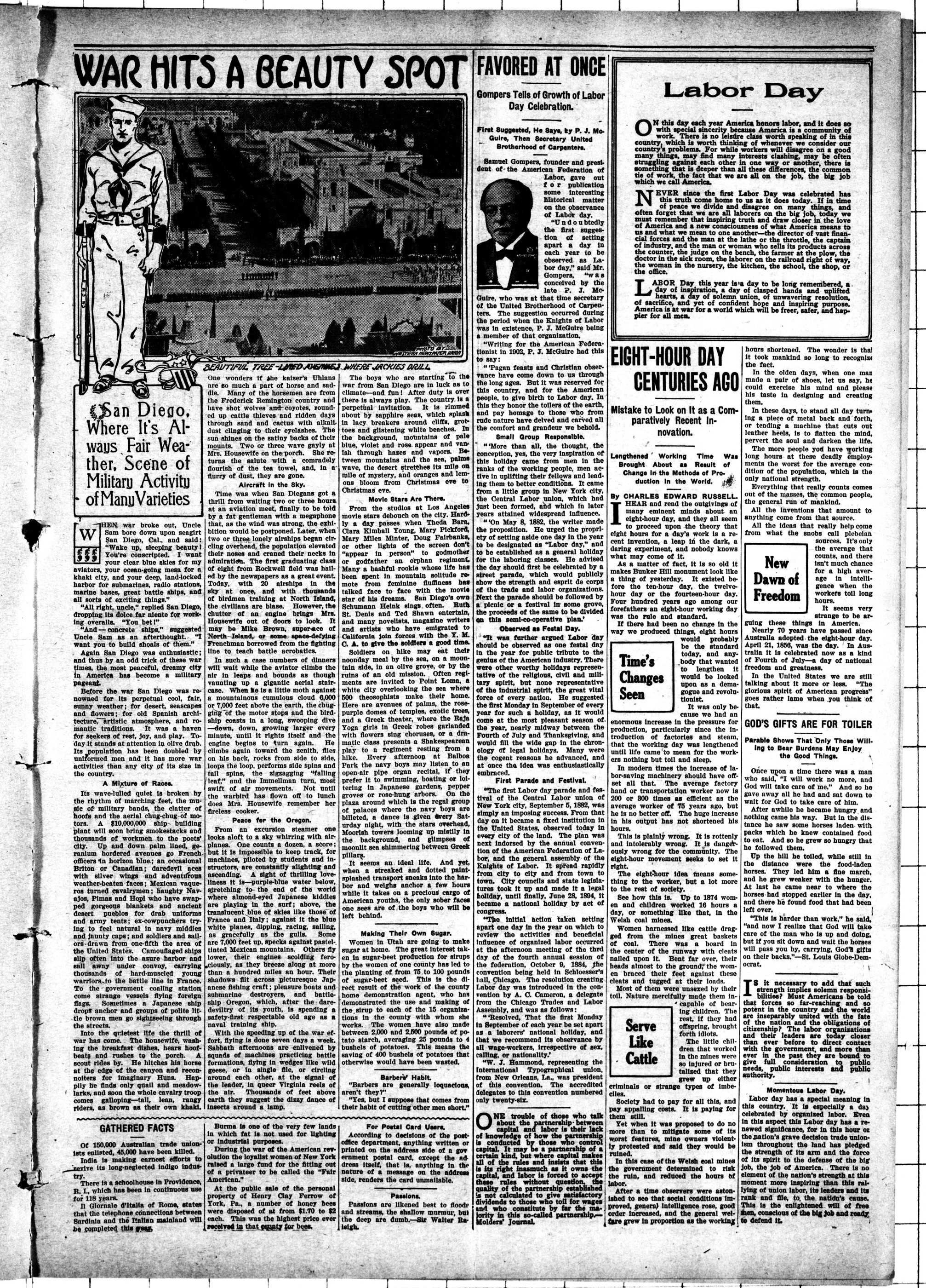
WAR HITS A BEAUTY SPOT
PHOTO BY
WESTERN MEMSIAVER UNION
San Diego Where It's Always Fair Weather. Scene of Military Activity of Many Varieties
HEN war broke out, Uncle Sam bore down upon seagirt San Diego, Cal., and said "Wake up, sleeping beauty! You're conscripted. I want your clear blue skies for my aviators, your ocean-going mesa for a khaki city, and your deep, land-locked harbor for submarines, radio stations, marine bases, great battle ships, and all sorts of exciting things."
"All right, uncle," replied San Diego, dropping its dolce far niente for working overalls. "You bet!"
"And—concrete ships," suggested Uncle Sam as an afterthought. "I want you to build shoals of them."
Again San Diego was enthusiastic; and thus by an odd trick of these war times, the most peaceful, dreamy city in America has become a military pageant.
Before the war San Diego was renowned for its perpetual cool, fair, sunny weather; for desert, seascapes and flowers; for old Spanish architecture, artistic atmosphere, and romantic traditions. It was a haven for seekers of rest, joy, and play. Today it stands at attention in olive drab. Its population has been doubled by uniformed men and it has more war activities than any city of its size in the country.
A Mixture of Races.
Its wave-lulled quiet is broken by the rhythm of marching feet, the music of military bands, the clatter of hoofs and the aerial chug-chug of motors. A $10,000,000 ship building plant will soon bring smokestacks and thousands of workmen to the poets' city. Up and down palm lined, geranium bordered avenues go French officers in horizon blue; an occasional Briton or Canadian; daredevil aces with silver wings and adventufous weather-beaten faces; Mexican vaqueros turned cavalrymen; haughty Navajos, Pimas and Hopl who have swapped gorgeous blankets and ancient desert pueblos for drab uniforms and army tents; ex-cowpunchers trying to feel natural in navy middles and jaunty caps; and soldiers and sailors drawn from one-fifth the area of the United States. Camouflaged ships slip often into the azure harbor and sail away under convoy, carrying thousands of hard-muscelled young warriors_to the battle line in France. To the government coaling station come strange vessels flying foreign flags. Sometimes a Japanese ship drops anchor and groups of polite little brown men go sightseeing through the streets.
Into the quietest life the thrill of war has come. The housewife, washing the breakfast dishes, hears hoo-beats and rushes to the porch. A scout rides by. He hitches his horse at the edge of the canyon and recon-rotters for imaginary Huns. Happily he finds only quail and meadowlarks, and soon the whole cavalry troop comes galloping—tall, lean, rangy riders, as brown as their own khaki.
GATHERED FACTS
Of 150,000 Australian trade unionists enlisted, 45,000 have been killed. India is making earnest efforts to revive its long-neglected indigo industry. There is a schoolhouse in Providence, R. L, which has been in continuous use for 118 years. Il Glorale d'Italia of Rome, states that the telephone connections between Sardinia and the Italian mainland will be completed this year.
One wonders if she kaiser's Uhlans are so much a part of horse and saddle. Many of the horsemen are from the Frederick Remington country and have shot wolves and coyotes, rounded up cattle thieves and ridden days through sand and cactus with alkali dust clinging to their eyelashes. The sun shines on the satiny backs of their mounts. Two or three wave gayly at Mrs. Housewife on the porch. She returns the salute with a comradely flourish of the tea towel, and, in a flurry of dust, they are gone.
Aircraft in the Sky.
Time was when San Diegans got a thrill from waiting two or three hours at an aviation meet, finally to be told by a fat gentleman with a megaphone that, as the wind was strong, the exhibition would be postponed. Later, when two or three lonely airships began circling overhead, the population elevated their noses and craned their necks in admiration. The first graduating class of eight from Rockwell field was hailed by the newspapers as a great event. Today, with 20 airships in the sky at once, and with thousands of birdmen training at North Island, the civilians are blase. However, the chutter of an engine brings Mrs. Housewife out of doors to look. It may be Mike Brown, super-ace of North Island, or some space-defying Frenchman borrowed from the fighting line to teach battle acrobatics.
In such a case numbers of dinners will wait while the aviator climbs the air in leaps and bounds as though vaunting up a gigantic aerial staircase. When he is a little moth against a mountainous cumulous cloud 6,000 or 7,000 feet above the earth, the chugging of the motor stops and the birdship coasts in a long, swooping dive—down, down, growing larger every minute, until it rights itself and the engine begins to turn again. He climbs again toward the zenith, flies on his back, rocks from side to side, loops the loop, performs side spins and tail spins, the zigzagging "falling leaf," and the Immelman turn, most swift of air movements. Not until the warbird has flown off to lunch does Mrs. Housewife remember her fireless cooker.
Peace for the Oregon.
From an excursion steamer one looks aloft to a sky whirring with airplanes. One counts a dozen, a score; but it is impossible to keep track, for machines, piloted by students and instructors, are constantly slighting and ascending. A sight of thrilling loveliness it is—purple-blue water below, stretching to—the end of the world where almond-eyed Japanese kiddies are playing in the surf; above, the translucent blue of skies like those of France and Italy; against it the blue white planes, dipping, racing, sailing, as gracefully as the gulls. Some are 7,000 feet up, specks against pastel-tinted Mexican mountains. Others fly lower, their engines scolding ferociously, as they breeze along at more than a hundred miles an hour. Their shadows flit across picturesque Japanese fishing craft; pleasure boats and submarine destroyers, and battleship Oregon, which, after the daredevility of its youth, is spending a safety-first respectable old age as a naval training ship.
With the speeding up of the war effort, flying is done seven days a week. Sabbath afternoons are enlivened by squads of machines practicing battle formations, flying in wedges like wild geese, or in single file, or circling around each other, at the signal of the leader, in queer Virginia reels of the air. Thousands of feet above earth they suggest the dizzy dance of insects around a lamp.
Burma is one of the very few lands in which fat is not used for lighting or industrial purposes.
During the war of the American revolution the loyalist women of New York raised a large fund for the fitting out of a privateer to be called the "Fair American."
At the public sale of the personal property of Henry Clay Ferrow of York, Pa., a number of honey bees were disposed of at from $1.70 to $2 each. This was the highest price ever received in that county for bees.
The boys who are starting to the war from San Diego are in luck as to climate—and fun! After duty is over there is always play. The country is a perpetual invitation. It is rimmed about by sapphire seas, which splash in lacy breakers around cliffs, grottoes and glistening white beaches. In the background, mountains of pale blue, violet and rose appear and vanish through hazes and vapors. Between mountains and the sea, palms wave, the desert stretches its mills on mile of mystery, and oranges and lemons bloom from Christmas eve to Christmas eve.
Movie Stars Are There.
From the studios at Los Angeles movie stars debouch on the city. Hardly a day passes when Theda Bara, Clara Kimball Young, Mary Pickford, Mary Miles Minter, Doug Friarbanks, or other lights of the screen don't "appear in person" to godmother or godfather an orphan regiment. Many a bashful rookie whose life has been spent in mountain solitude remote from feminine fluffiness has talked face to face with the movie star of his dreams. San Diego's own Schumann Heink sings, often. Ruth St. Denis and Ted Shawn entertain, and many novelists, magazine writers and artists who have emigrated to California join forces with the Y. M. C. A. to give the soldiers a good time.
Soldiers on hike may eat their noonday meal by the sea, on a mountain side, in an olive grove, or by the ruins of an old mission. Often regiments are invited to Point Loma, a white city overlooking the sea where 500 theosophists make their home. Here are avenues of palms, the rosepurple domes of temples, exotic trees, and a Greek theater, where the Baja Yoga girls in Greek robes garlanded with flowers sing choruses, or a dramatic class presents a Shakespearean play to a regiment resting from a hike. Every afternoon at Balboa Park the navy boys may listen to an open-air pipe organ recital, if they prefer it to swimming, boating or lottering in Japanese gardens, groves or rose-hung arbors. On the plaza around which is the regal group of palaces where the navy boys are billeted, a dance is given every Saturday night, with the stars overhead, Moorish towers looming up mistily in the background, and glimpses of moonlit sea shimmering between Greek pillars.
It seems an ideal life. And yet, when a streaked and dotted paint-splashed transport sneaks into the harbor and weighs anchor a few hours while it takes on a precious cargo of American youths, the only sober faces one sees are of the boys who will be left behind.
Making Their Own Sugar.
Women in Utah are going to make sugar at home. The great interest taken in sugar-beet production for sirup by the women of one county has led to the planting of from 75 to 100 pounds of sugar-beet seed. This is the direct result of the work of the county home demonstration agent, who has demonstrated the use and making of the sirup to each of the 15 organizations in the county with whom she works. The women have also made between 2,000 and 2,500 pounds of potato starch, averaging 25 pounds to 4 bushels of potatoes. This means the saving of 400 bushels of potatoes that otherwise would have been wasted.
Barber's Habit.
"Barbers are generally loquacious, aren't they?"
"Yes, but I suppose that comes from their habit of cutting other men short."
According to decisions of the post-office department, anything written or printed on the address side of a government postal card, except the address itself, that is, anything in the nature of a message on the address side, renders the card unmailable.
Passions.
Passtons are likened best to floods and streams, the shallow murmur, but the deep are dumb.—Sir Walter Raleigh.
FAVORED AT ONCE
Gompers Tells of Growth of Labor Day Celebration.
First Suggested, He Says, by P. J. McGuire, Then Secretary United Brotherhood of Carpanters.
Samuel Gompers, founder and president of the American Federation of Labor, gave out for publication some interesting Historical matter on the observance of Labor day.
MARTIN DONALD
"Undoubtedly the first suggestion of setting apart a day in each year to be observed as Labor day," said Mr. Gompers, "was conceived by the late P. J. McGuire, who was at that time secretary of the United Brotherhood of Carpenters. The suggestion occurred during the period when the Knights of Labor was in existence, P. J. McGuire being a member of that organization.
"Writing for the American Federationist in 1902, P. J. McGuire had this to say:
"Pagan feasts and Christian observance have come down to us through the long ages. But it was reserved for this country, and for the American people, to give birth to Labor day. In this they honor the tollers of the earth, and pay homage to those who from rude nature have delved and carved all the comfort and grandeur we behold.
Small Group Responsible.
"More than all, the thought, the conception, yes, the very inspiration of this holiday came from men in the ranks of the working people, men active in uplifting their fellows and leading them to better conditions. It came from a little group in New York city, the Central Labor union, which had just been formed, and which in later years attained widespread influence. "On May 8, 1882, the writer made the proposition. He urged the propriety of setting aside one day in the year to be designated as "Labor day," and to be established as a general holiday for the laboring classes. He advised the day should first be celebrated by a street parade, which would publicly show the strength and esprit de corps of the trade and labor organizations. Next the parade should be followed by a picnic or a festival in some grove, the proceeds of the same to be divided on this semi-co-operative plan."
Observed as Festal Day.
It was further argued Labor day should be observed as one festal day in the year for public tribute to the genius of the American industry. There were other worthy holidays representative of the religious, civil and military spirit, but none representative of the industrial spirit, the great vital force of every nation. He suggested the first Monday in September of every year for such a holiday, as it would come at the most pleasant season of the year, nearly midway between the Fourth of July and Thanksgiving, and would fill the wide gap in the chronology of legal holidays. Many were the cogent reasons he advanced, and at once the idea was enthusiastically embraced.
First Parade and Festival.
"The first Labor day parade and festival of the Central Labor union of New York city, September 5, 1882, was simply an imposing success. From that day on it became a fixed institution in the United States, observed today in every city of the land. The plan was next indorsed by the annual convention of the American Federation of Labor, and the general assembly of the Knights of Labor. It spread rapidly from city to city and from town to town. City councils and state legislatures took it up and made it a legal holiday, until finally, June 28, 1894, it became a national holiday by act of congress.
"The initial action taken setting apart one day in the year on which to review the activities and beneficial influence of organized labor occurred at the afternoon meeting of the third day of the fourth annual session of the federation, October 9, 1884, the convention being held in Schloesser's hall, Chicago. The resolution creating Labor day was introduced in the convention by A. C. Cameron, a delegate from the Chicago Trades and Labor Assembly, and was as follows:
"Resolved, That the first Monday in September of each year be set apart as a laborers' national holiday, and that we recommend its observance by all wage-workers, irrespective of sex, calling, or nationality."
"W. J. Hammond, representing the International Typographical union, from New Orleans, La., was president of this convention. The accredited delegates to this convention numbered only twenty-six.
ONE trouble of those who talk about the partnership between capital and labor is their lack of knowledge of how the partnership is conducted by those who control capital. It may be a partnership of a certain kind, but where capital makes all of the rules and insists that this is its right inasmuch as it owns the capital, and labor is forced to accept these rules without question, the quality of the partnership established is not calculated to give satisfactory dividends to those who toil for wages and who constitute by far the majority in this so-called partnership.—Molders' Journal.
Labor Day
ON this day each year America honors labor, and it does so with special sincerity because America is a community of work. There is no leisure class worth speaking of in this country, which is worth thinking of whenever we consider our country's problems. For while workers will disagree on a good many things, may find many interests clashing, may be often struggling against each other in one way or another, there is something that is deeper than all these differences, the common tie of work, the fact that we are all on the job, the big job which we call America.
NEVER since the first Labor Day was celebrated has this truth come home to us as it does today. If in time of peace we divide and disagree on many things, and often forget that we are all laborers on the big job, today we must remember that inspiring truth and draw closer in the love of America and a new consciousness of what America means to us and what we mean to one another—the director of vast financial forces and the man at the lathe or the throttle, the captain of industry, and the man or woman who sells its products across the counter, the judge on the bench, the farmer at the plow, the doctor in the sick room, the laborer on the railroad right of way, the woman in the nursery, the kitchen, the school, the shop, or the office.
LABOR Day this year is a day to be long remembered, a day of inspiration, a day of clasped hands and uplifted hearts, a day of solemn union, of unwavering resolution, of sacrifice, and yet of confident hope and inspiring purpose. America is at war for a world which will be freer, safer, and happier for all men.
EIGHT-HOUR DAY CENTURIES AGO
hours shortened. The wonder is that it took mankind so long to recognize the fact.
In the olden days, when one man made a pair of shoes, let us say, he could exercise his mind and please his taste in designing and creating them.
In these days, to stand all day turning a piece of metal back and forth, or tending a machine that cuts out leather heels, is to flatten the mind, pervert the soul and darken the life.
The more people you have working long hours at these deadly employments the worst for the average condition of the population, which is the only national strength.
Lengthened Working Time Was Brought About as Result of Change In the Methods of Production in the World.
Everything that really counts comes out of the masses, the common people, the general run of mankind.
By CHARLES EDWARD RUSSELL.
HEAR and read the outgivings of many eminent minds about an eight-hour day, and they all seem
All the inventions that amount to anything come from that source.
All the ideas that really help come from what the snobs call plebeian
to proceed upon the theory that eight hours for a day's work is a recent invention, a leap in the dark, a daring experiment, and nobody knows what may come of it.
sources. It's only the average that counts, and there isn't much chance for a high average in intelligence when the workers toll long hours.
New Dawn of Freedom
As a matter of fact, it is so old it makes Bunker Hill monument look like a thing of yesterday. It existed before the ten-hour day, the twelve-hour day or the fourteen-hour day. Four hundred years ago among our forefathers an eight-hour working day was the rule and standard.
It seems very strange to be ar-
strange to be arguing these things in America.
If there had been no change in the way we produced things, eight hours
Nearly 70 years have passed since Australia adopted the eight-hour day, April 21, 1856, was the day. In Australia it is celebrated now as a kind of Fourth of July—a day of national freedom and greatness.
would probably be the standard today, and anybody that wanted to lengthen it would be looked upon as a demagogue and revolutionist.
Time's Changes Seen
In the United States we are still talking about it more or less. "The glorious spirit of American progress" goes rather lame when you think of that.
It was only because we had an enormous increase in the pressure for production, particularly since the introduction of factories and steam, that the working day was lengthened until life came to mean for the workers nothing but toil and sleep.
GOD'S GIFTS ARE FOR TOILER
Parable Shows That Only Those Willing to Bear Burdens May Enjoy the Good Things.
In modern times the increase of labor-saving machinery should have offset all that. The average factory hand or transportation worker now is 200 or 300 times as efficient as the average worker of 75 years ago, but he is no better off. The huge increase in his output has not shortened his hours.
Once upon a time there was a man who said, "I will work no more, and God will take care of me." And so he gave away all he had and sat down to wait for God to take care of him. After awhile he became hungry and nothing came his way. But in the distance he saw some horses laden with packs which he knew contained food to eat. And so he grew so hungry that he followed them.
This is plainly wrong. It is rotten and intolerably wrong. It is dangerously wrong for the community. The eight-hour movement seeks to set it right.
Up the hill he tolled, while still in the distance were the food-laden horses. They led him a fine march, and he grew weaker with the hunger. At last he came near to where the horses had stopped earlier in the day, and there he found food that had been left over.
The eighthour idea means something to the worker, but a lot more to the rest of society.
See how this is. Up to 1874 women and children worked 16 hours a day, or something like that, in the Welsh coal mines.
"This is harder than work," he said, "and now I realize that God will take care of the man who is up and doing, but if you sit down and wait the horses will pass you by, carrying, God's gifts on their backs."—St. Louis Globe-Democrat.
Women harnessed like cattle dragged from the mines great baskets of coal. There was a board in the center of the runway with cleats nailed upon it. Bent far over, their heads almost to the ground, the women braced their feet against these cleats and tugged at their loads.
IS it necessary to add that such strength implies solemn responsibilities? Must Americans be told that forces so far-reaching and so potent in the country and the world are inseparably united with the fate of the nation and the obligations of citizenship? The labor organizations and their leaders are today closer than ever before to direct contact with the government, and more than ever in the past they are bound to give full consideration to public needs, public interests and public authority.
Most of them were unsexed by their toll. Nature mercifully made them incapable of bearing children. The rest, if they had offspring, brought forth idolts.
Serve Like Cattle
Like Cattle The little children that worked in the mines were so injured or brutalized that they grew up either criminals or strange types of imbeciles.
Momentous Labor Day.
Labor day has a special meaning in this country. It is especially a day celebrated by organized labor. Even in this aspect this Labor day has a renewed significance, for in this hour or the nation's grave decision trade unionism throughout the land has pledged the strength of its arm and the force of its spirit to the defense of the big job, the job of America. There is no element of the nation's strength at this moment more inspiring than this rallying of union labor, its leaders and its rank and file, to the nation's cause. This is the enlightened will of free men, conscious of the big job and ready, to defend it.
Society had to pay for all this, and pay appalling costs. It is paying for them still.
Yet when it was proposed to do no more than to mitigate some of its worst features, mine owners violently protested and said they would be ruined.
In this case of the Welsh coal mines the government determined to risk the ruin, and reduced the hours of labor.
After a time observers were astonished to see that social conditions improved, general intelligence rose, good order increased, and the general welfare grew in proportion as the working
MEMBER
NATIONAL*NEGRO PRESS
ASSOCIATION
ONE YEAR ..... $2.00
SIX MONTHS ..... $125
THREE MONTHS ..... .65
ADVERTISING RATES.
One Inch—1 Insertion—One Dollar.
Liberal discount given on 3, 6, 9,
Months, or 1 year contracts.
We do not run free ads, or over-run
the time contracted for by our ad-
vertisers. We respect their right to
advertise at intervals, and rather have
them do so, than to run continuously
an "adv." and an increasing account.
Write all Checks payable to
M:NNEAPOLIS MINNEOSA
Call at 1317 6th Ave. N. on Wednesday to insure matter for publication.
The Star's Phone, Hyland 1205.
Send your subscription. Our prices have not changed because of the war.
Let your dollar do its duty and The Star will reach a higher standard of service and better circulation.
---
"THE REPUBLICAN PARTY IS THE SHIP; ALL ELSE IS THE SEA," said Frederick Douglass. Now is the most important time for Negroes to stand by the old party of Lincoln and Grant.
Keep Minnesota a Republican State.
Let us not draw the color line. Reciprocity between the races will be the salvation of the Negro.
Evidently, there has been such a pressure brought upon "the powers that be" to pay tribute to our leading Negroes, that they have overlooked the matter of qualifications and established a precedent—that military fitness is wholly unnecessary and promotions will be made on prestige rather than merit.
Honors should be given those responsible for the organization of any unit, according to ability, and oftimes as a mark of respect for their initiative or for meritorious services; but it does not show good judgment, when one who has not shown any effort to organize—who is without military experience or commanding influence—is placed at the head of a company, simply to satisfy his desire for position, at the same time, disregarding the qualifications, welfare and ambitions of those who outrank him.
Negroes are now beyond the infant stage of experience and they demand exact treatment as white men of similar circumstances. They do not want their military endeavors hindered by any personal feelings or influences of any nature, which might place them on record as a part of any political program or propaganda.
It is far better that the "biggest" Negro "fall in," in the rear rank, and do his bit to perfect a military organization, which will reflect credit to our race and state in future years, than to seek highest honors by "tricks that are vain" bringing criticism on "the powers that be," who are accused of making a place for him, because of his supposed value as a political reserve and not as a military factor. Everything should be done to unite rather than to disrupt the Home Guard. They want every encouragement and every Negro should take an active interest in helping to maintain the organization, which is the foundation of the military forces of the race in this State. However, we want no special privileges for undeserving celebrities: Honors should be a reward of merit, not personal favors granted for obvious reasons. Let us have the most competent to lead, whether they be men from menial or professional ranks of life, so long as they have manhood and ability. Upon such a foundation, there can be built a grand military organization, which will continue its good work in times of peace as well as in war. Enlist in the Home Guard.
"ENLIST OR WORK" CAMPAIGN.
The military authorities intend to push the enlist or work campaign among the Negroes. There are many idlers who have no lawful means of support. They will be drafted into the industrial army. Get work, gentlemen of leisure, even if as a side line.
SUBSCRIBERS WANTED — Make the Twin City Star a live and dependable weekly Negro newspaper by sending your subscription.
Wanted—A live, honest, correspondent and agent. Apply to Twin City Star.
President Gunner Appeals to Colored Americans to Assemble at Chicago in September to Deliberate on Organization by Colored Americans to Get World Democracy.
Hillburn, N. Y., August 3, 1918.
Dear Fellow Colored Americans:
The National Liberty Congress which recently convened in the city of Washington, fully accomplished its avowed aim and object, viz: "To press the just claims of Colored American citizens to share in the world democracy, and to take positive measures to secure from the Government guarantee of the abolition of distranchisement and of all caste discriminations, civil and political."
Expressed in plain uncompromising English, our just grievances were brought squarely before the House of Representatives, and before the American people, by said Liberty Congress, and were made a prominent and permanent part of the Congressional Records. (June 29, 1918.) It seems providentially fortunate therefore, that this note-worthy achievement on the part of the Liberty Congress is to be so soon followed by the Eleventh Annual Convention of the National Equal Rights League, to be held in September, in the city of Chicago.
Our League is to convene in one of the most wide-awake political and social centres in the United States and during a most critical period in the world's conflict. From this important centre we shall urge our people to remain loyal to our country and to the cause of humanity. We mean to stand by Old Glory to the death; we intend also to contend to the death, if need be, for an equal share in that same democracy for which so many thousands of brave Colored Americans are cheerfully pouring out their life's blood. To secure these blessings to ourselves we must organize quickly those who are proscribed seeking to combat proscription.
Therefore, let us get together for organization as a race to enforce our claims to world democracy. Every church, civic, educational, fraternal, political and business organization among our people, without regard to sect, sex or party, are invited to be represented in the Chicago convention by one, two or several delegates to deliberate on the organizing of our race for self-defense. An especial appeal is made for the quick formation of equal rights and democracy leagues or committees for the purpose of sending delegates to this national convention for race organization for liberty.
Let every community join this Colored Liberty Organization Drive. Let us as a race get ready to enforce our claim to World Democracy as an issue of this world war.
SELFISHNESS IS DISLOYALTY.
Any person, who seeks honor or personal gain in connection with any war activities is a war profiteer, and is guilty of the worst form of disloyalty. Every personal sacrifice is a patriotic effort. It is the duty of every honest citizen to do his best to bear the Nation's burden without complain. This is no time for obstructionists. Those who have grievances may complain, in order that better progress may be made. The slacker and chronic kicker is always a detriment. While petitions of redress to proper authorities will always command respect and investigation, let us not forget that every one is asked to do his share to win this war. There is a satisfaction in having done our duty. There is honor enough for us all, if we do that which is expected of us. The patriot knows no self-preservation, the profiteer no self-sacrifice.
NEGRO NURSES WANTED.
Major Jose H. Sherwood, 971 St. Anthony Ave., St. Paul, will be glad to receive the names of any graduate nurses among the colored women. He has been requested to forward such information to proper authorities for the organization of Colored Red Cross workers for overseas service.
Do not waste your time making promises to our agents. Send your money by Express or Post Office Order or in cash or postage stamps.
ADVERTISE IN THE STAR
THE TWIN CITY STAR, MINNEAPOLIS, MINN.
There is little cause for patting yourself on the back because there is a little free alkali in your soap.
There is a good deal of play on words nowadays but poor old "camouflage" is being worked to death.
It must be hard to convince the chap who has become the father of triplets that all good things come in threes.
All work and no play may make Jack a dull boy, but turning the adage inside out doesn't make him a bright one.
When they "mug" a prisoner at the police station for their Bertillon records they probably tell him to watch for the little jail bird.
Compared with the feminine side of his household, pa is a regular war loafer. While ma and the girls are busy putting up fruit and things from morning till night, all pa has to put up is his cash.—Indianapolis Star.
SCATTERED CHIPS
He is indeed lost who is lost to shame.
Nothing is quite so foolish as an angry fool.
The true secret of physical beauty is to be born pretty.
At the age of twenty-one a man has more ideals than ideas.
The happiest women, like the happiest nations, have no history.
A lace hat trimmed with fur is like ice cream with hot plum pudding sauce.
This would be a dreary old world if there were no fools in it to make it lively
Never do anything gratis today that someone is likely to pay you to do tomorrow.
When you see an advertisement for a plain cook it's safe to bet that some man's wife inserted it.
Beware of the girl with the marble heart, young man. Even cold cash can warm it up only temporarily.
SCIENCE NOTES
There are only five parts to a gas motor invented in Holland.
The Swedish navy will experiment with the use of both fuel and oils made from native shales.
For aviators a Frenchman has invented paper underwear, light in weight and heat retaining.
Sand of different colors can be fed through a new pencil for children to enable them to draw outline pictures.
An Indianapolis dentist is the inventor of an electric device with which teeth can be tested to ascertain if their nerves are alive.
An English woman has invented a fireless cooker which is supplied with all the heat that it needs by an ordinary incandescent electric lamp.
Government investigators having found proper soil and climatic conditions, Chile hopes to become an important sugar-producing country.
WAR AND THE SCHOOLS
The schools go "over the top."
Attendance in public schools has grown.
Birmingham, Ala., has recently decided to build a new $1,000,000 high school to meet the needs.
Out in Oregon schoolboys have attended school six days a week in order to get into the fields earlier.
Pennsylvania teachers (in some cities) have been awarded increase of salary. Harrisburg about $100 a year. Erie $12.50 a month. Reading $15 a month on the average.
In Maine the schoolchildren are raiding 1,000 pigs; Portland has a lieutenant of the United States army in charge of school war gardening and grade children everywhere are making gun wipes, Belgian baby outfits and dishcloths for Uncle Sam.
WITH THE SAGES
No nobler feeling than this, of admiration for one higher than himself, dwells in the breast of man. It is to this hour, and at all hours, the vivify ing influence in man's life.—Carlyle
WISE AND OTHERWISE
The brotherhood of man and the sisterhood of woman is the highest level man can reach on earth. The old philosophers pictured such a condition as heaven.
Socrates, the father of mental, moral and religious liberty, was so democratic that he would sit with the crowd on the sidewalk and dangle his feet in the gutter.
The Golden Rule makes us all brothers, while the rule of gold makes us all enemies—the difference between golden ideas in our head and gold dollars in our stocking.
Helping to win political justice for others, is the best way to win eternal justice for ourselves. The church people out of politics are out of the king's highway to heaven.
If political parties had no enemies to fear they would have but few friends to reward. There were times in the world's history when the same could be said about the churches.
The parent who buys a half-rate railroad ticket for a child past thirteen years old may justify the deed by calling railroad companies dishonest, but it's a mighty poor object lesson for the child.
The negro pictured in the song "Way Down Upon the Suwanee River" is the negro who made himself a home to cure his longings for a home. The man who has been homesick is the man who makes the good citizen.
BY THE OFFICE OWL
The less a man knows the more suspicious he is.
Any man can make his wife do anything she wants to.
When your friends are not trumps it is up to you to discard them.
With the dealer in second hand goods it is never too late to mend.
Wings of riches enable them to fly up and roost on the highest branches.
An amateur may be a person who has entered the first stage of ignorance.
No amount of voice culture will make a fat man stop snoring in his sleep.
Some men are so busy looking for a position that they have no time to work.
The average girl is a queer creature. She'll make fun of a young man one day and marry him the next.
Few women make successful lawyers. They are unable to break themselves of the habit of giving free advice.
AROUND THE WORLD
London Times is now printed on paper made from sawdust.
American salt industry profits are almost non-existent.
Los Angeles has established noon victory prayers.
Washington sounds noon bell for victory prayers.
Ireland rations gasoline.
American railroads no longer print folder timetables.
KULTUR IS
Scientific savagery.
Might without mercy.
Materialism gone mad.
Force without fairness.
Judgment without justice.
Intellect without integrity.
Control without conscience.
Rule without righteousness.
Christian civilization must do it
Christian civilization must do it to death—Manufacturers' Record.
JUST JOTTINGS
It is now up to the local congressman to sow a little seed.
Usually the more money a man has the more selfish his children are.
A woman talks until things get serious, then she gives the man a chance.
A man wisely makes use of the present when he sells a duplicate wedding gift.
A woman who marries a blockhead doesn't care to celebrate her wooden wedding.
ARKANSAS THOMAS "SCATS"
Mind your own business and you will have a good one.
Yes, little girlie, temptation also travels over the telephone.
TO SEE AND ENJOY THE TWIN CITIES Send for a copy of the unique Picture Map Folder "The Twin Cities Today"
Handsomest Booklet of Information About Mineapolis and St. Paul Published
Printed in four colors, on finest paper. Tells how to see and enjoy all the interesting sights in and about Minnesota's Two Great Cities, in the least possible time, at the least possible expense. Contains much information and many pictures as well as ten splendid colored maps of Twin City interest.
These ten colored maps show attractively Minnehaha Falls and Park, Como Park and Lake Como, Lake Minnetonka, White Bear Lake, the Central Portion of Minneapolis, the Chain of Lakes, Phalen Park and Lake, the University Campus and the Central Portion of St. Paul, while the largest map shows the Twin Cities and surrounding suburbs, a territory 16 miles by 48 miles, with their famous Lakes, Rivers and Parks. The folder is most instructive and entertaining.
A copy of this interesting publication will be mailed to any address on receipt of six cents in stamps. A. W. Warnock, General Passenger Agent, Twin City Lines, Minneapolis.
IMPORTED AND DOMESTIC WOOLENS AT POPULAR PRICES Your Patronage Desired.
A & H. Wet Wash Laun-
3753-55-57 Cedar Avenue
Grade Specialists in Wet W
Wash and Family Launder
WORK IS OUR BEST ADVERTISEMENT
R PRICED SHOE REPAIRING.
SPECIAL SAMPLE SHOES
WE FIX 'EM WHILE YOU WAIT.
1 Soles ..... $1.00
2 Soles ..... .85
3 Soles ..... .85
4 Boy's Nailed Soles ..... .65
BORNERS' SHOE REPAIR SHOP.
Washington Ave. So., Minneapolis.
JOSEPH D.
J. & H. Wet
3753-55-57
High Grade Special
Dry Wash and Fash
OUR WORK IS OUR B
POPULAR PRICED SHOE
SPECIAL SAMPLE SH
WE FIX 'EM WHILE YOU
Men's Sewed Soles
Ladies' Sewed Soles
Men's Nailed Soles
Rubber Heels
Ladies' and Boy's Nailed Soles
SEVEN CORNERS' SHOE RE
1424 Washington Ave. So., N
High Grade Specialists in Wet Wash Dry Wash and Family Laundering OUR WORK IS OUR BEST ADVERTISEMENT
The Waiters' and Porters' Club
GLOVER SHULL, PRES.
S11 HENNEPIN AVE. MINNEAPOLIS
EDDIE BOYD, SCOY' LEE WHEELER, MANAGER
BELL'S BAR
CLARENCE W.
BATHS, BARBER SH
POOL AND B
CIGARS, RACE PAP
244 THIRD AVE. SOUTH
Phone Northw
South Side.
212 Eleventh Ave.
EXPERT BARBER
CIGARS, POOL AND BILLIAR
RACE PAPERS—
THOMPSON &
HARRY
Practical
MEN'S SUITS AND OVER
Dry Cleaning and Fancy Dyeing
Phone N. W. Hyland 2875
BELL'S BARBER SHOP
CLARENCE W. BELL, Proprietor.
BATHS, BARBER SHOP, POLITE BARBER,
POOL AND BILLIARD HALL
CIGARS, RACE PAPERS, SHOE SHINING
BARD AVE, SOUTH ..MINNEAPOLIS.
Phone Northwestern, Main 5511.
North Side . Barber Shop
212 Eleventh Ave. S., Minneapolis.
EXPERT BARBERS; UP TO THE MINUTE.
POOL AND BILLIARD TABLES IN CONNE
RACE PAPERS—SHOES SHINED.
THOMPSON & CARVER, Props.
ARRY LEVITO
Practical Tailor
SUITS AND OVERCOATS MADE TO ORIG
ning and Fancy Dyeing of Ladies' and Gent's Gar
W. Hyland 2875 1317 No. 6th Ave., MI
BELL'S BARBER SHOP
CLARENCE W. BELL, Proprietor.
BATHS, BARBER SHOP, POLITE BARBERS
POOL AND BILLIARD HALL
CIGARS, RACE PAPERS, SHOE SHINING
244 THIRD AVE. SOUTH
MINNEAPOLIS, MINN.
Phone No. Northwesters. Main 811.
South Side. Barber Shop
212 Eleventh Ave. S., Minneapolis EXPERT BARBERS; UP TO THE MINUTE. CIGARS, POOL AND BILLIARD TABLES IN CONNECTION. RACE PAPERS—SHOES SHINED. THOMPSON & CARVER, Props.
MEN'S SUITS AND OVERCOATS MADE TO ORDER. Dry Cleaning and Fancy Dyeing of Ladies' and Gent's Garments. Phone N. W. Hyland 2875 1317 No. 6th Ave., Minneapolis.
THE WAY TO MAKE MONEY.
If you wish to add to your income, you can do so by accepting an agency for The Twin City Star. Good commission to competent agents. Use your spare time in soliciting ads and subscriptions. Only, honest and intelligent agents wanted. Call Hyland 205.
---
Drex 1269
```markdown
```
Wash Laundry
Cedar Avenue
lists in Wet Wash
family Laundering
BEST ADVERTISEMENT
BARBER SHOP
BELL, Proprietor.
SHOP, POLITE BARBERS
MILLIARD HALL.
BERS, SHOE SHINING
MINNEAPOLIS, MINN.
Eastern, Main 2511.
Barber Shop
e. S., Minneapolis
; UP TO THE MINUTE.
D TABLES IN CONNECTION.
SHOES SHINED.
CARVER, Props.
LEVITON
Tailor
COATS MADE TO ORDER.
of Ladies' and Gent's Garments.
1317 No. 6th Ave., Minneapolis.
AGENTS WANTED—NOW!
Reliable and intelligent agents always wanted to solicit business for THE TWIN CITY STAR; also correspondents in principal cities. A chance to earn a good living. Write The Twin City Star, Minneapolis.
Read the Negro Papers.
Automatic 61809
10
IMPORTANT NOTICE
Unless notes are, written plainly and properly arranged they will not be inserted. Many people send in notes regardless of names, initials or composition. Arrangement by the publisher will be charged for. Free notices must be correctly written.
Rev. D. E. Beasley, of St. Paul, has moved to 1911 Fourth ave. S., in this city.
Mrs. Emma Jeffrey has moved to 809 Fourth ave. N.
SERVICE FLAG DEDICATION.
A service flag was unfurled at St. Peter A. M. E. Church last Sunday night in honor of the Church and Sunday School members who were called to war service in the second draft. Mrs. W. H. H. Franklin had charge of the exercises. Addresses were delivered by Atty. R. A. Skinner, R. C. Buckner, L. C. Jones and Chas. Sumner Smith. Miss Frances Duncan read a very instructive paper. Recitations and instrumental numbers by the children was the most interesting part of the program. Rev. T. B. Stovall, the pastor, preached a short sermon. It was a fitting honor to those in the service. The attendance was good.
SUNDAY FORUM MEETING
The Minneapolis Sunday Forum will meet Sunday afternoon at St. Peter A. M. E. Church, beginning the regular Winter's meetings, holding the first Sunday in each month at St. Peter Church and the third Sunday at Bethesda Baptist Church. All are invited.
THE TWIN CITY ENTERTAINERS
will give their first
DANCE OF THE SEASON
at UNION TEMPLE HALL
28 Washington Ave. S.,
Minneapolis.
MONDAY NIGHT, SEPT. 9.
Jazz Orchestra — Refreshments
ADMISSION 35 CENTS
PUBLIC NOTICE.
There has been no impression by me that the Negro Home Guards would be uniformed by the Civic and Commerce Association. It was understood that a number of prominent (white) citizens had financed the equipment of the white Home Guards and requests were made that they do the same for our men. It has not been decided that they would NOT do so. As a captain in the Home Guards or as a private citizen I have not solicited funds from any organization or individual and shall not. Not being responsible for the expectations of the men or arrangements for their equipment by other officers, I make the foregoing statement.
Let every one boost the Home Guard and help recruit them to their required strength. Above all, let us measure up to the standard of intelligence and efficiency and uniforms will come.
CAPT. CHAS. SUMNER SMITH.
DIED AT CAMP DODGE.
John Baker of Minneapolis died last week at Camp Dodge from spinal meningitis. He left with the last draft and was in apparently good health. He was a member of St. Peter A. M. E. Church and leaves a widow.
Miss Isabel Ford has secured a temporary position as typist in the office of County Treasurer. She is thoroughly competent and we would like to see Miss Ford assigned as one of the permanent employees.
Mrs. J. W. Whitely was a recent visitor of relatives in Kansas City.
Several members of the 16th Battalion Band have uniforms. They make a soldierly appearance.
Mrs. Sadie Johnson entertained in honor of her sister, Miss Caladonia Jordan, a school teacher of Greenwood, Miss., this week.
Mr. Earl D. Stewart is now at Camp Dodge, where he entered with the second draft. Rumors that Earl had been rejected for physical disability are untrue. He is one of the non-comissioned officers. His mother, Mrs. Florence Stewart and Mrs. Marguerite Washington will visit Camp Dodge on their motor trip next-week.
Rev. V. S. Cooper headed a party of visitors to Camp Dodge this week. They left Monday evening.
WASTE-BASKET COPY.
We are daily receiving all sorts of "News" from Negro organization and institutions, prepared by some pre-paid press agent, with a request that, "The _____ would greatly appreciate the use of the enclosed in the current issue of your valued paper." When Negroes in general learn to pay for publicity, they will get better results from advertising and their copy will not be consigned to the waste-basket or kitchen stove.
(By Capt. Gale C. Hillyer.)
Company C, 16th Battalion, Minnesota Home Guards, is to be uniformed. The question of uniforms has been a serious one ever since the organization of the Minneapolis Companies. The officers of the two Minneapolis Companies have been working since last April with various civic agencies in the hope of obtaining funds for this purpose, but have so far met with little success. For a long time it was expected that the boys would get some assistance from the Civic and Commerce Association, but so far nothing has been done and the Association has no funds to devote to this purpose. Only one thing remains to be done, and that is to go ahead independently with the assistance of the five thousand colored residents of Minneapolis, who are ready to back up this important work and will not fail to respond when called upon.
Now is the time when every loyal and race-loving citizen can do his or her bit by attending one or more of the series of entertainments which Company C will give to raise the funds with which to uniform the company. If you can't come at least buy a ticket and help along a good cause.
The first of the series will be held at The Coliseum, 27th Ave. S. and Lake St. on next Monday, Labor Day, at 8 P. M. A program has been planned which will contain many novel features and will interest young and old. The Grand March will be led by Major J. H. Sherwood, with his full staff in uniform, followed by the officers and men of the four companies of the 16th Battalion. Following the Grand March Company C will feature a big surprise.
A young ladies' recruiting squad will be on duty and thru their charms are expected to add largely to the pleasures of the evening and to the ranks of the company. The ladies of the Red Cross, Alpha Chapter, will be present in their uniforms and will have charge of the refreshment booths and assist in other ways. A number of prominent citizens have consented to act as patrons and patronesses among whom are: Dr. and Mrs. J. H. Redd, Dr. and Mrs. R. S. Brown, Dr. and Mrs. W. E. Burton, Mr. and Mrs. M. O. Cannon, Mr. and Mrs. John Allison, Mr. and Mrs. W. C. Jeffrey, Hon. and Mrs. B. S. Smith and many others. Don't fall to attend this unique affair which will go far towards putting our Home Guards on a substantial footing in this community.
Music will be furnished by a picked detail of the Home Guards Band and will be under the efficient direction of Prof. W. H. Howard.—Advertisement.
DR. BROWN'S MODERN METHODS
Dr. R. S. Brown has returned from Chicago where he finished a postgraduate course in auto-hemic therapy under Dr. D. V. Ireland of Columbus, O., also studied the treatment of all rectal diseases, caused by constipation, piles, etc., by electrical appliances. Dr. Brown has added to his office equipment about $500.00 worth of electrical apparatus for special treatment of blood diseases, such as dropsy, rheumatism, hardening of the arteries and general improvement of the blood. He has spared no money to provide his patients with the most modern methods of medical science.
Any person wishing to consult him on these new treatments, may do so, without being under obligation to secure his services. He wishes to explain the advantages of scientific treatment by electricity in many cases where surgical operations have heretofore been the only cure. Several of his patients are relieved from chronic complaints and speak in praise of the new treatment.
NEW FUNERAL DIRECTOR.
Mr. Bert Ellis, a young man of our city, is to be congratulated upon his venture into the business world, as a funeral director. He is well known in the Twin Cities, having worked for several years from bellboy to head bellman at the Minneapolis Athletic Club. He has a good education and he studied embalming, having had former experience in undertaking. He denied himself many of the pleasures of life and used his spare time to perfect himself in his chosen profession. Mr. Ellis is not like most young men of our race, who have started out without financial protection. He has saved enough to purchase a modern funeral outfit, which is a credit to the business men of our race.
Mr. J. E. Bostrom, of Bostrom's Undertaking Co., 3008 South 27th avenue, Minneapolis, heard of the ability of Mr. Ellis, and they became associated in business. Mr. Ellis has an office and every convenience for service in that building. Mr. Ellis is determined to bring funeral management among our people up to its highest standard. He deserves the patronage and support of those who appreciate his efforts and admire his ambition. He solicits public patronage and depends on his ability to render efficient service, and hopes to satisfy his patrons.
THE WAY TO MAKE MONEY.
If you wish to add to your income, you can do so by accepting an agency for The Twin City Star. Good commission to competent agents. Use your spare time in soliciting ads and subscriptions. Only honest and intelligent agents wanted. Call Hyland 1205.
Read the Negro Papers.
THE TWIN CITY STAR, MINNEAPOLIS, MINN.
Office Phones—Main 2869; Auto 36774. Dining Room—Main 2831
Twenty Elegant Steam-Heated and Electric Lighted Rooms.
A la Carte Meals at All Hours—Popular Prices.
Private Dining and Reception Room for Ladies. Special Temperance Beverages. Men's Buffet and Grill; Billiards; Barber Shop in Connection.
CLASSIFIED ADVERTISEMENTS SEE McDFW! for real estate.
WANTED—EXPERIENCED PIANIST.
At once. Lady or gentleman pianist,
who has had experience in theatre
and dance work. Colored preferred.
Write Prof. Eugene Schuck, Box 1,
Bemidji, Minn., or phone 669 W.
N. W. Nicollet 1534
JOSEPH YOUNG
Loans on Real Estate
and Chattles
818 Metropolitan Life Bldg.
Minneapolis, Minn.
HOUSE FOR RENT.
FOR RENT—Five rooms, modern
except heat, on car line. $11.00 per
month. Call Main 2040.
Store for rent at 715 Sixth ave. N., in Greenberg's brick building. Store all modern. Steam heat furnished. Building 22x80. Best block on the avenue. Will rent reasonable for desirable business. Inquire at Greenberg's store, or phone Hyland 3947.
FOR RENT.
Two rooms, furnished or unfurnished; suitable for light housekeeping or bedrooms. Mrs. Alice Brower, 2426 5th Ave. So. Call South 4474.
NICE FRONT ROOM For Rent—Suitable for two; gentlemen preferred. Snelling and 4th Ave. car lines pass the door; good location; walking distance. Call So. 117 before noon. Mrs. E. A. Mitchell, 1828 4th Ave. So.
MODERN FLAT FOR RENT.
Modern Five Room Flat, 1st floor. Good location; walking distance. Apply J. S. Wright, Main Postoffice. Tel. N. W. 19 W.
EVERY DAY is BARGAIN DAY at the ROOT & HAGEMAN STORE. 407 Nicollet Ave.
PAT CASEY'S PRAYER
It Was Answered Through the Y. M. C. A., but He Wasn't Quite Satisfied.
(This story comes from France via Chicago.)
An Irish soldier, after eight months of hard, active service, applied for a furlough. His request was granted, and then it dawned on him that he had no money to take advantage of his holiday. He wanted $100 to go to Paris.
He was at his wit's end, there being no time to be lost, when he recalled his old mother's advice to apply to the good God above in time of trouble. So he wrote and posted his letter.
"Dear Lord: Here I am after fight-in' 10 months in mud up to me neck. The work is somewhat unpleasant, but ye'll be glad to hear that I killed 50 Germans. Now, I'm a little tired and I have me furlough all right, but I have no money left, having spent most of what I had for prayer books. Ask Fr. Tom McCarthy if ye don't believe me. So, Lord, I ask in the name of all the saints for the small sum of $100. Sure, ye'll never miss it, and if ye send me the money I'll never forget yer in me prayers. Pat Casey."
In due course this appeal reached the censor's office, which happened in this particular locality to be housed in the Y. M. C. A. quarters. The letter was passed around and aroused considerable attention and interest, as Casey was known to be a brave and cheerful fighter.
Contributions were sought, and finally the sum of $50 was raised. This was sent to the applicant, without comment, in a Y. M. C. A. envelope. The next day the following acknowledgment was received:
"Dear Lord: I've received your $50, as per application for furlough money, and I thank ye. May yer shadow never grow less. But I make so bold as to give ye a word of warnin'. Send the next money by the K. C.'s. Ye sent the last by the Y. M. C. A., and they nipped half of it. Pat Casey."
READ THIS CAREFULLY.
If you receive a newspaper by mail and do not wish to pay for it, just refuse it by informing your postman. Then it will be returned to the publisher and he will be notified to discontinue sending it. There is no reason why a person should pay for a paper forced on them, but every reason why it should be paid for when ordered and accepted.
Visit Simmons Cafe, 500 Fourth avenue south, for Clean Food and Cool Beverages.
Popular Prices. Sanitary Service:
SEND IN YOUR NEWS
THE women of America are playing a mighty important part in our service of mobilization to furnish war-torn peoples overseas with more food and clothing.
If it were not for the cooking and sewing economies practiced by millions of women, and their eager readiness to use food satellites, it would be impossible for us to keep so many persons in Europe from dying of cold and hunger.
The women of this community can accomplish even more by studying the efficiency exhibits at the Minnesota State Fair September 2 to 7.
THE COLOR THAT
DOES NOT RUN
"The colored troops fought bravely." It does not matter whether this historic report emerged from the Civil War or from one of the earlier struggles of the Republic. It has been historically true at all times. General Pershing reports from the field of France: "I cannot commend too highly the spirit shown among the colored combat troops who exhibit fine capacity for quick training and eagerness for the most dangerous work." In these words the American commanding officer bears glad testimony to the bravery and devoted spirit of the American Negroes who are doing their full share for the defense of their country and the triumph of civilization and democracy.
It always has been so. In every war in which the United States has engaged, the report has been to the same effect as the historic message quoted: "The colored troops fought bravely." In the Continental army, in the American revolution, in the naval triumphs of the War of 1812, in the struggle between North and South and finally in the brief contest with Spain, the American of African descent proved his valor and staying qualities. Now, in the greatest of wars and the greatest of duties, the Negro has conducted himself so as to win the approbation of our greatest soldier. The kaiser will find that the American Negroes sent against his levied troops are of a color that will not run—St. Paul Pioneer Press.
We have never known two injustices to make anything right. The Saturday News has prospered by being as just to the white man as it has ever been to the Negro. We have never gone off half-cocked upon any proposition. Whenever we grope, we are in search of the truth. We want to be right and avoid as nearly as possible being wrong. We are not for the Negro right or wrong. We want him to be right. We complain because a majority of white people will always side with a white man when a question arises between him and one of our color; still certain colored newspapers, without making any investigation whatsoever as to the evidence, would have the entire Negro race do identically what they condemn the white people for doing. Because the white people do wrong is no reason why the Negroes should do wrong. The best preparedness to receive justice is to be just yourself.—Hopkinsville (Ky.) Nows.
SUBSCRIBE NOW.
Send a dollar on your account, of
get a new subscriber. The Star is
THE PAPER.
Mrs. Mary White Ovington, noted author and one of the leading women of the country, is speaking in Western cities for the N. A. A. C. P.
Secretaries of Lodges may send notices of their newly elected officers for free publication and office information.
Reliable and intelligent agents always wanted to solicit business for THE TWIN CITY STAR; also correspondents in principal cities. A chance to earn a good living. Write The Twin City Star, Minneapolis.
SMOKE THE RELIABLE
SIGHT DRAFT CIGAR
THAT'S ALL!
IMPROVED UNIFORM INTERNATIONAL SUNDAY SCHOOL
(By Rev. P. B. FITZWATER. D. D. Teacher of English Bible in the Moody Bible Institute of Chicago.)
(Copyright, 1918, by Western Newspaper Union.)
LESSON FOR SEPTEMBER 1
SOME LAWS OF THE KINGDOM OF
GOD.
LESSON TEXTS—Luke 6:30-38; 21:1-4
GOLDEN TEXT—Remember the words
of the Lord Jesus, how he said, it is more
blessed to give than to receive—Acts 20:
DEVOTIONAL READING—II Corinthians 8:6-15.
ADDITIONAL MATERIAL FOR TEACHERS—Lake 16:9; Romans 12:3; 11 Corinthians 9:6-15; Hebrews 13:16; Exra 1:2; 1 Chronicles 29:1-5.
The principles of ethics which shall prevail in the earth when Jesus Christ shall be king are entirely different from those of the world. The worldly spirit always inquires as to what gain will accrue from an action or service. Its policy is doing good for the sake of getting good. Those who have been made partakers of the divine nature, who are really subjects of the kingdom, do good because they have the nature and spirit of God, not because they expect something in return.
I. Give to Every Man That Asketh of Thee (v. 30).
This does not mean that any request that may be made by the idle, greedy and selfish should be granted. Only evil would result from such indiscriminate and unregulated giving. Such benevolence would foster idleness and selfishness. Oftentimes the worst thing you can do for a man is to give him money. The drunkard will only spend it for more drink; the gambler will continue his dissipation. The meaning then is, give to the one asking the thing which he needs. The man in poverty needs to be given a way to earn his living, rather than to be given money without the necessity of labor. There is that in the human heart which refuses charity, and cries out for a means to honestly gain a livelihood.
II. Of Him That Taketh Away Thy Goods, Ask Them Not Again (v. 80).
"Ask" here means demand. It doubtless forbids the forcible demanding of the return of that which has been taken from one.
III. Do to Other Men as You Would That They Should Do Unto You (vv. 81-84).
This ethic puts life's activities on the highest possible ground. He does not say, refrain from doing that which you would not like to be done to you, as even Confucius taught; but to positively make the rule of your life the doing to others as you would wish them to do unto you. Loving those who love us, doing good to those who do good to us, and lending to those from whom we hope to receive, is just what all the sinners of the world are doing. The child of the kingdom of Christ is to be different.
IV. Love Your Enemies (v. 35).
V. Lend, Hoping for Nothing Again (v. 85).
This is what the Heavenly Father is constantly doing. He is kind and gracious unto the unthankful and the wicked. He sends his rain and sunshine upon the unjust and sinners. He makes fruitful the toll of those who blaspheme his name. He thus does because it is his nature to so.
VI. Be Merciful (v. 86).
The example for the imitation of the disciple is the Heavenly Father.
VII. Judge Not (v. 87).
To judge does not mean the placing of just estimates upon men's actions and lives, for, "By their fruits ye shall know them." The tree is judged by the fruit it bears. The thorn tree does not bear figs, nor the apple tree bear grapes. Our only way of discerning the character of men and women is their actions. That which is condemned is censorious judgment—the impugning of motives.
VIII. Condemn Not (v. 37).
This means that we should not pass sentence upon men for their acts, for to their own/master they stand or fall (Rom. 14:4). The real reason why such action is not warranted is that the bias of our hearts and the limitation of our judgments render it impossible to righteously and intelligently pass judgment.
Those who forgive shall be forgiven. The one who has realized the forgiving mercy of God will be gracious and forgiving toward others. XI. Liberality Determined by What Is Left (Luke 21:1-4). The rich cast into the treasury much, but it was from their abundance. The poor widow cast in all that she had; there was nothing left. God estimates a gift by what one has left, not by the size of the gift. To give the widow's mite is to give all. For the millionaire to give the widow's mite would mean for him to give his millions.
Genius and Taste.
To say nothing of its holiness or authority the Bible contains more specimens of genius and taste than any other volume in existence—Landor.
Nothing Changed But the Price
Sight Drafts Still the Same Fine Old Cigar
You've Always Liked
When your dealer asks you six cents
a splice for your old friend Sight Draft,
don't get the idea that he is trying to put
something over on you.
The plain truth of the matter is that
our labor and other manufacturing costs
have increased so much that we had the
choice of cutting down the size of the
Sight Draft cigar, using inferior tobacco,
or raising the price one cent.
We believed you would rather have
the same old Sight Draft quality, the
same old size, even if it cost you a penny
more. So, from now on Sight Drafts will
be six cents.
Try a Sight Draft today. It's worth
six cents, and you experienced smokers
KNOW it is. W. K. Gresh & Sons,
maker. W. S. Conrad Co. St. Paul,
wholesale distributors. — Advertisement
CHOICE CITY AND SUBUR-
BAN PROPERTY FOR SALE
ON SMALL MONTHLY PAY-
MENTS.
Houses and Flats for Rent.
B. M. McDew
802 Sykes Block.
N. W. Nic. 621 Minneapolis.
Office Hours: Sundays
9 to 6 p. m. 10 to 1 p. m.
9:30 a. m. to 12:30 p. m.
R. S. BROWN, M. D.
Office 408-9 Tribune Annex
67 Fourth Street Soutr.
N. W. Main 2040. T. S. 38194
Res. 608 E. 14th St.
N. W. Main 2388 Minneapolis
WORKING-MEN'S
SOCIAL CLUB
FOR MEN ONLY
244 3RD AVE. S.
MINNEAPOLIS
SYLVESTER W. OLIVER &
BENJAMIN JONES
Managers
Peterson, The Druggist
1501 Washington Ave. So.
TOILET ARTICLES, DRUGS
PRESCRIPTIONS.
He Sollicits Your Patronage.
T. S. Center 4639.
WALFRID WESTMAN
Photographer
1425 Washington Ave. So. Minn.
THE KEYSTONE BUFFET
(Formerly "Kid" Mitchell's)
Now under new management of
JIMMY SMITH
1313 Washington Ave So.
Main 2259 Minneapolis
CLARENCE BELL MOVES
INTO NEW QUARTERS
Having secured a more desirable
building for my barber shop and pool
hall, I have moved to 250 Third Ave.
S. (same block), where everything
will be complete for the accommodation
and comfort of my patrons. Up-to-date service and courteous treatment extended to all. Public patron-age solicited.
CLARENCE W. BELL.
(Advertisement.)
COMMISSIONS NEGRO
MINNESOTA HOME GUARD
Commissions have been signed for
the following Staff Officers:
JOSE H. SHERWOOD—Major.
ROBERT L. ROBINSON—First Lieutenant and Adjutant.
GEORGE L. HOAGE—First Lieutenant and Supply Officer.
ARTHUR J. TODD—First Lieutenant and Ordnance Officer.
DR. VALDO TURNER—Captain, Medical Corps.
DR. JAMES H. REDD—First Lieutenant Medical Corps.
Major Sherwood has appointed Ira
S. Ashe Battalion Sergeant, Major.
Company "B" elected officers follow
i iN a ere earl
Worst Fighting
~ of War in 1918
ONE OF AMERICA’S HEAVY GUNS
. cr Ne <> E
6a ty vo Ne sr
‘ capone err 4 ee
weronamnse , ee
oe od ’ J ra
en ee
ee ra ra
BRK gr A SS
¥ ME) Lo ge
Pam ee) Cf ae <2 ee
ee Pe
. ee ens yh is ;
Model of a big American gun that is being turned out in large numbers
for use in France, It already is camoufinged.
Excel Enemy in Ai
British Successes of 1917 Pale
in Comparison to Latest
Battles,
BiG EVENTS OF FOURTH YEAR
Battles of Cambral, Third Battle of
‘Ypres, Battle of Menin Road, of
Broodseinde and Passchendaele
‘Loom Up Importantly.
pnion.—The heroic battles of the
British army during the last halt of
1917, including the battles of Cam-
bral, the third battle of Ypres, the bat-
tle of Menin road, of Broodseinde and
‘of Passchendaele, would loom up im-
portantly in any survey of the past
year’s fighting on the western front but
for one reason: They do not com-
Pare in any sense with the fighting
since March 21, 1918,
‘The spring of 1917 saw the begin-
ning of the allied offensive against
Germany, but the third miscarried al-
‘most from the start, and, after It was
Been that there was nothing more to
be expected from Russia, the “great
pffensive” of the allies found Itself
verted into a number of smaller bat-
where occasionally: some 200,000
men were employed on either side.
Some 32,000 prisoners were taken by
the British in elght of these thrusts
against the German Ine between
August 1, 1917, and the close of the
year, and important positions were
‘won, but the successes were only tac-
teal,
‘The’ third battle of Ypres began
July 81, 1917, and continued until Au-
gust 10, again breaking out August
16,-the British crossed the Yser
canal, taking nine’ villages and 6,122
prisoners. When the battle was re-
newed, August 16, Langemarck was
taken besides 2,114 more prisoners.
‘Meanwhile, the Canadians on the Lens
sector attacked and captured Hill No.
70, took 900 prisoners and maintained
thelr positions against five counter-
attacks. This was on August 15.
Smash Foe at Verdun.
‘The French on August 20, attacking
‘om an 11-mile front at Verdun, recap-
tured about two-thirds of the ground
which the crown prince's army had
won in months of slaughter.
‘Fhe chief action in September, 1917,
was in the battle of Menin road,
which began September 20, the object
being to loosen the German grip on
‘the coast. Following an eight hours’
Dombardment the British advanced
on an elght-mile front from Holle-
beke to Langemarck, -eapturing a
half-dozen important positions and
taking 8,248 prisoners.
During October, 1917, when disaster
overtook the Italfans, both the French
and the British scored noteworthy
tuccesses. On October 4 0 great strug-
gle began on a front of elght miles
gn the Passchendaele ridge, called
the battle of Broodselnde, perhaps
the most important during the year
on the British front. The Germans
bad planned on attack for 6 a. m,
but the British launched their offen-
sive an hour earlier, shattered three
enemy divisions, broke up four others
‘and took 4,446 prisoners, while Cana-
. | British Air Force’ Headquarters 1n | ce
France—Thero have been many: signs | kr
recently of extreme uneasiness .by the
German high command: regarding the | p,
inerensing ascendancy of the allied alr- |
mien on the western front. This bas| ie
een especially evident since the Amer- | n.
Jean airmen have begun to appear 10 | n,
force and have, proved themselves of | 5)
the same mettle as the French and] »
British flyers.
“Perhaps the most striking evidence} a4
“et German official anxiety regarding | «
“the allied superiority in the air is to be | w
} 4 found tn the official German wireless | p,
~. pews, In an effort to counteract the of
. @epressing effect of the real facts of | p
+ hosituation, the German wireless ed-| q,
* Stors make the wildest statements, bor | 6
» © @ertag almost on humor. me
= hus a recent copy ef the German | d
er Semmens nt: “aupetlor nists
_- + @@is of fying and greater skill have se-| B
| emted for thé German air force suc- | t
et 3 :
he
1 aaa ae
iii we i Se Se aa as a
Marine Tells of
His First Fight
@ans took 2,000 prisoners. ‘The
French, on. October, 28, attacked
northeast of Solssons on a six-mile
front on the Aisne, from Vauxillon to
La Royere, piercing the enemy’s line
four miles and taking 11,000 prison-
ers. On October 9 the British took
Poelcappelle and 2,023 prisoners and
made some slight gains with heavy
attacks in the Ypres sector October
22, 26 and 30.
‘On November 6 the Canadians won
thelr great victory, capturing Pass
chendaele Ridge, for which the British
had been battling for months. The
Canadtans held the ridge until the re
cent hammer blows. November alsc
saw the British success, which was
partially diminished by a surprise
counter-stroke, at Cambral, The Third
British army, under Sir Jullan Byng
on November 20 launched its drive
without artillery preparation on an
elght-mile front, smashing the Hinden-
burg line, almost reaching the out
skirts of the important railway center
of Cambrai and taking 8,000 prisoners
the first day.
Huns Regain Ground,
‘The battle continued ten days, pris
oners being Incteased to 11,551, while
188 guns were taken. ‘The deepest
advance was seven miles. But on
November 30 the Germans delivered a
tremendous attack against ° Byng’s
| Paris.—He was a United States Ma.
‘rine, He hailed from Chicago, and
I judged his age. to be twenty-two or
twenty-three. I did not learn his
name, but during the short hour we
spent together he poured out to me
his personal impressions of the fight:
ing, in which he had taken a share
at Chateau Thierry.
He nalvely apologized when he
learned I was an American, . saying:
“Of coiirse, when I've been in and out
of the trenches a few times I expect
tt will all grow stale, and I shan’t
want to talk about it.”
He was just a normal boy, and
he related his experiences and im
pressions without pose or boastful
ness.
“When we took over that part~o!
the line we were told it was a quiet
sector,” he sald, “but {t didn’t remain
Jong quiet. We learned afterwards
‘that at first the Germans thought .we
were British, our uniforms being some-
what allke, but when they discovered
that we were Yanks they began to get
curious about us. They were sure
satisfied pretty quick.”
> Had Empty Feeling,
“What were your own personal feel-
Ings the first time you went over the
top?” I asked,
“Well,” slowly, “I suppose I was
frightened. I hed a sickening, empty
feeling somewhere inside mé. Just
before we were to start our captain
sald: ‘Now, boys, there's no need to
feel bad about it. These men over the
cesses on a scale such as were never
known before.” a
“It Germany 1s really pleased with
her air record for the last few
months,” remarked a British squadron
teader to the correspondent, “there 1s
no reason for us to complain. We ask
nothing better than that Germany
should go on having the same kind of
success in future months.”
He took as an example the report for
May, which lay open on his desk.
“his report,” he explained, “deals
with the British alr fighting alone, and
has no reference to the fine alr work
of the French, Itallans and Americans,
During the month the British brought
down 898 German machines In aerial
combat, and twenty by fire from the
ground, while 100 more. were driven
down out of control and probably de-
stroyed. During the same period 198
British machines failed to return to
thelr airdromes."
koe. Sah are Mi 1s
Seccccocegeoogooossosescs
PREFERS SINGLE BLISS
TO BEING HUN’S ‘FRAU’
Ellensburg, Wash.—Mrs, Ma-
bel Schlamann seeks a divorce
here because, she says, she would
rather be single than the wife
of @ German. She complains
that her husband, when they
were married in 1916, told her he
was a naturalized American, but
since that he insists on calling
her “frau.”
army, alming to cut it off from the rest
of the British forces. ‘The Germans
succeeded in recovering about half of
the ground Byng’s army had wop.
During the past year’ the British
have made considerable progress in
Mesopotamia and Palestine, eapturing
Jerusalem December 9, 1917, while the
allied armles from the Adriatie to the
Egean have prevented the Germanic
allies from gaining control of the Med-
iterranean.
So far the British have won more
than a third of Palestine from the
Turks. In Mesopotamia the British
have advanced about 100 miles up the
‘Tigris and Euphrates since capturing
Bagdad, and have made some prog.
ress toward the north of Hit, capturing
more than 15,000 prisoners.
During January, February and the
first half of-March only small actions
occurred on the western front, the
British preparing for the German drive
which was launched with unprecedent
ed fury March 21,
other side are feeling just as bad, in
fact a mighty gight worse,’ I remem-
ber his words distinctly, because
they were the last he sald, except to
give the conimand to start. We had
to advance through a field of green
wheat, soppy with dew, so that we
got wet through and could hardly keep
our feet-on the slippery ground. Our
captain and leutenant were killed
right at the start, and also the first
sergeant. .
“Wevhad only the gunner sergeant
left, and all around the men were fall-
Ing, and the air was filled with the
noise from bursting shells, cries of
dying men, the groans of the wounded,
the singing of bullets, and the clatter
of the machine guns.
“T've never beeh what you'd call a
praying chap, but I prayed hard then,
and many times since,”
After a moment I said: “Yes, and
then?”
“Well, we saw pretty soon that if
we didn’t hurry up and get to. the
wood there wouldn't be any of us left
to take it—so-we Just hiked Ilke—as if
—well, as if tt was an express train
that we just had to catch or bust.
And when we got there it didn’t take
us long to. clear the Boche out. He
would go on firing until we were right
on top of him with the bayonet and
then he'd yell out ‘Kamerad’
“Bven in the midst of the fight I
couldn't help laughing out at the man
alongside of me. He had seen his
chum fall and came on just wild, and
when he was going for one German the
Boche yelled: ‘Kamorad, I've a. wife
and ten children in Berlin,’ and the
marine sald: ‘If you went back to
‘Berlin there'd be ten more children—
‘to h— with you,’ and rammed him
with his bayonet.” ~~
“What happened after you cleared
out the Hun?” I asked. -
“By that time we were reduced to
about half our company, and weré or-
dered to dig ourselves in. You should
have seen me dig!
“Men were falling all around and
two bullets went through my ‘pack
as I crouched as near the ground as
possible digging like h——. So I took
my pack off and put it on the parapet
to the side of me, and the Germans
kept on popping at it. While I was
digging every time I looked: up to
throw the dirt out I could see a flower
moving to and fro in the wind Just
in front of me, and then once I glanced
up just in time to sec that flower
nipped off as if by an invisible. hand
and le on the gound. Somehow that
made me realize almost more than’ any-
thing how near death was.”
SMOKES IN POWDER PLANT
Negro Is Held to Grand Jury on
Charge of Violating Sabot.
age Act.
Newark, N. J.—John J. Mason, a
negro employed by the Du Pont Pow-
der works at Parlin, N, J., was locked
up to awalt action by the federal
grand jury on the charge of violating
the sabotage act.
Mason's offense vonsisted of” ight.
ing a match and smoking a cigarette
{In the ether room of the powder plant.
‘The complaint against him alléges he
took the risk of interfering with war
work by furthering the chances of an
explosion. =
No mention was made of, what
might have happened to Mason.
Kalser’s Face on Egg,
Connellsville, Pa.—An egg bearing
on the shell a striking likeness of the
kaiser was laid by @ hen here, The
face {s at one end of the egg. and
shows plainly the Belmet, the long
‘nose and pointed ebin of the German
ruler ~
BILL JAMES, FORMER BOSTON HURLER, IS.
NOW PITCHING FOR UNCLE SAM’S BRAVES
eg
4 eS
a Bice ,
Aad
: i: hee
No
pot aa) sO
Le w mere a
ONG) MY if
aT ~\ AN a P .
en Fa
SE CERT wee Tee ee ee ee ee
“Bi” James, formerly pitching for the Boston Braves, has changed his
uniform for that of Uncle Sam's crack team of scrappers. 2
He intends to strike out every Hun who faces him and not one is going
to walk except back to the bench at Berlin,
In this photo “Bil” is showing his fellow troopers how to hurl the newest
thing in bombs, and his unerring aim due to his practiced eye and arm has
placed him in advance of his brethren in arms at a training camp, where h@
has been appointed drill instructor. :
RCO ene O ETO tn TOOT OTT CTE
MIKE M’NALLY NOW IN NAVY|CREDIT LOST FOR HOME RUN
Former Boston Red Sox Player Will| Bateman Winning Game by Knocking
Be Perfectly Happy If He Can Ball Out of Park Should Be
Bag Submarine. Given Home Run Hit,
‘One by one ball players, recently] When the baseball rules are getting
famous in the major leagues, are ap-|thelr next revision, whenever that
pearing in army and navy circles. The|may be, an effort will be made to
latest to gain notice in England is Mike | change the present interpretation In
McNally, former Boston Red Sox play- | regard to home runs which decide ball
er, whose speed boosted the bean ert-| games. Under the system now in
ers to a world’s fiag. The British king} Vogue a batsman may hit the ball
recently watched two teams from the| outside a park, but 4f the runners on
United States play a game of base-| bases settle the game the hitter does
ball. One was a navy team and the| "ot get credit for his home run, and
‘other a nine from the army. The sail-|{t.does not go into the records as
ors won and after the game the king,| Such. This is an injustice to the
who enjoyed the pastime, strolled up|Datsman, says a writer in an ex-
and congratulated the captain of the| Change. While the run does not score
winning club. The man congratulated] {2 the game, since it is not nec
Proved to be Mike McNally, Mike 1s| essary, there 1s no reason why it
Captain of the navy nine. McNally| Should not go into the summary of
er
f
eer
was noted for his speed and helped
win a world’s series game when put
‘on second to run for a slow-footed ath-
Tete. Next to winning this great game,
‘Mike prizes his meeting with the king.
‘He hopes to bag a German submarine
and then he'll be perfectly happy, says
Mike.
FOUR RUNS SCORED ON 6
FOUR PITCHED BALLS.
9 Chick Hartley, an old-time ball @
} player, who is now a cop in Phil- J
adelphia, knows of & game in
? which four runs were scored on ¥
© four pitched balls, He played ©
@ in the contest, which took place §
[ in the New York State league in J
1918, between Troy and ae
@ cuse. Owens pitched for Syra- 9
© cuse. Cranston hit the first ball ¢
1, pitched for a home run. Mowe, ¢
the second batter, smote the first
Y ball delivered to him for a sin- ¥
© gle. Lumley did the same thing @
on the first pitch to him. Hart- ¢
{ley himself came to the bat next
and swatted the first ball for a
> homer, ace a total of four 9
runs. Burchell then relieved ©
J; Owens. ‘Troy won the game,” ¢
5 to 4, in 13 innings. Hartley
?, says this is a record.
Wileon Coiling Promoted,
‘Wilson Collins, former star athlete
of Vanderbilt university and later an
outflelder with the Boston Braves, has
written home from France that he has
beon promoted a Meutenant in the 82ist
machine gun company,
CREDIT LOST FOR HOME RUN
Bateman Winning Game by Knocking
Ball Out of Park Should Be
Given Home Run Hit,
‘When the baseball rules aro getting
thelr next revision, whenever that
may be, an effort will be made to
change the present interpretation In
regard to home runs which decide ball
games. Under the system now in
vogue a batsman may hit the ball
outside a park, but4f the runners on
bases settle the game the hitter does
not get credit for his. home run, and
it, does not go into the records as
such, This is an injustice to the
batsman, says a writer in an ex-
change. While the run does not score
in the game, since it is not nec-
essary, there 1s no reason why it
should not go into the summary of
the game and into the official records
‘aga home run. It is the most timely
of hits and important enough to set-
tle a game, Babe Ruth recently hit
into the stands at Boston, one of his
longest. hits of the year, yet It does
‘not show in his record of home runs.
‘Pipp hit into the stands at the Polo
grounds recently and broke up a ball
game, yet is not credited with a home
run. ‘This feature should be changed
so as to give the batsman credit.
NAVY SEEKS CRACK PLAYERS
Every Big League’ Athlete Will Be
‘Asked to Join, but No Special
Ratings Offered.
Every big league baseball player in
the country is to be invited to join the
navy at once, according to letters pre-
pared by Ensign W. I Denny, recruit.
ing officer at the Great Lakes ‘Training
station, under the direction of Capt.
‘William A. Moffett, commandant,
“We are asking them to join the
navy because we want the best men
we can get,” Captain Moffett declared.
“Elowever, there will be no special rat-
ing for them, but we will give them
the best ratings for which they can
quality.”
Captain Moffett also intimated there
would bé no permanent “shore duty,"
but that the baseball men enlisting
would be prepared for sea service aa
fast as possible.
- JAKE SCHAEFER AT WORK,
ad
a ap ©)
Vet
See :
a
Young Jake Schaefer, the billiard
player, le working a8 @ ship fitter’s
helper in the.Union Iron works, San
Francisco, Cal. ee AS
| ATHLETICS “AS A DUTY”
Brown untversity will continue
> athletics in the next college term
b “as a duty to her students, to
[herself and to her country.” The
athletic season of 1917-18 result»
? ed in a loss of more than $10,000,
® But it is felt that this loss and ©
[) further losses can be written off ¢
the books as incurred in carry-
B ing on a course which is not only &
| worth while but essential.
‘The football season will begin ¥
® on October 5 with a game against ©
% Rhode Island State. October 12 ¢
|) is open, October 19 Vermont
university will be met at Provi-
® dence and Colgate on October 28. ¢
® Syracuse will be played on No- ©
|) vember 2; Swarthmore, Novem- ¢
ber 9; Colby, November 16, and
? Dartmouth, November 23. ?
RRA re
Captain Huston and Jim Dunn
~ Outrank Rival Magnates.
‘Owner of New York Yankees Was
First Man Financially Interested
In Game to Enlist—Cleveland
Gates Ordered Closed.
‘When the baseball history of the
stirring times of war is written two
names will stand out above all others
in the magnate end of the game as
batting 1.000 per cent patriotism. .
They will be the names of Capt.
'T. L, Huston, half owner of the New
York Yankees, and Jim Dunn, own,
er of the Cleveland Indians,
Captain Huston was the first man
finanelally interested in baseball to
enlist in his country’s service, An
ae
— =>
cy
—
m4 eS 2 =
wn A
cee a>
engineer of great ability and a vet-
eran of the Spanish-American war,
Huston joined the colors soon after
war was declared.
Jim Dunn was the first magnate to
order his ball park closed , under
the work-orfight order, The day
after fecretary Baker announced
that ball players must elther don a
uniform or go to work in some essen-
tial occupation Dunn wired his busl-
ness manager to close shop and to dis«
band the ball club,
There was no quibbling on Dunn's
part. Although his club was in sec-
ond place and had excellent chances
of copping a pennant this year, he
didn't hesitate.
“If the government needs my men
it can have them,"
‘That was Dunn's philosophy.
Dunn offered the’ use of his great
construction organization to the gov-
ernment early in the war,
“It they want me,” he sald, “Tl, go
along and run {t.” se
‘The government decided that the
Dunn construction forces would be
more use at home,
Baseball was more or less of a
manta with Dunn. He had owned
several minor league clubs before he
decided to get into the major game
and bought the Cleveland club, Hd
never got his money out of the {n+
vestment and never realized his ame
bition of winning a pennant, which
to him meant a great deal more than
the mere money involved.
But when the time came he gave up
ambition, investment and all, -
Dunn can well be rated side by side
with Captain Huston.
HARRY HEITMAN IS IN NAVY
Rochester and Brooklyn Clube Given
Hard Jolt When Pitcher Enlists
With the Jackies.
-_ Not only Rochester of the Interna:
‘Honal but Brooklyn of the National
as_well, was hit a blow when Pitch-
er Harry Heltman enlisted in the
navy. Heltmat, who was with
Rochester under option from Brook-
lyn, had been the big sensation of
‘the International league this year.
‘He was picked up from a high school
team in Brooklyn by Ebbets and later
sent to Rochester for seagoning. Re-
sently Bbbets tried to get him back
for the Dodgers, but the Rochester.
elub would not let him go. He set-
led the controversy for himself by
leclding to go to war,
—— es
Pennant for New. London.
New London won the pennant in the
astern league, which prematurély,
ended its seuson, with 46 games won
and 12 lost. Bridgeport, with 44 and
12, "wea fecond,
THE MUSEUM OF THE WEST
Velvet Hats in Fall's Millinery Pageant
THE HAT
Judging from the new arrivals in afternoon gowns the tunic has no idea of abdicating in favor of the panels and broad sashes that bear it company. The tunic redeems the adored straight-line silhouette from severity and is a becoming affair—not to be lightly given up. But it must divide honors with its rivals and make place for them with itself on the new frocks. Two other new style notes are making a hazard of new fortunes in afternoon gowns—the they are the much longer skirts and wide silk fringes. Fringes were immediately accepted and acclaimed, but the fate of long skirts is uncertain. Women have grown independent and will not accept whatever is presented without question of its convenience or becomingness.
In the attractive gown shown here, which might be of any of the supple silk fabrics, there is a tunic across the front and sides with three wide tucks across the bottom that graduate its length. The underskirt takes no heed of the long skirt mandate, being less than ankle length. The bodice opens over a vestee of white georgette crepe, and has the effect of the popular slip-over model. Its round neck is outlined with beads and they are all set in a row, like tiny buttons,
Velvet Hats in Fall
In the pageant of new millinery for fall, which will soon pass in review, there will be found so great a variety in shapes that every woman may be sure of a becoming hat. Owing to the irregularity of brims, the soft crowns, and the general excellence of trimmings and shapes, it is to be a season to be remembered. Hats are more carefully made than ever, and hand-craft tells its fascinating story in their trimmings. There is the dawn of a tomorrow for ostrich plumes and beautiful feather pieces made of ostrich plumes. Many small hand-made ornaments, along with embroideries and needlework, in chenille, floss, yarn, braids and tinsel threads, make trimmings as varied as the fancies and thoughts of designers.
Out of the world of shapes three types that differ entirely are shown in the group of hats pictured here. All of the shapes are velvet covered, and this is the only thing they have in common. The shapes, to begin with, are carefully thought out to make their lines becoming, and trimmers are careful not to destroy or blur beautiful lines. In the hat at the top the brim is flexible and its lines flow about the
down the front of the vest. The sleeve is cut with cuff and flare which are features of the season, the flaring portion finished with silk fringe. The sash, made of the same material as the dress, is very wide. It is handsomely braided on the girdle about the waist and on the sash ends. These are finished with wide fringe. This is one of the simplest of new dressy gowns. Since the afternoon gown is to be called upon to serve for evening as well, some of the new models are far more intricate in design. New pile fabrics add to their richness, and the long heavy silk fringes are beautifully suited to the materials. These fringes are expensive, but, like fine lace, they are sparingly used.
Many georgette waists are in dark colors, such as brown and navy, but all of these waists are trimmed with a lighter color, either with vestees and collars or with embroidery or beading. Many stricty tailored blouses are to be seen and these have high collars with turnover sections.
Popularity of Gingham.
Gingham has a very prominent place in summer wardrobes this season.
's Millinery Pageant
face in gentle curves. The crown is not covered smoothly—the velvet is wrinkled on—and a band of needlework in chenille covers the only smooth part of it. Two soft ostrich plumes take shelter on the under brim at the back. One can imagine this rich hat in any of the season's favored colors and the picture will be perfect.
Just below it to the left a matronly turban reveals a boat-shaped frame draped with velvet. Set about the coronet are ornaments, made of ostrich fuses, that suggest ragged chrysanthemums. They give the height required for dignity in hats for older women. This model will be effective in any of the darker colors of the season.
At the right a pretty shape has its round crown covered with corded velvet and a narrow droopy brim that is plain. It is in a taupe shade and is brightened by two clusters of velvet covered fruit—one on the brim and one set against the crown.
Julius Bettinelli
INTERESTING ITEMS FROM THE CITIES
All He Wanted to Do Was to Get to the Camp
DETROIT—"Say, boss. kin yo' gib me a pass to hop a freight fo' Camp Custer?" queried a lanky negro of Officer Lambert of the A. P. L. force at the bureau of delinquents,"municipal building.
"What makes you think you have only one lung?" asked the officer.
"Tse been shovelin' coal. Ah done had to' dollars and seventy-five cents de udder day when I cum from Alabama and now Ah only got fifteen cents lef. Lordy, dis am a expensive place to live. Mah room done cos' me a dollar and I Jes' had thirty-five cents worth of grub and Ise sure full up, boss." "Well, Charlie," said Mr. Lambert, "we have already sent 1,200 of you boys to camp and pretty soon you can go along, too." "Wha'sat?' exclaimed the darkey, "1,200 colored boys gone to camp? Ah don't cahr no mo.' Jes' gib me dat pass, boss. Ise going to hab lots of money jes' soon as I hits dat camp." "What are you going to do, Charlie; shoot crap?" "Well, Ah uster shoot a little crap, boss." This is one of the bright lights that creep into the bureau of delinquents occasionally and dispel the gloom that too often hangs over the office. Another colored man who was asked if he was going to enlist in the navy replied: "Not if I kin help it, boss. Ise willin' to go to war, but when Ah falls Ah wants to fall on sumpin' solid, Ah does."
Didn't Mind Being "Pinched," but Barred Hoodoo
SPOKANE, WASH.—While her husband, whom she accuses of associating with white women, was sitting in the kitchen of their home calmly eating a watermelon Detectives Fordyce and Markwood found Fanny Hopkins, colored.
the detectives hurried to the scene and found a crowd collected in front of the house in anticipation of a melee when she was arrested. She is noted in the neighborhood for her numerous fights with officers on previous occasions.
The audience was not disappointed, for the woman, who weighs nearly 200 pounds, threw herself on the ground and fought and kicked with all her strength. It was necessary for Fordyce and Markwood to summon Emergency Officer Dan Phelan to assist them. At sight of Phelan the woman shouted: "There's my baby," and quietly accompanied him to the patrol wagon.
She was arrested on charges of disorderly conduct and drunkenness. She nearly fainted when she discovered that the date of her arrest was the thirteenth and that the booking agent had assigned box 13 to her for her personal possessions. "Don't give me all them thirteens," she walled. "I don't mind being pinched, but I ain't going to be hoodoed, I ain't!"
Judge Extends Clemency to Mouth-Harp Expert
Judge Extends Clemency to Mouth-Harp Expert
KANSAS CITY.—"For five years John has been a model roomer at my house. But he brought home a mouth harp and two bottles of French wine last night. He played the harp so long and hard my family and I could
Suddenly music was heard, emanating from the nearby cell. The courtroom occupants listened. Justice Welch smiled and nodded his head, keeping time to the strains.
"Bring out that person who is playing," Justice Welch ordered. An attendant went into the cell and reappeared a moment later with John Raschitsch. John had a harp to his lips. The music continued.
The tune was "Ireland Must Be Heaven, for My Mother Came From There."
Justice Welch listened until John, almost breathless, ceased his efforts.
"Man," Justice Welch exclaimed, "you're not Irish, but you've sure got Irish ways. Mr. Clerk, cut that fine $5."
Man Kidnaps Own Wife in Fast Yellow Taxicab
Man Kidnaps Own Wife in Fast Yellow Taxicab
ST. LOUIS.—A woman's screams issuing from a yellow colored taxicab speeding southward attracted the attention of persons in a street car near Twenty-fourth street. They caught a glimpse of a man and woman struggling
They attracted the attention of a special patrolman of the park, who stepped into the middle of the road and with drawn revolver commanded the driver to stop.
The woman told her story later. They had been separated for more than six months and several weeks ago she sued her husband for divorce. She was employed in a private home. Her husband drove up to the door of her employer's home in a taxicab and asked to see her, she said. When she appeared at the door he seized her in his arms and carried her to the waiting cab, she asserted.
The man told the chauffeur his wife was mentally unbalanced and it was necessary to use force to take her home, the chauffeur said.
He told the police he was trying his best to effect a reconciliation with his estranged wife and that he did not really intend to harm her. He said he was taking her to his home to try to get her to live with him again.
"Why the rush, Charlie?" asked Mr. Lambert.
"Well, boss," replied the darkey, "I don' lost mah cahd an' Ah done want to get in de army jes' as quick as ever Ah kin. I jes' got fifteen cents to mah name, an' Ise goin' to be a hungry nigger."
"You must want to go to war bad, Charlie," remarked Mr. Lambert.
"Ah don't cahr whah I go' cause I only got one lung an' Iain' goin' to live more'n a yeah an' I jes' as soon die fightin' dem Dutch."
"What makes you think you have only on
"Cause every time Ah git into a warm plu
"What have you been doing for a living?"
"Tse been shovelin' coal. Ah done had for
udder day when I cum from Alabama and no
Lordy, dis am a expensive place to live. Ma
and I jes' had thirty-five cents worth of grub
"Well, Charlie," said Mr. Lambert, "we l
boys to camp and pretty soon you can go alon
"Wha'ssat?" exclaimed the darkey, "1,200 c
don't cahr no mo'. Jes' gib me dat pass, boss.
jes' soon as I hits dat camp."
"What are you going to do, Charlie; shoot
Well, Ah uster shoot a little crap, boss."
This is one of the bright lights that creep occasionally and dispel the gloom that too often. Another colored man who was asked if navy replied: "Not if I kin help it, boss. Tse Ah falls Ah wants to fall on sumpln' solid, Al
Didn't Mind Being "Pinched,'
SPOKANE, WASH.—While her husband, who white women, was sitting in the kitchen watermelon Detectives Fordyce and Markwood prayer
!
the detectives hurried to the scene and found a house in anticipation of a mulee when she was neighborhood for her numerous fights with officers. The audience was not disappointed, for the 200 pounds, threw herself on the ground and strength. It was necessary for Fordyce and M Officer Dan Phelan to assist them. At sight, "There's my baby," and quietly accompanied her. She was arrested on charges of disorderly nearly fainted when she discovered that the thirteenth and that the booking agent had assisal possessions. "Don't give me all them mind being pinched, but I ain't going to be hoc Judge Extends Clemency to KANSAS CITY.—"For five years John has house. But he brought home a mouth hine last night. He played the harp so long
not sleep. I knocked on his door and begged him to be quiet. He seized his Springfield rifle and threatened to fill me with bullets. I called the police."
Andrew Gippner 2322 Tracy avenue, finished testifying in the South side court against John Raschitsch, a bartender, short and plump.
John pleaded guilty, adding, "That French wine——"
"Ten dollars." Justice Casimir J. Welch interrupted. "Call the next case, Mr. Clerk." John didn't have money enough to a small cell adjoining the courtroom. Justice Welch resumed trying cases. Suddenly music was heard, emanating from room occupants listened. Justice Welch smiled time to the strains.
"Bring out that person who is playing," tendant went into the cell and reappeared a chitsch. John had a harp to his lips. The n The tune was "Ireland Must Be Heaven There."
Justice Welch listened until John, almost "Man," Justice Welch exclaimed, "you're Irish ways. Mr. Clerk, cut that fine $5."
John paid.
Man Kidnaps Own Wife in
ST. LOUIS.—A woman's screams issuing for speeding southward attracted the attention Twenty-fourth street. They caught a glimpse in the
HELP ?
23/1
They attracted the attention of a special patrol into the middle of the road and with drawn to stop.
The woman told her story later. They had six months and several weeks ago she sued was employed in a private home. Her husband employer's home in a taxicab and asked to sepeared at the door he seized her in his arms cab, she asserted.
The man told the chauffeur his wife was necessary to use force to take her home, the
He told the police he was trying his best his estranged wife and that he did not really he was taking her to his home to try to get he
J.
is only one lung?" asked the officer.
warm place I spit black, Ah do."
living?" was the next question.
he扫过' dollars and seventy-five cents
and now Ah only got fifteen cents left.
live. Mah room done cos' me a dollar
of grub and I'se sure full up, boss."
it, "we have already sent 1,200 of you
go along, too."
"1,200 colored boys gone to camp? Ah
boss, boss. I'se going to hab lots of money
me; shoot crap?"
boss. boss."
but creep into the bureau of delinquents
too often hangs over the office.
asked if he was going to enlist in the
boss. I'se willin' to go to war, but when
solid, Ah does."
shed," but Barred Hoodoo
and, whom she accuses of associating with
kitchen of their home calmly eating a
arkwood found Fanny Hopkins, colored,
prayerfully parading back and forth in the living room sharpening an 18-inch butcher knife.
"Oh, God, hear my prayer," ejaculated the angry negress. "I will cut that man's throat tonight as sure as I am living. Oh, God, take him away and snap a fool nigger head off. I don't want him round here taking up room in my house."
In response to a telephone report to the police station that Mrs. Hopkins was going to kill her husband
found a crowd collected in front of the
she was arrested. She is noted in the
with officers on previous occasions.
and, for the woman, who weighs nearly
and fought and kicked with all her
he and Markwood to summon Emergency
t sight of Phelan the woman shouted:
panied him to the patrol wagon.
borderly conduct and drunkenness. She
that the date of her arrest was the
and assigned box 13 to her for her per-
them thirteens," she wailed. "I don't
to be hoodooed, I ain't!"
my to Mouth-Harp Expert
John has been a model roomer at my
mouth harp and two bottles of French
to long and hard my family and I could
IRELAND
MUST BE
HEAVEN
FOR-MY
enough to pay the fine. He was taken am. ses.
rating from the nearby cell. The court- chil smiled and nodded his head, keeping saying," Justice Welch ordered. An at- ceared a moment later with John Ras- The music continued.
Heaven, for My Mother Came From
almost breathless, ceased his efforts. "you're not Irish, but you've sure got it."
in Fast Yellow Taxicab
issuing from a yellow colored taxicab attention of persons in a street car near glimpse of a man and woman struggling
in the cab as it passed. The woman's clothing was torn, her hair disarranged, and she was screaming for help.
The man was attempting to stifle the woman's cries with a bath towel, it was said. Once he had her head half out of the window, his fingers about her throat strangling her.
Capt. Dennis Whalen saw the struggle from the car, and leaping into the car of a passing motorist started in pursuit.
Through the park the cars raced. Special patrolman of the park, who stepped drawn revolver commanded the driver. They had been separated for more than she sued her husband for divorce. She her husband drove up to the door of her to see her, she said. When she apis arms and carried her to the waiting life was mentally unbalanced and it was me, the chauffeur said. His best to effect a reconciliation with not really intend to harm her. He said to get her to live with him again.
The Housewife and the War
The Housewife and the War
(Special Information Service, United States Department of Agriculture.) SERVE SUGARLESS DESSERTS
THE CHEF'S WORK
Substitute Sirups for Sugar In Sweet Puddings.
SIRUPS USED TO SWEETEN DISHES
If Housewife Learns to Employ Substitutes Much Sugar Can Be Conserved.
FEW RECIPES WILL ASSIST
Honey, Corn Sirup, Sorghum and Molasses Are All Good and Easily Procured for Making Cakes, Pies and Puddings.
One cupful of sugar a week for everyone! For our coffee, tea, cocoa, for our lemonade and iced tea, and for sweetening all our cereals, fruits and desserts. If we are to make this eight ounces now allowed per person per week last for the allotted time, we must either cut out many desserts or learn to use the sugar substitutes. Honey, corn sirup, sorghum, molasses, and refiners' sirup are among the best and most easily procured substitutes. Various fruit sirups and the homemade beet-sugar sirup can also serve in some parts of the country.
The cupful or more of sugar that is usually required for a cake assumes large proportion when we are on a sugar ration. This fruit cake which depends upon sirup and raisins for sweetening will be found just as good as one using sugar:
Fruit Cake.
¼ cupful shortening 1 teaspoonful salt
1 cupful corn sirup, 1 teaspoonful cloves sorghum, or refin- 1 teaspoonful ginger er's sirup 1 teaspoonful cinnam- 2 eggs mon
2-S cupful milk 1 cupful chopped 2 teaspoonfuls va- raisins nilla ¼ cupful chopped ¼ cupful rice flour
¼ cupful barley ¼ cupful chopped flour citron
2 teaspoonfuls baking powder
Mix fat and sirup; add egg yolks and milk. Put chopped fruit and nuts in batter and add dry materials sifted together. Fold in stiffly beaten egg whites. Bake in loaf or muffin tin. The raisins and nuts may be omitted and the mixture baked as a plain spice cake.
Corn sirup can also be used in place of sugar as sweetening for cold drinks or for ice. This pineapple ice is excellent:
Pineapple ice.
1 cupful grated pine- 1 lemon apple
2 cupfuls water
1 3-5 cupfuls corn sirup
Freeze as any water ice.
Lemon pie is also good made with corn sirup as sweetening for both the lemon filling and the meringue.
Lemon Pie Filling.
1 cupful corn sirup 2 tablespoonfuls
or refiner's sirup lemon juice
1 cupful water Grated rind ½ lemon
4 tablespoonfuls 1 teaspoonful butters
cornstarch ½ teaspoonful salt
2 egg yolks
Mix corn starch and salt with the cold water and cook over the flame until the starch is clear. Beat in the sirup slowly to prevent lumping. Add beaten egg yolk, lemon juice and rind.
Put in double boiler and cook.
Put the filling in a crust that has been previously baked, spread with meringue and brown in oven.
Meringue.
¾ cupful corn sirup ¼ teaspoonful salt
cooked until it 1 teaspoonful vanilla
forms a hard ball 2 eggs whites (stiffly
when dropped in beaten).
cold water
Beat whites very stiff and beat in
sirup. Pile lightly on top lemon fill-
ing and brown in oven.
For a chocolate pudding that calls
for no sugar try this recipe:
Chocolate Pudding.
2 cupful milk ¼ teaspoonful salt
1 cupful corn sirup 2 squares chocolate
2 eggs 1 teaspoonful va-
6 tablespoonfuls nilla
cornstarch
Mix cornstarch with cold milk, add
melted chocolate and sirup and cook
until thickened. Pour into molds to
cool. For chocolate pie or baked chlo-
ocolate pudding, use slightly more liquid.
Spread meringue on top and brown in
oven.
For baked apples or peaches the corn sirup or refiner's sirup may be used very satisfactorily in place of sugar.
A fruit whip, served very cold, makes an appetizing summer dessert.
**Prune Whip.**
1 cupful sifted 3 teaspoonfuls lemprune pulp on juice
2 egg whites (stiffly ¼ teaspoonful salt beaten)
3 tablespoonfuls sirup
Wash the prunes and allow them to soak in water until they regain their plumness. Simmer until tender, in the water in which they soaked. Rub the pulp through a sieve. Add salt to egg whites and beat until very stiff.
Fold in the sifted fruit pulp and the lemon juice. Add the sirup last, beating it in carefully. Chill and serve with cream.
Apricot or peach pulp or apple sauce may be used in exactly the same way. These are but a few suggestions for the use of sirups to save sugar. Try these and others. They can help make your sugar supply hold out.
OLD FRIENDS, NEW WAYS.
Remember that vegetables have their own particular part to play in the diet, which neither meats nor cereals nor fruits nor sweets can play.
Green Corn Pudding.
This is a delicious way to serve either sweet corn or the tender field corn. A little sugar may be added to the field corn, if desired.
Husk and silk 12 good-sized ears of corn. Silice off half the kernel with a sharp knife, and with the blunt edge of the knife scrape out the milky part that remains on the cob. Add a tablespoonful of butter, salt and pepper, and three-quarters cupful of milk. Bake for 45 minutes, allowing it to brown on top. This makes a creamy dish, which is best served in the pan or baking dish in which it bakes.
Buttered Carrots
Wash and scrape small carrots and cut in narrow strips. Cook three cupfuls of the carrots in just enough water to cover. When carrots are tender and only a small amount of water remains, add a tablespoonful of butter. Cook slowly until almost all of the remaining water has evaporated. The carrots will have a delicious flavor cooked this way and none of the minerals will be wasted. String beans cut in halves lengthwise or parsnips cut in strips, are also good served this way.
A frying basket should be warmed in the oven before being put into hot fat. It will thus not reduce the temperature of the fat.
‘THROWS “BABY” AT |
- FOE’S SUBMARINE
YANKS CARD INDEXED
t Yo 7
*Woman” on British Decoy Ship
Decorated for Outwitting
Germans.
BLOWS UP THE. U - BOAT
Interesting Revelations Made Regard-
ing Work of British Mystery Ships
Which Play Important Part in
Anti-Submarine Warfare.
London.—fnteresting revelations re-
garding the work of British mystery
ships which have played an tmportant
part in antisubmarine warfare are
made by the naval correspondent of
the Times. They show how Brittsh
seamen have met German craft and
cunning with British craft and cun-
ning.
Until this week the public has known
nothing about the mystery ships,
Known in the navy as the “Q” ships,
although several officers, notably Capt.
Gordon Campbell, have been decorated
for thelr services on these vessels. De-
talls now can be made public, as the
Germans are becoming aware through
bitter experience of the methods used
against them.
“Baby” Blows Up Diver.
How a “woman and baby” accounted
for a U-boat ts told by the correspon-
dent, ‘The submarine ordered a ves-
sel to surrender nnd fired a few shells
Into it. The boats then left the ship,
leaving on board a woman who ran up
and down the deck with n baby In her
arms, as if mad,
‘The U-boat camo alongside the ves-
sel and the woman hurled the “baby”
into the open hatch. The “baby” ex-
ploded and blew out the bottom of the
submarine, The “woman” was deco-
rated with the Victoria cross.
‘The correspondent says that the sirst
mention of a mystery ship was in the
case of the Baralong, which on August
19, 1915, sank a U-bont after the tor
pedoing of the British liner Arabic,
It will be remembered, he says, that
the German government protested that
there was nothing to indicate the Bara-
long’s warlike character. ‘The Bara-
Jong case was probably not the first
in which a ruse was uted, and since
then-the disguising of armed vessels as
innocent merchantmen for dealing with
‘submarines has attained considerable
‘dimenstons.
“Howls and moans,” adds the naval
correspondent, “went up in Germany
about the treachery of British seamen,
but the German allegations curiously
ceased at the beginning of 1916. These
-aliegntions afforded a typleal-example
‘of German mentality, for they ignored
the fact that in every case the U-boat
‘was an actual or potential assailant
and any ruse of war Is considered legit-
imate by them except when employed
against Germany.”
It should not be forgotten, he coh-
tinues, that the Germans designed
mystery ships for commerce destruc-
tion, The British commanders showed
much Ingenulty in devising plans for
trapping submarines,
Haystack Is Floating Fort.
In addition to the “woman find baby”
case, the correspondent mentions the
story of a retired admiral, serving as
e captain, who placed a haystack on
‘Doard an ‘ancient-looking craft. When
the U-bont ordered her to surrender
the’ Germans were astonished to re-
celye a broadside from the haystack.
‘On another occasion a sea-worn
NEVER TARDY IN 50 YEARS
Connecticut Man Prided Himself That
He Had Never Been Late
at Work.
New Britain, Conn.—Henry Good-
rich, aged ninety-four, who died re-
cently at his home here and who re-
tired ten years ago after being em-
ployed for 50 years by the P. & F. Cor-
Bin Manufacturing company, prided
himself on the fact that during all the
years of his employment he had nev-
er been Inte at his work, When the
recent daylight saving plan resulted
in the pushing of the clock one hour
ahead Mr. Goodrich refused to com-
ply with the government ruling, saying
that he had lived 94 years with the
clock on the same schedule and saw no
need of changing It.
With the American Army in Eng-
Iand.—When a soldier leaves the Unit-
ed States he should not feel certain he
is going to win glory on the battlefield
im Brance. Whether officer or enlisted
man he Is subjected to further scrutiny
m England and in France and until
tthe little corps ot keen-eyed and care-
ful officers have completed the examl-
FIND SIGNS OF PEACE
ON BACKS OF LOCUSTS
Connellsville, Pa—A perfect
“p" on the backs of locusts
-funad at Spruce Hollow means
“Eence," according to some of
the veteran natives. The “war”
focust is proverbial and many
Persons: are pinning their faith
wow on the “peace” variety of
‘the tribe, -
TANK UNIT IS READY
REMAINS OF A GIANT GERMAN PLANE
PE sess cai
SR
: 4 B we fe e BS
ie i ar i
Bae rae a §
\ To ed ae:
Ws gs WA H
Ae eat Nee
‘NW ete, | m \ 4 t
eee
‘The remains of a giant German plane, which was downed by British
fighters, being towed to a position far behind the battle line.
tramp steamer was crossing the North
sea when a submarine ordered the
crew to abandon ship. So sure was
the German of his prey that the bombs
with which he intended to sink the ves-
sel were brought on deck around. the
conning tower.
‘The commander of the tramp stenm-
er by careful maneuvering brought the
submarine within range of his.conceal-
ed armament ‘so that it required only
a shell or two to explode the bombs
‘and blow the U-boat out of the water.
Capt. Gordon 0. L. Campbell, then
‘ commander, was decorated with the
Victoria cross and the D, 8. O. in 1916,
being the first to recelve these orders
without the nature of his herotc deed
being made public. It was announced
early In 1917 that the reason for bis
decorations would be made public af-
ter the war. He was given special pro-
motion over the heads of about 700 offl-
cers, and, current rumor in London tn
July, 1917, ascribed his rapid rise to
work against the submarine. Captain
Campbell gained the military cross tor
bravery in handling a tank when that
weapon was first used by the British
in the summer of 1916,
eee
TANK UNI
“Treat ’Em Rough” Finish Train-
ing in England. —
Firet American Battalion Is ara by
Veterans of British ‘Tank
Service.
With. the American Army in Eng-
Jand.—Another consignment of Ameri-
an man power; that might be labeled
“Made in England,” is ready for ship-
ment to the western front. It ts the
Personnel of the first American tunk
battalion.
‘Trained by veterans of the British
tank service and equipped with the
most modern of the land war ships, the
new force will give an excellent
account of itself. The British coaches
of the American crews have expressed
thelr approval of the manner in which
their pupils have adapted themselves
to the operation of the machines and,
unless they are mistaken, the men
whose training in England ts just be-
{ng completed will be given enviable
roles. Their machines have the best
points of both the British and French
tanks and the training of the men has
been in the light of experience alrendy
gained by the fighters of France and
England.
‘To every man in the Ameriean outfit
there have been imparted the storles
of mistakes made in the early history
of tank warfare. Enlisted men and of.
ficers have been told what to do and
what not to do; all thelr admonitions
have been based not on theory but on
actual experiences, gained in the face
ot German fire, loosed always upon
the slightest intimation that the tanks
are lumbering to the front.
It is expected that because of the
excellence of the weapon with which
nation no one can tell into just what
Part of the big army machine he is
Going to fit.
‘There are in England camps where
every man who passes through ts
“trade indexed.” ‘This 1s especially
true of one camp, where a large part
of the airmen and motor transport
forces arrive shortly after debarkation.
‘The records accompanying them show
what the men have been doing in clvil
life, and a further examination of them
and a scrutiny of the demands often
‘determine the part they are to take,
sometimes only for temporary duty
but in some cases for an indefinite pe-
lod,
From this lot are selected the men
who will go into the big repair shops at
once. Men experienced in electrical
work are sent to stations where thelr
service Is most needed. Orders for
autotmobile experts are filled and not in-
frequently the men in command of the
station are called upod to supply men
[toe following, for a time at least, ex-
BD hs AA I a ae es
THE TWIN CITY STAR, MINNEAPOLIS, MINN.
SE ee eee
DOING-WAR WORK W AR D
: EIR
; : Ww
> One Inventor Would Sna
Ser ren smu ss
| 7 mn #7| | Then There Is the Scissors P
oy Y y), re rd ‘Tally-Ho Cannon, and the
a mh 1 Pi Vell—Aeronauties Favor
N iN |7 vi by Inventors,
i. ny Ej | retest popater hotby.. Tes.
SN, QF | amusement. Perhaps you hav.
ONS ny BD _ i | balloon to snatch the rifles 1
eee FAY} | enemy’s hands by means of s
CMS AN | magnets; or, maybe, a fe
Lady Norman, wife of Sir Henry
Norman, privy councillor of the Brit-
Ikh parliament, ts now engaged In wa:
work for the English wounded. Lady
and Major Norman have establtshed
@ war hospital at Wimeraux.
sean ata a a a a
a ee
it wil fight and the training it has
undergone the American contingent
will prove itself exceptionally efticient.
Furthdr eause for believing the
American ‘Tank Corps will live up to
the estimate’of the British instructors
is the character of its personnel, bot!
men and officers. ‘They are carefully
selected men, picked from the thow-
sands who volunteered when the call
for tank men was made. Two baso
requixites were insisted upon: First,
every man must be physically fit, and,
second, temperamentally adaptable,
‘The training every man has received
has meant elther that he Is delivercd
to the commanders at the front as @
wonderfully efficient unit or is merck
lessly thrown ont of the service. He
1 turned over to the fighting force as
au expert mechanic, a man drilled !n
the operation of both maching guny
‘and heavier ordnance, a tactician nn?
strategist, and, finally, ux a man with
no evidence of “nerves.”
25 YEARS AT HARD LABOR
FOR PEACE-LOVING MAN
Camp Lewis, Wash.—Private
William H, Edwards of Salt
Lake City, who sald he would
not defend his own life with
force, is now serving a sentence
of 25 years at hard labor on Al-
catraz island. Edwards was
tried and sentenced by court-
martial for refusing to sign en-
listment and assignment cards.
He refused to do noncombatant.
work around the military camp
hére because he does not believe
in aiding the war in any way.
actly the same kind of work they were
doing in the United States before thelr
numbers In the draft were called,
Officers engaged in fixing the trade
index of the army have boasted that
from the ranks of the National army
‘there may be found men who can do
‘any class of work required,
asa sca
HOLDS MONEY OVER LOVE
Woman Seeking Divorce Admits She
Was Misled About
Finances.
San Francisco, Cal.—Appearing in
court to press her suit'for divorce trom
‘Michael Raphael, Mrs. Helen Raphael
told Judge Mogan that Raphnel ted
her to belleve before they were married
that he owned a prosperous saloon and
that she would not have married him
had she known his true financial coudt-
tlon—which she said was not so good
as represented.
“You place a saloon higher than
love,” the court observed, and-he was
so dumfounded by the woman's con:
fession that he had to take the case
under advisement.
WAR DEVELOPS
WEIRD SCHEMES
SWIFT MOSQUITO TANKS OF THE FRENCH
9 :
eth 7
: , Sc ae ey
ci ae nas
pce oe bs
ars weak SLi iat ape a
See " is aS | Soe)
ies. a a
On this train, being rushed to the front, ure some of the swift, light
mosquito tanks built by the French that have proved go efficient in the allied
offensive in the Aisne-Marne region.
One Inventor Would Snatch En-
omy Rifles by Means of
Magnets.
FLEA SHELL IS OFFERED
‘Then There Is the Scissors Plane, the
Tally-Ho Cannon, and the Moon
Vell—Aeronauties Favored
by Inventors.
RE CON ae ete See a See Sm, Cormeen
latest. popular hobby. It's a great
amusement, Perhaps you have a tame
balloon to snatch the rifles from the
enemy’s hands by means of suspended
magnets; or, maybe, a few spare
snakes to hurl into the trenches by
pneumatic propulsion; or, perhaps, a
shell with a man-inside ft to steer It
at the target, If so, pack in brown
paper and dispatch to Inventions De-
partment, British Ministry of Munt-
tions: Some months Inter you will
recelve a polite notification informing
you that your Invention 1s receiving
thelr collective and “earnest atten-
ton."
Meanwhile your competitors have
supplied suggestions for:
A shell to contain fleas or other ver-
min inocalated with disease.
‘The spraying of cement over soldiers
so as to petrify them.
‘The throwing of live wire cables
carrying a high voltage among advanc-
tng bodies of infantry by means of
rockets.
Germany should be attacked In one
case by making a “tube” all'the way,
and in another by employing trained
cormorants..to fly to Essen and
‘pick out the mortar from Krupp’s
chimneys.
One Inventor proposes a machine of
the nature of a lawn mower as large
as a tank to make mincemeat of them.
The Scissors Plane a New Idea.
The clouds are to be frozen artifi-
ctally and guns mounted on them;
heavy guns are to be suspended from
captive balloons; the moon is to be
covered with a big black balloon; air
planes are to be armed with scissors or
seythes, like Boadicea’s chariot, or to
trall bombs behind them on a long
cord; heat rays are to be project-
ed for the purpose of setting Zeppelins
on fire; electric waves to paralyze th»
magnetos.
One of the most popular suggestions
of all is to attach a searchlight to an
antiaircraft gun, get the light on the
object and shoot along the beam; but,
unfortunately, the path of a shell is
quite different from that of the ray
of lght. Most elaborate “decoy”
schemes are sometimes worked out for
the confusion of the enemy, compris-
ing in at least one case sham factories
with chimneys and hooters complete.
Not unnaturally aeronautics have
been favored by the inventors, Many
seem to have thought that the lifting
power of hydrogen {s unlimited, for
they have suggested armorplated bal-
loons, the trancport of artillery by
airplane and of troops by balloon.
Shells and projectiles have received
not a little attention. Proposals include
a shell containing gravel to lay a path-
way over mud; another containing irri-
tant powder or sticky substance to
hamper machine guns, and another for
holding many thousand feet of wire,
weights and a clock motor.
Many inventors of a device requir-
ing a knowledge of ballistics be-
tray no knowledge that such pea
ence exists. By one scheme two
‘re to be fired simultaneously, the
shot belng connected by a chain
to which bombs and incendiary ge
vices, ete. are to be attache. It is
clear that variations !n powder or
differences in wear would make it im-
possible to predict which direction the
device would take.
Then There Is the Relay Shell.
Arother favorite subject, mecan-
feally unsound, {s the “relay shell,” 9
shell acting as a small gun discharged
in nid-alr and expelling a small in-
ner shell, the object being to obtain
an increased range. The fact is that
a shell in filght does not point atrect-
ly along Its trajectory, but, makes an
uncertain angle with it, so that ac-
curacy of alm would be impossible.
In the group of inventions coming
IN HUN PRISON ~
THREE YEARS
under the head of motive power the
majority are of the “overbalancing
wheel” type, which dates from the
thirteenth century. Power is to be ob
‘tained from other schemes of people
‘walking about floors and up and down
stalrs; passenger lifts are to be used
as power hammers, and power ts to be
generated from the flow of rain water
from the rooms of houses,
Suggestions are also frequently re-
celved im connection with colored
searchlights, The most remarkable
Proposition of all in connection with
searchlights 1s perhaps that of a “black
beam,” whatever that may mean, for
obscuring the moon.
Many inventors are absolutely {m-
pervious to argument or explanation
and are always dissatisfied with the
treatment they receive. In this re-
‘spect they contrast unfavorably with
a foreigner who submitted an engine
which would not work, and concluded
the correspondence with than’; and
the admission that he was “completely
cured” of the idea.
Postcard 12 Years in Mail.
/, Poughkeepsie, N. Y¥.—Marked “re-
turned for correct address,” a postcard
mailed In this city by Miss Bertha
Newman of Marlborough to Miss Ethel
Hanson in Bradford, Pa., 12 years ago,
has been returned. The card, bearing
a picture of Vassar college, Is as clean
and unruffied as on the day it was
mailed,
Doctor Beland, Once Canada’s
Postmaster General, Cannot
See Dying Wife.
EXCHANGED AFTER). DELAY
Says Kaleer Envies Hindenburg Pop-
ularity and Tries to Appropriate
His Victories—Saw Cap-
ture of Antwerp.
| An Atlantic Port—aAfter being kept
1n a German prison for three years Dr,
Henri Severin Beland, postmaster gen-
eral of Canada under Premter Wilfrid
Leurier,-and.who-lives at Beaueo, in
the province of Quebec, arrived here,
accompanied by his ‘daughter, Miss
‘Jeannette, who was held In Belgium by
thé Germans while her father was in
Germany. Added to the sufferings of
his Imprisonment wag the death of
his wife in Belgium after he had been
locked up for 18 months,
His jailers refused to allow him to
go from Berlin to see her when she
was dying. The neys of his wife's
death was withheld from him for 11
days, and he was only given the date
after he had begged to be allowed to
‘go to her funeral, to show that it was
‘too late~
Doctor Beland was only postmaster
general for two months In 1911 when
the Laurier administration was de-
feated over the reciprocity question:
It was because he had-held this polltt-
cal appointment that the Huns would
not permit him to leave Germany two
years ago when arrangements were
made between that country and Great
Britain for the exchange of clvilian
prisoners more than forty-five years
old,
During the three years he lost 20
pounds in welght, and his luxuriant
black hair became thin and turned
gray. The only occupations he had
were to attend the prisoners and
the officials of the prison when they
were ill and to learn to speak, read,
and write German fluently. He was
finally released in exchange for the
brother of Prince von Bulow, who was
the head of the Krupp Gun company in
London before the war.
‘The doctor was in northern Brance
In August, 1914, and his wife was stop-
ping at thelr estate In Cappellen, near
Antwerp. He promptly offered “his
services as surgeon to the Selgian
AN ANGEL OF MERCY
ES .
oe
es. foro
La C8
is a
Fo ue ee -
=. ie
e +e Ey
' od Cx a Pe
‘ ae . - 2 oF
en GN
42 Want
‘This British official photograph de-
picts most strikingly the part that the
Red Cross nurse is faking in the
conflict that Is now caging. She bra
the shot and shell of, the German guns
and sees only one thing, that of caring
for the wounded. This photo taken on
the British western front in France
shows one of these “Angels of Mercy”
treating a British officer who has been
wounded in a car accident. Note the
gas mask that the wounded man car-
ries before him in readiness for any
gas attacks,
army and was with them in the fight-
ing at Liege. From that clty he went
to Antwerp and was there when the
British expedition sent out by Winston
Churehill arrived in October of that
year, He saw the city captured by
the Huns in October. Doctor Beland
continued to live with his wife at Cap-
pellen until she converted the house
into a Red Cross hospital and trained
herself -as a nurse,
The ‘doctor talked slowly and stop-
ped occasionally to think of hls
words. He explained that, Itke the
majority of the prisoners he had met,
he was suffering. trom loss of memory
caused by his long {mprisonment,
which had interfered with the recep-
tiveness of the organs in the brain,
“Up to May 12, 1916," the doctor
“L practiced-medicine among the
Door in Antwerp and my wife carried
‘on the Red Cross hospital at Cappel-
len, ‘Then the German commandant
sent an officer to tell me that I was
to be interned. When I pointed out
that physicians practicing as civilians
were immune from internment the Hun
officer replied that I was not-recelving
fees from my patients. I was arrest
ed and taken to the Grand hotel, which
was used as a military headquarters
and residence of the staff officers fn
Antwerp. After three days I was sent
‘to Berlin and locked up in the Stadt.
‘vogel prison,
“The Prison fare was rough, con-
sisting chiefly of black bread, greasy
soup and potatoes. ‘This did not trou-
ble me as I recetved parcels of food
and supplies weekly from London. The
‘treatment was about as good as it gen-
‘erally 1s in places of that kind,
“When, after two years’ confinement,
Twas allowed to walk in the park op-
Poslte Garden strasse in Berlin, T was
‘not allowed to speak to any person.
One afternoon I took my escort td
Tuneheon at the Hotel Bristol on
Unter den Linden, which has
changed its name. The Piccadilly res
taarant, I noticed, had been converted
fnto the Vaterland. Another time I
saw a crowd running and, looking in
thelr direction, I saw an automobile
go by containing Hindenburg and
jis staff officer. He ts the idol
of the German people and more popu:
lar than the kalser. Ludendorff id
‘regarded as a strong man all over
Germany, but never takes the trouble
‘to make himself popular. He does not
care what the people think about him
so Tong as they do as they sts told.
“The kaiser envies Hindenbure’s
Popularity, and whenever the Huns
gain a vietory he hurries to the
side of the marshal and issues bulle-
tins and sends telegrams to the kal-
serin, so that the people believe it
isthe kaiser who has gained a-victory.
All this time my daughter Jeannette
was in Belgium living with the family
of my late wife at Cappelen, and
three times I tried to reach her, Srat
through the United States minister at
Brussels and after America entered
the war through the Spanish minister.
It was no use. She was not molested,
however, but was allowed to join me
in Holland after I was free.”
Toothpick Conservation.
Cleveland, O.—The latest conserva-
tion move on the part of Cleveland
restaurants has just been inaugurated
by some of the “eat shops” in refus-
ing longer to serve toothpicks. with
meals. What connection toothpicks
have with saving for the big fight over
there Is not readily discernible to pa-
trons,
Boy, Page Mr. Hoover. _
| Martins Ferry, O.—Here’s a case for
Hoover. Following a wedding here 240
‘spring chickens wera ennsumed by the
need