Twin City Star
Saturday, September 7, 1918
Minneapolis, Minnesota
Page text (machine-generated)
THE TWIN CITY STAR.
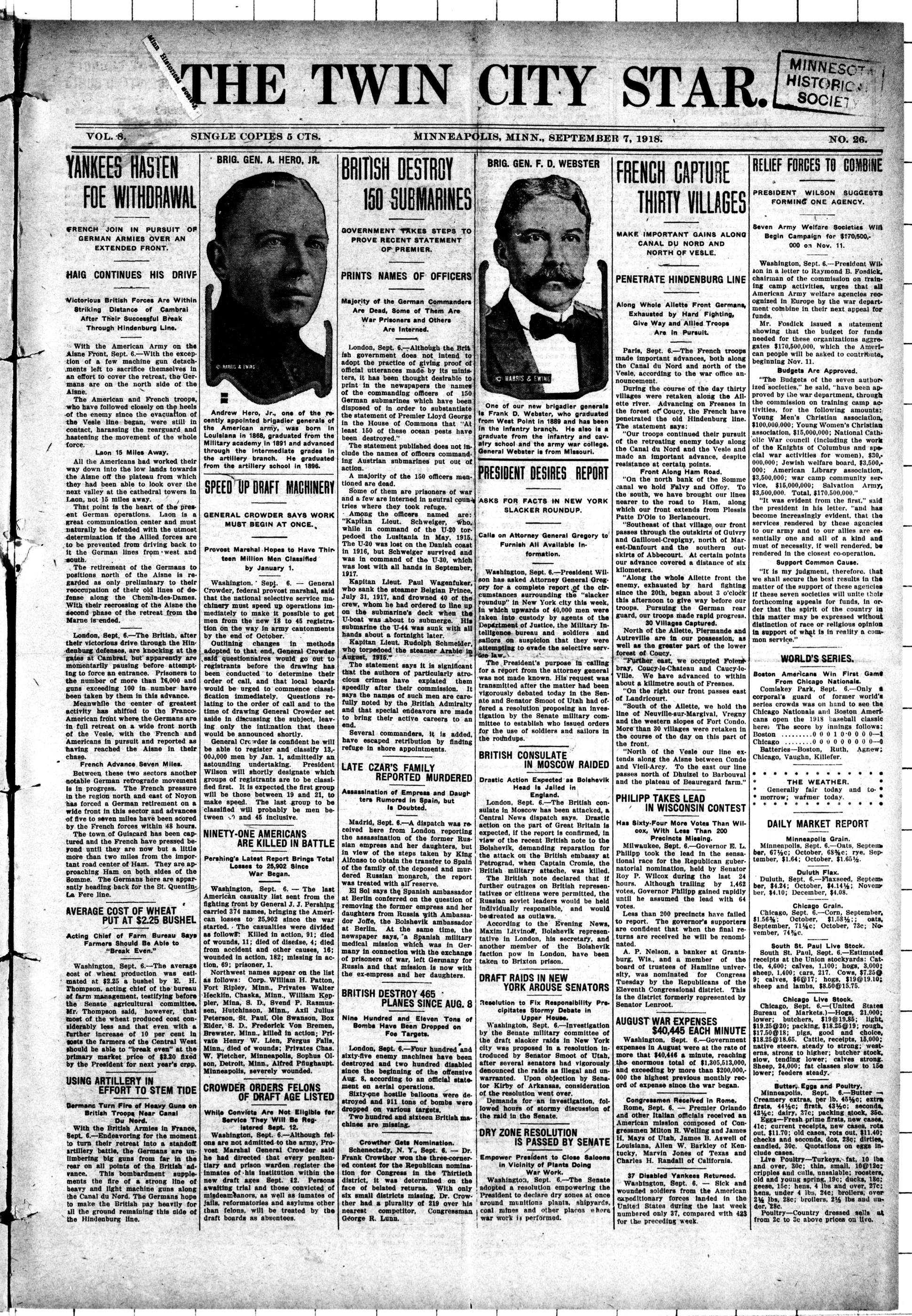
YANKEES HASTEN FOE WITHDRAWAL
FRENCH JOIN IN PURSUIT OF GERMAN ARMIES OVER AN EXTENDED FRONT.
HAIG CONTINUES HIS DRIVF
Victorious British Forces Are Within Striking Distance of Cambrai After Their Successful Break Through Hindenburg Line.
With the American Army on the Alsee Front, Sept. 6.—With the exception of a few machine gun detachments left to sacrifice themselves in an effort to cover the retreat, the Germans are on the north side of the Alsee.
The American and French troops, who have followed closely on the heels of the enemy since the evacuation of the Vesle line began, were still in contact, harassing the rearguard and hastening the movement of the whole force.
Laon 15 Miles Away.
All the Americans had worked their way down into the low lands towards the Alsee off the plateau from which they had been able to look over the next valley at the cathedral towers in Laon, not 15 miles away.
That point is the heart of the present German operations. Laon is a great communication center and must naturally be defended with the utmost determination if the Allied forces are to be prevented from driving back to it the German lines from west and south.
the retirement of the Germans to positions north of the Aisne is regarded as only preliminary to their reoccupation of their old lines of defense along the Chemin-des-Dames. With their recrossing of the Aisne the second phase of the retreat from the Marne is ended.
London, Sept. 6—The British, after their victorious drive through the Hindenburg defences, are knocking at the gates at Cambrai, but apparently are momentarily pausing before attempting to force an entrance. Prisoners to the number of more than 16,000 and guns exceeding 100 in number have been taken by them in this advance.
Meanwhile the center of greatest activity has shifted to the Franco-American front where the Germans are in full retreat on a wide front north of the Vesle, with the French and Americans in pursuit and reported as having reached the Aisne in their chase.
French Advance Seven Miles.
Between these two sectors another notable German retrograde movement is in progress. The French pressure in the region north and east of Noyon has forced a German retirement on a wide front in this sector and advances of five to seven miles have been scored by the French forces within 48 hours.
The town of Guiscard has been captured and the French have pressed beyond until they are now but a little more than two miles from the important road center of Ham. They are approaching Ham on both sides of the Somme. The Germans here are apparently heading back for the St. QuentinLa Fere line.
AVERAGE COST OF WHEAT
PUT AT $2.25 BUSHEL
Acting Chief of Farm Bureau Says Farmers Should Be Able to "Break Even."
Washington, Sept. 6.—The average cost of wheat production was estimated at $2.25 a bushel by E. H. Thompson, acting chief of the bureau of farm management, testifying before the Senate agricultural committee. Mr. Thompson said, however, that most of the wheat produced cost considerably less and that even with a further increase of 10 per cent in costs the farmers of the Central West should be able to "break even" at the primary market price of $2.20 fixed by the President for next year's crop.
USING ARTILLERY IN EFFORT TO STEM TIDE
Germanc Turn Fire of Heavy Guns on British Troopa Near Canal Du Nord.
With the British Armies in France, Sept. 6.—Endeavoring for the moment to turn their retreat into a standoff artillery battle, the Germans are unlimbering big guns from far in the rear on all points of the British advance. This bombardment supplements the fire of a strong line of heavy and light machine guns along the Canal du Nord. The Germans hope to make the British pay heavily for all the ground remaining this side of the Hindenburg line.
BROOK GEN. AP MEMO, JULY
© MARRIS & EWING
Andrew Hero, Jr., one of the recently appointed brigadier generals of the American army, was born in Louisiana in 1868, graduated from the Military academy in 1891 and advanced through the intermediate grades in the artillery branch. He graduated from the artillery school in 1896.
SPEED UP DRAFT MACHINERY
GENERAL CROWDER SAYS WORK
MUST BEGIN AT ONCE.
Provest Marshal-Hopes to Have Thirteen Million Men Classified by January 1.
Washington. Sept. 6. — General Crowder, federal provost marshal, said that the national selective service machinery must speed up operations immediately to make it possible to get men from the new 18 to 45 registration on the way in army cantonments by the end of October.
Outlining changes in methods adopted to that end, General Crowder said questionnaires would go out to registrants before the drawing has been conducted to determine their order of call, and that local boards would be urged to commence classification immediately. Questions relating to the order of call and to the time of drawing General Crowder set aside in discussing the subject, leaving only the intimation that these would be announced shortly.
General Crowder is confident he will be able to register and classify 13,000,000 men by Jan. 1, admittedly an astounding undertaking. President Wilson will shortly designate which groups of registrants are to be classified first. It is expected the first group will be those between 19 and 21, to make speed. The last group to be classified will probably be men between .9 and 45 inclusive.
NINETY-ONE AMERICANS ARE KILLED IN BATTLE
Pershing's Latest Report Brings Total Losses to 25,902 Since War Began.
Washington, Sept. 6. — The last American casualty list sent from the fighting front by General J. J. Pershing carried 374 names, bringing the American losses to 25,902 since the war started. The casualties were divided as follows: Killed in action, 91; died of wounds, 11; died of disease, 4; died from accident and other causes, 16; wounded in action, 182; missing in action, 69; prisoner, 1.
Northwest names appear on the list as follows: Corp. William H. Patton, Fort Ripley, Minn., Privates Walter Hecklin, Chaska, Minn., William Kepler, Mina, S. D., Svend P. Rasmussen, Hutchinson, Minn., Axil Julius Peterson, St. Paul, Ole Swanson, Box Elder, S. D., Frederick Kvon Bremen, Brewster, Minn., killed in action; Private Henry W. Lien, Fergus Falls, Minn., died of wounds; Privates Chas. W. Fletcher, Minneapolis, Sophus Olson, Detroit, Minn., Alfred Pfughaupt. Minneapolis, severely wounded.
CROWDER ORDERS FELONS OF DRAFT AGE LISTED
While Convicts Are Not Eligible for Service They Will Be Registered Sept. 12.
Washington, Sept. 6.—Although felons are not admitted to the army, Provost Marshal General Crowder said he had directed that every penitentiary and prison warden register the inmates of his institution within the new draft ages Sept. 12. Persons awaiting trial and those convicted of misdeembanors, as well as inmates of jails, reformatories and asylums other than felons, will be treated by the draft boards as absentees.
MINNEAPOLIS, MINN., SEPTEMBER 7, 1918.
BRITISH DESTROY 150 SUBMARINES
GOVERNMENT TAKES STEPS TO PROVE RECENT STATEMENT OF PREMIER.
PRINTS NAMES OF OFFICERS
Majority of the German Commanders Are Dead, Some of Them Are War Prisoners and Others Are Interned.
London, Sept. 6. Although the British government does not intend to adopt the practice of giving proof of official utterances made by its ministers, it has been thought desirable to print in the newspapers the names of the commanding officers of 150 German submarines which have been disposed of in order to substantiate the statement of Premier Lloyd George in the House of Commons that "At least 150 of these ocean pests have been destroyed."
The statement published does not include the names of officers commanding Austrian submarines put out of action.
A majority of the 150 officers mentioned are dead.
Some of them are prisoners of war and a few are interred in neutral countries where they took refuge.
Among the officers named are: "Kapitan Lieut. Schweiger, who, while in command of the U-20 torpedoed the Lusitania in May, 1915. The U-20 was lost on the Danish coast in 1916, but Schweiger survived and was in command of the U-30, which was lost with all hands in September, 1917.
Kapitan Lleut. Paul Wagenfucker, who sank the steamer Belgian Prince, July 31, 1917, and drowned 40 of the crew, whom he had ordered to line up on the submarine's deck when the U-boat was about to submerge. His submarine the U-44 was sunk with all hands about a fortnight later. Kapitan Lleut. Rudolph Schmeider, who torpedoed the steamer Arable in August, 1915."
The statement says it is significant that the authors of particularly atrocious crimes have explained them speedily after their commission. It says the names of such men are carefully noted by the British Admiralty and that special endeavors are made to bring their active careers to an end.
Several commanders, it is added, have escaped retribution by finding refuge in shore appointments.
LATE CZAR'S FAMILY
REPORTED MURDERED
Assassination of Empress and Daughters Rumored in Spain, but is Doubled.
Madrid, Sept. 6.—A dispatch was received here from London reporting the assassination of the former Russian empress and her daughters, but in view of the steps taken by King Alfonso to obtain the transfer to Spain of the family of the deposed and murdered Russian monarch, the report was treated with all reserve.
El Sol says the Spanish ambassador at Berlin conferred on the question of removing the former empress and her daughters from Russia with Ambassador Joffe, the Bolshevik ambassador at Berlin. At the same time, the newspaper says, a Spanish military medical mission which was in Germany in connection with the exchange of prisoners of war, left Germany for Russia and that mission is now with the ex-empress and her daughters.
BRITISH DESTROY 465
PLANES SINCE AUG. 8
Nine Hundred and Eleven Tons of Bombs Have Been Dropped on Foe Targets.
London, Sept. 6.—Four hundred and sixty-five enemy machines have been destroyed and two hundred disabled since the beginning of the offensive Aug. 8, according to an official statement on aerial operations.
Sixty-one hostile balloons were destroyed and 911 tons of bombs were dropped on various targets.
Two hundred and sixteen British machines are missing.
Crowther Gets Nomination.
Schenectady, N. Y., Sept. 6. — Dr. Frank Crowther won the three-cornered contest for the Republican nomination for Congress in the Thirtieth district, it was determined on the face of belated returns. With only six small districts missing, Dr. Crowther had a plurality of 219 over his nearest competitor, Congressman George R. Lunn.
BRIG. GEN. F. D. WEBSTER
C HARRIS & EWING
One of our new brigadier generals is Frank D. Webster, who graduated from West Point in 1889 and has been in the infantry branch. He also is a graduate from the infantry and cavalry school and the army war college. General Webster is from Missouri.
PRESIDENT DESIRES REPORT
ASKS FOR FACTS IN NEW YORK
SLACKER ROUNDUP.
Calls on Attorney General Gregory to Furnish All Available In-
Washington, Sept. 6.—President Wilson has asked Attorney General Gregory for a complete report of the circumstances surrounding the "slacker roundup" in New York city this week, in which upwards of 40,000 men were taken into custody by agents of the Department of Justice, the Military Intelligence bureau and soldiers and sailors on suspicion that they were attempting to evade the selective service law.
The President's purpose in calling for a report from the attorney general was not made known. His request was transmitted after the matter had been vigorously debated today in the Senate and Senator Smoot of Utah had offered a resolution proposing an investigation by the Senate military committee to establish who issued orders for the use of soldiers and sailors in the roundups.
BRITISH CONSULATE IN MOSCOW RAIDED
Drastic Action Expected as Bolshevik Head Is Jailed in England.
London, Sept. 6.—The British consulate in Moscow has been attacked, a Central News dispatch says. Drastic action on the part of Great Britain is expected, if the report is confirmed, in view of the recent British note to the Bolshevik, demanding reparation for the attack on the British embassy at Petrograd, when Captain Cromle, the British military attache, was killed.
The British note declared that if further outrages on British representatives or citizens were permitted, the Russian soviet leaders would be held individually responsible, and would be treated as outlaws.
According to the Evening News, Maxim Litvinoff, Bolshevik representative in London, his secretary, and another member of the Bolshevik faction pow in London, have been taken to Brixton prison.
DRAFT RAIDS IN NEW YORK AROUSE SENATORS
Resolution to Fix Responsibility Precipitates Stormy Debate in Upper House.
Washington, Sept. 6.—Investigation by the Senate military committee of the draft slacker raids in New York city was proposed in a resolution introduced by Senator Smooth of Utah, after several senators had vigorously denounced the raids as illegal and unwarranted. Upon objection by Senator Kirby of Arkansas, consideration of the resolution went over.
Demands for an investigation, followed hours of stormy discussion of the raid in the Senate.
DRY ZONE RESOLUTION
IS PASSED BY SENATE
Empower President to Close Saloons in Vicinity of Plants Doing War Work.
Washington, Sept. 6.—The Senate adopted a resolution empowering the President to declare dry zones at once around munitions plants, shipyards, coal mines and other places where war work is performed.
FRENCH CAPTURE THIRTY VILLAGES
FRENCH CAPTURE THIRTY VILLAGES
MAKE IMPORTANT GAINS ALONG
CANAL DU NORD AND
NORTH OF VESLE.
PENETRATE HINDENBURG LINE
Along Whole Allette Front Germans, Exhausted by Hard Fighting, Give Way and Allied Troops Are In Pursuit.
Paris, Sept. 6.—The French troops made important advances, both along the Canal du Nord and north of the Vesle, according to the war office announcement.
During the course of the day thirty villages were retaken along the Allette river. Advancing on Fresnes in the forest of Coucy, the French have penetrated the old Hindenburg line. The statement says:
"Our troops continued their pursuit of the retreating enemy today along the Canal du Nord and the Vesle and made an important advance, despite resistance at certain points.
Front Along Ham Road.
"On the north bank of the Somme canal we hold Falvy and Offoy. To the south, we have brought our lines nearer to the road to Ham, along which our front extends from Plessis Patte D'Ole to Berlancourt.
"Southeast of that village, our front passes through the outskirts of Guivry and Galllouel-Crepigny, north of Marest-Danfort and the southern outskirts of Abbecourt. At certain points our advance covered a distance of six kilometers.
"Along the whole Allette front the enemy, exhausted by hard fighting since the 20th, began about 3 o'clock this afternoon to give way before our troops. Pursuing the German rear guard, our troops made rapid progress. 30 Villages Captured. North of the Allette, Piermande and Autreville are in our possession, as well as the greater part of the lower forest of Coucy. "Further east, we occupied Folembray, Coucy-le-Chateau and Caucy-le-Ville. We have advanced to within about a killmetre south of Fresnes. "On the right our front passes east of Landricourt. "South of the Allette, we hold the line of Neuville-sur-Margival, Vregny and the western slopes of Fort Condo. More than 30 villages were retaken in the course of the day on this part of the front. "North of the Vesle our line extends along the Alsine between Conde and Vliel-Arcy. To the east our line passes north of Dhuzel to Barbouval and the plateau of Beauregard farm."
PHILIPP TAKES LEAD IN WISCONSIN CONTEST
Has Sixty-Four More Votes Than Wilcox, With Less Than 200 Precincts Missing.
Milwaukee, Sept. 6.—Governor E. L. Phillip took the lead in the sensational race for the Republican gubernatorial nomination, held by Senator Roy P. Wilcox during the last 24 hours. Although trailing by 1,462 votes, Governor Philipp gained rapidly until he assumed the lead with 64 votes.
Less than 200 precincts have failed to report. The governor's supporters are confident that when the final returns are received he will be renominated.
A. P. Nelson, a banker at Grantsburg, Wis., and a member of the board of trustees of Hamline university, was nominated for Congress Tuesday by the Republicans of the Eleventh Congressional district. This is the district formerly represented by Senator Lenroot.
AUGUST WAR EXPENSES
Washington, Sept. 6. — Government expenses in August were at the rate of more that $40,446 a minute, reaching the enormous total of $1,305,513,000, and exceeding by more than $200,000,-000 the highest previous monthly record of expense since the war began.
Congressmen Received in Rome.
Rome, Sept. 6. — Premier Orlando and other Italian officials received an American mission composed of Congressmen Milton R. Welling and James H. Mays of Utah, James B. Aswell of Louisiana, Allen W. Barkley of Kentucky, Marvin Jones of Texas and Charles H. Randall of California.
37 Disabled Yankees Returned.
Washington, Sept. 6. — Slick and wounded soldiers from the American expeditionary forces landed in the United States during the last week numbered only 37, compared with 423 for the preceding week.
NO.26.
RELIEF FORCES TO COMBINE
PRESIDENT WILSON SUGGESTS FORMING ONE AGENCY.
Seven Army Welfare Societies Will Begin Campaign for $170,500,000 on Nov. 11.
Washington, Sept. 6.—President Wilson in a letter to Raymond B. Fosdick, chairman of the commission on training camp activities, urges that all American Army welfare agencies recognized in Europe by the war department combine in their next appeal for funds.
Mr. Fosdick issued a statement showing that the budget for funds needed for these organizations aggregates $170,500,000, which the American people will be asked to contribute, beginning Nov. 11.
Budgets Are Approved.
"The Budgets of the seven authorized societies," he said, "have been approved by the war department, through the commission on training camp activities, for the following amounts: Young Men's Christian association, $100,000,000; Young Women's Christian association, $15,000,000; National Catholic War council (including the work of the Knights of Columbus and special war activities for women), $30,000,000; Jewish welfare board, $3,500,000; American Library association, $3,500,000; war camp community service, $15,000,000; Salvation Army, $3,500,000. Total, $170,500,000."
"It was evident from the first." said the president in his letter, "and has become increasingly evident, that the services rendered by these agencies to our army and to our allies are essentially one and all of a kind and must of necessity, if well rendered, be rendered in the closest co-operation.
Support Common Cause.
"It is my judgment, therefore, that we shall secure the best results in the matter of the support of these agencies if these seven societies will unite their forthcoming appeals for funds, in order that the spirit of the country in this matter may be expressed without distinction of race or religious opinion in support of what is in reality a common service."
WORLD'S SERIES
Boston Americans Win First Game
From Chicago Nationals.
Comiskey Park, Sept. 6.—Only a corporal's guard of former world's
series crowds was on hand to see the Chicago Nationals and Boston Amer-
icans open the 1918 baseball classic
here) The score by innings follows:
Boston ..... 0 0 0 1 0 0 0 0 0—1
Chicago ..... 0 0 0 0 0 0 0 0 0—0
Batteries—Boston, Ruth, Agnew;
Chicago, Vaughn, Killefer.
THE WEATHER.
* Generally fair today and to-
morrow; warmer today.
DAILY MARKET REPORT
Minneapolis Grain.
Minneapolis, Sept. 6.—Oats, September, 67½c; October, 68½c; rye, September, $1.64; October, $1.65½.
Duluth Flax.
Duluth, Sept. 6.—Flaxseed, September, $4.24; October, $4.14½; November, $4.10; December, $4.08.
Chicago Grain.
Chicago, Sept. 6.—Corn, September, $1.56½; October, $1.58½; oats, September, 71½c; October, 73c; November, 74½c.
South St. Paul Live Stock.
South St. Paul, Sept. 6.—Estimated receipts at the Union stockyards; Cattle, 4,600; calves, 1,100; hogs, 3,000; sheep, 1,400; cars, 217. Cows, $7.25@ 9; calves, $6@17; hogs, $19@19.10; sheep and lambs, $8.50@15.75.
Chicago Live Stock.
Chicago, Sept. 6.—(United States Bureau of Markets.)—Hogs, 21,000; lower; butchers, $19@19.85; light, $19.25@20; packing, $18.25@19; rough, $17.50@18; plugs, good and choice, $18.25@18.65. Cattle, receipts, 15,000; native steers, steady to strong; westerns, strong to higher; butcher stock, slow, tending lower; calves strong. Sheep, 24,000; fat classes slow to 150 lower; feeders steady.
Butter, Eggs and Poultry.
Minneapolis, Sept. 6.—Butter—Creamy extras, per lb, 45%; c extra firsts, 44%c; firsts, 43%c; seconds, 42%c; dairy, 37c; packing stock, 35c. Eggs—Fresh prime firsts, new cases, 41c; current receipts, new cases, rots out, $11.70; old cases, rots out, $11.40; checks and seconds, doz, 28c; dirties, candled, 30c. Quotations on eggs include cases.
Live Poultry—Turkeys, fat, 10 lbs and over, 30c; thin, small, 10@12c; cripples and culls, unsalable; roosters, old and young spring, 19c; cucks, 18c; geese, 15c; hens, 4 lbs and over, 27c; hens, under 4 lbs, 4c; broilers, over 2½ lbs, 28c; broilers, 2½ lbs and under, 28c.
Poultry—Country dressed sells at from 2c to 3c above prices on live.
“ u Cae , % >
Ber ee eae Nr CO eee on” SCOURGE RNIN IEA? ee TRRERAC Cm gE Ret MRNER far TRE << Bre ca ee
MAN IS NOW AT HIS BEST.
‘There Has Been No “Moral and Physical Degeneration”
of the Race,
‘The big average height of the men drafted into the United States army
4a being widely commented upon in the press, and it appears that the facts
Justify the favorable remarks being made, says a writer in Montreal Gazette.
Records of the quartermaster’s office show that the Americans who are don-
ning the army uniform today,are bigger than the men who fought in former
‘wars, The size most in demand for the standard army shoe in the past was 7H,
‘while the average size of the marching shoe today is 84D and that of the
field or trench shoe 9H, Two styles are issued, for it has been found by
experiment that soldiers require a larger shoe for the trenches, it being
necessary to wear two pairs of socks at a time in cold wet weather. Sim-
Marly, the present-day American soldier has to be provided with a size larger
than his predecessor in coats, shirts and breeches. He is a bigger man all
‘around, which is decidedly satisfactory from the national point of view.
Events in other belligerent Inds gince the war began have served to
prove that men generally are as strong physically and morally as ever they
were in history. The long campaign in the trenches in Europe has put the
aoldiers to a greater test than the fighting men of the past were submitted to
in the worst of the numerous old wars. ‘They have stood that test, and the
hundreds of thousands who survive the cannon’s blast and the rifle's bullet
‘will emerge physically fine specimens of manhood.
It is not necessary to look to the United States or over to Europe to see
that the human race has not’ deteriorated, Canada is a emall nation com-
pared with its tremendous neighbor and with other allies. It had a population
at the census of 1911 of 7,200,000, about half of «whom are males. Out of the
young men part of this total 500,000 men havé measured up to the severe
medical test of the army, and some tens of thousands of others have been
examined ‘and rejected for minor defects that do not interfere with thelr life
‘as civilians, and do not threaten to shorten their days appreciably. The men
who were taken to the field of war have lived in the open, through the heat
of summer and the cold and snow and wet of winter, and the thunder of
ans has been constantly in their ears,
The stress of the deadliest warfare has not broken their spirit, and they
atand ready today to face attack from a powerful enemy and to deliver it in
return, In view of these facts, the little bodies of gloomy and narrow-minded
persons who meet periodically and resolve that the race is degenerating
physically and morally should rest from thelr croaking for the time being.
Actual conditions are confounding thelr slanderous assertions. ‘The race is
stronger today than ever,
~ Chemists May -
Win War |
Seek Poison Gas That Will De
troy Whole Armies,
American chemists working on the
Polson gas problem may bring the war
to a victorious close for the allies in
thelr laboratories,
They are working hard, together
with British chemists, to find a color-
Jess, odorless and invisible gas, which,
sweeping over a sleeping army, would
destroy it.
‘The Germans are also working to
find such a gas. Whichever side finds
it first will win the war, declares a
Washington writer.
‘The “Gas shell” is not necessarily a
shell, It may contain a liquid or even
solid, and it opens up the whole
sphere of organle chemistry. to. be
drawn upon for materials,
In every German drive this year
there has been a gas strategy. Full
dress rehearsals in gas maneuvers to
meet every possible situation were
held by the Germans before an attack.
In the March drive captured maps
show the Germans had worked out a
zoning system over allied territory.
Some zones were drenched with gas
and others left untouched. ‘The Ger
man attacking troops were supplied
with maps to Indicate the safety zones
through which they might pass with-
out harm,
Some zones were subjected to ephe-
meral gases which evaporated before
the arrival of the oncoming Germans.
Other areas were bomburded with sev-
eral hundred thousand shells, the gas
from which lingered for hours. On one
seven-mile sector the Germans dis-
charged 125,000 12-pound shells in one
day, ~
‘The “front” is not the solid line tt
looks to be on the maps. It 1s a series
of strongly-held posts, often hills. ‘The
Germans use gas shells against these
strongholds, attempt to drive the de-
fenders from them and to pass through
the safety zones between,
se eo
$ Here and There, :
=a 3
$ The duchess of Marlborough §
$ 1s leading a movement among $
@ English women te sell their fam- @
$ ‘ly jewels for war funds. 3
e There are now 20 aviation @
$ training fields operated by the $
© government in different parts of @
$ the United States, 3
$ _ An. order for 240,000 pairs of 8
knee-length rubber boots for the §
$ French army has been placed $
@ with American manufacturers, §
$ Australians are experimenting =
with a mammoth oll-driven har- §
3 vester which strips grain fields 2
@ ata rate of about 60'acres a day. @
Secccccccccccocscovcevcees
Toad in the Garden Destroys
Many Insects During the Day
‘The toad is useful because of its
let. No less than 88 species of in-
Sects, mostly injurious, have been
Proved to enter into its dietary. In
Bis “Civic Biology” George W. Hunter
ays: A toad has been observed to
map Up 128 files in half an hour. Thus
‘at a low estimate it could exsily de-
a id insects during a day
Bee ii me
den during the summer, It has been
eatimated by Kirkland that’s single
fond may, on account of the eutworms
‘which it Kills, be worth $19.88 each
@eason tt lives, if the damage done by
@ach cutworm be estimated at only
Set fae Toads also feed wpon stig
garden pests. —Popular
Set sec
EEE eeooOr
Former Boston Brave Roasts
Ball Players. Deserting Clubs
to Take Steel League Jobs
‘Walter (Rabbit) Maranville, a chief
gunner’s mate on the battleship Penn-
sylvania, former Boston Brave short-
stop, and one of the greatest infield-
ers of the National league, criticizes
baseball players who are deserting
Ci
od
a
i
‘Walter Maranville.
their clubs to take positions in the
Steel league and to play with ship-
‘building concerns.
He says the move displays « lack of
Patriotism and is not helping the
sport, inasmuch as the people who sup-
port the game do not think highly of
these men.
“Ball players who are in the draft
and jump their clubs to go to work in
the steel and shipbuilding leagues are
not doing baseball a bit of good,” said
Maranville. “They also are not help-
ing Uncle Sam. They are not skilled
enough to be of much use in those con-
cerns and their chief object {s to play
ball, Fans will remember the players
who left their clubs, and after the
war is over those who come back un-
doubtedly will be tormented all around
the circuit for their act.”
This Country Now Produces
Indigo Made From Coal Tar
Indigo 1s now being made from coal
tar in this country. At Midland, Mich.,
1,000 pounds. of 20 per cent paste are
produced dally, reports Popular
Science Monthly. All the tariff bills
of this nation, commencing with the
tariff of March 8, 1883, and including
the tariff of October 8, 1918, placed
Indigo on the free list. Not until Sep-
tember 9, 1916, was a bill passed put-
ting duty on it, It was the first
schedule that braved the anger of the
German dyemakers,
Good-By, Sugar Bowil
Sugar bowls will be eliminated on
dining cars as a part of the conserva-
tion program of the food adminiatra-
tion and hereafter not more than two
half lumps or one teaspoonful of sugar
a meal will be served, The informa-
tom was contained in a message to
the food administration from B, 8.
Hgergy of Obteags, chairman f'the
itive committee of. dining
car superintendents.
New Eleotric Heaters,
‘Vessels lined with metal that will
conduct electricity. to heat liquids as
they are poured from one to another
have been patented by an inventor in
Pennsyivania.
Sensations of an Airplane
Man Detailed as to Thrills
Experienced at Dizzy Height
‘The trials for my military brevet
were for the most interesting thing I
have done in aviation, On finishing
the 60-horse power Blerlot class, I was
told that I would have to do my brevet
work on a small Cauldron biplane, as
there were no Bleriots available, writes
Nordhoff in Atlantic Monthly.
Off she went with a roar, all ten cyl-
inders firing perfectly, so I motioned
the mechanic to pull out the blocks
from before the wheels, A quick rush
and a turn headed me into the wind,
and the next moment the starter’s arm
shot forward,
Old 2887 1s a bully bus. I was off
the ground and heading up in forty
yards, It was rather an occasion for
‘@ beginner who had never before flown
over 2,500 feet. The little Cauldrons, of
course, are not high-powered, but she
climbed splendidly. In ten minutes 1
was circling over’ the camps at 8,800
feet and in twenty I had reached 6,000,
Just under the roof of the clouds. There
was only one blue hole through, so up
this funnel I climbed in decreasing ctr-
cles, till I finally burst out into the
gorgeous upper sunlight,
At 8,000 feet I began to float about
in a world of utter celestial Joneliness
—dazuling pure sun, like the water of
coral atoll, and beneath me a billowy
sea of clouds, stretching away to in-
finity. Here and there, from the
cloudy prairies great fantasfle moun-
tain ranges reared themselves; foot
hills and long divides, vast snowy
Peaks, impalpable sisters of Orizaba
or Chimborazo, and deep gorges, ever
narrowing, widening or deepening,
across whose shadowy depths drove
ribbons of thin gray mist.
Once, as I was sailing over a broad
canyon, I saw far off in the south a
dark moving dot and knew with a sud-
den thrill that another man Ike my-
self, astride his gaunt buzzing bird, was
exploring and marveling at this upper
dream world.
New Seed Oils Will Supply
Valuable Food, Tests Made
By Government Have Proved
Ta experiments to determine the dt
gestibility of ofls made from corn, 803
beans, sunflower seeds, Japanese mus
tard seed, rape seed, and charlock see
—olls not now commonly in use—the
United States department -of agritul-
ture found that they are well assimt
lated, and in value compare favorably
with other vegetable oils.
‘These digestion experiments, report
ed in Bulletin 687 published by the de
partment, are a part of the series
which is being conducted by the de
partment to determine the digestibil
ity of vi foods, the tes
Deriod (tice days} iar wile “the: oll
referred to constituted practically thé
entire sources of fat, the subjects ate
on an average of 58 to 90 grams pel
day, and did not report any ill effects
To judge by their digestibility these
olls, according to the bulletin, should
prove satisfactory sources of fat fol
the dietary.
goccoconssesnesespersesoes
: ‘
: ITISTOLAUGH :
Getting the Expression.
“Will you take something to drink?
asked the photographer.
“With pleasure,” the sitter replied.
| The photograph was taken and the
sitter sald: —
“But what about the little invite
tion?”
“Oh, that’s just a professional ruse
of mine to give a natural, interested
expression to the face.”
ea ; ;
In All Sincerity,
By, “I made a bad
- ‘break just now.”
“How so?”
“I told Miss Pas.
see T'd ask her to
dance, only there
: wasn't room 00
the floor to swing
| & eati”
“I made a bad
‘break just now.”
“How 80?”
“I told Miss Pas
see Td. ask her to
dance, only. there
wasn’t room oD
the floor to swing
a catl”
A Hot One.
Mrs. A-—You were such a charm
ing debutante, my dear, five years ago.
‘Miss B.—Was I? I only remember
you made such a lovely chaperone for
me-when I came out.
Just Like ‘People,
“Microbes are not all of one kind.”
“No, indeed; there are romantic mi-
crobes that live in kisses, and mer-
cenary microbes that Uve on dollar
bills.”
‘Strayed Away.
Advertisement
—"Lost while go
ing home to
Brookline, black y ‘
leather handbag.”
You cannot al
ways trusta black F
leather handbag
to go straight
home every night.
a
A Gad Start.
Bride—I'm go afraid people will find
out that we're just married, that I've
made Jack promise to treat me in pub-
Ne just as if he had no thought of
Wire Lonewed My doar, 5 or
that plan when 2 was married, and my
husband never got over tt.
Personal, s
He—The fools aro not all dead yet,
She—That's as sure a8 you live,
EVERY OPPORTUNITY FOR SPORT IS GIVEN -
BRITISH SAILOR TO KEEP IN PROPER TRIM
é 8... e
Ke tb “e Ane Cal So eee |
Seem fe
oils, “EERE RT lone > > Ey
eae Le Sl
eas a Ped
: pe oe ia ee .
a Pn ‘ey ne Bi, &
et |
wt yt
Te a ee
eek Penny eee ey
ee tt se Actas t £2
or ee px pee...)
ce EL a © eae
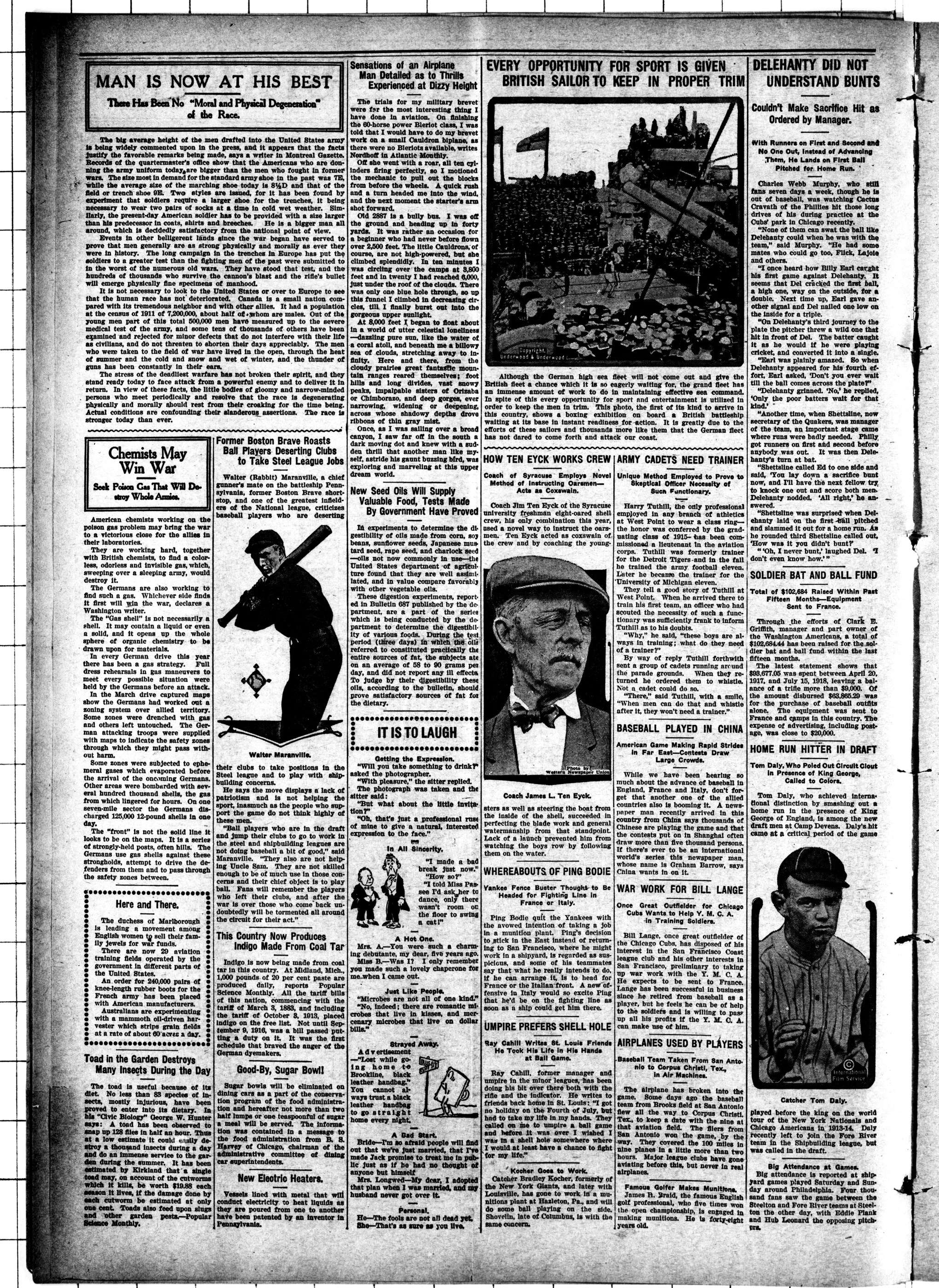
Although the German high sea fleet will not come out and give the
British fleet a chance which it is so eagerly walting for, the grand fleet has
an immense amount of work to do in maintaining effective sea command.
In spite of this every opportunity for sport and entertainment is utilized in
order to keep the men in trim. This photo, the first of its kind to arrive in
this country, shows a boxing exhibition on board a British battleship
waiting at its base in instant readiness for-action. It is greatly due to the
efforts of these sallors and thousands more like them that the German flect
has not dared to come forth and attack our coast.
rns
HOW TEN EYCK WORKS CREW |ARMY CADETS NEED TRAINER
Coach of Syracuse Employs Novel | Unique Method Employed to Prove to
Method of Instructing Oarsmen— ‘Skeptical Officer Necessity of
Acts as Coxswain, Suen Functionary.
Coach Jim ‘Ten Eyck of the Syracuse] Harry Tuthill, the only professional
‘university freshman eight-oared shell] empjoyed in any branch of athietics
crew, his only combination this year,| at West Point to wear a class ring—
‘used a novel way to instruct the oars- | the honor was conferred by the grad-
men. Ten Hyck acted as coxswain of| uating class of 1915- has been com-
the crew and by coaching the young-| misstoned a Meutenant In the aviation
Lo ee |
ak eo we
‘ae
Be ee
aS Le
- ae
Pe seswin Hewapeper Union
sters as well as steering the boat from
the inside of the shell, succeeded in
perfecting the blade work and general
watermanship from that standpoint.
‘Lack of a latneh prevented him from
watching the boys row by following
them on the water.
WHEREABOUTS OF PING BODIE
Yankee Fence Buster Thought-to Be
Headed for Fighting Line in
France or Italy.
Ping Bodie quit the Yankees with
the avowed intention of taking a job
ina munition plant. Ping’s decision
to stick in the East instead of return-
Ing to San Francisco, where he might
work in a shipyard, is regarded as sus-
plelous, and some of his teammates
say that what he really intends to do,
if he can arrange it, Is to head for
France or the Italian‘front. A new of.
fensive in Italy would so exelte Ping
that he’d be on the fighting line as
soon as a ship could get him there.
UMPIRE PREFERS SHELL HOLE
Ray Cahill Writes 8t. Louis Friends
He Took His Life In His Hands
‘at Ball Game.
Ray Cahill, fotmer manager and
‘umpire in the minor leagues,-has been
doing bis bit over there both with the
rifle ‘and the indicator. He writes to
friends back hote In St. Louts: “I got
no holiday on the Fourth of July, but
had to take my life in my hands. They
called on ine to umpire a ball game
and hefore itwns over I wished I
way tn & shell hole somewhere where
‘T would at least have @ chance to fight
for my. lfe.” 5
s‘ Kocher Goes to Work.
Catcher Bradley Kocher, formerly of
the New York Giants, and later with
Louisville, has gone to work if a mu-
nitions plant at Hazleton, Pa., and will
do some ball playing on the side.
Shovelln, late of Columbus, Is with the
game concern,
ARMY CADETS NEED TRAINER
Unique Method Employed to Prove to
‘Skeptical Officer Necessity of
Suen Functlonary.
Harry Tathill; the only professional
empjoyed in any branch of athletics
at West Point to wear a class ring—
the honor was conferred by the grad-
uating class of 1915- ‘has been com-
misstoned a Heutenant tn the aviation
corps. Tuthill was formerly trainer
for the Detrolt Tigers-and in the fall
he trained the army football eleven.
Later he became the trainer for the
"University of Michigan eleven.
‘They tell a good story of Tuthill at
‘West Point, When he arrived there to
train his first team, an officer who had
scouted the necessity of such a func-
tlonary was sufficiently frank to inform
‘Tuthill as to his doubts. :
“Why,” he sald, “these boys are al-
ways in traning; what do they need
of a trainer?” :
By way of reply Tuthill forthwith
sent a group of cadets running arcund
the parade grounds, When they re-
turned he ordered them to whistle.
Not a cadet could do so.
“There,” sald Tuthill, with a smile,
“When men can do that and whistle
after it, they won't need a trainer.”
BASEBALL PLAYED IN CHINA
American Game Making Rapid Strides
in Far East—Contests Draw
Large Crowds.
While we have been hearing so
much about the advance of baseball in
England, France and Italy, don’t tor
get that another one of the allied
countries also is booming it. A news-
paper man recently arrived in this
country from China says thousands of
‘Chinese are playing the game and that
the contests put on in Shanghal often
draw more than five thousand persons.
If there’s ever to be an international
world's series this newspaper man,
whose name Is Graham Barrow, says
China wants in on it.
WAR WORK FOR BILL LANGE
Once Great Outfielder for Chicago
Cubs Wants to Help Y. M. C. A.
in Training Soldiers.
Bill Lange, once great outfielder of
the Chicago Cubs, has disposed of his
Interest in the San Francisco Coast
league club and his other interests in
San Francisco, preliminary to taking
up war work with the ¥. M. ©. A
He expects to be sent to France.
Lange has been successful in business
‘since he retired from baseball as a
Player, but he feels he can be of help
to the soldiefs and is willing to pase
up all his profits if the ¥. M. G, A,
can make use of him.
‘AIRPLANES USED BY PLAYERS
Baseball Team Taken From San Anto.
nio to Corpus Christi, Tex.
In Alr Machines,
| ‘The airplane has broken into’ the
game. Some days ago the baseball
‘team from Brooks field at San Antonio
flew all the way. to Corpus Christi,
‘Tex. to keep a date with the nine at
‘that aviation field. The filers from
San Antonlo won the game, by the
. They covered the 100 miles in
nine planes ‘in a little more than two
hours. Major league clubs have. gone
‘aviating before this, but never in real
airplanes,
Famous Golfer Makes Munitions,
James B, Braid, the famous English
golf professional, who five times won
the open champlonsbip, is engaged in
making munitions. He ts forty-eight
years old.
‘DELEHANTY DID NOT —
UNDERSTAND BUNTS
Couldn't Make Sacrifice Hit as
Ordered by Manager.
With Runners on Flest and Second and
No One Out, Instead of Advancing
‘Them, He Lands on First Ball
Pitched for. Home Run. ' ~
Gharies Webb Murphy, who still
fans seven days a week, though he is
out of baseball, was watching Cactus
Cravath of the Phillies hit those long
drives of his during practice at the
Oubs’ park in Chicago recently.
“None of them can swat the ball like
Delehanty could when he was with the
team,” said Murphy. “He had some
mates who could go too, Fick, Lajote
and others,
“I once heard how Billy Harl carght
his first game against Delehanty. It
seems that Del cracked the first ball,
a high one, way on the outside, for a
double, Next time up, Earl gave an-
other signal and Del nailed one low on
the inside for a triple.
“On Delehanty’s third journey to the
plate the pitcher threw a wild one that
hit in front of Del, ‘The batter caught
it as he would if he were playing
erieket, and converted it into a single.
“Harl was plainly amazed. So when
Delehanty appeared for his fourth ef-
fort, Earl asked, ‘Don’t you ever wait
till the ball comes across the plate?”
“Delehanty grinned. ‘No,’ he replied,
‘Only the poor batters walt for that
kind? ~
“another time, when Shettsline, now
secretary of the Quakers, was manager
of the team, an important stage came
where runs were badly needed. Philly
got runners on first aid second before
anybody was out. It was then Dele-
hanty’s turn at bat. :
“Shettsline called Ed to one side and
said, ‘You lay down a sacrifice bunt
now, and I'l have thé next fellow try,
to knock one out and score both mem
Delehanty nodded, ‘All right,’ he an-
swered,
“Shettsline was surprised when Del-
ehanty laid on the first 4mll pitched
and slammed it out for a home run. As
he rounded third Shettsline called out,
‘How was it you didn't bunt?’
“‘Oh, I never bunt, laughed Del. ‘I
don’t even know how.”
f a
oo BAT AND BALL FUND
Total of $102,684 Raised Within Past
Fifteen Months—Equipment
Sent to France.
"Through the efforts of Clark B.
Griffith, manager and part owner of
the Washington Americans, a total. of
$102,684.44 has been raised for the.sol-
dier bat and ball fund within the last
fifteen months.
The latest statement shows that
$98,677.05 was epent between April 20,
1917, and July 15, 1918, leaving # bal-
ance of a trifle more than $9,000. Of
the amount disbursed $63,865.29 was
for the purchase of baseball outfits
‘alone, The equipment was sent to
France and camps in this country. The
expense of advertising, including post-
age, was close to $20,000. z
HOME RUN HITTER IN DRAFT
‘Tom Daly, Who Poled Out Glroult Clout
In Presence of King George,
Called to Colors,
Tom Daly, who achteved interna:
tonal distinction by smashing out a
home run in the presence of King
George of England, is among the new
draft men at Camp Devens. Daly's hit
came at a critical period of the game
ce
a | a
AN Caer fu
MAL | ove
Pol ie ee
eve
Peay le
ee fey | HE
Rite oy oN
rf ss ©
| Noon, | eee !
Catcher Tom Daly.
played. before the king on the world
tour of the New York Nationals and
‘Chicago Americans in 1918-14, Daly
Fecently left to join the Fore River
team in the Shipbuilding league, but
‘was called in the draft.
Big Attendance at Games.
Big attendance {s reported at ship
yard games played Saturday and Sun-
day around Philadelphia. Four. thou-
sand fans saw the game between the
Steelton and Fore River teams at Steel-
tom the other day, with Eddie Plank
and Hub Leonard ‘the opposing pitch-
wre,
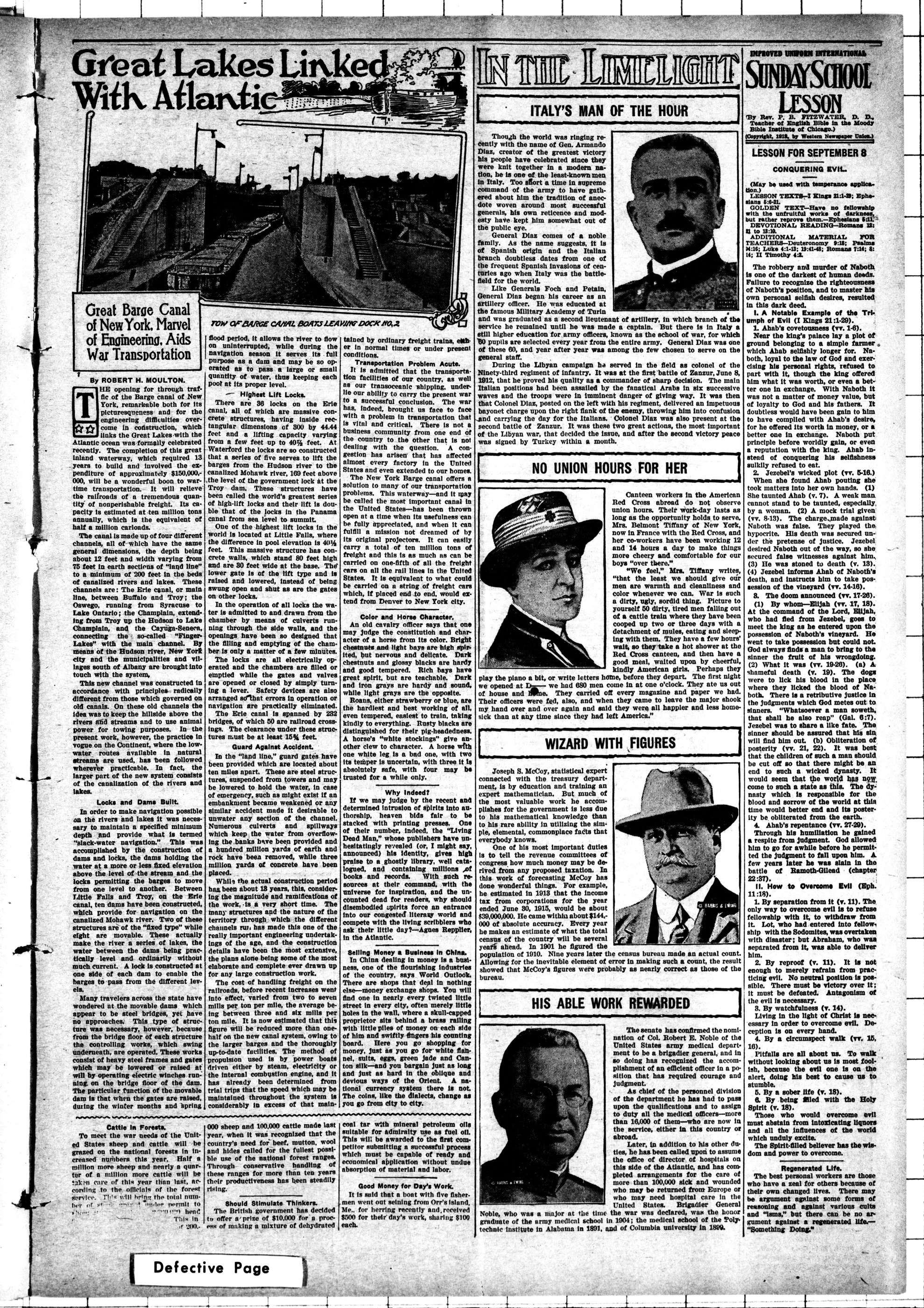
Great Lakes Linked
With Atlantic
Great Barge Canal
Great Barge Canal of New York. Marvel of Engineering. Aids War Transportation
HE opening for through traffic of the Barge canal of New York, remarkable both for its picturesqueness and for the engineering difficulties overcome in construction, which links the Great Lakes with the Atlantic ocean was formally celebrated recently. The completion of this great inland waterway, which required 13 years to build and involved the expenditure of approximately $150,000,000, will be a wonderful boon to wartime transportation. It will relieve the railroads of a tremendous quantity of nonperishable freight. Its capacity is estimated at ten million tons annually, which is the equivalent of half a million carloads.
The canal is made up of four different channels, all of which have the same general dimensions, the depth being about 12 feet and width varying from 75 feet in earth sections of "land line" to a minimum of 200 feet in the beds of canalized rivers and lakes. These channels are: The Erie canal, or main line, between Buffalo and Troy; the Oswego, running from Syracuse to Lake Ontario; the Champlain, extending from Troy up the Hudson to Lake Champlain, and the Cayuga-Seneca, connecting the so-called "Finger-Lakes" with the main channel. By means of the Hudson river, New York city and the municipalities and villages south of Albany are brought into touch with the system.
This new channel was constructed in accordance with principles radically different from those which governed on old canals. On these old channels the idea was to keep the hillside above the rivers and streams and to use animal power for towing purposes. In the present work, however, the practice in vogue on the Continent, where the low-water routes available in natural streams are used, has been followed wherever practicable. In fact, the larger part of the new system consists of the canalization of the rivers and lakes.
Locks and Dams Built.
In order to make navigation possible on the rivers and lakes it was necessary to maintain a specified minimum depth and provide what is termed "slack-water navigation." This was accomplished by the construction of dams and locks, the dams holding the water at a more or less fixed elevation above the level of the stream and the locks permitting the barges to move from one level to another. Between Little Falls and Troy, on the Erie canal, ten dams have been constructed, which provide for navigation on the canalized Mohawk river. Two of these structures are of the "fixed type" while eight are movable. These actually make the river a series of lakes, the water between the dams being practically level and ordinarily without much current. A lock is constructed at one side of each dam to enable the barges to pass from the different levels.
Many travelers across the state have wondered at the movable dams which appear to be steel bridges, yet have no approaches. This type of structure was necessary, however, because from the bridge floor of each structure the controlling works, which swing underneath, are operated. These works consist of heavy steel frames and gates which may be lowered or raised at will by operating electric winches running on the bridge floor of the dam. The particular function of the movable dam is that when the gates are raised, during the winter months and spring
Cattle In Forests.
Cattle in Forest.
To meet the war needs of the United States sheep and cattle will be grazed on the national forests in increased numbers this year. Half a million more sheep and nearly a quarter of a million more cattle will be taken care of this year than last, according to the officials of the forest service. This will bring the total number of stock grazed under permit to about 200,000 head. This in
TOW OF BARGE CANAL BOATS LEAVING DOCK NO.2
flood period, it allows the river to flow on uninterrupted, while during the navigation season it serves its full purpose as a dam and may be so operated as to pass a large or small quantity of water, thus keeping each pool at its proper level.
tained by ordinar er in normal tim conditions.
Transportation
It is admitted tion facilities of as our transo
Highest Lift Locks.
There are 36 locks on the Erie canal, all of which are massive concrete structures, having inside rectangular dimensions of 300 by 44.44 feet and a lifting capacity varying from a few feet up to $40\%$ feet. At Waterford the locks are so constructed that a series of five serves to lift the barges from the Hudson river to the canalized Mohawk river, 160 feet above the level of the government lock at the Troy dam. These structures have been called the world's greatest series of high-lift locks and their lift is double that of the locks in the Panama canal from sea level to summit.
One of the highest lift locks in the world is located at Little Falls, where the difference in pool elevation is 40% feet. This massive structure has concrete walls, which stand 80 feet high and are 80 feet wide at the base. The lower gate is of the lift type and is raised and lowered, instead of being swung open and shut as are the gates on other locks.
In the operation of all locks the water is admitted to and drawn from the chamber by means of culverts running through the side walls, and the openings have been so designed that the filling and emptying of the chamber is only a matter of a few minutes. The locks are all electrically operated and the chambers are filled or emptied while the gates and valves are opened or closed by simply turning a lever. Safety devices are also arranged so that errors in operation or navigation are practically eliminated.
The Erle canal is spanned by 232 bridges, of which 50 are railroad crossings. The clearance under these structures must be at least 15% feet.
Guard Against Accident.
In the "land line," guard gates have been provided which are located about ten miles apart. These are steel structures, suspended from towers and may be lowered to hold the water, in case of emergency, such as might exist if an embankment became weakened or any similar accident made it desirable to unwater any section of the channel. Numerous culverts and spillways which keep the water from overflowing the banks have been provided and a hundred million yards of earth and rock have been removed, while three million yards of concrete have been placed.
While the actual construction period has been about 13 years, this, considering the magnitude and ramifications of the work, is a very short time. The many structures and the nature of the territory through which the different channels run, has made this one of the really important engineering undertakings of the age, and the construction details have been the most extensive, the plans alone being some of the most elaborate and complete ever drawn up for any large construction work.
The cost of handling freight on the railroads, before recent increases went into effect, varied from two to seven mills per ton per mile, the average being between three and six mills per ton mile. It is now estimated that this figure will be reduced more than one half on the new canal system, owing to the larger barges and the thoroughly up-to-date facilities. The method of propulsion used is by power boats driven either by steam, electricity or the internal combustion engine, and it has already been determined from trial trips that the speed which may be maintained throughout the system is considerably in excess of that main-
000 sheep and 100,000 cattle made last year, when it was recognized that the country's need for beef, mutton, wool and hides called for the fullest possible use of the national forest ranges. Through conservative handling of these ranges for more than ten years their productiveness has been steadily rising.
Should Stimulate Thinkers.
The British government has decided to offer a prize of $10,000 for a process of making a mixture of dehydrated
tained by ordinary freight trains, either in normal times or under present conditions.
Transportation Problem Acute.
It is admitted that the transportation facilities of our country, as well as our transoceanic shipping, underlie our ability to carry the present war to a successful conclusion. The war has, indeed, brought us face to face with a problem in transportation that is vital and critical. There is not a business community from one end of the country to the other that is not dealing with the question. A congestion has arisen that has affected almost every factory in the United States and even extended to our homes.
The New York Barge canal offers a solution to many of our transportation problems. This waterway—and it may be called the most important canal in the United States—has been thrown open at a time when its usefulness can be fully appreciated, and when it can fulfill a mission not dreamed of by its original projectors. It can easily carry a total of ten million tons of freight and this is as much as can be carried on one-fifth of all the freight cars on all the rail lines in the United States. It is equivalent to what could be carried on a string of freight cars which, if placed end to end, would extend from Denver to New York city.
Color and Horse Character.
An old cavalry officer says that one may judge the constitution and character of a horse from its color. Bright chestnuts and light bays are high spirited, but nervous and delicate. Dark chestnuts and glossy blacks are hardy and good tempered. Rich bays have great spirit, but are teachable. Dark and iron grays are hardy and sound, while light grays are the opposite. Roans, either strawberry or blue, are the hardiest and best working of all, even tempered, easiest to train, taking kindly to everything. Rusty blacks are distinguished for their pig-headedness. A horse's "white stockings" give another clew to character. A horse with one white leg is a bad one, with two its temper is uncertain, with three it is absolutely safe, with four may be trusted for a while only.
Why Indeed?
If we may judge by the recent and determined intrusion of spirits into authorship, heaven bids fair to be stacked with printing presses. One of their number, indeed, the "Living Dead Man," whose publishers have unheatingly revealed (or, I might say, announced) his identity, gives high praise to a ghostly library, well cataloged, and containing millions of books and records. With such resources at their command, with the universe for inspiration, and the uncounted dead for readers, why should disembodied spirits force an entrance into our congested literary world and compete with the living scribblers who ask their little day?—Agnes Reppiller, in the Atlantic.
Selling Money a Business in China.
Selling Money a Business in China.
In China dealing in money is a business, one of the flourishing industries of the country, says World Outlook.
There are shops that deal in nothing else—money exchange shops. You will find one in nearly every twisted little street in every city, often merely little holes in the wall, where a skull-capped proprietor sits behind a brass railing with little piles of money on each side of him and swiftly fingers his counting board. Here you go shopping for money, just as you go for white channel, suits, eggs, green jade and Canton silk—and you bargain just as long and just as hard in the oblique and devious ways of the Orient. A national currency system there is not.
The coins, like the dialects, change as you go from city to city.
coal tar with mineral petroleum oils suitable for admiralty use as fuel oil. This will be awarded to the first competitor submitting a successful process which must be capable of ready and economical application without undue absorption of material and labor.
Good Money for Day's Work
Good money for Days' work.
It is said that a boat with five fishermen went out selning from Orr's island, Me., for herring recently and, received $500 for their day's work, sharing $100 each.
ITALY'S MAN OF THE HOUR
Though the world was ringing recently with the name of Gen. Armando Diaz, creator of the greatest victory his people have celebrated since they were knit together in a modern nation, he is one of the least-known men in Italy. Too short a time in supreme command of the army to have gathered about him the tradition of anecdote woven around most successful generals, his own reticence and modesty have kept him somewhat out of the public eye.
General Diaz comes of a noble family. As the name suggests, it is of Spanish origin and the Italian branch doubtless dates from one of the frequent Spanish invasions of centuries ago when Italy was the battlefield for the world.
Like Generals Foch and Petalin, General Diaz began his career as an artillery officer. He was educated at the famous Military Academy of Turin
and was graduated as a second lieutenant of artillery, in which branch of the service he remained until he was made a captain. But there is in Italy a still higher education for army officers, known as the school of war, for which 60 pupils are selected every year from the entire army. General Diaz was one of these 60, and year after year was among the few chosen to serve on the general staff.
and was graduated as a second lieutenant service he remained until he was made still higher education for army officers, 60 pupils are selected every year from of these 60, and year after year was general staff.
During the Libyan campaign he Ninety-third regiment of infantry. It was 1912, that he proved his quality as a co Italian positions had been assailed by waves and the troops were in imminent that Colonel Diaz, posted on the left w bayonet charge upon the right flank of and carrying the day for the Italians, second battle of Zanzur. It was these of the Libyan war, that decided the lss was signed by Turkey within a mon
During the Libyan campaign he served in the field as colonel of the Ninety-third regiment of infantry. It was at the first battle of Zanzur, June 8, 1912, that he proved his quality as a commander of sharp decision. The main Italian positions had been assailed by the fanatical Arabs in six successive waves and the troops were in tuminent danger of giving way. It was then that Colonel Diaz, posted on the left with his regiment, delivered an impetuous bayonet charge upon the right flank of the enemy, throwing him into confusion and carrying the day for the Italians. Colonel Diaz was also present at the second battle of Zanzur. It was these two great actions, the most important of the Libyan war, that decided the issue, and after the second victory peace was signed by Turkey within a month.
NO UNION HOURS FOR HER
MARIA MAYORA
play the piano a bit, or write letters how we opened at D — we had 680 men or of house and home. They carried on Their officers were fed, also, and when my hand over and over again and sale sick than at any time since they had D
play the piano a bit, or write letters home, before they depart. The first night we opened at D — we had 680 men come in at one o'clock. They ate us but of house and home. They carried off every magazine and paper we had. Their officers were fed, also, and when they came to leave the major shook my hand over and over again and said they were all happier and less homesick than at any time since they had left America."
WIZARD WITH FIGURES
Joseph S. McCoy, statistical expert connected with the treasury department, is by education and training an expert mathematician. But much of the most valuable work he accomplishes for the government is less due to his mathematical knowledge than to his rare ability in utilizing the simple, elemental, commonplace facts that everybody knows.
One of his most important duties is to tell the revenue committees of congress how much money may be derived from any proposed taxation. In this work of forecasting McCoy has done wonderful things. For example, he estimated in 1913 that the income tax from corporations for the year ended June 30, 1915, would be about $39,000,000. He came within about $144,000 of absolute accuracy. Every year he makes an estimate of what the total census of the country will be several years ahead. In 1901 he figured the
population of 1010. Nine years later the census bureau made an actual count. Allowing for the inevitable element of error in making such a count, the result showed that McCoy's figures were probably as nearly correct as those of the bureau.
population of 1910. Nine years later the Allowing for the inevitable element of showed that McCoy's figures were pro bureau.
HIS ABLE WORK REWARDED
C. VAERS & LEVINS
Noble, who was a major at the time graduate of the army medical school in technic institute in Alabama in 1891, a
Noble, who was a major at the time the war was declared, was the honor graduate of the army medical school in 1904; the medical school of the Polytechnic institute in Alabama in 1891, and of Columbia university in 1899.
MILITARIO DE ESPAÑA
ant of artillery, in which branch of the lie a captain. But there is in Italy a known as the school of war, for which the entire army, General Diaz was one among the few chosen to serve on the served in the field as colonel of the as at the first battle of Zanzur, June 8, commander of sharp decision. The main of the fanatical Arabs in six successive danger of giving way. It was then with his regiment, delivered an impetuous the enemy, throwing him into confusion Colonel Diaz was also present at the two great actions, the most importantue, and after the second victory peaceh.
Canteen workers in the American Red Cross abroad do not observe union hours. Their work-day lasts as long as the opportunity holds to serve. Mrs. Belmont Tiffany of New York, now in France with the Red Cross, and her co-workers have been working 12 and 14 hours a day to make things more cheery and comfortable for our boys "over there."
"We feel," Mrs. Tiffany writes, "that the least we should give our men are warmth and cleanliness and color whenever we can. War is such a dirty, ugly, sordid thing. Picture to yourself 50 dirty, tired men falling out of a cattle train where they have been cooped up two or three days with a detachment of mules, eating and sleeping with them. They have a few hours' wait, so they take a hot shower at the Red Cross canteen, and then have a good meal, waited upon by cheerful, kindly American girls. Perhaps they
me, before they depart. The first night
come in at one o'clock. They ate us out
of every magazine and paper we had.
In they came to leave the major shook
and they were all happier and less home-
eft America."
C. BARNIS & EWING
the census bureau made an actual count. error in making such a count, the result bably as nearly correct as those of the
The senate has confirmed the nomination of Col. Robert E. Noble of the United States army medical department to be a brigadier general, and in so doing has recognized the accomplishment of an efficient officer in a position that has required courage and judgment.
As chief of the personnel division of the department he has had to pass upon the qualifications and to assign to duty all the medical officers—more than 16,000 of them—who are now in the service, either in this country or abroad.
Later, in addition to his other duties, he has been called upon to assume the office of director of hospitals on this side of the Atlantic, and has completed arrangements for the care of more than 100,000 sick and wounded who may be returned from Europe or who may need hospital care in the United States. Brigadier General
the war was declared, was the honor in 1004; the medical school of the Poly- end of Columbia university in 1899.
By Rev. P. B. FITZWATER, D. D. Teacher of English Bible in the Moody Bible Institute of Chicago. (Copyright, 1918, by Western Newspaper Union.)
LESSON FOR SEPTEMBER 8
CONQUERING EVIL
LESSON TEXTS—I Kings 11:1-29; Ephesians 5:8-21.
GOLDEN TEXT—Have no fellowship with the unfruitful works of darkness, but rather reprove them.—Ephesians 5:11; DIVISIONAL READING—Romans 18: 8 to 12:10.
ADDITIONAL MATERIAL FOR TEACHERS—Deuteronomy 9:18; Psalms 14:16; Luke 4:1-12; 19:41-48; Romans 7:14; 8:14; II Timothy 4:2.
The robbery and murder of Naboth is one of the darkest of human deeds. Failure to recognize the righteousness of Naboth's position, and to master his own personal selfish desires, resulted in this dark deed.
I. A Notable Example of the Triumph of Evil (I Kings 21:1-29).
1. Ahab's covetousness (V. 167).
Near the king's palace lay a plot of ground belonging to a simple farmer which Ahab selfishly longer for. Naboth, loyal to the law of God and exercising his personal rights, refused to part with it, though the king offered him what it was worth, or even a better one in exchange. With Naboth it was not a matter of money value, but of loyalty to God and his fathers. It doubtless would have been gain to him to have compiled with Ahab's desire, for he offered its worth in money, or a better one in exchange. Naboth put principle before worldly gain, or even a reputation with the king. Ahab instead of conquering his selfishness sulkily refused to eat.
2. Jezebel's wicked plot (vv. 5-16).
When she found Ahab pouting she took matters into her own hands. (1)
She taunted Ahab (v. 7). A weak man cannot stand to be taunted, especially by a woman. (2) A mock trial given (vv. 8-13). The charge_made against Naboth was false. They played the hypocrite. His death was secured under the pretense of justice. Jezebel desired Naboth out of the way, so she secured false witnesses against him. (3) He was stoned to death (v. 13). (4) Jezebel informs Ahab of Naboth's death, and instructs him to take possession of the vineyard (vv. 14-16).
3. The doom announced (vv. 17-26).
(1) By whom—Elijah (vv. 17, 18).
At the command of the Lord, Elijah, who had fled from Jezebel, goes to meet the king as he entered upon the possession of Naboth's vineyard. He went to take possession but could not. God always finds a man to bring to the sinner the fruit of his wrongdoing.
(2) What it was (vv. 19-20). (a) A shameful death (v. 19). The dogs were to lick his blood in the place where they licked the blood of Naboth. There is a retributive justice in the judgments which God metes out to sinners. "Whatsoever a man soweth, that shall he also reap" (Gal. 6:7). Jezebel was to share a like fate. The sinner should be assured that his sin will find him out. (b) Obliteration of posterity (vv. 21, 22). It was best that the children of such a man should be cut off so that there might be an end to such a wicked dynasty. It would seem that the world has now come to such a state as this. The dynasty which is responsible for the blood and sorrow of the world at this time would better end and its posterity be obliterated from the earth.
4. Ahlah's reprehension (v. 21-29).
Through his humiliation he gained a respite from judgment. God allowed him to go for awhile before he permitted the judgment to fall upon him. A few years later he was slain in the battle of Ramoth-Gilead (chapter 22:37).
II. How to Overcome Evil (Eph. 11:18).
1. By separation from it (v. 11). The only way to overcome evil is to refuse fellowship with it, to withdraw from it. Lot, who had entered into fellowship with the Sodomites, was overtaken with disaster; but Abraham, who was separated from it, was able to deliver him.
2. By reproof (v. 11). It is not enough to merely refrain from practicing evil. No neutral position is possible. There must be victory over it; it must be defeated. Antagonism of the evil is necessary.
3. By watchfulness (v. 14).
Living in the light of Christ is necessary in order to overcome evil. Deception is on every hand.
4. By a circumspect walk (vv. 15, 16).
Pitfalls are all about us. To walk without looking about us is most foolish, because the evil one is on the alert, doing his best to cause us to stumble.
5. By a sober life (v. 18).
6. By being filled with the Holy Spirit (v. 18).
Those who would overcome evil must abstain from intoxicating liquors and all the influences of the world which unduly excite.
The Spirit-filled believer has the wisdom and power to overcome.
Regenerated Life.
The best personal workers are those who have a zeal for others because of their own changed lives. There may be argument against some forms of reasoning and against various cults and "isms," but there can be no argument against a regenerated life.—"Something Doing."
et PS es
‘THE TWIN CITY STAR
; >
{PUBLSHED EVERY FRIDAY BY
CHARLES SUMNER SMITH,
‘Minneapolis, . Minnesota.
Entered in the Post Office at Min-
egyolis as second class matter, ©
[naropHindese,rnnee|
NATIONAL NEGRO PRESS
oad ASSOCIATION
Subscription by Mail, Postpaid.
JONE YEAR .......ceeeeeee ee 00 $200
SIX MONTHS $125
ITHREE MONTHS ....00e0e005 08
ADVERTISING RATES.
One Inch—1 Insertion—One Dollar.
Liberal discount given on 3, 6, 9,
Months, or 1 year contracts.
We do not run free ads, or over-run
the time contracted for by our ad-
vertisers We respect their right tc
advertise at intervals, and rather have
them do so, than to run continuously
an “adv.” and an increasing account.
«Write all Checks payable to
THE TWIN CITY STAR
1317 North Sixth Ave.
MINNEAPOLIS - - MINNESOTA
Call at 1317 6th Ave. N. on Wednes-
day to insure matter for publication.
The Star’s Phone, Hyland 1205.
Send your subscrip:ion. Our prices
have not changed because of the war.
Let your dollar do its duty and The
Star will reach a higher standard of
service and better, circulation.
mm ra
“THE REPUBLICAN PARTY IS
‘THE SHIP; ALL ELSE IS THE SEA,”
said Frederick Douglass. Now is the
most important time for Negroes to
stand by the old party of Lincoln and
Grant.
= mm
Keep Minnesota a Republican State,
mm :
Let us not draw the color line.
Reciprocity between the races will
be the salvation of the Negro.
ore eee eee eens
et REGISTRATION FACTS
‘© All men of 18 to 45 years, inclu. *
* sive, must register. :
‘* Registration places open at 7 a. *
‘* m. and close at 9 p. m. September *
*12. °
© If im doubt about registration *
* places consult local draft boards. *
eee eee tee ee ee
NATIONAL MOVEMENT FOR RACE
REPRESENTATION IN SETTLE-
MENT OF WAR.
‘The National Equal Rights League,
Rev. Byron Gunner, Hillburn, N. Y.,
President, Wm. Monroe Trotter, Bos-
ton, Mass. Secretary Thomas Walk-
er, Esq., 506 Sth, Washington, Treas-
urer, Mrs, Ida B. Wells Barnett, 3005
State Street, Chicago, Chairman of
eommittee of Arrangements, earnest-
Jy requests and invites the Colored
people of every community where
this paper circulates to send dele-
Bates to its 11th annual meeting in
Chicago, Bept. 17-19, 1918 to consider
‘and plan the speedy organizing of
the race all over the country for pro-
tection or rights with the special end
4n view of securing race men and wo-
men delegated by a national race
‘ody as represenatives for the race
to negotiate for the abolition of
‘caste, “segregation, disfranchisement
and lynching with the nations war-
ring against Germany in the final
‘settlement of world conditions,
Every person attending is request-
ed to secure a credential from some
eolored civic organization or- lodge,
‘or church, and the League especially
urges that citizens from Equal
Rights Democracy Leagues’ or citi
‘Zens committees which shall hold
meetings and send citizen delegates.
Every Colored citizen has full au-
thority to act on this invitation, Let
us meet in Chicago to organize for
world demorcracy. Colored America on
to Chicago. Show your strength.
NATIONAL EQUAL RIGHTS
‘LEAGUE. ee
SELFISHNESS 18 DISLOYALTY.
Any person, who seeks honor or
personal gain in connection with any
‘War activities is a war profiteer, and
4s guilty of the worst form of dis-
Joyalty. Every personal sacrifice is a
patriotic effort, It is the duty of every
honest citizen to do his best to bear
the Nation’s burden without com-
plaint.. This is no time for obstruc:
tionists. Those who have grievances
‘™may complafn, in order that better
Progress may be made. The slacker
and chronic kicker is always a detri-
Ment, While petitions of redress to
‘Proper suthorities will always ‘com-
miand respect and investigation, let
ius not forget that every one is asked
do his share to win this war. There
@ satisfaction in having done our
uty. There is honor enough for us
jt we do that which is expected
Us. The patriot knows no self:
Preservation, the profiteer no selt-sac-
pe
[ ~UNCLE 8AM 18 CALLING
a FOR YOUR
) FOURTH LIBERTY LOAN
(ANSWER WITH CASH AND
S QONFIDENCE. HERE IT 19,
ALL FOR LIBERTY MEETING,
eT eS
aN
‘ y
<<
URGES NATIONAL
EQUAL RIGHTS
President Gunner Appeals to Colored
‘Americans to Assemble at Chicago
in September to Deliberate on Or
ganization by Colored Americans to
Gat World Democracy.
‘To Meet in Chicago Sept. 17 to 19, 1918
Hillburn, N. Y., August 3, 1918.
Dear Fellow Colored Americans:
The National Liberty Congress
which recently convened in the city
of Washington, fully accomplished
its avowed aim and object, vie: “To
press the just claims of Colored
American citizens to share in the
world democracy, and to take post-
tive measures to secure from the
Government guarantee of the aboli-
tion of disfranchisement and of all
caste discriminations, civil and poll-
tical.”
Expressed in plain uncompromis.
ing English, our just grievances
were brought squarely before the
House of Representatives, and before
the American people, by said Liberty
Congress, and were made a promin-
ent and permanent part of the Con-
Gressional: Records. (June 29, 1918.)
It seems providentially fortunate
therefore, that this _note-worthy
achievement on the part of the Lib-
erty Congress is to bé so soon fol-
lowed by the Eleventh Annual Con-
vention of the National Equal Rights
League, to be held in September, in
the elty of Chicago.
+ Our League ts to convene in one
of the most Wide-awake political and
social centres in the United States
and during a most critical period in
the world’s conflict. From this im-
portant centre we shall urge our peo-
ple to remain loyal to our country
and to the cause of humanity. We
mean to stand by Old Glory to the
death; we intend also to contend to
the death, if need be, for an equal
share in that same democracy’ for
which so many thousands. of brave
Colored Americans are cheerfully pour-
ing out their life's blood. To secure
these blessings to ourselves we must
organize quickly those who are pro-
scribed seeking to combat proscrip-
tion. ; a
Therefore, lot us. get. fogedRer for
organization as a race to enforce our
claims to world democracy. Every
church, civic, educational,..fraternal,
political and business organization
among our people, ‘without regard to
sect, sex’ or party, are invited to be
represented in the. Chicago conven-
tion by one, two or several delegates
to deliberate on the organizing of
our race for self-defense. An espe-
otal appeal is made for the quick for-
mation of equal rights and democ-
racy leagues or committees for the
purpose of sending delegates to this
national convention for race organ-
tation for liberty.
Let every community join this Col
ored Liberty Organization Drive. Let
us as a race get ready to enforce
our claim to World Democracy as an
fasue of this world war.
Yours for democracy now,
BYRON GUNNER.,
Pres. Nat'l Equal Rights League.
‘We have never known two injus.
tices to make anything right. The
Saturday News has prospered by be
ing as just to the white man as it has
ever been to the Negro. We have
never gone off half-cocked upon any
proposition. Whenever we grope, we
are in search of the truth. We want
to be right and avoid as nearly as
possible being wrong. Weare not
for the Negro right or“wrong. We
‘want him to be right. We complain
because a majority of white people
will always side with a white man
when a question arises between him
and one of our color; still certain col.
cored newspapers, without making any
invéstigation whatsoever as to the
evidence, would have the entire Ne-
gro race do identically what they con-
demn the white people for doing. Be
cause the white people do wrong is
no reason why the Negroes should
do wrong. The best preparedness to
receive justicé is to be just yourself.
—Hopkinsville (Ky.) Nows.
“ENLIST OR WORK” CAMPAIGN.
The military authorities intend to
push the enlist or work campaign
among the Negroes. There are many
{dlers who have no lawful means of
support. ‘They will be drafted into
the industrial army. Get work, gen-
flemen of leisure, even if as a side
ine.
SUBSCRIBERS WANTED — Make
the Twin City Star a live and depend-
able weekly Negro newspaper by
sending your subscription. :
- Wanted—A live, honest, correspond-
wat and agent. Apply to Twin City
THE TWIN CITY STAR, MINNEAPOLIS, MINN.
a ahaha Dale lea cies
SUNDAY DON’TS | FLASHLIGH’
Don't stay away from church be
cause company came; bring ther.
Don't let the Sunday. paper keep
you; we have something better.
Don't stay away becanse it rains.
That would not keep you from busl-
ness,
Don’t stay away because yeu won't
be missed in the crowd. God misses
you,
Don’t stay away because it isn't
your denomination; the same excuse
would keep you out of heaven.
Don't stay away because you have
no influence; the churchgoer preaches
@ sermon as long as the way thither.
Don't stay away because you know
more than the preacher; God may
have something to say to you worth
hearing.
Don't stay away because the church
does not need you; nexer did the
church need more and better men and
women.
Don't stay away because the church
1s Imperfect ; should you find and join
the perfect church, its perfection would
cease,
Don't stay away because you do not
need the church; ‘tlsn't so. If you
must look-at the dirt six days, take
‘one to examine the clouds—Chvistiaa
Age.
POINTED, PARAGRAPHS
Constant companionship weas on
friendship. ig
When a woman argues with a man
she Is outspoken and he 1s out-talked,
Sometimes a man's happiness de-
pends on the size of the bottle he has
just emptied.
‘That man who says he never makes
a mistake probably doesn’t know one
when) he sees it,
An appropriate present for a girl is
anything she can wear; for a boy,
anything he can eat.
‘A béy’s fdea of true happiness is
to be able to produce the biggest
noise on the Fourth of July.
_ “Ar
A man wastes more time during eix
months of courtship than he does all
the rest of his life waiting for street
cars,
It 1s reported that the cost of keep-
ing an elephant is about $1.50 a day.
The cost of seeing the elephant
‘Sometimes runs up into thousands—
Chicago News. E
FROM COMMERCE REPORTS
For this year the crop forecast th
Norway is distinctly favorable.
Persia is a possible source of great:
er quantities of sugar than heretofore.
Argentina’s corn crop is estimated at
4,335,000 tons, of which 2,500,000 tons
can be exported.
Norway's spring herring catch was
not quite equal to last year’s elther in
quantity or value,
Bean cake, produced in large quantl-
ties in south Manchuria, can be used
as food, although heretofore consid-
ered as good for little else than ferti-
lizer,
For ten years after the close of the
war the importation of dyestuffs into
Great Britain will be under govern:
ment control in order that the new
British dye industry may be main
tained.
WORDS OF WISE MEN
Character, good or bad, has a tend
ency to perpetuate itself.—Hodge.
Words are not essential to the exist
ence of thought—only to its expres
sion.—Dugald Stewart.
"The only way in which to fit a peo
ple for self-government is to intrust
them with self-government—Macau
lay.
‘We love finttery, even when we sec
through it, and are not deceived by it
for it shows that we are of importance
enough to be courted—Emerson.
Man's actioge here: are. of insult
moment to him, and never dle or end
at all, Man,-with his ttle life
reaches upward high as heaven—
downward low as hell; and in his
threescore years of time holds an eter
nity fearfully and wonderfully hidden
~Sarigie,
—Chicago Evening Post.
ee
QUAKER PHILUSOPHY
Bilence {s golden, but money talks,
even in a quiet little game.
Quality counts: The less some peo-
ple ‘have to say, the more they say it
You never can tell. Many a fellow
with narrow shoulders feels quite
chesty.
Some girls are ee to be! per
fectly natural, others try to improve
‘onnature.
FLASHLIGHTS
It’s a proud thing to be an Ameri-
ean nowadays. Recs
‘The chap who depends on luck has
4 mighty fickle friend,
Mighty few men can losé an argu-
ment without losing thelr tempers,
too, *
Young men should remember’ that
he who'ls once @ cheat is always sus-
pected.
on 4
It sometimes gives a man a Jolt to
discover that a very pretty girl Is also.
‘sensible. :
The time to be a friend is when the
other fellow would be absolutely alone
If you didn't go to him,
One of the things a young man ought
to be told is that if he cheats one man
he wins the distrust of many.
_ Everybody ‘admits that life is a
game of give and take, but too many
people. want to be on the takers’ side.
It doesn't make any difference how
rich a man is his wife can always find
something in him to find fault with,
Women may like to be flattered but
we imagine that they must often get
mighty tired of the guff that some men
hand out, = *
| Whenever we bump into one of
those strong-minded women we 4l-
‘ways congratulate ourselves on hav-
ing selected one of the other variety,
;
USES FOR OLD NEWSPAPERS
_ Emptying the carpet sweeper or
vacuum cleaner into,
| =
-_ Using on the sewing machine when
doing machine hemstitching.
Placing under rugs, carpets or mat-
ting to make the floor warmer for sen-
sitive feet. zs
Wetting and tearing and sprinkling
on a dusty rng or carpet on sweeping
day in the home minus a vacuum clean-
er.
_ Newspapers should not te burned
needlessly. For kindling, of course,
‘they are usefal to burn. Otherwise
they come in handy for:
Keeping the kitchen sink board or
‘table clean while cleaning vegetobles.
‘When peeling tomatoes or scraping
earrots, far instance, the refuse can
og quickly rolled up and disposed of.
Packing china, glass and all sorts of
bric-a-brac when moving. A liberal
wrapping and stuffing inside and
around china makes it practically un-
breakable when packed with straw of
excelsior in a barrel for moving.
IN OTHER CITIES:
Springfield, Mo., banished sa-
» loons by city “ordinance.
+ rane, 8D, forbfds teleptionte
conversations in German,
New York has increased sal-
arles of 11,000 publ{e” school-
teachers.
Ashland, Wis., prescribes
, amount of Uquors citizens may
keep in homes,
St. Paul fs completing a new
, 30,000,000 gallon waterworks
r reservoir, costing $500,000.
Philadelphia reports auto
stealing on the decline, Five out
of six stolen cars are récovered.
SOME EPIGRAMS
Forgery is a crooked path with a
steel pen at both ends.
Anything that it takes nerve to ast
for, requires no nerve to refuse.
Don't worry when you stumble;
worm fs the only thing that can’t fall
down,
‘The only difference between a grave
and a rot is its length and depth;
don’t get in-a rut.
Oceasionally strong language !s as
necessary as strong medicine, so—to
hell with the kaiser.
‘These are the sentiments of Ed. H.
Doyle, Detroit, delivered recently be
fore a meeting of the Building Man
‘agers’ association, at Chicago,
FACTS ABOUT JAPAN
Japan's name for Japan is Nippon:
‘There 1s no chairs or tables in the
houses.
-
Nearly every man follows the trade
of his father.
‘The Japanese empire includes nearly
4,000 Islands.
It is not considered correct for wonr
en to enter a court of Justice.
‘The. smallest tobacco pipes in the
world are smoked by the Japs.
- No applause {s permitted during the
uittings of the Japanese parliament,
Send for a'copy of the unique Picture Map Folder
“The Twin Cities Today”
e I win Cities l oday
Handsomest Booklet of Information About Mineapolis
and St. Paul Published
Printed in four colors, on finest paper. Tells how to
see and enjoy all the interesting sights in and about
Minnesota’s Two Great Cities, in the least possible
time, at the least possible expense. Contains much in-
formation and many pictures as well as ten splendid
colored maps of Twin City interest.
‘These ten colored maps show attractively Minnehaha
Falls and Park, Como Park.and Lake Como, Lake Min-
netonka, White Bear Lake, the Central Portion of Min-
neapolis, the Chain of Lakes, Phalen Park and Lake,
the University Campus and the Central Portion of St.
Paul, while the largest map shows the Twin Cities and
surrounding suburbs, a territory 16 miles by 48 miles,
with their famous Lakes, Rivers acd Parks. The folder
is most instructive and entertaining, 5
—_—_—$Kes—$—$—————
A copy of this interesting publication will be mailed
to any address on receipt of six cents in stamps.
A. W. Warnock, General Passenger Agent, Twin City Lines, Minneapolis,
BEN MARIENHOFF
For 28 Years at 318 Hennepin. Avenue.
Tailor to Men
IMPORTED AND DOMESTIC WOOLENS
AT POPULAR PRICES x
: Your Patronage Desired.
rex 1269 Automatic 61809
J. & H. Wet Wash Laundry
3753-55-57 Cedar Avenue
High Grade Specialists in Wet Wash
Dry Wash and Family Laundering
OUR WORK IS OUR BEST ADVERTISEMENT
ae URC
ee
POPULAR PRICED SHOE REPAIRING, =
SPECIAL SAMPLE SHOES
We FIX "EM WHILE You WAIT.
Men's, Sewed Soles eccecceccviceweceeeneiemceneeeeenee.$1,00
Ladies’ Sewed SolCS -eecceceseneeeemnenenvtnenrseneneene BS
Men’s Nailed SoleS ccccecreceecneeeeverenereeenennenenee BS
Rubber Heels sccccccssseneeerneeeeneenensemsemeenenieiens AO
Ladies’ and Boy’s Nailed Soles <2 -_____.._. 65
SEVEN CORNERS’ SHOE REPAIR SHOP.
1424 Washington Ave. So. Minneapolis. sosepn DAHL, Prom
< The Waiters’ and Porters’ Club 4
BELL'S BARBER SHOP
BATHS, BARBER SHOP, POLITE BARBERS
POOL AND BILLIARD HALL
CIGARS, RACE PAPERS, SHOE SHINING |
24 THIRD AVE, SOUTH ©. -MINNE
Se
South Side Barber Shop
212 Eleventh Ave. S., Minneapolis
. EXPERT BARBERS; UP TO THE MINUTE,
CIGARS, POOL AND BILLIARD TABLES IN CONNECTION.
RACE PAPERS—SHOES SHINED.
THOMPSON & CARVER, Props,
SEGESSEaree
te i
Practical Tailor :
; ———————
MEN’S SUITS AND OVERCOATS MADE TO ORDER.
Dry Cleaning and Fancy Dyeing of Ladies’ and Gent’s Garments.
Phone N. W. Hyland 2875 ~ 1317 No. 6th Ave,, Minneapolis.
Saad Vn Seas co et ah
THE WAY TO MAKE MONEY,
It you wish to add to your income,
ou can go so by accepting aw agency
‘or The City Star. Good com-
uission to competent agents. Use
‘our spare time in soliciting ads and
‘ubseriptions. Only honest and intel-
gent agents wanted. Call Hyland
,
AGENTS WANTED—NOW!
Heliable anf intelligent agents ale
ways wanted to solicit business for
THE TWIN CITY STAR; also corre-
spondenta in principal cities. A
chance to earn a good living. Write
The Twin City Star, Minneapolis.
Read the Negre Papers.
LOCAL NEWS
‘IMPORTANT NOTICE
Untess notes are written plainly
‘and properly arranged they will not
-be inserted. Many people s¢nd in
notes regardless of names, initials or
composition, Arrangement by the
publisher will be charged for. Free
notices must be correctly written.
iTHE TWIN CITY ENTERTAINERS
will give their first
DANCE OF THE SEASON.
at UNION TEMPLE HALL
28 Washington Ave. S.,
Minneapolis.
MONDAY NIGHT, SEPT. 9.
Jazz Orchestra — Refreshments
ADMISSION 35 CENTS.
Miss Isabel Ford has securéd a tem-
porary position as typist in the office
of County Treasurer. She is thor-
oughly competent and we would like
to see Miss Ford assigned as one of
the permanent employees,
ONL A. A.C. PB. BUTTONS,
Every Member Should Wear One.
It fs the express wish of the Central
Branch of the N. A. A. C. P. that all
members should wear a button show-
ing their connection with this organ-
tration, that stands for the rights of
our race. I have therefore in con-
formity with that desire recetved 100
buttons which will be sold to mem-
ders at the small figure of thirty-five
cents (35c) each. ‘The button is very
Deautifully and artistically made and
one which every member should be
proud to wear, The Secretary will
always have a number of these but:
tons with him and will take no of-
tense if stopped on the street or any-
where else to purchase one. Let each
member have a button. Wear it in a
‘conspicuous place, be prepared to tell
what it stands for when questioned
and thus advertise the Association tor
the advancement of colored people.
A general meeting will take place
as early as is convenient and mem-
‘hers are kindly asked to watch the
‘Twin City Star for announcement.
R. AUGUSTINE SKINNER,
Secretary.
Some people think an editor should
know about their business without
‘being told and it should appear in the
paper. The editor knows the things,
‘you do not want in the paper. If you
have something you want published—
send it in, The other will 'find its
way.
A NOTED HORSE TRAINER.
Mr. Thomas Bass, of Mexico, Mo.,
showed some of his famous thorough-
bred horses at the State Fair and
earrigd off several honors. He is rec-
ognized as one of America’s greatest
horse trainers. Mr. Bass is the own-
er of Belle Beach, the champion high-
school mare, which he rides. This is
‘one of the special attractions of the
horse show, and Mr. Bass received an
‘ovation. He fs a great credit to his
race. He fs a leader for every ad-
vancement of his people and one of
Missourl’s highly respected citizens.
Dr. Milton W. Judy has gone to
Duluth, where he ‘has secured a post-
tion as mechanical dentist.
Mr. McDuff Woodard, returned
home Monday morning from Des
‘Moines, fowa, where he attended the
Towa-Nebraska Association as a dele-
Bite from Zion Baptist Church, this
elty. While in Des Moines he visited
Camp Dodge and saw several Min-
meapolis boys who are in training, also
‘one of his near relatives who is ex-
ected to leave soon for ‘over seas.
He reported the Minneapolis boys
are jolly and are looking the picture
of: health.
Rev. D. E. Beasley, of St. Paul, has
moved to 1911 Fourth ave. S., in this
city.
Mrs. Emma Jeffrey has moved to 809
Fourth ave. N.
Mr: Palmas Jackson left Thursday
snorning for Camp Dodge for war ser-
vice.
Private Fred Cain returned to
Camp Dodge Tuesday. He was home
on 8 furlough.
‘Mr. Edward L. Boyd left Thursday
night for St. Louis to visit his sister,
‘Mrs. Joseph Troupe, 708 So, 18th, who
is seriously il),
eo
Mr. and Mrs. A, W. Morris have
moved to 626 6th Ave. N,
Mr. and Mrs. Joseph Thomas have
moved to 3021 Ist Ave. 8. _
ENTERTAINERS FIRST DANCE,
The Entertainers of the Twin Cities
‘will give their first dance of the sea-
son on Monday evening, September
9th at Union Temple Hall, 28 Wash-
ington Ave. 8., Minneapolis, Delica-
eles of the season served by Caterer
Zohn Bright. Music by the Jazz Band
Orchestra. Everybody welcome and
assured a pleasant evening.
Mrs, Fashien Williams, the St. Paul
dressmaker is assisting Madame Van
‘Pook, 1006 Sixth Ave NM
DR. DAN A, WILLIAMS
Ae. Se
(: Bees os 2 oy E
oe
Mi ee
NOTED SURGEON A VISITOR.
Dr. Daniel A. Williams Provident
Hospital, Chicago, one of America’s
noted surgeons, was a guest of Mrs.
Fred L. McGhee, en route home from
a two weeks’ vacation at the McGhee
farm at Amery, Wis. He was accom:
panied by bis wife.
- DRAFTED MEN ENTRAIN.
The selection under the last call
left Sunday night for Camp Dodge.
About 35 leaving from Minnesota. The
Minneapolis: boys. were honored by a
parade of Companies C and D of the
16th, headed by the Band in full unt-
form, under Bandmaster Wm. H, How-
ard. The selected men were escorted
to their car, where a farewell selec-
tion was played by the band. Among
the boys were Clarence Johnson, Cull
McFarlin, Irving Thornton, August
Bailey, Albert Young, Leon Minor,
Harry Simpson, Fred Smith, Martin
Brown, Morris Gibbs of Minneapolis,
and James Harris of Anoka. Several
relatives and friends journeyed to St.
Paut with the party. Three came from
Duluth.and joined the 14 boys from
St. Paul. They were escorted from
Rice Park by Companies A and B and
16th Battalion Drum Corps. Owing
to the hurried call, there were no
public sendoffs, but the boys received
a hearty farewell by the Red Cross
and Military Units, also by the special
interest taken in their departure by
the citizens of both races.
SUCCESSFUL MILITARY
EXHIBITION AND DANCE.
‘The dance and drill given by Co. C
of the 16th Battalion was in every
way @ success. The affair was well
attended. Lt. Wm. Clack, command:
ed 17 selected men from the Com-
pany, who received applause for thefr
splendid exhibition. The grand march
was led by Maj~and Mrs. Jose H.
‘Sherwood. Twenty recruits were add.
ed to the Company. The 16th Bat-
talion Orchestra furnished the music.
‘The evening was enjoyed by all pres-
ent and the first of a serles of enter-
tainments to be held was a splendid
effort.
MARRIAGE ANNOUNCEMENT.
Y _ Skinner—Fairley.
The marriage of Attorney R. August-
ine Skinner and Miss Margaret@R.
Fairley was solemnized at St. Mary's
Pro-Cathedral on September 2nd at
9 A. M. by Rev. Father Thomas E.
Cullen. After vse ceremony, a wed-
ding breakfast was served to a few
friends at the residence of Atty. Skin-
ner, 2817 Chicago Ave. Both of the
contracting parties are natives of
Port-au-Spain, South America, but
have resided several years in this
country. Miss Fairley is a recent ar-
rival from New York City, where she
was employed in tho dressmaking de-
partment “of a leading store. Atty.
Skinner i well known here as a prac:
tleing attorney and active secretary
of the local branch of the National
‘Assn, for the Advancement of Colored
People. They have the best wishes
of a host of friends. ,
Mr. Andy Cloughton has purchased
a Hupmobile and may take a motor
trip to Chicago via Des Moines in 8
few weeks.
Mrs, I. 8, Bogie has secured quar.
ters for her working girls at the resi-
dence of Mrs. John Clieatham.
All old subscribers must pay up,
or be discontinued under the new
postal regulations. Bear this in mind.
Rey. Benj. Lewis of St. James A.
M. E, will preach his last sermon be-
fore leaving for the Annual Confer-
ence on Sunday, Sept. 8th, when he
wishes to say farewell to his friends.
‘The funeral of Mr. John Watson of
St. Paul was held at Lawrence's Chap-
el lagt week. He was a brother of
Mr. Ralph Watkon, of this city.
Mrs. Josephine Thornton died last
week after a lingering illness.
Mr, and Mra Fred Connors and Mr.
and Mrs. Virgil Peebles spent 10 days
camping at Medicine Lake, where
they had a delightful time.
Mr, and Mrs. Lorenzo Thomas of
Omaha. spent ten days visiting the
city. They were the guests of Mrs.
James Johnson, 401 6th Ave. 8. who
showed them the interesting places.
‘They enjoyed their stay immensely.
QNOKE THE RELIABLE
“SIGHT DRAFT CIGAR
a ais aie ie Bo.
THE TWIN CITY STAR, MINNEAPOLIS, MINN.
ee ee ee ath Ue Sone oe eed
Office Phones—Main 2869; Auto 36774. Dining Room—Main 2831.
Twenty by aaa! Steam-Heated and Electric Lighted Rooms.
A la Carte Meals at All Hours—Popular Prices.
9
STEWART’S HOTEL
J. Ed. Stewart, Prop. Chas. Brody, Mgr.
246-250 FOURTH AVE. S., MINNEAPOLIS, MINN.
ancc erate Dinkng on RR ad Gril; Biliatds; Barber Shop ia
Connection. : am
Pee ee te” nd oo eee:
SCOTT RE-ELECTED HEAD OF
ELKS ALMOST WITHOUT
; OPPOSITION.
Grand Exalted Ruler, Armond W.
Scott was re-elected at the annual
convention of I. B. B. O. Elks of the
World at Baltimore last week. ‘There
were three other contestants: Atty. W.
R. Morris of Minneapolis, Councilman
Thomas Fleming of Cleveland, 0.,
Atty. Randolph of Lynchburg, Va. The
vote stood Scott 234, Morris 41, Flem-
ing 14 and Randolph 7. The result
showed the popularity of Atty. Scott
and the appreciation of most of the
best thinking men of the order, for
his conduct of affairs. Grand Sec’y
Geo. EB. Bates was re-lected, atso
Grand Esquire P. H. Southall of Min-
‘neapolis. {The parade was purely
patriotic and showed the efforts of
the Antlers in various war activities,
also the record of the Daughters in
Red Cross. Financial statistics of
Liberty Bonds purchased by each
Lodge, Service Star Flags and unt-
forms of men in war service were es-
Decially attractive. Several bands
were entered including a Ladies’ band.
‘The usual convention spirit prevailed.
Atty. J. Frank Wheaton was predént.
Rev. W. Sampson Brooks preached the
sermon. Both formerly lived in Min-
neapolis and have many friends. The
‘next convention will meet in Atiantic
‘City.
_ Delegates Geo. W. Holbert and Wm.
R. Morris have returned from the
Elks’ Convention. They are sadder if
not wiser. “Henry” Southall is smil-
{ng as usual. Morris is as silent as a
sphinx. Bro, Holbert will tell Ames
“how it happened” on Tuesday night.
But who cares? It won't happen
again.
B..M. ©. TO BE HELD IN NEW
YORK CITY.
_ The Grand United Order of Odd Fel-
lows will hold their B. M. C. in Now
York City the week of Sept. 9th. There
will be a strong contest between the
factions of Grand Master Edward H.
Morris and “Ben” Davis, the invin-
cible insurgent, who has won a vic-
tory over Morris in the U. S. Supreme
Court,
GOVERNOR PLEASED WITH
REPORT.
Gov. J. A. A. Burnquist received the
report of Major J. H. Shorey on his
visit to Camp Dodge. He was much
pleased and wanted publicity given
to the fact that the boys from Minne
sota had made such a splendid record
and were doing so well.
Capt. Warren E. Pugh, Camp Ad
jutant, issued an order that “Major
J. H. Sherwood of the Minnesota Home
Guards is authorized to visit within
this Camp, to enter barracks and the
Detention Camp and will be shown
every courtesy.” The Major found
the boys in good health, and had stood
up well under every test. Few had
been transferred to the venereal class
and none found who could not read or
write.
‘The officers who were assigned in
command of Minnesota boys were
very proud. Several have been made
non-commissioned officers and we have
every right to be proud of the men
from Minnesota,
VISITORS TO CAMP DODGE.
Miss Frances Mask visited Camp
Dodge last Sunday. She was the
guest of Mrs. C. A. Harris of Des
Moines, a sister of Mr. Avery Miller.
Among the other visitors to the Camp
were Misses Adah Lewis, Adina Ad-
ams; Mr, and Mrs. W. A, Hilyard, W.
'W. McCoy and Mrs. Lillian McKnight,
Mrs. Norman Bradshaw, Messrs. Leon
Abbey and Ollie Ray. There were
many Twin City visitors to Des
Moines, several were disappointed be-
cause many of the boys had been sent
away en route over the seas.
Mr. and Mrs. Geo. H. Adams of Du-
luth were the guests of Mrs. W. B.
Hyde of Oakland Ave., returning home
last week.
Mr. and Mrs. Joseph B. Levy, 3537
Fourth Ave. 8. have returned’ from
their eastern trip. Mr. Levy was a
delegate to the Elks Convention, They
returned via Benton Harbor, where
they were highly entertained,
There {s a chance for good indoor
positions as belimen by men or boys
over or under the draft age. Steady
work, choice board and good wages.
Call Mr. Crowder, Main 5170. ~
_ READ THIS CAREFULLY.
If you receive a newspaper by mail
‘and do not wish to pay for it, just
refuse tt by informing your postman.
‘Then it will be returned to the pub-
Usher and he wil be notified to dis-
continue sending {t. There ‘fs no
reason why a person should pay for
a paper forced on them, but every
reason why {t should be paid for wien
ordered and accepted,
oaks ms bo
fe
ts a Pee LS
ae ee foe
[eae eo |
ee
lacs Ces el RS Ne
ee A.
Ps ae E
Hee er oe
A Re ies
Bea oie he
Editor Harry C. Smith, owner-editor
and founder of the Cleveland, 0., Ga-
wette recently celebrated the 36th an-
niversary of that publication, which is
familiarly known as The Old Reliable
Gazette. He is a fearless and fair
fighter for equal rights. He has never
compromised for office nor surrender-
ed for spoils—a real champion for
race equality. Long live Harry Smith
and The Gazette.
CLASSIFIED ADVERTISEMENTS
SEE McDFW! for real estate.
N. W. Nicollet 1534
JOSEPH YOUNG
Loans on Real Estate
and Chattles
818 Metropolitan Life Bldg.
Minneapolis, Minn.
HOUSE FOR RENT.
' FOR RENT—Five rooms, modern
except heat, on car line. $11.00 per
month. Call Main 2040.
vh BELLMEN WANTED.
| Men and boys wanted for service
as bellboys. Good wages. Choice
board and hours. Call Main 5170, ask
for Mr. Crowder.
FOR RENT.
Two rooms, furnished or .unfun
nished; suitable for light housekeep-
ing or bedrooms. Mrs. Alice Brower,
2426 Sth Ave. So. Call South 4474,
NICE FRONT ROOM For Rent—
Suitable for two; gentlemen prefer
red. Snelling and 4th Ave. car lines
pass the door; good location; walking
distance, Call So. 117 before noon,
‘Mrs. E. A. Mitchell, 1828 4th Ave. So,
MODERN FLAT FOR RENT.
Modern Five Room Fiat, 1st floor.
Good location; walking distance. Ap-
ply J. 8. Wright, Main Postoffice. Tel.
N. W. 19 W.
EVERY DAY is BARGAIN DAY
at the ROOT & HAGEMAN
STORE, 407 Nicollet Ave.
Send a dollar on your account, or
get a new subscriber. The Star Ie
THE PAPER.
Mrs. Mary White Ovington, noted au-
thor and one of the leading women of
the country, 1s speaking in Western
cities for the N. A. A. C. P,
Secretaries of Lodges may send no
tices of thelr newly elected officers
for free publication and office Infor-
mation.
Reliable and intelligent agents al
ways wanted to solicit business for
THE TWIN CITY STAR; also corre.
spondents in principal’ cities. A
chance to earn a good living. Write
The Twin City Star, Minneapolis:
Do not waste your time making
promises to our agents. Send your
money by Express or Post Office Ore
der or in cash oF postage stamps.
WASTE-BASKET COPY.
We aro daily receiving all sorts ot
“News” from Negro organization and
institutions, prepared by some pre-paid
Dress agent, with a request that, “The
—— —— would greatly appreciate
the use of the enclosed In the current
Issue of your valued paper.” When
Negroes in general learn to pay for
publicity, they will get better results
from advertising and their copy will
not be consigned to the waste-basket
or kitchen stove.
SEND IN YOUR NEWS
ADVERTISE IN THE STAR
== Brief Items of ==
State News
from Winona to St. Paul, has een ap-
proved by C. M, Babcock, state high-
way commissioner.
St. Paul. — Ernest Johnson, former
member of the Macalester college foot-
ball eleven, will have charge of ath-
letics at that institution this fall,
Mankato. — Mankato citizens will
again vote on the proposition to issue
tn bonds the sum of $100,000 for the
construction of a new school building.
St. Paul—Held under armed guard
at the city hospital, where_surgeons
will amputate his right foot, Private
Roy Kraft probably will face charges
of desertion from the United States
army.
St. Cloud.—Benton County day at
the big tri-county fair went off success-
fully despite the unfavorable weather
conditions. Delegations from through-
out the county. and surrounding coun-
try were in attendance.
Ta Crescent. — A belated message
from the war department, sent first to
Bozeman, Mont., announced the death
in action of Corporal George A. Lu-
ther of La Crescent. Ho is the first
Houston county man to lose his life.
Red Wing — Nels Severson's house
was struck by lightning during the
course of a severe electrical storm.
The bolt struck one of the chimneys,
shattered it to the roof, then made
its way under the shingles and made
its exit at another side of the house.
Winona.—Within the next week or
ten days Winona will again be recelv-
ing its supply of electricity for power
and lighting purposes from the water
power plant at Hatfleld. On May 28
the banks of the canal dam were
washed out by a freshet, so that it has
since been impossible to operate the
water power,
Red Wing.—Red Wing's famous bee
controversy has been settled. Judge
Albert Johnson in district court has
issued a decision finding that bees do
sting and are a nuisance to the com-
fort, health and happiness of the citl-
zens of the municipality. He rules
that the city ts within {ts right in de-
claring bees a nuisance and fs entitled
to reltet.
Bemidji—After being out six hours,
the jury in the case of criminal libel
instituted against James I. Coffey of
Coffey, Minn., by John G. Morrison,
Jr, president of the Minnesota Chip.
pewa Indians’ council, disagreed. The
case was a long-<drawn-out affair, the
trial taking five days, and many of the
records of the Chippewa council being
introduced in evidence.
St, Paul. — Captain E. F. Kenrick,
Minnesota department commander, G.
A. R,, and staff have returned from the
‘annual encampment at Portland. “Min-
nesota had 125 men in line and it was
one of the finest encampments I ever
attended,” said the commander. “Au:
tomobiles were constantly at our dis
posal and every hospitality was ex-
tended to the veterans.” The annual
meeting next year will be at Columbus,
Ohio.
Brainerd. — A cashand-carry plan
which gives a fair price list for all
merchants to follow and which per.
mits them to charge for service in the
way of delivery or credit has been
planned for Brainerd and seems cer
tain of adoption without much fric
tion. Complaints of overcharges, it
any, are to be made to County Food
Administrator Andrew B. Bergiund and
will be reported to the state food ad.
ministration, >
St. Paul. — Every member of the
Minnesota Women’s committee, Coun-
ell of National Defense, will become
an agent for the complete American:
{zation of private schools in Minnesota.
Learning from Mrs. David F. Simpson
of Minneapolis, speaker at the session
of the annual state conference in the
capitol, that 195 private schools use
only the German language tn their
teaching, the women informally agreed
to work for the eradication of the
language.
Chisholm.—Farmers residing in Bal-
kan, Sturgeon and Fern townships and
in the two unorganized townships
north of here, have combined forces
to hold an auction of farm products
for the benefit of the Red Cross. Ex-
hibits from each township will be
brought to Chisholm. The display will
become the farmers public market on
Sept. 14. Many persons have agreed
to participate and trucks, drays, auto-
mobiles and farm wagons have been
obtained to transport the product.
Ada.—A little girl, two years old,
daughter of Mr. and Mrs. Frank Jed-
licka, who live in Norman county near
the Qual store, was crushed to death
by a threshing engine. The rig had
pullod into the place to do the thresh-
ing and while Mr. Jedlicka and the en-
gineer were deciding on the best place
to set the machine the little girl came
out and sat down in front of the en-
gine unnoticed by anyone. Not until
the engine had started up and crushed
tha little hadw had her nrasance heen
Mineota—Sixty famflfes of the Cathe
olic church of Minneota raised more
boy esd for the Tyler tornado relief
Hutchinson —The Hutchinson Brick
& Tile company plant was partially de-
stroyed by fire, causing a loss esti-
mated at $7,000.
St. Charles—The Winona county fair
proved to be most satisfactory, both
in point of attendance and character
of the exhibits and attractions.
Red Wing—John Jeanette of Lake
City was instantly killed and Robert
Deckman of Red Wing fatally. Injured
when Deckman’s automobile skidded
and overturned.
New Ulm. — Charles Scanlon, sus-
pected of being one of a pair of pick-
pockets who were busy plying their
trade at the Brown county fair, 1s
now lodged behind the bars.
* Stillwater—The barn on the farm of
John Daly, six miles north of Still-
water, was struck by lightning during
the storm and was burned to the
ground, together with a large stock of
hay.
Paynesville.—Ora F. Seavey of this
town died at Camp Wadsworth from
injuries received. No particulars were
given of how the accident occurred.
He was a member of an antlatreraft
machine gun regiment.
‘Winona.—The question of consolidat-
ing three competing telephone com-
panfes in Winona county arose out of
a hearing conducted at Lewiston on
petition of the Mount Vernon Tele-
phone company for increased rates.
St. Paul. — Nels Hokstadt, a resi-
dent of Dunn county, Wis., has filed a
suit for $100,000 damages in U. 8. dis-
triet court here against fifteen resi-
dents of Pine county, Minn., whom he
alleges were members of a crowd
which tarred dnd feathered him at
Turpville, Minn., last May.
St. Paul—New business projects, in-
volving the immediate issuance of
stocks and bonds amounting to more
than $600,000, have been approved by
the capital issues committee of the
Ninth Federal reserve district. Other
| enterprises for which $735,000 in stock
issues were needed have been disap-
proved.
St. Paul. — Don R. Cotton has re-
signe@ as state chairman of the Four
Minute Men and probably will be auc-
ceeded by Judge Oscar Hallam of the
Minnesota state supreme court, it was
announced, As Federal advisor of the
Northwest war industrial region, Mr.
Cotton was unable to continue the
work, Judge Hallam, acting chairman,
has been recommended to heads of the
national organization and is expected
to be named.
Minneapolis.—Dairy products to the
value of $14,738,190 were produced in
Minnesota during the past year. This
represents an actual increase of $23,-
288,190 over the total value of dairy
products produced in the state during
1916-1917. Butter alone brought Min-
;nesota farmers $53,152,066 against
| $49,214,876 during the corresponding
|perlod, Milk and ice cream to the
| value of $60,000,000 were marketed
during the past year.
Virginia —Victor Heino and Mrs, Ida
Pirhonen are dead and Mrs, Anna Las-
onen is suffering from probable mortal
injuries as the result of an automobile
accident here. Mrs. Pirhonen, who
was driving the car, lost control and
lit plunged from the Lake boulevard
| into Silver lake. The bodies of Heino
and Mrs. Pirhonen were recovered
from the lake half an hour after the
accident by firemen. Mrs. Pirhonen
had never driven a car before. ;
Winona —This is expected to be a
banner season for clam shell fisher-
men in Minnesota, despite war handi-
jcaps. Official statistics of the yield
|1ast year have just been obtained and
they show that the total catch report-
ed to state officials was valued at
$85,500. The Minnesota and Missis-
sippi rivers furnished the best fish-
ing. The former gave up 2,054 tons
and the latter 886 tons of shells. The
total officially reported yield last year
was 2,744 tons.
Winnipeg. — Application has been
| made in court here, by W. Christopher
| Wollrath of Glenwood, Minn., for the
custody of his 6 year old child, Regina
| Anna Wollrath, who, it ts alleged, is
/being wrongfully detained by her
grandparents, Christopher and Mrs,
Clemley of Winnipeg. According to
Wollrath, he and his wife wore dl-
vorced some time ago, Mr. and Mrs.
Clemley, parents of Mrs, Wollrath, are
alleged to have taken the child from
the mother without consent of the
father.
Bemidji.—With the opening of the
fall term of the Beltrami county dis-
trict court, a case of unusual interest
to be brought here for trial will be
that Z of Miss Margaret Hansman
agaiiist the Western Union Telegraph
‘ppeamane tm hia tha’ wlebalet takes
eS ON ca ern oe «SNORE ee ae Cons oe
fall term of the Beltrami county dis-
‘trict court, a case of unusual interest
to be brought here for trial will be
that ,of Miss Margaret Hunsman
‘agaitist the Western Union Telegraph
‘company, in which the plaintiff seeks
‘to recover $25,000 damages alleged to
‘have been sustained on account of con-
‘tracting tuberculosis as the result of
‘a poorly heated office operated by the
‘company at Luverne, Minn. The case
‘was first tried at Park Rapids in 1916,
when the plaintiff was awarded a ver-
dict of $10,000. The company made a
‘motion for a new trial, which was de-
nied by Judge B. F. Wright of Park
‘Rapids, and the caso then went to the
‘supreme court, which reversed the de-
cision of Judge Wright and ordered a
new trial.
Brainerd—Willard H. Cloud, presi-
dent of the First State bank of Pe-
quot, was taken into custody charged
with appropriating $8,000 of the funds
of the bank. Complaint was made by
F. E. Pearson, state superintendent of
banks. " Cloud waived examination and
was held to the grand jury. Bail was
set at $5,000. The bank was closed
July 30, Cloud has deeded to the bank
realty and personal property.
Spring Grove — Twenty-one young
men here have answered the govern-
ment’s call for ‘war workers, ‘They
have gone to Minneapolis where they
will work in munition factories.
SEPTEMBER 12 SET FOR REGISTRATION
WILSON'S PROCLAMATION FIXED
DATE WHEN MEN FROM 18 TO 45
MUST RECORD THEMSELVES.
Commanding Duty of Their Lives
Says President, Addressing Those
Subject to Registration—Final
Demonstration of Loyalty.
* All men of 18 to 45 years, inclu-
* sive, must register.
* Registration places open at 7 a. *
* m. and close at 9 p. m. September *
* 12. *
* If in doubt about registration *
* places consult local draft boards. *
Washington, Sept. 2.—President Wilson, announcing Sept. 12 as the date for the registration of all unregistered men between the ages of 18 and 45, inclusive, as provided in the manpower bill he has just signed, has issued a proclamation in which, after citing the law and the regulations for registration, he said:
"Fifteen months ago the men of the country from 21 to 30 years of age were registered. Three months ago and again last month those who had just reached the age of 21 were added. It now remains to include all men between the ages of 18 and 45.
"This is not a new policy. A century and a quarter ago it was deliberately ordained by those who were then responsible for the safety and defense of the nation that the duty of the military service should rest upon all able-bodied men between the ages of 18 and 45. We now accept and fulfill the obligation which they established, an obligation expressed in our national status from that time until now.
"We solemnly purpose a decisive victory of arms and deliberately devote the larger part of the military manpower of the nation to the accomplishment of that purpose.
"The younger men have from the first been ready to go. They have furnished voluntary enlistments out of all proportion to their numbers. Our military authorities regard them as having the highest combat qualities. Their youthful enthusiasm, virile eagerness, their gallant spirit of daring make them the admiration of all who see them in action. They have not only the distinction of serving in this great war but also the inspiring memories which hundreds of thousands of them will cherish through the years to come of a great day and a great service for their country and for mankind.
"By the men of the older group now called upon the opportunity now opened to them will be accepted by calm resolution to realize to the full the deep and solemn significance of what they do. Having made a place for themselves in their respective communities, having assumed at home the graver responsibilities of life in many spheres, looking back upon honorable records in civil and in industrial life, they will realize as perhaps no others could how entirely their own fortunes and the fortunes of all whom they love are put at stake in this war for right and will know that the very records they have made render this new duty the commanding duty of their lives.
Final Demonstration of Loyalty.
"They know how surely this is the nation's war, how imperatively it demands the mobilization and massing of all our resources of every kind. They will regard-this call as the supreme call of their day and will answer it accordingly."
"Only a portion of those who register will be called upon to bear arms. Those who are not physically fit will be excused; those exempted by alien allegiance; those who should not be relieved of their present responsibilities above all those who cannot be spared from the civil and industrial tasks at home upon which the success of our armies depends as much upon the fighting at the front.
"But all must be registered in order that the selection for military services may be made intelligently and with full information.
"This will be our final demonstration of loyalty, democracy and the will to win, our solemn notice to all the world that we stand absolutely together in common resolution and purpose.
"It is the call to duty which every true man in the country will respond with pride and with the consciousness that in doing so he plays his part in vindication of a great cause at whose
Great Yank Army Building in France.
Washington, Sept. 2. — General March told the Senate military committee that American troops were being withdrawn from the British and French armies with which they have been brigaded and are being concentrated in the first American field army under General Perching. The chief of staff did not indicate what part the Americans were playing in the present pressure against the German lines. The general gave no new figures on the number of Americans in France.
summons every true heart offers supreme service."
12,780,000 to Register.
It is estimated that 12,780,000 men between the ages of 18 and 45 will be enrolled by this registration, which, added to the number previously enrolled, will raise the total number of Americans registered for military duty to approximately 24,000,000 men.
Regulations by Provost Marshal General E. H. Crowder for classification and summons of the new classes of registrants to be enrolled Sept. 12 will be issued soon.
First Called About Oct. 1.
It is planned to begin classification immediately after registration so that the first men of the 18 to 45 class may be called to the colors soon after Oct. 1 and a steady movement of men to camp may be continued throughout the fall and winter.
7 a. m. to 9 p. m. Are Hours Set. The proclamation fixes 7 a. m. to 9 p. m. as the hours of registration, and provides that persons who are ill may register by agent, persons absent from home may register by mail, persons without permanent residence may register at a place designated by the local board where they happen to be on registration day, and persons at see or abroad may register within five days after their return, or as provided for other absentees.
While the draft law especially exempts certain public officials from military service, the only men between 18 and 45 exempted from registration are men in the military or naval service, men registered and awaiting call, men enrolled in army, navy or marine corps reserves and diplomatic and consular officials of foreign governments resident in but not citizens of the United States. Industrial Furlough Planned. "Industrial furlough" are being planned in connection with the second draft. In a way this will serve as an antistrike antidote. As now proposed, representatives of the labor and agriculture departments will sit with district boards to help jump exemption claims. In some cases, labor may be inducted into the service, but provided it is essential to the war industries, it will be furloughed and sent back to the factories.
There it can remain as long as it works properly, but it can be seen that the furlough can be ended and the man sent back to the army if he slacks on the job.
The prevailing rate of pay will be given the men thus furloughed and they will not be subject to army pay as long as they stay at their industrial tasks. This is held to be a fair system, which while it may be interpreted by some as conscription of labor, still it gives it every latitude as long as labor is loyal.
States' Estimated Totals.
Based on the ratio shown by the registration of men from 21 to 31 June 5, 1917, the shares of the new registrants expected in each state are estimated as follows:
Alabama, 243,271; Arkansas, 198,746; California, 398,552; Colorado, 112,139; Connecticut, 213,329; Delaware, 29,489; District of Columbia, 43,152; Nevada, 16,116; New Hampshire, 50,013; New Jersey, 405,509; New Mexico, 44,652; New York, 1,245,457; North Carolina, 264,242; North Dakota, 87,929; Ohio, 739,427; Oklahoma, 227,844; Oregon, 84,404; pennsylvania, 1,087,962; Rhode Island, 71,431; South Carolina, 170,649; South Dakota, 77,179; Tennessee, 251,865; Texas, 546,187; Utah, 58,863; Vermont, 36,316; Florida, 110,940; Georgia, 309,972; Idaho, 55,461; Illinois, 859,834; Indiana, 340,920; Iowa, 287,847; Kansas, 200,413; Kentucky, 254,108; Louisiana, 212,580; Maine, 80,770; Maryland, 162,090; Massachusetts, 483,646; Michigan, 498,965; Minnesota, 296,856; Mississippi, 185,715; Missouri, 396,509; Montana, 117,703; Nebraska, 167,655; Virginia, 241,974; Washington, 146,853; West Virginia, 167,752; Wisconsin, 326,377; Wyoming, 30,520.
HAYWOOD HAS LITTLE HOPE
Convicted I. W. W. Leader Will Write Autobiography.
Chicago, Sept. 3.—"I fear we have not much to hope for even when the war is over," said William D. Haywood, convicted I. W. W. chief, in his cell at the county jail.
"If this were a war verdict there might be something to look forward to, but I don't look on it as a war verdict.
"What I can't understand is why some were given major terms and some short terms. I figure that if we were all guilty of conspiracy we should have received the same sentences."
Haywood declared he had decided to write an autobiography for one of several publishers who have made him handsome offers. He admitted he had little hope of gaining his freedom either by appeal or pardon.
Large Yacht Burns.
Alonac, Mich., Sept. 3. —Fire be believed to have been caused by the explosion of an oil signal lamp destroyed the steam yacht Ivy, owned by Mrs. W. H. Gades of Detroit, at anchorage here. The eight persons on board escaped in a lifeboat. The loss has been estimated at $25,000.
Wilson's Tour May Reach Coast. Washington, Sept. 2. —Plans for President Wilson's speechmaking for the Fourth Liberty Loan are taking shape. It is said his campaign might carry him to the Pacific coast. The president probably will make nearly a score of addresses in many sections of the country, calling on the people to subscribe to the nation's war fund and telling them what has been done with money already provided. The there will be no announcement for the present.
Instructions for Men Who Are to Be Called On to Serve Their Country.
"To Insure a Safer World for Our Children.
"Since the beginning of our government it has been the law of this country that every able-bodied male citizen and declarant between eighteen and forty-five is subject to be summoned to its defense.
"The occasions have happily been rare when such a summons has had to be issued. We face the need now.
"Over 10,000,000 of our men of fighting age have already registered for selection for service. Out of this number many have been chosen, trained, and sent to battle across the sea, while others are in training or on the way. They have made us very proud of them, the splendid soldiers, and some have already given their lives for us. We shall not fail to support them and to re-enforce them.
"The remaining 13,000,000 are now called upon to register for selection. The only purpose of this extension of the selective service law is to bring a speedier end to the war and to insure a safer world for our children."
"Since the enemy has compelled the arbitrament of force, force let it be, force overwhelming. The registration of the entire man-power of the United States will be our unmistakable pledge to humanity that democracy is to be the regime of the future."
"NEWTON D. BAKER,
"Secretary of War."
WHO MUST REGISTER
All male persons must register who shall have attained their eighteenth birthday and shall not have attained their forty-sixth birthday on or before the day set by the president for registration. The only exceptions are:
(A) Persons who, prior to the day set for the registration by the president, have registered either under the terms of the act approved May 18, 1917, or under the terms of the public resolution of congress approved May 20, 1918, whether called for service or not;
(B) Officers and enlisted men of the regular army, officers appointed, and man of the forces drafted, under the provisions of the act approved May 18, 1917; officers and enlisted men of the National Guard while in the service of the United States; and the officers of the officers' reserve corps and enlisted reserve corps while in the service of the United States; and
(C) Officers and enlisted men of the navy and marine corps, and officers and enlisted and enrolled men of the naval reserve force and marine corps reserve while in the service of the United States.
Detailed Information for Making Out Registration Card.
Both Registrars and Registrants will be guided by the instructions herein contained. The Registrar should study them before Registration Day, and the Registrant should read them carefully and prepare the answers in his mind before going to the Registration Table. The answers to the questions shall be given and the entries made in the numerical order stated. All answers will be written on the Registration Card in ink by the Registrar, who should be careful to spell all names correctly and to write legibly.
[Do not write on, mark, or otherwise mutilate the instructions. Do not remove them.]
[In some spaces as indicated in the directions, checks will be used to indicate the answers, a device which is designed to save the time of the Registrar.]
1. STATE YOUR NAME AS INDICATED. SPELL OUT EACH NAME IN
2. PERMANT HOME ADDRESS.
This means where you have your permanent home NOW, not the place where you work, nor the place where you were born. You must be a permanent home.
Be prepared to give it to the Woodward Ave, Detroit, Wayne County, Mich., or "R. F. D. No. 2, Jonesville, Smith County, the registrant home, the state house the number of the apartment in which he lives. If his address is "in care" of someone, this should be stated.
In years in YEARS only. Disregard additional months or days. Be prepared to say "28" or "38," not "28 years, 8 months," or the like.
DATE OF BIRTH—I do not remember the year, start to answer as you would if some one asked you your birthday, as "October 12." Then say, "On December 25." Then say, "... years old." The registrar will then fill in the year of birth. This may be obtained by the registrar by subtracting the age in years on this year's birthday from
6. WHITE.-If you are white, the registrar will place a check in this space and proceed to the determination of your citizenship, leaving spaces 6, 7, 8 and 9 blank.
6. NEGRO.-If you are a negro, the registrar will place a check in this space and proceed to the determination of your citizenship, leaving spaces 5, 7, 8 and 9 blank.
7. ORIENTAL.-If you are an oriental, the registrar will place a check in this space and proceed to the determination.
11. NATURALIZED.—If you are a naturalized citizen of the United States, the register will place a check in this space and proceed to space 16, leaving room for a check in space 17. Are you a naturalized citizen if you have completed your naturalization, that is, if you have "taken out final papers." But you are not a citizen if you have only declared your intention to become a citizen. What should you do if "taken out first papers"); in the latter case you are a declarant.
12. CITIZEN BY FATHER'S NATURALIZATION BEFORE REGISTRANT'S NATURALIZATION.—If you are father's naturalization (or your mother's naturalization in case your father died) before you attained your majority, the registrar will place a check in this space and proceed to space 16, leaving room for a check in space 17. Are you a naturalized citizen of persons who have been duly naturalized under the laws of the United States, being under the age of twenty-one at the time of the naturalization of their parents, are, if dwelling in United States, under the age of their majority, considered as citizens thereof. (Sec. 2172. U. S. Rev. Stat. and 34 Stat. L. pt. 1, p. 1223.)
13. DECLARANT—If you—are a declarant alien, the registrar will place a check in this space and proceed to space 15, leaving space 10, 12. If you—are a citizen or subject of some other country, you have declared before a naturalization court your intention to become a citizen of the United States or a "taking out of first papers." 14. NONDECLARANT—If you are a nondeclarant alien, the registrar will place a check in this space and proceed to space 15, leaving space 10, 12 and 13 blank. You are a nondeclarant alien if you do not fall within one of the classes described in spaces 10, 11, 12 and 13 and are not an Indian. In other words, you are not a citizen of the United States or subject of some other country than the United States and have not declared before a naturalization court your intention to become a citizen of the United States, that is, have not "taken out of first papers."
15. This need be answered only by declarant and nondeclarant aliens. Remember that a declarant is not yet a citizen of another State. If you are allien of either class, state the name of your country, which the registrar will write in this space, for example, "Great Britain," France, or another State. If you are allien of subdivision of your country in which you were ordinarily resident before proceeding to the United States, which will be written by the registrar in parenthesis, "Great Britain (Scotland)." In the case of Czecho-Slovak, German or Austrian Poles, Alsatians, Lorreinians, and persons of like status, the registrar may claim as a subject of the claimed subject of Austria-Hungary." "Pole claimed as subject of Germany or Austria-Hungary." "Alsatian claimed as subject of Germany or Austria-Hungary." In entry shall be made by the registrar. If not a citizen of the United States, of what nation are you a citizen or subject?
16. PRESENT OCCUPATION. — This means your present occupation, trade, or employment, which the registrar will enter in this space. Do not state what you once did, nor know what you now know what you are best fitted to do. Simply state what your job is right now. State briefly, as "farmer," "miner," "student," "fabber" (on farm, in rolling mill, in automobile, wagon, or other factory), "machinist in automobile factory," or Federal Government, name the office you hold.
12. EMPLOYER'S NAME--If you are working for an individual, firm, corporation, or association, state its name. If business is being worked for yourself, so state. If you are an officer of the State or Federal Government, say whether your office is under the United States, the State, the county, or a municipal register will register your private entry. 13. PLACE OF EMPLOYMENT OR BUSINESS--This means where you work. Give the number and name of street first, then city or town, then county and State. Give the number and county and State. The registrar will make the entries.
NEAREST RELATIVE.
12. NAME.—If you are married and your wife is living, her name should be stated. If you are single or your wife is dead, you should state the name of your wife. If you are married and have no blood relative, the name of a close friend should be stated. The registrar will make the entry. If you are married and living in areas, give the number and name of the street first, then the city or town, then the county and State; or R. F. D. number first, then post office, then county and State. The registrar will make the en-
FINANCE PROBLEM IN EASY TERMS
Government Must Have Twenty-four Billions in a Year.
WILL BE RAISED BY SAVING
Sixteen Cents From Each Dollar Each One Earns, and the Rest by Selling Liberty Bonds to Patriotle
By LABERT & ST. CLAIR.
The problem of government finances is just as complicated as we choose to make it. Approached from different angles, it can be made as baffling as a Chinese puzzle or as simple as the operation of an old-fashioned dasher churn. If one attempts to delve into the ramifications of the expansion of currency, and all that sort of thing he is very likely to develop stiff neck from craning up and down columns of figures and wind up by declaring that figures lie horribly. On the other hand, if he faces the situation in a broad, concrete way and compares it with the problem of financing his homo, or some similar everyday expenditure, he can grasp and master it as he would the handle of the family pump.
Here is the government's immediate financial problem in a nutshell. In the next twelve months $24,000,000.00 probably will be required by the United States government to meet war expenses. The total income of every person in this country is only about $50,000,000,000 a year. Therefore, if the cost of the war for the next year were to be assessed pro rata, every person's share would be forty-eight cents on every dollar that he or she earns.
Needed to Beat Off Murderers.
Now let us bring the proposition a little nearer home. Suppose that a band of murderers, in blood-smeared uniforms of gray, having slaughtered their way through the helpless waves of women and children in nearby cities just as the Hun has done in France and Belgium, established themselves in the woods at the edge of our town with the fixed purpose of waging slaughter in our midst. Then, if it were announced by the authorities that it would cost forty-eight cents of every dollar that every earner in our town made in the next twelve months to conduct a defense against the murderer, that would be clear, wouldn't it? And if the authorities were to go further and say that they would assess sixteen cents of this forty-eight on persons who could afford to pay it and accept the other thirty-two from persons who, out of their zeal to aid in the defense of their homes and their loved ones, would take the promise of the local government to repay it, that would be plain, too.
There isn't a bit of difference between the local case I have described and the present case of United States government. The Hun is in the offing, the government needs an average of 48-one hundredth of everyone's earning in the next year to conduct its defense, and it plans to raise this money on a one-third tax and two-thirds bond or stamp sale plan. Within the next year approximately $8,000,000,000 will be raised by taxes and $16,000,000,000 by the sale of government securities.
Must Be Raised by Economy.
There is the situation, and the question now arises: How in the land of Goshen are we ever going to raise such a sum as $24,000,000,000? The answer is: Save as we never have before.
It will not be pleasant to skimp ourselves, for we have not been used to skimming, but we simply shall have to do it. That old $24,000,000,000 requirement is going to stick to us like a burr to a pair of mittens, and we simply must raise it.
We must practice the same economy to raise the money with the Hun 3,000 miles away that we would if he were in the grove out at the edge of town. He may be 3,000 miles away in person, but at every beat his lustful heart spans that gap between your daughter and mine and his fingers have a virulent 3,000 mile itch for your money and your farms.
The question of what each of us must economize on can be settled only in our individual minds and at our firesides. If the Hun were in the grove literally, would any of us ask our neighbors what we should sacrifice in order to help raise our respective shares of the forty-eight cents in the dollar? I think not.
My notion is that the question every patriotic American should ask himself is What must I have? The query: What can I get along without? is not search enough.
Heber Grim's Story Apopoa.
Every time the idea of saving occurs to me I think of old Heber Grim, a character out in my western Indiana town had a perennial habit of joining church. Just as regularly as revival meeting time rolled around, Heber would get himself all he up over his sins and, along in the last days of the meeting, he would come rearing and snorting down the alse and join up.
Somehow, though, Heber never got around to making any sacrifices in behalf of his new found religion. He always kept right on chewing tobacco, swearing like a mule driver, drinking like a fish, and worst of all, sounder-
ing his money on loud choices and other luxuries to such an extent that he seldom had a cent to apply to any worthy cause, such as the care of his family or the upkeep of the church. As a result of Heber's regularity in blackliving, therefore, for a dozen years or more the church folks never baptized him. They just sort of let him slide along, and, when immersion day finally arrived he usually was out behind his trotting horse, at a cock fight, or at some other place scarcely fitted for converts.
Finally, though, the church authorities got tired of Heber's professions of faith and their subsequent fastening out, and when the next revival started, along in the spring, and he began to show signs of interest, they advised him that his confession would be received only with the understanding that immersion should follow immediately. He thought the matter over for three days and then agreed to join that night and be baptized without delay. And, sure enough, he arrived bright and early, and, when the going got good he joined up for the thirteenth time.
Baptized Him in a Flood.
Unfortunately, just as the meeting started, a terrific storm arose and the subsequent cloudburst flooded the country, Coal Creek, where the baptizing was to take place, being particularly swollen. This situation made the baptizing somewhat dangerous, but the authorities agreed that it was their only chance to get Heber, so, after church, with the repentant sinner in tow, and armed with lanterns, they fled down to the creek for the baptizing.
Stories differ as to how Heber, just as he was being immersed, escaped the officiating pastor's hands, some saying he wriggled out and others maintaining that he slipped, but, anyhow, he disappeared in the darkness. Daylight found him perched in a sycamore tree, a mile down the creek, in the center of a whirlpool that was worth a man's life to attempt to invade. Hence, we had to leave him up the tree for three days until the water receded.
Why He Vowed Sacrifices.
When the rescuing party finally arrived at the base of the tree, it was surprised to find Heber raining down plug tobacco, drinking liquor, dice, stickpins, fancy rings and other trinkets on which he had squandered his money, and declaring loudly that there was no sacrifice he would not make in the future for the good of the church and the protection of his soul. Nor did he descend until he had stripped himself of everything that he could reasonably spare and a little bit more. "Well, Heber." Bill Boggs, the postmaster said, after shaking hands with him, "I certainly was impressed with your spirit of sacrifice. Why was it that you never did that before?" "Why, thunderation, man!" Heber exploded, "I never was up a tree like that before." And there you are. When before were we, as patriotic citizens, up a tree as we are this year?
NO WASTE IN ARMY CAMPS
Conservation and Reclamation Division Obtains Maximum Utilization of All Materials.
One of the most insidious pieces of German propaganda which the government has to combat appears in the form of rumors concerning excessive wastes of all foodstuffs and supplies in our army camps and cantonments. A glance at the work of the conservation and reclamation division of the army readily establishes the falsity of these reports.
The aim of the conservation and reclamation division is to obtain the maximum utilization of all materials of service, to reduce the waste of these materials to a minimum, to destroy nothing, and to dispose of all material useless to the army at the greatest profit possible.
No restrictions are placed upon our soldiers' appetites, but the highest care is exerted to prevent the soldier from taking more on his plate than he wants—in other words, much of the food that formerly was lost through carelessness is now saved. The reclamation officer and his assistants in every camp and every cantonment are responsible for the separating and the classifying of kitchen waste, produced in the preparation and serving of every meal at the mess; the object of this careful separation and classification of kitchen waste is to prevent wastage.
The division also has active charge of farming and garden operations for each camp and cantonment. The produce raised is used in rationing troops and providing animals with forage. No men fit for active duty are required to assist in this agricultural service. The quartermaster general of the army has a much more efficient plan, for he has this work done by interned aliens, enemy prisoners, conscientious objectors and military prisoners. Of our own enlisted men only those physically unsuited for service overseas or partially disabled are assigned to this agricultural work. It is believed that after a few months of outdoor work, many of the men now unit will so improve physically that they will become fit for transfer to fighting units. Thus the army will reclaim men as well as materials and supplies.
The boys at the front and at camps and cantonments in this country also are setting a standard in conservation and reclamation which is magnificent. They are doing their utmost to see that every penny invested in the cause of democracy, through Liberty Bonds and otherwise, is utilised efficiently.
DARK COOL FROCK
Oriental Minaret Tunic Is Back Without Warning.
Chinese Silk, Pongee, Crepe de Chine or an American Satin, Regarded as Suitable Material for Garment.
The woman who is in search of something original in the way of a dark, cool costume that will carry her cool through the hot days realizes that there is something new in the field of fashion. Instead of the long plaits at the side, the floating panel at the back, or the hip-length cuirass buttoned in front, there is the revival of the Oriental minaret tunic. It has come back without warning, and the smart Amer-
THE FASHION OF THE TWENTIETH CENTURY
This quite Parisienne costume, which was taken from life, is of black satin and crepe de chine, embroidered in dull gold, blue and Indian-red threads. It is as full of color and grace as an Oriental play.
Ican woman makes her midsummer clothes on this model, choosing thin Chinese silk, pongee, crepe de chine or an American satin.
She adopts the short, narrow skirt and fares out her minaret tunic in a hooplike circle above her knees. This tunic carries its own bodice, and if a woman copies the French models worn on the beach at Deauville and in the Casino at Aix-les-Bains, she puts a splashing bit of Arabian embroidery at the waist and over the bust.
The latter is her call to the colors. The splash of red, blue and yellow has today become the American women's symbol of belief in victory.
JAPAN AFTER OUR FAN TRADE
New Creations Open In Regular Shape, With Pictures Depicting Western Manners and Customs.
Japan has been swift to profit by the fact that Europe is not producing and selling to America all the things for which she has for centuries been famed. One of the commodities that she has been especially quick in sending us is a supply of fans of various sorts, notes a fashion critic. Real Japanese fans and Chinese fans, too, are charming, and really much more attractive than some of the later ones that she has so cleverly sent us. These new ones open in regular fan shape, and are printed or painted with scenes supposedly depicting Western manners and customs. No more wistaria and chrysanthemums, no more almond-eyed maldens in soft kilimos. No; these new fans show supposedly American women. One fan shows two women sitting by a table in chairs. One of them is actually clad in a skirt and shirtwaist quite in the most Western fashion possible, and if one may judge by appearances, she is trying to run the Western world according to her own plans, for she is most domineering in appearance.
But of course there are the lovely Japanese fans still to be found, unspoiled by any ideas of Westernism, but just the pretty, transplanted things they always have been.
MANY ATTRACTIVE FALL HATS
Silk Embroidered Flowers, Combined With Velvet or Satin, Among the Latest Creations.
Many attractive models are included in the early fall lines of the millinery wholesalers. For dress wear, net hats with striking silk embroidered flowers, combined with velvet or
satin, are seen in collections. Gainsborough effects, with a decided turn at the side, and models with slashed sides also are shown, as is a shape with wide sides, a short back and an envelope front. All of these shapes are very large. Various effects in "tams" are also included in the new showings, in black, navy and brown. They are trimmed with ostrich tassels, bands and tips, as well as with paradise.
For tallored wear, turbans and medium sized shapes are shown in velvet and satin, combined with long nap beaver. The brims and crowns are made of satin or velvet, with the flanges, facings and side crowns of beaver, sometimes in contrasting colors. Among the trimnings of these hats are wings and ribbon cockades, as well as accordion-plated ribbon in fan-shaped arrangements.
ADDS BEAUTY TO A COTTAGE
Cretanne May Be Most Advantageously Used in Decorating Interior of the Summer Residence.
A stunning cretonne for a summer cottage is in a black, gray and white foliage effects, the whole effect being rather dark, with little hints, in between the trees, of white sky and a bit of a landscape. The cretonne could be used in a bedroom, with pale gray walls, gray enameled furniture, black and gray rug, and with a deep rose color developed in accessories such as lamp-shades, pillows, hangings and seats. It would also look well in a dining room or in a living room of a seashore house.
There is still another cretonne that is beautiful, although it is of a distinctly opposite character, but which could be used for the same rooms as those just indicated. It is an all-over rose design printed in yellow, creams and browns, on a sand-colored background. The roses are small, being only about an inch and a half in diameter. The whole effect of this cretonne was pale and shadowy, and there would be a wonderful chance for a beautiful room developed with this material.
FIRST WINTER HAT STYLES
Bird Breasts, Ruchings and Quillings, Bows, and All Sorts of Tops—Many Can Make Their Own.
Just at this time of the year there begins to be a sprinkling of winter hats among the summer things still piled in the shops. All sorts of devices and semi-made fancies appear—bird breast, ruchings and quillings, bows, and there are all sorts of tops which can be mounted so that very little skill is required to make an old hat into a new. One of these little transformation first aids is a small toque of pheasant's breasts. The crown will fit directly over a small hat and there are two little mercury wings rising from the side to add height and needed trimming. Wreaths of small ostrich tips are waiting first to be placed over the crown of a hat with a wide brim to receive a stitch or two and thus to bring about a transformation.
All of these helps are welcomed by the woman who likes to and can make her own things.
OUTFIT FOR FARMERETTE
Copyright
Copyright
This outfit combines all the qualities of an attractive and a comfortable garment. The weared surely feels in place in the garden. The garment is composed of a gaily flowered chinz smock, buttoned knee breeches and heavy socks.
The Cape Idea.
The cape idea in conts has extended into the autumn season, especially for dressy afternoon and evening wraps, and these are invariably trimmed with silk fringe.
The Housewife and the War
(Special Information Service, United States Department of Agriculture.) MAKING THE MOST OF VEGETABLES.
A
Some of the Good Things From the Garden Plot.
STRAIGHT FROM GARDEN TO COOK
Fresh Products and Proper Cooking Mean Everything to Modern Housewife.
HINTS FROM FOOD LEAFLET
Every Cook Can Do Much to Make Vegetables Appetizing and Attractive by Proper Cooking—Overcooking Is Bad.
Sweet juicy beets, corn, lima beans, squash, summer cabbage, cauliflower, carrots, Brussels sprouts and spinach as well as cool green cucumbers, and juicy tomatoes—these are some of the good things that the late vegetable plot has to offer as a reward for the hours of work spent upon it earlier in the season.
Who, that has the privilege of enjoying the vegetables at their best, fresh from the garden, will not say that the vegetable garden is worth the trouble it costs? No one not accustomed to fresh vegetables cooked within in a few hours after they are gathered really knows how good vegetables can be.
Points From New Food Leaflet.
Every cook, however, whether she starts with vegetables fresh from her garden or whether she buys the best she can procure on the market can do much to make her vegetables attractive and appetizing by proper cooking. The United States department of agriculture and the United States food administration in United States food leaflet No. 16 give the following pointers in regard to the cooking of vegetables:
Vegetables just out of the garden taste best when simply cooked—steamed, boiled or baked—and served with a little salt, butter, milk or cream. Often a heavily seasoned sauce covers up the more desirable vegetable flavor.
Overcooking of vegetables impairs their flavor. Very delicate flavors are destroyed, while vegetables with strong flavors, such as cabbage or onions, become disagreeably strong if cooked too long. Overcooking also destroys the attractive color of some vegetables.
Cook summer vegetables as soon after they are gathered as you can in order to preserve the flavor. If they must be kept over, keep in the icebox or some other cool place.
Let wilted vegetables soak in cold water to freshen them. If vegetables must stand after paring, covering with cold water will prevent wilting and discoloration.
Before cooking, put head vegetables and greens in cold water for an hour, with one tablespoonful of vinegar to remove insects, then wash very carefully.
Save Water for Soup Stock.
Drain all boiled vegetables as soon as tender—they become soggy if they are allowed to stand undrained after cooking. The water drained off may be saved for soup stock.
Most vegetables should be cooked in a small amount of water, because a part of the mineral salts dissolves out into the water, and is lost if the water is thrown away. Cook whole when possible.
Tender spinach or lettuce leaves require no added water for cooking. If thoroughly washed, enough water will cling to the leaves to prevent their burning.
Delicately flavored vegetables should be steamed or cooked slowly in a small
amount of boiling water until tender and the water boils away.
Strong-flavored vegetables may be cooked uncovered in a large amount of rapidly boiling water, and the water changed several times during cooking.
Starchy vegetables should be put on to cook in a sufficiently large amount of boiling water to cover them. Boll gently, and keep kettle covered.
The time required for cooking vegetables depends on the kind, size and age of the vegetable. You must use your judgment in deciding when they are done.
NEED OF VEGETABLES
Remember that vegetables are not only good to eat but good for you—make the most of the varieties that the summer brings.
Leaf vegetables, lettuce, spinach and cabbage that are largely water are splendid food, for they furnish valuable minerals which your body needs as well as growth-promoting substances that help make children grow and keep adults healthy.
Minerals in vegetables keep your blood as it ought to be and your whole body in good condition.
Vegetables are better than medicine to prevent the common evil of constipation.
Serve a quantity of vegetables and you will need less bread and meat in the meals.
---
Apple Butter Saves Surplus.
Apple Butter Saves Surplus. Do not let the surplus apples go to waste, make them into apple butter. Summer apples make splendid apple butter, even without the use of boiled elder, which, however, is a desirable addition if it can be obtained. Pare, core and cut up the apples, add a little water and stew into apple sauce. Let this simmer gently at the back of the stove for several hours, stirring occasionally as needed to prevent sticking. When it is two-thirds done add one pound of white or brown sugar to each gallon. - After cooking thick enough, stir in spices to taste. Pack in sterilized containers and cover with melted paraffin.
If sweet cider is to be used boll it down to half the original volume. By boiling it to a thick lump, less sugar is required. To each gallon of sweet cider use a gallon of pared, cored and sliced apples. Either add these to the boiled cider and begin cooking, or stew them into apple sauce and add the sauce to the boiled cider. Cook gently but stir often for two hours, then add a half pound of sugar to each gallon of product, or use no sugar. Continue cooking and stirring until thick enough, stir in spices to taste, pack in sterilized containers and cover with melted paraffin.
Milk-Vegetable Soup.
Don't throw away left-over skim milk, says the United States department of agriculture. It is a nutritious food and every drop of it should be used. One way to utilize it is to make milk-vegetable soups.
To each two cupfuls of milk use one tablespoonful of flour, one tablespoonful of butter, two-thirds of a cupful of a thoroughly cooked vegetable, finely chopped, mashed or put through a sieve, and salt to taste. Thicken the milk with the flour as for milk gravy and add the other ingredients.
Practically any vegetable except tomatoes may be used with the other ingredients as stated. If tomatoes are used, a little soda should be added to them to prevent the milk from curdling.
Milk is the most important food there is for growing children.
STORIES OF AMERICAN CITIES
NEW ORLEANS.—Bill, the only white pelican in captivity in the South, beloved of every child who has ever visited the flying cage in Audubon park, is to be inferred for the period of the war. Bill is charged with being a slacker, a pro-German, and of openly practicing German frightfulness. In his pelicanesque manner, Bill, for two years, has strutted about the cage. Far from exhibiting the beautiful domestic virtues of the emblematic bird of the state—the brown pelican—Bill has consistently acted in a rude, Hunlike manner and terrorized the other denizens of the cage.
Bill has been known to chase his inoffensive companions in captivity
still they were almost suffocated and of the cage and trying to garrote with who had taken refuge there. A dog down Terrebonne way. A hunter him out of the airplane service. When dog and then the hunter. His disposition centipede. Finding it almost imposer, he was sent to the state department as remained ever since. He aforethought, Bill sought out a little or, and then deliberately tried to drown several minutes. Running amuck, Bill the cage and licked them all. Cage blew up. It was no longer happy, to interment. He will spend the rest is surrounded by barbed wire. Him at that, and the children who are future dates they have with him will be cage.
and Behold! Iced Tea
and war—and hot weather. If you don't ice cream went through in Washing-aw. The iceman is the target of house-
driving ducks below the surface until they were climbing with sinister intent to the top of the cage, his enormous beak the innocent birds who had tailed.
He was captured some two years ago down T-shot Bill in the wing, and moreover cut him out of a retrieved by the dog he fought first the dog and the tion much resembles that of a Mexican centipede, sible to kill Bill short of deliberate murder, he was of conservation, in whose charge he has remained.
The other day, with evident mall aforethough duckling, induced it to go into the water, and then it by holding its head under water for several mines then took a fall out of everything in the cage and.
The "happy family" of the flying cage blew up but miserable. So Bill was sentenced to intermend of his existence in an inclosed lake. It is surrounder.
Bill is peevish, but there is class to him at that old pals of Bill are now notified that all future data have to be kept in the lake and not the cage.
Just a Little Diplomacy, and E
WASHINGTON.—All is fair in love and war—and believe it, ask the iceman. What icemen went ton a week or so ago only icemen know. The icemen wives all al
driving ducks below the surface until they were almost suffocated and climbing with sinister intent to the top of the cage and trying to garrote with his enormous beak the innocent birds who had taken refuge there.
He was captured some two years ago down Terrebonne way. A hunter shot Bill in the wing, and moreover cut him out of the airplane service. When retrieved by the dog he fought first the dog and then the hunter. His disposition much resembles that of a Mexican centipede. Finding it almost impossible to kill Bill short of deliberate murder, he was sent to the state department of conservation, in whose charge he has remained ever since.
The other day, with evident malice aforethought, Bill sought out a little duckling, induced it to go into the water, and then deliberately tried to drown it by holding its head under water for several minutes. Running amuck, Bill then took a fall out of everything in the cage and licked them all.
The "happy family" of the flying cage blew up. It was no longer happy, but miserable. So Bill was sentenced to internment. He will spend the rest of his existence in an inclosed lake. It is surrounded by barbed wire.
Bill is peevish, but there is class to him at that, and the children who are old pals of Bill are now notified that all future dates they have with him will have to be kept in the lake and not the cage.
Just a Little Diplomacy, and Behold! Iced Tea
WASHINGTON.—All is fair in love and war—and hot weather. If you don't believe it, ask the iceman. What icemen went through with in Washington a week or so ago only icemen know. The iceman is the target of house-
wives all along the route. If he gives them ten cents worth of ice, they want to know why he won't give them 25 cents worth. And if his ice runs out and no more is to be had—woe upon him!
It was the hottest day of the year. For two days running a certain man—we will call him Mr. Jones—had gone without ice in his apartment. Appeal to rival icemen brought forth answers aplenty, but no ice. As for going out in the street and beseeching water, Mr. Jones was above that. "I'll d. And, what's more, he meant it, and
mining. Heat waves chased each other to be seen on the horizon. Suddenly a pier and nearer it came.
y wagon!
y lugging a great chunk of ice.
icemen to let him have some frozen water, Mr. Jones was above that. "Till die of thirst before I'll do that," he said. And, what's more, he meant it, and stuck to it.
But he got ice.
It was about six o'clock that evening. Heat waves chased each other hither and yon. Not an ice wagon was to be seen on the horizon. Suddenly a rumble was heard up the street. Nearer and nearer it came.
It was an ice wagon—an emergency wagon!
Up the staircase came a colored boy lugging a great chunk of ice.
"Gee, if I can only get that," sighed Mr. Jones.
The boy came past. "Who is it for?" asked Jones, a gleam of hope "Well, now, I've forgot exactly who it is for," the "Man by the name of Jones, wasn't it?" asked J. "It might have been Jones," said the boy, hesit "Then you've got the right icechest," cried the t it right in here." And that was how Mr. and Mrs. Jones came to after all.
Prunella's Vengeful Spirit Cause
NEW YORK—Prunella, a cat at 665 Cauldwell ave lives of her understand why residents of Cauld nues did not appreciate her supercontraito voice
cam of hope appearing.
So it is for," answered the boy.
"It?" asked Jones.
The boy, hesitating.
"I cried the triumphant Joones. "Bring
Joones came to have ice tea that evening.
It Caused Much Trouble
Cauldwell avenue, could not for the nine
ents of Cauldwell and Westchester ave-
tralto voice which she raised nightly
"Who is it for?" asked Jones, a gleam of hope appearing.
"Well, now, I've forgot exactly who it is for," answered the boy. "Man by the name of Jones, wasn't it?" asked Jones. "It might have been Jones," said the boy, hesitating. "Then you've got the right icechest," cried the triumphant Joones. "Bring it right in here." And that was how Mr. and Mrs. Jones came to have ice tea that evening, after all.
Prunella's Vengeful Spirit Caused Much Trouble
NEW YORK.—Prunella, a cat at 665 Cauldwell avenue, could not for the nine lives of her understand why residents of Cauldwell and Westchester avenues did not appreciate her supercontralto voice which she raised nightly above the tenors, basses, sopranos, etc., of her alley quartet. Nor could Prunella discern the reason why neighbors showered her and her band with milk bottles, brickbats and flowerpots when she serenaded nightly with purely American cat music, while Beauty, a thoroughly yellow German canary bird belonging to Mrs. Helen Dwinell of 67 Cauldwell avenue, was permitted to warble night and day only those alrs she learned in the Harz mountains.
life. But Beauty had been taken from German melody from the kitchen window. Bella reached the window, sprang upon and Beauty's cage. Maybe Beauty thought happest. At any rate Beauty hopped out once—the law. She filed suit in the muthat Mr. Samson, being the owner of of the cat and seeks to recover $25 damages left the neighborhood, evidently in reserve that ninth life.
Kicked Down Coal Chute
close to Mrs. Matilda Ruffery when Fred, some piece of silk and told her to make the gown was finished at the expense
eye. Prunella decided to end Beauty's life. But Beauty had been taken from the front window and was warbling a German metody from the kitchen window.
eye, Prunella decided to end Beauty's life. But Be
the front window and was warbling a German melod
With a few swift movements Prunella reached
the ledge, and with her claws she opened Beauty's cai
Prunella was inviting her to join a songfest. At a
of the cage and into Prunella's jaws.
Mrs. Dwinell had only one recourse—the law.
nictpal court of the Bronx, asserting that Mr. Sa
Prunella, is responsible for the deeds of the cat and
ages for Beauty's death. Prunella has left the
search of some place where she can preserve that n
Wife Objected to Being Kicked
DETROIT.—It was a source of surprise to Mrs. M
her husband, brought home a handsome piece of
the nicest dress she could. When, after the gown w
With a few swift movements Prunella reached the window, sprang upon the ledge, and with her claws she opened Beauty's cage. Maybe Beauty thought Prunella was inviting her to join a songfest. At any rate Beauty hopped out of the cage and into Prunella's jaws.
Mrs. Dwinell had only one recourse—the law. She filed suit in the municipal court of the Bronx, asserting that Mr. Samson, being the owner of Prunella, is responsible for the deeds of the cat and seeks to recover $25 damages for Beauty's death. Prunella has left the neighborhood, evidently in search of some place where she can preserve that ninth life.
Wife Objected to Being Kicked Down Coal Chute
Wife Objected to Being Kicked Down Coal Chute
DETROIT—It was a source of surprise to Mrs. Mattila Ruffery when Fred, her husband, brought home a handsome piece of silk and told her to make the nicest dress she could. When, after the gown was finished at the expense of punctured fingers and overtaxed eyes, he told her that it was intended for another woman, there was something of a scene. It was the basis of a divorce suit in which a decree was granted by Circuit Judge Dingeman.
"We had an arrangement with a family of neighbors that when there was sickness in one family the other family should give all possible assistance," Mrs. Ruffery explained.
"Fred got sick and a young woman from the neighborhood came in and
from the m
took care of him. She was a good-looking young
years old, and Fred seemed entirely satisfied with the
"After he got well, he went to a store and bough
surprised, and I was more surprised at the interest
the dress.
"He would hover around my chair and make su-
had never known him to be so much concerned over
"Then he told me it was for the girl who had
disappointed and told him so, and he kicked me down
took care of him. She was a good-looking young woman about twenty-one years old, and Fred seemed entirely satisfied with the care he was getting.
looking young woman about twenty-one
issued with the care he was getting.
more and bought the silk. I was a little
at the interest he took in the making of
and make suggestions as to trimming. I
concerned over my wardrobe.
girl who had taken care of him. I was
sucked me down the coal chute."
"After he got well, he went to a store and bought the silk. I was a little surprised, and I was more surprised at the interest he took in the making of the dress.
"He would hover around my chair and make suggestions as to trimming. I had never known him to be so much concerned over my wardrobe.
"Then he told me it was for the girl who had taken care of him. I was disappointed and told him so, and he kicked me down the coal chute."
a slacker, a pro-German, and of openly practicing the German frightfulness. In his pelicanesque manner, Bill, for two years, has strutted about the cage. Far from exhibiting the beautiful domestic virtues of the emblematic bird of the state—the brown pelican—Bill has consistently acted in a rude, Hunlike manner and terrorized the other denizens of the cage. Bill has been known to chase his inoffensive companions in captivity about the inclusion, pecking at terns.
A man is handing a document to a boy.
But he got ice.
above the tenors, basses, sopranos, etc. of her alley quartet. Nor could Prunella discern the reason why neighbors showered her and her band with milk bottles, brickbats and flowerpots when she serenaded nightly with purely American cat music, while Beauty, a thoroughly yellow German canary bird belonging to Mrs. Helen Dwinell of 97 Cauldwell avenue, was permitted to warbeat night and day only those airs she learned in the Harz mountains. Lest Thursday, with murder in her
TA'DRESS AIN'T FER YOU
RED CROSS DOING ITS BIT AT HOME
Aids in Contentment of Families of Our Soldiers.
Human Touch Is Found Necessary In Addition to the Allotments of Pay and Various Allowances From the Government.
(From the Committee on Public Information, Washington, D. C.)
Last Christmas a woman walked into the office of one of the Red Cross home-service stations and laid down $21.50. It represented the profits of a luncheon served at her home for the benefit of the children of the soldiers of the First Separate battalion.
"It is my big," she said. "You were all so good to me when I was sick that I wanted to do something for others now that I am able to."
This woman has been one of the first applicants for relief from the home service of the Red Cross. Her husband had volunteered in the army, and, after his enlistment, she had done such heavy work that her health had broken down. She had been ill in bed and had been attended by a doctor who had signed false certificates for her insurance. Finally, in despair, she sent word to the local Red Cross.
The Red Cross home worker came to see her and learned the facts in the case. A better physician was secured, and it was found that she had incipient tuberculosis. She was immediately sent for treatment to a tuberculosis dispensary, where she remained during the summer. Within a few months she had improved so wonderfully that she could hardly be recognized as the same woman.
This was only one of a very large number of cases in which the Red Cross has proved a blessing to the families of our fighting men.
War disturbs the even current of our lives. Few indeed are the families who are not intimately touched by the call which has gone forth to the young men of the nation. Sons, brothers, fathers, and close friends have gone to the training camps, or will soon go. They will leave more gladly if they can be assured that the ones they love are being watched and cared for in every possible way during their absence.
The Human Touch Needed.
Most soldiers have a friend to whom they can entrust the welfare of the mothers and wives. But many have not. The government does the best it can by providing allotments of pay and allowances for the families of soldiers and sailors. But something more is necessary. The human touch is needed. There are bound to be emergencies which call for ministrations of a special and extraordinary sort; situations calling for wits and resourcefulness. Obviously the best way to deal with such cases it to turn them over to trained social workers, whose skill and experience fit them to deal with these troubles. Hence, the government has done a wise thing in turning over to the home-service workers of the American Red Cross official responsibility for such soldiers' and sailors' families as come into difficulties. The home-service work of the Red Cross is a logical extension of its mission of mercy. No other organization has so splendid a record in administering relief, and none is better equipped to do what is now required. Its service stations are established in every district of the United States, and it is well prepared to look after the dependents of army and navy men wherever they may be found.
The soldier is apt to worry most over his wife and babies. And this is not to be wondered at, because the predicaments they may fall into are legion. The story which has already been told illustrates one type of danger which may lie in wait for the soldier's wife. The records of the Red Cross are filled with stories of service rendered to the wives and children.
One of the home-service offices received from a young corporal a letter which contained these sentences: "I am so thankful for all you have done for me. I will never know how to thank you. But for the help that you extended to us we would have been in a destitute condition."
Lost Their Baggage.
The story behind this simple testimony was a pathetic one. The husband had been ordered to Washington from a Western post. On the way all the family baggage had been lost. They recovered only $25 from the railroad company, and when they finally decided to appeal to the Red Cross the wife was nursing a baby a few days old.
The Red Cross worker found them living in a very poor little house. The oldest child, a boy of nine, was doing all the work for the family. His little sister, eight years old, had absolutely no clothing and was wrapped in a strip of flannel. A caretaker was secured for the mother, and the boy was sent back to school. Then clothing was secured for the little girl. When the mother was able to get up it appeared that she had no clothes which were really fit to wear. When the Red Cross visitor first saw her up and about the house she was wearing one old white woman's shoe and one man's shoe and had on a threadbare
wrapper. A remarkably good outfit was purchased for $25; a pair of shoes, a coat, a skirt, a hat, two waists, and two corset covers.
After the start, things began to be better. The husband made an allotment of his pay and took out warrisk insurance. As soon as the payments from these sources begin to come in the family will no longer be in need of financial assistance. In the meantime the Red Cross worker is keeping in touch with them.
The legal committees of the home service have been especially valuable aids. Not infrequently a soldier's relatives are badly informed on the law and allow themselves to be duped. Occasionally they are not aware of the rights which accrue to them when the man of the family goes into the army. Every sort of snarl and tangle arises, and it usually seems as though the services of a lawyer may be too costly. The legal committees meet this need. All over the country lawyers have generously given their services to this important work.
Children's Welfare First
Nothing is more vital than the welfare of the children. One of the home-service directors issued this statement to the workers of the district: "The home service is especially interested in children, and we feel that its most important service is in the conservation of the child and the home for the future. For this reason we stand ready to see that any child does not have to leave school to go to work because its father has either volunteered or has been drafted into the army. We also stand ready to see that no woman with small children has to go to work because her husband or son is serving the country as a soldier or sailor."
A short time ago it was reported to the Red Cross home service station in one of the cities that a little girl of fifteen was about to be taken out of school because her family needed the money she could earn. Irene's father was dead. Her oldest brother, Alex, was contributing $10 a week to the family treasury, but he was saving to get married, and that was all that he could spare. The second boy, Joseph, had enlisted. The oldest girl, Helen, made $10 a week, while Harry, sixteen years old and just returned from a runaway jaunt, only earned $7. There was another little girl, eleven years old, who was still in school.
The Red Cross worker explained to Irene's mother why she felt so strongly that the child ought to have at least a grammar-school education. In June she would be through with the grammar grades, and in the meantime the Red Cross offered to pay Irene's family $6 a week, which was about all that she could be expected to earn. The arrangement was made, and Irene is still in school, while the mother is gradually paying off her debts. When June comes Irene will graduate, and she will probably be able to earn more than $6 a week.
It is a splendid thing to help deserving families, but it is still better to put them in a position to help themselves. That is, of course, the ultimate purpose of social work as it is practiced nowadays. One of the large home-service sections was able to carry through a very large job of this sort recently.
The family in question had been public charges for years. The husband and father was a heavy drinker and never displayed the slightest inclination to support his wife and children. The mother was serene and happy-golucky and had no other thought than to get the most she could out of the different charity organizations. The house was dirty beyond description and everything was at sixes and sevens.
Pawned His Wooden Leg.
Pawned His Wooden Leg.
Douglas, the eldest boy, was in the navy. The second boy, William, was consumed with a desire to enlist, too. He had tried, but had been turned down because of a physical disqualification, and, in rage and disappointment, he had gone off to the West where he wandered for several months. When he finally came home, he, too, settled down to be a charity patient. A third boy, Raymond, seventeen years old, had also taken to tramping, nithough he had a w.den leg, the souvenir of an accident in the railroad yards when he was a small boy. When absent one one of his hikes the enterprising gentleman ran out of funds and chose the expedient of pawning his wooden leg. Helen, the oldest girl, had St. Vitus' dance, and there were five younger children, all of them growing up in dirt and ignorance.
By the time the mother applied to the Red Cross for help the family was suffering for want of food. The worker paid a visit to the household and found the conditions as they have been described. First of all, food was supplied to the family and their most pressing wants were met. Then a court order was secured requiring the father to stay away from his family. He was always drunk, and his laziness and bad temper were the principal causes of the family shufflessness.
Then the problem of William was attacked. It developed that his rejection for service in the navy was due to his being underweight. He simply had not had enough to eat nor food of the proper sort. It was arranged that he should go to the Y. M. C. A. cafeteria for his meals, and that he should go to the Y. M. C. A. gymnasium to exercise. In an incredibly short time he was able to pass his physical examination for the navy. His only disappointment was that he could not be taken right away. The Red Cross worker was able to arrange that, too. In view of the special circumstances, the recruiting officer found a place for him immediately.
BRITISH OFFICIAL PHOTO
© Western Newspaper Union
The natives of Bagdad, which some time ago was wrested from the Turks by the British forces, are roused out of their morning's sleep by the clanging of a London fire engine, and view the machine with astonishment.
YANK AVIATORS WINNING FAME
MANY GUARD ITALY'S COASTS
Their Watchful Eagerness Is of Great Help in Spotting Sneaky Submarines—All Are Anxious
American Navy Aviation Camp. Somewhere in Italy.—Back there at home you have all heard by this time of the thrilling exploits of American aviators on the Plaive river—the army aviators who dropped their bombs on the frail Austrian pontoon bridges and helped turn the enemy invasion into a disastrous retreat. It is now permitted to announce that American naval aviators are also alding the Italian defense.
For more than three months now these bronzed boys of ours, skimming the air in their flying boats, have kept their constant vigil of coast patrol along the Italian seashore, watching for the stealthy moving blur beneath the waves that means one of the foo's submarines, scanning the horizon for the specks which might be overbald Austrian destroyers, or rising beyond the clouds that screen the enemy's seaplanes.
As a matter of fact, American naval flyers are co-operating with the navies of all the great allies in Europe. Numberless "eyes" are required down the long coasts from the North sea to, the Mediterranean, and the United States is furnishing its share as fast as possible. This work, of course, is all under Admiral Sims, but there is special headquarters for American naval aviation, under Capt. H. I. Cone, in Paris. This system of American co-operation has been developing since last August, and naturally will extend in the future as our naval forces grow. In France naval aviators were the first to fly beneath our flag. But in Italy the effort of the American navy is comparatively new. The number of our men now there is a matter of military information—therefore a secret. But there are enough to have done plenty of useful work.
Our Flyers Relieve Italians.
The work falls into two branches—the taking over of the actual operation of coastal air patrols from the Italians and thus relieving Italian flyers for other duties, and the training of our own men for further endeavor in the same direction. Of course, the men who are actually operating above Italian waters are finished aviators, most of whom learned the game in the naval flying schools which have sprung up since the war along our own Atlantic coast. But the chaps who are getting their instruction in Italy are rapidly "catching on."
The American training school lies on the shores of a charming Italian lake circled by picturesque hills. Right beside it is another training camp for Italian naval flyers, and the candidates in both camps have developed a ready canaraderle. Our camp ends in
MARINE APPLICANT IS LED TO WRITE SONG
St. Louis.—Harold Holland of this city went down to marine recruiting headquarters here and applied for enlistment. He was accepted, but his draft board refused to release him. While at the recruiting station he was so impressed with the marines that he wrote words and music of a song entitled, "You Great Big Handsome Marine." The song has been printed and now is sung daily at the marine recruiting rallies.
British Navy Is Bigger Than Ever
a little public square which, in honor of the Americans, now boasts a new name—the Plazza degli Stati Uniti. Here the two flags—the red, white and blue and—the green, white and red—float all day together. At dawn and sunset they are raised and lowered side by side before uniformed squads representing each nation. It is a bit of symbolism that counts.
Americans Make Swift Progress.
The lot of splendid American boys at our camp, most of them fresh from college, are getting on in a way that is inspiring. Many of them are already "solo flyers" and will soon be "turned out" equipped for active service. They are up at dawn all of them, and more anxious about the weather than they used to be at home on the morning of the big intercollegiate football game. You see, every man is trying to squeeze in as many flying hours as the day will hold in order to pass quickly to his first "brevet."
Each is on tiptoes to "take a hop." This is naval air slang for a trip in the air. Their talk is all a jargon of
Has Grown 160 Per Cent Despite the Hun Submarine Warfare.
LOSSES ARE FALLING BEHIND
Official Figures Show Convoy System Is Beating U-Boats—New Tonnage Exceed Destruction by 100,000 Tons Monthly.
London.—Upon the fourth anniversary of Great Britain's entry into the war the secretary of the admiralty made public figures and facts which throw an encouraging light upon the naval situation of the allies.
The British navy, apart from the American forces which now form an integral part of its fighting strength consists at the present time of warships and auxiliary craft whose total displacement reaches 6,500,000 tons, against 2,500,000 in August, 1914. During that period about three-quarters of a million tons have been lost, but at the present day the growth of the fleet shows an increase of 160 per cent.
Similarly with the personnel. The original 146,000 officers and men have grown to 394,000.
U-Boats Losing Power.
Sir Eric Geddes, first lord of the admiralty, speaking in the house of commons on March 5, 1918, was able to express the opinion that the British and American naval forces in the North sea, the north Atlantic and the English channel were sinking submarines as fast as they were built, and on July 30, says the statement, he made the welcome announcement that during the last three months of the first half of 1918 the world output of tonnage exceeded the world's losses from all causes by no less than 100,000 tons a month.
As to the means of defense against submarines, figures are now available which show that the convoy system has played a large part in overcoming the submarine menace to the ocean communications of the allies. Whereas in the period from April to June of last year, before the convoy system was established, British steamers sailing to and from the United Kingdom in the main overseen trades suffered losses through enemy action of 5.41 per cent of their total number. The figures since then have steadily diminished, until in the period from March to June of this year, during which 93.8 per cent of the ships were convoys, the losses have dropped to 1.23 per
motors and planes, of "spirals," or "peaking her over," or "straightening her out," and it falls more familiarly from their lips than even the homogrown patter of the baseball fiend. The instructors are all Americans and they are certainly on the job. This shows in the spirit of endeavor and swift progress among the men. Many of these students have seen service in France in other branches. No wonder their hearts are now in this bigger opportunity.
They are well cared for. They sleep in comfortable new barracks and have their meals at an officers' club, though you often see a man with his coffee and bread clear down on the beach so he won't miss the chance of a "hop." Inside the barracks they have fixed it up as much like home as they could, with bits of pictures and mementos tacked up on the walls, and on days when the skies are tangled with storm the college flavor comes out more than ever. For then all the young heads are bent studiously over books, "cramming on N. and A."—navigation and aviation.
WOULD SAVE IRISH FARMS
Reconstruction Committee Plans to Get Land Into the Hands of Skilled Cultivators.
Dublin.—Irish farmers have been startled by a proposal made by the reconstruction committee that the government purchase some of the Irish farms which are not being cultivated and sell them to competent cultivators, or employ skillful and progressive farmers to cultivate them. Sir Horace Plunkett, a member of a subcommittee, has reported that some Irish farms are occupied by incompetent or incapable men, who will not improve their methods under instructions or if punished by penalties. The land deteriorates and is wasted for several years, while the occupant grows poorer and poorer and generally is crushed by his creditors.
BROTHERS UNKNOWING,
ON BOAT 9 MONTHS
Cumberland, Md.—Benjamin L. Martin, Jr., of the United States marine corps, and his brother, Edward V. Martin, water tender, both of the Arkansas, traveled on the ocean for nine months on the same ship, neither knowing that the other was aboard. The boys met recently when they were leaving at the same time for a furlough.
cent of the total number of sailings in these trades.
Million Americans Abroad.
American troops who reached Europe by July 27 of this year totaled well over 1,000,000. Nearly half of these were carried by American ships, and the United States furnished for them 40 ocean transports and 335 escorts of destroyers.
The total tonnage of ships of all nationalities conveyed in all trades since the introduction of the convoy system is 61,601,000, of which 378,000, or approximately 31 per cent, has been lost while in convoy.
Since August 4, 1914, the British navy has transported nearly 20,000,000 men to different destinations, 2,000,000 animals and 110,000,000 tons of naval and military stores.
The men lost through enemy action during the transportation bear the proportion of 1 to every 6,000 carried.
SMOKES FOR WOUNDED
PRESENTED
BY
MARY & JOHN
MARRIAGE
A few wounded American soldiers in a United States hospital in France are receiving their "smokes" from an American Red Cross worker. The soothing taste of tobacco helps the boys to forget their pain and all their troubles go up in smoke. Tobacco is the greatest essential for the comfort of our soldiers both on the line and behind. From letters received from boys "over there" it appears that the Yankee cannot smoke "the detestable stuff" that the French smoke and American tobacco is resolved with open arms.
Nothing Changed But the Price
Sight Drafts Still the Same Fine Old Cigar
You've Always Liked
When your dealer asks you six cents
apiece for your old friend Sight Draft,
don't get the idea that he is trying to put
something over on you.
The plain truth of the matter is that
our labor and other manufacturing costs
have increased so much that we had the
choice of cutting down the size of the
Sight Draft cigar, using inferior tobacco,
or raising the price one cent.
We believed you would rather have
the same old Sight Draft quality, the
same old size, even if it cost you a penny
more. So, from now on Sight Drafts will
be six cents.
Try a Sight Draft today. It's worth
six cents, and you experienced smokers
KNOW it is. W. K. Gresh & Sons,
maker. W. S. Conrad Co., St. Paul,
wholesale distributors. — Advertisement.
CHOICE CITY AND SUBURBAN PROPERTY FOR SALE ON SMALL MONTHLY PAYMENTS.
B. M. McDew
802 Sykes Block.
N. W. Nic. 621 Minneapolis
Office Hours: Sundays:
9 to 6 p. m. 10 to 1 p. m.
9:30 a. m. to 12:30 p. m.
R. S. BROWN, M. D.
Office 408-9 Tribune Annex
67 Fourth Street Soutr.
N. W. Main 2040. T. S. 38199
Res. 608 E. 14th St.
N. W. Main 2388 Minneapolis
WORKING-MEN'S
SOCIAL CLUB
FOR MEN ONLY
244 3RD AVE. S.
MINNEAPOLIS
SYLVESTER W. OLIVER &
BENJAMIN JONES
, Managers
Peterson, The Druggist
1501 Washington Ave. So.
TOILET ARTICLES, DRUGS
PRESCRIPTIONS.
He Solicits You! Patronage.
T. S. Center 4639.
WALFRID WESTMAN
Photographer
1425 Washington Ave. So. Minn.
THE KEYSTONE BUFFET
(Formerly "Kid" Mitchell's)
Now under new management of
JIMMY SMITH
1313 Washington Ave So.
Main 2259 Minneapolis
CLARENCE BELL MOVES INTO NEW QUARTERS
Having secured a more desirable building for my barber shop and pool hall, I have moved to 250 Third Ave. S. (same Block), where everything will be complete for the accommodation and comfort of my patrons. Up-to-date service and courteous treatment extended to all. Public patronage solicited.
CLARENCE W. BELL.
(Advertisement.)
COMMISSIONS NEGRO
MINNESOTA HOME GUARD Commissions have been signed for the following Staff Officers: JOSE H. SHERWOOD-Major.
ROBERT L. ROBINSON—First Lieutenant and Adjutant.
GEORGE L. HOAGE—First Lieutenant and Supply Officer.
LAST and Supply Officer.
ARTHUR J. TODD—First Lieutenant
and Ordnance Officer.
DR. VALDO TURNER—Captain, Medical Corps.
DR. JAMES H. REDD—First Lieutenant Medical Corps.
Major Sherwood has appointed Ira S. Ashe Battalion Sergeant Major.
Company "B" elected officers following Captain Sherwood's promotion to Major.
ORRINGTON C. HALL—Captain.
T. W. STEPP—First Lieutenant.
JOHN E. GOOCH—Medical Corps.
Are you a delinquent subscriber?
If so, why not send your subscription?
SMOKE THE RELIABLE
SIGHT DRAFT CIGAR
THAT'S ALL