Twin City Star
Saturday, September 28, 1918
Minneapolis, Minnesota
Page text (machine-generated)
THE TWIN CITY STAR. MINNESOTA HISTORICAL SOCIETY
VOL. 8.
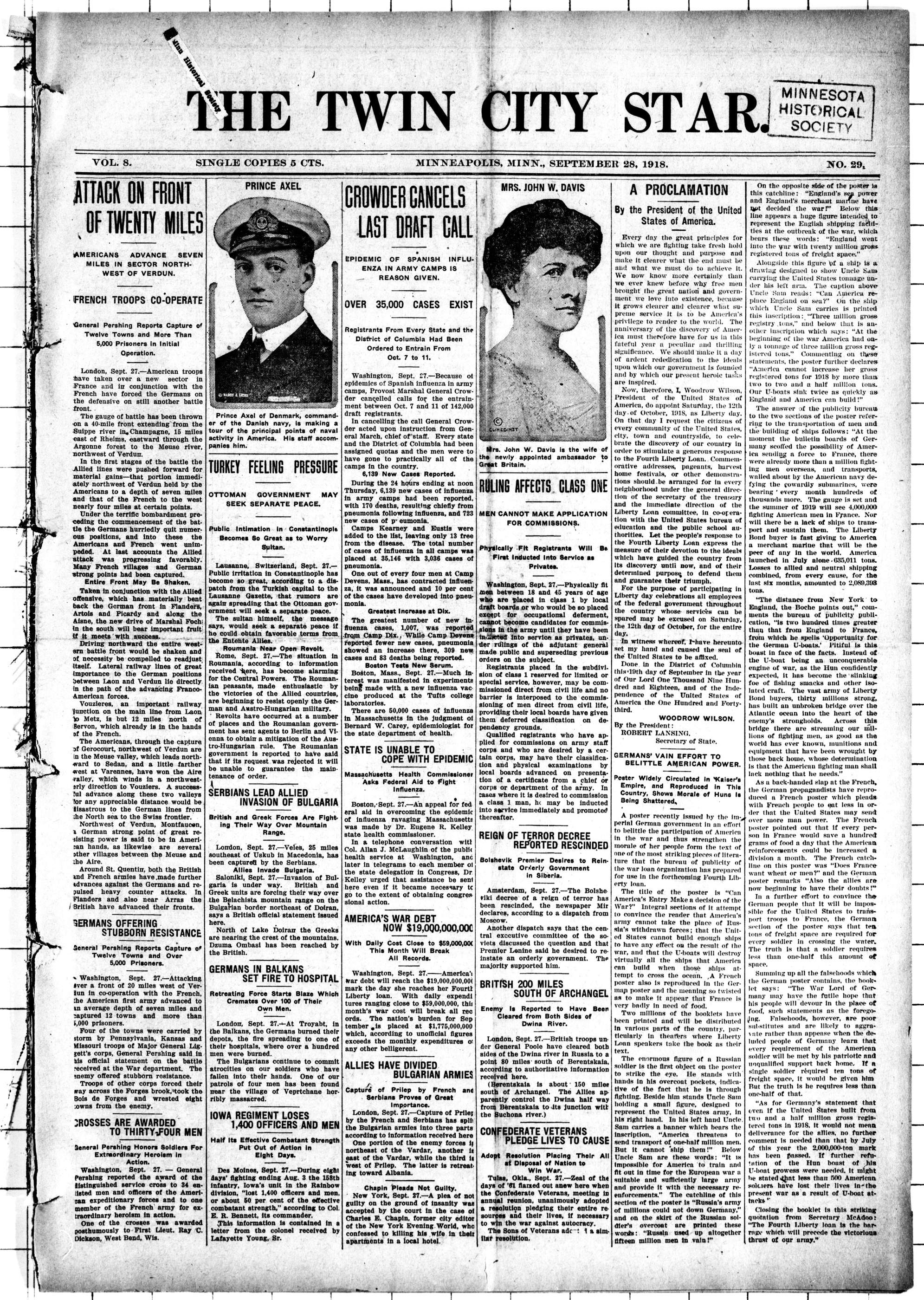
ATTACK ON FRONT OF TWENTY MILES
AMERICANS ADVANCE SEVEN MILES IN SECTOR NORTH- WEST OF VERDUN.
FRENCH TROOPS CO-OPERATE
General Pershing Reports Capture of Twelve Towns and More Than 5,000 Prisoners in Initial
London, Sept. 27.—American troops have taken over a new sector in France and in conjunction with the French have forced the Germans on the defensive on still another battle front.
The gauge of battle has been thrown on a 40-mile river extending from the Sulppe river in Champagne, 15 miles east of Rheims, eastward through the Argonne forest to the Meuse river, northwest of Verdun.
In the first stages of the battle the Allied lines were pushed forward for material gains—that portion immediately northwest of Verdun held by the Americans to a depth of seven miles and that of the French to the west nearly four miles at certain points.
Under the terrific bombardment preceding the commencement of the battle the Germans hurriedly quit numerous positions, and into these the Americans and French went unimpeded. At last accounts the Allied attack was progressing favorably. Many French villages and German strong points had been captured.
Entire Front May Be Shaken.
Taken in conjunction with the Allied offensive, which has materially bent back the German front in Flanders, Artols and Picardy and along the Alsine, the new drive of Marshal Foch in the south will bear important fruit if it meets with success.
Driving northward the entire western battle front would be shaken and of necessity be compelled to readjust itself. Lateral railway lines of great importance to the German positions between Laon and Verdun lie directly in the path of the advancing Franco-American forces.
Vouzières, an important railway junction on the main line from Laon to Metz, is but 12 miles north of Servon, which actually is in the hands of the French.
The Americans, through the capture of Gerocourt, northwest of Verdun are in the Meuse valley, which leads northward to Sedan, and a little farther west at Varennes, have won the Aire valley, which winds in a northwestly direction to Vouziers. A successful advance along these two valleys for any appreciable distance would be disastrous to the German lines from the North sea to the Swiss frontier.
Northwest of Verdun, Montfaucon, a German strong point of great resisting power is said to be in American hands, as likewise are several other villages between the Meuse and the Aire.
Around St. Quentin, both the British and French armies have made further advances against the Germans and repulsed heavy counter attacks. In Flanders and also near Arras the British have advanced their fronts.
GERMANS OFFERING
STUBBORN RESISTANCE
General Pershing Reports Capture of Twelve Towns and Over 5,000 Prisoners.
Washington, Sept. 27.—Attacking over a front of 20 miles west of Verlin in co-operation with the French, the American first army advanced to an average depth of seven miles and captured 12 towns and more than 5,000 prisoners. Four of the towns were carried by storm by Pennsylvania, Kansas and Missouri troops of Major General Liggett's corps, General Pershing said in his official statement on the battle received at the War department. The enemy offered stubborn resistance. Troops of other corps forced their way across the Forges brook, took the Bols de Forges and wrested eight towns from the enemy.
CROSSES ARE AWARDED TO THIRTY-FOUR MEN
General Pershing Honors Soldiers For Extraordinary Heroism in Action.
Washington, Sept. 27. — General Pershing reported the award of the distinguished service cross to 34 enlisted men and officers of the American expeditionary forces and to one member of the French army for extraordinary heroism in action.
One of the crosses was awarded posthumously to First Lieut. Ray C. Dickson, West Bend, Wis.
SINGLE COPIES 5 CTS.
PRINCE AXEL
Prince Axel of Denmark, commander of the Danish navy, is making a tour of the principal points of naval activity in America. His staff accompanies him.
TURKEY FEELING PRESSURE
OTTOMAN GOVERNMENT MAY
SEEK SEPARATE PEACE.
Public Intimation In Constantinople Becomes So Great as to Worry Sultan.
Lausanne, Switzerland, Sept. 27.—Public irritation in Constantinople has become so great, according to a dispatch from the Turkish capital to the Lausanne Gazette, that rumors are again spreading that the Ottoman government will seek a separate peace.
The sultan himself, the message says, would seek a separate peace if he could obtain favorable terms from the Entente Allies.
Roumania Near Open Revolt.
Rome, Sept. 27.—The situation in Roumania, according to information received here, has become alarming for the Central Powers. The Roumanian peasants, made enthusiastic by the victories of the Allied countries, are beginning to resist openly the German and Austro-Hungarian military.
Revolts have occurred at a number of places and the Roumanian government has sent agents to Berlin and Vienna to obtain a mitigation of the Austro-Hungarian rule. The Roumanian government is reported to have said that if its request was rejected it will be unable to guarantee the maintenance of order.
SERBIANS LEAD ALLIED INVASION OF BULGARIA
British and Greek Forces Are Fighting Their Way Over Mountain Range.
London, Sept. 27.—Veles, 25 miles southeast of Uskub in Macedonia, has been captured by the Serbians.
Allies Invade Bulgaria.
Saloniki, Sept. 27.—Invasion of Bulgaria is under way. British and Greek units are forcing their way over the Belachista mountain range on the Bulgarian border northeast of Dolran, says a British official statement issued here.
North of Lake Dolrar the Greeks are nearing the crest of the mountains. Dzuma Ombasi has been reached by the British.
GERMANS IN BALKANS SET FIRE TO HOSPITAL
Retreating Force Starts Blaze Which Cremates Over 100 of Their Own Men.
London, Sept. 27. At Troyabt, in the Balkans, the Germans burned their depots, the fire spreading to one of their hospitals, where over a hundred men were burned.
The Bulgarians continue to commit atrocities on our soldiers who have fallen into their hands. One of our patrols of four men has been found near the village of Veprtchane horribly massacred.
IOWA REGIMENT LOSES
1,400 OFFICERS AND MEN
Half its Effective Combatant Strength Put Out of Action in Eight Days.
Des Moines, Sept. 27.—During eight days' fighting ending Aug. 3 the 158th infantry, Iowa's unit in the Rainbow division, "lost 1,400 officers and men, or about 50 per cent of the effective combatant strength," according to Col. E. R. Bennett, its commander.
This information is contained in a letter from the colonel received by Lafayette Young, Sr.
MINNEAPOLIS, MINN., SEPTEMBER 28, 1918.
CROWDER CANCELS LAST DRAFT CALL
CROWDER CANCELS LAST DRAFT CALL
EPIDEMIC OF SPANISH INFLU-
ENZA IN ARMY CAMPS IS
REASON GIVEN.
Registrants From Every State and the District of Columbia Had Been Ordered to Entrain From Oct. 7 to 11.
Washington, Sept. 27.—Because of epidemics of Spanish influenza in army camps, Provost Marshal General Crowder cancelled calls for the entrainment between Oct. 7 and 11 of 142,000 draft registrants.
In cancelling the call General Crowder acted upon instruction from General March, chief of staff. Every state and the District of Columbia had been assigned quotas and the men were to have gone to practically all of the camps in the country.
6,139 New Cases Reported.
During the 24 hours ending at noon Thursday, 6,139 new cases of influenza in army camps had been reported, with 170 deaths, resulting chiefly from pneumonia following influenza, and 723 new cases of pneumonia.
Camps Kearney and Eustis were added to the list, leaving only 13 free from the disease. The total number of cases of influenza in all camps was placed at 35,146 with 3,036 cases of pneumonia.
One out of every four men at Camp Devens, Mass., has contracted influenza, it was announced and 10 per cent of the cases have developed into pneumonia.
Greatest Increase at Dix.
The greatest number of new influenza cases, 1,007, was reported from Camp Dix., While Camp Devens reported fewer new cases, pneumonia showed an increase there, 309 new cases and 83 deaths being reported.
Boston Tests New Serum.
Boston, Mass., Sept. 27.—Much interest was manifested in experiments being made with a new influenza vaccine produced at the Tufts college laboratories.
There are 50,000 cases of influenza in Massachusetts in the judgment of Bernard W. Carey, epidemiologist for the state department of health.
STATE IS UNABLE TO
COPE WITH EPIDEMIC
Massachusetts Health Commissioner Asks Federal Aid to Fight Influenza.
Boston, Sept. 27.—An appeal for federal aid in overcoming the epidemic of influenza ravaging Massachusetts was made by Dr. Eugene R. Kelley, state health commissioner.
In a telephone conversation with Col. Allan J. McLaughlin of the public health service at Washington, and later in telegrams to each member of the state delegation in Congress, Dr Kelley urged that assistance be sent here even if it became necessary to go to the extent of obtaining congressional action.
AMERICA'S WAR DEBT
NOW $19,000,000,000
With Daily Cost Close to $59,000,000
This Month Will Break
All Records.
Washington, Sept. 27.——America's war debt will reach the $19,000,000,000 mark the day she reaches her Fourth Liberty loan. With daily expenditures ranging close to $59,000,000, this month's war cost will break all records. The nation's burden for Sepember is placed at $1,775,000,000 which, according to unofficial figures exceeds the monthly expenditures of any other belligerent.
ALLIES HAVE DIVIDED BULGARIAN ARMIES
Capture of Prilep by French and Serbians Proves of Great Importance.
London, Sept. 27.—Capture of Prilep by the French and Serbians has split the Bulgarian armies into three parts according to information received here
One portion of the enemy forces is northeast of the Vardar, another is east of the Vardar, while the third is west of Prilep. The latter is retreating toward Albania.
Chapin Pleads Not Gullity.
New York, Sept. 27.—A plea of not guilty on the ground of insanity was accepted by the court in the case of Charles E. Chapin, former city editor of the New York Evening World, who confessed to killing his wife in their apartments in a local hotel.
MRS. JOHN W. DAVIS
Mrs. John W. Davia is the wife of the newly appointed ambassador to Great Britain.
RULING AFFECTS CLASS ONE
MEN CANNOT MAKE APPLICATION FOR COMMISSIONS.
Physically Fit Registrants Will Be First Inducted Into Service as
Washington, Sept. 27.—Physically fit men between 18 and 45 years of age who are placed in class 1 by local draft boards or who would be so placed except for occupational deferment, cannot become candidates for commissions in the army until they have been inflicted into service as privates, under rulings of the adjutant general made public and superseded previous orders on the subject.
Registrants placed in the subdivision of class 1 reserved for limited or special service, however, may be commissioned direct from civil life and no barrier is interposed to the commissioning of men direct from civil life, providing their local boards have given them deferred classification on dependency grounds.
Qualified registrants who have applied for commissions on army staff corps and who are desired by a certain corps, may have their classification and physical examinations by local boards advanced on presentation of a certificate from a chief or corps or department of the army. In cases where it is desired to commission a class 1 man, he may be inducted into service immediately and promoted thereafter.
REIGN OF TERROR DECREE
REPORTED RESCINDED
Bolshevik Premier Desires to Reinstate Orderly Government in Siberia.
Amsterdam, Sept. 27.—The Bolshevik decree of a reign of terror has been rescinded, the newspaper Mir declares, according to a dispatch from Moscow.
Another dispatch says that the central executive committee of the soviets discussed the question and that Premier Lenine said he desired to reinstate an orderly government. The majority supported him.
BRITISH 200 MILES
SOUTH OF ARCHANGEL
Enemy Is Reported to Have Been Cleared from Both Sides of Dwina River.
London, Sept. 27.—British troops under General Poole have cleared both sides of the Dwina river in Russia to a point 80 miles south of Berentskala, according to authoritative information received here.
(Berentskala is about 150 miles south of Archangel. The Allies apparently control the Dwina half way from Berentskala to its junction with the Suchona river.)
CONFEDERATE VETERANS
PLEDGE LIVES TO CAUSE
Adopt Resolution Placing Their All at Disposal of Nation to Win War.
Tulsa, Okla., Sept. 27.—Zeal of the days of '11 flaraxed out anew here when the Confederate Veterans, meeting in annual reunion, unanimously adopted a resolution pledging their entire resources and their lives, if necessary to win the war against autocracy.
The Sons of Veterans adopt 1 a similar resolution.
A PROCLAMATION
By the President of the United States of America.
Every day the great principles for which we are fighting take fresh hold upon our thought and purpose and make it clearer what the end must be and what we must do to achieve it. We now know more certainly than we ever knew before why free men brought the great nation and government we love into existence, because it grows clearer and clearer what supreme service it is to be America's privilege to render to the world. The anniversary of the discovery of America must therefore have for us in this fateful year a peculiar and thrilling significance. We should make it a day of ardent rededication to the ideals upon which our government is founded and by which our present heroic tasks are inspired.
Now, therefore, I, Woodrow Wilson, President of the United States of America, do appoint Saturday, the 12th day of October, 1918, as Liberty day. On that day I request the citizens of every community of the United States, city, town and countryside, to celebrate the discovery of our country in order to stimulate a generous response to the Fourth Liberty Loan. Commemorative addresses, pageants, harvest home festivals, or other demonstrations should be arranged for in every neighborhood under the general direction of the secretary of the treasury and the immediate direction of the Liberty Loan committee, in co-operation with the United States bureau of education and the public school authorities. Let the people's response to the Fourth Liberty Loan express the measure of their devotion to the ideals which have guided the country from its discovery until now, and of their determined purpose to defend them and guarantee their triumph.
For the purpose of participating in Liberty day celebrations all employees of the federal government throughout the country whose services can be spared may be excused on Saturday, the 12th day of October, for the entire day.
In witness whereof, I have hereunto set my hand and caused the seal of the United States to be affixed.
Done in the District of Columbia this 19th day of September in the year of Our Lord One Thousand Nine Hundred and Eighteen, and of the Independence of the United States of America the One Hundred and Forty-third.
WOODROW WILSON.
By the President:
GERMAN'S VAIN EFFORT TO
BILITTLE AMERICAN POWER.
Poster Widely Circulated in Kaiser's Empire, and Reproduced in This Country, Shows Morale of Huns Is Being Shattered.
A poster recently issued by the imperial German government in an effort to belittle the participation of America in the war and thus strengthen the morale of her people form the text of one of the most striking pieces of literature that the bureau of publicity of the war loan organization has prepared for use in the forthcoming Fourth Liberty loan.
The title of the poster is "Can America's Entry Make a decision of the War?" Integral sections of it attempt to convince the render that America's army cannot take the place of Russia's withdrawn forces; that the United States cannot build enough ships to have any effect on the result of the war, and that the U-boats will destroy virtually all the ships that America can build when those ships attempt to cross the ocean. A French poster also is reproduced in the German poster and the meaning so twisted as to make it appear that France is very badly in need of food.
Two millions of the booklets have been printed and will be distributed in various parts of the country, particularly in theaters where Liberty Loan speakers take the book as their text.
The enormous figure of a Russian soldier is the first object on the poster to strike the eye. He stands with hands in his overcoat pockets, indicative of the fact that he is through fighting. Beside him stands Uncle Sam holding a small figure, designed to represent the United States army, in his right hand. In his left hand Uncle Sam carries a banner which bears the inscription, "America threatens to send transport of one-half million men. But it cannot ship them!" Below Uncle Sam are these words: "It is impossible for America to train and fit out in time for the European war a suitable and sufficiently large army and provide it with the necessary reinforcements." The catchline of this section of the poster is "Russia's army of millions could not down Germany," and on the skirt of the Russian soldier's overcoat are printed these words: "Russia used up altogether fifteen million men in vain!"
NO. 29.
On the opposite side of the poster is this catchline: "England's sea power and England's merchant marine have not decided the war!" Below this line appears a huge figure intended to represent the English shipping facilities at the outbreak of the war, which bears these words: "England went into the war with twenty million gross registered tons of freight space."
Alongside this figure of a ship is a drawing designed to show Ucle Sam carrying the United States tonage under his left arm. The caption above Uncle Sam reads: "Can America replace England on sea?" On the ship which Ucle Sam carries is printed this inscription: "Three million gross registry tons," and below that is another inscription which says: "At the beginning of the war America had only a tonage of three million gross registered tons." Commenting on these statements, the poster further declares "America cannot increase her gross registered tons for 1918 by more than two to two and a half million tons. Our U-boats sink twice as quickly as England and America can build!"
The answer of the publicity bureau to the two sections of the poster referring to the transportation of men and the building of ships follows: "At the moment the bulletin boards of Germany scoffed the possibility of America sending a force to France, there were already more than a million fighting men overseas, and transports, walled about by the American navy defying the cowardly submarines, were bearing 'every month hundreds of thousands more. The gauge is set and the summer of 1919 will see 4,000,000 fighting American men in France. Nor will there be a lack of ships to transport and sustain them. The Liberty Bond buyer is fast giving to America a merchant marine that will be the peer of any in the world. America launched in July alone-635,011 tons. Losses to allied and neutral shipping combined, from every cause, for the last six months, amounted to 2,089,393 tons.
"The distance from New York to England, the Boche points out," comments the bureau of publicity publication, "is two hundred times greater than that from England to France, from which he spells 'Opportunity for the German U-boats.' Pitiful is this boast in face of the facts. Instead of the U-boat being an unconquerable engine of war, as the Hun confidently expected, it has become the slinking foe of fishing smack and other isolated craft. The vast army of Liberty Bond buyers, thirty millions strong, has built an unbroken bridge over the Atlantic ocean into the heart of the enemy's strongholds. Across this bridge there are streaming our millions of fighting men, as good as the world has ever known, munitions and equipment that have been wrought by those back home, whose determination is that the American fighting man shall lack nothing that he needs."
As a back-handed slap at the French, the German propagandists have reproduced a French poster which pleads with French people to eat less in order that the United States may send over more man power. The French poster pointed out that if every person in France would save a hundred grams of food a day that the American reinforcements could be increased a division a month. The French catchline on this poster was "Does France want wheat or men?" and the German poster remarks "Also the allies are now beginning to have their doubts." In a further effort to convince the German people that it will be impossible for the United States to transport troops to France, the German section of the poster says that ten tons of freight space are required for every soldier in crossing the water. The truth is that a soldier requires less than one-half this amount of space.
Summing up all the falsehoods which the German poster contains, the booklet says: "The War Lord of Germany may have the futile hope that his people will devour in the place of food, such statements as the foregoing. Falsehoods, however, are poor substitutes and are likely to aggravate rather than appease when the deluded people of Germany learn that every requirement of the American soldier will be met by his patriotic and unqualified support back home. If a single soldier required ten tons of freight space, it would be given him. But the truth is he requires less than one-half of that.
"As for Germany's statement that even if the United States built from two and a half million gross registered tons in 1918, it would not mean deliverance for the allies, no further comment is needed than that by July of this year the 2,000,000-ton mark has been passed. If further refutation of the Hun boast of his U-boat prowess were needed, it might be stated that less than 500 American soldiers have lost their lives in the present war as a result of U-boat attacks."
Closing the booklet is this striking quotation from Secretary McAdoo: "The Fourth Liberty loan is the barrage which will precede the victorious thrust of our army."
{
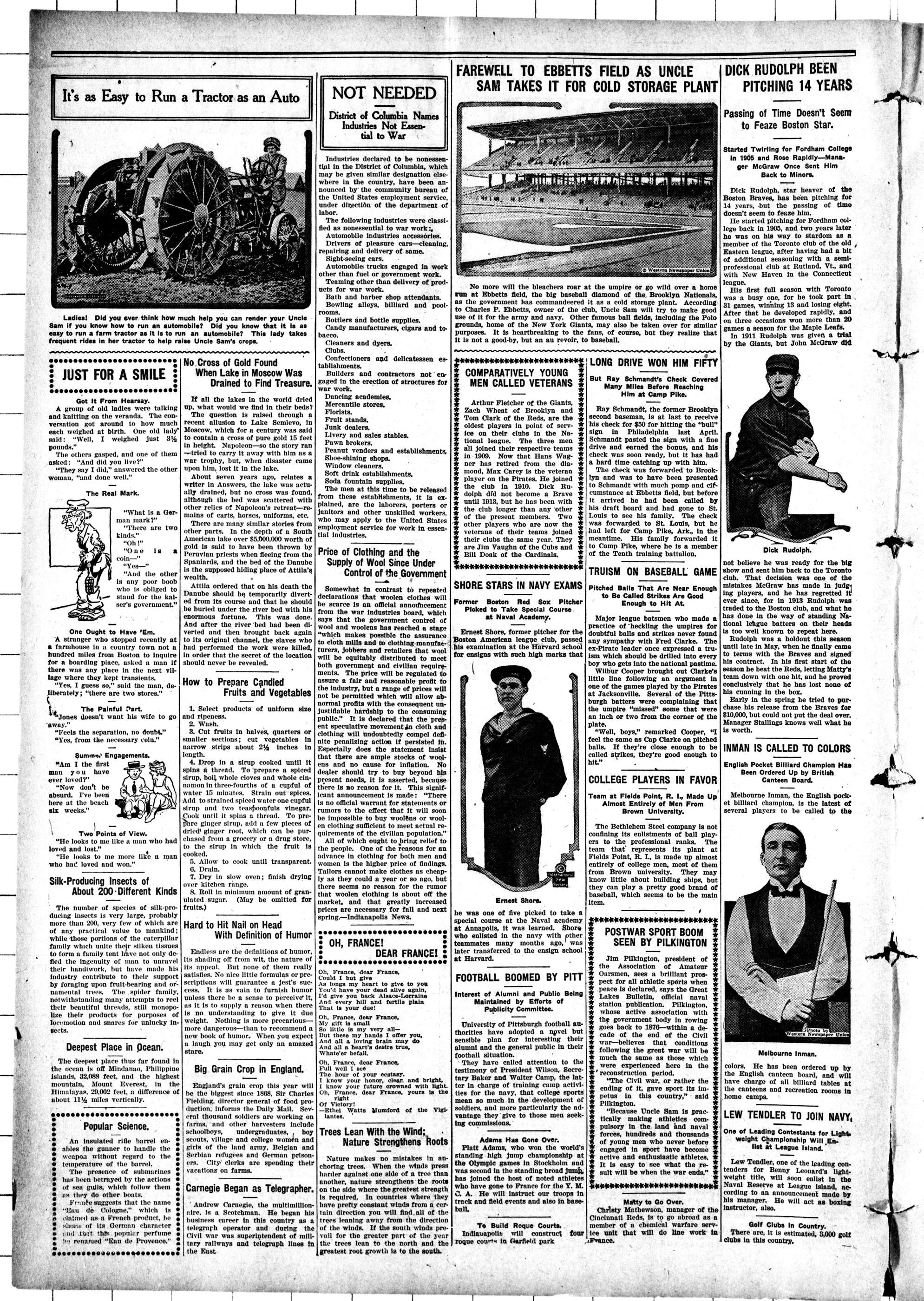
It’s as Easy to Run a Tractor as an Auto
gl POH alae. a Only 20)
pay? aie Ea Nf elon ton f
| gee aif [aN Ne ee ed
Gi ea
ant CNS i. : rh ae
| mw PE LG ALM
x Rt es ee on He,
a Nas a, ADD 1 eee cok
BANEOY VERN R AO
a LES? BCE Ae a
Fy sen ste as 2" A Seige: *. ¥
ape a Pe oR OTS
ee ce ak Fa Se oss Be
Ladies! Did you ever think how much help you can render your Uncle
‘Sam if you know how to run an automobile? Did you know that it is as
easy to run a farm tractor as it isto run an automobile? This lady takes
frequent rides in her tractor to help raise Uncle Sam’s crops.
JUST FOR A SMILE
A group of old ladies were talking
and knitting on the veranda. The con-
versation got around to how much
each weighed at birth. One old lady’
said: “Well, I welghed Just 3%
pounds.”
‘The others gasped, and one of them
asked: “And did you live?”
“They say I did,” answered the other
womn, “and done well.”
The Real Mark.
aS “What is a Ger-
s man mark?”
] “There are two
fy kinds.”
> “onl”
gy “One 18 @
PY AN oe
yt “Yes—"
XN “And the other
fils is any poor boob
Gi who is obliged to
h— stand for the kal-
& ser's government.”
Sap “What is a Ger-
s man mark?”
] “There are two
fy kinds.”
’ “on!”
gy “One is &
IY coin
K “Yes—"
A “And the other
fils is any poor boob
Gi who is obliged to
h— stand for the kal-
< ser's government.”
One Ought to Have 'Em.
‘A stranger who stopped recently at
@ farmhouse in a country town not a
hundred miles from Boston to inquire
for a boarding place, asked a man if
there was any place in the next vil-
lage where they kept transients.
“Yes, I guess so,” said the man, de-
poerstetys “there are two stores.”
te. The Painful Part.
‘Jones doesn't want his wife to go
“away.”
“Peels the separation, no doubt.”
“Yes, from the necessary coln.”
Summe. Engagements.
“Am I the first
man you have
ever loved?”
“Now don’t be
absurd. I've been
here at the beach
six weeks.”
[the first _ja, ae)
ou have Bp at)
od?” wa
don't be - J)
T’'ve been AHEM
the beach p\
ks.” fs \) i,
mS
{=
Two Points of View.
“He looks to me like a man who had
loved and lost.” °
“He looks to me more like a man
who had loved and won.”
Silk-Producing Insects of
About 200 -Different Kinds
‘The number of species of silk-pro-
ducing insects is very large, probably
more than 200, very few of which are
of any practical value to mankind;
while those portions of the caterpillar
family which unite “ silken tissues
to form a family tent hhve not only de-
fled the ingenuity of man to unravel
their handiwork, but have made his
industry contribute to their support
by foraging upon frult-bearing and or-
namental trees, The spider family,
notwithstanding many attempts to reel
their beautiful threads, still monopo-
lize their products for purposes of
Tocomotion and snares for unlucky in-
sects,
Deepest Place in Ocean.
‘The deepest place thus far found in
the ocean is off Mindanao, Philippine
islands, 32,088 feet, and the highest
mountain, Mount Everest, in the
Himalayas, 29,002 feet, 2 difference of
about 11% miles vertically.
Popular Science,
An insulated rifle barrel en-
ables the gunner to handle the
weapoa without regard to the
temperature of the barrel,
‘The presence of submarines
has been betrayed by the actions
of sea guils, which follow them
as they do other boats.
Frente suggests that the name
“Kau de Cologne,” which ts
clatmed asa French product, be
shore of its German character
gnd that thts popuixr perfume
he renamed “Eau de Provence.”
No.Cross of Gold Found :
When Lake in Moscow Was
Drained to Find Treasure.
If all the lakes in the world dried
up, what would we find in thelr beds?
‘The question is raised through a
recent allusion to Lake Semlevo, in
Moscow, which for a century was sald
to contain a cross of pure gold 15 feet
in height. Napoleon—so the story ran
tried to carry it away with him as a
war trophy, but, when disaster came
upon him, lost it in the lake.
About seven years ago, relates a
writer in Answers, the lake was actu-
ally drained, but no cross was found,
although the bed was scattered with
other relics of Napoleon's retreat—re-
mains of carts, horses, uniforms, ete.
‘There are many similar stories from
other parts. In the depth of a South
American lake over $5,000,000 worth of
gold is said to have been thrown by
Peruvian priests when fleeing from the
Spaniards, and the bed of the Danube
Is the supposed hiding place of Attila’g
wealth, .
_ Attila ordered that on his death the
Danube should bg temporarily divert-
ed from its course and that he should
be buried under the river bed with his
enormous fortune. This was done.
And after the river‘bed had been dl-
‘verted and then brought back again
to its original channel, the slaves who
had performed the work were killed,
in order that the secret of the location
should never be revealed.
How to Prepare Candied
Fruits and Vegetables
1, Select products of uniform size
and ripeness,
2. Wash,
8. Cut frults in halves, quarters or
smaller sections; cut vegetables in
narrow strips about 2% inches in
length.
4, Drop ip a sirup cooked until it
spins a thread. To prepare a spiced
sirup, boil whole cloves and whole cin-
namon In three-fourths of a cupful of
water 15 minutes. Strain out ‘spices.
‘Add to strained spiced water one cupful
sirup and two teaspoonfuls vinegar.
Cook until it spins a thread. To pre-
‘Pare ginger sirup, add a few pleces of
dried! ginger root, which can be pur-
chased from a grocery or a drug store,
to the sirup in which the fruit Is
cooked.
5, Allow to cook until transparent.
6. Drain.
7. Dry in slow oven; finish drying
over kitchen range.
8. Roll in minimum amount of gran-
ulated sugar. (May be omitted for
fruits.)
Hard to Hit Nail on Head
With Definition of Humor
Endless are the definitions of humor,
its shading off from wit, the nature of
its appeal. But none of them really
satisfies. No nice little formulas or pre-
scriptions will guarantee a jest's suc-
cess. It is as vain to furnish humor
unless there be a sense to perceive it,
as it is to supply a reason when there
is no understanding to give it due
weight. Nothing is more precarious—
more dangerous—than to recommend a
new book of humor. When you expect
a laugh you may get only an amazed
stare,
Big Grain Crop in England.
Engjand’s grain crop this year will
be the biggest since 1868, Sir Charles
Fielding, director generat of food pro-
duction, informs the Daily Mail. Sev-
eral thousand soldiers are working on
farms, and other harvesters include
schoolboys, undergraduates, , boy
scouts, village and college womén and
girls of the land army, Belgian and
Serbian refugees and German prison-
ers, City/ clerks are spending their
vacations on farms,
|Carnegie Began as Telegrapher.
Andrew Carnegie, the multimillion-
aire, is a Scotchman, He began his
business career in this country as a
telegraph operator and during the
Civil war was superintendent of mill-
tary railways and telegraph lines in
the East
NOT NEEDED
District of Columbia Names
Industries Not Essen-
tial to War
Industries declared to be nonessen-
tial in the District of Columbia, which
may be given similar designation else-
where in the country, have been an-
nounced by’ the community bureau of
the United States employment service,
under directidn of the department of
labor.
‘The following industries were ciassi-
fied as nonessential to war work :,
Automobile industries accessories,
Drivers of pleasure cars—cleaning,
repairing and delivery of same.
Sight-seeing cars.
Automobile trucks engaged in work
other than fuel or government work.
‘Teaming other than delivery of prod-
ucts for war work.
Bath and barber shop attendants.
Bowling alleys, billiard and pool-
rooms.
Bottlers sind bottle supplies.
Candy manufacturers, cigars and to
baceo.
Cleaners and dyers,
Clubs. .
Confectioners apd delicatessen es-
tablishments.
Bullders and contractors not ‘ex
gaged In the erection of structures for
‘war work,
Dancing academies,
Mercantile stores,
Florists.
Frult stands,
Junk dealers,
Livery and sales stables.
Pawn brokers.
- Peanut venders and establishments,
- Shoe-shining shops.
Window cleaners.
Soft drink establishments,
Soda fountain supplies.
__ The men at this time to be released
from these establishments, it 1s ex-
plained, are the laborers, porters or
Janitors and other unskilled workers,
who may apply to the United States
employment service for work in essen-
tlal industries,
Price of Clothing and the
Supply of Wool Since Under
Control of the Government
__ Somewhat in contrast to repeated
declarations that woolen clothes will
be scarce {s an official annothcement
from the war industries board, which
says that the government control of
wool and woolens has reached a stage
“which makes possible the assurance
to cloth mills and to clothing manufa¢-
turers, jobbers and retailers that wool
will be equitably distributed to meet
both government and civilian require-
ments. The price will be regulated to
assure a fair and reasonable profit to
the industry, but a range of prices will
not be permitted which will allow ab-
normal profits with the consequent un-
justifiable hardship to the consuming
public.” It is declared that the pres-
ent speculative movement én cloth and
clothing will undoubtedly compel defi-
nite penalizing action if persisted in.
Especially does the statement insist
that there are ample stocks of wool-
ens and no cause for inflation. No
degler should try to buy beyond his
present needs, it {s asserted, because
there 1s no reason for It. This signit-
Jeant announcement 1s made: “There
{s no officlal warrant for statements or
rumors to the effect that {t will soon
be impossible to buy wool8ns or wool-
en clothing sufficient to meet actual re-
quirements of the civilian population.”
All of which ought to bring relief to
the people. One of the Feasons for an
advance in clothing for both men and
women Is the higher price of findings.
Tailors cannot make clothes as cheap-
ly as they could a year or 80 ago, but
there seems no reason for the rumor
that woolen clothing is about off the
market, and that greatly increased
prices are necessary for fall and next
‘spring—Indlanapolis News.
= e
$ OH, FRANCE! :
e DEAR FRANCE! §
Secccccccccccccscccceccces
Oh, France, dear France, .
Could I but give
As longs my ‘heart to give to you
You'd have your dead alive again,
I’'a give you back Alsace-Lorraine
And every hill and fertile plain
That fe your due!
Oh, France, dear France,
My gift ts small
So little is my very all—
But thee my heads f offer you,
And all a loving brain may do
And all a heart's desire true,
Whate'er befall
Oh, France, dear France,
Fel well T sos
‘The hour of your ecstasy.
I know your honor, clear. and bright,
I know your future crowned with light.
On ranee, dear France, yours. is the
rant
ot vietory!
—Ethel Watts Mumford of the Vigt
lantes, *
Trees Lean With the Wind; -
Nature Strengthens Roots
Nature makes no mistakes in an-
choring trees. When the winds press
harder against one side of a tree than
‘another, nature strengthens ‘the roots
on the side where the greatest strength
1s required, In countries where they
have pretty constant winds from a cer-
tain direction you will find.all of the
trees leaning away from the direction
of the winds. If the south winds pre-
vail for the greater part of the year
the trees lean to the north and the
greatest root growth Ja to the south.
FAREWELL TO EBBETTS FIELD AS UNCLE
SAM TAKES IT FOR COLD STORAGE PLANT
a Bi Fo a fe ROE as j
: SIR peel et at te ae a me f
| Ledge ICE RULER iy
Fy ao _ - - —
; a ee
No more will the bleachers roar at the umpire or go wild over a home
run at Ebbetts field, the big baseball diamond of the Brooklyn Nationals,
as the government has commandeered it as a cold storage plant. According
to Charles P. Ebbetts, owner of the club, Uncle Sam will try to make good
‘use of it for the army and navy. Other famous ball fields, including the Polo
grounds, home of the New York Giants, may also be taken over for similar
Purposes. It is heartbreaking to the fans, of course, but they realize that
it is not a good-by, but an au revoir, to baseball.
- COMPARATIVELY YOUNG
| MEN CALLED VETERANS
' _ Arthur Fletcher of the Giants,
- Zach Wheat of Brooklyn and
Tom Clark of the Reds, are the
oldest players in point of serv-
"ice on thelr clubs in the Na-
tional league. The three men
all joined their respective teams
in 1909. Now that Hans Wag-
ner has retired from the dia-
mond, Max Carey is the veteran
"player on the Pirates, He joined
the club in 1910. Dick Ru-
dolph dfa not become a Brave
until 1913, but he has been with
the club longer than any other
of the present members, Two
“other players who are now the
veterans of thelr teams joined
_ their clubs the same year, They
are Jim Vaughn of the Cubs and
Bill Doak of the Cardinals.
SHORE STARS IN NAVY EXAMS
Former Boston Red Sox Pitcher
Picked to Take Special Course
‘at Naval Academy.
Ernest Shore, former pitcher for the
Boston American leagye club, passed
his examination at the Harvard school
for ensigns with such high marks that
i a y
ay i
a EH
“2
| a |
b>. ;
| aoe |
: f
| :
|
Ernest Shore,
he was one of five picked to take a
special course at the Naval academy
at Annapolis, it was learned. Shore
who enlisted in the navy with pther
teammates many months ago,’ was
later transferred to the ensign school
at Harvard. .
FOOTBALL BOOMED BY PITT
Interest of Alumni and Public Being
Maintained by Efforts of
Publicity Committee.
University of Pittsburgh football au-
thorities have adopted a novel but
sensible plan for interesting their
alumni and the general public in their
football situation. :
‘They have called attention to the
testimony of President Wilson, Secre-
tary Baker and Walter Camp, the lat-
ter in charge of training camp activi-
ties for the navy, that college sports
mean so much in’ the development of
soldiers, and more particularly the ad-
vantage they’ give to those men seek-
Ing commisstons.
Athens than Quen Qik:
Platt Adams, who won the world’s
standing high jump championship at
the Olymple games in Stockholm and
‘was second {n the standing broad jumh,
has joined the host of noted athletes
who have gone to France for the Y. M.
©. A. He will instruct our troops in
track and field events and also in base-
ball, :
Te Build Roque Courts,
Indiauapolls. will construct four
roque courts in Garfleld park
=
| LONG DRIVE WON HIM FIFTY
ane Ray Schmandt’s Check Covered
Many Miles Before Reaching
Him at Camp Pike.
Ray Schmandt, the former Brooklyn
second baseman, is at Inst to receive
‘his check for $50 for hitting the “bull”
sign in Philadelphia last April.
Schmandt pasted the sign with a fine
drive and earned the bonus, and his
check was soon ready, but it has had
a hard time catching up with him,
‘The check was forwarded to Brook-
lyn and was to have been presented
to Schmandt with much pomp and cif-
cumstance at Ebbetts field, but before
it arrived he had been called by
his draft board and had gone to St.
Louis to see his family, The check
was forwarded to St. Louis, but he
had left for Camp Pike, Ark, in the
meantime, His family forwarded it
to Camp Pike, where he is a member
of the Tenth training battalion,
TRUISM ON BASEBALL GAME
Pitched Balls That Are Near Enough
to Be Called Strikes Are Good
Enough to Hit At.
Major league batsmen who made a
practice of “heckling the umpires for
doubtful balls and strikes never found
‘any sympathy with Fred Clarke. The
ex-Pirate leader once expressed a tru-
ism which should be drilled into every
‘boy who gets into the national pastime.
Wilbur Cooper brought out Clarke's
ttle Ine following an argument in
‘one of the games played by the Pirates
‘at Jacksonville. Several of the Pitts-
burgh batters were complaining that
the umpire “missed” some that were
an inch or two from the corner of the
plate,
“Well, boys,” remarked Cooper, “I
feel the same as Cap Clarke on pitched
‘balls, If they're close enough to be
called strikes, they're good enough to
bal 3.
COLLEGE PLAYERS IN FAVOR
——
Team at Fields Point, R. 1, Made Up
Almost Entirely of Men From
Brown University.
‘The Bethlehem Steel company is not
confining its enlistments of ball play-
ers to the professional ranks. The
team that’ represents its plant at
Fields Point, R. L, is made up almost
entirely of college men, most of them
from Brown university. They may
know little about building ships, but
they can play a pretty good brand of
baseball, which seems to be the main
item.
POSTWAR SPORT BOOM
SEEN BY PILKINGTON
Jim Pilkington, president of
the Association of Amateur
Oarsmen, sees a brilliant pros-
pect for all athletic sports when
peace is declared, says the Great
Lakes Bulletin, official naval
station publication. Pilkington,
whose active assoclation with
the government body in rowing
goes back to 1876—within a de-
cade of the end of the Civil
war—believes that conditions
following the great war will be
much the same as those which
were experienced here in the
reconstruction period.
“The Civil war, or rather the
ending of it, gave sport its im-
petus in this country,” - sald
Pilkington.
“Because Uncle Sam is prac-
tically making athletics com-
pulsory in the land and naval
forces, hundreds and thousands
of young men who never before
engaged in sport have become
active and enthusiastic athletes,
It Is easy to see what the ire-
sult will be when the war ends,”
Matty to Go Over.
Christy Mathewson, manager of the
Cincinnati Reds, 1s to go abroad as a
member of a chemical warfare serv-
ice unit that will do Une work in
‘France.
DICK RUDOLPH BEEN
PITCHING 14 YEARS
Passing of Time Doesn’t Seem
to Feaze Boston Star.
Started Twirling for Fordham College
In 1905 and Rose Rapidly—Mana-
ger McGraw Once Sent Him
Back to Minors.
Dick Rudolph, star heaver of the
Boston Braves, has been pitching for
14 years, -but the passing of time
doesn't seem to fesze him.
He started pitching for Fordham col-
lege back in 1905, and two years later
he was on his way to stardom as a
member of the Toronto club of the old
Eastern league, after having had a bit
of additional seasoning with a semi-
professional club at Rutland, Vt, and
with New Haven in the Connecticut
league.
His first full season with Toronto
was a busy one, for he took part in
81 games, winning 13 and losing elght.
‘After that he developed rapidly, and
on three occasions won more than 20
‘games a season for the Maple Leafs,
| In 1911 Rudolph was given a trial
by the Giants, but John McGraw did
—
oe
eT
Nad
yo 4
= a
Dick Rudolph.
not believe he was ready for the big
show and sent him back to the Toronto
club, ‘That decision was one of the
mistakes McGraw has made in judg;
ing players, and he has regretted td
ever sinee, for in 1918 Rudolph was
traded to the Boston club, and what he
has done in the way of standing Na-
tional Iehgue batters on thelr heads
1s too well known to repeat here,
Rudolph was a holdout this season
until late in May, when he finally came
to terms with the Braves and signed
his contract. In his first start of the
season he beat the Reds, letting Matty's
team down with one hit, and he proved
conclusively that he has lost none of
his cunning in the box.
Early in the spring he tried to pur-
chase his release from the Braves for
$10,000, but could not put the deal over.
Manager Stallings knows well what he
is worth.
INMAN IS CALLED TO COLORS
English Pocket Billlard Champion Has
Been Ordered Up by British
Canteen Board.
Melbourne Inman, the English pock-
et billiard champion, is the latest of
several players to be called to the
Wa }
a) ao
oo 4 oo
—Aa—
*
Melbourne Inman,
colors, He has been ordered up by
the English canteen board, and will
have charge of all billiard tables at
the canteens and recreation rooms in
home camps,
LEW TENDLER TO JOIN NAVY,
‘One of Leading Contestants for Lights
‘weight Championship Will En-
lst at League Island.
Lew Tendler, one of the leading con-
tenders for Benny Leonard's light:
weight title, will soon enlist in the
Naval Reserve at League island, ac
cording to an announcement made by
his manager, He will act as boxing
instructor, also,
Golf Clubs in Country.
‘There are, it is estimated, 3,000 golf
clubs in this country,
PUBLSHED EVERY FRIDAY BY
CHARLES SUMNER SMITH,
Minneapolis, Minnesota.
Entered in the Post Office at Minneapolis as second class matter.
MEMBER
NATIONAL NEGRO PRESS
ASSOCIATION
Subscription by Mail, Postpaid.
ONE YEAR ..... $2.00
SIX MONTHS ..... $125
THREE MONTHS ..... .65
ADVERTISING RATES.
One Inch—1 Insertion—One Dollar.
Liberal discount given on 3, 6, 9,
Months, or 1 year contracts.
We do not run free ads, or over-run the time contracted for by our advertisers. We respect their right to advertise at intervals, and rather have them do so, than to run continuously an "adv." and an increasing account. Write all Checks payable to
THE TWIN CITY STAR
1317 North Sixth Ave.
MINNEAPOLIS - MINNESOTA
Send your subscription. Our prices have not changed because of the war. Let your dollar do its duty and The Star will reach a higher standard of service and better circulation.
A DEPOSIT IS REQUIRED ON ALL POLITICAL ADVERTISEMENTS.
Let us not draw the color line. Reciprocity between the races will be the salvation of the Negro.
FOURTH LIBERTY LOAN
ANSWER WITH CASH AND
CONFIDENCE. HERE IT IS.
"BUM" POLITICS.
We know no word better fitted for the colored politician in Oregon than "bum politics." For years and years the colored politician has voted for the Republican party and handed out political cards, orated, expostulated and split oceans of printer's ink to help elect some office-seeker and like the "bum" who is out of work, the colored politician is still "splitting wood" for a livelihood and tramping on in the same old rut. "Bum politics," to say the least. And it will ever be thus just so long as the colored politician and voters continue to support parties and not men. Now the best way to change the whole "bum" local machine, which has dominated politics in the interest of a favored few (and the colored brother completely excluded) is to pick out men for whom to vote at the coming election and let the "party" go to the "pow-wow." And if this doesn't bring political leaders to their senses where will they recognize a man by his worth and not his color, nothing else will. Think it over.—The Portland (Ore.) Advocate, Sept. 21, 1918.
RACE DISCRIMINATION.
A complaint has been made to Pres. B. S. Smith of the N. A. A. C. P, that a Negro woman of this city, having a license as an elevator operator, was not employed at the New England Annex Bldg., apparently on account of her color or race. Several white ladies applied for the position and not one had a license. One was hired (without a license) and the woman with a license turned down. Another complaint was that the General Electric Light Co. refused to employ a Negro who answered an adv for an elevator man.
There was a recent drive for members and the N. A. A. C. P. is strong enough to make a fight against these conditions. The president will investigate these cases and the Star wants a report given publicity.
We have not joined the national attack on the N. A. A. C. P. because it has done good work; but there is need of some public activity in this city, and if the association cannot stop race discrimination now we have no hope for results hereafter.
SELFISHNESS IS DISLOYALTY.
Any person, who seeks honor or personal gain in connection with any war activities is a war profiteer, and is guilty of the worst form of disloyalty. Every personal sacrifice is a patriotic effort. It is the duty of every honest citizen to do his best to bear the Nation's burden without complaint. This is no time for obstructionists. Those who have grievances may complain, in order that better progress may be made. The slacker and chronic kicker is always a detriment. While petitions of redress to proper authorities will always command respect and investigation, let us not forget that every one is asked to do his share to win this war. There is a satisfaction in having done our duty. There is honor enough for us all, if we do that which is expected of us. The patriot knows no self-preservation, the profiteer no self-sacrifice.
SUBSCRIBE FOR THE STAR.
OUR UNCHANGED POLICIES.
Now that the candidates for office are entering the race in the coming primaries, and The Twin City Star has always taken an active part in discussing the political situation and presenting the issues of the campaign; it will try to maintain its former policies of giving a fair expression of the attitude of all office-seekers, so far as the Negro is concerned. It does not (for revenue only) write up every candidate as "a friend of our race" or "the right man in the right place." It gives each the advantage of the columns under "paid advertisements."
The Twin City Star intends to expose any candidate whose record has been against the Negro. Its editor has a fair knowledge of the history of several campaigns and has made a study of the value of the Negro vote. He is not bound by any individual or party, and has stood, at all times, for the political recognition of Negro voters. The Twin City Star is a paper with a worthy purpose, recognized by its readers as a reliable source of information, an intelligent and fearless advocate for equal rights for all men.
We have never known two injustices to make anything right. The Saturday News has prospered by being as just to the white man as it has ever been to the Negro. We have never gone off half-cocked upon any proposition. Whenever we grope, we are in search of the truth. We want to be right and avoid as nearly as possible being wrong. We are not for the Negro right or wrong. We want him to be right. We complain because a majority of white people will always side with a white man when a question arises between him and one of our color; still certain colored newspapers, without making any investigation whatsoever as to the evidence, would have the entire Negro race do identically what they condemn the white people for doing. Because the white people do wrong is no reason why the Negroes should do wrong. The best preparedness to receive justice is to be just yourself.—Hopkinsville (Ky.) Nows.
TUSKEGEE OPENS 38TH SESSION.
To Be a Students' Army Training Camp.
Tuskegee, Ala., Sept. 14.—Tuskegee Institute opened its 38th annual session_Tuesday, September 10th. More than 1,500 students have been granted admission this year, and the first day's enrollment was one of the largest in the history of the school.
Dr. R. R. Moton, principal, announced today that the War Department through the Committee on Education and Special Training has asked the institute to continue the training of soldiers in contingents of 400 each. These soldiers are being trained in trades but their work will not interfere with the regular work of the students. Principal Moton also announced today that he had received word this week from the Committee on Education and Special Training, Washington, D. C., that Tuskegee Institute has been selected as one of the institutions to conduct a student's army training Camp. Inquiries and applications from all parts of the country are already coming in. With the training of the soldiers and the regular students, Tuskegee Institute will have fully 2,000 persons regularly under instruction here this fall.
Some people think an editor should know about their business without being told and it should appear in the paper. The editor knows the things, you do not want in the paper. If you have something you want published—send it in. The other will find its way.
We have some among our advertisers and subscribers who are a credit determined to stem the tide of prejudice and safeguard our rights; the association must be strong in numbers and in financial resources, and it will be a greater power throughout the nation. The membership fee is only ONE DOLLAR a year, one half of which is remitted to the New York National Headquarters and the other remaining half is retained in our treasury for local expenses. Will you not become a member and help the Association to make America free for black humanity? You must not be a slacker and you cannot be a conscientious objector. Have your dollar ready for the drive; let Minnesota be in the race by sending no less than 500 memberships.
"ENLIST OR WORK" CAMPAIGN.
The military authorities intend to push the enlist or work campaign among the Negroes. There are many idlers who have no lawful means of support. They will be drafted into the industrial army. Get work, gentlemen of leisure, even if as a side line.
SUBSCRIBERS WANTED — Make the Twin City Star a live and dependable weekly Negro newspaper by sending your subscription.
THE WAY TO MAKE MONEY.
If you wish to add to your income you can do so by accepting an agency for The Twin City Star. Good commission to competent agents. Use your spare time in soliciting ads and subscriptions. Only honest and intelligent agents wanted. Call Hyland 1205.
ADVERTISE IN THE STAR
THE TWIN CITY STAR, MINNEAPOLIS, MINN.
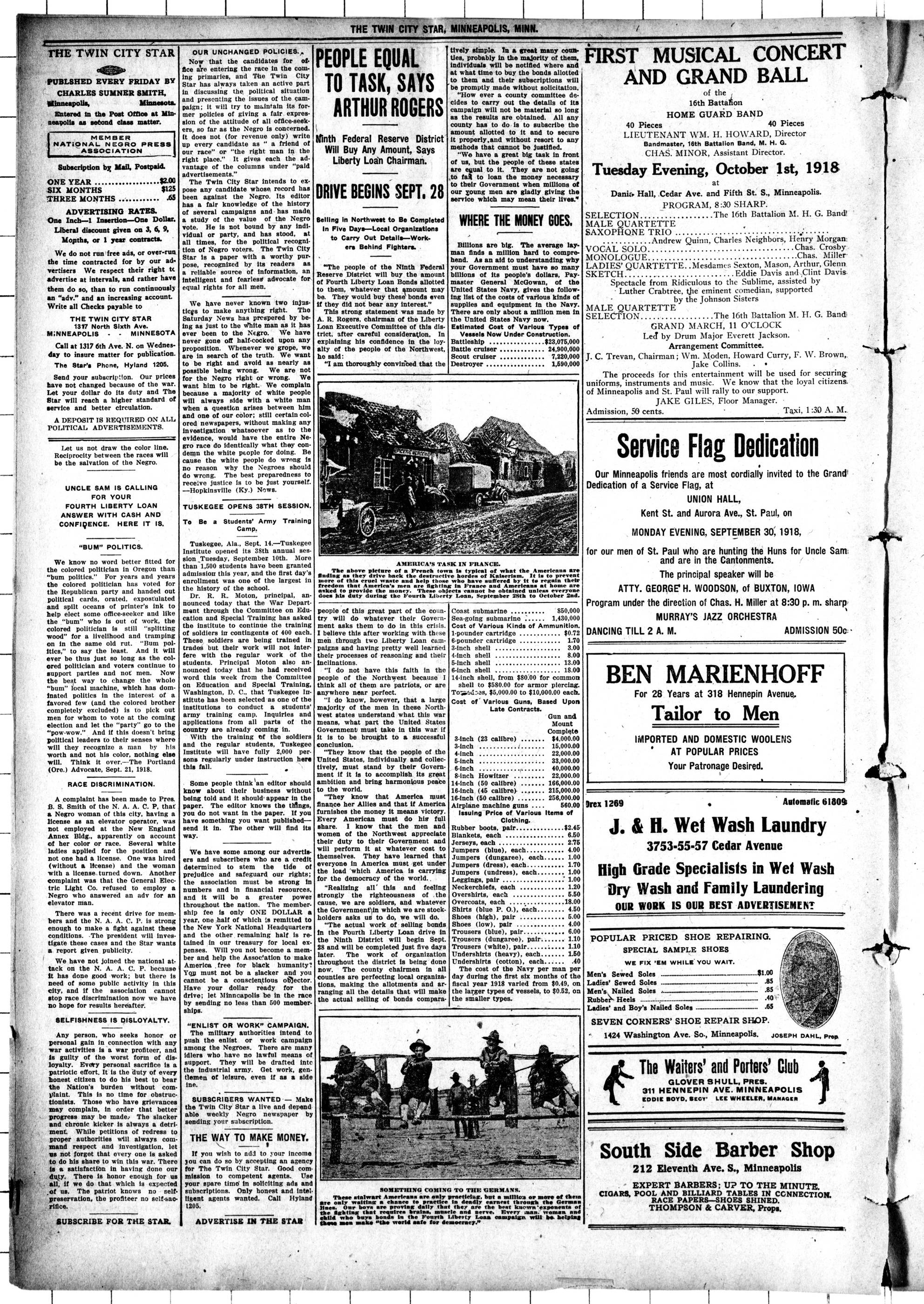
PEOPLE EQUAL TO TASK, SAYS ARTHUR ROGERS
Ninth Federal Reserve District Will Buy Any Amount, Says Liberty Loan Chairman.
DRIVE BEGINS SEPT. 28
Belling in Northwest to Be Completed
In Five Days—Local Organizations
to Carry Out Details—Workers Behind Fighters.
"The people of the Ninth Federal Reserve District will buy the amount of Fourth Liberty Loan Bonds allotted to them, whatever that amount may be. They would buy these bonds even if they did not bear any interest."
This strong statement was made by A. R. Rogers, chairman of the Liberty Loan Executive Committee of this district, after careful consideration. In explaining his confidence in the loyalty of the people of the Northwest, he said:
"I am thoroughly convinced that the
EXCITING WORKSHOP
MILK MILK MILK
AMERICA'S TASK IN FRANCE.
The above picture of a French tow finding as they drive back the destruc't more of this cruel waste and help those who are in danger. He asked to provide the money. These obes does his duty during the Fourth Libert
The above picture of a French town is typical of what the Americans are finding as they drive back the destructive hordes of Kalserism. It is to prevent more of this cruel waste and help those who have suffered by it to regain their dignity. A much more real and important task is asked to provide the money. These objects cannot be obtained unless everyone does his duty during the Fourth Liberty Loan, September 28th to October 2nd.
people of this great part of the country will do whatever their Government asks them to do in this crisis. I believe this after working with these men through two Liberty Loan campaigns and having pretty well learned their processes of reasoning and their inclinations.
"I do not have this faith in the people of the Northwest because I think all of them are patriots, or are anywhere near perfect.
"I do know, however, that a large majority of the men in these Northwest states understand what this war means, what part the United States Government must take in this war if it is to be brought to a successful conclusion.
Coast submarine . . . 850,000
Sea-going submarine . . . 1,430,000
Cost of Various Kinds of Ammunition.
1-pounder cartridge . . . $0.72
6-pounder cartridge . . . 1.70
3-inch shell . . . 3.00
4-inch shell . . . 8.00
5-inch shell . . . 13.00
6-inch shell . . . 18.00
14-inch shell, from $80.00 for common shell to $580.00 for armor piercing.
Tortoises, $5,000.00 to $10,000.00 each.
Cost of Various Guns, Based Upon Late Contracts.
Gun and Mount
Complete
3-inch (23 calibre) . . . $4,000.00
3-inch . . . 15,000.00
"They know that the people of the United States, individually and collectively, must stand by their Government if it is to accomplish its great ambition and bring harmonious peace to the world.
"They know that America must finance her Allies and that if America furnishes the money it means victory. Every American must do his full share. I know that the men and women of the Northwest appreciate their duty to their Government and will perform it at whatever cost to themselves. They have learned that everyone in America must get under the load which America is carrying for the democracy of the world.
"Realizing all' this and feeling strongly the righteousness of the cause, we are soldiers, and whatever the Government in which we are stockholders asks us to do, we will do.
"The actual work of selling bonds in the Fourth Liberty Loan drive in the Ninth District will begin Sept. 28 and will be completed just five days later. The work of organization throughout the district is being done now. The county chairmen in all counties are perfecting local organizations, making the allotments and arranging all the details that will make the actual selling of bonds compara-
TOMMY
SUNDAY, JULY 10, 1915
These stalwart Americans are only practicing, but a million or more of them are only waiting a chance to practice in deadly earnest through the German lines. Our boys are proving daily that they are the best known exponents of the fighting that requires brains, muscle and nerve. Every man, woman and child who buys honds in the Fourth Liberty Loan campaign will be helping these men make "the world safe for democracy."
tively simple. In a great many counties, probably in the majority of them, individuals will be notified where and at what time to buy the bonds allotted to them and their subscriptions will be promptly made without solicitation. "How ever a county committee decides to carry out the details of its campaign will not be material so long as the results are obtained. All any county has to do is to subscribe the amount allotted to it and to secure it properly, and without resort to any methods that cannot be justified. "We have a great big task in front of us, but the people of these states are equal to it. They are not going to fail to loan the money necessary to their Government when millions of our young men are gladly giving the service which may mean their lives."
WHERE THE MONEY GOES.
Billions are big. The average layman finds a million hard to comprehend. As an aid to understanding why your Government must have so many billions of its people's dollars, Paymaster General McGowan, of the United States Navy, gives the following list of the costs of various kinds of supplies and equipment in the Navy. There are only about a million men in the United States Navy now.
Estimated Cost of Various Types of Vessels Now Under Construction.
Battleship ..... $23,075,000
Battle cruiser ..... 24,900,000
Scout cruiser ..... 7,220,000
Destroyer ..... 1,590,000
A
ern is typical of what the Americans are
e hordes of Kalserism. It is to prevent
who have suffered by it to regain their
in Permanent American at home are
ects cannot be obtained unless everyone
Loan, September 28th to October 2nd.
Coast submarine ..... 850,000
Sea-going submarine ..... 1,430,000
Cost of Various Kinds of Ammunition.
1-pounder cartridge ..... $0.72
6-pounder cartridge ..... 1.70
3-inch shell ..... 3.00
4-inch shell ..... 8.00
5-inch shell ..... 13.00
6-inch shell ..... 18.00
14-inch shell, from $80.00 for common
shell to $580.00 for armor piercing.
Towards, $5,000.00 to $10,000.00 each.
Cost of Various Guns, Based Upon
Late Contracts.
Gun and Mount Complete
3-inch (23 calibre) ..... $4,000.00
3-inch ..... 15,000.00
4-inch ..... 22,000.00
5-inch ..... 33,000.00
6-inch ..... 40,000.00
8-inch Howitzer ..... 22,000.00
14-inch (50 calibre) ..... 166,000.00
16-inch (45 calibre) ..... 215,000.00
16-inch (50 calibre) ..... 256,000.00
Airplane machine guns ..... 560.00
Rubber boots, pair.....$2.45
Blankets, each.....6.50
Jerseys, each.....2.75
Jumpers (blue), each.....4.00
Jumpers (dungaree), each.....1.00
Jumpers (dress), each.....1.70
Jumpers (undress), each.....1.00
Leggings, pair.....1.00
Neckerchiefs, each.....1.20
Overshirts, each.....5.50
Overcoats, each.....18.00
Shirts (blue P. O.), each.....4.50
Shoes (high), pair.....5.00
Shoes (low), pair.....4.00
Trousers (blue), pair.....6.00
Trousers (dungaree), pair.....1.10
Trousers (white), pair.....1.10
Undershirts (heavy), each.....1.50
Undershirts (cotton), each.....40
The cost of the Navy per man per day during the first six months of the fiscal year 1918 varied from $0.49, on the larger types of vessels, to $0.52, on the smaller types.
TOMMY HARRIS
FIRST MUSICAL CONCERT AND GRAND BALL
40 Pieces 40 Pieces
LIEUTENANT WM. H. HOWARD, Director
Bandmaster, 16th Battalion Band, M. H. G.
CHAS. MINOR, Assistant Director.
Tuesday Evening, October 1st, 1918
Daniel Hall, Cedar Ave. and Fifth St. S., Minneapolis.
PROGRAM, 8:30 SHARP.
SELECTION.....The 16th Battalion M. H. G. Band
MALE QUARTETTE
SANOPHONE TRIO
SAXOPHQNE TRIO
Andrew Quinn, Charles Neighbors, Henry Morgan
VOCAL SOLO
Chas. Crosby
MONOLOGUE
Chas. Miller
LADIES' QUARTETTE. Mesdames Sexton, Mason, Arthur, Glenn
SKETCH
Eddie Davis and Clint Davis
Spectacle from Ridiculous to the Sublime assisted by
MALE QUARTETTE
SELECTION.....The 16th Battalion M. H. G. Band
GRAND MARCH. 11 Q'CLOCK
J. C. Trevan, Chairman; Wm. Moden, Howard Curry, F. W. Brown, Jake Collins.
The proceeds for this entertainment will be used for securing uniforms, instruments and music. We know that the loyal citizens of Minneapolis and St. Paul will rally to our support.
JAKE GILES, Floor Manager.
Admission, 50 cents. Taxi, 1:30 A. M.
Service Flag Dedication
Service Flag Dedication
Our Minneapolis friends are most cordially invited to the Grand Dedication of a Service Flag, at
ATTY. GEORGE' H. WOODSON, of BUXTON, IOWA
Program under the direction of Chas. H. Miller at 8:30 p. m. sharp
MURRAY'S JAZZ ORCHESTRA
DANCING TILL 2 A. M. ADMISSION 50c
BEN MARIENHOFF
For 28 Years at 318 Hennepin Avenue.
Tailor to Men
IMPORTED AND DOMESTIC WOOLENS AT POPULAR PRICES Your Patronage Desired.
Drex 1269
J. & H. W
3753-
High Grade
Dry Wash
OUR WORK I
POPULAR PRICED
SPECIAL SAN
WE FIX 'EM W
Men's Sewed Soles .....
Ladies' Sewed Soles .....
Men's Nailed Soles .....
Rubber Heels .....
Ladies' and Boy's Nailed
SEVEN CORNERS'
1424 Washington A
A & H. Wet Wash Launcher
3753-55-57 Cedar Avenue
Grade Specialists in Wet Wash and Family Launderer
WORK IS OUR BEST ADVERTISEMENT
R PRICED SHOE REPAIRING.
SPECIAL SAMPLE SHOES
WE FIX 'EM WHILE YOU WAIT.
1 Soles ..... $1.00
2 Soles ..... .85
3 Soles ..... .85
40
Boy's Nailed Soles ..... .65
BORNERS' SHOE REPAIR SHOP.
Washington Ave. So., Minneapolis. JOSEPH
The Waiters' and Porters' Club
High Grade Specialists in Wet Wash Dry Wash and Family Laundering OUR WORK IS OUR BEST ADVERTISEMENT
POPULAR PRICED SHOE REPAIRING SPECIAL SAMPLE SHOES
SEVEN CORNERS' SHOE REPAIR SHOP.
GLOVER SHULL, PRES.
311 HENNEPIN AVE. MINNEAPOLIS
EDDIE BOYD, SECY LEE WHEELER, MANAGER
South S
212 Elev
th Side Barber S
EXPERT BARBERS; UP TO THE MINUTE. CIGARS, POOL AND BILLIARD TABLES IN CCNNECTION. RACE PAPERS—SHOES SHINED. THOMPSON & CARVER. Props.
ADMISSION 50c
OFF
venue.
ENS
Automatic 61809
A laundry
the
Wet Wash
undering
INSEMENT
OSEPH DAHL, Prop.
Club
Shop
IMPORTANT NOTICE
Unless notes are written plainly and properly arranged they will not be inserted. Many people send in notes regardless of names, initials or composition. Arrangement by the publisher will be charged for. Free notices must be correctly written.
N. A. A. C. P. BUTTONS.
Every Member Should Wear One.
It is the express wish of the Central Branch of the N. A. A. C. P. that all members should wear a button showing their connection with this organization, that stands for the rights of our race. I have therefore in conformity with that desire received 100 buttons which will be sold to members at the small figure of thirty-five cents (35c) each. The button is very beautifully and artistically made and one which every member should be proud to wear. The Secretary will always have a number of these buttons with him and will take no offense if stopped on the street or anywhere else to purchase one. Let each member have a button. Wear it in a conspicuous place, be prepared to tell what it stands for when questioned and thus advertise the Association for the advancement of colored people.
A general meeting will take place as early as is convenient and members are kindly asked to watch the Twin City Star for announcement.
R. AUGUSTINE SKINNER,
Secretary.
A Cash, Deposit Required on All
Advertisements. Notices of Entertainment,
etc. Must Be Accompanied by Cash.
Let Your Dollar Do Its Duty!
Mrs. Mitchell, 1828 4th Ave So., has a desirable furnished room, will rent to lady or gentlemen. Conveniently located. Cars pass the door.
What has become of the Colored Y. M. C. A.? Who knows?
Company D of the Home Guards is arranging for a big event at an early date.
NEW MANAGEMENT FOR
THE ATTUCKS HOME
Atty. Hammond Turner is attempting to reorganize the management of Attucks Home. Several meetings have been held, and the repeated custom of sending delegates (?) from various local organizations is being carried out. Atty. Turner speaks in very uncomplimentary terms of the present system and hopes to perfect plans to maintain a desirable institution.
TO DEDICATE SERVICE FLAG.
There will be a Service Flag unfurled at Bethesda Baptist Church on Sunday night, Sept. 29, under the auspices of the Ladies of Biddle Chapter, G. A. R. Mrs. Mary E. Pope, president. The public is invited. An appropriate program of special interest has been arranged.
JACKSON-MURPHY.
Miss Eva Venona Jackson and Mr. Albert L. Murphy were married on Sept. 25 at 9 a. m. in St. Helena's Roman Catholic Church by Rev. Rowan. They left the same evening for Willmar, Minn., to reside. Mrs. Murphy is the daughter of Mrs. Miles Jackson, and is a native Minneapolitan. Mr. Murphy is an employee of the Great Northern Ry.
Mrs. Albert A. Ford is expected to return home next week after a lengthy visit to Portland, where she was the guest of Mrs. Victoria Johnson, mother of Mrs. Barney Johnson. Mrs. Ford was also a visitor to Carson Springs and Seattle to see her brother, Mr. Harry Duvall.
Mrs. G. P. Simms has returned to the city from her summer stay at Annandale, Minn.
Mr. and Mrs. John T. Pierce are the proud parents of a bouncing baby born a few weeks ago.
Mr. Fred Parkinson returned Saturday from Isle Royal, Mich. where he was a companion for one of our wealthy residents. Fred is an able musician and has enlisted (under his old teacher, Prof. Howard) in the 16th Battalion Band.
Messrs. Lee Wheeler, Glover Shull and Benj. Carr were among the last visitors to Camp Dodge before the boys left for eastern points.
NEGRO NURSES WANTED.
Major-Jose H. Sherwood, 971 St. Anthony Ave., St. Paul, will be glad to receive the names of any graduate nurses among the colored women. He has been requested to forward such information to proper authorities for the organization of Colored Rad Cross workers for overseas service.
Secretaries of Lodges may send notice of their newly elected officers for free publication and office information.
Wanted—A live, honest, correspondent and agent. Apply to Twin City Star.
SMOKE THE RELIABLE
SIGHT DRAFT CIGAR
THAT'S ALLI
Rev. J. H. Henderson of St. James A. M. E. Church has been assigned to Institutional Church, Chicago. Rev. Henderson made a grand record as pastor in St. Paul and the people of the Twin Cities regret his leaving. He is one of the highly intellectual clergymen of his race, an educator and an orator, whose strict adherence to Christian principles and fearless defense of right won for him the title of "Little Giant." Chicago is fortunate in having such a valuable addition to her clergy as Rev. Henderson.
Atty. W. T. Francis of St. Paul has returned from a three weeks' visit to New York, Washington and Chicago. He was in consultation with the prominent leaders and had a conference with Secretary Emmett J. Scott on matters of importance to our race.
Gopher Lodge of Elks of St. Paul initiated seven members on Wednesday night. Exalted Ruler J. F. Coquire is being able supported and Gopher Lodge is fast regaining her membership. Grand Esquire P. H. Southall conducted the initiations. Brother Doy Faucetti proved an excellent master of social sessions.
Messrs. B. C. Archer, Geo. W. Wills and A. V. Hall of St. Paul are preparing to enter Y. M. C. A. work.
ST. PAUL HOME QUARDS.
Companies A and B of the 16th Battalion; M. H. G., will hereafter meet every Wednesday night in the old Capitol on Wabasha street. The Armory is used for the National Guard.
Mr. James P. Taylor, employed as chef for the Canadian Pacific Co., has returned from Western Canada to spend a while in Minneapolis. He reports a prosperous outlook for our people in the Canadian Northwest.
Mrs. Albert W. Morris has gone to Vancouver, B. C., to visit her husband.
Editor Chas. Sumner Smith and Hon. W. R. Morris attended the organization meeting of the Minneapolis War Council at the Radisson Hotel on Sept. 26.
HOME GUARD NOTICE—
Co.'s C and D of Minneapolis.
Company C—Regular drill nights
every Monday and Friday. Assemble
at 8 p. m. in Room 30, Courthouse.
GATE, GATE, GATE
CLASSIFIED ADVERTISEMENTS SEE McDFW! for real estate.
N. W. Nicollet 1534
JOSEPH YOUNG
Loans on Real Estate
and Chattles
818 Metropolitan Life Bldg.
Minneapolis, Minn.
HOUSE FOR RENT.
FOR RENT—Five rooms, modern
except heat, on car line. $11.00 per
month. Call Main 2040.
FOR RENT.
Two rooms, furnished or unfurnished; suitable for light housekeeping or bedrooms. Mrs. Alice Brower, 2426 5th Ave. So. Call South 4474.
NICE FRONT ROOM For Rent—Suitable for two; gentlemen preferred. Snelling and 4th Ave. car lines pass the door; good location; walking distance. Call So. 117 before noon. Mrs. E. A. Mitchell, 1828 4th Ave. So.
MODERN FLAT FOR RENT.
Modern Five Room Flat, 1st floor. Good location; walking distance. Apply J. S. Wright, Main Postoffice. Tel. N. W. 19 W.
EVERY DAY is BARGAIN DAY at the ROOT & HAGEMAN STORE, 407 Nicollet Ave.
READ THIS CAREFULLY.
If you receive a newspaper by mail and do not wish to pay for it, just refuse it by informing your postman. Then it will be returned to the publisher and he will be notified to discontinue sending it. There is no reason why a person should pay for a paper forced on them, but every reason why it should be paid for when ordered and accepted.
Reliable and intelligent agents always wanted to solicit business for THE TWIN CITY STAR; also correspondents in principal cities. A chance to earn a good living. Write The Twin City Star, Minneapolis.
Do not forget to send the money to the Star which you owe for subscriptions.
Mr. Joseph Young has opened a loan office in 818 Metropolitan Life Bldg. He has negotiated several substantial loans on residence property in this city. Owing to the increasing business he has secured an office with Atty. Wm. R. Morris, where he will make loans from $10.00 up, including chattel mortgages. Mr. Young has made a study of real estate values during his residence in this city, and is financially able to meet the demands of the trade.
Are you a delinquent subscriber?
If so, why not send your subscription?
---
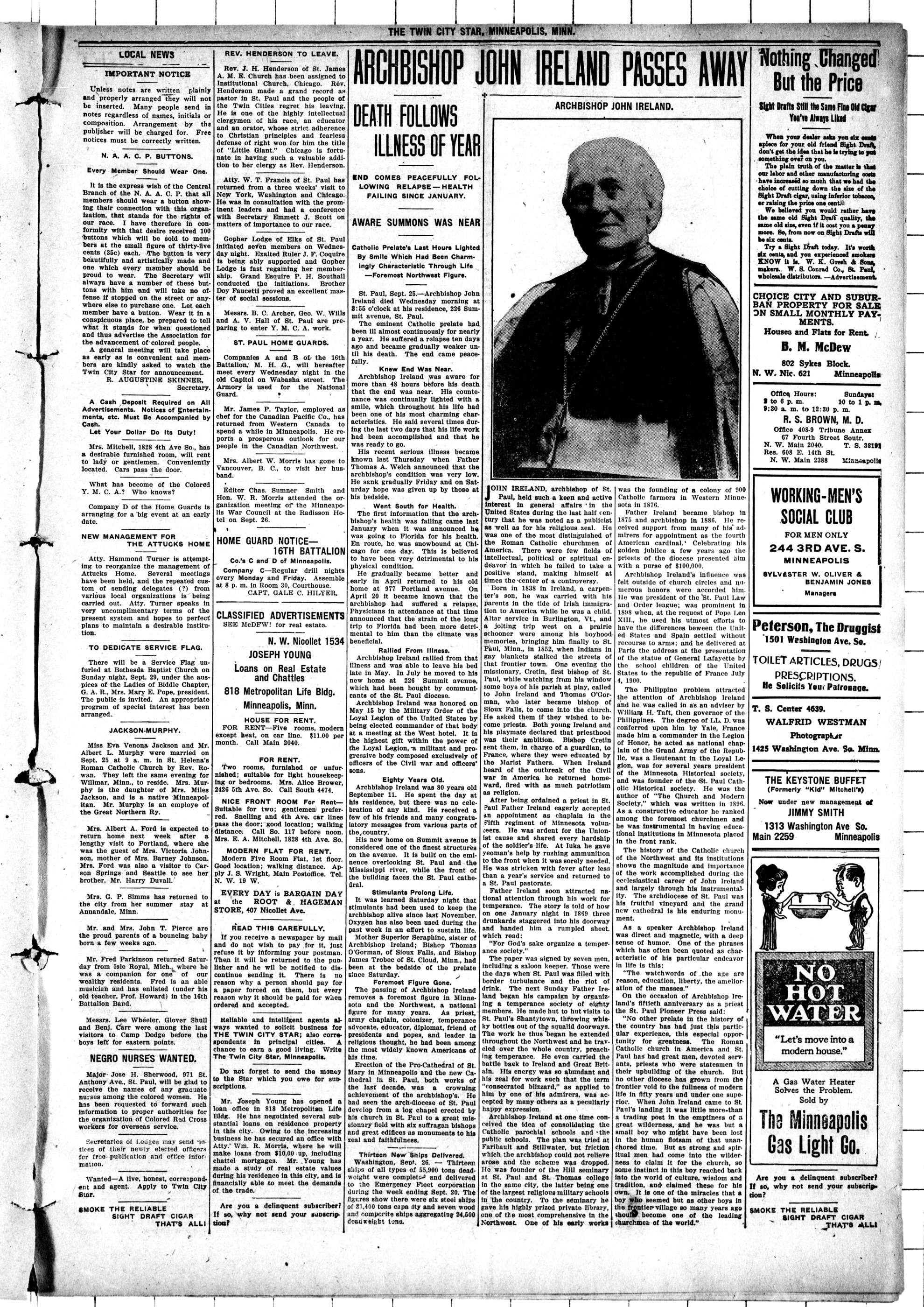
ARCHBISHOP JOHN IRELAND PASSES AWAY
DEATH FOLLOWS ILLNESS OF YEAR
END COMES PEACEFULLY FOLLOWING RELAPSE—HEALTH FAILING SINCE JANUARY.
AWARE SUMMONS WAS NEAR
Catholic Prelate's Last Hours Lighted By Smile Which Had Been Charmingly Characteristic Through Life —Foremost Northwest Figure.
St. Paul, Sept. 25.—Archbishop John Ireland died Wednesday morning at 8:55 o'clock at his residence, 226 Summit avenue, St. Paul.
The eminent Catholic prelate had been ill almost continuously for nearly a year. He suffered a relapse ten days ago and became gradually weaker until his death. The end came peacefully.
Knew End Was Near.
Archbishop Ireland was aware for more than 48 hours before his death that the end was near. His countenance was continually lighted with a smile, which throughout his life had been one of his most charming characteristics. He said several times during the last two days that his life work had been accomplished and that he was ready to go.
His recent serious illness became known last Thursday when Father Thomas A. Welch announced that the archbishop's condition was very low. He sank gradually Friday and on Saturday hope was given up by those at his bedside.
Went South for Health.
The first information that the archbishop's health was failing came last January when it was announced he was going to Florida for his health. En route, he was snowbound at Chicago for one day. This is believed to have been very detrimental to his physical condition.
He gradually became better and early in April returned to his old home at 977 Portland avenue. On April 20 it became known that the archbishop had suffered a relapse. Physicians in attendance at that time announced that the strain of the long trip to Florida had been more detrimental to him than the climate was beneficial.
Rallied From Illness.
Named From illness.
Archbishop Ireland rallied from that illness and was able to leave his bed late in May. In July he moved to his new home at 226 Summit avenue, which had been bought by communicans of the St. Paul diocese.
Archbishop Ireland was honored on May 15 by the Military Order of the Loyal Legion of the United States by being elected commander of that body at a meeting at the West hotel. It is the highest gift within the power of the Loyal Legion, a militant and progressive body composed exclusively of officers of the Civil war and officers' sons.
Eighty Years Old.
Archbishop Ireland was 80 years old September 11. He spent the day at his residence, but there was no celebration of any kind. He received a few of his friends and many congratulatory messages from various parts of the country. His new home on Summit avenue is considered one of the finest structures on the avenue. It is built on the eminence overlooking St. Paul and the Mississippi river, while the front of the building faces the St. Paul cathedral.
Stimulants Prolong Life.
It was learned Saturday night that stimulants had been used to keep the archbishop alive since last November. Oxygen has also been used during the past week in an effort to sustain life. Mother Superior Seraphine, sister of Archbishop Ireland; Bishop Thomas O'Gorman, of Sioux Falls, and Bishop James Trobec of St. Cloud, Minn., had been at the bedside of the prelate since Saturday.
Foremost Figure Gone.
The passing of Archbishop Ireland removes a foremost figure in Minnesota and the Northwest, a national figure for many years. As priest, army chaplain, colonizer, temperance advocate, educator, diplomat, friend of presidents and popes, and leader in religious thought, he had been among the most widely known Americans of his time.
Erection of the Pro-Cathedral of St. Mary in Minneapolis and the new Cathedral in St. Paul, both works of the last decade, was a crowning achievement of the archbishop's. He had seen the arch-diocese of St. Paul develop from a log chapel erected by his church in St. Paul to a great missionary field with six suffragan bishops and great edifices as monuments to his zeal and faithfulness.
Thirteen New Ships Delivered
Washington, Sept. 26. — Thirteen ships of all types of 55,900 tons dead, weight were complete and delivered to the Emergency Fleet corporation during the week ending Sept. 20. The figures show there were six steel ships of 21,400 tons capacity and seven wood and composite ships aggregating 24,500 dead weight tons.
ARCHBISHOP JOHN IRELAND.
P.
P.
JOHN IRELAND, archbishop of St. Paul, held such a keen and active interest in general affairs in the United States during the last half century that he was noted as a publicist as well as for his religious zeal. He was one of the most distinguished of the Roman Catholic churchmen of America. There were few fields of intellectual, political or spiritual endeavor in which he failed to take a positive stand, making himself at times the center of a controversy.
Born in 1838 in Ireland, a carpenter's son, he was carried with his parents in the tide of Irish immigration to America while he was a child. Altar service in Burlington, Vt., and a jolting trip west on a prairie schooner were among his boyhood memories, bringing him finally to St. Paul, Minn., in 1852, when Indians in gay blankets stalked the streets of that frontier town. One evening the missionary, Cretin, first bishop of St. Paul, while watching from his window some boys of his parish at play, called to John Ireland and Thomas O'Gorman, who later became bishop of Sioux Falls, to come into the church. He asked them if they wished to become priests. Both young Ireland and his playmate declared that priesthood was their ambition. Bishop Cretin sent them, in charge of a guardian, to France, where they were educated by the Marist Fathers. When Ireland heard of the outbreak of the Civil war in America he returned homeward, fired with as much patriotism as religion.
After being ordained a priest in St. Paul Father Ireland eagerly accepted an appointment as chaplain in the Fifth regiment of Minnesota volunteers. He was ardent for the Unionist cause and shared every hardship of the soldier's life. At Iuka he gave yeoman's help by rushing ammunition to the front when it was sorely needed. He was stricken with fever after less than a year's service and returned to a St. Paul pastorate.
Father Ireland soon attracted national attention through his work for temperance. The story is told of how on one January night in 1869 three drunkards staggered into his doorway and handed him a rumpled sheet, which read:
"For God's sake organize a temperance society."
The paper was signed by seven men, including a saloon keeper. Those were the days when St. Paul was filled with border turbulance and the riot of drink. The next Sunday Father Ireland began his campaign by organizing a temperance society of eighty members. He made hut to hut visits to St. Paul's Shantytown, throwing whisky bottles out of the squalfd doorways. The work he thus began he extended throughout the Northwest and he traveled over the whole country, preaching temperance. He even carried the battle back to Ireland and Great Britain. His energy was so abundant and his zeal for work such that the term "consecrated blizzard," as applied to him by one of his admirers, was accepted by many others as a peculiarly happy expression.
Archbishop Ireland at one time conceived the idea of consolidating the Catholic parochial schools and the public schools. The plan was tried at Faribault and Stillwater, but friction which the archbishop could not relieve arose and the scheme was dropped. He was founder of the Hill seminary at St. Paul and St. Thomas college in the same city, the latter being one of the largest religious military schools in the country. To the seminary he gave his highly prized private library, one of the most comprehensive in the Northwest. One of his early works
MARY
was the founding of a colony of 900 Catholic farmers in Western Minnesota in 1876. Father Ireland became bishop in 1875 and archbishop in 1886. He received support from many of his admirers for appointment as the fourth American cardinal.' Celebrating his golden jubilee a few years ago the priests of the diocese presented him with a purse of $100,000.
Archbishop Ireland's influence was felt outside of church circles and numerous honors were accorded him. He was president of the St. Paul Law and Order league; was prominent in 1898 when, at the request of Pope Leo XIII., he used his utmost efforts to have the differences between the United States and Spain settled without recourse to arms; and he delivered at Paris the address at the presentation of the statue of General Lafayette by the school children of the United States to the republic of France July 4, 1900.
The Philippine problem attracted the attention of Archbishop Ireland and he was called in as an adviser by William H. Taft, then governor of the Philippines. The degree of LL. D. was conferred upon him by Yale, France made him a commander in the Legion of Honor, he acted as national chaplain of the Grand Army of the Republic, was a lieutenant in the Loyal Legion, was for several years president of the Minnesota Historical society, and was founder of the St. Paul Catholic Historical society. He was the author of "The Church and Modern Society," which was written in 1896. As a constructive educator he ranked among the foremost churchmen and he was instrumental in having educational institutions in Minnesota placed in the front rank.
The history of the Catholic church of the Northwest and its institutions shows the magnitude and importance of the work accomplished during the ecclesiastical career of John Ireland and largely through his instrumentality. The archdiocese of St. Paul was his fruitful vineyard and the grand new cathedral is his enduring monument.
As a speaker Archbishop Ireland was direct and magnetic, with a deep sense of humor. One of the phrases which has often been quoted as characteristic of his particular endeavor in life is this:
"The watchwords of the age are reason, education, liberty, the amelioration of the masses."
On the occasion of Archbishop Ireland's fiftieth anniversary as a priest the St. Paul Pioneer Press said:
"No other prelate in the history of the country has had just this particular experience, this especial opportunity for greatness. The Roman Catholic church in America and St. Paul has had great men, devoted servants, priests who were statesmen in their upbuilding of the church. But no other diocese has grown from the frontier void to the fullness of modern life in fifty years and under one superior. When John Ireland came to St. Paul's landing it was little more-than a trading post in the emptiness of a great wilderness, and he was but a small boy who might have been lost in the human flotsam of that unanchored time. But as strong and spiritual men had come into the wilderness to claim it for the church, so some instinct in this boy reached back into the world of culture, wisdom and tradition, and claimed these for his own. It is one of the miracles that a boy who seemed but as other boys in the frontier village so many years ago should become one of the leading churchmen of the world."
---
Nothing Changed But the Price
Sight Drafts Still the Same Fine Old Cigar You've Always Liked
When your dealer asks you six cents apiece for your old friend Sight Draft, don't get the idea that he is trying to put something over on you.
The plain truth of the matter is that our labor and other manufacturing costs have increased so much that we had the choice of cutting down the size of the Sight Draft cigar, using inferior tobacco, or raising the price one cent.
We believed you would rather have the same old Sight Draft quality, the same old size, even if it cost you a penny more. So, from now on Sight Drafts will be six cents.
Try a Sight Draft today. It's worth six cents, and you experienced smokers KNOW it is. W. K. Gresh & Song, makers. W. S. Conrad Co., St. Paul, wholesale distributors. — Advertisement
CHOICE CITY AND SUBURBAN PROPERTY FOR SALE ON SMALL MONTHLY PAYMENTS.
802 Sykes Block.
N. W. Nic. 621 Minneapolis
Office Hours: Sundayet
2 to 6 p. m. 10 to 1 p. m.
9:30 a. m. to 12:30 p. m.
R. S. BROWN, M. D.
Office 408-9 Tribune Annex
67 Fourth Street Soutr.
N. W. Main 2040. T. S. 38192
Res. 608 E. 14th St.
N. W. Main 2388 Minneapolis
WORKING-MEN'S
SOCIAL CLUB
FOR MEN ONLY
244 3RD AVE. S.
MINNEAPOLIS
SYLVESTER W. OLIVER &
BENJAMIN JONES
Managers
Peterson, The Druggist
1501 Washington Ave. So.
TOILET ARTICLES, DRUGS
PRESCRIPTIONS.
He Solicits Your Patronage.
T. S. Center 4639.
WALFRID WESTMAN
Photographer
1425 Washington Ave. So. Minn.
THE KEYSTONE BUFFET
(Formerly "Kid" Mitchell's)
Now under new management of
JIMMY SMITH
1313 Washington Ave So.
Main 2259 Minneapolis
NO
HOT
WATER
"Let's move into a modern house."
A Gas Water Heater
Solves the Problem.
Sold by
The Minneapolis
Gas Light Go.
Are you a delinquent subscriber?
If so, why not send your subscription?
SMOKE THE RELIABLE
SIGHT DRAFT CIGAR
THAT'S ALLI
ARMOR for MODERN FIGHTERS Casque Lunettes Masque
Many Models Have Been Made and Are Now Being Tried Out by Americans at the Front.
MANY a visitor wandering through the labyrinthian delights of the Metropolitan Museum in New York and coming upon the collection of arms and armor in the main gallery has reincarnated a past of tall knights and gentle ladies, has fancied himself a Launcelot or Guinevere, in the city's splendid collection of mail and plate, of decorative trapping, battle axe, spear and broad or long sword.
And many, no doubt, have stood in fascination before the medieval armorer's workshop set in a paneled recess of carved oak to the left of the gallery, a miniature bit of Old World charm, worn anvils, hammers whose stroke has rung through centuries of steel on steel, modeled knights in the gay panoply of the Middle Ages, and the accountures of a warfare when combatants clashed to the sound of trumpets.
But only a few of the visitors to the museum have been fortunate enough to get lost in the cool, corridored basement and find, tucked away in an inconspicuous corner, a complete practical armorer's shop, where a master armorer plies his inherited art with a skill that puts him on a level with some of the great master armorers of the Middle Ages, writes N. H. McCloskey in New York Tribune. This artisan is M. Daniel Tachaux, and those few who have been permitted to swing open his shop door—a door quite like many another along the corridor—may well count themselves among the fortunate blessed, for they have seen a shop like no other in this country—a show now closed to the public and guarded by all the impassable and invulnerable barriers of government regulation.
For here, in a workroom originally established for the purpose of cleaning, repairing and, in some rare cases, restoring pieces of defective armor, M. Tachaux and his young French assistant, Sergeant Bartel of the ordnance department, are carefully working out designs and models of defensive armor that can be worn by the allied soldiers, and which it is expected will result in cutting down to a very great degree, as the helmets have already done, the percentage of killed and wounded in this present war.
Forty Models Now at the Front.
Porty Models Now at the Front.
When the war broke out Mr. Robinson, director of the Metropolitan Museum, learning that the government was in need of models for the preparation of armor, obtained the sction of the trustees in placing the department of armor at the disposition of Secretary of War Baker. Bashford Dean, curator of the department and a man who has given his life to the study of the subject, was commissioned as a major and immediately sent abroad to report on the status of armor—what was already in use and what additions might feasibly be made. He returned to the United States late in January of the present year, and has since kept the armor workshop of the museum busy, on holidays and weekdays, turning our models in accordance with the suggestions of General Pershing and the ordnance department. After careful and patient experimentation by experts forty models have been made, and are even now being tried out on the fighting front.
Here in the little workshop where the sun comes in through miniature panes and is deflected in myriad colors by small tools, age old; bits of brass and bronze, steel bright from pounding and armored suits wrought with the intricate traceries of medieval decoration, M. Tachaux plies with deft skill and the ease of long practice the very tools used by his ancestors and handed down from father to son through hundreds of years. The museum has collected from all parts of the world, the implements used in the fabrication of ancient armor, comprising some ninety kinds of anvils and "stakes," several hundred different types of hammers, curious shears and instruments whose use would be quite unknown were it not that six armorers—heirs of a past skill — are living today. One of these is in Dresden, one in Switzerland, two in Japan, one in London and the other America has in the person of M. Tachaux, who has collected about him the dusty romance of an almost forgotten art and
Fishing With a Shovel
Fishing with a shovel is the latest had to develop in Milwaukee—and right in the heart of the city, too. Paul Irigl, proprietor of the saloon at the east end of the Oneida street bridge, which closed one day, started the new sport the next. While looking over his former place of business he saw a number of fish swimming near the surface of the Milwaukee river, next to his saloon.
for MODERN
ERS
Casque
Lunettes
Masque
Joint Protector
Gorgerin
Cuirasse
Haubergeor
Knee Protector
The armor of a
modern soldier
if he wore all
that has been
Provided
In this corner of an ultramodern city has labored to preserve the relics of those storied centuries when knights were bold and ladies passing fair. Now, thanks to him who has kept alive an art long considered dead, this country is able to benefit by the advice of an expert in metals, and no longer does M. Tachaux labor over ancient pieces, but bends all his efforts, all his cunning and all his knowledge, to the making of armor that can be worn by the modern soldier — armor heavy enough to be invulnerable, light enough to carry.
Revive Work of Old Masters.
This question of weight and therefore practicability of armor for the man on foot—the man who makes a charge—reverts to the time of Louis XV of France, when the use of defensive protection had practically disappeared and an attempt was made to revive the steel helmet. Indeed, the development of armor from the time of side arms until the use of firearms is one of exceeding interest at this time, in that the government is reviewing the work of some of the greatest of the old masters in armor making, with a view to reinstating the best and most feasible of the old methods of defensive protection.
The use of armor dates back to the ninth century B. C. and became more elaborate and complex until the introduction of gunpowder. The helmet was the first body protection to appear and was followed by the cuirass—the latter being used by the Greeks and Romans and reappearing at the time of Charlemagne in the form of a waist-coat made of overlapping metal scales and of rather imperfect execution.
What Norman Warrior Wore.
In the eleventh century, according to the Bayeaux tapestries as well as the seal of Richard Coeur de Lion, we find the coat of mall assuming first the shape of a redingote and later that of a bathing suit, completed by a helmet conical at the nose. This, together with the use of leather plates on the feet and hands, constituted the equipment of a Norman warrior.
A study of the sculptures of the Reims cathedral and the evangelarium of St. Louis (National library) points to the development, in the twelfth century, of a perfected coat of mail, a metal combination united with the helmet by a passe-montagne of steel links; the whole, constituting a hauberk, protected the warrior with the haube—a cylindrical helmet made of pieces of forged metal adjusted by rivets and pierced by two peepholes. At the beginning of the fourteenth century$^8$ the desire to protect the joints caused the placing of metal plates at shoulder and knee. The haube disappeared and was replaced by a helmet of a type called Bassinet, with a movable visor pierced by holes to permit sight and ventilation. By the middle of the fourteenth century chain armor had disappeared to a considerable degree, and plate armor was taking its place, the plates at the joints being
Drig went into the basement of the place and among the rubbish found a long-handled coal shovel. With this he pried open a window facing the river and climbed onto the two-foot dock. By stooping and leaning over he was able to land six suckers, each a foot long, with the shovel. He lost a nice bullhead.
No Restriction on Ostrich Flesh.
Ostrich flesh is meat which is not very popular at the present time, but it was once considered one of the
extended to the interarticular portions in such a way as to inclose the limbs in metal greaves; the hands were protected by an articulated gauntlet and the foot by an iron shoe or solletet. The body was still covered by a shortened coat about the length of a walstcoat—called the hauberge—and the whole outfit was known as a "harness," to which was soon added a steel corselet, prolonged over the abdomen by a sort of skirt of interwoven metallic rings—the "tusselles."
Invulnerable But Helpless.
Finally, in the reign of Charles VII, the complete cuirass appears, augmented by shoulder pieces and the gorget, which united the armor to the round helmet. The knight was now practically invulnerable, but so weighted down and so awkward of movement that once dismounted he was at the complete mercy of his foe. To lessen his chances of being mounted, therefore, his horse was equipped with armor, the tout ensemble being a sort of medieval tank. The man on foot, however, needed greater freedom of movement, and so wore considerably lighter equipment, namely, helmet, shoulder pieces, shield, arm and thigh pieces, knee pieces and a short coat of mail—or haubergeon—to which was added, in many cases, an abdominal demi-cuirass. This equipment may appear again on the modern soldier practically as worn by the foot soldier in the reign of Charles VII.
The elaborate armor of the knight —which, in its completion, had meant the patient acquisition of centuries— was made useless in the space of some ten years by the introduction of gunpowder. As early as the beginning of the fourteenth century, projectiles had become capable of piercing the armor in use at the time, and little by little the use of such defense disappeared, the tendency being to substitute fabric for metal protection. This gave birth to the epaulet, horse-tail plume, the shako and the bearskin cap. With modern wars, a new device sprang up —namely, individual protection by means of the invisibility of units and scattered formations. From this originated the idea of the service uniform.
Such methods of individual defense were quite satisfactory for combat at great distances; but in stationary fighting or in trench warfare it is quite another matter, and once again the question of individual armor has arisen, and already we see its use in the shape of the steel helmet, the heavy breastplate worn by the German soldier, the lighter breastplate worn by the English, the armored waistcoats of the Italians and the trench shields used by all armies. The idea of the new armor is not, like that of the Middle Ages, to give complete protection. It is rather to deflect than to stop missiles, and it does this with a sheet of metal that would be easily pierced by a bullet striking it at right angles.
finest dishes ever made. The meat is rather hard to digest, though even if this were not the case it is doubtful if it would ever lay claim to rivalry with ham and eggs or pork and beans. At any rate it has one big advantage in that it is in no wise affected by food regulations, and the lover of this dish may consume it to his heart's content without fearing the wrath of the food administrator or having his conscience smite him for devouring something that the soldiers could use or need.
(Copyright, 1918, by the McClure Newspaper Syndicate.)
Dreaming of unlimited wealth is a very fascinating form of diversion for the average body. Even as little children, games founded on the theme, "You know what I'd do if I had a trillion million dollars," always seemed the most fun. What wonderful times we could have and what wonderful things we could do as we simply drew at will upon imaginary and unlimited sources of treasure!
But different desires foster thoughts of this pocketbook eternally full. Some dream of a wardrobe permitting a new garment each day; others of the power coincident with high social position; while some aspire to help those less fortunate. With Malzie Sloan, however, it was neither a case of style, society, nor sympathy.
Forced by the precarious earnings of a rheumatic father to increase the family revenue, she had been obliged at the age of fourteen to regard the elementary grades as a fitting limit of education and she had accordingly nipped a great desire to attend high school before the bud had had an opportunity to bloom forth into the flower of decision. An innate dislike for the drudgery of manual labor helped to make attendance at night school less burdensome and it surely seemed a step forward as she diffidently entered the offices of Franklin & Co. to apply for the position as stenographer. The very sign on the door, "Stocks and Bonds" seemed to spell realization of her dreams.
For Maizie Sloan dreamed of comfort—comfort in every sense of the word. "Wouldn't it be great to sleep as long as you wanted to," she thought as six o'clock every morning found her trying to lace her shoes with eyes half closed. "Wouldn't it be grand not to have to wash dishes," accompanied the scouring of greasy pots. "Wouldn't
FR
"I've Come Back."
It be nice to have a laudress do your stuff," made the work lighter as knuckles reddened on the ridges of the scrubbing board.
Malzie brushed the front of her shiny skirt of blue serge. She hoped the ripped seam where she had sewed it with black thread would not be noticed. She did want that position with the many additional comforts the larger income would bring. Already she had figured out what she would do with the extra hour in the evening. To be through at five o'clock!
"Mr. Franklin will see you now," announced a girl at the switchboard, and Malzie came back to earth. Again the skirt was hitched up at the belt and a quick touch assured her that the mended seam was invisible.
"Sit right down," invited her prospective employer, and as he glanced at the card of introduction from the agency, added, "Miss Sloan." Maizie clasped her hands very tightly to see if she could feel them. The walk across the velvety rug, the courteous invitation to be seated, and Mr. Franklin's eyes of soft brown, had taken her by surprise. She loibked up. "Have you had any previous experience?"
"No, sir, but I'm willing to learn." Perhaps fate was kind or perhaps Mr. Franklin was not able to refuse Maizie's wistful, appealing gaze, but the position was open to her if she cared to accept. Cared to accept? Maizie took off her black straw sailor hat. "I'd like to start in right away," she announced.
And Malzie did learn very quickly. It did not take the switchboard operator very long to discover that when Mr. Franklin telephoned into the outer office for a stenographer, it was Malzie Sloan he meant. He seemed to like her neat, tidy appearance and her accurate, painstaking work. Of course, it was not because, as the girls in the outer office gossiped, he liked her personally; although when a single man of thirty exhibits a preference for a particular female assistant, the indications would seem to point that way.
But whatever favor Maizle found in
her employer's eyes did not seem to affect her in any particular. She was learning to her surprise that the increased income did not necessarily carry with it surcease from work and that her position demanded an immaculate appearance unthought of in the factory. So the extra half hour of sleep in the morning went for a more elaborate toilet and the evening was devoted to the washub over which she alternately scrubbed her two white shirtwaists. But Maizle continued to dream of that Utopla where work was nonexistent.
"Mr. Franklin wishes to give you some dictation, Miss Sloan," called the operator, as she pulled the plug out of the switchboard. With notebook and sharply pointed pencil in one hand, Maizle patted her hair into shape with the other and crossed the rug. Somehow she could not become accustomed to its cushiony softness.
Mr. Franklin fussed with his watch charm. "Just a short letter," he apologized. Malzie sat motionless, pencil polished ready to inscribe the mysterious lines and curves which she alone could decipher.
"It's to—it's to—" he stammered, "it's to Miss Malzie Sloan." Mr. Franklin gulped. Malzie was surprised but glued her eyes to her book.
"I beg to advise you," he began very quietly, "that sometime ago I delivered to you my—heart. Will you kindly acknowledge receipt," he hurried on, "and let me know if it meets with your approval?"
Mr. Franklin did not quite anticipate that his stenographer would get up and leave the room. But how was he to know that Malzie wanted to marry him—not because she loved him, but because his money could make her dreams come true? And how was he to know that she flew from him to avoid committing this insult to her ideal of honor? He thought he had frightened her into refusing him. That is why later he was filled with surprised gladness as he read her answer:
"Dear sir: I beg to acknowledge receipt of your consignment and wish to advise it meets with my hearty approval. When do you wish payment made?"
The days flew by very quickly for Malzie. With funds supplied by her future husband, she prepared a dainty trousseau and never were her dreams so vivid as when she thought of her approaching marriage. Servants she would have, one for every finger. She's eat her breakfast in bed. She wouldn't lift a pin from the floor.
It was an exquisite day in May. There was a song on her lips as Malzie entered Mr. Franklin's office. As she opened the door she saw first the ugly frown on his forehead.
"What is the matter?" she exclaimed quickly, coming to his side.
"I've invested heavily in Condon Silver and the market is very low. I shall lose everything and be drowned in debt." Maizle reeled. Down went the aircastles! Smash went the dreams! For what did she need a penniless husband? Why should she marry poverty? She ran from the room. She ran through the outer office. She ran down the nine flights of steps. She ran through the streets. From sheer exhaustion she rested in the city park.
What discouragement! What disappointment! What disillusion! Why had she been she one to suffer? Had she not been happier before luxury had seemed within her fingertips? Why had destiny been so cruel? Malzie sat and cross-questioned herself until cool shadows hid the sun below the horizon. As she arose from the bench, she noticed her ring. It was worth a large sum of money. It was hers and she did not have to return it. It would recompense her for her suffering.
She fingered the stone dejectedly. It sparkled so brilliantly. Malzie rubbed her eyes. Was she awake? For the luster of the diamond seemed to reflect the features of her employer. She had not thought of him before. He had not come into her mind until then. "Drowned in debt," re-echoed in her ears. Why was she not trying to save him, then? Why was she not by his side helping him to buck the current? In a flash it came to her. "I don't want him because I need him. I don't want him because he needs me. I want him because I love him." She said it out loud and the policeman walking his beat smiled as he caught the end of her words.
Malzie ran at full speed back to the office. She closed her eyes as she turned the knob. She had not the courage to face him and confess. She pushed the door open with her foot and burst in upon him with arms extended to feel the way her eyes, tightly shut, denied her.
"I've come back," she cried out. "I've come back because I love you. I don't want your money. I don't care if you're poor. Just let me help you."
He took her into his arms. "How I longed to hear that, Malzie, dear. But its all right now—the market's gone up. You're safe."
"Safe because I love you," she answered.
Hard Task Ahead.
"Perkips looks worried, doesn't he?"
"Yes; he's borrowing trouble,"
"About what?"
"Oh, he's fretting about the number of explanations of the war sure to be printed when peace is declared. He'll be forced to read 'em all because he's a book reviewer, you know."—London Answers.
Except.
All the world loves a lover—except sometimes the girl the lover loves—Idaho Daily Statesman.
LESSON FOR SEPTEMBER 29
REVIEW.
**SUBJECT-What It Means to Be**
Christian.
**SELECTION FOR READING-I John**
3:1-24
GOLDEN TEXT—My little children, let us not love in word, neither in tongue; but in deed, and truth—I John 3:18.
Perhaps the best way to review the lessons of this quarter will be to take the several lessons and note their bearing on the subject chosen for review; namely: What it means to be a Christian. In order to get the best results, assignment should be made of the several lessons to different parties to come prepared to give the teaching of the particular lesson on the subject. The following is suggested as a possible way of presenting the matter.
Lesson I. It means that each individual must exercise faith in Jesus Christ as a personal Savior. One may have his heart opened by the Lord while listening to the Word of God at a stated meeting, like Lydia, or be convinced through the manifestation of the mighty power of God, as the Philippian jailer. In all cases it is the one Savior and the one faith.
Lesson II. It means that those who have really exercised faith in the Lord Jesus Christ will attentively read God's Word. Even a great statesman like the Ethiopian Eunuch will be blessed in its reading, for the Word of God converts the soul, makes wise the simple, puts gladness into the heart, enlightens the eyes, satisfies the longing soul, warns against dangers, and brings reward to those who obey its precepts.
Lesson III. It means a life of personal prayer and communion with God. The one who has become a child of God has the glorious privilege of coming to him with his needs with the assurance that God will supply them. God is more willing to give to his children than any earthly father is to his children.
Lesson IV. It means a life of obedience to the Word and will of God. Prompt and definite obedience will be rendered, even to the separation from business, and the ties of nature, when such stand in the way. Peter, Andrew, James and John obeyed, and it meant to them great spiritual blessings. From fishing for fish, they were promoted to fishing for men. Obedience to God pays. The discipline of Christ will treasure up his words.
Lesson V. It means growth in grace. Jesus himself grew in wisdom and in stature, and in favor with God and man. Merely accepting Christ is not enough; there must be growth.
Lesson VI. It means a life of helpfulness to others. One who has been made a partaker of the Divine nature will, like his master, give himself in helpful service to others. He will be a neighbor to the needy and unfortunate, even as the Good Samaritan. Being good in himself, he will be doing good to others. He will use every opportunity to do good.
Lesson VII. It means attendance at the place of worship, receiving the teaching of the Word of God, partaking of the communion, and rendering service in some capacity in the church.
Lesson VIII. It means confessing Christ before men, and waiting with expectant hope for the coming of Jesus Christ from Heaven. The grand incentive for faithfulness in witnessing for Christ is the assurance that he will come again.
Lesson IX. It means that we will give of our possessions to the poor and needy, love our enemies, and refrain from censorious judgment. God estimates our gifts, not by their size but by what we have left.
Lesson X. It means that one will strive to conquer his evil propensities, not allow covetousness to master him as did Ahab, and separate himself from those who walk in darkness. He will exercise great caution lest he become overcome by the devil.
Lesson XI. It means being holy and true, in order that we may preserve from corruption the great mass of men and enlighten those in darkness, preaching the Gospel to every creature, conscious that the presence and power of Christ will abide.
Lesson XII. It means that every talent entrusted to us will be put to use, so that when the Lord comes we can make an account to him which will secure his commendation and reward.
The Greatest Teachings
There are no songs comparable to the songs of Zion; no orations equal to those of the prophets; and no politics like those which the Scriptures teach. —Milton.
Favors Bible for Every Soldier.
In a letter to the American Bible society Major General Wood says: 'Godspeed and all success in the work you are undertaking. I earnestly hope that you will be successful in placing a Bible in the hands of every soldier.'
Promises in the Bible
If there is one fact, or doctrine, or command, or promise in the Bible which has produced no practical effect on your temper, or heart, or conduct, be assured that you do not truly believe it—Payson.
en ee eee
y 7, 7
“Pro Patria”
ea
‘Meimmidhh wae ts 4k, cee ee
Copyright, 1918, by the McClure Newspa-
er Syndicate.)
It was a good half-hour after the
last of the evening “office hours” neat-
ly painted on the frosted glass sign
that was affixed to Doctor Burton’s
front door; and so usually monotonous
were his evenings spent in“the little
neighborhood of Farnamtown that he
experienced no little surprise when he
heard a ring of his front door bell. He
had the evening paper in one hand, his
carpet slippers on his feet and his
shell-rimmed spectacles hanging peril-
ously over one ear when he went to
the door. It was his nelghbor, Miss
Margaret Kellogg—Margaret Kellogg,
noted ini the neighborhood none the
less for her success as teacher of the
“infant class” in the one church of the
neighborhood than for her dressmak-
ing establishment that consisted of
one very young sewing apprentice, a
long pier glass in her front parlor, a
half-dozen well-thumbed and not too
recent dressmakers’ journals with
French names and glaring colored de-
eigns, and enough orders for dresses
—auite different trom those portrayed
therein—from the women in the neigh-
borhood to secure for Margaret a very
menger income, She was not yet thir-
ty, but her many years of self-reliance
and self-support led people to think
of her as considerably older.
“T've been given the street to canvass
for the new Liberty loan,” she an-
nounced, when ghe had taken a seat
rather primly in the doctor's cluttered
study. “I don't like prying into peo-
ple’s affairs, but it seemed that some-
Dody had to do it, and when they asked
me I didn't see my way clear to refuse.
Are you thinking of taking out one of
the new bonds, doctor?”
It was an embarrassing moment un-
til the doctor, assured by the level,
frank, blue eyes of the girl seated be-
fore him, decided to tell her just how
matters stood, He had been hankering
to make a breast of the situation to
some one and now he had an excuse.
After all, if he had canvassed the en-
tire neighborhood of Farnamtown for
sympathetic soul to whom he could
with least embarrassment tell his pre-
dicament it would have been to this
very Margaret Kellogg.
“I would like to subseribe as much
as anyone in town,” he sald, “but I'll
tell you how it is, I've been here—let
me see, three years. When my uncle,
old Doctor Murray, died I felt that
there was as good an opening here as
anywhere else, and I hankered after
the life of a country doctor. I found
@ considerable mortgage on this old
place of his and I've had to keep pay-
ing off that. “Then his equipment was
entirely out-of-date, and here, way off
from hospitals, I felt there were cer-
tain things I had to have. And, well,
you know that Farnamtown isn’t very
prompt in paying its bills, and since
the war a good many people have left
here to be nearer the ammunition
works and the practice isn't so large
as it was to begin with. So, you see,
Miss Margaret, I'd lke to do it, but I
can't. I can’t even promise to take a
single bond, not this trip. I'd give up
the place here entirely, only somehow
it seems that the people need me. I
may be called to the front, but so far
it hasn’t seemed possible. I'm putting
Ted through college, and there’s my
mother, who is staying to keep house
for him till he’s through. I didn’t like
to get exemption, but I had to, and
now unless I'm called as a surgeon I'll
have to stick it out here.”
Margaret had listened attentively
She was aware of the fact, for evers
one in Farnamtown knew his neigh:
bor’s business, that when the doctor
undertook to subscribe to two bonds
on the previous issue he had dispensed
with the services of his one man of
all work, and since that time he ha¢
been running his own small car and nc
doubt cooking his own meals, cleaning
his own house and hoeing his own gar
den, She knew also-that Farnam
town was “slow pay,” and she knew
that people had especially imposed ox
the young doctor, who, because he had
bought new equipment for his office
and went about in an automobile—
howbelt the least pretentious of it:
tribe—instead of in the oid doctor's
buggy, they Imagined to be possessed
of untold wealth. Hence payment:
were deferred more than ever and
though they would have expected the
butcher or baker to suspend servic«
had they kept him walting for pay
ment as they did the doctor, the;
would have been mightily offended i
the doctor did not rouse himself-fron
slumber to soothe their aches an¢
pains in spite of bills gone overdu
for two or three years.
So after Margaret Kellogg ha¢
stayed just long enough, as she tolc
herself, to indicate that she “wasn’t
miffed because he didn’t subscribe,’
etd aiaeeeaacndeaantetaitbenateeiasaeaberaeemenntnn
namtown who patronized Miss Kel
logg that when she cashed in her old
machine a few years before and got a
new one she had threatened to get a
“single threader,” but loud had been
the objections. Her patrons didn’t
want, to run the risk of having seams
come undone in church or at soclables,
‘as they had heard of their doing when
‘sewed in that careless manner,
| ‘The doctor had never ealled on Mar-
‘garet before except professionally once
or twice, and this was not exactiy 8
social call, He had been designated
by the local authorities as one of those
to help with the Thrift stamp canvass
and he aad, much as he disliked to do
At, to find out from each person on the
street just how much he or she would
invest in Thrift stamps before the first
of the next year,
Margaret didn’t hesitate in explain-
ing so long as she might had she not
heard the doctor’s confidences two
months before, Her excuses were
much the same. Farnamtown was
slower pay than ever and thread and
findings were getting higher every day.
What if she did charge a little more
to cover the increase? If the ladies
didn't pay till year after next that
really didn't help. So except perhaps
for one or two stamps she could make
no promise, She would like to dis-
pense with her one apprentice and
save her small wage, but she was an
odd little girl—daughter of a poor
widow—and if Margaret didn't employ
her goodness knows who would; and
then what would become of her?
If there were only something she
could do to earn a little extra every
once in a while—eho had heard of peo-
ple doing that. So had the doctor and
he, too, wished that in Farnamtown he
might find some simple task ¢o per-
form by which he might earn the lit-
tle necessary to make his small sub-
scription to government loans and
‘Thrift stamps.
Now they had both told each other
thelr little predicament and somehow
they felt that there was something be-
tween them that did not exist between
them and anyone else in Farnamtown,
‘The doctor rose and as he passed the
Kitehen door, he sniffed ever so slight-
ly, Miss Margaret told him he smelled
cherry jam. She'd just been putting
it up; that is why she had to pick out
the seams so late. He sniffed again
pleasurably and then in a twinkling
she stood beside him with a lice of
her light, oatmeal war bread and a Iit-
tle saucer of fresh cherry jam to be
sampled.
‘That was how it began, The doctor
said he had some cherries going to
waste on his place. He couldn't sell
them and he couldn’t eat them all. He
smacked his lips over the sample and
said he could well afford to pay a Ut-
tle to have his cherries converted into
food for next winter, And that was
how Miss Margaret made arrangements
to earn her bit toward buying Thrift
stamps. It was very little, but the
doctor felt he was not rash in spend-
ing {t. “Besides, he could send some of
the Jars to his mother and brother to
help provision them as well as himself.
The doctor brought the baskets” of
cherries in stealthily and Margaret told
none of the nelghbors of the arrange-
ment. And then one day when Mar
garet had to have some repairs made
on her old house—there was a leak in
the roof that needed soldering and
there were some loose drains and one
of the front stairs had grown old and
sagged out of place—the doctor asked
her why, if she had to pay some one
for doing the work, he couldn't come
and do it himself, “It isn’t exactly
surgery, but I've always been fond of
tinkering,” he sald. And that made it
possible for the doctor to begin pay.
ments on the next bond.
It was the last evening of the repairs
on the sagging step, which the doctor
dd by stealth to keep the secret from
the neighbors, as Margaret had kept
hers about the cherry jam, Then, not
with the greatest fluency, but with suf
ficient explicitness, the doctor told
Margaret that they simply must unite
thelr forces still further. He didn't
ask her to marry him, as he had in
tended to; he simply told her that she
had to. And Margaret's mind ran on,
woman fashion, and predicted the buy
{ng of more stamps and more bonds
‘They could live in one house and both
keep on with thelr: work, and there
would be only one furnace to kee
coaled, and that would make --possible
a real show of patriotism.
And the plan might have worked
had not the announcement been made
the very day following that poor littl
Farnamtown had been chosen as the
site for a new hospital and that Doc
tor Burton had been appointed one ot
the resident surgeons—and that meant
opportunity to do his pit as he ha¢
dreamed of doing it, and incidentally
Value of White Olicloth, °
White ollcloth will change a dark,
dingy kitchen to one that fs clean and
bright. A gard of it will save you
frora looking at the worn off paint at
the base of the dish closet or the in-
side window ledge of kitchen and bath-
room,
A strip along the wall beside the
sink will catch spattered drops of dish
water or drainings and may be easily
cleaned with a lightly soaped cloth. A
yard of it will cover the top.of the
kitchen table, with some to spare. A
length of a few inches more will make
the tops of washtubs sightly and con-
vertible to table uses,
‘The top of the refrigerator covered
in this way will be taken as a guar
antee of sweetness, and cleanliness be
low.
ff
IN Tine:
OMEF SEA SCOUTtt~*«*d
James Austin Wilders, chief sea
seout of the Boy Scouts of America,
took his first degree in scouting from
General Byng, the hero of Cambral.
Later he visited Baden-Powell, and be-
came so entbuslastic for the movement.
that he wrote to his home in Hawail
that he intended to inaugurate it there
just. as soon as he returned. When
he arrived in Hawall he was met by a
boy scout troop. As soon as the boys
in Hawall heard what he was going to
do they became so impatient that they
couldn't wait for him.
‘The sea scouts, of whorn Mr. Wil-
der is now chief, 1s a new organization
designed to meet a new development in
American life. We now have the sec-
ond greatest navy and we shall soon
have the greatest merchant marine in
the world. Where are the Americans
who will man this fleet? It now costs
Uncle Sam $2,000 to turn a landsman
into a full-fledged Jackie. But most of
the training necessary can be done ash
‘The swinging of lifeboats can be leart
erulser to teach oarsmanship and swit
fundamentals of discipline.
‘Lo be a sea scout one must be a tl
natural sailors of the organization are
degree. That Uncle Sam will need th
and more appreciated, and equipment fo
Deing loaned or donated.
Se ata Reece ie
the training necessary can be done ashore. Lashing is a boy scout specialty.
‘The swinging of lifeboats can be learned at any pler. It doesn’t require a
cruiser to teach oarsmanship and swimming, first aid to the injured or the
fandamentals of discipline.
‘To be a sea scout one must be a thoroughly qualified scout first, and the
natural sailors of the organization are clamoring to be admitted to the new
degree. That Uncle Sam will need those natural sallors soon is being more
and more appreciated, and equipment for a full course in sea scouting is rapidly
bes loaned or donated.
| JAPAN’S FOREIGN MINISTER |
:
sanitation in the department of homé affairs. Then he went to Germany,
where he won the degree of doctor of medicine from the University of Berlin.
Returning home in 1892 he was pronioted to the directorship of the sanita-
tion bureau. With his appointment in 1897 to the post of civil administrator
of Formosa his opportunity for demonstrating his real abilities arrived. In
1906 he was made a baron and was given a seat in the house of peers, In the
same year he resigned his post as civil administrator of Formosa and assumed
his duties as the first president of the then newly organized South Manchuria
Railway company.
In Manchuria he proved as successful as in Formosa. In the Katsura
cabinet, organized in 1908, Goto was minister of communications.
Rufus W. Sprague, Jr., is the man
who made the plans and organized the
machinery for the registration of more
than 300,000 German males, enemy
aliens, who live within the jurisdiction
of Uncle Sam, By these same plans
about the same number of German
worien were card indexed later.
Mr, Sprague Is now the head of the
New York port enemy alien bureau.
‘All the allen enemies within this dis-
trict come under the, jurisdiction of
Mr. Sprague. If, after registering,
they do not behave, or if they fall to
register and are caught, it is his duty
to see that they Join kindred souls in
one of the internment camps.
Mr. Sprague was born in Boston
in 1875 and after a preparatory course
in the Boston Latin school went to
Harvard. In 1896 he recelved his A. B,
and four years later was graduated
from the Haryard Law school.
‘Then he went to New York and
began practice in 1900 as Junior cot
society. ‘Three years of this, and he f
Coe. A few years later the present |
formed.
a hea tear emer
began practice In 1000 as junior counsel for the Equitable Life Assurance
society. Three years of this, and he formed a law partnership with Walter E.
Coe. A few years later the present law firm of Russel, Coe & Sprague was
formed. ;
CHAMPION NAVY: RECRUITER
ee ‘The United States navy ts to have
pee its first petticoated junior lieutenant
le on in the person of Mrs. George Alex.
SS Sieee ander Wheelock, chief yeoman and
nests champion recruiter of the world. ‘The
ea bestowal of this rank is Mrs, Whee-
Yo B| lock’s reward for the 17,000 young men
fhe tie she has brought into the service In the
Pe ee past 18 months’ through her oratory.
Cth 3 She has made recruiting speeches
re atl over New York city, in Buffalo,
(mm | | Syracuse, Binghamton, Cleveland,
es Pittsburgh, Philadelphia, Cincinnati
ge Columbus, Allentown and many other
ae large places. She has given up her
a: Inxurious home for days at a time to
i ££. “go on the road” in bebalf of the navy.
ed Lee Her attractive auburn-topped figure
fF £ FMM) as become an Important feature of
G 74% | recruiting rallies.”
bh ae ‘The champion recrulter was not
Je | always accompanted by an escort of
y i) | bluejackets and a band when she went
bly and alone, speaking from the precarious perch affordec by a soap box or
‘an orange crate. Later, as some of these failed her from time to time, she
wns sufficiently courageous to enter the nearest saloon and there seck re
cruits through her patriotic talks.
L i <<
’ >»
a ~~ >
— a ee
| /
re XY
ee
Cc
.
‘ cy |
ore. Lashing is a boy scout specialty.
ed at any pier. It doesn’t require a
ning, first aid to the injured or the
horoughly qualified scout first, and the
clamoring to be admitted to the new
se natural sailors soon is being more
ra full course in sea scouting is rapidly
5c ig i cei
With the resignation of Viscount
Ichiro Motono as minister of foreign
affairs, the Downing street of Japan
received as his successor a statesman
totally different in type from those
who had successfully held that port-
folio.
Baron Shimpel Goto, the present
foreign minister of Japan, unlike his
predecessors in the foreign office, 1s
not a diplomat by training. He had
never occupied any position, important
or insignificant, in the consular or dip-
lomatic service. In his school days he
never studied international law or po-
litical theories. On the contrary, he
was educated and trained to become a
physician. ‘
Baron Goto was born in 1857.
Graduating from a local medical
school, he was attached to a pubile
hospital of which he eventually be-
came the director. In 1883 he became
assistant director of the bureau of
& oe
yo a a
nsel for the Equitable Life Assurance
rmed a law partnership with Walter E.
aw firm of Russel, Coe & Sprague was
ceinninermm mitt niet a
The United States navy 1s to have
ite first petticoated junior lieutenant
in the person of Mrs. George Alex-
ander Wheelock, chief yeoman and
champion recrulter of the world, ‘The
bestowal of this rank is Mrs, Whee-
lock’s reward for the 17,000 young inen
she has brought into the service in the
past 18 months through her oratory.
She has made recruiting speeches
all over New York city, in Buffalo,
Syracuse, Binghamton, Cleveland,
Pittsburgh, Philadelphia, Cincinnatt,
Columbus, Allentown and many othen
large places. She has given up her
luxurious home for days at a time to
“go on the road” in behalf of the navy.
Her attractive auburn-topped figure
has become an important feature of
recrulting rallies, *
The champion recrulter was not
always accompanied by an escort Of
bluejackets and a band when she went
recruiting. She begun the work hum-
artous perch afforded by a soap box or
these failed her from time to time, she
the nearest saloon and there seck re
= A ye Af
His Classification Pointed Though Not Polite
N EW YORK.—There fs a little cafe down on Houston street that is patronized
by the canaille, the curjous and the small sprinkling of the Broadway
opulents. The wine ts red, yellow, purple and white, and flows from various
and the parasite becomes herolc, There are squalls and sunshine, tears and
ribald laughter. And then at 12 when the lights go out the false joy is
stripped of its mask and crumbles into black despair.
In the center of the cafe is a small pollshed spot where dancing is per
mitted. It is always so crowded that all the dancers can do is mill about like
the crowds at the gallery entrance of the Metropolitan when Caruso sings or
Chalif dances, =
An electric apparatus throws various colored rays on the dancers, The
other night a spark from the machine fell into folds of chiffon worn by one of
the dancers, There was a flash of flame and a scream, Pandemonium reigned
and then on the fringe of the crowd someone ch..rged into the thick of it. He
grabbed the frightened girl away from hysterical men and women and skillfully
extinguished the fire. .
The crowd fell back. The rescuer was a clean-limbed young American
sailor who had dropped into the place with a group of rubberneck tourists,
The fiddlers struck up the “Star-Spangled Banner” and the young man,
abashed, rushed from the place, not even stopping to get his hat. Outside he
said to a policeman: “I don’t want to be found here among a bunch of nuts.”
aa .
. , * .
Boy Soldier of Fortune Laughs at War’s Mishaps
BS real soldier of fortune is Fred W. Thomas, a youtlf not yet in
his twenties, now In a Red Cross hospital, where he was taken following
the torpedoing of a ship on which he sailed recently. This adventurous
home and enlisted in the British transport service. But this proved too tame.
for him, so he enlisted In a bombing squad of the Sherwood Foresters, from
which he was honorably discharged upon Secretary Lansing’s plea. He suc-
ceeded in enlisting again and was assigned to a British mine sweeper. It was
blown up, the youngster receiving a skull fracture. He returned to America,
incapacitated for further service, but persuaded a Passaic surgeon to operate
and relieve the injury.
The operation proved so successful that Thomas almost immediately
enlisted on the Hattie Gage, a coastwise freighter, which was sunk by a Ger-
man submarine the day after she put to sea.
‘Then he returned home, bid his mother good-by and re-enlisted in the Brit-
ish army in New York. He was sent to a training school at Quebec. He was
on his way to Europe when the ship was torpedoed, again landing him im the
hospital.
Careers of Precocious Bandits Nipped in the Bud
Ceo banditry in Chicago ain't what it used to be, Watson. Ask
George Kirkwood and Kaleman Patakey, two eighteen-year-old highway-
men who are held at the Fillmore street police station. George and Kaleman
erly. He registered fear and gave up his cash, but it was only 23 cents,
“Keep your paltry cash,” said Bandit Patakey, majestically. “It will never
be sald of us that we take the money of the poor.”
‘They decided they were on the wrong stamping ground. They went over
toward Garfield park. Tt was then two o'efock In the morning.
“Here you, where you going? Come here,” demanded Patrolman Edward
Reindeau. Out came one of Patakey's trusty gats. He now had both of them.
“Back up, you big ‘bull,’" he roared, “or I'll drill you.”
‘The copper failed to retreat. He knocked the gat out of the bandit’s hand
and knocked the bandit down, George beat it. He was caught by Detcctive
Sergeants Curtin and Roche, attracted by the sound of shooting as the police-
man fired over George's head. :.
Comedy now came close to tragedy. Bandit Patakey drew his other re-
volver, surprising Patrolman Reindeau, and had jammed It into the patrolman’s
side when the policeman succeeded in turning his hand and wresting it from
him.
Sailor to Get Wooden Leg That Has Traveled Far
5s FRANCISCO.—How a wooden leg lost by its owner traveled almost
around the world and was finally restored was told in the barge office by
Patrick H. Quinn, United States shipping commissioner. According to Mr.
signed up for a voyage te foreign waters. ihings went well with gan unt)
he struck up an acquaintance with a man gamed Stupy. Stupy singled out
Egan from among the crew and they were shore companions when the vessel
reached San Pedro.
Stupy and Egan imbibed freely there. When Egan got his bearing he dis-
covered that his leg was gone and so was Stupy. That was seven months ago.
‘The Westboro went to France, England, South America, Panama and othet
ports without Zgan. To each port Egan sent a letter, bese ching the captain of
the vessel to send back his tee, Keun wrote the commissioner all about his
escapade with Stupy and Mr, Quinn became interested. He tried in many
ways to locate the missing leg.
T. 8. Trice, who Is employed in the United States shipping office, also tooie
a hand in the game, When he entered the office the other day he espied a long
bundle, directed to J. H. Stupy, SS. Westboro,
‘The name was famillar to Trice, He looked up his files and found that
Stupy was the jan who had been with Egan when the two had sty.ted out to
drink San 2ed"o dry many wonths ago, ‘The commissioner seat the limb to
where Egan is waiting patlen‘ly. .
may become corned between the soup
and the entree and the check is the
same,
A long-haired Bohemian leads the
orchestra and 1s repald for his plain-
tive notes by the showers of small
change from the diners. At about
ten in the evening sentiment reaches
the high tide, It is the hour of {l-
lusions, +
Flushed by the wine, the motley
crowd turns selfishness into courage
ef TTL TAKE MORE
GEvie% JTS TO KEEP ME
U2 5o) OVER HERE —
er:
yl
2 a) é
eh
a 4 Q
2-2 wo
home and enlisted in the British trans
for him, so he enlisted In a bombing ;
which he was honorably discharged uy
ceeded in enlisting again and was assi;
blown up, the youngster receiving a sh
Incapacitated for further service, but |
and relieve the injury.
The operation proved so success
enlisted on the Hattie Gage, a coastwi
man submarine the day after she put t
‘Then he returned home, bid his mo
ish army in New York. He was sent t
on his way to Kurope when the ship w
hospital.
Careers of Precocious B
Ceo banditry in Chicago
George Kirkwood and Kaleman P:
men who are held at the Fillmore stre
told of their exploits and their prelimi-
nary conferences.
' “Fuh, what's the use of workin’
for twelve bucks a week when we can
go out with a couple of gats and make
a hundred fron men an hour?” queried
Patakey of George. George opined
there was logic in it. They got the
gats, also masks and flashlights.
Under the Chicago and Northwest-
ern track subway at Kinzie street and
Kedzie ayenue they started thelr
career. The first victim reacted prope
oe
em
youngster has set to work the machin-
ery of the state departments of two
countries by his efforts to fight. See-
retary Lansing had him released from
the English army, upon his mother’s
plea of his extreme youth, but Thomas
ran away as soon as he reached home,
He sailed on a munition ship from this
port to Italy and made his way again
into England, where he enlisted in the
engineers immediately he learned the
United States had entered the war.
In 1916 Thomas ran away from
port service. But this proved too tame.
squad of the Sherwood Foresters, from
pon Secretary Lansing’s plea. He suc-
gned to a British mine sweeper. It was
kull fracture. He returned to America,
persuaded a Passaic surgeon to operate
sful that Thomas almost immediately
ise freighter, which was sunk by a Ger-
0 20a.
ther good-by and re-enlisted in the Brit-
to a training school at Quebec. He was
vas torpedoed, again landing him im the
cs iiiee gh 5
andits Nipped in the Bud
> ain't what it used to be, Watson. Ask
atakey, two elghteen-year-old highway-
et police station. George and Kaleman.
TWONDER 1S DIS} £"))_ fa ?
TH WAY JESSE Ge R 637
oimene wed PSS
up His MEN 7) LT Vales”
Aa ae
Te
Mt ‘
his cash, but it was only 23 cents,
dit Patakey, majestically. “It will never
of the poor.”
rong stamping ground. They went over
‘0 o'clock In the morning.
me here,” demanded Patrolman Edward
‘trusty gats. He now had both of them.
red, “or I'll drill you.”
knocked the gat out of the bandit's hand
e beat it. He was caught by Detcctive
| by the sound of shooting as the police-
dy. Bandit Patakey drew his other re-
, and had jammed it into the patrolman’s
| turning his hand and wresting it from
eg That Has Traveled Far
leg lost by its owner traveled almost
restored was told in the barge office by
pping commissioner. According to Mr.
Quinn, Vaniel Hgan, an able seaman,
four years ago while crossing a rail-
road track in Oakland, Cal., had his
leg cut off. Egan couldn't get work
as a sailor and for three Tan he
scrubbed, washed and cleaned out sa-
loons, saving every penny until he had
accumulated enough money to buy a
new leg.
| The good ship Westboro was look-
, ing for men and Dan, with a quick
step, walked to the pler, where the
ship_ was moored, and straightway
ters. Things went well with Egan until
man gamed Stupy. Stupy singled out
were shore companions when the vessel
ere, When Egan got his bearing he dis-
was Stupy. That was seven months ago.
nd, South America, Panama and other
n sent a letter, bese>ching the captain of
n wrote the ee all about his
became interested.’ He tried in many
e United States shipping offiée, also took
the oflice the other day he espied a long
estboro.
He looked up his files and found that
n Egan when the two had sty.ted out to
0. The commissioner sext the limb to
lemme tt | PP
‘ THE TWIN CITY STAR, MINNEAPOLIS, MINN.
> in e
= of Germany 7 3% oe
7 eae ‘ eee Me: : ‘ =
4 oy aA ey /
the United States eae ae yee 3
oe! Y) RES 1. « nee
SUNS eae fa. —
z c ces ey AN a a, ai hee S a) :
eA vb Le wii te 8 Ae . Ay, a re P v i Fe Ree , »
fe eee Ae. VIN A > oe ne Ze NNE ONS ye Teo Ne
aad SX Vere Ne eS
MeN ee Fa” OF}. Bees £ Ae GS Ree 4 8
: t \ f 7, ae IN all a pew alg” Cea A
Pa eae k i h yt . i SNR ie Peer] Nee es a
‘ ) ay rt 1% AE Ds ere: ay si Fe Ve 2 Pacem: §
ils Wee ay Bae wa % ae es Be ai ny py Sy toe aN
A LO ag SS : ‘gos \ ae
, \y sa ' “Pe 5 4 heen
ane f Pe 4% eS | BY Y : t fe En
ut i mee © Mf 4 ite Ree n a { a, on ‘iF nd a i
camlg : ioe jaaa) »
By HERBERT QUICK
This war was to be a step toward world
conquest.
If we do not fight the war through to com-
plete victory she will still Keep on and she
will succeed. -She will surely succeed!
Russia with her nearly 200,000,000 people
lies prostrate at Germany’s feet. Germany could
now give up the BalKan States, give up Belgium,
force Austria to yield up the Italian territories,
give up conquered France, yes, she could give
up these, and even Alsace-Lorraine, and if al-
lowed a free hand in Russia, she would still
have won a victory greater than any of which
she ever dreamed at the beginning of the war.
Give her control of Russia and she can, and
will, within a few years come back with power
to take back Alsace-Lorraine, crush poor Bel-
gium once more and destroy exhausted France,
Sweep every vestige of resistance from Europe,
Asia and Africa, and then what?
Then she will thunder at our doors—from
Asia she will invade us on the West, from Europe
on the East, and from Mexico on the South.
If Germany has control over the terms of
peace, we who read this will live to see one of
the Kaiser’s six sons Emperor of America.
: The time to whip Germany is now! ;
It is now or never!
The Princes of Germany are shaking dice for the United
States!
It will take money, money, money, that we may send
men, men, men! eo 4
"E MUST buy bonds to the last cent of our
ability, because our country is fighting for
its very life. Make no mistake, citizens of
America, the crisis is just that—we are fighting
for our very life.
We must fight this war through. We must
fight it through to a peace the basis of which
will be written by us and our allies. ~
Germany must not write a single clause in
the Treaty. She must be whipped until she will
sign a treaty every word of which will be drawn
by the Allies. Germany must not be allowed to
dot an i or cross a t.
Why? .
A @
Because Germany has become nothing but
@ robber empire, a murderer empire, an empire
every purpose of which is the enslavement of
the rest of the world. Such purposes admit of
no compromise. We must conquer or die. If we
do not conquer we shall, nevertheless, die—
and die slaves.
Germany began with the intention of rob-
bing France of her iron, her coal, her best land
and her great factories; of maKing Belgium with
her rich mines, great cities and immense fec-
tories a part of Germany; of gaining the Bel-
gian coast, from which she might conquer Eng-
land, and of combining under her flag the hordes
of Mohammedan Turks, and all the BalKan
States, so that she might train soldiers in count-
less millions, build navies to sweep the oceans,
and conquer the world.
Buy Bonds, for so only can the war be won. Unless it is won,
everything you possess is lost, and with it
Bs the American soul is lost ‘
bi RN Nc Seg ON RI ees RS ie ce gS NS IRM as ar sR NT al Aan ie hen ah wae ia ia take ie alt a Oe iG tia At Ble Ne A SS aR ¥
a cacti Uae kat Fi Sta a aia he el a ao ss isa neh See aaa |