Twin City Star
Saturday, October 5, 1918
Minneapolis, Minnesota
Page text (machine-generated)
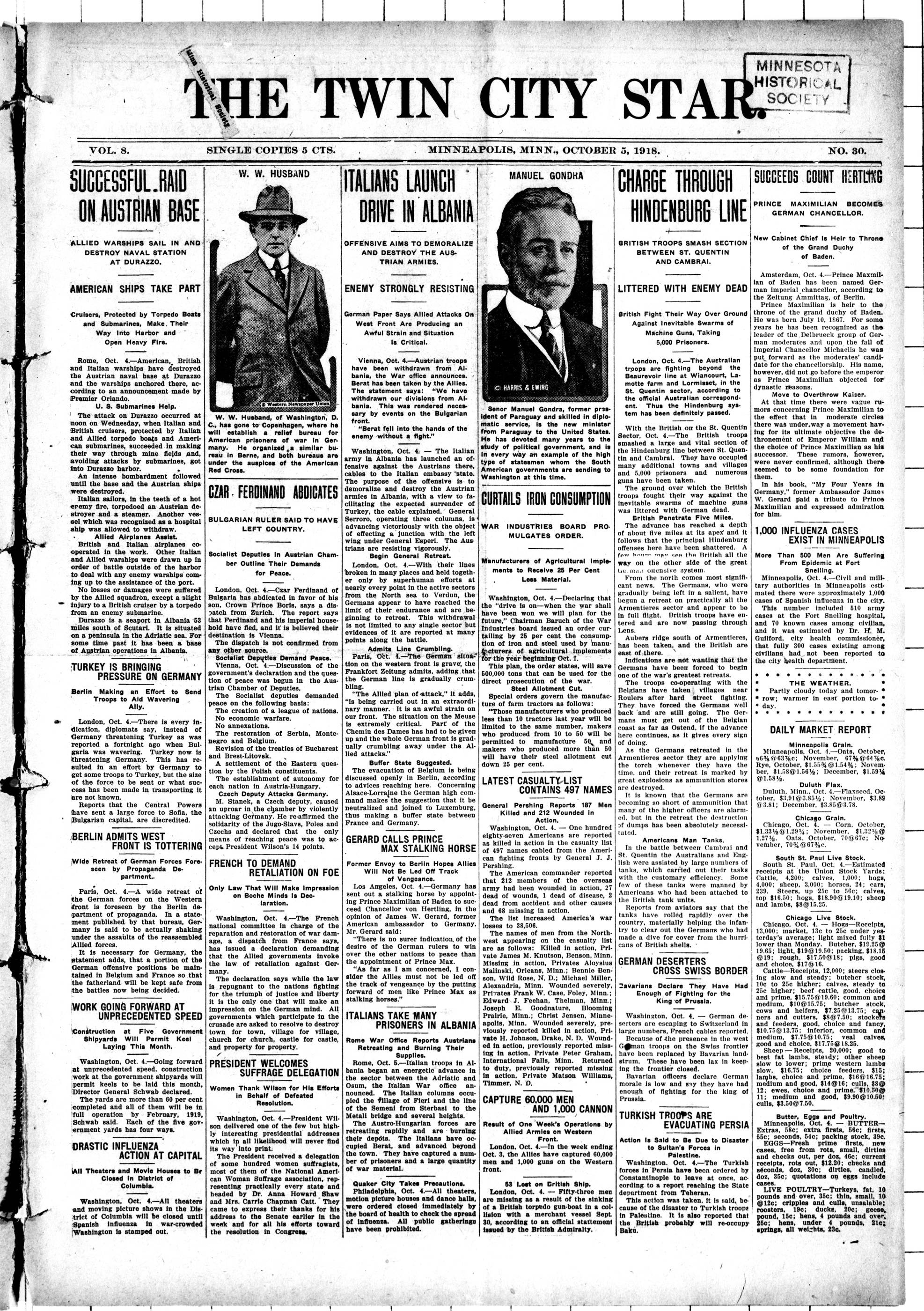
THE TWIN CITY STAR.
VOL. 8.
SUCCESSFUL RAID ON AUSTRIAN BASE
SUCCESSFUL RAID ON AUSTRIAN BASE
ALLIED WARSHIPS SAIL IN AND
DESTROY NAVAL STATION
AT DURAZZO.
AMERICAN SHIPS TAKE PART
Cruisers, Protected by Torpedo Boats and Submarines, Make. Their Way Into Harbor and Open Heavy Fire.
Rome, Oct. 4.—American, British and Italian warships have destroyed the Austrian naval base at Durazzo and the warships anchored there, according to an announcement made by Premier Orlando.
U. S. Submarines Help.
The attack on Durazzo occurred at noon on Wednesday, when Italian and British cruisers, protected by Italian and Allied torpedo boats and American submarines, succeeded in making their way through mine fields and, avoiding attacks by submarines, got into Durazzo harbor.
An intense bombardment followed until the base and the Austrian ships were destroyed.
Italian sailors, in the teeth of a hot enemy fire, torpedoed an Austrian destroyer and a steamer. Another vessel which was recognized as a hospital ship was allowed to withdraw.
Allied Airplanes Assist.
British and Italian airplanes cooperated in the work. Other Italian and Allied warships were drawn up in order of battle outside of the harbor to deal with any enemy warships coming up to the assistance of the port.
No losses or damages were suffered by the Allied squadron, except a slight injury to a British cruiser by a torpedo from an enemy submarine. Durazzo is a seaport in Albania 53 miles south of Scutari. It is situated on a peninsula in the Adratic sea. For some time past it has been a base of Austrian operations in Albania.
TURKEY IS BRINGING
PRESSURE ON GERMANY
Berlin Making an Effort to Send Troops to Aid Wavering Ally.
London, Oct. 4.—There is every indication, diplomats say, instead of Germany threatening Turkey as was reported a fortnight ago when Bulgaria was wavering. Turkey now is threatening Germany. This has resulted in an effort by Germany to get some troops to Turkey, but the size of the force to be sent or what success has been made in transporting it are not known.
Reports that the Central Powers have sent a large force to Sofia, the Bulgarian capital, are discredited.
BERLIN ADMITS WEST FRONT IS TOTTERING
Wide Retreat of German Forces Foreseen by Propaganda Department.
Paris, Oct. 4.—A wide retreat of the German forces on the Western front is foreseen by the Berlin department of propaganda. In a statement published by that bureau, Germany is said to be actually shaking under the assaults of the reassembled Allied forces.
It is necessary for Germany, the statement adds, that a portion of the German offensive positions be maintained in Belgium and France so that the fatherland will be kept safe from the battles now being decided.
WORK GOING FORWARD AT UNPRECEDENTED SPEED
Construction at Five Government Shipyards Will Permit Keel Laying This Month.
Washington, Oct. 4.—Going forward at unprecedented speed, construction work at the government shipyards will permit keels to be laid this month. Director General Schwab declared.
The yards are more than 60 per cent completed and all of them will be in full operation by February, 1919, Schwab said. Each of the five government yards has four ways.
DRASTIC INFLUENZA
ACTION AT CAPITAL
All Theaters and Movie Houses to Be Closed in District of Columbia.
Washington, Oct. 4.—All theaters and moving picture shows in the District of Columbia will be closed until Spanish influenza in war-crowded Washington is stamped out.
SINGLE COPIES 5 CTS.
W. W. HUSBAND
© Western Newspaper Union
W. W. Husband, of Washington, D.C., has gone to Copenhagen, where he will establish a relief bureau for American prisoners of war in Germany. He organized a similar bureau in Berne, and both bureaus are under the auspices of the American Red Cross.
CZAR - FERDINAND ABDICATES
BULGARIAN RULER SAID TO HAVE LEFT COUNTRY.
Socialist Deputies in Austrian Chamber Outline Their Demands for Peace.
London, Oct. 4.—Czar Ferdinand of Bulgaria has abdicated in favor of his son, Crown Prince Boris, says a dispatch from Zurich. The report says that Ferdinand and his imperial household have fled, and it is believed their destination is Vienna.
The dispatch is not confirmed from any other source.
Socialist Deputies Demand Peace.
Vienna, Oct. 4.—Discussion of the government's declaration and the question of peace was begun in the Austrian Chamber of Deputies.
The Socialist deputies demanded peace on the following basis:
The creation of a league of nations.
No economic warfare.
No annexations.
The restoration of Serbia, Montenegro and Belgium.
Revision of the treaties of Bucharest and Brest-Litovsk.
A settlement of the Eastern question by the Polish constituents.
The establishment of autonomy for each nation in Austria-Hungary. Czech Deputy Attacks Germany. M. Stanek, a Czech deputy, caused an uproar in the chamber by violently attacking Germany. He re-affirmed the solidarity of the Jugo-Slavs, Poles and Czechs and declared that the only means of reaching peace was to accept President Wilson's 14 points.
FRENCH TO DEMAND
RETALIATION ON FOE
Only Law That Will Make Impression on Boche Minds Is Decclaration.
Washington, Oct. 4.—The French national committee in charge of the reparation and restoration of war damage, a dispatch from France says, has issued a declaration demanding that the Allied governments invoke the law of retaliation against Germany.
The declaration says while the law is repugnant to the nations fighting for the triumph of justice and liberty it is the only one that will make an impression on the German mind. All governments which participate in the crusade are asked to resolve to destroy town for town, village for village, church for church, castle for castle, and property for property.
PRESIDENT WELCOMES SUFFRAGE DELEGATION
Women Thank Wilson for His Efforts in Behalf of Defeated Resolution.
Washington, Oct. 4.—President Wilson delivered one of the few but highly interesting presidential addresses which in all likelihood will never find its way into print.
The President received a delegation of some hundred women suffragists, most of them of the National American Woman Suffrage association, representing practically every state and headed by Dr. Anna Howard Shaw and Mrs. Carrie Chapman Catt. They came to express their thanks for his address to the Senate earlier in the week and for all his efforts toward the resolution in Congress.
MINNEAPOLIS, MINN., OCTOBER 5, 1918.
ITALIANS LAUNCH DRIVE IN ALBANIA
ITALIANS LAUNCH DRIVE IN ALBANIA
OFFENSIVE AIMS TO DEMORALIZE AND DESTROY THE AUS- TRIAN ARMIES.
ENEMY STRONGLY RESISTING
German Paper Says Allied Attacks On West Front Are Producing an Awful Strain and Situation
Vienna, Oct. 4.—Austrian troops have been withdrawn from Albania, the War office announces. Berat has been taken by the Allies. The statement says: "We have withdrawn our divisions from Albania. This was rendered necessary by events on the Bulgarian front.
"Berat fell into the hands of the enemy without a fight."
Washington, Oct. 4. — The Italian army in Albania has launched an offensive against the Austrians there, cables to the Italian embassy state. The purpose of the offensive is to demoralize and destroy the Austrian armies in Albania, with a view to facilitating the expected surrender of Turkey, the cable explained. General Serroro, operating three columns, is advancing victoriously with the object of effecting a junction with the left wing under General Esperi. The Austrians are resisting vigorously.
London, Oct. 4.—With their lines broken in many places and held together only by superhuman efforts at nearly every point in the active sectors from the North sea to Verdun, the Germans appear to have reached the limit of their endurance and are beginning to retreat. This withdrawal is not limited to any single sector but evidences of it are reported at many points along the battle.
Admits Line Crumbling.
Paris, Oct. 4.—The German situation on the western front is grave, the Frankfort Zeitung admits, adding that the German line is gradually crumbling.
"The Allied plan of attack," it adds, "is being carried out in an extraordinary manner. It is an awful strain on our front. The situation on the Meuse is extremely critical. Part of the Chemin des Dames has had to be given up and the whole German front is gradually crumbling away under the Allied attacks."
Buffer State Suggested.
The evacuation of Belgium is being discussed openly in Berlin, according to advices reaching here. Concerning Alsace-Lorraine the German high command makes the suggestion that it be neutralized and joined to Luxemburg, thus making a buffer state between France and Germany.
GERARD CALLS PRINCE
MAX STALKING HORSE
Former Envoy to Berlin Hopes Allies Will Not Be Led Off Track of Vengeance.
Los Angeles, Oct. 4.—Germany has sent out a stalking horse by appointing Prince Maximilian of Baden to succeed Chancellor von Hertling, in the opinion of James W. Gerard, former American ambassador to Germany. Mr. Gerard said:
“There is no surer indication of the desire of the German rulers to win over the other nations to peace than the appointment of Prince Max.
“As far as I am concerned, I consider the Allies must not be led off the track of vengeance by the putting forward of men like Prince Max as stalking horses.”
ITALIANS TAKE MANY PRISONERS IN ALBANIA
Rome War Office Reports Austrians Retreating and Burning Their Supplies.
Rome, Oct. 5.—Italian troops in Albania began an energetic advance in the sector between the Adriatic and Osum, the Italian War office announced. The Italian columns occupied the village of Fieri and the line of the Semeni from Sterbasi to the Metall bridge and several heights. The Austro-Hungarian forces are retreating rapidly and are burning their depots. The Italians have occupied Berat, and advanced beyond the town. They have captured a number of prisoners and a large quantity of war material.
Philadelphia, Oct. 4.—All theaters, motion picture houses and dance halls, were ordered closed immediately by the board of health to check the spread of influenza. All public gatherings have been prohibited.
MANUEL GONDRA
© HARRIS & EWING
Senor Manuel Gondra, former president of Paraguay and skilled in diplomatic service, is the new minister from Paraguay to the United States. He has devoted many years to the study of political government, and is in every way an example of the high type of statesmen whom the South American governments are sending to Washington at this time.
GURTAILS IRON CONSUMPTION
WAR INDUSTRIES BOARD PRO-
MULGATES ORDER.
Manufacturers of Agricultural Imple-
ments to Receive 25 Per Cent
Less Material.
Washington, Oct. 4.—Declaring that
the "drive is on—when the war shall
have been won we will plan for the
future," Chairman Baruch of the War
Industries board issued an order cur-
tailing by 25 per cent the consumption
of iron and steel used by manu-
facturers of agricultural implements
for the year beginning Oct. 1.
This plan, the order states, will save
500,000 tons that can be used for the
direct prosecution of the war.
Steel Allotment Cut.
Special orders govern the manufacture
of farm tractors as follows:
"Those manufacturers who produced
less than 10 tractors last year will be
limited to the same number, makers
who produced from 10 to 50 will be
permitted to manufacture 50, and
makers who produced more than 50
will have their steel allotment cut
down 25 per cent.
LATEST CASUALTY-LIST
CONTAINS 497 NAMES
General Pershing Reports 187 Men Killed and 212 Wounded in Action.
Washington, Oct. 4. — One hundred eighty-seven Americans are reported as killed in action in the casualty list of 497 names cabled from the American fighting fronts by General J. J. Pershing.
The American commander reported that 212 members of the overseas army had been wounded in action, 27 dead of wounds, 1 dead of disease, 2 dead from accident and other causes and 68 missing in action.
The list increased America's war losses to 38,506.
The names of men from the Northwest appearing on the casualty list are as follows: Killed in action, Private James M. Knutson, Benson, Minn. Missing in action, Privates Aloysius Mallinski, Orleans, Minn.; Bennie Benson, Wild Rose, N. D.; Michael Miller, Alexandria, Minn. Wounded severely, Privates Frank W. Case, Foley, Minn.; Edward J. Feehan, Thelman, Minn.; Joseph E. Goodnature, Blooming Prairie, Minn.; Christ Jensen, Minneapolis, Minn. Wounded severely, previously reported killed in action, Private H. Johnson, Drake, N. D. Wounded in action, previously reported missing in action, Private Peter Graham, International Falls, Minn. Returned to duty, previously reported missing in action, Private Matson Williams, Timmer, N. D.
CAPTURE 60,000 MEN
AND 1,000 CANNON
Result of One Week's Operations by Allied Armies on Western Front.
London, Oct. 4.—In the week ending Oct. 3, the Allies have captured 60,000 men and 1,000 guns on the Western front.
London, Oct. 4. — Fifty-three men are missing as a result of the sinking of a British torpedo gun-boat in a collision with a merchant vessel Sept. 30, according to an official statement issued by the British Admiralty.
CHARGE THROUGH HINDENBURG LINE
CHARGE THROUGH HINDENBURG LINE
BRITISH TROOPS SMASH SECTION
BETWEEN ST. QUENTIN
AND CAMBRAI.
LITTERED WITH ENEMY DEAD
British Fight Their Way Over Ground Against Inevitable Swarms of Machine Guns, Taking 5,000 Prisoners.
London, Oct. 4.—The Australian troops are fighting beyond the Beaurevoir line at Wiancourt, Lamotte farm and Lormisset, in the St. Quentin sector, according to the official Australian correspondent. Thus the Hindenburg system has been definitely passed.
With the British on the St. Quentin Sector, Oct. 4.—The British troops smashed a large and vital section of the Hindenburg line between St. Quentin and Cambrai. They have occupied many additional towns and villages and 5,000 prisoners and numerous guns have been taken.
The ground over which the British troops fought their way against the inevitable swarms of machine guns was littered with German dead.
British Penetrate Five Miles.
The advance has reached a depth of about five miles at its apex and it follows that the principal Hindenburg offenses here have been shattered. A few hours may see the British all the way on the other side of the great gravel offensive system.
From the north comes most significant news. The Germans, who were gradually being left in a salient, have begun a retreat on practically all the Armentieres sector and appear to be in full flight. British troops have entered and are now passing through Lens.
Aubers ridge south of Armentieres, has been taken, and the British are east of there.
Indications are not wanting that the Germans have been forced to begin one of the war's greatest retreats.
The troops co-operating with the Belgians have taken villages near Roulers after hard street fighting. They have forced the Germans well back and are still going. The Germans must get out of the Belgian coast as far as Ostend, if the advance here continues, as it gives every sign of doing.
As the Germans retreated in the Armentieres sector they are applying the torch whenever they have the time, and their retreat is marked by great explosions as ammunition stores are destroyed.
It is known that the Germans are becoming so short of ammunition that many of the higher officers are alarmed, but in the retreat the destruction of dumps has been absolutely necessitated.
In the battle between Cambrai and St. Quentin the Australians and English were assisted by large numbers of tanks, which carried out their tasks with the customary efficiency. Some few of these tanks were manned by Americans who had been attached to the British tank units.
Reports from aviators say that the tanks have rolled rapidly over the country, materially helping the infantry to clear out the Germans who had made a dive for cover from the hurricans of British shells.
GERMAN DESERTERS
CROSS SWISS BORDER
Cavarians Declare They Have Had Enough of Fighting for the King of Prussia.
Washington, Oct. 4. — German deserters are escaping to Switzerland in large numbers, French cables reported. Because of the presence in the west German troops on the Swiss frontier have been replaced by Bavarian landstrum. These have been lax in keeping the frontier closed.
Bavarian officers declare German morale is low and say they have had enough of fighting for the king of Prussia.
TURKISH TROOPS ARE
EVACUATING PERSIA
Action Is Said to Be Due to Disaster to Sultan's Forces in Palestine.
Washington. Oct. 4.—The Turkish forces in Persia have been ordered by Constantinople to leave at once, according to a report reaching the State department from Teheran.
This action was taken, it is said, because of the disaster to Turkish troops in Palestine. It is also reported that the British probably will re-occupy Baku.
NO. 30.
SUCCEEDS COUNT HERTLING
PRINCE MAXIMILIAN BECOMES
GERMAN CHANCELLOR.
New Cabinet Chief Is Heir to Throne of the Grand Duchy
Amsterdam, Oct. 4.—Prince Maximilian of Baden has been named German imperial chancellor, according to the Zeitung Ammittag, of Berlin.
Prince Maximilian is heir to the throne of the grand duchy of Baden. He was born July 10, 1867. For some years he has been recognized as the leader of the Delbrueck group of German moderates and upon the fall of Imperial Chancellor Michaelis he was put forward as the moderates' candidate for the chancellorship. His name, however, did not go before the emperor as Prince Maximilian objected for dynastic reasons.
Move to Overthrow Kaiser.
At that time there were vague rumors concerning Prince Maximilian to the effect that in moderate circles there was under,way a movement having for its ultimate objective the detriment of Emperor William and the choice of Prince Maximilian as his successor. These rumors, however, were never confirmed, although there seemed to be some foundation for them.
In his book, "My Four Years in Germany," former Ambassador James W. Gerard paid a tribute to Prince Maximilian and expressed admiration for him.
1,000 INFLUENZA CASES
EXIST IN MINNEAPOLIS
More Than 500 Men Are Suffering From Epidemic at Fort Snelling.
Minneapolis, Oct. 4.—Civil and military authorities in Minneapolis estimated there were approximately 1,000 cases of Spanish influenza in the city.
This number included 510 army cases at the Fort Snelling hospital, and 70 known cases among civilian, and it was estimated by Dr. H. M. Gullford, city health commissioner, that fully 300 cases existing among civilians had not been reported to the city health department.
THE WEATHER.
* THE WEATHER. *
* Partly cloudy today and tomor-
* row; warmer in east portion to-
* day.
DAILY MARKET REPORT
Minneapolis, Oct. 4.—Onts, October,
6%@63%c; November, 67%@64%c;
Rye, October, $1.55%@1.54%; November,
$1.58@1.56%; December, $1.59%
@1.58%.
Duluth Flax.
Duluth, Minn., Oct. 4—Flaxseed, October,
$3.91@3.85%; November, $3.89
@3.81; December, $3.85@3.78.
Chicago Grain.
Chicago, Oct. 4. — Corn, October,
$1.33½@1.29½; November, $1.32½@
1.27½. Oats, October, 70@67; November,
70%@67%c.
South St. Paul Live Stock.
South St. Paul, Oct. 4.—Estimated receipts at the Union Stock Yards:
Cattle, 4,200; calves, 1,000; hogs,
4,000; sheep, 3,000; horses, 24; cars,
239. Steers, up 25c to 56c; calves,
top $16.50; hogs, $18.90@19.10; sheep
and lambs, $8@15.25.
Chicago Live Stock
Chicago, Oct. 4. — Hogs—Receipts, 13,000; market, 13c to 13c under yesterday's average; light mixed fully $1 lower than Monday. Butcher, $19.25@19.65; light, $19@19.50; packing, $18.15@19; rough, $17.50@18; pigs, good and choice, $17@16.
Cattle—Receipts, 12,000; steers closing slow and steady; butcher stock, 10c to 25c higher; calves, steady to 25c higher; beef cattle, good, choice and prime, $15.75@19.60; common and medium, $10@15.75; butcher stock, cows and heifers, $7.25@13.75; canners and cutters, $8.75@10.75; stockers and feeders, good, choice and fancy, $10.75@13.75; inferior, common and medium, $7.75@10.75; veal calves, good and choice, $17.75@18.25.
Sheep—Receipts, 20,000; good to best fat lambs, steady; other sheep slow to lower; prime western lambs slow, $16.75; choice feeders, $15; lambs, choice and prime, $16@16.75; medium and good, $14@14; culls, $8@12; ewes, choice and prime, $10.50@11; medium and good, $9.90@10.50; culls, $3.50@7.50.
Butter, Eggs and Poultry.
Minneapolis, Oct. 4. — BUTTER—Extras, 58c; extra freshs, 56c; firsts, 55c; seconds, 54c; packing stock, 39c.
EGGS—Fresh prime firsts, new cases, free from rots, small, dirties and checks out, per doz, 46c; current receipts, rots out, $12.0; checks and seconds, doz, 30c; dirties, candled, doz, 35c; quotations on eggs include cases.
LIVE POULTRY—Turkeys, fat, 10 pounds and over, 35c; thin, small, 10 @12c; cripples and culls, unsalable; roosters, 19c; ducks, 20c; geese, pound, 15c; hens, 4 pounds and over, 25c; hens, under 4 pounds, 21c; springs, all wei-hts, 23c.
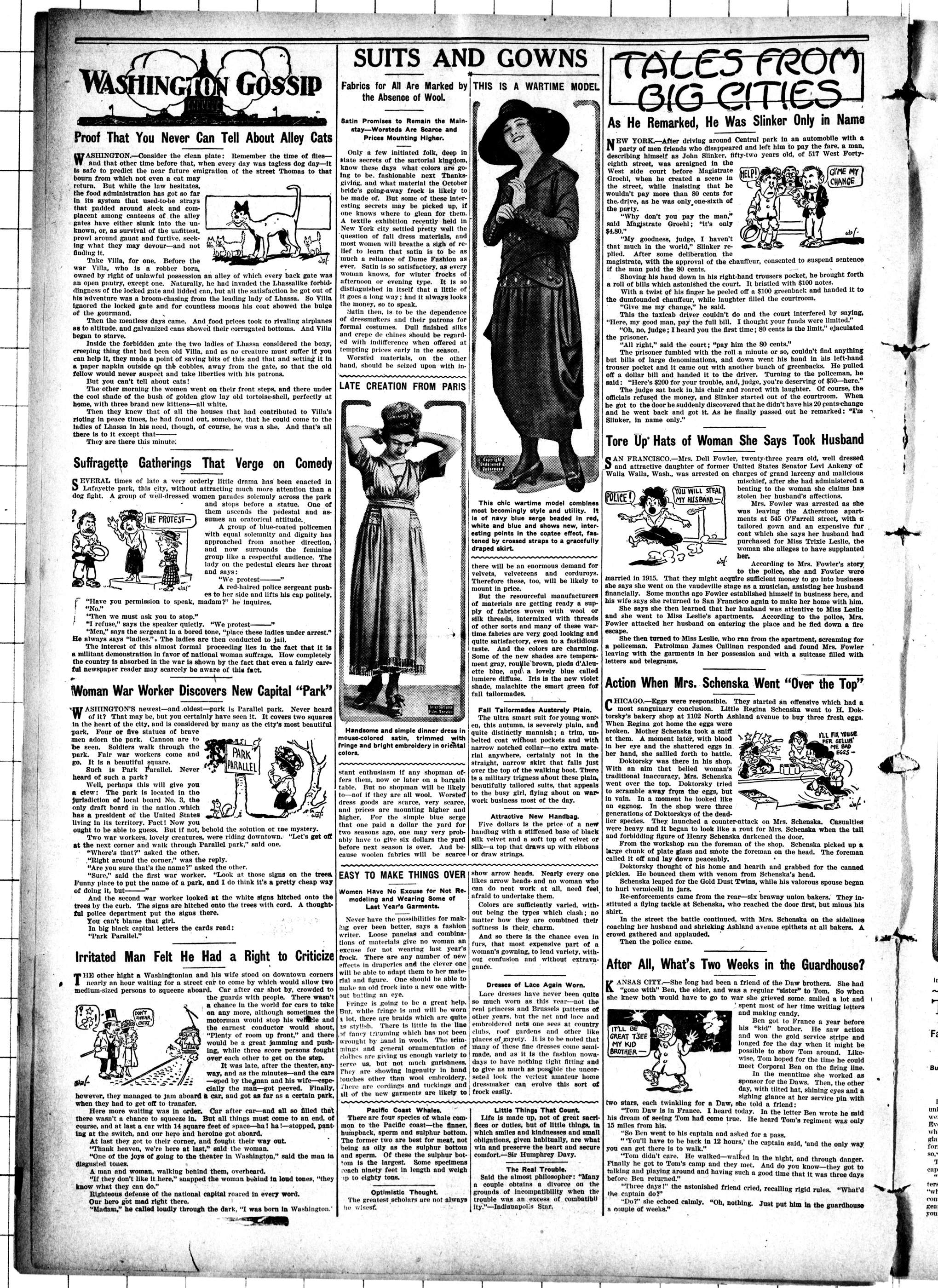
WASHINGTON GOSSIP
Proof That You Never Can Tell About Alley Cats
Proof That You Never Can Tell About Alley Cats
WASHINGTON.—Consider the clean plate: Remember the time of flies—and that other time before that, when every day was tagless dog day—it is safe to predict the near future emigration of the street Thomas to that bourn from which not even a cat may return. But while the law hesitates, the food administration has got so far in its system that used-to-be strays that padded around sleek and complacent among canteens of the alley gates have either slunk into the unknown, or, as survival of the unfittest, prowl around gaunt and furtive, seeking what they may devour—and not finding it.
Take Villa, for one. Before the
an alley of which every back gate was
very, he had invaded the Lhassallike forbid-
can, but all the satisfaction he got out of
from the leading lady of Lhassa. So Villa
talless moons his coat showed the bulge
and food prices took to rivaling airplanes
dived their corrugated bottoms. And Villa
to ladies of Lhassa considered the bony,
a, and as no creature must suffer if you
ag bits of this and that and setting it in
s, away from the gate, so that the old
liberties with his patrons.
ont on their front steps, and there under
glow lay old tortoise-shell, perfectly at
all white.
houses that had contributed to Villa's
out, somehow, that he could come to
of course, he was a she. And that's all
That Verge on Comedy
Early little drama has been enacted in
attracting much more attention than a
women parades solemnly across the park
owned by right of unlawful possession an alley of which every back gate was an open pantry, except one. Naturally, he had invaded the Lhassallke forbiddingness of the locked gate and lidded can, but all the satisfaction he got out of his adventure was a broom-chasing from the leading lady of Lhassa. So Villa ignored the locked gate and for countless moons his coat showed the bulge of the gourmand.
owned by right of unlawful possession an alley of which an open pantry, except one. Naturally, he had invaded the dingness of the locked gate and lidded can, but all the satisfies his adventure was a broom-chasing from the leading lady of ignored the locked gate and for countless moons his coat of the gourmand.
Then the meatless days came. And food prices took them as to altitude, and galvanized cans showed their corrugated began to starve.
Inside the forbidden gate the two ladies of Lhassa creeping thing that had been old Villa, and as no creature can help it, they made a point of saving bits of this and the paper napkin outside on the cobbles, away from the gallow friend would never suspect and take liberties with his pat
Then the meatless days came. And food prices took to rivaling airplanes as to altitude, and galvanized cans showed their corrugated bottoms. And Villa began to starve.
Inside the forbidden gate the two ladies of Lhassa considered the bony, creeping thing that had been old Villa, and as no creature must suffer if you can help it, they made a point of saving bits of this and that and setting it in a paper napkin outside up the cobbles, away from the gate, so that the old fellow would never suspect and take liberties with his patrons.
But you can't tell about cats!
The other morning the women went on their front steps, and there under the cool shade of the bush of golden glow lay old tortoise-shell, perfectly at home, with three brand new kittens—all white.
The other morning the women went on their front stet the cool shade of the bush of golden glow lay old tortoise home, with three brand new kittens—all white. Then they knew that of all the houses that had co rioting in peace times, he had found out, somehow, that he ladies of Lhassa in his need, though, of course, he was a there is to it except that——
Then they knew that of all the houses that had contributed to Villa's rioting in peace times, he had found out, somehow, that he could come to the ladies of Lhassa in his need, though, of course, he was a she. And that's all there is to it except that——
They are there this minute:
Suffragette Gatherings That Verge on Comedy
SEVERAL times of late a very orderly little drama has been enacted in Lafayette park, this city, without attracting much more attention than a dog fight. A group of well-dressed women parades solemnly across the park
Suffragette Gatherings That Verge on Comedy
Suffragette Gatherings That Verge on Comedy
EVERAL times of late a very orderly little drama has been enacted in Lafayette park, this city, without attracting much more attention than a dog fight. A group of well-dressed women parades solemnly across the park and stops before a statue. One of them ascends the pedestal and assumes an oratorical attitude.
WE PROTEST
A group of blue-coated policemen with equal solemnity and dignity has approached from another direction, and now surrounds the feminine group like a respectful audience. The lady on the pedestal clears her throat and says:
"We protest——"
A red-haired police sergeant pushes to her side and lifts his cap politely, madam?" he inquires.
By. "We protest——"
I tone, "place these ladies under arrest." are then conducted to jail.
I proceeding lies in the fact that it is national woman suffrage. How completely known by the fact that even a fairly care-aware of this fact.
Covers New Capital "Park"
—park is Parallel park. Never heard inly have seen it. It covers two squares led by many as the city's most beautiful
"I refuse." says the speaker quietly. "We protest____"
"I refuse," says the speaker quietly. "We protest—
"Men," says the sergeant in a bored tone, "place these li
He always says "ladies." The ladies are then conducted to
The interest of this almost formal proceeding lies in
a militant demonstration in favor of national woman suffragh
the country is absorbed in the war is shown by the fact that
ful newspaper reader may scarcely be aware of this fact.
Woman War Worker Discovers New Ca
WASHINGTON'S newest—and oldest—park is Parallel to
of it? That may be, but you certainly have seen it. It
in the heart of the city, and is considered by many as the
"Men," says the sergeant in a bored tone, "place these ladies under arrest." He always says "ladies." The ladies are then conducted to jail.
The interest of this almost formal proceeding lies in the fact that it is a militant demonstration in favor of national woman suffrage. How completely the country is absorbed in the war is shown by the fact that even a fairly careful newspaper reader may scarcely be aware of this fact.
Woman War Worker Discovers New Capital "Park"
WASHINGTON'S newest—and oldest—park is Parallel park. Never heard of it? That may be, but you certainly have seen it. It covers two squares in the heart of the city, and is considered by many as the city's most beautiful park. Four or five statues of brave men adorn the park. Cannon are to be seen. Soldiers walk through the park. Fair war workers come and go. It is a beautiful square.
Such is Park Parallel. Never heard of such a park?
Well, perhaps this will give you a clew: The park is located in the jurisdiction of local board No. 3, the only draft board in the nation. which has a president of the United States living in its territory. Fact! Now you ought to be able to guess. But if not, behold the solution or the mystery.
Two war workers, lovely creatures, were riding downtown. "Let's get off at the next corner and walk through Parallel park," said one.
"Where's that?" asked the other.
"Right around the corner." was the reply.
Two war workers, lovely creatures, were riding downtown. "Let's get off at the next corner and walk through Parallel park," said one.
"Where's that?" asked the other.
"Right around the corner," was the reply.
"Are you sure that's the name?" asked the other.
"Sure," said the first war worker. "Look at those signs on the trees Funny place to put the name of a park, and I do think it's a pretty cheap way of doing it, but——"
And the second war worker looked at the white signs hitched onto the trees by the curb. The signs are hitched onto the trees with cord. A thoughtful police department put the signs there.
er. "Look at those signs on the trees,
and I do think it's a pretty cheap way
need at the white signs hitched onto the
need onto the trees with cord. A thought-
there.
ards read:
Had a Right to Criticize
and his wife stood on downtown corners
at car to come by which would allow two
card. Car after car shot by, crowded to
"Sure," said the first war worker. "Look at those signs on the trees. Funny place to put the name of a park, and I do think it's a pretty cheap way of doing it, but——"
And the second war worker looked at the white signs hitched onto the trees by the curb. The signs are hitched onto the trees with cord. A thoughtful police department put the signs there.
You can't blame that girl.
In big black capital letters the cards read:
"Park Parallel."
Irritated Man Felt He Had a Right to Criticize
THE other hight a Washingtonian and his wife stood on downtown corners nearly an hour waiting for a street car to come by which would allow two medium-sized persons to squeeze aboard. Car after car shot by, crowded to
Irritated Man Felt He Had a Right to Criticize
Irritated Man Felt He Had a Right to Criticize
THE other night a Washingtonian and his wife stood on downtown corners nearly an hour waiting for a street car to come by which would allow two medium-sized persons to squeeze aboard. Car after car shot by, crowded to the guards with people. There wasn't a chance in the world for cars to take on any more, although sometimes the motorman would stop his vehicle and the earnest conductor would shout, "Plenty of room up front," and there would be a great jamming and pushing, while three score persons fought over each other to get on the step.
It was late, after the theater, anyway, and as the minutes—and the cars—sped by the man and his wife—especially the man—got peeved. Finally, however, they managed to jam aboard a car, and got as far as a certain park, when they had to get off to transfer.
however, they managed to jam aboard a car, and got as far when they had to get off to transfer.
Here more waiting was in order. Car after car—all there wasn't a chance to squeeze in. But all things must course, and at last a car with 14 square feet of space—hailing at the switch, and our hero and heroine got aboard.
At last they got to their corner, and fought their war.
"Thank heaven, we're here at last," sald the woman.
"One of the joys of going to the theater in Washington disgusted tones.
a car, and got as far as a certain park.
2. Car after car—and all so filled that
But all things must come to an end, of
the feet of space—ha! ha!—stopped, pant-
terone got aboard.
and fought their way out.
st," said the woman.
theater in Washington," said the man in
Here more waiting was in order. Car after car—and all so filled that there wasn't a chance to squeeze in. But all things must come to an end, of course, and at last a car with 14 square feet of space—ha! ha!—stopped, panting at the switch, and our hero and heroine got aboard.
At last they got to their corner, and fought their way out.
"Thank heaven, we're here at last," said the woman.
"One of the joys of going to the theater in Washington," said the man in disgusted tones.
A man and woman, walking behind them, overheard.
"If they don't like it here," snapped the woman behind in loud tones, "they know what they can do."
"If they don't like it here," snapped the woman behind know what they can do."
Righteous defense of the national capital roared in eve Our hero got mad right there.
"Madam," he called loudly through the dark, "I was b
ed the woman behind in loud tones, "they
capital roared in every word.
th the dark, "I was born in Washington."
Righteous defense of the national capital roared in every word. Our hero got mad right there. "Madam," he called loudly through the dark, "I was born in Washington."
bourn from which not even a cat may return. But while the law hesitates, the food administration has got so far in its system that used-to-be strays that padded around sleek and complacent among canteens of the alley gates have either slunk into the unknown, or, as survival of the unfittest, prowl around gaunt and furtive, seeking what they may devour—and not finding it.
Take Villa, for one. Before the war Villa, who is a robber born,
But you can't tell about cats!
They are there this minute.
WE PROTEST-
"Then we must ask you to stop."
park. Four or five statues of brave men adorn the park. Cannon are to be seen. Soldiers walk through the park. Fair war workers come and go. It is a beautiful square.
Such is Park Parallel. Never heard of such a park?
Well, perhaps this will give you a clew: The park is located in the jurisdiction of local board No. 3, the only draft board in the nation which has a president of the United States living in its territory. Fact! Now you ought to be able to guess. But if not.
"Where's that?" asked the other.
You can't blame that girl.
DON'T SWEAR, BERT!
SUITS AND GOWNS
Fabrics for All Are Marked by the Absence of Wool.
Satin Promises to Remain the Mainstay—Worsteds Are Scarce and Prices Mounting Higher.
Only a few initiated folk, deep in state secrets of the sartorial kingdom, know these days what colors are going to be, fashionable next Thanksgiving, and what material the October bride's going-away frock is likely to be made of. But some of these interesting secrets may be picked up, if one knows where to glean for them. A textile exhibition recently held in New York city settled pretty well the question of fall dress materials, and most women will breathe a sigh of relief to learn that satin is to be as much a reliance of Dame Fashion as ever. Satin is so satisfactory, as every woman knows, for winter frocks of afternoon or evening type. It is so distinguished in itself that a little of it goes a long way; and it always looks the money, so to speak.
Batin then, is to be the dependence of dressmakers and their patrons for formal costumes. Dull finished silks and crepe de chines should be regarded with indifference when offered at tempting prices early in the season. Worsited materials, on the other hand, should be seized upon with in-
LATE CREATION FROM PARIS
Interior Design
Film Service
Handsome and simple dinner dress in mouse-colored satin, trimmed with fringe and bright embroidery in oriental colors.
stant enthusiasm if any shopman offers them, now or later on a bargain table. But no shopman will be likely to—not if they are all wool. Worsted dress goods are scarce, very scarce, and prices are mounting higher and higher. For the simple blue serge that one paid a dollar the yard for two seasons ago, one may very probably have to give six dollars the yard before next season is over. And because woolen fabrics will be scarce
EASY TO MAKE THINGS OVER
Women Have No Excuse for Not Res modeling and Wearing Some of Last Year's Garments.
Never have the possibilities for making over been better, says a fashion writer. Loose panelas and combinations of materials give no woman an excuse for not wearing last year's frock. There are any number of new effects in draperies and the clever one will be able to adapt them to her material and figure. One should be able to make an old frock into a new one without batting an eye.
Fringe is going to be a great help. But, while fringe is and will be worn a lot, there are braids which are quite as stylish. There is little in the line of fancy trumping which has not been wrought by hand in wools. The trimming and general ornamentation of clothes are giving us enough variety to serve us, but not much garishness. They are showing ingenuity in hand touches other than wool embroidery. There are cordings and tuckings and all of the new garments are likely to
Pacific Coast Whales.
There are four species of whale common to the Pacific coast—the finer, humpback, sperm and sulphur bottom. The former two are best for meat, not being as olly as the sulphur bottom and sperm. Of these the sulphur bottom is the largest. Some specimens reach ninety feet in length and weigh up to eighty tons.
Optimistic Thought.
The greatest scholars are not always he wisest.
Copyright
Underwood &
Underwood
This chic wartime model combines most becomingly style and utility. It is of navy blue serge beaded in red, white and blue and shows new, interesting points in the coattee effect, fastened by crossed straps to a gracefully draped skirt.
there will be an enormous demand for velvets, velveteens and corduroys. Therefore these, too, will be likely to mount in price.
But the resourceful manufacturers of materials are getting ready a supply of fabrics woven with wool or silk threads, intermixed with threads of other sorts and many of these wartime fabrics are very good looking and quite satisfactory, even to a fastidious taste. And the colors are charming. Some of the new shades are temperament gray, rouille brown, pieds d'Aleuette blue, and a lovely blue called lumiere diffuse. Iris is the new violet shade, malachite the smart green foil fall tailormades.
Fall Tailormades Austerely Plain.
The ultra smart suit for young women, this autumn, is severely plain, and quite distinctly mannish; a trim, unbelted coat without pockets and with narrow notched collar—no extra material anywhere, certainly not in the straight, narrow skirt that falls just over the top of the walking boot. There is a military trigness about these plain, beautifully tailored suits, that appeals to the busy girl, flying about on warwork business most of the day.
Attractive New Handbag
Five dollars is the price of a new handbag with a stiffened base of black silk velvet and a soft top of velvet or silk—a top that draws up with ribbons or draw strings.
show arrow heads. Nearly every one likes arrow heads-and no woman who can do neat work at all, need feel afraid to undertake them.
Colors are sufficiently varied, without being the types which clash; no matter how they are combined their softness is their charm.
And so there is the chance even in furs, that most expensive part of a woman's gowning, to lend variety, without confusion and without extravagance.
Dresses of Lace Again Worn.
Lace dresses have never been quite so much worn as this year—not the real princess and Brussels patterns of other years, but the net and lace and embroidered nets one sees at country clubs, roof gardens and other like places of gayet. It is to be noted that many of these fine dresses come semilmade, and as it is the fashion nowadays to have nothing tight fitting and to give as much as possible the uncorseted look the veriest amateur home dressmaker can evolve this sort of frock easily.
Life is made up, not of great sacrifices or duties, but of little things, in which smiles and kindnesses and small obligations, given habitually, are what win and preserve the heart and secure comfort.—Sir Humphrey Davy.
The Real Trouble.
Said the almost philosopher: "Many a couple obtains a divorce on the grounds of incompatibility when the trouble was an excess of combatibility."—Indianaapolis Star,
TALES FROM BIG CITIES
As He Remarked, He Was Slinker Only in Name
NEW YORK.—After driving around Central park in an automobile with a party of men friends who disappeared and left him to pay the fare, a man, describing himself as John Slinker, fifty-two years old, of 517 West Forty-eighth street, was arraigned in the West side court before Magistrate Groehl, when he created a scene in the street, while insisting that he wouldn't pay more than 80 cents for the drive, as he was only one-sixth of the party.
"Why don't you pay the man," said Magistrate Groehl; "it's only $4.80."
"My goodness, judge, I haven't that much in the world," Slinker re-
hauffeur, consented to suspend sentence
on hand trousers pocket, he brought forth
port. It bristled with $100 notes.
d off a $100 greenback and handed it to
water filled the courtroom.
do and the court interfered by saying,
I thought your funds were limited."
at time; 80 cents is the limit," ejaculated
magistrate, with the approval of the chauffeur, consented to suspend sentence if the man paid the 80 cents.
magistrate, with the approval of the chauffeur, consentered if the man paid the 80 cents.
Shoving his hand down in his right-hand trousers you roll a roll of bills which astonished the court. It bristled with. With a twist of his finger he peeled off a $100 green the dumfounded chauffeur, while laughter filled the court "Give me my change," he said.
This the taxcab driver couldn't do and the court "Here, my good man, pay the full bill. I thought your fu "Oh, no, judge; I heard you the first time; 80 cents is the prisoner.
Shoving his hand down in his right-hand trousers pocket, he brought forth a roll of bills which astonished the court. It bristled with $100 notes.
With a twist of his finger he peeled off a $100 greenback and handed it to the dumfounded chauffeur, while laughter filled the courtroom.
"Give me my change," he said.
This the taxicab driver couldn't do and the court interfered by saying, "Here, my good man, pay the full bill. I thought your funds were limited."
"Oh, no, judge; I heard you the first time; 80 cents is the limit," ejaculated the prisoner.
"All right," said the court; "pay him the 80 cents."
The prisoner fumbled with the roll a minute or so, couldn't find anything but bills of large denominations, and down went his hand in his left-hand trouser pocket and it came out with another bunch of greenbacks. He pulled off a dollar bill and handed it to the driver. Turning to the policeman, he said: "Here's $200 for your trouble, and, judge, you're deserving of $50—here."
The prisoner fumbled with the roll a minute or so, but bills of large denominations, and down went his l trouser pocket and it came out with another bunch of g off a dollar bill and handed it to the driver. Turning on said: "Here's $200 for your trouble, and, judge, you're de The judge sat back in his chair and roared with lau officials refused the money, and Slinker started out of t he got to the door he suddenly discovered that he didn't h and he went back and got it. As he finally passed out Slinker, in name only."
Tore Up* Hats of Woman She Says
SAN FRANCISCO.—Mrs. Dell Fowler, twenty-three ye and attractive daughter of former United States Sen Walla Walla, Wash., was arrested on charges of grand
a minute or so, couldn't find anything down went his hand in his left-hand another bunch of greenbacks. He pulled driver. Turning to the policeman, he, judge, you're deserving of $50—here." and roared with laughter. Of course, the or started out of the courtroom. When that he didn't have his 20 cents change finally passed out he remarked: "Tm She Says Took Husband, twenty-three years old, well dressed United States Senator Levi Ankeny of charges of grand larceny and malicious
The judge sat back in his chair and roared with laughter. Of course, the officials refused the money, and Slinker started out of the courtroom. When he got to the door he suddenly discovered that he didn't have his 20 cents change and he went back and got it. As he finally passed out he remarked: "Tm Slinker, in name only."
Tore Up* Hats of Woman She Says Took Husband
Tore Up* Hats of Woman She Says Took Husband
SAN FRANCISCO.—Mrs. Dell Fowler, twenty-three years old, well dressed and attractive daughter of former United States Senator Levi Ankeny of Walla Walla, Wash., was arrested on charges of grand larceny and malicious mischief, after she had administered a beating to the woman she claims has stolen her husband's affections.
Mrs. Fowler was arrested as she was leaving the Atherstone apartments at 545 O'Farrell street, with a tailored gown and an expensive fur coat which she says her husband had purchased for Miss Trixie Leslie, the woman she alleges to have supplanted her.
According to Mrs. Fowler's story to the police, she and Fowler were
married in 1915. That they might acquire sufficient money she says she went on the vaudeville stage as a musician, financially. Some months ago Fowler established himself his wife says she returned to San Francisco again to make she says she then learned that her husband was att and she went to Miss Leslie's apartments. According Fowler attacked her husband on entering the place and escape.
She then turned to Miss Leslie, who ran from the apa a policeman. Patrolman James Cullinan responded and leaving with the garments in her possession and with a letters and telegrams.
Action When Mrs. Schenska Went "C
CHICAGO.—Eggs were responsible. They started an o most sanguinary conclusion. Little Regina Schens torsky's bakery shop at 1102 North Ashland avenue to
dire sufficient money to go into business
age as a musician, assisting her husband
established himself in business here, and
disco again to make her home with him.
His husband was attentive to Miss Leslie
ments. According to the police, Mrs.
ring the place and he fled down a fire
o ran from the apartment, screaming for
man responded and found Mrs. Fowler
session and with a suitcase filled with
Iska Went "Over the Top"
They started an offensive which had a
le Regina Schenska went to H. Dokhland avenue to buy three fresh eggs.
married in 1915. That they might acquire sufficient money to go into business she says she went on the vaudeville stage as a musician, assisting her husband financially. Some months ago Fowler established himself in business here, and his wife says she returned to San Francisco again to make her home with him. She says she then learned that her husband was attentive to Miss Leslie and she went to Miss Leslie's apartments. According to the police, Mrs. Fowler attacked her husband on entering the place and he fled down a fire escape. She then turned to Miss Leslie, who ran from the apartment, screaming for a policeman. Patrolman James Cullinan responded and found Mrs. Fowler leaving with the garments in her possession and with a suitcase filled with letters and telegrams.
Action When Mrs. Schenska Went "Over the Top"
CHICAGO.—Eggs were responsible. They started an offensive which had a most sanguinary conclusion. Little Regina Schenska went to H. Doktorsky's bakery shop at 1102 North Ashland avenue to buy three fresh eggs. When Regina got home the eggs were broken. Mother Schenska took a sniff at them. A moment later, with blood in her eye and the shattered eggs in her hand, she sallied forth to battle. Doktorsky was there in his shop. With an aim that belled woman's traditional inaccuracy, Mrs. Schenska went over the top. Doktorsky tried to scramble away from the eggs, but in vain. In a moment he looked like an eggnog. In the shop were three
attack on Mrs. Schenska. Casualties a rout for Mrs. Schenska when the tall ta darkened the door. man of the shop. Schenska picked up a the foreman on the head. The foreman and hearth and grabbed for the canned in from Schenska's head. Twins, while his valorous spouse began war—six brawny union bakers. They ino reached the door first, but minus his, with Mrs. Schenska on the sidelines onlland avenue epithets at all bakers. A
Weeks in the Guardhouse?
a friend of the Daw brothers. She had was a regular "sister" to Tom. So when var she grieved some, smiled a lot and
lier species. They launched a counter-attack on Mrs. S. were heavy and it began to look like a rout for Mrs. S. and forbidding figure of Henry Schenska darkened the door. From the workshop ran the foreman of the shop. S. large chunk of plate glass and smote the foreman on the called it off and lay down peaceably. Doktorsky thought of his home and hearth and grape pickles. He bounced them with venom from Schenska's. Schenska leaped for the Gold Dust Twins, while his wife to hurl vermicell in jars. Re-enforcements came from the rear—six brawny unstituted a flying tackle at Schenska, who reached the door shirt. In the street the battle continued, with Mrs. Schenska coaching her husband and shrieking Ashland avenue epic crowd gathered and applauded.
lier species. They launched a counter-attack on Mrs. Schenska. Casualties were heavy and it began to look like a rout for Mrs. Schenska when the tall and forbidding figure of Henry Schenska darkened the door.
From the workshop ran the foreman of the shop. Schenska picked up a large chunk of plate glass and smote the foreman on the head. The foreman called it off and lay down peaceably.
Doktorsky thought of his home and hearth and grabbed for the canned pickles. He bounced them with venom from Schenska's head.
Schenska leaped for the Gold Dust Twins, while his valorous spouse began to hurl vermicell in jars.
Re-enforcements came from the rear—six brawny union bakers. They instituted a flying tackle at Schenska, who reached the door first, but minus his shirt.
In the street the battle continued, with Mrs. Schenska on the sidelines coaching her husband and shrieking Ashland avenue epithets at all bakers. A crowd gathered and applauded.
After All, What's Two Weeks in the KANSAS CITY.—She long had been a friend of the De "gone with" Ben, the elder, and was a regular "sister she knew both would have to go to war she grieved so
After All, What's Two Weeks in the Guardhouse?
KANSAS CITY.—She long had been a friend of the Daw brothers. She had "gone with" Ben, the elder, and was a regular "sister" to Tom. So when she knew both would have to go to war she grieved some. smiled a lot and spent most of her time writing letters and making candy.
Ben got to France a year before his "kid" brother. He saw action and won the gold service stripe and longed for the day when it might be possible to show Tom around. Likewise, Tom hoped for the time he could meet Corporal Ben on the firing line.
In the meantime she worked as sponsor for the Daws. Then, the other day, with tilted hat, shining eyes and a sighing glance at her service pix with
two stars, each twinkling for a Daw, she told a friend:
"Tom Daw is in France. I heard today. In the letter Ben wrote he said his dream of seeing Tom had come true. He heard Tom's regiment was only 15 miles from his.
"So Ben went to his captain and asked for a pass.
"You'll have to be back in 12 hours,' the captain said, 'and the only way you can get there is to walk."
"Tom didn't care. He walked—walked in the night, and through danger. Finally he got to Tom's camp and they met. And do you know—they got to talking and playing around and having such a good time that it was three days before Ben returned."
"Three days!" the astonished friend cried, recalling rigid rules. "What'd the captain do?"
"Do?" she echoed calmly. "Oh, nothing. Just put him in the guardhouse a couple of weeks."
ars,' the captain said, 'and the only way walked in the night, and through danger. my met. And do you know—they got to such a good time that it was three days and cried, recalling rigid rules. "What'd anything. Just put him in the guardhouse
"You'll have to be back in 12 hours,' the captain said, 'and the only way you can get there is to walk."
"Tom didn't care. He walked—walked in the night, and through danger. Finally he got to Tom's camp and they met. And do you know—they got to talking and playing around and having such a good time that it was three days before Ben returned."
"Three days!" the astonished friend cried, recalling rigid rules. "What'd the captain do?
"Do?" she echoed calmly. "Oh, nothing. Just put him in the guardhouse a couple of weeks."
"Why don't you pay the man," said Magistrate Groehl; "it's only $4.80."
"My goodness, judge, I haven't that much in the world," Slinker replied. After some deliberation the
POLICE!
YOU WILL STEAL
MY HUSBAND
When Regina got home the eggs were broken. Mother Schenska took a sniff at them. A moment later, with blood in her eye and the shattered eggs in her hand, she sallied forth to battle. Doktorsky was there in his shop. With an aim that belied woman's traditional inaccuracy, Mrs. Schenska went over the top. Doktorsky tried to scramble away from the eggs, but in vain. In a moment he looked like an eggnog. In the shop were three generations of Doktorsky of the dead.
Then the police came.
IT'LL BE
GREAT T'SEE
MY KID
BROTHER—
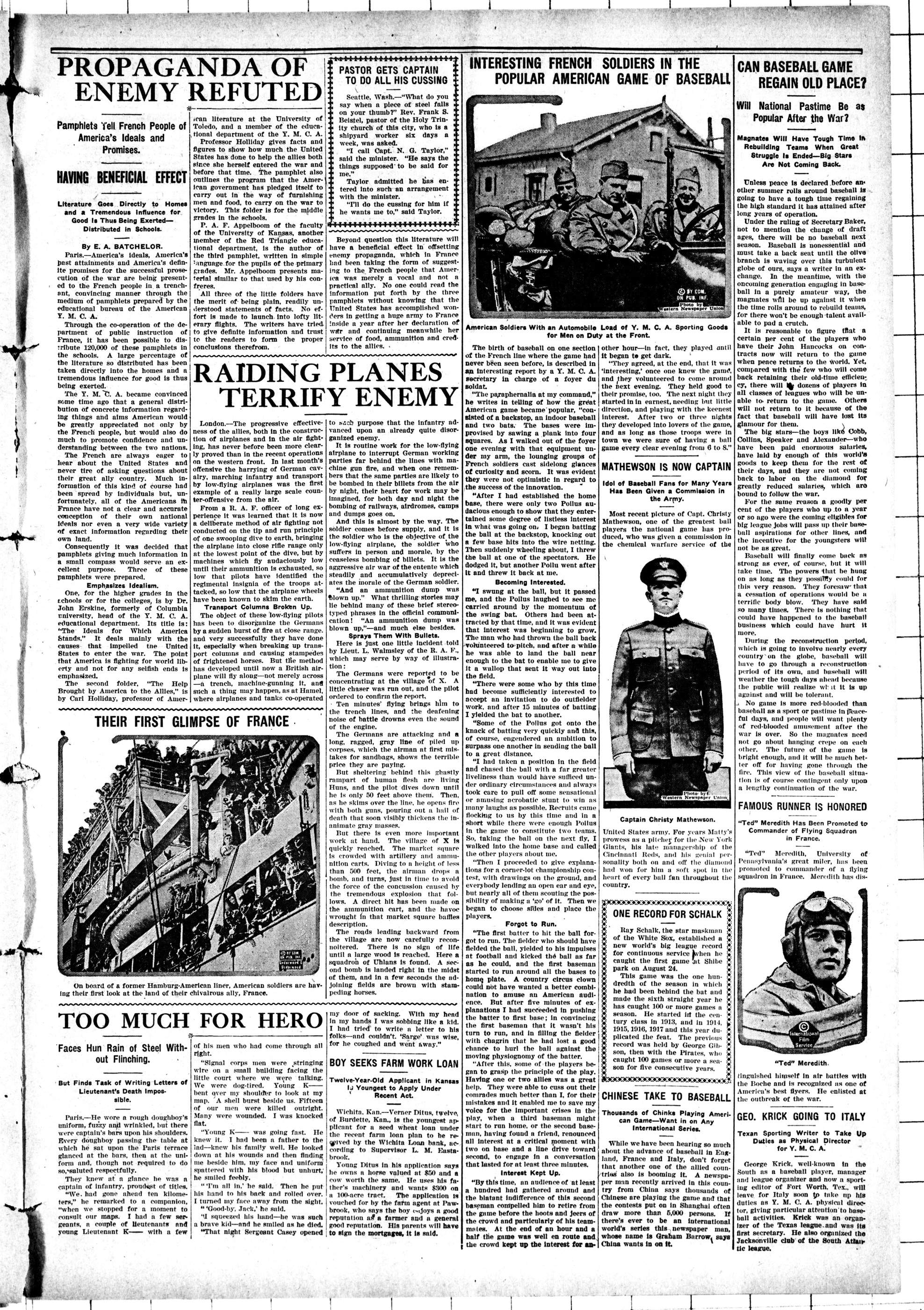
PROPAGANDA OF ENEMY REFUTED
THEIR FIRST GLIMPSE OF FRANCE
BY COM
MARKETING
INTERMEDIATE
BEDROOM
On board of a former Hamburg-American liner, American soldiers are having their first look at the land of their chivalrous ally, France.
TOO MUCH FOR HERO
Pamphlets Tell French People of America's Ideals and Promises.
HAVING BENEFICIAL EFFECT
Literature Goes Directly to Homes and a Tremendous Influence for Good Is Thus Being Exerted— Distributed in Schools.
By E. A. BATCHELOR.
Paris.—America's ideals, America's past attainments and America's definite promises for the successful prosecution of the war are being presented to the French people in a trenchant, convincing manner through the medium of pamphlets prepared by the educational bureau of the American Y. M. C. A. Through the co-operation of the department of public instruction of France, it has been possible to distribute 120,000 of these pamphlets in the schools. A large percentage of the literature so distributed has been taken directly into the homes and a tremendous influence for good is thus being exerted.
The Y. M. C. A. became convinced some time ago that a general distribution of concrete information regarding things and aims American would be greatly appreciated not only by the French people, but would also do much to promote confidence and understanding between the two nations. The French are always eager to hear about the United States and never tire of asking questions about their great ally country. Much information of this kind of course had been spread by individuals but, unfortunately, all of the Americans in France have not a clear and accurate conception of their own national ideals nor even a very wide variety of exact information regarding their own land.
Consequently it was decided that pamphlets giving much information in a small compass would serve an excellent purpose. Three of these pamphlets were prepared.
Emphasizes Idealism.
One, for the higher grades in the schools or for the colleges, is by Dr. John Erskine, formerly of Columbia university, head of the Y. M. C. A. educational department. Its title is: "The Ideals for Which America Stands." It deals mainly with the causes that impelled the United States to enter the war. The point that America is fighting for world liberty and not for any selfish ends is emphasized. The second folder, "The Help Brought by America to the Allies," is by Carl Holliday, professor of Amer-
THEIR FIRST GLUE
On board of a former Hamburg-Arn
ing their first look at the land of their
TOO MUCH
Faces Hun Rain of Steel Without Flinching.
But Finds Task of Writing Letters of Lieutenant's Death Impossible.
Paris.—He wore a rough doughboy's uniform, fuzzy and wrinkled, but there were captain's bars upon his shoulders. Every doughboy passing the table at which he sat upon the Paris terrace glanced at the bars, then at the uniform and, though not required to do so, saluted respectfully.
They knew at a glance he was a captain of infantry, proudest of titles.
"We, had gone ahead ten kilometers," he remarked to a companion, "when we stopped for a moment to consult our maps. I had a few sergeants, a couple of lieutenants and young Lieutenant K—— with a few
RAIDING PLANES TERRIFY ENEMY
can literature at the University of Toledo, and a member of the educational department of the Y. M. C. A. Professor Holliday gives facts and figures to show how much the United States has done to help the allies both since she herself entered the war and before that time. The pamphlet also outlines the program that the American government has pledged itself to carry out in the way of furnishing men and food, to carry on the war to victory. This folder is for the middle grades in the schools. P. A. F. Appelboom of the faculty of the University of Kansas, another member of the Red Triangle educational department, is the author of the third pamphlet, written in simple language for the pupils of the primary grades. Mr. Appelboom presents material similar to that used by his confreres.
All three of the little folders have the merit of being plain, readily understood statements of facts. No effort is made to launch into lofty literary flights. The writers have tried to give definite information and trust to the readers to form the proper conclusions therefrom.
RAIDING PI TERRIFY
---
London.—The progressive effectiveness of the allies, both in the construction of airplanes and in the air fighting, has never before been more clearly proved than in the recent operations on the western front. In last month's offensive the harrying of German cavalry, marching infantry and transport by low-flying airplanes was the first example of a really large scale counter-offensive from the air.
From a R. A. F. officer of long experience it was learned that it is now a deliberate method of air fighting not conducted on the tip and run principle of one swooping dive to earth, bringing the airplane into close rifle range only at the lowest point of the dive, but by machines which fly audaciously low until their ammunition is exhausted, so low that pilots have identified the regimental insignia of the troops attacked, so low that the airplane wheels have been known to skim the earth.
Transport Columns Broken Up.
The object of these low-flying pilots has been to disorganize the Germans by a sudden burst of fire at close range, and very successfully they have done it, especially when breaking up transport columns and causing stampedes of frightened horses. But the tile method has developed until now a British airplane will fly along—not merely across—a trench, machine-gunning it, and such a thing may happen, as at Hamel, where airplanes and tanks co-operated
AMPSE OF FRANCE
American liner, American soldiers are hav-chivalrous ally, France.
FOR HERO
Ten the tr noise of the The long, corpse takes price But rampa Huns, he is he with his death anima But work quickly is crounition than bomb, the for the t lows, the an wrong descri The the vv noiter until a squadrade of of the joining peding
my do in my I had folks-
of his men who had come through all right.
"Signal corps men were stringing wire on a small building facing the little court where we were talking. We were dog-tired. Young K—bent over my shoulder to look at my map. A shell burst beside us. Fifteen of our men were killed outright. Many were wounded. I was knocked flat.
"Young K—was going fast. He knew it. I had been a father to the lad—knew his family well. He looked down at his wounds and then finding me beside him, my face and uniform spattered with his blood but unhurt, he smiled feebly.
"I'm all in," he said. Then he put his hand to his back and rolled over. I turned my face away from the sight.
"Good-by, Jack," he said.
"I squeezed his hand—he was such a brave kid—and he smiled as he died. "That night Sergeant Casey opened
Seattle, Wash.—"What do you say when a piece of steel falls on your thumb?" Rev. Frank S. Beistel, pastor of the Holy Trinity church of this city, who is a shipyard worker six days a week, was asked.
"I call Capt. N. G. Taylor," said the minister. "He says the things supposed to be said for me."
Taylor admitted he has entered into such an arrangement with the minister.
"I'll do the cussing for him if he wants me to," said Taylor.
Beyond question this literature will have a beneficial effect in offsetting enemy propaganda, which in France had been taking the form of suggesting to the French people that America was merely a vocal and not a practical ally. No one could read the information put forth by the three pamphlets without knowing that the United States has accomplished wonders in getting a huge army to France inside a year after her declaration of war and continuing meanwhile her service of food, ammunition and credits to the allies.
to such purpose that the infantry advanced upon an already quite disorganized enemy.
It is routine work for the low-flying airplane to interrupt German working parties far behind the lines with machine gun fire, and when one members that the same parties are likely to be bombed in their billets from the air by night, their heart for work may be imagined, for both day and night the bombing of railways, airdromes, camps and dumps goes on.
And this is almost by the way. The soldier comes before supply, and it is the soldier who is the objective of the low-flying airplane, the soldier who suffers in person and morale, by the ceaseless bombing of billets. It is the aggressive air war of the entente which steadily and accumulatively depreciates the morale of the German soldier.
"And an ammunition dump was blown up." What thrilling stories may lie behind many of these brief stereotyped phrases in the official communication! "An ammunition dump was blown up,"—and much else besides.
Sprays Them With Bullets.
Here is just one little incident told by Lieut. L. Walmsley of the R. A. F., which may serve by way of illustration:
The Germans were reported to be concentrating at the village of X. A little chaser was run out, and the pilot ordered to confirm the report.
Ten minutes' flying brings him to the trench lines, and the deafening noise of battle drowns even the sound of the engine.
The Germans are attacking and a long, ragged, gray line of piled up corpses, which the airman at first mistakes for sandbags, shows the terrible price they are paying.
But sheltering behind this ghastly rampart of human flesh are living Huns, and the pilot dives down until he is only 50 feet above them. Then, as he skims over the line, he opens fire with both guns, pouring out a hull of death that soon visibly thickens the inanimate gray masses.
But there is even more important work at hand. The village of X is quickly reached. The market square is crowded with artillery and ammunition carts. Diving to a height of less than 500 feet, the airman drops a bomb, and turns, just in time to avoid the force of the concussion caused by the tremendous explosion that follows. A direct hit has been made on the ammunition cart, and the havoc wrought in that market square baffles description.
The roads leading backward from the village are now carefully reconnoitered. There is no sign of life until a large wood is reached. Here a squadron of Uhlans is found. A second bomb is landed right in the midst of them, and in a few seconds the adjoining fields are brown with stamped horses.
my door of sacking. With my head in my hands I was sobbing like a kid. I had tried to write a letter to his folks—and couldn't. 'Sarge' was wise, for he coughed and went away."
BOY SEEKS FARM WORK LOAN
Twelve-Year-Old Applicant in Kansas Is Youngest to Apply Under Recent Act.
Wichita, Kan.—Verner Ditus, twelve, of Burdette, Kan., is the youngest applicant for a seed wheat loan under the recent farm loan plan to be received by the Wichita Loan bank, according to Supervisor L. M. Eastabrook.
Young Ditus in his application says he owns a horse valued at $50 and a cow worth the same. He uses his father's machinery and wants $300 on a 100-acre tract. The application is vouchered for by the farm agent at Pawbrook, who says the boy joys a good reputation as a farmer and a general good reputation. His parents will have to sign the mortgages. it is said.
BY COM.
ON PUB. INF.
Photo by
Western Newspaper Union
American Soldiers With an Automobile Load of Y. M. C. A. Sporting Goods for Men on Duty at the Front.
American Soldiers With an Automobile Load of Y. M. C. A. Sporting Goods for Men on Duty at the Front.
The birth of baseball on one section of the French line where the game had never been seen before, is described in an interesting report by a Y. M. C. A. secretary in charge of a foyer du soldat.
"The paraphernalia at my command," he writes in telling of how the great American game became popular, "consisted of a backstop, an indoor baseball and two bats. The bases were improvised by sawing a plank into four squares. As I walked out of the foyer one evening with that equipment under my arm, the lounging groups of French soldiers cast sidelong glances of curiosity and scorn. It was evident they were not optimistic in regard to the success of the innovation.
other hour—in fact, they played anti it began to get dark.
"They agreed, at the end, that it was 'interesting,' once one knew the game and they volunteered to come around the next evening. They held good to their promise, too. The next night they started in earnest, needing but little direction, and playing with the keenest interest. After two or three nights they developed into lovers of the game and as long as those troops were in town we were sure of having a ball game every clear evening from 6 to 8."
MATHEWSON IS NOW CAPTAIN
Idol of Baseball Fans for Many Years
"After I had established the home base, there were only two Pollus audacious enough to show that they entertained some degree of listless interest in what was going on. I began batting the ball at the backstop, knocking out a few base hits into the wire netting. Then suddenly wheeling about, I threw the ball at one of the spectators. He dodged it, but another Pollu went after it and threw it back at me.
Becoming Interested.
"I swung at the ball, but it passed me, and the Pollus laughed to see me carried around by the momentum of the swing bat. Others had been attracted by that time, and it was evident that interest was beginning to grow. The man who had thrown the ball back volunteered to pitch, and after a while he was able to land the ball near enough to the bat to enable me to give it a wallop that sent it way out into the field.
"There were some who by this time had become sufficiently interested to accept an invitation to do outfielder work, and after 15 minutes of batting I yielded the bat to another.
"Some of the Pollus got onto the knack of batting very quickly and this, of course, engendered an ambition to surpass one another in sending the ball to a great distance.
"I had taken a position in the field and chased the ball with a far greater liveliness than would have suffled under ordinary circumstances and always took care to pull off some sensational or amusing acrobatic stunt to win as many laughs as possible. Recruits came flocking to us by this time and in a short while there were enough Pollus in the game to constitute two teams. So, taking the ball on the next fly, I walked into the home base and called the other players about me.
"Then I proceeded to give explanations for a corner-lot championship contest, with drawings on the ground, and everybody lending an open ear and eye, but nearly all of them scouting the possibility of making a 'go' of it. Then we began to choose slides and place the players."
Forgot to Run.
"The first batter to hit the ball forgot to run. The fielder who should have fielded the ball, yielded to his impulses at football and kicked the ball as far as he could, and the first baseman started to run around all the bases to homq plate. A country circus clown could not have wanted a better combination to amuse an American audience. But after five minutes of explanations I had succeeded in pushing the batter to first base; in convincing the first baseman that it wasn't his turn to run, and in filling the fielder with chagrin that he had lost a good chance to hurl the ball against the moving physiognomy of the batter.
"After this, some of the players began to grasp the principle of the play. Having one or two allies was a great help. They were able to cuss out their comrades much better than I, for their mistakes and it enabled me to save my voice for the important crises in the play, when a third baseman might start to run home, or the second baseman, having found a friend, renounced all interest at a critical moment with two on base and a line drive toward second, to engage in a conversation that lasted for at least three minutes.
Interest Kept Up.
"By this time, an audience of at least a hundred had gathered around and the blatant indifference of this second baseman compelled him to retire from the game before the hoots and jeers of the crowd and particularly of his teammates. At the end of an hour and a half the game was well en route and the crowd kept up the interest for an-
other hour—in fact, they played until it began to get dark.
"They agreed, at the end, that it was 'interesting,' once one knew the game, and they volunteered to come around the next evening. They held good to their promise, too. The next night they started in in earnest, needing but little direction, and playing with the keenest interest. After two or three nights they developed into lovers of the game, and as long as those troops were in town we were sure of having a ball game every clear evening from 6 to 8."
MATHEWSON IS NOW CAPTAIN
Idol of Baeeball Fans for Many Years Has Been Given a Commission in the Army.
Most recent picture of Capt. Christy Mathewson, one of the greatest ball players the national game has produced, who was given a commission in the chemical warfare service of the
Photo by 6
Western Newspaper Union
United States army. For years Matty's prowess as a pitcher for the New York Giants, his late management of the Cinchnati Reds, and his genial personality both on and off the diamond had won for him a soft spot in the heart of every ball fan throughout the country.
ONE RECORD FOR SCHALK
Ray Schalk, the star maskman of the White Sox, established a new world's big league record for continuous service when he caught the first game at Shibe park on August 24.
This game was the one hundredth of the season in which he had been behind the bat and made the sixth straight year he has caught 100 or more games a season. He started if the century class in 1913, and in 1914, 1915, 1916, 1917 and this year duplicated the feat. The previous record was held by George Gibson, then with the Pirates, who caught 100 games or more a season for five consecutive years.
CHINESE TAKE TO BASEBALL
Thousands of Chinks Playing American Game—Want in on Any International Series.
While we have been hearing so much about the advance of baseball in England, France and Italy, don't forget that another one of the allied countries also is booming it. A newspaper man recently arrived in this country from China says thousands of Chinese are playing the game and that the contests put on in Shanghai often draw more than 5,000 persons. If there's ever to be an international world's series this newspaper man, whose name is Graham Barrow, says China wants in on it.
CAN BASEBALL GAME
REGAIN OLD PLACE?
Will National Pastime Be as Popular After the War?
Magnates Will Have Tough Time In Rebuilding Teams When Great Struggle Is Ended—Big Stars Are Not Coming Back.
Unless peace is declared before another summer rolls around baseball is going to have a tough time regaining the high standard it has attained after long years of operation.
Under the ruling of Secretary Baker, not to mention the change of draft ages, there will be no baseball next season. Baseball is nonessential and must take a back seat until the olive branch is waving over this turbulent globe of ours, says a writer in an exchange. In the meantime, with the oncoming generation engaging in baseball in a purely amateur way, the magnates will be up against it when the time rolls around to rebuild teams, for there won't be enough talent available to pad a crutch.
It is reasonable to figure that a certain per cent of the players who have their John Hancocks on contracts now will return to the game when peace returns to the world. Yet, compared with the few who will come back retaining their old-time efficiency, there will dozens of players in all classes of leagues who will be unable to return to the game. Others will not return to it because of the fact that baseball will have lost its glamour for them.
The big stars—the boys like Cobb, Collins, Speaker and Alexander—who have been paid enormous salaries, have laid by enough of this world's goods to keep them for the rest of their days, and they are not coming back to labor on the diamond for greatly reduced salaries, which are bound to follow the war.
For the same reason a goodly per cent of the players who up to a year or so ago were the coming eligibles for big league jobs will pass up their baseball aspirations for other lines, and the incentive for the youngsters will not be as great.
Baseball will finally come back as strong as ever, of course, but it will take time. The powers that be hung on as long as they possibly could for this very reason. They foresaw that a cessation of operations would be a terrific body blow. They have said so many times. There is nothing that could have happened to the baseball business which could have hurt it more.
During the reconstruction period, which is going to involve nearly every country on the globe, baseball will have to go through a reconstruction period of its own, and baseball will weather the tough days ahead because the public will realize what it is up against and will be tolerant.
No game is more red-blooded than baseball as a sport or pastime in peaceful days, and people will want plenty of red-blooded amusement after the war is over. So the magnates need not go about hanging crepe on each other. The future of the game is bright enough, and it will be much better off for having gone through the fire. This view of the baseball situation is of course contingent only upon a lengthy continuation of the war.
FAMOUS RUNNER IS HONORED
"Ted" Meredith Has Been Promoted to Commander of Flying Squadron in France.
"Ted" Meredith, University of Pennsylvania's great miler, has been promoted to commander of a flying squadron in France. Meredith has dis-
Interlocean
Film
Service
“Ted” Meredith.
tinguished himself in air battles with the Boche and is recognized as one of America's best flyers. He enlisted at the outbreak of the war.
GEO. KRICK GOING TO ITALY
Texan Sporting Writer to Take Up Duties as Physical Director for Y. M. C. A.
George Krick, well-known in the South as a baseball player, manager and league organizer and now a sporting editor of Fort Worth, Tex., will leave for Italy soon to take up his duties as Y. M. C. A. physical director, giving particular attention to baseball activities. Krick was an organizer of the Texas league. and was its first secretary. He also organized the Jacksonville club of the South Atlantic league.
We do not run free ads, or over-run the time contracted for by our advertisers. We respect their right to advertise at intervals, and rather have them do so, than to run continuously an "adv." and an increasing account. Write all Checks payable to
THE TWIN CITY STAR
1317 North Sixth Ave.
MINNEAPOLIS - MINNESOTA
Call at 1317 6th Ave. N. on Wednesday to insure matter for publication.
The Star's Phone, Hyland 1205.
Send your subscription. Our prices have not changed because of the war. Let your dollar do its duty and The Star will reach a higher standard of service and better circulation.
A DEPOSIT IS REQUIRED ON ALL POLITICAL ADVERTISEMENTS.
NOTICE TO EXCHANGES.
The War Industries Board requests that we discontinue "sending FREE copies in exchange for other publications." In order to comply with their request—we will send a check for a yearly subscription to any weekly publication sending a check for a yearly subscription to The Twin City Star. (Editor.)
Let us not draw the color line. Reciprocity between the races will be the salvation of the Negro.
UNCLE SAM IS CALLING
FOR YOUR
FOURTH LIBERTY LOAN
ANSWER WITH CASH AND
CONFIDENCE. HERE IT IS.
Col. Theodore Roosevelt, the great American, will speak in the Twin Cities on Monday.
Cong. Thomas D. Schall and Mrs. Schall have returned home after a visit to the battlefields in France. They speak in highest praise of "Our Boys" and especially of those of our race.
Col. Frank Dennison of the famous Eighth Illinois Regiment has been sent from France to undergo medical treatment. He is at the Base Hospital at Camp Dodge.
There has been no report of the investigating committee of the N. A. A. C. P. in the cases of discrimination mentioned in our last issue.
Some people think an editor should know about their business without being told and it should appear in the paper. The editor knows the things, you do not want in the paper. If you have something you want published—send it in. The other will find its way.
"BUM" POLITICS.
We know no word better fitted for the colored politician in Oregon than "bum politics." For years and years the colored politician has voted for the Republican party and handed out political cards, orated, expostulated and split oceans of printer's ink to help elect some office-seeker and like the "bum" who is out of work, the colored politician is still "splitting wood" for a livelihood and tramping on in the same old rut. "Bum politics," to say the least. And it will ever be thus just so long as the colored politician and voters continue to support parties and not men. Now the best way to change the whole "bum" local machine, which has dominated politics in the interest of a favored few (and the colored brother completely excluded) is to pick out men for whom to vote at the coming election and let the "party" go to the "pow-wow." And if this doesn't bring political leaders to their senses where will they recognize a man by his worth and not his color, nothing else will. Think it over.—The Portland (Ore.) Advocate, Sept. 21, 1918.
Christmas Parcels Allowed
With the American Army in France, Oct. 4.—Every soldier, officer of other member of the American expeditionary force will be entitled to receive from America one Christmas package not larger than nine by four inches and not exceeding three pounds in weight, according to a general order just issued. An official coupon, which must be pasted on the package, will be given to each member of the American expeditionary force to be sent to the friend or relative from whom a package is expected.
ADVERTISE IN THE STAB
The Bee desires to emphasize its protest against the wholesale discrimination in the Government departments against colored applicants who have successfully passed the civil service examination. What does it mean? The Bee again asks. The colored Americans are loyal to this Government and they are doing everything in their power to aid the Administration in the successful prosecution of this war. What offense can be charged against colored Americans? The Bee asks again. The bars have lifted so that a certain favored class can pass muster without an examination, while another class is compelled to enter examination and after passing successfully is rejected. What does it mean? A declaration has been reported to this office to the effect that no colored people will be appointed by this particular official. In response to the request made by The Bee last week, many persons have announced that they have been rejected by the departments. It is necessary that every colored person who has been rejected send in his or her name at once. These names will be presented to the proper heads at once.
Advertisements are being published daily that the Government is in need of clerks and other employees for war work. Hundreds of colored Americans have applied and been rejected, and white ones cannot be obtained. Messenger boys have been advertised for and colored people have applied, only to be refused. Is the assistance of colored Americans needed? If so, they are willing and ready to respond to their country's call.
If they are needed, and the Government is in need of help, why reject colored applicants? Show one black traitor in the ranks of colored Americans and The Bee will show you one million loyal colored Americans to one black traitor. The Bee appeals to the President of the United States to direct the heads of his departments to lift the bars of discrimination against the colored Americans. They are competent and loyal. Then why reject them?
Every Southern railroad discriminates against the colored people without a just cause. They are treated as cattle when riding South. They are directed to a box car with no conveniences. Does the colored American deserve such treatment? Mr. President, we are with you, and, in the name of God, see that we are given a fair deal.—The Washington (D. C.) Bee.
OUR UNCHANGED POLICIES.
Now that the candidates for office are entering the race in the coming primaries, and The Twin City Star has always taken an active part in discussing the political situation and presenting the issues of the campaign; it will try to maintain its former policies of giving a fair expression of the attitude of all office-seekers, so far as the Negro is concerned. It does not (for revenue only) write up every candidate as "a friend of our race" or "the right man in the right place." It gives each the advantage of the columns under "paid advertisements."
The Twin City Star intends to expose any candidate whose record has been against the Negro. Its editor has a fair knowledge of the history of several campaigns and has made a study of the value of the Negro vote. He is not bound by any individual or party, and has stood, at all times, for the political recognition of Negro voters. The Twin City Star is a paper with a worthy purpose, recognized by its readers as a reliable source of information, an intelligent and fearless advocate for equal rights for all men.
Any person, who seeks honor or personal gain in connection with any war activities is a war profiteer, and is guilty of the worst form of disloyalty. Every personal sacrifice is a patriotic effort. It is the duty of every honest citizen to do his best to bear the Nation's burden without complaint. This is no time for obstructionists. Those who have grievances may complain, in order that better progress may be made. The slacker and chronic kicker is always a detriment. While petitions of redress to proper authorities will always command respect and investigation, let us not forget that every one is asked to do his share to win this war. There is a satisfaction in having done our duty. There is honor enough for us all, if we do that which is expected of us. The patriot knows no self-preservation, the profiteer no self-sacrifice.
If you wish to add to your income, you can do so by accepting an agency for The Twin City Star. Good commission to competent agents. Use your spare time in soliciting ads and subscriptions. Only honest and intelligent agents wanted. Call Hyland 1205.
Lives Days With Hat Pin in Heart.
Minneapolis, Oct. 4.—As a result of discovery through an autopsy that George Brambilla, 33 years old, lived for nearly a week with the broken point of a hatpin piercing his heart, the police are seeking an unidentified woman believed to have stabbed Brambilla. The victim died without divulging the circumstances of his injury. The only information Brambilla volunteered was offered casually to a lifelong friend, to whom he said the wound was the result of an accident, authorities doubt the truth of this.
SUBSCRIBE FOR THE STAR.
THE TWIN CITY STAR, MINNEAPOLIS, MINN.
ODD ANSWERS ON INSURANCE FORMS
Mother died in infancy.
Father died suddenly; nothing serious.
Applicant has never been fatally sick.
An uncle died of cancer on his mother's side.
Applicant's fraternal parents died when he was a child.
Father went to bed feeling well and the next morning woke up dead.
Grandfather died from gunshot wound, caused by an arrow, shot by an Indian.
Applicant does not know anything about maternal posterity, except that they died at an advanced age.
Applicant does not know cause of mother's death, but states that she fully recovered from her last illness.
Grandfather died suddenly at the age of one hundred and three. Up to this time he bid fair to reach a ripe old age.
Mother's last illness was caused from chronic rheumatism, but she was cured before death.—The Southern Druggist.
HUB PHILOSOPHY
A shady character doesn't keep a man cool.
Flying into a rage is not good aviation practice.
It is sometimes better to back down than to get your back up.
A promoter is frequently a man who unloads a bad thing upon a "good thing."
Your gas may escape, but it doesn't get away from the man who makes out the bill.
We would like to steer clear of all wickedness, but there is something in us that is not always dirigible.—Boston Transcript.
MUSINGS
Critics are misanthropes who throw stones.
The cup that cheers the honey bee is the buttercup.
Many who think they will be chosen are not even called.
Some men remind me of a bird's eye view of the real thing.
There is nothing in a name. No river thief has ever stolen a river.
A man never realizes how high a fence he can jump until he is badly scared.
Too many business women are interested only in the business of their neighbors.
Unless a man is willing to confess his ignorance he will never be in a position to learn.
A man may be master of a dozen languages and still be unable to control his wife's tongue.
The saints may have the best of it hereafter, but the sinners think that they have the most fun here on earth.
MUSINGS
ABOUT WOMEN
Mrs. Carrie Chapman Catt has the backing of Tammany for a seat in the United States senate.
In New York state there are 1,353,-270 men and 633,490 women enrolled in all political parties.
All women who are British subjects by birth or naturalization are eligible to vote in Ontario, Canada.
Unless their salaries are increased over 12,000 school teachers in London threaten to go on a strike.
Waltresses employed at the government powder plants are paid $40 per month and their board.
Miss Anne Swenson of Marinette, Wash., is directing Salvation army work behind the lines in France.
APPROPOS OF NOTHING
Trouble with the alleged Stradivarius violin is that it is so Stradivarious.
Golf is an interesting game, but it doesn't seem to do much in literature.
A grand, deep, bass voice has to be used to order pie as well as to sway the multitude.
Men who live to a great age give various reasons for it, but most of them are not sure.
If you have said anything that you don't care to have repeated, "Don't let this go any farther" will not stop it.
SHAKESPEARE'S RE-SET SAWS
All the world's a film.
Sweet are the uses of advertising.
Discretion is the better part of Villa.
She sat like Pankhurst on a monument.
It is a wise stock that knows its own par.
England, bound in with the triumphant she.
The course of true peace never did run smooth.
Baseball acquaints a man with strange Fed. fellows.
There was never yet philosopher that could endure watchful waiting patiently.
For in my youth I never did apply hot and rebellious grape juice in my blood.
COTTON ENDS
A machine gun in operation will use up a bale in three months.
A 12-inch gun disposes of half a bale of cotton with every shot fired.
It takes over 20,000 bales a year to provide absorbent cotton to stanch and blind the wounds of the injured.
One change of apparel for all the troops now engaged in the war represents more than a billion bales of cotton.
In a naval battle, like the one off Jutland, from five to six thousand pounds a minute are consumed by each active warship.
I WONDER WHY?
Bad men always die—in the movies.
Rich young men always go West—in the movies.
Young manicurists always have rich uncles—in the movies.
Wall street daddies always neglect their daughters—in the movies.
Little orphans always get themselves adopted—in the movies.
Tall Westerners always come from out of the desert—in the movies.
Pretty girl-crooks always marry young attorneys—in the movies.
Farmers always have flivvers and farmers' wives always wear sunbonnets—in the movies.
ACTIVITIES OF WOMEN
Toronto telephone girls have formed a union.
The Hawaiian congress has indorsed woman suffrage.
Pullman car porters are to be replaced by women maids.
Over 16,000,000 women in this country do their own housework.
A woman is employed as lineman by a California telephone company.
Women ice wagon drivers in Indianapolis are proving a success.
FIRST NUMBER 322
President Wilson in Person Opens the Big Draft Lottery at Washington.
DRAWING TAKES LONG TIME
Magnitude of Task Prohibited the Forwarding of the Results by Wire—
Washington.—President Wilson personally opened the ceremony of drawing numbers for the 13,000,000 men registered in the new draft. He drew the first capsule, which contained the number 322.
Amid ceremonies profoundly impressive and of transcendent historical significance, Gen. Peyton C. March, chief of staff of the army, received in person this vast force of as yet ununiformed reserves, on behalf of the military branch of the government.
4,000,000 in Arms by July.
And from this reservoir of man power—the largest body of citizen soldiers ever offered by the people of any nation to their government—General March is to recruit the army of 4,000,000 men which he has promised to have overseas by July 1 next to back up General Pershing on the battlefields of Europe.
Every man in the registration is affected, as from those who are not called for active military duty the country's war managers propose to mobilize a great industrial army of war workers to make certain of a constantly flowing stream of men and munitions to the field of battle.
The roll call, which is to assign to each of the 13,000,000 men a military number determining the order in which he is to be called, was begun by President Wilson himself, and not finished until late in the afternoon next day.
As the rushed sheets were filled they were rushed over to the government printing office for the official master list, which, when completed, were sent by General Crowder to all district boards throughout the country, which, in turn were to make them public through the newspapers. In that way the country at large was informed of the order of all the numbers within a few days.
Wilson Is Applauded.
There was a hearty round of apbause as the president, blindfolded with a piece of cloth taken from the covering of one of the chairs used at the signing of the Declaration of Independence, approached the table on which rested the famous glass bowl used upon the first drawing. Provost Marshal Gen. Crowder guided his hand as he reached down into the bowl to pick one of the 17,000 blue capsules containing the numbers. There was increased handclapping when it was announced that the first number of the drawing was 322, for the number which the president drew has a registrant representing it in every one of the 4,557 local boards in the country. Every man whose serial number corresponds to it may therefore consider, that the command to "march" or "work" comes from the commander in chief himself.
Vice President Marshall, similarly blindfolded, picked out the second number. It proved to be a high number—7,277—which will be order No. 2 for all boards having registrants bearing that number. The average number of registrants to a board ranges only from 2,800 to 3,000. The number which President Wilson drew has a registrant representing it in practically every district in the United States. Other numbers fol-
No. 1 322 NO. 51 4287
No. 2 727 NO. 52 12839
No. 3 6708 NO. 53 625
No. 4 107 NO. 54 11338
No. 5 16169 NO. 55
No. 6 3366 NO. 56 832
No. 7 3366 NO. 57 10491
No. 8 127 NO. 58 11403
No. 9 7123 NO. 59 1043
No. 10 2781 NO. 60 964
No. 11 3783 NO. 61 8637
No. 12 514 NO. 62 256
No. 13 10096 NO. 63 7834
No. 14 433 NO. 64 4723
No. 15 904 NO. 65 10656
No. 16 12836 NO. 66 462
No. 17 1523 NO. 67 3505
No. 18 512 NO. 68 348
No. 19 5390 NO. 69 7234
No. 20 5743 NO. 70 12842
No. 21 5540 NO. 71 842
No. 22 5806 NO. 72 4482
No. 23 1240 NO. 73 154
No. 24 107 NO. 75 4856
No. 25 1907 NO. 76 16009
No. 26 5593 NO. 77 12830
No. 27 554 NO. 78 134
No. 28 3073 NO. 79 14319
No. 30 1372 NO. 80 12210
No. 31 207 NO. 81 8317
No. 32 632 NO. 82 352
No. 33 1255 NO. 83 5240
No. 34 1422 NO. 84 12284
No. 35 1101 NO. 85 11255
No. 36 107 NO. 86 1218
No. 37 1072 NO. 87 1218
No. 38 3225 NO. 88 3551
No. 39 129 NO. 89 14367
No. 40 1660 NO. 90 12337
No. 41 6309 NO. 91 11464
No. 42 948 NO. 92 12481
No. 43 872 NO. 93 8655
No. 44 704 NO. 94 474
No. 45 535 NO. 95 7362
No. 46 8691 NO. 96 1191
No. 47 11060 NO. 97 15769
No. 48 858 NO. 98 13276
No. 49 218 NO.
Collegians in Army Corps.
Collegians in Army Corps. More than 150,000 men were added to America's fighting strength when members of the students' army training corps were formally mustered in at the colleges throughout the country. The impressive ceremony arranged for the occasion was set for eleven o'clock October 1. A message from President Wilson was read on every campus. Collegians in the training corps draw the pay of army privates, and are housed, clothed, and fed by the government. There is no tuition fee. Each student is allowed only three subjects.
Defective Page
Nothing Changed But the Price
Sight Drafts Still the Same Fine Old Cigar You've Always Liked
When your dealer asks you six cents apiece for your old friend Sight Draft, don't get the idea that he is trying to put something over on you.
The plain truth of the matter is that our labor and other manufacturing costs have increased so much that we had the choice of cutting down the size of the Sight Draft cigar, using inferior tobacco, or raising the price one cent.
We believed you would rather have the same old Sight Draft quality, the same old size, even if it cost you a penny more. So, from now on Sight Draft will be six cents.
Try a Sight Draft today. It's worth six cents, and you experienced smokers KNOW it is. W. K. Gresh & Song, makers. W. S. Conrad Co., St. Paul, wholesale distributors. — Advertisement.
CHOICE CITY AND SUBURBAN PROPERTY FOR SALE ON SMALL MONTHLY PAYMENTS.
Houses and Flats for Rent.
B. M. McDew
802 Sykes Block.
N. W. Nic. 621 Minneapolis
Office Hours: Sundays:
2 to 6 p. m. 10 to 1 p. m.
9:30 a. m. to 12:30 p. m.
R. S. BROWN, M. D.
Office 408-9 Tribune Annex
67 Fourth Street Soutr.
N. W. Main 2040. T. S. 38192.
Res. 608 E. 14th St.
N. W. Main 2388 Minneapolis.
WORKING-MEN'S SOCIAL CLUB
FOR MEN ONLY
244 3RD AVE. S.
MINNÉAPOLIS
SYLVESTER W. OLIVER &
BENJAMIN JONES
Managers
Peterson, The Druggist
1501 Washington Ave. So.
TOILET ARTICLES, DRUGS
PRESCRIPTIONS.
He Solicits Your Patronage.
T. S. Center 4639.
WALFRID WESTMAN
Photographer
1425 Washington Ave. So. Minn.
THE KEYSTONE BUFFET
(Formerly "Kid" Mitchell's)
Now under new management of
JIMMY SMITH
1313 Washington Ave So.
Main 2259 Minneapolis
NO HOT WATER
"Let's move into a modern house."
A Gas Water Heater Solves the Problem. Sold by The Minneapolis Gas Light Go.
Are you a delinquent subscriber? If so, why not send your subscription?
SMOKE THE RELIABLE
SIGHT DRAFT CIGAR
THAT'S ALL!
---
IMPORTANT NOTICE
Unless notes are written plainly and properly arranged they will not be inserted. Many people send in notes regardless of names, initials or composition. Arrangement by the publisher will be charged for. Free notices must be correctly written.
SUCCESSFUL BAND CONCERT.
The first entertainment of the 16th Battalion Band at Dania Hall on Tuesday evening was a social and financial success. The program was a special feature. Lleut. W. H. Howard conducted the band, which received applause after each number. Eddie and Clint Davis, assisted by Luther Crabtree, appeared in a comedy sketch and kept the audience in continued laughter. Mrs. Elenora Barkskale-Smith and Chas. H. Miller of St. Paul, in song and comedy, drew great applause. The Minneapolis Ladies' Quartette, Mesdames Sexton, Mason, Arthur and Glenn, rendered two of their best selections. They are unequalled in the Twin Cities.
The audience joined in the chorus of "The Home of the Red, White and Blue," the latest composition of Tracy Young—which he sang, accompanied by the 16th Band Orchestra. Andrew Quinn, C. E. Neighbors and Henry R. Morgan, a saxophone tril, was a musical number deserving special mention. When the band rendered "The Stars and Stripes" Master Frank A. Walton, aged 8 years, dressed in a neat-fitting military uniform, appeared with a large silk flag. The audience arose during the rendition of this patriotic selection.
The speakers' part of the program was especially instructive and interesting. Capt. Gale C. Hilyer, Maj. Jose H. Sherwood and Capt. Chas. Sumner Smith of the 16th Battalion made short addresses. Capt. Smith had charge of the program.
Maj. Wm. C. Garis, chief of staff of Adjutant General Rhinow, was present. He stayed through the exercises and his address made a lasting impression upon his hearers. The speakers urged the necessity of every co-operation to win the war and each met a responsive chord. An appeal was made for local Red Cross workers. After the program a grand march was led by Maj. and Mrs. Sherwood, marshaled by Drum Major Everett Jackson. The floor was under the management of Jacob H. Giles and was filled with young people, who danced to the strains of the 16th Band Orchestra. The hall was too small for the large crowd. The committee, J. D. Trevan, Wm. Moden, Howard Curry, F. W. Brown and Jacob Collins, are due much credit for the success. Thos. R. Morgan and Clarence Roper of St. Paul are also among the active workers of the band.
SERVICE FLAG DEDICATION.
Special exercises were held at Bethesda Baptist Church on Sunday evening in honor of the men of that Sunday school who have gone to war. The program was as follows: Singing "Battle Hymn of the Republic," by the congregation; invocation, "The Red Cross," by Mrs. S. G. Franklin; the flag presentation, by Mrs. Teenie White, Ladies of the G. A. R.; recitation, "The Negro Soldier," Miss Grace Franklin; reading, "Origin of the Service Flag," Mrs. Lizzie Bean of St. Paul; recitation "Old Glory," Miss Alice Bean; reading "Little Stars in the Window," Mrs. Boyd; recitation, "Our Black Sammies," Miss Henriette Neal; placing of the Stars by Misses Mann and Glenn for 24 boys of the Sunday school; "Greetings From France," Mrs. Rebecca Duncan Scott, who read letters from her son, Sergt Earl Duncan, who is a radio operator in France; appeal for Red Cross workers, by Mrs. Marguerite Washington, Sergt John W. Harper and Z. A. Pope, U. S. A., both retired, gave inspiration to the occasion by their appropriate remarks. Atty W. T. Francis made one of his instructive and encouraging talks on "The Negro in This War."
Col. J. J. Windrum, one of our leading white citizens, was asked to the platform. He gave an address which left a message of great hope to his hearers. He paid a generous tribute of respect to the ladies of the Red Cross and encouraged them in their work. In a logical and eloquent review of the progress of the Negro, he assured them every right as other citizens in the great readjustment caused by the war. Mrs. Ophelia Rice presided. The dedication was conducted by Biddle Chapter, Ladies of the G. A. R., Mrs. Mary E. Pope, president. There was a large attendance.
ST. PAUL HOME GUARDS.
Companies A and B of the 16th Battalion, M. H. G., will hereafter meet every Wednesday night in the old Capitol on Wabasha street. The Armory is used for the National Guard.
American Planes a Success.
Washington, Oct. 4.—A most favorable report on Dehavilland Four airplanes with Liberty motors manufactured in this country has been made to Maj. Gen. Kenly, chief of military aeronautics, by an officer of the air service just back from France. The first planes arrived at stations in France as early as May 13 last, and since then have been coming in ever increasing numbers. Six weeks ago about 18 planes were arriving daily. Some changes were necessary at first, the officer said.
ODD FELLOWS ELECT OFFICERS.
St. Anthony Lodge No. 2877, G. U. O. of Odd Fellows, elected the following officers: W. W. Williams, N. G.; J. W. Whitely, V. G.; M. L. Brown, P. N. G.; George Peale, E. S.; Wm. R. Morris, P. S.; Noah C. Stone, W. T.; J. J. Turner, N. F.; I. S. Bogle, O. N. F.; O. S. Lee, Chaplain; O. A. Lawrence, Advocate; Wm. Jenkins, Warden.
DEDICATE SERVICE FLAG.
Attorney George H. Woodson was the principal speaker at the dedication of a Service Flag for 204 men of St. Paul, who are in the service. The affair was held at Union Hall and a special program was arranged. Geo. L. Hoage was master of ceremonies. Other speakers were Rev. W. H. Carter, Attorney Wm. T. Francis and Maj. J. H. Sherwood. Mrs. Hattie Loomis Oliver sang and Mrs. Elenor Smith and Chas. H. Miller appeared in a comedy sketch. Miss Alice Bean recited "Our Flag." The Rachael E. Harris Red Cross Chapter was present. After the program dancing was the social feature.
TO STUDY SOCIOLOGY AT "U."
Miss Amy Belasco will return this fall to study Sociology at the University. She is residing in New York City, where she is among the leading West Indians in social circles. Miss Belasco is one of our talented young women.
Madam C. H. Robinson, of 229 West 39th St., was called to Kansas City last week on account of the death of her brother, Harry Brown, who was a visitor here this summer. He died after a short illness from spinal meningitis. Mrs. Robinson returned this week. While home she was the guest of her brother, Dr. W. H. Brown.
MILLINERY OPENING.
Mrs. Clarence Cunningham has opened a millinery department in connection with Mrs. Van Hook's, the dressmaker at 1006 Sixth Ave. N., Minneapolis. She offers special bargains in millinery. Hats trimmed (with material furnished) from $2.50 up. Several patrons have expressed their satisfaction with the service and quality of Mrs. Cunningham's hats.
Persons who are expected to appear on programs should make their presence known on arrival. It is unfortunate that many of our people remain in the background and fail to come to the front seats where they can be seen.
The financial rally at Bethesda Church closed Sunday night. Over $500 had been raised by Rev. W. H. Carter of Seattle.
Mrs. Gale P. Hilyer and baby left Tuesday for her home at Montgomery, Ala., to visit her mother, Mrs. Ellen Harris. She was accompanied by her sister, Mrs. Alice Harris, who has spent several months in Minneapolis.
Miss Kathleen Hilyer, sister of Atty, Gale P. Hilyer, is attending New Hampton Inst. at New Hampton, N. H.
Mr. Will S. Simmons, proprietor of the Arcade Cafe, is on the sick list.
Lieut. Smith of the 10th Cavalry is visiting in the city.
FOR RENT—Three nice rooms for light housekeeping; newly papered; modern; near car lines. Apply to Carroll, 3102 Blaisdell ave., city.
Mr. Ira S. Ashe has been appointed clerk in the county auditor's office in St. Paul, to succeed Mr. Ori C. Hall, who entered the Y. M. C. A. work. Mr. Ashe is thoroughly competent and his appointment meets the approval of our best citizens and the public in general.
DR. BROWN'S MODERN METHODS
New Scientific Treatment.
Dr. R. S. Brown has returned from Chicago where he finished a postgraduate course in auto-hemic therapy under Dr. D. V. Ireland of Columbus, O., also studied the treatment of all rectal diseases, caused by constipation, piles, etc., by electrical appliances. Dr. Brown has added to his office equipment about $500.00 worth of electrical apparatus for special treatment of blood diseases, such as dropsy, rheumatism, hardening of the arteries and general improvement of the blood. He has spared no money to provide his patients with the most modern methods of medical science.
Any person wishing to consult him on these new treatments, may do so, without being under obligation to secure his services. He wishes to explain the advantages of scientific treatment by electricity in many cases where surgical operations have heretofore been the only cure. Several of his patients are relieved from chronic complaints and speak in praise of the new treatment.
Forming New Ukranian Army.
Amsterdam, Oct. 3.—General Rogosa, Ukrainian war minister, according to a telegram from Kiev, announces that plans for the Ukrainian army call for the formation of eight army corps of two divisions each. The minister declared that the population regarded the plan sympathetically, while Germany and Austria-Hungary are showing extreme "good will" toward the formation of a Ukrainian army and are promoting it "generously and energetically."
THE TWIN CITY STAR, MINNEAPOLIS, MINN.
NEWS OF STATE TERSELY-TOLD
Recent Happenings In Minnesota Given In Brief Items For Busy Readers.
Mankato.—Hog cholera is becoming prevalent in certain sections of the state, causing loss to farmers. Bemidji.—A. E. Fritz, state public examiner, and Deputy A. J. Linden are making annual audit of the records of Beltrami county. Moorhead.—A special meeting of the Clay county board will be held on Saturday, Oct. 5, to adopt plans for highway work for next year. Sabin.—Some of the pickers in this section are making as high as $10 and $12 a day and are hard to get even at the price growers are paying, 8 cents a bushel. Brainerd.—Friends surprised Mrs. Anna Johnson of Southeast Brainerd at her home and presented her with $131.45. There were seventy-five people present.
International Falls.—Forest Ranger Johnson of Big Falls brought here a man whom he had arrested for setting forest fires in the Big Falls section. He is evidently demented.
Virginia.—Complaints have been made to Game Warden George Wood that partridge are being shot and he is investigating, since it is unlawful to shoot partridge this year.
Bemidji.—F. G. Troppman has received a contract from the government to furnish 500,000 pounds, about 8,500 bushels, of potatoes, No. 1 grade and inspected, and he is filling the order.
Roosevelt.—Last spring Mrs. Rhodes planted one potato of a new variety. She cut it in six pieces, putting one eye to a hill. This fall she gathered a heaping twelve-quart pail of extra large potatoes.
Stillwater. —Coroner E. E. Wells was called to a farm residence one and a half miles south of Forest Lake to investigate the death of a Mrs. Fredericks, an aged woman, who died quite suddenly there. Minneapolis. —Reuben C. Curtis, found guilty of slaying Ernest E. Lack, known as the defender of children, was sentenced by Judge W. E. Hale to hard labor for the remainder of his life in the Stillwater penitentiary. St. Paul. —Governor Burnquist last week made patriotic speeches at county fairs in Hopkins and Carver. Secretary of State Julius A. Schmahl was a speaker at a Liberty Loan rally at Pequat. Governor Burnquist will continue his patriotic speeches at county fairs.
St. Cloud—Sartell Brothers have donated their old sawmill and sluiceway to the Stearns County Red Cross chapter and they will be sold at public auction on the grounds on Saturday afternoon, Sept. 28. This old mill is worth considerable money and should swell the coffers to quite an extent. Brainer—Every available bit of man power and equipment is being rushed for service on the Northern Pacific to relieve the inundation of wheat in transportation to Duluth. There are 12,000 cars of wheat on the Minnesota division, west of Brainer, 12,000 cars on the Fargo division and 14,000 cars on the Dakota division.
St. Cloud.—John Hanlon, son of Mrs. Harry Grimmer of this city, has been selected as one of the twenty-five to go to the officers' training camp recently opened at Camp Grant, Ill. Hanlon was one of the volunteers who went to the deaf asylum at Indianapolis, Ind., for special training as an auto mechanic about two months ago.
Winona.—F. R. Stevenson, formerly a local hotel clerk, charged with the murder of Elmer Mead, a taxicab driver, and an attempt to kill his own wife, hopes to get an acquittal on the grounds of "temporary insanity," according to reports. His trial has opened. John E. Palmer, assisting attorney general, is assisting County Attorney Earl Simpson in presenting the state's case. Stevenson shot and killed Mead on the night of May 21.
Keewatin.—An appeal to district court by William Darling, local merchant, to test the early closing ordisulted in a decision favorable to Mr. nance passed by the local council re-Darling. Mr. Darling appealed from a judgment of conviction and sentence against him for the violation of an ordinance which prohibited him from keeping his place of business open after 8 o'clock p. m. The decision of the district court is that the ordinance is null and void and of no effect for the reason that it is not a proper exercise of the police power of the state in that it in no sense tends to promote or preserve public health, motals, peace, order, safety or welfare; second, that there exists no legislative authority for its enactment; third, that its provisions are unreasonable and arbitrary; fourth, that it constitutes an unwarranted interference with the constitutional property and personal rights of the individual.
Crookston—Mayor Morrisey appointed two new members to the library board to take the places on Maj. Charles Loring and B. L. Crowe, W. T. Carlisle for three years in place of Maj. Loring, and J. J. Flynn to succeed Mr. Crowe. The two appointments were unanimously approved by the city council.
Bemidji—Niels Sjoberg, who has been employed on the farm of H. W. Alsop, nine miles south of Blackduck, has donated a handsome buck deer head, mounted, to the Red Cross, to be sold and the money devoted to war work.
Appleton Woman Who WILL Speak In Coming Y. W.
C. A. Drive.
Mary C.
Few women in the state are more widely known and admired than Mrs. Bertha Dahl Laws, of Appleton. Mrs. Laws has been enlisted as a speaker for the Young Women's Christian Association in the coming drive. With the new merger Mrs. Laws will enlarge her subject to take in the activities of the other six organizations concerned in the merger.
Eveleth.—The city council discussed the tax levy, but no definite action was taken. It was thought advisable to cut the expenses as much as possible, and in all probability the levy will not be as high as last year's.
Hibbing.—Allan McKinnon, for eighteen years a resident of Hibbing, was found dead in a room at the Globe hotel of heart disease. McKinnon, who was employed by the village, is survived by four sons and two daughters.
Virginia.—The body of a well-dressed man was found near Canyon, Minn., 100 feet from Telegraph Post 567, by a Virginia woman who was picking leaves on the side of the Miller Trunk road. The county coroner at Duluth was notified. Fergus Falls.—A fire broke out in the barn on the Mavis farm, four miles east of the Deist store, and a call was sent to Fergus Falls for help, as there was a large setting of grain near the barn endangered. The fire company responded, making the trip with the big fire auto in record-breaking time and saved the grain.
Duluth.—The six-day meeting of the Northern Minnesota Methodist Episcopal conference has opened here. The Northern conference's principal work will be the completion of arrangements for the part it is to play in the raising of the $80,000,000 fund for home and foreign missions. Bishop C. B. Mitchell will preside at the sessions.
Crookston.—Elmer Johnson, clerk at the Palace hotel, was given a hearing in municipal court on a complaint made by James Pooler, busman for the Hotel Crookston, for assault and battery, and put under bonds to keep the peace. Pooler complained that Johnson slapped him while in an argument and his charge of assault and battery followed.
Hibbing.—Fire completely destroyed the Hibbing warehouse of the Winston-Deare company, ore stripping contractors, with a loss of $75,000. Officials are reported looking for a firebug, inasmuch as another warehouse at St. Paul owned by the same company was burned under suspicious circumstances about a week ago with a loss of $100,000.
St. Paul.—Warnings to railroads and express companies against accepting liquor shipments for points in Martin county, which was made bone dry by order of the State Public Safety Commission, were issued by H. W. Libby, secretary of the commission. The specific purpose of the order was to close two saloons at Ceylon, following alleged violation of a previous regulatory order, but the general effect was to make Martin county bone dry.
St. Paul.—The right assumed by the state to make mineral reservations in land grants to railroads will be tested in an equity belt begun recently by the Duluth & Iron Range road before Judge Wilbur F. Booth in the Federal court. State Auditor Preus recently issued to the Duluth & Iron Range road a deed to 5,450 acres selected under its swamp land grant and made the mineral reservation to the state as required by law. The deed was returned by the railroad officials and the suit started.
St. Paul.-Leboldp Bruunner, St. Paul, recently named state director of Liberty choruses by the Public Safety Commission, has announced plans to complete organizations over the state in time for a statewide Liberty sing the last Sunday in October. Governor Burnquist will be asked to issue a proclamation giving executive recognition to the patriotic movement and urging public observation of Liberty sing Sunday. Announcement of the plan was made by C. W. Henke, publicity director for the commission.
St. Peter.-The eleven girl employer of Johnson & Co., shirt manufacturers are out on strike and have refused the company's offer of a 30 per cent increase in wages and are holding out for their original demands of a 40 per cent raise. The company says it is unable to meet the demands.
Moorhead.—There is no obligation on the part of the Union Light, Heat & Power company to continue serving its patrons in Moorhead with gas, according to the answer filed by the company in the suit brought by the city against an increase in the gas rates.
You are invited; come, bring your friends with you and see Company "D" in action. Music by the Home Guard Orchestra the latest, best and most inspiring.
TAXIS 2:00 A. M.
IMPORTED AND DOMESTIC WOOLENS AT POPULAR PRICES Your Patronage Desired.
Drex 1269
Autor
J. & H. Wet Wash Laun
3753-55-57 Cedar Avenue
High Grade Specialists in Wet
Dry Wash and Family Launder
OUR WORK IS OUR BEST ADVERTISEME
POPULAR PRICED SHOE REPAIRING.
SPECIAL SAMPLE SHOES
WE FIX 'EM WHILE YOU WAIT.
Men's Sewed Soles ..... $1.00
Ladies' Sewed Soles ..... .85
Men's Nailed Soles ..... .85
Rubber Heels ..... .40
Ladies' and Boy's Nailed Soles ..... .65
SEVEN CORNERS' SHOE REPAIR SHOP.
Wash Laundry
Cedar Avenue
Artists in Wet Wash
Family Laundering
TEST ADVERTISEMENT
J. & H. Wet Wash Laundry
3753-55-57 Cedar Avenue
High Grade Specialists in Wet Wash
Dry Wash and Family Laundering
OUR WORK IS OUR BEST ADVERTISEMENT
POPULAR PRICED SHOE REPAIRING SPECIAL SAMPLE SHOES
SEVEN CORNERS' SHOE REPAIR SHOP. 1424 Washington Ave. So., Minneapolis. JOSEPH The Waiters' and Porters' Club
The Waiters' and Porters' Club
GLOVER SHULL, PRES.
311 HENNEPIN AVE. MINNEAPOLIS
EDDIE BOYD, SECY' LEE WHEELER, MANAGER
South Side Barber S.
212 Eleventh Ave. S., Minneapolis
EXPERT BARBERS; UP TO THE MINU
CIGARS, POOL AND BILLIARD TABLES IN CONNE
RACE PAPERS—SHOES SHINED.
THOMPSON & CARVER, Props.
HARRY LEVITO
Practical Tailor
MEN'S SUITS AND OVERCOATS MADE TO ORIG
Dry Cleaning and Fancy Dyeing of Ladies' and Gent's Gau
Phone N. W. Hyland 2875
1317 No. 6th Ave., M
Barber Shop
e. S., Minneapolis
; UP TO THE MINUTE.
AND TABLES IN CONNECTION.
SHOES SHINED.
CARVER, Props.
LEVITON
al Tailor
COATS MADE TO ORDER.
of Ladies' and Gent's Garments.
1317 No. 6th Ave., Minneapolis.
212 Eleventh Ave. S., Minneapolis
EXPERT BARBERS; UP TO THE MINUTE.
CIGARS, POOL AND BILLIARD TABLES IN CONNECTION.
RACE PAPERS—SHOES SHINED.
THOMPSON & CARVER, Props.
MEN'S SUITS AND OVERCOATS MADE TO ORDER. Dry Cleaning and Fancy Dyeing of Ladies' and Gent's Garments. Phone N. W. Hyland 2875 1317 No. 6th Ave., Minneapolis.
BALTIMORE RANKS HIGHEST
Heads High Cost of Living Cities in United States.
Washington, Oct. 4. — Baltimore heads the high cost of living cities in which investigations so far have been made by the government, with Philadelphia second. A report showed that in the Baltimore district costs have increased 80.18 per cent since December, 1914, and 24.62 per cent since last March. The increase in Philadelphia was 67.17 per cent since 1914.
Lieutenant Governor Enters O. T. C. Syracuse, N. Y., Oct. 4. — Lieut. Gov. Edward Schoeneck has made application, which has been accepted by the local authorities, for admission to Camp Zachary Taylor, Kentucky, in the training school for field artillery officers. He is 42 years old.
---
---
Orex 1269
A
FRENCH_DEMAND VENGEANCE
Insist Upon Retaliation for German Vandalism.
Washington, Oct. 4.—The French national committee in charge of the reparation and restoration of war damage, a dispatch from France says, has issued a declaration demanding that the Allied governments invoke the law of retaliation against Germany.
The declaration says while the law is repugnant to the nations fighting for the triumph of justice and liberty it is the only one that will make an impression on the German mind. All governments which participate in the crusade are asked to resolve to destroy town for town, village for village, church for church, castle for castle, and property for property.
Automatic 61809
PETER H. BURKE
Playing
Truant
By HILDA MORRIS
(Copyright, 1918, by the McClure Newspaper Syndicate.)
Doris hated Elmville, hated it only as a city-bred girl can hate a country town where she is lonely, overworked and discouraged. She taught the sixth grade in the Elmville school, a very unruly and wearsome sixth grade, and she spent her evenings alone in a little furnished room at the home of the local grocer. There was no one in the whole town whom she could call a friend, a really truly friend with whom to discuss such things as books and thoughts and longings. Sometimes Doris thought she would burst with the accumulation of thoughts which needed to be talked over with some one. 'Once she tried them on the fifth grade teacher, a nice girl fond of crocheting "mile a minute," but the results were discouraging.
As spring came on, touching the hills about Elmville with a mist of green, a bridal veil of dog-wood and flowering "red-bud." Doris grew almost desperate. She was so lonely! All those lovely woods and hills and no one to talk with, no one to help her discover violet patches down by the river, no one to help her hunt for four-leaved clovers—
There came a day when Doris did an unprecedented thing. It was Monday, and a schoolday, but she did not go to school. One hears often enough of little boys and girls playing truant, but teachers—never!
Very few people there are who have not some time experienced the desire to do some unprecedented thing, some sensational forbidden thing, like crying out in church or sticking pins into the backs of perfectly respectable people who sit in front of them. Most of us resist these impulses, that is, we grown people do. Children more frequently follow them up with action because of an earnest desire to see what will happen.
It was exactly such an impulse that impelled Doris to turn down the road towards the woods instead of the street that led to the schoolhouse. She had wished to do so a great many other mornings, but now, quite suddenly, she felt an overwhelming desire to know what would happen if she "skipped" school, also a desire to be alone in the woods.
It was a beautiful morning. Having cast care aside with a recklessness *that was wholly delightful. Doris en-
A woman stands under a tree, holding a book. She is wearing a wide-brimmed hat and a pleated skirt. The background features a grassy area with a stream and a bird.
She Wandered There.
Joyed it to the utmost. Little birds sang at her as if they understood and approached, flowers bloomed in her path as if they had known she was coming. Overhead the sky was cloudless, blue, the breeze was freighted with fragrance. For an hour or more she wandered there, entirely happy. Then, wearied, she sat down to rest beneath a great oak whose freshly green leaves furnished shelter. Now inaction is always a time for thought, and as Doris sat there a cloud began to gather in the sky above her, also a cloud of misgiving began to darken her mood. What had she done? Here it was half-past ten o'clock, the morning's school half over, and the sixth grade was without a teacher! She pictured to herself the confusion that must be reigning, the worried principal, the distraction of the other teachers. They would never forgive her. Never. More than that, they would never understand. Why, she might even be damished, at once, without that two months more of pay which she sorely needed. She must go back and offer some excuse.
Thus the penalty for being grown up. One cannot enjoy stolen pleasures. Would a schoolboy have been overcome with remorse, midway of his happy morning? However, the day's enjoyment, for Doris was at an end. Already the sky was darkening for an April shower, and she started back along the path that she had trod so happily, hurrying.
stumbling, filled with fear of consequences. By the time she had reached the road the storm broke, a silver shower which treated her as though she, too, were a thirsty flower. She was quite drenched, and trudged along hopelessly bedraggled, her light mood ended in sodden despair. Oh, why did things always have to end this way? Why did happiness so seldom come to her? Why—
The sudden jump of a motor made her jump hastily to the side of the road, her face burning with shame at her sad appearance. Indeed there was cause for her to look ashamed; the motor belonged to Alden Powers, the richest and most influential young man in Elmville, the only Elmville man who had been to college, and the president of the school board which had hired her. How he would wonder what she was doing here at this hour! Apparently he did wonder, for he stopped.
"Why, Miss Evans! You are drenched through! Surely you are not going to walk into town in this shower. Let me drive you in."
His tone was quite imperative, and almost before she knew it Doris found herself seated beside him, feeling like the miserable truant she was. But strangely enough he did not ask her about school, he only looked at her a little curiously, with a quizzical smile in his brown eyes. He had known more of Doris than she thought, for daily she had passed his office window on her way to work and he had grown used to watching for her. And this morning she had not come— "This shower will soon be over," he said cheerfully. "Too bad to have such a beautiful morning spotted. You are fond of the woods, aren't you, Miss Evans?"
And almost before she knew it Doris had poured out the whole miserable story to him. It was strange that she should tell Alden Powers, but there was something about him that made her want to tell—something that made her feel that he would understand.
"I guess I know how you felt," he mused when she had finished. "Been there myself. In fact, this very minute I ought to be at work, but something made me—come after you. You see, Doris, I have been lonely, too, and somehow I thought that you would understand; I've been wanting a chance to talk with you for so long! Somehow I felt—"
What he felt was interrupted, just then, by the fact that the car stopped dead. Indeed, it stopped for an hour or more, a precious hour during which they had time to talk over a great many things, things such as loneliness versus love, and the way one could fall in love with people before one knew them at all, and just how each one of them had felt on first beholding the other.
At the end of the hour the storm had cleared away, blue skies smiled again, and Alden felt that he could spare a few moments for fussing with his engine. And so, about noon they drove back into town. The sight of the brick schoolhouse on the hill sent a chill of mlsgiving through Doris, despite her new-found happiness.
"Whatever will they say? What can I tell them?" she said. "They'll never understand. No one but you could understand!"
"I'll fix it up," he promised easily, "Till drive you right around there, and we'll see the principal."
Just what Alden Powers said to the principal Doris never knew. Doubtless it was something about a stalled car, or a storm which had detained them. At any rate, no word of blame came to her, and strangely enough Doris found that she was treated with greater deference during the remaining two months of the teaching. But perhaps it was not so strange, either, since everyone knew that she was very soon to be Mrs. Alden Powers.
The town man told the farmer man:
"Your duty's plain—raise all you cap.
To beat the far-flung German foe you needs must plant and reap and sow. Bend to your task with zeal and haste. Don't let an acre go to waste.
To win the European fight just spade all day and hoe all night."
"Quite so!" the honest farmer said.
"At half-past three I leave my bed.
The horrid sound of war's alarm has made me tackle this old farm and raise the dickens without stops, besides my ordinary crops. And I'll be true unto my trust and raise a bumper crop or bust. But here I pause in my hard task to bow my head and humbly ask:
'What have you gents, with all your prate, done for us farmers up to date?'"
The town man threw his hands on high, then pulled them down to loudly cry:
"Ungrateful argiculturist, by cold rains soaked and hot winds kissed, do you not know that we are through when we have told you what to do?"—Chicago News.
Protect Sanctity of Mosques.
Interesting new light on a phase of life in Bagdad is furnished by Eleanor Franklin Egan in Saturday Evening Post. The writer declares: "No infidel—it does seem strange to be classed as an infidel—is allowed to enter a mosque in Bagdad or any other holy Mahometan city; and so scrupulously is this Moslem principle respected by the British that they post Mahometan Indian sentries outside all mosque entrances in order to discourage any Tommy who in a moment of exuberance might be tempted to break in for a glimpse of the so carefully guarded mysteries. They say the British soldiers have some to-do to restrain themselves."
Zeebrugge Raid Told By Commanding Officer
Superhuman Work in Face of Whirlwind of Fire and Heroic Attack of Storming Party Graphically Described—Block Ships Still in Position Sealing the Navigable Channel Into Canals—Keyes in Charge.
London.—An official interview with one of the commanding officers of the Zeebrugge raid gives for the first time some idea of the tremendous, intricate schemes that must be devised for modern naval operations, such as bottling up the Zeebrugge submarine base.
the attention of the Mole batteries before the block ships arrived in the vicinity, and in the latter case to keep them diverted until after the blocking ships had arrived at their destination.
Use Special Storm Parties.
"The German garrison in the Mole was believed to consist of about one
While the name of the officer who gave the interview may not be used, for obvious reasons, the study was arranged with the permission of the first sea lord, Sir Rosslyn Wemyss, and through the courtesy of Sir Douglas Brownrigg, chief naval censor. The spectacular story of the raid; the almost superhuman work done in the face of a whirlwind of fire, and the heroic attack of the storming party scrambling over the Mole were all placed by the British officer as mere incidentals in the tremendous assault that was determined upon.
"The problem that lay before us," he said, "was far bigger and greater than the landing on the Mole, or any mere spectacular features. It was vastly different from merely sending one or more ships into a harbor protected by shore batteries, because the channel to be blocked was narrow, and a ship or ships must be placed carefully to make the effort successful. Moreover, the waters through which the vessels must dash were under the protection of heavy guns which commanded the sea practically for 15 miles out from the coast.
Dash Under Cover.
"This meant that the vessels, with the block ships, must arrange their dash under cover for 15 miles. And then, having run the coast batteries, they must run close to a heavy battery on the Mole, located practically a mile out in the harbor, and which could fire practically point blank at the vessels. And then, of course, also under cover of the near shore batteries of the Mole and the heavier coast batteries, making another run of 15 miles. The German mine fields also had to be encountered.
"Various elements had to be taken into consideration. Naturally the dash must be made at high tide. There was only one way in which we could hope to protect the vessels if the raid were made by daylight, and that was a smoke screen. But airplanes, scouting above, would lay a fleet open to observation and to practically the same attack by indirect fires on land. So the dash had to be made at night, and on such a night as the tide would be high at about midnight, for the ships must go in, do their destruction, and then come out again before the shore batteries would have the daylight to help them.
"There were something like 150 guns on the shore commanding the 15-mile radius. If these discovered the vessels none of the ships could have lived through the falling shells. As the batteries all had the use of searchlights and star shells it became necessary to take measures to prevent the ships being seen by any method of illumination until the last moment. That necessitated the use of smoke screens. A smoke screen is very little use unless it approaches with you; thus you must always have the wind blowing in your direction of advance. In our case it was from the north. The use of any craft to make smoke would not be of much avail unless they could approach the coast making smoke to the last minute. This necessitated light draft vessels, and they in turn required calm weather.
Details to Be Worked Out.
"So the conditions necessary demanded high water occurring at a particular period of the night, wind blowing directly into the harbor, calm weather and, of course, no fog, for the latter would prevent the blocking ships from finding the coast.
"Having attained these, there still were other matters to be worked out. For the blocking ships to find their destination it was quite obvious that they must be able to see for a certain distance, say for a mile or two at least. And this means that the moment the entrance to the canal was in the same area of clear atmosphere with the blocking ships, namely, during the final run in, the shore batteries on the coast line also would be in the clear weather and able to concentrate on the blocking ships, much to their detriment.
"This applied both to Zeebrugge and Ostend, where the German batteries are on the actual const line. But at Zeebrugge there was the additional obstruction which is absent at Ostend—the Mole.
"The Mole at Zeebrugge extends rather more than three-quarters of a mile from the entrance of the canal, and the outer end of the Mole had been turned into a veritable fortress. The position of the navigable channel leading to the canal entrance was such that the ships were forced to pass close to the batteries on the Mole, and it was too much to hope that they would be able to do this and pass inside these batteries and then meet the full blast of the shore batteries without being sunk before reaching the canal. It therefore became clear that it would be necessary either to destroy or to divert
RAILWAY ADMINISTRATION SHIP FLAG
U.S.R.A.
Director Genemil McAdoo has selected this flag to be flown by all the vessels operated by the United States railroad administration. The letters are in blue on a white field with a red border.
Director Genemil McAdoo has selected this flag to be flown by all the vessels operated by the United States railroad administration. The letters are in blue on a white field with a red border.
the attention of the Mole batteries before the block ships arrived in the vicinity, and in the latter case to keep them diverted until after the blocking ships had arrived at their destination. Use Special Storm Parties. "The German garrison in the Mole was believed to consist of about one thousand men. It was decided to storm the Mole with special storm parties immediately prior to the arrival of the blocking ships. The necessity of holding the Mole for a certain length of time would also provide opportunity to carry out a certain amount of destructive work on the Mole. The possibility of re-enforcements coming from the shore end and preventing the storming party from attaining their object was to be countered by cutting the Mole off from shore by blowing up the railway viaduct.
"The Mole is a mile and a half long and 80 yards wide. On the outer side it is flanked by a wall 30 feet high. Five feet below the top of this wall is a narrow gangway or parapet running the whole length of the Mole, with an iron handrail on its inner side. From the parapet there is a 18-foot drop to the Mole proper. The inner side of the Mole is fitted to allow ships berthing alongside; whereas it probably was never considered that any ships would wish to berth along the other side. The ships carrying the storming party could not go along the inner side of the Mole without passing close to the Mole batteries, and thereby risking the certainty of being sunk.
"Therefore it was necessary for these vessels to be secured alongside the parapet of the Mole, and for the storm parties to climb over the 30-foot wall down to the parapet, and thence over the handrail and drop 16 feet to the Mole before they could attack the Mole batteries or carry out their destructive work.
Went Like Clock Work.
"The operation went like clock work. The Vindictive, Iris and Daffodil proceeded alongside the Mole in spite of a heavy fire from the Mole batterles. The arrival was at one minute past midnight, April 22:23, and the storm party disembarked on the Mole immediately. The Daffodil, pushing the Vindictive alongside the Mole, enabled this to be done. Because of the roughness of the sea the Iris had difficulty in securing to the wall, and finally went alongside the Vindictive with the intention of disembarking her men over that ship.
"The Germans appear to have been taken completely by surprise. Immediately that they had heard the approach of the vessels they fired many hundreds of star shells. But the smoke screens prevented the enemy from discerning the nature of the attack until it was too late. An old submarine, fitted with explosives, had run into and secured herself under the vladuct, and had been blown up after the crew had escaped in a small dinghy. This terrific explosion in their rear, the attack of the storm party in their midst, and the general confusion which must have reigned amongst them, were probably the cause of the Germans not noticing the approach of the block ships. These latter passed close around the end of the Mole and made direct for the canal entrance. The leading ship, H. M. S. Thetis, was heavily engaged by the shore batteries, but although in a sinking condition managed to direct the other two vessels toward their destination. The Thetis herself struggled on, and finally sank very close off the canal entrance and right across the fairway. The Intrepid and the Iphegenia proceeded into the canal entrance and sank in the positions ordered by blowing out their bottoms by mines especially placed for the purpose. Motor launches had followed in after the three blocking ships and under terrific fire from almost point blank range they went around the sunken vessels and took off the crews. This rescue work was so magnificently carried out that practically none of the
ONE-LEGGED NEWSBOY
SUCCESS AT RECRUITING
St. Louis.—E. S. Phillips, a newsboy of this city, has one leg and one heart—both for the United States. His heart was strong enough to go into the army—but his one-leggedness has kept him out. Phillips, undaunted, turned himself to what he thought was the best way he could help, and has sent 756 legs into the army, according to recruiting officers here, who say he induced 378 eligibles to join the marine corps.
crews of the three block ships were lost.
Still In Position.
"All three block ships are still in position, after three and a half months, and the navigable channel into the canals remains sealed. The difficulty of placing a ship across the channel in broad daylight and without opposition is considerable, so how the commanding officers of these ships managed to sink them so successfully almost passes comprehension.
"The escape of the officers and men from the wrecks was well carried out. The Intrepid alone carried nearly 90 men and not a single man fell into German hands, although, as has been said before, this blocking operation took place very nearly one mile inside the batteries of the Mole, and two of the block ships were actually inside the shore line.
"When it was considered that sufficient time had elapsed for the blocking ships to do their work and for the crews to be rescued the order was given to the storming parties to retire from the Mole. Whilst the Vindictive and her consorts were actually alongside they were comparatively safe from fire except in the case of the upper works which rose above the Mole. The big funnels and mast of the Vindictive had been riddled through and through, and many casualties were caused by flying splinters. As soon as the order to retire was given the storm parties re-embarked. Some had been killed, several severely wounded, and yet out of about four hundred men who had stormed the Mole less than a score were left behind, in spite of the 16-foot climb up the ladder onto the parapet.
"There must have been many acts of great gallantry to enable men who could not walk to be carried back on board amidst heavy fire of the light guns on the Mole and shell fire from the shore batteries, which had commenced to shell their own Mole as soon as they discovered it was in our possession.
Small Craft Take Part.
"It was fully realized that immediately the ships shoved off the Mole they would come under the concentrated fire of every battery that could bear. H. M. S. Iris, on leaving the Vindictive, was severely hit and suffered many casualties, but the Vindictive herself and the Daffodil bore charmed lives. All three ships retired to the northward whilst emitting smoke clouds to cover their retreat.
"In addition to the vessels already mentioned, a large number of small craft took part in the operation, and it can safely be said that any failure on the part of a single unit might have prevented the success of the whole expedition. Small motor boats steamed up and down close off the shore batteries, as it were, treating the latter with utter contempt. Destroyers supported the small craft, bombarded the enemy batteries and assisted in rescue work with equal contempt of danger.
"Vice Admiral Keyes directed the whole operation, which had been prepared under his own supervision, from H. M. S. Warwick, and did not leave the scene of operations until the last of the blocking ships' crews had been recovered. The spirit and determination with which he had imbued all his officers and men and his great quality of leadership made success as near a certainty as possibly could be done.
"Every officer and man who took part in this operation consequently had put to sea with absolute confidence that success would be attained. A complete success was attained, and more complete was it than could ever have been hoped when the undertaking first came up for consideration."
IMPROVED UNIFORM INTERNATIONAL SUNDAY SCHOOL LESSON
(By REV. P. B. FITTWATER, D. D.
Teacher of English Bible in the Moody
Bible Institute of Chicago.)
(Copyright, 1918, Eastern Newspaper
Univ. UCLA)
LESSON FOR OCTOBER 6
ABRAM LEAVING HOME.
LESSON TEXT—Genesis 12:1-9.
GOLDEN TEXT—Be thou a blessing.
Genesis 12:2.
DEVOTIONAL READING—Hebrews 11:1-10.
ADDITIONAL MATERIAL FOR TEACHERS—Genesis 11:27-32; Hebrews 11:8-10.
1. Abraham's Call (v. 1).
The new era inaugurated with Noah at its head ended in a colossal failure. In view of such failure God turned aside from the nation as such, and called Abram out from his kindred and land, and placed him at the head of a new nation which he would train for himself. This call involved:
1. A call to separation. He was to leave the place of his fond associations for a land unknown to him. Obedience to this command meant the severance of three ties.
(1) "His country in the widest range of his affections. (2) His place of birth and kindred, which comes closer, to his heart. (3) His father's house, as the innmost circle of all tender emotions." All this must be cast off before the Lord could get him into the place of blessing. When kindred and possessions stand in the way of love and service to Christ, one must renounce them (Matthew 10:37).
2. A call to heroic tasks. For Abram to go into a strange land and take possession of it for God called for the heroic in him. It costs much to live the life of separation, but it is the only way to have God's favor. Those who are children of faithful Abram must trust God.
II. God's Promise to Abram (vv. 2:3).
God's demand for separation was followed by a seven-fold promise—a gracious engagement on the part of God to communicate certain unmerited favors and to confer blessings upon him.
1. "I will make of thee a great nation." (v. 2.). This in some measure compensated for the loss of his country. He escaped from the defiling influences of his own nation, and became the head of a chosen nation. This was fulfilled in a natural way in the Jewish nation and in Ishmael (Gen. 17:20), also in a spiritual seed embracing both Jews and Gentiles (Galatians 3:7-8).
2. "I will bless thee" (v. 2). This was fulfilled (1) Temporally (Gen. 13:14-17:24-35). He was enriched with lands and cattle, silver and gold. (2) Spiritually (Gen. 15:6; John 8:56). He was freely justified on the grounds of his faith. The righteousness of Christ was imputed to him.
3. "And make thy name great" (v. 2). He renounced his father's house, and became the head of a new house which would be venerated far and wide. He is known as the friend of God (James 2:23).
4. "Thou shalt be a blessing" (v. 2). It was a great thing to be thus honored and blessed by God, but to be the medium of blessings to others was greater still. It is more blessed to give than to receive.
5. "I will bless them that bless thee" (v. 3). God so identified himself with his servant that he regarded treatment of Abram as treatment of himself. Christ so completely identifies himself with his people that he regards wrong done to them as done to himself. Since he was God's friend, God regarded acts performed toward Abram as performed toward himself. In all ages since then the nations and individuals that have used the Jew well have been blessed.
6. "And curse him that curseth thee" (v. 3). The nations that have been against the Jews have never prospered. While God at different times used the surrounding nations as scourges of Israel, he in turn punished them for their mistreatment of Israel. 7. "In the tree shall all families of the earth be blessed" (v. 3). This has been fulfilled (1) In the Jewish nation being made the repository of the Oracles of God. Through them the Bible has been given to the world. (2) The bringing into the world of the Redeemer. (3) In the future time when the Jews shall be God's missionaries in carrying the good tidings of the Gospel to the ends of the earth. III. Abram's Obedience (vv. 4-9).
11. Abrams' Obedience (vv. 4-9).
Abram at once departed out of his own land. He proved his faith by his works. He did not argue or parley. Neither did he demand some guarantee, but stepped out upon God's naked word. There were difficulties in his way, but faith in God made him brave. Faith in God gives victory over the world. He worshiped God. To go into a heathen land and establish true worship requires a courageous faith.
Secrets in Our Heart
Secrets in Our Heart.
We talk about searching our hearts. We cannot do it. What we want is to have God search them . . . and bring out the hidden things, the secret things that cluster there.—D. L. Moody.
Testaments for Soldiers.
I am glad to see that every man in the army is to have a testament. Its teachings will fortify us for our task.—Pershing.
Who has deceived thee so often as thyself?
Anne's
Lunatic
By EILEEN OWENS
(Copyright, 1913, by the McClure Newspaper syndicate.)
Had anyone been present at a certain cozy little white cottage one evening in early June, they would have seen Anne Whitney going from room to room, barring all the windows and fastening all the doors. One might wonder why Anne was so very cautiously sealing up her abode; one might even suspect Anne of being afraid, but that was not the case. Anne Whitney was absolutely and unconditionally alone, for her housekeeper, the good Mrs. Mather, had been called away suddenly by the death of her brother and Anne's cottage was nearly five miles from the village proper. This was sufficiently disturbing, but add to this the fact that she had seen that very afternoon a notice stating that a certain inmate of a nearby insane asylum had escaped—a very dangerous inmate for whose return five hundred dollars was offered, and Anne would no longer seem a timid person, but instead a firm advocate of preparedness.
This was the second summer that Anne had come to Oakdale, the tiny village tucked away in the hills, away from the hustling, bustling city, where she drew clever illustrations for a certain popular magazine.
Anne could not help feeling a trifle wary, but she went to bed early and soon fell asleep.
Some time later—it must have been near three o'clock—she was awakened by a loud shout. She sat up in bed. A moment's silence and then a confused shouting and scuffling, then a thud as of a body falling, and once more—silence.
Memories of acts of insane people rushed through her mind in quick succession and she trembled violently. Finally summoning together all her courage she slipped from the bed and looked out the window. To her utter relief she saw nothing at all alarming.
"Could it have been a dream?" Anne questioned herself. Then, as once more she crept into bed, she concluded that it had been a nightmare, evidently brought on by her distressing thoughts of lunatics, whereupon she promptly fell asleep and did not waken until the bright morning sunshine was streaming in on her face.
She rose quickly and, still fearful of the lunatic's proximity, she decided to spend the day on the lake. So hastily packing a lunch and taking a new book, she went down to the boathouse. Humming a little tune, she opened the door, and then her heart skipped a beat or two, for there, lying full length on the floor, was a man who seemed to be asleep.
The lunatic! And a dangerous one at that!
He wore the conventional garb of an inmate of the asylum, but even in her fright Anne noticed that he still wore silk socks and good looking shoes. She couldn't see his face very well, for the shadows were striking it and left it in semi-darkness. By this time Anne was trembling all over. What should she do?
Just then she spied the old rifle hanging on the wall and, without knowing why, she reached over and picked it up.
But her act awakened the sleeping man and Anne felt her heart slip—slip until it seemed to settle down in her heels. For the man, with a dazed look in his eyes, sprang up and was about to rush out when he was halted by Anne's rather tremulous call, "Hands up!"
Anne, who had never seen a lunatic before, much less captured one, did not know whether he would comprehend the term, but apparently he did, for slowly withdrawing a step or two, he raised his hands.
The lunatic was tall and well proportioned. He had light, wavy hair which was now sadly disarranged, his eyes were deep blue, and as they regarded Anne's frightened face behind the ugly rife, they lighted up appreciatively.
Altogether Anne's lunatic was a very likeable young man and a wave of pity swept over her as she thought of his affliction. Possibly he was insane only at intervals, and this might be one of his rational periods. Fervently hoping her surmise was correct Anne told him to sit down, which he did, inquiring, "To what must I be grateful for the pleasure of your company?"
Anne did not reply, but shifted the rifle to a more menacing position, and thought, "If only I can hold him here until some one goes by and come to help me." What should she do if he became violent? Anne did not know. The lunatic, seated on a low box on the floor, still looked somewhat mystified, and said to Anne, "Will you kindly tell me why I am being kept prisoner here? Not that I object with you as jaller, but—"
Anne blushed, for it is very embarrassing to receive compliments from a man you are holding prisoner, even if he is a lunatic.
At first she decided not to answer him at all, but fearing that her silence would irritate him, she concluded that she had better answer his questions.
"Didn't you hear the noises of a fight here last night?" he asked.
Anne trembled, for she thought he had attacked some one and that the thoughts of it would work him up.
"Why, y-yes, I did," she admitted, then, trying to change the subject, she
added: "Wouldn't you like something to eat?"
Happily she had struck a weak spot and he gladly accepted the lunch basket. He divided everything, giving her the lion's share, which she did not dare refuse. But if she thought to divert his mind from the events of last evening she was mistaken, for he began again: "Last night I was on my way to Oakdale, where I intend, or perhaps I should say intended, to spend my vacation, and my gasoline gave out about five miles from town. Of course, there was no one around, so I started to hike it. I was making pretty good time when just as I reached this place I saw a man trying to get in by a window. I tried to be a hero and the next thing I knew I found myself in these duds and with you pointing a gun at me. I wish you explain matters a bit."
Anne looked at him. Was he telling the truth? He certainly looked and acted as though he was, but somewhere she had heard of the "diabolical craftiness of the insane mind," and she didn't believe him.
Still trying to humor him, she said: "I'm very much obliged to you, sir, and perhaps in a little while you can go."
"Don't you believe me?" he cried, exasperated.
"Oh, of course," said Anne. "but wouldn't you like to stay with me a little-Longer?"
"E-er, why certainly. I'd be delighted; but I do wish you'd put that beastly gun down. It makes me feel rather uncomfortable to be staring into the muzzle of a rifle all the time."
Anne, who was really tired of holding the heavy weapon, let it drop to her side, but still ked her hand on it.
A silence then fell, and Anne, still keeping one eye on the road and the other on her prisoner, thought over what he had said. Evidently she had not been dreaming, for he had been in the fight, but who and where was the other man? He had said he intended to spend his vacation at Oakdale, and Anne found herself thinking how nice it would be if some one like him, in his right mind, of course, should come to the tiny village.
They would meet, they would form a mutual fondness, they would tramp the woods, they would row on the lake, and they would—
"Say"—Anne came back to the present with a thud—"how long are you going to keep a fellow in this coop?"
Anne didn't know what to say. She was somewhat provoked herself, for it was now long past noon and it was hot and, moreover, she was very thirsty.
She felt and looked as if she wanted to cry and the lunatic said apologetically, "I hope you'll forgive my rudeness, but I'm telling the truth, honestly, and—"
But Anne did not hear him, for she had just spied the old mall carrier riding by and in annoter moment Anne was pouring out her tale. "Oh, Mr. Johnson, I've got the lunatic here, and the gun is so heavy and—"
"Lunatic!" thundered the prisoner. "So that's what you think I am?" "Lunatic!" ejaculated the old man. "Why, that's Jim Burroughs, who's bought the old Pendergast place down in the village. The lunatic was caught this morning, plumb tuckered out and in some clothes he'd evidently borrowed."
Anne stared, then she flushed to the roots of her hair. "Oh, please try to forgive me. I didn't know and I tried to believe you weren't the lunatic, honestly I did, but—"
"Don't worry," replied the erstwhile lunatic. "I really didn't mind being prisoner, under the circumstances."
Thus comforted, Anne questioned: "Wouldn't you like to come out some day and get acquainted with me, minus the gun?"
Jim Burroughs thought that he would, but at present he thought it advisable to shed the garments so kindly (?) left him by his assailant, and so with a gay smile and a promise to come again he drove off with the mall carrier.
The next day he made good his promise, and soon after Anne's dream was fulfilled, for they met, they formed a mutual fondness, they roamed the woods, they rowed on the lake, and as all good stories should end—they married and lived happily ever after.
Mystery Explained.
“What’s become of your old friend the sea serpent?” asked a vacationer at the beach. “Has he been frightened off by the submarines?”
“Guess not,” returned the hotel manager. “I rather think he’s sore over our treatment of him. Last time he was here we chased him off the coast. You see, he caused so many men to sign the pledge that he was killing our bar business.”—Boston Evening Transcript.
Far From the Farm.
An Iowa boy on board a transport was lying in his bunk, when a friend, who had been up on deck, rushed down and said:
"Ned, come up quick. There's a great flock of seabirds circlin' 'round the ship."
"O, gwan," answered the homesick farmer, "who cares about birds? I'd rather see a flock of corn cribs than anything else just now."
No Comparison.
"I tell you, doctor," said the prospective victim with a note of cold feet in his voice, "I am getting a little scary about my operation. What if I don't pull through it?" "Oh, nonsense," exclaimed Doc, in his hearty, reassuring way. "What have you to lose in comparison to me? If you die you won't know it, but think what it will do to my reputation."
In the PUBLIC EYE
FINDS TUBERCULOSIS CURE
Prof. Domenico Lo Monaco, who is director of the Institute of Biological Chemistry connected with the Academy of the Lincel, at Rome, lately announced in an official communication that he had been able to make a great advance in the cure of tuberculosis. This result is obtained by a method which is much simpler than all the serum methods experimented with during recent years, namely injections of sugar to modify the bronchial secretions.
Instead of attacking the bacillus itself, whose conditions of life, reproduction and resistance to outside influences are even now only imperfectly understood, the author proposes to modify the surroundings in which the microbe lives and thus to make its existence impossible. His paper is entitled "Action of Sugars on the Bronchial Secretion," and is the result of careful researches made since 1907.
The professor says: "At present injections of sugar diminish bronchial stages of tuberculosis. Simultaneous and night sweats also diminish." He has made a number of cures w persons.
The professor says: "At present I limit myself to the conclusion that injections of sugar diminish bronchial secretion even in the most advanced stages of tuberculosis. Simultaneously it has been observed that the cough and night sweats also diminish."
He has made a number of cures which were recognized as final by skilled persons.
ALLIED CHIEF IN SIBERIA
大阪府警備局
Russians, August 19, 1909, he was gazed defied civilization in 1914, Japan's fled promptly took Tsing-Tao, the German enterprise Otani was General Kamo's. Tall, slender, of long, oval face—in the Japanese composite—with high Otani looks very much like a man of plinarian—which means fair play to fighting comrades.
Russians, August 19, 1909, he was gazetted lieutenant general. When Germany defied civilization in 1914, Japan's fleet and army, airplanes and submarines promptly took Tsing-Tao, the German colony and fortress in China. In this enterprise Otani was General Kamio's right-hand man.
Tall, slender, of long, oval face—sure token of the ancient Aryan strain in the Japanese composite—with high forehead and close-cropped mustache, Otani looks very much like a man of the world in any army. A strict disciplinarian—which means fair play to all—he is trusted and beloved by his fighting comrades.
ESCAPED FROM THE HUNS
ESCAPED FROM THE HUNS
Lieut. Thomas Hitchcock, Jr., of Westbury, N. Y., the youthful member of the Lafayette flying corps, who was captured by the Germans some time ago but escaped and reached Switzerland August 28, had some remarkable experiences in his flight to neutral territory.
While being transported with two other Americans from Lachfeld to Rastadt, "Tommy" jumped from the train when his guard was asleep. He was forced to walk more than 100 miles. This he did in eight consecutive nights, hiding during the daytime. He lived on the food he had saved from his meager rations in the prison camp.
On the eighth day of his tramp he found himself in a village. He inquired of a small girl whether he was in Switzerland, and, being told he was, he made his way direct to Berne, where he arrived August 30.
Hitchcock was captured March 6 when he was forced to land after an chines. He was wounded in the thigh altitude of 1,000 meters, but he manage
Hitchcock was captured March 6 when he was forced to land after an aerial combat with three German machines. He was wounded in the thigh and his machine became disabled at an altitude of 1,000 meters, but he managed to land safely inside the German line.
DECORATED BY JOFFRE
THE MARY OF THE
SUNDAY SCHOOL
services as a nurse and was accepted. searching the field to rescue wounded Germans. During her three years at the front and suffered blood poisoning, which d crawling through barbed wire entangle
services as a nurse and was accepted. She, with a corps of other nurses, while searching the field to rescue wounded after a battle, was captured by the Germans.
During her three years at the front this French heroine was gassed ence and suffered blood poisoning, which developed from scratches received while crawling through barbed wire entanglements.
A. M.
I limit myself to the conclusion that secretion even in the most advanced by it has been observed that the cough which were recognized as final by skilled
General Kikuzo Otani, who is commander in chief of the allied forces in Siberia, was born in Fukui, on the west coast of Japan, in 1856. He studied under an American teacher until he reached military age and then entered the army.
From the ranks he was made sublutenant in 1879, lieutenant in 1883, captain in 1886 and major in 1887. When the war with China broke out in 1894 he was put in charge of transporting the troops to Korea and the road to Peking. In 1897 he was colonel of a regiment. It was just before the war with Russia—when the shadow of the great bear loomed large over little Japan—that in June, 1902, he received his commission as major general. In Manchuria he commanded a division in the Fourth army. He fought in the long and fierce campaign in the spring of 1905 that led to the capture of Mukden and the final defeat of the
stated lieutenant general. When Germany ist and army, airplanes and submarines colony and fortress in China. In this right-hand man. sure token of the ancient Aryan strain forehead and close-cropped mustache, the world in any army. A strict discall—he is trusted and beloved by his
International Film Service
aerial combat with three German man and his machine became disabled at and to land safely inside the German line.
Mme. Cecile Gillot of New York, who is back in the United States while the estate of her husband who was killed by the Boches is being settled, tells how the Germans held her prisoner and beat her with the butts of riles because she would not divulge military information. Mme. Gillot wears the Croix de Guerre, won for bravery in the field while under fire, and pinned upon her breast by Marshal Joffre himself.
"The Huns have killed my husband and six of my brothers and they have maimed a seventh brother for life," said Mme. Gillot. "They shot off both legs of my seventh brother. Still, with all this I would risk my life to save a wounded enemy on the field of battle. That is the spirit of all the Red Cross nurses with the allied armies."
Mme. Gillot explained that at the start of the war she volunteered her
She, with a corps of other nurses, while after a battle, was captured by the at this French heroine was gassed once developed from scratches received while events.
Employer Had Read Detective Stories to Advantage.
Mr. Petty hurried into the office an hour later than usual and was relieved to find that his employer was late also. "Pretty good!" laughed Mr. Petty to his assistant. "He will never know that I was late."
When the head' of the firm came in he scrutinized Mr. Petty long and closely, then leaned casually against the desk.
"Your session at the bowling alley was prolonged last night," he began.
"How do you know?" asked Mr. Petty, opening his eyes very wide.
"I infer it from your stiff manner of handling the ledger this morning," replied the head of the firm severely.
"You exert yourself more than usual on the alleys. At breakfast this morning you were so drowsy from want of sleep that you dozed over your morning paper."
"So I did," admitted Mr. Petty, uncomfortably.
"I know it was at breakfast, because there is egg and coffee on the paper," frowned the head of the firm. "And while you were asleep your little six-year-old son climb into your lap."
"Y-yes, he did," gasped Mr. Petty.
"But—"
"How do I know?" interrupted the head of the firm. I know because your collar is written over in a child's scrawl. It is done in the peculiar shade of lead that you had in your gold lead pencil, which is usually in your left-hand vest pocket. It is not there now, I hope that the boy has not lost it."
Mr. Petty felt for his lead pencil.
"It is gone," gasped Mr. Petty.
"You were late to work this morning," went on the头 of the firm, coldly. "I do not have to be told so, because you bought an evening edition of the paper at the subway station and it is an edition that does not come out until a late hour. I am very particular about the hours of work observed here."
As the head of the firm was finally disappearing into his private office Mr. Petty wiped the perspiration from his brow and remarked to the assistant:
"We were all against giving him a watch for his birthday because he is always watching the time, but we made a great mistake to give him the detective stories instead."
Enlists at 53: Says He's 39.
American Magazine has an article about "Foghorn" Macdonald, who enlisted as a private in the Canadian forces at fifty-three and is now a major at fifty-seven. The author of the article says:
"By canoe for 31 days through the wilderness, by an old tub of a leaky steamboat, by whatever means of travel he could find, including his own feet, he made his way back to Winnipeg, only to find that the troops had left. All right! A machine gun company was being formed and he applied for that.
"The recruiting officer was a friend of his, had helped celebrate Foghorn's fifty-third birthday the previous January. But when in making out the papers he came to the question. 'How old are you?' and Foghorn whipped out: 'Thirty-nine!' he never batted an eyelash.
"Before his official cronies at Otawa knew it, Macdonald was on his way to England—a private at fifty-three! Two years later he was a major; the only man in the forces of the allies who has risen from the ranks to that grade in the present war."
Wartime Economy
Mr. Benson went to New York to business, but lived in Brooklyn. Often he was not able to get home in time for dinner at night. He told his wife that he would phone her every day as to whether he could leave the office or not.
Mrs. Benson was of a very thrifty disposition, and the following was her solution of the problem: "Sam, if you find that you can't be home for dinner, phone me exactly six o'clock. If the telephone rings at that hour, I'll know it is you and that you are not coming for dinner. I won't answer it, and you'll get your nickel back."—Ladies' Home Journal.
Gloves From Whale Intestines
The Norwegian state whaling stations have caught 200 whales, but expect to catch in all 500 during the summer. The stations have orders to take care of the intestines and salt them down, as it is the intention to make gloves of them. The material is fine in every respect, plurable, soft and exceptionally strong. The manufacture of gloves will probably be commenced at once.
Plenty of Color.
Several soldiers were standing on a street corner talking when a "loudly" dressed girl passed. One of them turned to his comrades and said: "Here, boys, salute the colors; there goes plenty of 'em."
New Phone System.
Barranquilla, Colombia, is to have a municipally owned and operated telephone system to replace the antiquated equipment now in use. There will be a demand for American supplies.
How Countries Are Making Provisions for Future of Soldiers Returning from the War.
"The allies should be grateful to two men after victory has been obtained. First, to the general who leads the soldiers to win the decisive battle, and second, to Herbert Hoover, who rendered it possible for the soldiers to eat so that they might fight." And Mr. Hoover is one of those who realize that the food problem of the war should not be separated from the food question after the war.
Dodging the Draft.
When examined recently by physclans at Jefferson barracks, St. Louis, one drafted man, seeking to evade military service, showed a marked impediment in speech.
He stuttered so profusely, in fact, that he was returned to Des Moines as physically unfit for service. It was a clever sham—the man so admitted boastfully to friends.
Then secret service men learned of it. While they listened, several merchants called in the man with a pretended view of employing him as a salesman. In elaborating on his prowess as a salesman the evader's tongue suddenly developed the facility of a book agent.
Now he is back in the army.
Pocket Stove
The Japanese have invented a little stove that you can carry around in your pocket. It is in the form of a small brazier, shaped rather like a cigar case, and the fuel is a sausagelike roll that burns for three hours without emitting smoke or fumes. The Scientific American says that one of these little contrivances carried inside the bosom of a kimoon prevents a journey in a railway train from being chilly. Delicate pupils keep one in their clothes while at school in winter, and so equipped sit comfortably in an unheated room. The aged and the cold-footed sleep with the stove at their feet. It is also used like a hot-water bottle to soothe the palms of cramp and colic.
Rainfall and Battles.
Actual observation by French, British, and American observers have failed to establish any relationship between storming the enemy and storms from the skies. Careful studies show that rainfall and battles do not coincide enough to give the basis for a theory of cause and effect. The great battles in France in the spring of 1917 failed to interrupt the long spell of fair weather that accompanied them. Furthermore, an examination recently made of the records of local distribution of rainfall over England during the first twenty-two months of the war made by the British meteorological office resulted in strengthening the evidence against the theory.
Removing Germs From Water
By using filter alum in rapid sand filters good results are being obtained in reducing the bacterial content of the well water at American mobilization camps in France, says Popular Mechanics Magazine. The chemical conglobates on the sand at the top and forms a film to which the bacteria adhere as the unpurified water trickles through the bed. At regular intervals the upper surface of the sand is replaced and a fresh supply of alum introduced.
And the Children Went
For the children a tragedy, for the older members of the family a joke—occurred in a certain Hillsdale, O. home. The children had been working all day gathering sap from two maple trees. An older sister came home and used the sap for dishwater, and the accident was not discovered until she remarked that the water was sticky.
Friend of
Errand Boys
By JANE OSBORN
(Copyright, 1918, by the McClure Newspaper Syndicate.)
When Alison Preston decided to get a job for the duration of her first long vacation from college she also made up her mind that that job should not be of the sort that would confine her within the four walls of an office. She wanted an outdoor job and, after having received stern parental objections to taking a land army job where she would be away from home for the vacation, she scanned the "want ads" in the daily papers several days in vain. Outdoor jobs for girls did not seem plentiful. Then her eyes fell upon that advertisement of Brown & Brown, calling for messenger girls. The wage offered was not very tempting, but as the advertisement stated, the work would be for the most part doing errands in the busy downtown business section.
Brown & Brown is a very large concern, with branches in cities in various parts of the country, and when you join their force of employees it is like enlisting in an army—you have to submit to considerable catechising concerning your previous experience, your parentage and your place of residence; and all this is written down on a formidable large white card that is kept in a filing case for future reference.
"There is just one thing I'll have to ask you," said the young office manager who employed Alison Preston, "and I will ask you to keep this confidential. I don't want every one to know that we are taking on girls for errands—one person in particular mustn't know. That's our vice president, Mr. Morgan Thorne. He's in the Chicago office now—and, to make a long story short, he began as a messenger himself and he's nuts about them. He makes a hobby of giving every messenger that is employed what he calls a chance.
"That means a lot of fatherly advice, which would be all right if the boys had sense enough to profit by it. He has made up his mind that the future executives of the concern must be drawn, as he was, from the ranks of those who began at the bottom rung. So whenever we get a new messenger he takes no end of interest in him. He it was who installed this card system—wants to know all about the life history of every one that is taken into the concern. And now that he is off in Chicago he has left word to send on records of any new messengers. He wants to give them long-distance advice. So here is what I'm going to ask you," said the young clerk, coming back to his point after his long explanation: "You'll just let me put your name down here so that he won't know you're a girl. Alison, you said it is. May I put it down as Alect?"
"Why, certainly," faltered Alison. "Only, won't he find out?" "He won't be back for months, and you say you can't stay later than the middle of September. You'll escape him completely. You see, we did our best to get boys, but we couldn't get any. He'd say we hadn't tried hard enough. And, by the way, don't say anything in that report about being in college. It might interest him too much and then he'd write to you and the cat would be out of the bag."
So Alison reported the next day for work and, provided with her pigskin wallet that swung easily over her left shoulder and rested on her right hip, she started out on the rounds of the day, carrying stocks and bonds about to various offices, reporting at the bank and back to the office of Brown & Brown. If she attracted any attention it was because she was so much better dressed for her work than the other girls who were beginning to take the places of messengers and errand boys in the downtown section. She wore neatly polished shoes that had served for country hikes the previous winter in college. Her suit was plain and of khaki—such as had been chosen by well-to-do college chums of her who had "gone in" for motor messenger service in the vacation.
The coat collar was neatly topped by a man's soft pique collar and a dark blue four-in-hand tie and a banded sailor of brown completed the equipment.
Yes, of course, she grew tired with her many errands, but the fatigue was repaired by her healthy appetite and by the soundness of the sleep that always followed her days in the open.
The first letter to Alec Preston was practically like the letter almost always received by errand boys from the vice president, Morgan Thorne, when that young officer of the concern was not present to interview them personally. Mr. Thorne assured Alec of his interest and his hope that he was regarding his new position a stepping stone to higher things in the employ of the concern of Brown & Brown. He asked him some questions that he wanted him to answer frankly in a letter that Mr. Thorne assured him would be confidential.
"Did he smoke cigarettes? If so, did he smoke in business hours?"
"Did he indulge in games of chance with other errand boys?"
"What did he eat for luncheon? Did he go to night school? How did he go to his evenings? What time did he
There were many more questions in the same vein, and Alison answered them promptly, assuring the kindly vice president that she smoked not at all and abstained from games of chance. She ate egg salad and milk for luncheon, went to bed early and spent her evenings "at home." She didn't add that those evenings were sometimes spent with her tired little body resting on the soft upholstery of the long chair in her own little bedroom reading some one of her favorite Spanish or Italian authors that she had learned to admire in college.
The next letter expressed approval of the young boy's steady habits, but he reproved the boy for not going to night school, and ended by telling him that he would give a prize of $50—that he always offered messengers in the concern, but had never won—if he would devote himself so earnestly to the study of Spanish that within six months he could command a slight reading knowledge of that language. He himself, he said, had been hand-capped because as a boy he had not mastered a foreign language. It was only recently, when his time for such study was limited, that he had taken up Spanish. It was the great language for business men of the future, etc., etc.
Allison really ought to have been more cautious, but the very evening after receiving this letter she wrote back a long and fleuet letter in her best Spanish, explaining to Mr. Thorne that, though she did not go to night school, she had mastered Spanish the previous winter and spent much time reading it. She declined the prize, however, as she had studied it without knowledge that such a prize existed.
Then came the letter that caused consternation. Mr. Thorne wrote offering Alec a position in the Chicago office as second correspondent in the Spanish department. They were getting lots of orders from South America, he explained, and he really needed him. His wage would be more than doubled, and his traveling expenses to Chicago would be paid.
Alison was at first confused and repentant. She felt that she ought not to have consented to the office manager's deception. But then she took a different attitude toward the matter. Financial conditions in the Preston family had not been all that they might have been for the past year and it had become apparent that another year at college would be impossible for Alison at the present time. She had about decided to spend the following autumn and winter working. And here was a chance to earn $25 a week. She wrote back to Mr. Thorpe accepting the position, confessing at the same time her sex, did not wait for an answer but, packing her little traveling box and gaining a rather reluctant consent from her parents, started forth to take her new job. She could live on $10 a week, she figured, especially if she continued to dress in uniform, and the other $15 she could save to pay her next year's expenses in college.
The office manager in the New York office when he heard of the step she had taken, predicted a stormy reception for Alison. He felt that he knew just how Thorne would snub her. But the storm and the snub were not forthcoming. Thorne told her that at first he had not known, then he chanced to see the New York paper that had the office manager's advertisement for girl messengers, and, beside, he suspected from the egg-salad luncheon and the hand writing that she was a girl. But it made no difference, he assured her. He was a thorough-going feminist, if that meant entire approval of giving girls an equal chance with boys when they proved themselves capable of grasping it. And this girl had proved herself more promising than any of the messenger boys that had ever drifted into the employ of the concern.
Then one day Thorne called Allison into his office and as she came toward him in her trim little khaki suit he held out both his hands and took hers into his.
Allison did not draw back, but stood looking down at their joined hands with a puzzled smile on her face.
"I want you here, Alee," he had always retained the first name by which he had thought of her—"I want you in the office, but more than all I want you in my heart. I want you to make a home for me. Is it so necessary to finish out that college course of yours?"
"There is always one and only one possible event-that will make a college girl give up her course," said Allison.
"And that?"
"When the man in all the world she loves asks her to be his wife."
"Does that mean you have decided to finish?" asked Thorne relaxing his hold on Allison's hands. But he tightened it again when she told him that it didn't.
Fumigation on Mexican Border.
Fumigation on Mexican Border. The latest disinfection project which has ever been undertaken in this country, and probably the largest in the world, was recently begun by the United States department of agriculture along the Mexican border. Five fumigation houses are to be erected at a cost approximately of $50,000 for the disinfection of freight cars, motor trucks and wagons entering the United States from Mexico loaded with products that might introduce insect enemies, especially the pink bollworm of cotton. The largest house will accommodate fifteen freight cars. Each house will be equipped with apparatus and plant for the generation and distribution of hydrocarbon-acid gas.
THE TWIN CITY STAR. MINNEAPOLIS. MINN
HUMAN SIDE OF OUR GREAT ARMY
OVER THE TOP WITH TROOPS
Besides Ministering to the Spiritual Needs of Soldiers, the Chap- lain's Place Is Wherever His Men Are. (From the Committee on Public Informa- tion, Washington, D. C.) By A UNITED STATES ARMY CHAP-
I consider my job the most interesting in the army. No officer has more rich and varied opportunities for service than a chaplain. No officer's calendar presents greater contrasts. It is a chaplain's duty to oversee the dispositions of his mobile flock, as well as their souls, minds, amusement, morals, correspondence, and reading matter. He must go from the boxing ring to the hospital, and from the theater to the guard house. He is in jail oftener than any other man in the service. But, if his work is well done, he is there none too often to suit the men.
Last January General Pershing sent a cablegram to the secretary of war asking that the number of chaplains in the army be increased for the war to an average of three per regiment. His cablegram reads, in part, as follows: "... I believe the personnel of the army has never been equaled, and the conduct has been excellent, but to overcome entirely the conditions found here requires fortitude born of great courage and lofty spiritual ideus. Couning myself responsible for the welfare of our men in every respect, it is my desire to surround them with the best influence possible. In the fulfillment of this solemn trust, it seems wise to request the aid of the churches from home.
The chaplain is a commissioned officer, starting with the rank of first lieutenant. He is always an ordained clergyman who has had practical experience as a pastor before entering the army. The different religious bodies are represented in the chaplaincles in numbers proportionate to the number of adherents of the different denominations in the country at large. Each is privileged to conduct religious services in the manner prescribed by his own church. But, when that has been said, I have expressed all the denominationalism that there is in the army. In this as in many other respects the army has set an example to civil life, for it has learned the needlessness and waste of many sectarian lines in the face of human need.
Chaplain an Information Bureau.
Some people have the idea that all a chaplain has to do is conduct religious services. At other times they think of him as enjoying a life of complete relaxation. The utter mistakenness of this notion becomes evident after the briefest survey of the tasks assigned to a chaplain.
For one thing, he is the information bureau for his regiment. If a soldier wants to know a street address, a telephone number, or a train schedule, he goes to the chaplain's office. If he wants right information on current topics he calls on the chaplain and asks him if he has any late magazines or newspapers dealing with the question. On some of the battleships the naval chaplains put out periodicals for the men. Some of these magazines are really excellent productions.
Then, there is the whole problem of education. If there are men in the regiment lacking in necessary education the chaplain is expected to organize classes in the common branches, so that they may improve themselves along those lines, make themselves more useful to their country, and brighten their own futures. The chaplain frequently gives lectures to recruits on discipline and the relation of moral cleanliness to health and efficiency. He keeps a record of all the men as they come into the service, including their name, home address, next of kin, education, and other items.
The chaplain's day includes plenty of humorous incidents. A fellow chaplain, now on duty at one of the base hospitals, tells an amusing story of talking to an Italian who had been recently injured. The man listened attentively, his great brown eyes fixed on the chaplain's face. The padre did not know that the injured man was an Italian and spoke little English, though a soldier in the United States army. After suggesting a little prayer the chaplain added carelessly:
"It makes no great difference between us, but . . . what is your creed?"
Religion in His Foot.
The injured man still looked earnestly upward, and the chaplain repeated his question. The soldier caught only the questioning intonation and flashed a brilliant smile.
"Oh, eet ees in my foot!" he said, in an explanatory tone, and immediately pulled back the covers of the bed, displaying a much bandaged limb.
The chaplain must be a good mixer. This is especially necessary because he is much concerned with the recreational life of the men. He must be capable of participating actively in many sports and of organizing such games as will appeal to the tastes of all the
men. The social life of the regiment is one of his responsibilities. The movies, the boxing matches, the volleyball games, and the wrestling bouts are all within his province. He writes letters, too, for men who are sick or wounded. In case of difficulty or death it is the chaplain who must impart the message to the loved ones who gave the man into service.
Because he has access to every one, the chaplain becomes involved in many delicate problems of conduct. I once received a rather pathetic note from the mother of one of the men, asking whether her boy was still at the post. I happened to know that he was in the guardhouse. I went to see the boy and asked him why he had not written home. The whole story came out immediately. During his Christmas furthough the soldier had married a girl whom his mother did not approve of, and, in a fit of temper, his mother had said she wished never to see or hear from him again. Before the conversation was over the chaplain had persuaded the boy to write. Thus the difficulty was smoothed over, and a difficulty smoothed over is a chaplain's duty done.
Go Over the Top.
So far I have said nothing about the work of the chaplains in the field, which, for the present war, means chiefly "over there." My own experience has not yet extended thither, but I can answer briefly some of the questions that people ask. The query is often put to me: "Do chaplains go into the front-line trenches?" The answer is, yes, of course. Frequently they go over the top with the men. A chaplain's place is wherever his men are, and when they are in danger he is, too. A chaplain who is not willing, if necessary, to lose his life in the performance of his duties is false to his trust and does not deserve his commission. As a matter of fact, many have been killed. The mortality among chaplains on the western front has been as high as one a day, which is a high percentage when the small total number of chaplains is considered.
The chaplain has this additional test of nerve—that he is obliged to go unarmed. By the term of the Geneva convention, chaplains are not permitted to carry arms. Of course, in return for this, the person of the chaplain is supposed to be sacrosanct. But everyone knows that to the Hun the safeguards of the Geneva convention are as obsolete as the Sermon on the Mount is to them.
A Brother to the Wounded:
The hospital is one of the principal fields for the chaplain's endeavors. As one chaplain puts it: "In the hospital, they can't get away from me." But there is a more powerful element in the chaplain's success among the sick boys. As soon as they feel helpless, they reach out involuntarily for a friendly hand, and it is rare for a man in a hospital not to be glad to see the chaplain.
The most impressive story I have heard was given to me by a friend of mine who is a chaplain. He had become greatly interested in one of the men who was seriously ill and not expected to live. Every time the chaplain came to see him, the fellow would ask him to "say just one little prayer, won't you?" Toward the end they thought that he would be delirious. But he was not. The chaplain cause, and the soldier whispered his customary request for a prayer. The chaplain prayed. When he had finished he asked: "Did you understand me then, Gray?" "Yes," the dying man whispered. "I understood. I can understand anything about God. It's wonderful."
The army has learned that men may worship God in different ways, but they all need the same kind of brothering. So the army chaplain looks after all his boys alike, whether they have a faith or whether they have none. He knows, better than any other officer, that Uncle Sam's boys are not mechanisms, but men. Because he comes so close in touch with the human side of the army he is in a position to stimulate that morale without which fighting men are powerless to win battles.
Beginnings of Great Things.
Beginnings of Things
On July 26, 1847, the first electric magnetic locomotive was exhibited and operated. The exhibition was made in the town hall of Dover, N. H., by its inventor, Moses G. Farmer. It carried several people, who were doubtless the first passengers transported on a railroad by electricity in the United States. Farmer lectured upon the invention at various Eastern points, after which he opened a telegraph office, where he devised the well-known fire alarm apparatus. As early as 1850 Professor Farmer predicted, among other results, the talking exactly as we talk today by telephone, and he also saw the feasibility of electric traction by means of the storage battery and trolley system now in use. He also invented a flying machine, but his sudden death prevented his bringing it before the world.
"Duration of War."
The phrase "duration of the war" is more poked about in England than in America.
"You will realize how philosophical we are become out here," an officer writes to the Evening News, "when I tell you that we have just been invited to enter a team for a divisional football competition—to be an annual event.
"My men seem very keen, especially as a cup is offered. I suggested, quite gravely of course, that winning three times would mean 'keeps,' and they cordially acquiesced."
When our nation went into this fearful war—with high hearts and wide-open eyes—we knew that many gallant boys must die; still others must be hurt, dreadfully hurt. With dread we anticipated the day when many would be coming home—not the able-bodied lads we knew, but crippled and maimed, perhaps; seeming helpless and discouraged. That last must not be!
No one must be discouraged, however much he may have suffered. No one, if human ingenuity can prevent, must be left helpless. You have only to read the splendid things which are being done in this line. For this is one great task which marvelous modern surgery and science are taking in hand. Nowadays there is no room for despair, because of physical hurts. The grace of God and human devotion have brought about what seems like a new age of miracle!
As an offset to this worst of wars goes such co-operation and intelligent reconstructive thinking as the world has never seen. The first alts at the front, the convalescent hospitals, the skill and resources of surgeons and nurses have developed such favorable conditions that a wounded soldier has a better chance of complete recovery, even from terrible wounds, than ever in the world's history. Moreover, after his physical healing is completed, there is more effort being put into equipping him to face peace again, than was ever dreamed of.
Rectifying Disfigurement.
The most famous sculptors are giving their time to constriving means to hide his disfigurement. The cleverest inventors are studying to fit him with substitutes for lost limb or muscles put out of commission. The wisest teachers are ready to teach him a new occupation, if his old one has become impracticable. The most sympathetic agencies are preparing to find what he can do to be most useful to his grateful country. Uncle Sam is on the job to look after him. Could he have better hope? We must co-operate with Uncle Sam. First of all, we must ourselves keep cheerful and hopeful, even if it is our
"When the German-Americans, as we call them, found that our country was in the war, they erased the hyphen. The hyphen is gone forever. . . In our country there are only American citizens." I quote the above from a recent article issued by the "Vigilantes," and I believe the facts to be virtually as stated. But if they were not, and if the hyphen did actually here and there remain alive, would not the most sensible policy treat it as dead, and at least assume it to be dead, wherever it showed no virulent signs of life? In other words, men cannot be goaded into loyalty; they only accumulate a sense of injury under the goad. And it was never more important than at this present time that we should avoid injustice to any citizen. Suspicion, rumor and coincidence of circumstance should influence neither our judgments nor our actions; much less should we vent our passion against Germany upon the person of him whom we called the German-American.
I speak from the standpoint of one who bitterly opposed the German-American position on the war prior to the American entrance, April, 1927. But the sympathy of the German-American with the German cause, prior to that date, if rightly comprehended, does not imply a sympathy continuing beyond that date, though to many minds this is either an impossible paradox or a symptom of credulity imposed upon by almost barefaced hypocrisy. It is neither. The German-American, beholding a war between Germany and the allies, sided with Germany. He had not been alienated from Germany, as the rest of us had been alienated (by the Revolutionary War) from England. He saw merely a contest between foreign powers and sided with that from which he sprang. But when his own country came to actual war with Germany the German-American found himself to be an American. Nevertheless, it is hard for him to show his patriotism when we say to him: "Now, you dirty German-American, drop your tricks and speak up! Repeat these words in a loud shout, 'I am an American and I love the flag,' and if you don't shout loud enough we'll kick you, and maybe we'll kick you anyhow!" Such instruction does not seem quite statesmanlike, or over-Christianlike, either.
Germans to Germans.
Margaret Deland, lately returned from France, says that over there, not long ago, a company of German prisoners, just captured, were being sent back from the front, when they encountered an American regiment,
own boy who is coming back, affered and discouraged. He will depend much upon our hope and cheer. The attitude of his own home toward a boy's apparent misfortune will be one of the greatest factors in his future career, of usefulness or of despair. Perhaps it will turn out not to be such a misfortune, after all! Already many a soldier has found his true self in the hospital. Many a one who had an unimportant job before he was crippled, has studied, and practiced and perfected some speciality which has given him a more satisfactory position than ever.
Many a man who has lost his right hand is doing better work than ever with his left, or with the marvellous mechanical fingers which have been made for him.
The government has worked out a great scheme, in which it needs the help of us all. Don't throw sand in the machinery. If you happen to have a crippled lid at the front! Don't be so selfish, so impatient to see and comfort him that you prejudice his future. Mirfares take time! He is being looked after, remember. We must not demand that he be 'home' as soon as his fortune is known
Lend Year Assistance.
Yes; your Husky may have done his brave bit, and may think he is not a Husky any more, and may demand just home, sympathy, help for his helplessness—and his pension. He may intend to give up active life, because of his "misfortune." He may feel too hurt by fate to try any more. Don't let him feel so! Maybe his real happiness, his true usefulness is just beginning! You must be brave for him now, as he has been brave for us all. You want the best for him? You don't want him to miss the chance of building anew a dignified future; do you?
"Well, then! Don't you be discouraged! Don't let him despair! Brace yourself to brace him, and read of the splendid things that are being done to give hope for such as he—reconstruction, re-education, re-equipment, replacement in affairs. Americans are so versatile and adaptable, thank God!
Uncle Sam will do the best possible for the boy who made the fine sacrifice. He will have his well-earned pension. But that is not all! He will have, if humanly possible, a good job, too. Ten chances to one he will have it, if we all co-operate. It is not like the old days. You must read the wonderful things that are happening to the boys whose splendid spirit mere metal could not crush.
There is no room for despair!
largely from Wisconsin, moving up to the trenches. Many of the Wisconsin troops were of German origin; some among them, indeed, could hardly speak English, and the prisoners were astonished: to be greeted noisily and garrulously in their own tongue. They were even more astonished at the nature of the comments which these strange Germans from America made upon them. In fact, the episode was unamble. Oaths in the German tongue were frequent and intensive. The German-speaking men of the Wisconsin regiment cursed the captured German soldiers with an inhospitable frankness very shocking to the prisoners, who had been passed in silence by other American regiments, and had received cigarettes from a battalion of English. Words like "dunmkopf" and "schwainhund" were employed, with prophetic expletives; and the general sense of what the Wisconsin men said to their German cousins was as follows: "You dash-blunked jackasses and dots, we and our father left your old fatherhund and went four thousand miles to live in a better place. Now we have to come all the way back, four thousand miles again yet, to slaughter you, because you haven't got any more sense than to believe and obey that old pigdog of a kaiser! We'll send your kaiser and princes to sheol, where they can't do any more harm; and as for you, dunderheads, you ought to be hanged for making us all this trouble of coming over here to teach you some sense with our bayonets!"
May Work Out Own Salvation. The citizens once called German-Americans will work out their own salvation if we do not make it too hard for them. What man can show enthusiasm for anything, when he is threatened with punishment if he is not enthusiastic? Loyalty is a feeling; it is not a spoken word. You cannot possibly produce a beautiful feeling in any man by threatening him or prosecuting him. Let us not threaten at all, and let us prosecute only when we have evidence. Is it certain evidence that a man is loyal if he have a son in the American army? No. There were rebels in '63 who had sons in the Northern armies. Is it certain evidence that a man is disloyal if he have a son in the German army? No. There were loyal Union men in '64 who had sons fighting for the South. So it may be now. There are American citizens who have relatives in the German army and other relatives in the American army. Here and there is an American citizen who has one son in the American army and another son in the German army.
The Greatest Mistake
It has been said that the only one who never makes a mistake is the one who never does anything. But to do nothing is the greatest mistake possible. A life without endenvor, action and purpose, is a failure. Mistakes are not as serious as inaction, remember. Do something, and do your best. Never be disheartened by the consciousness that you have blundered. Girl's Companion.